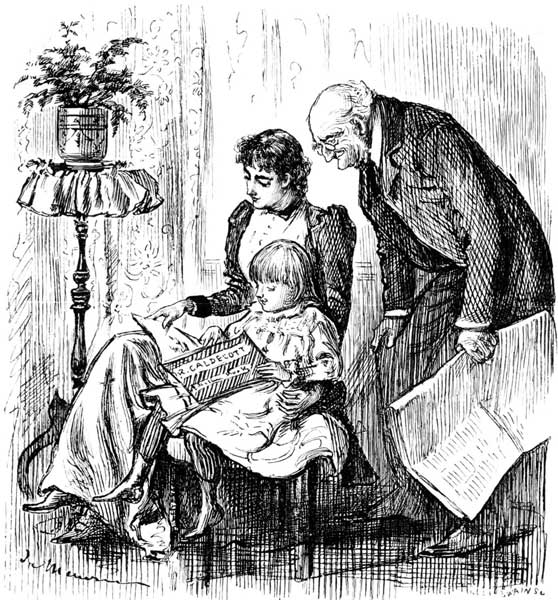
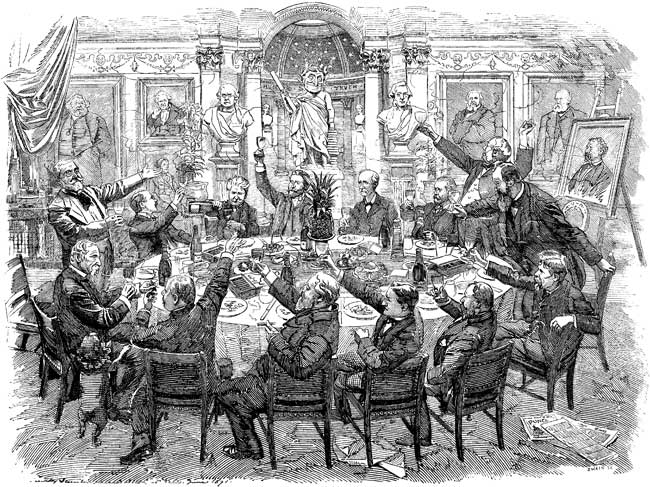
 "THE MAHOGANY TREE."
This eBook is for the use of anyone anywhere at no cost and with
almost no restrictions whatsoever.  You may copy it, give it away or
re-use it under the terms of the Project Gutenberg License included
with this eBook or online at www.gutenberg.org
Title: The History of "Punch"
Author: M. H. Spielmann
Release Date: December 17, 2007 [eBook #23881]
Language: English
Character set encoding: ISO-8859-1
***START OF THE PROJECT GUTENBERG EBOOK THE HISTORY OF "PUNCH"***
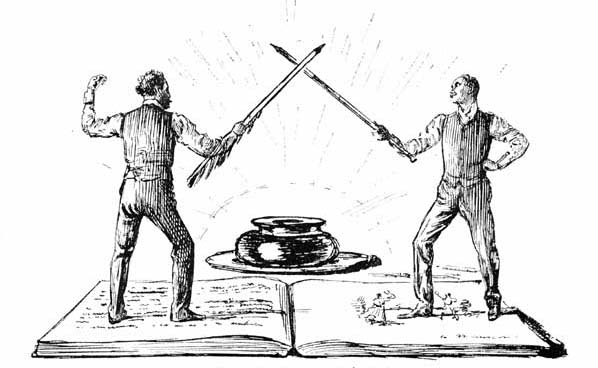
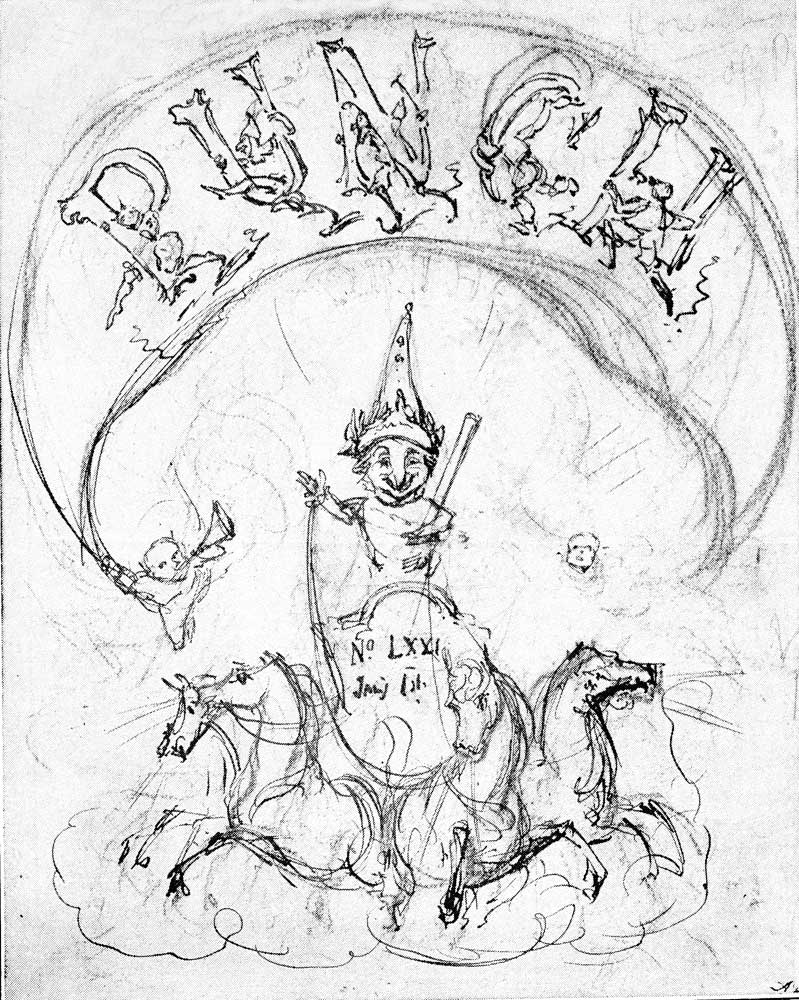
(By Linley Sambourne. From "Punch's" Jubilee Number, by special
permission of Sir William Agnew, Bart., Owner of the original drawing.)
(See page 536.)
CASSELL and COMPANY, Limited
LONDON, PARIS, & MELBOURNE
1895
ALL RIGHTS RESERVED
The prevailing idea of the origin and history of Punch has hitherto rested mainly on three productions: the "Memories" of George Hodder, "Mr. Punch's Origin and Career," and Mr. Joseph Hatton's delightful but fragmentary papers, entitled "The True Story of Punch." So far as the last-named is based upon the others, it is untrustworthy in its details; but the statements founded on the writer's own knowledge and on the documentary matter in his hands, as well as upon his intimacy with Mark Lemon, possess a distinct and individual value, and I have not failed to avail myself in the following pages of Mr. Hatton's courteous permission to make such use of them as might be desirable.
During the four years in which I have been engaged upon this book, my correspondents have been numbered by hundreds. Hardly a man living whom I suspected of having worked for Punch, but I have communicated with him; scarce one but has afforded all the information within his knowledge in response to my application. Editor and members of the Punch Staff, past and present—"outsiders," equally with those belonging to "the Table"—the relations and friends of such as are dead, all have given their help, and have shown an interest in the work which I hope the result may be thought to justify. All this mass of material—all the evidence, published and unpublished, that was adduced in order to establish certain points and refute others—had to be carefully sifted and collated, contrary testimony weighed, and the truth determined. Especially was this the case in dealing with the valuable reminiscences imparted by Punch's earliest collaborators, still or till lately living. Of undoubted contributors and their work, it may be stated, more than two hundred and fifty are here dealt with. A further number cheerfully submitted to cross-examination on one or other of the many subjects touched upon; and probably as many more were approached with only negative results.
My special thanks are due to Mrs. Chaplin, the daughter of the late Mr. Ebenezer Landells, who unreservedly placed in my hands all the Punch documents, legal and otherwise, accounts, and letters, concerning the origin and early editorships of Punch, which have been preserved in the family; and to Messrs. Bradbury and Agnew, who have supplemented these with similar assistance, as well as with books of the Firm establishing points of literary interest not hitherto suspected, together with the letters of Thackeray which illustrate his early connection with and final secession from the Staff. Apart from their general interest, these documents, taken together, establish the facts of such very vexed questions as the origin and the early editorships of Punch. This is the more satisfactory, perhaps, by reason of the numerous unfounded claims—or founded chiefly on family tradition or filial pride and affection—which are still being made on behalf of supposed originators of the Paper. Even these partisan historians, it is believed, will hardly be able to resist the proofs here set forth; although attested fact does not, with them, necessarily carry conviction. For such services, and for their ready and sympathetic acquiescence in the requests I have made for permission to quote text or reproduce engraving, my hearty thanks to Messrs. Bradbury, Agnew and Co. are due. To them and to all my numerous correspondents I here repeat the assurance of gratitude for their courtesy which I have privately expressed before.
I have reproduced no more pictures from Punch than were rendered necessary by the topics under discussion. I would rather send the reader, for Punch's pictures, to the ever-fresh pages of Punch itself. Nor, I may add, did I seek information and assistance from its Proprietors until this book was well advanced, preferring to make independent research and to test statements on my own account.
My primary inducement to the writing of this book has been the interest surrounding Punch, the study of which has not begotten in me the hero-worship that can see no fault. How far I have succeeded, it rests with the readers of this volume to decide.
September, 1895.
| PAGE | |
| Introductory. | 1 |
| CHAPTER I. | |
|---|---|
| PUNCH'S BIRTH AND PARENTAGE. | |
| The Mystery of His Birth—Previous Unsuccessful Attempts at Solution—Proposal for a "London Charivari"—Ebenezer Landells and His Notion—Joseph Last Consults with Henry Mayhew—Whose Imagination is Fired—Staff Formed—Prospectus—Punch is Born and Christened—The First Number | 10 |
| CHAPTER II. | |
| PUNCH'S EARLY PROGRESS AND VICISSITUDES. | |
| Reception of Punch—Early Struggles—Financial Help Invoked—The First Almanac—Its Enormous Success—Transfer of Punch to Bradbury and Evans—Terms of Settlement—The New Firm—Punch's Special Efforts—Succession of Covers—"Valentines," "Holidays," "Records of the Great Exhibition," and "At the Paris Exhibition" | 29 |
| CHAPTER III. | |
| THE PUNCH DINNER AND THE PUNCH CLUB. | |
| Origin and Antiquity of the Meal—Place of Celebration—The "Crown"—In Bouverie Street and Elsewhere—The Dining-Hall—The Table—And Plans—Jokes and Amenities—Jerrold and his "Bark"—A Night at the Dinner—From Mr. Henry Silver's Diary—Loyalty and Perseverance of Diners—Charles H. Bennett and the Jeu d'esprit—Keene Holds Aloof—Business—Evolution of the Cartoon—Honours Divided—Guests—Special Dinners, "Jubilee," "Thackeray," "Burnand," and "Tenniel"—Dinners to Punch—The Punch Club—Exit Albert Smith—High Spirits—"The Whistling Oyster"—Baylis as a Prophet—"Two Pins Club" | 53 |
| CHAPTER IV. | |
| PUNCH AS A POLITICIAN. | |
| Punch's Attitude—His Whiggery—And Sincerity—Catholics and Jews—Home Rule—European Politics—Prince Napoleon—Punch's Mistakes—His Campaign against Sir James Graham—His Relations with Foreign Powers—And Comprehensive Survey of Affairs | 99 |
| CHAPTER V. | |
| "CHARIVARIETIES." | |
| Punch's Influence on Dress and Fashion—His Records—As a Prophet—As an Artist—As an Actor and Dramatist—Benefit Performances—Guild of Literature and Art | 122 |
| CHAPTER VI. | |
| PUNCH'S JOKES—THEIR ORIGIN, PEDIGREE, AND APPROPRIATION. | |
| "The Unknown Man"—Jokes from Scotland—"Bang went Saxpence"—"Advice to Persons about to Marry"—Claimants and True Authorship—Origin of some of Punch's Jokes and Pictures—Contributors of Witty Things—A Grim Coincidence—"I Used Your Soap Two Years Ago"—Charles Keene Offended—The Serjeant-at-Arms and Mr. Furniss's Beetle—Mr. Birket Foster and Mr. Andrew Tuer—Plagiarism and Repetition—The Seamy Side of Joke-editing—Punch Invokes the Law—Rape of Mrs. Caudle—Sturm und Drang— Plagiarism or Coincidence?—Anticipations of the "Puppet-Show" and "The Arrow"—Of Joe Miller—And Others—Punch-baiting—Impossibility of Joke-identification—Repetitions and Improvements | 138 |
| CHAPTER VII. | |
| CARTOONS—CARTOONISTS AND THEIR WORK. | |
| The Cartoon takes Shape—"The Parish Councils Cockatoo"—Cartoonists and their Relative Achievements—John Leech's First—Rapidity in Design—"General Février turned Traitor"—"The United Service"—Sir John Tenniel's Animal Types—"The British Lion Smells a Rat"—The Indian Mutiny—A Cartoon of Vengeance—Punch and Cousin Jonathan—"Ave Cæsar!"—The Franco-Prussian War—The Russo-Turkish War—"The Political 'Mrs. Gummidge'"—"Dropping the Pilot," its Origin and Present Ownership—"Forlorn Hope"—"The Old Crusaders"—Troubles of the Cartoonist—The Obituary Cartoon | 168 |
| CHAPTER VIII. | |
| CARTOONS AND THEIR EFFECT. | |
| Origin and Growth of the Cartoon—And of its Name—Its Reflection of Popular Opinion—Source of Punch's Power—Punch's Downrightness offends France—Germany—And Russia—Lord Augustus Loftus's Fix—Lord John Russell and "No Popery"—Mr. Gladstone and Professor Ruskin on Punch's Cartoons—Their Effect on Mr. Disraeli—His Advances and Magnanimity—Rough Handling of Lord Brougham—Sir Robert Peel—Lord Palmerston's Straw—Mr. Bright's Eye-glass—Difficulties of Portraiture—John Bull alias Mark Lemon—Sir John Tenniel's Types | 185 |
| CHAPTER IX. | |
| PUNCH ON THE WAR-PATH: ATTACK. | |
| Punch lays about Him—Assaults the "Morning Post"—The Factitious "Jenkins"—Thackeray's Farewell—Mrs. Gamp (the "Morning Herald") and Mrs. Harris (the "Standard")—Lèse Majesté!—The "Standard" Fulminates a Leader—The Retort—His Loyalty—Banters the Prince Consort—Tribute on the Prince's Death—Punch's Butts: Lord William Lennox—Jullien—Sir Peter Laurie—Harrison Ainsworth—Lytton—Turner—A Fallacy of Hope—Burne-Jones—Charles Kean—S. C. Hall as "Pecksniff"—James Silk Buckingham and the "British and Foreign Destitute"—Alfred Bunn—Punch's Waterloo: "A Word with Punch"—Bunn, Hot and Cross—A Second "Word" Prepared, but never Uttered—Other Points of Attack | 209 |
| CHAPTER X. | |
| PUNCH ON THE WAR-PATH: COUNTER-ATTACK. | |
| Satire and Libel—Mrs. Ramsbotham Assaulted—Attacks of "The Man in the Moon" and "The Puppet-Show"—H. S. Leigh's Banter—Malicious Wit—Mr. Pincott—Punch's Purity gives Offence—His Slips of Fact—Quotation—And Dialect are Resented—His Drunkards not Appreciated by the U. K. A.—"Punch is not as good as it was!" | 234 |
| CHAPTER XI. | |
| ENGRAVING AND PRINTING. | |
| Mr. Joseph Swain supersedes Ebenezer Landells—His Education as Engraver—Head of His Department—Engraving the Big Cut: Then and Now—Printing from the Wood-blocks—Leech's Fastidiousness—Impracticability of Keene—Thackeray's Little Confidence—A Record of Half a Century | 247 |
| CHAPTER XII. | |
| PUNCH'S WRITERS: 1841. | |
| Mark Lemon—As Others Saw Him—His Duties—His Industry—His Staff and their Apportioned Work—Lemon as an Editor—And Diplomatist—A Testimonial—And a Practical Joke—Henry Mayhew—His Great Powers and Little Weaknesses—Disappointment and Retirement—Stirling Coyne—Gilbert Abbott à Beckett—His Early Career—Tremendous Industry—À Beckett and Robert Seymour—Appointed Magistrate—Locked in—Agnus B. Reach | 254 |
| CHAPTER XIII. | |
| PUNCH'S WRITERS: 1841. | |
| H. P. Grattan—W. H. Wills—R. B. Postans—Bread-Tax and Tooth-Tax—G. Hodder—G. H. B. Rodwell—Douglas Jerrold—His Caustic Wit—The "Q Papers"—A Statesman pour rire—His Sympathy with the Poor and Oppressed—Wins for Punch his Political Influence—Ill-health—"Punch's Letters"—The "Jenkins" and "Pecksniff" Papers—"Mrs. Caudle"—Jerrold's Love of Children, common to the Staff—He Silences his Fellow-wits—And is Routed by a Barmaid—He sends his Love to the Staff—And they prove theirs | 282 |
| CHAPTER XIV. | |
| PUNCH'S WRITERS: 1841-2. | |
| Percival Leigh—His Medical Shrewdness—Unsuspected Wealth—His Ability and Work—His Decay—Kindness of the Proprietors to the Old Pensioner—Albert Smith—Inspires varied Sentiments—Jerrold's Hostility—"Lord Smith"—Parts Company—H. A. Kennedy—Dr. Maginn—John Oxenford—W. M. Thackeray—His First Contribution—"Miss Tickletoby" Fails to Please—He Withdraws—And Resumes—Rivalry with Jerrold—As an Illustrator—A Mysterious Picture—Thackeray's Contributions—And Pseudonyms—-Quaint Orthography—"The Snobs of England"—He Tires of Punch— His Motives for Resignation—The Letter—Death of "Dear Old Thack"—Punch's Tribute to his Memory | 299 |
| CHAPTER XV. | |
| PUNCH'S WRITERS: 1843-51. | |
| Horace Mayhew—"The Wicked Old Marquis"—A Birthday Ode—R. B. Peake—Thomas Hood—"The Song of the Shirt"—Its Origin—Its Effect in the Country—Its Authorship Claimed by Others—Translated throughout Europe—A Missing Verse—Hood Compared with Jerrold—"Reflections on New Year's Day"—Dr. E. V. Kenealy—J. W. Ferguson—Charles Lever—Laman Blanchard—Tom Taylor—Passed over by Shirley Brooks—Taylor's Critics—Mr. Coventry Patmore—"Jacob Omnium"—Tennyson v. Bulwer Lytton—Horace Smith—"Rob Roy" Macgregor—Mr. Henry Silver—Introduces Charles Keene—His Literary Work—Service to Leech—Retirement—Mr. Sutherland Edwards—Charles Dickens and Punch—Sothern Earns his Dinner—Reconciliation of Dickens and Mark Lemon—J. L. Hannay—Cuthbert Bede | 327 |
| CHAPTER XVI. | |
| PUNCH'S WRITERS: 1852-78. | |
| Shirley Brooks—His Wit and Humour—Training—Lays Siege to Punch—And Carries him by Assault—"Essence of Parliament"—William Brough—Mr. Beatty Kingston—F. I. Scudamore—M. J. Barry—Dean Hole—Mr. Charles L. Eastlake—Mr. Francis Cowley Burnand—His Little Joke with Cardinal Manning—"Fun"—"Mokeanna"—Its Success—Thackeray's Congratulations to Punch—"Happy Thoughts"—And Other Happy Thoughts—Mr. Burnand as a Ground-Swell—Promoted to the Editorship—The Apotheosis of the Pun—Mr. J. Priestman Atkinson—Mr. John Hollingshead—Mr. R. F. Sketchley—"Artemus Ward"—A Death-bed Ambition—H. Savile Clarke—Locker-Lampson and C. S. Calverley—Miss Betham-Edwards—Mr. du Maurier's "Vers Nonsensiques"—Mr. A. P. Graves—Rev. Stainton Moses—Mr. Arthur W. à Beckett—"A. Briefless, Junior"—Mortimer Collins—Mr. E. J. Milliken—"The 'Arry Papers"—Gilbert à Beckett—"How we Advertise Now"—Mr. H. F. Lester—Mr. Burnand and the Corporal | 356 |
| CHAPTER XVII. | |
| PUNCH'S WRITERS: 1880-94. | |
| "Robert"—Mr. Deputy Bedford—Mr. Ashby-Sterry—Reginald Shirley Brooks—Mr. George Augustus Sala—Mr. Clement Scott—The "Times" Approves—Mr. H. W. Lucy—"Toby, M.P."—Martin Tupper and Edmund Yates—Mr. George Grossmith—Mr. Weedon Grossmith—Mr. Andrew Lang's "Confessions of a Duffer"—Miss May Kendall—Miss Burnand—Lady Humorists—Mr. Brandon Thomas and Mr. Gladstone—Mr. Warham St. Leger—Mr. Anstey—"Modern Music-hall Songs"—"Voces Populi"—Mr. R. C. Lehmann—Mr. Barry Pain—Mr. H. P. Stephens—Mr. Charles Geake—Mr. Gerald Campbell—R. F. Murray—Mr. George Davis—Mr. Arthur A. Sykes—Rev. A. C. Deane—Mr. Owen Seaman—Lady Campbell—Mr. James Payn—Mr. H. D. Traill—Mr. A. Armitage—Mr. Hosack—"Arthur Sketchley"—Henry J. Byron—Punch's Literature Considered | 385 |
| CHAPTER XVIII. | |
| PUNCH'S ARTISTS: 1841. | |
| Punch's Primitive Art—A. S. Henning—Brine—A Strange Doctrine—John Phillips—W. Newman—Pictorial Puns—H. G. Hine—John Leech—His Early Life—Friendship with Albert Smith—Leech Helps Punch up the Social Ladder—His Political Work—Leech Follows the "Movements"—"Servantgalism"—"The Brook Green Volunteer"—The Great Beard Movement—Sothern's Indebtedness to Leech for Lord Dundreary—Crazes and Fancies—Leech's Types—"Mr. Briggs"—Leech the Hunter—Leech as a Reformer—Leech as an Artist—His "Legend" Writing—His Prejudices—His Death—And Funeral | 409 |
| CHAPTER XIX. | |
| PUNCH'S ARTISTS: 1841-50. | |
| William Harvey—Mr. Birket Foster—Kenny Meadows—His Joviality—Alfred "Crowquill"—Sir John Gilbert—Exit "Rubens"—Hablôt Knight Browne ("Phiz")—Henry Heath—Mr. R. J. Hamerton—W. Brown—Richard Doyle—Desires Pseudonymity—His Protest against Punch's "Papal Aggression" Campaign—Withdraws—His Art—Epitaph by Punch—Henry Doyle—T. Onwhyn—"Rob Roy" Macgregor—William McConnell—Sir John Tenniel—His Career—And Technique—His Early Work—Cartoons—His Art—His Memory and its Lapses—"Jackīdēs"—Knighthood | 444 |
| CHAPTER XX. | |
| PUNCH'S ARTISTS: 1850-60. | |
| Captain Howard—Receipt for Landscape Drawing—Earnings, Real and Ideal—George H. Thomas—Charles Keene—His Training—Introduction to Punch—Called to the Table—Uselessness in Council—A Strong Politician—Inherits Leech's Position—Keene as an Artist—Where He Failed—His Joke-Primers—Torturing the Bagpipes—Good Stories, Used, Spoiled, and Rejected—"Toby" as a Dachshund—Death of "Frau"—Keene's Technique—His Inventions and Creations—And what He Earned by Them—Charles Martin—Harry Hall—Rev. Edward Bradley ("Cuthbert Bede")—"Verdant Green" or "Blanco White"?—Double Acrostics—George Cruikshank Defies Punch—Mr. T. Harrington Wilson—Mr. Harrison Weir—Mr. Ashby-Sterry—Alfred Thompson—Frank Bellew—Julian Portch—"Cham"—G. H. Haydon—J. M. Lawless | 475 |
| CHAPTER XXI. | |
| PUNCH'S ARTISTS: 1860-67. | |
| Mr. G. du Maurier's First Drawing—The "Romantic Tenor"—Polite Satire—His Types and Creations—His Pretty Women—And Fair American—"Chang," "Don," and "Punch"—Mr. du Maurier as a Punch Writer—Mr. Gordon Thompson—Mr. Stacy Marks, R.A.—Paul Gray—Sir John Millais, Bart., R.A.—Mr. Fred Barnard—First Joke Refused as "Painful"—Mr. R. T. Pritchett—Initiation by Sir John Tenniel—Fritz Eltze—His Amiable Jocularity—Mr. A. R. Fairfield—Colonel Seccombe—Fred Walker, A.R.A.—Mr. J. Priestman Atkinson ("Dumb Crambo")—C. H. Bennett—Mr. W. S. Gilbert ("Bab")—His Classic Joke—G. B. Goddard—Miss Georgina Bowers—Mr. Walter Crane | 503 |
| CHAPTER XXII. | |
| PUNCH'S ARTISTS: 1867-82. | |
| Mr. Linley Sambourne—His Work—His Photographs—And Enterprise—Strasynski—Mr. Wilfrid Lawson—Mr. E. J. Ellis—Mr. Ernest Griset—Mr. A. Chasemore—Mr. Walter Browne—Mr. Briton Riviere, R.A.—An Undergraduate Humorist—A Punch Initial Converted into an Academy Picture—Mrs.—Jopling Rowe—Mr. Wallis Mackay—Mr. J. Sands—Mr. W. Ralston—Mr. A. Chantrey Corbould—Charles Keene's Advice—Randolph Caldecott—Major-General Robley—R. B. Wallace—Colonel Ward Bennitt—Mr. Montagu Blatchford—Mr. Harry Furniss—Origin of Mr. Gladstone's Collars—A Favourite Ruse—How It's Done—Mr. Furniss and the Irish Members—The Lobby Incident—Clever Retaliation—Mr. Furniss's Withdrawal—Mr. Lillie—Mr. Storey, A.R.A.—Mr. Alfred Bryan. | 531 |
| CHAPTER XXIII. | |
| PUNCH'S ARTISTS: 1882-95. | |
| Mr. William Padgett—Mr. E. M. Cox—Mr. J. P. Mellor—Sir F. Leighton, Bart., P.R.A.—Mr. G. H. Jalland—Monsieur Darré—Mr. E. T. Reed—His Original Humour—"Contrasts" and "Prehistoric Peeps"—Approved by Sports Committees and School Classes—Mr. Maud—A Useful Drain—Mr. Bernard Partridge—Fine Qualities of his Art—Mr. Everard Hopkins—Mr. Reginald Cleaver—Mr. W. J. Hodgson—Excites the Countryside—Miss Sambourne—Sir Frank Lockwood, Q.C., M.P.—Mr. Arthur Hopkins—Mr. J. F. Sullivan—Mr. J. A. Shepherd—Mr. A. S. Boyd—Mr. Phil May—A Test of Drunkenness—Mr. Stafford—"Caran d'Ache"—Conclusion | 558 |
| Appendix. | 573 |
| Index. | 581 |
| PAGE | |
| "The Mahogany Tree." By Linley Sambourne | Frontis. |
| Headpiece to Preface. By G. du Maurier | vii |
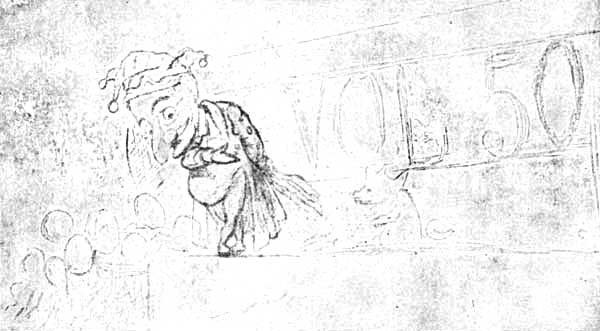
| An Introduction. From First Sketch by C. H. Bennett | x |
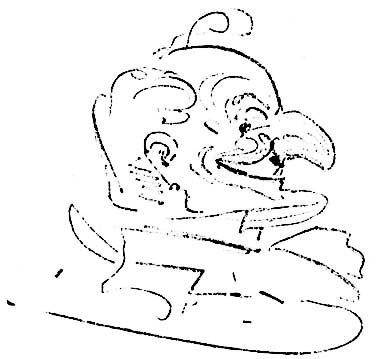
| Mr. Punch. By Harry Furniss | xiv |
| Mr. Punch portrayed by Different Hands | 7 |
| Ebenezer Landells | 15 |
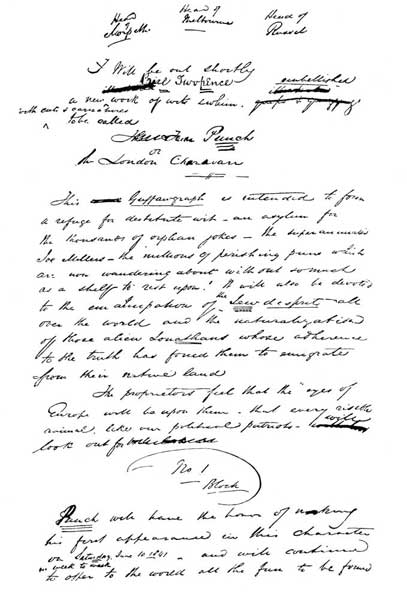
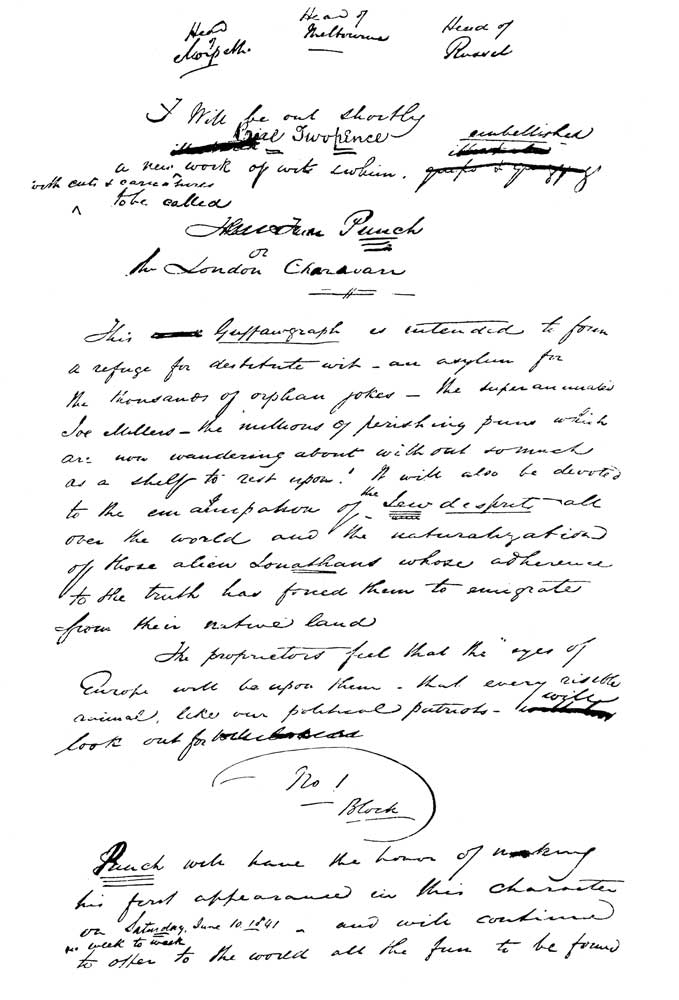
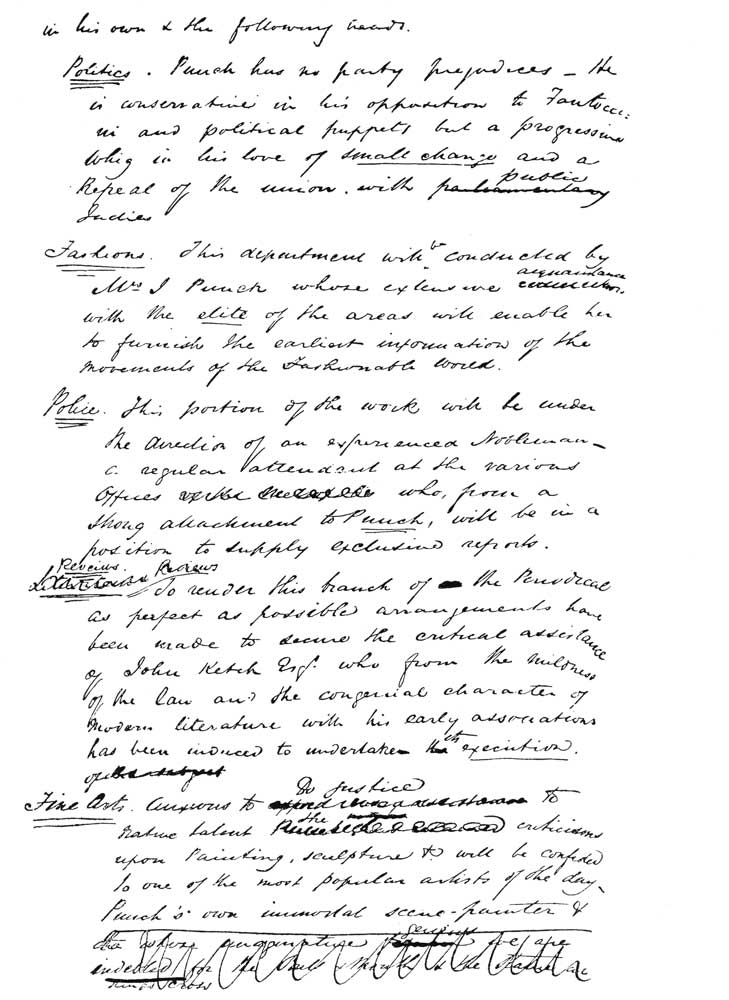
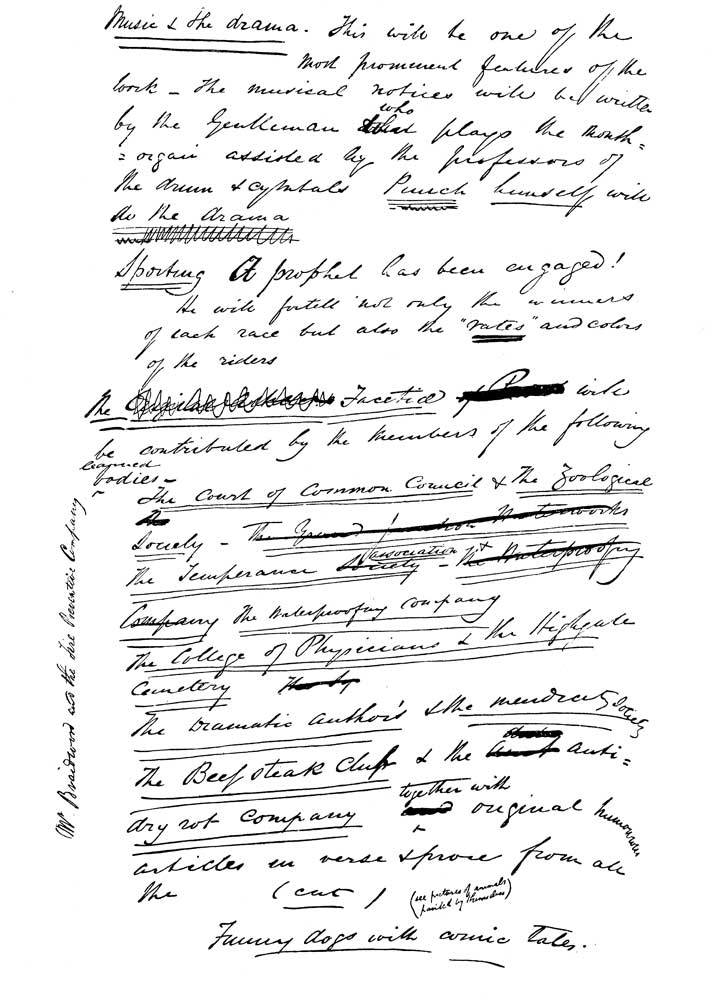
| Prospectus of Punch, Facsimile of Mark Lemon's MS. | 20-22 |
| Preliminary Leaflet | 23 |
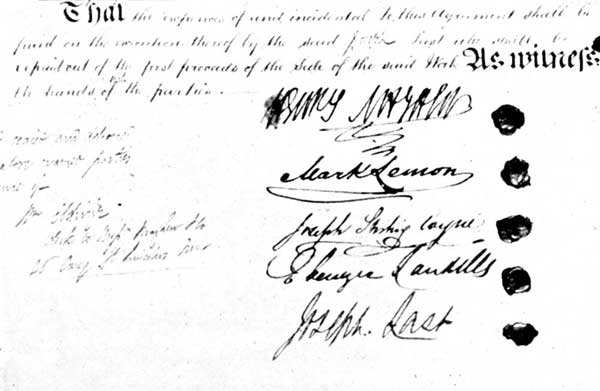
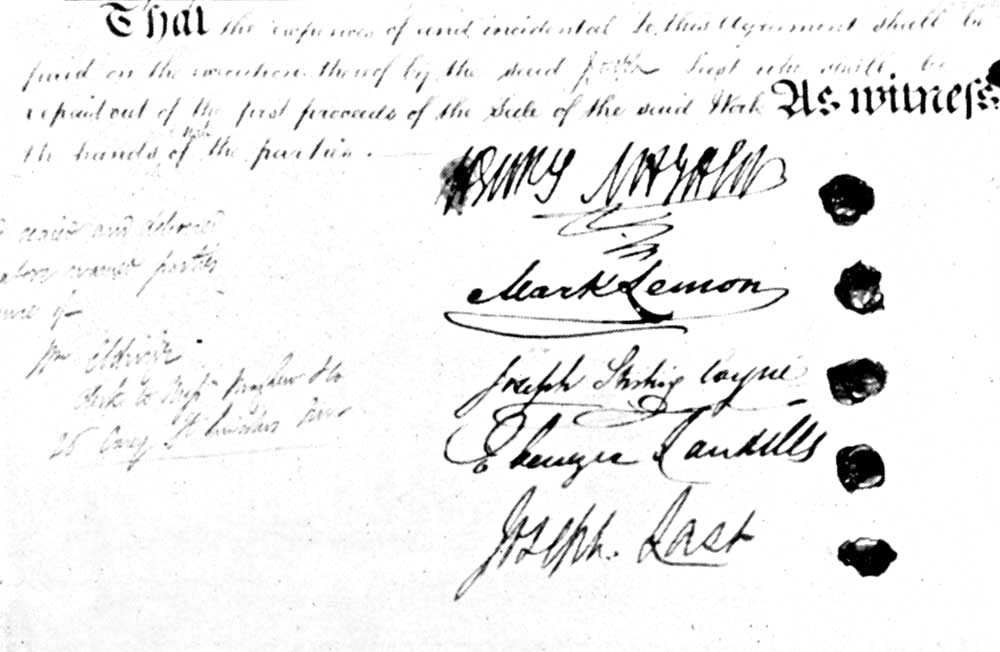
| Signatures to the Original Agreement | 25 |
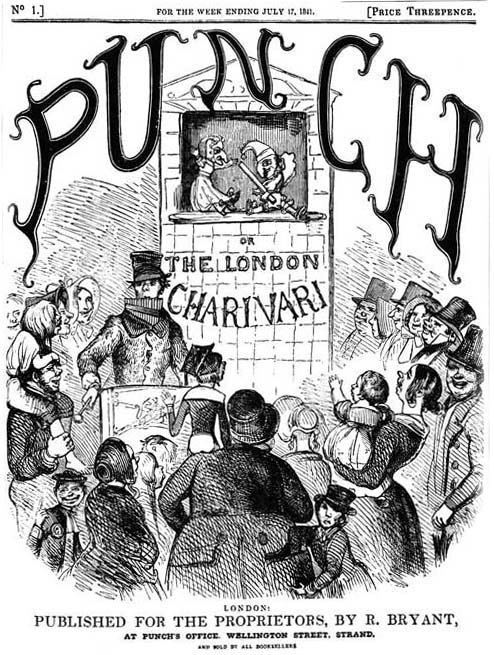
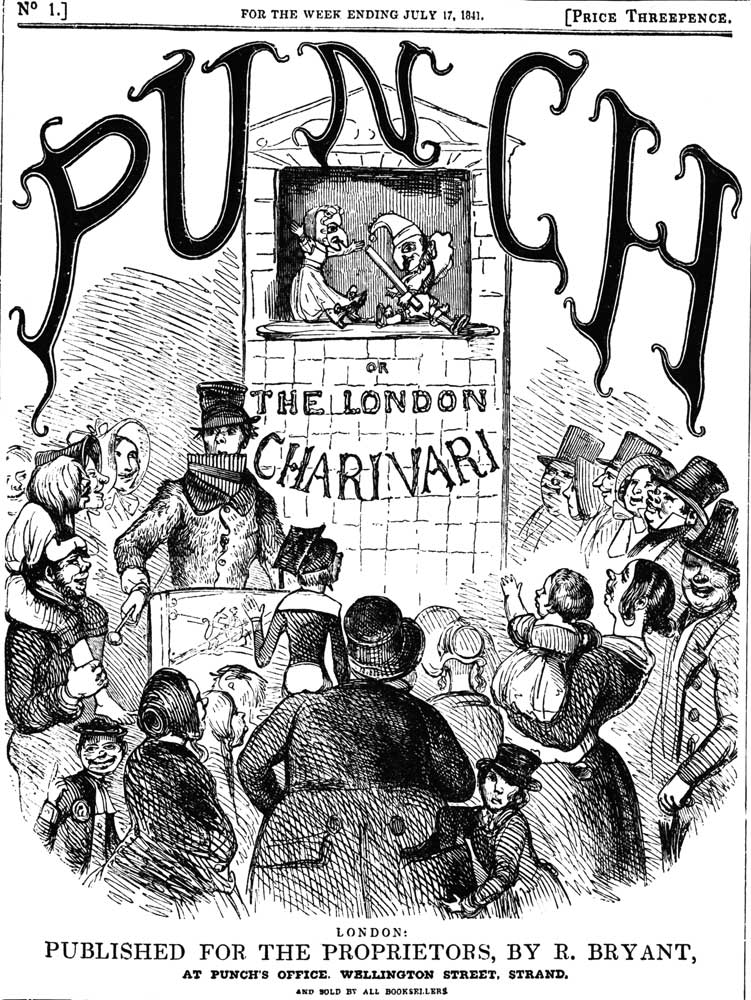
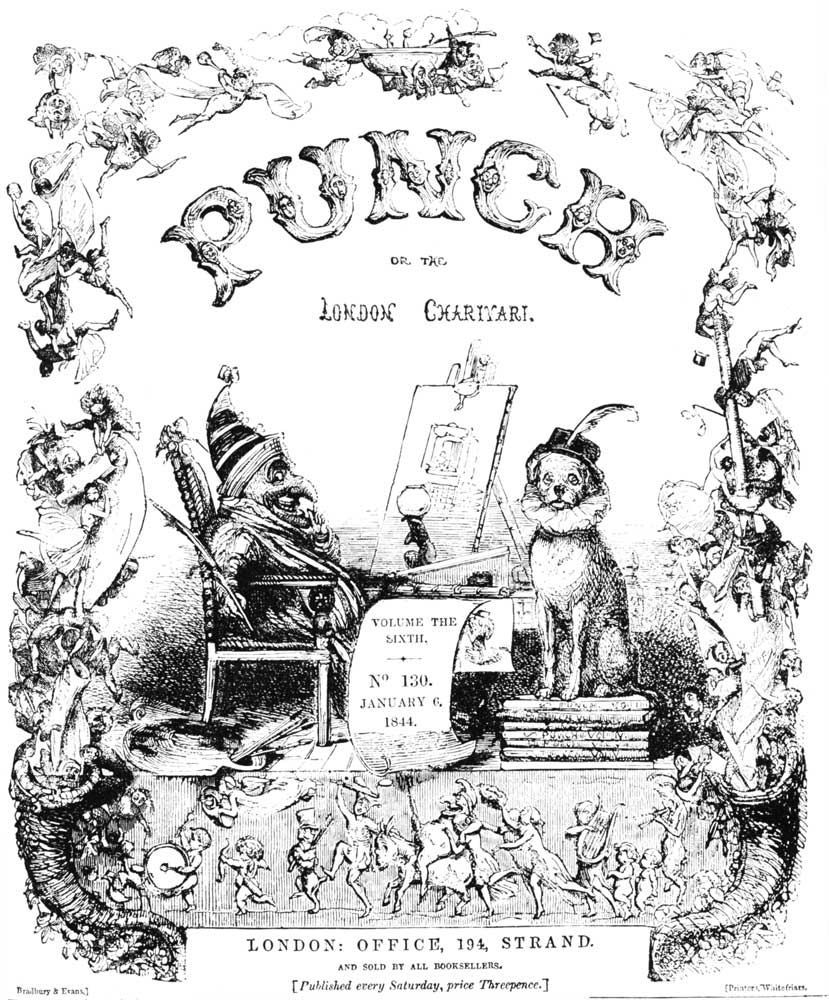
| First Cover of Punch. By A. S. Henning. | 27 |
| The Four Earlier Proprietors | 37 |
| The Five Later Proprietors | 39 |
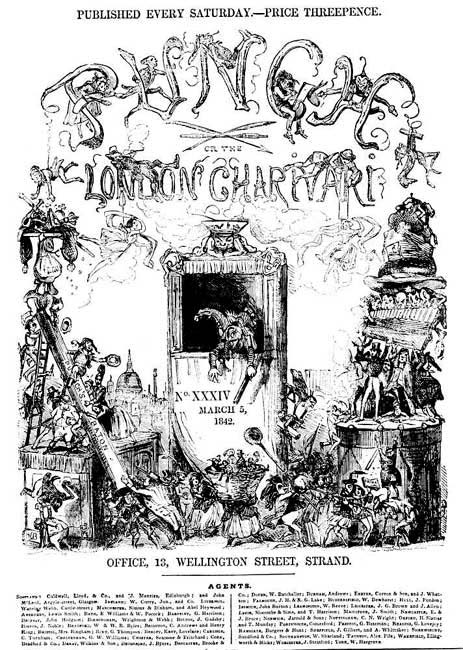
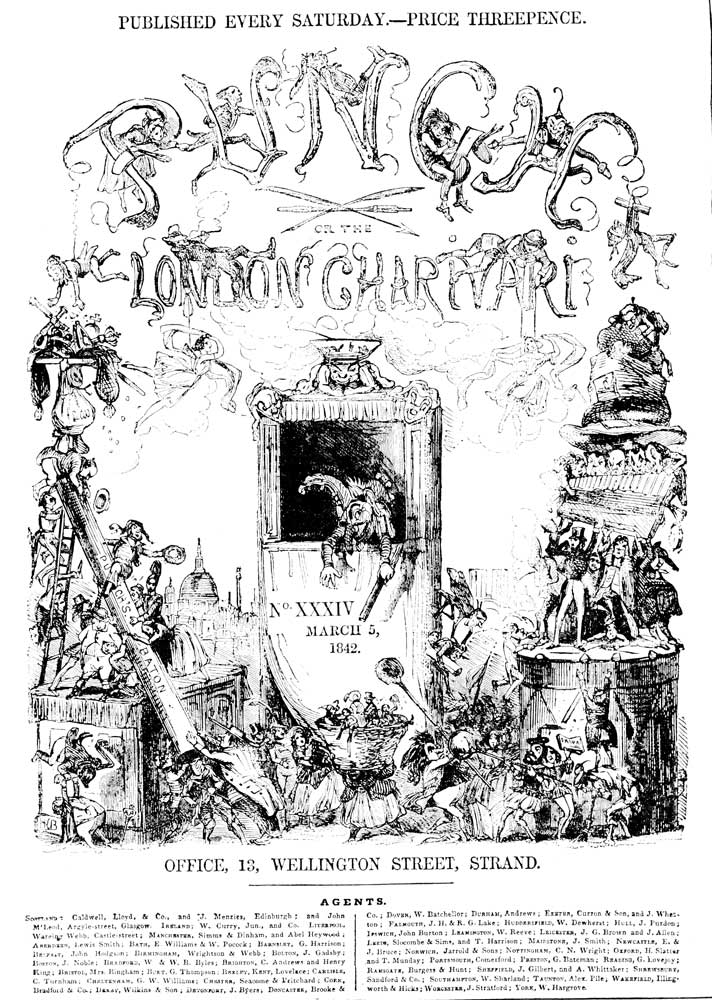
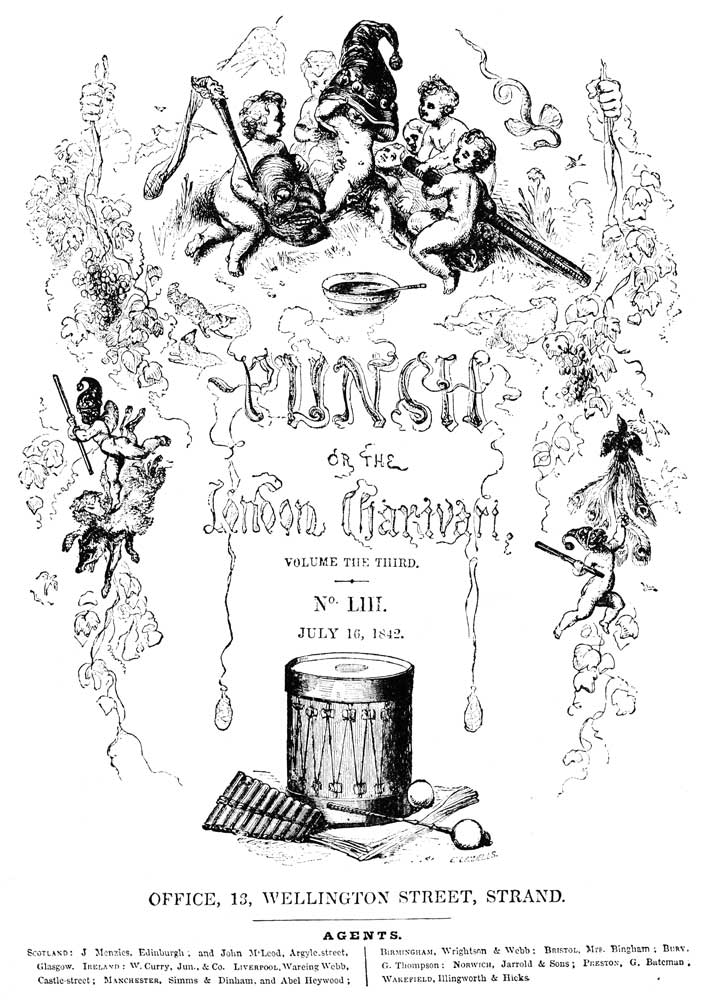
| Second Cover. By "Phiz" | 42 |
| Third Proposed Cover. By H. G. Hine | 43 |
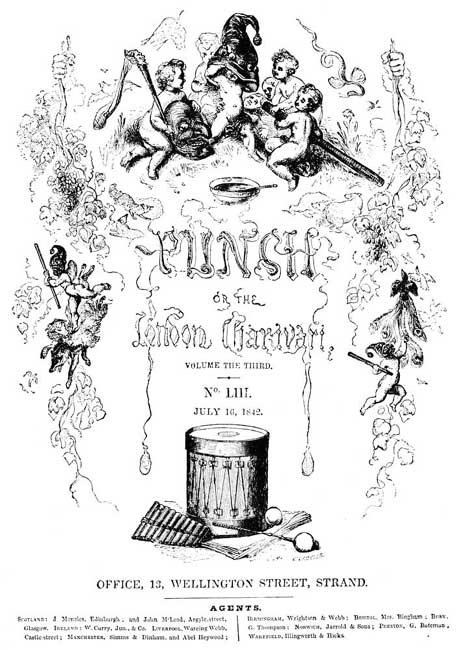
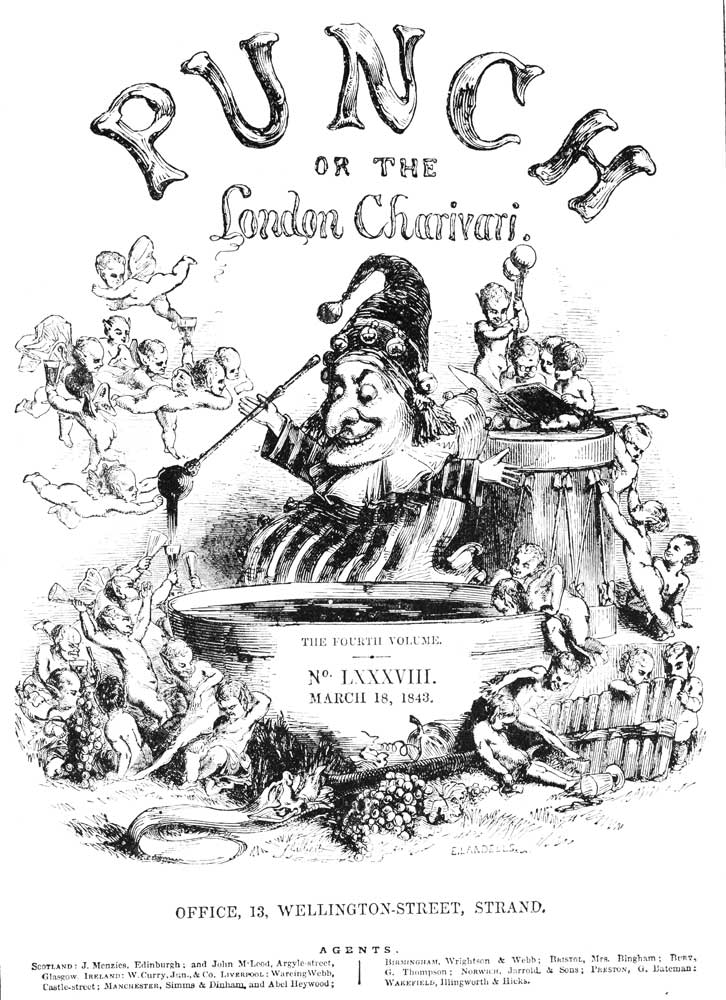
| Third Cover. By W. Harvey | 44 |
| Fourth Cover. By Sir John Gilbert, R.A. | 45 |
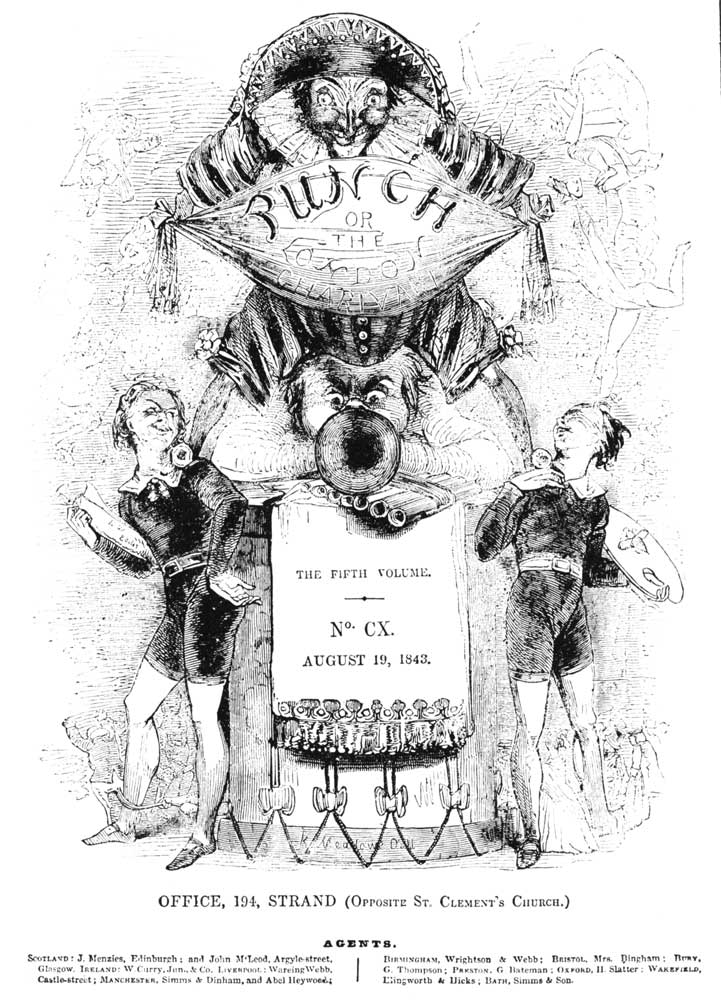
| Fifth Cover. By Kenny Meadows | 46 |
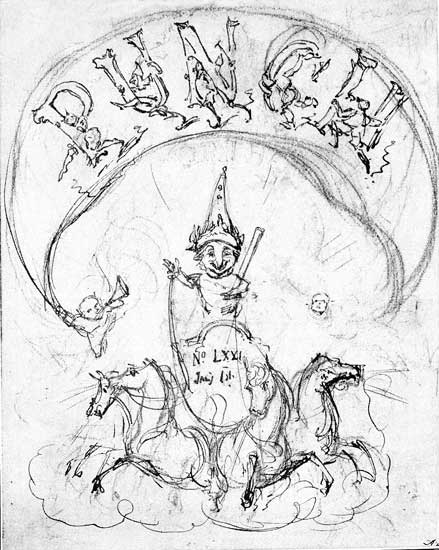
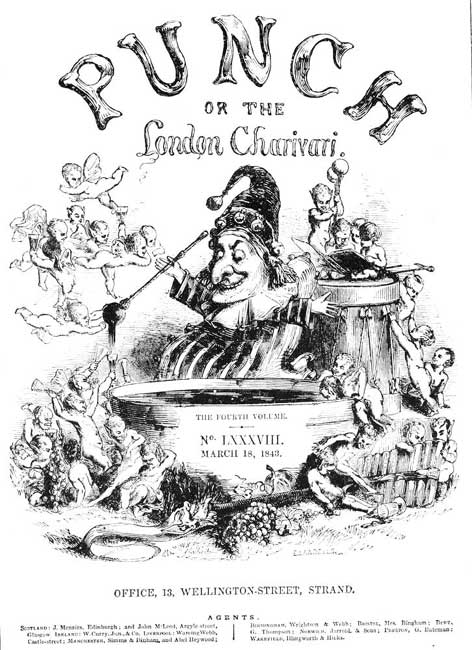
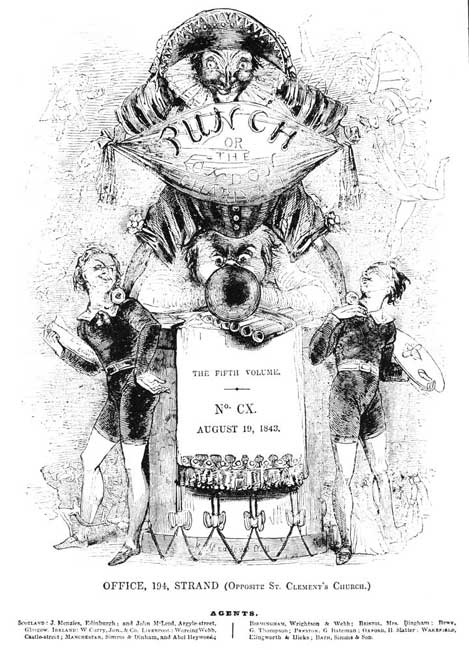
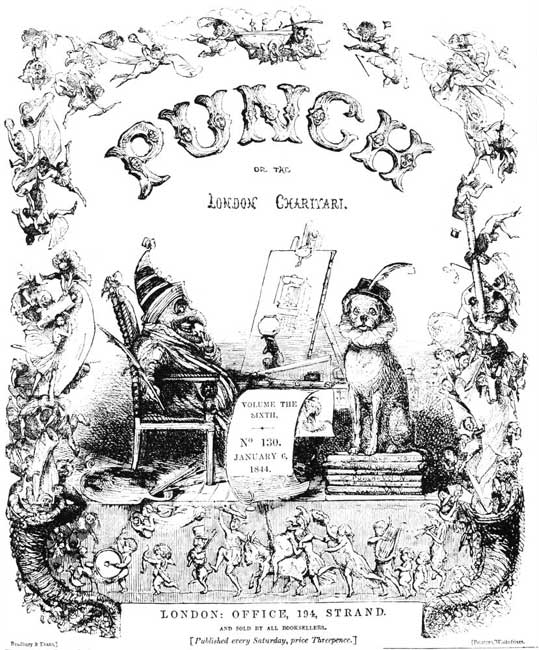
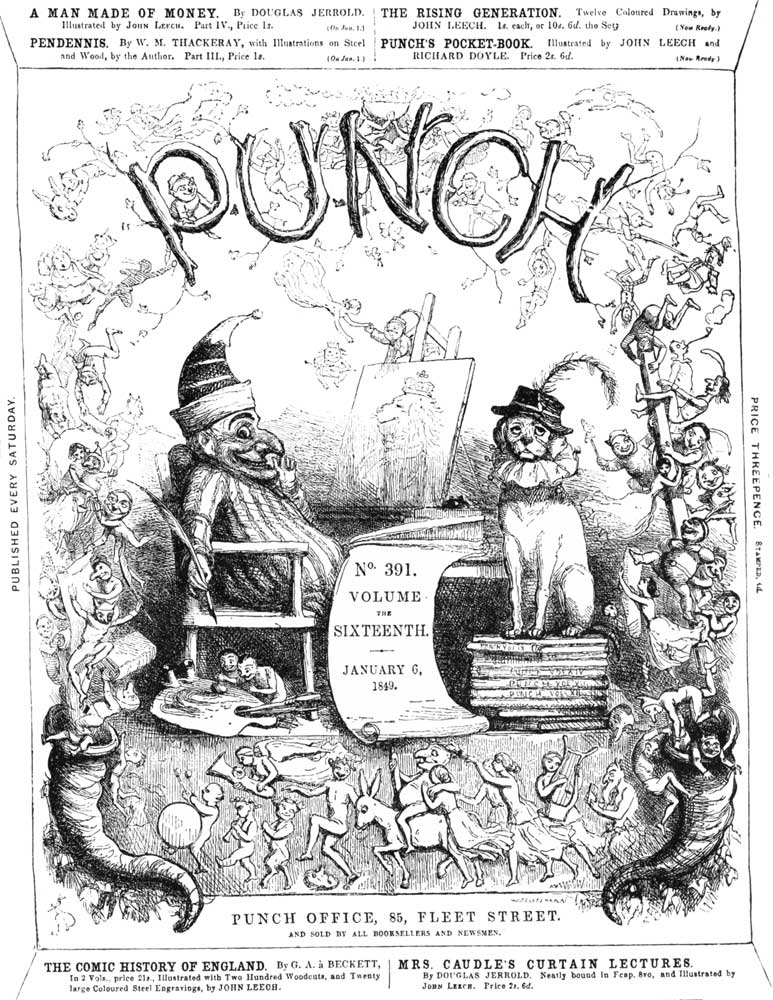
| Sixth Cover. First Design. By Richard Doyle | 47 |
| Sixth Cover. Second Design. By Richard Doyle | 48 |
| The First Punch Table: "Crown Inn" | 57 |
| The Present Punch Table: Bouverie Street | 59 |
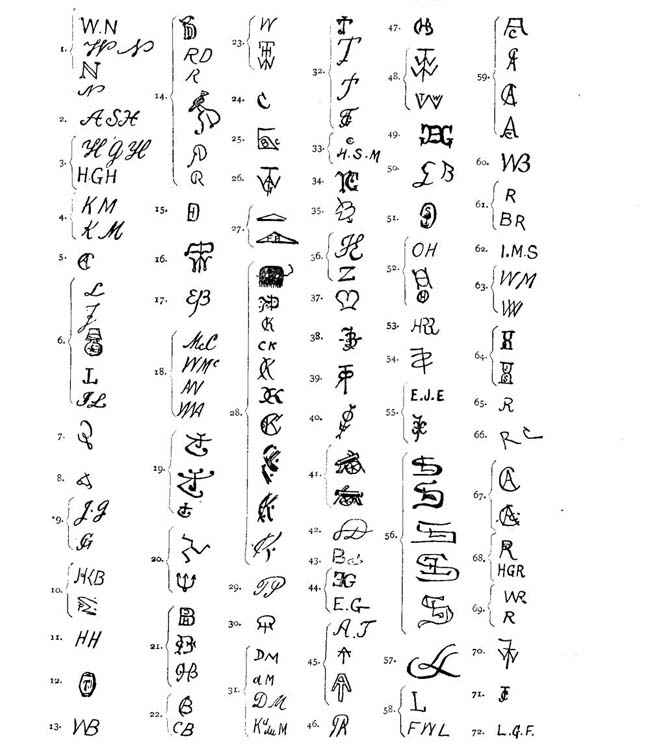
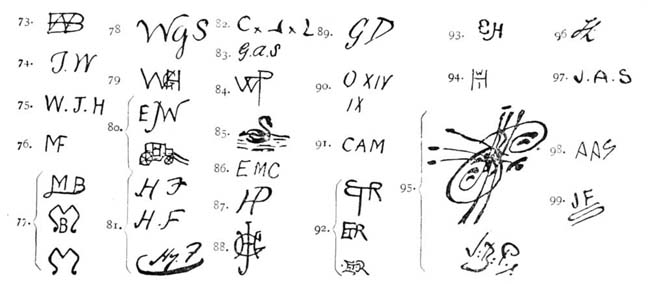
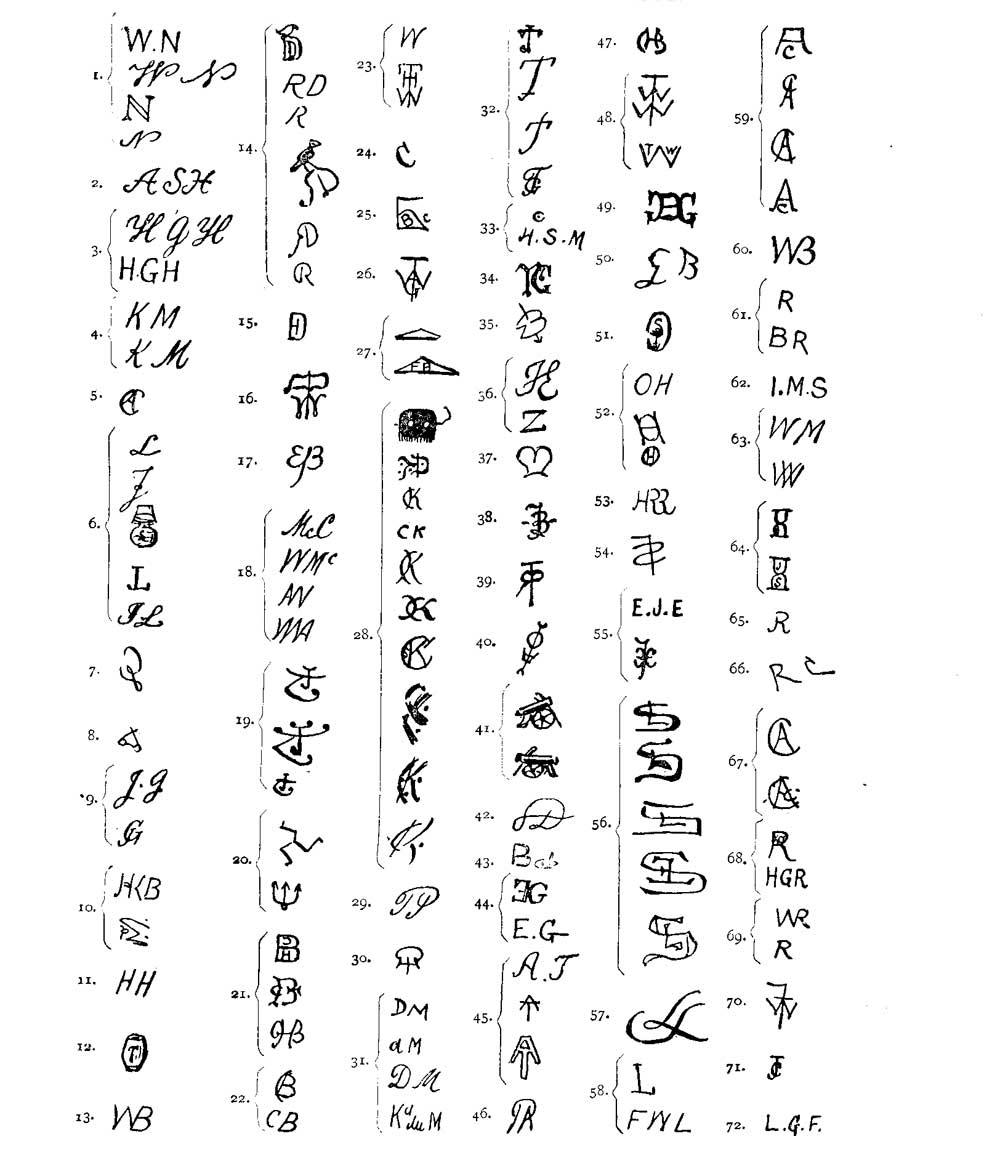
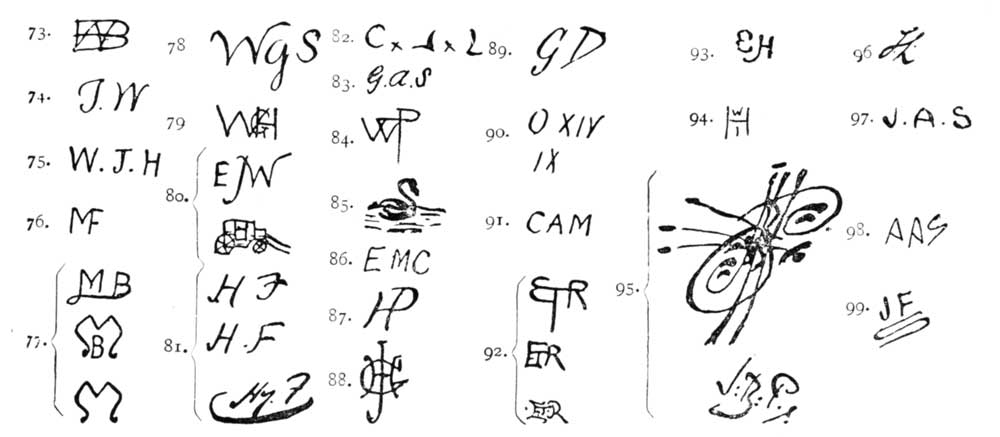
| Twenty-six Initials Carved upon the Table | 60-75 |
| The Dinner Card | 69 |
| "Peel's Dirty Boy": Leech's First Sketch | 112 |
| "Peel's Dirty Boy": The Cartoon | 113 |
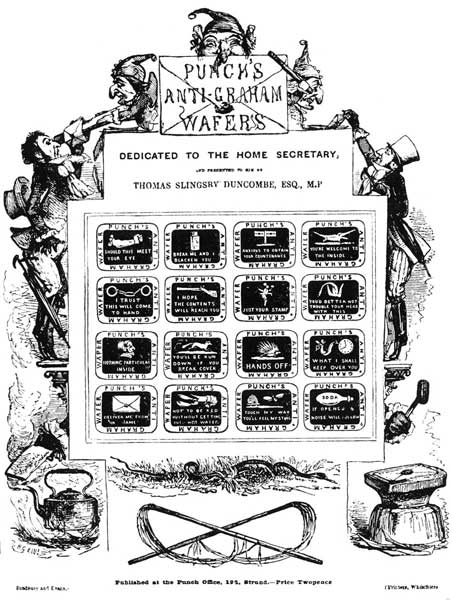
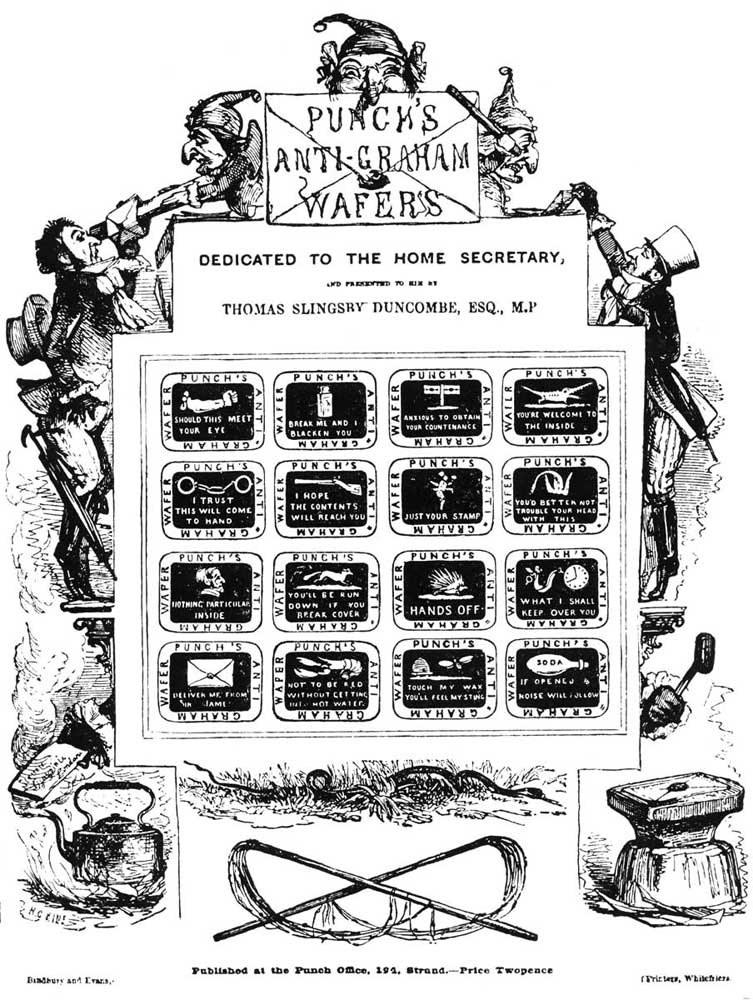
| The Anti-Graham Envelope | 115 |
| Punch's Anti-Graham Wafers | 117 |
| The Draughtsman's Revenge | 127 |
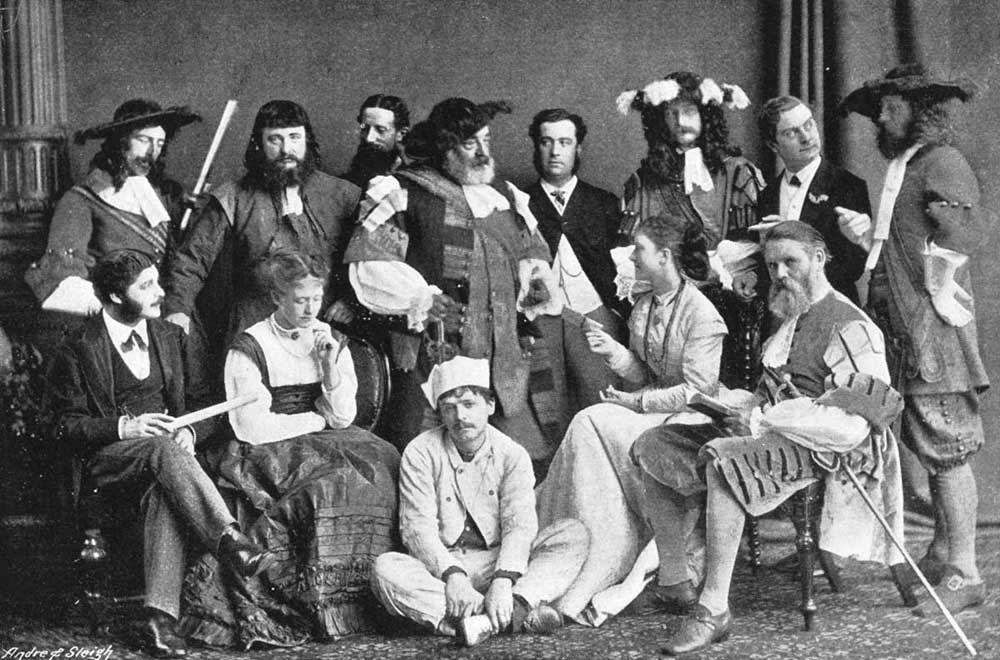
| Bennett's Benefit—The Cast | 133 |
| Playbill of the Guild of Literature and Art | 137 |
| Musical: First Sketch. By Henry Walker | 148 |
| Musical: Drawing. By G. du Maurier | 149 |
| The Political "Pas de Quatre." By A. S. Henning | 154 |
| The Political "Pas de Quatre." By J. Leech | 155 |
| General Février. By J. Leech | 175 |
| The "Pas de Deux:" Original Drawing. By Sir John Tenniel | 178 |
| "The Political Mrs. Gummidge." By Sir John Tenniel | 181 |
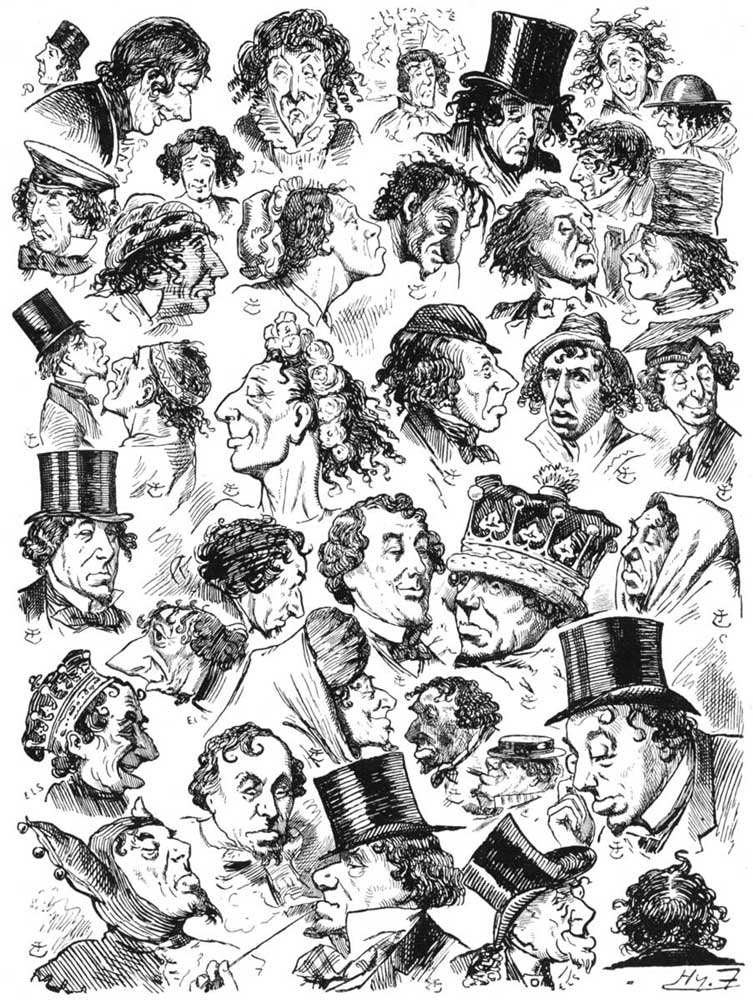
| Portraits of Beaconsfield. Re-drawn by Harry Furniss | 201 |
| "The Mrs. Caudle of the House of Lords:" Original Sketch. By J. Leech | 203 |
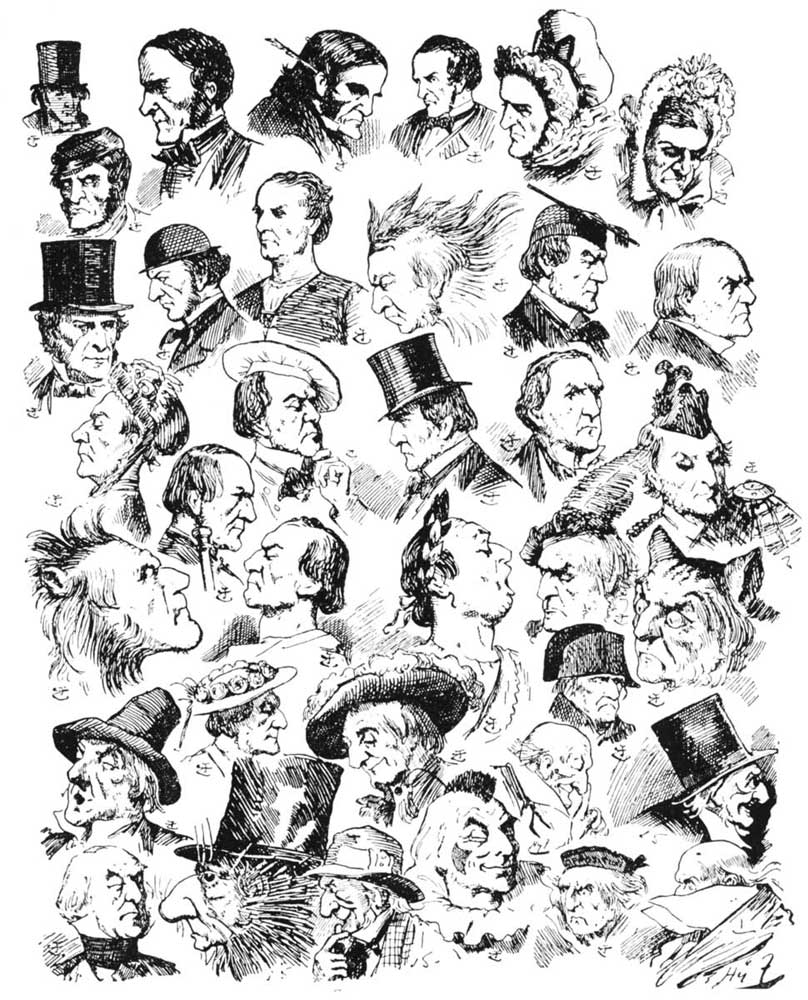
| Portraits of Gladstone. Re-drawn by Harry Furniss | 207 |
| Maternal Solicitude. By J. Leech | 212 |
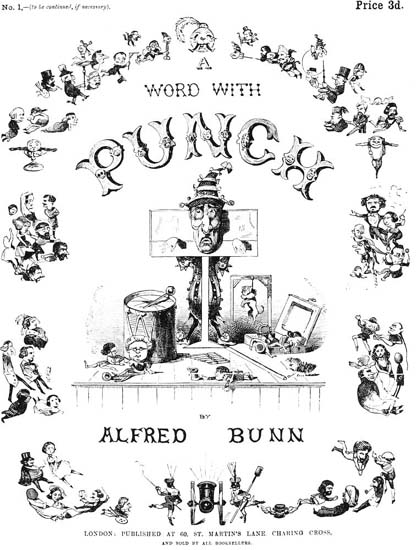
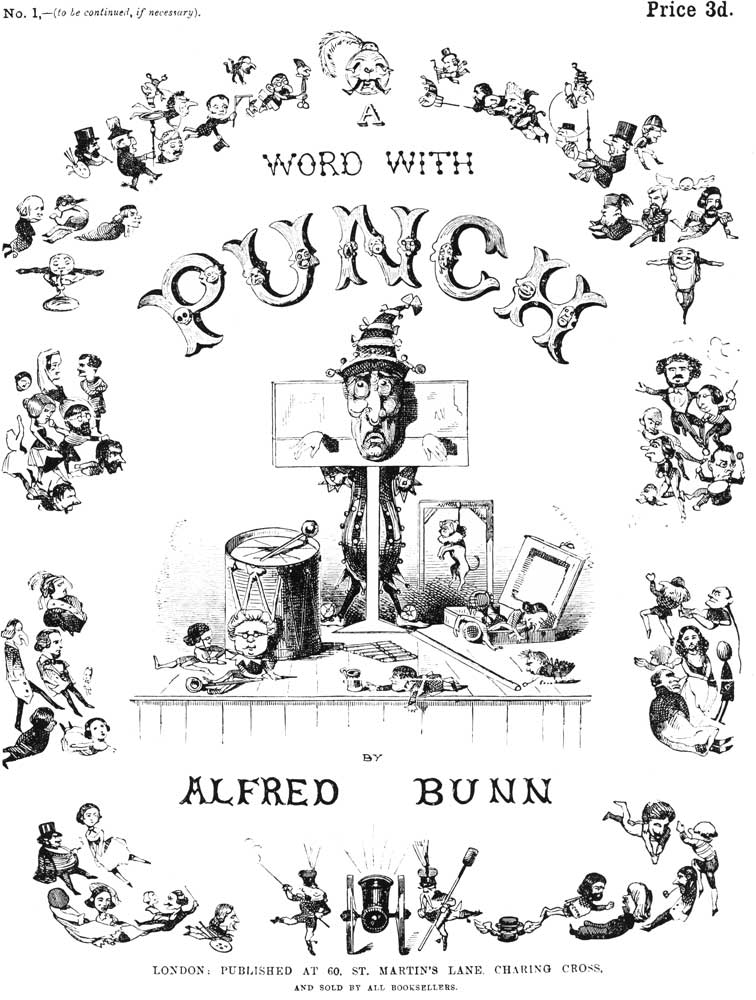
| "A Word with Punch" | 229 |
| Joseph Swain | 247 |
| Mark Lemon | 254 |
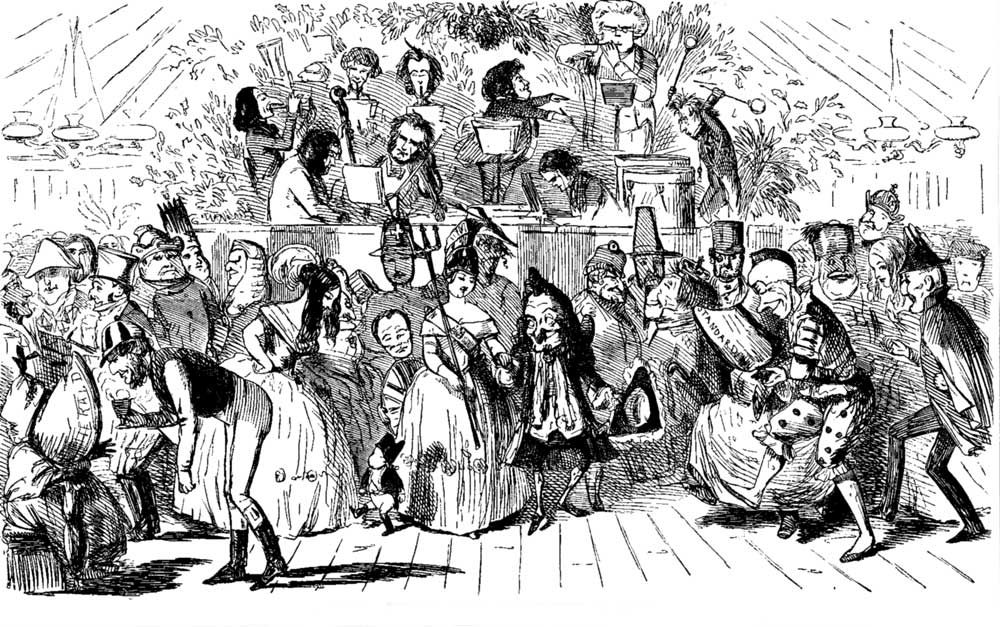
| "Mr. Punch's Fancy Ball" | 261 |
| Portraits of Punch Staff | 262 |
| Lemon's Presentation Inkstand | 264 |
| Henry Mayhew | 268 |
| J. Stirling Coyne | 271 |
| Gilbert Abbott à Beckett | 272 |
| Douglas Jerrold | 284 |
| Albert Smith | 303 |
| John Oxenford | 308 |
| W. M. Thackeray | 309 |
| Thackeray and Jerrold ("Authors' Miseries") | 312 |
| Thackeray's Presentation Inkstand | 321 |
| Thackeray at Work. By E. M. Ward, R.A. | 325 |
| Horace Mayhew | 327 |
| Thomas Hood | 330 |
| Tom Taylor | 338 |
| Leech, Tom Taylor, and part of Horace Mayhew. By R. Doyle | 339 |
| Henry Silver | 347 |
| Dickens' Sole (and Rejected) Contribution | 350 |
| J. Hannay | 354 |
| Shirley Brooks | 356 |
| F. C. Burnand | 363 |
| R. F. Sketchley | 369 |
| "Artemus Ward" | 370 |
| H. Savile Clarke | 371 |
| Arthur W. à Beckett | 375 |
| E. J. Milliken | 378 |
| Gilbert à Beckett | 381 |
| Punch's Family Trees | 382 |
| John T. Bedford | 385 |
| J. Ashby-Sterry | 386 |
| H. W. Lucy | 390 |
| F. Anstey | 396 |
| R. C. Lehmann | 401 |
| A. S. Henning | 411 |
| H. G. Hine | 414 |
| Punch's Seal. By H. G. Hine | 415 |
| John Leech. By Sir J. E. Millais, Bart., R.A. | 418 |
| "How long have you been gay?" By J. Leech | 428 |
| "Leech's 'Pretty Girl'": A Skit. By Sir J. E. Millais, Bart., R.A. | 431 |
| Leech's House in Kensington. By J. Fulleylove, R. I. | 438 |
| The Historical Ash-tree in Leech's Garden. By J. Fulleylove, R. I. | 439 |
| "Two Roses": Sketch by John Leech | 440 |
| A Page from Leech's Sketch-Book: My Lord Brougham | 441 |
| Kenny Meadows | 447 |
| Alfred "Crowquill" | 450 |
| Hablôt K. Browne ("Phiz") | 451 |
| R. J. Hamerton | 453 |
| W. McConnell | 461 |
| Sir J. Tenniel. By Himself | 462 |
| Sketch for the Pocket-Book, "Arthur and Guinevere." By Sir John Tenniel | 464 |
| Sketch for the Cartoon "Will it Burst?" By Sir John Tenniel | 465 |
| Sketch for the Pocket-Book: "Thor." By Sir John Tenniel | 468 |
| Sketch for the Cartoon "Humpty-Dumpty." By Sir John Tenniel | 469 |
| Captain H. R. Howard | 475 |
| Charles S. Keene. By J. D. Watson | 478 |
| Keene torturing the Bagpipes. By Himself | 485 |
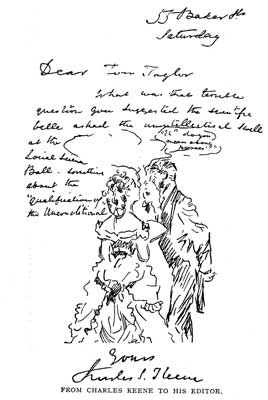
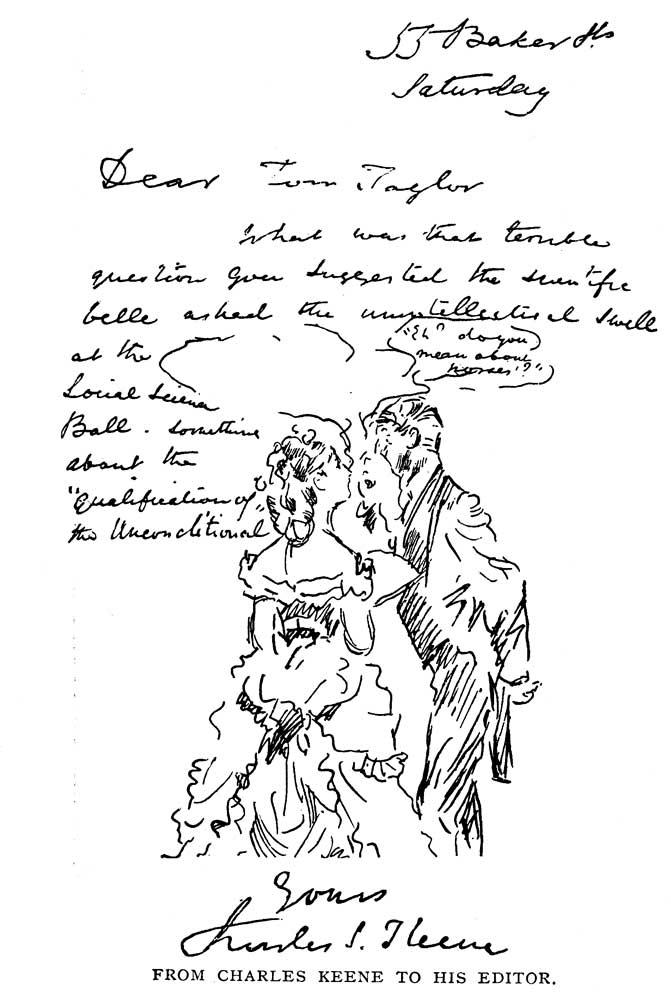
| From Keene to his Editor | 486 |
| "Frau," alias "Toby"—Keene's last Drawing | 488 |
| "Cuthbert Bede" | 492 |
| T. Harrington Wilson. By T. Walter Wilson | 497 |
| George du Maurier | 503 |
| "My Pretty Woman." By G. du Maurier | 508 |
| Pencil Study. By G. du Maurier | 509 |
| "Chang." By G. du Maurier | 514 |
| "Don." By G. du Maurier | 515 |
| Pencil Study. By G. du Maurier | 516 |
| Pencil Study. By G. du Maurier | 517 |
| Fred Barnard. A Libel on Himself | 518 |
| R. T. Pritchett | 520 |
| J. Priestman Atkinson | 524 |
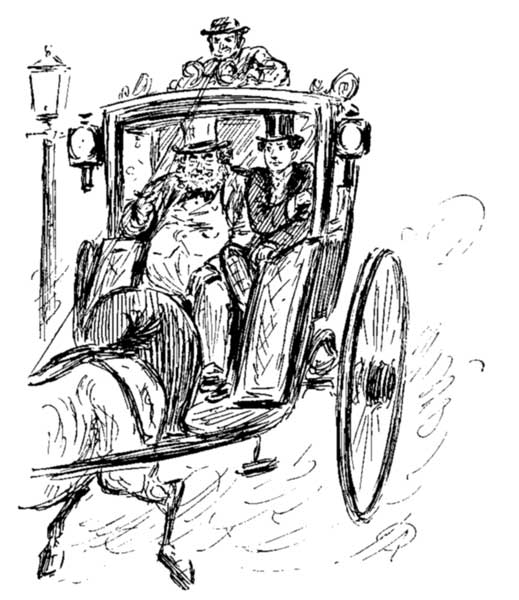
| In a Hansom with Mark Lemon. By J. Priestman Atkinson | 524 |
| C. H. Bennett. By Himself | 526 |
| Mrs. Bowers-Edwards (Miss G. Bowers) | 529 |
| Linley Sambourne. By Himself | 531 |
| Ernest Griset | 538 |
| Mr. Griset introduces himself to Mark Lemon | 538 |
| J. Moyr Smith | 541 |
| J. Sands | 542 |
| W. Ralston | 543 |
| A. Chantrey Corbould | 544 |
| M. Blatchford | 548 |
| E. J. Wheeler | 549 |
| Harry Furniss | 549 |
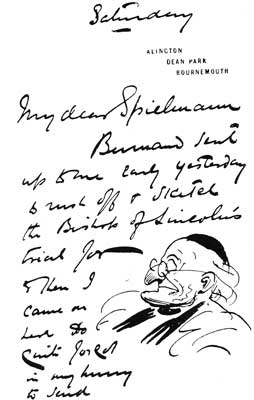
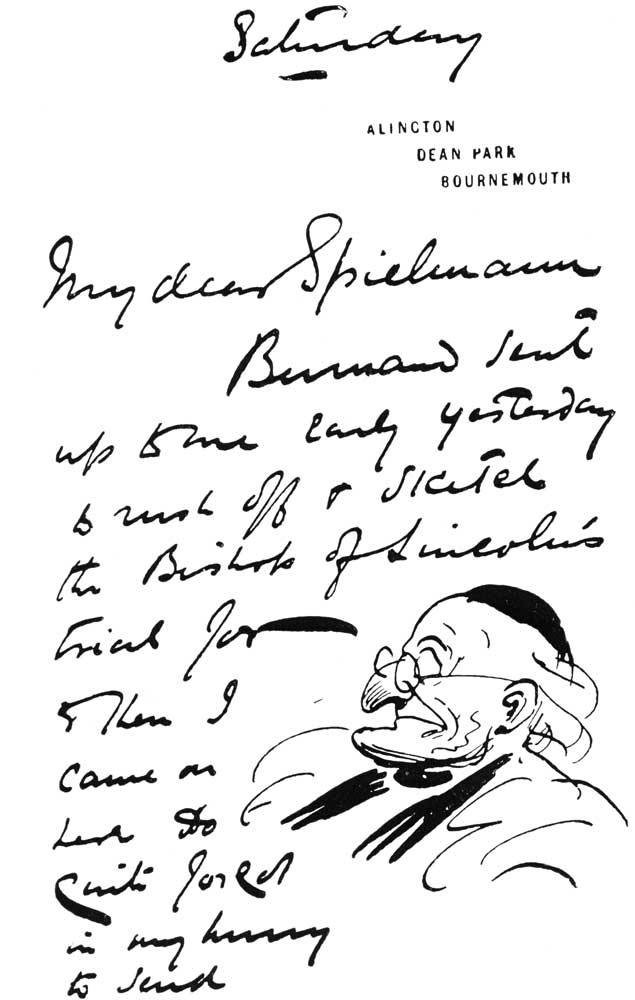
| Punch as the Bishop of Lincoln. By Harry Furniss | 550 |
| Mr. Gladstone Collared. By Harry Furniss | 552 |
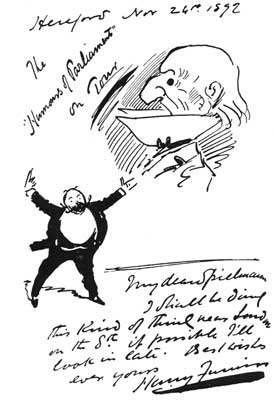
| Two Friends. By Harry Furniss | 554 |
| "A Happy Release:" A Rejected Trifle. By C. J. Lillie | 556 |
| E. T. Reed. By Himself | 560 |
| J. Bernard Partridge. By Himself | 564 |
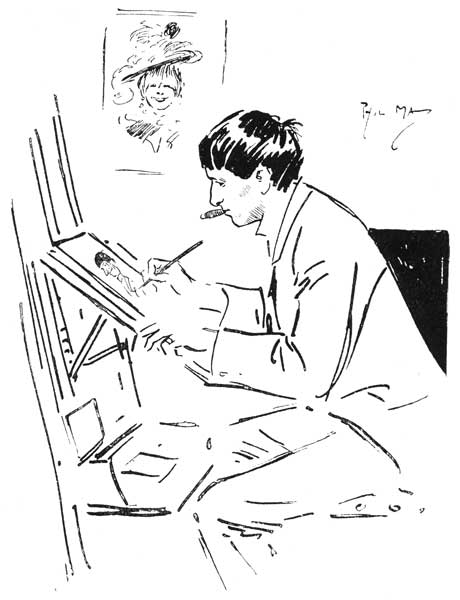
| Phil May at Work. By Himself | 568 |
| Phil May as Punch. By Himself | 570 |
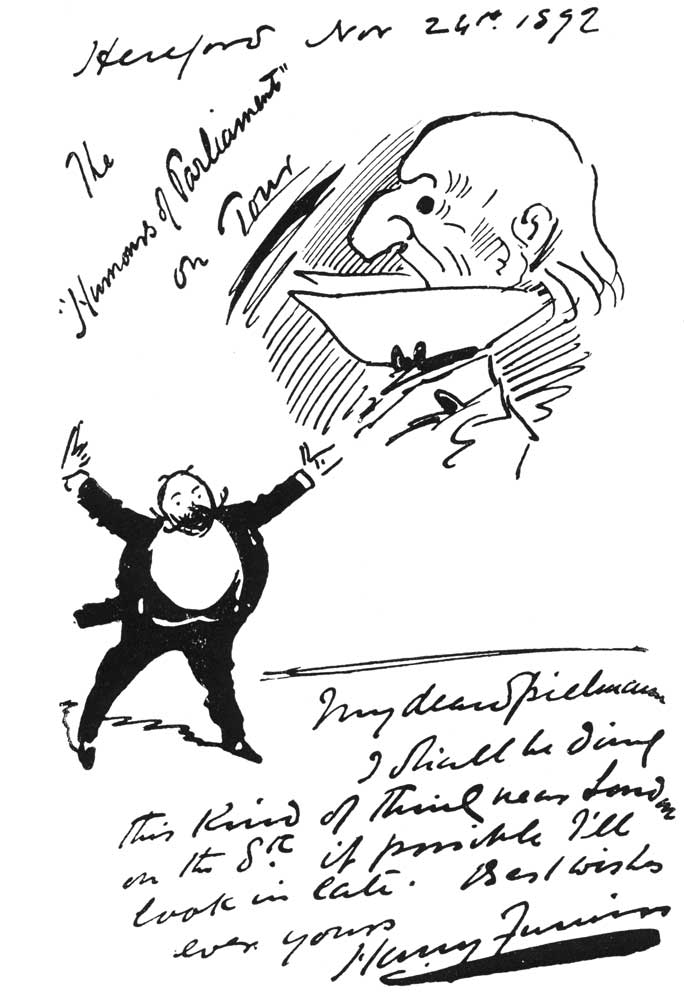
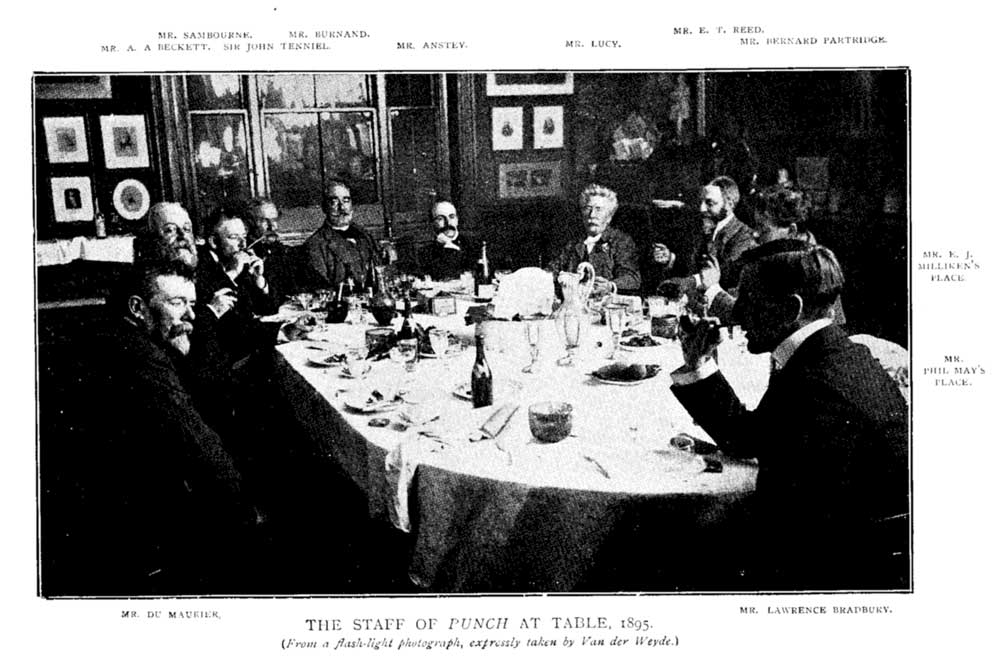
| The Punch Staff at Table, 1895 | 571 |
| "Finale." By Linley Sambourne | 572 |
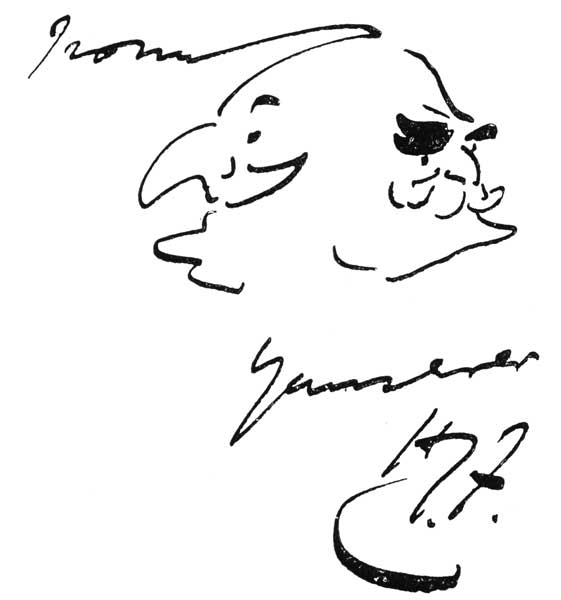
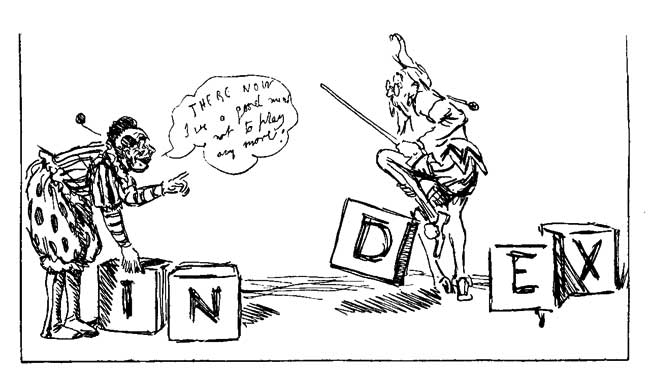
| Index. Original Sketch. By Charles Keene. | 581 |
The engravings here borrowed from Punch are reproduced (in all cases in smaller sizes) by special permission of the Proprietors, Messrs. Bradbury, Agnew & Co. The Portrait of Charles Keene by J. D. Watson, and of Himself with the Bagpipes, were first published in Black and White, through whose courtesy they appear here. To all who have accorded the various permissions for reproductions, or who have lent drawings for the better illustration of this volume, the acknowledgments of the writer are gratefully recorded. The Copyright of the illustrations is in every case strictly reserved.[Pg 1]
"If humour only meant laughter," said Thackeray, in his essay on the English humorists, "you would scarcely feel more interest about humorous writers than the life of poor Harlequin, who possesses with these the power of making you laugh. But the men regarding whose lives and stories you have curiosity and sympathy appeal to a great number of our other faculties, besides our mere sense of ridicule. The humorous writer professes to awaken and direct your love, your pity, your kindness; your scorn of untruth, pretension, imposture; your tenderness for the weak, the poor, the oppressed, the unhappy. To the best of his means and ability he comments on all the ordinary actions and passions of life almost."
It may surely be claimed that these words, consecrated to his mighty predecessors by the Great Humorist of Punch, may be applied without undue exaggeration to his colleagues on the paper. Though posing at first only as the puppet who waded knee-deep in comic vice, Punch has worked as a teacher as well as a jester—a leader, and a preacher of kindness. Nor was it simple humour that was Punch's profession at the beginning; he always had a more serious and, so to say, a worthier object in view. This may be gathered from the very first article in the very first number,[Pg 2] the manifesto of the band of men who started it, contributed by Mark Lemon, under the title of—
"As we hope, gentle public, to pass many happy hours in your society, we think it right that you should know something of our character and intentions. Our title, at a first glance, may have misled you into a belief that we have no other intention than the amusement of a thoughtless crowd, and the collection of pence. We have a higher object. Few of the admirers of our prototype, merry Master Punch, have looked upon his vagaries but as the practical outpourings of a rude and boisterous mirth. We have considered him as a teacher of no mean pretensions, and have, therefore, adopted him as the sponsor for our weekly sheet of pleasant instruction. When we have seen him parading in the glories of his motley, flourishing his bâton in time with his own unrivalled discord, by which he seeks to win the attention and admiration of the crowd, what visions of graver puppetry have passed before our eyes!... Our ears have rung with the noisy frothiness of those who have bought their fellow-men as beasts in the market-place, and found their reward in the sycophancy of a degraded constituency, or the patronage of a venal ministry—no matter of what creed, for party must destroy patriotism....
"There is one portion of Punch's drama we wish was omitted, for it always saddens us—we allude to the prison scene. Punch, it is true, sings in durance, but we hear the ring of the bars mingling with the song. We are advocates for the correction of offenders; but how many generous and kindly beings are there pining within the walls of a prison whose only crimes are poverty and misfortune!...
"We now come to the last great lesson of our motley teacher—the gallows; that accursed tree which has its root in injuries. How clearly Punch exposes the fallacy of that dreadful law which authorises the destruction of life! Punch sometimes destroys the hangman, and why not? Where is the divine injunction against the shedder of man's blood to rest? None can answer! To us there is but One disposer of life. At other times Punch hangs the devil: this is as it should be. Destroy the principle of evil by increasing the means of cultivating the good, and the gallows will then become as much a wonder as it is now a jest....
"As on the stage of Punch's theatre many characters appear[Pg 3] to fill up the interstices of the more important story, so our pages will be interspersed with trifles that have no other object than the moment's approbation—an end which will never be sought for at the expense of others, beyond the evanescent smile of a harmless satire."
A portion of this programme was duly eliminated by the abolition of the Fleet and the Marshalsea; and it must be admitted that Punch has long since forgotten his declared crusade against capital punishment. But he has been otherwise busy. His sympathy for the poor, the starving, the ill-housed, and the oppressed; for the ill-paid curate and the worse-paid clerk; for the sempstress, the governess, the shop-girl, has been with him not only a religion, but a passion. Professor Ruskin, judging only by Punch's pictures, and that a little narrowly, has thought otherwise. Punch "has never in a single instance," says he in his "Art of England," "endeavoured to represent the beauty of the poor. On the contrary, his witness to their degradation, as inevitable consequences of their London life, is constant and, for the most part, contemptuous."
Truth to tell, Punch has been kindly from the first; and a man of mettle, too. None has been too exalted or too powerful for attack; withal, his assaults, in comparison with those of his scurrilous contemporaries, have been moderate and gentlemanly in tone. He has attacked abuses from the highest to the lowest. Sham gentility, vulgar ostentation, crazes and fads, linked æstheticism long drawn out, foolish costume, silly affectations of fashion in compliment and language—all have been set up as targets for his shafts of ridicule or scorn. He has been a moral reformer and a disinterested critic. A liberal-minded patriot, he has ever opposed the advocacy of "Little Peddlington" in Imperial politics; and municipal maladministration is a perennial subject for his denunciations. He has been a kindly cauteriser of social sores; caustic, but rarely vindictive. Spiritualism, Socialism, Ibsenism, Walt Whitmania—all the movements and sensations of the day, social, political, and artistic, in so far as they are follies—have been shot at as they rose. And having[Pg 4] conquered his position, Punch has known how to retain it. "The clown," says Oliver Wendell Holmes, "knows his place to be at the tail of the procession." It is to Punch's honour that with conscious dignity—and, of course, with conscious impudence—he took his place at its head. And there he has stayed; and transforming his pages into the Royal Academy of pictorial satire, his alone among all the comic papers has forced its way into the library and taken up its position in the boudoir. His workers are the best available in the land; and when in course of time one contributor falls away, another is ready to step quickly into his place—uno avulso non deficit alter.
So Punch—who for many years past has set up as the incarnation of all that is best in wit and virtue—is a scholar and a gentleman. He is, moreover, on his own showing, a perfect combination of humour, wisdom, and honour; and yet, in spite of it all, not a bit of a prig. It is true that when he donned the dress-coat, and "Punch" and "Toby" put on airs as "Mr. Punch" and "Toby, M.P.," he became milder at the expense of some of his political influence. Yet what he lost in power he gained in respectability, as well as in the affection of his countrymen. He appealed to a higher class, to the greater constituency of the whole nation; and remembering that a jest's prosperity lies in the ear that hears it, he transferred some of his allegiance from pit to stalls, and was content with the well-bred smile where before he had been eager for noisy laughter and loud applause.
People say—among them Mr. du Maurier himself—that there does not seem quite as much fun and jollity in the world as when John Leech was alive; but that surely is only the wail of the middle-aged. Englishmen never were uproarious in their mirth, as Froissart once reminded us. But it is true that Punch does not indulge so much as once he did in caricature—which after all, as Carlyle has pointed out, is not Humour at all, but Drollery. Caricature, one must remember, has two mortal enemies—a small and a great: artistic excellence of draughtsmanship, and national prosperity with its consequent contentment.[Pg 5] Good harvests beget good-humour. They stifle all motive for genuine caricature, for "satire thrives only on the wrath of the multitude." A joke may be only a joke—or a comedy, or a tragedy; but the greatest caricature (which need by no means display the greatest art) is necessarily that which goes straightest to the heart and mind. No drawing is true caricature which does not make the beholder think, whether it springs simply from good-humour or has its source in the passion of contempt, hatred, or revenge, of hope or despair. Mere amusement, said Swift, "is the happiness of those who cannot think," while Humour, to quote Carlyle again, "is properly the exponent of low things; that which first renders them poetical to the mind." Through this truth we may see how Punch has so continually dealt with vulgarity without being vulgar; while many of his so-called rivals, touching the self-same subjects, have so tainted themselves as to render them fitter for the kitchen than the drawing-room, through lack of this saving grace. Fun may have been in their jokes, but not true humour. Punch thus became to London much what the Old Comedy was to Athens; and, whatever individual critics may say, he is recognised as the Nation's Jester, though he has always sought to do what Swift declared was futile—to work upon the feelings of the vulgar with fine sense, which "is like endeavouring to hew blocks with a razor."
If there is one thing more than another on which Punch prides himself—on which, nevertheless, he is constantly reproached by those who would see his pages a remorseless mirror of human weakness and vice—it is his purity and cleanness; his abstention from the unsavoury subjects which form the principal stock-in-trade of the French humorist. This trait was Thackeray's delight. "As for your morality, sir," he wrote to Mr. Punch, "it does not become me to compliment you on it before your venerable face; but permit me to say that there never was before published in this world so many volumes that contained so much cause for laughing, and so little for blushing; so many jokes, and so little harm. Why, sir, say even that your modesty, which[Pg 6] astonishes me more and more every time I regard you, is calculated, and not a virtue naturally inherent in you, that very fact would argue for the high sense of the public morality among us. We will laugh in the company of our wives and children; we will tolerate no indecorum; we like that our matrons and girls should be pure."
It was not till the great occasion of his Jubilee that the Merry Old Gentleman of Fleet Street, who "hath no Party save Mankind; no Leader—but Himself," discovered the full measure of his popularity. The day broke for him amid a chorus of greeting—a perfect pæan of triumph, in which his own trumpet was not the softest blown. It is not an exaggeration to say that the Press of the world welcomed the fiftieth anniversary of his birth, and that with a cordiality and unanimity never before accorded to any paper. Hardly a journal in the English-speaking world but commented on the event with kindly sympathy; hardly one that marred the celebration with an ill-humoured reflection. Pencil as well as pen was put to it to do honour to the greatest comic paper in the world, and demonstrate in touching friendliness the confraternity of the Press.
For the public, Punch issued his "Jubilee number" and, in accordance with the promise given in the first volume fifty years before, he produced in his hundredth a brief history of his career and the names of the men who made it, modestly advising his readers to secure a set of his back volumes as the real "Hundred Best Books." For himself, he dined with the Staff at the "Ship Hotel" at Greenwich, when the Editor, who occupied the chair, was fêted by the proprietors of the paper and received a suitable memento of the glorious event.
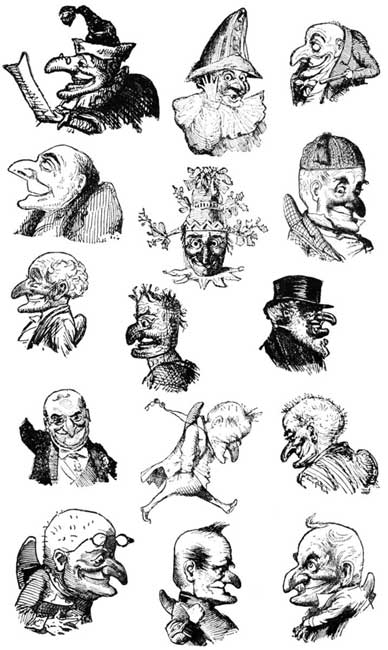 MR. PUNCH PORTRAYED BY DIFFERENT HANDS.
See p.9.
And what may appear to some as the most curious celebration of all was a solemn religious celebration—nothing less than a Te Deum—in honour of the occasion. It sounds at first, perhaps, a little like a joke—though not in good enough taste to be one of Mr. Punch's own; but the service was held; and when regarded in the light shed upon it by the Rev. J. de Kewer Williams, the incongruity of it almost disappears. "I led my people yesterday," he wrote, "in giving[Pg 8] thanks on the occasion of your Jubilee, praying that you might ever be as discreet and as kindly as you have always been." The prayer spoken in the pulpit appropriately ended as follows: "For it is so easy to be witty and wicked, and so hard to be witty and wise. May its satire ever be as good and genial, and the other papers follow its excellent example!"
The public tribute was not less cordial and sincere, and poetic effusions flowed in a gushing stream. But none of these verses, doggerel and otherwise, expressed more felicitously the general feeling than those which had been written some years before by Henry J. Byron—(who had himself attempted to establish a rival to Punch, but had been crushed by the greater weight)—one of his verses running:—
But greater far than the public esteem is the affection of the Staff, who naturally enough regard the personality of Punch with a good deal more than ordinary loyal sentiment and esprit de corps. It is interesting to observe the different views the artists have severally taken of it, for most of them in turn have attempted his portrayal. Brine regarded him as a mere buffoon, devoid of either dignity or breeding; Crowquill, as a grinning, drum-beating Showman; Doyle, Thackeray, and others adhered to the idea of the Merry, but certainly not uproarious, Hunchback; Sir John Tenniel showed him as a vivified puppet, all that was earnest, responsible, and wise, laughing and high-minded; Keene looked on him generally as a youngish, bright-eyed, but apparently brainless gentleman, afflicted with a pitiable deformity of chin, and sometimes of spine; Sir John Gilbert as a rollicking Polichinelle, and Kenny Meadows as Punchinello; John Leech's conception,[Pg 9] originally inspired, no doubt, by George Cruikshank's celebrated etchings, was the embodiment of everything that was jolly and all that was just, on occasion terribly severe, half flesh, half wood—the father, manifestly, of Sir John Tenniel's improved figure of more recent times. Every artist—Mr. du Maurier, Mr. Sambourne, Mr. Furniss, and the rest—has had his own ideal; and it is curious to observe that in his realisation of it, each has illustrated or betrayed in just measure the strength or weakness of his own imagination.
Some of these portraits, characteristic examples of Punch's leading artists, are reproduced on page 7, arranged according to authorship, thus:—
| W. Newman | Kenny Meadows | R. Doyle |
| W. M. Thackeray | J. Leech (1) | J. Tenniel (1) |
| C. Keene | J. Leech(2) | G. du Maurier |
| L. Sambourne (1) | J. Tenniel(2) | F. Eltze |
| L. Sambourne (2) | J. Tenniel (3) | H. Furniss |
The Mystery of His Birth—Previous Unsuccessful Attempts at Solution—Proposal for a "London Charivari"—Ebenezer Landells and His Notion—Joseph Last Consults with Henry Mayhew—Whose Imagination is Fired—Staff Formed—Prospectus—Punch is Born and Christened—The First Number.
It should be counted against neither the fair fame nor the reputation of Punch that the facts of his birth have never yet been definitely and honourably established. It is not that his parentage has been lost to history in a discreet and charitable silence; on the contrary, it is rather that that honour has been claimed by over-many, covetous of the distinction. He seems to come within the category of Defoe's true-born Englishman, "whose parents were the Lord knows who," not because there should be any doubt upon the subject, but because none suspected at the time the latent importance of the bantling and the circumstances of his birth until it seemed too late to decide by demonstration or simple affirmation who was father and who the sponsors. Had it then been known that Punch was born for immortality, I should not now be at the pains of setting forth, at greater length than would otherwise be necessary or justifiable, the proofs of his parentage and of his natal place.
Rubens was born both at Antwerp and Cologne. One knows it to be so, when one has visited both houses. Hans Memling, again, was native of Bruges and Mömelingen too. It is hardly surprising, then, that several roof-trees claim the honour of having sheltered the new-born Punch, and that many men have contended for his paternity.[Pg 11]
I say "his" paternity; for the absolute personality of Punch has long been recognised. It has been the usual custom of comic papers to indulge in a similar fiction, mildly humorous and conveniently anonymous—"Figaro in London," "Pasquin," "The Puppet Show"-man, "The Man in the Moon," and the rest. But Punch was not only a personality himself, but at the outset began by introducing the rest of his family to the public. Nowadays he ignores his wife, especially since a contemporary has appropriated her name. But this was not always so. In his prospectus he announces that his department of "Fashion" will be conducted by Mrs. J. Punch, whose portrait, drawn by Leech's pencil, appeared in 1844 (p. 19, Vol. VI.), and who was seen again, under the name of Judina, in honourable companionship with her husband, in the preface to Vol. XLVII., for 1864, and once more in "Mrs. Punch's Letters to Her Daughter." His daughter Julia, too, being then, in 1841, "in service," wrote a letter to the journal in that style of damaged orthography afterwards adopted by the immortal Jeames and his American cousin, Artemus Ward. But it was not long before Punch took a rise in the social scale, and many men of distinction in literature have claimed him for their child with all the emphasis of groundless assertion.
According to the "City Press" (June 27th, 1892), Mr. C. Mitchell frequently declared that Punch originated with him, Shirley Brooks, Henry Mayhew, and Ebenezer Landells, in his office in Red Lion Court, the latter drawing the original sketch of the pink monthly cover of Punch. But as Shirley Brooks did not come on the scene till thirteen years later, and as the cover in question is the one designed, and signed, by Sir John Gilbert in 1842, the claim may be dismissed, except in so far as it may support Landells' statement that he prepared the scheme of such a paper and submitted it to several publishers before he and his associates determined upon carrying it themselves into execution. And soon after it was started, as will be seen, the services of a speculative printer were anxiously sought.
Mr. Hatton declares that Mark Lemon "always spoke of it to me as a project of himself and Henry Mayhew," wherein[Pg 12] he is followed by the "Dictionary of National Biography;" and the Hon. T. T. à Beckett gives the exclusive honour to Henry Mayhew (wherein he is followed by the same authority in the notice of the latter writer), but admits the further founder's claim of Stirling Coyne.
The writer of the well-known, but sadly inaccurate, pamphlet entitled "Mr. Punch, His Origin and Career," which was published in 1882 as a memorial of Mark Lemon, explains circumstantially that it was Mr. Last, the printer, who proposed the idea to Henry Mayhew, who "readily accepted it." The book is generally accredited to Sidney Blanchard; but when I explain that the printer of it, now deceased, informed me that it was written and brought to him by Last's son, the transfer of the central interest from Landells and Henry Mayhew becomes intelligible.
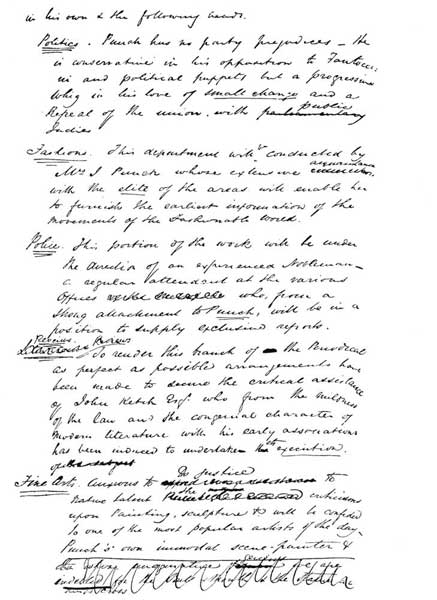
The late Mr. R. B. Postans, the house-chum of Henry Mayhew, "his companion from morning to night," and George Hodder, in his oft-quoted "Memories of My Time," agree in according undivided credit to Henry Mayhew; but they unfortunately disagree in essentials, and contradict each other, and indirectly confirm my own conclusions. Hodder further declares that Mayhew invented the paper and its name simultaneously, which sprang Minerva-like, full-titled, from his brain—which we know to be untrue, as the name was not decided upon until a subsequent meeting. Indeed, on the final prospectus, written with Mark Lemon's hand, as may be seen on p. 20, the present title was only inserted as an after-thought.
Then comes the version of Henry Mayhew's son, Mr. Athol Mayhew, who claims everything for his father in a statement of some length, in some respects authentic, but in many details entirely erroneous. He carries back Mayhew's idea of a "London Charivari" to the year 1835; but, as will be seen a little further on, Orrin Smith, Jerrold, Thackeray, and several more of the wags of the day afterwards combined in a stillborn effort to start a similar paper based on the same model. The writer bases his case far too much on Hodder's "Memories," which, entertaining though they are, do not[Pg 13] universally command the trust and respect with which Mr. Athol Mayhew regards them. "A more sanguine man than my father," he says, "never breathed, and in his arrangement with Hodder appears to have taken everything for granted, although the scheme had not as yet been even breathed to Messrs. Landells and Last [the engraver and printer]; for when the latter gentleman agreed to enter into the speculation, Mayhew had removed to Clement's Inn." But the writer, who would appear to have inherited the paternal characteristic of "taking everything for granted," has not considered that Hodder declared that his visit to Hemming's Row, by which occasion it is alleged that the new Punch had sprung to Mayhew's brain, was "in the summer". As Punch appeared in the middle of July, and, according to the draft prospectus, was first arranged to appear on June 10th (though this may possibly have been a lapsus calami), it requires more than ordinary sanguineness to accept the statement that not a word had been breathed to persons so paramount in such a newspaper enterprise as the printer and engraver—especially when the paper was to make its appearance in a few days' time. And yet Mr. Mayhew adds that matters did not progress even so rapidly as his authority, George Hodder, narrates.
Yet although it was not, as will appear, Henry Mayhew who was the actual initiator of Punch, it was unquestionably he to whom the whole credit belongs of having developed Landells' specific idea of a "Charivari," and of its conception in the form it took. Though not the absolute author of its existence, he was certainly the author of its literary and artistic being, and to that degree, as he was wont to claim, he was its founder.
From all these versions (which, after all, vary hardly more than the accounts of other incidents of Punch life[1]) it is[Pg 14] not very easy at first sight to sift the truth. There is a story of the tutor of an Heir-Apparent who asked his pupil, by way of examination, what was the date of the battle of Agincourt. "1560," promptly replied the Prince. "The date which your Royal Highness has mentioned," said the tutor, "is perfectly correct, but I would venture to point out that it has no application to the subject under discussion." A like criticism might fairly be passed on each existing reading of the genesis of Punch. It has been worth while, for the first time, and it is to be hoped the last, to collate and compare these statements, and ascertain the facts as far as possible. Claims have been set up, variously and severally, for Henry Mayhew, Mark Lemon, Joseph Last, Ebenezer Landells, and Stirling Coyne; even Douglas Jerrold and Gilbert à Beckett have been declared originators, though no such pretentions came directly from them. Otherwise than in the spirit of the Scottish minister who exclaimed, "Brethren, let us look our difficulties boldly and fairly in the face—and pass on," I propose to take those portions of the stories which tally with the facts I have ascertained and verified beyond all doubt, and, disentangling the general confusion as briefly as may be, to present one consistent version, which must stand untainted by claims of friendship, by pride of kinship, or filial respect.
It had occurred to many of the wits, literary and artistic, who well understood the cause of mortality in the so-called comic press that had gone before, that a paper might succeed which was decently and cleanly conducted. It might be as slashing in its wit and as fearless in its opinions as it pleased,[Pg 15] so long as those opinions were honest and their expression restrained. Their idea was founded rather on Philipon's Paris "Charivari" than on anything that had appeared in England; but they plainly saw that to attract and hold the public the paper which they imagined must be a weekly and not a daily one. The Staff which was brought together consisted of Douglas Jerrold, Thackeray, Laman Blanchard, Percival Leigh, and Poole, author of "Paul Pry"—authors; and Kenny Meadows, Leech, and perhaps Crowquill—artists; with Orrin Smith as engraver. The whole scheme of this new "London Charivari" was in a forward state of preparation, even to pages of text being set up, when it suddenly collapsed through a mistaken notion of Thackeray's that each co-partner—there being no "capitalist" thought of—would be liable for the private debts of his colleagues. The suggestion was too much for the faith of the schemers in one another's discretion, and "The London Charivari" was incontinently dropped; yet unquestionably it had some indirect influence on the subsequent constitution and career of Mr. Punch.
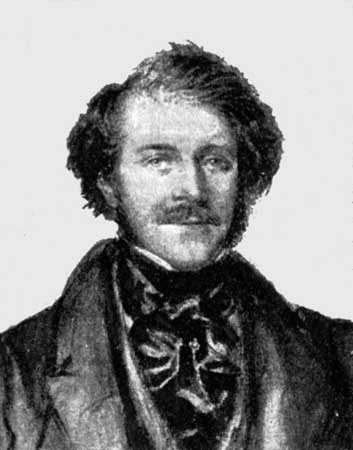 EBENEZER LANDELLS.
For some years the success of the Paris "Charivari" had attracted the attention of Mr. Ebenezer Landells, wood-engraver, draughtsman, and newspaper projector. He had been a favourite pupil of the great Bewick himself, and had come up to London, where he soon made his mark as John Jackson's and Harvey's chief lieutenant and obtained an entrance into literary and artistic circles. A man of great originality and initiative ability, of unflagging energy and industry, of considerable artistic taste, and of great amiability, he also had the defect of the creative quality of his mind, so that, owing to that lack of business talent which the public generally associates with the artistic temperament, he did not ultimately prove himself more than a moderate financial success. As Jerrold,[Pg 16] Thackeray, and the rest had done before him, he believed in a "Charivari" for England, and pondered how the Parisian success might be emulated and achieved. In his house at 22, Bidborough Street, St. Pancras (where most of the early Punch blocks were cut), he had a ready-made staff of engravers that included some names destined to become better known—Mr. Birket Foster; Mr. Edmund Evans, best known nowadays in connection with Miss Kate Greenaway's delightful children's books; J. Greenaway, her father, who became a master engraver himself; and William Gaiter, who afterwards took Orders; while "outside" were Edward and George Dalziel, T. Armstrong, and Charles Gorway. With these young men the handsome, tall engraver was extremely popular; they called him "the Skipper," or "Old Tooch-it-oop" behind his back, in token of his Northumbrian accent, but to his friends he was generally known as "Daddy Longlegs," or "Daddy Landells."
So Landells took the idea, which he determined upon carrying out, to one or two well-established publishers, Wright of Fleet Street amongst them, but none could see the germ of a first-rate property in it. It was objected that the temperament of the English people so differed from that of the French that they certainly would neither appreciate nor encourage the requisite style of writing, even supposing—which they did not believe—that the necessary talent were forthcoming. Moreover, they would not credit that a comic paper could succeed without the scurrility, and often enough the indecencies, that had distinguished earlier satirical prints; and although the popularity of Hood's "Comic Annual" and Cruikshank's "Comic Almanac" was pointed to, they would have nothing to do with a weekly, however much it professed to supersede previous ribaldry with clean wit and healthy humour.
As it happened, early in 1841 Landells was concerned, with his friend Joseph Last, printer, of 3, Crane Court, Fleet Street, in projecting a periodical known as "The Cosmorama," an illustrated journal of life and manners of the day, and to him Landells imparted his conviction that such a journal as he imagined[Pg 17] would certainly succeed. The enterprising printer lent a readier ear than others had done (perhaps, in view of his limited capital and still more limited ideas of speculation, altogether too ready an ear), and agreed with Landells to take up so excellent a notion. Now, in the little world of comic writing a brilliant humorist was at work—Henry Mayhew, one of several brothers of ability, a man whose resource was equal to his wit. He was already known to Last as the son of the leading member of the firm of Mayhew, Johnston, and Mayhew, of Carey Street, his legal advisers. He was residing at the time at Hemming's Row, over a haberdasher's shop, and, with F. W. N. Bayley and others, he had been secured as writer on "The Cosmorama." Landells, introduced to him by Last, approached him on the subject of the "Charivari." Mayhew grasped the conception at once, and, as the sequel proved, saw it more completely, and perhaps appreciated its literary and artistic possibilities more clearly, than either its material originator or his ambassador had done. He immediately advised dropping "The Cosmorama," and directing on to the new comic all the energy and resources that were to have been put into the more commonplace publication. In due course he imparted the new idea to his friend Postans, who shared his room, and to other visitors; but he forgot to mention how the idea had been brought to him, so that his friends not unnaturally counted it as another of Harry's many happy, but usually impracticable, thoughts. But in this instance Mayhew made his personality felt, for the character of the paper, instead of partaking of that acidulated, sardonic satire which was distinctive of Philipon's journal, on which it was to have been modelled, took its tone from Mayhew's genial temperament, and from the first became, or aimed at becoming, a budget of wit, fun, and kindly humour, and of honest opposition based upon fairness and justice.
As for the Staff of such a paper as he imagined, Mayhew urged that he could secure the services of Douglas Jerrold, Gilbert à Beckett, Mark Lemon, Stirling Coyne, and others, in addition to those already engaged; and then adjournment was proposed to Mark Lemon's rooms in Newcastle Street,[Pg 18] Strand. "The Shakespeare's Head," in Wych Street, had previously been Lemon's place of business. It was the meeting-place of the little "quoting, quipping, quaffing" club of fellow-workers in Bohemia; and Lemon, it was explained, had dabbled both in verse and the lighter drama, efforts which were "not half bad." Little did the writer dream that his modest Muse had marked him out for the editorship of the greatest comic journal the world has seen! To the duties of tavern-keeper Lemon, who was enamoured of literature and the drama, had been condemned by a fate more than usually unkind. He had found himself nearly penniless when Mr. Very, his stepfather, offered him a clerical position in his brewery in Kentish Town. But the brewery failed, and with it Lemon's livelihood, and he was only rescued by a jovial tavern-keeper named Roper, one of his stepfather's customers, and by him put into charge—disastrously for both—of the Wych Street public-house. Then he married, having borrowed five pounds to do it with, and by his wife's advice kept in touch with his literary acquaintance; and by the acceptance of a five-act comedy by Charles Mathews at Covent Garden—which was to be played by a cast including the great comedian's self, Mme. Vestris, and "Old" Farren—he received a hundred pounds down, and was tided over his difficulties until the starting of Punch gave him permanent employment.
So to Mark Lemon they went, and a full list was quickly drawn up. Mayhew undertook to communicate with Douglas Jerrold, who, then better known to the public as the successful dramatist than as the great satirist, was staying at Boulogne for the sake of his young family's education; and a charming picture has been drawn by his son of how, on the visit of à Beckett, Charles Dickens, and the rest, he would throw off his clothes and swim with them in the sea, or challenge them to a game of leap-frog on the sands—a curious contrast to his own declaration that the only exercise he cared for was cribbage.[2][Pg 19]
Stirling Coyne, Daily, W. H. Wills, H. P. Grattan (H. Plunkett, otherwise "Fusbos"), Henning, Henry Baylis, and "Paul Prendergast"—whose "Comic Latin Grammar" had been attracting much attention—were proposed, and Hodder was told off to wait upon the latter. At the adjourned meeting at the "Edinburgh Castle" tavern in the Strand, Somerset House, Postans, William Newman, Baylis (afterwards president of the "Punch Club"), Stirling Coyne, Henning, Mayhew, Landells, and Hodder were present. The latter then explained that "Prendergast" was a young medical man, Percival Leigh by name, who preferred to wait before giving his adhesion until he was satisfied as to the character of the publication; and "Phiz" had returned a similar reply to Mark Lemon—though later on he was glad enough to accept little commissions in the way of drawing initial letters for the paper.
Henning was then nominated cartoonist; Brine, Phillips, and Newman, artists-in-ordinary; and Lemon, Coyne, Mayhew, à Beckett, and Wills, the literary Staff, until the advent of the others, whose adhesion was anxiously awaited. Henry Mayhew, Mark Lemon, and Stirling Coyne were to be joint editors; Last, of course, was to be printer, and Landells engraver; and W. Bryant publisher. Several more meetings were held—at the "Crown" in Vinegar Yard, at Landells' house, and elsewhere—and in due course Mark Lemon produced the draft prospectus, consisting of three folios of blue paper, which probably contains a good deal more of Mayhew and Coyne than of Mark Lemon. Edmund Yates estimated its chemical composition thus:—
| Henry Mayhew | 95 |
| Stirling Coyne | 3 |
| W. H. Wills | 1.5 |
| Mark Lemon | .5 |
| —— | |
| 100 |
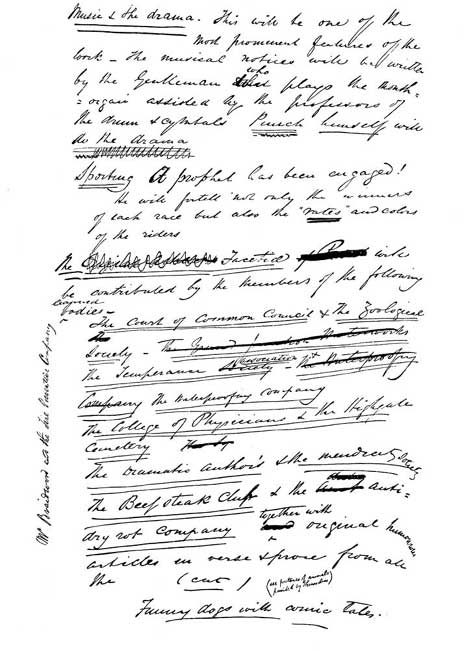
And his estimate was probably correct. This interesting document is here shown in reduced facsimile:[Pg 20]—
(Original size of page 5¼ x 3¾ inches.)
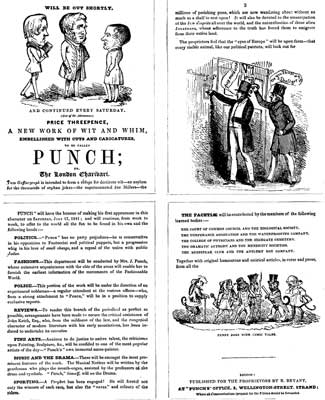
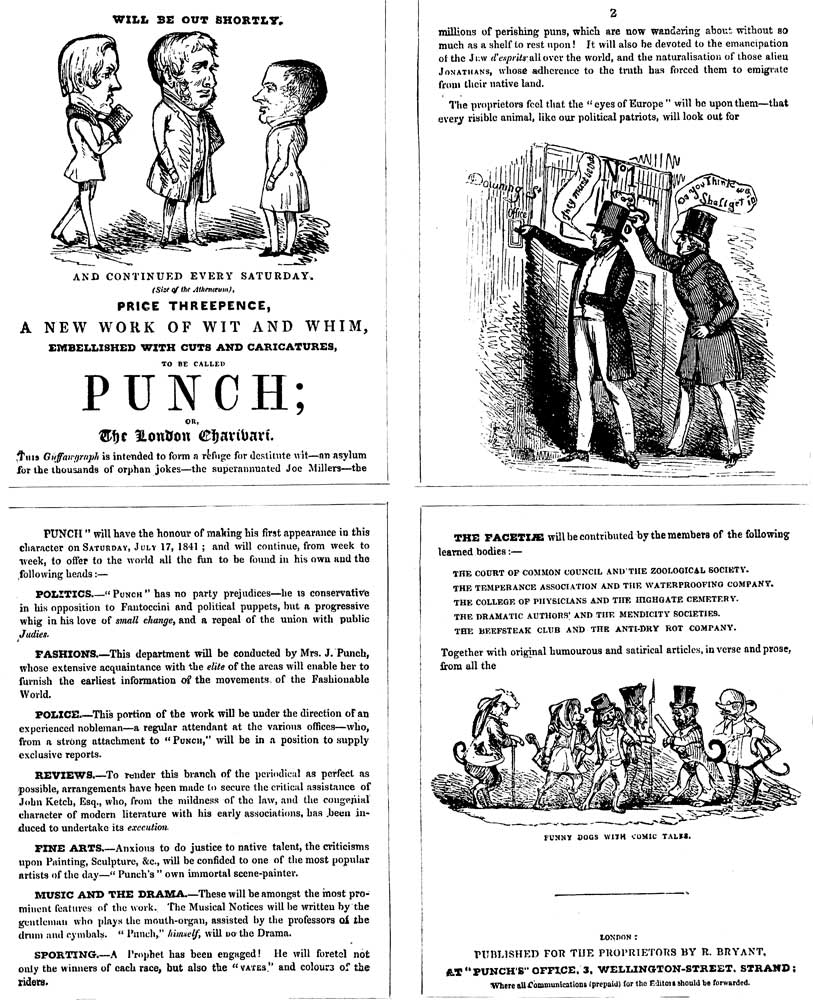
At the head of this announcement there was a woodcut of Lord Morpeth, Lord Melbourne (Prime Minister), and Lord John Russell, who were then in[Pg 23] office, but were popularly, and correctly, supposed to be in imminent danger of defeat. The price originally proposed was twopence—the usual price of similar papers of the day—but it was altered to "the irresistibly comic charge of threepence!!" and the title was being[Pg 24] given as "The Fun——," when the writer stopped short and erased it. It is generally believed that the intention was to call the paper "The Funny Dog—with Comic Tales," as appears in the final line of the prospectus; a title, moreover, that was employed in 1857 for a book in which more than one Punch man co-operated. A reduced copy of the now rare leaflet as it was printed and circulated by tens of thousands is given on the previous page. "Vates," it should be explained, was the nom de plume of the notorious sporting tipster then attached to "Bell's Life in London."
As to the origin of Punch's name, there are as many versions as of the origin of Punch itself. Hodder declares that it was Mayhew's sudden inspiration. Last asserted that when "somebody" at the "Edinburgh Castle" meeting spoke of the paper, like a good mixture of punch, being nothing without Lemon, Mayhew caught at the idea and cried, "A capital idea! We'll call it Punch!" Jovial Hal Baylis it was, says another, who, when refreshment time came round (it was always coming round with him), gave the hint so readily taken. Mrs. Brezzi, wife of the sculptor, lays the scene of the first meeting in the "Wrekin Tavern," Broad Street, Longacre, and writes that the founders were only prevented from calling the paper "Cupid," with Lord Brougham in that character on the title-page [presumably a mistake for Lord Palmerston, who subsequently was so shown in Punch by Brine, picking his teeth with his arrow] by the sight from Joseph Allen's window of a Punch and Judy show in the north-eastern corner of Trafalgar Square. Mrs. Bacon, Mark Lemon's niece, informs me that she distinctly remembers being seated among the gentlemen who met at his rooms in Newcastle Street, and hearing Henry Mayhew suddenly exclaim, "Let the name be 'Punch'!"—a fact engraven on her memory through her childish passion for the reprobate old puppet. Mr. E. Stirling Coyne claims that it was his father who suggested the title at the memorable meeting at Allen's. This, at least, in Lemon's words, is certain: "It was called Punch because it was short and sweet. And Punch is an English institution. Everyone loves Punch, and will be[Pg 25] drawn aside to listen to it. All our ideas connected with Punch are happy ones." The decision was not set aside when it was found that Jerrold had edited a "Punch in London" years before, proposed to him a few months earlier by Mr. Mills (of Mills, Jowett, and Mills). But the favour with which the title was received was not universal. "I remember," Mr. Birket Foster tells me, "Landells coming into the workshop and saying, 'Well, boys, the title for the new work is to be Punch.' When he was gone, we said it was a very stupid one, little thinking what a great thing it was to become."
The business plan was to be a co-operative one. Mayhew, Lemon, and Coyne, it was finally agreed, were to be co-editors and own one-third share as payment.[3] Last was to find the[Pg 26] printing and own one share, and Landells was to find drawings and engraving, and own one share. The claims of outside contributors (among whom were Jerrold and à Beckett) and the paper-maker's bill were to be the first charge on the proceeds; and if these were not enough, Landells and Last were to make up the deficiency. So, on the same plan as the first abortive attempt of a "London Charivari," the new paper was embarked on, by men who with but little capital ("it was started with £25—which I found!" says Landells) yet threw themselves into it, and became their own publishers. Advertising to the extent of £111 12s. was ventured on, including "billing in 6 Mags.," "page in 'Master Humphrey's Clock' twice," 100,000 of the prospectuses reproduced on p. 23,[4] and 2,000 window-bills that bore the design which Henning drew for Punch's cover, after a rough sketch by Landells.
It was a busy fortnight; and it may well be doubted if any other journal of such great eventual popularity has ever been launched with so little preparation. Every technical detail identical with what was employed up to recent years was settled; Henning drew his ill-composed cartoon of "Parliamentary Candidates under Different Heads," roughly done, but not ill-cut; and Mark Lemon, Henry Mayhew, Henry Grattan, Joseph Allen, F. G. Tomlins, Gilbert à Beckett, and W. H. Wills (the biting epigram "To the Black-balled of the United Service Club," i.e. Lord Cardigan, was his), all contributed to the first number. It is an axiom of newspaper conductors that "the first number is always the worst number," and Punch did nothing to disprove the rule. Nevertheless, it was a great success. The tone and quality were far higher in dignity and excellence than was common to an avowedly smart and comic paper—far different from what is suggested by the word "Charivari;" and the public admitted that here was a novel school of comic writing, by a motley moralist and punning philosopher, and hailed with pleasure the advent of a "New Humour."
(Designed by A. S. Henning.)
"Out came the first number," wrote Landells. "I shall never forget the excitement of that first number! It was so great that Mr. Mayhew, Mr. Lemon, and myself, sat up all night at the printer's, waiting to see it printed." When "our Mr. Bryant," as the publisher was called, opened the publishing[Pg 28] office on that memorable 17th of July, at 13, Wellington Street, Strand, the unexpected demand for the paper raised the expectations and enthusiasm of the confederates to the highest pitch. Mayhew, with Hodder and Landells, walked up and down outside the office and in the neighbouring Strand, discussing the paper and its prospects, and constantly calling to hear from Bryant how things were progressing. At news of each fresh thousand sold, their spirits rose, and their anxiety became satisfaction when the whole edition of five thousand had been taken up by the trade, and another like edition was called for, and, on the following day, was sold out. Ten thousand copies! Ten thousand proofs, they took it, of public sympathy and encouragement.
Such is the outline of Punch's conception and birth, based on many original documents and a mass of evidence, as well as on the independent testimony collected from survivors. In the words of Mr. Jabez Hogg, "Landells and Henry Mayhew were certainly the founders"—the former conceiving the idea of the paper which was presently established, and the latter developing it, as set forth, according to his original views—founding the tradition and personality of "Mr. Punch," and converting him from a mere strolling puppet, an irresponsible jester, into the laughing philosopher and man of letters, the essence of all wit, the concentration of all wisdom, the soul of honour, the fountain of goodness, and the paragon of every virtue.[Pg 29]
Reception of Punch—Early Struggles—Financial Help Invoked—The First Almanac—Its Enormous Success—Transfer of Punch to Bradbury and Evans—Terms of Settlement—The New Firm—Punch's Special Efforts—Succession of Covers—"Valentines," "Holidays," "Records of the Great Exhibition," and "At the Paris Exhibition."
The public reception of the first number of Punch was varied in character. Mr. Watts, R.A., once told me that the paper was regarded with but little encouragement by the occupants of an omnibus in which he was riding, one gentleman, after looking gravely through its pages, tossing it aside with the remark, "One of those ephemeral things they bring out; won't last a fortnight!" Dr. Thompson, Master of Trinity, informed Professor Herkomer that he, too, was riding in an omnibus on the famous 17th of July, when he bought a copy from a paper-boy, and began to look at it with curiosity. When he chuckled at the quaint wit of the thing, "Do you find it amusing, sir?" asked a lady, who was observing him narrowly. "Oh, yes." "I'm so glad," she replied; "my husband has been appointed editor; he gets twenty pounds a week!" One may well wonder who was this sanguine and trustful lady. Mr. Frith describes how, having overheard Joe Allen tell a friend, in the gallery of the Society of British Artists, to "look out for our first number; we shall take the town by storm!" he duly looked out, but was disappointed at finding nothing in it by Leech; and how when he went to a shop for the second number, to see if his idol had drawn anything for it, the newsman replied, "'What paper, sir? Oh, Punch! Yes, I took a few of the first number; but it's no go. You see, they billed it about a good deal' (how well I recollect that expression!), 'so I wanted to see what it was like. It won't do; it's no go.'"[Pg 30]
The reception by the press was more encouraging—that is to say, by the provincial press, for the London papers took mighty little notice of the newcomer. The "Morning Advertiser," it is true, quaintly declared in praise of the "exquisite woodcuts, serious and comic," that they were "executed in the first style of art, at a price so low that we really blush to name it;" while the "Sunday Times" and a number of provincial papers of some slight account in their day professed astonishment at the absence of grossness, partisanship, profanity, indelicacy, and malice from its pages. "It is the first comic we ever saw," said the "Somerset County Gazette," "which was not vulgar. It will provoke many a hearty laugh, but never call a blush to the most delicate cheek." They vied with each other in their vocabulary of praise; and as to Punch's quips and sallies, his puns, his propriety, his "pencillings," and his cuts—they simply defied description; you just cracked your sides with laughter at the jokes, and that was all about it.
Yet, notwithstanding all this praise, the paper did not prosper; but whether it was that the price did not suit the public, although the "Advertiser" really blushed to name it, or that Punch had not yet educated his Party, cannot be decided. The support of the public did not lift it above a circulation of from five to six thousand, and on the appearance of the fifth number Jerrold muttered with a snort, "I wonder if there will ever be a tenth!" Everything that could be done to command attention, with the limited funds at disposal, was done. No sooner was Lord Melbourne's Administration defeated and discredited (for the Premier was angrily denounced for hanging on to office), than Punch displayed a huge placard across the front of his offices inscribed, "Why is Punch like the late Government? Because it is Just Out!!" And no device of the sort, or other artifice that could be suggested to the resourceful minds in Punch's cabinet, was left untried. Things were against Punch. It was not only that the public was neglectful, unappreciative. There was prejudice to live down; there were stamp duty, advertisement duty, and paper duty to stand up to; and there were no Smiths or Willings, or other great distributing agencies, to assist.[Pg 31]
While Bryant was playing his uphill game, Punch, written by educated men, was doing his best not only to attract politicians and lovers of humour and satire, but to enlist also the support of scholars, to whom at that time no comic paper had avowedly appealed; and it is doubtless due to the assumption that his readers, like his writers, were gentlemen of education, that he quickly gained the reputation of being entitled to a place in the library and drawing-room, diffusing, so to speak, an odour of culture even in those early days of his first democratic fervour. We had a German "Punchlied," Greek Anakreontics, and plenty of Latin—not merely Leigh's mock-classic verses, but efforts of a higher humour and a purer kind, such, among many more, as the "Petronius," and the clever interlinear burlesque translations of Horace which came from the pen of H. A. Kennedy. Then "Answers to Correspondents" were maintained for a while inside the wrapper, which were witty enough to justify their existence. But it was felt that something more was wanted to make the paper "move;" and the first "Almanac" was decided upon.
The circulation meanwhile had not risen above six thousand, and ten thousand were required to make the paper pay. Stationer and contributors had all been paid, and "stock" was now valued at £250. That there was a constant demand for these back numbers (on September 27th, 1841, for example, £1 3s. 4½d.-worth were sold "over the counter"), was held to prove that the work was worth pushing; but it seemed that for want of capital it would go the way of many another promising concern. The difficulties into which Punch had fallen soon got noised abroad, and offers of assistance, not by any means disinterested, were not wanting to remind the stragglers of their position. Helping hands were certainly put out, but only that money might be dropped in. Then Last declined to go on. He had neither the patience nor the speculative courage of the Northumbrian engraver, and money had, not without great difficulty and delay, been found to pay him for his share—which had hitherto been a share only of loss. The firm of Bradbury and Evans had been looked to as a deus ex machinâ to take over the printing,[Pg 32] and lift Punch out of the quagmire by acquiring Last's share and interest for £150. The offer was entertained, and an agreement drafted on September 25th, when, on the very same day, Bradbury and Evans wrote to withdraw, on the ground that they found the proposed acquisition "would involve them in the probable loss of one of their most valuable connections." Landells, who always regarded this action—without any definite grounds that I can discover—as a diplomatic move to involve him and his friends still more, so that more advantageous salvage terms might be made, hurriedly cast about for other succour, and alighted on one William Wood, printer, who lent money, but whose agreement as a whole was not executed, as it was considered "either usurious or exorbitant" by their solicitors, who characteristically concluded their bill thus:—"Afterwards attending at the office in Wellington Street to see as to making the tender, and to advise you on the sufficiency thereof, but you were not there; afterwards attending at Mr. H. Mayhew's lodging, but he was out; afterwards attending at Mr. Lemon's, and he was out; and we were given to understand you had all gone to Gravesend"—showing the one touch of nature which made all Punch-men kin.
In due course Landells acquired Last's share, and the printing was executed successively by Mr. Mitchell and by Mills, Jowett, and Mills, until it slid by a sort of natural gravitation into the hands of Bradbury and Evans. Landells had endeavoured to interest his friends in the paper, but soon discovered the fatal truth that one's closest friends are never so close as when it is a question of money.
Then came the Almanac, upon which were based many hopes that were destined to be more than realised. It has hitherto been considered as the work of Dr. Maginn, at that time, as at many others, an unwilling sojourner in a debtor's prison. But H. P. Grattan has since claimed the distinction of being, like the doctor, an inmate of the retreat known as Her Majesty's Fleet, where he was visited by Henry Mayhew. Mayhew, he said, lived surreptitiously with him for a week, and during that time, without any assistance from Dr. Maginn, they brought the whole work to a brilliant termination. Thirty-five jokes a day[Pg 33] to each man's credit for seven consecutive days in the melancholy privacy of a prison cell is certainly a very remarkable feat—hardly less so than the alleged fact that Mayhew, who proposed the Almanac, as he proposed so many other good things for Punch, should have gone to the incarcerated Grattan for sole assistance, when he and his co-editors had so many capable colleagues at large. The claim does not deserve full credence, especially in face of Landells' declaration that "everyone engaged on it worked so admirably together, and it was done so well, that the town was taken by surprise, and the circulation went up in that one week from 6,000 to 90,000—an increase, I believe, unprecedented in the annals of publishing." The Almanac became at once the talk of the day; everybody had read it, and a contemporary critic declared that its cuts "would elicit laughter from toothache, and render gout oblivious of his toe."
Now, although Bradbury and Evans had hesitated to become proprietors, they had had no objection to act as printers and publishers, and when the editors approached them they lent a ready ear. "It was Uncle Mark," said "Pater" Evans at the "Gentleman's Magazine" dinner in 1868, "who was the chief conspirator when they brought Punch to Whitefriars; it was his eloquence alone that induced us to buy Punch. Jerrold did not say much, but he supported his friend, you may be sure. They talked us over very easily." They bought the editors' share for £200, which they advanced on the security of the whole. Into the circumstances of the subsequent squabbles between Landells and the firm it is not needful to enter. He bitterly complained that he could obtain neither statements of accounts nor satisfactory arrangement, while the firm withheld their favourable consideration of the agreements his solicitors sent them to sign. The negotiations proceeded wearily from April, 1842, to December 24th, with rising wrath on the part of the good-hearted, impatient Northumbrian, who could neither understand nor brook the repeated delays, and fairly boiled over with indignation, suspicion, and wrath. In despair, so Landells recorded, that his lawyers could get no satisfaction, and yet "not willing[Pg 34] to put the whole thing into Chancery," he blurted out that he should buy back Bradbury and Evans' share or they acquire his. As cool business men they promptly asked his price. He named £450, ultimately reducing it to £400, and further to £350, on the understanding, he says, that he should continue to act as engraver; and great were his anger and humiliation when he found after the second week of the new régime that the engraving was taken from him. But it is only fair to say that in his lawyer's instructions there is evidence that Bradbury and Evans persistently declined to give up their freedom in the matter of the engraving. The transfer then took place.[5] On December 23rd, 1842, the firm was already speaking with some authority; the voice was the voice of the printers, but the tone was the tone of proprietors. And that was the passing of Punch. Earlier in the year Landells had made an effort to save the paper by persuading those who worked for it to take shares. With a few he was successful; others were less speculative, so the writer was informed by the late H. G. Hine. "Landells," he said, "asked me to take a share in the paper,[Pg 35] but, not being a business man, I declined. When the paper changed hands, Bradbury and Evans bought it for so small an increase on the actual losses and debts, that each man, when the profits were divided, received two-and-sixpence each." Not long after Landells ceased his connection with Punch, Douglas Jerrold met Vizetelly, and acquainted him with the turn of the tide. "Punch is getting on all right now," he said; and added, in his saturnine way, "It began to do so immediately we threw that engraving Jonah overboard!" Yet Jerrold was glad enough to take advantage of the engraving Jonah's influence the following year, when Landells, with Herbert Ingram, N. Cooke, T. Roberts, W. Little, and R. Palmer started the "Illuminated Magazine," and installed him as editor at a handsome salary.
The following page from Landells' rather rough-and-ready accounts will give some idea of how financial matters stood between the parties at the time of the transfer:—
| B. & E. Cash Recd. | B. & E. Cash Paid. | ||||||
|---|---|---|---|---|---|---|---|
| £ | s. | d. | £ | s. | d. | ||
| Accts. | 1,278 | 6 | 9 | Cash paid to Artists, Editors, etc. | 507 | 4 | 0 |
| Editors, Artists, paid | 507 | 4 | 6 | B. & E. for printing | 605 | 10 | 6 |
| —— | —— | —— | |||||
| 771 | 2 | 3 | |||||
| B. & E. acct. | 605 | 10 | 6 | ||||
| —— | —— | —— | |||||
| Balance in hand | £165 | 11 | 9 | ||||
| E. Landells. | Lemon, Coyne, and Mayhew. | ||||||
| £ | s. | d. | £ | s. | d. | ||
| To Engravings | 315 | 4 | 0 | To Editing | 400 | 0 | 0 |
| Cash | 25 | 0 | 0 | ½ debt | 100 | 0 | 0 |
| —— | —— | —— | |||||
| Paid contributions at £6. 0. 0 per week |
120 | 0 | 0 | ½ debt | 300 | 0 | 0 |
| Paid contributions at £6. 0. 0 per week |
120 | 0 | 0 | ½ debt | 300 | 0 | 0 |
| —— | —— | —— | 460 | 4 | 0 | ||
| 400 | 0 | 0 | |||||
| ½ debt | 100 | 0 | 0 | 100 | 0 | 0 | |
| —— | —— | —— | —— | —— | —— | ||
| 360 | 4 | 0 | 300 | 0 | 0 | ||
| —— | —— | —— | 120 | 0 | 0 | ||
| Cash received | 57 | 0 | 0 | —— | —— | —— | |
| £303 | 4 | 0 | 25 | 0 | 0 | ||
| —— | —— | —— | |||||
| £155 | 0 | 0 | |||||
[Note.—The schedule of documents and legal papers connected with the matters here dealt with, now in possession of Messrs. Bradbury, Agnew[Pg 36] and Co., Ltd. (which confirm the particulars derived from Landells' papers) are:—
1. The original Agreement between the original founders of Punch already enumerated. This is dated July 14th, 1841—only three days before the appearance of the paper. It is printed at length as Appendix 1 to this volume.
2. Agreement between Bradbury and Evans and "Punchites," whereby in consideration of a loan of £150 the printing of the paper is assured to the firm. This is dated Oct., 1841, the signatories being E. Landells, Mark Lemon, Henry Mayhew, and Stirling Coyne, with W. H. Wills and G. Windsor as witnesses.
3. The assignment to Landells of Punch and the stock-in-trade by Lemon, Mayhew, and Stirling Coyne. Dated December 6th, 1841.
4. Assignment to Bradbury and Evans by Landells of his two-thirds share of Punch. Dated, July 25th, 1842.
5. Assignment of his remaining one-third to Bradbury and Evans by Landells, in consideration of £100 cash and their acceptance for £250 due Jan. 31st, 1843, their mortgage on this share to be cancelled. This deed is dated Dec. 29th, 1842, and is in the terms of Landells' letter of agreement of the previous 24th.]
The new proprietors, when they acquired their interest in Punch, were not then distinguished publishers such as they soon became; they were essentially printers, and had few connections to assist them in making it into a paying property. They had, however, W. S. Orr & Co. (the London agents of Chambers, of Edinburgh), who had fallen into financial difficulties, and looked to Bradbury and Evans to help them out; and through their organisation Punch was taken up by the trade "on sale or return." To work up the sale of a threepenny publication was at that time a formidable task; but Orr certainly accomplished it, and for a time Punch undoubtedly owed more to his efforts than to Jerrold's pen or Leech's pencil. The head of the firm, in both senses, was William Bradbury, the keenest man of business that ever trod the flags of Fleet Street, and the founder of a dynastic line nearly as long and eminent as that of John Murray himself. His portrait may be seen in Punch more than once—for example, in Tenniel's drawing of the Staff at play at the beginning of Vol. XXVII, 1854, where his tall, imposing figure contrasts with that of his partner, Frederick Mullett ("Pater") Evans, who appears with shining spectacles, beaming countenance, and convex waistcoat. Jolly old "Pater," who died in 1870, was the model of Leech's pater-familias; and it is remembered to his credit that he never[Pg 38][Pg 37] resented the liberty taken with him by Thackeray in "The Kickleburys on the Rhine." It has always been the graceful and feeling practice of Punch, ever since the death of Dr. Maginn, to whom a kindly obituary was devoted in 1842, to do honour in his pages to each of his lieutenants as they drop out of the ranks, recognising misfortune and death—both "devil's inventions," as Ruskin calls them—as toll-gates on the path of life, with sorrow as the tax; so that these more solemn articles and mortuary elegies seem to mark the way, like milestones set by loving hands. To Evans one of these was raised, and we read in it that "they who inscribe these lines to his memory will never lament a more kind, more genial, or more loyal friend."
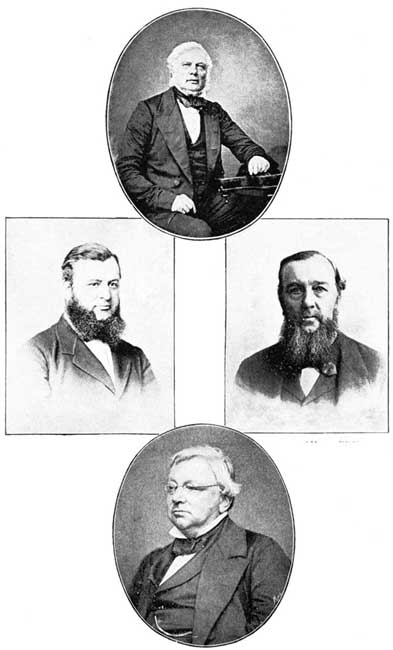 BRADBURY AND EVANS
(From Photographs by A. Bassano Limited.)
The next head of the firm was William Hardwick Bradbury, who had been at school with Mr. Justice Romer, the husband of Mark Lemon's daughter; and the house then became Bradbury, Evans & Co. He married the daughter of Mr. Thomas Agnew; and when, in 1872, Mr. F. M. Evans (the son of "Pater") left the firm, after having attended the Dinner for five years as the son of his father, and sat for another seven years at the tail of the Table by right of proprietorship, the business was reinforced by the inclusion of the house of Agnew. It then became Bradbury, Agnew & Co., and it has been thought that Sir William Agnew's personality has tended to colour Punch up to a certain point with just a shade of his own Liberal political opinions. Messrs. W. H. Bradbury, William Agnew, Thomas Agnew, and John Henry Agnew were then the members of the firm, which a few years since was converted into a limited company; and on the death of the first-named, Mr. W. Lawrence Bradbury took his father's place as managing head of the house, with Mr. Philip Agnew as colleague: young men, surely, to succeed to the direction of a house which had been the publisher of Thackeray and Dickens, founders of "The Field," "The Army and Navy Gazette," printers of the "Family Herald" and "London Journal," of the "Daily News," the "English Encyclopedia," and other huge undertakings. With the advent of the younger generation came some of those technical alterations and improvements which[Pg 40][Pg 39] have brought the production of Punch abreast of the times; but the older traditions, in particular that great institution of the Punch Dinner, have been reverently and lovingly retained in all their admirable features.
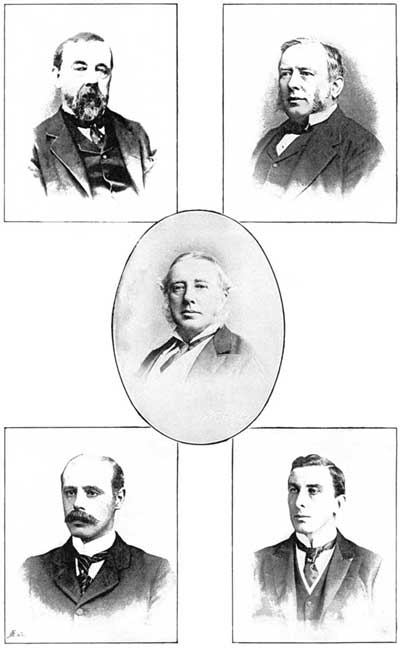 BRADBURY, AGNEW and Co.
(From Photographs by A. Bassano, Limited.)
It is not surprising that after the striking success of the experiment the Almanac became a permanent annual institution. Into so important a publication did it develop, commercially speaking, that a special "Almanac Dinner" has up to recent years always been considered necessary, at which its chief contents are arranged, just as at the ordinary weekly Dinner. Hine, Kenny Meadows, and others assisted in the production of the first two or three Almanacs; but after that, and for many years, practically the whole of the illustrative work usually fell on the broad and entirely competent shoulders of John Leech, especially after Doyle's secession. From time to time experiments have been made in the direction of novelty. Thus in 1848, in consequence of the great popularity of the issue, a luxurious edition was prepared, at the price of five shillings for the coloured and half that sum for the uncoloured copies, wherein, it was claimed, "full effect is given to the artists' designs." It was certainly an imposing affair, with meadows of margin, and printed on one side only of the thick paper; and it now commands a price in the bookshops of five or six times its original cost.
Humour for private as well as for public consumption has always been a rule in the Punch circle; and in 1865, a year in which influenza colds were extremely prevalent, this pleasing faculty was given full scope. Most of the Staff that Christmas were afflicted with severe colds; so with amiable consideration the copies of the Almanac provided for them and for some of the chief contributors were printed upon linen—lest their supply of handkerchiefs should run short. They were charming and cheerful in appearance, being handsomely bound and stitched with red, and presented unusual advantages in the way of utility and entertainment. Of recent years the Almanacs have had admirably drawn wrappers, specially designed. In 1882 Mr. Burnand tested the powers of our humorous painters outside, in addition to Punch's own Staff, including Mr. Stacy[Pg 41] Marks, R.A., Mr. G. A. Storey, A.R.A., and Sir John Gilbert, R.A.; but the result was an argument in favour of Staff-work over outside contribution. Among other experiments, colour was tried with a view to rendering further homage to Sir John Tenniel's cartoon, by printing it on a tinted background, in the manner of Matt Morgan's famous designs in the "Tomahawk." But the idea, which originated with the late Mr. Bradbury, did not answer expectations, and the attempt was abandoned.
The success that immediately attended the Almanac naturally attracted the attention of the pirates, and hatched the brood of spurious and coarse imitations given forth by such notorious printers and publishers as Goode, Lloyd, and Lyle. But Punch had a short legal way with him that soon scared them off, and the merry Hunchback is now left supreme in his own sphere. He not only, as the "Times" said, "commences the winter season for us with the 'Almanac,' but he continues the tradition of Charles Dickens by retaining for Christmastide much of the fine hearty old flavour which the great novelist imparted to it—that jovial, tender, charitable, roast-goose spirit that exhales from it, the Spirits of Christmas Present and Christmas Past." "Christmas without the Christmas number of Punch," exclaimed the "Saturday Review" not long ago, "would be a Christmas without plum-pudding, mince-pies, turkey, and children's parties—it would not be Christmas at all!"
Another result of the constant search for freshness was the changing of the design on the cover of each consecutive volume. Any change from that of Henning could only be a change for the better, so a second application was made to Hablôt Knight Browne ("Phiz") for his collaboration. Well satisfied by this time with the tone of the paper, he gladly responded. The result was a refined and artistic page, crowded with figures, rather graceful and quaint than funny; and although, to Leech's horror, a barrel-organ figured in it, it served its purpose admirably.
For the next volume a sketch was made by H. G. Hine, based on a slighter one by Landells. It was not used,[Pg 42] however, as intended, but adapted as the index-heading; and William Harvey, the Shakespearian illustrator, was requested to undertake a design to replace it. This, though yet more[Pg 43] graceful than Browne's, was less suitable than ever. Babes like amorini toying with Punch's cap and bâton, bells and mask, were very pretty and charming, but a good deal too much in the style of Rubens or Stothard; and what was thought more unsuitable still was the price. Mr. Birket Foster has borne witness to the consternation in the office[Pg 44] when the charge of twelve guineas was sent in with the design—nearly half the total capital with which Landells a year before had begun the concern!
Six months later Sir John Gilbert—then a youth doing great things for the "Illustrated London News"—was commissioned to draw another front page. This was subsequently[Pg 46] used until recent years as the pink cover of Punch's monthly parts. A cover was produced by Kenny Meadows, and then for January, 1844, Richard Doyle, the latest recruit, whose[Pg 47] merit had been quickly gauged, was employed to execute the new one. This wrapper was far more in accord with the true spirit of Punch. More sportive and rollicking, and with less attempt at grace, it threw over the style of the "Newcastle School"—of which Landells was a member[Pg 48]—and gave the general idea of the latest of all covers. This was not executed until January, 1849, when several changes of detail were made, including the substitution of the smug lion's head for that of Judy in the canvas—the whole so[Pg 49] successful that it may safely be predicted that it will never be superseded.
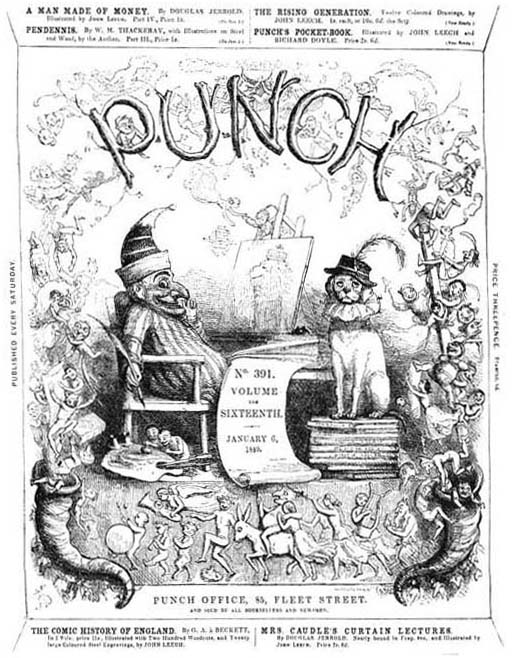 PUNCH'S SIXTH AND LAST WRAPPER, DESIGNED BY RICHARD
DOYLE. SECOND DESIGN. JANUARY, 1849.
PUNCH'S SIXTH AND LAST WRAPPER, DESIGNED BY RICHARD
DOYLE. SECOND DESIGN. JANUARY, 1849.Such are the covers—comprising what Mr. W. Bradbury used to call "our wardrobe of old coats"—which, though interesting enough in themselves, certainly included nothing to equal the last design, by which Doyle's name is best known throughout the artistic world.
Guided by the success of the first Almanac, the conductors decided to work the same oracle by publishing "extra numbers" at every promising opportunity. "Mr. Mayhew, Mr. Jerrold, and I," says Landells, "happened to spend a few days in the summer at Herne Bay, and there 'Punch's Visit to the Watering Places' was projected. These articles gave Punch another great lift. Messrs. Mayhew, Mark Lemon, Douglas Jerrold, and I, did Herne Bay, Margate, Broadstairs, and Ramsgate, and I never enjoyed myself more than on this, to me, memorable occasion. Albert Smith did Brighton. Punch thenceforth became an established favourite with the public, and the weekly circulation averaged over 30,000."
Just before this lucky stroke, another not less fortunate as a succes d'estime, if nothing more, was "Punch's Valentines"—at that time considered a most remarkable production; for there were no fewer than twelve half-page engravings within its full-page borders—a generous amount that puzzled the public far more than ten times as much and as good would do to-day. Kenny Meadows, "Phiz,"[6] Leech, Crowquill, Henning, and Newman, contributed each two "valentines," which were addressed to various sorts and conditions of people, accompanied by verses of considerable humour and more than average merit. Thus, to the lawyer—whom "Phiz" has represented as a mixture, in equal parts, of Squeers, Brass, and Quilp—the lines begin in a manner not unworthy of Hood himself:[Pg 50]—
The invocation which follows, to a gorgeous footman, by some love-smitten serving-maid, ends—
In August, 1850, in the extra number called "Punch's Holidays," that was done for the outskirts of London which eight years before had been done for the watering-places. It was illustrated by Leech and Doyle, and, it may be added, the Hampton Court section was written by Thackeray. Then when the great Shakespeare Tercentenary was being celebrated, with singularly little éclat so far as the Shakespeare Committee itself was concerned, Punch produced his "Tercentenary Number." It was in all respects admirable, and Tenniel's double-page cartoon was a striking success—as might have been expected from a Staff so remarkably well versed in Shakespeare. In that cartoon the poet's triumphal car, drawn by twin Pegasi and driven by Mr. Punch, is followed by a motley procession, in which Mark Lemon, in the character of John Bull, appears adapted as Prospero (one of the best of the many portraits of the editor that have appeared in the paper), while a typically malignant organ-grinder is Caliban, and all the leading statesmen and sovereigns are represented in Shakespearian character appropriate to the circumstances; the "Standard" and "Morning Herald," two of Punch's pet aversions and journalistic butts, bringing up the rear as the Witches in "Macbeth," Mesdames Gamp and Harris. The illustrators of this exceptionally happy number were—besides Sir John Tenniel—Charles Keene, Mr. du Maurier, and Mr. Fairfield.[Pg 51]
Then came the unwieldy "Records of the Great Exhibition, extracted from Punch" on October 4th, 1851. Punch had made a dead-set against the exhibition in Hyde Park (until his friend Paxton was appointed its architect, subsequently earning £20,000 by the work), and, according to Mr. Justin McCarthy, "was hardly ever weary of making fun of it ... and nothing short of complete success could save it from falling under a mountain of ridicule. The Prince did not despair, however, and the project went on." And when it was a fait accompli, Punch, good man of business that he was, at once put it to the best possible advantage, by issuing his enormous "extra" of nine previously-published cartoons by Tenniel and Leech, and many other cuts besides—the whole, in point of its double-folio size, more suitable for street display than library reading. The price was sixpence, and with all the special matter it contained it was one of the cheapest productions ever issued from that office.
With the special Paris Exhibition number, produced in celebration of the Exhibition of 1889, the list of extra numbers issued by Punch for general circulation comes to a close. Nearly the whole of the Staff, including the proprietors, travelled to Paris together—how luxuriously, Mr. Furniss's drawing of their dining-saloon gives a good notion; it contains (with Sir John Tenniel and Mr. Lucy) portraits of all who were present. Charles Keene had stayed at home; he felt unequal to the jaunt, and was, in fact, sickening for the mortal illness which soon had him in its grip. The "Paris Sketches" in the number that bear his signature were—like the "war correspondence from the front" concocted in Fleet Street—quietly drawn at home down at Chelsea. One thing primarily the number showed: that Punch's national prejudices have mellowed with time, and that a Frenchman may be accepted as a cultivated gentleman and a genial companion—a very different being to him whom Leech habitually drew as a flabby-faced refugee in Leicester Square, "with estaminet clearly written across his features," while Thackeray applauded the conception in his most righteous hatred and contempt for all things vile.
Two other special means has Punch adopted with the view[Pg 52] of pleasing his constituents and confounding his enemies, exclusive of the mock Mulready envelope known as the "Anti-Graham Envelope" and the "Wafers," which are elsewhere referred to. The first of these was the music occasionally printed in his pages from the hand of his own particular maestro, Tully, the well-known member of the Punch Club, whose musical setting of "The Queen's Speech, as it is to be sung by the Lord Chancellor," appeared in 1843; the polka, at the time when that dance was a novel and a national craze, dedicated to the well-known dancing-master, Baron Nathan; "Punch's Mazurka," in Vol. VIII. (1845); and one or two other pieces besides. The other was a coloured picture representing a "plate"—a satire on the poor and inartistic "coloured plates" then being issued by S. C. Hall's "Art Union." It was a clever lithographic copy of an ordinary "willow pattern" plate; a homely piece of crockery, broken and riveted, beneath which is inscribed: "To the Subscribers to the Art Union this beautiful plate (from the original in the possession of the Artist) is presented, as the finest specimen of British Art, by Punch." It was designed by Horace Mayhew; but the edition was extremely limited—not a hundred copies, it is understood—on account of the expense, which it was thought was not justified by the excellence or the likely popularity of the joke.
Such have been some of Punch's efforts outside the usual routine, and the result has been the continual popularisation of the paper. Volume after volume, too, in various forms, has been republished, culminating in the "Victorian Era," "Pictures from Punch," and "Sir John Tenniel's Cartoons;" and each one has but served to attract the favourable notice of the public to the ordinary issue. So Punch has developed his power and his resources. To him one might almost apply what a Welshman said of his friend: "I knew him when he wass a ferry poor man—quite a poor man walking about in the village; and now he drives in his carriage and twice!"[Pg 53]
Origin and Antiquity of the Meal—Place of Celebration—The "Crown"—In Bouverie Street and Elsewhere—The Dining-Hall—The Table—And Plans—Jokes and Amenities—Jerrold and his "Bark"—A Night at the Dinner—From Mr. Henry Silver's Diary—Loyalty and Perseverance of Diners—Charles H. Bennett and the Jeu d'esprit—Keene Holds Aloof—Business—Evolution of the Cartoon—Honours Divided—Guests—Special Dinners, "Jubilee," "Thackeray," "Burnand," and "Tenniel"—Dinners to Punch—The Punch Club—Exit Albert Smith—High Spirits—"The Whistling Oyster"—Baylis as a Prophet—"Two Pins Club."
Among the Parliaments of Wits and the Conclaves of Humorists the weekly convention known as "the Punch Dinner" holds highest rank, if importance is to be judged by results and pre-eminence by renown. For three-and-fifty years have these illustrious functions been held, fifty to the year. And those two thousand six hundred and fifty meals mark off, week by week, the progress of English humour during the Victorian era—not the humour of literature alone, but the humour, as well as the technical excellence, of one of the noblest and most vigorous and delightful of all the sections of English art.
This solemn festivity, therefore, has a solid claim to being included among the scenes of English artist-life. If it be conceded, as I think it must, that Punch has been for half a[Pg 54] century an effective, even a glorious, school of art—of drawing in black-and-white and of wood-cutting alike—it follows that the weekly repast which has helped to bring these things about claims attention and respect among the Diets of the world, and demands a first place in virtue of public service and by right of artistic performance.
But it is not in the spirit nor with the fashionable view of the Royal Academicians and their imposing banquet that the members of the Punch staff hold their weekly junket. "We English," said Douglas Jerrold, "would dine to celebrate the engulfing of England." Yet if "the Punchites" share the feeling of old Timon that "we must dine together," it is neither for purposes of self-congratulation, nor yet of hospitality. Though good-fellowship is near the genesis of the institution, work and serious aim are at the root of it all, and in the midst of all the merry-making are never for a moment forgotten.
Nevertheless, conviviality, you may be sure, counted for something in the arrangement when Queen Victoria's reign was young. Clubs there were not a few about Fleet Street and the Strand, where the men who founded Punch, and their friends and enemies alike in similar walks of life, would hob-nob together, and where the sharp concussions of their diamond-cut-diamond wit would emit the sparks and flashes that were remembered and straightway converted into "copy." In those early days the flow of soul was closely regulated by the flow of liquor, and the most modest of Dinners was food at once to body and to mind. "What things," wrote Beaumont in his Letter to Ben Jonson—
As in Elizabethan times, so in the days of Victoria. The[Pg 55] Punch Dinners of the last few decades would, in their excellence and refinement, have astonished the merry crew of old; but the entertainment is now but the prelude to business, and not, as in the earlier struggling months, the powder that served to fire off the great guns of humour. The weekly Dinner was evolved from the gatherings that were held nearly every evening, as well as Saturday-nightly, in the anxious days that preceded—and immediately succeeded, too—the laboured birth of Punch. The first of these—the very first "Punch Dinner," strictly so-called—was held at "La Belle Sauvage," Ludgate Hill, on the spot now occupied by the publishing firm of Cassell and Company. Hine was one of those present at this historic feast, having been already impressed by Landells into the service of the paper. I may add, as a matter of minor history, that Mr. Price, the owner of the hostelry, advertised his house in the early numbers of Punch: a fact which suggests (perhaps unjustly) a mysterious financial understanding on the score of his bill—especially as Mr. Price was a brother-in-law of Bradbury the First. These tavern repasts were soon divided up between those who wished to work and those who wished to play; and the Punch Dinner and the "Punch Club" were in due course established as separate institutions. For all that, the meetings of both were held in the "Crown Inn" in Vinegar Yard, just off Drury Lane, and the "Club" was not long after (1843) celebrated in the pages of Punch itself by the "Professor," Percival Leigh, in his choicest dog-Latin—his most elegant latin de cuisine—or, as he himself called it, "Anglo-Græco-Canino-Latinum." The lines, a parody of Goldsmith's "Retaliation," begin thus:—
—lines which, with a few of the succeeding ones, I may render thus, the spirit and the text being followed as closely as may be:[Pg 56]—
Here it was that the wits of pen and pencil first laid their heads together in the service of Mr. Punch; and when they left for more private, if not more venerable, quarters, the room was occupied, first, by comrades of the same order of wit—among whom Augustus Mayhew, James Hannay, Watts Phillips, and others started a short-lived comic broad-sheet called "The Journal for Laughter;" and then by "The Reunion Club"—a côterie which, in 1857, was to become far more widely known under the style and title of the "Savage Club." It was situated next door to the "Whistling Oyster," and faced a side entrance to Drury Lane Theatre—a fairly large first-floor room, looking larger by reason of its low ceiling, but well lighted by its three high windows. When I visited it in 1893, the wooden staircase had been replaced by a steep stone-way; but the approach and the ascent were still steep enough to make one wonder how the portly Lemon could, without difficulty or fear of accident, scale the classic heights, and twist his body to the needful turns.[Pg 57]
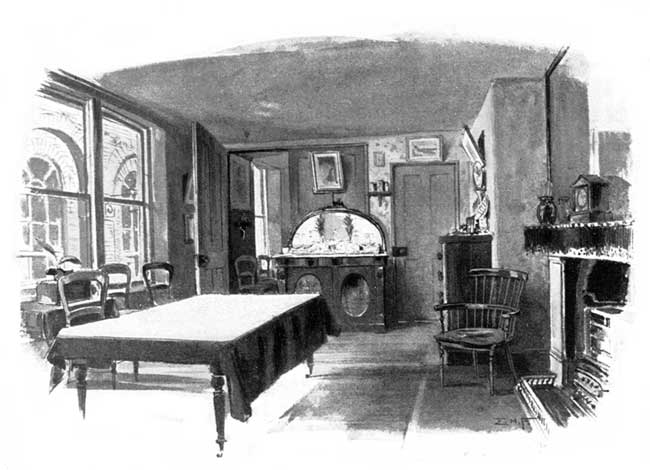 PUNCH'S FIRST DINING-ROOM, "CROWN INN," VINEGAR YARD.
Although, as I have said, conviviality and convenience were essentially identified with the Punch Dinner, especially in its embryonic stage, when frequent interviews were necessary and the daily occupations of many of the Staff precluded an earlier attendance, it was quickly seen that the chief practical use and effect of the Dinner was to broaden the men's view of things, to produce harmony of tone and singleness of aim, to keep the Editor constantly in touch with his whole Staff, and through them with the public; and thus to secure the fullest advantage which their combined wit and counsel could afford. When the transfer of the paper was completed from Ebenezer Landells to the house of Bradbury and Evans, the regular Dinners were soon established at No. 11, Bouverie Street, E.C., now given over to the Posts and Telegraphs. The second floor was considered not too undignified for the purpose; but the descent to the first was made in good time, Mark Lemon taking the vacated room for his editorial office; and when in 1867 a general removal was effected to No. 10, the present dining-room—or Banqueting-Hall, as it was finely called—was specially constructed for its high purpose. At first these repasts were held on Saturday night, when the paper was made up and sent away to press. But when the true value of the meetings became apparent, the day was changed to Wednesday. The Dinner was established ostensibly for the discussion and determining of the "big cut," and the function became as exclusive and esoteric as a Masonic initiation. From that day to this it has, with few exceptions, been held januis clausis; and beside it the Literary Ladies' Dinner and Bluebeard's Chamber are as open to the world and free from mystery as the public streets at noon.
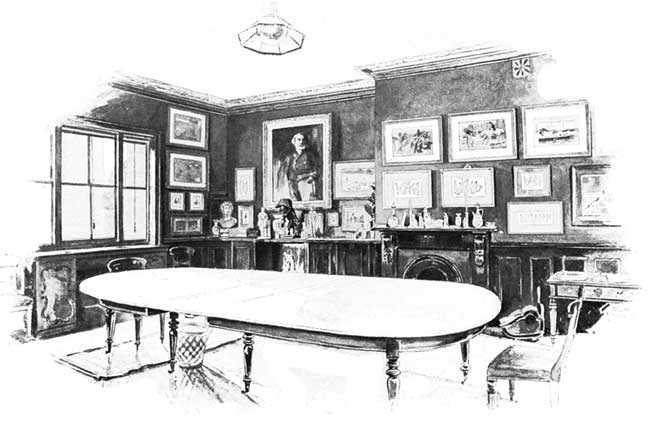 PUNCH'S PRESENT DINING-HALL IN BOUVERIE STREET,
WHITEFRIARS.
PUNCH'S PRESENT DINING-HALL IN BOUVERIE STREET,
WHITEFRIARS.
The room in which it was held, so long the Temple of the Comic Muse, had little in itself to command the attention of the superficial observer. The stairs which Thackeray trod, and which resounded to the quick light step of Jerrold and to the heavier tread of Leech, exist no longer; but the classic shrine is practically as it was when the "Fat Contributor," pushing roughly past the young 'prentice engraver who opened the door to his ring, gave no thought to him who[Pg 60] was soon to make the name of Birket Foster famous in the land.
 MARK LEMON'S MONOGRAM,
To-day a large—one might say an imposing—apartment on the first floor looking upon the street is approached, as most front offices in London City are approached, from a landing leading through an open office. Upon the table are a water-jug and a couple of goblets of cheap and distinctly unlovely Bohemian glass. A tobacco-box, hardly less ugly (coëval, one would say, with the room itself), a snuff-box, and long pipes serve to recall that respect for the past and for tradition which is one of the most delightful, as it is one of the most successful, elements in Punch's composition. Here you may see Sir John Tenniel's long churchwarden, with his initials marked upon it, and Charles Keene's little pipe—for these two men would ever prefer a stem between their teeth to a cigar-stump. Statuettes in plaster of John Leech and of Thackeray, by Sir Edgar Boehm, as well as a bust of Douglas Jerrold, decorate the mantelpiece or the dwarf-cupboard; and on the walls are many frames of abiding interest.
 PERCIVAL LEIGH'S MONOGRAM.
 JOHN LEECH'S INITIALS AND CYPHER.
Here you have the portraits of the four editors—that of Mark Lemon painted by Fred Chester, son of his life-long friend George Chester, and the likenesses of Shirley Brooks, Tom Taylor, and Mr. Burnand in photography. The portraits of the Staff, taken by Bassano in 1891 at Mr. William Agnew's request, to the number of fourteen or fifteen, hang separately in their dark frames. The original of one of Tenniel's Almanac designs; a masterly drawing, two feet long, by Keene, bought by the late Mr. Bradbury at a sale—the (unused) cartoon of Disraeli leading the principal financiers of the day in hats and frock-coats across the Red Sea ("Come along, it's getting shallower"); the[Pg 61] original of Leech's celebrated "Mr. Punch's Fancy Ball," and a series of the enlarged coloured prints of his hunting sketches; a caricature of Mr. Furniss by Mr. Sambourne, made in Paris; another of Mr. Sambourne by Mr. Furniss; and a third of Mr. Sambourne by himself; a caricature in pen-and-ink and colour of the Punch Staff marching along in Paris, by Mr. Furniss; a black-and-white sketch by the same artist of the same distinguished company in the train on the return journey; and another souvenir of the Paris trip by Mr. du Maurier, including the portraits of himself, Mr. Burnand, Mr. Arthur à Beckett, and Mr. W. Bradbury. The trophy-frame of specimen proofs of some of the finest of Swain's cuts of the artistic Staff's best work, gathered together for show in one of the great exhibitions, has been removed to make room for photographs of Gilbert à Beckett, "Ponny" (Horace) Mayhew, Charles Keene, Tom Taylor, Percival Leigh, Charles H. Bennett, R. F. Sketchley, John Henry Agnew, Thomas Agnew and William Bradbury, Mr. Fred Evans and Sir William Agnew; while photographic groups of the Staff and a fine autotype of Thackeray complete the wall decoration of one of the most interesting apartments in London City.
 W. M. THACKERAY'S MONOGRAM
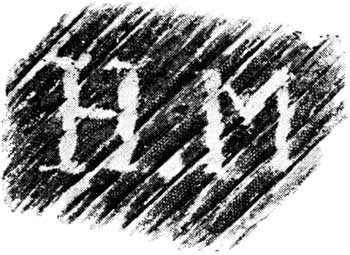 HORACE MAYHEW'S INITIALS.
And in the corner, on the locker farthest from the street, besides a little papier-mâché figure of a Japanese Punch—sent by an admirer in the Land of the Rising Sun—and a group charmingly modelled from Sir John Tenniel's beautiful cartoon of "Peace and the New Year," stands the statue of the[Pg 62] Great Hunchback himself, which in a fit of enthusiasm a young German sculptor, named Adolph Fleischmann, wrought and presented to the object of his admiration. It is a work of no little grotesqueness and ingenuity (well modelled and coloured, and fitted with springs that permit of the working of arms and eyes and head), which, endowed with a white favour, has played its part in the decoration of the publishing office on the occasion of certain royal weddings and public rejoicing, and during the blocking of Fleet Street has been utilised in the direction of comic self-advertisement.
Then there is a real "Royal Patent" appropriately framed, "hereby appointing Master Punch unto the Place and Quality of Joke Maker Extraordinary to her Majesty," duly signed and sealed by the Lord Chamberlain, and countersigned "J. A. N. D. Martin." It is undoubtedly a genuine certificate—up to a point; but how it was obtained, and how Punch's name came to be filled in, remains to this day a mystery. Such is the room, with its pleasant decoration of red and black and gold, with its large windows and its sunlight gaselier; but, take it for all in all, it is about as unlike Mr. Sambourne's classic representation of the Roman atrium in his Jubilee drawing as well could be imagined.
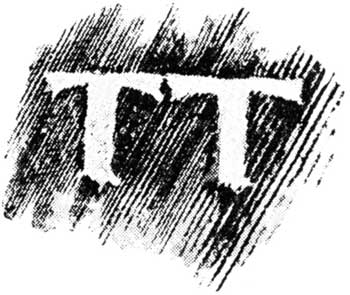 TOM TAYLOR'S INITIALS
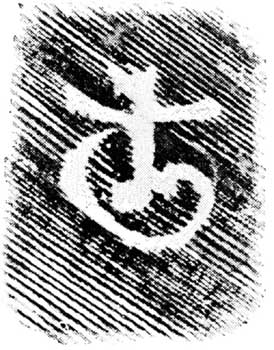 SIR JOHN TENNIEL'S MONOGRAM.
And the Table itself—the Table—the famous board of which we all have heard, yet none, or but very few of us, have seen—I myself amongst the fortunate few! As a piece of furniture this hospitable, but rather primitive, piece of joinery is not of much account, the top being of plain deal (pace Thackeray's "Mahogany Tree"), oblong in shape, with rounded ends. But its associations render it a treasure among treasures, a rich and priceless gem. For at this Table nearly every man upon the Staff has, from the day it was[Pg 63] made, sat and carved his initials upon it with a penknife, when officially elevated to Punch's peerage. As each has died, his successor has taken his place—just as the Institut de France creates Immortals to fill the chairs made vacant by death—and he has cut his initials or his mark close by those of the men who occupied the place before him. There they are, staring at you from the Table like so many abecedarian skeletons at the feast; and if you take a furtive and hasty peep from the doorway and lift the green protective cloth you catch sight nearest you of a "D. M." in close company with a beautifully-cut "W. M. T." and a monogrammatic leech inside a bottle flanked by a J. and an L.; and you gaze with deep interest on the handiwork of them and of the rest, many of whom have carved their names, as on that Table, deep into England's roll of fame; and of others, too, who, with less of genius but equal zeal and effort, have a strong claim on the gratitude and the recollection of a kindly and laughter-loving people.[7]
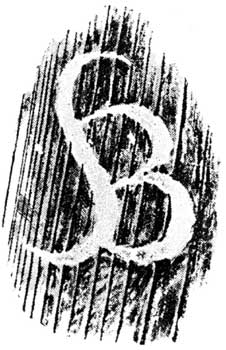 SHIRLEY BROOKS' MONOGRAM.
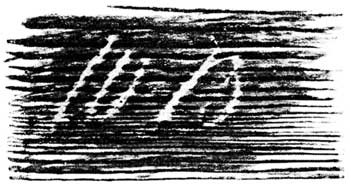 WILLIAM BRADBURY'S INITIALS.
For more than forty years, then, this Table has week by week, with few exceptions, been surrounded by the Staff of the day; and the chair, the self-same old-fashioned wooden editorial armchair, has been filled by the reigning Editor. "With[Pg 64] few exceptions," I said; for Bouverie Street has not invariably been the hatching-place of the Cartoon, nor have its walls resounded with absolute regularity to the laughter and the jests of the merry-makers. During the summer the Dinner has been, now and again, and still is, held at Greenwich, at Richmond, Maidenhead, or elsewhere—Hampton Court and Dulwich rather frequently of old, as well as once at Harrow, and sometimes at Purfleet, Windsor, and Rosherville. Sometimes, when occasion has demanded—in the "dead season," maybe, when the attendance at the Table has dwindled, though for no sustained period (it is even on record that the "Dinner" has consisted of a tête-à-tête between Sir John Tenniel and Mr. Arthur à Beckett)—not more than three or four consecutive weeks, certainly—the "Sussex," or more often the old "Bedford Hotel," or latterly the "First Avenue," has been the scene of the feast; while "special dinners" (and they have been many) have been held in special places. And not invariably has the weekly repast been a "dinner" at all, be it observed; for on certain rare occasions, when some important Parliamentary matter has intervened, a luncheon has been held instead. Once, in September, 1845, it was postponed from the Saturday night at the intercession of Charles Dickens, so that a new play by Macready might be produced with the full advantage of the Punch men's presence. And the Dinner was once more made a movable feast, and was held on the Tuesday instead of the Wednesday, on the occasion of the production of Mr. Burnand's and Sir Arthur Sullivan's opera of "The Chieftain" in December, 1894.
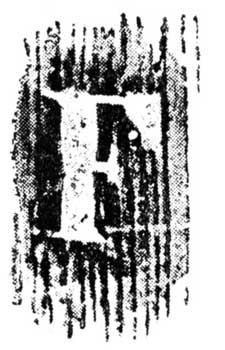 F. M. EVANS' INITIALS.
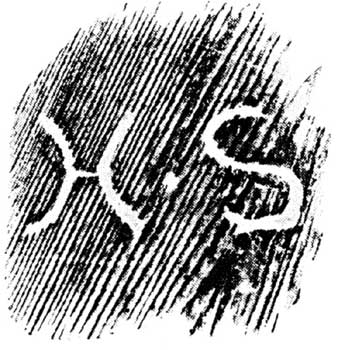 HENRY SILVER'S INITIALS.
In the "Bedford Hotel"—beloved of Thackeray, for in it he wrote much of "Henry Esmond," and stayed there when[Pg 65] his house was in the painters' hands—the room occupied was that known as the "Dryden." Here the Staff would make no attempt at self-repression; and I have been told how the idle and the curious would congregate outside upon the pavement and listen to the voices of the wits within, and wait to gape at them as they passed in and out.
The places at Table once occupied by the members of the Staff are nowadays regarded as theirs by right. But in earlier days the places were often shuffled, as at a game of "general post." Proof of it may be had from the following plans of the Table between 1855 and 1865—perhaps the most interesting years in the history of Punch, as demonstrating the transitional stage, when the ancient order of things was rapidly developing into the modern as we know them to-day. In 1855, then, the disposition was as follows:—
| William Bradbury* | |
| Douglas Jerrold | John Leech |
| Tom Taylor | W. M. Thackeray |
| Gilbert à Beckett | Shirley Brooks |
| Horace Mayhew | Mark Lemon |
| Percival Leigh | John Tenniel |
| F. M. Evans* | |
—only two artists and a half (Thackeray being a commixture of writer and draughtsman) to seven writers and a half!
Five years later—in 1860—the places had changed, partly through death, partly through rearrangement:—
| William Bradbury* | |
| W. M. Thackeray (when he came) | John Leech |
| Tom Taylor | Henry Silver |
| Horace Mayhew | Charles Keene |
| Shirley Brooks | John Tenniel |
| Percival Leigh | Mark Lemon |
| [Pg 66]F. M. Evans* | |
Here the artistic element is seen to be asserting itself to some extent, the proportion between artist and writer being further readjusted after the lapse of another five years: for in 1865 the constitution of the table became—
| F. M. Evans* | |
| Tom Taylor | G. Du Maurier |
| W. H. Bradbury* (his father seldom came now) | Henry Silver |
| Horace Mayhew | Charles H. Bennett |
| Charles Keene | F. M. Evans, Jr.* |
| F. C. Burnand | Shirley Brooks |
| Percival Leigh | John Tenniel |
| Mark Lemon | |
—the Editor for the first time taking his proper place at the table, although, it is true, it was only at the foot.
To-day the number of the staff has been increased, and the right proportion struck between the pen and the pencil—the Editor, too, presiding.
| Mr. F. C. Burnand | |
| Sir John Tenniel | Mr. F. Anstey |
| Mr. Linley Sambourne | Mr. Henry Lucy |
| Mr. Arthur à Beckett | Mr. E. T. Reed |
| Mr. R. C. Lehmann | Mr. Bernard Partridge |
| Mr. Harry Furniss (until Feb. 1894) | Mr. Phil May |
| Mr. Du Maurier | Mr. E. J. Milliken |
| Sir William Agnew (sometimes) | |
| Mr. Lawrence Bradbury or | |
| Mr. Philip Agnew | |
* Proprietors
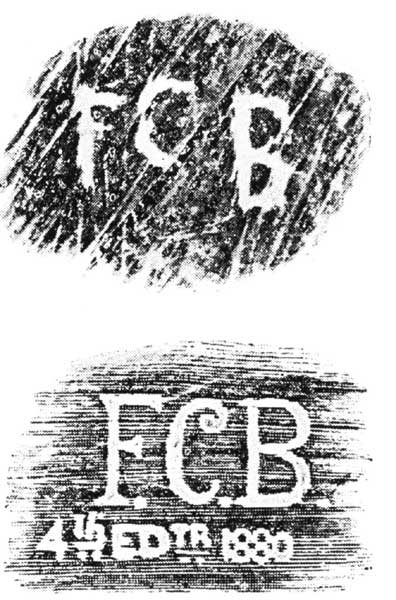 F. C. BURNAND'S INITIALS.
In the decade or so following the death of Douglas Jerrold—roughly corresponding with the period within which the arrangements varied as I have shown—six new appointments were made to the table. These Were: Mr. Henry Silver, In August, 1857; Charles Keene, February, 1860 (after a nine years' probationership); Mr. F. C. Burnand, June, 1863; Mr. G. Du Maurier, November, 1864; Charles H. Bennett, February, 1865 (though ill-health prevented him from taking his place[Pg 67] until the following June); and Mr. R. F. Sketchley (till 1894 of the South Kensington Museum), January, 1868. The present Staff, I may add, since Mr. du Maurier's accession, have taken their places at the Table in the following order: Mr. Linley Sambourne, Mr. Arthur à Beckett, Mr. E. J. Milliken, Gilbert à Beckett, Mr. Reginald Shirley Brooks (until 1884), Mr. Henry Lucy, Mr. F. Anstey, Mr. R. C. Lehmann, Mr. E. T. Reed, Mr. Bernard Partridge, and in February, 1895, Mr. Phil May. As Mr. Punch approached man's estate, and arrived at years of artistic discretion, he cultivated a pretty taste in epicurism; until to-day, if report be true, the Dinners (prepared and sent in by Spiers and Pond), the Ayala, and the cigars, are all worthy of the palates of the men whose wit it is theirs to stimulate and nourish. To summon the Staff to these feasts of reason it was in later years the practice to issue printed notices, which after 1870 were superseded by invitation cards drawn by Mr. du Maurier—the design representing Mr. Punch ringing his bell, while the faithful fly hurriedly to respond to the behest. But owing to the number of portraits it contained of old friends now departed, and the painful recollections it consequently aroused, its later use has been discontinued.
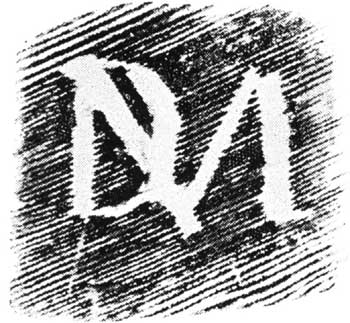 GEORGE DU MAURIER'S MONOGRAM.
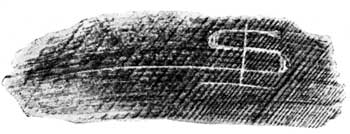 LINLEY SAMBOURNE'S MONOGRAM.
But when our Democritus boasted fewer years, there was not so much ceremony in his banquet, neither was there so much state; nor was the friendship less keen or the intimacy less enjoyable in Leigh's humbler days[Pg 68] of "off-n-off." A wonderful company—a brilliant company; with flashing wit and dazzling sallies, with many "a skirmish of wit between them." From more, the quieter flow of genial humour. And among the rest, the listeners; men—some of them—who prefer to attend than to talk, even to the point of reserve and almost of taciturnity. Such men were John Leech, Richard Doyle, and Charles Keene—whose silence, however, masked subtle minds that were teeming with droll ideas, and as appreciative of humour as the sprightliest. What jokes have been made, what stories told that never have found their way into print! What chaff, what squibs, what caricatures—which it surpasses the wit of a Halsbury or a MacNeill to imagine or condone!
Of what the Punch Dinner was at the time when Thackeray was still of the band, an idea may be formed from the following extract from Mr. Silver's Diary, with which I have been favoured by the writer, who for several years sat at it by right. He calls it—
"A NIGHT AT THE ROUND TABLE."
Scene: Mr. Punch's Banquet Hall at No. 11, Bouverie Street.
Time: Wednesday, March 2nd, 1859, six o'clock p.m.
F. M. EVANS W. M. THACKERAY JOHN LEECH HORACE MAYHEW TOM TAYLOR SHIRLEY BROOKS HENRY SILVER PERCIVAL LEIGH JOHN TENNIEL MARK LEMON 'Turbot and haunch of venison—what a good dinner!' says Tenniel, reading menu. Tantalising to Tom Taylor, who has to dine elsewhere; and Thackeray leaves early, to go to an 'episcopal[Pg 69] tea-fight,' as he tells us—a jump 'from lively to severe,' to Fulham Palace from the Punch Table.
CHARLES KEENE, R. F. SKETCHLEY,
F. C. BURNAND, SHIRLEY BROOKS, TOM TAYLOR, HORACE MAYHEW, PERCIVAL LEIGH
G. DU MAURIER, JOHN TENNIELPUNCH DINNER INVITATION CARD. DRAWN BY G. DU MAURIER.
Tom merely looks in 'to hear what you fellows say about the Reform Bill,' which Dizzy introduced on Monday. So we begin discussing politics even with the venison. 'Ponny' Mayhew condemns the Bill: does nothing for the working man, he says. Tom thinks that people look to Punch for guidance, and that we ought to be plain-speaking, and take a decided course. 'Professor' Leigh and Mark agree in thinking that we rather should stand by awhile, and see how the stream runs. All seem of opinion that Walpole acted as a man of honour in resigning, not being rich enough to make money of no matter to him.
'Seria mista jocis' being Mr. Punch's motto (though it never has been sanctioned by the Heralds' College), Shirley, apropos of money, asks, 'Why is Lord Overstone like copper?' 'Because he is a Lloyd with tin.' Whereat Thackeray laughs heartily.
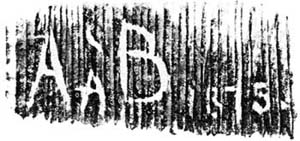 ARTHUR À BECKETT'S INITIALS.
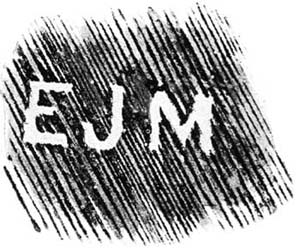 E. J. MILLIKEN'S INITIALS.
Odd that there should now be three old Carthusians in[Pg 70] Mr. Punch's Council of Ten. Thackeray observes this to the other two of them [J. L. and H. S.], and proceeds to say, 'I went to Charterhouse the other day. Hadn't seen School come out since I left. Saw a touching scene there—a little fellow with his hands held tenderly behind him, and a tear or two still trickling down his rosy cheek, and two little cronies with their arms around his neck; and I well knew what had happened, and how they'd take him away privily, and make him show his cuts!'
'Talking of cuts, Mark, how about the Large one?' Thackeray suggests Lawyer, Doctor, and Schoolmaster, standing in a row as prize boys, and Dizzy presenting them with votes. I propose Diz trying to launch a lop-sided 'Reform' ship, with the title 'Will it Swim?' Mark suggests D. joining hands of artisan and yeoman, giving each of them a vote. Thackeray thinks of workman coming among gentlemen of Parliament and asking, 'What have you done for me?' Professor Leigh considers situation might be shown by Bright and Dizzy poking up the British Lion, for clearly he wants rousing. 'Yes,' says Shirley, 'and when he's roused, you know, we can have another picture of him with his tail and monkey up.' Idea gradually takes shape, and is approved,[8] though Tenniel hardly likes it, and Leech wants to know if Ponny (Mayhew) would not prefer a good old-fashioned tragic cartoon of the virtuous and starving British Workman, with ragged wife and children, and Death a ghastly apparition in the background.
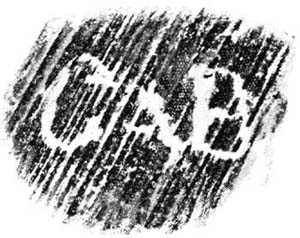 GILBERT À BECKETT'S INITIALS.
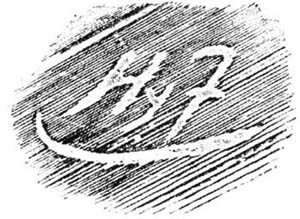 HARRY FURNISS'S INITIALS.
This leads to a little spar between Ponny and 'Pater' Evans. Ponny lets fly with great vigour: 'Punch is standing still now; used to take the lead, but no longer dares to do so. Avançons!'[Pg 71] waving hand excitedly. Pater calmly answers that the times are altered, and that Punch is going with them. Strong words have done their work, and there's no longer need of them. Nobody now talks about the trampled working man, nor goes trumpeting abroad the dignity of labour. Then Ponny shifts his ground, and complains that many clever fellows who are workers with the pen are now hardly earning more than many workers with the pickaxe. 'Well, it's their own fault,' says Pater; 'they might easily earn more if they were not so idle.' Penny replies they don't want luxuries, being men of simple tastes, and anything but Sybarites. 'So am I,' cries Leech; 'my tastes are very simple. Give me a good day's hunting, and some good claret after it—nothing can be simpler, and I'm really quite contented.'
But Ponny harks back to his 'deuced clever fellows,' applauding one of them especially, a Bohemian friend of his, who, he says politely, is far cleverer a fellow than any at the Punch Table. 'But what has he done?' asks Leech. 'Tell you what he doesn't do,' says Shirley; 'he may write a lot, but he certainly doesn't wash much.' Somebody wonders, if he were proposed for White's Club, whether members would blackball him: and Shirley quotes Charles Lamb's remark, 'What splendid hands he'd hold, if only dirt were trumps!' Then Ponny shouts indignantly, 'There, never mind his hands: think what a clever head he has.'
Here Professor gives a little lecture on phrenology, impelled thereto by Penny's capital allusion. Talking like a book, as his frequent manner is, he expounds in fluent phrase his deeply-rooted faith in this neglected science. To give idea of its importance, he vows he wouldn't keep a housemaid who had a bad head. 'No more would I,' says Shirley; 'I'd send her to the doctor.' 'I mean, a head ill-shapen,' explains Professor blandly, being 'the mildest-mannered man that ever cut a throat'—in argument. 'A well-proportioned head[Pg 72] betokens a fine brain: whereas a skull that is cramped contains probably a mean one.' Avows belief not so much in the localisation of organs as in their general development. Here Leech, who hates street music, professes horror at the possible development of organs, and wishes they were localised where nobody could hear them. Paying no heed to this flippancy, Professor explains gravely that peculiar formations incline to special acts, and that the development of certain cranial organs—vulgarly termed 'bumps'—may be lessened or augmented in the course of early schooling. 'Well, I do believe in "bumps,"' says Shirley, speaking with solemnity, 'yes, even in schoolboys' heads—if you knock them well together.'
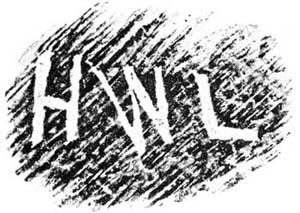 H. W. LUCY'S INITIALS.
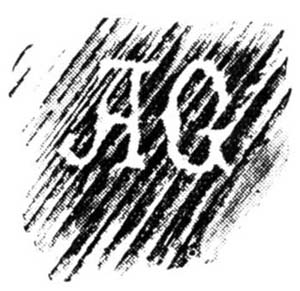 ANSTEY GUTHRIE'S INITIALS.
Mark next has an innings, and tells some of his stage stories. He tells them very funnily, and imitates Macready and many other actors in their vocal mannerisms. And he mimics operatic singers capitally, with sonorous words in mock Italian basso recitative. Among his tales is one of a half-tipsy actor playing in the 'Corsican Brothers' and explaining their fraternal peculiarity—'My brother in Paris is now feeling—hic—precishly shame senshations—hic—as myshelf!' Also tells of his once bringing out a farce called 'Punch' at the Strand Theatre, wherein a parrot played a prominent part. One night a new parrot took its place, and used most dreadful language when the curtain rose.
Story-telling being now the order of the evening, Silver tells of the gun trick being tried in the Far West. One day, just as the conjuror had caught the bullet in his teeth, another whizzed close to his head, and a voice came from the gallery, 'Guess, I nearly had you then, old hoss!' At the next performance a placard was displayed, and gentlemen were begged to leave their rifles with the doorkeeper. Shirley enjoys this, and says, 'Now, don't cry "connu" Ponny! You're always crying "connu" when anyone says anything. And you're always cracking up your chums. If a world was wanted anywhere, you'd say your brother had discovered one and had better be consulted.'
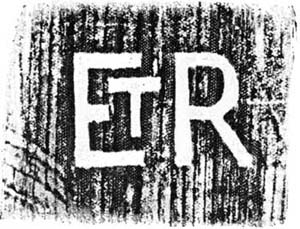 E. T. REED'S INITIALS.
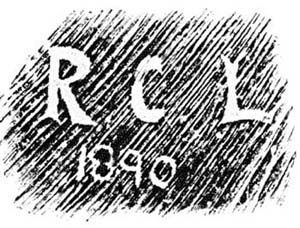 R. C. LEHMANN'S INITIALS.
Ponny then breaks out again with his bilingual vehemence[Pg 73] and Parisian gestures. (Some people never can talk French without trying to shrug shoulders.) Brandishing his dessert-knife, he shouts, 'Avançons, mes amis! go ahead, my boys! En avant! Excusez-moi,' and scatters scraps of French about, till Leech cries, 'There, don't talk like a lady's-maid, Ponny; why can't you speak English?' And, to change the talk, he tells of a French sport'man taking his first fences here, with rather a fresh horse which has been lent him. After coming a couple of bad 'croppers,' which he conceives to be the usual style of leaping here in England, he says a little sadly, 'My friend, I t'ank you for your 'orse, bot I t'ink dat I s'all jomp no more at present.'
Somebody caps this with tale of a 'Mossoo' who manifests deep sorrow at the death of an old hare, slain by an English visitor. 'Hélas! il est mort enfin! Mon pauvre vieux! I have shot at him for years! He was all the game I had!'
And Leech tells another story of a foreigner of distinction hunting in the Midlands, and hearing the cry 'Stole away!' and shouting out excitedly, 'Aha, stole a vay, has he, de old t'ief! Den I suppose we s'all not find a vay to him, and so we must go home!' ... Which we do.
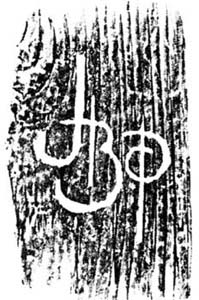 J. BERNARD PARTRIDGE'S INITIALS.
Thus, for half a century has Wednesday evening been passed in the editorial office of Punch, just when its readers are discussing the merits of the previous week's issue; and according to the verdict of those readers was attuned the merriment of the Staff. It is on record how Douglas Jerrold would go radiant to the Dinners as "Mrs. Caudle" was sending up Punch's circulation at a rapid rate; "and was one of the happiest among them all." Thackeray, too, first tasted the delights of wide popularity in the success of his[Pg 74] "Snob Papers," and he showed the pleasure he felt in his demeanour at the board. At one time these two men sat side by side, and there was as little love as space between them; but with the good-humoured philosophy which is a tradition of that institution, the occasional differences of opinion, and the harder knocks of wit, and sometimes, even, the still sharper encounters of temper, were all glossed over. As Thackeray so truly remarked himself—"What is the use of quarrelling with a man if you have to meet him every Wednesday at dinner?" Nevertheless, in course of time he changed his seat from between Jerrold and Gilbert Abbott à Beckett, and, crossing over, faced his friend the enemy, while Mark Lemon, watchful and alert beneath the cloak of geniality, was quick to cast a damping word on inflammable conversation and—so far as he could persuade them to listen to a man so greatly their inferior in genius and intellect—to stem the threatened outburst. As a matter of fact, Jerrold always regarded Thackeray as a bit of a snob and viewed his entrance into Society—against which Jerrold had for years been hurling his bitterest darts—with very grave suspicion. "I have known Thackeray," he would say, "for eighteen years, and I don't know him yet"—almost in the despairing words in which I have heard a distinguished Academician speak of his still more distinguished President. On the other hand, Mr. Arthur à Beckett has declared to me, "I never knew my brother so well as when I met him at the Punch Table."
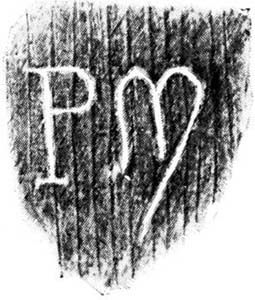 PHIL MAY'S INITIALS.
 COMMENCEMENT OF
In the earliest weeks of Punch's existence Kenny Meadows had been the Nestor of the least; but when Jerrold joined the Staff three months later, he took by force of character and wit, and power of lung, a leading position[Pg 75] on the paper and at the Table—a position which he never resigned. Notwithstanding his biting sallies, we may be sure that it was not Jerrold's primary object to make his victims wince. There is no doubt that the "little wine" that so stimulated him to witty and brilliant conversation full of flash and repartee, sometimes turned sour upon his lips, and changed the kindness that was in his heart into a semblance of gall. Mr. Sidney Cooper has gravely set it on record how on leaving the Punch Dinner Jerrold would tie a label with his name and address upon it round his neck, so that, should he in his homeward course be tempted to stray into the path of undue conviviality, he might sooner or later be safely delivered at his destination. Although the statement is in a measure confirmed in the memoirs of Hodder and of Blanchard Jerrold himself, one cannot help being struck at the conflict between it and the story of Jerrold's reply to the drunken young sparks who met him in the street at midnight, and asked him the way to the entertainment known as "Judge and Jury"—"Straight on, straight on as you are going, young gentlemen—you can't miss them!" He was himself greatly pleased with his milder witticisms, and, it is said, chuckled complacently at the neatness of his conceit when toasting Mr. Punch, at one of the Wednesday Dinners, in which he declared that "he would never require spirit while he had such good Lemon-aid." He loved the paper as few others loved it, and very, very rarely missed the weekly gathering—attending it, indeed, up to within a week or so of his death.
Not less scrupulous in his attendance was Gilbert Abbott à Beckett, who, when residing at holiday-times at Boulogne, would regularly come up to town for their Cabinet Council; and if ill-chance unavoidably prevented his wished-for presence, he would write—after the custom adopted by many of his colleagues—a full explanation and apology. But the necessity very seldom arose. True son of his father, Gilbert à Beckett was equally faithful to the Table, and in[Pg 76] spite of the paralysis of the legs from which he suffered (and for which he was for a time duly chaffed by the advice of Percival Leigh, lest there might be hysteria about the disease) he attended the Wednesday gatherings with what regularity he could up to within a fortnight before he died. Thackeray, too, for many years after he ceased writing for Punch would weekly join the Staff, and always received a cordial and affectionate welcome. The gentle Leech—who, according to Shirley Brooks, attended the Dinner for more than twenty years without uttering an unkind or an angry word—was at the Table within a few days of his death, but, in Brooks's words, "scarcely seemed to understand what was going on." And yet another member of the Old Guard, who stood by his post to the end, was "The Professor," Percival Leigh, whose sense of wit was dulled with age, but whose mind was otherwise as bright as ever. But at the Dinners the genial, courteous old gentleman was listened to, as ever, with deference by his younger collaborators, and from them he never had cause for suspicion that his powers were failing—
Another of Punch's favourite sons was Charles H. Bennett. His life was a hard yet happy one, and his career was short, though not too short for fame; and the last two years during which he sat at the Table were perhaps the merriest of them all. But his attendances, really owing to the illness which ultimately bore him down, were irregular. This irregularity, combined with his habit—then commoner even than now among artists—of wearing his hair very long, brought him one day a letter from his friends and fellow-diners in the following terms:—
| Present | Lemon | W. H. Bradbury |
| Evans | G. du Maurier | |
| Horace Mayhew | Evans Fils | |
| Tom Taylor | S. Brooks | |
| Leigh | Tenniel[Pg 77] |
That this meeting deeply sympathises with C. H. Bennett on the state of his hair.
That this meeting appreciates the feeling which detains the said Bennett from the Council until his hair shall have been cut.
That this meeting deplores the impecuniosity which prevents the said Bennett from attending a Barber.
That this meeting, anxious to receive the said Bennett to its bosom, once more organises a subscription to enable him to attend the said Barber.
That this company, having (limited) confidence in Mr. Mark Lemon, entrusts him with the following subscriptions in aid of the above object, and requests him to communicate with the aforesaid Bennett to the end that he may have his dam hair cut and rejoin the assembly of the brethren.
| £ | s. | d. | |
| (Signed) Mark Lemon | 0 | 0 | 1 |
| Frederick Evans | 0 | 0 | 1 |
| Percival Leigh | 0 | 0 | 1 |
| Horace Mayhew | 0 | 0 | 1 |
| Tom Taylor | 0 | 0 | 1 |
| W. H. Bradbury | 0 | 0 | 1 |
| George du Maurier | 0 | 0 | 1 |
| F. M. Evans | 0 | 0 | 1 |
| Shirley Brooks | 0 | 0 | 1 |
| J. Tenniel | 0 | 0 | 1 |
| ——————— | |||
| Stamps enclosed | £0 | 0 | 10 |
And these ten penny stamps, together with the letter, are to this day treasured by the artist's son.
It was not surprising that Bennett was missed; his animal spirits and his bright good-humour counted for a good deal at the Table; and when he died, his colleagues organised elaborate theatricals and collected a large sum for those whom he loved and left behind in the pinch of poverty.
If for some time before his death Charles Keene deserted the dinner-table, it was owing, as he has himself confessed, in no slight measure to political motives which developed[Pg 78] about the time of the Russo-Turkish War. Keene was what Tories call a patriot and Liberals a "Jingo;" and in his quiet way he felt so deeply that he thought it best to stay away—not that he loved Punch less, but he loved his convictions more. "I am sorry to say," he wrote, with doubtful accuracy, "Punch is 'Musco' to a man except C. K., so he keeps away from that Liberal lot at the present conjunction." There certainly was, however, another reason, quite independent of politics, which kept Keene from the Table during the latter years of Mr. W. H. Bradbury's life. He was not, as his biographer, Mr. Layard, has pointed out, of much use in suggestion at the business function of the Dinner, and he looked less to his colleagues than to his friends outside for the jokes to which he drew his pictures; so that his presence was not a necessity. Nevertheless, he would attend, now and again, until age began to tell upon him; and his companions love to think of him, clutching his short-stemmed pipe to his mouth, puffing gravely, saying little, thinking much, quick at appreciating a joke, slow at making one, with an eye full of humour, and its lid and corresponding corner of his mouth quickly responsive to any quip or crank that might let fly. Eclectic in his humour as in his art, disposed to condemn any cartoon suggestion not thoroughly thought out as "damn bad," he was in the weekly assembly at the Table like the 'cello in the orchestra—not much heard, yet when there indispensable to the general effect and the general completeness, even though he only went "for company."
I have lingered, perhaps unduly, over the social side of the Punch Dinner, for the company is of the best, and the subject an entertaining and a pleasant one. But serious business has to be discussed and transacted—and transacted it is, whatever jokes and ebullitions of bonhomie may form the running accompaniment to the work in hand. In Mark Lemon's time the Dinner began at "six sharp," and in Shirley Brooks's and Tom Taylor's a half-hour later; but when Mr. F. C. Burnand took up the reins of power, the hour was advanced to seven o'clock, and on its stroke the Staff are generally found in their places. From all parts they come, just as their predecessors used to speed from Boulogne, from[Pg 79] Herne Hill, and from the Isle of Wight, so that their absence should not be felt nor their assistance lacking at the Gathering of the Clan. Sir John Tenniel comes from Maida Vale, most likely, or from some spot near to London—which he has hardly quitted for a fortnight together during the last forty years, save when, in 1878, he went to Venice with Mr. Henry Silver and left Charles Keene malgré lui as cartoonist-in-chief. Mr. Sambourne arrives, perhaps, from a yachting expedition or from the moors; Mr. du Maurier from his beloved Whitby or from a lecturing tour; Mr. Lucy hurries in from the House of Commons; Mr. Furniss, up to the time of his resignation, from some distant spot where he "entertained" last evening, and whence he would expect to be three hundred miles away on a similar errand on the morrow. But not for some time past, it must be said in passing, had either Mr. du Maurier or Mr. Furniss been so regular at the Table as in earlier days—Mr. Furniss by reason of his touring, and Mr. du Maurier on account of the distance of his home, and the evil effect of tobacco-smoke on his eyes and nerves.
Then when dinner is over and coffee finished, and paper and pens brought in—at half-past eight, as near as may be—the cigars come on and the waiters go off (including at one time the crusted Burnap, an original worthy of "Robert" himself); and not more rigidly was the Press excluded from the Ministerial Whitebait Dinner in the good old times, than are Cabinet Ministers interdicted from the Dinner of Mr. Punch to-day. Then the Editor, who has been presiding, invites ideas and discussion on the subject of the "big cut," as the cartoon is commonly called; and no two men listen more eagerly to the replies—suggestions that may be hazarded, or proposals dogmatically slapped down—than Mr. Burnand, who is responsible for the subject, and Sir John Tenniel, whose duty it will be to realise the conception. The latter makes few remarks; he waits, reflects, and weighs, thinking not so much, perhaps, of the political or social, as of the artistic possibilities of the subjects as they are brought up, and other points that recommend themselves[Pg 80] both to the artistic and literary members of the Staff. All the while, perhaps, the Editor has a fine subject up his sleeve, and only brings it forth when the discussion has begun to wane. Or a proposal may be made at the very first by one member of the Staff that is accepted at once with acclamation—an event, however, of the utmost rarity; or again, as is usually the case, the final decision may be gradually and almost painfully evolved from this symposium of professional wits and literary politicians. This is the time when the men are apt to lay bare their political beliefs (if any such they have) or their lack of them; and I wager that if poor Keene could once more be present at a Punch Dinner, he would no longer charge it against the Staff that it is "'Musco' to a man."
Indeed, at the present time Punch may be considered to represent the old Whig feeling. Sir John Tenniel, Mr. Anstey, and Mr. Arthur à Beckett are credited with Tory bias; Mr. Milliken, Mr. H. W. Lucy, Mr. R. C. Lehmann, and Mr. Reed represent the Radicals; Mr. Sambourne is Unionist; and Mr. Burnand, as behoves him who holds the scales, confesses to no political sympathies or antipathies whatever.
Thus the subject of the cartoon is settled—often by the aid of the latest editions of the evening papers; and being once settled, is very rarely revived on any pretext whatever. On one occasion, however, when Mark Lemon was Editor, and Shirley Brooks was recognised as the best suggestor, an exceptional incident took place. The subject was duly decided upon, and Brooks went home. After he was gone, and none but Mark Lemon, Charles Keene, Sir John Tenniel, and Mr. Henry Silver were left, Keene, to the surprise of the rest, made a suggestion in connection with the American War then being waged, that was immediately accepted as vastly superior to that which had previously been adopted; and the future Editor was much astonished as he opened his paper on the following Tuesday and his eyes fell on a different and wholly unexpected cartoon. Yet, though Brooks was practically the Suggestor-in-Chief, it would be unfair to pass over the curious fitness of Leech's[Pg 81] proposals. They were always marked with equal judgment and taste, and, as it was admitted, his suggestions invariably were "just right."
When the "big cut" has been decided on, the question of a single-page or double-page engraving sometimes comes up; and then the legend has to be settled. This (irreverently known as "cackle" by those who produce it) is largely the work of Mr. E. J. Milliken, who nowadays occupies a good deal of Shirley Brooks's old position of "suggestor," and who, like him, is living testimony of the truth of John Seddon's saying that "wit and wisdom are born with a man." For many years Mr. Milliken has suggested the greater number of the cartoons, and he is generally the first asked for a proposal for Sir John Tenniel's cut. He usually has several subjects, carefully considered and as carefully written out, in his pocket-book, and fitted with peculiarly felicitous quotations. He is also mainly responsible for the Almanac cartoons—subjects for both the great Punch satirists—Sir John, and Mr. Linley Sambourne. All, however, share with him the duty and the credit of the difficult art of cartoon-suggesting, and, no matter by whom it may be proposed, no subject is passed without full discussion. Every possible objection is heard and considered. Although Mr. Milliken may bring in his Bill, amendments are always proposed, and are either rejected or carried; and then the Bill as amended becomes the subject of the cartoon. The title and legend are written on a piece of paper, which, enclosed in an envelope, is then handed over to the cartoonist. It was at this moment that Shirley Brooks used to throw down his knife in order to "cut" any further discussion, and after that symbolic act a more desultory conversation on the other men's work would follow. Not on Leech's, however; for he was left greatly to himself—a piece of masterly inactivity and non-interference on the Editor's part which speaks volumes for Lemon's prudence and shrewd discrimination.
Under Mr. Burnand's régime the course of events is a little altered. For even while Sir John has begun to think out the composition and the technical details of the subject[Pg 82] which the Council has determined, and is scheming maybe in his own mind how best he may arrange his figures so that when he draws them the heads will not come across a join on the wood-block where its segments are screwed together; or, again, how so to arrange an exceptionally elaborate subject that Mr. Swain may still have it ready for engraving in good time on the Friday evening, the attention of the Staff is now turned to the "Cartoon junior"—the second cartoon—to which for some years Mr. Linley Sambourne has been giving some of the finest and most ingenious work of his life. This is discussed somewhat like the first, and often enough raises the draughtsman's interest in the work he has to do to a point of genuine artistic enthusiasm. But there appears to be no finality about the second cartoon so far as the Dinner is concerned, and it is no unusual thing in lively times for the subjects to be given at the last moment by telegram to Mr. Sambourne; so that his condition of mind during the Thursday following the Dinner may not inaptly be compared to that of an anxious fireman waiting for a "call." The contributions of the rest of the artistic Staff—Mr. du Maurier, Mr. Bernard Partridge, and Mr. E. T. Reed—do not form the subject of Wednesday's cogitation; nor is it true, as has publicly been stated, that when jokes fail it is customary to draw them from a pot into which, written on slips of paper, they have been deposited on the many occasions when Mr. Punch's cistern of wit has overflowed into the jar in question.
Such is the simple function of "the Punch Dinner." The Editor presides—or, in his absence to-day, Mr. Arthur à Beckett, just as it was Douglas Jerrold and Shirley Brooks in Lemon's time, and Tom Taylor in Brooks's (the duty of vice- or assistant-editor never falling to an artist)—inviting suggestions, "drawing" his artists, and spurring his writers, with rare tact and art; and he challenges comparison with any of his predecessors, just as Sir Frederic Leighton excels all previous Presidents of the Royal Academy. Some of those who sit around the Table, as I have already set forth, have attended for many years; and it is they who secure to Punch[Pg 83] that quality of tradition and healthy sense of prestige which strengthen him against every assault, whether of man or of Time himself. To this traditional sense of ancient glory and present vigour Sir John Tenniel has of course contributed more than any other living man; not Leech, nor Thackeray, nor Jerrold, nor Doyle, served Punch more loyally or effectively, and he has secured that the dignified spirit of the paper has suffered no deterioration. To him it falls, also, to see that the subjects of cartoons are not repeated. The tenderness of the Staff for the honour, good name, and pre-eminence of Punch is delightful and touching to behold; the sentiment of a great past animates them all, and kindles in them the hope and ambition for as great and as proud a future.
The exclusiveness of Punch notwithstanding, he has not always been as inhospitable (if that is the word to use of an essentially business meeting of a private nature) as some of his friends would have us suppose. There are many who claim the distinction of having dined at Punch's Table, but few who can sustain their pretension. Some, however, there are—a very few, it is true; but more than have been officially recognised as Punch diners. Mr. Harry Furniss has publicly contended that his aunt, Mrs. Thompson, was one of these. As the lady, before she married Dr. Thompson, is said to have been originally engaged to Landells, the first Punch engraver, this might well be; for about the time of the transfer of the property from him to Bradbury and Evans—and Landells, it will be remembered, did not give up the whole of his share till some time afterwards—the rules and regulations were not by any means so stringent as they ultimately became. In any case, the claims of "Mr. F.'s Aunt" have in her time been as strenuously insisted upon as ever they were at the Finchings'. Then came Charles Dickens—whose presence, I believe, is not contested. Before his quarrel with Mark Lemon and Bradbury and Evans, because Punch declined to print a justification of himself in connection with his purely domestic circumstances, he was the guest of Punch's publishers, who[Pg 84] were his own publishers, and who were also the publishers of the "Daily News"—upon the preparations for which Dickens, as first editor, was then engaged. Moreover, Dickens was an intimate friend of Douglas Jerrold, whose influence on Punch at that time was paramount; so that the double circumstance is amply sufficient to account for Dickens's presence at No. 11, Bouverie Street. Much the same considerations may be held to explain Sir Joseph Paxton's frequent attendance. The great gardener—it was Punch who christened his big exhibition building "The Crystal Palace," "What shall be done with the Palace of Crystal?"—was the intimate of Mark Lemon. He had also the most cordial relations with the Staff, some of whom he would entertain in the gardens of Chatsworth, where he acted as the agent of the Duke of Devonshire, grandfather of the present duke, and himself on the best of personal terms with Mr. Punch. And I have proof that he exerted all his influence in favour of Bradbury and Evans's great new venture, through the intermediary of Charles Dickens. "Paxton," writes Dickens in one of his letters bearing upon the subject that lie before me, dated October, 1845—a few months before the launching of the "Daily News"—"has the command of every railway and railway influence in England and abroad, except the Great Western; and he is in it heart and purse." What more likely, then, that Dickens, at work at Whitefriars, should be invited by his friends, his publishers, to dine with his friends of the Punch Staff?—though he possibly did not stay to the Cabinet Council; and what more reasonable than for them to value Paxton's considerable influence at the price of a graceful privilege, seeing that the "Daily News" thought it, in those early days, worth while to appoint a "Railway Editor" at a salary of £2,000 a year? Moreover, Paxton was interested with Bradbury and Evans in "The Gardeners' Chronicle" (in whose columns he had first published the "Cottagers' Calendar"), to say nothing of his "Flower Garden," which he and Dr. Lindley edited for them. Sir Joseph Paxton, then, was a constant and appreciative attendant at the Punch Table until the year 1865, the date of his death.[Pg 85]
Mr. Peter Rackham, too, was another guest—the guest, again, and valued friend of the publishers—well understood to have given financial assistance in respect to the founding of the "Daily News." He was a highly esteemed friend of Thackeray and Dickens both, and the novelists and their publishers would send him presentation copies of their new works. The former, by the way, presented him with a copy of his "Virginians" when it appeared, inscribing it to Mr. Rackham in this characteristic manner:—"In the U. States and in the Queen's dominions All people have a right to their opinions And many don't much relish The Virginians. Peruse my book, dear R., and if you find it A little to your taste I hope you'll bind it." Mr. Rackham ceased his visits to the Table in 1859, in which year, I understand, he died. Another visitor, as all the world now knows, was Dean Reynolds Hole, who has recorded in his "Memories" his impressions of that famous Dinner of February 15th, 1860. To me, also, he has given an idea of the effect wrought upon him by the frolic of the meal—an impression certainly not dimmed by time nor faded in his imagination. He says: "There was such a clash and glitter of sharp-edged swords, cutting humour, and pointed wit (to say nothing of the knives and forks), the sallies of the combatants were so incessant and intermixed, the field of battle so enveloped in smoke, that there was only a kaleidoscopic confusion of brilliant colours in the vision of the spectator, when the signal was given to 'cease firing.'" Who would not attend a Punch dinner after that?
A frequent visitor was Mr. Samuel Lucas—known to his fellow-workers as plain "Sam Lucas"—who was then editing the newly-founded "Once a Week" for Bradbury and Evans. His attendance, which was constant enough between the years 1860 and 1864, was—like that of his sub-editor, Mr. Walford—doubtless a great convenience to all concerned, for most of the Punch artists and writers were also contributors to the more serious magazine, and arrangements could obviously be more quickly and effectively made at a single meeting than by a number of special interviews. Sir[Pg 86] W. H. ("Billy") Russell, too, "dined on several occasions at the Punch Table, when Mr. Mark Lemon and Mr. Shirley Brooks were the Editors of the paper;" the introduction, it is understood, being at the time when he was correcting the proofs of his Crimean book, which Bradbury and Evans were printing.
And, lastly, Sir John Millais—himself a contributor to Punch's pages—was once a Dinner guest. "I certainly dined once," he wrote to me a year or two ago, "at an hotel in Covent Garden ['Bedford Hotel'] when Mark Lemon was editor of Punch, and I have always been under the impression it was one of their Dinners. The Staff only were present, and Lemon was in the chair, and I sat beside Leech. There were ten or twelve dining beside myself, and it was on a Wednesday."
This point settled, then, as to Dinner guests—among whom, says the proprietress of the "Bedford Hotel" (the niece, by the way, of Mark Lemon), Peter Cunningham should also be included—other visitors there are to be considered. If Punch does not rigidly obey the Biblical behest, and when on duty bent is not wholly "given to hospitality," he at least has allowed hospitality to sit with gladness when the business of the evening is done. From time to time outside friends were introduced, and, according to one witness, whose testimony I am unable to confirm, Tom Hood, Barham ("Tom Ingoldsby"), and Charles Knight have, at intervals, been entertained "after business hours." The Staff, at such times, would go into Committee over cigars and drinks and literary talk and jokes, and Leech would rumble out in his splendid great bass voice Barry Cornwall's "King Death." This was the only song of his which his friends remember; and Ponny Mayhew would seek to emulate it with the musical setting of Thackeray's "Mahogany Tree." He sang that song in chorus, all upstanding, that sad Christmas Eve when Thackeray died, among his friends of the Kensington côterie. He had brought in the fatal news to the jovial party, and then, says Mr. Frederick Greenwood, he proceeded: "I'll tell you what we'll do. We'll sing the dear[Pg 87] old boy's 'Mahogany Tree;' he'd like it." "Accordingly we all stood up, and with such memory of the words as each possessed ... and a catching of the breath here and there by about all of us, the song was sung."
Then come the special Punch dinners, official and otherwise. In 1863 there was the Shakespeare dinner, that was held to arrange the Shakespeare Tercentenary number of Punch; and a quarter of a century later there was the Paris junketting that resulted in the Paris Exhibition number. Then there was the yearly festival celebrated by Sir William Agnew, and the "Almanac Dinner," which was usually held about the month of September—in olden times, from 1850 to 1885—always at the "Bedford," but lately discontinued; and there is the Annual Dinner to the printers and the rest given by the firm—the first of which, under the name of "wayzgoose," took place at the "Highbury Barn Tavern." At these entertainments the Staff would sometimes attend and fraternise with printers and engravers, and would make a point of congratulating those "wood-cutters" whose recent work had specially delighted them.
Punch has always been strong on Jubilees, and his "boys" have done their best to maintain them as a sacred tradition. On January 3rd, 1853, Jerrold celebrated his fiftieth birthday with a dinner given to the whole of his colleagues. Baily, the sculptor, was one of the "outside" guests on the occasion, and was so charmed with the brilliancy and jollity of the company that he offered, and in due time redeemed his promise, to execute its hero's bust. That work, one of the finest of the old Academician's portrait-busts, now, if I mistake not, belongs to the nation's collection of its great men's portraits. On Wednesday, June 27th, 1866, the memorable picnic and dinner took place at Burnham Beeches, to celebrate Mr. Punch's fiftieth volume, when the popular Editor received from his proprietors a purse of a hundred guineas and a tankard, and from them and the Staff a gold watch and chain of eleven links, with a lock in the form of a book, as recounted in the sketch of Mark Lemon's life.
Then, again, there was Thackeray's "Atonement Dinner,"[Pg 88] if I may call it so, for the slight he had unthinkingly cast upon the Staff. In his now celebrated laudatory essay on John Leech in the "Quarterly Review" he had written: "There is no blinking the fact that in Mr. Punch's Cabinet John Leech is the right-hand man. Fancy a number of Punch without Leech's pictures! What would you give for it? The learned gentlemen who write the work must feel that, without him, it were as well left alone." Picture the indignation in the office, imagine how strongly would be resented this faux pas of Thackeray, in which he allowed his enthusiasm for one friend to overlook, and that not inoffensively, the feelings of the others! The writer was abroad at the bursting of his little bomb, and no one was more distressed than himself at the result of the explosion or readier to admit the fault. He wrote a handsome letter of apology to Percival Leigh—he explained how "of all the slips of my fatal pen, there's none I regret more than the unlucky half-line which has given pain," and declared that it was more than his meaning; and he begged furthermore that the memory of the lapsus—painful equally to him and to Leech—might be wiped out in a dinner given by himself to the confraternity. And they all came to his house in Kensington Palace Gardens, and Thackeray was duly chaffed and teased—"and who can doubt," says Trollope, "but they were very jolly over the little blunder?"
Then there was the Staff dinner at the Crystal Palace to inaugurate the new series of "The Gentleman's Magazine," when Punch and Punch history were greatly to the fore; and the great dinner at the "Albion" to celebrate Mr. Burnand's accession to the editorial chair—when not only the Staff, but for the first time since the early days all "outside" contributors to Punch were invited, when, although the subject of the cartoon had previously been settled, a certain amount of business was gone through, just to show "how it was done." And who that was there on that great occasion will forget the speech of Mr. Blatchford—an artist who was the natural successor to Colonel Howard—he who signed his drawings with a trident?—or Mr. Sala's sallies, in the funniest of orations,[Pg 89] at the expense of Mr. Sambourne, who had expressly not donned evening dress? Still more important than this was the Jubilee dinner held on July 19th, 1891, just five-and-twenty years after the Burnham Beeches picnic—in honour of Mr. Punch's hundredth volume. The "Ship" at Greenwich was the place of venue. With Mr. Burnand in the chair, the members of the Staff seated as represented in Mr. Sambourne's well-known drawing of "The Mahogany Tree," with Mr. W. H. Bradbury and Sir William Agnew at one end of the table, with toasts to Mr. Punch himself, to Sir John Tenniel, to Mr. Burnand, and to the proprietors, the enthusiasm "first grew warm and then grew hot;" and when a presentation of a silver cigar-box had been made to the Editor, it was duly resolved to meet again, the same company in the same place, fifty years hence!
The last state event in the world of Punch-politico-rejoicings was the dinner to Sir John Tenniel on the occasion of his knighthood. Then the banquet was held at Hampton Court, and the "Mitre" was the scene of the ceremony. All the enthusiasm of the Jubilee revels reappeared in an intensified form. For not only was it all focussed upon one man, but in his case there was a great personal triumph, a national recognition of a great work and of a splendid career, and in the eyes of the world the justification of that mighty art of black-and-white, which through the printing-press is a greater vital force than any other existing form of art—though despised till now in all official quarters—the art by which Punch rose to his pinnacle of greatness. And added to all this was the emotional note that prevailed throughout the harmony of the feast, for not even Leech himself had captured more hearts than Tenniel—that Grand Old Man of Punch for whom not one member of the staff but entertains an affection of the warmest and the most cordial character, which even respectful esteem has had no power in moderating. But one event, and only one, could call forth greater enthusiasm and greater emotion, and that, I apprehend, is when in six years time his Jubilee on Punch, by the kindness of Fate, comes to be celebrated by his loving and admiring colleagues.[Pg 90]
Such are the chief semi-official dinners that have been held; but the list would be swelled were those other occasions included when these men—never sated, it would really seem, with each other's company—would invite the rest of the Staff, or most of it, to dine at their private houses. How many of these entertainments were offered by Leech to the light-hearted and frisky band who
How many anecdotes might be told of such réunions, as they swooped down on Landells or on Lemon at Herne Bay, or, in the rollicking days of youthful indiscretion, would adjourn at midnight to serenade the snoringly unconscious Hine away in the wilds of Hampstead!
Certain complimentary dinners offered to the Punch Staff should find a record here, if only on the ground of completeness. The first public recognition was the Mansion House dinner which, under the title of "Literature and Art," included the Punch Staff, together with Charles Dickens, the members of the Royal Academy, and a few newspaper men. Dickens has left it upon record how his feelings were hurt at the tactless way in which the well-meaning Lord Mayor, Sir James Duke, Bart., M.P., imparted to his guests the pleasure it was to him to meet with mere talent after being satiated with blood and rank in the persons of Royalties, Dukes, and Cabinet Ministers. He made them feel, in fact—and resent not a little—how hitherto the Mansion House had drawn its line at them, an error which Sir Stuart Knill in 1893 had the better taste to avoid. Somewhat of a similar blunder was made by Lord Carlisle, who invited Thackeray, Jerrold, and others of the Punch men to meet one or two of their own set, firmly persuaded that he was about to revel in brilliant conversation, entirely forgetful of the fact that in all probability they were perfectly familiar with the others' stories and had their tricks of humour by heart. The result, as might have been expected, was an entertainment of conventional dulness. How could you expect, at a meal so pretentiously forced, of such affected joviality, to hear Jerrold ask the butler for[Pg 91] "some of the old, not the elder, port"? as he would in the sanctity of their own precincts; or retort on one who declared his liking for calf's-tail, "Extremes meet!" or (when the dish was calf's-head), "What egotism!" and yet again, "There's brotherly love for you!" Not at my Lord Carlisle's, as in Bouverie Street, would you hear Shirley Brooks ask the famous two-edged riddle which Dean Hole reminds us of—"Why is Lady Palmerston's house like Swan and Edgar's? Because it's the best house for muzzling Delane (mousseline de laine)"—Delane being then unjustly suspected of having been "nobbled" during his visits to my lady's salon, at the expense of the "Times," of which he was at that time the editor. Nor would you enjoy the discomfiture of a disputant of "Master Douglas" (as Thackeray rather testily named him), who, after chaffing the great wit for the unsteadiness of hand through which he broke a glass—which, he declared, he never did—received for reply an incredulous stare, and the cutting enquiry, "Yet I suppose you look into one every morning?"
The latest outside Punch dinner of importance which history has thought well to set upon record is that given by Mr. Lucy ("Toby, M.P.") in order to bring together for the first time Mr. Gladstone and the members of that Staff which, as a body, had rendered him such steady and invaluable support for nearly half a century. What wonder, then, that the meeting was a great success, and that everyone present was on the best of all possible terms with his fellow-diners? Yet "Moonshine," commenting on the event, declared with malicious good-humour that "It is said that Punch has been entertaining Mr. Gladstone. We don't believe a word of it, as we can't conceive that Punch ever entertained anybody!" The object of this fair hit, the Editor of Punch, forthwith sought out the epigrammatist, in the belief that here was a new humorist whose services he might employ. He, however, who might have enlightened him, wrongly believing that the motive of the quest was less friendship than resentment, declined to give the desired information. But Mr. Punch appropriately avenged the insult—by subsequently[Pg 92] absorbing it as a joke of his own, illustrated by the hand of Mr. Reginald Cleaver.
Perhaps to these revels of the merry clan should be added the jovial meetings of the Moray Minstrels under the hospitable direction of Mr. Arthur Lewis. And yet a stronger claim on the memory of those who now bear Mr. Punch's bâton between them are the meetings referred to in the letter from the late Sir A. H. Layard, which I received shortly before his death: "I was intimately acquainted with Tom Taylor, R. Doyle, and other contributors to Punch, and constantly met them at Taylor's table; but I do not remember to have dined at a 'Punch Table' on one of the Wednesday evenings. You may probably be aware that they, like myself, were in the habit of spending Sunday with Sir Alexander and Lady Duff Gordon, in their house at Esher, where many articles and jokes and sketches which appeared in the periodical were discussed." These meetings, however, must have taken place before the time of the "Papal Aggression," and some little while, consequently, before Sir John Tenniel was enlisted as a recruit.
Who will say, in the face of all this, that Punch has not learned the secret of combining pleasure with business, practising the art with infinite satisfaction to himself and with the applause of succeeding generations? "Where Macgregor sits, there is the head of the table," said the Scottish chieftain. Where Mr. Punch sits, say those of a later day, there is the flow of wit and of laughter—there the fountain of that fun which has stamped his journal as representative of what is most characteristic and best in English humour—there the source of the art which has been the greatest school of wood-drawing and cutting, and of true caricature, that this country has ever seen. Good-nature is the quality rarest and most remarkable in a political and social journal. How much of Punch's excellent temper, I wonder, is not to be attributed to his meat before grace? Whether "the Dinner" be the sole cause, I do not venture to pronounce, though I submit the question for the consideration of mankind; but is it not imaginable that high living goes for something in the sum[Pg 93] of Punch's high thinking? and may it not almost be said of him, as Moore sang of Sheridan, that his wit
For a short time only the Punch Club flourished. "Its object," writes Landells, "was to form a little society amongst ourselves to talk over and settle upon subjects for the paper of the coming week. It was not strictly confined to the Punch writers and artists, for friends and well-wishers were admitted, and had here an opportunity of entertaining their ideas in a sociable and agreeable manner. Besides those on the regular Staff of Punch, there were members of the club Mr. Grieve the scene-painter, Mr. Henry Baylis, Mr. Tully the composer,[9] Mr. Joseph Allen the artist, and I have seen in addition Mr. Charles Dickens, Mr. Stanfield, Mr. Frank Stone, Mr. Landseer, and other celebrities, in that little snug and comfortable room. Here the inimitable Douglas Jerrold was in his glory, showing off his ready sparkling wit, his joyous hearty laugh ringing out above them all. Alas! several of this once brilliant company have now passed away, but those who remain will ever remember the many happy hours spent in the old Punch Club."
In his "canino-classic" poem already mentioned—entitled "Sodalitas Punchica, seu Clubbus Noster"—Percival Leigh gives some further particulars of the membership of the Club—lines which I translate somewhat freely, perhaps, yet with all the reverence due to their academic beauty:
H. G. Hine, who was afterwards to become the Vice President of the Royal Institute of Painters in Water-Colours, was elected a member; but his taste lay neither in the direction of Clubs nor in the absorption of strong drink. And least of all did he love Bohemia. "I only dined with them once," he wrote to me, "and then at the 'Belle Sauvage.' The dinner was given by the proprietors of Punch to the Staff. They found the Club already in existence, and desired to have some part in it, or, as was said at the time, to place their finger in its pie. I believe this to have been the only Dinner held at the 'Belle Sauvage.' I may mention in connection with the Punch Club (whose meetings, which were not Dinners generally, were held on Saturdays) that much chaff and practical joking were indulged in, and that was one reason for my non-attendance. On one occasion when Albert Smith wanted his hat and umbrella on leaving the Club, the attendant presented him pawn-tickets for the articles. He was extremely annoyed, sent the man for a policeman, and gave the whole Club into custody; and they had to pay the redemption price, besides looking very foolish. It was Horace Mayhew told me of this." It has been said that this was the last straw on Smith's back, and settled his withdrawal from Punch. But it is only fair to add that the indignity of which Albert Smith complained was thoroughly in accordance with the spirit of the practical joking that went on at the time, while the reason of the pledging was said to be the forcing of the unwilling, hyper-economical Smith to "stand punch round," as all the others did from time to time, he taking his full share of the liquor, though he declined to entertain in his turn.[Pg 95]
Albert Smith, indeed, during the time he was connected with Punch was usually the butt of the jokers, particularly of Douglas Jerrold, but rarely did he so completely turn the tables on his tormentors as on this occasion. Yet he was not averse to chaff, particularly when he applied it to others. One day, at the Club, Mark Lemon had been remarking that he had no peculiarities, at least not more than other men, and certainly none that he knew of. "For example," said he, "many men have some peculiarity in shaving—some shave with the right hand, others with the left, or some with either indifferently." "What do you shave with?" asked Albert Smith. "With my right hand," replied the Editor. "Then that's your peculiarity, Uncle Mark," said Smith; "most people shave with a razor."
No doubt the fun was often a little rough, and that the members were a little ashamed of it; for when Mark Lemon introduced there Mr. Catling, the editor of "Lloyd's Weekly Newspaper," he picturesquely warned his guest to be prepared for "an awful set of blackguards." On the night in question, however, the fun was flatter, and Kenny Meadows, the Father of the Feast, distinctly peppery.
On the occasion of Mr. R. J. Hamerton's visit Jerrold was in high feather, and, waxing eloquent on the growing influence of Punch, cried for silence while he proclaimed its ingredients. Gilbert à Beckett, he declared, was the spirit, and John Leech the sugar; Albert Smith was the water; himself, he confessed, was the acid; and Mark Lemon—the spoon. And among other little witticisms of the Punchites which memory has set on record is a conversation among them on the subject of the payment of income-tax. With most of them there was in the earliest days little income and less tax, and strange were the stories told. At last one, whose name has not been preserved, quietly asserted that he honestly filled in the declaration each year, and honourably paid the demand which was regularly served upon him. The company's surprise had increased to contemptuous incredulity, when their Quixotic friend proceeded: "I don't think I lose by it, I always take the average of three[Pg 96] years, according to the regulation; so I take the present year and the two future ones—and you fellows know what a pessimist I am!"
It was usually at the "Whistling Oyster" that the meetings of the Club were held. The little house was conveniently situated, as already explained, next door to the "Crown"—now Number 12 or 12A Vinegar Yard. At this place a Mr. Pearkes had opened an oyster shop nearly twenty years before, and his little rooms were frequented by the most talented of the denizens of Bohemia—literary, theatrical, and artistic. One day, in the early 'Forties, the proprietor, to his amazement, heard one of his oysters whistling—a continuous shrill little whistle, doubtless through a hole in its shell. The fact was at once noised abroad, and crowds visited his shop to listen to the sibilant mollusc, which not only whistled, but, it was said with some truth, drew the town as effectively as old Drury herself, on the other side of the court.
The rain of jokes that followed was ceaseless, and Punch's not the worst. He celebrated the bivalve in his pages by picture and by word, and his young men made the best of the incident. Douglas Jerrold, says Walter Thornbury, suggested that it was one of the sentimental kind which, having been crossed in love, took to whistling to keep up appearances and show it didn't care. Thackeray declared in all seriousness that he had heard an American in the shop, after listening to the performance, gravely assert that at home in Massachusetts they had a much cleverer oyster, which not only whistled "Yankee Doodle" from beginning to end, but followed his master about like a dog. And it was further suggested that, report having exaggerated the powers of the performer into being able to whistle "God save the Queen," the proprietor had been requested to take it to Windsor Castle, but that the command had been summarily cancelled when it was ascertained that the musician was a "native!" The result to the fortunate proprietor was a substantial one; his house became known and for many years kept up its reputation on the deformity of a twopenny shell-fish. It is, therefore, hardly surprising that "other vermin" took to music[Pg 97] as well; that about the same time a "singing mouse" made its appearance, duly touring in London and the provinces; and that Punch made the most of the engaging little virtuoso.
For some few years, then, the Punch Club flourished. In Hal Baylis it had an ideal chairman, roystering, jovial, witty, side-splitting—the only man, in the opinion of many, who could draw his sword and maintain his ground against Jerrold's cut and thrust. So good were his sayings, or so adaptable to Punch's purpose, that his position in the Club was respected, and he was put upon the free list, and received his weekly copy of the paper up to the day of his death. He was originally a printer, then a newspaper proprietor and editor; but fate had been unkind to him, and in the days of his presidency he had come to be an advertisement canvasser. He ruled with royal dignity, but knew the limit to his powers; and when Landells made his appeal to "the boys" at one of the dinners to "see him righted" in connection with his quarrel with Bradbury and Evans, he comforted the ex-engraver as best he could, and skilfully passed to the "Order of the day."
Of Baylis's judgment of character and capacity Landells has left the following example: "One evening at the Punch Club there had been more than the usual amount of chaff going on between Henry Baylis and Douglas Jerrold, when the former suddenly said, 'If you will give me a pen and ink I will make a prophecy that shall be fulfilled within two years. It shall be sealed up and given to Daddy Longlegs [myself] upon his undertaking not to open it before the expiration of that time.' The paper was handed to me, and carefully put by. Time passed, and I had forgotten the circumstance altogether, when some years afterwards, looking over some old pocket-books, I found a sealed letter addressed to 'Daddy Longlegs, Esq.—to be opened two years after date.' On breaking the seal I found the following: 'I, Henry Baylis, do hereby prophesy that within two years from this date Douglas Jerrold will write something that shall be as popular as anything that Charles Dickens ever wrote.'" Within those[Pg 98] two years the "Caudle Lectures" had been produced and Baylis's prophecy fulfilled.
Nothing of the old Club now remains—it passed away with the Old Guard of Punch's youthful days; and just as Punch himself from a mere street-show puppet rose to reigning wit and arch-philosopher, so practically has his Club-house been lost to Drury Lane and instead lends dignity to Garrick Street.
One other club—essentially also a Punch côterie—remains to be mentioned: the "Two Pins Club." A riding club in the first instance, it consists of not a dozen members, who periodically jogg off to Richmond or elsewhere to take exercise and lunch together in riding-breeches and good-fellowship. Of these the chief members have been Lord Russell of Killowen (who on his elevation to the Bench as Lord Chief Justice sent in his resignation, as you may see in Mr. Linley Sambourne's cartoon of July 14th, 1894, by the letters on the scroll Lord Russell holds: "P.P.C.—T.P.C."), Mr. Burnand, Sir John Tenniel, Mr. Linley Sambourne, Mr. E. T. Reed, Mr. Harry Furniss, Sir Frank Lockwood, the Hon. Mr. Russell, Sir Arthur Sullivan, Mr. John Hare, Sir Edward Lawson, Mr. George Alexander, and Mr. C. H. Matthews. But the savour of Punch is over it all, and though outsiders are of it, it is as much a Punch club of Punch origin as the one that went before. It has been said that there is difference of opinion as to the source of its name, it being supposed that it arose from one of the founders declaring that "it didn't matter two pins what name it bore." The simple truth is that it was christened after the names of two great riding worthies—at least one worthy, the other unworthy—of English literature: John Gilpin and Dick Turpin; of the latter of whom Thomas Hood tells us that when the romantic malefactor was righteously hanged, after a spirit-swilling career, he died of having had "a drop too much."[Pg 99]
Punch's Attitude—His Whiggery—And Sincerity—Catholics and Jews—Home Rule—European Politics—Prince Napoleon—Punch's Mistakes—His Campaign against Sir James Graham—His Relations with Foreign Powers—And Comprehensive Survey of Affairs.
The social and political attitude of Punch to-day is a very different thing from what it was when the paper first claimed public attention and support. "When we are impecunious," says Mr. du Maurier, "we must needs be democratic." And democratic Punch was in Jerrold's era, although from no mercenary or unworthy motive. Later on, the club and the drawing-room frankly recognised the power wielded by the paper, and, by that very acknowledgment, influenced it to an obvious degree. Then came the sentiment of Church and State, and the Palmerston patriotic pose that was most to the taste of the threepenny public; and for a long time the plucky, cheery, careless, "Civis-Romanus-Sum," "hang-Reform" statesman was the special pet of Punch, and more particularly of Shirley Brooks. When that Editor died, Tom Taylor imparted a decidedly Radical, anti-Beaconsfield, anti-Imperial turn; but since the régime of Mr. Burnand a lighter and more non-committal attitude has been adopted and maintained.
Speaking generally, the prevailing Punch tradition with regard to matters political—at least, in the belief of its conductors—has been to hold the balance fairly between the parties, to avoid fixed and bitter partisanships, to "hit all round" as occasion seemed to demand, and to award praise where it appeared to be deserved. If there was to be a general "list" or "lean," it was to be towards a moderate Liberalism—towards sympathy with the popular cause of[Pg 100] freedom both of act and speech, and enthusiastic championship of the poor and oppressed.
If, especially within recent years, Punch has claimed one merit more than another, it is to as fair a neutrality as is possible to a strong-minded individuality with unmistakable political views. Conservatives have long since protested against what has been called its "hideous Gladstonolatry and bourgeois Liberalism," and declaimed against the occasional partisan spirit of the "Essence of Parliament." "There is a popular periodical," said Mr. Gladstone, in his Edinburgh speech of September 29th, 1893, "which, whenever it can, manifests the Liberal sentiments by which it has been guided from the first. I mean the periodical Punch." Indeed, to that party has always been given the benefit of the doubt. But one of the chief organs of Radicalism[10] has complained of an attack on a Liberal Cabinet as "merely a pictorial insult;" and the professional Home Ruler has denounced with characteristic emphasis the representation by Punch of the Irish voter, bound hand and foot, terrorised and intimidated by his priest, who exclaims: "Stop there till you vote as I tell you, or it's neither marry nor bury you I will!" From all of which it may fairly be deduced that Punch, with occasional lapses of an excusable kind, has, on the whole, fairly upheld his character for the neutrality proper to one who is accepted as the National Satirist, even though—like the Irish judge—"he is most just when he lanes a bit on my soide."
"The Table" has always shown an amalgam of Conservative and Liberal instincts and leanings, though the former have never been those of the "predominant partner." The constant effort of the Staff is to be fair and patriotic, and to subordinate their personal views to the general good. This is the first aim. For, whatever the public may think, neither Editor nor Staff is bound by any consideration to any party or any person, but hold themselves free to satirise or to approve "all round." Disraeli they quizzed and caricatured freely; but they always admitted his fine traits and brilliant[Pg 101] talents. Gladstone they more consistently glorified for his eloquence, high-mindedness, and skill; but from time to time they would trounce him roundly for his vacillations or other political shortcomings.
In the earlier days of Punch it was more common to make a dead-set at individuals—as at Lord Brougham, "Dizzy," Lord Aberdeen, and, during his earlier career, John Bright. But many things were done forty years ago which nowadays "the Table" would neither tolerate nor excuse—such as certain attacks upon defenceless royalty (more particularly upon Prince Albert) as being both unfair and in bad taste. The courteous high-mindedness of Sir John Tenniel has made greatly for this mellowing and moderation, to the point, indeed, that many complain that Punch no longer hits out straight from the shoulder. This peaceable tendency obviously arises from neither fear nor sycophancy, but from an anxious desire to be entirely just and good-natured, and to avoid coarseness or breach of taste.
Much of the change in Punch has simply been the inevitable accompaniment of change in the times—in the tastes, manners, social polish, and sensitive feelings of the courteous and urbane. It is so easy to be strong in the sense in which an onion is strong; but Punch has long since cast away that kind of force. Many and many a time an admirable "subject" for a cartoon has been rejected—pointed, picturesque, or droll, as the case may be—because some one has raised the question, "But would that be quite fair?" Jerrold was bitterly caustic and sometimes neither just nor merciful in his Quixotic tilting at upper-class windmills; and Leech, in his earlier work, was often fiercely drastic. But there was more democratic outspokenness, more middle-class downrightness, and less of the Constitutional Club and drawing-room element in those ante-du Maurier days. But men and artists alter, and become moulded and modified by their environments, and it may safely be said that there is to-day no effort on Punch's part to be "smart," anti-popular, anti-bourgeois, or anti-anything, save anti-virulent and anti-vulgar.[Pg 102]
In no department of public affairs has Punch shown greater advance than in that of the public Faith. Punch the Religionist—I use the expression in all seriousness—while sturdily maintaining his own ground, and as the representative of "the great Protestant middle-class" swiftly denouncing the slightest show of sacerdotalism, has displayed an increasing tolerance and liberal-mindedness that were not his most notable characteristics in his youthful days. High Church and Low, bishops and clergy, Protestant and Catholic, from the Pope to Mr. Spurgeon, have all at times come under his lash.
Mr. Punch has ever kept his eye attentively on the affairs of the Church. In his first volume he supported the agitation against the old-fashioned, high-panelled, curtained pew, at the same time cordially endorsing the Temperance movement of the young Irish priest, Father Mathew. The cause of the curate he has always upheld with a zeal that has betrayed him on more than one occasion into injustice to the bishops; wherein he has erred in company with his fellow-sage, the Sage of Coniston. And the cause of the poor man, up to the point of Sunday opening of museums and picture galleries, has always been an article of his religious creed, although in a pulpit reference the Rev. A. G. Girdlestone declared that Punch's policy was temporarily reversed during one editorship in consequence of its being found that the men on the mechanical staff of the paper were themselves opposed to the movement.
In Punch's first decade Pope Pius IX. was popular with Englishmen and with Punch by reason of his liberalism. But towards the end of 1850 the cry of "Papal Aggression" broke out, and the popular excitement, already aroused over Puseyism, was fanned to an extraordinary pitch. The situation at that time is described in subsequent chapters dealing with Richard Doyle and Cartoons; but reference must here be made to the violence with which Punch caught the fever—how he published a cartoon (Sir John Tenniel's first) representing Lord John Russell as David attacking Dr. Wiseman,[Pg 103] the Roman Goliath.[11] In due time, however, the excitement passed away. Dr. Wiseman received his Cardinal's hat, Lord John was satisfied with having asserted the Protestant supremacy, Richard Doyle left the paper, and nobody, except Punch, seemed a penny the worse, save that the popular suspicion, once aroused, was not for several years entirely allayed. The "Papal Aggression" agitation smouldered on for a year or two in the paper; but Punch was not too much engrossed to be prevented from giving his support to Mr. Horsman's Bill for enquiry into the revenues of the bishops of the Established Church, whom, in one of Leech's cartoons, he represented as carrying off in their aprons all the valuables on which they could lay their hands.
Thenceforward Punch's religious war was directed chiefly against Puseyism and its "toys"—by which were designated the cross, candlesticks, and flowers. The Pope was still with him an object of ridicule, and in one case at least of inexcusably coarse insult; but he was by this time (1861) shorn of his temporal power, and had become the "Prisoner of the Vatican;" and his "liberalism," so much applauded in his ante-aggressive days, was all forgotten. Nevertheless, some of Punch's references were harmless and innocent enough, such as that in which he asks, in 1861: "Why can the Emperor of the French never be Pope?" and himself replies, "Because it is impossible that three crowns can ever make one Napoleon."
Less fierce, but much more constant, was the ridicule meted out to the Jews. The merry prejudice entertained by John Leech and Gilbert Abbott à Beckett alike against the Jewish community was to some extent shared not only by kindly Thackeray himself, but even by Jerrold, and was expressive no doubt of the general feeling of the day. Mark Lemon certainly did nothing to temper the flood of merciless derision which Punch for a while poured upon the whole house of Israel, and some of Brooks's verses are to this day quoted with[Pg 104] keen relish in anti-Semitic circles. In his campaign against the sweaters in the early 'Forties a picture appeared in the Almanac for 1845 in which such an employer was represented by Leech as a Jew of aldermanic proportions, rich and bloated in appearance and of monstrous ostentation and vulgarity. Yet Punch's hatred was really only skin-deep, or, at least, was directed against manners rather than against men; and this fact, curiously enough, gave rise to one of those misunderstandings of which the paper has from time to time been the subject. In the spring of 1844 the "Morning Post" was vigorously denounced by Punch for suggesting such a possibility as a "gentleman Jew," and proposed that the "accursed dogs" had more than their rights in being spoken of as "persons of the Hebrew faith." Thereupon a Jewish reader, considering that Punch's expression bordered upon rudeness, and that the sufferance which was his tribal badge need not under the circumstances seal his lips, wrote to protest against the "malice and grossness of language"—for he had failed to appreciate Punch's robust irony and too carefully veiled championship. Then, in one of those generous moods which often directed Jerrold's pen, Punch explained. (Vol. VI., 1844, p. 106.) He pointed out how his article had been directed against the "bygone bigotry and present uncharitableness" of the "Morning Post;" he quoted Defoe's "Short Way with Dissenters," in which the author satirically advocated their social rights, as an example of how one may be misunderstood by the men they desire to serve; he reminded his readers how, when "Gulliver's Travels" was published, a certain bishop publicly proclaimed that he didn't believe a word of it; and he asked if he—Punch—should complain, then, when his advocacy of common rights and liberties of the Hebrew is "arraigned of malice, prejudice, and jealousy." But the Jewish Disabilities Removal Bill had not at that time been introduced.
It was in 1847 that this measure was brought in, and Punch was nearly as much alarmed as he subsequently was at the "Papal Aggression." Punch for a time was as strong on the subject as the fanatical Sir Robert Inglis himself;[Pg 105] and Leech's cartoon of Baron de Rothschild trying to force his nose—the "thin end of the wedge," he called it—between the doors of the House of Commons was regarded as a very felicitous and brilliant hit. But even then Punch was willing to let the other side of the question be heard; and in an ingenious adaptation of Shylock's soliloquy (p. 247, Vol. XIII., 1847) dedicated to Sir Robert Inglis—beginning "Hath not a Jew brains?" and ending, "If we obey your government, shall we have no hand in it? If we are like you in the rest, we ought to resemble you in that"—the whole case of Lord John Russell and the supporters of the measure was clearly put forth. Similarly, when at the very time that Punch was making the most of any fun that could be got out of his Jewish butt, the "Strangers' Friend Society" appealed for funds on the ground that the urgency of their charitable needs would "dissolve even the hardest, the most magnetic astringent Jewish mind," Punch vigorously protested against the quaintness of that virtue and charity which would batten upon the faithful by tickling their pet prejudice against the Jews, and declared that "the Society's healing goodness would be none the worse for not spurting its gall at any portion of the family of men." And in more recent times Punch has carried his sympathy to its furthermost point by the powerful cartoons published during the great persecutions of the Jews in Russia, by which—for representing the Tsar, Alexander III., as the New Pharaoh—he attained exclusion from the Holy Empire, and from the mouthpiece of the Jewish community "gratitude in unbounded measure for this great service in the cause of freedom and humanity."
In like manner, Punch has displayed equal kindliness of feeling for the Irish, though Home Rule never offered strong attraction to his imagination or statesmanship. From the beginning he always showed a genuine sympathy for what he considered genuine Irish sentiment and suffering; but agitation, as material for political speculation, seldom recommended itself to him. In 1844 (p. 254, Vol. VII.) a cartoon by Leech was published (originally to have been called "Two of a Trade"), in which the Tsar and Queen Victoria are[Pg 106] chatting at a table. On the wall behind the autocrat hangs a map of Poland; near the Queen, one of Ireland; and she, holding up her forefinger in gentle self-admission of error, and in friendly remonstrance with her august visitor, says softly, "Brother, brother, we're both in the wrong!" Soon afterwards Punch became, it was said, "anti-Irish;" or, as he himself declared, he could not confound Irish misdeeds with Irish wrongs; and it was with that view that he was wont to picture the Irish political outrage-mongering peasant as a cross between a garrotter and a gorilla. Of course, in their rivalries Daniel O'Connell and Smith O'Brien were satirised as the "Kilkenny Cats;" but when the "Great Agitator" died in 1847, Punch showed how sincere was his sympathy with a people who, rightly or wrongly, were mourning the death of their leader, and who at the time were dying in thousands from the famine that was then black over the land. Nevertheless, he applauded with delight the thumping majority that negatived in Parliament the motion for Repeal of the Union. Then came a Coercion Bill, and continued seething discontent; but the sad, sweet face of Hibernia then as ever claimed all the beauty that lay in the cartoonist's pencil. And a year later, when the Queen visited Ireland, and a Special Court of Common Council was held to consider the propriety of purchasing estates there, Punch showed "Gog and Magog helping Paddy out of the Mess," and "Sir Patrick Raleigh"—a handsome Irish peasant of the right sort—laying his mantle across a puddle, and smiling as he prays, "May it please your Majesty to tread on the tail of my coat."
So Punch in his Irish, as in his English, home policy became, and maintained the attitude of, an Old Liberal, an elderly member of the Reform Club, with just enough desire for reform to be written down a Radical by Tories, and enough Conservatism and patriotism to be denounced as a Jingo, or its equivalent, by their opponents. But he went steadily on; and when Mr. Gladstone became converted to Home Rule, Punch declined to be committed to the policy. He maintained his independence and his Whiggery, in spite of the personal feeling and friendship of the chief proprietor of[Pg 107] the paper for the aged statesman. Private sentiment was sacrificed to public need, and the position of Punch, and his character for political stability, were thereby further assured.
At the time of Punch's birth the Queen had sat four years upon the throne, and had recently entered into happy wedded life, Louis Napoleon was living a life in London not at all upon the Imperial plan; Señorita de Montijo, the future Empress, was a young lady of small expectations in Spain—the daughter of the Comtesse de Montijo, of the Kirkpatrick family; and the Emperor William, who was destined in the fulness of time to crush them both, was a political star of at most the fourth magnitude. Bismarck, Gladstone, and Disraeli were names already known to the public—Mr. Disraeli, indeed, being of those who took part in the debate the result of which was to turn out Lord Melbourne's Government (August, 1841) and send in Sir Robert Peel's, in which Mr. Gladstone took his place as Vice-President of the Board of Trade and Master of the Mint. But, like Punch, they were but beginning life; Mr. Gladstone was a Tory and High Churchman; Free Trade and the Corn Law Repeal were as questions hardly yet "acute;" and neither Bright nor Cobden had entered the House of Commons. Punch, therefore, entered the field at an interesting moment, and began by boldly proclaiming his impartiality:
"POLITICS.—'Punch' has no party prejudices—he is conservative in his opposition to Fantoccini and political puppets, but a progressive Whig in his love of small change."
When Disraeli, equally with his rival, changed his party, the fact was recorded in a happy parody of Hood's well-known verses:—
Soon he was leader of the little "Young England Party," and was to be seen in Punch's cartoon as a viper gnawing at the "old file," Sir Robert Peel. Then came the triumph of Free Trade, duly celebrated by John Leech in one of his most light-hearted cartoons.
The fatal year of 1848 opened with the memorable letter of the Prince de Joinville, at that time a young man of thirty, which set half Europe looking to their national defences, but which pretended to be aimed only at an invasion of England. There was, of course, a scare, not to say a panic, in official circles; but Punch was one of the few who kept their heads, making capital galore out of the situation. He never tired of deriding the fiery young prince, who was only too glad a little later on to "invade" England in the character of refugee. The French army, he declared (by the pen of Percival Leigh), would land, after suffering all the tortures of sea-sickness, carefully watched by the Duke of Wellington from a Martello tower. Arrived in London, the invaders would arrest M. Jullien, lay siege to 85, Fleet Street, but raise it forthwith on the appearance of Mr. Punch and Toby, who would follow the fugitives in hot pursuit. Although Punch ridiculed the matter thus, he yet proposed the formation of a Volunteer Corps, to be called "Punch's Rifles;" and it is to be observed that he thus forestalled by four years the actual establishment of the Exeter Volunteers. Nevertheless, Punch seriously threatened the movement when it did come with his "Brook Green Volunteer;" yet a few years later, when the idea was revived by the starting of Rifle Clubs, with the subsequent notion of transforming them into regiments, Punch lent his aid. He would chaff them, of course—for it was his business so to do—but he was proud of them all the same, and loudly applauded the spirit that inspired them. The Volunteers, as he told the French, were "the boys who minded his shop;" and more than one of his Staff enrolled themselves in the patriotic cause.
Chartism, though in its programme and aspirations respected by Punch, was despised for its management and mismanagement, and was made the subject of much excellent[Pg 109] fooling. But the stormy European outlook gave him far more concern. In one of his cartoons all the Sovereigns are shown in their cock-boats, storm-tossed in the Sea of Revolution, the Pope—still in the full enjoyment of his temporal power—being the only one really comfortable and really popular. As the Champion of Liberty the Pontiff is at various times portrayed as pressing "a draught of a Constitution" on the kings of Sardinia and Naples and the Duke of Tuscany, dealing a knock-down blow to the "despotism" of Austria, and spitting her eagle on a bayonet; altogether justifying his reputation (for how short a time to last!) for stability, magnanimity, and love of progress.
In this same year of 1848 Prince Louis Napoleon made his second descent upon France, and Punch, mindful of the fiasco of the first, prepared to give him a warm reception. His treatment from the beginning of the Pretender and Prince-President was that of an unblushing adventurer and charlatan. In course of time, as the Emperor became of importance in his day, he relaxed his severity to some extent, and at times at least showed him the respect due to an ally. On other occasions he would relapse into his original practice of violent and scornful attack—to such a point, as is seen elsewhere, as to extort the vigorous protests of Thackeray and Ruskin. "It is a tradition," it is said, "that when, during the entente cordiale, the Emperor and Empress paid a visit to Her Majesty in London, two cartoons were suggested at the Punch Table to celebrate the event. The first was heroic, representing Britannia welcoming the nephew of the great Napoleon to her shores; the second, a 'brushed-up,' refugee-looking individual ringing at the front-door bell of Buckingham Palace, with the legend 'Who would have thought it?' The second was selected."
The Prince-President as "The Brummagem Bonaparte out for a Ride" (the cartoon which helped to lose Thackeray to Punch), galloping a blind horse at a precipice, was certainly in the spirit of English popular feeling; and even the coronation of the prince made for a time but little difference in Punch's demeanour. But when the Russian difficulty came in sight, and "the Crimean sun rose red," Napoleon III. was[Pg 110] treated with a certain measure of begrudged courtesy; and when the war broke out, the tone was even cordial, and the sovereign of our allies was actually represented as a not altogether undesirable acquaintance. The close of the war, however, left matters much where they were, for the peace, in spite of all rejoicings, was thought to come too soon, in order to suit the convenience of the Emperor. Once more he was distrusted in his Italian campaign. The sincerity of his intimate letter to the Comte de Persigny, the French Ambassador to England, was received with little credence, and John Bull replies to its tenor thus:—
The visit of the Empress Eugénie to the Queen at Windsor Castle, and the abolition of passports for Englishmen in France (which Punch accepted as a latch-key, "to come and go as he liked"), disposed the paper a little more kindly towards the Emperor; but it was for the Franco-Prussian War to bring out the full strength and the true perspicuity of Punch's judgment. There was little fooling here. His warning was serious and solemn; he followed every act of the great drama with breathless interest and with unsurpassed power of apprehension and pictorial demonstration; and his sympathy for the misfortunes of "la grande nation," and his horror at the terrors of the Commune, did not prevent his pity going forth to the broken leader who had played and lost, and who returned to England in a plight far sadder and more desperate than that in which he had lived his Bohemian life thirty years before.
In considering Punch's attitude during his long career, it must be borne in mind that he has always aimed at representing the sentiments of the better part of the country—seeing with London's eyes, and judging by London standards. Punch is an Englishman of intense patriotism, but primarily a Citizen of London, and a far truer incarnation of it—for all[Pg 111] his chaff of aldermen and turtle—than the Lord Mayor and Chairman of the County Council put together. "But the aspects under which either British lion, Gallic eagle, or Russian bear have been regarded by our contemplative serial," says Ruskin, in a passage which to some extent bears out this contention, "are unfortunately dependent on the fact that all his three great designers (Tenniel, Leech, and du Maurier) are, in the most narrow sense, London citizens. I have said that every great man belongs not only to his own city, but to his own village. The artists of Punch have no village to belong to; the street-corner is the face of the whole earth, and the only two quarters of the heavenly horizon are the east and west—End." Especially did Punch represent English feeling during the great reforms of the 'Forties and 'Fifties. Of course he made mistakes, and many of them. "He who never made a mistake never made anything." He ground the No-Popery organ; he defended the Ecclesiastical Titles Act; he ridiculed the Jewish Disabilities Bill; he fostered the idea of relentless vengeance on the Indian mutineers and rebels, and bitterly opposed Lord Canning's more humane policy;[12] he issued cartoons during the Secession War—to use the words of Mr. Henry James—"under an evil star;" he aimed poisoned shafts at Louis Philippe; he scoffed, at first, at the Great Exhibition of 1851, and seriously retarded its progress; he failed to appreciate Lord Aberdeen's statesmanship, like the rest of his contemporaries, during the Crimean War; he joked at Turner, and sneered at the Pre-Raphaelite Brotherhood; he attacked Bright and Cobden for their attitude during the Chinese[Pg 112] War; he denounced Carlyle's "Latter-day Pamphlets" as mere "barking and froth;" he ridiculed Joseph Hume with a cruel persistence that called forth a passionate protest from the "Westminster Review" against the scurrilous attack on one who was "too good" for it, for which Punch handsomely apologised on Hume's death (March 10th, 1855); and generally, in his own words, "at this early date Mr. Punch in his exuberance wrote much that he would now hesitate to commit to paper, and for which, if it did appear, he would certainly be taken severely to task by a hundred[Pg 113] correspondents, of whom a majority would be of the strait-laced order, and the minority would be largely recruited from North Britain."
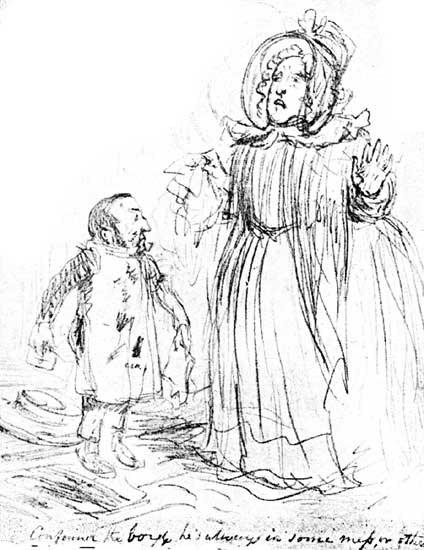 LEECH'S ORIGINAL SKETCH FOR "PEEL'S DIRTY BOY."
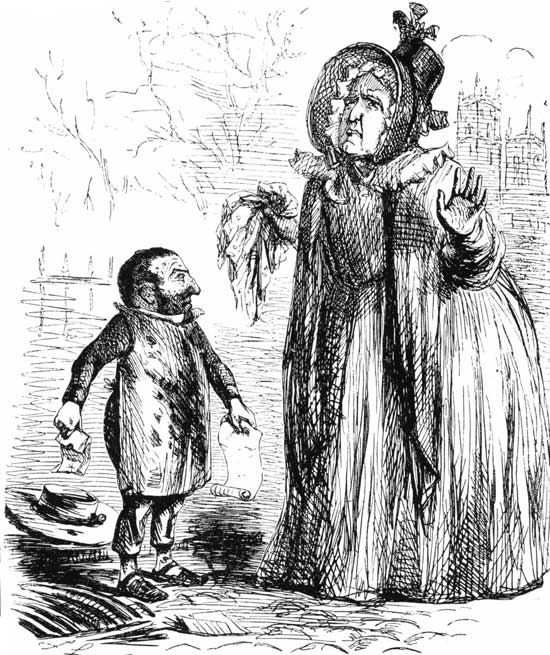 "Peel's Dirty Little Boy."
Dame Peel: "Drat the boy! He's always in a mess."
(From the Cartoon by Leech in "Punch," Vol. VIII., p. 145. March 29th, 1845.)
But the politician who suffered most from Punch—and perhaps the most undeservedly—was that most unpopular of a long line of unpopular Home Secretaries, Sir James Graham.[Pg 114] He had joined Peel's Cabinet in 1842, on the fall of Lord Melbourne's Ministry, and nothing that he did could command the approval of his critics, especially those on Punch. His capital offence was directing the opening of certain of Mazzini's letters in consequence of the statements made to our Government by that of Naples, to the effect that plots were being carried on—of which the brilliant and popular Italian refugee was the centre—to excite an insurrection in Italy. "The British Government," reported the House of Commons Committee of Inquiry afterwards appointed, "issued a warrant to open and detain M. Mazzini's letters. Such information deduced from these letters as appeared to the British Government calculated to frustrate this attempt was communicated to a foreign Power."
Thereupon Mr. Duncombe, M.P., upon the complaints of Mazzini, W. J. Linton (the well-known Chartist, and more distinguished wood-engraver), and others, that their letters had been secretly opened, charged Sir James Graham with the violation of correspondence (June 14th, 1844), and though not at first eliciting much information, succeeded in obtaining the appointment of a Committee, though a "secret" one; and Lord Radnor effected the same object in the Lords. The result was favourable to the Minister; but the popular feeling roused by it was intense, and Punch, up in arms at once at this supposed violation of the rights of the subject, fanned the excitement he shared. He immediately published, on July 6th, the most offensive attack he could devise. This consisted in the famous "Anti-Graham Envelope" and "Wafers"—the latter extra strongly gummed.
The former was drawn by John Leech—a sort of burlesque of the Mulready envelope—and was afterwards appropriately engraved by Mr. W. J. Linton, whose share in the agitation was a considerable one. The circulation attained by this envelope was very wide, and although I have not ascertained that many were actually passed through the General Post Office, it certainly brought a flood of bitter ridicule on the unfortunate Minister. In addition to this, there was published, on the clever initiation of Henry Mayhew, the sheet of[Pg 115] "Anti-Graham Wafers"—an instrument of diabolical torture for the unhappy Secretary, who already figured as "Paul Pry" in half a hundred of the more important papers. In this sheet, 10 inches by 7¾ inches in size, drawn by H. G. Hine, there were printed sixteen wafers, in green ink, in the midst of a witty design, in brown, that bore the devices of a snake in the grass, a cat-o'-nine-tails, a kettle steaming the fastening of a letter, and other suggestive personalities. These were supposed to be cut up and used as wafers on envelopes, and that they were so used is probable, in view of their extreme rarity at the present day. They were issued at twopence the sheet; and their epigrammatic cuts and accompanying legends were in Punch's best vein.
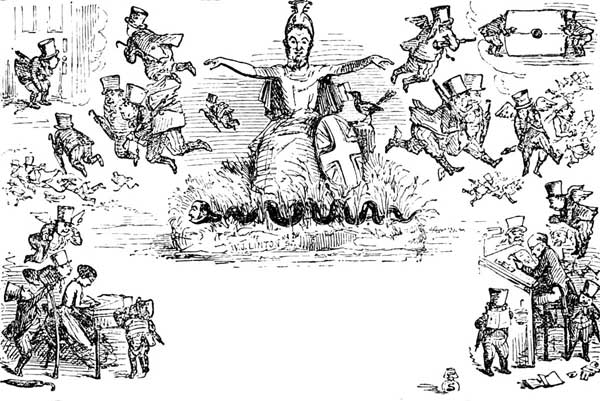 THE ANTI-GRAHAM ENVELOPE.
Punch's example was promptly followed by that class of publisher who lives by trading on the ideas of others, and in the windows of many booksellers of the commoner class, envelopes in the shape of padlocks were offered for sale, the motto on them running "Not to be Grahamed." Punch itself followed up the scent, and gave drawings of "Mercury giving[Pg 116] Sir James Graham an insight into Letters" (with the aid of a steam-kettle), of "The Post Office Peep-Show, a Penny a Peep," in which foreign sovereigns, on paying their money to Showman Graham, are permitted to violate the secrecy of British correspondence; while a notice from St. Martin's-le-Grand informs his Continental clients that "on and after the present month the following alterations will take place in the opening of letters:"—
| Letters Posted at | Opened at |
| 9 A.M. 10 A.M. 12 A.M. 2 P.M. 4 P.M. | 10 A.M. 11 A.M. 2 P.M. 4 P.M. 6 P.M. |
Of course, this was all very unfair and savagely amusing, but much was forgiven for the cleverness of the hits, and the liberty-loving notions that inspired them.
The "railway mania," which had been developing during these years, had from the first been viewed with alarm by Punch, who, with his customary level-headedness, foresaw the crash and the reaction that were soon to follow. And when they came, in 1849, he pointed solemnly to the truth of his teaching, and to the sadness of the moral, with the picture of "King Hudson off the Line." Nothing could represent the situation more eloquently or more concisely.
A noteworthy incident occurred in connection with the Greek question of 1850, when the English fleet threatened to blockade the Piræus. Punch was indignant at this high-handed show of strength towards the little kingdom, and taking the mean-looking, grovelling British Lion by the ear (in his cartoon) asks him, "Why don't you hit someone of your own size?" With the exception of the occasion when he disrespectfully represented the noble beast as stuffed and moth-eaten, this is the only "big cut" wherein the Lion has[Pg 117] been unworthily treated, or on which, in foreign politics, Punch has failed to back up his own Government.
When Kossuth visited London in 1851, Punch's heart, like that of the rest of England, went out to the patriot.[Pg 118] "It was not Louis Kossuth whom the thousands gazed upon and cheered," wrote Punch. "It was Hungary—bound and bleeding, but still hopeful, resolute, defying Hungary;" and it may be observed that for many years Punch sided, for one reason or another, with Austria's successive adversaries.
It was in the same year that Lord Palmerston first appeared on Punch's scene, and then in his own selected rôle of "Judicious Bottle-holder." He was represented as officiating thus at the little affair between "Nick the Bear" and "Young Europe." From that time forward he always appeared as a sporting character, and rather gained than lost in popular favour by the treatment. Another début the following year, among the repeated appearances of "Dizzy," Napoleon, Pam, and Lord John, was that of John Bright. He is shown in Quaker costume, examining the new-born baby (the new Reform Bill) through an eye-glass, while Lord John, its parent, stands by and hears the dry verdict that it is "not quite so fine a child as the last." This eye-glass perplexed John Bright a good deal, because, said he, he had "never worn such a thing in his life." He did not see that the glass had here, no doubt, not so much reference to him, as to the smallness of the birth examined by its aid.
Protection was still a subject of debate, but not for long. In 1852 appeared the admirable cartoon in which Cobden—suddenly come very much to the fore in Punch's pages—is represented as Queen Eleanor, who advances on Disraeli, a grotesque "Fair Rosamond," with a poison-bowl of "Free Trade" in one hand and the dagger of "Resignation" in the other. Disraeli accepted the former, and Punch and the Free Traders rejoiced. But in their triumph they did not spare the feelings of the convert, whom they had dubbed "The Political Chameleon;" but at least they admitted the importance of the man, who is no longer sneeringly alluded to as "Benjamin Sidonia," no more represented as an ill-bred schoolboy made up of impudence and malice—unprincipled, vicious, and conceited.
In the following year Punch sounded his first note of warning of the approaching "Eastern Question," when in the[Pg 119] cartoon of "The Turkey in Danger," the Sick Bird is shown in the powerful hug of the Russian Bear; and "The Emperor's Cup for 1853" illustrates still further the prescience of Punch. Nevertheless, as has been said, he could not appreciate a suaviter policy, and in a cartoon entitled "Not a Nice Business" (p. 271, Vol. XXVI.) Lord Aberdeen, the Premier, is shown engaged in cleaning the boots of the Tsar.
How the Crimean War was followed by Punch in a magnificent series of pictures, chiefly from the hand of Sir John Tenniel, as well as in that culminating effort of Leech's, "General Février," there is no need here to explain. But during the peace negotiations—which were delayed through the Russians firing on a truce-party, called "The Massacre of Hango"—the representation was unjustly made by Punch that the King of Prussia was a confirmed toper, and the charge was offensively maintained by pen and pencil. This so angered the King that none of the English newspaper correspondents (one of whom he supposed to be the original perpetrator of the libel) was after that allowed within the precincts of the palace, until at last Mr. T. Harrington Wilson, one of Punch's draughtsmen, was admitted on behalf of the "Illustrated London News."
No sooner was the Crimean War at an end, than the reprisals which developed into the Chinese War involved this country in an expense of four millions. In spite of the importance and gravity of the undertaking, Punch vigorously supported Lord Palmerston in his campaign, and mockingly showed "The Great Warriors Dah-Bee and Cob-Den" vainly trying to overturn his Government. He made good sport of the Celestials, as a matter of course, but his mortification was extreme on learning that the incidental outlay would delay the hoped-for repeal of the paper duty. He found a small outlet for his feelings in the cartoon representing a Chinese mandarin as "The New Paper-weight" (p. 20, Vol. XXXIX.), but in the end was entirely conciliated by the terms of the Chinese Convention, and the payment of a handsome indemnity—the subject of his first cartoon in 1861 being "A Cheer for Elgin."[Pg 120]
Italy's successful struggle for independence received great attention and sympathy from Punch—the greater, no doubt, since the "Papal Aggression" had taught him to look askance at the Vatican; but he regarded with extreme and well-justified scepticism the genuineness of Louis Napoleon's alleged disinterestedness in the interests of peace. He is ironically shown (October 13th, 1860) as "The Friend in Need" advising the Pope, "There, cut away quietly and leave me your keys. Keep up your spirits, and I'll look after your little temporal matters." Garibaldi and Victor Emmanuel were regarded by Punch with the greatest favour (just as the latter was said to be regarded privately by the Pope), and United Italy was enthusiastically hailed by him (March, 1861) as "The Latest Arrival" at the European Evening Party conjointly presided over by John Bull and Britannia.
From first to last Punch has always been an Imperialist—Imperial Defence being warmly taken up at periodical intervals, and Imperial Federation during these latter years adopted as one of the planks of his Punch-and-Judy platform. Imperial Defence as a cry and a scare, begun in 1848 on the action of the Prince de Joinville, was continued in 1860 (cartoon, August 4th), when a large sum was spent upon arsenals and dockyards—to some extent, no doubt, in view of Napoleon's double-dealing in the matter of Nice and Savoy. "Ribs of steel are our ships, Engineers are our men," he sings, under the new order of things in naval construction—
The American War of Secession; the throne of Greece put up to auction; Poland in chains, defying the Russian Bear; the ghost of Charles I. warning the King of Prussia, by the block to which he points, of the punishment that awaits the would-be despot; Napoleon crushing the prostrate figure of France; the wars between "father-in-law Denmark," Germany, and Austria, and between the latter two (as Robbers[Pg 121] in the Wood); Reform; Irish Church Disestablishment; "Dizzy" as the Premier-Peri entering the gates of Paradise, or, bound to the Ixion's wheel of "Minority," hurled forth by Hercules-Bright, with the severe approval of Juno-Britannia and Jupiter-Gladstone; the Franco-Prussian War; the Royal marriages; the occupation of Egypt; and the creation of the "Empress of India;"—all the subject-matter, indeed, of home and foreign politics, and of general public interest, have been touched upon by Punch as they occurred, lightly, but often probed à fond. His attitude seldom caused much surprise, for his opinions and views could generally be foretold. It was the manner in which they were put forth that carried weight and influence; they were the nation's ideas
The student of the times, if he would know how public affairs struck the public mind during that period, can assuredly find no truer, no more accurate indication than is offered by the perusal of Punch's pages.[Pg 122]
Punch's Influence on Dress and Fashion—His Records—As a Prophet—As an Artist—As an Actor and Dramatist—Benefit Performances—Guild of Literature and Art.
The man who glances at Punch's current number and throws it aside can have but little appreciation of the influence of the paper, not only in matters political, but in social subjects of every kind. That the Baron de Book-Worms can make or mar the success of a new book, as completely as the "Times," "Athenæum," or "Spectator," has been testified to by Mr. Hall Caine and others; and in some quarters at least Punch's bâton-strokes are as effective as ever, and recall the times when he could, and did, drive a semi-public man into obscurity, which, but for the fame of his onslaught, would have been absolute oblivion.
But it is in dress, in fashion, and in manners that Punch has gained, if anything, in weight and influence. In such subjects, treated as "charivarieties," as Mr. Arthur Sykes has called them, he has always been supreme, and fulfils an unquestioned destiny. John Leech determined that there should be no Bloomerism in the land, and there was none—only, by the charm of his drawings, he came very near making it popular, and converting British young womanhood to Turkish trousers. Mr. du Maurier thought that it would look pretty if every little lady in the land were to wear black stockings; and every little lady did: as unfalteringly as when Miss Kate Greenaway imposed upon them smocks and poke-bonnets, or when Mrs. Hodgson Burnett clad mothers' darlings in black velvet Fauntleroy suits, with bright-coloured sashes wound round their middles. As the volumes are examined, the reader becomes aware of the enduring value of Punch as a[Pg 123] History of Costume in the Victorian Era. Even men's dress is noted with minute truthfulness—the violently variegated shirts of 1845; the Joinville ties, with their great fringed ends, out of which Thackeray made such capital in 1847; the pin-less cravats and cutaway coats of 1848; the ivory-handled canes of 1850, for sucking purposes—the fashion which came round thirty years later with the advance of the "crutch and toothpick brigade;" the big bows and short sticks of 1852; the frock-coats and weeping whiskers of 1853, with the corresponding inability to pronounce the "r" otherwise than as a "w," or to converse but with a languid, used-up drawl; the smaller ties and growing collars, when a wasting youth complains that "She is lost to him for ever" (she, the laundress!); the schoolboy's Spanish hat of 1860, that was soon developed into the "pork-pie," and was to be adopted generally for country wear with baggy knickerbockers; the full-blown Dundreary of 1861, with long weeping whiskers, long coat, long drawl, and short wits; with the sudden change for the better in the following year. All this is to be found clearly recorded year by year, season by season, with all the peculiarities of "form;" of umbrella and umbrella-carrying; of dancing, energetic and invertebrate; of handshaking, sensible and high-level (which was invented, of course, by the ballroom girl who was holding up her train in the dance); of hirsute adornment and æsthetic craze—every shade of fashion is followed in its true development and in its wane—down to the recent phase of 1893 and 1894, when the swell lets out his collar for an advertisement hoarding, or, safe in the perfection of its starching, marches quietly across the desert while fierce Orientals turn the edges of their swords in vain across his linen-shielded neck.
And the ladies! The coal-scuttle bonnet and the incipient crinoline of 1845; the growing crinolines of 1851, larger in 1860, largest of all in 1864; the hair in bands or side-curls of 1852, and in nets in 1862; the bonnets worn almost off the head in 1853, more so in 1854, until Leech drew a picture of two ladies walking out, with footmen carrying their headgear behind them; the "spoon-shaped bonnet" of 1860—"the[Pg 124] latest Parisian folly," which the street-boys mistake for "a dustman's 'at;" the archery of 1862, the pork-pie hat, the croquet, the tennis, the golf—every sport, every habit and custom, every change of dress, down to the minutest detail—all is recorded with faithfulness and humour, first by Leech's pencil, and then, in chief measure, by Mr. du Maurier's.
It is curious in turning over Punch's volumes to see how on occasion he could use his power of prophecy with an accuracy that spoke well for the common-sense, sometimes even the statesmanship, to be found among the Staff. "There is but one Punch, and he is his own prophet." It is rather as a social reformer than as a politician that he has exerted his gift, though an example of the latter class of foresight may be pointed to in the cartoon of Sir John Tenniel of April 7th, 1860. This was entitled "A Glimpse of the Future: A Probable and Large Importation of Foreign Rags," in which King Bomba of Naples, the Emperor Louis Napoleon, and the Pope were shown landing on British shores in very sorry plight. And in due time England was to see—at least, as far as the two monarchs were concerned—the realisation of the oracular couplet combined:—
Then the number of inventions and innovations forestalled by Punch's pen are many. In December, 1848, much is made of a proposed "opera telakouphanon"—a forecast of the telephone, phonograph, and theatrophone combined:—
"It would be in the power of Mr. Lumley," says Punch, "during the aproaching holiday time to bring home the Opera to every lady's drawing-room in London. Let him cause to be constructed at the back of Her Majesty's Theatre an apparatus on the principle of the Ear of Dionysius.... Next, having obtained an Act of Parliament for the purpose, let him lay down after the manner of pipes a number of Telakouphona connected—the reader will excuse the apparent vulgarism—with this ear, and extended to the dwellings of all such as may be willing to[Pg 125] pay for the accommodation. In this way our domestic establishments might be served with the liquid notes of Jenny Lind as easily as they are with soft water, and could be supplied with music as readily as they can with gas. Then at a soirée or evening party, if a desire were expressed for a little music, we should only have to turn on the Sonnambula or the Puritani, as the case might be," etc.
—a thirty years' prophecy. The following year he represented a lady listening to music by telegraph; and the kinetoscope is only now waiting to fulfil Mr. du Maurier's forecast of many years ago. If Mr. Edison has not yet done quite all that Mr. Punch foretold, is not that rather Mr. Edison's than Punch's fault?
In an unhappy moment in 1847 Punch proposed the use of umbrellas and house-fronts for advertising purposes, and the hint was promptly taken. In the previous year he foretold the use of the Thames Tunnel as a railway conduit; and his sketch of a zebra harnessed to a carriage in the streets of London was realised forty years later. The great "Missing Word Competition" of 1892 was forestalled by Punch by four-and-thirty years (p. 53, Vol. XXXV., August 7th, 1858). Leech's "Mistress of the Hounds," too—how fantastic the idea was thought in those days, and laughed at accordingly!—has since become a hard, astraddle, uncompromising fact; and the lady's safety riding-skirt, that attached itself to the saddle when the lady lost her seat, anticipated by thirty years the patent for a similar contrivance taken out in 1884. Indeed, Punch's picture of November, 1854, was put in as evidence before Mr. Justice Wright in April, 1893, when an action between two sartorial artists turned upon the point of anteriority, and the picture won the case.
Common-sense, and shrewdness of observation and judgment, which are at the root of amateur prophecy, brought as much honour to Punch as ever Old Moore obtained through one of his lucky flukes. In December, 1893, the Prince of Wales opened the Hugh Myddleton Board School, the finest in London, which had been erected on the site of the old Clerkenwell prison; and on the invitation card to the[Pg 126] ceremony appeared a reproduction of the Punch picture of May, 1847, which accompanied an altercation between "School and Prison, who've lately risen As opposition teachers." This was published nearly a quarter of a century before Mr. Forster's Education Act, and concludes with the prophecy curiously fulfilled in the case of this particular institution. To this picture, in which the county gaol, untenanted, looks scowlingly at the crowded school, the Prince feelingly referred when he spoke of the scepticism with which the statement was regarded, that the institution of "free" schools would shut the prisons up. But a volume might be filled with instances of the occasions on which Punch has seen with his eyes, and thought with the front of his brain—how his demands for necessary innovations (such, for example, as fever carriages in 1861) were quickly acted upon, and how his serious mood has enforced the respect which mere geniality might have failed to secure.
He is not, of course, entitled to invariable congratulation for his attitude towards art; but he has suffered as well as acted ill. When he derided the Pre-Raphaelite Brotherhood, and joined in the storm of ridicule that swirled round the heads of Rossetti and his devoted and courageous friends, he doubtless acted within his rôle; but he utterly failed to see below the surface of the apparent affectation of the artists, and all he had to say of Sir John Millais' "Vale of Rest," in the lines descriptive of the year 1859, was
"Year Mr. Millais came out with those terrible nuns in the graveyard."
In the following year, however, Mr. Eastlake, afterwards of the National Gallery, made his mark in the paper as "Jack Easel," and a more intelligent view of art prevailed.
But neither has Art, as personified by the Royal Academy, recognised Punch, save by a couple of seats at the annual banquet. It is true that several of its members have drawn for it—Sir Frederic Leighton, Sir John Millais, Sir John Gilbert, Mr. Briton Riviere, Mr. Stacey Marks, Mr. G. A. Storey, and Fred Walker. But Punch's art has gone unnoticed, otherwise than by a square yard or two of wall space in the[Pg 127] Black-and-White room at the annual exhibition. While the Academy has canonised many members whose names half a century later are forgotten, or are remembered only to be called up with a smile or a shrug, it has persistently ignored those who have employed the pencil instead of the brush, or have used ink instead of misusing paint. But it is unnecessary to pursue the subject farther; that the names of Keene, Leech, and Tenniel are not on the roll of the Academy is surely far more to the discredit of the institution than of the[Pg 128] artists themselves, who presumably, from the Academic point of view, are "no artists." As Mr. du Maurier has pointed out, Punch's artists will have their revenge: "If the illustrator confine himself to his own particular branch, he must not hope for any very high place in the hierarchy of art. The great prizes are not for him! No doubt it will be all the same a hundred years hence—but for this: if he has done his work well, he has faithfully represented the life of his time, he has perpetuated what he has seen with his own bodily eyes; and for that reason alone his unpretending little sketches may, perhaps, have more interest for those who come across them in another hundred years than many an ambitious historical or classical canvas that has cost its painter infinite labour, imagination, and research, and won for him in his own time the highest rewards in money, fame, and Academical distinction. For genius alone can keep such fancy-work as this alive, and the so-called genius of to-day may be the scapegoat of to-morrow."
Punch was born, so to speak, upon the stage, between the four canvas walls of his own and Judy's show. His heart and soul were with and of the drama, and plays have rained from the prolific pens of his literary Staff. Many of his contributors acted in public—a few professionally, most of them as amateurs—and more than one has linked his life with a lady who had trodden the stage or concert platform. From the first he proclaimed that Music and the Drama were to be amongst the most prominent features of the work; and to that declaration he has ever since faithfully adhered. As a record of the London stage, the pages of Punch are fairly complete; as a dramatist he has, through the members of his Staff, been prolific, and on the whole highly successful; as an actor he has at least enjoyed himself; and just as Falstaff was the cause of wit in others, he has unwittingly served the pirates of the stage, and to better purpose, too, than they deserved.
With "readings," lectures, and "entertainments," the members of Punch's Staff have often come strikingly before the public; so much so, indeed, that they have stepped from their studies and studios on to the platform as by a natural transition. Albert Smith's "Overland Mail" and "The Ascent of Mont Blanc,"[Pg 129] with the extraordinary success that attended them, doubtless set the fashion to the band of men who were always, in one sense at least, before the public. Thackeray's "Four Georges" and the "English Humorists" raised the standard of quality at once; and to that standard more than one of his contemporaries and successors has aimed at attaining, even though they never hoped to succeed. Every Editor of Punch—except perhaps Stirling Coyne—delivered such lectures in his day. Henry Mayhew took for his subject that of which he had a complete mastery, "London Labour and London Poor." Mark Lemon, whose knowledge of the metropolis was probably even more extensive and peculiar than Sam Weller's own, lectured on it in "About London," and gave recitals of "Falstaff" with a certain measure of success. Shirley Brooks spoke, as he was so well qualified to do, on "The Houses of Parliament;" and discourses were similarly delivered by Tom Taylor. Mr. Burnand's bright "Happy Thoughts" readings could be forgotten by none that heard them. James Hannay, laying humour aside, lectured on the more serious aspects of literature; and Cuthbert Bede talked of the literary and artistic friends of his Verdant Green career. Mr. Harry Furniss, with his delightful entertainments on "Portraiture" and "The Humours of Parliament," achieved a success undreamed of by the earlier Punch reciters; and Mr. du Maurier in his "Social Pictorial Satire" touched a literary and critical height that charmed every audience by its humour, its delicacy, and its admirable taste.
The theatrical stars of half a century march through Punch's pages in long procession, and matters of high theatrical politics engage the attention from year to year. Punch's interest in theatricals is hardly surprising when it is remembered how closely identified with the drama have been many members of the Staff. Douglas Jerrold was a successful playwright before ever Punch was heard of, and as the author of "Black-Eyed Susan" and "Time Works Wonders" he made his name popular with many who had hardly heard of his connection with "the great comic." It has been computed that the Punch writers, from first to last, have contributed no fewer than five hundred plays to the stage; and it may be mentioned as a curious[Pg 130] fact that to "German Reed's" each successive Editor of Punch has contributed an "Entertainment." The Staff has on several occasions been seen upon the boards; and on countless occasions Punch has figured there, usually against his will. It but sufficed for Punch to make a hit for hungry provincial actors, either of stock companies or on tour, to pounce upon it and work it up into a play or an entertainment. Jerrold's brother-in-law, W. J. Hammond, who was at one time manager of the Strand Theatre, travelled with what must be considered the authorised show, thus described:
Founded on the Series of Celebrated Papers of that highly humorous Periodical, from the pens of the acknowledged best Comic Writers of the day. Adapted and Arranged by R. B. Peake, Esq. As performed by Mr. W. J. Hammond Forty-two successive nights at the New Strand Theatre.... After which, a Monopolylogue entitled the
—with five characters, all performed by Hammond, the whole reaching its climax when Punch, in propria persona, appeared and sang an "Epilogue Song."
But it was Mrs. Caudle, of course, that offered a bait too tempting to be resisted. There was Mrs. Keeley's authorised "Mrs. Caudle" in town; but simultaneously Mrs. Caudles cropped up in every town in the country. One of these was enacted by Mr. Warren, and his playbill of the Theatre Royal, Gravesend, dated August 7th, 1845, is before me as I write. "The Real Mrs. Caudle," he asserts, "having received an enthusiastic welcome from a Gravesend audience, and being pronounced far superior to any of the counterfeit Representatives, will have the honour of repeating her Curtain Lecture this and to-morrow evenings." "Mrs. Caudle at Gravesend" was, in fact, a "Comic Sketch" by C. Z. Barnett; and the programme[Pg 131] decorated with a common engraving in impudent imitation of Leech's immortal cut, contained all the dramatis personæ of Jerrold's little domestic drama, including "Mrs. Caudle (the Original from Punch's Papers), Mr. Warren."
Six years later Mr. Briggs himself was lifted from Punch on to the stage (amongst others) of the Royal Marylebone Theatre, which then assiduously cultivated the equestrian drama. On November 14th, 1851, for the benefit of a lady called Mrs. MORETON BROOKES, there was played a "new grand dramatic equestrian spectacle, entitled the Maid of Saragossa; or, The Dumb Spy and Steed of Arragon—realising Sir David Wilkie's Celebrated Picture." As the Arragon Steed remained on the premises when the curtain fell on the first piece, it was obviously a pity to waste him; so, after he had finished realising Wilkie's picture, and had rested awhile, he stepped out of romance into high comedy, or, as the playbill simply put it—"After which will be presented from Sketches furnished from Punch's Domicile, Fleet Street, a New, Grand, Locomotive, Pedestrian, Equestrian, Go-ahead Extravaganza, entitled
in which Mr. Briggs was played by Mr. Crowther, and Mrs. Briggs by the fair beneficiaire.
The first dramatic effort of Punch, in his individual quality and personality as a jester, was the pantomime of "King John, or Harlequin and Magna Charta." Punch had at that time become so popular, and was so generally regarded as the incarnation of all that was witty, that a commission was given for a pantomime that was to surpass for wit and humour any pantomime that had ever been written or thought of before. "They have given out," said Alfred Bunn in his vituperative "Word with Punch," "in distinct terms that none but themselves can write a pantomime, and modestly entitled the one they did write 'Punch's Pantomime' ... which they laboured so lustily, but so vainly, to puff into notoriety." It was written in 1842, by Lemon, Jerrold, and Henry Mayhew; but when it was read by[Pg 132] the first-named to the Covent Garden Company, by whom it was produced, it was found to contain a great deal of wit, but very little fun. It was extensively amended in response to the representations of the pantomimists, and W. H. Payne managed to make a good deal of his part. The wit, however, militated greatly against the "go" and success of the piece, the prestige of its writers did not help it, and the experiment of a "Punch's Pantomime" was accordingly not repeated.
The cordial sympathy that has bound together so many of Punch's Staff
in life has more than once taken the form of kindly charity in death or
misfortune. To the performance given on behalf of the unhappy Angus
Reach reference is made where the man and his work are considered. For
Leigh Hunt—although he was not of the band—a theatrical performance
was also given, and realised a large sum, and the benefit in aid of
Charles H. Bennett's widow and children was even more successful. That
interesting event is described later; but for the sake of history it may
be well to reproduce the programme here:—
(kindly placed at the disposal of the committee by John Knowles, Esq.,)
To commence with an entirely new and original Triumviretta, in one act and ten tableaux (being a lyrical version of Mr. Maddison Morton's celebrated farce of "Box and Cox"), by Mr. F. C. Burnand, entitled—
The Lodging, including the Little Second-floor Back Room, has been furnished with
| John Cox, a Journeyman Hatter | Mr. Quintin |
| James Box, a Journeyman Printer | Mr. G. Du Maurier. |
| Bouncer, late of the Hampshire Yeomanry, with military reminiscences | Mr. Arthur Blunt. |
Scene—An elegantly furnished apartment in Bouncer's Mansion.
R. T. PRITCHETT—SHIRLEY BROOKS—MR. ARTHUR LEWIS—MARK LEMON—MR. TWISS—SIR JOHN TENNIEL—ARTHUR CECIL (BLUNT)—HENRY SILVER
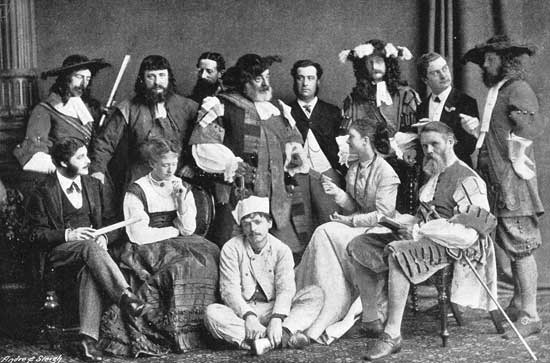
SIR ARTHUR—SULLIVAN—MISS ELLEN TERRY—MR DU MAURIER—MISS KATE TERRY—TOM TAYLOR
FOR CHARLES H. BENNETT'S BENEFIT.Tableaux—1. Cox at his looking-glass.—2. Cox and Bouncer, the trial of the hat.—3. The beauties of bacon.—4. Revenons à nos moutons.—5. The stranger!—6. The duel!!—7. The gamblers. The hazard. The false die.—8. "Reading of the will."—9. (A classical study.) Penelope.—10. Knox! et præterea nil.
After which will be performed Mr. Tom Taylor's popular Drama,
| Colonel Lord Churchill, of the Life Guards | Mr. Mark Lemon. | |
| Colonel Percy Kirke, of Kirke's Lambs | Mr. John Tenniel. | |
| Master Jasper Carew | Mr. Tom Taylor. | |
| Kester Chedzoy | Mr. F. C. Burnand. | |
| Corporal Flintoff Hackett Rasper |
of Kirke's Lambs | Mr. Horace Mayhew. Mr. Henry Silver. Mr. R. T. Pritchett. |
| John Zoyland, a Locksmith | Mr. Shirley Brooks. | |
| Dame Carew, Wife of Jasper Carew (by the kind permission of B. Webster, Esq.) | Miss Kate Terry. | |
| Dame Carew, Mother of Jasper Carew | Mrs. Stoker. | |
| Sibyl, Daughter of Jasper Carew | Miss Florence Terry. | |
| Keziah Mapletoft, Servant to Anne | Miss Ellen Terry (Mrs. Watts). |
To be followed by J. Offenbach's Bouffonnerie Musicale,
| Stanislas Giraffier | Mons. G. Du Maurier. |
| Giacomo Patachon | Mons. Hal. Power. |
To conclude with Mr. John Oxenford's Farce, in one Act,
Tickets for the Dress Circle and Stalls, One Guinea each, may be obtained from any Member of the Committee; at the Theatre Royal; from Messrs. Hime and Addison, and Mr. Slater, St. Ann's Square; and Messrs. Forsyth, St. Ann's Street.
On this occasion, says an anonymous writer, "The celebrated cartoonist received the reception of the evening. The audience rose en masse and cheered. Tom Taylor, playing in his own piece the principal character, was, comparatively speaking, nowhere. The most interesting personality of the Punch Staff was unquestionably Tenniel."
Affiliated with Punch, in its membership at least, was that "Guild of Literature and Art" of which Charles Dickens was[Pg 135] the father. Its theatrical career began in 1845 at the Royalty Theatre, Soho, at that time called Miss Kelly's, the initial performance being Ben Jonson's "Every Man in his Humour," with Mark Lemon as Brainworm and Dickens as Bobadil. (See p. 137.) On May 15th, 1848, much the same company, in aid of the fund for the endowment of the perpetual curatorship of Shakespeare's house at Stratford-on-Avon, gave the "Merry Wives of Windsor," when Dickens played Shallow; George Cruikshank, Pistol; John Leech, Slender; Mark Lemon, Falstaff; and other characters were represented by George Henry Lewes, John Forster, Dudley Costello, Augustus Egg, R.A., and Mr. Cowden Clarke—a goodly company. Mr. Sala says that Lemon's conception of Falstaff (which was also known to the public through the jovial editor's "readings"), though well understood, was "the worst he ever saw;" but Mrs. Cowden Clarke declared it "a fine embodiment of rich, unctuous raciness, no caricature, rolling greasiness and grossness, no exaggerated vulgarisation of Shakespeare's immortal 'fat knight,' but a florid, rotund, self-indulgent voluptuary—thoroughly at his ease, thoroughly prepared to take advantage of all gratification that might come in his way, and thoroughly preserving the manners of a gentleman accustomed to the companionship of a prince. John Leech's Master Slender," she continues, "was picturesquely true to the gawky, flabby, booty squire.... His mode of sitting on a stile, with his long ungainly legs dangling down ... ever and anon ejaculating his maudlin cuckoo cry of 'Oh sweet Ann Page,' was a delectable treat." Without disrespect to Leech's memory, it may be said that others of his friends did not form a similarly favourable opinion of his histrionic powers.
A company quite as notable in its way was that which played "Not so Bad as We Seem," by Lytton (with whom Punch had made his peace), at Devonshire House, on May 27th, 1851, before the Queen and the Prince Consort, at the instance of the Duke of Devonshire. The playbill deserves to be preserved here, although the only Punch names among the actors are those of Jerrold, Lemon, and Tenniel—the last-named of whom is the only survivor of them all.[Pg 136]
| The Duke of Middlesex The Earl of Loftus |
Peers Attached To the Son of James II., Commonly Called the First Pretender | Mr. Frank Stone, A.R.A. Mr. Dudley Costello |
| Lord Wilmot | a Young Man at the Head of the Mode More Than a Century Ago, Son To Lord Loftus | Mr. Charles Dickens |
| Mr. Shadowly Softhead | a Young Gentleman From the City, Friend and Double of Lord Wilmot | Mr. Douglas Jerrold |
| Mr. Hardman | a Rising Member of Parliament and Adherent To Sir Robert Walpole | Mr. John Forster |
| Sir Geoffrey Thornside | a Gentleman of Good Family and Estate | Mr. Mark Lemon |
| Mr. Goodenough Easy | in Business, Highly Respectable, and a Friend of Sir Geoffrey | Mr. F. W. Topham |
| Lord le Trimmer Sir Thomas Timid |
frequenters of Wills' Coffee House | Mr. Peter Cunningham Mr. Westland Marston |
| Mr. Jacob Tonson | a Bookseller | Mr. Charles Knight |
| Smart | Valet To Lord Wilmot | Mr. Wilkie Collins |
| Hodge | Servant To Sir Geoffrey Thornside | Mr. John Tenniel |
| Paddy O'Sullivan | Mr. Fallen's Landlord | Mr. Robert Bell |
| Mr. David Fallen | Grub Street Author and Pamphleteer | Mr. Augustus Egg, A.R.A. |
| Lord Strongbow, Sir John Bruin, Drawers, Newsmen, Watchmen, &c. &c. |
Coffee House Loungers |
| Lucy | Daughter to Sir Geoffrey Thornside | Mrs. Compton |
| Barbara | Daughter to Mr. Easy. The Silent Lady of Deadman's Lane. |
Miss Ellen Chaplin |
Date of Play—The Reign of George I.
Scene—London.
Time supposed to be occupied, from the noon of the first day to the afternoon of the second.
And, lastly, may be mentioned the performance of Ben Jonson's play at Knebworth, in which, says Vizetelly, Douglas Jerrold, as Master Stephen, showed real talent and power. But the piece is not an entertaining one, as Lord Melbourne—with his bad habit of thinking aloud—bore disconcerting witness in his stall: "I knew well enough that the play would be dull, but not so damnably dull as this!"[Pg 137]
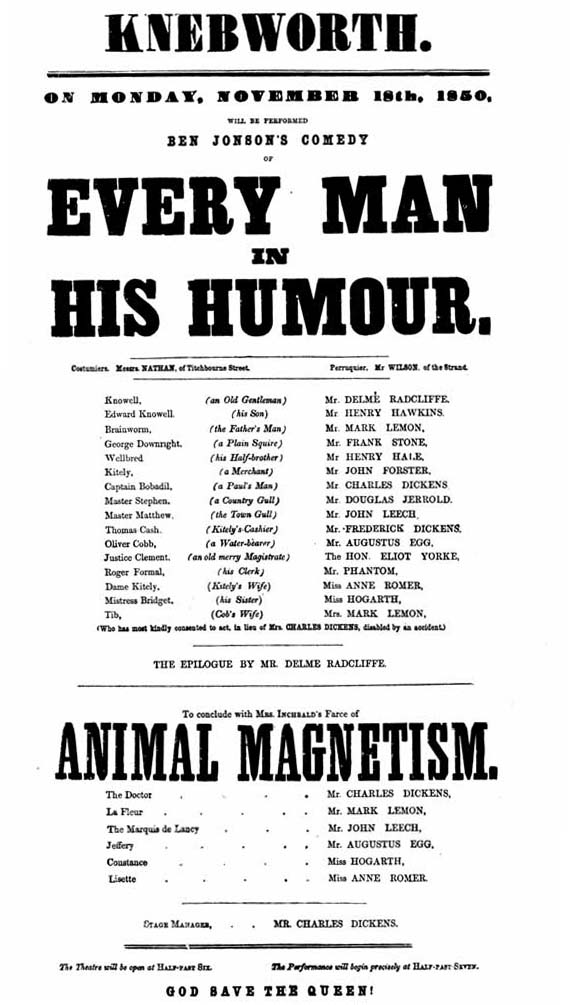
FOR THE GUILD OF LITERATURE AND ART. (See p. 135.)
"The Unknown Man"—Jokes from Scotland—"Bang went Saxpence"—"Advice to Persons about to Marry"—Claimants and True Authorship—Origin of some of Punch's Jokes and Pictures—Contributors of Witty Things—A Grim Coincidence—"I Used Your Soap Two Years Ago"—Charles Keene Offended—The Serjeant-at-Arms and Mr. Furniss's Beetle—Mr. Birket Foster and Mr. Andrew Tuer—Plagiarism and Repetition—The Seamy Side of Joke-editing—Punch Invokes the Law—Rape of Mrs. Caudle—Sturm und Drang—Plagiarism or Coincidence?—Anticipations of the "Puppet-Show" and "The Arrow"—Of Joe Miller—And Others—Punch-baiting—Impossibility of Joke-identification—Repetitions and Improvements.
It may fairly be said that not three per cent.—probably not one per cent.—of the jokes sent in to Punch "from outside" are worthy either of publication as they stand, or even of being considered raw material for manipulation by the editor or his artists. In this low estimate, of course, are not included the work of the few regular contributors who are recognised, though "unattached," as well as of the others who make a practice of sending every good new joke they hear to such a friend as they may happen to have on the Staff. These two classes are not numerous; but they are, and have for years formed, a little body of bright-witted, laughter-loving persons, to whom Punch and Punch readers are under an equal debt of gratitude.
In the United States the providing of jokes for illustration in the comic press is to some extent a recognised, if a limited and illiberal, profession, he who follows it being commonly described as the "Unknown Man." Endowed with natural wit and invention, but denied the gift of draughtsmanship, this "dumb orator" is supposed to turn out jokes as other men would turn out chair-legs, and sends them in priced, like gloves, at so much a dozen, "on approval—for sale or return," with a suggested mise en scène complete, which the illustrator is recommended[Pg 139] to adopt. How far the system answers its purpose I am unable to judge; but if the experience of Mr. Phil May may be taken as an example, there is every reason why the Man should remain Unknown. For, at the suggestion of a fellow-artist, he ordered five dollars-worth of original jokes, the price being quoted at a dollar per joke. His order was executed with punctuality and despatch, when Mr. May found, to his amusement and dismay, that three of the jokes were former Punch friends, and the remaining two were old ones of his own invention!
In the United Kingdom the joke-contributor is as a rule a disinterested person, usually seeking neither pay nor recognition; and so far as his estimate bears upon the value of his contribution, it must be admitted that his judgment is generally sound. But of the accepted jokes from unattached contributors, it is a notable fact that at least seventy-five per cent. come from North of the Tweed. Dr. Johnson, ponderous enough in his own humour, admitted that "much may be made of a Scotchman if he be caught young;" and it is probable that to him, as well as to Walpole—who suggested that proverbial surgical operation—is owing much of the false impression entertained in England as to Scottish appreciation of humour and of "wut." Some may retort that it is just the preponderance of Scotch collaboration that has rendered Punch at times a trifle dull. Certain it is that Punch is keenly appreciated in the North. In one of the public libraries of Glasgow it has been ascertained that it was second favourite of all the papers there examined by the public; and it has been asserted that in one portion of the moors and waters gillies have more than once been heard to say, "Eh, but that's a guid ane! Send that to Charlie Keene!"
Nevertheless, it must be admitted that Punch's dialect has not always pleased up there, where "the execrable attempts at broad Scotch which appear weekly in our old friend Punch" have before now been authoritatively denounced. Under the heading of "Probable Deduction" Punch had the following paragraph:—"A pertinacious Salvation Army captain was worrying a Scotch farmer, whom he met in the train, with[Pg 140] perpetual inquiries as to whether 'he had been born again of Water and the Spirit.' At last McSandy replied, 'Aweel, I dinna reetly ken how that may be, but my good old feyther and mither took their toddy releegiously every nicht, the noo." Referring to this story—first cousin surely to Lover's joke in "Handy Andy" of the Irish witness who, when pressed as to his mother's religion, promptly replied, "She tuk whuskey in her tay!"—the critic remarks, "It is pretty wit; for Punch. But McSandy ought to speak in the Scottish tongue. Now, if 'night' is 'nicht,' why is 'right' 'reet'—either 'the noo' or at any other time? Hoots awa." Yet Punch has usually taken great pains to verify his dialects, and Charles Keene—to whom the legends usually came from his friends ready-made and carefully elaborated—would, as a rule, seek to have them confirmed by one or other of his Scottish friends in town.
Perhaps the greatest service that any Scot ever rendered to Punch (apart from drawing for it) was the "puir bodie" who explained that he found Lunnon so awfu' extravagant that he hadna been in it more than a few hours "when bang went saxpence!" The reader will be interested to learn that this expression—which may truthfully be said to have passed into the language—did really issue from the lips of a visitor from the neighbourhood of Glasgow. It was Sir John Gilbert who heard it, and repeated it to Mr. Birket Foster while they were seated resting from their labours of "hanging" in the galleries of the Royal Water Colour Society. On the private-view day that followed, Mr. Foster tried the effect of the joke on two ladies whom he accompanied into Bond Street to take tea; and as they exploded with laughter, he concluded that it was good enough for his friend Keene, to whom he thereupon sent it. The immediate success of the joke was amazing; and Mr. Foster was therefore the more surprised and amused a year afterwards to overhear a young "masher" calmly inform a barmaid serving on the Brighton pier that he was the originator of it, and that he possessed the original drawing!
Another favourite Scotch picture of Keene's is that in which a drunken workman, remonstrated with by the parson, protests[Pg 141] that the latter is always blaming him for his drinking, but "You forget my droth!" This incident really occurred at Pitlochrie, and was told by the minister himself to Mr. Birket Foster, who handed it on to Keene; but—and here comes out one of the charming qualities of Keene's character—the real offender was not a man, but a woman. It was a chivalrous practice of Charles Keene's never to show a woman in a really undignified position; and when he was remonstrated with on the subject, on the ground that he distorted the truth unnecessarily, he would reply that "he could not be hard on the sex." But though "bang went saxpence" is a notable Punch joke—and it may be remarked that it is not less beloved of the political economist than of the Saturday Reviewer—it is not quite the best known. That position is easily attained by what is undoubtedly the most successful (that is to say, the most popular) mot of its kind ever composed in the English language.
It appeared in the Almanac for 1845 under "January," and, based upon the ingenious wording of an advertisement widely put forth by Eamonson & Co., well-known house furnishers of the day, ran as follows:—
It is doubtful whether any line from any author is so often quoted as "Punch's advice." It crops up continually, almost continuously, though not exactly when least to be expected, as experience teaches us to expect it always; and I may assert from my own observation that it appears in one or other of the papers of the kingdom on an average twice or thrice a week. Perhaps what has lent additional piquancy to Punch's piece of quaint philosophy is the mystery hitherto surrounding its authorship. An inquirer who endeavoured a few years ago to solve the problem set on[Pg 142] record the result of his researches, by which, according to a Scotch authority, he is said to have found the author in (1) a policeman of Glasgow, (2) a bricklayer of Edinburgh, (3) a railway official at Perth, (4) a compositor in Dundee, (5) an hotel-keeper in Inverness, and (6) a "Free Press" reporter in Aberdeen. English and Irish evidently had no chance. A letter, professing to explain the whole mystery, which lies before me from a medical correspondent, under date April 7th, 1895, runs as follows: "When in practice as a medical man at Neath, in S. Wales, it was well known to have been written by Mr. Charles Waring, a Quaker living at 'The Darran,' near Neath Abbey. Mr. Waring removed from there to the neighbourhood of Bristol about twenty-two years ago. The proprietors of Punch were so pleased, they sent him a douceur of £10 for the contribution!" Further inquiry shows that the late Mr. Waring was merely in the habit of quoting, not of claiming, the joke.
Hearing Charles Keene's emphatic opinion that the author was a Miss Frances D——, who many years ago was living in a remote village in the North of England, and who had been paid £5 for the line, I appealed to the Post Office for help to trace the lady out; and through the kindly assistance of the officials at St. Martin's-le-Grand and elsewhere, although nearly half a century had elapsed, I discovered her in another village equally remote, the Post Office having courteously obtained her permission to place me in communication with her. But the information was of a negative kind. She was, she protested, quite innocent of the credit of Punch's Monumental Cynicism, and consequently had never been the recipient of the fantastic payment of £5 per line. But since that time chance has placed in my possession the authoritative information; and so far from any outsider, anonymous or declared, paid or unpaid, being concerned in it at all, the line simply came in the ordinary way from one of the Staff—from the man who, with Landells, had conceived Punch and shaped it from the beginning, and had invented that first Almanac which had saved the paper's life—Henry Mayhew.
To trace the history of much of Punch's original humour[Pg 143] would hardly be desirable, even were it possible. But there are many examples of it which, while essentially original to Punch, have yet sprung from circumstances independent of it, and are in themselves amusing enough to be related, or which otherwise present points of interest. To some of these I call attention, for they illustrate Punch's own aphorism that "it is easier to make new friends than new jokes."
There is a capital story in Mr. Le Fanu's "Seventy Years of Irish Life," in which the author tells of a man who was accidentally knocked down by the buffer of a locomotive near Bray Station. He was not seriously hurt, and but partially stunned; and the porters who quickly ran to the spot determined to take him to the station at once. The hero of the accident, overhearing where they were carrying him, imagined that he was being given in charge. "What do you want to take me to the station for?" he asked. "You know me; and if I've done any damage to your d——d engine, sure I'm ready to pay for it!" This story of Mr. Le Fanu's reached Keene's ears long before the author incorporated it in his book, and with the change of hardly a word it illustrated one of the best drawings the artist ever drew.
Though undoubtedly many of Punch's jokes are deliberately manufactured, or else improved from actual incidents, a vast number—like that quoted just now—are used with but slight textual editing, just as they occurred. Thus Joe Allen it was—the light-hearted artist who contributed an article to Punch's first number—who provided Mr. du Maurier years afterwards with that "social agony" in which a great lover of children, invited to a juvenile party, bursts into the room with the cry of "Here we are again"—walking in on his hands like a clown—to find that he had come to the wrong house next door, and was scandalising a sedate and stately dinner party. Henry Mayhew had a story of which a facetious police officer of his acquaintance was the hero. The latter was driving "Black Maria" along the street when he was hailed by a waggish omnibus-driver who affected to mistake the depressing character of the passing vehicle. "Any room?" he asked. "Yes," replied the officer, with a grin, "we've kept[Pg 144] a place on purpose for you. Jump inside!" "What's the fare?" inquired the humorist, a little "non-plushed," as Jeames expressed it, at the unexpected retort. "Same as you had before—bread and water, and skilly o' Sundays!" The joke duly appeared in Punch after a long interval (Vol. XLVI.), illustrated by Charles Keene, under the title of "Frightful Levity."
Another omnibus story, printed just as it occurred, was that in which a conductor replies to an old gentleman in the south of London, whose destination was the "Elephant and Castle." "Yus—you go on to the Circus, and change into a Helephant." "Oh, mamma!" exclaims a little girl seated near the door, "do let's go too!" "Go where?" "To the circus, and see the old gentleman change into an elephant!" A similar incident, it may be observed, was illustrated by Eltze's pencil in 1861, when a passenger in the "Highbury Bus" asks the conductor to "change him into a Hangel." Jack Harris has often appeared in Punch. He was a driver beside whom Mr. Edmund Yates often rode—"a wonderfully humorous fellow, whose queer views of the world and real native wit afforded me the greatest amusement. A dozen of the best omnibus sketches were founded on scenes which had occurred with this fellow, and which I described to John Leech, whose usually grave face would light up as he listened, and who would reproduce them with inimitable fun."
The horrified swell of Leech's who is implored by an onion-hawker to "take the last rope" was in reality his friend Mr. Horsley, R.A., by whom the artist was provided with a number of humorous subjects. The unfailing advantage taken by Leech of all such contributions, which his friends assured him were "not copyright," has been universally recognised. Among the subjects suggested to him by Dean Hole was that in which his coachman, "unaccustomed to act as waiter, watched, with great agony of mind, the jelly which he bore swaying to and fro, and set it down upon the table with a gentle remonstrance of 'Who—a, who—a, who—a,' as though it were a restive horse." By a curious coincidence, as I have heard from the lips of a member of one of the great brewing firms,[Pg 145] on the very day before the appearance of Mr. du Maurier's drawing[14] the identical incident had occurred in his own house, and it was hard to believe on the following morning that the subject of his plunging blanc-mange, similarly apostrophised, had not been imported by some sort of magic into Punch's page. A similar coincidence, far graver in its first suggestion, has been given me by Mr. Arnold-Forster. A friend of his sent in to Punch a comic sketch of the Tsar travelling by railway, while he sent a decoy train in the opposite direction—which was blown up! The paper containing the sketch was printed by the Monday, and before it was published that had really occurred which Punch had playfully invented. Until the following week, when an explanation was published, a certain section of the public criticised, with justifiable severity, what they took to be the bad taste and ill-timed fooling of the Jester.
From Mr. Harry Furniss's pen came an oft-quoted drawing (lately used as an advertisement), the idea of which reached him from an anonymous correspondent. It is that of the grimy, unshaven, unwashed, mangy-looking tramp, who sits down to write, with a broken quill, a testimonial for a firm of soap-makers: "I used your Soap two years ago; since then I've used no other." A further point of interest about this famous sketch was that Charles Keene was deeply offended by it at first—in the groundless belief that it was intended as a skit upon himself. It must at least be admitted that the head is not unlike what one might have expected to belong to a dissipated and dilapidated Charles Keene. But the nature of Mr. Furniss's work was of such a kind, and the artist himself has always overflowed with so prodigal a flood of original quaintness, that comparatively few sketches were ever sent in to him, or, being sent, were used. The origin of one of his creations—that of the Sergeant-at-Arms as a beetle—is an example of the lightness and quickness of his fancy. This representation, it has been said, was generally supposed to bear some spiteful sort of reference to the shape of Captain Gosset's legs, which in breeches[Pg 146] and silk stockings did not perhaps appear to the best advantage; and, further, that the idea was suggested by the appearance on the floor of the House of Commons, in the course of a particularly wearisome debate, of a monster black-beetle marching slowly across under the eyes of the Representatives of the People, breaking the monotony of the proceedings, and arousing altogether disproportionate interest among the yawning members; that the "stranger" was quickly spied by the artist, who about this time had to complain that certain facilities had been refused him by the Sergeant-at-Arms, and who, in retaliation, professed thenceforward to believe that the two creatures were identical. But the insinuation was untrue. For the Sergeant was already an established insect in Punch before the appearance of the genuine black-beetle; and, moreover, so little did he resent it, that he used to stick the amusing little libels all round his mantelpiece.
The national practice of sending in alleged jokes to Punch—a practice, I imagine, of which the result is sufficient to prove how deficient in wit, if not in humour, is the English people considered as a community—is doubtless a convenient one to the many persons who live upon a fraudulent reputation of being "outside," and of course anonymous, Punch contributors. "How clever of you!" said a lady in one well-authenticated case to just such an impostor; "how very clever you must be! And what is it you write in Punch?" "Oh, all the best things are mine." The difficulty which Thomas Hood actually experienced in establishing his authorship of "The Song of the Shirt" is recorded in its proper place; while, among other things, Mr. Milliken's "Childe Chappie" was claimed, as was afterwards ascertained, by a literary ghoul whose strange taste it was to batten upon the comic writings of others, and to use his borrowed reputation to ingratiate himself with the fair and trusting sex.
Not a few of Punch's jokes have been sent in by men who were destined a little later on to become members of the Staff and diners at the Table. Mr. Furniss's first drawing, as is duly explained elsewhere, was re-drawn by Mr. du Maurier, and Mr. Burnand's initial contribution—a little sketch of 'Varsity[Pg 147] life—was re-drawn by Leech. But quite a number of non-professional wits and humorists have acted as disinterested friends, whose benevolent assistance has gone far to colour Punch with the characteristics of their own vis comica. The chief of these no doubt is Mr. Joseph Crawhall, of Newcastle, whose devoted service to his friend Charles Keene was an important factor in the artist's Punch-life. From his other friends, Mr. Birket Foster and Mr. Andrew Tuer, Keene was in receipt of a great number of jokes—from the latter they came almost as regularly as the weekly paper. It was also from Mr. Tuer that he received, among many others, that happy thought, so happily realised, of the gentleman who one day paid an unaccustomed visit to his stables to give an order, and asking his coachman's child, "Well, my little man, do you know who I am?" received for answer, "Yes, you're the man who rides in our carriage." This story was quoted seven years later by Lord Aberdeen in a public speech, in which he attributed the adventure—though on what grounds did not appear—to "a celebrated physician," apparently Sir Andrew Clark.
After Charles Keene's death Mr. Tuer's humorous vein was turned on to others of the Staff. One of his contributions may be quoted as illustrating how unintentional are the originals of some of Punch's jokes. In 1889 appeared a picture entitled "A New Trade," in which a country maid, on being asked what her last employer was, replied, "He kept a Vicarage." The circumstance had actually taken place in Mr. Tuer's own house. When the number appeared, the legend was read out to the maid, and it was explained to her that it was her joke. She showed no enthusiasm, not even appreciation; but on seeing the others laugh, she said, with perfect gravity, yet still with hopeful perseverance, "Well, I must try and make some more!"
To Canon Ainger, also, among a crowd of willing helpers, has Mr. du Maurier often been indebted—for jokes rather scholarly than farcical, such as the parody spoken by a wretched passenger leaving the steamboat—
Most, perhaps, resembling the "Unknown Man" of the United States already spoken of is Mr. Henry Walker, of Worcester, a gentleman of wit and artistic knowledge. It had for many years been his practice, whenever inspired with a good idea for a humorous drawing, to make a sketch of it in his album; and thus he had collected a goodly number. At first he would send his sketches to Keene from time to time, receiving due pecuniary acknowledgment in return, but later on he left the whole book with Mark Lemon to draw from as he listed. Altogether, between the years 1867 and 1869, Keene made fifteen drawings from Mr. Walker's book, in some cases keeping close to the original designs, in others entirely altering them; but in that re-drawn by Mr. du Maurier from the sketch here reproduced, the original has been greatly departed from and improved.
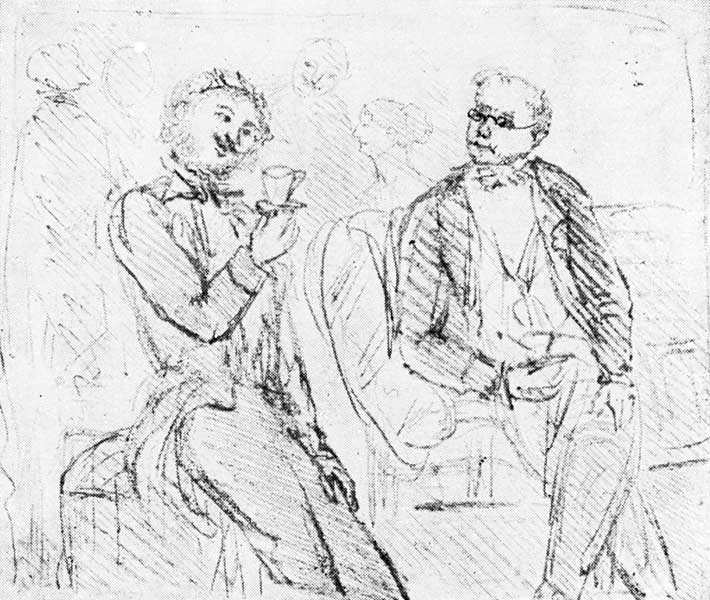
Eminent Musician: "You play, I believe?"
Swell Amateur: "Ya-as!"
Eminent Musician: "The concertina?"
Swell Amateur: "No—the comb!"
(From the Sketch by Henry Walker.)
It may be added that when Punch artists re-draw and touch[Pg 149] up an outsider's sketch, it is their usual practice not to sign their drawings, but to leave them without any indication of their authorship.
Apart from these willing contributors are those from whom the Editor, always on the look-out for new blood and fresh wit, invites contributions, having seen good work of theirs elsewhere.
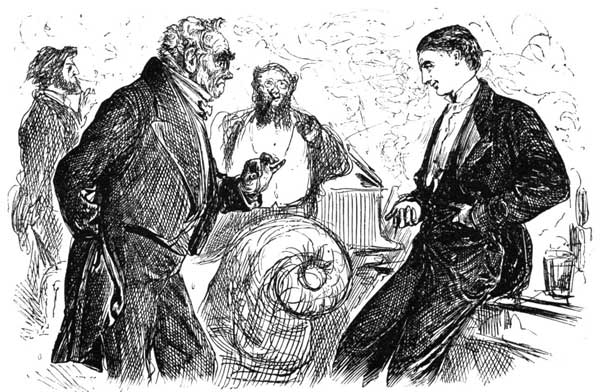 MUSICAL
Eminent Musician: "You play, I believe?"
Swell Amateur: "Ya-as!"
Eminent Musician: "Concertina?"
Swell Amateur: "No—comb!"
(Reduced from the Drawing by G. du Maurier in "Punch," 20th June, 1868.)
It is often thus that Punch's ranks are recruited, and that Mr. Lucy, Mr. Lehmann, Mr. Partridge, Mr. Phil May, and others have been drawn into the agreeable vortex of Whitefriars.
On at least one occasion, however, Punch threw his kerchief in vain, for Mr. Bristed tells us, in his "Five Years at an English University," how the Epigram Club, of Oxford, was invited by the Editor to send its productions to Punch, but that "with true English reserve" the Society came to an agreement that all their transactions should remain in manuscript.[Pg 150]
Beside the editor of a comic journal stalks a demon on either hand—the Belial of Plagiarism and the Beelzebub of Repetition. The public looks to him to be a wit and a humorist, with a knowledge of every witticism that ever was made. If he suffer an old joke to appear, some "constant reader" will surely find him out, and publish the fact abroad with malignant glee. There are few vices so deeply resented as the telling of an old joke; in an editor it is recognised as amounting to crime. But those who judge so severely have clearly never made a scientific study of the Joke. It is not sufficient to analyse a witticism and dissect it, in the cold spirit of that terrible book called "A Theory of Wit and Humour," till its humour flies, like the delicate bouquet from uncorked wine. The genealogy of jokes and twists of humour and of thought, of form and application, must be traced; and the student will find that in respect to a great proportion of our verbal jests of to-day they may be tracked up to the Middle Ages, back to Classic times, and lost perchance in the Oriental recesses of a jocular past. It is not only a case of mere unconscious repetition or of brazen-faced plagiarism that is the principle involved; it has its root in the chameleon-like variety of aspect possible to a piece of fooling or a flash of wit. Jokes are as adaptable to times and circumstances, as the human race itself; and to identify them and pin them down on a specimen card, one must be another Pastor Aristæus, alert and skilful, in pursuit of a lightning Proteus, infinitely various and hopelessly volatile.
But even that is not enough. Suppose the editor to be a scholar, deeply read in the Classics and in Oriental writings, and endowed besides with a memory so prodigious as to be able to recognise every joke that turns up, he has still to guard against the contributor, on whom he is to a considerable extent dependent. The jest-purveyor may be honest when he unwittingly sends in a joke that has already gone the rounds, and has appeared perhaps in some country paper; or he may be deliberately dishonest; or he may simply be impatient at not seeing his contribution printed (perhaps, after all, it is only being kept back for an illustration to be drawn to accompany it), and may send it off elsewhere—anticipating its publication in the paper of his[Pg 151] original choice. Or a group of jokes may form the stock-in-trade of a newly accepted contributor, who, as the seaside landladies say, "must have brought them in his portmantel." And then there are recurring events that naturally give recurring birth to jokes they almost necessarily suggest. There is thus no standard, no system of identification for the thousand disguises in which a joke may lurk; and unconscious plagiarism and repetition deserve greater indulgence than that which they commonly receive. Mr. Burnand, probably the most prolific punster of the age, once wrote to a contributor, "For goodness' sake, send no more puns; they have all been made!" Indeed, Punch has given us more "pre-historic peeps" of humour than he or Mr. Reed have any notion of. "Bless you," said Punch in his third number, "half the proverbs given to Solomon are mine!"
It was the fashion when Punch was young for the comic papers to indulge in fierce recrimination and bitter charge and counter-charge of plagiarism. At that time it was thought that a satirical paper could be launched into public favour on its abuse of rivals—so that all the drowning journals caught at the straws of the others' reputations. Nowadays they more practically apply for an injunction. Punch, in point of fact, has sought the protection of the law on more than one occasion. As early as 1844 the Vice-Chancellor's Court was the scene of the action of the Proprietors of Punch v. Marshall and Another, when Mr. Bethell, afterwards Lord Westbury, complained that the defendants had published a "Punch's Steamboat Companion" (an excessively vulgar production) with intention to deceive the public. The judge brilliantly remarked, "Well, this certainly is an excuse for the Court taking punch in the morning. (Great laughter.) I think you have made out a sufficient case for your injunction, Mr. Bethell;" and the injunction was accordingly granted. In the following year (July, 1845) steps had to be taken to protect Mr. and Mrs. Caudle from the wholesale piracy to which they were subjected on every side. Mr. Bethell again made a comic speech, directed primarily against the "Hereford Times" and the "Southport Visitor," in which the eighth and ninth lectures, illustrations[Pg 152] and all, had been coolly reproduced, without a word of acknowledgment. As before, the serio-comic pleader was successful, and obtained the desired injunctions. Again, in 1872 Mr. J. C. Hotten was stopped from publishing "The Story of the Life of Napoleon, told by the Popular Caricaturists of the Last 30 Years," inasmuch as the compiler had annexed from Punch all he desired for the work. (Law Reports 8, Exchequer 7.) Sir Henry Hawkins was for Punch, and Serjeant Parry defended. The judge, Lord Bramwell, and jury, too, believed in the sacred rights of property, and a farthing damages was awarded in addition to the forty shillings paid into Court. So Punch won his case and gained his costs—and Hotten went on publishing his book just as if nothing had occurred. Another case, against the "Ludgate Monthly," need only be mentioned for the sake of a rival's remark that the idea of Punch having published a joke worth copying and going to law about was the greatest joke of all.
During his minority Punch made and sustained many an open charge of plagiarism. They were the amenities of comic literature, of which, however, the public soon tired; and Punch, recognising that newspaper readers will not be troubled to take part or sides in an Eatanswill warfare that does not concern them, practically dropped a campaign with which the rest continued to persevere. But Punch's silence was misunderstood. At any rate, it was presumed upon. When he could stand the audacity of the poachers no longer, he broke out, as recounted, in the summer of 1844, again in the following year, and once more in 1847, into a practical prosecution. Douglas Jerrold's caustic pen had full play in his all-round denunciation of the pilferers, and in Punch's name he let fly at big game. "First and foremost," he declared, "the great juggler of Printing-House Square walks in like a sheriff and takes our comic effects;" and Newman's pencil added point to the comprehensiveness of the assault. Of numerous frauds, too, Punch had to complain. "Punch's Almanacs" of a vile and indecent sort, with which he had nothing in the world to do, had been issued to his detriment, and several papers were produced in close imitation of his own; but it was the circumstance of his stolen jokes that[Pg 153] wounded him most of all, and caused him to lay his bâton about him with lusty vigour. The incriminated journals, thoroughly in their element, retorted with well-feigned indignation. Prominent among them "Joe Miller the Younger" had professed for him at first a particular friendship which, when contemptuously rejected, turned, like the love of a woman scorned, to hate. It might have been retorted that Punch, in the words of his prospectus, had frankly owned that he would give "asylum for superannuated Joe Millers," and even that Mr. Birket Foster had been actually employed in 1842 in "adapting" and anglicising Gavarni's drawings for Punch's pages. Instead, "Joe Miller" defended the size of his page, which was, he said, like Punch's own, copied from the "Athenæum," and protested against any attempt at monopoly, pointing out that the sub-title "Charivari" was itself a plagiarism. If anyone, he went on, could prove that he bought a Punch in mistake for a "Joe Miller," he would willingly pay £5 for each copy so sold, in order "to compensate the Punch purchaser for his disappointment."
From this moment until his death he never left Punch alone, and constantly pointed out many of his delinquencies, plagiarisms apparently so gross and frequent that it can hardly be doubted that some intrigue was afoot. For example, on August 2nd, 1845, there appeared in both papers a cartoon almost identical, with the attitudes reversed, entitled "The Political Pas de Quatre"—after the existing ballet at Her Majesty's Theatre, danced by Grisi, Taglioni, Grahn, and Cerito—representing four ballet-skirted danseuses in a grotesque pose or tableau. Those in the Punch cartoon (which, by the way, was suggested at the Table by Gilbert à Beckett, and was executed by Leech) were impersonated by Lord Brougham, Lord John Russell, Sir Robert Peel, and Daniel O'Connell; while in the other appeared Lord Brougham, the Duke of Wellington, Sir Robert Peel, and Daniel O'Connell; but, unless carefully compared, the one might certainly be mistaken for the other. The "Joe Miller" block was drawn by A. S. Henning, who had quitted the service of Punch three years before; and it was claimed by his paper that the original[Pg 154] drawing was exhibited in their window a week before Punch's appeared. But abuse of Punch for this and other curious coincidences did not save him, and "Joe Miller the Younger" soon announced his metamorphosis into "Mephystopheles," which proved an inferior and still shorter-lived concern.
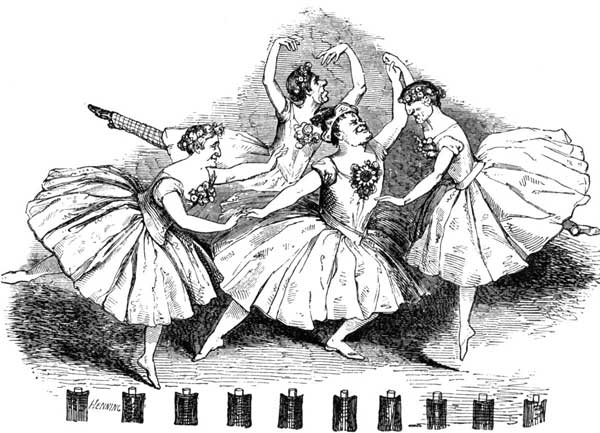 CARTOON ENTITLED "THE POLITICAL PAS DE QUATRE."
(Drawn by A. S. Henning. From "Joe Miller the Younger," 2nd August, 1845.)
Then followed the bright and able little monthly "The Man in the Moon," from which Punch had some of the hardest knocks he ever received, for on its Staff were to be found most of the clever men of the day (including Shirley Brooks) for whom Punch could find no room. Month after month examples were given of Punch's alleged pilfering, which really only proved how the minds of humorists run in grooves, especially when dealing with topical subjects; and a cutting representation of Punch as an old clo'man begging bits of comic manuscript, with the plaintive cry of "Any Jo', Jo'—any old Jo'?" scored a great success. "The Man in the[Pg 155] Moon" chaffed Bulwer Lytton on his initials, "E.L.B.L.B.L.B.," and Thackeray followed in Punch with "E.L.B.L.B.L.B.B.L.L. B.B.B." And one of Leech's sketches of "The Rising Generation"—a small boy saying, "Aw—hairdresser, when you've finished my hair, just take off my beard, will you?" (Vol. XII., p. 104, 1847)—was also represented as a gross infringement. The title of a poem, "What are the Wild Waves Saying?" (with the reply, "We'd better have stayed at home"), issued in "The Man in the Moon," was seen in Punch soon after; while the superiority of our "New Street-Sweeping Machines" over those then in use abroad (by which, of course, cannon was intended) appeared in Punch's pages a fortnight afterwards. It is an interesting fact that this self-same idea of the Street-Sweeping Machines gave Charles Keene the subject for his first Punch drawing just three years later.
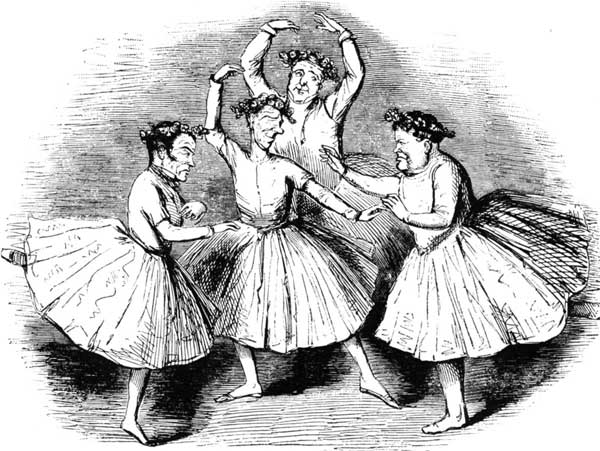 CARTOON ENTITLED "THE POLITICAL PAS DE QUATRE."
(Drawn by John Leech. From "Punch," 2nd August,1845.)[Pg 156]
But, apart from charges of direct plagiarism, "The Man in the Moon" certainly anticipated Punch in some of his well-known cuts. The "Patent Railway-Director Buffer," which consisted in the tying of a railway director on the front of the locomotive, was certainly the "Moon's" invention in February, 1847. In March, 1853, Leech showed the world in his cartoon "How to Ensure against Railway Accidents," by lashing a director across the engine à la Mazeppa; and as late as 1857 (p. 24, Vol. XXXIII.) Sir John Tenniel showed a "Patent Railway Safety Buffer" precisely similar to the original device. Again, in "The Man in the Moon" (January, 1848) the little joke—Park-keeper (St. James's Park): "You can't come in!" Boy: "Vot do yer mean? Ain't it us as keeps yer?"—is surely related to Sir John Tenniel's cut (p. 181, Vol. XXXII., 1857), in which a delightful Hodge gazes open-mouthed at the sentry at the Horse Guards, and replies, when asked what he's staring at, "Wy shouldn't I stare? I pays vor yer!"
The "Puppet Show," too, kept up a running fire at Punch, and delighted in retorting upon his charge of "picking and stealing" by printing their jokes and his alleged belated ones in parallel columns. Among the pictures, too, the "Puppet Show"-man was sometimes first, as in the sketch of the fat old lady who enters an omnibus and, sitting down promiscuously somewhere between two gentlemen, says, "Don't disturb yourselves; I'll shake down"—an idea textually repeated in Punch in 1864 by Mr. Fred Barnard. The "Puppet Show" (1848) is also to be remembered for its joke of the choleric old gentleman, indignant at the delay of an omnibus in which he has taken his seat, crying impatiently to the conductor, "Is this omnibus going on?" and being quietly answered, "No, sir; it's stopping perfectly still"—a joke illustrated by Mr. du Maurier in Punch for 1871 (p. 208, Vol. LXI.); and for the picture of the City clerk in pink, who, surprised by his employer, is accosted with the significant words, "So that's the costume you are going to your uncle's funeral in?" Charles Keene used a similar joke forty-one years later, only with time the festival had changed into that of an aunt. In the "Showman's" pages,[Pg 157] too, first appeared the Frenchman who accounts for his sore-throat by explaining that "Yesterday morning I have wash my neck!" And the Duke of Wellington, in one of the cartoons (May, 1849), cries, "Cobden, spare that tree," just as Beaconsfield pleaded with Gladstone in Tenniel's picture of thirty years later. Again, a man with a gorgeous black-eye enters a room, and when it is remarked on, expresses his surprise that anyone should have noticed it. Six years later Leech repeated the idea in Punch. In his parting shot the "Showman" says, "The Punch writers say they can't understand our jokes. We feel assured that the world will admit that they take them fast enough"—itself a pun, by the way, which Punch had himself used in the postscript to his first volume: "Ours hasn't been a bed of roses—we've had our rivals and our troubles. We came as a great hint, and everybody took us."
In "The Arrow," a clever fortnightly rival which existed (it cannot be said to have "flourished") in the year 1864, Punch was severely handled for "plagiarising" two of that journal's jokes two or three weeks after their original publication. One of these had reference to the "Fight with Fate," which was then being played at the Surrey Theatre; and as Mr. Banting and his famous cure (the stout undertaker lived but two doors from Leech, in The Terrace at Kensington, and struck up a pleasing friendship with the artist) were then the talk of the town, "The Arrow" suggested a revised version, "A Fight with Fat," with a disciple of Mr. Banting as the chief character. Punch followed suit with the entire idea. Thereupon the rival editor, Henry S. Leigh—the lines are manifestly his—apostrophised Mr. Banting thus:—
Anyone who possesses the original "Joe Miller's Jest-book" will be able, if he cares to look, to recognise a goodly number of the most popular jokes of the day, even including a number of Punch jokes. He will there find set forth in quaint terms the[Pg 158] retort of the non-churchgoer that if he is not a pillar of the church, he is certainly one of the buttresses, for he stops outside—used in due time by Charles Keene; he will find the repartee placed by Punch in the drawing by the same artist (May 4th, 1872) in the mouth of an Irish beggar-woman who had been refused alms by a pug-nosed gentleman, "The Lord preserve your eyesight, for you've no nose to carry spectacles;" as well as that witticism usually ascribed to Curran when addressing a jury in the face of a dissenting judge, "He shakes his head, but there's nothing in it;" besides other favourite jokes of similar antiquity and renown. Robert Seymour, too, in whose work, strangely enough, Leech is said to have found no humour, shines out posthumously now and again from Punch's pages. "Move on—here's threepence," says a butler. "Threepence?" retorts the street-flutist contemptuously, "d'you think I don't know the value of peace and quietness?" That was originally Seymour's, together with the drawing of an Englishman's notion of "A Day's Pleasure"—a labouring-man dragging a cartload of children up a steep hill on a hot Sunday—an idea which was afterwards the subject of a Punch cartoon.
Two jokes which from their universality of treatment and the unfailing welcome accorded them at every reappearance might almost be considered classic and generic jests, were greatly assisted in their popularity by Seymour's pencil, before Punch obtained for them still wider recognition. The first represents a fat man, between whose legs the dog he is whistling to has taken his faithful stand. The old gentleman whistles and whistles again, anxiously exclaiming, "Wherever can that dog be?" After Seymour had done with it, Alfred Crowquill took it up; and in 1854 (p. 71 of the second volume) Sir John Tenniel introduced it into Punch under the title of "Where, and oh where!" It was not yet worn out, however, though it doubtless had seen its best days; and so the "Fliegende Blätter" revived it in 1894 as a typical example of recent German humour. For the other joke two men are required: the one an unmistakable ruffian, a grim and dirty robber, and the other a weak, nervous, timid youth of insignificant[Pg 159] stature, the scene representing the entrance to a dark lane as night closes in. "This is a werry lonely spot, sir," says Seymour's footpad; "I wonder you ain't afeard of being robbed!"—and the young man's hair stands on end, and lifts his hat above his head. Leech in 1853 (p. 100, first volume) alters the dialogue for Punch by introducing the pleasing possibility of a greater tragedy, by the footpad asking the youth to buy a razor; and Captain Howard the following spring makes the ruffian inquire if he may accompany his victim "to hear the nightingale." In "Diogenes" (December, 1854) the pristine simplicity is restored by the naïf request that he "may go a little way" with the young gentleman; and finally, in 1857, Leech once more resurrects and renovates it with his astonishing talent and freshness for use in the Almanac.
"Are you comin' home?" asks an indignant wife of her tipsy spouse, in Mr. Phil May's admirable drawing of February 16th, 1895. "I'll do ellythik you like in reasol, M'ria (hic). But I won't come 'ome." In the previous year, however, the following had appeared in "Fun":—"Guid Wife.-'Come hame, Jock; ye'll be doing nae guid here.' Jock.—'Onything in reason, Jenny, ma woman, but hame I wall nae gang!'" On the other hand, in the "Echo," in March, 1895, appeared the following item of news:—"There is a curious report of a dialogue in a Chinese medical paper:—Doctor: 'H'm. You are run down, sir. You need an ocean voyage. What is your business?' Patient: 'Second mate of the Anna Maria, just in from Hong Kong.'" But more than a quarter of a century before, Punch had treated his readers to the same.—"Doctor Cockshure (advising a nervous patient): 'My good sir, what you want is a thorough alteration of climate; the only thing to cure you is a long sea-voyage.' Patient: 'That's rather inconvenient. You see, I'm only just home from a sea-voyage round the world!'"
It is amusing for one endowed with a taste for the history of humour, and gifted with the requisite memory, to follow some of these interesting revivals or re-births of comic ideas. Sir John Tenniel's vision of "The Old Lady of Threadneedle Street," in the "Pocket Book" of 1880, was a familiar conception to those[Pg 160] who remembered "Cruikshank's Omnibus" of 1841; while Leech's sea-sick Frenchman, in p. 76 of the second volume for 1851, was almost the counterpart of "Glorious George's" important etching "A very good man, no doubt, but a Bad Sailor." Again, one of the most brilliant things that ever appeared in a comic journal was the short dialogue supposed to pass between an inquiring child and his philosophical though impatient parent:—
"What is mind?" "No matter."
"What is matter?" "Never mind."
"This well-known definition," says Dr. Furnivall, "according to the 'Academy,' was by Professor T. Hewitt Key; he sent it to Punch, and of course it was printed forthwith—I suppose, somewhere about the 'Sixties." But as a matter of fact this mot, which has also been attributed to Kenny, had already been published in "The Month" as early as August, 1851 (page 147, Vol. I.); and I may add that though I remember hearing Professor Key quote it more than once, I never heard him pretend to its authorship.
Then, the belated Foozle returning home drunk, and offering to fight his aggressive-looking hat-stand, appeared in H. J. Byron's "Comic News" (October 3rd, 1863), as well as in Punch by Keene's pencil (1875); and the humorous chess-problem in the latter paper, in which White had to mate in a certain number of moves, if Black interposed no serious obstacle, was an echo of "White to play and check if Black doesn't prevent him" in "The Man in the Moon" of 1847, and of "White to play and check if Black doesn't mate him before" in "The Month" of October, 1851. Mr. Sambourne's famous "cartoon junior" of Mr. Gladstone in the character of the child in the soap advertisement, who "Won't be happy till he gets It" (i.e. the cake of Home Rule, just out of his reach), was found, to his subsequent annoyance and surprise, to have been anticipated by a week or two by the now defunct "Funny Folks;" and Sir John Tenniel's cartoon representing Mr. Goschen, then Chancellor of the Exchequer, as a hen sitting on her eggs—an idea which was not new even to him, as he had used it in 1880, ten years before—appeared some days after a similar one had been issued in the "Pall Mall Budget;"[Pg 161] though, of course, Punch's picture had, in accordance with the mechanical routine of the office, been decided on a week before publication.
Punch's advice to vocalists, "Take care of the sense, and the sounds will take care of themselves" (November, 1892), had, curiously enough, been spoken years before by the eccentric Duchess in "Alice in Wonderland;" and his conceit that there is no fear for the prosperity of Ireland under Home Rule "so long as her capital's D(o)ublin'" dates from still earlier times. Then there was the fine old Scotch joke of a Glasgow baillie who, replying to the toast of the "Law," remarked that "all our greatest law-givers are dead—Moses is dead, Solon is dead, Confucius and Justinian are dead—and I'm nae feelin' that vera weel mysel'," which in March, 1893, Punch republished, adapting it, however, to modern literature—the speaker quaintly including George Eliot amongst our deceased "best men." More recently a precisely parallel anecdote has been attributed to Dr. McCosh, apropos of Leibnitz's theory of evil ("Westminster Gazette," January, 1895). And again, there is an old story of Baron Rothschild, who when very busy received the visit of a business acquaintance. "Take a chair," quoth the Baron. "Can't," said his visitor, "I'm in a hurry." "Then take two chairs," suggested the Baron, still engrossed. In 1871 the same joke was sent in to Punch in a remodelled form, and duly published. "Call me a cab!" says an excited gentleman. "You're too late, sir," replies the servant; "a cab couldn't do it." "Confound you!" cries the other, "call two cabs, then!"
In 1892 a catastrophe befell Punch, a double faux pas. An excellent child story had been printed in "Vanity Fair" of October 15th, in which a little girl at a Sunday-school class was asked to define a parable: "Please, miss," replies the child, "a parable's a 'eavenly story with no earthly meaning!" A fortnight later Punch, who had been victimised, had the misfortune, not only to come out with the same joke, but by a typographical slip to spoil it by making the child define a parable as "a heavenly story with an earthly meaning"—the result being to evoke a pæan of exultation from the few papers whose favourite sport it is to keep a malevolent weather-eye on[Pg 162] Punch in perpetual hope of catching him tripping. Just such a little chorus of mischievous delight greeted the publication of Mr. du Maurier's joke in which an old maid complains that a serious drawback to the charming view from her windows is the tourists bathing on the opposite shore. It is true, as her friend reminds her, that the distance is very great—"but with a telescope, you know!" But years before, Charles Keene had illustrated the same idea, taking, however, a cricket dressing-tent instead of a bathing shore; and long before that it had been scoffed at for its antiquity.
In like fashion another Punch-baiter complained a quarter of a century ago that an American paper printed a joke which Punch duly used as a "social," and which has since been revived as follows: "Harriet Hosmer tells of an incident which occurred in her studio, where her statue of Apollo rested. An old lady was being shown around, a Mrs. Raggles, and she paused before this masterpiece a long time. Finally she exclaimed, 'So that's Apoller, is it?' She was assured that it was. 'Supposed to be the handsomest man in the world, warn't he?' The surmise was assented to. Then turning away disgustedly, 'Wal,' she said, 'I've seen Apoller and I've seen Raggles—an' I say, Give me Raggles!'"
One of the stories told of Dominique was once printed in Punch as original. This was when he took a bath by the doctor's order, and being asked how he felt, replied, "Rather wet." The jokelet, curiously enough, had already been printed in "Mark Lemon's Jest-Book," and was so far a classic that it is to be found in the "Arlequina" of 1694. Again, the story of the boy who, when ordered by a "swell" to hold his horse, asked if it bit, or kicked, or took two to hold, and when reassured on each point, replied, "Then hold him yourself," is older still; for it is to be found in "Mery Tales, Wittie Questions and Quicke Answeres Very pleasant to be Readde" (published by H. Wilkes in 1567), under the heading, "Of the Courtier that bad the boy holde his horse, xliii." This little book, by the way, is included in Hazlitt's collection of Shakespeare's Jest-books.
In drawing attention to these incidents in Punch's career[Pg 163]—examples of which might easily be multiplied—it is not my purpose to expose shortcomings, but rather to insist on the difficulty of the humorist's path and the pitfalls that beset genuine originality. "The late Mark Lemon," wrote Mr. Hatton, "had a kind of editorial instinct for an old joke. He could identify the spurious article as easily as an expert detects counterfeit money. Lemon's soul was in Punch, and he had a keen memory for every line that had appeared in its columns. He edited a book of humorous anecdotes, but even he overlooked numerous doubles, and left not a few errors for the detection of the critics;" in fact, was fallible too, as in the nature of things he was bound to be. And Shirley Brooks, although with his wide knowledge of comic literature and "happy thoughts" he was successful too, had nevertheless humiliation to bear for blunders not a few. Tom Taylor neither knew nor cared; as Mr. Labouchere severely said, "he had no sense of humour," and the jokes had to take their chance. But to-day a careful eye is kept to this question of originality, and so far as cartoons are concerned, Sir John Tenniel has always been trusted to see that subjects for cartoons are not used over again.
Although Punch has tripped now and again, he has been the comic quarry which the nation and the nation's press have worked for half a century, quoting, borrowing, stealing, a thousand times to his once. His best ideas are enjoyed and used, and in due time are sent back, often quite innocently, for re-issue. Nay, even what is popularly known in England as "modern American humour" has been claimed as a leaf out of Punch's book, quaint exaggeration forming its staple feature, as in the case where we are told that "a young artist in Picayune takes such perfect likenesses that a lady married the portrait of her lover instead of the original."
Lastly, a couple of drawings by Mr. du Maurier may be referred to (second volume for 1872, and first volume for 1894), which created a good deal of amusement at the time of their publication. In the first case a visitor calls to inquire after the condition of a happy mother. And the babe, is it a boy? "No," says the page. Ah! a girl. "No," repeats[Pg 164] the lad. What is it, then? asks the startled visitor. "If you please," replies the intelligent retainer, "the doctor said it was a Heir!" Now, this joke almost textually reproduces a circumstance attending the birth of that Earl of Dudley of whom Rogers wrote the epigram which Byron thought "unsurpassable":—
The second drawing reproduces a story (long since forgotten) of the first Duke of Wellington, who joined a notorious gambling club, with the express view, it was said, to black-balling his son, the Marquis of Douro, a likely candidate—and then went complacently and told him so.
Much the same difficulty attending the identification and indexing of the jokes of the past is experienced in respect to Punch itself. Consider for a moment. That work consisted in the summer of 1895 of 108 volumes. At the moderate estimate of four jokes per column, attempted and made, we reach a grand total of nearly 270,000 jokes—a total bewildering in its vastness, and representing, one would think, all the humour that ever was produced since this melancholy world began. The mind refuses to grasp such a mass of comicality; how, then, would you classify this prodigious joviality and sarcasm? How detect a joke that may reappear under a hundred disguises of time, place, condition, and application—yet the same root-joke after all? Is it surprising that the same ideas recur—and, recurring, sometimes escape the shrewd eye of Punch's investigation department?
It has already been said that to Sir John Tenniel it has fallen to prevent the repetition of subjects in respect to the cartoons. Yet it must not be imagined that others on the Staff are not as earnest students of Punch's pages, that they have not graduated as Masters of his Arts. Yet, for all their vigilance, repetitions have often recurred. You remember Tenniel's superb cartoon of the noble savage manacled with the chains of slavery taking refuge on a British ship with clasped hands uplifted to the commander? It was at the time[Pg 165] of Mr. Ward Hunt's slavery circular, and was entitled "Am I not a Man and a Brother?" A like subject with the same title was contributed by Leech on June 1st, 1844, when a manacled negro appeals to Lord Brougham, who, making "a long nose," hurries off to the Privy Council Office. Similarly have we had two "Vigils"—one in the spring of 1854, and the other thirty-four years later. And Punch's exclusion from France, figuratively at Calais Pier, has been the subject of two drawings—the first in 1843,[15] and the other, by Mr. Linley Sambourne, on January 12th, 1878. The repetitions at such long intervals lose, of course, any such significance as the critical might feel inclined to attribute; but in Punch's nonage the self-same engravings have more than once been actually used a second time, such as "Deaf Burke"—the celebrated prize-fighter of Windmill Street—who was shown twice in the first volume, certainly not for his beauty's sake; a drawing by Hine, which was similarly employed in the same year; and in 1842 a cut by Gagniet, which had been bought from a French publication. Perhaps the nearest modern approach to this was when in 1872 Mr. Sambourne practically repeated his figure of Mr. Punch turning round from his easel to face the reader.
At the time when the Russo-Turkish War was drawing to a close, one of the most powerful of Tenniel's cartoons—which made a great impression on the country, as giving keen point to Mr. Gladstone's agitation against Lord Beaconsfield's attitude at that period—was the drawing of the Prime Minister, leaning back comfortably reading in his armchair, declaring that he can see nothing at all about "Bulgarian Atrocities" in the Blue Books, though the background of the picture itself is all violence and butchery. Yet nobody recalled the fact that the artist had made a similar cartoon of Cobden and Palmerston in the spring of 1857.
Charles Keene certainly had not studied his Punch as he ought. Of that there is abundant proof; for although the care he took to obtain good and original jokes was conscientious in the extreme, he over and over again re-drew his own and[Pg 166] other people's drolleries. The British grumble of the British farmer who under no circumstances can be appeased or contented was typified by Leech in a picture wherein the farmer was represented as looking at a splendid field of heavy golden corn (p. 96, Vol. XXVII, 1854), but was not satisfied even then. "Ah!" he grumbles, "see what it'll cost me to get it in!" The idea tickled Keene so greatly when he heard it that, entirely unmindful of Leech's page, he made a drawing of the same subject on p. 268 of the first volume for 1878; and then, forgetting all about it, eleven years later (p. 35 of the second volume for 1889) he actually did it all over again!
"What do you mean by coming home at this time of night?" asks an indignant wife of her tipsy husband. "My dear," replies the prodigal, with a generous attempt at candour and conciliation, "all other places shu'rup!" Keene drew this admirably in 1871 (p. 71, Vol. LXI), and Mr. du Maurier most delightfully again in 1883 (p. 14, Vol. LXXXIV.). These and many more examples of unconscious receptivity and reproduction by professional humorists will strike the attentive reader of Punch's pages. He will see how to both Leech and Mr. Ralston occurred the idea of an over-dressed vulgarian in morning clothes protesting in angry dismay against the opera-house officials' suggestion that he is not in "full dress;" how both Miss Georgina Bowers (1870) and Mr. du Maurier were tickled by the retort to the economical dictum that it is extravagant to have both butter and jam on a slice of bread—"Extravagant? Economical!—same piece of bread does for both!"; how "Childe Chappie's Pilgrimage" of our day was preceded by "Child Snobson's Pilgrimage" of 1842; how Mr. du Maurier in November, 1888, and again in the Almanac for 1895 repeated the joke of a husband declaring that he would be "extremely annoyed" if in the event of his death his wife did not invite certain of his particular friends to his funeral; how Poe's "Bells" maintain their power to attract the parodist; how curiously tempting to the punster is the idea of a bashful policeman in the National Gallery being asked where "the fine new Constable is" (for Mr. Burnand, Charles Keene, and Sir Frank Lockwood have all done it,[Pg 167] in the order indicated); and many other amusing slips of the sort. And he must not on any account miss those twin jokes—for they are both of them good and in their essence identical—of John Leech and Mr. du Maurier.
In Mr. du Maurier's version we have a poor woman touting for a bottle of wine for her sick husband. The doctor had recommended port, she says—"and it doesn't matter how old it is, sir!" In Leech's the host is impressing on his youthful guest that "that wine has been in my cellar four-and-twenty years come last Christmas—four-and-twenty years, sir!" And the guileless youth gushingly makes answer, in the belief that he is making himself remarkably pleasant, "Has it really, sir? What it must have been when it was new!"[Pg 168]
The Cartoon takes Shape—"The Parish Councils Cockatoo"—Cartoonists and their Relative Achievements—John Leech's First—Rapidity in Design "General Février turned Traitor"—"The United Service"—Sir John Tenniel's Animal Types—"The British Lion Smells a Rat"—The Indian Mutiny—A Cartoon of Vengeance—Punch and Cousin Jonathan—"Ave Cæsar!"—The Franco-Prussian War—The Russo-Turkish War—"The Political 'Mrs. Gummidge'"—"Dropping the Pilot," its Origin and Present Ownership—"Forlorn Hope"—"The Old Crusaders"—Troubles of the Cartoonist—The Obituary Cartoon.
In describing the Punch Dinner I show how the merry meeting lapses, by a natural transition, from pleasure to work, and ends with the evolution of the cartoon; how the mist of talk, vague perhaps and undecided at first, slowly develops a bright nebulous point, round which the discussion revolves and revolves, until at last it takes form, slowly and carefully, though changed a dozen times, and finally, after being threshed and threshed again, stands in the ultimate form in which next week it meets the public eye.
For when the meal is done, and cigars and pipes are duly lighted, subjects are deliberately proposed in half-a-dozen quarters, until quite a number may be before the Staff. They are fought all round the Table, and, unless obviously and strikingly good, are probably rejected or attacked with the good-humoured ridicule and withering scorn distinctive of true friendship and cordial intimacy. Then is each fully and formally debated, every tussle advancing it a stage, and none finally accepted until all the others have fallen in the battledore-and-shuttlecock process to which they have been subjected. Then, when the subject is settled, comes the consideration of the details—what should the grouping be? what the accessories? how many figures?—(during the hunting season John Leech would decline to introduce more than two, as his week-end[Pg 169] would otherwise be spoiled)—and other minor yet still important considerations; and then each man's opinion has its proper weight in the Council of Punch. In this year of grace Mr. Lucy is listened to with the respect due to his extraordinary Parliamentary knowledge; Mr. Milliken is the chief literary authority since "the Professor" (Percival Leigh) went to his rest; and so each man is counted upon for the special or expert knowledge he may bring to bear on the particular subject then before the meeting.
And when the subject of the cartoon is a political one, the debate grows hot and the fun more furious, and it usually ends by Tories and Radicals accepting a compromise—for the parties are pretty evenly balanced at the Table; while Mr. Burnand assails both sides with perfect indifference. At last, when the intellectual tug-of-war, lasting usually from half-past eight for just an hour and three-quarters by the clock, is brought to a conclusion, the cartoon in all its details is discussed and determined; and then comes the fight over the title and the "cackle," amid all the good-natured chaff and banter of a pack of boisterous, high-spirited schoolboys.
More than once it has happened that notwithstanding a subject being well on the way to becoming a cartoon—the raw material of an idea having been almost hammered into a presentable political missile or social criticism by the heads of the company—a side remark may arrest further labour, and turn attention in an entirely different direction. Such was the case with one of the most successful cartoons of recent years. The topic of the week was the Parish Councils Bill, which was then before the Lords, and was receiving severe handling in that House. In the course of discussion came an "aside" from Mr. Arthur à Beckett, to the effect that "Gladstone is having a deuce of a time." "Like the cockatoo," assented Mr. Lehmann, referring to the story of the unhappy bird which was left for a short while alone with a monkey, and which, when the owner returned to the room and found his bird clean plucked of its feathers by the monkey—all but a single plume in the tail—looked up dejectedly, and croaked in tones of almost voiceless horror, "I've been having a doose of a time!" The remarks[Pg 170] were caught at by Mr. Burnand as a happy thought, and the new idea was tossed like a ball from one to another until there issued from it the well-known design of the monkey in its coronet, as the House of Lords, having plucked the cockatoo-Bill of most of its feather-clauses—a drawing which, under the title of "The Parish Councils Cockatoo," hit off the situation with singular felicity, and reaped the reward of the public applause. In a similar manner there developed Mr. Sambourne's peculiarly happy "Cartoon Junior," representing Mr. Gladstone, newly retired, looking up from the perusal of the first speech made by Lord Rosebery on his promotion to the Premiership—a speech some of the points of which he afterwards had to withdraw or explain away—with the words, "Pity a Prime Minister should be so ambiguous!" In the arrangement of these second cartoons, which, as is elsewhere described, immediately follows the handing of the written-out subject of the main picture to Sir John Tenniel, a contrast is always the first thing sought for. If the first deals with foreign politics, the second must treat of home matters, political or social; if the "senior" is social, the "junior" will be political; if Sir John is realistic, Mr. Sambourne is idealistic. And if it is impossible so to differentiate them, the prominent figures at least which appear in the one are carefully avoided in the other.
But in the early years of Punch the method was not so democratic. The matter was discussed, but the preponderance of two or three of the Staff made their opinions felt to such a degree that when a subject was proposed by one of them, that subject, when it appeared, was unmistakably theirs and nobody else's. I have before me the full details of these matters during a considerable period, and I find that on the whole Douglas Jerrold was the most prolific of suggestors, while Henry Mayhew (so long as he remained), Gilbert Abbot à Beckett, Mark Lemon, and Horace Mayhew, roughly speaking, divided the honours between them. Thackeray seldom made a suggestion, and it is not very often that the entry "Leech solus" is credited to the great cartoonist before 1848. During the years 1845, 1846, and 1847, for instance, Leech alone proposed[Pg 171] eleven subjects, Mark Lemon thirty-five, Henry Mayhew twenty, Horace Mayhew fifteen, Douglas Jerrold sixteen, Thackeray four, Tom Taylor four, Gilbert à Beckett two, and Percival Leigh two, leaving the rest to be shared by the united Staff.
The men who have borne the title of Punch's Cartoonist are fifteen in number. Taking them in the chronological order of their first contribution, not of drawings, but of cartoons to the paper, they are: 1841, A. S. Henning, W. Newman, Brine, John Leech, and Birket Foster; 1842, A. "Crowquill," Kenny Meadows, H. G. Hine, and H. Heath; 1843, R. J. Hamerton; 1844, R. Doyle; 1851, John Tenniel; 1852, W. McConnell; 1864, Charles Keene; and 1884 and 1894, Linley Sambourne.[16]
From March 4th, 1843, to September 30th, 1848 (after which, with the exception of one cartoon in 1849 from Newman, and a few from McConnell in 1852, John Leech and John Tenniel shared the cartoon-drawing absolutely between them—no other hand making one at all for six-and-thirty years), there appeared 314 cartoons in about 286 weeks. It sometimes happened that Punch appeared without a cartoon at all, especially in those parlous cashless days of 1842, and again in 1846 and 1848; but, on the other hand, two cartoons were frequently given in the same number, usually from different hands, though occasionally Leech would do both. The 314 designs were made up thus:—
| J. Leech | 223 | |
| R. Doyle | 53 | |
| Kenny Meadows | 14 | |
| R. J. Hamerton | 10 | |
| H. G. Hine | 8 | |
| W. Newman | 6 | |
| —— | ||
| 314 | (exclusive of the Almanacs) |
—Hamerton having taken Hine's place, Doyle having superseded Hamerton, and Meadows, after 1844, having disappeared.[Pg 172] Roughly speaking, from the commencement of Punch to the end of 1894, there have been 2,750 cartoons in all, and these have been contributed approximately thus:
| Sir John Tenniel | 1,860 |
| John Leech | 720 |
| R. Doyle | 70 |
| Other Cartoonists | 100 |
| —— | |
| 2,750 |
—representing an amount of thought and artistic achievement colossal in the aggregate, and perfectly appalling in the case of Leech and Tenniel.
Does it not speak well for the good sense and good digestion of these men that in all these hundreds and thousands of skits—satires going by their very nature into personal motives and perhaps into private actions—that the lapses and the mistakes have been nearly as rare as great auks' eggs? Mr. Gladstone had good reason to say, as he did one day at dinner, that "in his early days, when an artist was engaged to produce political satires, he nearly always descended to gross personal caricature, and sometimes to indecency. To-day he noted in the humorous press (speaking more particularly of Punch) a total absence of vulgarity and a fairer treatment, which made this department of warfare always pleasing"—which is all very true if we admit that the function of ridicule and banter as political weapons is to be merely "pleasing." At any rate, if it be so, it is the knell of all great satire—with the corresponding effect of making the more caustic and grosser sides of men like Swift impossible. Yet, on the other hand, so late as 1860, according to Sir Theodore Martin, Punch more than any other paper reflected the national feeling in such matters as our naval defences; so that in its support of Lord Lyndhurst in his patriotic agitation it greatly assisted in strengthening the hands of the Government.
It is interesting, when you know your Punch as you should your Bible, to lean back in your chair and recall the most striking and important among the three thousand designs, more or less, that stand out as landmarks in Punch's pages.
The first, of course, for association's sake, is that pageful[Pg 173] of "Foreign Affairs" which introduced Leech to Punch's readers. It appeared in the fourth number, on August 7th, 1841. The "Foreign Affairs" consist chiefly of groups of foreign refugees to be seen at that time, and even now in some measure, in the vicinity of Soho and Leicester Square—the political scum of Paris ("Parisites," may they not be called?) and of Berlin. The scroll bearing the title in the middle of the page is fully signed, with the addition of the artist's sign-manual, which was afterwards to become known throughout the whole artistic and laughter-loving world—a leech wriggling in a water-bottle. This début did little justice to Percival Leigh's introduction, for the block was delivered so late that, containing as it did a considerable amount of work, it made it impossible for the engraver to finish it in time for the ordinary publishing hour. The usual means of publication and despatch were consequently missed, and the result was a very serious fall in that week's circulation. For some time after that Leech drew no more, learning meanwhile the elementary lesson that large blocks take longer to cut than small ones—or, at least, did then, before Charles Wells had introduced his great invention of a block that could be taken to pieces in order that each small square might be given to different hands to engrave. Nevertheless, even to the end Leech always had a tendency to be late with his cartoons, and half Mark Lemon's time, according to Edmund Yates and others, was passed in hansom-cabs bowling away to Notting Hill, Brunswick Square, or to Kensington, where in succession Leech resided.
Yet he could be astonishingly rapid when he liked, and often would he complete a cartoon on the wood while his Editor smoked a cigar at his elbow. Such a drawing—such a feat—was that remarkable block of "L'Empire c'est la Paix" (1859), representing Louis Napoleon as a hedgehog bristling with bayonets, admirable in expression and execution, yet not original in idea—though it is as likely as not that Leech had never seen, or else had forgotten, the cartoon in the "Puppet Show" (June, 1854), wherein the Tsar Nicholas appears in a manner precisely similar. The Dinner had by exception been held on Thursday (March 10th, 1859) instead of on the previous[Pg 174] day; every moment was precious; and Leech proposed the idea for the cartoon, drew it in two hours, and caught his midday train on the following day, speeding away into the country with John Tenniel for their usual Saturday hunt.
But in accordance with that strange law of memory that horror, ugliness, and power should spring to the mind before humour, grace, or beauty, it is the tragic side and passionate purpose of Punch's career as shown in his cartoons that first arise in one's recollection. And it is (with but one or two exceptions) exclusively in his cartoons that Leech showed his tragic power. "The Poor Man's Friend" (1845), in which Death, gaunt and grisly, comes to the relief of a wretch in the very desolation of misery and poverty, tells as much in one page as Jerrold's pen, with all its strength and intensity, could make us feel in a score. Ten years later the same idea was splendidly developed and magnificently realised in the cartoon entitled "General Février turned Traitor," which not more than once or twice in the whole of Punch's history has been surpassed either in loftiness of conception or depth of tragedy, or in the tremendous effect that immediately attended its publication throughout the country.
During the Crimean War the winter of 1854-55 was terrible in its severity, and the sufferings of our soldiers were appalling. The suspense at home increased the country's emotion as to the terrors they knew of in the field. The callous statement of the Tsar, therefore, about that time reported, that "Russia has two generals in whom she can confide—Generals Janvier and Février," struck indignation and disgust into every British soul. On February 2nd the news arrived of the death of the Emperor. Popular excitement was intense. Consols rose 2 per cent., and the foreign market was in a state of such confusion that brokers refused to cite even a nominal quotation. Eight days later appeared Leech's cartoon, with its double meaning of superb power, though it was, no doubt, not the most favourable specimen of the draughtsman's art. Received by most with wild enthusiasm, by others with condemnation as a cruel use of a cruel fate, it none the less electrified the country. "Never," writes[Pg 175] Mr. Frith, "can I forget the impression that Leech's drawing made upon me! There lay the Tsar, a noble figure in death, as he was in life, and by his side a stronger King[Pg 176] than he—a bony figure, in General's uniform, snow-besprinkled, who 'beckons him away.' Of all Leech's work, this seems to be the finest example. Think how savage Gillray or vulgar Rowlandson would have handled such a theme!—the Emperor would have been caricatured into a repulsive monster, and Death would have lost his terrors."
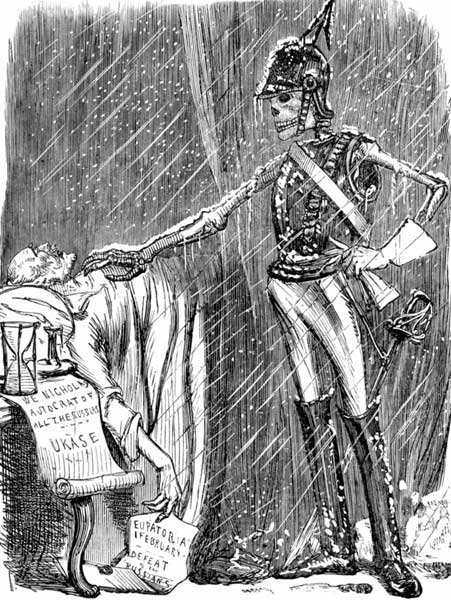 GENERAL FEVRIER TURNED TRAITOR.
(Reduced from the Cartoon by John Leech. "Punch" 10th February, 1855.)
Ruskin compares this cartoon for impressiveness in the perfect manifestation of the grotesque and caricature in art with Hood's "Song of the Shirt" in poetry. "The reception of the last-named wood-cut," says he, "was in several respects a curious test of modern feeling.... There are some points to be regretted in the execution of the design, but the thought was a grand one; the memory of the word spoken and of its answer, could hardly in any more impressive way have been recorded for the people; and I believe that to all persons accustomed to the earnest forms of art it contained a profound and touching lesson. The notable thing was, however, that it offended persons not in earnest, and was loudly cried out against by the polite journalism of Society. This fate is, I believe, the almost inevitable one of thoroughly genuine work in these days, whether poetry or painting; but what added to the singularity in this case was that coarse heartlessness was even more offended than polite heartlessness."
Just before this Tenniel had given us a fine drawing of England and France—the new allies—as typified by two splendid specimens of Guards of both nations, standing back to back in friendly rivalry of height; and the cut achieved such popularity that, under its title of "The United Service," it was reproduced broadcast on many articles of use, and decorated the backs of playing-cards.
The following year Sir John Tenniel (who though hardly more convincing than Leech, yet by his power of draughtsmanship and bigness of conception could be far more imposing) produced the earliest of his magnificent studies of what may be called his "Animal Types" in "The British Lion Smells a Rat" (1856). This heralded what are in some respects his masterpieces, the Cawnpore cartoons (1857), the chief of which[Pg 177] is "The British Lion's Vengeance on the Bengal Tiger." Once this fine drawing is seen, of the royal beast springing on its snarling foe, whose victims lie mangled under its paw, it can never be forgotten. It is a double-page cartoon, splendidly wrought by the artist at the suggestion of Shirley Brooks; and while it responded and gave expression to the feelings of revenge which agitated England at the awful events that had passed at the time of the Indian Mutiny, and served as a banner when they raised the cry of vengeance, it alarmed the authorities, who feared that they would thereby be forced on a road which both policy and the gentler dictates of civilisation forbade. Vengeance was the cry; and the wise and humane counsels of Lord Canning met only with contempt and anger, and rendered him the most unpopular man of the day.
Soon it was Tenniel's destiny to shine alone in the cartoons of Punch. Leech, in the last few years of his life, tired with the strain of over-work and ill-health, withdrew more and more from the making of "big cuts," till towards the end they were left almost entirely in the hands of his well-loved colleague. Tenniel rose to the position and to the full height of the great events that courted his pencil. The great American struggle of North and South gave unlimited opportunity, and for four years Punch, first taking sides hotly against slave-trading, became at times simply pedagogic in his attitude towards both the combatants. From the time (January 26th, 1861) when there was published "Mrs. Carolina asserting her Right to Larrup her Nigger," down to the crowning cartoon of "Habet"—the combatants as gladiators before the enthroned and imperial negroes ("Ave Cæsar!")—many fine cartoons were issued; but the last-named has been held by many to be the finest that has ever issued from the artist's pencil. But, in sentiment at least, a greater was to come—one which helped to melt for us in a measure the hardened heart of the American nation, at that time distrustful of England, and righteously indignant at many a taunt that had been launched against her. This was the affecting picture of Britannia's tribute and Punch's amende honorable, called simply, "Abraham Lincoln: Foully Assassinated April 14th, 1865," while Shirley Brooks's verses which accompany[Pg 178] them take highest rank among poetry of its kind—lines which, rugged perhaps in themselves, come straight from the heart, and speak to a whole nation with true emotion and deep sincerity.
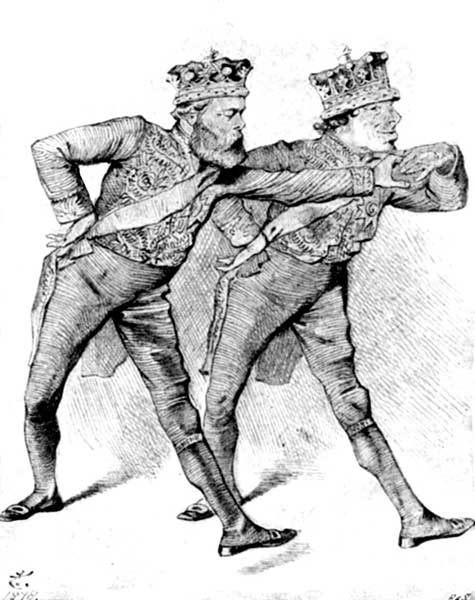 THE "PAS DE DEUX."
From the "Scène de Triomphe" in the Grand Anglo-Turkish Ballet d'Action. (The Finished Sketch by Sir John Tenniel for the Cartoon in "Punch," 3rd August, 1878.)[Pg 179]
Then came "A Leap in the Dark" (1867)—Britannia on her hunter, Dizzy, "going blind" through the hedge of Reform; and soon after the series on the Franco-Prussian War and the situation that immediately preceded the outbreak of hostilities, more particularly that (proposed by Mr. du Maurier) in which the shade of the great Napoleon stands warningly in the path of the infatuated Emperor; while those that illustrated the close of the struggle, aroused a deeper sympathy for France than all the leading-articles and descriptive essays put together. Tenniel's hell-hounds of war, who menace the fallen figure of France distraught, are again seen in the series, almost as fine, that accompanied and followed the Russo-Turkish struggle. A few months later heroics were once more set aside for humour, and the celebrated cartoon representing the successful termination of the Berlin Treaty was given forth—"The Pas de Deux" (1878)—in which Lords Beaconsfield and Salisbury in official dress are executing their pas de triomphe with characteristic grace and ineffable mock-seriousness of mien.
Another cartoon that attracted general attention for its exquisite fooling, and that still haunts the mind of those who can appreciate a completely happy adaptation of text to subject and situation, is "The Political 'Mrs. Gummidge'" (May, 1885). Mr. Gladstone, as Mrs. Gummidge, sits in the Peggotty boathouse by the fire, on which a pot of Russian stew is simmering, while her knitting, marked "Egypt," has fallen from her weary hands, and, the very picture of misery, moans out: "I ain't what I could wish to be. My troubles make me contrairy. I feel my troubles, and they make me contrairy. I make the House uncomfortable. I don't wonder at it!!!" To which Mr. John Peggotty-Bull, pointing with his pipe-stem at the portrait of Beaconsfield on the wall, mutters (deeply sympathising, aside), "She's been thinking of the old 'un!" It was proposed by Mr. Burnand.
But Sir John Tenniel's greatest success of all in recent years—artistically and popularly successful—is undoubtedly the great picture illustrative of Prince Bismarck's resignation in 1889, entitled "Dropping the Pilot." The subject, it may be stated, was not a suggestion made at the Table, but it was handed in from the[Pg 180] late Gilbert Arthur à Beckett, who was too ill to attend the Dinner—(he died very soon after)—and who thus, as so many other Punch contributors have done—Thomas Hood, Artemus Ward, Leech, Gilbert Abbott à Beckett, Charles Bennett, and others—sent in one of the most valuable of all his suggestions just as his career was drawing to its close. The idea was immediately accepted, and its excellence fully appreciated. It was decided that it should occupy a double-page; and Sir John Tenniel, who has always risen to a great occasion, did the fullest justice to the subject. When the paper was sent round to the Staff, as it always is, on the Monday night, they foresaw with delight that here was a great coup, and their conviction received ample confirmation on the publishing-day from the country at large. There was a world of pathos in the weather-beaten old mariner who goes thoughtfully, full of doubt and care, down the side of the ship he had originally designed and had since piloted so long and so well—now discharged as no longer wanted; and there was a world of meaning in the ambitious and self-reliant young Commander who looks over the ship's bulwark and gazes at the bent figure of his departing counsellor. The cartoon, said Mr. Smalley, pleased equally the Emperor and the Prince, for there was that in it which both felt and sought for. The original sketch for the drawing on the wood was finished by the artist as a commission from Lord Rosebery, who then presented it to Prince Bismarck. In acknowledging the drawing the ex-Chancellor declared, "It is indeed a fine one!" "The Hidden Hand"—a criticism on Irish political crime and its incitement—was another of Gilbert à Beckett's most striking suggestions. It appears on p. 103, Vol. LXXXIV., 1883.
Next I would mention—besides Mr. Sambourne's admirable Jubilee picture of "The Mahogany Tree," in which the Proprietors and Staff are gathered round the Table as they toast triumphant Punch (see Frontispiece)—another cartoon which, nobly conceived, if not quite so fine in execution, under the title of "Forlorn Hope" (October, 1893—proposed by Mr. Milliken), has been held by some as second only to "Dropping the Pilot." It is the pathetic picture of Mr. Gladstone[Pg 181] at the moment of his retirement leading the attack against the House of Lords. A grand old fortress crowning an enormous cliff stands out strongly in evening light against the distant sky, and the grand old warrior, in coat of mail, is[Pg 182] struggling up the steep and slippery side—a hopeless task, eloquent of the courage of despair.
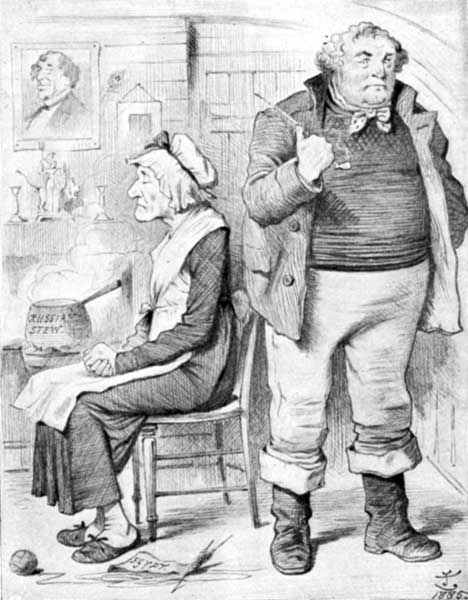 THE POLITICAL MRS. GUMMIDGE.
Last of all upon this list, on May 15th, 1895, was the grand design, also suggested by Mr. Milliken, entitled "The Old Crusaders!"—Mr. Gladstone and the Duke of Argyll "brothers-in-arms again" in their crusade against the Turkish persecutions in Christian Armenia—the full significance being insisted on by parallel dates—"Bulgaria 1876: Armenia 1895." There is an air of unsurpassable dignity in the design of the two old comrade-statesmen, mounted knights armed cap à pie, riding forth, representative of Christendom and the nation's conscience. Immediately on seeing the week's Punch the Marquis of Lorne telegraphed from Windsor to Sir John Tenniel, asking to be allowed to acquire the original drawing; but he had been forestalled by the other Champion's son, Mr. Henry Gladstone, who was then in town, and had secured the prize for his family an hour or two before.
It must not be imagined that the Punch cartoons have always been matters, so to speak, of routine. The unexpected has more than once left Punch in a terribly awkward fix. On one occasion, in 1877, it was confidently expected that Lord Beaconsfield's Government would be thrown out on the Monday night or Tuesday morning, when, of course, it would be too late to begin to think of drawing and engraving a cartoon; besides, the matter was a foregone conclusion. So Beaconsfield was represented in his robes, leaning back "in a heap" upon his bench, his chin on his breast, and his hands thrust deep into his breeches pockets, the very picture of a beaten Minister. But, as it happened, the Government was not defeated—and there was the cartoon! Providentially, however, the Government had been severely badgered about some matter of trivial importance, such as the amount of sealing-wax employed in Her Majesty's Stationery Office, and the cartoon was used with a legend to the effect: "After all the big things I have been in, to be pulled up for this!" The public wondered, and thought that Punch had taken the situation a little too[Pg 183] seriously; but it was a pis-aller, and the best had been made of a shocking bad job.
Mr. Linley Sambourne, writing on this very matter in the "Magazine of Art," tells something more of Punch's tribulations: "Difficulties in the production of cartoons sometimes arise in the impossibilities of foretelling what, not a day only, but a week may bring forth. In December, 1871, when His Royal Highness the Prince of Wales, to the profound sorrow of the entire nation, hovered between life and death, Tenniel drew two cartoons, to be used as events might dictate. To the intense relief and joy of all, the one that was issued was called 'Suspense,' with some beautiful verses entitled 'Queen, People, and Princess: "Three Hearts in One";' while the other, a grief-stricken figure of Britannia, lay almost forgotten in the engraver's bureau, but was remembered, and had unhappily occasion to appear thirteen years after, on April 5th, 1884, to note the sudden loss of His Royal Highness the Duke of Albany. Punch is not infallible. The most serious slip he ever made in the 'cock-sure' line was a cartoon appearing on February 7th, 1885, representing the lamented General Gordon shaking hands with General Sir Henry Stewart (who himself lay stiff and cold after glorious action) inside the fated city of Khartoum. When the number appeared (although at the moment unconfirmed), Gordon himself had been butchered by the Mahdi's fanatics; and another whole week had to elapse before it could be corrected by a cartoon of baffled Britannia, with the heading 'Too Late!' I well remember being inside a picture gallery in Bond Street with the Editor, and hearing newsboys shouting without; the Editor turned to me and smilingly said, 'All right for our cut. There! they're shouting "The fall of Khartoum"!' When we got outside, our faces fell on finding the boot was on the other leg with a vengeance."
A more recent example of the tricks played upon Punch by Fate was on August 11th, 1894 (p. 66, Vol. CVII.), when Sir William Harcourt was represented as an artilleryman mowing down the host of amendments put upon the paper against the Irish Evictions Bill with a Gatling gun labelled "Closure."[Pg 184] Closure had, indeed, been promised, and upon that the cartoon was based; but the Tory tactics threw out all calculations, for the party declined to move their amendments, and took no further part in the proceedings, so that there was no question whatever of closure. The Bill passed en bloc, and the Gatling remained silent.
Finally, there is that class of cartoon always graceful in intention, and invariably received by the public with respect and approval—the Obituary Cartoon. It was invented by Punch when Wellington died. The nation was overpowered with a sense of its loss, and Punch, with his finger, as ever, on the public pulse, reflected the national emotion with a deep and noble sincerity that was gratefully felt and recognised. From that day onwards the great occasions of a people's loss—either of our own mourning or of our sympathy with that of others—have been touched with a dignity and grace in accord with their lofty and solemn purpose, in drawings which have rarely failed to touch a responsive chord in the people's heart, and which, judged as compositions, have often marked the highest point to which Sir John Tenniel's art has reached.[Pg 185]
Origin and Growth of the Cartoon—Origin of its Name—Its Reflection of Popular Opinion—Source of Punch's Power—Punch's Downrightness offends France—Germany—And Russia—Lord Augustus Loftus's Fix—Lord John Russell and "No Popery"—Mr. Gladstone and Professor Ruskin on Punch's Cartoons—Their Effect on Mr. Disraeli—His Advances and Magnanimity—Rough Handling of Lord Brougham—Sir Robert Peel—Lord Palmerston's Straw—Mr. Bright's Eye-glass—Difficulties of Portraiture—John Bull alias Mark Lemon—Sir John Tenniel's Types.
Were you to ask the Editor, Staff, or Proprietors of Punch whether they regarded the political or the social section of the paper as the more important, from the public point of view and their own, the answer would probably be—that they could not tell you. Power and popularity, even in a newspaper—especially in a newspaper—are not synonymous terms, and a great circulation does not necessarily carry influence along with it. It may safely be taken that while the social section of Punch, artistic and literary combined, earned for him his vast popularity, his power, which at one time was great almost beyond present belief, was obtained chiefly by his political satires with pen and pencil. Nowadays, no doubt, their relative importance is more evenly balanced, and what preponderating interest the cartoon may have for "Pater" is equalled by the special fascination exercised by the social picture over "familias."
It has been the mission of Punch, as of many another great and original writer, to invent and import into the language words and expressions which are surely destined to remain. It has already been recorded how it was he who christened the great conservatory now at Sydenham "The Crystal Palace"—though he was not so complimentary until he had cultivated the personal friendship of Sir Joseph Paxton over the "Daily News" affair. It is he who, in his most laconic manner, has[Pg 186] given his immortal counsel for all time to intending mariés; it is he who has crystallised the exaggerated idea of Scottish thrift and economy in "bang went saxpence"—to the circumstances of all of which I have already referred. Mr. Punch, in short, has left the English language richer than he found it, not only in word, but in idea. So, again, the present application of the word "cartoon" is in reality a creation of Punch's.
At the birth of the modern satirical print—that is to say, in the reign of Charles I.—we see it called "A Mad Designe;" eighty years later, when George II. was King, it was known as a "hieroglyphic;" and then onwards, through the caustic and venomous days of the mighty Gillray and Rowlandson, and even of George Cruikshank, and their contemporaries, "caricature" was the term applied to the separate copper-plate broadsides that were issued, crudely coloured, from the famous shops of Mrs. Humphreys, of Ackermann, of Fores, and of McLean, and displayed in their windows to the delight and savage applause of a laughing crowd. Then "HB" had followed, Dicky Doyle's clever father, whose political lithographs had begun to appear in 1830, and continued until 1851—ceased, that is to say, when Punch was ten years old. The wonder about them was that, even before the days of photography, the likenesses of his subjects were so admirable, and his thrusts so happy, while his art, criticised strictly, was so very poor and amateurish. But as exaggeration found no trace in his designs, and his compositions aimed at raising little more than a suspicion of a smile in the beholder (save in the subjects of them), the word "cartoon" was more applicable to them than to any that preceded or have followed them. Mr. Austin Dobson, it is true, speaks of them as "caricatures;" but their publisher more correctly defined them as "Political Sketches."
Then, after the little wood-cut "caricatures" by Robert Seymour, came Punch with his full-page designs. Announced also as "caricatures," for a long while they were known as "pencillings;" but it was some time before they became an invariable feature of the paper. For several consecutive weeks, indeed, in 1843 there was no full-page cut at all, until John[Pg 187] Leech recommenced them with a series of "Social Miseries," the first of which represented "Thoughts during Pastorale." But the most successful and the best remembered was "The Pleasures of Folding Doors" when "The Battle of Prague" is being thumped out relentlessly on the other side.
Now in July of 1843 the first great exhibition of cartoons for the Houses of Parliament was held. These gigantic designs handled the loftiest subjects, executed in the most elevated spirit of the highest art, with a view to ultimate execution in fresco on the walls of the palace of Westminster. It was not in nature for Punch to allow so excellent an opportunity to pass by without taking sarcastic advantage of it. He—conformably with his rôle of Sir Oracle, omniscient and omnifarious—must have his "cartoons" too; and so on p. 22 of the second volume for the same year (No. 105 of the journal) he appeared with No. 1 of his series. It was from Leech's pencil, entitled "Substance and Shadow," with the legend "The Poor ask for Bread, and the Philanthropy of the State accords—an Exhibition." The cartoon represents a humble crowd of needy visitors to the exhibition of pictures on a suggested "free day," in accordance with the recommendation of the Government. This design, a suggestion of Jerrold's, affords an excellent example of the warm-hearted, wrong-headed sympathy with the poor which led him so often cruelly to misjudge and misrepresent the acts and lives of persons in authority whose views were not, like his own, spontaneously, kindly, and impulsively unpractical. The series of six cartoons was directed against abuses, the last, dealing with the subject of duelling, being entitled "The Satisfaction of a Gentleman"—in which two duellists appear attended by seconds wearing caps and bells, while the hangman awaits the victor in one corner, and Death digs a grave for his victim in the other.
After this series Punch for a long while dropped the word "cartoon," but the public remembered it, and has clung to it ever since. It is a remarkable thing that while the "Encyclopædic Dictionary" entirely ignores the word in its modern application to satirical prints, Dr. Murray's monumental lexicon has as its earliest use of the word a reference[Pg 188] made by Miss Braddon to Leech's cartoons in the year 1863—or twenty years after it was first coined!
But the very first number of Punch, as we have seen, rejoiced in a cartoon as we now understand it—that is to say, a large full-page or double-page block of a satirical nature, usually placed in the middle opening of the paper, and for the most part still further dignified by being "unbacked" by other printing. It has been stated that Henry Mayhew at the very beginning insisted on this being a special feature of the paper, defeating the opposition of "Daddy" Landells, who was all for a number of little "coots," as he pronounced them, sprinkled plentifully over the pages. But inasmuch as Landells was an engraver, who would have delighted in the opportunity offered to his apprentices by a "big cut," as he was anxious above all things to follow the Paris "Charivari" (the very raison d'être of which was the large political cartoon), and as, moreover, the original "dummy" of the paper makes provision for such a cartoon, the statement is not to be accepted.
It was really a poor thing, that first cartoon—"Candidates under Different Phases;" but it possessed over the little "caricatures" by Robert Seymour in Gilbert à Beckett's "Figaro in London," that had gone before, the important advantage of size. It was smaller than the hideously vulgar cuts in the "Penny Satirist," but—in tone, at least—this harmless satire on Parliamentary candidates displayed a refreshing and a highly appreciated decency and moderation. And since that time, whether satirical or frankly funny, sarcastic or witty, compassionate or denunciatory, eulogistic, sympathetic, indignant, or merely expository, the cartoons have rarely overstepped the boundary of good taste, or done aught but express fearlessly, honestly, and so far as may be gracefully, the popular feeling of the moment.
It is just this happy ability of Punch's to reflect the opinion of the country that gave it the great power it attained and won it the respect of every successive Government. It is true that of late years Mr. Punch has rather followed public opinion than led it; and it is equally true that he now represents[Pg 189] a higher stratum of society than at first, when Jerrold week after week pleaded the cause of the poor. Yet the Governments of the day might have applied to him Addison's words—
and esteemed themselves happy when Punch smiled upon them. "What Punch says" appears to be a good deal to the Great Ones of our world, thick-skinned though they be; for even outside politics, they have, generally speaking, accepted as an axiom "Vox Punchii, vox Populi;" while Cabinet Ministers, from the Premier downwards, have hoped from his benevolence and feared from his hostility! When Mr. Mundella publicly declared that "Punch is almost the most dangerous antagonist that a politician could have opposed to him—for myself I would rather have Punch at my back in any political or social undertaking than half the politicians of the House of Commons," he was merely expressing a conviction on the part of statesmen that many of them have given evidence of. It is another proof of the power of the caricaturist—a very proper respect for the smile which brings popularity and for the ridicule which kills.
We all know the effect of Gillray's, Rowlandson's, and George Cruikshank's etching-needles upon their victims—how these latter would writhe under a stab that was often virulent in its brutality, merciless, scurrilous, and cruel. We know how money passed—at least, in their earlier years—to influence the political opinions of the caricaturists, less in the hope of damaging "the other side" than with the view to diluting with a little milk of human kindness their etchers' aquafortis; and we know how Cruikshank's sudden abandonment of political caricature has been generally attributed (without drawing forth any denial) to a very special communication of a remunerative sort from Windsor Castle. That, however, was owing rather to his remorseless[Pg 190] gibbeting of the follies and scandals of the Court than to political attack or personal persecution; but other circumstances of a more serious, because of an international, character have now and again attended the publication of a caricature. For example, like the Hi-Talleyrand episode, Leech's famous cartoon of "Cock-a-doodle-do!" (February 13th, 1858) promised at one time—less directly, it is true—to bring unpleasant consequences in its train. In the spirit of the Prince de Joinville, whose bombastic language towards England in 1848 had set an example not to be resisted, were the fire-eating words of a few French officers, who offered to "unsheathe their swords and place them at their sovereign's disposal," and so forth. Leech replied with a cartoon of a Gallic cock, capped and spurred, flapping its epaulettes and crowing its loudest, while Napoleon the Third curses the "Crowing Colonel" under his breath. "Diable!" he says, "the noisy bird will awake my neighbour;" and the point is emphasised by a quotation from the Moniteur. The hit, if not quite original (for Doyle had made a precisely similar sketch of "Le Coq Gaulois" twelve years before in "The Almanac of the Month") was, at any rate, a fair one. But some unscrupulous British patriot so took the matter into his own scurvy hands that the following advertisement was published in "The Times" of March 10th:—
"Fifty Pounds Reward.—It having come to the knowledge of the Committee of the Army and Navy Club that a caricature, with most coarse and vulgar language appended thereto, was sent to an officer in command of a French regiment, accompanied with a forged message from the club, the above reward will, within six weeks from this date, be paid by the Secretary of the Club on the conviction and punishment of the offender."
And so the affair was amicably settled, but not before correspondence of a lively character had passed between both the insulted parties, and it was feared that the matter might be taken up as "an insult to the French Army."
Many a time has Punch been excluded from France—beginning as early as February 11th, 1843—by reason of his political[Pg 191] cuts. In the first half-volume for that year a cartoon entitled "Punch turned out of France"—showing a very sea-sick puppet received on Boulogne quay at the point of a bayonet—first made public the severity of his struggle with Louis Philippe. There is no doubt that his denunciations approached about as near to scurrility as ever he was guilty of; and it is equally true that the French King winced under the attacks made with such acerbity upon his well-known parsimony. In due time, on April 7th, the embargo was lifted, but again in the following year an article by Thackeray, entitled "A Case of Real Distress," in which Punch offers to open a subscription for the poor beggar, with a cut by the same hand representing the King as a "Pauvre Malheureux," had the effect of a fresh exclusion. Punch responded vigorously, his first proceeding being to advertise, "Wanted—A Few Bold Smugglers" in order that he "may continue to disseminate the civilisation of his pages throughout benighted France."
And so on several occasions, especially during the period of his long hostility to Napoleon III., was Punch turned back from the French frontier, though later on the authorities permitted him to enter, on the condition that, like a Mahometan who leaves his slippers at the temple door, he tore out his cartoon before he passed inside. Of late years, however, Punch has on the whole been on excellent terms with "Mme. la Republique," chiefly through his own forbearance during the period of what promised to be the Anglo-Congolese Difficulty. It is true that the cartoon of November, 1894, showing the French Wolf about to spring upon the Madagascar Lamb, aroused fine indignation in Paris at this English version of the methods of French colonial expansion; and that the famous picture of Marshal MacMahon of a score of years before, in which the President was shown stuck fast in the political mud, obstinately satisfied with his impossible position ("J'y suis!—J'y reste!"?), gave equal offence on the boulevards; and although in the latter case the fairness of the hit was acknowledged, Punch was again, as he had several times recently been, placed under ban. Again, at the time of the Franco-Russian rapprochement and consequent fêtes, the[Pg 192] drawing of the Bear and Republic in cordial tête-à-tête, the former disclosing the true source and object of his new-found affection by hinting, with a sly wink and a smirk, about a "little loan," gave rise to real anger, and was deeply resented—probably with the more annoyance that the cutting truth with which Punch had hit off the situation was secretly and unwillingly recognised. But save on one occasion no official expulsion or repulse has in recent times been Punch's lot. Moreover, his splendid series of cartoons, nobly conceived and full of generous sympathy, which he published towards the close of the Franco-Prussian War, are still remembered with some approach to gratitude in a country which has rarely, if ever, returned us the compliment of kindliness or friendship, or even of courtesy, in its satiric press.
Even in Germany, though Punch has not often been denied admittance, he has had at least one distinguished door closed against him. This was when in March, 1892 (p. 110 in the first half-yearly volume), Mr. Linley Sambourne's "cartoon junior" was published, satirising the German Emperor in "The Modern Alexander's Feast; or, The Power of Sound"—
The German Army Bill agitation—the struggle between Emperor and Reichstag, which was followed with so much interest in England—was then at its height; and the monarch had no mind for trivialities. Punch's candour in illustrating the title given him in this country of "The Shouting Emperor," so it is alleged, annoyed him. "For nearly forty years," said one authority, "Punch has been regularly taken in at the Prussian royal palaces in Berlin and Potsdam. The Emperor William has just issued a private order that Punch is to be struck off the list of journals which are supplied to him; and the Empress Frederick, Prince Henry of Prussia, and all the members of the Royal Family who are in the habit of[Pg 193] reading English journals, have been desired by their aristocratic relation to discontinue the obnoxious periodical. It is understood at Berlin that the Emperor's wrath has been excited by some jocular allusions to his Majesty's oratorical indiscretions which recently appeared in Punch." If the members of the Imperial Family scrupulously obeyed the alleged command, they lost the enjoyment of a hearty laugh over Punch's retort—for it is Punch's habit always to retort in matters of this sort when his fun is misunderstood or his irony, in his opinion, taken in ill-part. This was the much-talked-of "Wilful Wilhelm"—representing the Emperor, à la Struuwelpeter, as a passionate fractious child, screaming amid his toy soldiers and drums:
Nor would he leave him alone for a while; but returning a year later to the charge, and taking as a text the Emperor's words—
"It was impossible for me to anticipate the rejection of the Army Bills, so fully did I rely upon the patriotism of the Imperial Diet to accept them unreservedly. A patriotic minority has been unable to prevail against the majority.... I was compelled to resort to a dissolution, and I look forward to the acceptance of the Bills by the new Reichstag. Should this expectation be again disappointed, I am determined to use every means in my power to achieve my purpose...."
Punch promptly produced his cartoon a third time, by Mr. Sambourne's pencil, of "Nana would not give me a bow-wow!—A Pretty Little Song for Pettish Little Emperors," as the latest Teutonic version of the music-hall ditty then in vogue. And later on there was Sir John Tenniel's contribution to the pretty little quarrel, in which in "Alexander and Diogenes" (October, 1893) the Emperor asks, "Is there anything I can do for you? Castle? or anything of that sort?" and Bismarck Diogenes grunts his reply, "No—only leave me to my tub!" But the Emperor's anger did not last long—if it ever existed at all—for it was announced that he again received his Punch[Pg 194] regularly, but, to save appearances, it arrived from London every week in an official-looking envelope, which was opened by the Kaiser's own hands, and by him duly stowed away in his library.
If Punch, by his outspoken criticism, has succeeded in raising the ire of two of the most civilised of the Great Powers, it was not to be expected that he should escape the blacking-roller of the Russian censor of the press. The touchiness of that official does credit rather to his zeal than to his judgment—and, besides, he is obviously no humorist. The Russians have had little opportunity of learning what is thought of them and their governors at 85, Fleet Street. Time after time has the cartoon been destroyed; and Mr. Sambourne, journeying in the country, learned by personal experience that Moscow and St. Petersburg were not as London and Paris. "Should it happen," he writes, "that any cartoon or cut at all trenched on Russian subjects, and especially his Majesty the Tsar, the page was either torn out or erased in the blackest manner by the Bear's paw. I have seen some of Mr. Tenniel's cartoons so maltreated, and have myself been frequently honoured in the same way." It is therefore rather amusing that while such drawings as Sir John Tenniel produced when the great Nihilistic wave was sweeping over Russia, just before the renewed application of the repressive system during the reign of Alexander III. and during the horrors of the Jewish persecutions, Punch would appear on the Tsar's table with cartoons far more severe and humiliating than the majority of those which appealed to the censor's sense of despotism. Of this Lord Augustus Loftus gives a remarkable example—remarkable, too, for the Ambassador's diplomatic ingenuity—his story referring to a period on the eve of the Russo-Turkish War.
"The Emperor had a favourite dog called Milord, which never left him. We were dining at the palace, and it being a small party (there were only the Imperial Family and Court attendants), we retired after dinner to the Empress's private apartments. I suddenly heard the Emperor calling 'Milord!' and supposed that he was calling for me; but it was his dog that was wanted, to receive the biscuits which his Majesty was[Pg 195] in the daily habit of bestowing on his favourite. I immediately hastened to his Majesty, and learnt the explanation from the Emperor, who was highly amused at the incident.
"At the time his Majesty was seated in an inner saloon (a sort of alcove), and placed near him was a small table, on which was a number of Punch, with a cartoon representing the Sovereigns of Austria, Russia, and Germany at a whist table, the Emperor of Russia holding down his hand with a card. The Emperor put the paper in my hand, and said, 'Expliquez-moi cela.' I felt the difficulty of the situation, and to collect my thoughts asked to be permitted to study it. After a short time I said—
"'Oh, sire, it is quite clear. The political European position is here represented by a whist party, and your Majesty is represented apparently as hesitating whether to continue the game.'
"It was a perplexing question, and I felt very much as Daniel may have felt when called upon to explain 'Nebuchadnezzar's dream!'"
I was suggesting just now that to Cabinet Ministers the attitude of Punch is often a matter of very real concern—at least, that they seem usually to have attached more importance to the matter than we who stand outside would think to be reasonable; though, from a proper sense of the ridiculous doubtless, Ministers have rarely turned upon Punch to rend him, for all they may have suffered at his hands.
There is a pretty story of Lord John Russell that is at once a charming proof to the statesman's magnanimity and of the paper's influence. When the excitement, already referred to, of the so-called "Papal Aggression" was at its height, in consequence of the action of the Pope in creating Roman Catholic Archbishops and Bishops with English territorial titles, Lord John, who was then in power, took an active part in the House of Commons on the side of the scaremongers, by introducing the Ecclesiastical Titles Bill—in respect to which he was strenuously opposed by both Bright and Cobden—not in order to put repressive measures into force against the Catholics, he assured the House, but simply[Pg 196] "to insist upon our ascendency." Or, as he explained in 1874, "The object of that Bill was merely to assert the supremacy of the Crown. It was never intended to prosecute. Accordingly, a very clever artist represented me, in a caricature, as a boy who had chalked up 'No Popery' upon a wall[17] and then ran away. This was a very fair joke.... When my object had been gained, I had no objection to the repeal of the Bill." This gave Leech his chance, and he executed his famous cartoon of 'No Popery!' (March 22nd, 1851), which was among the greatest popular successes ever published by Punch—even his smart young rival, the "Man in the Moon," declaring that Punch had with his cut "wakened up those whom his letterpress had sent to sleep."
In his Reminiscences the Rev. William Rogers, Rector of St. Botolph's, Bishopsgate, tells the delightful sequel. When he called on Lord John, the Minister began to talk about the Charterhouse. "He said that he had lost his interest in the latter since his patronage had been taken away. I thought this pretty good for Whig doctrine. 'No,' he went on, 'I never abused my patronage. Do you remember a cartoon in Punch where I was represented as a little boy writing 'No Popery' on a wall and running away?' I said that I did. 'Well,' he continued, 'that was very severe, and did my Government a great deal of harm; but I was so convinced that it was not maliciously meant that I sent for John Leech, and asked him what I could do for him. He said he should like a nomination for his son to Charterhouse, and I gave it him." This, surely, if it be true—for Mr. Silver has a very different story—was a "retort courteous" that would prove how deeply the cartoon went home. Were it true, it would show how the independence of Leech could be in no wise affected—though, going to the House one day, he was greatly struck with the extraordinary dignity of the Minister during his speech in the great debate on foreign policy (February 17th, 1854), when the Crimean War with Russia threatened.
In Mr. Gladstone's "great Edinburgh speech" of the[Pg 197] autumn of 1893 the veteran Premier said that Punch, "whenever it can, manifests the Liberal sentiments by which it was governed from the first." And naturally, as a consistent Liberal supporter, it as consistently attacked the Tory party. Says Mr. Ruskin in one of his lectures on "The Art of England:" "You must be clear about Punch's politics. He is a polite Whig, with a sentimental respect for the Crown, and a practical respect for property. He steadily flatters Lord Palmerston, from his heart adores Mr. Gladstone. Steadily, but not virulently, caricatures Mr. D'Israeli; violently and virulently castigates assault upon property in any kind, and holds up for the general idea of perfection, to be aimed at by all the children of heaven and earth, the British Hunting Squire, the British Colonel, and the British sailor."
This persistent opposition to Disraeli throughout his whole career—an hostility more bitter than perhaps might have been expected from Ruskin's "polite Whig"—was esteemed at its full importance by the object of it, though it was accepted by him, as similar attacks are accepted by all great minds, in excellent part. Nevertheless, after only three or four years of attack, he made a determined though unsuccessful attempt to conciliate his pungent critic. Vizetelly, in his "Glances Back through Seventy Years," tells the story with all the interest belonging to a personal recollection.
"In the summer of 1845," he says, "Mr. Disraeli took the chair at the annual dinner of the 'Printers' Pension Society,' when the stewards, of whom I was one, received him in the drawing-room of the 'Albion,' in Aldersgate Street. Immediately after his entrance he posted himself in a nonchalant fashion with his back to the mantelpiece, and his thumbs in his waistcoat pockets, an attitude Thackeray was fond of assuming, and began to chat familiarly with those near him. In a minute or two he asked if Mr. Leech was present (Leech was one of the stewards), as if he would like to make his acquaintance. The famous Punch caricaturist thereupon stepped forward, and was duly introduced. Disraeli showed himself particularly gracious, and warmly congratulated the artist, whose pencil had lately been employed in satirising[Pg 198] him in a disparaging fashion, depicting him as a nice young man for a small party, i.e. the Young England party, as a Jew dealer in cast-off notions, and as a young Gulliver before the Brobdingnag Minister (Sir R. Peel). Disraeli tried his hardest to ingratiate himself with the distinguished caricaturist, but Leech, proof against the wiles of the charmer, rejoined some months afterwards with the famous cartoon wherein Disraeli, who had lately proclaimed that, although the cause was lost, there should be some retribution for those who betrayed it, figured as a spiteful ringletted viper, and Peel as a smiling unconcerned old file.
"During the dinner the chairman did his best to make himself pleasant, and hobbed and nobbed unreservedly with his immediate neighbours.... When the toasts had been drunk and the secretary had read out the list of subscriptions and the quiet family-men had hurried off to catch the last suburban omnibus, Mr. Disraeli showed no disposition to vacate the chair. Seeing this, the remaining guests drew up to his end of the table, and a lively discourse ensued, in which a casual allusion to Punch was made. Disraeli profited by this by rising to his feet, and in a clever and amusing speech proposed the health of Mr. Punch, towards whom, he protested, he felt no kind of malice on account of any strictures, pictorial or verbal, which that individual might have passed upon him. Everybody entered into the spirit of the joke, and after the toasts had been drunk, calls were made indifferently upon Lemon and à Beckett, both of whom were present, to respond. Mark, however, rose, and in a brief and witty speech returned thanks for the honour that had been done, as he neatly put it, to an absent friend.
"Disraeli's amiable advances availed him nothing. For a long time afterwards Punch gave no quarter to the 'Red Indian of debate' who, as Sir James Graham pithily phrased it, 'cut his way to power with a tomahawk.' The time came, however, when Disraeli could show his magnanimity. Leech, who had satirised him weekly, and so familiarised everyone with his face and figure that an aristocratic little damsel, on being presented to him, exclaimed, 'I know you! I've seen you in Punch!'[Pg 199]—Leech had had a pension given to him by the Liberals, and when he died the pension would have died with him, had not Disraeli, who had at last risen to power, interposed and secured it to the family." And so Leech, who apparently could not make an enemy, was indebted to the generosity of his victims for two of the greatest services that were rendered to him and his.
Lord Beaconsfield himself acknowledged in his latest book, "Endymion," his respect for Punch's influence at that time, as well as his desire to temper the ardour of its attacks if not to secure its silence, for he there explains how the hero, who to some degree at least is to be considered an autobiographical study, "flattered himself that 'Scaramouche'" would regard him in a more friendly spirit. Punch, with pardonable pride, devoted a cartoon to this pointed reference, but merely remarking, "H'm—he did flatter himself," abated not one jot of his caustic criticism.
But for all the failure of his advances, and for all his sensitiveness—so far as he could be said to be sensitive at all—Beaconsfield kept a close eye on Punch, and kept many, if not all, of the cartoons in which he figured. Similarly did Napoleon III. love to collect all those of himself which he could obtain, and pore over them at intervals, even in those sadly fallen times he spent at Chislehurst. And he had material for reflection enough, for in no way, I take it, can a public man learn what a world of savagery, hatred, cruelty, and uncharitableness lies, not so much in man's mind, but in that corner of it which we euphemistically term his "humour," as in following the handiwork of the political caricaturist of France. Mr. Spurgeon, too, used to keep all the cartoons and caricatures that sought to turn him to ridicule; and Lord Beaconsfield, like the Prince Consort, Lord Randolph Churchill (who possessed several of the original Punch drawings into which he had been introduced), among other politicians of the day, kept these artistic instruments of political torture before him, as a man treasures in his locket the hair of the dog that bit him. A visitor to Hughenden gave, in the "Dublin Mail," an interesting illustration of this tribute to the comic press. He was waiting[Pg 200] in an ante-chamber, "and while passing the time my attention was attracted to a clever sketch of the then Prime Minister, depicted as Hamlet, seated at a table covered with innumerable documents, the text quotation being, 'The time is out of joint. O Cursed spite, That [ever] I was born to set it right!' I was smiling at the picture, which, I may add, was a cut out of Punch, and framed, when the Prime Minister entered with the gentleman who was to present me, and finding me gazing at the sketch Lord Beaconsfield said, 'Yes, that is one of the best caricatures of me that has yet appeared, and, strange to say, the artist has neither presented me with donkey's ears nor cloven hoofs. I feel very much flattered!' Lord Beaconsfield took an interest in all the caricatures that appeared of him, and at the time he died he had several hundreds in his possession."
Mr. Gladstone, who, we have often been assured, has not the gift of humour, has at least enjoyed Punch's good-natured yet occasionally severe raillery, and in the same Edinburgh speech to which reference has already been made, he recalled with much relish how, in connection with the rejection of the Paper Duty Bill, he was represented in a cartoon as being decorated by the triumphant Lord Derby—the Lord Derby of that day, who led the House of Lords—with an immense sheet of paper made into a fool's-cap, which he dropped upon his head. Mr. Goschen took a still more exalted view of Punch's prestige when he declared (at Rugby, November, 1881) that "he had since attained to the highest ambition which a statesman can reach—namely, to have a cartoon in Punch all to himself."
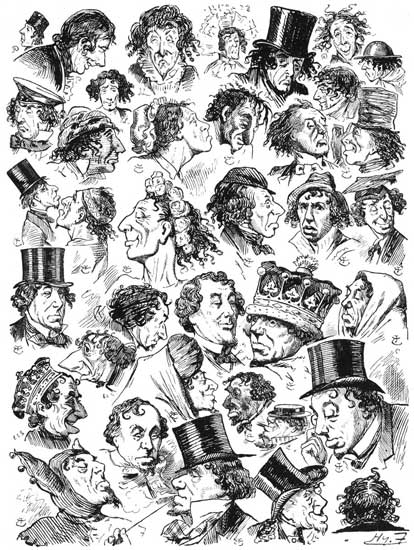 LORD BEACONSFIELD IN "PUNCH."
But hardly less important, in many a public man's opinion, than the sardonic significance of Punch's treatment of him in the cartoon, is the degree of facial resemblance achieved by the artist. It is undeniable that a likeness which is only half a likeness will often rob an otherwise admirable cartoon of half its success, just as it was oftentimes the excellence of the portraiture which more than counterbalanced the weakness of HB's sketches. Lord Brougham always flattered himself that Punch's portraits of him did not do him justice, and John Forster, in his "Life of Dickens," bears witness to it. "Lord Carlisle repeated what the good old Brougham had said to him of 'those Punch[Pg 201] people,' expressing what was really his fixed belief, 'They never get my face, and are obliged to put up with my plaid trousers.'" But another writer, on the contrary, states that Lord Brougham[Pg 202] "himself admits that the Punch likenesses are the best. Of course, they are a little exaggerated, but not so much so as many with whom I have chatted on the subject are apt to suppose;" while Motley, the American Minister, declared, after an official meeting with the grim old lord, "He is exactly like the pictures in Punch, only Punch flatters him. The common pictures of Palmerston and Lord John Russell are not at all like, to my mind; but Brougham is always hit exactly." Leech, indeed, enjoyed nothing more than caricaturing him, one of the most precious butts Punch ever took to himself, until he was twitted in the "Puppet-Show" at the liberties he took: "The proprietors will be compelled to widen the columns of their journal ... to show, as far as space will admit, to what lengths a nose may go in the hands of an unprincipled illustrator." But it was not only that Punch delighted in toying with Lord Brougham's cantankerousness and his peculiarities of manner and diction—as in the famous cartoon of Lord Brougham as Mrs. Caudle, of the original sketch for which a reproduction is given opposite—but he steadily carried into execution his threat of earlier days, to drag Lord Brougham "in the mire." He has been as good as his word ever since the day when Dicky Doyle drew the famous cover which is familiar to us all—that is to say, in 1849—for, as you will see if you will refer to last week's Punch, a young faun in the grand procession that appears as a relievo upon the podium or base draws along the mask of Brougham by a string. But without doubt one of the most successful cartoons Leech ever drew, and the most humorous portrait of Brougham, represented him as a clown at Astley's, going up to the splendid ring-master, the Duke of Wellington (as Mr. Widdicomb of Astley's Amphitheatre) and saying "Well, Mr. Wellington, is there anything I can do for you—for to run, for to fetch, for to carry, for to borrow, for to steal?" As Lord Brougham was suspected of undue complaisance towards the Duke at the time, the neatness of the political allusion was received with extraordinary favour by the public.
Another admirable portrait, consistently good, was that of Sir Robert Peel: so good, indeed, that when it was proposed to[Pg 203] erect a statue to the statesman, and the best of all likenesses was sought as a guide to the sculptor—a resemblance truthful in feature and natural expression—the choice fell on a cartoon by Leech, and according to that drawing the head was modelled. Palmerston, too, was not a little impressed when in Wales a postman spoke to him as though he knew him, and replied, when questioned as to the recognition, "Seen your picture in Punch, my lord."
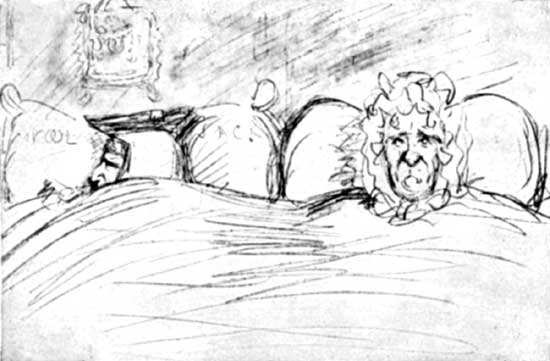 "THE MRS. CAUDLE OF THE HOUSE OF LORDS."
"What do you say? Thank heaven! You are going to enjoy the recess—and you'll be rid of me for some months? Never mind. Depend upon it, when you come back, you shall have it again. No: I don't raise the House, and set everybody in it by the ears; but I'm not going to give up every little privilege; though it's seldom I open my lips, goodness knows!"—"Caudle Lectures" (Improved).
Mrs. Caudle, Lord Brougham; Mr. Caudle, Lord Chancellor Lyndhurst. (From the original Sketch for the Cartoon drawn by John Leech at Thackeray's suggestion.)
But Punch, it must be admitted, has often departed from the solemn truth, both unintentionally and of malice aforethought. It was his common practice to put a straw into Lord Palmerston's mouth. Palmerston, of course, never did chew straws; but one was adopted as a symbol to show his cool and sportive nature. Many a time has that straw[Pg 204] formed the topic of serious discussion by serious writers. Some have pretended that it was designed to typify an expression used by one of his admiring followers in the House—a tribute to his "stable character;" others have said that it became his attribute from the time that he described himself as "playing the part of judicious Bottle-Holder to the pugnacious Powers of Europe;" and Mark Lemon declared that it was simply used as a sort of trade-mark whereby he might be known again, just as Mr. Harry Furniss invented Mr. Gladstone's collars, Lord Randolph Churchill's diminutiveness, and exaggerated those complacent smiles and oily rippling chins of Sir William Harcourt, continuing them long after the time when Sir William could boast the local portliness no more. However, it is certain that the sprig of straw, which really referred only to his pure devotion to the Turf, from 1815 onwards, was first used in 1851, just after the whimsical "Judicious Bottle-Holder" declaration, and, as a matter of fact, added not a little to Palmerston's popularity, as not only representing the Turf, but a Sam Weller-like calmness, alertness, and good-humour.
Similarly both Leech and Tenniel were in the habit of giving Bright an eye-glass. "Some of us remember seeing him wear a coat with a stand-up collar in the House of Commons," said a writer in the "Daily Telegraph," "and a broad-brimmed hat; but 'why,' he used to ask with a merry face, 'did Punch always put an eye-glass in my eye? I never wore a single eye-glass!'" That was just the point; for no doubt the simple reason was that the addition of a monocle was supposed to lend a sort of rakish appearance to the solemn Quaker, and belonged to the same genus of perverse jocularity as that which suggested three hats as the humorous covering for young Disraeli's head. Mr. W. H. Smith in like manner genially protested at a complimentary dinner in 1877 against the liberties taken with his person. "As to Punch," he said, "whose remarks have been mentioned, I beg leave to say that I do not go to sea in uniform, or exhibit those very queer expressions of face depicted by Punch's artists."[Pg 205]
There are some men whose physiognomies defy the deftest pencils. Such a one was Cobden, whose views Punch represented far more faithfully and sympathetically than his face. At the Cobden dinner of 1884 Lord Carlingford drew fresh attention to the point: "Cobden's was, for some reason which I never heard explained, a most difficult face to sketch, and Punch was in despair at the impossibility of producing a caricature that could be recognised without explanatory text. Many of the artists tried Cobden, and were floored over him. Leech and Tenniel both confessed that they could not hit the familiar expression. Somehow, they never did hit it, though photography came by-and-by to their aid." The statement is perfectly true, but the reason is not hard to find: simply that a shaven face, without well-marked features or strong lines of character, and, above all, without angularities, gives the artist extremely little to "take hold of." For that reason such faces as those of Lord Rosebery, Mr. Asquith, and Mr. John Morley (of the latter of whom Mr. Furniss used to say the true characteristic expression is only to be found in his red cravat) are as often failures as successes, in even the skilfullest hands. It is the fault of neither the artist nor the person misrepresented; according to Mr. Lucy—it is "the act of God."
Before the days of photography the work of the caricaturist was harder than it is now. Draughtsmen had to be familiar with the faces of the leading men of the day—even as Leech was, by "getting them" into their sketch-books by hook or by crook, or else they would accept the portrait already published by a brother-artist. Even to-day it sometimes occurs that a man of importance has not been photographed. In that case he must be sketched or remembered, or his portrait "faked up" on the block until it bears some resemblance to the person required. But, passing from mere portraiture to the realisation of ideas, the artist feels his liberty, and gives his genius full rein. Thus it is that Punch has always been happy and successful in his "types." It is thoroughly in the spirit of caricature that types should be established and adhered to in order to express,[Pg 206] in symbolic form, nations and even ideas. Not only is it poetical, it is convenient; and has perforce been adopted in every country where political caricature is employed, though with standards and notions very different from our own. In Italy, for example, and in a minor degree in Germany, John Bull, as the symbol of Great Britain, is usually represented by a travesty of Punch's, with a brutal head and bandy legs, and the whole figure bent in body to suggest a bull, horns sometimes protruding beside the hat; while Russia is courteously represented as a frantic Cossack of terrific mien, brandishing a knout with violent and savage intent. We may claim that our types, as invented by Punch, are of immeasurable superiority, whether of conception or of realisation. Our John Bull—a lineal descendant probably of Gillray's favourite representation of George the Third as "Farmer Gearge"—is a fine noble fellow enough as drawn by Leech and developed by Tenniel; indeed, in the drawings of the latter may often be seen the idealised face of Mark Lemon, his jovial Editor.
This view of the type of England has attracted the attention of Ruskin. "Is it not surely," he asks, "some overruling power in the nature of things, quite other than the desire of his readers, which compels Mr. Punch, when the squire, the colonel, and the admiral are to be at once expressed, together with all that they legislate or fight for, in the symbolic figure of the nation, to present the incarnate Mr. Bull always as a farmer—never as a manufacturer or shopkeeper—and to conceive and exhibit him rather as paymaster for the faults of his neighbours than as watching for opportunity of gain out of their follies?" And again, ".... considering Punch as the expression of the popular voice, which he virtually is, and even somewhat obsequiously, is it not wonderful that he has never a word to say for the British manufacturer, and that the true citizen of his own city is represented by him only under the types either of Sir Pompey Bedell or of the more tranquil magnate and potentate, the bulwark of British constitutional principles and initiator of British private enterprise, Mr. John Smith?[Pg 207]"
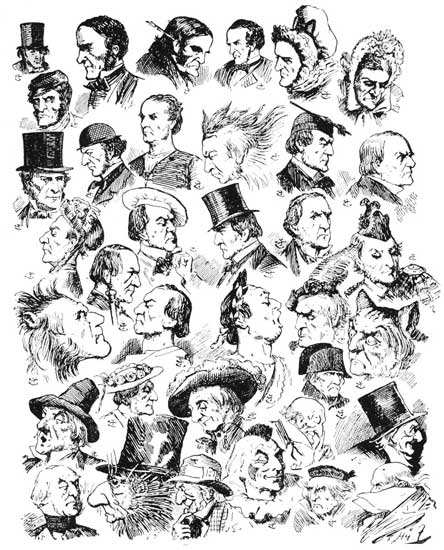 MR. GLADSTONE IN "PUNCH."
It is true that Punch has imposed upon a nation a character which, as depicted, is unknown in the land, and placed him in a line of business notoriously dissimilar from that in which he really engages; and the sum-total of it all is greatly to the credit of Mr. Punch's influence. He has, in fact, "educated" a nation. For to this day, no sooner does each[Pg 208] succeeding Wednesday spread the new issue over the country than a mass of newspapers, both in England and in the colonies, immediately describe and discuss "This week's cartoon" for the edification of their readers. And so we have come to accept these types until they have almost grown into concrete ideas—conventions which have been given to us chiefly by Sir John Tenniel—Britannia and Father Time, the New Year and the Old, Cousin Jonathan (or Uncle Sam) and Columbia, Death and Crime, Starvation and Disease, Peace and War, Justice and Anarchy, the British Lion (might not the symbol nowadays be more appropriately the British Racehorse?), the Bengal Tiger, the Russian Bear, the Eagle, and all the rest. And could they well be bettered?[Pg 209]
Punch lays about Him—Assaults the "Morning Post"—The Factitious "Jenkins"—Thackeray's Farewell—Mrs. Gamp (the "Morning Herald") and Mrs. Harris (the "Standard")—Lèse Majesté!—The "Standard" Fulminates a Leader—The Retort—His Loyalty—Banters the Prince Consort—Tribute on the Prince's Death—Punch's Butts: Lord William Lennox—Jullien—Sir Peter Laurie—Harrison Ainsworth—Lytton—Turner—A Fallacy of Hope—Burne-Jones—Charles Kean—S. C. Hall as "Pecksniff"—James Silk Buckingham and the "British and Foreign Destitute"—Alfred Bunn—Punch's Waterloo: "A Word with Punch"—Bunn, Hot and Cross—A Second "Word" Prepared, but never Uttered—Other Points of Attack.
Though for many years Punch has claimed to be "everybody's friend," he would certainly not have done so during the earlier part of his career. Then he was constantly in the wars, not merely because he was criticising public men, attacking abuses, and making sport of his favourite butts; but because he had not yet learned to break away from the journalistic duelling that prevailed. In these more sophisticated days it is the usual aim of every prominent journal to ignore as far as possible the existence of its rivals; then, it was thought that that existence could be best undermined, if not absolutely cut short, by direct attack. Party spirit ran very high; and to Punch's undoubted strengthen serious writing was added a power of pungent wit and sarcasm unequalled by any rival. He thus became a very formidable adversary; and he knew it. But he did not put forth his full strength until he felt sure of his own firm establishment; nor did he turn his bâton upon his brothers in the press until he had made a lively start upon individual statesmen and private persons, and formally set them up as his own particular Aunt Sallies for private and public practice.
His first onslaught on the daily press was made upon the "Morning Post" (p. 126, Vol. IV.), by the hand, not of Thackeray, as has hitherto been believed, but of Douglas[Pg 210] Jerrold, under the title of "The 'Post' at the Opera." The tone of that newspaper was irresistible to the democrats of Punch; and Thackeray, Leech, and à Beckett took up the running with great glee. Jerrold and Thackeray chose to personify the paper by the creation of "Jenkins," and the "Jenkins Papers" soon became a recognised feature and one of the standard jokes of the paper. Leech's illustrations were every bit as good as the others' text; and even when the gentle Hine was called upon to make sketches upon the same subject, he found himself inspired like the rest. "Jenkins," the toady, and "Lickspittleoff," his "Russian editor," were grand sport in the office, and their example was followed—not a little to their disgust—by the "Great Gun" and other papers. Soon after his first introduction (p. 123, Vol. V.) "Jenkins" was cast aside as a joke played out, and Thackeray took leave of him in the following amazing lines:—
But when the possibilities of "Jenkins" were fully realised, he was revived, and for some years did excellent service as a subject for humorous attack.
A more serious campaign upon which Punch now entered was that against the "Standard" and the "Morning Herald." He had with some astuteness, and doubtless not without sincerity, ranged himself on the side of the "Times," and threw himself into the fray with all the zest and some of the irresponsibility of the licensed jester.[20] "Martin Chuzzlewit"[Pg 211] had already seized upon the town, and the names of Mrs. Gamp and Mrs. Harris were on everybody's lips. Punch chose to assume that the "Morning Herald" and the "Standard"—morning and evening papers then which represented the Conservative party, both of them until 1857 belonging to one proprietor—were edited respectively by the two ladies aforesaid. The "Standard" was very wroth. It would not have been so sore perhaps at being dubbed "Betsy Prig;" but, being in fact almost a reprint of the "Herald," the suggestion of "Mrs. Harris"—a creature of no existence, the mere reflex of Mrs. Gamp's own inane and besodden brain—was too calmly provoking, as it was meant to be, to be borne in silence. These two journals were highly unpopular at the time; for the "Manchester School" was making headway, and Free Trade was already a powerful and significant cry. So when Punch laughed at them for two—though really one—disreputable old women, and Leech's inimitable pencil typified them as such, in mob-cap and pattens, the public laughed with him, whatever their own political opinion might be. It should be noted, however, that Punch's first brush with the "Herald" was personal, not political. In February, 1843, the latter journal had fathered upon Punch a poor joke of which he was entirely innocent, and which he repudiated in an article entitled "Impudent Attempt at Fraud." The quarrel thus begun in fun was continued in earnest, and soon the "Herald," as a representative of public opinion, had no more damaging assailant than "our humorous contemporary."
Now, in November, 1845, there appeared a reference to "Mrs. Harris, Editress of the Standard," as well as a drawing by Leech, called "Maternal Solicitude," which was intended to satirise the snobbery of persons who name their children after the Royal Family. It represents the visit of one lady to another, while a pair of repulsive-looking brats of one of them make up the group. "And the dear children?" asks the friend. "Why," replies the fond mother, "Alexandrina Victoria is a good deal better; but dear little Albert here is still very delicate."[Pg 212]
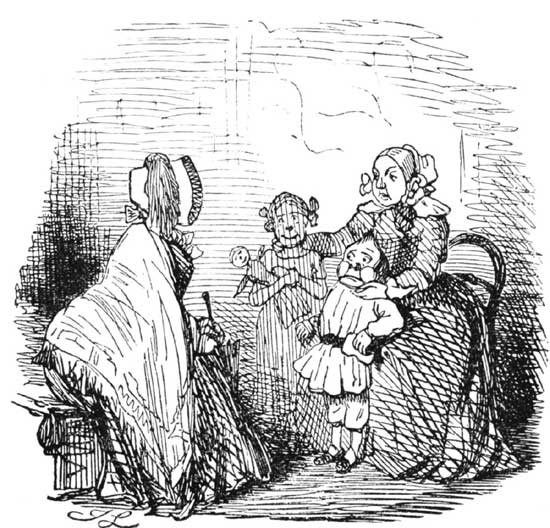 MATERNAL SOLICITUDE.
"And the dear children?"
"Why, Alexandrina Victoria is a good deal better; but dear little Albert here is still very delicate."
(Drawn by John Leech. From "Punch," Nov. 23rd, 1845.)
Thereupon the "Standard" opened the floodgates of its anger in a leading article, the whole tone of which is a curious contrast to its dignity and moderation at the present day. In the course of its outburst it said:—
Still not one word from the "Times" in support of its charge of the exercise of Court influence at the Windsor Election. As usual, however, ... its toadies are active and noisy.... To-day we, of course, find Punch the most abject, probably, of all the "Times" toadies, discharging the duties of its mean avocation in an article libelling the successful candidate, libelling the military, libelling the young gentlemen of Eton, and ascribing Colonel Reid's return to "kitchen-stairs influence" emanating from the Castle..... If there were any fun in the article to which we refer, we might forgive the malice and falsehood, as we are all too much disposed to do, for the joke's sake; but dull as all the articles of Punch have been lately growing, this article on the Windsor Election is[Pg 213] the stupidest that we have seen in its columns—a mere display of heavy spitefulness. We should probably have overlooked this piece of impertinence had Punch confined itself to letterpress in its toady vindication of the quarrel of the "Times;" but in the 222nd page of the number which contains the Windsor Election article, there is a disgusting caricature of the Queen and her family, the most false and unjust in what it implies that it is possible to conceive, and the most offensive to the feelings of a mother. The effect of such an insult to a Sovereign the object of her people's respect and love will, we imagine, be different from what the "Times" and its toadies anticipate. At all events, such insults will not, in the absence of all proof, render credible the false allegation of the exercise of Court influence, or enable the "Times" to get rid of our challenge, which we again repeat—this is a point from which we shall not be driven, until we have a direct answer from the "Times" itself, not from its toadies. The Queen may be libelled as the Punch, "Times," and "Examiner" libel her Majesty, if Sir Frederick Thesiger permit; but our Sovereign shall not be belied while we have the power to expose the fabricators of falsehood and their fabrications.
One may well wonder whether the "Standard" was really serious, or only "making believe" in order to strengthen its attack upon the "Times." But it suited Punch to take the outburst seriously, though with provoking calmness. First retorting that it is well that the editress of the "Standard"—he invariably referred to "the editress"—wears pattens as a precaution which the nature of her walks renders very necessary, although they are constantly tripping her up, Punch quietly remarked that "'Our Grandmother' must surely have taken an additional drop of 'something comfortable';" "and Leech parodied Phiz" etching of Mrs. Gamp and Betsy Prig, in which "the editress" declares, "As for that nasty, hojus Punch, I'm dispoged to scratch 'is hi's out a'most. What I ses, I ses; and what I ses, I sticks to." The campaign was conducted with considerable spirit by Gilbert à Beckett and Percival Leigh, with slight assistance from Horace Mayhew; and was continued with remorseless gaiety and bitterness for some years. In the pages here devoted to Thackeray reference is made to the personal feeling which[Pg 214] existed between him and the "Morning Post" and to the effective retaliation on the part of that newspaper.
Punch's loyalty, as a matter of fact, has always been above suspicion and above proof. Democrat as he was, and independent in his views, he was as indignant as the "Standard" itself when the half-demented Bean made his attempt upon the Queen's life; yet gleeful to a degree when his Liege Lady was called upon to pay income-tax precisely as all her subjects did. The birth of the Prince of Wales, which coincided with Lord Mayor's Day, provided Punch with an opportunity for showing much loyalty and more wit; and the interest with which he followed the education and amusements of the Heir-Apparent, the anxiety with which he made suggestions for the best appointments, in his nursery-household, to the office of the "Master of the (Rocking) Horse," the "Clerk of the Pea-Shooter," and so forth; the delight with which, by the hand of Leech (1846), he published a charming cartoon of the lad as a man-o'-war's man, thus popularising the dress of English boys, while the sketch itself was widely reproduced as a bronze or plaster group—all this proved the benevolent sentiments he entertained towards the Royal Family. This benevolence has cropped up again and again—when the Prince visited Canada and America (1860); when, in 1861, he went up to Trinity College, Cambridge (the Mayor and Corporation coming in for severe criticism, however, for their snobbish Address); when he married; when he fell ill and recovered; and when he celebrated his Jubilee—on which occasion Punch declared that "the longer he knew him the better he liked him"—a sentiment the genuineness of which could hardly have been questioned by any but the blindest of critics. From first to last Punch has been a respectful godfather, and a wise and kindly guardian.
Towards the Queen herself Punch has shown unswerving chivalry and reverence, even during the shouting days when democracy was more noisily republican than it is to-day. The Queen figures often in the earlier cartoons, and the care with which the draughtsmen sought to do justice to the pure outline of her fair face is at least a tribute to their good[Pg 215] taste. Punch never affected to regard her as a mere figurehead, but always represented her in a position of authority, her Ministers in character of domestic servants taking her instructions, and not at all tendering advice; and every important incident in the life of the Queen has been touched upon with the utmost respect and sympathy.
But with the Prince Consort the case was somewhat different. As Mr. Burnand and Mr. Arthur à Beckett have written[21]:—
"It is strange to note that, until the hour of his death, the man whose memory is now universally respected was highly unpopular with the general public. The Democritus of Fleet Street was, and is, essentially representative, and the popular opinion of the merits or demerits of H.R.H. is constantly shown. Only a few weeks after the cartoon" [of the Prince Consort tying up his door-knocker on the occasion of the birth of the Princess Beatrice] "Mr. Punch is drawn looking at the portrait of the Prince Consort at a review at the Royal Academy, and saying, "No. 24. A field-marshal; h'm—very good indeed. What sanguinary engagement can it be?" That these satirical observations were made simply at Prince Albert's expense, and were not intended to reflect upon the Queen or the rest of the Royal Family, is shown by the extremely hearty manner in which the marriage of the Princess Royal was welcomed by Mr. Punch as representing the English feeling. John Bull is heard saying, as he hands over to the Imperial Princess of Germany her dowry, 'There, my child! God bless you! And may you make as good a wife as your mother.'"
It is probable that the real source of the Prince Consort's unpopularity was his foreign nationality, added to the ignorance of the people of his enthusiasm and indefatigable efforts for the public weal. His rapid promotion in military rank, already referred to, was not appreciated in the country, and was mercilessly lampooned in Punch; and attention was attracted to the fact that from that time forward the Duke of Wellington always prefixed the initials "F.M." in his short, brusque third-person letters. "H.R.H. F.M. Paterfamilias" was for some time one of the chief of Punch's stock jests. The[Pg 216] Prince was pursued into his private apartments, and shown as a père de famille in not the most respectful spirit. In one picture he is represented in his dressing-gown conferring upon "P—pps the Fortunate" the Knighthood of the Shower Bath; in others, the effect of Time upon his head and figure are dwelt upon with real sardonic relish. The misapprehensions of the public were not unnaturally reflected by Punch, and a cut was much applauded in which the Prince was shown stopped by a policeman in Trafalgar Square when in the act of removing a couple of pictures from the National Gallery. Punch pointedly inquires, "Taking them to Kensington Gore? Suppose you leave 'em where they are, eh?"
More justifiable perhaps, but still somewhat harsh, was Punch's protest (1854) against the Prince's supposed interference in State politics. He is shown skating on the ice, warned off by Mr. Punch from a section of it labelled "Foreign Affairs—Dangerous." And in the same year he is attacked with extraordinary gusto by reason of the new hat he had devised for the British army—or, at least, for the Guards. In 1843 the first "Albert shako" had appeared, and Leech, in a cartoon called "Prince Albert's Studio," exhibited it as a pretended work of art in the most ludicrous light. Again, in 1847 the Prince had invented a similar headgear, popularly christened "the Albert Hat," which Punch converted to his uses and worked to death. "The New Albert Bonnet for the Guards" ridicules the idea unmercifully, and "the British Grenadier as improved by His Royal Highness Prince Albert, decidedly calculated to frighten the Russians," was another grotesque perversion of a praiseworthy attempt with which Mr. Punch was in his heart a good deal in sympathy. For his artists were as diligent as the Prince in trying to improve the uniform of the British soldier, contrasting with its wretched inconvenience the serviceability and ease of the sailor's. The drawing in which a private, half choked by his stock, held helplessly rigid by his straps and buckles, and unable to hold his gun as his "head's coming off!" illustrates the fact that Punch's views and Prince Albert's had much in common. We have the authority of Sir Theodore Martin, in his biography (Vol. II., p. 299), that[Pg 217] the Prince Consort took Punch's humours in very good part, and made a large collection of the caricatures of the day, in the belief that in them alone could the true position of a public man be recognised. But it is said that soon after this last crusade a hint was received from Windsor Castle to the effect that a little less personality and a little more justice in respect to the Prince would be appreciated, as much by the people as by the Court. It is certain that after this time the attacks practically came to an end. And when the Prince died, there were few truer mourners in the land, and the widowed Queen had few sincerer sympathisers, than the jester whose raillery had been so keen, and who felt too late a generous remorse.
"It was too soon to die," wrote Shirley Brooks in a poem called, simply, "Albert, December Fourteenth, 1861"—
Punch always had a number of butts on hand—men whom he attacked for their delinquencies, real or imaginary, or whom on account of idiosyncrasies he thought to be fair game, just for the fun of it. One of the first of these was Lord William Lennox, a nobleman of literary pretensions, whose efforts, however, were said to be more pretentious than literary. His novel of "The Tuft-Hunter" was quickly "spotted" by the critics, and Hood was the first to declare that the book was little else than a patchwork from his own "Tylney Hall," from "The Lion," and from Scott's "Antiquary," though the "names and[Pg 218] epithets" were changed. "Such kind of borrowing as this," Milton has said, "if it be not bettered by the borrower, among good authors is accounted plagiarè;" and as plagiarism of the most unblushing character Punch adjudged it. Hood himself contributed his mite to the discussion in the paper in the form of the following:—
"On the 'Tuft-Hunter,' by Lord William Lennox.
And it was Hood who inspired Jerrold with the idea of the biting article headed "Daring Robbery by a Noble Lord-Punch's Police." In this instance Punch was genuinely indignant, and he proceeded to make Lord William's life a burden to him with such announcements as: "Shortly will be published, in two volumes, 8vo, a new work, entitled 'Future and Never,' by Lord W. Lennox, author of Carlyle's 'Past and Present,' etc. etc., and of Wordsworth's 'We are Six and One';" and again "Prize Comedy by Lord W. Lennox: 'Academy for Scandal';" while a portion of Punch's preface to his sixth volume (1844) was supposed to be written by Lord William, and presented a most laughable compound of sayings and quotations, with slight alteration, from well-known authors. But when Punch dropped him, the unhappy author was not left alone, for the "Great Gun" and other journals picked him up, and played with what remained of his literary reputation.
It was in his second number that Punch began his persistent ridicule of Jullien, the famous chef d'orchestre who introduced the Promenade Concerts to Drury Lane, with such prodigious success. The poem, from the pen of W. H. Wills, began characteristically—"One—crash! Two—clash! Three—dash! Four—smash!!" and, not wholly without malevolence, described the popular conductor as a
thus laying the foundation for the charges of musical ignorance, illiteracy, musical-"ghost"-employment, and other imposture, under which he suffered in this country nearly all his life. Jullien indignantly denied the hard impeachment, and declared that he began his musical life as a fifer in the French navy, and had in that capacity been present on a man-o'-war at the battle of Solferino in 1829. His assailant accepted the statement as to his military achievement, adding the suggestion that after working himself up to more than concert pitch, and "holding in his hand one sharp, which he turned into several flats," Jullien withdrew from the service on account of the discord of battle, particularly as the shrieks of the wounded were horribly out of tune.
Punch fell back on Jullien's well-oiled ringlets, his general tenue and violent gesticulation, and, with better cause, on his "Row Polka," and on those wild and frenzied quadrilles in which the music in one part was "accentuated with a salvo of artillery." But Punch, ignoring the better part of Jullien's musical ability, made no allowance for the curious quality of his mind, which was evidently ill-balanced, and indeed was finally overthrown. Jullien's vanity, for example, was sublime, rivalling that of the Knellers and Greuzes of earlier days; and his biographer sets forth how, in the scheme he imagined for the civilisation of the world by means of music, he had determined (though essentially a "dance musician") to set to music the Lord's Prayer. It could not fail, said Jullien, to be an unprecedented success, with two of the greatest names in history on its title-page! The musician ultimately died through over-work, the consequence of an honourable attempt to meet his liabilities.
Sir Peter Laurie was another favourite quarry, who almost from the beginning was singled out of the Corporation, of which he was really one of the most efficient members, because he aimed at "putting down" by the stern administration of justice what, perhaps, could only be dealt with by sympathy. Punch chose to interpret Sir Peter's views into regarding poverty less as a misfortune than as primâ-facie evidence of the poor man's guilt or folly; but it was when the well-meaning[Pg 220] alderman so far "opened his mouth as to put his foot into it," by declaring, when trying a case, "that it was his intention to put down suicide," that Jerrold's pen stuck him on to Punch's page, and heaped ridicule on him from every point of view. Alderman Moon, the famous print-seller of Threadneedle Street, was another butt—the more unjustly (though he certainly did sometimes cut a ridiculous figure) as he rendered real service to artists, and looked upon English art and its patronage in a broad and patriotic way, even while he made his own fortune in doing so. This, however, he did not succeed in retaining, and his acts and motives were sneered at, and his "testimonial" fatally ridiculed.
Then Harrison Ainsworth, as much for his good-looks and his literary vanity, as for his tendency to reprint his romances in such journals as came under his editorship, was the object of constant banter. An epigram put the case very neatly:—
Harrison Ainsworth could not have his portrait painted, nor write a novel of crime and sensation, without being regarded as a convenient peg for pleasantry. Similarly did Tom Taylor fall foul of Bulwer Lytton (p. 91, Vol. IX.) by reason of the dedication of "Zanoni" to Gibson the sculptor, in which it was said that the book was not for "the common herd." The story of Lytton's castigation by Tennyson is duly related where the Laureate's contributions to Punch are spoken of. In Lytton's case, at least, Punch forgot to apply Swift's aphorism that a man has just as much vanity as he has understanding.[Pg 221]
Of the artists, Turner perhaps lent himself most to Punch's satire. Ruskin had not yet arisen to champion the mighty painter's ill-appreciated art; and Turner's colour-dreams, in which "form" was often to a great extent ignored, were not more tempting to the satirical Philistine than those extraordinary quotations from his formless epic, called "The Fallacies of Hope," extracts from which he loved to append to his pictures' titles. Nothing could be better in the way of satire than the manner in which Punch turned upon the poor painter, and "guy'd" his picture with a burlesque of his own poetic "style." It was in the Royal Academy of 1845 that the artist exhibited his celebrated "Venice—Returning from the Ball;" and this is how Punch received it:—
Turner, unhappily, was acutely sensitive to these attacks; but Punch cared little for that, and probably—to do him justice—knew still less. It is, however, notable that—doubtless on account of that very common-sense which has nearly always kept him right on great questions—Punch has usually in art been nearly as much a Philistine as the public he represents. When Sir Edward Burne-Jones burst forth into the artistic firmament, Punch joined, if not the mockers, at least the severer critics. "Burn Jones?" said he; "by all means do." Of the exquisite "Mirror of Venus" and "The Beguiling of Merlin" he ignored the poetry, and saw little but the quaintness, his criticism being the more weighty for its being clever. Of the first-named picture he observed:—
While in the latter
No doubt, the grounds of Punch's opposition were not only those which are recognised as belonging to the humorist; they consisted not a little in that healthy hatred of the affectation with which so much good art is husked. In more recent times Punch did not ignore the fine decorative qualities of Mr. Aubrey Beardsley's art, though he plainly loathed the morbid ugliness of much of its conception and detail.
Perhaps no one was more heartily attacked than Charles Kean—"Young Kean," it was the fashion to call him—probably because between Jerrold and the actor there had been a serious quarrel. As to this, which took its rise in the pre-Punch days, nothing need here be said; it is fully dealt with in the wit's biography. In the words of the present Editor: "Only tardily was something like justice done to Kean's influence on the drama of our time, by Punch, who had been one of the first to sound the note of warning about that 'stage-upholstery' which was the first sign of the growth of realism in dramatic art." Punch loved to contrast the younger Kean with his more gifted father, and had no patience with the raucous voice and bad enunciation of the son; but his sketch of the actor as Sardanapalus (1853), "with a wine-cup of the period," sets on record one of the most perfect archæological revivals that had ever been seen on the English stage. But it was Kean's "Mephistopheles" (1854) that afforded Punch his chance, for the actor's realisation was so wide of Goethe's creation that it was a Frenchified demon, played as a comic character. Punch admitted the beauty of the production, but said that "as a piece of show and mechanism (wires unseen) it will draw the eyes of the town, especially the eyes with the least brains behind them." Kean's performance was denounced as devoid of life and beauty, but generous praise was accorded to his newly made-up nose,[Pg 223] to which the best part of the criticism was devoted. "It has the true demoniacal curve," he said; "we never saw a better view of the devil's bridge." And so, throughout, Punch dogged Kean's progress. But as time went on, his criticism lost the taint of personal feeling; and Kean was recognised at last as our leading tragedian, though to the end he was never accepted as a great actor.
A pretty accurate estimate as to Punch's pet "black beasts" and popular butts at this time may be formed by the list drawn up in the paper of those persons whom Punch would exercise his right to "challenge" if, in accordance with Mr. Serjeant Murphy's suggestion in the House of Commons, Punch were put upon his trial for conspiracy, apropos of Cobden. From such a jury, we are told, there would be struck off, in addition to those names already given, Mr. Grant (author of "The Great Metropolis"), Baron Nathan the composer, Alderman Gibbs, D. W. Osbaldiston (of the Surrey Theatre), Colonel Sibthorpe, and Moses the tailor.
In dealing with the work of Jerrold, I draw attention to the merciless onslaught on Samuel Carter Hall, editor of the "Art Journal" and founder of the "Art Union," as it was at first called. Hall was Pecksniff; the "Art Union" was "The Pecksniffery;" and Punch courted the libel action which Hall threatened but failed to bring. That "the literary Pecksniff" took this course could not but create a bad impression at the time, and Hall has therefore been put down as one of the butts whom Punch had justly assailed. Of course his sententious catch-phrase of appealing to "hand, head, and heart" was always made the most of, and Punch delighted in paraphrasing it as "gloves, hat, and waistcoat."
But the two non-political persons whom Punch most persistently and vigorously attacked were Mr. James Silk Buckingham and Mr. Alfred Bunn; and these two campaigns must, perhaps, be counted the most elaborate of their kind which Punch has undertaken in his career—though in neither had he very much to be proud of when all was said and done. Mr. J. S. Buckingham, sometime Member of Parliament, was a gentleman philanthropically inclined and of literary instincts,[Pg 224] a man who had travelled greatly, and who in many of the schemes he had undertaken—including the founding of the "Athenæum" in 1828—had usually had the support of a number of the most reputable persons in the country. His latest idea was the establishing of the British and Foreign Institute—a sort of counterpart in intention of the present Colonial Institute; but as all of Mr. Buckingham's schemes had not succeeded, and as he retained chambers in the club-house of what Punch insisted upon calling the "British and Foreign [or 'Outlandish'] Destitute," the journal was convinced that something more than a primâ-facie case had been made out against the promoter, who, being assumed to live upon the members' subscriptions, was harried in the paper from its first volume, chiefly at first by the slashing pen of Jerrold, and—in small paragraphs—by the more delicate rapier of Horace Mayhew. These charges of mal-administration and other offensive imputations against a semi-public man whose chief faults seem to have been an over-sanguine temperament and a slight disposition towards self-advertisement, attracted wide notice, and Punch devoted in all considerable space to the prosecution of this mistaken campaign. Unfortunately for Buckingham, a member of the Institute, a Mr. George Jones—who had published a good deal of dramatic nonsense under the title of "Tecumseh"—came to his support with a ridiculous, inflated letter, which Punch promptly printed with the signature engraved in facsimile. Thereupon Jones, finding the doubtful honour of publicity unexpectedly thrust upon him, denounced the letter as a forgery; so Punch, had it lithographed and circulated among the members, "just to show how good the forgery was." Jones forthwith began an action for libel, which Punch defended. The genuineness of the document, however, was established, and Jones withdrew from the action, paying all costs.
The sins of Jones were naturally added to Buckingham's account, and the latter decided—as Leech once effectively threatened to do—to "draw" and defend himself. He published a pamphlet entitled "The Slanders of Punch" felicitously quoting as his motto from Proverbs xxvi. 18, "As a mad man[Pg 225] who casteth firebrands, arrows, and death, so is the man that deceiveth his neighbour, and saith, Am not I in sport?"—he appealed for justice to the public, and especially to "the 200,000 readers of Punch" denouncing the persecution, and making known the fact that Jerrold had originally applied for membership of his Institute, but had failed to take up his election, whereupon his name was erased from the books. Ten thousand handbills were circulated, and six thousand copies of the threepenny pamphlet, in various editions, were sold. Punch's answer was a whole page of savage, biting satire from Jerrold (p. 241, Vol. IX.), which, however, was too bombastic and "ultrafluvial" to be wholly effective. Thackeray's page article on "John Jones's Remonstrance about the Buckingham Business" (p. 261) was far more to the point—amusing, politic, and shrewd—and drew the quarrel within its proper limits, by imparting to it a more jocular tone. Addressing the paper, he says, "At page 241 you are absolutely serious. That page of Punch is a take-in. Punch ought never to be virtuously indignant or absolutely serious;" and with these words, re-affirming the maxim which Punch had forgotten in his heat, he restored peace, patched up the paper's reputation for good-humour, and with a skilful word covered its retreat.
But Punch found his Waterloo, as it was considered at the time, at the hands of Alfred Bunn. Bunn was the theatrical and operatic manager and man of letters—or, rather, as the letters were so insignificant, the "man of notes." As early as 1816 he had produced a volume of verse. Such verse!—sentimental, washy, and "woolly" to a degree. Three years later he put his name to 'Tancred: a Tale,' by the author of 'Conrad: a Tragedy,' lately performed at the Theatre Royal, Birmingham—of which he was manager for a spell before he came to London—and from time to time he gave forth other works, such as "The Stage, both Before and Behind the Curtain," three volumes of rather shrewd "Observations taken on the Spot" (1840), and "Old England and New England" (1853). He delivered lectures, too, at the St. James's Theatre, three times a week, on the History of the Stage, and the Genius and[Pg 226] Career of Shakespeare—lectures which he also delivered in America. His verses, though vapid balderdash for the most part, were well adapted to music, and his ballads "When other Lips and other Hearts," "The Light of other Days," "In Happy Moments Day by Day" (sung in Fitzball's "Maritana"), enjoyed enormous popularity.
Still, the whole attitude, the whole bearing of the man—his showy, almost comic, appearance and his grandiloquence of expression—as well as the tremendous character of the wording of his theatrical bills, afforded points of attack from the moment that he caught the public eye, that no caricaturist or humorist could resist. As early as 1832 Jerrold was lampooning him in his "Punch in London." In the following year Thackeray held him up to ridicule in his "National Standard," that was fated to collapse a few months later, and honoured him with immortality in "Flore and Zephyr;"[23] and soon after, Gilbert à Beckett satirised him in "Figaro in London." In 1833 "Alfred the Little; or, Management! A Play as rejected at Drury Lane, by a Star-gazer," was another satire of distinct severity.
It is not surprising, therefore, that as soon as Punch was started the wits combined to continue the game which they had already, separately enjoyed, and which the public presumably found amusing. The other papers joined in Punch's cry, the "Great Gun" showing pre-eminent zeal in its stalking of "Signor Bombastes Bunnerini." From the moment of Punch's birth onwards, Bunn was one of his most ludicrous and fairest butts. When he wrote verse, he was "The Poet Bunn;" when he was annoyed at that, or anything else, he was "Hot Cross Bunn." His deposition from the management of Drury Lane and his appointment to the Vauxhall Gardens were coincident with Punch's appearance, and the publication of his "Vauxhall Papers," illustrated by Alfred Crowquill, again drew attention to himself. No sooner was the fierce controversy begun as to the propriety of including a statue of Cromwell among the Sovereigns of England in the new[Pg 227] Palace of Westminster, a matter decided fifty years later, than Punch gravely mooted the question—"Shall Poet Bunn have a Statue?" Then when his reign at Drury Lane was resumed, and opera was his grand enterprise, Bunn became Punch's "Parvus Apollo," while Scribe's libretto to Donizetti's music was to be "undone into English" by the Poet himself; and the persecuted manager was throughout the subject of some of the happiest and most comic efforts of Leech's pencil.
At last, after supporting a six years' persistent cannonade, Bunn determined to strike a blow for liberty. His plan was to issue a reply—a swift and sudden attack, as personal and offensive as he could make it—in the form of Punch's own self, enough like it in appearance to amuse the public, if not actually to deceive it. He secured the help of Mr. George Augustus Sala, then a young artist whose pencil was enlisted in the service of "The Man in the Moon," and who had as yet little idea of the journalistic eminence to which he was to rise. He had previously submitted sketches to Mark Lemon for use in Punch, which had been summarily and, as he tells me, "unctuously declined," and in his share of the work he doubtless tasted some of the sweets of revenge, and richly earned the epithet which Lemon thereupon applied to him of "graceless young whelp."
If the front page of this production be compared with Doyle's first Punch cover on p. 47, the extent of the imitation will be appreciated. The size was the same, and the Punch lettering practically identical; but otherwise the resemblance was of a general character. If the design is examined, it will be seen that the groups are chiefly composed of Punch's victims and his Staff. At the top the "Man in the Moon" presides; below, the "Great Gun" is firing away at the dejected hunchback in the pillory. Toby is hanged on his master's own gallows; and the puppets are strewn about. Thackeray leans for support against Punch's broken big drum; Tom Taylor is beside him—Horace ("Ponny") Mayhew lies helpless in his box; while next to him Gilbert à Beckett is prone upon his face, leaving his barrister's wig upon the[Pg 228] "block-head." Jerrold, as a wasp, is gazing ruefully at the bâton which has dropped from Punch's feeble hands; and Mark Lemon, dressed as a pot-boy, is straining himself in the foreground to reach his pewter-pot. Around float many of Punch's butts, political and social. Wellington on the left and Brougham on the right play cup-and-ball with him. Louis Philippe has him on a toasting-fork, and Lord John Russell hangs him on a gallows-tree. Palmerston, Prince de Joinville, Jullien, Sibthorpe, Moses the tailor, Buckingham, and many more besides, are to be recognised. It was inscribed "No. 1,—(to be continued if necessary)"—a contingency, however, that did not arise.
It is usually considered that Bunn engaged a clever writer to write his text for him; but it is quite likely that he wrote the whole work himself, simply submitting it to the "editing" of some more experienced journalist, probably Albert Smith. Much of the manner is his own, and, as Mr. Joseph Knight agrees,[24] it "has many marks of Bunn's style, and is in part incontestably his."
His "Word" is directed at Punch's "three Puppets—Wronghead (Mr. Douglas Jerrold), Sleekhead (Mr. Gilbert à Beckett), and Thickhead (Mr. Mark Lemon)—formidable names, Punch! and, as being three to one, formidable odds!" He refers to his friends having warned him not to rebel against Punch's attacks, as he is
a public character!! Pray, Punch, are not these, your puppets, public characters? Have they not acted in public, laboured for the public, catered for the public? Has not Douglas Jerrold been hissed off the stage by the public? Have not à Beckett's writings! been acted, and damned, in public? and as to Mark Lemon, there can be no doubt of his being a public character, for he some time since kept a public-house!!! All ceremony therefore is at an end between us.... There may be other misdemeanours of which they have from time to time thought me guilty; but the grand one of all is, that I have taken the liberty of attempting to write poetry, and have produced on the stage my own works in preference to theirs.... Did you ever see them act, Punch? Did you ever see[Pg 229] Douglas Jerrold in his own piece, entitled "The Painter of Ghent"? If not, I can only say you are a devilish lucky fellow! Did you ever see him and Mark Lemon act at Miss Kelly's theatre? and if so, did you ever see such an awful exhibition?... and if, as they[Pg 230] say, they did "hold the mirror up to Nature," I say it was only to cast reflections upon her!! Did you read, Punch, the criticisms written by themselves upon themselves in the next day's papers? If you did not, you have a treat to come.
And so forth. Then, presenting the head of Jerrold on the body of an unusually wriggling serpent, which he gives forth as being from "portraits in possession of the family," he goes on to "say something" of the man of savage sarcasm and "bilious bitings:"—
Now, with all his failings, let me record my opinion that it is to Jerrold's pen you are indebted, Punch, for the fame you once enjoyed; for, beyond any doubt, he is a fellow of infinite ability. I have known him some years, and the last time but one I ever saw him was in 1842, when, meeting me in St. James's Street, he thanked me for a handsome critique he believed me to have written on his comedy of "Bubbles of the Day," and on that occasion he said a better thing, Punch, than he has written in your pages. I said to him, "What, you are picking up character, I suppose?"—to which he replied, "There's plenty of it lost, in this neighbourhood." The last time I ever heard from him was during the first visit of Duprez to Drury Lane Theatre, when I received the following note from him:—
"My dear Sir,
Will you enable me to hear your French nightingale—do pray,
Yours very truly,
—which is the vilest pun ever perpetrated at the expense of that eminent singer.... Unlike the other two of his party, he is a man of undoubted genius; but all who admit this, at the same time regret the frequent misdirection of his mind. He is one of the most ill-conditioned, spiteful, vindictive, and venomous writers in existence, and whatever honey was in his composition, has long since turned to gall.... Can it be possible [he adds, after digging up and quoting some of Jerrold's feeblest verse] that it never occurs to a wholesale dealer in slander and ridicule that he is liable to be assailed by the very weapons he useth against others?
Then comes the portrait of Gilbert Abbott à Beckett, in wig and gown, but with devil's hoofs and tail. On him the attack[Pg 231] is savage in the extreme, the details of his early lack of financial success being published, and the whole dismissed with the comprehensive remark: "a very prolific person, this friend of yours, Punch!—editor of thirteen periodicals, and lessee of a theatre into the bargain, and all total failures!" After heavy-handed chaff he proceeds to abuse Mark Lemon, up and down, in similar terms; and with a view to show that others write verse as bad as his, reprints the weakest lines in his "Fridolin" and "The Rhine-boat." In the course of his very effective attack Bunn proceeds:—
In speaking of the Castle of Heidelberg, which he says is on the Rhine, although everyone else says it is on the Neckar, he thus apostrophises it:—
Whether the last line gives the reason why Thickhead visited Heidelberg does not appear.
He then dots epigrams and so forth—all insults of various degrees of offensiveness—about the remaining pages, virtually suggesting, in Sheridan's words, that while Punch's circulation has gone down hopelessly, "everything about him is a jest except his witticisms." The advertisements, too, are of a similarly satirical character, one of them showing, as an illustration of a "patent blacking," Mark Lemon (as pot-boy) looking at his own likeness in the polish of a Wellington boot which reflects a rearing donkey. The last cut represents a medicine bottle with a label inscribed "This dose to be repeated, should the patients require it," and the "Notice to Correspondents" declares that ample material is left for future use. Such further publication, however, was never called for. Punch attempted no reply—inexplicably, one would think, for there must have been something left to say of Hot Cross Bunn. Punch's rivals were not slow to twit him on his defeat, especially the "Puppet Show" and "The Man in the Moon," the latter of which, in a comic report of the proceedings at[Pg 232] the "Licensing Committee for Poets," remarked, "Mr. Alfred Bunn was bitterly opposed on personal grounds by a person named Punch; but Mr. Bunn having intimated his wish to have a Word with Punch, the latter skulked out of court, and was not heard of afterwards."
"A Word with Punch"—which the Punch men are said to have bought up as far as possible—had a considerable sale, and an "édition de luxe" was also issued, coloured. The engravings in it were made by Landells, a modest piece of vengeance which must, however, have been gratifying, so far as it went. It may be added that J. R. Adam, "the Cremorne Poet," took up the cudgels unasked in Punch's behalf in a reply entitled "A Word with Bunn;" but this little octavo is as insignificant as its author, and attracted little notice.
Once again, in the early days of "Fun," Punch came very near to being startled with another such infernal machine. Mr. Clement Scott tells me:—"We were offended with Punch for some reason—it was in the Tom Taylor days—and we meditated, planned out, and nearly executed a second edition of 'A Word with Punch.' Tom Hood was furious. Sala was in our conspiracy. In fact, all the 'young lions' of 'Fun' were 'crazy mad.' We thought we could annihilate poor old Punch with one blow. But we never did it—because, I think, although we were plucky, we were impecunious! We were very proud, but, alas! our pockets were empty; so the whole company—Hood, Sala, Jeff Prowse, Harry Leigh, Brunton, Paul Gray, W. S. Gilbert, W. B. Rands, Tom Robertson, Clement Scott and Co., had to knock under."
From Bunn's time may be dated the better taste and greater chivalry that have since distinguished Punch, even in his most rampant moods. He has always had his butts—from the soft-hearted and, at the time, unpardonably hirsute Colonel Sibthorpe, to Sir R. Temple and Mr. McNeill, Mr. Newdegate, Mr. Roebuck, Edwin James, ex-Q.C. (who was disbarred for corruption and set up in New York, joining, as Punch put it, the "bar sinister"), Madame Rachel (the "beautiful for ever" enameller, who had not yet been[Pg 233] convicted), Colonel North, Sir Francis Baring, Cox of Finsbury, Wiscount Williams of Lambeth, the Duke of Buccleuch, Lord Malmsbury, and a host of others. But his attacks rarely overstepped due limits; nor did Punch ever find another aspiring Bunn among them. Amongst the inanimate objects which at various times Punch made his mark were Trafalgar Square and its Fountains (or the "Squirts," as they were scornfully called), the National Gallery, Mud-Salad Market, Leicester Square, the Wellington Statue on the Wellington Arch, the Great Exhibition, John Bell's Guards' Memorial in Waterloo Place, and the British Museum Catalogue—all of which, so far as they represented Londoners' grievances, have ere now been reformed.[Pg 234]
Satire and Libel—Mrs. Ramsbotham Assaulted—Attacks of "The Man in the Moon" and "The Puppet-Show"—H. S. Leigh's Banter—Malicious Wit—Mr. Pincott—Punch's Purity gives Offence—His Slips of Fact—Quotation—And Dialect are Resented—His Drunkards not Appreciated by the U.K.A.—"Punch is not as good as it was!"
Above the head of every editor the law of libel hangs like the sword of Damocles. It is at all times difficult for a newspaper of any sort to avoid the infringement of its provisions, vigilant though the editor may be. But in the case of a confessedly "satirical" journal the danger is enormously increased, for the margin between "fair comment" and flat libel shrinks strangely when the raison d'étre of the criticism is pungency, and the object laughter.
That Punch has steered clear of giving serious offence, save on occasions extremely few, must be counted to him for righteousness. It is true that, as a Lord Chancellor once declared, "Punch is a chartered libertine." But for him to have won his "charter" at all proves him at least to have been worthy of it, the tolerance and indulgence of the nation having been in themselves a temptation. It is not so much that he has not hit hard; it is rather that he has hit straight. Indeed, as we have seen, he has struck hastily in many directions; but, save in his years of indiscretion, he has scarcely ever been guilty of anything approaching scurrility. At a time when the "Satirist" was flinging its darts at the peculiarly vulnerable Duke of Brunswick, goading him into the writing of his pamphlets, and into that crushing retaliation whereby the paper was condemned in five thousand pounds damages, Punch was perhaps the most moderate public censor and arbiter elegantiarum amongst all those who used ridicule and irony as instruments of castigation; and indulgence has been the reward that he has reaped.[Pg 235]
That Mr. George Jones and Mr. S. C. Hall dared not face the ultimate ordeal of a court of law must be held to justify Punch's persistently caustic denunciations; while the case of Mr. Gent-Davis, then M.P. for Kennington, served chiefly to confirm the fact that "abstractions" and "imaginary personages" find their counterparts, in the opinions of some, in real life. In this case one of the Staff, who lived in the member's constituency, and had taken some interest in local politics, contributed a humorous paper to a series on which he was engaged, and it was published in Punch (November 13, 1886). In this essay a type of suburban lady-politician—a "study from Mr. Punch's Studio"—was satirised under the name of "Mrs. Gore-Jenkins." Forthwith a summons against the Editor at the Mansion House police court was the result, for the Member accepted the description as directed against his wife; but the explanation that the article was intended as a mere political satire on an "imaginary person" was held to be satisfactory, and the incident was finally closed.
On another occasion an unflattering poem on a "popular singer" was illustrated, quite innocently by the artist, who probably never saw the verses, with what appeared to be a portrait of Mr. Isidore de Lara; but no sooner was the matter pointed out than any intention to offend the musician was immediately disclaimed by the paper. At another time one of Punch's artists showed the little band of Socialists (Messrs. Champion, Hyndman, and others), who were then before the law on a political charge, as subjects of Punch's traditional "summary justice." But although Punch was quickly brought to book, his victims did not take the matter very seriously. Mr. John Burns, indeed, confesses as much in a communication upon the subject. "On one occasion," he tells me, "Punch suspended me, pictorially of course, from a gallows tree. This I, of course, regarded as Mr. Punch's humorous desire to see me in an elevated position. On other occasions he has been equally kind but less appropriate in his method of praise or censure."
Punch has altogether had some two-score actions commenced, or threatened, against it, by business firms or aggrieved[Pg 236] persons or, more often still, by newspapers on the ground of libel and kindred wrongdoing. But then, consider how many there are in the world, and in England especially, who will not see a joke!
A subject upon which Punch has for some years been persistently twitted is the personality of "Mrs. Ramsbotham"—Thackeray's Mrs. Julia Dorothea Ramsbottom of "The Snob" (No. 7, May, 1829)—a homely sort of Mrs. Malaprop, whose constant misquotations and misapplication of words of somewhat similar sound to those she intends to use give constant amusement to one section of Punch's readers, and irritation quite as constant to the other. She is the lady who suffers from a "torpedo liver;" who complains of being "a mere siphon in her own house;" who discharges her gardener because his answers to her questions are so "amphibious;" and who does not understand how there can be "illegal distress" in a free country where people may be as unhappy as they like. There have, of course, been many originals to this unconscious humorist—and are still. One lady, it has been declared, is not unknown in society, who has held forth to a surprised circle of her acquaintances on the operation of "trigonometry" (tracheotomy)—who, when she imparted a bit of scandal would add, "but that, you know, as the lawyers say, is inter alias"—and who wished that people would always say what they meant, and not talk paregorically (metaphorically).
"Mrs. Ramsbotham" is obviously descended, through Mrs. Malaprop, from Dogberry, and has many a time been "condemned to everlasting redemption," at least by the genus irritabile. One critic cast his protest in the form of a poetic appeal to Punch, and published it in an Oxford journal:—
A broader and severer hint was offered by the lively Poet of the London "Globe":[Pg 237]—
But, in spite of this bitter cry, the next week's number of Punch contained a quarter of a page of the lady's reminiscences and three misapprehensions. "O," exclaimed the tormented Poet, "that some Abraham would arise to do sacrifice!" Later on Mr. Furniss arose to the call, as the murderous Barons responded to Henry's ejaculation. In "Lika Joko" (November 3, 1894) there was printed an obituary notice of Mrs. Ramsbotham (as nothing in her name had appeared in the previous week's Punch), and a very comic death-bed scene was presented—reminding one of a similar incident in "Joe Miller the Younger," when that paper,[Pg 238] like many of the public, grew tired of Mrs. Caudle, and, reporting her "sudden death," published an engraving by Hine, wherein Punch in weepers is seen laying a wreath upon her monument, while Toby and his bâton are both decorated with crape. In "Lika Joko's" presentation of her "momentum mori," she babbles of things in general; she is nervous as to the physic handed to her, and remarks that these medicine bottles are as like to one another as the two Dominoes in the "Comedy of Horrors;" she declares, as her mind wanders to the Chino-Japanese war, that "the best remedy for political disorders is antimony, but things may be different in horizontal nations;" and, finally, as she sinks back in death, she fancies she sees a hand a'Becketting to her. But Punch ignored the attack; and the report of the death of his lady-correspondent was duly recognised as a canard.
But "Lika Joko" is by no means the only comic paper that has attacked Punch, smiting him hip and thigh. The violent charges of plagiarism which for many years it was the fashion to bring against him have already been referred to. From the beginning the principal—as it is the easiest—charge that has been made is the alleged heaviness of Punch's fun or his deficiency of wit; less often, it has been a legitimate complaint of blunder or of journalistic wrongdoing. Some of the most violent of these attacks came from the aforesaid "Joe Miller," and from "The Great Gun"—the short-lived journal of distinct ability. In "The Man in the Moon" the pens of Shirley Brooks, James Hannay, and other wits made it distinctly uncomfortable for Punch—but nothing more. Thus to a portrait of Mr. Punch, who is shown in the last degree of misery, is appended the legend, "A Case of Real Distress.—'I haven't made a joke for many weeks!'" (November, 1847). In the next number appeared the brilliant verses, "Our Flight with Punch," from Shirley Brooks's pen, as well as a sketch of a man speechless with amazement, described as the "Portrait of a Gentleman finding a Joke in Punch." Then there is the riddle, "Why is a volume of Punch like a pot of bad tea?—Because it is full of slow leaves;" and in the same number, a biting satire in anticipation of a play[Pg 239] written by some of the Punch Staff and produced at Covent Garden in aid of the family of Leigh Hunt, ends with the words, "Every resorter to the stalls and boxes will be expected to purchase a copy of either 'Dombey,' Punch, or 'Jerrold's Weekly Newspaper,' as, next to benevolence, it is in aid of those works that the chief actors appear. N.B.—Strong coffee will be provided to keep the audience awake throughout the performance. Vivant Bradbury et Evans!"
"The Puppet-Show" followed on the same lines, but its attacks were more personal. Under the heading of "A Trio of Punchites" (April, 1848), Thackeray, Douglas Jerrold, and Gilbert à Beckett were torn limb from limb, and later on Mark Lemon and the rest were added to the holocaust; yet, like the Cardinal of Rheims' congregation, nobody seemed a penny the worse. The paper began its fusillade in the first number, and soon came out with a large picture, well drawn and engraved in the manner of the day, of Mr. Punch, much humiliated, receiving a lecture from Mr. Bull:—
Mr. Bull (a commercial gentleman)—"Hallo, Mr. Punch, threepence! What do you mean by threepence? Why, the Puppet-Showman supplies a better paper for a penny! You must mind what you are about!"
Mr. Punch—"Well, sir, you may think it too much, but really the article is so very heavy I cannot sell it for less."
On another occasion the same idea is carried a step further, in the form of an advertisement: "Notice.—If the heavy joke, which was sent to the 'Puppet-Show' office last Monday, and for which two-and-ninepence was charged, be not forthwith removed, it will be sold to Punch to pay expenses;" and later on it hints that the Parisians will do well to import a few of Punch's jokes as the best of all possible material for the barricades they were then erecting (1848). A graver charge was contained under the heading, "On Sale or Hire," and it ran: "We perceive, by an advertisement in Punch, that the entire work can be purchased for £4 10s.[Pg 240] Judging from its ridiculous puffs of Her Majesty's Theatre, we should say that it could always be bought by a box at the Opera." This amiable paragraph appeared in a lively column which was a weekly feature of the paper, and was headed "Pins and Needles." "Pasquin," a rival "comic" edited by Mr. Sutherland Edwards, was always "bandying epithets" with the Showman, and no sooner was the column introduced than he drew pleasing attention to the fact in the following paragraph: "The 'Puppet-Show' has started 'Pins and Needles.' We don't wonder at it. 'Pins and Needles' are always a sign of a defective circulation."
From time to time, too, pamphlets have been directed against Punch, such as the "Anti-Punch,"[25] published by the men who naturally fall under the lash of a satirist, and resent its application. Of such was the widely circulated "Phrenological Manipulation of the Head of Punch," written by George Combe about 1845, in the form of an open letter. It began, "Sir, you are not an honest man.... Practically your benevolence is merely professional, it is only for the readers of Punch. Why do you act like Toby in the manger?" But there is little wit and less reason in these booklets to recommend, or to justify aught but oblivion.
A more able and important foe than these was Harry S. Leigh, who in 1864 was editor of "The Arrow," with Mortimer Collins as verse-writer and Matt Morgan as cartoonist. Leigh opened his attack with rhymes that were greatly enjoyed at the time. They ran thus:—
And he returns to the charge later on in a set of verses in which he pretends to pay tribute to Punch's bygone force—"honest if delicate"—and to Judy's and Toby's straightforward roughness. After making charges of corruption, he proceeds:
Nowadays the commoner form of humorous attack upon Punch is the assumption that it is a serious journal: a cold-blooded analysis of its contents will be made, or the quotation of its best bits under the ungrateful title of "Alleged Humour from Punch;" or a joke will be printed and savagely "quoted" as "From next week's Punch." When the three "New Humorists," Messrs. Barry Pain, Jerome, and Zangwill, were driven to despair (so says one of them) by the sneers of the Press, they met in solemn conclave and swore never to make another joke. So Mr. Zangwill set to work at a serious novel.[Pg 242] Mr. Jerome took to editing a weekly paper, and Mr. Pain began writing for Punch! Even when Mr. Pincott, for thirty years the "reader" on the paper, committed suicide the day after his wife was buried, a number of papers could not resist the temptation that was offered. "Fancy having to read through all Punch's jokes week after week for years!" exclaimed one. "No wonder we are a hardy race. No wonder the poor man shot himself." Mr. Pincott was a man of great ability, of remarkable erudition, and extreme conscientiousness. Although his bereavement was preying on his mind, he saw the paper out, and did not commit the fatal act until he had sent his usual letter to the Editor, wherewith he would relieve himself of his week's responsibility. "I never met a man with so much information and of so varied a character," writes one of his fellow-workers. "He never passed a quotation without verifying it, and could give you chapter and verse for everything. He knew his Shakespeare by heart, and all the modern poets, and he was never at fault in his classics." He was not, however, allowed to leave the world without a farewell gibe and a laugh, for Wit knows no mercy.
Another main charge laid at Punch's door is that he is too little like Hogarth in the past, too little like French satirists in the present. Thackeray's proud boast that the paper had never said aught that could cause a girl's cheek to mantle with a blush,[26] is acknowledged by the naturalist and realist of the day as the severest condemnation that could be brought against it. "We do not want in Punch a moral paper virginibus puerisque," says M. Arsène Alexandre, in effect, in his important work "L'Art du Rire;" "Punch is un peu trop gentleman. What we want is to be enlightened." But Punch has not chosen to cast the beams of his search-light on to that side of "life" which is turned towards vice; and if he determines that the liaisons and all the attendant world of humour that afford inspiration to the talent of the Grévins, the[Pg 243] Forains, the Guillaumes, and the Willettes of France, are outside his field of treatment, who shall blame him? If there is any moral at all to be gleaned from the work of the Punch caricaturists, it is argued, it is the never-ending sermon, though the sermon is a humorous one, of the non-existence of immorality. Perhaps; but Punch does not aspire to reflect the savagery we call civilisation by painting a Hogarthian "Progress," nor to preach virtue by depicting vice. It is no doubt very appalling and amusing to hear a young girl-cynic say, as she points to a hideous monkey in a zoological gardens—"He only wants a little money to be just like a man!" Ça donne à penser; but Punch prefers wholesome jests to irony and repellent cynicism, and is content to leave his impeachment in the hands of his spice-loving detractors, even at the risk of being reminded year by year that "Gentle Dulness ever loves a joke."
Another fruitful source of adverse criticism is an occasional slip on Punch's part in respect to some point of fact. Then at once half a dozen papers are on his track with an eagerness that suggests the idea that they were lying in wait. First come the matters of detail, as when the "Athenæum" (January, 1877) justifiably complained that the popular conception of the imperial crown of the Empress of India as a four-arched structure, like that of Germany, is due to the mistake of Punch, "whose artists are always falling into this error in their cartoons of the Empress of India." In 1879 Sir John Tenniel was challenged by Mr. Sala on the correctness of the balloon in his frontispiece to the seventy-sixth volume, and in March, 1893, Mr. du Maurier was soundly rated for showing a group of Oxford undergraduates, in the rooms of one of them, wearing cap and gown with perfect docility. Yachtsmen fell foul of Mr. Sambourne for introducing an ensign on a staff in his famous drawing of "The Times Tacking;" for such a staff, stuck on the taffrail with the boom touching it, was "an impossible object," and would have been instantly snapped off, while, moreover, the ensign should have been at the peak. In another admirable drawing Punch once showed a ship on the starboard tack while[Pg 244] the helmsman is steering on the port tack, and the ship, by what appears a miracle, is lying over to the wind; and, again, Toby is actually shown in the Almanac for 1895 drawing a cork from a champagne bottle with a cork-screw! Then photographers are as resentful of inaccuracy as bicyclists; and the fact that Mr. Hodgson in the second of his two drawings, "To be well shaken before taken" (August, 1894), representing an "'Arry on 'orseback" first whipping up his horse before being photographed, and then posing before the "seaside tintype man," placed the equestrian between the sun and the lens, was warmly taken up; for would not the result, forsooth, be "the loss of the picture in a flare spot?"
The literary error, too, is held to be inexcusable, and Punch is pointed at with scorn for a misquotation from Horace; or an incorrect rendering in one of his drawings of an antiquarian inscription; or a slip in a Shakespearean line; or an inaccuracy in slang or dialect. Scottish, Irish, Suffolk, or Yorkshire must all be perfectly rendered, or the natives will know the reason why. In August, 1894, Mr. Hodgson sent from the Yorkshire moors a story of a keeper who, dissatisfied with the calendar, replies to a sportsman's inquiries: "Well, sir, middlin', pretty middlin'. But, oh dear, it's awk'ard this 'ere Twelfth bein' fixed of a Sunday! Now might Mr. Gladstone ha' had hanything to do wi' that arrangement, sir?" An outraged correspondent—a fluent Yorkshire conversationalist, of course—at once corrected the original version and translated it into the true vernacular: "Nobbut middlin', sir, nobbut middlin'. But, ah lad, it's a fond business this puttin' t' Twelfth o' a Sunday. Div ye think 'at owd Gladstone 'ad owt to do wi' it?" And again Punch rarely introduces "mon" (as an equivalent for "man") into his Scotch jokes without producing a disclaimer against this alleged "peculiarly British error."
A third form of mistake commonly gloated over is that which touches some general fact of economics or social matters. An example of this was Mr. Linley Sambourne's drawing, entitled "An Embarras de Richesses," graphically illustrating the glut of money in "the City" in the summer of 1894. The[Pg 245] Old Lady of Threadneedle Street is shown standing on a pile of bags of bullion impatiently waving back the City men who are pressing forward with more bags of gold, which bags are labelled "Deposits." But the Bank of England allows no interest on deposits, as suggested by the drawing and its accompanying verses; and the draughtsman, explained one of the financial papers which gleefully called attention to the misconception, "thought it was the Old Lady who had reduced her deposit rates to one-half per cent."
But what are considered the most heinous, as well as the rarest, of all blunders are those of policy or important movements, which, of course, concern large bodies of men, whether they constitute a party, a constituency, or a strike. A case in point was the cartoon dedicated (August, 1893) to the miners on strike in Northumberland and Durham: but at that particular moment it was the miners of other districts who were so involved. Another instance was the substitution of Mr. Logan, M.P., for Mr. Leon, M.P. (December, 1893), in a Parliamentary picture that illustrated an incident mentioned in the "Essence of Parliament." But it may be taken that the error was rather a slip than a blunder that represented "Toby barking up the wrong tree."
It is natural, of course, that the "faddists" should be among Mr. Punch's most impatient critics, because "fad" and "cant" have always been Punch's pet ground-game that he loves to run to earth. It is perhaps from the Temperance party that he has had most sport, for he has always taken delight in the pictures they dislike the most—the incomparable drawings of Leech and Keene, which show the humorous, instead of only the hateful, side of inebriety; and he chuckles as he reads, now their protests against Mr. Bernard Partridge's excruciating pictures of a drunken man's "progress," now the plaintive paragraph that "in a recent issue of Punch more than twenty-five per cent. of the advertisements concerned hotels, wines, spirits, and mineral waters!"
And, lastly, there is the critic who is always bewailing Punch's deterioration—an impending dissolution which has been announced from the second number![Pg 246]
People in Society seem curiously fond of expressing this opinion to the members of the Staff themselves, if all the stories current are to be believed. "Well, you know, Mr. Milliken," once remarked a lady, "I do not think Punch is as good as it used to be." "No," assented the creator of 'Arry; "it never was!"
For such as these there is and can be no comfort; for them there is no excellence save in the past; no inferiority save in the present. The perusal of humorous papers is of course but a poor occupation for pessimists such as they, and it is hardly likely that it could ever awaken in them sentiments other than those so tersely put by the "Gentlewoman's" poet:—
Mr. Joseph Swain supersedes Ebenezer Landells—His Education as Engraver—Head of His Department—Engraving the Big Cut: Then and Now—Printing from the Wood-blocks—Leech's Fastidiousness—Impracticability of Keene—Thackeray's Little Confidence—A Record of Half a Century.
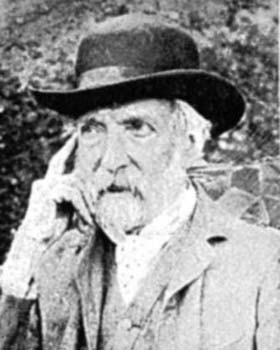 JOSEPH SWAIN
It was in 1843 that Mr. Swain engraved his first block for Punch. It was a drawing by Leech, on p. 50 of the fourth volume, to illustrate one of Albert Smith's "Side-Scenes of Society." The services of Landells, it will be remembered, had been suddenly dispensed with by the proprietors—for reasons of business jealousy according to Landells, though the proprietors gave out, in some quarters at least, for lack of proper excellence in his work. When they had decided to give Landells his congé, Bradbury and Evans looked about for another to replace him, and offered the engraving to one of the brothers Jewett. By him the task was readily undertaken, although he was, as he knew, wholly unable to carry it out; and when a block with one of Leech's drawings upon it was sent to him as a test, he offered the execution of it to his young acquaintance, Joseph Swain. So pleased was Leech with the result that he strongly recommended that the man who had cut such a block should, in place of the middleman, be installed as manager of the engraving department; and from that time forward that important portion of the work has remained in the hands of one of Punch's most faithful, loyal, and talented servants, of whom Punch has happily had so many.
Mr. Swain had been brought up by his father from Oxford,[Pg 248] his natal town, when he was nine years of age, and five years later had been placed with N. Whittock, a draughtsman of Islington, to learn the art and craft of wood-cutting. But though Mr. Whittock was something of an artist, he was less of an engraver; and finding after a few years that he was making but little progress, young Swain applied for instruction to Thomas Williams. That distinguished engraver was one of the few excellent "facsimile men" of the day; and he agreed to accept the applicant as "improver." At that time he was engaged in engraving the blocks of an edition of "Paul et Virginie"—the well-known illustrated edition which was published in Paris in 1838. For at that time there were fewer facsimile engravers in Paris than in London, and what there were, in point of ability, were not to be compared with the Englishmen; so that it was no uncommon thing for the best work to be sent from France to be executed in this country. On this particular work Meissonier, Johannot, Horace Vernet, and others had been engaged; and when that was finished, the series of works published by Charles Knight provided endless work for the skilled gravers at Williams' command: Harvey's "Arabian Nights," "Shakespeare," and the "History of Greece," and other notable works. It was a great school of engravers that existed then, both of masters and pupils, and included, besides Thomas Williams himself, his brother and sister, Samuel and Mary Ann Williams (a brilliant engraver she, who never gained her due of reputation), John Thompson, Orrin Smith, W. J. Linton, John Jackson, Mason Jackson, W. T. Greene, Robert Branston, Landells, the Dalziel Brothers,[27] and Edmund Evans. Most of them were soon employed by W. Dickes, under whose management the Abbotsford edition of Scott's works was being executed; and to Dickes, Joseph Swain also transferred his services. In due course the young engraver left that establishment, and had[Pg 249] not long been on the look-out for a satisfactory opening when he received from Jewett the little commission which landed him in a very short time in the service of Punch, in which he remained until he retired from business in favour of his son, after a completed period of half a century.
For some years Mr. Swain remained at the head of the Punch engraving department, devoting himself, and his six or eight assistants, exclusively to Punch work. He then pointed out to the proprietors how, by conducting and extending the business on his own account, he could carry out their work more economically while increasing his own field of operations and doubling his earning powers. The suggestion was acted upon, and the result proved satisfactory to both parties. For by this time he had educated the necessary engravers to that style of facsimile cutting in which he himself, and but few besides, had been specially trained, and he was enabled to keep the weekly expense of engraving Punch down to an average of under thirty pounds, and at the same time to spend his superfluous energies on many of the most famous illustrated books of his day.
For many years the boxwood blocks on which the drawings were made consisted of a single piece; for, as already explained, Charles Wells of Bouverie Street, at first a cabinetmaker of rare excellence, and later on a boxwood importer, had not then invented the device which revolutionised newspaper illustration—that of making a block in six or more sections which could be taken apart after the drawing had been made (and later on photographed) upon its surface and distributed among the engravers, and then screwed together again when each man had completed his own little piece. The invention which led to such an economy of time was only introduced in 1860 or thereabouts. For nineteen years Punch had to see his big blocks cut on a single piece of wood, which was one of the reasons why the earlier cartoons and "pencillings" were, as a rule, so much more roughly drawn and hastily cut. In those early days a single "round" of wood was used—a "round" that had been cross-cut from the trunk of the tree. This was always kept seasoning until by natural[Pg 250] shrinkage it had split up to the centre, when a tongue-shaped piece of box was fitted into the triangular vacancy and screwed firmly through. Then the block was squared as well as its shape permitted, and when its surface had been properly prepared, it was ready for the artist.
As I find myself discussing technical details in Punch production, it may be well to go a step further, for such matters can hardly fail to interest the reader. The cartoon, for reasons of economy of time, has always, up to 1893, been drawn upon the wood[28]—not upon paper, as has been possible to the rest of the Staff for a good many years past—and is delivered into Mr. Swain's hands by Friday night. Twenty-four hours later the engraving of the block is completed, and it is handed over to the printers, who are already clamouring for it to be put in their formes—for there is no time to electrotype it, nor of course to stereotype the pages. Stereotyping, indeed, has been the latest of the innovations on Punch—an innovation to be reckoned but a year or two old—for Punch, in his own house at least, is a Conservative among Conservatives. What was always present in the publisher's mind was that the "foreign edition" had to be ready printed off by Monday morning, and every moment was necessarily grudged during which the machines were not running—even those few short minutes when a sheet or two of the paper, at first starting, were taken to Mr. Swain to be judged as to the printing of the cuts, or as to whether they wanted a little more "colour," or a little pressure taken off. "To myself," Mr. Swain tells me, "it has always been a pleasing reflection that during the whole time of my connection with Punch, extending over fifty years, I have never once failed to get my work done in time and without accident. Of course, now and again it has been a very near thing, but it has always been done somehow."
It has ever been matter for surprise to outsiders that the conductors of the journal could tempt Fate so recklessly as to put the original wood-blocks on the machines. As has been[Pg 251] seen, there was no alternative. But the fact remains that they ran a continual risk for fifty years which no other journal would care to face for a single week; for an accident to a single block (and such accidents are all too common) would have jeopardised the whole week's edition, as no other original existed (as it exists nowadays) from which the damaged block might be reproduced, or by which it might be superseded.
So it was only after the printing of an edition that the blocks were electrotyped. It is a curious fact that after 70,000 or 80,000 had been printed these blocks were nearly always found as good as new so far as the wood was concerned; only towards the end of the edition the blocks would sometimes get so filled up that some of the fine work was entirely lost, and the electros then taken suffered in consequence. An examination of this substance would show that it consisted of lime and pulp from the paper itself, compressed in a solid body so hard that it almost defied the graver to remove it.
Those early days were halcyon times for Punch engravers. Mark Lemon would come down two or three times a week to edit and make up the paper, and would talk leisurely with Mr. Swain of such matters as concerned the engraver. No block was hurried. If it could not be ready for one week, it was held over for the next—a saving grace which the engraver has now and again acknowledged by drawing an initial or other simple design on the wood half an hour before going to press, when the Editor hurriedly required such a decoration—possibly to supply an artist's omission. Such sketches were "The Cabman's Ticket" in February, 1854, put upon the wood from a scribble by Gilbert à Beckett—his sole artistic contribution to Punch; "Broom v. Brush" in May, 1859; and "The Turkish Bath" in 1880. And, above all, "process" had not yet held out its alluring promise of nearly equal results, to the inexpert eye, at a quarter of the cost of wood-engraving.
In another way did Mr. Swain place his mark on the pages of Punch—by the introduction of many a young artist to the Editor. It was he who thus introduced Mr. T. Harrington Wilson to Mark Lemon, Mr. Ralston to Shirley Brooks, R. B. Wallace (whose acquaintance he had made through[Pg 252] Mr. Frederick Shields) and Mr. Wheeler to Tom Taylor, and others, too, to the various rulers of Punch. In some cases the artists themselves approached the engraver; in others, it was the Editor who would ask him to recommend some clever designer who could best execute this or that little drawing which he wanted done. Further service rendered by him was the share he took in educating several of Punch's more imposing personages for the work they had to do—such as Doyle, McDonnell, and others.
It has often been quoted of Leech that after he had shown a drawing on the wood to any friend who might happen to be with him, he would add with a sigh—"But wait till next week and see how the engraver will spoil it!" This was a piece of unintentional injustice, for the fault lay with the conditions of rapid printing (for Punch has always been, and still is, printed on a cylinder machine)—with the printer, the ink-maker, and the paper manufacturer more than with the engraver, as a glance at the proofs of the engravings will show.
Speaking of this matter, Dean Hole says: "If the position of an eyelash was altered, or the curve of a lip was changed, there might be an ample remainder to convey the intention and to win the admiration of those who never knew their loss, but the perfection of the original was gone. Again and again I have heard him [Leech] sigh as he looked over the new number of Punch; and as I, seeing but excellence, would ask an explanation, he would point to some almost imperceptible obliquity which vexed his gentle soul." It is a curious fact that, in common with most draughtsmen, Leech never became reconciled to the fact that black printer's-ink cannot exactly render the tender grey tones of a hard lead pencil; but to the fact that he had not much to complain of Mr. Frith bears witness: "I once saw one of Leech's drawings on the wood, and I afterwards saw it in Punch, and I remember wondering at the fidelity with which it was rendered. Some of the lines, finer than the finest hair, had been cut away or thickened, but the character, the vigour, and the beauty were scarcely damaged." In connection with this subject Mr. Layard, in his "Life of Charles Keene," compared a photogravure and a wood-block[Pg 253] of one of the Punch pictures, with the principal, though unintended, result of proving how indulgent are wood-engraving and the tool of the skilled craftsman to the artist who inconsiderately persists in using grey inks of varying intensities and subtle lines of indefinite thicknesses on paper of various colour-patches, when reproduction upon wood is his sole ultimate aim.
As Mr. Swain lived for some time close to Thackeray's house, it was an occasional custom of his to call on his way to the office to see if the great "Thack" had any blocks ready that he might carry away with him. The novelist was usually at breakfast when he called, and would request that his visitor might be shown into the library. There he would presently join him and, if he were behindhand with his work, would request Mr. Swain to have a seat, a cigar, and a chat, while he produced a Punch drawing "while you wait." "Ah, Swain!" he said one day, looking up from his block, when he was more than usually confidential, "if it had not been for Punch, I wonder where I should be!"
Mr. Joseph Swain retired in 1890 from the business he had formed, and handed it over to his son, who had been many years identified with it, and still continues the weekly engraving of the Punch cartoon. Wood-engraving has now been abandoned for all other illustrations, the first process block tried on the paper being Mr. Linley Sambourne's drawing called "Reconciliation, a scene from the new screaming farce, the 'Political Box and Cox,'" on the 3rd December, 1892 (p. 273); but that the innovation has been equally happy in the case of every artist I am not prepared to maintain.[Pg 254]
Mark Lemon—As Others Saw Him—His Duties—His Industry—His Staff and their Apportioned Work—Lemon as an Editor—And Diplomatist—A Testimonial—And a Practical Joke—Henry Mayhew—His Great Powers and Little Weaknesses—Disappointment and Retirement—Stirling Coyne—Gilbert Abbott à Beckett—His Early Career—Tremendous Industry—À Beckett and Robert Seymour—Appointed Magistrate—Locked In—Angus B. Reach.
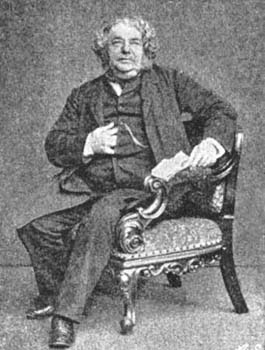 MARK LEMON
Mark Lemon was thirty-one when he found himself co-editor of Punch. His salary, it is true, was not more than thirty shillings a week; but it was to rise before his death to fifteen hundred pounds a year—a higher amount, it is said, than has been received by any other "weekly editor," before or since. However, he had found financial salvation; for although his playwriting had not been unsuccessful—and by the time he died his pieces were to be numbered by the score—the drama in the days of short runs was not a remunerative form of literature. His natural bonhomie stood him in good stead; it charmed his friends and non-plussed his enemies. Of the latter, it must be admitted, he had more than enough—or, at least, men to whom he was intensely antipathetic. One eminent journalist—more eminent than Mark himself—writes him down "a mealy-mouthed sycophant;" and another, hardly less popular, went further still in his denunciation, and, if he were to be believed, Mark Lemon must have been one of the most accomplished humbugs of his time. "There was nothing[Pg 255] good about Mark," said a distinguished draughtsman, who worked with the Punch Editor for many a long year, "but his laugh." But against this criticism—which was that of men whose judgment ought to be clear and sound, and was, moreover, shared by others—there is an overwhelming mass of evidence in favour of Lemon's extreme amiability, kindness, and geniality. He, naturally, was the butt of rival comic papers, who would taunt him with his Jewish descent, with the mildness of his jokes and humour, and the bitterness of his false friendship. A favourite form was to print among supposed "Births" such a line as this: "On Wednesday, the 26th ult., at Whitefriars, Mr. Mark Lemon, of a joke, stillborn."
But Lemon could well afford to ignore all such attacks. Mr. George Chester, his life-long friend, pronounced him the prince of cronies, and I have seen many letters from him instinct with affection and jovial humour. One of them, by the way, gives information that "our nursemaid has the chicken-pock, and we expect to see her throw out feathers to-morrow." When he entered the composing-room he was invariably received with a cheer by the men, whom he called "my Caxtonian Bees." Charles Dickens believed in him as "a most affectionate and true-hearted fellow," and so described him to Sir A. H. Layard (in whose interest Dickens arranged for Tenniel's fine "Nineveh Bull" cartoon to be published); and though he quarrelled with him, because Lemon had the courage, chivalry, and uprightness to take Mrs. Dickens's side against her husband, he brought the estrangement to a close with a kindly message when Lemon first appeared as Falstaff. Mr. Joseph Hatton carries his friendly admiration almost to the point of Lemonolatry; and the man who could inspire such friendship must assuredly have been endowed with sterling qualities and with a lovable nature.
"Mr. Lemon impressed me," writes Mr. E. J. Ellis, "as the kindest and most lovable elderly boy I had ever seen. He evidently accepted my little sketches only for the promise, not the performance, of them. Some were rejected. This was done so genially that I found myself hastening to refuse my own drawings for him rather than put him to the effort of sparing[Pg 256] my feelings while doing so. 'Here I sit,' he said, 'like a great ogre, eating up people's little hopes.' Then he showed me his waste-paper basket, and added—'But what am I to do? Look here!' I confess I never saw, except on pavement in coloured chalks, such nerve-twisting horrors as the paper sketches people sent." It is obvious from this that the writer never watched the pictures entering the Royal Academy on Sending-in Day.
Mark Lemon loved Punch; as well he ought. He refused to visit America to give his readings on terms that were highly alluring, as he could not find it in his heart to abandon the command, even for a time, nor bear to miss his two days a week at Whitefriars. When he said truly that he and Punch were made for each other, and that he "would not have succeeded in any other way," he might fairly have added, had he wished, how hard he had laboured for that success. Mr. Birket Foster has drawn me a vivid picture of how in those early days he had to visit Lemon in his Newcastle Street lodgings, and, mounting to the topmost storey, found him in an untidy, undusted room, sitting in his shirt-sleeves, with Horace Mayhew by his side plying the scissors, working at the weekly "make-up" of Punch with the desperate eagerness that was, in time, to bear so rich a harvest.
How Mark Lemon helped to bring together the original Staff has already been seen. It was, doubtless, his sound display of business capacity and character, in addition to his literary aptitude, that induced Henry Mayhew and Landells to nominate him as one of the co-editors—for that was a quality in which both Henry Mayhew and Stirling Coyne were confessedly deficient. "There are forty men of wit," says Swift, "for one man of sense." So the paper was started, and the very first article, "The Moral of Punch," was Lemon's;[29] but neither then nor after did he write much for it, though he still contributed a certain amount of graceful, serious verse, under the title of "Songs for the Sentimental," with a farcical last line which affects the reader suddenly like a cold douche. He wrote, as well, many short epigrams,[Pg 257] paragraphs, and the like, besides being a fairly prolific suggestor of the cartoons; but the sum of his literary labours on the paper would not compare with that of the members on the Staff. To him fell the organisation, administration, and practical making-up of the paper.
In the early days of Punch, during those infantile convulsions to which the paper threatened to succumb, Mark Lemon assured his position by the great zeal with which he carried out his duties; and at the transfer of Punch he was left sole Editor, by the fiat of the new proprietors. Stirling Coyne left without real regret, though in considerable dudgeon at his treatment; he had many other irons in the fire, and the conditions of journal-weaning were unattractive to him. But to Henry Mayhew it was a bitter disappointment. It was he who had made Punch what it was; he found himself ousted from his legitimate position, and he considered, in his own words, that Mark Lemon "had allowed himself to be bought over," so that a coolness sprang up between the two men which was never quite removed.
In his work Lemon did not spare himself. For a time Horace Mayhew was his sub-editor, to whom fell the usual duties of the post—("Be it yours," as a careless speaker in the office nicknamed "Heavens!" is traditionally said to have advised, "Be it yours, 'Orace, to hurge the hartises [artists] hon!")—but before long Lemon took that duty upon himself, driving round to the chief contributors one day in the week to satisfy himself that their drawings and "copy" would be to time. The story goes that he always employed the same driver, and that when the man was about to replace the old vehicle with a new one, he suggested to Lemon, with glowing pride at the brightness of the idea, that he should have a figure of Punch emblazoned on the panels. In later years Lemon's son Harry acted as his secretary, and sometimes, though unofficially, as his sub-editor, and generally undertook the "travelling" for his father.
It was in Lombard Street, Whitefriars, of classic memory, that Bradbury and Evans carried on the practical part of their business; and here Mark Lemon might often be seen, radiant[Pg 258] and effulgent as the circulation rose. In May,1843, Punch had removed from Wellington Street, Strand, to 194, Strand, an office which he gave up to his young rival, "The Great Gun," in January, 1845, in order to remove to 92, Fleet Street. Here he only remained for a couple of months, and, migrating in March of the same year, he set up for good and all in 85, Fleet Street, on the very site in St. Bride's Churchyard of the tailor's house where Milton once kept school. In the editorial office the Punch Staff would often write their articles, Thackeray especially taking advantage of the convenience. "In three hours more," he wrote to Mrs. Brookfield in 1850, "Mr. W. M. T. is hard at work at Punch office."
The management of the weekly "copy," the arrangement for series, and the dealing with outside applications of all sorts, quite apart from artistic contributions, were together no light task for the Editor, especially when one or other of the writers failed him, and the illustrations that were to accompany their articles had to be retaken into consideration. From the beginning outside contributions were remorselessly discouraged; yet some remarkable poems and sketches have come to Punch unsolicited from famous and brilliant pens, as will subsequently be seen. Still, the paper has always been a fairly close borough—as, after all, it has a perfect right to be; and by that means has been enabled to keep its distinctive colour—in contrast with the "Fliegende Blätter," for example, whose staff may truly be said to consist of the whole German people. To each writer was allotted a certain space, which he was expected to fill; and when there was a deficit in the amount of his contribution—which there generally was, and a heavy one—it was duly entered up. Thus for a long while Douglas Jerrold's half-yearly total was theoretically 162 columns (or a weekly average of six and a quarter); Gilbert à Beckett's, 135 columns (five and a quarter); Percival Leigh's, Tom Taylor's, and Horace Mayhew's, 54; and Thackeray's, 46 columns; but few of them ever came up to their proper total. In earlier days, before Albert Smith left, the following were the weekly tasks: Jerrold, five columns; Gilbert à Beckett, four; Smith and Leigh, two each; and after Smith's departure à Beckett succeeded to Jerrold's figures.[Pg 259]
The records of the Staff's contributions were kept as follows, their relative proportions being exactly shown. I take one volume at random, the seventh, that for the second half-year of 1844:—
| Contributors | July | August | September | October | November | December | Total of Six Months |
Weekly Average |
|---|---|---|---|---|---|---|---|---|
| Douglas Jerrold | 20¼ | 17¼ | 23½ | [30]27 | 20¼ | 31½ | 139¾ | 5¼ |
| Gilbert à Beckett | 15¼ | 18 | 6½ | 17¼ | 17 | 19¾ | 94¾ | 3½ |
| Percival Leigh | 4½ | 8¾ | 9 | 5 | 5½ | 6¼ | 39 | 1½ |
| Thackeray | 8 | 5¾ | 6 | — | — | 4¾ | 24½ | 1 |
| Horace Mayhew | 2½ | 2½ | 3½ | 2 | 2½ | 3¾ | 16¾ | ½ |
| T. Taylor | — | — | — | — | 3¼ | 3 | 6¼ | ¼ |
| Ferguson | [31]1 | — | — | ¾ | — | 1 | 1¾ | — |
| Editor[32] | 5 | 1¼ | 3 | 1 | 2 | 8 | 20 | ¾ |
| Oxenford | — | 1½ | — | — | — | — | 1½ | — |
| Laman Blanchard | — | — | — | — | 1¾ | — | 1¾ | — |
| H. Wills | — | — | — | — | ½ | ½ | 1 | — |
| Total of columns in volume | 347 | |||||||
A more comprehensive view may be had from a glance at the table on the following page, which covers perhaps the most interesting period of Punch's early history.
From this table it will be seen that Douglas Jerrold contributed as much as 139 columns to Vol. VII. and Gilbert à Beckett 122 to the next; and that the Editor's section after Vol. VI. was to some extent split up under the names of the individual contributors who composed it. In addition to these names during the period covered by the table, there may be added those of Tom Hood (3¾), T. J. Serle, Charles Lever, Horace Smith, and Doyle.
Another source of trouble to the Editor was the holiday-time as it came round, for the Staff would scatter itself and, though arrangements were made of course beforehand, the[Pg 263][Pg 262][Pg 261][Pg 260] paper was sometimes run in a curiously undermanned condition. Thus, for example, on the week of August 12, 1848 (No. 370), Jerrold was at Guernsey, Thackeray was at Brussels, Horace Mayhew at Ramsgate, and Tom Taylor away on circuit. The whole paper was in consequence written by three men—by Gilbert à Beckett and Percival Leigh at home, and by Horace Mayhew, who thoughtfully sent in more than four columns from the country, so that his absence should not be felt.
| Vol. | Douglas Jerrold |
Gilbert à Becket |
Percival Leigh | W. M. Thackeray | John Oxenfold |
Editor | Horace Mayhew |
Tom Taylor |
Ferguson | Laman Blanchard |
W. H. Wills | Henry Mayhew |
Higgins (Jacob Omnium) |
Anony mous |
Mark Lemon |
Mac Gregor |
— |
|---|---|---|---|---|---|---|---|---|---|---|---|---|---|---|---|---|---|
| VI. | 81¼ | 113¼ | 41½ | 36¾ | 4¾ | 49½ | — | — | — | — | — | — | — | — | — | — | — |
| VII. | 139¾ | 94¾ | 39 | 24½ | 1½ | 20 | 16¾ | 6½ | 1¾ | 1¾ | 1 | — | — | — | — | — | — |
| VIII. | 91¼ | 122½ | 36 | 24 | 1¾ | 13 | 17¾ | 11¾ | 4 | ¾ | ¼ | — | — | — | — | — | — |
| IX. | 91 | 108¾ | 32¾ | 43¼ | 4½ | 15 | 28½ | 12 | 1¾ | — | ½ | — | — | — | — | — | — |
| X. | 71¾ | 99½ | 39¾ | 39½ | 2¾ | 6¼ | 20 | 18¾ | 9¼ | — | ½ | — | — | — | — | — | — |
| XI. | 77¼ | 92 | 35 | 51¾ | — | 2 | 44¾ | 28¾ | ¾ | — | — | — | 2 | — | — | — | — |
| XII. | 70¾ | 94¼ | 43 | 46 | — | — | 47½ | 23¾ | — | — | — | — | 1¾ | — | — | — | — |
| XIII. | 48¼ | 95¼ | 40¾ | 30¾ | — | — | 45 | 42 | — | — | — | — | — | 4¾ | ½ | — | — |
| XIV. | 58¼ | 80 | 39¾ | 39½ | — | — | 59¼ | 32½ | — | — | ¾ | — | — | 5½ | — | 3¾ | — |
| Total | 729¼ | 900¼ | 348¼ | 336 | 15¼ | 105¾ | 279½ | 175¾ | 17½ | 2½ | 3¼ | ¼ | 2 | 12 | ½ | 3¾ | 2,931¼ |
| Average per Volume |
81 | 100 | 39⅔ | 37⅓ | — | — | 31 | 19½ | 17½ | — | — | — | — | — | — | — | — |
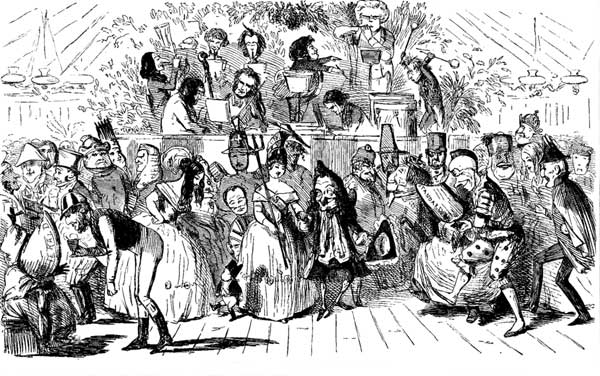 MR PUNCH'S FANCY BALL
At no time was Lemon's position an easy one, for his team, brilliant as it was, was sometimes wont to jib, and even to kick over the traces, or, most serious of all, to fall ill; whereupon the fountain of inspiration and supply would immediately dry up. When one failed, another would have to be made to fill the space; and all the while susceptibilities had to be nursed and respected as carefully as the well-being of the paper. Thackeray would now and then send a letter of apology instead of his "copy," and Jerrold would fail for a week or two together; and then Gilbert à Beckett with important contributions, and Horace Mayhew with a mass of little ones, were the men who, in the early volumes, would rush quickly to the rescue. Lemon was patience itself—he had no alternative perhaps—and could humour his Staff just as their humour demanded, for he was a born diplomatist as well as editor. Moreover, he had an unerring instinct as to what should and what should not appear in the paper; not alone on the ground of "good taste," as it was then understood, but of public feeling. This invaluable quality was acknowledged by the rest of the Staff, and was probably the secret of Lemon's ability to retain his position so long and with so much dignity, and to impose his will—suaviter in modo as was his habit—on men who would brook such imposition from no one else. It was his moral balance they admired—that judgment which in all his long career of satiric criticism kept him practically free from any action for libel after he had taken his share in piloting the paper through its sea of early troubles. He was watchful and discriminating, both as regards the contents of the paper and the discussions[Pg 264] at the board—where he would smooth over such an occasional storm as might threaten, and be deaf to anything that a less skilful tactician than himself might have taken notice of. Nevertheless, Lemon could take his own part if occasion required, and face his opponents with all the vigour of his authority. The Proprietors themselves once felt the strength of his character when they sought to challenge him on a vital point. Mark Lemon quickly assured himself of the support of his Staff, and, rising from his seat, he said in a tone of command, "Boys, follow me!" and made to leave the room. The struggle was over, and Lemon triumphed. Similarly did he make a casus belli of the attempt of the Proprietors on his editorial rights and dignity, when he was requested to appear at their meeting instead of their attending in his room. And he went so far as to instal himself in a room on the other side of the way until his point was conceded. He was, on the whole, a consummate Editor, who could cater for all men, and yet keep his pages practically clean and irreproachable, and almost free from blunder; all the while enlisting for it more and more of popular sympathy, and daily increasing its influence.
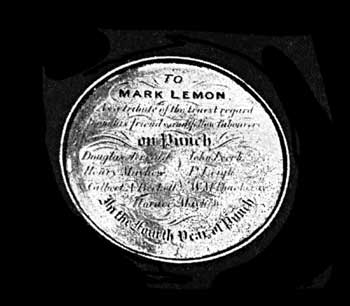 LID OF THE INKSTAND
Punch did not engage his exclusive energies. He was the first editor of the "Field." Then he edited the "London Journal," and in trying to improve its tone and quality of literature by the republication in its pages of the Waverley novels he well-nigh ruined it. These and other matters he embarked upon, together with a number of small works, such as his volume of "Prose and Verse" (which Jerrold said ought to have been called "Prose and Worse"), and his[Pg 265] "Jest Book," on the strength of which, it is said, Hans Christian Andersen, when in England, sought an introduction to him and paid him the compliment of saying, "I am so glad to know you, Mr. Lemon—you are so full of comic!"
Moreover, Lemon acted as a sort of secretary to Herbert Ingram, whom he served with great tact. Ingram was a good deal identified with the Punch circle, sometimes in a friendly and sometimes in a hostile way. He was owner, before he sold it to William and Robert Brough, of "The Man in the Moon," Punch's arch-enemy, and in later years he started the "Comic News," with Edmund Yates as editor, on purpose to oppose him. Yet several of the Punch men, notably Shirley Brooks, worked on his "Illustrated London News," which was started in great measure to push "Parr's Life Pills" (these were constantly mentioned and sometimes attacked in Punch), and Douglas Jerrold found in him the capitalist for the "Illuminated Magazine." Mark Lemon it was who took several of his Staff down to Boston to speak for Ingram during his candidature, an expedition that was a greater electoral than oratorical success; and he again it was, so it is said, who persuaded Mr. Ingram to drop the "Comic News," so that Punch might be rid of what was already a troublesome, and might have become a very damaging, rival.
With equal zeal and skill and genial friendliness to recommend him, Lemon became a great favourite in his own circle, for "Uncle Mark" was always ready to do his friends a good turn. In 1845 the Staff combined to present him with a silver inkstand—an interesting relic now in possession of Mrs. F. W. W. Topham, his daughter—a reproduction of the lid of which is here given; while the locket which, with a more substantial gift, was presented in 1866 to celebrate the Jubilee of Punch (i.e. his fiftieth volume) and to mark the withdrawal of the Heads of the firm, was inscribed as follows: "To Mark Lemon from his old friends W. Bradbury and F. M. Evans, on their retirement, given at a dinner at Maidenhead, June 27th, 1866. Present—W. H. Bradbury, Shirley Brooks, Wm. Agnew,[Pg 266] G. du Maurier, F. C. Burnand, J. H. Agnew, C. H. Bennett, John Tenniel, Horace Mayhew, F. M. Evans (Jim.), Henry Silver, T. Agnew (Jim.), Percival Leigh, Chas. Keene, Mark Lemon, Wm. Bradbury, F. M. Evans." There is no doubt that, as time went on, Lemon became more and more popular with his Staff, and each fresh appearance in Punch of his jolly face under the low-crowned hat of John Bull, or the snow-sprinkled peak of Father Christmas, identified him more closely with the paper and endeared him to his workers. Yet they liked to "score off" him when they could, in return for the jokes he played on them. The story is told how, when he had run down for a few days' holiday by the sea, he received the paper by post, and, tearing off its cover, was horrified to find, not the cartoon they had agreed upon, but another, execrable in taste and vile in execution, while undoubted libels and other offences were sprinkled with hideous liberality about the pages. Moreover, the cartoon was awry, the date was wrong, and a paragraph was upside down. Lemon turned cold all down his spine, and gasping "This comes from my being away!" he determined to return to town without the loss of a moment. From this point historians differ. Some say that Mark rushed to the station, quickly bought up every copy of the awful issue that was for sale, and jumped into the railway-carriage with the bundle; and that not before he was well on his way did he dare to open a copy to gaze again on the hideous production; and when he did—he rubbed his eyes, for everything was just as it should be! Then the light broke in upon him that he had been egregiously "sold," and he realised that a copy had been specially prepared for his pleasing edification! Other commentators assert that before Uncle Mark had time to leave for the station a telegram came, mercifully explaining a joke which, it was felt, ought not to be carried too far. The reader will remember a similar incident occurring in "Esmond;" and one wonders if the idea of that dummy copy of the "Spectator" was not suggested by the hour's torture lovingly inflicted upon the Editor of Punch by his affectionate and respectful Staff.[Pg 267]
Mark Lemon died on May 23rd, 1870. He had been very ill on one or two previous occasions; even as early as 1848 Jerrold had written to John Forster that "Lemon has been at Death's door—but has kept on the outside." For nine-and-twenty years he had been at the helm; and although he may not have been as paramount on Punch as some aver, there can be no doubt that he entirely merited the compliment paid by Mr. Gladstone to his memory when, awarding a pension of £100 from the Civil List to Mrs. Lemon, he said that he had "raised the level of comic journalism to its present standard." The proprietors, with generous sympathy, recognising the immense services of their friend, at once set about making a collection for the widow and unmarried daughters (for Lemon had been unsuccessful in his investments and speculations) and, with the ready help of the Staff, prosecuted it with so much energy and goodwill that the sum of £1,500 was quickly raised.
He was lowered to rest in a coffin simply inscribed "Mark Lemon—Editor of Punch;" for in Punch he had lived his life. "He believed," said Mr. Hatton, "in one God, one woman, one publication," as his surviving colleagues well knew. "If this journal," they wrote by the hand of Shirley Brooks, "has had the good fortune to be credited with habitual advocacy of truth and justice, if it has been praised for abstinence from the less worthy kind of satire, if it has been trusted by those who keep guard over the purity of womanhood and of youth, we, the best witnesses, turn for a moment from our sorrow to bear the fullest and most willing testimony that the high and noble spirit of Mark Lemon ever prompted generous championship, ever made unworthy onslaught or irreverent jest impossible to the pens of those who were honoured in being coadjutors with him." And in the poem that follows, testimony is borne that—
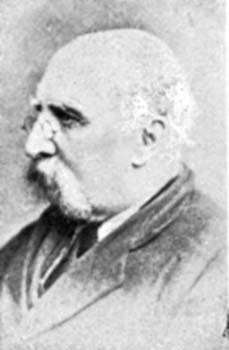 HENRY MAYHEW.
The character of Henry Mayhew, and his share in the production of Punch, have already been somewhat fully set forth. An old friend of his informs me that "he was lovable, jolly, charming, bright, coaxing, and unprincipled. He rarely wrote himself, but would dictate, as he walked to and fro, to his wife, whom he would also leave to confront his creditors. She was deeply attached to him; and when his father died, she found that the careful solicitor had left her a bequest of two pounds a week, payable to herself." And Postans, after he had lost his sight, would now and then exclaim—"Although he treated me so badly, I should love to hear the sound of his dear voice again!" There can be no doubt that Henry Mayhew was a genius, a fascinating companion, and a man of inexhaustible resource and humour—though humour was but one side of his brilliant mind. Indolence was his besetting sin; and his will was untutored.
"An admirable all-round talker," Henry Vizetelly wrote to me shortly before his death, "Henry Mayhew was brimming over with novel ideas on all manner of subjects, from artificial production of diamonds to the reformation of ticket-of-leave men. He was constantly planning some new publication or broaching novel ideas on the most out-of-the-way subjects. He would scheme and ponder all the day long, but he abominated the labour of putting his ideas into tangible shape. He would talk like a book on any subject for hours together if he could only find listeners, but could with difficulty be brought to put pen to paper. Most of his books were written from his ideas by his younger brother Augustus, or were dictated directly to his wife, who acted as his amanuensis. Although he made considerable sums by his writings, he never seemed to have a shilling; and most of the letters he received were from dunning creditors. These missives, however, never troubled him, for he never broke the envelopes of one of them, but handed all his correspondence over to his wife to do as she pleased with and answer such letters as she thought necessary. He was very temperate. Whether he smoked as a young man,[Pg 269] I am not aware; but he never smoked at the periodical evening gatherings at his house, when the guests could hardly see each other for the clouds of tobacco-smoke. On these occasions the most abstruse subjects were often discussed, and all we young wiseacres present contributed our modicum of knowledge towards the elucidation of problems that sorely perplexed the thinkers of the epoch. Although Mayhew would sit up till any hour as long as anyone would stay and listen to him, he never allowed this to interfere with his early-rising habits."
The impression made by Mayhew upon his contemporaries was invariably such as to command respect for his intellectual capacity. Considering his deep, philosophic mind, says one critic, if his lines had been cast in more serious places, he might have been a sociologist, the equal of John Stuart Mill and Herbert Spencer. There is proof enough of this in that wonderful encyclopædic work of "London Labour and London Poor," which displayed his original mind and his power of research, as much as other books displayed his marvellous invention, fancy, and initiative, and it is the only one of his undertakings which he had perseverance enough to carry through to a triumphant conclusion—so far as it can claim finality. It was while he was engaged on this work that Landells (according to a private letter) visited him and found him, in company with his brother Augustus and William Jerrold, interviewing a "coster"—"drawing him," while Horace Mayhew took down everything the man said.
Such was the man who conceived Punch as it came to be, and who wrote of it when it was established, "I smell lots of tin thereabouts; but our Lemon requires a great deal of squeezing." What was his connection with Punch, how he agreed with Lemon as to the transfer to Bradbury and Evans, how he found himself replaced by (or, as he considered, outwitted by) Mark Lemon in the editorship has already been recited. Nevertheless, he was retained as "Suggestor-in-Chief"—an office which suited him well enough, considering his hatred of the drudgery of writing.
"Mr. Henry Mayhew," writes Punch's ex-Printer, "the special joke-provider for Punch, was a most jocular character. He would[Pg 270] stand beside the compositor while he was working at his case, and closely watch every movement of his hand in picking up each letter. He said he could not make out how ever the compositor could keep the alphabetical order of each box in his memory. So to master the mystery he set to work and learned the boxes for himself, and would often find amusement, when waiting for a proof, in setting up a few lines, very slowly at first, but, shifting the composing rule and thoughtlessly laying down the stick the wrong way, generally upset all his work, and so he gave it up in despair. This Mr. Mayhew was very clever in creating and roughly sketching out many of the small comic column illustrations, and would write the witty inscriptions for them. These would then go to the artist, who sketched out the idea and so completed it. In Punch, as in many other similar works, the mind to invent the idea caricatured, and the hand that pencils it, belong to two very different persons and capacities. Mr. Mayhew was very clever in this way, and anything of a comic nature he saw he would at once sketch off and then have a cut made of it. Most of the inimitable cuts in the first few volumes of Punch are of his invention. He was always sketching and taking rough notes of everything he saw. The great John Leech called him his indispensable 'Jack-all, or broad-grin provider.'"
In spite of his disappointment, Henry Mayhew remained with Punch until 1845. His last literary contribution—"A Shaksperean Nursery Rhyme," on the subject of Macready playing Shakespeare in Paris before Louis Philippe and Prince de Joinville—appeared in February of that year; but he still attended the Dinners and made suggestions for cartoons, of which twelve were accepted in that year. With his proposal, however, of the cartoon of "Don Roebucis," which was drawn by Leech (14th March, 1846), his last word was said; and from that time forward his connection with Punch ceased absolutely. He had given the paper its character and tone; he had suggested its first great success, the Almanac; he had supported its transfer, whereby it was firmly established; and he had cracked its biggest joke—the joke which is universally quoted to this very day.[33] He died in 1887, at the age of 75, and his old friend celebrated him[Pg 271] in verse, none too correctly, though in the kindliest manner, ending thus:—
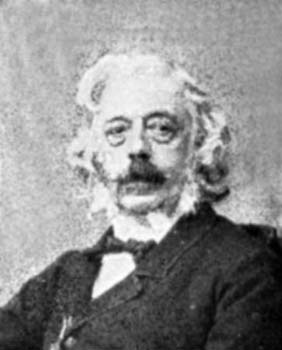 J. STIRLING COYNE.
There was a fund of Irish humour in Joseph Stirling Coyne. He had proved it by his plays long before he undertook his share of the co-editorship which was offered him at that "Edinburgh Castle" meeting where so much of Punch's present and future was arranged. He was at that time eight-and-twenty years of age; and although he was dramatic critic of the "Sunday Times," the drama rather than the press was his natural field of action—indeed, he wrote no fewer than five-and-fifty pieces of various kinds, besides plays in collaboration, and was secretary of the Dramatic Authors' Society, until his death. Nevertheless, he belonged in a manner to the inner circle of the "Punch set," and frequented the taverns that were their clubs; and he even went in double harness with Mark Lemon as co-editor, vice "Alphabet" Bayley, of "The Bude Light"—an English imitation of "Les Guêpes." He was, in fact, a man of some celebrity[Pg 272] who had already gained public reputation beyond the band of men, brilliant, no doubt, but, for the most part, with their successes yet to come—so that he was accorded the important rôle which he filled with peculiar modesty. He wrote extremely little, but he seems to have formed some distinct notion of his share in the foundation, for Edmund Yates records how his father once came home and, throwing the first number of Punch on the table, said, "Here is Stirling Coyne's new paper!" At last Coyne was charged by Lemon (who always referred contemptuously to him as "Paddy") with stealing one of his "Puff Papers" from a Dublin paper. At Punch's transfer Coyne quietly, though discontentedly, retired from duties which had hitherto brought him neither reputation nor pleasure, and only a hundred pounds in cash from Landells, and from Douglas Jerrold—as I learn from one who heard it—a savage mot, referring to his somewhat uncleanly appearance, which will undoubtedly adhere—"Stirling Coyne? I call him Filthy Lucre!"
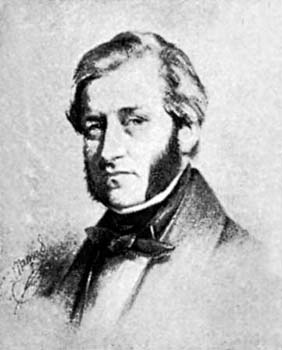 GILBERT ABBOTT À BECKETT.
From no choicer spirit than Gilbert Abbott à Beckett could Mayhew have sought for assistance and literary support. He was the first applied to, and of all the Staff he had had by far the most experience in the production of "comic papers," although he was only thirty years of age. His brother, the late Hon. T. T. à Beckett, has told how he and his chum Henry Mayhew, his junior by a year, with a consolidated share capital of three pounds and a mortgage to a printer of future profits, prepared to start a "satirical paper," to be called "The Cerberus"—the joint editors being then still young boys. As it happily befell, Mr. à Beckett, senior, discovered a proof of the first number, and with his solicitorial eye discovered some forty-three clear libels in the four columns. He hastened to the address on the imprint, and set the matter plainly before the printer, who was only too glad to cancel the[Pg 273] whole matter that had been "set" upon payment of the bill. So deeply were the lads affronted by this unwarrantable interference with their journalistic spirit and liberty of the subject that they ran away from home to Edinburgh, walking all the way; but soon returned in a woeful plight. From that moment, Gilbert turned journalist—it came to him as a second nature—and thenceforward supported himself by his pen, while establishing a very fair position at the Bar, thanks to the support of his father's firm.
It was in 1831 that he presented himself prominently before the public. Jerrold's "Punch in London" had not yet begun its little life of seventeen numbers, so that the moment was propitious for à Beckett to embark on a venture of his own; and on December 10th it made its first appearance. This was "Figaro in London," in which his youthful ardour and plain speaking found energetic vent. He was always ready, in a humorous, bombastic sort of spirit, to smash the aristocracy, to chaff Alfred Bunn, to abuse low-class Jews, and to discuss the theatre. In these agreeable vocations he hit the popular taste, and certainly achieved a considerable circulation, which, Timbs declares, reached at one time 70,000 copies. Small topical cuts, grandiloquently set down as "magnificent caricatures," were well arranged as a rule, and things were going well enough when editor and artist fell out; Robert Cruikshank took Seymour's place—and à Beckett's monthly adulation of his old "cartoonist's" work turned suddenly to contempt.
All this was meant more than half in fun; it was too violently personal to be serious. Anyway, à Beckett declared in the paper that "it is not true that Robert Seymour has gone out of his mind—he had none to go out of," and Seymour retaliated heartily with a "sharp cut." In due course Seymour resumed his place on "Figaro," and retained it to the end. In December, 1834, à Beckett had handed over the paper, in the height of its prosperity, to Henry Mayhew, who continued it for a time, and in 1839 it came to an end. Yet on so slender a basis as this has been brought against à Beckett the cruel charge that it was these assaults which did at a subsequent period drive Seymour out of his mind and led to his unhappy suicide.[Pg 274]
After "Figaro" died, and indeed partly during its continuance, à Beckett launched out into an extraordinary series of extraordinary papers, editing for other proprietors "The Wag," "The Evangelical Penny Magazine," Dibdin's "Penny Trumpet," "The Thief" (under the engaging frankness of whose title we may see the forerunner of "Public Opinion"), "Poor Richard's Journal," and "The People's Penny Pictures;" while on his own account he ran successively "The Terrific Penny Magazine," "The Ghost," "The Lover," "The Gallery of Terrors," "The Figaro Monthly Newspaper," "The Figaro Caricature Gallery," and "The Comic Magazine." But in spite of all this ingenuity in title-devising, and of all this dogged perseverance—though one can hardly call it seriousness—not one of these journals obtained public support. As a matter of fact, they were the journalistic wild oats of a born journalist and an exuberant littérateur, who, as a youthful playwright and a budding barrister, now had his hands quite full, yet—such was the fever of his industry—never full enough.
His first contribution to Punch, according to W. H. Wills' statement, was "The Above Bridge Navy" (p. 35, Volume I., 1841); but it is practically certain that "Commercial Intelligence" in the first number is his. "I recollect well," says the Hon. T. T. à Beckett, in his Reminiscences, "my brother—who wrote for it from the first number to the last that appeared in his life-time—bringing me away from my office on an assurance that if I accompanied him as far as the Strand, he would show me something that would fill me at once with gratification and amazement. He kept me in suspense until I reached Catherine Street, when he stopped short and said, 'Now you shall see me draw a pound from Punch, and if that don't amaze you and gratify you, you must have but a poor sense of the marvellous and very little brotherly sympathy.'"
Just about the period when the negotiations were being carried on with Bradbury and Evans, à Beckett began to fall off in the amount of his contributions, and for a time practically ceased altogether. At this time he edited the "Squib"[Pg 275] (28th May, 1842), a folio sheet published at three-halfpence, very respectably conducted and printed, and owned by Last Punch's old printer, illustrated by Henning, Hamerton, and Newman, Punch artists, treating many of Punch's pet subjects in the Punch spirit, including "Physiologies," which the older paper had made its own. It was also stated that several of the Punch Staff were among its contributors. However this may be, the "Squib" went off in December of the same year, and à Beckett thenceforward worked loyally for Punch for the rest of his life, and bequeathed moreover his two sons to Punch's service.
His popular "Songs for the Seedy," a series of eight poems, were published in this year in Punch, as well as "Songs of the Flowers;" and soon his "Ballads of the Briefless" made a considerable stir in Punch's circle. À Beckett had been called to the Bar some time before, so that his ballads as well as the articles from his hand which appeared—and, from time to time, continued—over the signature of "Mr. Briefless," had a touch of verisimilitude which went straight to the soft places in the hearts and imagination of the Great Unbriefed. "Mr. Briefless" became an institution in the paper, as, in other journals, Mr. O. P. Q. Philander Smiff, and again, in a lower social scale, Mr. Alfred Sloper, became recognised by a later generation. This unfortunate gentleman of the Bar—a gentleman always, in spite of his weakness of intellect and character—was shown in all the difficulties germane to his barren profession, and in all the ludicrous situations that came natural to the man. Many of his quaint aphorisms are still remembered, such as that, elsewhere recorded—"As my laundress makes my bed, so I must lie upon it," and "The clerk brings down his master's grey horsehair wig in sorrow to the Court." Yet he was not without self-respect, not to say vanity, for on the occasion of a great political crisis, when the resignation of the Ministry was impending, "Mr. Briefless" somewhat injudiciously left his retreat at Gravesend and came up to London, in order to be on the spot should he be called upon to form or to join the future Cabinet. The only[Pg 276] summons he received, however, was from his tailor, and, with the unfailing judgment and good sense that characterised him, he withdrew once more into the country. "Mr. Briefless" and "Mr. Dunup," his friend, were creations that were at once recognised, and were welcomed during the fifteen years of their occasional appearance.
In 1843 his "Punch's Heathen Mythology" followed Wills' chapters on the same subject, and in the following year his "Comic Blackstone"—one of the cleverest burlesques of its kind in the language—served another purpose than to amuse his readers: it forced him to study the commentaries—for the first time, it was facetiously said—and so made a better lawyer of him, and helped to fit him for the magisterial bench, to which he was soon to be summoned. His "Comic Bradshaw" was another success, which Mr. Burnand repeated and improved upon years after in his inimitable "Out of Town." Mr. Arthur à Beckett, speaking of his father's work, tells me: "I remember on one occasion when my father had written a drama descriptive of the mysteries of Bradshaw, Leech, to whom it was sent for illustration, introduced a series of portraits of the author. Lemon, noticing this, suggested that the drama should end by the hero getting his head shaved, more clearly to understand the intricacies of railway traffic. My father adopted the suggestion, and Leech followed the 'copy.'"
It was not in these series that his chief work lay, however, but in the enormous mass of matter he turned into Punch's pages month by month. He was by far the most prolific of all the contributors, almost up to the time of his death. Articles humorous and pungent on every variety of topic, verse graceful, bright, and comic, sparkling puns innumerable, with increasing thought and sense as the man grew older and realised more and more the responsibility of his position and Punch's—all flowed from him in an unceasing, easy stream, distinguished always for its fun and facility. As his average contribution to each volume was a hundred columns, it will be seen that in the time he was working for Punch his total of prose and verse amounted to three[Pg 277] thousand feet, or a column nearly as high as the Eiffel Tower! There was, besides, the amount of "outside" work that came from his pen—he was leader-writer to the "Illustrated London News," and as such was the literary father of Shirley Brooks, the grandfather of Mr. Sala, and the great-grandfather of Mr. James Payn. He was also leader-writer on the "Times," and on one occasion actually wrote all the leaders of the day's issue. This strange coincidence arose from his having had a leader "crowded out" from the day before, which was naturally set down for use the next day, when he contributed his usual article without any question arising; and then a sudden appeal upon a subject with which he was specially familiar brought into the paper a third article from him—and that in the days, now fifty years ago, when the influence and position of the "Times" were perhaps even greater, relatively, than they are to-day: at least, when there was no competitor that could seriously pretend to share them. In addition to this he edited Cruikshank's "Table Book," and wrote the Comic Histories of England and Rome. It was, it is generally said, on the occasion of the first of these books being announced that Douglas Jerrold wrote to Charles Dickens: "Punch, I believe, holds its course.... Nevertheless, I do not very cordially agree with its new spirit. I am convinced that the world will get tired (at least, I hope so) of this eternal guffaw at all things. After all, life has something serious in it. It cannot all be a comic history of humanity. Some men would, I believe, write a Comic Sermon on the Mount. Think of a Comic History of England; the drollery of Alfred; the fun of Sir Thomas More in the Tower; the farce of his daughter begging the dear head, and clasping it in her coffin on her bosom! Surely the world will be sick of such blasphemy!... When, moreover, the change comes, unless Punch goes a little back to his occasional gravities, he'll be sure to suffer." And Dickens replied in a letter thanking him for sympathetic reviews, in Punch—"Anent the 'Comic ——' and similar comicalities, I feel exactly with you."
Of course, with the exception of the latter part of Jerrold's[Pg 278] outburst, wherein he was undoubtedly right, all this protest is exaggerated nonsense—at least, as applied to à Beckett. One would think that neither Jerrold nor Dickens could bear a burlesque in good taste—Jerrold of all men! But it is just as likely that Jerrold was not referring to à Beckett at all, but to Thackeray, whose "Miss Tickletoby's Comic History" had already made its appearance in Punch, and had been incontinently stopped. In any case, the public did not agree with him, for both works are still popular favourites. Moreover, he liked à Beckett too well to harm him in the mind of a common friend; and he was unquestionably aware that the loftiness of à Beckett's aims and character rendered him unassailable against a charge of irreverence or lack of respect. Certain it is, at least, that when à Beckett died at Boulogne Jerrold felt the blow so deeply that he gave up that town thenceforward as a place of residence, nor would he ever visit it again.
It was at the early age of thirty-eight that à Beckett was appointed police-magistrate, chiefly owing to the masterly report he drew up as Poor-Law Commissioner in respect to the notorious Andover Union Workhouse scandals[35]—"one of the best," said the Home Secretary, "ever presented to Parliament." The appointment was much discussed, for the general feeling had been educated in the views of Lord Selborne, who asserted that no "person" connected with the Press nor any "gentleman in the wine trade" could be permitted to attain to such an honour as the Bench—an absurdity which has long since been dismissed. On one occasion, it is said, when à Beckett lived at No. 10, Hyde Park Gate South, Kensington Gore, he was instructed to hold himself in readiness, as magistrate, to answer a summons to read the Riot Act in Hyde Park to the unruly mob whose methods of protest against a popular grievance constituted the "Beer Bill Riots" of 1855. That summons never came, luckily for[Pg 279] him; for later in the day he discovered, to his dismay, that his careful and solicitous wife, with greater respect for her husband's skin than for the needs of Government, Police, and Proletariat combined, had gone out early, after securely locking the unconscious magistrate in his library, and had prudently carried off the key.
À Beckett had been one of the shyest and most nervous men that ever lived, but his appointment to the police-court—first at Greenwich, then at Southwark—removed much of his undue modesty, and he was recognised as being energetic, sagacious, and humane. He was a tremendous worker, incomparably quick, and above all was absolutely punctual in his delivery of "copy"—a virtue quite sufficient to account for his popularity with publishers, who also were attracted by his retiring and distinguished manners. Though his conversation was bright, he preferred to keep his witticisms for his public or private writings, as when, in sending in a parcel of "copy" to Mark Lemon, he wrote on the outside:—
This paper passed, as a wrapper, from Lemon to Mr. Birket Foster, and from the hands of that gentleman to an autograph-hunter undiscoverable.
À Beckett's wit was exceedingly nimble, and as a consequence he was a facile punster. One of his happiest jokes of the kind has been set on record. When the election of Louis Napoleon appeared likely, the policy of Punch in respect to it was anxiously discussed at the Table. One of the Staff—Thackeray most likely—declared that it would be wisest to be indefinite. "Nonsense," said à Beckett, "if you're not definite, you'd better be dumb in it!"
While occupied in writing a series of papers called "Mr.[Pg 280] Punch's Guide Books to the Crystal Palace," illustrated by Tenniel, Gilbert à Beckett died at Boulogne from typhus fever, his youngest son Walter predeceasing him by two days from the same complaint—the grief of any knowledge of it, however, being happily spared the father. He was buried in Highgate Cemetery, and the inscription engraved upon the tombstone was reproduced in an abbreviated and modified form from the touching obituary notice in which his brother-workers, through Jerrold's pen, testified to his merits and to their affection: "Endowed with a genial, manly spirit; gifted with subtlest powers of wit and humour, they were ever exercised to the healthiest and most innocent purpose. As a Magistrate, his wise, calm, humane administration of the law proved that the fulfilment of the gravest duties is not incompatible with the sportiveness of literary genius. 'His place knows him not,' but his memory is tenderly cherished."
The connection of Angus Bethune Reach with Punch was not of very long duration. With Albert Smith he had been joint editor of "The Man in the Moon," and with Shirley Brooks was one of the special correspondents of the "Morning Chronicle" in the South of France, as well as its Parliamentary reporter. He had followed up Albert Smith's series of "Natural Histories," of "The Gent," "The Flirt," and other specimens of English Society, with "Bores" and "Humbugs," which ran through several editions. He had joined "The Puppet Show" in 1848, while still quite a youth; he had written "The Comic Bradshaw" (which found an echo in Punch years later) and one or two successful novels, and had with Brooks laid siege to a position on Punch's Staff. This, it might almost be said, he carried, as Brooks did, by assault; and having given up the editorship of "The Man in the Moon" with its twenty-eighth number (1849), he was duly summoned to the Punch Table.
His life was at that time hardly a pleasant one, though his industry (for the craze of work was upon him) was as great as his versatility, and his field of labour as wide as his knowledge. When he came to the Punch Table, he found his[Pg 281] haven; but he was heckled, of course, by Douglas Jerrold, on the score of his name and its quaint pronunciation. Concerning this name (pronounced Re-ach in the German manner, anglice Re-ack), Angus once asked his father, a Writer to the Signet, in the hearing of my informant, the late H. G. Hine, what on earth it meant. "As in Highland Scotch," was the reply, "'Dhu' means 'black' and 'Roy' means 'red,' so Reach means half-and-half, or 'brown.'" He therefore insisted on its proper pronunciation; with the natural result. Jerrold delighted in teasing him about it, and at a Dinner at the "Ship" at Brighton, where the Punch Staff held one of their meetings, Jerrold[36] leant forward at dessert and asked—"Mr. Re-ack, may I pass you a pe-ack?" And on another occasion, when Reach protested against Jerrold's persistent ill-treatment of his name, the wit replied, "Oh, I see. Re-ack when we speak to you, but reach when we read you!"
At last, in 1854, Reach's incorrigible industry bore its Dead-Sea fruit; broken down with over-work, his mind utterly gave way. Thereupon his friends of the Fielding Club, reinforced by Albert Smith of "The Man in the Moon," joined together to play for his benefit Smith's pantomime burlesque, "Harlequin Guy Fawkes; or, a Match for a King," at the Olympic Theatre, April, 1855. Arthur Smith, Albert's brother, played pantaloon; Bidwell was harlequin; Joseph Robins, clown; Albert Smith, Catesby; Edmund Yates, the lover; and Miss Rosina Wright ("always Rosy, always Wright," wrote Smith) was columbine. The rush, said E. L. Blanchard, was unprecedented, and stalls were cheap at ten pounds. The great broadsword fight between Smith (Catesby) and Robins (Guy Fawkes), in the rich traditions of the Surrey-Crummles School, was the hit of the evening, and has been immortalised by Sir John Tenniel in his drawing for Punch (p. 149, Volume XXVIII.), entitled "The Amateur Olympians." But Reach did not benefit long from the efforts of his friends, and died before he was thirty.[Pg 282]
H. P. Grattan—W. H. Wills—R. B. Postans—Bread-Tax and Tooth-Tax—G. Hodder—G. H. B. Rodwell—Douglas Jerrold—His Caustic Wit—The "Q Papers"—A Statesman pour rire—His Sympathy with the Poor and Oppressed—Wins for Punch his Political Influence—Ill-health—"Punch's Letters"—The "Jenkins" and "Pecksniff" Papers—"Mrs. Caudle"—Jerrold's Love of Children, common to the Staff—He Silences his Fellow-wits—And is Routed by a Barmaid—He sends his Love to the Staff—And they prove theirs.
The remaining contributors to the first number were Joseph Allen, H. P. Grattan, and W. H. Wills. The contribution of the first-named has already been indicated. H. P. "Grattan"—whose real name was Plunkett, and whose occasional pseudonym was the familiar "Fusbos"—worked well for the first numbers and for the Almanac. He was a witty versifier and clever dramatist, but he soon tired of the paper and directed his energies into other channels. W. H. Wills—"Harry Wills" he was always called—was a more important and a more faithful contributor. His first verses were "A Quarter-day Cogitation" (p. 5), and for some time he was the regular dramatic critic of Punch, in which a considerable amount of space was accorded to the review of amusements of all kinds, and not a little to Charles Kean and his histrionic deficiencies. Besides "Punch's Theatre," he wrote paragraphs, verses, and criticisms innumerable, including the series of "Punch's Natural History of Courtship," illustrated by the pencils of Sir John Gilbert, Newman, and Gavarni; "Punch's Comic Mythology," "Punch's Information for the People," as well as "Punch's Valentines," and lively skits like "The Burst Boiler and the Broken Heart," and the verses in praise of pawnbrokers, "The Uncles of England." After helping the Almanac for 1846, his Punch connection was interrupted for a period through his being called to Edinburgh to[Pg 283] edit "Chambers's Journal;" but on his return to London two years later he resumed his position in a modified form. He became secretary to Charles Dickens, who was then editing the "Daily News," as well as his assistant editor on "Household Words," and subsequently on "All the Year Round," so that little time was left him for humorous composition—though he certainly found leisure to issue "The Family Joe Miller." When he was in Edinburgh he married Robert Chambers' sister—a lady possessed of true Scottish wit, some of whose pithy remarks are still remembered, such as "The ladies who agitate for women's rights are generally men's lefts."
Of the other two writers who aided in the founding of Punch—Postans and George Hodder—there is little to say. The first-named, indeed, has already been sufficiently dealt with, but it may be added that his last contribution was his verses—"A Contribution by Cobden"—on the subject of the removal by Sir Robert Peel of the tax on artificial teeth. Postans saw his chance, for the Repeal of the Corn Laws was already being agitated, and the tooth-tax troubled his mouth less than the tax on bread. His final verse ran—
Besides his ambassadorial assistance, and in spite of his presence at the Punch Club, Hodder was not of much account on the paper, either in its formation or its literary production. He was, however, related to Punch by marriage, being the husband of Henning's beautiful daughter, the niece of Kenny Meadows' wife. His last appearances in its pages were in 1843, when four contributions (including "Punch's Phrenology") came from him; and then he resumed his usual work of journalist, became Thackeray's secretary for a time, and died through the upsetting of a coach in Richmond Park.
Passing by Leman Rede and G. H. B. Rodwell (composer, playwright, and ballad writer), neither of whom, so far as I have been able to ascertain, has left any appreciable trace on[Pg 284] Punch, we come to the man to whom, more than to anyone else, the paper owed the enormous political influence it once enjoyed, and to whom it is indebted for much of the literary reputation it still retains—Douglas Jerrold.
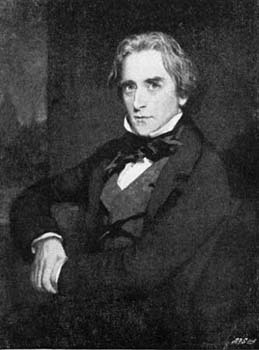 DOUGLAS JERROLD
If he was not exactly the wit of his day—for his mind lacked the wider sympathy, the greater grasp, and gentler refinement of Sydney Smith's—he was certainly the most brilliant professional humorist of his generation—"a wit, if not first, in the very first line." Something of the bitterness and savagery of Gillray's rampant pleasantry afflicted his vis comica; and when a happy thought, however unhappy and painful for the hearer, came to the tip of his tongue, he could no more resist slipping it off than he could wilfully have done him injury.
Mark Lemon used to say, "Punch and I were made for each other." With far more reason could that notion of reciprocity be applied to Jerrold. No man ever gained so much from the paper in which he worked. He simply frolicked in its pages, that fitted his talent as accurately as his genius suited the times in which he lived. It is doubtful whether he would make the same mark in it were he alive to-day; he would have to seek another publication and another public, or else adopt an utter change of tone. But in those lively times, when, obeying the summons addressed to him in Boulogne, he sent his first political paper—beginning characteristically with the[Pg 285] introduction of Peel, in time for the second number—he gave his powers full play. And his sparkle was the brighter for its setting and its surroundings. His wit was for the most part caustic and saturnine, and in no other journal could it have so completely identified itself with the ensemble of tone. Without Punch, Jerrold would certainly not have been so distinguished a man; yet he somewhere says in one of his works, with a touch of ingratitude: "If you'd pass for somebody, you must sneer at a play, but idolise Punch"—as though this were the height of priggishness. He was a keen judge of things, and might have held that view; but it was hardly for him, of all men, to publish it.
It is not surprising that, with the enormous reputation for wit which he enjoyed, and up to which he lived with such triumphant ease, all the smarter orphan-jokes of the day were fathered upon him. But there was a ring about the true Jerroldian humour which the connoisseur could hardly mistake. And the public soon became good enough judges of it too, studying it regularly in Punch, and refusing for the most part to be led away to look for it in the other journals which Jerrold edited, with but indifferent success so far as their circulation went. Although his fame was already established as a dramatist before Punch was born, I doubt, without Punch, he would ever have earned the reputation in pure literature which his "Q Papers" helped to found.
It was with these "Q Papers" that he began, and he threw into them some of his strongest and most withering writing, and oftentimes some of his weakest sense. With his soft heart melting for the poor, and his fiery hatred of oppression warping his better judgment, he was led into that unreasoning attack upon property and authority to which Thackeray deprecatingly alludes. Because the poor are unhappy, according to his philosophy, therefore are the rich, most of them, their direct oppressors, and ruling bodies, tyrants. Fiercely upright and aggressively impulsive in his championship of the lowly, he was anything but sound and thorough in his premisses; and had he the power he might have wielded later, his defects as a political economist would infallibly have brought[Pg 286] about disaster. "His Radicalism," his son has told us, "was that of a humorist"—that is to say, all his power and all his wit as a writer (and they had few, if any, equals in the press), all his genius for invective and ridicule, and all his commanding influence with the public, were directed against Society and the powers that were, simply from a playful sense of humour! Luckily, the evil, or at least the danger, thus found a corrective for itself; for although Jerrold's power, and with it Punch's, grew with amazing rapidity among all classes, his tirades were felt to come more from the humorist's heart than from the statesman's brain. It is thus easy to draw a comparison between Jerrold and Jean Paul Friedrich Richter, of whom Carlyle says: "He is a humorist from his inmost soul; he thinks as a humorist, he feels, imagines, acts as a humorist. Sport is the element in which his nature lives and works.... A Titan in his sport, as in his earnestness, he oversteps all bounds, and riots without law or measure." The words might almost have been written of Jerrold himself. But, for all that, he was generally recognised as a leading champion of the people's rights and reformer of their wrongs; and to this passionate earnestness, to this keen wit and shrewd sincerity of the unconsciously special pleader, Punch owed most of the early notice he obtained, and much of his influence in the worlds of politics and Society.
These papers, then, of which the first was "Punch and Peel" (July 24th, 1841), were, in fact, political leading-articles, satirical, ironical, bitter, and more often demagogic than humorous, though of wit and humour both there was a generous undercurrent. Punch showed himself at once a fighting man who meant to be in the thick of the fray, a politician as impulsive as Macaulay; and though Jerrold did not begin to sign his articles until the ninth week (which has given grounds to some writers to assert that "Peel Regularly Called In" was the first of his contributions), he soon succeeded in setting up "Q" as a personality every bit as important and influential amongst his readers as Punch himself. The Court, the Church, the Political and Social arena, he included them all in his comprehensive gaze, and not an injustice, a[Pg 287] sham, an affectation, or a blunder—or what he happened to regard as such—but came in for exposure and castigation. It was fortunate for him and for Punch, no doubt, that he was "a humorist;" for his own blunders and misjudgments were regarded with the more indulgence for it, or were condoned as the excusable excesses of a chartered jester running playfully amok. But it must not be imagined that though a humorist he was not desperately sincere. His own early struggles, his ghastly experience, as he ever thought it, when as a midshipman in the Navy he saw how authority had to be enforced by flogging, and witnessed all the revolting horrors of the cockpit during an engagement, had imparted intense earnestness to his mind; and he focussed all his brilliancy on the opportunity Punch afforded of tilting at the windmills in the plain. The fact seems to be that Jerrold's heart, and sometimes his logic and his judgment as well, were a good deal of a woman's; distinguished by every estimable and admirable quality, but with little statesmanlike perspicuity and moderation. Such may truly be said of those early "Q Papers," by which, nevertheless, he was able to effect much, then and thereafter, greatly to the good of the people, yet often wrought some of that intolerance and injustice which he was too ready to ascribe to others.
It was he, more than anyone else, who forced on Punch that admixture of Radicalism with his Whiggery which did not wear off for the first years of his life, and which was often enough preached with that picturesqueness of expression which we nowadays would smile at as "high-falutin." But the lofty ideas of the writer carried off this fault of style. His creed was simple and clear: Cant was devilish and Samaritanism godly; to him hypocrisy was the blackest of the vices, and kindness the sum of all the virtues. It mattered little that that kindness misplaced might bring a train of evils in its place; sympathy was the one thing wanted; the quinine of stern justice (except against the great and rich) should ever be watered down with mercy. It was, in fact, the religion less of the practical politician and true reformer, than of the worthy,[Pg 288] upright, kind-hearted, unthinking Christian. His very fearlessness made men fear him, as his motives and ability compelled their respect; and the majority, who cared less for political philosophy than for political fervour, applauded him blindfold, and in due time accorded to Punch a place in their esteem second only to that enjoyed by the "Times." Of course, "bitterness" was expected in the satirical papers of that day; and it is not pretended that Jerrold was ever so unreasonable or so anarchical in the pages of Punch as William Brough revealed himself in the brilliant attacks on the propertied classes in which he indulged in his Liverpool journal. He lost, of course, no opportunity of assailing the Duke of Wellington, and Louis Philippe, and the "Morning Post" (articles in which he attacked the snobs of England before Thackeray did), and other of Punch's permanent butts; but his chief merit lies in his having set up the hereditary sins of Society as targets, and shot his barbed darts into them with unerring accuracy of aim. Of his bitterness it was said that it was "healthy—healthy as bark," just as Thackeray—was it not?—had previously said of his own writings in "Britannia."
It was not till a year afterwards (1842) that he began his "Punch's Letters to his Son." They were tender enough, and show little evidence that they were written in weakness and in pain. His health, indeed, gave him periods of agony of a rheumatic character, pain in his hands so great that at one time he could not write, and at another his whole racked body practically paralysed, until a "cure" at Malvern gave him back control of it. On another occasion, but that was in later years, when he was asked how he was, he replied, "As one that is waiting and is waited for," and he often wrote, said his son, when the movement of the pen was fierce pain to him. We may see in this physical torment, perhaps, the mainspring of much of his caustic humour. Mr. Cooper, R.A., would ascribe to over-indulgence much of Jerrold's suffering. "His countenance was open and bright (when sober!), and showed nothing of that satirical bitterness for which he was so eminent.... In accordance with the fashion of the time[Pg 289] the man who could not drink his bottle and remain sober, drank his bottle and got drunk." But the Academician, like most teetotalers, would often see drunkenness where Jerrold saw merely drink, and probably knew nothing of the latter's own feelings towards undue indulgence. "Habitual intoxication," wrote Jerrold himself, "is the epitome of every crime;" and elsewhere, "The bottle is the devil's crucible." Yet it must be admitted that he was not averse to what in his day was called "true conviviality," which, as I have heard it remarked, never yet made a man a drunkard, though it may sometimes have made him drunk. "If Bacchus often leads men into quagmires deep as his vats, let us yet do him this justice—he sometimes leads them out. Ask your opponent to take another glass of wine." And did not Thomas Hood suggest, when he was told that by his love of wine he was shortening his days, that anyhow he was lengthening his nights?
What may be called the "Jenkins" and the "Pecksniff" papers belong to the same year. The former were directed against the "Morning Post," which, with other loyal journals, in those days adopted a tone towards Court and Society hardly in keeping with modern ideas of manly independence, and of course its politics were to match. Thackeray and à Beckett joined later in the sport. But Jerrold, while believing in Thackeray's hatred of the snob, more than suspected him of being a snob himself; and Thackeray felt not less convinced of the hollowness of Jerrold's "stalwartness." "Thackeray had neither love nor respect for Jerrold's democracy," Vizetelly tells us. "I remember him mentioning to me his having noticed at the Earl of Carlisle's a presentation copy of one of Jerrold's books, the inscription in which ran: 'To the Right Honourable the Earl of Carlisle, K.G., K.C.B., etc. etc.' 'Ah!' said Thackeray, 'this is the sort of style in which your rigid, uncompromising Radical always toadies the great.'" And yet both men were honest toady-haters to the core. It was this very hatred of snobbism which inspired Jerrold with his cutting retort to Samuel Warren, author of "Ten Thousand a Year," who complained that at some aristocratic house at which he had recently dined he could positively[Pg 290] get no fish. "I suppose," said Jerrold, "they had eaten it all upstairs!"[37]
The "Pecksniff" papers, as already stated, very nearly involved Punch in its first libel action. The object of its criticism was, of course, Samuel Carter Hall, who, tradition says, was the origin of Dickens's immortal conception. This creation—the symbol of cant and hypocrisy—was after Jerrold's own heart, and, thinking less of charity this time than of justice, he smote the luckless editor of the "Art Journal" hip and thigh, and revelled in his attacks. Hall's articles on the industrial art of England were supposed to be dictated more by the complacency and generosity of manufacturers than by the artistic excellence of their wares. Sometimes Jerrold would use the image of "Pecksniff" for other and more serious purposes than the baiting of Mr. Hall and his little ways, as when, in 1844, he made this biting onslaught on the Prime Minister, Sir Robert Peel:
"We have heard that Mr. Charles Dickens is about to apply to the Court of Chancery for an injunction to prevent Sir Robert Peel continuing any longer to personate, in his character of Premier, the character of Mr. Pecksniff, as delineated in Martin Chuzzlewit, that character being copyright. We hope this rumour is unfounded, as the injunction would certainly be refused. Sir Robert Peel is in a condition to prove that the part in question has been enacted by him for a long series of years, and was so long before any of Mr. Dickens's works appeared; in short, that he, Sir Robert Peel, is the original Pecksniff."
The year 1843 was a notable one in Punch's calendar, for in it Jerrold struck that note of sympathy and tenderness that was almost immediately to culminate in Hood's tragic poem. "The Story of a Feather" was begun, and was the greatest success the paper had scored up to that time, with the exception of the first Almanac. Dickens, who watched for it and read it as it came out, wrote privately to him that it was "a beautiful book," and his verdict was[Pg 291] endorsed by the ever-increasing circle of Punch's readers. "Our Honeymoon" was Jerrold's last series of the year—a year which drew from him plenty of outside work. He edited Mr. Herbert Ingram's admirable but short-lived "Illuminated Magazine," and wrote for it the "Chronicles of Clovernook" and the "Chronicles of a Goosequill." It is astonishing, in looking back at Jerrold's remarkable work at this period, to think that the public reads his books no more, and prefers to ruin its literary taste on fifth-rate romances rather than on the virile novels of a recent past.
For a little while nothing of special note, though still a great mass of work, came from Jerrold's pen, until 1845, when, as prophesied by Hal Baylis (see p. 97), "Mrs. Caudle" burst upon the town. In common with a few other things achieved by Punch, it created a national furore, and set the whole country laughing and talking. Other nations soon took up the conversation and the laughter, and "Mrs. Caudle" passed into the popular mind and took a permanent place in the language in an incredibly short space of time.
"Some years after I had ceased my connection with Punch," says Landells in one of his autobiographical papers now in my hands, "I met Douglas Jerrold at the corner of Essex Street in the Strand. It was the time when the first number of the 'Caudle Curtain Lectures' appeared. In the course of conversation I remarked that I did not read Punch regularly, but I had by chance perused the opening chapter of his new subject, and I thought, if he followed up the series in the spirit he had begun, they would be the most popular that have ever appeared in its pages. He laughed heartily and replied—'It just shows what stuff the people will swallow. I could write such rubbish as that by the yard;' and he added, 'I have before said, the public will always pay to be amused, but they will never pay to be instructed.' The Caudle Lectures did more than any series of papers for the universal popularity of Punch, and there is no doubt but they added greatly to Jerrold's reputation, although he always affected not to think so."
The origin of Mrs. Caudle—one of those women interminably loquacious and militantly gloomy under fancied marital[Pg 292] oppression, who (as Jerrold said of another) "wouldn't allow that there was a bright side to the moon"—was the result of no mental effort. Henry Mayhew's son has said that the character was evolved from the relations of Mr. and Mrs. Landells; but to anyone conversant with them the suggestion is palpably absurd. Moreover, Jerrold, himself a good authority, one would have thought, declared that she was "the result of no thought;" she was merely "wafted into his brain." The reason of the immediate success of these "Curtain Lectures" was said to be that every woman in the land recognised in the lecturer a gratifying resemblance to someone in her own circle. It was primarily, no doubt, the intime character of the papers, rather than their inherent humour, that tickled the public taste—though at the same time it gave some offence. A reminiscence of a literary protégée of Jerrold's—Mrs. Newton Crosland—seems to bear this out. In company with her mother, she was dining at Jerrold's house, when, "towards the close of the meal, a packet arrived—proofs, I fancy; at any rate, Douglas Jerrold opened a letter which visibly disturbed him. 'Hark at this,' he said, after a little while; and he then proceeded to read a really pathetic though not very well expressed letter from an aggrieved matron, who appealed to him to discontinue or modify the Caudle Lectures. She declared they were bringing discord into families and making a multitude of women miserable."
But they made a greater multitude of men merry, and Punch proceeded with them—indeed, he continued so long that his rivals protested loudly, as well they might in their own interests. They published engravings of handsome sarcophagi, and gave similar unmistakable hints that they considered the interment of Mrs. Caudle's corpse a long time overdue; while "Joe Miller the Younger" represented him as "The Modern Paganini playing on One String: 'Caudle—without variations.'" But Jerrold, who had lately moved from Regent's Park to his house, West Lodge, at Putney Lower Common, continued there to write Caudle Lectures "by the yard"—alternating the locale, according to Mark Lemon, with a tavern in Bouverie Street. And he laughed to see how his papers were translated into nearly every[Pg 293] Continental language, and were transferred to the stage both in London and the provinces. Mrs. Keeley made a life-like Mrs. Caudle at the Lyceum—only perhaps a little too fresh and charming; the character in the provinces being often undertaken by male impersonators, such, for example, as Mr. Warren. John Leech executed upon stone a couple of admirable portraits of the conjugal pair, which were sold, coloured, for a shilling; but they were soon pirated and hawked about the streets, and the unprincipled conductors of "The Penny Satirist," and similar abominations, traded largely not only on the identity of the Caudles, but on the words of Mrs. Caudle herself—so freely that legal steps had to be taken to stop the nuisance. The latest edition of this jeu d'esprit is that which has been illustrated by Charles Keene, and it can hardly be doubted that in his drawings he often touches the high-water mark of his artistic execution.
In due time Douglas Jerrold, as in duty bound, made the amende honorable to the sex he had maligned. He was invited to take the chair at a great public meeting held at Birmingham in his honour, when the whole audience rose at him. He was asked to speak without fear, "as there was no Mrs. Caudle in Birmingham." He responded that he "did not believe that there was a Mrs. Caudle in the whole world," and the gracefulness of his reference set him at peace with womankind once more. In point of fact, he was no more pleased, artistically, with the success of Mrs. Caudle among his books than he was pleased with the position of "Black-eyed Susan" among his plays, as he was well aware that he had done much better work in both branches. But for Punch's sake he was delighted. So after the death of Mrs. Caudle, which in decency could no longer be delayed, Jerrold attempted to carry on the idea by marrying the widower to the lady of whom his wife had been so jealous; so that Mr. Caudle—his head turned by his new-born liberty—might, in the "Breakfast Talk" levelled at his second spouse, avenge the oppression he had suffered from his first. But the experiment, which took place in the Almanac of the following year, fell flat, and Mr. and Mrs. Caudle, too, dropped out of Mr. Punch's doll-box for good and all.[Pg 294]
Then followed, in 1846, "Punch's Complete Letter-writer," which in consequence of the odium incurred a short time before by Sir James Graham, the Home Secretary,[38] by the opening of certain letters while they were passing through the post, Jerrold sarcastically dedicated to the heckled baronet. He did this on the ground that Sir James, having the whole run of the Post Office and the fingering of all the letters, must therefore possess "a most refined, most exquisite taste for the graces of epistolary composition," and could thoroughly appreciate them. This was another version of Hood's lines—
and is the pattern on which Mr. Whistler's effort was founded—that the mere company of pictures can impart no feeling or knowledge of art, else the policeman in the National Gallery must be the best of critics. But at this time better work of Jerrold's, "St. Giles's and St. James's," was appearing in his "Shilling Magazine" (newly started by Bradbury and Evans), as well as in the "Daily News," under the title of the "Hedgehog Papers;" while "Time Works Wonders" raised his reputation higher than ever upon the stage.
In the same year appeared the commencement of the series "Mrs. Bibs' Baby"—but it was not a success, and was entirely thrown into the shade, as it appeared, by Thackeray's first triumph, the "Snob Papers." The chief charm about "Mrs. Bibs' Baby" is that it was the outcome of Jerrold's passionate love of children. This delightful trait in Jerrold's character—as in Steele's, Fielding's, Goldsmith's, and Dickens's—has been common to many of the Punch Staff, as we know in their lives and have seen in their works. We all know how Thackeray never saw a boy without wanting to tip him—a practical form of sympathy which found great approval. Leech loved all children, even the terrible ones, and makes us feel it in his drawings. Mr. du Maurier adores the nice and the pretty ones, and even has a fatherly sort of pity for the stupid and the ugly. Mr. Harry Furniss's "Romps" reflects his keen delight in young[Pg 295] people, the wilder the better. Shirley Brooks loved to read the "Jabberwock" to them, and Sir John Tenniel, like his old chief, Mark Lemon, loved them for their childhood's sake—or he would never have been able to give us "Alice in Wonderland." Of course, there may be others on the Staff who have no particularly pronounced feeling in this direction; but Jerrold would often go out of his way to introduce babies into his serious articles. He speaks somewhere of something "sweeter than the sweetest baby"—and once said that "children are earthly idols that hold us from the stars." So he began "Mrs. Bibs' Baby," and felt humiliated and disappointed when the public showed no glimmer of interest in it, and he was soon induced by his own good sense and the editorial hint to desert his latest offspring.
Then came "The Female Robinson Crusoe," and the last (modified) success, "Twelve Fireside Saints;" but outside undertakings were almost monopolising his attention. His "Weekly Newspaper," founded on the strength of his "Q Papers," had been born and was already dead. His powerful novel "A Man Made of Money" made his next unqualified success; then in 1850 he became attached to the "Examiner," and two years later "Lloyd's Weekly Newspaper" brought him an editorship and a thousand pounds a year—and he knew at last, and for the first time, the meaning of freedom from care. He became, moreover, independent of the publishers of Punch, to whom he was pecuniarily indebted, although they had more than once raised his salary (once in order to enable him to dispense with working for the "Pictorial Times"); but his indebtedness he felt as a tie, which was none the less irksome that it was a golden fetter which bound him to his friends. Still, to the end he sent in his satires, couplets, and epigrams—stinging, brilliant, and original—jokes and sarcasms by the score, but extremely few puns.
Sometimes, reviving the memories of his early trade, he would enter the compositors' room, and, while waiting for a proof, would seize a "stick," set up some concluding lines or a fresh paragraph in type, and even make his own corrections in proof, almost driving the "reader" out of his mind, until he learned how the corrections and additions had been effected.[Pg 296]
That Jerrold's wit ran in a higher groove than mere verbal quips and cranks is proved by the retorts and epigrams that have been preserved and ticketed in cases like a collection of brilliant butterflies. When one March or April he tumbled backwards into water where, but for the unseasonable weather, no water ought to have been, he suggested that the accident was "owing to the backward spring;" reminding us of that similar witticism of Henry Compton's, when fine hot weather followed suddenly on March snows—"We have jumped from winter to summer without a spring." His reply was characteristic to the poet Héraud's enquiry as to whether he had seen his "Descent into Hell" (then newly published)—"I wish to Heaven I had;" together with his well-known retort to Albert Smith, who, before he left the paper, protested coaxingly against Jerrold's merciless chaff, adding, "After all, you know, we row in the same boat." "True," answered Jerrold, quick as thought, "but not with the same skulls."
But he did not always come off scot-free; and, like many a wit whose tongue is feared, he could be silenced by a well-directed thrust which, for want of practice and experience in defence, he knew not how to parry. Mr. Charles Williams tells me the story, recounted to him by Thackeray, of how, when one wet night they were all at a little oyster-shop then facing the Strand Theatre, the barmaid Jane, thoroughly out of humour at Jerrold's chaff, slapped down before the little man the liquor he had ordered, with the words, "There's your grog and take care you don't drown yourself;" with the effect of damping his spirits for the rest of the night. When Alfred Bunn retaliated with "A Word with Punch,"[39] Jerrold made no reply, to the astonished delight of the rival press. No man had greater courage than he; but he probably found that he had nothing more to say, seeing that from week to week for years past he had written against Bunn all he knew or could think of. And when Shirley Brooks struck at him in "The Man in the Moon" in the course of a mock election-address beginning—"I hate the humbug of the 'wrongs of the poor man' class of writing when any sneaking rascal is found poaching and punished for it"[Pg 297]—Jerrold held his peace, and in due time voted to have the damaging assailant invited to join Punch's Staff. Mrs. Landells, without straining their friendship, called him "the little wasp" to his face; but, as Leigh Hunt more justly said, if he had the sting of the bee, he also had the honey. When Jerrold said in his wife's presence that a man ought to be able to change a spouse like a bank-note—change one of forty for two of twenty—he indulged in kindly chaff which she well understood and could appreciate; and when, on the occasion of a party at their house, he replied to a question as to who was dancing with his wife, "Oh, a member of the Humane Society, I suppose," she had no objection to Leech making it into a picture for Punch's pages. When Jerrold said anything witty he would always laugh frankly and unreservedly at it, and, like Dickens, he would burst out laughing as he wrote, when he struck upon a comic idea for Punch.
The report that Mark Lemon said of Douglas Jerrold that "he was doubtless considered caustic because he blackened every character he touched" is probably apocryphal—though Jerrold's occasional treatment of Lemon might perhaps have justified some sort of retaliation from his genial Editor. Still, it was Jerrold's firm belief, as he declared to Mr. Sidney Cooper, R.A., that he had never in his life said or written a bitter thing of anyone who did not deserve it. But when he was on his death-bed, the day before he died, he sent a last affectionate message to his old comrades at the Table: "Tell the dear boys that if I've ever wounded any of them, I've always loved them." Horace Mayhew was with him when he passed away, and thence from the bedside brought the dead man's love to them as a token to wipe out the sting of words which, if they had not been forgotten, had been forgiven long ago.
After 1848 Jerrold wrote less and less for Punch; but until 1857, the year of his death, he faithfully attended at the Table, and exerted himself in Punch's behalf. And when he died—the greatest blow Punch had hitherto suffered by death (for Dr. Maginn was never on the Staff)—Henry Mayhew (his son-in-law), Thackeray, Horace Mayhew, Mark Lemon, and W. Bradbury were his pall-bearers, and Leech, Shirley Brooks,[Pg 298] Tom Taylor, John Oxenford, Percival Leigh, James Hannay, Landells, Kenny Meadows, Albert Smith, and John Tenniel attended at his graveside. Dickens took a prominent part in raising a fund for the benefit of the widow, and with Thackeray and Dr. W. H. (now Sir William) Russell gave readings, while Dickens' Amateurs made a public appearance, and T. P. Cooke returned to the stage for the occasion—with a result amounting to £2,000. Tom Taylor's feeling address, which was spoken at the Adelphi Theatre by Albert Smith, between whom and Jerrold a kindlier feeling had latterly sprung up, concluded thus:—
Percival Leigh—His Medical Shrewdness—Unsuspected Wealth—His Ability and Work—His Decay—Kindness of the Proprietors to the Old Pensioner—Albert Smith—Inspires varied Sentiments—Jerrold's Hostility—"Lord Smith"—Parts Company—H. A. Kennedy—Dr. Maginn—John Oxenford—W. M. Thackeray—His First Contribution—"Miss Tickletoby" Fails to Please—He Withdraws—And Resumes—Rivalry with Jerrold—As an Illustrator—A Mysterious Picture—Thackeray's Contributions—And Pseudonyms—Quaint Orthography—"The Snobs of England"—He Tires of Punch—His Motives for Resignation—The Letter—Death of "Dear Old Thack"—Punch's Tribute to his Memory.
How Percival Leigh (otherwise called "Paul Prendergast" in those early days) was sought out by George Hodder, on the strength of the "Comic Latin Grammar," and how, after a judicious pause, he joined the Staff of Punch, has already been made known. He was twenty-four when, in 1835, he took his M.R.C.S. He had been a medical student of "Bart's," but had already abandoned, in great measure, the lancet for the pen. He sent in as his first contribution the article to accompany Leech's "Foreign Affairs;" and though he became best known as a humorist, as a doctor he was in his early days equally to be respected. Mr. Arthur à Beckett tells the following stories of his powers in the direction of diagnosis and surgery:—
Although he had given up practice for a number of years, he was an excellent doctor. Sir James Paget has told me that when he and "the Professor" [Leigh's nickname at the Table] were fellow-students at "Bart's," the latter was considered quite the best man of his year. He was admirable at diagnosis, and I shall never forget one of his prognostications. He was in the company of a number of littérateurs and artists who were dining together. A well-known dramatist was expected, and did not turn up to time. The absentee was allowed ten minutes' grace, and then dinner was commenced without him. After a while he came in full of apologies. He had missed one train (he lived in the suburbs), and would have missed another had he not run[Pg 300] for it. And then he laughingly explained to "the Professor" that he thought he had sprained his leg. Percival Leigh, who had been looking at him with keen attention since his entrance, asked him a couple of questions; and having received replies to them, spoke as follows: "My dear fellow, if you will take my advice, you will go home at once in a cab and get to bed. Send for your doctor and make him overhaul you. But call special attention to the sprain." The dramatist, who was one of "the Professor's" oldest friends, obeyed orders and departed. Then the rest of the company twitted the doctor on the clever ruse "of getting rid of one who deserved to be punished for keeping the soup waiting." Of course, it was only chaff, but "the Professor" took it seriously. "No, my boys," he replied, very gravely, "I did not send him away on our account, but in his own interest. Of course, while there is life there is hope; but, unless I am very greatly mistaken, we shall never see him again." And "the Professor" was right. Within a month the dramatist had joined the silent majority.
The second story about my dear old friend is not so grim as its predecessor.
Mr. Percival Leigh, when he was more than seventy years old, was knocked down by a passing vehicle as he was crossing the road. He was immediately picked up by a policeman and conveyed in a cab to the nearest hospital. "The Professor," who was covered in mud, asked to be taken home, but the constable would not listen to him. So he was carried into the accident ward. After a while he was seen by the house-surgeon and his assistant. The two medicos entirely ignored "the Professor," and gave their exclusive attention to his leg. "I think you are wrong," said Mr. Leigh, in a mild tone of voice, after he had listened to their conversation for a few moments. The doctors paid not the slightest attention to the observation, and continued their investigations. Now "the Professor" was the most mild and kindly of gentlemen—courteous to a degree, and as polished as a traditional Frenchman—but when he was roused he was—well, emphatically roused. He attempted a second remonstrance, but with the same result. The two medicos calmly ignored him. "Drop that leg, you confounded blockheads!" he thundered out suddenly. "Can't you see, you idiots, that I have fractured my ——," and then he supplied a highly technical and scientific description of his accident. The two medicos stared at "the Professor" in blank astonishment. Then "the Professor" abandoned[Pg 301] his incognito, and gave his name and quality. "You see, gentlemen," he said, resuming his customary courteous tone, "I venture to believe that I know more about my leg than you do. It has been under my personal observation all my life, and I consequently have given more time to studying its constitution and idiosyncracies than you, naturally (with all your numerous engagements), could afford to devote to such a purpose!"
Leigh had a philosopher's head and a fine face. In later life he was extremely careless in his person—so much so that when he died Mr. Bradbury, with his usual thoughtfulness, went to the funeral with a cheque-book in his pocket, intending, if necessary, to pay the undertaker's expenses. His surprise, therefore, was great when he learned that "the Professor" had died worth from ten to eleven thousand pounds. Leigh, who lived for some years in Hammersmith Road, in a house which, judged from its exterior, promised little comfort within, was a profound Shakespearean and a good classical scholar, and from these attainments he earned the sobriquet by which he was known. He vied with Jerrold himself in his knowledge of the Bard, and was fond of spouting the poets, classic and English, with the least possible excuse, breaking out into verse with a loud voice, utterly oblivious of his companions. It was he who introduced into the pages of Punch the assumption of scholarship in its readers, and so acquired at once for the paper a position never held by any other humorous journal in this country. His work, which for many years averaged a column and a half each week, included nearly every sort of contribution known to Punch, including, in 1845, his striking "Pauper Song"—the wail of the poor man who prefers the prison to the workhouse, the second stanza running thus:—
In 1843 Leigh began his effectively satirical "Punch's Labours of Hercules," and in 1849 "Mr. Pipps's Diary" appeared as the text accompanying Doyle's pictures of "Ye Manners and Customs of ye Englyshe." The extraordinary success of this admirable parody was, perhaps, the greatest he ever won, though he achieved many. He was essentially a "safe man" at his work, and for that reason he would act as locum tenens to Shirley Brooks when that Editor was away; and the only occasions on which he failed (so far as I can ascertain) except towards the end, was in May, 1847, when his wife died, and in April of the following year, when he lost his father. He always had a strong feeling for art, both in subject and treatment, and was always very fastidious about his work; he would touch up a poem over and over again, and take the utmost pains with metre and "swing" until he was satisfied.
But as he grew old it became evident that the "Professor" was beyond his work, and although he attended the Table with the utmost regularity up to the very end, the decay of nature robbed him of his value as a member of the Staff. Then came an example of the kindliness of spirit that has animated for so long the little côterie of humorists of Bouverie Street and the generosity of the men for whom they work. For a long while before his death "the Professor's" copy had been practically useless to the Editor; yet everything was done to spare him the pain of rejection. At first Mr. Burnand or Mr. Arthur à Beckett would rewrite the paragraphs; and Leigh's delight when they were printed was sad to see. But soon it was impossible to conceal the fact that they were utterly useless; and so for some years it was the practice to set his "copy" up in type and to send him proofs, which he duly corrected and returned. But they never appeared in the paper, nor was ever question asked nor explanation offered. Did the old gentleman forget all about them? Or was he hoping against hope that some day room might again be found for him in the pages to which he had contributed with so much applause? Or did he appreciate the real motive and kindly feeling of the proprietors, who, though they could not use his work, actually increased his[Pg 303] salary? Whatever the cause, "the Professor" to the last maintained a pathetic silence. He died at Oak Cottage, King Street, Hammersmith, on October 24th, 1889, and was laid to rest in the Hammersmith Cemetery in the presence of a circle of old Punch friends. For one thing, at least, he had laid the paper under a deep debt of gratitude—he had introduced to it his hospital chum and life-long friend, John Leech, and that was a service which could never be forgotten.
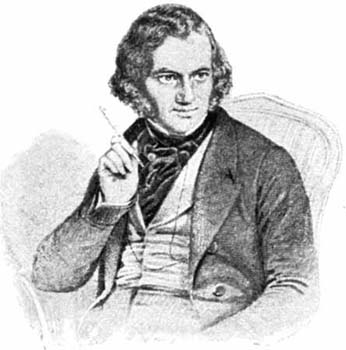 ALBERT SMITH.
The third of the medical trio was Albert Smith, a writer who was not fortunate in making a good impression on the majority of his associates. With Leech, with whom he had shared rooms in his "sawbones days," he remained a steadfast friend; but it is probable that that friendship was maintained by the artist by reason of the other's good nature, and in spite of his manner. Henry Vizetelly, who evidently bore him no particular goodwill, wrote to me his recollections of the man in these words: "He was not the amiable person depicted by Yates in his 'Recollections.' He was vulgar and bumptious in manner until he became polished by concerting with 'swells' after the success of his entertainments. He always had a keen eye for the main chance, and never neglected an opportunity for self-advertisement. Jerrold and Thackeray detested him, though only Jerrold showed this openly—which he occasionally did to Smith's face, in the most offensive manner. Albert Smith retained his position on Punch for some time after Jerrold's animosity had declared itself—first, because his copy was always certain; and secondly, because he and Leech were great friends, and Leech was then a power—though not in the same degree as Jerrold, who was almost absolute." These strictures are[Pg 304] repeated in Vizetelly's autobiography. Smith's "Physiologies," he says, which were some of them enlarged from the Punch sketches, brought him great popular favour, in spite of their slight intrinsic worth. Thackeray was invited by Vizetelly to produce similar sketches at a hundred pounds apiece—which was double the amount he was then receiving for the monthly parts of "Vanity Fair;" but he declined to do anything "in the Albert Smith line," and he similarly refused to write for "Gavarni in London," of which Smith was editor. "Pigmy as Jerrold physically was, Albert Smith quailed before him;" for Jerrold's stinging attacks and repartees were merciless. So Smith bought a toy-whip, which he playfully produced to his friends with the explanation that he intended to apply it to "Master Jerrold;" but he was never known to bring it out in his tormentor's presence. Jerrold's "skull" witticism has already been recorded; and of the same kind was his loud enquiry over the Punch dinner-table—when Smith's obtrusive foible of calling his acquaintances by their abbreviated Christian names became intolerable—"I say, Leech, how long is it necessary for a man to know you before he can call you 'Jack'?" When Jerrold first saw Smith's initials, he had said that he believed they were "only two-thirds of the truth"—and he continued to act upon the assumption until Smith left Punch and had become a successful "Entertainer." Then a truce was called, for his Mont Blanc ascent and the "Entertainment" he made out of it (of which Leech himself said, "It's only bad John Parry") had made of Smith one of the lions of the day, and of his St. Bernard, which had accompanied him, the most petted beast in the metropolis. But to the end he remained, generally speaking, the best-abused humorist of his day. He did not even succeed in escaping the quiet scorn of his occasional companion, Dickens, whose literary style it was reported he was trying to copy. The novelist, who much enjoyed Albert's sobriquet of "Lord Smith," simply shrugged his shoulders as he replied—"We all have our Smiths." It is believed by those who should know best that the cause of the final rupture between Smith and Punch[Pg 305] was the discovery that some of his articles were simply adaptations from the French; and this belief is still current in the Punch office.
Smith's connection with Punch was through his engagement for the "Cosmorama," on which Landells and Last committed infanticide at the starting of Punch. He sent his first paper from his temporary rooms at Chertsey; it was the burlesque, "Transactions and Yearly Report of the Hookham-cum-Snivey Literary, Scientific, and Mechanics' Institute" (12th September, 1841). This was succeeded in the following month, with the opening of his "Physiology of a London Medical Student," which was rather laughable in itself, while displaying a wonderful intimacy with the rough and noisy world with which it dealt. The idea, however, had already been sketched by Percival Leigh in "The Heads of the People." Smith was now living at 14, Percy Street, Tottenham Court Road, in an unpalatial lodging, where he nominally carried on the profession of surgeon-dentist; but his best energies were thrown into his literary work, and there is no doubt that that work was to the taste of the Punch readers. Mr. Walton Henning has told me how his father, A. S. Henning, calling upon Smith concerning his work, found him like a typical Bob Sawyer, with his heels upon the table, playing the cornet as a grand finale to his breakfast. Then he would don his French workman's blouse and scribble for dear life. The "Physiology of London Evening Parties," which was originally written by him in 1839 for the "Literary World," was illustrated by Newman, who was still a far more important man on Punch than Leech; and the series was followed by "Curiosities of Medical Experiences," the less successful "Side-scenes of Everyday Society," and "Physiology of a London Idler"—which, taken together, were voted the most entertaining descriptions of social life that Punch was publishing, even at a time when Punch was declared to be vastly entertaining. Verse, epigram, jokelets, and articles on current events came from Albert Smith's pen before the strained relations between the parties and the irresistible hostility of Jerrold bore him down, though it is probable that the practical joke[Pg 306] on him described among the proceedings of the Punch Club had some part in bringing matters to a head; and on January 7th, 1844, his last contribution appeared—"Important and Telegraphic." Punch, in reply to a criticism of the "Boston Atlas," declared that Smith left in December, 1843; but Albert Smith himself wrote (November 20th, 1845) to Mr. James Silk Buckingham (who was protesting to him against Punch's attacks): "I have not written or suggested anything for Punch since January, 1844.... I withdrew in consequence of being unable to agree with Mr. Mark Lemon, the editor. Indeed, I have been attacked since then through my novel of 'The Marchioness of Brinvilliers' both in Punch and in 'Jerrold's Magazine,' for which I do not care a straw."
It was after his retirement from Punch that, in conjunction with A. B. Reach, he started "The Man in the Moon," with the express purpose of making himself obnoxious to Punch in general and Jerrold in particular, in which laudable desire he in part, at least, succeeded; while at the same time he turned his attention to the publishers by bringing out a little Christmas volume entitled "A Bowl of Punch." But in time all bitterness disappeared; Albert the Great, as Smith was called, had "discovered" Mont Blanc and Chamonix, and peace prevailed, though to the end Smith had no further access to Punch's pages.
The last regular contributor of the year 1841 whose name has been preserved is H. A. Kennedy, whose parodies of Horace were as good as anything Leigh ever did of the kind. The parody of Horace's "Donec gratus" is worth preserving, and that (p. 20, Volume II.) of "Ad Lydiam"—becomingly rendered into a tender ode "To Judy"—is hardly less excellent.
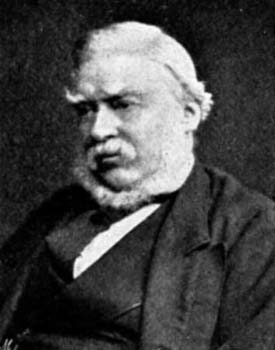 JOHN OXENFORD.
Dr. Maginn's connection with Punch began with the first Almanac, while he was, with James Hannay, in residence in the "Fleet." The doctor, as one of the most versatile writers of the day, was looked upon by the "Punchites" as useful for their purpose as he was for any of the rival papers with which he was connected. "He would write a leader for the 'Standard' one evening," it is said in J. F. Clarke's "Auto-[Pg 307]biographical Recollections," "answer it in the 'True Sun' the following day, and abuse both in the 'John Bull' on the ensuing Sunday." Such a man could not be without a sense of humour, especially with ample gin and water to enrich it and poverty to point it. He was the brilliant Morgan O'Doherty of "Fraser" and "Blackwood," and was nearly, but not quite, "Captain Shandon" in "Pendennis." Thackeray had an affectionate admiration for his talents. But the times and the doctor were out of gear; he lost sympathy through his persecution of "L.E.L.," and his misfortunes led him to follow a class of journalism out of all consonance with his powers and better feeling; he is credited with having been the forerunner of scurrilous society-journalism. But no hint of these defects is apparent in his work for Punch, in which, perhaps, he saw an opportunity for some degree of re-instatement; and he conveyed his gratitude in a five-stanza poem in praise of the paper (p. 131, Vol. II.), "Verses by a Bard—Much be-rhymed in Punch." But he was near his end; and when he died a year afterwards, Punch devoted to him the first of his little black-bordered obituaries.
The year 1842 was the stormiest and most threatening in Punch's history; so that, with an empty till and growing liabilities, there was no disposition towards introducing new contributors involving the principle of "cash down." Only three names belong to this year, but all were men of great importance, each in his own line—John Oxenford, W. M. Thackeray, and Horace Mayhew. In common with Coyne, Oxenford had a stronger sympathy for the stage than for periodical literature, so that after the tenth volume he ceased to be even an occasional contributor. His first paper was "Herr Döbler and the Candle Counter." The popular conjurer had advertised that to begin his performance and illumine his stage he would light two hundred candles by a single pistol-shot. (This was in the very early days of practical electricity.) The "Times" had reported the entertainment, but complained that, having counted the number of candles, they found there were only eighty-seven!—whereupon Oxenford executed a literary dance upon the "Times" reporter. Thenceforward, he[Pg 308] contributed with some degree of regularity. After his "Christmas Game" (January 6th, 1844) he was, on the 3rd of the following year, accounted upon the regular Staff, although from that time he did but little. Verse, clever and bright, burlesque, and the like, in the true spirit of Punch, came from time to time; but there was not enough of his work to place him in rank with the chief of the contributors. "There is one," Mr. Jabez Hogg reminds me, "whose name is rarely mentioned in connection with the early days of Punch and the 'Illustrated London News.' I refer to John Oxenford. He did much good work in his day, and his contributions to Punch assisted greatly to increase its reputation. He was a wit of the first water."
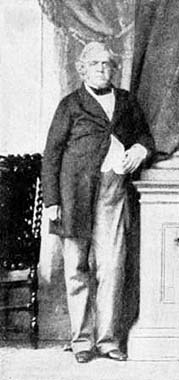 W. M. THACKERAY.
The same number that introduced John Oxenford to the Punch reader presented also William Makepeace Thackeray—a connection that did not immediately attract public notice, perhaps, though it soon bore the richest fruit for both author and publisher.
It was about seven years after the first abortive attempt to found a "London Charivari" that Thackeray—who had been one of the band—commenced that connection with Punch which was to be of equal advantage both to him and the paper. "It was a good day for himself, the journal, and the world," said Shirley Brooks, "when Thackeray found Punch. At first," continues his biographer, "I should gather that he had doubts as to the advisability of joining in the new and, so far, not very promising venture;" and on the 22nd of May, 1842, we find Fitzgerald uttering a warning note, and writing to a common friend: "Tell Thackeray not to go to Punch yet." But his friend paid little heed to the counsel, for within a month appeared what I am satisfied is Thackeray's first contribution to Punch—"The Legend of Jawbrahim-Heraudee" (p. 254, first volume for 1842) with a[Pg 309] sketch undoubtedly by his hand; and at the beginning of the very next volume, a fortnight later, was begun the series entitled "Miss Tickletoby's Lectures on English History." These, continued for a time, made no sort of hit, and in due course they were discontinued; but there seems to have been in them, and especially in the sketches, the germ of the idea, so perfectly worked out a little later by Gilbert à Beckett and Leech—though not for Punch: "The Comic History of England" and "The Comic History of Rome."
When Thackeray joined the Punch circle—or, rather, when he first wrote for it, for he was not on the Staff for some little time—he entered, with the credentials of "Fraser" and the "Irish Sketch Book," into a company of which several members were already his friends, who, knowing him as a humorist with both pen and pencil, were glad to secure so useful a man as contributor. "Very early in the work," writes Landells in his private papers, which lie before me, "Mr. Mayhew was desirous to secure his co-operation, and it was rather singular that the first paper which the great man contributed to Punch was rejected as unsuitable."
This was hardly correct: it would be more accurate to say that the first extended series was suddenly cut short. The circumstances of the extinction of Miss Tickletoby are shown in the following letter by Thackeray, which has been placed at my disposal by Messrs. Bradbury and Agnew:[Pg 310]—
Gentlemen,
Your letter, containing an enclosure of £25, has been forwarded to me, and I am obliged to you for the remittance. Mr. Lemon has previously written to me to explain the delay, and I had also received a letter from Mr. Landells, who told me, what I was sorry to learn, that you were dissatisfied with my contributions to "Punch." I wish that my writings had the good fortune to please everyone; but all I can do, however, is to do my best, which has been done in this case, just as much as if I had been writing for any more dignified periodical.
But I have no wish to continue the original agreement made between us, as it is dissatisfactory to you and, possibly, injurious to your work; and shall gladly cease Mrs. [sic] Tickletoby's Lectures, hoping that you will be able to supply her place with some more amusing and lively correspondent.
I shall pass the winter either in Paris or in London where, very probably, I may find some other matter more suitable to the paper, in which case I shall make another attempt upon "Punch."—Meanwhile, gentlemen, I remain, your very obedient Servant,
Gradually, however, and by sure degrees, Thackeray fell into the spirit of the paper, and became known to the general public first as a "Punch man," and then as "the Punch man," and for some time recognised by that, rather than by his work in other directions. He became more and more highly appreciated as one of those who contributed to that speciality of humour for which Punch had already established a reputation while creating a demand. All the while, during the first ten years, he regarded the paper as a sort of stepping-stone to an independent literary position; and he was not very long in using his opportunity for making a reputation equal to that of Jerrold himself—but a literary, and in no sense a political one. Jerrold, whose influence was political quite as much as literary and dramatic, undoubtedly did a good deal of unconscious service in spurring Thackeray with the spirit of emulation. It has already been pointed out how little love was lost between the two men at the weekly Dinner, and how Jerrold sped his galling little shafts[Pg 311] of clever personalities at Carlyle's "half-monstrous Cornish giant;" how, in short, they were, and remained to the end, the friendliest and most amiable of enemies.
Vizetelly has recorded how Thackeray would tear the postal-wrapper nervously from the newly-delivered Punch in order to "see what Master Douglas has to say this week"—(there is a world of dislike and scorn in that courtesy-title of "Master")—and how, when he gave a lunch in honour of the French humorous draughtsman "Cham," he invited "Big" Higgins, Tom Taylor, Richard Doyle, and Leech, all Punch men, to meet him, but neither Mark Lemon nor Jerrold, for "Young Douglas, if asked, would most likely not come; but if he did, he'd take especial care that his own effulgence should obscure all lesser lights." It was not Arcedeckne, I am assured by Mr. Cuthbert Bradley ("Cuthbert Bede's" son), but Jerrold, who, in Mark Lemon's hearing, crushingly criticised Thackeray's first public reading to the lecturer's face, with the laconic remark, "Wants a piano!" Thackeray, as we all know, was free enough himself in his criticisms of his own features, and his many sketches of his dear old broken nose are familiar enough to every lover of the man. Yet he was not best pleased when he entered the Punch dining-room a little late, apologising for his unpunctuality through having been detained at a christening, at which he had stood sponsor to his friend's boy, to be met with Jerrold's pungent exclamation—"Good Lord, Thackeray! I hope you didn't present the child with your own mug!" And still less was he flattered when he heard that, on its being reported in the Punch office that he was "turning Roman," simply because he defended Doyle's secession, Jerrold tartly remarked that "he'd best begin with his nose." (Jerrold, by the way, uses the same conceit in a letter to Sir Charles Dilke when repeating a rumour of the attempted conversion of the novelist by "Lady ——.") These and many more sardonic thrusts would amply account for Thackeray's dislike; yet that the men's relations were not half so disagreeable as has generally been believed is shown by the fact of Thackeray coming up specially to town from[Pg 312] his lecturing tour in order to support Jerrold on the night of his election at the Reform Club, and delightedly exclaiming, when the result was known—"We've got the little man in!" Nor would he, perhaps, have shown himself and Jerrold, in the accompanying cut, listening in fraternal shame-facedness and disgust to a fellow-passenger declaiming against the wickedness and profanity of Punch.
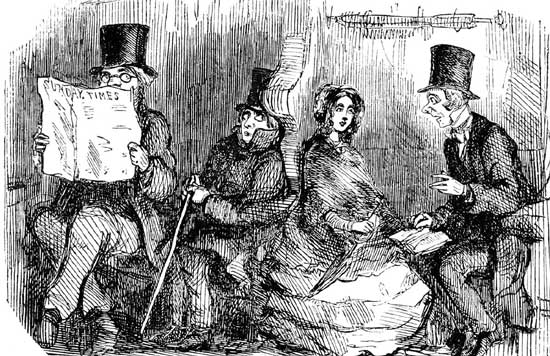 PORTRAITS OF THACKERAY AND JERROLD.
Old gentleman. Miss Wiggets. Two authors.
Old gentleman: "I am sorry to see you occupied, my dear Miss Wiggets, with that trivial paper Punch. A railway is not a place, in my opinion, for jokes. I never joke—never."
Miss W.: "So I should think, sir."
Old gentleman: "And, besides, are you aware who are the conductors of that paper, and that they are Chartists, Deists, Atheists, Anarchists, and Socialists, to a man? I have it from the best authority that they meet together once a week in a tavern in St. Giles's, where they concoct their infamous print. The chief part of their income is derived from threatening letters which they send to the nobility and gentry. The principal writer is a returned convict. Two have been tried at the Old Bailey; and their artist—as for their artist...."
Guard: "Swin-dun! Sta-tion!" (Punch, p. 198, Vol. XV., 1848.)
From the beginning, one of Thackeray's strong points on the Staff was that he was a "pen-and-pencil man," that he worked indifferently as artist or as writer, and not only as a writer, but as a prose-and-poem man. It has been said, with authority, that Thackeray never illustrated any articles but his own; but that is wholly incorrect. If you open Volume VIII., at p. 266, you will find a drawing of his showing Jack Tar and his Poll waltzing an accompaniment to an article on the "Debate on the Navy," which was written by Gilbert à Beckett. To the same writer's chapter on "The Footman," in his series of "Punch's Guide to Servants" (p. 40, Volume IX.), is a characteristic illustration by Thackeray, and again on the following page to "The Gomersal Museum." A little farther on, on p. 56, is a clever cut of a lovers' tête-à-tête beside a tea-table, to accompany Percival Leigh's ballad of "The Lowly Bard to his Lady Love;" and many similar results will reward a more extended search.
Thackeray's own opinion of his powers as a draughtsman is not easy to determine. We know, of course, from his own lips, his (? affected) surprise at Dickens not finding his art good enough to illustrate "Pickwick" vice Seymour, deceased. But in the interval between this application in 1836 and his later work he probably came to a more critical estimate of the real value of his draughtsmanship—that work which had been so laboriously and earnestly evolved from his studies in the Louvre and elsewhere. When Vizetelly was engraving Thackeray's designs to "Mrs. Perkin's Ball," which on account of their unsophisticated artistic character, were re-touched by a clever young draughtsman, the artist wrote that there was a "je ne sais quoi" in his "vile drawing" which was worth retaining. "Somehow," he said, "I prefer my Nuremberg dolls to Mr. Thwaites's superfine wax models." After Edmund Yates had started that brilliant little journal or magazine, which was not destined, however, to live as long as it deserved, Thackeray wrote to him: "You have a new artist on 'The Train,' I see, my dear Yates. I have been looking at his work, and I have solved a problem. I find there is a man alive who draws worse than myself!" Yet he[Pg 314] continued to draw for Punch with zeal; but when an acquaintance told him, probably in all sincerity, "but you can draw," Thackeray brusquely put down the compliment to the toadyism of a "snob." Trollope declares that Thackeray "never learned to draw—perhaps, never could have learned;" but he did not see that in the art of illustration, especially of a humorous character, there is something more important than academic correctness and technical mastery. He moved his pencil slowly, with a deliberate broad touch, without haste, and with no more attempt at refinement than was natural to him. Yet his hand was capable of astonishing delicacy of touch; and I have seen the Lord's Prayer written by him one day at the Punch Table, within the space of a threepenny-piece, which is a marvel of legibility. There is a character about Thackeray's work—his "je ne sais quoi"—that makes us forgive him his glaring faults—indeed, we almost come to love him for them—when once we have frankly recognised that it was in great measure his facility in drawing that was his artistic ruin. There is always something of the caricaturist in his most serious and important sketches—most of all, perhaps, in his etchings. It is in his smallest cuts that he is seen to the best advantage, and in them he occasionally challenges comparison with Doyle and Leech himself.
In the execution of his Punch sketches, in nearly all the three hundred and eighty of them, Thackeray was as summary as in the turning of a ballad, and I describe elsewhere how he would make a drawing on the wood while the engraver waited and chatted over a cigar. It was clearly not his opinion that, as is nowadays adjudged to be the proper course, elaborate studies should first be made from the life-model, even for the execution of a simple Punch picture. He preferred, when possible, to confine his pencil to the illustration of his own text; but on occasion he would produce a "social" cut—a drawing, that is to say, with a joke printed beneath. Sometimes it would be in the manner of Leech, as in the joke in Volume IX. (p. 3) called "The Ascot Cup Day," wherein a hot-potato-seller asks a small boy with a broom, "Why are you on the crossing,[Pg 315] James? Is your father Hill?" and is informed "No. He's drove mother down to Hascot." More personal was such work as "The Stags, a Drama of To-day," in which a retired thimblerigger and an unfortunate costermonger, under a magnificent alias, take advantage of the railway mania to make their application for shares—for which they could not pay, of course, if things went wrong—in accordance with the game of "heads I win, tails I vanish," at that time extensively played throughout the country. Later on (in Volume XV.), following "The Heavies," he gave, in seven scenes, a panorama of an "Author's Miseries." In 1847 (Volume XII., p. 59) Thackeray contributed a "social" picture which is to this day a wonder to all beholders. It is entitled "Horrid Tragedy in Private Life," and represents a room in which two ladies, or a lady and a servant, are in a state of the greatest alarm. What the meaning of it all is there is nothing whatever to indicate (unless it be that something has fallen on the taller lady's dress); and on its appearance the "Man in the Moon" offered a reward of £500 and a free pardon to anyone who would publish an explanation. The reward was never claimed; and Thackeray's contribution remains one of Punch's Prize Puzzles, unsolved, and, apparently, unsolvable.
It was in No. 137—that notable part which contained "The Song of the Shirt"—that Thackeray appeared in his own right, as belonging not only to the Staff, but to the Table. The contribution was a "Singular Letter from the Regent of Spain;" and with it Thackeray took his place at the Dinner as an excellent substitute for Albert Smith. That writer, who had found his successor "a very jolly fellow with no High Art about him," and a charming companion at "the Cider Cellars," a month later disappeared for ever from Punch as a contributor, refiguring only in its pages from time to time as an object of attack.
Thackeray's work on Punch covered every corner of Punch's field. Burlesques of history and parodies of literature, ballads and songs, stories and jokes, papers and paragraphs, pleasantry and pathos, criticisms and conundrums,[Pg 316] travels in the East and raillery in the West, political skits and social satire—from a column to a single line—such was the sum of Thackeray's contribution to Punch. Less prolific than either Jerrold or Gilbert à Beckett, he produced, nevertheless, an enormous amount of "copy" that was always readable, even when it was not his best. He wrote from Paris to his friend, Mrs. Brookfield (September 2nd, 1849): "I won't give you an historical disquisition in the Titmarsh manner upon this, but reserve it for Punch—for whom, on Thursday [I have written] an article that I think is quite unexampled for dulness, even in that Journal, and that beats the dullest Jerrold. What a jaunty, offhand, satiric rogue I am, to be sure—and a gay young dog!" But he did not think his work half so uninteresting as he pretended; he even regarded with satisfaction that which he produced when greatly out of the vein. "It is but a hasty letter I send you, my dear lady," he wrote to the same correspondent, in 1850, "but my hand is weary with writing 'Pendennis'—and my head boiling up with some nonsense that I must do after dinner for Punch. Isn't it strange that, in the midst of all the selfishness, that of doing one's business is the strongest of all. What funny songs I've written when fit to hang myself!"
His first contributions to Punch, after those already mentioned, were "Mr. Spec's Remonstrance," Volume IV., p. 70 (omitting "Assumption of Aristocracy," which has hitherto been credited to him, but was really sent in by Gilbert à Beckett), "Singular Letter from the Regent of Spain," with the three amusing cuts of sailors who, having found a bottle at sea, speculate as to its contents as they open it—"Sherry, perhaps," "Rum, I hope!" "Tracts, by Jove!!" Then, to select the chief and longest series, came "The History of the Next French Revolution," in nine parts (Volume VI.), contributions which were leavened by pleasant attacks levelled at Lytton, and at "Jenkins" of the "Morning Post." Then followed, in Volumes VII. and VIII., "Travelling Notes, by our Fat Contributor" (for Thackeray loved to call himself so, or "Our Stout Commissioner," or "Titmarsh," "Policeman X," "Jeames," "Paul[Pg 317] Pindar," or other whimsical pseudonym), and "Punch in the East"—the record of a journey undertaken by Thackeray at the invitation of the P. and O. Company, who offered him a free passage to Egypt.
At this time the railway mania was at its height, and Thackeray took his share in Punch in stemming the fatal tide, so far as ridicule could be used to do so. One of his first papers on the subject was the "Letter from Jeames, of Buckly Square," signed by "Fitz-Jeames de la Pluche"—the famous Jeames who, first created by Thackeray in the pages of "The Britannia" in 1841, under the title of "Mr. Yellowplush, my lord's body-servant," began in the same Vol. IX. (1845) his immortal "Diary." One of the successes of this epistle was what, to Thackeray's delight, was seriously complained of as the "deplorable" inaccurate orthography of the illiterate flunkey. Thackeray was certainly not the first to use the device, but he was the first to achieve great success with it, and Arthur Sketchley, Artemus Ward, Mr. Deputy Bedford ("Robert"), and all the American humorists who have adopted the same idea, are but followers where the great Titmarsh led. Jeames's weakness became a strength in Thackeray's hands, and at one time was turned with effect upon Sir Isaac Pitman's "Spelling Reform," which was then a novel butt for the satirist. The incident has been thus gravely recorded in the pages of the "Phonetic Journal":—
"Ten years ago Mr. Punch had meni a meri kakinashon at the ekspens ov Mr. Pitman and the 'Phonetic News,' which he leiked tu kall the 'Fanatic Nuz.' Here is wun of his sneerz:—'Voltaire sed ov the Inglish that they save two ourz a day bei kontrakting all their wurdz. The "Fonetic Nuz" woz not then in eksistens. If we save two ourz,' kontiniuz the kaustik pupet, 'in the dayz ov Voltaire, we must save siks ourz at least nou that we hav our improved plan ov speling, az originali invented bei Winifred Jenkins, and karid to its greatest heit bei Jeames, with the assistans ov Yellowplush and Pitman.' But Punch, who, leik the 'Thunderer,' never goez agenst publik opinion, sneerz no longer at the Speling Reform moovment, and sensibel men, who ar not fonetik men at all, admit at last that our prezent sistem ov orthografi is bei no meanz perfekt."
There is little wonder that Thackeray seized on the comic side of this movement, for whimsical spelling always delighted him. On one occasion, indeed, he was so proud of an uncompromising cold that had "sat down" in his head that he wrote to a friend in these terms:—"Br. Lettsob (attaché to the Egglish Legatiob at Washigtol) has beel kild elough to probise to dile with be ol Bulday lext at 6 o'clock—if you would joil hib aid take a portiol of a plail joilt ald a puddl, it wd. give great pleasure."
"The Snobs of England" began in the tenth volume, and continued through fifty-one numbers well into the twelfth. The effect of these papers was remarkable; the sensation they caused was profound. It may be compared to that of Jerrold's "Caudle Lectures," save that they appealed to a more cultivated and less demonstrative class, and were appreciated in proportion to their superior merits. The circulation of Punch rose surprisingly under their benign influence, and Thackeray did not leave the subject until he had handled it from every point of view and even carried it abroad. He was, naturally, not a little proud of his first great success, and in his unaffected manner was tempted to speak about it in Society—where more than in any other quarter the papers were appreciated. Unfortunately, according to Dr. Gordon Hake's memoirs, Thackeray broached the subject to George Borrow. He had been trying to make conversation with that strangely crotchety man, but had completely failed. So, being somewhat embarrassed, he asked him abruptly, "Have you read my 'Snob Papers' in Punch?" Borrow seemed to thaw. "In Punch," he repeated sweetly. "It is a periodical I never look at." This was as bad as the Oxford University magnate when Thackeray called upon him in 1857 in reference to his lecturing-tour and mentioned his connection with Punch, the fame of which was great in the land, as a sort of certificate of character—"Punch—Punch?" repeated the ignorant scholar, "is that not a ribald publication?" Thackeray, I may add, in order to impart local colour to his chapters on the Club Snob, with characteristic shrewdness obtained an introduction from Mr. Hampton, the secretary of the Conservative Club, to the Secretaries of the[Pg 319] Reform and the Athenæum, and begged their permission to inspect their complaint-books—a fact which has not before been recorded; and from them he gained such an insight into the failings of the snobbish clubman, that that portion of the work is unsurpassed for its truth to life. It is generally understood that he took Mr. Stephen Price, of the Garrick Club, as the model for Captain Shandy, and that his type of the sporting snob was Mr. Wyndham Smith.
There is not much doubt that Thackeray was a little—if ever so little—of a snob himself, and Jerrold's suspicion of him was to that extent justified. He did not show it so much by going into Society, for, as he said to a friend, "If I don't go out and mingle in Society, I can't write"—just as Mr. du Maurier goes out in order to study his world, and as Leech rode to hounds for the sake of his health and work. But Thackeray, who was the writer of some of the most caustic articles on "Jenkins"—(under which name Punch habitually attacked the "Morning Post," the aristocratic airs of which were to him a perpetual provocation)—seemed to take a little more interest in Society than mere curiosity or policy required; and was once thrown heavily in an encounter with the "Post's" reporter. Henry Vizetelly retells the story well in his "Looking Back through Seventy Years":—
A favourite butt for Hannay's savage satire was Rumsey Forster—the Jenkins of the "Morning," or, as Hannay dubbed it, the "Fawning Post"—who had supplanted the ci-devant midshipman in the affections of some pretty barmaid at a London tavern which they both frequented. Forster was most energetic in his particular calling, and is said on one occasion to have obtained admission in the interests of the "Morning Post" to a Waterloo banquet at Apsley House, by getting himself up as one of the extra servants out of livery, called in to assist on these occasions. He was highly indignant with Thackeray for the way in which he persistently ridiculed him in Punch under the cognomen of Jenkins; and I remember, after the author of "Vanity Fair" had become a celebrity, and began to be invited by other wearers of purple and fine linen, besides Lord Carlisle, to their aristocratic soirées, being highly amused by Forster telling me how he had taken his revenge.[Pg 320]
"You should know, sir," he said solemnly, "that at Stafford House, Lady Palmerston's, and the other swell places, a little table is set for me just outside the drawing-room doors, where I take down the names of the company as these are announced by the attendant footmen. Well, Mr. Thackeray was at the Marquis of Lansdowne's the other evening, and his name was called out, as is customary; nevertheless, I took very good care that it should not appear in the list of the company at Lansdowne House, given in the 'Post.' A night or two afterwards I was at Lord John Russell's, and Mr. Thackeray's name was again announced, and again I designedly neglected to write it down; whereupon the author of 'The Snobs of England,' of all persons in the world [it must be candidly confessed that Thackeray was himself a bit of a tuft-hunter], bowed, and bending over me, said: 'Mr. Thackeray;' to which I replied: 'Yes, sir, I am quite aware;' nevertheless, the great Mr. Thackeray's name did not appear in the 'Post' the following morning."
In another version of the same story it is recorded that when Thackeray pronounced his name to Rumsey Forster, the latter dramatically retorted, "And I, sir, am Mr. Jenkins"—an account far more artistic, if somewhat less faithful.
After the "Snobs" were finished and the evergreen "Mahogany Tree," in Volume XII., "Punch's Prize Novelists" were begun in April, 1847. In their way these parodies have never been excelled, and the fourth of the series—"Phil Fogarty," by "Harry Rollicker"—was so excellent a burlesque that Charles Lever, on reading this story of the hero of "the fighting onety-oneth," good-humouredly declared that he "might as well shut up shop;" and he actually did change, thenceforward, the manner of his books. These "Prize Novels" continued into the following volume, in which "Travels in London" were begun. These ran into Volume XIV., 1848, in which year their author received from Edinburgh a testimonial from eighty of his Scottish admirers. This took the shape of a silver inkstand in the form of Mr. Punch's person, and greatly resembled that which a similar subscription had already procured for Mark Lemon. It drew from Thackeray a charming letter in acknowledgment. Then followed "A Dinner at Timmins's" (Volumes XIV.-XV.) and "Bow Street Ballads" (Volume XV.), 1848,[Pg 321] "Mr. Brown's Letters to a Man about Town" (Volume XVI.), and "Mr. Brown's Letters to his Son" (Volume XVII.), 1849; "The Proser" (Volumes XVIII.-XIX.), 1850, and "Important from the Seat of War" (Volumes XXVI.-XXVII.), 1854. These papers, with the exception of "Mr. Punch to an Eminent Personage" (Volume XXVII., p. 110) and "A Second Letter to an Eminent Personage" (Volume XXVII., p. 113), were the last Thackeray ever wrote for Punch. The statement of his biographers that in the year 1850, "If we except one later flicker in 1854, Thackeray's long connection with Punch died out," is totally incorrect, for in 1851 there are forty-one literary items and a dozen cuts to his credit. But from that time until 1854 he only contributed "The Organ Boy's Appeal" (Volume XXV., p. 144), and thenceforward we hear no more of "Policeman X," of Maloney and his Irish humour, of the Frenchman on whom, in spite of himself, he was always so severe, no more of Jeames, Jenkins, or the rest of the puppets who lived for us under his manipulation.[40]
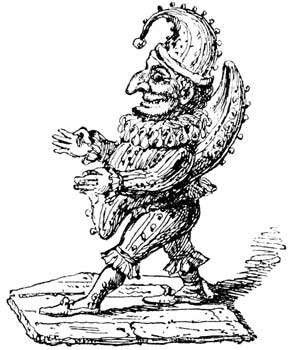 INKSTAND PRESENTED TO THACKERAY BY HIS EDINBURGH
ADMIRERS.
INKSTAND PRESENTED TO THACKERAY BY HIS EDINBURGH
ADMIRERS.
The labour of producing his Punch work was often irksome to him in the extreme, and many a time would he put Mark Lemon off—now, because he was so well in the swim with his novel then in hand that he begged hard to be let off, and again, because the Muse was coy and would not on any account be wooed. On one occasion he wrote explaining with what weariness he had been battening rhymes for three hours in his head, and could get nothing out: "I must beg you to excuse me," he ingeniously added, "for I've worked just as much for you as though I had done something." At other[Pg 322] times he would break away from the company he was in, in order to complete his regulation number of columns. His godson, afterwards the Rev. Francis Thackeray, has told us how the great man once took him to a conjuring entertainment and, having secured him a good place, explained "Now, I must leave you awhile, and go and make a five-pound note." And in such a manner, in haste and with disinclination, was often produced what James Hannay calls "the inimitable, wise, easy, playful, worldly, social sketch of Thackeray."
Although, as a rule, Thackeray preferred social to political satire, he would sometimes point an epigram with sharp effect. For example, in 1845, the disclosure in the "Freeman" of J. Young's letter, to the discomfiture of the Whigs and Lord Melbourne, suggested to Thackeray the line: "Young's Night Thought—Wish I hadn't franked that letter!" Its appearance in Punch caused Mr. Sparkes to buttonhole the writer at the Reform Club, and excitedly dilate on the mischief that was being done to the Party by such very public and sarcastic means. Thackeray burst out laughing—"the mountain shook," says the historian—but felt a little genuine pleasure at the circumstance all the same.
As success and public recognition came to him for his novels—the success for which he had worked so hard—his disinclination to work for Punch increased. No doubt the policy of the paper had something to do with it; but there can be little question that the great fame and reward he derived from novel writing made more occasional work distasteful to him, and in 1854—the year of "The Newcomes"—Thackeray corrected his last proof for Punch. He had foreseen it for some time, for in 1849 he had written to Mrs. Brookfield from Paris, "What brought me to this place? Well, I am glad I came; it will give me a subject for at least six weeks in Punch" ["Paris Revisited," &c.], "of which I was getting so weary that I thought I must have done with it." Five years afterwards he wrote to the same lady: "What do you think I have done to-day? I have sent in my resignation to Punch. There appears in next Punch an article so wicked, I think, by poor —— [? Jerrold][Pg 323] that upon my word I don't think I ought to pull any longer in the same boat with such a savage little Robespierre. The appearance of this incendiary article put me in such a rage that I could only cool myself with a ride in the park." Writing a long while afterwards for the public eye, he said, "Another member of Punch's Cabinet, the biographer of Jeames, the author of the 'Snob papers,' resigned his functions on account of Mr. Punch's assaults upon the present Emperor of the French nation, whose anger he thought it was unpatriotic to arouse"—being thus in Punchian policy, if not in motive, in entire accord with Mr. Ruskin.
A more complete and emphatic statement of the facts, as Thackeray viewed them, will be found in the subjoined letter from the novelist to one of the Punch proprietors, which, by their courtesy, is here printed for the first time:—
"My Dear Evans,
"I find a note of yours dated Feb. 5, in wh. F.M.E.[41] states that my account shall be prepared directly. F.M.E. has a great deal to do and pay and think of, but W. M. T. has also his engagements.
"I hope your 'Poetry of Punch' will not be published before my collected Ballads—Now remember (you wrote me a letter expressly on the subject) that the Copyright of all articles in 'Punch' were mine, by stipulation—and my book would be very much hurt by the appearance of another containing 3/4 of its contents.
"I met Murray the publisher the other day, and cannot help fancying from his manner to me that there is a screw loose with him too about that unlucky Leech article. Lemon, answering one of my letters, said that he personally complained that my account of leaving 'Punch' was not correct.
"There was such a row at the time, and I was so annoyed at the wrong that I had done, that I thought I had best leave Lemon's remonstrance for a while and right it on some future occasion. I recall now to you and beg you to show to him and to any other persons who may have received a different version of the story—what the facts were. I had had some serious public[Pg 324] differences with the Conduct of 'Punch'—about the abuse of Prince Albert and the Chrystal [sic] Palace at wh. I very nearly resigned, about abuse of Lord Palmerston, about abuse finally of L. Napoleon—in all which 'Punch' followed the 'Times,' wh. I think and thought was writing unjustly at that time, and dangerously for the welfare and peace of the Country.
"Coming from Edinburgh I bought a 'Punch' containing the picture of a Beggar on Horseback, in wh. the Emperor was represented galloping to hell with a sword reeking with blood. As soon as ever I could after my return (a day or 2 days after), I went to Bouverie St., saw you and gave in my resignation.
"I mention this because I know the cause of my resignation has been questioned at 'Punch'—because this was the cause of it. I talked it over with you in, and Leech saw me coming out of your room, and I told him of my retirement.
"No engagement afterwards took place between us; nor have I ever been since a member of 'Punch's' Cabinet, so to speak. Wishing you all heartily well, I wrote a few occasional papers last year—and not liking the rate of remuneration, wh. was less than that to wh. I had been accustomed in my time, I wrote no more.
"And you can say for me as a reason why I should feel hurt at your changing the old rates of payment made to me—that I am not a man who quarrels about a guinea or two except as a point of honour; and that when I could have had a much larger sum than that wh. you gave me for my last novel—I preferred to remain with old friends, who had acted honourably and kindly by me.
"I reproach myself with having written 1/2 a line regarding my old 'Punch' Companions—which was perfectly true, wh. I have often said—but which I ought not to have written. No other wrong that I know of have I done. And I think it is now about time that my old friends and publishers should set me right.
"Yours very faithfully, dear Evans,
"F. M. Evans, Esq."
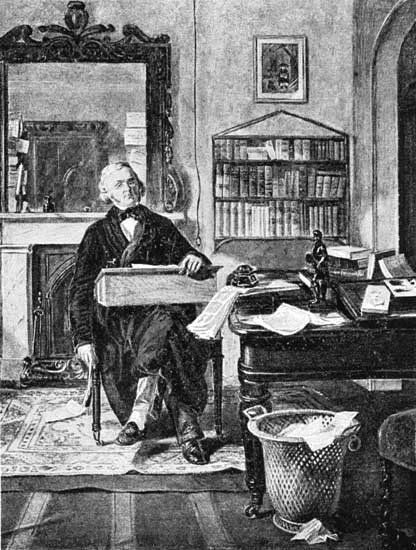 THACKERAY IN HIS STUDY.
Yet, though he resigned, he would still from time to time attend the Dinners, at which he was always made welcome by the publishers and his late colleagues. When, during this period, he was pleading for assistance for the family of one of[Pg 326] the Staff who had passed away, he took pleasure in admitting that—"It is through my connection with Punch that I owe the good chances that have lately befallen me, and have had so many kind offers of help in my own days of trouble that I would thankfully aid a friend whom death has called away." So, although he was no longer to be identified with the paper, Thackeray—"the great Thackeray" he had become—was bound to it and to several members of the Staff by ties of intimate affection, and his sudden death came with stunning force upon them all. To Leech it was as his own death-knell; and when he, Mark Lemon, Shirley Brooks, Tom Taylor, Horace Mayhew, "Jacob Omnium," and John Tenniel stood round his grave, they felt, I have been told, as if the glory of Punch had been irremediably dimmed. No verses ever penned by Punch's poets to the memory of one of their dead brethren ever breathed more love or more beauty of thought than those in which Thackeray was mourned, and defended against the charge of cynicism—" ... a brave, true, honest gentleman, whom no pen but his own could depict as those who knew him could desire":—
Horace Mayhew—"The Wicked Old Marquis"—A Birthday Ode—R. B. Peake—Thomas Hood—"The Song of the Shirt"—Its Origin—Its Effect in the Country—Its Authorship Claimed by Others—Translated throughout Europe—A Missing Verse—Hood Compared with Jerrold—"Reflections on New Year's Day"—Dr. E. V. Kenealy—J. W. Ferguson—Charles Lever—Laman Blanchard—Tom Taylor—Passed over by Shirley Brooks—Taylor's Critics—Mr. Coventry Patmore—"Jacob Omnium"—Tennyson v. Bulwer Lytton—Horace Smith—"Rob Roy" Macgregor—Mr. Henry Silver—Introduces Charles Keene—His Literary Work—Service to Leech—Retirement—Mr. Sutherland Edwards—Charles Dickens and Punch—Sothern Earns his Dinner—Reconciliation of Dickens and Mark Lemon—J. L. Hannay—Cuthbert Bede.
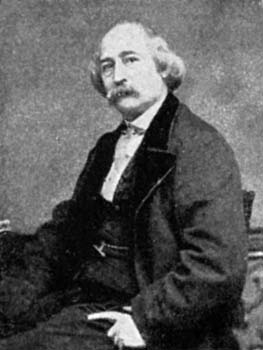 HORACE MAYHEW.
Punch had been running about eight months when, in Wills's words, "a handsome young student returned from Germany and was heartily welcomed by his brother, Mr. Henry Mayhew, and then by the rest of the fraternity." This was at the particular Punch meeting at which Mr. Hamerton was present. Horace Mayhew's diploma joke consisted, I believe, of "Questions addressées au grand concours aux élèves d'Anglais, du Collége St. Badaud dans le Département de la Haute Cockaigne" (Vol. III. p. 89). Regular occupation was forthwith found for him as sub-editor, his duties being to collect the cuts from the artists, to act as medium of communication between the writers and draughtsmen, and to assist Mark Lemon in making-up the paper; and for these services he received one pound a week. Soon, however, it was found that the editor could very well perform all such duties for himself, and the post of "pony" was abolished. Horace—or "Ponny," as he was invariably nicknamed[Pg 328]—became one of the accepted writers. He was most prolific as a suggestor, and never failed of point and pith in his own numerous little paragraphs. As a proposer he had much of the talent of his brother, but little of his genius. "The Life and Adventures of Miss Robinson Crusoe," written by Douglas Jerrold, was "Ponny's" suggestion; but he carried out his conceptions entirely in such papers as his extremely amusing "Model Men," "Model Women," and "Model Couples;" and his "Change for a Shilling" and "Letters left at a Pastrycook's" are still remembered.
"Ponny" had not a seat "in the Cabinet" until January 11th, 1845, before which time he had no separate existence as a contributor, all his "copy" being entered indiscriminately to the Editor. For a long while his average contribution was thirty-one columns in each volume; but his main value lay in the short articles and paragraphs of a playful and whimsical character. Thus, when the "Birmingham Advertiser" declared with grovelling snobbishness that "in these days it is quite refreshing to pronounce the name of the Duke of Newcastle," "Ponny" suggested that during the summer months "the name of his Grace should be written up in every public thoroughfare." He was, in fact, in the words of an old friend, "bright, good-natured, and lively, not very clever, but always letting off little jokes;" "a social butterfly," adds Mr. Sala, "who never fulfilled the promise of his youth."
He was a strikingly good-looking man, and was justifiably proud of Thackeray's greeting as they met at Evans's—"Ah, here comes Colonel Newcome!" "From his aristocratic mien and premature baldness," says Vizetelly, "Wiltshire Austin christened him 'the wicked old Marquis.' The keeping of late hours was Ponny Mayhew's bane. For a quarter of a century—save an annual fortnight devoted to recruiting himself at Scarborough or elsewhere—he scorned to seek repose before the milkman started on his rounds, and during the greater portion of the year never thought of rising until the sun had set, when he would emerge from his Bond Street rooms as spruce and gay as a lark." He had been engaged to a daughter of Douglas Jerrold (whose other daughter, it will be remembered, was the wife of Henry[Pg 329] Mayhew), but on the ground that "one Mayhew is enough in the family," Jerrold would not hear of it, and the young people remained faithful to each other to the end. Living first with Joseph Swain, the engraver, he afterwards took up his residence for a time with the Lemons at King's Road, Chelsea.
"Ponny's" portrait, it has often been said, may be seen in the White Knight in "Alice in Wonderland;" but "the resemblance," says Sir John Tenniel, "was purely accidental, a mere unintentional caricature, which his friends, of course, were only too delighted to make the most of. P. M. was certainly handsome, whereas the White Knight can scarcely be considered a type of 'manly beauty.'" He was a great favourite with the Staff, by reason of his many charming qualities. What they thought of him may be in a measure deduced from one or two of the verses borrowed from Shirley Brooks's Birthday Ode, here reproduced from Mr. Hatton's "True Story" in "London Society":—
"Ponny" Mayhew, who did not actually write anything for some years before his end, died in May, 1872; and on p. 191 of the sixty-second volume a graceful obituary notice pays tribute to his long and faithful service and his gentle good-nature.
By this time Punch's established reputation brought a great number of anonymous contributions, only a very few of which were ever used, and of fewer still was the authorship placed upon record. Early in 1843, however (p. 82, Vol. IV.), Mr. Blackwood, of Edinburgh, sent in one of the earliest of Scottish witticisms, a conundrum; Joseph O'Leary, a reporter of the "Morning Herald," is said to have contributed a poem on "The English Vandal;" and R. B. Peake, who had adapted "A Night with Punch" for W. J. Hammond, began his little series of "Punch's Provincial Intelligence," of which the most notable is a humorous report of the University Boatrace of the year; and then the elder Hood began his short but brilliant career.
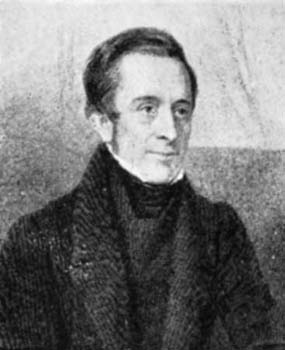 THOMAS HOOD
Thomas Hood had forgiven and forgotten the annoyance he had felt on seeing in the first number of Punch a bogus advertisement ascribed to him under the title of "Lessons in Punmanship," at which he "could only express his amazement that his name should be paraded with apparent authority in a paper of the very existence of which he was not aware;" and within two years he became a fairly constant contributor, after writing to Dickens, "You will be glad to hear that I have made an arrangement with Bradbury to contribute to Punch, but that is a secret I cannot keep from you. It will be light occasional work for odd times." So he began with a sketch re-drawn by H. G. Hine, accompanying a "Police Report of a Daring Robbery by a Noble Lord"—the first of his stinging attacks on Lord William Lennox, one of Punch's favourite and, it must be admitted, legitimate butts. Then followed at different times a score or more of conundrums in the true Hoodian vein under the title of "Whys and Whens," fair specimens of which are[Pg 331] these: "Why is killing bees like a confession? Because you unbuzz 'em." "Why is 'yes' the most ignorant word in the language? Because it doesn't no anything." "What's the difference between a soldier and a bomb-shell? One goes to wars, the other goes to peaces." "When is a clock on the stairs dangerous? When it runs down." A couple of sketches and "A Drop of Gin," an important poem of seventy-six lines somewhat in the manner of the latter portion of "Miss Kilmansegg" were followed—enclosed within a comic border!—by his greatest popular effort, "The Song of the Shirt." This appeared, not in the "Almanac," but in the "Christmas Number," on p. 261 of the second volume for 1843.
The particular incident by which this immortal poem was suggested was one which had called forth a powerful leading-article in the "Times." It was the "terrible fact" that a woman named Bidell, with a squalid, half-starved infant at the breast, was "charged at the Lambeth police-court with pawning her master's goods, for which she had to give £2 security. Her husband had died by an accident, and had left her with two children to support, and she obtained by her needle for the maintenance of herself and family what her master called the 'good living' of seven shillings a week."
Punch was at once aglow with red-hot indignation, and in an article entitled "Famine and Fashion!" proposed an advertisement such as this for the firm that employed her—
The subject touched Hood more powerfully perhaps than others, for his nature was essentially grave and sympathetic.[Pg 332] As he himself had said, it was only for his livelihood that he was a lively Hood—although he was always brimming over with comicalities; and he never felt more deeply the dignity of his profession and his own force and weight than when he was engaged on serious work. So Hood conjured up his "Song of the Shirt," moved by the revelations of poor seamstresses who received, as it appeared, five farthings a shirt, out of which sum they had to find their own needles! Mark Lemon told Mr. Joseph Hatton that Hood had "accompanied the poem with a few lines in which he expressed the fear that it was hardly suitable for Punch, and leaving it between his discretion and the waste-paper basket." It had, said Hood, already been rejected by three papers, and he was sick of the sight of it. Mark Lemon brought the poem up at the Table, where the majority of the Staff protested against its inclusion in a comic paper. But Lemon was determined; and, after all, was it not for a Christmas number that he destined it—a number in which something serious, pathetic, with a note of pity and love, was surely not out of place?
The effect on its publication was tremendous. The poem went through the land like wild-fire. Nearly every paper quoted it, headed by the "Times;" it was the talk of the hour, the talk of the country. It went straight to John Bull's kind, bourgeois, sympathetic heart, just as Carlyle declared that Ruskin's truths had "pierced like arrows" into his. The authorship, too, was vigorously canvassed with intense interest. Dickens, with that keen insight and critical faculty which had enabled him almost alone among literary experts to detect the sex of George Eliot, then an unknown writer (though doubtless he was helped in the case I now speak of by Hood's letter to him just quoted), was one of the few who at once named the writer of the verses. And it was well for Hood that he had proof positive of the authorship, for one of the most curious things connected with the poem was the number of persons who had the incomprehensible audacity to claim it. One young gentleman was mentioned by name, either by his friends or himself, and I find a letter in a volume of newspaper cuttings to this effect: "I have just read, to my[Pg 333] great surprise, the announcement in your paper that Mr. Hood wrote 'The Song of the Shirt,' because I know positively that what I before stated to you is the fact." So hard pressed, indeed, was Hood, that he wrote a private letter in February, 1845, in the following terms:—
"As I have publicly acknowledged the authorship of the 'Song of the Shirt,' I can have no objection to satisfy you privately on the subject. My old friends Bradbury and Evans, the proprietors of Punch, could show you the document conclusive on the subject. But I trust my authority will be sufficient, especially as it comes from a man on his death-bed."
Had these literary vultures had their way, Hood would have been brazened out of his verses altogether.
Punch shared handsomely in the glory of the poet, and its circulation tripled on the strength of it. And Mrs. Hood, poor soul, triumphed in her prophecy; for had she not said, and maintained in spite of each successive rejection from foolish editors—"Now mind, Hood, mark my words; this will tell wonderfully! It is one of the best things you ever did!"
And so this song, which, in spite of its defects, still thrills you as you read, achieved such a popularity that for sudden and enthusiastic applause its reception has rarely been equalled. It was soon translated into every language of Europe—(Hood used to laugh as he wondered how they would render "Seam and gusset and band," into Dutch); it was printed and sold as catchpennies, printed on cotton pocket-handkerchiefs, it was illustrated and parodied in a thousand ways; and the greatest triumph of all, which brought tears of joy to Hood's eyes, before a week was out a poor beggar-woman came singing it down the street, the words set to a simple air of her own. The greatest delight of Hood—"the darling of the English heart," as he was called, who was literally dying when he wrote the song, and so fulfilled the sole condition which Jerrold said was all that was needed to make him famous—was the conviction that the interest which the nation was taking in his lines would turn to the real advantage of those in whose cause he pleaded. He felt that he had touched not only the nation's[Pg 334] heart but the nation's conscience, and he deeply appreciated Kenny Meadows' and Leech's efforts in the same direction, such as are to be seen in the cartoons of "Pin Money, Needle Money," and many more besides.
Speaking of the "Song of the Shirt," which brought letters to Punch from every part of the globe, Mr. Ruskin declares it the most impressive example of the most perfect manifestation of the temper of the caricaturist, the highest development of which is to be found in Hood's poetry; and he compares it to Leech's "General Février turned Traitor." There certainly can be no doubt that its force is amazingly assisted by its plainness and simplicity of language.
It is a curious fact that one verse of the poem was not printed by Mark Lemon, although it appeared in the original manuscript; nor is it included in the reprinted "Works." I imagine that its omission was simply a matter of make-up, as it would be hard to compress the poem into the space allotted to it, without using a much smaller type than was usual in Punch; and an odd number of verses is a serious matter for a sub-editor to wrestle with when he has to arrange a poem into double columns of a given depth. The missing verse, which, to do Mark Lemon justice, is the one most easily spared, runs as follows:—
In the same number that contained the "Song of the Shirt" was another impressive poem by Hood, "The Pauper's Christmas Carol," in seven stanzas; but it was entirely overshadowed and eclipsed by its fellow-song, so that it lay, as it has done for the most part since, almost unknown, unhonoured, and unsung. Yet it was as ringing and true as any of Jerrold's[Pg 335] most stirring efforts in his championship of the poor. But the two friends were essentially different in their treatment and methods. Hood's satire was never personal, as Jerrold's was; and, unlike Jerrold, Hood would never tolerate the idea, much less practise it, of placing "a wide moral gulf between Rich and Poor, with Hate on one side and Fear on the other." He sought to help the poor by awakening the love and sympathy of Society, and for that reason he selected his epitaph in reference to his poem, for he would never have chosen this as technically his finest work. He was altogether out of harmony with Jerrold's policy of stinging the rich into charity and justice by biting satire and illogical sarcasm, warm-hearted and well-meant though it was.
At this time Hood was fast approaching his end; and he wrote for Punch on his death-bed. Though still young, he was becoming more and more afflicted with physical ailments. Amongst other troubles, he was getting stone deaf, he said; but consoled himself with the reflection that his friend Charles Landseer was two stone deafer. And all the while his rollicking fun, and quaintly sudden turn of word and idea were transporting his readers, as he somewhere says, "from Dull-age to Grin-age." His humour was effervescent, continuous, and effortless—not like Jerrold's wit, intermittent flashes called up at need—but overflowing in a rich stream of joke, pun, hit, crank, and quip, covering a field far wider than Jerrold's, and more genial.
The next contribution was his poem "The Drama," apropos of the State trials in Ireland, and the Fair Maid of Perth, with allusion to the Fighting Smith in either case—a poem of 108 lines. Then followed "Reflections on New Year's Day" (January 6th, 1844), from which a couple of specimen verses may well be quoted:—
After a column on "The Awful State of Ireland" Hood was, on the 3rd of March, 1844, editorially reckoned on the Staff. But the decree of Fate was against him, and he only contributed two more pieces altogether. Punch, as he acknowledged, was the one bright meteor that had flashed across his milk-and-watery way in his latter years, and gave him, together with Sir Robert Peel's tactful and charming bestowal of a pension, his last delight. But already death, he said, had thrown open wide its door to him, and he was "so near to it that he could almost hear the hinges creak." And when he died, there were engraved upon his tombstone, at his own desire, the simple words, "He Sang the Song of the Shirt."
The first arrival of 1844 was Dr. Edward Vaughan Kenealy, who, many years after, acted for and defended the historic "Claimant," the self-confessed Orton, alias Castro, alias "Sir Roger Tichborne," with so much violent ability, lost his balance and came to utter grief. In his youth one of his scholarly relaxations was to translate English verse of various sorts into various languages—Greek, Hebrew, Arabic, Hindustani, and the like, for he was a remarkable linguist. His unique Punch contribution was the rendering of "The King of the Cannibal Islands" into Greek, and very good Greek too. The jeu d'esprit is to be found on p. 79, Volume VI., as well as in his volume of verse dedicated to Lord Chief Justice Cockburn, whom he was destined afterwards to waste his life in vilifying, while shattering his own career in his savage and ineffective assaults.
In the following month T. J. Serle struck up an ephemeral connection. He had been Macready's secretary, and acting manager of Drury Lane, and had written "The Shadow on the Wall," and other successful plays; and Jerrold's eldest son was named Thomas Serle, after him. His first paper was[Pg 337] "A Fine Lady," on the 10th of March; but after one further contribution, two months later, he appeared no more. About the same time there was printed "The Magnitia," by Frank Moir (May 3rd, No. 199).
J. W. Ferguson was a far more important and more useful contributor, whose work was full of talent, whose versification was clever and pointed, and whose topical "Punch's Fairy Tales" (with obtrusively obvious morals) are models of their kind. His "Little Frenchman's First Lesson" (May 18th, 1844) purports to be a translation of a French poem with which patriots are supposed to implant hatred of England in the minds and hearts of their children the refrain being "Car ce sont là des perfides Albionnais!"—and the "Second Lesson," which replies to a French attack, were important efforts. His "Lays of the Amphitheatre (Royal), by T. B. Macaulay," "Cyinon and Iphigeneia," and similar contributions justified his inclusion in the Staff (April, 1845); but after the autumn of 1846, by which time he was represented by a score of columns, he disappeared from Punch's scene.
A letter from Charles Lever (6th June, 1844), under the title of "A Familiar Epistle," and over the signature "Archy Delany," for a moment brought that distinguished novelist into contact with Thackeray—a circumstance that was not forgotten by either writer, when the latter paid his rather stiff Dublin visit some time afterwards to the "Harry Rollicker" whom he so brilliantly parodied in his "Prize Novelists." Then Mr. W. P. Bull, of Nuneaton, sent in half a column of mock-heroic verse—"A Soliloquy"—which purported to be the commencement of a scene from an unpublished drama entitled "The Chemist," a contribution of which Lemon thought very highly. No further items, however, came from that quarter.
Three recruits appeared with the month of October. A writer named Jackson forwarded a couple of pieces ("Irish Intelligence" and "The Polka Pest"—the latter well describing the craze with which the new dance inoculated the whole country); and then Laman Blanchard, Jerrold's life-long[Pg 338] friend and fellow-worker from the beginning, made a début that was almost coincident with his death. His "Royal Civic Function" showed what a hand had been lost to Punch; but it was his delightful "New Year's Ode: To the Winner of the St. Nisbett—Season, 1844," that was the best of his rare contributions. It was at once an elegy of Mrs. Nisbett, and a prayer and prophecy that she might again be seen on the boards. The last verse runs:—
The prophecy was only partly fulfilled; Mrs. Nisbett was certainly seen again upon the stage, but Blanchard was not there to enjoy the sight. He died within the same year, to the passionate grief of Douglas Jerrold.
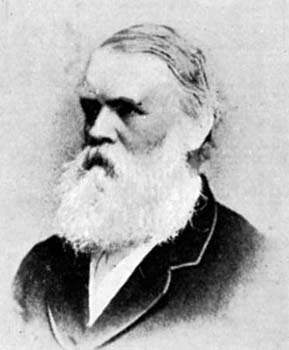 TOM TAYLOR.
The last and most important accession of the year was Tom Taylor, for six-and-thirty years a Staff officer of Punch, and for the last six of them commander-in-chief. He was twenty-seven years old when he sent in his first two contributions—"Punch to Messieurs les Rédacteurs of the French Press" and "Startling and most Important Intelligence" (October 19th, 1844). According to John Timbs, "Landells in one of his artistic visits to Cambridge met with Mr. T. Taylor, who, having completed his University studies, came to London to embark in the profession of letters, his first contribution being to Douglas Jerrold's 'Illuminated Magazine,'" just at the time when Landells ceased his connection. Bristed,[Pg 339] in his record of English University life, foretold of "Travis," generally accepted as a literary portrait of Taylor, "perhaps he will be a nominal barrister and an actual writer for Punch and the magazines. Perhaps he will go quite mad and write a tragedy:" a capital example of a prophecy after the event, so far as it goes—for "Five Years" was published in 1851.
Tom Taylor prided himself on the classic verve of his prose and verse, and undoubtedly assisted in maintaining Punch's literary standard. His work for the paper went on increasing—from six columns in Vol. VII., to forty-two in Vol. XIII.—and soon won him his seat at the Table. For a long while, however, he did not shine as a cartoon-suggestor, the first being "Peel's Farewell" (July 14th, 1849), and the second in the following May, the extremely happy burlesque on the picture in the National Gallery—"Leeds Mercury instructing Young England." As time went on and he became known as a writer of taste and versatility, as a dramatist and adaptor of plays, French and English; art critic of the "Times;" artist biographer; and Civil Servant (he attained to the secretaryship of the Local Government Board), the weight of his increasing responsibility and influence seemed to get into what should have been his humorous work. To counteract it, Thackeray, up to the time of his resignation, struggled to maintain the spirit of jollity and the lightness of touch which had formerly been Punch's true note. But in 1874, when Shirley Brooks died, Tom Taylor, who had been identified with the paper ten years before Brooks had joined it, was promoted, as by right of service, to the supreme command.[Pg 340]
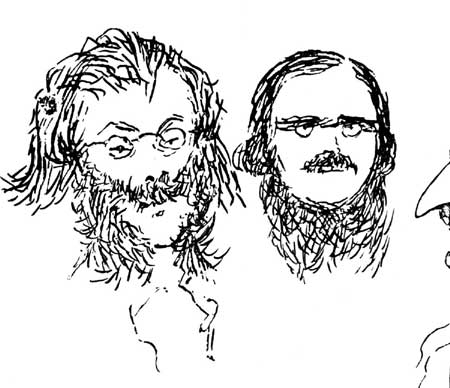 JOHN LEECH, TOM TAYLOR, AND PART OF HORACE MAYHEW.
It cannot be said that his editorship was a success. His fun was too scholarly and well-ordered, too veiled, deliberate, and ponderous; and under him Punch touched its lowest point of popularity.
His popularity among the outsiders was great, as I have learnt from many of his old contributors; for he loved to extend his hospitality to young men at his house, Lavender Sweep, at Wandsworth, and to send kindly notes of encouragement and promises of future help. Nevertheless, he was ever the butt of rival publications. In one of them a cartoon, entitled "An Editor Abroad," was published, showing Mr. Burnand and Mr. du Maurier helping him and his Punch Show out of the mud in which he had stuck; in another he was represented as "The Trumpet Blower;" while in an article in "The Mask" (April, 1868), before he had assumed his sway, Mr. Punch is supposed to point to "Mark Lemon's Triumphal Car" and, referring to Taylor, to say: "He is our seraph.... His adaptations, I assure you, are delightful. You must be well up in Michel Levy's répertoire to find him out. He is so very artful."
A peculiar feature of Tom Taylor's editorship was the hieroglyphical character of his handwriting. His missives of instructions to artists and writers came as a terror to the receivers, who could make little of them. "Mr. Tom Taylor's letters," Mr. Swain informs me, "were often very difficult to decipher. His writing was peculiar, and he would also continue the letter if necessary in any odd corner that was vacant. I remember his writing some instructions to an artist one day in this fashion, while I stood at his table, and, while blotting it, saying, 'You can send it off, but I don't think he'll be able to make it out.'" To this experience may be added my own—that I have been the first to decipher one of these notes addressed to an unattached artist, now understood for the first time, nearly twenty years after it was written. To the compositors he was a perpetual tribulation;[Pg 341] and it is doubtful if he could not have given points to Horace Greeley. That his son helped him, towards the end, in a secretarial sort of way, was no doubt a saving mercy.
His was one of the busiest literary and journalistic careers of the day; and when he died he left a void—great, it is true, yet in one respect easily enough filled. But it was little to his friends that his humour was not of the brightest and lightest, for his heart was of the warmest, as Mr. George Meredith set forth in the October number of the "Cornhill Magazine," to which he contributed a noble tribute—"To a Friend Recently Lost, T. T."—a sonnet beginning:—
The Punch men, themselves, in a whole-page obituary (July 24th, 1880), bore graceful testimony to his personal worth. "That he is not with us," they said, "is hard to imagine.... A cultivated man of letters, an admirable scholar, he was as free from pedantry as he was incapable of idleness. From first to last he was, in the highest and best sense, 'Thorough.' ... Quick to detect and appreciate talent, he was ready in every way and on all occasions to hold out a helping hand to a beginner." Thus feelingly they spoke of "the dear friend" they had lost. For in his death they forgot the little annoyances they had suffered from the tampering with their lines and spoiling their points, of which they had sometimes had occasion to complain; with other drawbacks belonging to an essentially fidgety nature. It may safely be said, that if he left a hard task to his successor to work up the reputation of Punch as a comic paper, he did not at least render it difficult for him to make his mark by comparison.
No new humorist appeared in the volumes for 1845, although a poet of eminence found expression on a single[Pg 342] occasion. To one Kelly is to be credited some humorous verses on "Dunsinane;" to J. Rigby, an Irish Song; to Leech, his Harlequinade verses (which do not aspire even to the dignity of a "trifle" or doggerel); to Watts Phillips, a few articles of little importance; and to J. King, the verses in which an "Exiled Londoner" (p. 147, Vol. IX.) apostrophises his beloved Babylon. The one contribution of importance was that of Mr. Coventry Patmore.
This was written in hot indignation of generous youth (he was but twenty-two years old) at the French atrocity in Algiers, when, during the campaign, General Pelissier filled with straw the mouth of the caves of Dahra, wherein the opposing Arabs, with their women and children, had taken refuge, and set fire to the mass. This foul act of the future Duke of Malakoff caused a thrill of horror to pass through Europe, and the gentle author of "The Angel in the House" was moved by the scandal to the composition of his eight-stanza poem, of which Douglas Jerrold procured the insertion on the 16th of August (p. 73, Vol. IX.):—
The poem follows the details of the massacre, sickening but for the power the lines display. It continues:
It was Mr. Patmore's sole contribution, his Muse never again being startled into any other poetical demonstration of the sort in Punch's pages. The following year he became assistant-librarian at the British Museum.
"Jacob Omnium's" first appearance, curiously enough, was with a short article which, in the reprinted works of Thackeray, has been ascribed to the novelist. This was "A Plea for Plush" (July 20th, 1846), appropriately signed "Φιλοφλυνκης," dealing, it is true, with Jeames's nether garments on a hot day, but still with no internal evidence of style to warrant its ascription to the "Fat Contributor." Henceforward his other few papers were entered to him in his own name of Matthew J. Higgins. He was a great friend of the Punch Staff, particularly of Thackeray and Leech. Of him the former had written in the "Ballad of Policeman X"—
while Leech took his part against Lord John Russell on the occasion of Higgins's "Story of the Mhow Court Martial." He was shown as a tall, self-possessed gentleman, saying to the little fellow, who is sparring up to him—"Pooh, go and hit one of your own size." Higgins's height, indeed, was greater than that of either Thackeray or his friend Dean Hole—six feet eight; and when the three friends walked abroad, the sensation among the passers-by was considerable. On Thackeray and Dean Hole measuring heights once in the house of a common friend, it was found that they were[Pg 344] practically equal. "Ah, yes," exclaimed the Dean; "the cases are about the same, but one contains a poor dancing-master's fiddle, and the other a Stradivarius."
Punch's sensation of the year was the fierce revenge taken by Tennyson in its pages on Bulwer Lytton. Bulwer, as is explained elsewhere, had been set up by Punch as one of its pet butts from the very beginning; and when Tennyson's sledge-hammer onslaught was brought to them, so it is said, by a distinguished man of letters—a particular friend of both parties—they rejoiced exceedingly. Tennyson's broadside had not been unprovoked. Years before, in 1830, he had published, through Effingham Wilson, "Poems, chiefly Lyrical," which contained the poem "To a Darling Room," afterwards suppressed. Seizing on this, Lytton had re-echoed in his "New Timon: A Romance of London," the strictures which Christopher North has so severely, though good-naturedly, passed upon it in "Blackwood's Edinburgh Magazine" for May, 1832, and furthermore taunted the Laureate with the pension of £200 which had just been conferred upon him. The attack was just the sort to extort a violent reply.
Punch (p. 64, Vol. X.) had rushed in to the rescue with the clever retort:—
"The New Timon" and Alfred Tennyson's Pension.
But Tennyson's was not by any means "the lordly mastiff's port." He was stung by the contemptuous reference to the pension, and proved the truth of Johnson's aphorism—
and he straightway wrote the ten verses that appeared under the title of "The New Timon, and the Poets" (p. 103, Vol. X.), signing them "Alcibiades":—
This crushing rejoinder was cordially welcomed by Thackeray[Pg 346] and the rest of the Staff, who loved to castigate the fopperies of the conceited poetaster, and Lytton, it is said, was not a little astonished at the virility of "school-miss Alfred." But Tennyson's anger soon cooled; perhaps his conscience smote him; for the very next week he toned down the savagery of his first verses in an "Afterthought," in which he said:
The first set of verses are not to be found in the poet's collected poems; but the second are included, only "kindly silence" is replaced by "perfect stillness." After that Tennyson broke silence no more; and Lytton subsequently made what was put forward as an amende honorable, in a speech at Hertford (October, 1862), when he said that "we must comfort ourselves with the thought so exquisitely expressed by our Poet Laureate," and so forth. The quarrel between Punch and Lytton faded, first into a truce, and then into friendship; and in 1851 we find several of the Staff playing "Not so Bad as we Seem"—written specially for them—at Devonshire House, before the Queen and the Prince Consort. It may not inappropriately be mentioned that when Woolner's bust of Tennyson was presented to Trinity College and the authorities excluded it from the chapel and library on the ground that there was no precedent for paying so much honour to a living person, Punch, by the hand of Shirley Brooks, published one of the finest parodies extant of the Laureate's style, beginning with the line—
In January, 1847, Horace Smith, the brother of James —— they of the "Rejected Addresses"—contributed a column "Christmas Commercial Report;" and John Macgregor—"Rob Roy"—began his acknowledged series of papers and sketches with "Costumes for the Commons" and "Meeting of the Streets," the pecuniary results of which he devoted[Pg 347] to police-court poor-boxes. He was hardly more than a lad at the time; but he was already a strong writer, and his references to the French Revolution have the intrinsic merit that they were written by one who was in Paris at the time when the "Citizen King" took flight to England.
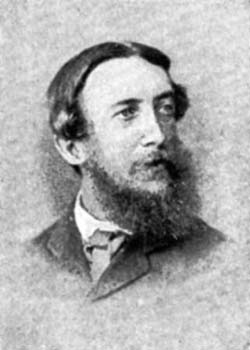 HENRY SILVER.
Mr. Henry Silver, ex-Punch Staff officer, first appeared anonymously in Punch in February, 1848, with an obituary notice, sent from Norwich, where he was articled to Sir William Foster, Bart., solicitor. It was called "The Death of Mr. Wimbush's Elephant"—the Jumbo of the period, which had died at the age of eighty-four. He was then only twenty years of age, and, encouraged by this success, he began contributing trifles to "The Month." This publication was edited by Albert Smith in 1851; but although it was illustrated by Leech, and was one of the most genuinely humorous works of its kind, it ran for only six months. When "The Month" came to a sudden stop, the articles remaining unpublished were turned over to Mark Lemon to see what use he could make of them. Some were by Mr. Silver, who was forthwith summoned from his anonymity by a line in Punch: "'Naughty Boy' has not sent his address." Mark Lemon was not kept waiting for the answer, and after paying him for several of his previous contributions (an attention highly appreciated) he at once installed the young man as a writer at the rate of one guinea per column. This, in due course, was raised to thirty shillings, and at that remained until 1881, when he received a weekly stipend of six guineas, which the Editor declared to be the maximum then payable to a Punch writer. Some years previous to this, and soon after the death of Douglas Jerrold, Mr. Silver had been summoned to occupy the place at the Table left vacant by the great satirist. "My chief work," he writes in answer to my inquiry,[Pg 348] "was in the decade ending with the 'Sixties, though it by no means ceased then. I often filled four or five columns a week, and contributed 'Punch's History of Costume'" (illustrated by Tenniel), "'Our Dramatic Correspondent,' 'Our Dramatic Spectator,' with a great amount of prose and verse, and sundry pages of the 'Essence of Parliament' when Shirley Brooks was away."
Perhaps Mr. Silver's greatest service to Punch, as elsewhere explained, was his introduction of Charles Keene, with whom he was very intimate for more than forty years. His friendship with Leech, a fellow-Carthusian, though of course greatly his senior, is another interesting passage of his life, testified to by the many hunting sketches which, with a score or more of Keene's, decorated the billiard room of the fine old house in Kensington where Leech had died, and which Mr. Silver subsequently occupied until it was pulled down in 1893.
At Leech's death Mr. Silver was invited by Mark Lemon to apply to the Governors of Charterhouse for the gift of an admission into "Gown-boys" for the son of the great draughtsman who had been so good a friend. After many fruitless efforts he was at length successful, and received the welcome present from the hands of Lord John Russell—as is set forth elsewhere. On the death of Lemon, Mr. Silver severed his regular connection with Punch.
The advent of the brilliant journalist Mr. Sutherland Edwards was the other event of 1848. "I was engaged on Punch," he says, "at the recommendation of Gilbert à Beckett, who had thought well of satirical verses and poems contributed by me to a paper called 'Pasquin.' Douglas Jerrold, however, had been attacked rather severely in 'Pasquin;' not by me, but by James Hannay. Hannay and myself wrote the whole of 'Pasquin' up to the time of my quitting that publication in order to write for Punch; and we considered ourselves jointly responsible for what appeared in its columns. Jerrold was away in the Channel Islands at the time of my being engaged on Punch; and on his return to London he showed himself annoyed (not unnaturally, perhaps) at the Editor, Mark Lemon, having engaged me. 'Two youths,' he[Pg 349] was reported to have said, 'throw mud at me, and because one of them hits me in the eye you clasp him to your bosom.' Mark Lemon now asked me to give up writing for Punch, but to contribute as much as I liked to a magazine he was about to start with the assistance of the contributors to Punch. It was to have been called 'The Gallanty Show;' but it never came out. After I had contributed to Punch for some weeks, I wrote a few articles for one of 'Punch's Pocket-Books;' then finding I was not wanted, I ceased to send in contributions, and my engagement came to an end.... I resumed my connection with Punch when Mr. Burnand became Editor (thirty-two years afterwards), and still write for it from time to time, but only as an occasional contributor." In this year Richard Doyle made a slight literary appearance in the paper, with an article on "High Art and the Royal Academy."
Charles Dickens is supposed to have contributed to Punch in the following year (1849) an article entitled "Dreadful Hardships Endured by the Shipwrecked Crew of the London, Chiefly for Want of Water"—a criticism on the scandalous condition of the suburban water supply. Mr. F. G. Kitton has examined the original manuscript preserved by Mrs. Mark Lemon in her autograph album. Mr. Hatton found it among Lemon's papers, bearing on the outside, in the Editor's handwriting, the inscription, "Dickens' only contribution to Punch!" But the alleged contribution is absolutely undiscoverable in the pages of the paper. The explanation is, in Mr. Kitten's words, that "about the time the manuscript was written, several pictorial allusions to foul water in suburban London appeared in Punch, which bear directly upon the subject of Dickens's protest, and it is surmised that the Editor, on the receipt of Dickens's contribution, considered that greater prominence would be given to the matter to which they referred by means of a cartoon than by a few lines of text. Hence we find the rebuke enforced by the pencil of the artist, instead of the mere literary lashing which Dickens intended to inflict upon that particular public grievance." It may safely be suggested that this was the only occasion[Pg 351][Pg 350] on which, after his reputation was made, Dickens was ever "declined with thanks." This MS., it may be added, was sold at Sotheby's on the 9th of July, 1889, and was knocked down for £16.
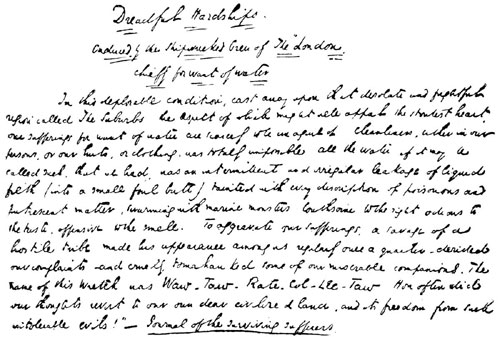 CHARLES DICKENS' SOLE (AND REJECTED) CONTRIBUTION.
The curious fact remains that Dickens, who was the intimate friend of Punch's Editor for the best part of their working lives, whose publishers were Punch's proprietors as well as the publishers and part proprietors of the "Daily News," which Dickens edited, never contributed to Punch, nor was in any way identified with it, save, indeed, with its Dinner-Table. At that function he was at one time a frequent visitor, and also was he present when at the Prince of Wales's wedding a brilliant company assembled at the publishing office to see the cortège go by. It was on that occasion that Sothern, one of the invited guests, arrived on the other side of the way, but, owing to the denseness of the crowd, was utterly unable to force his way across. His friends caught sight of him, and pointed to a policeman. Sothern took the hint. "Get me through," he whispered, "and I'll give you a sovereign." "Afraid I can't," said the man regretfully, "but I'll try." A prodigious effort was made, but unsuccessfully, loud protests going up from the packed crowd. Sothern was at his wits' end; he could not bear the thought of losing such a dinner in such a company, but his invention did not fail him. "Look here," he said to the constable; "put your handcuffs on me, drag me through, and land me at that door, and I'll give you two pounds." The man seized the idea and Sothern together; he slipped on the handcuffs, and with a loud "Make way, there!" dragged his prize through a mass of humanity that was only too happy to assist the law as far as might be; and after a few moments of crushing, pushing, and general rough handling, the dishevelled comedian was successfully landed at Punch's publishing door. "You'll find the money in my waistcoat pocket," said Sothern. But he did not observe that, after the policeman had secured it, a stealthy addition was made to the money in the constabular palm by one of his Punch friends; and only when the man disappeared in the crowd did Sothern realise that a timely bribe had left him to mix with his friends for the rest[Pg 352] of the day and to eat his dinner with hands firmly secured in his manacles!
It is said that Dickens held aloof from Punch on account of Thackeray's success in it. If so, the jealousy must have been all on Dickens' side; for Thackeray's well-known exclamation, when he hurried into the Punch office and slapped down before Lemon the latest number of "Dombey and Son" containing Paul Dombey's death, "It's stupendous! unsurpassed! There's no writing against such power as this!" was that of a generous and magnanimous man. Bryan Proctor ("Barry Cornwall"), writing to E. Fitzgerald in 1870, said, "I saw a good deal of Thackeray until his death.... I did not observe much jealousy in Thackeray towards Dickens, nor vice versâ. They travelled pretty comfortably on their dusty road together. Each had a quantity of good-nature, and each could afford to be liberal to the other." The probable explanation is that Dickens simply did not care to interrupt his triumphant career of novelist in order to write occasional articles in a paper in which anonymity was the rule and rejection so painfully possible.
Once, however, by the hand of Leech, Dickens made an appearance in Punch, and, curiously enough, only once. This was in the drawing of the awful appearance of a "wopps" at a picnic (p. 76, Vol. XVII.), where the novelist appears as the handsome, but not very striking, youth attendant on the young lady who is overcome at the distressing situation. It must be admitted that the portrait is hardly recognisable.
But a serious quarrel broke out between Dickens and the Punch men, publishers and Editor alike—a quarrel wholly on Dickens's side. So great had been his intimacy and his influence that he could cause the insertion of a cartoon and even bring about the alteration of the Dinner day. But now, on the unhappy differences between himself and his wife, trouble arose between old friends. Mark Lemon had naturally leaned towards the wife, from chivalry and sense of right, and the publishers preferred to take no share in a quarrel in which they certainly had no concern. On May 28, 1859, the whole of the back page of Punch was given to an advertisement of "Once a Week," which was to follow "Household Words,"[Pg 353] and to an explanation of the position of affairs between "Mr. Charles Dickens and his late Publishers." The following paragraphs are all that it is needful to quote from the statement:—
"So far as 1836, Bradbury and Evans had business relations with Mr. Dickens, and, in 1844, an agreement was entered into by which they acquired an interest in all the works he might write, or in any periodical he might originate, during a term of seven years. Under this agreement Bradbury and Evans became possessed of a joint, though unequal, interest with Mr. Dickens in 'Household Words,' commenced in 1850. Friendly relations had simultaneously sprung up between them, and they were on terms of close intimacy in 1858, when circumstances led to Mr. Dickens's publication of a statement, on the subject of his conjugal differences, in various newspapers, including 'Household Words' of June 12th.
"The public disclosure of these differences took most people by surprise, and was notoriously the subject of comments, by no means complimentary to Mr. Dickens himself, as regarded the taste of this proceeding. On June 17th, however, Bradbury and Evans learnt from a common friend, that Mr. Dickens had resolved to break off his connection with them, because this statement was not printed in the number of Punch published the day preceding—in other words, because it did not occur to Bradbury and Evans to exceed their legitimate functions as proprietors and publishers, and to require the insertion of statements on a domestic and painful subject in the inappropriate columns of a comic miscellany. No previous request for the insertion of this statement had been made either to Bradbury and Evans, or to the editor of Punch, and the grievance of Mr. Dickens substantially amounted to this, that Bradbury and Evans did not take upon themselves, unsolicited, to gratify an eccentric wish by a preposterous action.... Bradbury and Evans replied that they did not, and could not, believe that this was the sole cause of Mr. Dickens's altered feeling towards them; but they were assured that it was the sole cause, and that Mr. Dickens desired to bear testimony to their integrity and zeal as his publishers, but that his resolution was formed, and nothing could alter it."
So this foolish estrangement went on until, years afterwards, Clarkson Stanfield on his death-bed besought Dickens to resume his friendship with the man with whom, after all, he had had no cause of quarrel. So Dickens sent to Lemon (whom he[Pg 354] doubtless suspected of having written the publishers' damaging defence just quoted) a kindly letter when "Uncle Mark" appeared as Falstaff before the public, and when Stanfield was buried the two men clasped hands over his open grave; and later on, when Dickens died, some of the most touching and beautiful verses that ever appeared in Punch were devoted to his memory.
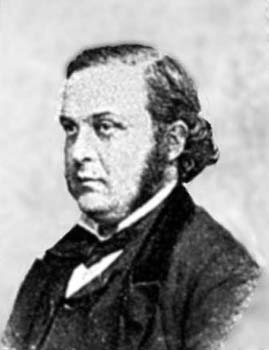 JAMES HANNAY.
In 1850 appeared James Hannay, Mr. Sutherland Edwards' associate in "Pasquin," and founder (I am informed by his cousin, Mr. J. L. Hannay, the police magistrate) of "The Puppet Show." It was when he was approached by the proprietors of this periodical (the Vizetelly brothers), and was asked to write for it as well—"Something in the manner of Sterne, with a dash of Swift"—he replied that in that case his remuneration would have to be "Something in the manner of Rothschild, with a dash of Baring." Hannay was at that time on the "Morning Chronicle," after having, like Jerrold and Stanfield, given a trial to the Royal Navy and found it wanting. He literally fought his way into Punch, just as Shirley Brooks did a few years subsequently, and was assisted from within by the kindly appreciation of Thackeray. Perhaps Jerrold was reconciled to the accession in view of Hannay having started "The Puppet Show" with the main object of violently assaulting his old friend and chum Mr. Edwards, who, in spite of all journalistic amenities, remained his chum, for these assaults were only attacks pour rire.
For a time Hannay's pen was of the utmost value to Punch. His earliest contributions were notes on a tour in Scotland—his native country—he describing himself as "The Scotchman who went back again." But he did not remain very long with Punch; besides being a wit, he was a scholar with a very serious side to his character, and the amusement of the public became, in his eyes, less important than their instruction. He[Pg 355] was only twenty-three when he produced his first novel of "Singleton Fontenoy, R.N.," which so pleased Carlyle that it induced the old philosopher to invite him to his house. Then he turned lecturer on literary subjects, became "Quarterly" reviewer, married a daughter of Kenny Meadows, took to diplomacy in a small way, and was appointed Her Majesty's Consul at Barcelona, where he died in 1873. Mr. Holman Hunt, one of the band of wits and youthful geniuses of whom Hannay was the wittiest of all, writes to me of him as "a contributor of great power who might with self-control have gained a great position—a friend who used to come on our nocturnal boating expeditions up the river. He was one of the dear crew who in different capacities and with varied powers once manned life's larger boat with me."
Sir John Tenniel contributed a few pieces in 1851 (p. 56, Vol. XX.) and later, but they were of little importance. Cuthbert Bede was as much a writer as a draughtsman, as he showed by his parody of the "High-mettled Racer." Then came another of Punch's stars of the first magnitude, Shirley Brooks.[Pg 356]
Shirley Brooks—His Wit and Humour—Training—Lays Siege to Punch—And Carries him by Assault—"Essence of Parliament"—William Brough—Mr. Beatty Kingston—F. I. Scudamore—M. J. Barry—Dean Hole—Mr. Charles L. Eastlake—Mr. Francis Cowley Burnand—His Little Joke with Cardinal Manning—"Fun"—"Mokeanna"—Its Success—Thackeray's Congratulations to Punch—"Happy Thoughts"—And Other Happy Thoughts—Mr. Burnand as a Ground-Swell—Promoted to the Editorship—The Apotheosis of the Pun—Mr. J. Priestman Atkinson—Mr. John Hollingshead—Mr. R. F. Sketchley—"Artemus Ward" —A Death-bed Ambition—H. Savile Clarke—Locker-Lampson and C. S. Calverley—Miss Betham-Edwards—Mr. du Manner's "Vers Nonsensiques" —Mr. A. P. Graves—Rev. Stainton Moses—Mr. Arthur W. à Beckett—"A. Briefless, Junior"—Mortimer Collins—Mr. E. J. Milliken—"The 'Arry Papers"—Gilbert à Beckett—"How we Advertise Now"—Mr. H. F. Lester—Mr. Burnand and the Corporal.
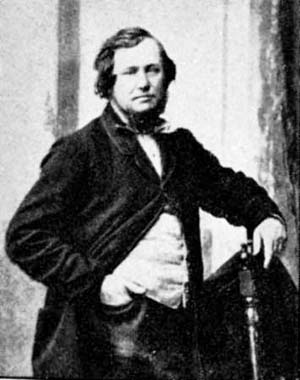 SHIRLEY BROOKS.
Shirley Brooks—he dropped his first names of Charles William—was perhaps the most brilliant and useful all-round man who ever wrote for Punch. His rapidity was extraordinary. The clergyman who boasted that he could write a sermon in an hour "and think nothing of it" courted the reply that probably the congregation thought nothing of it either. But the single hour in which Brooks began and finished the composition of his "Rime of the Ancient Alderman" (1855)—a poem of fifty stanzas, that fills nine pages in his volume of selected work—brought him criticism of a different sort. His facility was not less astonishing, and I have heard repeated some of his flashes of epigram enclosed in polished verse which it would be hard to believe were extempore but for the circumstances under which they were inspired. Indeed,[Pg 357] his fancy, like himself, was a diamond of great fire and high polish, and rich by bounteous favour of nature. He was as witty as Jerrold without the sting; but, when he chose, he could strike as hard, and, as he himself once said, never care "a horse's mamma."
He had been articled to a solicitor, but he preferred the comic muse, and Punch on "Joe Miller" was more to him than Coke upon Littleton. His humorous prose and graceful witty verse were cast upon the waters of the comic press. He was thirty-two before he had his best chance of making himself widely known in the line he especially loved. This was in 1847, when he began to write for the "Man in the Moon," which was just started under the editorship of two Punch men—Albert Smith and Angus B. Reach. For the latter he had a close and tender friendship. When Reach fell ill, Brooks did all his journalistic work for months, and would touch not a penny of the money; as the cheques arrived, they were immediately forwarded for the benefit of the sufferer. He was his colleague on the "Morning Chronicle," for which Brooks was gallery-reporter in the House of Commons for five sessions as well as leader-writer, and when Reach was sent through France on an expedition of inquiry into the condition of the agricultural classes, Brooks was despatched through South Russia, Asia Minor, and Egypt. And in 1852 he wrote in conjunction with him "A Story with a Vengeance," which was partly illustrated by Charles Keene; but the artist was at that time so little known that it was not considered worth the publisher's while to mention his name.
Under Reach's editorship, then, he appeared in the "Man in the Moon," and the next year (1848) in Hannay's "Puppet Show." It was for the pages of the former (November, 1847) that Brooks wrote one of the severest assaults on Punch ever published—the more severe for the excellence of its quality. It was entitled "Our Flight with Punch" (in imitation of Tom Taylor's "Flight with Russell" and his far less happy "Flight with Louis Philippe," in Punch, August and October, 1847, Volume XIII.), in which the "Man in the Moon" was supposed to fly, genie-like, with Punch over[Pg 358] the land which at one time he ruled with his wit; and the "Dreary Hunchback," as he was apostrophised, was caustically besought to awake and stem the tide of his supposed degeneration. It is hardly surprising that this poem, clever as it is, was not reprinted in the posthumous collection of the writer's poems.
But not immediately did he conquer his position. There were still years to wait, which were occasionally occupied with a pleasing attack on Punch, one of which, it is said, drew from Leech his picture of two little "snobs" in a low coffee-house. "Punch is very dummy and slow this week, I think," says the first disreputable-looking "fast man." "So do I," replies the other. "It's their own fault, too, for I sent 'em some dem'd funny articles, which the humbugs sent me back." "That's just the way they served me," resumes his friend—"the great fools!" But at last, at the end of 1851, his first contribution to Punch was received, and he was soon invited to join the Staff. He was not long in making a mark with "Miss Violet," but it was not among his strongest contributions. Nevertheless, "Epicurus Rotundus" was now a made man on the highway to success.
It was his charm and grace as much as his vigour that compelled the admiration of his fellows and their admission that he was the most valuable accession that the Staff had ever received. At the dinner given to Thackeray in 1856, Jerrold, in proposing Brooks's health, pronounced him "the most rising journalist of the day," and Mark Lemon declared openly that "Shirley's pen is the gracefullest in London." It was, in fact, the general opinion at the time that his verses combined much of the technical merit of Pope's with the keen sarcasm of Swift; and of such verse he contributed not fewer than six hundred pieces in the course of his Punch career. One of their merits was the unexpected spontaneity of their humour—the faculty that is distinctive of some of the best of his mots, such as that when looking at Edmund Yates's book-shelves which caused him to pause before one of the volumes and read off "Homer's Iliad," and murmur, "Homer's—Yes—that is the best." On one occasion he, with Mr. George Chester (my[Pg 359] informant), was on a visit to Mark Lemon at Crawley, and at the breakfast-table a discussion arose between the two men upon noses, their shapes and characteristics. Turning kindly to one of his host's little daughters, and looking at her delicate little nez retroussé, he said, "When they were looking about for a nose for you, my dear, they chose the first that turned up"—a joke often since repeated and well-nigh worked to death.
The contribution by which he will certainly be best and most gratefully remembered is his "Essence of Parliament"—a work which was entirely his own conception, and which was continued for twenty years from week to week while Parliament was sitting, with cleverness, refinement, truth, and humour that are invaluable to the historian and delightful to the general reader. For this work his experience and training as the "Chronicle" reporter were invaluable to him. Brooks was essentially a politician in feeling, full of suggestion—apt, happy, and ingenious—and yet could turn with ease and equal facility to social, literary, poetical, or art-critical work, to his daily "leader" or weekly article for the "Illustrated London News." He was in his time the cartoon suggestor-in-chief, and towards the end of Mark Lemon's life rendered great assistance in the editorship of the paper; although Percival Leigh was the recognised locum tenens. Lemon had been dead but just a week when Brooks wrote (June 1st, 1870) from the Punch office to a friend:—
"Yesterday I accepted the Editorship of Punch. It will be a tie, and give me trouble, but I seem to have been generally expected to take the situation, and it is not good to disappoint General Expectations, as he is a stern officer. Wish me good fortune—but I know you do.
"I was offered a seat on a four-horse coach, for the Derby, alongside M. Gustave Doré. But I am here. Who says I have no self-denial?"
—which shows that he was already in harness.
In his editorship he took the utmost pride, and he would defend his paper with spirit. When an ill-mannered acquaintance told him "that of all the London papers he considered[Pg 360] Punch the dullest," Brooks replied, "I wonder you ever read it." "I don't," said the other. "So I thought," retorted the Editor, "by your foolish remark."
Shirley Brooks fell ill with a complication of disorders, and Mr. Burnand did him the same service on Punch that he had done for Lemon, and that Leigh did for himself and Tom Taylor. When he was near his end, and a newspaper acquaintance called persistently to inquire how he was progressing, "Tell him," said the sick man, with a shrewd smile about his lips, "that he shall have his 'par' in good time." He was engaged in writing "Election Epigrams" and "The Situation" on his death-bed; and died in February, 1874, before their publication. He was buried in the cemetery of Kensal Green, close to where Thackeray lay by Leech, and within whose walls, though at some distance apart, Doyle was to sleep, and Henry Mayhew.
Neither Robert nor William Brough ever drew for Punch, but it is the belief of their brother, Mr. Lionel Brough, that they were both at one time literary contributors. Of this, however, I have no record. William was brother-in-law to Mark Lemon, but the two men were not on the best of terms. Robert, a provincial Jerrold, with all Douglas's power of sarcasm and some of his genius, had started the "Liverpool Lion," and was a brilliant comic draughtsman. It was the success of his play, "The Enchanted Isle," that brought him to London, where he wrote burlesques and so forth; but he will be remembered for his clever illustrations to most of Punch's rivals of his time, as well as his creation of "Billie Barlow"—the "Ally Sloper" of the day; and it was not to Punch's advantage that he did not enlist Brough's humorous talent.
In the year 1854—or it may have been a few months later—Mr. W. Beatty Kingston made an early appearance with a cockney ballad on the subject of the admission of female searchers to the penetralia of H.M. Record Office, of which at that time he was a "flickering light" at £100 a year. Soon he took service under the Hapsburgs, and left England afterwards for nearly a quarter of a century. In 1883 he resumed[Pg 361] comic operations on the invitation of Mr. Burnand, and continued, until June, 1887, to contribute a good deal of verse, illustrated by Mr. Sambourne and Mr. Furniss. Many of these pieces have since been republished in "My Hansom Lays;" while of those which have since appeared some, such as "A Triplet" and "The Wizard's Curse," have passed into the category of "stock recitations."
Then F. I. Scudamore, still remembered for his vers de société, was a passing contributor. But in 1855 he joined "The Comic Times," with other of old Punch outsiders, and then obtained an appointment in the Government Telegraphs, and, with a Companionship of the Bath, the superintendence of the Constantinople Post Office.
Mr. Ashby-Sterry's name belongs to the following year, but he appeared solely as a draughtsman; his literary connection, which began twenty-four years later, will be spoken of in its proper place. Michael John Barry was another who at this time (1857) shed no little brilliancy on Punch; and to him is now credited the admirable "Peccavi" despatch—perhaps the most finished and pointed that ever appeared in Punch's pages, and certainly one of the most highly appreciated and most loudly applauded:—
This brilliant couplet, according to the "Times," is said to have been contended for by "both Punch and Thomas Hood;" and it never was finally decided which of the two great humorists followed the other. Their claims, indeed, are not irreconcilable. Latterly, the credit has been claimed, with some show of authority, for Barry, who was generally regarded in his day as one of Jerrold's peers in wit. It is curious to observe that in the House of Commons debate on the Candahar question, Mr. P. J. Smyth was reported to have referred to "the unexampled brevity of the General's despatch after he had won his great victory on the Indus," in the quaint belief that the first half-line of the epigram was Lord Ellenborough's actual report.[Pg 362]
The Very Rev. Reynolds Hole, Dean of Rochester, always a spoilt child of Punch's, and the intimate friend of Leech, was more of a Punch man than most contributors, as he was one of the very few outsiders who were ever entertained at the Wednesday Dinner.[45] "Some six-and-thirty years ago," he informed me, "Mark Lemon wrote to me, 'Punch is proud of such a contributor,' and I have his letter. I wrote a few short paragraphs about Oxford, and some longer articles in verse, entitled 'The Sportsman's Dream' and 'My Butler.' Leech told me, 'You are an honorary member of our weekly meetings, and will be always welcome.'" His charming book, "A Little Tour in Ireland," written "by an Oxonian," had the advantage of Leech's pencil, and by his friendship with that artist, as well as with Thackeray and others of the Staff, he was for a time identified in some measure with Punch itself, besides obtaining recognition as the beau-ideal of "the genial, jolly parson." That he did not become a regular contributor to the paper was due, it is believed, to a subsequent misunderstanding.
In "Jack Easel," the writer of a number of delightful letters upon artistic and social topics at home and abroad, it is difficult to recognise Mr. Charles L. Eastlake, the able Keeper of the National Gallery. From 1859 to the autumn of 1862 Mr. Eastlake contributed eight-and-twenty articles of importance, one of them in verse, and the majority headed "Our Roving Correspondent." "Jack Easel on the Continent" and "The Royal Academy Exhibition" were the subjects of many of them, and their note was lively enough to cause his papers to be looked forward to by Punch's readers.
Mr. Francis Cowley Burnand, when he first appeared in Punch, in 1863, was no mere recruit; he was a proved humorist, though of short standing, and his début was an astonishing success. His début, that is to say, as a Punch writer, for eight years previously he had sent up from Cambridge a couple of drawings which Leech had made artistically suitable for publication.
Mr. Burnand was born in 1837—having been too gallant,[Pg 363] it was said, to come into the world before his Queen had ascended the throne, and too loyal and zealous to delay his appearance after she had taken her place. He was sent to Eton, where, however, he did not care much for football, being, as he expressed it, "more shinned against than shinning;" and thence, at the age of seventeen, he went into Trinity College, Cambridge. In three years he had graduated and had founded the still flourishing "A.D.C.;" at the same time, he determined to enter the Church. He placed himself under the Rev. H. P. (afterwards Canon) Liddon; but soon left for the seminary of the Oblates of St. Charles, at Bayswater, the head of which was Dr. (Cardinal) Manning. While there his passion for playwriting was too strong to be resisted, and before he left Dr. Manning confessed that he feared his young friend had no "vocation," i.e. for the ecclesiastical state. Mr. Burnand, taking a wider view of the term, entirely acquiesced with Dr. Manning, and added rather timidly that he "thought he had a vocation for the stage." Dr. Manning raised his eyebrows, wrinkled his forehead, sniffed, and then said: "A 'vocation' concerns the spiritual welfare. You cannot speak of 'going on the stage' as a 'vocation.' You might as well call 'being a cobbler' a 'vocation.'" "Well, yes, Dr. Manning," rejoined Mr. Burnand very nervously; "but—if I were a cobbler I should still have the cure of soles."
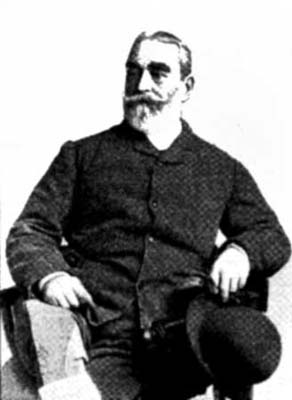 F. C. BURNAND.
An unsuccessful trial of the stage at Edinburgh, and a[Pg 364] call to the Bar in 1862, indirectly shaped Mr. Burnand's career, and, throwing him into playwriting and humorous journalism, led him quickly into a talented circle. With Mr. W. S. Gilbert, H. J. Byron, Matt Morgan, Jeff Prowse, and others, Mr. Burnand helped to strengthen Tom Hood's additional staff of "Fun," then newly established, under the proprietorship of a looking-glass maker, named Maclean—whom, by reason of his expansive smile and shining teeth, Byron used to call "Maclean teeth." Mr. Burnand's fresh and bright productions sparkled on the pages and caught the eye of Mark Lemon; but it was an unusually happy and original idea that was to bring the two men closely together. Mr. Burnand had conceived a series of burlesque stories, satirising the sensational style of the day, to be accompanied by an equally burlesque imitation of the illustrations that were to be seen in publications such as the "London Journal." To his own daughter, as "one of his oldest friends," Mr. Burnand once confided the following facts and circumstances for publication:—
"The astute proprietor of 'Fun,' in which I had achieved some success, observed that 'Mokeanna' wouldn't do. I am not sure but that he was right; but if he had been a literary editor he would have seen the idea in a rough copy, and would have suggested improvement. This good he did me, however—I read it to a friend, who thought some of it good and most of it the contrary, and so, in a temper, I burnt the entire manuscript, and, being quite sure of the humour of the idea, commenced rewriting it. Then I communicated with Mark Lemon; he jumped at the idea—determined to say nothing to anybody, except those who had to illustrate it, and the first number of 'Mokeanna' appeared on February 21st, 1863, with an illustration by Sir John Gilbert, burlesquing his own style, whilst the page in Punch was, in arrangement, a facsimile of the 'London Journal.' The proprietors rushed down to the office, terrified with the thought that, by accident, the 'London Journal' had been sewn up with Punch, and it took a lot of explanation in Mark Lemon's best manner to make them see the joke in its right light. The success of the experiment was immediate. Thackeray was supposed to have perpetrated the burlesque imitation, but[Pg 365] Thackeray knew nothing whatever about it, though, as I have since learnt, he was greatly tickled by it and, subsequently, was personally most kind to the 'New Boy,' as he called me, on the Punch Staff."
The illusion was complete, and the fun most apt and full of spirit. The various artists ("Phiz," Charles Keene, Mr. du Maurier, and Sir John Millais) each drew a picture for it, in every case burlesquing his own style and trotting out his peculiarities. The public laughed heartily—first, at itself for having been deceived by the verisimilitude to the "London Journal," and then at the work upon its merits; and "Mokeanna, or the White Witness" became the talk of the hour, and one of the good things of Punch. Charles Dickens was among those who most admired the execution of the jeu d'esprit, and he displayed considerable interest in the writer.
In due time Mr. Burnand was called to the Table. "My first appearance," he tells me, "was at the Inn at Dulwich where Punch sometimes dined in the summer in those days. Thackeray drove there, and left early. He had come on purpose to be present on this occasion, and before quitting the room he paused, placed his hand on my shoulder, and said, 'Gentlemen, I congratulate you on the "New Boy!"' I felt, and probably looked, very hot and uncomfortably proud; and then he shook me warmly by the hand."
Mr. Burnand's next success—a phenomenal success, too, on which his reputation as a humorist will stand unshaken—was "Happy Thoughts." For popularity and for immediate advantage to the paper this clever series, with its exquisite fooling and keen appreciation of humour, was second only to the "Caudle Curtain Lectures," and among the greatest hits that Punch has ever made. It has since been admirably translated into French by M. Aurelien de Courson under the title of "Fridoline!"—"happy thought!" being, however, somewhat inadequately rendered "ingénieuse pensée!" Then followed his imitations of popular writers—including "Strapmore," by "Weeder," and "One-and-three," by "Fictor Nogo"—"Happy Thought Hall," with illustrations[Pg 366] by himself, "More Happy Thoughts," "Out of Town," and many others, which are still to be found on the bookstalls. His, too, was the song "His 'Art was true to Poll," which achieved so great a success when Mrs. John Wood introduced it into "My Milliner's Bill" many years after it first appeared in Punch.
And in addition to the mass of work he has contributed to Punch, there are "The Incompleat Angler," "The New History of Sandford and Merton," "The Real Adventures of Robinson Crusoe," more than a hundred burlesques—beginning with his exceedingly popular perversion of Jerrold's "Black-Eyed Susan"—and a number of comedies and adaptations: a total rivalling, and in some cases surpassing, the industry of the most hard-working of his predecessors in Punch's editorial chair. Moreover, he has been a lecturer with "realistic notions," as he proved on the occasion when he was giving a public reading dealing with a yachting cruise, and, as he stood behind his reading-desk, stooped and rose with a regular maritime motion, relieved by an occasional roll, until the more susceptible among his audience began seriously to ask themselves if they were good enough sailors to sit out the reading to its ground-swell, breezy end.
In August, 1880, after the death of Tom Taylor, Mr. Burnand, who had been acting-editor in his last illness, was called upon to take up the task of restoring to Punch its ancient reputation for liveliness and fun, and with a dinner to every contributor, outside as well as Staff, the proprietors inaugurated the new era. Mr. Burnand at once made great changes among the outside contributors, and introduced new blood upon the Staff. For himself, he showed his chief strength as a punster of extraordinary ability; probably no one before him ever tied so many and such elaborate knots in his mother-tongue as he. "Mr. Burnand's puns are generally good, and sometimes very good," said a critic in the "Spectator;" "but they are really too plentiful.... When it comes to be a question of a volume of four hundred pages, with an average of ten puns to a page, the reader is[Pg 367] likely to suffer from an indigestion ... a cake that is all plums is likely to lie rather heavily on the person who eats it." But he was constrained to admit artistic merit in the humour of such passages as this: "There was a dead pause in the room. How long it had been there it was impossible to say, for it was only at this minute that the three became aware of it. And the Bishop sniffed uncomfortably, as though there was something wrong with the drainage."
But there was something of greater import brought in by Mr. Burnand's editorship than the literary tone. It was tolerance, political and religious, and wider sympathy than had lately been the case. The heavy political partisanship of Tom Taylor gave way to the more beneficent neutrality of Mr. Burnand—a personal neutrality, at least, even though Whig proclivities still coloured the cartoons to a certain, yet not unreasonable degree. And a larger religious tolerance and warmer magnanimity developed in Punch, such as comes chiefly from quarters where oppression has been known.
So he who has been called "the Commandant of the Household Brigade of British Mirth" has marched gaily along in Punch's service for more than thirty years. Prodigal of his jokes, he sometimes makes the best of them outside the pages of his paper. Thus in November, 1893, he wrote to the press in contradiction of the statement made by a police-court prisoner named Burnand, that he was the brother of the editor of Punch: "I beg to say that I have no brother, and never had any brother. I have two half-brothers (this man is neither of them), but two half-brothers don't make one whole brother." And people chuckled as the little joke was copied from one paper to another all over the English-speaking world, and applauded the excellent quaintness of Punch's Aristophanes. So, when a fictitious dinner of the Punch Staff at Lord Rothschild's was reported in the press, Mr. Burnand briefly dismissed the matter with the remark that the only dish was—canard.
Again, in the autumn of 1894, when he fell ill, alarming reports were spread. One of his colleagues on the Staff received a request for a column obituary notice of the dying[Pg 368] man from the editor of a leading daily newspaper. But Mr. Burnand was much better, and was greatly cheered on learning the particulars. "Really," he said, "that's more than I expected. A column! Why, that's what they gave to Nelson and the Duke of York!"
Mr. J. Priestman Atkinson's literary achievements in Punch are spoken of in the chapter where "Dumb Crambo's" pictorial contributions are treated. From August, 1877, to October, 1880, they are frequent, and consist for the most part of fanciful verse accompanied by cuts from the same hand. There is a charming prose story, however, in the Pocket-Book for 1879, seasonably entitled "The Invention of Roast Goose." But with Mr. Burnand's editorship Mr. Atkinson's energies were exclusively concentrated on humorous sketches and "Dumb Crambo" eccentricities.
In 1864 Mr. John Hollingshead—"Practical John"—was dramatic critic of the "Daily News." His notices attracted the attention of Shirley Brooks, with the result that he was invited to contribute to Punch. But it was in 1881 that he was taken on the salaried outside Staff, writing for the paper for several years, chiefly on the subject of social reform. He is the inventor, to whom Londoners should be grateful, of "Mud-Salad Market" and the "Duke of Mudford;" and the "Gates of Gloomsbury," "The Seldom-at-Home Secretary," and "The Top of the Gaymarket," are also his. It was with his pen that Punch attacked so lustily our licensing system—or want of system; and from him, too, came the burlesque "Schopenhauer Ballads," and other contributions, which, many of them, have been reprinted in "Footlights," "Plain English," and "Niagara Spray."
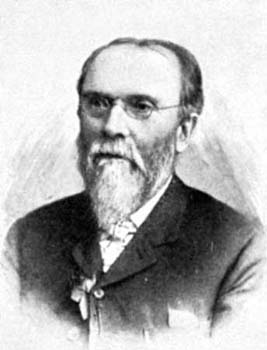 R. F. SKETCHLEY.
In the same year came Mr. R. F. Sketchley, late Librarian of the Dyce and Forster collection in the South Kensington Museum, who was destined to become one of Punch's Staff officers. "I find," he writes, "that I became a contributor to Punch in 1864. At the beginning of 1868 I was honoured with an invitation from Mark Lemon to join the Table. I served also under his successors—Shirley Brooks, Tom Taylor, and Burnand; and finally retired of my own[Pg 369] accord in 1880. I have seen it stated that in an illness of Shirley Brooks I did some of the 'Essence of Parliament.' If I had been called on to take up the pen of that most brilliant man of letters, I should have been in despair. All I did was to turn the Queen's Speech on the opening of Parliament into verse.
"I was never a prominent member of the Staff, but I am, and always shall be, proud of having been connected with Punch. I wrote both prose and verse—more of the former than the latter—and my contributions ranged in extent from a column down to a single line. My subjects were generally 'topical,' sometimes 'imaginary,' and the verse included a good many parodies." Mr. Sketchley, it should be observed, is one of the few members of the inside Staff—at least, within the last forty years—who have ever resigned their appointments, Richard Doyle, Mr. Henry Silver, and Mr. Harry Furniss being the others. His strong point was prose parody, the best, perhaps, being the quaint quasi-Gulliverian sketch called "A Fortnight in Sparsandria," which he contributed to Punch's Pocket-Book. Sober in judgment and wise in counsel, he was greatly missed when his genial companionship was lost to Punch's Knights of the Round Table.
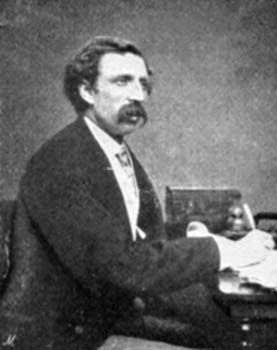 ARTEMUS WARD.
Passing over Mr. W. S. Gilbert's connection with the paper—which is described in the section devoted to artistic contributors—we find another humorist, equally distinguished, who identified himself with the paper the same year, Charles F. Browne, better known as "Artemus Ward." He had arrived in England early in the year, and soon after his arrival he was invited by Mark Lemon to contribute. Ward was at that time in failing health, and, according to his secretary and manager Mr. Kingston, two or three of the papers produced in accordance with the understanding that was entered into were written with painful effort—the reason,[Pg 370] no doubt, why so little of his usually rollicking humour is to be found in them. Nowadays many Americans profess to regard Punch with a sort of scornful amusement, and "Life," with an assumption of lofty disdain, is for ever sneering at it as a survival of the unfittest; and the same line is taken in England by New Journalists and Newer Critics. Not that the New American Journalist was unknown in Ward's day. He had already declared that "Shakespeare wrote good plase, but he wouldn't have succeeded as the Washington correspondent of a New York daily paper. He lacked the reckisit fancy and imagination." Anyhow, he did not live so near to the fin de siècle; nor was he ashamed to own that for years it had been his pet ambition to write for the "London Charivari." Unhappily, its realisation came too late to permit him to do justice to his talent and his humour; and he himself was only too conscious of his sad shortcoming, or, rather, of his failing powers. Only eight papers had come from his hand when it closed in death. In September the first of his papers was published—"Personal Recollections;" the last in November—"A Visit to the British Museum;" they are garrulous and discursive, and a good deal of the humour they contain was repeated from earlier works. That they should have contained any at all, under the circumstances, is the wonder; indeed, one is irresistibly reminded by them of his own humorous reference to one of the burlesque "pictures" illustrative of his "Lecture." "It is by the Old Masters," he said, in his quaint, sad way; "it is the last thing they did before dying. They did this, and then they died."
It is, indeed, curious how many of Punch's most valued contributors were working for the paper up to within a few hours, a few minutes, of being called away—Jerrold, Thomas[Pg 371] Hood, C. H. Bennett, John Leech, Shirley Brooks, and Artemus Ward; and many a time have the public laughed aloud at jokes and pictures wrought when the hand was stiffening in death, when the brain that had imagined them had already ceased to think.
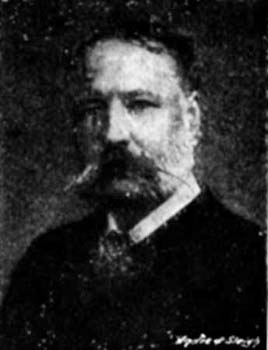 H. SAVILE CLARKE
H. Savile Clarke, previously a "Fun" contributor, and a disciple of James Hannay, made his Punch début with a set of verses in August, 1867; but he did not follow them up, except in a very small way, until Mr. Burnand's editorship, in 1880, encouraged him to write regularly. This he soon began to do, his main work being Society verse, mostly bearing on medical and scientific subjects, for he was brought up as a doctor. "Songs of the Sciences," "Lyrics in a Library" (verse on books), verse on the minor picture exhibitions, clever trifles like the "Carmen Culinarium" (December, 1891), and the important and strikingly able and successful parody, "Modern Life in London, or Tom and Jerry Back Again," illustrated by Mr. Priestman Atkinson—these formed the staple of his Punch work. But he was not enthusiastic about writing for the paper, as the chance of gaining reputation by unsigned contributions was very small. "I feel strongly," he wrote to me years ago, "as many writers do on the paper, as to the inequality of authors and artists. It keeps very good men off it."
"Berkeley Square, 5 p.m." was a poem of five stanzas that formed Frederick Locker-Lampson's sole contribution to Punch; it was published at the same time as Savile Clarke's maiden effort (August, 1867), and was illustrated by Mr. du Maurier. It was Locker-Lampson, it may here be mentioned, who sent in C. S. Calverley's ewe-lamb—a charade—to Punch's pages.
On the 25th of July, 1868, a lady-contributor made her début in Punch's pages. This was Miss M. Betham-Edwards,[Pg 372] who was already well known as the authoress of "A Winter with the Swallows," and whose travel "Through Spain to the Sahara," dealing with much the same scene, was then expected from the press. In the earlier part of the year a friend had shown to Mark Lemon a clever skit by the young lady, and the Editor forthwith commissioned her to write a series of papers to be called "Mrs. Punch's Letters to her Daughter"—a sort of belated sequel to Jerrold's "Punch's Letters to his Son." These letters, which ran through six numbers—the last in November 7th of the same year—are contributions of the worldly-wise order, cynical, satirical, and shrewd. Two years later Mark Lemon died, and Miss Betham-Edwards dropped out of the outside Staff position which she was by courtesy supposed to occupy. Certain contributions she sent in were returned; she took the hint, and the connection was severed.
It was about this time that Mr. du Maurier wrote his admirable "Vers Nonsensiques," and proved the literary talent which he afterwards displayed in so striking a manner in his lecture on "Social Satire" and in his novels. But, as has already been pointed out in several other cases, he is not by any means alone in having used both pen and pencil in the paper. Thackeray is the principal example of the twin-talent; but others, in very various degrees, are Cuthbert Bede, Watts Phillips, Thomas Hood (a single cut, and a wonderful one, too), Richard Doyle (a single contribution), John MacGregor, with Sir John Tenniel, and Messrs. Alfred Thompson, Ashby-Sterry, W. S. Gilbert, W. Ralston (one literary effort), J. Priestman Atkinson, J. H. Roberts (one poem), Harry Furniss (a dramatic criticism), and Arthur A. Sykes. As a rule, however, artist and author has kept strictly within his own field, although a bold experiment of a curious kind was once proposed. On that occasion the literary Staff had been complaining, with malicious frankness, that the drawings in a certain issue—(it is not necessary to particularise)—were not up to the mark. They were at once challenged by the artists, who declared that they would strike—that they would do the text, and allow the literary men to do the pictures. The idea was seized upon; the[Pg 373] result, they thought, would be screamingly funny. But the Editor would not hear of it; he imagined, not without reason, that the public, who would be called upon (but would probably decline) to pay, would not see the point of the joke. Years after a similar discussion arose; and those who heard it are not likely to forget the mock-philosophic-gastronomic blank verse composed by Mr. Sambourne on the spur of the moment just to illustrate how very easy clever verse-writing really is.
Whilst Punch has been greatly indebted for much of its humour to Scotsmen, several Irishmen also have contributed not a little to its success. Mr. Alfred Perceval Graves is one of these, although it is long since he wrote for the paper. "I contributed to Punch" he says, "during Shirley Brooks's editorship. Tom Taylor was then secretary to the Local Government Board, and I was private secretary to the Parliamentary Under Secretary for the Home Office, Mr. Winterbotham. Meeting on business, we struck up a friendly acquaintance, and, Punch being then a close borough, Taylor smuggled in verses and jokes of mine for a while, till he thought I had established a claim to introduction to Shirley Brooks. My work only went on from 1871 to 1874, as I became so engaged on literary work of a severer kind, and educational work as an Inspector of Schools, that I had not time for Punch; and when I cared to return to it Taylor had gone, and the present Editor was surrounded by fresh men, so I have not resumed my connection with it."
Mr. Graves—the author of the popular "Father O'Flynn," perhaps the best of all his Irish songs—wrote for Punch "The Tea-Table Tragedy," "The Ballad of the Babes in the Wood," and those admirable "Lines of Farewell to the Irish Humorist, Baron Dowse, on leaving the House of Commons"—
Then there is "On St. Patrick's Day falling on a Sunday," and in Punch's Pocket-Book the lines on "A Frog," and "A Cauliflower"—a parody of "The green, immortal Shamrock." But another merit in Mr. Graves was his coaching of Charles Keene on the subject of his Irish jokes, for which the former[Pg 374] was greatly responsible in the years of his Punch connection.
Nursery jingles newly adapted and applied to the morals and manners of the day are always a favourite vehicle of satire with the public, and have been freely used by professional humorists. Punch offers many instances of happy examples of the work. The first of a long series of "Nursery Rhymes for the Times" was begun by Mr. Charles Smith Cheltnam on January 9th, 1875, as well as in the Almanac of the same year. The writer forthwith became a busy contributor. About fifty of these rhymes appeared in Punch in quick succession, and there were many other pieces besides. "The Infallible Truth," a comment in verse on the passage at arms which was then (November 13th, 1875) taking place between Lord Redesdale and Dr. Manning on the subject of infallibility, showed that Punch's "papal aggression" was still rankling in his bosom. Mr. Cheltnam remained a contributor until the death of Tom Taylor, when he transferred his pen to the service of "Fun."
On April 1st, 1872, the Rev. F. D. Maurice died, and Punch contained a set of verses to his memory, in which the beauty and the strength of his character were set forth with deep sympathy, and not without power or poetical thought. They were from the hand of the Rev. Stainton Moses, of Exeter College, Oxford, for seventeen years an assistant master at the University College School. He was the editor of the leading London organ of Spiritualism. The more ribald of his pupils and acquaintance declared that his spiritualism was of another sort; but there is no doubt that he was very popular with all men, and exercised great influence among the faithful.
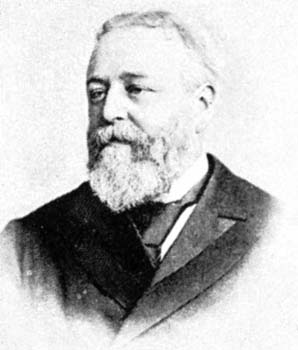 ARTHUR À BECKETT.
Eighteen years after the death of Gilbert Abbott à Beckett, his son, Arthur W. à Beckett, restored the family name to Punch's Staff. He had been nominated to the War Office by Lord Palmerston, but he soon found that he could walk in no other path but that which his father had trodden. Like him, he became an editor at twenty, by assuming for a space the direction, relinquished by Mr. F. C. Burnand,[Pg 375] of an evening paper called the "Glow-Worm"—whose light, after Mr. à Beckett left it, steadily refused to burn with the requisite effulgence. Mark Lemon was then approached; but he would have nothing to say to—or, rather, nothing to do with—the sons of his old friend, who thereupon sought elsewhere the encouragement they had hoped for in Punch's show. Mr. Arthur à Beckett started a satirico-humorous paper of great ability and promise, the staff including himself and his brother, Matt Morgan, Frederick Clay, and Frank Marshall, with Messrs. Alfred Thompson, Austin, T. G. Bowles, and T. H. Escott—most of them Civil Servants. But in the full tide of its success its financial foundations were weakened by one in the managerial department, and the whole thing came to the ground. After a few years of an active journalistic career he was invited by Tom Taylor, who had succeeded to the command, to contribute to Punch. A curious success attended his opening chapters. His first paper on a "Public Office" (p. 226, Vol. LXVI.), as well as the twelve following—that is to say, his contributions to thirteen consecutive numbers—were all of them quoted in the "Times," though whether or not through Taylor's intermediary did not appear. After the fourth number Mr. à Beckett was put on the salaried Staff, and in August, 1875, was invited to join the Table. Since Mr. Burnand's promotion to the editorship Mr. à Beckett has acted as his locum tenens, just as Shirley Brooks did to Lemon, and Percival Leigh to Brooks.
Being called to the Bar in 1881, Mr. à Beckett was enabled to revive the humours of his father's "Mr. Briefless," by the filial creation of the happily-named "A. Briefless, Junior." The "Papers from Pump Handle Court" from this self-sufficient, inflated, and utterly hopeless Junior, have been a feature in Punch for years past, and by them the author[Pg 376] has—so says an expert—"charmingly illuminated the legal profession by his queer fancy." One of the best papers in the collection is an account of a visit to the studio of a well-known firm of West-End photographers in the character of a legal celebrity, which is wittily called "A Matter in Camera." Up to December, 1894, he had contributed to a thousand and eighty consecutive numbers, his work including many "series," besides the usual topical subject-articles.
Mortimer Collins became an occasional, and by no means a prolific, contributor of verse from the year 1874. The sonnet in Punch on p. 237, Vol. XI. (December, 1846), has been ascribed to him, but there is no ground for the statement (he would then have been only nineteen years of age), nor did he contribute otherwise than from 1874 to 1876. His light lyric touch may be traced in many a poem. In "Where shall we go?" (p. 105, Vol. LXIX., September 11th, 1875) his dainty pen is to be recognised; as in "Lady Psyche's Garden Party," and various other verses of similar style and pleasant flavour. The attack on Mr. Whalley and "Crede Byron" (July 20th, 1875) are his, and the verses on the Burnham Beeches, and, in September, "Causidicus ad Canem." The charming "Sonnets for the Sex" (June 17th, 1876) and, on July 8th, the humorous prose in praise of goose-quill and sealing-wax, entitled "Mr. Oldfangle's Opinion," were full of pleasing turns of thought—little presaging the writer's death three weeks later. When he died, Punch contained an obituary notice of the writer (p. 57, Vol. LXXI., August 12th, 1876), in which it is said, "He wrote the 'Secret of Long Life,' to teach men to live a century, and himself died at forty-nine." He was in this respect a curious echo of Thomas Walker, who wrote his "Art of Attaining High Health" in his paper "The Original," and did not survive the completion of his task; and the prototype of the Duke of Marlborough, who died while engaged on an essay on the "Art of Living" for the "Nineteenth Century." Had he lived, he would certainly have been promoted to the Staff; and the fact that his funeral was officially attended by Tom Taylor, Percival Leigh, and Mr. Arthur à Beckett, on behalf of Punch, is[Pg 377] testimony of the respect in which his co-operation was held.
The literary post on Punch which corresponds with that of Chief Cartoonist has for years past been occupied by Mr. Edwin J. Milliken. The position is an onerous one, and carries great responsibility with it. He who fills it is at once "the Punch Poet" par excellence and the big drum, so to speak, of the political orchestra. For many years Mr. Milliken has written the letterpress explanatory of the Cartoon, either in verse or prose, as well as the preface to each succeeding volume. To his pen, too, we have owed during the same period those verses which it has been the graceful practice of Punch to devote to the memory of distinguished men. Remarkable for their tact, dignity, and good-sense—instinct with lofty thought and deep feeling—these poems are often masterpieces of their kind, models of taste and generous sympathy. In particular, those published upon the deaths of Lord Beaconsfield, John Bright, and Lord Tennyson, may be remembered as worthy of the men they were designed to honour, as well as for the felicity with which they set down what was in the heart of the nation, and the eloquence with which its sentiment was expressed.
On January 2nd, 1875, there appeared in Punch some lines entitled "A Voice from Venus," the planet's transit having at that time just occurred. They were Mr. Milliken's first contribution—a bow drawn at a venture—for he was entirely unknown to anyone connected with the paper. Tom Taylor asked for a guarantee of the originality of the verses—in itself a flattering distrust—and, receiving the necessary assurance, printed them forthwith. From that time forward the young writer contributed with regularity, and for two years was put severely through his paces by the Editor, who, in order to "try his hand," as he said, gave him every sort of work to do. Then came a personal interview of a gratulatory nature, in which Taylor promised to invite Mr. Milliken to the Table as soon as a vacancy occurred. At the end of the second year of probation this promise was fulfilled, and early in 1877 "E. J. M." cut his initials on the board.[Pg 378]
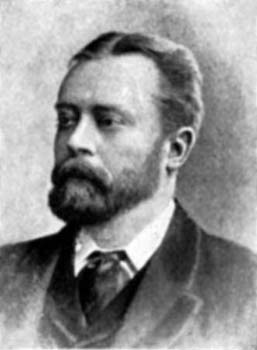 E. J. MILLIKEN.
It is worthy of remark that the successful career of Mr. Milliken is in direct opposition to his training, for he began life, much against his will, as a man of business in a great engineering firm. But literature was his goal, and the appreciation of the editors of a few magazines and journals to some extent satisfied his ambition. In point of fact, Mr. Milliken, in respect to his work, is the most modest and retiring of men; and the only contribution to which his name appeared, for years before or after, was the set of memorial verses to Charles Dickens which were printed in the "Gentleman's Magazine" in 1870.
Without a doubt "The 'Arry Papers" are the most popular and best known of Mr. Milliken's contributions, although "Childe Chappie's Pilgrimage," "The Modern Ars Amandi" (1883), "The Town" (1884), "Fitzdotterel; or, T'other and Which" (a parody of Lord Lytton's "Glenaveril"), 1885; "Untiled; or, the Modern Asmodeus" (1889-90), and "The New Guide to Knowledge," have successively loomed large in Punch's firmament. But it is the great creation of 'Arry for which Mr. Milliken is most applauded—and least understood. It is generally supposed that the 'Arry of Mr. Milliken corresponds to the similar character conceived by Charles Keene and Mr. Anstey. But the author means him for a great deal more. 'Arry with him is not so much a personage as a type—as much an impersonal symbol as Mr. Watts's Love, or Death, or other quality, passion, or fate, without individuality and, in spirit at least, without sex.
It is often suggested that Mr. Milliken's 'Arry is the survival—or, at least, the descendant—of the "gent" of Leech and the "snob" of Thackeray and Albert Smith. He is nothing of the sort. The gent and the snob had at least this merit; they aspired, or imagined themselves, to be something more and better than they really were. But 'Arry is a self-declared cad, without either hope or desire, or even thought,[Pg 379] of redemption. Self-sufficient, brazen, and unblushing in his irrepressible vulgarity, blatant and unashamed, he is distinguished by a sort of good-humour that is as rampant and as offensive as his swaggering selfishness, his arrogant familiarity and effrontery, and his sensuous sentiment. He is a mean-souled and cynical camp-follower of the army of King Demos, every day expanding, every day more objectionable in his insolent assurance. Originally designed as an illustration of the 'Arryism of the rougher classes, then promoted to be characteristic of the low sort of shop-lad and still lower kind of mechanic "with views" of a clear-cut kind within the narrow limits of his materialistic philosophy, he has developed into a type of character—almost, indeed, into a type of humanity. And as 'Arryism is rife in every walk of society, so 'Arry's experiences have become more informed, but not for that reason more cultivated or more refined. And therein lies the one inevitably weak point of Mr. Milliken's invention. Like Frankenstein, he seems to have created a Monster, who has outgrown the purpose he was originally intended to serve. For when he finds himself considering the 'Arryism of the "upper classes," he is bound, by his otherwise admirable convention, to retain the Cockney slang of which he is such a master, even though the speaker is supposed to have advanced so far in his views and knowledge of life as to be able to discuss matters of art, science, and literature. For, be it observed, a bank-'oliday at the Welsh 'Arp, "wich is down 'Endon wy," is no longer a spree for him, however uproarious the "shindy," and however ready his "gal" may be to sit on his knee and "change 'ats" to the accompaniment of cornet and concertina. He travels—on the cheap, of course—but still he travels, and discusses Venus of Milo, and 'Igh Art, and the philosophic questions of the "dy," and resolves all his meditations into the "motter" that "Socierty's all right." Without soul, without ideality, without aspiration, save of the baser sort, he represents no good quality nor redeeming virtue but physical health—the promise, it may at least be hoped, of a posterity that in the future, perchance, may justify his existence.[Pg 380] He is the raw, the offensively raw, material from which respectable and useful descendants may eventually be made. At present Mr. Milliken shows the 'Arryism that is permeating and fouling all classes, almost to the highest; but there the convention fails—only because it is a convention—for 'Arry is made to fill the part which has more recently, and perhaps with greater fitness, been accorded to the Bounder.[46]
But, apart from the satirical creation, 'Arry is a most amusing personage—his forms of speech, the quaint turns of his vulgar thought, being in themselves irresistibly laughable—their grossness merged in their genuine humour, and in the art so well concealed. 'Arry alone has stamped Mr. Milliken as a satirical humorist of the front rank, and has gone far towards making the public forget his other phase—the graceful and sympathetic poet. The philologists, too, proclaim their debt of gratitude to the author as the most complete collector of modern English slang, with suitable context and situation. Dr. Murray's great "New English Dictionary" accepts 'Arry as a name "used humorously for: A low-bred[Pg 381] fellow (who drops his h's) of lively temper and manners," and quotes "'Arry on 'Orseback" in Punch's Almanac for 1874 as his début in print. And, finally, Herr C. Stoffel, of Nijmegen, has published a philological volume on the "'Arry Letters" in Punch, from 1883 to 1889, examining the cant words with the utmost elaboration, gravity, and knowledge, and producing one of the most valuable treatises on the subject that have hitherto been published.
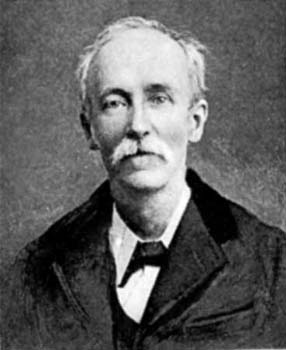 GILBERT À BECKETT'
In addition to the work already indicated, Mr. Milliken (as shown in the chapter on cartoons) devotes a great deal of attention to the devising of Mr. Punch's "big cuts," both for Sir John Tenniel and Mr. Linley Sambourne. The Almanac double-page cartoons, too—usually very elaborate designs—have been planned by him for a good many years, as well as most of Mr. Sambourne's fanciful calendars and "months" in the Almanacs. It will thus be seen that—with all his work in prose and verse, from a paragraph to a preface, and from a series to an epigram—Mr. Milliken is Writer-of-all-work and "General Utility" in the best sense; and a more loyal and devoted servant Punch has never had.
Alfred Thompson's work, which began in 1876, is considered with that of Punch's artists. Then came Gilbert Arthur à Beckett, who after a short spell of regular work was summoned to the Table. His first contribution had, in fact, been published by Mark Lemon, but immediately afterwards that Editor treated him just as he had treated his brother; and not for some years did he receive the call. Tom Taylor it was who, attracted by the quality of the work which the brothers were doing elsewhere, sent the coveted invitation.[47] In 1879—five years[Pg 383][Pg 382] after his brother Arthur—Gilbert à Beckett joined the salaried Staff, and three years later he was appointed to the Table. He had a very quaint humour and a wonderfully quick and startling sense of the incongruous. He was sadly hampered by his affliction, but he was an accomplished, high-principled, sensitive fellow, of whom one of his companions declared that "he was the purest-minded man I ever knew." Under more favourable conditions of health he would probably have made a greater mark; but as it was, he did good work. He was a happy parodist, and a very neat and smart versifier—at the age of fifteen he had gained the prize for English verse at Westminster, which was open to the whole school—and in the wildly absurd yet laughable vein of his bogus advertisements (of which he did many under the head of "How we Advertise Now"—a continuation of Jerrold's early idea) none of his Punch brethren could touch him. He was, perhaps, best known to the world as part author of the famous political burlesque of "The Happy Land;" less, perhaps, as part author of "The White Pilgrim;" and least of all as a musical composer, as it was under the pseudonym of "Vivian Bligh" that he put forth his songs and his music for the "German Reeds' Entertainment." But his work on Punch was always relished, and, considering his sad physical afflictions, he held his own on the Staff. He contributed both prose and verse, smart and apt of their kind. He wrote—in part, at least—the admirable parody of a boy's sensational shocker (p. 119, Vol. LXXXII., March 11th, 1882). With the exception of this and the comical "Advertisements" he did very few "series," but his contributions were always varied and excellent in their way, and himself appreciated as a useful and clever man. Perhaps his chief claim to recollection was his suggestion, as explained elsewhere, of the famous cartoon of "Dropping the Pilot." The Dinners were his greatest pleasure, and he attended them with regularity, although the paralysis of the legs—the result of falling down the stairway of Gower Street Station—from which he suffered (in common with his uncle Sir William à Beckett, and with one of the[Pg 384] Mayhew brothers as well) rendered his locomotion and the mounting of Mr. Punch's stairway a matter of painful exertion. Although he did useful work for Punch, he never became a known popular favourite; yet when he died—on October 15th, 1891—a chorus of unanimous regret arose in the press, for he was one of those few men who count none but friends among their wide circle of acquaintance.
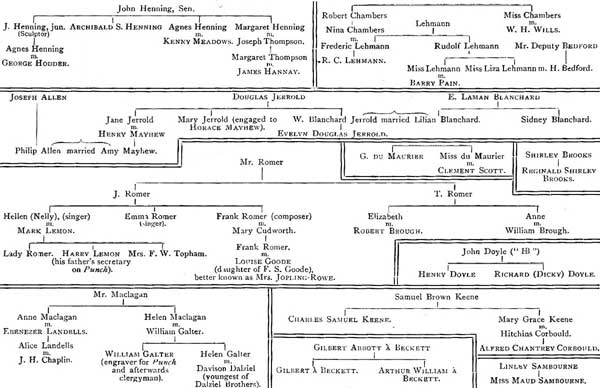 "Punch's" Family Trees.
Mr. Horace Frank Lester, late of Oxford University, afterwards barrister-at-law, author and journalist of the first rank, but at that time unknown to Punch, first appeared on January 5th, 1878, with a slashing satire on busybody amateur statesmen which greatly tickled Tom Taylor's fancy. But his first real hit was in September, 1880, with a form of contribution then comparatively new. It was a "Diary of the Premier at Sea," when Mr. Gladstone was on board the Grantully Castle, and, so far from "husbanding his energies," as his doctor directed, was supposed to receive deputations, make speeches, convert the man-at-the-wheel from Toryism, and try to cut down the mainmast with his axe. Then followed political diaries, parodies (such as "'The Entire History of Our Own Times' by Jestin Machearty," and innumerable poems), comic Latin verse, "Journal of a Rolling Stone," "Advice Gratis," "Queer Queries," legal skits, and so on. An amusing incident occurred in respect to one of the "Advice Gratis" series. Mr. Lester had spoken of a mythical book called "Etiquette for the Million: or, How to Behave Like a Gentleman on Nothing a Year, published at this Office." A corporal stationed at Galway Barracks wrote and asked for the price of it, "as I am extremely anxious to have the book referred to." Mr. Burnand's reply was simply, "Sold."[Pg 385]
"Robert"—Mr. Deputy Bedford—Mr. Ashby-Sterry—Reginald Shirley Brooks—Mr. George Augustus Sala—Mr. Clement Scott—The "Times" Approves—Mr. H. W. Lucy—"Toby, M.P."—Martin Tapper and Edmund Yates—Mr. George Grossmith—Mr. Weedon Grossmith—Mr. Andrew Lang's "Confessions of a Duffer"—Miss May Kendall—Miss Burnand—Lady Humorists—Mr. Brandon Thomas and Mr. Gladstone—Mr. Warham St. Leger—Mr. Anstey—"Modern Music-hall Songs"—"Voces Populi"—Mr. R. C. Lehmann—Mr. Barry Pain—Mr. H. P. Stephens—Mr. Charles Geake—Mr. Gerald Campbell—R. F. Murray—Mr. George Davis—Mr. Arthur A. Sykes—Rev. Anthony C. Deane—Mr. Owen Seaman—Lady Campbell—Mr. James Payn—Mr. H. D. Traill—Mr. A. Armitage—Mr. Hosack—Arthur Sketchley—Henry J. Byron—Punch's Literature Considered.
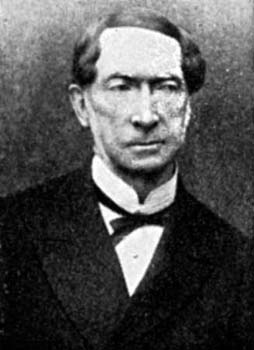 JOHN T. BEDFORD.
"Robert, the City waiter" made his low-comedy bow in 1880. "Robert's" literary father is Mr. Deputy John T. Bedford, whose opportunities for studying the ways of the City waiter have necessarily been many and excellent. The result of his keen observation was introduced to Punch through chance. "My introduction to Punch," Mr. Bedford informs me, "arose from the quite accidental circumstance that Mr. Burnand and myself were introduced at the same time, by Mr. F. Gordon, on the directorship of the 'Grand Hotel' at Charing Cross; and very shortly afterwards ... on the appointment of Mr. Burnand as Mr. Tom Taylor's successor, I ventured to congratulate him, when he said to me, 'If any fun is to be found in the City, I shall expect you to bring it to me.' I replied that I had sometimes thought that there was some to be got out of a City waiter, as waiters were not quite so deaf as was generally considered. I tried my hand, and my first attempt was very kindly received; it was printed on p. 64,[Pg 386] Vol. LXXIX. (August 14th, 1880), under the title of 'Notes from the Diary of a City Waiter.' ... There is no truth in the statement that Robert was based upon a certain waiter. He is certainly imaginary"—a statement which disposes of the assertion that the famous old "Cock Tavern" is famous nowadays for the original of "Robert" in the person of its head-waiter. Since 1880 Mr. Deputy Bedford is to be credited with more than two hundred contributions, of which, however, only a proportion belong to the "Robert" series. "You will find some of them," writes Mr. Bedford, "signed J. Litgué, a nom de plume that puzzled Mr. Burnand himself, until I revealed the secret that it was French for 'Bed-ford'; and he, with his excellent knowledge of French, was thoroughly sold." "Robert" has been republished in book form, and has attained an extraordinary circulation, though some of Mr. Bedford's critics have declared that the chief attraction has been the admirable illustrations by Charles Keene with which the little book is embellished. For severe critics there are; one of whom, in order to prove that "Robert" was not a humorous creation at all, took the curious course of translating one of his articles into good, well-spelt English, and then triumphantly asking—"Where is the humour now?"
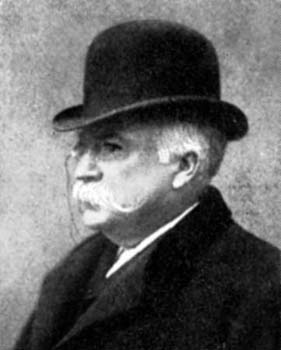 J. ASHBY-STERRY.
A complete contrast to Mr. Bedford became a contributor to Punch a fortnight after him—Mr. J. Ashby-Sterry. Twenty-nine years had passed since his boyish drawings had been accepted; and during the interval he had relinquished the pencil for the pen, had become a well-known journalist, and the author of sundry volumes of light literature. He was one of the first to be summoned by the new Editor, and he responded nobly to the call. Since August 28th, 1880, he has contributed as largely as any outsider to Punch's pages. Innumerable picture-shows, new books, articles of all kinds, and countless verses of every description[Pg 387] on every possible topic, with paragraphs long and short, are, so to speak, the hors d'œuvres of his contribution. Many series of poems and papers are his, of which the best-known is that of the "Lays of a Lazy Minstrel" (begun August 28th, 1880), with their riverside idylls and love-carols; but to his hand also are to be credited "Simple Stories for Little Gentlefolk," "Holiday Haunts, by Jingle Junior on the Jaunt," "Club Carols," "Uncle Bulger's Moral Tales," "Songs of the Streets," "Rambling Rondeaux," and "Paper-knife Poems." But it is his fluent, melodious, and unpretentious verse that has made him popular in Punch.
Reginald Shirley Brooks, the son of Mr. Burnand's brilliant predecessor, was working for Punch in 1880, and the following year he was called to the Table, and remained there without much distinction until 1884. He wrote some smart papers, but his groove was not that of the sober and respectable Fleet Street Sage. He preferred wilder spirits, and he accordingly retired, taking with him the sympathy of his companions. He died soon after.
After the escapade of Mr. George Augustus Sala in respect to Alfred Bunn's quarrel with Punch and the resultant "Word with Punch" of half a century ago (which was illustrated by Mr. Sala's lively pencil, as is explained in another chapter), none would ever have thought that his pen would have been driven in Punch's service. Lemon had declared him a "graceless young whelp," and nothing that Mr. Sala ever cared to do had tended to change that opinion. Shirley Brooks and Tom Taylor carried on the sentiment as a sort of dynastic vendetta, and Mr. Sala's name was kept on Punch's Index Expurgatorius until the accession of Mr. Burnand. Punch was then no longer the close borough, and the new Editor sought talent where he could find it. He invited Mr. Sala to contribute, and the invitation has been responded to whenever anything "Punchy" has occurred to the writer—as in the rhymed travesty of Tennyson's opening verses of "The Princess." It is an amusing fact that on one occasion Mr. Sala contributed a skit on himself—felicitously entitled "Egos of the Week"—with the startling and satisfactory result that one or two papers, taking the[Pg 388] thing au sérieux, commented on the fact, and expressed their pleasure that "at last Mr. George Augustus Sala has had the drubbing by Punch he has so long and so richly deserved"!
Mr. Clement Scott, the doyen of the dramatic critics, Civil Servant (like so many of the Punch Staff), member of the clever band that nurtured "Fun" into life, and brother-in-law of Mr. du Maurier, also had to wait till Mr. Burnand was Editor before he was given the opportunity to write for Punch. "It struck him," writes Mr. Scott, "that he might mingle among the essentially comic pages an occasional poem that might ventilate some grievance in a pathetic manner or describe some heroic subject in the ballad style.... The first subject Burnand sent me was the overworked and underpaid clerks in London. It took my fancy, and in three hours after I received his letter I sent him 'The Cry of the Clerk!' To my intense surprise, the morning after it appeared in Punch I found it quoted in extenso in 'The Times'—an unusual honour. I believe Dr. Chinery the instant he read the poem clipped it out with his own scissors and said, 'I don't know if this has ever been done before, but we must quote the poem to-morrow morning.' The sub-editor was aghast, but the poem was printed as from Punch."
These verses, indeed, struck people's consciences, as Thomas Hood had struck them years ago with "The Song of the Shirt." It brought into relief the enforced "respectability" of the men who earn but a few shillings a week, and yet are supposed to be "above charity."
It was the last verse that most struck home:—
Then he took the part of the shop-girls who are never allowed to sit down ("Weary Womankind"); of the London children who cry for fresh air ("The Children's Cry"), and described as well many a deed of daring by sea and land, in which sailors, soldiers, engine-drivers, policemen, life-boatmen, and coastguardsmen were concerned. In his little volume of "Lays and Lyrics" nearly a score of these Punch poems are republished.
The Parliamentary phase of Punch is the one which has remained constant from the beginning of the paper. All else has been subject to change—the quality of its satire, the character of its literature, the intention of its art, and the class of its humour. But in his attendance upon Parliament Punch has been persistently assiduous and consistently frank, neither awed by its majesty nor sickened by its follies. Parliament has always been regarded in his pages in the spirit of benevolent patronage and control, which, though unquestionably pedagogic, has always been just and sympathetic in tone. It was in order to continue the chain forged by Shirley Brooks and Tom Taylor in their "Essence of Parliament," without the dropping of a link, that Mr. Burnand's first Staff appointment was made with a view to filling the place that had been left vacant by Tom Taylor's death. His attention, like that of many others, had long been attracted to the brilliant weekly articles in the "Observer," entitled "From the Cross Benches"—papers that dealt with the week's Parliamentary proceedings with singular cleverness, humour, and originality—and at the proper moment he sought out the author of them, Mr. Henry W. Lucy, of the "Daily News."
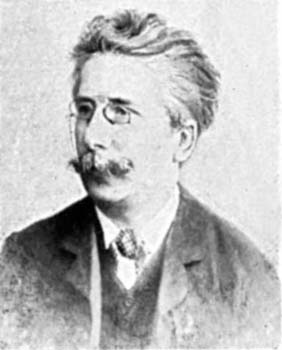 H. W. LUCY.
Mr. Lucy had already graduated as the Pepys of Parliament; for he had been known in gallery and lobby of the House for the past ten years, and was acting as chief of the Parliamentary Staff for his paper. He was, therefore, considered particularly well-fitted for the new post on Punch, and[Pg 390] he readily accepted the invitation. His first contribution was a sort of prospectus of Toby's Diary, which was published on January 8th, 1881. Thenceforward Mr. Lucy became known as "Toby, M.P.;" and when a puzzled Member of Parliament, familiar with his face, would occasionally ask him in the Lobby, "By the way, where are you member for?" he would answer "Barks" and pass on. It is not uncommon to find unregenerate members taking to themselves the credit of the witticisms which Toby puts into their mouths; so that there is perhaps excuse for the biographer of Lord Sherbrooke (Robert Lowe), who attributed to his subject the capital exclamation with which Mr. Lucy endowed him. When he saw a deaf member get his ear-trumpet into position in order to listen to a tedious orator, he remarked (according to Toby): "What a pity it is to see a man thus wasting his natural advantages!" And Lowe has had the credit of it ever since.
No one in the House knows its members so well as Mr. Lucy; no one out of it is so well acquainted with its procedure; and when for a short time he reluctantly filled the editorial chair of the "Daily News," he was unhappy till he got back to Toby's "kennel" in the gallery of the House of Commons.
But the Essence of Parliament as distilled by "Toby" is by no means the only, hardly even the most voluminous of Mr. Lucy's Punch work. In the recess he is a constant contributor as Mr. Burnand's deputy in the character of Punch's reviewer—"The Baron de Book-Worms," through whose personality "My Baronite" appears from time to time; while among his serial articles have been "The Letter-bag of Toby, M.P.," and the set of Interviews with Celebrities at Home, parodies of the "World's" articles, which delighted none so much as Edmund Yates himself.[48][Pg 391] Mr. Lucy joined the Table on his return from Japan in 1884.
But it is as "Toby" that he has gained most of his popularity. He showed the way about the House of Commons to Mr. Harry Furniss; and, up to the withdrawal of the latter, his "Diary" was always illustrated by that artist. Later on Mr. Edward J. Reed took the place Mr. Furniss resigned, and the pair continue to set before the world their humorous versions—perversions, it would be hardly fair to say—of Parliamentary proceedings. Mr. Lucy's touch is light and original, imparting an appearance of interest and entertainment to the dullest debate, and of verisimilitude to the most doubtful statements. Yet the "Diary" is not without its value as a record, while it remains an amusing commentary upon the work of the Session, and an entirely inoffensive caricature of the men and speeches with whom it deals.
In 1884, when the entertainer's platform was offering inducements superior to those of the stage, Mr. George Grossmith began a series of sketches in Punch, entitled "Very Trying," the fourth article of which contained a skit of Mr. Flowers, the Police Magistrate at Bow Street, under the heading of "The Good-humoured Magistrate," and another[Pg 392] dealt with Mr. Vaughan. Then came his funny musical sketches, with a few bars of absurd music sprinkled here and there in imitation of the London concert books. A few songs he also contributed to the paper, "The Duke of Seven Dials" becoming "popular even unto Hackney." Then, in collaboration with his brother, Mr. Weedon Grossmith, he produced "The Diary of a Nobody." It was a domestic record of considerable length, which dealt in an extremely earnest way with Mr. Samuel Porter, who lived in a small villa in Holloway, and had trouble with his drains, and was sometimes late at the office, with similar circumstances of striking interest and concern, which seemed to him to call for public notice. The "Diary" was afterwards republished in book form.
The light and dainty touch of Mr. Andrew Lang has not been denied to Punch. A number of trifles in verse appeared in 1883 and the two following years, the most important of them being a sonnet to Colonel Burnaby—the one contribution, it may be said, that the author has thought well to republish. Some years later he produced the laughable series "The Confessions of a Duffer"—papers so humorous that it is difficult to accept Mr. Lang's disclaimer that "a comic paper is a thing in which I have no freedom to write."
Besides Mr. W. Ralston, with his single contribution of "K.G.—Q.E.D." (November 22nd, 1884), Miss May Kendall was the chief comer of the year 1885. This lady helps to make up Punch's bevy of lady literary contributors—Miss Betham-Edwards, Mrs. Frances Collins, Lady Campbell, Miss Burnand (an occasional reviewer, or "Baronitess"), Miss Hollingshead, and Mrs. Leverson, being the others. She is one of the few lady humorists of any consequence in her day. Women, as a rule, are humorists neither born nor made. Often enough they are wits, more frequently satirists. They can make, we are told, but they cannot take, a joke; at any rate, they are usually out of their element in the comic arena. Moreover, as butts for the caricaturist they are unsatisfactory, for in proportion as his efforts are successful, his sense of chivalry is outraged; and we have seen how Keene and others recoiled from the idea. Only on one occasion[Pg 393] did Mr. Furniss make the attempt, and that indirectly and in a sense unintentionally—and the circumstance brought a miniature storm about his ears. No woman has ever yet been a caricaturist, in spite of the fact that her femininity befits her pre-eminently for the part. That she has desisted is a mercy for which man may be devoutly thankful. At the present time the rule here laid down as to lady humorists is proved by an exception in the person of Miss Murphy, a lady, it is said, of much beauty, who worked her way up from a subordinate position to the editorship of "The Melbourne Punch," a really comic production; but the unequal battle that would follow any extensive imitation of her example is altogether too painful to contemplate.
Miss Kendall's first poems, which were introduced to the notice of Punch by Mr. Andrew Lang in sincere admiration of their cleverness, were "The Lay of the Ancient Trilobite," and "Ballad of the Ichthyosaurus," which were printed in the numbers for January 24th and February 14th, 1885. It is Miss Kendall's peculiar talent that she is able to extract delicate humour out of the most unpromising subjects, and even in these lays, which together constituted her maiden effort, the characteristic is clearly shown. One verse may serve as an example; it is from the poem which shows how the Ichthyosaurus aspires to a higher life, and how the all-absorbent Ether remains in triumph after we have played out our little parts to their puny end:—
Quaintly humorous ideas are spread among her score of contributions—and tenderness, too; but it is as a humorous versifier of refinement and originality that she has appealed strongly to Punch readers, although, as she herself says, "it seemed very[Pg 394] wonderful to be in Punch, which I had venerated from my youth up."
The single contribution of Mr. Brandon Thomas has a rather interesting story. It was a patriotic song of a stirring sort, called "Britannia's Volunteers," composed at a time—in 1885—when patriotism was thick in the air. It was put to music by Mr. Alfred Allen; and two days after it was written, Mr. Thomas was at the house of Mr. Woodall, M.P., and there he sang the song. An old gentleman, who covered his mouth and chin with his hand, sat in the front row, and levelled a piercing look at the singer, listening with intense interest. During the second verse Mr. Thomas, who was much affected by the gazer, sang straight at the aged owner of the wonderful eyes:—
Then the masking hand was removed, and the face of Mr. Gladstone was revealed. The sight of him seemed to stimulate the singer, an enthusiastic Conservative, and as he gave forth the last verse, with singular effect, his eyes so filled with tears that he could hardly see the piano keys:—
When it was finished, Mr. Gladstone applauded vigorously, as though unconscious of the pointed way in which the verse had been sung at him, or respectful perhaps of the sincerity of the singer; and Mr. Burnand, who was present, and had been watching the scene with much amusement, enquired, aside, "Who wrote that?" "I did." "When?" "Two days ago." "Have you sent it anywhere?" "No." "Then let me have it." So with the metre slightly changed it appeared in Punch on May 23rd.
Some of the most delicate and humorous vers de société of the day have come from Mr. Warham St. Leger, and some of the best have appeared since the end of 1886 in the pages of Punch. "The Lay of the Lost Critic" was the first of his contributions, and it was sent in, not by its author, but by a friend who had read it. So well was it thought of that Mr. St. Leger was invited at once to become a contributor, and accordingly he sent in many poems during the four years that followed, together with odd papers in the form of letters, especially on pseudo-scientific lines. All these poems were collected into a volume entitled "Ballads from Punch" in which perhaps the most striking are that "To my Hairdresser," and the irresistibly comic satire on modern ordnance, in which during a naval battle, after all the fighting has been done by ramming, "the last stern order of the brave" is whispered through the ship: "We're going to fire the guns!!" This desperate course is taken and described[Pg 396]—the air grows thick and dark with broken breech, flying tube, and disrupted armour-plate, and when all was over—
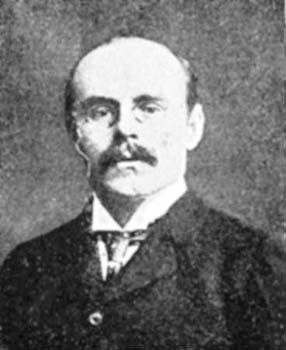 F. ANSTEY.
Mr. Anstey (Guthrie) was already famous for his little series of successful books, "Vice Versâ," "The Giant's Robe," "The Tinted Venus," "The Black Poodle," and "A Fallen Idol," when he was invited to contribute to Punch. In each and all of these stories there had been a clear and original idea, worked out with ingenuity and invested with rich and delicate humour. Their author was clearly a man for Punch. So thought Mr. Burnand, and Mr. Anstey shared the opinion. On November 4th, 1885, therefore, appeared his first contribution "Faux et Preterea Nihil." His work was consistently good, and at the end of 1886 he was called to the Table, taking his place and eating his first Dinner in January, 1887.
Mr. Anstey's writings attracted attention from the beginning, and in their reprinted form have been no less successful—the truest test of quality. Among the most delightful of these was the "Model Music Hall Songs"—songs and dramas virginibus puerisque, adapted to the requirements of the members of the London County Council which sought out and found indecency in a marionette's pursuit of a butterfly. The idea opened up to Mr. Anstey a comic vista, which he has developed for our delectation. The songs and dances, with their words and directions, are for the most part screamingly funny, consisting partly in the perfectly realised absurdity and inanity of the performance, and partly in that quality of absolute truthfulness to life which we are forced to realise in the presentation of them. Laughter is often produced by the mere faithfulness of an imitation, whether the thing copied[Pg 397] is funny or not. Simple mimicry has the power to make us laugh; and over that power, in all its phases of motive, act, and talk, Mr. Anstey has absolute control. In addition, he has a genius for plot-making and verse-writing, be it original or parody, which in its own line is unsurpassed in modern literature. In his analysis of character and motive he seems to set before us our own weak selves laid bare, until his voces populi become voces animi, the voice of the people speaking unpleasantly like the voice of conscience.
In this comic reproduction of actual experience Mr. Anstey has travelled over the road pointed out by Mr. Burnand in his "Happy Thoughts" and "Out of Town;" but, adding greatly to the scientific truth of it, he seems to have lost something of the geniality and joviality of the form. Mr. Anstey has placed Society on the dissecting-table, and probing with a little less of the sympathy shown by Mr. du Maurier, he carries his observation, consciously or unconsciously, to a much farther and more merciless point. Not that he has no kindly feeling for his subjects; he has—but he reserves it for his good people. Towards his snobs and cads and prigs he is pitiless; he turns his microscope upon them, and with far less mercy than is to be found in a vivisector he lays bare their false hearts, points to their lying tongues, and tears them out without a pang of remorse. It is all in fun, of course; but it is unmistakable. Still, who shall find fault with what is the essence of justice and truth, which mercy only interferes with to weaken?
The burlesques in the "Model Music Hall Songs" are often as good as their originals—just as some of the Rejected Addresses by the Smiths were as good as the genuine poems they parodied; and the representation of them is placed before the reader with more than photographic truth. In "So Shy!" we see the lady "of a mature age and inclined to a comfortable embonpoint," who comes forward and sings—
It is a notable fact that songs of this sort were driven off the better-class music-hall stage about this time, and there is little doubt that Mr. Anstey, to whom Mr. Bernard Partridge afterwards rendered artistic help, took yeoman's share in the campaign. More certain it is that with "Mr. Punch's Young Reciter" he effectively suppressed the drawing-room spouter. No one with a sense of humour who has read that series can now stand up and recite a poem of a sentimental or an heroic nature from the pens of Mr. Clement Scott or Mr. G. R. Sims without genius to back him; and no one who heard it could retain his gravity to the end. "Burglar Bill" melted almost to repentance by the innocent child who asked him to burgle her doll's house, and whose salvation was finally wrought by the gift of the baby's jamtart—killed the Young Reciter by dint of pure ridicule and honest fun. He has made an unsophisticated reciter as impossible as a sympathetic and sentimental audience.
And in "Voces Populi"—the popular dramas in dialogue, in which the conversation accurately and concisely describes the character, temperament, and tastes of the speaker—there is a humorous verbal photography of extraordinary vividness. 'Arry is no longer a symbol and a type, as he is in Mr. Milliken's hands; he is a definite person in one particular position in life and no other, and what he says could not, we feel, possibly have been said in any other way, nor by any other person. And so along the whole gamut of the classes through which Mr. Anstey leads us. The humour is penetrating, and it is difficult to say where the truth ends and the caricature begins. Who can forget the visit to the Tudor Exhibition, when Henry VIII's remarkable hat was on view? "'Arry," says 'Arriet to her escort; "look 'ere; fancy a king goin' about in a thing like that—pink with a green feather! Why, I wouldn't be seen in it myself!" 'Arry, who is clearly farceur, replies with a pretty wit: "Ah, but that was ole 'Enery all over, that was; he wasn't one for show. He liked a quiet, unassumin' style of 'at, he did. 'None o' yer loud pot'ats for Me!' he'd tell the Royal 'atters; 'find me a tile as won't attract people's[Pg 399] notice, or you won't want a tile yerselves in another minute!' An' you may take yer oath they served him pretty sharp, too!" And so it is all through; the talk of the people, of everybody in all sorts of positions in life, is recorded in these "Voces," and in all there is the same quality of nature.
In "Travelling Companions," nearly as amusing and quite as observant, we are made to feel that the two heroes detest each other hardly more than Mr. Anstey detests Culcherd, the more unsympathetic and contemptible of the two. They are nearly as despicable as they are funny, and their creator has little pity for them on that account. There is a "plentiful lack of tenderness," but an abundance of humour to excuse it. This quality is not visible in "Mr. Punch's Pocket Ibsen"—a parody so good that we sometimes wonder if the part we are reading is not really from the hand of the Norwegian master. Nothing, surely, could be truer, nothing touched with a lighter hand than "Pill-doctor Herdal"—an achievement attained solely by a profound study of the dramatist. Again, in "The Man from Blankley's" and in "Lyre and Lancet" we have social satires grafted on to a most entertaining plot—a creation in both cases which may be compared with Keene's drawings for observation, and with Goldsmith's and Molière's plays for the happy construction of these comedies of errors. The plots assuredly would have extorted the admiration of Labiche himself, so complicated and ingenious are they. Besides, everything seems so natural, so inevitable, "so much of a lesson," that it is hardly to be wondered at that "The Man from Blankley's" was on more than one occasion actually given out as the text for a sermon delivered from the pulpit.
Another excuse for music-hall treatment of an exquisite sort is afforded by the story of "Under the Rose," which is inimitable. For example:—
The Sisters Sarcenet (on stage): "You men are deceivers
and awfully sly. Oh, you are!"
Male Portion of Audience (as is expected from them):
"No, we aren't!"
[Pg 400]The Sisters S. (archly): "Now you know you are!
You come home with the milk; should your poor wife ask why,
'Pressing business, my pet,' you serenely reply,
When you've really been out on the 'Tiddle-y-hi!'
Yes, you have!"
Male Audience (as before): "No, we've not!"
The Sisters S. (with the air of accusing angels): "Why,
you know you have!"
It is sometimes objected that the root of Mr. Anstey's success lies near the surface, and is nothing but the vividness of his dialogues. It is a great deal more; it lies in the truth of his characters, subtly drawn, but irresistible, and, now and again, tenderly pathetic. Thus may you see the optimist and pessimist, and the link between them, in the following scene in the Mall on Drawing-Room Day:—
Cheery Old Lady (delighted): "I could see all the coachmen's 'ats beautiful. We'll wait and see 'em all come out, John, won't we? They won't be more than a hour and a half in there, I dessay."
A Person with a Florid Vocabulary: "Well, if I'd ha' known all I was goin' to see was a set o' blanky nobs shut up in their blank-dash kerridges, blank my blanky eyes if I'd ha' stirred a blanky foot, s'elp me dash, I wouldn't!"
A Vendor (persuasively): "The kerrect lengwidge of hevery flower that blows—one penny!"
In the composition of his "Voces" and kindred work, it has been the practice of Mr. Anstey to visit the needful spot, where he would try to seize the salient points and the general tone, the speakers and the scene, trusting to luck for a chance incident, feature, or sentence that might provide a subject. Sometimes he would have to go empty away; but as a rule he would find enough to provide the rough material for a sketch. Sometimes, too, he would combine hints and anecdotes received from his acquaintance with his own experience and invention; on rarer occasions he would happen upon an incident which could be worked up into a sketch very much as it actually occurred, though with strict selection and careful elaboration. On the whole it may be taken that the[Pg 401] conversations are mostly what might have happened, but that they never were shorthand reproductions of overheard talk; and the incidents are almost invariably invented. Occasionally something in an exhibition or show would suggest a typical comment, or a casual remark might provide an idea for a character; but a good deal is certainly unconscious reminiscence and fragmentary observation, and the residue pure guess-work.
Of the artistic quality of Mr. Anstey's work there can be no question—neither of its humour, nor of its value as a complete reflection of English, and especially of Cockney, life. Old-fashioned people may and do denounce it as newfangled; but does anyone doubt the sort of welcome that would have been accorded to it by Jerrold and Thackeray and Gilbert à Beckett if they had had the good fortune to have an Anstey in their midst half-a-century ago?
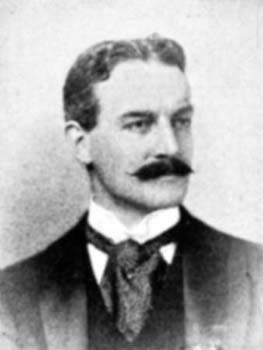 R. C. LEHMANN.
Mr. R. C. Lehmann, grand-nephew of W. H. Wills, one of Punch's early crew, had a good reputation as a Cambridge wit before Mr. Burnand captured him for Punch. In April, 1889, he began to edit "The Granta," the clever "barrel-organ of the Cambridge undergraduates," satirical, brightly humorous, and freshly youthful. On the 14th of the following December there appeared in Punch his first contribution, a dialogue entitled "Among the Amateurs," which has since been reprinted in "The Billsbury Election."
Mr. Lehmann lost no time in devising series of articles, which all Punch readers will remember. Such were "Modern Types" and "Mr. Punch's Prize Novels" (one of the most successful, including parodies of a score of the leading authors of the day), "In the Know," "The Adventures of Picklock Holes," "Letters to Abstractions," "Lord Ormont's Mate and Matey's Aminta," "Manners and Customs," and "Studies in the New Poetry." Within four months of his first contribution[Pg 402] Mr. Lehmann was promoted to the Table—an unprecedentedly rapid promotion—and he has ever since been one of the most diligent of contributors. Literary merit apart, Mr. Lehmann's "Conversational Hints for Young Shooters" has probably been received with greater favour throughout the country, on account of its subject and its felicitous treatment, than any of the young author's works. Country readers are essentially sportsmen—in conversation, if not in fact; and nothing in humorous writing delights them more than a clever burlesque on their favourite topic. You may hear the book praised where one of the writer's more ambitious efforts may pass unnoticed; and one of its passages is quoted with unction in many a shooting party. "Johnson, who was placed forward, again stood under a canopy of pheasants, and shot with brilliant success into the gaps.... The only theory which is accepted as explaining the catastrophe is one that imputes a malignant cunning to the birds."
The year that saw Mr. Lehmann's appointment witnessed also the calling of his kinsman, Mr. Barry Pain, one of the chief contributors to "The Granta." His story of "The Hundred Gates," printed in "Cornhill," struck Mr. Burnand as a work of promise; indeed, Mr. Burnand is reported to have found it so funny that he thought he must have written it himself. The annexing of the writer was at once effected. One of his earliest contributions to Punch was the amusing parody of Tennyson's "Throstle," just before Christmas, 1889; and a collection of comic Cambridge definitions in imitation of Euclid followed. Then came a set of short stories called "Storicules," and a series of articles constituting a mock guide to conduct for young ladies. Since 1892 Mr. Pain's work has fallen away, probably only for a time; for Punch has proved well-nigh irresistible to every genuine humorist who is anxious to bring his faculty to bear on the risibility of the English public.
Mr. Henry Pottinger Stephens, one of the wits of the "Sporting Times," the founder of the "Topical Times," and member of the staff of the "Daily Telegraph," was for two[Pg 403] or three years on the outside salaried Staff of Punch. Contributing from 1889 to 1891, he wrote a series of "queer tales" as well as some attacks on the then South Western Railway management, under the title of "The Ways of Waterloo." Such dramatic criticisms as were not undertaken by Mr. Burnand or relegated by him to Mr. Arthur à Beckett, and numerous trifles besides, fell to him to do; but on his departure for America the connection was broken, and not afterwards resumed.
Passing by Mr. C. W. Cooke, we find Mr. Charles Geake, member of the Bar and Fellow of Clare College, Cambridge, as the chief recruit of the year 1890. To "The Granta" he had sent a casual contribution, and Mr. R. C. Lehmann, appreciating his talent, proved his esteem by installing Mr. Geake as the Cambridge editor of that paper. From "The Granta" to Punch has become a natural ascent, and on July 12th, 1890, Mr. Geake made his first bow to London readers. Three months later a packet of Punch office envelopes announced that he had been placed on the footing of a regular outside contributor, and that it was now his privilege to send his work straight to the printer's. At first he wrote nothing but verse—society verse, ballades, rondeaux, topical verse, and parodies in verse and prose, and then burlesques of books, such as the capital imitation of "The Tale of Two Telegrams" (a "Dolly Dialogue" in the manner of "Anthony Hope"), p. 97, Vol. CVII., September 1st, 1894, and "The Blue Gardenia" (October 20th, 1894, p. 185), with various skits and topical matter. "Lays of the Currency" are among the chief of Mr. Geake's poetical "series," and "Chronicles of a Rural Parish"—the adventures and misadventures of a rural parishioner who wishes to patronise the Parish Councils Act—his principal effort in comic prose.
The year 1892 brought three new writers: Mr. Gerald F. Campbell, who began by contributing (on April 23rd) poems of sentiment, such as "Town Thoughts from the Country," and three months later "The Cry of the Children" and "Alone in London;" R. F. Murray, the American-born[Pg 404] author of "The Scarlet Gown," who, through Mr. Andrew Lang's introduction, sent in a few verses shortly before his death; and Mr. Roberts, who finds his place among the artists.
Mr. George Davies was an important accession of the following year. On only half-a-dozen occasions had he ever been in print, and that in obscure publications, when he composed an "Ethnographical Alphabet," beginning "A is an Afghan." The writer, who is something of a tsiganologue, emboldened by his success, followed up his alphabet, which appeared January 21st, 1893, and within a year had placed to his credit three-score contributions, most of them in verse—rather a remarkable achievement for one heretofore considered a mere bookworm and dryasdust.
Another Cambridge man of originality and ingenuity, mainly in verse, is Mr. Arthur A. Sykes—a "Cantabard," as he himself would admit, peculiarly skilled in "Cambrijingles." He began with "In the Key of Ruthene" on May 6th, 1893, and followed it up with a laughable ode "To a Fashion-Plate Belle." It was accompanied with a comic, though hardly exaggerated, design of the female figure as depicted in ladies' fashion-papers—the drawing being also by Mr. Sykes. Since then many verses by him have appeared, in which quaint conception, sudden turn of thought, and strange achievements in rhyming (as in "The Tour That Never Was," August 19th, 1893) are the chief figures. Then came the promotion embodied in the privilege of sending his contributions direct to the printer before, instead of after, being submitted to the editorial eye; and a good deal of prose work followed, such as the "Scarlet Afternoon," a skit in dialogue suggested by Mr. R. S. Hichens' "Green Carnation."
Light verse from the Rev. Anthony C. Deane began on August 20th, 1892 ("Ad Puellam"), but he was already a master of the art. Two months before his little volume of "Frivolous Verses" had appeared, and so struck Mr. Andrew Lang that he reviewed it in a "Daily News" leading-article, invited the author to go and see him, and suggested his writing for Punch. Mr. Deane had already been a "Granta" poet, and was well known to Mr. Lehmann, who, finding[Pg 405] that Mr. Lang had already spoken to Mr. Anstey, gladly added a word of introduction to the Editor. By such means as these, oftener than by promiscuous outside application, is new blood found: the best men do not, as a rule, force forward their own work. Mr. Deane at that time was not twenty-two, nor was he yet ordained. He passed the necessary period at the same theological college—Cuddesdon—that years before had sheltered Mr. Burnand, and went on contributing verses to Punch, to the number (1894) of sixty or seventy; so that the course of his Punch love has run very smooth.
Another literary godson of Mr. Lehmann's, and child of "The Granta," is Mr. Owen Seaman. Through the good offices of the former, Mr. Seaman's "Rhyme of the Kipperling," nearly filling the first page of Punch, was inserted in the number for January 13th, 1894. This imitation of Mr. Rudyard Kipling's "Rhyme of the Three Sealers" was its own recommendation, and since that time Mr. Seaman has been one of the most prolific outside contributors of the year. His series comprise "She-Notes"—a skit on "Keynotes" and "Airs Resumptive"—of which the fourth, "To Julia in Shooting-togs (and a Herrickose Vein)" is an admirable specimen of its class. Art and political criticism in verse and prose are employed to illustrate the writer's facility and classic taste.
To this list, necessarily incomplete, in spite of its length, a few names remain to be added, and an incongruous party they form. Professor Forbes; Mr. J. C. Wilson, mantle manufacturer; and Mr. J. J. Lushington, of the Suffolk Chief Constable's Office, first a soldier and finally an auctioneer (a giant of nearly six feet seven, who would have formed a good fourth to Thackeray, "Jacob Omnium," and Dean Hole)—men of every sort and condition, brought together by the universal brotherhood of humour. Mrs. Frances Collins was a contributor, and her Punch utterance upon Judge Bayley's curious decision at Westminster County Court in January, 1877, as to next-door music that is "intolerable," yet not "actionable" ("Music hath (C)Harms"), is still remembered and quoted. Another lady-wit of the present day is Mr. Lehmann's[Pg 406] sister, Lady Campbell, who wrote the women's letters in the series of "Manners and Customs," while her brother took the male side of the correspondence. Mrs. Leverson has been the contributor of numerous clever prose parodies and general articles, the chief of which up to June, 1895, has been "The Scarlet Parasol." Mr. James Payn has also worked for Punch, but very little—only to the extent of placing some little pleasantry at its service, and now and then suggesting a subject for illustration. A set of rhymes by Mr. H. D. Traill, reprinted in his volume entitled "Number Twenty," was his sole contribution, the "Saturday Review" having had a sort of prescriptive right to all his work of this description. It is the greater pity, for even the lightest of his verses have the true ring and, according to some, much of the vigour characteristic of Mr. Rudyard Kipling's work. Mr. Arthur Armitage, too, was for many years a contributor. Being a solicitor in practice, he kept his identity a secret. He was always known to the Editor and Proprietors as "Mr. A. Armstrong," and up to this present publication he never revealed the levity of his youth. His first contribution was "Marriage Customs of the Great Britons," which was inserted in the "Pocket-Book" for 1855. After writing regularly for this offspring of Punch's, Mr. Armitage was, in 1861, specially invited to contribute to the paper itself on topics political, social, and commercial—only a satire on "The Baby of the Papal States" (Louis Napoleon) being rejected, on the ground that, were it inserted, war with France would be inevitable. On Mark Lemon's death Mr. Armitage ceased his connection as an "outside regular," and five years later reprinted a number of his most amusing Punch verses and articles under the title of "Winkleton-on-Sea." Frederick Gale—better known as "The Old Buffer" and as the great cricket authority—wrote a short series for Punch. Then Mr. Walter Sichel, since the beginning of 1892, has contributed some prose and more verse, such as the series of "Men who have taken me in—to dinner," "Lays of Modern Home," "Inns and Outs," as well as "Rhymes out of Season," "The Diary of an Old Joke," and the original "Queer Queries." The late magistrate, Mr. Hosack, too, contributed[Pg 407] several sharp police-court sketches; and "Arthur Sketchley" had a capital story to tell, but spoiled it in the telling. Even H. J. Byron, contrary to general belief, tried his hand as a Punch contributor, but he was somewhat dull. He admitted, in fact, that he wanted to keep all his fun for his plays, and so starved his Punch work of its legitimate humour. Mr. Arthur E. Viles's verses on "Temple Bar" (December, 1877) may be mentioned, and Mr. Leopold Godfrey Turner's name must not be omitted. But, of the contributors of trifles, a number must remain anonymous—as, indeed, many do from choice; inevitably so before 1847, when it first became the practice to enter up outsiders' work in their own names. And among these occasional contributors the present writer is proud to range himself.
In looking at the literature of Punch, we become sensible of a change not dissimilar to that which we find to have taken place in its art. There is nowadays no Jerrold, whose fulminating passion and fine frenzy often came dangerously near to "high-falutin'." There is perhaps no versifier at the Table with quite the same fancy or taste as Gilbert Abbott à Beckett, Shirley Brooks, and Percival Leigh. But we have instead a keener observation of the life and customs of the day, an ingenuity and an elegance that go better with the taste and habit of thought of the times. In the old days it was not uncommon in discussing Punch's poetry to urge in apology that—
Nowadays, when comedy and rapier have to a great extent replaced farce and sword, finish is accounted of greater importance than of yore, and grace and daintiness are accepted where simple fun was formerly the aim—an aim, by the way, which was as frequently missed as now. Let the reader who is inclined to be as severe on latter-day Punch as on latter-day everything, take down one of the early volumes, and seek for the side-splitting articles and epigrams, the verse apoplectic with fun, which we are taught to expect there. He will learn that it is not so much that[Pg 408] the quality of Punch has changed, despite the great names of the past. He will find that the change is due rather to modern fashion and to modern views than to any deterioration of Punch's. Good things are there now, as then; and now, as then, many of the best writers in the country contribute periodically to its pages. With verse and article, epigram and parody, Punch continues to be a record and a mirror of his times—a comic distorting mirror perhaps, but still a glass of fashion and of history, with fun for its mercury, which, through its literature, pleasantly and agreeably reflects the deeds and the thoughts of the people. What of it, if his verse now and again is only passable? Sometimes it is fine—always acceptable, and rarely below an elevated established standard; anyhow, some years ago, Mr. Joseph Chamberlain's single offering was rejected on its demerits by the "monument of British humour." Perhaps the Editor judged it as Punch's railway-porter judged an old lady's pet in accordance with railway rules: Cats is "dogs," and rabbits is "dogs," and so's parrots; but this 'ere tortis is a hinsect, and there ain't no—need—for it. And the tone of Punch's more serious utterances is now that of the dining-room rather than of the debating society and the vestry room. Mr. Ruskin, among others, deplored Punch's kid gloves and evening-dress, when amiable obituary notices on Baron Bethell—(had he not been Punch's counsel in the old days?)—and the Bishop of Winchester were published. "Alas, Mr. Punch," he wrote, "is it come to this? And is there to be no more knocking down, then? And is your last scene in future to be shaking hands with the devil?"[49] Punch can still hit hard; though "knocking down" is no longer his main delight. His text has become as refined as his art—and that, of course, is the reason that it no longer commands the chief attention of the class that once was led by it. At that time its art alone carried it into circles that abhorred its politics, and it is recorded that Mulready was driven to excuse himself to one of the Staff for not reading the text by the lame confession that he was "no bookworm!"[Pg 409]
Punch's Primitive Art—A. S. Henning—Brine—A Strange Doctrine—John Phillips—W. Newman—Pictorial Puns—H. G. Hine—John Leech—His Early Life—Friendship with Albert Smith—Leech Helps Punch up the Social Ladder—His Political Work—Leech Follows the "Movements"—"Servantgalism"—"The Brook Green Volunteer"—The Great Beard Movement—Sothern's Indebtedness to Leech for Lord Dundreary—Crazes and Fancies—Leech's Types—"Mr. Briggs"—Leech the Hunter—Leech as a Reformer—Leech as an Artist—His "Legend"-Writing—Friendship with Dickens—His Prejudices—His Death—And Funeral.
One of the peculiarities of Punch's career is the increasing preponderance assumed by the artistic section. It is said that when George Hodder was introduced to a distinguished Royal Academician, he could find nothing better to say, with which to open the conversation, than the tremendous sentiment—"Art is a great thing, sir!" Punch gradually but surely realised, too, how great a thing art is, and for many years past he has sought out artists to recruit his Staff, where before he looked chiefly for draughtsmen. The statement may seem a curious one to make, but it is an opinion shared nowadays by some of the best artists on Punch and off it, that were the drawings sent in to-day which were contributed by the majority of the original artistic Staff, not excluding the mighty Leech himself, they would be declined without thanks, and—according to the somewhat harsh rule that has for some time prevailed—without return of their contribution. There was a promiscuous rough-and-ready manner about the drawing of comic cuts in those early days, when intended for the periodical press, that would offend the majority of people to-day. There was no photography then to enable the artist to draw as big as he chose, and then to reproduce the drawings on to the wood-block in any[Pg 410] size he please. There were no blocks which could be taken into sections and distributed among half-a-dozen engravers at once for swift and careful cutting. There was no "process," which permitted of reduction and reproduction of the finest pen-and-ink work. There was no "drawing from the life" for these little pictures of "life and character." The joke was the thing, not the artistic drawing of it. Farce and burlesque had not yet developed into comedy and comedietta, refined by degrees and beautifully æsthetic. Nowadays, as Mr. du Maurier has publicly declared, everything must be drawn straight from Nature, without trusting to memory or observation alone. "Men and women, horses, dogs, seascapes, landscapes, everything one can make little pictures out of, must be studied from life.... Even centaurs, dragons, and cherubs must be closely imitated from Nature—or at least as much as can be got from the living model!" It is, therefore, more than likely that Leech would have been told that he must really be more careful in his work before Punch could publish it; and his first contribution of "Foreign Affairs" would have been rejected as being altogether too rough and with far too little point for its size. All Punch's pictures at this day, no doubt, cannot be said to surpass the artistic achievement of some of the earliest cuts, but there is almost invariably an artistic intention, technically speaking, which excuses even the poorer work—a suggestion of the drawing-school rather than, to use a modern expression, mere "dancing upon paper."
Although from the beginning to the present day the artistic Staff which has sat at Punch's Table has numbered less than a score, and the outside Staff, unattached (such as Captain Howard, Mr. Sands, Mr. Pritchett, Mr. Fairfield, Mr. Atkinson, Mr. Ralston, and Mr. Corbould), but very few more—the total number of draughtsmen whose pencils have been seen in Punch's pages amount to about one hundred and seventy. In some cases sketches have been sent in anonymously; a few others I have been unable to trace; but these, it must be admitted, are hardly worth the trouble expended on them.
 A. S. HENNING.
The earliest recruit was Archibald S. Henning, the first in[Pg 411] importance, as he was to be cartoonist, and first to appear before the public, inasmuch as the wrapper was from his hand. He was the third son of John Henning, friend of Scott and Dr. Chalmers, on the strength of his famous miniature restoration of the Parthenon frieze, of which he engraved the figures on slate in intaglio; and he was well known besides not only for these copies of the Elgin marbles, but for his portrait-busts and medallions. Precision in all things was one of his characteristics, and even showed itself in the inscriptions in his family Bible, wherein he set on record that his son Archibald was "born at Edinburgh, on the 18th of February, at 30 minutes past 3 a.m." But this accuracy was not inherited, although the son was brought up to assist his father on the friezes which he executed on Burton's Arch at Hyde Park Corner, and on the Athenæum Club-house. His drawing was loose and undistinguished; his sense of humour, such as it was, unrefined; and his fun exaggerated and false. He was a Bohemian, but not of the type of his brother-in-law Kenny Meadows, preferring a class of entertainment less exalted than those who so warmly welcomed his sister's husband. Mr. Sala tells me that Henning painted the show-blind for the Post Office, and afterwards steadily drifted down the stream of time; and Mr. Sala ought to know, for he employed him in those impecunious but jolly days when the editorship of "Chat" was in his hands. One of the early memories of Mr. Walton Henning, Archibald's son, is being sent by his father to collect the sum of one pound sterling from Mr. Sala, and, after sitting on the office-stool from eleven in the morning until two, being sent back without the money, but instead with a letter of apology and of congratulation on possessing a son who could sit for three hours, like Patience on a monument, smiling at an empty till. Henning remained with Punch till the summer of 1842,[Pg 412] having contributed eleven cartoons to the first volume and several to the second, the last of which was that of "Indirect Taxation," on p. 201. He also illustrated Albert Smith's social "physiologies" of "The Gent" and "The Ballet Girl"—not ill-done; and when Punch had no further need of his services he transferred them successively to "The Squib," "The Great Gun," and "Joe Miller the Younger," in each case taking the post of cartoonist. Later on he worked occasionally on "The Man in the Moon" and on the "Comic Times," and died in 1864.
No greater loss was Brine, Henning's fellow-cartoonist, who remained with Punch until the beginning of the third volume, having drawn nearly a dozen cartoons for each of the two volumes. He was a poor and often a "fudgy" draughtsman, gifted with extremely little humour, who had nevertheless worked a good deal at a Life Academy in the Tottenham Court Road, along with Thomas Woolner, Elmore, Claxton, and J. R. Herbert, and had even studied in Paris. He had some strange notions as to figure-drawing, some of which he would impart to such young students as cared to listen. One of these rules, which he sought to impress on Mr. Birket Foster's 'prentice mind, was never to draw ankle-joints on female legs; but Mr. Foster did not remain a figure-draughtsman long enough to benefit by this valuable advice. Brine was poorly paid, some of his smaller cuts commanding a sum no higher than three-and-six; but it is impossible to say, looking at these sketches, that his efforts were seriously underpaid.
Another of the Old Guard was John Phillips—who is not to be confused with Watts Phillips, a contributor of a later period. He was the son of an eccentric old water-colour painter, well known in his day, and has been identified as the scene-painter whom Landells introduced later to the "Illustrated London News." Phillips, with Crowquill, illustrated Reynolds' popular "continuation" of Dickens' Pickwick Papers, entitled "Pickwick Abroad," and, like Brine, he received his congé when the transfer of Punch to Bradbury and Evans took place.[Pg 413]
And then there was by far the most important and valuable draughtsman of the quartette—William Newman. He was a very poor man, who in point of payment for his work suffered more than the rest; and when he asked for a slight increase in terms, he was met with a refusal on the ground that "Mr. John Leech required such high prices." He was an old hand at pictorial satire, and was one of those who drew the little caricatures in "Figaro in London" several years before. He was brought on to Punch by Landells, but, owing to his lack of breeding and of common manners, he was never invited to the Dinner, nor did any of his colleagues care to associate with him. Unfortunately for him he was an extremely sensitive man, and the neglect with which he was perhaps not unnaturally treated preyed greatly upon his mind. For a considerable time he was the most prolific draughtsman on the paper. Thus in 1846 there are no fewer than eighty-seven cuts by him; in 1847, one hundred and twenty-seven; in 1848, one hundred and sixty-four; and in 1849, one hundred and twenty-one. From the cut on Punch's first title-page down to the year 1850 his work is everywhere to be seen, in every degree of importance, from the little silhouettes called "blackies," which usually constituted little pictorial puns in the manner of Thomas Hood, and which were paid—those of them which were good and funny enough to be used—at the all-round rate of eighteen shillings per dozen. Instances of his happy punning vein are the sketches of a howling dog chained to a post, entitled "The Moaning of the Tide;" a portrait of a villainous-looking fellow, "Open to Conviction;" a horse insisting on drinking at a pond through which he is being driven, "Stopping at a Watering-Place;" a hare nursing her young, "The Hare a Parent;" a man wrestling with his cornet, "A most Distressing Blow;" and a street-boy picking a soldier's pocket, "Relieving Guard." But he was soon promoted to other work; and to the first and second volumes, at times of pressure, he even contributed a cartoon. This service was four times repeated in 1846, and again in 1847 and 1848, when Leech met with his serious bathing accident[Pg 414] at Bonchurch: on which occasion the great John was put to bed, as Dickens explained it, with a row of his namesakes round his forehead. The cartoon in question was that entitled "Dirty Father Thames," and a glance at it will show how great was the improvement in the draughtsman's art. Newman did not, however, confine himself to Punch all this while; he had worked as cartoonist to "The Squib" in 1842; and again for the "Puppet-Show," "Diogenes," and H. J. Byron's "The Comic News" in 1864. Then, disappointed at the little advance he had made in the world, he emigrated to the United States, where more lucrative employment awaited him. He had a greater sense of beauty and a more refined touch than most of his colleagues; and though he did not shine as a satirist, he was always well in the spirit of Punch.
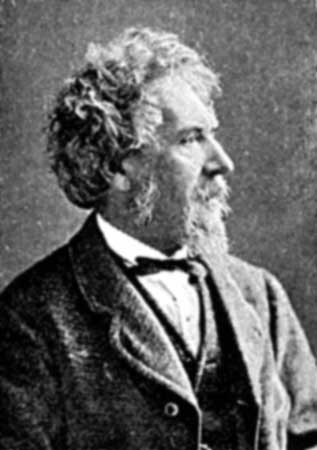 H. G. HINE, V.P.R.I.
But the most interesting of Punch's earliest men before the advent of Leech was H. G. Hine, who up to 1895 was the octogenarian Vice-President of the Institute of Painters in Water-Colours, whose broad and masterly drawings of poetic landscape have been the artistic wonder of recent years. He began to draw for Punch in September, 1841, and thenceforward bore with Newman the brunt of the illustration. He was really a serious painter—a water-colour artist of strong aim and considerable accomplishment. Just before the starting of Punch Landells had, as has already been explained, launched a landscape periodical called "The Cosmorama," and had commissioned Hine to go to the London Dock and make a drawing on the wood. The work was not new to him, as Wood, a master-engraver of the time, taking pity on the sense of foolish powerlessness with which every beginner is afflicted, had explained to him the secret of the craft. Landscape was thus his acknowledged line when he found himself at the Docks with his round of boxwood in[Pg 415] his hand. He marked off a square upon it, and, in order to "get his hand in," he made what would nowadays be called a remarque on the margin—a comic sketch of a dustman and his dog. The block was finished, and carried to Landells, who looked at it in some surprise. "Did you do that?" said the North Countryman, pointing to the dustman. "Would you draw sketches like that for Poonch?" "But I'm not a figure-draughtsman," objected Hine. "Yes, you are; and it's just what we want for Poonch." So Hine was enrolled, and in his line became an exceedingly popular draughtsman. He began by making batches of the "blackies" aforesaid, designing them and their clever punning titles with the greatest freedom, unhampered by editorial interference. He worked for Punch until 1844, and rapidly became a contributor of the first importance, whose merits were fully appreciated. One cut in particular delighted Mark Lemon—that of "A Long Nap," in which a toper has fallen into a sleep so deep and protracted that a spider has spun a strong web from the man's nose to the bottle and the table before him.[50] "Upon my word!" cried Lemon on examining the block when it was delivered, "Mr. Hine is really tremendous!" Hine had greater imagination and ingenuity than Newman, a[Pg 416] brighter fancy and keener wit; and to him rather than to others would application be made for the realisation of new ideas. At Landells' request he produced the accompanying "project" for a Punch medal or seal; which, however, was never carried into execution. His, too, were the stinging Anti-Graham Wafers, to which reference is made elsewhere; and many other designs that went far to increase Punch's popularity.
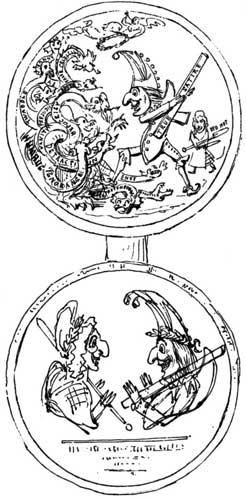 DESIGN FOR "PUNCH" SEAL,
He was chief stock-artist, so to say; for Leech did not at once assume the commanding position on the paper that was soon to be his. And while Hine shared with him the honour of drawing "Punch's Pencillings," as the cartoons were called—several of the series of "Social Miseries" being from his hand—he produced from time to time the chief cut when it aspired to the dignity of a political caricature.
After a time, however, the amount of work sent to Hine was greatly reduced. It was now some time since he had contributed the whole of the cuts to the first "Almanac," but he was still an occasional cartoonist (Vols. III., IV., and V.); so that he was the more surprised at being roughly—and, as he proved, unjustly—accused of being late with a block. Other unpleasantnesses, which seemed to him gratuitous, suggested the idea that he might not be wanted on Punch. He put the point blankly, and was reassured. Still, the quantity of work sent him diminished; and as nothing came by Christmas, Hine accepted the offer of Christmas-work by the publisher of "The Great Gun"—for which, by the way, he never received payment. Then there suddenly arrived a mass of blocks from Punch; but they were returned with the message that, not hearing from his former proprietors, he had made other arrangements. And that was the end of his connection. Later on he worked for "Joe Miller the Younger," "Mephystopheles," and "The Man in the Moon," and used his pencil, in the true Spirit of a genuine sportsman, in pointing his well-barbed jokes against his old paper with as much enthusiasm as he had before given to its service. On page 153 of the second volume of Punch may be seen a little cut entitled "Choice Spirits in Bond"[Pg 417]—being the portraits of himself and the lanky William Newman in the dock of a police-court. Although fifty-four years had passed, the strong resemblance of the little likeness could still be recognised by those who knew the artist in the last few months of his life.
After the collapse of "The Man in the Moon" Hine dropped out of comic draughtsmanship. By this time, indeed, he was tired of the work, for he had begun to think in jokes, to turn every thought to ridicule, and to look upon conversation rather as raw material for pun-making than as a means of expressing and interchanging ideas. The last straw was an occasion when he spent half a night with Horace Mayhew in trying to make a joke to complete a series for "Cruikshank's Almanack"—the very situation in Pope's epigram:—
Meanwhile another had arisen who was destined to overshadow for many years the rest of his colleagues, and while he lived to be the life and soul of the undertaking—Mr. Punch incarnate. This was John Leech, whose signature first appears on page 43 of the first volume.
When Mr. Frith, R.A., sought to persuade the overworked Leech to take a holiday, he added, just to drive the matter home: "If anything happened to you, who are the 'backbone of Punch,' what would become of the paper?" At which Leech smiled, says his biographer, and retorted, "Don't talk such rubbish! Backbone of Punch, indeed! Why, bless your heart, there isn't a fellow at work upon the paper that doesn't think that of himself, and with about as much right and reason as I should. Punch will get on well enough without me, or any of those who think themselves of such importance." In his life-time none would have been found to share the speaker's views; nevertheless, Punch—for all Leech's paramount importance to the paper—has maintained his prosperity, and more than doubled his lease of life since Leech laid down his pencil. Yet in his time he[Pg 418] was as much the artistic Punch as Jerrold was the literary; and there are nearly as many who still believe that Leech at one time was Punch's Editor as accord the same unmerited honour to Jerrold.
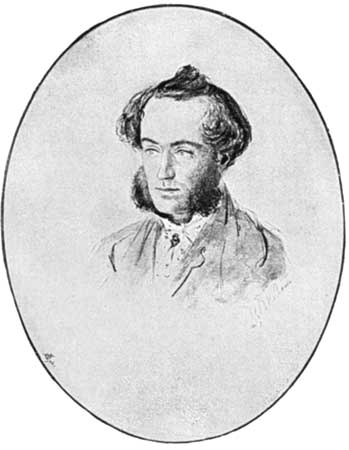 JOHN LEECH.
The story of Leech's early life has been already told. How he was the son of the luckless owner of the London coffee-house in Ludgate Hill; how Flaxman saw his infantile drawings and declared he would be nothing but an artist—nay, "he was an artist;" how, at the Charterhouse, the gentle, nervous lad was schoolfellow of Thackeray, with whom he formed a passionate, life-long friendship; and of yet another[Pg 419] hearty friend, Mr. Nethercote; how, when he was medical student at Bartholomew's Hospital, he contracted another evergreen friendship with Percival Leigh, and formed an acquaintanceship, long maintained, but never fully ripened, with another medico—Albert Smith, of Middlesex; how his father's failure caused him to give up medicine and the knife in favour of art and the pencil—by the exercise of which, when he was still under Dr. Cockle, son of the pill-doctor, he had already fascinated his fellow-students, and in particular Percival Leigh—on whose initiative it was that the "Comic Latin Grammar" was carried into execution. All this and more has ere now been recorded. But it all bears directly on his Punch career, and must not by any means be overlooked.
In 1836, when he was but nineteen years of age, he had made a bid for the unhappy Seymour's vacant place as Charles Dickens' illustrator; but he had been already forestalled by "Phiz," and Leech was perforce rejected, as Thackeray had been refused before him, and Buss dismissed. Leech was already a good draughtsman on wood, having while resident with Orrin Smith the wood-engraver—he who had previously tried to magnetise the idea of a "London Charivari" into life—received many practical hints of the greatest artistic value. For some time afterwards he worked in harmony with his fellow-student of a literary turn, whose noble brass-plate inscribed "Mr. Albert Smith, M.R.C.S., Surgeon-Dentist!" once brought upon the artist, says Percival Leigh, the candid chaff, of a vulgar street-urchin. "Good boy!" said Leech, appreciating the attention and rewarding it with a penny. "Now go and insult somebody else." He drew furthermore upon the stone, and distinguished himself in "Bell's Life in London"—the paper to which several of the most eminent comic artists of the day then contributed—and in 1841, five years after his first-published "Etchings and Sketchings, by A. Pen, Esq.," he issued in its complete form his "Children of the Mobility." It was at that time that Percival Leigh, having satisfied himself of the character and tone of the new comic paper, not only made his own début[Pg 420] in it, but introduced his friend and colleague, John Leech—with what distressing result as to his full-page block of "Foreign Affairs" the chapter on cartoons discloses. (See p. 173.) And here it may be added that all was not plain sailing between Leech and Punch at the commencement; for soon after he resumed work he struck for higher terms. Until he got his way he did no more work for the paper—as the reader may satisfy himself by turning to its pages; and when he did, his triumph was visited, as has already been described, upon the heads of less talented contributors. It may safely be assumed that Leech knew nothing of this, for the gentleness of the man was such that he could not have suffered the idea that his success meant others' disadvantage.
Three things may be said to have brought Leech's powers as a humorous draughtsman prominently before the public—his illustrations to the "Comic Latin Grammar," the skit on the Mulready envelope (the most successful of all the versions published), and his early Punch work. Mr. Frith tells of Mulready's indignation at Leech's drawing—not at the caricature itself, but at the leech in a bottle, by which the Academician took it for granted that the draughtsman meant to designate him by innuendo as a "blood-sucker;" and of Leech's surprise and pain at being so suspected, and how the two men became fast friends ever after. Once a regular Punch man, Leech immediately expanded, and as quickly hit the taste and fancy of the public; and from that day forward rarely did his hand or his humorous or tragic faculty play him false; nor did the people falter in its praise or its allegiance.
Although he expanded, he yet took some time to settle down. Not until the sixth volume (1844) could he be considered paramount in what was esteemed the higher walk of cartooning—a department which he subsequently shared, first with Doyle, and then with Tenniel. But it was in the social cuts that he excelled—in his pictures of low life that are never low; in his great mastery in the delineation of character and his gift of seeing humour in most scenes of everyday happening, and his power of recording comic conceptions,[Pg 421] unfailingly and irresistibly. It is true that as Mr. Punch went up in the social scale Leech accompanied him in the rise—if, indeed, it was not Leech, together with Thackeray's powerful help, who elevated Punch. At the same time he sympathised profoundly with the horrors of poverty and oppression, and looked kindly on gutter-children and on honest dirt and misery; and to the end he regarded the "snob," the 'Arry of his day, with the genial contempt he had lavished on him at the beginning. Thackeray appreciated the change in the paper, and recorded it, too; though he credits Jerrold with a policy which was nought but the policy of a comic paper softened in its asperities by time, and encouraged by the greater refinement of its Staff and of its more cultivated public.
"Mr. Leech," said Thackeray, "surveys society from the gentleman's point of view. In old days, when Mr. Jerrold lived and wrote for that famous periodical, he took the other side; he looked up at the rich and great with a fierce, a sarcastic aspect, and a threatening posture, and his outcry or challenge was: 'Ye rich and great, look out! We, the people, are as good as you. Have a care, ye priests, wallowing on a tithe pig and rolling in carriages and four; ye landlords, grinding the poor; ye vulgar fine ladies, bullying innocent governesses, and what not—we will expose your vulgarity; we will put down your oppression; we will vindicate the nobility of our common nature,' and so forth. A great deal was to be said on the Jerrold side, a great deal was said—perhaps, even a great deal too much." And now, says Thackeray in effect, Leech looks at all these people with a certain respect for their riches, with an amiable curiosity concerning their footmen's calves. Nevertheless, to the end he was not kinder to Dives' oppression, less sympathetic towards the troubles of Lazarus, nor more indulgent to the vulgarity of the snob; nor a whit more tolerant of viciousness, affectation, or meanness of any kind.
Of Leech's political work (for which at first he entertained so great a dislike) I say perhaps enough in dealing with what may be called Punch's Big Drum—the weekly[Pg 422] cartoon. Taken together, those designs might be held to represent a life's good work; yet they represent but a fraction of what he executed during his seven-and-twenty years' hard labour. If after a close study of all his productions with pencil and etching-needle, you ask yourself what constitutes his real life's-work, you will probably choose to ignore his book plates—even those to the Comic Histories of Rome and England, to the sporting novels of "Mr. Sponge," and the rest—and point to his "Pictures of Life and Character," as given forth in one continuous stream from 1841 to 1864.
The "movements" and the "isms" and the creations of fashion, of nearly all of which we have a whole series spread over a long, but none too long a time, reflect in themselves alone the social history of our day—development of intellect and its antithesis, fashion in dress and language, art and literature, craze and affectation; in short, the whole national evolution during a quarter of a century. It is amusing to glance at some of them—a few out of the very many—and sample the journalistic wit with which Leech eyed and illustrated the passing hour.
The periodical wail of the British householder and his wife on the subject of the great "domestic difficulty" gave Leech a fund of anecdote that he was not slow to draw upon. He was himself a typical middle-class British householder, who liked to have everything nice and neat about him, including the pretty, amiable, zealous, h-less maidservant in nice white apron and clean print-dress. He closed his eyes and ears to Sydney Smith's discovery that all the virtues and most of the graces are not to be had for £7 a year. And so Leech gave us the series he entitles "Servantgalism," harshly illustrative for the most part of the comic side of what a later generation calls Slaveyism. And as Punch, chiefly under the influence of Thackeray, raised his eyes from Bloomsbury to Belgravia, and found equal fun and better sport in baiting the far more contemptible airs and graces of John Thomas, "Flunkeiana" became a fertile field from which he drew some of his most caustic[Pg 423] productions. He made them the severer, too, that during the Crimean War and the dangers that threatened the land, Leech could not bear with patience the sight of "pampered menials" passing their time in relatively idle luxury, when they, together with linen-drapers' assistants and others engaged in what is really woman's work, ought rather to have been bearing arms, or at the very least drilling in the newly-formed force of Volunteers.
Yet the Volunteers had not to thank Leech for anything much but chaff during the early years of the movement. If anything could snuff out patriotism, "The Brook Green Volunteer," the laughable satire on the Militia, would have done it, and the square into which that warrior formed himself would assuredly have been broken and dispersed. And truly this series, famous and still appreciated as it is, lost a good deal of its force from the presence of a fault not often found in Leech's work—grotesqueness of invention and undue exaggeration. In time Charles Keene made us forget the unintentional injustice Leech had done to a noble movement; and as fate willed it, Mr. G. Haydon, who had greatly assisted the author of it, Sir J. C. Bucknill, became later an artistic contributor to Punch and a friend, not only of Leech, but of several of the most distinguished of the Staff.
And after the Crimean War was over, there was a social upheaval known as "the great beard movement." Leech was very keen upon all this question of moustaches, and held with many others that no one had a right to them save the crack cavalry regiments. One day it happened that Leech, Tenniel, and Pritchett were riding together, and, agreeing on the subject, they arrived at cross-roads, where, holding their crops together, they cried "We Swear!"—not to wear hair on lip or chin. In 1865 the unregenerate Mr. Pritchett went to Skye to practise water-colour and—to let his moustaches grow! Returning in due time to Tenniel's house, he said nothing, but merely opened the door, and thrust in his face with an air of defiant resignation, and waited. Tenniel started. "You scoundrel!" he exclaimed; "then I must!" And he did. But Leech was proof against this example of[Pg 424] degeneracy, and to the end remained true to his views and his vow, although moustaches soon came into regular fashion.
Yet moustache, beard, and whiskers have been a mine of fun to Leech—from the little Eton boy who tells the hairdresser, when he has cut his curls, just to give him a close shave, and who ties the major's whisker to his sister's ringlet; to the snobs who, "giving to hairy nothings a local habitation and a name," flatter themselves that their stubbly chins will get them mistaken for "captings" at the very least; and to the military Adonises who may boast that their silken beards and fierce moustaches lead a beauty by each single hair. One of the most amusing results of Leech's drawings of whiskered swells was Sothern's creation of "Lord Dundreary"—as the actor was always ready to proclaim. But for the artist, this most comical character would have been nothing but the ordinary stage-fool as it was at first designed, and the playgoers of two generations would never have held their aching sides at one of the most mirthful of modern rôles.
Then the series of hearty laughs that, in 1851, accompanied his handling of "Bloomerism"—that parent of our modern dress reform and the divided skirt, and certainly the ancestor of the lady-bicyclist's costume ("A skirt divided against itself cannot stand; it must sit upon a bicycle")—served to kill the thing that the natural modesty of Leech put down as unwomanly and his æsthetic sense as hideous. And the crinoline, to which the American invention was to afford an antidote, provides Leech with material for a hundred humorous points of view. For it grew and grew in monstrousness and outrageous proportions until 1861, when it began to dwindle, and by such refuge as a "hooped petticoat" can afford saved its dignity as it made its welcome exit from the scene.
And the Cochin-China Fancy, and the Table-Turning Craze (in respect to which Mark Lemon declared that if Hope, the spiritualist, would give a convincing séance in Whitefriars, Punch would recant), and the Racecourse, and the Great Exhibition, and Horsetaming, and a score of other[Pg 425] subjects—whether pastime or fashion or phase—were all used by Leech with unfailing humour. The Chartist period of 1848 was a great opportunity, happily seized, and some of the artist's sketches were the result of his personal observation; for he was himself sworn in. "Only loyalty and extreme love of peace and order made me do it," he said; but none the more did he enjoy his nocturnal patrol from ten o'clock till one.
And all his types—his dramatis personæ, so to speak—the gent and his vulgar associates; the Greedy Boy and the Comic Drunkard; the Enfant Terrible, soon, it is devoutly hoped, to be packed off to school, and the dreadful Schoolboy home for the holidays; the Choleric Old Gentleman and the comfortable Materfamilias; Miss Clara and the Heavy Dragoon; the Italian Organ-grinder, Frenchman, Irishman, and Hebrew (Leech's four bêtes noires); the Rising Generation; and all the rest—what a boxful of puppets they were for Mr. Punch's show! And besides them the two or three distinct personalities he created! There was Tom Noddy—the ridiculous little man who in real life was the estimable Mr. Mike Halliday, sometime clerk of the House of Lords, and latterly poet and successful artist, who was as pleased as Punch himself at the distinction conferred upon him and his doings by the artist, while all the time Leech was secretly flattering his kindly self that his model could not by any means discover himself in pictures in which the features were so carefully altered—for all personalities were hateful to the considerate, sensitive humorist. And Mr. Briggs, the Immortal! Of him whose creation is sufficient to render the year 1849 memorable in the annals of the land much has ere now been written—that type of a well-to-do British householder, delightful for his follies and endearing by his pluck, something of a lunatic, it must be admitted, yet more of a sportsman, and most of all a "muff"—Punch's "simple-minded Philistine paterfamilias." Many of his adventures, especially of house-keeping and its terrors, were based upon Leech's own experiences. For it was Leech who had those terrible builders, and who was taken[Pg 426] for a burglar by a policeman when trying to get in at his own window. Mr. Briggs' never-to-be-forgotten sensations of a spill from his horse, as recorded by Leech, were the result of the artist's own bewildering experience—as he confessed to "Cuthbert Bede"—and many of his adventures in salmon-fishing, grouse and pheasant shooting, and deer-stalking were founded on his visits to Sir John Millais in Scotland. "All the pools on the Stanley Water," says one authority, "are sacred to the memory of Briggs, for it was Leech's favourite fishing-ground; and 'Hell's Hole,' 'Death's Throat,' 'Black Stones,' and many other cuts, may all be recognised from his humorous pictures, the originals of which are in the possession of Colonel Stuart Sandeman, the proprietor. The Stanley Water begins below Burnmouth." Many of his fishing-sketches were made at Whitchurch in Hampshire, when staying with Mr. Haydon aforesaid.
Half Leech's popularity came, probably, from his sketches in the Row and in the hunting-field. Even so hearty a hater of horse-flesh as Ruskin—so far as he could hate animals at all—has declared that the most beautiful drawing in all Punch is Miss Alice on her father's horse—"her, with three or four young Dians." Leech's sympathy for horses was natural to the man, and had no little influence in toning down those rampant ideas of Democracy and Socialism to which Thackeray referred. In the opinion of many, not all the Conservative party, landlords and House of Peers together, will, in the great coming struggle with "King Demos," exert against him and his Socialism a fraction of the power of resistance that will ultimately be found in the national love of horses and of sport, whether in the hunting-field, on the racecourse, or in the sporting column of the daily paper; and this belief John Leech himself entertained.
Leech, whose pecuniary resources were always being drained by relations other than those of his own immediate household, and on behalf of whom it is generally admitted that he worked himself to death, rode and hunted, as he said, not from extravagance, but in order that he might be fit and able to do his work. And his riding, which was a[Pg 427] necessity to himself, was not less indispensable to Punch, for a very considerable amount of the Paper's support in the Country depends upon his "horsey sketches." Without them English life would not be properly represented, particularly in its most delightful and engaging of pastimes, and without them English support—from that prosperous class to which Punch specially appeals—would hardly be forthcoming.
But, for all his love of horses and the hunting-field, Leech was not a particularly good rider, and a friend of his tells how he laughingly insisted on buying from him a horse that was not sound in his wind, as he could not run away. Yet he poked good-natured fun at the riding of his friend Sir John Millais, and once told him that as he followed him in the field he had conceived the original idea of drawing some "triangular landscapes" as seen through Millais' legs. He satirised himself with equal good-temper in the drawing in which a Cockney horseman reins up at the edge of a steep hill—you might almost call it a hole—down the side of which the rest are scampering, with the words "Oh, if this is one of the places Charley spoke of, I shall go back!" Indeed, in spite of all his sport, he almost agreed with Hood—
Yet, like his great rival "Phiz," who rode with the Surrey hounds, he loved the cover-side; but as time went on, and youthful ardour cooled, he would rather attend the meet than follow in the chase. As he favoured the Puckeridge hounds, it comes about that most of his landscape backgrounds are views in Hertfordshire. And when he preferred the more sober delights of the Row—not the same Row we now scamper along from Hyde Park Corner, but the old one along by the Serpentine, and, for a time, in Kensington Gardens—his tall graceful figure always attracted attention; and when he mounted his pony, which he called "Red Mullett," people who recognised him would turn and remark that Mr. Punch had come out for a ride upon dog Toby.
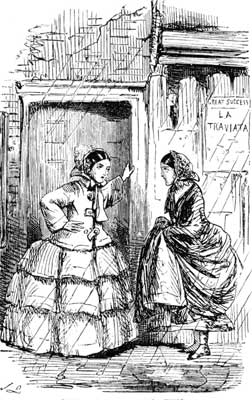 THE GREAT SOCIAL EVIL.
But it was not by his comic faculty alone that John[Pg 428] Leech helped to make Punch great, nor even by his political work. It was also by his frank demonstration of that deep feeling which is often called "passion," whether love, or sympathy, or hot indignation. His love of children, even when he laughs at them, is surpassed by few other artists or writers, even by those of Mr. Punch—that adorer of first youth and green-apple and salad days. The enthusiasm with which he threw himself into all attacks upon abuses showed him a hot-blooded philanthropist. It was not for the first time that in his "Moral Lesson of the Gallows" he used his Hogarthian power against the scandal and brutalising horror of public executions. In the little "social" entitled "The Great Social Evil," which so electrified Punch's readers at the time, there appears the hand of the reformer, perhaps; but primarily a whole heartful of wide sympathy and pathos, from which, with true instinct, the artist has banished every suggestion of humour, retaining only with a few skilful strokes[Pg 429] the sad and pathetic reality of the social problem. This drawing was made some time before, but Mark Lemon, with less courage than he showed in the publication of the "Song of the Shirt," hesitated to insert it; and it is traditionally asserted that it was at the time of the Editor's temporary absence through illness that Leech insisted upon its publication. And who can forget the contemptuous drawing of the brutalised dancers at Mabille (1847), or the other, made in full anger and disgust at the sight of a Spanish bullfight "with the gilt off," after he had attended one, when towards his life's end he visited Biarritz for a few days in fruitless search of health? It is a terrible page, and probably touches the limit of what is permissible in art. Shirley Brooks called it "a grim indictment of a nation pretending to be civilised;" and in England, at least, it met with a throb of responsive emotion and of cordial approval.
Passing from these things to a more pleasing one, we are struck with Leech's exceptional love of beauty. Never did Nature seem more delightful than in his cuts—in those dainty backgrounds in which the loveliest scenery is so skilfully reproduced. "What plump young beauties," cries Thackeray, "those are with which Mr. Punch's chief contributor supplies the old gentleman's pictorial harem!" It is true, they are nearly always the same girl, this ideal of Punch's—short in stature, simple and pouting and laughing, with big eyes and rounded chin, with bewitching dimples and pretty ringlets; but then this ideal, this "little dumpling," was none other than Mrs. Leech! The artist had seen her in the street in 1843, had fallen head over ears in love with her upon the spot, followed her to her home, looked up the directory to ascertain her name, obtained an introduction, and had straightway wooed and won her. "Now I'll bet ten to one," he wrote to Percival Leigh, as soon as he had been accepted, "that your reverence will think me the oddest person in the world, at a moment like the present, to think of writing to a friend; but I can't help sending you a line or two to say that I have been made a 'happy man'.... Never laugh again at the union of 2 soles (i.e., two[Pg 430] flats); at any rate, don't expect me to join in the guffaw." And so Miss Annie Eaton became Mrs. John Leech, the object of her husband's devotion and of his inspired pencil. It is true that his young ladies and his servants are all much of the same type; but, in spite of Mr. Henry James' curious judgment that Leech had no great sense of beauty, he has usually been otherwise adjudged, as in the "poem" by Albert Smith and Edmund Yates—assuredly in harmony with most men's views—where he is spoken of as
"'Handsome Jack,' to whose dear girls and swells his life Punch owes."
And so it comes about that Punch's pages are eloquent with portraits of Mrs. Leech, who, with her children, became the very "orchard" of Leech's eye. The last block of all on which the artist was engaged was one to be called "An Afternoon on the Flags;" it represented a complimentary dog-fancier comparing the points of beauty in a dog with those of the lady before him, but it was still unfinished when he fell back in his bed, dead from the fatal breast-pang.
Leech would never employ artists' models—partly because his chic drawing, like Sir John Tenniel's, came natural to his genius, and his memory was extraordinarily retentive, and partly because when he began to draw for Punch, and for a long while after, it was unheard-of for black-and-white men on comic papers to do anything so seriously academic. But though he said that he had not in his life made half-a-dozen drawings from Nature, he was always sketching "bits" for use, and trusted to his memory and imagination for the rest. On one or two occasions he would ask Mrs. Hole, the wife of the Dean of Rochester, to sit for him in her riding-habit—but this was the nearest approach he ever made to the "model." He would make his first sketch and then trace it on to the block, finishing his rapid drawing with considerable deliberation, yet so quickly that he would often send off three drawings before dinner-time. He was extremely particular about the drawing, and the engraving, too, of his boots and feet, and expressed boundless admiration of Tenniel's power in that[Pg 432][Pg 431] direction. "Talk of drawing!" he exclaimed to Mr. Frith; "what is my drawing compared to Tenniel's? Look at the way that chap can draw a boot; why, I couldn't do it to save my life!" Like all other artists, he was constantly asked by friends what paper was the best and what pencils he used. "H.B.," he would reply; "if you can't put it down with that, you can't put it down at all." His simplicity of means matched the simplicity of his art, and both the transparent simplicity of his character. His views relative to private persons' privacy prevented him from including portraiture in his drawings other than that of public men. But to get these, and especially members of the House of Commons, he would take considerable trouble. I have seen an extremely cordial letter addressed to him by Mr. Speaker Denison, in which special facilities were accorded him to witness the opening of Parliament.
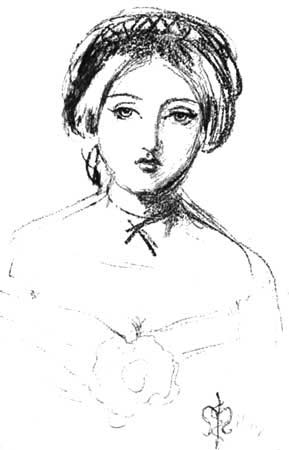 "LEECH'S 'PRETTY GIRL.'"
As a draughtsman Leech has been admirably placed by Mr. du Maurier, who calls him a perfect ballad-writer as compared with the more scientific counterpointing of Charles Keene. And I would remark that it was above all as a pencil and wood draughtsman that he excelled; his etchings—of which he made two-score for the Pocket-Books—are not, technically considered, up to the sustained level of either Cruikshank or "Phiz." But his sense of freedom on the block he makes us feel; he revels in it, and thereby imparts spontaneity to his drawings far beyond what we see in his plates. Yet his composition is almost uniformly excellent, whether in line or light and shade, and apparently as carefully thought out as though an oil picture and not a Punch cut was the work he had in hand. The relation between his landscapes and his figures has often been applauded; and a foreign critic has exclaimed, with unfeigned surprise and admiration, "Leech and Keene could not only draw light—they could even draw the wind!" And with all this he told his story in his drawings more completely than any man of his day; he appealed to every class of society, and touched them all with equal facility, with equal good-humour, brightness, and beauty. His power of legend-writing, too, was[Pg 433] remarkable—his explanatory lines beneath the drawings being as concise and happy as what they described. Says Mr. Silver: "As brevity is the soul of wit, he always made his 'legends' as terse as possible, first jotting them down hastily, and condensing while he drew. I have, for instance, a slight drawing of a heavy pig-faced farmer admiring with his wife a fat pig in its stye. Beneath the sketch is scribbled 'There now; that's my style! I call him a perfect love!' As the joke lay in the likeness of the owner to the pig, the last phrase seemed redundant, and therefore was suppressed before the drawing went to Punch." It is curious that with this gift, he should have contributed only once, so far as I can ascertain, to the literary portion of Punch, and then merely some mock "Verses for Pantomime Music"—strictly speaking, for the harlequinade—(January 4th, 1845), designed to show the fatuous idiotcy of those compositions.
Contrary to what might have been expected in so prolific an artist, Leech never for a moment entertained the sentiment not unusual among comic artists—"je prends mon bien là où je le trouve." He was even diffident about accepting a suggestion for a joke. His own observation gave him the vast majority of his "pictures of life and character," but he would occasionally accept with a quiet undemonstrative smile some of the many proposals that were submitted to him. You might find it in Punch next week, or next year; but if the giver were an artist too, he would hesitate to make use of it, lest he might wrong a brother-pencil. He often figures in his own cuts, as in "The Dismay of Mr. Jessamy on being told that he will spoil the whole thing [private theatricals] if he doesn't Shave off his Whiskers" (Almanac, 1854—his own whiskers which he always regarded with a sort of mock-tender pride.) To his own little son we owe the delightful cut of the child who reminds the new nurse that he is one of those children who can only be managed by kindness, "so please get me a cake and an orange;" like that other Punch youngster who, aping mamma, faintly asks, "Is there such a thing as a bun in the house?" "Astonishingly quick Leech was," says Mr. Silver, "to seize[Pg 434] on any sight or subject that seemed to have some humour in it. I can call to mind, for instance, how I chanced to see a chimney-sweep with his hand held to his eyes, as he was passing a street-door while the mat was being shaken. I told Leech of the incident; for, covered as he was with soot, the sweep seemed over-sensitive. In a very few minutes the scene was sketched most funnily, and was then drawn on the wood. The sketch hangs in my billiard-room, and they who please may turn to Punch and see the drawing. Another time I recollect we noticed some big buoys which were just the shape of fishing-floats, and which I said that Gulliver might have seen so used in Brobdingnag. 'Not a bad idea,' said Leech, and he made a hasty sketch then. Next morning the result appeared upon the wood, and soon afterwards in Punch, with a 'legend' which I quote from memory only:—'I s'pose you sometimes catch some biggish fish here, eh, old Cockywax?' 'Why, yes; and them's the floats we uses; see, young Cockywax'?"
From Millais he had many a joke; and when the two close friends were separated, the former would send him sketches of the idea. Several of these Leech left behind him, having only taken advantage of two—the protection that plaid is supposed to afford in the Highlands, when the unhappy novice who puts it on wrestles with it in a high wind; and the device of a couple of artists for defying the Scotch midges—a comic, balloon-like envelope for the head. From Dean Hole came that immortal joke of the yokel at a great country dinner, who on tossing off his liqueur-glass of Curaçoa, the first he has ever tasted, calls to the waiter that he'll "tak' some o' that in a moog;" and it was from a passage in one of the Dean's letters to the effect that in a long run he had only had three mishaps on his promising young chestnut, that Leech invented the drawing of "A Contented Mind"—wherein the mud-bespattered young hopeful has increased the number of falls to five. And he loved to watch the sons of his colleague, Gilbert Abbott à Beckett—both of them in due time called to the Table—and to base upon the mischievous adventures and the[Pg 435] characteristic invention of the young pickles many a laughable drawing. They were the originals of the boys who, with a ten-and-sixpenny box of tools and a sufficiency of nails, in the absence of their parents put the furniture of the house in a state of thorough repair!! And on a skating experience of one of them—Mr. Arthur à Beckett—comes that well-known design of a youth at the mercy of a skate-tout at the ice-edge. "Look out!" he cries; "you are running the gimlet into my heel!" "Never mind, sir," responds the man, persuasively; "better 'ave 'em on firm!"
From Charles Dickens, from Mr. Frith, Mr. Holman Hunt, and Mr. Horsley, R.A., Leech also accepted happy thoughts; and from an "Eton boy," the smart reply of a belle of a ballroom to the young Oxford man who "couldn't get on there without women's society"—"Pity you don't go to a girls' school, then!" The Eton boy claimed and received remuneration, to the amount of a couple of guineas, which came out of Leech's generous pocket, accompanied by a present and good counsel—a form of acknowledgment, however, which was "not to be taken as a precedent." Sometimes, too, Leech would re-draw or touch up sketches of good jokes sent in by outsiders; but on such occasions he, according to the usual practice of the Punch men, never signed the drawing so made.
The melancholy of Leech, which probably found relief in his more sarcastic and serious drawings, was one of the predominant features of his character. Sadness and dejection are often the birthwrong of the humorist, as we have seen in the cases of Gillray, Seymour, André Gill, and Labiche, and many others of Punch's own day. But Leech's gravity belonged to a mind too well-balanced to overreach itself, too genuine for false sentiment. Moreover, he "could be a merry fellow when harmless fun was demanded." So says Sir John Millais, who after Thackeray, and perhaps Percival Leigh, was the friend Leech loved the best—far more than any others of the Punch Staff, cordial as his friendship with them was. Sometimes his depression would make him think, says Dean Hole, that he was "wasting his time on unworthy[Pg 436] objects and an inferior method," which was exactly what Kenny Meadows told him. It is true that the said Bohemian had, in a soberer moment, assured him of his immeasurable superiority to Kenny's self; but as the wine flowed, the truth came out of it, it appeared that Meadows considered his own illustrations of Shakespeare of vastly greater account than the mere comic sketches of young John Leech.
Leech, it seemed, could be as humorous as he pleased, and as whimsical. When his children misbehaved, he would correct them by making a sketch of their "naughty faces;" and he was always ready to turn a joke upon himself. He made merciless fun of sea-sickness—yet what is there so comic in sea-sickness, after all, that we always laugh at it, just as we laugh at the toothache, which George Cruikshank was so fond of caricaturing?—the suffering, in both cases awful beyond the power of words to express. One would almost be led to believe that Leech shared the immunity of the robust scoffers whom one usually sees behind a big cigar on board the yacht or steamboat. Yet when he crossed to Boulogne on a visit to Dickens, and was received with uproarious applause from what Americans call the "side-walk committee," by reason of his superior greenness and more abject misery, he was quite pleased, and said with the utmost gratification that he felt he had made a great hit. His companionship with Dickens was frequent; and when, in 1848, he was overthrown by a wave while bathing at Bonchurch, and received a slight concussion of the brain, the novelist rendered him the greatest medical service. On that occasion and the week after the cartoons were executed by Doyle and Newman respectively, while Thackeray filled the space usually occupied by Leech's smaller cuts.
His prejudices were to some extent the prejudices of Thackeray. That he should have shared Gilbert à Beckett's dislike of Jews was perhaps to be accounted for by his having in his youth been detained on two occasions in "sponging-houses," though through no fault of his own; and visiting the sins of the lowest upon the whole race, as is the orthodox practice, he displayed towards them something of Alonzo[Pg 437] Cano's ill-will and more than his power of ill-doing. Similarly, towards Irishmen and Frenchmen he showed the same hearty prejudice, not untinged, perhaps, with patriotism; and of that Thackeray was led to write: "We trace in his work a prejudice against the Hebrew nation, against the natives of an island much celebrated for its verdure and its wrongs. These are lamentable prejudices, indeed; but what man is without his own?" Yet they were honestly entertained, and acted upon according to the lights of Punch which at that time were full aflame.
But these playful dislikes paled beside the hatred he bore to organ-grinders—a hatred as unrelenting as the organ-grinders themselves. For this he had only too sound a reason, for it was they who, grinding his overworked nerves, were destined literally to play him into his grave. As early as 1843 he began his campaign against them in Punch, and he never relaxed it until his death. Morbidly timid of all noise, he loved to stay at some quiet English seaside place, "where the door-knockers were dieted to three raps a day;" but he writhed most under the sound of the organ, and not Hogarth's Enraged Musician endured half the torture that Leech suffered in physical and nervous agony. He appealed with his pencil to the law; he ridiculed the barbarous persons, such as Lord Wilton, who "rather liked it;" he portrayed the effect of these tyrants of the street upon the sick and on the worker; and he never spared the offenders themselves. Once, indeed, he was goaded into showing one of these dirty persons leading a louse, like a monkey, by a string; but after a few copies had been struck off (and included in the parcel for Scotland), the printing-press was stopped, and the "realism" was cut from the block. From the first contribution, in which an old lady was supposed to advertise for a professor of mesmerism—a discovery much talked about at that time—in order to mesmerise all the organs in her street, at so much per organ, down to the end, some scores of drawings were directed against his unnatural enemy, who literally drove him from house to house. Even when he took final refuge at his delightful residence, 6 The Terrace, Kensington—now, alas! removed to make[Pg 438] way for showy shops—and fitted it with double windows, he still could get no rest. Standing with Mr. Silver under the tree beneath whose shade Thackeray, Keene, and Leech loved to foregather round his al fresco dinner-table, I have hearkened[Pg 439] to the pretty clink, clink, clink, of a far-distant smith as he smote his hammer upon the anvil, and, wondering that so sweet a sound could trouble any man, I have realised how shattered must have been the sufferer's nervous system as he neared his end.
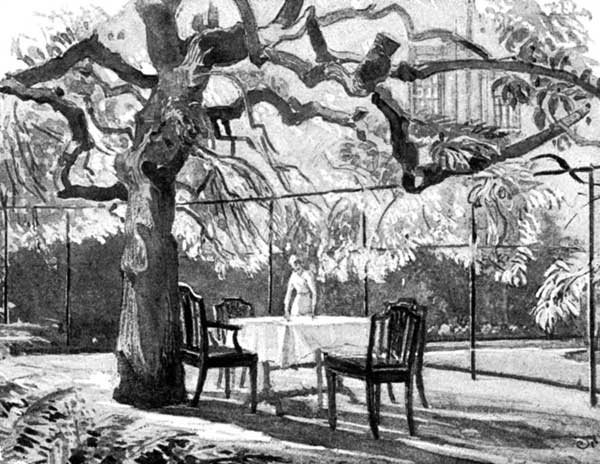 THE ASH-TREE IN THE GARDEN OF JOHN LEECH'S HOUSE UNDER
WHICH LEECH AND THACKERAY USED TO DINE.
THE ASH-TREE IN THE GARDEN OF JOHN LEECH'S HOUSE UNDER
WHICH LEECH AND THACKERAY USED TO DINE.When Mr. M. T. Bass, M.P., brought in his private Bill to regulate "street music," Mark Lemon sent him an eloquent letter of support, in which he touchingly dwelt on the torments suffered by his friend. "The effect," he wrote, "upon his health—produced, on my honour, by the causes I have named—is so serious that he is forbidden to take horse exercise, or indulge in fast walking, as a palpitation of the heart has been produced—a form of angina pectoris, I believe—and his friends are most anxiously concerned for his safety. He is ordered to Homburg, and I know that the expatriation will entail a[Pg 440] loss of nearly £50 a week upon him just at present. I am sure I need not withhold from you the name of this poor gentleman—it is Mr. John Leech."
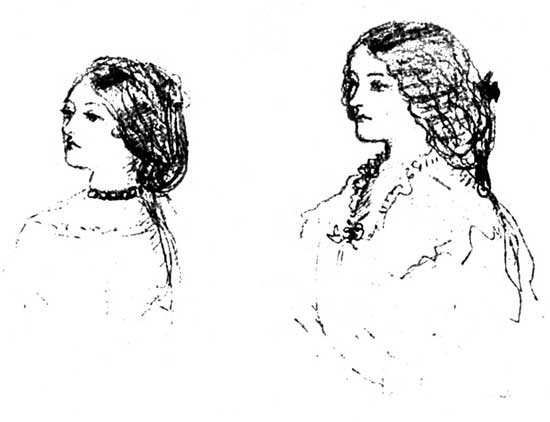 TWO ROSES.
The artist only survived this appeal for half a year, and died before he could enjoy any relief from Mr. Bass's meagre Bill. But the public was loud in denunciation of the nuisance when they learned that he who had made their lives so much merrier for a quarter of a century had been harassed into the grave. "Carlyle," wrote Mr. Moncure Conway, "who suffered from the same fraternity, mingled with his sorrow for Leech some severe sermons against that kind of liberty which 'permitted Italian foreigners to invade London and kill John Leech, and no doubt hundreds of other nervous people who die and make no sign!'" Leech's last drawing appears on p. 188 (November 5th, 1864), in which an Irishman is shown thoroughly enjoying the after-effects of a fight, his[Pg 442][Pg 441] face having been pummelled out of all recognition. It is full of fun and life and spirit, and gives no hint that he who drew it would delight the world no more.
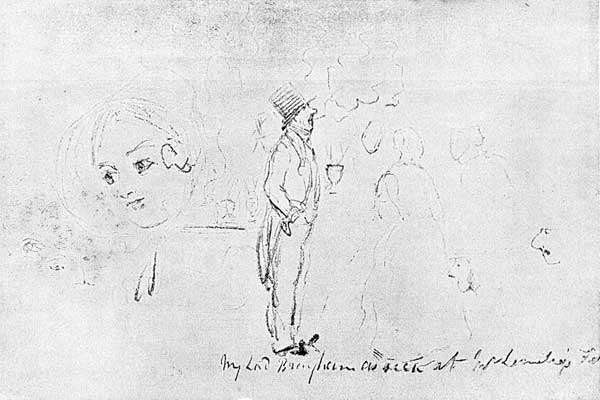 MY LORD BROUGHAM AS SEEN AT MR. LUMLEY'S.
And when the news went forth that John Leech was dead, a hush seemed to fall on the country, as it had done ten months before, when Thackeray died, and as it did again a few years after, on the death of Dickens. The three men all died sudden deaths, and Leech felt and declared that Thackeray's was the knell of his own. "I saw the remains of the poor dear fellow," he said, "and, I assure you, I can hardly get over it. A happy or merry Christmas is out of the question." What wonder, then, that on hearing that Leech had followed, Mrs. Thackeray Ritchie should have exclaimed, "How happy my father will be to meet him!"
"I fancy Thackeray was tired of life," said Leech in his deep bass voice to his Punch colleague Mr. Henry Silver. "At these words I wondered much," says the latter gentleman, "as any young man might who failed to see beneath the surface of a loved and prospering life. 'I feel somehow I sha'n't survive him long,' he added rather wearily; 'and I shouldn't much care either, if it were not for my family.' Then, after a pause, he said more cheerfully, 'But I can do some work yet. And at any rate, thank Heaven! they needn't send the hat round.'" But they had need, and they did. After his death Punch made sturdy, repeated, and successful efforts, not only to collect a fund for the artist's family, but also to make known the facts of his death-sale.
Punch's tribute to his mighty servant befitted the occasion: "The simplest words are best where all words are vain. Ten days ago a great artist in the noon of life, and with his glorious mental faculties in full power, but with the shade of physical infirmity darkening upon him, took his accustomed place among friends who have this day held his pall. Some of them had been fellow-workers with him for a quarter of a century, others for fewer years; but to know him well was to love him dearly, and all in whose name these lines are written mourn for him as a brother. His[Pg 443] monument is in the volumes of which this is one sad leaf, and in a hundred works which, at this hour, few will not remember more easily than those who have just left his grave. While Society, whose every phase he has illustrated with a truth, a grace, and a tenderness heretofore unknown to satiric art, gladly and proudly takes charge of his fame, they, whose pride in the genius of a great associate was equalled by their affection for an attached friend, would leave on record that they have known no kindlier, more refined, or more generous nature than that of him who has been thus early called to his rest."
He was taken to the cemetery in the same hearse that had carried Douglas Jerrold to his last abode. Mark Lemon, Shirley Brooks, Tom Taylor, Horace Mayhew, F. M. Evans, John Tenniel, Henry Silver, F. C. Burnand, J. E. Millais, and Samuel Lucas were the pall-bearers; around his grave, close to where Thackeray lay, stood the whole Punch Staff and many friends who loved him; and Dean Hole completed the Burial Service in sad and broken tones.[Pg 444]
William Harvey—Mr. Birket Foster—Kenny Meadows—His Joviality—Alfred "Crowquill"—Sir John Gilbert—Exit "Rubens"—Hablôt Knight Browne ("Phiz")—Henry Heath—Mr. R. J. Hamerton—W. Brown—Richard Doyle—Desires Pseudonymity—His Protest against Punch's "Papal Aggression" Campaign—Withdraws—His Art—Epitaph by Punch—Henry Doyle—T. Onwhyn—"Rob Roy" Macgregor—William McConnell—Sir John Tenniel—His Career—And Technique—His Early Work—Cartoons—His Art—His Memory and its Lapses—"Jackīdēs"—Knighthood.
Three other names belong to the year 1841: Ashley, William Harvey, and Mr. Birket Foster—the second distinguished landscape artist who may be said to have been raised upon Punch. Of the first-named, nothing need be said, but that he contributed a single sketch and no more. William Harvey, however, stands on a different footing, yet his employment on Punch is inexplicable. He had no real humour, and, what is perhaps more to his credit, he pretended to none; nor did he take pains, as so many do, to prove it. Kenny Meadows, we are told, used to rally him on his excessive sense of gracefulness, which stood in the way of anything like truthful representation. "Beauty," he would say, "is Harvey's evil genius, and grace his damnation." It hardly required the couple of initials ("A" and "E" on pp. 144 and 146 of the first vol.), conceived and carried out in the Birket Foster manner, with landscape backgrounds and field-sport symbols, to prove that Nature had not intended the artist for a Punch draughtsman. He was far better fitted for the illustration of "Knight's Pictorial Shakespeare" than for comic draughtsmanship. And when he had spread consternation in the office by sending in a charge of twelve guineas for the third wrapper, which he had been commissioned to design—money never being scarcer than at that moment—the proprietors immediately[Pg 445] became equally convinced that such was not his vocation, and his connection with the paper ceased forthwith.
I said he drew "in the Birket Foster manner," for that young draughtsman, who was at the time one of Landells' apprentices, had already begun to draw initials on p. 85 of Punch's first volume—an "O," consisting of a laurel wreath with a Lifeguardsman charging through. These initials—there were thirteen in 1841, eleven in the following year, and two in 1843—were remarkable work for a boy of seventeen; and still more remarkable was the fact that he should be entrusted, even at a pinch, with the execution of a cartoon. It is true that this was only an adaptation of Cruikshank's plate of "Jack Sheppard cutting his name on the Beam"—a design highly appreciated at a moment when the fortunes of Harrison Ainsworth's young housebreaker were being followed with breathless interest by every section of society; and it is not less a fact that the head of Lord John Russell was touched up by Henning. Still the achievement is as remarkable as coming from an artist of Mr. Birket Foster's temperament, as those other cartoons, executed in "The Censor" at a later period, by Professor Herkomer. But this was not all he did, for to him are to be credited also a few miscellaneous illustrations, as well as those extremely French-looking designs which he imitated, by order, from drawings by Gavarni for a novelette by Lecourt (pp. 262, 263 and 275, Vol. I.). As an artist he was entirely untaught, save for Brine's quaint advice, and for the counsel of Crowquill that in figure-drawing he should make dots first for the head and chief joints, as an assistance. For a time he followed these strange indications on the royal road to drawing, and on them, perhaps, he based to some extent the illustrations which he made for book-covers, together with Charles Keene, for Mr. Edmund Evans—who, it may not be out of place here to repeat, now so well known as the engraver and publisher of Miss Kate Greenaway's picture books, was a fellow-pupil of Birket Foster's with "Daddy" Landells. He, too, made a couple of drawings for Punch in 1842, when he was no more than sixteen: the first a[Pg 446] "blackie," entitled "Train'd Animals"—representing a trainful of wild beasts (p. 108, Vol. III.), and the other an initial; and his name appears as well as the engraver of one of "Phiz's" designs in "Punch's Valentines." It occurred to him a little later on to buy up "remainders" of unsaleable novels, to employ clever artists to illustrate some stirring scene of love, adventure, or revenge, and with this design on the boards to place the book for sale on the railway bookstalls. His shrewdness met with a rich reward; the picture sold the book; and it often happened that a book that had failed egregiously on its first appearance, would run into two or three editions when presented as a railway novel with a cover sufficiently startling or absorbing in its interest.
An unprecedented, and an unrepeated, incident occurred in 1842. In that year there appeared a number of drawings by Gavarni (apart from those re-drawn by Mr. Birket Foster), and something has been made by commentators of the early enterprise of the Editor in inviting the contributions of the eminent French master of caricature. But as a matter of fact Gavarni was not invited at all, nor did he ever draw for Punch. These blocks, and the one by Gagniet, had simply been bought up by the publishers, and used after they had appeared in "Les Parisiens peints par Eux-Mêmes" as well as in the English translation of 1840. The use of clichés, it should be stated, has never since been resorted to. When Gavarni did make a prudence-visit to England in 1847 he held aloof from Punch, perhaps on account of his former connection with "The Great Gun." His principal achievement here was to offend the Queen, Thackeray, Dickens, and others, by coolly ignoring their proffered hospitality and friendly advances.
In this same volume first appeared a notable quintet—Kenny Meadows, Alfred "Crowquill," W. M. Thackeray, Sir John Gilbert, and "Phiz" (Hablôt Knight Browne).
Few men of his day enjoyed so great a vogue as Kenny Meadows. His pencil was for many years in extraordinary demand; and although as an artist he could not stand against his great contemporary George Cruikshank, his[Pg 447] popularity—among publishers, at least—if not as great, was nearly as extensive. His work is more than half forgotten now, but the memory of his name survives; and to speak of "Kenny Meadows" is to recall the typical art of the illustrator and (such as it was) of the comic draughtsman of the first half of the century.
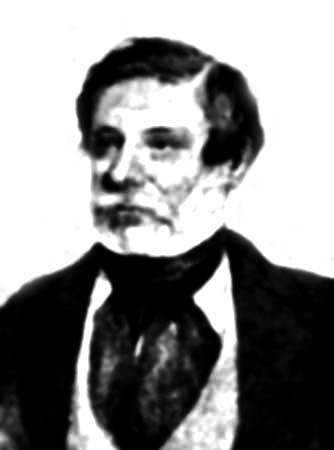 KENNY MEADOWS.
Kenny Meadows—he dropped the preliminary "Joseph" for reasons of "professional distinction"—had first met Douglas Jerrold, in company with Laman Blanchard, in Duncombe's shop, as early as 1828, and in due time was employed to illustrate "Heads of the People," which Jerrold edited in 1840, and for which he had secured the co-operation of Thackeray, Leigh Hunt, Samuel Lover, William Howitt, and other literary lights. Henry Vizetelly, who knew Meadows well, wrote to me but a few months before his death of his acquaintance with the artist. "He was," said he, "witty and epigrammatic in conversation. He was a singularly incorrect and feeble draughtsman, but abounded with clever and often highly poetic ideas. Like most of the members of the Mulberry and Shakespeare Clubs, he knew all the principal passages in Shakespeare by heart long before he became an illustrator of the plays. Like many artists and literary men of the period, he was always in financial straits. Every sixpence that he earned he handed over to his wife, a quiet thriftful woman, sister of Archibald Henning, and she used to give him a small sum whenever he spent his evenings abroad in company with Macready, Laman Blanchard, John Forster, Jerrold, and others, at the Shakespeare Club. He was a little man with a feeble frame, and much addicted to convivial society." He was, indeed, a boon-companion, generous and kind-hearted, and a delightful raconteur—"happy, conversational Meadows," as Blanchard Jerrold calls him—when at the club, and a jovial roystering Bohemian when he left it.[Pg 448]
About the time that Punch was started, Kenny Meadows was living hard by College Place, Camden Town, and one night gave a rollicking dinner to the members of the newly-formed Staff; but Hine (from whom I had the story), as a sober man of peace and quiet, declined the invitation, as was his wont, and the next day, meeting Meadows, was surprised to receive a very penitent apology for their behaviour of the previous night. "What behaviour?" asked Mr. Hine, unconscious of any possible cause of offence. "What! didn't you hear us? Where do you sleep?" "In front. Why?" "Why? Because before breaking up at three this morning we said, 'Let's give Hine three cheers to finish up with;' which we did, with an unearthly noise, and danced a solemn dance on the pavement, and sang you songs fortissimo, and altogether made a diabolical uproar." "Never heard a sound," said Hine. Meadows turned sorrowfully on his heel without a word, and for some days could not get over his disappointment that, in spite of all their best endeavours, his young friend's rest had been unbroken.
When his first two drawings appeared in "Punch's Valentines"—"Young Loves to Sell" and "The Speculative Mamma"—Meadows was already fifty-one years old, with thirty-four more of conviviality before him; he was, therefore, the Nestor of Punch's Staff, as well as its most distinguished member. "Meadows was essentially valuable to Punch," says George Hodder, who by marriage had become his nephew, "for the thoughtfulness of his designs, which were intended to portray something more than a burlesque view of a current event or a popular abuse." His delight when he made a hit was like that of a prize-winning boy; and he used to pride himself that his drawing of a butterfly at the mouth of a cannon, typifying peace—published in Punch in February, 1844—inspired Landseer with his celebrated picture entitled "Peace," in which, however, the butterfly was superseded by a lamb.
Although he was excellent as a "general utility" man, who took as naturally to tragedy as he did to farce, to subjects of squalor as to grace of beauty, to Shakespeare as to Punch, he is not to be credited with any great sense of[Pg 449] humour, his vis comica running rather to grotesqueness than to real fun or wit. His intention was usually more admired than his achievement—in his press work, at least; and the symbolic treatment of his subjects in certain of the cartoons which he executed in 1842-3-4, such as his "Temperance Guy Fawkes," his Cruikshankian "Gin Drop" and "Water Drop," "The Irish Frankenstein," and "The Bull Frog," are to be included among Punch's early successes. But better than this sort of design he enjoyed work of a more decorative type, in which grace and humour, as he understood them, might be introduced. Of this class is his wrapper used throughout the fifth volume. (See p. 9.) But his "poetic fancy and inventive genius," which aroused the enthusiasm of many others besides the appreciative John Timbs, were not in harmony with Punch's character, nor was his fun sufficiently pointed and robust. Whilst he remained he illustrated Jerrold's "Punch's Letters to his Son" and "Complete Letter-writer," which duly received the honour of a reprint; but he left in 1844, and straightway betook himself to the hostile camp of "The Great Gun," which aspired to be Punch's chief rival, to "The Man in the Moon," and other of the Jester's numerous thorns—for of such is the spirit of caricaturists.
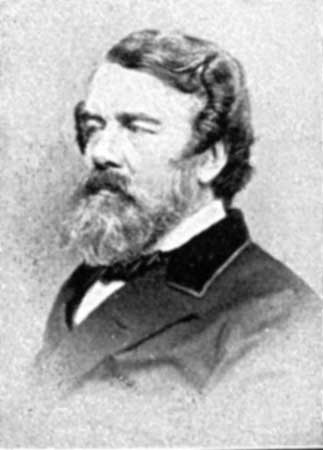 ALFRED "CROWQUILL."
The period of Alfred "Crowquill's" work corresponded with that of Meadows. Although a versatile man, using his pen and pencil with equal facility and ability—the former, perhaps, more successfully than the latter—Forrester (for that was his real name) was but an indifferent humorist. He was of those who thought that fun could be imparted to a drawing by the simple expedient of grotesque exaggeration of expression; and as a great admirer of Seymour's "Cockney humour," he was frequently pointless and stilted. Personally he was highly popular with the Staff, for he was philosophically happy and jovial, and sang good[Pg 450] songs, and was, moreover, greatly sought after at a time when comic artists were few. He was cartoonist, too, in a small way, in the second, third, and fourth volumes of Punch; but his chief merit lay in his jeux de mots, for he was a good punster. Yet even his pictorial puns, good as they were, constituted little claim on a paper which was steadily improving its Staff; and when he left, in 1844, his place was easily and advantageously filled.
Passing over the name of Thackeray, who takes his place among the literary contributors, we come to Sir John Gilbert. His work, though slight, has spread over a longer period than that of any other Punch artist—save Sir John Tenniel, forty years later. His first contribution was the frontispiece to the second volume for 1842, which also constituted its wrapper, and was used as such for the monthly parts for many years. He continued with a few drawings to "The Natural History of Courtship" and "Punch's Letters to his Son," but his most ambitious effort was that representing the late Duke of Cambridge, coronet in hand, begging for public money as a marriage portion for his daughter. But when Jerrold's fiat went forth, "We don't want Rubens on Punch" young Gilbert turned his attention to the newly-started "Illustrated London News," on which his services were warmly welcomed and continuously employed, with such brilliant results to itself and to the black-and-white art in England. I was one day conversing with a distinguished foreign artist on the comparative merits of Gilbert and Doré, whose fecundity in their art was equal, and I ventured to assert the great artistic superiority of Gilbert. "You are right!" cried my enthusiastic friend, with more judgment of art than accuracy of English idiom; "Gilbert cocks Doré into a top-hat!"
Not for twenty-one years did he reappear in the pages of the London Charivari, until after an interval in which he built up his reputation as the greatest draughtsman on wood that England, and perhaps any country, has produced. Then he contributed the first illustration, in an admirable spirit of caricature, to Mr. Burnand's "Mokeanna," and then again,[Pg 451] after another nineteen years, he made a full-page drawing for the Almanac of 1882, representing the unhappy plight of a knight who, summoned hastily to the wars, cannot induce his new suit of armour to come together over his fattened frame, even with the combined assistance of female relations and muscular retainers.
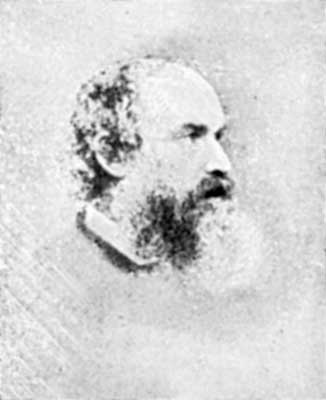 HABLÔT K. BROWNE.
In this same year of 1842 Hablôt Knight Browne, overcoming his former reluctance, began to draw for the paper. He drew its second wrapper (see p. 42)—an enormous improvement on Henning's—as well as some beautiful little comic cuts exquisitely engraved (used to illustrate "A Shillingsworth of Nonsense"), and a couple of "Punch's Valentines." In one of these—the Lawyer—the original of Mr. Squeers may be seen in the character of an orthodox pettifogging attorney perched upon a stool. But Punch could not support such twin stars as Leech and "Phiz," and the latter left in 1844 for "The Great Gun," whose leading draughtsman he became. In the pages of "The Great Gun" he illustrated Maxwell's "Memoirs of a London Latch-key;" and then, in 1850, he drew for "Life, the Mirror of the Million." In the Punch volumes for 1842, 1844, and 1852, his hand may be traced; and again in 1861, after his great illness, he turned once more to Punch. The brave worker, who would not admit his stroke of paralysis, but called it rheumatism, could still draw when the pencil was tied to his fingers and answered the swaying of his body. In 1861 are eleven of his sketches—initials, most of them; in 1862, but one or two; in the following year, sixteen; in 1864, eleven; in 1865, five; and again in 1866, 1867, 1868, seven cuts, and one in 1869; altogether, a little over three-score drawings, besides three full-page cuts in the Pocket-book of 1850. But, for all that, "Phiz" died more than half forgotten. His biographer, indeed, had never heard of his Punch work; and even the[Pg 452] paper which had been so kind to him, and dedicated on July 22nd, 1882, two graceful obituary stanzas to "delightful Phiz—immortal Phiz," entirely forgot to mention that his facile pencil had been employed in Punch's service.
A single cartoon came from Henry Heath (Vol. III.), who was well enough known as a political caricaturist through having made many such plates for Spooner, the publisher, in the Strand. Heath emigrated to Australia, and Mr. R. J. Hamerton, who was soon to become a notable member of the Punch corps, filled the place he left, signing his "B. H." (Bob Hamerton) to resemble as closely as might be the initials of the old favourite. But when, later on, Punch work came to Mr. Hamerton, the Spooner caricatures were dropped. A couple of unimportant contributions sent in under the initials "J. R." complete the record for 1842.
It was through Jerrold's and Lemon's friend, Joe Allen, to whom he handed some of his pen-and-ink drawings, that Mr. R. J. Hamerton secured his footing on Punch. This was in the middle of the year, and in the opening number of the new volume appear his first contributions. For some weeks they were signed "Shallaballa"—the itinerant Punch's first cry on his jumping up before the public in his show, and apparently an appropriate pseudonym; but when the artist was reminded by Mark Lemon of the real significance of the objectionable word, he abandoned it for the better-known picture-rebus of his name—a Hammer on the side of a Tun.
The only meeting of the Punch men which he attended was that at the "Whistling Oyster," next door to the "Crown," at the time when the musical bivalve, as narrated in the description of the "Punch Club," was the talk of the town. Mr. Hamerton, who was introduced by Mark Lemon, and who made the fantastic portrait of it which was published in the following number of Punch, remembers Douglas Jerrold reciting on that occasion his version of the ingredients and constitution of Punch, which was worked up and contributed by Horace Mayhew to the next volume, but, of course, without the names attached, as here given:[Pg 453]—
The Spirit is "The Comic Blackstone" (Gilbert à Beckett).
The Acid is "The Story of a Feather" (Douglas Jerrold).
The Sweet is The Great "Saxon Suggestor" (W. M. Thackeray).
The Spice is "The Sub" (Horace Mayhew).
The Water is The "Professor" (Percival Leigh).
And the Spoon is The "Editor" (Mark Lemon).
Where, then, was the art?
 R. J. HAMERTON.
Mr. Hamerton was one of the few Irishmen who have worked on the paper. He had begun to teach drawing at a school in Co. Longford when he was but fourteen, and came to London to draw upon stone under the eye of Charles Hullmandel, the father of the lithographic art in England. With the exception of occasional incursions into oil and water colour—he was a popular member of the British Artists half-a-century ago—and a few years' book-illustration for the London publishers, "it was stone, stone, stone, till 1891, when the drawing on the huge stones became too much for my old back." Like his life-long friend and contemporary, Hine, he was not of Punch Punchy—at least, in respect to conviviality; and after a record of Staff service extending to 1844, with fitful contributions up to 1848, he deserted the precincts of Whitefriars, and soon after renounced wood-drawing in favour of his more lucrative employment. He had, however, already contributed ten cartoons—striking for their handling, if not at first for their finish. The majority of his subjects were Irish—such as the "Irish Ogre Fattening on the 'Finest Pisintry,'" "The Shadow Dance," "King O'Connell at Tara," "Bagging the Wild Irish Goose," and so forth—and terribly severe he was, as only an Irishman could be, on Daniel O'Connell and Lord Brougham. He illustrated à Beckett's "Comic Blackstone;" but his masterpiece in wood-draughtsmanship was his illustration of[Pg 454] John Forster's "Life of Goldsmith" for Bradbury and Evans. Then after a couple of contributions from "W. B."—W. Brown, whose "Comic Album" was deservedly popular in its day, and whose "Statue to Jenkins" pleased Punch's readers greatly—and the cut signed "B," attributed to Thomas Hood, and another anonymous contribution by "S," there came Richard Doyle, one of the most notable acquisitions of the decade. He was the second son of the famous "[HB]," and had done capital comic work of an amateur character while still a boy. His "Comic English Histories," executed when he was only fifteen years of age, were published after his death; but he was still young when he first became known to the public. He was possessed of an extraordinary power of fanciful draughtsmanship; and his precocity is sufficiently proved by his comic illustrations to Homer, wrought at the tender age of twelve, with real humour, wealth of invention, and excellence of expression. His uncle, Mr. Conan, dramatic critic of the "Morning Herald," showed his work to his friend Mark Lemon, and Lemon forthwith requested Mr. Swain to instruct the youth in wood-draughtsmanship. So the engraver set forth with blocks and pencils to this "certain clever young son" of the once mighty "HB," who was now in a fair way of falling out of public notice. Arrived at Cambridge Terrace, he endeavoured to impart to Richard Doyle the art and mystery of drawing on the wood—how to prepare his blocks, and so forth, and to give such further information as might be required. But so nervous was the youth, who was small and thin in person, and greatly agitated in mind and manner, that he persisted in keeping his distance out of simple shyness, and literally dodged around the dining-room table, altogether too excited to lend the slightest attention to the words of his mentor. In due course, Mr. Swain tells me, the first drawing was delivered, "and a bad, smudgy thing it was, too, altogether different from the work he almost immediately contributed for the Almanac of that year." Doyle's first work in Punch consisted of the clever comic borders to the Christmas number, one of which enclosed Hood's "Song of the Shirt;" but[Pg 455] with the illustration to the rhymed version of "Don Pasquale" he made his actual début.
He was not promoted at once to the position of cartoonist; for the first six months he contributed only one big cut to five of Leech's, and his proportion during several years that followed did not exceed one in three. His first cartoon, entitled "The Modern Sisyphus"—representing Sir Robert Peel, as the tormented one, engaged in rolling the stone (O'Connell) up the hill, with Lord John Russell and others, as the Furies, looking on—appeared on March 16th, 1844; and from that time onwards his work rapidly increased in volume. His initial-letters—an invention further developed later on by C. H. Bennett, Mr. Ernest Griset, and Mr. Linley Sambourne—and his cartoons were reinforced by the famous series of "Brown, Jones, and Robinson," "Mr. Pips hys Diary," "Bird's-eye Views of English Society," and "Ye Manners and Customs of Ye Englyshe," their manner of presentation having been created by the artist, who was forthwith dubbed by his comrades "Professor of Mediæval Design." When Doyle was first called to the Table, his punctilious father did not show any enthusiasm, being in some doubts, apparently, as to the supposed wild recklessness of those savage orgies. He wrote to the Proprietors, hoping that they would not insist upon it for a time, as his son's health was not robust. A little later Doyle himself wrote stiffly to protest against his real name having been printed on the cover of Punch contrary to his distinct request to Mark Lemon, who had promised to retain the name by which he was already known to the public—"Dick Kitcat"—as in the etched plates to Maxwell's "Hector O'Halloran." But the demand was not persisted in.
"Dicky" Doyle continued to work regularly for the paper, and his monogram signature, with a "dicky" either perched upon the top or pecking on the ground close by, was rarely absent from a single number, when the Popery scare—which had seized the popular mind towards the end of 1849—infected Punch with extraordinary virulence. So long as Mark Lemon confined his cartoons and his text to the[Pg 456] general question of "Papal Aggression," Doyle, who was a devout Irish Catholic, held his peace; but when the very doctrine of the faith was attacked, and the Pope himself personally insulted, he severed himself regretfully but determinedly from the paper. Anterior to this, Doyle had remonstrated, but had been reminded that he himself had been permitted to caricature Exeter Hall and all its ways, so that he could not complain if the tables were turned upon his own party. Jerrold and Thackeray, says Mr. Everitt, sought to dissuade him in vain. "Look at the 'Times,'" they argued; "its language has been most violent, but the Catholic writers on its Staff do not, for that reason, resign. They understand, and the world at large understands, that the individual contributor is not responsible for the opinions expressed by other contributors in articles with which they have nothing to do.' 'That is all very well in the "Times,"' was Doyle's answer, 'but not in Punch. For the "Times" is a monarchy [I believe, these were his very words], whereas Punch is a republic.' So when a week or so later an article, attributed to Jerrold himself, jeeringly advised the Pope to 'feed his flock on the wafer of the Vatican,' it was too much for Doyle.... So he wrote to resign his connection with Punch, stating his reasons plainly and simply."
But when Doyle resigned, for reasons which earned him the respect of all who heard of them, it was not realised how strong was the undercurrent of feeling within the Punch office. It is true that at the bottom of what I may call the "Punch Aggression" were Jerrold and the Proprietors; and that the onslaught of the one, with the encouragement of the others, so profoundly wounded Doyle as to force him into sacrificing lucrative employment, and condemning him in the result to a life of toil. But for once in his career Doyle was guilty of behaviour which, if not inexcusable in the circumstances, was certainly indefensible. He left the paper in the lurch. His letter of resignation was sent in on November 27th, he having allowed the Editor to think that the blocks for the Almanac, already overdue, had all been completed; and when it was discovered that[Pg 457] they had not been done, and that nothing was forthcoming, consternation reigned in the office. No doubt the revenge was sweet, but it was ill-judged; for while no Catholic member of the Staff has ever raised his voice in its justification, Doyle's conduct served but to increase the bitterness of the anti-Catholic feeling in Punch's Cabinet, and perhaps to produce attacks more intemperate than any that had gone before. And, moreover, it rendered more difficult the position of others of the same faith who became members of the Staff.
So Doyle quitted the paper at the close of 1850, yet his hand was seen in its pages in 1857, 1862 (four cuts), and 1864. This was a question of "old stock"—a matter which often crops up in Punch: it is not a unique circumstance to see a sketch appear many years after it was drawn, and even when the hand that has drawn it has turned to dust. In 1883 there appeared a cut by Mr. Sambourne which was made fifteen years before; and in 1894 there was published a sketch by R. B. Wallace (of the late Lord Beaconsfield) a year after the artist died and fourteen years after he had ceased to draw for the paper.
But when Doyle left Punch he would draw for none of its rivals. With the exception of the single lapse already alluded to, his conduct was always high-minded and generous; and his virtue and nobility of character have been testified to by all his friends. He declined the offer of a large sum to draw for a well-known periodical as he disapproved of the principles of its conductors; and on similar grounds he refused to illustrate a new edition of Swift. Mr. Holman Hunt has recorded his testimony as to his sterling worth. "Dicky Doyle," he tells me, "I knew affectionately. John Leech and Doyle were never very cordial, Doyle's staunch Romanism separating them. While so rigid and consistent a religionist, he was one of the most charitable of men, and would never be a party to any scandal, however much it had been provoked. I am afraid that no portrait was ever painted of him, certainly none showing his delightfully amusing laugh, which always seemed to be indulged apologetically—with the face bent into the cravat and the double chin pressed forward."[Pg 458]
Doyle's great misfortune as an artist was that his father, cultivating the son's fancy at the expense of his training, not only would allow him no regular teaching, but would not permit him to draw from the model—nothing but "observance of Nature" and memory-drawing. The result was that Doyle remained an amateur to the end—an extremely skilful one, whose shortcomings were concealed in his charming illustrations and imaginative designs, but were startlingly revealed in his larger work and in his figure-drawing. As a draughtsman he was usually feeble, though graceful; his effects, technically speaking, were constantly false, and his drawing often as poor as Thackeray's. He was saved by his charm and sweetness, his inexhaustible fun and humour,[51] his delightful though superficial realisation of character, and his keen sense of the grotesque. When he died in December, 1883, Punch devoted to his memory a poem in which his artistic virtues are generously appreciated, but not a word is said as to the parting of their ways. From this tribute, this "reconciliation after death," I transcribe one stanza:—
In 1844 the versatile artist-dramatist, Watts Phillips, first declared himself in Punch with a few examples of his art, which George Cruikshank had fostered. They lasted up to 1846, but amounted to very little. He gave more attention[Pg 459] to "Puck," of which Chatto was the editor; and when, a few years afterwards, he joined "Diogenes" as its cartoonist, he gave full rein to his undoubted talent.
In the same year Richard Doyle's brother Henry—better known as a distinguished member of the Royal Hibernian Academy, and best of all as the grave and extremely able Director of the National Gallery of Ireland—made a number of small cuts for Punch, which were published in 1844 and the following years; but as I was informed, at the time of his death, by his elder brother James, now also dead (the chronicler, and the compiler of the "Official Baronage of England"): "The Punch episode was the merest child's play to him. His line, chosen years before, was sacred or poetic art; and his illustrations to Telemachus, done before this time, remarkable for invention and colour, were greatly admired by Prince Albert. That he drew for Punch at one time is, of course, true; but the mention of it gives a false impression of his taste and principal work at that period." Yet the spirit of humour was strong within him, for he was one of the "Great Gunners" in 1845; and from 1867 to 1869, when he was appointed to Dublin, he was cartoonist for "Fun," signing with a Hen, or "Fusbos."
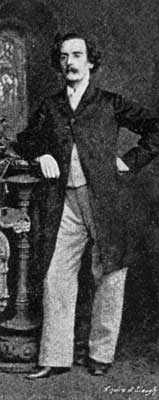 W. McCONNELL.
Thomas Onwhyn, best known, nowadays, perhaps, by his "extra illustrations" to "Pickwick" and "Nicholas Nickleby," and by his plates to "Valentine Vox" and Cockton's other novels, began to contribute a few blocks to Punch—a fact which has hitherto been denied. His first drawing, published on p. 130, Vol. XIII. (1847), illustrates an article by Gilbert à Beckett, entitled, "The Friends Reconciled." The next was a "Social," on p. 230 of the same volume, representing a hatter's wiles and their victim. But Onwhyn was better used to the etching-needle than the pencil, and his drawing on wood was hard and unsympathetic, and his figures were usually rather strained than funny. About this time he was retiring from his position as a popular illustrator of books. Throne Crick's "Sketches from the Diary of a Commercial Traveller," embellished by Onwhyn, had just appeared; and the artist was beginning to bring out his series of albums of[Pg 460] plates, big and small, on all sorts of humorous subjects. The time was, therefore, appropriate at which to embark on independent illustration in Punch. But in the following year he contributed not more than a sketch or two; and thenceforward, until he finally laid down his pencil in 1870, he confined his artistic efforts to his own happy ideas with but few exceptions—such as "Welcome, a Charade; by W. Shakesides" (1850). Onwhyn died so late as 1886.
For four years, if we except two or three unimportant cuts contributed by E. J. Burton in 1847-8-9, no new name appears upon the draughtsman's roll. Then John Macgregor—the celebrated "Rob Roy"—who had begun to contribute paragraphs and short articles in 1847, commenced adding sketches, such as his "Silence in the Gallery," in January, 1848. "Prince Albert's Hat" was also his, and others besides; and it is worth remarking that the proceeds of these sketches and articles were given to the police-courts, wherewith the magistrates might assist poor cases.
The year 1850 became of the first importance in the history of Punch. Not that William McConnell and his gentle art would make the year remarkable, for his early defection from Punch, and his premature death from consumption, cut short a career which promised considerably more than it achieved. Mr. Sala tells me that McConnell was a handsome little fellow, bright, alert, and full of originality. He was always exceptionally well-dressed—and with good reason, for his father, on coming over from Ireland and settling in Tottenham Court Road, resumed his trade of tailor. The youth sent in some sketches, which were highly thought of by Mark Lemon. He was turned over to Mr. Swain for some instruction in drawing on the wood, and subsequently took up his residence in the engraver's house for a time; but, not living long enough to prove his individuality, he remained to the end an imitator of Leech. Perhaps that was the reason that he drew so small a salary from Punch; at any rate, he always resented what he considered to be the contumelious and shabby treatment meted out to him by Mark Lemon. But for such money as he did receive, it must be[Pg 461] admitted that he gave full value in the fierceness of his cartoons on Louis Napoleon. He did much book illustration, besides drawing for the Press, serious and comic—his Punch work including a couple of cartoons in 1852, among a great number of "socials." His last appearance was in July of that year. He was a good and improving draughtsman, especially of horses; and he revelled in beggars, "swells," and backgrounds.
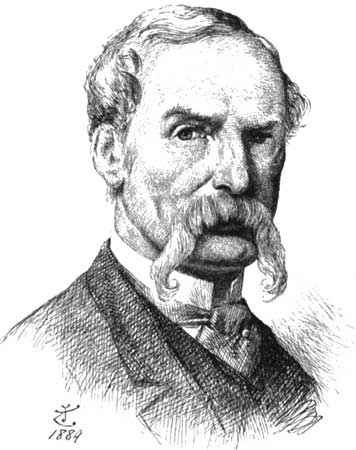 SIR JOHN TENNIEL, R.I.
The great acquisition of the year was John Tenniel. The paper had been left by Doyle, as I have explained, without its Almanac blocks, and it found itself, moreover, without a second cartoonist, and, what was quite as important at the moment, without an artist of distinctly decorative ability, who would provide the fanciful initial-letters, headings, and title-pages which have always been a feature in Punch. The circumstances of his joining the paper Sir John once recounted to me in conversation, with that sort of apologetic humour and true modesty that are characteristic of him:—
"I never learned drawing, except in so far as attending a school and being allowed to teach myself. I attended the Royal Academy Schools after becoming a probationer, but soon left in utter disgust of there being no teaching. I had a great idea of High Art; in fact, in 1845 I sent in a sixteen-foot-high cartoon for Westminster Palace. In the Upper Waiting Hall, or 'Hall of Poets,' of the House of Lords, I made a fresco, but my subject was changed after my work had been decided on and worked out. At Christmas, 1850, I was invited by Mark Lemon to fill the place suddenly left by Doyle, who with very good reasons for himself—that of objection to the "Papal Aggression" campaign suddenly severed his connection with Punch. Doyle had left them in great straits—the Pocket-book and Almanac to come out—and I was applied to by Lemon, on the initiation of Jerrold,[Pg 463] to fill the breach. This was on the strength of my illustrations to Æsop's Fables, which had recently been published by Murray. I did the title and half-title to the nineteenth volume, as well as the first page-border to the Almanac, together with a few initials and odds and ends for the end of that volume, and the first illustration to the next; but only the half-title, title, and tail-piece were signed. My first cartoon was that facing page 44 in the twentieth volume; and, only signing occasionally for the first month or two, I went on from time to time doing cartoons.
"As for political opinions, I have none; at least, if I have my own little politics, I keep them to myself, and profess only those of my paper. If I have infused any dignity into cartoon-designing, that comes from no particular effort on my part, but solely from the high feeling I have for art. In any case, if I am a 'cartoonist'—the accepted term—I am not a caricaturist in any sense of the word. My drawings are sometimes grotesque, but that is from a sense of fun and humour. Some people declare that I am no humorist, that I have no sense of fun at all; they deny me everything but severity, 'classicality,' and dignity. Now, I believe that I have a very keen sense of humour, and that my drawings are sometimes really funny!
"I have now been working regularly at the weekly cartoons for Punch for close on thirty years (from 1862),[52] missing only two or three times from illness. In all that time I have hardly left London for more than a week; yet I enjoy wonderful health, doubtless to be attributed to regular riding. I carry out my work thus: I never use models or Nature for the figure, drapery, or anything else. But I have a wonderful memory of observation—not for dates, but anything I see I remember. Well, I get my subject on Wednesday night; I think it out carefully on Thursday, and make my rough sketch; on Friday morning I begin, and stick to it all day, with my nose well down on the block. By means of tracing-paper—on which I make all alterations of composition and action I may consider necessary—I transfer my design[Pg 464] to the wood, and draw on that. The first sketch I may, and often do, complete later on as a commission. Indeed, at the present time I have a huge undertaking on hand, in which I take great delight—the finishing of scores of my sketches, of which I have many hundreds. They are for a friend—an enthusiastic admirer, if I may be permitted to say so. Well, the block being finished, it is handed over to Swain's boy at about 6.30 to 7 o'clock, who has been waiting for it for an hour or so, and at 7.30 it is put in hand for engraving. That is completed on the following night, and on Monday night I receive by post the copy of next Wednesday's paper. Although case-hardened in a sense, I have never the courage to open the packet. I always leave it to my sister, who opens it and hands it across to me, when I just take a glance at it, and receive my weekly pang. My work would be difficult to photograph on to the wood, as it is all done in pencil; the only pen-and-ink work I have done, so far, being for the Almanac and Pocket-book.[53]
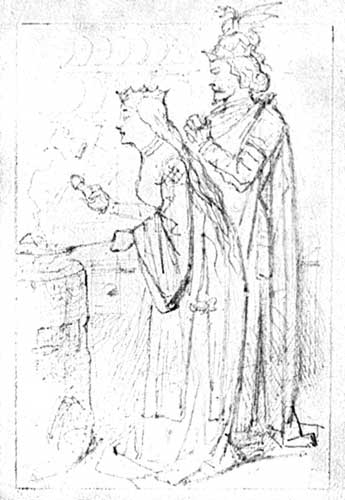 ROUGH PENCIL SKETCH FOR "ARTHUR AND GUINEVERE," FOR
"PUNCH'S POCKET-BOOK."
ROUGH PENCIL SKETCH FOR "ARTHUR AND GUINEVERE," FOR
"PUNCH'S POCKET-BOOK."
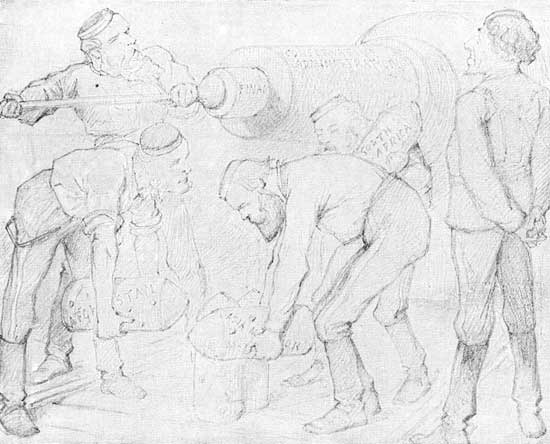 "WILL IT BURST?"
"As I never have a model, I never draw from life, always when I want a portrait, a uniform, and so on, from a photograph, though not in quite the same spirit as Sambourne does. I get a photograph only of the man whom I want to draw, and seek to get his character. Then, if the photograph is in profile, I have to 'judge' the full face, and vice versá; but if I only succeed in getting the character, I seldom go far wrong—a due appreciation is an almost infallible guide. I had the opportunity of studying Mr. Gladstone's face carefully when he did me the honour of inviting me to dinner at Downing Street, and I have met him since; but I fancy, after my 'Mrs. Gummidge' cartoon and 'Janus,' I don't deserve to be honoured again! His face has much more character and is much stronger than Mr. Bright's. Mr. Bright had fine eyes and a grand, powerful mouth, as well as an earnest expression; but a weak nose—artistically speaking, no nose at all—still, a very intellectual face indeed."
Thus it was not only Nature, but the Pope, who marked out Tenniel for the position of Punch's Cartoonist—the greatest "Cartoonist" the world has produced. Had the Pope not "aggressed" by appointing archbishops and bishops to English Sees, and so raised the scare of which Lord John Russell and Mr. Punch really seem to have been the leaders, Doyle would not have resigned, and no opening would have been made for Tenniel. Sir John, indeed, was by no means enamoured of the prospect of being a Punch artist when Mark Lemon made his overtures to him. He was rather indignant than otherwise, as his line was high art and his severe drawing above "fooling." "Do they suppose," he asked a friend, "that there is anything funny about me?" He meant, of course, in his art, for privately he was well recognised as a humorist; and little did he know, in the moment of hesitation before he accepted the offer, that he was struggling against a kindly destiny.
John Tenniel was only sixteen years old when his first oil picture was exhibited at the Suffolk Street Galleries, and he soon became recognised, not only as a painter, but as a book and magazine illustrator of unusual skill. But[Pg 467] he and Keene had already proclaimed themselves the humorists they were by the production of the "Book of Beauty," to which much public attention was drawn when the sketches contained in it were exhibited and sold. They had been fellow-students at the life class, and in the year 1844 were both intimate visitors at the house of their friends, Mr. and Mrs. Barrett. After dinner, when the lamp was brought in, the two young artists would amuse themselves, together with their host, by making drawings in coloured chalks. Mr. Barrett, it may be said, was a thin man, signing himself "5-12ths," in recognition of the nobler proportions of Mrs. Barrett, unquestionably his "better half." Keene chose the "Signs of the Zodiac," to begin with, as the subject of his admirable burlesques, Tenniel having already selected quotations from Shakespeare, history, poetry, and so forth, the humour which he infused into them being equal to anything he afterwards produced in Punch. But it may interest the present owners of these highly-prized productions to know that those who produced them thought very little of them as art, while Sir John expressed the greatest surprise that in their rubbed condition they should attract any notice whatever. As early proofs, however, of the comic faculty of two of Punch's giants, they were interesting and valuable designs; while, so far as Sir John's work was concerned, they were the forerunners of the extremely humorous illustrations of Shakespearian quotations with which he advanced his reputation and his position on the paper.
No sooner had the severe young classicist determined to accept the position offered him in Punch's band, than Mr. Swain was requested to wait upon him in Newman Street, and instruct him in the art of drawing upon wood. But he found that Tenniel, the illustrator of the Rev. Thomas James's edition of Æsop's Fables, published by John Murray in 1848, was already a brilliant expert. The accomplished young draughtsman soon took keen delight in the smooth face of a block, and at once began—and ever continued—to demand a degree of smoothness that was the despair of Swain to procure. Tenniel, indeed, always drew with a[Pg 468] specially-manufactured six-H pencil—which appears more impressive with its proper style of "H H H H H H"—and so delicate was the drawing that, firm and solid as were the lines, it looked as if you could blow it off the wood. The result is that Swain has always interpreted Sir John Tenniel's work, not simply facsimile'd it, aiming rather at producing what the artist intended or desired to have, than what he actually provided in his exquisite grey drawings. So Swain would thicken his lines while retaining their character, just as he would reduce Mr. Sambourne's, particularly in the flesh parts, and otherwise bring the resources of the engraver's art to bear upon the work of the masters of the pencil. Doubtless the artists might deplore the "spoiling" of their lines; but pencil greys are not to be reproduced in printer's ink—they must be "rendered." And though, as artists, draughtsmen may groan under the transitional process, they realise that in submitting their work to the wood-cutter's craft, they must take its drawbacks along with its advantages.
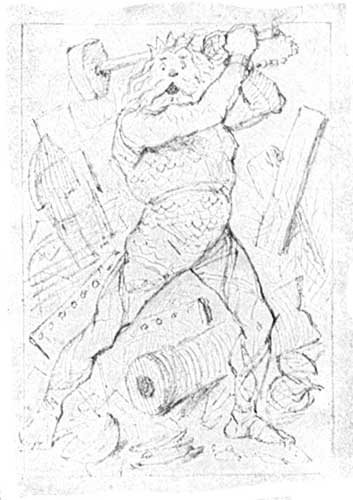 ROUGH SKETCH FOR "THOR" FOR "PUNCH'S POCKET-BOOK."
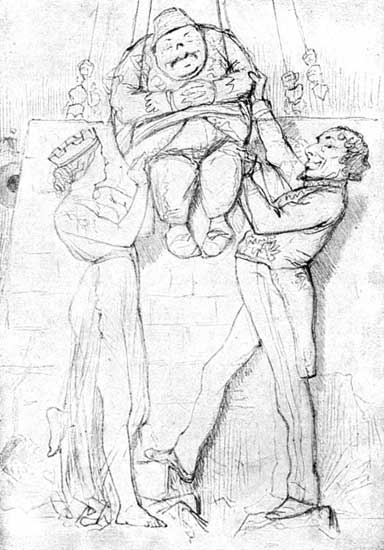 "HUMPTY-DUMPTY!"
The first drawing by Tenniel in the bound volume is, as he says, the frontispiece to the second half-yearly volume for 1850, but his actual first contribution the initial on p. 224 of that volume. Perhaps the most notable thing[Pg 470] about it is the extraordinary resemblance between the artist's work at the beginning and at the end of his career. Of course, it is much "tighter;" it is much younger. But the hand and method are strangely unchanged. It is beautiful in its exquisite precision and its refinement, and altogether superior in its character to what its creator, in a spirit of severe self-criticism, chooses to believe. "My first cartoon," he wrote to me, "was 'Lord Jack the Giant-Killer'—and awfully bad it is; in fact, all my work, at that particular time, now seems to me about as bad as bad could be, and fills me with wonder and amazement!!" But this cartoon, continuing the Papal campaign so hateful to Doyle, by showing Lord John Russell with his sword of truth and liberty attacking the crozier-armed Cardinal Wiseman, was greatly inferior to the smaller contributions. His improvement, however, was rapid. Tenniel's first "half-page social" is on p. 218 of the same volume; while in 1852 we have his first superb Lion, and his first obituary cartoon. Gradually he took over the political big cut, which Leech was happy to place in his hands; but during the long years that they worked together the two men were admirable foils to one another. Leech sketched and Tenniel drew; Leech gave us farce and drama, and Tenniel, high comedy and tragedy; and the freedom of the one heightened the severer beauties of the other. And when Leech died, his friend continued the labour alone. Except in 1864, 1868, and 1875-6-7-8, in which last-named year he took his first holiday from Punch work and went with Mr. Silver to Venice—(during his illness or absence Charles Keene contributed thirteen cartoons[54])—and again in 1884 and 1894 (when Mr. Sambourne twice took over the duty), he has never, from that day to this present time of writing, missed a single week. Nearly two thousand cartoons, initials innumerable, "socials," double-page cartoons for the Almanac and other special numbers, and two hundred[Pg 471] and fifty designs for the Pocket-books—such is the record of the great satirist's career; and the only change has been in the direction of freedom of pencil and breadth of artistic view.
Of his work little need be said here, for in its main bearings it has already been fully considered. But acknowledgment must at least be made of how, with all his sense of fun and humour, Sir John Tenniel has dignified the political cartoon into a classic composition, and has raised the art of politico-humorous draughtsmanship from the relative position of the lampoon to that of polished satire—swaying parties and peoples, too, and challenging comparison with the higher (at times it might almost be said the highest) efforts of literature in that direction. The beauty and statuesque qualities of his allegorical figures, the dignity of his beasts, and the earnestness and directness of his designs, apart from the exquisite simplicity of his work at its best, are things previously unknown in the art of which he is the most accomplished master, standing alone and far ahead of any of his imitators. The Teutonic character and the academic quality of his work, modified by the influence of Flaxman and the Greeks, are no blemishes; one does not even feel that he draws entirely from memory. Indeed, the things are completely satisfying as the work of a true artist, and—a quality almost as grateful and charming as it was previously rare—of a gentleman.
Yet this practice of drawing from memory has its drawbacks; for the things remembered are apt to grow old-fashioned. The Flying Dutchman was running when Sir John's locomotive still had the odour of Puffing Bilfy about it. His indifference to that "actuality" which is the characteristic of Mr. Sambourne has often raised the howl of the specialist. When in an excellently drawn cartoon full of point (November, 1893), entitled "A Bicycle made for Two," he grafted the features of a modern roadster on to the type of 1860, the cycling world fluttered in a manner that must have been very encouraging to the artist. His machine, they said, was the most wonderful one ever placed on the[Pg 472] market. Sir H. H. Fowler, it was said, was sitting on a half-inch tube without a saddle, and "working with his heels on pedals shaped like a Mexican gaucho's stirrup"—but his critics had clearly never seen a gaucho's stirrup. "Nor has the lady—riding behind, instead of in front—better accommodation, being in suspension over a frame that lacks a backstay, and above a wheel that buckles under her weight; while the handles are thrown up instead of down, and their bars so slender that they must inevitably break." The gear-case is on one side of the frame and the chain on the other, and the frame itself was a marvel of ingenuity misapplied. Thus did the cyclists moan in many newspapers, taking the matter au grand sérieux, with quite unusual regard for mechanical accuracy, and a total disregard for the political allusion and point. Similarly in January of the same year the "Forlorn Maiden" of trade was shown lying across the railway lines while an engine is bearing down upon her. But "there are five rails in sight, all at equal distances apart, though the railway gauge is four feet eight inches and a half, and the locomotive is running on the six-foot way." The girl, too, stretches across it, and spans it from waist to ankles, not counting a bend at the knees, so that at the lowest estimate she is ten feet high. This violated the public conscience even more than the fact that the engine rushes along the inside line of the two sets of rails; and they declared that never before had the maxim ars longa been more triumphantly indicated than in the maiden's figure. But what of it all? Is it not a striking commentary on our English temperament, that while an inaccuracy of a purely mechanical description raises the protests of thousands who have no idea beyond the parts of a bicycle or the width of a railway gauge, a score of artistic beauties pass unnoticed and unchallenged?
And so Tenniel worked his way upwards. The fact that in a fencing bout he had partially lost his sight, through the button of his father's foil dropping off, whereupon he received the point in his eye, was not the slightest deterrent. He regarded it merely as an annoying, though not a very important, incident.[Pg 473] Being satisfied that the Almighty had only given us two eyes as a measure of precaution, to provide against such vexatious little accidents as he had experienced, he went on working as if nothing had happened. "It's a curious thing, is it not," he said one day to the writer, "that two of the principal men on Punch, du Maurier and I, have only two eyes between them?" Yet it only made him the more careful. Free from mannerism, he never allowed carefulness to interfere with fun, and his cartoon of Britannia discovering the source of the Nile, and of Lord Beaconsfield as a peri entering the Paradise of Premiership, are among the memorably funny things of Punch. His elevation to the leading position on the paper has thus been gradual and certain; not of his own assumption, however, but the ready tribute of his colleagues, who have always regarded him not only as the great artist, but as the link incarnate of the tradition of Punch of the present with the past. So he is the favourite of the band, to whom he is the beloved "Jackīdēs" of Shirley Brooks's christening. It was Mark Lemon who, at the Dinner, first applied to him the burlesque line—"No longer Jack, henceforth Jackīdēs call;" but it was Brooks who confirmed the practice of according to him the sobriquet which Punch (p. 148, Vol. XLV.) had previously conferred on Lord John Russell, "England's Briefest Peer."
It was a startling proof of his extraordinary, and by him half-unsuspected, popularity, that when Tenniel's knighthood became known the honour was received with loud and general applause—with an enthusiasm quite unusual in its command of popular approval. "I am receiving shoals of letters and telegrams," he wrote to me on the day of the announcement; "I suppose you know the reason Y." It is said that Lord Salisbury had intended to make the recommendation himself, but that the nomination was delayed and forgotten; but when Mr. Gladstone came into office the new Premier repaired the neglect of the old, and at the same time acknowledged the steady support which Punch had offered to the Whig policy. By the general public it was regarded as an appreciation of the man who was the personification of the good-humoured and the[Pg 474] loftier side of political life—who had brought the Punch spirit round to something a good deal better and higher than he found it, blending fun with classic grace, and humour with dignity. To the art world it was the recognition of that "Black-and-white" drawing which has been the glory of England and the Cinderella of the Royal Academy of Arts. It was in this sense that Sir John Tenniel accepted the distinction. But it was to "Jackīdēs" that the Punch Staff drank when Mr. Agnew proposed his health at the Dinner following the announcement of the nomination; it was "dear old John Tenniel" that the Arts Club toasted when, with Mr. Val Prinsep, R.A., in the chair and Mr. du Maurier in the vice-chair, the new knight was the honoured guest of his club, and received its congratulations with the modest dignity and kindly good taste characteristic of him. And it was "good Sir John," the cartoonist—who has also been, at extremely rare intervals, a Punch writer too (see Punch, p. 56, Vol. XX.)—who was celebrated by the pen of Mr. Milliken—"the Pride of Mr. Punch and the delight of the British Public."[Pg 475]
Captain Howard—Receipt for Landscape Drawing—Earnings, Real and Ideal—George H. Thomas—Charles Keene—His Training—Introduction to Punch—Called to the Table—Uselessness in Council—A Strong Politician—Inherits Leech's Position—Keene as an Artist—Where He Failed—His Joke-Primers—Torturing the Bagpipes—Good Stories, Used, Spoiled, and Rejected—"Toby" as a Dachshund—Death of "Frau"—Keene's Technique—His Inventions and Creations—And what He Earned by Them—Charles Martin—Harry Hall—Rev. Edward Bradley ("Cuthbert Bede")—"Verdant Green" or "Blanco White"?—Double Acrostics—George Cruikshank Defies Punch—Mr. T. Harrington Wilson—Mr. Harrison Weir—Mr. Ashby-Sterry—Alfred Thompson—Frank Bellew—Julian Portch—"Cham"—G. H. Haydon—J. M. Lawless.
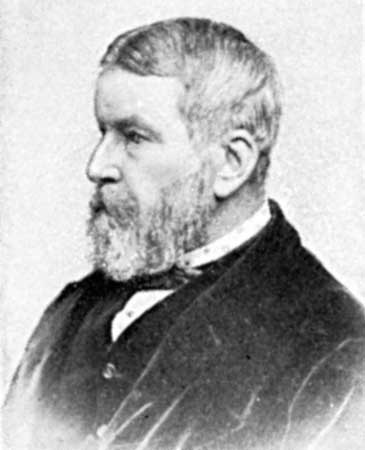 CAPTAIN H. R. HOWARD.
An amateur who signed with cross-pipes, and who appeared five times in the following year, was the one other contributor of 1850; and then 1851 was distinguished by the enlistment of the prolific draughtsman who at first used three running legs—quaintly accepted as the Manx arms—as his sign-manual. This was Captain Henry R. Howard, the son of a country gentleman, born at Watford, where he lived in the same house for over fifty years. He was always sketching from a child; and being persuaded by his friends to "do some of those for Punch," he sent a few samples to the Editor, but without much hope of success. They brought an immediate invitation to call upon Mark Lemon, who told him, after seeing his pencil sketches, that he might draw for them, but not on paper, on wood; and learning that he had had no such experience, referred him for instruction to the courtesy of Leech and Tenniel, whose senior he was by six years. He was not entirely without artistic education, having[Pg 476] studied in Hanover under a pupil of Benjamin West's. "You must draw skeletons," said Herr Ramburg. "But I only want to draw landscapes," pleaded the youth. "Then you must draw skeletons first," replied the artist; "it is the only way to draw landscapes."
After securing Lemon's favour Captain Howard drew scores of comic humanised beasts and birds in the form of initials and decorations. At last, after some years, Lemon proposed a change, when Howard quietly remarked, "I've been wondering how long you'd go on taking those things; I should have thought you were sick of them. I am." Meanwhile he had changed his signature of the Manx legs—he had just been sojourning in the island when he adopted them—as Lemon represented it as Leech's opinion that it was sometimes unnecessarily like his own wriggling signature; and he had adopted in substitution the little trident that figured in the paper for fifteen years. When Leech died, Captain Howard aspired to be—in part, at least—his successor; but although he was now drawing figure-subjects, and had an inexhaustible stock of jokes and fun, he was told, to his bitter disappointment, that new blood was wanted; and the great mantle which had fallen was now drawn round the shoulders of Charles Keene and Mr. du Maurier. Captain Howard then practically retired. Although in the first year of his contributions he was £30 out of pocket by his Punch work, as he bought his own blocks instead of claiming them from Swain, he was soon making £100 a year from the paper. Just before he retired an officer recently returned from India expressed the desire to draw also for Punch as a profession. "I hear," said he, "that Leech makes £1,500 a year out of it." "So that you would be satisfied with £1,200?" asked Captain Howard. His friend admitted that even the inferior sum would be acceptable. "Very well," replied Howard encouragingly; "come and dine with me, and I'll show you by my books that my Punch income last year was just twelve pounds!"
Captain Howard's work, though clever and ingenious, was weak. Its humour, often fresh enough, was never very[Pg 477] pronounced; nor did the draughtsman's hand ever become that of a master. In 1853 he had made no fewer than sixty-six cuts, and about doubled that number each year up to 1867, when, with only two drawings in the volume, he finally vanished from Punch's pages. Three years later there was printed an initial by him, representing a comic hammer-fish (p. 265, Vol. LIX.), but this belonged to "old stock;" and it marks the failure of its author's long-sustained effort to obtain a recognised position in the front rank of the artistic Staff. He died 31st August, 1895.
A contemporary of his was G. H. Thomas, brother of one of the founders of the "Graphic," and a popular painter of the day, who received much employment from the Queen. Mark Lemon was very anxious to secure the services of so admirable a draughtsman; but Thomas, who was trying to shake himself free from wood-drawing in favour of oil-painting, showed little responsive enthusiasm. He did, however, contribute a couple of drawings—one of them a large head-piece to the preface, representing a feast given to Punch on his twenty-first volume day. In it he is supported by the Queen and Court, and at the round table are the representatives of the nations. It is not a happy effort, and is clearly inspired by Doyle—whose fancy the Editor was still seeking to replace; and, moreover, it is poorly engraved; but it is as full of figures as of incident. Then came C. H. Bradley, who seldom got beyond initials and trifles of large heads on little bodies, being only once or twice promoted to "socials" during the nine years of his connection with the paper. On occasion he showed real humour, while his artistic merit seems to have owed most of what excellence it possessed to the study of Tenniel's work. Bradley, whose monogram might easily be mistaken by the unwary for that of C. H. Bennett, who followed eight years later, executed but five-and-thirty cuts between 1852 and 1860.
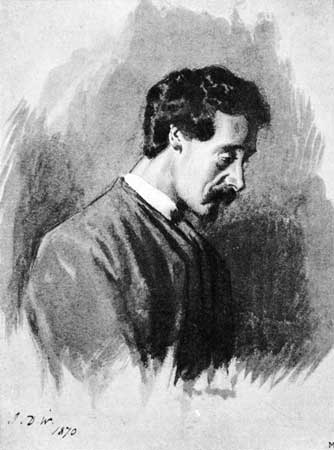 CHARLES S. KEENE.
Punch was ten years old when the hand of Charles Keene, but not Charles Keene himself, was introduced to the Editor, through the instrumentality of Mr. Henry Silver. Keene had at first been intended for the law, and afterwards had[Pg 478] spent a short period in an architect's office. But he decided to throw himself into art; and in order to learn engraving and drawing on the wood, he followed the practice of the day (such as had been adopted by Leech, William Harvey,[Pg 479] Fred Walker, Mr. Birket Foster, Mr. Walter Crane, and other of Punch's artists), and apprenticed himself to an engraver—Whymper, for choice. Then he studied along with his comrade Tenniel and other incipient geniuses at the Clipstone Street Academy, and as early as 1846 produced with his friend—who was soon to be his fellow-giant on Punch—the "Book of Beauty," already referred to. He took a studio in the Strand—a sky-parlour renowned for its dust and inaccessibility—and lived, as all good Bohemians should, chiefly on art, song, and smoke: an existence sweetened by a few warm but eclectic friendships. He worked desperately hard, and having, through his fellow-shireman Samuel Read, become connected with the "Illustrated London News," he made for it many drawings of the sort now called "actuality."
By that time Mr. Henry Silver had contracted with Keene an acquaintanceship which was to grow into a warm friendship, and it was under the shadow of that intimacy that his earlier contributions were made. As Mr. Silver himself explains in his statement written for Mr. George S. Layard's admirable "Life and Letters of Charles Keene of Punch" (p. 47): "It may seem a little strange that Keene at first showed some reluctance to let his name be known where it was finally so famous. Still, it is the fact that while his earliest Punch drawings were of my devising, he steadily declined to own himself the doer of them. I was writing then for Punch as an outsider, but my ambition was to draw, and for this I had no talent. As for working on the wood, I soon 'cut' it in despair, and, like a baffled tyrant, I knew not how to bring my subjects to the block. Keene very kindly undertook the labour for me, and the first design he executed was 'A Sketch of the New Paris Street-sweeping Machines'—a couple of cannon, namely—which was published in December, 1851, immediately after the bloody coup d'état."
This was the barest sketch, childish and shaky in execution, which, however, is explained in the legend as being due to the "Special Artist" being in the line of fire. Mr. Layard asserts that when Keene made the drawing he thought the[Pg 480] joke "a mighty poor one;" and he might have added, as is made clear in the chapter dealing with "Plagiarism," not even a new one, for Punch himself had used the idea before (p. 166, Vol. XV.), and was then accused of theft by the "Man in the Moon." Mr. Silver proceeds:—
"His next two drawings illustrate an article of mine, and appear on the second page of the next volume. His fourth, a far more finished drawing, like these, saw the light in 1852, and may be found in Vol. XXIII., p. 257. It shows a gentleman engaged in fishing in his kitchen, and is entitled 'The Advantage of an Inundation,' the autumn of that year being very wet. Mark Lemon wrote to me commending it, and asking me to try and draw a little more for him. I showed Charles the letter, and said that now, of course, his name must be divulged, for I clearly was obtaining kudos under false pretences. However, he deferred the disclosure for a while, and it was not until the spring of 1854 that his 'C. K.' first appeared (vide initial 'G,' Vol. XXVI., p. 128)—a modest little monogram, quite unlike his later and so well-known signature. In the interim he marked his drawings with a mask, which was a device of mine for hiding his identity."
For nine years Keene worked steadily on Punch, improving artistically in an amazing manner, and in 1860 he was called to the Table—they served long terms of probation then—and ate his first Dinner on February 20th. It was a notable company that he used to meet, all the chief "rising stars" of Punch being still upon the Staff, save Douglas Jerrold, who had died three years before. There were Mark Lemon, Thackeray (nominally retired), Tom Taylor, Horace Mayhew, Shirley Brooks, Percival Leigh, John Leech, Henry Silver, and John Tenniel; and into this brilliant assemblage, on the evening in question (when, however, Thackeray was absent, and Sir Joseph Paxton was present as a visitor), he was received with a cordial welcome. But neither at that time nor thenceforward did he take a prominent part in the discussions over the cartoon, although on one occasion he did astonish the company with an excellent though belated[Pg 481] suggestion. He had, in fact, no originality of a literary or humorous kind. He knew the exact value of a joke when it was made, and could usually display its point to incomparable advantage; but joke-creation was not one of his strong points, even though he was often forced to it by necessity. Occasionally, however, he would miss a point entirely, as in the joke sent him by Mr. Alfred Cooper[55]:—
"Visitor (having shot a hare at the usual seventy yards): 'Long shot that, Johnson.'
"Keeper: 'Yes, sir; Master remarked as it were a wery long shot.'
"Visitor (gratified): 'Ah! Oh, he noticed it, did he?'
"Keeper: 'Yes, sir; Master always take notice. When gen'lemen makes wery long shots, they don't get asked again!'"
"Why," asks Keene, "would 'Master' object to this long shot? Burnand ... is sure to want to know I don't know either! Will you kindly explain, so that I can answer him as if I were an expert." As if even a non-sportsman would fail to see the point!
But at the Table, delightful as Keene personally was—he was lovingly addressed as "Carlo"—he was not a leading conversationalist. He proposed little; yet when his opinion was asked, he gave it, with judgment and taste, tersely expressed. His work, besides, was rarely discussed at the Table, for he usually had to seek his material outside. Moreover, he was, as he expressed it, a "hot Tory," and so strongly antipathetic did he profess himself towards the Liberal tendency of some of the Staff of that day that he would declare with a wink that he positively preferred to stay away; and on the occasion of the accession of Mr. Anstey, wrote this sturdy Conservative "I hope he's a Tory. We want some leaven to the set of sorry Rads that lead poor old Punch astray at present." But few independent readers, and fewer still of Keene's personal friends, will take very seriously his sweeping assertion and political pronunciamentoes—at least, as regards Punch, for whom and for his colleagues he retained to the end feelings of the warmest affection.[Pg 482]
When John Leech died in 1864, it was Keene who received the main heritage of his great position as the social satirist of the paper, and with it the heaviest share of work and artistic responsibility. Not only did his work increase in the ordinary numbers, but extra drawings—such as the etched frontispieces to the Pocket-books—fell also to his lot; and a good deal against the grain—for he hated any approach to personality, even though his target was a public man and his shaft was tipped with harmless fun—he executed fourteen cartoons, as is explained elsewhere. In addition to his ordinary "socials" and the formal decorations of each successive volume, Keene re-illustrated "Mrs. Caudle's Curtain Lectures" with a marvellous series of drawings, and Mr. Frank C. Burnand's "Tracks for Tourists," which made their first appearance as "How, When, and Where" (1864) and were ultimately republished in "Very Much Abroad." Of his outside work for "Once a Week," published by Messrs. Bradbury and Evans, and other publications, no mention need here be made.
It is doubtful if the public will ever realise how great an artist Keene was. His transcendent merit has, however, for a long time been the wonder and admiration of his brother-craftsmen and of the critics. The stream of his genius continued to flow for six-and-thirty years in the most amazing manner. His drawings are in the highest form of Impressionism, reproducing every phase of fleeting expression and suddenly-arrested action with a certainty and accuracy which are absolutely unsurpassable. His power of composition, of breadth of handling, chiaroscuro, and suggestion of colour and form, was perfect within the range of his medium; and in that medium he gave us, not paper with pen-lines on it, but a perfect sense of light, form, and expression. He was as careful, too, in his "comic cuts" as the most conscientious of painters could be in his canvas; and drawing invariably from the model—even if that model were simply an old shoe—he would often journey into the country for a background of, say, a turnip-field, or in search of any other detail or local colour.
In one direction alone did he fail, or choose to fail—in[Pg 483] the portrayal of facial beauty, elegance, and respectability. A pretty woman lurked but rarely about the point of his pencil, as she does so delightfully about those of his principal collaborators on Punch; and an elegant woman—save by accident—never. You may point to the Brittany peasant in the number for September 20th, 1856; to the very Leechy young lady on p. 188, Vol. XXXVI. (May 7th, 1859), who, it must be admitted, really is a "lady;" and to one or two more. But these pretty women serve rather to accentuate the ugliness of all his other women, when they should have been most beautiful; while elegance is with him a virtue that very rarely saves. Keene, indeed, misrepresented his countrywomen as much as M. Forain libels his. Keene's "swells," and even his gentlemen, are snobs; his aristocracy and his clerks are cast in the same mould; his city young men are like artizans; and his brides are forbidding—models of virtue, no doubt, but lacking every outward feminine charm. These shortcomings, of course, are to a certain extent to be accounted for by his own nature. Living in the strictest economy and temperateness, he hated anything like ostentation. He despised "Society" and the whole fabric of fashion, and held the world of Burke and Debrett in good-natured abhorrence. Like Leech and Dickens, he had given his heart to the middle and lower-middle classes, and among them he found his best models and most admirable motifs.
No Punch artist was ever so dependent upon his friends for "subjects" as he, and none received such continuous and delightful support. From Messrs. Joseph Crawhall, Andrew Tuer, Walker, Clayton, Birket Foster, Sands, Pritchett, Savile Clark, Ashby-Sterry, Chasemore, and others, he was under constant friendly, and fully-acknowledged, obligation. Not but that he made constant effort to secure "jokes" of his own. He was ever on the look-out, and often very hard-pressed, for them. One day he told Mr. Pritchett that he had determined to join a riding class at Allen's Riding-school, and seek inspiration there. His friend amiably suggested that he (Mr. Pritchett) should attend as observer and reporter, and tell Keene all the ridiculous things he did on[Pg 484] horseback and the amusing appearances he cut. But the idea did not seem to commend itself to Keene, who merely replied that he thought he should choose a hearse-horse to ride, as being at once more stately, decorative, and safe.
Amongst Keene's own subjects are to be included the greater number of those series of drawings dealing with artist and volunteer life; but it must be recognised that to a great extent Keene was frankly the illustrator of other men's ideas, and often of other men's "legends." These legends, or "cackle," were often touched up by Keene; but sometimes they were entirely original. And though it must be admitted that they are not concise as Leech's, they are, as a rule, more life-like, more truthfully Impressionistic—just as his drawings are. The "legend," by the way, Keene used to term the "libretto"—a reflection, as it were, of his passion for music (a passion he shared with Gainsborough and Dyce and Romney, and so many more of our most eminent artists). This love of music he indulged at the meetings of the Moray Minstrels, in the Crystal Palace Choir during the Handel Festivals, and in the depths of the country, wherein he would bury himself in order to torture the bagpipes, without testing too severely the forbearance of his fellow-men.
When he secured a good story—which he loved to impart with an ecstatic wink to one or other of his closest friends—he would look as carefully to the "libretto" as to the drawing, as in the case of the British farmer who, crossing the Channel for the first time—in great discomfort at the roll of the boat—"This Capt'n don't understand his business. Dang it, why don't he keep in the furrows?" or the story—older, by the way, than Keene had any knowledge of—of the Scotchman who was asked by a friend, upon whom he had called, if he would take a glass of whiskey. "No," he said, "it's too airly; besides, I've had a gill a'ready!"
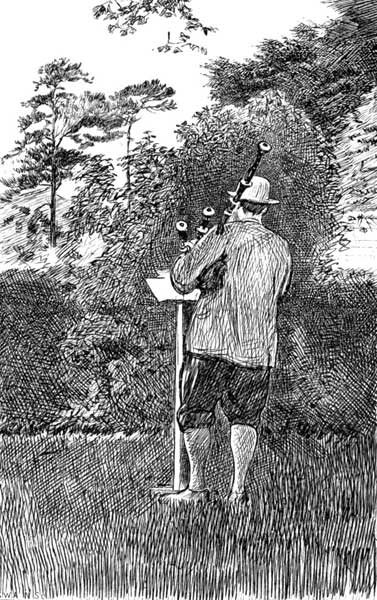 CHARLES KEENE TORTURING THE BAGPIPES.
And when his legends were altered by the Editor he would fret for a week. Once when Tom Taylor altered the good Scotch of a "field preacher" (Almanac for 1880) he declared himself "in a great rage," and swore that he would "never forgive" the delinquent. On other occasions, too, he[Pg 486][Pg 485] fumed at the desecration of his "librettos;" and when the word "last" was accidentally omitted from his joke—"Heard my [last] new song?" "Oh, Lor! I hope so!!" he mourned over the loss of the point. Yet he might have been comforted; for had the word been retained, the further charge of plagiarism could have been sustained against him.
But his sorest point against Punch—to which, after all, he was sincerely attached—was not the alteration, but the total suppression of some of his work. Two such cases are duly recorded by Mr. Layard—both of them admirable jokes in their way, though perhaps of questionable taste. The first deals with a "Bereaved Husband's" opposition to the "Sympathetic Undertaker's" remorseless insistence that the chief mourner should enter the first carriage with his mother-in-law. "Ah! well," he sighs, with resignation; "but it will completely spoil my day!"
The second story—to which an excellent drawing was[Pg 487] made—tells of a widow who looks with sorrowful resignation upon a portrait of her husband that hangs above the fireplace, and says to her sympathising friend: "But why should I grieve, dear? I know where he passes his evenings now!" The first of these Mark Lemon—ever anxious to avoid giving offence—declined on the ground that it was too hard upon mothers-in-law; and the second because, in Keene's own words, "Our Philistine Editor ... said it would 'jar upon feelings'!" He surely could not have borne completer testimony to the care, the ultra-respect for others' sentiments, which has usually distinguished Punch, to the disgust of critics of less refinement and consideration.
On another point, too, he was not at one with Punch, and that was "Toby." The form and face of Mr. Punch, as rendered by him, was hardly a classic rendering; but this was forgiven him. But Keene's Toby was neither the cur represented by some, nor the Irish terrier affected by others, but a dachshund! And he persisted in so drawing him to the end, not because he thought it right, but because "it might have been!" and because the original of the beast was his own much-loved pet "Frau," which he survived not many days. (See next page.)
To this drawing particular interest attaches, for it is the very last that ever came from his hand—a loving tribute to an old friend that had passed away. Concerning it, Mr. Henry S. Keene writes to me: "The history of the dog is shortly this. She was a favourite old dog of my brother's, and has figured a good many times in his drawings as the dog of the 'typical' Punch, and was of the breed of the 'dachshund.' She was very old and full of infirmities, and my brother consented, with some reluctance, to put the poor thing out of its misery. When it was dead, he had it put on a chair in his room, and made the sketch. This was about three months before he died, and was the last thing he drew. It required an effort on his part, as he had entirely left off doing any work since the beginning of last year [1890]."
More than any other man on Punch, Keene suffered at[Pg 488] the hands of the engraver. But it was wholly his own fault. He took no heed whatever of the engraver, and set before him problems to which there was no solution. Thus, he loved to make his drawings on old rough paper, which by its grain gave a wonderfully charming but irreproducible quality to his ragged lines, and which by stains of age would impart effects wholly foreign to the art of the wood-cutter.
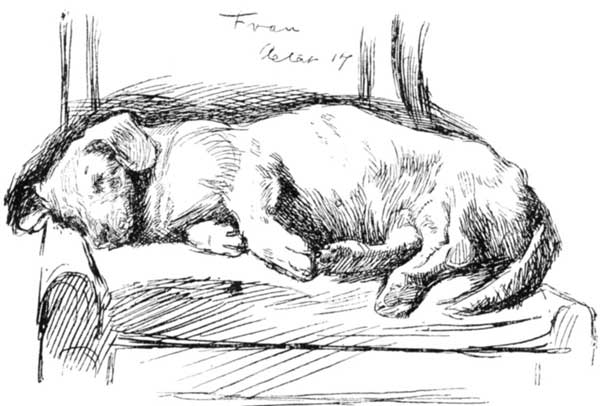 "FRAU," ALIAS "TOBY," LYING IN STATE.
Moreover, he would manufacture his own inks in varying degrees of greyness, and even of different colours, and then set them before the cutter (not the engraver, mind) to translate into black-and-white. Yet there are some who blame the craftsman for not reproducing what it was an absolute impossibility to reproduce by printer's ink and graver! But Keene was engrossed in his art; and I have seen a drawing, at Mr. Birket Foster's house at Witley, which was the seventh attempt he made before he was satisfied. This was the drawing entitled "Ahem!" representing a man kissing a girl, while someone, with the familiar inconsiderateness of humanity, is approaching. The background for this drawing is Mr. Foster's house.[Pg 489]
But although Keene was not a man of ideas, his merits as a creator—as a realiser of types—were supreme. Many of his dramatis personæ no doubt became old-fashioned in a sense; but who can deny the truth to life of the Kirk Elder, the slavey, the policeman, the fussy City man, the diner-out, the waiter (did he not invent "Robert"?), the cabman, the hen-pecked husband, the drunkard, the gillie, the Irish peasant, the schoolboy, and the Mrs. Brown of Arthur Sketchley's prosaic muse? The wealth of his limited fancy, and his power of resolving it into well-ordered design, and presenting it with strange economy of means, invested these puppets of his with a vividness which is often startling. With greater force and subtlety, if with less refinement and grace, than Leech—though not, like him, the genial sketcher of the genial side of things—he has recorded, in the five or six thousand designs that make up the sum of his contribution, the character of "the classes" of our day, and that with such intensity of truth that we derive our delight in his work even more from the faithfulness of its representation than from the fun of the joke and the comic rendering of the subject. One writer has been found who sees in his pictures nothing but degradation, and who condemns the one which shows a tippler who has returned late and thrown himself upon the bed beside his wife fully clad and with his umbrella open, as "obscene, and it is matched by many another equally odious!" But everybody else will endorse Sir Frederic Leighton's enthusiastic testimony that "among the documents for the study in future days of middle-class and of humble English life, none will be more weighty than the vivid sketches of this great humorist."[56] In praising Keene's "feeling of out-of-doorness," in the "Magazine of Art," Mr. William Black criticised truly when he declared, "Ever and again we come upon a bit of a turnip-field, a hedge-row, even the corner of a London street, the vividness of which is a sudden delight to the eyes." This estimate was well thrown into verse a few months later, when Punch in its bereavement sang the praises of its greatest artist:[Pg 490]—
Keene's simple, kind, and somewhat lonely life are too well known to call for recapitulation here—his tenderness and chivalry towards women, his unconventionality, his love of ancient pipes and virulent "dottle"-smoking, his quaint story-telling and singular modesty, his sensitiveness (he never would ask his nephew, Mr. Corbould, to sit as model to him again after a bantering inquiry of how much he was going to pay), his Conservatism, his humour, his gentle hobbies, and, lastly, his stern economy. Indeed, by his thrift, when he died, he was found to have accumulated over £30,000, chiefly out of his Punch work, in spite of the fact that he would never receive a salary: all this is accessible elsewhere. For some time before he died he ceased to draw for the paper, so broken was he; and it is worth noting that the last sketch that appeared from his hand was "'Arry on the Boulevards," in the Paris Number of Punch (1889), although he was not able to join the rest of the Staff in their trip to the Universal Exhibition.
He died on the 10th of January, 1891, and was buried in Hammersmith Cemetery, in the presence of most of his colleagues, who mourned their friend—
Charles Martin—a son of the distinguished painter of Biblical catastrophes, of boundless halls, and illimitable space, John Martin—made three drawings for Punch. "The[Pg 491] Bonnet-maker's Dream" was an effort to enlist sympathy for one class of women-workers; but his only fair illustrated joke was that in which a page-boy, pointing to the old torch-extinguishers in one of the London squares, informs his wondering companion that they are "what the swells in ancient days put their weeds out with." But as an artist he was lazy, preferring to make occasional nice little water-colour drawings than to work hard and continuously at black-and-white. He succeeded in making his way into society as a man-'bout-town, which he preferred to either; so that his connection with Punch began and ended with the year 1853.
An amateur signing "C" made an anonymous appearance in the same year; and Mr. Harry Hall, who was horse-painter first at Tattersall's, and afterwards at Newmarket, where he made Mark Lemon's acquaintance while painting a Derby Winner, contributed a single sketch. It is not remarkable, nor superior to his subsequent work as horse-draughtsman to the "Field"; but it proves, at least, that Mr. Sydney P. Hall's father could draw with ease.
It was in 1853 that the Reverend Edward Bradley[57] first contributed a drawing to Punch under his well-known pseudonym, but earlier than that he found admittance in its pages, with both picture and prose, under the signature, not of "Cuthbert Bede," but simply "E. B." The nom de plume under which he is best known he adapted from the names of the two patron saints of Durham, to which city he was much attached, and within whose boundaries he spent his 'Varsity career.
"Photography being a novelty in 1853," says he in his MS. reminiscences, to the transcript of which I have had access through the courtesy of his son, Mr. Cuthbert Bradley, "Mark Lemon readily accepted my proposal to introduce it into Punch," and accordingly, the first four[Pg 492] caricature illustrations of photography that appeared were in Punch, between May and August, 1853. One of these represented "The Portrait of an Eminent Photographer who has just succeeded in focussing a view to his Complete Satisfaction." He was depicted with his head under the hood, while a bull was charging him in the rear—a sketch that was pleasantly referred to by Charles Kingsley in his novel, "Two Years Ago."
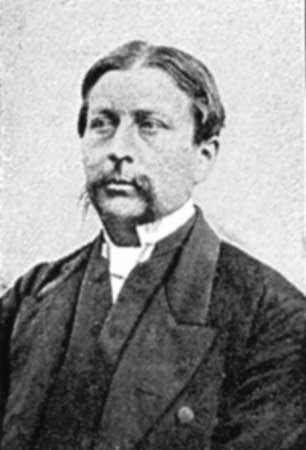 REV. EDWARD BRADLEY ("CUTHBERT BEDE").
To the encouragement of Mark Lemon, Cuthbert Bede owed a good deal, in respect to both pen and pencil, and in the warmth of his geniality the sketches for "Verdant Green" were made, and, says the author, more than forty of them were engraved for Punch's pages, to appear a page each week.[58] But circumstances caused Mark Lemon, with Cuthbert Bede's consent, to transfer them to a special Supplement at that time being prepared by Punch's Editor for the "Illustrated London News"—a journal which then enjoyed the co-operation of all the best pens and pencils more closely identified with the Sage of Fleet Street.
Then in 1850 the MS. of "Verdant Green" went the round of the publishers for issue in book-form, and not till after a year's tour was it accepted, and reluctantly enough issued, the publisher vowing that it would not pay its expenses. But within four-and-twenty hours he found out his mistake, and the announcement was made thirty years afterwards, that the sale of the book had amounted to upwards of 170,000 copies—while the author, from first to last, received the splendid sum of £350 for a work which must be reckoned among the great popular successes of the century.
When Douglas Jerrold was at Oxford, in November, 1854, Cuthbert Bede was presented to the sharp-tongued wit, the[Pg 493] introducer adding, by way of explanation, "Mr. Verdant Green." "At that time," says Bede, "I was closely shaven, and had a very pale face. Douglas Jerrold looked sharply up at me, with a glitter in his blue eyes, and at once said, 'Mr. Verdant Green? I should have thought it was Mr. Blanco White!'"—though, of course, there was no more real resemblance between Blanco White's face and that of the Rev. Bradley's, than there was between "Mr. Verdant Green" and "Doblado's Letters from Spain." "Among several things that were very agreeable to me in connection with the publication of 'Verdant Green,'" he continues, "was a circumstance that was related to me by an eminent Oxford don, who is now a bishop. He had entered the room of Dr. Pusey, at Christ Church, and saw, as usual, the library table covered with books of divinity and learned tomes; but on the top of these was perched, in pert, cock-sparrow fashion, that shilling railway book that had recently been published, with the spectacled face of the Oxford Freshman on the cover. My friend told me that Dr. Pusey held up the book to him and said, that he had not only read it through, but that he kept it on his table so that he might read bits of it in the pauses of his severer study."
One of Cuthbert Bede's proudest memories was the introduction of the double acrostic. He did not claim to have invented it, for he knew of the monkish acrostics; but for six months he had amused his friends with his revival before he showed them to Mark Lemon. The latter, with a quick eye for novelty, asked Bradley to write a paper on them for the "Illustrated London News," which was then being edited by Dr. Charles Mackay, and the humorist was only too happy to comply with the request. The first of these "double acrostic charades"—the first ever printed—appeared in the paper on August 30, 1856, and at intervals for some months afterwards; indeed, there was a regular column devoted to them, edited by Cuthbert Bede, that drew letters from all parts of the world, literally in thousands, which were forwarded to him in packets by rail. He had to explain their construction, and give examples for practice in the art.[Pg 494]
The first was "Charles Dickens—Pickwick Papers"; then followed "London—Thames," "Waterloo—Napoleon," "Scutari Hospital—Miss Nightingale," and then "Lemon—Punch." Here is how the last-named was treated:—
| I brighten even the brightest scene | (L am P) |
| I very nearly an ostrich had been | (E m U) |
| I with a hood once pass'd all my days | (M aria N) |
| I am a fop in a play of all plays | (O sri C) |
| To its greatness the city of Bath I did raise | (N as H) |
"When I read it to Mark Lemon," says Bede, in conclusion, "he said that Punch ought to be well flavoured, for that into its composition there went not one, but three lemons—Mark Lemon, Leman Rede, and Laman Blanchard."
Edward and his brother, Thomas Waldron Bradley, were sons of a surgeon of Kidderminster. When the former was quite a child, his delight in sketching was as remarkable as his keenness of observation, and he had a trick on arriving home, after seeing anything that interested him in the streets, of saying, "Give me a slate," and sketching the scene upon it with the utmost facility. It was this facility, joined to his lack of artistic education, which placed upon his work the unmistakable stamp of the amateur. But his sense of humour saved him, winning for him admittance to Punch's pages in 1847, when he was only twenty years of age. He had made his début the previous year in "Bentley's Miscellany," with some love verses signed with his usual pen-name. Five years later he was making suggestions for "The Month," and both he and his brother Walrond (whose pseudonym of "Shelsley Beauchamp" is hardly yet forgotten in his own county) wrote in it.[Pg 495]
His early MS. diaries record frequent receipts of small sums from Punch in return for small contributions. His first draft upon the Whitefriars exchequer was on October 23rd, 1847, when one guinea was received. By 1853 the receipts were a little more frequent, but still hardly noteworthy. Here, at any rate, is an example:—
| Photo subjects | £4 | 0 | 0 |
| Table-turning | 0 | 10 | 0 |
| Initial letter to Peterloo Brown, I. | 3 | 0 | 0 |
| Sidney Snub | 1 | 10 | 0 |
| Savage Lions in London | 1 | 0 | 0 |
| Sept. 14: 2nd and 3rd Peterloo Brown letters | 6 | 5 | 0 |
| Article "High Mettle Dragon". |
—while his earnings for the following year amount to £22 6s. for drawings and MS. After 1856 he contributed nothing more to Punch's pages, though a stray forgotten cut appears to have cropped up in the second volume for 1874.
George Cruikshank was a valuable friend to Cuthbert Bede, just as he was to Watts Phillips, and gave him a good deal of advice as to drawing on wood for Punch, as well as practical lessons in draughtsmanship, by working before him on his wonderful etching of the "Tail of a Comet;" still, he was unable to impart to his pupil's work either trained ease or style. Cruikshank was on terms of intimacy with Mark Lemon, but he never drew for Punch, save indirectly for its advertisement page in 1844—an announcement for his "Table-Book," in which appear the portraits of Gilbert Abbott à Beckett (his literary Editor), Thackeray, and himself. Yet the "Quarterly Review," in the course of an essay upon that journal, declared that "Punch owes at least half its popularity to the pencil of George Cruikshank"! The fact is, that Cruikshank, though on intimate terms with many of the Staff, would never allow himself to be persuaded to draw for its pages. "We shall have you yet," said Mark Lemon one day. "Never," said Cruikshank, in his most melodramatic tone and striking his favourite attitude. He had then become the staunchest of total abstainers,[Pg 496] and he held its very name in abhorrence. Moreover, he professed to look upon their Dinners as orgies; but it is far more likely that the predominance in its pages and in its councils of his mighty rival, John Leech, had more to do with his total abstinence—from Punch, I mean—than any other consideration. "Between Cruikshank and Leech," says Mr. Frith, "there existed little sympathy and less intimacy. The extravagant caricature that pervades so much of Cruikshank's work, and from which Leech was entirely free, blinded him a little to the great merit of Cruikshank's serious work. I was very intimate with 'Immortal George,' as he was familiarly called, and I was much surprised by the coolness with which he received my enthusiastic praise of Leech. 'Yes, yes,' said George, 'very clever. The new school, you see. Public always taken with novelty.'" Nevertheless, it must not be forgotten that the only lessons in etching Leech ever had he received from George Cruikshank. Moreover, George had a grievance, as will be seen by the following letter addressed to Mr. G. H. Haydon, one of Punch's subsequent contributors, to whom reference will be made later on:—
"My Dear Sir,
"I am sorry that I am not able to tell you where to find a 'Punch and Judy,' but I think some of that family reside, or might be heard of, in the vicinity of Leicester Square. The 'Punch' that I copied my figures from for the 'History of Punch and Judy' was an old Italian long since deceased. His performance and figures were first-rate—far superior to anything of the present day, and it is quite evident that poor Leech and others copied my Punch, for Punch and other works, from the Punch that I copied from this Italian Punch.
"Speaking of Punch, you are, I presume, aware that although the idea of 'Punch' was taken from my 'Omnibus,' that I never had anything to do with that work of 'Punch,' and also that for many years (20!!!) I have not taken anything in the way of Punch.
"However, I will say no more about Punch at present, as I fear you will feel as if you could 'punch' the head of
"Yours truly.
His grievance was that Punch's figure was stolen from his book (to which Payne Collier had written the text), and that the paper itself was but an imitation of his own short-lived monthly magazine. With greater reason could he complain that the Punch Pocket-books were copied from his "Comic Annuals," as they were, and that the imitations killed the originals after a contest of a dozen years; but the idea of Punch being copied from the "Omnibus," with which it had hardly a single point in common, save humour and illustration, has probably about as much foundation as Cruikshank's claim against Dickens and "Oliver Twist," or against Harrison Ainsworth and "The Miser's Daughter" and "The Tower of London." Yet Punch rendered ample tribute to his genius, not so much in the adaptation of many of his best-known drawings to cartoons, including "Jack Sheppard" (1841), "Oliver asking for More" (1844), "The Fix" [Points of Humour] (1844), "The Juggernaut" (1845), "Oliver Twist and the Artful Dodger" (1846), "The Deaf Postilion" (1846), and "Fagin in the Cell" (1848), "The Election" [Sketches by Boz] down to "Harcourt the Headsman" (June 8th, 1895); but also by deliberate statement and amiability prepense. That, however, did not prevent Punch from chaffing "the Great George" upon occasion, as when he was preparing his "Life of Falstaff" the journal gravely assumed that he would reform that incorrigible tippler into a "teetotal Falstaff," and protested against the enthusiast mixing water so copiously with the milk of his human kindness. So Cruikshank set off in great wrath towards Fleet Street to seek out the scoffer, and, meeting Blanchard Jerrold, sputtered out his purpose and declared that he was on the trail of that scoundrel Punch to "knock his old wooden head about." When he died, Punch[Pg 498] announced that "England is the poorer by what she can ill spare—a man of genius. Good, kind, genial, honest, and enthusiastic George Cruikshank ... has passed away."
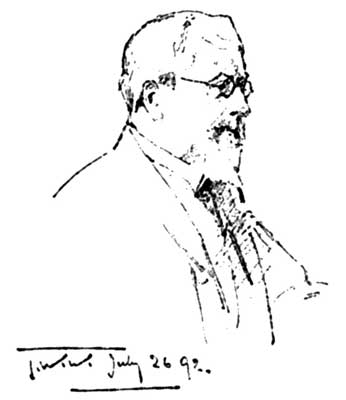 T. HARRINGTON WILSON
Mr. T. Harrington Wilson, the well-known special correspondent of the "Illustrated London News," at that time a specialist in theatrical portraiture, joined the paper as an occasional contributor in 1853, and over various monograms sent in a dozen clever, but hardly striking, drawings. These were "socials" dealing with society or fashion, stage situations from behind the scenes, and grotesque ideas, such as the "effect of wearing respirators on burglars" (October, 1853). Mr. Wilson—who, by the way, had studied at the National Gallery side by side with Sir John Tenniel and Charles Martin—contributed to the Pocket-books from 1854 to 1857, and ceased his connection when he was ordered abroad.
All the outside artistic help received by Punch in 1854 came from five occasional correspondents: from "F. M.," an amateur, in February; from Mr. Swain the engraver (who fitfully contributed unimportant sketches at times of sudden need), in the same month; from J. Bennett; from Chambers (a half-a-dozen initials extending over that and the following year, and reappearing in 1864;) and from Mr. Harrison Weir. The contribution of the latter occurred during Leech's indisposition, when Mr. Weir was invited by Mark Lemon to make a few drawings to fill the place which would be so sadly missed. So the artist—who was working under Lemon on the "Field"—produced a half-page drawing illustrative of the tribulation of young lady who was obliged to leave half her luggage behind by reason of the cab-strike; and it was printed on p. 163 of Vol. XXVII. Then Leech recovered, and Mr. Weir's services were dispensed with.
The second clergyman who ever drew for Punch was the Rev. W. F. Callaway, a Baptist minister of York and Birmingham, and the son of a gentleman who had distinguished himself by writing a book on "Cingalese Gods." He contributed one or two sketches, the first one being referred to in his MS. diary, February 15th, 1855—"Found[Pg 499] my Sketch in Punch—'Comment on the Balaclava Railway.'" It had been re-drawn in part by Leech, but the character of the original was left intact. Then three initials from Ince are to be chronicled; another from "W. R.," and a drawing signed "H.," from B. C. Halliday (p. 200, Vol. XXVIII), showing "Our Artist in the Crimea" in a hopeless mess; as well as a dozen initials of no particular importance from G. W. Terry (p. 171, Vol. XXX.) from 1856 to 1858.
Mr. J. Ashby-Sterry, so well and pleasantly known in later days as Punch's "Lazy Minstrel," and writer of verses and paragraphs innumerable in its pages, was from 1856 to 1861 an artistic contributor on fifteen occasions. "When I was a youth," he writes, "I fear I must have annoyed good, genial Mark Lemon very much, for I was continually sending pen-and-ink sketches to Punch. Not content with showering these upon him, which were invariably courteously returned, I began to pelt him with wood blocks. I took to drawing on the wood enthusiastically, and was continually popping these little parcels into the letter-box under the shadow of St. Bride's Church. At last one of them, to my intense joy, appeared. Altogether I must have had about four initial letters, a dozen black silhouettes, and a quarter-page social cut inserted in the paper. But the quantity that were never used at all, and the number that were re-drawn by my old friend Charles Keene, is a high testimony to the artistic knowledge and editorial skill of Mark Lemon." But Mr. Ashby-Sterry does himself an injustice, as all will say who have seen the vivacious sketch of a gentleman struggling violently inside his shirt, with the legend: "How agreeable it is, more especially if you are late, and are dressing against time to dine with ultra-punctual people—how agreeable it is, on getting into your clean shirt, to find the laundress has been careful to fasten all the buttons for you!" Moreover, he was trained as an artist, both at "the Langham" and at the Royal Academy Schools; and portraits painted by him of his father and grandfather have long since "toned" into canvases at once able and attractive.
A few sketches by Saunderson in this same year were[Pg 500] followed by the début of Alfred Thompson. When a cavalry officer, this gentleman, encouraged by the acceptance of his work by "Diogenes," in 1854, sent a few drawings—initials, for the most part—to Punch, that were published in 1856-7-8, and he was persuaded by Mark Lemon to take up the career of art. On retiring from the service, he studied in Paris, and contributed to the "Journal Amusant;" and on his return found that Mark Lemon was dead, and that, by the side of Keene and Tenniel, there had grown up a giant in the person of Mr. du Maurier. Under Tom Taylor's editorship he was a regular literary contributor, and was promised the next vacant place on the Staff; but an offer from Messrs. Agnew of the management of the Theatre Royal, Manchester, tempted him away from London and all journalistic enterprise. On his return to town, Mr. Burnand was on the point of becoming Editor, and the connection came to an end. And so Punch knew him no more, and Mr. Thompson appeared before a later generation chiefly as editor of the brilliant little "Mask," as designer of stage costumes and ballets, and writer of pantomimes. By some he was also remembered as a contributor, in 1865, to the "Comic News" and "The Arrow." His last Punch sketches were published in 1876 and 1877, and in the Pocket-book for the latter year was buried what was, perhaps, his most important literary contribution that is worth preserving—a continuation of "Daniel Deronda." The most that can be said of Mr. Thompson's sketches is that they are bright and not without fancy; but since these were made, his power and charm of grace greatly increased. He died in New Jersey, September, 1895.
Frank Bellew, whose signature consisted of a flattened triangle, either with or without his initials, drew about thirty initials and quarter- or half-page "socials" from 1857 until 1862, many of them dealing with incidents connected with the American Civil War; and then—following the example of Newman and Mr. Thompson—he went to America, where he obtained more recognition for his clever outline drawings and for the pathetic touches and moral points which he[Pg 501] loved to introduce; and there he begat a son whose reputation as a humorous draughtsman (being "Chip" of the New York "Life") soon became far greater than his father's. Bennet and "B. W." followed with a few trifles in 1857 and 1858, and then on October 13th Julian Portch sent in his first contribution.
Portch sprang from humble surroundings, and with no recommendations but his art; that, however, was sufficient for Mark Lemon. It is true that it lacked strength, but it showed a delicate pencil and a certain power of comic expression sufficient to place him among "Mr. Punch's clever young men" of the second rank. He was forthwith employed on decorations to the preface and to the Pocket-book (a task on which he was engaged for several consecutive years), as well as on Punch itself. He stopped active contribution in 1862, his work being seen only once in 1863, 1864, 1867, and 1870; but the last drawing he sent in was in October, 1861. He had illustrated "Uncle Tom's Cabin," a new edition of Boswell's "Life of Johnson," and, in part, Mr. Cholmondeley Pennell's "Puck on Pegasus," when in 1855 Henry Vizetelly, whose pupil he had been, sent him to the Crimea as war correspondent for the "Illustrated Times," in order to make sketches of British camp life. In the rigours of that awful winter he was laid low with rheumatic fever, ending in general paralysis; and after three years of lovingly tended illness he died in September, 1865.
An anonymous contributor, more than usually modest, then sent in three drawings (August, 1859) as from "A Stranger," and then the distinguished French caricaturist, "Cham" (the Comte Amédée de Noé), made six humorous and spirited character sketches of Turco soldiers in Paris in 1859, not very complimentary to his country's allies. When he had visited London previously, Mark Lemon had sent him a little parcel of wood-blocks for drawings for Punch, and was astonished to receive them all back the next morning, all covered with vigorous work, with a calm request for "more woods." He was, perhaps, a better raconteur than comic draughtsman, and, speaking English thoroughly well,[Pg 502] became at once a great favourite. Thackeray, in particular, delighted to do him honour in his rooms at Young Street. In the same year Brunton, a young artist far better known outside Punch's pages than in them, put his sign-manual of arrow-pierced hearts to a couple of drawings; and it is curious to observe how in his "Annamite Ambassadors" he forestalled Mr. Furniss's "Lika Joko" series.
Miss Coode was the first lady who drew for Punch, contributing nineteen drawings from November, 1859, to January, 1861; and then G. H. Haydon (barrister-at-law and steward of Bridewell and the Royal Bethlehem Hospital) began his connection. He was the intimate friend of John Leech, by whom he was introduced to Punch, and of Charles Keene, with whom he used to draw regularly at the Langham Sketching Club. During 1860-1-2 he contributed twenty-two sketches and initials. He was a keen fly-fisherman, and many of Leech's subjects of this sort were done with him at Whitchurch, Hampshire, which they haunted together for the sport. After Leech's death Haydon contributed nothing more, as it was only during his spare time and out of friendly feeling that he made his sketches. He was, on the other hand, the subject of several of Keene's angling drawings, which were also done for the most part at Whitchurch. Such is the sketch in the Almanac for 1885, wherein the "Gigantic Angler" is an excellent portrait of Haydon, while Leech's drawing of August 11th, 1860, was a record of an incident that happened while the friends were fishing the same water. From that extremely promising young artist, M. J. Lawless, who was doing some of his best designs for "Once a Week," there came between May, 1860, and the following January, six drawings; but he was already a dying man when they were done, and he left little proof in them of the greatness of his talent. He was still contributing, however, when, on September 28th, 1860, there was sent into the office a drawing from the hand of one of the most brilliant of Punch's lights—George du Maurier.[Pg 503]
Mr. G. du Maurier's First Drawing—The "Romantic Tenor"—Polite Satire—His Types and Creations—His Pretty Women—And Fair American—"Chang," "Don," and "Punch"—Mr. du Maurier as a Punch Writer—Mr. Gordon Thompson—Mr. Stacy Marks, R.A.—Paul Gray—Sir John Millais, Bart., R.A.—Mr. Fred Barnard—First Joke Refused as "Painful"—Mr. R. T. Pritchett—Initiation by Sir John Tenniel—Fritz Eltze—His Amiable Jocularity—Mr. A. R. Fairfield—Colonel Seccombe—Fred Walker, A.R.A.—Mr. J. Priestman Atkinson ("Dumb Crambo")—C. H. Bennett—Mr. W. S. Gilbert ("Bab")—His Classic Joke—G. B. Goddard—Miss Georgina Bowers—Mr. Walter Crane.
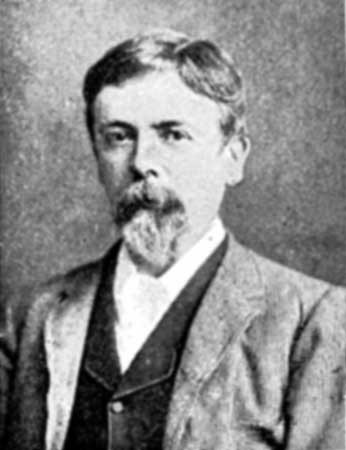 GEORGE DU MAURIER.
When, in 1860, Mr. George Louis Palmella Busson du Maurier contributed his first drawing to Punch, he had little suspicion that he would be counted, together with John Leech, John Tenniel, and Charles Keene, as one of the four great pillars on which would rest the artistic reputation of the paper. In that first drawing, himself and two of his friends were represented entering the "studio" of a photographer, smoking, as the manner of artists is; and they are coldly requested by the deity of the place to leave their tobacco outside, as "they are in an artist's studio" (p. 150, Vol. XXXIX.). It was a poor sketch enough, showing some straining after comicality, and lacking every trace of the grace and beauty the draughtsman was so soon to develop. He was Parisian born, and after studying with a view to a scientific career, he became convinced, through Dr. Williamson's amiable assurance that he would make a "shocking bad chemist," that art and not science was his[Pg 504] destiny—more especially as his professors had been delighted with such little caricatures of his as they had seen; but, as Mr. du Maurier suggestively put it in his lecture on "Social Pictorial Satire," "they had not seen them all." He studied art at Antwerp and Paris in company with several notabilities of the day; but when, through an accident in the laboratory, he lost the sight of one eye, and found the other seriously imperilled, his chances of success in life seemed small. It was when lying, during his long illness, in the Antwerp Hospital, in 1858, that he first saw "Punch's Almanac"—a delight which he never forgot. When he recovered his ordinary health, he returned to England, though with little improvement of sight to cheer him. With a courage, however, equal to that of Sir John Tenniel, he girded himself against fate; he worked hard in London, where he lived in humble lodgings at 85, Newman Street, which he shared with his life-long friend, the late Lionel Henley, afterwards R.B.A.—"the dearest fellow that ever was." He sometimes wondered, he has told me, if he would eat a dinner that day; and as becomes the impecunious, he was a tremendous democrat. He "hated the bloated aristocracy, without knowing much about it; and, to do it justice, the bloated aristocracy did not go out of its way to pester him with its attentions." But in those happy, hungry, hard-working days, when dinner was not always a vested interest, Mr. du Maurier seemed already tinged with the daintier tastes that were destined to lead his pencil to the delineation of these same "bloated" classes; and even in those hard times he could always boast a dress-suit.
So at the age of twenty-six—the same as that at which Charles Keene made his début in Punch—he sent in an occasional contribution that was far more in Leech's manner than in what came to be his own.
Art has a way, figuratively speaking, of flourishing on an empty stomach, and Mr. du Maurier made rapid progress on the training. Keene's acquaintance and genial friendship enslaved at once his artistic methods, as well as his artistic adoration. It was not that he admired Leech less, but that[Pg 505] he appreciated Keene more; and when the former died, to the sorrow and consternation of the Staff, Mr. du Maurier was appointed to his seat at the Table. He obeyed the summons on the first Wednesday that followed Leech's death, and carved his monogram on the board between those of the bosom friends, Thackeray and Leech. Mark Lemon, with characteristic shrewdness, soon discovered in what direction lay the talent and perhaps the penchant of the artist, and told him not to try to be "too funny," but to do the graceful side of things, and to be "the romantic tenor in Mr. Punch's opera bouffe company," while Keene was to do the comic songs. The little social dramas of the day, the drawing-rooms of Belgravia, and the nurseries of Mayfair—those were his preserves, from which he could get as much game as he chose, humorous if he liked, but graceful withal.
But Mr. du Maurier is emphatically not what is commonly understood by "a funny man," for all his subtlety and love of humour; he is a combination of the artistic, with a distinct and clear sense of beauty, and of the scientific, with speculations and theories of race and heredity—who would as lief draw East-End types for the sake of their "character," and would look at a queer face more for the interest that is in it than for its comicality. If Mr. du Maurier's sense of beauty is strong, so is his appreciation of ugliness; and if you take down any of the volumes of Punch—that shine in their shelves like the teeth in the great laughing mouth of Humour itself—you will find no faces or forms more hideous or grotesque than those which the artist has chosen to put there.
But if there is one thing to justify the opinion of his admirers that he is the "Thackeray of the pencil," it is primarily to be found, not so much in the keen satire of his drawing and legends, but in his startling, his strikingly truthful creations. Creations we have had from Leech, Keene, and others—from Leech's pure sense of fun and jollity; from Keene's unerring observation of men and women, and fleeting emotion—but those of Mr. du Maurier go deeper into vices, virtues, habits, and motives, and are at the root of his[Pg 506] pictorial commentaries. He has given us true pictures of the manners of his time; and those manners he has satirised with more politeness and irony, perhaps, than broad humour. He worked well with Keene in double harness, and his pictures are at once a foil and a complement of that genius's work and point de vue. He has satirised everything, and his art has been admirably adapted to the depth of the civilisation he probes and dissects. His sense of beauty and tenderness apart, he is to art much what Corney Grain was to the stage, though his hand is not so heavy; and while you laugh with Leech, you smile with Mr. du Maurier—lovingly at his children, respectfully at his pretty women, and sardonically at his social puppets.
His own particular creations—his types and "series"—are to some sections of Punch's admirers, Punch's chief attraction. Especially is this the case in the United States,[59] where to Mr. du Maurier many people have looked almost exclusively, not only for English fashions in male and female attire, and the dernière mode in social etiquette, but for the truest reflection of English life and character. First of all these types are Sir Gorgius Midas—who, the artist once confided to me, was drawn without exaggeration from real life—and his common wife and still vulgarer son. Then Mrs. Ponsonby de Tomkyns, the clever and scheming, and her husband, depressed and stolidly obedient; the bishop and the flunkey, all calves and dignity; Grigsby, the "comic" man, and his punctilious friend, Sir Pompey Bedell, inflated with pretentious emptiness; 'Arry and 'Arriet, blatant and irrepressible; young Cadby, the Cockney; and the Duke and Duchess of Stilton, whose very figures seem to be drawn in purple ink; the refined colonel, a counterpart and not unworthy comrade of Newcome himself; Maudle, Postlethwaite, and Mrs. Cimabue Brown, most delightful trio of sickening "æsthetes"—specially beloved of Mr. du Maurier, whose famous drawing, "Are You Intense?" is perhaps the particular favourite of all his satiric Punch work; Mr. Soapley and Mr. Todeson, who vie[Pg 507] with each other in vulgar servility and sycophancy; the Herr Professor, ponderously humorous in smoking-room or boudoir; and Anatole, the bridegroom, happy and dapper in the Bois de Boulogne; Titwillow and the ex-Jew at the Club—what an assemblage of carefully differentiated specimens of London's characteristic inhabitants! That many of them are often accepted, universally quoted as types, apart from any express reference to Punch or to its artist, is the best testimony of the truth of his irony; for they are as recognisable in the real world as the Jacques, the Becky Sharps, and the Pecksniffs of other brains. And besides these there are the general characters so accurately presented to us—the refined lady with the very old face and frontal grey or white curls whom Mr. du Maurier used to draw, I believe, from the person of Mrs. Hamilton Aädé; the charming young ladies for whom, in succession, his wife and daughters have sat; and the delightful little ones to whom Professor Ruskin paid partial tribute when he declared, a little cruelly, perhaps, that the "charm of his extremely intelligent, and often exquisitely pretty children, is dependent, for the greater part, on the dressing of their back hair and the fitting of their boots."
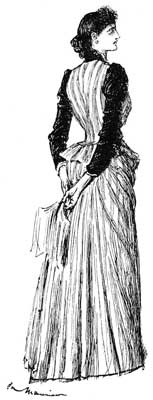 "MY PRETTY WOMAN."
The admirable setting in which Mr. du Maurier frames his series of jokes is testimony to his genius. He follows Leech's plan of such series ("Servantgalism," "The Rising Generation," etc.), but the quality of the thought and its presentation is as much more elaborate than Leech's as his method of draughtsmanship is more complicated. These series or formulæ, in their chief heads and subtle variations, display the quality of his mind. If you turn to the volumes for 1888 (XCIV. and XCV.) you will find examples of no fewer than nine of them: (1) Things one would rather have left unsaid; (2) Things one would rather have expressed differently; (3) Social Agonies; (4) Feline Amenities; (5) Our Imbeciles; (6) Typical Modern Developments; (7) Studies in Evolution; (8) Nincompoopiana; and (9) What our Artist has to put up with;—the last-named, however, a vein which Keene began to work as early as 1854.
His talent, too, in devising the legends, or "cackle," for[Pg 508] the drawings is uniformly happy, unsurpassed by any man who ever wrote for Punch. As Mr. Anstey says, he has brought the art of précis-writing to perfection. His legends are not always so concise as Leech's, but for truth of expression, felicitous colloquialism, and above all, for foreign accent, he is unapproached. I go farther, and say that he is the first man who ever put truthfully upon paper, and properly differentiated, the "broken English" and slangy mispronunciations of German, French, and Semite, to say nothing of his Cockney; indeed, his studies in this direction prove him, besides an admirable physiologist pour rire and a pungent though courteous satirist, an inimitable comparative-"broken"-philologist.
True to his rôle of "Romantic Tenor," Mr. du Maurier has endowed Punch with the greater part of the grace and beauty which have done so much to make the paper what it is. "In his social subjects," says a distinguished critic,[60] "Mr. du Maurier, though somewhat mannered and fond of a single type of face and figure, has carried the ironical genre, received by Leech from Gavarni and Charlet, to the highest point of elegance it has attained." He is too fond of the beautiful, sighs Mr. James; he sees everything en beau, and Mistress and Maid with him are a good deal of Juno and Hebe. No doubt his grace often militates against his fun, but Mr. du Maurier, as has already been suggested, is only by accident a professional funny man. Besides, when he wishes to be[Pg 509] merely funny, he passes Beauty by as if he were not the most devoted of her adorers, as you may see in one of the best of all his drawings in Punch, in which a typically selfish master of the house orders up the cook into the breakfast-room, complaining that he cannot eat the bacon which he has just served; his wife's, he says, is the worst he ever saw—and his own is nearly as bad!
Even more than his lovely child (often drawn from his little grandson), his superb youth, and his splendid gentleman, Mr. du Maurier's pretty woman is the pedestal upon which he has erected his reputation—at least, so far as Punch is concerned. His pretty woman, he declares, is the granddaughter of Leech's, and he beseeches the public to love her, paternally at least as he does, "for her grandmother's sake."
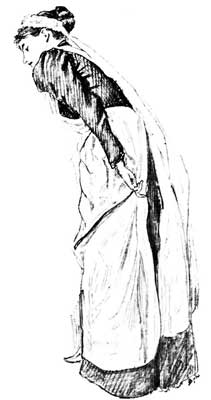 PENCIL STUDY FOR "PUNCH" PICTURE.
Writing his mind on the subject of his delightful creation at my own request,[61] he says:—
"I do hope the reader does not dislike her—that is, if he knows her. I am so fond of her myself, or, rather, so fond of what I want her to be. She is my pièce de résistance, and I have often heard her commended, and the praise of her has sounded sweet in mine ears, and gone straight to my heart, for she has become to me as a daughter. She is rather tall, I admit, and a trifle stiff; but English women are tall and stiff just now; and she is rather too serious; but that is only because I find it so difficult, with a mere stroke in black ink, to indicate the enchanting little curved lines that go from the nose to the mouth-[Pg 510]corners, causing the cheeks to make a smile—and without them the smile is incomplete—merely a grin. And as for height, I have often begun by drawing the dear creature little, and found that by one sweep of the pen (adding a few inches to the bottom of her skirt) I have improved her so much that it has been impossible to resist the temptation—the thing is so easy, and the result so satisfying and immediate."
Nowadays, he has declared, girls are no longer pretty—they are beautiful; and as Mr. Galton, the anthropometrical expert, himself admits, they, even more than the rest of mankind, have certainly grown taller. The artist, as we have seen, invented the tall woman; the Psyches of our fathers' days have become the Venuses and Junos of these; and more than one writer has gravely sought to fix the responsibility, or the credit, on Mr. du Maurier and his pencil. Scientific investigation has taught us that the English girl tops her foreign sisters, though her average weight is two pounds less than that of the fair American; and there is little doubt that if she does not absolutely adapt her height to the artist's sense of beauty and power of inspiration, she has at least to thank him for making it fashionable. The truth of the matter is that Mr. du Maurier has always been a close observer; and just as his drawings have always been in the fashion in point of dress through his careful watching of the changing wardrobe of his wife and daughters, so was he the first to record the increasing stature of English girls, even while Leech was still drawing them as he had known them—short and buxom and "plump little dumplings"—never recognising that they had been deposed by Fashion and improved by Nature. But the race changed, and Punch changed with them. Venus was Venus once more, and Mr. du Maurier was her Prophet.
"And the old ladies!" proceeds Mr. du Maurier; "it is such a pleasure to draw them, and do one's best. To think of all the charming old ladies one has known, and (according to one's letterpress) to select the chin of one, the white curls of another, the mouth and nose of a third, and then to make a subtle arrangement in sweet sympathetic wrinkles[Pg 511]—too often to be subtly disarranged by the engraver and the printer!
"Then we get to the male characters, and there it is comparatively plain sailing; and would be pleasant sailing enough but for the hideousness of certain portions of the modern male attire. However new, however good the tailor, however comely the leg beneath, the Trouser is the one heart-breaking object to the conscientious but æsthetically-minded draughtsman on wood! It ignores the knee, and falls on the boot in a shape that has no reference to the ankle whatever—a shape of its own—and yet the ankle is the foundation of everything!
"Next in order of demerit and impossibility comes the chimney-pot hat, which is not lacking in character, but is ugly and ridiculous. Its one redeeming feature is the difficulty it presents to the draughtsman. It is mathematical, geometrical, with every curve known to science, as hard to represent correctly as a boat or a fiddle—more so; and the delight of successful achievement is proportionately great. Linley Sambourne alone, who was originally trained as an engineer, has been able to grapple with the chimney-pot hat; Walker all but succeeded by the sheer force of his heaven-born genius."
But, in spite of all this beauty, surely his misrepresentation of that divinity—the American Girl—is beyond all hope of pardon, beyond contrition, beyond all penance. He does full justice to her refined and splendid loveliness and her magnificent proportions; but he seems to regard her, if one may say so, as a sort of Kensington-Town-Hall-Subscription-Dance young lady, a little more outrée and free and slangy and vulgar. She guesses in the ballroom that English partners don't "bunch" (give bouquets); when invited to go in to supper she avers, not without a sense of inward satisfaction, that she is "pretty crowded already;" she has a deep though entirely a tourist's interest in English institutions, ruins, and celebrities; she has little reverence else for what is in the heavens above or the earth beneath; and she dearly loves a lord—or she would, if by any honourable[Pg 512] means she can obtain the chance. His American girls, too, all come from one and the same place; they are all born from one and the same mother; their natural cleverness and unnatural ignorance are compounded in the same proportions, and, altogether, they are the most charming and delightful libels on American young-womanhood that well could be. But is his representation of the American girl any less pleasant than the common, home-made American view of an English gentleman—at least, of an English "swell"? Not at all. On the contrary, she is, as I said before, a divinity.
More than once Mr. du Maurier has broken away from his light comedy rôle and, besides giving vent to his fantastic power in his wonderful "Night-mares," has given us something with serious thought, and, now and again, with tragedy in it—has offered us, indeed, a taste of the deepest poetic quality that he has shown in his novels of "Peter Ibbetson" and "Trilby." You may see a touch of it in Tenniel's great cartoon at the outbreak of hostilities between France and Germany, in which the great Napoleon stands warningly in the path of the infatuated Emperor; that was du Maurier's suggestion. You may see a touch of it in the page drawing of "Old Nickotin Stealing Away the Brains of His Devotees" (1868), in which a circle of strange men, whose own heads are their pipe-bowls, smoke away their brains through long tubes that work well into the composition, while, in the foreground, one of the poor foolish wretches drops, just as a last little curling puff rises from his smoked-out skull. There were more of such compositions before 1880, at the time when Mr. du Maurier was still making full-page drawings in Punch. But, after all, it is not in Punch, but rather in the "Cornhill Magazine" and "Once a Week," in "Esmond," and other works—particularly in the "Illustrated Magazine"—that his full power in serious work must be sought.
Professor Ruskin, after declaring that the "terrific force" of Mr. du Maurier's satire of character in face and figure consists in the absence of caricature, describes as "cruelly[Pg 513] true" the design "representing the London mechanic with his family when Mr. Todeson is asked to amuse 'the dear creatures' at Lady Clara's garden tea;" and proclaims the artist more exemplary than either John Leech or John Tenniel ("the real founders of Punch, and by far the greatest of its illustrators both in force of art and range of thought") "in the precision of the use of his means, and the subtle boldness to which he has educated the interpreter of his design."[62] In point of fact, the engraver has had to "interpret" Mr. du Maurier's drawings far less than those of many of his colleagues, for his line is too delicate, sympathetic, and precise to leave room for anything but the strictest possible facsimile. This was quite as true in the old days when he drew upon the block, as in later times, when, yielding to the stern demands of failing eyesight—which, for a period, forced him to suspend work altogether—he drew with the pen upon paper several times larger than the ultimate reduction effected by means of photography. It is curious in tracing his hand through Punch to see how his work gradually strengthened; how his early vigour of subject and activity of mind, expressed in strong black-and-white, gave way to a daintier touch when the grace and prettiness of his dramatis personæ came to demand greater refinement of the drawn line; and how this again constantly widened out into a broader method, under the inspiration of Charles Keene. And yet from first to last, in the smallest sketch as in the most elaborate picture, his hand is unmistakable.
In common with Keene and others, Mr. du Maurier has suffered from time to time from printers' errors. One of the most curious, perhaps, is that in which three little boys are shown in a drawing playing upon a sofa, evidently very much in the way of their elder sister, who is receiving a visit from an admirer. The sister asks her brothers with pardonable point if they will not go and play downstairs. No, the oldest replies, Mamma has sent them up "to play forfeits." The joke, utterly pointless as printed, becomes[Pg 514] intelligible when it is explained that "forfeits" is an error for "propriety." Many of the artist's jokes, as already explained, have come from various friends; indeed, in this case, they are probably less often manufactured than in that of others. All the same, it may be of interest to record that the oft-quoted joke of the æsthetic young couple who agreed that they must "live up to" their blue and white tea-pot, was not "made up," but was spoken in downright, imbecile earnest.
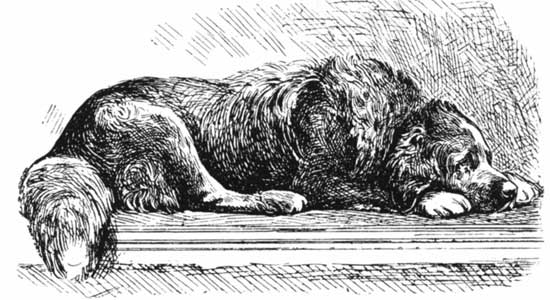 "CHANG."
Like Keene, too, Mr. du Maurier loved to put his own dogs into Punch. Whether it was his magnificent St. Bernard, "Chang," whose seven-foot skeleton now graces the Royal College of Surgeons, or his little terrier, "Don," or his dachshund, "Punch," they have all played their part in public and justified their existence as models, and have in their time been the pets as much of you and me as of their legal owner. But, for all his connoisseurship in dogs, Mr. du Maurier is woefully deficient in certain forms of sportsmanlike knowledge, and could he but have heard the howls in the cricket world a few years since when he ventured on depicting a "mixed match," and showed the wickets about[Pg 515] forty yards apart, he would almost have wished the excellent joke untold. Herein, of course, he was not more ignorant than his friend Keene, who had to be specially coached (yet with what disastrous results!) when he wished to present a picture involving the "placing" of the field.
 "DON."
Apart from his artistic services to Punch, Mr. du Maurier has been a contributor to its pages of verse and prose, comparable with some of the best that has appeared there. Who can forget his admirable nonsense-verses, his "Vers Nonsensiques à l'usage des Familles Anglaises," or his exquisite fooling in his "Shalott" poem, or his "Alphabet" verses, or his vers de société? They worthily heralded the novelist as we know him now, who is also the author of one of the most brilliant lectures—brimming over with happy thought and sparkling epigram—that have been composed in recent years. It is by his long, varied, and effective service that Mr. du Maurier has to be recognised as one of the four artists—Leech, Keene, and Tenniel being the others—who bore the chief share in raising Punch to his pinnacle, and he is to be named with Keene as a truthful recorder of the life and humours of Society during the last forty years of the nineteenth century. But if it is for this achievement, and for his delightful genius that he is primarily esteemed in Whitefriars and throughout the English-speaking world, it is for himself and his own good-humour that "Kiki"—as he is known to his intimates—has been regarded with affection and admiration by his colleagues during the long period of his honourable, dignified, and brilliant connection.
For the space of one-and-twenty years—a period which drew to a close in 1895—Mr. du Maurier has lived and worked in his house near Hampstead Heath, from which he has wrought so many backgrounds for his Punch pictures. Whitby, Scarborough, Boulogne, as well as Paris and London,[Pg 516] have oftentimes afforded him local colour; but you get to learn Hampstead as you look at his drawings better than any of the others, and to know his sanctum—his salon-studio. Its characteristic bits, its bow-window, its Late-Gothic fireplace, its window-seat, are all familiar. And here the artist's model has latterly been the draughtsman's more constant companion, for "the older I grow," says Mr. du Maurier, "the more careful, the more of a student I become." So, for every Punch drawing he now makes beautiful pencil studies which, in my opinion, are even more delightful and more dainty than the pen-and-ink pictures they assist in perfecting. Examples of these studies, accurately and simply drawn, are here reproduced, and they will be seen to reveal the draughtsman's graceful artistry more completely than any other work in his recognised medium.
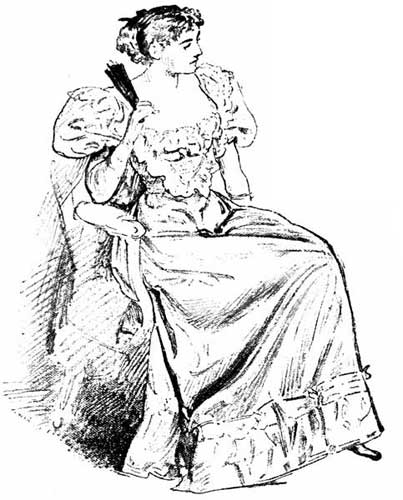 PENCIL STUDY FOR "PUNCH" PICTURE.
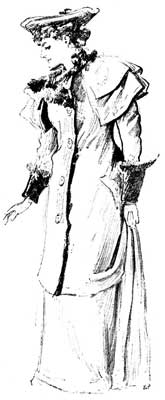 PENCIL STUDY FOR "PUNCH" PICTURE.
It was in the year following Mr. du Maurier's début that Mr. John Gordon Thompson began his short connection with Punch. He was a very young man, and these drawings were almost his earliest work. He was at that time studying for the Civil Service, and after his appointment to Somerset House he discontinued to a great extent his artistic efforts; but when he left the Service in 1870 he resumed the pencil, and became, and remained for twenty years without one week's break, the cartoonist of "Fun." His style was not[Pg 517] yet formed when he contributed to Punch, and his three-and-thirty socials, all published by 1864, gave little promise of the ability he afterwards displayed in the papers, magazines and books innumerable which he illustrated with such furious ardour.
Mr. H. Stacy Marks, R.A., also made his appearance in the paper in 1861, with a design for an architectural hat of Tudor-Gothic order, fitted with gargoyles round the brim for rainy weather. He also made an initial "I," and then was seen in Punch no more until the Almanac for 1882, when he made a full-page ornithological drawing of "Up before the Beak."
Paul Gray was another of Punch's promising contributors fated to an early death. He began with a few initials—a couple of "A's" were his first little feat, one of them made out of an old woman and a bathing machine. Then came "socials" up to 1865, which attracted attention for their grace, in spite of their lack of backbone; but after a variety of work, including drawings for the "Argosy" and illustrations for Kingsley's "Hereward," his pencil was laid down, and he was no more than twenty-five when he died.
Half-a-dozen sketches by Harris in 1863 were followed by Sir John Millais' first contribution—a mock-heroic illustration to Mr. Burnand's "Mokeanna" (p. 115, Vol. XLIV.). The distinguished artist repeated his unusual experience in the Almanac for 1865, when in a technically exquisite drawing he showed a couple of children in a studio assaulting the lay figure. There were other pictures by which Sir John figured indirectly in Punch. As one of the most[Pg 518] intimate friends of John Leech, he took the liveliest interest in his work. "Once," he informs me, "I forwarded two drawings to Leech from Scotland, and he traced them on to the wood and they appeared in Punch—one a tourist struggling against the wind in a plaid; the other, two artists sketching with veils on to escape the midges. Possibly they were the occasion of my attending the Dinner. Leech, I think, asked me to do a drawing for 'Mokeanna' and the drawing of the 'Children in the Studio.'"
About this time it is claimed that Miss Joanna Hill, the niece of Sir Rowland Hill, contributed some sketches on the convict question; but it is certain that nothing in her name was ever accepted.
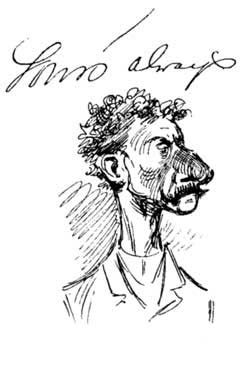 A LIBEL ON HIMSELF.
A far more interesting and amusing adherent was Mr. Fred Barnard, a humorist of the first rank; but as he was not yet seventeen years of age at the time it is not surprising that his drawings were greatly inferior to his admirable work of later years. His first joke was rejected, as he quaintly explains in the following note: "In 1863 I was a student (and in consequence fondly supposed to be studying) at Heatherley's School of Art in Newman Street, and was then half-past sixteen. I must have had plenty of assurance at that time, for, unknown to anyone, I sent a joke, accompanied by a pencil sketch, to Punch. It represented a brute of a dustman belabouring his horse's head with the butt-end of his whip. To him enters a fussy, benevolent-looking, and slightly sarcastic old gentleman, who remonstrates with him in these words: 'My good man, that isn't the way to treat your horse! You should poke it in his eye—poke it in his eye, man!' Mark Lemon returned it as, he said, 'the enclosed is rather too painful for Punch.' Encouraged by this repulse, I sent in another[Pg 519] joke and drawing, which were accepted. A small parcel arrived shortly afterwards containing a 'block' of wood. As I had never seen one before, and had no notion whatever as to the process of wood engraving, I didn't know what it was, or for what use. At the back, on its rough ribbed surface, was a mystic inscription which I interpreted into 'C. Bramitsi Struss,' but which a friend informed me was intended for '6, Bouverie Street,' and he showed me how to set to work. And so I did the drawing and some dozen others.... But I rather fancy I shine with more than usual brilliancy in religious periodicals—especially when the articles I have to illustrate are written by imbecile women or ministers of the Gospel—I find it so congenial and instructive." In three years Mr. Barnard was seen but fifteen times in all. Twenty years later, in 1884, he made a last appearance in a drawing which did not show him at his best (p. 303, Vol. LXXXIV.). This was entitled "Early Prejudice," in which a child, referring to the baby, suddenly exclaims, "Oh, mamma! when baby begins to talk, what a dreadful thing if we find out he's an Irishman!"—a joke, by the way, which in its main point was anticipated by Mr. du Maurier in 1876, in his drawing called "Waiting for the Verdict." Lastly there was a sketch called "Evening at Earls," which was sent in and engraved, but not used; and since that day Mr. Barnard abstained from further contribution.
In this same year a young lady named Miss Mansel (now Mrs. Bull) sent in a drawing of an incident which occurred at her uncle's place at Anglesey in Hampshire—the initials "R. M." on the buckets being those of Colonel Mansel. "My eyes!" says Cooper the groom, in effect, to a gentleman who has watched a lady dismount from her over-ridden animal; "to them ladies a 'oss is a 'oss, and he must go!" Leech slightly re-touched the drawing, adding pigeons in the foreground, and so forth, but, of course, did not add his initials. Curiously enough, this block was included among that artist's "Pictures of Life and Character" (p. 52, Series IV.). "I remember I was very proud," writes[Pg 520] the lady, "a few days after the drawing appeared, at hearing some officers in High Street, Portsmouth, quoting my sketch as a lady galloped up the road. I was only about seventeen then."
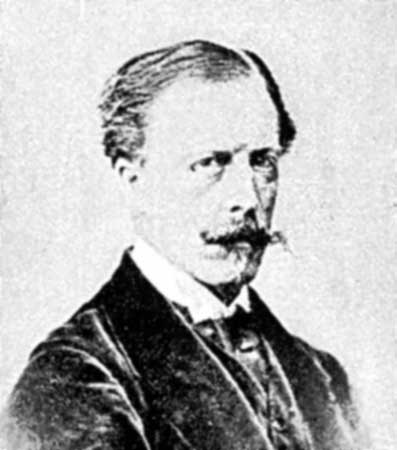 R. T. PRITCHETT.
After a single contribution (entitled "Clara") by that ill-fated genius, George Pinwell, Mr. R. T. Pritchett left his rifles for Punch's pages. He was in fact but a boy when he took charge of his father's gun factory at Enfield, and was still a lad when he conducted experiments in competition, with his own hand, for a new Government gun, introducing a bullet of his own conception, firing every shot, and triumphing over every competitor. So the "Enfield" or "Pritchett rifle" brought him fame; but it proved the stumbling-block of his artistic career, for he found out for himself the truth that a man known for one thing has little chance in any other field—particularly in the artistic field. He was glad, however, when the Government eventually decided to manufacture the gun themselves, and the House of Commons voted him £1,000—though the experiments had cost nearly three times as much—and he was enabled to take to art.
It was at a meeting of the Moray Minstrels, the delightful "Jermyn Band" promoted by Mr. Arthur Lewis—where every man was invited on his own merits and guests were excluded—that he met John Tenniel. John Forster was the leader, and there were often present John Leech, Dickens, Stanfield, Thackeray, Landseer, Tom Angell, Sir John Millais, Mr. Carl Haag, Mr. Frith, Mr. Marks, Charles Keene, Mr. Whistler, and Sir Arthur Sullivan; altogether a notable company. It was under Sir John Tenniel's hospitable roof that Mr. Pritchett was initiated into the mysteries of wood-drawing. He had been watching the Master drawing his cartoon, and was busy sketching the top of his amiable head, when its owner told him he would be much better occupied in drawing on the[Pg 521] wood, and threw him over a piece. Upon it Mr. Pritchett made a sketch, which Sir John took to Mr. Swain, and which afterwards appeared in one of A. K. H. B.'s works. By Mr. Swain the draughtsman was introduced to "Once a Week" and to Punch, and for the latter Mr. Pritchett began with some initials. His work appears from 1863 until 1869, some six-and-twenty amusing drawings in all, and when he ceased in order to take to painting, he drew for no other comic paper; for he had adopted the proud motto: "Aut Punch, aut nullus." He then took to travel, writing books and illustrating them by himself, and commended himself still further by the cruise he made and illustrated with Lady Brassey in The Sunbeam. Moreover, he has for many years drawn privately for the Queen, in recognition of which he received the Jubilee medal. A portrait of him, drawn by Charles Keene, may be seen in the Punch picture wherein a little girl asks her papa if she "may have the gentleman's moustache for a tail for her horse"—a portrait so good that by virtue of it he made the acquaintance of Mr. Sambourne years after, when the latter gentleman accosted him with the words "I know you by Keene's likeness of you in Punch!"
Then came Fritz Eltze, who was introduced to Punch on May 1st, 1864, and in due course took up some of the work let fall by Leech. He was a son of Sir Richard Mayne's confidential secretary, and most of what he knew of the life he drew was what he could see down Scotland Yard, or what he could remember of happy early days at Ramsgate. He was a confirmed invalid who had never enjoyed life like other children, and the consumption from which he died was already developing. He submitted a few sketches to Mark Lemon who, according to his custom, sent Mr. Swain to make inquiries, with a result that was the brightest spot in the artist's life. Although his work had the touch of the amateur about it, it had a curious charm; and rapid improvement followed. His humours of the fashions and follies of the day were greatly appreciated, especially as his work advanced to half-page "socials;" but[Pg 522] it was to his tender touches that his popularity was chiefly due, particularly in his treatment of child-life. The little one who—being told that they may not have mistletoe in church at Christmas—naively asks if "they must not love one another in church," and the other who, when playing at "horses" and one of the leaders falls, cries to its companion next in command to "sit on her head and cut the traces," are typical of his work in this direction. His last contribution (Mr. Punch à la Turc on a minaret) appeared in September, 1870, but a couple of drawings, in 1872 and 1875, were published "out of stock." Eltze, one of Punch's tall men, by the way, was a pleasing draughtsman whose work, in its curious absence of lining, had a striking appearance of originality in its practically broad outline.
Mr. A. R. Fairfield may be known by his sign-manual like a Sign of the Zodiac run wild. It is, however, merely an inverted "A" on the Greek character Φ with its stem elongated. He sprang from an artistic family, and after three months' training at South Kensington in 1857, he began to draw on wood for "Fun" at about the same time as Mr. W. S. Gilbert—the autumn of 1861. His connection with Punch was fortuitous. Being sent by Dr. James Macaulay, the editor of the "Leisure Hour," to Mr. Swain for some blocks on which to make his drawings for that magazine, he was smartly captured by the vigilant engraver for the "London Charivari." The result was many initials and drawings made to his own jokes; but his first contributions appeared in the special "Shakespeare Jubilee Number." His work appears often enough after that—four-and-twenty times in 1864 and 1865. They were at times amateurish in manner, but they had character and humour. It was Leech's death that practically put an end to Mr. Fairfield's connection with Punch, for Keene then came to reign supreme in the art department; but it did not matter much, as Mr. Fairfield, at that time a clerk at the Board of Trade—in which capacity only he ever came into contact with Tom Taylor, then Secretary of the Local Government Board—was given to understand that his career would be interfered[Pg 523] with if he prosecuted too far his outside work. In 1887 (p. 245, Vol. XC.) another sketch appears, comet-like, after an interval of more than twenty years.
Colonel Seccombe followed a few weeks after Mr. Fairfield's début. At that time he was a subaltern. His youthful military drawings—signed with a sketch of a cannon—were clever, and highly promising. His cuts appeared in 1864, 1866, and again in 1882—eight altogether. Foreign service interrupted the young draughtsman's artistic studies for a considerable period, but the result of his later labours is seen in the many works for children and others which he has since published.
At the same time came a bevy of draughtsmen, who added little to Punch's prestige—Dever, whose eight drawings are but caricatures, which none can see without being reminded of some of the grotesque types which later on were adopted by Mr. E. T. Reed in his earlier work; H. R. Robinson with two (though his work was not printed till two years later); Chambers with one; and Rogat with three; and then the year 1865 brought two or three contributors of interest and importance.
The first of these was Fred Walker, A.R.A., whose first drawing, printed in the "Almanac," shows a number of water-nymphs sea-bathing around Neptune—called "The New Bathing Company (Limited). Specimens of the Costumes to be worn by the Shareholders"—is graceful, and technically good, but not particularly remarkable, and is rather fanciful than funny. His second and last, "Captain Jinks of the Selfish and his Friends enjoying themselves on the River"—a more masterly sketch—was made in 1869 (p. 74, Vol. LVII.), in hot indignation at the selfishness and mischievousness of steam-launch skippers on the upper Thames. He had himself been an angry witness of the destruction of the river-banks by private steamboats, but had fairly boiled over at the sight of the very incident which he recorded in Punch—the outrageous, insolent indifference shown by the trippers to all on the river or its banks, save their own selfish selves. As a fisherman, Mr. Leslie, R.A., tells us, Walker looked upon the[Pg 524] steam-launcher as his natural enemy; and it was while the two friends were on the river together that the incident occurred, and the drawing was decided upon. "He was most fastidious about this work, rehearsing it many times before he was satisfied.... In rendering the distant landscape the work becomes entirely finished and tender. It is a beautiful little bit of Bray, with the church and poplars drawn direct from Nature; a bridge is introduced to prevent the scene being too easily recognised. On the opposite bank is a portrait of myself, with easel and picture upset by the steamer's swell.... I was told that three copies of Punch were sent to the steam-launch proprietor on the day of publication.... This clever bit of satire had no effect."
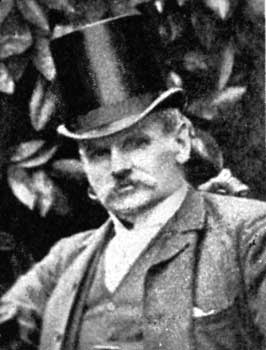 J. PRIESTMAN ATKINSON.
"Dumb Crambo, Junior"—Mr. J. Priestman Atkinson—is better remembered by Punch readers, perhaps, by his pencil-name than by his common cipher. In 1864 he was in the General Manager's office at Derby, pleasingly varying his clerical duties by drawing caricatures for the amusement of his fellow-clerks, and designing cartoons for the local satirical journal, the "Derby Ram," which appeared spasmodically and devoted itself principally to electioneering[Pg 525] purposes. One of his colleagues was Harry Lemon, Mark's son, who showed his father some of his friend's sketches. On the occasion of a subsequent visit paid by Mr. Atkinson to town, Mark Lemon invited him to dine at the Garrick Club (whither they drove in a hansom, much in the style shown in the sketch), and Shirley Brooks drank to him as "the future cartoonist of Punch." His first cut—an initial T—appeared on p. 15, Vol. XLVIII, and thenceforward Mr. Atkinson has been considered on the "outside Staff," with but two breaks: the first during an absence in Paris for artistic instruction, and the second from 1869 to 1876, when an opportunity occurred to make a "sure fortune" in commerce. The "sure fortune," as usually befalls, became a pecuniary loss, and the draughtsman gladly went back to the service of Punch and the other papers and books to which his pencil (under a different signature) has been devoted. It is years since Mr. Atkinson, who has latterly worked less for Punch than in the early days of his connection, was able to do himself full justice in a half-page drawing; but his "Dumb Crambo" series remain among the happy things which Punch has published in the direction of punning sketches. They remind one of those by Hine, Newman, and the rest, in the old "blackie" days, and are often little masterpieces of comic ingenuity—as may be seen in "Shooting over an Extensive Moor," where a man is discharging his weapon over the portly figure of a Moorish gentleman. Mr. Atkinson, in addition, made some two score literary contributions to the paper and "Pocket-book"—poems chiefly, and stories, not counting smaller trifles, between August, 1877, and the accession of Mr. Burnand to the Editorship. It was, I may add, at the suggestion of Mr. Burnand that Mr. Atkinson adopted his nom de crayon, just as he suggested Mr. Furniss's "Lika Joko."
One of the brightest and most talented draughtsmen Punch has ever had was Charles H. Bennett, the forerunner of Mr. Linley Sambourne. He had graduated in comic draughtsmanship, having been the life and soul of "Diogenes" (August, 1855), and rendered solid service to the "Comic Times" (1855),[Pg 526] and the "Comic News" (1863 to 1865), by which time his cipher of an owl, and then of a B in an owl's beak ("B in it" = Bennett), were known and appreciated. Apart from his Punch work, his "Bunyan's Pilgrim's Progress" was his masterpiece in serious art; while in the opposite direction his "Shadows" (which procured him for a time the public nickname of "Shadow Bennett"), as well as his amusing "Studies in Darwinesque Development" for Vizetelly's "Illustrated Times," and his second series, somewhat less satisfactory, of "Shadow and Substance," obtained for him great popularity. But when he came on Punch, introduced to Mark Lemon by Hain Friswell, he was within two years of his death. His début was on February 11th, 1865, with a sketch of "Our Play Box," in which "Mr. Punch's delight at finding his Dear Old Puppets where he left them in July" shows that the artist had already begun those illustrations to the "Essence of Parliament" which form the backbone of his Punch work. Occasional pictures there are, unconventional in shape, grotesque, ingenious, graceful in fancy, that delight us while, as a rule, they successfully conceal any lack of early artistic education; but the Parliamentary drawings are those by which Bennett will be best remembered. Between the date[Pg 527] of his first sketch, when he was forthwith summoned to the Table without serving any probationary period, to that last sketch in the spring of 1867, showing Lord John Russell as a cock crowing upon the 1832 Easter egg (p. 116, Vol. LII.), he had made over 230 drawings for the paper, besides his contributions to the Pocket-books of 1866 and 1867. He had already established himself, despite repeated absences through ill-health, one of the greatest favourites in Punch's company; and the comic letter addressed to him by his colleagues during one of his illnesses is printed in the chapter on the "Punch Dinner." Indeed, he had not time to cut his cipher on the Table; the H is begun and abandoned. "As for dear Bennett," Mr. Frederic Shields tells me, "every link that attached me to him has so long since been severed, that to attempt to find the lost end of the thread is hopeless. Nothing remains but the sweet odour of his memory—like a faded rose-leaf turned up in a long-closed drawer." But Mr. Sala declares that he had been, "socially, the most miserable of mankind. He was sober, industrious, and upright, and scarcely a Bohemian; but throughout his short life he was 'Murad the Unlucky.' At one time he occupied shabby chambers in the now defunct Lyon's Inn, Strand; and it was the poor fellow's fate to have a child born—a child that died—the sack from his employers, and the brokers in, all in the same day." Still, Bennett, who was one of the original founders of the Savage Club, was cheerful enough, and of a singularly lovable disposition—as may almost be gathered from his pictures in Punch, in which the shadow of none of his former troubles is ever reflected: nothing but his "facile execution and singular subtlety of fancy." Indeed, "Cheerful Charley," as he was known to his intimates, became, as he himself declared, one of the luckiest and happiest of men—fully appreciated for his art and his own delightful qualities by troops of admiring friends. It was his extraordinary power of realising an abstract thought and crystallising it at once into a happy pictorial fancy that set him on a pedestal, a poet among his colleagues—those colleagues who, when he died, lamented "the loss of a comrade of invaluable skill,[Pg 528] and the death of one of the kindliest and gentlest of our associates, the power of whose hand was equalled by the goodness of his heart."
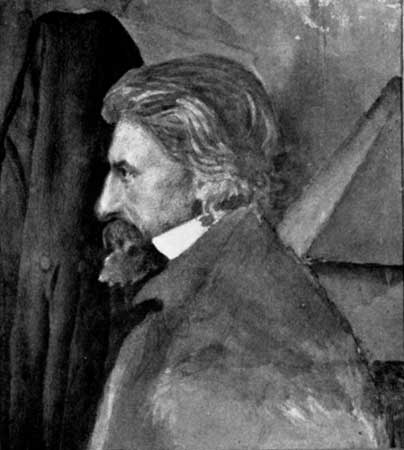 CHARLES H. BENNETT.
But Bennett left his family in sad straits, and, on Shirley Brooks's initiative, the "Punch men" at once set about devising a means to help them. The result was the theatrical performance referred to on pp. 132-134. The Moray Minstrels wound up this famous entertainment, and Shirley Brooks delivered a touching address of his own writing.
Besides T. W. Woods (who made four drawings), Prehn (two), Lowe (six), and Hays (three), Mr. W. S. Gilbert swelled the list of contributors in this same year (1865). His work, consisting of fifteen small cuts signed with the now familiar "Bab," and designed to illustrate the rhymes they accompany, was lost to Punch by the indisposition for compromise displayed by contributor and Editor alike. "I sent three or four drawings," Mr. Gilbert informs me, "and half-a dozen short articles; but I was told by Mark Lemon, or rather a message reached me from him, that he would insert nothing more of mine unless I left 'Fun,' with which I was connected. This I declined to do unless he would take me on the regular staff of Punch. This he declined to do, and so the matter ended. I had previously offered 'The Yarn of the Nancy Bell' (the first of the Bab Ballads) to Punch, but Mark Lemon declined it on the ground that it was 'too cannibalistic for his readers.'" So Mr. Gilbert knew Punch no more; and it is commonly related that he enjoys nothing more than an occasional good-humoured fling at the journal which could not see his worth. "I say, Burnand," he has many times been reported to have said at the Garrick Club and elsewhere, when the Editor had referred to the heavy post-bag delivered each day at the office, though witticisms found among the wilderness of suggestions were desperately few, "do you never get anything good?" "Oh, sometimes—occasionally." "Then," drawled the other, "why don't you ever put one of them in?"
"A Hot Chestnut" (p. 143, Vol. XLIX.) was the first contribution of G. B. Goddard, well known a little later on[Pg 529] as Bouverie Goddard, the animal-painter. Oil-colour was in truth his medium; but his drawings were good, and Punch for a couple of years rejoiced in his new hunting draughtsman. Goddard was a great friend of Charles Keene, with whom he shared for a time a studio in Baker Street; but feeling that he must paint pictures rather than draw upon the wood-block, he left the paper, after placing to his credit fourteen drawings—of which some were adjudged to contain the best horses seen in its pages since the death of Leech.
 MRS. BOWERS-EDWARDS.
By far the most important lady artist who ever worked for Punch was Miss Georgina Bowers (for some years now Mrs. Bowers-Edwards).[63] It is not usual, as I have remarked before, to find a woman a professional humorist, though a colonial Punch is edited by a lady; but it is, I believe, an undoubted fact, that up to this year of grace no female caricaturist has yet appeared before man's vision. But Miss Bowers was a humorist, with very clear and happy notions as to what fun should be, and how it should be transferred to a picture. Her long career began in 1866, and thenceforward, working with undiminished energy, she executed hundreds of initials and vignettes as well as "socials," devoting herself in chief part to hunting and flirting subjects. She was a facile designer, but her manner was chronically weak. It was John Leech who set her on the track; Mark Lemon, to whom she took her drawings, encouraged her, and with help from Mr. Swain she progressed.
"My first published drawing," Miss Bowers tells me, "was a dreadful thing of a girl urging a muff of a man to give her a lead at a brook. My 'jokes' all came from[Pg 530] incidents I saw out hunting, and from my own varied adventures with horse and hound; but occasionally a suggestion sent to the Editor was transferred to me to be put into shape. Then some one else wrote up to them. When I first hunted in Hertfordshire, I had great opportunities for provincial sporting studies. I feel now that some of my subjects were too personal, and wonder how many people forgave me. I often overheard stories about myself in the hunting-field (where I had hard times with ladies occasionally). When Shirley Brooks died, I felt I had lost my best and most helpful friend; and then Mr. Tom Taylor cared nothing for sport or sporting subjects, so that I felt that my work was uncongenial to him, and I got on badly and lost all interest in it, and gave up, after having drawn ten years for the paper, to which I shall never again contribute."
Mr. Walter Crane, of all people in the world, appears on p. 33 of Vol. LI. The cut is hardly funny, except in idea—it represents a chignon-show—nor is it as well drawn as much of the work he was doing at the time; he had not yet hit upon the style or subject that he afterwards made his own. A couple of sketches by O. Harling, an amateur, conclude the list for the year.
The year 1867 is famous in Punch's calendar for the acquisition of Mr. Linley Sambourne; but an earlier arrival was Mr. Frederic Shields. Mr. Swain suggested that he should "do a letter or two"; Mr. Shields did three, including a "social" ("Want your door swep', marm?"), and a girl curling her hair with the fender-tongs. The initials were kept over until 1870; and this constituted the sum of Mr. Shields' artistic adventure into the domain of humour.[Pg 531]
Mr. Linley Sambourne—Mechanical Engineering Loses a Decorative Designer—Mr. Sambourne's Work—His Photographs—And Enterprise—Strasynski—Mr. Wilfrid Lawson—Mr. E. J. Ellis—Mr. Ernest Griset—Mr. A. Chasemore—Mr. Walter Browne—Mr. Briton Riviere, R.A.—An Undergraduate Humorist—A Punch Initial Converted into an Academy Picture—Mrs. Jopling-Rowe—Mr. Wallis Mackay—Mr. J. Sands, Artist, Traveller, and Hermit—Mr. W. Ralston—Mr. A. Chantrey Corbould—Charles Keene's Advice—Randolph Caldecott—Major-General Robley—R. B. Wallace—Colonel Ward Bennitt—Mr. Montagu Blatchford—Mr. Harry Furniss—Origin of Mr. Gladstone's Collars—A Favourite Ruse—How It's Done—Mr. Furniss and the Irish Members—The Lobby Incident—Clever Retaliation—Mr. Furniss's Withdrawal—Mr. Lillie—Mr. Storey, A.R.A.—Mr. Alfred Bryan.
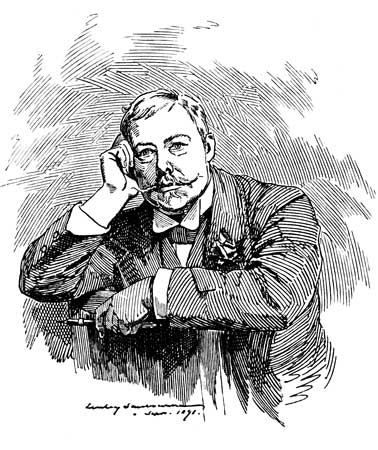 LINLEY SAMBOURNE.
One day when Mr. Linley Sambourne made a successful appearance as Admiral Van Tromp at a fancy-dress ball, Mr. W S. Gilbert drily observed, "One Dutch of Sambourne makes the whole world grin!" The jest was wider in its application than he who made it, probably, had intended. The humour of the artist, his quaintness of fancy, wit, and touch, are appreciated by whoever looks for something more, even in a professedly comic design, than that which is at first and[Pg 532] immediately obvious. When, early in 1867, Mark Lemon fell into admiration of a little drawing that was luckily thrust into his hand, and declared that the young draughtsman who wrought it had a great future before him, he proved himself possessed of a faculty of critical insight, or of an easy-going artistic conscience, uncommon even among editors. Few who saw Mr. Linley Sambourne's early work, even throughout the first two or three years of his practice, would have imagined that behind those woodcuts, for all their cleverness, there lay power and even genius, or that the man himself would soon come to be regarded as one of the greatest masters of pure line of his time.
At that time Mr. Sambourne had been working in the engineering draughtsmen's office of Messrs. Penn and Sons, of Greenwich. But the work was not congenial; the "pupil" spent most of his time in sketching, and there is a story—doubtless as apocryphal as it is malicious—that in one of his designs for a steam-engine, he sacrificed so much to "effect" as to carry his steam-pipe through the spokes of the fly-wheel. It was his office companion in misfortune, Mr. Alfred Reed, who secured his friend's release from the thraldom of the iron-bound profession, by seizing the sketch already alluded to and showing it to his father, German Reed. By that gentleman it was submitted to his friend Mark Lemon, who had about that time been writing an "entertainment" for the company at the "Gallery of Illustrations." The result was an editorial summons to the sketcher, and an engagement which has lasted to the present day. Thus it was that, with a sketch of John Bright tilting at a quintain under the title of "Pros and Cons," Mr. Sambourne found himself, at the age of twenty-two, a regular contributor to Punch—though he had still to wait until 1871 before he was rewarded with a seat at the Table.
Of artistic education he had had practically none. In the engineering drawing-office he had learned how to handle the pen and to put it to uses which have become a feature of his draughtsmanship. But besides a life-school attendance extending over not more than a fortnight, he had no other[Pg 533] teachers than his own eyes and his own intelligence. In his earliest work with the pencil there was a curious use of the point. Suddenly he was called upon, through the unexpected absence of Charles Keene from town, for more important work than that with which he had hitherto been entrusted. This was the half-page head-piece and the tail-piece to the preface to Vol. LIII. Then came promotion to the "small socials" and "half-page socials." Some of the work he did fairly well, founding himself now upon Leech, now upon Keene; but his character and originality were too powerful to follow any man. He began to form a style of his own, and that style did not lend itself to the representation of modern life. It was suited better for decoration than for movement; while the beauty of line and of silhouette which he sought and obtained, in spite of his intense, almost aggressive, individuality, placed him absolutely apart from all the black-and-white artists of the day.
It was, I have said, to the example of his predecessor, Charles H. Bennett, who died in April, 1867 (the very month in which Sambourne's first drawing appeared), that we owe those wonderful initial letters to the "Essence of Parliament" of Shirley Brooks—those intricate drawings which, covering nearly a whole page, were such miracles of invention, of fancy, and of allusion, swarming with figures, overflowing with suggestion, teeming with subtle symbolism. But these things did not come at once. It was not until the "comic cut" idea was put entirely on one side and his imagination allowed full play, that Mr. Sambourne fully developed his powers—his strength of conception, design, and execution. And then it was that he revealed the fact that though a humorist—and invariably, too, a good-humorist—by necessity, he is a classic by feeling.
The artist's personality, as it should, impresses us first, powerfully and irresistibly. While under Mark Lemon, Mr. Sambourne, as an artist, was still unformed. Under Shirley Brooks was awakened his wonderful inventive faculty. Under the régime of masterly inactivity—the happy policy of laissez faire—of Tom Taylor, the talent had burst forth into[Pg 534] luxuriance, not to say exuberance. And under Mr. Burnand it was schooled and restrained within severer limits.
It was many years before regular political cartooning[64] fell to his lot. He illustrated several of Mr. Burnand's serials in Punch, and some of his work out of it. But afterwards he rose to the treatment of actuality. Upon the event of the hour his picture is formed, and each week his work must be forthcoming. There can be no question of failure, no dallying with the subject, however elaborate or unpromising it may appear. A decision must be come to, and that rapidly; and there the artist sits, his watch hung up before him, "one eye on the dial and the other on the drawing-paper," knowing that at the appointed hour the work must be ready for the messenger. Thus the majority of his four thousand designs have been greatly hurried—hurried in thought as well as in execution. Many have been wrought in a single day; the great majority within two days; very few, indeed, have taken more. But when he has the time he wants, what amazing results are achieved! Sir John Tenniel once exclaimed to me: "What extraordinary improvement there is in Sambourne's work! Although a little hard and mechanical, it is of absolutely inexhaustible ingenuity and firmness of touch. His diploma for the Fisheries Exhibition almost gave me a headache to look at it—so full, cram-full of suggestion, yet leaving nothing to the imagination, so perfectly and completely drawn, with a certainty of touch which baffles me to understand how he does it."
For the rest, Mr. Sambourne's method, like his work, is unique. Keen of observation though he is, his memory for detail is not to be compared to that of Sir John Tenniel; and, actuated by that desire for accuracy which he holds desirable in a journal specially devoted to topical allusion, he avails himself extensively of the use of photography. In the cabinets in his studio, filled full of drawers, each labelled according to their contents, over ten thousand photographs are classified: every celebrity of the day, and to a certain[Pg 535] extent of the past, British and foreign, at various ages, in various costumes, and in various attitudes; representatives of the Church, the Bench, and the Bar; of Science, Art, Literature, and the Stage; the beasts and birds and insects in and out of the Zoological Gardens; figures by the score, nude and draped; costumes of all ages and every country; soldiers, sailors, and the uniforms of every army and navy; land and sea and sky; boating and botany, nuns and clowns, hospital-nurses, musical instruments, and rifles, locomotives, wheel-barrows, shop-windows, and everything else besides—everything, in short, as he himself declared, "from a weasel to a Welshman"—all are photographed mostly by himself, and all are arranged by himself, in readiness against the demand for accuracy and the exigencies of haste. But when time permits, Mr. Sambourne goes to greater trouble still. Does he require a special uniform? he begs the War Office—not unsuccessfully—to lend him one or two men, or even a detachment; does he want to represent Mr. Gladstone—say, as Wellington (as he did November 2nd, 1889)? he procures the loan of the duke's own raiment, and only stops short at borrowing Mr. Gladstone himself. For his types, too, he takes pains not less thorough. For Britannia's helmet, he made working drawings of the unique Greek piece in the British Museum, and from that had a replica constructed—one of the most notable items in a notable "property" room.
At the back of his house is a paved courtyard, wherein his servant poses as every character under the sun while he is photographed by his master, who then runs inside to develop the plate and make a dash at his drawing. Or he will photograph himself, or the model in the desired attitude; or he will get his friends to pose. Among his sitters there is none more useful than the burly man who serves equally well for "Policeman A 1" or John Bull, for the Duke of Cambridge or Prince Bismarck. It was he who sat for one of the finest of Mr. Sambourne's "junior cartoons" on the occasion when the great ex-Chancellor had said: "I am like the traveller lost in the snow, who begins to get stiff while the snow-flakes[Pg 536] cover him." This picture of the aged and forlorn statesman, accompanied only by his faithful hound, is perhaps the best of the artist's achievements of dignity and pathos—worthy of being named with "Dropping the Pilot" of Sir John Tenniel. His passion for realism is so great that, I remember, when he was engaged on his "Mahogany Tree" for the Jubilee number of Punch—one of the most popular drawings he ever made—he had just such a table duly laid for dinner in the courtyard, with one person sitting at it in order to show the proportion, and photographed it from a window of the house at the necessary elevation.[65] But for his love of accuracy he would not have done these things; nor, but for his love of naturalism, could he have given us his numerous fine studies of Nature. And but for this, Mr. Punch would never have printed one or two of his Norwegian sketches, such as "The Church-going Bell," in which there was not the slightest attempt at humour or fun—nothing but a calm and reposeful love of Nature, the deep, sad impression on the mind and heart of the artist as he watches the northern sun dip in sleepy majesty behind the panting waves.
Like Rabelais, he can use the pencil to greater ends under cover of the motley, and encase bitter truths with the gilt of a printed jest. Like Giotto and his legendary feat, he can draw you a perfect circle with his pen—and perhaps he is the only man in the country who can do it. His is the rare gift that in him sense of fun, of dignity, and of art is equal. He will brook nothing more serious in his sallies than chaff and banter; and yet his kindly art, based upon Nature and observation of the work of others, has,[Pg 537] by its very truth, made him enemies even on foreign thrones. Nevertheless, it is less as a politician and a satirist that he claims recognition; it is primarily as an artist that he will assuredly be remembered when his place among his countrymen has to be determined.
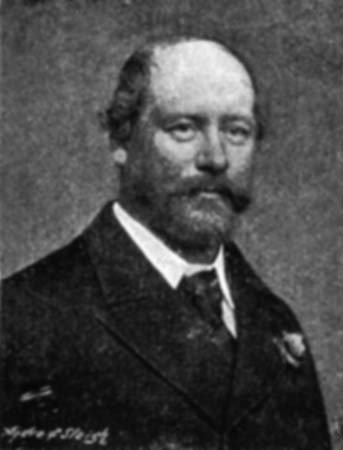 ERNEST GRISET.
A Polish artist, with Mr. Sambourne's initials, L. Strasynski by name, also began in 1867, and during that and the following year contributed nine cuts, very foreign in feeling and firm in touch. Then, after an anonymous draughtsman, "M.S.R.," had appeared with a single cut ("Candles"), Mr. F. Wilfrid Lawson, the elder brother and teacher of Cecil Lawson, contributed a sheetful of initials and vignettes which dribbled forth in the paper up to 1876; and Mr. T. Walters, a half-a-dozen, up to 1875. Mr. E. J. Ellis, now better known in other fields than comic draughtsmanship, began on December 12th, 1867. He had received an introduction to Mark Lemon through Mr. (now Sir) Algernon Borthwick, and found the Editor "good-natured enough," as he himself says, "to allow me to do a dozen or so of initials, and a quarter-page illustration. They were all more or less pinched and painful things, and Mr. Lemon did not conceal from me that 'he was not knocked over by them.' But they were drawn on the block—not on paper—and from the strangeness and discomfort of it came the tight-elbowed style of the work. Of what I did altogether, only about a third were printed; half were paid for; but what they paid for they did not print, and what they printed they did not pay for." At that time Mr. Ellis caught the fever of decorative art, classic and romantic, which culminated in the "interpreted" edition of Blake's "Prophetic Books," in collaboration with Mr. Yeats; and Punch lost a promising recruit.
The experience of Mr. Ernest Griset, who is first seen on p. 61 of Vol. LIV., was more extensive but less gratifying. He excelled at comic animals—his human figures are most of them of one ragged type—but on Bennett's sudden disappearance he was quickly encouraged to take up the dead man's work, and was enabled to show in many of his three-and-[Pg 538]sixty drawings of that year the full range of his talent, his remarkable invention and ingenuity. Mr. Griset, though born in Boulogne, was educated in England, and after studying art under Gallait, intended to follow water-colour painting, taking subjects by preference of a Glacial Prehistoric kind. But the foundation of "Fun" gave him the opportunity of comic draughtsmanship, and the work he did for the paper brought him Mark Lemon's invitation to call upon him. A cordial reception and a flattering tribute to his ability were followed by an understanding of regular employment, and the young draughtsman became a Punch artist unattached. But he did not remain long in favour. His work, perhaps, was not highly popular, and Mark Lemon perceptibly cooled towards him. So, finding he was no longer wanted, Mr. Griset, who was then no more than twenty-four years of age, retired, and consoled himself in other directions—notably by illustrating "Æsop's Fables," which had attracted Bennett and Sir John Tenniel before him.
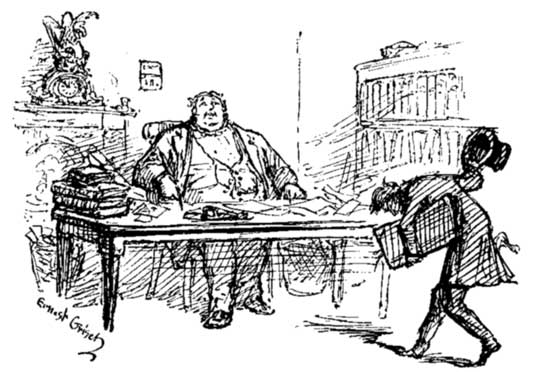 MR. ERNEST GRISET OBEYS THE EDITOR'S SUMMONS.
At the end of the index to Vol. LIII. is a little tail-piece that marks the advent of Mr. A. Chasemore. This draughtsman was welcomed by Mark Lemon with the words: "You may try your hand at a large drawing, but let it be broad fun. We don't want any more ladies and pretty children." That was in 1868—yet ladies and pretty children do not[Pg 539] even now seem to have lost their popularity! The original drawing was not a success, and had to be touched up by Keene. It is mentioned here as affording another good example of the careful way in which sketches are adapted. The subject was a recruit joining a volunteer corps. The adjutant inquires: "What company would you wish to be in?" to which the recruit replies: "Oh, gentleman's co'pany, of course!" The recruit was left untouched, but the adjutant was re-drawn by Keene. "I'm afraid there's not much humour in the idea," wrote the artist with quaint modesty; "still, I hope it's good enough for Punch!" Up to 1875 Mr. Chasemore contributed thirty-three drawings, and in addition there was a belated one in 1879; and then he passed over to "Judy," to which paper he thereafter devoted himself.
The last recruit of the year was "Phiz'" young son, Walter Browne, who, through his father's influence with Mark Lemon, was allowed to contribute a few drawings, the first of which appeared on p. 148, Vol. LV., and the last on November 20th, 1875. He was hardly out of his studentship at the time—he was a pupil of Bonnat—and his work was "young;" but he might have risen on Punch had he not allowed himself to be tempted away by a delusive offer of Tom Hood's of constant work on "Fun," so that he closed the door in his own face, and had thenceforward to look to news-drawing and book-illustration for advancement.
Mr. Briton Riviere, R.A., appeared in the month of January, 1868. Few who have followed his career as painter would detect in him the inveterate humorist; yet it was in that direction that his bent led him while he was still a boy. When at Oxford he had amused himself of an evening with making humorous illustrations in pen-and-ink, and a book which he then so drew was shown by him in 1868 to his friend Mr. G. L. Craik, one of the partners in the house of Macmillans, and the husband of John Halifax, Gentlewoman. This book Mrs. Craik sent to Mark Lemon, who invited the young graduate to the Punch office, and adopting the grotesque illustrations to "Mazeppa" at once, gave him a sort of running commission to do incidental work, to[Pg 540] which Mr. Riviere gladly responded by a total of the twenty-three cuts—chiefly of wild animal subjects—contributed by him through 1868 and 1869. Not only was the work congenial, but the artist at the time was entirely dependent upon illustration for his livelihood, for he was newly-married, and the picture-buying public had not yet been educated up to purchasing his canvases. His illustrations—in chief part for American publications—were all done at night, as his days were delivered over to earnest though unremunerative painting. But directly his pictures began to make way, he dropped illustration, which had made inroads upon his health and had permanently injured his left eye through the strain of the artificial light. So Mr. Riviere ceased his Punch connection, the proprietors, moreover, consenting to suppress those blocks which had not yet appeared, as the painter feared that they would do harm to himself professionally, and no particular good to the paper. Yet he has always expressed his pride that he should have been one of the outside "Punch Staff," and he has proved it by elaborating the initial "M," which was published on p. 217, Vol. LVI., in "Punch's Derby Sporting Prophecy," into his picture "Of a Fool and His Folly there is no End," which was painted and exhibited at the Royal Academy in 1890.
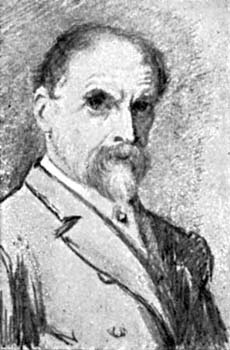 J. MOYR SMITH.
A couple of drawings from Mr. Cooper, and an initial by "W. V." (the cipher of Mr. Wallis Mackay, whose sketch and subsequent work did not appear for a couple of years) were next sent in, and then came Mr. J. Moyr Smith, whose long series of clever mock-Etruscan drawings continued with few breaks for the space of ten years. Although the spirit that runs through them becomes monotonous after a while, the draughtsmanship and the excellence of the fooling always elicit admiration. Mr. Smith had served his time to architecture; but natural love of figure-drawing, intensified by the study of Sir John Tenniel's comic illustrations of the historical costume, faithfully and even learnedly delineated and perfectly drawn, settled his career, and "Fun," under Tom Hood's editorship, witnessed his start in humorous life. Referred to Mark Lemon by "Pater" Evans, he[Pg 541] obtained a ready hearing, and for a couple of years drew for the paper; but he did not work regularly, during an interval of three years, until 1872. From this time forward he was one of Punch's recognised outside contributors, though he worked for it only when not engaged in making designs for art-manufacturers. It was under Shirley Brooks's editorship, and later under Tom Taylor's, that he gave full rein to his passion for classic treatment, and his ornament, which gave a distinct cachet to Punch up to 1878, was not founded on a mere grotesque treatment of classical subjects, but was the fruit of a close study of and easy familiarity with heathen mythology, classical, Egyptian, and, in particular, Norse. The fun was not particularly broad, but Tom Taylor was especially tickled by his attempts to find amusement in the extraordinary head-dresses worn by ladies of Ancient Egypt—such as that in the cut (July 11th, 1874) learnedly inscribed "Oos Yer Atter?"
Mrs. Jopling-Rowe, then Mrs. Frank Romer, was the only new arrival in the year 1869. The death of her husband had left her under the necessity of supporting herself and her children, and as niece of Mark Lemon she might have obtained easy admittance to Punch, had she not found portrait-painting a more remunerative occupation. Under the initial of her name she made but four drawings of little importance, the most ambitious being an illustration of the "Song of Sixpence," which was treated as a subject from "Nursery History." It appeared on page 56 of Volume LVII.
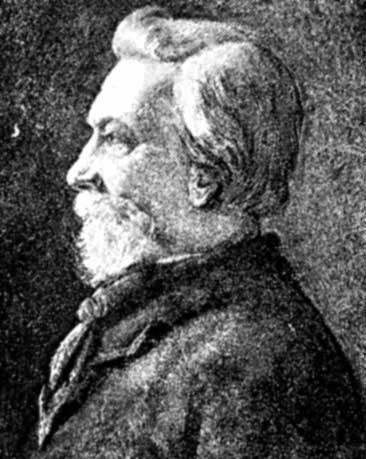 J. SANDS.
Mr. Wallis Mackay, the clever "Captious Critic" of later days, followed "W. G."—a contributor of a couple of trifles—and worked for Punch from 1870 to 1874, making seven-and-twenty drawings, "socials" chiefly, in his well-known style. It was in the latter year that Tom Taylor succeeded to the editorship, and having been mortally[Pg 542] offended with a personal sketch which the "Captious Critic" had drawn some time before, he forthwith cancelled the connection. Even the blocks already in hand and paid for were suppressed, with the exception of four, of which the last appeared in 1877. On the accession of Mr. Burnand, says Mr. Mackay, he was informed that Bouverie Street was no longer "a close borough," and that the Essence of Parliament awaited him; but the "Special Correspondent" was away in the wilds of Ireland, and the opportunity passed by.
The same day as that on which the first of Mr. Bennitt's four drawings arrived—(he must not be confounded with the Colonel Bennitt who is referred to later on)—saw also the first contribution of Mr. J. Sands, Charles Keene's friend, who put his little anagrammatic device of an hour-glass to more than three-score drawings between the years 1870 and 1880. Save for their ingenuity, they were not of first-rate importance. Mr. Sands had been an Edinburgh and Arbroath solicitor; a prairie farmer; an art-student under Charles Keene, who made him practise drawing until he became dyspeptic and melancholy at the sight of his own feeble work; an emigrant to Buenos Ayres, where he practised most trades in turn, including that of newspaper artist; a contributor and draughtsman (again under Keene's eye) to London magazines, and to Punch; a sojourner in the almost inaccessible island of St. Kilda; an archæological explorer in the islands of the Hebrides; and finally, for thirteen years a hermit, living a hermit's life, solitary and intellectual, at the water's edge, at Walls, Shetland. Many have been the stones that have rolled for Punch, but few that have rolled so far, or gathered so much moss the while. In his more civilised moments, so to speak, Mr. Sands lived for a time a good deal in the life of Keene, to whom he presented many jokes and sketches for pictures; but he became disheartened[Pg 543] at the slowness of his own promotion, and suspecting, moreover, that Keene, in his heart, would have been glad were he to retire in favour of Mr. A. Corbould, Keene's nephew, he finally decided to withdraw. Nevertheless, the friendship of the two men lasted to the end—a friendship that was a rare and deep attachment.
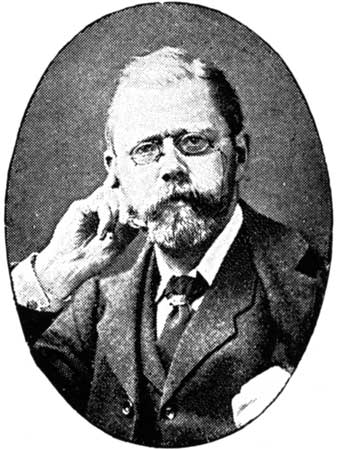 W. RALSTON.
Two more names belong to 1870—that of Mr. E. F. Brewtnall, R.W.S., whose single contribution was sent in in this year; and Mr. W. Ralston, of Glasgow, later a photographer by profession, but by taste and opportunity an artist. It was with Shirley Brooks's succession to the Editorship that Mr. Ralston obtained his recognition. "I remember," says the draughtsman, "how in walking down to business that day I tried to look unconscious of my greatness, and mentally determined that it would make no difference in my bearing." His drawings at first were very hard, but the point of humour was invariably good, and the Scottish "wut" equal to that of the best man who ever drew for the paper. He was a self-taught draughtsman, who learned by watching his younger brother, "whose artistic boots," says he, "I was not fit to black;" but he improved rapidly, and contributed in all two hundred and twenty-seven drawings, initials, and "socials." At the death of Tom Taylor, Mr. Ralston's contributions ceased, only one more from his pencil ever appearing in the paper—in 1886. It was partly because Mr. Ralston became a busy "Graphic" artist, and partly because the Editor was in search of new blood; but the only time Mr. Ralston made his post-Taylorian appearance in Punch (that was not "old stock") was with an article in the Sandford and Merton style, directed against the Duke of Bedford and the Bloomsbury gates. This little attack, called "K.G.—Q.E.D.," constitutes Mr. Ralston's sole contribution to the literature of the age.
Mr. A. Chantrey Corbould, as already explained, was introduced to Punch by his uncle, Charles Keene. Beginning in 1871, he worked on until 1890, when a temporary cessation intervened. His work, dealing chiefly with hunting and "horsey" subjects, has always a certain freshness, in spite of being, technically speaking, a little tight, and at one time raised their author to very near the front rank in popularity. He was only eighteen when he joined (the expression "Mr. Punch's young men," it will be seen, is no misnomer), having already had the benefit of Keene's advice. One of the elder artist's letters is before me as I write:—
"I saw your drawing this morning," he says, "and think it very good, considering the short time you have had to study art; but I can see that the execution would render the drawing rather difficult to engrave, and you want a little more study and practice in 'the human face divine' to please the newspaper people. I never give advice on these matters, but I can tell you from my own experience I don't think drawing on wood is a good road to stand on as an artist; but if you don't agree with me, and wish to go in for this particular branch, it seems to me that you should article or apprentice yourself by legal agreement with some engraver of large business for a certain time on certain terms. This is how I began, and have been sorry for it ever since!"
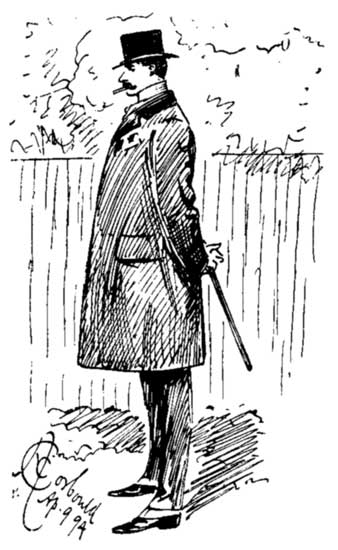 A. CHANTREY CORBOULD.
Fourteen years later, when Mr. Corbould was still hoping for that position with which many people already credited him—a Staff appointment—Keene wrote:—
"I've no doubt myself that it is in your power, if you manage well, to get on to Punch. It is rather unlucky that Burnand[Pg 545] is not a sporting man" [Mr. Burnand, by the way, is an inveterate horseman]. "... I should advise you to drive gently but steadily at hunting and country subjects, and if you get a good idea of any sort have a shy at it, and encourage your friends to look out for you.... You've noticed I only do one a week now, as a rule. I send you an idea you might work out. Wouldn't you make it a meet (in background), and the speakers mounted?
"'Think I must part with him.' SHE: 'What! all at once, wholesale? Wouldn't it be better to sell him retail on little skewers?' I'll look out and send you anything in your line I hear of."
This joke of Keene's was duly worked out by Mr. Corbould, and was produced Nov. 22, 1884 (p. 249, Vol. LXXXVII). Up to this time the draughtsman had worked under three Editors, to whom, as was the practice, he would send in slight sketches to "legends," and work out those which were accepted, the selection being made in due course, with a bit of criticism to take the vanity out of him, thus: "Very good subject. The man is far too big for the horse, which is a 15.3 if he's an inch. This was generally Leech's mistake; so you err in remarkably good company. Why 'Hunting Puzzle'? It's not a puzzle."
Apart from a couple of sketches by Mrs. Field and one by Mr. Graham, the year 1872 brought no contributor but Randolph Caldecott. The half-a-dozen sketches together comprising his "Seaside Drama" (p. 120, Vol. LXI.) contains no hint of that peculiar style, individual humour, and perfect suggestion, which he was to make his own. His drawings were published in 1872, 1873, and 1875, and then again in 1879, 1880, 1882, and 1883—eighteen drawings in all; but it was not until 1879 that Caldecott showed any of his later freshness and humorous exaggeration. It was in 1870, his biographer asserts, that his drawings were shown to Shirley Brooks and Mark Lemon:—
"Mr. Clough thus records the incident: Bearing an introductory letter, he went up to London on a flying visit, carrying with him a sketch on wood and a small book of drawings of 'The Fancies of a Wedding.' He was well received. The sketch[Pg 546] was accepted, and with many compliments the book of drawings was detained. 'From that day to this,' said Mr. Caldecott, 'I have not seen either sketch or book.' Some time after, on meeting Mark Lemon, the incident was recalled, when the burly, jovial Editor replied, 'My dear fellow, I am vagabondising to-day, not Punching.' I don't think Mr. Caldecott rightly appreciated the joke."[66]
Caldecott had had some practice in humorous drawing, having drawn three years before for the "Will-o'-the-Wisp" and "The Sphinx." But his Punch work was merely occasional; his more serious labours were for the "Graphic," "The Pictorial World," and most notably, on Mr. Edmund Evans's suggestion, for the immortal children's books which the engraver might print in colours. He was only forty years old when he died, and Punch, in the course of a long obituary poem, bore witness to his singular charm, though he made no reference to the work contributed to his own pages:—
Perhaps the best military contributor of jokes that Punch has had is Major-General H. G. Robley. Keene, as I have already stated, re-drew or touched up the earlier of his sketches, which dealt for the most part with military life on foreign service. Twenty-seven contributions, many of them unsigned and of varying degrees of importance, came from young Captain Robley, as he was then, of the 91st (Argyle and Sutherland) Highlanders. To Keene he was, as the artist confessed, "a very obliging correspondent," who sketched well and sent him many suggestions. "You see, a[Pg 547] mess-table makes a very 'preserve' for Punch subjects. I don't follow his drawings very much, but they are very useful in military subjects." Captain Robley contributed during the years 1873-8. Mr. W. J. Hennessy, who has since established his position as a delicate and accomplished draughtsman, made a couple of drawings of social subjects in 1873, and two more in 1875, but they were by no means of the excellence to which the artist afterwards attained.
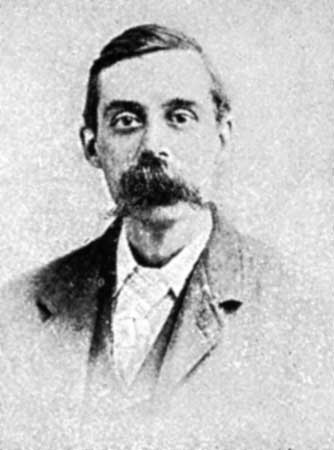 M. BLATCHFORD.
No fresh contributor appears in 1874, the couple of sketches signed "C. B." having been sent in twelve months before, and that of F. Woods having been practically redrawn, although his initials were allowed to stand; but 1875 witnessed the work of five new hands in the paper. The first was Robert Bruce Wallace, whose style was modelled on that of C. H. Bennett, and greatly inspired besides by Mr. Sambourne. The bulk of his work was done from 1875 to 1878 inclusive, but in the latter year he fell away, and his contributions became very rare. He died in 1893, and one of his drawings made a posthumous appearance in 1894. He was a very prolific contributor. Wallace gave up his Punch connection—not, as has been said, because the remuneration was insufficient, but because he considered himself ill-treated. According to him, he had fully understood that he was to succeed Miss Georgina Bowers, and with this promotion in view, he had proceeded to Worcestershire from Manchester, where he lived, and made preparatory studies of horse and hound and landscape scenery. When, contrary to expectation, he found himself passed by, he was grievously disappointed and annoyed, and refused to go on with initials and so forth—which he drew with so much beauty and conscientiousness. He was a secretary of the Manchester Academy of Fine Arts, and had a considerable reputation as a wit at its councils; and when Ford Madox Brown was engaged on his Manchester frescoes, Wallace acted for some time as his assistant.
Then followed Colonel Ward Bennitt, late of the 5th Lancers, who drew several initials and "socials;" but being at that time a lieutenant (in the 6th Inniskilling Dragoons),[Pg 548] he found that he had no time during the day to draw for Punch, and that night work affected his eyesight. Mr. J. Curren, with a couple of sketches, in 1875 and 1876; Mr. L. G. Fawkes, of the Royal Hibernian Academy, with a single drawing in the former year; and that clever young painter, Valentine Bromley, who died so young after promising so well, with a single drawing, complete the list; but there was nothing distinctive in the work of any save the last.
Mr. Montagu Blatchford, who adopted—not without success—the Bennett-Sambourne-Wallace style of half-decorative, half-pictorial representation, appeared towards the end of 1876; and although he was supplanted a few years later by Mr. Harry Furniss and Mr. Wheeler, he continued, even after 1881, to be seen fitfully in Punch. He was, by profession, a carpet-designer, with unusual skill in freehand drawing; and when in the spring of 1876 he no longer saw Mr. Sambourne's work in the paper, he adopted the shrewd idea of sending in some sketches in which that artist's style was respectfully imitated. But Tom Taylor was shrewder still, and wrote: "Dear Sir,—Mr. Sambourne's absence is only temporary. I have not, therefore, an opening for a designer to fill his place, and return your drawings, which are very clever;" adding that he would be glad to give the young applicant an opening if possible—a chance which soon came, but which never meant very much for the artist. He began with a comic umbrella-stand, and from that basis made scores of small subjects, all, with but half-a-dozen exceptions, of his own suggestion. Then, when Tom Taylor died he sent less and less—a little sore that he should be pushed aside for younger men—and finally ceased altogether, returning to Halifax in response to business calls. Then followed W. J. Hodgson (who is not to be confounded with the draughtsman of the same name and initials of nearly twenty years[Pg 549] later), with four cuts, during 1876 and the two next years; "Captain F.," with a couple; Miss Fraser ("MF"), daughter of Colonel Fraser of the City Police, with seven sketches; and Mr. Hallward, with a couple of initials.
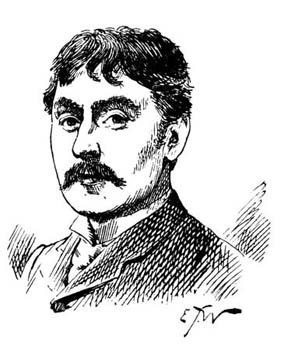 E. J. WHEELER.
For four years no accession of importance was made, Mr. W. G. Smith, with a single initial, and Mr. W. G. Holt, with three more ambitious cuts, being all that 1878 had to show; while 1879 brought forth Mr. Dower Wilson with a "social" in the Almanac, and a nameless F. B. ("Memorials"). In the following year Mr. Athelstan Rusden made his maiden appearance as an illustrator with a Disraeli Elephant, which he had drawn on the wood and sent in from Manchester; but "Moonshine" offered the inducement of continuous occupation, and the young amateur drifted away.
The year 1880 is memorable for the enlistment of Mr. Harry Furniss. Mr. E. J. Wheeler was the other arrival, and he still (1895) spreads over Punch's pages his bright little theatrical sketches and initials, as well as illustrations to Mr. Burnand's own literary contributions. His drawings are unmistakable, as much by their rather old-fashioned method as by the well-known monogram of later years, or by the appropriate sign-manual of a "four-Wheeler" in his earlier contributions.
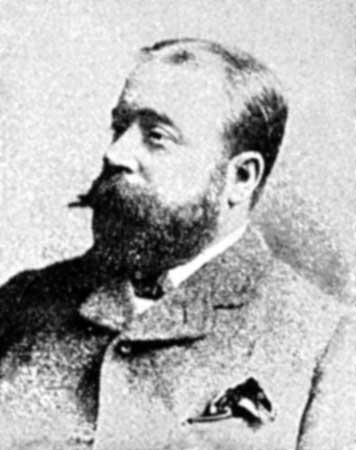 HARRY FURNISS.
In Mr. Harry Furniss Punch found an artist who was destined to become, during the fourteen years of his connection, a considerable factor in his career. Mr. Furniss was bred up in the Punch tradition. While still a boy at school in Ireland—where, through a mistake on Time's part, he was born, of[Pg 550] English and Scotch parents—he produced, edited, and illustrated "The Schoolboys' Punch" in manuscript, in careful imitation of the original, drawing the cartoon as well. One of these "big cuts" represented himself as the performer in a cabinet-trick—(the sensation of the Davenport Brothers was before the public at the time)—in which the cabinet was the school, and the ropes that bound him the curriculum; while from another cabinet he emerges in full blaze of scholastic triumph. He soon began drawing, and engraving his own designs, for Mr. A. M. Sullivan's Irish version of Punch; and having met Tom Taylor—who then reigned in Whitefriars—and been by him applauded for his sketches, he accepted the hint that he might send in drawings to the original Hunchback of Fleet Street. But when they came, Taylor declined them on the ground that the ideas were unsuitable; yet, curiously enough, they several times appeared, re-drawn by members of the Staff. One of these, re-drawn by Mr. du Maurier in February, 1877, represented a scene witnessed by Mr. Furniss from the railway—a flooded field navigated by two men in a boat, who are reading a notice-board indicating that the submerged "highly-eligible site" was "To be Let or Sold for Building."[Pg 551] Mr. Furniss thereupon decided to have done with Punch during that editorship; and came to London to seek his artistic fortune. He speedily made such way on leading journals, especially on the "Illustrated London News," that Mr. Burnand, on succeeding to his office, invited the young draughtsman, then aged twenty-six, to become a regular contributor. Mr. Furniss's first sketch (published on p. 204, Vol. LXXIX., 1880) was a skit on what is ignorantly called the Temple Bar Griffin—(it is really an heraldic dragon, designed by Horace Jones)—executed by his friend C. B. Birch, A.R.A.
At that time Mr. Henry W. Lucy had just been summoned to reinforce Punch's Staff, and to take over the "Essence of Parliament," since Shirley Brooks's death so ponderously distilled by the late Tom Taylor, and to him was left the selection of an illustrator of his "Toby's Diaries." In selecting Mr. Furniss he made a wise choice, for the "Lika Joko" of later times had been a close student of politics, and seemed cut out for the post. How he justified himself is sufficiently known; he achieved for himself a great popularity, and unquestionably acquired for Punch a unique position among journals, as representing to the people that personal side of Parliamentary life, the familiar aspect and the vie intime of the House of Commons, not to be found elsewhere. No doubt, here and there some offence was taken; and wives would at times protest against the caricatures of husbands' figures, clothes, or faces; but as a rule the "truthful falsehood" was appreciated by Mr. Furniss's victims—many of whom would ask to be included in his pictures—and few frequenters of the Lobby were more popular than he.
"Mr. Gladstone's collars" are a by-word in the land; and Mr. Furniss made them. It is generally recognised that Mr. Gladstone wore no such collars. Nevertheless, his favourite sitting attitude in the House was one very low down, his chin buried in his chest; and the more tired or depressed he was—the more weary or dejected at the course of the debate—the more his head would sink within his collar, and the more the linen rose. This fact gave Mr. Furniss the idea, in the[Pg 552] course of a few sessions, of his drawing of "Mr. Gladstone's Choler Getting Up;" and thereon was based his popular fiction. Similarly, the representation of Lord Randolph Churchill as a small boy of irrepressible "cheek" was at first intended to typify the noble lord's irrepressible unimportance in the Chamber (that was before he had risen from the Fourth Party leadership to the Chancellorship of the Exchequer); while the creation of the complacent, many-chinned descendant of the Plantagenets in "The House of Harcourts"—a page imagined and drawn in greatest haste straight on to the wood-block, to fill up—was received with uproarious delight by the public as a true piece of satirical humour. But of all his "types" the funniest, as well as the easiest, was the ungainly but side-splitting caricature of Sir Richard Temple—which helped not a little to spread his fame throughout the land. All these men took the fun in the best of good part, Sir William Harcourt only protesting—not when Harry Furniss endowed him with an extra chin, but when he did not credit him with the full complement of hair.
To obtain his portraits Mr. Furniss would stalk his quarries[Pg 553] unawares: for self-consciousness in a sitter kills all character. A favourite ruse was for him to tell Mr. A. that he wanted to sketch Mr. B., and that his work would be greatly facilitated if the hon. member would keep the other in conversation. Mr. A. would enter gleefully into the joke, and then Harry Furniss would sketch Mr. A! If need be, he would make his sketch, unseen and unseeing, upon a piece of cardboard or in a sketch-book, in the side-pocket of his overcoat. In this way detail, mannerism, gesture, pose—character, in fact, would be secured, and next week's Punch might contain the portrait—sometimes severe, generally humorous, and always well-observed. A rapid worker, too, is Furniss—incomparably the quickest of his colleagues—who could produce anything from a thumbnail sketch to a full-page drawing, portraits and all, in an hour or so, although he would prefer, of course, to have fair time to arrange his composition, to pencil it in, and then work it up carefully from the living model. On the occasion when Lord Randolph Churchill's hunting adventures in South Africa kept London amused, Mr. Furniss, who was in the country and about to start for town by rail, saw an account of the exploit in the morning paper. He wired to Mr. Burnand: "See Churchill's lion-hunt, page — 'Times.' Splendid opportunity. Reply —— Junction." At ten-thirty he found the answer awaiting him at the junction: "Good. Let engravers have it to-day." He set to work at once in the train. Having to change several times, he found the junctions of great use for drawing in the faces; and by half-past four the finished page was in Mr. Swain's possession.
Indefatigable and unconventional, as much a journalist as an artist, gifted with a rapid intelligence and a subacid humour, Mr. Furniss, in his work on Punch, has been extremely varied, and by the strength of his personality he imparted to the Parliamentary side of the paper a touch of his own convictions. It was obvious from his treatment of the Irish that he was a strong Unionist, and that his sympathy with the Irish party was neither very deep nor very cordial. This was emphasised by some of the best caricatures he ever produced. They were bitterly resented; but probably[Pg 554] more ill-feeling was created by the ludicrous picture he subsequently drew of the patriots as they returned, sea-sick, moist, and dejected, to Dublin from the "London Conference," entitled "A Sketch at Kingstown." On the top of this came the irritation caused by his laughable but merciless mimicry, in his famous entertainment of "The Humours of Parliament," of the imaginary Member for Ballyhooly; but it was the caricatures of Mr. Swift MacNeill, M.P., that brought matters to a head. Mr. MacNeill had previously appreciated the sketches, and begged certain of them. But at last, on the occasion of an exuberant and unflattering, but still not an ill-humoured, portrait, supported by a solid contingent of his Party, he sought the artist out and, reproaching him in excited and unmeasured terms, he committed a "technical assault" upon him. Mr. Furniss was not to be induced to retaliate, even when Dr. Tanner, M.P., and others who surrounded him addressed him in words more violent and offensive than Mr. MacNeill's, and threatened him with corporal punishment. As it appeared to the draughtsman that it was all a pre-arranged affair, he remained passive, lest a development of the situation should lead—as it was probably intended that it should lead—to his exclusion from the Lobby. Punch himself, however, snapped his fingers at this argumentum baculinum, and Mr. Furniss, with rare good taste, revenged himself by a full-page drawing (21st September, 1893) of "A House of Apollo-ticians," in which every member has been idealised to a point of extraordinary personal beauty, while the artist himself appears in the corner as a malignant ape of hideous aspect. This was balm, no doubt,[Pg 555] to the gentleman who had been so incensed at being "caricatured, now as a potato, now as a gorilla;" while the situation was cleverly summed up thus:—
Meanwhile, several series of importance had come from his pencil. His "Puzzle-heads" are marvels of ingenuity, in each of which a portrait of a celebrity is built up of personal attributes, characteristics, or incidents in the career of the person represented; his Lika Joko "Japanneries" caught with amazing truth the spirit of Japanese draughtsmanship—far more completely than either Bennett or Brunton ever succeeded in achieving; and his "Interiors and Exteriors" reflect social and public life with exuberant, almost with extravagant, humour.
But the end of his connection with Punch was at hand. He had joined in October, 1880. He had been called to the Table four years later, and on the 21st February, 1894, he ate his last dinner at it, and resigned in the following month. Meanwhile, like Charles Keene, he was never one of the salaried Staff, but to the end was paid by the square inch. This permitted him to do as much work as he chose for other papers; but it made him feel, at the same time, that he was not flesh of their flesh, while he suspected himself of getting into a cast-iron groove from which he sought to free himself. So, after a minor "misunderstanding" had been put right, Mr. Furniss quitted his old friend Punch, and forthwith set about starting a monthly magazine of his own. This enterprise, in the course of evolution, was considerably modified; and for a time the weekly "Lika Joko" soon emerged into open rivalry with the paper which for nearly fourteen years had made the name of Furniss as celebrated throughout all English-speaking lands as that of any of his colleagues.
And such is the Passing of Furniss, whose extraordinary[Pg 556] powers of observation (he was the first, by the way, to detect and represent truthfully Mr. Gladstone's loss of a digit) and of catching a likeness in its essential lines, and whose unbounded and buoyant good-humour early justified Mr. Burnand's selection. Though he so soon drifted into Parliamentary sketching, there is no class of work, except the officially-recognised political "cartoons," which he did not attempt; and he romped through Punch's pages with unlimited invention and inexhaustible resource—with comedy and farce, with drama and tragedy, and sometimes with work startling in its truth and touching in its pathos.
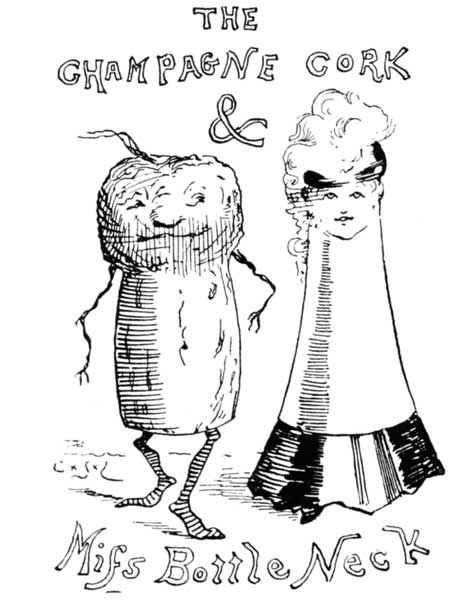 "A HAPPY RELEASE."—A REJECTED SKETCH.
The men who immediately followed Mr. Harry Furniss did not come to stay. In December, 1880, a sketch of "Cherry Unripe"—a clever parody on Sir John Millais' famous picture—was contributed by Mr. Stowers, who then rested on his laurels. Mr. Finch Mason contributed three sporting cuts in 1881, three in 1882, and one in the following year, and then Mr. Charles J. Lillie appeared on the scene. Mr. Lillie's principal victories have been won in the field of poster-designing, his favourite achievement being the design of a young lady in bathing costume who, being wrecked, succeeded by the aid of Somebody's Soap, with the cleverness of her sex, in "washing herself ashore." At the time when Mr. Herkomer was designing his famous poster for the "Magazine of Art," Mr. Lillie submitted to Punch a set of humorous sketches nominally adapted to similar advertisements of wines. Thus, "Port: Old and Crusty," was of course a typical Colonel Chutnee, a fire-eating Anglo-Indian; "Sherry: Pale and Dry," was an ascetic philosopher; "Claret: Very Light and Delicate," was a maiden[Pg 557] dainty and graceful; and so forth. Some of these were published in the early summer of 1881; but that of "Champagne" (here reproduced) was not used. Shortly afterwards the clever draughtsman sought work and adventure in Europe, Africa, and America, and on his return devoted himself to story-writing, confining his pencil to the illustration of his own articles. Like Mr. Sambourne and others of Mr. Punch's artistic contributors, Mr. Lillie was trained as an engineer.
As already recounted, a new idea was carried into effect in Punch's Almanac for 1882: drawings were sought from certain members of the Royal Academy who were supposed to be afflicted with the vis comica in any pronounced degree. Of these, only Mr. G. A. Storey made his début in Punch on this occasion; but his drawing of "Little Snowdrop"—a fancy character-portrait of a Dutch lady—pretty as it was, displayed but a very mild sort of humour. In the following February Mr. Alfred Bryan began his series of "Sketches by Boz," in which public men of the day were caricatured as personages in Dickens' novels. Thus, the Duke of Cambridge was most happily identified with "Joe Bagstock, Sir!", Sir John Holker was the Fat Boy, and Mr. Bradlaugh appeared as Rogue Riderhood "taking his Davy." These clever sketches, to the number of twenty-seven, were spread over that year and the next, when, to the regret of both Editor and artist, the connection was unavoidably severed.[Pg 558]
Mr. William Padgett—Mr. E. M. Cox—Mr. J. P. Mellor—Sir F. Leighton, Bart., P.R.A.—Mr. G. H. Jalland—Monsieur Darré—Mr. E. T. Reed—His Original Humour—"Contrasts" and "Prehistoric Peeps"—Approved by Sports Committees and School Classes—Mr. Maud—A Useful Drain—Mr. Bernard Partridge—Fine Qualities of his Art—Mr. Everard Hopkins—Mr. Reginald Cleaver—Mr. W. J. Hodgson—Excites the Countryside—Miss Sambourne—Sir Frank Lockwood, Q.C., M.P.—Mr. Arthur Hopkins—Mr. J. F. Sullivan—Mr. J. A. Shepherd—Mr. A. S. Boyd—Mr. Phil May—A Test of Drunkenness—Mr. Stafford—"Caran d'Ache"—Conclusion.
At the same time as the single sketch signed with a swan (by Mr. Thompson), Mr. William Padgett, the excellent painter of poetical landscape, made his unique appearance. He had been arranging the mock-æsthetic costumes for Mr. Burnand at the Prince of Wales's Theatre, when "The Colonel" was about to deal a crushing blow at the absurdities of the "artistic craze." Mr. Padgett had painted the large picture called "Ladye Myne"—a burlesque of the "greenery-yallery" type then in fashion at the Grosvenor Gallery; and the departure of the apostle of the movement from these shores for the United States inspired the painter with the words and the drawing of the mourning "Ariadne," which were shown to the Editor of Punch and forthwith inserted. The only other stranger of 1882 was Mr. Pigott, with a single sketch entitled "Cultcha."
The six years that followed were almost a close time for outsiders. The only arrival of 1883 was Mr. Everard Morant Cox, an artist of dainty imagination and graceful pencil, whose seven charming little cuts appeared at intervals up to July, 1890. The next was Mr. John Page Mellor, barrister-at-law (appointed in 1894 Solicitor to the Treasury), who contributed three drawings from 1886 to 1888—"Sub Punch and Judice"[Pg 559] (p. 305, Vol. XCI.), which was partly re-drawn; a skit on the proposed Wheel and Van Tax (p. 205, Vol. XCIV.); and the "Judges going to Greenwich," signed with mystic Roman numerals. In the same year Mr. Harper Pennington, the American artist, made a couple of drawings of the opera of "The Huguenots," followed by a sketch of Mr. Whistler and another.
Sir Frederic Leighton, President of the Royal Academy, once paid homage to Punch by the contribution of a single drawing—a portrait of Miss Dorothy Dene—which illustrated an article entitled "The Schoolmaster Abroad," and was published on May 29th, 1886 (Vol. XC.). It is one of the few tint blocks that have appeared in the paper, and is, strictly speaking, not a woodcut at all, but a wood-engraving.
Mr. G. H. Jalland began his genuinely comic hunting sketches in 1888. Although an amateur, Mr. Jalland is often extremely happy in his drawings (which now and again are excellently drawn), and his jokes are usually conceived in a richly comic vein. A great many—nearly a hundred—of his subjects were published during 1889, and he is still an occasional contributor to the fun of the week. We would not willingly lose the artist who gave us the sketch of a Frenchman bawling during a hunt: "Stop ze chasse! Stop ze fox!!! I tomble—I falloff!" The sportsman's mantle, which fell from Leech's shoulders on to Miss Bowers', and then on to Mr. Corbould's, descended at last on to those of Mr. Jalland, who wore it almost exclusively for a time, and, from the humorist's point of view, wore it easily and well.
Monsieur G. Darré, who had worked in Paris on the "Charivari" for a couple of years, and for a short time on the "Journal Amusant," "Le Grelot," "Le Carillon," and others, besides making a series of illustrations for a monumental "Histoire de France," came to London in 1883. Five years later, at the suggestion of Mr. Swain—who had already cut some of his work for other periodicals—he sent in his first sketch to Punch. This was a drawing of "Joseph's Sweetheart," at the Vaudeville, showing great mastery over[Pg 560] pen-and-ink. It was followed during this year and the next with sketches of varied importance, theatrical and political, in which France and General Boulanger played chief part, and in which portraits were always well rendered; but when the thirteenth had been delivered—(alas! the fatal number)—the arrival of Mr. Bernard Partridge convinced him that there would no longer be room for him. After contributing for a time to other illustrated papers, the artist made himself proudly independent of black-and-white by becoming a successful designer of show-cards in water-colour for commercial houses. He may claim to have introduced, in a small way, a more clashing style into Punch than had hitherto been seen there; but though his drawings, especially those on his native politics, were undeniably clever and very effective, they lacked true artistic quality and Punch's essential spirit.
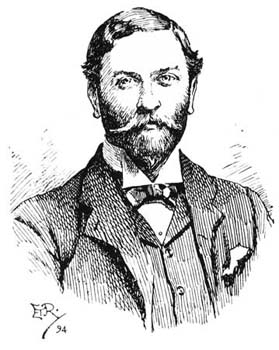 E. T. REED.
Some sketches signed "C. A. M." were sent in, in 1889, by Mr. C. A. Marshall, solicitor of Retford, Notts. Their chief merit appeared to be the excellence of the horse-drawing; but only a couple of them were accepted, and these were published in the course of the year.
The great arrival of the year was Mr. E. T. Reed, who was to bring a new form of humour into Punch—or, rather, to bring back the old, rollicking, genuine low-comedy class of fun, more generous and mirth-provoking than the higher comedy of the day, that aims but to induce a smile.
His appearance in Punch (on the 8th of June, 1889) was due to the casual remark of Mr. Linley Sambourne to Mr. Blake Wirgman that the Editor was looking round for some new man who could do comic work. Mr. Wirgman suggested their common friend, Mr. Reed, whom, however,[Pg 561] Mr. Sambourne only knew as a painter-student, and the latter promised to send some of his sketches to Mr. Burnand to look at. The upshot was a request for a drawing representing "The Parnell Commissioners enjoying themselves up the River" during a pause in the trial of Parnell v. the "Times." Other drawings, that attracted general attention, followed in rapid succession. Who that has seen it can forget the "Fancy Portrait" (by induction) "of my Laundress"—a brawny-armed woman standing over his shirts, which she belabours with a spike-studded club? or the "Automatic Policeman" at a crowded crossing, which, when a penny is dropped into the slot, puts up its arm and stops the traffic? or the "Restored Skeleton of a Bicyclist," and other "happy thoughts" of that period? It was obvious that the draughtsman was not a practised artist, although a skilful amateur; but those who detected the artistic lack of training forgave it heartily for the genuine fun and originality of a fresh and delightful kind. Since that time Mr. Reed rapidly developed his undoubted powers, which, for a young man who did not begin to draw until he was twenty-three years of age, showed themselves at once to be remarkable.
Then followed a clever series of "Contrasts," such as the professional fasting man fortune-making at the Aquarium, and a Balaclava hero left to starve by a grateful country—thus repeating unconsciously Cruikshank's famous plate of "Born a Genius: Born a Dwarf," wherein the tragedy of Benjamin Robert Haydon and the triumph of Tom Thumb, both proceeding in the Egyptian Hall, were dramatically depicted. Another, and still more remarkable, contrast of Mr. Reed's was that in which the terrible tricoteuses of the French Revolution, knitting with quite tragic joviality before the guillotine, are compared with the modern Society ladies in court enjoying a criminal's sensational trial, so that the spectator hardly knows which are the more repellent. It may be stated, as a matter of curiosity, that—except for the point of contrast, which, after all, is a principal feature of the design—Doyle anticipated Mr. Reed's protest by showing, in 1849, a "Scene in Court during an interesting[Pg 562] Trial," when the crime of Manning and his wife was engrossing the attention of all England and proving a "great attraction" to dames du monde.
In 1890 Mr. Burnand raised his young recruit to the rank of Staff-officer to fill the vacancy which had just occurred—a premature promotion, the wiseacres said. Mr. Reed then produced his forensic drawings, often basing them on sketches supplied by Sir Frank Lockwood, Q.C.; yet his work fluctuated so much in quantity that it was more than once rumoured that he and Punch had parted company. But in due course his triumph came when, in the Christmas number of 1893, he began "Prehistoric Peeps"—including "The First Hansom," "Primeval Billiards," and "A Quiet Game of Whist in Primeval Times." These popular fancies were no sudden inspiration; they were developed gradually. Following a natural humorous bent for dealing with sham antiquities in Punch, Mr. Reed had started during the previous year a series of "exhibits" in the Imperial Institute of the Future, consisting of comic restorations of common objects of to-day—the ridiculous speculations of the future archæologist. There was a much-patched and battered restoration of a four-wheeled cab; then a comic policeman; and the draughtsman was proceeding with a hansom when he experienced a difficulty in getting freshness into the treatment. So he determined to become a Cuvier on his own account, and, by going back to the beginning, to show the real original hansom, as it might have been, in pre-historic times. The artist was intensely amused with the idea, and finishing his three drawings—the other two suggesting themselves—delivered them just in time for the Almanac. The result was, in its way, electrical. Within a week everybody was laughing at them and talking about them. In the "Daily News" a leading-article was devoted to arguing, with admirable mock-gravity, that the artist's object in these drawings—especially in that of the Prehistoric Parliament, in which all our legislators are clad in primeval fashion, while the Speaker keeps order with the aid of an enormous tomahawk—was, of course, to prove the theory[Pg 563] that similarity of face and figure accompanies similarity of pursuit throughout the generations. At Cambridge, in the May Week, the tableaux vivants of the "Footlights Society" included exact reproductions of the "Primeval Billiards" and "No Bathing To-day!"—skins, expressions, mastodons and all; while at Molesey Invitation Regatta (August, 1894) the "Prehistoric Coaching for the Boat Race" was carried out to the life in mid-river, with Gaul and Briton, woad-stained skins, raft, and fight, with the fearsome palæontological intruders, complete to the last detail—and applications were quickly made to the Punch Proprietors for permission to reproduce the scenes on magic-lantern slides for the use of schools! This, perhaps, is to be explained by the accuracy of many of the pre-historic beasts. Even at the London Institution a scientific lecturer has borne witness to the life-likeness of Mr. Reed's stegosaurus imglutis, and especially of the triceratops and the sprightly pterodactyle. Little wonder Sir William Agnew broke through the rule of "no speeches" at the Wednesday Dinner, and proposed the health of the young artist who had made for the paper so striking a success. When Mr. Harry Furniss retired, Mr. Reed was appointed his successor as Parliamentary draughtsman, and soon showed his independence of humour in his new post.
After Mr. Whistler had contributed his butterfly (p. 293, Vol. XCVIII.)—the sign-manual in the use of which he has for some years found so much harmless, if rather childish, pleasure—Mr. Maud, at that time a Royal Academy student, began his sporting sketches. The first drawing (published on p. 249, Vol. C., though it had been sent in six months before) was called "A Check." A country lout is sitting on a fence-rail shouting, and the hunt comes up. "Seen the fox, my boy?" asks the huntsman. "No, I ain't!" replies the lad. "Then what are you hollarin' for?" "Because," answers the scarecrow, "because I'm paid for it." This picture was a valuable introduction, procured through a friend who forwarded his drawing, for it brought him an invitation to illustrate "Romford's Hounds" and "Hawbuck[Pg 564] Grange," as well as an established, though intermittent, connection with Punch. With few exceptions, Mr. Maud's jokes are the result of personal experience, for he looks to contretemps in the field for his humorous subjects. Through falling with his horse into a big drain in the Belvoir country—a precious accident for him—he collected sufficient matter to produce three jokes which duly saw the light. But the collection of such material is "damned hard riding," and each hunting season has only brought forth about ten such productions. Since that time Mr. Maud has turned his attention to sources of humour other than the hunting-field; and as in 1893 he carried off the Landseer scholarship and two silver medals for painting from the life, it is possible that he may in the near future be tempted far from the joyous art of comic black-and-white.
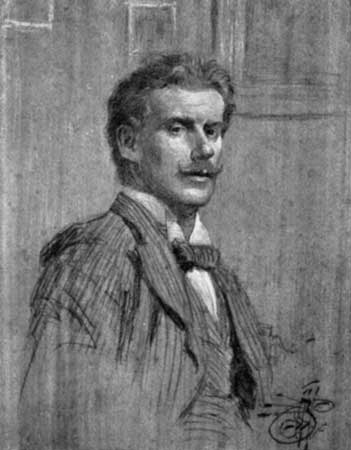 J. BERNARD PARTRIDGE.
Mr. Bernard Partridge made his first drawing for Punch in 1891, through the instrumentality of Mr. du Maurier, one of his greatest admirers. It was a drawing of a bishop in a distressing and undignified pose, and, though small in size, it proved at once to readers of Punch the justice of the extraordinary reputation the young artist had gained elsewhere. It was not only that his drawing and proportion are always entirely right—that, perhaps, is to be expected in the son of the late teacher of anatomy at the Royal Academy Schools[Pg 565]—but that his handling is so graceful and dainty, his effects of light and shade so masterly, his portraiture so true, and his power of representing expression, as shown both in face and figure, so absolute. Mr. du Maurier saw in him his own successor for the time when he may be called upon to lay the pencil down; and the public recognised in him an appreciator of beauty to a degree hardly excelled by Mr. du Maurier himself. Being, moreover, as familiar with the expression of the foreigner as with that of the East-Ender, or the resident of "Buckley Square," he was a recruit after Mr. Punch's own heart and interest.
It is because Mr. Partridge's love for the stage is stronger than for the pencil that the invitation to contribute to Punch, and, in 1892, his promotion to the regular Staff, did not arouse in him any great enthusiasm at the time. Soon, however, he warmed up to his work, and his illustrations to Mr. Anstey's inimitable "Voces Populi," "The Man from Blankley's," and other of that writer's serials, made their mark at once, supported as they were by the "socials," signed now with his cipher, now with his quaint "Perdix fecit."
Concurrently with Mr. Partridge (1891), Mr. Everard Hopkins made his appearance with one of two drawings sent in. The accepted one was an admirable travesty of the dénouement of Ibsen's "Doll's House," representing a buxom middle-aged virago leaving the house of her diminutive hen-pecked husband, whose "birdie" she declines any longer to be. Numerous drawings of a graceful kind have since come from him, until he is in the way of being regarded as a recognised outside contributor.
Then followed Mr. Reginald Cleaver, whose work, somewhat hard, but of great beauty in its own line, has been devoted to "social" subjects; and on January 1st, 1892, Mr. W. J. Hodgson sent in a picture that was destined to be the first of a long series. He is essentially a sporting man—a vital necessity for Punch—and having been brought up in the thick of the sporting world, has immortalised in his pages many a hunting joke and scrap of "horsey" humour. His subjects are usually actualities, and more than once has[Pg 566] a whole countryside been startled by the appearance in Punch of an incident that had just formed matter for gleeful conversation after a day's sport. Such was the amusing otter-hunt story that appeared in July, 1894, in which, under the title of "The Course of True Love, etc.," Miss Di, a six-foot damsel, asks her five-foot-three curate-lover to pick her up and carry her across the watercourse, "as it is rather deep, don't you know;" and the Wiltshire village where it occurred and the chief actors in the little comedy became at once the talk of the county, and the water itself is pointed out as the scene of the incident. Mr. Hodgson, it may be noted, was introduced to Punch through Sir Frank Lockwood, who sent to the Editor a volume which the draughtsman had illustrated.
Miss Maud Sambourne, when no more than eighteen years of age, also contributed her first drawing in the spring of 1892—a charming little figure of a girl, as dainty as a sketch by Mr. Abbey, and as different from her father's work as well could be imagined. Similar little drawings from her graceful pencil have appeared from time to time, the prettiest, perhaps, being "A Fair Unknown," on June 2nd, 1894.
On November 12th, 1892 (p. 221, Vol. CIII.), appears an elaborate page of verses, explanatory notes, and four cuts illustrative of "The Vanishing Rupee"—a picture greatly appreciated in India. The originator of this satirical page was Mr. J. H. Roberts, an architect who had turned his back on his profession and had cast in his lot with illustrated journalism; and the manner in which he hit off the standing grievance of Anglo-India betrayed a touching personal interest in this painful fiscal question.
Mr. Arthur A. Sykes, more closely identified with Punch as a verse and prose writer than as a draughtsman, began the first of his sketches in November, 1893; and on the 18th of the same month Sir Frank Lockwood, Q.C., who had hitherto been content to see his artistic effervescence re-drawn by Mr. E. T. Reed, appeared in his own right with a comic scribble representing a barrister afflicted with a bad cold energetically addressing the court. It was entitled:[Pg 567] "Cold, but In-vig-orating"—a pictorial pun worthy of Hood or Hine. This was the first of a series.
About this time the distinguished draughtsman, Mr. Arthur Hopkins, who has rarely been surpassed in rendering the simple grace of pretty English girlhood, evolved a joke while shopping with his wife, and straightway illustrated it and sent it on to Punch. It appeared the next week, and was quickly followed by another on the 1st of April. Since then the artist has been seen no more in Punch's pages, although, jokes serving, he is still a persona grata in Whitefriars. Mr. J. F. Sullivan—the immortal depictor of the humours and amenities of "The British Workman," and for many years the incarnation of "Fun"—struck up a belated connection with Punch, also in November, 1893. His drawings ran continuously during that and the next two months to the number of a dozen or so, and then, with the exception of an "old stock" sketch or two, they incontinently ceased.
The Almanac for 1894 witnessed the début of Mr. J. A. Shepherd, who, on the strength of his comic "Zig-Zags at the Zoo," was invited by Mr. Burnand to send in a page. His comic animals, drawn with singular precision and skill, and full of character, seemed to hit the popular taste, and, save for a period when ill-health interrupted, Mr. Shepherd has continued his contributions. He was a pupil of Mr. Alfred Bryan, and for a couple of years was on the staff of "Moonshine." Another recruit of 1894 was Mr. A. S. Boyd, one of the most brilliant of the "Daily Graphic" staff, and still affectionately remembered as "Twym" of the "Bailie" and "Quiz" of Glasgow. His first contribution (April 7th) was a sketch of a lady in an omnibus, whose outrageously large sleeves extinguished her neighbours as effectually as the crinoline of her grandmother (according to John Leech) had cancelled her grandfather. Since that time Mr. Boyd has been seen fitfully in Punch, and always with drawings executed with great care and with singular appreciation of the value of his blacks.
Then came Mr. Phil May. Punch was long in discovering him, but he found him at last. Indeed, he could not afford[Pg 568] to do without him, for Mr. May, though barely more than thirty years of age, was already in the foremost rank of humorous draughtsmen of the day, and few—even of Mr. Punch's own Staff—were better known and more popular than the young artist who had burst upon the town not long before. He had gone through a hard life as a boy. He had turned his back upon architecture, as Charles Keene, Mr. Moyr Smith, Mr. Roberts, Mr. Bernard Partridge, and other contributors to Punch had done before him, and had joined a strolling company, with whom he strolled and acted for four years, drawing caricatures of his fellow-actors for the shop-windows. He was only fourteen[Pg 569] when he began sketching for a Yorkshire paper, and four years later he came to town and, after an interval of the direst want, soon made his mark. At that time he had evidently been looking at Mr. Sambourne's drawings, but a three years' visit to Australia, aided by the bitter experience of Melbourne newspaper printing presses, simplified his style to the point we now see it—in which elimination of all unnecessary lines seems carried to its furthermost limit. Indeed, his "economy of means" borders on parsimony. Gifted with a powerful personality, with the keenest sense of humour, and with strong human sympathies that lean much more to the side of the poor than of the well-to-do, and, above all, with a brilliant power of draughtsmanship, he was recognised as a master as soon as he asserted himself—an original master with many disciples and more imitators. He cannot be called a caricaturist, for in his work there lacks that fierce quality of critical conception—above all, that subject-matter that makes one think, that sardonic appeal to head and heart at once, which make up the sum of true caricature. If caricature is drollery, and not humour, as Carlyle says it is, Mr. May is above all things a humorist, and not at all a droll. He is neither a politician nor a reformer, nor even, if properly understood, a satirist. His aim is to show men and things as they really are, seen through a curtain of fun and raillery—not as they might or ought to be. Yet the essence of his work is inexorable truth, and his version of life is depicted to a delighted public with the unerring pencil of a laughing philosopher. And, moreover, his greatest quality is the astounding excellence of his draughtsmanship, which, so far from being germane to caricature, is not only unnecessary to it, but sometimes even a hindrance.
And so Mr. May began with his "social" cuts for Punch, selecting "low life" for the most part, as Mr. du Maurier chose high life, and making for every picture as careful a study from Nature as ever Charles Keene did—and probably as many of them. Furthermore, he prefers to seek out his jokes for himself. When he was in New York and found that the professional joke-purveyor was untrustworthy, he sauntered[Pg 570] into a police court in the hope of finding character there, and perhaps humour. A woman was up before the magistrate on a charge of drunkenness—a charge which the lady denied. "How do you know she was drunk?" asked the magistrate. "She walked into a baker's shop," replied the policeman, "and wanted to buy a bonnet." The evidence was accepted as conclusive; and Mr. May sketched the prisoner there and then, and introduced her into his first drawing for Punch's page as the gutter-woman who, looking over an illustrated paper, confides to a friend that the portrait it contains of "Lady Sorlsbury" isn't a bit like what she really is in private life. Mr. May was in due course drawn into Punch's net, and eating his first Dinner in February, 1895, he cut his initials on the Table between those of Thackeray and Mr. du Maurier. The accompanying sketch was the eloquent announcement I received of his promotion.
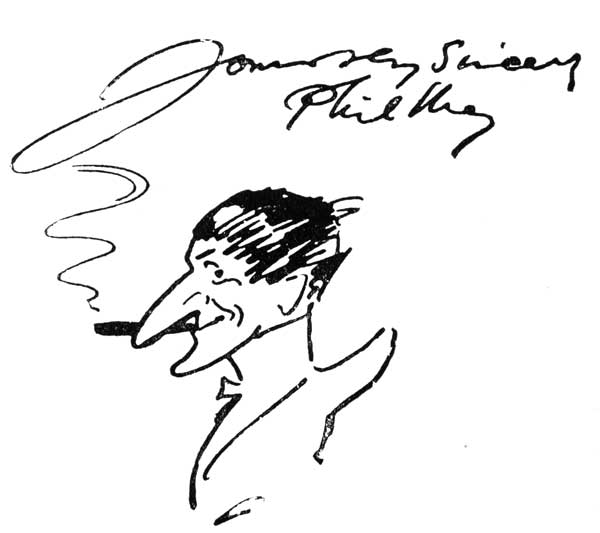 "I JOINED THE 'PUNCH' TABLE LAST WEEK, AND CARVED MY NAME
ON THE ROLL OF FAME."
"I JOINED THE 'PUNCH' TABLE LAST WEEK, AND CARVED MY NAME
ON THE ROLL OF FAME."
In the Almanac of 1894 two artists new to Punch made their appearance—the first, Mr. Stafford, the quondam cartoonist of "Funny Folks;" and the other, the world-famous humorist "Caran d'Ache" (M. Emmanuel Poirée), with a satire on the female craze of the day in respect to M. Paderewski and his flowing locks. In November of the same year Mr. Fred Pegram, who had for three years been one of the "Judy" artists, made his clever appearance in Punch, since then several times repeated; and with Mr. W. F. Thomas—the well-known successor of Baxter as the delineator of Ally Sloper and his low but amusing circle—who appeared twice in 1895, I close my list.
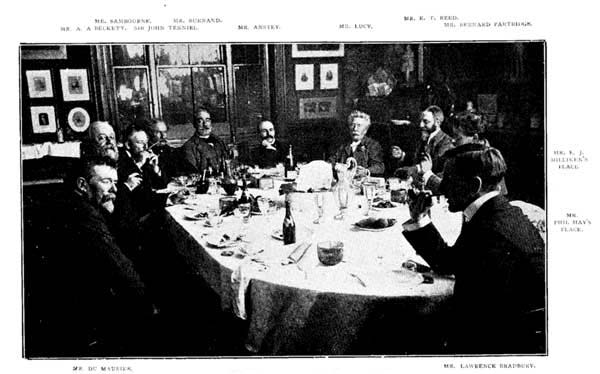 THE STAFF OF PUNCH AT TABLE, 1895.
It will thus be seen that with the exception of a very few among the earlier comic draughtsmen, and a half-a-dozen others of our own day, Punch has at one time or[Pg 572][Pg 571] another engaged the pencils of all the chief English graphic humorists of his time, and has even persuaded notable artists of more serious turn to try their hand at comic work.
In its artistic aspect, at least, Punch is more than a comic journal: it is, and has been for more than half a century, a school of wood-drawing, of pen and pencil draughtsmanship, and of wood-cutting of the first rank; it is a school of art in itself. The effect of its art-teaching has been widely felt, and on this ground alone its doings must command interest and justify a close examination into its rise and progress. So far, too, as one can foretell, its future is safe. Young men are arising who are capable of carrying on its traditions and of bearing its banner bravely and merrily aloft; and it may safely be assumed that, just as the Royal Academy sooner or later absorbs the best Outsiders to adorn its circle and keep its vigour green, so Punch will never lack the ablest men to don his cap and motley and shake his jingling bells.
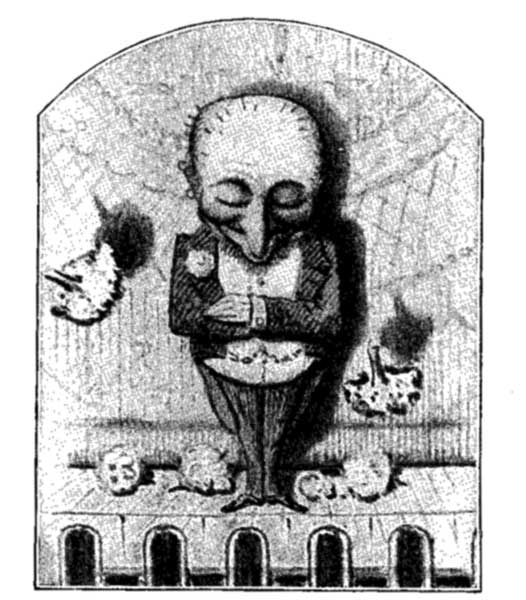 FINALE: A PROBATIONARY DRAWING (UNUSED).
1. William Newman.
2. A. S. Henning.
3. H. G. Hine.
4. Kenny Meadows.
5. Alfred "Crowquill."
6. John Leech.
7. Gavarni.
8. W. M. Thackeray.
9. Sir John Gilbert, R.A.
10. Hablôt K. Browne ("Phiz").
11. H. Heath.
12. R. J. Hamerton.
13. W. Brown.
14. Richard Doyle.
15. Henry Doyle, C.B.
16. A. Watts Phillips.
17. E. J. Burton.
18. W. McConnell.
19. Sir John Tenniel.
20. Capt. H. R. Howard.
21. C. H. Bradley.
22. Rev. Edwd. Bradley ("Cuthbert Bede").
23. T. Harrington Wilson.
24. Rev. W. F. Callaway.
25. Halliday.
26. G. W. Terry.
27. Frank Bellew.
28. Charles Keene.
29. Julian Portch.
30. G. R. Haydon.
31. George Du Maurier.
32. Gordon Thompson.
33. H. Stacy Marks, R.A.
34. Paul Gray.
35. E. J. Burton.
36. Fritz Eltze.
37. Sir John E. Millais, Bart., R.A.
38. Fred Barnard.
39. R. T. Pritchett.
40. A. R. Fairfield.
41. Colonel Seccombe.
42. Dever.
43. W. S. Gilbert.
44. Ernest Griset.
45. Alfred Thompson.
46. J. Priestman Atkinson.
47. Charles H. Bennett.
48. T. W. Woods.
49. G. Bouverie Goddard.
50. Miss Georgina Bowers (Mrs. Bowers-Edwards).
51. Walter Crane.
52. O. Harling.
53. H. R. Robinson.
54. Frederic Shields.
55. E. J. Ellis.
56. Linley Sambourne.
57. L. Strasynski.
58. F. Wilfrid Lawson.
59. A. Chasemore.
60. Walter Browne.
61. Briton Riviere, R.A.
62. J. Moyr Smith.
63. Wallis Mackay.
64. J. Sands.
65. Miss J. Romer.
66. R. Caldecott.
67. A. C. Corbould.
68. Major-General H. G. Robley.
69. W. Ralston.
70. F. Woods.
71. J. Curren.
72. L. G. Fawkes.
73. Colonel Bennitt.
74. T. Walters.
75. W. J. Hodgson.
76. Miss Fraser.
77. Montagu Blatchford.
78. W. G. Smith.
79. W. G. Holt.
80. E. J. Wheeler.
81. Harry Furniss.
82. C. J. Lillie.
83. G. A. Storey, A.R.A.
84. William Padgett.
85. Thompson.
86. E. Morant Cox.
87. Harper Pennington.
88. G. H. Jalland.
89. George Darré.
90. J. P. Mellor.
91. C. A. Marshall.
92. E. T. Reed.
93. Everard Hopkins.
94. W. J. Hodgson.
95. J. Bernard Partridge.
96. Sir Frank Lockwood, Q.C.
97. J. A. Shepherd.
98. A. A. Sykes.
99. J. F. Sullivan.
[Pg 575]
Articles of Agreement indented made and entered into this fourteenth day of July—in the year of our Lord One thousand eight hundred and forty one Between Henry Mayhew of Number 3 Clements Inn in the County of Middlesex Gentleman Mark Lemon of Number 12 Newcastle Street Strand in the said County of Middlesex Gentleman and Joseph Stirling Coyne of Number 14 Fludyer Street in the City of Westminster Gentleman of the first part Ebenezer Landells of Number 32 Bidborough Street in the Parish of Saint Pancras in the County of Middlesex Engraver of the second part and Joseph Last of Crane Court in the City of London Printer of the third part.
It is Agreed between the persons parties hereto each so far as the stipulations hereinafter contained are to be performed by or are applicable to him respectively.
That there shall be published a periodical Work to consist of humorous and political Articles and embellished with Cuts and Caricatures to be called "Punch or the London Charivari" the same to be published in weekly numbers on every Saturday after the date of these presents every such number to be contained in and fill one sheet of double demy of Sixteen pages each page to contain two Columns except the pages containing advertisements each of which are to contain three Columns and that the average size of the Type shall be brevier solid.
That the persons parties hereto of the first part shall be the Editors of the said work. That the said Ebenezer Landells shall be the Engraver to the same work and that the said Joseph Last shall be the Printer thereof.
That the said Editors shall supply the said Ebenezer Landells (by delivering the same at Number 12 Newcastle Street Strand the present Office of the Editors of the said work or other the Office for the time being of the said Editors) with written suggestions for subjects for the Cuts for illustration and embellishment of the said work such suggestion for the Cut or Cuts on page 9 of each number (and which page is to be filled with one or more Cut or Cuts and letterpress in explanation thereof) to be furnished at least on the fourteenth day—preceeding [sic] the day on which the number in which they are to be contained is to be published and such suggestions for other Cuts to be furnished one half on the Eighth day and the other half on the Seventh day preceeding the day on which the number in which they are to be contained is to be published such Fourteenth and Seventh days to be reckoned exclusive of such last mentioned day.
That provided the said Editors shall supply the said Ebenezer Landells with such written suggestions as aforesaid he shall as such Engraver as aforesaid deliver the blocks in which such Cuts shall be Engraved to the said Joseph Last as such Printer as aforesaid (such delivery to be at the Printing Office for the time being of the said Joseph Last) at latest by Eight o'Clock in the Evening of the Tuesday next preceeding the day on which the number in which they are to be contained is to be published.
That the said Editors shall supply the said Joseph Last (by delivering the same at his Printing Office for the time being) with the matter (exclusive of Cuts) necessary for each number of such work in the proportions following—namely half at latest by the Monday preceeding the day on which the number to contain such matter is to be published One quarter more at latest by the Tuesday at noon preceeding such last mentioned day and the remaining one quarter at latest by Six o'clock in the Evening of the last mentioned Tuesday.
That if the said Cuts and Matter shall be so supplied to the said Joseph Last as aforesaid he shall print and deliver at the publishing Office for the time being of the said work and at latest by Five O'clock in the Afternoon of the Wednesday preceeding the day on which the number to contain such Cuts and Matter is to[Pg 576] be published so many such numbers of the said Work as shall be required for Country Circulation And shall also print and deliver at the said Publishing Office and at latest by Eight O'clock in the Morning of the Thursday preceeding the last mentioned day so many such numbers as shall be required (not exceeding Two hundred quires) for Town circulation and shall also print and deliver at the said publishing Office after the last mentioned Thursday when and as they may be reasonably required so many more such numbers as may be required.
That the publisher for the time being of the said work shall be the person by whom all Sales of the same Work shall be made and who shall receive all monies in respect of such Sales but all such Sales shall be made on account of the persons parties hereto proprietors of the said Work and all accounts against debtors shall be sent in and delivered to them as being indebted to the said proprietors.
That the said several persons parties hereto shall be entitled to the profits arising from the said work as hereinafter mentioned in that behalf but before any sum of money or any other thing shall be adjudged profits or in the nature of profits the said persons parties hereto of the first part shall as such Editors as aforesaid be entitled to receive out of the assetts in respect of the said Work on every Saturday next after the date of these presents the sum of Twenty pounds and the said Ebenezer Landells and Joseph Last shall be entitled to receive out of the same assets on every Saturday next after the date of these presents the amount of their respective Bills (duly audited and allowed as hereinafter mentioned) in respect of the Engraving for and printing of the said Work respectively—The said Editors to be entitled to the said Weekly sums in equal shares and proportions.
That all claims and demands in respect of the said Work (including those of the said Ebenezer Landells and Joseph Last for Engravings for and printing of the said Work) shall be sent in to and delivered at the said Editors Office on every Saturday Evening by Eight O'Clock at the latest that on every Saturday Evening after the date of these Presents at Eight o'Clock a Meeting shall be held of the several persons parties hereto at No. 12 Newcastle Street Strand or other the Office for the time being of the Editors of the said Work—at every of which Meeting shall be present at least one of the said Editors and one other of them the said Ebenezer Landells and Joseph Last and at every such meeting all claims and demands on and in respect of the same Work shall be audited and allowed by the parties present at such Meeting and the publisher of the said Work and all other persons shall attend at such Meeting and bring all monies which may since the last Meeting have been received in respect of the sale of the same Work or otherwise on Account thereof and pay the same over to the parties constituting such Meeting and such parties shall out of such monies in the first place pay all expences of Advertising, Cost of paper, salary to the publisher Rent of any premises necessary for conducting the said Work and all other incidental outgoings and expences whatsoever which shall have been incurred in respect of the said Work and which shall have been duly audited and allowed as aforesaid (other than those which shall be payable to the parties hereto as such Editors Engraver or printer as aforesaid) and then in the next place in paying to the several persons parties hereto all their claims and demands in respect of the same Work as such Editors Engraver and printer as aforesaid.
That in case the last mentioned monies shall not be sufficient to pay and satisfy the outgoings and expenses concerning the same Work (other than those which shall be payable to the parties hereto as such Editors Engraver and printer as aforesaid) then the deficiency shall be made good out of any monies which [may] be received on any subsequent Saturday or (if received) by monies raised from the sale of any of the assetts in respect of the said Work so that at no time shall any of the several persons parties hereto receive any money as such Editors Engraver or printer as aforesaid until all other claims and demands on and in respect of the said Work shall be fully paid and satisfied and in case the assets in respect of the said Work shall not be sufficient to pay and satisfy the outgoings and expenses concerning the same Work (other than those which shall be payable to the parties hereto as such Editors Engraver and printer as aforesaid) then the deficiency shall be borne paid and defrayed by the said Henry Mayhew Mark Lemon Joseph Stirling Coyne Ebenezer Landells and Joseph Last in equal proportions and in case the assets in respect of the said Work shall not be sufficient or no more than sufficient to pay and satisfy the claims and demands concerning the same Work other than those which shall be payable to the parties hereto as such Editors Engraver and printer as aforesaid then the said parties hereto shall not have any claim the one against the other in respect of any such[Pg 577] claim or demand and in case the said assetts shall be more than sufficient to pay and satisfy the claims and demands concerning the said Work other than those which shall be payable to the said parties hereto as such Editors Engraver and printer as aforesaid but not sufficient to pay the entirety of the claims and demands of such Editors Engraver and printer then such Editors Engraver and printer shall be entitled to such surplus assetts by an equal pound rate according to the amount due to the said Editors at the rate of Twenty pound per Week as aforesaid and the amount of the respective Bills of the said Ebenezer Landells and Joseph Last as such engraver and Printer as aforesaid.
That after all claims and demands in respect of the said Work (including those of the said Editors Engraver and printer as aforesaid) shall be fully satisfied the said Henry Mayhew Mark Lemon Joseph Stirling Coyne Ebenezer Landells and Joseph Last shall be entitled in equal proportions to the net gains and profits arising from the said Work to and for their own use and benefit absolutely such division of profits to take place as far as may be on the Saturday in which they shall be declared—And all the assetts in respect of the said Work after answering all claims and demands against the same shall belong to the last mentioned persons in equal shares and proportions to and for their own use and benefit absolutely.
That the copyright of the said work including the wood and other cuts therein and the designs therefore shall belong to the parties hereto and so also shall all perquisites such as Books or other articles sent for review Tickets for Theatres Exhibitions and other places and all other things and matters incident to the said Work.
That in case the said Editors shall make default in supplying the said Ebenezer Landells with written suggestions in in breach of the clause hereinbefore contained numbered 3 then for every such default they shall pay unto the said Ebenezer Landells the sum of One pound ten shillings And in case the said Ebenezer Landells shall make default in delivering to the said Joseph Last the blocks in breach of the clause hereinbefore contained numbered 4 then for every such default he shall pay unto the said Joseph Last the sum of One pound ten shillings And in case the said Editors shall make default in supplying the said Joseph Last with matter in breach of the clause hereinbefore contained numbered 5 then for every such default they shall pay unto the said Joseph Last the sum of One pound ten shillings And in case the said Joseph Last shall make default in printing and delivering the numbers of the said work in breach of the clause hereinbefore contained numbered 6 then for any such default he shall pay unto the said Editors the sum of Fifteen shillings and unto the said Ebenezer Landells Fifteen shillings such payments to be respectively paid as liquidated damages and on the Saturday next after the defaults respectively shall have been made and may from time to time be deducted out of any monies which may be payable to the party making such default under any stipulation herein contained.
That a proper Book of account shall be kept by the said publisher whose duty it shall be without delay to enter therein all such just and proper entries as a publisher ought to enter and proper entries shall be made in the same Book of all receipts and payments and all accounts matters and things in respect of the said Work and be kept with all vouchers and writings which may relate to the same work in the publisher's Office for the time being of the said work and not elsewhere for the inspection and perusal of each of the parties hereto his executors and administrators and whereto each of them may at all times resort and take copies thereof or extracts therefrom at their free will and pleasure and that the same Book shall at each of the aforesaid Weekly meetings be laid by the said publisher before the persons parties hereto attending the hereinbefore mentioned weekly meetings respectively which person shall at each such Meeting then and there make up state and balance the said Book and sign the same when so made up stated and balanced and the same shall within one week afterwards be signed by such of the parties hereto as may not have attended the weekly meeting in which such Book shall have been lastly stated and balanced and after such signature each of them shall be bound and concluded therein unless some manifest error to the amount of Five pounds or upwards shall be found therein and signified by either of the parties to the other within six calendar months next after the taking of such accounts respectively in which case the error shall be rectified but no other par of the said account shall be impeached or disturbed.
That the getting up of the work shall be executed in all respects in the best possible manner by all the parties hereto and each party shall be just and true to each other in all matters and things relating to the said Work.[Pg 578]
That the whole conduct of the said work as well with regard to the Editing printing designing engraving and publishing thereof as every other matter and thing connected therewith or incidental thereto and the expenses thereof respectively shall in case there be any difference about the same be decided by a majority of the votes of the several parties hereto the said Ebenezer Landells being entitled to one vote the said Joseph Last to one other vote and the parties hereto of the first part or any two of them to one other vote the vote of the last mentioned parties or any two of them being to be taken for the purpose of such voting but as one person only.
That any person may retire from this Agreement and from all concern in the said Work on leaving at the Publisher's Office for the time being of the said Work Twenty one days notice in writing of his intention so to do such Notice expiring on a Saturday.
That upon the retirement of any such person as aforesaid the assetts belonging to the said work (including debts) shall at the joint expence of the persons parties hereto be valued by three indifferent and competent persons in the publishing business who shall take upon themselves the office of such valuation one to be chosen by the said Editors another by the said Ebenezer Landells and the third by the said Joseph Last within one week after such retirement and in case any or either of the said parties shall for any cause whatever not nominate such valuor on his or their behalf within the said week then a valuer may be nominated by the valuer or valuers chosen by the party or parties who may be willing to proceed with the said valuation and such valuor so nominated as last aforesaid may with the valuer so previously nominated (in case only one of such parties shall have nominated a valuer) nominate a third valuer to carry into effect the aforesaid valuation And in case such third valuer shall not from any cause be nominated within one week after two valuers shall have been nominated then such third valuer may be nominated by the Clerk of nisi prius of the Court of Queens Bench for the time being on the application of any party hereto who shall first make application to him for that purpose And in case of the death of any of the said valuers another or other may be chosen in manner hereinbefore set forth And after such valuation shall be made known it shall be lawful for the persons parties hereto (other than the person so retiring as aforesaid) to purchase the whole (but not a part of) the share and interest of the Party so retiring in the net assetts belonging to the said work and the parties so purchasing as aforesaid shall enter into a Bond in a sufficient penalty with two good and sufficient sureties for securing to the party so retiring the payment of the amount of such his share and interest ascertained by such valuation as aforesaid at the respective periods of three six nine and twelve calandar months next after such retirement with interest at the rate of five pounds per cent. per annum from the time of such retirement payable quarterly in the meantime That in case of the death of either of the said persons parties hereto a valuation shall be made of the assetts belonging to the said Work (including debts) in the manner hereinbefore stipulated the executors or administrators of the deceased partner being substituted for such deceased party and the surviving parties shall have the option of purchasing the share of the party so dying of and in the said assetts upon the same terms as are hereinbefore mentioned in case such party had retired as hereinbefore provided That in case either person shall become Lunatic or Imbecile or from any cause prevented from attending to the business of the said Work as hereinbefore provided for the period of two entire calendar months he shall to all intents and purposes be considered to have retired from this Agreement and from all concern in the said Work as fully and effectually as if he had given notice under the clause hereinbefore contained in that behalf and a valuation shall be made of the assetts in respect of the said Work (including debts) in the manner hereinbefore stipulated the friends acting on behalf of the Lunatic or imbecile person being substituted for such Lunatic or imbecile person. That if in any of the cases aforesaid the parties in whom shall be the right of purchasing the share and interest of the party so retiring dying becoming Lunatic or imbecile or prevented from attending to the business of the said Work as aforesaid shall decline to elect to exercise such right (and they shall be deemed to have so declined unless the contrary be made known by notice in writing under the hands of the parties entitled to such right and left at the said publishing Office for the time being within seven days after such right shall have accrued) then the assetts belonging to the said Work including debts shall be sold by public auction and the net produce of the said assetts after discharging all claims and demands in respect of the same work shall be equally divided between the[Pg 579] said Henry Mayhew Mark Lemon Joseph Stirling Coyne Ebenezer Landells and Joseph Last or (as the case may be) the survivor of them and the executors or administrators of him or them who may be deceased.
That in case the said Work shall be discontinued and the parties hereto cannot agree upon any other mode of winding up the affairs of the said Work then the assetts belonging to the same Work including debts shall be sold by public auction and the net produce of the said assetts after discharging all claims and demands in respect of the same work shall be equally divided between the said Henry Mayhew Mark Lemon Joseph Stirling Coyne Ebenezer Landells and Joseph Last or (as the case may require) the survivors of them and the executors or administrators of such as may be dead.
That in case any dispute or question shall arise between the parties hereto their executors or administrators or any of them concerning any stipulation herein contained or otherwise concerning the said Work (which cannot be decided under the clause herein contained Numbered 16) then the grounds of every such dispute or question shall upon the request of any one or more of the parties in difference and within three days after such request be reduced into writing and signed by the parties in difference or by the parties complaining and shall be referred to the arbitration of two indifferent persons one to be named by the person or persons who shall take one side of the matter in difference and the other to be named by the person or persons who shall take the other side of the matter in difference And that in case the person or persons who shall take either side of the said difference shall refuse to name a referee within seven days after notice in writing for that purpose to be left at the said Publishers Office for the time being then the grounds of every such dispute or question shall be reduced into writing and signed by the person or persons who shall take the other side of the difference and to be referred to the arbitration of two indifferent persons to be named by the person or persons who shall sign the said last mentioned writing And in case the two referees to be named by both or one of the said parties as aforesaid cannot agree on an award then to the Umpirage and arbitration of such one person as the referees shall appoint by any writing under their hands such Umpire to be appointed by the said referees before proceeding in the matter of the said reference and if from any cause such Umpire shall not be appointed by the said referees within three days after their appointment then the same shall be appointed by the Clerk of Nisi Prius of the said Court of Queens Bench upon the application of either party in difference who shall first make application to him for that purpose And that such person or persons who shall be a party or parties to such reference on the one part shall enter into a bond of reference with the person or persons who shall be a party or parties to the said reference on the other part and in the usual form to stand to obey and keep the same Award or determination when made without any further suit or trouble whatsoever And that the Award or determination which shall be made by the said two referees or their Umpire concerning the Premises referred to them or him or any part thereof shall be final and conclusive on the said parties their respective executors and administrators So that such referees shall make their Award in writing within seven days next after such reference to them and so as such Umpire shall make his determination in writing under his hand within seven days next after the matter shall be referred to him And that every Bond of reference shall be made a rule of Her Majestys Court of Queens Bench at Westminster on the application of either of the said parties to the same reference his or her executors or administrators and that the reference shall not be defeated or affected by the decease of all or any of the parties thereto pending the same and that no Suit at Law or Bill in Equity shall be brought commenced sued or prosecuted against the said referees or their Umpire touching or concerning their Award or determination.
That no suit at Law or in Equity upon or by virtue of these Presents or any Clause or Article herein contained or otherwise concerning the said Work shall be commenced preferred or instituted by either of the said parties hereto his heirs executors or administrators against the other of them his heirs executors or administrators before the party or parties his or their heirs executors or administrators who is or are to be a party or parties defendant or defendants in such suit or suits shall have refused or declined to refer the matters in difference to arbitration pursuant to the stipulation hereinbefore contained or the referees or their Umpire shall have declined or omitted to make any Award or determination within the respective times hereby appointed for that purpose And that when such difference shall arise between any two or more of the parties hereto each of[Pg 580] the other parties hereto shall have notice thereof by writing to be left at the said Publishers Office for the time being to the intent that the said parties respectively may have the option of taking a part in the matters in difference on either side and that the party or parties who shall refuse or decline to become a party to such reference shall be bound and concluded by all the parties hereto and by the Award and determination of the Arbitrators or their Umpire in the same manner to all intents and purposes as if he or they had been a party or parties to the matters in difference concerning which such Award or determination shall be made and had joined in referring the same.
That this Agreement shall be deposited for safe Custody on behalf of all parties with Alfred Mayhew of No. 26 Carey Street Lincolns Inn Attorney at Law to be produced by him to and for the benefit of the said parties respectively and their respective heirs executors and administrators when and as often as occasion shall require and the said parties respectively or their respective heirs executors and administrators shall be at liberty as often as they shall think proper at their own Costs to obtain from the said Alfred Mayhew Copies or Extracts of or from the same Agreement.
That the expenses of and incidental to this Agreement shall be paid on the execution thereof by the said Joseph Last who shall be repaid out of the first proceeds of the sale of the said Work As witness the hands and seals of the parties.
| Signed sealed and delivered by all the above named parties in the presence of Wm. Eldridge Clerk to Messrs. Mayhew & Co. 26 Carey St. Lincolns Inn |
HENRY MAYHEW MARK LEMON JOSEPH STIRLING COYNE EBENEZER LANDELLS JOSEPH LAST |
À Beckett, Mr. Arthur W., 61, 67, 74;
Parish Councils Bill cartoon, 169;
contributions, etc., 374, 375
À Beckett, Gilbert Abbott, and the origin of Punch, 14, 17;
the first number, 26, 61, 67;
at the Dinners, 75, 76;
the Jews, 103;
suggestions for cartoons, 171, 180;
attack on Bunn, 226, 228;
attacked in the "Puppet-Show," 239;
his only artistic contribution to Punch, 251;
number of contributions, 259, 260, 276, 277;
as a magistrate, 278, 279;
biographical summary, 272-280;
his sons as children, 435; et passim
À Beckett, Gilbert Arthur, and "Dropping the Pilot," and "The Hidden Hand," 180, 383, 381-384
À Beckett, Hon. T. T., and the origin of Punch, 12, 272, 274
Aberdeen, Lord, 101, 111, 119, 147
Accounts relating to transfer of Punch to Bradbury & Evans, 34-36
Acrostics, Double, 493, 494
Advertising on umbrellas and house-fronts, 125
"Advice to persons about to marry," 141, 186
"Advice to Vocalists," 161
Æstheticism and Mr. Du Maurier, 506
Agnew, Mr. John Henry, 38, 61
Agnew, Mr. Philip, 38
Agnew, Mr. Thomas, 38, 61
Agnew, Sir William, 38, 61, 87
Agreement constituting Punch (Appendix II.), 25, 36, 575-580
Ainger, Canon, 147
Ainsworth, Harrison, 220
"Airs Resumptive," 405
Albany, Duke of, Death of, 183
Albert, Prince, 101, 199;
attitude of Punch towards him, 215-217
"Albion," The, and the dinner to Mr. Burnand, 88
Alexander III. as the New Pharaoh, 105;
and Lord Augustus Loftus, 194
Allen, Joseph, 26;
and the Punch Club, 93, 282, 452
"Almanac," The, 31;
its reputed originators, 32, 33;
great success, variations in production, and "influenza year," 40;
piratical imitations, 41;
a drawing of Sir John Gilbert's, 451, 562, 567; et passim
"Almanac Dinner," 87
Amateur Humorists, 147-149
America, War of Secession, 80, 111, 120, 177;
humour, 163;
opinion of Punch, 370;
Mr. du Maurier's portrayal of American girls, 511, 512
Andersen, Hans Christian, 265
Andover Workhouse Scandals, 278 and note
"Animal Types," Sir John Tenniel's, 176, 177
Anstey (Guthrie), Mr. F., 67;
politics, 80; 396-401
"Answers to Correspondents," 31
"Anti-Graham Envelope," and "Wafers," 52, 114-117
"Anti-Punch," The, 240
Appendices, Signatures of Punch's artists, 573, 574;
text of agreement constituting Punch, 575-580
Argyll, Duke of, and "The Old Crusaders," 182
Armitage, Mr. Arthur, 406
Armstrong, T., 16
Arnold-Forster, Mr., 145
"Arrow," The, 157, 240, 500
"'Arry Papers," 378-380 and note
Art, Punch's attitude towards, 126, 127, 221, 222;
past and present in Punch, 409, 410
Art Union, The, Satire on, 52
Artists on Punch, Number of, 410;
signatures of (Appendix I.), 573, 574
"Ascot Cup Day," Thackeray's, 314
Ashby-Sterry, Mr., 361, 372, 386, 387, 499
Ashley, 444
Asquith, Mr., 205
"Athenæum," a criticism on Punch, 243
Atkinson, Mr. J. Priestman, Contributions of, 368, 371, 372, 410, 524, 525
"Atonement Dinner," Thackeray's, 87, 88
Attacks on Punch, 227-232, 237-241
"Author's Miseries," 315
"Awful State of Ireland," Hood's, 336
"B. W.," 501
Bacon, Mrs., and the title of Punch, 24
Bailey, the sculptor, and Jerrold's bust, 87
"Bang went Saxpence," 140, 141, 186
Bank of England, and error of Punch's, 245
Banting, Mr., 157
Barham, R. ("Tom Ingoldsby"), and the Punch Dinners, 86
Baring, Sir Francis, 233
Barnard, Mr. Fred, 156, 518, 519
Barry, Michael John, and the "Peccavi" despatch, 361
Bather joke, The, 162
Bayley, F. W. N., 17, 19
Baylis, Henry, 19, 24;
and the Punch Club, 93, 97
Beaconsfield, Lord, see Disraeli, Mr.
"Beard movement," 423
Beardsley, Mr. Aubrey, 222
"Bede, Cuthbert," see Bradley, Rev. Edward
Bedford, Mr. Deputy, 317, 385, 386
Bedford Hotel, Punch Dinner at, 64, 65, 86, 87
Beetle, Sergeant-at-Arms as a, 145, 146
Bellew, Frank, 500, 501
Benefit performances, 132-135
"Bengal Tiger, The," 208
Bennett, Charles H., 61, 66;
letter from his fellow-diners, 76, 77, 527;
benefit performance for his widow, 132, 134, 528;
death of, 180, 455, 525-528
Bennett, J., 498
Bennitt, Mr., 542
Bennitt, Colonel Ward, 547, 548
Betham-Edwards, Miss M., 371, 372
Bethell, Mr. (afterwards Lord Westbury), and Punch's applications for injunctions, 151, 152
"Bibs' Baby, Mrs.," 295
"Bicycle made for Two, A," 471
"Billie Barlow," 360
"Bird's-eye Views of English Society," 455
Bismarck, Prince, Resignation of, 179, 180;
and the Emperor William II., 193;
a "junior cartoon" by Mr. Sambourne, 535
Black, Mr. William, on Keene, 489
"Black Maria" joke, A, 143, 144
Blackwood, Mr., 330
Blanchard, Laman, 259, 260, 337, 338
Blanchard, Sidney, and "Mr. Punch, His Origin and Career," 12;
and the "London Charivari," 15;
proposal for a "comic Punch," 14 note
Blatchford, Mr. Montagu, 88, 548
Blocks for Punch illustrations, 249-251
Bloomerism, 424
Board School, Hugh Middleton, 125
"Book of Beauty," 467, 479
Borrow, George, and Thackeray, 318
"Bow Street Ballads," 320
Bowers, Miss Georgina, 166, 529, 530
Boyd, Mr. A. S., 167
Bradbury, William, 36, 49, 61
Bradbury, William Hardwick, 38
Bradbury, Mr. W. Lawrence, 38
Bradbury, Agnew & Co., 38
Bradbury & Evans, 31, 32;
and negotiations for the purchase of Punch, 33-35
Bradbury, Evans & Co., 38
Bradley, C. H., 477
Bradley, Rev. Edward, and "Verdant Green," 129, 492, 355, 372, 491-495
Brewtnall, Mr. E. F., 543
Brezzi, Mrs., and the Title of Punch, 24
"Briefless, Mr.," 275
"Briefless, Junior," 375
"Briggs, Mr., or Housekeeping versus Horse keeping," 131, 425
Bright, John, 101, 111;
and the New Reform Bill, 118;
"Hercules," 121;
with an eye-glass, 204;
obituary notice, 377
Brine, his portrait of Punch, 8;
and the first Staff of Punch, 19;
cartoons, 171, 412
"Britannia," 208, 473, 535
"British Lion," 70 and note, 176, 177, 208, 470
Bromley, Valentine, 548
Brooks, Reginald Shirley, 67, 387
Brooks, Shirley, and the origin of Punch, 11;
misconception as to the first editorship of Punch, 25 note;
portrait, 60, 80;
politics, 99;
his lectures, 129;
the "Man in the Moon," 154, 238, 357;
old jokes, 163;
a Cawnpore cartoon, 177;
verses on Abraham Lincoln, 177, 178;
verses on the death of the Prince Consort, 217;
"Our Flight with Punch," 238, 357;
friendship with Angus Reach, 357;
as Editor, 359, 360;
work and characteristics, 356-360
Brough, Robert, 265, 360
Brough, William, 265, 288, 360
Brougham, Lord, 101, 153;
opinion of Punch's portraits of him, 200;
as "Mrs. Caudle," and as a clown, 202
Brown, W., 454
"Brown, Mrs.," 489
"Brown, Jones and Robinson," 455
"Brown's Letters, Mr.," 321
Browne, Charles F., 180, 317, 369, 370
Browne ("Phiz"), Hablôt Knight, and the origin of Punch, 19;
his design for the cover, 41, 42, 451;
"Valentines," 49, 50;
"Mokeanna," 365, 427, 446, 451, 452
Browne, Mr. Walter, 539
Brunton, W., 232, 502
Bryan, Mr. Alfred, 557, 567
Bryant, W., first publisher of Punch, 19, 27
Buccleuch, Duke of, 233
Buckingham, James Silk, Punch's attack on, 223-225
Bulgarian atrocities, 165
Bull, W. P., 337
Bull-fights, 429
"Bull Frog" cartoon, 449
Bunn, Alfred, Punch's attack on, 225-227;
his "Word with Punch," 131, 227-232
Burnand, Miss, 392
Burnand, Mr. F. C., 40;
portrait, 60;
politics, 80, 99;
dinner in his honour at the "Albion," 88;
the Two Pins Club, 98;
"Happy Thoughts," 129, 365;
first contribution, 146, 362;
puns, 151, 366;
"Mrs. Gummidge," 179;
"Out of Town," 276, 366;
contributions, editorship, etc., 362-368
Burnham Beeches, Jubilee Dinner at, 87
Burns, Mr. John, 235
Burton, E. J., 460
Butts, Punch's favourite, 217-233, 330
Byron, Henry J., verses on Punch, 8;
Comic News, 160;
Fun, 364, 407
"C.," 491
"C. B.," 547
Cabinet Ministers, Attitude of Punch towards, 195-205
Caldecott, Randolph, 545, 546
Callaway, Rev. W. F., 498, 499
Calverley, C. S., 371
Campbell, Mr. Gerald F., 403
Campbell, Lady, 392, 406
"Candidates under Different Phases," 188
Canning, Lord, 177
Capital punishment, 2, 3
"Captain Jinks of the Selfish," etc., 523
"Captious Critic," The, 541, 542
Carnigan, Lord, Epigram by Wills on, 26
Caricature, Carlyle on, 4;
as illustrated by Gillray, Rowlandson, and Cruikshank, 186
Carlisle, Lord, and a dinner to the Punch Staff, 90, 200
Carlyle, on caricature, 4;
on humour, 5;
"Latter-day Pamphlets," 112
Carthusians on the Staff, 69, 70
"Cartoon Junior," The, 82, 170
Cartoons, and tinted background, 41;
history, weekly arrangements for design and production, etc., 79, 80, 168-184, 463, 464;
origin of name, etc., 185-188;
as a reflection of popular opinion, 188, 189;
engraving, 249, 464, 468
Cartoonists, 170-172
Cartoons for Houses of Parliament, Exhibition of, 187
"Cartoons, Sir John Tenniel's," 52
Catling, Mr., 95
"Caudle, Mrs.," and the "Lectures," 73, 98, 130;
and Lord Brougham, 202;
"sudden death," 238, 291-293
"Caudle at Gravesend, Mrs.," 130
Cawnpore Cartoons, 176, 177
"Cham," 501, 502
Chamberlain, Mr. Joseph, 408
Chambers, Mr., 498, 523
"Charivari," Philipon's, 15
Chartism, 108, 425
Chasemore, Mr. A., 483, 538, 539
Cheltnam, Mr. Charles Smith, 374
Chess-problem joke, 160
Chester, Fred, 60
Chester, George, 60, 255
"Child Snobson's Pilgrimage," 166
"Childe Chappie's Pilgrimage," 146, 166, 378
Children, Mr. du Maurier's drawings of, 507, 513
Children, Punch men's love of, 294
Chinese War, 111, 119
"Chronicles of a Rural Parish," 403
Church, Affairs of the, in Punch, 102, 103
"Church-going Bell," 536
Churchill, Lord Randolph, 199;
portraits, 204, 552, 553
Circulation of Punch, early numbers, 28, 30, 31;
after the production of the "Almanac," 33;
after "A Visit to the Watering-Places," 49
Clarke, Mrs. Cowden, on Lemon's "Falstaff," 135
Clarke, H. Savile, Contributions of, 371; 483
Cleaver, Mr. Reginald, 92, 565
Club, Punch, 52, 55, 93-98, 452;
Two Pins, 98;
Mulberry, 447;
Shakespeare, 447
Clubs in Fleet Street, 54
Clubs, Complaint books of, and Thackeray's "Snob Papers," 319
Cobden, Richard, 111, 157, 165;
portraits in Punch, 205
"Cock-a-doodle-do," 190
Collins, Mrs. Frances, 392, 405
Collins, Mortimer, 240, 376
"Columbia," 208
Combe, George, 240
"Comic Blackstone," The, 276
"Comic Bradshaw," The, 276, 280
"Comic Latin Grammar," 419, 420
"Comic Mythology," 282
"Comic News," 160, 265, 414, 500, 525
"Comic Times," 361, 412, 525
"Commercial Intelligence," 274
"Complete Letter-Writer," 294
"Confessions of a Duffer," 392
Consort, Prince, see Albert, Prince
Contributions of Staff, Relative, 258-263
Conundrums by Thomas Hood, 330, 331
"Conversational Hints for Young Shooters," 402
Conway, Mr. Moncure, 440
Coode, Miss, 502, 529 note
Cooke, Mr. C. W., 403
Cooke, T. P., 298
Cooper, Mr., 540
Cooper, Mr. Sidney, and a device of Douglas Jerrold, 75
Corbould, Mr. A. Chantrey, 410, 543, 544, 545
"Cosmorama, The," 16, 17, 414
"Cousin Jonathan," 208
Covers of Bi-Annual Volumes, Designs for, 41-49
Cox, Mr. Everard Morant, 558
Coyne, Joseph Stirling, and the origin of Punch, 12, 14, 17, 19;
and the editorship, 25, 256, 271, 272
Crane, Mr. Walter, 530
Crawhall, Mr. Joseph, 147
Cricket, Punch on, 514, 515
Crimean War, 109, 110, 111, 119, 174
Crinolines, 424
"Crown Inn," Vinegar Yard: the Punch Dinner, and the Punch Club, 55
"Crowquill," Alfred, his portrait of Punch, 8;
and the "London Charivari," 15;
"Valentines," 49, 158;
cartoons, 171;
"Vauxhall Papers," 226, 449-450
Cruikshank, George, his etchings, 9, 186;
"Omnibus," 162, 496, 497;
and the Court, 189, 190;
Almanack, 417;
relations with Punch, 495-498
Cruikshank, Robert, 273
"Cry of the Clerk," 388
Crystal Palace, christened by Punch, 84, 85;
"Gentleman's Magazine" dinner, 88
"Curiosities of Medical Experiences," 305
Curren, Mr. J., 548
"Daily News," and Charles Dickens, 84;
and Peter Rackham, 85
Dalziel, Edward, 16, 248
Dalziel, George, 16, 248
Darré, Monsieur G., 559, 560
Davies, Mr. George, 404
"Deaf Burke," 165
Deane, Rev. Anthony C., 404, 405
Delane, Mr., and mousseline de laine, 91
"Derby Ram," The, 524
Deterioration of Punch, Alleged, 245, 246
Dever, 523
Devonshire House, amateur theatrical performance at, 135
"Diary of Mr. Yellowplush," 317
"Diary of a Nobody," 392
"Diary of the Premier at Sea," 384
Dickens, Charles, at the Punch Dinner, 83, 351;
quarrel with Mark Lemon and Bradbury and Evans, 83, 352, 353;
friendship with Jerrold, 84;
dinner at the Mansion House, 90;
at the Punch Club, 93;
as an amateur actor, 135;
on Lemon, 255;
and the fund for Jerrold's widow, 298;
opinion of Thackeray's art, 313;
authorship of the "Song of the Shirt," 332;
sole (and unpublished) contribution to Punch,349;
verses by Mr. E. J. Milliken, 378, 435;
friendship with Leech, 436
Dining-room at 10, Bouverie Street, 58-63
Dining Table at Bouverie Street, Initials on, 63 and note
"Dinner, Almanac," 40
Dinner, Punch, 40, 53-87, 168;
names of diners in frontispiece drawing, 536 note
"Dinner at Timmins's, A," 320
Dinners, Special Punch, 87-92
"Diogenes," 159, 414, 459, 500, 525
"Dirty Father Thames," cartoon, 412
Disraeli, Mr., and Keene's unused cartoon, 60;
as presented in Punch, 100;
change of politics, 107;
the "Political Chameleon," 118;
the "Premier-Peri," 121, 473;
Bulgarian atrocities 165;
and "A Leap in the Dark," 179;
and the "Pas de Deux," 179;
as a beaten Minister, 182;
at the Printers' Pension Society dinner, 197-199;
and "Scaramouche," 199;
as Hamlet, 200;
obituary notice, 377
Dowse, Baron, Lines of farewell to, 373
Doyle, Henry, 459
Doyle, Richard, his portrait of Punch, 8;
secession, 40, 103;
designs for cover of Punch, 46-49, 202;
"Holidays," 50;
at the Dinners, 68;
"Papal Aggression" cartoons, 102, 103, 171, 455;
and Mr. Swain, 252;
"High Art and the Royal Academy," 349, 458 note;
his one literary contribution, 372; 454-458
Drama, The, Punch's support of, 128
"Drama, The," by Hood, 335
Draughtsmen on Punch, Number of, 410
Dress, Fashions in, 122, 123
"Dropping the Pilot," 179, 180, 383
Drunkards, Punch's pictures of, 245
Duelling, 187
"Dumb Crambo, Junior," see Atkinson, Mr. J. Priestman
Duncombe, M.P., Mr., 114
"Easel, Jack," see Eastlake, Mr Charles L.
Eastern Question, 118, 119
Eastlake, Mr. Charles L., 362
Edwards, Mr. Sutherland, and "Pasquin," 240, 348;
contributions to Punch, 348, 349
Egg, R.A., Augustus, 135
Electrotyping Punch blocks, 251
"Elephant and Castle" joke, 144
Eliot, George, 161, 332
Ellis, Mr. E. J., 255, 537
Eltze, F., his portrait of Punch, 9, 144, 521, 522
Engraving Punch illustrations, 247-253
Epigram Club, of Oxford, 149
Errors of Punch, 243-245, 472
"Essence of Parliament," 100, 245, 348, 359, 389-391, 526, 533, 551
"Eton Boy," an, Contribution of, 435
Eugénie, Empress, 110
Evans, Mr. Edmund, 16, 248, 445
Evans, Frederick Mullett ("Pater"), 36, 38
Evans, Mr. F. M., 38, 61
Extra Numbers, 49-51
"F. B.," 549
"F. M.," 498
"F. Captain," 549
Faddists as critics of Punch, 245
Fairfield, Mr. A. R. and the "Tercentenary Number," 50, 522; and 410, 522
"Fairy Tales," 337
Family Trees of Punch, 382
Farmer, British, 166
Fashions, 122, 123
Fawkes, L. G., 548
Ferguson, J. W., 259, 260, 337
"Février turned Traitor, General," 119, 174-176
Field, Mrs., 529 note, 545
"Figaro in London," 11, 188, 226, 273, 413
First Avenue Hotel, Punch Dinner at, 64
"Fitzdotterel," 378
Fleet Prison, 3
Fleischmann, A., Statue of "Punch" by, 62
"Flight with Punch, Our," 238
Footpad joke, The, 159
Forbes, Professor, 405
"Foreign Affairs," 173, 420
"Forlorn Hope" Cartoon, 180, 181
"Forlorn Maiden" Cartoon, 472
Forster, John, 135;
and Punch's portraits of Lord Brougham, 200
Forster, Rumsey, revenges himself on Thackeray, 319, 320
Foster, Mr. Birket, 16;
and the title of Punch, 25, 43, 60;
and "Bang went Saxpence," 140, 147;
and cartoon, 171;
on Mark Lemon, 256; 445, 446
Founders of Punch, 16, 17, 28
France, Punch's exclusion from, 165, 190, 191;
and the "United Service," 176;
Anglo-Congolese difficulty, Marshal MacMahon, and the "Madagascar Lamb," 191;
and Russia, 191, 192;
satirists, 242, 243
Franco-Prussian War, 110, 179, 192
Fraser, Miss, 549
Free Trade and Protection, 118
Frenchmen and Punch, 51, 437
Frith, R.A., Mr., and the first number of Punch, 29;
and "General Février," 175, 176, 435;
and the relations between Leech and George Cruikshank, 496
"Fun," 232, 364, 371, 459, 516, 539, 540, 567
"Funny Folks," 160
Furniss, Mr. Harry, his portraits of Punch, 9;
Paris Exhibition number, 51;
caricature by Mr. Sambourne, 61, 79;
the Two Pins Club, 98;
his public entertainments, 129;
"I used your soap two years ago," 145;
his first drawing, 146;
portraits of politicians, 204, 551-554;
and "Mrs. Ramsbotham," 237, 238;
a literary contribution, 372;
and "Toby, M.P.," 391, 551; 549-556
"Fusbos," 282
Gale, Frederick, 406
Gaiter, William, 16
"Gamp" and "Harris," Mesdames, 50, 211
Garibaldi, 120
Geake, Mr. Charles, 403
"General Février," 119, 174-176
"Gentleman's Magazine," and the dinner at the Crystal Palace, 88
"German Reeds' Entertainment," 130
Germany, Exclusion of Punch from the Court of, 192
Gilbert, R.A., Sir John: his portrait of Punch, 8;
design of cover, 11, 41, 45, 450; 126;
and "Bang went Saxpence," 140;
"Mokeanna," 364; 450, 451, 528
Gilbert, Mr. W. S., 232, 364, 372
Gillray and Rowlandson, 186, 189
Girdlestone, Rev. A. G., Pulpit tribute, 102
Gladstone, Mr.: and the dinner given by Mr. Lucy, 91;
on Punch's politics, 100, 197;
as presented in Punch, 101;
and Home Rule, 106;
under Sir Robert Peel, 107;
"Jupiter," 121;
"He won't be happy till he gets it," 160;
Bulgarian Atrocities, 165;
Parish Councils Bill, 169;
and Lord Rosebery's first speech as Premier, 170;
on political satirists, 172;
"Mrs. Gummidge," 179, 466;
"Forlorn Hope," 180, 181;
"The Old Crusaders," 182;
and the rejection of the Paper Duty Bill, 200;
portraits, 204;
on Mark Lemon, 267;
"Diary of the Premier at Sea," 384;
and "Britannia's Volunteers," 394, 395;
Sir John Tenniel's drawings, 466;
and Sir John Tenniel's knighthood, 473;
a sketch by Mr. Sambourne, 535;
collars, 551, 552;
loss of a digit, 556
"Globe," The, and "Mrs. Ramsbotham," 236, 237
"Glow-Worm," The, 375
Goddard, G. B., 528, 529
Gordon, Sir A., and the Punch Staff, 92
Gordon, General, 183
Goschen, Mr., 160, 200
Gossett, Captain, 145, 146
Graham, Mr., 545
Graham, Sir James: "Anti-Graham Envelope" and "Wafers," 113-116;
on Disraeli, 198
"Granta," The, 401-403
"Grattan," H. P., 19, 26;
and the origin of the "Almanac," 32;
Graves, Mr. Alfred Perceval, 373
Gray, Paul, 232, 517
Great Exhibition, The, 51, 111, 424
"Great Gun," The, 210, 218, 226, 238, 412, 416, 449, 451, 459
Greek Question of 185, The, 116
Greek Throne put up to auction, 120
Greenaway, J., 16
Greenwood, Mr. Frederick, and the announcement of Thackeray's death at the Punch Dinner, 86, 87
Grieve, Mr., and the Punch Club, 93
Griset, Mr. Ernest, 455, 537, 538
Grossmith, Mr. George, 391, 392
Grossmith, Mr. Weedon, 392
"Guide to Servants, Punch's," 313
Guild of Literature and Art, 134-136
"Gummidge, The Political Mrs.," 179, 467
"H.," 499
"HB.," 186, 190, 454
Hall, Mr. Harry, 491
Hall, S. C., and the "Art Union," 52;
Punch's attack on, 223, 235, 290
Halliday, B. C., 499
Halliday, Mr. Mike, 424
Hallward, Mr., 549
Hamerton, Mr. R. J., 95;
cartoons, 171;
the "Squib," 275; 327, 452, 453
Hammond, W. J., 130
Hampton Court, Dinner to Sir J. Tenniel at, 89
Hannay, James: and the "Journal for Laughter," 56;
his lectures, 129;
and "The Man in the Moon," 238, 306;
on Thackeray, 322;
and Jerrold, 348;
contributions to Punch, etc., 354, 355
"Happy Thoughts," 365
Harcourt, Sir Wm., 183;
portraits, 204, 552
Harling, O., 530
Harris, Mr., Contributions by, 517
"Harris, Mrs.," 50, 211
Harvey, William, his design for the cover of Punch, 42-44, 444;
as a draughtsman, 444
Hatton, Mr. Joseph: and the origin of Punch, 11;
and Mark Lemon, 163, 255, 267;
"True Story," 329 and Preface
Hawkins, Sir Henry, 152
Haydon, G. H., 423, 426, 496, 502
Hays, Mr., 528
"He won't be happy till he gets it," 160
"Heads of the People," 447
Heath, H., and cartoons, 171; 452
"Heathen Mythology," 276
Heaviness of Punch's fun, Alleged, 238-241
Hennessy, Mr. W. J., 547
Henning, A. S., 19;
and the first cover of Punch, 26, 41;
"Valentines," 49;
and "Joe Miller the Younger," 153, 412;
cartoons, 171;
the "Squib," 275, 412; 410-412
Henning, Mr. Walton, 305, 411
Herkomer, R.A., Professor, 445
"Hidden Hand, The," 180
Higgins, Matthew J. ("Jacob Omnium"), 260, 321 note, 343
Highbury Barn Tavern and the Annual Dinner, 87
Hill, Miss Joanna (Mrs. Fellows), 518
Hine, H. G., 34;
and the Almanac, 40;
design for cover, 41, 43;
and the first Punch Dinner, 55;
the Punch Club, 94;
"Anti-Graham Wafers," 115, 416;
cartoons, 171, 416; 330; 414-417;
serenaded by Punch Staff, 448
"His 'Art was True to Poll," 366
"History of Costume," 348
"History of the Next French Revolution," 316
Hodder, George: his "Memories of my Time" and the origin of Punch, 12, 13, 28, 283;
on Kenny Meadows, 448
Hodgson, Mr., 244
Hodgson, W. J., 548, 549, 565, 566
Hogg, Mr. Jabez, on founders of Punch, 28
Hole, Dean Reynolds: and the Punch Dinners, 85, 91;
and the coachman-waiter, 144; 343, 344; 362;
jokes supplied to Leech, 434;
on Leech, 435;
at Leech's funeral, 443
"Holidays, Punch's," 50
Hollingshead, Miss, 392
Hollingshead, Mr. John, 368
Holt, Mr. W. G., 549
Home Rule, 100, 105, 106, 160, 161
Hood, Thomas: and "The Song of the Shirt," 146, 176, 331-334; 180, 217, 218;
and wine-drinking, 289;
conundrums, 331;
his satire compared with Jerrold's, 335;
summary of work on Punch and characteristics, 330-336, 454; 372
Hood, Tom, and the Punch Dinners, 86;
and "Fun," 232;
contributions to Punch, 295
Hopkins, Mr. Arthur, 567
Hopkins, Mr. Everard, 565
Horace, Parodies of, 306
Horsley, R.A., Mr., 144, 435
Hosack, Mr., 406, 407
"Hot Chestnut, A," 528
"House of Apollo-ticians, A," 554, 555
Houses of Parliament, Exhibition of cartoons for, 187
Howard, Captain H. R., 410, 475-477
Hume, Joseph, 112
Humour, Thackeray on, 1;
Carlyle on, 5;
of France, 199;
lack in women of, 392, 393
Humorists, Melancholy of, 435
"Humours of Parliament," 554
Hunt, Mr. Holman, on James Hannay, 355; 435;
on Doyle, 457
Hunt, Leigh, 132;
on Douglas Jerrold, 297, 447
"I used your soap two years ago," 145
"Illuminated Magazine," 35, 265, 291, 338
"Illustrated London News" and "Parr's Life Pills," 265; 493
Imitations of popular writers, 365
Imperialist opinions of Punch, 120
"Important and Telegraphic," 306
"Important from the Seat of War," 321
"Incompleat Angler, The," 366
Indian Mutiny, 111 and note
"Influenza Almanac," 40
"Information for the People," 282
Inglis, Sir Robert, 104, 105
Ingram, Herbert, and the "Illuminated Magazine," 35, 265
Initials on dining-table at Bouverie Street, 63 and note
Injunctions obtained by Punch, 151, 152
Invasion scares, 109, 120
Invitation card to the Punch Dinner, 67, 69
Irish, Leech's prejudice against the, 437
Irish affairs and cartoons, 105, 106, 453
"Irish Frankenstein, The," 449
Irish humour in Punch, 373
"J. R.," 452
Jackson, 337
Jalland, Mr. G. H., 559
James, Edwin, 232
"Janus," 467
"Jeames's Diary," 317
"Jenkins Papers," 210, 289, 319
Jerrold, Douglas, 12;
and the origin of Punch, 14, 17, 18;
the "London Charivari," 15;
doubtful of the success of Punch, 30;
and Landells, 35;
edits "Illuminated Magazine," 35;
"Visit to the Watering-Places," 49;
"Mrs. Caudle," 73, 98;
relations with Thackeray, 74, 311;
the addressed label, 75;
witticisms at the Dinner, 75;
his Jubilee Dinner, 87;
Punch Club, 93;
the "ingredients" of Punch, 95;
the prophecy of Hal Baylis, 97;
anti-aristocratic sentiments, 101;
the Jews, 104;
as a playwright, 129;
as an amateur actor, 136;
Punch's plagiarists, 152;
suggestions for cartoons, 170, 171;
"Jenkins Papers," 210;
and Sir Peter Laurie, 220;
and Charles Kean, 222;
attack on Bunn, 226, 228, 230;
attacked in the "Puppet-Show," 239;
contributions for six months, 259;
and his daughter Mrs. Henry Mayhew, 268;
on Stirling Coyne, 272;
on comic "Histories," etc., 277;
and Angus Reach, 281;
characteristics, work, etc., 284-298;
relations with Albert Smith, 303;
his satire compared with Hood's, 335; et passim
Jerrold, William, 269
Jest-books, Shakespeare's, 162
Jewish Disabilities Removal Bill, 104, 105, 111
Jews, Prejudice against, 103, 436, 437;
and the "Morning Post," 104
"Joe Miller the Younger," 153, 237, 292, 412, 416
"Joe Miller's Jest-Book," 157
"John Bull," 206-208
Joinville, Prince de, Letter of, 108, 120, 190
Jokes, Punch's, their origin, pedigree, and appropriation, 138-167
Jones, Sir Edward Burne-, 221, 222
Jones, George, and Punch's attack on J. S. Buckingham, 224, 225, 235
Jopling-Rowe, Mrs., see Romer, Mrs.
"Journal for Laughter," 56
Jubilee of Punch, 6, 8
Jullien, Punch's ridicule of, 218, 219
Kean, Charles, 222, 223, 282
Keeley, Mrs., as Mrs. Caudle, 293
Keene, Charles: his portrait of Punch, 8;
the "Tercentenary Number," 50;
"Paris Sketches," 51;
cartoon of Disraeli and financiers, 60, 61, 66;
at the Dinners, 68, 78;
political opinions, 77, 78, 481;
cartoon on American War, 80;
leniency towards women, 141;
and "I used your soap two years ago," 145;
and Mr. Joseph Crawhall, 147, 483; 162;
repetition of drawings, 165, 166;
cartoons, 171, 253, 470;
"Mokeanna," 365;
Irish jokes, 373;
friendship with Mr. Silver, 479, 477-490
Kelly and "Dunsinane," 342
Kendall, Miss May, 392, 393
Kenealy, Dr. Edward Vaughan, 336
Kennedy, H. A., burlesque translations of Horace, 31, 306
Key, Professor T. Hewitt, 160
King, J., and "An Exiled Londoner," 342
Kingston, Mr. W. Beatty, 360, 361
Kitton, Mr. F. G., 349
Knebworth, Amateur theatrical performance at, 136, 137
Knight, Charles, and the Punch Dinners, 86
Kossuth, 117, 118
"La Belle Sauvage" and the first Punch Dinner, 55;
and the Punch Club, 94
Labouchere, Mr. Henry, 163
"Labours of Hercules," 302
Lady contributors, 392, 393, 529 and note
Landells, Ebenezer, and the origin of Punch, 11-14, 15-19, 26;
and Bradbury and Evans, 32-34;
engraving withdrawn from him, 34, 35;
and the "Illuminated Magazine," 35;
"Visit to the Watering-Places," 49;
on the Punch Club, 93, 97; 188;
and "A Word with Punch," 232; 248
Lang, Mr. Andrew, 392; 393, 404
Lara, Mr. Isidore de, 235
Last, Joseph, and the origin of Punch, 12, 17, 19, 26
Laurie, Sir Peter, 219, 220
Lawless, M. J., 502
Lawson, Mr. F. Wilfrid, 537
Layard, Sir A. H., 92
Layard, Mr. G. S. quoted, 479, et passim
"Lays of a Lazy Minstrel," 387
Le Fanu, Mr., and "Seventy Years of Irish Life," 143
Leech, John: his portraits of Punch, 8, 9;
and the "London Charivari," 15;
the Almanacs, 40;
"Valentines," 49;
"Holidays," 50;
Great Exhibition Number, 51;
statuette by Boehm, 60;
at the Dinners, 68, 72, 73, 76;
the cartoons, 81, 170-177;
singing at the Dinner, 86;
democratic sentiments, 101;
the Jews, 103;
the "Anti-Graham Envelope," 114, 420;
drawings of costumes, 122;
as an amateur actor, 135; 158, 159, 167;
"Foreign Affairs," 173, 420;
"Social Miseries," 187;
"Cock-a-doodle-do!" 190;
and Lord John Russell, 196;
and Disraeli, 197-199;
caricatures of Lord Brougham, 202;
"Mrs. Gamp" and "Betsy Prig," 213;
fastidiousness, 252;
on Henry Mayhew, 270;
relations with Albert Smith, 303;
riding to hounds, 319, 426;
Harlequinade verses, 342;
picture of two "snobs," 358;
career, 417-443;
on Thackeray's death, 442;
and Tenniel, 470;
relations with George Cruikshank, 496; et passim
"Leeds Mercury instructing Young England," 339
Legend-writing, 432, 433, 484, 507, 508
Leger, Mr. Warham St., 395, 396
Lehmann, Mr. R. C., 67;
politics, 80; 149;
contributions, 401, 402
Leigh, Henry S., 157, 232, 240, 241
Leigh, Percival: and the "London Charivari," 15;
and the first Staff of Punch, 19;
mock-classic verses, 31;
verses on Punch Club, 55, 56; 61, 69, 70, 71;
at the Dinner, 76;
and Thackeray's faux pas, 88;
lines on Punch Club, 93, 94;
suggestions for cartoons, 171;
"Pauper Song," 301;
"Punch's Labours of Hercules," 302;
biographical summary, 299-303
Leighton, Sir Frederic, 126;
on Keene, 489;
portrait of Miss Dene, 559
Lemon, Harry, 525
Lemon, Mark: and the manifesto in the first number of Punch, 2;
and the origin of Punch, 17;
early life, 18;
draft of prospectus, 19-21;
the editorship, 25;
"Visit to the Watering-Places," 49;
portrait by F. Chester, 60; 69, 71, 74;
the Jews, 103;
his lectures, 129;
as an amateur actor, 135;
"Jest Book," 162, 265;
his instinct for an old joke, 163;
suggestions for cartoons, 170, 171;
at the Printers' Pension Society dinner, 198;
and "A Word with Punch," 228, 231;
and Henry Mayhew, 257;
work as editor, character, etc., 254-267;
and Douglas Jerrold, 297;
relations with Dickens, 352, 354;
on Shirley Brooks, 358;
and Hine, 415;
organ-grinding nuisance, 439; et passim
Lennox, Lord William, and "The Tuft-Hunter," 217, 218; 330
Leon, M.P., Mr., 245
Lester, Mr. Horace Frank, 384
Lever, Charles, 259;
"Prize Novelists," 320, 337;
"A Familiar Epistle," 337
Leverson, Mrs., 392, 406
Lewes, George Henry, 135
Lewis, Mr. Arthur, and the Moray Minstrels, 92
Libel actions against Punch, 235, 236
"Lika Joko," 237, 238, 502, 525, 555
Lillie, Mr. Charles J., 556, 557
Lincoln, Abraham, Assassination of, 177
Linton, W. J., and the "Anti-Graham Envelope," 114; 248
Literary errors of Punch, 244
Literature of Punch, Past and present, 407, 408
"Little Frenchman's First Lesson," 337
"Liverpool Lion," The, 360
Locker-Lampson, Frederick, Contributions of, 371, 566; 562
Lockwood, Sir Frank, 98, 166, 566
Loftus, Lord Augustus, 194, 195
"London Charivari," 12, 15
"London Journal," Satire on, 364, 365
"Lord Jack the Giant-killer" cartoon, 470
Louis-Philippe, 191
Loyalty of Punch, 214-217
Lucas, Samuel, and the Punch Dinners, 85; 443
Lucy, Mr. Henry, 51, 67, 79;
politics, 80;
dinner to Mr. Gladstone, 91; 149;
and cartoons, 169; 205;
"Essence of Parliament," etc., 389-391, 551
Lushington, J. J., 405
Lyndhurst, Lord, 172
"Lyre and Lancet," 399
Lytton, Bulwer, 155, 220;
attack on Tennyson, 344
"M. S. R.," 537
Macgregor, John ("Rob Roy"), 269, 346, 372, 460
Mackay, Mr. Wallace, 540, 541
MacMahon, Marshal, 191
MacNeill, M.P., Mr. Swift, 232, 554
Maginn, Dr., and the origin of the "Almanac," 32;
obituary of, 38, 307; 297;
work on Punch, 306, 307
Magistrates, Skits on, 391, 392
"Mahogany Tree, The," 53, 86, 320;
Jubilee picture, 180; 536
Malmesbury, Lord, 233
"Man from Blankley's, The," 399, 565
"Man in the Moon, The," 154-156, 231, 238, 265, 280, 306, 315, 412, 416, 449
"Manners and Customs," 401, 406
Mansel, Miss, 519, 529 note
Mansion House, the, "Literature and Art" dinner at, 90
Marks, R.A., Mr. Stacy, 41, 126, 517
Marshalsea Prison, 3
Marshall, Mr. C. A., 560
Martin, Charles, 490, 491
Martin, Sir Theodore, 172
"Mask, The," 500
Mason, Mr. Finch, 556
Massacre in Algiers, and lines by Coventry Patmore, 342, 343
"Maternal Solicitude," 211-213
Mathew, Father, 102
"Matter in Camera, A," 376
Maud, Mr., 563, 564
Maurice, Rev. F. D., Lines to the memory of, 374
Maurier, Mr. G. du, 4;
his portrait of Punch, 9;
"Tercentenary Number," 50; 66, 79;
fashions, 122, 124, 506;
on the Punch artists, 128;
"Social Pictorial Satire," 129;
old maid and the "charming view," 162;
"heir" joke, 163;
"tipsy husband," 166;
going into society, 319;
"Mokeanna," 365;
"Vers Nonsensiques," 372, 515;
on drawing from Nature, 410;
on Leech, 432; 473; 503-516
May, Mr. Phil, 67;
and jokes of the "Unknown Man," 139; 149; 159; 567-570
Mayhew, Augustus, and the "Journal for Laughter," 56, 258, 269
Mayhew, Henry, and the origin of Punch, 11-14, 17-19;
and the title of Punch, 24;
and his co-editors, 25, 257;
origin of the "Almanac," 32;
"Visit to the Watering-Places," 49;
satire on Art Union, 52;
"Anti-Graham Wafers," 114;
"London Labour and London Poor," 129, 269;
"Advice to Persons about to Marry," 142, 270;
suggestions for cartoons, 170, 171; 269;
characteristics, etc., 268-271
Mayhew, Horace ("Ponny"), 61, 69-71;
singing at the Dinner, 86;
suggestions for cartoons, 170, 171, 328;
as sub-editor, 257, 327;
and Jerrold's death, 297;
characteristics, etc., 327-330
Mazzini, opening of his letters, 114
McConnell, W., and cartoons, 171; 460, 461
McCosh, Dr., 161
McDonnell, Mr., 252
Meadows, Kenny, his portrait of Punch, 8;
and the "London Charivari," 15;
and the Almanac, 40;
design for cover of Punch, 46, 449;
"Valentines," 49;
at the Dinner, 74;
at the Club, 95;
cartoons, 171;
and Leech, 436; 446-449
Melancholy of humorists, 435
Melbourne, Lord, and the heading of the Punch prospectus, 23;
fall of his Administration, 30, 107;
at an amateur theatrical performance at Knebworth, 136
"Melbourne Punch," 393
Mellor, Mr. John Page, 558, 559
"Men who have taken me in—to dinner," 406
"Mephystopheles," 154, 416
Meredith, Mr. George, his tribute to Tom Taylor, 341
"Mery Tales, Wittie Questions, and Quicke Answeres Very Pleasant to be Readde," 162
Millais, Sir John, and the Punch Dinners, 86; 126;
"Mokeanna," 365, 517; 426, 427;
jokes supplied to Leech, 434; 435, 443;
contributions, 517, 518
Milliken, Mr. E. J., 67;
politics, 80;
the cartoons, 81, 381;
"Childe Chappie," 146, 166, 378;
and the cartoons, 169;
and "Forlorn Hope," 180;
"The Old Crusaders," 182;
and the society lady, 246;
"'Arry," etc., 377-381
Mills, Jowett, and Mills, printers, 32
"Mind and matter," 160
Missing-word competition, 125
Mistakes of Punch, 243-245
"Mistress of the Hounds," 125
Mitchell, Mr. C., and the origin of Punch, 11;
and the printing of Punch, 32
"Moaning of the Tide," 413
"Model Men," 328
"Model Music Hall Songs," 396, 397
"Modern Alexander's Feast, The," 192
"Modern Life in London," 371
"Modern Sisyphus" cartoon, 455
Modern types, 401
Moir, Frank, 337
"Mokeanna," 364, 365, 450
"Month, The," 347
Moon, Alderman, 220
"Moonshine" and the dinner to Mr. Gladstone, 91; 549, 567
"Moral of Punch, The," 2, 256
Morality of Punch, 5, 6, 8, 242, 243
Moray Minstrels, 92, 484, 520, 528
Morgan, Matt: his designs in the "Tomahawk," 41;
and the "Arrow," 240;
"Fun," 364
Morley, Mr. John, 205
"Morning Herald," 50, 210, 211
"Morning Post" and the Jews, 104;
attacked by Punch, 209, 210, 288, 289, 319
Morpeth, Lord, and the heading of the Punch prospectus, 23
Moses, Rev. Stainton, 374
"Mud-Salad Market," 368
Mulberry Club, 447
Mulready envelope, 52, 420
Mundella, Mr., on Punch, 189
Murray, R. F., 403, 404
Music in Punch, 52;
Punch's patronage of, 128
Napoleon III., 109, 110, 120, 124, 323;
as the hedgehog, 173;
Franco-Prussian War, 179;
"Cock-a-doodle-do!" 190;
collection of Punch cartoons, 199;
and Thackeray's retirement from Punch, 323, 324;
cartoon on the eve of the Franco-Prussian War, 512
"National Standard," Thackeray's, 226
"Natural History of Courtship," 450
Naval defence, 172
"New Guide to Knowledge," 378
Newdegate, Mr., 232
Newman, William, 19;
and the "Valentines," 49, 152;
cartoons, 171;
the "Squib," 275, 414; 413, 414
Nicholas, Tsar, 173;
and "General Février," 174-176
"Night with Punch, A," 130
"Nineveh bull" cartoon, 255
"No Popery" cartoon, 196
Noé, Comte Amédée de, 501, 502
North, Colonel, 233
"Notes from the Diary of a City Waiter," 386
Obituaries, 38, 377
Obituary cartoons, 184
O'Brien, Smith, 106
O'Connell, Daniel, 106, 153
Offices of Punch, 258
O'Leary, Joseph, 330
"Old Crusaders, The," 182
Old jokes, 150-167
"Old Lady of Threadneedle Street, The," 159, 245
"Old Nickotin stealing away the brains of his devotees," 512
"Old stock" in Punch, 457
"Omnibus," The, 496, 497
Omnibus jokes, 144, 156
"Omnium, Jacob," see Higgins, Matthew J.
"Once a Week" and Mr. Samuel Lucas, 85; 521
Onwhyn, Thomas, 459, 460
"Open to conviction," 413
"Opera telakouphanon," 124, 125
"Organ Boy's Appeal," 321
Organ-grinders, 437-440
Orr and Co., W.S., and the distribution of Punch, 36
"Our Dramatic Correspondent," 348
"Our Flight with Punch," 238, 357
"Our Honeymoon," 291
"Our Play Box," 526
"Out of Town," 276, 366
Oxenford, John, 259, 260, 307, 308
Padgett, Mr. William, 558
Pain, Mr. Barry, 241, 402
"Pall Mall Budget," 160
Palmerston, Lord, 99;
as the "Judicious Bottle-holder," 118; 165;
portraits, 203, 204
"Pantomime, Punch's," 131, 132
"Papal Aggression," 102, 103, 195, 196, 374, 455, 470
Paris Exhibition Special Number, 51, 61, 87
"Paris Revisited," 322
Parish Councils Bill, 169, 170
Parliamentary drawings by C. H. Bennett, 526
Partridge, Mr. Bernard, 67, 149, 560, 564, 565
"Pasquin," 11, 240, 348
Patmore, Mr. Coventry, 342, 343
"Pauper's Christmas Carol, The," 334
"Pauper Song," 301
"Pauvre Malheureux," The, 191
Paxton, Sir Joseph, the Punch Dinner, and the Crystal Palace, 84; 185, 480
Payn, Mr. James, 277, 406
Peake, R. B., 330
"Peccavi" dispatch, 361
"Pecksniff Papers," 289, 290
Peel, Sir Robert, 108, 109, 153, 198;
Leech's drawing of, 202, 203;
and "Pecksniff," 290;
and Hood's pension, 336;
"The Modern Sisyphus," 455
Pegram, Mr. Fred, 570
Pennington, Mr. Harper, 559
"Penny Satirist," 188, 293
Phillips, John, and Staff of Punch, 19; 412
Phillips, Watts, and the "Journal for Laughter," 56; 342, 372, 458, 459
"Phiz," see Browne, Hablôt Knight
Photography, Caricature illustrations of, 491
"Phrenological Manipulation of the Head of Punch," 240
"Physiology of a London Medical Student," 305
"Pictures of Life and Character," 422
"Pictures from Punch," 52
Pigott, Mr., 558
"Pin Money" cartoon, 334
Pincott, Mr., 242
Pinwell, George, 520
"Pips hys Diary, Mr.," 455
Piracy, 151-157
Pius IX., 102
Plagiarisms and repetitions, 150-167, 480
"Plea for Plush, A," 343
Plunkett, H. P., see "Grattan," H. P.
"Pocket-Book, Punch's," 349, 369, 406, 432, 464, 471, 497, 498, 500, 501, 525, 527
"Pocket Ibsen," 399
Poe's "Bells," 166
Poirée, M. Emmanuel, 570
Poland, 106, 120
"Political Pas de Quatre, The," 153
Politics of Punch, 78, 80, 99-121, 169, 189, 197
Poor, the, Representations of, 3, 187, 189
"Poor Man's Friend, The," 174
Pope, The, 102, 109, 120
Portch, Julian, 501
Portraits of Punch, 8, 9
Postans, R. B., and the origin of Punch, 12, 17, 19; 283
Practical jokes at the Punch Club, 94
"Prehistoric Peeps," 562, 563
Prehn, Mr., 528
"Prendergast, Paul," see Leigh, Percival
Pre-Raphaelite movement, 111, 126
Press, The, opinions of Punch, 30, 33, 41, 212, 213;
Punch's attacks on, 209-213
Pretty woman, Mr. du Maurier's, 509, 510
Pritchett, Mr. R. T., 410, 423, 483, 520, 521
"Prize Novelists," 320, 337
"Process" block system, 253
"Proser, The," 321
Prospectus of Punch, 19-23
Protection and Free Trade, 118
Prowse, Jeff, 232, 364
Prussia, King of, 119
Public executions, 428
"Puck," 459
"Punch, His Origin and Career, Mr.," 12
"Punch to an eminent personage, Mr.," 321
"Punch in the East," 317
"Punch," Statuette of, 62
Punch Club, 52, 55, 93-98, 452
Punch Dinner, The, 40, 53-87, 168
Punch dinners, Special, 87-92
"Punch in London," Jerrold's, 25, 226, 273
"Punch's Complete Letter-Writer," 294
"Punch's Holidays," 50
"Punch's Letters to her Daughter, Mrs.," 11
"Punch's Letters to his Son," 288, 450
"Punch's Mazurka," 52
Puns, Supply of, 151;
Mr. Burnand's, 366, 367;
"Crowquill's," 450
"Puppet-Show," The, 156, 173, 231, 239, 354, 414
Purity of Punch, 5, 6, 8, 242, 243
Puseyism, 102, 103, 111
"Puzzle-heads," 555
"Q Papers," The, 285-287
Queen, see Victoria, Queen
"Queer Queries," 384
Rackham, Peter, and the Punch Dinners, 85
Railway mania, 116, 315, 317
Ralston, Mr. W., 166, 251, 372, 392, 410, 543
"Ramsbotham, Mrs.," 236-238
Reach, Angus, 132, 280, 281, 306;
friendship with Shirley Brooks, 357
"Real Adventures of Robinson Crusoe, The," 366
"Records of the Great Exhibition, extracted from Punch," 51
Rede, Leman, 283
Reed, Alfred, 532
Reed, Mr. Edward J., 391
Reed, Mr. E. T., 67;
politics, 80;
the Two Pins Club, 98; 151; 560-563
"Reflections on New Year's Day," 335
Reform, 118, 179
Religionist, Punch as a, 102-105
"Restored skeleton of a bicyclist," 561
Reunion Club (afterwards the Savage Club), 56
Rigby, J., 342
Ritchie, Mrs. Thackeray, 442
Riviere, R.A., Mr. Briton, 126, 539, 540
"Robert, the City Waiter," 385, 386
Roberts, Mr. J. H., 372, 404, 566
Robertson, Tom, 232
Robinson, H. R., 523
Robley, Major-General H. G., 546, 547
Rodwell, G. H. B., 283
Roebuck, Mr., 232
Rogat, Mr., 523
Rogers, Rev. W., and Lord John Russell, 196
Romer, Mr. Justice, 38
Romer, Mrs., 529 note, 541
Rosebery, Lord, 170, 180, 205
Rothschild, Baron de, and the Jewish Disabilities Removal Bill, 105; 161
Royal Academy and the Punch artists, 126-128
"Royal Patent," Punch's, 62
Rusden, Mr. Athelstan, 549
Ruskin, Professor, on Punch's representations of the poor, 3;
on Punch Staff as citizens, 111;
on "General Février," 176;
on Punch's politics, 197;
on "John Bull," 206;
on the "Song of the Shirt," 334;
a remonstrance with Punch, 408;
on a drawing by Leech, 426;
on Mr. du Maurier's drawings of children, 507;
on Mr. du Maurier's satire, 512, 513
Russell of Killowen, Lord, 98
Russell, Lord John, and the heading of the Punch prospectus, 23;
as David attacking Goliath, 102;
and the Jewish Disabilities Removal Bill, 105;
the New Reform Bill, 118;
the "Political Pas de Quatre," 153;
"No Popery" cartoon, 196;
and Leech, 196, 348;
"Story of the Mhow Court Martial," 343;
and the "Modern Sisyphus," 455;
"Lord Jack the Giant-killer," 470;
Punch's sobriquet, 473
Russell, Sir W. H., and the Punch Dinners, 86; 298
Russia, exclusion of Punch from, 105;
destruction of Punch cartoons, 194;
Alexander III. and Lord Augustus Loftus, 194, 195;
typical representations, 206
Russian Bear, 119, 120, 192, 208
"S," 454
Sala, Mr. George Augustus, speech at the "Albion" dinner, 88; 135;
and "A Word with Punch," 227; 243, 277;
on Horace Mayhew, 328;
contributions, 387, 388;
and A. S. Henning, 411;
on W. McConnell, 460;
on C. H. Bennett, 527
Salisbury, Lord, and the "Pas de Deux," 179
Sambourne, Mr. L.: his portraits of Punch, 9;
caricature by Mr. Furniss, 61; 67, 79;
politics, 80;
and the "cartoon junior," 82, 170;
drawing of the "Mahogany Tree," 89, 180; 536;
the Two Pins Club, 98;
"He won't be happy till he gets it," 160;
cartoons, 171 and note;
and difficulties in the production of cartoons, 183;
"The Modern Alexander's Feast," 192;
and treatment of cartoons in Russia, 194;
an attempt at blank verse, 373; 455; 531-537
Sambourne, Miss Maud, 566
Sands, Mr. J., 410, 542, 543
"Satirist," 234
Saunderson, Mr., 499
Savage Club, 56, 527
Scott, Mr. Clement, 232, 388, 389
Scottish jokes, 139-141, 161
Scottish testimonial to Thackeray, 320
Scudamore, F. I., 361
Seaman, Mr. Owen, 405
Seccombe, Colonel, 523
Sergeant-at-Arms as a beetle, 145, 146
Serle, T. J., 259, 336, 337
Seymour, Robert, 158, 186, 188, 273
Shakespeare Club, 447
Shakespeare Dinner, 87
Shakespeare "Tercentenary Number," 50
Shepherd, Mr. J. A., 567
Sherbrooke, Lord, and Mr. Lucy's joke, 390
Shields, Mr. Frederic, on C. H. Bennett, 527; 530
"Ship," Greenwich, Jubilee Dinner at the, 89
Sibthorpe, Colonel, 232
Sichel, Mr. Walter, 406
"Side Scenes of Everyday Society," 305
Signatures of Punch's artists (Appendix I.), 573, 574
Silver, Mr. Henry, 66;
extract from diary of proceedings at a Punch Dinner, 68-73; 79, 196;
contributions, etc., 347, 348;
on Leech, 433, 442;
friendship with Charles Keene, 479, 480
"Singular Letter from the Regent of Spain," 315, 316
Sketchley, Arthur, 317, 407
Sketchley, Mr. R. F., 61, 67, 368, 369
Slavery, 165
Smalley, Mr., 180
Smith, Albert, and "Visit to the Watering-Places," 49;
victim of a practical joke, 94;
withdrawal from Punch, 94, 306, 315;
a repartee to Mark Lemon, 95;
his lectures, 128, 304;
and "A Word with Punch," 228; 281;
and the benefit for Jerrold's widow, 298;
relations with the Staff, 303, 304;
biographical summary, 303-306
Smith, Horace, 259, 346
Smith, Mr. J. Moyr, 540, 541
Smith, Orrin, 12;
and the "London Charivari," 15; 248
Smith, Mr. W. G., 549
Smith, Mr. W. H., portraits in Punch, 204
"Snobs of England," 74, 318
"Social Evil, The," 428
"Social Miseries," 187, 416
Social reformer, Punch as a, 124, 126, 185, 397
Socialists, and Punch's "summary justice," 235
"Song of the Shirt," 146, 176, 331-334
Sothern, Mr., adventure with a policeman, 351;
and "Lord Dundreary," 424
"Spec's Remonstrance, Mr.," 316
Spelling reform, and Thackeray, 317
Spielmann, M. H., 407
Spurgeon, Mr., and Punch cartoons, 199
"Squeers, Mr.," Original of, 451
"Squib," The, 274, 275, 412, 414
Staff of Punch, relative contributions, 258-260, 263;
their love of children, 294, 295;
artists challenge the literary members, 372;
"Family Trees," 382
Stafford, Mr., 570
Stage, The, and Punch's support, 128, 129
"Stags: a Drama of To-day, The," 315
"Standard," The, 50;
and "Mrs. Gamp" and "Mrs. Harris," 211;
attack on Punch, 212, 213
Stanfield, Clarkson, and the Punch Club, 93;
relations between Dickens and Lemon, 353
Stephens, Mr. Henry Pottinger, 402, 403
Stewart, General Sir Henry, 183
Stone, Mr. Frank, and the Punch Club, 93
Storey, A.R.A., Mr. G. A., 41, 126, 557
"Storicules," 402
"Story of a Feather," 290
"Story of the Mhow Court Martial," 343
Stowers, Mr., 556
"Stranger, A," Contributions from, 501
Strasynski, L., 537
"Street-sweeping Machines," 155, 479
Sullivan, Sir Arthur, 64, 98
Sullivan, Mr. J. F., 567
Sunday opening of museums, 102
Sussex Hotel, Punch Dinner at, 64
Swain, Mr. Joseph, 82, 247-253, 498
Sweaters, 104
Sykes, Mr. Arthur A., 122, 372, 404, 566
Table-turning, 424
Tanner, M.P., Dr., 554
Taylor, Tom, 60, 61, 68, 69;
politics, 99, 367;
his lectures, 129;
as an amateur actor, 134;
and old jokes, 163;
suggestions for cartoons, 171, 339;
and Bulwer Lytton, 220;
benefit for Jerrold's widow, 298;
work and characteristics, 338-341
Telephone, the, Forecast of, 124, 125
Temperance movement, 102, 245
Temple, Sir R., 232, 552
Tenniel, Sir John: his portraits of Punch, 8, 9;
cartoon in "Tercentenary Number," 50;
Great Exhibition Number, 51;
at the Dinner, 79, 80;
politics, 80, 463;
the cartoons, 52, 79, 81-83, 163, 170, 172, 176;
dinner on his receiving a knighthood, 89;
the Two Pins Club, 98;
influence on the moderation of Punch, 101;
as an amateur actor, 134;
Goschen cartoon, 160;
and Punch's types of character, 208;
early contributions, 355; 372;
"heard movement," 423; 461-474;
on Mr. Sambourne's work, 534
Tennyson, Lord, 220;
reply to Bulwer Lytton's attack, 345, 346;
and Woolner's bust, 346;
obituary notice, 377;
parody of his "Throstle," 402
"Tercentenary Number," 50
Terry, G. W., 499
Thackeray, W. M.: on humour and laughter, 1;
on the purity of Punch, 5, 6;
his portrait of Punch, 8;
and the "London Charivari," 12, 15;
"Punch's Holidays," 50;
and Frenchmen, 51;
"Mahogany Tree" quoted, 53;
statuette by Boehm, 60;
autotype, 61;
Bedford Hotel, 64, 65;
Punch Dinner, 68, 76;
"Snob Papers," 74, 318;
relations with Jerrold, 74, 289, 311;
singing of the "Mahogany Tree" after his death, 86;
"Atonement Dinner," 87, 88;
the Jews, 103;
and Punch's attitude towards Napoleon III., 109;
his lectures, 129;
suggestions for cartoons, 170, 171;
"Jenkins Papers," 210, 316, 319;
attack on Bunn, 226;
attacked in the "Puppet-Show," 239;
and Mr. Swain, 253;
working at Punch office, 258;
relations with Albert Smith, 303;
retirement from Punch, 323, 324;
his work, characteristics, etc., 308-326;
congratulates Mr. Burnand, 369;
on Leech, 421, 437
Theatricals, Punch's, 132-137, 346
Thomas, Mr. Brandon, 394, 395
Thomas, George H., 477
Thomas, Mr. W. F., 570
Thompson, Mr., 558
Thompson, Alfred, 372, 500
Thompson, Dr., Master of Trinity, and the first number of Punch, 29
Thompson, Mr. John Gordon, 516, 517
"Tickletoby's Lectures on English History, Miss," 309, 310
"Times," The, and the attack of the "Standard" on Punch, 210, 212, 213;
leaders by Gilbert à Beckett, 277
Title of Punch, 24
"Toby's Diary," 390, 391
"Tomahawk," The, Matt Morgan's designs in, 41
Tomlins, F. G., 26
"Too Late!" 183
"Town, The," 378
Traill, Mr. H. D., 406
"Train," The, 313
Transfer of Punch to Bradbury and Evans, 34, 36
"Travelling Companions," 399
"Travelling Notes, by our Fat Contributor," 316
"Travels in London," 320
Trollope, Anthony, on Thackeray's art, 314
Tsar's decoy train, The, 145
Tuer, Mr. Andrew, 147, 483
Tully, Henry, 52;
and the Punch Club, 93 and note
Turner, Mr. Leopold Godfrey, 407
Turner's pictures, 221
Two Pins Club, 98
Types of character, Punch's, 206-208
"Under the Rose," 399, 400
"Untiled," 378
"Up before the Beak," 517
Valentines, Punch's, 49, 282, 446, 448, 451
"Verdant Green," 129, 492, 493
"Very Much Abroad," 482
Victoria, Queen, and the Tsar, 105, 106;
visit to Ireland, 106;
and an amateur theatrical performance at Devonshire House, 135, 346;
portraits in Punch, 214, 215;
Punch's reverence for, 214-217;
and the imperial crown, 243
"Victorian Era," The, 52
Viles, Mr. Arthur E., 407
"Visit to the Watering-places," 49
Vizetelly, Henry, 35, 136;
and Disraeli at the Printers' Pension Society Dinner, 197-199;
on Henry Mayhew, 268, 269;
on Jerrold and Thackeray, 289;
on Albert Smith, 303;
and Rumsey Forster's revenge on Thackeray, 319, 320;
on Kenny Meadows, 447
"Vocalists, Advice to," 161
"Voces Populi," 398, 400, 565
Volunteer Corps, 108, 423
"W. G.," 541
"W. R.," 499
"W. V.," 540
Wales, Prince of, and Hugh Middleton Board School, 125, 126;
his illness, 183, 214;
Punch's representations of, 214;
wedding, 351
Walford, Mr., 85
Walker, A.R.A., Fred, 126, 523, 524
Walker, Mr. Henry, 148
Wallace, R. B., 251, 457, 547
Walters, Mr. T., 537
"Ward, Artemus," see Browne, Charles F.
Weir, Mr. Harrison, 498
Wellington, Duke of, 153, 157, 164, 184, 202, 215
Wheeler, Mr. E. J., 252, 548, 549
"Whistling Oyster," The, 56;
and the Punch Club, 96; 452
William II., Emperor, and "The Modern Alexander's Feast," 192;
"Wilful Wilhelm," 193;
Army Bills, 193;
and Prince Bismarck, 193
Williams, Rev. J. de Kewer, and the Jubilee of Punch, 6, 8
Wills, W. H., 19, 26;
and Jullien, 218; 259, 260; 282, 283
Wilson, Mr. Dower, 549
Wilson, Mr. J. C., 405
Wilson, Mr. T. Harrington, 119, 251, 498
Wiseman, Cardinal, 103, 470
Women, Lack of humour in, 392, 393;
as drawn by Mr. du Maurier, 506, 509, 510
Woods, F., 547
Woods, T. W., 528
"Word with Bunn, A," 232
"Word with Punch, A," 131, 227-232
Yates, Edmund, and the Punch prospectus, 19;
and omnibus jokes, 144, 173;
and the "Comic News," 265, 281;
the "Train," 313;
mistaken belief that he wrote for Punch, 390 note
"Ye Manners and Customs of ye Englyshe," 455
"Yellowplush, Mr.," 317
"Young England Party," 108, 198
"Young Reciter, Mr. Punch's," 398
Zangwill, Mr., 24
[1] An example of these amusing and confusing contentions is the popular—I might almost say classic—witticism which is often resurrected at the expense of Punch. Once in a company of choice spirits Somebody suggested, when "our leading comic" was being discussed, that it would surely be an original idea and a good speculation to "start a comic Punch." Douglas Jerrold, says one writer, aimed the dart at Mark Lemon. Mr. W. S. Gilbert, according to a world-travelled newspaper paragraph, let off the gibe at his friend Mr. Burnand. Laman Blanchard, says another journalist, surprised Jerrold into silence with the taunt. Mark Lemon, declares another, threatened his proprietors with it in a moment of anger; while Mr. Walford told me that it was certainly first spoken of by George Grossmith, senr., of humorous memory. But Hodder and Vizetelly agree in fathering it on Blanchard's son, Sidney, at the time when Gilbert à Beckett's "Comic Blackstone" and comic histories were delighting all true connoisseurs of burlesque. Sidney Blanchard, Hodder reminds us, was possessed of a quaint wit, which was wont to deliver itself in a manner such as that in which he referred to a cashier who was never behind his desk when money was to be paid out: "Compared with him," said he, "the eel is an adhesive animal."
[2] This little conceit greatly pleased its author. He makes Mrs. Caudle exclaim, when protesting against her spouse's lapse into billiards—"There's the manly and athletic game of cribbage!"
[3] So ignorant were their immediate successors of the events I am relating that in a letter written in confutation of the assertion that Gilbert à Beckett had been an editor of Punch, Shirley Brooks said: "From the first the editorship was in the hands of my predecessor, Mark Lemon; the opening address was from his pen, and he was sole editor from July 17th, 1841 (the day of the birth of the publication) until May 23rd, 1870, the day of his lamented death." In the Jubilee number of Punch this misconception was confirmed upon the authority of this statement of Shirley Brooks.
[4] These prospectuses cost a penny for twenty; they are now worth a guinea each.
[5] When the purchase was completed, a curious making-up of accounts proceeded between the parties as to the wood-blocks which were to accompany the paper. These accounts, referring to the titles of the engravings, read curiously enough. Here is a specimen:—
| No. 22. | £12 | 10 | 6 | |||||||
|---|---|---|---|---|---|---|---|---|---|---|
| Deduct Collared Beef | 4 | 6 | £12 | 6 | 0 | |||||
| —————— | ||||||||||
| No. 25. | ||||||||||
| Brown's wrapper (i.e. Frontispiece drawn by "Phiz"--Hablôt K. Browne) | 15 | 12 | 6 | 12 | 12 | 0 | ||||
| Deduct | 2 | 7 | 0 | |||||||
| —————— | ||||||||||
| 13 | 5 | 6 | ||||||||
| No. 32. | ||||||||||
| Deduct. | £ | s. | p. | Add. | £ | s. | d. | |||
| Bald head | 0 | 8 | 0 | Concert-piece | 0 | 5 | 0 | |||
| Great Sale in Beer | 0 | 4 | 0 | Collared Beef | 0 | 4 | 6 | |||
| Highwayman | 0 | 5 | 0 | Tall lady | 0 | 10 | 0 | |||
| Leg of Muttone | 0 | 5 | 0 | Tall lady | 0 | 8 | 0 | |||
| Turning over a Page | 0 | 3 | 0 | Adder-up | 0 | 5 | 0 | 14 | 18 | 0 |
| Betrayed | 0 | 5 | 0 | |||||||
| Letter P | 0 | 15 | 0 | |||||||
| —————— | ||||||||||
| £2 | 7 | 0 | ||||||||
These cuts were for the most part drawn by Brine, Hine, and Newman.
[6] It is a curious fact that the biographer of Hablôt K. Browne is altogether silent on his Punch work, although it lasted with intervals over a quarter of a century. The particulars of this work are referred to further on, when Punch's artists are passed in review.
[7] The initials and monograms appear in the following order round the Table: 1, Mark Lemon; 2, F. C. Burnand (second carving, after stencil by Prof. Herkomer, R.A.); 3, John Tenniel; 4, Shirley Brooks; 5, Arthur à Beckett; 6, R. C. Lehmann; 7, W. M. Thackeray; 8, Henry Silver; 9, Harry Furniss; 10, John Leech; 11, G. du Maurier; 12, W. Bradbury; 13, Douglas Jerrold; 14, E. J. Milliken; 15, F. M. Evans; 16, Tom Taylor; 17, Linley Sambourne; 18, Phil May; 19, J. Bernard Partridge; 20, E. T. Reed; 21, H. W. Lucy; 22, F. C. Burnand (first carving); 23, Gilbert à Beckett; 24, Anstey Guthrie; 25, Horace Mayhew; 26, Percival Leigh. Charles H. Bennett died before he could complete his monogram, and Mr. R. F. Sketchley neglected the duty—an omission he ever after regretted.
[8] See Punch cartoon, "Who will Rouse Him?" (March 12th, 1859).
[9] Who subsequently put Hood's "Song of the Shirt" to music (published from the Punch office, price 2s. 6d.), as well as the "Songs for the Sentimental," "Punch's own Polka" (printed in Punch September 7th, 1844), and probably also "The Queen's Speech, as it is to be sung by the Lord Chancellor" (Punch, Feb., 1843).
[10] "Daily Chronicle," August 26th, 1892.
[11] This, with the Pharaoh pro-Jewish picture at the time of the Russian persecutions, is said to be the only cartoon founded on a strictly Biblical or Scriptural subject ever published in Punch.
[12] See p. 108, Vol. XXXIII.:—
[13] Compare Shirley Brooks's couplet (1857):—
"Marry (and Don't) Come Up.
[14] See Punch, p. 235, Vol. LXI., 1861.
[15] See p. 191.
[16] Contributed one cartoon on July 12th, 1884, and another November 3rd, 1894, when the expected death of the Tsar Alexander III., on the subject of which Sir John Tenniel's cartoon had been prepared, did not occur. "Cartoon Junior" was then promoted to "Cartoon Senior."
[17] it was on Cardinal Wiseman's door, not upon a wall.
[18] Mangez bien, Jenkinsonian French for "fare well."
[19] Jenkinsonian French for "thread-bare subject."
[20] On the occasion of Punch's Jubilee, July, 1891, the "Times" remarked; 'May we be excused for noting the fact that he [Punch] has generally, in regard to public affairs, taken his cue from the "Times"?'
[21] "Fortnightly Review," December, 1886.
[22] His publisher.
[23] Edmund Yates believed that Bunn was Thackeray's model also for Mr. Dolphin, the manager, in "Pendennis."
[24] "Dictionary of National Biography."
[25] "Anti-Punch, or the Toy-shop in Fleet Street; a Romance of the Nineteenth Century." By the Author of "Anti-Coningsby." 16mo. 1847.
[26] This declaration, if not absolutely accurate, has often been repeated, and was confirmed at the Church Congress of 1893 by Dr. Welldon, who held up Punch as the one clean paper for the rest of the Press to follow!
[27] Mr. George Dalziel writes to me: "For myself I was somewhat intimately connected with the publication from its birth; being associated with Landells as an engraver, it fell to my lot to engrave ... the first drawing contributed by John Leech, under the title of 'Foreign Affairs,' with many of the cartoons by Kenny Meadows, as well as many of the drawings of every artist engaged upon the journal, so long as Landells had anything to do with Punch."
[28] With the exception of the Almanac cartoon, for which the engraver has ample time.
[29] See p. 2.
[30] Douglas Jerrold writes to Hodder under date September 9th:—"I have been worked to death for Punch, having it all on my shoulders, Mark, à Beckett, and Thackeray being away. Nevertheless, last week it went up 1,500." Jerrold, it may be added, would at that time undertake some of the editorial as well as the literary work.
[31] This was "The Little Frenchman's Second Lesson," an important poem occupying a whole page.
[32] Under "Editor" were entered all, except very special, contributions coming from outside.
[33] See p. 141.
[34] An example of Henry Mayhew's quaint presentation of his own experiences is to be found in the paragraph he contributed under the title of "Tavern Charges at Dover":—"Waiter! How much is my glass of brandy-and-water?" "The bill, sir." "What! 10s. 6d.?" "Yes, sir, brandy's 2s.; never charge less." "Well?" "Sugar 6d.; never charge less." "Go on." "Waxlight and apartment, 5s." "Why, I've only been here five minutes." "That's not our fault, sir; we never charge less." "Go on." "Servants, 2s." "What?" "Me, boots and chambermaid; never charge less." "Well, what next?" "The use of plate, glass, and linen, 1s." "What do you mean?" "Teaspoon, tumbler, and table-cloth; never charge less; but—we makes you a present of the biling water." "Very well, there's your 10s. 6d., and I shall write to the 'Times.'" "Yes, sir—pen, ink, and paper, 1s.; never charge less."
[35] A "Petition," supposed to come from the inmates (written by Percival Leigh), appeared in Punch (p. 101, Volume IX.), in which the petitioners begged that some of the kitchen refuse and pigs'-wash, hitherto used to overfatten swine, might be reserved for them. This petition had an admirable effect.
[36] Hodder incorrectly gives the mot to Thackeray.
[37] Dr. Strauss's attribution of this repartee to Robert Brough in reproof of James Hannay appears to be quite without foundation.
[38] See p. 113 et seq.
[39] See p. 227 et seq.
[40] The inclusion of the article entitled "A Plea for Plush," in the volume of "Contributions to Punch" in "Complete Works," published by Smith, Elder & Co., is a mistake. The article in question was by Thackeray's friend, "Jacob Omnium."
[41] Mr. Frederick Mullet Evans.
[42] Mark Lemon.
[43] The author here quotes in a footnote a few lines from the poem, beginning
and then observes: "The whole of this Poem (!!!) is worth reading, in order to see to what depths of silliness the human intellect can descend."
[44] Lord Ellenborough.
[45] See p. 85.
[46] I have been fortunate in ascertaining Mr. Milliken's own estimate of 'Arry in a private letter to a friend. Although it was not written for publication, I have received permission to quote the following sentences:—
"'Arry—as you say—the essential Cad, is really appalling. He is not a creature to be laughed at or with. My main purpose was satirical—an analysis of and an attack on the spirit of Caddishness, rampant in our days in many grades of life, coarse, corrupting, revolting in all. I might have confined myself to the 'Humours of 'Arry,' when my work would have been more genial, and, to many, more attractive. But then I should have missed my mark. On the other hand, I might have made it a more realistic study, but then I should have got very few readers, and certainly no place in the Punch pages. So it was a compromise; not a consistent study of an individual Cad, but of the various characteristics of Caddishness. It has been said that an ordinary cad could not have done or said or known all that my 'Arry did. Quite true, quite well known to me while writing; and indeed I forestalled the objection in the preface of the book.... As to 'Arry's origin, and the way in which I studied him, I have mingled much with working men, shop-lads, and would-be smart and 'snide' clerks—who plume themselves on their mastery of slang and their general 'cuteness' and 'leariness.' I have watched, listened, and studied for years 'from the life,' and I fancy I've a good memory for slang phrases of all sorts; and my 'Arry 'slang,' as I have said, is very varied, and not scientific, though most of it I have heard from the lips of street-boy, Bank-holiday youth, coster, cheap clerk, counter-jumper, bar-lounger, cheap excursionist, smoking-concert devotee, tenth-rate suburban singer, music hall 'pro' or his admirer," etc. etc.
[47] Connection with Punch has run strangely in families—as the reader may see by reference to the "Family Trees" on the next page.
[48] Having mentioned the name of Edmund Yates, I may here contradict the statement that that distinguished journalist ever wrote for Punch. The belief arose partly through Martin F. Tupper's "My Life as an Author":—"I remember also how he dropped in on me at Albany one morning, just as I happened to be pasting into one of my books a few quips and cranks anent my books from Punch. He adjured me 'not to do it! for Heaven's sake spare me!' covering his face with his hands. 'What's the matter, friend?' 'I wrote all those,' added he in earnest penitence, 'and I vow faithfully never to do it again!' 'Pray don't make a rash promise, Edmund, and so unkind a one too; I rejoice in all this sort of thing—it sells my books, besides—I'se Maw-worm—I likes to be despised!' 'Well, it's very good-natured of you to say so, but I really never will do it again;' and the good fellow never did—so have I lost my most telling advertisement" (p. 326). Considering, however, that Yates was on the worst of terms with Mark Lemon, we may easily believe that he did not contribute to his paper, and as during his early friendship with Mr. Burnand he never hinted at writing for Punch as an outsider, the statement may be dismissed. Moreover, so fantastic is the scene described that, if strictly accurate, it was most likely a practical joke played off upon the egotistical old gentleman, whose worst enemies never accused him of a sense of humour.
[49] "Fors," 1874 (p. 125).
[50] See Punch, p. 237, Vol. I.
[51] It may be stated that Doyle contributed a ewe-lamb of literature to Punch (May 13th, 1843), entitled "High Art and the Royal Academy" (Vol. XVI., p. 197).
[52] This conversation took place in April, 1889.
[53] Since 1892, I may explain, Sir John Tenniel and Punch have moved with the times. Sir John now draws his cartoons upon the Chinese-whitened surface of cardboard, and they are photographed on the block in the usual way.
[54] But when, in 1866, Keene contributed three cartoons, Sir John Tenniel's appeared side by side. This was the result of a revived experiment to add to the attractions of the paper by giving two cartoons—an experiment resumed in later years in the case of Mr. Sambourne and Mr. Furniss.
[56] Speech at Royal Academy Banquet, May 2nd, 1891.
[57] English humour is under a great debt to the English Church. Not only, of course, are Sydney Smith and "Tom Ingoldsby" of immortal fame—to name no others—in the front rank of our wits, but Punch has received the homage of "Cuthbert Bede," Dean Hole, the Rev. W. F. Callaway, Canon Ainger, and the Rev. Anthony C. Deane. The Irish Catholic priest Father James Healy, by the way, indirectly contributed a number of capital jokes.
[58] It is to be observed, however, that there is no mention of these engravings in Mr. Swain's "Punch Cut Book."
[59] Mr. Henry James, jun., considers ("Century Magazine," 1883) that "since 1868, Punch has been, artistically speaking, George du Maurier."
[60] See "Encyclopædia Britannica."
[61] See "Magazine of Art," 1891.
[62] "The Art of England: The Fireside," p. 174.
[63] The other ladies are Miss Coode, Mrs. Romer (Mrs. Jopling-Rowe), Mrs. Field, Miss Fraser, Miss Mansell (Mrs. Bull)—merely a sketch, and Miss Maud Sambourne.
[64] Mr. Sambourne's cartoons are dealt with in the chapter devoted to that subject.
[65] It may be as well to give here the names of the diners, so that the reader may identify them in the reproduction which forms the frontispiece to this volume. Mr. Burnand, at the head of the table, with his left hand outstretched towards the figure of Punch, is giving the toast of the evening; on his left is Mr. Anstey, and then Mr. Lucy and Mr. E. T. Reed, the late Gilbert à Beckett and Mr. Milliken, Sir W. Agnew, the late Mr. W. H. Bradbury, Mr. du Maurier, Mr. Furniss and Mr. R. C. Lehmann, Mr. Arthur à Beckett, Mr. Sambourne, and Sir John Tenniel. The portraits and busts along the wall are (from left to right) of Mark Lemon, Gilbert Abbott à Beckett, with, under it, Douglas Jerrold, Thackeray, Doyle, Hood, Leech, Shirley Brooks, and Tom Taylor. On the easel is a portrait of Charles Keene, then recently dead.
[66] This is all very well; but as the alleged visit took place in 1870, the year in which Caldecott came up to London, and as Mark Lemon died on the 23rd of May in that year, and that not suddenly, the story is hardly above suspicion.
Printed by R. & R. Clark, Limited, Edinburgh.
***END OF THE PROJECT GUTENBERG EBOOK THE HISTORY OF "PUNCH"***
******* This file should be named 23881-h.txt or 23881-h.zip *******
This and all associated files of various formats will be found in:
http://www.gutenberg.org/2/3/8/8/23881
Updated editions will replace the previous one--the old editions will be renamed.
Creating the works from public domain print editions means that no one owns a United States copyright in these works, so the Foundation (and you!) can copy and distribute it in the United States without permission and without paying copyright royalties. Special rules, set forth in the General Terms of Use part of this license, apply to copying and distributing Project Gutenberg-tm electronic works to protect the PROJECT GUTENBERG-tm concept and trademark. Project Gutenberg is a registered trademark, and may not be used if you charge for the eBooks, unless you receive specific permission. If you do not charge anything for copies of this eBook, complying with the rules is very easy. You may use this eBook for nearly any purpose such as creation of derivative works, reports, performances and research. They may be modified and printed and given away--you may do practically ANYTHING with public domain eBooks. Redistribution is subject to the trademark license, especially commercial redistribution.
*** START: FULL LICENSE ***

THE FULL PROJECT GUTENBERG LICENSE
PLEASE READ THIS BEFORE YOU DISTRIBUTE OR USE THIS WORK

To protect the Project Gutenberg-tm mission of promoting the free
distribution of electronic works, by using or distributing this work
(or any other work associated in any way with the phrase "Project
Gutenberg"), you agree to comply with all the terms of the Full Project
Gutenberg-tm License (available with this file or online at
http://www.gutenberg.org/license).


Section 1.  General Terms of Use and Redistributing Project Gutenberg-tm
electronic works

1.A.  By reading or using any part of this Project Gutenberg-tm
electronic work, you indicate that you have read, understand, agree to
and accept all the terms of this license and intellectual property
(trademark/copyright) agreement.  If you do not agree to abide by all
the terms of this agreement, you must cease using and return or destroy
all copies of Project Gutenberg-tm electronic works in your possession.
If you paid a fee for obtaining a copy of or access to a Project
Gutenberg-tm electronic work and you do not agree to be bound by the
terms of this agreement, you may obtain a refund from the person or
entity to whom you paid the fee as set forth in paragraph 1.E.8.

1.B.  "Project Gutenberg" is a registered trademark.  It may only be
used on or associated in any way with an electronic work by people who
agree to be bound by the terms of this agreement.  There are a few
things that you can do with most Project Gutenberg-tm electronic works
even without complying with the full terms of this agreement.  See
paragraph 1.C below.  There are a lot of things you can do with Project
Gutenberg-tm electronic works if you follow the terms of this agreement
and help preserve free future access to Project Gutenberg-tm electronic
works.  See paragraph 1.E below.

1.C.  The Project Gutenberg Literary Archive Foundation ("the Foundation"
or PGLAF), owns a compilation copyright in the collection of Project
Gutenberg-tm electronic works.  Nearly all the individual works in the
collection are in the public domain in the United States.  If an
individual work is in the public domain in the United States and you are
located in the United States, we do not claim a right to prevent you from
copying, distributing, performing, displaying or creating derivative
works based on the work as long as all references to Project Gutenberg
are removed.  Of course, we hope that you will support the Project
Gutenberg-tm mission of promoting free access to electronic works by
freely sharing Project Gutenberg-tm works in compliance with the terms of
this agreement for keeping the Project Gutenberg-tm name associated with
the work.  You can easily comply with the terms of this agreement by
keeping this work in the same format with its attached full Project
Gutenberg-tm License when you share it without charge with others.

1.D.  The copyright laws of the place where you are located also govern
what you can do with this work.  Copyright laws in most countries are in
a constant state of change.  If you are outside the United States, check
the laws of your country in addition to the terms of this agreement
before downloading, copying, displaying, performing, distributing or
creating derivative works based on this work or any other Project
Gutenberg-tm work.  The Foundation makes no representations concerning
the copyright status of any work in any country outside the United
States.

1.E.  Unless you have removed all references to Project Gutenberg:

1.E.1.  The following sentence, with active links to, or other immediate
access to, the full Project Gutenberg-tm License must appear prominently
whenever any copy of a Project Gutenberg-tm work (any work on which the
phrase "Project Gutenberg" appears, or with which the phrase "Project
Gutenberg" is associated) is accessed, displayed, performed, viewed,
copied or distributed:

This eBook is for the use of anyone anywhere at no cost and with
almost no restrictions whatsoever.  You may copy it, give it away or
re-use it under the terms of the Project Gutenberg License included
with this eBook or online at www.gutenberg.org

1.E.2.  If an individual Project Gutenberg-tm electronic work is derived
from the public domain (does not contain a notice indicating that it is
posted with permission of the copyright holder), the work can be copied
and distributed to anyone in the United States without paying any fees
or charges.  If you are redistributing or providing access to a work
with the phrase "Project Gutenberg" associated with or appearing on the
work, you must comply either with the requirements of paragraphs 1.E.1
through 1.E.7 or obtain permission for the use of the work and the
Project Gutenberg-tm trademark as set forth in paragraphs 1.E.8 or
1.E.9.

1.E.3.  If an individual Project Gutenberg-tm electronic work is posted
with the permission of the copyright holder, your use and distribution
must comply with both paragraphs 1.E.1 through 1.E.7 and any additional
terms imposed by the copyright holder.  Additional terms will be linked
to the Project Gutenberg-tm License for all works posted with the
permission of the copyright holder found at the beginning of this work.

1.E.4.  Do not unlink or detach or remove the full Project Gutenberg-tm
License terms from this work, or any files containing a part of this
work or any other work associated with Project Gutenberg-tm.

1.E.5.  Do not copy, display, perform, distribute or redistribute this
electronic work, or any part of this electronic work, without
prominently displaying the sentence set forth in paragraph 1.E.1 with
active links or immediate access to the full terms of the Project
Gutenberg-tm License.

1.E.6.  You may convert to and distribute this work in any binary,
compressed, marked up, nonproprietary or proprietary form, including any
word processing or hypertext form.  However, if you provide access to or
distribute copies of a Project Gutenberg-tm work in a format other than
"Plain Vanilla ASCII" or other format used in the official version
posted on the official Project Gutenberg-tm web site (www.gutenberg.org),
you must, at no additional cost, fee or expense to the user, provide a
copy, a means of exporting a copy, or a means of obtaining a copy upon
request, of the work in its original "Plain Vanilla ASCII" or other
form.  Any alternate format must include the full Project Gutenberg-tm
License as specified in paragraph 1.E.1.

1.E.7.  Do not charge a fee for access to, viewing, displaying,
performing, copying or distributing any Project Gutenberg-tm works
unless you comply with paragraph 1.E.8 or 1.E.9.

1.E.8.  You may charge a reasonable fee for copies of or providing
access to or distributing Project Gutenberg-tm electronic works provided
that

- You pay a royalty fee of 20% of the gross profits you derive from
     the use of Project Gutenberg-tm works calculated using the method
     you already use to calculate your applicable taxes.  The fee is
     owed to the owner of the Project Gutenberg-tm trademark, but he
     has agreed to donate royalties under this paragraph to the
     Project Gutenberg Literary Archive Foundation.  Royalty payments
     must be paid within 60 days following each date on which you
     prepare (or are legally required to prepare) your periodic tax
     returns.  Royalty payments should be clearly marked as such and
     sent to the Project Gutenberg Literary Archive Foundation at the
     address specified in Section 4, "Information about donations to
     the Project Gutenberg Literary Archive Foundation."

- You provide a full refund of any money paid by a user who notifies
     you in writing (or by e-mail) within 30 days of receipt that s/he
     does not agree to the terms of the full Project Gutenberg-tm
     License.  You must require such a user to return or
     destroy all copies of the works possessed in a physical medium
     and discontinue all use of and all access to other copies of
     Project Gutenberg-tm works.

- You provide, in accordance with paragraph 1.F.3, a full refund of any
     money paid for a work or a replacement copy, if a defect in the
     electronic work is discovered and reported to you within 90 days
     of receipt of the work.

- You comply with all other terms of this agreement for free
     distribution of Project Gutenberg-tm works.

1.E.9.  If you wish to charge a fee or distribute a Project Gutenberg-tm
electronic work or group of works on different terms than are set
forth in this agreement, you must obtain permission in writing from
both the Project Gutenberg Literary Archive Foundation and Michael
Hart, the owner of the Project Gutenberg-tm trademark.  Contact the
Foundation as set forth in Section 3 below.

1.F.

1.F.1.  Project Gutenberg volunteers and employees expend considerable
effort to identify, do copyright research on, transcribe and proofread
public domain works in creating the Project Gutenberg-tm
collection.  Despite these efforts, Project Gutenberg-tm electronic
works, and the medium on which they may be stored, may contain
"Defects," such as, but not limited to, incomplete, inaccurate or
corrupt data, transcription errors, a copyright or other intellectual
property infringement, a defective or damaged disk or other medium, a
computer virus, or computer codes that damage or cannot be read by
your equipment.

1.F.2.  LIMITED WARRANTY, DISCLAIMER OF DAMAGES - Except for the "Right
of Replacement or Refund" described in paragraph 1.F.3, the Project
Gutenberg Literary Archive Foundation, the owner of the Project
Gutenberg-tm trademark, and any other party distributing a Project
Gutenberg-tm electronic work under this agreement, disclaim all
liability to you for damages, costs and expenses, including legal
fees.  YOU AGREE THAT YOU HAVE NO REMEDIES FOR NEGLIGENCE, STRICT
LIABILITY, BREACH OF WARRANTY OR BREACH OF CONTRACT EXCEPT THOSE
PROVIDED IN PARAGRAPH F3.  YOU AGREE THAT THE FOUNDATION, THE
TRADEMARK OWNER, AND ANY DISTRIBUTOR UNDER THIS AGREEMENT WILL NOT BE
LIABLE TO YOU FOR ACTUAL, DIRECT, INDIRECT, CONSEQUENTIAL, PUNITIVE OR
INCIDENTAL DAMAGES EVEN IF YOU GIVE NOTICE OF THE POSSIBILITY OF SUCH
DAMAGE.

1.F.3.  LIMITED RIGHT OF REPLACEMENT OR REFUND - If you discover a
defect in this electronic work within 90 days of receiving it, you can
receive a refund of the money (if any) you paid for it by sending a
written explanation to the person you received the work from.  If you
received the work on a physical medium, you must return the medium with
your written explanation.  The person or entity that provided you with
the defective work may elect to provide a replacement copy in lieu of a
refund.  If you received the work electronically, the person or entity
providing it to you may choose to give you a second opportunity to
receive the work electronically in lieu of a refund.  If the second copy
is also defective, you may demand a refund in writing without further
opportunities to fix the problem.

1.F.4.  Except for the limited right of replacement or refund set forth
in paragraph 1.F.3, this work is provided to you 'AS-IS,' WITH NO OTHER
WARRANTIES OF ANY KIND, EXPRESS OR IMPLIED, INCLUDING BUT NOT LIMITED TO
WARRANTIES OF MERCHANTIBILITY OR FITNESS FOR ANY PURPOSE.

1.F.5.  Some states do not allow disclaimers of certain implied
warranties or the exclusion or limitation of certain types of damages.
If any disclaimer or limitation set forth in this agreement violates the
law of the state applicable to this agreement, the agreement shall be
interpreted to make the maximum disclaimer or limitation permitted by
the applicable state law.  The invalidity or unenforceability of any
provision of this agreement shall not void the remaining provisions.

1.F.6.  INDEMNITY - You agree to indemnify and hold the Foundation, the
trademark owner, any agent or employee of the Foundation, anyone
providing copies of Project Gutenberg-tm electronic works in accordance
with this agreement, and any volunteers associated with the production,
promotion and distribution of Project Gutenberg-tm electronic works,
harmless from all liability, costs and expenses, including legal fees,
that arise directly or indirectly from any of the following which you do
or cause to occur: (a) distribution of this or any Project Gutenberg-tm
work, (b) alteration, modification, or additions or deletions to any
Project Gutenberg-tm work, and (c) any Defect you cause.


Section  2.  Information about the Mission of Project Gutenberg-tm

Project Gutenberg-tm is synonymous with the free distribution of
electronic works in formats readable by the widest variety of computers
including obsolete, old, middle-aged and new computers.  It exists
because of the efforts of hundreds of volunteers and donations from
people in all walks of life.

Volunteers and financial support to provide volunteers with the
assistance they need, is critical to reaching Project Gutenberg-tm's
goals and ensuring that the Project Gutenberg-tm collection will
remain freely available for generations to come.  In 2001, the Project
Gutenberg Literary Archive Foundation was created to provide a secure
and permanent future for Project Gutenberg-tm and future generations.
To learn more about the Project Gutenberg Literary Archive Foundation
and how your efforts and donations can help, see Sections 3 and 4
and the Foundation web page at http://www.gutenberg.org/fundraising/pglaf.


Section 3.  Information about the Project Gutenberg Literary Archive
Foundation

The Project Gutenberg Literary Archive Foundation is a non profit
501(c)(3) educational corporation organized under the laws of the
state of Mississippi and granted tax exempt status by the Internal
Revenue Service.  The Foundation's EIN or federal tax identification
number is 64-6221541.  Contributions to the Project Gutenberg
Literary Archive Foundation are tax deductible to the full extent
permitted by U.S. federal laws and your state's laws.

The Foundation's principal office is located at 4557 Melan Dr. S.
Fairbanks, AK, 99712., but its volunteers and employees are scattered
throughout numerous locations.  Its business office is located at
809 North 1500 West, Salt Lake City, UT 84116, (801) 596-1887, email
business@pglaf.org.  Email contact links and up to date contact
information can be found at the Foundation's web site and official
page at http://www.gutenberg.org/about/contact

For additional contact information:
     Dr. Gregory B. Newby
     Chief Executive and Director
     gbnewby@pglaf.org

Section 4.  Information about Donations to the Project Gutenberg
Literary Archive Foundation

Project Gutenberg-tm depends upon and cannot survive without wide
spread public support and donations to carry out its mission of
increasing the number of public domain and licensed works that can be
freely distributed in machine readable form accessible by the widest
array of equipment including outdated equipment.  Many small donations
($1 to $5,000) are particularly important to maintaining tax exempt
status with the IRS.

The Foundation is committed to complying with the laws regulating
charities and charitable donations in all 50 states of the United
States.  Compliance requirements are not uniform and it takes a
considerable effort, much paperwork and many fees to meet and keep up
with these requirements.  We do not solicit donations in locations
where we have not received written confirmation of compliance.  To
SEND DONATIONS or determine the status of compliance for any
particular state visit http://www.gutenberg.org/fundraising/pglaf

While we cannot and do not solicit contributions from states where we
have not met the solicitation requirements, we know of no prohibition
against accepting unsolicited donations from donors in such states who
approach us with offers to donate.

International donations are gratefully accepted, but we cannot make
any statements concerning tax treatment of donations received from
outside the United States.  U.S. laws alone swamp our small staff.

Please check the Project Gutenberg Web pages for current donation
methods and addresses.  Donations are accepted in a number of other
ways including checks, online payments and credit card donations.
To donate, please visit: http://www.gutenberg.org/fundraising/donate


Section 5.  General Information About Project Gutenberg-tm electronic
works.

Professor Michael S. Hart is the originator of the Project Gutenberg-tm
concept of a library of electronic works that could be freely shared
with anyone.  For thirty years, he produced and distributed Project
Gutenberg-tm eBooks with only a loose network of volunteer support.

Project Gutenberg-tm eBooks are often created from several printed
editions, all of which are confirmed as Public Domain in the U.S.
unless a copyright notice is included.  Thus, we do not necessarily
keep eBooks in compliance with any particular paper edition.

Each eBook is in a subdirectory of the same number as the eBook's
eBook number, often in several formats including plain vanilla ASCII,
compressed (zipped), HTML and others.

Corrected EDITIONS of our eBooks replace the old file and take over
the old filename and etext number.  The replaced older file is renamed.
VERSIONS based on separate sources are treated as new eBooks receiving
new filenames and etext numbers.

Most people start at our Web site which has the main PG search facility:

http://www.gutenberg.org

This Web site includes information about Project Gutenberg-tm,
including how to make donations to the Project Gutenberg Literary
Archive Foundation, how to help produce our new eBooks, and how to
subscribe to our email newsletter to hear about new eBooks.

EBooks posted prior to November 2003, with eBook numbers BELOW #10000,
are filed in directories based on their release date.  If you want to
download any of these eBooks directly, rather than using the regular
search system you may utilize the following addresses and just
download by the etext year.

http://www.gutenberg.org/dirs/etext06/

    (Or /etext 05, 04, 03, 02, 01, 00, 99,
     98, 97, 96, 95, 94, 93, 92, 92, 91 or 90)

EBooks posted since November 2003, with etext numbers OVER #10000, are
filed in a different way.  The year of a release date is no longer part
of the directory path.  The path is based on the etext number (which is
identical to the filename).  The path to the file is made up of single
digits corresponding to all but the last digit in the filename.  For
example an eBook of filename 10234 would be found at:

http://www.gutenberg.org/dirs/1/0/2/3/10234

or filename 24689 would be found at:
http://www.gutenberg.org/dirs/2/4/6/8/24689

An alternative method of locating eBooks:
http://www.gutenberg.org/dirs/GUTINDEX.ALL

*** END: FULL LICENSE ***