The Project Gutenberg eBook, A Life of William Shakespeare, by Sidney Lee


This eBook is for the use of anyone anywhere at no cost and with
almost no restrictions whatsoever.  You may copy it, give it away or
re-use it under the terms of the Project Gutenberg License included
with this eBook or online at www.gutenberg.org


Title: A Life of William Shakespeare
       with portraits and facsimiles


Author: Sidney Lee


Release Date: November 12, 2007  [eBook #23464]

Language: English

Character set encoding: ISO-646-US (US-ASCII)


***START OF THE PROJECT GUTENBERG EBOOK A LIFE OF WILLIAM SHAKESPEARE***
Transcribed from the 1899 Smith, Elder and Co. edition by Les Bowler.
by
SIDNEY LEE.
WITH PORTRAITS AND FACSIMILES
FOURTH EDITION
LONDON
SMITH, ELDER, & CO., 15 WATERLOO PLACE
1899
[All rights reserved]
p. ivPrinted November 1898 (First Edition).
Reprinted December 1898 (Second
Edition); December 1898
(Third Edition); February 1899 (Fourth
Edition).
This work is based on the article on Shakespeare which I contributed last year to the fifty-first volume of the ‘Dictionary of National Biography.’ But the changes and additions which the article has undergone during my revision of it for separate publication are so numerous as to give the book a title to be regarded as an independent venture. In its general aims, however, the present life of Shakespeare endeavours loyally to adhere to the principles that are inherent in the scheme of the ‘Dictionary of National Biography.’ I have endeavoured to set before my readers a plain and practical narrative of the great dramatist’s personal history as concisely as the needs of clearness and completeness would permit. I have sought to provide students of Shakespeare with a full record of the duly attested facts and dates of their master’s career. I have avoided merely æsthetic criticism. My estimates of the value of Shakespeare’s plays and poems are intended solely to fulfil the obligation that lies on the biographer of indicating p. visuccinctly the character of the successive labours which were woven into the texture of his hero’s life. Æsthetic studies of Shakespeare abound, and to increase their number is a work of supererogation. But Shakespearean literature, as far as it is known to me, still lacks a book that shall supply within a brief compass an exhaustive and well-arranged statement of the facts of Shakespeare’s career, achievement, and reputation, that shall reduce conjecture to the smallest dimensions consistent with coherence, and shall give verifiable references to all the original sources of information. After studying Elizabethan literature, history, and bibliography for more than eighteen years, I believed that I might, without exposing myself to a charge of presumption, attempt something in the way of filling this gap, and that I might be able to supply, at least tentatively, a guide-book to Shakespeare’s life and work that should be, within its limits, complete and trustworthy. How far my belief was justified the readers of this volume will decide.
I cannot promise my readers any startling revelations. But my researches have enabled me to remove some ambiguities which puzzled my predecessors, and to throw light on one or two topics that have hitherto obscured the course of Shakespeare’s career. Particulars that have not been before incorporated in Shakespeare’s biography will be found in my treatment of the following subjects: the conditions under which ‘Love’s Labour’s Lost’ and the p. vii‘Merchant of Venice’ were written; the references in Shakespeare’s plays to his native town and county; his father’s applications to the Heralds’ College for coat-armour; his relations with Ben Jonson and the boy actors in 1601; the favour extended to his work by James I and his Court; the circumstances which led to the publication of the First Folio, and the history of the dramatist’s portraits. I have somewhat expanded the notices of Shakespeare’s financial affairs which have already appeared in the article in the ‘Dictionary of National Biography,’ and a few new facts will be found in my revised estimate of the poet’s pecuniary position.
In my treatment of the sonnets I have pursued what I believe to be an original line of investigation. The strictly autobiographical interpretation that critics have of late placed on these poems compelled me, as Shakespeare’s biographer, to submit them to a very narrow scrutiny. My conclusion is adverse to the claim of the sonnets to rank as autobiographical documents, but I have felt bound, out of respect to writers from whose views I dissent, to give in detail the evidence on which I base my judgment. Matthew Arnold sagaciously laid down the maxim that ‘the criticism which alone can much help us for the future is a criticism which regards Europe as being, for intellectual and artistic [vii] purposes, one great confederation, p. viiibound to a joint action and working to a common result.’ It is criticism inspired by this liberalising principle that is especially applicable to the vast sonnet-literature which was produced by Shakespeare and his contemporaries. It is criticism of the type that Arnold recommended that can alone lead to any accurate and profitable conclusion respecting the intention of the vast sonnet-literature of the Elizabethan era. In accordance with Arnold’s suggestion, I have studied Shakespeare’s sonnets comparatively with those in vogue in England, France, and Italy at the time he wrote. I have endeavoured to learn the view that was taken of such literary endeavours by contemporary critics and readers throughout Europe. My researches have covered a very small portion of the wide field. But I have gone far enough, I think, to justify the conviction that Shakespeare’s collection of sonnets has no reasonable title to be regarded as a personal or autobiographical narrative.
In the Appendix (Sections III. and IV.) I have supplied a memoir of Shakespeare’s patron, the Earl of Southampton, and an account of the Earl’s relations with the contemporary world of letters. Apart from Southampton’s association with the sonnets, he promoted Shakespeare’s welfare at an early stage of the dramatist’s career, and I can quote the authority of Malone, who appended a sketch of Southampton’s history to his biography of Shakespeare (in the p. ix‘Variorum’ edition of 1821), for treating a knowledge of Southampton’s life as essential to a full knowledge of Shakespeare’s. I have also printed in the Appendix a detailed statement of the precise circumstances under which Shakespeare’s sonnets were published by Thomas Thorpe in 1609 (Section V.), and a review of the facts that seem to me to confute the popular theory that Shakespeare was a friend and protégé of William Herbert, third Earl of Pembroke, who has been put forward quite unwarrantably as the hero of the sonnets (Sections VI., VII., VIII.) [ix] I have also included in the Appendix (Sections IX. and X.) a survey of the voluminous sonnet-literature of the Elizabethan poets between 1591 and 1597, with which Shakespeare’s sonnetteering efforts were very closely allied, as well as a bibliographical note on a corresponding feature of French and Italian literature between 1550 and 1600.
Since the publication of the article on Shakespeare in the ‘Dictionary of National Biography,’ I have received from correspondents many criticisms and suggestions which have enabled me to correct some errors. But a few of my correspondents have exhibited so ingenuous a faith in those forged p. xdocuments relating to Shakespeare and forged references to his works, which were promulgated chiefly by John Payne Collier more than half a century ago, that I have attached a list of the misleading records to my chapter on ‘The Sources of Biographical Information’ in the Appendix (Section I.) I believe the list to be fuller than any to be met with elsewhere.
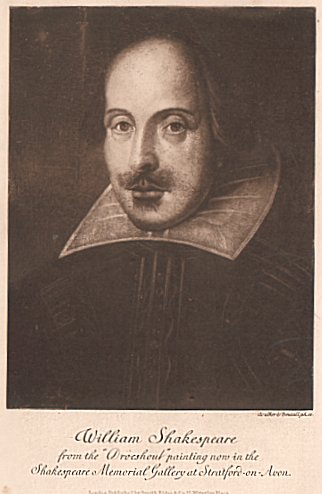
The six illustrations which appear in this volume have been chosen on grounds of practical utility rather than of artistic merit. My reasons for selecting as the frontispiece the newly discovered ‘Droeshout’ painting of Shakespeare (now in the Shakespeare Memorial Gallery at Stratford-on-Avon) can be gathered from the history of the painting and of its discovery which I give on pages 288-90. I have to thank Mr. Edgar Flower and the other members of the Council of the Shakespeare Memorial at Stratford for permission to reproduce the picture. The portrait of Southampton in early life is now at Welbeck Abbey, and the Duke of Portland not only permitted the portrait to be engraved for this volume, but lent me the negative from which the plate has been prepared. The Committee of the Garrick Club gave permission to photograph the interesting bust of Shakespeare in their possession, [x] but, owing to the fact that it is moulded in black terra-cotta no satisfactory negative could be obtained; the p. xiengraving I have used is from a photograph of a white plaster cast of the original bust, now in the Memorial Gallery at Stratford. The five autographs of Shakespeare’s signature—all that exist of unquestioned authenticity—appear in the three remaining plates. The three signatures on the will have been photographed from the original document at Somerset House, by permission of Sir Francis Jenne, President of the Probate Court; the autograph on the deed of purchase by Shakespeare in 1613 of the house in Blackfriars has been photographed from the original document in the Guildhall Library, by permission of the Library Committee of the City of London; and the autograph on the deed of mortgage relating to the same property, also dated in 1613, has been photographed from the original document in the British Museum, by permission of the Trustees. Shakespeare’s coat-of-arms and motto, which are stamped on the cover of this volume, are copied from the trickings in the margin of the draft-grants of arms now in the Heralds’ College.
The Baroness Burdett-Coutts has kindly given me ample opportunities of examining the two peculiarly interesting and valuable copies of the First Folio [xi] in her possession. Mr. Richard Savage, of Stratford-on-Avon, the Secretary of the Birthplace Trustees, and Mr. W. Salt Brassington, the Librarian of the Shakespeare Memorial at Stratford, have courteously replied p. xiito the many inquiries that I have addressed to them verbally or by letter. Mr. Lionel Cust, the Director of the National Portrait Gallery, has helped me to estimate the authenticity of Shakespeare’s portraits. I have also benefited, while the work has been passing through the press, by the valuable suggestions of my friends the Rev. H. C. Beeching and Mr. W. J. Craig, and I have to thank Mr. Thomas Seccombe for the zealous aid he has rendered me while correcting the final proofs.
October 12, 1898.
|
I—PARENTAGE AND BIRTH |
||
|
Distribution of the name of Shakespeare |
||
|
The poet’s ancestry |
||
|
The poet’s father |
||
|
His settlement at Stratford |
||
|
The poet’s mother |
||
|
1564, April |
The poet’s birth and baptism |
|
|
Alleged birthplace |
||
|
II—CHILDHOOD, EDUCATION, AND MARRIAGE |
||
|
The father in municipal office |
||
|
Brothers and sisters |
||
|
The father’s financial difficulties |
||
|
1571-7 |
Shakespeare’s education |
|
|
His classical equipment |
||
|
Shakespeare’s knowledge of the Bible |
||
|
1575 |
Queen Elizabeth at Kenilworth |
|
|
1577 |
Withdrawal from school |
|
|
1582, Dec. |
The poet’s marriage |
|
|
Richard Hathaway of Shottery |
||
|
Anne Hathaway |
||
|
Anne Hathaway’s cottage |
||
|
The bond against impediments |
||
|
1583, May |
Birth of the poet’s daughter Susanna |
|
|
Formal betrothal probably dispensed with |
||
|
Early married life |
||
|
Poaching at Charlecote |
||
|
Unwarranted doubts of the tradition |
||
|
Justice Shallow |
||
|
1585 |
The flight from Stratford |
|
|
IV—ON THE LONDON STAGE |
||
|
1586 |
The journey to London |
|
|
Richard Field, Shakespeare townsman |
||
|
Theatrical employment |
||
|
A playhouse servitor |
||
|
The acting companies |
||
|
The Lord Chamberlain’s company |
||
|
Shakespeare, a member of the Lord Chamberlain’s company |
||
|
The London theatres |
||
|
Place of residence in London |
||
|
Actors’ provincial tours |
||
|
Shakespeare’s alleged travels |
||
|
In Scotland |
||
|
In Italy |
||
|
Shakespeare’s rôles |
||
|
His alleged scorn of an actor’s calling |
||
|
V—EARLY DRAMATIC WORK |
||
|
The period of his dramatic work, 1591-1611 |
||
|
His borrowed plots |
||
|
The revision of plays |
||
|
Chronology of the plays |
||
|
Metrical tests |
||
|
1591 |
Love’s Labour’s Lost |
|
|
1591 |
Two Gentlemen of Verona |
|
|
1592 |
Comedy of Errors |
|
|
1592 |
Romeo and Juliet |
|
|
1592, March |
Henry VI |
|
|
1592, Sept. |
Greene’s attack on Shakespeare |
|
|
Chettle’s apology |
||
|
Divided authorship of Henry VI |
||
|
Shakespeare’s coadjutors |
||
|
Shakespeare’s assimilative power |
||
|
Lyly’s influence in comedy |
||
|
Marlowe’s influence in tragedy |
||
|
1593 |
Richard III |
|
|
1593 |
Richard II |
|
|
Shakespeare’s acknowledgments to Marlowe |
||
|
1593 |
Titus Andronicus |
|
|
1594, August |
The Merchant of Venice |
|
|
Shylock and Roderigo Lopez |
||
|
1594 |
King John |
|
|
1594, Dec. |
Comedy of Errors in Gray’s Inn Hall |
|
|
Early plays doubtfully assigned to Shakespeare |
||
|
Arden of Feversham (1592) |
||
|
Edward III |
||
|
Mucedorus |
||
|
Faire Em (1592) |
||
|
1593, April |
Publication of Venus and Adonis |
|
|
1594, May |
Publication of Lucrece |
|
|
Enthusiastic reception of the poems |
||
|
Shakespeare and Spenser |
||
|
Patrons at Court |
||
|
VII—THE SONNETS AND THEIR LITERARY HISTORY |
||
|
The vogue of the Elizabethan sonnet |
||
|
Shakespeare’s first experiments |
||
|
1594 |
Majority of his Shakespeare’s composed |
|
|
Their literary value |
||
|
Circulation in manuscript |
||
|
Their piratical publication in 1609 |
||
|
A Lover’s Complaint |
||
|
Thomas Thorpe and ‘Mr. W. H.’ |
||
|
The form of Shakespeare’s sonnets |
||
|
Their want of continuity |
||
|
The two ‘groups’ |
||
|
Main topics of the first ‘group’ |
||
|
Main topics of the second ‘group’ |
||
|
The order of the sonnets in the edition of 1640 |
||
|
Lack of genuine sentiment in Elizabethan sonnets |
||
|
Their dependence on French and Italian models |
||
|
Sonnetteers’ admissions of insincerity |
||
|
Contemporary censure of sonnetteers’ false sentiment |
||
|
Shakespeare’s scornful allusions to sonnets in his plays |
||
|
VIII—THE BORROWED CONCEITS OF THE SONNETS |
||
|
Slender autobiographical element in Shakespeare’s sonnets |
||
|
The imitative element |
||
|
Shakespeare’s claims of immortality for his sonnets a borrowed conceit |
||
|
Conceits in sonnets addressed to a woman |
||
|
The praise of ‘blackness’ |
||
|
The sonnets of vituperation |
||
|
Gabriel Harvey’s Amorous Odious sonnet |
||
|
Jodelle’s Contr’ Amours |
||
|
Biographic fact in the ‘dedicatory’ sonnets |
||
|
The Earl of Southampton the poet’s sole patron |
||
|
Rivals in Southampton’s favour |
||
|
Shakespeare’s fear of another poet |
||
|
Barnabe Barnes probably the chief rival |
||
|
Other theories as to the chief rival’s identity |
||
|
Sonnets of friendship |
||
|
Extravagances of literary compliment |
||
|
Patrons habitually addressed in affectionate terms |
||
|
Direct references to Southampton in the sonnets of friendship |
||
|
His youthfulness |
||
|
The evidence of portraits |
||
|
Sonnet cvii. the last of the series |
||
|
Allusions to Queen Elizabeth’s death |
||
|
Allusions to Southampton’s release from prison |
||
|
X—THE SUPPOSED STORY OF INTRIGUE IN THE SONNETS |
||
|
Sonnets of melancholy and self-reproach |
||
|
The youth’s relations with the poet’s mistress |
||
|
Willobie his Avisa (1594) |
||
|
Summary of conclusions respecting the sonnets |
||
|
XI—THE DEVELOPMENT OF DRAMATIC POWER |
||
|
1594-95 |
Midsummer Night’s Dream |
|
|
1595 |
All’s Well that Ends Well |
|
|
1595 |
The Taming of The Shrew |
|
|
Stratford allusions in the Induction |
||
|
Wincot |
||
|
1597 |
Henry IV |
|
|
Falstaff |
||
|
1597 |
The Merry Wives of Windsor |
|
|
1598 |
Henry V |
|
|
Essex and the rebellion of 1601 |
||
|
Shakespeare’s popularity and influence |
||
|
Shakespeare’s friendship with Ben Jonson |
||
|
The Mermaid meetings |
||
|
1598 |
Meres’s eulogy |
|
|
Value of his name to publishers |
||
|
1599 |
The Passionate Pilgrim |
|
|
1601 |
The Phœnix and the Turtle |
|
|
Shakespeare’s practical temperament |
||
|
His father’s difficulties |
||
|
His wife’s debt |
||
|
1596-9 |
The coat of arms |
|
|
1597, May 4. |
The purchase of New Place |
|
|
1598 |
Fellow-townsmen appear to Shakespeare for aid |
|
|
Shakespeare’s financial position before 1599 |
||
|
Shakespeare’s financial position after 1599 |
||
|
His later income |
||
|
Incomes of fellow actors |
||
|
1601-1610 |
Shakespeare’s formation of his estate at Stratford |
|
|
1605 |
The Stratford tithes |
|
|
1600-1609 |
Recovery of small debts |
|
|
XIII—MATURITY OF GENIUS |
||
|
Literary work in 1599 |
||
|
1599 |
Much Ado about Nothing |
|
|
1599 |
As You Like It |
|
|
1600 |
Twelfth Night |
|
|
1601 |
Julius Cæsar |
|
|
The strife between adult actors and boy actors |
||
|
Shakespeare’s references to the struggle |
||
|
1601 |
Ben Jonson’s Poetaster |
|
|
Shakespeare’s alleged partisanship in the theatrical warfare |
||
|
1602 |
Hamlet |
|
|
The problem of its publication |
||
|
The First Quarto, 1603 |
||
|
The Second Quarto, 1604 |
||
|
The Folio version, 1623 |
||
|
Popularity of Hamlet |
||
|
1603 |
Troilus and Cressida |
|
|
Treatment of the theme |
||
|
1603, March 26 |
Queen Elizabeth’s death |
|
|
James I’s patronage |
||
|
XIV—THE HIGHEST THEMES OF TRAGEDY |
||
|
1604, Nov. |
Othello |
|
|
1604, Dec. |
Measure for Measure |
|
|
1606 |
Macbeth |
|
|
1607 |
King Lear |
|
|
1608 |
Timon of Athens |
|
|
1608 |
Pericles |
|
|
1608 |
Antony and Cleopatra |
|
|
1609 |
Coriolanus |
|
|
The placid temper of the latest plays |
||
|
1610 |
Cymbeline |
|
|
1611 |
A Winter’s Tale |
|
|
1611 |
The Tempest |
|
|
Fanciful interpretations of The Tempest |
||
|
Unfinished plays |
||
|
The lost play of Cardenio |
||
|
The Two Noble Kinsmen |
||
|
Henry VIII |
||
|
The burning of the Globe Theatre |
||
|
XVI—THE CLOSE OF LIFE |
||
|
Plays at Court in 1613 |
||
|
Actor-friends |
||
|
1611 |
Final settlement at Stratford |
|
|
Domestic affairs |
||
|
1613, March |
Purchase of a house in Blackfriars |
|
|
1614, Oct. |
Attempt to enclose the Stratford common fields |
|
|
1616, April 23rd. |
Shakespeare’s death |
|
|
1616, April 25th. |
Shakespeare’s burial |
|
|
The will |
||
|
Shakespeare’s bequest to his wife |
||
|
Shakespeare’s heiress |
||
|
Legacies to friends |
||
|
The tomb in Stratford Church |
||
|
Shakespeare’s personal character |
||
|
XVII—SURVIVORS AND DESCENDANTS |
||
|
Mrs. Judith Quiney, (1585-1662) |
||
|
Mrs. Susanna Hall (1583-1649) |
||
|
The last descendant |
||
|
Shakespeare’s brothers, Edmund, Richard, and Gilbert |
||
|
XVIII—AUTOGRAPHS, PORTRAITS, AND MEMORIALS |
||
|
Spelling of the poet’s name |
||
|
Autograph signatures |
||
|
Shakespeare’s portraits |
||
|
The Stratford bust |
||
|
The ‘Stratford portrait’ |
||
|
Droeshout’s engraving |
||
|
The ‘Droeshout’ painting |
||
|
Later portraits |
||
|
The Chandos portrait |
||
|
The ‘Jansen’ portrait |
||
|
The ‘Felton’ portrait |
||
|
The ‘Soest’ portrait |
||
|
Miniatures |
||
|
The Garrick Club bust |
||
|
Alleged death-mask |
||
|
Memorials in sculpture |
||
|
Memorials at Stratford |
||
|
Quartos of the poems in the poet’s lifetime |
||
|
Posthumous quartos of the poems |
||
|
The ‘Poems’ of 1640 |
||
|
Quartos of the plays in the poet’s lifetime |
||
|
Posthumous quartos of the plays |
||
|
1623 |
The First Folio |
|
|
The publishing syndicate |
||
|
The prefatory matter |
||
|
The value of the text |
||
|
The order of the plays |
||
|
The typography |
||
|
Unique copies |
||
|
The Sheldon copy |
||
|
Estimated number of extant copies |
||
|
Reprints of the First Folio |
||
|
1632 |
The Second Folio |
|
|
1663-4 |
The Third Folio |
|
|
1685 |
The Fourth Folio |
|
|
Eighteenth-century editions |
||
|
Nicholas Rowe (1674-1718) |
||
|
Alexander Pope (1688-1744) |
||
|
Lewis Theobald (1688-1744) |
||
|
Sir Thomas Hanmer (1677-1746) |
||
|
Bishop Warburton (1698-1779) |
||
|
Dr. Johnson (1709-1783) |
||
|
Edward Capell (1713-1781) |
||
|
George Steevens (1736-1800) |
||
|
Edmund Malone (1741-1812) |
||
|
Variorum editions |
||
|
Nineteenth-century editors |
||
|
Alexander Dyce (1798-1869) |
||
|
Howard Staunton (1810-1874) |
||
|
Nikolaus Delius (1813-1888) |
||
|
The Cambridge edition (1863-6) |
||
|
Other nineteenth-century editions |
||
|
XX—POSTHUMOUS REPUTATION |
||
|
Views of Shakespeare’s contemporaries |
||
|
Ben Jonson tribute |
||
|
English opinion between 1660 and 1702 |
||
|
Dryden’s view |
||
|
Restoration adaptations |
||
|
English opinion from 1702 onwards |
||
|
Stratford festivals |
||
|
Shakespeare on the English stage |
||
|
The first appearance of actresses in Shakespearean parts |
||
|
David Garrick (1717-1779) |
||
|
John Philip Kemble (1757-1823) |
||
|
Mrs. Sarah Siddons (1755-1831) |
||
|
Edmund Kean (1787-1833) |
||
|
Recent revivals |
||
|
Shakespeare in English music and art |
||
|
Boydell’s Shakespeare Gallery |
||
|
Shakespeare in America |
||
|
Translations |
||
|
Shakespeare in Germany |
||
|
German translations |
||
|
Modern German critics |
||
|
Shakespeare on the German stage |
||
|
Shakespeare in France |
||
|
Voltaire’s strictures |
||
|
French critics’ gradual emancipation from Voltairean influence |
||
|
Shakespeare on the French stage |
||
|
Shakespeare in Italy |
||
|
In Holland |
||
|
In Russia |
||
|
In Poland |
||
|
In Hungary |
||
|
In other countries |
||
|
XXI—GENERAL ESTIMATES |
||
|
General estimate |
||
|
Shakespeare’s defects |
||
|
Character of Shakespeare’s achievement |
||
|
Its universal recognition |
||
|
APPENDIX |
||
|
I—THE SOURCES OF BIOGRAPHICAL KNOWLEDGE |
||
|
Contemporary records abundant |
||
|
First efforts in biography |
||
|
Biographers of the nineteenth century |
||
|
Stratford topography |
||
|
Specialised studies in biography |
||
|
Epitomes |
||
|
Aids to study of plots and text |
||
|
Concordances |
||
|
Bibliographies |
||
|
Critical studies |
||
|
Shakespearean forgeries |
||
|
John Jordan (1746-1809) |
||
|
The Ireland forgeries (1796) |
||
|
List of forgeries promulgated by Collier and others (1835-1849) |
||
|
II—THE BACON-SHAKESPEARE CONTROVERSY |
||
|
Its source |
||
|
Toby Matthew’s letter of 1621 |
||
|
Chief exponents of the theory |
||
|
Its vogue in America |
||
|
Extent of the literature |
||
|
Absurdity of the theory |
||
|
Shakespeare and Southampton |
||
|
Southampton’s parentage |
||
|
1573, Oct. 6 |
Southampton’s birth |
|
|
His education |
||
|
Recognition of Southampton’s beauty in youth |
||
|
His reluctance to marry |
||
|
Intrigue with Elizabeth Vernon |
||
|
1598 |
Southampton’s marriage |
|
|
1601-3 |
Southampton’s imprisonment |
|
|
Later career |
||
|
1624, Nov. 10 |
His death |
|
|
IV—THE EARL OF SOUTHAMPTON AS A LITERARY PATRON |
||
|
Southampton’s collection of books |
||
|
References in his letters to poems and plays |
||
|
His love of the theatre |
||
|
Poetic adulation |
||
|
1593 |
Barnabe Barnes’s sonnet |
|
|
Tom Nash’s addresses |
||
|
1595 |
Gervase Markham’s sonnet |
|
|
1598 |
Florio’s address |
|
|
The congratulations of the poets in 1603 |
||
|
Elegies on Southampton |
||
|
V—THE TRUE HISTORY OF THOMAS THORPE AND ‘MR. W. H.’ |
||
|
The publication of the ‘Sonnets’ in 1609 |
||
|
The text of the dedication |
||
|
Publishers’ dedications |
||
|
Thorpe’s early life |
||
|
His ownership of the manuscript of Marlowe’s Lucan |
||
|
His dedicatory address to Edward Blount in 1600 |
||
|
Character of his business |
||
|
Shakespeare’s sufferings at publishers hands |
||
|
The use of initials in dedications of Elizabethan and Jacobean books |
||
|
Frequency of wishes for ‘happiness’ and ‘eternity’ in dedicatory greetings |
||
|
Five dedications by Thorpe |
||
|
‘W. H.’ signs dedication of Southwell’s ‘Poems’ |
||
|
‘W. H.’ and Mr. William Hall |
||
|
The ‘onlie begetter’ means ‘only procurer’ |
||
|
Origin of the notion that ‘Mr. W. H.’ stands for William Herbert |
||
|
The Earl of Pembroke known only as Lord Herbert in youth |
||
|
Thorpe’s mode of addressing the Earl of Pembroke |
||
|
VII—SHAKESPEARE AND THE EARL OF PEMBROKE |
||
|
Shakespeare with the acting company at Wilton in 1603 |
||
|
The dedication of the First Folio in 1623 |
||
|
No suggestion in the sonnets of the youth’s identity with Pembroke |
||
|
Aubrey’s ignorance of any relation between Shakespeare and Pembroke |
||
|
VIII—THE ‘WILL’ SONNETS |
||
|
Elizabethan meanings of ‘will’ |
||
|
Shakespeare’s uses of the word |
||
|
Shakespeare’s puns on the word |
||
|
Arbitrary and irregular use of italics by Elizabethan and Jacobean printers |
||
|
The conceits of Sonnets cxxxv.-vi. interpreted |
||
|
Sonnet cxxxv |
||
|
Sonnet cxxxvi |
||
|
Sonnet cxxxiv |
||
|
Sonnet cxliii |
||
|
IX—THE VOGUE OF THE ELIZABETHAN SONNET, 1591-1597 |
||
|
1557 |
Wyatt’s and Surrey’s Sonnets published |
|
|
1582 |
Watson’s Centurie of Love |
|
|
1591 |
Sidney’s Astrophel and Stella |
|
|
I. |
Collected sonnets of feigned love |
|
|
1592 |
Daniel’s Delia |
|
|
Fame of Daniel’s sonnets |
||
|
1592 |
Constable’s Diana |
|
|
1593 |
Barnabe Barne’s sonnets |
|
|
1593 |
Watson’s Tears of Fancie |
|
|
1593 |
Giles Fletcher’s Licia |
|
|
1593 |
Lodge’s Phillis |
|
|
1594 |
Drayton’s Idea |
|
|
1594 |
Percy’s Cœlia |
|
|
Zepheria |
||
|
1595 |
Barnfield’s sonnets to Ganymede |
|
|
1595 |
Spenser’s Amoretti |
|
|
1595 |
Emaricdulfe |
|
|
1595 |
Sir John Davies’s Gullinge Sonnets |
|
|
1596 |
Linche’s Diella |
|
|
1596 |
Griffin Fidessa |
|
|
1596 |
Thomas Campion’s sonnets |
|
|
1596 |
William Smith’s Chloris |
|
|
1597 |
Robert Tofte’s Laura |
|
|
Sir William Alexander’s Aurora |
||
|
Sir Fulke Greville’s Cœlica |
||
|
Estimate of number of love-sonnets issued between 1591 and 1597 |
||
|
II. |
Sonnets to patrons, 1591-1597 |
|
|
III. |
Sonnets on philosophy and religion |
|
|
X—BIBLIOGRAPHICAL NOTE ON THE SONNET IN FRANCE, 1550-1600 |
||
|
Ronsard (1524-1585) and ‘La Pléiade’ |
||
|
The Italian sonnetteers of the sixteenth century |
442n. |
|
|
Philippe Desportes (1546-1606) |
||
|
Chief collections of French sonnets published between 1550 and 1584 |
||
|
Minor collections of French sonnets published between 1553 and 1605 |
||
|
INDEX |
Shakespeare came of a family whose surname was borne through the middle ages by residents in very many parts of England—at Penrith in Cumberland, at Kirkland and Doncaster in Yorkshire, as well as in nearly all the midland counties. The surname had originally a martial significance, implying capacity in the wielding of the spear. [1a] Its first recorded holder is John Shakespeare, who in 1279 was living at ‘Freyndon,’ perhaps Frittenden, Kent. [1b] The great mediæval guild of St. Anne at Knowle, whose members included the leading inhabitants of Warwickshire, was joined by many Shakespeares in the fifteenth century. [1c] p. 2In the sixteenth and seventeenth centuries the surname is found far more frequently in Warwickshire than elsewhere. The archives of no less than twenty-four towns and villages there contain notices of Shakespeare families in the sixteenth century, and as many as thirty-four Warwickshire towns or villages were inhabited by Shakespeare families in the seventeenth century. Among them all William was a common Christian name. At Rowington, twelve miles to the north of Stratford, and in the same hundred of Barlichway, one of the most prolific Shakespeare families of Warwickshire resided in the sixteenth century, and no less than three Richard Shakespeares of Rowington, whose extant wills were proved respectively in 1560, 1591, and 1614, were fathers of sons called William. At least one other William Shakespeare was during the period a resident in Rowington. As a consequence, the poet has been more than once credited with achievements which rightly belong to one or other of his numerous contemporaries who were identically named.
The poet’s ancestry cannot be defined with absolute certainty. The poet’s father, when applying for a grant of arms in 1596, claimed that his grandfather (the poet’s great-grandfather) received for services rendered in war a grant of land in Warwickshire from Henry VII. [2] No precise confirmation of this pretension has been discovered, and it may be, after the manner of heraldic genealogy, fictitious. But there is a probability that the poet p. 3came of good yeoman stock, and that his ancestors to the fourth or fifth generation were fairly substantial landowners. [3a] Adam Shakespeare, a tenant by military service of land at Baddesley Clinton in 1389, seems to have been great-grandfather of one Richard Shakespeare who held land at Wroxhall in Warwickshire during the first thirty-four years (at least) of the sixteenth century. Another Richard Shakespeare who is conjectured to have been nearly akin to the Wroxhall family was settled as a farmer at Snitterfield, a village four miles to the north of Stratford-on-Avon, in 1528. [3b] It is probable that he was the poet’s grandfather. In 1550 he was renting a messuage and land at Snitterfield of Robert Arden; he died at the close of 1560, and on February 10 of the next year letters of administration of his goods, chattels, and debts were issued to his son John by the Probate Court at Worcester. His goods were valued at £35 17s. [3c] Besides the son John, Richard of Snitterfield certainly had a son Henry; while a Thomas Shakespeare, a considerable landholder at p. 4Snitterfield between 1563 and 1583, whose parentage is undetermined, may have been a third son. The son Henry remained all his life at Snitterfield, where he engaged in farming with gradually diminishing success; he died in embarrassed circumstances in December 1596. John, the son who administered Richard’s estate, was in all likelihood the poet’s father.
About 1551 John Shakespeare left Snitterfield, which was his birthplace, to seek a career in the neighbouring borough of Stratford-on-Avon. There he soon set up as a trader in all manner of agricultural produce. Corn, wool, malt, meat, skins, and leather were among the commodities in which he dealt. Documents of a somewhat later date often describe him as a glover. Aubrey, Shakespeare’s first biographer, reported the tradition that he was a butcher. But though both designations doubtless indicated important branches of his business, neither can be regarded as disclosing its full extent. The land which his family farmed at Snitterfield supplied him with his varied stock-in-trade. As long as his father lived he seems to have been a frequent visitor to Snitterfield, and, like his father and brothers, he was until the date of his father’s death occasionally designated a farmer or ‘husbandman’ of that place. But it was with Stratford-on-Avon that his life was mainly identified.
In April 1552 he was living there in Henley Street, a thoroughfare leading to the market town of Henley-in-Arden, and he is first mentioned in the borough records as paying in that month a fine of p. 5twelve-pence for having a dirt-heap in front of his house. His frequent appearances in the years that follow as either plaintiff or defendant in suits heard in the local court of record for the recovery of small debts suggest that he was a keen man of business. In early life he prospered in trade, and in October 1556 purchased two freehold tenements at Stratford—one, with a garden, in Henley Street (it adjoins that now known as the poet’s birthplace), and the other in Greenhill Street with a garden and croft. Thenceforth he played a prominent part in municipal affairs. In 1557 he was elected an ale-taster, whose duty it was to test the quality of malt liquors and bread. About the same time he was elected a burgess or town councillor, and in September 1558, and again on October 6, 1559, he was appointed one of the four petty constables by a vote of the jury of the court-leet. Twice—in 1559 and 1561—he was chosen one of the affeerors—officers appointed to determine the fines for those offences which were punishable arbitrarily, and for which no express penalties were prescribed by statute. In 1561 he was elected one of the two chamberlains of the borough, an office of responsibility which he held for two years. He delivered his second statement of accounts to the corporation in January 1564. When attesting documents he occasionally made his mark, but there is evidence in the Stratford archives that he could write with facility; and he was credited with financial aptitude. The municipal accounts, which were checked by tallies and counters, were audited by him after he p. 6ceased to be chamberlain, and he more than once advanced small sums of money to the corporation.
With characteristic shrewdness he chose a wife of assured fortune—Mary, youngest daughter of Robert Arden, a wealthy farmer of Wilmcote in the parish of Aston Cantlowe, near Stratford. The Arden family in its chief branch, which was settled at Parkhall, Warwickshire, ranked with the most influential of the county. Robert Arden, a progenitor of that branch, was sheriff of Warwickshire and Leicestershire in 1438 (16 Hen. VI), and this sheriff’s direct descendant, Edward Arden, who was himself high sheriff of Warwickshire in 1575, was executed in 1583 for alleged complicity in a Roman Catholic plot against the life of Queen Elizabeth. [6] John Shakespeare’s wife belonged to a humbler branch of the family, and there is no trustworthy evidence to determine the exact degree of kinship between the two branches. Her grandfather, Thomas Arden, purchased in 1501 an estate at Snitterfield, which passed, with other property, to her father Robert; John Shakespeare’s father, Richard, was one of this Robert Arden’s Snitterfield tenants. By his first wife, whose name is not known, Robert Arden had seven daughters, of whom all but two married; John Shakespeare’s wife seems to have been the youngest. Robert Arden’s second wife, Agnes or Anne, widow of John Hill (d. 1545), a substantial farmer of Bearley, survived him; but by her he had no issue. When he died at the end of 1556, he owned a farmhouse at Wilmcote p. 7and many acres, besides some hundred acres at Snitterfield, with two farmhouses which he let out to tenants. The post-mortem inventory of his goods, which was made on December 9, 1556, shows that he had lived in comfort; his house was adorned by as many as eleven ‘painted cloths,’ which then did duty for tapestries among the middle class. The exordium of his will, which was drawn up on November 24, 1556, and proved on December 16 following, indicates that he was an observant Catholic. For his two youngest daughters, Alice and Mary, he showed especial affection by nominating them his executors. Mary received not only £6. 13s. 4d. in money, but the fee-simple of Asbies, his chief property at Wilmcote, consisting of a house with some fifty acres of land. She also acquired, under an earlier settlement, an interest in two messuages at Snitterfield. [7] But, although she was well provided with worldly goods, she was apparently without education; several extant documents bear her mark, and there is no proof that she could sign her name.
John Shakespeare’s marriage with Mary Arden doubtless took place at Aston Cantlowe, the parish church of Wilmcote, in the autumn of 1557 (the church registers begin at a later date). On September 15, 1558, his first child, a daughter, Joan, was baptised in the church of Stratford. A second child, another daughter, Margaret, was baptised on December 2, 1562; but both these children died in infancy. The poet William, the first son and third child, was p. 8born on April 22 or 23, 1564. The latter date is generally accepted as his birthday, mainly (it would appear) on the ground that it was the day of his death. There is no positive evidence on the subject, but the Stratford parish registers attest that he was baptised on April 26.
Some doubt is justifiable as to the ordinarily accepted scene of his birth. Of two adjoining houses forming a detached building on the north side of Henley Street, that to the east was purchased by John Shakespeare in 1556, but there is no evidence that he owned or occupied the house to the west before 1575. Yet this western house has been known since 1759 as the poet’s birthplace, and a room on the first floor is claimed as that in which he was born. [8] The two houses subsequently came by bequest of the poet’s granddaughter to the family of the poet’s sister, Joan Hart, and while the eastern tenement was let out to strangers for more than two centuries, and by them converted into an inn, the ‘birthplace’ was until 1806 occupied by the Harts, who latterly carried on there the trade of butcher. The fact of its long occupancy by the poet’s collateral descendants accounts for the identification of the western rather than the eastern tenement with his birthplace. Both houses were purchased in behalf of subscribers to a public fund on September 16, 1847, and, after extensive restoration, were converted into a single domicile for the purposes of a public museum. They were presented under a deed of p. 9trust to the corporation of Stratford in 1866. Much of the Elizabethan timber and stonework survives, but a cellar under the ‘birthplace’ is the only portion which remains as it was at the date of the poet’s birth. [9]
In July 1564, when William was three months old, the plague raged with unwonted vehemence at Stratford, and his father liberally contributed to the relief of its poverty-stricken victims. Fortune still favoured him. On July 4, 1565, he reached the dignity of an alderman. From 1567 onwards he was accorded in the corporation archives the honourable prefix of ‘Mr.’ At Michaelmas 1568 he attained the highest office in the corporation gift, that of bailiff, and during his year of office the corporation for the first time entertained actors at Stratford. The Queen’s Company and the Earl of Worcester’s Company each received from John Shakespeare an official welcome. [10] On September 5, 1571, he was chief p. 11alderman, a post which he retained till September 30 the following year. In 1573 Alexander Webbe, the husband of his wife’s sister Agnes, made him overseer of his will; in 1575 he bought two houses in Stratford, one of them doubtless the alleged birthplace in Henley Street; in 1576 he contributed twelvepence to the beadle’s salary. But after Michaelmas 1572 he took a less active part in municipal affairs; he grew irregular in his attendance at the council meetings, and signs were soon apparent that his luck had turned. In 1578 he was unable to pay, with his colleagues, either the sum of fourpence for the relief of the poor or his contribution ‘towards the furniture of three pikemen, two bellmen, and one archer’ who were sent by the corporation to attend a muster of the trained bands of the county.
Meanwhile his family was increasing. Four children besides the poet—three sons, Gilbert (baptised October 13, 1566), Richard (baptised March 11, 1574), and Edmund (baptised May 3, 1580), with a daughter Joan (baptised April 15, 1569)—reached maturity. A daughter Ann was baptised September 28, 1571, and was buried on April 4, 1579. To meet his growing liabilities, the father borrowed money from his wife’s kinsfolk, and he and his wife p. 12mortgaged, on November 14, 1578, Asbies, her valuable property at Wilmcote, for £40 to Edmund Lambert of Barton-on-the-Heath, who had married her sister, Joan Arden. Lambert was to receive no interest on his loan, but was to take the ‘rents and profits’ of the estate. Asbies was thereby alienated for ever. Next year, on October 15, 1579, John and his wife made over to Robert Webbe, doubtless a relative of Alexander Webbe, for the sum apparently of £40, his wife’s property at Snitterfield. [12a]
John Shakespeare obviously chafed under the humiliation of having parted, although as he hoped only temporarily, with his wife’s property of Asbies, and in the autumn of 1580 he offered to pay off the mortgage; but his brother-in-law, Lambert, retorted that other sums were owing, and he would accept all or none. The negotiation, which was the beginning of much litigation, thus proved abortive. Through 1585 and 1586 a creditor, John Brown, was embarrassingly importunate, and, after obtaining a writ of distraint, Brown informed the local court that the debtor had no goods on which distraint could be levied. [12b] On September 6, 1586, John was deprived of his alderman’s gown, on the ground of his long absence from the council meetings. [12c]
Happily John Shakespeare was at no expense for the education of his four sons. They were entitled to free tuition at the grammar school of Stratford, which was reconstituted on a mediæval foundation by Edward VI. The eldest son, William, probably entered the school in 1571, when Walter Roche was master, and perhaps he knew something of Thomas Hunt, who succeeded Roche in 1577. The instruction that he received was mainly confined to the Latin language and literature. From the Latin accidence, boys of the period, at schools of the type of that at Stratford, were led, through conversation books like the ‘Sententiæ Pueriles’ and Lily’s grammar, to the perusal of such authors as Seneca Terence, Cicero, Virgil, Plautus, Ovid, and Horace. The eclogues of the popular renaissance poet, Mantuanus, were often preferred to Virgil’s for beginners. The rudiments of Greek were occasionally taught in Elizabethan grammar schools to very promising pupils; but such coincidences as have been detected between expressions in Greek plays and in Shakespeare seem due to accident, and not to any study, either at school or elsewhere, of the Athenian drama. [13]
p. 14Dr. Farmer enunciated in his ‘Essay on Shakespeare’s Learning’ (1767) the theory that Shakespeare knew no language but his own, and owed whatever knowledge he displayed of the classics and of Italian and French literature to English translations. But several of the books in French and Italian whence Shakespeare derived the plots of his dramas—Belleforest’s ‘Histoires Tragiques,’ Ser Giovanni’s ‘Il Pecorone,’ and Cinthio’s ‘Hecatommithi,’ for examplep. 15—were not accessible to him in English translations; and on more general grounds the theory of his ignorance is adequately confuted. A boy with Shakespeare’s exceptional alertness of intellect, during whose schooldays a training in Latin classics lay within reach, could hardly lack in future years all means of access to the literature of France and Italy.
With the Latin and French languages, indeed, and with many Latin poets of the school curriculum, Shakespeare in his writings openly acknowledged his acquaintance. In ‘Henry V’ the dialogue in many scenes is carried on in French, which is grammatically accurate if not idiomatic. In the mouth of his schoolmasters, Holofernes in ‘Love’s Labour’s Lost’ and Sir Hugh Evans in ‘Merry Wives of Windsor,’ Shakespeare placed Latin phrases drawn directly from Lily’s grammar, from the ‘Sententiæ Pueriles,’ and from ‘the good old Mantuan.’ The influence of Ovid, especially the ‘Metamorphoses,’ was apparent throughout his earliest literary work, both poetic and dramatic, and is discernible in the ‘Tempest,’ his latest play (v. i. 33 seq.) In the Bodleian Library there is a copy of the Aldine edition of Ovid’s ‘Metamorphoses’ (1502), and on the title is the signature Wm. She., which experts have declared—not quite conclusively—to be a genuine autograph of the poet. [15] Ovid’s Latin text was certainly not unfamiliar to him, but his closest adaptations of Ovid’s ‘Metamorphoses’ often reflect the phraseology of the popular English version by p. 16Arthur Golding, of which some seven editions were issued between 1565 and 1597. From Plautus Shakespeare drew the plot of the ‘Comedy of Errors,’ but it is just possible that Plautus’s comedies, too, were accessible in English. Shakespeare had no title to rank as a classical scholar, and he did not disdain a liberal use of translations. His lack of exact scholarship fully accounts for the ‘small Latin and less Greek’ with which he was credited by his scholarly friend, Ben Jonson. But Aubrey’s report that ‘he understood Latin pretty well’ need not be contested, and his knowledge of French may be estimated to have equalled his knowledge of Latin, while he doubtless possessed just sufficient acquaintance with Italian to enable him to discern the drift of an Italian poem or novel. [16]
Of the few English books accessible to him in his schooldays, the chief was the English Bible, either in the popular Genevan version, first issued in a complete form in 1560, or in the Bishops’ revision of 1568, which the Authorised Version of 1611 closely followed. References to scriptural characters and incidents are not conspicuous in Shakespeare’s plays, but, such as they are, they are drawn from all parts of the Bible, and indicate that general acquaintance with the narrative of both Old and New Testaments which a clever boy would be certain to acquire either in the schoolroom or at church on Sundays. Shakespeare quotes or adapts p. 17biblical phrases with far greater frequency than he makes allusion to episodes in biblical history. But many such phrases enjoyed proverbial currency, and others, which were more recondite, were borrowed from Holinshed’s ‘Chronicles’ and secular works whence he drew his plots. As a rule his use of scriptural phraseology, as of scriptural history, suggests youthful reminiscence and the assimilative tendency of the mind in a stage of early development rather than close and continuous study of the Bible in adult life. [17a]
Shakespeare was a schoolboy in July 1575, when Queen Elizabeth made a progress through Warwickshire on a visit to her favourite, the Earl of Leicester, at his castle of Kenilworth. References have been detected in Oberon’s vision in Shakespeare’s ‘Midsummer Night’s Dream’ (II. ii. 148-68) to the fantastic pageants and masques with which the Queen during her stay was entertained in Kenilworth Park. Leicester’s residence was only fifteen miles from Stratford, and it is possible that Shakespeare went thither with his father to witness some of the open-air festivities; but two full descriptions which were published in 1576, in pamphlet form, gave Shakespeare knowledge of all that took place. [17b] Shakespeare’s opportunities of recreation outside Stratford were in any case restricted during his schooldays. His father’s financial p. 18difficulties grew steadily, and they caused his removal from school at an unusually early age. Probably in 1577, when he was thirteen, he was enlisted by his father in an effort to restore his decaying fortunes. ‘I have been told heretofore,’ wrote Aubrey, ‘by some of the neighbours that when he was a boy he exercised his father’s trade,’ which, according to the writer, was that of a butcher. It is possible that John’s ill-luck at the period compelled him to confine himself to this occupation, which in happier days formed only one branch of his business. His son may have been formally apprenticed to him. An early Stratford tradition describes him as ‘a butcher’s apprentice.’ [18] ‘When he kill’d a calf,’ Aubrey proceeds less convincingly, ‘he would doe it in a high style and make a speech. There was at that time another butcher’s son in this towne, that was held not at all inferior to him for a naturall witt, his acquaintance, and coetanean, but dyed young.’
At the end of 1582 Shakespeare, when little more than eighteen and a half years old, took a step which was little calculated to lighten his father’s anxieties. He married. His wife, according to the inscription on her tombstone, was his senior by eight years. Rowe states that she ‘was the daughter of one Hathaway, said to have been a substantial yeoman in the neighbourhood of Stratford.’
On September 1, 1581, Richard Hathaway, ‘husbandman’ of Shottery, a hamlet in the parish of Old p. 19Stratford, made his will, which was proved on July 9, 1582, and is now preserved at Somerset House. His house and land, ‘two and a half virgates,’ had been long held in copyhold by his family, and he died in fairly prosperous circumstances. His wife Joan, the chief legatee, was directed to carry on the farm with the aid of her eldest son, Bartholomew, to whom a share in its proceeds was assigned. Six other children—three sons and three daughters—received sums of money; Agnes, the eldest daughter, and Catherine, the second daughter, were each allotted £6 13s. 4d, ‘to be paid at the day of her marriage,’ a phrase common in wills of the period. Anne and Agnes were in the sixteenth century alternative spellings of the same Christian name; and there is little doubt that the daughter ‘Agnes’ of Richard Hathaway’s will became, within a few months of Richard Hathaway’s death, Shakespeare’s wife.
The house at Shottery, now known as Anne Hathaway’s cottage, and reached from Stratford by field-paths, undoubtedly once formed part of Richard Hathaway’s farmhouse, and, despite numerous alterations and renovations, still preserves many features of a thatched farmhouse of the Elizabethan period. The house remained in the Hathaway family till 1838, although the male line became extinct in 1746. It was purchased in behalf of the public by the Birthplace trustees in 1892.
No record of the solemnisation of Shakespeare’s marriage survives. Although the parish of Stratford p. 20included Shottery, and thus both bride and bridegroom were parishioners, the Stratford parish register is silent on the subject. A local tradition, which seems to have come into being during the present century, assigns the ceremony to the neighbouring hamlet or chapelry of Luddington, of which neither the chapel nor parish registers now exist. But one important piece of documentary evidence directly bearing on the poet’s matrimonial venture is accessible. In the registry of the bishop of the diocese (Worcester) a deed is extant wherein Fulk Sandells and John Richardson, ‘husbandmen of Stratford,’ bound themselves in the bishop’s consistory court, on November 28, 1582, in a surety of £40, to free the bishop of all liability should a lawful impediment—‘by reason of any precontract’ [i.e. with a third party] or consanguinity—be subsequently disclosed to imperil the validity of the marriage, then in contemplation, of William Shakespeare with Anne Hathaway. On the assumption that no such impediment was known to exist, and provided that Anne obtained the consent of her ‘friends,’ the marriage might proceed ‘with once asking of the bannes of matrimony betwene them.’
Bonds of similar purport, although differing in significant details, are extant in all diocesan registries of the sixteenth century. They were obtainable on the payment of a fee to the bishop’s commissary, and had the effect of expediting the marriage ceremony while protecting the clergy from the consequences of any possible breach of canonical law. But they were not p. 21common, and it was rare for persons in the comparatively humble position in life of Anne Hathaway and young Shakespeare to adopt such cumbrous formalities when there was always available the simpler, less expensive, and more leisurely method of marriage by ‘thrice asking of the banns.’ Moreover, the wording of the bond which was drawn before Shakespeare’s marriage differs in important respects from that adopted in all other known examples. [21] In the latter it is invariably provided that the marriage shall not take place without the consent of the parents or governors of both bride and bridegroom. In the case of the marriage of an ‘infant’ bridegroom the formal consent of his parents was absolutely essential to strictly regular procedure, although clergymen might be found who were ready to shut their eyes to the facts of the situation and to run the risk of solemnising the marriage of an ‘infant’ without inquiry as to the parents’ consent. The clergyman who united Shakespeare in wedlock to Anne Hathaway was obviously of this easy temper. Despite the circumstance that Shakespeare’s bride was of full age and he himself was by nearly three years a minor, the Shakespeare bond stipulated merely for the consent of the bride’s ‘friends,’ and ignored the bridegroom’s parents altogether. Nor was this the only irregularity in the document. In other pre-matrimonial covenants p. 22of the kind the name either of the bridegroom himself or of the bridegroom’s father figures as one of the two sureties, and is mentioned first of the two. Had the usual form been followed, Shakespeare’s father would have been the chief party to the transaction in behalf of his ‘infant’ son. But in the Shakespeare bond the sole sureties, Sandells and Richardson, were farmers of Shottery, the bride’s native place. Sandells was a ‘supervisor’ of the will of the bride’s father, who there describes him as ‘my trustie friende and neighbour.’
The prominence of the Shottery husbandmen in the negotiations preceding Shakespeare’s marriage suggests the true position of affairs. Sandells and Richardson, representing the lady’s family, doubtless secured the deed on their own initiative, so that Shakespeare might have small opportunity of evading a step which his intimacy with their friend’s daughter had rendered essential to her reputation. The wedding probably took place, without the consent of the bridegroom’s parents—it may be without their knowledge—soon after the signing of the deed. Within six months—in May 1583—a daughter was born to the poet, and was baptised in the name of Susanna at Stratford parish church on the 26th.
Shakespeare’s apologists have endeavoured to show that the public betrothal or formal ‘troth-plight’ which was at the time a common prelude to a wedding carried with it all the privileges of marriage. But neither Shakespeare’s detailed description of a p. 23betrothal [23] nor of the solemn verbal contract that ordinarily preceded marriage lends the contention much support. Moreover, the whole circumstances of the case render it highly improbable that Shakespeare and his bride submitted to the formal preliminaries of a betrothal. In that ceremony the parents of both contracting parties invariably played foremost parts, but the wording of the bond precludes the assumption that the bridegroom’s parents were actors in any scene of the hurriedly planned drama of his marriage.
A difficulty has been imported into the narration of the poet’s matrimonial affairs by the assumption of his identity with one ‘William Shakespeare,’ to whom, according to an entry in the Bishop of Worcester’s register, a license was issued on November 27, 1582 (the day before the signing of the Hathaway bond), authorising his marriage with Anne Whateley of Temple Grafton. The theory that the maiden name of Shakespeare’s wife was Whateley is quite untenable, and it is unsafe to assume that the bishop’s clerk, when making a note of the grant of the license in his register, erred so extensively as to write Anne p. 24Whateley of Temple Grafton’ for ‘Anne Hathaway of Shottery.’ The husband of Anne Whateley cannot reasonably be identified with the poet. He was doubtless another of the numerous William Shakespeares who abounded in the diocese of Worcester. Had a license for the poet’s marriage been secured on November 27, [24] it is unlikely that the Shottery husbandmen would have entered next day into a bond ‘against impediments,’ the execution of which might well have been demanded as a preliminary to the grant of a license but was wholly supererogatory after the grant was made.
Anne Hathaway’s greater burden of years and the likelihood that the poet was forced into marrying her by her friends were not circumstances of happy augury. Although it is dangerous to read into Shakespeare’s dramatic utterances allusions to his personal experience, the emphasis with which he insists that a woman should take in marriage ‘an elder than herself,’ [25a] and that prenuptial intimacy is productive of ‘barren hate, sour-eyed disdain, and discord,’ suggest a personal interpretation. [25b] To both these unpromising features was added, in the poet’s case, the absence of a means of livelihood, and his course of life in the p. 26years that immediately followed implies that he bore his domestic ties with impatience. Early in 1585 twins were born to him, a son (Hamnet) and a daughter (Judith); both were baptised on February 2. All the evidence points to the conclusion, which the fact that he had no more children confirms, that in the later months of the year (1585) he left Stratford, and that, although he was never wholly estranged from his family, he saw little of wife or children for eleven years. Between the winter of 1585 and the autumn of 1596—an interval which synchronises with his first literary triumphs—there is only one shadowy mention of his name in Stratford records. In April 1587 there died Edmund Lambert, who held Asbies under the mortgage of 1578, and a few months later Shakespeare’s name, as owner of a contingent interest, was joined to that of his father and mother in a formal assent given to an abortive proposal to confer on Edmund’s son and heir, John Lambert, an absolute title to the estate on condition of his cancelling the mortgage and paying £20. But the deed does not indicate that Shakespeare personally assisted at the transaction. [26]
Shakespeare’s early literary work proves that while in the country he eagerly studied birds, flowers, and trees, and gained a detailed knowledge of horses and dogs. All his kinsfolk were farmers, and with them he doubtless as a youth practised many field sports. Sympathetic references to hawking, hunting, coursing, and angling abound in his early plays and p. 27poems. [27] And his sporting experiences passed at times beyond orthodox limits. A poaching adventure, according to a credible tradition, was the immediate cause of his long severance from his native place. ‘He had,’ wrote Rowe in 1709, ‘by a misfortune common enough to young fellows, fallen into ill company, and, among them, some, that made a frequent practice of deer-stealing, engaged him with them more than once in robbing a park that belonged to Sir Thomas Lucy of Charlecote near Stratford. For this he was prosecuted by that gentleman, as he thought, somewhat too severely; and, in order to revenge that ill-usage, he made a ballad upon him, and though this, probably the first essay of his poetry, be lost, yet it is said to have been so very bitter that it redoubled the prosecution against him to that degree that he was obliged to leave his business and family in Warwickshire and shelter himself in London.’ The independent testimony of Archdeacon Davies, who was vicar of Saperton, Gloucestershire, late in the seventeenth century, is to the effect that Shakespeare ‘was much given to all unluckiness in stealing venison and rabbits, particularly from Sir Thomas Lucy, who had him oft whipt, and sometimes imprisoned, and at last made him fly his native county to his great advancement.’ The law of Shakespeare’s day (5 Eliz. cap. 21) p. 28punished deer-stealers with three months’ imprisonment and the payment of thrice the amount of the damage done.
The tradition has been challenged on the ground that the Charlecote deer-park was of later date than the sixteenth century. But Sir Thomas Lucy was an extensive game-preserver, and owned at Charlecote a warren in which a few harts or does doubtless found an occasional home. Samuel Ireland was informed in 1794 that Shakespeare stole the deer, not from Charlecote, but from Fulbroke Park, a few miles off, and Ireland supplied in his ‘Views on the Warwickshire Avon,’ 1795, an engraving of an old farmhouse in the hamlet of Fulbroke, where he asserted that Shakespeare was temporarily imprisoned after his arrest. An adjoining hovel was locally known for some years as Shakespeare’s ‘deer-barn,’ but no portion of Fulbroke Park, which included the site of these buildings (now removed), was Lucy’s property in Elizabeth’s reign, and the amended legend, which was solemnly confided to Sir Walter Scott in 1828 by the owner of Charlecote, seems pure invention. [28]
The ballad which Shakespeare is reported to have fastened on the park gates of Charlecote does not, as Rowe acknowledged, survive. No authenticity can be allowed the worthless lines beginning ‘A parliament member, a justice of peace,’ which were p. 29represented to be Shakespeare’s on the authority of an old man who lived near Stratford and died in 1703. But such an incident as the tradition reveals has left a distinct impress on Shakespearean drama. Justice Shallow is beyond doubt a reminiscence of the owner of Charlecote. According to Archdeacon Davies of Saperton, Shakespeare’s ‘revenge was so great that’ he caricatured Lucy as ‘Justice Clodpate,’ who was (Davies adds) represented on the stage as ‘a great man,’ and as bearing, in allusion to Lucy’s name, ‘three louses rampant for his arms.’ Justice Shallow, Davies’s ‘Justice Clodpate,’ came to birth in the ‘Second Part of Henry IV’ (1598), and he is represented in the opening scene of the ‘Merry Wives of Windsor’ as having come from Gloucestershire to Windsor to make a Star-Chamber matter of a poaching raid on his estate. The ‘three luces hauriant argent’ were the arms borne by the Charlecote Lucys, and the dramatist’s prolonged reference in this scene to the ‘dozen white luces’ on Justice Shallow’s ‘old coat’ fully establishes Shallow’s identity with Lucy.
The poaching episode is best assigned to 1585, but it may be questioned whether Shakespeare, on fleeing from Lucy’s persecution, at once sought an asylum in London. William Beeston, a seventeenth-century actor, remembered hearing that he had been for a time a country schoolmaster ‘in his younger years,’ and it seems possible that on first leaving Stratford he found some such employment in a neighbouring village. The p. 30suggestion that he joined, at the end of 1585, a band of youths of the district in serving in the Low Countries under the Earl of Leicester, whose castle of Kenilworth was within easy reach of Stratford, is based on an obvious confusion between him and others of his name. [30] The knowledge of a soldier’s life which Shakespeare exhibited in his plays is no greater and no less than that which he displayed of almost all other spheres of human activity, and to assume that he wrote of all or of any from practical experience, unless the evidence be conclusive, is to underrate his intuitive power of realising life under almost every aspect by force of his imagination.
To London Shakespeare naturally drifted, doubtless trudging thither on foot during 1586, by way of Oxford and High Wycombe. [31a] Tradition points to that as Shakespeare’s favoured route, rather than to the road by Banbury and Aylesbury. Aubrey asserts that at Grendon near Oxford, ‘he happened to take the humour of the constable in “Midsummer Night’s Dream”’—by which he meant, we may suppose, ‘Much Ado about Nothing’—but there were watchmen of the Dogberry type all over England, and probably at Stratford itself. The Crown Inn, (formerly 3 Cornmarket Street) near Carfax, at Oxford, was long pointed out as one of his resting-places.
To only one resident in London is Shakespeare likely to have been known previously. [31b] Richard p. 32Field, a native of Stratford, and son of a friend of Shakespeare’s father, had left Stratford in 1579 to serve an apprenticeship with Thomas Vautrollier, the London printer. Shakespeare and Field, who was made free of the Stationers’ Company in 1587, were soon associated as author and publisher; but the theory that Field found work for Shakespeare in Vautrollier’s printing-office is fanciful. [32a] No more can be said for the attempt to prove that he obtained employment as a lawyer’s clerk. In view of his general quickness of apprehension, Shakespeare’s accurate use of legal terms, which deserves all the attention that has been paid it, may be attributable in part to his observation of the many legal processes in which his father was involved, and in part to early intercourse with members of the Inns of Court. [32b]
Tradition and common-sense alike point to one of the only two theatres (The Theatre or The Curtain) that existed in London at the date of his arrival as an early scene of his regular occupation. The compiler of ‘Lives of the Poets’ (1753) [32c] was the first to relate the story that p. 33his original connection with the playhouse was as holder of the horses of visitors outside the doors. According to the same compiler, the story was related by D’Avenant to Betterton; but Rowe, to whom Betterton communicated it, made no use of it. The two regular theatres of the time were both reached on horseback by men of fashion, and the owner of The Theatre, James Burbage, kept a livery stable at Smithfield. There is no inherent improbability in the tale. Dr. Johnson’s amplified version, in which Shakespeare was represented as organising a service of boys for the purpose of tending visitors’ horses, sounds apocryphal.
There is every indication that Shakespeare was speedily offered employment inside the playhouse. In 1587 the two chief companies of actors, claiming respectively the nominal patronage of the Queen and Lord Leicester, returned to London from a provincial tour, during which they visited Stratford. Two subordinate companies, one of which claimed the patronage of the Earl of Essex and the other that of Lord Stafford, also performed in the town during the same year. Shakespeare’s friends may have called the attention of the strolling players to the homeless youth, rumours of whose search for employment about the London theatres had doubtless reached Stratford. From such incidents seems to have sprung the opportunity which offered Shakespeare fame and fortune. According to Rowe’s vague statement, ‘he was received into the company then in being at first in a very mean rank.’ p. 34William Castle, the parish clerk of Stratford at the end of the seventeenth century, was in the habit of telling visitors that he entered the playhouse as a servitor. Malone recorded in 1780 a stage tradition ‘that his first office in the theatre was that of prompter’s attendant’ or call-boy. His intellectual capacity and the amiability with which he turned to account his versatile powers were probably soon recognised, and thenceforth his promotion was assured.
Shakespeare’s earliest reputation was made as an actor, and, although his work as a dramatist soon eclipsed his histrionic fame, he remained a prominent member of the actor’s profession till near the end of his life. By an Act of Parliament of 1571 (14 Eliz. cap. 2), which was re-enacted in 1596 (39 Eliz. cap. 4), players were under the necessity of procuring a license to pursue their calling from a peer of the realm or ‘personage of higher degree;’ otherwise they were adjudged to be of the status of rogues and vagabonds. The Queen herself and many Elizabethan peers were liberal in the exercise of their licensing powers, and few actors failed to secure a statutory license, which gave them a rank of respectability, and relieved them of all risk of identification with vagrants or ‘sturdy beggars.’ From an early period in Elizabeth’s reign licensed actors were organised into permanent companies. In 1587 and following years, besides three companies of duly licensed boy-actors that were formed from the choristers of St. Paul’s Cathedral and the Chapel p. 35Royal and from Westminster scholars, there were in London at least six companies of fully licensed adult actors; five of these were called after the noblemen to whom their members respectively owed their licenses (viz. the Earls of Leicester, Oxford, Sussex, and Worcester, and the Lord Admiral, Charles, lord Howard of Effingham), and one of them whose actors derived their license from the Queen was called the Queen’s Company.
The patron’s functions in relation to the companies seem to have been mainly confined to the grant or renewal of the actors’ licenses. Constant alterations of name, owing to the death or change from other causes of the patrons, render it difficult to trace with certainty each company’s history. But there seems no doubt that the most influential of the companies named—that under the nominal patronage of the Earl of Leicester—passed on his death in September 1588 to the patronage of Ferdinando Stanley, lord Strange, who became Earl of Derby on September 25, 1592. When the Earl of Derby died on April 16, 1594, his place as patron and licenser was successively filled by Henry Carey, first lord Hunsdon, Lord Chamberlain (d. July 23, 1596), and by his son and heir, George Carey, second lord Hunsdon, who himself became Lord Chamberlain in March 1597. After King James’s succession in May 1603 the company was promoted to be the King’s players, and, thus advanced in dignity, it fully maintained the supremacy p. 36which, under its successive titles, it had already long enjoyed.
It is fair to infer that this was the company that Shakespeare originally joined and adhered to through life. Documentary evidence proves that he was a member of it in December 1594; in May, 1603 he was one of its leaders. Four of its chief members—Richard Burbage, the greatest tragic actor of the day, John Heming, Henry Condell, and Augustine Phillips were among Shakespeare’s lifelong friends. Under this company’s auspices, moreover, Shakespeare’s plays first saw the light. Only two of the plays claimed for him—‘Titus Andronicus’ and ‘3 Henry VI’—seem to have been performed by other companies (the Earl of Sussex’s men in the one case, and the Earl of Pembroke’s in the other).
When Shakespeare became a member of the company it was doubtless performing at The Theatre, the playhouse in Shoreditch which James Burbage, the father of the great actor, Richard Burbage, had constructed in 1576; it abutted on the Finsbury Fields, and stood outside the City’s boundaries. The only other London playhouse then in existence—the Curtain in Moorfields—was near at hand; its name survives in Curtain Road, Shoreditch. But at an early date in his acting career Shakespeare’s company sought and found new quarters. While known as Lord Strange’s men, they opened on February 19, 1592, a third London theatre, called the Rose, which Philip Henslowe, the speculative p. 37theatrical manager, had erected on the Bankside, Southwark. At the date of the inauguration of the Rose Theatre Shakespeare’s company was temporarily allied with another company, the Admiral’s men, who numbered the great actor Edward Alleyn among them. Alleyn for a few months undertook the direction of the amalgamated companies, but they quickly parted, and no further opportunity was offered Shakespeare of enjoying professional relations with Alleyn. The Rose Theatre was doubtless the earliest scene of Shakespeare’s pronounced successes alike as actor and dramatist. Subsequently for a short time in 1594 he frequented the stage of another new theatre at Newington Butts, and between 1595 and 1599 the older stages of the Curtain and of The Theatre in Shoreditch. The Curtain remained open till the Civil Wars, although its vogue after 1600 was eclipsed by that of younger rivals. In 1599 Richard Burbage and his brother Cuthbert demolished the old building of The Theatre and built, mainly out of the materials of the dismantled fabric, the famous theatre called the Globe on the Bankside. It was octagonal in shape, and built of wood, and doubtless Shakespeare described it (rather than the Curtain) as ‘this wooden O’ in the opening chorus of ‘Henry V’ (1. 13). After 1599 the Globe was mainly occupied by Shakespeare’s company, and in its profits he acquired an important share. From the date of its inauguration until the poet’s retirement, the Globe—which quickly won the first place among London theatres—seems to have been the sole playhouse with p. 38which Shakespeare was professionally associated. The equally familiar Blackfriars Theatre, which was created out of a dwelling-house by James Burbage, the actor’s father, at the end of 1596, was for many years afterwards leased out to the company of boy-actors known as ‘the Queen’s Children of the Chapel;’ it was not occupied by Shakespeare’s company until December 1609 or January 1610, when his acting days were nearing their end. [38a]
In London Shakespeare resided near the theatres. According to a memorandum by Alleyn (which Malone quoted), he lodged in 1596 near ‘the Bear Garden in Southwark.’ In 1598 one William Shakespeare, who was assessed by the collectors of a subsidy in the sum of 13s. 4d. upon goods valued at £5, was a resident in St. Helen’s parish, Bishopsgate, but it is not certain that this taxpayer was the dramatist. [38b]
The chief differences between the methods of theatrical representation in Shakespeare’s day and our own lay in the fact that neither scenery nor scenic costume nor women-actors were known to the Elizabethan stage. All female rôles were, until the Restoration in 1660, assumed in the public theatres by men or boys. [38c] Consequently the skill needed to rouse in the audience the requisite illusions p. 39was far greater then than at later periods. But the professional customs of Elizabethan actors approximated in other respects more closely to those of their modern successors than is usually recognised. The practice of touring in the provinces was followed with even greater regularity then than now. Few companies p. 40remained in London during the summer or early autumn, and every country town with two thousand or more inhabitants could reckon on at least one visit from travelling actors between May and October. A rapid examination of the extant archives of some seventy municipalities selected at random shows that Shakespeare’s company between 1594 and 1614 frequently performed in such towns as Barnstaple, Bath, Bristol, Coventry, Dover, Faversham, Folkestone, Hythe, Leicester, Maidstone, Marlborough, New Romney, Oxford, Rye in Sussex, Saffron Walden, and Shrewsbury. [40a] Shakespeare may be credited with faithfully fulfilling all his professional functions, and some of the references to travel in his sonnets were doubtless reminiscences of early acting tours. It has been repeatedly urged, moreover, that Shakespeare’s company visited Scotland, and that he went with it. [40b] In November 1599 p. 41English actors arrived in Scotland under the leadership of Lawrence Fletcher and one Martin, and were welcomed with enthusiasm by the king. [41a] Fletcher was a colleague of Shakespeare in 1603, but is not known to have been one earlier. Shakespeare’s company never included an actor named Martin. Fletcher repeated the visit in October 1601. [41b] There is nothing to indicate that any of his companions belonged to Shakespeare’s company. In like manner, Shakespeare’s accurate reference in ‘Macbeth’ to the ‘nimble’ but ‘sweet’ climate of Inverness, [41c] and the vivid impression he conveys of p. 42the aspects of wild Highland heaths, have been judged to be the certain fruits of a personal experience; but the passages in question, into which a more definite significance has possibly been read than Shakespeare intended, can be satisfactorily accounted for by his inevitable intercourse with Scotsmen in London and the theatres after James I’s accession.
A few English actors in Shakespeare’s day occasionally combined to make professional tours through foreign lands, where Court society invariably gave them a hospitable reception. In Denmark, Germany, Austria, Holland, and France, many dramatic performances were given before royal audiences by English actors between 1580 and 1630. [42a] That Shakespeare joined any of these expeditions is highly improbable. Actors of small account at home mainly took part in them, and Shakespeare’s name appears in no extant list of those who paid professional visits abroad. It is, in fact, unlikely that Shakespeare ever set foot on the continent of Europe in either a private or professional capacity. He repeatedly ridicules the craze for foreign travel. [42b] To Italy, it is true, and especially to cities of Northern Italy, like Venice, Padua, Verona, Mantua, and Milan, he makes frequent and familiar reference, and p. 43he supplied many a realistic portrayal of Italian life and sentiment. But the fact that he represents Valentine in the ‘Two Gentlemen of Verona’ (I. i. 71) as travelling from Verona to Milan by sea, and Prospero in ‘The Tempest’ as embarking on a ship at the gates of Milan (I. ii. 129-44), renders it almost impossible that he could have gathered his knowledge of Northern Italy from personal observation. [43a] He doubtless owed all to the verbal reports of travelled friends or to books, the contents of which he had a rare power of assimilating and vitalising.
The publisher Chettle wrote in 1592 that Shakespeare was ‘exelent in the qualitie [43b] he professes,’ and the old actor William Beeston asserted in the next century that Shakespeare ‘did act exceedingly well.’ [43c] But the rôles in which he distinguished himself are imperfectly recorded. Few surviving documents refer directly to performances by him. At Christmas 1594 he joined the popular actors William Kemp, the chief comedian of the day, and Richard Burbage, the greatest tragic actor, in ‘two several comedies or interludes’ which were acted on St. Stephen’s Day and on Innocents’ Day (December 27 and 28) at Greenwich Palace before the Queen. The players received ‘xiiili. vjs. viiid. and by waye of her Majesties p. 44rewarde vili. xiiis. iiijd., in all xxli. [44a] Neither plays nor parts are named. Shakespeare’s name stands first on the list of those who took part in the original performances of Ben Jonson’s ‘Every Man in his Humour’ (1598). In the original edition of Jonson’s ‘Sejanus’ (1603) the actors’ names are arranged in two columns, and Shakespeare’s name heads the second column, standing parallel with Burbage’s, which heads the first. But here again the character allotted to each actor is not stated. Rowe identified only one of Shakespeare’s parts, ‘the Ghost in his own “Hamlet,”’ and Rowe asserted his assumption of that character to be ‘the top of his performance.’ John Davies of Hereford noted that he ‘played some kingly parts in sport.’ [44b] One of Shakespeare’s younger brothers, presumably Gilbert, often came, wrote Oldys, to London in his younger days to see his brother act in his own plays; and in his old age, when his memory was failing, he recalled his brother’s performance of Adam in ‘As you like it.’ In the 1623 folio edition of Shakespeare’s ‘Works’ his name heads the prefatory list ‘of the principall actors in all these playes.’
That Shakespeare chafed under some of the conditions of the actor’s calling is commonly inferred from the ‘Sonnets.’ There he reproaches himself with becoming ‘a motley to the view’ (cx. 2), and chides fortune for having provided for his livelihood nothing better than ‘public p. 45means that public manners breed,’ whence his name received a brand (cxi. 4-5). If such self-pity is to be literally interpreted, it only reflected an evanescent mood. His interest in all that touched the efficiency of his profession was permanently active. He was a keen critic of actors’ elocution, and in ‘Hamlet’ shrewdly denounced their common failings, but clearly and hopefully pointed out the road to improvement. His highest ambitions lay, it is true, elsewhere than in acting, and at an early period of his theatrical career he undertook, with triumphant success, the labours of a playwright. But he pursued the profession of an actor loyally and uninterruptedly until he resigned all connection with the theatre within a few years of his death.
The whole of Shakespeare’s dramatic work was probably begun and ended within two decades (1591-1611), between his twenty-seventh and forty-seventh year. If the works traditionally assigned to him include some contributions from other pens, he was perhaps responsible, on the other hand, for portions of a few plays that are traditionally claimed for others. When the account is balanced, Shakespeare must be credited with the production, during these twenty years, of a yearly average of two plays, nearly all of which belong to the supreme rank of literature. Three volumes of poems must be added to the total. Ben Jonson was often told by the players that ‘whatsoever he penned he never blotted out (i.e. erased) a line.’ The editors of the First Folio attested that ‘what he thought he uttered with that easinesse that we have scarce received from him a blot in his papers.’ Signs of hasty workmanship are not lacking, but they are few when it is considered how rapidly his numerous compositions came from his pen, and they are in the aggregate unimportant.
By borrowing his plots he to some extent economised his energy, but he transformed most of them, p. 47and it was not probably with the object of conserving his strength that he systematically levied loans on popular current literature like Holinshed’s ‘Chronicles,’ North’s translation of ‘Plutarch,’ widely read romances, and successful plays. In this regard he betrayed something of the practical temperament which is traceable in the conduct of the affairs of his later life. It was doubtless with the calculated aim of ministering to the public taste that he unceasingly adapted, as his genius dictated, themes which had already, in the hands of inferior writers or dramatists, proved capable of arresting public attention.
The professional playwrights sold their plays outright to one or other of the acting companies, and they retained no legal interest in them after the manuscript had passed into the hands of the theatrical manager. [47] It was not unusual for the manager to invite extensive revision of a play at the hands of others than its author before it was produced on the stage, and again whenever it was revived. Shakespeare gained his earliest experience as a dramatist by revising or rewriting behind the scenes plays that had become the property of his manager. It is possible that some of his labours in this direction p. 48remain unidentified. In a few cases his alterations were slight, but as a rule his fund of originality was too abundant to restrict him, when working as an adapter, to mere recension, and the results of most of his labours in that capacity are entitled to rank among original compositions.
The determination of the exact order in which Shakespeare’s plays were written depends largely on conjecture. External evidence is accessible in only a few cases, and, although always worthy of the utmost consideration, is not invariably conclusive. The date of publication rarely indicates the date of composition. Only sixteen of the thirty-seven plays commonly assigned to Shakespeare were published in his lifetime, and it is questionable whether any were published under his supervision. [48] But subject-matter and metre both afford rough clues to the period in his career to which each p. 49play may be referred. In his early plays the spirit of comedy or tragedy appears in its simplicity; as his powers gradually matured he depicted life in its most complex involutions, and portrayed with masterly insight the subtle gradations of human sentiment and the mysterious workings of human passion. Comedy and tragedy are gradually blended; and his work finally developed a pathos such as could only come of ripe experience. Similarly the metre undergoes emancipation from the hampering restraints of fixed rule and becomes flexible enough to respond to every phase of human feeling. In the blank verse of the early plays a pause is strictly observed at the close of each line, and rhyming couplets are frequent. Gradually the poet overrides such artificial restrictions; rhyme largely disappears; recourse is more frequently made to prose; the pause is varied indefinitely; extra syllables are, contrary to strict metrical law, introduced at the end of lines, and at times in the middle; the last word of the line is often a weak and unemphatic conjunction or preposition. [49] To the latest plays fantastic and punning conceits which abound in early work are rarely accorded admission. But, while Shakespeare’s p. 50achievement from the beginning to the end of his career offers clearer evidence than that of any other writer of genius of the steady and orderly growth of his poetic faculty, some allowance must be made for ebb and flow in the current of his artistic progress. Early work occasionally anticipates features that become habitual to late work, and late work at times embodies traits that are mainly identified with early work. No exclusive reliance in determining the precise chronology can be placed on the merely mechanical tests afforded by tables of metrical statistics. The chronological order can only be deduced with any confidence from a consideration of all the internal characteristics as well as the known external history of each play. The premisses are often vague and conflicting, and no chronology hitherto suggested receives at all points universal assent.
There is no external evidence to prove that any piece in which Shakespeare had a hand was produced before the spring of 1592. No play by him was published before 1597, and none bore his name on the title-page till 1598. But his first essays have been with confidence allotted to 1591. To ‘Love’s Labour’s Lost’ may reasonably be assigned priority in point of time of all Shakespeare’s dramatic productions. Internal evidence alone indicates the date of composition, and proves that it was an early effort; but the subject-matter suggests that its author had already enjoyed extended opportunities of surveying London life and manners, such as were hardly open to him in the very first years of his settlement in the p. 51metropolis. ‘Love’s Labour’s Lost’ embodies keen observation of contemporary life in many ranks of society, both in town and country, while the speeches of the hero Biron clothe much sound philosophy in masterly rhetoric. Its slender plot stands almost alone among Shakespeare’s plots in that it is not known to have been borrowed, and stands quite alone in openly travestying known traits and incidents of current social and political life. The names of the chief characters are drawn from the leaders in the civil war in France, which was in progress between 1589 and 1594, and was anxiously watched by the English public. [51] Contemporary projects of academies for p. 52disciplining young men; fashions of speech and dress current in fashionable circles; recent attempts on the part of Elizabeth’s government to negotiate with the Tsar of Russia; the inefficiency of rural constables and the pedantry of village schoolmasters and curates are all satirised with good humour. The play was revised in 1597, probably for a performance at Court. It was first published next year, and on the title-page, which described the piece as ‘newly corrected and augmented,’ Shakespeare’s name first appeared in print as that of author of a play.
Less gaiety characterised another comedy of the same date, ‘The Two Gentlemen of Verona,’ which dramatises a romantic story of love and friendship. There is every likelihood that it was an adaptation—amounting to a p. 53reformation—of a lost ‘History of Felix and Philomena,’ which had been acted at Court in 1584. The story is the same as that of ‘The Shepardess Felismena’ in the Spanish pastoral romance of ‘Diana’ by George de Montemayor, which long enjoyed popularity in England. No complete English translation of ‘Diana’ was published before that of Bartholomew Yonge in 1598, but a manuscript version by Thomas Wilson, which was dedicated to the Earl of Southampton in 1596, was possibly circulated far earlier. Some verses from ‘Diana’ were translated by Sir Philip Sidney and were printed with his poems as early as 1591. Barnabe Rich’s story of ‘Apollonius and Silla’ (from Cinthio’s ‘Hecatommithi’), which Shakespeare employed again in ‘Twelfth Night,’ also gave him some hints. Trifling and irritating conceits abound in the ‘Two Gentlemen,’ but passages of high poetic spirit are not wanting, and the speeches of the clowns, Launce and Speed—the precursors of a long line of whimsical serving-men—overflow with farcical drollery. The ‘Two Gentlemen’ was not published in Shakespeare’s lifetime; it first appeared in the folio of 1623, after having, in all probability, undergone some revision. [53]
Shakespeare next tried his hand, in the ‘Comedy of Errors’ (commonly known at the time as ‘Errors’), at boisterous farce. It also was first published in 1623. Again, as in ‘Love’s Labour’s Lost,’ allusion was made to the civil war in France. France was described as ‘making war against her heir’ p. 54(III. ii. 125). Shakespeare’s farcical comedy, which is by far the shortest of all his dramas, may have been founded on a play, no longer extant, called ‘The Historie of Error,’ which was acted in 1576 at Hampton Court. In subject-matter it resembles the ‘Menæchmi’ of Plautus, and treats of mistakes of identity arising from the likeness of twin-born children. The scene (act iii. sc. i.) in which Antipholus of Ephesus is shut out from his own house, while his brother and wife are at dinner within, recalls one in the ‘Amphitruo’ of Plautus. Shakespeare doubtless had direct recourse to Plautus as well as to the old play, and he may have read Plautus in English. The earliest translation of the ‘Menæchmi’ was not licensed for publication before June 10, 1594, and was not published until the following year. No translation of any other play of Plautus appeared before. But it was stated in the preface to this first published translation of the ‘Menæchmi’ that the translator, W. W., doubtless William Warner, a veteran of the Elizabethan world of letters, had some time previously ‘Englished’ that and ‘divers’ others of Plautus’s comedies, and had circulated them in manuscript ‘for the use of and delight of his private friends, who, in Plautus’s own words, are not able to understand them.’
Such plays as these, although each gave promise of a dramatic capacity out of the common way, cannot be with certainty pronounced to be beyond the ability of other men. It was in ‘Romeo and Juliet,’ Shakespeare’s first tragedy, that he proved himself p. 55the possessor of a poetic and dramatic instinct of unprecedented quality. In ‘Romeo and Juliet’ he turned to account a tragic romance of Italian origin, [55a] which was already popular in English versions. Arthur Broke rendered it into English verse from the Italian of Bandello in 1562, and William Painter had published it in prose in his ‘Palace of Pleasure’ in 1567. Shakespeare made little change in the plot as drawn from Bandello by Broke, but he impregnated it with poetic fervour, and relieved the tragic intensity by developing the humour of Mercutio, and by grafting on the story the new comic character of the Nurse. [55b] The ecstasy of youthful passion is portrayed by Shakespeare in language of the highest lyric beauty, and although a predilection for quibbles and conceits occasionally passes beyond the author’s control, ‘Romeo and Juliet,’ as a tragic poem on the theme of love, has no rival in any literature. If the Nurse’s remark, ‘’Tis since the earthquake now eleven years’ (I. iii. 23), be taken p. 56literally, the composition of the play must be referred to 1591, for no earthquake in the sixteenth century was experienced in England after 1580. There are a few parallelisms with Daniel’s ‘Complainte of Rosamond,’ published in 1592, and it is probable that Shakespeare completed the piece in that year. It was first printed anonymously and surreptitiously by John Danter in 1597 from an imperfect acting copy. A second quarto of 1599 (by T. Creede for Cuthbert Burbie) was printed from an authentic version, but the piece had probably undergone revision since its first production. [56]
Of the original representation on the stage of three other pieces of the period we have more explicit information. These reveal Shakespeare undisguisedly as an adapter of plays by other hands. Though they lack the interest attaching to his unaided work, they throw invaluable light on some of his early methods of composition and his early relations with other dramatists.
On March 3, 1592, a new piece, called ‘Henry VI,’ was acted at the Rose Theatre by Lord Strange’s men. It was no doubt the play which was subsequently known as Shakespeare’s ‘The First Part of Henry VI.’ On its first performance it won a popular triumph. ‘How would it have joyed brave Talbot (the terror of the French),’ wrote Nash in his ‘Pierce Pennilesse’ (1592, licensed August 8), in reference to the striking scenes of Talbot’s death (act iv. sc. vi. and vii.), ‘to thinke that after he had p. 57lyne two hundred yeares in his Tombe, hee should triumphe againe on the Stage, and have his bones newe embalmed with the teares of ten thousand spectators at least (at severall times) who, in the Tragedian that represents his person, imagine they behold him fresh bleeding!’ There is no categorical record of the production of a second piece in continuation of the theme, but such a play quickly followed; for a third piece, treating of the concluding incidents of Henry VI’s reign, attracted much attention on the stage early in the following autumn.
The applause attending the completion of this historical trilogy caused bewilderment in the theatrical profession. The older dramatists awoke to the fact that their popularity was endangered by the young stranger who had set up his tent in their midst, and one veteran uttered without delay a rancorous protest. Robert Greene, who died on September 3, 1592, wrote on his deathbed an ill-natured farewell to life, entitled ‘A Groats-worth of Wit bought with a Million of Repentance.’ Addressing three brother dramatists—Marlowe, Nash, and Peele or Lodge—he bade them beware of puppets ‘that speak from our mouths,’ and of ‘antics garnished in our colours.’ ‘There is,’ he continued, ‘an upstart Crow, beautified with our feathers, that with his Tygers heart wrapt in a players hide supposes he is as well able to bumbast out a blanke verse as the best of you; and being an absolute Johannes factotum is, in his owne conceit, the only Shake-scene in a countrie. . . . Never more acquaint [those apes] with your admired inventions, p. 58for it is pity men of such rare wits should be subject to the pleasures of such rude groomes.’ The ‘only Shake-scene’ is a punning denunciation of Shakespeare. The tirade was probably inspired by an established author’s resentment at the energy of a young actor—the theatre’s factotum—in revising the dramatic work of his seniors with such masterly effect as to imperil their hold on the esteem of manager and playgoer. The italicised quotation travesties a line from the third piece in the trilogy of Shakespeare’s ‘Henry VI:’
Oh Tiger’s heart wrapt in a woman’s hide.
But Shakespeare’s amiability of character and versatile ability had already won him admirers, and his successes excited the sympathetic regard of colleagues more kindly than Greene. In December 1592 Greene’s publisher, Henry Chettle, prefixed an apology for Greene’s attack on the young actor to his ‘Kind Hartes Dreame,’ a tract reflecting on phases of contemporary social life. ‘I am as sory,’ Chettle wrote, ‘as if the originall fault had beene my fault, because myselfe have seene his [i.e. Shakespeare’s] demeanour no lesse civill than he [is] exelent in the qualitie he professes, besides divers of worship have reported his uprightnes of dealing, which argues his honesty, and his facetious grace in writing that aprooves his art.’
The first of the three plays dealing with the reign of Henry VI was originally published in the collected edition of Shakespeare’s works; the second and third p. 59plays were previously printed in a form very different from that which they subsequently assumed when they followed the first part in the folio. Criticism has proved beyond doubt that in these plays Shakespeare did no more than add, revise, and correct other men’s work. In ‘The First Part of Henry VI’ the scene in the Temple Gardens, where white and red roses are plucked as emblems by the rival political parties (act ii. sc. iv.), the dying speech of Mortimer, and perhaps the wooing of Margaret by Suffolk, alone bear the impress of his style. A play dealing with the second part of Henry VI’s reign was published anonymously from a rough stage copy in 1594, with the title ‘The first part of the Contention betwixt the two famous houses of Yorke and Lancaster.’ A play dealing with the third part was published with greater care next year under the title ‘The True Tragedie of Richard, Duke of Yorke, and the death of good King Henry the Sixt, as it was sundrie times acted by the Earl of Pembroke his servants.’ In both these plays Shakespeare’s revising hand can be traced. The humours of Jack Cade in ‘The Contention’ can owe their savour to him alone. After he had hastily revised the original drafts of the three pieces, perhaps with another’s aid, they were put on the stage in 1592, the first two parts by his own company (Lord Strange’s men), and the third, under some exceptional arrangement, by Lord Pembroke’s men. But Shakespeare was not content to leave them thus. Within a brief p. 60interval, possibly for a revival, he undertook a more thorough revision, still in conjunction with another writer. ‘The First Part of The Contention’ was thoroughly overhauled, and was converted into what was entitled in the folio ‘The Second Part of Henry VI;’ there more than half the lines are new. ‘The True Tragedie,’ which became ‘The Third Part of Henry VI,’ was less drastically handled; two-thirds of it was left practically untouched; only a third was thoroughly remodelled. [60]
Who Shakespeare’s coadjutors were in the two successive revisions of ‘Henry VI’ is matter for conjecture. The theory that Greene and Peele produced the original draft of the three parts of ‘Henry VI,’ which Shakespeare recast, may help to account for Greene’s indignant denunciation of Shakespeare as ‘an upstart crow, beautified with the feathers’ of himself and his fellow dramatists. Much can be said, too, in behalf of the suggestion that Shakespeare joined Marlowe, the greatest of his predecessors, in the first revision of which ‘The Contention’ and the ‘True Tragedie’ were the outcome. Most of the new passages in the second recension seem assignable to Shakespeare alone, but a few suggest a partnership resembling that of the first revision. It is probable that Marlowe began the final revision, but his task was interrupted by his death, and the lion’s share of the work fell to his younger coadjutor.
p. 61Shakespeare shared with other men of genius that receptivity of mind which impels them to assimilate much of the intellectual effort of their contemporaries and to transmute it in the process from unvalued ore into pure gold. Had Shakespeare not been professionally employed in recasting old plays by contemporaries, he would doubtless have shown in his writings traces of a study of their work. The verses of Thomas Watson, Samuel Daniel, Michael Drayton, Sir Philip Sidney, and Thomas Lodge were certainly among the rills which fed the mighty river of his poetic and lyric invention. Kyd and Greene, among rival writers of tragedy, left more or less definite impression on all Shakespeare’s early efforts in tragedy. It was, however, only to two of his fellow dramatists that his indebtedness as a writer of either comedy or tragedy was material or emphatically defined. Superior as Shakespeare’s powers were to those of Marlowe, his coadjutor in ‘Henry VI,’ his early tragedies often reveal him in the character of a faithful disciple of that vehement delineator of tragic passion. Shakespeare’s early comedies disclose a like relationship between him and Lyly.
Lyly is best known as the author of the affected romance of ‘Euphues,’ but between 1580 and 1592 he produced eight trivial and insubstantial comedies, of which six were written in prose, one was in blank verse, and one was in rhyme. Much of the dialogue in Shakespeare’s comedies, from ‘Love’s Labour’s Lost’ to ‘Much Ado about Nothing,’ p. 62consists in thrusting and parrying fantastic conceits, puns, or antitheses. This is the style of intercourse in which most of Lyly’s characters exclusively indulge. Three-fourths of Lyly’s comedies lightly revolve about topics of classical or fairy mythology—in the very manner which Shakespeare first brought to a triumphant issue in his ‘Midsummer Night’s Dream.’ Shakespeare’s treatment of eccentric character like Don Armado in ‘Love’s Labour’s Lost’ and his boy Moth reads like a reminiscence of Lyly’s portrayal of Sir Thopas, a fat vainglorious knight, and his boy Epiton in the comedy of ‘Endymion,’ while the watchmen in the same play clearly adumbrate Shakespeare’s Dogberry and Verges. The device of masculine disguise for love-sick maidens was characteristic of Lyly’s method before Shakespeare ventured on it for the first of many times in ‘Two Gentlemen of Verona,’ and the dispersal through Lyly’s comedies of songs possessing every lyrical charm is not the least interesting of the many striking features which Shakespeare’s achievements in comedy seem to borrow from Lyly’s comparatively insignificant experiments. [62]
Marlowe, who alone of Shakespeare’s contemporaries can be credited with exerting on his efforts p. 63in tragedy a really substantial influence, was in 1592 and 1593 at the zenith of his fame. Two of Shakespeare’s earliest historical tragedies, ‘Richard III’ and ‘Richard II,’ with the story of Shylock in his somewhat later comedy of the ‘Merchant of Venice,’ plainly disclose a conscious resolve to follow in Marlowe’s footsteps. In ‘Richard III’ Shakespeare, working single-handed, takes up the history of England near the point at which Marlowe and he, apparently working in partnership, left it in the third part of ‘Henry VI.’ The subject was already familiar to dramatists, but Shakespeare sought his materials in the ‘Chronicle’ of Holinshed. A Latin piece, by Dr. Thomas Legge, had been in favour with academic audiences since 1579, and in 1594 the ‘True Tragedie of Richard III’ from some other pen was published anonymously; but Shakespeare’s piece bears little resemblance to either. Throughout Shakespeare’s ‘Richard III’ the effort to emulate Marlowe is undeniable. The tragedy is, says Mr. Swinburne, ‘as fiery in passion, as single in purpose, as rhetorical often, though never so inflated in expression, as Marlowe’s “Tamburlaine” itself.’ The turbulent piece was naturally popular. Burbage’s impersonation of the hero was one of his most effective performances, and his vigorous enunciation of ‘A horse, a horse! my kingdom for a horse!’ gave the line proverbial currency.
‘Richard II’ seems to have followed ‘Richard III’ without delay. Subsequently both were published anonymously in the same year (1597) as they had p. 64‘been publikely acted by the right Honorable the Lorde Chamberlaine his servants;’ but the deposition scene in ‘Richard II,’ which dealt with a topic distasteful to the Queen, was omitted from the early impressions. Prose is avoided throughout the play, a certain sign of early work. The piece was probably composed very early in 1593. Marlowe’s tempestuous vein is less apparent in ‘Richard II’ than in ‘Richard III.’ But if ‘Richard II’ be in style and treatment less deeply indebted to Marlowe than its predecessor, it was clearly suggested by Marlowe’s ‘Edward II.’ Throughout its exposition of the leading theme—the development and collapse of the weak king’s character—Shakespeare’s historical tragedy closely imitates Marlowe’s. Shakespeare drew the facts from Holinshed, but his embellishments are numerous, and include the magnificently eloquent eulogy of England which is set in the mouth of John of Gaunt.
In ‘As you like it’ (III. v. 80) Shakespeare parenthetically commemorated his acquaintance with, and his general indebtedness to, the elder dramatist by apostrophising him in the lines:
Dead Shepherd! now I find thy saw of might:
‘Who ever loved that loved not at first sight?’
The second line is a quotation from Marlowe’s poem ‘Hero and Leander’ (line 76). In the ‘Merry Wives of Windsor’ (III. i. 17-21) Shakespeare places in the mouth of Sir Hugh Evans snatches of verse from p. 65Marlowe’s charming lyric, ‘Come live with me and be my love.’
Between February 1593 and the end of the year the London theatres were closed, owing to the prevalence of the plague, and Shakespeare doubtless travelled with his company in the country. But his pen was busily employed, and before the close of 1594 he gave marvellous proofs of his rapid powers of production.
‘Titus Andronicus’ was in his own lifetime claimed for Shakespeare, but Edward Ravenscroft, who prepared a new version in 1678, wrote of it: ‘I have been told by some anciently conversant with the stage that it was not originally his, but brought by a private author to be acted, and he only gave some master-touches to one or two of the principal parts or characters.’ Ravenscroft’s assertion deserves acceptance. The tragedy, a sanguinary picture of the decadence of Imperial Rome, contains powerful lines and situations, but is far too repulsive in plot and treatment, and too ostentatious in classical allusions, to take rank with Shakespeare’s acknowledged work. Ben Jonson credits ‘Titus Andronicus’ with a popularity equalling Kyd’s ‘Spanish Tragedy,’ and internal evidence shows that Kyd was capable of writing much of ‘Titus.’ It was suggested by a piece called ‘Titus and Vespasian,’ which Lord Strange’s men played on April 11, 1592; [65] this is only extant in a German version acted by English players in Germany, and published in p. 661620. [66a] ‘Titus Andronicus’ was obviously taken in hand soon after the production of ‘Titus and Vespasian’ in order to exploit popular interest in the topic. It was acted by the Earl of Sussex’s men on January 23, 1593-4, when it was described as a new piece; but that it was also acted subsequently by Shakespeare’s company is shown by the title-page of the first extant edition of 1600, which describes it as having been performed by the Earl of Derby’s and the Lord Chamberlain’s servants (successive titles of Shakespeare’s company), as well as by those of the Earls of Pembroke and Sussex. It was entered on the ‘Stationers’ Register’ to John Danter on February 6, 1594. [66b] Langbaine claims to have seen an edition of this date, but none earlier than that of 1600 is now known.
For part of the plot of ‘The Merchant of Venice,’ in which two romantic love stories are skilfully blended with a theme of tragic import, Shakespeare had recourse to ‘Il Pecorone,’ a fourteenth-century collection of Italian novels by Ser Giovanni Fiorentino. [66c] There a Jewish creditor demands a pound of flesh of a defaulting Christian debtor, and the latter is rescued through the advocacy of ‘the lady of Belmont,’ who is wife of the debtor’s friend. The management of the plot in the p. 67Italian novel is closely followed by Shakespeare. A similar story is slenderly outlined in the popular medieval collection of anecdotes called ‘Gesta Romanorum,’ while the tale of the caskets, which Shakespeare combined with it in the ‘Merchant,’ is told independently in another portion of the same work. But Shakespeare’s ‘Merchant’ owes much to other sources, including more than one old play. Stephen Gosson describes in his ‘Schoole of Abuse’ (1579) a lost play called ‘the Jew . . . showne at the Bull [inn]. . . representing the greedinesse of worldly chusers and bloody mindes of usurers.’ This description suggests that the two stories of the pound of flesh and the caskets had been combined before for purposes of dramatic representation. The scenes in Shakespeare’s play in which Antonio negotiates with Shylock are roughly anticipated, too, by dialogues between a Jewish creditor Gerontus and a Christian debtor in the extant play of ‘The Three Ladies of London,’ by R[obert] W[ilson], 1584. There the Jew opens the attack on his Christian debtor with the lines:
Signor Mercatore, why do you not pay me? Think you I will be mocked in this sort?
This three times you have flouted me—it seems you make thereat a sport.
Truly pay me my money, and that even now presently,
Or by mighty Mahomet, I swear I will forthwith arrest thee.
Subsequently, when the judge is passing judgment in favour of the debtor, the Jew interrupts:
Stay, there, most puissant judge. Signor Mercatore consider what you do.
Pay me the principal, as for the interest I forgive it you.
p. 68Above all is it of interest to note that Shakespeare in ‘The Merchant of Venice’ betrays the last definable traces of his discipleship to Marlowe. Although the delicate comedy which lightens the serious interest of Shakespeare’s play sets it in a wholly different category from that of Marlowe’s ‘Jew of Malta’, the humanised portrait of the Jew Shylock embodies distinct reminiscences of Marlowe’s caricature of the Jew Barabbas. But Shakespeare soon outpaced his master, and the inspiration that he drew from Marlowe in the ‘Merchant’ touches only the general conception of the central figure. Doubtless the popular interest aroused by the trial in February 1594 and the execution in June of the Queen’s Jewish physician, Roderigo Lopez, incited Shakespeare to a new and subtler study of Jewish character. [68] For Shylock (not the merchant Antonio) p. 69is the hero of the play, and the main interest culminates in the Jew’s trial and discomfiture. The bold transition from that solemn scene which trembles on the brink of tragedy to the gently poetic and humorous incidents of the concluding act attests a mastery of stagecraft; but the interest, although it is sustained to the end, is, after Shylock’s final exit, pitched in a lower key. The ‘Venesyon Comedy,’ which Henslowe, the manager, produced at the Rose on August 25, 1594, was probably the earliest version of ‘The Merchant of Venice,’ and it was revised later. It was not published till 1600, when two editions appeared, each printed from a different stage copy.
To 1594 must also be assigned ‘King John,’ which, like the ‘Comedy of Errors’ and ‘Richard II,’ altogether eschews prose. The piece, which was not printed till 1623, was directly adapted from a worthless play called ‘The Troublesome Raigne of King John’ (1591), which was fraudulently reissued in 1611 as ‘written by W. Sh.,’ and in 1622 as by ‘W. Shakespeare.’ There is very small ground for associating Marlowe’s name with the old play. Into the adaptation Shakespeare flung all his energy, and the theme grew under his hand into genuine tragedy. The three chief characters—the mean and cruel king, p. 70the noblehearted and desperately wronged Constance, and the soldierly humourist, Faulconbridge—are in all essentials of his own invention, and are portrayed with the same sureness of touch that marked in Shylock his rapidly maturing strength. The scene, in which the gentle boy Arthur learns from Hubert that the king has ordered his eyes to be put out, is as affecting as any passage in tragic literature.
At the close of 1594 a performance of Shakespeare’s early farce, ‘The Comedy of Errors,’ gave him a passing notoriety that he could well have spared. The piece was played on the evening of Innocents’ Day (December 28), 1594, in the hall of Gray’s Inn, before a crowded audience of benchers, students, and their friends. There was some disturbance during the evening on the part of guests from the Inner Temple, who, dissatisfied with the accommodation afforded them, retired in dudgeon. ‘So that night,’ the contemporary chronicler states, ‘was begun and continued to the end in nothing but confusion and errors, whereupon it was ever afterwards called the “Night of Errors.”’ [70] Shakespeare was acting on the same day before the Queen at Greenwich, and it is doubtful if he were present. On the morrow a commission of oyer and terminer inquired into the causes of the tumult, which was attributed to a sorcerer having ‘foisted a company of base and common fellows to p. 71make up our disorders with a play of errors and confusions.’
Two plays of uncertain authorship attracted public attention during the period under review (1591-4)—‘Arden of Feversham’ (licensed for publication April 3, 1592, and published in 1592) and ‘Edward III’ (licensed for publication December 1, 1595, and published in 1596). Shakespeare’s hand has been traced in both, mainly on the ground that their dramatic energy is of a quality not to be discerned in the work of any contemporary whose writings are extant. There is no external evidence in favour of Shakespeare’s authorship in either case. ‘Arden of Feversham’ dramatises with intensity and insight a sordid murder of a husband by a wife which took place at Faversham in 1551, and was fully reported by Holinshed. The subject is of a different type from any which Shakespeare is known to have treated, and although the play may be, as Mr. Swinburne insists, ‘a young man’s work,’ it bears no relation either in topic or style to the work on which young Shakespeare was engaged at a period so early as 1591 or 1592. ‘Edward III’ is a play in Marlowe’s vein, and has been assigned to Shakespeare on even more shadowy grounds. Capell reprinted it in his ‘Prolusions’ in 1760, and described it as ‘thought to be writ by Shakespeare.’ Many speeches scattered through the drama, and one whole scene—that in which the Countess of Salisbury repulses the advances of Edward III—show the hand of a master (act ii. sc. ii.) But there is even in the style of p. 72these contributions much to dissociate them from Shakespeare’s acknowledged productions, and to justify their ascription to some less gifted disciple of Marlowe. [72a] A line in act ii. sc. i. (‘Lilies that fester smell far worse than weeds’) reappears in Shakespeare’s Sonnets’ (xciv. l. 14). [72b] It was contrary to his practice to literally plagiarise himself. The line in the play was doubtless borrowed from a manuscript copy of the ‘Sonnets.’
Two other popular plays of the period, ‘Mucedorus’ and ‘Faire Em,’ have also been assigned to Shakespeare on slighter provocation. In Charles II.’s library they were bound together in a volume labelled ‘Shakespeare, Vol. I.,’ and bold speculators have occasionally sought to justify the misnomer.
‘Mucedorus,’ an elementary effort in romantic comedy, dates from the early years of Elizabeth’s reign; it was first published, doubtless after undergoing revision, in 1595, and was reissued, ‘amplified with new additions,’ in 1610. Mr. Payne Collier, who included it in his privately printed edition of Shakespeare in 1878, was confident that a scene interpolated in the 1610 version (in which the King of Valentia laments the supposed loss of his son) displayed genius which Shakespeare alone could compass. However readily critics may admit the superiority in literary value of the interpolated scene to anything else in the piece, few will accept Mr. Collier’s extravagant estimate. The scene was probably from p. 73the pen of an admiring but faltering imitator of Shakespeare. [73]
‘Faire Em,’ although not published till 1631, was acted by Shakespeare’s company while Lord Strange was its patron, and some lines from it are quoted for purposes of ridicule by Robert Greene in his ‘Farewell to Folly’ in 1592. It is another rudimentary endeavour in romantic comedy, and has not even the pretension of ‘Mucedorus’ to one short scene of conspicuous literary merit.
During the busy years (1591-4) that witnessed his first pronounced successes as a dramatist, Shakespeare came before the public in yet another literary capacity. On April 18, 1593, Richard Field, the printer, who was his fellow-townsman, obtained a license for the publication of ‘Venus and Adonis,’ a metrical version of a classical tale of love. It was published a month or two later, without an author’s name on the title-page, but Shakespeare appended his full name to the dedication, which he addressed in conventional style to Henry Wriothesley, third earl of Southampton. The Earl, who was in his twentieth year, was reckoned the handsomest man at Court, with a pronounced disposition to gallantry. He had vast possessions, was well educated, loved literature, and through life extended to men of letters a generous patronage. [74] ‘I know not how I shall offend,’ Shakespeare now wrote to him, ‘in dedicating my unpolished lines to your lordship, nor how the world will censure me for choosing so strong a prop to support so weak a burden. . . . But if the first heir of my invention prove deformed, I shall be sorry it had so noble p. 75a godfather.’ ‘The first heir of my invention’ implies that the poem was written, or at least designed, before Shakespeare’s dramatic work. It is affluent in beautiful imagery and metrical sweetness, but imbued with a tone of license which may be held either to justify the theory that it was a precocious product of the author’s youth, or to show that Shakespeare was not unready in mature years to write with a view to gratifying a patron’s somewhat lascivious tastes. The title-page bears a beautiful Latin motto from Ovid’s ‘Amores:’ [75a]
Vilia miretur vulgus; mihi flavus Apollo
Pocula Castalia plena ministret aqua.
The influence of Ovid, who told the story in his ‘Metamorphoses,’ is apparent in many of the details. But the theme was doubtless first suggested to Shakespeare by a contemporary effort. Lodge’s ‘Scillaes Metamorphosis,’ which appeared in 1589, is not only written in the same metre (six-line stanzas rhyming a b a b c c), but narrates in the exordium the same incidents in the same spirit. There is little doubt that Shakespeare drew from Lodge some of his inspiration. [75b]
p. 76A year after the issue of ‘Venus and Adonis,’ in 1594, Shakespeare published another poem in like vein, but far more mature in temper and execution. The digression (ll. 939-59) on the destroying power of Time, especially, is in an exalted key of meditation which is not sounded in the earlier poem. The metre, too, is changed; seven-line stanzas (Chaucer’s rhyme royal, a b a b b c c) take the place of six-line stanzas. The second poem was entered in the ‘Stationers’ Registers’ on May 9, 1594, under the title of ‘A Booke intitled the Ravyshement of Lucrece,’ and was published in the same year under the title ‘Lucrece.’ Richard Field printed it, and John Harrison published and sold it at the sign of the White Greyhound in St. Paul’s Churchyard. The classical story of Lucretia’s ravishment and suicide is briefly recorded in Ovid’s ‘Fasti,’ but Chaucer had retold it in his ‘Legend of Good Women,’ and Shakespeare must have read it there. Again, in topic and metre, the poem reflected a contemporary poet’s work. Samuel Daniel’s p. 77‘Complaint of Rosamond,’ with its seven-line stanza (1592), stood to ‘Lucrece’ in even closer relation than Lodge’s ‘Scilla,’ with its six-line stanza, to ‘Venus and Adonis.’ The pathetic accents of Shakespeare’s heroine are those of Daniel’s heroine purified and glorified. [77a] The passage on Time is elaborated from one in Watson’s ‘Passionate Centurie of Love’ (No. lxxvii.) [77b] Shakespeare dedicated his second volume of poetry to the Earl of Southampton, the patron of his first. He addressed him in terms of devoted friendship, which were not uncommon at the time in communications between patrons and poets, but suggest that Shakespeare’s relations with the brilliant young nobleman had grown closer since p. 78he dedicated ‘Venus and Adonis’ to him in colder language a year before. ‘The love I dedicate to your lordship,’ Shakespeare wrote in the opening pages of ‘Lucrece,’ ‘is without end, whereof this pamphlet without beginning is but a superfluous moiety. . . What I have done is yours; what I have to do is yours; being part in all I have, devoted yours.’
In these poems Shakespeare made his earliest appeal to the world of readers, and the reading public welcomed his addresses with unqualified enthusiasm. The London playgoer already knew Shakespeare’s name as that of a promising actor and playwright, but his dramatic efforts had hitherto been consigned in manuscript, as soon as the theatrical representation ceased, to the coffers of their owner, the playhouse manager. His early plays brought him at the outset little reputation as a man of letters. It was not as the myriad-minded dramatist, but in the restricted role of adapter for English readers of familiar Ovidian fables, that he first impressed a wide circle of his contemporaries with the fact of his mighty genius. The perfect sweetness of the verse, and the poetical imagery in ‘Venus and Adonis’ and ‘Lucrece’ practically silenced censure of the licentious treatment of the themes on the part of the seriously minded. Critics vied with each other in the exuberance of the eulogies in which they proclaimed that the fortunate author had gained a place in permanence on the summit of Parnassus. ‘Lucrece,’ wrote Michael Drayton in his ‘Legend of Matilda’ (1594), was ‘revived to live another age.’ In p. 791595 William Clerke in his ‘Polimanteia’ gave ‘all praise’ to ‘sweet Shakespeare’ for his ‘Lucrecia.’ John Weever, in a sonnet addressed to ‘honey-tongued Shakespeare’ in his ‘Epigramms’ (1595), eulogised the two poems as an unmatchable achievement, although he mentioned the plays ‘Romeo’ and ‘Richard’ and ‘more whose names I know not.’ Richard Carew at the same time classed him with Marlowe as deserving the praises of an English Catullus. [79] Printers and publishers of the poems strained their resources to satisfy the demands of eager purchasers. No fewer than seven editions of ‘Venus’ appeared between 1594 and 1602; an eighth followed in 1617. ‘Lucrece’ achieved a fifth edition in the year of Shakespeare’s death.
There is a likelihood, too, that Spenser, the greatest of Shakespeare’s poetic contemporaries, was first drawn by the poems into the ranks of Shakespeare’s admirers. It is hardly doubtful that Spenser described Shakespeare in ‘Colin Clouts come home againe’ (completed in 1594), under the name of ‘Aetion’—a familiar Greek proper name derived from Αετος, an eagle:
And there, though last not least is Aetion;
A gentler Shepheard may no where be found,
Whose muse, full of high thought’s invention,
Doth, like himselfe, heroically sound.
The last line seems to allude to Shakespeare’s surname. We may assume that the admiration was p. 80mutual. At any rate Shakespeare acknowledged acquaintance with Spenser’s work in a plain reference to his ‘Teares of the Muses’ (1591) in ‘Midsummer Night’s Dream’ (v. i. 52-3).
The thrice three Muses, mourning for the death
Of learning, late deceased in beggary,
is stated to be the theme of one of the dramatic entertainments wherewith it is proposed to celebrate Theseus’s marriage. In Spenser’s ‘Teares of the Muses’ each of the Nine laments in turn her declining influence on the literary and dramatic effort of the age. Theseus dismisses the suggestion with the not inappropriate comment:
That is some satire keen and critical,
Not sorting with a nuptial ceremony.
But there is no ground for assuming that Spenser in the same poem referred figuratively to Shakespeare when he made Thalia deplore the recent death of ‘our pleasant Willy.’ [80] The name Willy was frequently used in contemporary literature as a term of familiarity without relation to the baptismal name of the person referred to. Sir Philip Sidney was p. 81addressed as ‘Willy’ by some of his elegists. A comic actor, ‘dead of late’ in a literal sense, was clearly intended by Spenser, and there is no reason to dispute the view of an early seventeenth-century commentator that Spenser was paying a tribute to the loss English comedy had lately sustained by the death of the comedian, Richard Tarleton. [81a] Similarly the ‘gentle spirit’ who is described by Spenser in a later stanza as sitting ‘in idle cell’ rather than turn his pen to base uses cannot be reasonably identified with Shakespeare. [81b]
Meanwhile Shakespeare was gaining personal esteem outside the circles of actors and men of letters. His genius and ‘civil demeanour’ of which Chettle wrote arrested the notice not only of Southampton but of other noble patrons of literature and the drama. His summons to act at Court with the most famous actors of the day at the Christmas of 1594 was possibly due in part to personal interest in himself. Elizabeth quickly showed him special favour. Until the end of her reign his plays were repeatedly acted in her presence. The revised version of ‘Love’s Labour’s p. 82Lost’ was given at Whitehall at Christmas 1597, and tradition credits the Queen with unconcealed enthusiasm for Falstaff, who came into being a little later. Under Elizabeth’s successor he greatly strengthened his hold on royal favour, but Ben Jonson claimed that the Queen’s appreciation equalled that of James I. When Jonson wrote in his elegy on Shakespeare of
Those flights upon the banks of Thames
That so did take Eliza and our James,
he was mindful of many representations of Shakespeare’s plays by the poet and his fellow-actors at the palaces of Whitehall, Richmond, or Greenwich during the last decade of Elizabeth’s reign.
It was doubtless to Shakespeare’s personal relations with men and women of the Court that his sonnets owed their existence. In Italy and France, the practice of writing and circulating series of sonnets inscribed to great men and women flourished continuously throughout the sixteenth century. In England, until the last decade of that century, the vogue was intermittent. Wyatt and Surrey inaugurated sonnetteering in the English language under Henry VIII, and Thomas Watson devoted much energy to the pursuit when Shakespeare was a boy. But it was not until 1591, when Sir Philip Sidney’s collection of sonnets entitled ‘Astrophel and Stella’ was first published, that the sonnet enjoyed in England any conspicuous or continuous favour. For the half-dozen years following the appearance of Sir Philip Sidney’s volume the writing of sonnets, both singly and in connected sequences, engaged more literary activity in this country than it engaged at any period here or elsewhere. [83] p. 84Men and women of the cultivated Elizabethan nobility encouraged poets to celebrate in single sonnets their virtues and graces, and under the same patronage there were produced multitudes of sonnet-sequences which more or less fancifully narrated, after the manner of Petrarch and his successors, the pleasures and pains of love. Between 1591 and 1597 no aspirant to poetic fame in the country failed to seek a patron’s ears by a trial of skill on the popular poetic instrument, and Shakespeare, who habitually kept abreast of the currents of contemporary literary taste, applied himself to sonnetteering with all the force of his poetic genius when the fashion was at its height.
Shakespeare had lightly experimented with the sonnet from the outset of his literary career. Three well-turned examples figure in ‘Love’s Labour’s Lost,’ probably his earliest play; two of the choruses in ‘Romeo and Juliet’ are couched in the sonnet form; and a letter of the heroine Helen, in ‘All’s Well that Ends Well,’ which bears traces of very early composition, takes the same shape. It has, too, been argued ingeniously, if not convincingly, that he was author of the somewhat clumsy sonnet, ‘Phaeton to his friend Florio,’ which prefaced in 1591 Florio’s ‘Second Frutes,’ a series of Italian-English dialogues for students. [84]
p. 85But these were sporadic efforts. It was not till the spring of 1593, after Shakespeare had secured a nobleman’s patronage for his earliest publication, ‘Venus and Adonis,’ that he became a sonnetteer on an extended scale. Of the hundred and fifty-four sonnets that survive outside his plays, the greater number were in all likelihood composed between that date and the autumn of 1594, during his thirtieth and thirty-first years. His occasional reference in the sonnets to his growing age was a conventional device—traceable to Petrarch—of all sonnetteers of the day, and admits of p. 86no literal interpretation. [86] In matter and in manner the bulk of the poems suggest that they came from the pen of a man not much more than thirty. Doubtless he renewed his sonnetteering efforts occasionally p. 87and at irregular intervals during the nine years which elapsed between 1594 and the accession of James I in 1603. But to very few of the extant examples can a date later than 1594 be allotted with confidence. Sonnet cvii., in which plain reference is made to Queen Elizabeth’s death, may be fairly regarded as a belated and a final act of homage on Shakespeare’s part to the importunate vogue of the Elizabethan sonnet. All the evidence, whether internal or external, points to the conclusion that the sonnet exhausted such fascination as it exerted on Shakespeare before his dramatic genius attained its full height.
In literary value Shakespeare’s sonnets are notably unequal. Many reach levels of lyric melody and meditative energy that are hardly to be matched elsewhere in poetry. The best examples are charged with the mellowed sweetness of rhythm and metre, the depth of thought and feeling, the vividness of imagery and the stimulating fervour of expression which are the finest fruits of poetic power. On the other hand, many sink almost into inanity beneath the burden of quibbles and conceits. In both their excellences and their defects Shakespeare’s sonnets betray near kinship to his early dramatic work, in which passages of the highest poetic temper at times alternate with unimpressive displays of verbal jugglery. In phraseology the sonnets often closely resemble such early dramatic efforts as ‘Love’s Labour’s Lost’ and ‘Romeo and Juliet.’ There is far more concentration in the sonnets than in ‘Venus and Adonis’ or in ‘Lucrece,’ although p. 88occasional utterances of Shakespeare’s Roman heroine show traces of the intensity that characterises the best of them. The superior and more evenly sustained energy of the sonnets is to be attributed, not to the accession of power that comes with increase of years, but to the innate principles of the poetic form, and to metrical exigencies, which impelled the sonnetteer to aim at a uniform condensation of thought and language.
In accordance with a custom that was not uncommon, Shakespeare did not publish his sonnets; he circulated them in manuscript. [88] But their reputation grew, and public interest was aroused in them in spite of his p. 89unreadiness to give them publicity. A line from one of them:
Lilies that fester smell far worse than weeds (xciv. 14), [89a]
was quoted in the play of ‘Edward III,’ which was probably written before 1595. Meres, writing in 1598, enthusiastically commends Shakespeare’s ‘sugred [89b] sonnets among his private friends,’ and mentions them in close conjunction with his two narrative poems. William Jaggard piratically inserted in 1599 two of the most mature of the series (Nos. cxxxviii. and cxliv.) in his ‘Passionate Pilgrim.’
At length, in 1609, the sonnets were surreptitiously sent to press. Thomas Thorpe, the moving spirit in the design of their publication, was a camp-follower of the regular publishing army. He was professionally engaged in procuring for publication literary works which had been widely disseminated in written copies, and had thus passed beyond their authors’ control; for the law then recognised no natural right in an author to the creations of his brain, and the full owner of a manuscript copy of any literary composition was entitled to reproduce it, or to treat it as he pleased, without p. 90reference to the author’s wishes. Thorpe’s career as a procurer of neglected ‘copy’ had begun well. He made, in 1600, his earliest hit by bringing to light Marlowe’s translation of the ‘First Book of Lucan.’ On May 20, 1609, he obtained a license for the publication of ‘Shakespeares Sonnets,’ and this tradesman-like form of title figured not only on the ‘Stationers’ Company’s Registers,’ but on the title-page. Thorpe employed George Eld to print the manuscript, and two booksellers, William Aspley and John Wright, to distribute it to the public. On half the edition Aspley’s name figured as that of the seller, and on the other half that of Wright. The book was issued in June, [90] and the owner of the ‘copy’ left the public under no misapprehension as to his share in the production by printing above his initials a dedicatory preface from his own pen. The appearance in a book of a dedication from the publisher’s (instead of from the author’s) pen was, unless the substitution was specifically accounted for on other grounds, an accepted sign that the author had no hand in the publication. Except in the case of his two narrative poems, which were published in 1593 and 1594 respectively, Shakespeare made no effort to publish any of his works, and uncomplainingly submitted to the wholesale piracies of his plays and the ascription to him of books by other hands. Such practices were encouraged by his passive indifference and the contemporary condition of the law of copyright. He p. 91cannot be credited with any responsibility for the publication of Thorpe’s collection of his sonnets in 1609. With characteristic insolence Thorpe took the added liberty of appending a previously unprinted poem of forty-nine seven-line stanzas (the metre of ‘Lucrece’) entitled ‘A Lover’s Complaint,’ in which a girl laments her betrayal by a deceitful youth. The poem, in a gentle Spenserian vein, has no connection with the ‘Sonnets.’ If, as is possible, it be by Shakespeare, it must have been written in very early days.
A misunderstanding respecting Thorpe’s preface and his part in the publication has led many critics into a serious misinterpretation of Shakespeare’s poems. [91] Thorpe’s dedication was couched in the bombastic language which was habitual to him. He advertised Shakespeare as ‘our ever-living poet.’ As the chief promoter of the undertaking, he called himself ‘the well-wishing adventurer in setting forth,’ and in resonant phrase designated as the patron of the venture p. 92a partner in the speculation, ‘Mr. W. H.’ In the conventional dedicatory formula of the day he wished ‘Mr. W. H.’ ‘all happiness’ and ‘eternity,’ such eternity as Shakespeare in the text of the sonnets conventionally foretold for his own verse. When Thorpe was organising the issue of Marlowe’s ‘First Book of Lucan’ in 1600, he sought the patronage of Edward Blount, a friend in the trade. ‘W. H.’ was doubtless in a like position. He is best identified with a stationer’s assistant, William Hall, who was professionally engaged, like Thorpe, in procuring ‘copy.’ In 1606 ‘W. H.’ won a conspicuous success in that direction, and conducted his operations under cover of the familiar initials. In that year ‘W. H.’ announced that he had procured a neglected manuscript poem—‘A Foure-fould Meditation’—by the Jesuit Robert Southwell who had been executed in 1595, and he published it with a dedication (signed ‘W. H.’) vaunting his good fortune in meeting with such treasure-trove. When Thorpe dubbed ‘Mr. W. H.,’ with characteristic magniloquence, ‘the onlie begetter [i.e. obtainer or procurer] of these ensuing sonnets,’ he merely indicated that that personage was the first of the pirate-publisher fraternity to procure a manuscript of Shakespeare’s sonnets and recommend its surreptitious issue. In accordance with custom, Thorpe gave Hall’s initials only, because he was an intimate associate who was known by those initials to their common circle of friends. Hall was not a man of sufficiently wide public reputation to render it probable that the p. 93printing of his full name would excite additional interest in the book or attract buyers.
The common assumption that Thorpe in this boastful preface was covertly addressing, under the initials ‘Mr. W. H.,’ a young nobleman, to whom the sonnets were originally addressed by Shakespeare, ignores the elementary principles of publishing transactions of the day, and especially of those of the type to which Thorpe’s efforts were confined. [93] There was nothing mysterious or fantastic, although from a modern point of view there was much that lacked principle, in Thorpe’s methods of business. His choice of patron for this, like all his volumes, was dictated solely by his mercantile interests. He was under no inducement and in no position to take into consideration the affairs of Shakespeare’s private life. Shakespeare, through all but the earliest stages of his career, belonged socially to a world that was cut off by impassable barriers from that in which Thorpe pursued p. 94his calling. It was wholly outside Thorpe’s aims in life to seek to mystify his customers by investing a dedication with any cryptic significance.
No peer of the day, moreover, bore a name which could be represented by the initials ‘Mr. W. H.’ Shakespeare was never on terms of intimacy (although the contrary has often been recklessly assumed) with William, third Earl of Pembroke, when a youth. [94] But were complete proofs of the acquaintanceship forthcoming, they would throw no light on Thorpe’s ‘Mr. W. H.’ The Earl of Pembroke was, from his birth to the date of his succession to the earldom in 1601, known by the courtesy title of Lord Herbert and by no other name, and he could not have been designated at any period of his life by the symbols ‘Mr. W. H.’ In 1609 Pembroke was a high officer of state, and numerous books were dedicated to him in all the splendour of his many titles. Star-Chamber penalties would have been exacted of any publisher or author who denied him in print his titular distinctions. Thorpe had occasion to dedicate two books to the earl in later years, and he there showed not merely that he was fully acquainted with the compulsory etiquette, but that his sycophantic temperament rendered him only eager to improve on the conventional formulas of servility. Any further consideration of Thorpe’s address to ‘Mr. W. H.’ belongs to the p. 95biographies of Thorpe and his friend; it lies outside the scope of Shakespeare’s biography. [95a]
Shakespeare’s ‘Sonnets’ ignore the somewhat complex scheme of rhyme adopted by Petrarch, whom the Elizabethan sonnetteers, like the French sonnetteers of the sixteenth century, recognised to be in most respects their master. Following the example originally set by Surrey and Wyatt, and generally pursued by Shakespeare’s contemporaries, his sonnets aim at far greater metrical simplicity than the Italian or the French. They consist of three decasyllabic quatrains with a concluding couplet, and the quatrains rhyme alternately. [95b] p. 96A single sonnet does not always form an independent poem. As in the French and Italian sonnets of the period, and in those of Spenser, Sidney, Daniel, and Drayton, the same train of thought is at times pursued continuously through two or more. The collection of Shakespeare’s 154 sonnets thus presents the appearance of an extended series of independent poems, many in a varying number of fourteen-line stanzas. The longest sequence (i.-xvii.) numbers seventeen sonnets, and in Thorpe’s edition opens the volume.
It is unlikely that the order in which the poems were printed follows the order in which they were written. Fantastic endeavours have been made to detect in the original arrangement of the poems a closely connected narrative, but the thread is on any showing constantly interrupted. [96] It is usual to divide the sonnets into two groups, and to represent that all those numbered i.-cxxvi. by Thorpe were addressed to a young man, and all those numbered cxxvii.-cliv. were p. 97addressed to a woman. This division cannot be literally justified. In the first group some eighty of the sonnets can be proved to be addressed to a man by the use of the masculine pronoun or some other unequivocal sign; but among the remaining forty there is no clear indication of the kind. Many of these forty are meditative soliloquies which address no person at all (cf. cv. cxvi. cxix. cxxi.) A few invoke abstractions like Death (lxvi.) or Time (cxxiii.), or ‘benefit of ill’ (cxix.) The twelve-lined poem (cxxvi.), the last of the first ‘group,’ does little more than sound a variation on the conventional poetic invocations of Cupid or Love personified as a boy. [97] And there is no valid objection to the assumption that the poet inscribed the rest of these forty sonnets to a woman (cf. xxi. xlvi. xlvii.) Similarly, the sonnets in the second ‘group’ (cxxvii.-cliv.) have no uniform superscription. Six invoke no person at all. No. cxxviii. is an overstrained compliment on a lady playing on the virginals. No. cxxix. is a metaphysical disquisition on lust. No. cxlv. is a playful lyric in p. 98octosyllabics, like Lyly’s song of ‘Cupid and Campaspe,’ and its tone has close affinity to that and other of Lyly’s songs. No. cxlvi. invokes the soul of man. Nos. cliii. and cliv. soliloquise on an ancient Greek apologue on the force of Cupid’s fire. [98]
The choice and succession of topics in each ‘group’ give to neither genuine cohesion. In the first ‘group’ the long opening sequence (i.-xvii.) forms the poet’s appeal to a young man to marry so that his youth and beauty may survive in children. There is almost a contradiction in terms between the poet’s handling of that topic and his emphatic boast in the two following sonnets (xviii.-xix.) that his verse alone is fully equal to the task of immortalising his friend’s youth and accomplishments. The same asseveration is repeated in many later sonnets (cf. lv. lx. lxiii. lxxiv. lxxxi. ci. cvii.) These alternate with conventional adulation of the beauty of the object of the poet’s affections (cf. xxi. liii. lxviii.) and descriptions of the effects of absence in intensifying devotion (cf. xlviii. l. cxiii.) There are many reflections on the nocturnal torments of a lover (cf. xxvii. xxviii. xliii. lxi.) and on his blindness to the beauty of spring or summer when he is separated from his love (cf. xcvii. xcviii.) At times a youth is rebuked for sensual indulgences; he has sought and won the favour of the poet’s mistress in the poet’s absence, but the poet is forgiving (xxxii.-xxxv. xl.-xlii. lxix. xcv.-xcvi.) In Sonnet lxx. the young man whom p. 99the poet addresses is credited with a different disposition and experience:
And thou present’st a pure unstained prime.
Thou hast pass’d by the ambush of young days,
Either not assail’d, or victor being charg’d!
At times melancholy overwhelms the writer: he despairs of the corruptions of the age (lxvi.), reproaches himself with carnal sin (cxix.), declares himself weary of his profession of acting (cxi. cxii.), and foretells his approaching death (lxxi.-lxxiv.) Throughout are dispersed obsequious addresses to the youth in his capacity of sole patron of the poet’s verse (cf. xxiii. xxxvii. c. ci. ciii. civ.) But in one sequence the friend is sorrowfully reproved for bestowing his patronage on rival poets (lxxviii.-lxxxvi.) In three sonnets near the close of the first group in the original edition, the writer gives varied assurances of his constancy in love or friendship which apply indifferently to man or woman (cf. cxxii. cxxiv. cxxv.)
In two sonnets of the second ‘group’ (cxxvi.-clii.) the poet compliments his mistress on her black complexion and raven-black hair and eyes. In twelve sonnets he hotly denounces his ‘dark’ mistress for her proud disdain of his affection, and for her manifold infidelities with other men. Apparently continuing a theme of the first ‘group,’ the poet rebukes the woman, whom he addresses, for having beguiled his friend to yield himself to her seductions (cxxxiii.-cxxxvi.) Elsewhere he makes satiric reflections on the extravagant compliments paid to the fair sex by other sonnetteers (No. cxxx.) p. 100or lightly quibbles on his name of ‘Will’ (cxxx.-vi.) In tone and subject-matter numerous sonnets in the second as in the first ‘group’ lack visible sign of coherence with those they immediately precede or follow.
It is not merely a close study of the text that confutes the theory, for which recent writers have fought hard, of a logical continuity in Thorpe’s arrangement of the poems in 1609. There remains the historic fact that readers and publishers of the seventeenth century acknowledged no sort of significance in the order in which the poems first saw the light. When the sonnets were printed for a second time in 1640—thirty-one years after their first appearance—they were presented in a completely different order. The short descriptive titles which were then supplied to single sonnets or to short sequences proved that the collection was regarded as a disconnected series of occasional poems in more or less amorous vein.
In whatever order Shakespeare’s sonnets be studied, the claim that has been advanced in their behalf to rank as autobiographical documents can only be accepted with many qualifications. Elizabethan sonnets were commonly the artificial products of the poet’s fancy. A strain of personal emotion is occasionally discernible in a detached effort, and is vaguely traceable in a few sequences; but autobiographical confessions were very rarely the stuff of which the Elizabethan sonnet was made. The typical collection p. 101of Elizabethan sonnets was a mosaic of plagiarisms, a medley of imitative studies. Echoes of the French or of the Italian sonnetteers, with their Platonic idealism, are usually the dominant notes. The echoes often have a musical quality peculiar to themselves. Daniel’s fine sonnet (xlix.) on ‘Care-charmer, sleep,’ although directly inspired by the French, breathes a finer melody than the sonnet of Pierre de Brach [101a] apostrophising ‘le sommeil chasse-soin’ (in the collection entitled ‘Les Amours d’Aymée’), or the sonnet of Philippe Desportes invoking ‘Sommeil, paisible fils de la nuit solitaire’ (in the collection entitled ‘Amours d’Hippolyte’). [101b] But, throughout Elizabethan sonnet literature, the heavy debt to Italian and French effort is unmistakable. [101c] Spenser, in 1569, at the outset of his literary career, avowedly translated numerous sonnets from Du Bellay and from Petrarch, and his friend Gabriel Harvey bestowed on him the title of ‘an English Petrarch’—the highest praise that the critic conceived it possible to bestow on an English sonnetteer. [101d] Thomas Watson in 1582, in his p. 102collection of metrically irregular sonnets which he entitled ‘ΈΚΑΤΟΜΠΑΘΙΑ, or A Passionate Century of Love,’ prefaced each poem, which he termed a ‘passion,’ with a prose note of its origin and intention. Watson frankly informed his readers that one ‘passion’ was ‘wholly translated out of Petrarch;’ that in another passion ‘he did very busily imitate and augment a certain ode of Ronsard;’ while ‘the sense or matter of “a third” was taken out of Serafino in his “Strambotti.”’ In every case Watson gave the exact reference to his p. 103foreign original, and frequently appended a quotation. [103a] Drayton in 1594, in the dedicatory sonnet of his collection of sonnets entitled ‘Idea,’ declared that it was ‘a fault too common in this latter time’ ‘to filch from Desportes or from Petrarch’s pen.’ [103b] Lodge did not acknowledge his borrowings more specifically than his colleagues, but he made a plain profession of indebtedness to Desportes when he wrote: ‘Few men are able to second the sweet conceits of Philippe Desportes, whose poetical writings are ordinarily in everybody’s hand.’ [103c] Giles Fletcher, who in his collection of sonnets called ‘Licia’ (1593) simulated the varying p. 104moods of a lover under the sway of a great passion as successfully as most of his rivals, stated on his title-page that his poems were all written in ‘imitation of the best Latin poets and others.’ Very many of the love-sonnets in the series of sixty-eight penned ten years later by William Drummond of Hawthornden have been traced to their sources in the Italian sonnets not merely of Petrarch, but of the sixteenth-century poets Guarini, Bembo, Giovanni Battista Marino, Tasso, and Sannazzaro. [104a] The Elizabethans usually gave the fictitious mistresses after whom their volumes of sonnets were called the names that had recently served the like purpose in France. Daniel followed Maurice Sève [104b] in christening his collection ‘Delia;’ Constable followed Desportes in christening his collection ‘Diana;’ while Drayton not only applied to his sonnets on his title-page in 1594 the French term ‘amours,’ but bestowed on his imaginary heroine the title of Idea, which seems to have been the invention of Claude de Pontoux, [104c] although it was employed by other French contemporaries.
With good reason Sir Philip Sidney warned the public that ‘no inward touch’ was to be expected from sonnetteers of his day, whom he describes as
‘[Men] that do dictionary’s method bring
Into their rhymes running in rattling rows;
[Men] that poor Petrarch’s long deceasèd woes
With newborn sighs and denizened wit do sing.’
p. 105Sidney unconvincingly claimed greater sincerity for his own experiments. But ‘even amorous sonnets in the gallantest and sweetest civil vein,’ wrote Gabriel Harvey in ‘Pierces Supererogation’ in 1593, ‘are but dainties of a pleasurable wit.’ Drayton’s sonnets more nearly approached Shakespeare’s in quality than those of any contemporary. Yet Drayton told the readers of his collection entitled ‘Idea’ [105] (after the French) that if any sought genuine passion in them, they had better go elsewhere. ‘In all humours sportively he ranged,’ he declared. Giles Fletcher, in 1593, introduced his collection of imitative sonnets entitled ‘Licia, or Poems of Love,’ with the warning, ‘Now in that I have written love sonnets, if any man measure my affection by my style, let him say I am in love. . . . Here, take this by the way . . . a man may write of love and not be in love, as well as of p. 106husbandry and not go to the plough, or of witches and be none, or of holiness and be profane.’ [106a]
The dissemination of false sentiment by the sonnetteers, and their monotonous and mechanical treatment of ‘the pangs of despised love’ or the joys of requited affection, did not escape the censure of contemporary criticism. The air soon rang with sarcastic protests from the most respected writers of the day. In early life Gabriel Harvey wittily parodied the mingling of adulation and vituperation in the conventional sonnet-sequence in his ‘Amorous Odious Sonnet intituled The Student’s Loove or Hatrid.’ [106b] Chapman in 1595, in a series of sonnets entitled ‘A Coronet for his mistress Philosophy,’ appealed to his literary comrades to abandon ‘the painted cabinet’ of the love-sonnet for a coffer of genuine worth. But the most resolute of the censors of the sonnetteering vogue was the poet and lawyer, Sir John Davies. In a sonnet addressed about 1596 to his friend, Sir Anthony Cooke (the patron of Drayton’s ‘Idea’), he inveighed against the ‘bastard sonnets’ which ‘base rhymers’ ‘daily’ begot ‘to their own shames and poetry’s disgrace.’ In his anxiety to stamp out the folly he wrote and circulated in manuscript a specimen series of nine ‘gulling sonnets’ p. 107or parodies of the conventional efforts. [107a] Even Shakespeare does not seem to have escaped Davies’s condemnation. Sir John is especially severe on the sonnetteers who handled conceits based on legal technicalities, and his eighth ‘gulling sonnet,’ in which he ridicules the application of law terms to affairs of the heart, may well have been suggested by Shakespeare’s legal phraseology in his Sonnets lxxxvii. and cxxiv.; [107b] while Davies’s Sonnet ix., beginning:
‘To love, my lord, I do knight’s service owe’
must have parodied Shakespeare’s Sonnet xxvi., beginning:
‘Lord of my love, to whom in vassalage,’ etc. [107c]
Echoes of the critical hostility are heard, it is curious to note, in nearly all the references that Shakespeare himself makes to sonnetteering in his plays. ‘Tush, none but minstrels like of sonnetting,’ exclaims Biron in ‘Love’s Labour’s Lost’ (IV. iii. 158). In the ‘Two Gentlemen of Verona’ (III. ii. 68 seq.) there is a satiric touch in the recipe for the conventional love-sonnet which Proteus offers the amorous Duke:
You must lay lime to tangle her desires
By wailful sonnets whose composèd rime
p. 108Should be full fraught with serviceable vows . . .
Say that upon the altar of her beauty
You sacrifice your sighs, your tears, your heart.
Mercutio treats Elizabethan sonnetteers even less respectfully when alluding to them in his flouts at Romeo: ‘Now is he for the numbers that Petrarch flowed in: Laura, to his lady, was but a kitchen-wench. Marry, she had a better love to be-rhyme her.’ [108] In later plays Shakespeare’s disdain of the sonnet is still more pronounced. In ‘Henry V’ (III. vii. 33 et seq.) the Dauphin, after bestowing ridiculously magniloquent commendation on his charger, remarks, ‘I once writ a sonnet in his praise, and begun thus: “Wonder of nature!”’ The Duke of Orleans retorts: ‘I have heard a sonnet begin so to one’s mistress.’ The Dauphin replies: ‘Then did they imitate that which I composed to my courser; for my horse is my mistress.’ In ‘Much Ado about Nothing’ (V. ii. 4-7) Margaret, Hero’s waiting-woman, mockingly asks Benedick to ‘write her a sonnet in praise of her beauty.’ Benedick jestingly promises one so ‘in high a style that no man living shall come over it.’ Subsequently (V. iv. 87) Benedick is convicted, to the amusement of his friends, of penning ‘a halting sonnet of his own pure brain’ in praise of Beatrice.
At a first glance a far larger proportion of Shakespeare’s sonnets give the reader the illusion of personal confessions than those of any contemporary, but when allowance has been made for the current conventions of Elizabethan sonnetteering, as well as for Shakespeare’s unapproached affluence in dramatic instinct and invention—an affluence which enabled him to identify himself with every phase of emotion—the autobiographic element in his sonnets, although it may not be dismissed altogether, is seen to shrink to slender proportions. As soon as the collection is studied comparatively with the many thousand sonnets that the printing presses of England, France, and Italy poured forth during the last years of the sixteenth century, a vast number of Shakespeare’s performances prove to be little more than professional trials of skill, often of superlative merit, to which he deemed himself challenged by the efforts of contemporary practitioners. The thoughts and words of the sonnets of Daniel, Drayton, Watson, Barnabe Barnes, Constable, and Sidney were assimilated by Shakespeare in his poems as consciously and p. 110with as little compunction as the plays and novels of contemporaries in his dramatic work. To Drayton he was especially indebted. [110] Such resemblances as are visible between Shakespeare’s sonnets and those of Petrarch or Desportes seem due to his study of the English imitators of those sonnetteers. Most of p. 111Ronsard’s nine hundred sonnets and many of his numerous odes were accessible to Shakespeare in English adaptations, but there are a few signs that Shakespeare had recourse to Ronsard direct.
Adapted or imitated conceits are scattered over the whole of Shakespeare’s collection. They are usually manipulated with consummate skill, but Shakespeare’s indebtedness is not thereby obscured. Shakespeare in many beautiful sonnets describes spring and summer, night and sleep and their influence on amorous emotion. Such topics are common themes of the poetry of the Renaissance, and they figure in Shakespeare’s pages clad in the identical livery that clothed them in the sonnets of Petrarch, Ronsard, De Baïf, and Desportes, or of English disciples of the Italian and French masters. [111] In p. 112Sonnet xxiv. Shakespeare develops Ronsard’s conceit that his love’s portrait is painted on his heart; and in Sonnet cxxii. he repeats something of Ronsard’s phraseology in describing how his friend, who has just made him a gift of ‘tables,’ is ‘character’d’ in his brain. [112a] Sonnet xcix., which reproaches the flowers with stealing their charms from the features of his love, is adapted from Constable’s sonnet to Diana (No. ix.), and may be matched in other collections. Elsewhere Shakespeare meditates on the theory that man is an amalgam of the four elements, earth, water, air, and fire (xl.-xlv.) [112b] In all these he reproduces, with such embellishments as his genius dictated, phrases and sentiments of Daniel, Drayton, Barnes, and Watson, who imported them direct from France and Italy. In two or three instances Shakespeare showed his reader that he was engaged in a mere literary exercise by offering him alternative renderings of the same conventional conceit. In Sonnets xlvi. and xlvii. he paraphrases twice over—appropriating many of Watson’s words—the unexhilarating notion that the eye and heart are in perpetual dispute as to which has the greater influence on p. 113lovers. [113a] In the concluding sonnets, cliii. and cliv., he gives alternative versions of an apologue illustrating the potency of love which first figured in the Greek anthology, had been translated into Latin, and subsequently won the notice of English, French, and Italian sonnetteers. [113b]
In the numerous sonnets in which Shakespeare boasted that his verse was so certain of immortality that it was capable of immortalising the person to whom it was addressed, he gave voice to no conviction that was peculiar to his mental constitution, to no involuntary exaltation of spirit, or spontaneous p. 114ebullition of feeling. He was merely proving that he could at will, and with superior effect, handle a theme that Ronsard and Desportes, emulating Pindar, Horace, Ovid, and other classical poets, had lately made a commonplace of the poetry of Europe. [114a] Sir Philip Sidney, in his ‘Apologie for Poetrie’ (1595) wrote that it was the common habit of poets to tell you that they will make you immortal by their verses. [114b] ‘Men of great calling,’ Nash wrote in his ‘Pierce Pennilesse,’ 1593, ‘take it of merit to have their names eternised by poets.’ [114c] In the hands of Elizabethan sonnetteers the ‘eternising’ faculty of their p. 115verse became a staple and indeed an inevitable topic. Spenser wrote in his ‘Amoretti’ (1595, Sonnet lxxv.)
My verse your virtues rare shall eternize,
And in the heavens write your glorious name.
Drayton and Daniel developed the conceit with unblushing iteration. Drayton, who spoke of his efforts as ‘my immortal song’ (Idea, vi. 14) and ‘my world-out-wearing rhymes’ (xliv. 7), embodied the vaunt in such lines as:
While thus my pen strives to eternize thee (Idea xliv. 1).
Ensuing ages yet my rhymes shall cherish (ib. xliv. 11).
My name shall mount unto eternity (ib. xliv. 14).
All that I seek is to eternize thee (ib. xlvii. 54).
Daniel was no less explicit
This [sc. verse] may remain thy lasting monument (Delia, xxxvii. 9).
Thou mayst in after ages live esteemed,
Unburied in these lines (ib. xxxix. 9-10).
These [sc. my verses] are the arks, the trophies I erect
That fortify thy name against old age;
And these [sc. verses] thy sacred virtues must protect
Against the dark and time’s consuming rage (ib. l. 9-12).
Shakespeare, in his references to his ‘eternal lines’ (xviii. 12) and in the assurances that he gives the subject of his addresses that the sonnets are, in Daniel’s exact phrase, his ‘monument’ (lxxxi. 9, cvii. 13), was merely accommodating himself to the prevailing taste. Characteristically in Sonnet lv. he invested the topic with a splendour that was not approached by any other poet: [115]
p. 116Not marble, nor the gilded monuments
Of princes, shall outlive this powerful rhyme; [116]
But you shall shine more bright in these contents
Than unswept stone besmear’d with sluttish time.
When wasteful war shall statues overturn,
And broils root out the work of masonry,
Nor Mars his sword nor war’s quick fire shall burn
The living record of your memory.
‘Gainst death and all-oblivious enmity
Shall you pace forth; your praise shall still find room
Even in the eyes of all posterity
That wear this world out to the ending doom.
So, till the judgement that yourself arise,
You live in this, and dwell in lovers’ eyes.
The imitative element is no less conspicuous in the sonnets that Shakespeare distinctively addresses p. 117to a woman. In two of the latter (cxxxv.-vi.), where he quibbles over the fact of the identity of his own name of Will with a lady’s ‘will’ (the synonym in Elizabethan English of both ‘lust’ and ‘obstinacy’), he derisively challenges comparison with wire-drawn conceits of rival sonnetteers, especially of Barnabe Barnes, who had enlarged on his disdainful mistress’s ‘wills,’ and had turned the word ‘grace’ to the same punning account as Shakespeare p. 118turned the word ‘will.’ [118a] Similarly in Sonnet cxxx. beginning
My mistress’ eyes are nothing like the sun;
Coral is far more red than her lips’ red . . .
If hairs be wires, black wires grow on her head, [118b]
he satirises the conventional lists of precious stones, metals, and flowers, to which the sonnetteers likened their mistresses’ features.
In two sonnets (cxxvii. and cxxxii.) Shakespeare amiably notices the black complexion, hair, and eyes of his mistress, and expresses a preference for features of that hue over those of the fair hue which was, he tells us, more often associated in poetry with beauty. He commends the ‘dark lady’ for refusing to practise those arts by which other women of the day gave their hair and faces colours denied them by Nature. Here Shakespeare repeats almost verbatim his own lines in ‘Love’s Labour’s Lost’(IV. iii. 241-7), where the heroine Rosaline is described as ‘black as ebony,’ with ‘brows decked in black,’ and in ‘mourning’ for p. 119her fashionable sisters’ indulgence in the disguising arts of the toilet. ‘No face is fair that is not full so black,’ exclaims Rosaline’s lover. But neither in the sonnets nor in the play can Shakespeare’s praise of ‘blackness’ claim the merit of being his own invention. Sir Philip Sidney, in sonnet vii. of his ‘Astrophel and Stella,’ had anticipated it. The ‘beams’ of the eyes of Sidney’s mistress were ‘wrapt in colour black’ and wore ‘this mourning weed,’ so
That whereas black seems beauty’s contrary,
She even in black doth make all beauties flow. [119a]
To his praise of ‘blackness’ in ‘Love’s Labour’s Lost’ Shakespeare appends a playful but caustic comment on the paradox that he detects in the conceit. [119b] Similarly, the sonnets, in which a dark complexion is pronounced to be a mark of beauty, are followed by others in which the poet argues in self-confutation that blackness of feature is hideous in a woman, and invariably indicates moral turpitude or blackness of heart. Twice, in much the same language as had already served a like purpose in the play, does p. 120he mock his ‘dark lady’ with this uncomplimentary interpretation of dark-coloured hair and eyes.
The two sonnets, in which this view of ‘blackness’ is developed, form part of a series of twelve, which belongs to a special category of sonnetteering effort. In them Shakespeare abandons the sugared sentiment which characterises most of his hundred and forty-two remaining sonnets. He grows vituperative and pours a volley of passionate abuse upon a woman whom he represents as disdaining his advances. The genuine anguish of a rejected lover often expresses itself in curses both loud and deep, but the mood of blinding wrath which the rejection of a lovesuit may rouse in a passionate nature does not seem from the internal evidence to be reflected genuinely in Shakespeare’s sonnets of vituperation. It was inherent in Shakespeare’s genius that he should import more dramatic intensity than any other poet into sonnets of a vituperative type; but there is also in his vituperative sonnets a declamatory parade of figurative extravagance which suggests that the emotion is feigned and that the poet is striking an attitude. He cannot have been in earnest in seeking to conciliate his disdainful mistress—a result at which the vituperative sonnets purport to aim—when he tells her that she is ‘black as hell, as dark as night,’ and with ‘so foul a face’ is ‘the bay where all men ride.’
But external evidence is more conclusive as to the artificial construction of the vituperative sonnets. Again a comparison of this series with the efforts of the modish sonnetteers assigns to it its true character. p. 121Every sonnetteer of the sixteenth century, at some point in his career, devoted his energies to vituperation of a cruel siren. Ronsard in his sonnets celebrated in language quite as furious as Shakespeare’s a ‘fierce tigress,’ a ‘murderess,’ a ‘Medusa.’ Barnabe Barnes affected to contend in his sonnets with a female ‘tyrant,’ a ‘Medusa,’ a ‘rock.’ ‘Women’ (Barnes laments) ‘are by nature proud as devils.’ The monotonous and artificial regularity with which the sonnetteers sounded the vituperative stop, whenever they had exhausted their notes of adulation, excited ridicule in both England and France. In Shakespeare’s early life the convention was wittily parodied by Gabriel Harvey in ‘An Amorous Odious sonnet intituled The Student’s Loove or Hatrid, or both or neither, or what shall please the looving or hating reader, either in sport or earnest, to make of such contrary passions as are here discoursed.’ [121] After extolling the beauty and virtue of his mistress above that of Aretino’s Angelica, Petrarch’s Laura, Catullus’s Lesbia, and eight other far-famed objects of poetic adoration, Harvey suddenly denounces her in burlesque rhyme as ‘a serpent in brood,’ ‘a poisonous toad,’ ‘a heart of marble,’ and ‘a stony mind as passionless as a block.’ Finally he tells her,
If ever there were she-devils incarnate,
They are altogether in thee incorporate.
In France Etienne Jodelle, a professional p. 122sonnetteer although he is best known as a dramatist, made late in the second half of the sixteenth century an independent endeavour of like kind to stifle by means of parody the vogue of the vituperative sonnet. Jodelle designed a collection of three hundred sonnets which he inscribed to ‘hate of a woman,’ and he appropriately entitled them ‘Contr’ Amours’ in distinction from ‘Amours,’ the term applied to sonnets in the honeyed vein. Only seven of Jodelle’s ‘Contr’ Amours’ are extant, but there is sufficient identity of tone between them and Shakespeare’s vituperative efforts almost to discover in Shakespeare’s invectives a spark of Jodelle’s satiric fire. [122] The dark lady p. 123of Shakespeare’s ‘sonnets’ may therefore be relegated to the ranks of the creatures of his fancy. It is quite possible that he may have met in real life a dark-complexioned siren, and it is possible that he may have fared ill at her disdainful hands. But no such incident is needed to account for the presence of ‘the dark lady’ in the sonnets. It was the exacting conventions of the sonnetteering contagion, and not his personal experiences or emotions, that impelled Shakespeare to give ‘the dark lady’ of his sonnets a poetic being. [123] She has been compared, not very justly, with Shakespeare’s splendid creation of Cleopatra in his play of p. 124‘Antony and Cleopatra.’ From one point of view the same criticism may be passed on both. There is no greater and no less ground for seeking in Shakespeare’s personal environment the original of ‘the dark lady’ of his sonnets than for seeking there the original of his Queen of Egypt.
Amid the borrowed conceits and poetic figures of Shakespeare’s sonnets there lurk suggestive references to the circumstances in his external life that attended their composition. If few can be safely regarded as autobiographic revelations of sentiment, many of them offer evidence of the relations in which he stood to a patron, and to the position that he sought to fill in the circle of that patron’s literary retainers. Twenty sonnets, which may for purposes of exposition be entitled ‘dedicatory’ sonnets, are addressed to one who is declared without periphrasis and without disguise to be a patron of the poet’s verse (Nos. xxiii., xxvi., xxxii., xxxvii., xxxviii., lxix., lxxvii.-lxxxvi., c., ci., cvi.) In one of these—Sonnet lxxviii.—Shakespeare asserted:
So oft have I invoked thee for my Muse
And found such fair assistance in my verse
As every alien pen hath got my use
And under thee their poesy disperse.
Subsequently he regretfully pointed out how his patron’s readiness to accept the homage of other p. 126poets seemed to be thrusting him from the enviable place of pre-eminence in his patron’s esteem.
Shakespeare’s biographer is under an obligation to attempt an identification of the persons whose relations with the poet are defined so explicitly. The problem presented by the patron is simple. Shakespeare states unequivocally that he has no patron but one.
Sing [sc. O Muse!] to the ear that doth thy lays esteem,
And gives thy pen both skill and argument (c. 7-8).
For to no other pass my verses tend
Than of your graces and your gifts to tell (ciii. 11-12).
The Earl of Southampton, the patron of his narrative poems, is the only patron of Shakespeare that is known to biographical research. No contemporary document or tradition gives the faintest suggestion that Shakespeare was the friend or dependent of any other man of rank. A trustworthy tradition corroborates the testimony respecting Shakespeare’s close intimacy with the Earl that is given in the dedicatory epistles of his ‘Venus and Adonis’ and ‘Lucrece’, penned respectively in 1593 and 1594. According to Nicholas Rowe, Shakespeare’s first adequate biographer, ‘there is one instance so singular in its magnificence of this patron of Shakespeare’s that if I had not been assured that the story was handed down by Sir William D’Avenant, who was probably very well acquainted with his affairs, I should not venture to have inserted; that my Lord Southampton at one time gave him a thousand pounds to enable him to go through with a purchase which he heard he had a p. 127mind to. A bounty very great and very rare at any time.’
There is no difficulty in detecting the lineaments of the Earl of Southampton in those of the man who is distinctively greeted in the sonnets as the poet’s patron. Three of the twenty ‘dedicatory’ sonnets merely translate into the language of poetry the expressions of devotion which had already done duty in the dedicatory epistle in prose that prefaces ‘Lucrece.’ That epistle to Southampton runs:
The love [127] I dedicate to your lordship is without end; whereof this pamphlet, without beginning, is but a superfluous moiety. The warrant I have of your honourable disposition, not the worth of my untutored lines, makes it assured of acceptance. What I have done is yours; what I have to do is yours; being part in all I have, devoted yours. Were my worth greater, my duty would show greater; meantime, as it is, it is bound to your lordship, to whom I wish long life, still lengthened with all happiness.
Your lordship’s in all duty,
William Shakespeare.
Sonnet xxvi. is a gorgeous rendering of these sentences:—
p. 128Lord of my love, to whom in vassalage
Thy merit hath my duty strongly knit,
To thee I send this written ambassage,
To witness duty, not to show my wit:
Duty so great, which wit so poor as mine
May make seem bare, in wanting words to show it,
But that I hope some good conceit of thine
In thy soul’s thought, all naked, will bestow it;
Till whatsoever star that guides my moving,
Points on me graciously with fair aspect,
And puts apparel on my tatter’d loving
To show me worthy of thy sweet respect
Then may I dare to boast how I do love thee;
Till then not show my head where thou may’st prove me. [128]
The ‘Lucrece’ epistle’s intimation that the patron’s love alone gives value to the poet’s ‘untutored lines’ is repeated in Sonnet xxxii., which doubtless reflected a moment of depression:
If thou survive my well-contented day,
When that churl Death my bones with dust shall cover,
And shalt by fortune once more re-survey
These poor rude lines of thy deceased lover,
Compare them with the bettering of the time,
And though they be outstripp’d by every pen,
Reserve them for my love, not for their rhyme,
Exceeded by the height of happier men.
p. 129O, then vouchsafe me but this loving thought:
‘Had my friend’s Muse grown with this growing age,
A dearer birth than this his love had brought,
To march in ranks of better equipage; [129]
But since he died and poets better prove,
Theirs for their style I’ll read, his for his love.’
A like vein is pursued in greater exaltation of spirit in Sonnet xxxviii.:
How can my Muse want subject to invent,
While thou dost breathe, that pour’st into my verse
Thine own sweet argument, too excellent
For every vulgar paper to rehearse?
O give thyself the thanks, if aught in me
Worthy perusal stand against thy sight;
For who’s so dumb that cannot write to thee,
When thou thyself dost give invention light?
Be thou the tenth Muse, ten times more in worth
Than those old nine which rhymers invocate;
And he that calls on thee, let him bring forth
Eternal numbers to outlive long date.
If my slight Muse do please these curious days,
The pain be mine, but thine shall be the praise.
The central conceit here so finely developed—that the patron may claim as his own handiwork the protégé’s verse because he inspires it—belongs to the most conventional schemes of dedicatory adulation. When Daniel, in 1592, inscribed his volume of sonnets p. 130entitled ‘Delia’ to the Countess of Pembroke, he played in the prefatory sonnet on the same note, and used in the concluding couplet almost the same words as Shakespeare. Daniel wrote:
Great patroness of these my humble rhymes,
Which thou from out thy greatness dost inspire . . .
O leave [i.e. cease] not still to grace thy work in me . . .
Whereof the travail I may challenge mine,
But yet the glory, madam, must be thine.
Elsewhere in the Sonnets we hear fainter echoes of the ‘Lucrece’ epistle. Repeatedly does the sonnetteer renew the assurance given there that his patron is ‘part of all’ he has or is. Frequently do we meet in the Sonnets with such expressions as these:—
[I] by a part of all your glory live (xxxvii. 12);
Thou art all the better part of me (xxxix. 2);
My spirit is thine, the better part of me (lxxiv. 8);
while ‘the love without end’ which Shakespeare had vowed to Southampton in the light of day reappears in sonnets addressed to the youth as ‘eternal love’ (cviii. 9), and a devotion ‘what shall have no end’ (cx. 9).
The identification of the rival poets whose ‘richly compiled’ ‘comments’ of his patron’s ‘praise’ excited Shakespeare’s jealousy is a more difficult inquiry than the identification of the patron. The rival poets with their ‘precious phrase by all the Muses filed’ (lxxxv. 4) must be sought among the writers who eulogised Southampton and are known to have shared his patronage. The field of choice is not small. Southampton from boyhood cultivated literature and the society of p. 131literary men. In 1594 no nobleman received so abundant a measure of adulation from the contemporary world of letters. [131a] Thomas Nash justly described the Earl, when dedicating to him his ‘Life of Jack Wilton’ in 1594, as ‘a dear lover and cherisher as well of the lovers of poets as of the poets themselves.’ Nash addressed to him many affectionately phrased sonnets. The prolific sonnetteer Barnabe Barnes and the miscellaneous literary practitioner Gervase Markham confessed, respectively in 1593 and 1595, yearnings for Southampton’s countenance in sonnets which glow hardly less ardently than Shakespeare’s with admiration for his personal charm. Similarly John Florio, the Earl’s Italian tutor, who is traditionally reckoned among Shakespeare’s literary acquaintances, [131b] wrote to Southampton in 1598, in his dedicatory epistle before his ‘Worlde of Wordes’ (an Italian-English dictionary), ‘as to me and many more, the glorious and gracious sunshine of your honour hath infused light and life.’
Shakespeare magnanimously and modestly described that protégé of Southampton, whom he deemed a specially dangerous rival, as an ‘able’ and a ‘better’ ‘spirit,’ ‘a worthier pen,’ a vessel of ‘tall building and of goodly pride,’ compared with whom he was himself ‘a worthless boat.’ He detected a touch of magic in the man’s writing. His ‘spirit,’ Shakespeare hyperbolically declared, had been ‘by spirits taught to write p. 132above a mortal pitch,’ and ‘an affable familiar ghost’ nightly gulled him with intelligence. Shakespeare’s dismay at the fascination exerted on his patron by ‘the proud full sail of his [rival’s] great verse’ sealed for a time, he declared, the springs of his own invention (lxxxvi.)
There is no need to insist too curiously on the justice of Shakespeare’s laudation of the other poet’s’ powers. He was presumably a new-comer in the literary field who surprised older men of benevolent tendency into admiration by his promise rather than by his achievement. ‘Eloquence and courtesy,’ wrote Gabriel Harvey at the time, ‘are ever bountiful in the amplifying vein;’ and writers of amiability, Harvey adds, habitually blazoned the perfections that they hoped to see their young friends achieve, in language implying that they had already achieved them. All the conditions of the problem are satisfied by the rival’s identification with the young poet and scholar Barnabe Barnes, a poetic panegyrist of Southampton and a prolific sonnetteer, who was deemed by contemporary critics certain to prove a great poet. His first collection of sonnets, ‘Parthenophil and Parthenophe,’ with many odes and madrigals interspersed, was printed in 1593; and his second, ‘A Centurie of Spiritual Sonnets,’ in 1595. Loud applause greeted the first book, which included numerous adaptations from the classical, Italian, and French poets, and disclosed, among many crudities, some fascinating lyrics and at least one almost perfect sonnet (No. lxvi. ‘Ah, sweet content, where is thy mild abode?’) p. 133Thomas Churchyard called Barnes ‘Petrarch’s scholar;’ the learned Gabriel Harvey bade him ‘go forward in maturity as he had begun in pregnancy,’ and ‘be the gallant poet, like Spenser;’ Campion judged his verse to be ‘heady and strong.’ In a sonnet that Barnes addressed in this earliest volume to the ‘virtuous’ Earl of Southampton he declared that his patron’s eyes were ‘the heavenly lamps that give the Muses light,’ and that his sole ambition was ‘by flight to rise’ to a height worthy of his patron’s ‘virtues.’ Shakespeare sorrowfully pointed out in Sonnet lxxviii. that his lord’s eyes
that taught the dumb on high to sing,
And heavy ignorance aloft to fly,
Have added feathers to the learned’s wing,
And given grace a double majesty;
while in the following sonnet he asserted that the ‘worthier pen’ of his dreaded rival when lending his patron ‘virtue’ was guilty of plagiarism, for he ‘stole that word’ from his patron’s ‘behaviour.’ The emphasis laid by Barnes on the inspiration that he sought from Southampton’s ‘gracious eyes’ on the one hand, and his reiterated references to his patron’s ‘virtue’ on the other, suggest that Shakespeare in these sonnets directly alluded to Barnes as his chief competitor in the hotly contested race for Southampton’s favour. In Sonnet lxxxv. Shakespeare declares that ‘he cries Amen to every hymn that able spirit [i.e. his rival] affords.’ Very few poets of the day in England followed Ronsard’s practice of bestowing the title of hymn on miscellaneous poems, but Barnes twice applies p. 134the word to his poems of love. [134a] When, too, Shakespeare in Sonnet lxxx. employs nautical metaphors to indicate the relations of himself and his rival with his patron—
My saucy bark inferior far to his . . .
Your shallowest help will hold me up afloat,
he seems to write with an eye on Barnes’s identical choice of metaphor:
My fancy’s ship tossed here and there by these [sc. sorrow’s floods]
Still floats in danger ranging to and fro.
How fears my thoughts’ swift pinnace thine hard rock! [134b]
Gervase Markham is equally emphatic in his sonnet to Southampton on the potent influence of his patron’s ‘eyes,’ which, he says, crown ‘the most victorious pen’—a possible reference to Shakespeare. Nash’s poetic praises of the Earl are no less enthusiastic, and are of a finer literary temper than Markham’s. But Shakespeare’s description of his rival’s literary work fits far less closely the verse of Markham and Nash than the verse of their fellow aspirant Barnes.
Many critics argue that the numbing fear of his rival’s genius and of its influence on his patron to which Shakespeare confessed in the sonnets was more likely to be evoked by the work of George Chapman than by that of any other contemporary poet. But Chapman had produced no conspicuously ‘great verse’ till he began his translation of Homer in 1598; and although he appended in 1610 to a complete p. 135edition of his translation a sonnet to Southampton, it was couched in the coldest terms of formality, and it was one of a series of sixteen sonnets each addressed to a distinguished nobleman with whom the writer implies that he had no previous relations. [135] Drayton, p. 136Ben Jonson, and Marston have also been identified by various critics with ‘the rival poet,’ but none of these shared Southampton’s bounty, nor are the terms which Shakespeare applies to his rival’s verse specially applicable to the productions of any of them.
Many besides the ‘dedicatory’ sonnets are addressed to a handsome youth of wealth and rank, for whom the poet avows ‘love,’ in the Elizabethan sense of friendship. [136] Although no specific reference is made outside the twenty ‘dedicatory’ sonnets to the youth as a literary patron, and the clues to his identity are elsewhere vaguer, there is good ground for the conclusion that the sonnets of disinterested love or friendship also have Southampton for their subject. The sincerity of the poet’s sentiment is often open to doubt in these poems, but they seem to illustrate a real intimacy subsisting between Shakespeare and a young Mæcenas.
Extravagant compliment—‘gross painting’ Shakespeare calls it—was more conspicuous in the intercourse of patron and client during the last years of Elizabeth’s reign than in any other epoch. For this result the sovereign herself was in part responsible. Contemporary schemes of literary compliment seemed infected by the feigned accents of amorous passion and false rhapsodies on her physical beauty with which men of letters servilely sought to satisfy the old Queen’s incurable greed of flattery. [137] Sir p. 138Philip Sidney described with admirable point the adulatory excesses to which less exalted patrons were habituated by literary dependents. He gave the warning that as soon as a man showed interest in poetry or its producers, poets straightway pronounced him ‘to be most fair, most rich, most wise, most all.’ ‘You shall dwell upon superlatives . . . Your soule shall be placed with Dante’s Beatrice.’ [138a] The warmth of colouring which distinguishes many of the sonnets that Shakespeare, under the guise of disinterested friendship, addressed to the youth can be matched at nearly all points in the adulation that patrons were in the habit of receiving from literary dependents in the style that Sidney described. [138b]
Shakespeare assured his friend that he could never grow old (civ.), that the finest types of beauty and chivalry in mediæval romance lived again in him (cvi.), that absence from him was misery, and that his affection for him was unalterable. Hundreds of poets openly p. 140gave the like assurances to their patrons. Southampton was only one of a crowd of Mæcenases whose panegyrists, writing without concealment in their own names, credited them with every perfection of mind and body, and ‘placed them,’ in Sidney’s apt phrase, ‘with Dante’s “Beatrice.”’
Illustrations of the practice abound. Matthew Roydon wrote of his patron, Sir Philip Sidney:
His personage seemed most divine,
A thousand graces one might count
Upon his lovely cheerful eyne.
To heare him speak and sweetly smile
You were in Paradise the while.
Edmund Spenser in a fine sonnet told his patron, Admiral Lord Charles Howard, that ‘his good personage and noble deeds’ made him the pattern to the present age of the old heroes of whom ‘the antique poets’ were ‘wont so much to sing.’ This compliment, which Shakespeare turns to splendid account in Sonnet cvi., recurs constantly in contemporary sonnets of adulation. [140a] Ben Jonson apostrophised the Earl of Desmond as ‘my best-best lov’d.’ Campion told Lord Walden, the Earl of Suffolk’s undistinguished heir, that although his muse sought to express his love, ‘the admired virtues’ of the patron’s youth
Bred such despairing to his daunted Muse
That it could scarcely utter naked truth. [140b]
p. 141Dr. John Donne includes among his ‘Verse Letters’ to patrons and patronesses several sonnets of similar temper, one of which, acknowledging a letter of news from a patron abroad, concludes thus:
And now thy alms is given, thy letter’s read,
The body risen again, the which was dead,
And thy poor starveling bountifully fed.
After this banquet my soul doth say grace,
And praise thee for it and zealously embrace
Thy love, though I think thy love in this case
To be as gluttons’, which say ‘midst their meat
They love that best of which they most do eat. [141]
The tone of yearning for a man’s affection is sounded by Donne and Campion almost as plaintively in their sonnets to patrons as it was sounded by Shakespeare. There is nothing, therefore, in the vocabulary of affection which Shakespeare employed in his sonnets of friendship to conflict with the theory that they were inscribed to a literary patron with whom his intimacy was of the kind normally subsisting at the time between literary clients and their patrons.
We know Shakespeare had only one literary patron, the Earl of Southampton, and the view that that nobleman is the hero of the sonnets of ‘friendship’ is strongly corroborated by such definite details as can be deduced from the vague eulogies in those poems of the youth’s gifts and graces. Every compliment, in fact, paid by Shakespeare to the youth, whether it be p. 142vaguely or definitely phrased, applies to Southampton without the least straining of the words. In real life beauty, birth, wealth, and wit sat ‘crowned’ in the Earl, whom poets acclaimed the handsomest of Elizabethan courtiers, as plainly as in the hero of the poet’s verse. Southampton has left in his correspondence ample proofs of his literary learning and taste, and, like the hero of the sonnets, was ‘as fair in knowledge as in hue.’ The opening sequence of seventeen sonnets, in which a youth of rank and wealth is admonished to marry and beget a son so that ‘his fair house’ may not fall into decay, can only have been addressed to a young peer like Southampton, who was as yet unmarried, had vast possessions, and was the sole male representative of his family. The sonnetteer’s exclamation, ‘You had a father, let your son say so,’ had pertinence to Southampton at any period between his father’s death in his boyhood and the close of his bachelorhood in 1598. To no other peer of the day are the words exactly applicable. The ‘lascivious comment’ on his ‘wanton sport’ which pursues the young friend through the sonnets, and is so adroitly contrived as to add point to the picture of his fascinating youth and beauty, obviously associates itself with the reputation for sensual indulgence that Southampton acquired both at Court and, according to Nash, among men of letters. [142]
There is no force in the objection that the young man of the sonnets of ‘friendship’ must have p. 143been another than Southampton because the terms in which he is often addressed imply extreme youth. In 1594, a date to which I refer most of the sonnets Southampton was barely twenty-one, and the young man had obviously reached manhood. In Sonnet civ. Shakespeare notes that the first meeting between him and his friend took place three years before that poem was written, so that, if the words are to be taken literally, the poet may have at times embodied reminiscences of Southampton when he was only seventeen or eighteen. [143a] But Shakespeare, already worn in worldly experience, passed his thirtieth birthday in 1594, and he probably tended, when on the threshold of middle life, to exaggerate the youthfulness of the nobleman almost ten years his junior, who even later impressed his acquaintances by his boyish appearance and disposition. [143b] ‘Young’ was the epithet invariably applied to Southampton by all who knew anything of him even when he was twenty-eight. In 1601 Sir Robert Cecil referred to him as the ‘poor young Earl.’
But the most striking evidence of the identity of the p. 144youth of the sonnets of ‘friendship’ with Southampton is found in the likeness of feature and complexion which characterises the poet’s description of the youth’s outward appearance and the extant pictures of Southampton as a young man. Shakespeare’s many references to his youth’s ‘painted counterfeit’ (xvi., xxiv., xlvii., lxvii.) suggest that his hero often sat for his portrait. Southampton’s countenance survives in probably more canvases than that of any of his contemporaries. At least fourteen extant portraits have been identified on good authority—nine paintings, three miniatures (two by Peter Oliver and one by Isaac Oliver), and two contemporary prints. [144] Most of these, it is true, p. 145portray their subject in middle age, when the roses of youth had faded, and they contribute nothing to the present argument. But the two portraits that are now at Welbeck, the property of the Duke of Portland, give all the information that can be desired of Southampton’s aspect ‘in his youthful morn.’ [145] One of these pictures represents the Earl at twenty-one, and the other at twenty-five or twenty-six. The earlier portrait, which is reproduced on the opposite page, shows a young man resplendently attired. His doublet is of white satin; a broad collar, edged with lace, half covers a pointed gorget of red leather, embroidered with silver thread; the white trunks and knee-breeches are laced with gold; the sword-belt, embroidered in red and gold, is decorated at intervals with white silk bows; the hilt of the rapier is overlaid with gold; purple garters, embroidered in silver thread, fasten the white stockings below the knee. Light body armour, richly damascened, lies on the ground to the right of the figure; and a white-plumed helmet stands to the left on a table covered with a cloth of purple velvet embroidered in gold. Such gorgeous raiment suggests that its wearer bestowed much attention on his personal equipment. But the head is more interesting than the body. The eyes are blue, the cheeks pink, the complexion clear, and the expression sedate; rings are in the ears; beard and moustache are at an incipient stage, and are of the same, bright auburn hue as the hair in a picture of Southampton’s mother p. 146that is also at Welbeck. [146a] But, however scanty is the down on the youth’s cheek, the hair on his head is luxuriant. It is worn very long, and falls over and below the shoulder. The colour is now of walnut, but was originally of lighter tint.

The portrait depicting Southampton five or six years later shows him in prison, to which he was committed after his secret marriage in 1598. A cat and a book in a jewelled binding are on a desk at his right hand. Here the hair falls over both his shoulders in even greater profusion, and is distinctly blonde. The beard and thin upturned moustache are of brighter auburn and fuller than before, although still slight. The blue eyes and colouring of the cheeks show signs of ill-health, but differ little from those features in the earlier portrait.
From either of the two Welbeck portraits of Southampton might Shakespeare have drawn his picture of the youth in the Sonnets. Many times does he tell us that the youth is fair in complexion, and that his eyes are fair. In Sonnet lxviii., when he points to the youth’s face as a map of what beauty was ‘without all ornament, itself and true’—before fashion sanctioned the use of artificial ‘golden tresses’—there can be little doubt that he had in mind the wealth of locks that fell about Southampton’s neck. [146b]
A few only of the sonnets that Shakespeare addressed to the youth can be allotted to a date subsequent to 1594; only two bear on the surface signs of a later composition. In Sonnet lxx. the poet no longer credits his hero with juvenile wantonness, but with a ‘pure, unstained prime,’ which has ‘passed by the ambush of young days.’ Sonnet cvii., apparently the last of the series, was penned almost a decade after the mass of its companions, for it makes references that cannot be mistaken to three events that took place in 1603—to Queen Elizabeth’s death, to the accession of James I, and to the release of the Earl of Southampton, who had been in prison since he was convicted in 1601 of complicity in the rebellion of the Earl of Essex. The first two events are thus described:
The mortal moon hath her eclipse endured
And the sad augurs mock their own presage;
Incertainties now crown themselves assured
And peace proclaims olives of endless age.
It is in almost identical phrase that every pen in the spring of 1603 was felicitating the nation on the unexpected turn of events, by which Elizabeth’s crown had passed, without civil war, to the Scottish King, and thus the revolution that had been foretold as the inevitable p. 148consequence of Elizabeth’s demise was happily averted. Cynthia (i.e. the moon) was the Queen’s recognised poetic appellation. It is thus that she figures in the verse of Barnfield, Spenser, Fulke Greville, and Ralegh, and her elegists involuntarily followed the same fashion. ‘Fair Cynthia’s dead’ sang one.
Luna’s extinct; and now beholde the sunne
Whose beames soake up the moysture of all teares,
wrote Henry Petowe in his ‘A Fewe Aprill Drops Showered on the Hearse of Dead Eliza,’ 1603. There was hardly a verse-writer who mourned her loss that did not typify it, moreover, as the eclipse of a heavenly body. One poet asserted that death ‘veiled her glory in a cloud of night.’ Another argued: ‘Naught can eclipse her light, but that her star will shine in darkest night.’ A third varied the formula thus:
When winter had cast off her weed
Our sun eclipsed did set. Oh! light most fair. [148a]
At the same time James was constantly said to have entered on his inheritance ‘not with an olive branch in his hand, but with a whole forest of olives round about him, for he brought not peace to this kingdom alone’ but to all Europe. [148b]
‘The drops of this most balmy time,’ in this same sonnet, cvii., is an echo of another current strain of fancy. James came to England in a springtide of rarely rivalled clemency, which was reckoned of the p. 149happiest augury. ‘All things look fresh,’ one poet sang, ‘to greet his excellence.’ ‘The air, the seasons, and the earth’ were represented as in sympathy with the general joy in ‘this sweetest of all sweet springs.’ One source of grief alone was acknowledged: Southampton was still a prisoner in the Tower, ‘supposed as forfeit to a confined doom.’ All men, wrote Manningham, the diarist, on the day following the Queen’s death, wished him at liberty. [149a] The wish was fulfilled quickly. On April 10, 1603, his prison gates were opened by ‘a warrant from the king.’ So bountiful a beginning of the new era, wrote John Chamberlain to Dudley Carleton two days later, ‘raised all men’s spirits . . . and the very poets with their idle pamphlets promised themselves’ great things. [149b] Samuel Daniel and John Davies celebrated Southampton’s release in buoyant verse. [149c] It is improbable that Shakespeare remained silent. ‘My love looks fresh,’ he wrote in the concluding lines of Sonnet cvii., and he repeated the conventional promise that he had so often made before, that his friend should live in his ‘poor rhyme,’ ‘when tyrants’ crests and tombs of brass are spent.’ It is impossible to resist the inference that Shakespeare thus saluted his patron on the close of his days of tribulation. Shakespeare’s genius had then won for him a public reputation that rendered him independent of any private patron’s p. 150favour, and he made no further reference in his writings to the patronage that Southampton had extended to him in earlier years. But the terms in which he greeted his former protector for the last time in verse justify the belief that, during his remaining thirteen years of life, the poet cultivated friendly relations with the Earl of Southampton, and was mindful to the last of the encouragement that the young peer offered him while he was still on the threshold of the temple of fame.
It is hardly possible to doubt that had Shakespeare, who was more prolific in invention than any other poet, poured out in his sonnets his personal passions and emotions, he would have been carried by his imagination, at every stage, far beyond the beaten tracks of the conventional sonnetteers of his day. The imitative element in his sonnets is large enough to refute the assertion that in them as a whole he sought to ‘unlock his heart.’ It is likely enough that beneath all the conventional adulation bestowed by Shakespeare on Southampton there lay a genuine affection, but his sonnets to the Earl were no involuntary ebullitions of a devoted and disinterested friendship; they were celebrations of a patron’s favour in the terminology—often raised by Shakespeare’s genius to the loftiest heights of poetry—that was invariably consecrated to such a purpose by a current literary convention. Very few of Shakespeare’s ‘sugared sonnets’ have a substantial right to be regarded as untutored cries of the soul. It is true that the sonnets in which the writer reproaches himself with sin, or gives expression to a p. 152sense of melancholy, offer at times a convincing illusion of autobiographic confessions; and it is just possible that they stand apart from the rest, and reveal the writer’s inner consciousness, in which case they are not to be matched in any other of Shakespeare’s literary compositions. But they may be, on the other hand, merely literary meditations, conceived by the greatest of dramatists, on infirmities incident to all human nature, and only attempted after the cue had been given by rival sonnetteers. At any rate, their energetic lines are often adapted from the less forcible and less coherent utterances of contemporary poets, and the themes are common to almost all Elizabethan collections of sonnets. [152] Shakespeare’s noble sonnet on the ravages of lust (cxxix.), for example, treats with marvellous force and insight a stereotyped theme of sonnetteers, p. 153and it may have owed its whole existence to Sir Philip Sidney’s sonnet on ‘Desire.’ [153a]
Only in one group, composed of six sonnets scattered through the collection, is there traceable a strand of wholly original sentiment, not to be readily defined and boldly projecting from the web into which it is wrought. This series of six sonnets deals with a love adventure of no normal type. Sonnet cxliv. opens with the lines:
Two loves I have of comfort and despair
Which like two angels do suggest (i.e. tempt) me still:
The better angel is a man right fair,
The worser spirit a woman colour’d ill. [153b]
The woman, the sonnetteer continues, has corrupted the man and has drawn him from his ‘side.’ Five other sonnets treat the same theme. In three addressed to the man (xl., xli., and xlii.) the poet mildly reproaches his youthful friend for having sought and won the favours of a woman whom he himself loved ‘dearly,’ but the trespass is forgiven on account of the friend’s youth and p. 154beauty. In the two remaining sonnets Shakespeare addresses the woman (cxxxiii. and cxxxiv.), and he rebukes her for having enslaved not only himself but ‘his next self’—his friend. Shakespeare, in his denunciation elsewhere of a mistress’s disdain of his advances, assigns her blindness, like all the professional sonnetteers, to no better defined cause than the perversity and depravity of womankind. In these six sonnets alone does he categorically assign his mistress’s alienation to the fascinations of a dear friend or hint at such a cause for his mistress’s infidelity. The definite element of intrigue that is developed here is not found anywhere else in the range of Elizabethan sonnet-literature. The character of the innovation and its treatment seem only capable of explanation by regarding the topic as a reflection of Shakespeare’s personal experience. But how far he is sincere in his accounts of his sorrow in yielding his mistress to his friend in order to retain the friendship of the latter must be decided by each reader for himself. If all the words be taken literally, there is disclosed an act of self-sacrifice that it is difficult to parallel or explain. But it remains very doubtful if the affair does not rightly belong to the annals of gallantry. The sonnetteer’s complacent condonation of the young man’s offence chiefly suggests the deference that was essential to the maintenance by a dependent of peaceful relations with a self-willed and self-indulgent patron. Southampton’s sportive and lascivious temperament might easily impel him to divert to himself the attention of an attractive woman by whom he saw that his poet was fascinated, p. 155and he was unlikely to tolerate any outspoken protest on the part of his protégé. There is no clue to the lady’s identity, and speculation on the topic is useless. She may have given Shakespeare hints for his pictures of the ‘dark lady,’ but he treats that lady’s obduracy conventionally, and his vituperation of her sheds no light on the personal history of the mistress who left him for his friend.
The emotions roused in Shakespeare by the episode, even if potent at the moment, were not likely to be deep-seated or enduring. And it is possible that a half-jesting reference, which would deprive Shakespeare’s amorous adventure of serious import, was made to it by a literary comrade in a poem that was licensed for publication on September 3, 1594, and was published immediately under the title of ‘Willobie his Avisa, or the True Picture of a Modest Maid and of a Chaste and Constant Wife.’ [155] In this volume, which mainly consists of seventy-two cantos in varying numbers of six-line stanzas, the chaste heroine, Avisa, holds converse—in the opening section as a maid, and in the later section as a wife—with a series of passionate adorers. In every case she firmly repulses their advances. Midway through the book its alleged author—Henry Willobie—is introduced in his own person as an ardent admirer, and the last twenty-nine of the cantos rehearse his woes and Avisa’s obduracy. To this section there is p. 156prefixed an argument in prose (canto xliv.) It is there stated that Willobie, ‘being suddenly affected with the contagion of a fantastical wit at the first sight of Avisa, pineth a while in secret grief. At length, not able any longer to endure the burning heat of so fervent a humour, [he] bewrayeth the secrecy of his disease unto his familiar friend W. S., who not long before had tried the courtesy of the like passion and was now newly recovered of the like infection. Yet [W. S.], finding his friend let blood in the same vein, took pleasure for a time to see him bleed, and instead of stopping the issue, he enlargeth the wound with the sharp razor of willing conceit,’ encouraging Willobie to believe that Avisa would ultimately yield ‘with pains, diligence, and some cost in time.’ ‘The miserable comforter’ [W. S.], the passage continues, was moved to comfort his friend ‘with an impossibility,’ for one of two reasons. Either ‘he now would secretly laugh at his friend’s folly’ because he ‘had given occasion not long before unto others to laugh at his own.’ Or ‘he would see whether another could play his part better than himself, and, in viewing after the course of this loving comedy,’ would ‘see whether it would sort to a happier end for this new actor than it did for the old player. But at length this comedy was like to have grown to a tragedy by the weak and feeble estate that H. W. was brought unto,’ owing to Avisa’s unflinching rectitude. Happily, ‘time and necessity’ effected a cure. In two succeeding cantos in verse W. S. is introduced in dialogue with Willobie, and he gives him, in oratio recta, light-hearted and mocking counsel p. 157which Willobie accepts with results disastrous to his mental health.
Identity of initials, on which the theory of Shakespeare’s identity with H. W.’s unfeeling adviser mainly rests, is not a strong foundation, [157] and doubt is justifiable as to whether the story of ‘Avisa’ and her lovers is not fictitious. In a preface signed Hadrian Dorell, the writer, after mentioning that the alleged author (Willobie) was dead, discusses somewhat enigmatically whether or no the work is ‘a poetical fiction.’ In a new edition of 1596 the same editor decides the question in the affirmative. But Dorell, while making this admission, leaves untouched the curious episode of ‘W. S.’ The mention of ‘W. S.’ as ‘the old player,’ and the employment of theatrical imagery in discussing his relations with Willobie, must be coupled with the fact that Shakespeare, at a date when mentions of him in print were rare, was eulogised by name as the author of ‘Lucrece’ in some prefatory verses to the volume. From such considerations the theory of ‘W. S.’s’ identity with Willobie’s acquaintance acquires substance. If we assume that it was Shakespeare who took a roguish delight in watching his friend Willobie suffer the disdain of ‘chaste Avisa’ because he had ‘newly recovered’ from the effects of p. 158a like experience, it is clear that the theft of Shakespeare’s mistress by another friend did not cause him deep or lasting distress. The allusions that were presumably made to the episode by the author of ‘Avisa’ bring it, in fact, nearer the confines of comedy than of tragedy.
The processes of construction which are discernible in Shakespeare’s sonnets are thus seen to be identical with those that are discernible in the rest of his literary work. They present one more proof of his punctilious regard for the demands of public taste, and of his marvellous genius and skill in adapting and transmuting for his own purposes the labours of other workers in the field that for the moment engaged his attention. Most of Shakespeare’s sonnets were produced in 1594 under the incitement of that freakish rage for sonnetteering which, taking its rise in Italy and sweeping over France on its way to England, absorbed for some half-dozen years in this country a greater volume of literary energy than has been applied to sonnetteering within the same space of time here or elsewhere before or since. The thousands of sonnets that were circulated in England between 1591 and 1597 were of every literary quality, from sublimity to inanity, and they illustrated in form and topic every known phase of sonnetteering activity. Shakespeare’s collection, which was put together at haphazard and published surreptitiously many years after the poems were written, was a medley, at times reaching heights of literary excellence that none p. 159other scaled, but as a whole reflecting the varied features of the sonnetteering vogue. Apostrophes to metaphysical abstractions, vivid picturings of the beauties of nature, adulation of a patron, idealisation of a protégé’s regard for a nobleman in the figurative language of amorous passion, amiable compliments on a woman’s hair or touch on the virginals, and vehement denunciation of the falseness and frailty of womankind—all appear as frequently in contemporary collections of sonnets as in Shakespeare’s. He borrows very many of his competitors’ words and thoughts, but he so fused them with his fancy as often to transfigure them. Genuine emotion or the writer’s personal experience very rarely inspired the Elizabethan sonnet, and Shakespeare’s sonnets proved no exception to the rule. A personal note may have escaped him involuntarily in the sonnets in which he gives voice to a sense of melancholy and self-remorse, but his dramatic instinct never slept, and there is no proof that he is doing more in those sonnets than produce dramatically the illusion of a personal confession. Only in one scattered series of six sonnets, where he introduced a topic, unknown to other sonnetteers, of a lover’s supersession by his friend in a mistress’s graces, does he seem to show independence of his comrades and draw directly on an incident in his own life, but even there the emotion is wanting in seriousness. The sole biographical inference deducible from the sonnets is that at one time in his career Shakespeare disdained no weapon of flattery in an endeavour to monopolise the bountiful patronage of a young man of rank. External evidence agrees with p. 160internal evidence in identifying the belauded patron with the Earl of Southampton, and the real value to a biographer of Shakespeare’s sonnets is the corroboration they offer of the ancient tradition that the Earl of Southampton, to whom his two narrative poems were openly dedicated, gave Shakespeare at an early period of his literary career help and encouragement, which entitles the Earl to a place in the poet’s biography resembling that filled by the Duke Alfonso d’Este in the biography of Ariosto, or like that filled by Margaret, duchess of Savoy, in the biography of Ronsard.
But, all the while that Shakespeare was fancifully assuring his patron
[How] to no other pass my verses tend
Than of your graces and your gifts to tell,
his dramatic work was steadily advancing. To the winter season of 1595 probably belongs ‘Midsummer Night’s Dream.’ [161] The comedy may well have been written to celebrate a marriage—perhaps the marriage of the universal patroness of poets, Lucy Harington, to Edward Russell, third earl of Bedford, on December 12, 1594; or that of William Stanley, earl of Derby, at Greenwich on January 24, 1594-5. The elaborate compliment to the Queen, ‘a fair vestal throned by the west’ (II. i. 157 seq.), was at once an acknowledgment of past marks of royal favour and an invitation for their extension to the future. Oberon’s fanciful description (II. ii. 148-68) of the spot where he saw the little western flower called ‘Love-in-idleness’ that he bids Puck fetch for him, has been interpreted as a reminiscence of one of the scenic pageants with p. 162which the Earl of Leicester entertained Queen Elizabeth on her visit to Kenilworth in 1575. [162] The whole play is in the airiest and most graceful vein of comedy. Hints for the story can be traced to a variety of sources—to Chaucer’s ‘Knight’s Tale,’ to Plutarch’s ‘Life of Theseus,’ to Ovid’s ‘Metamorphoses’ (bk. iv.), and to the story of Oberon, the fairy-king, in the French mediæval romance of ‘Huon of Bordeaux,’ of which an English translation by Lord Berners was first printed in 1534. The influence of John Lyly is perceptible in the raillery in which both mortals and immortals indulge. In the humorous presentation of the play of ‘Pyramus and Thisbe’ by the ‘rude mechanicals’ of Athens, Shakespeare improved upon a theme which he had already employed in ‘Love’s Labour’s Lost.’ But the final scheme of the ‘Midsummer Night’s Dream’ is of the author’s freshest invention, and by endowing—practically for the first time in literature—the phantoms of the fairy world with a genuine and a sustained dramatic interest, Shakespeare may be said to have conquered a new realm for art.
More sombre topics engaged him in the comedy of ‘All’s Well that Ends Well,’ which may be tentatively assigned to 1595. Meres, writing three years later, attributed to Shakespeare a piece called ‘Love’s Labour’s Won.’ This title, which is not otherwise known, may well be applied p. 163to ‘All’s Well.’ ‘The Taming of The Shrew,’ which has also been identified with ‘Love’s Labour’s Won,’ has far slighter claim to the designation. The plot of ‘All’s Well,’ like that of ‘Romeo and Juliet,’ was drawn from Painter’s ‘Palace of Pleasure’ (No. xxxviii.) The original source is Boccaccio’s ‘Decamerone’ (giorn. iii. nov. 9). Shakespeare, after his wont, grafted on the touching story of Helena’s love for the unworthy Bertram the comic characters of the braggart Parolles, the pompous Lafeu, and a clown (Lavache) less witty than his compeers. Another original creation, Bertram’s mother, Countess of Roussillon, is a charming portrait of old age. In frequency of rhyme and other metrical characteristics the piece closely resembles ‘The Two Gentlemen,’ but the characterisation betrays far greater power, and there are fewer conceits or crudities of style. The pathetic element predominates. The heroine Helena, whose ‘pangs of despised love’ are expressed with touching tenderness, ranks with the greatest of Shakespeare’s female creations.
‘The Taming of The Shrew’—which, like ‘All’s Well,’ was first printed in the folio—was probably composed soon after the completion of that solemn comedy. It is a revision of an old play on lines somewhat differing from those which Shakespeare had followed previously. From ‘The Taming of A Shrew,’ a comedy first published in 1594, [163] Shakespeare drew the Induction and the scenes in which the hero Petruchio p. 164conquers Catherine the Shrew. He first infused into them the genuine spirit of comedy. But while following the old play in its general outlines, Shakespeare’s revised version added an entirely new underplot—the story of Bianca and her lovers, which owes something to the ‘Supposes’ of George Gascoigne, an adaptation of Ariosto’s comedy called ‘I Suppositi.’ Evidence of style—the liberal introduction of tags of Latin and the exceptional beat of the doggerel—makes it difficult to allot the Bianca scenes to Shakespeare; those scenes were probably due to a coadjutor.
The Induction to ‘The Taming of The Shrew’ has a direct bearing on Shakespeare’s biography, for the poet admits into it a number of literal references to Stratford and his native county. Such personalities are rare in Shakespeare’s plays, and can only be paralleled in two of slightly later date—the ‘Second Part of Henry IV’ and the ‘Merry Wives of Windsor.’ All these local allusions may well be attributed to such a renewal of Shakespeare’s personal relations with the town, as is indicated by external facts in his history of the same period. In the Induction the tinker, Christopher Sly, describes himself as ‘Old Sly’s son of Burton Heath.’ Burton Heath is Barton-on-the-Heath, the home of Shakespeare’s aunt, Edmund Lambert’s wife, and of her sons. The tinker in like vein confesses that he has run up a score with Marian Hacket, the fat alewife of Wincot. [164] The references p. 165to Wincot and the Hackets are singularly precise. The name of the maid of the inn is given as Cicely Hacket, and the alehouse is described in the stage direction as ‘on a heath.’
Wincot was the familiar designation of three small Warwickshire villages, and a good claim has been set up on behalf of each to be the scene of Sly’s drunken exploits. There is a very small hamlet named Wincot within four miles of Stratford now consisting of a single farmhouse which was once an Elizabethan mansion; it is situated on what was doubtless in Shakespeare’s day, before the land there was enclosed, an open heath. This Wincot forms part of the parish of Quinton, where, according to the parochial registers, a Hacket family resided in Shakespeare’s day. On November 21, 1591, ‘Sara Hacket, the daughter of Robert Hacket,’ was baptised in Quinton church. [165] Yet by Warwickshire contemporaries the Wincot of ‘The Taming of The Shrew’ was unhesitatingly identified with Wilnecote, near Tamworth, on the Staffordshire border of Warwickshire, at some distance from Stratford. That p. 166village, whose name was pronounced ‘Wincot,’ was celebrated for its ale in the seventeenth century, a distinction which is not shown by contemporary evidence to have belonged to any place of like name. The Warwickshire poet, Sir Aston Cokain, within half a century of the production of Shakespeare’s ‘Taming of The Shrew,’ addressed to ‘Mr. Clement Fisher of Wincott’ (a well-known resident at Wilnecote) verses which begin
Shakspeare your Wincot ale hath much renowned,
That fox’d a Beggar so (by chance was found
Sleeping) that there needed not many a word
To make him to believe he was a Lord.
In the succeeding lines the writer promises to visit ‘Wincot’ (i.e. Wilnecote) to drink
Such ale as Shakspeare fancies
Did put Kit Sly into such lordly trances.
It is therefore probable that Shakespeare consciously invested the home of Kit Sly and of Kit’s hostess with characteristics of Wilnecote as well as of the hamlet near Stratford.
Wilmcote, the native place of Shakespeare’s mother, is also said to have been popularly pronounced ‘Wincot.’ A tradition which was first recorded by Capell as late as 1780 in his notes to the ‘Taming of The Shrew’ (p. 26) is to the effect that Shakespeare often visited an inn at ‘Wincot’ to enjoy the society of a ‘fool who belonged to a neighbouring mill,’ and the Wincot of this story is, we are told, locally associated with the village of Wilmcote. But the links p. 167that connect Shakespeare’s tinker with Wilmcote are far slighter than those which connect him with Wincot and Wilnecote.
The mention of Kit Sly’s tavern comrades—
Stephen Sly and old John Naps of Greece,
And Peter Turf and Henry Pimpernell—
was in all likelihood a reminiscence of contemporary Warwickshire life as literal as the name of the hamlet where the drunkard dwelt. There was a genuine Stephen Sly who was in the dramatist’s day a self-assertive citizen of Stratford; and ‘Greece,’ whence ‘old John Naps’ derived his cognomen, is an obvious misreading of Greet, a hamlet by Winchcombe in Gloucestershire, not far removed from Shakespeare’s native town.
In 1597 Shakespeare turned once more to English history. From Holinshed’s ‘Chronicle,’ and from a valueless but very popular piece, ‘The Famous Victories of Henry V,’ which was repeatedly acted between 1588 and 1595, [167] he worked up with splendid energy two plays on the reign of Henry IV. They form one continuous whole, but are known respectively as parts i. and ii. of ‘Henry IV.’ The ‘Second Part of Henry IV’ is almost as rich as the Induction to ‘The Taming of The Shrew’ in direct references to persons and districts familiar to Shakespeare. Two amusing scenes pass at the house of Justice Shallow in Gloucestershire, a county which touched the boundaries of p. 168Stratford (III. ii. and V. i.) When, in the second of these scenes, the justice’s factotum, Davy, asked his master ‘to countenance William Visor of Woncot [168a] against Clement Perkes of the Hill,’ the local references are unmistakable. Woodmancote, where the family of Visor or Vizard has flourished since the sixteenth century, is still pronounced Woncot. The adjoining Stinchcombe Hill (still familiarly known to natives as ‘The Hill’) was in the sixteenth century the home of the family of Perkes. Very precise too are the allusions to the region of the Cotswold Hills, which were easily accessible from Stratford. ‘Will Squele, a Cotswold man,’ is noticed as one of Shallow’s friends in youth (III. ii. 23); and when Shallow’s servant Davy receives his master’s instructions to sow ‘the headland’ ‘with red wheat,’ in the early autumn, there is an obvious reference to the custom almost peculiar to the Cotswolds of sowing ‘red lammas’ wheat at an unusually early season of the agricultural year. [168b]
The kingly hero of the two plays of ‘Henry IV’ had figured as a spirited young man in ‘Richard II;’ he was now represented as weighed down by care and age. With him are contrasted (in part i.) his impetuous and ambitious subject Hotspur and (in p. 169both parts) his son and heir Prince Hal, whose boisterous disposition drives him from Court to seek adventures among the haunters of taverns. Hotspur is a vivid and fascinating portrait of a hot-headed soldier, courageous to the point of rashness, and sacrificing his life to his impetuous sense of honour. Prince Hal, despite his vagaries, is endowed by the dramatist with far more self-control and common sense.
On the first, as on every subsequent, production of ‘Henry IV’ the main public interest was concentrated neither on the King nor on his son, nor on Hotspur, but on the chief of Prince Hal’s riotous companions. At the outset the propriety of that great creation was questioned on a political or historical ground of doubtful relevance. Shakespeare in both parts of ‘Henry IV’ originally named the chief of the prince’s associates after Sir John Oldcastle, a character in the old play. But Henry Brooke, eighth lord Cobham, who succeeded to the title early in 1597, and claimed descent from the historical Sir John Oldcastle, the Lollard leader, raised objection; and when the first part of the play was printed by the acting-company’s authority in 1598 (‘newly corrected’ in 1599), Shakespeare bestowed on Prince Hal’s tun-bellied follower the new and deathless name of Falstaff. A trustworthy edition of the second part of ‘Henry IV’ also appeared with Falstaff’s name substituted for that of Oldcastle in 1600. There the epilogue expressly denied that Falstaff had any characteristic in common with the martyr Oldcastle. p. 170Oldcastle died a martyr, and this is not the man. But the substitution of the name ‘Falstaff’ did not pass without protest. It hazily recalled Sir John Fastolf, an historical warrior who had already figured in ‘Henry VI’ and was owner at one time of the Boar’s Head Tavern in Southwark; according to traditional stage directions, [170] the prince and his companions in ‘Henry IV’ frequent the Boar’s Head, Eastcheap. Fuller in his ‘Worthies,’ first published in 1662, while expressing satisfaction that Shakespeare had ‘put out’ of the play Sir John Oldcastle, was eloquent in his avowal of regret that ‘Sir John Fastolf’ was ‘put in,’ on the ground that it was making overbold with a great warrior’s memory to make him a ‘Thrasonical puff and emblem of mock-valour.’
The offending introduction and withdrawal of Oldcastle’s name left a curious mark on literary history. Humbler dramatists (Munday, Wilson, Drayton, and Hathaway), seeking to profit by the attention drawn by Shakespeare to the historical Oldcastle, produced a poor dramatic version of Oldcastle’s genuine history; and of two editions of ‘Sir John Oldcastle’ published in 1600, one printed for T[homas] P[avier] was impudently described on the title-page as by Shakespeare.
But it is not the historical traditions which are connected with Falstaff that give him his perennial attraction. It is the personality that owes nothing to history with which Shakespeare’s imaginative p. 171power clothed him. The knight’s unfettered indulgence in sensual pleasures, his exuberant mendacity, and his love of his own ease are purged of offence by his colossal wit and jollity, while the contrast between his old age and his unreverend way of life supplies that tinge of melancholy which is inseparable from the highest manifestations of humour. The Elizabethan public recognised the triumphant success of the effort, and many of Falstaff’s telling phrases, with the names of his foils, Justice Shallow and Silence, at once took root in popular speech. Shakespeare’s purely comic power culminated in Falstaff; he may be claimed as the most humorous figure in literature.
In all probability ‘The Merry Wives of Windsor,’ a comedy inclining to farce, and unqualified by any pathetic interest, followed close upon ‘Henry IV.’ In the epilogue to the ‘Second Part of Henry IV’ Shakespeare had written: ‘If you be not too much cloyed with fat meat, our humble author will continue the story with Sir John in it . . . where for anything I know Falstaff shall die of a sweat, unless already a’ be killed with your hard opinions.’ Rowe asserts that ‘Queen Elizabeth was so well pleased with that admirable character of Falstaff in the two parts of “Henry IV” that she commanded him to continue it for one play more, and to show him in love.’ Dennis, in the dedication of ‘The Comical Gallant’ (1702), noted that the ‘Merry Wives’ was written at the Queen’s ‘command and by her direction; and she was so eager to see it acted that she commanded it to be finished in fourteen days, and p. 172was afterwards, as tradition tells us, very well pleased with the representation.’ In his ‘Letters’ (1721, p. 232) Dennis reduces the period of composition to ten days—‘a prodigious thing,’ added Gildon, [172a] ‘where all is so well contrived and carried on without the least confusion.’ The localisation of the scene at Windsor, and the complimentary references to Windsor Castle, corroborate the tradition that the comedy was prepared to meet a royal command. An imperfect draft of the play was printed by Thomas Creede in 1602; [172b] the folio of 1623 first supplied a complete version. The plot was probably suggested by an Italian novel. A tale from Straparola’s ‘Notti’ (iv. 4), of which an adaptation figured in the miscellany of novels called Tarleton’s ‘Newes out of Purgatorie’ (1590), another Italian tale from the ‘Pecorone’ of Ser Giovanni Fiorentino (i. 2), and a third romance, the Fishwife’s tale of Brainford in the collection of stories called ‘Westward for Smelts,’ [172c] supply incidents distantly resembling episodes in the play. Nowhere has Shakespeare so vividly reflected the bluff temper of contemporary middle-class society. The presentment of the buoyant domestic life of an Elizabethan country town bears distinct impress of Shakespeare’s own experience. Again, there are literal references to the p. 173neighbourhood of Stratford. Justice Shallow, whose coat-of-arms is described as consisting of ‘luces,’ is thereby openly identified with Shakespeare’s early foe, Sir Thomas Lucy of Charlecote. When Shakespeare makes Master Slender repeat the report that Master Page’s fallow greyhound was ‘outrun on Cotsall’ (I. i. 93), he testifies to his interest in the coursing matches for which the Cotswold district was famed.
The spirited character of Prince Hal was peculiarly congenial to its creator, and in ‘Henry V’ Shakespeare, during 1598, brought his career to its close. The play was performed early in 1599, probably in the newly built Globe Theatre. Again Thomas Creede printed, in 1600, an imperfect draft, which was thrice reissued before a complete version was supplied in the First Folio of 1623. The dramatic interest of ‘Henry V’ is slender. There is abundance of comic element, but death has removed Falstaff, whose last moments are described with the simple pathos that comes of a matchless art, and, though Falstaff’s companions survive, they are thin shadows of his substantial figure. New comic characters are introduced in the persons of three soldiers respectively of Welsh, Scottish, and Irish nationality, whose racial traits are contrasted with telling effect. The irascible Irishman, Captain MacMorris, is the only representative of his nation who figures in the long list of Shakespeare’s dramatis personæ. The scene in which the pedantic but patriotic Welshman, Fluellen, avenges the sneers of the braggart Pistol at his nation’s emblem, by p. 174forcing him to eat the leek, overflows in vivacious humour. The piece in its main current presents a series of loosely connected episodes in which the hero’s manliness is displayed as soldier, ruler, and lover. The topic reached its climax in the victory of the English at Agincourt, which powerfully appealed to patriotic sentiment. Besides the ‘Famous Victories,’ [174] there was another lost piece on the subject, which Henslowe produced for the first time on November 28, 1595. ‘Henry V’ may be regarded as Shakespeare’s final experiment in the dramatisation of English history, and it artistically rounds off the series of his ‘histories’ which form collectively a kind of national epic. For ‘Henry VIII,’ which was produced very late in his career, he was only in part responsible, and that ‘history’ consequently belongs to a different category.
A glimpse of autobiography may be discerned in the direct mention by Shakespeare in ‘Henry V’ of an exciting episode in current history. In the prologue to act v. Shakespeare foretold for Robert Devereux, second earl of Essex, the close friend of his patron Southampton, an enthusiastic reception by the people of London when he should come home after ‘broaching’ rebellion in Ireland.
Were now the general of our gracious empress,
As in good time he may, from Ireland coming,
Bringing rebellion broached on his sword,
How many would the peaceful city quit
To welcome him!—(Act v. Chorus, ll. 30-4.)
Essex had set out on his disastrous mission as p. 175the would-be pacificator of Ireland on March 27, 1599. The fact that Southampton went with him probably accounts for Shakespeare’s avowal of sympathy. But Essex’s effort failed. He was charged, soon after ‘Henry V’ was produced, with treasonable neglect of duty, and he sought in 1601, again with the support of Southampton, to recover his position by stirring up rebellion in London. Then Shakespeare’s reference to Essex’s popularity with Londoners bore perilous fruit. The friends of the rebel leaders sought the dramatist’s countenance. They paid 40s. to Augustine Phillips, a leading member of Shakespeare’s company, to induce him to revive at the Globe Theatre ‘Richard II’ (beyond doubt Shakespeare’s play), in the hope that its scene of the killing of a king might encourage a popular outbreak. Phillips subsequently deposed that he prudently told the conspirators who bespoke the piece that ‘that play of Kyng Richard’ was ‘so old and so long out of use as that they should have small or no company at it.’ None the less the performance took place on Saturday (February 7, 1601), the day preceding that fixed by Essex for the rising. The Queen, in a later conversation with William Lambarde (on August 4, 1601), complained that ‘this tragedie’ of ‘Richard II,’ which she had always viewed with suspicion, was played at the period with seditious intent ‘forty times in open streets and houses.’ [175] At the trial of Essex and his friends, Phillips gave evidence of the circumstances under which the tragedy was revived at the p. 176Globe Theatre. Essex was executed and Southampton was imprisoned until the Queen’s death. No proceedings were taken against the players, [176a] but Shakespeare wisely abstained, for the time, from any public reference to the fate either of Essex or of his patron Southampton.
Such incidents served to accentuate Shakespeare’s growing reputation. For several years his genius as dramatist and poet had been acknowledged by critics and playgoers alike, and his social and professional position had become considerable. Inside the theatre his influence was supreme. When, in 1598, the manager of the company rejected Ben Jonson’s first comedy—his ‘Every Man in his Humour’—Shakespeare intervened, according to a credible tradition (reported by Rowe but denounced by Gifford), and procured a reversal of the decision in the interest of the unknown dramatist who was his junior by nine years. He took a part when the piece was performed. Jonson was of a difficult and jealous temper, and subsequently he gave vent to an occasional expression of scorn at Shakespeare’s expense, but, despite passing manifestations of his unconquerable surliness, there can be no doubt that Jonson cherished genuine esteem and affection for Shakespeare till death. [176b] Within a very few years of Shakespeare’s death Sir Nicholas L’Estrange, an p. 177industrious collector of anecdotes, put into writing an anecdote for which he made Dr. Donne responsible, attesting the amicable relations that habitually subsisted between Shakespeare and Jonson. ‘Shakespeare,’ ran the story, ‘was godfather to one of Ben Jonson’s children, and after the christening, being in a deep study, Jonson came to cheer him up and asked him why he was so melancholy. “No, faith, Ben,” says he, “not I, but I have been considering a great while what should be the fittest gift for me to bestow upon my godchild, and I have resolv’d at last.” “I pr’ythee, what?” sayes he. “I’ faith, Ben, I’ll e’en give him a dozen good Lattin spoons, and thou shalt translate them.”’ [177]
The creator of Falstaff could have been no stranger to tavern life, and he doubtless took part with zest in the convivialities of men of letters. Tradition reports that Shakespeare joined, at the Mermaid Tavern in Bread Street, those meetings of Jonson and his associates which Beaumont described in his poetical ‘Letter’ to Jonson:
‘What things have we seen
Done at the Mermaid? heard words that have been
So nimble, and so full of subtle flame,
As if that every one from whence they came
Had meant to put his whole wit in a jest,
And had resolved to live a fool the rest
Of his dull life.’
p. 178‘Many were the wit-combats,’ wrote Fuller of Shakespeare in his ‘Worthies’ (1662), ‘betwixt him and Ben Jonson, which two I behold like a Spanish great galleon and an English man of war; Master Jonson (like the former) was built far higher in learning, solid but slow in his performances. Shakespear, with the Englishman of war, lesser in bulk, but lighter in sailing, could turn with all tides, tack about, and take advantage of all winds by the quickness of his wit and invention.’
Of the many testimonies paid to Shakespeare’s literary reputation at this period of his career, the most striking was that of Francis Meres. Meres was a learned graduate of Cambridge University, a divine and schoolmaster, who brought out in 1598 a collection of apophthegms on morals, religion, and literature which he entitled ‘Palladis Tamia.’ In the book he interpolated ‘A comparative discourse of our English poets with the Greek, Latin, and Italian poets,’ and there exhaustively surveyed contemporary literary effort in England. Shakespeare figured in Meres’s pages as the greatest man of letters of the day. ‘The Muses would speak Shakespeare’s fine filed phrase,’ Meres asserted, ‘if they could speak English.’ ‘Among the English,’ he declared, ‘he was the most excellent in both kinds for the stage’ (i.e. tragedy and comedy). The titles of six comedies (‘Two Gentlemen of Verona, ‘Errors,’ ‘Love’s Labour’s Lost,’ ‘Love’s Labour’s Won,’ ‘Midsummer Night’s Dream,’ and ‘Merchant of Venice’) and of six tragedies (‘Richard II,’ ‘Richard III,’ ‘Henry IV,’ ‘King p. 179John,’ ‘Titus,’ and ‘Romeo and Juliet’) were set forth, and mention followed of his ‘Venus and Adonis,’ his ‘Lucrece,’ and his ‘sugred [179] sonnets among his private friends.’ These were cited as proof ‘that the sweet witty soul of Ovid lives in mellifluous and honey-tongued Shakespeare.’ In the same year a rival poet, Richard Barnfield, in ‘Poems in divers Humors,’ predicted immortality for Shakespeare with no less confidence.
And Shakespeare, thou whose honey-flowing vein
(Pleasing the world) thy Praises doth obtain,
Whose Venus and whose Lucrece (sweet and chaste)
Thy name in Fame’s immortal Book have placed,
Live ever you, at least in fame live ever:
Well may the Body die, but Fame dies never.
Shakespeare’s name was thenceforth of value to unprincipled publishers, and they sought to palm off on their customers as his work the productions of inferior pens. As early as 1595, Thomas Creede, the surreptitious printer of ‘Henry V’ and the ‘Merry Wives,’ had issued the crude ‘Tragedie of Locrine, as ‘newly set foorth, overseene and corrected. By W. S.’ It appropriated many passages from an older piece called ‘Selimus,’ which was possibly by Greene and certainly came p. 180into being long before Shakespeare had written a line of blank verse. The same initials—‘W.S.’ [180]—figured on the title-page of ‘The True Chronicle Historie of Thomas, Lord Cromwell,’ which was licensed on August 11, 1602, was printed for William Jones in that year, and was reprinted verbatim by Thomas Snodham in 1613. On the title-page of the comedy entitled ‘The Puritaine, or the Widdow of Watling Streete,’ which George Eld printed in 1607, ‘W.S.’ was again stated to be the author. Shakespeare’s full name appeared on the title-pages of ‘The Life of Old-castle’ in 1600 (printed for T[homas] P[avier]), of ‘The London Prodigall’ in 1605 (printed by T. C. for Nathaniel Butter), and of ‘The Yorkshire Tragedy’ in 1608 (by R. B. for Thomas Pavier). None of these six plays have any internal claim to Shakespeare’s authorship; nevertheless all were uncritically included in the third folio of his collected works,(1664). Schlegel and a few other critics of repute have, on no grounds that merit acceptance, detected signs of Shakespeare’s genuine work in one of the six, ‘The Yorkshire Tragedy;’ it is ‘a coarse, crude, and vigorous p. 181impromptu,’ which is clearly by a far less experienced hand.
The fraudulent practice of crediting Shakespeare with valueless plays from the pens of comparatively dull-witted contemporaries was in vogue among enterprising traders in literature both early and late in the seventeenth century. The worthless old play on the subject of King John was attributed to Shakespeare in the reissues of 1611 and 1622. Humphrey Moseley, a reckless publisher of a later period, fraudulently entered on the ‘Stationers’ Register’ on September 9, 1653, two pieces which he represented to be in whole or in part by Shakespeare, viz. ‘The Merry Devill of Edmonton’ and the ‘History of Cardenio,’ a share in which was assigned to Fletcher. ‘The Merry Devill of Edmonton,’ which was produced on the stage before the close of the sixteenth century, was entered on the ‘Stationers’ Register,’ October 22, 1607, and was first published anonymously in 1608; it is a delightful comedy, abounding in both humour and romantic sentiment; at times it recalls scenes of the ‘Merry Wives of Windsor,’ but no sign of Shakespeare’s workmanship is apparent. The ‘History of Cardenio’ is not extant. [181] Francis Kirkman, another active London publisher, who first printed William Rowley’s ‘Birth of Merlin’ in 1662, described it on the title-page as ‘written by William Shakespeare and William Rowley;’ it was reprinted at Halle in a so-called ‘Collection of pseudo-Shakespearean plays’ in 1887.
But poems no less than plays, in which Shakespeare had no hand, were deceptively placed to his p. 182credit as soon as his fame was established. In 1599 William Jaggard, a well-known pirate publisher, issued a poetic anthology which he entitled ‘The Passionate Pilgrim, by W. Shakespeare.’ The volume opened with two sonnets by Shakespeare which were not previously in print, and there followed three poems drawn from the already published ‘Love’s Labour’s Lost;’ but the bulk of the volume was by Richard Barnfield and others. [182] A third edition of the ‘Passionate Pilgrim’ was printed in 1612 with unaltered title-page, although the incorrigible Jaggard had added two new poems which he silently filched from Thomas Heywood’s ‘Troia Britannica.’ Heywood called attention to his own grievance in the dedicatory epistle before his ‘Apology for Actors’ (1612), and he added that Shakespeare resented the more substantial injury which the publisher had done him. ‘I know,’ wrote Heywood of Shakespeare, ‘[he was] much offended with M. Jaggard that (altogether unknown to him) presumed to make so bold with his name.’ In the result p. 183the publisher seems to have removed Shakespeare’s name from the title-page of a few copies. This is the only instance on record of a protest on Shakespeare’s part against the many injuries which he suffered at the hands of contemporary publishers.
In 1601 Shakespeare’s full name was appended to ‘a poetical essaie on the Phœnix and the Turtle,’ which was published by Edward Blount in an appendix to Robert Chester’s ‘Love’s Martyr, or Rosalins complaint, allegorically shadowing the Truth of Love in the Constant Fate of the Phœnix and Turtle.’ The drift of Chester’s crabbed verse is not clear, nor can the praise of perspicuity be allowed to the appendix to which Shakespeare contributed, together with Marston, Chapman, Ben Jonson, and ‘Ignoto.’ The appendix is introduced by a new title-page running thus: ‘Hereafter follow diverse poeticall Essaies on the former subject, viz: the Turtle and Phœnix. Done by the best and chiefest of our modern writers, with their names subscribed to their particular workes: never before extant.’ Shakespeare’s alleged contribution consists of thirteen four-lined stanzas in trochaics, each line being of seven syllables, with the rhymes disposed as in Tennyson’s ‘In Memoriam.’ The concluding ‘threnos’ is in five three-lined stanzas, also in trochaics, each stanza having a single rhyme. The poet describes in enigmatic language the obsequies of the Phœnix and the Turtle-dove, who had been united in life by the ties of a purely spiritual love. The poem may be a mere play of fancy without recondite intention, or it p. 184may be of allegorical import; but whether it bear relation to pending ecclesiastical, political, or metaphysical controversy, or whether it interpret popular grief for the death of some leaders of contemporary society, is not easily determined. [184] Happily Shakespeare wrote nothing else of like character.
Shakespeare, in middle life, brought to practical affairs a singularly sane and sober temperament. In ‘Ratseis Ghost’ (1605), an anecdotal biography of Gamaliel Ratsey, a notorious highwayman, who was hanged at Bedford on March 26, 1605, the highwayman is represented as compelling a troop of actors whom he met by chance on the road to perform in his presence. At the close of the performance Ratsey, according to the memoir, addressed himself to a leader of the company, and cynically urged him to practise the utmost frugality in London. ‘When thou feelest thy purse well lined (the counsellor proceeded), buy thee some place or lordship in the country that, growing weary of playing, thy money may there bring thee to dignity and reputation.’ Whether or no Ratsey’s biographer consciously identified the highwayman’s auditor with Shakespeare, it was the prosaic course of conduct marked out by Ratsey that Shakespeare literally followed. As soon as his position in his profession was assured, he devoted his energies to re-establishing the fallen fortunes of his family in his native p. 186place, and to acquiring for himself and his successors the status of gentlefolk.
His father’s pecuniary embarrassments had steadily increased since his son’s departure. Creditors harassed him unceasingly. In 1587 one Nicholas Lane pursued him for a debt for which he had become liable as surety for his brother Henry, who was still farming their father’s lands at Snitterfield. Through 1588 and 1589 John Shakespeare retaliated with pertinacity on a debtor named John Tompson. But in 1591 a creditor, Adrian Quiney, obtained a writ of distraint against him, and although in 1592 he attested inventories taken on the death of two neighbours, Ralph Shaw and Henry Field, father of the London printer, he was on December 25 of the same year ‘presented’ as a recusant for absenting himself from church. The commissioners reported that his absence was probably due to ‘fear of process for debt.’ He figures for the last time in the proceedings of the local court, in his customary rôle of defendant, on March 9, 1595. He was then joined with two fellow traders—Philip Green, a chandler, and Henry Rogers, a butcher—as defendant in a suit brought by Adrian Quiney and Thomas Barker for the recovery of the sum of five pounds. Unlike his partners in the litigation, his name is not followed in the record by a mention of his calling, and when the suit reached a later stage his name was omitted altogether. These may be viewed as indications that in the course of the proceedings he finally retired from trade, which had been of late prolific in disasters for him. In January 1596-7 he p. 187conveyed a slip of land attached to his dwelling in Henley Street to one George Badger.
There is a likelihood that the poet’s wife fared, in the poet’s absence, no better than his father. The only contemporary mention made of her between her marriage in 1582 and her husband’s death in 1616 is as the borrower at an unascertained date (evidently before 1595) of forty shillings from Thomas Whittington, who had formerly been her father’s shepherd. The money was unpaid when Whittington died in 1601, and he directed his executor to recover the sum from the poet and distribute it among the poor of Stratford. [187]
It was probably in 1596 that Shakespeare returned, after nearly eleven years’ absence, to his native town, and worked a revolution in the affairs of his family. The prosecutions of his father in the local court ceased. Thenceforth the poet’s relations with Stratford were uninterrupted. He still resided in London for most of the year; but until the close of his professional career he paid the town at least one annual visit, and he was always formally described as ‘of Stratford-on-Avon, gentleman.’ He was no doubt there on August 11, 1596, when his only son, Hamnet, was buried in the parish church; the boy was eleven and a half years old.
At the same date the poet’s father, despite his pecuniary embarrassments, took a step, by way of regaining his prestige, which must be assigned to the p. 188poet’s intervention. [188a] He made application to the College of Heralds for a coat-of-arms. [188b] Then, as now, the heralds when bestowing new coats-of-arms commonly credited the applicant’s family with an imaginary antiquity, and little reliance need be placed on the biographical or genealogical statements alleged in grants of arms. The poet’s father or the poet himself when first applying to the College stated that John Shakespeare, in 1568, while he was bailiff of Stratford, and while he was by virtue of that office a justice of the peace, had obtained from Robert Cook, then Clarenceux herald, a ‘pattern’ or sketch of an armorial coat. This allegation is not noticed in the records of the College, and may be a formal fiction designed by John Shakespeare and his son to recommend their claim to the notice of the heralds. The negotiations of 1568, if they were not apocryphal, were certainly abortive; otherwise there would have been no necessity for the further action of 1596. In any case, on October 20, 1596, a draft, which remains in the College of Arms, was p. 189prepared under the direction of William Dethick, Garter King-of-Arms, granting John’s request for a coat-of-arms. Garter stated, with characteristic vagueness, that he had been ‘by credible report’ informed that the applicant’s ‘parentes and late antecessors were for theire valeant and faithfull service advanced and rewarded by the most prudent prince King Henry the Seventh of famous memories sythence whiche tyme they have continewed at those partes [i.e. Warwickshire] in good reputacion and credit;’ and that ‘the said John [had] maryed Mary, daughter and heiress of Robert Arden, of Wilmcote, gent.’ In consideration of these titles to honour, Garter declared that he assigned to Shakespeare this shield, viz.: ‘Gold, on a bend sable, a spear of the first, and for his crest or cognizance a falcon, his wings displayed argent, standing on a wreath of his colours, supporting a spear gold steeled as aforesaid.’ In the margin of this draft-grant there is a pen sketch of the arms and crest, and above them is written the motto, ‘Non Sans Droict.’ [189] A second copy of the draft, also dated in 1596, is extant at the College. The only alterations are the substitution of the word ‘grandfather’ for ‘antecessors’ in the account of John Shakespeare’s ancestry, and the substitution of the word ‘esquire’ for ‘gent’ in the description of his wife’s father, Robert Arden. At the foot of this draft, however, appeared some disconnected and p. 190unverifiable memoranda which John Shakespeare or his son had supplied to the heralds, to the effect that John had been bailiff of Stratford, had received a ‘pattern’ of a shield from Clarenceux Cook, was a man of substance, and had married into a worshipful family. [190]

Neither of these drafts was fully executed. It may have been that the unduly favourable representations made to the College respecting John Shakespeare’s social and pecuniary position excited suspicion even in the habitually credulous minds of the heralds, or those officers may have deemed the profession of the son, who was conducting the negotiation, a bar to completing the transaction. At any rate, Shakespeare and his father allowed three years to elapse before (as far as extant documents show) they made a further endeavour to secure the coveted distinction. In 1599 their efforts were crowned with success. Changes in the interval among the officials at the College may have facilitated the proceedings. In 1597 the Earl of Essex had become Earl Marshal and chief of the Heralds’ College (the office had been in commission in 1596); while the great scholar and p. 191antiquary, William Camden, had joined the College, also in 1597, as Clarenceux King-of-Arms. The poet was favourably known to both Camden and the Earl of Essex, the close friend of the Earl of Southampton. His father’s application now took a new form. No grant of arms was asked for. It was asserted without qualification that the coat, as set out in the draft-grants of 1596, had been assigned to John Shakespeare while he was bailiff, and the heralds were merely invited to give him a ‘recognition’ or ‘exemplification’ of it. [191] At the same time he asked permission for himself to impale, and his eldest son and other children to quarter, on ‘his ancient coat-of-arms’ that of the Ardens of Wilmcote, his wife’s family. The College officers were characteristically complacent. A draft was prepared under the hands of Dethick, the Garter King, and of Camden, the Clarenceux King, granting the required ‘exemplification’ and authorising the required impalement and quartering. On one point only did Dethick and Camden betray conscientious scruples. Shakespeare and his father obviously desired the heralds to recognise the title of Mary Shakespeare (the poet’s mother) to bear the arms of the great Warwickshire family of Arden, then seated at Park Hall. But the relationship, if it existed, was undetermined; the Warwickshire Ardens were gentry of influence in the county, and were certain to p. 192protest against any hasty assumption of identity between their line and that of the humble farmer of Wilmcote. After tricking the Warwickshire Arden coat in the margin of the draft-grant for the purpose of indicating the manner of its impalement, the heralds on second thoughts erased it. They substituted in their sketch the arms of an Arden family living at Alvanley in the distant county of Cheshire. With that stock there was no pretence that Robert Arden of Wilmcote was lineally connected; but the bearers of the Alvanley coat were unlikely to learn of its suggested impalement with the Shakespeare shield, and the heralds were less liable to the risk of litigation. But the Shakespeares wisely relieved the College of all anxiety by omitting to assume the Arden coat. The Shakespeare arms alone are displayed with full heraldic elaboration on the monument above the poet’s grave in Stratford Church; they alone appear on the seal and on the tombstone of his elder daughter, Mrs. Susanna Hall, impaled with the arms of her husband; [192a] and they alone were quartered by Thomas Nash, the first husband of the poet’s granddaughter, Elizabeth Hall. [192b]
Some objection was taken a few years later to the grant even of the Shakespeare shield, but it was based on vexatious grounds that could not be upheld. Early in the seventeenth century Ralph Brooke, who was York herald from 1593 till his death in 1625, and was long engaged in a bitter quarrel with his fellow p. 193officers at the College, complained that the arms ‘exemplified’ to Shakespeare usurped the coat of Lord Mauley, on whose shield ‘a bend sable’ also figured. Dethick and Camden, who were responsible for any breach of heraldic etiquette in the matter, answered that the Shakespeare shield bore no more resemblance to the Mauley coat than it did to that of the Harley and the Ferrers families, which also bore ‘a bend sable,’ but that in point of fact it differed conspicuously from all three by the presence of a spear on the ‘bend.’ Dethick and Camden added, with customary want of precision, that the person to whom the grant was made had ‘borne magistracy and was justice of peace at Stratford-on-Avon; he maried the daughter and heire of Arderne, and was able to maintain that Estate.’ [193]
Meanwhile, in 1597, the poet had taken openly in his own person a more effective step in the way of rehabilitating himself and his family in the eyes of his fellow townsmen. On May 4 he purchased the largest house in the town, known as New Place. It had been built by Sir Hugh Clopton more than a century before, and seems to have fallen into a ruinous condition. But Shakespeare paid for it, with two barns and two gardens, the then substantial sum of £60. Owing to the sudden death of the vendor, p. 194William Underhill, on July 7, 1597, the original transfer of the property was left at the time incomplete. Underhill’s son Fulk died a felon, and he was succeeded in the family estates by his brother Hercules, who on coming of age, May 1602, completed in a new deed the transfer of New Place to Shakespeare. [194a] On February 4, 1597-8, Shakespeare was described as a householder in Chapel Street ward, in which New Place was situated, and as the owner of ten quarters of corn. The inventory was made owing to the presence of famine in the town, and only two inhabitants were credited with a larger holding. In the same year (1598) he procured stone for the repair of the house, and before 1602 had planted a fruit orchard. He is traditionally said to have interested himself in the garden, and to have planted with his own hands a mulberry-tree, which was long a prominent feature of it. When this was cut down, in 1758, numerous relics were made from it, and were treated with an almost superstitious veneration. [194b] Shakespeare does not appear to have permanently settled at New Place till 1611. In 1609 p. 195the house, or part of it, was occupied by the town clerk, Thomas Greene, ‘alias Shakespeare,’ who claimed to be the poet’s cousin. His grandmother seems to have been a Shakespeare. He often acted as the poet’s legal adviser.
It was doubtless under their son’s guidance that Shakespeare’s father and mother set on foot in November 1597—six months after his acquisition of New Place—a lawsuit against John Lambert for the recovery of the mortgaged estate of Asbies in Wilmcote. The litigation dragged on for some years without result.
Three letters written during 1598 by leading men at Stratford are still extant among the Corporation’s archives, and leave no doubt of the reputation for wealth and influence with which the purchase of New Place invested the poet in his fellow-townsmen’s eyes. Abraham Sturley, who was once bailiff, writing early in 1598, apparently to a brother in London, says: ‘This is one special remembrance from our father’s motion. It seemeth by him that our countryman, Mr. Shakspere, is willing to disburse some money upon some odd yardland or other at Shottery, or near about us: he thinketh it a very fit pattern to move him to deal in the matter of our tithes. By the instructions you can give him thereof, and by the friends he can make therefor, we think it a fair mark for him to shoot at, and would do us much good.’ Richard Quiney, another townsman, father of Thomas (afterwards one of Shakespeare’s two sons-in-law), p. 196was, in the autumn of the same year, harassed by debt, and on October 25 appealed to Shakespeare for a loan of money. ‘Loving countryman,’ the application ran, ‘I am bold of you as of a friend craving your help with xxxli.’ Quiney was staying at the Bell Inn in Carter Lane, London, and his main business in the metropolis was to procure exemption for the town of Stratford from the payment of a subsidy. Abraham Sturley, writing to Quiney from Stratford ten days later (on November 4, 1598), pointed out to him that since the town was wholly unable, in consequence of the dearth of corn, to pay the tax, he hoped ‘that our countryman, Mr. Wm. Shak., would procure us money, which I will like of, as I shall hear when and where, and how.’
The financial prosperity to which this correspondence and the transactions immediately preceding it point has been treated as one of the chief mysteries of Shakespeare’s career, but the difficulties are gratuitous. There is practically nothing in Shakespeare’s financial position that a study of the contemporary conditions of theatrical life does not fully explain. It was not until 1599, when the Globe Theatre was built, that he acquired any share in the profits of a playhouse. But his revenues as a successful dramatist and actor were by no means contemptible at an earlier date. His gains in the capacity of dramatist formed the smaller source of income. The highest price known to have been paid before 1599 to an author for a play by the manager of an acting company was p. 197£11; £6 was the lowest rate. [197a] A small additional gratuity—rarely apparently exceeding ten shillings—was bestowed on a dramatist whose piece on its first production was especially well received; and the author was by custom allotted, by way of ‘benefit,’ a certain proportion of the receipts of the theatre on the production of a play for the second time. [197b] Other sums, amounting at times to as much as £4, were bestowed on the author for revising and altering an old play for a revival. The nineteen plays which may be set to Shakespeare’s credit between 1591 and 1599, combined with such revising work as fell to his lot during those eight years, cannot consequently have brought him less than £200, or some £20 a year. Eight or nine of these plays were published during the period, but the p. 198publishers operated independently of the author, taking all the risks and, at the same time, all the receipts. The publication of Shakespeare’s plays in no way affected his monetary resources, although his friendly relations with the printer Field doubtless secured him, despite the absence of any copyright law, some part of the profits in the large and continuous sale of his poems.
But it was as an actor that at an early date he acquired a genuinely substantial and secure income. There is abundance of contemporary evidence to show that the stage was for an efficient actor an assured avenue to comparative wealth. In 1590 Robert Greene describes in his tract entitled ‘Never too Late’ a meeting with a player whom he took by his ‘outward habit’ to be ‘a gentleman of great living’ and a ‘substantial man.’ The player informed Greene that he had at the beginning of his career travelled on foot, bearing his theatrical properties on his back, but he prospered so rapidly that at the time of speaking ‘his very share in playing apparel would not be sold for £200.’ Among his neighbours ‘where he dwelt’ he was reputed able ‘at his proper cost to build a windmill.’ In the university play, ‘The Return from Parnassus’ (1601?), a poor student enviously complains of the wealth and position which a successful actor derived from his calling.
England affords those glorious vagabonds,
That carried erst their fardles on their backs,
Coursers to ride on through the gazing streets,
Sweeping it in their glaring satin suits,
And pages to attend their masterships;
p. 199With mouthing words that better wits had framed,
They purchase lands and now esquires are made. [199a]
The travelling actors, from whom the highwayman Gamaliel Ratsey extorted a free performance in 1604, were represented as men with the certainty of a rich competency in prospect. [199b] An efficient actor received in 1635 as large a regular salary as £180. The lowest known valuation set an actor’s wages at 3s. a day, or about £45 a year. Shakespeare’s emoluments as an actor before 1599 are not likely to have fallen below £100; while the remuneration due to performances at Court or in noblemen’s houses, if the accounts of 1594 be accepted as the basis of reckoning, added some £15.
Thus over £130 (equal to £1,040 of to-day) would be Shakespeare’s average annual revenue before 1599. Such a sum would be regarded as a very large income in a country town. According to the author of ‘Ratseis Ghost,’ the actor, who may well have been meant for Shakespeare, practised in London a strict frugality, and there seems no reason why Shakespeare should not have been able in 1597 to draw from his p. 200savings £60 wherewith to buy New Place. His resources might well justify his fellow-townsmen’s opinion of his wealth in 1598, and suffice between 1597 and 1599 to meet his expenses, in rebuilding the house, stocking the barns with grain, and conducting various legal proceedings. But, according to tradition, he had in the Earl of Southampton a wealthy and generous friend who on one occasion gave him a large gift of money to enable ‘him to go through with’ a purchase to which he had a mind. A munificent gift, added to professional gains, leaves nothing unaccounted for in Shakespeare’s financial position before 1599.
After 1599 his sources of income from the theatre greatly increased. In 1635 the heirs of the actor Richard Burbage were engaged in litigation respecting their proprietary rights in the two playhouses, the Globe and the Blackfriars theatres. The documents relating to this litigation supply authentic, although not very detailed, information of Shakespeare’s interest in theatrical property. [200] Richard Burbage, with his brother Cuthbert, erected at their sole cost the Globe Theatre in the winter of 1598-9, and the Blackfriars Theatre, which their father was building at the time of his death in 1597, was also their property. After completing the Globe they leased out, for twenty-one years, shares in the receipts of the theatre to ‘those deserving men Shakespeare, p. 201Hemings, Condell, Philips, and others.’ All the shareholders named were, like Burbage, active members of Shakespeare’s company of players. The shares, which numbered sixteen in all, carried with them the obligation of providing for the expenses of the playhouse, and were doubtless in the first instance freely bestowed. Hamlet claims, in the play scene (III. ii. 293), that the success of his improvised tragedy deserved to get him ‘a fellowship in a cry of players’—a proof that a successful dramatist might reasonably expect such a reward for a conspicuous effort. In ‘Hamlet,’ moreover, both a share and a half-share of ‘a fellowship in a cry of players’ are described as assets of enviable value (III. ii. 294-6). How many shares originally fell to Shakespeare there is no means of determining. Records of later subdivisions suggest that they did not exceed two. The Globe was an exceptionally large and popular playhouse. It would accommodate some two thousand spectators, whose places cost them sums varying between twopence and half a crown. The receipts were therefore considerable, hardly less than £25 daily, or some £8,000 a year. According to the documents of 1635, an actor-sharer at the Globe received above £200 a year on each share, besides his actor’s salary of £180. Thus Shakespeare drew from the Globe Theatre, at the lowest estimate, more than £500 a year in all.
His interest in the Blackfriars Theatre was comparatively unimportant, and is less easy to estimate. The often quoted documents on which Collier depended to prove him a substantial shareholder in that p. 202playhouse have long been proved to be forgeries. The pleas in the lawsuit of 1635 show that the Burbages, the owners, leased the Blackfriars Theatre after its establishment in 1597 for a long term of years to the master of the Children of the Chapel, but bought out the lessee at the end of 1609, and then ‘placed’ in it ‘men-players which were Hemings, Condell, Shakespeare, etc.’ To these and other actors they allotted shares in the receipts, the shares numbering eight in all. The profits were far smaller than at the Globe, and if Shakespeare held one share (certainty on the point is impossible), it added not more than £100 a year to his income, and that not until 1610.
His remuneration as dramatist between 1599 and 1611 was also by no means contemptible. Prices paid to dramatists for plays rose rapidly in the early years of the seventeenth century, [202] while the value of the author’s ‘benefits’ grew with the growing vogue of the theatre. The exceptional popularity of Shakespeare’s plays after 1599 gave him the full advantage of higher rates of pecuniary reward in all directions, and the seventeen plays which were produced by him between that year and the close of his professional career in 1611 probably brought him an average return of £20 each or £340 in all—nearly £30 a year. At the same time the increase in the number of Court performances under James I, and the additional favour bestowed on Shakespeare’s p. 203company, may well have given that source of income the enhanced value of £20 a year. [203]
Thus Shakespeare in the later period of his life was earning above £600 a year in money of the period. With so large a professional income he could easily, with good management, have completed those purchases of houses and land at Stratford on which he laid out, between 1599 and 1613, a total sum of £970, or an annual average of £70. These properties, it must be remembered, represented investments, and he drew rent from most of them. He traded, too, in agricultural produce. There is nothing inherently improbable in the statement of John Ward, the seventeenth-century vicar of Stratford, that in his last years ‘he spent at the rate of a thousand a year, as I have heard,’ although we may reasonably make allowance for exaggeration in the round figures.
Shakespeare realised his theatrical shares several years before his death in 1616, when he left, according to his will, £350 in money in addition to an extensive real estate and numerous personal belongings. There was nothing exceptional in this comparative affluence. His friends and fellow-actors, Heming and Condell, amassed equally large, if not larger, fortunes. Burbage died in 1619 worth £300 in land, besides personal property; while a contemporary actor and theatrical proprietor, Edward p. 204Alleyn, purchased the manor of Dulwich for £10,000 (in money of his own day), and devoted it, with much other property, to public uses, at the same time as he made ample provision for his family out of the residue of his estate. Gifts from patrons may have continued occasionally to augment Shakespeare’s resources, but his wealth can be satisfactorily assigned to better attested agencies. There is no ground for treating it as of mysterious origin. [204a]
Between 1599 and 1611, while London remained Shakespeare’s chief home, he built up at Stratford a large landed estate which his purchase of New Place had inaugurated. In 1601 his father died, being buried on September 8. He apparently left no will, and the poet, as the eldest son, inherited the houses in Henley Street, the only portion of the property of the elder Shakespeare or of his wife which had not been alienated to creditors. Shakespeare permitted his mother to reside in one of the Henley Street houses till her death (she was buried September 9, 1608), and he derived a modest rent from the other. On May 1, 1602, he purchased for £320 of the rich landowners William and John Combe of Stratford 107 acres of arable land near the town. The conveyance was delivered, in the poet’s absence, to his brother Gilbert, ‘to the use of the within named William Shakespere.’ [204b] A third purchase quickly followed. On September 28, 1602, at a court baron of the manor of Rowington, one p. 205Walter Getley transferred to the poet a cottage and garden which were situated at Chapel Lane, opposite the lower grounds of New Place. They were held practically in fee-simple at the annual rental of 2s. 6d. It appears from the roll that Shakespeare did not attend the manorial court held on the day fixed for the transfer of the property at Rowington, and it was consequently stipulated then that the estate should remain in the hands of the lady of the manor until he completed the purchase in person. At a later period he was admitted to the copyhold, and he settled the remainder on his two daughters in fee. In April 1610 he purchased from the Combes 20 acres of pasture land, to add to the 107 of arable land that he had acquired of the same owners in 1602.
As early as 1598 Abraham Sturley had suggested that Shakespeare should purchase the tithes of Stratford. Seven years later, on July 24, 1605, he bought for £440 of Ralph Huband an unexpired term of thirty-one years of a ninety-two years’ lease of a moiety of the tithes of Stratford, Old Stratford, Bishopton, and Welcombe. The moiety was subject to a rent of £17 to the corporation, who were the reversionary owners on the lease’s expiration, and of £5 to John Barker, the heir of a former proprietor. The investment brought Shakespeare, under the most favourable circumstances, no more than an annuity of £38, and the refusal of persons who claimed an interest in the other moiety to acknowledge the full extent of their liability to the corporation led that body to demand p. 206from the poet payments justly due from others. After 1609 he joined with two interested persons, Richard Lane of Awston and Thomas Greene, the town clerk of Stratford, in a suit in Chancery to determine the exact responsibilities of all the tithe-owners, and in 1612 they presented a bill of complaint to Lord-chancellor Ellesmere, with what result is unknown. His acquisition of a part-ownership in the tithes was fruitful in legal embarrassments.
Shakespeare inherited his father’s love of litigation, and stood rigorously by his rights in all his business relations. In March 1600 he recovered in London a debt of £7 from one John Clayton. In July 1604, in the local court at Stratford, he sued one Philip Rogers, to whom he had supplied since the preceding March malt to the value of £1 19s. 10d, and had on June 25 lent 2s. in cash. Rogers paid back 6s., and Shakespeare sought the balance of the account, £1 15s. 10d. During 1608 and 1609 he was at law with another fellow-townsman, John Addenbroke. On February 15, 1609, Shakespeare, who was apparently represented by his solicitor and kinsman Thomas Greene, [206a] obtained judgment from a jury against Addenbroke for the payment of £6, and £1 5s. costs, but Addenbroke left the town, and the triumph proved barren. Shakespeare avenged himself by proceeding against one Thomas Horneby, who had acted as the absconding debtor’s bail. [206b]
With an inconsistency that is more apparent than real, the astute business transactions of these years (1597-1611) synchronise with the production of Shakespeare’s noblest literary work—of his most sustained and serious efforts in comedy, tragedy, and romance. In 1599, after abandoning English history with ‘Henry V,’ he addressed himself to the composition of his three most perfect essays in comedy—‘Much Ado about Nothing,’ ‘As You Like It,’ and ‘Twelfth Night.’ Their good-humoured tone seems to reveal their author in his happiest frame of mind; in each the gaiety and tenderness of youthful womanhood are exhibited in fascinating union; while Shakespeare’s lyric gift bred no sweeter melodies than the songs with which the three plays are interspersed. At the same time each comedy enshrines such penetrating reflections on mysterious problems of life as mark the stage of maturity in the growth of the author’s intellect. The first two of the three plays were entered on the ‘Stationers’ Registers’ before August 4, 1600, on which day a prohibition was set on their publication, as well as on the publication of ‘Henry V’ and of Ben p. 208Jonson’s ‘Every Man in his Humour.’ This was one of the many efforts of the acting company to stop the publication of plays in the belief that the practice was injurious to their rights. The effort was only partially successful. ‘Much Ado,’ like ‘Henry V,’ was published before the close of the year. Neither ‘As You Like It’ nor ‘Twelfth Night,’ however, was printed till it appeared in the Folio.
In ‘Much Ado,’ which appears to have been written in 1599, the brilliant and spirited comedy of Benedick and Beatrice, and of the blundering watchmen Dogberry and Verges, is wholly original; but the sombre story of Hero and Claudio, about which the comic incident revolves, is drawn from an Italian source, either from Bandello (novel. xxii.) through Belleforest’s ‘Histoires Tragiques,’ or from Ariosto’s ‘Orlando Furioso’ through Sir John Harington’s translation (canto v.) Ariosto’s version, in which the injured heroine is called Ginevra, and her lover Ariodante, had been dramatised before. According to the accounts of the Court revels, ‘A Historie of Ariodante and Ginevra was showed before her Majestie on Shrovetuesdaie at night’ in 1583. [208] Throughout Shakespeare’s play the ludicrous and serious aspects of humanity are blended with a convincing naturalness. The popular comic actor William Kemp filled the role of Dogberry, and Cowley appeared as Verges. In both the Quarto of 1600 and the Folio of 1623 these actors’ names are p. 209prefixed by a copyist’s error to some of the speeches allotted to the two characters (act iv. scene ii.)
‘As You Like It,’ which quickly followed, is a dramatic adaptation of Lodge’s romance, ‘Rosalynde, Euphues Golden Legacie’ (1590), but Shakespeare added three new characters of first-rate interest—Jaques, the meditative cynic; Touchstone, the most carefully elaborated of all Shakespeare’s fools; and the hoyden Audrey. Hints for the scene of Orlando’s encounter with Charles the Wrestler, and for Touchstone’s description of the diverse shapes of a lie, were clearly drawn from a book called ‘Saviolo’s Practise,’ a manual of the art of self-defence, which appeared in 1595 from the pen of Vincentio Saviolo, an Italian fencing-master in the service of the Earl of Essex. None of Shakespeare’s comedies breathes a more placid temper or approaches more nearly to a pastoral drama. Yet there is no lack of intellectual or poetic energy in the enunciation of the contemplative philosophy which is cultivated in the Forest of Arden. In Rosalind, Celia, Phœbe, and Audrey, four types of youthful womanhood are contrasted with the liveliest humour.
The date of ‘Twelfth Night’ is probably 1600, and its name, which has no reference to the story, doubtless commemorates the fact that it was designed for a Twelfth Night celebration. ‘The new map with the augmentation of the Indies,’ spoken of by Maria (III. ii. 86), was a respectful reference to the great map of the world or ‘hydrographical description’ which was first issued with p. 210Hakluyt’s ‘Voyages’ in 1599 or 1600, and first disclosed the full extent of recent explorations of the ‘Indies’ in the New World and the Old. [210a] Like the ‘Comedy of Errors,’ ‘Twelfth Night’ achieved the distinction, early in its career, of a presentation at an Inn of Court. It was produced at Middle Temple Hall on February 2, 1601-2, and Manningham, a barrister who was present, described the performance. [210b] Manningham wrote that the piece was ‘much like the “Comedy of Errors” or “Menechmi” in Plautus, but most like and neere to that in Italian called “Inganni.”’ Two sixteenth-century Italian plays entitled ‘Gl’ Inganni’ (‘The Cheats’), and a third called ‘Gl’ Ingannati,’ bear resemblance to ‘Twelfth Night.’ It is possible that Shakespeare had recourse to the last, which was based on Bandello’s novel of Nicuola, [210c] was first published at Siena in 1538, and became popular throughout Italy. But in all probability he drew the story solely from the ‘Historie of Apolonius and Silla,’ which was related in ‘Riche his Farewell to Militarie Profession’ (1581). The author of that volume, Barnabe Riche, translated the tale either direct from Bandello’s Italian novel or from the French rendering of Bandello’s work in Belleforest’s ‘Histoires Tragiques.’ Romantic pathos, p. 211as in ‘Much Ado,’ is the dominant note of the main plot of ‘Twelfth Night,’ but Shakespeare neutralises the tone of sadness by his mirthful portrayal of Malvolio, Sir Toby Belch, Sir Andrew Aguecheek, Fabian, the clown Feste, and Maria, all of whom are his own creations. The ludicrous gravity of Malvolio proved exceptionally popular on the stage.
In 1601 Shakespeare made a new departure by drawing a plot from North’s noble translation of Plutarch’s ‘Lives.’ [211a] Plutarch is the king of biographers, and the deference which Shakespeare paid his work by adhering to the phraseology wherever it was practicable illustrates his literary discrimination. On Plutarch’s lives of Julius Cæsar, Brutus, and Antony, Shakespeare based his historical tragedy of ‘Julius Cæsar.’ Weever, in 1601, in his ‘Mirror of Martyrs,’ plainly refers to the masterly speech in the Forum at Caæsar’s funeral which Shakespeare put into Antony’s mouth. There is no suggestion of the speech in Plutarch; hence the composition of ‘Julius Cæsar’ may be held to have preceded the issue of Weever’s book in 1601. The general topic was already familiar on the stage. Polonius told Hamlet how, when he was at the university, he ‘did enact Julius Cæsar; he was kill’d in the Capitol: Brutus kill’d him.’ [211b] A play of the same title was known as early as 1589, and was acted in 1594 by Shakespeare’s company. Shakespeare’s piece is a penetrating study of political life, and, although the p. 212murder and funeral of Cæsar form the central episode and not the climax, the tragedy is thoroughly well planned and balanced. Cæsar is ironically depicted in his dotage. The characters of Brutus, Antony, and Cassius, the real heroes of the action, are exhibited with faultless art. The fifth act, which presents the battle of Philippi in progress, proves ineffective on the stage, but the reader never relaxes his interest in the fortunes of the vanquished Brutus, whose death is the catastrophe.
While ‘Julius Cæsar’ was winning its first laurels on the stage, the fortunes of the London theatres were menaced by two manifestations of unreasoning prejudice on the part of the public. The earlier manifestation, although speciously the more serious, was in effect innocuous. The puritans of the city of London had long agitated for the suppression of all theatrical performances, and it seemed as if the agitators triumphed when they induced the Privy Council on June 22, 1600, to issue to the officers of the Corporation of London and to the justices of the peace of Middlesex and Surrey an order forbidding the maintenance of more than two playhouses—one in Middlesex (Alleyn’s newly erected playhouse, the ‘Fortune’ in Cripplegate), and the other in Surrey (the ‘Globe’ on the Bankside). The contemplated restriction would have deprived very many actors of employment, and driven others to seek a precarious livelihood in the provinces. Happily, disaster was averted by the failure of the municipal authorities and the magistrates of Surrey and Middlesex to make the order operative. All the London p. 213theatres that were already in existence went on their way unchecked. [213a]
More calamitous was a temporary reverse of fortune which Shakespeare’s company, in common with the other companies of adult actors, suffered soon afterwards at the hands, not of fanatical enemies of the drama, but of playgoers who were its avowed supporters. The company of boy-actors, chiefly recruited from the choristers of the Chapel Royal, and known as ‘the Children of the Chapel,’ had since 1597 been installed at the new theatre in Blackfriars, and after 1600 the fortunes of the veterans, who occupied rival stages, were put in jeopardy by the extravagant outburst of public favour that the boys’ performances evoked. In ‘Hamlet,’ the play which followed ‘Julius Cæsar,’ Shakespeare pointed out the perils of the situation. [213b] The adult p. 214actors, Shakespeare asserted, were prevented from performing in London through no falling off in their efficiency, but by the ‘late innovation’ of the children’s vogue. [214a] They were compelled to go on tour in the provinces, at the expense of their revenues and reputation, because ‘an aery [i.e. nest] of children, little eyases [i.e. young hawks],’ dominated the theatrical world, and monopolised public applause. ‘These are now the fashion,’ the dramatist lamented, [214b] and he made the topic the text of a reflection on the fickleness of public taste:
Hamlet. Do the boys carry it away?
Rosencrantz. Ay, that they do, my lord, Hercules and his load too.
Hamlet. It is not very strange; for my uncle is King of Denmark, and those that would make mows at him while my father lived, give twenty, forty, fifty, a hundred ducats apiece for his picture in little.
Jealousies in the ranks of the dramatists accentuated the actors’ difficulties. Ben Jonson was, at the end of the sixteenth century, engaged in a fierce personal quarrel with two of his fellow dramatists, Marston and Dekker. The adult actors generally avowed sympathy with Jonson’s foes. Jonson, by way of revenge, sought an offensive alliance with ‘the Children of the Chapel.’ Under careful tuition the boys proved capable of performing much the same pieces as the men. To ‘the children’ Jonson offered p. 215in 1600 his comical satire of ‘Cynthia’s Revels,’ in which he held up to ridicule Dekker, Marston, and their actor-friends. The play, when acted by ‘the children’ at the Blackfriars Theatre, was warmly welcomed by the audience. Next year Jonson repeated his manœuvre with greater effect. He learnt that Marston and Dekker were conspiring with the actors of Shakespeare’s company to attack him in a piece called ‘Satiro-Mastix, or the Untrussing of the Humourous Poet.’ He anticipated their design by producing, again with ‘the Children of the Chapel,’ his ‘Poetaster,’ which was throughout a venomous invective against his enemies—dramatists and actors alike. Shakespeare’s company retorted by producing Dekker and Marston’s ‘Satiro-Mastix’ at the Globe Theatre next year. But Jonson’s action had given new life to the vogue of the children. Playgoers took sides in the struggle, and their attention was for a season riveted, to the exclusion of topics more germane to their province, on the actors’ and dramatists’ boisterous war of personalities. [215]
p. 216In his detailed references to the conflict in ‘Hamlet’ Shakespeare protested against the abusive comments on the men-actors of ‘the common stages’ or public theatres which were put into the children’s mouths. Rosencrantz declared that the children ‘so berattle [i.e. assail] the common stages—so they call them—that many wearing rapiers are afraid of goose-quills, and dare scarce come thither [i.e. to the public theatres].’ Hamlet in pursuit of the theme pointed out that the writers who encouraged the vogue of the ‘child-actors’ did them a poor service, because when the boys should reach men’s estate they would run the risk, if they continued on the stage, of the same insults and neglect which now threatened their seniors.
Hamlet. What are they children? Who maintains ’em? how are they escoted [i.e. paid]? Will they pursue the quality [i.e. the actor’s profession] no longer than they can sing? Will they not say afterwards, if they should grow themselves to common players—as it is most like, if their means are no better—their writers do them wrong to make them exclaim against their own succession?
Rosencrantz. Faith, there has been much to do on both sides, and the nation holds it no sin to tarre [i.e. incite] them to controversy: there was for a while no money bid for argument, unless the poet and the player went to cuffs in the question.
Hamlet. Is it possible?
Guildenstern. O, there has been much throwing about of brains!
p. 217Shakespeare clearly favoured the adult actors in their rivalry with the boys, but he wrote more like a disinterested spectator than an active partisan when he made specific reference to the strife between the poet Ben Jonson and the players. In the prologue to ‘Troilus and Cressida’ which he penned in 1603, he warned his hearers, with obvious allusion to Ben Jonson’s battles, that he hesitated to identify himself with either actor or poet. [217] Passages in Ben Jonson’s ‘Poetaster,’ moreover, pointedly suggest that Shakespeare cultivated so assiduously an attitude of neutrality that Jonson acknowledged him to be qualified for the role of peacemaker. The gentleness of disposition with which Shakespeare was invariably credited by his friends would have well fitted him for such an office.
Jonson figures personally in the ‘Poetaster’ under the name of Horace. Episodically Horace and his friends, Tibullus and Gallus, eulogise the work and genius of another character, Virgil, in terms so closely resembling those which Jonson is known to have applied to Shakespeare that they may be regarded as intended to apply to him (act v. sc. i.) Jonson points out that Virgil, by his penetrating intuition, achieved the great effects which others laboriously sought to reach through rules of art.
His learning labours not the school-like gloss
That most consists of echoing words and terms . . .
Nor any long or far-fetched circumstance—
Wrapt in the curious generalities of arts—
p. 218But a direct and analytic sum
Of all the worth and first effects of arts.
And for his poesy, ’tis so rammed with life
That it shall gather strength of life with being,
And live hereafter, more admired than now.
Tibullus gives Virgil equal credit for having in his writings touched with telling truth upon every vicissitude of human existence.
That which he hath writ
Is with such judgment laboured and distilled
Through all the needful uses of our lives
That, could a man remember but his lines,
He should not touch at any serious point
But he might breathe his spirit out of him.
Finally, Virgil in the play is nominated by Cæsar to act as judge between Horace and his libellers, and he advises the administration of purging pills to the offenders. That course of treatment is adopted with satisfactory results. [218]
As against this interpretation, one contemporary witness has been held to testify that Shakespeare stemmed the tide of Jonson’s embittered activity by no peace-making interposition, but by joining his foes, and by administering to him, with their aid, the identical course of medicine which in the ‘Poetaster’ is meted out to his enemies. In the same year (1601) as the ‘Poetaster’ was produced, ‘The Return from Parnassus’—a third piece in a trilogy of plays—was ‘acted p. 219by the students in St. John’s College, Cambridge.’ In this piece, as in its two predecessors, Shakespeare received, both as a playwright and a poet, high commendation, although his poems were judged to reflect somewhat too largely ‘love’s lazy foolish languishment.’ The actor Burbage was introduced in his own name instructing an aspirant to the actor’s profession in the part of Richard the Third, and the familiar lines from Shakespeare’s play—
Now is the winter of our discontent
Made glorious summer by this sun of York—
are recited by the pupil as part of his lesson. Subsequently in a prose dialogue between Shakespeare’s fellow-actors Burbage and Kempe, Kempe remarks of university dramatists, ‘Why, here’s our fellow Shakespeare puts them all down; aye, and Ben Jonson, too. O! that Ben Jonson is a pestilent fellow. He brought up Horace, giving the poets a pill; but our fellow Shakespeare hath given him a purge that made him bewray his credit.’ Burbage adds: ‘He is a shrewd fellow indeed.’ This perplexing passage has been held to mean that Shakespeare took a decisive part against Jonson in the controversy with Dekker and Dekker’s actor friends. But such a conclusion is nowhere corroborated, and seems to be confuted by the eulogies of Virgil in the ‘Poetaster’ and by the general handling of the theme in ‘Hamlet.’ The words quoted from ‘The Return from Parnassus’ hardly admit of a literal interpretation. Probably the ‘purge’ that Shakespeare was alleged by the author p. 220of ‘The Return from Parnassus’ to have given Jonson meant no more than that Shakespeare had signally outstripped Jonson in popular esteem. As the author of ‘Julius Cæsar,’ he had just proved his command of topics that were peculiarly suited to Jonson’s vein, [220] and had in fact outrun his churlish comrade on his own ground.
p. 221At any rate, in the tragedy that Shakespeare brought out in the year following the production of ‘Julius Cæsar,’ he finally left Jonson and all friends and foes lagging far behind both in achievement and reputation. This new exhibition of the force of his genius re-established, too, the ascendency of the adult actors who interpreted his work, and the boys’ supremacy was quickly brought to an end. In 1602 Shakespeare produced ‘Hamlet,’ ‘that piece of his which most kindled English hearts.’ The story of the Prince of Denmark had been popular on the stage as early as 1589 in a lost dramatic version by another writer—doubtless Thomas Kyd, whose tragedies of blood, ‘The Spanish Tragedy’ and ‘Jeronimo,’ long held the Elizabethan stage. To that lost version of ‘Hamlet’ Shakespeare’s tragedy certainly owed much. [221] The story was also accessible in the p. 222‘Histoires Tragiques’ of Belleforest, who adapted it from the ‘Historia Danica’ of Saxo Grammaticus. [222] No English translation of Belleforest’s ‘Hystorie of Hamblet’ appeared before 1608; Shakespeare doubtless read it in the French. But his authorities give little hint of what was to emerge from his study of them.
Burbage created the title-part in Shakespeare’s tragedy, and its success on the stage led to the play’s publication immediately afterwards. The bibliography of ‘Hamlet’ offers a puzzling problem. On July 26, 1602, ‘A Book called the Revenge of Hamlet, Prince of Denmark, as it was lately acted by the Lord Chamberlain his Servants,’ was entered on the Stationers’ Company’s Registers, and it was published in quarto next year by N[icholas] p. 223L[ing] and John Trundell. The title-page stated that the piece had been ‘acted divers times in the city of London, as also in the two Universities of Cambridge and Oxford and elsewhere.’ The text here appeared in a rough and imperfect state. In all probability it was a piratical and carelessly transcribed copy of Shakespeare’s first draft of the play, in which he drew largely on the older piece.
A revised version, printed from a more complete and accurate manuscript, was published in 1604 as ‘The Tragical History of Hamlet Prince of Denmark, by William Shakespeare, newly imprinted and enlarged to almost as much again as it was, according to the true and perfect copy.’ This was printed by I[ames] R[oberts] for the publisher N[icholas] L[ing]. The concluding words—‘according to the true and perfect copy’—of the title-page of the second quarto were intended to stamp its predecessor as surreptitious and unauthentic. But it is clear that the Second Quarto was not a perfect version of the play. It was itself printed from a copy which had been curtailed for acting purposes.
A third version (long the textus receptus) figured in the Folio of 1623. Here many passages, not to be found in the quartos, appear for the first time, but a few others that appear in the quartos are omitted. The Folio text probably came nearest to the original manuscript; but it, too, followed an acting copy which had been abbreviated somewhat less drastically than the Second Quarto and in a p. 224different fashion. [224] Theobald in his ‘Shakespeare Restored’ (1726) made the first scholarly attempt to form a text from a collation of the First Folio with the Second Quarto, and Theobald’s text with further embellishments by Sir Thomas Hanmer, Edward Capell, and the Cambridge editors of 1866, is now generally adopted.
‘Hamlet’ was the only drama by Shakespeare that was acted in his lifetime at the two Universities. It has since attracted more attention from actors, playgoers, and readers of all capacities than any other of Shakespeare’s plays. Its world-wide popularity from its author’s day to our own, when it is as warmly welcomed in the theatres of France and Germany as in those of England and America, is the most striking of the many testimonies to the eminence of Shakespeare’s dramatic instinct. At a first glance there seems little in the play to attract the uneducated or the unreflecting. ‘Hamlet’ is mainly a psychological effort, a study of the reflective temperament in excess. The action develops slowly; at times there is no movement at all. The piece is the longest of Shakespeare’s plays, reaching a total of over 3,900 lines. It is thus some nine hundred lines longer than ‘Antony and Cleopatra’—the play by Shakespeare that approaches ‘Hamlet’ more closely in numerical strength of lines. At the same time the total length of Hamlet’s speeches far p. 225exceeds that of those allotted by Shakespeare to any other of his characters. Humorous relief is, it is true, effectively supplied to the tragic theme by Polonius and the grave-diggers, and if the topical references to contemporary theatrical history (II. ii. 350-89) could only count on an appreciative reception from an Elizabethan audience, the pungent censure of actors’ perennial defects is calculated to catch the ear of the average playgoer of all ages. But it is not to these subsidiary features that the universality of the play’s vogue can be attributed. It is the intensity of interest which Shakespeare contrives to excite in the character of the hero that explains the position of the play in popular esteem. The play’s unrivalled power of attraction lies in the pathetic fascination exerted on minds of almost every calibre by the central figure—a high-born youth of chivalric instincts and finely developed intellect, who, when stirred to avenge in action a desperate private wrong, is foiled by introspective workings of the brain that paralyse the will.
Although the difficulties of determining the date of ‘Troilus and Cressida’ are very great, there are many grounds for assigning its composition to the early days of 1603. In 1599 Dekker and Chettle were engaged by Henslowe to prepare for the Earl of Nottingham’s company—a rival of Shakespeare’s company—a play of ‘Troilus and Cressida,’ of which no trace survives. It doubtless suggested the topic to Shakespeare. On February 7, 1602-3, James Roberts obtained a license for ‘the p. 226booke of Troilus and Cresseda as yt is acted by my Lord Chamberlens men,’ i.e. Shakespeare’s company. [226a] Roberts printed the Second Quarto of ‘Hamlet’ and others of Shakespeare’s plays; but his effort to publish ‘Troilus’ proved abortive owing to the interposition of the players. Roberts’s ‘book’ was probably Shakespeare’s play. The metrical characteristics of Shakespeare’s ‘Troilus and Cressida’—the regularity of the blank verse—powerfully confirm the date of composition which Roberts’s license suggests. Six years later, however, on January 28, 1608-9, a new license for the issue of ‘a booke called the history of Troylus and Cressida’ was granted to other publishers, Richard Bonian and Henry Walley, [226b] and these publishers, more fortunate than Roberts soon printed a quarto with Shakespeare’s full name as author. The text seems fairly authentic, but exceptional obscurity attaches to the circumstances of the publication. Some copies of the book bear an ordinary type of title-page stating that the piece was printed ‘as it was acted by the King’s majesties servants at the Globe.’ But in other copies, which differ in no way in regard to the text of the play, there was substituted for this title-page a more pretentious announcement running: ‘The famous Historie of Troylus and Cresseid, excellently expressing the beginning of their loues with the conceited wooing of Pandarus, prince of Lacia.’ After this pompous title-page there was inserted, for the first and only time in the case of a play by Shakespeare that was p. 227published in his lifetime, an advertisement or preface. In this interpolated page an anonymous scribe, writing in the name of the publishers, paid bombastic and high-flown compliments to Shakespeare as a writer of ‘comedies,’ and defiantly boasted that the ‘grand possessers’—i.e. the owners—of the manuscript deprecated its publication. By way of enhancing the value of what were obviously stolen wares, it was falsely added that the piece was new and unacted. This address was possibly the brazen reply of the publishers to a more than usually emphatic protest on the part of players or dramatist against the printing of the piece. The editors of the Folio evinced distrust of the Quarto edition by printing their text from a different copy showing many deviations, which were not always for the better.
The work, which in point of construction shows signs of haste, and in style is exceptionally unequal, is the least attractive of the efforts of Shakespeare’s middle life. The story is based on a romantic legend of the Trojan war, which is of mediæval origin. Shakespeare had possibly read Chapman’s translation of Homer’s ‘Iliad,’ but he owed his plot to Chaucer’s ‘Troilus and Cresseid’ and Lydgate’s ‘Troy Book.’ In defiance of his authorities he presented Cressida as a heartless coquette; the poets who had previously treated her story—Boccaccio, Chaucer, Lydgate, and Robert Henryson—had imagined her as a tender-hearted, if frail, beauty, with claims on their pity rather than on their p. 228scorn. But Shakespeare’s innovation is dramatically effective, and accords with strictly moral canons. The charge frequently brought against the dramatist that in ‘Troilus and Cressida’ he cynically invested the Greek heroes of classical antiquity with contemptible characteristics is ill supported by the text of the play. Ulysses, Nestor, and Agamemnon figure in Shakespeare’s play as brave generals and sagacious statesmen, and in their speeches Shakespeare concentrated a marvellous wealth of pithily expressed philosophy, much of which has fortunately obtained proverbial currency. Shakespeare’s conception of the Greeks followed traditional lines except in the case of Achilles, whom he transforms into a brutal coward. And that portrait quite legitimately interpreted the selfish, unreasoning, and exorbitant pride with which the warrior was credited by Homer, and his imitators.
Shakespeare’s treatment of his theme cannot therefore be fairly construed, as some critics construe it, into a petty-minded protest against the honour paid to the ancient Greeks and to the form and sentiment of their literature by more learned dramatists of the day, like Ben Jonson and Chapman. Although Shakespeare knew the Homeric version of the Trojan war, he worked in ‘Troilus and Cressida’ upon a mediæval romance, which was practically uninfluenced either for good or evil by the classical spirit. [228]
p. 229Despite the association of Shakespeare’s company with the rebellion of 1601, and its difficulties with the children of the Chapel Royal, he and his fellow actors p. 230retained their hold on Court favour till the close of Elizabeth’s reign. As late as February 2, 1603, the company entertained the dying Queen at Richmond. Her death on March 26, 1603, drew from Shakespeare’s early eulogist, Chettle, a vain appeal to him under the fanciful name of Melicert, to
Drop from his honied muse one sable teare,
To mourne her death that gracèd his desert,
And to his laies opened her royal eare. [230]
But, except on sentimental grounds, the Queen’s death justified no lamentation on the part of Shakespeare. On the withdrawal of one royal patron he and his friends at once found another, who proved far more liberal and appreciative.
On May 19, 1603, James I, very soon after his accession, extended to Shakespeare and other members of the Lord Chamberlain’s company a very marked and valuable recognition. To them he granted under royal letters patent a license ‘freely to use and exercise the arte and facultie of playing comedies, tragedies, histories, enterludes, moralls, pastoralles, stage-plaies, and such other like as they have already studied, or hereafter shall use or studie as well for the recreation of our loving subjectes as for our solace and pleasure, when we shall thinke good to see them during our pleasure.’ The Globe Theatre was noted as the customary scene of their labours, but permission was granted to them to p. 231perform in the town-hall or moot-hall of any country town. Nine actors are named. Lawrence Fletcher stands first on the list; he had already performed before James in Scotland in 1599 and 1601. Shakespeare comes second and Burbage third. The company to which they belonged was thenceforth styled the King’s company; its members became ‘the King’s Servants’ and they took rank with the Grooms of the Chamber. [231] Shakespeare’s plays were thenceforth repeatedly performed in James’s presence, and Oldys related that James wrote Shakespeare a letter in his own hand, which was at one time in the possession of Sir William D’Avenant, and afterwards, according to Lintot, in that of John Sheffield, first duke of Buckingham.
In the autumn and winter of 1603 the prevalence of the plague led to the closing of the theatres in London. The King’s players were compelled to make a prolonged tour in the provinces, which entailed some loss of income. For two months from the third week in October, the Court was temporarily installed at Wilton, the residence of William Herbert, third earl of Pembroke, and late in November the company was summoned by the royal officers p. 232to perform in the royal presence. The actors travelled from Mortlake to Salisbury ‘unto the Courte aforesaide,’ and their performance took place at Wilton House on December 2. They received next day ‘upon the Councells warrant’ the large sum of £30 ‘by way of his majesties reward.’ [232a] Many other gracious marks of royal favour followed. On March 15, 1604, Shakespeare and eight other actors of the company walked from the Tower of London to Westminster in the procession which accompanied the King on his formal entry into London. Each actor received four and a half yards of scarlet cloth to wear as a cloak on the occasion, and in the document authorising the grant Shakespeare’s name stands first on the list. [232b] The dramatist Dekker was author of a somewhat bombastic account of the elaborate ceremonial, which rapidly ran through three editions. On p. 233April 9, 1604, the King gave further proof of his friendly interest in the fortunes of his actors by causing an official letter to be sent to the Lord Mayor of London and the Justices of the Peace for Middlesex and Surrey, bidding them ‘permit and suffer’ the King’s players to ‘exercise their playes’ at their ‘usual house,’ the Globe. [233a] Four months later—in August—every member of the company was summoned by the King’s order to attend at Somerset House during the fortnight’s sojourn there of the Spanish ambassador extraordinary, Juan Fernandez de Velasco, duke de Frias, and Constable of Castile, who came to London to ratify the treaty of peace between England and Spain, and was magnificently entertained by the English Court. [233b] Between All Saints’ Day [November 1] p. 234and the ensuing Shrove Tuesday, which fell early in February 1605, Shakespeare’s company gave no fewer than eleven performances at Whitehall in the royal presence.
Under the incentive of such exalted patronage, Shakespeare’s activity redoubled, but his work shows none of the conventional marks of literature that is produced in the blaze of Court favour. The first six years of the new reign saw him absorbed in the highest themes of tragedy, and an unparalleled intensity and energy, which bore few traces of the trammels of a Court, thenceforth illumined every scene that he contrived. To 1604 the composition of two plays can be confidently assigned, one of which—‘Othello’—ranks with Shakespeare’s greatest achievements; while the other—‘Measure for Measure’—although as a whole far inferior to ‘Othello,’ contains one of the finest scenes (between Angelo and Isabella, II. ii. 43 sq.) and one of the greatest speeches (Claudio on the fear of death, III. i. 116-30) in the range of Shakespearean drama. ‘Othello’ was doubtless the first new piece by Shakespeare that was acted before James. It was produced at Whitehall on November 1. ‘Measure for Measure’ followed on December 26. [235] Neither was printed in Shakespeare’s p. 236lifetime. The plots of both ultimately come from the same Italian collection of novels—Giraldi Cinthio’s ‘Hecatommithi,’ which was first published in 1565.
Cinthio’s painful story of ‘Othello’ (decad. iii. nov. 3) is not known to have been translated into English before Shakespeare dramatised it. He followed its main drift with fidelity, but he introduced the new characters of Roderigo and Emilia, and he invested the catastrophe with new and fearful intensity by making Iago’s cruel treachery known to Othello at the last, after Iago’s perfidy has impelled the noble-hearted Moor in his groundless jealousy to murder his gentle and innocent wife Desdemona. Iago became in Shakespeare’s hands the subtlest of all studies of intellectual villainy and hypocrisy. The whole tragedy displays to magnificent advantage the dramatist’s fully matured powers. An unfaltering p. 237equilibrium is maintained in the treatment of plot and characters alike.
Cinthio made the perilous story of ‘Measure for Measure’ the subject not only of a romance, but of a tragedy called ‘Epitia.’ Before Shakespeare wrote his play, Cinthio’s romance had been twice rendered into English by George Whetstone. Whetstone had not only given a somewhat altered version of the Italian romance in his unwieldy play of ‘Promos and Cassandra’ (in two parts of five acts each, 1578), but he had also freely translated it in his collection of prose tales, ‘Heptameron of Civil Discources’ (1582). Yet there is every likelihood that Shakespeare also knew Cinthio’s play, which, unlike his romance, was untranslated; the leading character, who is by Shakespeare christened Angelo, was known by another name to Cinthio in his story, but Cinthio in his play (and not in his novel) gives the character a sister named Angela, which doubtless suggested Shakespeare’s designation. [237] In the hands of Shakespeare’s predecessors the tale is a sordid record of lust and cruelty. But Shakespeare prudently showed scant respect for their handling of the narrative. By diverting the course of the plot at a critical point he not merely proved his artistic ingenuity, but gave dramatic dignity and moral elevation to a degraded and repellent theme. In the old versions Isabella yields her virtue as the price of her brother’s life. The central fact of Shakespeare’s play is Isabella’s inflexible and unconditional chastity. Other of Shakespeare’s p. 238alterations, like the Duke’s abrupt proposal to marry Isabella, seem hastily conceived. But his creation of the pathetic character of Mariana ‘of the moated grange’—the legally affianced bride of Angelo, Isabella’s would-be seducer—skilfully excludes the possibility of a settlement (as in the old stories) between Isabella and Angelo on terms of marriage. Shakespeare’s argument is throughout philosophically subtle. The poetic eloquence in which Isabella and the Duke pay homage to the virtue of chastity, and the many expositions of the corruption with which unchecked sexual passion threatens society, alternate with coarsely comic interludes which suggest the vanity of seeking to efface natural instincts by the coercion of law. There is little in the play that seems designed to recommend it to the Court before which it was first performed. But the two emphatic references to a ruler’s dislike of mobs, despite his love of his people, were perhaps penned in deferential allusion to James I, whose horror of crowds was notorious. In act i. sc. i. 67-72 the Duke remarks:
I love the people,
But do not like to stage me to their eyes.
Though it do well, I do not relish well
Their loud applause and aves vehement.
Nor do I think the man of safe discretion
That does affect it.
Of like tenor is the succeeding speech of Angelo (act ii. sc. iv. 27-30):
The general [i.e. the public], subject to a well-wish’d king, . . .
Crowd to his presence, where their untaught love
Must needs appear offence.
p. 239In ‘Macbeth,’ his ‘great epic drama,’ which he began in 1605 and completed next year, Shakespeare employed a setting wholly in harmony with the accession of a Scottish king. The story was drawn from Holinshed’s ‘Chronicle of Scottish History,’ with occasional reference, perhaps, to earlier Scottish sources. [239] The supernatural machinery of the three witches accorded with the King’s superstitious faith in demonology; the dramatist lavished his sympathy on Banquo, James’s ancestor; while Macbeth’s vision of kings who carry ‘twofold balls and treble sceptres’ (iv. i. 20) plainly adverted to the union of Scotland with England and Ireland under James’s sway. The allusion by the porter (ii. iii. 9) to the ‘equivocator . . . who committed treason’ was perhaps suggested by the notorious defence of the doctrine of equivocation made by the Jesuit Henry Garnett, who was executed early in 1606 for his share in the ‘Gunpowder Plot.’ The piece was not printed until 1623. It is in its existing shape by far the shortest of all Shakespeare’s tragedies, (‘Hamlet’ is nearly twice as long) and it is possible that it survives only in an abbreviated acting version. Much scenic elaboration characterised the production. Dr. Simon Forman witnessed a performance of the tragedy at the Globe in April 1611, and noted that Macbeth and Banquo entered the stage on horseback, and that Banquo’s ghost was materially represented (iii. iv. 40 seq.) Like ‘Othello,’ the play ranks with the noblest tragedies either of the modern or the ancient world. The characters of hero and heroinep. 240—Macbeth and his wife—are depicted with the utmost subtlety and insight. In three points ‘Macbeth’ differs somewhat from other of Shakespeare’s productions in the great class of literature to which it belongs. The interweaving with the tragic story of supernatural interludes in which Fate is weirdly personified is not exactly matched in any other of Shakespeare’s tragedies. In the second place, the action proceeds with a rapidity that is wholly without parallel in the rest of Shakespeare’s plays. Nowhere, moreover, has Shakespeare introduced comic relief into a tragedy with bolder effect than in the porter’s speech after the murder of Duncan (II. iii. I seq.) The theory that this passage was from another hand does not merit acceptance. [240] It cannot, however, be overlooked that the second scene of the first act—Duncan’s interview with the ‘bleeding sergeant’—falls so far below the style of the rest of the play as to suggest that it was an interpolation by a hack of the theatre. The resemblances between Thomas Middleton’s later play of ‘The Witch’ (1610) and portions of ‘Macbeth’ may safely be ascribed to plagiarism on Middleton’s part. Of two songs which, according to the stage directions, were to be sung during the representation of ‘Macbeth’ (III. v. and IV. i.), only the first line of each is noted there, but songs beginning with the same lines are set out in full in Middleton’s play; they were probably by Middleton, and were interpolated by actors in a stage version of ‘Macbeth’ after its original production.
p. 241‘King Lear,’ in which Shakespeare’s tragic genius moved without any faltering on Titanic heights, was written during 1606, and was produced before the Court at Whitehall on the night of December 26 of that year. [241a] It was entered on the ‘Stationers’ Registers’ on November 26, 1607, and two imperfect editions, published by Nathaniel Butter, appeared in the following year; neither exactly corresponds with the other or with the improved and fairly satisfactory text of the Folio. The three versions present three different playhouse transcripts. Like its immediate predecessor, ‘Macbeth,’ the tragedy was mainly founded on Holinshed’s ‘Chronicle.’ The leading theme had been dramatised as early as 1593, but Shakespeare’s attention was no doubt directed to it by the publication of a crude dramatic adaptation of Holinshed’s version in 1605 under the title of ‘The True Chronicle History of King Leir and his three Daughters—Gonorill, Ragan, and Cordella.’ Shakespeare did not adhere closely to his original. He invested the tale of Lear with a hopelessly tragic conclusion, and on it he grafted the equally distressing tale of Gloucester and his two sons, which he drew from Sidney’s ‘Arcadia.’ [241b] Hints for the speeches of Edgar when feigning madness were drawn from Harsnet’s ‘Declaration of Popish p. 242Impostures,’ 1603. In every act of ‘Lear’ the pity and terror of which tragedy is capable reach their climax. Only one who has something of the Shakespearean gift of language could adequately characterise the scenes of agony—‘the living martyrdom’—to which the fiendish ingratitude of his daughters condemns the abdicated king—‘a very foolish, fond old man, fourscore and upward.’ The elemental passions burst forth in his utterances with all the vehemence of the volcanic tempest which beats about his defenceless head in the scene on the heath. The brutal blinding of Gloucester by Cornwall exceeds in horror any other situation that Shakespeare created, if we assume that he was not responsible for the like scenes of mutilation in ‘Titus Andronicus.’ At no point in ‘Lear’ is there any loosening of the tragic tension. The faithful half-witted lad who serves the king as his fool plays the jesting chorus on his master’s fortunes in penetrating earnest and deepens the desolating pathos.
Although Shakespeare’s powers showed no sign of exhaustion, he reverted in the year following the colossal effort of ‘Lear’ (1607) to his earlier habit of collaboration, and with another’s aid composed two dramas—‘Timon of Athens’ and ‘Pericles.’ An extant play on the subject of ‘Timon of Athens’ was composed in 1600, [242] but there is nothing to show that Shakespeare and his coadjutor were acquainted with it. They doubtless derived a part p. 243of their story from Painter’s ‘Palace of Pleasure,’ and from a short digression in Plutarch’s ‘Life of Marc Antony,’ where Antony is described as emulating the life and example of ‘Timon Misanthropos the Athenian.’ The dramatists may, too, have known a dialogue of Lucian entitled ‘Timon,’ which Boiardo had previously converted into a comedy under the name of ‘Il Timone.’ Internal evidence makes it clear that Shakespeare’s colleague was responsible for nearly the whole of acts III. and V. But the character of Timon himself and all the scenes which he dominates are from Shakespeare’s pen. Timon is cast in the mould of Lear.
There seems some ground for the belief that Shakespeare’s coadjutor in ‘Timon’ was George Wilkins, a writer of ill-developed dramatic power, who, in ‘The Miseries of Enforced Marriage’ (1607), first treated the story that afterwards served for the plot of ‘The Yorkshire Tragedy.’ At any rate, Wilkins may safely be credited with portions of ‘Pericles,’ a romantic play which can be referred to the same year as ‘Timon.’ Shakespeare contributed only acts III. and V. and parts of IV., which together form a self-contained whole, and do not combine satisfactorily with the remaining scenes. The presence of a third hand, of inferior merit to Wilkins, has been suspected, and to this collaborator (perhaps William Rowley, a professional reviser of plays who could show capacity on occasion) are best assigned the three scenes of purposeless coarseness which take place in or before a brothel (IV. ii., v. and vi.) p. 244From so distributed a responsibility the piece naturally suffers. It lacks homogeneity, and the story is helped out by dumb shows and prologues. But a matured felicity of expression characterises Shakespeare’s own contributions, narrating the romantic quest of Pericles for his daughter Marina, who was born and abandoned in a shipwreck. At many points he here anticipated his latest dramatic effects. The shipwreck is depicted (IV. i.) as impressively as in the ‘Tempest,’ and Marina and her mother Thaisa enjoy many experiences in common with Perdita and Hermione in the ‘Winter’s Tale.’ The prologues, which were not by Shakespeare, were spoken by an actor representing the mediæval poet John Gower, who in the fourteenth century had versified Pericles’s story in his ‘Confessio Amantis’ under the title of ‘Apollonius of Tyre.’ It is also found in a prose translation (from the French), which was printed in Lawrence Twyne’s ‘Patterne of Painfull Adventures’ in 1576, and again in 1607. After the play was produced, George Wilkins, one of the alleged coadjutors, based on it a novel called ‘The Painful Adventures of Pericles, Prynce of Tyre, being the True History of the Play of Pericles as it was lately presented by the worthy and ancient Poet, John Gower’ (1608). The play was issued as by William Shakespeare in a mangled form in 1608, and again in 1611, 1619, 1630, and 1635. It was not included in Shakespeare’s collected works till 1664.
In May 1608 Edward Blount entered in the p. 245‘Stationers’ Registers,’ by the authority of Sir George Buc, the licenser of plays, ‘a booke called “Anthony and Cleopatra.”’ No copy of this date is known, and once again the company probably hindered the publication. The play was first printed in the folio of 1623. The source of the tragedy is the life of Antonius in North’s ‘Plutarch.’ Shakespeare closely followed the historical narrative, and assimilated not merely its temper, but, in the first three acts, much of its phraseology. A few short scenes are original, but there is no detail in such a passage, for example, as Enobarbus’s gorgeous description of the pageant of Cleopatra’s voyage up the Cydnus to meet Antony (II. ii. 194 seq.), which is not to be matched in Plutarch. In the fourth and fifth acts Shakespeare’s method changes and he expands his material with magnificent freedom. [245] The whole theme is in his hands instinct with a dramatic grandeur which lifts into sublimity even Cleopatra’s moral worthlessness and Antony’s criminal infatuation. The terse and caustic comments which Antony’s level-headed friend Enobarbus, in the rôle of chorus, passes on the action accentuate its significance. Into the smallest as into the greatest personages Shakespeare breathed all his vitalising fire. The ‘happy valiancy’ of the style, too—to use Coleridge’s admirable phrase—sets the tragedy very near the zenith of Shakespeare’s achievement, and while differentiating it p. 246from ‘Macbeth,’ ‘Othello,’ and ‘Lear,’ renders it a very formidable rival.
‘Coriolanus’ (first printed from a singularly bad text in 1623) similarly owes its origin to the biography of the hero in North’s ‘Plutarch,’ although Shakespeare may have first met the story in Painter’s ‘Palace of Pleasure’ (No. iv.) He again adhered to the text of Plutarch with the utmost literalness, and at times—even in the great crises of the action—repeated North’s translation word for word. [246] But the humorous scenes are wholly of Shakespeare’s invention, and the course of the narrative was at times slightly changed for purposes of dramatic effect. The metrical characteristics prove the play to have been written about the same period as ‘Antony and p. 247Cleopatra,’ probably in 1609. In its austere temper it contrasts at all points with its predecessor. The courageous self-reliance of Coriolanus’s mother, Volumnia, is severely contrasted with the submissive gentleness of Virgilia, Coriolanus’s wife. The hero falls a victim to no sensual flaw, but to unchecked pride of caste, and there is a searching irony in the emphasis laid on the ignoble temper of the rabble, who procure his overthrow. By way of foil, the speeches of Menenius give dignified expression to the maturest political wisdom. The dramatic interest throughout is as single and as unflaggingly sustained as in ‘Othello.’
In ‘Cymbeline,’ ‘The Winter’s Tale,’ and ‘The Tempest,’ the three latest plays that came from his unaided pen, Shakespeare dealt with romantic themes which all end happily, but he instilled into them a pathos which sets them in a category of their own apart alike from comedy and tragedy. The placidity of tone conspicuous in these three plays (none of which was published in his lifetime) has been often contrasted with the storm and stress of the great tragedies that preceded them. But the commonly accepted theory that traces in this change of tone a corresponding development in the author’s own emotions ignores the objectivity of Shakespeare’s dramatic work. All phases of feeling lay within the scope of his intuition, and the successive order in which he approached them bore no explicable relation to substantive incident in his private life or experience. In middle life, his temperament, like that of other men, acquired a larger measure of gravity and his thought took a profounder cast than characterised it in youth. The highest topics of tragedy were naturally more congenial to him, and p. 249were certain of a surer handling when he was nearing his fortieth birthday than at an earlier age. The serenity of meditative romance was more in harmony with the fifth decade of his years than with the second or third. But no more direct or definite connection can be discerned between the progressive stages of his work and the progressive stages of his life. To seek in his biography for a chain of events which should be calculated to stir in his own soul all or any of the tempestuous passions that animate his greatest plays is to under-estimate and to misapprehend the resistless might of his creative genius.
In ‘Cymbeline’ Shakespeare freely adapted a fragment of British history taken from Holinshed, interweaving with it a story from Boccaccio’s ‘Decameron’ (day 2, novel ix.) Ginevra, whose falsely suspected chastity is the theme of the Italian novel, corresponds to Shakespeare’s Imogen. Her story is also told in the tract called ‘Westward for Smelts,’ which had already been laid under contribution by Shakespeare in the ‘Merry Wives.’ [249] The by-plot of the banishment of the lord, Belarius, who in revenge for his expatriation kidnapped the king’s young sons and brought them up with him in the recesses of the mountains, is Shakespeare’s invention. Although most of the scenes are laid in Britain in the first century before the Christian era, there is no pretence of historical vraisemblance. With an almost ludicrous inappropriateness p. 250the British king’s courtiers make merry with technical terms peculiar to Calvinistic theology, like ‘grace’ and ‘election.’ [250] The action, which, owing to the combination of three threads of narrative, is exceptionally varied and intricate, wholly belongs to the region of romance. On Imogen, who is the central figure of the play, Shakespeare lavished all the fascination of his genius. She is the crown and flower of his conception of tender and artless womanhood. Her husband Posthumus, her rejected lover Cloten, her would-be seducer Iachimo are contrasted with her and with each other with consummate ingenuity. The mountainous retreat in which Belarius and his fascinating boy-companions play their part has points of resemblance to the Forest of Arden in ‘As You Like It;’ but life throughout ‘Cymbeline’ is grimly earnest, and the mountains nurture little of the contemplative quiet which characterises existence in the Forest of Arden. The play contains the splendid lyric ‘Fear no more the heat of the sun’ (IV. ii. 258 seq.) The ‘pitiful mummery’ of the vision of Posthumus (V. iv. 30 seq.) must have been supplied by another hand. Dr. Forman, the astrologer who kept notes of some of his experiences as a playgoer, saw ‘Cymbeline’ acted either in 1610 or 1611.
‘A Winter’s Tale’ was seen by Dr. Forman at the Globe on May 15, 1611, and it appears to p. 251have been acted at court on November 5 following. [251a] It is based upon Greene’s popular romance which was called ‘Pandosto’ in the first edition of 1588, and in numerous later editions, but was ultimately in 1648 re-christened ‘Dorastus and Fawnia.’ Shakespeare followed Greene, his early foe, in allotting a seashore to Bohemia—an error over which Ben Jonson and many later critics have made merry. [251b] A few lines were obviously drawn from that story of Boccaccio with which Shakespeare had dealt just before in ‘Cymbeline.’ [251c] But Shakespeare created the high-spirited Paulina and the thievish pedlar Autolycus, whose seductive roguery has become proverbial, and he invented the reconciliation of Leontes, the irrationally jealous husband, with Hermione, his wife, whose dignified resignation and forbearance lend the story its intense pathos. In the boy Mamilius, the poet depicted childhood in its most attractive guise, while the courtship of Florizel and Perdita is the perfection of gentle romance. The freshness of the pastoral incident surpasses that of all Shakespeare’s presentations of country life.
p. 252‘The Tempest’ was probably the latest drama that Shakespeare completed. In the summer of 1609 a fleet bound for Virginia, under the command of Sir George Somers, was overtaken by a storm off the West Indies, and the admiral’s ship, the ‘Sea-Venture,’ was driven on the coast of the hitherto unknown Bermuda Isles. There they remained ten months, pleasurably impressed by the mild beauty of the climate, but sorely tried by the hogs which overran the island and by mysterious noises which led them to imagine that spirits and devils had made the island their home. Somers and his men were given up for lost, but they escaped from Bermuda in two boats of cedar to Virginia in May 1610, and the news of their adventures and of their safety was carried to England by some of the seamen in September 1610. The sailors’ arrival created vast public excitement in London. At least five accounts were soon published of the shipwreck and of the mysterious island, previously uninhabited by man, which had proved the salvation of the expedition. ‘A Discovery of the Bermudas, otherwise called the Ile of Divels,’ written by Sylvester Jourdain or Jourdan, one of the survivors, appeared as early as October. A second pamphlet describing the disaster was issued by the Council of the Virginia Company in December, and a third by one of the leaders of the expedition, Sir Thomas Gates. Shakespeare, who mentions the ‘still vexed Bermoothes’ (I. i. 229), incorporated in ‘The Tempest’ many hints from Jourdain, Gates, and the other pamphleteers. The references to the p. 253gentle climate of the island on which Prospero is cast away, and to the spirits and devils that infested it, seem to render its identification with the newly discovered Bermudas unquestionable. But Shakespeare incorporated the result of study of other books of travel. The name of the god Setebos whom Caliban worships is drawn from Eden’s translation of Magellan’s ‘Voyage to the South Pole’ (in the ‘Historie of Travell,’ 1577), where the giants of Patagonia are described as worshipping a ‘great devil they call Setebos.’ No source for the complete plot has been discovered, but the German writer, Jacob Ayrer, who died in 1605, dramatised a somewhat similar story in ‘Die schöne Sidea,’ where the adventures of Prospero, Ferdinand, Ariel, and Miranda are roughly anticipated. [253a] English actors were performing at Nuremberg, where Ayrer lived, in 1604 and 1606, and may have brought reports of the piece to Shakespeare. Or perhaps both English and German plays had a common origin in some novel that has not yet been traced. Gonzalo’s description of an ideal commonwealth (II. i. 147 seq.) is derived from Florio’s translation of Montaigne’s essays (1603), while into Prospero’s great speech renouncing his practice of magical art (V. i. 33-57) Shakespeare wrought reminiscences of Golding’s translation of Medea’s invocation in Ovid’s ‘Metamorphoses’ (vii. 197-206). [253b] Golding’s rendering of Ovid had been one of Shakespeare’s best-loved books in youth.
p. 254A highly ingenious theory, first suggested by Tieck, represents ‘The Tempest’ (which, excepting the ‘The Comedy of Errors,’ is the shortest of Shakespeare’s plays) as a masque written to celebrate the marriage of Princess Elizabeth (like Miranda, an island-princess) with the Elector Frederick. This marriage took place on February 14, 1612-13, and ‘The Tempest’ formed one of a series of nineteen plays which were performed at the nuptial festivities in May 1613. But none of the other plays produced seem to have been new; they were all apparently chosen because they were established favourites at Court and on the public stage, and neither in subject-matter nor language bore obviously specific relation to the joyous occasion. But 1613 is, in fact, on more substantial ground far too late a date to which to assign the composition of ‘The Tempest.’ According to information which was accessible to Malone, the play had ‘a being and a name’ in the autumn of 1611, and was no doubt written some months before. [254] p. 255The plot, which revolves about the forcible expulsion of a ruler from his dominions, and his daughter’s wooing by the son of the usurper’s chief ally, is, moreover, hardly one that a shrewd playwright would deliberately choose as the setting of an official epithalamium in honour of the daughter of a monarch so sensitive about his title to the crown as James I. [255a]
In the theatre and at court the early representations of ‘The Tempest’ evoked unmeasured applause. The success owed something to the beautiful lyrics which were dispersed through the play and had been set to music by Robert Johnson, a lutenist in high repute. [255b] Like its predecessor ‘A Winter’s Tale,’ ‘The Tempest’ long maintained its first popularity in the theatre, and the vogue of the two pieces drew a passing sneer from Ben Jonson. In the Induction to his ‘Bartholomew Fair,’ first acted in 1614, he wrote: ‘If there be never a servant-monster in the Fair, who can help it he [i.e. the author] says? nor a nest of Antics. He is loth to make nature afraid in his plays like those that beget Tales, Tempests, and such like Drolleries.’ The ‘servant-monster’ was an p. 256obvious allusion to Caliban, and ‘the nest of Antics’ was a glance at the satyrs who figure in the sheepshearing feast in ‘A Winter’s Tale.’
Nowhere did Shakespeare give rein to his imagination with more imposing effect than in ‘The Tempest.’ As in ‘Midsummer Night’s Dream,’ magical or supernatural agencies are the mainsprings of the plot. But the tone is marked at all points by a solemnity and profundity of thought and sentiment which are lacking in the early comedy. The serious atmosphere has led critics, without much reason, to detect in the scheme of ‘The Tempest’ something more than the irresponsible play of poetic fancy. Many of the characters have been represented as the outcome of speculation respecting the least soluble problems of human existence. Little reliance should be placed on such interpretations. The creation of Miranda is the apotheosis in literature of tender, ingenuous girlhood unsophisticated by social intercourse, but Shakespeare had already sketched the outlines of the portrait in Marina and Perdita, the youthful heroines respectively of ‘Pericles’ and ‘A Winter’s Tale,’ and these two characters were directly developed from romantic stories of girl-princesses, cast by misfortune on the mercies of nature, to which Shakespeare had recourse for the plots of the two plays. It is by accident, and not by design, that in Ariel appear to be discernible the capabilities of human intellect when detached from physical attributes. Ariel belongs to the same world as Puck, although p. 257he is delineated in the severer colours that were habitual to Shakespeare’s fully developed art. Caliban—Ariel’s antithesis—did not owe his existence to any conscious endeavour on Shakespeare’s part to typify human nature before the evolution of moral sentiment. [257a] Caliban is an imaginary portrait, conceived with matchless vigour and vividness, of the aboriginal savage of the New World, descriptions of whom abounded in contemporary travellers’ speech and writings, and universally excited the liveliest curiosity. [257b] In Prospero, the guiding providence of the romance, who resigns his magic power in the closing scene, traces have been sought of the lineaments of the dramatist himself, who in this play probably bade farewell to the enchanted work of his life. Prospero is in the story a scholar-prince of rare intellectual attainments, whose engrossing study of the mysteries of science has given him command of the forces of nature. His magnanimous renunciation of his magical faculty as soon as by its exercise he has restored his shattered fortunes is in perfect accord with the general conception of his just and philosophical temper. Any other justification of his final act is superfluous.
While there is every indication that in 1611 Shakespeare abandoned dramatic composition, there seems p. 258little doubt that he left with the manager of his company unfinished drafts of more than one play which others were summoned at a later date to complete. His place at the head of the active dramatists was at once filled by John Fletcher, and Fletcher, with some aid possibly from his friend Philip Massinger, undertook the working up of Shakespeare’s unfinished sketches. On September 9, 1653, the publisher Humphrey Moseley obtained a license for the publication of a play which he described as ‘History of Cardenio, by Fletcher and Shakespeare.’ This was probably identical with the lost play, ‘Cardenno,’ or ‘Cardenna,’ which was twice acted at Court by Shakespeare’s company in 1613—in May during the Princess Elizabeth’s marriage festivities, and on June 8 before the Duke of Savoy’s ambassador. [258a] Moseley, whose description may have been fraudulent, [258b] failed to publish the piece, and nothing is otherwise known of it with certainty; but it was no doubt a dramatic version of the adventures of the lovelorn Cardenio which are related in the first part of ‘Don Quixote’ (ch. xxiii.-xxxvii.) Cervantes’s amorous story, which first appeared in English in Thomas Shelton’s translation in 1612, offers much incident in Fletcher’s vein. When Lewis Theobald, p. 259the Shakespearean critic, brought out his ‘Double Falshood, or the Distrest Lovers,’ in 1727, he mysteriously represented that the play was based on an unfinished and unpublished draft of a play by Shakespeare. The story of Theobald’s piece is the story of Cardenio, although the characters are renamed. There is nothing in the play as published by Theobald to suggest Shakespeare’s hand, [259a] but Theobald doubtless took advantage of a tradition that Shakespeare and Fletcher had combined to dramatise the Cervantic theme.
Two other pieces, ‘The Two Noble Kinsmen’ and ‘Henry VIII,’ which are attributed to a similar partnership, survive. [259b] ‘The Two Noble Kinsmen’ was first printed in 1634, and was written, according to the title-page, ‘by the memorable worthies of their time, Mr. John Fletcher and Mr. William Shakespeare, gentlemen.’ It was included in the folio of Beaumont and Fletcher of 1679. On grounds alike of æsthetic criticism and metrical tests, a substantial portion of the play was assigned to Shakespeare by Charles Lamb, Coleridge, and Dyce. The last included it in his edition of Shakespeare. Coleridge detected Shakespeare’s hand in act I., act II. sc. i., and act III. sc. i. and ii. In addition to p. 260those scenes, act IV. sc. iii. and act V. (except sc. ii.) were subsequently placed to his credit. Some recent critics assign much of the alleged Shakespearean work to Massinger, and they narrow Shakespeare’s contribution to the first scene (with the opening song, ‘Roses their sharp spines being gone’) and act V. sc. i. and iv. [260] An exact partition is impossible, but frequent signs of Shakespeare’s workmanship are unmistakable. All the passages for which Shakespeare can on any showing be held responsible develop the main plot, which is drawn from Chaucer’s ‘Knight’s Tale’ of Palamon and Arcite, and seems to have been twice dramatised previously. A lost play, ‘Palæmon and Arcyte,’ by Richard Edwardes, was acted at Court in 1566, and a second piece, called ‘Palamon and Arsett’ (also lost), was purchased by Henslowe in 1594. The non-Shakespearean residue of ‘The Two Noble Kinsmen’ is disfigured by indecency and triviality, and is of no literary value.
A like problem is presented by ‘Henry VIII.’ The play was nearly associated with the final scene in the history of that theatre which was identified with the triumphs of Shakespeare’s career. ‘Henry VIII’ was in course of performance at the Globe Theatre on June 29, 1613, when the firing of some cannon incidental to the performance set fire to the playhouse, which was burned down. The theatre was rebuilt next year, but the p. 261new fabric never acquired the fame of the old. Sir Henry Wotton, describing the disaster on July 2, entitled the piece that was in process of representation at the time as ‘All is True representing some principal pieces in the Reign of Henry VIII.’ [261] The play of ‘Henry VIII’ that is commonly allotted to Shakespeare is loosely constructed, and the last act ill p. 262coheres with its predecessors. The whole resembles an ‘historical masque.’ It was first printed in the folio of Shakespeare’s works in 1623, but shows traces of more hands than one. The three chief characters—the king, Queen Katharine of Arragon, and Cardinal Wolsey—bear clear marks of Shakespeare’s best workmanship; but only act i. sc. i., act ii. sc. iii. and iv. (Katharine’s trial), act iii. sc. ii. (except ll. 204-460), act v. sc. i. can on either æsthetic or metrical grounds be confidently assigned to him. These portions may, according to their metrical characteristics, be dated, like the ‘Winter’s Tale,’ about 1611. There are good grounds for assigning nearly all the remaining thirteen scenes to the pen of Fletcher, with occasional aid from Massinger. Wolsey’s familiar farewell to Cromwell (III. ii. 204-460) is the only passage the authorship of which excites really grave embarrassment. It recalls at every point the style of Fletcher, and nowhere that of Shakespeare. But the Fletcherian style, as it is here displayed, is invested with a greatness that is not matched elsewhere in Fletcher’s work. That Fletcher should have exhibited such faculty once and once only is barely credible, and we are driven to the alternative conclusion that the noble valediction was by Shakespeare, who in it gave proof of his versatility by echoing in a glorified key the habitual strain of Fletcher, his colleague and virtual successor. James Spedding’s theory that Fletcher hastily completed Shakespeare’s unfinished draft for the special purpose of enabling the company to celebrate the marriage of Princess Elizabeth and the Elector Palatine, which p. 263took place on February 14, 1612-13, seems fanciful. During May 1613, according to an extant list, nineteen plays were produced at Court in honour of the event, but ‘Henry VIII’ is not among them. [263a] The conjecture that Massinger and Fletcher alone collaborated in ‘Henry VIII’ (to the exclusion of Shakespeare altogether) does not deserve serious consideration. [263b]
The concluding years of Shakespeare’s life (1611-1616) were mainly passed at Stratford. It is probable that in 1611 he disposed of his shares in the Globe and Blackfriars theatres. He owned none at the date of his death. But until 1614 he paid frequent visits to London, where friends in sympathy with his work were alone to be found. His plays continued to form the staple of Court performances. In May 1613, during the Princess Elizabeth’s marriage festivities, Heming, Shakespeare’s former colleague, produced at Whitehall no fewer than seven of his plays, viz. ‘Much Ado,’ ‘Tempest,’ ‘Winter’s Tale,’ ‘Sir John Falstaff’ (i.e. ‘Merry Wives’), ‘Othello,’ ‘Julius Cæsar,’ ‘and Hotspur’ (doubtless ‘Henry IV’). [264] Of his actor-friends, one of the chief, Augustine Phillips, had died in 1605, leaving by will ‘to my fellowe, William Shakespeare, a thirty-shillings piece of gold.’ With Burbage, Heming, and Condell his relations remained close to the end. Burbage, according to a poetic elegy, made his reputation by creating the leading parts in Shakespeare’s greatest tragedies. Hamlet, p. 265Othello, and Lear were rôles in which he gained especial renown. But Burbage and Shakespeare were popularly credited with co-operation in less solemn enterprises. They were reputed to be companions in many sportive adventures. The sole anecdote of Shakespeare that is positively known to have been recorded in his lifetime relates that Burbage, when playing Richard III, agreed with a lady in the audience to visit her after the performance; Shakespeare, overhearing the conversation, anticipated the actor’s visit, and met Burbage on his arrival with the quip that ‘William the Conqueror was before Richard the Third.’ [265a]
Such gossip possibly deserves little more acceptance than the later story, in the same key, which credits Shakespeare with the paternity of Sir William D’Avenant. The latter was baptised at Oxford on March 3, 1605, as the son of John D’Avenant, the landlord of the Crown Inn, where Shakespeare lodged in his journeys to and from Stratford. The story of Shakespeare’s parental relation to D’Avenant was long current in Oxford, and was at times complacently accepted by the reputed son. Shakespeare is known to have been a welcome guest at John D’Avenant’s house, and another son, Robert, boasted of the kindly notice which the poet took of him as a child. [265b] It is safer to adopt the less compromising version which makes Shakespeare the p. 266godfather of the boy William instead of his father. But the antiquity and persistence of the scandal belie the assumption that Shakespeare was known to his contemporaries as a man of scrupulous virtue. Ben Jonson and Drayton—the latter a Warwickshire man—seem to have been Shakespeare’s closest literary friends in his latest years.
At Stratford, in the words of Nicholas Rowe, ‘the latter part of Shakespeare’s life was spent, as all men of good sense will wish theirs may be, in ease, retirement, and the conversation of his friends.’ As a resident in the town, he took a full share of social and civic responsibilities. On October 16, 1608, he stood chief godfather to William, son of Henry Walker, a mercer and alderman. On September 11, 1611, when he had finally settled in New Place, his name appeared in the margin of a folio page of donors (including all the principal inhabitants of Stratford) to a fund that was raised ‘towards the charge of prosecuting the bill in Parliament for the better repair of the highways.’
Meanwhile his own domestic affairs engaged some of his attention. Of his two surviving children—both daughters—the eldest, Susanna, had married, on June 5, 1607, John Hall (1575-1635), a rising physician of Puritan leanings, and in the following February there was born the poet’s only granddaughter, Elizabeth Hall. On September 9, 1608, the poet’s mother was buried in the parish church, and on February 4, 1613, his third brother Richard. On July 15, 1613, Mrs. Hall preferred, p. 267with her father’s assistance, a charge of slander against one Lane in the ecclesiastical court at Worcester; the defendant, who had apparently charged the lady with illicit relations with one Ralph Smith, did not appear, and was excommunicated.
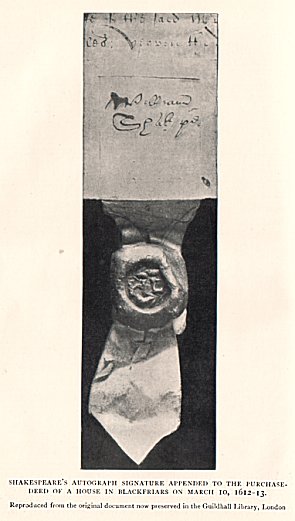
In the same year (1613), when on a short visit to London, Shakespeare invested a small sum of money in a new property. This was his last investment in real estate. He then purchased a house, the ground-floor of which was a haberdasher’s shop, with a yard attached. It was situated within six hundred feet of the Blackfriars Theatre—on the west side of St. Andrew’s Hill, formerly termed Puddle Hill or Puddle Dock Hill, in the near neighbourhood of what is now known as Ireland Yard. The former owner, Henry Walker, a musician, had bought the property for £100 in 1604. Shakespeare in 1613 agreed to pay him £140. The deeds of conveyance bear the date of March 10 in that year. [267] Next day, on March 11, Shakespeare executed another deed (now in the British Museum) which stipulated that £60 of the purchase-money was to remain on mortgage until the following Michaelmas. The money was unpaid at Shakespeare’s death. In both purchase-deed and mortgage-deed Shakespeare’s signature was witnessed by (among others) Henry Lawrence, ‘servant’ or clerk to Robert Andrewes, the scrivener who drew p. 268the deeds, and Lawrence’s seal, bearing his initials ‘H. L.,’ was stamped in each case on the parchment-tag, across the head of which Shakespeare wrote his name. In all three documents—the two indentures and the mortgage-deed—Shakespeare is described as ‘of Stratford-on-Avon, in the Countie of Warwick, Gentleman.’ There is no reason to suppose that he acquired the house for his own residence. He at once leased the property to John Robinson, already a resident in the neighbourhood.
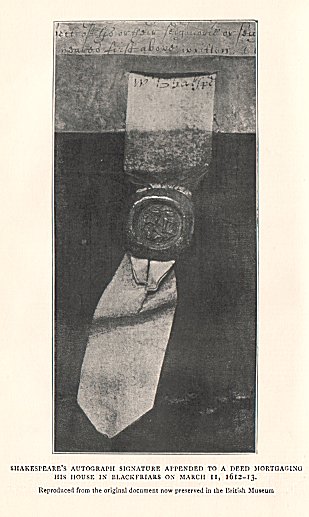
With puritans and puritanism Shakespeare was not in sympathy, [268] and he could hardly have viewed with unvarying composure the steady progress that puritanism was making among his fellow-townsmen. Nevertheless a preacher, doubtless of puritan proclivities, was entertained at Shakespeare’s residence, New Place, after delivering a sermon in the spring of 1614. The incident might serve to illustrate Shakespeare’s characteristic placability, but his son-in-law Hall, who avowed sympathy with puritanism, was p. 269probably in the main responsible for the civility. [269a] In July John Combe, a rich inhabitant of Stratford, died and left £5 to Shakespeare. The legend that Shakespeare alienated him by composing some doggerel on his practice of lending money at ten or twelve per cent. seems apocryphal, although it is quoted by Aubrey and accepted by Rowe. [269b] Combe’s death involved Shakespeare more conspicuously than before in civic affairs. Combe’s heir William no sooner succeeded to his father’s lands than he, with a neighbouring owner, Arthur Mannering, steward of Lord-chancellor Ellesmere (who was ex-officio lord of the manor), attempted p. 270to enclose the common fields, which belonged to the corporation of Stratford, about his estate at Welcombe. The corporation resolved to offer the scheme a stout resistance. Shakespeare had a twofold interest in the matter by virtue of his owning the freehold of 106 acres at Welcombe and Old Stratford, and as joint owner—now with Thomas Greene, the town clerk—of the tithes of Old Stratford, Welcombe, and Bishopton. His interest in his freeholds could not have been prejudicially affected, but his interest in the tithes might be depreciated by the proposed enclosure. Shakespeare consequently joined with his fellow-owner Greene in obtaining from Combe’s agent Replingham in October 1614 a deed indemnifying both against any injury they might suffer from the enclosure. But having thus secured himself against all possible loss, Shakespeare threw his influence into Combe’s scale. In November 1614 he was on a last visit to London, and Greene, whose official position as town clerk compelled him to support the corporation in defiance of his private interests, visited him there to discuss the position of affairs. On December 23, 1614, the corporation in formal meeting drew up a letter to Shakespeare imploring him to aid them. Greene himself sent to the dramatist ‘a note of inconveniences [to the corporation that] would happen by the enclosure.’ But although an ambiguous entry of a later date (September 1615) in the few extant pages of Greene’s ungrammatical diary has been unjustifiably tortured into an expression of disgust on Shakespeare’s part p. 271at Combe’s conduct, [271] it is plain that, in the spirit of his agreement with Combe’s agent, he continued to lend Combe his countenance. Happily Combe’s efforts failed, and the common lands remain unenclosed.
At the beginning of 1616 Shakespeare’s health was failing. He directed Francis Collins, a solicitor of Warwick, to draft his will, but, though it was prepared for signature on January 25, it was for the time laid aside. On February 10, 1616, Shakespeare’s younger daughter, Judith, married, at Stratford parish church, Thomas Quincy, four years her junior, a son of an old friend of the poet. The ceremony took place apparently without public asking of the banns and before a license was procured. The irregularity led to the summons of the bride and bridegroom to the ecclesiastical court at Worcester and the imposition of a fine. According to the testimony of John Ward, the vicar, Shakespeare entertained at New Place his two friends, Michael Drayton and Ben Jonson, in this same spring of 1616, and ‘had a p. 272merry meeting,’ but ‘itt seems drank too hard, for Shakespeare died of a feavour there contracted.’ A popular local legend, which was not recorded till 1762, [272a] credited Shakespeare with engaging at an earlier date in a prolonged and violent drinking bout at Bidford, a neighbouring village, [272b] but his achievements as a hard drinker may be dismissed as unproven. The cause of his death is undetermined, but probably his illness seemed likely to take a fatal turn in March, when he revised and signed the will that had been drafted in the previous January. On Tuesday, April 23, he died at the age of fifty-two. [272c] On Thursday, April 25 (O.S.), the poet was buried inside Stratford Church, near the northern wall of the chancel, in which, as part-owner of the tithes, and consequently one of the lay-rectors, he had a right of interment. Hard by was the charnel-house, where bones dug up from the churchyard were deposited. Over the poet’s grave were inscribed the lines:
Good friend, for Jesus’ sake forbeare
To dig the dust enclosed heare;
Bleste be the man that spares these stones,
And curst be he that moves my bones.
According to one William Hall, who described a p. 273visit to Stratford in 1694, [273] these verses were penned by Shakespeare to suit ‘the capacity of clerks and sextons, for the most part a very ignorant set of people.’ Had this curse not threatened them, Hall proceeds, the sexton would not have hesitated in course of time to remove Shakespeare’s dust to ‘the bone-house.’ As it was, the grave was made seventeen feet deep, and was never opened, even to receive his wife, although she expressed a desire to be buried with her husband.

Shakespeare’s will, the first draft of which was drawn up before January 25, 1616, received many interlineations and erasures before it was signed in the ensuing March. Francis Collins, the solicitor of Warwick, and Thomas Russell, ‘esquier,’ of Stratford, were the overseers; it was proved by John Hall, the poet’s son-in-law and joint-executor with Mrs. Hall, in London on June 22 following. The religious exordium is in conventional phraseology, and gives no clue to Shakespeare’s personal religious opinions. What those opinions were, we have neither the means nor the warrant for discussing. But while it is possible to quote from the plays many contemptuous references to the puritans and their doctrines, we may dismiss as idle gossip Davies’s irresponsible report that ‘he dyed a papist.’ The name of Shakespeare’s wife was omitted from the original draft of the will, but by an interlineation in the final draft she received his second best bed p. 274with its furniture. No other bequest was made her. Several wills of the period have been discovered in which a bedstead or other article of household furniture formed part of a wife’s inheritance, but none except Shakespeare’s is forthcoming in which a bed forms the sole bequest. At the same time the precision with which Shakespeare’s will accounts for and assigns to other legatees every known item of his property refutes the conjecture that he had set aside any portion of it under a previous settlement or jointure with a view to making independent provision for his wife. Her right to a widow’s dower—i.e. to a third share for life in freehold estate—was not subject to testamentary disposition, but Shakespeare had taken steps to prevent her from benefiting—at any rate to the full extent—by that legal arrangement. He had barred her dower in the case of his latest purchase of freehold estate, viz. the house at Blackfriars. [274] p. 275Such procedure is pretty conclusive proof that he had the intention of excluding her from the enjoyment of his possessions after his death. But, however plausible the theory that his relations with her were from first to last wanting in sympathy, it is improbable that either the slender mention of her in the will or the barring of her dower was designed by Shakespeare to make public his indifference or dislike. Local tradition subsequently credited her with a wish to be buried in his grave; and her epitaph proves that she inspired her daughters with genuine affection. Probably her ignorance of affairs and the infirmities of age (she was past sixty) combined to unfit her in the poet’s eyes for the control of property, and, as an act of ordinary prudence, he committed her to the care of his elder daughter, who inherited, according to such information as is accessible, some of his own shrewdness, and had a capable adviser in her husband.
This elder daughter, Susanna Hall, was, according to the will, to become mistress of New Place, and practically of all the poet’s estate. She received (with remainder to her issue in strict entail) New Place, all the land, barns, and gardens at and near Stratford (except the tenement in Chapel Lane), and the house in Blackfriars, London, while she and her husband were appointed executors and residuary legatees, with full rights over nearly all the poet’s household furniture and personal belongings. To their only child and the testator’s granddaughter, or ‘niece,’ Elizabeth Hall, was bequeathed p. 276the poet’s plate, with the exception of his broad silver and gilt bowl, which was reserved for his younger daughter, Judith. To his younger daughter he also left, with the tenement in Chapel Lane (in remainder to the elder daughter), £150 in money, of which £100, her marriage portion, was to be paid within a year, and another £150 to be paid to her if alive three years after the date of the will. [276a] To the poet’s sister, Joan Hart, whose husband, William Hart, predeceased the testator by only six days, he left, besides a contingent reversionary interest in Judith’s pecuniary legacy, his wearing apparel, £20 in money, a life interest in the Henley Street property, with £5 for each of her three sons, William, Thomas, and Michael. To the poor of Stratford he gave £10, and to Mr. Thomas Combe (apparently a brother of William, of the enclosure controversy) his sword. To each of his Stratford friends, Hamlett Sadler, William Reynoldes, Anthony Nash, and John Nash, and to each of his ‘fellows’ (i.e. theatrical colleagues in London), John Heming, Richard Burbage, and Henry Condell, he left xxvjs. viijd., with which to buy memorial rings. His godson, William Walker, received ‘xx’ shillings in gold.
Before 1623 [276b] an elaborate monument, by a London sculptor of Dutch birth, Gerard Johnson, was erected p. 277to Shakespeare’s memory in the chancel of the parish church. [277] It includes a half-length bust, depicting the dramatist on the point of writing. The fingers of the right hand are disposed as if holding a pen, and under the left hand lies a quarto sheet of paper. The inscription, which was apparently by a London friend, runs:
Judicio Pylium, genio Socratem, arte Maronem,
Terra tegit, populus mæret, Olympus habet.Stay passenger, why goest thou by so fast?
Read, if thou canst, whom envious death hath plast
Within this monument; Shakespeare with whome
Quick nature dide; whose name doth deck ys tombe
Far more than cost; sith all yt he hath writt
Leaves living art but page to serve his witt.Obiit ano. doi 1616 Ætatis 53 Die 23 Ap.
At the opening of Shakespeare’s career Chettle wrote of his ‘civil demeanour’ and of the reports of ‘his uprightness of dealing which argues his honesty.’ In 1601—when near the zenith of his fame—he was apostrophised as ‘sweet Master Shakespeare’ in the play of ‘The Return from Parnassus,’ and that adjective was long after associated with his name. In 1604 one Anthony Scoloker in a poem called ‘Daiphantus’ bestowed on him the epithet ‘friendly.’ After the close of his career Jonson wrote of him: ‘I loved the man and do honour his memory, on this side idolatry as much as any. He was, indeed, honest and of an open and free p. 278nature.’ [278a] No other contemporary left on record any definite impression of Shakespeare’s personal character, and the ‘Sonnets,’ which alone of his literary work can be held to throw any illumination on a personal trait, mainly reveal him in the light of one who was willing to conform to all the conventional methods in vogue for strengthening the bonds between a poet and a great patron. His literary practices and aims were those of contemporary men of letters, and the difference in the quality of his work and theirs was due not to conscious endeavour on his part to act otherwise than they, but to the magic and involuntary working of his genius. He seemed unconscious of his marvellous superiority to his professional comrades. The references in his will to his fellow-actors, and the spirit in which (as they announce in the First Folio) they approached the task of collecting his works after his death, corroborate the description of him as a sympathetic friend of gentle, unassuming mien. The later traditions brought together by Aubrey depict him as ‘very good company, and of a very ready and pleasant smooth wit,’ and there is much in other early posthumous references to suggest a genial, if not a convivial, temperament, linked to a quiet turn for good-humoured satire. But Bohemian ideals and modes of life had no genuine attraction for Shakespeare. His extant work attests his ‘copious’ and continuous industry, [278b] and with his literary power and p. 279sociability there clearly went the shrewd capacity of a man of business. Pope had just warrant for the surmise that he
For gain not glory winged his roving flight,
And grew immortal in his own despite.
His literary attainments and successes were chiefly valued as serving the prosaic end of providing permanently for himself and his daughters. His highest ambition was to restore among his fellow-townsmen the family repute which his father’s misfortunes had imperilled. Ideals so homely are reckoned rare among poets, but Chaucer and Sir Walter Scott, among writers of exalted genius, vie with Shakespeare in the sobriety of their personal aims and in the sanity of their mental attitude towards life’s ordinary incidents.
Shakespeare’s widow died on August 6, 1623, at the age of sixty-seven, and was buried near her husband inside the chancel two days later. Some affectionately phrased Latin elegiacs—doubtless from Dr. Hall’s pen—were inscribed on a brass plate fastened to the stone above her grave. [280] The younger daughter, Judith, resided with her husband, Thomas Quiney, at The Cage, a house which he leased in Bridge Street from 1616 till 1652. There he carried on the trade of a vintner, and took part in municipal affairs, acting as a councillor from 1617 and as chamberlain in 1621-2 and 1622-3; but after 1630 his affairs grew embarrassed, and he left Stratford late in 1652 for London, where he seems to have died a few months later. Of his three sons by Judith, the eldest, Shakespeare (baptised on November 23, 1616), was buried in Stratford Churchyard on May 8, 1617; the second son, p. 281Richard (baptised on February 9, 1617-18), was buried on January 28, 1638-9; and the third son, Thomas (baptised on January 23, 1619-20), was buried on February 26, 1638-9. Judith survived her husband, sons, and sister, dying at Stratford on February 9, 1661-2, in her seventy-seventh year.
The poet’s elder daughter, Mrs. Susanna Hall, resided at New Place till her death. Her sister Judith alienated to her the Chapel Place tenement before 1633, but that, with the interest in the Stratford tithes, she soon disposed of. Her husband, Dr. John Hall, died on November 25, 1635. In 1642 James Cooke, a surgeon in attendance on some Royalist troops stationed at Stratford, visited Mrs. Hall and examined manuscripts in her possession, but they were apparently of her husband’s, not of her father’s, composition. [281] From July 11 to 13, 1643, Queen Henrietta Maria, while journeying from Newark to Oxford, was billeted on Mrs. Hall at New Place for three days, and was visited there by Prince Rupert. Mrs. Hall was buried beside her husband in Stratford Churchyard on July 11, 1649, and a rhyming inscription, describing her as ‘witty above her sex,’ was engraved on her tombstone. The whole inscription ran: ‘Heere lyeth ye body of Svsanna, wife to John Hall, Gent. ye davghter of William Shakespeare, Gent. She deceased ye 11th of Jvly, A.D. 1649, aged 66.
‘Witty above her sexe, but that’s not all,
Wise to Salvation was good Mistress Hall,
p. 282Something of Shakespere was in that, but this
Wholy of him with whom she’s now in blisse.
Then, passenger, ha’st ne’re a teare,
To weepe with her that wept with all?
That wept, yet set herselfe to chere
Them up with comforts cordiall.
Her Love shall live, her mercy spread,
When thou hast ne’re a teare to shed.’
Mrs. Hall’s only child, Elizabeth, was the last surviving descendant of the poet. In April 1626 she married her first husband, Thomas Nash of Stratford (b. 1593), who studied at Lincoln’s Inn, was a man of property, and, dying childless at New Place on April 4, 1647, was buried in Stratford Church next day. At Billesley, a village four miles from Stratford, on June 5, 1649, Mrs. Nash married, as a second husband, a widower, John Bernard or Barnard of Abington, Northamptonshire, who was knighted by Charles II in 1661. About the same date she seems to have abandoned New Place for her husband’s residence at Abington. Dying without issue, she was buried there on February 17, 1669-70. Her husband survived her four years, and was buried beside her. [282] On her mother’s death in 1649 Lady Barnard inherited under the poet’s will the land near Stratford, New Place, the house at Blackfriars, and (on the death of the poet’s sister, Joan Hart, in 1646) the houses in Henley Street, while her father, Dr. Hall, left her in 1635 a house at Acton with a meadow. She sold the Blackfriars house, and apparently the Stratford land, before 1667. By her will, dated January p. 2831669-70, and proved in the following March, she left small bequests to the daughters of Thomas Hathaway, of the family of her grandmother, the poet’s wife. The houses in Henley Street passed to her cousin, Thomas Hart, the grandson of the poet’s sister Joan, and they remained in the possession of Thomas’s direct descendants till 1806 (the male line expired on the death of John Hart in 1800). By her will Lady Barnard also ordered New Place to be sold, and it was purchased on May 18, 1675, by Sir Edward Walker, through whose daughter Barbara, wife of Sir John Clopton, it reverted to the Clopton family. Sir John rebuilt it in 1702. On the death of his son Hugh in 1752, it was bought by the Rev. Francis Gastrell (d. 1768), who demolished the new building in 1759. [283]
Of Shakespeare’s three brothers, only one, Gilbert, seems to have survived him. Edmund, the youngest brother, ‘a player,’ was buried at St. Saviour’s Church, Southwark, ‘with a fore-noone knell of the great bell,’ on December 31, 1607; he was in his twenty-eighth year. Richard, John Shakespeare’s third son, died at Stratford in February 1613, aged 29. ‘Gilbert Shakespeare adolescens,’ who was buried at Stratford on February 3, 1611-12, was doubtless son of the poet’s next brother, Gilbert; the latter, having nearly completed his forty-sixth year, could scarcely be described as ‘adolescens;’ his death is not recorded, but according to Oldys he survived to a patriarchal age.
Much controversy has arisen over the spelling of the poet’s surname. It has been proved capable of four thousand variations. [284] The name of the poet’s father is entered sixty-six times in the council books of Stratford, and is spelt in sixteen ways. The commonest form is ‘Shaxpeare.’ Five autographs of the poet of undisputed authenticity are extant: his signature to the indenture relating to the purchase of the property in Blackfriars, dated March 10, 1612-13 (since 1841 in the Guildhall Library); his signature to the mortgage-deed relating to the same purchase, dated March 11, 1612-13 (since 1858 in the British Museum), and the three signatures on the three sheets of his will, dated March 25, 1615-16 (now at Somerset House). In all the signatures some of the letters are represented by recognised signs of abbreviation. The signature to the first document is ‘William Shakspere,’ though in all other portions of the deed the name is spelt ‘Shakespeare.’ The signature to the second p. 285document has been interpreted both as Shakspere and Shakspeare. The ink of the first signature in the will has now faded almost beyond decipherment, but that it was ‘Shakspere’ may be inferred from the facsimile made by Steevens in 1776. The second and third signatures to the will, which are also somewhat difficult to decipher, have been read both as Shakspere and Shakspeare; but a close examination suggests that whatever the second signature may be, the third is ‘Shakespeare.’ Shakspere is the spelling of the alleged autograph in the British Museum copy of Florio’s ‘Montaigne,’ but the genuineness of that signature is disputable. [285] Shakespeare was the form adopted in the full signature appended to the dedicatory epistles of the ‘Venus and Adonis’ of 1593 and the ‘Lucrece’ of 1594, volumes which were produced under the poet’s supervision. It is the spelling adopted on the title-pages of the majority of contemporary editions of his works, whether or not produced under his supervision. It is adopted in almost all the published references to the poet during the seventeenth century. It appears in the grant of arms in 1596, in the license to the players of 1603, and in the text of all the legal documents relating to the poet’s property. The poet, like most of his contemporaries, acknowledged no finality on the subject. According to the best authority, he spelt his surname in two ways when signing his will. There is consequently p. 286no good ground for abandoning the form Shakespeare, which is sanctioned by legal and literary custom. [286]
Aubrey reported that Shakespeare was ‘a handsome well-shap’t man,’ but no portrait exists which can be said with absolute certainty to have been executed during his lifetime, although one has recently been discovered with a good claim to that distinction. Only two of the extant portraits are positively known to have been produced within a short period after his death. These are the bust in Stratford Church and the frontispiece to the folio of 1623. Each is an inartistic attempt at a posthumous likeness. There is considerable discrepancy between the two; their main points of resemblance are the baldness on the top of the head and the fulness of the hair about the ears. The bust was by Gerard Johnson or Janssen, who was a Dutch stonemason or tombmaker settled in Southwark. It was set up in the church before 1623, and is a rudely carved specimen of mortuary sculpture. There are marks about the forehead and ears which suggest that the face was fashioned from a death mask, but the workmanship is at all points clumsy. The round face and eyes present a heavy, unintellectual expression. The bust was originally coloured, but in 1793 Malone caused it to be whitewashed. In 1861 the whitewash was removed, and the colours, as far as traceable, restored. The eyes are light hazel, the hair and beard auburn. There p. 287have been numberless reproductions, both engraved and photographic. It was first engraved—very imperfectly—for Rowe’s edition in 1709; then by Vertue for Pope’s edition of 1725; and by Gravelot for Hanmer’s edition in 1744. A good engraving by William Ward appeared in 1816. A phototype and a chromo-phototype, issued by the New Shakspere Society, are the best reproductions for the purposes of study. The pretentious painting known as the ‘Stratford’ portrait, and presented in 1867 by W. O. Hunt, town clerk of Stratford, to the Birthplace Museum, where it is very prominently displayed, was probably painted from the bust late in the eighteenth century; it lacks either historic or artistic interest.
The engraved portrait—nearly a half-length—which was printed on the title-page of the folio of 1623, was by Martin Droeshout. On the opposite page lines by Ben Jonson congratulate ‘the graver’ on having satisfactorily ‘hit’ the poet’s ‘face.’ Jonson’s testimony does no credit to his artistic discernment; the expression of countenance, which is very crudely rendered, is neither distinctive nor lifelike. The face is long and the forehead high; the top of the head is bald, but the hair falls in abundance over the ears. There is a scanty moustache and a thin tuft under the lower lip. A stiff and wide collar, projecting horizontally, conceals the neck. The coat is closely buttoned and elaborately bordered, especially at the shoulders. The dimensions of the head and face are disproportionately large as p. 288compared with those of the body. In the unique proof copy which belonged to Halliwell-Phillipps (now with his collection in America) the tone is clearer than in the ordinary copies, and the shadows are less darkened by cross-hatching and coarse dotting. The engraver, Martin Droeshout, belonged to a Flemish family of painters and engravers long settled in London, where he was born in 1601. He was thus fifteen years old at the time of Shakespeare’s death in 1616, and it is consequently improbable that he had any personal knowledge of the dramatist. The engraving was doubtless produced by Droeshout very shortly before the publication of the First Folio in 1623, when he had completed his twenty-second year. It thus belongs to the outset of the engraver’s professional career, in which he never achieved extended practice or reputation. A copy of the Droeshout engraving, by William Marshall, was prefixed to Shakespeare’s ‘Poems’ in 1640, and William Faithorne made another copy for the frontispiece of the edition of ‘The Rape of Lucrece’ published in 1655.
There is little doubt that young Droeshout in fashioning his engraving worked from a painting, and there is a likelihood that the original picture from which the youthful engraver worked has lately come to light. As recently as 1892 Mr. Edgar Flower, of Stratford-on-Avon, discovered in the possession of Mr. H. C. Clements, a private gentleman with artistic tastes residing at Peckham Rye, a portrait alleged to represent Shakespeare. The picture, which was faded and somewhat p. 289worm-eaten, dated beyond all doubt from the early years of the seventeenth century. It was painted on a panel formed of two planks of old elm, and in the upper left-hand corner was the inscription ‘Willm Shakespeare, 1609.’ Mr. Clements purchased the portrait of an obscure dealer about 1840, and knew nothing of its history, beyond what he set down on a slip of paper when he acquired it. The note that he then wrote and pasted on the box in which he preserved the picture, ran as follows: ‘The original portrait of Shakespeare, from which the now famous Droeshout engraving was taken and inserted in the first collected edition of his works, published in 1623, being seven years after his death. The picture was painted nine [verè seven] years before his death, and consequently sixteen [verè fourteen] years before it was published. . . . The picture was publicly exhibited in London seventy years ago, and many thousands went to see it.’ In all its details and in its comparative dimensions, especially in the disproportion between the size of the head and that of the body, this picture is identical with the Droeshout engraving. Though coarsely and stiffly drawn, the face is far more skilfully presented than in the engraving, and the expression of countenance betrays some artistic sentiment which is absent from the print. Connoisseurs, including Sir Edward Poynter, Mr. Sidney Colvin, and Mr. Lionel Cust, have almost unreservedly pronounced the picture to be anterior in date to the engraving, and they have reached the conclusion that in all probability Martin Droeshout p. 290directly based his work upon the painting. Influences of an early seventeenth-century Flemish school are plainly discernible in the picture, and it is just possible that it is the production of an uncle of the young engraver Martin Droeshout, who bore the same name as his nephew, and was naturalised in this country on January 25, 1608, when he was described as a ‘painter of Brabant.’ Although the history of the portrait rests on critical conjecture and on no external contemporary evidence, there seems good ground for regarding it as a portrait of Shakespeare painted in his lifetime—in the forty-fifth year of his age. No other pictorial representation of the poet has equally serious claims to be treated as contemporary with himself, and it therefore presents features of unique interest. On the death of its owner, Mr. Clements, in 1895, the painting was purchased by Mrs. Charles Flower, and was presented to the Memorial Picture Gallery at Stratford, where it now hangs. No attempt at restoration has been made. A photogravure forms the frontispiece to the present volume. [290]
Of the same type as the Droeshout engraving, although less closely resembling it than the picture just described, is the ‘Ely House’ portrait (now the property of the Birthplace Trustees at Stratford), p. 291which formerly belonged to Thomas Turton, Bishop of Ely, and it is inscribed ‘Æ. 39 x. 1603.’ [291a] This painting is of high artistic value. The features are of a far more attractive and intellectual cast than in either the Droeshout painting or engraving, and the many differences in detail raise doubts as to whether the person represented can have been intended for Shakespeare. Experts are of opinion that the picture was painted early in the seventeenth century.
Early in Charles II’s reign Lord Chancellor Clarendon added a portrait of Shakespeare to his great gallery in his house in St. James’s. Mention is made of it in a letter from the diarist John Evelyn to his friend Samuel Pepys in 1689, but Clarendon’s collection was dispersed at the end of the seventeenth century and the picture has not been traced. [291b]
Of the numerous extant paintings which have been described as portraits of Shakespeare, only the ‘Droeshout’ portrait and the Ely House portrait, both of which are at Stratford, bear any definable resemblance to the folio engraving or the bust in the church. [291c] In spite of their p. 292admitted imperfections, those presentments can alone be held indisputably to have been honestly designed to depict the poet’s features. They must be treated as the standards of authenticity in judging of the genuineness of other portraits claiming to be of an early date.
Of other alleged portraits which are extant, the most famous and interesting is the ‘Chandos’ portrait, now in the National Portrait Gallery. Its pedigree suggests that it was intended to represent the poet, but numerous and conspicuous divergences from the authenticated likenesses show that it was painted from fanciful descriptions of him some years after his death. The face is bearded, and rings adorn the ears. Oldys reported that it was from the brush of Burbage, Shakespeare’s fellow-actor, who had some reputation as a limner, [292] and that it had belonged to Joseph Taylor, an actor contemporary with Shakespeare. These rumours are not corroborated; but there is no doubt that it was at one time the property of D’Avenant, and that it subsequently belonged successively to the actor p. 293Betterton and to Mrs. Barry the actress. In 1693 Sir Godfrey Kneller made a copy as a gift for Dryden. After Mrs Barry’s death in 1713 it was purchased for forty guineas by Robert Keck, a barrister of the Inner Temple. At length it reached the hands of one John Nichols, whose daughter married James Brydges, third duke of Chandos. In due time the Duke became the owner of the picture, and it subsequently passed, through Chandos’s daughter, to her husband, the first Duke of Buckingham and Chandos, whose son, the second Duke of Buckingham and Chandos, sold it with the rest of his effects at Stowe in 1848, when it was purchased by the Earl of Ellesmere. The latter presented it to the nation. Edward Capell many years before presented a copy by Ranelagh Barret to Trinity College, Cambridge, and other copies are attributed to Sir Joshua Reynolds and Ozias Humphrey (1783). It was engraved by George Vertue in 1719 for Pope’s edition (1725), and often later, one of the best engravings being by Vandergucht. A good lithograph from a tracing by Sir George Scharf was published by the trustees of the National Portrait Gallery in 1864. The Baroness Burdett-Coutts purchased in 1875 a portrait of similar type, which is said, somewhat doubtfully, to have belonged to John lord Lumley, who died in 1609, and to have formed part of a collection of portraits of the great men of his day at his house, Lumley Castle, Durham. Its early history is not positively authenticated, and it may well be an early copy of the Chandos portrait. The p. 294‘Lumley’ painting was finely chromo-lithographed in 1863 by Vincent Brooks.
The so-called ‘Jansen’ or Janssens portrait, which belongs to Lady Guendolen Ramsden, daughter of the Duke of Somerset, and is now at her residence at Bulstrode, was first doubtfully identified about 1770, when in the possession of Charles Jennens. Janssens did not come to England before Shakespeare’s death. It is a fine portrait, but is unlike any other that has been associated with the dramatist. An admirable mezzotint by Richard Earlom was issued in 1811.
The ‘Felton’ portrait, a small head on a panel, with a high and very bald forehead (belonging since 1873 to the Baroness Burdett-Coutts), was purchased by S. Felton of Drayton, Shropshire, in 1792 of J. Wilson, the owner of the Shakespeare Museum in Pall Mall; it bears a late inscription, ‘Gul. Shakespear 1597, R. B.’ [i.e. Richard Burbage]. It was engraved by Josiah Boydell for George Steevens in 1797, and by James Neagle for Isaac Reed’s edition in 1803. Fuseli declared it to be the work of a Dutch artist, but the painters Romney and Lawrence regarded it as of English workmanship of the sixteenth century. Steevens held that it was the original picture whence both Droeshout and Marshall made their engravings, but there are practically no points of resemblance between it and the prints.
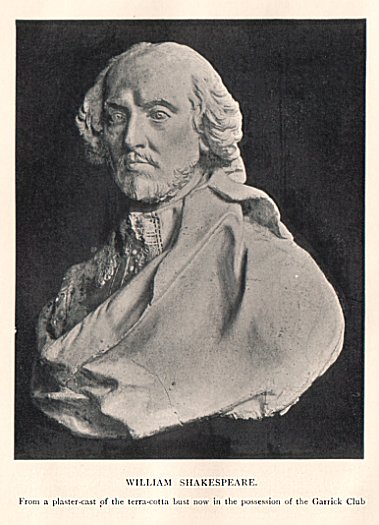
The ‘Soest’ or ‘Zoust’ portrait—in the possession of Sir John Lister-Kaye of the Grange, p. 295Wakefield—was in the collection of Thomas Wright, painter, of Covent Garden in 1725, when John Simon engraved it. Soest was born twenty-one years after Shakespeare’s death, and the portrait is only on fanciful grounds identified with the poet. A chalk drawing by John Michael Wright, obviously inspired by the Soest portrait, is the property of Sir Arthur Hodgson of Clopton House, and is on loan at the Memorial Gallery, Stratford.
A well-executed miniature by Hilliard, at one time in the possession of William Somerville the poet, and now the property Of Sir Stafford Northcote, bart., was engraved by Agar for vol. ii. of the ‘Variorum Shakespeare’ of 1821, and in Wivell’s ‘Inquiry,’ 1827. It has little claim to attention as a portrait of the dramatist. Another miniature (called the ‘Auriol’ portrait), of doubtful authenticity, formerly belonged to Mr. Lumsden Propert, and a third is at Warwick Castle.
A bust, said to be of Shakespeare, was discovered in 1845 bricked up in a wall in Spode and Copeland’s china warehouse in Lincoln’s Inn Fields. The warehouse had been erected on the site of the Duke’s Theatre, which was built by D’Avenant in 1660. The bust, which is of black terra cotta, and bears traces of Italian workmanship, is believed to have adorned the proscenium of the Duke’s Theatre. It was acquired by the surgeon William Clift, from whom it passed to Clift’s son-in-law, Richard (afterwards Sir Richard) Owen the naturalist. The latter sold it to the Duke of Devonshire, p. 296who presented it in 1851 to the Garrick Club, after having two copies made in plaster. One of these copies is now in the Shakespeare Memorial Gallery at Stratford, and from it an engraving has been made for reproduction in this volume.
The Kesselstadt death-mask was discovered by Dr. Ludwig Becker, librarian at the ducal palace at Darmstadt, in a rag-shop at Mayence in 1849. The features resemble those of an alleged portrait of Shakespeare (dated 1637) which Dr. Becker purchased in 1847. This picture had long been in the possession of the family of Count Francis von Kesselstadt of Mayence, who died in 1843. Dr. Becker brought the mask and the picture to England in 1849, and Richard Owen supported the theory that the mask was taken from Shakespeare’s face after death, and was the foundation of the bust in Stratford Church. The mask was for a long time in Dr. Becker’s private apartments at the ducal palace, Darmstadt. [296a] The features are singularly attractive; but the chain of evidence which would identify them with Shakespeare is incomplete. [296b]
p. 297A monument, the expenses of which were defrayed by public subscription, was set up in the Poets’ Corner in Westminster Abbey in 1741. Pope and the Earl of Burlington were among the promoters. The design was by William Kent, and the statue of Shakespeare was executed by Peter Scheemakers. [297] Another statue was executed by Roubiliac for Garrick, who bequeathed it to the British Museum in 1779. A third statue, freely adapted from the works of Scheemakers and Roubiliac, was executed for Baron Albert Grant and was set up by him as a gift to the metropolis in Leicester Square, London, in 1879. A fourth statue (by Mr. J. A. Q. Ward) was placed in 1882 in the Central Park, New York. A fifth in bronze, by M. Paul Fournier, which was erected in Paris in 1888 at the expense of an English resident, Mr. W. Knighton, stands at the point where the Avenue de Messine meets the Boulevard Haussmann. A sixth memorial in sculpture, by Lord Ronald Gower, the most elaborate and ambitious of all, stands in the garden of the Shakespeare Memorial buildings at Stratford-on-Avon, and was unveiled in 1888; Shakespeare is seated on a high pedestal; below, at each side of the pedestal, stand figures of four of Shakespeare’s principal characters: Lady Macbeth, Hamlet, Prince Hal, and Sir John Falstaff.
At Stratford, the Birthplace, which was acquired p. 298by the public in 1846 and converted into a museum, is with Anne Hathaway’s cottage (which was acquired by the Birthplace Trustees in 1892), a place of pilgrimage for visitors from all parts of the globe. The 27,038 persons who visited it in 1896 and the 26,510 persons who visited it in 1897 represented over forty nationalities. The site of the demolished New Place, with the gardens, was also purchased by public subscription in 1861, and now forms a public garden. Of a new memorial building on the river-bank at Stratford, consisting of a theatre, picture-gallery, and library, the foundation-stone was laid on April 23, 1877. The theatre was opened exactly two years later, when ‘Much Ado about Nothing’ was performed, with Helen Faucit (Lady Martin) as Beatrice and Barry Sullivan as Benedick. Performances of Shakespeare’s plays have since been given annually during April. The library and picture-gallery were opened in 1881. [298] A memorial Shakespeare library was opened at Birmingham on April 23, 1868, to commemorate the tercentenary of 1864, and, although destroyed by fire in 1879, was restored in 1882; it now possesses nearly ten thousand volumes relating to Shakespeare.
Only two of Shakespeare’s works—his narrative poems ‘Venus and Adonis’ and ‘Lucrece’—were published with his sanction and co-operation. These poems were the first specimens of his work to appear in print, and they passed in his lifetime through a greater number of editions than any of his plays. At the time of his death in 1616 there had been printed in quarto seven editions of his ‘Venus and Adonis’ (1593, 1594, 1596, 1599, 1600, and two in 1602), and five editions of his ‘Lucrece’ (1594, 1598, 1600, 1607, 1616). There was only one lifetime edition of the ‘Sonnets,’ Thorpe’s surreptitious venture of 1609; [299] but three editions were issued of the piratical ‘Passionate Pilgrim,’ which was fraudulently assigned to Shakespeare by the publisher William Jaggard, although it contained only a few occasional poems by him (1599, 1600 no copy known, and 1612).
Of posthumous editions in quarto of the two narrative poems in the seventeenth century, there p. 300were two of ‘Lucrece’—viz. in 1624 (‘the sixth edition’) and in 1655 (with John Quarles’s ‘Banishment of Tarquin’)—and there were as many as six editions of ‘Venus’ (1617, 1620, 1627, two in 1630, and 1636), making thirteen editions in all in forty-three years. No later editions of these two poems were issued in the seventeenth century. They were next reprinted together with ‘The Passionate Pilgrim’ in 1707, and thenceforth they usually figured, with the addition of the ‘Sonnets,’ in collected editions of Shakespeare’s works.
A so-called first collected edition of Shakespeare’s ‘Poems’ in 1640 (London, by T. Cotes for I. Benson) was mainly a reissue of the ‘Sonnets,’ but it omitted six (Nos. xviii., xix., xliii., lvi., lxxv., and lxxvi.) and it included the twenty poems of ‘The Passionate Pilgrim,’ with some other pieces by other authors. Marshall’s copy of the Droeshout engraving of 1623 formed the frontispiece. There were prefatory poems by Leonard Digges and John Warren, as well as an address ‘to the reader’ signed with the initials of the publisher. There Shakespeare’s ‘Sonnets’ were described as ‘serene, clear, and elegantly plain; such gentle strains as shall re-create and not perplex your brain. No intricate or cloudy stuff to puzzle intellect. Such as will raise your admiration to his praise.’ A chief point of interest in the volume of ‘Poems’ of 1640 is the fact that the ‘Sonnets’ were printed then in a different order from that which was followed in the volume of p. 3011609. Thus the poem numbered lxvii. in the original edition opens the reissue, and what has been regarded as the crucial poem, beginning
Two loves I have of comfort and despair,
which was in 1609 numbered cxliv., takes the thirty-second place in 1640. In most cases a more or less fanciful general title is placed in the second edition at the head of each sonnet, but in a few instances a single title serves for short sequences of two or three sonnets which are printed as independent poems continuously without spacing. The poems drawn from ‘The Passionate Pilgrim’ are intermingled with the ‘Sonnets,’ together with extracts from Thomas Heywood’s ‘General History of Women,’ although no hint is given that they are not Shakespeare’s work. The edition concludes with three epitaphs on Shakespeare and a short section entitled ‘an addition of some excellent poems to those precedent by other Gentlemen.’ The volume is of great rarity. An exact reprint was published in 1885.
Of Shakespeare’s plays there were in print in 1616 only sixteen (all in quarto), or eighteen if we include the ‘Contention,’ the first draft of ‘2 Henry VI’ (1594 and 1600), and ‘The True Tragedy,’ the first draft of ‘3 Henry VI’ (1595 and 1600). These sixteen quartos were publishers’ ventures, and were undertaken without the co-operation of the author.
Two of the plays, published thus, reached five editions before 1616, viz. ‘Richard III’ p. 302(1597, 1598, 1602, 1605, 1612) and ‘1 Henry IV’ (1598, 1599, 1604, 1608, 1615).
Three reached four editions, viz. ‘Richard II’ (1597, 1598, 1608 supplying the deposition scene for the first time, 1615); ‘Hamlet’ (1603 imperfect, 1604, 1605, 1611), and ‘Romeo and Juliet’ (1597 imperfect, 1599, two in 1609).
Two reached three editions, viz. ‘Henry V’ (1600 imperfect, 1602, and 1608) and ‘Pericles’ (two in 1609, 1611).
Four reached two editions, viz. ‘Midsummer Night’s Dream’ (both in 1600); ‘Merchant of Venice’ (both in 1600); ‘Lear’ (both in 1608); and ‘Troilus and Cressida’ (both in 1609).
Five achieved only one edition, viz. ‘Love’s Labour’s Lost’ (1598), ‘2 Henry IV’ (1600), ‘Much Ado’ (1600), ‘Titus’ (1600), ‘Merry Wives’ (1602 imperfect).
Three years after Shakespeare’s death—in 1619—there appeared a second edition of ‘Merry Wives’ (again imperfect) and a fourth of ‘Pericles.’ ‘Othello’ was first printed posthumously in 1622 (4to), and in the same year sixth editions of ‘Richard III’ and ‘I Henry IV’ appeared. [302] The largest collections of the original quartos—p. 303each of which survives in only four, five, or six copies—are in the libraries of the Duke of Devonshire, the British Museum, and Trinity College, Cambridge, and in the Bodleian Library. [303] All the quartos were issued in Shakespeare’s day at sixpence each.
In 1623 the first attempt was made to give the world a complete edition of Shakespeare’s plays. Two of the dramatist’s intimate friends and fellow-actors, John Heming and Henry Condell, were nominally responsible for the venture, but it seems to have been suggested by a small syndicate of printers and publishers, who undertook all pecuniary responsibility. Chief of the syndicate was William Jaggard, printer since 1611 to the City of London, who was established in business in Fleet Street at the east end of St. Dunstan’s Church. As the piratical publisher of ‘The Passionate Pilgrim’ he had long known the commercial value of Shakespeare’s work. In 1613 he had extended his business by purchasing the stock and rights of a rival pirate, James Roberts, who had printed the quarto editions of the ‘Merchant of Venice’ and ‘Midsummer Night’s Dream’ in 1600 and the complete quarto of ‘Hamlet’ in 1604. Roberts had enjoyed for nearly twenty years the right to print ‘the players’ bills,’ or programmes, and he made over p. 304that privilege to Jaggard with his other literary property. It is to the close personal relations with the playhouse managers into which the acquisition of the right of printing ‘the players’ bill’ brought Jaggard after 1613 that the inception of the scheme of the ‘First Folio’ may safely be attributed. Jaggard associated his son Isaac with the enterprise. They alone of the members of the syndicate were printers. Their three partners were publishers or booksellers only. Two of these, William Aspley and John Smethwick, had already speculated in plays of Shakespeare. Aspley had published with another in 1600 the ‘Second Part of Henry IV’ and ‘Much Ado about Nothing,’ and in 1609 half of Thorpe’s impression of Shakespeare’s ‘Sonnets.’ Smethwick, whose shop was in St. Dunstan’s Churchyard, Fleet Street, near Jaggard’s, had published in 1611 two late editions of ‘Romeo and Juliet’ and one of ‘Hamlet.’ Edward Blount, the fifth partner, was an interesting figure in the trade, and, unlike his companions, had a true taste in literature. He had been a friend and admirer of Christopher Marlowe, and had actively engaged in the posthumous publication of two of Marlowe’s poems. He had published that curious collection of mystical verse entitled ‘Love’s Martyr,’ one poem in which, ‘a poetical essay of the Phœnix and the Turtle,’ was signed ‘William Shakespeare.’ [304]
The First Folio was doubtless printed in Jaggard’s printing office near St. Dunstan’s Church. Upon Blount probably fell the chief labour of seeing the p. 305work through the press. It was in progress throughout 1623, and had so far advanced by November 8, 1623, that on that day Edward Blount and Isaac (son of William) Jaggard obtained formal license from the Stationers’ Company to publish sixteen of the twenty hitherto unprinted plays that it was intended to include. The pieces, whose approaching publication for the first time was thus announced, were of supreme literary interest. The titles ran: ‘The Tempest,’ ‘The Two Gentlemen,’ ‘Measure for Measure,’ ‘Comedy of Errors,’ ‘As you like it,’ ‘All’s Well,’ ‘Twelfth Night,’ ‘Winter’s Tale,’ ‘3 Henry VI,’ ‘Henry VIII,’ ‘Coriolanus,’ ‘Timon,’ ‘Julius Cæsar,’ ‘Macbeth,’ ‘Antony and Cleopatra,’ and ‘Cymbeline.’ Four other hitherto unprinted dramas for which no license was sought figured in the volume, viz. ‘King John,’ ‘1 and 2 Henry VI,’ and the ‘Taming of the Shrew;’ but each of these plays was based by Shakespeare on a play of like title which had been published at an earlier date, and the absence of a license was doubtless due to an ignorant misconception on the past either of the Stationers’ Company’s officers or of the editors of the volume as to the true relations subsisting between the old pieces and the new. The only play by Shakespeare that had been previously published and was not included in the First Folio was ‘Pericles.’
Thirty-six pieces in all were thus brought together. The volume consisted of nearly one thousand double-column pages and was sold at a pound a copy. Steevens estimated that the edition numbered 250 copies. The book was described on the title-page as published by p. 306Edward Blount and Isaac Jaggard, and in the colophon as printed at the charges of ‘W. Jaggard, I. Smithweeke, and W. Aspley,’ as well as of Blount. [306] On the title-page was engraved the Droeshout portrait. Commendatory verses were supplied by Ben Jonson, Hugh Holland, Leonard Digges, and I. M., perhaps Jasper Maine. The dedication was addressed to the brothers William Herbert, earl of Pembroke, the lord chamberlain, and Philip Herbert, earl of Montgomery, and was signed by Shakespeare’s friends and fellow-actors, Heming and Condell. The same signatures were appended to a succeeding address ‘to the great variety of readers.’ In both addresses the two actors made pretension to a larger responsibility for the enterprise than they really incurred, but their motives in identifying themselves with the venture were doubtless irreproachable. They disclaimed (they wrote) ‘ambition either of selfe-profit or fame in undertaking the design,’ being solely moved by anxiety to ‘keepe the memory of so worthy a friend and fellow alive as was our Shakespeare.’ ‘It had bene a thing we confesse worthie to haue bene wished,’ they inform the reader, ‘that the author himselfe had liued to haue set forth and ouerseen his owne writings. . . .’ A list of contents follows the address to the readers.
The title-page states that all the plays were printed ‘according to the true originall copies.’ The dedicators wrote to the same effect. ‘As where (before) we were abus’d with diuerse stolne and surreptitious p. 307copies, maimed and deformed by the frauds and stealthes of incurious impostors that expos’d them: even those are now offer’d to your view cur’d and perfect in their limbes, and all the rest absolute in their numbers as he conceived them.’ There is no doubt that the whole volume was printed from the acting versions in the possession of the manager of the company with which Shakespeare had been associated. But it is doubtful if any play were printed exactly as it came from his pen. The First Folio text is often markedly inferior to that of the sixteen pre-existent quartos, which, although surreptitiously and imperfectly printed, followed playhouse copies of far earlier date. From the text of the quartos the text of the First Folio differs invariably, although in varying degrees. The quarto texts of ‘Love’s Labour’s Lost,’ ‘Midsummer Night’s Dream,’ and ‘Richard II,’ for example, differ very largely and always for the better from the folio texts. On the other hand, the folio repairs the glaring defects of the quarto versions of ‘The Merry Wives of Windsor’ and of ‘Henry V.’ In the case of twenty of the plays in the First Folio no quartos exist for comparison, and of these twenty plays, ‘Coriolanus,’ ‘All’s Well,’ and ‘Macbeth’ present a text abounding in corrupt passages.
The plays are arranged under three headings—‘Comedies,’ ‘Histories,’ and ‘Tragedies’—and each division is separately paged. The arrangement of the plays in each division follows no principle. The comedy section begins p. 308with the ‘Tempest’ and ends with the ‘Winter’s Tale.’ The histories more justifiably begin with ‘King John’ and end with ‘Henry VIII.’ The tragedies begin with ‘Troilus and Cressida’ and end with ‘Cymbeline.’ This order has been usually followed in subsequent collective editions.
As a specimen of typography the First Folio is not to be commended. There are a great many contemporary folios of larger bulk far more neatly and correctly printed. It looks as though Jaggard’s printing office were undermanned. The misprints are numerous and are especially conspicuous in the pagination. The sheets seem to have been worked off very slowly, and corrections were made while the press was working, so that the copies struck off later differ occasionally from the earlier copies. One mark of carelessness on the part of the compositor or corrector of the press, which is common to all copies, is that ‘Troilus and Cressida,’ though in the body of the book it opens the section of tragedies, is not mentioned at all in the table of contents, and the play is unpaged except on its second and third pages, which bear the numbers 79 and 80.
Three copies are known which are distinguished by more interesting irregularities, in each case unique. The copy in the Lenox Library in New York includes a cancel duplicate of a leaf of ‘As You Like It’ (sheet R of the comedies), and the title-page bears the date 1622 instead of 1623; but it is suspected that the figures were tampered with outside the printing office. [308] Samuel Butler, successively p. 309headmaster of Shrewsbury and Bishop of Lichfield and Coventry, possessed a copy of the First Folio in which a proof leaf of ‘Hamlet’ was bound up with the corrected leaf. [309a]
The most interesting irregularity yet noticed appears in one of the two copies of the book belonging to the Baroness Burdett-Coutts. This copy is known as the Sheldon Folio, having formed in the seventeenth century part of the library of Ralph Sheldon of Weston Manor in the parish of Long Compton, Warwickshire. [309b] In the Sheldon Folio the opening page of ‘Troilus and Cressida,’ of which the recto or front is occupied by the prologue and the verso or back by the opening lines of the text of the play, is followed by a superfluous leaf. On the recto or front of the unnecessary leaf [309c] are printed the concluding lines of ‘Romeo and Juliet’ in place of the prologue to ‘Troilus and Cressida.’ At the back or verso are the opening lines of ‘Troilus and Cressida’ repeated from the preceding page. p. 310The presence of a different ornamental headpiece on each page proves that the two are not taken from the same setting of the type. At a later page in the Sheldon copy the concluding lines of ‘Romeo and Juliet’ are duly reprinted at the close of the play, and on the verso or back of the leaf, which supplies them in their right place, is the opening passage, as in other copies, of ‘Timon of Athens.’ These curious confusions attest that while the work was in course of composition the printers or editors of the volume at one time intended to place ‘Troilus and Cressida,’ with the prologue omitted, after ‘Romeo and Juliet.’ The last page of ‘Romeo and Juliet’ is in all copies numbered 79, an obvious misprint for 77; the first leaf of ‘Troilus’ is paged 78; the second and third pages of ‘Troilus’ are numbered 79 and 80. It was doubtless suddenly determined while the volume was in the press to transfer ‘Troilus and Cressida’ to the head of the tragedies from a place near the end, but the numbers on the opening pages which indicated its first position were clumsily retained, and to avoid the extensive typographical corrections that were required by the play’s change of position, its remaining pages were allowed to go forth unnumbered. [310]
It is difficult to estimate how many copies survive of the First Folio, which is intrinsically the most valuable volume in the whole range of English literature, and extrinsically is only exceeded in value by p. 311some half-dozen volumes of far earlier date and of exceptional typographical interest. It seems that about 140 copies have been traced within the past century. Of these fewer than twenty are in a perfect state, that is, with the portrait printed (not inlaid) on the title-page, and the flyleaf facing it, with all the pages succeeding it, intact and uninjured. (The flyleaf contains Ben Jonson’s verses attesting the truthfulness of the portrait.) Excellent copies in this enviable state are in the Grenville Library at the British Museum, and in the libraries of the Duke of Devonshire, the Earl of Crawford, the Baroness Burdett-Coutts, and Mr. A. H. Huth. Of these probably the finest and cleanest is the ‘Daniel’ copy belonging to the Baroness Burdett-Coutts. It measures 13 inches by 8¼, and was purchased by its present owner for £716 2s. at the sale of George Daniel’s library in 1864. Some twenty more copies are defective in the preliminary pages, but are unimpaired in other respects. There remain about a hundred copies which have sustained serious damage at various points.
A reprint of the First Folio unwarrantably purporting to be exact was published in 1807-8. [311] The best reprint was issued in three parts by Lionel Booth in 1861, 1863, and 1864. The valuable photo-zincographic reproduction undertaken by Sir Henry James, under the direction of Howard Staunton, was issued in sixteen folio parts between February 1864 and October 1865. A reduced p. 312photographic facsimile, too small to be legible, appeared in 1876, with a preface by Halliwell-Phillipps.
The Second Folio edition was printed in 1632 by Thomas Cotes for Robert Allot and William Aspley, each of whose names figures as publisher on different copies. To Allot Blount had transferred, on November 16, 1630, his rights in the sixteen plays which were first licensed for publication in 1623. [312a] The Second Folio was reprinted from the First; a few corrections were made in the text, but most of the changes were arbitrary and needless. Charles I’s copy is at Windsor, and Charles II’s at the British Museum. The ‘Perkins Folio,’ now in the Duke of Devonshire’s possession, in which John Payne Collier introduced forged emendations, was a copy of that of 1632. [312b] The Third Folio—for the most part a faithful reprint of the Second—was first published in 1663 by Peter Chetwynde, who reissued it next year with the addition of seven plays, six of which have no p. 313claim to admission among Shakespeare’s works. ‘Unto this impression,’ runs the title-page of 1664, ‘is added seven Playes never before printed in folio, viz.: Pericles, Prince of Tyre. The London Prodigall. The History of Thomas Ld. Cromwell. Sir John Oldcastle, Lord Cobham. The Puritan Widow. A Yorkshire Tragedy. The Tragedy of Locrine.’ The six spurious pieces which open the volume were attributed by unprincipled publishers to Shakespeare in his lifetime. Fewer copies of the Third Folio are reputed to be extant than of the Second or Fourth, owing to the destruction of many unsold impressions in the Fire of London in 1666. The Fourth Folio, printed in 1685 ‘for H. Herringman, E. Brewster, R. Chiswell, and R. Bentley,’ reprints the folio of 1664 without change except in the way of modernising the spelling; it repeats the spurious pieces.
Since 1685 some two hundred independent editions of the collected works have been published in Great Britain and Ireland, and many thousand editions of separate plays. The eighteenth-century editors of the collected works endeavoured with varying degrees of success to purge the text of the numerous incoherences of the folios, and to restore, where good taste or good sense required it, the lost text of the contemporary quartos. It is largely owing to a due co-ordination of the results of the efforts of the eighteenth-century editors by their successors in the present century that Shakespeare’s work has become intelligible p. 314to general readers unversed in textual criticism, and has won from them the veneration that it merits. [314]
Nicholas Rowe, a popular dramatist of Queen Anne’s reign, and poet laureate to George I., was the first critical editor of Shakespeare. He produced an edition of his plays in six octavo volumes in 1709. A new edition in eight volumes followed in 1714, and another hand added a ninth volume which included the poems. Rowe prefixed a valuable life of the poet embodying traditions which were in danger of perishing without a record. His text followed that of the Fourth Folio. The plays were printed in the same order, except that he transferred the spurious pieces from the beginning to the end. Rowe did not compare his text with that of the First Folio or of the quartos, but in the case of ‘Romeo and Juliet’ he met with an early quarto while his edition was passing through the press, and inserted at the end of the play the prologue which is met with only in the quartos. He made a few happy emendations, some of which coincide accidentally with the readings of the First Folio; but his text is deformed by many palpable errors. His practical experience as a playwright induced him, however, to prefix for the first time a list of dramatis personæ to each play, to divide and number acts and scenes on rational principles, and to mark the p. 315entrances and exits of the characters. Spelling, punctuation, and grammar he corrected and modernised.
The poet Pope was Shakespeare’s second editor. His edition in six quarto volumes was completed in 1725. The poems, edited by Dr. George Sewell, with an essay on the rise and progress of the stage, and a glossary, appeared in a seventh volume. Pope had few qualifications for the task, and the venture was a commercial failure. In his preface Pope, while he fully recognised Shakespeare’s native genius, deemed his achievement deficient in artistic quality. Pope claimed to have collated the text of the Fourth Folio with that of all preceding editions, and although his work indicates that he had access to the First Folio and some of the quartos, it is clear that his text was based on that of Rowe. His innovations are numerous, and are derived from ‘his private sense and conjecture,’ but they are often plausible and ingenious. He was the first to indicate the place of each new scene, and he improved on Rowe’s subdivision of the scenes. A second edition of Pope’s version in ten duodecimo volumes appeared in 1728 with Sewell’s name on the title-page as well as Pope’s. There were few alterations in the text, though a preliminary table supplied a list of twenty-eight quartos. Other editions followed in 1735 and 1768. The last was printed at Garrick’s suggestion at Birmingham from Baskerville’s types.
Pope found a rigorous critic in Lewis Theobald, who, although contemptible as a writer of original verse and p. 316prose, proved himself the most inspired of all the textual critics of Shakespeare. Pope savagely avenged himself on his censor by holding him up to ridicule as the hero of the ‘Dunciad.’ Theobald first displayed his critical skill in 1726 in a volume which deserves to rank as a classic in English literature. The title runs ‘Shakespeare Restored, or a specimen of the many errors as well committed as unamended by Mr. Pope in his late edition of this poet, designed not only to correct the said edition but to restore the true reading of Shakespeare in all the editions ever yet publish’d.’ There at page 137 appears Theobald’s great emendation in Shakespeare’s account of Falstaff’s death (Henry V, II. iii. 17): ‘His nose was as sharp as a pen and a’ babbled of green fields,’ in place of the reading in the old copies, ‘His nose was as sharp as a pen and a table of green fields.’ In 1733 Theobald brought out his edition of Shakespeare in seven volumes. In 1740 it reached a second issue. A third edition was published in 1752. Others are dated 1772 and 1773. It is stated that 12,860 copies in all were sold. Theobald made the First Folio the basis of his text, although he failed to adopt all the correct readings of that version, but over 300 corrections or emendations which he made in his edition have become part and parcel of the authorised canon. Theobald’s principles of textual criticism were as enlightened as his practice was triumphant. ‘I ever labour,’ he wrote to Warburton, ‘to make the smallest deviation that I possibly can from the text; never to alter at all where I can by p. 317any means explain a passage with sense; nor ever by any emendation to make the author better when it is probable the text came from his own hands.’ Theobald has every right to the title of the Porson of Shakespearean criticism. [317a] The following are favourable specimens of his insight. In ‘Macbeth’ (I. vii. 6) for ‘this bank and school of time,’ he substituted the familiar ‘bank and shoal of time.’ In ‘Antony and Cleopatra’ the old copies (v. ii. 87) made Cleopatra say of Antony:
For his bounty,
There was no winter in’t; an Anthony it was
That grew the more by reaping.
For the gibberish ‘an Anthony it was,’ Theobald read ‘an autumn ’twas,’ and thus gave the lines true point and poetry. A third notable instance, somewhat more recondite, is found in ‘Coriolanus’ (II. i. 59-60) where Menenius asks the tribunes in the First Folio version ‘what harm can your besom conspectuities [i.e. vision or eyes] glean out of this character?’ Theobald replaced the meaningless epithet ‘besom’ by ‘bisson’ (i.e. purblind), a recognised Elizabethan word which Shakespeare had already employed in ‘Hamlet’ (II. ii. 529). [317b]
p. 318The fourth editor was Sir Thomas Hammer, a country gentleman without much literary culture, but possessing a large measure of mother wit. He was speaker in the House of Commons for a few months in 1714, and retiring soon afterwards from public life devoted his leisure to a thorough-going scrutiny of Shakespeare’s plays. His edition, which was the earliest to pretend to typographical beauty, was printed at the Oxford University Press in 1744 in six quarto volumes. It contained a number of good engravings by Gravelot after designs by Francis Hayman, and was long highly valued by book collectors. No editor’s name was given. In forming his text, Hanmer depended exclusively on his own ingenuity. He made no recourse to the old copies. The result was a mass of common-sense emendations, some of which have been permanently accepted. [318] Hanmer’s edition was reprinted in 1770-1.
In 1747 Bishop Warburton produced a revised version of Pope’s edition in eight volumes. Warburton was hardly better qualified for the task than Pope, and such improvements as he introduced are mainly borrowed from Theobald and Hanmer. On both these critics he arrogantly and unjustly heaped abuse in his preface. The Bishop was consequently criticised with p. 319appropriate severity for his pretentious incompetence by many writers; among them, by Thomas Edwards, whose ‘Supplement to Warburton’s Edition of Shakespeare’ first appeared in 1747, and, having been renamed ‘The Canons of Criticism’ next year in the third edition, passed through as many as seven editions by 1765.
Dr. Johnson, the sixth editor, completed his edition in eight volumes in 1765, and a second issue followed three years later. Although he made some independent collation of the quartos, his textual labours were slight, and his verbal notes show little close knowledge of sixteenth and seventeenth century literature. But in his preface and elsewhere he displays a genuine, if occasionally sluggish, sense of Shakespeare’s greatness, and his massive sagacity enabled him to indicate convincingly Shakespeare’s triumphs of characterisation.
The seventh editor, Edward Capell, advanced on his predecessors in many respects. He was a clumsy writer, and Johnson declared, with some justice, that he ‘gabbled monstrously,’ but his collation of the quartos and the First and Second Folios was conducted on more thorough and scholarly methods than those of any of his predecessors not excepting Theobald. His industry was untiring, and he is said to have transcribed the whole of Shakespeare ten times. Capell’s edition appeared in ten small octavo volumes in 1768. He showed himself well versed in Elizabethan literature in a volume of notes which appeared in 1774, and in three further p. 320volumes, entitled ‘Notes, Various Readings, and the School of Shakespeare,’ which were not published till 1783, two years after his death. The last volume, ‘The School of Shakespeare,’ consisted of ‘authentic extracts from divers English books that were in print in that author’s time,’ to which was appended ‘Notitia Dramatica; or, Tables of Ancient Plays (from their beginning to the Restoration of Charles II).’
George Steevens, whose saturnine humour involved him in a lifelong series of literary quarrels with rival students of Shakespeare, made invaluable contributions to Shakespearean study. In 1766 he reprinted twenty of the plays from the quartos. Soon afterwards he revised Johnson’s edition without much assistance from the Doctor, and his revision, which embodied numerous improvements, appeared in ten volumes in 1773. It was long regarded as the standard version. Steevens’s antiquarian knowledge alike of Elizabethan history and literature was greater than that of any previous editor; his citations of parallel passages from the writings of Shakespeare’s contemporaries, in elucidation of obscure words and phrases, have not been exceeded in number or excelled in aptness by any of his successors. All commentators of recent times are more deeply indebted in this department of their labours to Steevens than to any other critic. But he lacked taste as well as temper, and excluded from his edition Shakespeare’s sonnets and poems, because, he wrote, ‘the strongest Act of Parliament that could be framed would fail to compel readers into their service.’ [320] p. 321The second edition of Johnson and Steevens’s version appeared in ten volumes in 1778. The third edition, published in ten volumes in 1785, was revised by Steevens’s friend, Isaac Reed (1742-1807), a scholar of his own type. The fourth and last edition, published in Steevens’s lifetime, was prepared by himself in fifteen volumes in 1793. As he grew older, he made some reckless changes in the text, chiefly with the unhallowed object of mystifying those engaged in the same field. With a malignity that was not without humour, he supplied, too, many obscene notes to coarse expressions, and he pretended that he owed his indecencies to one or other of two highly respectable clergymen, Richard Amner and John Collins, whose surnames were in each instance appended. He had known and quarrelled with both. Such proofs of his perversity justified the title which Gifford applied to him of ‘the Puck of Commentators.’
Edmund Malone, who lacked Steevens’s quick wit and incisive style, was a laborious and amiable archæologist, without much ear for poetry or delicate literary taste. He threw abundance of new light on Shakespeare’s biography, and on the chronology and sources of his works, while his researches into the beginnings of the English stage added a new chapter of first-rate importance to English literary history. To Malone is due the first rational ‘attempt to ascertain the order in which the plays attributed to Shakespeare were written.’ His earliest results on the topic were contributed to p. 322Steevens’s edition of 1778. Two years later he published, as a supplement to Steevens’s work, two volumes containing a history of the Elizabethan stage, with reprints of Arthur Brooke’s ‘Romeus and Juliet,’ Shakespeare’s Poems, and the plays falsely ascribed to him in the Third and Fourth Folios. A quarrel with Steevens followed, and was never closed. In 1787 Malone issued ‘A Dissertation on the Three Parts of King Henry VI,’ tending to show that those plays were not originally written by Shakespeare. In 1790 appeared his edition of Shakespeare in ten volumes, the first in two parts.
What is known among booksellers as the ‘First Variorum’ edition of Shakespeare was prepared by Steevens’s friend, Isaac Reed, after Steevens’s death. It was based on a copy of Steevens’s work of 1793, which had been enriched with numerous manuscript additions, and it embodied the published notes and prefaces of preceding editors. It was published in twenty-one volumes in 1803. The ‘Second Variorum’ edition, which was mainly a reprint of the first, was published in twenty-one volumes in 1813. The ‘Third Variorum’ was prepared for the press by James Boswell the younger, the son of Dr. Johnson’s biographer. It was based on Malone’s edition of 1790, but included massive accumulations of notes left in manuscript by Malone at his death. Malone had been long engaged on a revision of his edition, but died in 1812, before it was completed. Boswell’s ‘Malone,’ as the new work is often called, appeared in twenty-one volumes in 1821. It is the most p. 323valuable of all collective editions of Shakespeare’s works, but the three volumes of preliminary essays on Shakespeare’s biography and writings, and the illustrative notes brought together in the final volume, are confusedly arranged and are unindexed; many of the essays and notes break off abruptly at the point at which they were left at Malone’s death. A new ‘Variorum’ edition, on an exhaustive scale, was undertaken by Mr. H. Howard Furness of Philadelphia, and eleven volumes have appeared since 1871 (‘Romeo and Juliet,’ ‘Macbeth,’ ‘Hamlet,’ 2 vols., ‘King Lear,’ ‘Othello,’ ‘Merchant of Venice,’ ‘As You Like It,’ ‘Tempest,’ ‘Midsummer Night’s Dream,’ and ‘Winter’s Tale’).
Of nineteenth-century editors who have prepared collective editions of Shakespeare’s work with original annotations those who have most successfully pursued the great traditions of the eighteenth century are Alexander Dyce, Howard Staunton, Nikolaus Delius, and the Cambridge editors William George Clark (1821-1878) and Dr. Aldis Wright.
Alexander Dyce was almost as well read as Steevens in Elizabethan literature, and especially in the drama of the period, and his edition of Shakespeare in nine volumes, which was first published in 1857, has many new and valuable illustrative notes and a few good textual emendations, as well as a useful glossary; but Dyce’s annotations are not always adequate, and often tantalise the reader by their brevity. Howard Staunton’s p. 324edition first appeared in three volumes between 1868 and 1870. He also was well read in contemporary literature and was an acute textual critic. His introductions bring together much interesting stage history. Nikolaus Delius’s edition was issued at Elberfeld in seven volumes between 1854 and 1861. Delius’s text is formed on sound critical principles and is to be trusted thoroughly. A fifth edition in two volumes appeared in 1882. The Cambridge edition, which first appeared in nine volumes between 1863 and 1866, exhaustively notes the textual variations of all preceding editions, and supplies the best and fullest apparatus criticus. (Of new editions, one dated 1887 is also in nine volumes, and another, dated 1893, in forty volumes.)
Other editors of the complete works of Shakespeare of the nineteenth century whose labours, although of some value, present fewer distinctive characteristics are:—William Harness (1825, 8 vols.); Samuel Weller Singer (1826, 10 vols., printed at the Chiswick Press for William Pickering, illustrated by Stothard and others; reissued in 1856 with essays by William Watkiss Lloyd); Charles Knight, with discursive notes and pictorial illustrations by F. W. Fairholt and others (‘Pictorial edition,’ 8 vols., including biography and the doubtful plays, 1838-43, often reissued under different designations); Bryan Waller Procter, i.e. Barry Cornwall (1839-43, 3 vols.); John Payne Collier (1841-4, 8 vols.; another edition, p. 3258 vols., privately printed, 1878, 4to); Samuel Phelps, the actor (1852-4, 2 vols.; another edition, 1882-4); J. O. Halliwell (1853-61, 15 vols. folio, with an encyclopædic collection of annotations of earlier editors and pictorial illustrations); Richard Grant White (Boston, U.S.A., 1857-65, 12 vols.); W. J. Rolfe (New York, 1871-96, 40 vols.); the Rev. H. N. Hudson (the Harvard edition, Boston, 1881, 20 vols.) The latest complete annotated editions published in this country are ‘The Henry Irving Shakespeare,’ edited by F. A. Marshall and others—especially useful for notes on stage history (8 vols. 1888-90)—and ‘The Temple Shakespeare,’ concisely edited by Mr. Israel Gollancz (38 vols. 12mo, 1894-6).
Of one-volume editions of the unannotated text, the best are the Globe, edited by W. G. Clark and Dr. Aldis Wright (1864, and constantly reprinted—since 1891 with a new and useful glossary); the Leopold (1876, from the text of Delius, with preface by Dr. Furnivall); and the Oxford, edited by Mr. W. J. Craig (1894).
Shakespeare defied at every stage in his career the laws of the classical drama. He rode roughshod over the unities of time, place, and action. There were critics in his day who zealously championed the ancient rules, and viewed with distrust any infringement of them. But the force of Shakespeare’s genius—its revelation of new methods of dramatic art—was not lost on the lovers of the ancient ways; and even those who, to assuage their consciences, entered a formal protest against his innovations, soon swelled the chorus of praise with which his work was welcomed by contemporary playgoers, cultured and uncultured alike. The unauthorised publishers of ‘Troilus and Cressida’ in 1608 faithfully echoed public opinion when they prefaced the work with the note: ‘This author’s comedies are so framed to the life that they serve for the most common commentaries of all actions of our lives, showing such a dexterity and power of wit that the most displeased with plays are pleased with his comedies. . . . So much and such savoured salt of wit is in his comedies that they seem for their height of pleasure to be born in the sea that brought forth Venus.’
p. 327Anticipating the final verdict, the editors of the First Folio wrote, seven years after Shakespeare’s death: ‘These plays have had their trial already and stood out all appeals.’ [327a] Ben Jonson, the staunchest champion of classical canons, noted that Shakespeare ‘wanted art,’ but he allowed him, in verses prefixed to the First Folio, the first place among all dramatists, including those of Greece and Rome, and claimed that all Europe owed him homage:
Triumph, my Britain, thou hast one to show,
To whom all scenes [i.e. stages] of Europe homage owe.
He was not of an age, but for all time.
In 1630 Milton penned in like strains an epitaph on ‘the great heir of fame:’
What needs my Shakespeare for his honoured bones
The labour of an age in pilèd stones?
Or that his hallowed reliques should be hid
Under a star-ypointing pyramid?
Dear son of memory, great heir of fame,
What need’st thou such weak witness of thy name?
Thou in our wonder and astonishment
Hast built thyself a lifelong monument.
A writer of fine insight who veiled himself under the initials I. M. S. [327b] contributed to the Second p. 328Folio of 1632 a splendid eulogy. The opening lines declare ‘Shakespeare’s freehold’ to have been
A mind reflecting ages past, whose clear
And equal surface can make things appear
Distant a thousand years, and represent
Them in their lively colours’ just extent.
It was his faculty
To outrun hasty time, retrieve the fates,
Roll back the heavens, blow ope the iron gates
Of death and Lethe, where (confused) lie
Great heaps of ruinous mortality.
Milton and I. M. S. were followed within ten years by critics of tastes so varied as the dramatist of domesticity Thomas Heywood, the gallant lyrist Sir John Suckling, the philosophic and ‘ever-memorable’ John Hales of Eton, and the untiring versifier of the stage and court, Sir William D’Avenant. Before 1640 Hales is said to have triumphantly established, in a public dispute held with men of learning in his rooms at Eton, the proposition that ‘there was no subject of which any poet ever writ but he could produce it much better done in Shakespeare.’ [328] Leonard Digges p. 329(in the 1640 edition of the ‘Poems’) asserted that every revival of Shakespeare’s plays drew crowds to pit, boxes, and galleries alike. At a little later date, Shakespeare’s plays were the ‘closet companions’ of Charles I’s ‘solitudes.’ [329a]
After the Restoration public taste in England veered towards the French and classical dramatic models. [329b] Shakespeare’s work was subjected to some unfavourable criticism as the product of nature to the exclusion of art, but the eclipse proved more partial and temporary than is commonly admitted. The pedantic censure of Thomas Rymer on the score of Shakespeare’s indifference to the classical canons attracted attention, but awoke in England no substantial echo. In his ‘Short View of Tragedy’ (1692) Rymer mainly concentrated his attention on ‘Othello,’ and reached the eccentric conclusion that it was ‘a bloody farce without salt or savour.’ In Pepys’s eyes ‘The Tempest’ had ‘no great wit,’ and ‘Midsummer Night’s Dream’ was ‘the most insipid and ridiculous play;’ yet this p. 330exacting critic witnessed thirty-six performances of twelve of Shakespeare’s plays between October 11, 1660, and February 6, 1668-9, seeing ‘Hamlet’ four times, and ‘Macbeth,’ which he admitted to be ‘a most excellent play for variety,’ nine times. Dryden, the literary dictator of the day, repeatedly complained of Shakespeare’s inequalities—‘he is the very Janus of poets.’ [330a] But in almost the same breath Dryden declared that Shakespeare was held in as much veneration among Englishmen as Æschylus among the Athenians, and that ‘he was the man who of all modern and perhaps ancient poets had the largest and most comprehensive soul. . . . When he describes anything, you more than see it—you feel it too.’ [330b] In 1693, when Sir Godfrey Kneller presented Dryden with a copy of the Chandos portrait of Shakespeare, the poet acknowledged the gift thus:
TO SIR GODFREY KNELLER.
Shakespear, thy Gift, I place before my sight;
With awe, I ask his Blessing ere I write;
With Reverence look on his Majestick Face;
Proud to be less, but of his Godlike Race.
His Soul Inspires me, while thy Praise I write,
And I, like Teucer, under Ajax fight.
Writers of Charles II’s reign of such opposite temperaments as Margaret Cavendish, duchess of p. 331Newcastle, and Sir Charles Sedley vigorously argued for Shakespeare’s supremacy. As a girl the sober duchess declares she fell in love with Shakespeare. In her ‘Sociable Letters,’ which were published in 1664, she enthusiastically, if diffusely, described how Shakespeare creates the illusion that he had been ‘transformed into every one of those persons he hath described,’ and suffered all their emotions. When she witnessed one of his tragedies she felt persuaded that she was witnessing an episode in real life. ‘Indeed,’ she concludes, ‘Shakespeare had a clear judgment, a quick wit, a subtle observation, a deep apprehension, and a most eloquent elocution.’ The profligate Sedley, in a prologue to the ‘Wary Widdow,’ a comedy by one Higden, produced in 1693, apostrophised Shakespeare thus:
Shackspear whose fruitfull Genius, happy wit
Was fram’d and finisht at a lucky hit
The pride of Nature, and the shame of Schools,
Born to Create, and not to Learn from Rules.
Many adaptations of Shakespeare’s plays were contrived to meet current sentiment of a less admirable type. But they failed efficiently to supersede the originals. Dryden and D’Avenant converted ‘The Tempest’ into an opera (1670). D’Avenant single-handed adapted ‘The Two Noble Kinsmen’ (1668) and ‘Macbeth’ (1674). Dryden dealt similarly with ‘Troilus’ (1679); Thomas Duffett with ‘The Tempest’ (1675); Shadwell with ‘Timon’ (1678); Nahum Tate with ‘Richard II’ (1681), ‘Lear’ (1681), and ‘Coriolanus’ (1682); John p. 332Crowne with ‘Henry VI’ (1681); D’Urfey with ‘Cymbeline’ (1682); Ravenscroft with ‘Titus Andronicus’ (1687); Otway with ‘Romeo and Juliet’ (1692), and John Sheffield, duke of Buckingham, with ‘Julius Cæsar’ (1692). But during the same period the chief actor of the day, Thomas Betterton, won his spurs as the interpreter of Shakespeare’s leading parts, often in unrevised versions. Hamlet was accounted that actor’s masterpiece. [332a] ‘No succeeding tragedy for several years,’ wrote Downes, the prompter at Betterton’s theatre, ‘got more reputation or money to the company than this.’
From the accession of Queen Anne to the present day the tide of Shakespeare’s reputation, both on the stage and among critics, has flowed onward almost uninterruptedly. The censorious critic, John Dennis, in his ‘Letters’ on Shakespeare’s ‘genius,’ gave his work in 1711 whole-hearted commendation, and two of the greatest men of letters of the eighteenth century, Pope and Johnson, although they did not withhold all censure, paid him, as we have seen, the homage of becoming his editor. The school of textual criticism which Theobald and Capell founded in the middle years of the century has never ceased its activity since their day. [332b] Edmund Malone’s devotion at the end of the eighteenth century to the p. 333biography of the poet and the contemporary history of the stage, secured for him a vast band of disciples, of whom Joseph Hunter and John Payne Collier well deserve mention. But of all Malone’s successors, James Orchard Halliwell, afterwards Halliwell-Phillipps (1820-1889), has made the most important additions to our knowledge of Shakespeare’s biography.
Meanwhile, at the beginning of the nineteenth century, there arose a third school to expound exclusively the æsthetic excellence of the plays. In its inception the æsthetic school owed much to the methods of Schlegel and other admiring critics of Shakespeare in Germany. But Coleridge in his ‘Notes and Lectures’ [333] and Hazlitt in his ‘Characters of Shakespeare’s Plays’ (1817) are the best representatives of the æsthetic school in this or any other country. Although Professor Dowden, in his ‘Shakespeare, his Mind and Art’ (1874), and Mr. Swinburne in his ‘Study of Shakespeare’ (1880), are worthy followers, Coleridge and Hazlitt remain as æsthetic critics unsurpassed. In the effort to supply a fuller interpretation of Shakespeare’s works textual, historical, and æsthetic—two publishing societies have done much valuable work. ‘The Shakespeare Society’ was founded in 1841 by Collier, Halliwell, and their friends, and published some forty-eight volumes before its dissolution in 1853. p. 334The New Shakspere Society, which was founded by Dr. Furnivall in 1874, issued during the ensuing twenty years twenty-seven publications, illustrative mainly of the text and of contemporary life and literature.
In 1769 Shakespeare’s ‘jubilee’ was celebrated for three days (September 6-8) at Stratford, under the direction of Garrick, Dr. Arne, and Boswell. The festivities were repeated on a small scale in April 1827 and April 1830. ‘The Shakespeare tercentenary festival,’ which was held at Stratford from April 23 to May 4, 1864, claimed to be a national celebration. [334]
On the English stage the name of every eminent actor since Betterton, the great actor of the period of the Restoration, has been identified with Shakespearean parts. Steele, writing in the ‘Tatler’ (No. 167) in reference to Betterton’s funeral in the cloisters of Westminster Abbey on May 2, 1710, instanced his rendering of Othello as proof of an unsurpassable talent in realising Shakespeare’s subtlest conceptions on the stage. One great and welcome innovation in Shakespearean acting is closely associated with Betterton’s first name. He encouraged the substitution, that was inaugurated by Killigrew, of women for boys in female parts. The first rôle that was professionally rendered by a woman in a public theatre was that of Desdemona in ‘Othello,’ p. 335apparently on December 8, 1660. [335] The actress on that occasion is said to have been Mrs. Margaret Hughes, Prince Rupert’s mistress; but Betterton’s wife, who was at first known on the stage as Mrs. Saunderson, was the first actress to present a series of Shakespeare’s great female characters. Mrs. Betterton gave her husband powerful support, from 1663 onwards, in such rôles as Ophelia, Juliet, Queen Catherine, and Lady Macbeth. Betterton formed a school of actors who carried on his traditions for many years after his death. Robert Wilks (1670-1732) as Hamlet, and Barton Booth (1681-1733) as Henry VIII and Hotspur, were popularly accounted no unworthy successors. Colley Cibber (1671-1757) as actor, theatrical manager, and dramatic critic, was both a loyal disciple of Betterton and a lover of Shakespeare, though his vanity and his faith in the ideals of the Restoration incited him to perpetrate many outrages on Shakespeare’s text when preparing it for theatrical representation. His notorious adaptation of ‘Richard III,’ which was first produced in 1700, long held the stage to the exclusion of the original version. But towards the middle of the eighteenth century all earlier efforts to interpret Shakespeare in the playhouse were eclipsed in public esteem by the concentrated energy and intelligence of David Garrick. Garrick’s enthusiasm for the poet p. 336and his histrionic genius riveted Shakespeare’s hold on public taste. His claim to have restored to the stage the text of Shakespeare—purified of Restoration defilements—cannot be allowed without serious qualifications. Garrick had no scruple in presenting plays of Shakespeare in versions that he or his friends had recklessly garbled. He supplied ‘Romeo and Juliet’ with a happy ending; he converted the ‘Taming of the Shrew’ into the farce of ‘Katherine and Petruchio,’ 1754; he introduced radical changes in ‘Antony and Cleopatra,’ ‘Two Gentlemen of Verona,’ ‘Cymbeline,’ and ‘Midsummer Night’s Dream.’ Nevertheless, no actor has won an equally exalted reputation in so vast and varied a repertory of Shakespearean roles. His triumphant début as Richard III in 1741 was followed by equally successful performances of Hamlet, Lear, Macbeth, King John, Romeo, Henry IV, Iago, Leontes, Benedick, and Antony in ‘Antony and Cleopatra.’ Garrick was not quite undeservedly buried in Westminster Abbey on February 1, 1779, at the foot of Shakespeare’s statue.
Garrick was ably seconded by Mrs. Clive (1711-1785), Mrs. Cibber (1714-1766), and Mrs. Pritchard (1711-1768). Mrs. Cibber as Constance in ‘King John,’ and Mrs. Pritchard in Lady Macbeth, excited something of the same enthusiasm as Garrick in Richard III and Lear. There were, too, contemporary critics who judged rival actors to show in certain parts powers equal, if not superior, to those of Garrick. Charles Macklin (1697?-1797) for nearly half a century, from p. 3371735 to 1785, gave many hundred performances of a masterly rendering of Shylock. The character had, for many years previous to Macklin’s assumption of it, been allotted to comic actors, but Macklin effectively concentrated his energy on the tragic significance of the part with an effect that Garrick could not surpass. Macklin was also reckoned successful in Polonius and Iago. John Henderson, the Bath Roscius (1747-1785), who, like Garrick, was buried in Westminster Abbey, derived immense popularity from his representation of Falstaff; while in subordinate characters like Mercutio, Slender, Jaques, Touchstone, and Sir Toby Belch, John Palmer (1742?-1798) was held to approach perfection. But Garrick was the accredited chief of the theatrical profession until his death. He was then succeeded in his place of predominance by John Philip Kemble, who derived invaluable support from his association with one abler than himself, his sister, Mrs. Siddons.
Somewhat stilted and declamatory in speech, Kemble enacted a wide range of characters of Shakespearean tragedy with a dignity that won the admiration of Pitt, Sir Walter Scott, Charles Lamb, and Leigh Hunt. Coriolanus was regarded as his masterpiece, but his renderings of Hamlet, King John, Wolsey, the Duke in ‘Measure for Measure,’ Leontes, and Brutus satisfied the most exacting canons of contemporary theatrical criticism. Kemble’s sister, Mrs. Siddons, was the greatest actress that Shakespeare’s countrymen have known. Her noble and p. 338awe-inspiring presentation of Lady Macbeth, her Constance, her Queen Katherine, have, according to the best testimony, not been equalled even by the achievements of the eminent actresses of France.
During the present century the most conspicuous histrionic successes in Shakespearean drama have been won by Edmund Kean, whose triumphant rendering of Shylock on his first appearance at Drury Lane Theatre on January 26, 1814, is one of the most stirring incidents in the history of the English stage. Kean defied the rigid convention of the ‘Kemble School,’ and gave free rein to his impetuous passions. Besides Shylock, he excelled in Richard III, Othello, Hamlet, and Lear. No less a critic than Coleridge declared that to see him act was like ‘reading Shakespeare by flashes of lightning.’ Among other Shakespearean actors of Kean’s period a high place was allotted by public esteem to George Frederick Cooke (1756-1811), whose Richard III, first given in London at Covent Garden Theatre, October 31, 1801, was accounted his masterpiece. Charles Lamb, writing in 1822, declared that of all the actors who flourished in his time, Robert Bensley ‘had most of the swell of soul,’ and Lamb gave with a fine enthusiasm in his ‘Essays of Elia’ an analysis (which has become classical) of Bensley’s performance of Malvolio. But Bensley’s powers were rated more moderately by more experienced playgoers. [338] Lamb’s praises of Mrs. Jordan (1762-1816) in Ophelia, Helena, and Viola in ‘Twelfth Night,’ are p. 339corroborated by the eulogies of Hazlitt and Leigh Hunt. In the part of Rosalind Mrs. Jordan is reported on all sides to have beaten Mrs. Siddons out of the field.
The torch thus lit by Garrick, by the Kembles, by Kean and his contemporaries was worthily kept alive by William Charles Macready, a cultivated and conscientious actor, who, during a professional career of more than forty years (1810-1851), assumed every great part in Shakespearean tragedy. Although Macready lacked the classical bearing of Kemble or the intense passion of Kean, he won as the interpreter of Shakespeare the whole-hearted suffrages of the educated public. Macready’s chief associate in women characters was Helen Faucit (1820-1898, afterwards Lady Martin), whose refined impersonations of Imogen, Beatrice, Juliet, and Rosalind form an attractive chapter in the history of the stage.
The most notable tribute paid to Shakespeare by any actor-manager of recent times was paid by Samuel Phelps (1804-1878), who gave during his tenure of Sadler’s Wells Theatre between 1844 and 1862 competent representations of all the plays save six; only ‘Richard II,’ the three parts of ‘Henry VI,’ ‘Troilus and Cressida,’ and ‘Titus Andronicus’ were omitted. Sir Henry Irving, who since 1878 has been ably seconded by Miss Ellen Terry, has revived at the Lyceum Theatre between 1874 and the present time eleven plays (‘Hamlet,’ ‘Macbeth,’ ‘Othello,’ ‘Richard III,’ ‘The Merchant of Venice,’ ‘Much Ado about Nothing,’ ‘Twelfth Night,’ ‘Romeo p. 340and Juliet,’ ‘King Lear,’ ‘Henry VIII,’ and ‘Cymbeline’), and has given each of them all the advantage they can derive from thoughtful acting as well as from lavish scenic elaboration. [340a] But theatrical revivals of plays of Shakespeare are in England intermittent, and no theatrical manager since Phelps’s retirement has sought systematically to illustrate on the stage the full range of Shakespearean drama. Far more in this direction has been attempted in Germany. [340b] In one respect the history of recent Shakespearean representations can be viewed by the literary student with unqualified satisfaction. Although some changes of text or some rearrangement of the scenes are found imperative in all theatrical representations of Shakespeare, a growing public sentiment in England and elsewhere has for many years favoured as loyal an adherence to the authorised version of the plays as is practicable on the part of theatrical managers; and the evil traditions of the stage which sanctioned the perversions of the eighteenth century are happily well-nigh extinct.
Music and art in England owe much to Shakespeare’s influence. From Thomas Morley, Purcell, Matthew Locke, and Arne to William Linley, Sir Henry Bishop, and Sir Arthur Sullivan, every distinguished musician has sought to improve on his predecessor’s setting of one or more of Shakespeare’s songs, or has composed concerted p. 341music in illustration of some of his dramatic themes. [341] In art, the publisher John Boydell organised in 1787 a scheme for illustrating scenes in Shakespeare’s work by the greatest living English artists. Some fine pictures were the result. A hundred and sixty-eight were painted in all, and the artists, whom Boydell employed, included Sir Joshua Reynolds, George Romney, Thomas Stothard, John Opie, Benjamin West, James Barry, and Henry Fuseli. All the pictures were exhibited from time to time between 1789 and 1804 at a gallery specially built for the purpose in Pall Mall, and in 1802 Boydell published a collection of engravings of the chief pictures. The great series of paintings was dispersed by auction in 1805. Few eminent artists of later date, from Daniel Maclise to Sir John Millais, have lacked the ambition to interpret some scene or character of Shakespearean drama.
In America no less enthusiasm for Shakespeare has been manifested than in England. Editors and critics are hardly less numerous there, and some criticism from American pens, like that of James Russell Lowell, has reached the highest literary level. Nowhere, perhaps, has more labour been devoted to the study of his works than that given by Mr. H. H. Furness of Philadelphia to the preparation of his ‘New Variorum’ edition. The Barton collection of Shakespeareana in the Boston Public Library is one of the most valuable extant, and the elaborate catalogue (1878-80) contains some p. 3422,500 entries. First of Shakespeare’s plays to be represented in America, ‘Richard III’ was performed in New York in March 1750. More recently Edwin Forrest, Junius Brutus Booth, Edwin Booth, Charlotte Cushman, and Miss Ada Rehan have maintained on the American stage the great traditions of Shakespearean acting; while Mr. E. A. Abbey has devoted high artistic gifts to pictorial representation of scenes from the plays.
The Bible, alone of literary compositions, has been translated more frequently or into a greater number of languages than the works of Shakespeare. The progress of his reputation in Germany, France, Italy, and Russia was somewhat slow at the outset. But in Germany the poet has received for nearly a century and a half a recognition scarcely less pronounced than that accorded him in America and in his own country. Three of Shakespeare’s plays, now in the Zurich Library, were brought thither by J. R. Hess from England in 1614. As early as 1626 ‘Hamlet,’ ‘King Lear,’ and ‘Romeo and Juliet’ were acted at Dresden, and a version of the ‘Taming of The Shrew’ was played there and elsewhere at the end of the seventeenth century. But such mention of Shakespeare as is found in German literature between 1640 and 1740 only indicates a knowledge on the part of German readers either of Dryden’s criticisms or of the accounts of him printed in English encyclopædias. [342] The earliest sign of a direct p. 343acquaintance with the plays is a poor translation of ‘Julius Cæsar’ into German by Baron C. W. von Borck, formerly Prussian minister in London, which was published at Berlin in 1741. A worse rendering of ‘Romeo and Juliet’ followed in 1758. Meanwhile J. C. Gottsched (1700-66), an influential man of letters, warmly denounced Shakespeare in a review of Von Borck’s effort in ‘Beiträge zur deutschen Sprache’ and elsewhere. Lessing came without delay to Shakespeare’s rescue, and set his reputation, in the estimation of the German public, on that exalted pedestal which it has not ceased to occupy. It was in 1759, in a journal entitled ‘Litteraturbriefe,’ that Lessing first claimed for Shakespeare superiority, not only to the French dramatists Racine and Corneille, who hitherto had dominated European taste, but to all ancient or modern poets. Lessing’s doctrine, which he developed in his ‘Hamburgische Dramaturgie’ (Hamburg, 1767, 2 vols. 8vo), was at once accepted by the poet Johann Gottfried Herder in the ‘Blätter von deutschen Art and Kunst,’ 1771. Christopher Martin Wieland (1733-1813) in 1762 began a prose translation which Johann Joachim Eschenburg (1743-1820) completed (Zurich, 13 vols., 1775-84). Between 1797 and 1833 there appeared at intervals the classical German rendering by August Wilhelm von Schlegel and Ludwig Tieck, leaders of the romantic school of German literature, whose creed embodied, as one of its first articles, an unwavering veneration for Shakespeare. Schlegel translated only seventeen plays, and his workmanship excels that of the p. 344rest of the translation. Tieck’s part in the undertaking was mainly confined to editing translations by various hands. Many other German translations in verse were undertaken during the same period—by J. H. Voss and his sons (Leipzig, 1818-29), by J. W. O. Benda (Leipzig, 1825-6), by J. Körner (Vienna, 1836), by A. Böttger (Leipzig, 1836-7), by E. Ortlepp (Stuttgart, 1838-9), and by A. Keller and M. Rapp (Stuttgart, 1843-6). The best of more recent German translations is that by a band of poets and eminent men of letters including Friedrich von Bodenstedt, Ferdinand von Freiligrath, and Paul Heyse (Leipzig, 1867-71, 38 vols.) Most of these versions have been many times reissued, but, despite the high merits of von Bodenstedt and his companions’ performance, Schlegel and Tieck’s achievement still holds the field. Schlegel’s lectures on ‘Shakespeare and the Drama,’ which were delivered at Vienna in 1808, and were translated into English in 1815, are worthy of comparison with those of Coleridge, who owed much to their influence. Wordsworth in 1815 declared that Schlegel and his disciples first marked out the right road in æsthetic criticism, and enjoyed at the moment superiority over all English æsthetic critics of Shakespeare. [344] Subsequently Goethe p. 345poured forth, in his voluminous writings, a mass of criticism even more illuminating and appreciative than Schlegel’s. [345] Although Goethe deemed Shakespeare’s works unsuited to the stage, he adapted ‘Romeo and Juliet’ for the Weimar Theatre, while Schiller prepared ‘Macbeth’ (Stuttgart, 1801). Heine published in 1838 charming studies of Shakespeare’s heroines (English translation 1895), and acknowledged only one defect in Shakespeare—that he was an Englishman.
During the last half-century textual, æsthetic, and biographical criticism has been pursued in Germany with unflagging industry and energy; and although laboured and supersubtle theorising characterises much German æsthetic criticism, its mass and variety testify to the impressiveness of the appeal that Shakespeare’s work has made to the German intellect. The efforts to stem the current of Shakespearean worship made by the realistic critic, Gustav Rümelin, in his ‘Shakespearestudien’ (Stuttgart, 1866), and subsequently by the dramatist, J. R. Benedix, in ‘Die Shakespearomanie’ (Stuttgart, 1873, 8vo), proved of no effect. In studies of the text and metre Nikolaus Delius (1813-1888) should, among recent German writers, be accorded the first place; in studies of the biography and stage history Friedrich Karl Elze (1821-1889); in æsthetic studies Friedrich Alexander Theodor Kreyssig (1818-1879), author of ‘Vorlesungen über Shakespeare’ (Berlin, 1858 and 1874), and ‘Shakespeare-Fragen’ (Leipzig, 1871). p. 346Ulrici’s ‘Shakespeare’s Dramatic Art’ (first published at Halle in 1839) and Gervinus’s Commentaries (first published at Leipzig in 1848-9), both of which are familiar in English translations, are suggestive but unconvincing æsthetic interpretations. The German Shakespeare Society, which was founded at Weimar in 1865, has published thirty-four year-books (edited successively by von Bodenstedt, Delius, Elze, and F. A. Leo); each contains useful contributions to Shakespearean study.
Shakespeare has been no less effectually nationalised on the German stage. The three great actors—Frederick Ulrich Ludwig Schroeder (1744-1816) of Hamburg, Ludwig Devrient (1784-1832), and his nephew Gustav Emil Devrient (1803-1872)—largely derived their fame from their successful assumptions of Shakespearean characters. Another of Ludwig Devrient’s nephews, Eduard (1801-1877), also an actor, prepared, with his son Otto, an acting German edition (Leipzig, 1873 and following years). An acting edition by Wilhelm Oechelhaeuser appeared previously at Berlin in 1871. Twenty-eight of the thirty-seven plays assigned to Shakespeare are now on recognised lists of German acting plays, including all the histories. [346a] In 1895 as many as 706 performances of twenty-five of Shakespeare’s plays were given in German theatres. [346b] In 1896 no fewer than 910 performances were given of twenty-three plays. In 1897 performances of twenty-four plays reached a total of 930—an average of p. 347nearly three Shakespearean representations a day in the German-speaking districts of Europe. [347] It is not only in capitals like Berlin and Vienna that the representations are frequent and popular. In towns like Altona, Breslau, Frankfort-on-the-Maine, Hamburg, Magdeburg, and Rostock, Shakespeare is acted constantly and the greater number of his dramas is regularly kept in rehearsal. ‘Othello,’ ‘Hamlet,’ ‘Romeo and Juliet,’ and ‘The Taming of the Shrew’ usually prove most attractive. Of the many German musical composers who have worked on Shakespearean themes, Mendelssohn (in ‘Midsummer Night’s Dream’), Schumann, and Franz Schubert (in setting separate songs) have achieved the greatest success.
In France Shakespeare won recognition after a longer struggle than in Germany. Cyrano de Bergerac (1619-1655) plagiarised ‘Cymbeline,’ ‘Hamlet,’ and ‘The Merchant of Venice’ in his ‘Agrippina.’ About 1680 Nicolas Clement, Louis XIV’s librarian, allowed Shakespeare p. 348imagination, natural thoughts, and ingenious expression, but deplored his obscenity. [348a] Half a century elapsed before public attention in France was again directed to Shakespeare. [348b] The Abbé Prévost, in his periodical ‘Le Pour et Contre’ (1733 et seq.), acknowledged his power. But it is to Voltaire that his countrymen owe, as he himself boasted, their first effective introduction to Shakespeare. Voltaire studied Shakespeare thoroughly on his visit to England between 1726 and 1729, and his influence is visible in his own dramas. In his ‘Lettres Philosophiques’ (1731), afterwards reissued as ‘Lettres sur les Anglais,’ 1734 (Nos. xviii. and xix.), and in his ‘Lettre sur la Tragédie’ (1731), he expressed admiration for Shakespeare’s genius, but attacked his want of taste and art. He described him as ‘le Corneille de Londres, grand fou d’ailleurs mais il a des morceaux admirables.’ Writing to the Abbé des Fontaines in November 1735, Voltaire admitted many merits in ‘Julius Cæsar,’ on which he published ‘Observations’ in 1764. Johnson replied to Voltaire’s general criticism in the preface to his edition (1765), and Mrs. Elizabeth Montagu in 1769 in a separate volume, which was translated into French in 1777. Diderot made, in his ‘Encylopédie,’ the first stand in France against the Voltairean position, and increased opportunities of studying Shakespeare’s works increased the poet’s vogue. Twelve plays were translated in De la Place’s ‘Théâtre Anglais’ p. 349(1745-8). Jean-Francois Ducis (1733-1816) adapted without much insight six plays for the French stage, beginning in 1769 with ‘Hamlet,’ his version of which was acted with applause. In 1776 Pierre Le Tourneur began a bad prose translation (completed in 1782) of all Shakespeare’s plays, and declared him to be ‘the god of the theatre.’ Voltaire protested against this estimate in a new remonstrance consisting of two letters, of which the first was read before the French Academy on August 25, 1776. Here Shakespeare was described as a barbarian, whose works—‘a huge dunghill’—concealed some pearls.
Although Voltaire’s censure was rejected by the majority of later French critics, it expressed a sentiment born of the genius of the nation, and made an impression that was only gradually effaced. Marmontel, La Harpe, Marie-Joseph Chénier, and Chateaubriand, in his ‘Essai sur Shakespeare,’ 1801, inclined to Voltaire’s view; but Madame de Staël wrote effectively on the other side in her ‘De la Littérature, 1804 (i. caps. 13, 14, ii. 5.) ‘At this day,’ wrote Wordsworth in 1815, ‘the French critics have abated nothing of their aversion to “this darling of our nation.” “The English with their bouffon de Shakespeare” is as familiar an expression among them as in the time of Voltaire. Baron Grimm is the only French writer who seems to have perceived his infinite superiority to the first names of the French theatre; an advantage which the Parisian critic owed to his German p. 350blood and German education.’ [350a] The revision of Le Tourneur’s translation by François Guizot and A. Pichot in 1821 gave Shakespeare a fresh advantage. Paul Duport, in ‘Essais Littéraires sur Shakespeare’ (Paris, 1828, 2 vols.), was the last French critic of repute to repeat Voltaire’s censure unreservedly. Guizot, in his discourse ‘Sur la Vie et les Œuvres de Shakespeare’ (reprinted separately from the translation of 1821), as well as in his ‘Shakespeare et son Temps’ (1852), Villemain in a general essay, [350b] and Barante in a study of ‘Hamlet,’ [350c] acknowledge the mightiness of Shakespeare’s genius with comparatively few qualifications. Other complete translations followed—by Francisque Michel (1839), by Benjamin Laroche (1851), and by Emil Montégut (1867), but the best is that in prose by Francois Victor Hugo (1859-66), whose father, Victor Hugo the poet, published a rhapsodical eulogy in 1864. Alfred Mézières’s ‘Shakespeare, ses Œuvres et ses Critiques’ (Paris, 1860), is a saner appreciation.
Meanwhile ‘Hamlet’ and ‘Macbeth,’ ‘Othello,’ and a few other Shakespearean plays, became stock pieces on the French stage. A powerful impetus to theatrical representation of Shakespeare in France was given by the performance in Paris of the chief plays by a strong company p. 351of English actors in the autumn of 1827. ‘Hamlet’ and ‘Othello’ were acted successively by Charles Kemble and Macready; Edmund Kean appeared as Richard III, Othello, and Shylock; Miss Smithson, who became the wife of Hector Berlioz the musician, filled the rôles of Ophelia, Juliet, Desdemona, Cordelia, and Portia. French critics were divided as to the merits of the performers, but most of them were enthusiastic in their commendations of the plays. [351a] Alfred de Vigny prepared a version of ‘Othello’ for the Théâtre-Français in 1829 with eminent success. An adaptation of ‘Hamlet’ by Alexandre Dumas was first performed in 1847, and a rendering by the Chevalier de Châtelain (1864) was often repeated. George Sand translated ‘As You Like It’ (Paris, 1856) for representation by the Comédie Française on April 12, 1856. ‘Lady Macbeth’ has been represented in recent years by Madame Sarah Bernhardt, and ‘Hamlet’ by M. Mounet Sully of the Théâtre-Français. [351b] Four French musicians—Berlioz in his symphony of ‘Romeo and Juliet,’ Gounod in his opera of ‘Romeo and Juliet,’ Ambroise Thomas in his opera of ‘Hamlet,’ and Saint-Saëns in his opera of ‘Henry VIII’—have sought with public p. 352approval to interpret musically portions of Shakespeare’s work.
In Italy Shakespeare was little known before the present century. Such references as eighteenth-century Italian writers made to him were based on remarks by Voltaire. [352] The French adaptation of ‘Hamlet’ by Ducis was issued in Italian blank verse (Venice, 1774, 8vo). Complete translations of all the plays made direct from the English were issued by Michele Leoni in verse at Verona in 1819-22, and by Carlo Rusconi in prose at Padua in 1831 (new edit. Turin, 1858-9). ‘Othello’ and ‘Romeo and Juliet’ have been very often translated into Italian separately. The Italian actors, Madame Ristori (as Lady Macbeth), Salvini (as Othello), and Rossi rank among Shakespeare’s most effective interpreters. Verdi’s operas on Macbeth, Othello, and Falstaff (the last two with libretti by Boito), manifest close and appreciative study of Shakespeare.
Two complete translations have been published in Dutch; one in prose by A. S. Kok (Amsterdam 1873-1880), the other in verse by Dr. L. A. J. Burgersdijk (Leyden, 1884-8, 12 vols.)
In Eastern Europe, Shakespeare first became known through French and German translations. Into Russian ‘Romeo and Juliet’ was translated in 1772, ‘Richard III’ in 1783, and ‘Julius Cæsar’ in 1786. Sumarakow translated Ducis’ version of ‘Hamlet’ in 1784 for stage purposes, while the Empress Catherine II adapted the ‘Merry p. 353Wives’ and ‘King John.’ Numerous versions of all the chief plays followed; and in 1865 there appeared at St. Petersburg the best translation in verse (direct from the English), by Nekrasow and Gerbel. A prose translation, by N. Ketzcher, begun in 1862, was completed in 1879. Gerbel issued a Russian translation of the ‘Sonnets’ in 1880, and many critical essays in the language, original or translated, have been published. Almost every play has been represented in Russian on the Russian stage. [353a]
A Polish version of ‘Hamlet’ was acted at Lemberg in 1797; and as many as sixteen plays now hold a recognised place among Polish acting plays. The standard Polish translation of Shakespeare’s collected works appeared at Warsaw in 1875 (edited by the Polish poet Kraszewski), and is reckoned among the most successful renderings in a foreign tongue.
In Hungary, Shakespeare’s greatest works have since the beginning of the century been highly appreciated by students and by playgoers. A complete translation into Hungarian appeared at Kaschau in 1824. At the National Theatre at Budapest no fewer than twenty-two plays have been of late years included in the actors’ repertory. [353b]
p. 354Other complete translations have been published in Bohemian (Prague 1874), in Swedish (Lund, 1847-1851), in Danish (1845-1850), and Finnish (Helsingfors, 1892-5). In Spanish a complete translation is in course of publication (Madrid, 1885 et seq.), and the eminent Spanish critic Menéndez y Pelayo has set Shakespeare above Calderon. In Armenian, although only three plays (‘Hamlet,’ ‘Romeo and Juliet,’ and ‘As You Like It’) have been issued, the translation of the whole is ready for the press. Separate plays have appeared in Welsh, Portuguese, Friesic, Flemish, Servian, Roumanian, Maltese, Ukrainian, Wallachian, Croatian, modern Greek, Latin, Hebrew, and Japanese; while a few have been rendered into Bengali, Hindustani, Marathi, [354] Gujarati, Urdu, Kanarese, and other languages of India, and have been acted in native theatres.
No estimate of Shakespeare’s genius can be adequate. In knowledge of human character, in wealth of humour, in depth of passion, in fertility of fancy, and in soundness of judgment, he has no rival. It is true of him, as of no other writer, that his language and versification adapt themselves to every phase of sentiment, and sound every note in the scale of felicity. Some defects are to be acknowledged, but they sink into insignificance when measured by the magnitude of his achievement. Sudden transitions, elliptical expressions, mixed metaphors, indefensible verbal quibbles, and fantastic conceits at times create an atmosphere of obscurity. The student is perplexed, too, by obsolete words and by some hopelessly corrupt readings. But when the whole of Shakespeare’s vast work is scrutinised with due attention, the glow of his magination is seen to leave few passages wholly unillumined. Some of his plots are hastily constructed and inconsistently developed, but the intensity of the interest with which he contrives to invest the personality of his heroes and heroines triumphs over halting or p. 356digressive treatment of the story in which they have their being. Although he was versed in the technicalities of stagecraft, he occasionally disregarded its elementary conditions. But the success of his presentments of human life and character depended little on his manipulation of theatrical machinery. His unassailable supremacy springs from the versatile working of his insight and intellect, by virtue of which his pen limned with unerring precision almost every gradation of thought and emotion that animates the living stage of the world.
Shakespeare’s mind, as Hazlitt suggested, contained within itself the germs of all faculty and feeling. He knew intuitively how every faculty and feeling would develop in any conceivable change of fortune. Men and women—good or bad, old or young, wise or foolish, merry or sad, rich or poor—yielded their secrets to him, and his genius enabled him to give being in his pages to all the shapes of humanity that present themselves on the highway of life. Each of his characters gives voice to thought or passion with an individuality and a naturalness that rouse in the intelligent playgoer and reader the illusion that they are overhearing men and women speak unpremeditatingly among themselves, rather than that they are reading written speeches or hearing written speeches recited. The more closely the words are studied, the completer the illusion grows. Creatures of the imagination—fairies, ghosts, witches—are delineated with a like potency, and the reader or spectator p. 357feels instinctively that these supernatural entities could not speak, feel, or act otherwise than Shakespeare represents them. The creative power of poetry was never manifested to such effect as in the corporeal semblances in which Shakespeare clad the spirits of the air.
So mighty a faculty sets at naught the common limitations of nationality, and in every quarter of the globe to which civilised life has penetrated Shakespeare’s power is recognised. All the world over, language is applied to his creations that ordinarily applies to beings of flesh and blood. Hamlet and Othello, Lear and Macbeth, Falstaff and Shylock, Brutus and Romeo, Ariel and Caliban are studied in almost every civilised tongue as if they were historic personalities, and the chief of the impressive phrases that fall from their lips are rooted in the speech of civilised humanity. To Shakespeare the intellect of the world, speaking in divers accents, applies with one accord his own words: ‘How noble in reason! how infinite in faculty! in apprehension how like a god!’
The scantiness of contemporary records of Shakespeare’s career has been much exaggerated. An investigation extending over two centuries has brought together a mass of detail which far exceeds that accessible in the case of any other contemporary professional writer. Nevertheless, some important links are missing, and at some critical points appeal to conjecture is inevitable. But the fully ascertained facts are numerous enough to define sharply the general direction that Shakespeare’s career followed. Although the clues are in some places faint, the trail never altogether eludes the patient investigator.
Fuller, in his ‘Worthies’ (1662), attempted the first biographical notice of Shakespeare, with poor results. Aubrey, in his gossiping ‘Lives of Eminent Men,’ [361] based his ampler information on reports communicated to him by William Beeston (d. 1682), an aged actor, whom Dryden called ‘the chronicle of the stage,’ and who was doubtless in the main a trustworthy witness. A few additional details were recorded in the seventeenth century by the Rev. John Ward (1629-1681), vicar of Stratford-on-Avon from 1662 to 1668, in a diary and memorandum-book written between 1661 and 1663 (ed. C. A. Severn, 1839); by the Rev. William p. 362Fulman, whose manuscripts are at Corpus Christi College, Oxford (with valuable interpolations made before 1708 by the Rev. Richard Davies, vicar of Saperton, Gloucestershire); by John Dowdall, who recorded his experiences of travel through Warwickshire in 1693 (London, 1838); and by William Hall, who described a visit to Stratford in 1694 (London, 1884, from Hall’s letter among the Bodleian MSS.) Phillips in his ‘Theatrum Poetarum’ (1675), and Langbaine in his ‘English Dramatick Poets’ (1691), confined themselves to elementary criticism. In 1709 Nicholas Rowe prefixed to his edition of the plays a more ambitious memoir than had yet been attempted, and embodied some hitherto unrecorded Stratford and London traditions with which the actor Thomas Betterton supplied him. A little fresh gossip was collected by William Oldys, and was printed from his manuscript ‘Adversaria’ (now in the British Museum) as an appendix to Yeowell’s ‘Memoir of Oldys,’ 1862. Pope, Johnson, and Steevens, in the biographical prefaces to their editions, mainly repeated the narratives of their predecessor, Rowe.
In the Prolegomena to the Variorum editions of 1803, 1813, and especially in that of 1821, there was embodied a mass of fresh information derived by Edmund Malone from systematic researches among the parochial records of Stratford, the manuscripts accumulated by the actor Alleyn at Dulwich, and official papers of state preserved in the public offices in London (now collected in the Public Record Office). The available knowledge of Elizabethan stage history, as well as of Shakespeare’s biography, was thus greatly extended. John Payne Collier, in his ‘History of English Dramatic Poetry’ (1831), in his ‘New Facts’ about Shakespeare (1835), his ‘New Particulars’ (1836), and his ‘Further Particulars’ (1839), and in his editions of Henslowe’s ‘Diary’ and the ‘Alleyn Papers’ for the Shakespeare Society, while occasionally throwing some further light on obscure places, foisted on Shakespeare’s biography a series of ingeniously forged documents which have greatly perplexed succeeding biographers. [362] Joseph Hunter in ‘New Illustrations of Shakespeare’ (1845) and George Russell French’s ‘Shakespeareana p. 363Genealogica’ (1869) occasionally supplemented Malone’s researches. James Orchard Halliwell (afterwards Halliwell-Phillipps) printed separately, between 1850 and 1884, in various privately issued publications, all the Stratford archives and extant legal documents bearing on Shakespeare’s career, many of them for the first time. In 1881 Halliwell-Phillipps began the collective publication of materials for a full biography in his ‘Outlines of the Life of Shakespeare;’ this work was generously enlarged in successive editions until it acquired massive proportions; in the seventh and last edition of 1887 it numbered near 1,000 pages. Mr. Frederick Gard Fleay, in his ‘Shakespeare Manual’ (1876), in his ‘Life of Shakespeare’ (1886), in his ‘History of the Stage’ (1890), and his ‘Biographical Chronicle of the English Drama’ (1891), adds much useful information respecting stage history and Shakespeare’s relations with his fellow-dramatists, mainly derived from a study of the original editions of the plays of Shakespeare and of his contemporaries; but unfortunately many of Mr. Fleay’s statements and conjectures are unauthenticated. For notices of Stratford, R. B. Wheler’s ‘History and Antiquities’ (1806), John R. Wise’s ‘Shakespere, his Birthplace and its Neighbourhood’ (1861), the present writer’s ‘Stratford-on-Avon to the Death of Shakespeare’ (1890), and Mrs. C. C. Stopes’s ‘Shakespeare’s Warwickshire Contemporaries’ (1897), may be consulted. Wise appends to his volume a tentative ‘glossary of words still used in Warwickshire to be found in Shakspere.’ The parish registers of Stratford have been edited by Mr. Richard Savage for the Parish Registers Society (1898-9). Nathan Drake’s ‘Shakespeare and his Times’ (1817) and G. W. Thornbury’s ‘Shakespeare’s England’ (1856) collect much material respecting Shakespeare’s social environment.
The chief monographs on special points in Shakespeare’s biography are Dr. Richard Farmer’s ‘Essay on the Learning of Shakespeare’ (1767), reprinted in the Variorum editions; Octavius Gilchrist’s ‘Examination of the Charges . . . . of Ben Jonson’s Enmity towards Shakespeare’ (1808); W. J. Thoms’s ‘Was Shakespeare ever a Soldier?’ (1849), a study based on an erroneous identification of the poet with another William Shakespeare; Lord Campbell’s p. 364‘Shakespeare’s Legal Acquirements considered’ (1859); John Charles Bucknill’s ‘Medical Knowledge of Shakespeare’ (1860); C. F. Green’s’ ‘Shakespeare’s Crab-Tree, with its Legend’ (1862); C. H. Bracebridge’s ‘Shakespeare no Deer-stealer’ (1862); William Blades’s ‘Shakspere and Typography’ (1872); and D. H. Madden’s ‘Diary of Master William Silence (Shakespeare and Sport),’ 1897. A full epitome of the biographical information accessible at the date of publication is supplied in Karl Elze’s ‘Life of Shakespeare’ (Halle, 1876; English translation, 1888), with which Elze’s ‘Essays’ from the publications of the German Shakespeare Society (English translation, 1874) are worth studying. A less ambitious effort of the same kind by Samuel Neil (1861) is seriously injured by the writer’s acceptance of Collier’s forgeries. Professor Dowden’s ‘Shakspere Primer’ (1877) and his ‘Introduction to Shakspere’ (1893), and Dr. Furnivall’s ‘Introduction to the Leopold Shakspere,’ are all useful summaries of leading facts.
Francis Douce’s ‘Illustrations of Shakespeare’ (1807, new edit. 1839), ‘Shakespeare’s Library’ (ed. J. P. Collier and W. C. Hazlitt, 1875), ‘Shakespeare’s Plutarch’ (ed. Skeat, 1875), and ‘Shakespeare’s Holinshed’ (ed. W. G. Boswell-Stone, 1896) are of service in tracing the sources of Shakespeare’s plots. Alexander Schmidt’s ‘Shakespeare Lexicon’ (1874) and Dr. E. A. Abbott’s ‘Shakespearian Grammar’ (1869, new edit. 1893) are valuable aids to a study of the text. Useful concordances to the Plays have been prepared by Mrs. Cowden-Clarke (1845), to the Poems by Mrs. H. H. Furness (Philadelphia, 1875), and to Plays and Poems, in one volume, with references to numbered lines, by John Bartlett (London and New York, 1895). [364] A ‘Handbook Index’ by J. O. Halliwell (privately printed 1866) gives lists of obsolete words and phrases, songs, proverbs, and plants mentioned in the works of Shakespeare. An unprinted glossary prepared by Richard Warner between 1750 and 1770 is at the British Museum (Addit. MSS. p. 36510472-542). Extensive bibliographies are given in Lowndes’s ‘Library Manual’ (ed. Bohn); in Franz Thimm’s ‘Shakespeariana’ (1864 and 1871); in the ‘Encyclopædia Britannica,’ 9th edit. (skilfully classified by Mr. H. R. Tedder); and in the ‘British Museum Catalogue’ (the Shakespearean entries in which, comprising 3,680 titles, were separately published in 1897).
The valuable publications of the Shakespeare Society, the New Shakspere Society, and of the Deutsche Shakespeare-Gesellschaft, comprising contributions alike to the æsthetic, textual, historical, and biographical study of Shakespeare, are noticed above (see pp. 333-4, 346). To the critical studies, on which comment has already been made (see p. 333)—viz. Coleridge’s ‘Notes and Lectures,’ 1883, Hazlitt’s ‘Characters of Shakespeare’s Plays,’ 1817, Professor Dowden’s ‘Shakspere: his Mind and Art,’ 1875, and Mr. A. C. Swinburne’s ‘A Study of Shakespeare,’ 1879—there may be added the essays on Shakespeare’s heroines respectively by Mrs. Jameson in 1833 and Lady Martin in 1885; Dr. Ward’s ‘English Dramatic Literature’ (1875, new edit. 1898); Richard G. Moulton’s ‘Shakespeare as a Dramatic Artist’ (1885); ‘Shakespeare Studies’ by Thomas Spencer Baynes (1893); F. S. Boas’s ‘Shakspere and his Predecessors’, (1895), and Georg Brandes’s ‘William Shakespeare’—an elaborately critical but somewhat fanciful study—in Danish (Copenhagen, 1895, 8vo), in German (Leipzig, 1895), and in English (London, 1898, 2 vols. 8vo).
The intense interest which Shakespeare’s life and work have long universally excited has tempted unprincipled or sportively mischievous writers from time to time to deceive the public by the forgery of documents purporting to supply new information. The forgers were especially active at the end of last century and during the middle years of the present century, and their frauds have caused students so much perplexity that it may be useful to warn them against those Shakespearean forgeries which have obtained the widest currency.
The earliest forger to obtain notoriety was John Jordan p. 366(1746-1809), a resident at Stratford-on-Avon, whose most important achievement was the forgery of the will of Shakespeare’s father; but many other papers in Jordan’s ‘Original Collections on Shakespeare and Stratford-on-Avon’ (1780), and ‘Original Memoirs and Historical Accounts of the Families of Shakespeare and Hart,’ are open to the gravest suspicion. [366a]
The best known Shakespearean forger of the eighteenth century was William Henry Ireland (1777-1835), a barrister’s clerk, who, with the aid of his father, Samuel Ireland (1740?-1800), an author and engraver of some repute, produced in 1796 a volume of forged papers claiming to relate to Shakespeare’s career. The title ran: ‘Miscellaneous Papers and Legal Instruments under the Hand and Seal of William Shakespeare, including the tragedy of “King Lear” and a small fragment of “Hamlet” from the original MSS. in the possession of Samuel Ireland.’ On April 2, 1796 Sheridan and Kemble produced at Drury Lane Theatre a bombastic tragedy in blank verse entitled ‘Vortigern’ under the pretence that it was by Shakespeare, and had been recently found among the manuscripts of the dramatist that had fallen into the hands of the Irelands. The piece, which was published, was the invention of young Ireland. The fraud of the Irelands, which for some time deceived a section of the literary public, was finally exposed by Malone in his valuable ‘Inquiry into the Authenticity of the Ireland MSS.’ (1796). Young Ireland afterwards published his ‘Confessions’ (1805). He had acquired much skill in copying Shakespeare’s genuine signature from the facsimile in Steevens’s edition of Shakespeare’s works of the mortgage-deed of the Blackfriars house of 1612-13, [366b] and, besides conforming to that style of handwriting in his forged deeds and literary compositions, he inserted copies of the signature on the title-pages of many sixteenth-century books, and often added notes in the same feigned hand on their margins. Numerous sixteenth-century volumes embellished by Ireland in this manner are extant, and his forged signatures and marginalia have been frequently mistaken for genuine autographs of Shakespeare.
p. 367But Ireland’s and Jordan’s frauds are clumsy compared with those that belong to the present century. Most of the works relating to the biography of Shakespeare or the history of the Elizabethan stage produced by John Payne Collier, or under his supervision, between 1835 and 1849 are honeycombed with forged references to Shakespeare, and many of the forgeries have been admitted unsuspectingly into literary history. The chief of these forged papers I arrange below in the order of the dates that have been allotted to them by their manufacturers. [367a]
|
1589 (November). |
Appeal from the Blackfriars players (16 in number) to the Privy Council for favour. Shakespeare’s name stands twelfth. From the manuscripts at Bridgewater House, belonging to the Earl of Ellesmere. First printed in Collier’s ‘New Facts regarding the Life of Shakespeare,’ 1835. |
|
1596 (July). |
List of inhabitants of the Liberty of Southwark, Shakespeare’s name appearing in the sixth place. First printed in Collier’s ‘Life of Shakespeare,’ 1858, p. 126. |
|
1596. |
Petition of the owners and players of the Blackfriars Theatre to the Privy Council in reply to an alleged petition of the inhabitants requesting the closing of the playhouse. Shakespeare’s name is fifth on the list of petitioners. This forged paper is in the Public Record Office, and was first printed in Collier’s ‘History of English Dramatic Poetry’ (1831), vol. i. p. 297, and has been constantly reprinted as if it were genuine. [367b] |
|
A letter signed H. S.(i.e. Henry, Earl of Southampton), addressed to Sir Thomas Egerton, praying protection for the players of the Blackfriars Theatre, and mentioning Burbage and Shakespeare by name. First printed in Collier’s ‘New Facts.’ |
|
|
1596 (circa). |
A list of sharers in the Blackfriars Theatre, with the valuation of their property, in which Shakespeare is credited with four shares, worth £933 6s. 8d. This was first printed in Collier’s ‘New Facts,’ 1835, p. 6, from the Egerton MSS. at Bridgewater House. |
|
1602 (August 6). |
Notice of the performance of ‘Othello’ by Burbage’s ‘players’ before Queen Elizabeth when on a visit to Sir Thomas Egerton, the lord-keeper, at Harefield, in a forged account of disbursements by Egerton’s steward, Arthur Mainwaringe, from the manuscripts at Bridgewater House, belonging to the Earl of Ellesmere. Printed in Collier’s ‘New Particulars regarding the Works of Shakespeare,’ 1836, and again in Collier’s edition of the ‘Egerton Papers,’ 1840 (Camden Society)) pp. 342-3. |
|
1603 (October 3). |
Mention of ‘Mr. Shakespeare of the Globe’ in a letter at Dulwich from Mrs. Alleyn to her husband; part of the letter is genuine. First published in Collier’s Memoirs of Edward Alleyn,’ 1841, p. 63. |
|
1604 |
List of the names of eleven players of the King’s Company fraudulently appended to a genuine letter at Dulwich College from the Privy Council bidding the Lord Mayor permit performances by the King’s players. Printed in Collier’s ‘Memoirs of Edward Alleyn,’ 1841, p. 68. [368b] |
|
1605 (November-December). |
Forged entries in Master of the Revels’ account-books (now at the Public Record Office) of performances at Whitehall by the King’s players of the ‘Moor of Venice’—i.e. ‘Othello’—on November 1, and of ‘Measure for Measure’ on December 26. Printed in Peter Cunningham’s ‘Extracts from the Accounts of the Revels at Court’ (pp. 203-4), published p. 369by the Shakespeare Society in 1842. Doubtless based on Malone’s trustworthy memoranda (now in the Bodleian Library) of researches among genuine papers formerly at the Audit Office at Somerset House. [369a] |
|
1607. |
Notes of performances of ‘Hamlet’ and ‘Richard II’ by the crews of the vessels of the East India Company’s fleet off Sierra Leone. First printed in ‘Narratives of Voyages towards the North-West, 1496-1631,’ edited by Thomas Rundall for the Hakluyt Society, 1849, p. 231, from what purported to be an exact transcript ‘in the India Office’ of the ‘Journal of William Keeling,’ captain of one of the vessels in the expedition. Keeling’s manuscript journal is still at the India Office, but the leaves that should contain these entries are now, and have long been, missing from it. |
|
1609 (January 4). |
A warrant appointing Robert Daborne, William Shakespeare, and others instructors of the Children of the Revels. From the Bridgewater House MSS. first printed in Collier’s ‘New Facts,’ 1835. |
|
1609 |
List of persons assessed for poor rate in Southwark, April 6, 1609, in which Shakespeare’s name appears. First printed in Collier’s ‘Memoirs of Edward Alleyn,’ 1841, p. 91. The forged paper is at Dulwich. [369b] |
|
1611 (November). |
Forged entries in Master of the Revels’ account-books (now at the Public Record Office) of performances at Whitehall by the King’s Players of the ‘Tempest’ on November 1, and of the ‘Winter’s Tale’ on November 5. Printed in Peter Cunningham’s ‘Extracts from the Revels Accounts,’ p. 210. Doubtless based on Malone’s trustworthy memoranda of researches among genuine papers formerly at the Audit Office at Somerset House. [369c] |
The apparent contrast between the homeliness of Shakespeare’s Stratford career and the breadth of observation and knowledge displayed in his literary work has evoked the fantastic theory that Shakespeare was not the author of the literature that passes under his name, and perverse attempts have been made to assign his works to his great contemporary, Francis Bacon (1561-1626), the great contemporary prose-writer, philosopher, and lawyer. It is argued that Shakespeare’s plays embody a general omniscience (especially a knowledge of law) which was possessed by no contemporary except Bacon; that there are many close parallelisms between passages in Shakespeare’s and passages in Bacon’s works, [370] and that Bacon makes p. 371enigmatic references in his correspondence to secret ‘recreations’ and ‘alphabets’ and concealed poems for which his alleged employment as a concealed dramatist can alone account. Toby Matthew wrote to Bacon (as Viscount St. Albans) at an uncertain date after January 1621: ‘The most prodigious wit that ever I knew of my nation and of this side of the sea is of your Lordship’s name, though he be known by another.’ [371] This unpretending sentence is distorted into conclusive evidence that Bacon wrote works of commanding excellence under another’s name, and among them probably Shakespeare’s plays. According to the only sane interpretation of Matthew’s words, his ‘most prodigious wit’ was some Englishman named Bacon whom he met abroad—probably a pseudonymous Jesuit like most of Matthew’s friends. (The real surname of Father Thomas Southwell, who was a learned Jesuit domiciled chiefly in the Low Countries, was Bacon. He was born in 1592 at Sculthorpe, near Walsingham, Norfolk, being son of Thomas Bacon of that place, and he died at Watten in 1637.)
Joseph C. Hart (U.S. Consul at Santa Cruz, d. 1855), in his ‘Romance of Yachting’ (1848), first raised doubts of Shakespeare’s authorship. There followed in a like temper ‘Who wrote Shakespeare?’ in ‘Chambers’s Journal,’ August 7, 1852, and an article by Miss Delia Bacon in ‘Putnams’ Monthly,’ January, 1856. On the latter was based ‘The Philosophy of the Plays of Shakespeare unfolded by Delia Bacon,’ with a neutral preface by Nathaniel Hawthorne, p. 372London and Boston, 1857. Miss Delia Bacon, who was the first to spread abroad a spirit of scepticism respecting the established facts of Shakespeare’s career, died insane on September 2, 1859. [372] Mr. William Henry Smith, a resident in London, seems first to have suggested the Baconian hypothesis in ‘Was Lord Bacon the author of Shakespeare’s plays?—a letter to Lord Ellesmere’ (1856), which was republished as ‘Bacon and Shakespeare’ (1857). The most learned exponent of this strange theory was Nathaniel Holmes, an American lawyer, who published at New York in 1866 ‘The Authorship of the Plays attributed to Shakespeare,’ a monument of misapplied ingenuity (4th edit. 1886, 2 vols.) Bacon’s ‘Promus of Formularies and Elegancies,’ a commonplace book in Bacon’s handwriting in the British Museum (London, 1883), was first edited by Mrs. Henry Pott, a voluminous advocate of the Baconian theory; it contained many words and phrases common to the works of Bacon and Shakespeare, and Mrs. Pott pressed the argument from parallelisms of expression to its extremest limits. The Baconian theory has found its widest acceptance in America. There it achieved its wildest manifestation in the book called ‘The Great Cryptogram: Francis Bacon’s Cypher in the so-called Shakespeare Plays’ (Chicago and London, 1887, 2 vols.), which was the work of Mr. Ignatius Donnelly of Hastings, Minnesota. The author pretended to have discovered among Bacon’s papers a numerical cypher which enabled him to pick out letters appearing at certain intervals in the pages of Shakespeare’s First Folio, and the selected letters formed words and sentences categorically stating that Bacon was author of the plays. Many refutations have been published of Mr. Donnelly’s arbitrary and baseless contention.
A Bacon Society was founded in London in 1885 to develop and promulgate the unintelligible theory, and it inaugurated a magazine (named since May 1893 ‘Baconiana’). A quarterly periodical also called ‘Baconiana,’ and issued in the same interest, was established at Chicago in 1892. ‘The Bibliography of the Shakespeare-Bacon Controversy’ by W. H. Wyman, Cincinnati, 1884, gives the p. 373titles of two hundred and fifty-five books or pamphlets on both sides of the subject, published since 1848; the list was continued during 1886 in ‘Shakespeariana,’ a monthly journal published at Philadelphia, and might now be extended to fully twice its original number.
The abundance of the contemporary evidence attesting Shakespeare’s responsibility for the works published under his name gives the Baconian theory no rational right to a hearing while such authentic examples of Bacon’s effort to write verse as survive prove beyond all possibility of contradiction that, great as he was as a prose writer and a philosopher, he was incapable of penning any of the poetry assigned to Shakespeare. Defective knowledge and illogical or casuistical argument alone render any other conclusion possible.
From the dedicatory epistles addressed by Shakespeare to the Earl of Southampton in the opening pages of his two narrative poems, ‘Venus and Adonis’ (1593) and ‘Lucrece’ (1594), [374a] from the account given by Sir William D’Avenant, and recorded by Nicholas Rowe, of the earl’s liberal bounty to the poet, [374b] and from the language of the sonnets, it is abundantly clear that Shakespeare enjoyed very friendly relations with Southampton from the time when his genius was nearing its maturity. No contemporary document or tradition gives the faintest suggestion that Shakespeare was the friend or protégé of any man of rank other than Southampton; and the student of Shakespeare’s biography has reason to ask for some information respecting him who enjoyed the exclusive distinction of serving Shakespeare as his patron.
Southampton was a patron worth cultivating. Both his parents came of the New Nobility, and enjoyed vast wealth. His father’s father was Lord Chancellor under Henry VIII, and when the monasteries were dissolved, although he was faithful to the old religion, he was granted rich estates in Hampshire, including the abbeys of Titchfield and Beaulieu in the New Forest. He was created Earl of Southampton early in Edward VI’s reign, and, dying shortly afterwards, was succeeded by his only son, the father of Shakespeare’s friend. The second earl loved magnificence in his household. ‘He was highly reverenced and favoured of all that were of his own rank, and bravely attended and served by the p. 375best gentlemen of those counties wherein he lived. His muster-roll never consisted of four lacqueys and a coachman, but of a whole troop of at least a hundred well-mounted gentlemen and yeomen.’ [375a] The second earl remained a Catholic, like his father, and a chivalrous avowal of sympathy with Mary Queen of Scots procured him a term of imprisonment in the year preceding his distinguished son’s birth. At a youthful age he married a lady of fortune, Mary Browne, daughter of the first Viscount Montague, also a Catholic. Her portrait, now at Welbeck, was painted in her early married days, and shows regularly formed features beneath bright auburn hair. Two sons and a daughter were the issue of the union. Shakespeare’s friend, the second son, was born at her father’s residence, Cowdray House, near Midhurst, on October 6, 1573. He was thus Shakespeare’s junior by nine years and a half. ‘A goodly boy, God bless him!’ exclaimed the gratified father, writing of his birth to a friend. [375b] But the father barely survived the boy’s infancy. He died at the early age of thirty-five—two days before the child’s eighth birthday. The elder son was already dead. Thus, on October 4, 1581, the second and only surviving son became third Earl of Southampton, and entered on his great inheritance. [375c]
As was customary in the case of an infant peer, the little earl became a royal ward—‘a child of state’—and Lord Burghley, the Prime Minister, acted as the boy’s guardian in the Queen’s behalf. Burghley had good reason to be satisfied with his ward’s intellectual promise. ‘He spent,’ wrote a contemporary, ‘his childhood and other younger terms in the study of good letters.’ At the age of twelve, in the autumn of 1585, he was admitted to St. John’s College, Cambridge, ‘the sweetest nurse of knowledge in all the University.’ Southampton breathed easily the cultured p. 376atmosphere. Next summer he sent his guardian, Burghley, an essay in Ciceronian Latin on the somewhat cynical text that ‘All men are moved to the pursuit of virtue by the hope of reward.’ The argument, if unconvincing, is precocious. ‘Every man,’ the boy tells us, ‘no matter how well or how ill endowed with the graces of humanity, whether in the enjoyment of great honour or condemned to obscurity, experiences that yearning for glory which alone begets virtuous endeavour.’ The paper, still preserved at Hatfield, is a model of calligraphy; every letter is shaped with delicate regularity, and betrays a refinement most uncommon in boys of thirteen. [376a] Southampton remained at the University for some two years, graduating M.A. at sixteen in 1589. Throughout his after life he cherished for his college ‘great love and affection.’
Before leaving Cambridge, Southampton entered his name at Gray’s Inn. Some knowledge of law was deemed needful in one who was to control a landed property that was not only large already but likely to grow. [376b] Meanwhile he was sedulously cultivating his literary tastes. He took into his ‘pay and patronage’ John Florio, the well-known author and Italian tutor, and was soon, according to Florio’s testimony, as thoroughly versed in Italian as ‘teaching or learning’ could make him.
‘When he was young,’ wrote a later admirer, ‘no ornament of youth was wanting in him;’ and it was naturally to the Court that his friends sent him at an early age to display his varied graces. He can hardly have been more than seventeen when he was presented to his sovereign. She showed him kindly notice, and the Earl of Essex, her brilliant favourite, acknowledged his fascination. Thenceforth Essex displayed in p. 377his welfare a brotherly interest which proved in course of time a very doubtful blessing.
While still a boy, Southampton entered with as much zest into the sports and dissipations of his fellow courtiers as into their literary and artistic pursuits. At tennis, in jousts and tournaments, he achieved distinction; nor was he a stranger to the delights of gambling at primero. In 1592, when he was in his eighteenth year, he was recognised as the most handsome and accomplished of all the young lords who frequented the royal presence. In the autumn of that year Elizabeth paid Oxford a visit in state. Southampton was in the throng of noblemen who bore her company. In a Latin poem describing the brilliant ceremonial, which was published at the time at the University Press, eulogy was lavished without stint on all the Queen’s attendants; but the academic poet declared that Southampton’s personal attractions exceeded those of any other in the royal train. ‘No other youth who was present,’ he wrote, ‘was more beautiful than this prince of Hampshire (quo non formosior alter affuit), nor more distinguished in the arts of learning, although as yet tender down scarce bloomed on his cheek.’ The last words testify to Southampton’s boyish appearance. [377a] Next year it was rumoured, that his ‘external grace’ was to receive signal recognition by his admission, despite his juvenility, to the Order of the Garter. ‘There be no Knights of the Garter new chosen as yet,’ wrote a well-informed courtier on May 3, 1593, ‘but there were four nominated.’ [377b] Three were eminent public servants, but first on the list stood the name of young Southampton. The purpose did not take effect, but the compliment of nomination was, at his age, without precedent outside the circle of the Sovereign’s kinsmen. On November 17, 1595, he appeared in the lists set up in the Queen’s presence in honour of the p. 378thirty-seventh anniversary of her accession. The poet George Peele pictured in blank verse the gorgeous scene, and likened the Earl of Southampton to that ancient type of chivalry, Bevis of Southampton, so ‘valiant in arms,’ so ‘gentle and debonair,’ did he appear to all beholders. [378]
But clouds were rising on this sunlit horizon. Southampton, a wealthy peer without brothers or uncles, was the only male representative of his house. A lawful heir was essential to the entail of his great possessions. Early marriages—child-marriages—were in vogue in all ranks of society, and Southampton’s mother and guardian regarded matrimony at a tender age as especially incumbent on him in view of his rich heritage. When he was seventeen Burghley accordingly offered him a wife in the person of his granddaughter, Lady Elizabeth Vere, eldest daughter of his daughter Anne and of the Earl of Oxford. The Countess of Southampton approved the match, and told Burghley that her son was not averse from it. Her wish was father to the thought. Southampton declined to marry to order, and, to the confusion of his friends, was still a bachelor when he came of age in 1594. Nor even then did there seem much prospect of his changing his condition. He was in some ways as young for his years in inward disposition as in outward appearance. Although gentle and amiable in most relations of life, he could be childishly self-willed and impulsive, and outbursts of anger involved him, at Court and elsewhere, in many petty quarrels which were with difficulty settled without bloodshed. Despite his rank and wealth, he was consequently accounted by many ladies of far too uncertain a temper to sustain marital responsibilities with credit. Lady Bridget Manners, sister of his friend the Earl of Rutland, was in 1594 looking to matrimony for means of release from the servitude of a lady-in-waiting to the Queen. Her guardian suggested that Southampton or the Earl of Bedford, who was intimate with Southampton and exactly of his age, would be an eligible suitor. Lady Bridget dissented. Southampton and his friend were, she objected, ‘so young,’ ‘fantastical,’ and volatile (‘so easily carried away’), that should ill fortune p. 379befall her mother, who was ‘her only stay,’ she ‘doubted their carriage of themselves.’ She spoke, she said, from observation. [379]
In 1595, at two-and-twenty, Southampton justified Lady Bridget’s censure by a public proof of his fallibility. The fair Mistress Vernon (first cousin of the Earl of Essex), a passionate beauty of the Court, cast her spell on him. Her virtue was none too stable, and in September the scandal spread that Southampton was courting her ‘with too much familiarity.’
The entanglement with ‘his fair mistress’ opened a new chapter in Southampton’s career, and life’s tempests began in earnest. Either to free himself from his mistress’s toils, or to divert attention from his intrigue, he in 1596 withdrew from Court and sought sterner occupation. Despite his mistress’s lamentations, which the Court gossips duly chronicled, he played a part with his friend Essex in the military and naval expedition to Cadiz in 1596, and in that to the Azores in 1597. He developed a martial ardour which brought him renown, and Mars (his admirers said) vied with Mercury for his allegiance. He travelled on the Continent, and finally, in 1598, he accepted a subordinate place in the suite of the Queen’s Secretary, Sir Robert Cecil, who was going on an embassy to Paris. But Mistress Vernon was still fated to be his evil genius, and Southampton learnt while in Paris that her condition rendered marriage essential to her decaying reputation. He hurried to London and, yielding his own scruples to her entreaties, secretly made her his wife during the few days he stayed in this country. The step was full of peril. To marry a lady of the Court without the Queen’s consent infringed a prerogative of the Crown by which Elizabeth set exaggerated store.
p. 380The story of Southampton’s marriage was soon public property. His wife quickly became a mother, and when he crossed the Channel a few weeks later to revisit her he was received by pursuivants, who had the Queen’s orders to carry him to the Fleet prison. For the time his career was ruined. Although he was soon released from gaol, all avenues to the Queen’s favour were closed to him. He sought employment in the wars in Ireland, but high command was denied him. Helpless and hopeless, he late in 1600 joined Essex, another fallen favourite, in fomenting a rebellion in London, in order to regain by force the positions each had forfeited. The attempt at insurrection failed, and the conspirators stood their trial on a capital charge of treason on February 19, 1600-1. Southampton was condemned to die, but the Queen’s Secretary pleaded with her that ‘the poor young earl, merely for the love of Essex, had been drawn into this action,’ and his punishment was commuted to imprisonment for life. Further mitigation was not to be looked for while the Queen lived. But Essex, Southampton’s friend, had been James’s sworn ally. The first act of James I as monarch of England was to set Southampton free (April 10, 1603). After a confinement of more than two years, Southampton resumed, under happier auspices, his place at Court.
Southampton’s later career does not directly concern the student of Shakespeare’s biography. After Shakespeare had congratulated Southampton on his liberty in his Sonnet cvii., there is no trace of further relations between them, although there is no reason to doubt that they remained friends to the end. Southampton on his release from prison was immediately installed a Knight of the Garter, and was appointed governor of the Isle of Wight, while an Act of Parliament relieved him of all the disabilities incident to his conviction of treason. He was thenceforth a prominent figure in Court festivities. He twice danced a correnta with the Queen at the magnificent entertainment given at Whitehall on August 19, 1604, in honour of the Constable of Castile, the special ambassador of Spain, who had come to sign a treaty of peace between his sovereign and James I. [380] But home politics p. 381proved no congenial field for the exercise of Southampton’s energies. Quarrels with fellow-courtiers continued to jeopardise his fortunes. With Sir Robert Cecil, with Philip Herbert, Earl of Montgomery, and with the Duke of Buckingham he had violent disputes. It was in the schemes for colonising the New World that Southampton found an outlet for his impulsive activity. He helped to equip expeditions to Virginia, and acted as treasurer of the Virginia Company. The map of the country commemorates his labours as a colonial pioneer. In his honour were named Southampton Hundred, Hampton River, and Hampton Roads in Virginia. Finally, in the summer of 1624, at the age of fifty-one, Southampton, with characteristic spirit, took command of a troop of English volunteers which was raised to aid the Elector Palatine, husband of James I’s daughter Elizabeth, in his struggle with the Emperor and the Catholics of Central Europe. With him went his eldest son, Lord Wriothesley. Both on landing in the Low Countries were attacked by fever. The younger man succumbed at once. The Earl regained sufficient strength to accompany his son’s body to Bergen-op-Zoom, but there, on November 10, he himself died of a lethargy. Father and son were both buried in the chancel of the church of Titchfield, Hampshire, on December 28. Southampton thus outlived Shakespeare by more than eight years.
Southampton’s close relations with men of letters of his time give powerful corroboration of the theory that he was the patron whom Shakespeare commemorated in the sonnets. From earliest to latest manhood—throughout the dissipations of Court life, amid the torments that his intrigue cost him, in the distractions of war and travel—the earl never ceased to cherish the passion for literature which was implanted in him in boyhood. His devotion to his old college, St. John’s, is characteristic. When a new library was in course of construction there during the closing years of his life, Southampton collected books to the value of £360 wherewith to furnish it. This ‘monument of love,’ as the College authorities described the benefaction, may still be seen on the shelves of the College library. The gift largely consisted of illuminated manuscripts—books of hours, legends of the saints, and mediæval chronicles. Southampton caused his son to be educated at St. John’s, and his wife expressed to the tutors the hope that the boy would ‘imitate’ his father ‘in his love to learning and to them.’
Even the State papers and business correspondence in which Southampton’s career is traced are enlivened by references to his literary interests. Especially refreshing are the active signs vouchsafed there of his sympathy with the great birth of English drama. It was with plays that he joined other noblemen in 1598 in entertaining his chief, Sir Robert Cecil, on the eve of the departure for Paris of that embassy in which Southampton served Cecil as a secretary. In July following Southampton contrived to enclose in an official despatch from Paris ‘certain songs’ which he was anxious that Sir Robert Sidney, a friend p. 383of literary tastes, should share his delight in reading. Twelve months later, while Southampton was in Ireland, a letter to him from the Countess attested that current literature was an everyday topic of their private talk. ‘All the news I can send you,’ she wrote to her husband, ‘that I think will make you merry, is that I read in a letter from London that Sir John Falstaff is, by his mistress Dame Pintpot, made father of a goodly miller’s thumb—a boy that’s all head and very little body; but this is a secret.’ [383a] This cryptic sentence proves on the part of both earl and countess familiarity with Falstaff’s adventures in Shakespeare’s ‘Henry IV,’ where the fat knight apostrophised Mrs. Quickly as ‘good pint pot’ (Pt. I. II. iv. 443). Who the acquaintances were about whom the countess jested thus lightly does not appear, but that Sir John, the father of ‘the boy that was all head and very little body,’ was a playful allusion to Sir John’s creator is by no means beyond the bounds of possibility. In the letters of Sir Toby Matthew, many of which were written very early in the seventeenth century (although first published in 1660), the sobriquet of Sir John Falstaff seems to have been bestowed on Shakespeare: ‘As that excellent author Sir John Falstaff sayes, “what for your businesse, news, device, foolerie, and libertie, I never dealt better since I was a man.”’ [383b]
When, after leaving Ireland, Southampton spent the autumn of 1599 in London, it was recorded that he and his friend Lord Rutland ‘come not to Court’ but ‘pass away the time merely in going to plays every day.’ [383c] It seems that the fascination that the drama had for Southampton and his friends led them to exaggerate the influence that it was capable of exerting on the emotions of the multitude. Southampton and Essex in February 1601 requisitioned and paid for the revival of Shakespeare’s ‘Richard II’ at the Globe Theatre on the day preceding that fixed for their insurrection, in the hope that the play-scene of the deposition of a king might excite the citizens of London to countenance their rebellious design. [383d] Imprisonment sharpened Southampton’s zest for the theatre. p. 384Within a year of his release from the Tower in 1603 he entertained Queen Anne of Denmark at his house in the Strand, and Burbage and his fellow players, one of whom was Shakespeare, were bidden to present the ‘old’ play of ‘Love’s Labour’s Lost,’ whose ‘wit and mirth’ were calculated ‘to please her Majesty exceedingly.’
But these are merely accidental testimonies to Southampton’s literary predilections. It is in literature itself, not in the prosaic records of his political or domestic life, that the amplest proofs survive of his devotion to letters. From the hour that, as a handsome and accomplished lad, he joined the Court and made London his chief home, authors acknowledged his appreciation of literary effort of almost every quality and form. He had in his Italian tutor Florio, whose circle of acquaintance included all men of literary reputation, a mentor who allowed no work of promise to escape his observation. Every note in the scale of adulation was sounded in Southampton’s honour in contemporary prose and verse. Soon after the publication, in April 1593, of Shakespeare’s ‘Venus and Adonis,’ with its salutation of Southampton, a more youthful apprentice to the poet’s craft, Barnabe Barnes, confided to a published sonnet of unrestrained fervour his conviction that Southampton’s eyes—‘those heavenly lamps’—were the only sources of true poetic inspiration. The sonnet, which is superscribed ‘to the Right Noble and Virtuous Lord, Henry, Earl of Southampton,’ runs:
Receive, sweet Lord, with thy thrice sacred hand
(Which sacred Muses make their instrument)
These worthless leaves, which I to thee present,
(Sprung from a rude and unmanurèd land)
That with your countenance graced, they may withstand
Hundred-eyed Envy’s rough encounterment,
Whose patronage can give encouragement
To scorn back-wounding Zoilus his band.
Vouchsafe, right virtuous Lord, with gracious eyes—
Those heavenly lamps which give the Muses light,
Which give and take in course that holy fire—
To view my Muse with your judicial sight:
Whom, when time shall have taught, by flight, to rise
Shall to thy virtues, of much worth, aspire.
p. 385Next year a writer of greater power, Tom Nash, betrayed little less enthusiasm when dedicating to the earl his masterly essay in romance, ‘The Life of Jack Wilton.’ He describes Southampton, who was then scarcely of age, as ‘a dear lover and cherisher as well of the lovers of poets as of the poets themselves.’ ‘A new brain,’ he exclaims, ‘a new wit, a new style, a new soul, will I get me, to canonise your name to posterity, if in this my first attempt I am not taxed of presumption.’ [385a] Although ‘Jack Wilton’ was the first book Nash formally dedicated to Southampton, it is probable that Nash had made an earlier bid for the earl’s patronage. In a digression at the close of his ‘Pierce Pennilesse’ he grows eloquent in praise of one whom he entitles ‘the matchless image of honour and magnificent rewarder of vertue, Jove’s eagle-borne Ganimede, thrice noble Amintas.’ In a sonnet addressed to ‘this renowned lord,’ who ‘draws all hearts to his love,’ Nash expresses regret that the great poet, Edmund Spenser, had omitted to celebrate ‘so special a pillar of nobility’ in the series of adulatory sonnets prefixed to the ‘Faerie Queene;’ and in the last lines of his sonnet Nash suggests that Spenser suppressed the nobleman’s name
Because few words might not comprise thy fame. [385b]
p. 386Southampton was beyond doubt the nobleman in question. It is certain, too, that the Earl of Southampton was among the young men for whom Nash, in hope of gain, as he admitted, penned ‘amorous villanellos and qui passas.’ One of the least reputable of these efforts of Nash survives in an obscene love-poem entitled ‘The Choosing of Valentines,’ which may be dated in 1595. Not only was this dedicated to Southampton in a prefatory sonnet, but in an epilogue, again in the form of a sonnet, Nash addressed his young patron as his ‘friend.’ [386]
p. 387Meanwhile, in 1595, the versatile Gervase Markham inscribed to Southampton, in a sonnet, his patriotic poem on Sir Richard Grenville’s glorious fight off the Azores. Markham was not content to acknowledge with Barnes the inspiriting force of his patron’s eyes, but with blasphemous temerity asserted that the sweetness of his lips, which stilled the music of the spheres, delighted the ear of Almighty God. Markham’s sonnet runs somewhat haltingly thus:
Thou glorious laurel of the Muses’ hill,
Whose eyes doth crown the most victorious pen,
Bright lamp of virtue, in whose sacred skill
Lives all the bliss of ear-enchanting men,
From graver subjects of thy grave assays,
Bend thy courageous thoughts unto these lines—
The grave from whence my humble Muse doth raise
True honour’s spirit in her rough designs—
And when the stubborn stroke of my harsh song
Shall seasonless glide through Almighty ears
Vouchsafe to sweet it with thy blessèd tongue
Whose well-tuned sound stills music in the spheres;
So shall my tragic lays be blest by thee
And from thy lips suck their eternity.
Subsequently Florio, in associating the earl’s name with his great Italian-English dictionary—the ‘Worlde of Wordes’—more soberly defined the earl’s place in the republic of letters when he wrote: ‘As to me and many more the glorious and gracious sunshine of your honour hath infused light and life.’
The most notable contribution to this chorus of praise is to be found, as I have already shown, in Shakespeare’s ‘Sonnets.’ The same note of eulogy was sounded by men of letters until Southampton’s death. When he was released from prison on James I’s accession in April 1603, his praises in poets’ mouths were especially abundant. Not only was that grateful incident celebrated by Shakespeare in what is probably the latest of his sonnets (No. cvii.), but Samuel Daniel and John Davies of Hereford offered the Earl congratulation in more p. 388prolonged strains. Daniel addressed to Southampton many lines like these:
The world had never taken so full note
Of what thou art, hadst thou not been undone:
And only thy affliction hath begot
More fame than thy best fortunes could have won;
For ever by adversity are wrought
The greatest works of admiration;
And all the fair examples of renown
Out of distress and misery are grown . . .
Only the best-compos’d and worthiest hearts
God sets to act the hard’st and constanst’st parts. [388a]
Davies was more jubilant:
Now wisest men with mirth do seem stark mad,
And cannot choose—their hearts are all so glad.
Then let’s be merry in our God and King,
That made us merry, being ill bestead.
Southampton, up thy cap to Heaven fling,
And on the viol there sweet praises sing,
For he is come that grace to all doth bring. [388b]
Many like praises, some of later date, by Henry Locke (or Lok), George Chapman, Joshua Sylvester, Richard Brathwaite, George Wither, Sir John Beaumont, and others could be quoted. Beaumont, on Southampton’s death, wrote an elegy which panegyrises him in the varied capacities of warrior, councillor, courtier, father, and husband. But it is as a literary patron that Beaumont insists that he chiefly deserves remembrance:
I keep that glory last which is the best,
The love of learning which he oft expressed
In conversation, and respect to those
Who had a name in arts, in verse or prose.
p. 389To the same effect are some twenty poems which were published in 1624, just after Southampton’s death, in a volume entitled ‘Teares of the Isle of Wight, shed on the Tombe of their most noble valorous and loving Captaine and Governour, the right honorable Henrie, Earl of Southampton.’ The keynote is struck in the opening stanza of the first poem by one Francis Beale:
Ye famous poets of the southern isle,
Strain forth the raptures of your tragic muse,
And with your Laureate pens come and compile
The praises due to this great Lord: peruse
His globe of worth, and eke his virtues brave,
Like learned Maroes at Mecænas’ grave.
In 1598 Francis Meres enumerated among Shakespeare’s best known works his ‘sugar’d sonnets among his private friends.’ None of Shakespeare’s sonnets are known to have been in print when Meres wrote, but they were doubtless in circulation in manuscript. In 1599 two of them were printed for the first time by the piratical publisher, William Jaggard, in the opening pages of the first edition of ‘The Passionate Pilgrim.’ On January 3, 1599-1600, Eleazar Edgar, a publisher of small account, obtained a license for the publication of a work bearing the title, ‘A Booke called Amours by J. D., with certein other Sonnetes by W. S.’ No book answering this description is extant. In any case it is doubtful if Edgar’s venture concerned Shakespeare’s ‘Sonnets.’ It is more probable that his ‘W. S.’ was William Smith, who had published a collection of sonnets entitled ‘Chloris’ in 1596. [390] On May 20, 1609, a license for the publication of Shakespeare’s ‘Sonnets’ was granted by the Stationers’ Company to a publisher named Thomas Thorpe, and shortly afterwards the complete collection as they have reached us was published by Thorpe for the first time. To p. 391the volume Thorpe prefixed a dedication in the following terms:
to the onlie begetter of
these insuing sonnets
mr. w. h., all happinesse
and that eternitie
promised
by
our ever-living poet
wisheth
the well-wishing
adventurer in
setting
forthT. T.
The words are fantastically arranged. In ordinary grammatical order they would run: ‘The well-wishing adventurer in setting forth [i.e. the publisher] T[homas] T[horpe] wisheth Mr. W. H., the only begetter of these ensuing sonnets, all happiness and that eternity promised by our ever-living poet.’
Few books of the sixteenth or seventeenth century were ushered into the world without a dedication. In most cases it was the work of the author, but numerous volumes, besides Shakespeare’s ‘Sonnets,’ are extant in which the publisher (and not the author) fills the role of dedicator. The cause of the substitution is not far to seek. The signing of the dedication was an assertion of full and responsible ownership in the publication, and the publisher in Shakespeare’s lifetime was the full and responsible owner of a publication quite as often as the author. The modern conception of copyright had not yet been evolved. Whoever in the sixteenth or early seventeenth century was in actual possession of a manuscript was for practical purposes its full and responsible owner. Literary work largely circulated in manuscript. [391] Scriveners made a precarious livelihood by multiplying written copies, and an enterprising publisher had many opportunities of becoming the owner of a popular book without the author’s sanction or knowledge. When a volume in the reign of Elizabeth or James I was published independently of the author, the publisher exercised p. 392unchallenged all the owner’s rights, not the least valued of which was that of choosing the patron of the enterprise, and of penning the dedicatory compliment above his signature. Occasionally circumstances might speciously justify the publisher’s appearance in the guise of a dedicator. In the case of a posthumous book it sometimes happened that the author’s friends renounced ownership or neglected to assert it. In other instances, the absence of an author from London while his work was passing through the press might throw on the publisher the task of supplying the dedication without exposing him to any charge of sharp practice. But as a rule one of only two inferences is possible when a publisher’s name figured at the foot of a dedicatory epistle: either the author was ignorant of the publisher’s design, or he had refused to countenance it, and was openly defied. In the case of Shakespeare’s ‘Sonnets’ it may safely be assumed that Shakespeare received no notice of Thorpe’s intention of publishing the work, and that it was owing to the author’s ignorance of the design that the dedication was composed and signed by the ‘well-wishing adventurer in setting forth.’
But whether author or publisher chose the patron of his wares, the choice was determined by much the same considerations. Self-interest was the principle underlying transactions between literary patron and protégé. Publisher, like author, commonly chose as patron a man or woman of wealth and social influence who might be expected to acknowledge the compliment either by pecuniary reward or by friendly advertisement of the volume in their own social circle. At times the publisher, slightly extending the field of choice, selected a personal friend or mercantile acquaintance who had rendered him some service in trade or private life, and was likely to appreciate such general expressions of good will as were the accepted topic of dedications. Nothing that was fantastic or mysterious entered into the Elizabethan or the Jacobean publishers’ shrewd schemes of business, and it may be asserted with confidence that it was under the everyday prosaic conditions of current literary traffic that the publisher Thorpe selected ‘Mr. W. H.’ as the patron of the original edition of Shakespeare’s ‘Sonnets.’
p. 393A study of Thorpe’s character and career clears the point of doubt. Thorpe has been described as a native of Warwickshire, Shakespeare’s county, and a man eminent in his profession. He was neither of these things. He was a native of Barnet in Middlesex, where his father kept an inn, and he himself through thirty years’ experience of the book trade held his own with difficulty in its humblest ranks. He enjoyed the customary preliminary training. [393a] At midsummer 1584 he was apprenticed for nine years to a reputable printer and stationer, Richard Watkins. [393b] Nearly ten years later he took up the freedom of the Stationers’ Company, and was thereby qualified to set up as a publisher on his own account. [393c] He was not destitute of a taste for literature; he knew scraps of Latin, and recognised a good manuscript when he saw one. But the ranks of London publishers were overcrowded, and such accomplishments as Thorpe possessed were poor compensation for a lack of capital or of family connections among those already established in the trade. [393d] For many years he contented himself with an obscure situation as assistant or clerk to a stationer more favourably placed.
It was as the self-appointed procurer and owner of an unprinted manuscript—a recognised role for novices to fill in the book trade of the period—that Thorpe made his first distinguishable appearance on the stage of literary history. In 1600 there fell into his hands in an unexplained manner a written copy of Marlowe’s unprinted translation of the first book of ‘Lucan.’ Thorpe confided his good fortune to Edward Blount, then a stationer’s assistant like himself, but with better prospects. Blount had already achieved a modest success in the same capacity of procurer or picker-up of neglected ‘copy.’ [393e] In 1598 he became proprietor of Marlowe’s unfinished and unpublished ‘Hero and Leander,’ p. 394and found among better-equipped friends in the trade both a printer and a publisher for his treasure-trove. Blount good-naturedly interested himself in Thorpe’s ‘find,’ and it was through Blount’s good offices that Peter Short undertook to print Thorpe’s manuscript of Marlowe’s ‘Lucan,’ and Walter Burre agreed to sell it at his shop in St. Paul’s Churchyard. As owner of the manuscript Thorpe exerted the right of choosing a patron for the venture and of supplying the dedicatory epistle. The patron of his choice was his friend Blount, and he made the dedication the vehicle of his gratitude for the assistance he had just received. The style of the dedication was somewhat bombastic, but Thorpe showed a literary sense when he designated Marlowe ‘that pure elemental wit,’ and a good deal of dry humour in offering to ‘his kind and true friend’ Blount ‘some few instructions’ whereby he might accommodate himself to the unaccustomed rôle of patron. [394a] For the conventional type of patron Thorpe disavowed respect. He preferred to place himself under the protection of a friend in the trade whose goodwill had already stood him in good stead, and was capable of benefiting him hereafter.
This venture laid the foundation of Thorpe’s fortunes. Three years later he was able to place his own name on the title-page of two humbler literary prizes—each an insignificant pamphlet on current events. [394b] Thenceforth for a dozen years his name reappeared annually on one, two, or three volumes. After 1614 his operations were few and far between, and they ceased altogether in 1624. He seems to have ended his days in poverty, and has been identified with the Thomas Thorpe who p. 395was granted an alms-room in the hospital of Ewelme, Oxfordshire, on December 3, 1635. [395a]
Thorpe was associated with the publication of twenty-nine volumes in all, [395b] including Marlowe’s ‘Lucan;’ but in almost all his operations his personal energies were confined, as in his initial enterprise, to procuring the manuscript. For a short period in 1608 he occupied a shop, The Tiger’s Head, in St. Paul’s Churchyard, and the fact was duly announced on the title-pages of three publications which he issued in that year. [395c] But his other undertakings were described on their title-pages as printed for him by one stationer and sold for him by another; and when any address found mention at all, it was the shopkeeper’s address, and not his own. He never enjoyed in permanence the profits or dignity of printing his ‘copy’ at a press of his own, or selling books on premises of his own, and he can claim the distinction of having pursued in this homeless fashion the well-defined profession of procurer of manuscripts for a longer period than any other known member of the Stationers’ Company. Though many others began their career in that capacity, all except Thorpe, as far as they can be traced, either developed into printers or booksellers, or, failing in that, betook themselves to other trades.
Very few of his wares does Thorpe appear to have procured direct from the authors. It is true that between 1605 and 1611 there were issued under his auspices some eight volumes of genuine literary value, including, besides Shakespeare’s ‘Sonnets,’ three plays by Chapman, [395d] four works of Ben Jonson, and p. 396Coryat’s ‘Odcombian Banquet.’ But the taint of mysterious origin attached to most of his literary properties. He doubtless owed them to the exchange of a few pence or shillings with a scrivener’s hireling; and the transaction was not one of which the author had cognisance.
It is quite plain that no negotiation with the author preceded the formation of Thorpe’s resolve to publish for the first time Shakespeare’s ‘Sonnets’ in 1609. Had Shakespeare associated himself with the enterprise, the world would fortunately have been spared Thorpe’s dedication to ‘Mr. W. H.’ T. T.’s’ place would have been filled by ‘W. S.’ The whole transaction was in Thorpe’s vein. Shakespeare’s ‘Sonnets’ had been already circulating in manuscript for eleven years; only two had as yet been printed, and those were issued by the pirate publisher, William Jaggard, in the fraudulently christened volume, ‘The Passionate Pilgrim, by William Shakespeare,’ in 1599. Shakespeare, except in the case of his two narrative poems, showed utter indifference to all questions touching the publication of his works. Of the sixteen plays of his that were published in his lifetime, not one was printed with his sanction. He made no audible protest when seven contemptible dramas in which he had no hand were published with his name or initials on the title-page while his fame was at its height. With only one publisher of his time, Richard Field, his fellow-townsman, who was responsible for the issue of ‘Venus’ and ‘Lucrece,’ is it likely that he came into personal relations, and there is nothing to show that he maintained relations with Field after the publication of ‘Lucrece’ in 1594.
In fitting accord with the circumstance that the publication of the ‘Sonnets’ was a tradesman’s venture which ignored the author’s feelings and rights, Thorpe in both the entry of the book in the ‘Stationers’ Registers’ and on its title-page p. 397brusquely designated it ‘Shakespeares Sonnets,’ instead of following the more urbane collocation of words invariably adopted by living authors, viz. ‘Sonnets by William Shakespeare.’
In framing the dedication Thorpe followed established precedent. Initials run riot over Elizabethan and Jacobean books. Printers and publishers, authors and contributors of prefatory commendations were all in the habit of masking themselves behind such symbols. Patrons figured under initials in dedications somewhat less frequently than other sharers in the book’s production. But the conditions determining the employment of initials in that relation were well defined. The employment of initials in a dedication was a recognised mark of a close friendship or intimacy between patron and dedicator. It was a sign that the patron’s fame was limited to a small circle, and that the revelation of his full name was not a matter of interest to a wide public. Such are the dominant notes of almost all the extant dedications in which the patron is addressed by his initials. In 1598 Samuel Rowlands addressed the dedication of his ‘Betraying of Christ’ to his ‘deare affected friend Maister H. W., gentleman.’ An edition of Robert Southwell’s ‘Short Rule of Life’ which appeared in the same year bore a dedication addressed ‘to my deare affected friend M. [i.e. Mr.] D. S., gentleman.’ The poet Richard Barnfield also in the same year dedicated the opening sonnet in his ‘Poems in divers Humours’ to his ‘friend Maister R. L.’ In 1617 Dunstan Gale dedicated a poem, ‘Pyramus and Thisbe,’ to the ‘worshipfull his verie friend D. [i.e. Dr.] B. H. [397]
There was nothing exceptional in the words of greeting which Thorpe addressed to his patron ‘Mr. W. H.’ They p. 398followed a widely adopted formula. Dedications of the time usually consisted of two distinct parts. There was a dedicatory epistle, which might touch at any length, in either verse or prose, on the subject of the book and the writer’s relations with his patron. But there was usually, in addition, a preliminary salutation confined to such a single sentence as Thorpe displayed on the first page of his edition of Shakespeare’s sonnets. In that preliminary sentence the dedicator habitually ‘wisheth’ his patron one or more of such blessings as health, long life, happiness, and eternity. ‘Al perseverance with soules happiness’ Thomas Powell ‘wisheth’ the Countess of Kildare on the first page of his ‘Passionate Poet’ in 1601. ‘All happines’ is the greeting of Thomas Watson, the sonnetteer, to his patron, the Earl of Oxford, on the threshold of Watson’s ‘Passionate Century of Love.’ There is hardly a book published by Robert Greene between 1580 and 1592 that does not open with an adjuration before the dedicatory epistle in the form: ‘To --- --- Robert Greene wisheth increase of honour with the full fruition of perfect felicity.’
Thorpe in Shakespeare’s sonnets left the salutation to stand alone, and omitted the supplement of a dedicatory epistle; but this, too, was not unusual. There exists an abundance of contemporary examples of the dedicatory salutation without the sequel of the dedicatory epistle. Edmund Spenser’s dedication of the ‘Faerie Queene’ to Elizabeth consists solely of the salutation in the form of an assurance that the writer ‘consecrates these his labours to live with the eternitie of her fame.’ Michael Drayton both in his ‘Idea, The Shepheard’s Garland’ (1593), and in his ‘Poemes Lyrick and Pastorall’ (1609), confined his address to his patron to a single sentence of salutation. [398] Richard Brathwaite in 1611 exclusively saluted the patron of his ‘Golden Fleece’ with ‘the continuance of God’s temporall blessings in this life, with the crowne of immortalitie in the world to come;’ while in like manner he greeted the patron of his ‘Sonnets and Madrigals’ p. 399in the same year with ‘the prosperitie of times successe in this life, with the reward of eternitie in the world to come.’ It is ‘happiness’ and ‘eternity,’ or an equivalent paraphrase, that had the widest vogue among the good wishes with which the dedicator in the early years of the seventeenth century besought his patron’s favour on the first page of his book. But Thorpe was too self-assertive to be a slavish imitator. His addiction to bombast and his elementary appreciation of literature recommended to him the practice of incorporating in his dedicatory salutation some high-sounding embellishments of the accepted formula suggested by his author’s writing. [399a] In his dedication of the ‘Sonnets’ to ‘Mr. W. H.’ he grafted on the common formula a reference to the immortality which Shakespeare, after the habit of contemporary sonnetteers, promised the hero of his sonnets in the pages that succeeded. With characteristic magniloquence, Thorpe added the decorative and supererogatory phrase, ‘promised by our ever-living poet,’ to the conventional dedicatory wish for his patron’s ‘all happiness’ and ‘eternitie.’ [399b]
Thorpe, as far as is known, penned only one dedication before that to Shakespeare’s ‘Sonnets.’ His dedicatory experience was previously limited to the inscription of Marlowe’s ‘Lucan’ in 1600 to Blount, his friend in the trade. Three dedications by Thorpe survive p. 400of a date subsequent to the issue of the ‘Sonnets.’ One of these is addressed to John Florio, and the other two to the Earl of Pembroke. [400a] But these three dedications all prefaced volumes of translations by one John Healey, whose manuscripts had become Thorpe’s prey after the author had emigrated to Virginia, where he died shortly after landing. Thorpe chose, he tells us, Florio and the Earl of Pembroke as patrons of Healey’s unprinted manuscripts because they had been patrons of Healey before his expatriation and death. There is evidence to prove that in choosing a patron for the ‘Sonnets,’ and penning a dedication for the second time, he pursued the exact procedure that he had followed—deliberately and for reasons that he fully stated—in his first and only preceding dedicatory venture. He chose his patron from the circle of his trade associates, and it must have been because his patron was a personal friend that he addressed him by his initials, ‘W. H.’
Shakespeare’s ‘Sonnets’ is not the only volume of the period in the introductory pages of which the initials ‘W. H.’ play a prominent part. In 1606 one who concealed himself under the same letters performed for ‘A Foure-fould Meditation’ (a collection of pious poems which the Jesuit Robert Southwell left in manuscript at his death) the identical service that Thorpe performed for Marlowe’s ‘Lucan’ in 1600, and for Shakespeare’s ‘Sonnets’ in 1609. In 1606 Southwell’s manuscript fell into the hands of this ‘W. H.,’ and he published it through the agency of the printer, George Eld, and of an insignificant bookseller, Francis Burton. [400b] ‘W. H.,’ in his capacity of owner, supplied the dedication with his own pen under his initials. Of the Jesuit’s newly recovered poems ‘W. H.’ wrote, ‘Long have they lien hidden p. 401in obscuritie, and haply had never scene the light, had not a meere accident conveyed them to my hands. But, having seriously perused them, loath I was that any who are religiously affected, should be deprived of so great a comfort, as the due consideration thereof may bring unto them.’ ‘W. H.’ chose as patron of his venture one Mathew Saunders, Esq., and to the dedicatory epistle prefixed a conventional salutation wishing Saunders long life and prosperity. The greeting was printed in large and bold type thus:—
To the Right Worfhipfull and
Vertuous Gentleman, Mathew
Saunders, Efquire
W.H. wifheth, with long life, a profperous
achieuement of his good defires.
There follows in small type, regularly printed across the page, a dedicatory letter—the frequent sequel of the dedicatory salutation—in which the writer, ‘W.H.,’ commends the religious temper of ‘these meditations’ and deprecates the coldness and sterility of his own ‘conceits.’ The dedicator signs himself at the bottom of the page ‘Your Worships unfained affectionate, W.H.’ [401]
The two books—Southwell’s ‘Foure-fould Meditation’ of 1606, and Shakespeare’s ‘Sonnets’ of 1609—have more in common than the appearance on the preliminary pages of the initials ‘W. H.’ in a prominent place, and of the common form of dedicatory salutation. Both volumes, it was announced on the title-pages, came from the same press—the press of George p. 402Eld. Eld for many years co-operated with Thorpe in business. In 1605 he printed for Thorpe Ben Jonson’s ‘Sejanus,’ and in each of the years 1607, 1608, 1609, and 1610 at least one of his ventures was publicly declared to be a specimen of Eld’s typography. Many of Thorpe’s books came forth without any mention of the printer; but Eld’s name figures more frequently upon them than that of any other printer. Between 1605 and 1609 it is likely that Eld printed all Thorpe’s ‘copy’ as matter of course and that he was in constant relations with him.
There is little doubt that the ‘W. H.’ of the Southwell volume was Mr. William Hall, who, when he procured that manuscript for publication, was an humble auxiliary in the publishing army. Hall flits rapidly across the stage of literary history. He served an apprenticeship to the printer and stationer John Allde from 1577 to 1584, and was admitted to the freedom of the Stationers’ Company in the latter year. For the long period of twenty-two years after his release from his indentures he was connected with the trade in a dependent capacity, doubtless as assistant to a master-stationer. When in 1606 the manuscript of Southwell’s poems was conveyed to his hands and he adopted the recognised role of procurer of their publication, he had not set up in business for himself. It was only later in the same year (1606) that he obtained the license of the Stationers’ Company to inaugurate a press in his own name, and two years passed before he began business. In 1608 he obtained for publication a theological manuscript which appeared next year with his name on the title-page for the first time. This volume constituted the earliest credential of his independence. It entitled him to the prefix ‘Mr.’ in all social relations. Between 1609 and 1614 he printed some twenty volumes, most of them sermons and almost all devotional in tone. The most important of his secular undertaking was Guillim’s far-famed ‘Display of Heraldrie,’ a folio issued in 1610. In 1612 Hall printed an account of the conviction and execution of a noted pickpocket, John Selman, who had been arrested while professionally engaged in the Royal Chapel at Whitehall. On the title-page Hall gave his own name by his initials only. The book was described in bold type as ‘printed by W. H.’ and as on sale at the shop of Thomas p. 403Archer in St. Paul’s Churchyard. Hall was a careful printer with a healthy dread of misprints, but his business dwindled after 1613, and, soon disposing of it to one John Beale, he disappeared into private life.
‘W. H.’ are no uncommon initials, and there is more interest attaching to the discovery of ‘Mr. W. H.’s’ position in life and his function in relation to the scheme of the publication of the ‘Sonnets’ than in establishing his full name. But there is every probability that William Hall, the ‘W. H.’ of the Southwell dedication, was one and the same person with the ‘Mr. W. H.’ of Thorpe’s dedication of the ‘Sonnets.’ No other inhabitant of London was habitually known to mask himself under those letters. William Hall was the only man bearing those initials who there is reason to suppose was on familiar terms with Thorpe. [403a] Both were engaged at much the same period in London in the same occupation of procuring manuscripts for publication; both inscribed their literary treasure-trove in the common formula to patrons for whom they claimed no high rank or distinction, and both engaged the same printer to print their most valuable prize.
No condition of the problem of the identity of Thorpe’s friend ‘Mr. W. H’ seems ignored by the adoption of the interpretation that he was the future master-printer William Hall. The objection that ‘Mr. W. H.’ could not have been Thorpe’s friend in trade, because while wishing him all happiness and eternity Thorpe dubs him ‘the onlie begetter of these insuing sonnets,’ is not formidable. Thorpe rarely used words with much exactness. [403b] p. 404It is obvious that he did not employ ‘begetter’ in the ordinary sense. ‘Begetter,’ when literally interpreted as applied to a literary work, means father, author, producer, and it cannot be seriously urged that Thorpe intended to describe ‘Mr. W. H.’ as the author of the ‘Sonnets.’ ‘Begetter’ has been used in the figurative sense of inspirer, and it is often assumed that by ‘onlie begetter’ Thorpe meant ‘sole inspirer,’ and that by the use of those words he intended to hint at the close relations subsisting between ‘W. H.’ and Shakespeare in the dramatist’s early life; but that interpretation presents numberless difficulties. It was contrary to Thorpe’s aims in business to invest a dedication with any cryptic significance, and thus mystify his customers. Moreover, his career and the circumstances under which he became the publisher of the sonnets confute the assumption that he was in such relations with Shakespeare or with Shakespeare’s associates as would give him any knowledge of Shakespeare’s early career that was not public property. All that Thorpe—the struggling pirate-publisher, ‘the well-wishing adventurer in setting forth’ wares mysteriously come by—knew or probably cared to know of Shakespeare was that he was the most popular and honoured of the literary producers of the day. When Thorpe had the luck to acquire surreptitiously an unprinted manuscript by ‘our ever-living poet,’ it was not in the great man’s circle of friends or patrons, to which hitherto he had had no access, that he was likely to seek his own patron. Elementary considerations of prudence impelled him to publish his treasure-trove with all expedition, and not disclose his design prematurely to one who might possibly take steps to hinder its fulfilment. But that Thorpe had no ‘inspirer’ of the ‘Sonnets’ in his mind when he addressed himself to ‘Mr. W. H.’ is finally proved by the circumstance that the only identifiable male ‘inspirer’ of the poems was the Earl of Southampton, to whom the initials ‘W. H.’ do not apply.
Of the figurative meanings set in Elizabethan English on the word ‘begetter,’ that of ‘inspirer’ is by no means the only one p. 405or the most common. ‘Beget’ was not infrequently employed in the attenuated sense of ‘get,’ ‘procure,’ or ‘obtain,’ a sense which is easily deducible from the original one of ‘bring into being.’ Hamlet, when addressing the players, bids them ‘in the very whirlwind of passion acquire and beget a temperance that may give it smoothness.’ ‘I have some cousins german at Court,’ wrote Dekker in 1602, in his ‘Satiro-Mastix,’ ‘[that] shall beget you the reversion of the Master of the King’s Revels.’ ‘Mr. W. H.,’ whom Thorpe described as ‘the onlie begetter of these insuing sonnets,’ was in all probability the acquirer or procurer of the manuscript, who, figuratively speaking, brought the book into being either by first placing the manuscript in Thorpe’s hands or by pointing out the means by which a copy might be acquired. To assign such significance to the word ‘begetter’ was entirely in Thorpe’s vein. [405] Thorpe described his rôle in the piratical enterprise of the ‘Sonnets’ as that of ‘the well-wishing adventurer in setting forth,’ i.e. the hopeful speculator in the scheme. ‘Mr. W. H.’ doubtless played the almost equally important part—one as well known then as now in commercial operations—of the ‘vendor’ of the property to be exploited.
For fully sixty years it has been very generally assumed that Shakespeare addressed the bulk of his sonnets to the young Earl of Pembroke. This theory owes its origin to a speciously lucky guess which was first disclosed to the public in 1832, and won for a time almost universal acceptance. [406] Thorpe’s form of address was held to justify the mistaken inference that, whoever ‘Mr. W. H.’ may have been, he and no other was the hero of the alleged story of the poems; and the cornerstone of the Pembroke theory was the assumption that the letters ‘Mr. W. H.’ in the dedication did duty for the words ‘Mr. William Herbert,’ by which name the (third) Earl of Pembroke was represented as having been known in youth. The p. 407originators of the theory claimed to discover in the Earl of Pembroke the only young man of rank and wealth to whom the initials ‘W. H’ applied at the needful dates. In thus interpreting the initials, the Pembroke theorists made a blunder that proves on examination to be fatal to their whole contention.
The nobleman under consideration succeeded to the earldom of Pembroke on his father’s death on January 19, 1601 (N. S.), when he was twenty years and nine months old, and from that date it is unquestioned that he was always known by his lawful title. But it has been overlooked that the designation ‘Mr. William Herbert,’ for which the initials ‘Mr. W. H.’ have been long held to stand, could never in the mind of Thomas Thorpe or any other contemporary have denominated the Earl at any moment of his career. When he came into the world on April 9, 1580, his father had been (the second) Earl of Pembroke for ten years, and he, as the eldest son, was from the hour of his birth known in all relations of life—even in the baptismal entry in the parish register—by the title of Lord Herbert, and by no other. During the lifetime of his father and his own minority several references were made to him in the extant correspondence of friends of varying degrees of intimacy. He is called by them, without exception, ‘my Lord Herbert,’ ‘the Lord Herbert,’ or ‘Lord Herbert.’ [407] It is true that as the eldest son of an earl he held the title by courtesy, but for all practical purposes it was as well recognised in common speech as if he had been a peer in his own right. No one nowadays would address in current parlance, or even entertain the conception of, Viscount Cranborne, the heir of the present Prime Minister, as ‘Mr. J. C.’ or ‘Mr. James Cecil.’ It is no more legitimate to assert that it would have occurred to an Elizabethan—least of all to a personal acquaintance or to a publisher p. 408who stood toward his patron in the relation of a personal dependent—to describe ‘young Lord Herbert,’ of Elizabeth’s reign, as ‘Mr. William Herbert.’ A lawyer, who in the way of business might have to mention the young lord’s name in a legal document, would have entered it as ‘William Herbert, commonly called Lord Herbert.’ The appellation ‘Mr.’ was not used loosely then as now, but indicated a precise social grade. Thorpe’s employment of the prefix ‘Mr.’ without qualification is in itself fatal to the pretension that any lord, whether by right or courtesy, was intended. [408]
Proof is at hand to establish that Thorpe was under no misapprehension as to the proper appellation of the Earl of Pembroke, and was incapable of venturing on the meaningless misnomer of ‘Mr. W. H.’ Insignificant publisher though he was, and sceptical as he was of the merits of noble patrons, he was not proof against the temptation, when an opportunity was directly offered him, of adorning the prefatory pages of a publication with the name of a nobleman, who enjoyed the high official station, the literary culture, and the social influence of the third Earl of Pembroke. In 1610—a year after he published the ‘Sonnets’—there came into his hands the manuscripts of John Healey, that humble literary aspirant who had a few months before emigrated to Virginia, and had, it would seem, died there. Healey, before leaving England, had secured through the good offices of John Florio (a man of influence in both fashionable and literary circles) the patronage of the Earl of Pembroke for a translation of Bishop Hall’s fanciful satire, ‘Mundus alter et idem.’ Calling p. 409his book ‘The Discoverie of a New World,’ Healey had prefixed to it, in 1609, an epistle inscribed in garish terms of flattery to the ‘Truest mirrour of truest honor, William Earl of Pembroke.’ [409] When Thorpe subsequently made up his mind to publish, on his own account, other translations by the same hand, he found it desirable to seek the same patron. Accordingly, in 1610, he prefixed in his own name, to an edition of Healey’s translation of St. Augustine’s ‘Citie of God,’ a dedicatory address ‘to the honorablest patron of the Muses and good mindes, Lord William, Earle of Pembroke, Knight of the Honourable Order (of the Garter), &c.’ In involved sentences Thorpe tells the ‘right gracious and gracefule Lord’ how the author left the work at death to be a ‘testimonie of gratitude, observance, and heart’s honor to your honour.’ ‘Wherefore,’ he explains, ‘his legacie, laide at your Honour’s feete, is rather here delivered to your Honour’s humbly thrise-kissed hands by his poore delegate. Your Lordship’s true devoted, Th. Th.’
Again, in 1616, when Thorpe procured the issue of a second edition of another of Healey’s translations, ‘Epictetus Manuall. Cebes Table. Theoprastus Characters,’ he supplied more conspicuous evidence of the servility with which he deemed it incumbent on him to approach a potent patron. As this address by Thorpe to Pembroke is difficult of access, I give it in extenso:
‘To the Right Honourable, William Earle of Pembroke, Lord Chamberlaine to His Majestie, one of his most honorable Privie Counsell, and Knight of the most noble order of the Garter, &c.
‘Right Honorable.—It may worthily seeme strange unto your Lordship, out of what frenzy one of my meanenesse hath presumed to commit this Sacriledge, in the straightnesse of your Lordship’s leisure, to present a peece, for matter and model so unworthy, and in this scribbling age, wherein great persons are so pestered dayly with Dedications. All I can alledge in extenuation of so many incongruities, is the bequest of a deceased Man; who (in his lifetime) having offered some p. 410translations of his unto your Lordship, ever wisht if these ensuing were published they might onely bee addressed unto your Lordship, as the last Testimony of his dutifull affection (to use his own termes) The true and reall upholder of Learned endeavors. This, therefore, beeing left unto mee, as a Legacie unto your Lordship (pardon my presumption, great Lord, from so meane a man to so great a person) I could not without some impiety present it to any other; such a sad priviledge have the bequests of the dead, and so obligatory they are, more than the requests of the living. In the hope of this honourable acceptance I will ever rest,
‘Your lordship’s humble devoted,
‘T. Th.’
With such obeisances did publishers then habitually creep into the presence of the nobility. In fact, the law which rigorously maintained the privileges of peers left them no option. The alleged erroneous form of address in the dedication of Shakespeare’s ‘Sonnets’—‘Mr. W. H.’ for Lord Herbert or the Earl of Pembroke—would have amounted to the offence of defamation. And for that misdemeanour the Star Chamber, always active in protecting the dignity of peers, would have promptly called Thorpe to account. [410]
Of the Earl of Pembroke, and of his brother the Earl of Montgomery, it was stated a few years later, ‘from just observation,’ on very pertinent authority, that ‘no men came near their lordships [in their capacity of literary patrons], but with a kind of religious address.’ These words figure in the prefatory epistle which two actor-friends of Shakespeare addressed to the two Earls in the posthumously issued First Folio of the dramatist’s works. Thorpe’s ‘kind of religious address’ on seeking Lord Pembroke’s patronage for Healey’s books was somewhat more unctuous than was customary or needful. But of erring conspicuously in an opposite direction he may, without misgiving, be pronounced innocent.
With the disposal of the allegation that ‘Mr. W. H.’ represented the Earl of Pembroke’s youthful name, the whole theory of that earl’s identity with Shakespeare’s friend collapses. Outside Thorpe’s dedicatory words, only two scraps of evidence with any title to consideration have been adduced to show that Shakespeare was at any time or in any way associated with Pembroke.
In the late autumn of 1603 James I and his Court were installed at the Earl of Pembroke’s house at Wilton for a period of two months, owing to the prevalence of the plague in London. By order of the officers of the royal household, the King’s company of players, of which Shakespeare was a member, gave a performance before the King at Wilton House on December 2. The actors travelled from Mortlake for the purpose, and were paid in the ordinary manner by the treasurer of the royal household out of the public funds. There is no positive evidence that Shakespeare attended at Wilton with the company, but assuming, as is probable, that he did, the Earl of Pembroke can be held no more responsible for his presence than for his repeated presence under the same conditions at Whitehall. The visit of the King’s players to Wilton in 1603 has no bearing on the Earl of Pembroke’s alleged relations with Shakespeare. [411]
p. 412The second instance of the association in the seventeenth century of Shakespeare’s name with Pembroke’s tells wholly against the conjectured intimacy. Seven years after the dramatist’s death, two of his friends and fellow-actors prepared the collective edition of his plays known as the First Folio, and they dedicated the volume, in the conventional language of eulogy, ‘To the most noble and incomparable paire of brethren, William Earl of Pembroke, &c., Lord Chamberlaine to the King’s most excellent Majesty, and Philip, Earl of Montgomery, &c., Gentleman of His Majesties Bedchamber. Both Knights of the most Noble Order of the Garter and our singular good Lords.’
The choice of such patrons, whom, as the dedication intimated, ‘no one came near but with a kind of religious address,’ proves no private sort of friendship between them and the dead author. To the two earls in partnership nearly every work of any literary pretension was dedicated at the period. Moreover, the third Earl of Pembroke was Lord Chamberlain in 1623, and exercised supreme authority in theatrical affairs. That his patronage should be sought for a collective edition of the works of the acknowledged master of the contemporary stage was a matter of course. It is only surprising that the editors should have yielded to the passing vogue of soliciting the patronage of the Lord Chamberlain’s brother in conjunction with the Lord Chamberlain.
The sole passage in the editors’ dedication that can be held p. 413to bear on the question of Shakespeare’s alleged intimacy with Pembroke is to be found in their remarks: ‘But since your lordships have beene pleas’d to thinke these trifles something, heretofore; and have prosequuted both them, and their Authour living, with so much favour: we hope that (they outliving him, and he not having the fate, common with some, to be exequutor to his owne writings) you will use the like indulgence toward them you have done unto their parent. There is a great difference, whether any Booke choose his Patrones, or find them: This hath done both. For, so much were your lordships’ likings of the severall parts, when they were acted, as, before they were published, the Volume ask’d to be yours.’ There is nothing whatever in these sentences that does more than justify the inference that the brothers shared the enthusiastic esteem which James I and all the noblemen of his Court extended to Shakespeare and his plays in the dramatist’s lifetime. Apart from his work as a dramatist, Shakespeare, in his capacity of one of ‘the King’s servants’ or company of players, was personally known to all the officers of the royal household who collectively controlled theatrical representations at Court. Throughout James I’s reign his plays were repeatedly performed in the royal presence, and when the dedicators of the First Folio, at the conclusion of their address to Lords Pembroke and Montgomery, describe the dramatist’s works as ‘these remaines of your Servant Shakespeare,’ they make it quite plain that it was in the capacity of ‘King’s servant’ or player that they knew him to have been the object of their noble patrons’ favour.
The sonnets offer no internal indication that the Earl of Pembroke and Shakespeare ever saw each other. Nothing at all is deducible from the vague parallelisms that have been adduced between the earl’s character and position in life and those with which the poet credited the youth of the sonnets. It may be granted that both had a mother (Sonnet iii.), that both enjoyed wealth and rank, that both were regarded by admirers as cultivated, that both were self-indulgent in their relations with women, and that both in early manhood were indisposed to marry, owing to habits of gallantry. Of one alleged point of p. 414resemblance there is no evidence. The loveliness assigned to Shakespeare’s youth was not, as far as we can learn, definitely set to Pembroke’s account. Francis Davison, when dedicating his ‘Poetical Rhapsody’ to the earl in 1602 in a very eulogistic sonnet, makes a cautiously qualified reference to the attractiveness of his person in the lines:
[His] outward shape, though it most lovely be,
Doth in fair robes a fairer soul attire.
The only portraits of him that survive represent him in middle age, [414] and seem to confute the suggestion that he was reckoned handsome at any time of life; at most they confirm Anthony Wood’s description of him as in person ‘rather majestic than elegant.’ But the point is not one of moment, and the argument neither gains nor loses, if we allow that Pembroke may, at any rate in the sight of a poetical panegyrist, have at one period reflected, like Shakespeare’s youth, ‘the lovely April of his mother’s prime.’
But when we have reckoned up the traits that can, on any showing, be admitted to be common to both Pembroke and Shakespeare’s alleged friend, they all prove to be equally indistinctive. All could be matched without difficulty in a score of youthful noblemen and gentlemen of Elizabeth’s Court. Direct external evidence of Shakespeare’s friendly intercourse with one or other of Elizabeth’s young courtiers must be produced before the sonnets’ general references to the youth’s beauty and grace can render the remotest assistance in establishing his identity.
Although it may be reckoned superfluous to adduce more arguments, negative or positive, against the theory that the Earl of Pembroke was a youthful friend of Shakespeare, it is worth noting that John Aubrey, the Wiltshire antiquary, and the biographer of most Englishmen of distinction of the sixteenth and seventeenth centuries, was zealously researching from 1650 onwards into the careers alike of Shakespeare and of various members of the Earl of Pembroke’s family—one of the chief in Wiltshire. Aubrey rescued from oblivion many anecdotes—p. 415scandalous and otherwise—both about the third Earl of Pembroke and about Shakespeare. Of the former he wrote in his ‘Natural History of Wiltshire’ (ed. Britton, 1847), recalling the earl’s relations with Massinger and many other men of letters. Of Shakespeare, Aubrey narrated much lively gossip in his ‘Lives of Eminent Persons.’ But neither in his account of Pembroke nor in his account of Shakespeare does he give any hint that they were at any time or in any manner acquainted or associated with one another. Had close relations existed between them, it is impossible that all trace of them would have faded from the traditions that were current in Aubrey’s time and were embodied in his writings. [415]
No one has had the hardihood to assert that the text of the sonnets gives internally any indication that the youth’s name took the hapless form of ‘William Herbert;’ but many commentators argue that in three or four sonnets Shakespeare admits in so many words that the youth bore his own Christian name of Will, and even that the disdainful lady had among her admirers other gentlemen entitled in familiar intercourse to similar designation. These are fantastic assumptions which rest on a misconception of Shakespeare’s phraseology and of the character of the conceits of the sonnets, and are solely attributable to the fanatical anxiety of the supporters of the Pembroke theory to extort, at all hazards, some sort of evidence in their favour from Shakespeare’s text. [416]
In two sonnets (cxxxv.-vi.)—the most artificial and ‘conceited’ in the collection—the poet plays somewhat enigmatically on his Christian name of ‘Will,’ and a similar pun has been doubtfully detected in sonnets cxxxiv. and cxlvii. The groundwork of the pleasantry is the identity in form of the proper name with the common noun ‘will.’ This word connoted in Elizabethan English a generous variety of conceptions, of most of which it has long since been deprived. Then, as now, it was employed in the general psychological sense of volition; but it was more often specifically applied to two limited manifestations of the volition. It was the commonest of synonyms alike for ‘self will’ or ‘stubbornness’—in which sense it p. 417still survives in ‘wilful’—and for ‘lust,’ or ‘sensual passion.’ It also did occasional duty for its own diminutive ‘wish,’ for ‘caprice,’ for ‘good-will,’ and for ‘free consent’ (as nowadays in ‘willing,’ or ‘willingly’).
Shakespeare constantly used ‘will’ in all these significations. Iago recognised its general psychological value when he said, ‘Our bodies are our gardens, to the which our wills are gardeners.’ The conduct of the ‘will’ is discussed after the manner of philosophy in ‘Troilus and Cressida’ (II. ii. 51-68). In another of Iago’s sentences, ‘Love is merely a lust of the blood and a permission of the will,’ light is shed on the process by which the word came to be specifically applied to sensual desire. The last is a favourite sense with Shakespeare and his contemporaries. Angelo and Isabella, in ‘Measure for Measure,’ are at one in attributing their conflict to the former’s ‘will.’ The self-indulgent Bertram, in ‘All’s Well,’ ‘fleshes his “will” in the spoil of a gentlewoman’s honour.’ In ‘Lear’ (IV. vi. 279) Regan’s heartless plot to seduce her brother-in-law is assigned to ‘the undistinguished space’—the boundless range—‘of woman’s will.’ Similarly, Sir Philip Sidney apostrophised lust as ‘thou web of will.’ Thomas Lodge, in ‘Phillis’ (Sonnet xi.), warns lovers of the ruin that menaces all who ‘guide their course by will.’ Nicholas Breton’s fantastic romance of 1599, entitled ‘The Will of Wit, Wit’s Will or Will’s Wit, Chuse you whether,’ is especially rich in like illustrations. Breton brings into marked prominence the antithesis which was familiar in his day between ‘will’ in its sensual meaning, and ‘wit,’ the Elizabethan synonym for reason or cognition. ‘A song between Wit and Will’ opens thus:
Wit: What art thou, Will? Will: A babe of nature’s brood,
Wit: Who was thy sire? Will: Sweet Lust, as lovers say.
Wit: Thy mother who? Will: Wild lusty wanton blood.
Wit: When wast thou born? Will: In merry month of May.
Wit: And where brought up? Will: In school of little skill.
Wit: What learn’dst thou there? Will: Love is my lesson still.
Of the use of the word in the sense of stubbornness or self-will Roger Ascham gives a good instance in his ‘Scholemaster,’ p. 418(1570), where he recommends that such a vice in children as ‘will,’ which he places in the category of lying, sloth, and disobedience, should be ‘with sharp chastisement daily cut away.’ [418a] ‘A woman will have her will’ was, among Elizabethan wags, an exceptionally popular proverbial phrase, the point of which revolved about the equivocal meaning of the last word. The phrase supplied the title of ‘a pleasant comedy,’ by William Haughton, which—from 1597 onwards—held the stage for the unusually prolonged period of forty years. ‘Women, because they cannot have their wills when they dye, they will have their wills while they live,’ was a current witticism which the barrister Manningham deemed worthy of record in his ‘Diary’ in 1602. [418b]
It was not only in the sonnets that Shakespeare—almost invariably with a glance at its sensual significance—rang the changes on this many-faced verbal token. In his earliest play, ‘Love’s Labour’s Lost’ (II. i. 97-101), after the princess has tauntingly assured the King of Navarre that he will break his vow to avoid women’s society, the king replies, ‘Not for the world, fair madam, by my will’ (i.e. willingly). The princess retorts ‘Why will (i.e. sensual desire) shall break it (i.e. the vow), will and nothing else.’ In ‘Much Ado’ (V. iv. 26 seq.), when Benedick, anxious to marry Beatrice, is asked by the lady’s uncle ‘What’s your will?’ he playfully lingers on the word in his answer. As for his ‘will,’ his ‘will’ is that the uncle’s ‘goodwill may stand with his’ and Beatrice’s ‘will’—in other words that the uncle may consent to their union. Slender and Anne Page vary the tame sport when the former misinterprets the young lady’s ‘What is your will?’ into an inquiry into the testamentary disposition of his property. To what depth of vapidity Shakespeare and contemporary punsters could sink is nowhere better illustrated than in the favour they bestowed on efforts to extract amusement from the parities and disparities of form and meaning subsisting between the words ‘will’ and ‘wish,’ the latter being in vernacular use p. 419as a diminutive of the former. Twice in the ‘Two Gentlemen of Verona’ (I. iii. 63 and IV. ii. 96) Shakespeare almost strives to invest with the flavour of epigram the unpretending announcement that one interlocutor’s ‘wish’ is in harmony with another interlocutor’s ‘will.’
It is in this vein of pleasantry—‘will’ and ‘wish’ are identically contrasted in Sonnet cxxxv.—that Shakespeare, to the confusion of modern readers, makes play with the word ‘will’ in the sonnets, and especially in the two sonnets (cxxxv.-vi.) which alone speciously justify the delusion that the lady is courted by two, or more than two, lovers of the name of Will.
One of the chief arguments advanced in favour of this interpretation is that the word ‘will’ in these sonnets is frequently italicised in the original edition. But this has little or no bearing on the argument. The corrector of the press recognised that Sonnets cxxxv. and cxxxvi. largely turned upon a simple pun between the writer’s name of ‘Will’ and the lady’s ‘will.’ That fact, and no other, he indicated very roughly by occasionally italicising the crucial word. Typography at the time followed no firmly fixed rules, and, although ‘will’ figures in a more or less punning sense nineteen times in these sonnets, the printer bestowed on the word the distinction of italics in only ten instances, and those were selected arbitrarily. The italics indicate the obvious equivoque, and indicate it imperfectly. That is the utmost that can be laid to their credit. They give no hint of the far more complicated punning that is alleged by those who believe that ‘Will’ is used now as the name of the writer, and now as that of one or more of the rival suitors. In each of the two remaining sonnets that have been forced into the service of the theory, Nos. cxxxiv. and cxliii., ‘will’ occurs once only; it alone is italicised in the second sonnet in the original edition, and there, in my opinion, arbitrarily and without just cause. [419]
p. 420The general intention of the complex conceits of Sonnets cxxxv. and cxxxvi. becomes obvious when we bear in mind that in them Shakespeare exploits to the uttermost the verbal coincidences which are inherent in the Elizabethan word ‘will.’ ‘Will’ is the Christian name of the enslaved writer; ‘will’ is the sentiment with which the lady inspires her worshippers; and ‘will’ designates stubbornness as well as sensual desire. These two characteristics, according to the poet’s reiterated testimony, are the distinguishing marks of the lady’s disposition. He often dwells elsewhere on her ‘proud heart’ or ‘foul pride,’ and her sensuality or ‘foul faults.’ These are her ‘wills,’ and they make up her being. In crediting the lady with such constitution Shakespeare was not recording any definite observation or experience of his own, but was following, as was his custom, the conventional descriptions of the disdainful mistress common to all contemporary collections of sonnets. Barnabe Barnes asks the lady celebrated in his sonnets, from whose ‘proud disdainfulness’ he suffered,
Why dost thou my delights delay,
And with thy cross unkindness kills (sic)
Mine heart, bound martyr to thy wills?
Barnes answers his question in the next lines:
But women will have their own wills,
Since what she lists her heart fulfils. [420]
Similar passages abound in Elizabethan sonnets, but certain verbal similarities give good ground for regarding Shakespeare’s ‘will’ sonnets as deliberate adaptations—doubtless with satiric purpose—of Barnes’s stereotyped reflections on women’s obduracy. The form and the constant repetition of the word ‘will’ in these two sonnets of Shakespeare also seem to imitate derisively the same rival’s Sonnets lxxii. and lxxiii. in which Barnes puts the words ‘grace’ and ‘graces’ through p. 421much the same evolutions as Shakespeare puts the words ‘will’ and ‘wills’ in the Sonnets cxxxv. and cxxxvi. [421a]
Shakespeare’s ‘Sonnet’ cxxxv. runs:
Whoever hath her wish, thou hast thy Will,
And will to boot, and will in over-plus;
More than enough am I that vex thee still,
To thy sweet will making addition thus.
Wilt thou, whose will is large and spacious,
Not once vouchsafe to hide my will in thine?
Shall will in others seem right gracious,
And in my will no fair acceptance shine?
The sea, all water, yet receives rain still,
And in abundance addeth to his store;
So thou, being rich in will, add to thy will
One will of mine, to make thy large will more.
Let no unkind no fair beseechers kill;
Think all but one, and me in that one—Will.
In the opening words, ‘Whoever hath her wish,’ the poet prepares the reader for the punning encounter by a slight variation on the current catch-phrase ‘A woman will have her will.’ At the next moment we are in the thick of the wordy fray. The lady has not only her lover named Will, but untold stores of ‘will’—in the sense alike of stubbornness and of lust—to which it seems supererogatory to make addition. [421c] To the lady’s ‘over-plus’ of ‘will’ is punningly attributed her defiance of the ‘will’ of her suitor Will to enjoy her favours. At the same time ‘will’ in others p. 422proves to her ‘right gracious,’ [422a] although in him it is unacceptable. All this, the poet hazily argues, should be otherwise; for as the sea, although rich in water, does not refuse the falling rain, but freely adds it to its abundant store, so she, ‘rich in will,’ should accept her lover Will’s ‘will’ and ‘make her large will more.’ The poet sums up his ambition in the final couplet:
Let no unkind no fair beseechers kill;
Think all but one, and me in that one—Will.
This is as much as to say, ‘Let not my mistress in her unkindness kill any of her fair-spoken adorers. Rather let her think all who beseech her favours incorporate in one alone of her lovers—and that one the writer whose name of “Will” is a synonym for the passions that dominate her.’ The thought is wiredrawn to inanity, but the words make it perfectly clear that the poet was the only one of the lady’s lovers—to the definite exclusion of all others—whose name justified the quibbling pretence of identity with the ‘will’ which controls her being.
The same equivocating conceit of the poet Will’s title to identity with the lady’s ‘will’ in all senses is pursued in Sonnet cxxxvi. The sonnet opens:
If thy soul check thee that I come so near,
Swear to thy blind soul that I was thy will, [422b]
And will thy soul knows is admitted there.
Here Shakespeare adapts to his punning purpose the familiar philosophic commonplace respecting the soul’s domination by ‘will’ or volition, which was more clearly p. 423expressed by his contemporary, Sir John Davies, in the philosophic poem, ‘Nosce Teipsum:’
Will holds the royal sceptre in the soul,
And on the passions of the heart doth reign.
Whether Shakespeare’s lines be considered with their context or without it, the tenor of their thought and language positively refutes the commentators’ notion that the ‘will’ admitted to the lady’s soul is a rival lover named Will. The succeeding lines run:
Thus far for love, my love-suit, sweet, fulfil. [423a]
Will will fulfil the treasure of thy love;
Ay, fill it full with wills, and my will one.
In things of great receipt with ease we prove
Among a number one is reckon’d none:
Then in the number let me pass untold,
Though in thy stores’ account, I one must be;
For nothing hold me, so it please thee hold
That nothing me, a something sweet to thee.
Here the poet Will continues to claim, in punning right of his Christian name, a place, however small and inconspicuous, among the ‘wills,’ the varied forms of will (i.e. lust, stubbornness, and willingness to accept others’ attentions), which are the constituent elements of the lady’s being. The plural ‘wills’ is twice used in identical sense by Barnabe Barnes in the lines already quoted:
Mine heart, bound martyr to thy wills.
But women will have their own wills.
Impulsively Shakespeare brings his fantastic pretension to a somewhat more practical issue in the concluding apostrophe:
Make but my name thy love, and love that still,
And then thou lovest me—for my name is Will. [423b]
p. 424That is equivalent to saying ‘Make “will”’ (i.e. that which is yourself) ‘your love, and then you love me, because Will is my name.’ The couplet proves even more convincingly than the one which clinches the preceding sonnet that none of the rivals whom the poet sought to displace in the lady’s affections could by any chance have been, like himself, called Will. The writer could not appeal to a mistress to concentrate her love on his name of Will, because it was the emphatic sign of identity between her being and him, if that name were common to him and one or more rivals, and lacked exclusive reference to himself.
Loosely as Shakespeare’s sonnets were constructed, the couplet at the conclusion of each poem invariably summarises the general intention of the preceding twelve lines. The concluding couplets of these two sonnets cxxxv.-vi., in which Shakespeare has been alleged to acknowledge a rival of his own name in his suit for a lady’s favour, are consequently the touchstone by which the theory of ‘more Wills than one’ must be tested. As we have just seen, the situation is summarily embodied in the first couplet thus:
Let no unkind no fair beseechers kill;
Think all but one, and me in that one—Will.
It is re-embodied in the second couplet thus:
Make but my name thy love, and love that still,
And then thou lovest me—for my name is Will.
The whole significance of both couplets resides in the twice-repeated fact that one, and only one, of the lady’s lovers is named Will, and that that one is the writer. To assume that the poet had a rival of his own name is to denude both couplets of all point. ‘Will,’ we have learned from the earlier lines of both sonnets, is the lady’s ruling passion. Punning mock-logic brings the poet in either sonnet to the ultimate conclusion that one of her lovers may, above all others, reasonably claim her love on the ground that his name of Will is the name of her ruling passion. Thus his pretension to her affections rests, he punningly assures her, on a strictly logical basis.
p. 425Unreasonable as any other interpretation of these sonnets (cxxxv.-vi.) seems to be, I believe it far more fatuous to seek in the single and isolated use of the word ‘will’ in each of the sonnets cxxxiv. and cxliii. any confirmation of the theory of a rival suitor named Will.
Sonnet cxxxiv. runs:
So now I have confess’d that he is thine,
And I myself am mortgaged to thy will. [425]
Myself I’ll forfeit, so that other mine
Thou wilt restore, to be my comfort still.
But thou wilt not, nor he will not be free,
For thou art covetous and he is kind.
He learn’d but surety-like to write for me,
Under that bond that him as fast doth bind.
The statute of thy beauty thou wilt take,
Thou usurer, that putt’st forth all to use,
And sue a friend came debtor for my sake;
So him I lose through my unkind abuse.
Him have I lost; thou hast both him and me;
He pays the whole, and yet am I not free.
Here the poet describes himself as ‘mortgaged to the lady’s will’ (i.e. to her personality, in which ‘will,’ in the double sense of stubbornness and sensual passion, is the strongest element). He deplores that the lady has captivated not merely himself, but also his friend, who made vicarious advances to her.
Sonnet cxliii. runs:
Lo, as a careful housewife runs to catch
One of her feathered creatures broke away,
Sets down her babe, and makes all swift despatch
In pursuit of the thing she would have stay;
Whilst her neglected child holds her in chase,
Cries to catch her whose busy care is bent
To follow that which flies before her face,
Not prizing her poor infant’s discontent:
p. 426So runn’st thou after that which flies from thee,
Whilst I, thy babe, chase thee afar behind;
But if thou catch thy hope turn back to me,
And play the mother’s part, kiss me, be kind:
So will I pray that thou mayst have thy will, [426]
If thou turn back and my loud crying still.
In this sonnet—which presents a very clear-cut picture, although its moral is somewhat equivocal—the poet represents the lady as a country housewife and himself as her babe; while an acquaintance, who attracts the lady but is not attracted by her, is figured as a ‘feathered creature’ in the housewife’s poultry-yard. The fowl takes to flight; the housewife sets down her infant and pursues ‘the thing.’ The poet, believing apparently that he has little to fear from the harmless creature, lightly makes play with the current catch-phrase (‘a woman will have her will’), and amiably wishes his mistress success in her chase, on condition that, having recaptured the truant bird, she turn back and treat him, her babe, with kindness. In praying that the lady may have her ‘will’ the poet is clearly appropriating the current catch-phrase, and no pun on a man’s name of ‘Will’ can be fairly wrested from the context.
The sonnetteering vogue, as I have already pointed out, [427a] reached its full height between 1591 and 1597, and when at its briskest in 1594 it drew Shakespeare into its current. An enumeration of volumes containing sonnet-sequences or detached sonnets that were in circulation during the period best illustrates the overwhelming force of the sonnetteering rage of those years, and, with that end in view, I give here a bibliographical account, with a few critical notes, of the chief efforts of Shakespeare’s rival sonnetteers. [427b]
The earliest collections of sonnets to be published in England were those by the Earl of Surrey and Sir Thomas Wyatt, which first appeared in the publisher Tottel’s poetical miscellany called ‘Songes and Sonnetes’ in 1557. This volume included sixteen sonnets by Surrey and twenty by Wyatt. Many of them were translated directly from Petrarch, and most of them treated conventionally of the torments of an unrequited love. Surrey included, however, three sonnets on the death of his friend p. 428Wyatt, and a fourth on the death of one Clere, a faithful follower. Tottel’s volume was seven times reprinted by 1587. But no sustained endeavour was made to emulate the example of Surrey and Wyatt till Thomas Watson about 1580 circulated in manuscript his ‘Booke of Passionate Sonnetes,’ which he wrote for his patron, the Earl of Oxford. The volume was printed in 1582, under the title of ‘ΈΚΑΤΟΜΠΑΘΙΑ, or Passionate Centurie of Loue. Divided into two parts: whereof the first expresseth the Authours sufferance on Loue: the latter his long farewell to Loue and all his tyrannie. Composed by Thomas Watson, and published at the request of certaine Gentlemen his very frendes.’ Watson’s work, which he called ‘a toy,’ is a curious literary mosaic. He supplied to each poem a prose commentary, in which he not only admitted that every conceit was borrowed, but quoted chapter and verse for its origin from classical literature or from the work of French or Italian sonnetteers. [428a] Two regular quatorzains are prefixed, but to each of the ‘passions’ there is appended a four-line stanza which gives each poem eighteen instead of the regular fourteen lines. Watson’s efforts were so well received, however, that he applied himself to the composition of a second series of sonnets in strict metre. This collection, entitled ‘The Teares of Fancie,’ only circulated in manuscript in his lifetime. [428b]
Meanwhile a greater poet, Sir Philip Sidney, who died in 1586, had written and circulated among his friends a more ambitious collection of a hundred and eight sonnets. Most of Sidney’s sonnets were addressed by him under the name of Astrophel to a beautiful woman poetically designated Stella. Sidney had in real life courted assiduously the favour of a married lady, Penelope, Lady Rich, and a few of the sonnets are commonly held to reflect the heat of passion which the genuine intrigue developed. But Petrarch, Ronsard, and Desportes inspired the majority of Sidney’s efforts, and his addresses to abstractions like sleep, the moon, his muse, grief, or lust, are almost verbatim translations from the French. Sidney’s sonnets were first published surreptitiously, p. 429under the title of ‘Astrophel and Stella,’ by a publishing adventurer named Thomas Newman, and in his first issue Newman added an appendix of ‘sundry other rare sonnets by divers noblemen and gentlemen.’ Twenty-eight sonnets by Daniel were printed in the appendix anonymously and without the author’s knowledge. Two other editions of Sidney’s ‘Astrophel and Stella’ without the appendix were issued in the same year. Eight other of Sidney’s sonnets, which still circulated only in manuscript, were first printed anonymously in 1594 with the sonnets of Henry Constable, and these were appended with some additions to the authentic edition of Sidney’s ‘Arcadia’ and other works that appeared in 1598. Sidney enjoyed in the decade that followed his death the reputation of a demi-god, and the wide dissemination in print of his numerous sonnets in 1591 spurred nearly every living poet in England to emulate his achievement. [429a]
In order to facilitate a comparison of Shakespeare’s sonnets with those of his contemporaries it will be best to classify the sonnetteering efforts that immediately succeeded Sidney’s under the three headings of
(1) sonnets of more or less feigned love, addressed to a more or less fictitious mistress;
(2) sonnets of adulation, addressed to patrons; and
(3) sonnets invoking metaphysical abstractions or treating impersonally of religion or philosophy. [429b]
In February 1592 Samuel Daniel published a collection of fifty-five sonnets, with a dedicatory sonnet addressed to his patroness, Sidney’s sister, the Countess of Pembroke. As in many French volumes, the collection concluded with an ‘ode.’ [429c] At every point Daniel p. 430betrayed his indebtedness to French sonnetteers, even when apologising for his inferiority to Petrarch (No. xxxviii.) His title he borrowed from the collection of Maurice Sève, whose assemblage of dixains called ‘Délie, objet de plus haute vertu’ (Lyon, 1544), was the pattern of all sonnet-sequences on love, and was a constant theme of commendation among the later French sonnetteers. But it is to Desportes that Daniel owes most, and his methods of handling his material may be judged by a comparison of his Sonnet xxvi. with Sonnet lxiii. in Desportes’ collection, ‘Cleonice: Dernieres Amours,’ which was issued at Paris in 1575.
Desportes’ sonnet runs:
Je verray par les ans vengeurs de mon martyre
Que l’or de vos cheveux argenté deviendra,
Que de vos deux soleils la splendeur s’esteindra,
Et qu’il faudra qu’Amour tout confus s’en retire.
La beauté qui si douce à present vous inspire,
Cedant aux lois du Temps ses faveurs reprendra,
L’hiver de vostre teint les fleurettes perdra,
Et ne laissera rien des thresors que i’admire.
Cest orgueil desdaigneux qui vous fait ne m’aimer,
En regret et chagrin se verra transformer,
Avec le changement d’une image si belle:
Et peut estre qu’alors vous n’aurez desplaisir
De revivre en mes vers chauds d’amoureux desir,
Ainsi que le Phenix au feu se renouvelle.
This is Daniel’s version, which he sent forth as an original production:
I once may see, when years may wreck my wrong,
And golden hairs may change to silver wire;
And those bright rays (that kindle all this fire)
Shall fail in force, their power not so strong,
Her beauty, now the burden of my song,
Whose glorious blaze the world’s eye doth admire,
Must yield her praise to tyrant Time’s desire;
Then fades the flower, which fed her pride so long,
When if she grieve to gaze her in her glass,
Which then presents her winter-withered hue:
Go you my verse! go tell her what she was!
For what she was, she best may find in you.
Your fiery heat lets not her glory pass,
But Phœnix-like to make her live anew.
p. 431In Daniel’s beautiful sonnet (xlix.) beginning,
Care-charmer Sleep, son of the sable Night,
Brother to Death, in silent darkness born,
he has borrowed much from De Baïf and Pierre de Brach, sonnetteers with whom it was a convention to invocate ‘O Sommeil chasse-soin.’ But again he chiefly relies on Desportes, whose words he adapts with very slight variations. Sonnet lxxiii. of Desportes’ ‘Amours d’Hippolyte’ opens thus:
Sommeil, paisible fils de la Nuict solitaire . . .
O frère de la Mort, que tu m’es ennemi!
Daniel’s sonnets were enthusiastically received. With some additions they were republished in 1594 with his narrative poem, ‘The Complaint of Rosamund.’ The volume was called ‘Delia and Rosamund Augmented.’ Spenser, in his ‘Colin Clouts come Home againe,’ lauded the ‘well-tuned song’ of Daniel’s sonnets, and Shakespeare has some claim to be classed among Daniel’s many sonnetteering disciples. The anonymous author of ‘Zepheria’ (1594) declared that the ‘sweet tuned accents’ of ‘Delian sonnetry’ rang throughout England; while Bartholomew Griffin, in his ‘Fidessa’ (1596), openly plagiarised Daniel, invoking in his Sonnet xv. ‘Care-charmer Sleep, . . . brother of quiet Death.’
In September of the same year (1592) that saw the first complete version of Daniel’s ‘Delia,’ Henry Constable published ‘Diana: the Praises of his Mistres in certaine sweete Sonnets.’ Like the title, the general tone was drawn from Desportes’ ‘Amours de Diane.’ Twenty-one poems were included, all in the French vein. The collection was reissued, with very numerous additions, in 1594 under the title ‘Diana; or, The excellent conceitful Sonnets of H. C. Augmented with divers Quatorzains of honourable and learned personages.’ This volume is a typical venture of the booksellers. [431] The printer, James Roberts, and the publisher, Richard Smith, supplied dedications respectively to the reader and to Queen Elizabeth’s ladies-in-waiting. They had swept together sonnets in manuscript from all quarters and presented their p. 432customers with a disordered miscellany of what they called ‘orphan poems.’ Besides the twenty sonnets by Constable, eight were claimed for Sir Philip Sidney, and the remaining forty-seven are by various hands which have not as yet been identified.
In 1593 the legion of sonnetteers received notable reinforcements. In May came out Barnabe Barnes’s interesting volume, ‘Parthenophil and Parthenophe: Sonnets, Madrigals, Elegies, and Odes. To the right noble and virtuous gentleman, M. William Percy, Esq., his dearest friend.’ [432a] The contents of the volume and their arrangement closely resemble the sonnet-collections of Petrarch or the ‘Amours’ of Ronsard. There are a hundred and five sonnets altogether, interspersed with twenty-six madrigals, five sestines, twenty-one elegies, three ‘canzons,’ and twenty ‘odes,’ one in sonnet form. There is, moreover, included what purports to be a translation of ‘Moschus’ first eidillion describing love,’ but is clearly a rendering of a French poem by Amadis Jamin, entitled ‘Amour Fuitif, du grec de Moschus,’ in his ‘Œuvres Poétiques,’ Paris, 1579. [432b] At the end of Barnes’s volume there also figure six dedicatory sonnets. In Sonnet xcv. Barnes pays a compliment to Sir Philip Sidney, ‘the Arcadian shepherd, Astrophel,’ but he did not draw so largely on Sidney’s work as on that of Ronsard, Desportes, De Baïf, and Du Bellay. Legal metaphors abound in Barnes’s poems, but amid many crudities, he reaches a high level of beauty in Sonnet lxvi., which runs:
Ah, sweet Content! where is thy mild abode?
Is it with shepherds, and light-hearted swains,
Which sing upon the downs, and pipe abroad,
Tending their flocks and cattle on the plains?
Ah, sweet Content! where dost thou safely rest
In Heaven, with Angels? which the praises sing
Of Him that made, and rules at His behest,
The minds and hearts of every living thing.
p. 433Ah, sweet Content! where doth thine harbour hold?
Is it in churches, with religious men,
Which please the gods with prayers manifold;
And in their studies meditate it then?
Whether thou dost in Heaven, or earth appear;
Be where thou wilt! Thou wilt not harbour here! [433a]
In August 1593 there appeared a posthumous collection of sixty-one sonnets by Thomas Watson, entitled ‘The Tears of Fancie, or Love Disdained.’ They are throughout the imitative type of his previously published ‘Centurie of Love.’ Many of them sound the same note as Shakespeare’s sonnets to the ‘dark lady.’
In September 1593 followed Giles Fletcher’s ‘Licia, or Poems of Love in honour of the admirable and singular virtues of his Lady.’ This collection of fifty-three sonnets is dedicated to the wife of Sir Richard Mollineux. Fletcher makes no concealment that his sonnets are literary exercises. ‘For this kind of poetry,’ he tells the reader, ‘I did it to try my humour;’ and on the title-page he notes that the work was written ‘to the imitation of the best Latin poets and others.’ [433b]
The most notable contribution to the sonnet-literature of 1593 was Thomas Lodge’s ‘Phillis Honoured with Pastoral Sonnets, Elegies, and Amorous Delights.’ [433c] Besides forty sonnets, some of which exceed fourteen lines in length and others are shorter, there are included three elegies and an ode. Desportes is Lodge’s chief master, but he had recourse to Ronsard and other French contemporaries. How servile he could be may be learnt from a comparison of his Sonnet xxxvi. with Desportes’s sonnet from ‘Les Amours de Diane,’ livre II. sonnet iii.
Thomas Lodge’s Sonnet xxxvi. runs thus:
If so I seek the shades, I presently do see
The god of love forsake his bow and sit me by;
If that I think to write, his Muses pliant be;
If so I plain my grief, the wanton boy will cry.
p. 434If I lament his pride, he doth increase my pain
If tears my cheeks attaint, his cheeks are moist with moan
If I disclose the wounds the which my heart hath slain,
He takes his fascia off, and wipes them dry anon.
If so I walk the woods, the woods are his delight;
If I myself torment, he bathes him in my blood;
He will my soldier be if once I wend to fight,
If seas delight, he steers my bark amidst the flood.
In brief, the cruel god doth never from me go,
But makes my lasting love eternal with my woe.
Desportes wrote in ‘Les Amours de Diane,’ book II. sonnet iii.:
Si ie me siés l’ombre, aussi soudainement
Amour, laissant son arc, s’assiet et se repose:
Si ie pense à des vers, ie le voy qu’il compose:
Si ie plains mes douleurs, il se plaint hautement.
Si ie me plains du mal, il accroist mon tourment:
Si ie respan des pleurs, son visage il arrose:
Si ie monstre la playe en ma poitrine enclose,
Il défait son bandeau l’essuyant doucement.
Si ie vay par les bois, aux bois il m’accompagne:
Si ie me suis cruel, dans mon sang il se bagne:
Si ie vais à la guerre, it deuient mon soldart:
Si ie passe la mer, il conduit ma nacelle:
Bref, iamais l’inhumain de moy ne se depart,
Pour rendre mon amour et ma peine eternelle.
Three new volumes in 1594, together with the reissue of Daniel’s ‘Delia’ and of Constable’s ‘Diana’ (in a piratical miscellany of sonnets from many pens), prove the steady growth of the sonnetteering vogue. Michael Drayton in June produced his ‘Ideas Mirrour, Amours in Quatorzains,’ containing fifty-one ‘Amours’ and a sonnet addressed to ‘his ever kind Mecænas, Anthony Cooke.’ Drayton acknowledged his devotion to ‘divine Sir Philip,’ but by his choice of title, style, and phraseology, the English sonnetteer once more betrayed his indebtedness to Desportes and his compeers. ‘L’Idée’ was the name of a collection of sonnets by Claude de Pontoux in 1579. Many additions were made by Drayton to the sonnets that he published in 1594, and many were subtracted before 1619, when there appeared the last edition that was prepared in Drayton’s lifetime. A comparison of the various editions (1594, 1599, 1605, and 1619) shows p. 435that Drayton published a hundred sonnets, but the majority were apparently circulated by him in early life. [435a]
William Percy, the ‘dearest friend’ of Barnabe Barnes, published in 1594, in emulation of Barnes, a collection of twenty ‘Sonnets to the fairest Cœlia.’ [435b] He explains, in an address to the reader, that out of courtesy he had lent the sonnets to friends, who had secretly committed them to the press. Making a virtue of necessity, he had accepted the situation, but begged the reader to treat them as ‘toys and amorous devices.’
A collection of forty sonnets or ‘canzons,’ as the anonymous author calls them, also appeared in 1594 with the title ‘Zepheria.’ [435c] In some prefatory verses addressed ‘Alli veri figlioli delle Muse’ laudatory reference was made to the sonnets of Petrarch, Daniel, and Sidney. Several of the sonnets labour at conceits drawn from the technicalities of the law, and Sir John Davies parodied these efforts in the eighth of his ‘gulling sonnets’ beginning, ‘My case is this, I love Zepheria bright.’
Four interesting ventures belong to 1595. In January, appended to Richard Barnfield’s poem of ‘Cynthia,’ a panegyric on Queen Elizabeth, was a series of twenty sonnets extolling the personal charms of a young man in emulation of Virgil’s Eclogue ii., in which the shepherd Corydon addressed the shepherd-boy Alexis. [435d] In Sonnet xx. the author expressed regret that the task of celebrating his young friend’s praises had not fallen to the more capable hand of Spenser (‘great Colin, chief of shepherds all’) or Drayton (‘gentle Rowland, my professed friend’). Barnfield at times imitated Shakespeare.
Almost at the same date as Barnfield’s ‘Cynthia’ made its appearance there was published the more notable collection by Edmund Spenser of eighty-eight sonnets, which in reference to their Italian origin he entitled ‘Amoretti.’ [435e] Spenser had already translated many p. 436sonnets on philosophic topics of Petrarch and Joachim Du Bellay. Some of the ‘Amoretti’ were doubtless addressed by Spenser in 1593 to the lady who became his wife a year later. But the sentiment was largely ideal, and, as he says in Sonnet lxxxvii., he wrote, like Drayton, with his eyes fixed on ‘Idæa.’
An unidentified ‘E.C., Esq.,’ produced also in 1595, under the title of ‘Emaricdulfe,’ [436a] a collection of forty sonnets, echoing English and French models. In the dedication to his ‘two very good friends, John Zouch and Edward Fitton Esquiers,’ the author tells them that an ague confined him to his chamber, ‘and to abandon idleness he completed an idle work that he had already begun at the command and service of a fair dame.’
To 1595 may best be referred the series of nine ‘Gullinge sonnets,’ or parodies, which Sir John Davies wrote and circulated in manuscript, in order to put to shame what he regarded as ‘the bastard sonnets’ in vogue. He addressed his collection to Sir Anthony Cooke, whom Drayton had already celebrated as the Mecænas of his sonnetteering efforts. [436b] Davies seems to have aimed at Shakespeare as well as at insignificant rhymers like the author of ‘Zepheria.’ [436c] No. viii. of Davies’s ‘gullinge sonnets,’ which ridicules the legal metaphors of the sonnetteers, may be easily matched in the collections of Barnabe Barnes or of the author of ‘Zepheria,’ but Davies’s phraseology suggests that he also was glancing at Shakespeare’s legal sonnets lxxxvii. and cxxxiv. Davies’s sonnet runs:
My case is this. I love Zepheria bright,
Of her I hold my heart by fealty:
Which I discharge to her perpetually,
Yet she thereof will never me acquit[e].
For, now supposing I withhold her right,
She hath distrained my heart to satisfy
The duty which I never did deny,
And far away impounds it with despite.
p. 437I labour therefore justly to repleave [i.e. recover]
My heart which she unjustly doth impound.
But quick conceit which now is Love’s high shreive
Returns it as esloyned [i.e. absconded], not to be found.
Then what the law affords I only crave,
Her heart for mine, in wit her name to have (sic).
‘R. L., gentleman,’ probably Richard Linche, published in 1596 thirty-nine sonnets under the title ‘Diella.’ [437a] The effort is thoroughly conventional. In an obsequious address by the publisher, Henry Olney, to Anne, wife of Sir Henry Glenham, Linche’s sonnets are described as ‘passionate’ and as ‘conceived in the brain of a gallant gentleman.’
To the same year belongs Bartholomew Griffin’s ‘Fidessa,’ sixty-two sonnets inscribed to ‘William Essex, Esq.’ Griffin designates his sonnets as ‘the first fruits of a young beginner.’ He is a shameless plagiarist. Daniel is his chief model, but he also imitated Sidney, Watson, Constable, and Drayton. Sonnet iii., beginning ‘Venus and young Adonis sitting by her,’ is almost identical with the fourth poem—a sonnet beginning ‘Sweet Cytheræa, sitting by a brook’—in Jaggard’s piratical miscellany, ‘The Passionate Pilgrim,’ which bore Shakespeare’s name on the title-page. [437b] Jaggard doubtless stole the poem from Griffin, although it may be in its essentials the property of some other poet. Three beautiful love-sonnets by Thomas Campion, which are found in the Harleian MS. 6910, are there dated 1596. [437c]
William Smith was the author of ‘Chloris,’ a third collection of sonnets appearing in 1596. [437d] The volume contains forty-eight sonnets of love of the ordinary type, with three adulating Spenser; of these, two open the volume and one concludes it. Smith says that his sonnets were ‘the budding springs of his study.’ In 1600 a license was issued by the Stationers’ Company for the issue of ‘Amours’ by p. 438W. S. This no doubt refers to a second collection of sonnets by William Smith. The projected volume is not extant. [438a]
In 1597 there came out a similar volume by Robert Tofte, entitled ‘Laura, the Joys of a Traveller, or the Feast of Fancy.’ The book is divided into three parts, each consisting of forty ‘sonnets’ in irregular metres. There is a prose dedication to Lucy, sister of Henry, ninth Earl of Northumberland. Tofte tells his patroness that most of his ‘toys’ ‘were conceived in Italy.’ As its name implies, his work is a pale reflection of Petrarch. A postscript by a friend—‘R. B.’—complains that a publisher had intermingled with Tofte’s genuine efforts ‘more than thirty sonnets not his.’ But the style is throughout so uniformly tame that it is not possible to distinguish the work of a second hand.
To the same era belongs Sir William Alexander’s ‘Aurora,’ a collection of a hundred and six sonnets, with a few songs and elegies interspersed on French patterns. Sir William describes the work as ‘the first fancies of his youth,’ and formally inscribes it to Agnes, Countess of Argyle. It was not published till 1604. [438b]
Sir Fulke Greville, afterwards Lord Brooke, the intimate friend of Sir Philip Sidney, was author of a like collection of sonnets called ‘Cælica.’ The poems number a hundred and nine, but few are in strict sonnet metre. Only a small proportion profess to be addressed to the poet’s fictitious mistress, Cælica. Many celebrate the p. 439charms of another beauty named Myra, and others invoke Queen Elizabeth under her poetic name of Cynthia (cf. Sonnet xvii.) There are also many addresses to Cupid and meditations on more or less metaphysical themes, but the tone is never very serious. Greville doubtless wrote the majority of his ‘Sonnets’ during the period under survey, though they were not published until their author’s works appeared in folio for the first time in 1633, five years after his death.
With Tofte’s volume in 1597 the publication of collections of love-sonnets practically ceased. Only two collections on a voluminous scale seem to have been written in the early years of the seventeenth century. About 1607 William Drummond of Hawthornden penned a series of sixty-eight interspersed with songs, madrigals, and sextains, nearly all of which were translated or adapted from modern Italian sonnetteers. [439a] About 1610 John Davies of Hereford published his ‘Wittes Pilgrimage . . . through a world of Amorous Sonnets.’ Of more than two hundred separate poems in this volume, only the hundred and four sonnets in the opening section make any claim to answer the description on the title-page, and the majority of those are metaphysical meditations on love which are not addressed to any definite person. Some years later William Browne penned a sequence of fourteen love-sonnets entitled ‘Cælia’ and a few detached sonnets of the same type. [439b] The dates of production of Drummond’s, Davies’s, and Browne’s sonnets exclude them from the present field of view. Omitting them, we find that between 1591 and 1597 there had been printed nearly twelve hundred sonnets of the amorous kind. If to these we add Shakespeare’s poems, and make allowance for others which, only circulating in manuscript, have not reached us, it is seen that more than two hundred love-sonnets were produced in each of the six years under survey. France and Italy directed their literary energies in like direction during nearly the whole of the century, but at no other p. 440period and in no other country did the love-sonnet dominate literature to a greater extent than in England between 1591 and 1597.
Of sonnets to patrons between 1591 and 1597, of which detached specimens may be found in nearly every published book of the period, the chief collections were:
A long series of sonnets prefixed to ‘Poetical Exercises of a Vacant Hour’ by King James VI of Scotland, 1591; twenty-three sonnets in Gabriel Harvey’s ‘Four Letters and certain Sonnets touching Robert Greene’ (1592), including Edmund Spenser’s fine sonnet of compliment addressed to Harvey; a series of sonnets to noble patronesses by Constable circulated in manuscript about 1592 (first printed in ‘Harleian Miscellany,’ 1813, ix. 491); six adulatory sonnets appended by Barnabe Barnes to his ‘Parthenophil’ in May 1593; four sonnets to ‘Sir Philip Sidney’s soul,’ prefixed to the first edition of Sidney’s ‘Apologie for Poetrie’ (1595); seventeen sonnets which were originally prefixed to the first edition of Spenser’s ‘Faerie Queene,’ bk. i.-iii., in 1590, and were reprinted in the edition of 1596; [440] sixty sonnets to peers, peeresses, and officers of state, appended to Henry Locke’s (or Lok’s) ‘Ecclesiasticus’ (1597); forty sonnets by Joshua Sylvester addressed to Henry IV of France ‘upon the late miraculous peace in Fraunce’ (1599); Sir John Davies’s series of twenty-six octosyllabic sonnets, which he entitled ‘Hymnes of Astræa,’ all extravagantly eulogising Queen Elizabeth (1599).
The collected sonnets on religion and philosophy that appeared in the period 1591-7 include sixteen ‘Spirituall Sonnettes to the honour of God and Hys Saynts,’ written by Constable about 1593, and circulated only in manuscript; these were first printed from a manuscript in the Harleian collection (5993) by Thomas Park in ‘Heliconia,’ 1815, vol. ii. In 1595 Barnabe Barnes published p. 441a ‘Divine Centurie of Spirituall Sonnets,’ and, in dedicating the collection to Toby Matthew, bishop of Durham, mentions that they were written a year before, while travelling in France. They are closely modelled on the two series of ‘Sonnets Spirituels’ which the Abbé Jacques de Billy published in Paris in 1573 and 1578 respectively. A long series of ‘Sonnets Spirituels’ written by Anne de Marquets, a sister of the Dominican Order, who died at Poissy in 1598, was first published in Paris in 1605. In 1594 George Chapman published ten sonnets in praise of philosophy, which he entitled ‘A Coronet for his Mistress Philosophy.’ In the opening poem he states that his aim was to dissuade poets from singing in sonnets ‘Love’s Sensual Empery.’ In 1597 Henry Locke (or Lok) appended to his verse-rendering of Ecclesiastes [441a] a collection of ‘Sundrie Sonets of Christian Passions, with other Affectionate Sonets of a Feeling Conscience.’ Lok had in 1593 obtained a license to publish ‘a hundred Sonnets on Meditation, Humiliation, and Prayer,’ but that work is not extant. In the volume of 1597 his sonnets on religious or philosophical themes number no fewer than three hundred and twenty-eight. [441b]
Thus in the total of sonnets published between 1591 and 1597 must be included at least five hundred sonnets addressed to patrons, and as many on philosophy and religion. The aggregate far exceeds two thousand.
In the earlier years of the sixteenth century Melin de Saint-Gelais (1487-1558) and Clément Marot (1496-1544) made a few scattered efforts at sonnetteering in France; and Maurice Sève laid down the lines of all sonnet-sequences on themes of love in his dixains entitled ‘Délie’ (1544). But it was Ronsard (1524-1585), in the second half of the century, who first gave the sonnet a pronounced vogue in France. The sonnet was handled with the utmost assiduity not only by Ronsard, but by all the literary comrades whom he gathered round him, and on whom he bestowed the title of ‘La Pléiade.’ The leading aim that united Ronsard and his friends was the re-formation of the French language and literature on classical models. But they assimilated and naturalised in France not only much that was admirable in Latin and Greek poetry, [442a] but all that was best in the recent Italian literature. [442b] Although they were learned poets, Ronsard p. 443and the majority of his associates had a natural lyric vein, which gave their poetry the charms of freshness and spontaneity. The true members of ‘La Pléiade,’ according to Ronsard’s own statement, were, besides himself, Joachim du Bellay (1524-1560); Estienne Jodelle (1532-1573); Remy Belleau (1528-1577); Jean Dinemandy, usually known as Daurat or Dorat (1508-1588), Ronsard’s classical teacher in early life; Jean-Antoine de Baïf (1532-1589); and Ponthus de Thyard (1521-1605). Others of Ronsard’s literary allies are often loosely reckoned among the ‘Pléiade.’ These writers include Jean de la Péruse (1529-1554), Olivier de Magny (1530-1559), Amadis Jamyn (1538?-1585), Jean Passerat (1534-1602), Philippe Desportes (1546-1606), Estienne Pasquier (1529-1615), Scévole de Sainte-Marthe (1536-1623), and Jean Bertaut (1552-1611). These subordinate members of the ‘Pléiade’ were no less devoted to sonnetteering than the original members. Of those in this second rank, Desportes was most popular in France as well as in England. Although many of Desportes’s sonnets are graceful in thought and melodious in rhythm, most of them abound in overstrained conceits. Not only was Desportes a more slavish imitator of Petrarch than the members of the ‘Pléiade,’ but he encouraged numerous disciples to practise ‘Petrarchism,’ as the imitation of Petrarch was called, beyond healthful limits. Under the influence of Desportes the French sonnet became, during the latest years of the sixteenth century, little more than an empty and fantastic echo of the Italian.
The following statistics will enable the reader to realise how closely the sonnetteering movement in France adumbrated that p. 444in England. The collective edition in 1584 of the works of Ronsard, the master of the ‘Pléiade,’ contains more than nine hundred separate sonnets arranged under such titles as ‘Amours de Cassandre,’ ‘Amours de Marie,’ ‘Amours pour Astrée,’ ‘Amours pour Hélène;’ besides ‘Amours Divers’ and ‘Sonnets Divers,’ complimentary addresses to friends and patrons. Du Bellay’s ‘Olive,’ a collection of love sonnets, first published in 1549, reached a total of a hundred and fifteen. ‘Les Regrets,’ Du Bellay’s sonnets on general topics, some of which Edmund Spenser first translated into English, numbered in the edition of 1565 a hundred and eighty-three. De Baïf published two long series of sonnets, entitled respectively ‘Les Amours de Meline’ (1552) and ‘Les Amours de Francine’ (1555). Amadis Jamyn was responsible for ‘Les Amours d’Oriane,’ ‘Les Amours de Callirée,’ and ‘Les Amours d’Artemis’ (1575). Desportes’s ‘Premieres Œuvres’ (1575), a very popular book in England, included more than three hundred sonnets—a hundred and fifty being addressed to Diane, eighty-six to Hippolyte, and ninety-one to Cleonice. Ponthus de Thyard produced between 1549 and 1555 three series of his ‘Erreurs Amoureuses,’ sonnets addressed to Pasithée, and Belleau brought out a volume of ‘Amours’ in 1576.
Among other collections of sonnets published by less known writers of the period, and arranged here according to date of first publication, were those of Guillaume des Autels, ‘Amoureux Repos’ (1553); Olivier de Magny, ‘Amours, Soupirs,’ &c. (1553, 1559); Louise Labé, ‘Œuvres’ (1555); Jacques Tahureau, ‘Odes, Sonnets,’ &c. (1554, 1574); Claude de Billet, ‘Amalthée,’ a hundred and twenty-eight love sonnets (1561); Vauquelin de la Fresnaye, ‘Foresteries’ (1555 et annis seq.); Jacques Grévin, ‘Olympe’ (1561); Nicolas Ellain, ‘Sonnets’ (1561); Scévole de Sainte-Marthe, ‘Œuvres Françaises’ (1569, 1579); Estienne de la Boétie, ‘Œuvres’ (1572), and twenty-nine sonnets published with Montaigne’s ‘Essais’ (1580); Jean et Jacques de la Taille, ‘Œuvres’ (1573); Jacques de Billy, ‘Sonnets Spirituels’ (first series 1573, second series 1578); Estienne Jodelle ‘Œuvres Poétiques’ (1574); p. 445Claude de Pontoux, ‘Sonnets de l’Idée’ (1579); Les Dames des Roches, ‘Œuvres’ (1579, 1584); Pierre de Brach, ‘Amours d’Aymée’ (circa 1580); Gilles Durant, ‘Poésies’—sonnets to Charlotte and Camille (1587, 1594); Jean Passerat, ‘Vers . . . d’Amours’ (1597); and Anne de Marquet, who died in 1588, ‘Sonnets Spirituels’ (1605). [445]
A
Abbey, Mr. E. A., 342
Abbott, Dr. E. A., 364
Actor, Shakespeare as an, 43-45
See also Rôles, Shakespeare’s
Actors: entertained for the first time at Stratford-on-Avon, 10
return of the two chief companies to London in 1587, 33
the players’ licensing Act of Queen Elizabeth, 34
companies of boy actors, 34 35 38 213
companies of adult actors in 1587, 35
the patronage of the company which was joined by
Shakespeare, 35
36
women’s parts played by men or boys, 38 and n 2
tours in the provinces, 39-42
foreign tours, 42
Shakespeare’s alleged scorn of their calling, 44 45
‘advice’ to actors in Hamlet, 45
their incomes, 198 199 and n 2, 201
the strife between adult actors and boy actors, 213-17 221
patronage of actors by King James, 232 and n 2
substitution of women for boys in female parts, 334 335
Adam, in As You Like It, played by Shakespeare, 44
Adaptations by Shakespeare of old plays, 56
Adaptations of Shakespeare’s plays at the Restoration, 331 332
Adulation, extravagance of, in the days of Queen Elizabeth, 137 138 and n 2
Æschylus, Hamlet’s ‘sea of troubles’ paralleled
in the Persæ of, 13 n
resemblance between Lady Macbeth and Clytemnestra in the
Agamemnon of, 13 n
Æsthetic school of Shakespearean criticism, 333
Alexander, Sir William, sonnets by, 438
Alleyn, Edward, manages the amalgamated companies of the Admiral and
Lord Strange, 37
pays fivepence for the pirated Sonnets, 90 n
his large savings, 204
Allot, Robert, 312
All’s Well that Ends Well: the sonnet form of a letter of
Helen, 84
probable date of production, 162
plot drawn from Painter’s ‘Palace of
Pleasure,’ 163
probably identical with Love’s Labour’s
Won, 162
chief characters, 163
its resemblance to the Two Gentlemen of Verona, 163
For editions see Section xix. (Bibliography),
301-25
America, enthusiasm for Shakespeare in, 341 342
copies of the First Folio in, 308 310 n
Amner, Rev. Richard, 321
‘Amoretti,’ Spenser’s, 115 435 and n 5, 436
‘Amours’ by ‘J. D.,’ 390 and n
Amphitruo of Plautus, the, and a scene in The Comedy of Errors, 54
‘Amyntas,’ complimentary title of, 385 n 2
Angelo, Michael, ‘dedicatory’ sonnets of, 138 n
‘Anthia and Abrocomas,’ by Xenophon Ephesius, and the story of Romeo and Juliet, 55 n
Antony and Cleopatra: allusion to the part of Cleopatra being
played by a boy, 39
n
the youthfulness of Octavius Cæsar, 143 n 2
the longest of the poet’s plays, 224
date of entry in the ‘Stationers’
Registers,’ 244
date of publication, 245
the story derived from Plutarch, 245
the ‘happy valiancy’ of the style, 245
For editions see Section xix. (Bibliography),
301-25
Apollonius and Silla, Historie of, 210
‘Apologie for Poetrie,’ Sidney’s, allusion to the
conceit of the immortalising power of verse in, 114
on the adulation of patrons, 138
‘Apology for Actors,’ Heywood’s, 182
Apsley, William, bookseller, 90 304 312
‘Arcadia,’ Sidney’s, 88 n, 241 and n 2, 429
Arden family, of Warwickshire, 6 191
Arden family, of Alvanley, 192
Arden, Alice, 7
Arden, Edward, executed for complicity in a Popish plot, 6
Arden, Joan, 12
Arden, Mary. See Shakespeare, Mary
Arden, Robert (1), sheriff of Warwickshire and Leicestershire in 1438, 6
Arden, Robert (2), landlord at Snitterfield of Richard Shakespeare,
3 6
marriage of his daughter Mary to John Shakespeare, 6 7
his family and second marriage, 6
his property and will, 7
Arden, Thomas, grandfather of Shakespeare’s mother, 6
Arden of Feversham, a play of uncertain authorship, 71
Ariel, character of, 256
Ariodante and Ginevra, Historie of, 208
Ariosto, I Suppositi of, 164
Orlando Furioso of, and Much Ado about
Nothing, 208
Aristotle, quotation from, made by both Shakespeare and Bacon 370 n
Armado, in Love’s Labour’s Lost 51 n, 62
Armenian language, translation of Shakespeare in the, 354
Arms, coat of, Shakespeare’s, 189 190 191 193
Arms, College of, applications of the poet’s father to, 2 10 n, 188-92
Arne, Dr., 334
Arnold, Matthew, 327 n 1
Art in England, its indebtedness to Shakespeare, 340 341
As You Like It: allusion to the part of Rosalind being played by
a boy, 38 n
2
ridicule of foreign travel, 42 n 2
acknowledgments to Marlowe (III. v. 8), 64
adapted from Lodge’s ‘Rosalynde,’ 209
addition of three new characters, 209
hints taken from ‘Saviolo’s Practise,’
209
its pastoral character, 209
said to have been performed before King James at Wilton,
232 n 1
411 n.
For editions see Section xix. (Bibliography),
301-25
Asbies, the chief property of Robert Arden at Wilmcote, bequeathed to
Shakespeare’s mother, 7
mortgaged to Edmund Lambert, 12
proposal to confer on John Lambert an absolute title to the
property, 26
Shakespeare’s endeavour to recover, 195
Ashbee, Mr. E. W., 302 n
Assimilation, literary, Shakespeare’s power of, 61 109 seq.
Aston Cantlowe, 6
place of the marriage of Shakespeare’s parents, 7
‘Astrophel,’ apostrophe to Sidney in Spenser’s, 143 n 2
‘Astrophel and Stella,’ 83
the metre of, 95 n 2
address to Cupid, 97 n
the praise of ‘blackness’ in, 119 and n 153 n 1
editions of, 428 429
Aubrey, John, the poet’s early biographer, on John
Shakespeare’s trade, 4
on the poet’s knowledge of Latin, 16
on John Shakespeare’s relations with the trade of
butcher, 18
on the poet at Grendon, 31
lines quoted by him on John Combe, 269 n
on Shakespeare’s genial disposition, 278
value of his biography of the poet, 362
his ignorance of any relation between Shakespeare and the
Earl of Pembroke, 414 415
‘Aurora,’ title of Sir W. Alexander’s collection of
sonnets, 438
Autobiographical features of Shakespeare’s plays, 164-7 168 248
of Shakespeare’s sonnets, the question of, 100 109 125 152 160
Autographs of the poet, 284-6
‘Avisa,’ heroine of Willobie’s poem, 155 seq
Ayrer, Jacob, his Die schöne Sidea, 253 and n 1
Ayscough, Samuel, 364 n
B
Bacon, Miss Delia, 371
Bacon Society, 372
Bacon-Shakespeare controversy, (Appendix II.), 370-73
Baddesley Clinton, the Shakespeares of, 3
Baïf, De, plagiarised indirectly by Shakespeare, 111 and n
indebtedness of Daniel and others to, 431 432
one of ‘La Pléiade,’ 443 444
Bandello, the story of Romeo and Juliet by, 55 n 1
the story of Hero and Claudio by, 208
the story of Twelfth Night by, 210
Barante, recognition of the greatness of Shakespeare by, 350
Barnard, Sir John, second husband of the poet’s granddaughter Elizabeth, 282
Barnes, Barnabe, legal terminology in his Sonnets, 32 n 2
and (Appendix IX.) 432
use of the word ‘wire,’ 118 n 2
his sonnets of vituperation, 121
the probable rival of Shakespeare for Southampton’s
favour, 131 132 133 135 n
his sonnets, 132 133 432
called ‘Petrarch’s scholar’ by Churchyard,
133
expressions in his sonnet (xlix.) adopted by Shakespeare,
152 n
sonnet to Lady Bridget Manners, 379 n
sonnet to Southampton’s eyes, 384
compliment to Sidney in Sonnet xcv. 432
Sonnet lxvi. (‘Ah, sweet Content’)
quoted, 432
his sonnets to patrons, 440
his religious sonnets, 441
Barnfield, Richard, feigning old age in his ‘Affectionate
Shepherd,’ 86
n
his adulation of Queen Elizabeth in ‘Cynthia,’
137 n, 435
sonnets addressed to ‘Ganymede,’ 138 n 2, 435
predicts immortality for Shakespeare, 179
chief author of the ‘Passionate Pilgrim,’ 182 and n
Bartholomew Fair, 255
Bartlett, John, 364
Barton collection of Shakespeareana at Boston, Mass., 341
Barton-on-the-Heath, 12
identical with the ‘Burton’ in the Taming of
the Shrew, 164
Bathurst, Charles, on Shakespeare’s versification, 49 n
Baynes, Thomas Spencer, 365
Beale, Francis, 389
‘Bear Garden in Southwark, The,’ the poet’s lodgings near, 38
Bearley, 6
Beaumont, Francis, on ‘things done at the Mermaid,’ 177
Beaumont, Sir John, 388
Bedford, Edward Russell, third Earl of: his marriage to Lucy Harington, 161
Bedford, Lucy, Countess of, 138 n 2, 161
Beeston, William (a seventeenth-century actor), on the report that
Shakespeare was a schoolmaster, 29
on the poet’s acting, 43
Bellay, Joachim du, Spenser’s translations of some of his sonnets, 101 105 n, 432 436 443 444
Belleau, Remy, poems and sonnets by, 441 n 1, 444 445 n
Belleforest (Francois de), Shakespeare’s indebtedness to the ‘Histoires Tragiques’ of, 14 55 n 1, 208 222
Benda, J. W. 0., German translation of Shakespeare by, 344
Benedick and his ‘halting sonnet,’ 108 208
Benedix, J. R., opposition to Shakespearean worship by, 345
Bentley, R., 313
Berlioz, Hector, 351
Bermudas, the, and The Tempest, 252
Berners, Lord, translation of ‘Huon of Bordeaux’ by, 162
Bernhardt, Madame Sarah, 351
Bertaut, Jean, 443
Betterton, Mrs., 335
Betterton, Thomas, 33 332 334 335 362
Bianca and her lovers, story of, partly drawn from the ‘Supposes’ of George Gascoigne, 164
Bible, the, Shakespeare and, 16 17 and n 1
Bibliography of Shakespeare, 299-325
Bensley, Robert, actor, 338
Bidford, near Stratford, legend of a drinking bout at, 271
Biography of the poet, sources of (Appendix I.), 361-5
Birmingham, memorial Shakespeare library at, 298
Biron, in Love’s Labour’s Lost, 51 and n
Birth of Merlin, 181
Birthplace, Shakespeare’s, 8 9
‘Bisson,’ use of the word, 317
Blackfriars Shakespeare’s purchase of property in, 267
Blackfriars Theatre, built by James Burbage (1596), 38 200
leased to ‘the Queen’s Children of the
Chapel,’ 38
202 213
occupied by Shakespeare’s company, 38
litigation of Burbage’s heirs, 200
Shakespeare’s interest in, 201 202
shareholders in, 202
Shakespeare’s disposal of his shares in, 264
‘Blackness,’ Shakespeare’s praise of, 118-120 cf. 155
Blades, William, 364
Blind Beggar of Alexandria, Chapman’s, 51 n
Blount, Edward, publisher, 92 135 n, 183 244 304 305 312 393 394 and n 1
Boaistuau de Launay (Pierre) translates Bandello’s story of Romeo and Juliet, 51 n
Boaden, James, 406 n
Boar’s Head Tavern, 170
Boas, Mr. F. S., 365
Boccaccio, Shakespeare’s indebtedness to, 163 249 251 and n 2
Bodenstedt, Friedrich von, German translator of Shakespeare, 344
Bohemia, allotted a seashore in Winter’s Tale, 251
translations of Shakespeare in, 354
Boiardo, 243
Bond against impediments respecting Shakespeare’s marriage, 20 21
Bonian, Richard, printer, 226
Booth, Barton, actor, 335
Booth, Edwin, 342
Booth, Junius Brutus, 342
Booth, Lionel, 311
Borck, Baron C. W. von, translation of Julius Cæsar into German by, 343
Boswell, James, 334
Boswell, James (the younger), 322 405 n
Boswell-Stone, Mr. W. G. 364
Böttger, A., German translation of Shakespeare by, 344
Boy-actors, 34
35 38
the strife between adult actors and, 213-217
Boydell, John, his scheme for illustrating the work of the poet, 341
Bracebridge, C. H., 364
Brach, Pierre de, his sonnet on Sleep echoed in Daniel’s Sonnet xlix., 101 and n 1 431 445 n
Brandes, Mr. Georg, 365
Brassington, Mr. W. Salt, 290 n
Brathwaite, Richard, 269 n 1, 388 398
Breton, Nicholas, homage paid to the Countess of Pembroke in his poems,
138 n 2
his play on the words ‘wit’ and
‘will,’ 417
Brewster, E., 313
Bridgeman, Mr. C. 0., 415 n
Bright, James Heywood, 406 n
Broken Heart, Ford’s, similarity of theme of Shakespeare’s Sonnet cxxvi. to that of a song in, 97 n
Brooke or Broke, Arthur, his translation of the story of Romeo and Juliet, 55 322
Brooke, Ralph, complains about Shakespeare’s coat-of-arms, 192 193
Brown, C. Armitage, 406 n
Brown, John, obtains a writ of distraint against Shakespeare’s father, 12
Browne, William, love-sonnets by, 439 and n 2
Buc, Sir George, 245
Buckingham, John Sheffield, first Duke of, a letter from King James to the poet said to have been in his possession, 231
Bucknill, Dr. John Charles, on the poet’s medical knowledge, 364
Burbage, James, owner of The Theatre and keeper of a livery stable,
33 36
erects the Blackfriars Theatre, 38
Burbage, Richard, erroneously assumed to have been a native of
Stratford, 31
n
a lifelong friend of Shakespeare’s, 36
demolishes The Theatre and builds the Globe Theatre, 37 200
performs, with Shakespeare and Kemp, before Queen Elizabeth
at Greenwich Palace, 43
his impersonation of the King in Richard III, 63
litigation of his heirs respecting the Globe and the
Blackfriars Theatres, 200
his income, 203 219
creates the title-part in Hamlet, 222 231
his reputation made by creating the leading parts in the
poet’s greatest tragedies, 264 265
anecdote of, 265
the poet’s bequest to, 276
as a painter, 292
Burgersdijk, Dr. L. A. J., translation in Dutch by, 352
Burton, Francis, bookseller, 399 n 2, 400
C
‘C., E.,’ sonnet by, on lust, 153 n 1
his collection of sonnets, ‘Emaricdulfe,’ 436
Caliban, the character of, 253 256 257 and notes
Cambridge, Hamlet acted at, 224
Cambridge edition of Shakespeare, 324
Camden, William, 191
Campbell, Lord, on the poet’s legal acquirements, 364
Campion, Thomas, his opinion of Barnes’s verse, 133
his sonnet to Lord Walden, 140
sonnets in Harleian MS., 437 and n 3
Capell, Edward, reprint of Edward III in his
‘Prolusions,’ 71 224
his edition of Shakespeare, 319
his works on the poet, 320
Cardenio, the lost play of, 181 258 259
Carter, Rev. Thomas, on the alleged Puritan sympathies of Shakespeare’s father, 10 n
Casteliones y Montisis, Lope de Vega’s, 55 n 1
Castille, Constable of, entertainments in his honour at Whitehall, 233 234
Castle, William, parish clerk of Stratford, 34
Catherine II of Russia, adaptations of the Merry Wives and King John by, 352 353
Cawood, Gabriel, publisher of ‘Mary Magdalene’s Funeral Tears,’ 88 n
Cecil, Sir Robert, and the Earl of Southampton, 143 379 381 382
‘Centurie of Spiritual Sonnets, A,’ Barnes’s, 132
‘Certain Sonnets,’ Sidney’s, 153 n 1
Cervantes, his ‘Don Quixote,’ foundation of lost play of
Cardenio, 258
death of, 272 n 1
Chamberlain, the Lord, his company of players. See Hunsdon, first Lord and second Lord
Chapman, George, plays on Biron’s career by, 51 n, 395 n 1
his An Humourous Day’s Mirth, 51 n
his Blind Beggar of Alexandria, 51 n
his censure of sonnetteermg, 106
his alleged rivalry with Shakespeare for Southampton’s
favour, 134 135 n, 183
his translation of the ‘Iliad,’ 227
his sonnets to patrons, 388 440 n
sonnets in praise of philosophy, 441
Charlecote Park, probably the scene of the poaching episode, 27 28
Charles I and the poet’s plays, 329
his copy of the Second Folio, 312
Charles II, his copy of the Second Folio, 312
Chateaubriand, 349
Châtelain, Chevalier de, rendering of Hamlet by, 351
Chaucer, the story of ‘Lucrece’ in his ‘Legend of Good
Women,’ 76
hints in his ‘Knight’s Tale’ for
Midsummer Night’s Dream, 162
the plot of Troilus and Cressida taken from his
‘Troilus and Cresseid,’ 227
plot of The Two Noble Kinsmen drawn from his
‘Knight’s Tale,’ 260
Chenier, Marie-Joseph, sides with Voltaire in the Shakespearean controversy in France, 349
Chester, Robert, his ‘Love’s Martyr,’ 183 184 n
Chettle, Henry, the publisher, his description of Shakespeare as an
actor, 43
48 n
his apology for Greene’s attack on Shakespeare, 58 277 225
appeals to Shakespeare to write an elegy on Queen Elizabeth,
230
Chetwynde, Peter, publisher, 312
Chiswell, R., 313
‘Chloris,’ title of William Smith’s collection of
sonnets, 437 and
n 4 Chronology of Shakespeare’s plays 48-57 59 63-72
partly determined by subject-matter and metre, 48-50 161 seq., 207 seq., 235 seq., 248 seq.
Churchyard, Thomas, his Fantasticall Monarcho’s Epitaph,
51 n
calls Barnes ‘Petrarch’s scholar,’ 133
Cibber, Colley, 335
Cibber, Mrs., 336
Cibber, Theophilus, the reputed compiler of ‘Lives of the Poets,’ 32 and n 3, 33
Cinthio, the ‘Hecatommithi’ of, Shakespeare’s
indebtedness to, 14
53 236
his tragedy, Epitia, 237
Clark, Mr. W. G., 325
Clement, Nicolas, criticism of the poet by, 347 348
Cleopatra: the poet’s allusion to her part being played by a boy,
38 n 2
compared with the ‘dark lady’ of the sonnets
123 124
her character, 245
Clive, Mrs., 336
Clopton, Sir Hugh, the former owner of New Place, 193
Clopton, Sir John, 283
Clytemnestra, resemblance between the characters of Lady Macbeth and, 13 n
Cobham, Henry Brooke, eighth Lord, 169
‘Cœlia,’ love-sonnets by William Browne entitled, 439 and n 2
‘Cœlia,’ title of Percy’s collection of sonnets, 435
‘Cœlica,’ title of Fulke Greville’s collection of poems, 97 n
Cokain, Sir Aston, lines on Shakespeare and Wincot ale by, 166
Coleridge, S. T., on the style of Antony and Cleopatra, 245
on The Two Noble Kinsmen, 259
representative of the æsthetic school, 333
on Edmund Kean, 338 365
Collier, John Payne, includes Mucedorus in his edition of
Shakespeare, 72
his reprint of Drayton’s sonnets, 110 n
his forgeries in the ‘Perkins Folio,’ 312 and n 2, 317 n 2 324 333 362
his other forgeries (Appendix I.), 367-9
Collins, Mr. Churton, 317 n 1
Collins, Francis, Shakespeare’s solicitor, 271 273
Collins, Rev. John, 321
Colte, Sir Henry, 410 n
Combe, John, bequest left to the poet by, 269
lines written upon his money-lending, 269 n
Combe, Thomas, legacy of the poet to, 276
Combe, William, his attempt to enclose common land at Stratford, 269
Comedy of Errors: the plot drawn from Plautus, 16 54
date of publication, 53
allusion to the civil war in France, 53
possibly founded on The Historie of Error, 54
performed in the hall of Gray’s Inn 1594, 70
For editions see Section xix. (Bibliography),
301-25
‘Complainte of Rosamond,’ Daniel’s, parallelisms in
Romeo and Juliet with, 56
its topic and metre reflected in ‘Lucrece,’
76 77 and n 431
Concordances to Shakespeare, 364 and n
Condell, Henry, actor and a lifelong friend of Shakespeare, 36 202 203 264
the poet’s bequest to him, 276
signs dedication of First Folio, 303 306
Confessio Amantis, Gower’s, 244
Conspiracie of Duke Biron, The, 51 n
Constable, Henry, piratical publication of the sonnets of, 88 n
followed Desportes in naming his collection of sonnets
‘Diana,’ 104 431
dedicatory sonnets, 440
religious sonnets, 440
Contention betwixt the two famous houses of Yorke and Lancaster, first part of the, 59
‘Contr Amours,’ Jodelle’s, parody of the vituperative sonnet in, 122 and n
Cooke, Sir Anthony, 436
Cooke, George Frederick, actor, 338
Coral, comparison of lips with, 118 and n 2
Coriolanus: date of first publication, 246
derived from North’s ‘Plutarch,’ 246
literal reproduction of the text of Plutarch, 246 and n
originality of the humorous scenes, 246
date of composition, 246 247
general characteristics, 247
For editions see Section xix. (Bibliography),
301-25
‘Coronet for his mistress Philosophy, A,’ by Chapman, 106
Coryat, ‘Odcombian Banquet’ by, 395
Cotes, Thomas, printer, 312
Cotswolds, the, Shakespeare’s allusion to, 168
Court, the, Shakespeare’s relations with, 81 83 230 232-4
cf. 251 n, 254 n, 256 n 1, 264
Cowden-Clarke, Mrs., 364
Cowley, actor, 208
‘Crabbed age and youth,’ etc. 182
Craig, Mr. W. J., 325
Creede, Thomas, draft of the Merry Wives of Windsor printed by,
172
draft of Henry V printed by, 173
fraudulently assigns plays to Shakespeare, 179 180
Cromwell, History of Thomas, Lord, 313
‘Cryptogram, The Great,’ 372
Cupid, Shakespeare’s addresses to, compared with the invocations of Sidney, Drayton, Lyly, and others, 97 n
Curtain Theatre, Moorfields, one of the only two theatres existing in
London at the period of Shakespeare’s arrival, 32 36
the scene of some of the poet’s performances, 37
closed at the period of the Civil War, 37 233 n 1
Cushman, Charlotte, 342
Cust, Mr. Lionel, 290 n
Cymbeline: sources of plot, 249
introduction of Calvinistic terms, 250 and n
Imogen, 250
comparison with As You Like It, 250
Dr. Forman’s note on its performance, 250
For editions see Section xix. (Bibliography)
301-25
‘Cynthia,’ Barnfield’s, adulation of Queen Elizabeth in, 137 n, 435
‘Cynthia,’ Ralegh’s, extravagant apostrophe to Queen Elizabeth in, 137 n
Cynthia’s Revels, performed at Blackfriars Theatre, 215
Cyrano de Bergerac, plagiarisms of Shakespeare by, 347
D
‘Daiphantus,’ allusion to the poet in Scoloker’s, 277
Daniel, Samuel, parallelisms in Romeo and Juliet with his
‘Complainte of Rosamond,’ 56 61
the topic and metre of the ‘Complainte of
Rosamond’ reflected in ‘Lucrece,’ 76 77 and n 1
feigning old age, 86 n
his sonnet (xlix.) on Sleep, 101
admits plagiarism of Petrarch in his ‘Delia,’
101 n 4
followed Maurice Sève in naming his collection of
sonnets, 104 430
claims immortality for his sonnets, 115
his prefatory sonnet in ‘Delia,’ 130 429
celebrates in verse Southampton’s release from prison,
149 388
his indebtedness to Desportes, 430
and to De Balt and Pierre de Brach, 431
popularity of his sonnets, 431
Danish, translations of Shakespeare in, 354
Danter, John, prints surreptitiously Romeo and Juliet, 56
Titus Andronicus entered at Stationers’ Hall
by, 66
Daurat (formerly Dinemandy), Jean, one of ‘La Pleiade,’ 443
D’Avenant, John, keeps the Crown Inn, Oxford, 265
D’Avenant, Sir William, relates the story of Shakespeare holding
horses outside playhouses, 33
on the story of Southampton’s gift to Shakespeare,
126 374
a letter of King James to the poet once in his possession,
231
Shakespeare’s alleged paternity of, 265 328
Davies, Archdeacon, vicar of Saperton, on Shakespeare’s
‘unluckiness’ in poaching, 27
on ‘Justice Clodpate’ (Justice Shallow), 29 362
Davies, John, of Hereford, his allusion to the parts played by
Shakespeare, 44
celebrates in verse Southampton’s release from prison,
149 388
his ‘Wittes Pilgrimage,’ 439
sonnets to patrons, 440 n
Davies, Sir John: his ‘gulling sonnets,’ a satire on
conventional sonnetteering, 106 107 and n 1 128 n, 435 436
his apostrophe to Queen Elizabeth, 137 n 273
Davison, Francis, his translation of Petrarch’s sonnet, 102 n
dedication of his ‘Poetical Rhapsody’ to the
Earl of Pembroke, 414
Death-mask, the Kesselstadt, 296 and n 1
‘Decameron,’ the, indebtedness of Shakespeare to, 163 249 251 and n2
Dedications, 392-400
‘Dedicatory’ sonnets, of Shakespeare, 125 seq.
of other Elizabethan poets, 138 n 2 140 141
Defence of Cony-Catching, 47 n
Dekker, Thomas, 48 n
the quarrel with Ben Jonson, 214-20 228 n 225
on King James’s entry into London, 232
his song ‘Oh, sweet content’ an echo of
Barnes’s ‘Ah, sweet Content,’ 433 n 1
‘Delia,’ title of Daniel’s collection of sonnets,
104 118 n 2, 130 430 434
See also under Daniel, Samuel
‘Délie,’ sonnets by Sève entitled, 442
Delius, Nikolaus, edition of Shakespeare by, 324
studies of the text and metre of the poet by, 345
Dennis, John, on the Merry Wives of Windsor, 171 172
his tribute to the poet, 332
Derby, Ferdinando Stanley, Earl of, his patronage of actors, 35
performances by his company, 56 59 66 73
Spenser’s bestowal of the title of
‘Amyntas’ on, 385 n 2
Derby, William Stanley, Earl of, 161
Desmond, Earl of, Ben Jonson’s apostrophe to the, 140
Desportes, Philippe, his sonnet on Sleep, 101 and 431
plagiarised by Drayton and others, 103 and n 3, 430 seq.
plagiarised indirectly by Shakespeare, 110 111
his claim for the immortality of verse, 114 and n 1
Daniel’s indebtedness to him, 430 431 443 444 445 n
Deutsche Shakespeare-Gesellschaft, 365
Devrient family, the, stage representation of Shakespeare by, 346
Diana, George de Montemayor’s, and Two Gentlemen of
Verona, 53
translations of, 53
‘Diana’ the title of Constable’s collection of sonnets, 88 n 96 n 104 431
Diderot, opposition to Voltaire’s strictures by, 348
‘Diella,’ sonnets by ‘R. L.’ [Richard Linche], 437
Digges, Leonard, on the superior popularity of Julius Cæsar
to Jonson’s Catiline, 220 n
commendatory verses on the poet, 276 n 1 300 306
on the poet’s popularity, 329
‘Don Quixote’ and the lost play Cardenio, 258
Doncaster, the name of Shakespeare at, 1
Donne Dr. John, his poetic addresses to the Countess of Bedford, 138 n 2
expression of ‘love’ in his ‘Verse
Letters,’ 141
his anecdote about Shakespeare and Jonson, 177
Donnelly, Mr. Ignatius, 372
Dorell, Hadrian, writer of the preface to the story of ‘Avisa,’ 157
Double Falsehood, or the Distrest Lovers, 258 259 and n 1
Douce, Francis, 364
Dowdall, John, 362
Dowden, Professor, 333 416 n 364 365
Drake, Nathan, 363
Drayton, Michael, 61
feigning old age in his sonnets, 86 n
his invocations to Cupid, 97 n
plagiarisms in his sonnets, 103 and n 2 434
follows Claude de Pontoux in naming his heroine
‘Idea,’ 104 105 n 1
his admission of insincerity in his sonnets, 105
Shakespeare’s indebtedness to his sonnets, 110 n
claims immortality for his sonnets, 115
use of the word ‘love,’ 127 n
title of ‘Hymn’ given to some of his poems,
135 n
identified by some as the ‘rival poet,’ 135
adulation in his sonnets, 138 n 2
Shakespeare’s Sonnet cxliv. adapted from, 153 n 2
entertained by Shakespeare at New Place, Stratford, 271 427 n 2
greetings to his patron in his works, 398
Droeshout, Martin, engraver of the portrait in the First Folio, 287-8
his uncle of the same name, a painter, 290
Droitwich, native place of John Heming, one of Shakespeare’s actor-friends, 31 n
Drummond, William, of Hawthornden, his translations of Petrarch’s
sonnets, 104
n 4 111
n
Italian origin of many of his love-sonnets, 104 and n
translation of a vituperative sonnet from Marino, 122 n 1
translation of a sonnet by Tasso, 152 n
two self-reproachful sonnets by him, 152 n
See also (Appendix) 439 and n 1
Dryden, a criticism of the poet’s work by, 330
presented with a copy of the Chandos portrait of the poet,
330 361
Ducis, Jean-François, adaptations of the poet for the French stage 349 352
Dugdale, Gilbert, 231 n
Dulwich, manor of, purchased by Edward Alleyn, 204 233 n 1
Dumain, Lord, in Love’s Labour’s Lost, 51 n
Dumas, Alexandre, adaptation of Hamlet by, 351
Duport, Paul, repeats Voltaire’s censure, 350
Dyce, Alexander, 259 n 1
on The Two Noble Kinsmen, 259
his edition of Shakespeare, 323
E
Ecclesiastes, Book of, poetical versions of, 441 and n 1
Eden, translation of Magellan’s ‘Voyage to the South Pole’ by, 253
Edgar, Eleazar, publisher, 390
Editions of Shakespeare’s works.
See under Quarto and Folio
Editors of Shakespeare, in the eighteenth century, 313-22
in the nineteenth century, 323-5
of variorum editions, 322 323
Education of Shakespeare: the poet’s masters at Stratford Grammar
School, 13
his instruction in Latin, 13
no proof that he studied the Greek tragedians, 13 n
alleged knowledge of the classics and of Italian and French
literature, 13 14 15 16
study of the Bible in his schooldays, 16 17 and n 1
removal from school, 18
Edward II, Marlowe’s, Richard II suggested by, 64
Edward III, a play of uncertain authorship, 71
quotation from one of Shakespeare’s sonnets, 72 89 and n 2
Edwardes, Richard, author of the lost play Palæmon and Arcyte, 260
Edwards, Thomas, ‘Canons of Criticism’ of, 319
Eld, George, printer, 90 180 399 n 2 401 402
Elizabeth, Princess, marriage of, performance of The Tempest, etc. at, 254 258 262 264
Elizabeth, Queen: her visit to Kenilworth, 17
Shakespeare and other actors play before her, 43 70 81
shows the poet special favour, 81 82
her enthusiasm for Falstaff, 82
extravagant compliments to her, 137
called ‘Cynthia’ by the poets, 148
elegies on her, 147 148
compliment to her in Midsummer Night’s Dream,
161
her objections to Richard II, 175
death, 230
her imprisonment of Southampton, 380
Elizabethan Stage Society, 70 n 1 210 n 2
Elton, Mr. Charles, Q.C., on the dower of the poet’s widow, 274 n
Elze, Friedrich Karl, ‘Life of Shakespeare’ by, 364
Shakespeare studies of, 345
‘Emaricdulfe,’ sonnets by ‘E.C.,’ 153 n 1 436
Endymion, Lyly’s, and Love’s Labour’s Lost, 62
Eschenburg, Johann Joachim, completes Wieland’s German prose translation of Shakespeare, 343
Error, Historie of, and Comedy of Errors, 54
Essex, Robert Devereux, second Earl of, company of actors under the
patronage of, 33
an enthusiastic reception predicted for him in London in
Henry V, 174
trial and execution, 175 176
his relations with the Earl of Southampton, 376 377 380 383
Euphues, Lyly’s, Polonius’s advice to Laertes borrowed from, 62 n
Euripides, Andromache of, 13 n
Evans, Sir Hugh, quotes Latin phrases, 15
sings snatches of Marlowe’s ‘Come live with me
and be my love,’ 65
Evelyn, John, on the change of taste regarding the drama, 329 n 2
Every Man in his Humour, Shakespeare takes a part in the
performance of, 44
176
prohibition on its publication, 208
F
Faire Em, a play of doubtful authorship, 72
Falstaff, Queen Elizabeth’s enthusiasm for, 82 171
named originally ‘Sir John Oldcastle,’ 169
objections raised to the name, 170
the attraction of his personality, 170
his last moments, 173
letter from the Countess of Southampton on, 383 and n 1
Farmer, Dr. Richard, on Shakespeare’s education, 14 15 363
Farmer, Mr. John S., 386 n 1
‘Farmer MS., the Dr.,’ Davies’s ‘gulling sonnets’ in, 107 n 1
Fastolf, Sir John, 170
Faucit, Helen. See Martin, Lady
Felix and Philomena, History of, 53
‘Fidessa,’ Griffin’s, 182 n 431 437
Field, Henry, father of the London printer, 186
Field, Richard, a friend of Shakespeare, 32
apprenticed to the London printer, Thomas Vautrollier, 32
his association with the poet, 32
publishes ‘Venus and Adonis,’ 74 396
and ‘Lucrece,’ 76 396
Finnish, translations of Shakespeare in, 354
Fisher, Mr. Clement, 166
Fitton, Mary, and the ‘dark lady,’ 123 n 406 n 415 n
Fleay, Mr. F. G., metrical tables by, 49 n
on Shakespeare’s and Drayton’s sonnets, 110 n 363
Fletcher, Giles, on Time, 77 n 2
his ‘imitation’ of other poets, 103
admits insincerity in his sonnets, 105
his ‘Licia,’ 433
Fletcher, John, 181 184 258
collaborates with Shakespeare in The Two Noble
Kinsmen and Henry VIII, 259 262
Fletcher, Lawrence, actor, takes a theatrical company to Scotland, 41 and n 1 231
Florio, John, and Holofernes, 51 n 84 n
the sonnet prefixed to his ‘Second Frutes,’
84 and n
Southampton’s protégé, 84 n
his translation of Montaigne’s ‘Essays,’
84 n 253
his ‘Worlde of Wordes,’ 84 n 387
his praise of Southampton, 131 (and Appendix IV.)
Southampton’s Italian tutor, 376 384
Folio, the First, 1623: editor’s note as to the ease with which
the poet wrote, 46
the syndicate for its production, 303 304
its contents, 305 306
prefatory matter, 306 307
value of the text, 307
order of the plays, 307 308
the typography, 308
unique copies, 308-10
the Sheldon copy, 309 and n 310
number of extant copies, 311
reprints, 311
the ‘Daniel’ copy, 311
dedicated to the Earl of Pembroke, 412
Folio, the Second, 312
Folio, the Fourth, 313
Ford, John, similarity of theme between a song in his Broken Heart and Shakespeare’s Sonnet cxxvi., 97 n
Forgeries in the ‘Perkins’ Folio, 312 and n 2
Forgeries, Shakespearean (Appendix I.), 365-9
of John Jordan, 365 366
of the Irelands, 366
promulgated by John Payne Collier and others, 367-369
Forrest, Edwin, American actor, 342
France, versions and criticisms of Shakespeare in, 347-50
stage representation of the poet in, 350 351
bibliographical note on the sonnet in (1550-1600)
(Appendix X.), 442-5
Fraunce, Abraham, 385 n 2
Freiligrath, Ferdinand von, German translation of Shakespeare by, 344
French, the poet’s acquaintance with, 14 15
French, George Russell, 363
‘Freyndon’ (or Frittenden), 1
Friendship, sonnets of, Shakespeare’s, 136 138-47
Frittenden, Kent. See Freyndon
Fulbroke Park and the poaching episode, 28
Fuller, Thomas, allusion in his ‘Worthies’ to Sir John
Fastolf, 170
on the ‘wit combats’ between Shakespeare and
Jonson, 178
the first biographer of the poet, 361
Fulman, Rev. W., 362
Furness, Mr. H. H., his ‘New Variorum’ edition of Shakespeare, 323 341
Furness, Mrs. H. H., 364
Furnivall, Dr. F. J., 49 n 302 n 325 334 364
G
Gale, Dunstan, 397
Ganymede, Barnfield’s sonnets to, 435 and n 4
Garnett, Henry, the Jesuit, probably alluded to in Macbeth, 239
Gascoigne, George, his definition of a sonnet, 95 n 2
his Supposes, 164
Gastrell, Rev, Francis, 283
Gates, Sir Thomas, 252
Germany, Shakespearean representations in, 340 346
translations of the poet’s works and criticisms in,
342-6
Shakespeare Society in, 346
Gervinus, ‘Commentaries’ by, 49 n 346
‘Gesta Romanorum’ and the Merchant of Venice, 67
Ghost in Hamlet, the, played by Shakespeare, 44
Gilchrist, Octavius, 363
Gildon, Charles, on the rapid production of the Merry Wives of
Windsor, 172
on the dispute at Eton as to the supremacy of Shakespeare as
a poet, 328
n
Giovanni (Fiorentino), Ser, Shakespeare’s indebtedness to his ‘Il Pecorone,’ 14 66 172
Giuletta, La, by Luigi da Porto, 55 n 1
‘Globe’ edition of Shakespeare, 325
Globe Theatre: built in 1599, 37 196
described by Shakespeare, 37 cf. 173
mainly occupied by the poet’s company after 1599,
37
profits shared by Shakespeare, 37 196 200 201
the leading London theatre, 37
revival of Richard II at, 175
litigation of Burbage’s heirs, 200
prices of admission, 201
annual receipts, 201
performance of A Winter’s Tale, 251
its destruction by fire, 260 261 n
the new building, 260
Shakespeare’s disposal of his shares, 264
Goethe, criticism and adaptation of Shakespeare by, 345
Golding, Arthur, his English version of the ‘Metamorphoses,’ 15 16 116 n 162 253
Gollancz, Mr. Israel, 222 n 325
Googe, Barnabe, his use of the word ‘sonnet,’ 427 n 2
Gosson, Stephen, his ‘Schoole of Abuse,’ 67
Gottsched, J. C., denunciation of Shakespeare by, 343
Gounod, opera of Romeo and Juliet by, 351
Gower, John, represented by the speaker of the prologues in
Pericles, 244
his ‘Confessio Amantis,’ 244
Gower, Lord Ronald, 297
Grammaticus, Saxo, 222
Grave, Shakespeare’s, 272
Gray’s Inn Hall, performance of The Comedy of Errors in, 70 and n
Greek, Shakespeare’s alleged acquaintance with, 13 and n 16
Green, C. F., 364
Greene, Robert, charged with selling the same play to two companies,
47 n
his attack on Shakespeare, 57
his publisher’s apology, 58
his share in the original draft of Henry VI, 60
his influence on Shakespeare, 61
describes a meeting with a player, 198
A Winter’s Tale founded on his Pandosto,
251
dedicatory greetings in his works, 398
Greene, Thomas, actor at the Red Bull Theatre, 31 n
Greene, Thomas (‘alias Shakespeare’), a tenant of New Place, and Shakespeare’s legal adviser, 195 206 269 270 and n
Greenwich Palace, Shakespeare and other actors play before Queen Elizabeth at, 43 44 n 1 70 81 82
Greet, hamlet in Gloucestershire, identical with the ‘Greece’ in the Taming of the Shrew, 167
Grendon, near Oxford, Shakespeare’s alleged sojourn there, 31
Greville, Sir Fulke, complains of the circulation of uncorrected
manuscript copies of the ‘Arcadia,’ 88 n
invocations to Cupid in his collection,
‘Cœlica,’ 97 n
his ‘Sonnets,’ 438 439
Griffin, Bartholomew, 182 n
plagiarises Daniel, 431 437
Griggs, Mr. W., 302 n
Grimm, Baron, recognition of Shakespeare’s greatness by, 349 350 n 1
‘Groats-worth of Wit,’ Greene’s pamphlet containing his attack on Shakespeare, 57
Guizot, François, revision of Le Tourneur’s translation by, 350
‘Gulling sonnets,’ Sir John Davies’s, 106 107 435 436
Shakespeare’s Sonnet xxvi. parodied in, 128 n
H
‘H., Mr. W.,’ ‘patron’ of Thorpe’s pirated
issue of the Sonnets, 92
identified with William Hall, 92 402 403
his publication of Southwell’s ‘A Foure-fould
Meditation,’ 92
erroneously said to indicate the Earl of Pembroke, 94 406-415
improbability of the suggestion that a William Hughes was
indicated, 93
n
‘W. H.’s’ true relations with Thomas
Thorpe, 390-405
Hacket, Marian and Cicely, in the Taming of the Shrew, 164-6
Hales, John (of Eton), on the superiority of Shakespeare to all other poets, 328 and n
Hall, Elizabeth, the poet’s granddaughter, 192 266 275
her first marriage to Thomas Nash, and her second marriage
to John Barnard (or Bernard), 282
her death and will, 282 283
Hall, Dr. John, the poet’s son-in-law, 266 268 273 281
Hall, Mrs. Susanna, the poet’s elder daughter, 192 205 266
inherits the chief part of the poet’s estate, 275 281
her death, her ‘witty’ disposition, 281
Hall, William (1), on the inscription over the poet’s grave, 272 and n 2 362
Hall, William (2), see ‘H., Mr. W.’
Halliwell-Phillipps, James Orchard, the indenture of the poet’s
property in Blackfriars in the collection of, 267 n
his edition of Shakespeare, 325 312
his great labours on Shakespeare’s biography, 333 363 364
Hamlet: parallelisms in the Electra of Sophocles, the
Andromache of Euripides, and the Persæ of
Æschylus, 13
n
Polonius’s advice to Laertes borrowed from
Lyly’s Euphues, 62 n
allusion to boy-actors, 213 n 2 214 and n 1 216
date of production, 221
previous popularity of the story on the stage, 221 and n
sources drawn upon by the poet, 221-2
success of Burbage in the title-part, 222
the problem of its publication, 222-4
the three versions, 222-4
Theobald’s emendations, 224
its world-wide popularity, 224
the longest of all the poet’s plays, 224
the humorous element, 224 225
its central interest, 225
For editions see Section xix. (Bibliography),
301-25
Hanmer, Sir Thomas, 224
his edition of Shakespeare, 318
Harington, Sir John, translates Ariosto, 208
Harington, Lucy, her marriage to the third Earl of Bedford, 161
Harness, William, 324
Harrison, John, publisher of ‘Lucrece,’ 76
Harsnet, ‘Declaration of Popish Impostures’ by, 241
Hart family, the, and the poet’s reputed birthplace, 8
Hart, Joan, Shakespeare’s sister, 8
his bequest to her, 276
her three sons, 276 283
Hart, John, 283
Hart, Joseph. C., 371
Harvey, Gabriel, bestows on Spenser the title of ‘an English
Petrarch,’ 101
justifies the imitation of Petrarch, 101 n 4
his parody of sonnetteering, 106 121 and n
his advice to Barnes, 133
his ‘Four Letters and certain Sonnets,’ 440
Hathaway, Anne. See Shakespeare, Anne
Hathaway, Catherine, sister of Anne Hathaway, 19
Hathaway, Joan, mother of Anne Hathaway, 19
Hathaway, Richard, marriage of his daughter Anne (or Agnes) to the poet,
18 19-22
his position as a yeoman, 18 19
his will, 19
Hawthorne, Nathaniel, 371
Hazlitt, William, and Shakespearean criticism, 333 364 365
Healey, John, 400 403 n 2 408 409
‘Hecatommithi,’ Cinthio’s, Shakespeare’s indebtedness to, 14 53 236
Heine, studies of Shakespeare’s heroines by, 345
Helena in All’s Well that Ends Well, 163
Heming, John (actor-friend of Shakespeare), wrongly claimed as a native
of Stratford, 31
n 36 202 203 264
the poet’s bequest to, 276
signs dedication of First Folio, 303 306
Henderson, John, actor, 337
Heneage, Sir Thomas, 375 n 3
Henley-in-Arden, 4
Henrietta Maria, Queen, billeted on Mrs. Hall (the poet’s daughter) at Stratford, 281
Henry IV (parts i. and ii.): passage ridiculing the affectations
of Euphues, 62 n
sources drawn upon, 167
Justice Shallow, 29 168
references to persons and districts familiar to the poet,
167 168
the characters, 68 169 170
For editions see Section xix. (Bibliography),
301-325
Henry V, The Famous Victories of, the groundwork of Henry V and of Henry V, 167 174
Henry V: French dialogues, 1
disdainful allusion to sonnetteering, 108
date of production 173
imperfect drafts of the play, 173
First Folio version of 1623, 173
the comic characters, 173
the victory of Agincourt, 174
the poet’s final experiment in the dramatisation of
English history, 174
the allusions to the Earl of Essex, 175
For editions see Section xix. (Bibliography),
301-25
Henry VI (pt. i.): performed at the Rose Theatre in 1592, 56
Nash’s remarks on, 56 57
first publication, 58
contains only a slight impress of the poet’s style,
59
performed by Lord Strange’s men, 59
Henry VI (pt. ii.): parallel in the Œdipus Coloneus
of Sophocles with a passage in, 13 n
publication of a first draft with the title of The first
part of the Contention betwixt the two famous Houses of Yorke and
Lancaster, 59
performed by Lord Strange’s men, 59
revision of the play, 60
the poet’s coadjutors in the revision, 60
Henry VI (pt. iii.): performed by a company other than the
poet’s own, 36
performed in the autumn of 1592, 57
publication of a first draft of the play under the title of
The True Tragedie of Richard, Duke of Yorke, &c.,
59
performed by Lord Pembroke’s men, 36 59
partly remodelled, 60
the poet’s coadjutors in the revision, 60
For editions see Section xix. (Bibliography),
301-25
Henry VIII, 174
attributed to Shakespeare and Fletcher, 259
noticed by Sir Henry Wotton, 260
first publication, 261
the portions that can confidently be assigned to
Shakespeare, 262
uncertain authorship of Wolsey’s farewell to Cromwell,
262
Fletcher’s share, 262
For editions see Section xix. (Bibliography),
301-25
Henryson, Robert, 227
Henslowe, Philip, erects the Rose Theatre, 36
bribes a publisher to abandon the publication of Patient
Grissell, 48
n 180
n 225 260
‘Heptameron of Civil Discources,’ Whetstone’s, 237
‘Herbert, Mr. William,’ his alleged identity with ‘Mr. W. H.’ (Appendix VI.), 406-10
Herder, Johann Gottfried, 343
‘Hero and Leander,’ Marlowe’s, quotation in As You Like It, from, 64
Herringman, H., 313
Hervey, Sir William, 375 n 3
Hess, J. R., 342
Heyse, Paul, German translation of Shakespeare by, 344
Heywood, Thomas, his allusion to the dislike of actors to the
publication of plays, 48 n
his poems pirated in the ‘Passionate Pilgrim,’
182 301 328
Hill, John, marriage of his widow, Agnes or Anne, to Robert Arden, 6
Holinshed’s ‘Chronicles,’ materials taken by Shakespeare from, 17 47 63 64 167 239 241 249
Holland, translations of Shakespeare in, 352
Holland, Hugh, 306
Holmes, Nathaniel, 372
Holmes, William, bookseller, 403 n 1
Holofernes, quotes Latin phrases from Lily’s grammar, 15
groundless assumption that he is a caricature of Florio,
51 n 84 n
Horace, his claim for the immortality of verse, 114 and n 1 116 n
Howard of Effingham, the Lord Admiral, Charles, Lord, his company of
actors, 35
its short alliance with Shakespeare’s company, 37
Spenser’s sonnet to, 140
Hudson, Rev. H. N., 325
Hughes, Mrs. Margaret, plays female parts in the place of boys, 335
Hughes, William, and ‘Mr. W. H.,’ 93 n
Hugo, Francois Victor, translation of Shakespeare by, 350
Hugo, Victor, 350
Humourous Day’s Mirth, An, 51 n
Hungary, translations and performances of Shakespeare in, 353
Hunsdon (Lord Chamberlain), George Carey, second Lord, his company of
players, 35
promotion of the company to be the King’s players on
the accession of King James, 35
Hunsdon (Lord Chamberlain), Henry Carey, first Lord, his company of
players, 35
Shakespeare a member of this company, 36
Hunt, Thomas, master of Stratford Grammar School, 13
Hunter, Rev. Joseph, 333 363 406
‘Huon of Bordeaux,’ hints for the story of Oberon from, 162
‘Hymn,’ use of the word as the title of poems, 133 134 135 n
‘Hymnes of Astræa,’ Sir John Davies’s, 440
I
‘Idea’,’ title of Drayton’s collection of sonnets, 104 105 434
‘Ignoto,’ 183
Immortality of verse, claimed by Shakespeare for his sonnets, 113 114 115 and n
a common theme with classical and French writers, 114 and n 1
treated by Drayton and Daniel, 115
Imogen, the character of, 249 250
Income, Shakespeare’s, 196-204
Incomes of actors, 198 199 and n 2
India, translations and representations of Shakespeare in, 354
Ingannati, (Gl’), its resemblance to Twelfth Night, 210
Ingram, Dr., on the ‘weak endings’ in Shakespeare, 49 n
Ireland forgeries, the (Appendix 1.), 366
Ireland, Samuel, on the poaching episode, 28
Irishman, the only, in Shakespeare’s dramatis personæ, 173
Irving, Sir Henry, 339
Italian, the poet’s acquaintance with, 14-16 cf. 66 n 3
Italy, Shakespeare’s knowledge of, 43
translations and performances of Shakespeare in, 352
the original home of the sonnet, 442 n 2
list of sonnetteers of the sixteenth century in, 442 n 2
Itinerary of Shakespeare’s company in the provinces between 1593 and 1614, 40 and n 1
J
Jaggard, Isaac, 305
Jaggard, William, piratically inserts two of Shakespeare’s sonnets
in his ‘Passionate Pilgrim,’ 89 182 299 390 396
prints the First Folio, 303 304
James VI of Scotland and I of England, his favour bestowed on actors,
41 n 1
sonnets to, 440
his appreciation of Shakespeare, 82
his accession to the English throne, 147 148 149
grants a license to the poet and his company, 230
his patronage of Shakespeare and his company 232-4 411
performances of A Winter’s Tale and The
Tempest before him, 251 and n 254 255 256 n
James, Sir Henry, 311
Jameson, Mrs., 365
Jansen, Cornelius, alleged portrait of Shakespeare by, 294
Jansen or Janssen, Gerard, 276
Jeronimo, resemblance between the stories of Hamlet and, 221 n
Jew of Malta, Marlowe’s, 68
Jew . . . showne at the Bull, a lost play, 67
Jodelle, Estienne, resemblances in ‘Venus and Adonis’ to a
poem by, 75 n
2
his parody of the vituperative sonnet, 121 122 and n
and ‘La Pléiade,’ 443
John, King, old play on, attributed to the poet, 181
John, King, Shakespeare’s play of, printed in 1623,
69
the originality and strength of the three chief characters
in, 69 70
For editions see Section xix. (Bibliography)
301-325
Johnson, Dr., his story of Shakespeare, 33
his edition of Shakespeare, 319 320 321
his reply to Voltaire, 348
Johnson, Gerard, his monument to the poet in Stratford Church, 276
Johnson, Robert, lyrics set to music by, 255 and n
Jones, Inigo, designs scenic decoration for masques, 38 n 2
Jonson, Ben, on Shakespeare’s lack of exact scholarship, 16
Shakespeare takes part in the performance of Every Man in
his Humour and in Sejanus, 44
on Titus Andronicus, 65
on the appreciation of Shakespeare shown by Elizabeth and
James I, 82
on metrical artifice in sonnets, 106 n 1
use of the word ‘lover,’ 127 n
identified by some as the ‘rival poet,’ 136
his ‘dedicatory’ sonnets, 138 n 2
his apostrophe of the Earl of Desmond, 140
relations with Shakespeare, 176 177
gift of Shakespeare to his son, 177
share in the appendix to ‘Love’s’
Martyr,’ 183
quarrel with Marston and Dekker, 214-20
his ‘Poetaster,’ 217 218 and n
allusions to him in the Return from Parnassus, 219
his scornful criticism of Julius Cæsar, 220 n
satiric allusion to A Winters Tale, 251
his sneering reference to The Tempest in
Bartholomew Fair, 255
entertained by Shakespeare at New Place, Stratford, 271
testimony to Shakespeare’s character, 277
his tribute to Shakespeare in the First Folio, 306 311 327
his Hue and Cry after Cupid, 432 n 2
Thorpe’s publication of some of his works, 395 n 3 401
Jordan, John, forgeries of (Appendix 1.), 365 366
Jordan, Thomas, his lines on men playing female parts, 335 n
Jourdain, Sylvester, 252
‘Jubilee,’ Shakespeare’s, 334
Julius Cæsar: use of the word ‘lovers,’ 127 n
plot drawn from Plutarch, 211
date of production, 211
a play of the same title acted in 1594, 211
general features of the play 211 212
Jonson’s hostile criticism, 220 n
For editions see Section xix. (Bibliography),
301-25
Jusserand, M. J. J., 42 n 1 348 n 1 351 n 2
K
Keller, A., German translation of Shakespeare by, 344
Kemble, Charles, 351
Kemble, John Philip, 337
Kemp, William, comedian, plays at Greenwich Palace, 43 208 219
Kenilworth, Elizabeth’s visit to, 17 cf. 162
Ketzcher, N., translation into Russian by, 353
Killigrew, Thomas, and the substitution of women for boys in female parts, 334
King’s players, the company of, 35
Shakespeare one of its members, 36
the poet’s plays performed almost exclusively by,
36
theatres at which it performed, 36 37
provincial towns which it visited between 1594 and 1614,
40 and n 1
King James’s license to, 230 231
Kirkland, the name of Shakespeare at, 1
Kirkman, Francis, publisher, 181
Knight, Charles, 324
Knollys, Sir William, 415 n
Kok, A. S., translation in Dutch by, 352
Körner, J., German translation of Shakespeare by, 345
Kraszewski, Polish translation edited by, 353
Kreyssig, Friedrich A. T., studies of the poet by, 345
Kyd, Thomas, influence of, on Shakespeare, 61 222 n
and Titus Andronicus, 65
his Spanish Tragedy, 65 221
and the story of Hamlet, 221 and n
Shakespeare’s acquaintance with his work, 222 n
L
‘L., H.,’ initials on seal attesting Shakespeare’s
autograph.
See Lawrence, Henry
La Harpe and the Shakespearean controversy in France, 349
Labé, Louise, 445 n
Lambarde, William, 175
Lambert, Edmund, mortgagee of the Asbies property, 12 26 164
Lambert, John, proposal to confer upon him an absolute title to the
Asbies property, 26
John Shakespeare’s lawsuit against, 195
Lane, Nicholas, a creditor of John Shakespeare, 186
Laroche, Benjamin, translation by, 350
Latin, the poet’s acquaintance with, 13 15 16
‘Latten,’ use of the word in Shakespeare, 177 n
‘Laura,’ Shakespeare’s allusion to her as
Petrarch’s heroine, 108
title of Tofte’s collection of sonnets, 438
Law, the poet’s knowledge of, 32 and cf. n 2 and 107
Lawrence, Henry, his seal beneath Shakespeare’s autograph, 267
Lear, King: date of composition, 241
produced at Whitehall, 241
Butter’s imperfect editions, 241
sources of story, 241
the character of the King, 242
For editions see Section xix. (Bibliography)
301-25
Legal terminology in plays and poems of the Shakespearean period, 32 n 2 430 cf. 107
Legge, Dr. Thomas, a Latin piece on Richard III by, 63
Leicester, Earl of, his entertainment of Queen Elizabeth at Kenilworth,
17 162
his regiment of Warwickshire youths for service in the Low
Countries, 30
his company of players, 33 35
Leo, F. A. 346
Leoni, Michele, Italian translation of the poet issued by, 352
‘Leopold’ Shakspere, the, 325
Lessing, defence of Shakespeare by, 343
L’Estrange, Sir Nicholas, 176
Le Tourneur, Pierre, French prose translation of Shakespeare by, 349
‘Licia,’ Fletcher’s collection of sonnets called, 77 n 2 103 105 113 n 5 433
Linche, Richard, his sonnets entitled ‘Diella,’ 437
Lintot, Bernard, 231
Locke (or Lok), Henry, sonnets by, 388 441
Locrine, Tragedie of, 179
Lodge, Thomas, 57
61
his ‘Scillaes Metamorphosis’ drawn upon by
Shakespeare for ‘Venus and Adonis,’ 75 and n 2
his plagiarisms, 103 and n 3 433
comparison of lips with coral in ‘Phillis,’
118 n 2
his ‘Rosalynde’ the foundation of As You Like
It, 209
his ‘Phillis,’ 417 433
Lope de Vega dramatises the story of Romeo and Juliet, 55 n 1
Lopez, Roderigo, Jewish physician, 68 and n
Lorkin, Rev. Thomas, on the burning of the Globe Theatre, 261 n
Love, treatment of, in Shakespeare’s sonnets,
97 and n 98 112 113 and n 2
in the sonnets of other writers, 104-6 113 n 2
‘Lover’ and ‘love’ synonymous with ‘friend’ and ‘friendship’ in Elizabethan English, 127 n
‘Lover’s Complaint, A,’ possibly written by Shakespeare, 91
Love’s Labour’s Lost: Latin phrases in, 15
probably the poet’s first dramatic production, 50
its plot not borrowed, 51
its characters, 51 and n 52
its revision in 1597, 52
date of publication, 52
influence of Lyly, 62
performed at Whitehall, 81
examples of the poet’s first attempts at
sonnetteering, 84
scornful allusion to sonnetteering, 107
the praise of ‘blackness,’ 118 119 and n 2
performed before Anne of Denmark at Southampton’s
house in the Strand, 384
For editions see Section xix. (Bibliography),
301-25
Love’s Labour’s Won, attributed by Meres to
Shakespeare, 162
See All’s Well
‘Love’s Martyr, or Rosalin’s Complaint,’ 183 184 n 304
Lowell, James Russell, 13 n 341
Lucian, the Timon of, 243
‘Lucrece:’ published in 1594, 76
Daniel’s ‘Complainte of Rosamond’
reflected, 76 77 and n 1
the passage on Time elaborated from Watson, 77 and n 2
dedicated to the Earl of Southampton, 77 78 126 127
enthusiastic reception of, 78-9
quarto editions in the poet’s lifetime, 299
posthumous editions, 300
Lucy, Sir Thomas, his prosecution of Shakespeare for poaching, 27 28
caricatured in Justice Shallow, 29 173
Luddington, 20
Lydgate, ‘Troy Book’ of, drawn upon for Troilus and Cressida, 227
Lyly, John, 61
followed by Shakespeare in his comedies, 61 62
his addresses to Cupid, 97 n
his influence on Midsummer Night’s Dream, 162
Lyrics in Shakespeare’s plays, 207 250 255 and n
M
‘M. I.’ 306 See also ‘S., I. M.’
Macbeth: references to the climate of Inverness, 41 n 3 42
date of composition, 239
the story drawn from Holinshed, 239
points of difference from other plays of the same class,
240
Middleton’s plagiarisms, 240
not printed until 1623, 239
the shortest of the poet’s tragedies, 239
performance at the Globe, 239
For editions see Section xix. (Bibliography),
301-25
Macbeth, Lady, and Æschylus’s Clytemnestra, 13 n
Mackay, Mr. Herbert, on the dower of the poet’s widow, 274
Macready, William Charles, 339 351
Madden, Rt. Hon. D. H., on Shakespeare’s knowledge of sport, 27 n 168 364
Magellan, ‘Voyage to the South Pole’ by, 253
Magny, Olivier de, 443
Malone, Edmund, on Shakespeare’s first employment in the theatre,
34
on the poet’s residence, 38
on the date of The Tempest, 254 332 333
his writings on the poet, 321 322 362
Malvolio, 211
Manners, Lady Bridget, 378 379 and n
Manningham, John (diarist), a description of Twelfth Night by, 210
Manuscript, circulation of sonnets in, 88 and n
(Appendix ix.), 391 396
Marino, vituperative sonnet by, 122 n 1 442 n 2
Markham, Gervase, his adulation of Southampton in his sonnets, 131 134 387
Marlowe, Christopher, 57
his share in the revision of Henry VI, 60
his influence on Shakespeare, 61 63-4
Shakespeare’s acknowledgments, 64
his translation of Lucan, 90 393 399
Marmontel and the Shakespearean controversy in France, 349
Marot, Clément, 442
Marriage, treatment of, in the Sonnets, 98
Marshall, Mr. F. A., 325
Marston, John, identified by some as the ‘rival poet,’ 136 183
his quarrel with Jonson, 214-20
Martin, one of the English actors who played in Scotland, 41 and n 1
Masks worn by men playing women’s parts, 38 n 2
Massey, Mr. Gerald, on the Sonnets, 91 n 1
Massinger, Philip, 258
portions of The Two Noble Kinsmen assigned to, 259
and Henry VIII, 263 and n 2
‘Mastic,’ use of the word, 228 n
Masuccio, the story of Romeo and Juliet told in his Novellino, 55
Measure for Measure: the offence of Claudio, 23 n
date of composition, 235
produced at Whitehall, 235
not printed in the poet’s lifetime, 235
source of plot, 236
deviations from the old story, 237 238
creation of the character of Mariana, 238
the philosophic subtlety of the poet’s argument, 238
references to a ruler’s dislike of mobs, 238
For editions see Section xix. (Bibliography),
301-325
Melin de Saint-Gelais, 442
Memorials in sculpture to the poet, 297
Menæchmi of Plautus, 54
Mendelssohn, setting of Shakespearean songs by, 347
Merchant of Venice: the influence of Marlowe, 63 68
sources of the plot, 66 67
the last act, 69
date of, 69
use of the word ‘lover,’ 127 n
For editions see Section xix. (Bibliography),
301-325
Meres, Francis, recommends Shakespeare’s ‘sugred’
sonnets, 89
his quotations from Horace and Ovid on the immortalising
power of verse, 116
n
attributes Love’s Labour’s Won to
Shakespeare, 162
testimony to the poet’s reputation, 178 179 390
Merry Devill of Edmonton, 181 258 n 2
Merry Wives of Windsor: Latin phrases put into the mouth of Sir
Hugh Evans, 15
Sir Thomas Lucy caricatured in Justice Shallow, 29
lines from Marlowe sung by Sir Hugh Evans, 64 65
period of production, 171
publication of, 172
source of the plot, 172
chief characteristics, 173
For editions see Section xix. (Bibliography),
301-325
Metre of Shakespeare’s plays a rough guide to the chronology,
48-50
of Shakespeare’s poems, 75-77
of Shakespeare’s sonnets, 95 and n 2
Mézières, Alfred, 350
Michel, Francisque, translation by, 350
Middle Temple Hall, performance of Twelfth Night at, 210
Middleton, Thomas, his allusion to Le Motte in Blurt, Master
Constable, 51
n
his plagiarisms of Macbeth in The Witch, 240
Midsummer Night’s Dream: references to the pageants at
Kenilworth Park, 17
162
reference to Spenser’s ‘Teares of the
Muses,’ 80
date of production, 161
sources of the story, 162
the final scheme, 162
For editions see Section xix. (Bibliography),
301-325
Milton, applies the epithet ‘sweetest’ to Shakespeare, 179 n
his epitaph on Shakespeare, 327
Minto, Professor, claims Chapman as Shakespeare’s ‘rival’ poet, 135 n
Miranda, character of, 256
‘Mirror of Martyrs,’ 211
Miseries of Enforced Marriage, 243
‘Monarcho, Fantasticall,’ 51 n
Money, its purchasing power in the sixteenth century, 3 n 3 197 n
Montagu, Mrs. Elizabeth, 348
Montaigne, ‘Essays’ of, 85 n 253 n
Montégut, Emile, translation by, 350
Montemayor, George de, 53
Montgomery, Philip Herbert, Earl of, 306 381 410
Monument to Shakespeare in Stratford Church, 276 286
Morley, Lord, 410 n
Moseley, Humphrey, publisher, 181 258
Moth, in Love’s Labour’s Lost, 51 n
Moulton, Dr. Richard G. 365
Mucedorus, a play by an unknown author, 72
Much Ado about Nothing: a jesting allusion to sonnetteering,
108
its publication, 207 208
date of composition, 208
the comic characters, 208
Italian origin of Hero and Claudio, 208
parts taken by William Kemp and Cowley, 208
quotation from the Spanish Tragedy, 221 n
For editions see Section xix. (Bibliography),
301-25
Mulberry-tree at New Place, the, 194 and n
Music at stage performances in Shakespeare’s day, 38 n 2
its indebtedness to the poet, 340
N
Nash, Anthony, the poet’s legacy to, 276
Nash, John, the poet’s legacy to, 276
Nash, Thomas (1), marries Elizabeth Hall, Shakespeare’s granddaughter, 282
Nash, Thomas (2), on the performance of Henry VI. 56 57
piracy of his ‘Terrors of the Night,’ 88 n
on the immortalising power of verse, 114
use of the word ‘lover,’ 127 n
his appeals to Southampton, 131 134 135 n 385 386 221 n 427 n 2
his preface to ‘Astrophel and Stella,’ 429 n 1
Navarre, King of, in Love’s Labour’s Lost, 51 n
Neil, Samuel, 364
Nekrasow and Gerbel, translation into Russian by, 353
New Place, Stratford, Shakespeare’s purchase of, 193 194
entertainment of Jonson and Drayton at, 271
the poet’s death at, 272
sold on the death of Lady Barnard (the poet’s
granddaughter) to Sir Edward Walker, 283
pulled down, 283
Newcastle, Margaret Cavendish, Duchess of, criticism of the poet by, 331
Newington Butts Theatre, 37
Newman, Thomas, piratical publication of Sir Philip Sidney’s sonnets by, 88 n 429 and n 1
Nicolson, George, English agent in Scotland, 41 n 1
Nottingham, Earl of, his company of players, 225
taken into the patronage of Henry, Prince of Wales, 231 n
O
Oberon, vision of, 17 161
in ‘Huon of Bordeaux,’ 162
Oechelhaeuser, W., acting edition of the poet by, 346
Oldcastle, Sir John, play on his history, 170 313
‘Oldcastle, Sir John,’ the original name of Falstaff in Henry IV, 169
Olney, Henry, publisher, 437
Ortlepp, E., German translation of Shakespeare by, 344
Othello: date of composition, 235
not printed in the poet’s lifetime, 235
plot drawn from Cinthio’s ‘Hecatommithi,’
236
new characters and features introduced into the story, 236
exhibits the poet’s fully matured powers, 236
For editions see Section xix. (Bibliography),
301-25
Ovid, influence on Shakespeare of his ‘Metamorphoses,’ 15 75 and n 1 76 162 253
claims immortality for his verse, 114 and n 1 116 n
the poet’s alleged signature on the title-page of a
copy of the ‘Metamorphoses’ in the Bodleian Library, 15
Oxford, the poet’s visits to, 31 265 266
Hamlet acted at, 224
Oxford, Earl of, his company of actors, 35
‘Oxford’ edition of Shakespeare, the, 325
P
Painter, William, his ‘Palace of Pleasure’ and Romeo and
Juliet, 55
All’s Well that Ends Well, 163
Timon of Athens, 243
and Coriolanus, 246
Palæmon and Arcyte, a lost play, 260
Palamon and Arsett, a lost play, 260
Palmer, John, actor, 337
‘Palladis Tamia,’ eulogy on the poet in, 178
‘Pandora,’ Soothern’s collection of love-sonnets, 138 n 2
Pandosto (afterwards called Dorastus and Fawnia), Shakespeare’s indebtedness to, 251
Parodies on sonnetteering, 106-8 122 and n
‘Parthenophil and Parthenophe,’ Barnes’s, 132
Pasquier, Estienne, 443
Passerat, Jean, 443
‘Passionate Centurie of Love,’ Watson’s, the passage
on Time in, 77
plagiarisation of Petrarch in, 101 n 4 102 427 n 2 428
‘Passionate Pilgrim,’ piratical insertion of two sonnets in,
98 182 437
the contents of, 182 n 299
printed with Shakespeare’s poems, 300
Patrons of companies of players, 35
adulation offered to, 138 and n 2 140 141 440 and n
Pavier, Thomas, printer, 180
‘Pecorone, Il,’ by Ser Giovanni Fiorentino,
Shakespeare’s indebtedness to, 14 66 and n 3 172
W. G. Waters’s translation of, 66 n 3
Peele, George, 57
his share in the original draft of Henry VI, 60
Pembroke, Countess of, dedication of Daniel’s ‘Delia’
to, 130 429
homage paid to, by Nicholas Breton, 138 n 2
Pembroke, Henry, second Earl of, his company of players, perform
Henry VI (part iii.), 36 59
and Titus Andronicus, 66
Pembroke, William, third Earl of, the question of the identification of
‘Mr. W. H.’ with, 94 406-15
performance at his Wilton residence, 231 232 n 1 411
dedication of the First Folio to, 306
his alleged relations with Shakespeare, 411-15
the identification of the ‘dark lady’ with his
mistress, Mary Fitton, 123 n 409
the mistaken notion that Shakespeare was his
protégé, 123 n
dedications by Thorpe to, 399 and n 1 403 n 2
Penrith, Shakespeares at, 1
Pepys, his criticisms of The Tempest and Midsummer Night’s Dream, 329
Percy, William, his sonnets, entitled ‘Cœlia,’ 435
Perez, Antonio, and Antonio in The Merchant of Venice, 68 n
Pericles: date of composition, 242
a work of collaboration, 242
the poet’s contributions, 244
dates of the various editions, 244
not included in the First Folio, 305
included in Third Folio, 313
For editions see Section xix. (Bibliography),
301-25
Perkes (Clement), in Henry IV., member of a family at Stinchcombe Hill in the sixteenth century, 168
‘Perkins Folio,’ forgeries in the, 312 317 n 2 367 and n
Personalities on the stage, 215 n 1
Péruse, Jean de la, 443
Petowe, Henry, elegy on Queen Elizabeth by, 148
Petrarch, emulated by Elizabethan sonnetteers, 84 85 86 n
feigns old age in his sonnets, 86 n
his metre, 95
Spenser’s translations from, 101
imitation of his sonnets justified by Gabriel Harvey, 101 n 4
plagiarisms of, admitted by sonnetteers, 101 n 4
Wyatt’s translations of two of his sonnets, 101 n 4 427
plagiarised indirectly by Shakespeare, 101 111 and n 113 n 1
the melancholy of his sonnets, 152 n
imitated in France, 443
Phillips, Augustine, actor, friend of Shakespeare, 36
induced to revive Richard II at the Globe in 1601,
175
his death, 264
Phillips, Edward (Milton’s nephew), criticism of the poet by,
362
editor of Drummond’s Sonnets, 439 n 1
‘Phillis,’ Lodge’s, 118 n 2 433 and n 3
Philosophy, Chapman’s sonnets in praise of, 441
‘Phœnix and the Turtle, The,’ 183 184 304
Pichot, A., 350
‘Pierce Pennilesse.’ See Nash, Thomas (2)
‘Pierces Supererogation,’ by Gabriel Harvey, 101 n 4 105
Pindar, his claim for the immortality of verse, 114 and n 1
Plague, the, in Stratford-on-Avon, 10
in London, 65 231
Plautus, the plot of the Comedy of Errors drawn from, 16
translation of, 54
Plays, sale of, 47 and n
revision of, 47
their publication deprecated by playhouse authorities, 48 n
only a small proportion printed, 48 n
prices paid for, 202 n
‘Pléiade, La,’ title of the literary comrades of
Ronsard, 442
list of, 443
‘Plutarch,’ North’s translation of, Shakespeare’s indebtedness 10 47 162 211 243 245 and n 246 and n
‘Poetaster,’ Jonson’s, 217 218 and n
Poland, translations and performances of Shakespeare in, 353
Pontoux, Claude de, name of his heroine copied by Drayton, 104
Pope, Alexander, 297
edition of Shakespeare by, 315
Porto, Luigi da, adapts the story of Romeo and Juliet, 55 n 1
Portraits of the poet, 286-93 296 n 2
the ‘Stratford’ portrait, 287
Droeshout’s engraving, 287 288 300 306
the ‘Droeshout’ painting, 288-91
portrait in the Clarendon gallery, 291
‘Ely House’ portrait, 290 291
Chandos portrait, 292 293
‘Jansen’ portrait, 293 294
‘Felton’ and ‘Soest’ portraits,
294
miniatures, 295
Pott, Mrs. Henry, 372
Prévost, Abbé, 348
Pritchard, Mrs., 336
Procter, Bryan Waller (Barry Cornwall), 324
Promos and Cassandra, 237
Prospero, character of, 257
Provinces, the, practice of theatrical touring in, 39-42 65
Publication of dramas: deprecated by playhouse authorities, 48 n
only a small proportion of the dramas of the period printed,
48 n
sixteen of Shakespeare’s plays published in his
lifetime, 48
Puritaine, or the Widdow of Watling-streete, The, 180 313
Puritanism, alleged prevalence in Stratford-on-Avon of, 10 n 268 n 2
its hostility to dramatic representations, 10 n 212 213 n 1
the poet’s references to, 268 n
‘Pyramus and Thisbe,’ 397
Q
Quarles, John, ‘Banishment of Tarquin’ of, 300
Quarto editions of the plays, in the poet’s lifetime, 301 302
posthumous, 302 303
of the poems in the poet’s lifetime, 299
posthumous, 300
‘Quatorzain,’ term applied to the Sonnet, 427 n 2 cf. 429 n 1
‘Queen’s Children of the Chapel,’ the, 34 35 38 213-17
Queen’s Company of Actors, the, welcomed to Stratford-on-Avon by
John Shakespeare, 10
its return to London, 33 35 231 n
Quiney, Thomas, marries Judith Shakespeare, 271
his residence and trade in Stratford, 280
his children, 281
Quinton, baptism of one of the Hacket family at, 165
R
Rapp, M., German translation of Shakespeare by, 344
Ralegh, Sir Walter, extravagant apostrophe to Queen Elizabeth by, 137 n 1 182 n
‘Ratseis Ghost,’ and Ratsey’s address to the players, 185 199
Ravenscroft, Edward, on Titus Andronicus, 65 332
Reformation, the, at Stratford-on-Avon, 10 n
Rehan, Miss Ada, 342
Religion and Philosophy, sonnets on, 440 441
Return from Parnassus, The, 198 199 n 1 218-20 277
Revision of plays, the poet’s, 47 48
Reynoldes, William, the poet’s legacy to, 276
Rich, Barnabe, story of ‘Apollonius and Silla’ by, 53 210
Rich, Penelope, Lady, Sidney’s passion for, 428
Richard II: the influence of Marlowe, 63 64
published anonymously, 63
the deposition scene, 64
the facts drawn from Holinshed, 64
its revival on the eve of the rising of the Earl of Essex,
175 383
For editions see Section xix. (Bibliography),
301-25
Richard III: the influence of Marlowe, 63
materials drawn from Holinshed, 63
Mr. Swinburne’s criticism, 63
Burbage’s impersonation of the hero, 63
published anonymously, 63
Colley Cibber’s adaptation, 335
For editions see Section xix. (Bibliography),
301-25
Richardson, John, one of the sureties for the bond against impediments respecting Shakespeare’s marriage, 20 22
Richmond Palace, performances at, 82 230
Ristori, Madame, 352
Roberts, James, printer, 225 226 303 431
Robinson, Clement, use of the word ‘sonnet’ by, 427 n 2
Roche, Walter, master of Stratford Grammar School, 13
Rôles, Shakespeare’s: at Greenwich Palace, 43 44 n 1
in Every Man in his Humour, 44
in Sejanus, 44
the Ghost in Hamlet, 44
‘played some kingly parts in sport,’ 44
Adam in As You Like It, 44
Rolfe, Mr. W. J, 325
Romeo and Juliet, 54
plot drawn from the Italian, 55
date of composition, 56
first printed, 56
authentic and revised version of 1599, 56
two choruses in the sonnet form, 84
satirical allusion to sonnetteering, 108
For editions see Section xix. (Bibliography),
301-35
Romeus and Juliet, Arthur Brooke’s, 55 322
Ronsard, plagiarised by English sonnetteers, 102 103 n 3 432 seq.
by Shakespeare, 111 112 and n 1
his claim for the immortality of verse, 114 and n 1
116 n
his sonnets of vituperation, 121
first gave the sonnet a literary vogue in France, 442
and ‘La Pléiade,’ 442
modern reprint of his works, 445 n
Rosalind, played by a boy, 38 n 2
Rosaline, praised for her ‘blackness,’ 118 119
‘Rosalynde, Euphues Golden Legacie,’ Lodge’s, 209
Rose Theatre, Bankside: erected by Philip Henslowe, 36
opened by Lord Strange’s company, 36
the scene of the poet’s first successes, 37
performance of Henry VI, 56
production of the Venesyon Comedy, 69
Rossi, representation of Shakespeare by, 352
Roussillon, Countess of, 163
Rowe, Nicholas, on the parentage of Shakespeare’s wife, 18
on Shakespeare’s poaching escapade, 27
on Shakespeare’s performance of the Ghost in
Hamlet, 44
on the story of Southampton’s gift to Shakespeare,
126
on Queen Elizabeth’s enthusiasm for the character of
Falstaff, 171
on the poet’s last years at Stratford, 266
on John Combe’s epitaph, 269 n
his edition of the poet’s plays, 314 362
Rowington, the Richard and William Shakespeares of, 2
Rowlands, Samuel, 397
Roydon, Matthew, poem on Sir Philip Sidney, 140 184 n
Rümelin, Gustav, 345
Rupert, Prince, at Stratford-on-Avon, 281
Rusconi, Carlo, Italian prose version of Shakespeare issued by, 352
Russia, translations and performances of Shakespeare in, 352 353
Rymer, Thomas, his censure of the poet, 329
S
S., M. I., tribute to the poet thus headed, 327 and n 328
S., W., initials in Willobie’s book, 156 157
commonness of the initials, 157 n
use of the initials on works fraudulently attributed to the
poet, 179 180
Sackville, Thomas, 408 n
Sadler, Hamlett, the poet’s legacy to, 276
Saint-Saëns, M., opera of Henry VIII by, 351
St. Helen’s, Bishopsgate, a William Shakespeare in 1598 living in, 38 and n 1
Sainte-Marthe, Scévole de, 443
Salvini, representation of Othello by, 352
Sand, George, translation of As You Like It by, 351
Sandells, Fulk, one of the sureties for the bond against impediments
with respect to Shakespeare’s marriage, 20 22
supervisor of Richard Hathaway’s will, 22
‘Sapho and Phao,’ address to Cupid in, 97 n
Satiro-Mastix, a retort to Jonson’s Cynthia’s Revels, 215
Savage, Mr. Richard, 165 n 363
‘Saviolo’s Practise,’ 209
Scenery unknown in Shakespeare’s day, 38 and n 2
designed by Inigo Jones for masques, 38 n 2
Sir Philip Sidney on difficulties arising from its absence,
38 n 2
Schiller, adaptation of Macbeth for the stage by, 345
Schlegel, A. W. von, 180
German translation of Shakespeare by, 343
lectures on Shakespeare by, 344
Schmidt, Alexander, 364
‘Schoole of Abuse,’ 67
Schroeder, F. U. L., German actor of Shakespeare, 346
Schubert, Franz, setting of Shakepearean songs by, 347
Schumann, setting of Shakespearean songs by, 347
‘Scillaes Metamorphosis,’ Lodge’s, drawn upon by Shakespeare for ‘Venus and Adonis,’ 75 and n 2
Scoloker, Anthony, in ‘Daiphantus,’ 277
Scotland, Shakespeare’s alleged travels in, 40-42
visits of actors to, 41
Scott, Reginald, allusion to Monarcho in ‘The Discoverie of Witchcraft’ of, 51 n
Scott, Sir Walter, at Charlecote, 28
Scourge of Folly, 44 n 2
Sedley, Sir Charles, apostrophe to the poet, 331
Sejanus, Shakespeare takes part in the performance of, 44 401
Selimus, 179
Serafino dell’ Aquila, Watson’s indebtedness to, 77 n 2 102 103 n 1 442 n
Sève, Maurice, 104 and n 430 442 445 n 1
Sewell, Dr. George, 315
‘Shadow of the Night, The,’ Chapman’s, 135 n
Shakespeare, the surname of, 1 2 cf. 24 n
Shakespeare, Adam, 1
Shakespeare, Ann, a sister of the poet, 11
Shakespeare, Anne (or Agnes): her parentage, 18 19
her marriage to the poet, 18 19-22
assumed identification of her with Anne Whateley, 23 24 and n
her debt, 187
her husband’s bequest to her, 273
her widow’s dower barred, 274 and n
her wish to be buried in her husband’s grave, 274
committed by her husband to the care of the elder daughter,
275
her death, 280 and n
Shakespeare, Edmund, a brother of the poet, is ‘a
player,’ 283
death, 283
Shakespeare, Gilbert, a brother of the poet, 11
witnesses his brother’s performance of Adam in As
You Like It, 44
apparently had a son named Gilbert, 283
his death not recorded, 283
Shakespeare, Hamnet, son of the poet, 26 187
Shakespeare, Henry, one of the poet’s uncles, 3 4 186
Shakespeare, Joan (1), 7
Shakespeare, Joan (2), see Hart, Joan
Shakespeare, John (1), the first recorded holder of this surname (thirteenth century), 1
Shakespeare, John (2), the poet’s father, administrator of Richard
Shakespeare’s estate, 3 4
claims that his grandfather received a grant of land from
Henry VII, 2 189
leaves Snitterfield for Stratford-on-Avon, 4
his business, 4
his property in Stratford and his municipal offices, 5
marries Mary Arden, 6 7
his children, 7
his house in Henley Street, Stratford, 8 11
appointed alderman and bailiff, 10
welcomes actors at Stratford, 10
his alleged sympathies with puritanism, 10 n
his application for a grant of arms, 2 10 n 188-92
his financial difficulties, 11 12
his younger children, 11
writ of distraint issued against him, 12
deprived of his alderman’s gown, 12
his trade of butcher, 18
increase of pecuniary difficulties, 186
relieved by the poet, 187
his death, 204
Shakespeare or Shakspere, John (a shoemaker), another resident at Stratford, 12 n 3
Shakespeare, Judith, the poet’s second daughter, 26 205
her marriage to Thomas Quiney, 271
her father’s bequest to her, 275
her children, 280 281
her death, 281
Shakespeare, Margaret, 7
Shakespeare, Mary, the poet’s mother: her marriage, 6 7
her ancestry and parentage, 6 7
her property, 7
her title to bear the arms of the Arden family, 191
her death, 266
Shakespeare, Richard, a brother of the poet, 11 266
his death, 283
Shakespeare, Richard, of Rowington, 2
Shakespeare, Richard, of Snitterfield, probably the poet’s
grandfather, 3
his family, 3 4
letters of administration of his estate, 3 and n 3
Shakespeare, Richard, of Wroxhall, 3
Shakespeare, Susanna, a daughter of the poet, 22
See also Hall, Mrs. Susanna
Shakespeare, Thomas, probably one of the poet’s uncles, 3 4
Shakespeare, William: parentage and birthplace, 1-9
childhood, education, and marriage, 10-24
(see also Education of
Shakespeare; Poaching; Shakespeare, Anne)
departure from Stratford, 27-31
theatrical employment, 32-4
joins the Lord Chamberlain’s company, 36
his rôles, 43
his first plays, 50-73
publication of his poems, 74 76 seq.
his Sonnets, 83-124 151-6
patronage of the Earl of Southampton, 125-50 374
plays composed between 1595 and 1598, 161-73
his popularity and influence, 176-79
returns to Stratford, 187
buys New Place, 193
financial position before 1599, 196 seq.
financial position after 1599, 200 seq.
formation of his estate at Stratford, 204 seq.
plays written between 1599 and 1609, 207-47
the latest plays, 248 seq.
performance of his plays at Court, 264
(see also Court;
Whitehall; Elizabeth, Queen; James I)
final settlement in Stratford (1611), 266 seq.
death (1616), 272
his will, 273 seq.
monument at Stratford, 276
personal character, 277-9
his survivors and descendants, 280 seq.
autographs, portraits, and memorials, 284-98
bibliography, 299-325
his posthumous reputation in England and abroad, 326-54
general estimate of his work, 355-7
biographical sources, 361-5
alleged relation between him and the Earl of Pembroke, 411-15
Shakespeare Gallery in Pall Mall, 341
‘Shakespeare Society,’ the, 333 365
Shallow, Justice, Sir Thomas Lucy caricatured as, 29
his house in Gloucestershire, 167 168 173
Sheldon copy of the First Folio, the, 309 310
Shelton, Thomas, translator of ‘Don Quixote,’ 258
Shiels, Robert, compiler of ‘Lives of the Poets,’ 32 n 3
Shottery, Anne Hathaway’s Cottage at, 19
Shylock, sources of the portrait of, 67 68 and n
Sidney, Sir Philip: on the absence of scenery in a theatre, 38 n 2
translation of verses from ‘Diana,’ 53
Shakespeare’s indebtedness to him, 61
addressed as ‘Willy’ by some of his eulogists,
81
his ‘Astrophel and Stella,’ brings the sonnet
into vogue, 83
piracy of his sonnets, 88 n 432
circulation of manuscript copies of his
‘Arcadia,’ 88 n
his addresses to Cupid in his ‘Astrophel,’ 97 n
warns the public against the insincerity of sonnetteers,
104
on the conceit of the immortalising power of verse, 114
his praise of ‘blackness,’ 119 and n 1
sonnet on ‘Desire,’ 153
use of the word ‘will,’ 417
editions of ‘Astrophel and Stella,’ 428 429
popularity of his works, 429
Sidney, Sir Robert, 382
Singer, Samuel Weller, 324
Sly, Christopher, probably drawn from life, 164 165 166 167 221 n
Smethwick, John, bookseller, 304
Smith, Richard, publisher, 431
Smith, Wentworth, 157 n
plays produced by, 180 n
Smith, William, sonnets of, 138 n 2 157 n 390 437
Smith, Mr. W. H., and the Baconian hypothesis, 372
Smithson, Miss, actress, 351
Snitterfield, Richard Shakespeare rents land of Robert Arden at,
3 6
departure of John Shakespeare, the poet’s father,
from, 4
the Arden property at, 7
sale of Mary Shakespeare’s property at, 12 and n 1 186
Snodham, Thomas, printer, 180
Somers, Sir George, wrecked off the Bermudas, 252
Somerset House, Shakespeare and his company at, 233 and n 2
Sonnet in France (1550-1600), the, bibliographical note on (Appendix X.), 442-5
Sonnets, Shakespeare’s: the poet’s first attempts, 84
the majority probably composed in 1594, 85
a few written between 1594 and 1603 (e.g. cvii.)
their literary value, 87 88
circulation in manuscript, 88 396
commended by Meres, 89
their piratical publication in 1609, 89-94 390
their form, 95 96
want of continuity, 96 100
the two ‘groups,’ 96 97
main topics of the first ‘group,’ 98 99
main topics of the second ‘group,’ 99 100
rearrangement in the edition of 1640, 100
autobiographical only in a limited sense, 100 109 125 152 160
censure of them by Sir John Davies, 107
their borrowed conceits, 109-24
indebtedness to Drayton, Petrarch, Ronsard, De Baïf,
Desportes, and others, 110-12
the poet’s claim of immortality for his sonnets, 113-16 cf. 114 n 1
the ‘Will Sonnets,’ 117 (and Appendix VIII)
praise of ‘blackness,’ 118
vituperation, 120-4
‘dedicatory’ sonnets, 125 seq.
the ‘rival poet,’ 130-6
sonnets of friendship, 136 138-47
the supposed story of intrigue 153-8
summary of conclusions respecting the sonnets, 158-60
edition of 1640, 300
Sonnets, quoted with explanatory comments:
xx. 93 n : xxvi. 128 n : xxxii. 128 129 n : xxxvii.
130
xxxviii. 129 : xxxix. 130 : xlvi.-xlvii. 112 113 n 1
lv. 115 116 : lxxiv. 130 (quot.) : lxxviii. 125
lxxx. 134 : lxxxv. 133 : lxxxvi. 132 : lxxxviii. 133
lxxxix. 133 : xciv. 1 14 72 89 : c. 126
ciii. 126 : cvii. 13 n 87 147 149 380
cviii. 130 : cx. 44 130 : cxi. 45 : cxix. 152 and n
cxxiv. 425 : cxxvi. 97 and n : cxxvii. 118
cxxix. 152 153 and n 1 : cxxxii. 118
cxxxv.-cxxxvi. 420-424 : cxxxviii. 89
cxliii. 93 n 425 426 and n : cxliv. 89 153 301
cliii.-cliv. 113 and n 2
the vogue of the Elizabethan: English sonnettering
inaugurated by Wyatt and Surrey, 83 427 428
followed by Thomas Watson, 83 428
Sidney’s ‘Astrophel and Stella,’ 83 428 429 and n
poets celebrate patrons’ virtues in sonnets, 84
conventional device of sonnetteers of feigning old age,
85 86 n
lack of genuine sentiment, 100
French and Italian models, 101 and n 1 102-5 Appendices IX. and X.
translations from Du Bellay, Desportes, and Petrarch, 101 and n 4 102 103
admissions of insincerity, 105
censure of false sentiment in sonnets, 106
Shakespeare’s scornful allusions to sonnets in his
plays, 107 108
vituperative sonnets, 120-24
the word ‘sonnet’ often used for
‘song’ or ‘poem,’ 427 n 2
I. Collected sonnets of feigned love, 1591-7, 429-40
II. Sonnets to patrons, 440
III. Sonnets on philosophy and religion, 440 441
number of sonnets published between 1591 and 1597, 439-41
various poems in other stanzas practically belonging to the
sonnet category, 438 n 2
Soothern, John, sonnets to the Earl of Oxford, 138 n 2
Sophocles, parallelisms with the works of Shakespeare, 13 n
Southampton, Henry Wriothesley, third Earl of, 53
the dedications to him of ‘Venus and Adonis’ and
‘Lucrece,’ 74 77
his patronage of Florio, 84 n
his patronage of Shakespeare, 126-50
his gift to the poet, 126 200
his youthful appearance, 143
his identity with the youth of Shakespeare’s sonnets
of ‘friendship’ evidenced by his portraits, 144 and n 145 146
imprisonment, 146 147 380
his long hair, 146 n 2
his beauty, 377
his youthful career, 374-381
as a literary patron, 382-9
Southwell, Robert, circulation of incorrect copies of ‘Mary
Magdalene’s Tears’ by, 88 n
publication of “A Foure-fould Meditation’ by,
92 400 and n 401 n
dedication of his ‘Short Rule of Life,’ 397
Southwell, Father Thomas, 371
Spanish, translation of Shakespeare’s plays into, 354
Spanish Tragedy, Kyd’s, popularity of, 65 221
quoted in the Taming of the Shrew, 221 n
Spedding, James, 262
Spelling of the poet’s name, 284-6
Spenser, Edmund: probably attracted to Shakespeare by the poems
‘Venus and Adonis’ and ‘Lucrece,’ 79
his description of Shakespeare in ‘Colin Clouts come
home againe,’ 79
Shakespeare’s reference to Spenser’s work in
Midsummer Night’s Dream, 80
Spenser’s allusion to ‘our pleasant Willy’
not a reference to the poet, 80 and n
his description of the ‘gentle spirit’ no
description of Shakespeare, 81 and n 2
translation of sonnets from Du Bellay and Petrarch, 101
called by Gabriel Harvey ‘an English Petrarch,’
101 and cf.
n 4
on the immortalising power of verse, 115
his apostrophe to Admiral Lord Charles Howard, 140
his ‘Amoretti,’ 115 435 and n 5 436
dedication of his ‘Faerie Queene,’ 398
‘Spirituall Sonnettes’ by Constable, 440
Sport, Shakespeare’s knowledge of, 26 27 and n 173
Staël, Madame de,
Stafford, Lord, his company of actors, 33
Stage, conditions of, in Shakespeare’s day: absence of scenery and
scenic costume, 38
and n 2
the performance of female parts by men or boys, 38 and n 2
the curtain and balcony of the stage, 38 n 2
Stanhope of Harrington, Lord, 234 n
‘Staple of News, The,’ Jonson’s quotations from Julius Cæsar in, 220 n
Staunton, Howard, 311
his edition of the poet, 323 324
Steele, Richard, on Betterton’s rendering of Othello, 334
Steevens, George: his edition of Shakespeare, 320
his revision of Johnson’s edition, 320 321
his criticisms, 320 321
the ‘Puck of commentators,’ 321
Stinchcombe Hill referred to as ‘the Hill’ in Henry IV, 168
Stopes, Mrs. C. C., 363
Strange, Lord. See Derby, Earl of
Straparola, ‘Notti’ of, and the Merry Wives of Windsor, 172
Stratford-on-Avon, settlement of John Shakespeare, the poet’s
father, at, 4
property owned by John Shakespeare in, 5 8
the poet’s birthplace at, 8 9
the Shakespeare Museum at, 8 297
the plague in 1564 at, 10
actors for the first time at, 10
and the Reformation, 10 n
the Shoemakers’ Company and its Master, 12 n 3
the grammar school, 13
Shakespeare’s departure from, 27 29 31
native place of Richard Field, 32
allusions in the Taming of the Shrew to, 164
the poet’s return in 1596 to, 187
the poet’s purchase of New Place, 193
appeals from townsmen to the poet for aid, 195 196
the poet’s purchase of land at, 203 204-6
the poet’s last years at, 264 266
attempt to enclose common lands and Shakespeare’s
interest in it, 269
270
the poet’s death and burial at, 272
Shakespeare memorial building at, 298
the ‘Jubilee’ and the tercentenary, 334
Suckling, Sir John, 328
‘Sugred,’ an epithet applied to the poet’s work, 179 and n 390
Sullivan, Barry, 298
Sully, M. Mounet, 351 and n 1
Sumarakow, translation into Russian by, 352
Supposes, the, of George Gascoigne, 164
Surrey, Earl of, sonnets of, 83 95 101 n 4 427 428
Sussex, Earl of, his company of actors, 35
Titus Andronicus performed by, 36 66
Swedish, translations of Shakespeare in, 354
‘Sweet,’ epithet applied to Shakespeare, 277
Swinburne, Mr. A. C., 63 71 72 n 333 365
Sylvester, Joshua, sonnets to patrons by, 388 440 and n
T
Taille, Jean de la, 445 n
Tamburlaine, Marlowe’s, 63
Taming of A Shrew, 163
Taming of The Shrew: probable period of production, 163
identical with Love’s Labour’s Won, 163
and The Taming of A Shrew, 163 164
the story of Bianca and her lovers and the Supposes
of George Gascoigne, 164
biographical bearing of the Induction, 164
quotation from the Spanish Tragedy, 221 n
For editions see Section xix. (Bibliography),
305-25
Tarleton, Richard, 81
his ‘Newes out of Purgatorie’ and the Merry
Wives of Windsor, 172
Tasso, similarity of sentiment with that of Shakespeare’s sonnets, 152 n
‘Teares of Fancy,’ Watson’s, 428 433
‘Teares of the Isle of Wight,’ elegies on Southampton, 389
‘Teares of the Muses,’ Spenser’s, referred to in Midsummer Night’s Dream, 80
Tempest, The: traces of the influence of Ovid, 15 25 n 43
the shipwreck akin to a similar scene in Pericles,
244
probably the latest drama completed by the poet, 251
and the shipwreck of Sir George Somers’s fleet on the
Bermudas, 252
the source for the plot, 253
performed at the Princess Elizabeth’s nuptial
festivities, 254
the date of composition, 254 and n
its performance at Whitehall in 1611, 254 n
its lyrics, 255 and n
Ben Jonson’s scornful allusion to, 255
reflects the poet’s highest imaginative powers, 256
fanciful interpretations of, 256 257
chief characters of, 256 257 and notes 1 and 2.
For editions see Section xix. (Bibliography),
301-325
‘Temple Shakespeare, The,’ 325
Tercentenary festival, the Shakespeare, 334
‘Terrors of the Night,’ piracy of, 88 n
nocturnal habits of ‘familiars’ described in,
135 n
Terry, Miss Ellen, 339
Theatre, The, at Shoreditch, 32
owned by James Burbage, 33 36
Shakespeare at, between 1595 and 1599, 37
demolished, and the Globe Theatre built with the materials,
37
Theatres in London: Blackfriars (q.v.)
Curtain (q.v.)
Duke’s, 295
Fortune, 212 233 n 1
Globe (q.v.)
Newington Butts, 37
Red Bull, 31 n 2
Rose (q.v.)
Swan, 38 n 2
The Theatre, Shoreditch (q.v.)
Theobald, Lewis, his emendations of Hamlet, 224
publishes a play alleged to be by Shakespeare, 258
his criticism of Pope, 316
his edition of the poet’s works, 316 317
Thomas, Ambroise, opera of Hamlet by, 351
Thoms, W. J., 363
Thornbury, G. W., 363
Thorpe, Thomas, the piratical publisher of Shakespeare’s Sonnets,
89-95
his relations with Marlowe, 90 135 n
adds ‘A Lover’s Complaint’ to the
collection of Sonnets, 91
his bombastic dedication to ‘Mr. W. H.’, 92-5
the true history of ‘Mr. W. H.’ and, (Appendix
V.) 390-405
Three Ladies of London, The, some of the scenes in the Merchant of Venice anticipated in, 67
Thyard, Ponthus de, a member of ‘La Pléiade’ 443 444
Tieck, Ludwig, theory respecting The Tempest of, 254 333 344
Tilney, Edmund, master of the revels, 233 n 2
Timon of Athens: date of composition, 242
written in collaboration, 242
a previous play on the same subject, 242
its sources, 243
For editions see Section xix. (Bibliography),
305-25
Timon, Lucian’s, 243
Titus Andronicus: one of the only two plays of the poet’s
performed by a company other than his own, 36
doubts of its authenticity, 65
internal evidence of Kyd’s authorship, 65
suggested by Titus and Vespasian, 65
played by various companies, 66
entered on the ‘Stationers’ Register’ in
1594, 66
For editions see Section xix. (Bibliography),
301-25
Titus and Vespasian, Titus Andronicus suggested by, 65
Tofte, Robert, sonnets by, 438 and n 2
Topics of the day, Shakespeare’s treatment of, 51 n, 52
Tottel’s ‘Miscellany,’ 427 428
Tours of English actors: in foreign countries between 1580 and 1630,
42 and see
n 1
in provincial towns, 39 40-42 65 214
itinerary from 1593 to 1614, 40 n 1 231
Translations of the poet’s works, 342 seq.
Travel, foreign, Shakespeare’s ridicule of, 42 and n
‘Troilus and Cresseid,’ 227
Troilus and Cressida: allusion to the strife between adult and
boy actors, 217
date of production, 217 225
the quarto and folio editions, 226 227
treatment of the theme, 227 228
the endeavour to treat the play as the poet’s
contribution to controversy between Jonson and Marston and Dekker, 228 n
plot drawn from Chaucer’s ‘Troilus and Cresseid
and Lydgate’s ‘Troy Book,’ 227
For editions see Section xix. (Bibliography),
301-25
‘Troy Book,’ Lydgate’s, 227
True Tragedie of Richard III, The, an anonymous play, 63 301
True Tragedie of Richard, Duke of Yorke, and the death of good King Henry the Sixt, as it was sundrie times acted by the Earl of Pembroke his servants, The, 59
Turbervile, George, use of the word ‘sonnet’ by, 427 n 2
Twelfth Night: description of a betrothal, 23 n
indebtedness to the story of ‘Apollonius and
Silla,’ 53
date of production, 209
allusion to the ‘new map,’ 209 210 n 1
produced at Middle Temple Hall, 210
Manningham’s description of, 210
probable source of the story, 210
For editions see Section xix. (Bibliography),
301-25
Twiss, F., 364 n
Two Gentlemen of Verona: allusion to Valentine travelling from
Verona to Milan by sea, 43
date of production, 52
probably an adaptation, 53
source of the story, 53
farcical drollery, 53
first publication, 53
influence of Lyly, 62
satirical allusion to sonnetteering, 107 108
resemblance of it to All’s Well that Ends Well,
163
For editions see Section xix. (Bibliography),
301-25
Two Noble Kinsmen, The: attributed to Fletcher and
Shakespeare, 259
and n
Massinger’s alleged share in its production, 259
plot drawn from Chaucer’s ‘Knight’s
Tale,’ 260
Twyne, Lawrence, the story of Pericles in the ‘Patterne of Painfull Adventures’ by, 244
Tyler, Mr. Thomas, on the sonnets, 129 n 406 n 415 n
U
Ulrici, ‘Shakespeare’s Dramatic Art’ by, 345
V
Variorum editions of Shakespeare, 322 323 362
Vautrollier, Thomas, the London printer, 32
Venesyon Comedy, The, produced by Henslowe at the Rose, 69
‘Venus and Adonis:’ published in 1593, 74
dedicated to the Earl of Southampton, 74 126
its imagery and general tone, 75
the influence of Ovid, 75
and of Lodges ‘Scillaes Metamorphosis,’ 75 and n 2
the motto, 75 and n 1
eulogies bestowed upon it, 78 79
early editions, 79 299 300
Verdi, operas by, 352
Vere, Lady Elizabeth, 378
Vernon, Mistress Elizabeth, 379
Versification, Shakespeare’s, 49 and n 50
Vigny, Alfred de, version of Othello by, 351
Villemain, recognition of the poet’s greatness by, 350
Virginia Company, 381
Visor, William, in Henry IV, member of a family at Woodmancote, 168
Voltaire, strictures on the poet by, 348 349
Voss, J. H., German translation of Shakespeare by, 344
W
Walden, Lord, Campion’s sonnet to, 140
Wales, Henry, Prince of, the Earl of Nottingham’s company of players taken into the patronage of, 231 n
Walker, William, the poet’s godson, 276
Walker, W. Sidney, on Shakespeare’s versification, 49 n
Walley, Henry, printer, 226
Warburton, Bishop, revised version of Pope’s edition of Shakespeare by, 318 319
Ward, Dr. A. W., 365
Ward, Rev. John, on the poet’s annual expenditure, 203
on the visits of Drayton and Jonson to New Place before the
poet’s death, 271
his account of the poet, 361
Warner, Richard, 364
Warner, William, the probable translator of the Menæchmi, 54
Warren, John, 300
Warwickshire: prevalence of the surname Shakespeare, 1 2
a position of the Arden family, 6
Queen Elizabeth’s progress on the way to Kenilworth,
17
Watchmen in the poet’s plays, 31 62
Watkins, Richard, printer, 393
Watson, Thomas, 61
the passage on Time in his ‘Passionate Centurie of
Love’ elaborated in ‘Venus and Adonis,’ 77 and n 2
his sonnets, 83 427 n 2 428
plagiarisation of Petrarch, 101 n 4 102
foreign origin of his sonnets, 103 n 1 112
his ‘Tears of Fancie,’ 113 n 1 433
‘Weak endings’ in Shakespeare, 49 n
Webbe, Alexander, makes John Shakespeare overseer of his will, 11
Webbe, Robert, buys the Snitterfield property from Shakespeare’s mother, 12 and n
Webster, John, alludes in the White Divel to Shakespeare’s industry, 278 n
Weelkes, Thomas, 182 n
Weever, Thomas: his eulogy of the poet, 179 n
allusion in his ‘Mirror of Martyrs’ to
Antony’s speech at Cæsar’s funeral, 211
Welcombe, enclosure of common fields at, 269 270 and n
‘Westward for Smelts’ and the Merry Wives of Windsor,
172 and n
3
story of Ginevra in, 249
Whateley, Anne, the assumed identification of her with Anne Hathaway, 23 24 and n
Wheler, R. B., 363
Whetstone, George, his Promos and Cassandra, 237
White, Mr. Richard Grant, 325
Whitehall, performances at, 81 82 234 235 and n 241 254 n 264
Wieland, Christopher Martin: his translation of Shakespeare, 343
Wilkins, George, his collaboration with Shakespeare in Timon of
Athens and Pericles, 242 243
his novel founded on the play of Pericles, 244
Wilks, Robert, actor, 335
Will, Shakespeare’s, 203 271 273-276
‘Will’ sonnets, the, 117
Elizabethan meanings of ‘will,’ 416
Shakespeare’s uses of the word, 417
the poet’s puns on the word, 418
play upon ‘wish’ and ‘will,’ 419
interpretation of the word in Sonnets cxxiv.-vi. and
cxliii., 420-26
‘Willobie his Avisa,’ 155-158
Wilmcote, house of Shakespeare’s mother, 6 7
bequest to Mary Arden of the Asbies property at, 7
mortgage of the Asbies property at, 12 26
and ‘Wincot’ in The Taming of the Shrew,
166 167
Wilnecote. See under Wincot
Wilson, Robert, author of The Three Ladies of London, 67
Wilson, Thomas, his manuscript version of ‘Diana,’ 53
Wilton, Shakespeare and his company at, 231 232 411 and n
‘Wilton, Life of Jack,’ by Nash, 385 and n 1
Wincot (in The Taming of the Shrew), its identification, 165 166
‘Windsucker,’ Chapman’s, 135 n
Winter’s Tale, A: at the Globe in 1611, 251
acted at Court, 251 and n
based on Greene’s Pandosto, 251
a few lines taken from the ‘Decameron,’ 251 and n
the presentation of country life, 251
For editions see Section xix. (Bibliography),
305-25
‘Wire,’ use of the word, for women’s hair, 118 and n 2
Wise, J. R., 363
‘Wittes Pilgrimage,’ Davies’s, 441 n 2
Women, excluded from Elizabethan stage, 38 and n 2
in masques at Court, 38 n 2
on the Restoration stage, 334
Women, addresses to, in sonnets, 92 117-20 122 n 123 124 154
Woncot in Henry IV identical with Woodmancote, 168
Wood, Anthony à, on the Earl of Pembroke, 414
Woodmancote. See Woncot
Worcester, Earl of, his company of actors at Stratford, 10 35
under the patronage of Queen Anne of Denmark, 231 n
Worcester, registry of the diocese of, 3 20
Wordsworth, Bishop Charles, on Shakespeare and the Bible, 17 n 1
Wordsworth, William, the poet, on German and French æsthetic criticism, 344 349
Wotton, Sir Henry, on the burning of the Globe Theatre, 260 261 n
Wright, John, bookseller, 90
Wriothesley, Lord, 381
Wroxhall, the Shakespeares of, 3
Wyatt, Sir Thomas, sonnetteering of, 83 95 101 n 4 427
his translations of Petrarch’s sonnets, 104 n 4
Wyman, W. H., 372
Wyndham, Mr. George, on the sonnets, 91 n 110 n
on Antony and Cleopatra, 245 n
on Jacobean typography, 419 n
Y
Yonge, Bartholomew, translation of ‘Diana’ by, 53
Yorkshire Tragedy, The, 180 243 313
Z
Zepheria, a collection of sonnets called, 435
legal terminology in, 32 n 2 435
the praise of Daniel’s ‘Delia’ in, 431 435 436
[vii] Arnold wrote ‘spiritual,’ but the change of epithet is needful to render the dictum thoroughly pertinent to the topic under consideration.
[ix] I have already published portions of the papers on Shakespeare’s relations with the Earls of Pembroke and Southampton in the Fortnightly Review (for February of this year) and in the Cornhill Magazine (for April of this year), and I have to thank the proprietors of those periodicals for permission to reproduce my material in this volume.
[x] For an account of its history see p. 295.
[xi] See pp. 309 and 311.
[1a] Camden, Remaines, ed. 1605, p. III; Verstegan, Restitution, 1605.
[1b] Plac. Cor. 7 Edw. I, Kanc.; cf. Notes and Queries, 1st ser. xi.122.
[1c] Cf. the Register of the Guild of St. Anne at Knowle, ed. Bickley, 1894.
[2] See p. 189.
[3a] Cf. Times, October 14, 1895; Notes and Queries, 8th ser. viii. 501; articles by Mrs. Stopes in Genealogical Magazine, 1897.
[3b] Cf. Halliwell-Phillipps, Outlines of the Life of Shakespeare, 1887, ii. 207.
[3c] The purchasing power of money was then eight times what it is now, and this and other sums mentioned should be multiplied by eight in comparing them with modern currency (see p. 197 n). The letters of administration in regard to Richard Shakespeare’s estate are in the district registry of the Probate Court at Worcester, and were printed in full by Mr. Halliwell-Phillipps in his Shakespeare’s Tours (privately issued 1887), pp. 44-5. They do not appear in any edition of Mr. Halliwell-Phillipps’s Outlines. Certified extracts appeared in Notes and Queries, 8th ser. xii. 463-4.
[6] French, Genealogica Shakespeareana, pp. 458 seq.; cf. p. 191 infra.
[7] Halliwell-Phillipps, ii. 179.
[8] Cf. Halliwell-Phillipps, Letter to Elze, 1888.
[9] Cf. Documents and Sketches in Halliwell-Phillipps, i. 377-99.
[10] The Rev. Thomas Carter, in Shakespeare, Puritan and Recusant, 1897, has endeavoured to show that John Shakespeare was a puritan in religious matters, inclining to nonconformity. He deduces this inference from the fact that, at the period of his prominent association with the municipal government of Stratford, the corporation ordered images to be defaced (1562-3) and ecclesiastical vestments to be sold (1571). These entries merely prove that the aldermen and councillors of Stratford strictly conformed to the new religion as by law established in the first years of Elizabeth’s reign. Nothing can be deduced from them in regard to the private religious opinions of John Shakespeare. The circumstance that he was the first bailiff to encourage actors to visit Stratford is, on the other hand, conclusive proof that his religion was not that of the contemporary puritan, whose hostility to all forms of dramatic representations was one of his most persistent characteristics. The Elizabethan puritans, too, according to Guillim’s Display of Heraldrie (1610), regarded coat-armour with abhorrence, yet John Shakespeare with his son made persistent application to the College of Arms for a grant of arms. (Cf. infra, p. 187 seq.)
[12a] The sum is stated to be £4 in one document (Halliwell-Phillipps, ii. 176) and £40 in another (ib. p. 179); the latter is more likely to be correct.
[12b] Ib. ii. 238.
[12c] Efforts recently made to assign the embarrassments of Shakespeare’s father to another John Shakespeare of Stratford deserve little attention. The second John Shakespeare or Shakspere (as his name is usually spelt) came to Stratford as a young man in 1584, and was for ten years a well-to-do shoemaker in Bridge Street, filling the office of Master of the Shoemakers’ Company in 1592—a certain sign of pecuniary stability. He left Stratford in 1594 (cf. Halliwell-Phillipps, 137-40).
[13] James Russell Lowell, who noticed some close parallels between expressions of Shakespeare and those of the Greek tragedians, hazarded the suggestion that Shakespeare may have studied the ancient drama in a Gracè et Latinè edition. I believe Lowell’s parallelisms to be no more than curious accidents—proofs of consanguinity of spirit, not of any indebtedness on Shakespeare’s part. In the Electra of Sophocles, which is akin in its leading motive to Hamlet, the Chorus consoles Electra for the supposed death of Orestes with the same commonplace argument as that with which Hamlet’s mother and uncle seek to console him. In Electra, are the lines 1171-3:
Θνητου πέφυκας πατρος, Ήλέκτρα, φρονει·
Θνητος δ’ Ορέστης ωστε μη λίαν στένε.
Πασιν γαρ ημιν τουτ’ οφείλεται παθειν
(i.e. ‘Remember, Electra, your father whence you sprang is mortal. Mortal, too, is Orestes. Wherefore grieve not overmuch, for by all of us has this debt of suffering to be paid’). In Hamlet (I. ii. 72 sq.) are the familiar sentences:
Thou know’st ’tis common; all that live must die.
But you must know, your father lost a father;
That father lost, lost his . . . But to persèver
In obstinate condolement is a course
Of impious stubbornness.
Cf. Sophocles’s Œdipus Coloneus, 880: Τοις τοι δικαίοις χα’ βραχυς νικα μέγαν (‘In a just cause the weak vanquishes the strong,’ Jebb), and 2 Henry VI, iii. 233, ‘Thrice is he armed that hath his quarrel just.’ Shakespeare’s ‘prophetic soul’ in Hamlet (I. v. 40) and the Sonnets (cvii. I) may be matched by the προμαντις θυμος of Euripides’s Andromache, 1075; and Hamlet’s ‘sea of troubles’ (III. i. 59) by the κακων πέλαγος of Æschylus’s Persæ, 443. Among all the creations of Shakespearean and Greek drama, Lady Macbeth and Æschylus’s Clytemnestra, who ‘in man’s counsels bore no woman’s heart’ (γυναικος ανδροβουλον ελπίζον κέαρ, Agamemnon, II), most closely resemble each other. But a study of the points of resemblance attests no knowledge of Æschylus on Shakespeare’s part, but merely the close community of tragic genius that subsisted between the two poets.
[15] Macray, Annals of the Bodleian Library, 1890, pp. 379 seq.
[16] Cf. Spencer Baynes, ‘What Shakespeare learnt at School,’ in Shakespeare Studies, 1894, pp. 147 seq.
[17a] Bishop Charles Wordsworth, in his Shakespeare’s Knowledge and Use of the Bible (4th edit. 1892), gives a long list of passages for which Shakespeare may have been indebted to the Bible. But the Bishop’s deductions as to the strength of Shakespeare’s piety are strained.
[17b] See p. 161 infra.
[18] Notes of John Dowdall, a tourist in Warwickshire in 1693 (published in 1838).
[21] These conclusions are drawn from an examination of like documents in the Worcester diocesan registry. Many formal declarations of consent on the part of parents to their children’s marriages are also extant there among the sixteenth-century archives.
[23] Twelfth Night, act v. sc. i. ll. 160-4:
A contract of eternal bond of love,
Confirm’d by mutual joinder of your hands,
Attested by the holy close of lips,
Strengthen’d by interchangement of your rings;
And all the ceremony of this compact
Seal’d in my [i.e. the priest’s] function by my testimony.
In Measure for Measure Claudio’s offence is intimacy with the Lady Julia after the contract of betrothal and before the formality of marriage (cf. act i. sc. ii. l. 155, act iv. sc. i. l. 73).
[24] No marriage registers of the period are extant at Temple Grafton to inform us whether Anne Whately actually married her William Shakespeare or who precisely the parties were. A Whateley family resided in Stratford, but there is nothing to show that Anne of Temple Grafton was connected with it. The chief argument against the conclusion that the marriage license and the marriage bond concerned different couples lies in the apparent improbability that two persons, both named William Shakespeare, should on two successive days not only be arranging with the Bishop of Worcester’s official to marry, but should be involving themselves, whether on their own initiative or on that of their friends, in more elaborate and expensive forms of procedure than were habitual to the humbler ranks of contemporary society. But the Worcester diocese covered a very wide area, and was honeycombed with Shakespeare families of all degrees of gentility. The William Shakespeare whom Anne Whately was licensed to marry may have been of a superior station, to which marriage by license was deemed appropriate. On the unwarranted assumption of the identity of the William Shakespeare of the marriage bond with the William Shakespeare of the marriage license, a romantic theory has been based to the effect that ‘Anne Whateley of Temple Grafton,’ believing herself to have a just claim to the poet’s hand, secured the license on hearing of the proposed action of Anne Hathaway’s friends, and hoped, by moving in the matter a day before the Shottery husbandmen, to insure Shakespeare’s fidelity to his alleged pledges.
[25a] Twelfth Night, act ii. sc. iv. l. 29:
Let still the woman take
An elder than herself; so wears she to him,
So sways she level in her husband’s heart.
[25b] Tempest, act iv. sc. i. ll. 15-22:
If thou dost break her virgin knot before
All sanctimonious ceremonies may
With full and holy rite be minister’d,
No sweet aspersion shall the heavens let fall
To make this contract grow; but barren hate,
Sour-ey’d disdain, and discord, shall bestrew
The union of your bed with weeds so loathly
That you shall hate it both.
[26] Halliwell-Phillipps, ii. 11-13.
[27] Cf. Ellacombe, Shakespeare as an Angler, 1883; J. E. Harting, Ornithology of Shakespeare, 1872. The best account of Shakespeare’s knowledge of sport is given by the Right Hon. D. H. Madden in his entertaining and at the same time scholarly Diary of Master William Silence: a Study of Shakespeare and Elizabethan Sport, 1897.
[28] Cf. C. Holte Bracebridge, Shakespeare no Deerstealer, 1862; Lockhart, Life of Scott, vii. 123.
[30] Cf. W. J. Thoms, Three Notelets on Shakespeare, 1865, pp. 16 seq.
[31a] Cf. Hales, Notes on Shakespeare, 1884, pp. 1-24.
[31b] The common assumption that Richard Burbage, the chief actor with whom Shakespeare was associated, was a native of Stratford is wholly erroneous. Richard was born in Shoreditch, and his father came from Hertfordshire. John Heming, another of Shakespeare’s actor-friends who has also been claimed as a native of Stratford, was beyond reasonable doubt born at Droitwich in Worcestershire. Thomas Greene, a popular comic actor at the Red Bull Theatre early in the seventeenth century, is conjectured to have belonged to Stratford on no grounds that deserve attention; Shakespeare was in no way associated with him.
[32a] Blades, Shakspere and Typography, 1872.
[32b] Cf. Lord Campbell, Shakespeare’s Legal Acquirements, 1859. Legal terminology abounded in all plays and poems of the period, e.g. Barnabe Barnes’s Sonnets, 1593, and Zepheria, 1594 (see Appendix IX.)
[32c] Commonly assigned to Theophilus Cibber, but written by Robert Shiels and other hack-writers under Cibber’s editorship.
[38a] The site of the Blackfriars Theatre is now occupied by the offices of the ‘Times’ newspaper in Queen Victoria Street, E.C.
[38b] Cf. Exchequer Lay Subsidies City of London, 146/369, Public Record Office; Notes and Queries, 8th ser. viii. 418.
[38c] Shakespeare alludes to the appearance of men or boys in women’s parts when he makes Rosalind say laughingly to the men of the audience in the epilogue to As you like it, ‘If I were a woman, I would kiss as many,’ etc. Similarly, Cleopatra on her downfall in Antony and Cleopatra, V. ii. 220 seq., laments:
the quick comedians
Extemporally will stage us . . . and I shall see
Some squeaking Cleopatra boy my greatness.
Men taking women’s parts seem to have worn masks. Flute is bidden by Quince play Thisbe ‘in a mask’ in Midsummer Night’s Dream (I. ii. 53). In French and Italian theatres of the time women seem to have acted publicly, but until the Restoration public opinion in England deemed the appearance of a woman on a public stage to be an act of shamelessness on which the most disreputable of her sex would hardly venture. With a curious inconsistency ladies of rank were encouraged at Queen Elizabeth’s Court, and still more frequently at the Courts of James I and Charles I, to take part in private and amateur representations of masques and short dramatic pageants. During the reign of James I scenic decoration, usually designed by Inigo Jones, accompanied the production of masques in the royal palaces, but until the Restoration the public stages were bare of any scenic contrivance except a front curtain opening in the middle and a balcony or upper platform resting on pillars at the back of the stage, from which portions of the dialogue were sometimes spoken, although occasionally the balcony seems to have been occupied by spectators (cf. a sketch made by a Dutch visitor to London in 1596 of the stage of the Swan Theatre in Zur Kenntniss der altenglischen Bühne von Karl Theodor Gaedertz. Mit der ersten authentischen innern Ansicht der Schwans Theater in London, Bremen, 1888). Sir Philip Sidney humorously described the spectator’s difficulties in an Elizabethan playhouse, where, owing to the absence of stage scenery, he had to imagine the bare boards to present in rapid succession a garden, a rocky coast, a cave, and a battlefield (Apologie for Poetrie, p. 52). Three flourishes on a trumpet announced the beginning of the performance, but a band of fiddlers played music between the acts. The scenes of each act were played without interruption.
[40a] Cf. Halliwell-Phillipps’s Visits of Shakespeare’s Company of Actors to the Provincial Cities and Towns of England (privately printed, 1887). From the information there given, occasionally supplemented from other sources, the following imperfect itinerary is deduced:
1593. Bristol and Shrewsbury.
1594. Marlborough.
1597. Faversham, Bath, Rye, Bristol, Dover and Marlborough.
1603. Richmond (Surrey), Bath, Coventry, Shrewsbury, Mortlake, Wilton House.
1604. Oxford.
1605. Barnstaple and Oxford.
1606. Leicester, Saffron Walden, Marlborough, Oxford, Dover and Maidstone.
1607. Oxford.
1608. Coventry and Marlborough.
1609. Hythe, New Romney and Shrewsbury.
1610. Dover, Oxford and Shrewsbury.
1612. New Romney.
1613. Folkestone, Oxford and Shrewsbury.
1614. Coventry.
[40b] Cf. Knight’s Life of Shakespeare (1843), p. 41; Fleay, Stage, pp. 135-6.
[41a] The favour bestowed by James VI on these English actors was so marked as to excite the resentment of the leaders of the Kirk. The English agent, George Nicolson, in a (hitherto unpublished) despatch dated from Edinburgh on November 12, 1599, wrote: ‘The four Sessions of this Town (without touch by name of our English players, Fletcher and Mertyn [i.e. Martyn], with their company), and not knowing the King’s ordinances for them to play and be heard, enacted [that] their flocks [were] to forbear and not to come to or haunt profane games, sports, or plays.’ Thereupon the King summoned the Sessions before him in Council and threatened them with the full rigour of the law. Obdurate at first, the ministers subsequently agreed to moderate their hostile references to the actors. Finally, Nicolson adds, ‘the King this day by proclamation with sound of trumpet hath commanded the players liberty to play, and forbidden their hinder or impeachment therein.’ MS. State Papers, Dom. Scotland, P. R. O. vol. lxv. No. 64.
[41b] Fleay, Stage, pp. 126-44.
[41c] Cf. Duncan’s speech (on arriving at Macbeth’s castle of Inverness):
This castle hath a pleasant seat; the air
Nimbly and sweetly recommends itself
Unto our gentle senses.
Banquo. This guest of summer,
The temple-haunting martlet, does approve,
By his lov’d mansionry, that the heaven’s breath
Smells wooingly here. (Macbeth, 1. vi. 1-6).
[42a] Cf. Cohn, Shakespeare in Germany, 1865; Meissner, Die englischen Comödianten zur Zeit Shakespeare’s in Oesterreich, Vienna, 1884; Jon Stefansson on ‘Shakespeare at Elsinore’ in Contemporary Review, January 1896; Notes and Queries, 5th ser. ix. 43, and xi. 520; and M. Jusserand’s article in the Nineteenth Century, April 1898, on English actors in France.
[42b] Cf. As you like it, IV. i. 22-40.
[43a] Cf. Elze, Essays, 1874, pp. 254 seq.
[43b] ‘Quality’ in Elizabethan English was the technical term for the ‘actor’s profession.’
[43c] Aubrey’s Lives, ed. Andrew Clark, ii. 226.
[44a] Halliwell-Phillipps, i. 121; Mrs. Stopes in Jahrbuck der deutschen Shakespeare-Gesellschaft, 1896, xxxii. 182 seq.
[44b] Scourge of Folly, 1610, epigr. 159.
[47] One of the many crimes laid to the charge of the dramatist Robert Greene was that of fraudulently disposing of the same play to two companies. ‘Ask the Queen’s players,’ his accuser bade him in Cuthbert Cony-Catcher’s Defence of Cony-Catching, 1592, ‘if you sold them not Orlando Furioso for twenty nobles [i.e. about £7], and when they were in the country sold the same play to the Lord Admiral’s men for as many more.’
[48] The playhouse authorities deprecated the publishing of plays in the belief that their dissemination in print was injurious to the receipts of the theatre. A very small proportion of plays acted in Elizabeth’s and James I’s reign consequently reached the printing press, and most of them are now lost. But in the absence of any law of copyright publishers often defied the wishes of the owner of manuscripts. Many copies of a popular play were made for the actors, and if one of these copies chanced to fall into a publisher’s hands, it was habitually issued without any endeavour to obtain either author’s or manager’s sanction. In March 1599 the theatrical manager Philip Henslowe endeavoured to induce a publisher who had secured a playhouse copy of the comedy of Patient Grissell by Dekker, Chettle, and Haughton to abandon the publication of it by offering him a bribe of £2. The publication was suspended till 1603 (cf. Henslowe’s Diary, p. 167). As late as 1633 Thomas Heywood wrote of ‘some actors who think it against their peculiar profit to have them [i.e. plays] come into print.’ (English Traveller, pref.)
[49] W. S. Walker in his Shakespeare’s Versification, 1854, and Charles Bathurst in his Difference in Shakespeare’s Versification at different Periods of his Life, 1857, were the first to point out the general facts. Dr. Ingram’s paper on ‘The Weak Endings’ in New Shakspere Society’s Transactions (1874), vol. i., is of great value. Mr. Fleay’s metrical tables, which first appeared in the same society’s Transactions (1874), and have been reissued by Dr. Furnivall in a somewhat revised form in his introduction to Gervinus’s Commentaries and in his Leopold Shakspere, give all the information possible.
[51] The hero is the King of Navarre, in whose dominions the scene is laid. The two chief lords in attendance on him in the play, Biron and Longaville, bear the actual names of the two most strenuous supporters of the real King of Navarre (Biron’s later career subsequently formed the subject of two plays by Chapman, The Conspiracie of Duke Biron and The Tragedy of Biron, which were both produced in 1605). The name of the Lord Dumain in Love’s Labour’s Lost is a common anglicised version of that Duc de Maine or Mayenne whose name was so frequently mentioned in popular accounts of French affairs in connection with Navarre’s movements that Shakespeare was led to number him also among his supporters. Mothe or La Mothe, the name of the pretty, ingenious page, was that of a French ambassador who was long popular in London; and, though he left England in 1583, he lived in the memory of playgoers and playwrights long after Love’s Labour’s Lost was written. In Chapman’s An Humourous Day’s Mirth, 1599, M. Le Mot, a sprightly courtier in attendance on the King of France, is drawn from the same original, and his name, as in Shakespeare’s play, suggests much punning on the word ‘mote.’ As late as 1602 Middleton, in his Blurt, Master Constable, act ii. scene ii. line 215, wrote:
Ho God! Ho God! thus did I revel it
When Monsieur Motte lay here ambassador.
Armado, ‘the fantastical Spaniard’ who haunts Navarre’s Court, and is dubbed by another courtier ‘a phantasm, a Monarcho,’ is a caricature of a half-crazed Spaniard known as ‘fantastical Monarcho’ who for many years hung about Elizabeth’s Court, and was under the delusion that he owned the ships arriving in the port of London. On his death Thomas Churchyard wrote a poem called Fantasticall Monarcho’s Epitaph, and mention is made of him in Reginald Scott’s Discoverie of Witchcraft, 1584, p. 54. The name Armado was doubtless suggested by the expedition of 1588. Braggardino in Chapman’s Blind Beggar of Alexandria, 1598, is drawn on the same lines. The scene (Love’s Labour’s Lost, V. ii. 158 sqq.) in which the princess’s lovers press their suit in the disguise of Russians follows a description of the reception by ladies of Elizabeth’s Court in 1584 of Russian ambassadors who came to London to seek a wife among the ladies of the English nobility for the Tsar (cf. Horsey’s Travels, ed. E. A. Bond, Hakluyt Soc.) For further indications of topics of the day treated in the play, see A New Study of “Love’s Labour’s Lost,”’ by the present writer, in Gent. Mag, Oct. 1880; and Transactions of the New Shakspere Society, pt. iii. p. 80*. The attempt to detect in the schoolmaster Holofernes a caricature of the Italian teacher and lexicographer, John Florio, seems unjustified (see p. 85 n).
[53] Cf. Fleay, Life, pp. 188 seq.
[55a] The story, which has been traced back to the Greek romance Anthia and Abrocomas by Xenophon Ephesius, a writer of the second century, seems to have been first told in modern Europe about 1470 by Masuccio in his Novellino (No. xxxiii.: cf. Mr. Waters’s translation, ii. 155-65). It was adapted from Masuccio by Luigi da Porto in his novel, La Giulietta, 1535, and by Bandello in his Novelle, 1554, pt. ii., No. ix. Bandello’s version became classical; it was translated in the Histoires Tragiques of Françoisde Belleforest (Paris, 1559) by Pierre Boaistuau de Launay, an occasional collaborator with Belleforest. At the same time as Shakespeare was writing Romeo and Juliet, Lope de Vega was dramatising the tale in his Spanish play called Castelvines y Monteses (i.e. Capulets and Montagus). For an analysis of Lope’s play, which ends happily, see Variorum Shakespeare, 1821, xxi. 451-60.
[55b] Cf. Originals and Analogues, pt. i. ed. P. A. Daniel, New Shakspere Society.
[56] Cf. Parallel Texts, ed. P. A. Daniel, New Shakspere Society; Fleay, Life, pp. 191 seq.
[60] Cf. Fleay, Life, pp. 235 seq.; Trans. New Shakspere Soc., 1876, pt. ii. by Miss Jane Lee; Swinburne, Study, pp. 51 seq.
[62] In later life Shakespeare, in Hamlet, borrows from Lyly’s Euphues Polonius’s advice to Laertes; but, however he may have regarded the moral sentiment of that didactic romance, he had no respect for the affectations of its prose style, which he ridiculed in a familiar passage in I Henry IV, II. iv. 445: ‘For though the camomile, the more it is trodden on, the faster it grows, yet youth the more it is wasted, the sooner it wears.’
[65] Henslowe, p. 24.
[66a] Cf. Cohn, Shakespeare in Germany, pp. 155 et seq.
[66b] Arber, ii. 644.
[66c] Cf. W. G. Waters’s translation of Il Pecorone, pp. 44-60 (fourth day, novel 1). The collection was not published till 1558, and the story followed by Shakespeare was not accessible in his day in any language but the original Italian.
[68] Lopez was the Earl of Leicester’s physician before 1586, and the Queen’s chief physician from that date. An accomplished linguist, with friends in all parts of Europe, he acted in 1590, at the request of the Earl of Essex, as interpreter to Antonio Perez, a victim of Philip II’s persecution, whom Essex and his associates brought to England in order to stimulate the hostility of the English public to Spain. Don Antonio (as the refugee was popularly called) proved querulous and exacting. A quarrel between Lopez and Essex followed. Spanish agents in London offered Lopez a bribe to poison Antonio and the Queen. The evidence that he assented to the murderous proposal is incomplete, but he was convicted of treason, and, although the Queen long delayed signing his death-warrant, he was hanged at Tyburn on June 7, 1594. His trial and execution evoked a marked display of anti-Semitism on the part of the London populace. Very few Jews were domiciled in England at the time. That a Christian named Antonio should be the cause of the ruin alike of the greatest Jew in Elizabethan England and of the greatest Jew of the Elizabethan drama is a curious confirmation of the theory that Lopez was the begetter of Shylock. Cf. the article on Roderigo Lopez in the Dictionary of National Biography; ‘The Original of Shylock,’ by the present writer, in Gent. Mag. February 1880; Dr. H. Graetz, Shylock in den Sagen, in den Dramen and in der Geschichte, Krotoschin, 1880; New Shakspere Soc. Trans. 1887-92, pt. ii. pp. 158-92; ‘The Conspiracy of Dr. Lopez,’ by the Rev. Arthur Dimock, in English Historical Review (1894), ix. 440 seq.
[70] Gesta Grayorum, printed in 1688 from a contemporary manuscript. A second performance of the Comedy of Errors was given at Gray’s Inn Hall by the Elizabethan Stage Society on Dec. 6, 1895.
[72a] Cf. Swinburne, Study of Shakspere, pp. 231-74.
[72b] See p. 89.
[73] Cf. Dodsley’s Old Plays, ed. W. C. Hazlitt, 1874, vii. 236-8.
[74] See Appendix, sections iii. and iv.
[75a] See Ovid’s Amores, liber i. elegy xv. ll. 35-6. Ovid’s Amores, or Elegies of Love, were translated by Marlowe about 1589, and were first printed without a date on the title-page, probably about 1597. Marlowe’s version had probably been accessible in manuscript in the eight years’ interval. Marlowe rendered the lines quoted by Shakespeare thus:
Let base conceited wits admire vile things,
Fair Phœbus lead me to the Muses’ springs!
[75b] Shakespeare’s Venus and Adonis and Lodge’s Scillaes Metamorphosis, by James P. Reardon, in ‘Shakespeare Society’s Papers,’ iii. 143-6. Cf. Lodge’s description of Venus’s discovery of the wounded Adonis:
Her daintie hand addrest to dawe her deere,
Her roseall lip alied to his pale cheeke,
Her sighs and then her lookes and heavie cheere,
Her bitter threates, and then her passions meeke;
How on his senseles corpse she lay a-crying,
As if the boy were then but new a-dying.
In the minute description in Shakespeare’s poem of the chase of the hare (ll. 673-708) there are curious resemblances to the Ode de la Chasse (on a stag hunt) by the French dramatist, Estienne Jodelle, in his Œuvres et Meslanges Poétiques, 1574.
[77a] Rosamond, in Daniel’s poem, muses thus when King Henry challenges her honour:
But what? he is my King and may constraine me;
Whether I yeeld or not, I live defamed.
The World will thinke Authoritie did gaine me,
I shall be judg’d his Love and so be shamed;
We see the faire condemn’d that never gamed,
And if I yeeld, ’tis honourable shame.
If not, I live disgrac’d, yet thought the same.
[77b] Watson makes this comment on his poem or passion on Time, (No. lxxvii.): ‘The chiefe contentes of this Passion are taken out of Seraphine [i.e. Serafino], Sonnet 132:
Col tempo passa[n] gli anni, i mesi, e l’hore,
Col tempo le richeze, imperio, e regno,
Col tempo fama, honor, fortezza, e ingegno,
Col tempo giouentù, con beltà more, &c.’
Watson adds that he has inverted Serafino’s order for ‘rimes sake,’ or ‘upon some other more allowable consideration.’ Shakespeare was also doubtless acquainted with Giles Fletcher’s similar handling of the theme in Sonnet xxviii. of his collection of sonnets called Licia (1593).
[79] ‘Excellencie of the English Tongue’ in Camden’s Remaines, p. 43.
[80] All these and all that els the Comick
Stage
With seasoned wit and goodly pleasance graced,
By which mans life in his likest image
Was limned forth, are wholly now defaced . . .
And he, the man whom Nature selfe had made
To mock her selfe and Truth to imitate,
With kindly counter under mimick shade,
Our pleasant Willy, ah! is dead of late;
With whom all joy and jolly meriment
Is also deaded and in dolour drent.—(ll. 199-210).
[81a] A note to this effect, in a genuine early seventeenth-century hand, was discovered by Halliwell-Phillipps in a copy of the 1611 edition of Spenser’s Works (cf. Outlines, ii. 394-5).
But that same gentle spirit, from whose pen
Large streames of bonnie and sweete nectar flowe,
Scorning the boldnes of such base-borne men
Which dare their follies forth so rashlie throwe,
Doth rather choose to sit in idle cell
Than so himselfe to mockerie to sell (ll. 217-22).
[83] Section IX. of the Appendix to this volume gives a sketch of each of the numerous collections of sonnets which bore witness to the unexampled vogue of the Elizabethan sonnet between 1591 and 1597.
[84] Minto, Characteristics of English Poetry, 1885, pp. 371, 382. The sonnet, headed ‘Phaeton to his friend Florio,’ runs:
Sweet friend whose name agrees with thy increase
How fit arrival art thou of the Spring!
For when each branch hath left his flourishing,
And green-locked Summer’s shady pleasures cease:
She makes the Winter’s storms repose in peace,
And spends her franchise on each living thing:
The daisies sprout, the little birds do sing,
Herbs, gums, and plants do vaunt of their release.
So when that all our English Wits lay dead,
(Except the laurel that is ever green)
Thou with thy Fruit our barrenness o’erspread,
And set thy flowery pleasance to be seen.
Such fruits, such flow’rets of morality,
Were ne’er before brought out of Italy.
Cf. Shakespeare’s Sonnet xcviii. beginning:
When proud-pied April, dress’d in all his trim,
Hath put a spirit of youth in everything.
But like descriptions of Spring and Summer formed a topic that was common to all the sonnets of the period. Much has been written of Shakespeare’s alleged acquaintance with Florio. Farmer and Warburton argue that Shakespeare ridiculed Florio in Holofernes in Love’s Labour’s Lost. They chiefly rely on Florio’s bombastic prefaces to his Worlde of Wordes and his translation of Montaigne’s Essays (1603). There is nothing there to justify the suggestion. Florio writes more in the vein of Armado than of Holofernes, and, beyond the fact that he was a teacher of languages to noblemen, he bears no resemblance to Holofernes, a village schoolmaster. Shakespeare doubtless knew Florio as Southampton’s protégé, and read his fine translation of Montaigne’s Essays with delight. He quotes from it in The Tempest: see p. 253.
[86] Shakespeare writes in his Sonnets:
My glass shall not persuade me I am old (xxii. 1.).
But when my glass shows me myself indeed,
Beated and chopp’d with tann’d antiquity (lxii. 9-10).
That time of year thou mayst in me behold
When yellow leaves, or none, or few do hang (lxxiii. 1-2).
My days are past the best (cxxxviii. 6).
Daniel in Delia (xxiii.) in 1591, when twenty-nine years old, exclaimed:
My years draw on my everlasting night,
. . . My days are done.
Richard Barnfield, at the age of twenty, bade the boy Ganymede, to whom he addressed his Affectionate Shepherd and a sequence of sonnets in 1594 (ed. Arber, p. 23):
Behold my gray head, full of silver hairs,
My wrinkled skin, deep furrows in my face.
Similarly Drayton in a sonnet (Idea, xiv.) published in 1594, when he was barely thirty-one, wrote:
Looking into the glass of my youth’s miseries,
I see the ugly face of my deformed cares
With withered brows all wrinkled with despairs;
and a little later (No. xliii. of the 1599 edition) he repeated how
Age rules my lines with wrinkles in my face.
All these lines are echoes of Petrarch, and Shakespeare and Drayton followed the Italian master’s words more closely than their contemporaries. Cf. Petrarch’s Sonnet cxliii. (to Laura alive), or Sonnet lxxxi. (to Laura after death); the latter begins:
Dicemi spesso il mio fidato speglio,
L’animo stanco e la cangiata scorza
E la scemata mia destrezza e forza:
Non ti nasconder più: tu se’ pur veglio.
(i.e. ‘My faithful glass, my weary spirit and my wrinkled skin, and my decaying wit and strength repeatedly tell me: “It cannot longer be hidden from you, you are old.”’)
[88] The Sonnets of Sidney, Watson, Daniel, and Constable long circulated in manuscript, and suffered much the same fate as Shakespeare’s at the hands of piratical publishers. After circulating many years in manuscript, Sidney’s Sonnets were published in 1591 by an irresponsible trader, Thomas Newman, who in his self-advertising dedication wrote of the collection that it had been widely ‘spread abroad in written copies,’ and had ‘gathered much corruption by ill writers’ [i.e. copyists]. Constable produced in 1592 a collection of twenty sonnets in a volume which he entitled ‘Diana.’ This was an authorised publication. But in 1594 a printer and a publisher, without Constable’s knowledge or sanction, reprinted these sonnets and scattered them through a volume of nearly eighty miscellaneous sonnets by Sidney and many other hands; the adventurous publishers bestowed on their medley the title of ‘Diana,’ which Constable had distinctively attached to his own collection. Daniel suffered in much the same way. See Appendix IX. for further notes on the subject. Proofs of the commonness of the habit of circulating literature in manuscript abound. Fulke Greville, writing to Sidney’s father-in-law, Sir Francis Walsingham, in 1587, expressed regret that uncorrected manuscript copies of the then unprinted Arcadia were ‘so common.’ In 1591 Gabriel Cawood, the publisher of Robert Southwell’s Mary Magdalen’s Funeral Tears, wrote that manuscript copies of the work had long flown about ‘fast and false.’ Nash, in the preface to his Terrors of the Night, 1594, described how a copy of that essay, which a friend had ‘wrested’ from him, had ‘progressed [without his authority] from one scrivener’s shop to another, and at length grew so common that it was ready to be hung out for one of their figures [i.e. shop-signs], like a pair of indentures.’
[89a] Cf. Sonnet lxix. 12:
To thy fair flower add the rank smell of weeds.
[89b] For other instances of the application of this epithet to Shakespeare’s work, see p. 179, note 1.
[90] The actor Alleyn paid fivepence for a copy in that month (cf. Warner’s Dulwich MSS. p. 92).
[91] The chief editions of the sonnets that have appeared, with critical apparatus, of late years are those of Professor Dowden (1875, reissued 1896), Mr. Thomas Tyler (1890), and Mr. George Wyndham, M.P. (1898). Mr. Gerald Massey’s Secret Drama of Shakespeare’s Sonnets—the text of the poems with a full discussion—appeared in a second revised edition in 1888. I regret to find myself in more or less complete disagreement with all these writers, although I am at one with Mr. Massey in identifying the young man to whom many of the sonnets were addressed with the Earl of Southampton. A short bibliography of the works advocating the theory that the sonnets were addressed to William, third Earl of Pembroke, is given in Appendix VI., ‘Mr. William Herbert,’ note 1.
[93] It has been wrongly inferred that Shakespeare asserts in Sonnets cxxxv-vi. and cxliii. that the young friend to whom he addressed some of the sonnets bore his own christian name of Will (see for a full examination of these sonnets Appendix VIII.) Further, it has been fantastically suggested that the line (xx. 7) describing the youth as ‘A man in hue, all hues in his controlling’ (i.e. a man in colour or complexion whose charms are so varied as to appear to give his countenance control of, or enable it to assume, all manner of fascinating hues or complexions), and other applications to the youth of the ordinary word ‘hue,’ imply that his surname was Hughes. There is no other pretence of argument for the conclusion, which a few critics have hazarded in all seriousness, that the friend’s name was William Hughes. There was a contemporary musician called William Hughes, but no known contemporary of the name, either in age or position in life, bears any resemblance to the young man who is addressed by Shakespeare in his sonnets.
[94] See Appendix VI., ‘Mr. William Herbert;’ and VII., ‘Shakespeare and the Earl of Pembroke.’
[95a] The full results of my researches into Thorpe’s history, his methods of business, and the significance of his dedicatory addresses, of which four are extant besides that prefixed to the volume of Shakespeare’s Sonnets in 1609, are given in Appendix V., ‘The True History of Thomas Thorpe and “Mr. W. H.”’
[95b] The form of fourteen-line stanza adopted by Shakespeare is in no way peculiar to himself. It is the type recognised by Elizabethan writers on metre as correct and customary in England long before he wrote. George Gascoigne, in his Certayne Notes of Instruction concerning the making of Verse or Ryme in English (published in Gascoigne’s Posies, 1575), defined sonnets thus: ‘Fouretene lynes, every lyne conteyning tenne syllables. The first twelve to ryme in staves of foure lynes by cross metre and the last two ryming togither, do conclude the whole.’ In twenty-one of the 108 sonnets of which Sidney’s collection entitled Astrophel and Stella consists, the rhymes are on the foreign model and the final couplet is avoided. But these are exceptional. As is not uncommon in Elizabethan sonnet-collections, one of Shakespeare’s sonnets (xcix.) has fifteen lines; another (cxxvi.) has only twelve lines, and those in rhymed couplets (cf. Lodge’s Phillis, Nos. viii. and xxvi.) and a third (cxlv.) is in octosyllabics. But it is very doubtful whether the second and third of these sonnets rightly belong to Shakespeare’s collection. They were probably written as independent lyrics: see p. 97, note 1.
[96] If the critical ingenuity which has detected a continuous thread of narrative in the order that Thorpe printed Shakespeare’s sonnets were applied to the booksellers’ miscellany of sonnets called Diana (1594), that volume, which rakes together sonnets on all kinds of amorous subjects from all quarters and numbers them consecutively, could be made to reveal the sequence of an individual lover’s moods quite as readily, and, if no external evidence were admitted, quite as convincingly, as Thorpe’s collection of Shakespeare’s sonnets. Almost all Elizabethan sonnets are not merely in the like metre, but are pitched in what sounds superficially to be the same key of pleading or yearning. Thus almost every collection gives at a first perusal a specious and delusive impression of homogeneity.
[97] Shakespeare merely warns his ‘lovely boy’ that, though he be now the ‘minion’ of Nature’s ‘pleasure,’ he will not succeed in defying Time’s inexorable law. Sidney addresses in a lighter vein Cupid—‘blind hitting boy,’ he calls him—in his Astrophel (No. xlvi.) Cupid is similarly invoked in three of Drayton’s sonnets (No. xxvi. in the edition of 1594, and Nos. xxxiii. and xxxiv. in that of 1605), and in six in Fulke Greville’s collection entitled Cœlica (cf. lxxxiv., beginning ‘Farewell, sweet boy, complain not of my truth’). Lyly, in his Sapho and Phao, 1584, and in his Mother Bombie, 1598, has songs of like temper addressed in the one case to ‘O Cruel love!’ and in the other to ‘O Cupid! monarch over kings.’ A similar theme to that of Shakespeare’s Sonnet cxxvi. is treated by John Ford in the song, ‘Love is ever dying,’ in his tragedy of the Broken Heart, 1633.
[98] See p. 113, note 2.
[101a] 1547-1604. Cf. De Brach, Œuvres Poétiques, edited by Reinhold Dezeimeris, 1861, i. pp. 59-60.
[101b] See Appendix IX.
[101c] Section X. of the Appendix to this volume supplies a bibliographical note on the sonnet in France between 1550 and 1600, with a list of the sixteenth-century sonnetteers of Italy.
[101d] Gabriel Harvey, in his Pierces Supererogation (1593, p. 61), after enthusiastic commendation of Petrarch’s sonnets (‘Petrarch’s invention is pure love itself; Petrarch’s elocution pure beauty itself’), justifies the common English practice of imitating them on the ground that ‘all the noblest Italian, French, and Spanish poets have in their several veins Petrarchized; and it is no dishonour for the daintiest or divinest Muse to be his scholar, whom the amiablest invention and beautifullest elocution acknowledge their master.’ Both French and English sonnetteers habitually admit that they are open to the charge of plagiarising Petrarch’s sonnets to Laura (cf. Du Bellay’s Les Amours, ed. Becq de Fouquières, 1876, p. 186, and Daniel’s Delia, Sonnet xxxviii.) The dependent relations in which both English and French sonnetteers stood to Petrarch may be best realised by comparing such a popular sonnet of the Italian master as No. ciii. (or in some editions lxxxviii.) in Sonetti in Vita di M. Laura, beginning ‘S’ amor non è, che dunque è quel ch’ i’ sento?’ with a rendering of it into French like that of De Baïf in his Amours de Francine (ed. Becq de Fouquières, p. 121), beginning, ‘Si ce n’est pas Amour, que sent donques mon cœur?’ or with a rendering of the same sonnet into English like that by Watson in his Passionate Century, No. v., beginning, ‘If ’t bee not love I feele, what is it then?’ Imitation of Petrarch is a constant characteristic of the English sonnet throughout the sixteenth century from the date of the earliest efforts of Surrey and Wyatt. It is interesting to compare the skill of the early and late sonnetteers in rendering the Italian master. Petrarch’s sonnet In vita di M. Laura (No. lxxx. or lxxxi., beginning ‘Cesare, poi che ‘l traditor d’ Egitto’) was independently translated both by Sir Thomas Wyatt, about 1530 (ed. Bell, p. 60), and by Francis Davison in his Poetical Rhapsody (1602, ed. Bullen, i. 90). Petrarch’s sonnet (No. xcv. or cxiii.) was also rendered independently both by Wyatt (cf. Puttenham’s Arte of English Poesie, ed. Arber, p. 23) and by Drummond of Hawthornden (ed. Ward, i. 100, 221).
[103a] Eight of Watson’s sonnets are, according to his own account, renderings from Petrarch; twelve are from Serafino dell’ Aquila (1466-1500); four each come from Strozza, an Italian poet, and from Ronsard; three from the Italian poet Agnolo Firenzuola (1493-1548); two each from the French poet, Etienne Forcadel, known as Forcatulus (1514?-1573), the Italian Girolamo Parabosco (fl. 1548), and Æneas Sylvius; while many are based on passages from such authors as (among the Greeks) Sophocles, Theocritus, Apollonius of Rhodes (author of the epic ‘Argonautica’); or (among the Latins) Virgil, Tibullus, Ovid, Horace, Propertius, Seneca, Pliny, Lucan, Martial, and Valerius Flaccus; or (among other modern Italians) Angelo Poliziano (1454-1494) and Baptista Mantuanus (1448-1516); or (among other modern Frenchmen) Gervasius Sepinus of Saumur, writer of eclogues after the manner of Virgil and Mantuanus.
[103b] No importance can be attached to Drayton’s pretensions to greater originality than his neighbours. The very line in which he makes the claim (‘I am no pick-purse of another’s wit’) is a verbatim theft from a sonnet of Sir Philip Sidney.
[103c] Lodge’s Margarite, p. 79. See Appendix IX. for the text of Desportes’s sonnet (Diane, livre ii. No. iii.) and Lodge’s translation in Phillis. Lodge gave two other translations of the same sonnet of Desportes—in his romance of Rosalind (Hunterian Society’s reprint, p. 74), and in his volume of poems called Scillaes Metamorphosis (p. 44). Sonnet xxxiii. of Lodge’s Phillis is rendered with equal literalness from Ronsard. But Desportes was Lodge’s special master,
[104a] See Drummond’s Poems, ed. W. C. Ward, in Muses’ Library, 1894, i. 207 seq.
[104b] Sève’s Délie was first published at Lyons in 1544.
[104c] 1530-1579.
[105] In two of his century of sonnets (Nos. xiii. and xxiv. in 1594 edition, renumbered xxxii. and liii. in 1619 edition) Drayton hints that his ‘fair Idea’ embodied traits of an identifiable lady of his acquaintance, and he repeats the hint in two other short poems; but the fundamental principles of his sonnetteering exploits are defined explicitly in Sonnet xviii. in 1594 edition.
Some, when in rhyme, they of their loves do tell, . . .
Only I call [i.e. I call only] on my divine Idea.
Joachim du Bellay, one of the French poets who anticipated Drayton in addressing sonnets to ‘L’Idée,’ left the reader in no doubt of his intent by concluding one poem thus:
Là, ô mon âme, au plus hault ciel guidée,
Tu y pourras recognoistre l’Idée
De la beauté qu’en ce monde j’adore.(Du Bellay’s Olive, No. cxiii., published in 1568.)
[106a] Ben Jonson pointedly noticed the artifice inherent in the metrical principles of the sonnet when he told Drummond of Hawthornden that ‘he cursed Petrarch for redacting verses to sonnets which he said were like that tyrant’s bed, where some who were too short were racked, others too long cut short.’ (Jonson’s Conversation, p. 4).
[106b] See p. 121 infra.
[107a] They were first printed by Dr. Grosart for the Chetham Society in 1873 in his edition of ‘the Dr. Farmer MS.,’ a sixteenth and seventeenth century commonplace book preserved in the Chetham Library at Manchester, pt. i. pp. 76-81. Dr. Grosart also included the poems in his edition of Sir John Davies’s Works, 1876, ii. 53-62.
[107b] Davies’s Sonnet viii. is printed in Appendix IX.
[107c] See p. 127 infra.
[108] Romeo and Juliet, II. iv. 41-4.
[110] Mr. Fleay in his Biographical Chronicle of the English Stage, ii. 226 seq., gives a striking list of parallels between Shakespeare’s and Drayton’s sonnets which any reader of the two collections in conjunction could easily increase. Mr. Wyndham in his valuable edition of Shakespeare’s Sonnets, p. 255, argues that Drayton was the plagiarist of Shakespeare, chiefly on bibliographical grounds, which he does not state quite accurately. One hundred sonnets belonging to Drayton’s Idea series are extant, but they were not all published by him at one time. Fifty-three were alone included in his first and only separate edition of 1594; six more appeared in a reprint of Idea appended to the Heroical Epistles in 1599; twenty-four of these were gradually dropped and thirty-four new ones substituted in reissues appended to volumes of his writings issued respectively in 1600, 1602, 1603, and 1605. To the collection thus re-formed a further addition of twelve sonnets and a withdrawal of some twelve old sonnets were made in the final edition of Drayton’s works in 1619. There the sonnets number sixty-three. Mr. Wyndham insists that Drayton’s latest published sonnets have alone an obvious resemblance to Shakespeare’s sonnets, and that they all more or less reflect Shakespeare’s sonnets as printed by Thorpe in 1609. But the whole of Drayton’s century of sonnets except twelve were in print long before 1609, and it could easily be shown that the earliest fifty-three published in 1594 supply as close parallels with Shakespeare’s sonnets as any of the forty-seven published subsequently. Internal evidence suggests that all but one or two of Drayton’s sonnets were written by him in 1594, in the full tide of the sonnetteering craze. Almost all were doubtless in circulation in manuscript then, although only fifty-three were published in 1594. Shakespeare would have had ready means of access to Drayton’s manuscript collection. Mr. Collier reprinted all the sonnets that Drayton published between 1594 and 1619 in his edition of Drayton’s poems for the Roxburghe Club, 1856. Other editions of Drayton’s sonnets of this and the last century reprint exclusively the collection of sixty-three appended to the edition of his works in 1619.
[111] Almost all sixteenth-century sonnets on spring in the absence of the poet’s love (cf. Shakespeare’s Sonnets xcviii., xcix.) are variations on the sentiment and phraseology of Petrarch’s well-known sonnet xlii., ‘In morte di M. Laura,’ beginning:
Zefiro torna e ‘l bel tempo rimena,
E i fiori e l’erbe, sua dolce famiglia,
E garrir Progne e pianger Filomena,
E primavera candida e vermiglia.
Ridono i prati, e ‘l ciel si rasserena;
Giove s’allegra di mirar sua figlia;
L’aria e l’acqua e la terra è d’amor piena;
Ogni animal d’amar si riconsiglia,
Ma per me, lasso, tornano i più gravi
Sospiri, che del cor profondo tragge, &c.
See a translation by William Drummond of Hawthornden in Sonnets, pt. ii. No. ix. Similar sonnets and odes on April, spring, and summer abound in French and English (cf. Becq de Fouquiere’s Œuvres choisies de J.-A. de Baïf, passim, and Œuvres choisies des Contemporains de Ronsard, p. 108 (by Remy Belleau), p. 129 (by Amadis Jamyn) et passim). For descriptions of night and sleep see especially Ronsard’s Amours (livre i. clxxxvi., livre ii. xxii.; Odes, livre iv. No. iv., and his Odes Retranchées in Œuvres, edited by Blanchemain, ii. 392-4.) Cf. Barnes’s Parthenophe and Parthenophil, lxxxiii. cv.
[112a] Cf. Ronsard’s Amours, livre iv. clxxviii.; Amours pour Astrée, vi. The latter opens:
Il ne falloit, maistresse, autres tablettes
Pour vous graver que celles de mon cœur
Où de sa main Amour, nostre vainqueur,
Vous a gravée et vos grâces parfaites.
[112b] Cf. Spenser, lv.; Barnes’s Parthenophe and Parthenophil, No. lxxvii.; Fulke Greville’s Cœlica, No. vii.
[113a] A similar conceit is the topic of Shakespeare’s Sonnet xxiv. Ronsard’s Ode (livre iv. No. xx.) consists of a like dialogue between the heart and the eye. The conceit is traceable to Petrarch, whose Sonnet lv. or lxiii. (‘Occhi, piangete, accompagnate il core’) is a dialogue between the poet and his eyes, while his Sonnet xcix. or cxvii. is a companion dialogue between the poet and his heart. Cf. Watson’s Tears of Fancie, xix. xx. (a pair of sonnets on the theme which closely resemble Shakespeare’s pair); Drayton’s Idea, xxxiii.; Barnes’s Parthenophe and Parthenophil, xx., and Constable’s Diana, vi. 7.
[113b] The Greek epigram is in Palatine Anthology, ix. 627, and is translated into Latin in Selecta Epigrammata, Basel, 1529. The Greek lines relate, as in Shakespeare’s sonnets, how a nymph who sought to quench love’s torch in a fountain only succeeded in heating the water. An added detail Shakespeare borrowed from a very recent adaptation of the epigram in Giles Fletcher’s Licia, 1593 (Sonnet xxvii.), where the poet’s Love bathes in the fountain, with the result not only that ‘she touched the water and it burnt with Love,’ but also
Now by her means it purchased hath that bliss
Which all diseases quickly can remove.
Similarly Shakespeare in Sonnet cliv. not merely states that the ‘cool well’ into which Cupid’s torch had fallen ‘from Love’s fire took heat perpetual,’ but also that it grew ‘a bath and healthful remedy for men diseased.’
[114a] In Greek poetry the topic is treated in Pindar’s Olympic Odes, xi., and in a fragment by Sappho, No. 16 in Bergk’s Poetæ Lyrici Græci. In Latin poetry the topic is treated in Ennius as quoted in Cicero, De Senectute, c. 207; in Horace’s Odes, iii. 30; in Virgil’s Georgics, iii. 9; in Propertius, iii. 1; in Ovid’s Metamorphoses, xv. 871 seq.; and in Martial, x. 27 seq. Among French sonnetteers Ronsard attacked the theme most boldly. His odes and sonnets promise immortality to the persons to whom they are addressed with an extravagant and a monotonous liberality. The following lines from Ronsard’s Ode (livre i. No. vii.) ‘Au Seigneur Carnavalet,’ illustrate his habitual treatment of the theme:—
C’est un travail de bon-heur
Chanter les hommes louables,
Et leur bastir un honneur
Seul vainqueur des ans muables.
Le marbre ou l’airain vestu
D’un labeur vif par l’enclume
N’animent tant la vertu
Que les Muses par la plume. . .Les neuf divines pucelles
Gardent ta gloire chez elles;
Et mon luth, qu’ell’ont fait estre
De leurs secrets le grand prestre,
Par cest hymne solennel
Respandra dessus ta race
Je ne sçay quoy de sa grace
Qui te doit faire eternel.(Œuvres de Ronsard, ed. Blanchemain, ii. 58, 62.)
I quote two other instances from Ronsard on p. 116, note 1. Desportes was also prone to indulge in the same conceit; cf. his Cleonice, sonnet 62, which Daniel appropriated bodily in his Delia Sonnet xxvi.) Desportes warns his mistress that she will live in his verse like the phœnix in fire.
[114b] Ed. Shuckburgh, p. 62.
[114c] Shakespeare Soc. p. 93
[115] Other references to the topic appear in Sonnets xix., liv., lxiii., lxv., lxxxi. and cvii.
[116] See the quotation from Ronsard on p. 114, note 1. This sonnet is also very like Ronsard’s Ode (livre v. No. xxxii.) ‘A sa Muse,’ which opens:
Plus dur que fer j’ay fini mon ouvrage,
Que ‘an, dispos à demener les pas,
Que l’eau, le vent ou le brulant orage,
L’injuriant, ne ru’ront point à bas.
Quand ce viendra que le dernier trespas
M’assoupira d’un somme dur, à l’heure,
Sous le tombeau tout Ronsard n’ira pas,
Restant de luy la part meilleure. . .
Sus donque, Muse, emporte au ciel la gloire
Que j’ay gaignée, annonçant la victoire
Dont à bon droit je me voy jouissant. . .
Cf. also Ronsard’s Sonnet lxxii. in Amours (livre i.), where he declares that his mistress’s name
Victorieux des peuples et des rois
S’en voleroit sus l’aile de ma ryme.
But Shakespeare, like Ronsard, knew Horace’s far-famed Ode (bk. iii. 30)
Exegi monumentum ære perennius
Regalique situ pyramidum altius,
Quod non imber edax, non Aquilo impotens
Possit diruere, aut innumerabilis
Annorum series, et fuga temporum.
Nor can there be any doubt that Shakespeare wrote with a direct reference to the concluding nine lines of Ovid’s Metamorphoses (xv. 871-9):
Jamque opus exegi, quod nec Jovis ira nec ignes,
Nec poterit ferrum, nec edax abolere vetustas.
Cum volet illa dies, quæ nil nisi corporis hujus
Jus habet, incerti spatium mihi finiat ævi;
Parte tamen meliore mei super alta perennis
Astra ferar nomenque erit indelebile nostrum.
This passage was familiar to Shakespeare in one of his favourite books—Golding’s translation of the Metamorphoses. Golding’s rendering opens:
Now have I brought a worke to end which neither Jove’s fierce wrath
Nor sword nor fire nor fretting age, with all the force it hath
Are able to abolish quite, &c.
Meres, after his mention of Shakespeare’s sonnets in his Palladis Tamia (1598), quotes parts of both passages from Horace and Ovid, and gives a Latin paraphrase of his own, which, he says, would fit the lips of our contemporary poets besides Shakespeare. The introduction of the name Mars into Meres’s paraphrase as well as into line 7 of Shakespeare’s Sonnet lv. led Mr. Tyler (on what are in any case very trivial grounds) to the assumption that Shakespeare was borrowing from his admiring critic, and was therefore writing after 1598, when Meres’s book was published. In Golding’s translation reference is made to Mars by name (the Latin here calls the god Gradivus) a few lines above the passage already quoted, and the word caught Shakespeare’s eye there. Shakespeare owed nothing to Meres’s paraphrase, but Meres probably owed much to passages in Shakespeare’s sonnets.
[118a] See Appendix VIII., ‘The Will Sonnets,’ for the interpretation of Shakespeare’s conceit and like efforts of Barnes.
[118b] Wires in the sense of hair was peculiarly distinctive of the sonnetteers’ affected vocabulary. Cf. Daniel’s Delia, 1591, No. xxvi., ‘And golden hair may change to silver wire;’ Lodge’s Phillis, 1595, ‘Made blush the beauties of her curlèd wire;’ Barnes’s Parthenophil, sonnet xlviii., ‘Her hairs no grace of golden wires want.’ The comparison of lips with coral is not uncommon outside the Elizabethan sonnet, but it was universal there. Cf. ‘Coral-coloured lips’ (Zepheria, 1594, No. xxiii.); ‘No coral is her lip’ (Lodge’s Phillis, 1595, No. viii.) ‘Ce beau coral’ are the opening words of Ronsard’s Amours, livre i. No. xxiii., where a list is given of stones and metals comparable with women’s features.
[119a] Shakespeare adopted this phraseology of Sidney literally in both the play and the sonnet; while Sidney’s further conceit that the lady’s eyes are in ‘this mourning weed’ in order ‘to honour all their deaths who for her bleed’ is reproduced in Shakespeare’s Sonnet cxxxii.—one of the two under consideration—where he tells his mistress that her eyes ‘have put on black’ to become ‘loving mourners’ of him who is denied her love.
O paradox! Black is the badge of hell,
The hue of dungeons and the scowl of night.
(Love’s Labour’s Lost, IV. iii. 254-5).
To look like her are chimney-sweepers black,
And since her time are colliers counted bright,
And Ethiops of their sweet complexion crack.
Dark needs no candle now, for dark is light (ib. 266-9).
[121] The parody, which is not in sonnet form, is printed in Harvey’s Letter-book (Camden Soc. pp. 101-43).
[122] No. vii. of Jodelle’s Contr’ Amours runs thus:
Combien de fois mes vers ont-ils doré
Ces cheueux noirs dignes d’vne Meduse?
Combien de fois ce teint noir qui m’amuse,
Ay-ie de lis et roses coloré?
Combien ce front de rides labouré
Ay-ie applani? et quel a fait ma Muse
Le gros sourcil, où folle elle s’abuse,
Ayant sur luy l’arc d’Amour figuré?
Quel ay-ie fait son œil se renfonçant?
Quel ay-ie fait son grand nez rougissant?
Quelle sa bouche et ses noires dents quelles
Quel ay-ie fait le reste de ce corps?
Qui, me sentant endurer mille morts,
Viuoit heureux de mes peines mortelles.(Jodelle’s Œuvres, 1597, pp. 91-94.)
With this should be compared Shakespeare’s sonnets cxxxvii., cxlviii., and cl. Jodelle’s feigned remorse for having lauded the black hair and complexion of his mistress is one of the most singular of several strange coincidences. In No. vi. of his Contr’ Amours Jodelle, after reproaching his ‘traitres vers’ with having untruthfully described his siren as a beauty, concludes:
‘Ja si long temps faisant d’un Diable vn Ange
Vous m’ouurez l’œil en l’iniuste louange,
Et m’aueuglez en l’iniuste tourment.
With this should be compared Shakespeare’s Sonnet cxliv., lines 9-10.
And whether that my angel be turn’d fiend
Suspect I may, yet not directly tell.
A conventional sonnet or extravagant vituperation, which Drummond of Hawthornden translated from Marino (Rime, 1602, pt. i. p. 76), is introduced with grotesque inappropriateness into Drummond’s collection of ‘sugared’ sonnets (see pt. i. No. xxxv: Drummond’s Poems, ed. W. C. Ward, i. 69, 217).
[123] The theories that all the sonnets addressed to a woman were addressed to the ‘dark lady,’ and that the ‘dark lady’ is identifiable with Mary Fitton, a mistress of the Earl of Pembroke, are baseless conjectures. The extant portraits of Mary Fitton prove her to be fair. The introduction of her name into the discussion is solely due to the mistaken notion that Shakespeare was the protégé of Pembroke, that most of the sonnets were addressed to him, and that the poet was probably acquainted with his patron’s mistress. See Appendix VII. The expressions in two of the vituperative sonnets to the effect that the disdainful mistress had ‘robb’d others’ beds’ revenues of their rents’ (cxlii. 8) and ‘in act her bed-vow broke’ (clii. 37) have been held to imply that the woman denounced by Shakespeare was married. The first quotation can only mean that she was unfaithful with married men, but both quotations seem to be general phrases of abuse, the meaning of which should not be pressed closely.
[127] ‘Lover’ and ‘love’ in Elizabethan English were ordinary synonyms for ‘friend’ and ‘friendship.’ Brutus opens his address to the citizens of Rome with the words, ‘Romans, countrymen, and lovers,’ and subsequently describes Julius Cæsar as ‘my best lover’ (Julius Cæsar, III. ii. 13-49). Portia, when referring to Antonio, the bosom friend of her husband Bassanio, calls him ‘the bosom lover of my lord’ (Merchant of Venice, III. iv. 17). Ben Jonson in his letters to Donne commonly described himself as his correspondent’s ‘ever true lover;’ and Drayton, writing to William Drummond of Hawthornden, informed him that an admirer of his literary work was in love with him. The word ‘love’ was habitually applied to the sentiment subsisting between an author and his patron. Nash, when dedicating Jack Wilton in 1594 to Southampton, calls him ‘a dear lover . . . of the lovers of poets as of the poets themselves.’
[128] There is little doubt that this sonnet was parodied by Sir John Davies in the ninth and last of his ‘gulling’ sonnets, in which he ridicules the notion that a man of wit should put his wit in vassalage to any one.
To love my lord I do knight’s service owe,
And therefore now he hath my wit in ward;
But while it [i.e. the poet’s wit] is in his tuition so
Methinks he doth intreat [i.e. treat] it passing hard . . .
But why should love after minority
(When I have passed the one and twentieth year)
Preclude my wit of his sweet liberty,
And make it still the yoke of wardship bear?
I fear he [i.e. my lord] hath another title [i.e. right to my wit] got
And holds my wit now for an idiot.
[129] Mr. Tyler assigns this sonnet to the year 1598 or later, on the fallacious ground that this line was probably imitated from an expression in Marston’s Pigmalion’s Image, published in 1598, where ‘stanzas’ are said to ‘march rich bedight in warlike equipage.’ The suggestion of plagiarism is quite gratuitous. The phrase was common in Elizabethan literature long before Marston employed it. Nash, in his preface to Green’s Menaphon, which was published in 1589, wrote that the works of the poet Watson ‘march in equipage of honour with any of your ancient poets.’
[131a] See Appendix IV. for a full account of Southampton’s relations with Nash and other men of letters.
[131b] See p. 85, note.
[134a] Cf. Parthenophil, Madrigal i. line 12; Sonnet xvii. line 9.
[134b] Parthenophil, Sonnet xci.
[135] Much irrelevance has been introduced into the discussion of Chapman’s claim to be the rival poet. Prof. Minto in his Characteristics of English Poets, p. 291, argued that Chapman was the man mainly because Shakespeare declared his competitor to be taught to write by ‘spirits’—‘his compeers by night’—as well as by ‘an affable familiar ghost’ which gulled him with intelligence at night (lxxxvi. 5 seq.) Professor Minto saw in these phrases allusions to some remarks by Chapman in his Shadows of Night (1594), a poem on Night. There Chapman warned authors in one passage that the spirit of literature will often withhold itself from them unless it have ‘drops of their blood like a heavenly familiar,’ and in another place sportively invited ‘nimble and aspiring wits’ to join him in consecrating their endeavours to ‘sacred night.’ There is really no connection between Shakespeare’s theory of the supernatural and nocturnal sources of his rival’s influence and Chapman’s trite allusion to the current faith in the power of ‘nightly familiars’ over men’s minds and lives, or Chapman’s invitation to his literary comrades to honour Night with him. It is supererogatory to assume that Shakespeare had Chapman’s phrases in his mind when alluding to superstitions which were universally acknowledged. It could be as easily argued on like grounds that Shakespeare was drawing on other authors. Nash in his prose tract called independently The Terrors of the Night, which was also printed in 1594, described the nocturnal habits of ‘familiars’ more explicitly than Chapman. The publisher Thomas Thorpe, in dedicating in 1600 Marlowe’s translation of Lucan (bk. i.) to his friend Edward Blount, humorously referred to the same topic when he reminded Blount that ‘this spirit [i.e. Marlowe], whose ghost or genius is to be seen walk the Churchyard [of St. Paul’s] in at the least three or four sheets . . . was sometime a familiar of your own.’ On the strength of these quotations, and accepting Professor Minto’s line of argument, Nash, Thorpe, or Blount, whose ‘familiar’ is declared to have been no less a personage than Marlowe, has as good a claim as Chapman to be the rival poet of Shakespeare’s sonnets. A second and equally impotent argument in Chapman’s favour has been suggested. Chapman in the preface to his translation of the Iliads (1611 ) denounces without mentioning any name ‘a certain envious windsucker that hovers up and down, laboriously engrossing all the air with his luxurious ambition, and buzzing into every ear my detraction.’ It is suggested that Chapman here retaliated on Shakespeare for his references to him as his rival in the sonnets; but it is out of the question that Chapman, were he the rival, should have termed those high compliments ‘detraction.’ There is no ground for identifying Chapman’s ‘windsucker’ with Shakespeare (cf. Wyndham, p. 255). The strongest point in favour of the theory of Chapman’s identity with the rival poet lies in the fact that each of the two sections of his poem The Shadow of the Night (1594) is styled a ‘hymn,’ and Shakespeare in Sonnet lxxxv. 6-7 credits his rival with writing ‘hymns.’ But Drayton, in his Harmonie of the Church, 1591, and Barnes, as we have just seen, both wrote ‘hymns.’ The word was not loosely used in Elizabethan English, as in sixteenth-century French, in the general sense of ‘poem.’
[136] See p. 127, note I.
[137] Sir Walter Ralegh was wont to apostrophise his aged sovereign thus:
Oh, hopeful love, my object and invention,
Oh, true desire, the spur of my conceit,
Oh, worthiest spirit, my mind’s impulsion,
Oh, eyes transparent, my affection’s bait;
Oh, princely form, my fancy’s adamant,
Divine conceit, my pain’s acceptance,
Oh, all in one! Oh, heaven on earth transparent!
The seat of joy and love’s abundance!
(Cf. Cynthia, a fragment in Poems of Raleigh, ed. Hannah, p. 33.) When Ralegh leaves Elizabeth’s presence he tell us his ‘forsaken heart’ and his ‘withered mind’ were ‘widowed of all the joys’ they ‘once possessed.’ Only some 500 lines (the twenty-first book and a fragment of another book) survive of Ralegh’s poem Cynthia, the whole of which was designed to prove his loyalty to the Queen, and all the extant lines are in the same vein as those I quote. The complete poem extended to twenty-two books, and the lines exceeded 10,000, or five times as many as in Shakespeare’s sonnets. Richard Barnfield in his like-named poem of Cynthia, 1595, and Fulke Greville in sonnets addressed to Cynthia, also extravagantly described the Queen’s beauty and graces. In 1599 Sir John Davies, poet and lawyer, apostrophised Elizabeth, who was then sixty-six years old, thus:
Fair soul, since to the fairest body knit
You give such lively life, such quickening power,
Such sweet celestial influences to it
As keeps it still in youth’s immortal flower . . .
O many, many years may you remain
A happy angel to this happy land (Nosce Teipsum, dedication).
Davies published in the same year twenty-six ‘Hymnes of Astrea’ on Elizabeth’s beauty and graces; each poem forms an acrostic on the words ‘Elizabetha Regina,’ and the language of love is simulated on almost every page.
[138a] Apologie for Poetrie (1595), ed. Shuckburgh, p. 62.
[138b] Adulatory sonnets to patrons are met with in the preliminary or concluding pages of numerous sixteenth and seventeenth century books (e.g. the collection of sonnets addressed to James VI of Scotland in his Essayes of a Prentise, 1591, and the sonnets to noblemen before Spenser’s Faerie Queene, at the end of Chapman’s Iliad, and at the end of John Davies’s Microcosmos, 1603). Other sonnets to patrons are scattered through collections of occasional poems, such as Ben Jonson’s Forest and Underwoods and Donne’s Poems. Sonnets addressed to men are not only found in the preliminary pages, but are occasionally interpolated in sonnet-sequences of fictitious love. Sonnet xi. in Drayton’s sonnet-fiction called ‘Idea’ (in 1599 edition) seems addressed to a man, in much the same manner as Shakespeare often addressed his hero; and a few others of Drayton’s sonnets are ambiguous as to the sex of their subject. John Soothern’s eccentric collection of love-sonnets, Pandora (1584), has sonnets dedicatory to the Earl of Oxford; and William Smith in his Chloris (1596) (a sonnet-fiction of the conventional kind) in two prefatory sonnets and in No. xlix. of the substantive collection invokes the affectionate notice of Edmund Spenser. Throughout Europe ‘dedicatory’ sonnets or poems to women betray identical characteristics to those that were addressed to men. The poetic addresses to the Countess of Bedford and other noble patronesses of Donne, Ben Jonson, and their colleagues are always affectionate, often amorous, in their phraseology, and akin in temper to Shakespeare’s sonnets of friendship. Nicholas Breton, in his poem The Pilgrimage to Paradise coyned with the Countess of Pembroke’s Love, 1592, and another work of his, The Countess of Pembroke’s Passion (first printed from manuscript in 1867), pays the Countess, who was merely his literary patroness, a homage which is indistinguishable from the ecstatic utterances of a genuine and overmastering passion. The difference in the sex of the persons addressed by Breton and by Shakespeare seems to place their poems in different categories, but they both really belonged to the same class. They both merely display a protégé’s loyalty to his patron, couched, according to current convention, in the strongest possible terms of personal affection. In Italy and France exactly the same vocabulary of adoration was applied by authors indifferently to patrons and patronesses. It is known that one series of Michael Angelo’s impassioned sonnets was addressed to a young nobleman Tommaso dei Cavalieri, and another series to a noble patroness Vittoria Colonna, but the tone is the same in both, and internal evidence fails to enable the critic to distinguish between the two series. Only one English contemporary of Shakespeare published a long series of sonnets addressed to a man who does not prove on investigation to have been a professional patron. In 1595 Richard Barnfield appended to his poem Cynthia a set of twenty sonnets, in which he feignedly avowed affection for a youth called Ganymede. These poems do not belong to the same category as Shakespeare’s, but to the category of sonnet-sequences of love in which it was customary to invoke a fictitious mistress. Barnfield explained that in his sonnets he attempted a variation on the conventional practice by fancifully adapting to the sonnet-form the second of Virgil’s Eclogues, in which the shepherd Corydon apostrophises the shepherd-boy Alexis.
[140a] Cf. Sonnet lix.
Show me your image in some antique book . . .
Oh sure I am the wits of former days
To subjects worse have given admiring praise.
[140b] Campion’s Poems, ed. Bullen, pp. 148 seq. Cf. Shakespeare’s sonnets:
O how I faint when I of you do write.—(lxxx. 1.)
Finding thy worth a limit past my praise.—(lxxxii. 6.)
[141] Donne’s Poems (in Muses’ Library), ii. 34. See also Donne’s sonnets and verse-letters to Mr. Rowland Woodward and Mr. I. W.
[142] See p. 386 note 1.
[143a] Three years was the conventional period which sonnetteers allotted to the development of their passion. Cf. Ronsard, Sonnets pour Hélène (No. xiv.), beginning: ‘Trois ans sont ja passez que ton œil me tient pris.’
[143b] Octavius Cæsar at thirty-two is described by Mark Antony after the battle of Actium as the ‘boy Cæsar’ who ‘wears the rose of youth’ (Antony and Cleopatra, III. ii. 17 seq.) Spenser in his Astrophel apostrophises Sir Philip Sidney on his death near the close of his thirty-second year as ‘oh wretched boy’ (l. 133) and ‘luckless boy’ (l. 142). Conversely it was a recognised convention among sonnetteers to exaggerate their own age. See p. 86, note.
[144] Two portraits, representing the Earl in early manhood, are at Welbeck Abbey, and are described above. Of the remaining seven paintings, two are assigned to Van Somer, and represent the Earl in early middle age; one, a half-length, a very charming picture, now belongs to James Knowles, Esq., of Queen Anne’s Lodge; the other, a full-length in drab doublet and hose, is in the Shakespeare Memorial Gallery at Stratford-on-Avon. Mireveldt twice painted the Earl at a later period of his career; one of the pictures is now at Woburn Abbey, the property of the Duke of Bedford, the other is at the National Portrait Gallery. A fifth picture, assigned to Mytens, belongs to Viscount Powerscourt; a sixth, by an unknown artist, belongs to Mr. Wingfield Digby, and the seventh (in armour) is in the Master’s Lodge at St. John’s College, Cambridge, where Southampton was educated. The miniature by Isaac Oliver, which also represents Southampton in late life, was formerly in Dr. Lumsden Propert’s collection. It now belongs to a collector at Hamburg. The two miniatures assigned to Peter Oliver belong respectively to Mr. Jeffery Whitehead and Sir Francis Cook, Bart. (Cf. Catalogue of Exhibition of Portrait Miniatures at the Burlington Fine Arts Club, London, 1889, pp. 32, 71, 100.) In all the best preserved of these portraits the eyes are blue and the hair a dark shade of auburn. Among the middle-life portraits Southampton appears to best advantage in the one by Van Somer belonging to Mr. James Knowles.
[145] I describe these pictures from a personal inspection of them which the Duke kindly permitted me to make.
[146a] Cf. Shakespeare’s Sonnet iii.:
Thou art thy mother’s glass, and she in thee
Calls back the lovely April of her prime.
[146b] Southampton’s singularly long hair procured him at times unwelcome attentions. When, in January 1598, he struck Ambrose Willoughby, an esquire of the body, for asking him to break off owing to the lateness of the hour, a game of primero that he was playing in the royal chamber at Whitehall, the esquire Willoughby is stated to have retaliated by ‘pulling off some of the Earl’s locks.’ On the incident being reported to the Queen, she ‘gave Willoughby, in the presence, thanks for what he did’ (Sydney Papers, ii. 83).
[148a] These quotations are from Sorrowes Joy, a collection of elegies on Queen Elizabeth by Cambridge writers (Cambridge, 1603), and from Chettle’s England’s Mourning Garment, London, 1603).
[148b] Gervase Markham’s Honour in her Perfection, 1624.
[149a] Manningham’s Diary, Camden Soc., p. 148.
[149b] Court and Times of James I, I. i. 7.
[149c] See Appendix IV.
[152] The fine exordium of Sonnet cxix.:
What potions have I drunk of Siren tears,
Distill’d from limbecks foul as hell within,
adopts expressions in Barnes’s vituperative sonnet (No xlix.), where, after denouncing his mistress as a ‘siren,’ the poet incoherently ejaculates:
From my love’s limbeck [sc. have I] still [di]stilled tears!
Almost every note in the scale of sadness or self-reproach is sounded from time to time in Petrarch’s sonnets. Tasso in Scelta delle Rime, 1582, p. ii. p. 26, has a sonnet (beginning ‘Vinca fortuna homai, se sotto il peso’) which adumbrates Shakespeare’s Sonnets xxix. (‘When in disgrace with fortune and men’s eyes’) and lxvi. (‘Tired with all these, for restful death I cry’). Drummond of Hawthornden translated Tasso’s sonnet in his sonnet (part i. No. xxxiii.); while Drummond’s Sonnets xxv. (‘What cruel star into this world was brought’) and xxxii. (‘If crost with all mishaps be my poor life’) are pitched in the identical key.
[153a] Sidney’s Certain Sonnets (No. xiii.) appended to Astrophel and Stella in the edition of 1598. In Emaricdulfe: Sonnets written by E. C., 1595, Sonnet xxxvii. beginning ‘O lust, of sacred love the foul corrupter,’ even more closely resembles Shakespeare’s sonnet in both phraseology and sentiment. E. C.’s rare volume is reprinted in the Lamport Garland (Roxburghe Club), 1881.
[153b] Even this sonnet is adapted from Drayton. See Sonnet xxii. in 1599 edition:
An evil spirit your beauty haunts me still . . .
Thus am I still provoked to every evil
By this good-wicked spirit, sweet Angel-Devil.
But Shakespeare entirely alters the point of the lines by contrasting the influence exerted on him by the woman with that exerted on him by a man.
[155] The work was reprinted by Dr. Grosart in his Occasional Issues, 1880, and extracts from it appear in the New Shakspere Society’s ‘Allusion Books,’ i. 169 seq.
[157] W. S. are common initials, and at least two authors bearing them made some reputation in Shakespeare’s day. There was a dramatist named Wentworth Smith (see p. 180 infra), and there was a William Smith who published a volume of lovelorn sonnets called Chloris in 1595. A specious argument might possibly be devised in favour of the latter’s identity with Willobie’s counsellor. But Shakespeare, of the two, has the better claim.
[161] No edition appeared before 1600, and then two were published.
[162] Oberon’s Vision, by the Rev. W. J. Halpin (Shakespeare Society), 1843. Two accounts of the Kenilworth fêtes, by George Gascoigne and Robert Laneham respectively, were published in 1576.
[163] Reprinted by the Shakespeare Society in 1844.
[164] All these details are of Shakespeare’s invention, and do not figure in the old play. But in the crude induction in the old play the nondescript drunkard is named without prefix ‘Slie.’ That surname, although it was very common at Stratford and in the neighbourhood, was borne by residents in many other parts of the country, and its appearance in the old play is not in itself, as has been suggested, sufficient to prove that the old play was written by a Warwickshire man. There are no other names or references in the old play that can be associated with Warwickshire.
[165] Mr. Richard Savage, the secretary and librarian of the Birthplace Trustees at Stratford, has generously placed at my disposal this interesting fact, which he lately discovered.
[167] It was licensed for publication in 1594, and published in 1598.
[168a] The quarto of 1600 reads Woncote: all the folios read Woncot. Yet Malone in the Variorum of 1803 introduced the new and unwarranted reading of Wincot, which has been unwisely adopted by succeeding editors.
[168b] These references are convincingly explained by Mr. Justice Madden in his Diary of Master Silence, pp. 87 seq., 372-4. Cf. Blunt’s Dursley and its Neighbourhood, Huntley’s Glossary of the Cotswold Dialect, and Marshall’s Rural Economy of Cotswold (1796).
[170] First adopted by Theobald in 1733; cf. Halliwell-Phillipps, ii. 257.
[172a] Remarks, p. 295.
[172b] Cf. Shakespeare Society’s reprint, 1842, ed. Halliwell.
[172c] This collection of stories is said by both Malone and Steevens to have been published in 1603, although no edition earlier than 1620 is now known. The 1620 edition of Westward for Smelts, written by Kinde Kit of Kingston, was reprinted by the Percy Society in 1848. Cf. Shakespeare’s Library, ed. Hazlitt, I. ii. 1-80.
[174] Diary, p. 61; see p. 167.
[175] Nichols, Progresses of Elizabeth, iii. 552.
[176a] Cf. Domestic MSS. (Elizabeth) in Public Record Office, vol. cclxxviii. Nos. 78 and 85; and Calendar of Domestic State Papers, 1598-1601, pp. 575-8.
[176b] Cf. Gilchrist, Examination of the charges . . . of Jonson’s Enmity towards Shakspeare, 1808.
[177] Latten is a mixed metal resembling brass. Pistol in Merry Wives of Windsor (I. i. 165) likens Slender to a ‘latten bilbo,’ that is, a sword made of the mixed metal. Cf. Anecdotes and Traditions, edited from L’Estrange’s MSS. by W. J. Thoms for the Camden Society, p. 2.
[179] This, or some synonym, is the conventional epithet applied at the date to Shakespeare and his work. Weever credited such characters of Shakespeare as Tarquin, Romeo, and Richard III with ‘sugred tongues’ in his Epigrams of 1595. In the Return from Parnassus (1601?) Shakespeare is apostrophised as ‘sweet Master Shakespeare.’ Milton did homage to the tradition by writing of ‘sweetest Shakespeare’ in L’Allegro.
[180] A hack-writer, Wentworth Smith, took a hand in producing thirteen plays, none of which are extant, for the theatrical manager, Philip Henslowe, between 1601 and 1603. The Hector of Germanie, an extant play ‘made by W. Smith’ and published ‘with new additions’ in 1615, was doubtless by Wentworth Smith, and is the only dramatic work by him that has survived. Neither internal nor external evidence confirms the theory that the above-mentioned six plays, which have been wrongly claimed for Shakespeare, were really by Wentworth Smith. The use of the initials ‘W.S.’ was not due to the publishers’ belief that Wentworth Smith was the author, but to their endeavour to delude their customers into a belief that the plays were by Shakespeare.
[181] Cf. p. 258 infra.
[182] There were twenty pieces in all. The five by Shakespeare are placed in the order i. ii. iii. v. xvi. Of the remainder, two—‘If music and sweet poetry agree’ (No. viii.) and ‘As it fell upon a day’ (No. xx.)—were borrowed from Barnfield’s Poems in divers Humours (1598). ‘Venus with Adonis sitting by her’ (No. xi.) is from Bartholomew Griffin’s Fidessa (1596); ‘My flocks feed not’ (No. xvii.) is adapted from Thomas Weelkes’s Madrigals (1597); ‘Live with me and be my love’ is by Marlowe; and the appended stanza, entitled ‘Love’s Answer,’ by Sir Walter Ralegh (No. xix.); ‘Crabbed age and youth cannot live together’ (No. xii.) is a popular song often quoted by the Elizabethan dramatists. Nothing has been ascertained of the origin and history of the remaining nine poems (iv. vi. vii. ix. x. xiii. xiv. xviii.)
[184] A unique copy of Chester’s Love’s Martyr is in Mr. Christie-Miller’s library at Britwell. Of a reissue of the original edition in 1611 with a new title, The Annals of Great Brittaine, a copy (also unique) is in the British Museum. A reprint of the original edition was prepared for private circulation by Dr. Grosart in 1878, in his series of ‘Occasional Issues.’ It was also printed in the same year as one of the publications of the New Shakspere Society. Matthew Roydon in his elegy on Sir Philip Sidney, appended to Spenser’s Colin Clouts Come Home Againe, 1595, describes the part figuratively played in Sidney’s obsequies by the turtle-dove, swan, phœnix, and eagle, in verses that very closely resemble Shakespeare’s account of the funereal functions fulfilled by the same four birds in his contribution to Chester’s volume. This resemblance suggests that Shakespeare’s poem may be a fanciful adaptation of Roydon’s elegiac conceits without ulterior significance. Shakespeare’s concluding ‘Threnos’ is imitated in metre and phraseology by Fletcher in his Mad Lover in the song ‘The Lover’s Legacy to his Cruel Mistress.’
[187] Halliwell-Phillipps, ii. 186.
[188a] There is an admirable discussion of the question involved in the poet’s heraldry in Herald and Genealogist, i. 510. Facsimiles of all the documents preserved in the College of Arms are given in Miscellanea Genealogica et Heraldica, 2nd ser. 1886, i. 109. Halliwell-Phillipps prints imperfectly one of the 1596 draft-grants, and that of 1599 (Outlines, ii. 56, 60), but does not distinguish the character of the negotiation of the earlier year from that of the negotiation of the later year.
[188b] It is still customary at the College of Arms to inform an applicant for a coat-of-arms who has a father alive that the application should be made in the father’s name, and the transaction conducted as if the father were the principal. It was doubtless on advice of this kind that Shakespeare was acting in the negotiations that are described below.
[189] In a manuscript in the British Museum (Harl. MS. 6140, f. 45) is a copy of the tricking of the arms of William ‘Shakspere,’ which is described ‘as a pattent per Will’m Dethike Garter, principale King of Armes;’ this is figured in French’s Shakespeareana Genealogica, p. 524.
[190] These memoranda, which were as follows, were first written without the words here enclosed in brackets; those words were afterwards interlineated in the manuscript in a hand similar to that of the original sentences:
‘[This John shoeth] A patierne therof under Clarent Cookes hand in paper. xx. years past. [The Q. officer and cheffe of the towne]
[A Justice of peace] And was a Baylife of Stratford uppo Avon xv. or xvj. years past.
That he hathe lands and tenements of good wealth and substance [500 li.]
That he mar[ried a daughter and heyre of Arden, a gent. of worship.]’
[191] ‘An exemplification’ was invariably secured more easily than a new grant of arms. The heralds might, if they chose, tacitly accept, without examination, the applicant’s statement that his family had borne arms long ago, and they thereby regarded themselves as relieved of the obligation of close inquiry into his present status.
[192a] On the gravestone of John Hall, Shakespeare’s elder son-in-law, the Shakespeare arms are similarly impaled with those of Hall.
[192b] French, Genealogica Shakespeareana, p. 413.
[193] The details of Brooke’s accusation are not extant, and are only to be deduced from the answer of Garter and Clarenceux to Brooke’s complaint, two copies of which are accessible: one is in the vol. W-Z at the Heralds’ College, f. 276; and the other, slightly differing, is in Ashmole MS. 846, ix. f. 50. Both are printed in the Herald and Genealogist, i. 514.
[194a] Notes and Queries, 8th ser. v. 478.
[194b] The tradition that Shakespeare planted the mulberry tree was not put on record till it was cut down in 1758. In 1760 mention is made of it in a letter of thanks in the corporation’s archives from the Steward of the Court of Record to the corporation of Stratford for presenting him with a standish made from the wood. But, according to the testimony of old inhabitants confided to Malone (cf. his Life of Shakespeare, 1790, p. 118), the legend had been orally current in Stratford since Shakespeare’s lifetime. The tree was perhaps planted in 1609, when a Frenchman named Veron distributed a number of young mulberry trees through the midland counties by order of James I, who desired to encourage the culture of silkworms (cf. Halliwell-Phillipps, i. 134, 411-16).
[197a] I do not think we shall over-estimate the present value of Shakespeare’s income if we multiply each of its items by eight, but it is difficult to state authoritatively the ratio between the value of money in Shakespeare’s time and in our own. The money value of corn then and now is nearly identical; but other necessaries of life—meat, milk, eggs, wool, building materials, and the like—were by comparison ludicrously cheap in Shakespeare’s day. If we strike the average between the low price of these commodities and the comparatively high price of corn, the average price of necessaries will be found to be in Shakespeare’s day about an eighth of what it is now. The cost of luxuries is also now about eight times the price that it was in the sixteenth or seventeenth century. Sixpence was the usual price of a new quarto or octavo book such as would now be sold at prices ranging between three shillings and sixpence and six shillings. Half a crown was charged for the best-placed seats in the best theatres. The purchasing power of one Elizabethan pound might be generally defined in regard to both necessaries and luxuries as equivalent to that of eight pounds of the present currency.
[197b] Cf. Henslowe’s Diary, ed. Collier, pp. xxviii seq. After the Restoration the receipts at the third performance were given for the author’s ‘benefit.’
[199a] Return from Parnassus, V. i. 10-16.
[199b] Cf. H[enry] P[arrot]’s Laquei Ridiculosi or Springes for Woodcocks, 1613, Epigram No. 131, headed ‘Theatrum Licencia:’
Cotta’s become a player most men know,
And will no longer take such toyling paines;
For here’s the spring (saith he) whence pleasures flow
And brings them damnable excessive gaines:
That now are cedars growne from shrubs and sprigs,
Since Greene’s Tu Quoque and those Garlicke Jigs.
Greens Tu Quoque was a popular comedy that had once been performed at Court by the Queen’s players, and ‘Garlicke Jigs’ alluded derisively to drolling entertainments, interspersed with dances, which won much esteem from patrons of the smaller playhouses.
[200] The documents which are now in the Public Record Office among the papers relating to the Lord Chamberlain’s Office, were printed in full by Halliwell-Phillipps, i. 312-19.
[202] In 1613 Robert Daborne, a playwright of insignificant reputation, charged for a drama as much as £25. Alleyn Papers, ed. Collier, p. 65.
[203] Ten pounds was the ordinary fee paid to actors for a performance at the Court of James I. Shakespeare’s company appeared annually twenty times and more at Whitehall during the early years of James I’s reign, and Shakespeare, as being both author and actor, doubtless received a larger share of the receipts than his colleagues.
[204a] Cf. Halliwell-Phillipps, i. 312-19; Fleay, Stage, pp. 324-8
[204b] Halliwell-Phillipps, ii. 17-19.
[206a] See p. 195.
[206b] Halliwell-Phillipps, ii. 77-80.
[208] Accounts of the Revels, ed. Peter Cunningham (Shakespeare Society), p. 177; Variorum Shakespeare, 1821, iii. 406.
[210a] It was reproduced by the Hakluyt Society to accompany The Voyages and Workes of John Davis the Navigator, ed. Captain A. H. Markham, 1880. Cf. Mr. Coote’s note on the New Map, lxxxv-xcv. A paper on the subject by Mr. Coote also appears in New Shakspere Society’s Transactions, 1877-9, pt. i. 88-100.
[210b] Diary, Camden Soc. p. 18; the Elizabethan Stage Society repeated the play on the same stage on February 10, 11 and 12, 1897.
[210c] Bandello’s Novelle, ii. 36.
[211a] First published in 1579; 2nd edit. 1595.
[211b] Hamlet, III. ii. 109-10.
[213a] On December 31, 1601, the Lords of the Council sent letters to the Lord Mayor of London and to the magistrates of Surrey and Middlesex expressing their surprise that no steps had yet been taken to limit the number of playhouses in accordance with ‘our order set down and prescribed about a year and a half since.’ But nothing followed, and no more was heard officially of the Council’s order until 1619, when the Corporation of London remarked on its practical abrogation at the same time as they directed the suppression (which was not carried out) of the Blackfriars Theatre. All the documents on this subject are printed from the Privy Council Register by Halliwell-Phillipps, 307-9.
[213b] The passage, act ii. sc. ii. 348-394, which deals in ample detail with the subject, only appears in the folio version of 1623. In the First Quarto a very curt reference is made to the misfortunes of the ‘tragedians of the city:’
‘Y’ faith, my lord, noveltie carries it away,
For the principal publike audience that
Came to them are turned to private playes
And to the humours of children.’
‘Private playes’ were plays acted by amateurs, with whom the ‘Children’ might well be classed.
[214a] All recent commentators follow Steevens in interpreting the ‘late innovation’ as the Order of the Privy Council of June 1600, restricting the number of the London playhouses to two; but that order, which was never put in force, in no way affected the actors’ fortunes. The First Quarto’s reference to the perils attaching to the ‘noveltie’ of the boys’ performances indicates the true meaning.
[214b] Hamlet, II. ii. 349-64.
[215] At the moment offensive personalities seemed to have infected all the London theatres. On May 10, 1601, the Privy Council called the attention of the Middlesex magistrates to the abuse covertly levelled by the actors of the ‘Curtain’ at gentlemen ‘of good desert and quality,’ and directed the magistrates to examine all plays before they were produced (Privy Council Register). Jonson subsequently issued an ‘apologetical dialogue’ (appended to printed copies of the Poetaster), in which he somewhat truculently qualified his hostility to the players:
‘Now for the players ’tis true I tax’d them
And yet but some, and those so sparingly
As all the rest might have sat still unquestioned,
Had they but had the wit or conscience
To think well of themselves. But impotent they
Thought each man’s vice belonged to their whole tribe;
And much good do it them. What they have done against me
I am not moved with, if it gave them meat
Or got them clothes, ’tis well; that was their end,
Only amongst them I am sorry for
Some better natures by the rest so drawn
To run in that vile line.’
[217] See p. 229, note I, ad fin.
[218] The proposed identification of Virgil in the ‘Poetaster’ with Chapman has little to recommend it. Chapman’s literary work did not justify the commendations which were bestowed on Virgil in the play.
[220] The most scornful criticism that Jonson is known to have passed on any composition by Shakespeare was aimed at a passage in Julius Cæsar, and as Jonson’s attack is barely justifiable on literary grounds, it is fair to assume that the play was distasteful to him from other considerations. ‘Many times,’ Jonson wrote of Shakespeare in his Timber, ‘hee fell into those things [which] could not escape laughter: As when hee said in the person of Cæsar, one speaking to him [i.e. Cæsar]; Cæsar, thou dost me wrong. Hee [i.e. Cæsar] replyed: Cæsar did never wrong, butt with just cause: and such like, which were ridiculous.’ Jonson derisively quoted the same passage in the induction to The Staple of News (1625): ‘Cry you mercy, you did not wrong but with just cause.’ Possibly the words that were ascribed by Jonson to Shakespeare’s character of Cæsar appeared in the original version of the play, but owing perhaps to Jonson’s captious criticism they do not figure in the Folio version, the sole version that has reached us. The only words there that correspond with Jonson’s quotation are Cæsar’s remark:
Know, Cæsar doth not wrong, nor without cause
Will he be satisfied
(III. i. 47-8). The rhythm and sense seem to require the reinsertion after the word ‘wrong’ of the phrase ‘but with just cause,’ which Jonson needlessly reprobated. Leonard Digges (1588-1635), one of Shakespeare’s admiring critics, emphasises the superior popularity of Shakespeare’s Julius Cæsar in the theatre to Ben Jonson’s Roman play of Catiline, in his eulogistic lines on Shakespeare (published after Digges’s death in the 1640 edition of Shakespeare’s Poems):
So have I seen when Cæsar would appear,
And on the stage at half-sword parley were
Brutus and Cassius—oh, how the audience
Were ravish’d, with what wonder they went thence
When some new day they would not brook a line
Of tedious, though well laboured, Catiline.
[221] I wrote on this point in the article on Thomas Kyd in the Dictionary of National Biography (vol. xxxi.): ‘The argument in favour of Kyd’s authorship of a pre-Shakespearean play (now lost) on the subject of Hamlet deserves attention. Nash in 1589, when describing [in his preface to Menaphon] the typical literary hack, who at almost every point suggests Kyd, notices that in addition to his other accomplishments “he will afford you whole Hamlets, I should say handfuls of tragical speeches.” Other references in popular tracts and plays of like date prove that in an early tragedy concerning Hamlet there was a ghost who cried repeatedly, “Hamlet, revenge!” and that this expression took rank in Elizabethan slang beside the vernacular quotations from [Kyd’s sanguinary tragedy of] Jeronimo, such as “What outcry calls me from my naked bed,” and “Beware, Hieronimo, go by, go by.” The resemblance between the stories of Hamlet and Jeronimo suggests that the former would have supplied Kyd with a congenial plot. In Jeronimo a father seeks to avenge his son’s murder; in Hamlet the theme is the same with the position of father and son reversed. In Jeronimo the avenging father resolves to reach his end by arranging for the performance of a play in the presence of those whom he suspects of the murder of his son, and there is good ground for crediting the lost tragedy of Hamlet with a similar play-scene. Shakespeare’s debt to the lost tragedy is a matter of conjecture, but the stilted speeches of the play-scene in his Hamlet read like intentional parodies of Kyd’s bombastic efforts in The Spanish Tragedy, and it is quite possible that they were directly suggested by an almost identical episode in a lost Hamlet by the same author.’ Shakespeare elsewhere shows acquaintance with Kyd’s work. He places in the mouth of Kit Sly in the Taming of the Shrew the current phrase ‘Go by, Jeronimy,’ from The Spanish Tragedy. Shakespeare quotes verbatim a line from the same piece in Much Ado about Nothing (I. i. 271): ‘In time the savage bull doth bear the yoke;’ but Kyd practically borrowed that line from Watson’s Passionate Centurie (No. xlvii.), where Shakespeare may have met it.
[222] Cf. Gericke and Max Moltke, Hamlet-Quellen, Leipzig, 1881. The story was absorbed into Scandinavian mythology: cf. Ambales-Saga, edited by Mr. Israel Gollancz, 1898.
[224] Cf. Hamlet—parallel texts of the first and second quarto, and first folio—ed. Wilhelm Vietor, Marburg, 1891; The Devonshire Hamlets, 1860, parallel texts of the two quartos edited by Mr. Sam Timmins; Hamlet, ed. George Macdonald, 1885, a study with the text of the folio.
[226a] Arber’s Transcript of the Stationers’ Registers, iii. 226.
[226b] Ib. iii. 400.
[228] Less satisfactory is the endeavour that has been made by Mr. F. G. Fleay and Mr. George Wyndham to treat Troilus and Cressida as Shakespeare’s contribution to the embittered controversy of 1601-2, between Jonson on the one hand and Marston and Dekker and their actor friends on the other hand, and to represent the play as a pronouncement against Jonson. According to this fanciful view, Shakespeare held up Jonson to savage ridicule in Ajax, while in Thersites he denounced Marston, despite Marston’s intermittent antagonism to Jonson, which entitled him to freedom from attack by Jonson’s foes. The appearance of the word ‘mastic’ in the line (1. iii. 73) ‘When rank Thersites opes his mastic jaws’ is treated as proof of Shakespeare’s identification of Thersites with Marston, who used the pseudonym ‘Therio-mastix’ in his Scourge of Villainy. It would be as reasonable to identify him with Dekker, who wrote the greater part of Satiro-mastix. ‘Mastic’ is doubtless an adjective formed without recondite significance from the substantive ‘mastic,’ i.e. the gum commonly used at the time for stopping decayed teeth. No hypothesis of a polemical intention is needed to account for Shakespeare’s conception of Ajax or Thersites. There is no trait in either character as depicted by Shakespeare which a reading of Chapman’s Homer would fail to suggest. The controversial interpretation of the play is in conflict with chronology (for Troilus cannot, on any showing, be assigned to the period of the war between Jonson and Dekker, in 1601-2), and it seems confuted by the facts and arguments already adduced in the discussion of the theatrical conflict (see pp. 213-219). If more direct disproof be needed, it may be found in Shakespeare’s prologue to Troilus, where there is a good-humoured and expressly pacific allusion to the polemical aims of Jonson’s Poetaster. Jonson had introduced into his play ‘an armed prologue’ on account, he asserted, of his enemies’ menaces. Shakespeare, after describing in his prologue to Troilus the progress of the Trojan war before his story opened, added that his ‘prologue’ presented itself ‘arm’d,’ not to champion ‘author’s pen or actor’s voice,’ but simply to announce in a guise befitting the warlike subject-matter that the play began in the middle of the conflict between Greek and Trojan, and not at the beginning. These words of Shakespeare put out of court any interpretation of Shakespeare’s play that would represent it as a contribution to the theatrical controversy.
[230] England’s Mourning Garment, 1603, sign. D. 3.
[231] At the same time the Earl of Worcester’s company was taken into the Queen’s patronage, and its members were known as ‘the Queen’s servants,’ while the Earl of Nottingham’s company was taken into the patronage of the Prince of Wales, and its members were known as the Prince’s servants. This extended patronage of actors by the royal family was noticed as especially honourable to the King by one of his contemporary panegyrists, Gilbert Dugdale, in his Time Triumphant, 1604, sig. B.
[232a] The entry, which appears in the accounts of the Treasurer of the Chamber, was first printed in 1842 in Cunningham’s Extracts from the Accounts of the Revels at Court, p. xxxiv. A comparison of Cunningham’s transcript with the original in the Public Record Office (Audit Office—Declared Accounts—Treasurer of the Chamber, bundle 388, roll 41) shows that it is accurate. The Earl of Pembroke was in no way responsible for the performance at Wilton House. At the time, the Court was formally installed in his house (cf. Cal. State Papers, Dom. 1603-10) pp. 47-59), and the Court officers commissioned the players to perform there, and paid all their expenses. The alleged tradition, recently promulgated for the first time by the owners of Wilton, that As You Like It was performed on the occasion, is unsupported by contemporary evidence.
[232b] The grant is transcribed in the New Shakspere Society’s Transactions, 1877-9, Appendix ii., from the Lord Chamberlain’s papers in the Public Record Office, where it is now numbered 660. The number allotted it in the Transactions is obsolete.
[233a] A contemporary copy of this letter, which declared the Queen’s players acting at the Fortune and the Prince’s players at the Curtain to be entitled to the same privileges as the King’s players, is at Dulwich College (cf. G. F. Warner’s Catalogue of the Dulwich Manuscripts, pp. 26-7). Collier printed it in his New Facts with fraudulent additions, in which the names of Shakespeare and other actors figured.
[233b] Mr. Halliwell-Phillipps in his Outlines, i. 213, cites a royal order to this effect, but gives no authority, and I have sought in vain for the document at the Public Record Office, at the British Museum, and elsewhere. But there is no reason to doubt the fact that Shakespeare and his fellow-actors took, as Grooms of the Chamber, part in the ceremonies attending the Constable’s visit to London. In the unprinted accounts of Edmund Tilney, master of the revels, for the year October 1603 to October 1604, charge is made for his three days’ attendance with four men to direct the entertainments ‘at the receaving of the Constable of Spayne’ (Public Record Office, Declared Accounts, Pipe Office Roll 2805). The magnificent festivities culminated in a splendid banquet given in the Constable’s honour by James I at Whitehall on Sunday, August 19/29—the day on which the treaty was signed. In the morning all the members of the royal household accompanied the Constable in formal procession from Somerset House. After the banquet, at which the earls of Pembroke and Southampton acted as stewards, there was a ball, and the King’s guests subsequently witnessed exhibitions of bear baiting, bull baiting, rope dancing, and feats of horsemanship. (Cf. Stow’s Chronicle, 1631, pp. 845-6, and a Spanish pamphlet, Relacion de la jornada del excmo Condestabile de Castilla, etc., Antwerp, 1604, 4to, which was summarised in Ellis’s Original Letters, 2nd series, vol. iii. pp. 207-215, and was partly translated in Mr. W. B. Rye’s England as seen by Foreigners, pp. 117-124).
At the Bodleian Library (MS. Rawlinson, A 204) are the original accounts of Lord Stanhope of Harrington, Treasurer of the Chamber for various (detached) years in the early part of James I’s reign. These documents show that Shakespeare’s company acted at Court on November 1 and 4, December 26 and 28, 1604, and on January 7 and 8, February 2 and 3, and the evenings of the following Shrove Sunday, Shrove Monday, and Shrove Tuesday, 1605.
[235] These dates are drawn from a memorandum of plays performed at Court in 1604 and 1605 which is among Malone’s manuscripts in the Bodleian Library, and was obviously derived by Malone from authentic documents that were in his day preserved at the Audit Office in Somerset House. The document cannot now be traced at the Public Record Office, whither the Audit Office papers have been removed since Malone’s death. Peter Cunningham professed to print the original document in his accounts of the revels at Court (Shakespeare Society, 1842, pp. 203 et seq.), but there is no doubt that he forged his so-called transcript, and that the additions which he made to Malone’s memorandum were the outcome of his fancy. Collier’s assertion in his New Particulars, p. 57, that Othello was first acted at Sir Thomas Egerton’s residence at Harefield on August 6, 1602, was based solely on a document among the Earl of Ellesmere’s MSS. at Bridgwater House, which purported to be a contemporary account by the clerk, Sir Arthur Maynwaring, of Sir Thomas Egerton’s household expenses. This document, which Collier reprinted in his Egerton Papers (Camden Soc.), p. 343, was authoritatively pronounced by experts in 1860 to be ‘a shameful forgery’ (cf. Ingleby’s Complete View of the Shakspere Controversy, 1861, pp. 261-5).
[237] Dr. Garnett’s Italian Literature, 1898, p. 227.
[239] Cf. Letter by Mrs. Stopes in Athenæum, July 25, 1896.
[240] Cf. Macbeth, ed. Clark and Wright, Clarendon Press Series.
[241a] This fact is stated on the title-page of the quartos.
[241b] Sidney tells the story in a chapter entitled ‘The pitiful state and story of the Paphlagonian unkind king and his blind son; first related by the son, then by his blind father’ (bk. ii. chap. 10, ed. 1590 4to; pp. 132-3, ed. 1674, fol.)
[242] It was edited for the Shakespeare Society in 1842 by Dyce, who owned the manuscript.
[245] Mr. George Wyndham in his introduction to his edition of North’s Plutarch, i. pp. xciii-c, gives an excellent criticism of the relations of Shakespeare’s play to Plutarch’s life of Antonius.
[246] See the whole of Coriolanus’s great speech on offering his services to Aufidius, the Volscian general, IV. v. 71-107:
My name is Caius Marcius, who hath done
To thee particularly and to all the Volsces,
Great hurt and mischief; thereto witness may
My surname, Coriolanus . . . to do thee service.
North’s translation of Plutarch gives in almost the same terms Coriolanus’s speech on the occasion. It opens: ‘I am Caius Martius, who hath done to thyself particularly, and to all the Volsces generally, great hurt and mischief, which I cannot deny for my surname of Coriolanus that I bear.’ Similarly Volumnia’s stirring appeal to her son and her son’s proffer of submission, in act V. sc. iii. 94-193, reproduce with equal literalness North’s rendering of Plutarch. ‘If we held our peace, my son,’ Volumnia begins in North, ‘the state of our raiment would easily betray to thee what life we have led at home since thy exile and abode abroad; but think now with thyself,’ and so on. The first sentence of Shakespeare’s speech runs:
Should we be silent and not speak, our raiment
And state of bodies would bewray what life
We have led since thy exile. Think with thyself . . .
[249] See p. 172 and note 2.
[250] In I. i. 136-7 Imogen is described as ‘past grace’ in the theological sense. In I. ii. 30-31 the Second Lord remarks: ‘If it be a sin to make a true election, she is damned.’
[251a] See p. 255, note I. Camillo’s reflections (I. ii. 358) on the ruin that attends those who ‘struck anointed kings’ have been regarded, not quite conclusively, as specially designed to gratify James I.
[251b] Conversations with Drummond, p. 16.
[251c] In Winter’s Tale (IV. iv. 760 et seq.) Autolycus threatens that the clown’s son ‘shall be flayed alive; then ‘nointed over with honey, set on the head of a wasp’s nest,’ &c. In Boccaccio’s story the villain Ambrogiuolo (Shakespeare’s Iachimo), after ‘being bounden to the stake and anointed with honey,’ was ‘to his exceeding torment not only slain but devoured of the flies and wasps and gadflies wherewith that country abounded’ (cf. Decameron, translated by John Payne, 1893, i. 164).
[253a] Printed in Cohn’s Shakespeare in Germany.
[253b] Golding’s translation of Ovid’s Metamorphoses, edit. 1612, p. 82 b. The passage begins:
Ye ayres and windes, ye elves of hills, ye brookes and woods alone.
[254] Variorum Shakespeare, 1821, xv. 423. In the early weeks of 1611 Shakespeare’s company presented no fewer than fifteen plays at Court. Payment of £150 was made to the actors for their services on February 12, 1610-11. The council’s warrant is extant in the Bodleian Library MS. Rawl. A 204 (f. 305). The plays performed were not specified by name, but some by Shakespeare were beyond doubt amongst them, and possibly ‘The Tempest.’ A forged page which was inserted in a detached account-book of the Master of the Court-Revels for the years 1611 and 1612 at the Public Record Office, and was printed as genuine in Peter Cunningham’s Extracts from the Revels’ Accounts, p. 210, supplies among other entries two to the effect that ‘The Tempest’ was performed at Whitehall at Hallowmas (i.e. November 1) 1611 and that ‘A Winter’s Tale’ followed four days later, on November 5. Though these entries are fictitious, the information they offer may be true. Malone doubtless based his positive statement respecting the date of the composition of ‘The Tempest’ in 1611 on memoranda made from papers then accessible at the Audit Office, but now, since the removal of those archives to the Public Record Office, mislaid. All the forgeries introduced into the Revels’ accounts are well considered and show expert knowledge (see p. 235, note I). The forger of the 1612 entries probably worked either on the published statement of Malone, or on fuller memoranda left by him among his voluminous manuscripts.
[255a] Cf. Universal Review, April 1889, article by Dr. Richard Garnett.
[255b] Harmonised scores of Johnson’s airs for the songs ‘Full Fathom Five’ and ‘Where the Bee sucks,’ are preserved in Wilson’s Cheerful Ayres or Ballads set for three voices, 1660.
[257a] Cf. Browning, Caliban upon Setebos; Daniel Wilson, Caliban, or the Missing Link (1873); and Renan, Caliban (1878), a drama continuing Shakespeare’s play.
[257b] When Shakespeare wrote Troilus and Cressida he had formed some conception of a character of the Caliban type. Thersites say of Ajax (III. iii. 264), ‘He’s grown a very land-fish, languageless, a monster.’
[258a] Treasurer’s accounts in Rawl. MS. A 239, leaf 47 (in the Bodleian), printed in New Shakspere Society’s Transactions, 1895-6, part ii. p. 419.
[258b] The Merry Devill of Edmonton, a comedy which was first published in 1608, was also re-entered by Moseley for publication on September 9, 1653, as the work of Shakespeare (see p. 181 supra).
[259a] Dyce thought he detected traces of Shirley’s workmanship, but it was possibly Theobald’s unaided invention.
[259b] The 1634 quarto of the play was carefully edited for the New Shakspere Society by Mr. Harold Littledale in 1876. See also Spalding, Shakespeare’s Authorship of ‘Two Noble Kinsmen,’ 1833, reprinted by New Shakspere Society, 1876; article by Spalding in Edinburgh Review, 1847; Transactions, New Shakspere Society, 1874.
[260] Cf. Mr. Robert Boyle in Transactions of the New Shakspere Society, 1882.
[261] Reliquiæ Wottonianæ, 1675, pp. 425-6. Wotton adds ‘that the piece was set forth with many extraordinary circumstances of Pomp and Majesty, even to the matting of the Stage; the Knights of the Order, with their Georges and Garters, the Guards with their embroidered Coats, and the like: sufficient in truth within a while to make greatness very familiar, if not ridiculous. Now King Henry making a Masque at the Cardinal Wolsey’s House, and certain Canons being shot off at his entry, some of the paper or other stuff wherewith one of them was stopped, did light on the Thatch, where being thought at first but an idle Smoak, and their eyes more attentive to the show, it kindled inwardly, and ran round like a train, consuming within less than an hour the whole House to the very grounds. This was the fatal period of that vertuous fabrique; wherein yet nothing did perish, but wood and straw and a few forsaken cloaks; only one man had his breeches set on fire, that would perhaps have broyled him, if he had not by the benefit of a provident wit put it out with bottle[d] ale.’ John Chamberlain writing to Sir Ralph Winwood on July 8, 1613, briefly mentions that the theatre was burnt to the ground in less than two hours owing to the accidental ignition of the thatch roof through the firing of cannon ‘to be used in the play.’ The audience escaped unhurt though they had ‘but two narrow doors to get out’ (Winwood’s Memorials, iii. p. 469). A similar account was sent by the Rev. Thomas Lorkin to Sir Thomas Puckering, Bart., from London, June 30, 1613. ‘The fire broke out,’ Lorkin wrote, ‘no longer since than yesterday, while Burbage’s company were acting at the Globe the play of Henry VIII’ (Court and Times of James I, 1848, vol. i. p. 253). A contemporary sonnet on ‘the pittifull burning of the Globe playhouse in London,’ first printed by Haslewood ‘from an old manuscript volume of poems’ in the Gentleman’s Magazine for 1816, was again printed by Halliwell-Phillipps (i. pp. 310, 311) from an authentic manuscript in the library of Sir Matthew Wilson, Bart., of Eshton Hall, Yorkshire.
[263a] Bodl. MS. Rawl. A 239; cf. Spedding in Gentleman’s Magazine, 1850, reprinted in New Shakspere Society’s Transactions, 1874.
[263b] Cf. Mr. Robert Boyle in New Shakspere Society’s Transactions, 1884.
[264] Halliwell-Phillipps, ii. 87.
[265a] Manningham, Diary, March 23, 1601, Camd. Soc. p. 39.
[265b] Cf. Aubrey, Lives; Halliwell-Phillipps, ii. 43; and art. Sir William D’Avenant in the Dictionary of National Biography.
[267] The indenture prepared for the purchaser is in the Halliwell-Phillipps collection, which was sold to Mr. Marsden J. Perry of Providence, Rhode Island, U.S.A., in January 1897. That held by the vendor is in the Guildhall Library.
[268] Shakespeare’s references to puritans in the plays of his middle and late life are so uniformly discourteous that they must be judged to reflect his personal feeling. The discussion between Maria and Sir Andrew Aguecheek regarding Malvolio’s character in Twelfth Night (II. iii. 153 et seq.) runs:
Maria. Marry, sir, sometimes he is a kind of puritan.
Sir Andrew. O! if I thought that, I’d beat him like a dog.
Sir Toby. What, for being a puritan? thy exquisite reason, dear knight.
Sir Andrew. I have no exquisite reason for ‘t, but I have reason good enough.
In Winter’s Tale (IV. iii. 46) the Clown, after making contemptuous references to the character of the shearers, remarks that there is ‘but one puritan amongst them, and he sings psalms to hornpipes.’ Cf. the allusions to ‘grace’ and ‘election’ in Cymbeline, p. 250, note 1.
[269a] The town council of Stratford-on-Avon, whose meeting-chamber almost overlooked Shakespeare’s residence of New Place, gave curious proof of their puritanic suspicion of the drama on February 7, 1612, when they passed a resolution that plays were unlawful and ‘the sufferance of them against the orders heretofore made and against the example of other well-governed cities and boroughs,’ and the council was therefore ‘content,’ the resolution ran, that ‘the penalty of xs. imposed [on players heretofore] be xli. henceforward.’ Ten years later the King’s players were bribed by the council to leave the city without playing. (See the present writer’s Stratford-on-Avon, p. 270.)
[269b] The lines as quoted by Aubrey (Lives, ed. Clark, ii. 226) run:
Ten-in-the-hundred the Devil allows,
But Combe will have twelve he sweares and he vowes;
If any man ask, who lies in this tomb?
Oh! ho! quoth the Devil, ’tis my John-a-Combe.
Rowe’s version opens somewhat differently:
Ten-in-the-hundred lies here ingrav’d.
’Tis a hundred to ten, his soul is not sav’d.
The lines, in one form or another, seem to have been widely familiar in Shakespeare’s lifetime, but were not ascribed to him. The first two in Rowe’s version were printed in the epigrams by H[enry] P[arrot], 1608, and again in Camden’s Remaines, 1614. The whole first appeared in Richard Brathwaite’s Remains in 1618 under the heading: ‘Upon one John Combe of Stratford upon Aven, a notable Usurer, fastened upon a Tombe that he had Caused to be built in his Life Time.’
[271] The clumsy entry runs: ‘Sept. Mr. Shakespeare tellyng J. Greene that I was not able to beare the encloseing of Welcombe.’ J. Greene is to be distinguished from Thomas Greene, the writer of the diary. The entry therefore implies that Shakespeare told J. Greene that the writer of the diary, Thomas Greene, was not able to bear the enclosure. Those who represent Shakespeare as a champion of popular rights have to read the ‘I’ in ‘I was not able’ as ‘he.’ Were that the correct reading, Shakespeare would be rightly credited with telling J. Greene that he disliked the enclosure; but palæographers only recognise the reading ‘I.’ Cf. Shakespeare and the Enclosure of Common Fields at Welcombe, a facsimile of Greene’s diary, now at the Birthplace, Stratford, with a transcript by Mr. E. J. L. Scott, edited by Dr. C. M. Inglehy, 1885.
[272a] British Magazine, June 1762.
[272b] Cf. Malone, Shakespeare, 1821, ii. 500-2; Ireland, Confessions, 1805, p. 34; Green, Legend of the Crab Tree, 1857.
[272c] The date is in the old style, and is equivalent to May 3 in the new; Cervantes, whose death is often described as simultaneous, died at Madrid ten days earlier—on April 13, in the old style, or April 23, 1616, in the new.
[273] Hall’s letter was published as a quarto pamphlet at London in 1884, from the original, now in the Bodleian Library Oxford.
[274] Mr. Charles Elton, Q.C., has been kind enough to give me a legal opinion on this point. He wrote to me on December 9, 1897: ‘I have looked to the authorities with my friend Mr. Herbert Mackay, and there is no doubt that Shakespeare barred the dower.’ Mr. Mackay’s opinion is couched in the following terms: ‘The conveyance of the Blackfriars estate to William Shakespeare in 1613 shows that the estate was conveyed to Shakespeare, Johnson, Jackson, and Hemming as joint tenants, and therefore the dower of Shakespeare’s wife would be barred unless he were the survivor of the four bargainees.’ That was a remote contingency, which did not arise, and Shakespeare always retained the power of making ‘another settlement when the trustees were shrinking.’ Thus the bar was for practical purposes perpetual, and disposes of Mr. Halliwell-Phillipps’s assertion that Shakespeare’s wife was entitled to dower in one form or another from all his real estate. Cf. Davidson on Conveyancing; Littleton, sect. 45; Coke upon Littleton, ed. Hargrave, p. 379 b, note I.
[276a] A hundred and fifty pounds is described as a substantial jointure in Merry Wives, III. iii. 49.
[276b] Leonard Digges, in commendatory verses before the First Folio of 1623, wrote that Shakespeare’s works would be alive
[When] Time dissolves thy Stratford monument.
[277] Cf. Dugdale, Diary, 1827, p. 99; see under article on Bernard Janssen in the Dictionary of National Biography.
[278a] ‘Timber,’ in Works, 1641.
[278b] John Webster, the dramatist, made vague reference in the address before his ‘White Divel’ in 1612 to ‘the right happy and copious industry of M. Shakespeare, M. Decker, and M. Heywood.’
[280] The words run: ‘Heere lyeth interred the bodye of Anne, wife of Mr. William Shakespeare, who depted. this life the 6th day of August, 1623, being of the age of 67 yeares.
‘Vbera, tu, mater, tu lac vitamq. dedisti,
Vae mihi; pro tanto munere saxa dabo!
Quam mallem, amoueat lapidem bonus Angel[us] ore,
Exeat ut Christi Corpus, imago tua.
Sed nil vota valent; venias cito, Christe; resurget,
Clausa licet tumulo, mater, et astra petet.’
[281] Cf. Hall, Select Observations, ed. Cooke, 1657.
[282] Baker, Northamptonshire, i. 10; New Shaksp. Soc. Trans. 1880-5, pt. ii. pp. 13†—15†.
[283] Halliwell-Phillipps, Hist. of New Place, 1864, fol.
[284] Wise, Autograph of William Shakespeare . . . together with 4,000 ways of spelling the name, Philadelphia, 1869.
[285] See the article on John Florio in the Dictionary of National Biography, and Sir Frederick Madden’s Observations on an Autograph of Shakspere, 1838.
[286] Cf. Halliwell-Phillipps, New Lamps or Old, 1880; Malone, Inquiry, 1796.
[290] Mr. Lionel Cust, director of the National Portrait Gallery, who has ittle doubt of the genuineness of the picture, gave an interesting account of it at a meeting of the Society of Antiquaries on December 12, 1895. Mr. Cust’s paper is printed in the Society’s Proceedings, second series, vol. xvi. p. 42. Mr. Salt Brassington, the librarian of the Shakespeare Memorial Library, has given a careful description of it in the Illustrated Catalogue of the Pictures in the Memorial Gallery, 1896, pp. 78-83.
[291a] Harper’s Magazine, May 1897.
[291b] Cf. Evelyn’s Diary and Correspondence, iii. 444.
[291c] Numberless portraits have been falsely identified with Shakespeare, and it would be futile to attempt to make the record of the pretended portraits complete. Upwards of sixty have been offered for sale to the National Portrait Gallery since its foundation in 1856, and not one of these has proved to possess the remotest claim to authenticity. The following are some of the wholly unauthentic portraits that have attracted public attention: Three portraits assigned to Zucchero, who left England in 1580, and cannot have had any relations with Shakespeare—one in the Art Museum, Boston, U.S.A.; another, formerly the property of Richard Cosway, R.A., and afterwards of Mr. J. A. Langford of Birmingham (engraved in mezzotint by H. Green); and a third belonging to the Baroness Burdett-Coutts, who purchased it in 1862. At Hampton Court is a wholly unauthentic portrait of the Chandos type, which was at one time at Penshurst; it bears the legend ‘Ætatis suæ 34’ (cf. Law’s Cat. of Hampton Court, p. 234). A portrait inscribed ‘ætatis suæ 47, 1611,’ belonging to Clement Kingston of Ashbourne, Derbyshire, was engraved in mezzotint by G. F. Storm in 1846.
[292] In the picture-gallery at Dulwich is ‘a woman’s head on a boord done by Mr. Burbidge, ye actor’—a well-authenticated example of the actor’s art.
[296a] It is now the property of Frau Oberst Becker, the discoverer’s daughter-in-law, Darmstadt, Heidelbergerstrasse 111.
[296b] Some account of Shakespeare’s portraits will be found in the following works: James Boaden, Inquiry into various Pictures and Prints of Shakespeare, 1824; Abraham Wivell, Inquiry into Shakespeare’s Portraits, 1827, with engravings by B. and W. Holl; George Scharf, Principal Portraits of Shakespeare, 1864; J. Hain Friswell, Life-Portraits of Shakespeare, 1864; William Page, Study of Shakespeare’s Portraits, 1876; Ingleby, Man and Book, 1877, pp. 84 seq.; J. Parker Norris, Portraits of Shakespeare, Philadelphia, 1885, with numerous plates; Illustrated Cat. of Portraits in Shakespeare’s Memorial at Stratford, 1896. In 1885 Mr. Walter Rogers Furness issued, at Philadelphia, a volume of composite portraits, combining the Droeshout engraving and the Stratford bust with the Chandos, Jansen, Felton, and Stratford portraits.
[297] Cf. Gentleman’s Magazine, 1741, p. 105.
[298] A History of the Shakespeare Memorial, Stratford-on-Avon, 1882; Illustrated Catalogue of Pictures in the Shakespeare Memorial, 1896.
[299] This was facsimiled in 1862, and again by Mr. Griggs in 1880.
[302] Lithographed facsimiles of most of these volumes, with some of the quarto editions of the poems (forty-eight volumes in all), were prepared by Mr. E. W. Ashbee, and issued to subscribers by Halliwell-Phillipps between 1862 and 1871. A cheaper set of quarto facsimiles, undertaken by Mr. W. Griggs, and issued under the supervision of Dr. F. J. Furnivall, appeared in forty-three volumes between 1880 and 1889.
[303] Perfect copies range in price, according to their rarity, from £200 to £300. In 1864, at the sale of George Daniel’s library, quarto copies of ‘Love’s Labour’s Lost’ and of ‘Merry Wives’ (first edition) each fetched £346 10s. On May 14, 1897, a copy of the quarto of ‘The Merchant of Venice’ (printed by James Roberts in 1600) was sold at Sotheby’s for £315.
[304] See p. 183.
[306] Cf. Bibliographica, i. 489 seq.
[308] This copy was described in the Variorum Shakespeare of 1821 (xxi. 449) as in the possession of Messrs. J. and A. Arch, booksellers, of Cornhill. It was subsequently sold at Sotheby’s in 1855 for £163 16s.
[309a] I cannot trace the present whereabouts of this copy, but it is described in the Variorum Shakespeare of 1821, xxi. 449-50.
[309b] The copy seems to have been purchased by a member of the Sheldon family in 1628, five years after publication. There is a note in a contemporary hand which says it was bought for £3 15s., a somewhat extravagant price. The entry further says that it cost three score pounds of silver, words that I cannot explain. The Sheldon family arms are on the sides of the volume, and there are many manuscript notes in the margin, interpreting difficult words, correcting misprints, or suggesting new readings.
[309c] It has been mutilated by a former owner, and the signature of the leaf is missing, but it was presumably G G 3.
[310] Correspondents inform me that two copies of the First Folio, one formerly belonging to Leonard Hartley and the other to Bishop Virtue of Portsmouth, showed a somewhat similar irregularity. Both copies were bought by American booksellers, and I have not been able to trace them.
[311] Cf. Notes and Queries, 1st ser., vii. 47.
[312a] Arber, Stationers’ Registers, iii. 242-3.
[312b] On January 31, 1852, Collier announced in the Athenæum, that this copy, which had been purchased by him for thirty shillings, and bore on the outer cover the words ‘Tho. Perkins his Booke,’ was annotated throughout by a former owner in the middle of the seventeenth century. Shortly afterwards Collier published all the ‘essential’ manuscript readings in a volume entitled Notes and Emendations to the Plays of Shakespeare. Next year he presented the folio to the Duke of Devonshire. A warm controversy as to the date and genuineness of the corrections followed, but in 1859 all doubt as to their origin was set at rest by Mr. N. E. S. A. Hamilton of the manuscript department of the British Museum, who in letters to the Times of July 2 and 16 pronounced all the manuscript notes to be recent fabrications in a simulated seventeenth-century hand.
[314] The best account of eighteenth-century criticism of Shakespeare is to be found in the preface to the Cambridge edition by Mr. Aldis Wright. The memoirs of the various editors in the Dictionary of National Biography supply useful information. I have made liberal use of these sources in the sketch given in the following pages.
[317a] Mr. Churton Collins’s admirable essay on Theobald’s textua criticism of Shakespeare, entitled ‘The Porson of Shakespearean Critics,’ is reprinted from the Quarterly Review in his Essays and Studies, 1895, pp. 263 et seq.
[317b] Collier doubtless followed Theobald’s hint when he pretended to have found in his ‘Perkins Folio’ the extremely happy emendation (now generally adopted) of ‘bisson multitude’ for ‘bosom multiplied’ in Coriolanus’s speech:
How shall this bisson multitude digest
The senate’s courtesy?—(Coriolanus, III. i. 131-2.)
[318] A happy example of his shrewdness may be quoted from King Lear, III. vi. 72, where in all previous editions Edgar’s enumeration of various kinds of dogs included the line ‘Hound or spaniel, brach or hym [or him].’ For the last word Hanmer substituted ‘lym,’ which was the Elizabethan synonym for bloodhound.
[320] Edition of 1793, vol. i. p. 7.
[327a] Cf. the opening line of Matthew Arnold’s Sonnet on Shakespeare:
Others abide our question. Thou art free.
[327b] These letters have been interpreted as standing for the inscription ‘In Memoriam Scriptoris’ as well as for the name of the writer. In the latter connection, they have been variously and inconclusively read as Jasper Mayne (Student), a young Oxford writer; as John Marston (Student or Satirist); and as John Milton (Senior or Student).
[328] Charles Gildon in 1694, in ‘Some Reflections on Mr. Rymer’s Short View of Tragedy’ which he addressed to Dryden, gives the classical version of this incident. ‘To give the world,’ Gildon informs Dryden, ‘some satisfaction that Shakespear has had as great a Veneration paid his Excellence by men of unquestion’d parts as this I now express of him, I shall give some account of what I have heard from your Mouth, Sir, about the noble Triumph he gain’d over all the Ancients by the Judgment of the ablest Critics of that time. The Matter of Fact (if my Memory fail me not) was this. Mr. Hales of Eaton affirm’d that he wou’d shew all the Poets of Antiquity outdone by Shakespear, in all the Topics, and common places made use of in Poetry. The Enemies of Shakespear wou’d by no means yield him so much Excellence: so that it came to a Resolution of a trial of skill upon that Subject; the place agreed on for the Dispute was Mr. Hales’s Chamber at Eaton; a great many Books were sent down by the Enemies of this Poet, and on the appointed day my Lord Falkland, Sir John Suckling, and all the Persons of Quality that had Wit and Learning, and interested themselves in the Quarrel, met there, and upon a thorough Disquisition of the point, the Judges chose by agreement out of this Learned and Ingenious Assembly unanimously gave the Preference to Shakespear. And the Greek and Roman Poets were adjudg’d to Vail at least their Glory in that of the English Hero.’
[329a] Milton, Iconoclastes, 1690, pp. 9-10.
[329b] Cf. Evelyn’s Diary, November 26, 1661: ‘I saw Hamlet, Prince of Denmark, played, but now the old plays began to disgust the refined age, since His Majesty’s being so long abroad.’
[330a] Conquest of Granada, 1672.
[330b] Essay on Dramatic Poesie, 1668. Some interesting, if more qualified, criticism by Dryden also appears in his preface to an adaptation of ‘Troilus and Cressida’ in 1679. In the prologue to his and D’Avenant’s adaptation of ‘The Tempest’ in 1676, he wrote:
But Shakespeare’s magic could not copied be;
Within that circle none durst walk but he.
[332a] Cf. Shakspere’s Century of Praise, 1591-1693, New Shakspere Soc., ed. Ingleby and Toulmin Smith, 1879; and Fresh Allusions, ed. Furnivall, 1886.
[332b] Cf. W. Sidney Walker, Critical Examination of the Text of Shakespeare, 1859.
[333] See Notes and Lectures on Shakespeare and other Poets by S. T. Coleridge, now first collected by T. Ashe, 1883. Coleridge hotly resented the remark, which he attributed to Wordsworth, that a German critic first taught us to think correctly concerning Shakespeare. (Coleridge to Mudford, 1818; cf. Dykes Campbell’s memoir of Coleridge, p. cv.) But there is much to be said for Wordsworth’s general view (see p. 344, note 1).
[334] R. E. Hunter, Shakespeare and the Tercentenary Celebration, 1864.
[335] Thomas Jordan, a very humble poet, wrote a prologue to notify the new procedure, and referred to the absurdity of the old custom:
For to speak truth, men act, that are between
Forty and fifty, wenches of fifteen
With bone so large and nerve so uncompliant,
When you call Desdemona, enter Giant.
[338] Essays of Elia, ed. Canon Ainger, pp. 180 et seq.
[340a] Hamlet in 1874-5 and Macbeth in 1888-9 were each performed by Sir Henry Irving for 200 nights in uninterrupted succession; these are the longest continuous runs that any of Shakespeare’s plays are known to have enjoyed.
[340b] See p. 346.
[341] Cf. Alfred Roffe, Shakspere Music, 1878; Songs in Shakspere . . . set to Music, 1884, New Shakspere Soc.
[342] Cf. D. G. Morhoff, Unterricht von der teutschen Sprache und Poesie, Kiel, 1682, p. 250.
[344] In his ‘Essay Supplementary to the Preface’ in the edition of his Poems of 1815 Wordsworth wrote: ‘The Germans, only of foreign nations, are approaching towards a knowledge of what he [i.e. Shakespeare] is. In some respects they have acquired a superiority over the fellow-countrymen of the poet; for among us, it is a common—I might say an established—opinion that Shakespeare is justly praised when he is pronounced to be “a wild irregular genius in whom great faults are compensated by great beauties.” How long may it be before this misconception passes away and it becomes universally acknowledged that the judgment of Shakespeare . . . is not less admirable than his imagination? . . .’
[345] Cf. Wilhelm Meister.
[346a] Cf. Jahrbuch der Deutsche Shakespeare-Gesellschaft for 1894.
[346b] Ibid. 1896, p. 438.
[347] The exact statistics for 1896 and 1897 were: ‘Othello,’ acted 135 and 121 times for the respective years; ‘Hamlet,’ 102 and 91; ‘Romeo and Juliet,’ 95 and 118; ‘Taming of the Shrew,’ 91 and 92; ‘The Merchant of Venice,’ 84 and 62; ‘A Midsummer Night’s Dream,’ 68 and 92; ‘A Winter’s Tale,’ 49 and 65; ‘Much Ado about Nothing,’ 47 and 32; ‘Lear,’ 41 and 34; ‘As You Like It,’ 37 and 29; ‘Comedy of Errors,’ 29 and 43; ‘Julius Cæsar,’ 27 and 29; ‘Macbeth,’ 10 and 12; ‘Timon of Athens,’ 7 and 0; ‘The Tempest,’ 5 and 1; ‘Antony and Cleopatra,’ 2 and 4; ‘Coriolanus,’ 0 and 20; ‘Cymbeline,’ 0 and 4; ‘Richard II,’ 15 and 5; ‘Henry IV,’ Part I, 26 and 23, Part II, 6 and 13; ‘Henry V,’ 4 and 7; ‘Henry VI,’ Part I, 3 and 5, Part II, 2 and 2; ‘Richard III,’ 25 and 26 (Jahrbuch der Deutsche Shakespeare-Gesellschaft for 1897, pp. 306 seq., and for 1898, pp. 440 seq.)
[348a] Jusserand, A French Ambassador, p. 56.
[348b] Cf. Al. Schmidt, Voltaire’s Verdienst von der Einführung Shakespeare’s in Frankreich, Konigsberg, 1864.
[350a] Frederic Melchior, Baron Grimm (1723-1807), for some years a friend of Rousseau and the correspondent of Diderot and the encyclopédistes, scattered many appreciative references to Shakespeare in his voluminous Correspondance Littéraire Philosophique et Critique, extending over the period 1753-1770, the greater part of which was published in 16 vols. 1812-13.
[350b] Mélanges Historiques, 182 ?, iii. 141-87.
[350c] Ibid. 1824, iii. 217-34.
[351a] Very interesting comments on these performances appeared day by day in the Paris newspaper Le Globe. They were by Charles Magnin, who reprinted them in his Causeries et Méditations Historiques et Littéraires (Paris, 1843, ii. 62 et seq.)
[351b] Cf. Lacroix, Histoire de l’Influence de Shakespeare sur le Théâtre Français, 1867; Edinburgh Review; 1849, pp. 39-77; Elze, Essays, pp. 193 seq.; M. Jusserand, Shakespeare en France sous l’Ancien Régime, Paris, 1898.
[352] Cf. Giovanni Andres, Dell’ Origine, Progressi e Stato attuale d’ ogni Letteratura, 1782.
[353a] Cf. New Shaksp. Soc. Trans. 1880-5, pt. ii. 431 seq.
[353b] Cf. Ungarische Revue (Budapest) Jan. 1881, pp. 81-2; and August Greguss’s Shakspere . . . elsö kötet: Shakspere pályája Budapest, 1880 (an account in Hungarian of Shakespeare’s Life and Works).
[354] Cf. Macmillan’s Magazine, May 1880.
[361] Compiled between 1669 and 1696; first printed in Letters from the Bodleian Library, 1813, and admirably re-edited for the Clarendon Press during the present year by the Rev. Andrew Clark (2 vols.)
[362] See pp. 367-8.
[364] The earliest attempts at a concordance were A Complete Verbal Index to the Plays, by F. Twiss (1805), and An Index to the Remarkable Passages and Words by Samuel Ayscough (1827), but these are now superseded.
[366a] Jordan’s Collections, including this fraudulent will of Shakespeare’s father, was printed privately by J. O. Halliwell-Phillipps in 1864.
[366b] See p. 267.
[367a] Reference has already been made to the character of the manuscript corrections made by Collier in a copy of the Second Folio of 1632, known as the Perkins Folio. See p. 312, note 2. The chief authorities on the subject of the Collier forgeries are: An Inquiry into the Genuineness of the Manuscript Corrections in Mr. J. Payne Collier’s Annotated Shakspere Folio, 1632, and of certain Shaksperian Documents likewise published by Mr. Collier, by N. E. S. A. Hamilton, London, 1860; A Complete View of the Shakespeare Controversy concerning the Authenticity and Genuineness of Manuscript Matter affecting the Works and Biography of Shakspere, published by J. Payne Collier as the Fruits of his Researches, by C. M. Ingleby, LL.D. of Trinity College, Cambridge, London, 1865; Catalogue of the Manuscripts and Muniments of Alleyn’s College of God’s Gift at Dulwich, by George F. Warner, M.A., 1881; Notes on the Life of James Payne Collier, with a Complete List of his Works and an Account of such Shakespeare Documents as are believed to be spurious, by Henry B. Wheatley, London, 1884.
[367b] See Calendar of State Papers, Domestic, 1595-7, p. 310.
See Warners Catalogue of Dulwich MSS. pp. 24-6.
[368b] Cf. ibid. pp. 26-7.
[369a] See p. 235, note I.
[369b] Cf. Warner’s Dulwich MSS. pp.30-31.
[369c] See p. 254, note I.
[370] Most of those that are commonly quoted are phrases in ordinary use by all writers of the day. The only point of any interest raised in the argument from parallelisms of expression centres about a quotation from Aristotle which Bacon and Shakespeare not merely both make, but make in what looks at a first glance to be the same erroneous form. Aristotle wrote in his Nicomachean Ethics, i. 8, that young men were unfitted for the study of political philosophy. Bacon, in the Advancement of Learning (1605), wrote: ‘Is not the opinion of Aristotle worthy to be regarded wherein he saith that young men are not fit auditors of moral philosophy?’ (bk. ii. p. 255, ed. Kitchin). Shakespeare, about 1603, in Troilus and Cressida, II. ii. 166, wrote of ‘young men whom Aristotle thought unfit to hear moral philosophy.’ But the alleged error of substituting moral for political philosophy in Aristotle’s text is more apparent than real. By ‘political’ philosophy Aristotle, as his context amply shows, meant the ethics of civil society, which are hardly distinguishable from what is commonly called ‘morals.’ In the summary paraphrase of Aristotle’s Ethics which was translated into English from the Italian, and published in 1547, the passage to which both Shakespeare and Bacon refer is not rendered literally, but its general drift is given as a warning that moral philosophy is not a fit subject for study by youths who are naturally passionate and headstrong. Such an interpretation of Aristotle’s language is common among sixteenth and seventeenth century writers. Erasmus, in the epistle at the close of his popular Colloquia (Florence, 1530, sig. Q Q), wrote of his endeavour to insinuate serious precepts ‘into the minds of young men whom Aristotle rightly described as unfit auditors of moral philosophy’ (‘in animos adolescentium, quos recte scripsit Aristoteles inidoneos auditores ethicæ philosophiæ’). In a French translation of the Ethics by the Comte de Plessis, published at Paris in 1553, the passage is rendered ‘parquoy le ieune enfant n’est suffisant auditeur de la science civile;’ and an English commentator (in a manuscript note written about 1605 in a copy of the book in the British Museum) turned the sentence into English thus: ‘Whether a young man may bee a fitte scholler of morall philosophie.’ In 1622 an Italian essayist, Virgilio Malvezzi, in his preface to his Discorsi sopra Cornelio Tacito, has the remark, ‘E non è discordante da questa mia opinione Aristotele, it qual dice, che i giovani non sono buoni ascultatori delle morali’ (cf. Spedding, Works of Bacon, i. 739, iii. 440).
[371] Cf. Birch, Letters of Bacon, 1763, p. 392. A foolish suggestion has been made that Matthew was referring to Francis Bacon’s brother Anthony, who died in 1601; Matthew was writing of a man who was alive more than twenty years later.
[372] Cf. Life by Theodore Bacon, London, 1888.
[374a] See pp. 4, 77, 127.
[374b] See p. 126.
[375a] Gervase Markham, Honour in his Perfection, 1624.
[375b] Loseley MSS. ed. A. J. Kempe, p. 240.
[375c] His mother, after thirteen years of widowhood, married in 1594 Sir Thomas Heneage, vice chamberlain of Queen Elizabeth’s household; but he died within a year, and in 1596 she took a third husband, Sir William Hervey, who distinguished himself in military service in Ireland and was created a peer as Lord Hervey by James I.
[376a] By kind permission of the Marquis of Salisbury I lately copied out this essay at Hatfield.
[376b] In 1588 his brother-in-law, Thomas Arundel, afterwards first Lord Arundel of Wardour (husband of his only sister, Mary), petitioned Lord Burghley to grant him an additional tract of the New Forest about his house at Beaulieu. Although in his ‘nonage,’ Arundel wrote, the Earl was by no means ‘of the smallest hope.’ Arundel, with almost prophetic insight, added that the Earl of Pembroke was Southampton’s ‘most feared rival’ in the competition for the land in question. Arundel was referring to the father of that third Earl of Pembroke who, despite the absence of evidence, has been described as Shakespeare’s friend of the sonnets (cf. Calendar of Hatfield MSS. iii. 365).
[377a] Cf. Apollinis et Musarum Ευκτικα Ειδυλλια, Oxford, 1592, reprinted in Elizabethan Oxford (Oxford Historical Society), edited by Charles Plummer, xxix. 294:
|
Comes South- Hamp- toniæ. |
Post hunc (i.e. Earl of Essex) insequitur clarâ de stirpe
Dynasta |
[377b] Historical MSS. Commission, 7th Report (Appendix) p. 521b.
[378] Peele’s Anglorum Feriæ.
[379] Cal. of the Duke of Rutland’s MSS. i. 321. Barnabe Barnes, who was one of Southampton’s poetic admirers, addressed a crude sonnet to ‘the Beautiful Lady, The Lady Bridget Manners,’ in 1593, at the same time as he addressed one to Southampton. Both are appended to Barnes’s collection of sonnets and other poems entitled Parthenophe and Parthenophil (cf. Arber’s Garner, v. 486). Barnes apostrophises Lady Bridget as ‘fairest and sweetest’
Of all those sweet and fair flowers,
The pride of chaste Cynthia’s [i.e. Queen Elizabeth’s] rich crown.
[380] See p. 233, note 2.
[383a] The original letter is at Hatfield. The whole is printed in Historical Manuscripts Commission, 3rd Rep. p. 145.
[383b] The quotation is a confused reminiscence of Falstaff’s remarks in I Henry IV. II. iv. The last nine words are an exact quotation of lines 190-1.
[383c] Sidney Papers, ii. 132.
[383d] See p. 175.
[385a] See Nash’s Works, ed. Grosart, v. 6. The whole passage runs: ‘How wel or ill I haue done in it I am ignorant: (the eye that sees round about it selfe sees not into it selfe): only your Honours applauding encouragement hath power to make me arrogant. Incomprehensible is the height of your spirit both in heroical resolution and matters of conceit. Vnrepriuebly perisheth that booke whatsoeuer to wast paper, which on the diamond rocke of your judgement disasterly chanceth to be shipwrackt. A dere louer and cherisher you are, as well of the louers of Poets, as of Poets them selues. Amongst their sacred number I dare not ascribe my selfe, though now and then I speak English: that smal braine I haue, to no further vse I conuert saue to be kinde to my frends, and fatall to my enemies. A new brain, a new wit, a new stile, a new soule will I get mee to canonize your name to posteritie, if in this my first attempt I am not taxed of presumption. Of your gracious fauer I despaire not, for I am not altogether Fames out-cast . . . Your Lordship is the large spreading branch of renown, from whence these my idle leaues seeke to deriue their whole nourishing.’
[385b] The complimentary title of ‘Amyntas,’ which was naturalised in English literature by Abraham Fraunce’s two renderings of Tasso’s Aminta—one direct from the Italian and the other from the Latin version of Thomas Watson—was apparently bestowed by Spenser on the Earl of Derby in his Colin Clouts come Home againe (1595); and some critics assume that Nash referred in Pierce Pennilesse to that nobleman rather than to Southampton. But Nash’s comparison of his paragon to Ganymede suggests extreme youth, and Southampton was nineteen in 1592 while Derby was thirty-three. ‘Amyntas’ as a complimentary designation was widely used by the poets, and was not applied exclusively to any one patron of letters. It was bestowed on the poet Watson by Richard Barnfield and by other of Watson’s panegyrists.
[386] Two manuscript copies of the poem, which has not been printed, are extant—one among the Rawlinson poetical manuscripts in the Bodleian Library, and the other among the manuscripts in the Inner Temple Library (No. 538). Mr. John S. Farmer has kindly sent me transcripts of the opening and concluding dedicatory sonnets. The first, which is inscribed ‘to the right honorable the Lord S[outhampton]’ runs:
Pardon, sweete flower of matchles poetrye,
And fairest bud the red rose euer bare,
Although my muse, devorst from deeper care,
Presents thee with a wanton Elegie.
Ne blame my verse of loose unchastitye
For painting forth the things that hidden are,
Since all men act what I in speeche declare,
Onlie inducèd with varietie.
Complaints and praises, every one can write,
And passion out their pangs in statlie rimes;
But of loues pleasures none did euer write,
That have succeeded in theis latter times.Accept of it, deare Lord, in gentle parte,
And better lines, ere long shall honor thee.
The poem follows in about three hundred lines, and the manuscript ends with a second sonnet addressed by Nash to his patron:
Thus hath my penne presum’d to please my friend.
Oh mightst thou lykewise please Apollo’s eye.
No, Honor brookes no such impietie,
Yet Ovid’s wanton muse did not offend.
He is the fountaine whence my streames do flowe—
Forgive me if I speak as I was taught;
Alike to women, utter all I knowe,
As longing to unlade so bad a fraught.
My mynde once purg’d of such lascivious witt,
With purifièd words and hallowed verse,
Thy praises in large volumes shall rehearse.
That better maie thy grauer view befitt.
Meanwhile ytt rests, you smile at what I write
Or for attempting banish me your sight.Tho. Nash.
[388a] Daniel’s Certaine Epistles, 1603: see Daniel’s Works, ed. Grosart, i. 216 seq.
[388b] See Preface to Davies’s Microcosmos, 1603 (Davies’s Works, ed. Grosart, i. 14). At the end of Davies’s Microcosmos there is also a congratulatory sonnet addressed to Southampton on his liberation (ib. p. 96), beginning:
Welcome to shore, unhappy-happy Lord,
From the deep seas of danger and distress.
There like thou wast to be thrown overboard
In every storm of discontentedness.
[390] ‘Amours of J. D.’ were doubtless sonnets by Sir John Davies, of which only a few have reached us. There is no ground for J. P. Collier’s suggestion that J. D. was a misprint for M. D., i.e. Michael Drayton, who gave the first edition of his sonnets in 1594 the title of Amours. That word was in France the common designation of collections of sonnets (cf. Drayton’s Poems, ed. Collier, Roxburghe Club, p. xxv).
[391] See note to p. 88 supra.
[393a] The details of his career are drawn from Mr. Arber’s Transcript of the Registers of the Stationers’ Company.
[393b] Arber, ii. 124.
[393c] Ib. ii. 713.
[393d] A younger brother, Richard, was apprenticed to a stationer, Martin Ensor, for seven years from August 24, 1596, but he disappeared before gaining the freedom of the company, either dying young or seeking another occupation (cf. Arber’s Transcript, ii. 213).
[393e] Cf. Bibliographica, i. 474-98, where I have given an account of Blount’s professional career in a paper called ‘An Elizabethan Bookseller.’
[394a] Thorpe gives a sarcastic description of a typical patron, and amply attests the purely commercial relations ordinarily subsisting between dedicator and dedicatee. ‘When I bring you the book,’ he advises Blount, ‘take physic and keep state. Assign me a time by your man to come again. . . . Censure scornfully enough and somewhat like a traveller. Commend nothing lest you discredit your (that which you would seem to have) judgment. . . . One special virtue in our patrons of these days I have promised myself you shall fit excellently, which is to give nothing.’ Finally Thorpe, changing his tone, challenges his patron’s love ‘both in this and, I hope, many more succeeding offices.’
[394b] One gave an account of the East India Company’s fleet; the other reported a speech delivered by Richard Martin, M.P., to James I at Stamford Hill during the royal progress to London.
[395a] Calendar of State Papers, Domestic Series, 1635, p. 527.
[395b] Two bore his name on the title-page in 1603; one in 1604; two in 1605; two in 1606; two in 1607; three in 1608; one in 1609 (i.e. the Sonnets); three in 1610 (i.e. Histrio-mastix, or the Playwright, as well as Healey’s translations); two in 1611; one in 1612; three in 1613; two in 1614; two in 1616; one in 1618; and finally one in 1624. The last was a new edition of George Chapman’s Conspiracie and Tragedie of Charles Duke of Byron, which Thorpe first published in 1608.
[395c] They were Wits A.B.C. or a centurie of Epigrams (anon.), by R. West of Magdalen College, Oxford (a copy is in the Bodleian Library); Chapman’s Byron, and Jonson’s Masques of Blackness and Beauty.
[395d] Chapman and Jonson were very voluminous authors, and their works were sought after by almost all the publishers of London, many of whom were successful in launching one or two with or without the author’s sanction. Thorpe seems to have taken particular care with Jonson’s books, but none of Jonson’s works fell into Thorpe’s hands before 1605 or after 1608, a minute fraction of Jonson’s literary life. It is significant that the author’s dedication—the one certain mark of publication with the author’s sanction—appears in only one of the three plays by Chapman that Thorpe issued, viz. in Byron. One or two copies of Thorpe’s impression of All Fools have a dedication by the author, but it is absent from most of them. No known copy of Thorpe’s edition of Chapman’s Gentleman Usher has any dedication.
[397] Many other instances of initials figuring in dedications under slightly different circumstances will occur to bibliographers, but all, on examination, point to the existence of a close intimacy between dedicator and dedicatee. R. S.’s [i.e. possibly Richard Stafford’s] ‘Epistle dedicatorie’ before his Heraclitus (Oxford, 1609) was inscribed ‘to his much honoured father S. F. S.’ An Apologie for Women, or an Opposition to Mr. D. G. his assertion . . . by W. H. of Ex. in Ox. (Oxford, 1609), was dedicated to ‘the honourable and right vertuous ladie, the Ladie M. H.’ This volume, published in the same year as Shakespeare’s Sonnets, offers a pertinent example of the generous freedom with which initials were scattered over the preliminary pages of books of the day.
[398] In the volume of 1593 the words run: ‘To the noble and valorous gentleman Master Robert Dudley, enriched with all vertues of the minde and worthy of all honorable desert. Your most affectionate and devoted Michael Drayton.’
[399a] In 1610, in dedicating St. Augustine, Of the Citie of God to the Earl of Pembroke, Thorpe awkwardly describes the subject-matter as ‘a desired citie sure in heaven,’ and assigns to ‘St. Augustine and his commentator Vives’ a ‘savour of the secular.’ In the same year, in dedicating Epictetus his Manuall to Florio, he bombastically pronounces the book to be ‘the hand to philosophy; the instrument of instruments; as Nature greatest in the least; as Homer’s Ilias in a nutshell; in lesse compasse more cunning.’ For other examples of Thorpe’s pretentious, half-educated and ungrammatical style, see p. 403, note 2.
[399b] The suggestion is often made that the only parallel to Thorpe’s salutation of happiness is met with in George Wither’s Abuses Whipt and Stript (London, 1613). There the dedicatory epistle is prefaced by the ironical salutation ‘To himselfe G. W. wisheth all happinesse.’ It is further asserted that Wither had probably Thorpe’s dedication to ‘Mr. W. H.’ in view when he wrote that satirical sentence. It will now be recognised that Wither aimed very gently at no identifiable book, but at a feature common to scores of books. Since his Abuses was printed by George Eld and sold by Francis Burton—the printer and publisher concerned in 1606 in the publication of ‘W. H.’s’ Southwell manuscript—there is a bare chance that Wither had in mind ‘W. H.’s’ greeting of Mathew Saunders, but fifty recently published volumes would have supplied him with similar hints.
[400a] Thorpe dedicated to Florio Epictetus his Manuall, and Cebes his Table, out of Greek originall by Io. Healey, 1610. He dedicated to the Earl of Pembroke St. Augustine, Of the Citie of God . . . Englished by I. H., 1610, and a second edition of Healey’s Epictetus, 1616.
[400b] Southwell’s Foure-fould Meditation of 1606 is a book of excessive rarity, only one complete printed copy having been met with in our time. A fragment of the only other printed copy known is now in the British Museum. The work was reprinted in 1895, chiefly from an early copy in manuscript, by Mr. Charles Edmonds, the accomplished bibliographer, who in a letter to the Athenæum, on November 1, 1873, suggested for the first time the identity of ‘W. H.,’ the dedicator of Southwell’s poem, with Thorpe’s ‘Mr. W. H.’
[401] A manuscript volume at Oscott College contains a contemporary copy of those poems by Southwell which ‘unfained affectionate W.H.’ first gave to the printing press. The owner of the Oscott volume, Peter Mowle or Moulde (as he indifferently spells his name), entered on the first page of the manuscript in his own handwriting an ‘epistel dedicatorie’ which he confined to the conventional greeting of happiness here and hereafter. The words ran: ‘To the right worshipfull Mr. Thomas Knevett Esquire, Peter Mowle wisheth the perpetuytie of true felysitie, the health of bodie and soule with continwance of worshipp in this worlde. And after Death the participation of Heavenlie happiness dewringe all worldes for ever.’
[403a] A bookseller (not a printer), William Holmes, who was in business for himself between 1590 and 1615, was the only other member of the Stationers’ Company bearing at the required dates the initials of ‘W. H.’ But he was ordinarily known by his full name, and there is no indication that he had either professional or private relations with Thorpe.
[403b] Most of his dedications are penned in a loose diction of pretentious bombast which it is difficult to interpret exactly. When dedicating in 1610—the year after the issue of the Sonnets—Healey’s Epictetus his Manuall ‘to a true fauorer of forward spirits, Maister John Florio,’ Thorpe writes of Epictetus’s work: ‘In all languages, ages, by all persons high prized, imbraced, yea inbosomed. It filles not the hand with leaues, but fills ye head with lessons: nor would bee held in hand but had by harte to boote. He is more senceless than a stocke that hath no good sence of this stoick.’ In the same year, when dedicating Healey’s translation of St. Augustine’s Citie of God to the Earl of Pembroke, Thorpe clumsily refers to Pembroke’s patronage of Healey’s earlier efforts in translation thus: ‘He that against detraction beyond expectation, then found your sweete patronage in a matter of small moment without distrust or disturbance, in this work of more weight, as he approoued his more abilitie, so would not but expect your Honours more acceptance.’
[405] This is the sense allotted to the word in the great Variorum edition of 1821 by Malone’s disciple, James Boswell the younger, who, like his master, was a bibliographical expert of the highest authority. The fact that the eighteenth-century commentators—men like Malone and Steevens—who were thoroughly well versed in the literary history of the sixteenth century, should have failed to recognise any connection between ‘Mr. W. H.’ and Shakespeare’s personal history is in itself a very strong argument against the interpretation foisted on the dedication during the present century by writers who have no pretensions to be reckoned the equals of Malone and Steevens as literary archæologists.
[406] James Boaden, a journalist and the biographer of Kemble and Mrs. Siddons, was the first to suggest the Pembroke theory in a letter to the Gentleman’s Magazine in 1832. A few months later Mr. James Heywood Bright wrote to the magazine claiming to have reached the same conclusion as early as 1819, although he had not published it. Boaden re-stated the Pembroke theory in a volume on Shakespeare’s Sonnets which he published in 1837. C. Armitage Brown adopted it in 1838 in his Shakespeare’s Autobiographical Poems. The Rev. Joseph Hunter, who accepted the theory without qualification, significantly pointed out in his New Illustrations of Shakespeare in 1845 (ii. 346) that it had not occurred to any of the writers in the great Variorum editions of Shakespeare, nor to critics so acute in matters of literary history as Malone or George Chalmers. The theory is treated as proved fact in many recent literary manuals. Of its supporters at the date of writing the most ardent is Mr. Thomas Tyler, who published an edition of the sonnets in 1890, and there further advanced a claim to identify the ‘dark lady’ of the sonnets with Mary Fitton, a lady of the Court and the Earl of Pembroke’s mistress. Mr. Tyler has endeavoured to substantiate both the Pembroke and the Fitton theories, by merely repeating his original arguments, in a pamphlet which appeared in April of this year under the title of The Herbert-Fitton Theory: a Reply [i.e. to criticisms of the theories by Lady Newdegate and by myself]. The Pembroke theory, whose adherents have dwindled of late, will henceforth be relegated, I trust, to the category of popular delusions.
[407] Cf. Sydney Papers, ed. Collins, i. 353. ‘My Lord (of Pembroke) himself with my Lord Harbert (is) come up to see the Queen’ (Rowland Whyte to Sir Robert Sydney, October 8, 1591), and again p. 361 (November 16, 1595); and p. 372 (December 5, 1595). John Chamberlain wrote to Sir Dudley Carleton on August 1, 1599, ‘Young Lord Harbert, Sir Henrie Carie, and Sir William Woodhouse, are all in election at Court, who shall set the best legge foremost.’ Chamberlain’s Letters (Camden Soc.), p. 57
[408] Thomas Sackville, the author of the Induction to The Mirror for Magistrates and other poetical pieces, and part author of Gorboduc, was born plain ‘Thomas Sackville,’ and was ordinarily addressed in youth as ‘Mr. Sackville.’ He wrote all his literary work while he bore that and no other designation. He subsequently abandoned literature for politics, and was knighted and created Lord Buckhurst. Very late in life, in 1604—at the age of sixty-eight—he became Earl of Dorset. A few of his youthful effusions, which bore his early signature, ‘M. [i.e. Mr.] Sackville,’ were reprinted with that signature unaltered in an encyclopædic anthology, England’s Parnassus, which was published, wholly independently of him, in 1600, after he had become Baron Buckhurst. About the same date he was similarly designated Thomas or Mr. Sackville in a reprint, unauthorised by him, of his Induction to The Mirror for Magistrates, which was in the original text ascribed, with perfect correctness, to Thomas or Mr. Sackville. There is clearly no sort of parallel (as has been urged) between such an explicable, and not unwarrantable, metachronism and the misnaming of the Earl of Pembroke ‘Mr. W. H.’ As might be anticipated, persistent research affords no parallel for the latter irregularity.
[409] An examination of a copy of the book in the Bodleian—none is in the British Museum—shows that the dedication is signed J. H., and not, as Mr. Fleay infers, by Thorpe. Thorpe had no concern in this volume.
[410] On January 27, 1607-8, one Sir Henry Colte was indicted for slander in the Star Chamber for addressing a peer, Lord Morley, as ‘goodman Morley.’ A technical defect—the omission of the precise date of the alleged offence—in the bill of indictment led to a dismissal of the cause. See Les Reportes del Cases in Camera Stellata, 1593 to 1609, edited from the manuscript of Henry Hawarde by W. P. Baildon, F.S.A. (privately printed for Alfred Morrison), p. 348.
[411] See pp. 23, 231-2. A tradition has lately sprung up at Wilton to the effect that a letter once existed there in which the Countess of Pembroke bade her son the earl while he was in attendance on James I at Salisbury bring the King to Wilton to witness a performance of As You Like It. The countess is said to have added, ‘We have the man Shakespeare with us.’ No tangible evidence of the existence of the letter is forthcoming, and its tenor stamps it, if it exists, as an ignorant invention. The circumstances under which both King and players visited Wilton in 1603 are completely misrepresented. The Court temporarily occupied Wilton House, and Shakespeare and his comrades were ordered by the officers of the royal household to give a performance there in the same way as they would have been summoned to play before the King had he been at Whitehall. It is hardly necessary to add that the Countess of Pembroke’s mode of referring to literary men is well known: she treated them on terms of equality, and could not in any aberration of mind or temper have referred to Shakespeare as ‘the man Shakespeare.’ Similarly, the present Earl of Pembroke purchased of a London picture-dealer last year what purported to be a portrait of the third Earl of Pembroke, and on the back was pasted a paper, that was represented to date from the seventeenth century, containing some lines from Shakespeare’s Sonnet lxxxi. (9-14), subscribed with the words ‘Shakespeare unto the Earl of Pembroke, 1603’ The ink and handwriting are quite modern, and hardly make pretence to be of old date in the eyes of any one accustomed to study manuscripts. On May 5 of this year some persons interested in the matter, including myself, examined the portrait and the inscription, on the kind invitation of the present Earl, and the inscription was unanimously declared by palmographical experts to be a clumsy forgery unworthy of serious notice.
[414] Cf. the engravings of Simon Pass, Stent, and Vandervoerst, after the portrait by Mytens.
[415] It is unnecessary, after what has been said above (p. 123), to consider seriously the suggestion that the ‘dark lady’ of the sonnets was Mary Fitton, maid of honour to Queen Elizabeth. This frolicsome lady, who was at one time Pembroke’s mistress and bore him a child, has been introduced into a discussion of the sonnets only on the assumption that her lover, Pembroke, was the youth to whom the sonnets were addressed. Lady Newdegate’s recently published Gossip from a Muniment Room, which furnishes for the first time a connected biography of Pembroke’s mistress, adequately disposes of any lingering hope that Shakespeare may have commemorated her in his black-complexioned heroine. Lady Newdegate states that two well-preserved portraits of Mary Fitton remain at Arbury, and that they reveal a lady of fair complexion with brown hair and grey eyes. Family history places the authenticity of the portraits beyond doubt, and the endeavour lately made by Mr. Tyler, the chief champion of the hopeless Fitton theory, to dispute their authenticity is satisfactorily met by Mr. C. O. Bridgeman in an appendix to the second edition of Lady Newdegate’s book. We also learn from Lady Newdegate’s volume that Miss Fitton, during her girlhood, was pestered by the attentions of a middle-aged admirer, a married friend of the family, Sir William Knollys. It has been lamely suggested by some of the supporters of the Pembroke theory that Sir William Knollys was one of the persons named Will who are alleged to be noticed as competitors with Shakespeare and the supposititious ‘Will Herbert’ for ‘the dark lady’s’ favours in the sonnets (cxxxv., cxxxvi., and perhaps clxiii.) But that is a shot wholly out of range. The wording of those sonnets, when it is thoroughly tested, proves beyond reasonable doubt that the poet was the only lover named Will who is represented as courting the disdainful lady of the sonnets, and that no reference whatever is made there to any other person of that Christian name.
[416] Professor Dowden (Sonnets, p. xxxv) writes: ‘It appears from the punning sonnets (cxxxv. and cxliii.) that the Christian name of Shakspere’s friend was the same as his own, Will,’ and thence is deduced the argument that the friend could only be identical with one who, like William Earl of Pembroke, bore that Christian name.
[418a] Ed. Mayor, p. 35.
[418b] Manningham’s Diary, p. 92; cf. Barnabe Barnes’s Odes Pastoral sestine 2:
‘But women will have their own wills,
Alas, why then should I complain?’
[419] Besides punning words, printers of poetry in the sixteenth and seventeenth centuries made an effort to italicise proper names, unfamiliar words, and words deemed worthy of special emphasis. But they did not strictly adhere to these rules, and, while they often failed to italicise the words that deserved italicisation, they freely italicised others that did not merit it. Capital initial letters were employed with like irregularity. Mr. Wyndham in his careful note on the typography of the quarto of 1609 (pp. 259 seq.) suggests that Elizabethan printers were not erratic in their uses of italics or capital letters, but an examination of a very large number of Elizabethan and Jacobean books has brought me to an exactly opposite conclusion.
[420] Barnes’s Parthenophil in Arber’s Garner, v. 440.
[421a] After quibbling in Sonnet lxxii. on the resemblance between the graces of his cruel mistress’s face and the Graces of classical mythology, Barnes develops the topic in the next sonnet after this manner (the italics are my own):
Why did rich Nature graces grant to thee,
Since thou art such a niggard of thy grace?
O how can graces in thy body be?
Where neither they nor pity find a place! . . .
Grant me some grace! For thou with grace art wealthy
And kindly may’st afford some gracious thing.
Cf. Lear, IV. vi. 279, ‘O undistinguish’d space of woman’s will;’ i.e. ‘O boundless range of woman’s lust.’
[421c] Professor Dowden says ‘will to boot’ is a reference to the Christian name of Shakespeare’s friend, ‘William [? Mr. W. H.]’ (Sonnets, p. 236); but in my view the poet, in the second line of the sonnet, only seeks emphasis by repetition in accordance with no uncommon practice of his. The line ‘And will to boot, and will in over-plus,’ is paralleled in its general form and intention in such lines of other sonnets as
Kind is my love to-day, to-morrow kind (cv. 5).
Beyond all date, even to eternity (cxxii. 4).
Who art as black as hell, as dark as night (cxlvii. 14).
In all these instances the second half of the line merely repeats the first half with a slight intensification.
[422a] Cf. Barnes’s Sonnet lxxiii.:
All her looks gracious, yet no grace do bring
To me, poor wretch! Yet be the Graces there.
[422b] Shakespeare refers to the blindness, the ‘sightless view’ of the soul, in Sonnet xxvii., and apostrophises the soul as the ‘centre of his sinful earth’ in Sonnet cxlvi.
[423a] The use of the word ‘fulfil’ in this and the next line should be compared with Barnes’s introduction of the word in a like context in the passage given above:
Since what she lists her heart fulfils.
[423b] Mr. Tyler paraphrases these lines thus: ‘You love your other admirer named Will. Love the name alone, and then you love me, for my name is Will,’ p. 297. Professor Dowden, hardly more illuminating, says the lines mean: ‘Love only my name (something less than loving myself), and then thou lovest me, for my name is Will, and I myself am all will, i.e. all desire.’
[425] The word ‘Will’ is not here italicised in the original edition of Shakespeare’s sonnets, and there is no ground whatever for detecting in it any sort of pun. The line resembles Barnes’s line quoted above:
Mine heart bound martyr to thy wills.
[426] Because ‘will’ by what is almost certainly a typographical accident is here printed Will in the first edition of the sonnets, Professor Dowden is inclined to accept a reference to the supposititious friend Will, and to believe the poet to pray that the lady may have her Will, i.e. the friend ‘Will [? W. H.]’ This interpretation seems to introduce a needless complication.
[427a] See p. 83 supra.
[427b] The word ‘sonnet’ was often irregularly used for ‘song’ or ‘poem.’ A proper sonnet in Clement Robinson’s poetical anthology, A Handefull of Pleasant Delites, 1584, is a lyric in ten four-line alternatively rhymed stanzas. Neither Barnabe Googe’s Eglogs, Epyttaphes, and Sonnettes, 1563, nor George Turbervile’s Epitaphes, Epigrams, Songs and Sonets, 1567, contains a single fourteen-lined poem. The French word ‘quatorzain’ was the term almost as frequently applied as ‘sonnet’ to the fourteen-line stanza in regular sonnet form, which alone falls within my survey. Watson is congratulated on ‘scaling the skies in lofty quatorzains’ in verses before his Passionate Centurie, 1582; cf. ‘crazed quatorzains’ in Thomas Nash’s preface to his edition of Sidney’s Astrophel and Stella, 1591; and Amours in Quatorzains on the title-page of the first edition of Drayton’s Sonnets, 1594.
[428a] See p. 103 supra.
[428b] All Watson’s sonnets are reprinted by Mr. Arber in Watson’s Poems, 1895.
[429a] In a preface to Newman’s first edition of Astrophel and Stella the editor, Thomas Nash, in a burst of exultation over what he deemed the surpassing merits of Sidney’s sonnets, exclaimed: ‘Put out your rushlights, you poets and rhymers! and bequeath your crazed quatorzains to the chandlers! for lo, here he cometh that hath broken your legs.’ But the effect of Sidney’s work was just the opposite to that which Nash anticipated. It gave the sonnet in England a vogue that it never enjoyed before or since.
[429b] With collections of sonnets of the first kind are occasionally interspersed sonnets of the second or third class, but I classify each sonnet-collection according to its predominant characteristic.
[429c] Daniel reprinted all but nine of the sonnets that had been unwarrantably appended to Sidney’s Astrophel. These nine he permanently dropped.
[431] It is reprinted in Arber’s Garner, ii. 225-64.
[432a] Arber’s Garner, v. 333-486.
[432b] Ben Jonson developed the same conceit in his masque, The Hue and Cry after Cupid, 1608.
[433a] Dekker’s well-known song, ‘Oh, sweet content,’ in his play of ‘Patient Grisselde’ (1599), echoes this sonnet of Barnes.
[433b] Arber’s Garner, viii. 413-52.
[433c] There is a convenient reprint of Lodge’s Phillis in Elizabethan Sonnet-Cycles by Martha Foote Crow, 1896.
[435a] See p. 110, note.
[435b] Arber’s Garner, vi. 135-49.
[435c] Ib. v. 61-86.
[435d] Reprinted in Arber’s English Scholars’ Library, 1882.
[435e] It was licensed for the press on November 19, 1594.
[436a] Reprinted for the Roxburghe Club in A Lamport Garland, 1881, edited by Mr. Charles Edmonds.
[436b] Sir John Davies’s Complete Poems, edited by Dr. Grosart, i. 52-62.
[436c] See p. 128, note.
[437a] Arber’s Garner, vii. 185-208.
[437b] Ib. v. 587-622.
[437c] Cf. Brydges’s Excerpta Tudoriana, 1814, i. 35-7. One was printed with some alterations in Rosseter’s Book of Ayres (1610), and another in the Third Book of Ayres (1617?); see Campion’s Works, ed. A. H. Bullen, pp. 15-16, 102.
[437d] Arber’s Garner, viii. 171-99.
[438a] See p. 390 and note.
[438b] Practically to the same category as these collections of sonnets belong the voluminous laments of lovers, in six, eight, or ten lined stanzas, which, though not in strict sonnet form, closely resemble in temper the sonnet-sequences. Such are Willobie’s Avisa, 1594; Alcilia: Philoparthen’s Loving Folly, by J. C., 1595; Arbor of Amorous Deuices, 1597 (containing two regular sonnets), by Nicholas Breton; Alba, the Months Minde of a Melancholy Lover, by Robert Tofte, 1598; Daiphantus, or the Passions of Love, by Anthony Scoloker, 1604; Breton’s The Passionate Shepheard, or The Shepheardes Loue: set downe in passions to his Shepheardesse Aglaia: with many excellent conceited poems and pleasant sonets fit for young heads to passe away idle houres, 1604 (none of the ‘sonets’ are in sonnet metre); and John Reynolds’s Dolarnys Primerose . . . wherein is expressed the liuely passions of Zeale and Loue, 1606. Though George Wither’s similar productions—his exquisitely fanciful Fidelia (1617) and his Faire-Virtue, the Mistresse of Phil’ Arete (1622)—were published at a later period, they were probably designed in the opening years of the seventeenth century.
[439a] They were first printed in 1656, seven years after the author’s death, in Poems by that famous wit, William Drummond, London, fol. The volume was edited by Edward Phillips, Milton’s nephew. The best modern edition is that edited by Mr W. C. Ward in the ‘Muses’ Library (1894).
[439b] Cf. William Browne’s Poems in ‘Muses’ Library (1894), ii. 217 et seq.
[440] Chapman imitated Spenser by appending fourteen like sonnets to his translation of Homer in 1610; they were increased in later issues to twenty-two. Very numerous sonnets to patrons were appended by John Davies of Hereford to his Microcosmos (1603) and to his Scourge of Folly (1611). ‘Divers sonnets, epistles, &c.’ addressed to patrons by Joshua Sylvester between 1590 and his death in 1618 were collected in the 1641 edition of his Du Bartas his divine weekes and workes.
[441a] Remy Belleau in 1566 brought out a similar poetical version of the Book of Ecclesiastes entitled Vanité.
[441b] There are forty-eight sonnets on the Trinity and similar topics appended to Davies’s Wittes Pilgrimage (1610 ?).
[442a] Graphic illustrations of the attitude of Ronsard and his friends to a Greek poet like Anacreon appear in Anacréon et les Poèmes anacréontiques, Texte grec avec les Traductions et Imitations des Poètes du XVIe siècle, par A. Delboulle (Havre, 1891). A translation of Anacreon by Remy Belleau appeared in 1556. Cf. Sainte-Beuve’s essay, ‘Anacreon au XVIe siècle,’ in his Tableau de la Poésie française au XVIe siècle (1893), pp. 432-47. In the same connection Recueil des plus beaux Epigrammes grecs, mis en vers françois, par Pierre Tamisier (edit. 1617), is of interest.
[442b] Italy was the original home of the sonnet, and it was as popular a poetic form with Italian writers of the sixteenth century as with those of the three preceding centuries. The Italian poets whose sonnets, after those of Petrarch, were best known in England and France in the later years of the sixteenth century were Serafino dell’ Aquila (1466-1500), Jacopo Sannazzaro (1458-1530), Agnolo Firenzuola (1497-1547), Cardinal Bembo (1470-1547), Gaspara Stampa (1524-1553), Pietro Aretino (1492-1557), Bernardo Tasso (1493-1568), Luigi Tansillo (1510-1568), Gabriello Fiamma (d. 1585), Torquato Tasso (1544-1595), Luigi Groto (fl. 1570), Giovanni Battista Guarini (1537-1612), and Giovanni Battista Marino (1565-1625) (cf. Tiraboschi’s Storia della Letteratura Italiana, 1770-1782; Dr. Garnett’s History of Italian Literature, 1897; and Symonds’s Renaissance in Italy, edit. 1898, vols. iv. and vi.) The notes to Watson’s Passionate Centurie of Love, published in 1582 (see p. 103, note), to Davison’s Poetical Rhapsody, edited by Mr. A. H. Bullen in 1891, and to the Poems of Drummond of Hawthornden, edited by Mr. W. C. Ward in 1894, give many illustrations of English sonnetteers’ indebtedness to Serafino, Groto, Marino, Guarini, Tasso, and other Italian sonnetteers of the sixteenth century.
[445] There are modern reprints of most of these books, but not of all. There is a good reprint of Ronsard’s works, edited by M. P. Blanchemain, in La Bibliothèque Elzévirienne, 8 vols. 1867; the Étude sur la Vie de Ronsard, in the eighth volume, is useful. The works of Remy Belleau are issued in the same series. The writings of the seven original members of ‘La Pléiade’ are reprinted in La Pléiade Française, edited by Marty-Laveaux, 16 vols., 1866-93. Maurice Sève’s Délie was reissued at Lyons in 1862. Pierre de Brach’s poems were carefully edited by Reinhold Dezeimeris (2 vols., Paris, 1862). A complete edition of Desportes’s works, edited by Alfred Michiels, appeared in 1863. Prosper Blanchemain edited a reissue of the works of Louise Labé in 1875. The works of Jean de la Taille, of Amadis Jamyn, and of Guillaume des Autels are reprinted in Trésor des Vieux Poètes Français (1877 et annis seq.) See Sainte-Beuve’s Tableau Historique et Critique de la Poésie Française du XVIe Siècle (Paris, 1893); Henry Francis Cary’s Early French Poets (London, 1846); Becq de Fouquières’ Œuvres choisies des Poètes Français du XVIe Siècle contemporains avec Ronsard (1880), and the same editor’s selections from De Baïf, Du Bellay, and Ronsard; Darmesteter et Hatzfeld’s Le Seizième Siècle en France—Tableau de la Littérature et de la Langue (6th edit., 1897); and Petit de Julleville’s Histoire de la Langue et de la Littérature Française (1897, iii. 136-260).
***END OF THE PROJECT GUTENBERG EBOOK A LIFE OF WILLIAM SHAKESPEARE***
***** This file should be named 23464-h.htm or 23464-h.zip******


This and all associated files of various formats will be found in:
http://www.gutenberg.org/dirs/2/3/4/6/23464


Updated editions will replace the previous one--the old editions
will be renamed.

Creating the works from public domain print editions means that no
one owns a United States copyright in these works, so the Foundation
(and you!) can copy and distribute it in the United States without
permission and without paying copyright royalties.  Special rules,
set forth in the General Terms of Use part of this license, apply to
copying and distributing Project Gutenberg-tm electronic works to
protect the PROJECT GUTENBERG-tm concept and trademark.  Project
Gutenberg is a registered trademark, and may not be used if you
charge for the eBooks, unless you receive specific permission.  If you
do not charge anything for copies of this eBook, complying with the
rules is very easy.  You may use this eBook for nearly any purpose
such as creation of derivative works, reports, performances and
research.  They may be modified and printed and given away--you may do
practically ANYTHING with public domain eBooks.  Redistribution is
subject to the trademark license, especially commercial
redistribution.


*** START: FULL LICENSE ***

THE FULL PROJECT GUTENBERG LICENSE
PLEASE READ THIS BEFORE YOU DISTRIBUTE OR USE THIS WORK

To protect the Project Gutenberg-tm mission of promoting the free
distribution of electronic works, by using or distributing this work
(or any other work associated in any way with the phrase "Project
Gutenberg"), you agree to comply with all the terms of the Full Project
Gutenberg-tm License (available with this file or online at
http://www.gutenberg.org/license).


Section 1.  General Terms of Use and Redistributing Project Gutenberg-tm
electronic works

1.A.  By reading or using any part of this Project Gutenberg-tm
electronic work, you indicate that you have read, understand, agree to
and accept all the terms of this license and intellectual property
(trademark/copyright) agreement.  If you do not agree to abide by all
the terms of this agreement, you must cease using and return or destroy
all copies of Project Gutenberg-tm electronic works in your possession.
If you paid a fee for obtaining a copy of or access to a Project
Gutenberg-tm electronic work and you do not agree to be bound by the
terms of this agreement, you may obtain a refund from the person or
entity to whom you paid the fee as set forth in paragraph 1.E.8.

1.B.  "Project Gutenberg" is a registered trademark.  It may only be
used on or associated in any way with an electronic work by people who
agree to be bound by the terms of this agreement.  There are a few
things that you can do with most Project Gutenberg-tm electronic works
even without complying with the full terms of this agreement.  See
paragraph 1.C below.  There are a lot of things you can do with Project
Gutenberg-tm electronic works if you follow the terms of this agreement
and help preserve free future access to Project Gutenberg-tm electronic
works.  See paragraph 1.E below.

1.C.  The Project Gutenberg Literary Archive Foundation ("the Foundation"
or PGLAF), owns a compilation copyright in the collection of Project
Gutenberg-tm electronic works.  Nearly all the individual works in the
collection are in the public domain in the United States.  If an
individual work is in the public domain in the United States and you are
located in the United States, we do not claim a right to prevent you from
copying, distributing, performing, displaying or creating derivative
works based on the work as long as all references to Project Gutenberg
are removed.  Of course, we hope that you will support the Project
Gutenberg-tm mission of promoting free access to electronic works by
freely sharing Project Gutenberg-tm works in compliance with the terms of
this agreement for keeping the Project Gutenberg-tm name associated with
the work.  You can easily comply with the terms of this agreement by
keeping this work in the same format with its attached full Project
Gutenberg-tm License when you share it without charge with others.

1.D.  The copyright laws of the place where you are located also govern
what you can do with this work.  Copyright laws in most countries are in
a constant state of change.  If you are outside the United States, check
the laws of your country in addition to the terms of this agreement
before downloading, copying, displaying, performing, distributing or
creating derivative works based on this work or any other Project
Gutenberg-tm work.  The Foundation makes no representations concerning
the copyright status of any work in any country outside the United
States.

1.E.  Unless you have removed all references to Project Gutenberg:

1.E.1.  The following sentence, with active links to, or other immediate
access to, the full Project Gutenberg-tm License must appear prominently
whenever any copy of a Project Gutenberg-tm work (any work on which the
phrase "Project Gutenberg" appears, or with which the phrase "Project
Gutenberg" is associated) is accessed, displayed, performed, viewed,
copied or distributed:

This eBook is for the use of anyone anywhere at no cost and with
almost no restrictions whatsoever.  You may copy it, give it away or
re-use it under the terms of the Project Gutenberg License included
with this eBook or online at www.gutenberg.org

1.E.2.  If an individual Project Gutenberg-tm electronic work is derived
from the public domain (does not contain a notice indicating that it is
posted with permission of the copyright holder), the work can be copied
and distributed to anyone in the United States without paying any fees
or charges.  If you are redistributing or providing access to a work
with the phrase "Project Gutenberg" associated with or appearing on the
work, you must comply either with the requirements of paragraphs 1.E.1
through 1.E.7 or obtain permission for the use of the work and the
Project Gutenberg-tm trademark as set forth in paragraphs 1.E.8 or
1.E.9.

1.E.3.  If an individual Project Gutenberg-tm electronic work is posted
with the permission of the copyright holder, your use and distribution
must comply with both paragraphs 1.E.1 through 1.E.7 and any additional
terms imposed by the copyright holder.  Additional terms will be linked
to the Project Gutenberg-tm License for all works posted with the
permission of the copyright holder found at the beginning of this work.

1.E.4.  Do not unlink or detach or remove the full Project Gutenberg-tm
License terms from this work, or any files containing a part of this
work or any other work associated with Project Gutenberg-tm.

1.E.5.  Do not copy, display, perform, distribute or redistribute this
electronic work, or any part of this electronic work, without
prominently displaying the sentence set forth in paragraph 1.E.1 with
active links or immediate access to the full terms of the Project
Gutenberg-tm License.

1.E.6.  You may convert to and distribute this work in any binary,
compressed, marked up, nonproprietary or proprietary form, including any
word processing or hypertext form.  However, if you provide access to or
distribute copies of a Project Gutenberg-tm work in a format other than
"Plain Vanilla ASCII" or other format used in the official version
posted on the official Project Gutenberg-tm web site (www.gutenberg.org),
you must, at no additional cost, fee or expense to the user, provide a
copy, a means of exporting a copy, or a means of obtaining a copy upon
request, of the work in its original "Plain Vanilla ASCII" or other
form.  Any alternate format must include the full Project Gutenberg-tm
License as specified in paragraph 1.E.1.

1.E.7.  Do not charge a fee for access to, viewing, displaying,
performing, copying or distributing any Project Gutenberg-tm works
unless you comply with paragraph 1.E.8 or 1.E.9.

1.E.8.  You may charge a reasonable fee for copies of or providing
access to or distributing Project Gutenberg-tm electronic works provided
that

- You pay a royalty fee of 20% of the gross profits you derive from
     the use of Project Gutenberg-tm works calculated using the method
     you already use to calculate your applicable taxes.  The fee is
     owed to the owner of the Project Gutenberg-tm trademark, but he
     has agreed to donate royalties under this paragraph to the
     Project Gutenberg Literary Archive Foundation.  Royalty payments
     must be paid within 60 days following each date on which you
     prepare (or are legally required to prepare) your periodic tax
     returns.  Royalty payments should be clearly marked as such and
     sent to the Project Gutenberg Literary Archive Foundation at the
     address specified in Section 4, "Information about donations to
     the Project Gutenberg Literary Archive Foundation."

- You provide a full refund of any money paid by a user who notifies
     you in writing (or by e-mail) within 30 days of receipt that s/he
     does not agree to the terms of the full Project Gutenberg-tm
     License.  You must require such a user to return or
     destroy all copies of the works possessed in a physical medium
     and discontinue all use of and all access to other copies of
     Project Gutenberg-tm works.

- You provide, in accordance with paragraph 1.F.3, a full refund of any
     money paid for a work or a replacement copy, if a defect in the
     electronic work is discovered and reported to you within 90 days
     of receipt of the work.

- You comply with all other terms of this agreement for free
     distribution of Project Gutenberg-tm works.

1.E.9.  If you wish to charge a fee or distribute a Project Gutenberg-tm
electronic work or group of works on different terms than are set
forth in this agreement, you must obtain permission in writing from
both the Project Gutenberg Literary Archive Foundation and Michael
Hart, the owner of the Project Gutenberg-tm trademark.  Contact the
Foundation as set forth in Section 3 below.

1.F.

1.F.1.  Project Gutenberg volunteers and employees expend considerable
effort to identify, do copyright research on, transcribe and proofread
public domain works in creating the Project Gutenberg-tm
collection.  Despite these efforts, Project Gutenberg-tm electronic
works, and the medium on which they may be stored, may contain
"Defects," such as, but not limited to, incomplete, inaccurate or
corrupt data, transcription errors, a copyright or other intellectual
property infringement, a defective or damaged disk or other medium, a
computer virus, or computer codes that damage or cannot be read by
your equipment.

1.F.2.  LIMITED WARRANTY, DISCLAIMER OF DAMAGES - Except for the "Right
of Replacement or Refund" described in paragraph 1.F.3, the Project
Gutenberg Literary Archive Foundation, the owner of the Project
Gutenberg-tm trademark, and any other party distributing a Project
Gutenberg-tm electronic work under this agreement, disclaim all
liability to you for damages, costs and expenses, including legal
fees.  YOU AGREE THAT YOU HAVE NO REMEDIES FOR NEGLIGENCE, STRICT
LIABILITY, BREACH OF WARRANTY OR BREACH OF CONTRACT EXCEPT THOSE
PROVIDED IN PARAGRAPH F3.  YOU AGREE THAT THE FOUNDATION, THE
TRADEMARK OWNER, AND ANY DISTRIBUTOR UNDER THIS AGREEMENT WILL NOT BE
LIABLE TO YOU FOR ACTUAL, DIRECT, INDIRECT, CONSEQUENTIAL, PUNITIVE OR
INCIDENTAL DAMAGES EVEN IF YOU GIVE NOTICE OF THE POSSIBILITY OF SUCH
DAMAGE.

1.F.3.  LIMITED RIGHT OF REPLACEMENT OR REFUND - If you discover a
defect in this electronic work within 90 days of receiving it, you can
receive a refund of the money (if any) you paid for it by sending a
written explanation to the person you received the work from.  If you
received the work on a physical medium, you must return the medium with
your written explanation.  The person or entity that provided you with
the defective work may elect to provide a replacement copy in lieu of a
refund.  If you received the work electronically, the person or entity
providing it to you may choose to give you a second opportunity to
receive the work electronically in lieu of a refund.  If the second copy
is also defective, you may demand a refund in writing without further
opportunities to fix the problem.

1.F.4.  Except for the limited right of replacement or refund set forth
in paragraph 1.F.3, this work is provided to you 'AS-IS', WITH NO OTHER
WARRANTIES OF ANY KIND, EXPRESS OR IMPLIED, INCLUDING BUT NOT LIMITED TO
WARRANTIES OF MERCHANTIBILITY OR FITNESS FOR ANY PURPOSE.

1.F.5.  Some states do not allow disclaimers of certain implied
warranties or the exclusion or limitation of certain types of damages.
If any disclaimer or limitation set forth in this agreement violates the
law of the state applicable to this agreement, the agreement shall be
interpreted to make the maximum disclaimer or limitation permitted by
the applicable state law.  The invalidity or unenforceability of any
provision of this agreement shall not void the remaining provisions.

1.F.6.  INDEMNITY - You agree to indemnify and hold the Foundation, the
trademark owner, any agent or employee of the Foundation, anyone
providing copies of Project Gutenberg-tm electronic works in accordance
with this agreement, and any volunteers associated with the production,
promotion and distribution of Project Gutenberg-tm electronic works,
harmless from all liability, costs and expenses, including legal fees,
that arise directly or indirectly from any of the following which you do
or cause to occur: (a) distribution of this or any Project Gutenberg-tm
work, (b) alteration, modification, or additions or deletions to any
Project Gutenberg-tm work, and (c) any Defect you cause.


Section  2.  Information about the Mission of Project Gutenberg-tm

Project Gutenberg-tm is synonymous with the free distribution of
electronic works in formats readable by the widest variety of computers
including obsolete, old, middle-aged and new computers.  It exists
because of the efforts of hundreds of volunteers and donations from
people in all walks of life.

Volunteers and financial support to provide volunteers with the
assistance they need, is critical to reaching Project Gutenberg-tm's
goals and ensuring that the Project Gutenberg-tm collection will
remain freely available for generations to come.  In 2001, the Project
Gutenberg Literary Archive Foundation was created to provide a secure
and permanent future for Project Gutenberg-tm and future generations.
To learn more about the Project Gutenberg Literary Archive Foundation
and how your efforts and donations can help, see Sections 3 and 4
and the Foundation web page at http://www.gutenberg.org/fundraising/pglaf.


Section 3.  Information about the Project Gutenberg Literary Archive
Foundation

The Project Gutenberg Literary Archive Foundation is a non profit
501(c)(3) educational corporation organized under the laws of the
state of Mississippi and granted tax exempt status by the Internal
Revenue Service.  The Foundation's EIN or federal tax identification
number is 64-6221541.  Contributions to the Project Gutenberg
Literary Archive Foundation are tax deductible to the full extent
permitted by U.S. federal laws and your state's laws.

The Foundation's principal office is located at 4557 Melan Dr. S.
Fairbanks, AK, 99712., but its volunteers and employees are scattered
throughout numerous locations.  Its business office is located at
809 North 1500 West, Salt Lake City, UT 84116, (801) 596-1887, email
business@pglaf.org.  Email contact links and up to date contact
information can be found at the Foundation's web site and official
page at http://www.gutenberg.org/about/contact

For additional contact information:
     Dr. Gregory B. Newby
     Chief Executive and Director
     gbnewby@pglaf.org

Section 4.  Information about Donations to the Project Gutenberg
Literary Archive Foundation

Project Gutenberg-tm depends upon and cannot survive without wide
spread public support and donations to carry out its mission of
increasing the number of public domain and licensed works that can be
freely distributed in machine readable form accessible by the widest
array of equipment including outdated equipment.  Many small donations
($1 to $5,000) are particularly important to maintaining tax exempt
status with the IRS.

The Foundation is committed to complying with the laws regulating
charities and charitable donations in all 50 states of the United
States.  Compliance requirements are not uniform and it takes a
considerable effort, much paperwork and many fees to meet and keep up
with these requirements.  We do not solicit donations in locations
where we have not received written confirmation of compliance.  To
SEND DONATIONS or determine the status of compliance for any
particular state visit http://www.gutenberg.org/fundraising/donate

While we cannot and do not solicit contributions from states where we
have not met the solicitation requirements, we know of no prohibition
against accepting unsolicited donations from donors in such states who
approach us with offers to donate.

International donations are gratefully accepted, but we cannot make
any statements concerning tax treatment of donations received from
outside the United States.  U.S. laws alone swamp our small staff.

Please check the Project Gutenberg Web pages for current donation
methods and addresses.  Donations are accepted in a number of other
ways including checks, online payments and credit card donations.
To donate, please visit:
http://www.gutenberg.org/fundraising/donate


Section 5.  General Information About Project Gutenberg-tm electronic
works.

Professor Michael S. Hart is the originator of the Project Gutenberg-tm
concept of a library of electronic works that could be freely shared
with anyone.  For thirty years, he produced and distributed Project
Gutenberg-tm eBooks with only a loose network of volunteer support.

Project Gutenberg-tm eBooks are often created from several printed
editions, all of which are confirmed as Public Domain in the U.S.
unless a copyright notice is included.  Thus, we do not necessarily
keep eBooks in compliance with any particular paper edition.

Most people start at our Web site which has the main PG search facility:

     http://www.gutenberg.org

This Web site includes information about Project Gutenberg-tm,
including how to make donations to the Project Gutenberg Literary
Archive Foundation, how to help produce our new eBooks, and how to
subscribe to our email newsletter to hear about new eBooks.