The Project Gutenberg EBook of Journeys Through Bookland, Vol. 7, by
Charles H. Sylvester

This eBook is for the use of anyone anywhere at no cost and with
almost no restrictions whatsoever.  You may copy it, give it away or
re-use it under the terms of the Project Gutenberg License included
with this eBook or online at www.gutenberg.org


Title: Journeys Through Bookland, Vol. 7

Author: Charles H. Sylvester

Release Date: November 7, 2007 [EBook #23405]

Language: English

Character set encoding: ISO-8859-1

*** START OF THIS PROJECT GUTENBERG EBOOK JOURNEYS THROUGH BOOKLAND, VOL. 7 ***


Produced by Juliet Sutherland, Julia Miller, and the Online
Distributed Proofreading Team at http://www.pgdp.net
Transcriber’s Note
Obvious typographical errors have been corrected. A list of these changes is found at the end of the text. Inconsistencies in spelling and hyphenation have been maintained. A list of inconsistently spelled and hyphenated words is found at the end of the text. The original book used both numerical and symbolic footnote markers. This version follows the original usage.

A NEW AND ORIGINAL
PLAN FOR READING APPLIED TO THE
WORLD’S BEST LITERATURE
FOR CHILDREN
BY
CHARLES H. SYLVESTER
Author of English and American Literature
VOLUME SEVEN
New Edition

Chicago
BELLOWS-REEVE COMPANY
PUBLISHERS
Copyright, 1922
BELLOWS-REEVE COMPANY
For Classification of Selections, see General Index, at end of Volume X
By William Wordsworth
I wandered lonely as a cloud
That floats on high o’er vales and hills,
When all at once I saw a crowd,—
A host of golden daffodils
Beside the lake, beneath the trees,
Fluttering and dancing in the breeze.
Continuous as the stars that shine
And twinkle on the Milky Way,
They stretched in never-ending line
Along the margin of a bay:
Ten thousand saw I, at a glance,
Tossing their heads in sprightly dance.
The waves beside them danced, but they
Outdid the sparkling waves in glee;
A poet could not but be gay
In such a jocund company;
I gazed—and gazed—but little thought
What wealth the show to me had brought.
For oft, when on my couch I lie,
In vacant or in pensive mood,
They flash upon that inward eye
Which is the bliss of solitude;
And then my heart with pleasure fills,
And dances with the daffodils.
When we look at this little poem we see at a glance that the stanzas are all the same length, that the rhyme scheme is ababcc (see “To My Infant Son,” Vol. VI), and that the indentation at the beginning of the lines corresponds with the rhymes. This poem, then, is perfectly regular in form.
There are other things, however, which go to make up perfect structure in a poem. First and foremost, the words are so arranged that the accented syllables in any given line come at regular intervals. Take, for instance, the first two lines of this poem. Each line contains eight syllables. If you number these syllables 1, 2, 1, 2, 1, 2, 1, 2, you will see that it is the second one each time that bears the accent, thus:
I wan´dered lone´ly as´ a cloud´
That floats´ on high´ o’er vales´ and hills´.
Now, if you read the four remaining lines of the stanza you will see that in each one of these the second syllable [3]bears the accent, until you come to the last line, where in the word fluttering, which, by the way, you pronounce flutt´ring, the accent is on the first syllable. If the poet did not now and then change the accent a little it would become tedious and monotonous.
It is a very simple matter, you see, to separate every line of poetry into groups of syllables, and in every group to place one accented syllable and one or more syllables that are not accented. Such a group is called a foot. Thus in each of the first two lines in this poem there are four feet. Each foot contains an accented and an unaccented syllable.
If you examine To the Fringed Gentian, To a Mouse, and To a Mountain Daisy, the three poems which follow this, you will see the same structure, except that in To a Mouse and in To A Mountain Daisy there are some short lines and some double rhymes, making the last foot a little different in character from the others.
When a line of poetry is composed of two-syllable feet in which the second syllable bears the accent we call that meter iambic. It is the prevalent foot in English poetry, and if you examine the different poems in these volumes you will be surprised to find out how many of them are written substantially on the plan of The Daffodils.
In naming the meter of a poem two things are considered: First the character of the feet, and second, the number of feet. In this poem the feet are iambic and there are four of them, consequently we name the meter of this poem iambic tetrameter. Whenever you hear those words you think of a poem whose meter is exactly like that of The Daffodils.
These words seem long and hard to remember. It may help you to remember them if you think that the word iam´bic contains an iambic foot.
In naming the meter we use the Greek numerals—mono (one), di (two), tri (three), tetra (four), penta (five), hexa (six), hepta (seven), and octa (eight), and add to them the word meter, thus: Mo-nom´e-ter, a line containing one foot, dim´e-ter, trim´e-ter, te-tram´e-ter, pen-tam´e-ter, hex-am´e-ter, hep-tam´e-ter, and oc-tam´e-ter.
By William Cullen Bryant
Thou blossom, bright with autumn dew,
And colored with the heaven’s own blue,
That openest when the quiet light
Succeeds the keen and frosty night;
Thou comest not when violets lean
O’er wandering brooks and springs unseen,
Or columbines, in purple dressed,
Nod o’er the ground-bird’s hidden nest.
Thou waitest late, and com’st alone,
When woods are bare and birds are flown,
And frosts and shortening days portend
The aged Year is near his end.
[5]Then doth thy sweet and quiet eye
Look through its fringes to the sky,
Blue—blue—as if that sky let fall
A flower from its cerulean wall.
I would that thus, when I shall see
The hour of death draw near to me,
Hope, blossoming within my heart,
May look to heaven as I depart.
On Turning Her Up in Her Nest with the Plow, November, 1785
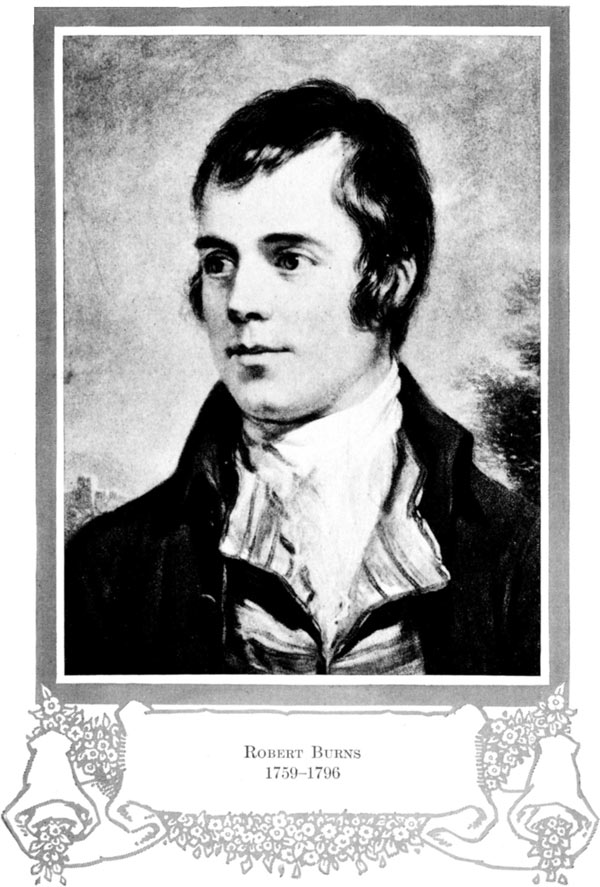
By Robert Burns
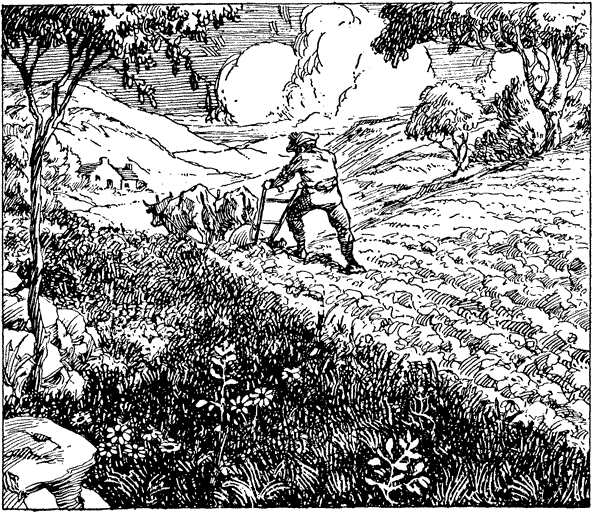
Wee, sleekit,5-1 cow’rin’, tim’rous beastie,
O, what a panic’s in thy breastie!
Thou need na start awa sae hasty,
Wi’ bickering brattle!5-2
I wad be laith to rin an’ chase thee,
Wi’ murdering pattle!5-3
I’m truly sorry man’s dominion
Has broken Nature’s social union,
An’ justifies that ill opinion
Which makes thee startle
At me, thy poor earth-born companion,
An’ fellow-mortal!
I doubt na, whyles, but thou may thieve;
What then? poor beastie, thou maun live!
[6]A daimen-icker6-4 in a thrave6-5
’S a sma’ request:
I’ll get a blessin’ wi’ the lave6-6
And never miss’t!
Thy wee bit housie, too, in ruin!
Its silly wa’s the win’s are strewin’!
An’ naething, now, to big a new ane,
O’ foggage7-7 green!
An’ bleak December’s winds ensuin’,
Baith snell7-8 and keen!
Thou saw the fields laid bare an’ waste,
And weary winter comin’ fast,
And cozie, here, beneath the blast,
Thou thought to dwell,
Till crash! the cruel coulter7-9 past
Out thro’ thy cell.
That wee bit heap o’ leaves an’ stibble,
Has cost thee mony a weary nibble!
Now thou’s turn’d out, for a’ thy trouble,
But house or hald,7-10
To thole7-11 the winter’s sleety dribble,
An’ cranreuch7-12 cauld!
But, Mousie, thou art no thy lane,7-13
In proving foresight may be vain;
The best-laid schemes o’ mice an’ men,
Gang aft a-gley,7-14
An’ lea’e us nought but grief and pain,
For promis’d joy.
[8]Still them are blest, compar’d wi’ me!
The present only toucheth thee:
But, Och! I backward cast my e’e
On prospects drear;
An’ forward, tho’ I canna see,8-15
I guess an’ fear.
5-1 Sleekit means sly.
5-2 Brattle means a short race.
5-3 A pattle is a scraper for cleaning a plow.
6-4 Daimen-icker means an ear of corn occasionally.
6-5 A thrave is twenty-four sheaves.
6-6 Lave is the Scotch word for remainder.
7-7 Foggage is coarse uncut grass.
7-8 Snell means sharp.
7-9 The coulter is the sharp iron which cuts the sod before the plow.
7-10 Hald means a resting place. But here means without.
7-11 Thole is the Scotch word for endure.
7-12 Cranreuch is hoar-frost.
7-13 No thy lane means not alone.
7-14 Gang aft a-gley means often go wrong.
8-15 In this poem and the one To a Mountain Daisy, does the allusion to the poet’s own hard fate add to or detract from the beauty of the composition? Do these allusions give any insight into his character? What was always uppermost in his mind?
On Turning One Down with the Plough in April, 1786
By Robert Burns
Wee, modest, crimson-tippéd flower,
Thou’s met me in an evil hour,
For I maun8-1 crush amang the stoure8-2
Thy slender stem;
To spare thee now is past my power,
Thou bonny gem.
Alas! it’s no thy neibor sweet,
The bonny lark, companion meet,
Bending thee’ mang the dewy weet,
Wi’ spreckled8-3 breast,
When upward springing, blithe, to greet
The purpling east.
[9]Cauld blew the bitter biting north
Upon thy early, humble birth;
Yet cheerfully thou glinted forth
Amid the storm,
Scarce reared above the parent earth
Thy tender form.
The flaunting flowers our gardens yield,
High sheltering woods and wa’s maun shield.
But thou beneath the random bield9-4
O’ clod or stane,
Adorns the histie9-5 stibble-field,
Unseen, alane.
[10]There, in thy scanty mantle clad,
Thy snawie bosom sunward spread,
Thou lifts thy unassuming head
In humble guise;
But now the share uptears thy bed,
And low thou lies!
Such is the fate of artless maid,
Sweet floweret of the rural shade!
By love’s simplicity betrayed,
And guileless trust,
Till she, like thee, all soiled, is laid
Low i’ the dust.
Such is the fate of simple bard,
On life’s rough ocean luckless starred!
Unskilful he to note the card
Of prudent lore,
Till billows rage, and gales blow hard
And whelm him o’er!
Such fate to suffering worth is given,
Who long with wants and woes has striven,
By human pride or cunning driven
To misery’s brink,
Till wrenched of every stay but Heaven,
He, ruined, sink!
Even thou who mourn’st the daisy’s fate,
That fate is thine,—no distant date:
Stern Ruin’s ploughshare drives, elate,
Full on thy bloom,
Till crushed beneath the furrow’s weight,
Shall be thy doom!
8-1 Maun is the Scotch word for must.
8-2 Stoure is the Scotch name for dust.
8-3 Spreckled is the Scotch and provincial English form of speckled.
9-4 Bield means shelter.
9-5 Histie means dry or barren.
By Samuel Woodworth
How dear to my heart are the scenes of my childhood,
When fond11-2 recollection presents them to view;
The orchard, the meadow, the deep, tangled wild-wood,
And every loved spot that my infancy11-3 knew.
The wide-spreading pond, and the mill11-4 that stood by it;
The bridge and the rock where the cataract fell;
The cot of my father, the dairy house11-5 nigh it,
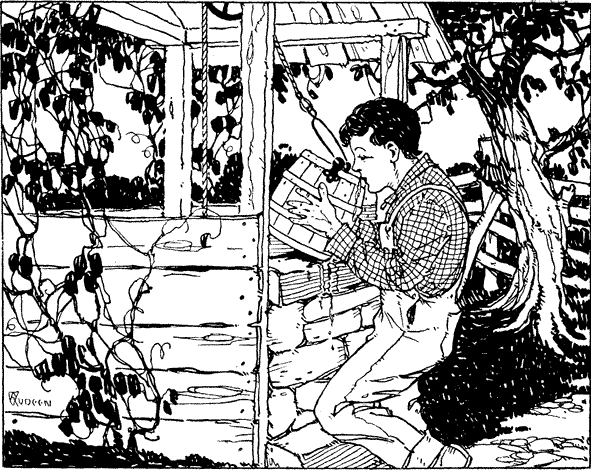
And e’en the rude bucket which hung in the well—
The old oaken bucket, the iron-bound bucket,
The moss-covered bucket which hung in the well.
That moss-covered bucket I hail as a treasure;
For often at noon, when returned from the field,
I found it the source of an exquisite pleasure,
The purest and sweetest that nature can yield.
[12]How ardent I seized it, with hands that were glowing,
And quick to the white-pebbled bottom it fell12-6;
Then soon with the emblem of truth12-7 overflowing,
And dripping with coolness it rose from the well—
The old oaken bucket, the iron-bound bucket,
The moss-covered bucket arose from the well.
How sweet from the green mossy brim to receive it,
As poised on the curb,12-8 it inclined to my lips!
[13]Not a full blushing goblet13-9 could tempt me to leave it,
Though filled with the nectar13-10 that Jupiter sips.
And now, far removed from the loved situation,13-11
The tear of regret will oftentimes swell,
As fancy returns to my father’s plantation,
And sighs for the bucket which hangs in the well—
The old oaken bucket, the iron-bound bucket,
The moss-covered bucket which hangs in the well.
If we compare The Old Oaken Bucket with The Daffodils (page 1), we will see that the lines of the former are longer, and when we read aloud a few lines from the one and compare the other, we see that the movement is very different. In The Old Oaken Bucket the accents are farther apart, and the result is to make the movement long and smooth, like that of a swing with long ropes.
Let us examine more closely the lines of The Old Oaken Bucket in a manner similar to that suggested on page 2, for The Daffodils. If we place the accent on the proper syllables in the first four lines, they will read as follows:
How dear´| to my heart´| are the scenes´| of my child´|hood,
When fond´| rec-ol-lec´|tion pre-sents´| them to view’;
The or´|chard, the mead´|ow, the deep´| tan-gled wild´|-wood,
And ev´|’ry loved spot´| that my in´|fan-cy knew.´
The vertical lines above are drawn at the ends of the feet. How many feet are there in the first line; how many in the second; how many in the third; how many in the fourth? How many syllables in the first foot in the first line? How many other feet do you find containing the same number of syllables? How many syllables are there in the second foot in the first line? How many other feet are there containing the same number of syllables? Examine the feet that contain three syllables. On which syllable is the accent placed when there are three syllables in the foot? A poetic foot of three syllables which bears the accent on the third syllable is called an anapestic foot. The meter of this poem, then is anapestic tetrameter, varied by an added syllable in most of the odd-numbered lines and by an iambic foot at the beginning of each line.
Can you find any other poem in this volume in which the meter is the same? Can you find such poems in other volumes?
11-1 Samuel Woodworth, the author of this familiar song, was an American, the editor of many publications and the writer of a great many poems; but no one of the latter is now remembered, except The Old Oaken Bucket.
11-2 This means that the author remembers fondly the scenes of his childhood, or remembers the things of which he was fond in his childhood.
11-3 As the term is used in the law-books, a person is an infant until he is twenty-one years of age; though, probably the word infancy here means the same as childhood.
11-4 Let us picture a large mill-pond with a race running out of one side of it past the old-fashioned mill, which has a big wooden water wheel on the outside of it.
11-5 The dairy house was probably a low, broad building through which the water from the stream ran. The milkpans were set on low shelves or in a trough so that the water could run around them and keep the milk cool.
12-6 If he could see the white-pebbled bottom of the well, it must have been a shallow one, or perhaps merely a square box built around a deep spring.
12-7 Water is usually spoken of as an emblem of purity, not of truth; but sometimes truth is spoken of as hiding at the bottom of a well.
12-8 The curb is the square box usually built around the mouth of the well to a height of a few feet, to protect the water from dirt. Sometimes three of the sides are carried up to a height of six or eight feet, and a roof is built over the whole, making a little house of the curb. The fourth side is left open, except for two or three feet at the bottom. In these old wells two buckets were often used. They were attached to a rope which ran over a wheel suspended from the roof of the well house. When a bucket was drawn up it was often rested on the low curb in front, while people drank from it.
13-9 Blushing goblet alludes to wine or some other liquor that has a reddish color.
13-10 Nectar was the drink of the old Greek gods, of whom Jupiter was the chief.
13-11 Situation and plantation do not rhyme well, and situation is scarcely the right word to use. Location would be better, so far as the meaning is concerned.
Robert Bruce’s Address to His Army
By Robert Burns
Scots, wha hae wi’ Wallace bled;
Scots, wham Bruce has aften led;
Welcome to your gory bed,
Or to glorious victorie!
Now’s the day and now’s the hour—
See the front o’ battle lour;
See approach proud Edward’s power—
Edward! chains and slaverie!
Wha will be a traitor knave?
Wha can fill a coward’s grave?
Wha sae base as be a slave?
Traitor! coward! turn and flee!
Wha for Scotland’s king and law
Freedom’s sword will strongly draw!
Freeman stand or freeman fa’,
Caledonian! on wi’ me!
By oppression’s woes and pains!
By our sons in servile chains!
We will drain our dearest veins,
But they shall be—shall be free!
[16]Lay the proud usurpers low!
Tyrants fall in every foe!
Liberty’s in every blow!
Forward! let us do or die!
On pages 2, and 13, of this volume we talked about the different meters in which poetry is written. In iambic poetry each foot contains two syllables, the second of which is accented. There is another kind of foot composed of two syllables. In this the accent falls on the first syllable. Bannockburn gives examples of this. To illustrate, we will rewrite the first stanza, using the words in their English form, and mark off the feet and the accent:
Scots´, who | have´ with | Wal´-lace | bled´,
Scots´, whom | Bruce´ has | of´-ten | led´;
Wel´-come | to´ your | go´-ry | bed´,
Or´ to | glo´rious | vic´-to | ry´.
Each one of these lines ends with an accented syllable, but that may be disregarded in studying the feet. This foot is called the trochee, and it will help you to remember it if you will think that the word tro´chee has two syllables and is accented on the first. This poem, then, is in trochaic trimeter, with added accented syllables at the ends of the lines. Read the other stanzas carefully, throwing the accent prominently on the first syllable of each foot.
When you read to bring out the meter of a poem you are said to be scanning it. When you are in the habit of scanning poetry you will find that you can do it very nicely and without spoiling the sound. At first you will probably accent the syllables too strongly, and then people will say that you are reading in a sing-song way, a thing to be avoided. Of course you will understand that the only way to bring out the meter of a poem is to read it aloud, but after you have become familiar with the various meters and have read aloud a great deal, you will be conscious of the rhythm when you read to yourself. It is this consciousness of rhythm that gives much of the enjoyment to those who love poetry, even when they do not read it aloud.
From Lady of the Lake
By Sir Walter Scott
Hail to the Chief who in triumph advances!
Honored and blest be the evergreen pine!
Long may the tree, in his banner that glances,
Flourish, the shelter and grace of our line!
Heaven send it happy dew,
Earth lend it sap anew,
Gayly to bourgeon, and broadly to grow,
While every Highland glen
Sends our shout back again,
“Roderigh Vich Alpine dhu, ho! ieroe!”
Ours is no sapling, chance sown by the fountain,
Blooming at Beltane, in winter to fade;
When the whirlwind has stripped every leaf on the mountain
The more shall Clan Alpine exult in her shade.
Moored in the rifted rock,
Proof to the tempest’s shock,
Firmer he roots him the ruder it blow:
Menteith and Breadalbane, then
Echo his praise again,
“Roderigh Vich Alpine dhu, ho! ieroe!”
[18]Proudly our pibroch has thrilled in Glen Fruin,
And Bannochar’s groans to our slogan replied;
Glen Luss and Ross-dhu, they are smoking in ruin,
And the best of Loch-Lomond lie dead on her side.
Widow and Saxon maid
Long shall lament our raid,
Think of Clan Alpine with fear and with woe;
Lennox and Leven-glen
Shake when they hear again,
“Roderigh Vich Alpine dhu, ho! ieroe!”
Row, vassals, row for the pride of the Highlands!
Stretch to your oars for the evergreen pine!
O that the rosebud that graces yon islands
Were wreathed in a garland around him to twine!
O that some seedling gem,
Worthy such noble stem,
Honored and blessed in their shadow might grow!
Loud should Clan Alpine then
Ring from her deepmost glen,
“Roderigh Vich Alpine dhu, ho! ieroe!”
The last of the common feet which we shall have to consider in reading English poetry is called dactyl. This foot consists of three syllables, the first of which is accented. Scott’s Boat Song is a very fine example of dactylic tetrameter, in which the last foot consists either of a trochee (see page 16) or of a single accented syllable. In every stanza there are four short lines of dactylic dimeter. Study the four lines which we have divided for you below:
Hail´ to the | chief´ who in | tri´umph ad|van´ces!
Hon´ored and | blest´ be the | ev´er green | pine!´
Long´ may the | tree´, in his | ban´ner that | glan´ces,
Flou´rish, the | shel´ter and | grace´ of our | line.´
This is one of the finest meters in which poetry may be written, and one which you will learn to recognize and like whenever you see it.
[19]To assist you in remembering what we have said on this subject in the four poems we have studied, we will give this brief outline:
Poetic feet
There are two other feet which are found occasionally in English poetry, namely the spondee, which has two accented syllables, and the amphilbrach, which consists of three syllables with the accent on the middle one.
Of course it is not necessary for you to know the names of these different feet in order to enjoy poetry, but it is interesting information. What you must do is to notice whenever you read poetry the kind of feet that compose the lines and how many there are in the line. After a while this becomes second nature to you, and while you may not really pause to think about it at any time, yet you are always conscious of the rhythm and remember that it is produced by a fixed arrangement of the accented syllables. If you would look over the poems in these volumes, beginning even with the nursery rhymes, it would not take you long to become familiar with all the different forms.
While study of this kind may seem tiresome at first, you will soon find that you are making progress and will really enjoy it, and you will never be sorry that you took the time when you were young to learn to understand the structure of poetry.
By Washington Irving
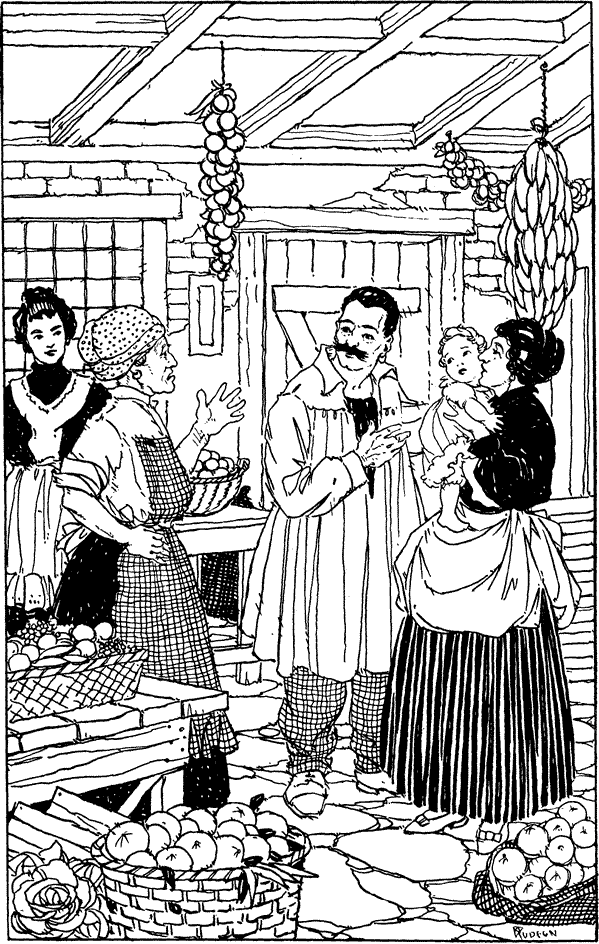
In former times there ruled, as governor of the Alhambra20-1, a doughty old cavalier, who, from having lost one arm in the wars, was commonly known by the name of El Gobernador Manco, or the one-armed governor. He in fact prided himself upon being an old soldier, wore his mustachios curled up to his eyes, a pair of campaigning boots, and a toledo20-2 as long as a spit, with his pocket handkerchief in the basket-hilt.
He was, moreover, exceedingly proud and punctilious, and tenacious of all his privileges and dignities. Under his sway, the immunities of the Alhambra, as a royal residence and domain, were rigidly exacted. No one was permitted to enter the fortress with firearms, or even with a sword or staff, unless he were of a certain rank, and every horseman was obliged to dismount at the gate and lead his horse by the bridle. Now, as the hill of the Alhambra rises from the very midst of the city of Granada, being, as it were, an excrescence of the[21] capital, it must at all times be somewhat irksome to the captain-general, who commands the province, to have thus an imperium in imperio,21-3 a petty, independent post in the very core of his domains. It was rendered the more galling in the present instance, from the irritable jealousy of the old governor, that took fire on the least question of authority and jurisdiction, and from the loose, vagrant character of the people that had gradually nestled themselves within the fortress as in a sanctuary, and from thence carried on a system of roguery and depredation at the expense of the honest inhabitants of the city. Thus there was a perpetual feud and heart-burning between the captain-general and the governor; the more virulent on the part of the latter, inasmuch as the smallest of two neighboring potentates is always the most captious about his dignity. The stately palace of the captain-general stood in the Plaza Nueva, immediately at the foot of the hill of the Alhambra, and here was always a bustle and parade of guards, and domestics, and city functionaries. A beetling bastion of the fortress overlooked the palace and the public square in front of it; and on this bastion the old governor would occasionally strut backward and forward, with his toledo girded by his side, keeping a wary eye down upon his rival, like a hawk reconnoitering his quarry from his nest in a dry tree.
Whenever he descended into the city it was in grand parade, on horseback, surrounded by his guards, or in his state coach, an ancient and unwieldy Spanish edifice of carved timber and gilt leather,[22] drawn by eight mules, with running footmen, outriders, and lackeys, on which occasions he flattered himself he impressed every beholder with awe and admiration as vicegerent of the king, though the wits of Granada were apt to sneer at his petty parade, and, in allusion to the vagrant character of his subjects, to greet him with the appellation of “the king of the beggars.”
One of the most fruitful sources of dispute between these two doughty rivals was the right claimed by the governor to have all things passed free of duty through the city, that were intended for the use of himself or his garrison. By degrees, this privilege had given rise to extensive smuggling. A nest of contrabandistas22-4 took up their abode in the hovels of the fortress and the numerous caves in its vicinity, and drove a thriving business under the connivance of the soldiers of the garrison.
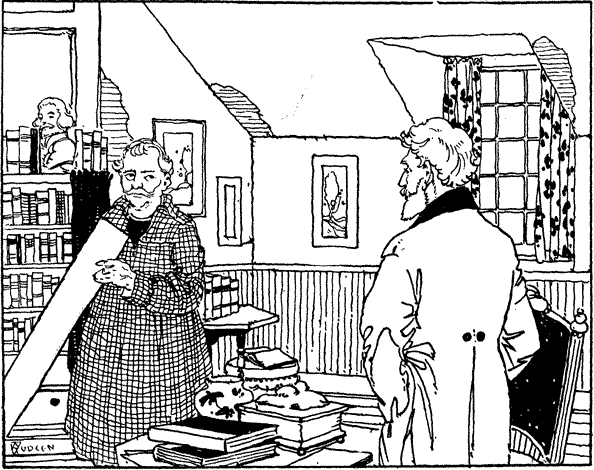
The vigilance of the captain-general was aroused. He consulted his legal adviser and factotum, a shrewd, meddlesome Escribano or notary, who rejoiced in an opportunity of perplexing the old potentate of the Alhambra, and involving him in a maze of legal subtilities. He advised the captain-general to insist upon the right of examining every convoy passing through the gates of his city, and he penned a long letter for him, in vindication of the right. Governor Manco was a straightforward, cut-and-thrust old soldier, who hated an Escribano worse than the devil, and this one in particular, worse than all other Escribanoes.
“What!” said he, curling up his mustachios fiercely, “does the captain-general set this man of the[23] pen to practice confusions upon me? I’ll let him see that an old soldier is not to be baffled by schoolcraft.”
He seized his pen, and scrawled a short letter in a crabbed hand, in which he insisted on the right of transit free of search, and denounced vengeance on any custom-house officer who should lay his unhallowed hand on any convoy protected by the flag of the Alhambra.
While this question was agitated between the two pragmatical potentates, it so happened that a mule laden with supplies for the fortress arrived one day at the gate of Xenil, by which it was to traverse a suburb of the city on its way to the Alhambra. The convoy was headed by a testy old corporal, who had long served under the governor, and was a man after his own heart—as trusty and stanch as an old Toledo blade. As they approached the gate of the city, the corporal placed the banner of the Alhambra on the pack saddle of the mule, and drawing himself up to a perfect perpendicular, advanced with his head dressed to the front, but with the wary side glance of a cur passing through hostile grounds, and ready for a snap and a snarl.
“Who goes there?” said the sentinel at the gate.
“Soldier of the Alhambra,” said the corporal, without turning his head.
“What have you in charge?”
“Provisions for the garrison.”
“Proceed.”
The corporal marched straight forward, followed by the convoy, but had not advanced many paces before a posse of custom-house officers rushed out of a small toll-house.
[24]“Halloo there!” cried the leader. “Muleteer, halt and open those packages.”
The corporal wheeled round, and drew himself up in battle array. “Respect the flag of the Alhambra,” said he; “these things are for the governor.”
“A fig for the governor, and a fig for his flag. Muleteer, halt, I say.”
“Stop the convoy at your peril!” cried the corporal, cocking his musket. “Muleteer, proceed.”
The muleteer gave his beast a hearty thwack, the custom-house officer sprang forward and seized the halter; whereupon the corporal leveled his piece and shot him dead.
The street was immediately in an uproar. The old corporal was seized, and after undergoing sundry kicks and cuffs, and cudgelings, which are generally given impromptu by the mob in Spain, as a foretaste of the after penalties of the law, he was loaded with irons, and conducted to the city prison; while his comrades were permitted to proceed with the convoy, after it had been well rummaged, to the Alhambra.
The old governor was in a towering passion, when he heard of this insult to his flag and capture of his corporal. For a time he stormed about the Moorish halls, and vapored about the bastions, and looked down fire and sword upon the palace of the captain-general. Having vented the first ebullition of his wrath, he dispatched a message demanding the surrender of the corporal, as to him alone belonged the right of sitting in judgment on the offenses of those under his command. The captain-general, aided by the pen of the delighted Escribano, replied at great length, arguing that as the offense had been com[25]mitted within the walls of his city, and against one of his civil officers, it was clearly within his proper jurisdiction. The governor rejoined by a repetition of his demand; the captain-general gave a surrejoinder of still greater length, and legal acumen; the governor became hotter and more peremptory in his demands, and the captain-general cooler and more copious in his replies; until the old lion-hearted soldier absolutely roared with fury at being thus entangled in the meshes of legal controversy.
While the subtle Escribano was thus amusing himself at the expense of the governor, he was conducting the trial of the corporal; who, mewed up in a narrow dungeon of the prison, had merely a small grated window at which to show his iron-bound visage, and receive the consolations of his friends; a mountain of written testimony was diligently heaped up, according to Spanish form, by the indefatigable Escribano; the corporal was completely overwhelmed by it. He was convicted of murder, and sentenced to be hanged.
It was in vain the governor sent down remonstrance and menace from the Alhambra. The fatal day was at hand, and the corporal was put in capilla, that is to say, in the chapel of the prison; as is always done with culprits the day before execution, that they may meditate on their approaching end and repent them of their sins.
Seeing things drawing to an extremity, the old governor determined to attend to the affair in person. He ordered out his carriage of state and, surrounded by his guards, rumbled down the avenue of the Alhambra into the city. Driving to the house of the Escribano, he summoned him to the portal.
[26]The eye of the old governor gleamed like a coal at beholding the smirking man of the law advancing with an air of exultation.
“What is this I hear,” cried he, “that you are about to put to death one of my soldiers?”
“All according to law—all in strict form of justice,” said the self-sufficient Escribano, chuckling[27] and rubbing his hands. “I can show your excellency the written testimony in the case.”
“Fetch it hither,” said the governor.
The Escribano bustled into his office, delighted with having another opportunity of displaying his ingenuity at the expense of the hard-headed veteran. He returned with a satchel full of papers, and began to read a long deposition with professional volubility. By this time a crowd had collected, listening with outstretched necks and gaping mouths.
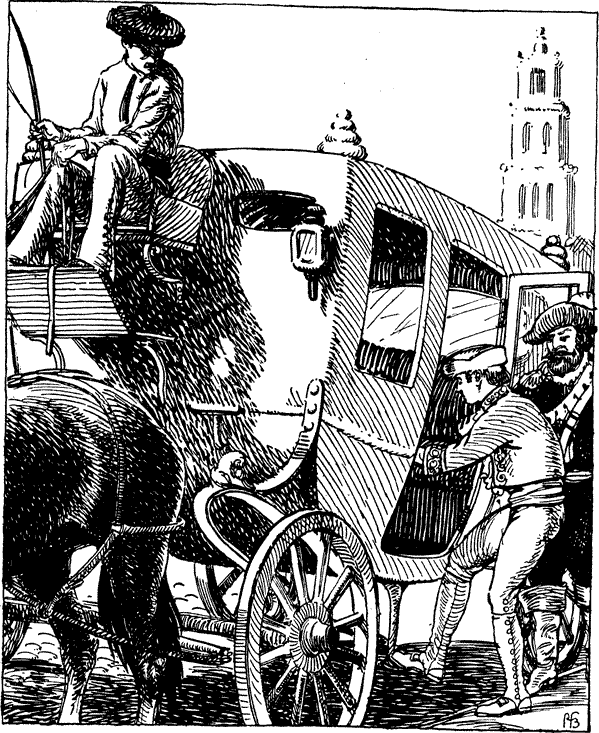
“Prithee man, get into the carriage out of this pestilent throng, that I may the better hear thee,” said the governor. The Escribano entered the carriage, when in a twinkling the door was closed, the coachman smacked his whip, mules, carriage, guards, and all dashed off at a thundering rate, leaving the crowd in gaping wonderment, nor did the governor pause until he had lodged his prey in one of the strongest dungeons of the Alhambra.
He then sent down a flag of truce in military style, proposing a cartel or exchange of prisoners, the corporal for the notary. The pride of the captain-general was piqued, he returned a contemptuous refusal, and forthwith caused a gallows, tall and strong, to be erected in the center of the Plaza Nueva, for the execution of the corporal.
“Oho! is that the game?” said Governor Manco; he gave orders, and immediately a gibbet was reared on the verge of the great beetling bastion that overlooked the Plaza. “Now,” said he, in a message to the captain-general, “hang my soldier when you please; but at the same time that he is swung off in the square, look up to see your Escribano dangling against the sky.”
[28]The captain-general was inflexible; troops were paraded in the square; the drums beat; the bell tolled; an immense multitude of amateurs had collected to behold the execution; on the other hand, the governor paraded his garrison on the bastion, and tolled the funeral dirge of the notary from the Torre de la Campana, or tower of the bell.
The notary’s wife pressed through the crowd with a whole progeny of little embryo Escribanoes at her heels, and throwing herself at the feet of the captain-general implored him not to sacrifice the life of her husband and the welfare of herself and her numerous little ones to a point of pride.
The captain-general was overpowered by her tears and lamentations, and the clamors of her callow brood. The corporal was sent up to the Alhambra under a guard, in his gallows garb, like a hooded friar; but with head erect and a face of iron. The Escribano was demanded in exchange, according to the cartel. The once bustling and self-sufficient man of the law was drawn forth from his dungeon, more dead than alive. All his flippancy and conceit had evaporated; his hair, it is said, had nearly turned gray with fright, and he had a downcast, dogged look, as if he still felt the halter round his neck.
The old governor stuck his one arm akimbo, and for a moment surveyed him with an iron smile. “Henceforth, my friend,” said he, “moderate your zeal in hurrying others to the gallows; be not too certain of your own safety, even though you should have the law on your side; and, above all, take care how you play off your schoolcraft another time upon an old soldier.”
20-1 The Alhambra was the fortified palace, or citadel, of the Moorish kings when they reigned over Granada, in Spain. It was built in the thirteenth and fourteenth centuries, and is one of the most beautiful examples of Moorish architecture.
20-2 A toledo is a sword having a blade made at Toledo, in Spain, a place famous for blades of remarkably fine temper and great elasticity.
21-3 Imperium in imperio is a Latin phrase meaning a government within a government.
22-4 Contrabandista is a Spanish name for a smuggler.
By Samuel T. Coleridge
It is an ancient Mariner,
And he stoppeth one of three.
“By thy long gray beard and glittering eye,
Now wherefore stopp’st thou me?
“The Bridegroom’s doors are opened wide,
And I am next of kin;
The guests are met, the feast is set:
May’st hear the merry din.”
[30]He holds him with a skinny hand.
“There was a ship,” quoth he.
“Hold off! unhand me, gray-beard loon!”
Eftsoons30-1 his hand dropt he.
He holds him with his glittering eye—
The Wedding-guest stood still,
And listens like a three years’ child:
The Mariner hath his will.
The Wedding-guest sat on a stone:
He cannot choose but hear;
And thus spake on that ancient man,
The bright-eyed Mariner:30-2—
“The ship was cheered, the harbour cleared,
Merrily did we drop
Below the kirk, below the hill,
Below the lighthouse top.
“The sun came up upon the left,30-3
Out of the sea came he!
And he shone bright, and on the right
Went down into the sea.
“Higher and higher every day,
Till over the mast at noon—”30-4
[31]The Wedding-guest here beat his breast,
For he heard the loud bassoon.
The bride hath paced into the hall,
Red as a rose is she;
Nodding their heads before her goes
The merry minstrelsy.
The Wedding-guest he beat his breast,
Yet he cannot choose but hear;
And thus spake on that ancient man,
The bright-eyed Mariner:—
“And now the storm-blast came, and he
Was tyrannous and strong;
He struck with his o’ertaking wings,
And chased us south along.
“With sloping masts and dipping prow,
As who31-5 pursued with yell and blow
Still treads the shadow of his foe31-6,
And forward bends his head,
The ship drove fast, loud roared the blast,
And southward aye we fled.
“And now there came both mist and snow,
And it grew wondrous cold:
[32]And ice, mast-high, came floating by,
As green as emerald.32-7
“And through the drifts, the snowy clifts32-8
Did send a dismal sheen:
Nor shapes of men nor beasts we ken—
The ice was all between.
“The ice was here, the ice was there,
The ice was all around:
It cracked and growled, and roared and howled,
Like noises in a swound!32-9
“At length did cross an Albatross,
Thorough32-10 the fog it came;
As if it had been a Christian soul,
We hailed it in God’s name.32-11
“It ate the food it ne’er had eat,
And round and round it flew.
The ice did split with a thunder-fit;
The helmsman steered us through.
“And a good south wind sprung up behind;34-12
The Albatross did follow,
And every day, for food or play,
Came to the mariner’s hollo!
“In mist or cloud, on mast or shroud,
It perched for vespers nine;
Whiles all the night, through fog-smoke white,
Glimmered the white moonshine.”
“God save thee, ancient Mariner,
From the fiends that plague thee thus!—
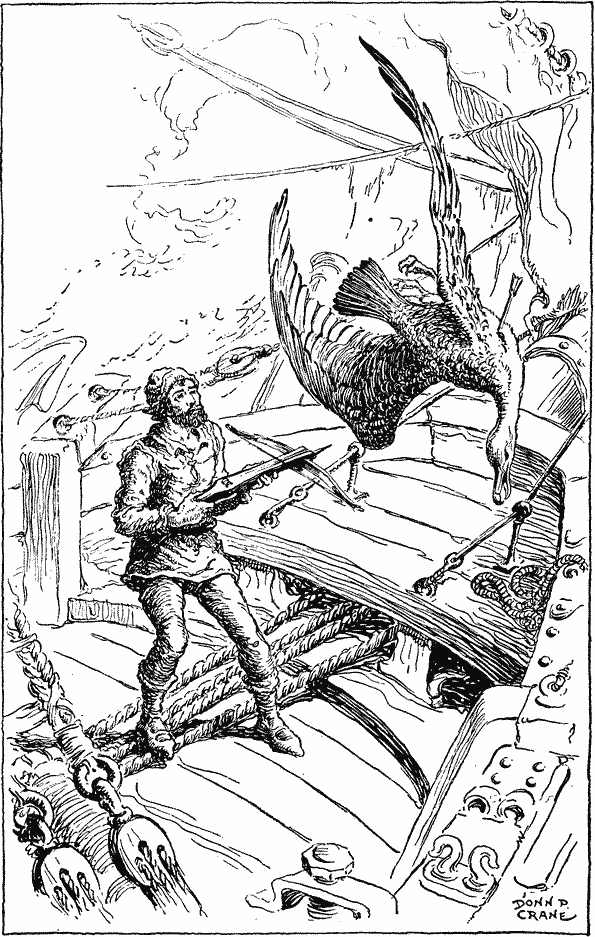
Why look’st thou so?”—“With my cross-bow
I shot the Albatross.”
“The Sun now rose upon the right:34-13
Out of the sea came he,
Still hid in mist, and on the left
Went down into the sea.
“And the good south wind still blew behind,
But no sweet bird did follow,
Nor any day for food or play
Came to the mariner’s hollo!
“And I had done a hellish thing,
And it would work ’em woe:
For all averred I had killed the bird
That made the breeze to blow,—
Ah wretch! said they, the bird to slay,
That made the breeze to blow.
[35]“Nor dim, nor red, like God’s own head,
The glorious Sun uprist:35-14
Then all averred I had killed the bird
That brought the fog and mist.
’Twas right, said they, such birds to slay,
That bring the fog and mist.35-15
“The fair breeze blew, the white foam flew,
The furrow followed free;35-16
We were the first that ever burst
Into that silent sea.
“Down dropt the breeze, the sails dropt down,
’Twas sad as sad could be;
And we did speak only to break
The silence of the sea!
“All in a hot and copper sky,
The bloody Sun, at noon,
Right up above the mast did stand,35-17
No bigger than the Moon.35-18
“Day after day, day after day,
We stuck, nor breath nor motion;
[36]As idle as a painted ship
Upon a painted ocean.
“Water, water, everywhere,
And all the boards did shrink;
Water, water, everywhere,
Nor any drop to drink.
“The very deep did rot: O Christ!
That ever this should be!
Yea, slimy things did crawl with legs
Upon the slimy sea.
“About, about, in reel and rout36-19
The death-fires36-20 danced at night;
The water, like a witch’s oils,
Burnt green, and blue, and white.
“And some in dreams assurèd were
Of the Spirit that plagued us so;
Nine fathom deep he had followed us
From the land of mist and snow.
“And every tongue, through utter drought,
Was withered at the root;
We could not speak, no more than if
We had been choked with soot.
“Ah! well a day! what evil looks
Had I from old and young!
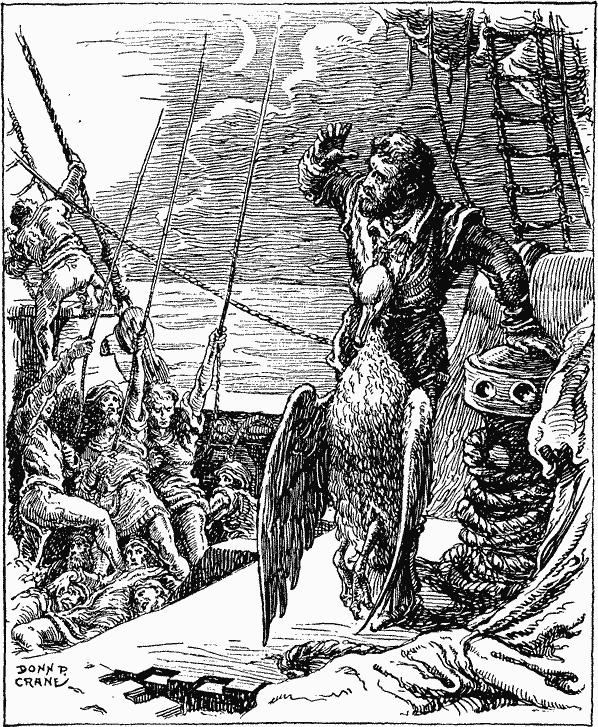
Instead of the cross, the Albatross
About my neck was hung.36-21
“There passed a weary time. Each throat
Was parched, and glazed each eye.
A weary time! a weary time!
How glazed each weary eye!
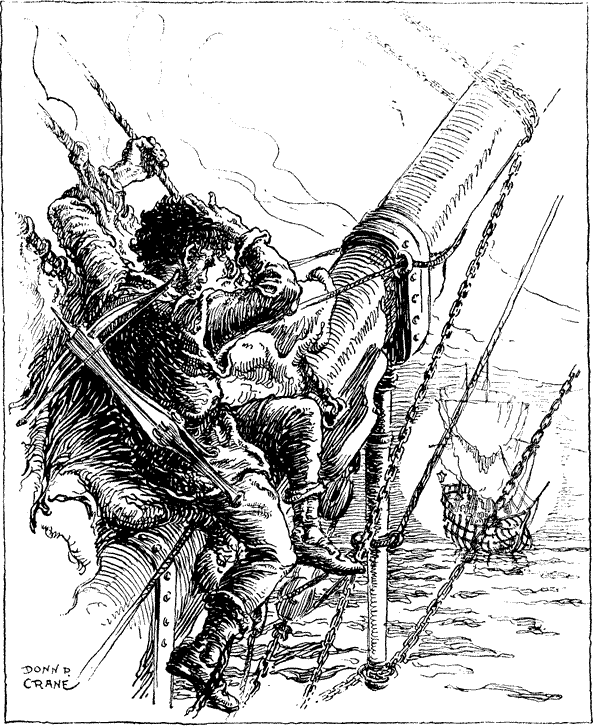
When looking westward, I beheld
A something in the sky.
“At first it seemed a little speck,
And then it seemed a mist:
It moved and moved, and took at last
A certain shape, I wist.37-22
“A speck, a mist, a shape, I wist!
And still it neared and neared:
As if it dodged a water-sprite,
It plunged, and tacked, and veered.
“With throats unslaked, with black lips baked
We could not laugh nor wail;
Through utter drought all dumb we stood!
I bit my arm, I sucked the blood,
And cried, A sail! a sail!
“With throats unslaked, with black lips baked,
Agape they heard me call:
Gramercy!37-23 they for joy did grin,37-24
And all at once their breath drew in,
As they were drinking all.
“See! see! (I cried) she tacks no more!
Hither to work us weal;
Without a breeze, without a tide,
She steadies with upright keel!
“The western wave was all a-flame,
The day was well-nigh done!
[39]Almost upon the western wave
Rested the broad, bright Sun;
When that strange shape drove suddenly
Betwixt us and the Sun.
“And straight the Sun was flecked with bars,
(Heaven’s Mother send us grace!)
As if through a dungeon grate he peered
With broad and burning face.
“Alas! (thought I, and my heart beat loud)
How fast she nears and nears!
Are those her sails that glance in the Sun,
Like restless gossameres?39-25
“Are those her ribs through which the Sun
Did peer, as through a grate?
And is that Woman all her crew?
Is that a Death? and are there two?
Is Death that Woman’s mate?
“Her lips were red, her looks were free,
Her locks were yellow as gold:
Her skin was as white as leprosy,
The Night-mare Life-in-Death was she,
Who thicks man’s blood with cold.
“The naked hulk alongside came,
And the twain were casting dice;
‘The game is done! I’ve won, I’ve won!’39-26
Quoth she, and whistles thrice.
[40]“The Sun’s rim dips: the stars rush out:
At one stride comes the dark;40-27
With far-heard whisper, o’er the sea,
Off shot the spectre-bark.
“We listened and looked sideways up!
Fear at my heart, as at a cup,
My life-blood seemed to sip!
The stars were dim, and thick the night,
The steersman’s face by his lamp gleamed white;
From the sails the dew did drip—
Till clomb40-28 above the eastern bar
The hornèd Moon,40-29 with one bright star
Within the nether tip.
“One after one, by the star-dogged Moon,
Too quick for groan or sigh,
Each turned his face with a ghastly pang,
And cursed me with his eye.
“Four times fifty living men,
(And I heard nor sigh nor groan)
With heavy thump, a lifeless lump,
They dropped down one by one.
“The souls did from their bodies fly,—
They fled to bliss or woe!
And every soul, it passed me by,
Like the whiz of my cross-bow!”
“I fear thee, ancient Mariner!
I fear thy skinny hand!
And thou art long, and lank and brown.
As is the ribbed sea-sand.41-30
“I fear thee and thy glittering eye,
And thy skinny hand so brown.”
“Fear not, fear not, thou Wedding-guest!
This body dropt not down.
“Alone, alone, all, all alone,
Alone on a wide, wide sea!
And never a saint took pity on
My soul in agony.
“The many men, so beautiful!
And they all dead did lie:
And a thousand, thousand slimy things
Lived on; and so did I.
“I looked upon the rotting sea,
And drew my eyes away;
I looked upon the rotting deck,
And there the dead men lay.
“I looked to heaven, and tried to pray
But or ever a prayer had gusht,
A wicked whisper came, and made
My heart as dry as dust.
“I closed my lids, and kept them close,
And the balls like pulses beat;
[42]For the sky and the sea, and the sea and the sky,42-31
Lay like a load on my weary eye,
And the dead were at my feet.
“The cold sweat melted from their limbs,
Nor rot nor reek did they:
The look with which they looked on me
Had never passed away.
“An orphan’s curse would drag to hell
A spirit from on high;
But oh! more horrible than that
Is the curse in a dead man’s eye!
Seven days, seven nights, I saw that curse,
And yet I could not die.
“The moving Moon went up the sky,
And nowhere did abide:
Softly she was going up,
And a star or two beside—
[43]“Her beams bemock’d the sultry main,
Like April hoar-frost spread;
But where the ship’s huge shadow lay,
The charmèd water burnt alway
A still and awful red.
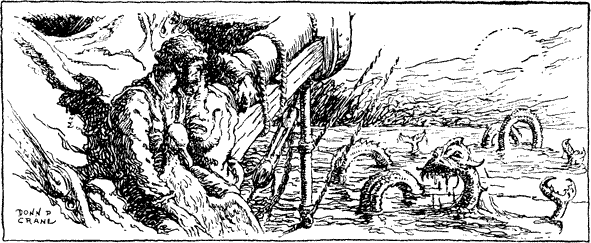
“Beyond the shadow of the ship,
I watched the water-snakes:
They moved in tracks of shining white,
And when they reared, the elfish light
Fell off in hoary flakes.
“Within the shadow of the ship
I watched their rich attire:
Blue, glossy green, and velvet black,
They coiled and swam; and every track
Was a flash of golden fire.
“O happy living things! no tongue
Their beauty might declare:
A spring of love gushed from my heart,
And I blessed them unaware:
Sure my kind saint took pity on me,
And I blessed them unaware.43-32
“The selfsame moment I could pray;
And from my neck so free
The Albatross fell off, and sank
Like lead into the sea.”
“O sleep! it is a gentle thing,
Beloved from pole to pole!
To Mary Queen the praise be given!
She sent the gentle sleep from heaven,
That slid into my soul.
“The silly44-33 buckets on the deck,
That had so long remained,
I dreamt that they were filled with dew;
And when I awoke, it rained.
“My lips were wet, my throat was cold,
My garments all were dank;
Sure I had drunken in my dreams,
And still my body drank.
“I moved, and could not feel my limbs:
I was so light—almost
I thought that I had died in sleep,
And was a blessèd ghost.
“And soon I heard a roaring wind:
It did not come anear;
But with its sound it shook the sails,
That were so thin and sere.
“The upper air burst into life!
And a hundred fire-flags sheen,44-34
To and fro they were hurried about!
And to and fro, and in and out,
The wan stars danced between.
[45]“And the coming wind did roar more loud,
And the sails did sigh like sedge:45-35
And the rain poured down from one black cloud:
The Moon was at its edge.
“The thick black cloud was cleft, and still
The Moon was at its side:
Like waters shot from some high crag,
[46]The lightning fell with never a jag,
A river steep and wide.
“The loud wind never reached the ship,
Yet now the ship moved on!
Beneath the lightning and the Moon
The dead men gave a groan.
“They groaned, they stirred, they all uprose,
Nor spake, nor moved their eyes;
It had been strange, even in a dream,
To have seen those dead men rise.
“The helmsman steered; the ship moved on;
Yet never a breeze up blew;
The mariners all ’gan work the ropes,
Where they were wont to do;
They raised their limbs like lifeless tools—
We were a ghastly crew.
“The body of my brother’s son
Stood by me, knee to knee:
The body and I pulled at one rope,
But he said naught to me.”
“I fear thee, ancient Mariner!”
“Be calm, thou Wedding-guest!
’Twas not those souls that fled in pain,
Which to their corses came again,
But a troop of spirits blest:
“For when it dawned—they dropped their arms,
And clustered round the mast;
Sweet sounds rose slowly through their mouths,
And from their bodies passed.
[47]“Around, around, flew each sweet sound,
Then darted to the Sun;
Slowly the sounds came back again,
Now mixed, now one by one.
“Sometimes a-drooping from the sky
I heard the sky-lark sing;
Sometimes all little birds that are,
How they seemed to fill the sea and air
With their sweet jargoning!
“And now ’twas like all instruments,
Now like a lonely flute;
And now it is an angel’s song,
That makes the heavens be mute.
“It ceased; yet still the sails made on
A pleasant noise till noon,
A noise like of a hidden brook
In the leafy month of June,
That to the sleeping woods all night
Singeth a quiet tune.
“Till noon we quietly sailed on,
Yet never a breeze did breathe:
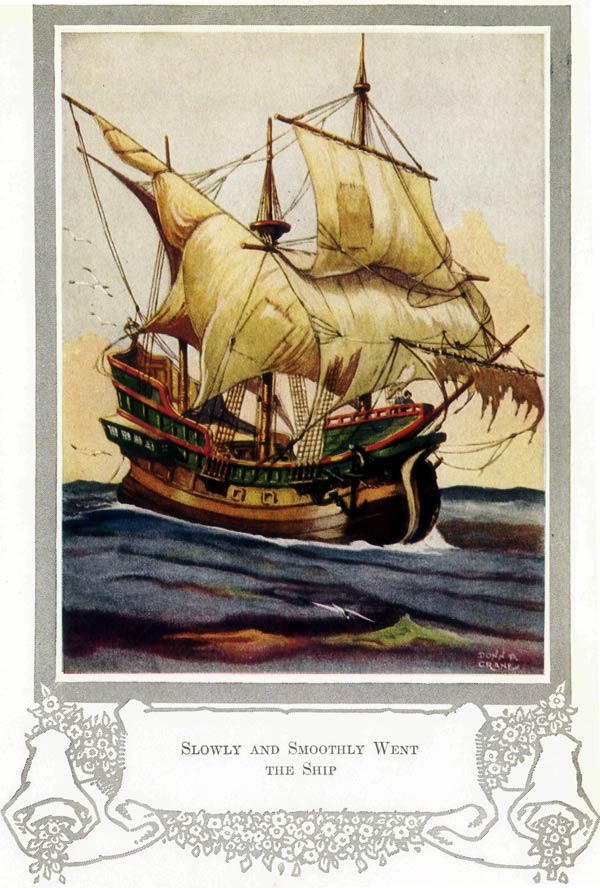
Slowly and smoothly went the ship,
Moved onward from beneath.
“Under the keel nine fathom deep,
From the land of mist and snow,
The spirit slid: and it was he
That made the ship to go.
The sails at noon left off their tune,
And the ship stood still also.
[48]“The Sun, right up above the mast,
Had fixed her to the ocean:
But in a minute she ’gan stir,
With a short, uneasy motion—
Backwards and forwards half her length
With a short, uneasy motion.
“Then like a pawing horse let go,
She made a sudden bound:
It flung the blood into my head,
And I fell down in a swound.
“How long in that same fit I lay,
I have not to declare;
But ere my living life returned,
I heard, and in my soul discerned,
Two voices in the air.
“‘Is it he?’ quoth one, ‘Is this the man?
By him who died on cross,
With his cruel bow he laid full low
The harmless Albatross.
“‘The spirit who bideth by himself
In the land of mist and snow,
He loved the bird that loved the man
Who shot him with his bow.’
“The other was a softer voice,
As soft as honey-dew:
Quoth he, ‘The man hath penance done,
And penance more will do.’”
First Voice
“‘But tell me, tell me! speak again,
Thy soft response renewing—
What makes that ship drive on so fast?
What is the ocean doing?’
Second Voice
“‘Still as a slave before his lord,
The ocean hath no blast;
His great bright eye most silently
Up to the Moon is cast—
“‘If he may know which way to go;
For she guides him smooth or grim.
See, brother, see! how graciously
She looketh down on him.’
First Voice
“‘But why drives on that ship so fast,
Without or wave or wind?’49-36
Second Voice
“‘The air is cut away before,
And closes from behind.
“‘Fly, brother, fly! more high, more high!
Or we shall be belated:
For slow and slow that ship will go,
When the mariner’s trance is abated.’
[50]“I woke, and we were sailing on
As in a gentle weather:
’Twas night, calm night, the Moon was high;
The dead men stood together.
“All stood together on the deck,
For a charnel-dungeon50-37 fitter:
All fixed on me their stony eyes,
That in the Moon did glitter.
“The pang, the curse, with which they died,
Had never passed away:
I could not draw my eyes from theirs,
Nor turn them up to pray.
“And now this spell was snapt:50-38 once more
I viewed the ocean green,
And looked far forth, yet little saw
Of what had else been seen—
“Like one, that on a lonesome road
Doth walk in fear and dread,
And having once turned round walks on,
And turns no more his head;
Because he knows a frightful fiend
Doth close behind him tread.
“But soon there breathed a wind on me,
Nor sound nor motion made:
Its path was not upon the sea,
In ripple or in shade.
[51]“It raised my hair, it fanned my cheek
Like a meadow-gale of spring—
It mingled strangely with my fears,
Yet it felt like a welcoming.
“Swiftly, swiftly flew the ship,
Yet she sailed softly too:
Sweetly, sweetly blew the breeze—
On me alone it blew.
“Oh! dream of joy! is this indeed
The lighthouse top I see?
Is this the hill? is this the kirk?
Is this mine own countree?
“We drifted o’er the harbour-bar,
And I with sobs did pray—
O let me be awake, my God!
Or let me sleep alway.
“The harbour-bay was clear as glass,
So smoothly it was strewn!
And on the bay the moonlight lay,
And the shadow of the Moon.
“The rock shone bright, the kirk no less,
That stands above the rock:
The moonlight steeped in silentness
The steady weathercock.
“And the bay was white with silent light,
Till, rising from the same,
Full many shapes, that shadows were,
In crimson colours came.
[52]“A little distance from the prow
Those crimson shadows were:
I turned my eyes upon the deck—
O Christ! what saw I there!
“Each corse lay flat, lifeless and flat,
And, by the holy rood!52-39
A man all light, a seraph-man,
On every corse there stood.
“This seraph-band, each waved his hand:
It was a heavenly sight!
They stood as signals to the land.
Each one a lovely light;
“This seraph-band, each waved his hand:
No voice did they impart—
No voice; but oh! the silence sank
Like music on my heart.52-40
“But soon I heard the dash of oars,
I heard the Pilot’s cheer;
My head was turned perforce away,
And I saw a boat appear.
“The Pilot and the Pilot’s boy,
I heard them coming fast:
Dear Lord in Heaven! it was a joy
The dead men could not blast.
“I saw a third—I heard his voice:
It is the Hermit good!
He singeth loud his godly hymns
[53]That he makes in the wood.
He’ll shrieve my soul, he’ll wash away
The Albatross’s blood.”
“This Hermit good lives in that wood
Which slopes down to the sea.
How loudly his sweet voice he rears!
He loves to talk with marineres
That come from a far countree.
“He kneels at morn, and noon, and eve—
He hath a cushion plump:
It is the moss that wholly hides
The rotted old oak-stump.
“The skiff-boat neared: I heard them talk,
‘Why, this is strange, I trow!
Where are those lights so many and fair,
That signal made but now?’
“‘Strange, by my faith!’ the Hermit said—
‘And they answered not our cheer.
The planks look warped! and see those sails,
How thin they are and sere!
I never saw aught like to them,
Unless perchance it were
“‘Brown skeletons of leaves that lag
My forest-brook along;
When the ivy-tod53-41 is heavy with snow,
And the owlet whoops to the wolf below,
That eats the she-wolf’s young.’
[54]“‘Dear Lord! it hath a fiendish look!’
(The Pilot made reply)
‘I am a-feared’—‘Push on, push on!’
Said the Hermit cheerily.
“The boat came closer to the ship,
But I nor spake nor stirred;
The boat came close beneath the ship,
And straight a sound was heard.
“Under the water it rumbled on,
Still louder and more dread:
It reached the ship, it split the bay;
The ship went down like lead.
“Stunned by that loud and dreadful sound,
Which sky and ocean smote,
Like one that hath been seven days drowned
My body lay afloat;
But swift as dreams, myself I found
Within the Pilot’s boat.
“Upon the whirl where sank the ship,
The boat spun round and round;
And all was still, save that the hill
Was telling of the sound.
“I moved my lips—the Pilot shrieked
And fell down in a fit;
The holy Hermit raised his eyes,
And prayed where he did sit.
“I took the oars: the Pilot’s boy,
Who now doth crazy go,
Laughed loud and long, and all the while
His eyes went to and fro.
[55]‘Ha! ha!’ quoth he, ‘full plain I see,
The Devil knows how to row.’
“And now, all in my own countree,
I stood on the firm land!
The Hermit stepped forth from the boat,
And scarcely he could stand.
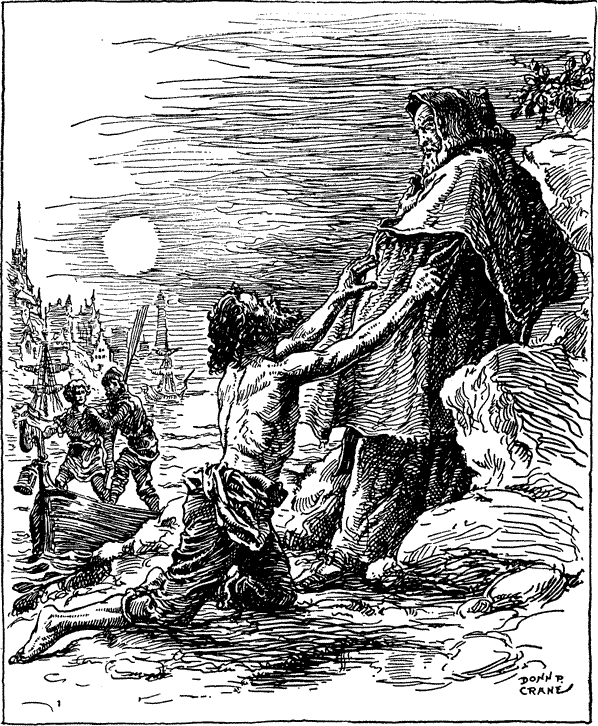
“‘O shrieve me, shrieve me, holy man!’
The Hermit crossed his brow.
[56]‘Say quick,’ quoth he, ‘I bid thee say—
What manner of man art thou?’
“Forthwith this frame of mine was wrenched
With a woeful agony,
Which forced me to begin my tale;
And then it left me free.
“Since then, at an uncertain hour,
That agony returns:
And till my ghastly tale is told,
This heart within me burns.
“I pass, like night, from land to land;
I have strange power of speech;
The moment that his face I see,
I know the man that must hear me:
To him my tale I teach.
“What loud uproar bursts from that door!
The wedding-guests are there:
But in the garden-bower the bride
And bridesmaids singing are:
And hark the little vesper bell,
Which biddeth me to prayer!
“O Wedding-guest! This soul hath been
Alone on a wide, wide sea:
So lonely ’twas, that God himself
Scarce seemed there to be.
“O sweeter than the marriage feast,
’Tis sweeter far to me,
To walk together to the kirk
With a goodly company!
[57]“To walk together to the kirk,
And all together pray,
While each to his great Father bends,
Old men, and babes, and loving friends,
And youths and maidens gay!
“Farewell, farewell! but this I tell
To thee, thou Wedding-guest!
He prayeth well, who loveth well
Both man and bird and beast.
“He prayeth best, who loveth best
All things both great and small;
For the dear God who loveth us,
He made and loveth all.”57-42
The Mariner, whose eye is bright,
Whose beard with age is hoar,
Is gone: and now the Wedding-guest
Turned from the bridegroom’s door.
He went like one that hath been stunned,
And is of sense forlorn:
A sadder and a wiser man,
He rose the morrow morn.
29-* Note.—In 1798 there was published in England a little volume of poems known as Lyrical Ballads. This collection brought to its two young authors, Wordsworth and Coleridge, little immediate fame, but not long afterward people began to realize that much that was contained in the little book was real poetry, and great poetry. The chief contribution of Coleridge to this venture was The Ancient Mariner.
The poem as originally printed had a series of quaintly explanatory notes in the margin, and an introductory argument which read as follows:
“How a ship having passed the Line, was driven by storms to the cold Country towards the South Pole; and how from thence she made her course to the tropical latitudes of the great Pacific Ocean, and of the strange things that befell; and in what manner the Ancient Mariner came back to his own country.”
30-1 Eftsoons means quickly. The poem is written in ballad form, and many quaint old words are introduced.
30-2 Such rhymes as this—Mariner with hear,—were common in the old ballads which Coleridge so perfectly imitates.
30-3 Does this line tell you anything about the direction in which they were sailing?
30-4 Where was the ship when the sun stood “over the mast at noon”?
31-5 Two words are to be understood in this line—“As one who is pursued.”
31-6 Is not this an effective line? Can you think of any way in which the closeness of the foe could be more effectively suggested?
32-7 Coleridge’s wonderful power of painting word-pictures is shown in this and the succeeding stanzas. With the simplest language he makes us realize the absolute lonesomeness and desolateness of the scene: he produces in us something of the same feeling of awe and horror that we should have were we actually in the situation he describes.
32-8 Clifts means cleft rocks.
32-9 “Like noises one hears in a swound.”
32-10 Thorough is used here instead of through, as it often is in poetry, for the sake of the meter.
32-11 Besides the joy the sailors felt at seeing a living creature after the days in which they had seen “nor shapes of men nor beasts,” they had a special pleasure in welcoming the albatross because it was regarded as a bird of good omen.
34-12 Coleridge does not state that it was the albatross that brought the “good south wind:” he lets us infer it.
34-13 In what direction were they sailing now?
35-14 Uprist is an old form for uprose.
35-15 It was this attitude of the sailors toward the mariner’s brutal act of killing the bird that brought punishment upon them; they cared nothing for the death of the harmless bird, but only for its effect upon them.
35-16 Note the striking alliteration in these two lines. Read this stanza and the succeeding one aloud, and see how much easier it is to read these alliterative lines rapidly than it is any of the other six lines. Such relation of movement to meaning is one of the artistic things about the poem.
35-17 How far northward had the ship returned?
35-18 When such a definite picture is presented, close your eyes and try to see it. Did you ever see the sun when it seemed to have no radiance—when it was just a red circle?
36-19 A rout is a confused and whirling dance.
36-20 The death-fires are a sort of phosphorescent light, or will-o’-the-wisp, supposed to portend death.
36-21 The shipmates try in this manner to fasten all the guilt on the ancient mariner and mark him alone for punishment.
37-22 Wist means knew.
37-23 Gramercy is an exclamation derived from the French grand merci, which means great thanks.
37-24 In a comment on The Ancient Mariner Coleridge says: “I took the thought of ‘grinning for joy’ from my companion’s remark to me, when we had climbed to the top of Plinlimmon, and were nearly dead with thirst. We could not speak from the constriction, till we found a little puddle under a stone. He said to me: ‘You grinned like an idiot.’ He had done the same.”
39-25 Gossameres are the cobweb-like films seen floating in the air in summer.
39-26 Death and Life-in-Death have been casting dice for the crew, as to whether they shall die, or live and suffer. Life-in-Death has won the ancient mariner.
40-27 This is Coleridge’s beautiful way of telling us that in the tropics there is little or no twilight.
40-28 Clomb is an old form of climbed.
40-29 That is, the waning moon. Did you ever see the moon “with one bright star within the nether tip”?
41-30 In his notes on the poem, Coleridge stated that the last two lines of this stanza were composed by Wordsworth.
42-31 Can you see any reason for the repetition in this line, and for the unusual length? Does it suggest the load and the weariness in the next line?
43-32 This is the turning point of the poem. As soon as the mariner felt in his heart love for the “happy living things,” the spell which had been laid on him for the wanton slaying of the albatross began to break. In the third stanza from the end of the poem, this point is clearly brought out.
44-33 Silly here means helpless, useless.
44-34 Sheen means bright, glittering.
45-35 Note this fine alliterative line.
49-36 The mariner has been thrown into a trance, for the ship is being driven northward faster than a human being could endure.
50-37 A charnel-dungeon is a vault or chamber underneath or near a church, where the bones of the dead are laid.
50-38 The sin is finally expiated.
52-39 The holy rood is the holy cross.
52-40 “The silence sank like music on my heart,” is among the beautiful lines that you will often hear quoted.
53-41 An ivy-tod is a thick clump of ivy.
57-42 A friend of Coleridge’s once told him that she admired The Ancient Mariner, but had a serious fault to find with it—it had no moral. Do you think, as you read this stanza, that her objection was a valid one?
By Edwin D. Coe
I do not pose as an Indian lover. In fact the instincts and impressions of my early life bent me in the opposite direction. My father’s log house, in which I was born, stood within a few rods of Rock River, about forty-five miles west of this city. The stream was the boundary line, in a half-recognized way, between two tribes of Indians, and a common highway for both. I well remember their frequent and unheralded entries into our house, and their ready assumption of its privileges. I can see them yet—yes, and smell them, too. In some unventilated chamber of my rather capacious nostrils an abiding breath of that intense, all-conquering odor of fish, smoke and muskrat, which they brought with them, still survives. I well remember their impudent and sometimes bullying demeanor; and the horror of one occasion I shall never forget, when a stalwart Winnebago, armed with a knife, tomahawk and gun, seized my mother by the shoulder as she stood by her ironing table, and shook her because she said she had no bread for him. I wrapped myself in her skirts and howled in terror. Having been transplanted from the city to the wilderness, she had a mortal fear of Indians, but never revealed it to them. She had nerve, and [59]resolution as well; and this particular fellow she threatened with her hot flat-iron and drove him out of the house. So you see I have no occasion for morbid or unnatural sympathy with any of the Indian kind.
Black Hawk was born in 1767 at Saukenuk. His father was the war chief of the nation and a very successful leader. Young Black Hawk inherited his martial spirit and conducted himself so valorously in battle that he was recognized as a brave when only fifteen years old. He was enthusiastic and venturesome, and before the close of his twentieth year had led several expeditions against the Osages and Sioux. It was his boast that he had been in a hundred Indian battles and had never suffered defeat.
Life passed pleasantly with Black Hawk and his tribe at Saukenuk for many years. The location combined all the advantages possible for their mode of existence. When Black Hawk was taken to Washington after his capture in 1832, he made an eloquent and most pathetic speech at one of the many interviews which he held with the high officials of the government. He said: “Our home was very beautiful. My house always had plenty. I never had to turn friend or stranger away for lack of food. The island was our garden. There the young people gathered plums, apples, grapes, berries and nuts. The rapids furnished us fish. On the bottom lands our women raised corn, beans and squashes. The young men hunted game on the prairie and in the woods. It was good for us. When I see the great fields and big villages of the white people, I wonder why they wish to take our little territory from us.”
[60]We are apt to regard the agriculture of the Indians as of small moment, but the Sauks and Foxes cultivated three thousand acres on the peninsula between the Rock and the Mississippi. Black Hawk said it was eight hundred acres, but the measurement of the cornfields shows that the area was nearly four times that. Of this the Foxes, who were much the smaller and weaker tribe, farmed five hundred acres; they also occupied considerable land on the opposite side of the Mississippi, where the city of Davenport now stands. These lands were all fenced with posts and rails, the latter being held in place by bark withes. The barrier was sufficient to keep the ponies out of the corn, but their lately acquired razor-back hogs gave them more trouble. The work of preparing a field for their planting involved much labor. The women heaped the ground into hills nearly three feet high, and the corn was planted in the top for many successive years without renewing the hills. Accordingly a field was much more easily prepared on the mellow bottom lands than on the tough prairie sod. They raised three kinds of corn: a sweet corn for roasting ears, a hard variety for hominy and a softer for meal. They also cultivated beans, squashes, pumpkins, artichokes and some tobacco. The Sauks at one time sold three thousand bushels of corn to the government officials at Fort Crawford for their horses. The Winnebagoes at Lake Koshkonong sold four thousand bushels of corn to General Atkinson when he was pursuing Black Hawk in 1832. The hundreds of acres of corn hills still visible about the latter lake show how extensively that region was inhabited and farmed by the Indians.
[61]Aside from the devastating wars which the tribe carried on with their new enemies west of the great river, whereby their numbers were steadily reduced, no serious shadow fell upon their life at and about Rock Island till the year 1804. A French trader had established himself a few miles below on the Mississippi. The young braves and squaws delighted in visiting his place and were always sure of a dance in the evening. One night in that year an Indian killed one of the habitues of the place, the provocation being unbearable. A few weeks after demand was made that he be given up, and he was at once surrendered and taken to Saint Louis.
Soon after, his relative, Quashquamme, one of the sub-chiefs of the tribe, and four or five other Sauks went to Saint Louis to work for his release. A bargain was made to the effect that a tract of land including parts of Iowa, Missouri, Wisconsin and Illinois, comprising fifty million acres, be ceded to the government, the consideration being the cancellation of a debt of $2,400, which the Indians owed trader Choteau, of Saint Louis, and a perpetual annuity of $1,000 thereafter. It was also tacitly agreed that the imprisoned Indian should be released. This part of the program was carried out, but the poor fellow had not gone three hundred feet before he was shot dead. We are sorry to say that General William Henry Harrison was the chief representative of the government in this one-sided treaty, though, of course, he knew nothing of the predetermined killing of the Indian prisoner. This treaty, made without due authority on the part of Quashquamme, was not accepted by the Sauks till 1816, when its ratification was made a side issue in[62] an agreement which the government negotiated between the Sauks and the Osages or Sioux.
Black Hawk always claimed that he had never consented to the sale of Saukenuk; and it is but fair to Quashquamme to say that he always insisted that his cession of land went only to the Rock—and therefore did not include Saukenuk—and not to the Wisconsin, as the whites asserted. I have been thus explicit, as the disagreement about this treaty led to the final conflict between the Sauks and the whites.
One proposition of the original paper was that the Indians should be allowed to occupy all the territory as aforetime until it was surveyed and sold to settlers. Along in the ’20’s the frontier line rapidly approached the great river; and about 1823, when still fifty miles distant, squatters began to settle on the Indian lands at Saukenuk. Protest was made against this to the commander of Fort Armstrong (which was built on Rock Island in 1816) and to the government, but without avail.
The squatters, relying for protection on the troops near by, perpetrated outrages of the most exasperating character. They turned their horses into the Indian cornfields, threw down fences, whipped one young woman who had pulled a few corn suckers from one of their fields to eat, while on her way to work, and finally two ruffians met Black Hawk himself one day as he was hunting on the river bottom and accused him of shooting their hogs. He indignantly denied it, but they snatched his rifle from his hand, wrenched the flint out, and then beat the old man with a hickory stick till the blood ran down his back, and he could not leave his house for[63] days. Doubtless this indignity surpassed all other outrages in the proud old chief’s estimation, and we can imagine him sitting in his cabin on the highest ground in the village, looking over the magnificent landscape, brooding upon the blight which had fallen upon the beautiful home of his tribe, and harboring thoughts of revenge. Still he refrained from open resistance till the spring of 1831.
[64]It was the custom of the tribe to spend the winter months hunting and trapping in northeastern Missouri, returning in the spring to Saukenuk. This time they found the whites more aggressive than ever. They had fenced in the most of the cultivated land, plowed over the burying ground, and destroyed a number of houses. They received the Indians with hostile looks, but Black Hawk at last did what he ought to have done at first, ordered the squatters all off the peninsula. He then went to an island where a squatter sold liquor and had paid no heed to his entreaties not to sell to the Indians, and with a party of his braves knocked in the heads of the whisky barrels and poured their contents on the ground. The liquor vendor immediately hurried to Governor Reynolds, of Illinois, with his tale of woe and represented that Black Hawk was devastating the country with torch and tomahawk.
Governor Reynolds at once issued a flamboyant proclamation calling for volunteers, and asked the United States authorities at Saint Louis for aid. A considerable body of regulars was dispatched up the river and reached Saukenuk before the volunteers. Black Hawk told his people to remain in their houses, and not to obey any orders to leave Saukenuk, for they had not sold their home and had done no wrong. But when he saw the undisciplined, lawless and wildly excited volunteers, who came a few days later, he told the people that their lives were in danger and they must go. Accordingly the next morning at an early hour all embarked in their canoes and crossed the Mississippi. They were visited there by the officials, and Black Hawk entered into an agreement to remain west of the river.
[65]Black Hawk’s band spent the fall and winter, after their expulsion from Saukenuk, in great unhappiness and want. It was too late to plant corn, and they suffered from hunger. Their winter’s hunt was unsuccessful, as they lacked ammunition, and many of their guns and traps had gone to pay for the whisky they had drunk before Black Hawk broke up the traffic. In the meantime Black Hawk was planning to recover Saukenuk by force. He visited Canada, but received little encouragement there, except sympathy and the assurance that his cause was just.
Black Hawk’s worst adviser was Neapope, his second in command, and a terrible liar. He also visited Canada and claimed that the British whom he had seen stood ready to help Black Hawk with men, arms and ammunition, and that a steamboat would bring them to Milwaukee in the spring. This was good news to the credulous old chief; and quite as acceptable as this was Neapope’s story that the Winnebagoes and Pottawatomi would join in the campaign to secure his rights. Added to these encouragements were the entreaties of the homesick hungry women, who longed for their houses and cornfields at Saukenuk.
Keokuk did his utmost to dissuade Black Hawk but in vain, and then he gave warning to the whites of Black Hawk’s purpose. He feared that the whole nation might be drawn into the war if it was once started. Black Hawk’s first move with his band in the spring of 1832 was to visit Keokuk’s village, set up his war post and call for recruits. He wore a British uniform and displayed a British flag. This foolishness and gratification of vanity cost him[66] dearly in the end. He made an impassioned speech and wrought the Indians up to such enthusiasm that they demanded that Keokuk join with Black Hawk. It was a critical moment for the young chief—even his life was in danger; but he was a more skillful master of oratory than even the eloquent Black Hawk, and, seeming at first to fall in with his plan, he gradually showed up its danger and its impracticable character, until at last he saved all his own party and even won a considerable number away from Black Hawk.
On the 26th of April the Black Hawk band crossed the Mississippi several miles below Rock River. They numbered twelve hundred in all, less than four hundred being warriors, and these only partly armed. Their destination was Prophetstown, as Black Hawk’s plan was to raise a crop there and go on the war path in the fall. The braves struck across the country, while the women, weak with famine, slowly paddled the canoes up against the swift current of the river. They reached Prophetstown late in April, the heavy rains which had swollen the rivers greatly impeding their progress. A marvelous feature of this journey across the territory which the whites claimed had been ceded to them, is the fact that not the slightest depredation was committed at any farm or house on the march. The inhabitants fled, but the hungry Indians touched none of the abundant food which they left behind. Not a gun was fired. Black Hawk had ordered that no offense be given, and he was strictly obeyed.
Black Hawk was disappointed to find that the Winnebagoes were lukewarm as to his enterprise, and also reluctant to let him plant a crop, fearing[67] to get into trouble with the government. He then pushed on to confer with the Pottawatomi, who had a village at Sycamore Creek about forty miles farther on. Here he found similar conditions; also he learned the falsity of the story that he could get aid from the British.
He says that he then determined to return to Iowa and make the best of it there. But he was too late—Governor Reynolds had issued another proclamation, and two thousand volunteers besides a considerable body of regulars were on his trail. He had made a farewell dog feast for his Pottawatomi friends, when a scout brought news that about three hundred whites were going into camp five miles distant. This was a sort of independent command under Major Stillman, who had pushed ahead of the main body. It was composed of lawless, undisciplined material, and at that moment was suffering under the effects of drinking two barrels of whisky which the troops had poured down their throats rather than leave it on a wagon that was hopelessly stuck in the mud.
Black Hawk directed three young braves to take a white flag, go to the camp, ask what the purpose of the command was, and to say that he desired a conference with them. He then sent five others on horseback to report the reception which the flag bearers met with. Three of them an hour later came at full speed into camp, reporting that the whites had surrounded the flag bearers and killed them and then chased the five who had followed, killing two of them, and were coming on in full force. All the devil in the old warrior’s heart was roused by this brutal treachery, and calling on the forty warriors[68] who were with him at the conference, the rest being in camp some miles away, he hastened to meet the enemy. Forming an ambush in the brush, the Indians fired their guns as the whites approached, just at nightfall, and rose up and charged with a wild yell. The drunken volunteers at once turned and fled, the panic gathering force as they went. The fugitives rushed through the camp pell-mell, and all who were left there joined in the stampede. In their desperate fear, every soldier thought every other an Indian and fired hither and yon. Eleven were killed, probably only one by the redskins. The survivors for the most part continued their flight, spreading the most exaggerated stories of the numbers and ferocity of the Indians, until they reached their several homes. As it proved, the three Indian flag bearers were not harmed till the stampede began, when one of them was shot by a soldier just mounting his horse to run. One of the surviving Indians immediately killed him with his tomahawk.
This easy triumph changed Black Hawk’s purpose. He regarded it as an omen of victory and determined to go on. But his strenuous efforts to enlist the Pottawatomi in the cause were unavailing. Old Chief Shaubenee had absolute control over them and steadily said “no.” Even Chief Big Foot at the head of Lake Geneva refused. He was a drunken, sullen, brutal savage, but had given his word to keep the peace and did so, though he bitterly hated the whites and would have been glad to see the war go on. About one hundred reckless, lawless individuals of the Winnebago and Pottawatomi tribes joined Black Hawk, but gradually deserted him as his fortunes waned.
[69]Black Hawk was now anxious to take his women, children and old men to a place of safety, and, following the guidance of two Winnebagoes, they made their way up the Rock to Hustisford Rapids and there went into camp. Fish, game, clams, roots and the bark of trees constituted their food while there, but Black Hawk in his biography says they found it difficult to keep from starving. And, adding to their present misery, the thrifty, provident squaws saw another harvestless summer passing and a winter of famine before them. With his warriors he then returned to continue the contest. A few skirmishes and collisions took place along the line that now separates Wisconsin and Illinois, and predatory parties of Winnebagoes and Pottawatomi worked out their grudges and revenges on whites who had incurred their enmity. These outrages were numerous and were attributed to the Sauks, as their perpetrators expected would be the case. It is now believed that not a single case of the murder of an unarmed man or of a woman or child was justly chargeable to the Sauks.
Governor Reynolds had called for a second levy of two thousand volunteers, and General Atkinson, with a considerable force of regulars, was in the field. All were under his command, and he followed Black Hawk, as the latter retired northward, with an army of four thousand, all mounted, fully twelve times as great in number as the starving band which he was pursuing. They camped near Beloit, camped at Milton, near the south end of Storr’s Lake, and followed on cautiously to Lake Koshkonong, for Atkinson had a most wholesome regard for Black Hawk’s prowess. At the lake they found an old[70] blind Sauk who had been left behind. They gave him food, but a straggler coming along later shot him as he was crawling to a spring for water. His bones lay on the ground unburied for years after the country was settled, the skull having been hung on a bush. At the junction of the Bark and Rock rivers Atkinson went into utter bewilderment and uncertainty as to Black Hawk’s whereabouts, and he finally built the stockade at the point which bears his name. He dispatched a considerable force under Colonels Alexander, Dodge and Henry to Portage for supplies. There they learned where Black Hawk’s camp was; Henry and Dodge set out to attack it, while Alexander returned to Atkinson. The latter had heard that Black Hawk was in full force at Burnt Village on the Whitewater River, about four miles north of the location now occupied by the city bearing that name. He sent off messengers for the remainder of the army to join him for an attack.
But in going and coming, the trail of Black Hawk and his entire band was discovered leading to the west. Henry and Dodge started in rapid pursuit, sending word to Atkinson that the game had been flushed. That doughty warrior had in the meantime learned that the Burnt Village story was a myth; and those of his men whose time had expired, broke ranks and returned to their homes, all believing that Black Hawk had finally escaped. The fugitive’s trail crossed the site of the present city of Madison and also the University grounds, bearing thence northwest to the Wisconsin River. Singularly enough, Black Hawk struck this stream directly opposite the site of his people’s ancient village of[71] Prairie du Sac. Soon after leaving Fourth Lake the Indians discovered their pursuers and hastened their painful flight. All along the trail had been marked by evidences of their extremity: in the skeletons of ponies robbed of their flesh, in the trees stripped of bark for food, and the ground dug over for roots. To these proofs were now added kettles and[72] blankets which the enfeebled women could no longer carry, and the dead bodies of famished papooses and old people.
About four o’clock in the afternoon, the rear guard of the Sauks was overtaken a few miles from the river. This was on the 21st day of July, and the troops had made a forced march of eighty miles in three days from the Rock to the Wisconsin, much of the way through swamps and dense forests. Until dark a series of skirmishes was maintained, the Indians skilfully forming new lines and holding the enemy back while the women and children were crossing the river. Black Hawk directed the fight while sitting on his pony, his stentorian voice reaching every part of the field. He always counted this battle as most creditable to his military genius, and there is reason for the claim, for he delayed the whites till the passage of the river was secured. Jefferson Davis, who was present, says that the squaws tore the bark off the trees and made little canoes in which to float their papooses and utensils across the river; and that half the braves swam the river holding their rifles in the air, while the rest kept the whites back, and then, having landed, fired on the whites from the other side, while the remaining braves crossed. Davis pronounced it the most brilliant defensive battle he ever witnessed.
The next morning the Indians had disappeared, but during the night they had constructed a raft upon which a large number of the women and children and old men were placed and set adrift, hoping that they would be allowed to go down the river unmolested, and reach their late village in Iowa. But Colonel Dodge sent word ahead, and the soldiers[73] at Fort Crawford lay in wait for them; and when the raft approached they fired upon the helpless creatures, killing a large number. A few were taken prisoners, but the rest were drowned or swam ashore and afterwards perished of hunger in the woods.
Late in the night after the fight at Wisconsin Heights, a loud, shrill voice was heard from the eminence which Black Hawk had occupied during the conflict. It caused consternation at first among the whites, as it was thought to signify a night attack. But the voice continued in strong, impassioned harangue for more than an hour, eliciting, however, only jeers and an occasional rifle shot. It was afterwards learned that the orator was Neapope, speaking in the Winnebago tongue. He had seen a few Winnebagoes with the whites in the afternoon but did not know that they had gone away at nightfall. He told how they saw their great mistake in leaving Iowa, that they had their wives and children with them, that all were dying for want of food, and that they only asked to be allowed to go in peace; and they pledged themselves to return to Iowa, and never again come east of the river. Neapope was an orator of great power, and he presented his plea with all the eloquence of which he was master. But it fell on ears that understood not its purport. I know of no more pathetic incident in all the long chapter of human woe and despair than this pitiful prayer of a perishing people for mercy and forgiveness, spoken in a tongue that carried no meaning to those who heard. Let us hope that if the petition had been understood it would have been granted.
The loss in the battle on the 21st had not been large on either side, and the Black Hawk band pursued[74] their journey to the Mississippi without guides, through a rugged, trackless wilderness, sorrowing, suffering and despairing. The whites continued down the Wisconsin to Helena, where General Atkinson took command. Helena was a deserted village which had been built to carry on shot-making. The soldiers tore down the log houses and made rafts of the logs to cross the river. Five days in all were consumed before the Black Hawk trail was discovered, and then the pursuers were guided to it by crows and buzzards gathering in the air over the bodies of dead refugees left by the wayside.
On the first of August the Indians reached the Mississippi and began crossing in two canoes. In the afternoon the steamer Warrior, which had been sent up from Fort Crawford to notify the Sioux Chief, Wabasha, one hundred and twenty miles above to look out for his enemy, Black Hawk, who was headed that way, stopped opposite the spot where the Indians had gathered. Black Hawk raised a white flag and tried to parley; but the captain assumed that it was an attempt to trap him and, without warning, fired into the Indians at short range with a cannon loaded with cannister. Thus a second time was the usage of all nations violated in this war by refusing to recognize the flag of truce. Twenty-three were killed by this discharge. There were twenty riflemen on the boat who then began firing, and the Sauks responded. The Warrior soon after steamed away to Fort Crawford, twenty miles below, and the Indians continued their efforts to cross the river, here three hundred rods wide and running a strong current. Some were drowned and others were carried down the stream on improvised[75] rafts. A few of these were rescued at Prairie du Chien.
The next day Atkinson appeared on the ground. Black Hawk seems to have been utterly demoralized and had told those who had not crossed that he was going to the Chippewa country, and that they had better follow. Only a few did so, and after going a few miles he turned back on August 2nd, just in time to see the closing scene of the massacre called the battle of Bad Axe.
As Atkinson approached he was skilfully decoyed beyond the Indian camp some distance, but its location was finally discovered and a fierce onslaught was made. The poor wretches at first begged for quarter, but as the soldiers shot them down without discrimination, they fought for a time with desperation, and then men, women and children plunged into the river, the most of them to drown before reaching the other side. The steamer Warrior reappeared, and the sharpshooters fired at the swimmers, some of them women with babies on their backs. The incidents of the merciless slaughter are too harrowing for recital, and would be incredible if not thoroughly authenticated. It is difficult to understand the ferocity with which Black Hawk’s band was pursued and destroyed. Probably the belief that he was still in the British service had much to do with it; also his first success at Stillman’s Run, and the murder of the whites in Northern Illinois by marauders from other tribes, which were unjustly charged to him, may account for it in large part. About three hundred Indians succeeded in crossing the river, but their ill fate still pursued them. Their fierce enemy, Wabasha, was on their track, and[76] before reaching the Iowa river half of the three hundred had been relentlessly slain. Of the twelve hundred who crossed the Mississippi in April, only one hundred and fifty, and they barely living skeletons, returned in August.
Black Hawk gave himself up soon after the Bad Axe massacre to the Winnebagoes, and was surrendered to our officers at Prairie du Chien. Thence he was taken to Saint Louis, Washington, through the east, and back to Fort Armstrong, where he was delivered over to Keokuk, who became surety for his good behavior. Although always kindly treated by the latter, the old chief never ceased to be mindful of his subordination. For five years he brooded over his misfortunes and humiliation, and then died in his seventy-second year. Even his body was not allowed to rest in peace; it was stolen, and when the Indians discovered the theft and demanded the return of the bones, the building in which the skeleton was stored burned before it was delivered up, and only indistinguishable ashes remained.
A word further is due the stalwart old chief, whose good qualities certainly surpassed his evil ones. He was honorable, brave, generous and magnanimous. He never permitted a captive to be tortured, and early gave up the practice of scalping the enemies he had slain. As a leader in Indian warfare he ranks high, and his final campaign had in its purpose the same comprehensive idea which actuated Tecumseh and Pontiac, that of a union of all Indian tribes; and he had the further intent of drawing in the British to enforce the treaty of 1815, which he claimed had been violated in his own case—the guarantee of immunity to all Indian allies of the British having been[77] disregarded. Absolute honesty and truthfulness in business matters were among his characteristics. These he shared with his people generally. Colonel Davenport, who had a trading establishment on the island for many, many years, used often to go to dinner leaving his store full of Indians, and he said they never took so much as a clay pipe in his absence.
Black Hawk was impulsive, hopeful and credulous, and so was easily imposed upon; he had an ardent love for the beauties of nature; he was deeply religious, and said that he never took a drink of water from a brook without sincere gratitude to the Great Spirit who cared for him. He was a tender husband and father, and, contrary to the usage of his tribe, married only one wife. When his father was killed he mourned and fasted five years. He did the same for two years, when a son and daughter died, eating only a little corn each evening, “hoping that the Great Spirit would take pity on him.” We wish for the honor of our race that this poor savage whose only offense was that of loving his home too well to give it up without a struggle, had not gone out of life leaving such a red, indelible page on the book of history against us.
58-1 The following account is taken from a paper read before the Loyal Legion at Milwaukee, May 6, 1896, by Mr. Coe.
By Mary Bolles Branch
In a valley, centuries ago,
Grew a little fern-leaf, green and slender,
Veining delicate and fibres tender;
Waving when the wind crept down so low.
Rushes tall, and moss, and grass grew round it,
[78]Playful sunbeams darted in and found it,
Drops of dew stole in by night, and crowned it,
But no foot of man e’er trod that way;
Earth was young, and keeping holiday.
Monster fishes swam the silent main,
Stately forests waved their giant branches,
Mountains hurled their snowy avalanches,
Mammoth creatures stalked across the plain;
Nature revelled in grand mysteries,
But the little fern was not of these,
Did not number with the hills and trees;
Only grew and waved its wild sweet way,
None ever came to note it day by day.
Earth one time put on a frolic mood,
Heaved the rocks and changed the mighty motion
Of the deep, strong currents of the ocean;
Moved the plain and shook the haughty wood,
Crushed the little fern in soft moist clay,—
Covered it, and hid it safe away.
O the long, long centuries since that day!
O the agony! O life’s bitter cost,
Since that useless little fern was lost!
Useless? Lost? There came a thoughtful man
Searching Nature’s secrets, far and deep;
From a fissure in a rocky steep
He withdrew a stone, o’er which there ran
Fairy pencilings, a quaint design,
Veinings, leafage, fibres clear and fine,
And the fern’s life lay in every line!
So, I think, God hides some souls away,
Sweetly to surprise us, the last day.
By J. Fenimore Cooper
The heavens were still studded with stars when Hawkeye79-1 came to arouse the sleepers. Casting aside their cloaks, Munro79-2 and Heyward79-3 were on their feet while the woodsman was still making his low calls at the entrance of the rude shelter where they had passed the night. When they issued from beneath its concealment, they found the scout awaiting their appearance nigh by, and the only salutation between them was the significant gesture for silence made by their sagacious leader.
“Think over your prayers,” he whispered, as they approached him; “for He to whom you make them knows all tongues; that of the heart, as well as those of the mouth. But speak not a syllable; it is rare[80] for a white voice to pitch itself properly in the woods. Come,” he continued, turning toward a curtain of the works; “let us get into the ditch on this side, and be regardful to step on the stones and fragments of wood as you go.”
His companions complied, though to two of them the reasons of this extraordinary precaution were yet a mystery. When they were in the low cavity[81] that surrounded the earthen fort on three of its sides, they found the passage nearly choked by the ruins. With care and patience, however, they succeeded in clambering after the scout until they reached the sandy shore of the Horicon.
“That’s a trail that nothing but a nose can follow,” said the satisfied scout, looking back along their difficult way; “grass is a treacherous carpet for a flying party to tread on, but wood and stone take no print from a moccasin. Had you worn your armed boots, there might indeed have been something to fear; but with the deerskin suitably prepared, a man may trust himself, generally, on rocks with safety. Shove in the canoe nigher to the land, Uncas;81-4 this sand will take a stamp as easily as the butter of the Jarmans on the Mohawk. Softly, lad, softly; it must not touch the beach, or the knaves will know by what road we have left the place.”
The young man observed the precaution; and the scout laying a board from the ruins to the canoe, made a sign for the two officers to enter. When this was done, everything was studiously restored to its former disorder; and then Hawkeye succeeded in reaching his little birchen vessel without leaving behind him any of those marks which he appeared so much to dread.
“Now,” continued the scout, looking back at the dim shore of William Henry, which was now fast receding, and laughing in his own silent but heartfelt manner; “I have put a trail of water atween us; and unless the imps can make friends with the fishes,[82] and hear who has paddled across their basin this fine morning, we shall throw the length of the Horicon behind us before they have made up their minds which path to take.”
“With foes in front and foes in our rear, our journey is like to be one of danger.”
“Danger,” repeated Hawkeye, calmly; “no, not absolutely of danger, for, with vigilant ears and quick eyes, we can manage to keep a few hours ahead of the knaves; or, if we must try the rifle, there are three of us who understand its gifts as well as any you can name on the borders. No, not of danger; but that we shall have what you may call a brisk push of it is probable; and it may happen a brush, a scrimmage, or some such divarsion, but always where covers are good and ammunition abundant.”
It is possible that Heyward’s estimate of danger differed in some degree from that of the scout, for, instead of replying, he now sat in silence, while the canoe glided over several miles of water. Just as the day dawned, they entered the narrows of the lake82-5, and stole swiftly and cautiously among their numberless little islands. It was by this road that Montcalm had retired with his army, and the adventurers knew not but he had left some of his Indians in ambush, to protect the rear of his forces and[83] collect the stragglers. They therefore approached the passage with the customary silence of their guarded habits. Chingachgook83-6 laid aside his paddle, while Uncas and the scout urged the light vessel through crooked and intricate channels, where every foot that they advanced exposed them to the danger of some sudden rising on their progress. The eyes of the sagamore moved warily from islet to islet and copse to copse as the canoe proceeded; and when a clearer sheet of water permitted, his keen vision was bent along the bald rocks and impending forests that frowned upon the narrow strait.
Heyward, who was a doubly interested spectator as well from the beauties of the place as from the apprehension natural to his situation, was just believing that he had permitted the latter to be excited without sufficient reason, when the paddle ceased moving, in obedience to a signal from Chingachgook.
“Ugh!” exclaimed Uncas, nearly at the moment that the light tap his father had made on the side of the canoe notified them of the vicinity of danger.
“What now?” asked the scout; “the lake is as smooth as if the winds had never blown, and I can see along its sheets for miles; there is not so much as the black head of a loon dotting the water.”
The Indian gravely raised his paddle, and pointed in the direction in which his own steady look was riveted. Duncan’s eyes followed the motion. A few rods in their front lay another of the low-wooded islets, but it appeared as calm and peaceful as if its solitude had never been disturbed by the foot of man.
[84]“I see nothing,” he said, “but land and water; and a lovely scene it is.”
“Hist!” interrupted the scout. “Ay, sagamore, there is always a reason for what you do. ’Tis but a shade, and yet it is not natural. You see the mist, major, that is rising above the island; you can’t call it a fog, for it is more like a streak of thin cloud——”
“It is a vapor from the water.”
“That a child could tell. But what is the edging of blacker smoke that hangs along its lower side, and which you may trace down into the thicket of hazel? ’Tis from a fire; but one that, in my judgment, has been suffered to burn low.”
“Let us then push for the place, and relieve our doubts,” said the impatient Duncan; “the party must be small that can lie on such a bit of land.”
“If you judge of Indian cunning by the rules you find in books or by white sagacity, they will lead you astray, if not to your death,” returned Hawkeye, examining the signs of the place with that acuteness which distinguished him. “If I may be permitted to speak in this matter, it will be to say that we have but two things to choose between: the one is, to return and give up all thought of following the Hurons——”
“Never!” exclaimed Heyward in a voice far too loud for their circumstances.
“Well, well,” continued Hawkeye, making a hasty sign to repress his impatience, “I am much of your mind myself; though I thought it becoming my experience to tell the whole. We must then make a push, and, if the Indians or Frenchers are in the narrows, run the gantlet through these toppling mountains. Is there reason in my words, sagamore?”
The Indian made no further answer than by dropping his paddle into the water and urging forward the canoe. As he held the office of directing its course, his resolution was sufficiently indicated by the movement. The whole party now plied their paddles vigorously, and in a very few moments they had reached a point whence they might command an entire view of the northern shore of the island.
[86]“There they are, by all the truth of signs,” whispered the scout; “two canoes and a smoke. The knaves haven’t yet got their eyes out of the mist, or we should hear the accursed whoop. Together, friends—we are leaving them, and are already nearly out of whistle of a bullet.”
The well-known crack of a rifle, whose ball came skipping along the placid surface of the strait, and a shrill yell from the island interrupted his speech and announced that their passage was discovered. In another instant several savages were seen rushing into the canoes, which were soon dancing over the water in pursuit. These fearful precursors of a coming struggle produced no change in the countenances and movements of his three guides, so far as Duncan could discover, except that the strokes of their paddles were longer and more in unison, and caused the little bark to spring forward like a creature possessing life and volition.
“Hold them there, sagamore,” said Hawkeye, looking coolly backward over his left shoulder, while he still plied his paddle; “keep them just there. Them Hurons have never a piece in their nation that will execute at this distance; but ‘Kill Deer’86-7 has a barrel on which a man may calculate.”
[87]The scout, having ascertained that the Mohicans were sufficient of themselves to maintain the requisite distance, deliberately laid aside his paddle and raised the fatal rifle. Then several times he brought the piece to his shoulder, and when his companions were expecting its report he as often lowered it to request the Indians would permit their enemies to approach a little nigher. At length his accurate and fastidious eye seemed satisfied, and throwing out his left arm on the barrel, he was slowly elevating the muzzle, when an exclamation from Uncas, who sat in the bow, once more caused him to suspend the shot.
“How now, lad?” demanded Hawkeye; “you saved a Huron87-8 from the death-shriek by that word; have you reason for what you do?”
Uncas pointed toward the rocky shore a little in their front, whence another war canoe was darting directly across their course. It was too obvious now that their situation was imminently perilous to need the aid of language to confirm it. The scout laid aside his rifle, and resumed the paddle, while Chingachgook[88] inclined the bows of the canoe a little toward the western shore, in order to increase the distance between them and this new enemy. In the meantime they were reminded of the presence of those who pressed on their rear, by wild and exulting shouts. The stirring scene awakened even Munro from his apathy.
“Let us make for the rocks on the main,” he said, with the mien of a tried soldier, “and give battle to the savages. God forbid that I or those attached to me or mine should ever trust again to the faith of any servant of the Louises.”
“He who wishes to prosper in Indian warfare,” returned the scout, “must not be too proud to learn from the wit of a native. Lay her more along the land, sagamore; we are doubling on the varlets, and perhaps they may try to strike our trail on the long calculation.”
Hawkeye was not mistaken; for, when the Hurons found that their course was likely to throw them behind their chase, they rendered it less direct, until, by gradually bearing more and more obliquely, the two canoes were, ere long, gliding on parallel lines, within two hundred yards of each other. It now became entirely a trial of speed. So rapid was the progress of the light vessels that the lake curled in their front in miniature waves, and their motion became undulating by its own velocity. It was, perhaps, owing to this circumstance, in addition to the necessity of keeping every hand employed at the paddles, that the Hurons had not immediate recourse to their firearms. The exertions of the fugitives were too severe to continue long, and the pursuers had the advantage of numbers. Duncan observed, with[89] uneasiness, that the scout began to look anxiously about him, as if searching for some further means of assisting their flight.
“Edge her a little more from the sun, Sagamore,” said the stubborn woodsman; “I see the knaves are sparing a man to the rifle. A single broken bone might lose us our scalps. Edge more from the sun, and we will put the island between us.”
The expedient was not without its use. A long, low island lay a little distance before them, and, as they closed with it, the chasing canoe was compelled to take a side opposite to that on which the pursued passed. The scout and his companions did not neglect this advantage, but, the instant they were hid from observation by the bushes, they redoubled efforts that before had seemed prodigious. The two canoes came round the last low point, like two coursers at the top of their speed, the fugitives taking the lead. This change had brought them nigher to each other, however, while it altered their relative positions.
“You showed knowledge in the shaping of birchen bark, Uncas, when you chose this from among the Huron canoes,” said the scout, smiling, apparently more in satisfaction at their superiority in the race, than from that prospect of final escape which now began to open a little upon them. “The imps have put all their strength again at the paddles, and we are to struggle for our scalps with bits of flattened wood, instead of clouded barrels and true eyes. A long stroke, and together, friends!”
“They are preparing for a shot,” said Heyward; “and as we are in a line with them, it can scarcely fail.”
[90]“Get you then into the bottom of the canoe,” returned the scout; “you and the colonel; it will be so much taken from the size of the mark.”
Heyward smiled, as he answered:
“It would be but an ill example for the highest in rank to dodge, while the warriors were under fire!”
“Lord! Lord! that is now a white man’s courage!” exclaimed the scout, “and, like too many of his notions, not to be maintained by reason. Do you think the sagamore, or Uncas, or even I, who am a man without a cross, would deliberate about finding a cover in a scrimmage when an open body would do no good? For what have the Frenchers reared up their Quebec, if fighting is always to be done in the clearings?”
“All that you say is very true, my friend,” replied Heyward; “still, our custom must prevent us from doing as you wish.”
A volley from the Hurons interrupted the discourse; and, as the bullets whistled about them, Duncan saw the head of Uncas turned, looking back at himself and Munro. Notwithstanding the nearness of the enemy, and his own great personal danger, the countenance of the young warrior expressed no other emotion, as the former was compelled to think, than amazement at finding men willing to encounter so useless an exposure. Chingachgook was probably better acquainted with the notions of white men, for he did not even cast a glance aside from the riveted look his eye maintained on the object by which he governed their course. A ball soon struck the light and polished paddle from the hands of the chief, and drove it through the air far in advance. A shout rose from the Hurons, who seized the opportunity[91] to fire another volley. Uncas described an arc in the water with his own blade, and, as the canoe passed swiftly on, Chingachgook recovered his paddle, and, flourishing it on high, he gave the war-whoop of the Mohicans, and then lent his strength and skill again to the important task.
The clamorous sounds of “Le Gros Serpent!”91-9 “La Longue Carabine!”91-10 “Le Cerf Agile!”91-11 burst at once from the canoes behind, and seemed to give new zeal to the pursuers. The scout seized “Kill Deer” in his left hand, and, elevating it above his head, he shook it in triumph at his enemies. The savages answered the insult with a yell, and immediately another volley succeeded. The bullets pattered along the lake, and one even pierced the bark of their little vessel. No perceptible emotion could be discovered in the Mohicans during this critical moment, their rigid features expressing neither hope nor alarm; but the scout again turned his head, and, laughing in his own silent manner, he said to Heyward:
“The knaves love to hear the sounds of their pieces, but the eye is not to be found among the Mingoes that can calculate a true range in a dancing canoe! You see the dumb devils have taken off a man to charge, and by the smallest measurement that can be allowed we move three feet to their two.”
Duncan, who was not altogether as easy under this nice estimate of distances as his companions, was[92] glad to find, however, that, owing to their superior dexterity, and the diversion among their enemies they were very sensibly obtaining the advantage. The Hurons soon fired again, and a bullet struck the blade of Hawkeye’s paddle without injury.
“That will do,” said the scout, examining the slight indentation with a curious eye; “it would not have cut the skin of an infant, much less of men who, like us, have been blown upon by the heavens in their anger. Now, major, if you will try to use this piece of flattened wood, I’ll let ‘Kill Deer’ take a part in the conversation.”
Heyward seized the paddle and applied himself to the work with an eagerness that supplied the place of skill, while Hawkeye was engaged in inspecting the priming of his rifle. The latter then took a swift aim and fired. The Huron in the bows of the leading canoe had risen with a similar object, and he now fell backward, suffering the gun to escape from his hands into the water. In an instant, however, he recovered his feet, though his gestures were wild and bewildered. At the same moment his companions suspended their efforts, and the chasing canoes clustered together and became stationary. Chingachgook and Uncas profited by the interval to regain their wind, though Duncan continued to work with the most persevering industry. The father and son now cast calm but inquiring glances at each other, to learn if either had sustained any injury by the fire; for both well knew that no cry or exclamation would, in such a moment of necessity, have been permitted to betray the accident. A few large drops of blood were trickling down the shoulders of the sagamore, who, when he perceived that[93] the eyes of Uncas dwelt too long on the sight, raised some water in the hollow of his hand, and, washing off the stain, was content to manifest, in this simple manner, the slightness of the injury.
The lake now began to expand, and their route lay along a reacher, that was lined, as before, by high and rugged mountains. But the islands were few and easily avoided. The strokes of the paddles grew more measured and regular; while they who plied them continued their labor, after the close and deadly chase from which they had just relieved themselves, with as much coolness as though their speed had been tried in sport, rather than under such pressing, nay, almost desperate circumstances.
Instead of following the western shore, whither their errand led them, the wary Mohican inclined his course more toward those hills behind which Montcalm was known to have led his army into the formidable fortress of Ticonderoga. As the Hurons, to every appearance, had abandoned the pursuit, there was no apparent reason for this excess of caution. It was, however, maintained for hours until they had reached a bay nigh the northern termination of the lake. Here the canoe was driven upon the beach, and the whole party landed. Hawkeye and Heyward ascended an adjacent bluff, where the former, after considering the expanse of water beneath him, pointed out to the latter a small black object, hovering under a headland, at a distance of several miles.
“Do you see it?” demanded the scout. “Now, what would you account that spot, were you left alone to white experience to find your way through this wilderness?”
[94]“But for its distance and its magnitude, I should suppose it a bird. Can it be a living object?”
“’Tis a canoe of good birchen bark, and paddled by fierce and crafty Mingoes. Though Providence has lent to those who inhabit the woods eyes that would be needless to men in the settlements where there are inventions to assist the sight, yet no human organs can see all the dangers which at this moment circumvent us. These varlets pretend to be bent chiefly on their sundown meal, but the moment it is dark they will be on our trail as true as hounds on the scent. We must throw them off. These lakes are useful at times, especially when the game takes the water,” continued the scout, gazing about him with a countenance of concern; “but they give no cover, except it be to fishes. God knows what the country would be, if the settlement should ever spread far from the two rivers. Both hunting and war would lose their beauty.”
“Let us not delay a moment without some good and obvious cause.”
“I little like that smoke which you may see worming up along the rock above the canoe,” interrupted the abstracted scout. “My life on it, other eyes than ours see it, and know its meaning. Well, words will not mend the matter, and it is time we were doing.”
Hawkeye moved away from the lookout, and descended, musing profoundly, to the shore. He communicated the result of his observations to his companions, in Delaware, and a short and earnest consultation succeeded. When it terminated, the three instantly set about executing their new resolutions.
[95]The canoe was lifted from the water, and borne on the shoulders of the party. They proceeded into the wood, making as broad and obvious a trail as possible. They soon reached a water course, which they crossed, and continued onward until they came to an extensive and naked rock. At this point, where their footsteps might be expected to be no longer visible, they retraced their route to the brook, walking backward with the utmost care. They now followed the bed of the little stream to the lake, into which they immediately launched their canoe again. A low point concealed them from the headland, and the margin of the lake was fringed for some distance with dense and overhanging bushes. Under the cover of these natural advantages, they toiled their way, with patient industry, until the scout pronounced that he believed it would be safe once more to land.
The halt continued until evening rendered objects indistinct and uncertain to the eye. Then they resumed their route, and, favored by the darkness, pushed silently and vigorously toward the western shore. Although the rugged outline of mountain, to which they were steering, presented no distinctive marks to the eyes of Duncan, the Mohican entered the little haven he had selected with the confidence and accuracy of an experienced pilot.
The boat was again lifted and borne into the woods, where it was carefully concealed under a pile of brush. The adventurers assumed their arms and packs, and the scout announced to Munro and Heyward that he and the Indians were at last in readiness to proceed.
79-1 Hawkeye is an American scout working with the English army. He is one of the most important characters in this book, and under different names figures in the other volumes of The Leather-Stocking Tales. In one he is known as the Deerslayer, in others as Leather-Stocking and the Pathfinder. His real name is Natty Bumppo. The five stories which Cooper includes among The Leather-Stocking Tales are in their natural order: Deerslayer, The Last of the Mohicans, The Pathfinder, The Pioneers and The Prairie. This selection is taken from The Last of the Mohicans.
79-2 Munro is the father of two young ladies who have been captured and carried away by the Indians. With his companions he is now following the trail of the captors, and this canoe race is but one of many adventures through which they pass before they finally rescue the women.
79-3 Duncan Heyward is a British officer who was with the young ladies when they were captured.
81-4 Uncas is the son of the last chief of the Mohicans, a fine Indian who sides with the Americans, and is, as his tribe has always been, a bitter enemy of the Huron Indians.
82-5 The beauties of Lake George are well known to every American tourist. In the height of the mountains which surround it, and in artificial accessories, it is inferior to the finest of the Swiss and Italian lakes, while in outline and purity of water it is fully their equal, and in the number and disposition of its isles and islets much superior to them altogether. There are said to be some hundreds of islands in a sheet of water less than thirty miles long. The narrows, which connect what may be called, in truth two lakes, are crowded with islands, to such a degree as to leave passages between them frequently of only a few feet in width. The lake itself varies in breadth from one to three miles.
83-6 Chingachgook, the father of Uncas, is the chief of the Delaware or Mohican Indians.
86-7 Kill Deer, his favorite rifle, has a particularly long barrel, much longer than the rifle used by the soldiers. Hawkeye’s appearance is described in another place as follows: “The frame of the white man, judging by such parts as were not concealed by his clothes, was like that of one who had known hardships and exertion from his earliest youth. His person, though muscular, was rather attenuated than full; but every nerve and muscle appeared strung and indurated by unremitted exposure and toil. He wore a hunting-shirt of forest green, fringed with faded yellow, and a summer cap of skins which had been shorn of their fur. He also bore a knife in a girdle of wampum, like that which confined the scanty garments of the Indian, but no tomahawk. His moccasins were ornamented after the gay fashion of the natives, while the only part of his under-dress which appeared below the hunting-frock, was a pair of buckskin leggings that laced at the sides, and which were gartered above the knees with the sinews of a deer. A pouch and horn completed his personal accoutrements, though a rifle of great length, which the theory of the more ingenious whites had taught them was the most dangerous of all fire-arms, leaned against a neighboring sapling. The eye of the hunter, or scout, whichever he might be, was small, quick, keen, and restless, roving while he spoke, on every side of him, as if in quest of game, or distrusting the sudden approach of some lurking enemy. Notwithstanding these symptoms of habitual suspicion, his countenance was not only without guile, but, at the moment at which he is introduced, it was charged with an expression of sturdy honesty.”
87-8 The Huron tribe sided with the French, and as they were powerful Indians, wise in woodcraft and fierce in battle, they were among the most deadly foes whom the English colonists had to meet.
91-9 Le Gros Serpent is a French phrase meaning The Great Serpent, or The Big Snake, a name which the Hurons gave to Chingachgook.
91-10 La Longue Carabine means The Long Rifle, and is the French name which the Hurons gave to Hawkeye.
91-11 Le Cerf Agile is a French phrase which means The Nimble Deer. It is the name given to Uncas by the Hurons.
Note.—The following selections are taken from The Oregon Trail, a narrative written by Francis Parkman describing the journey which he undertook in order to study the manners, customs and character of the Indians in their native state. Parkman planned this investigation to prepare himself more fully for writing his splendid Histories of the French and Indians in America, a series of books which are not only the best accounts we have of the period, but are also written in most charming style. His Conspiracy of Pontiac and La Salle are among the most readable of these works. The selections which we have made are peculiarly interesting. His journey was begun in the spring of 1846, and in the brief time that has elapsed the wilderness he describes has given way to populous states and thriving cities. The red man is seen there no longer, and the vast herds of buffalo whose numbers seem to us incredible have become wholly extinct. In the United States there remain almost no wild bison, and to study the animal at all a person must now examine those half domesticated groups that are confined in public parks.
The extravagant slaughter which he chronicles bears little comparison to the hunts in which others engaged. The cruel and wanton destruction of the bison takes its place in history with the more fierce and relentless persecution which the Indians have suffered. When we read of the innumerable herds of bison which Parkman saw, we are inclined, however, not to wonder that he expressed the belief that the extinction of the animal was impossible. His description of his hunts are fascinating, and will rouse the wild blood in any boy’s nature.
Four days on the Platte, and yet no buffalo! Last year’s signs of them were provokingly abundant; and wood being extremely scarce, we found an admirable substitute in the bois de vache, which burns exactly like peat, producing no unpleasant effects. The wagons one morning had left the camp; Shaw and I were already on horseback, but Henry Chatillon still sat cross-legged by the dead embers of the fire, playing pensively with the lock of his rifle, while his sturdy Wyandotte pony stood quietly behind him, looking over his head. At last he got up, patted the neck of the pony (whom, from an exaggerated appreciation of his merits, he had christened “Five Hundred Dollar”), and then mounted with a melancholy air.
“What is it, Henry?”
“Ah, I feel lonesome; I never been here before; but I see away yonder over the buttes, and down there on the prairie, black—all black with buffalo!”
In the afternoon he and I left the party in search of an antelope; until at the distance of a mile or two on the right, the tall white wagons and the little black specks of horsemen were just visible, so slowly advancing that they seemed motionless; and far on the left rose the broken line of scorched, desolate sand-hills. The vast plain waved with tall rank grass that swept our horses’ bellies; it swayed to and fro in billows with the light breeze, and far and near antelope and wolves were moving through it, the hairy backs of the latter alternately appearing and disappearing as they bounded awkwardly along: while the antelope, with the simple curiosity[98] peculiar to them, would often approach us closely, their little horns and white throats just visible above the grass tops, as they gazed eagerly at us with their round black eyes.
I dismounted, and amused myself with firing at the wolves. Henry attentively scrutinized the surrounding landscape; at length he gave a shout, and called on me to mount again, pointing in the direction of the sand-hills. A mile and a half from us, two minute black specks slowly traversed the face of one of the bare glaring declivities, and disappeared behind the summit. “Let us go!” cried Henry, belaboring the sides of Five Hundred Dollar; and I following in his wake, we galloped rapidly through the rank grass toward the base of the hills.
From one of their openings descended a deep ravine, widening as it issued on the prairie. We entered it, and galloping up, in a moment were surrounded by the bleak sand-hills. Half of their steep sides were bare; the rest were scantily clothed with clumps of grass, and various uncouth plants, conspicuous among which appeared the reptile-like prickly pear. They were gashed with numberless ravines; and as the sky had suddenly darkened, and a cold gusty wind arisen, the strange shrubs and the dreary hills looked doubly wild and desolate. But Henry’s face was all eagerness. He tore off a little hair from the piece of buffalo robe under his saddle, and threw it up to show the course of the wind. It blew directly before us. The game were therefore to windward, and it was necessary to make our best speed to get around them.
We scrambled from this ravine, and galloping away through the hollows, soon found another, winding[99] like a snake among the hills, and so deep that it completely concealed us. We rode up the bottom of it, glancing through the shrubbery at its edge, till Henry abruptly jerked his rein, and slid out of his saddle. Full a quarter of a mile distant, on the outline of the farthest hill, a long procession of buffalo were walking in Indian file, with the utmost gravity and deliberation; then more appeared, clambering from a hollow not far off, and ascending, one behind the other, the grassy slope of another hill; then a shaggy head and a pair of short broken horns appeared issuing out of a ravine close at hand, and with a slow, stately step, one by one, the enormous brutes came into view, taking their way across the valley, wholly unconscious of an enemy. In a moment Henry was worming his way, lying flat on the ground, through grass and prickly pears, toward his unsuspecting victims. He had with him both my rifle and his own. He was soon out of sight, and still the buffalo kept issuing into the valley. For a long time all was silent; I sat holding his horse, and wondering what he was about, when suddenly, in rapid succession, came the sharp reports of the two rifles, and the whole line of buffalo, quickening their pace into a clumsy trot, gradually disappeared over the ridge of the hill. Henry rose to his feet, and stood looking after them.
“You have missed them,” said I.
“Yes,” said Henry; “let us go.” He descended into the ravine, loaded the rifles, and mounted his horse. We rode up the hill after the buffalo. The herd was out of sight when we reached the top, but lying on the grass not far off was one quite lifeless, and another violently struggling in the death agony.
[100]“You see I miss him!” remarked Henry. He had fired from a distance of more than a hundred and fifty yards, and both balls had passed through the lungs—the true mark in shooting buffalo.
The darkness increased, and a driving storm came on. Tying our horses to the horns of the victims, Henry began the bloody work of dissection, slashing away with the science of a connoisseur, while I vainly endeavored to imitate him. Old Hendrick recoiled with horror and indignation when I endeavored to tie the meat to the strings of rawhide, always carried for this purpose, dangling at the back of the saddle. After some difficulty we overcame his scruples; and heavily burdened with the more eligible portions of the buffalo, we set out on our return. Scarcely had we emerged from the labyrinth of gorges and ravines, and issued upon the open prairie, when the pricking sleet came driving, gust upon gust, directly in our faces. It was strangely dark, though wanting still an hour of sunset. The freezing storm soon penetrated to the skin, but the uneasy trot of our heavy-gaited horses kept us warm enough, as we forced them unwillingly in the teeth of the sleet and rain, by the powerful suasion of our Indian whips.
The prairie in this place was hard and level. A flourishing colony of prairie dogs had burrowed into it in every direction, and the little mounds of fresh earth around their holes were about as numerous as the hills in a cornfield; but not a yelp was to be heard; not a nose of a single citizen was visible; all had retired to the depths of their burrows, and we envied them their dry and comfortable habitations.
An hour’s hard riding showed us our tent dimly looming through the storm, one side puffed out by[101] the force of the wind, and the other collapsed in proportion, while the disconsolate horses stood shivering close around, and the wind kept up a dismal whistling in the boughs of three old half-dead trees above. Shaw, like a patriarch, sat on his saddle in the entrance, with a pipe in his mouth, and his arms folded, contemplating, with cool satisfaction, the piles of meat that we flung on the ground before him. A dark and dreary night succeeded; but the sun rose with a heat so sultry and languid that the captain excused himself on that account from waylaying an old buffalo bull, who with stupid gravity was walking over the prairie to drink at the river. So much for the climate of the Platte!
We encamped that night upon the bank of the river. Among the emigrants there was an overgrown boy, some eighteen years old, with a head as round and about as large as a pumpkin, and fever-and-ague fits had dyed his face of a corresponding color. He wore an old white hat, tied under his chin with a handkerchief; his body was short and stout, but his legs of disproportioned and appalling length. I observed him at sunset, breasting the hill with gigantic strides, and standing against the sky on the summit, like a colossal pair of tongs. In a moment after we heard him screaming frantically behind the ridge, and nothing doubting that he was in the clutches of Indians or grizzly bears, some of the party caught up their rifles and ran to the rescue. His outcries, however, proved but an ebullition of joyous excitement; he had chased two little wolf pups to their burrow, and he was on his knees, grubbing away like a dog at the mouth of the hole, to get at them.
[102]Before morning he caused more serious disquiet in the camp. It was his turn to hold the middle guard; but no sooner was he called up, than he coolly arranged a pair of saddle-bags under a wagon, laid his head upon them, closed his eyes, opened his mouth, and fell asleep. The guard on our side of the camp, thinking it no part of his duty to look after the cattle of the emigrants, contented himself with watching our own horses and mules; the wolves, he said, were unusually noisy; but still no mischief was anticipated until the sun rose, and not a hoof or horn was in sight! The cattle were gone! While Tom was quietly slumbering, the wolves had driven them away.
Then we reaped the fruits of R.’s precious plan of traveling in company with emigrants. To leave them in their distress was not to be thought of, and we felt bound to wait until the cattle could be searched for, and, if possible, recovered. But the reader may be curious to know what punishment awaited the faithless Tom. By the wholesome law of the prairie, he who falls asleep on guard is condemned to walk all day, leading his horse by the bridle, and we found much fault with our companions for not enforcing such a sentence on the offender. Nevertheless, had he been of our own party, I have no doubt he would in like manner have escaped scot-free. But the emigrants went farther than mere forbearance: they decreed that since Tom couldn’t stand guard without falling asleep, he shouldn’t stand guard at all, and henceforward his slumbers were unbroken.
“Buffalo! buffalo!” It was but a grim old bull, roaming the prairie by himself in misanthropic[103] seclusion; but there might be more behind the hills. Dreading the monotony and languor of the camp, Shaw and I saddled our horses, buckled our holsters in their places, and set out with Henry Chatillon in search of the game. Henry, not intending to take part in the chase, but merely conducting us, carried his rifle with him, while we left ours behind as incumbrances. We rode for some five or six miles, and saw no living thing but wolves, snakes, and prairie dogs.
“This won’t do at all,” said Shaw.
“What won’t do?”
“There’s no wood about here to make a litter for the wounded man; I have an idea that one of us will need something of the sort before the day is over.”
There was some foundation for such an apprehension, for the ground was none of the best for a race, and grew worse continually as we proceeded; indeed it soon became desperately bad, consisting of abrupt hills and deep hollows, cut by frequent ravines not easy to pass. At length, a mile in advance, we saw a band of bulls. Some were scattered grazing over a green declivity, while the rest were crowded more densely together in the wide hollow below. Making a circuit to keep out of sight, we rode toward them until we ascended a hill within a furlong of them, beyond which nothing intervened that could possibly screen us from their view. We dismounted behind the ridge just out of sight, drew our saddle-girths, examined our pistols, and mounting again rode over the hill, and descended at a canter toward them, bending close to our horses’ necks. Instantly they took the alarm; those on the[104] hill descended; those below gathered into a mass, and the whole got in motion, shouldering each other along at a clumsy gallop. We followed, spurring our horses to full speed; and as the herd rushed, crowding and trampling in terror through an opening in the hills, we were close at their heels, half suffocated by the clouds of dust.
But as we drew near, their alarm and speed increased; our horses showed signs of the utmost fear, bounding violently aside as we approached, and refusing to enter among the herd.
The buffalo now broke into several small bodies, scampering over the hills in different directions, and I lost sight of Shaw; neither of us knew where the other had gone. Old Pontiac ran like a frantic elephant up hill and down hill, his ponderous hoofs striking the prairie like sledge-hammers. He showed a curious mixture of eagerness and terror, straining to overtake the panic-stricken herd, but constantly recoiling in dismay as we drew near. The fugitives offered no very attractive spectacle, with their enormous size and weight, their shaggy manes and the tattered remnants of their last winter’s hair covering their backs in irregular shreds and patches, and flying off in the wind as they ran.
At length I urged my horse close behind a bull, and after trying in vain, by blows and spurring, to bring him alongside, I shot a bullet into the buffalo from this disadvantageous position. At the report, Pontiac swerved so much that I was again thrown a little behind the game. The bullet, entering too much in the rear, failed to disable the bull, for a buffalo requires to be shot at particular points, or he will certainly escape. The herd ran up a hill, and[105] I followed in pursuit. As Pontiac rushed headlong down on the other side, I saw Shaw and Henry descending the hollow on the right, at a leisurely gallop; and in front, the buffalo were just disappearing behind the crest of the next hill, their short tails erect, and their hoofs twinkling through a cloud of dust.
At that moment, I heard Shaw and Henry shouting to me; but the muscles of a stronger arm than mine could not have checked at once the furious course of Pontiac, whose mouth was as insensible as leather. Added to this, I rode him that morning with a common snaffle, having the day before, for the benefit of my other horse, unbuckled from my bridle the curb which I ordinarily used. A stronger and hardier brute never trod the prairie; but the novel sight of the buffalo filled him with terror, and when at full speed he was almost uncontrollable. Gaining the top of the ridge, I saw nothing of the buffalo; they had all vanished amid the intricacies of the hills and hollows. Reloading my pistols, in the best way I could, I galloped on until I saw them again scuttling along at the base of the hill, their panic somewhat abated. Down went old Pontiac among them, scattering them to the right and left, and then we had another long chase.
About a dozen bulls were before us, scouring over the hills, rushing down the declivities with tremendous weight and impetuosity, and then laboring with a weary gallop upward. Still Pontiac, in spite of spurring and beating, would not close with them. One bull at length fell a little behind the rest, and by dint of much effort I urged my horse within six or eight yards of his side. His back was[106] darkened with sweat; he was panting heavily, while his tongue lolled out a foot from his jaws. Gradually I came up abreast of him, urging Pontiac with leg and rein nearer to his side, when suddenly he did what buffalo in such circumstances will always do; he slackened his gallop, and turning toward us, with an aspect of mingled rage and distress, lowered[107] his huge shaggy head for a charge. Pontiac, with a snort, leaped aside in terror, nearly throwing me to the ground, as I was wholly unprepared for such an evolution. I raised my pistol in a passion to strike him on the head, but thinking better of it, fired the bullet after the bull, who had resumed his flight; then drew rein, and determined to rejoin my companions. It was high time. The breath blew hard from Pontiac’s nostrils, and the sweat rolled in big drops down his sides; I myself felt as if drenched in warm water.
Pledging myself (and I redeemed the pledge) to take my revenge at a future opportunity, I looked round for some indications to show me where I was, and what course I ought to pursue; I might as well have looked for landmarks in the midst of the ocean. How many miles I had run or in what direction, I had no idea; and around me the prairie was rolling in steep swells and pitches, without a single distinctive feature to guide me. I had a little compass hung at my neck; and ignorant that the Platte at this point diverged considerably from its easterly course, I thought that by keeping to the northward I should certainly reach it. So I turned and rode about two hours in that direction. The prairie changed as I advanced, softening away into easier undulations, but nothing like the Platte appeared, nor any sign of a human being; the same wild endless expanse lay around me still; and to all appearance I was as far from my object as ever. I began now to consider myself in danger of being lost; and therefore, reining in my horse, summoned the scanty share of woodcraft that I possessed (if that term be applicable upon the prairie) to extricate[108] me. Looking round, it occurred to me that the buffalo might prove my best guides. I soon found one of the paths made by them in their passage to the river; it ran nearly at right angles to my course; but turning my horse’s head in the direction it indicated, his freer gait and erected ears assured me that I was right.
But in the meantime my ride had been by no means a solitary one. The whole face of the country was dotted far and wide with countless hundreds of buffalo. They trooped along in files and columns, bulls, cows, and calves, on the green faces of the declivities in front. They scrambled away over the hills to the right and left; and far off, the pale blue swells in the extreme distance were dotted with innumerable specks. Sometimes I surprised shaggy old bulls grazing alone, or sleeping behind the ridges I ascended. They would leap up at my approach, stare stupidly at me through their tangled manes, and then gallop heavily away. The antelope were very numerous; and as they are always bold when in the neighborhood of buffalo, they would approach quite near to look at me, gazing intently with their great round eyes, then suddenly leap aside, and stretch lightly away over the prairie, as swiftly as a racehorse. Squalid, ruffianlike wolves sneaked through the hollows and sandy ravines. Several times I passed through villages of prairie dogs, who sat, each at the mouth of his burrow, holding his paws before him in a supplicating attitude, and yelping away most vehemently, energetically whisking his little tail with every squeaking cry he uttered. Prairie dogs are not fastidious in their choice of companions; various long, checkered snakes were[109] sunning themselves in the midst of the village, and demure little gray owls, with a large white ring around each eye, were perched side by side with the rightful inhabitants. The prairie teemed with life. Again and again I looked toward the crowded hillsides, and was sure I saw horsemen; and riding near, with a mixture of hope and dread, for Indians were abroad, I found them transformed into a group of buffalo. There was nothing in human shape amid all this vast congregation of brute forms.
When I turned down the buffalo path, the prairie seemed changed; only a wolf or two glided past at intervals, like conscious felons, never looking to the right or left. Being now free from anxiety, I was at leisure to observe minutely the objects around me; and here, for the first time, I noticed insects wholly different from any of the varieties found farther to the eastward. Gaudy butterflies fluttered about my horse’s head; strangely formed beetles, glittering with metallic luster, were crawling upon plants that I had never seen before; multitudes of lizards, too, were darting like lightning over the sand.
I had run to a great distance from the river. It cost me a long ride on the buffalo path before I saw from the ridge of a sand-hill the pale surface of the Platte glistening in the midst of its desert valleys and the faint outline of the hills beyond waving along the sky. From where I stood, not a tree nor a bush nor a living thing was visible throughout the whole extent of the sun-scorched landscape. In half an hour I came upon the trail, not far from the river; and seeing that the party had not yet passed, I turned eastward to meet them, old Pontiac’s long[110] swinging trot again assuring me that I was right in doing so. Having been slightly ill on leaving camp in the morning, six or seven hours of rough riding had fatigued me extremely. I soon stopped, therefore; flung my saddle on the ground, and with my head resting on it, and my horse’s trail-rope tied loosely to my arm, lay waiting the arrival of the party, speculating meanwhile on the extent of the injuries Pontiac had received. At length the white wagon coverings rose from the verge of the plain. By a singular coincidence, almost at the same moment two horsemen appeared coming down from the hills. They were Shaw and Henry, who had searched for me awhile in the morning, but well knowing the futility of the attempt in such a broken country, had placed themselves on the top of the highest hill they could find, and picketing their horses near them, as a signal to me, had lain down and fallen asleep. The stray cattle had been recovered, as the emigrants told us, about noon. Before sunset, we pushed forward eight miles farther.
The next morning, having directed Delorier to repair with his cart to the place of meeting, we came again to the fort to make some arrangements for the journey. After completing these we sat down under a sort of perch, to smoke with some Cheyenne Indians whom we found there. In a few minutes we saw an extraordinary little figure approach us in a military dress. He had a small, round countenance, garnished about the eyes with the kind of wrinkles[111] commonly known as crow’s feet and surrounded by an abundant crop of red curls, with a little cap resting on the top of them. Altogether, he had the look of a man more conversant with mint juleps and oyster suppers than with the hardships of prairie service. He came up to us and entreated that we would take him home to the settlements, saying that unless he went with us he should have to stay all winter at the fort. We liked our petitioner’s appearance so little that we excused ourselves from complying with his request. At this he begged us so hard to take pity on him, that at last we consented, though not without many misgivings.
The rugged Anglo-Saxon of our new recruit’s real name proved utterly unmanageable on the lips of our French attendants, and Henry Chatillon, after various abortive attempts to pronounce it, one day coolly christened him Tête Rouge, in honor of his red curls. He had at different times been clerk of a Mississippi steamboat, and agent in a trading establishment at Nauvoo, besides filling various other capacities, in all of which he had seen much more of “life” than was good for him. In the spring, thinking that a summer’s campaign would be an agreeable recreation, he had joined a company of Saint Louis volunteers.
“There were three of us,” said Tête Rouge, “me and Bill Stevens and John Hopkins. We thought we would just go out with the army, and when we had conquered the country, we would get discharged and take our pay, you know, and go down to Mexico. They say there is plenty of fun going on there. Then we could go back to New Orleans by way of Vera Cruz.”
[112]But Tête Rouge, like many a stouter volunteer, had reckoned without his host. Fighting Mexicans was a less amusing occupation than he had supposed, and his pleasure trip was disagreeably interrupted by brain fever, which attacked him when about halfway to Bent’s Fort. He jolted along through the rest of the journey in a baggage wagon. When they came to the fort he was taken out and left there, together with the rest of the sick. Bent’s Fort does not supply the best accommodations for an invalid. Tête Rouge’s sick chamber was a little mud room, where he and a companion attacked by the same disease were laid together, with nothing but a buffalo robe between them and the ground. The assistant surgeon’s deputy visited them once a day and brought them each a huge dose of calomel, the only medicine, according to his surviving victim, which he was acquainted with.
Tête Rouge woke one morning, and turning to his companion, saw his eyes fixed upon the beams above with the glassy stare of a dead man. At this the unfortunate volunteer lost his senses outright. In spite of the doctor, however, he eventually recovered; though between the brain fever and the calomel, his mind, originally none of the strongest, was so much shaken that it had not quite recovered its balance when we came to the fort. In spite of the poor fellow’s tragic story, there was something so ludicrous in his appearance, and the whimsical contrast between his military dress and his most unmilitary demeanor, that we could not help smiling at them.
We asked him if he had a gun. He said they had taken it from him during his illness, and he had[113] not seen it since; “but perhaps,” he observed, looking at me with a beseeching air, “you will lend me one of your big pistols if we should meet with any Indians.” I next inquired if he had a horse; he declared he had a magnificent one, and at Shaw’s request a Mexican led him in for inspection. He exhibited the outline of a good horse, but his eyes were sunk in the sockets, and every one of his ribs could be counted. There were certain marks too about his shoulders, which could be accounted for by the circumstance, that during Tête Rouge’s illness, his companions had seized upon the insulted charger, and harnessed him to a cannon along with the draft horses. To Tête Rouge’s astonishment we recommended him by all means to exchange the horse, if he could, for a mule. Fortunately the people at the fort were so anxious to get rid of him that they were willing to make some sacrifice to effect the object, and he succeeded in getting a tolerable mule in exchange for the broken-down steed.
A man soon appeared at the gate, leading in the mule by a cord which he placed in the hands of Tête Rouge, who, being somewhat afraid of his new acquisition, tried various flatteries and blandishments to induce her to come forward. The mule, knowing that she was expected to advance, stopped short in consequence, and stood fast as a rock, looking straight forward with immovable composure. Being stimulated by a blow from behind she consented to move, and walked nearly to the other side of the fort before she stopped again. Hearing the bystanders laugh, Tête Rouge plucked up spirit and tugged hard at the rope. The mule jerked backward, spun herself round, and made a dash for the[114] gate. Tête Rouge, who clung manfully to the rope, went whisking through the air for a few rods, when he let go and stood with his mouth open, staring after the mule, who galloped away over the prairie. She was soon caught and brought back by a Mexican, who mounted a horse and went in pursuit of her with his lasso.
Having thus displayed his capacities for prairie traveling, Tête proceeded to supply himself with provisions for the journey, and with this view he applied to a quartermaster’s assistant who was in the fort. This official had a face as sour as vinegar, being in a state of chronic indignation because he had been left behind the army. He was as anxious as the rest to get rid of Tête Rouge. So, producing a rusty key, he opened a low door which led to a half-subterranean apartment, into which the two disappeared together. After some time they came out again, Tête Rouge greatly embarrassed by a multiplicity of paper parcels containing the different articles of his forty days’ rations. They were consigned to the care of Delorier, who about that time passed by with the cart on his way to the appointed place of meeting with Munroe and his companions.
We next urged Tête Rouge to provide himself, if he could, with a gun. He accordingly made earnest appeals to the charity of various persons in the fort, but totally without success, a circumstance which did not greatly disturb us, since in the event of a skirmish he would be much more apt to do mischief to himself or his friends than to the enemy. When all these arrangements were completed we saddled our horses and were preparing to leave the fort, when looking round we discovered that our[115] new associate was in fresh trouble. A man was holding the mule for him in the middle of the fort, while he tried to put the saddle on her back, but she kept stepping sideways and moving round and round in a circle until he was almost in despair. It required some assistance before all his difficulties could be overcome. At length he clambered into the black war saddle on which he was to have carried terror into the ranks of the Mexicans.
“Get up,” said Tête Rouge. “Come now, go along, will you.”
The mule walked deliberately forward out of the gate. Her recent conduct had inspired him with so much awe that he never dared to touch her with his whip. We trotted forward toward the place of meeting, but before he had gone far we saw that Tête Rouge’s mule, who perfectly understood her rider, had stopped and was quietly grazing, in spite of his protestations, at some distance behind. So getting behind him, we drove him and the contumacious mule before us, until we could see through the twilight the gleaming of a distant fire.
We began our journey for the frontier settlements on the 27th of August, and certainly a more ragamuffin cavalcade never was seen on the upper Arkansas. Of the large and fine horses with which we had left the frontier in the spring, not one remained; we had supplied their place with the rough breed of the prairie, as hardy as mules and almost as ugly; we had also with us a number of the latter detestable animals. In spite of their strength and hardihood, several of the band were already worn down by hard service and hard fare, and as none of them were shod, they were fast becoming foot-sore.[116] Every horse and mule had a cord of twisted bull-hide coiled around his neck, which by no means added to the beauty of his appearance. Our saddles and all our equipments were by this time lamentably worn and battered, and our weapons had become dull and rusty. The dress of the riders fully corresponded with the dilapidated furniture of our horses, and of the whole party none made a more disreputable appearance than my friend and I. Shaw had for an upper garment an old red flannel shirt, flying open in front and belted around him like a frock; while I, in absence of other clothing, was attired in a time-worn suit of leather.
Thus happy and careless as so many beggars, we crept slowly from day to day along the monotonous banks of the Arkansas. Tête Rouge gave constant trouble, for he could never catch his mule, saddle her, or indeed do anything else without assistance. Every day he had some new ailment, real or imaginary, to complain of. At one moment he would be woebegone and disconsolate, and the next he would be visited with a violent flow of spirits, to which he could only give vent by incessant laughing, whistling, and telling stories. When other resources failed, we used to amuse ourselves by tormenting him; a fair compensation for the trouble he cost us. Tête Rouge rather enjoyed being laughed at, for he was an odd compound of weakness, eccentricity, and good-nature. He made a figure worthy of a painter as he paced along before us, perched on the back of his mule, and enveloped in a huge buffalo-robe coat, which some charitable person had given him at the fort. This extraordinary garment, which would have contained two men of his size, he chose,[117] for some reason best known to himself, to wear inside out, and he never took it off, even in the hottest weather. It was fluttering all over with seams and tatters, and the hide was so old and rotten that it broke out every day in a new place. Just at the top of it a large pile of red curls was visible, with his little cap set jauntily upon one side, to give him a military air. His seat in the saddle was no less remarkable than his person and equipment. He pressed one leg close against his mule’s side, and thrust the other out at an angle of 45°. His pantaloons were decorated with a military red stripe, of which he was extremely vain; but being much too short, the whole length of his boots was usually visible below them. His blanket, loosely rolled up into a large bundle, dangled at the back of his saddle, where he carried it tied with a string. Four or five times a day it would fall to the ground. Every few minutes he would drop his pipe, his knife, his flint and steel, or a piece of tobacco, and have to scramble down to pick them up. In doing this he would contrive to get in everybody’s way; and as the most of the party were by no means remarkable for a fastidious choice of language, a storm of anathemas would be showered upon him, half in earnest and half in jest, until Tête Rouge would declare that there was no comfort in life, and that he never saw such fellows before.
On the next afternoon, as we moved along the bank of the river, we saw the white tops of wagons on the horizon. It was some hours before we met them, when they proved to be a train of clumsy ox-wagons, quite different from the rakish vehicles of the Santa Fé traders, and loaded with government[118] stores for the troops. They all stopped, and the drivers gathered around us in a crowd. I thought that the whole frontier might have been ransacked in vain to furnish men worse fitted to meet the dangers of the prairie. Many of them were mere boys, fresh from the plow, and devoid of knowledge and experience.
Just after leaving the government wagons, as Shaw and I were riding along a narrow passage between the river bank and a rough hill that passed close upon it, we heard Tête Rouge’s voice behind us. “Hallo!” he called out; “I say, stop the cart just for a minute, will you?”
“What’s the matter, Tête?” asked Shaw, as he came riding up to us with a grin of exultation. He had a bottle of molasses in one hand, and a large bundle of hides on the saddle before him, containing, as he triumphantly informed us, sugar, biscuits, coffee, and rice. These supplies he had obtained by a stratagem on which he greatly plumed himself, and he was extremely vexed and astonished that we did not fall in with his views of the matter. He had told Coates, the master-wagoner, that the commissary at the fort had given him an order for sick-rations, directed to the master of any government train which he might meet upon the road. This order he had unfortunately lost, but he hoped that the rations would not be refused on that account, as he was suffering from coarse fare and needed them very much. As soon as he came to camp that night Tête Rouge repaired to the box at the back of the cart, where Delorier used to keep his culinary apparatus, took possession of a saucepan, and after building a little fire of his own, set to work preparing[119] a meal out of his ill-gotten booty. This done, he seized on a tin plate and spoon, and sat down under the cart to regale himself. His preliminary repast did not at all prejudice his subsequent exertions at supper; where, in spite of his miniature dimensions, he made a better figure than any of us. Indeed, about this time his appetite grew quite voracious. He began to thrive wonderfully. His small body visibly expanded, and his cheeks, which when we first took him were rather yellow and cadaverous, now dilated in a wonderful manner, and became ruddy in proportion. Tête Rouge, in short, began to appear like another man.
The country before us was now thronged with buffalo, and a sketch of the manner of hunting them will not be out of place. There are two methods commonly practiced, “running” and “approaching.” The chase on horseback, which goes by the name of “running,” is the more violent and dashing mode of the two. Indeed, of all American wild sports, this is the wildest. Once among the buffalo, the hunter, unless long use has made him familiar with the situation, dashes forward in utter recklessness and self-abandonment. He thinks of nothing, cares for nothing, but the game; his mind is stimulated to the highest pitch, yet intensely concentrated on one object. In the midst of the flying herd, where the uproar and the dust are thickest, it never wavers for a moment; he drops the rein and abandons his horse to his furious career; he levels his gun, the[120] report sounds faint amid the thunder of the buffalo; and when his wounded enemy leaps in vain fury upon him, his heart thrills with a feeling like the fierce delight of the battlefield. A practiced and skilful hunter, well mounted, will sometimes kill five or six cows in a single chase, loading his gun again and again as his horse rushes through the tumult. An exploit like this is quite beyond the capacities of a novice.
In attacking a small band of buffalo, or in separating a single animal from the herd and assailing it apart from the rest, there is less excitement and less danger. With a bold and well-trained horse the hunter may ride so close to the buffalo that as they gallop side by side he may reach over and touch him with his hand; nor is there much danger in this as long as the buffalo’s strength and breath continue unabated; but when he becomes tired and can no longer run at ease, when his tongue lolls out and foam flies from his jaws, then the hunter had better keep at a respectful distance; the distressed brute may turn upon him at any instant; and especially at the moment when he fires his gun. The wounded buffalo springs at his enemy; the horse leaps violently aside; and then the hunter has need of a tenacious seat in the saddle, for if he is thrown to the ground there is no hope for him. When he sees his attack defeated the buffalo resumes his flight, but if the shot be well directed he soon stops; for a few minutes he stands still, then totters and falls heavily upon the prairie.
The chief difficulty in running buffalo, as it seems to me, is that of loading the gun or pistol at full gallop. Many hunters for convenience’ sake[121] carry three or four bullets in the mouth; the powder is poured down the muzzle of the piece, the bullet dropped in after it, the stock struck hard upon the pommel of the saddle, and the work is done. The danger of this method is obvious. Should the blow on the pommel fail to send the bullet home, or should the latter, in the act of aiming, start from its place and roll toward the muzzle, the gun would probably burst in discharging. Many a shattered hand and worse casualties besides have been the result of such an accident. To obviate it, some hunters make use of a ramrod, usually hung by a string from the neck, but this materially increases the difficulty of loading. The bows and arrows which the Indians use in running buffalo have many advantages over firearms, and even white men occasionally employ them.
The danger of the chase arises not so much from the onset of the wounded animal as from the nature of the ground which the hunter must ride over. The prairie does not always present a smooth, level, and uniform surface; very often it is broken with hills and hollows, intersected by ravines, and in the remoter parts studded by the stiff wild-sage bushes. The most formidable obstructions, however, are the burrows of wild animals, wolves, badgers, and particularly prairie dogs, with whose holes the ground for a very great extent is frequently honeycombed. In the blindness of the chase the hunter rushes over it unconscious of danger; his horse, at full career, thrusts his leg deep into one of the burrows; the bone snaps, the rider is hurled forward to the ground and probably killed. Yet accidents in buffalo running happen less frequently than one would suppose;[122] in the recklessness of the chase, the hunter enjoys all the impunity of a drunken man, and may ride in safety over the gullies and declivities where, should he attempt to pass in his sober senses, he would infallibly break his neck.
The method of “approaching,” being practiced on foot, has many advantages over that of “running”; in the former, one neither breaks down his horse nor endangers his own life; instead of yielding to excitement he must be cool, collected, and watchful; he must understand the buffalo, observe the features of the country and the course of the wind, and be well skilled, moreover, in using the rifle. The buffalo are strange animals; sometimes they are so stupid and infatuated that a man may walk up to them in full sight on the open prairie and even shoot several of their number before the rest will think it necessary to retreat. Again at another moment they will be so shy and wary, that in order to approach them the utmost skill, experience, and judgment are necessary. Kit Carson, I believe, stands pre-eminent in running buffalo; in approaching, no man living can bear away the palm from Henry Chatillon.
The next day was one of activity and excitement, for about ten o’clock the men in advance shouted the gladdening cry of “Buffalo, buffalo!” and in the hollow of the prairie just below us, a band of bulls were grazing. The temptation was irresistible, and Shaw and I rode down upon them. We were badly mounted on our traveling horses, but by hard lashing we overtook them, and Shaw, running alongside of a bull, shot into him both balls of his double-barreled gun. Looking around as I galloped past,[123] I saw the bull in his mortal fury rushing again and again upon his antagonist, whose horse constantly leaped aside, and avoided the onset. My chase was more protracted, but at length I ran close to the bull and killed him with my pistols. Cutting off the tails of our victims by way of trophy, we rejoined the party in about a quarter of an hour after we left it.
Again and again that morning rang out the same welcome cry of “Buffalo, buffalo!” Every few minutes in the broad meadows along the river, we would see bands of bulls, who, raising their shaggy heads, would gaze in stupid amazement at the approaching horsemen, and then breaking into a clumsy gallop, would file off in a long line across the trail in front, toward the rising prairie on the left. At noon, the whole plain before us was alive with thousands of buffalo—bulls, cows, and calves—all moving rapidly as we drew near; and far off beyond the river the swelling prairie was darkened with them to the very horizon. The party was in gayer spirits than ever. We stopped for a nooning near a grove of trees by the river-side.
“Tongues and hump ribs to-morrow,” said Shaw, looking with contempt at the venison steaks which Delorier placed before us. Our meal finished, we lay down under a temporary awning to sleep. A shout from Henry Chatillon aroused us, and we saw him standing on the cart-wheel, stretching his tall figure to its full height while he looked toward the prairie beyond the river. Following the direction of his eyes we could clearly distinguish a large dark object, like the black shadow of a cloud, passing rapidly over swell after swell of the distant plain;[124] behind it followed another of similar appearance though smaller. Its motion was more rapid, and it drew closer and closer to the first. It was Arapahoe hunters pursuing a band of buffalo. Shaw and I hastily sought and saddled our best horses, and went plunging through sand and water to the farther bank. We were too late. The hunters had already mingled with the herd, and the work of slaughter was nearly over. When we reached the ground we found it strewn far and near with numberless black carcasses, while the remnants of the herd, scattered in all directions, were flying away in terror, and the Indians still rushing in pursuit. Many of the hunters, however, remained upon the spot, and among the rest was our yesterday’s acquaintance, the chief of the village. He had alighted by the side of a cow, into which he had shot five or six arrows, and his squaw, who had followed him on horseback to the hunt, was giving him a draught of water out of a canteen, purchased or plundered from some volunteer soldier. Recrossing the river we overtook the party, who were already on their way.
We had scarcely gone a mile when an imposing spectacle presented itself. From the river bank on the right, away over the swelling prairie on the left, and in front as far as we could see, extended one vast host of buffalo. The outskirts of the herd were within a quarter of a mile. In many parts they were crowded so densely together that in the distance their rounded backs presented a surface of uniform blackness; but elsewhere they were more scattered, and from amid the multitude rose little columns of dust where the buffalo were rolling on the ground. Here and there a great confusion was[125] perceptible, where a battle was going forward among the bulls. We could distinctly see them rushing against each other, and hear the clattering of their horns and their hoarse bellowing. Shaw was riding at some distance in advance, with Henry Chatillon; I saw him stop and draw the leather covering from his gun. Indeed, with such a sight before us, but one thing could be thought of. That morning I had used pistols in the chase. I had now[126] a mind to try the virtue of a gun. Delorier had one, and I rode up to the side of the cart; there he sat under the white covering, biting his pipe between his teeth and grinning with excitement.
“Lend me your gun, Delorier,” said I.
“Oui, monsieur, oui,”126-1 said Delorier, tugging with might and main to stop the mule, which seemed obstinately bent on going forward. Then everything but his moccasins disappeared as he crawled into the cart and pulled at the gun to extricate it.
“Oui, bien chargé;126-2 you’ll kill, mon bourgeois;126-3 yes, you’ll kill—c’est un bon fusil.”126-4
I handed him my rifle and rode forward to Shaw.
“Are you ready?” he asked.
“Come on,” said I.
“Keep down that hollow,” said Henry, “and then they won’t see you till you get close to them.”
The hollow was a kind of ravine very wide and shallow; it ran obliquely toward the buffalo, and we rode at a canter along the bottom until it became too shallow, when we bent close to our horses’ necks, and then finding that it could no longer conceal us, came out of it and rode directly toward the herd. It was within gunshot; before its outskirts, numerous grizzly old bulls were scattered, holding guard over their females. They glared at us in anger and astonishment, walked toward us a few yards, and then turning slowly round retreated at a trot which afterward broke into a clumsy gallop. In an instant the main body caught the alarm. The buffalo began[127] to crowd away from the point toward which we were approaching, and a gap was opened in the side of the herd. We entered it, still restraining our excited horses. Every instant the tumult was thickening. The buffalo, pressing together in large bodies, crowded away from us on every hand. In front and on either side we could see dark columns and masses, half hidden by clouds of dust, rushing along in terror and confusion, and hear the tramp and clattering of ten thousand hoofs. That countless multitude of powerful brutes, ignorant of their own strength, were flying in a panic from the approach of two feeble horsemen. To remain quiet longer was impossible.
“Take that band on the left,” said Shaw; “I’ll take these in front.”
He sprang off, and I saw no more of him. A heavy Indian whip was fastened by a band to my wrist; I swung it into the air and lashed my horse’s flank with all the strength of my arm. Away she darted, stretching close to the ground. I could see nothing but a cloud of dust before me, but I knew that it concealed a band of many hundreds of buffalo. In a moment I was in the midst of the cloud, half suffocated by the dust and stunned by the trampling of the flying herd; but I was drunk with the chase and cared for nothing but the buffalo. Very soon a long dark mass became visible, looming through the dust; then I could distinguish each bulky carcass, the hoofs flying out beneath, the short tails held rigidly erect. In a moment I was so close that I could have touched them with my gun.
Suddenly, to my utter amazement, the hoofs were jerked upward, the tails flourished in the air, and[128] amid a cloud of dust the buffalo seemed to sink into the earth before me. One vivid impression of that instant upon my mind. I remember looking down upon the backs of several buffalo dimly visible through the dust. We had run unawares upon a ravine. At that moment I was not the most accurate judge of depth and width, but when I passed it on my return, I found it about twelve feet deep and not quite twice as wide at the bottom. It was impossible to stop; I would have done so gladly if I could; so, half sliding, half plunging, down went the little mare. I believe she came down on her knees in the loose sand at the bottom; I was pitched forward violently against her neck and nearly thrown over her head among the buffalo, who amid dust and confusion came tumbling in all around. The mare was on her feet in an instant and scrambling like a cat up the opposite side. I thought for a moment that she would have fallen back and crushed me, but with a violent effort she clambered out and gained the hard prairie above. Glancing back I saw the huge head of a bull clinging as it were by the forefeet at the edge of the dusty gulf. At length I was fairly among the buffalo. They were less densely crowded than before, and I could see nothing but bulls, who always run at the rear of the herd. As I passed amid them they would lower their heads, and turning as they ran, attempt to gore my horse; but as they were already at full speed there was no force in their onset, and as Pauline ran faster than they, they were always thrown behind her in the effort.
I soon began to distinguish cows amid the throng. One just in front of me seemed to my liking, and[129] I pushed close to her side. Dropping the reins I fired, holding the muzzle of the gun within a foot of her shoulder. Quick as lightning she sprang at Pauline; the little mare dodged the attack, and I lost sight of the wounded animal amid the tumultuous crowd. Immediately after I selected another, and urging forward Pauline, shot into her both pistols in succession. For a while I kept her in view, but in attempting to load my gun, lost sight of her also in the confusion. Believing her to be mortally wounded and unable to keep up with the herd, I checked my horse. The crowd rushed onward. The dust and tumult passed away, and on the prairie, far behind the rest, I saw a solitary buffalo galloping heavily. In a moment I and my victim were running side by side. My firearms were all empty, and I had in my pouch nothing but rifle bullets, too large for the pistols and too small for the gun. I loaded the latter, however, but as often as I leveled it to fire, the little bullets would roll out of the muzzle and the gun returned only a faint report like a squib, as the powder harmlessly exploded. I galloped in front of the buffalo, and attempted to turn her back; but her eyes glared, her mane bristled, and lowering her head, she rushed at me with astonishing fierceness and activity. Again and again I rode before her, and again and again she repeated her furious charge. But little Pauline was in her element. She dodged her enemy at every rush, until at length the buffalo stood still, exhausted with her own efforts; she panted, and her tongue hung lolling from her jaws.
Riding to a little distance I alighted, thinking to gather a handful of dry grass to serve the purpose[130] of wadding, and load the gun at my leisure. No sooner were my feet on the ground than the buffalo came bounding in such a rage toward me that I jumped back again into the saddle with all possible dispatch. After waiting a few minutes more, I made an attempt to ride up and stab her with my knife; but the experiment proved such as no wise man would repeat. At length, bethinking me of the fringes at the seams of my buckskin pantaloons, I jerked off a few of them, and reloading the gun, forced them down the barrel to keep the bullet in its place; then approaching, I shot the wounded buffalo through the heart. Sinking to her knees, she rolled over lifeless on the prairie. To my astonishment, I found that instead of a fat cow I had been slaughtering a stout yearling bull. No longer wondering at the fierceness he had shown, I opened his throat, and cutting out his tongue, tied it at the back of my saddle. My mistake was one which a more experienced eye than mine might easily make in the dust and confusion of such a chase.
Then for the first time I had leisure to look at the scene around me. The prairie in front was darkened with the retreating multitude, and on the other hand the buffalo came filing up in endless unbroken columns from the low plains upon the river. The Arkansas was three or four miles distant. I turned and moved slowly toward it. A long time passed, before, far down in the distance, I distinguished the white covering of the cart and the little black specks of horsemen before and behind it. Drawing near, I recognized Shaw’s elegant tunic, the red flannel shirt, conspicuous far off. I overtook the party, and asked him what success[131] he had met with. He had assailed a fat cow, shot her with two bullets, and mortally wounded her. But neither of us were prepared for the chase that afternoon, and Shaw, like myself, had no spare bullets in his pouch; so he abandoned the disabled animal to Henry Chatillon, who followed, dispatched her with his rifle, and loaded his horse with her meat.
We encamped close to the river. The night was dark, and as we lay down we could hear mingled with the howling of the wolves the hoarse bellowing of the buffalo, like the ocean beating upon a distant coast.
The morning was a bright and gay one, and the air so clear that on the farthest horizon the outline of the pale blue prairie was sharply drawn against the sky. Shaw felt in the mood for hunting; he rode in advance of the party, and before long we saw a file of bulls galloping at full speed upon a vast green swell of the prairie at some distance in front. Shaw came scouring along behind them, arrayed in his red shirt, which looked very well in the distance; he gained fast on the fugitives, and as the foremost bull was disappearing behind the summit of the swell, we saw him in the act of assailing the hindmost; a smoke sprang from the muzzle of his gun, and floated away like a little white cloud; the bull turned upon him, and just then the rising ground concealed them both from view.
We were moving forward until about noon, when we stopped by the side of the Arkansas. At that[132] moment Shaw appeared riding slowly down the side of a distant hill; his horse was tired and jaded; and when he threw his saddle upon the ground, I observed that the tails of two bulls were dangling behind it. No sooner were the horses turned loose to feed than Henry, asking Munroe to go with him, took his rifle and walked quietly away. Shaw, Tête Rouge and I sat down by the side of the cart to discuss the dinner which Delorier placed before us; we had scarcely finished when we saw Munroe walking toward us along the river bank. Henry, he said, had killed four fat cows, and had sent him back for horses to bring in the meat. Shaw took a horse for himself and another for Henry, and he and Munroe left the camp together.
After a short absence all three of them came back, their horses loaded with the choicest parts of the meat; we kept two of the cows for ourselves and gave the others to Munroe and his companions. Delorier seated himself on the grass before the pile of meat, and worked industriously for some time to cut it into thin broad sheets for drying. This is no easy matter, but Delorier had all the skill of an Indian squaw. Long before night cords of rawhide were stretched around the camp, and the meat was hung upon them to dry in the sunshine and pure air of the prairie. Our California companions were less successful at the work; but they accomplished it after their own fashion, and their side of the camp was soon garnished in the same manner as our own.
We meant to remain at this place long enough to prepare provisions for our journey to the frontier, which as we supposed might occupy about a month. Had the distance been twice as great and the party[133] ten times as large, the unerring rifle of Henry Chatillon would have supplied meat enough for the whole within two days; we were obliged to remain, however, until it should be dry enough for transportation; so we erected our tent and made the other arrangements for a permanent camp.
In the meantime we had nothing to do but amuse ourselves. Our tent was within a rod of the river, if the broad sand-beds, with a scanty stream of water coursing here and there along their surface, deserve to be dignified with the name of river. The vast plains on either side were almost level with the sand-beds, and they were bounded in the distance by low, monotonous hills, parallel to the course of the Arkansas. All was one expanse of grass; there was no wood in view, except some trees and stunted bushes upon two islands which rose from amid the wet sands of the river. Yet far from being dull and tame, this boundless scene was often a wild and animated one; for twice a day, at sunrise and at noon, the buffalo came issuing from the hills, slowly advancing in their grave processions to drink at the river. All our amusements were at their expense. Except an elephant, I have seen no animal that can surpass a buffalo bull in size and strength, and the world may be searched in vain to find anything of a more ugly and ferocious aspect. At first sight of him every feeling of sympathy vanishes; no man who has not experienced it can understand with what keen relish one inflicts his death wound, with what profound contentment of mind he beholds him fall.
The cows are much smaller and of a gentler appearance, as becomes their sex. While in this[134] camp we forebore to attack them, leaving to Henry Chatillon, who could better judge their fatness and good quality, the task of killing such as we wanted for use; but against the bulls we waged an unrelenting war. Thousands of them might be slaughtered without causing any detriment to the species, for their numbers greatly exceed those of the cows; it is the hides of the latter alone which are used for the purpose of commerce and for making the lodges of the Indians; and the destruction among them is therefore altogether disproportioned.
Our horses were tired, and we now usually hunted on foot. The wide, flat sand-beds of the Arkansas, as the reader will remember, lay close by the side of our camp. While we were lying on the grass after dinner, smoking, conversing, or laughing at Tête Rouge, one of us would look up and observe, far out on the plains beyond the river, certain black objects slowly approaching. He would inhale a parting whiff from the pipe, then rising lazily, take his rifle, which leaned against the cart, throw over his shoulder the strap of his pouch and powder-horn, and with his moccasins in his hand walk quietly across the sand toward the opposite side of the river.
This was very easy; for though the sands were about a quarter of a mile wide, the water was nowhere more than two feet deep. The farther bank was about four or five feet high, and quite perpendicular, being cut away by the water in spring. Tall grass grew along its edge. Putting it aside with his hand, and cautiously looking through it, the hunter can discern the huge shaggy back of the buffalo slowly swaying to and fro, as with his clumsy swinging gait he advances toward the water. The buffalo[135] have regular paths by which they come down to drink. Seeing at a glance along which of these his intended victim is moving, the hunter crouches under the bank within fifteen or twenty yards, it may be, of the point where the path enters the river. Here he sits down quietly on the sand. Listening intently, he hears the heavy, monotonous tread of the approaching bull. The moment after he sees a motion among the long weeds and grass just at the spot where the path is channeled through the bank. An enormous black head is thrust out, the horns just visible amid the mass of tangled mane. Half sliding, half plunging, down comes the buffalo upon the river-bed below. He steps out in full sight upon the sands. Just before him a runnel of water is gliding, and he bends his head to drink. You may hear the water as it gurgles down his capacious throat. He raises his head, and the drops trickle from his wet beard. He stands with an air of stupid abstraction, unconscious of the lurking danger. Noiselessly the hunter cocks his rifle. As he sits upon the sand, his knee is raised, and his elbow rests upon it, that he may level his heavy weapon with a steadier aim. The stock is at his shoulder; his eye ranges along the barrel. Still he is in no haste to fire. The bull, with slow deliberation, begins his march over the sands to the other side. He advances his fore-leg, and exposes to view a small spot denuded of hair, just behind the point of his shoulder; upon this the hunter brings the sight of his rifle to bear; lightly and delicately his finger presses upon the hair-trigger. Quick as thought the spiteful crack of the rifle responds to his slight touch, and instantly in the middle of the bare spot appears a small red dot. The buffalo[136] shivers; death has overtaken him, he cannot tell from whence; still he does not fall, but walks heavily forward, as if nothing had happened. Yet before he has advanced far out upon the sand, you see him stop; he totters; his knees bend under him, and his head sinks forward to the ground. Then his whole vast bulk sways to one side; he rolls over on the sand, and dies with a scarcely perceptible struggle.
Waylaying the buffalo in this manner, and shooting them as they come to water, is the easiest and laziest method of hunting them. They may also be approached by crawling up ravines or behind hills, or even over the open prairie. This is often surprisingly easy; but at other times it requires the utmost skill of the most experienced hunter. Henry Chatillon was a man of extraordinary strength and hardihood; but I have seen him return to camp quite exhausted with his efforts, his limbs scratched and wounded, and his buckskin dress stuck full of thorns of the prickly pear among which he had been crawling. Sometimes he would lie flat upon his face, and drag himself along in this position for many rods together.
On the second day of our stay at this place, Henry went out for an afternoon hunt. Shaw and I remained in camp until, observing some bulls approaching the water from the other side of the river, we crossed over to attack them. They were so near, however, that before we could get under cover of the bank our appearance as we walked over the sands alarmed them. Turning round before coming within gunshot, they began to move off to the right in a direction parallel to the river. I climbed up the bank and ran after them. They were[137] walking swiftly, and before I could come within gunshot distance they slowly wheeled about and faced toward me. Before they had turned far enough to see me I had fallen flat on my face. For a moment they stood and stared at the strange object upon the grass; then turning away, again they walked on as before; and I, rising immediately ran once more in pursuit. Again they wheeled about, and again I fell prostrate. Repeating this three or four times, I came at length within a hundred yards of the fugitives, and as I saw them turning again I sat down and leveled my rifle. The one in the center was the largest I had ever seen. I shot him behind the shoulder. His two companions ran off. He attempted to follow, but soon came to a stand, and at length lay down as quietly as an ox chewing the cud. Cautiously approaching him, I saw by his dull and jellylike eye that he was dead.
When I began the chase, the prairie was almost tenantless; but a great multitude of buffalo had suddenly thronged upon it, and looking up, I saw within fifty rods a heavy, dark column stretching to the right and left as far as I could see. I walked toward them. My approach did not alarm them in the least. The column itself consisted entirely of cows and calves, but a great many old bulls were ranging about the prairie on its flank, and as I drew near they faced toward me with such a shaggy and ferocious look that I thought it best to proceed no farther. Indeed, I was already within close rifle-shot of the column, and I sat down on the ground to watch their movements. Sometimes the whole would stand still, their heads all facing one way; then they would trot forward, as if by common[138] impulse, their hoofs and horns clattering together as they moved.
I soon began to hear at a distance on the left the sharp reports of a rifle, again and again repeated; and not long after, dull and heavy sounds succeeded, which I recognized as the familiar voice of Shaw’s double-barreled gun. When Henry’s rifle was at work there was always meat to be brought in. I went back across the river for a horse, and returning, reached the spot where the hunters were standing. The buffalo were visible on the distant prairie. The living had retreated from the ground, but ten or twelve carcasses were scattered in various directions. Henry, knife in hand, was stooping over a dead cow, cutting away the best and fattest of the meat.
When Shaw left me he had walked down for some distance under the river bank to find another bull. At length he saw the plains covered with the host of buffalo, and soon after heard the crack of Henry’s rifle. Ascending the bank, he crawled through the grass, which for a rod or two from the river was very high and rank. He had not crawled far before to his astonishment he saw Henry standing erect upon the prairie, almost surrounded by the buffalo.
Henry was in his appropriate element. Nelson, on the deck of the Victory, hardly felt a prouder sense of mastery than he. Quite unconscious that any one was looking at him, he stood at the full height of his tall, strong figure, one hand resting upon his side, and the other arm leaning carelessly on the muzzle of his rifle. His eyes were ranging over the singular assemblage around him. Now and then he would select such a cow as suited him, level his rifle, and shoot her dead; then quietly reloading,[139] he would resume his former position. The buffalo seemed no more to regard his presence than if he were one of themselves; the bulls were bellowing and butting at each other, or else rolling about in the dust. A group of buffalo would gather about the carcass of a dead cow, snuffing at her wounds; and sometimes they would come behind those that had not yet fallen, and endeavor to push them from the spot. Now and then some old bull would face toward Henry with an air of stupid amazement, but none seemed inclined to attack or fly from him.
For some time Shaw lay among the grass, looking in surprise at this extraordinary sight; at length he crawled cautiously forward, and spoke in a low voice to Henry, who told him to rise and come on. Still the buffalo showed no sign of fear; they remained gathered about their dead companions. Henry had already killed as many cows as we wanted for use, and Shaw, kneeling behind one of the carcasses, shot five bulls before the rest thought it necessary to disperse.
The frequent stupidity and infatuation of the buffalo seems the more remarkable from the contrast it offers to their wildness and wariness at other times. Henry knew all their peculiarities; he had studied them as a scholar studies his books, and he derived quite as much pleasure from the occupation. The buffalo were a kind of companions to him, and as he said, he never felt alone when they were about him. He took great pride in his skill in hunting. Henry was one of the most modest of men; yet in the simplicity and frankness of his character, it was quite clear that he looked upon his pre-eminence in this respect as a thing too palpable and well established[140] ever to be disputed. But whatever may have been his estimate of his own skill, it was rather below than above that which others placed upon it. The only time that I ever saw a shade of scorn darken his face was when two volunteer soldiers, who had just killed a buffalo for the first time, undertook to instruct him as to the best method of “approaching.” Henry always seemed to think that he had a sort of prescriptive right to the buffalo, and to look upon them as something belonging peculiarly to himself. Nothing excited his indignation so much as any wanton destruction among the cows, and in his view shooting a calf was a cardinal sin.
Henry Chatillon and Tête Rouge were of the same age; that is, about thirty. Henry was twice as large, and fully six times as strong as Tête Rouge. Henry’s face was roughened by winds and storms; Tête Rouge’s was bloated by sherry cobblers and brandy toddy. Henry talked of Indians and buffalo; Tête Rouge of theaters and oyster cellars. Henry had led a life of hardship and privation; Tête Rouge never had a whim which he would not gratify at the first moment he was able. Henry moreover was the most disinterested man I ever saw; while Tête Rouge, though equally good-natured in his way, cared for nobody but himself. Yet we would not have lost him on any account; he admirably served the purpose of a jester in a feudal castle; our camp would have been lifeless without him. For the past week he had fattened in a most amazing manner; and indeed this was not at all surprising, since his appetite was most inordinate. He was eating from morning till night; half the time he would be at work cooking some private repast[141] for himself, and he paid a visit to the coffee-pot eight or ten times a day. His rueful and disconsolate face became jovial and rubicund, his eyes stood out like a lobster’s, and his spirits, which before were sunk to the depths of despondency, were now elated in proportion; all day he was singing, whistling, laughing, and telling stories. As he had a considerable fund of humor, his anecdotes were extremely amusing, especially since he never hesitated to place himself in a ludicrous point of view, provided he could raise a laugh by doing so.
Tête Rouge, however, was sometimes rather troublesome; he had an inveterate habit of pilfering provisions at all times of the day. He set ridicule at utter defiance; and being without a particle of self-respect, he would never have given over his tricks, even if they had drawn upon him the scorn of the whole party. Now and then, indeed, something worse than laughter fell to his share; on these occasions he would exhibit much contrition, but half an hour after we would generally observe him stealing round to the box at the back of the cart and slyly making off with the provisions which Delorier had laid by for supper. He was very fond of smoking; but having no tobacco of his own, we used to provide him with as much as he wanted, a small piece at a time. At first we gave him half a pound together, but this experiment proved an entire failure, for he invariably lost not only the tobacco, but the knife intrusted to him for cutting it, and a few minutes after he would come to us with many apologies and beg for more.
We had been two days at this camp, and some of the meat was nearly fit for transportation, when a[142] storm came suddenly upon us. About sunset the whole sky grew as black as ink, and the long grass at the river’s edge bent and rose mournfully with the first gusts of the approaching hurricane. Delorier ensconced himself under the cover of the cart. Shaw and I, together with Henry and Tête Rouge, crowded into the little tent; but first of all the dried meat was piled together, and well protected by buffalo robes pinned firmly to the ground.
About nine o’clock the storm broke, amid absolute darkness; it blew a gale, and torrents of rain roared over the boundless expanse of open prairie. Our tent was filled with mist and spray beating through the canvas, and saturating everything within. We could only distinguish each other at short intervals by the dazzling flash of lightning, which displayed the whole waste around us with its momentary glare. We had our fears for the tent; but for an hour or two it stood fast, until at length the cap gave way before a furious blast; the pole tore through the top, and in an instant we were half suffocated by the cold and dripping folds of the canvas, which fell down upon us. Seizing upon our guns, we placed them erect, in order to lift the saturated cloth above our heads. In this agreeable situation, involved among wet blankets and buffalo robes, we spent several hours of the night during which the storm would not abate for a moment, but pelted down above our heads with merciless fury.
Before long the ground beneath us became soaked with moisture, and the water gathered there in a pool two or three inches deep; so that for a considerable part of the night we were partially immersed in a cold bath. In spite of all this, Tête Rouge’s[143] flow of spirits did not desert him for an instant; he laughed, whistled, and sung in defiance of the storm, and that night he paid off the long arrears of ridicule which he owed us. While we lay in silence, enduring the infliction with what philosophy we could muster, Tête Rouge, who was intoxicated with animal spirits, was cracking jokes at our expense by the hour together.
At about three o’clock in the morning, “preferring the tyranny of the open night” to such a wretched shelter, we crawled out from beneath the fallen canvas. The wind had abated, but the rain fell steadily. The fire of the California men still blazed amid the darkness, and we joined them as they sat around it. We made ready some hot coffee by way of refreshment; but when some of the party sought to replenish their cups, it was found that Tête Rouge, having disposed of his own share, had privately abstracted the coffee-pot and drunk up the rest of the contents out of the spout.
In the morning, to our great joy, an unclouded sun rose upon the prairie. We presented rather a laughable appearance, for the cold and clammy buckskin, saturated with water, clung fast to our limbs; the light wind and warm sunshine soon dried them again, and then we were all incased in armor of intolerable rigidity. Roaming all day over the prairie and shooting two or three bulls, were scarcely enough to restore the stiffened leather to its usual pliancy.
A great flock of buzzards were usually soaring about a few trees that stood on the island just below our camp. Throughout the whole of yesterday we had noticed an eagle among them; to-day[144] he was still there; and Tête Rouge, declaring that he would kill the bird of America, borrowed Delorier’s gun and set out on his unpatriotic mission. As might have been expected, the eagle suffered no great harm at his hands. He soon returned, saying that he could not find him, but had shot a buzzard instead. Being required to produce the bird in proof of his assertion, he said he believed that he was not quite dead, but he must be hurt, from the swiftness with which he flew off.
“If you want,” said Tête Rouge, “I’ll go and get one of his feathers; I knocked off plenty of them when I shot him.”
Just opposite our camp was another island covered with bushes, and behind it was a deep pool of water, while two or three considerable streams coursed over the sand not far off. I was bathing at this place in the afternoon when a white wolf, larger than the largest Newfoundland dog, ran out from behind the point of the island, and galloped leisurely over the sand not half a stone’s throw distant. I could plainly see his red eyes and the bristles about his snout; he was an ugly scoundrel, with a bushy tail, large head, and a most repulsive countenance. Having neither rifle to shoot nor stone to pelt him with, I was looking eagerly after some missile for his benefit, when the report of a gun came from the camp, and the ball threw up the sand just beyond him; at this he gave a slight jump, and stretched away so swiftly that he soon dwindled into a mere speck on the distant sand-beds.
The number of carcasses that by this time were lying about the prairie all around us summoned the wolves from every quarter; the spot where Shaw and[145] Henry had hunted together soon became their favorite resort, for here about a dozen dead buffalo were fermenting under the hot sun. I used often to go over the river and watch them at their meal; by lying under the bank it was easy to get a full view of them. Three different kinds were present; there were the white wolves and the gray wolves, both extremely large, and besides these the small prairie wolves, not much bigger than spaniels. They would howl and fight in a crowd around a single carcass, yet they were so watchful, and their senses so acute, that I was never able to crawl within a fair shooting distance; whenever I attempted it, they would all scatter at once and glide silently away through the tall grass.
The air above this spot was always full of buzzards or black vultures; whenever the wolves left a carcass they would descend upon it, and cover it so densely that a rifle-shot at random among the gormandizing crowd would generally strike down two or three of them. These birds would now be sailing by scores just above our camp, their broad black wings seeming half transparent as they expanded them against the bright sky. The wolves and the buzzards thickened about us with every hour, and two or three eagles also came into the feast. I killed a bull within rifle-shot of the camp; that night the wolves made a fearful howling close at hand, and in the morning the carcass was completely hollowed out by these voracious feeders.
After we had remained four days at this camp we prepared to leave it. We had for our own part about five hundred pounds of dried meat, and the California men had prepared some three hundred[146] more; this consisted of the fattest and choicest parts of eight or nine cows, a very small quantity only being taken from each, and the rest abandoned to the wolves. The pack animals were laden, the horses were saddled, and the mules harnessed to the cart. Even Tête Rouge was ready at last, and slowly moving from the ground, we resumed our journey eastward.
When we had advanced about a mile, Shaw missed a valuable hunting knife and turned back in search of it, thinking he had left it at the camp. He approached the place cautiously, fearful that Indians might be lurking about, for a deserted camp is dangerous to return to. He saw no enemy, but the scene was a wild and dreary one; the prairie was overshadowed by dull, leaden clouds, for the day was dark and gloomy. The ashes of the fires were still smoking by the river-side; the grass around them was trampled down by men and horses, and strewn with all the litter of a camp. Our departure had been a gathering signal to the birds and beasts of prey; Shaw assured me that literally dozens of wolves were prowling about the smoldering fires, while multitudes were roaming over the prairie around; they all fled as he approached, some running over the sand-beds and some over the grassy plains. As he searched about the fires he saw the wolves seated on the distant hills waiting for his departure. Having looked in vain for his knife, he mounted again and left the wolves and the vultures to banquet freely upon the carrion of the camp.
126-1 “Yes, sir, yes.”
126-2 “Yes, well loaded.”
126-3 “My master” or “gentleman.”
126-4 “It is a good gun.”
By Alfred Tennyson
Note.—The Battle of Balaklava, in which the charge commemorated by Tennyson in this poem occurred, was one of the important engagements of the Crimean War, between Russia on the one hand and Turkey, France and England on the other. The battle was fought on October 25th, 1854. Through some error in issuing orders, a brigade of six hundred light cavalry, under Lord Cardigan, was ordered to advance against the Russian center. The numbers of the enemy were overwhelming, and but a remnant of the brigade returned alive.
Half a league, half a league,
Half a league onward,
All in the valley of Death
Rode the six hundred.
“Forward, the Light Brigade!
Charge for the guns!” he said;
Into the valley of death
Rode the six hundred.
“Forward, the Light Brigade!”
Was there a man dismay’d?
Not tho’ the soldier knew
Some one had blunder’d:
Theirs not to make reply,
Theirs not to reason why,
Theirs but to do and die:
Into the valley of Death
Rode the six hundred.
[148]Cannon to right of them,
Cannon to left of them,
Cannon in front of them
Volley’d and thunder’d;
Storm’d at with shot and shell,
Boldly they rode and well,
Into the jaws of Death,
Into the mouth of Hell
Rode the six hundred.
Flash’d all their sabres bare,
Flash’d as they turn’d in air
Sabring the gunners there,
Charging an army, while
All the world wonder’d;
Plunged in the battery-smoke
Right thro’ the line they broke;
Cossack and Russian
Reel’d from the sabre-stroke
Shatter’d and sunder’d.
Then they rode back, but not,
Not the six hundred.
Cannon to right of them,
Cannon to left of them,
Cannon behind them
Volley’d and thunder’d;
Storm’d at with shot and shell,
While horse and hero fell,
They that had fought so well
Came thro’ the jaws of Death,
Back from the mouth of Hell,
All that was left of them,
Left of six hundred.
[149]When can their glory fade?
O the wild charge they made!
All the world wonder’d.
Honor the charge they made!
Honor the Light Brigade,
Noble six hundred.
By Robert Burns
Is there, for honest poverty,
Wha149-1 hangs his head, and a’ that?
The coward slave, we pass him by,
We dare be poor for a’ that!
For a’ that, and a’ that,
Our toils obscure, and a’ that;
The rank is but the guinea’s stamp,
The man’s the gowd149-2 for a’ that!
What though on hamely149-3 fare we dine,
Wear hodden-gray,149-4 and a’ that;
Gie149-5 fools their silks, and knaves their wine,
A man’s a man for a’ that!
For a’ that, and a’ that,
Their tinsel show and a’ that;
The honest man though e’er sae poor,
Is king o’ men for a’ that!
[150]Ye see yon birkie,150-6 ca’d150-7 a lord,
Wha struts, and stares, and a’ that;
Though hundreds worship at his word
He’s but a coof150-8 for a’ that.
For a’ that, and a’ that,
His ribbon, star, and a’ that;
The man of independent mind,
He looks and laughs at a’ that.
A prince can mak’ a belted knight,
A marquis, duke, and a’ that;
But an honest man’s aboon150-9 his might,
Guid faith, he mauna150-10 fa’150-11 that!
For a’ that, and a’ that,
Their dignities, and a’ that;
The pith o’ sense, and pride o’ worth,
Are higher rank than a’ that.
Then let us pray that come it may—
As come it will for a’ that—
That sense and worth, o’er a’ the earth,
May bear the gree,150-12 and a’ that.
For a’ that, and a’ that,
It’s coming yet, for a’ that,
When man to man, the warld o’er,
Shall brithers be for a’ that!
149-1 Wha is the Scotch form of who. It modifies a man, understood, after is there.
149-2 Gowd means gold.
149-3 Hamely means homely, in the sense of simple, or common.
149-4 Hodden-gray is coarse woolen cloth.
149-5 Gie is the Scotch contraction for give.
150-6 A birkie is a conceited, forward fellow.
150-7 Ca’d is a contracted form of called.
150-8 A coof is a stupid person, a blockhead.
150-9 Aboon means above.
150-10 Mauna is must not.
150-11 Fa’ means try.
150-12 Bear the gree means carry off the victory.
By Sir Walter Scott
Breathes there the man with soul so dead
Who never to himself hath said,
This is my own, my native land!
Whose heart hath ne’er within him burned,
As home his footsteps he hath turned
From wandering on a foreign strand?
If such there breathe, go, mark him well;
For him no minstrel raptures swell;
High though his titles, proud his name,
Boundless his wealth as wish can claim,
Despite those titles, power, and pelf,
The wretch, concentred all in self,
Living, shall forfeit fair renown,
And, doubly dying, shall go down
To the vile dust from whence he sprung,
Unwept, unhonored, and unsung.
By William Collins
How sleep the brave, who sink to rest
By all their country’s wishes blessed!
When Spring, with dewy fingers cold,
Returns to deck their hallowed mould,
She there shall dress a sweeter sod
Than Fancy’s feet have ever trod.
By fairy hands their knell is rung;
By forms unseen their dirge is sung;
There Honor comes, a pilgrim gray,
To bless the turf that wraps their clay;
And Freedom shall awhile repair,
To dwell a weeping hermit there!
By Anna McCaleb
George III, King of England, was by no means fortunate in his sons, for there was in the most of them little of which a father could be proud. Edward, Duke of Kent, the fourth son, was by far the best; he was honorable, generous and charitable, so much so in fact that he lived far beyond the small income which his royal father was willing to allow him. This son married, and to him was born on the twenty-fourth of May, 1819, in the Palace of Kensington at London, a daughter.
One month after her birth the child was baptized with great ceremony, a gold font being brought from the Tower for the purpose, and the Archbishop of Canterbury and the Bishop of London officiating. The Prince of Wales, at that time acting as Prince Regent in the place of his father, who was insane, was the chief sponsor for the child, and he gave her the name of Alexandrina in honor of Alexander, Emperor of Russia. The Duke of Kent wished her to bear her mother’s name also, and George IV added the name Victoria. “Little Drina,” the child was usually called when she was small, but when she grew older she decided that her mother’s name should stand second to no other, and desired that she be called simply Victoria. There were uncles and cousins and her own father between the little princess[153] and the throne, and it did not look as if her chances of becoming queen were very great, so that people used to laugh indulgently when the Duke of Kent would produce his baby and say proudly, “Look at her well; she will yet be Queen of England.”
Victoria’s father died when she was but eight months old, but the child knew no lack, for her mother superintended her training and her teaching in a very wise manner, for she thought that it was possible, if not probable, that her child would one day have the chief place in the kingdom, and she wanted to fit her for it. Very simply was the little princess brought up; her clothing as well as her food was of the plainest, and habits of economy and regularity were impressed upon her and stayed with her all her life. Her governess, Baroness Lehzen, was German, as were all of her teachers until the time she was twelve years old, and it is said that she spoke English with a German accent.
Of course Victoria’s life was different from the lives of other children, and this she must early have perceived. There are, however, little stories of her childhood which show that she was really not so different from ordinary children as some of her serious biographers would have one think. She was very fond of dolls, and had, it is said, one hundred and thirty-two of them who lived in a house of their own. Even with these, however, she was not allowed to play just as other children did, for her governess made use of them to teach her little charge court etiquette. And indeed, some means of teaching the child court etiquette was necessary, as her mother refused to allow her to appear at the royal court and[154] receive her lessons there at first hand. The court of George IV was most disreputable, and the Duchess of Kent wisely judged that it was no place for her little daughter. When William IV came to the throne in 1830, Victoria’s mother still refused to allow the child to be much at court, for though the new king was in some ways better than his predecessor had been, he was far from being a moral man.
When Victoria was twelve years old her mother felt that it was time she should know of the high destiny to which she might be called, for there now stood no one between her and the throne, William IV’s children having died in infancy. Accordingly, the governess placed in a book which the princess was reading, a genealogical table, so that the princess might come upon it as if by accident. Victoria examined it gravely and then exclaimed, “Why I never saw this before!”
“It was not necessary that you should see it,” replied the governess.
“I am nearer the throne than I supposed,” said the child, and then, with a seriousness beyond her years, she added, “It is a great responsibility, but I will be good.”
Kept as she was from the court world, Victoria was the subject of intense interest and curiosity to the English people. England had always been fortunate in her queens if not always in her kings, and it was felt that if Victoria should come to the throne, England would be the better morally. Certain it is that the young girl was adored by the British people generally; her simplicity, her prettiness, her fresh girlishness appealed to them, and the thought of[155] what she would probably be called upon to do lent more than a touch of romance to all that concerned her. Nathaniel P. Willis, the American writer, who had seen Victoria during a visit to England, wrote: “The princess is much better looking than any picture of her in the shops, and for the heir to such a crown as that of England, quite unnecessarily pretty and interesting.”
Her “Uncle King,” as she called William IV, was very wrathful because his young niece was not allowed to appear at all court affairs, and at one time when the Duchess of Kent and Victoria were present, with about a hundred other guests, at his birthday celebration, he made a most remarkable speech.
“I only hope,” he said, “that I may live for nine months longer, until the Princess Victoria is of age, so that I may leave the power in her hands and not be forced to entrust it to a regent in the person of a lady who sits near me.”
At this insult to her mother, Victoria burst into tears, but the Duchess herself made no reply.
In 1837 Victoria became of age, and her birthday was celebrated with rejoicing throughout the country. Schools were closed, feasts were held, and the city of London was brightly illuminated. But at the great ball which was given that night, the king could not be present; for he was that very day taken ill, and in less than a month he died.
Early in the morning of June twentieth, the Archbishop of Canterbury and the Lord Chamberlain hastened to Kensington Palace to acquaint Victoria with the fact that she was queen of England. They reached there in the gray dawn and found no one stirring. After much waiting and knocking, they[156] were shown into the palace, and finally succeeded in having the princess’s special attendant sent to them. They asked her to inform her mistress that they desired to see her immediately on very important business; whereupon the attendant told them that she preferred not to waken her mistress, who was sleeping soundly. With great dignity then the Archbishop said, “We are come on business of State to The Queen”; and thus, startled out of her sleep, Victoria was told by her attendant that she was now the first person in Great Britain.
Hastily taking off her nightcap and throwing a shawl over her nightgown, Victoria descended to receive the official announcement of her succession to the throne of England, and to receive on her hand the kiss of allegiance from these two great lords of the realm.
Her first reported words after she was made queen were to the Archbishop of Canterbury—“I beg your Grace to pray for me;” and one of her very first acts after the august messengers had left her was to write to the widowed queen of William IV, Adelaide, offering her condolences and begging that she would remain as long as she chose in the royal palace. She addressed the letter to “Her Majesty the Queen,” and when some one standing by said to her, “you are now the queen, and your aunt deserves the title no longer,” she replied, “I know that, but I shall not be the first to remind her of that fact.”
Later in the same day, the eighteen-year-old queen was called upon to meet the council of the high officers of Church and State. Dressed in her simple mourning she looked dignified and calm, and[157] her behavior corresponded well with her looks. Of course all the great statesmen who were thus called on to meet her, felt much curiosity as to how she would carry off her new honors, and one of the greatest. Sir Robert Peel, said afterward that he was “amazed at her manner and behavior; at her apparent deep sense of her situation, her modesty and at the same time her firmness. She appeared to be awed but not daunted.”
On the following day she was publicly proclaimed at Saint James’s Palace, and all of those who had gathered to watch the ceremony, which was performed at a window looking out on the courtyard, were as deeply impressed as the peers and princes had been on the preceding day. It must have been difficult for the simple, unassuming young girl to preserve her calm dignity when she heard the singing of that grand national anthem, God Save the Queen, and knew that it was for her.
In midsummer the queen moved to Buckingham Palace, and on July seventeenth she took part in her first elaborate public ceremony—that is, she drove in state to dissolve Parliament. All were impressed with the manner in which she read her speech, and one distinguished observer said to another, “How beautifully she performs!”
A pleasant story is told of the young queen shortly after her accession. The Duke of Wellington, whom Victoria greatly admired, brought to her for signature a court-martial death sentence. The queen, horrified, and feeling that she could not sign her name to such a document, begged the Duke to tell her whether there was not some excuse for the offender.
[158]“None,” said the Iron Duke; “he has deserted three times.”
“Oh, think, your Grace,” Victoria replied, “whether there be not something in his favor.”
“Well,” said the Duke, “I am certain that he is a very bad soldier, but he may, for aught I know, be a very good man. In fact, I remember hearing some one speak for him.”
“Oh, thank you!” exclaimed the queen, as she joyously wrote the word “Pardoned” across the document.
It soon became evident that the tender-hearted queen would never be able to deal with questions of this sort—that there was danger of all offenders being pardoned; and a commission was finally appointed to attend to such matters.
On June twenty-eighth, 1838, after she had been queen for over a year, Victoria was formally crowned at Westminster Abbey. The crown worn by her predecessors was far too large for her, so a new crown was made at a cost of over five hundred thousand dollars. The spectacle was a most impressive and inspiring one, and the queen went through her part in it, as she had gone through her part at all ceremonies in which she had participated, in a manner which roused anew the enthusiasm of her subjects. When the prime minister finally placed the crown on Victoria’s head, all the peers and peeresses placed their coronets on their heads and shouted God Save the Queen. Carlyle said of her at that time, “Poor little Queen! She is at an age at which a girl can hardly be trusted to choose a bonnet for herself, yet a task is laid upon her from which an archangel might shrink.”
[159]Another writer, however, said, “I consider that it would be impossible to exaggerate the enthusiasm of the English people on the accession of Victoria to the throne.” And it was this enthusiasm on the part of her subjects, joined with her own extraordinary common sense, which enabled her to bear up under circumstances which might well have daunted an older and a wiser sovereign.
Of course one of the chief questions with regard to the new queen was that of her marriage. Usually the marriage of a sovereign was practically settled as a question of statecraft, but Victoria showed no inclination to allow her domestic life to be regulated by her ministers. In 1836 there had visited her at Kensington Palace her cousin Albert of Saxe-Coburg, and Victoria had looked upon him very favorably. Her uncle Leopold of Belgium, who had always been one of her chief advisers, desired her to marry Albert, and urged the matter after her accession to the throne, but Victoria’s answer was, “I am too young and he is too young. I shall not think of marrying for four years yet.” However, when in 1839 Albert and his brother came to England, it was unnecessary for uncle or ministers to urge upon Victoria the wisdom of a speedy marriage; her own heart was her counselor, and Albert had not been long in the palace, before the queen, to whom it was impossible that he should propose marriage, proposed marriage to him. She persisted in looking upon it as a sacrifice on Albert’s part, but we may readily believe that he looked upon it in no such manner. They were married on February 10, 1840, and then began a life of domestic happiness which was unbroken until the death of Albert.
[160]Immediately after the wedding the young couple drove to Windsor, passing through over twenty miles of frantically cheering, loyal subjects. On their return, after a brief season of seclusion, to Buckingham Palace, Victoria turned her attention at once to her royal duties, and Albert showed himself from the outset a man peculiarly fitted to aid and advise her. His one desire was to sink his own individuality in that of the queen, but this was by no means her desire. She could not bear that her husband should be regarded as in any way subordinate to herself—that he should be forced to take a lower seat, or to walk behind her; and it was a real grief to her that she was not able to bestow upon him the title of “King Consort” rather than that of “Prince Consort.” In one of her first letters after her marriage, Victoria said of her husband, “There cannot exist a purer, dearer, nobler being in the world than the prince,” and this same attitude toward her husband she kept throughout her life.
Victoria and Albert had nine children, the first the Princess Victoria, being born in November, 1840, and the second, the Prince of Wales, afterward Edward VII of England, being born in November, 1841. The pictures that we have of the home life of this royal family; of the discipline, loving but firm, to which the children were subjected, and of the way in which the parents really lived with their children, are most charming. A little story tells how the Princess Victoria, when but a child, was told that if she persisted in speaking to the family physician simply as “Brown” without prefixing either “Mr.” or “Dr.,” she should certainly be sent to bed. When the doctor came the next morning, the little girl said,[161] “Good-morning, Brown,” and then hastily added, “and good-night, Brown, for I am going to bed.”
Of course the life of this queen of the greatest of all European countries, and that of her husband, were not all made up of pleasant domestic duties, and journeyings from Buckingham Palace to Osborne, the summer home on the Isle of Wight, and to Balmoral in Scotland; infinite in number were the demands made by the State on Victoria’s time and on her clear intelligence. Prince Albert, too, was unweariedly busied on public matters. No great enterprise was considered fairly launched, no public building was thought properly opened without a speech from the Prince Consort. Victoria could not well have been made prouder of him than she was on her marriage day, but she was happy beyond words to find that the English people were coming to recognize his worth. They had been suspicious of him at first, and had found fault with almost every act of his. And indeed, they did not come to do him full justice until after his death.
That men should have been found ready and willing to make attempts on the life of this queen, who showed herself no less wise in ruling than she was loving and womanly in her domestic life, seems well-nigh incredible; but as one writer has said, Victoria was “the greatest royal target in Europe.” Repeated attempts were made to assassinate her, but they were always made by fanatics or insane men, and were in no wise the result of any general movement against her. Indeed, at each attempt she endeared herself the more to her people by her firmness and fearlessness, and by her willingness to show herself bravely in public.
[162]The exquisitely happy home life of the queen was brought to a close, and new public burdens were laid upon her, by the death of Prince Albert on December fourteenth, 1861. Throughout his illness of but two weeks, the queen was constantly with him, and not until the end was almost at hand did she admit even to herself that there was no hope. She had so earnestly desired that they might grow old together and that she might never be left after his death, that she could not persuade herself that he was really to die. Her account in her diary of his illness and death is most beautiful. His tenderness for her never failed, and when, shortly before his death, when he knew no one else, she bent over him and whispered, “It is your own little wife,” he knew her and kissed her.
After her husband’s death the queen withdrew largely from public affairs, and her place was most admirably taken on all social occasions by her daughter-in-law, Alexandra of Denmark, whom the Prince of Wales married in 1863. When, however, the queen felt that her presence was necessary on any public occasion, she was always ready and willing to set aside her personal feelings, and let herself be seen by her subjects. To the last, too, she maintained her hold on affairs, directing business, political and domestic matters, with the same excellent judgment that she had shown all her life.
A most notable event in the queen’s life occurred in 1897. This was the celebration of the sixtieth anniversary of her reign, and it was commemorated throughout her dominions with an enthusiasm which was without parallel. Processions, illuminations, and speech-making took place in every town in Great[163] Britain, and city vied with city in erecting memorials of the occasion. The queen’s strength was greatly taxed during the Jubilee period, but she speedily regained her customary vigor.
Somewhat less than four years later, however, in January of 1901, the entire nation was made anxious by the news that the queen was ill. She grew steadily worse, and late in the afternoon of January 22nd, she died, to the intense grief, not only of her own subjects, but of all peoples in the world.
In this brief sketch of the life of England’s great queen, practically no reference has been made to political affairs; her life has been treated merely from the personal, or domestic, side. However, it is not to be for a moment supposed that the queen was so absorbed in her family and her friends, dear as these always were to her, that she neglected matters of state. Every important project that was attempted during her reign had her consideration, and all of her ministers united in regarding her opinion as valuable beyond words. The influence of this wonderful woman on the history of her times was incalculable, and further study of her life and character will only deepen and intensify the respect and love which all must hold for her memory.
By Rudyard Kipling
Note.—The Recessional is one of the most delicate and graceful poems in the language, yet it has such strength and virility, is so easily understood and has such profound religious sentiment, that it is regarded as one of the noblest things ever written. Kipling himself tells us how it was written:
“That poem gave me more trouble than anything I ever wrote. I had promised the Times a poem on the Jubilee, and when it became due, I had written nothing that had satisfied me. The Times began to want the poem badly, and sent letter after letter asking for it. I made many more attempts but no further progress. Finally the Times began sending telegrams. So I shut myself in a room with a determination to stay there until I had written a Jubilee poem. Sitting down with all my previous attempts before me I searched through those dozens of sketches, till at last I found just one line I liked. That was, ‘Lest we forget.’ Round these words The Recessional was written.”
God of our fathers, known of old—
Lord of our far-flung battle line,
Beneath whose awful Hand we hold
Dominion over palm and pine—
Lord God of Hosts, be with us yet,
Lest we forget—lest we forget!
The tumult and the shouting dies—
The Captains and the Kings depart.
Still stands Thine ancient Sacrifice,
An humble and a contrite heart.164-1
[165]Lord God of Hosts, be with us yet,
Lest we forget—lest we forget!
Far-called our navies melt away—
On dune and headland sinks the fire;
Lo, all our pomp of yesterday
Is one with Nineveh and Tyre!
Judge of all Nations, spare us yet,
Lest we forget—lest we forget!
If, drunk with sight of power, we loose
Wild tongues that have not Thee in awe—
Such boasting as the Gentiles use
Or lesser breeds without the law—
Lord God of Hosts, be with us yet,
Lest we forget—lest we forget!
[166]For heathen heart that puts her trust
In reeking tube and iron shard—
All valiant dust that builds on dust,
And guarding calls not Thee to guard—
For frantic boast and foolish word,
Thy mercy on thy People, Lord!
Amen!
A recessional is a hymn sung while the clergy and the choir are retiring at the end of a church service. We must remember that this hymn was written for the celebration of the sixtieth anniversary of the coronation of Queen Victoria, and that its sentiment is English. The central idea appearing in the refrain at the end of each stanza is that the nation must recognize the presence of God, and remember its duties to Him. While the phrases in the poem call us constantly back to England and English dominions, yet the sentiment is so universal and so applicable to all nations, that the hymn is admired everywhere.
The first stanza refers to the conquests of England, whose battle lines have been flung far over all parts of the world, and to the fact that under the awful hand of God the British hold dominion over India and the tropical lands where the palm tree grows, as well as over the pine-clad hills of Canada and other Northern regions. It is an appeal to the Almighty to be with the nation, and to remind the people of their duty to the God of Hosts. The succeeding stanzas may be paraphrased as follows:
After the tumult and the shouting of the celebration die away, when the captains and the kings, who have met from all parts of the world to pay homage to the queen and to the nation, depart, there still remains as the most acceptable gift to God, the ancient sacrifice—an humble and a contrite heart.
The British navies, called to far distant climes, separate and melt away. Sinking below the horizon they see behind them on the dunes and headlands the smouldering bonfires lit in celebration of the Diamond Jubilee of Queen Victoria. The once magnificent cities of Nineveh and Tyre are now [167]in ruins, perhaps covered by shifting desert sands. Their pomp and their glory have departed, but no more completely than the glory and the pomp of yesterday have gone from the nation. Judge of all Nations, spare the English from destruction, and keep them in mind of their obligations to Thee.
If, glorying in our power, we talk wildly of what we have done in words that give no praise to God, and boast as the barbaric races do, we pray Thee, Lord God of Hosts, to remind us that everything we possess has come from thy guiding hand.
Show mercy to thy people, Lord, for frantic boasts and foolish words, for heathen hearts that put their trust in reeking cannon and the fragments of bursting shells, and to those who, bravely guarding the wide borders of our land, forget that they are but valiant dust, and call not upon Thee to guard them.
164-1 This is a reference to Psalms LI, 17: “The sacrifices of God are a broken spirit: a broken and a contrite heart, O God, thou wilt not despise.”
By Francis Scott Key
O say, can you see, by the dawn’s early light,
What so proudly we hailed at the twilight’s last gleaming?
Whose broad stripes and bright stars, through the perilous fight,
O’er the ramparts we watched, were so gallantly streaming!
And the rocket’s red glare, the bombs bursting in air,
Gave proof through the night that our flag was still there;
O say, does that star-spangled banner yet wave
O’er the land of the free, and the home of the brave?
[168]On that shore dimly seen through the mists of the deep,
Where the foe’s haughty host in dread silence reposes,
What is that which the breeze, o’er the towering steep,
As it fitfully blows, now conceals, now discloses?
Now it catches the gleam of the morning’s first beam,
In full glory reflected now shines on the stream;
’Tis the star-spangled banner! O long may it wave
O’er the land of the free, and the home of the brave!
And where is that band who so vauntingly swore
That the havoc of war and the battle’s confusion
A home and a country should leave us no more?
Their blood has washed out their foul footsteps’ pollution.
No refuge could save the hireling and slave
From the terror of flight, or the gloom of the grave;
And the star-spangled banner in triumph doth wave
O’er the land of the free, and the home of the brave.
O thus be it ever, when freemen shall stand
Between their loved homes and the war’s desolation!
Blest with vic’try and peace, may the heaven-rescued land
Praise the Power that hath made and preserved us a nation!
Then conquer we must, when our cause it is just,
And this be our motto, “In God is our trust”;
And the star-spangled banner in triumph shall wave
O’er the land of the free, and the home of the brave.
167-* On the night of Sept. 12, 1814, Fort Henry in Chesapeake Bay not far from Baltimore was unsuccessfully attacked by a British fleet. The author, detained a prisoner on the fleet, witnessed the bombardment and began the song there.
By Sydney Dobell
“Ho, sailor of the sea!
How’s my boy—my boy?”
“What’s your boy’s name, good wife,
And in what ship sailed he?”
“My boy John—
He that went to sea—
What care I for the ship, sailor?
My boy’s my boy to me.
“You come back from the sea,
And not know my John?
I might as well have asked some landsman
Yonder down in the town.
There’s not an ass in all the parish
But he knows my John.
“How’s my boy—my boy?
And unless you let me know
I’ll swear you are no sailor,
Blue jacket or no,
Brass buttons or no, sailor,
Anchor and crown, or no!
Sure his ship was the ‘Jolly Briton—’”
“Speak low, woman, speak low!”
“And why should I speak low, sailor,
About my own boy John?
[170]If I was loud as I am proud
I’d sing him over the town!
Why should I speak low, sailor?”
“That good ship went down.”
“How’s my boy—my boy?
What care I for the ship, sailor,
I was never aboard her.
Be she afloat or be she aground,
Sinking or swimming, I’ll be bound
Her owners can afford her!
I say, how’s my John?”
“Every man on board went down,
Every man aboard her.”
“How’s my boy—my boy?
What care I for the men, sailor?
I’m not their mother—
How’s my boy—my boy?
Tell me of him and no other!
How’s my boy—my boy?”
By Thomas Campbell
Our bugles sang truce, for the night-cloud had lower’d,
And the sentinel stars set their watch in the sky;
And thousands had sunk on the ground overpower’d,
The weary to sleep, and the wounded to die.
When reposing that night on my pallet of straw
By the wolf-scaring fagot that guarded the slain,
[171]At the dead of the night a sweet Vision I saw;
And thrice ere the morning I dreamt it again.
Methought from the battlefield’s dreadful array
Far, far, I had roam’d on a desolate track:
’Twas Autumn—and sunshine arose on the way
To the home of my fathers, that welcomed me back.
I flew to the pleasant fields traversed so oft
In life’s morning march, when my bosom was young;
I heard my own mountain-goats bleating aloft,
And knew the sweet strain that the corn-reapers sung.
Then pledged we the wine-cup, and fondly I swore
From my home and my weeping friends never to part;
My little ones kiss’d me a thousand times o’er,
And my wife sobb’d aloud in her fulness of heart.
“Stay—stay with us!—rest!—thou art weary and worn!”—
And fain was their war-broken soldier to stay;—
But sorrow return’d with the dawning of morn,
And the voice in my dreaming ear melted away.
By James Montgomery
Note.—In the fourteenth century the Swiss people rose against their Austrian oppressors, and at Sempach they won, on July 9, 1386, a complete victory over an army which greatly exceeded them in numbers. According to tradition, a Swiss hero, Arnold Winkelried, seeing that the Austrian line was well-nigh unbreakable, gathered the spears of several of his enemies in his arms and pressed the points against his breast, thus making a way for his companions. A monument was erected in his honor five centuries after the battle.
“Make way for Liberty!”—he cried;
Made way for Liberty, and died!
In arms the Austrian phalanx stood.
A living wall, a human wood!
A wall, where every conscious stone
Seemed to its kindred thousands grown;
A rampart all assaults to bear,
Till time to dust their frames should wear;
A wood, like that enchanted grove
In which with fiends Rinaldo strove,
Where every silent tree possessed
A spirit prisoned in its breast,
Which the first stroke of coming strife
Would startle into hideous life;
So dense, so still, the Austrians stood,
A living wall, a human wood!
[173]Impregnable their front appears,
All horrent with projected spears,
Whose polished points before them shine,
From flank to flank, one brilliant line,
Bright as the breakers’ splendors run
Along the billows to the sun.
Opposed to these, a hovering band
Contended for their native land:
Peasants, whose new-found strength had broke
From manly necks the ignoble yoke,
And forged their fetters into swords,
On equal terms to fight their lords,
And what insurgent rage had gained
In many a mortal fray maintained;
Marshaled once more at Freedom’s call,
They came to conquer or to fall,
Where he who conquered, he who fell,
Was deemed a dead or living Tell!
Such virtue had that patriot breathed,
So to the soil his soul bequeathed,
That wheresoe’er his arrows flew
Heroes in his own likeness grew,
And warriors sprang from every sod
Which his awakening footstep trod.
And now the work of life and death
Hung on the passing of a breath;
The fire of conflict burnt within,
The battle trembled to begin;
Yet, while the Austrians held their ground,
Point for attack was nowhere found,
Where’er the impatient Switzers gazed,
The unbroken line of lances blazed;
[174]That line ’t were suicide to meet,
And perish at their tyrants’ feet,—
How could they rest within their graves,
And leave their homes the homes of slaves?
Would they not feel their children tread
With clanging chains above their head?
It must not be: this day, this hour,
Annihilates the oppressor’s power;
All Switzerland is in the field,
She will not fly, she cannot yield,—
She must not fall; her better fate
Here gives her an immortal date.
Few were the number she could boast;
But every freeman was a host,
And felt as though himself were he
On whose sole arm hung victory.
It did depend on one indeed;
Behold him,—Arnold Winkelried!
There sounds not to the trump of fame
The echo of a nobler name.
Unmarked he stood amid the throng,
In rumination deep and long,
Till you might see, with sudden grace,
The very thought come o’er his face,
And by the motion of his form
Anticipate the bursting storm,
And by the uplifting of his brow
Tell where the bolt would strike, and how.
But ’t was no sooner thought than done,
The field was in a moment won:—
[175]“Make way for Liberty!” he cried,
Then ran, with arms extended wide,
As if his dearest friend to clasp;
Ten spears he swept within his grasp.
“Make way for Liberty!” he cried;
Their keen points met from side to side;
He bowed amongst them like a tree,
And thus made way for Liberty.
Swift to the breach his comrades fly;
“Make way for Liberty!” they cry,
And through the Austrian phalanx dart,
As rushed the spears through Arnold’s heart;
While, instantaneous as his fall,
Rout, ruin, panic, scattered all;
An earthquake could not overthrow
A city with a surer blow.
Thus Switzerland again was free;
Thus death made way for Liberty!
By Guy Humphreys McMaster
In their ragged regimentals
Stood the old continentals,
Yielding not,
When the grenadiers were lunging,
And like hail fell the plunging
Cannon-shot;
When the files
Of the isles,
[176]From the smoky night encampment, bore the banner of the rampant
Unicorn,
And grummer, grummer, grummer rolled the roll of the drummer,
Through the morn!
Then with eyes to the front all,
And with guns horizontal,
Stood our sires;
And the balls whistled deadly,
And in streams flashing redly
Blazed the fires;
As the roar
On the shore,
Swept the strong battle-breakers o’er the green-sodded acres
Of the plain;
And louder, louder, louder, cracked the black gun-powder,
Cracking amain!
Now like smiths at their forges
Worked the red Saint George’s
Cannoneers;
And the “villainous saltpetre”
Rung a fierce, discordant metre
Round their ears;
As the swift
Storm-drift,
With hot sweeping anger, came the horseguards’ clangor
On our flanks.
[177]Then higher, higher, higher, burned the old-fashioned fire
Through the ranks!
Then the old-fashioned colonel
Galloped through the white infernal
Powder-cloud;
And his broad sword was swinging
And his brazen throat was ringing
Trumpet loud.
Then the blue
Bullets flew,
And the trooper jackets redden at the touch of the leaden
Rifle-breath;
And rounder, rounder, rounder, roared the iron six-pounder,
Hurling death!
By Mrs. Ethel Lynn Beers
“All quiet along the Potomac,” they say,
“Except now and then a stray picket
Is shot, as he walks on his beat, to and fro,
By a rifleman hid in the thicket.
’T is nothing: a private or two, now and then,
Will not count in the news of the battle;
Not an officer lost—only one of the men,
Moaning out, all alone, the death rattle.”
All quiet along the Potomac to-night,
Where the soldiers lie peacefully dreaming;
Their tents in the rays of the clear autumn moon,
Or the light of the watch-fires, are gleaming.
[178]A tremulous sigh, as the gentle night wind
Through the forest leaves softly is creeping;
While stars up above, with their glittering eyes,
Keep guard—for the army is sleeping.
There’s only the sound of the lone sentry’s tread
As he tramps from the rock to the fountain,
And he thinks of the two in the low trundle-bed,
Far away in the cot on the mountain.
His musket falls slack; his face, dark and grim,
Grows gentle with memories tender,
As he mutters a prayer for the children asleep,
For their mother,—may Heaven defend her!
The moon seems to shine just as brightly as then,
That night when the love yet unspoken
Leaped up to his lips—when low, murmured vows
Were pledged to be ever unbroken;
Then drawing his sleeve roughly over his eyes,
He dashes off tears that are welling,
And gathers his gun closer up to its place,
As if to keep down the heart-swelling.
He passes the fountain, the blasted pine tree,—
The footstep is lagging and weary;
Yet onward he goes, through the broad belt of light,
Toward the shade of the forest so dreary.
Hark! was it the night wind that rustled the leaves?
Was it moonlight so wondrously flashing?
It looked like a rifle: “Ha! Mary, good-by!”
And the life-blood is ebbing and plashing.
All quiet along the Potomac to-night,—
No sound save the rush of the river;
While soft falls the dew on the face of the dead,—
The picket’s off duty forever.
By Stephen Collins Foster
The sun shines bright in our old Kentucky home;
’Tis summer, the darkeys are gay;
The corn top’s ripe and the meadow’s in the bloom,
While the birds make music all the day;
The young folks roll on the little cabin floor,
All merry, all happy, all bright;
By’m by hard times comes knockin’ at the door,—
Then my old Kentucky home, good night!
CHORUS
Weep no more, my lady; O weep no more to-day!
We’ll sing one song for my old Kentucky home,
For my old Kentucky home far away.
They hunt no more for the possum and the coon,
On the meadow, the hill, and the shore;
They sing no more by the glimmer of the moon,
On the bench by the old cabin door;
The day goes by, like a shadow o’er the heart,
With sorrow where all was delight;
The time has come, when the darkeys have to part,
Then, my old Kentucky home, good night!
The head must bow, and the back will have to bend,
Wherever the darkey may go;
A few more days, and the troubles all will end,
In the field where the sugar-cane grow;
A few more days to tote the weary load,
No matter, it will never be light;
A few more days till we totter on the road,
Then, my old Kentucky home, good night!
By Matthew Arnold
Come, dear children, let us away;
Down and away below!
Now my brothers call from the bay,
Now the great winds shoreward blow,
Now the salt tides seaward flow;
Now the wild white horses play,
Champ and chafe and toss in the spray.
Children dear, let us away!
This way, this way!
Call her once before you go—
Call once yet!
In a voice that she will know
“Margaret! Margaret!”
Children’s voices should be dear
(Call once more) to a mother’s ear;
Children’s voices, wild with pain—
Surely she will come again!
Call her once and come away;
This way, this way!
“Mother dear, we cannot stay!
The wild white horses foam and fret.”
Margaret! Margaret!
Come, dear children, come away down;
Call no more!
One last look at the white-wall’d town,
And the little gray church on the windy shore;
Then come down!
[181]She will not come though you call all day;
Come away, come away!
Children dear, was it yesterday
We heard the sweet bells over the bay?
In the caverns where we lay,
Through the surf and through the swell,
The far-off sound of a silver bell?
[182]Sand-strewn caverns, cool and deep,
Where the winds are all asleep;
Where the spent lights quiver and gleam,
Where the salt weed sways in the stream,
Where the sea beasts, ranged all around,
Feed in the ooze of their pasture ground;
Where the sea snakes coil and twine,
Dry their mail and bask in the brine;
Where great whales come sailing by,
Sail and sail, with unshut eye,
Round the world for ever and aye?
When did music come this way?
Children dear, was it yesterday?
Children dear, was it yesterday
(Call yet once) that she went away?
Once she sate with you and me,
On a red gold throne in the heart of the sea,
And the youngest sate on her knee.
She comb’d its bright hair, and she tended it well,
When down swung the sound of a far-off bell.
She sigh’d, she look’d up through the clear green sea;
She said: “I must go, for my kinsfolk pray
In the little gray church on the shore to-day.
’Twill be Easter-time in the world—ah me!
And I lose my poor soul, Merman! here with thee.”
I said: “Go up, dear heart, through the waves;
Say thy prayer, and come back to the kind sea caves!”
She smil’d, she went up through the surf in the bay.
Children dear, was it yesterday?
Children dear, were we long alone?
“The sea grows stormy, the little ones moan;
[183]Long prayers,” I said, “in the world they say;
Come!” I said; and we rose through the surf in the bay.
We went up the beach, by the sandy down
Where the sea stocks bloom, to the white-wall’d town;
Through the narrow, pav’d streets, where all was still,
To the little gray church on the windy hill.
From the church came a murmur of folk at their prayers,
But we stood without in the cold blowing airs.
We climb’d on the graves, on the stones worn with rains,
And we gaz’d up the aisle through the small leaded panes.
She sate by the pillar; we saw her clear;
“Margaret, hist! come quick, we are here!
Dear heart,” I said, “we are long alone;
The sea grows stormy, the little ones moan.”
But, ah, she gave me never a look,
For her eyes were seal’d to the holy book!
Loud prays the priest: shut stands the door.
Come away, children, call no more!
Come away, come down, call no more!
Down, down, down!
Down to the depths of the sea!
She sits at her wheel in the humming town,
Singing most joyfully.
Hark what she sings: “O joy, O joy.
For the humming street, and the child with its toy!
For the priest, and the bell, and the holy well;
For the wheel where I spun,
And the blessed light of the sun!”
[184]And so she sings her fill.
Singing most joyfully,
Till the spindle drops from her hand,
And the whizzing wheel stands still.
She steals to the window, and looks at the sand,
And over the sand at the sea;
And her eyes are set in a stare;
And anon there breaks a sigh,
And anon there drops a tear,
From a sorrow-clouded eye,
And a heart sorrow-laden,
A long, long sigh,
For the cold, strange eyes of a little Mermaiden
And the gleam of her golden hair.
Come away, away, children;
Come, children, come down!
The hoarse wind blows colder;
Lights shine in the town.
She will start from her slumber
When gusts shake the door;
She will hear the winds howling,
Will hear the waves roar.
We shall see, while above us
The waves roar and whirl,
A ceiling of amber,
A pavement of pearl.
Singing: “Here came a mortal,
But faithless was she!
And alone dwell for ever
The kings of the sea.”
But, children, at midnight,
When soft the winds blow,
[185]When clear falls the moonlight,
When spring-tides are low;
When sweet airs come seaward
From heaths starr’d with broom,
And high rocks throw mildly
On the blanch’d sands a gloom;
Up the still, glistening beaches,
Up the creeks we will hie,
Over banks of bright seaweed
The ebb-tide leaves dry.
We will gaze, from the sand hills,
At the white, sleeping town;
At the church on the hillside—
And then come back down.
Singing: “There dwells a lov’d one,
But cruel is she!
She left lonely forever
The kings of the sea.”
Note.—This account of Tom and Maggie Tulliver is taken from the early chapters of George Eliot’s The Mill on the Floss. The book follows the fortunes of Tom and Maggie, whom at the opening of the story we find living with their parents at the old mill house on the Floss River, until they meet their death, in their early manhood and womanhood. We give here, however, only a part of the story of their childhood.
It was a heavy disappointment to Maggie that she was not allowed to go with her father in the gig when he went to fetch Tom home from the academy; but the morning was too wet, Mrs. Tulliver said, for a little girl to go out in her best bonnet. Maggie took the opposite view very strongly, and it was a direct consequence of this difference of opinion that when her mother was in the act of brushing out the reluctant black crop Maggie suddenly rushed from under her hands and dipped her head in a basin of water standing near, in the vindictive determination that there should be no more chance of curls that day.
“Maggie, Maggie!” exclaimed Mrs. Tulliver, sitting stout and helpless with the brushes on her lap, “what is to become of you if you’re so naughty? I’ll tell your aunt Glegg and your aunt Pullet when they come next week, and they’ll never love[187] you any more. Oh dear, oh dear! look at your clean pinafore, wet from top to bottom. Folks ’ull think it’s a judgment on me as I’ve got such a child,—they’ll think I’ve done summat wicked.”
Before this remonstrance was finished, Maggie was already out of hearing, making her way toward the great attic that run under the old high-pitched roof, shaking the water from her black locks as she ran, like a Skye terrier escaped from his bath. This attic was Maggie’s favorite retreat on a wet day, when the weather was not too cold; here she fretted out all her ill humors, and talked aloud to the worm-eaten floors and the worm-eaten shelves, and the dark rafters festooned with cobwebs; and here she kept a Fetish which she punished for all her misfortunes. This was the trunk of a large wooden doll, which once stared with the roundest of eyes above the reddest of cheeks; but was now entirely defaced by a long career of vicarious suffering. Three nails driven into the head commemorated as many crises in Maggie’s nine years of earthly struggle; that luxury of vengeance having been suggested to her by the picture of Jael destroying Sisera in the old Bible. The last nail had been driven in with a fiercer stroke than usual, for the Fetish on that occasion represented aunt Glegg. But immediately afterward Maggie had reflected that if she drove many nails in she would not be so well able to fancy that the head was hurt when she knocked it against the wall, nor to comfort it, and make believe to poultice it, when her fury was abated; for even aunt Glegg would be pitiable when she had been hurt very much, and thoroughly humiliated, so as to beg her niece’s pardon. Since[188] then she had driven no more nails in, but had soothed herself by alternately grinding and beating the wooden head against the rough brick of the great chimneys that made two square pillars supporting the roof. That was what she did this morning on reaching the attic, sobbing all the while with a passion that expelled every other form of [189]consciousness,—even the memory of the grievance that had caused it.
As at last the sobs were getting quieter, and the grinding less fierce, a sudden beam of sunshine, falling through the wire lattice across the worm-eaten shelves, made her throw away the Fetish and run to the window. The sun was really breaking out; the sound of the mill seemed cheerful again; the granary doors were open; and there was Yap, the queer white-and-brown terrier, with one ear turned back, trotting about and sniffing vaguely, as if he were in search of a companion. It was irresistible.
Maggie tossed her hair back and ran downstairs, seized her bonnet without putting it on, peeped, and then dashed along the passage lest she should encounter her mother, and was quickly out in the yard, whirling around like a Pythoness, and singing as she whirled, “Yap, Yap, Tom’s coming home!” while Yap danced and barked round her, as much as to say, if there was any noise wanted he was the dog for it.
“Hegh, hegh, Miss! you’ll make yourself giddy, an’ tumble down i’ the dirt,” said Luke, the head miller, a tall, broad-shouldered man of forty, black-haired, subdued by a general mealiness, like an auricula.
Maggie paused in her whirling and said, staggering a little, “Oh no, it doesn’t make me giddy, Luke; may I go into the mill with you?”
Maggie loved to linger in the great spaces of the mill, and often came out with her black hair powdered to a soft whiteness that made her dark eyes flash out with new fire. The resolute din, the[190] unresting motion of the great stones, giving her a dim, delicious awe as at the presence of an uncontrollable force; the meal forever pouring, pouring; the fine white powder softening all surfaces, and making the very spider-nets look like a fairy lace-work; the sweet, pure scent of the meal,—all helped to make Maggie feel that the mill was a little world apart from her outside everyday life. She was in the habit of taking this recreation as she conversed with Luke, to whom she was very communicative, wishing him to think well of her understanding, as her father did.
Perhaps she felt it necessary to recover her position with him on the present occasion, for, as she sat sliding on the heap of grain near which he was busying himself, she said, at that shrill pitch which was requisite in mill-society,—
“I think you never read any book but the Bible, did you, Luke?”
“Nay, Miss, an’ not much o’ that,” said Luke, with great frankness. “I’m no reader, I aren’t.”
“But if I lent you one of my books, Luke? I’ve got many very pretty books that would be easy for you to read; but there’s ‘Pug’s Tour of Europe,’—that would tell you all about the different sorts of people in the world, and if you didn’t understand the reading, the pictures would help you; they show the looks and ways of the people and what they do. There are the Dutchmen, very fat, and smoking, you know, and one sitting on a barrel.”
“Nay, Miss, I’n no opinion o’ Dutchmen. There ben’t much good i’ knowin’ about them.”
“But they’re our fellow-creatures, Luke; we ought to know about our fellow-creatures.”
[191]“Not much o’ fellow-creatures, I think, Miss; all I know—my old master, as war a knowin’ man, used to say, says he, ‘If e’er I sow my wheat wi’out brinin’, I’m a Dutchman,’ says he; an’ that war as much as to say a Dutchman war a fool, or next door.
“Nay, nay, I aren’t goin’ to bother mysen about Dutchmen. There’s fools enoo, an’ rogues enoo, wi’out lookin’ i’ books for ’em.”
“Oh, well,” said Maggie, rather foiled by Luke’s unexpectedly decided views about Dutchmen, “perhaps you would like ‘Animated Nature’ better; that’s not Dutchmen, you know, but elephants and kangaroos, and the civet cat, and the sunfish, and a bird sitting on its tail,—I forgot its name. There are countries full of those creatures, instead of horses and cows, you know. Shouldn’t you like to know about them, Luke?”
“Nay, Miss, I’n got to keep count o’ the flour an’ corn; I can’t do wi’ knowin’ so many things beside my work. That’s what brings folks to the gallows,—knowin’ everything but what they’n got to get their bread by. An’ they’re mostly lies, I think, what’s printed i’ the books: them printed sheets are, anyhow, as the men cry i’ the streets.”
“Why, you’re like my brother Tom, Luke,” said Maggie, wishing to turn the conversation agreeably; “Tom’s not fond of reading. I love Tom so dearly, Luke,—better than anybody else in the world. When he grows up I shall keep his house, and we shall always live together. I can tell him everything he doesn’t know. But I think Tom’s clever, for all he doesn’t like books; he makes beautiful whipcord and rabbit pens.”
[192]“Ah,” said Luke, “but he’ll be fine an’ vexed, as the rabbits are all dead.”
“Dead!” screamed Maggie, jumping up from her sliding seat on the corn. “Oh dear, Luke! What! the lop-eared one, and the spotted doe that Tom spent all his money to buy?”
“As dead as moles,” said Luke, fetching his comparison from the unmistakable corpses nailed to the stable wall.
“Oh, Luke,” said Maggie in a piteous tone, “Tom told me to be sure and remember the rabbits every day; but how could I, when they didn’t come into my head, you know? Oh, he will be so angry with me, I know he will, and so sorry about his rabbits, and so am I sorry. Oh, what shall I do?”
“Don’t you fret, Miss,” said Luke, soothingly; “they’re nash things, them lop-eared rabbits; they’d happen ha’ died, if they’d been fed. Things out o’ natur niver thrive: God A’mighty doesn’t like ’em. He made the rabbits’ ears to lie back, an’ it’s nothin’ but contrairiness to make ’em hing down like a mastiff dog’s. Master Tom ’ull know better nor buy such things another time. Don’t you fret, Miss. Will you come along home wi’ me, and see my wife? I’m a-goin’ this minute.”
The invitation offered an agreeable distraction to Maggie’s grief, and her tears gradually subsided as she trotted along by Luke’s side to his pleasant cottage, which stood with its apple and pear trees, and with the added dignity of a lean-to pigsty, at the other end of the Mill fields.
Tom was to arrive early in the afternoon, and there was another fluttering heart besides Maggie’s when it was late enough for the sound of the gig wheels to be expected; for if Mrs. Tulliver had a strong feeling, it was fondness for her boy. At last the sound came,—that quick light bowling of the gig wheels,—and in spite of the wind, which was blowing the clouds about, and was not likely to respect Mrs. Tulliver’s curls and cap-strings, she came outside the door and even held her hand on Maggie’s offending head, forgetting all the griefs of the morning.
“There he is, my sweet lad! But, Lord ha’ mercy! he’s got never a collar on; it’s been lost on the road, I’ll be bound, and spoilt the set.”
Mrs. Tulliver stood with her arms open; Maggie jumped first on one leg and then on the other; while Tom descended from the gig, and said, with masculine reticence as to the tender emotions. “Hallo! Yap—what! are you there?”
Nevertheless he submitted to be kissed willingly enough, though Maggie hung on his neck in rather a strangling fashion, while his blue-gray eyes wandered toward the croft and the lambs and the river, where he promised himself that he would begin to fish the first thing tomorrow morning. He was one of those lads that grow everywhere in England, and at twelve or thirteen years of age look as much alike as goslings,—a lad with light-brown hair, cheeks of cream and roses, full lips, indeter[194]minate nose and eyebrows,—face in which it seems impossible to see anything but boyhood; as different as possible from poor Maggie’s phiz, which Nature seemed to have moulded and colored with the most decided intention. But that same Nature has the deep cunning which hides itself under the appearance of openness, so that simple people think they can see through her quite well, and all the while she is secretly preparing a refutation of their confident prophecies. Under these average boyish physiognomies that she seems to turn off by the gross, she conceals some of her most unmodified characters; and the dark-eyed, demonstrative, rebellious girl may after all turn out to be a passive being compared with this pink-and-white bit of masculinity with the indeterminate features.
“Maggie,” said Tom, confidentially, taking her into a corner, as soon as his mother was gone out to examine his box, and the warm parlor had taken off the chill he had felt from the long drive, “you don’t know what I’ve got in my pockets,” nodding his head up and down as a means of rousing her sense of mystery.
“No,” said Maggie. “How stodgy they look, Tom! Is it marls (marbles) or cobnuts?” Maggie’s heart sank a little, because Tom always said it was “no good” playing with her at those games, she played so badly.
“Marls! no; I’ve swopped all my marls with the little fellows, and cobnuts are no fun, you silly, only when the nuts are green. But see here!” He drew something half out of his righthand pocket.
“What is it?” said Maggie, in a whisper. “I can see nothing but a bit of yellow.”
[195]“Why, it’s—a—new—guess, Maggie!”
“Oh, I can’t guess, Tom,” said Maggie, impatiently.
“Don’t be a spitfire, else I won’t tell you,” said Tom, thrusting his hand back into his pocket and looking determined.
“No, Tom,” said Maggie, imploringly, laying hold of the arm that was held stiffly in the pocket. “I’m not cross, Tom; it was only because I can’t bear guessing. Please be good to me.”
Tom’s arm slowly relaxed, and he said, “Well, then, it’s a new fish line—two new uns,—one for you, Maggie, all to yourself. And here’s hooks; see here—I say, won’t we go and fish to-morrow down by the Round Pool? And you shall catch your own fish, Maggie, and put the worms on, and everything; won’t it be fun?”
Maggie’s answer was to throw her arms round Tom’s neck and hug him, and hold her cheek against his without speaking, while he slowly unwound some of the line, saying, after a pause,—
“Wasn’t I a good brother, now, to buy you a line all to yourself? You know, I needn’t have bought it, if I hadn’t liked.”
“Yes, very, very good—I do love you, Tom.” Tom had put the line back in his pocket, and was looking at the hooks one by one, before he spoke again.
“And the fellows fought me, because I wouldn’t give in about the toffee.”
“Oh, dear! I wish they wouldn’t fight at your school, Tom. Didn’t it hurt you?”
“Hurt me? no,” said Tom, putting up the hooks again, taking out a large pocketknife, and slowly[196] opening the largest blade, which he looked at meditatively as he rubbed his finger along it. Then he added,—
“I gave Spouncer a black eye, I know; that’s what he got by wanting to leather me; I wasn’t going to go halves because anybody leathered me.”
“Oh, how brave you are, Tom! I think you’re like Samson. If there came a lion roaring at me, I think you’d fight him, wouldn’t you, Tom?”
“How can a lion come roaring at you, you silly thing? There’s no lions, only in the shows.”
“No, but if we were in the lion countries—I mean Africa, where it’s very hot; the lions eat people there. I can show it you in the book where I read it.”
“Well, I should get a gun and shoot him.”
“But if you hadn’t got a gun,—we might have gone out, you know, not thinking, just as we go fishing; and then a great lion might run toward us roaring, and we couldn’t get away from him. What should you do, Tom?”
Tom paused, and at last turned away contemptuously, saying, “But the lion isn’t coming. What’s the use of talking?”
“But I like to fancy how it would be,” said Maggie, following him, “Just think what you would do, Tom.”
“Oh, don’t bother, Maggie! you’re such a silly. I shall go and see my rabbits.”
Maggie’s heart began to flutter with fear. She dared not tell the sad truth at once, but she walked after Tom in trembling silence as he went out, thinking how she could tell him the news so as to soften at once his sorrow and his anger; for Maggie[197] dreaded Tom’s anger of all things; it was quite different anger from her own.
“Tom,” she said, timidly, when they were out of doors, “how much money did you give for your rabbits?”
“Two half-crowns and a sixpence,” said Tom, promptly.
“I think I’ve got a great deal more than that in my steel purse upstairs. I’ll ask mother to give it you.”
“What for?” said Tom. “I don’t want your money, you silly thing. I’ve got a great deal more money than you, because I’m a boy. I always have half-sovereigns and sovereigns for my Christmas boxes because I shall be a man, and you have only five-shilling pieces, because you’re only a girl.”
“Well, but, Tom—if mother would let me give you two half-crowns and a sixpence out of my purse to put into your pocket and spend, you know, and buy some more rabbits with it?”
“More rabbits? I don’t want any more.”
“Oh, but, Tom, they’re all dead.”
Tom stopped in his walk and turned round toward Maggie. “You forgot to feed ’em, then?” he said, his color heightening for a moment, but soon subsiding. “I don’t love you, Maggie. You shan’t go fishing with me tomorrow. I told you to go and see the rabbits every day.” He walked on again.
“Yes, but I forgot—and I couldn’t help it, indeed, Tom. I’m so very sorry,” said Maggie, while the tears rushed fast.
“You’re a naughty girl,” said Tom, severely, “and I’m sorry I bought you the fish line. I don’t love you.”
[198]“Oh, Tom, it’s very cruel,” sobbed Maggie. “I’d forgive you, if you forgot anything—I wouldn’t mind what you did—I’d forgive you and love you.”
“Yes, you’re a silly; but I never do forget things, I don’t.”
“Oh, please forgive me, Tom; my heart will break,” said Maggie, shaking with sobs, clinging to Tom’s arm, and laying her wet cheek on his shoulder.
Tom shook her off, and stopped again, saying in a peremptory tone, “Now, Maggie, you just listen. Aren’t I a good brother to you?”
“Ye-ye-es,” sobbed Maggie, her chin rising and falling convulsedly.
“Didn’t I think about your fish line all this quarter, and mean to buy it, and saved my money o’ purpose, and wouldn’t go halves in the toffee, and Spouncer fought me because I wouldn’t?”
“Ye-ye-es—and I—lo-lo-love you so, Tom.”
“But you’re a naughty girl. Last holidays you licked the paint off my lozenge box, and the holidays before that you let the boat drag my fish line down when I’d set you to watch it, and you pushed your head through my kite, all for nothing.”
“But I didn’t mean,” said Maggie; “I couldn’t help it.”
“Yes, you could,” said Tom, “if you’d minded what you were doing. And you’re a naughty girl, and you sha’n’t go fishing with me to-morrow.”
With this terrible conclusion, Tom ran away from Maggie toward the mill. Maggie stood motionless, except from her sobs, for a minute or two; then she turned round and ran into the house, and up to her attic, where she sat on the floor and laid[199] her head against the worm-eaten shelf, with a crushing sense of misery. Tom was come home, and she had thought how happy she should be; and now he was cruel to her. What use was anything if Tom didn’t love her? Oh, he was very cruel! Hadn’t she wanted to give him the money, and said how very sorry she was? She knew she was naughty to her mother, but she had never been naughty to Tom—had never meant to be naughty to him.
“Oh, he is cruel!” Maggie sobbed aloud, finding a wretched pleasure in the hollow resonance that came through the long empty space of the attic. She never thought of beating or grinding her Fetish; she was too miserable to be angry.
These bitter sorrows of childhood! when sorrow is all new and strange, when hope has not yet got[200] wings to fly beyond the days and weeks, and the space from summer to summer seems measureless.
Maggie soon thought she had been hours in the attic, and it must be tea time, and they were all having their tea, and not thinking of her. Well, then, she would stay up there and starve herself,—hide herself behind the tub, and stay there all night,—and then they would all be frightened, and Tom would be sorry. Thus Maggie thought in the pride of her heart, as she crept behind the tub; but presently she began to cry again at the idea that they didn’t mind her being there. If she went down again to Tom now—would he forgive her? Perhaps her father would be there, and he would take her part. But then she wanted Tom to forgive her because he loved her, not because his father told him. No, she would never go down if Tom didn’t come to fetch her. This resolution lasted in great intensity for five dark minutes behind the tub; but then the need of being loved—the strongest need in poor Maggie’s nature—began to wrestle with her pride, and soon threw it. She crept from behind the tub into the twilight of the long attic, but just then she heard a quick footstep on the stairs.
Tom had been too much interested in his talk with Luke, in going the round of the premises, walking in and out where he pleased, and whittling sticks without any particular reason,—except that he didn’t whittle sticks at school,—to think of Maggie and the effect his anger had produced on her. He meant to punish her, and that business having been performed, he occupied himself with other matters, like a practical person. But when he had been called in to tea, his father said, “Why, where’s[201] the little wench?” and Mrs. Tulliver, almost at the same moment, said, “Where’s your little sister?”—both of them having supposed that Maggie and Tom had been together all the afternoon.
“I don’t know,” said Tom. He didn’t want to “tell” of Maggie, though he was angry with her; for Tom Tulliver was a lad of honor.
“What! hasn’t she been playing with you all this while?” said the father. “She’d been thinking o’ nothing but your coming home.”
“I haven’t seen her this two hours,” says Tom, commencing on the plumcake.
“Goodness heart! she’s got drownded!” exclaimed Mrs. Tulliver, rising from her seat and running to the window. “How could you let her do so?” she added, as became a fearful woman, accusing she didn’t know whom of she didn’t know what.
“Nay, nay, she’s none drownded,” said Mr. Tulliver. “You’ve been naughty to her, I doubt, Tom?”
“I’m sure I haven’t, father,” said Tom indignantly. “I think she’s in the house.”
“Perhaps up in that attic,” said Mrs. Tulliver, “a-singing and talking to herself, and forgetting all about meal times.”
“You go and fetch her down, Tom,” said Mr. Tulliver, rather sharply,—his perspicacity or his fatherly fondness for Maggie making him suspect that the lad had been hard upon “the little un,” else she would never have left his side. “And be good to her, do you hear? Else I’ll let you know better.”
Tom never disobeyed his father, for Mr. Tulliver was a peremptory man, and, as he said, would never let anybody get hold of his whip hand; but[202] he went out rather sullenly, carrying his piece of plumcake, and not intending to reprieve Maggie’s punishment, which was no more than she deserved. Tom was only thirteen, and had no decided views in grammar and arithmetic, regarding them for the most part as open questions, but he was particularly clear and positive on one point,—namely, that he would punish everybody who deserved it. Why, he wouldn’t have minded being punished himself if he deserved it; but, then, he never did deserve it.
It was Tom’s step, then, that Maggie heard on the stairs, when her need of love had triumphed over her pride, and she was going down with her swollen eyes and dishevelled hair to beg for pity. At least her father would stroke her head and say, “Never mind, my wench.” It is a wonderful subduer, this need of love,—this hunger of the heart,—as peremptory as that other hunger by which Nature forces us to submit to the yoke, and change the face of the world.
But she knew Tom’s step, and her heart began to beat violently with the sudden shock of hope. He only stood still at the top of the stairs and said, “Maggie, you’re to come down.” But she rushed to him and clung around his neck, sobbing, “Oh, Tom, please forgive me—I can’t bear it—I will always be good—always remember things—do love me—please, dear Tom!”
We learn to restrain ourselves as we get older. We keep apart when we have quarreled, express ourselves in well-bred phrases, and in this way preserve a dignified alienation, showing much firmness on one side, and swallowing much grief on the[203] other. We no longer approximate in our behavior to the mere impulsiveness of the lower animals, but conduct ourselves in every respect like members of a highly civilized society. Maggie and Tom were still very much like young animals, and so she could rub her cheek against his, and kiss his ear in a random sobbing way; and there were tender fibres in the lad that had been used to answer to Maggie’s fondling, so that he behaved with a weakness quite inconsistent with his resolution to punish her as much as she deserved. He actually began to kiss her in return, and say,—
“Don’t cry, then, Magsie; here, eat a bit o’ cake.”
Maggie’s sobs began to subside, and she put out her mouth for the cake and bit a piece; and then Tom bit a piece, just for company, and they ate together and rubbed each other’s cheeks and brows and noses together, while they ate, with a humiliating resemblance to two friendly ponies.
“Come along, Magsie, and have tea,” said Tom at last, when there was no more cake except what was downstairs.
So ended the sorrows of this day, and the next morning Maggie was trotting with her own fishing rod in one hand and a handle of the basket in the other, stepping always, by a peculiar gift, in the muddiest places, and looking darkly radiant from under her beaver-bonnet because Tom was good to her. She had told Tom, however, that she should like him to put the worms on the hook for her, although she accepted his word when he assured her that worms couldn’t feel (it was Tom’s private opinion that it didn’t much matter if they did). He knew all about worms, and fish, and those things;[204] and what birds were mischievous, and how padlocks opened, and which way the handles of the gates were to be lifted. Maggie thought this sort of knowledge was very wonderful,—much more difficult than remembering what was in the books; and she was rather in awe of Tom’s superiority, for he was the only person who called her knowledge “stuff,” and did not feel surprised at her cleverness. Tom, indeed, was of opinion that Maggie was a silly little thing; all girls were silly,—they couldn’t throw a stone so as to hit anything, couldn’t do anything with a pocketknife, and were frightened at frogs. Still, he was very fond of his sister, and meant always to take care of her, make her his housekeeper, and punish her when she did wrong.
They were on their way to the Round Pool,—that wonderful pool, which the floods had made a long while ago. No one knew how deep it was; and it was mysterious, too, that it should be almost a perfect round, framed in with willows and tall reeds, so that the water was only to be seen when you got close to the brink. The sight of the old favorite spot always heightened Tom’s good humor, and he spoke to Maggie in the most amicable whispers, as he opened the precious basket and prepared their tackle. He threw her line for her, and put the rod into her hand. Maggie thought it probable that the small fish would come to her hook, and the large ones to Tom’s. But she had forgotten all about the fish, and was looking dreamily at the glassy water, when Tom said, in a loud whisper, “Look, look, Maggie!” and came running to prevent her from snatching her line away.
[205]Maggie was frightened lest she had been doing something wrong, as usual, but presently Tom drew out her line and brought a large tench bouncing on the grass.
Tom was excited.
“O Maggie, you little duck! Empty the basket.”
Maggie was not conscious of unusual merit, but it was enough that Tom called her Magsie, and was pleased with her. There was nothing to mar her delight in the whispers and the dreamy silences, when she listened to the light dipping sounds of the rising fish, and the gentle rustling, as if the willows and the reeds and the water had their happy whispering also. Maggie thought it would make a very nice heaven to sit by the pool in that way, and never be scolded. She never knew she had a bite till Tom told her; but she liked fishing very much.
On Wednesday, the day before the aunts and uncles were coming, there were such various and suggestive scents, as of plumcakes in the oven and jellies in the hot state, mingled with the aroma of gravy, that it was impossible to feel altogether gloomy; there was hope in the air. Tom and Maggie made several inroads into the kitchen, and, like other marauders, were induced to keep aloof for a time only by being allowed to carry away a sufficient load of booty.
“Tom,” said Maggie, as they sat on the boughs of the elder-tree, eating their jam-puffs, “shall you run away to-morrow?”
[206]“No,” said Tom, slowly, when he had finished his puff, and was eyeing the third, which was to be divided between them,—“no, I sha’n’t.”
“Why, Tom? Because Lucy’s coming?”
“No,” said Tom, opening his pocketknife and holding it over the puff, with his head on one side in a dubitative manner. (It was a difficult problem to divide that very irregular polygon into two equal parts.) “What do I care about Lucy? She’s only a girl,—she can’t play at bandy.”
“Is it the tipsy-cake, then?” said Maggie, exerting her hypothetic powers, while she leaned forward toward Tom with her eyes fixed on the hovering knife. “No, you silly, that’ll be good the day after. It’s the pudden. I know what’s the pudden’s to be,—apricot roll-up—O my buttons!”
[207]With this interjection, the knife descended on the puff, and it was in two, but the result was not satisfactory to Tom, for he still eyed the halves doubtfully. At last he said,—
“Shut your eyes, Maggie.”
“What for?”
“You never mind what for. Shut ’em when I tell you.”
Maggie obeyed.
“Now, which’ll you have, Maggie,—right hand or left?
“I’ll have that with the jam run out,” said Maggie, keeping her eyes shut to please Tom.
“Why, you don’t like that, you silly. You may have it if it comes to you fair, but I sha’n’t give it you without. Right or left,—you choose, now. Ha-a-a!” said Tom, in a tone of exasperation, as Maggie peeped. “You keep your eyes shut, now, else you sha’n’t have any.”
Maggie’s power of sacrifice did not extend so far; indeed, I fear she cared less that Tom should enjoy the utmost possible amount of puff, than that he should be pleased with her for giving him the best bit. So she shut her eyes close, till Tom told her to “say which,” and then she said, “Left hand.”
“You’ve got it,” said Tom, in rather a bitter tone.
“What! the bit with the jam run out?”
“No; here, take it,” said Tom, firmly, handing decidedly the best piece to Maggie.
“Oh, please, Tom, have it; I don’t mind—I like the other; please take this.”
“No, I sha’n’t,” said Tom, almost crossly, beginning on his own inferior piece.
[208]Maggie, thinking it was no use to contend further, began too, and ate up her half puff with considerable relish as well as rapidity. But Tom had finished first, and had to look on while Maggie ate her last morsel or two, feeling in himself a capacity for more. Maggie didn’t know Tom was looking at her; she was see-sawing on the elder bough, lost to almost everything but a vague sense of jam and idleness.
“Oh, you greedy thing!” said Tom, when she had swallowed the last morsel. He was conscious of having acted very fairly, and thought she ought to have considered this, and made up to him for it. He would have refused a bit of hers beforehand, but one is naturally at a different point of view before and after one’s own share of puff is swallowed.
Maggie turned quite pale. “Oh, Tom, why didn’t you ask me?”
“I wasn’t going to ask you for a bit, you greedy. You might have thought of it without, when you knew I gave you the best bit.”
“But I wanted you to have it; you know I did,” said Maggie, in an injured tone.
“Yes, but I wasn’t going to do what wasn’t fair. If I go halves, I’ll go ’em fair; only I wouldn’t be a greedy.”
With this cutting innuendo, Tom jumped down from his bough, and threw a stone with a “hoigh!” as a friendly attention to Yap, who had also been looking on while the eatables vanished, with an agitation of his ears and feelings which could hardly have been without bitterness. Yet the excellent dog accepted Tom’s attention with as much alacrity as if he had been treated quite generously.
[209]But Maggie, gifted with that superior power of misery which distinguishes the human being, and places him at a proud distance from the most melancholy chimpanzee, sat still on her bough, and gave herself up to the keen sense of unmerited reproach. She would have given the world not to have eaten all her puff, and to have saved some of it for Tom. Not but that the puff was very nice, for Maggie’s palate was not at all obtuse, but she would have gone without it many times over, sooner than Tom should call her greedy and be cross with her. And he had said he wouldn’t have it, and she ate it without thinking; how could she help it? The tears flowed so plentifully that Maggie saw nothing around her for the next ten minutes; but by that time resentment began to give way to the desire of reconciliation, and she jumped from her bough to look for Tom. He was no longer in the paddock behind the rickyard; where was he likely to be gone, and Yap with him? Maggie ran to the high bank against the great holly tree, where she could see far away toward the Floss.
There was Tom; but her heart sank again as she saw how far he was on his way to the great river, and that he had another companion besides Yap,—naughty Bob Jakin, whose official, if not natural, function of frightening the birds was just now at a standstill.
Well! there was no hope for it; he was gone now, and Maggie could think of no comfort but to sit down by the hollow, or wander by the hedgerow, and fancy it was all different, refashioning her little world into just what she should like it to be.
Maggie had thrown her bonnet off very carelessly, and coming in with her hair rough as well as out of curl, rushed at once to Lucy, who was standing by her mother’s knee. Certainly the contrast between the cousins was conspicuous. It was like the contrast between a rough, dark, overgrown puppy and a white kitten. Lucy put up the neatest little rosebud mouth to be kissed; everything about her was neat—her little round neck, with the row of coral beads; her little straight nose, not at all snubby; her little clear eyebrows, rather darker than her curls, to match her hazel eyes, which looked up with shy pleasure at Maggie, taller by the head, though scarcely a year older. Maggie always looked at Lucy with delight. She was fond of fancying a world where the people never got any larger than children of their own age, and she made the queen of it just like Lucy, with a little crown on her head, and a little sceptre in her hand—only the queen was Maggie herself in Lucy’s form.
“Oh, Lucy,” she burst out, after kissing her, “you’ll stay with Tom and me, won’t you? Oh, kiss her, Tom.”
Tom, too, had come up to Lucy, but he was not going to kiss her—no; he came up to her with Maggie, because it seemed easier, on the whole, than saying, “How do you do?” to all those aunts and uncles. He stood looking at nothing in particular, with the blushing, awkward air and semi-smile which are common to shy boys when in company,[211]—very much as if they had come into the world by mistake, and found it in a degree of undress that was quite embarrassing.
“Maggie,” said Mrs. Tulliver, beckoning Maggie to her, and whispering in her ear, as soon as this point of Lucy’s staying was settled, “go and get your hair brushed. I told you not to come in without going to Martha first; you know I did.”
“Tom, come out with me,” whispered Maggie, pulling his sleeve as she passed him; and Tom followed willingly enough.
“Come upstairs with me, Tom,” she whispered, when they were outside the door. “There’s something I want to do before dinner.”
“There’s no time to play at anything before dinner,” said Tom, whose imagination was impatient of any intermediate prospect.
“Oh yes, there is time for this; do come, Tom.”
Tom followed Maggie upstairs into her mother’s room, and saw her go at once to a drawer, from which she took out a large pair of scissors.
“What are they for, Maggie?” said Tom, feeling his curiosity awakened.
Maggie answered by seizing her front locks and cutting them straight across the middle of her forehead.
“Oh, my buttons! Maggie, you’ll catch it!” exclaimed Tom; “you’d better not cut any more off.”
Snip! went the great scissors again while Tom was speaking, and he couldn’t help feeling it was rather good fun; Maggie would look so queer.
“Here, Tom, cut it behind for me,” said Maggie, excited by her own daring, and anxious to finish the deed.
[212]“You’ll catch it, you know,” said Tom, nodding his head in an admonitory manner, and hesitating a little as he took the scissors.
“Never mind, make haste!” said Maggie, giving a little stamp with her foot. Her cheeks were quite flushed.
The black locks were so thick, nothing could be more tempting to a lad who had already tasted the forbidden pleasure of cutting the pony’s mane. I speak to those who know the satisfaction of making a pair of shears meet through a duly resisting mass of hair. One delicious grinding snip, and then another and another, and the hinder locks fell heavily on the floor, and Maggie stood cropped in a jagged, uneven manner, but with a sense of clearness and freedom, as if she had emerged from a wood into the open plain.
“Oh, Maggie,” said Tom, jumping round her, and slapping his knees as he laughed, “Oh, my buttons! what a queer thing you look! Look at yourself in the glass; you look like the idiot we throw out nutshells to at school.”
Maggie felt an unexpected pang. She had thought beforehand chiefly of her own deliverance from her teasing hair and teasing remarks about it, and something also of the triumph she should have over her mother and her aunts by this very decided course of action; she didn’t want her hair to look pretty,—that was out of the question,—she only wanted people to think her a clever little girl, and not to find fault with her. But now, when Tom began to laugh at her, and say she was like the idiot, the affair had quite a new aspect. She looked in the glass, and still Tom laughed and clapped his[213] hands, and Maggie’s flushed cheeks began to pale, and her lips to tremble a little.
“Oh, Maggie, you’ll have to go down to dinner directly,” said Tom. “Oh, my!”
“Don’t laugh at me, Tom,” said Maggie, in a passionate tone, with an outburst of angry tears, stamping, and giving him a push.
“Now, then, spitfire!” said Tom. “What did you cut it off for, then? I shall go down: I can smell the dinner going in.”
He hurried downstairs and left poor Maggie to that bitter sense of the irrevocable which was almost an everyday experience of her small soul. She could see clearly enough, now the thing was done, that it was very foolish, and that she should have to hear and think more about her hair than ever; for Maggie rushed to her deeds with passionate impulse, and then saw not only their consequences, but what would have happened if they had not been done, with all the detail and exaggerated circumstances of an active imagination.
“Miss Maggie, you’re to come down this minute,” said Kezia, entering the room hurriedly. “Lawks! what have you been a-doing? I niver see such a fright!”
“Don’t, Kezia,” said Maggie, angrily. “Go away!”
“But I tell you you’re to come down, Miss, this minute; your mother says so,” said Kezia, going up to Maggie and taking her by the hand to raise her from the floor.
“Get away, Kezia; I don’t want any dinner,” said Maggie, resisting Kezia’s arm. “I sha’n’t come.”
[214]“Oh, well, I can’t stay. I’ve got to wait at dinner,” said Kezia, going out again.
“Maggie, you little silly,” said Tom, peeping into the room ten minutes after, “why don’t you come and have your dinner? There’s lots o’ goodies, and mother says you’re to come. What are you crying for, you little spooney?”
Oh, it was dreadful! Tom was so hard and unconcerned; if he had been crying on the floor, Maggie would have cried, too. And there was the dinner, so nice; and she was so hungry. It was very bitter.
But Tom was not altogether hard. He was not inclined to cry, and did not feel that Maggie’s grief spoiled his prospect of the sweets; but he went and put his head near her, and said in a lower, comforting tone,—
“Won’t you come, then, Magsie? Shall I bring you a bit o’ pudding when I’ve had mine, and a custard and things?”
“Ye-e-es,” said Maggie, beginning to feel life a little more tolerable.
“Very well,” said Tom, going away. But he turned again at the door and said, “But you’d better come, you know. There’s the dessert,—nuts, you know, and cowslip wine.”
Maggie’s tears had ceased, and she looked reflective as Tom left her. His good nature had taken off the keenest edge of her sufferings, and nuts with cowslip wine began to assert their legitimate influence.
Slowly she rose from amongst her scattered locks, and slowly she made her way downstairs. Then she stood leaning with one shoulder against[215] the frame of the dining-parlor door, peeping in when it was ajar. She saw Tom and Lucy with an empty chair between them, and there were the custards on a side table; it was too much. She slipped in and went toward the empty chair. But she had no sooner sat down than she repented and wished herself back again.
Mrs. Tulliver gave a little scream as she saw her, and felt such a “turn” that she dropped the large gravy-spoon into the dish, with the most serious results to the tablecloth. For Kezia had not betrayed the reason of Maggie’s refusal to come down, not liking to give her mistress a shock in the moment of carving, and Mrs. Tulliver thought there was nothing worse in question than a fit of perverseness, which was inflicting its own punishment by depriving Maggie of half her dinner.
Mrs. Tulliver’s scream made all eyes turn toward the same point as her own, and Maggie’s cheeks and ears began to burn, while uncle Glegg, a kind-looking, white-haired old gentleman, said,—
“Heyday! what little gell’s this? Why, I don’t know her. Is it some little gell you’ve picked up in the road, Kezia?”
“Why, she’s gone and cut her hair herself,” said Mr. Tulliver in an undertone to Mr. Deane, laughing with much enjoyment. “Did you ever know such a little hussy as it is?”
“Why, little miss, you’ve made yourself look very funny,” said uncle Pullet, and perhaps he never in his life made an observation which was felt to be so lacerating.
“Fie, for shame!” said aunt Glegg, in her loudest, severest tone of reproof. “Little gells as cut their[216] own hair should be whipped and fed on bread and water,—not come and sit down with their aunts and uncles.”
“Ay, ay,” said uncle Glegg, meaning to give a playful turn to this denunciation, “she must be sent to jail, I think, and they’ll cut the rest of her hair off there, and make it all even.”
“She’s more like a gypsy nor ever,” said aunt Pullet, in a pitying tone; “it’s very bad luck, sister, as the gell should be so brown; the boy’s fair enough. I doubt it’ll stand in her way i’ life to be so brown.”
“She’s a naughty child, as’ll break her mother’s heart,” said Mrs. Tulliver, with the tears in her eyes.
Maggie seemed to be listening to a chorus of reproach and derision. Her first flush came from anger, which gave her a transient power of defiance, and Tom thought she was braving it out, supported by the recent appearance of the pudding and custard. Under this impression, he whispered, “Oh, my! Maggie, I told you you’d catch it.” He meant to be friendly, but Maggie felt convinced that Tom was rejoicing in her ignominy. Her feeble power of defiance left her in an instant, her heart swelled, and getting up from her chair, she ran to her father, hid her face on his shoulder, and burst out into loud sobbing.
“Come, come, my wench,” said her father, soothingly, putting his arm round her, “never mind; you was i’ the right to cut it off if it plagued you; give over crying; father’ll take your part.”
Delicious words of tenderness! Maggie never forgot any of these moments when her father “took[217] her part”; she kept them in her heart, and thought of them long years after, when every one else said that her father had done very ill by his children.
With the dessert there came entire deliverance for Maggie, for the children were told they might have their nuts and wine in the summerhouse, since the day was so mild; and they scampered out among the building bushes of the garden with the alacrity of small animals getting from under a burning glass.
While the possible troubles of Maggie’s future were occupying her father’s mind, she herself was tasting only bitterness of the present. Childhood has not forebodings; but then, it is soothed by no memories of out-lived sorrow.
The fact was, the day had begun ill with Maggie. The pleasure of having Lucy to look at, and the prospect of the afternoon visit to Garum Firs, where she would hear uncle Pullet’s musical box, had been marred as early as eleven o’clock by the advent of the hairdresser from Saint Ogg’s, who had spoken in the severest terms of the condition in which he had found her hair, holding up one jagged lock after another and saying, “see here! tut, tut, tut!” in a tone of mingled disgust and pity, which to Maggie’s imagination was equivalent to the strongest expression of public opinion. Mr. Rappit, the hairdresser, with his well-anointed coronal locks tending wavily upward, like the simulated pyramid of flame on a monumental urn, seemed to[218] her at that moment the most formidable of her contemporaries, into whose street at Saint Ogg’s she would carefully refrain from entering through the rest of her life.
Already, at twelve o’clock, Mrs. Tulliver had on her visiting costume, with a protective apparatus of brown holland, as if she had been a piece of satin furniture in danger of flies; Maggie was frowning and twisting her shoulders, that she might if possible shrink away from the prickliest of tuckers, while her mother was remonstrating, “Don’t, Maggie, my dear; don’t make yourself so ugly!” and Tom’s cheeks were looking particularly brilliant as a relief to his best blue suit, which he wore with becoming calmness, having, after a little wrangling, effected what was always the one point of interest to him in his toilet: he had transferred all the contents of his everyday pockets to those actually in wear.
As for Lucy, she was just as pretty and neat as she had been yesterday; no accidents ever happened to her clothes, and she was never uncomfortable in them, so that she looked with wondering pity at Maggie, pouting and writhing under the exasperating tucker. Maggie would certainly have torn it off, if she had not been checked by the remembrance of her recent humiliation about her hair; as it was, she confined herself to fretting and twisting, and behaving peevishly about the card houses which they were allowed to build till dinner, as a suitable amusement for boys and girls in their best clothes. Tom could build perfect pyramids of houses; but Maggie’s would never bear the laying on the roof. It was always so with the things that Maggie made;[219] and Tom had deduced the conclusion that no girls could ever make anything. But it happened that Lucy proved wonderfully clever at building; she handled the cards so lightly, and moved so gently, that Tom condescended to admire her houses as well as his own, the more readily because she had asked him to teach her. Maggie, too, would have admired Lucy’s houses, and would have given up her own unsuccessful building to contemplate them, without ill temper, if her tucker had not made her peevish, and if Tom had not inconsiderately laughed when her houses fell, and told her she was “a stupid.”
“Don’t laugh at me, Tom!” she burst out angrily; “I’m not a stupid. I know a great many things you don’t.”
“Oh, I dare say, Miss Spitfire! I’d never be such a cross thing as you, making faces like that. Lucy doesn’t do so. I like Lucy better than you; I wish Lucy was my sister.”
“Then it’s very wicked and cruel of you to wish so,” said Maggie, starting up hurriedly from her place on the floor, and upsetting Tom’s wonderful pagoda.
She really did not mean it, but the circumstantial evidence was against her, and Tom turned white with anger, but said nothing; he would have struck her, only he knew it was cowardly to strike a girl, and Tom Tulliver was quite determined he would never do anything cowardly.
Maggie stood in dismay and terror, while Tom got up from the floor and walked away, pale, from the scattered ruins of his pagoda, and Lucy looked on mutely, like a kitten pausing from its lapping.
[220]“Oh, Tom,” said Maggie, at last, going halfway toward him, “I didn’t mean to knock it down,—indeed, indeed I didn’t.”
Tom took no notice of her, but took, instead, two or three hard peas out of his pocket, and shot them with his thumb-nail against the window, vaguely at first, but presently with the distinct aim of hitting a superannuated blue bottle which was exposing its imbecility in the spring sunshine, clearly against the views of Nature, who had provided Tom and the peas for the speedy destruction of this weak individual.
Thus the morning had been made heavy to Maggie, and Tom’s persistent coldness to her all through their walk spoiled the fresh air and sunshine for her. He called Lucy to look at the half-built bird’s nest without caring to show it to Maggie, and peeled a willow switch for Lucy and himself, without offering one to Maggie. Lucy had said, “Maggie, shouldn’t you like one?” but Tom was deaf.
Still, the sight of the peacock opportunely spreading his tail on the stackyard wall, just as they reached Garum Firs, was enough to divert the mind temporarily from personal grievances. And this was only the beginning of beautiful sights at Garum Firs. All the farmyard life was wonderful there,—bantams, speckled and topknotted; Friesland hens, with their feathers all turned the wrong way; Guinea fowls that flew and screamed and dropped their pretty spotted feathers; pouter pigeons and a tame magpie; nay, a goat, and a wonderful brindled dog, half mastiff, half bulldog, as large as a lion. Then there were white railings and white gates all about, and glittering weathercocks[221] of various design, and garden walks paved with pebbles in beautiful patterns,—nothing was quite common at Garum Firs; and Tom thought that the unusual size of the toads there was simply due to the general unusualness which characterized uncle Pullet’s possessions as a gentleman farmer. Toads who paid rent were naturally leaner. As for the house, it was not less remarkable; it had a receding centre, and two wings with battlemented turrets, and was covered with glittering white stucco.
The small demons who had taken possession of Maggie’s soul at an earlier period of the day had returned in all the greater force after a temporary absence. All the disagreeable recollections of the morning were thick upon her, when Tom said, “Here, Lucy, you come along with me,” and walked off to the area where the toads were, as if there were no Maggie in existence. Seeing this, Maggie lingered at a distance, looking like a small Medusa with her snakes cropped. Lucy was naturally pleased that cousin Tom was so good to her, and it was very amusing to see him tickling a fat toad with a piece of string when the toad was safe down the area, with an iron grating over him. Still Lucy wished Maggie to enjoy the spectacle also, especially as she would doubtless find a name for the toad, and say what had been his past history; for Lucy had a delighted semi-belief in Maggie’s stories about the live things they came upon by accident,—how Mrs. Earwig had a wash at home, and one of her children had fallen into the hot copper, for which reason she was running so fast to fetch the doctor. Tom had a profound contempt for this[222] nonsense of Maggie’s, smashing the earwig at once as a superfluous yet easy means of proving the entire unreality of such a story; but Lucy, for the life of her, could not help fancying there was something in it, and at all events thought it was very pretty make-believe. So now the desire to know the history of a very portly toad, added to her habitual affectionateness, made her run to Maggie and say, “Oh, there is such a big, funny toad, Maggie! Do come and see!”
Maggie said nothing, but turned away from her with a deeper frown. As long as Tom seemed to prefer Lucy to her, Lucy made part of his unkindness. Maggie would have thought a little while ago that she could never be cross with pretty little Lucy, any more than she could be cruel to a little white mouse; but then, Tom had always been quite indifferent to Lucy before, and it had been left to Maggie to pet and make much of her. As it was, she was actually beginning to think that she should like to make Lucy cry by slapping or pinching her, especially as it might vex Tom, whom it was of no use to slap, even if she dared, because he didn’t mind it. And if Lucy hadn’t been there, Maggie was sure he would have got friends with her sooner.
Tickling a fat toad who is not highly sensitive is an amusement that it is possible to exhaust, and Tom by and by began to look round for some other mode of passing the time. But in so prim a garden, where they were not to go off the paved walks, there was not a great choice of sport. The only great pleasure such a restriction suggested was the pleasure of breaking it, and Tom began to meditate an[223] insurrectionary visit to the pond, about a field’s length beyond the garden.
“I say, Lucy,” he began, nodding his head up and down with great significance, as he coiled up his string again, “what do you think I mean to do?”
“What, Tom?” said Lucy, with curiosity.
“I mean to go to the pond and look at the pike. You may go with me if you like,” said the young sultan.
“Oh, Tom, dare you?” said Lucy. “Aunt said we mustn’t go out of the garden.”
“Oh, I shall go out at the other end of the garden,” said Tom. “Nobody ’ull see us. Besides, I don’t care if they do,—I’ll run off home.”
“But I couldn’t run,” said Lucy, who had never before been exposed to such severe temptation.
“Oh, never mind; they won’t be cross with you,” said Tom. “You say I took you.”
Tom walked along, and Lucy trotted by his side, timidly enjoying the rare treat of doing something naughty,—excited also by the mention of that celebrity, the pike, about which she was quite uncertain whether it was a fish or a fowl. Maggie saw them leaving the garden, and could not resist the impulse to follow. Anger and jealousy can no more bear to lose sight of their objects than love, and that Tom and Lucy should do or see anything of which she was ignorant would have been an intolerable idea to Maggie. So she kept a few yards behind them, unobserved by Tom, who was presently absorbed in watching for the pike,—a highly interesting monster; he was said to be so very old, so very large, and to have such a remarkable appetite. The pike, like other celebrities, did[224] not show when he was watched for, but Tom caught sight of something in rapid movement in the water, which attracted him to another spot on the brink of the pond.
“Here, Lucy!” he said in a loud whisper, “come here! take care! keep on the grass!—don’t step where the cows have been!” he added, pointing to a peninsula of dry grass, with trodden mud on each[225] side of it; for Tom’s contemptuous conception of a girl included the attribute of being unfit to walk in dirty places.
Lucy came carefully as she was bidden, and bent down to look at what seemed a golden arrowhead darting through the water. It was a water snake, Tom told her; and Lucy at last could see the serpentine wave of its body, very much wondering that a snake could swim. Maggie had drawn nearer and nearer; she must see it too, though it was bitter to her, like everything else, since Tom did not care about her seeing it. At last she was close by Lucy; and Tom, who had been aware of her approach, but would not notice it till he was obliged, turned round and said,—
“Now, get away, Maggie; there’s no room for you on the grass here. Nobody asked you to come.”
There were passions at war in Maggie at that moment to have made a tragedy, if tragedies were made by passion only; the utmost Maggie could do, with a fierce thrust of her small brown arm, was to push poor little pink-and-white Lucy into the cow-trodden mud.
Then Tom could not restrain himself, and gave Maggie two smart slaps on the arm as he ran to pick up Lucy, who lay crying helplessly. Maggie retreated to the roots of a tree a few yards off, and looked on impenitently. Usually her repentance came quickly after one rash deed, but now Tom and Lucy had made her so miserable, she was glad to spoil their happiness,—glad to make everybody uncomfortable. Why should she be sorry? Tom was very slow to forgive her, however sorry she might have been.
[226]“I shall tell mother, you know, Miss Mag,” said Tom, loudly and emphatically, as soon as Lucy was up and ready to walk away. Lucy was too entirely absorbed by the evil that had befallen her,—the spoiling of her pretty best clothes, and the discomfort of being wet and dirty,—to think much of the cause, which was entirely mysterious to her. She could never have guessed what she had done to make Maggie angry with her; but she felt that Maggie was very unkind and disagreeable, and made no magnanimous entreaties to Tom that he would not “tell,” only running along by his side and crying piteously, while Maggie sat on the roots of the tree and looked after them with her small Medusa face.
“Sally,” said Tom, when they reached the kitchen door, and Sally looked at them in speechless amaze, with a piece of bread-and-butter in her mouth and a toasting-fork in her hand,—“Sally, tell mother it was Maggie pushed Lucy into the mud.”
“But Lors ha’ massy, how did you get near such mud as that?” said Sally, making a wry face, as she stooped down and examined the corpus delicti.
Tom’s imagination had not been rapid and capacious enough to include this question among the foreseen consequences, but it was no sooner put than he foresaw whither it tended, and that Maggie would not be considered the only culprit in the case. He walked quietly away from the kitchen door, leaving Sally to that pleasure of guessing which active minds notoriously prefer to ready-made knowledge.
Sally lost no time in presenting Lucy at the parlor door, for to have so dirty an object introduced[227] into the house at Garum Firs was too great a weight to be sustained by a single mind.
“Goodness gracious!” aunt Pullet exclaimed, after preluding by an inarticulate scream; “keep her at the door, Sally! Don’t bring her off the oilcloth, whatever you do.”
“Why, she’s tumbled into some nasty mud,” said Mrs. Tulliver, going up to Lucy to examine into the amount of damage to clothes for which she felt herself responsible to her sister Deane.
“If you please, ’um, it was Miss Maggie as pushed her in,” said Sally; “Master Tom’s been and said so, and they must ha’ been to the pond, for it’s only there they could ha’ got into such dirt.”
“There it is, Bessy; it’s what I’ve been telling you,” said Mrs. Pullet, in a tone of prophetic sadness; “it’s your children,—there’s no knowing what they’ll come to.”
Mrs. Tulliver was mute, feeling herself a truly wretched mother. As usual, the thought pressed upon her that people would think she had done something wicked to deserve her maternal troubles, while Mrs. Pullet began to give elaborate directions to Sally how to guard the premises from serious injury in the course of removing the dirt. Meantime tea was to be brought in by the cook, and the two naughty children were to have theirs in an ignominious manner in the kitchen. Mrs. Tulliver went out to speak to these naughty children, supposing them to be close at hand; but it was not until after some search that she found Tom leaning with a careless air against the white paling of the poultry yard, and lowering his piece of string on the other side as a means of exasperating the turkey cock.
[228]“Tom, you naughty boy, where’s your sister?” said Mrs. Tulliver, in a distressed voice.
“I don’t know,” said Tom; his eagerness for justice on Maggie had diminished since he had seen clearly that it could hardly be brought about without the injustice of some blame on his own conduct.
“Why, where did you leave her?” said the mother, looking round.
“Sitting under the tree, against the pond,” said Tom, apparently indifferent to everything but the string and the turkey cock.
“Then go and fetch her in this minute, you naughty boy. And how could you think o’ going to the pond, and taking your sister where there was dirt? You know she’ll do mischief if there’s mischief to be done.”
It was Mrs. Tulliver’s way, if she blamed Tom, to refer his misdemeanor, somehow or other, to Maggie.
The idea of Maggie sitting alone by the pond roused an habitual fear in Mrs. Tulliver’s mind, and she mounted the horse block to satisfy herself by a sight of that fatal child, while Tom walked—not very quickly—on his way toward her.
“They’re such children for the water, mine are,” she said aloud, without reflecting that there was no one to hear her; “they’ll be brought in dead and drownded some day. I wish that river was far enough.”
But when she not only failed to discern Maggie, but presently saw Tom returning from the pool alone, this hovering fear entered and took complete possession of her, and she hurried to meet him.
[229]“Maggie’s nowhere about the pond, mother,” said Tom; “she’s gone away.”
You may conceive the terrified search for Maggie, and the difficulty of convincing her mother that she was not in the pond. Mrs. Pullet observed that the child might come to a worse end if she lived, there was no knowing; and Mr. Pullet reached down a key to the goose-pen as a likely place for Maggie to lie concealed in.
Tom, after a while, started the idea that Maggie was gone home, and the suggestion was seized as a comfort by his mother.
“Sister, for goodness’ sake let ’em put the horse in the carriage and take me home; we shall perhaps find her on the road. Lucy can’t walk in her dirty clothes,” she said, looking at that innocent victim, who was wrapped up in a shawl, and sitting with naked feet on the sofa.
Aunt Pullet was quite willing to take the shortest means of restoring her premises to order and quiet, and it was not long before Mrs. Tulliver was in the chaise, looking anxiously at the most distant point before her. What the father would say if Maggie was lost, was a question that predominated over every other.
Maggie’s intentions, as usual, were on a larger scale than Tom had imagined. The resolution that gathered in her mind, after Tom and Lucy had walked away, was not so simple as that of going home. No! she would run away and go to the gypsies, and Tom should never see her any more. That was by no means[230] a new idea to Maggie; she had been so often told she was like a gypsy, and “half wild,” that when she was miserable it seemed to her the only way of escaping opprobrium, and being entirely in harmony with circumstances, would be to live in a little brown tent on the commons; the gypsies, she considered, would gladly receive her and pay her much respect on account of her superior knowledge. She had once mentioned her views on this point to Tom, and suggested that he should stain his face brown, and they should run away together; but Tom rejected the scheme with contempt, observing that gypsies were thieves, and hardly got anything to eat, and had nothing to drive but a donkey. To-day, however, Maggie thought her misery had reached a pitch at which gypsydom was her only refuge, and she rose from her seat on the roots of the tree with the sense that this was a great crisis in her life; she would run straight away till she came to Dunlow Common, where there would certainly be gypsies; and cruel Tom, and the rest of her relations who found fault with her, should never see her any more. She thought of her father as she ran along, but she reconciled herself to the idea of parting with him, by determining that she would secretly send him a letter by a small gypsy, who would run away without telling where she was, and just let him know that she was well and happy, and always loved him very much.
Maggie soon got out of breath with running, but by the time Tom got to the pond again she was at the distance of three long fields, and was on the edge of the lane leading to the highroad. She stopped to pant a little, reflecting that running[231] away was not a pleasant thing until one had got quite to the common where the gypsies were, but her resolution had not abated; she presently passed through the gate into the lane, not knowing where it would lead her; for it was not this way that they came from Dorlcote Mill to Garum Firs, and she felt all the safer for that, because there was no chance of her being overtaken. But she was soon aware, not without trembling, that there were two men coming along the lane in front of her; she had not thought of meeting strangers, she had been too much occupied with the idea of her friends coming after her. The formidable strangers were two shabby-looking men with flushed faces, one of them carrying a bundle on a stick over his shoulder; but to her surprise, while she was dreading their disapprobation as a runaway, the man with the bundle stopped, and in a half-whining, half-coaxing tone asked her if she had a copper to give a poor man. Maggie had a sixpence in her pocket, which she immediately drew out and gave this poor man with a polite smile, hoping that he would feel very kindly toward her as a generous person. “That’s the only money I’ve got,” she said apologetically. “Thank you, little miss,” said the man, in a less respectful and grateful tone than Maggie anticipated, and she even observed that he smiled and winked at his companion. She walked on hurriedly, but was aware that the two men were standing still, probably to look after her, and she presently heard them laughing loudly. Suddenly it occurred to her that they might think she was an idiot; Tom had said that her cropped hair made her look like an idiot, and it was too painful an idea to be readily forgotten.[232] Besides, she had no sleeves on—only a cape and a bonnet. It was clear that she was not likely to make a favorable impression on passengers, and she thought she would turn into the fields again.
She turned through the first gate that was not locked, and felt a delightful sense of privacy in creeping along by the hedgerows, after her recent humiliating encounter. She was used to wandering about the fields by herself, and was less timid there than on the highroad. Sometimes she had to climb over high gates, but that was a small evil; she was getting out of reach very fast, and she would probably soon come within sight of Dunlow Common, or at least of some other common, for she had heard her father say that she couldn’t go very far without coming to a common. She hoped so, for she was getting rather tired and hungry, and until she reached the gypsies there was no definite prospect of bread and butter. It was still broad daylight; so though it was nearly an hour since Maggie started, there was no gathering gloom on the fields to remind her that the night would come. Still, it seemed to her that she had been walking a very great distance indeed, and it was really surprising that the common did not come within sight.
At last, however, the green fields came to an end, and Maggie found herself looking through the bars of a gate into a lane with a wide margin of grass on each side of it. She had never seen such a wide lane before, and, without her knowing why, it gave her the impression that the common could not be far off; perhaps it was because she saw a donkey with a log to his foot feeding on the grassy margin, for she had seen a donkey with that pitiable encumbrance[233] on Dunlow Common when she had been across it in her father’s gig. She crept through the bars of the gate and walked on with new spirit, though not without haunting images of Apollyon, and a highwayman with a pistol, and a blinking dwarf in yellow with a mouth from ear to ear, and other miscellaneous dangers. For poor little Maggie had at once the timidity of an active imagination, and the daring that comes from over-mastering impulse. She had rushed into the adventure of seeking her unknown kindred, the gypsies; and now she was in this strange lane, she hardly dared look on one side of her, lest she should see the diabolical blacksmith in his leathern apron grinning at her with arms akimbo. It was not without a leaping of the heart that she caught sight of a small pair of bare legs sticking up, feet uppermost, by the side of a hillock; they seemed something hideously preternatural,—a diabolical kind of fungus; for she was too much agitated at the first glance to see the ragged clothes and the dark shaggy head attached to them. It was a boy asleep, and Maggie trotted along faster and more lightly, lest she should wake him; it did not occur to her that he was one of her friends the gypsies, who in all probability would have very genial manners. But the fact was so, for at the next bend in the lane Maggie actually saw the little semi-circular black tent with the blue smoke rising before it, which was to be her refuge from all the blighting obloquy that had pursued her in civilized life. She even saw a tall female figure by the column of smoke, doubtless the gypsy-mother, who provided the tea and other groceries; it was astonishing to herself that she did not feel[234] more delight. But it was startling to find the gypsies in a lane, after all, and not on a common; indeed, it was rather disappointing; for a mysterious illimitable common, where there were sand pits to hide in, and one was out of everybody’s reach, had always made part of Maggie’s picture of gypsy life. She went on, however, and thought with some comfort that gypsies most likely knew nothing about idiots, so there was no danger of their falling into the mistake of setting her down at the first glance as an idiot.
It was plain she had attracted attention; for the tall figure, who proved to be a young woman with a baby on her arm, walked slowly to meet her. Maggie looked up in the new face rather tremblingly as it approached, and was reassured by the thought that her aunt Pullet and the rest were right when they called her a gypsy; for this face, with the bright dark eyes and the long hair, was really something like what she used to see in the glass before she cut her hair off.
“My little lady, where are you going to?” the gypsy said, in a tone of coaxing deference.
It was delightful, and just what Maggie expected; the gypsies saw at once that she was a little lady, and were prepared to treat her accordingly.
“Not any farther,” said Maggie, feeling as if she were saying what she had rehearsed in a dream. “I’m come to stay with you, please.”
“That’s pretty; come, then. Why, what a nice little lady you are, to be sure!” said the gypsy, taking her by the hand. Maggie thought her very agreeable, but wished she had not been so dirty.
[235]There was quite a group round the fire when they reached it. An old gypsy woman was seated on the ground nursing her knees, and occasionally poking a skewer into the round kettle that sent forth an odorous steam; two small shock-headed children were lying prone and resting on their elbows something like small sphinxes; and a placid donkey was bending his head over a tall girl, who, lying on her back, was scratching his nose and indulging him with a bite of excellent stolen hay. The slanting sunlight fell kindly upon them, and the scene was really very pretty and comfortable, Maggie thought, only she hoped they would soon set out the teacups. Everything would be quite charming when she had taught the gypsies to use a washing basin, and to feel an interest in books. It was a little confusing, though, that the young woman began to speak to the old one in a language which Maggie did not understand, while the tall girl, who was feeding the donkey, sat up and stared at her without offering any salutation. At last the old woman said,—
“What! my pretty lady, are you come to stay with us? Sit ye down and tell us where you come from.”
It was just like a story; Maggie liked to be called pretty lady and treated in this way. She sat down and said,—
“I’m come from home because I’m unhappy, and I mean to be a gypsy. I’ll live with you if you like, and I can teach you a great many things.”
“Such a clever little lady,” said the woman with the baby, sitting down by Maggie, and allowing baby to crawl; “and such a pretty bonnet and[236] frock,” she added, taking off Maggie’s bonnet and looking at it while she made an observation to the old woman, in the unknown language. The tall girl snatched the bonnet and put it on her own head hind-foremost with a grin; but Maggie was determined not to show any weakness on this subject, as if she were susceptible about her bonnet.
“I don’t want to wear a bonnet,” she said; “I’d rather wear a red handkerchief, like yours” (looking at her friend by her side). “My hair was quite long till yesterday, when I cut it off; but I dare say it will grow again very soon,” she added apologetically, thinking it probable the gypsies had a strong prejudice in favor of long hair. And Maggie had forgotten even her hunger at that moment in the desire to conciliate gypsy opinion.
“Oh, what a nice little lady!—and rich, I’m sure,” said the old woman. “Didn’t you live in a beautiful house at home?”
“Yes, my home is pretty, and I’m very fond of the river, where we go fishing, but I’m often very unhappy. I should have liked to bring my books with me, but I came away in a hurry, you know. But I can tell you almost everything there is in my books, I’ve read them so many times, and that will amuse you. And I can tell you something about Geography too—that’s about the world we live in—very useful and interesting. Did you ever hear about Columbus?”
Maggie’s eyes had begun to sparkle and her cheeks to flush—she was really beginning to instruct the gypsies, and gaining great influence over them. The gypsies themselves were not without amazement at this talk, though their attention was divided[237] by the contents of Maggie’s pocket, which the friend at her right hand had by this time emptied without attracting her notice.
“Is that where you live, my little lady?” said the old woman, at the mention of Columbus.
“Oh, no!” said Maggie, with some pity; “Columbus was a very wonderful man, who found out half the world, and they put chains on him and treated him very badly, you know; it’s in my Catechism of Geography, but perhaps it’s rather too long to tell before tea—I want my tea so.”
The last words burst from Maggie, in spite of herself, with a sudden drop from patronizing instruction to simple peevishness.
“Why she’s hungry, poor little lady,” said the younger woman. “Give her some o’ the cold victual. You’re been walking a good way, I’ll be bound, my dear. Where’s your home?”
“It’s Dorlcote Mill, a good way off,” said Maggie. “My father is Mr. Tulliver, but we mustn’t let him know where I am, else he’ll fetch me home again. Where does the queen of the gypsies live?”
“What! do you want to go to her, my little lady?” said the younger woman. The tall girl meanwhile was constantly staring at Maggie and grinning. Her manners were certainly not agreeable.
“No,” said Maggie, “I’m only thinking that if she isn’t a very good queen you might be glad when she died, and you could choose another. If I was a queen, I’d be a very good queen, and kind to everybody.”
“Here’s a bit o’ nice victual, then,” said the old woman, handing to Maggie a lump of dry bread, and a piece of cold bacon.
[238]“Thank you,” said Maggie, looking at the food without taking it; “but will you give me some bread-and-butter and tea instead? I don’t like bacon.”
“We’ve got no tea nor butter,” said the old woman, with something like a scowl, as if she were getting tired of coaxing.
“Oh, a little bread and treacle would do,” said Maggie.
“We han’t got no treacle,” said the old woman, crossly, whereupon there followed a sharp dialogue between the two women in their unknown tongue, and one of the small sphinxes snatched at the bread and bacon, and began to eat it. At this moment the tall girl, who had gone a few yards off, came back, and said something which produced a strong effect. The old woman, seeming to forget Maggie’s hunger, poked the skewer into the pot with new vigor, and the younger crept under the tent, and reached out some platters and spoons. Maggie trembled a little, and was afraid the tears would come into her eyes. Meanwhile the tall girl gave a shrill cry, and presently came running up the boy whom Maggie had passed as he was sleeping,—a rough urchin about the age of Tom. He stared at Maggie, and there ensued much incomprehensible chattering. She felt very lonely, and was quite sure she should begin to cry before long; the gypsies didn’t seem to mind her at all, and she felt quite weak among them. But the springing tears were checked by new terror, when two men came up, whose approach had been the cause of the sudden excitement. The elder of the two carried a bag, which he flung down, addressing the women in a loud and scolding tone, which they answered by a[239] shower of treble sauciness; while a black cur ran barking up to Maggie, and threw her into a tremor that only found a new cause in the curses with which the younger man called the dog off, and gave him a rap with a great stick he held in his hand.
Maggie felt that it was impossible she should ever be queen of these people, or ever communicate to them amusing and useful knowledge.
Both the men now seemed to be inquiring about Maggie, for they looked at her, and the tone of the conversation became of that pacific kind which implies curiosity on one side and the power of satisfying it on the other. At last the younger woman said in her previous deferential, coaxing tone,—
“This nice little lady’s come to live with us; aren’t you glad?”
“Ay, very glad,” said the younger man, who was looking at Maggie’s silver thimble and other small matters that had been taken from her pocket. He returned them all except the thimble to the younger woman, with some observation, and she immediately restored them to Maggie’s pocket, while the men seated themselves, and began to attack the contents of the kettle,—a stew of meat and potatoes,—which had been taken off the fire and turned out into a yellow platter.
Maggie began to think that Tom must be right about the gypsies; they must certainly be thieves, unless the man meant to return her thimble by and by. She would willingly have given it to him, for she was not at all attached to her thimble; but the idea that she was among thieves prevented her from feeling any comfort in the revival of deference and attention toward her; all thieves, except Robin[240] Hood, were wicked people. The women saw she was frightened.
“We’ve got nothing nice for a lady to eat,” said the old woman, in her coaxing tone. “And she’s so hungry, sweet little lady.”
“Here, my dear, try if you can eat a bit o’ this,” said the younger woman, handing some of the stew on a brown dish with an iron spoon to Maggie, who, remembering that the old woman had seemed angry with her for not liking the bread and bacon, dared not refuse the stew, though fear had chased away her appetite. If her father would but come by in the gig and take her up! Or even if Jack the Giantkiller, or Mr. Greatheart, or Saint George who slew the dragon on the half-pennies, would happen to pass that way! But Maggie thought with a sinking heart that these heroes were never seen in the neighborhood of Saint Ogg’s; nothing very wonderful ever came there.
Maggie Tulliver, you perceive, was by no means that well-trained, well-informed young person that a small female of eight or nine necessarily is in these days; she had only been to school a year at Saint Ogg’s, and had so few books that she sometimes read the dictionary; so that in traveling over her small mind you would have found the most unexpected ignorance as well as unexpected knowledge. She could have informed you that there was such a word as “polygamy,” and being also acquainted with “polysyllable,” she had deduced the conclusion that “poly” meant “many”; but she had had no idea that gypsies were not well supplied with groceries, and her thoughts were the oddest mixture of clear-eyed acumen and blind dreams.
[241]Her ideas about the gypsies had undergone a rapid modification in the last five minutes. From having considered them very respectful companions, amenable to instruction, she had begun to think that they meant perhaps to kill her as soon as it was dark, and cut up her body for gradual cooking; the suspicion crossed her that the fierce-eyed old man was in fact the Devil, who might drop that transparent disguise at any moment, and turn either into a grinning blacksmith, or else a fiery-eyed monster with dragon’s wings. It was no use trying to eat the stew, and yet the thing she most dreaded was to offend the gypsies, by betraying her extremely unfavorable opinion of them; and she wondered, with a keenness of interest that no theologian could have exceeded, whether, if the Devil were really present, he would know her thoughts.
“What! you don’t like the smell of it, my dear,” said the young woman, observing that Maggie did not even take a spoonful of the stew. “Try a bit, come.”
“No, thank you,” said Maggie, summoning all her force for a desperate effort, and trying to smile in a friendly way. “I haven’t time, I think; it seems getting darker. I think I must go home now, and come again another day, and then I can bring you a basket with some jam-tarts and things.”
Maggie rose from her seat as she threw out this illusory prospect, devoutly hoping that Apollyon was gullible; but her hope sank when the old gypsy woman said, “Stop a bit, stop a bit, little lady; we’ll take you home, all safe, when we’ve done supper; you shall ride home, like a lady.”
[242]Maggie sat down again, with little faith in this promise, though she presently saw the tall girl putting a bridle on the donkey, and throwing a couple of bags on his back.
“Now, then, little missis,” said the younger man, rising, and leading the donkey forward, “tell us where you live; what’s the name of the place?”
“Dorlcote Mill is my home,” said Maggie, eagerly. “My father is Mr. Tulliver; he lives there.”
“What! a big mill a little way this side o’ Saint Ogg’s?”
“Yes,” said Maggie. “Is it far off? I think I should like to walk there, if you please.”
“No, no, it’ll be getting dark, we must make haste. And the donkey’ll carry you as nice as can be; you’ll see.”
He lifted Maggie as he spoke, and set her on the donkey. She felt relieved that it was not the old man who seemed to be going with her, but she had only a trembling hope that she was really going home.
“Here’s your pretty bonnet,” said the younger woman, putting that recently despised but now welcome article of costume on Maggie’s head; “and you’ll say we’ve been very good to you, won’t you? and what a nice little lady we said you was.”
“Oh yes, thank you,” said Maggie, “I’m very much obliged to you. But I wish you’d go with me too.” She thought anything was better than going with one of the dreadful men alone; it would be more cheerful to be murdered by a larger party.
“Ah, you’re fondest o’ me, aren’t you?” said the woman. “But I can’t go; you’ll go too fast for me.”
It now appeared that the man also was to be seated on the donkey, holding Maggie before him, and she was as incapable of remonstrating against this arrangement as the donkey himself, though no nightmare had ever seemed to her more horrible. When the woman had patted her on the back and said “Good-bye,” the donkey, at a strong hint from the man’s stick, set off at a rapid walk along the[244] lane toward the point Maggie had come from an hour ago, while the tall girl and the rough urchin, also furnished with sticks, obligingly escorted them for the first hundred yards, with much screaming and thwacking.
Not Leonore, in that preternatural midnight excursion with her phantom lover, was more terrified than poor Maggie in this entirely natural ride on a short-paced donkey, with a gypsy behind her, who considered that he was earning half-a-crown. The red light of the setting sun seemed to have a portentous meaning, with which the alarming bray of the second donkey with the log on its foot must surely have some connection. Two low thatched cottages—the only houses they passed in this lane—seemed to add to its dreariness; they had no windows to speak of, and the doors were closed; it was probable that they were inhabited by witches, and it was a relief to find that the donkey did not stop there.
At last—oh, sight of joy!—this lane, the longest in the world, was coming to an end, was opening on a broad highroad, where there was actually a coach passing! And there was a finger-post at the corner,—she had surely seen that finger-post before,—“To Saint Ogg’s, 2 miles.” The gypsy really meant to take her home, then; he was probably a good man, after all, and might have been rather hurt at the thought that she didn’t like coming with him alone. This idea became stronger as she felt more and more certain that she knew the road quite well, and she was considering how she might open a conversation with the injured gypsy, and[245] not only gratify his feelings, but efface the impression of her cowardice, when, as they reached a crossroad, Maggie caught sight of some one coming on a white-faced horse.
“Oh, stop, stop!” she cried out. “There’s my father! Oh, father, father!”
The sudden joy was almost painful, and before her father reached her, she was sobbing. Great was Mr. Tulliver’s wonder, for he had made a round from Basset, and had not yet been home.
“Why, what’s the meaning o’ this?” he said, checking his horse, while Maggie slipped from the donkey and ran to her father’s stirrup.
“The little miss lost herself, I reckon,” said the gypsy. “She’d come to our tent at the far end o’ Dunlow Lane, and I was bringing her where she said her home was. It’s a good way to come after being on the tramp all day.”
“Oh yes, father, he’s been very good to bring me home,” said Maggie,—“a very kind, good man!”
“Here, then, my man,” said Mr. Tulliver, taking out five shillings. “It’s the best day’s work you ever did. I couldn’t afford to lose the little wench; here, lift her up before me.”
“Why, Maggie, how’s this, how’s this?” he said, as they rode along, while she laid her head against her father and sobbed. “How came you to be rambling about and lose yourself?”
“Oh, father,” sobbed Maggie, “I ran away because I was so unhappy; Tom was so angry with me. I couldn’t bear it.”
“Pooh, pooh,” said Mr. Tulliver, soothingly, “you mustn’t think o’ running away from father.[246] What ’ud father do without his little wench?”
“Oh, no, I never will again, father—never.”
Mr. Tulliver spoke his mind very strongly when he reached home that evening; and the effect was seen in the remarkable fact that Maggie never heard one reproach from her mother, or one taunt from Tom, about this foolish business of her running away to the gypsies. Maggie was rather awe-stricken by this unusual treatment, and sometimes thought that her conduct had been too wicked to be alluded to.
Of the three children who are presented to us in these chapters, Tom, Maggie and little Lucy, which is the most attractive to you?
Do you think the author meant us to receive this impression?
Is Maggie proud? Is she impetuous? Is she highly sensitive? Find as many passages as you can which prove your answers to these questions. Do these qualities usually make a person attractive?
What is the mainspring of Maggie’s character—the motive for most of her actions? Does Tom seem to you worthy of the intense affection she bestows upon him? Do you think a person with Maggie’s nature would be likely to live a happy or an unhappy life?
Few writers have ever been able to draw as distinct, lifelike a picture of a child as we have of Maggie Tulliver in The Mill on the Floss. This is to be in part accounted for by the fact that it is herself as a child that George Eliot is describing.
By Paul du Chaillu
I had not been at the village long before news came that gorillas had been recently seen in the neighborhood of a plantation only half a mile distant. Early in the morning of the twenty-fifth of June, I wended my way thither, accompanied by one of my boys, named Odanga. The plantation was a large one, and situated on very broken ground, surrounded by the virgin forest. It was a lovely morning; the sky was almost cloudless, and all around was still as death, except the slight rustling of the tree tops moved by the gentle land breeze. When I reached the place, I had first to pick my way through the maze of tree stumps and half-burnt logs by the side of a field of cassada. I was going quietly along the borders of this, when I heard, in the grove of plantain trees towards which I was walking, a great crashing noise, like the breaking of trees. I immediately hid myself behind a bush, and was soon gratified with the sight of a female gorilla; but before I had time to notice its movements, a second and third emerged from the masses of colossal foliage; at length no less than four came into view.
They were all busily engaged in tearing down the larger trees. One of the females had a young[248] one following her. I had an excellent opportunity of watching the movements of the impish-looking band. The shaggy hides, the protuberant abdomens, the hideous features of these strange creatures, whose forms so nearly resemble man, made up a picture like a vision in some morbid dream. In destroying a tree, they first grasped the base of the stem with one of their feet, and then with their powerful arms pulled it down, a matter of not much difficulty with so loosely formed a stem as that of the plantain. They then set upon the juicy heart of the trees at the bases of the leaves, and devoured it with great voracity. While eating they made a kind of clucking noise, expressive of contentment. Many trees they destroyed apparently out of pure mischief. Now and then they stood still and looked around. Once or twice they seemed on the point of starting off in alarm, but recovered themselves and continued their work. Gradually they got nearer to the edge of the dark forest, and finally disappeared. I was so intent on watching them, that I let go the last chance of shooting one almost before I became aware of it.
The next day I went again with Odanga to the same spot. I had no expectation of seeing gorillas in the same plantation, and was carrying a light shot gun, having given my heavy double-barreled rifle to the boy to carry. The plantation extended over two hills, with a deep hollow between, planted with sugar cane. Before I had crossed the hollow I saw on the opposite slope a monstrous gorilla, standing erect and looking directly towards me. Without turning my face I beckoned to the boy[249] to bring me my rifle, but no rifle came,—the little coward had bolted, and I lost my chance. The huge beast stared at me for about two minutes, and then, without uttering any cry, moved off to the shade of the forest, running nimbly on his hands and feet.
As my readers may easily imagine, I had excellent opportunity of observing, during these two days, the manner in which the gorillas walked when in open ground. They move along with great rapidity and on all fours, that is, with the knuckles of their hands touching the ground. Artists, in representing the gorilla walking, generally make the arms too much bowed outwards, and the elbows too much bent; this gives the figures an appearance of heaviness and awkwardness. When the gorillas that I watched left their plantain trees, they moved off at a great pace over the ground, with their arms extended straight forward towards the ground, and moving rapidly. I may mention also that having now opened the stomachs of several freshly killed gorillas, I have never found anything but vegetable matter in them.
When I returned to Nkongon Mboumba I found there my old friend Akondogo, chief of one of the Commi villages, who had just returned from the Ngobi country, a little further south. To my great surprise and pleasure, he had brought for me a living gorilla, a young one, but the largest I had ever seen captured alive. Like Joe, the young male whose habits in confinement I described in ‘Equatorial Africa,’ this one showed the most violent and ungovernable disposition. He tried to[250] bite every one who came near him, and was obliged to be secured by a forked stick closely applied to the back of his neck. This mode of imprisoning these animals is a very improper one if the object be to keep them alive and to tame them, but, unfortunately, in this barbarous country, we had not the materials requisite to build a strong cage. The injury caused to this one by the forked stick eventually caused his death. As I had some more hunting to do, I left the animal in charge of Akondogo until he should have an opportunity of sending it to me on the Fernand Vaz.
The natives of all the neighboring country were now so well aware that I wanted live gorillas, and was willing to give a high price for them, that many were stimulated to search with great perseverance; the good effects of this were soon made evident.
One day as I was quietly dining with Captain Holder, of the Cambria (a vessel just arrived from England), one of my men came in with the startling news that three live gorillas had been brought, one of them full grown. I had not long to wait; in they came. First, a very large adult female, bound hand and foot; then her female child, screaming terribly; and lastly, a vigorous young male, also tightly bound. The female had been ingeniously secured by the negroes to a strong stick, the wrists bound to the upper part and the ankles to the lower, so that she could not reach to tear the cords with her teeth. It was dark, and the scene was one so wild and strange that I shall never forget it. The fiendish countenances of the Calibanish[251] trio, one of them distorted by pain, for the mother gorilla was severely wounded, were lit up by the ruddy glare of native torches. The thought struck me, what would I not give to have the group in London for a few days!
The young male I secured by a chain which I had in readiness, and gave him henceforth the name of Tom. We untied his hands and feet; to show[252] his gratitude for this act of kindness he immediately made a rush at me, screaming with all his might; happily the chain was made fast, and I took care afterwards to keep out of his way. The old mother gorilla was in an unfortunate plight. She had an arm broken and a wound in the chest, besides being dreadfully beaten on the head. She groaned and roared many times during the night, probably from pain.
I noticed next day, and on many occasions, that the vigorous young male whenever he made a rush at any one and missed his aim, immediately ran back. This corresponds with what is known of the habits of the large males in their native woods; when attacked they make a furious rush at their enemy, break an arm or tear his bowels open, and then beat a retreat, leaving their victim to shift for himself.
The wounded female died in the course of the next day; her moanings were more frequent in the morning, and they gradually became weaker as her life ebbed out. Her death was like that of a human being, and afflicted me more than I could have thought possible. Her child clung to her to the last, and tried to obtain milk from her breast after she was dead. I photographed them both when the young one was resting in its dead mother’s lap. I kept the young one alive for three days after its mother’s death. It moaned at night most piteously. I fed it on goat’s milk, for it was too young to eat berries. It died the fourth day, having taken an unconquerable dislike to the milk. It had, I think, begun to know me a little. As to the male,[253] I made at least a dozen attempts to photograph the irascible little demon, but all in vain. The pointing of the camera towards him threw him into a perfect rage, and I was almost provoked to give him a sound thrashing. The day after, however, I succeeded with him, taking two views, not very perfect, but sufficient for my object.
I must now relate how these three animals were caught, premising that the capture of the female was the first instance of an adult gorilla being taken alive. The place where they were found was on the left bank of the Fernand Vaz, about thirty miles above my village. At this part a narrow promontory projects into the river. It was the place where I had intended to take the distinguished traveler, Captain Burton, to show him a live gorilla, if he had paid me a visit, as I had expected, for I had written to invite him whilst he was on a tour from his consulate at Fernando Po to several points on the West African coast.
A woman, belonging to a neighboring village, had told her people that she had seen two squads of female gorillas, some of them accompanied by their young ones, in her plantain field. The men resolved to go in chase of them, so they armed themselves with guns, axes, and spears, and sallied forth.
The situation was very favorable for the hunters; they formed a line across the narrow strip of land and pressed forward, driving the animals to the edge of the water. When they came in sight of them, they made all the noise in their power, and thus bewildered the gorillas, who were shot or beaten down in their endeavors to escape. There[254] were eight adult females altogether, but not a single male. The negroes thought the males were in concealment in the adjoining woods, having probably been frightened away by the noise.
This incident led me to modify somewhat the opinions I had expressed, in ‘Adventures in Equatorial Africa,’ regarding some of the habits of the gorilla. I there said I believed it impossible to capture an adult female alive, but I ought to have added, unless wounded. I have also satisfied myself that the gorilla is more gregarious than I formerly considered it to be; at least it is now clear that, at certain times of the year, it goes in bands more numerous than those I saw in my former journey. Then I never saw more than five together. I have myself seen, on my present expedition, two of these bands of gorillas, numbering eight or ten, and have had authentic accounts from the natives of other similar bands. It is true that, when gorillas become aged, they seem to be more solitary, and to live in pairs, or, as in the case of old males, quite alone. I have been assured by the negroes that solitary and aged gorillas are sometimes seen almost white; the hair becomes grizzled with age, and I have no doubt that the statement of their becoming occasionally white with extreme old age is quite correct.
The gorilla is of migratory habits at some seasons of the year. He is then not found in the districts usually resorted to by him when the berries, fruits, and nuts are in season.
Besides my other collections I embarked a live gorilla, our little friend Tom, and had full hopes that he would arrive safely and gratify the world[255] of London with a sight of this rare and wonderful ape in the living state; unfortunately, he died on the passage. He did very well for a few weeks, I am told, as long as the supply of bananas lasted which I placed on board for his sustenance. The repugnance of the gorilla to cooked food, or any sort of food except the fruits and juicy plants he obtains in his own wilds, will always be a difficulty in the way of bringing him to Europe alive. I had sent him consigned to Messrs. Baring, who, I am sure, never had any such consignment before. I promised the Captain that he should receive one hundred pounds if he succeeded in taking the animal alive to London.
During the few days Tom was in my possession he remained, like all the others of his species that I had seen, utterly untractable. The food that was offered to him he would come and snatch from the hand, and then bolt with it to the length of his tether. If I looked at him he would make a feint of darting at me, and in giving him water I had to push the bowl towards him with a stick, for fear of his biting me. When he was angry I saw him often beat the ground and his legs with his fists, thus showing a similar habit to that of the adult gorillas, which I described as beating their breasts with their fists when confronting an enemy. Before lying down to rest he used to pack his straw very carefully as a bed to lie on. Tom used to wake me in the night by screaming suddenly, and in the morning I more than once detected him in the attempt to strangle himself with his chain, no doubt through rage at being kept prisoner. He used to twist the[256] chain round and round the post, to which it was attached until it became quite short and then pressed with his feet the lower part of the post until he had nearly done the business.
As I have before related, I took photographs of Tom, and succeeded very well. These photographs I was unwilling to send home, and kept them until I should have completed my whole series of photographs of African subjects. They are now, unfortunately, lost forever; for they were left behind in the bush during my hurried retreat from Ashango-land, as will be related in the sequel.
When the last boat which took on board the Captain and the live animals left the shore for the vessel, I trembled for the safety of the cargo, for the surf was very rough. The negroes, however, could have managed to get her safely through if they had not been too careful. They were nervous at having a white man on board, and did not seize the proper moment to pass the breakers; their hesitation was very near proving fatal, for a huge billow broke over them and filled the boat. It did not, happily, upset, but they had to return. Captain Berridge thus escaped with a wetting, and the Potamochoerus and eagles were half drowned. As to poor Tom, the bath, instead of cooling his courage, made him more violent than ever. He shouted furiously, and as soon as I opened the door of his cage he pounced on the bystanders, clinging to them and screaming. A present of a banana, which he ate voraciously, quieted him down, and the passage was again tried in the afternoon with a better result.
By Percy Bysshe Shelley
I bring fresh showers for the thirsting flowers,
From the seas and the streams;
I bear light shade for the leaves when laid
In their noonday dreams.
From my wings are shaken the dews that waken
The sweet buds every one,
When rocked to rest on their mother’s breast,
As she dances about the sun.
I wield the flail of the lashing hail,
And whiten the green plains under;
And then again I dissolve it in rain,
And laugh as I pass in thunder.
I sift the snow on the mountains below,
And their great pines groan aghast;
And all the night ’tis my pillow white,
While I sleep in the arms of the blast.
Sublime on the towers of my skyey bowers
Lightning, my pilot, sits,
In a cavern under is fettered the thunder;
It struggles and howls by fits.
Over earth and ocean, with gentle motion,
This pilot is guiding me,
Lured by the love of the genii that move
In the depths of the purple sea;
Over the rills and the crags and the hills,
Over the lakes and the plains,
[258]Wherever he dream, under mountain or stream,
The spirit he loves remains;
And I all the while bask in heaven’s blue smile,
Whilst he is dissolving in rains.
The sanguine sunrise, with his meteor eyes,
And his burning plumes outspread,
Leaps on the back of my sailing rack,
When the morning star shines dead.
As, on the jag of a mountain crag
Which an earthquake rocks and swings,
An eagle, alit, one moment may sit
In the light of its golden wings;
And when sunset may breathe, from the lit sea beneath,
Its ardors of rest and of love,
And the crimson pall of eve may fall
From the depth of heaven above,
With wings folded I rest on mine airy nest,
As still as a brooding dove.
That orbed maiden with white fire laden,
Whom mortals call the moon,
Glides glimmering o’er my fleece-like floor
By the midnight breezes strewn;
And wherever the beat of her unseen feet,
Which only the angels hear,
May have broken the woof of my tent’s thin roof,
The stars peep behind her and peer;
And I laugh to see them whirl and flee,
Like a swarm of golden bees,
When I widen the rent in my wind-built tent,
Till the calm rivers, lakes, and seas,
Like strips of the sky fallen through me on high,
Are each paved with the moon and these.
[259]I bind the sun’s throne with a burning zone,
And the moon’s with a girdle of pearl;
The volcanoes are dim, and the stars reel and swim,
When the whirlwinds my banner unfurl.
From cape to cape, with a bridge-like shape,
Over a torrent sea,
Sunbeam-proof, I hang like a roof,
The mountains its columns be.
The triumphal arch, through which I march,
With hurricane, fire, and snow,
When the powers of the air are chained to my chair,
Is the million-colored bow;
The sphere-fire above its soft colors wove,
While the moist earth was laughing below.
I am the daughter of earth and water,
And the nursling of the sky;
I pass through the pores of the ocean and shores;
I change, but I cannot die.
For after the rain, when, with never a stain,
The pavilion of heaven is bare,
And the winds and sunbeams, with their convex gleams,
Build up the blue dome of air,—
I silently laugh at my own cenotaph,
And out of the caverns of rain,
Like a child from the womb, like a ghost from the tomb,
I rise and upbuild it again.
By Henry David Thoreau
Note.—The author of this sketch, Henry David Thoreau, who lived from 1817 to 1862, was one of the oddest of American men of genius. He was educated at Harvard University, but he did not care, in the common phrase, to “turn his learning to practical account;” that is, save for a short time when he taught school, he did not make it earn his living for him. His theory was that life and energy were being wasted when a man spent in working more time than he absolutely needed to in order to provide himself with necessities; and this theory he carried out in his own life. While he lived in Concord, he did odd jobs at carpentering, surveying, and gardening, and worked for a time at his father’s trade of pencil making. However, he contended that a man was doing himself an injustice if he kept on at that work after he had reached the point where he could make no further improvement in his pencils.
From 1845 to 1847 Thoreau lived as a hermit in a hut which he had built on the shore of Walden Pond, and the simple life he led there gave him plenty of leisure for the things he liked best—the study of nature, the grappling with philosophical problems, and the society of friends. The result of the two years at Walden Pond was his best book, Walden, or Life in the Woods, a work which is distinguished for its peculiarly truthful and sympathetic studies of nature.
Thoreau refused to perform any of the ordinary duties of a citizen; he never voted, he never paid taxes. Once he was arrested because he refused to pay his taxes, and was thrown into jail; his friends remonstrated with him, but still he refused to pay. However, when his friends paid the sum he made no objections to accepting his release, nor [261]did he in the future make any objections when his friends quietly paid his taxes.
The Pond in Winter and Winter Animals, which are contained in this volume, are also from Thoreau.
Why do precisely these objects which we behold make a world? Why has man just these species of animals for his neighbors; as if nothing but a mouse could have filled this crevice? I suspect that Pilpay & Co. have put animals to their best use, for they are all beasts of burden, in a sense, made to carry some portion of our thoughts.
The mice which haunted my house were not the common ones, which are said to have been introduced into the country, but a wild native kind not found in the village. I sent one to a distinguished naturalist, and it interested him much. When I was building, one of these had its nest underneath the house, and before I had laid the second floor, and swept out the shavings, would come out regularly at lunch time and pick up the crumbs at my feet. It probably had never seen a man before; and it soon became quite familiar, and would run over my shoes and up my clothes. It could readily ascend the sides of the room by short impulses, like a squirrel, which it resembled in its motions. At length, as I leaned with my elbow on the bench one day, it ran up my clothes, and along my sleeve, and round and round the paper which held my dinner, while I kept the latter close, and dodged and played at bo-peep with it; and when at last I held still a piece of cheese between my thumb and[262] finger, it came and nibbled it, sitting in my hand, and afterward cleaned its face and paws, like a fly, and walked away.
A phoebe soon built in my shed, and a robin for protection in a pine which grew against the house. In June the partridge (Tetrao umbellus), which is so shy a bird, led her brood past my windows, from the woods in the rear to the front of my house, clucking and calling to them like a hen, and in all her behavior proving herself the hen of the woods. The young suddenly disperse on your approach, at a signal from the mother, as if a whirlwind had swept them away, and they so exactly resemble the dried leaves and twigs that many a traveler has placed his foot in the midst of a brood, and heard the whir of the old bird as she flew off, and her anxious calls and mewing, or seen her trail her wings to attract his attention, without suspecting their neighborhood. The parent will sometimes roll and spin round before you in such a dishabille, that you cannot, for a few moments, detect what kind of creature it is. The young squat still and flat, often running their heads under a leaf, and mind only their mother’s directions given from a distance, nor will your approach make them run again and betray themselves. You may even tread on them, or have your eyes on them for a minute, without discovering them. I have held them in my open hand at such a time, and still their only care, obedient to their mother and their instinct, was to squat there without fear or trembling. So perfect is this instinct, that once, when I had laid them on the leaves again, and one accidentally fell on its side, it was found with the rest in exactly the[263] same position ten minutes afterward. They are not callow like the young of most birds, but more perfectly developed and precocious even than chickens. The remarkably adult yet innocent expression of their open and serene eyes is very memorable. All intelligence seems reflected in them. They suggest not merely the purity of infancy, but a wisdom clarified by experience. Such an eye was not born when the bird was, but is coeval with the sky it reflects. The woods do not yield another such gem. The traveler does not often look into such a limpid well. The ignorant or reckless sportsman often shoots the parent at such a time, and leaves these innocents to fall a prey to some prowling beast or bird, or gradually mingle with the decaying leaves which they so much resemble. It is said that when hatched by a hen they will directly disperse on some alarm, and are so lost, for they never hear the mother’s call which gathers them again. These were my hens and chickens.
It is remarkable how many creatures live wild and free though secret in the woods, and still sustain themselves in the neighborhood of towns, suspected by hunters only. How retired the otter manages to live there! He grows to be four feet long, as big as a small boy, perhaps without any human being getting a glimpse of him. I formerly saw the raccoon in the woods behind where my house is built, and probably still heard their whinnering at night. Commonly I rested an hour or two in the shade at noon, after planting, and ate my lunch, and read a little by a spring which was the source of a swamp and of a brook, oozing from under Brister’s Hill, half a mile from my field. The approach to this[264] was through a succession of descending grassy hollows, full of young pitch pines, into a larger wood about the swamp. There, in a very secluded and shaded spot, under a spreading white pine, there was yet a clean firm sward to sit on. I had dug out the spring and made a well of clear gray water, where I could dip up a pailful without roiling it, and thither I went for this purpose almost every day in midsummer, when the pond was warmest. Thither, too, the woodcock led her brood, to probe the mud for worms, flying but a foot above them down the bank, while they ran in a troop beneath; but at last, spying me, she would leave her young and circle round and round me, nearer and nearer till within four or five feet, pretending broken wings and legs, to attract my attention, and get off her young, who would already have taken up their march, with faint wiry peep, single file through the swamp, as she directed. Or I heard the peep of the young when I could not see the parent bird. There too the turtledoves sat over the spring, or fluttered from bough to bough of the soft white pines over my head; or the red squirrel, coursing down the nearest bough, was particularly familiar and inquisitive. You only need sit still long enough in some attractive spot in the woods that all its inhabitants may exhibit themselves to you by turns.
I was witness to events of a less peaceful character. One day when I went out to my wood pile, or rather my pile of stumps, I observed two large ants, the one red, the other much larger, nearly half an inch long, and black, fiercely contending with one another. Having once got hold they never let go, but struggled and wrestled and rolled on[265] the chips incessantly. Looking further, I was surprised to find that the chips were covered with such combatants, that it was not a duellum, but a bellum, a war between two races of ants, the red always pitted against the black, and frequently two red ones to one black. The legions of these Myrmidons covered all the hills and vales in my wood yard, and the ground was already strewn with the dead and dying, both red and black. It was the only battle which I have ever witnessed, the only battlefield I ever trod while the battle was raging; internecine war; the red republicans on the one hand, and the black imperialists on the other. On every side they were engaged in deadly combat, yet without any noise that I could hear, and human soldiers never fought so resolutely. I watched a couple that were fast locked in each other’s embraces, in a little sunny valley amid the chips, now at noonday prepared to fight till the sun went down, or life went out. The smaller red champion had fastened himself like a vise to his adversary’s front, and through all the[266] tumblings on that field never for an instant ceased to gnaw at one of his feelers near the root, having already caused the other to go by the board; while the stronger black one dashed him from side to side, and, as I saw on looking nearer, had already divested him of several of his members. They fought with more pertinacity than bulldogs. Neither manifested the least disposition to retreat. It was evident that their battle-cry was “Conquer or die.” In the meanwhile there came along a single red ant on the hillside of this valley, evidently full of excitement, who either had despatched his foe, or had not yet taken part in the battle; probably the latter, for he had lost none of his limbs; whose mother had charged him to return with his shield or upon it. Or perchance he was some Achilles, who had nourished his wrath apart, and had now come to avenge or rescue his Patroclus. He saw this unequal combat from afar—for the blacks were nearly twice the size of the red—he drew near with rapid pace till he stood on his guard within half an inch of the combatants; then, watching his opportunity, he sprang upon the black warrior, and commenced his operations near the root of his right fore-leg, leaving the foe to select among his own members; and so there were three united for life, as if a new kind of attraction had been invented which put all other locks and cements to shame. I should not have wondered by this time to find that they had their respective musical bands stationed on some eminent chip, and playing their national airs the while, to excite the slow and cheer the dying combatants. I was myself excited somewhat even as if they had been men. The more you think of it, the[267] less the difference. And certainly there is not the fight recorded in Concord history, at least, if in the history of America, that will bear a moment’s comparison with this, whether for the numbers engaged in it, or for the patriotism and heroism displayed. For numbers and for carnage it was an Austerlitz or Dresden. Concord Fight! Two killed on the patriots’ side, and Luther Blanchard wounded! Why, here every ant was a Butterick—“Fire! for God’s sake, fire!”—and thousands shared the fate of Davis and Hosmer. There was not one hireling there. I have no doubt that it was a principle they fought for, as much as our ancestors, and not to avoid a three-penny tax on their tea; and the results of this battle will be as important and memorable to those whom it concerns as those of the battle of Bunker Hill, at least.
I took up the chip on which the three I have particularly described were struggling, carried it into my house, and placed it under a tumbler on my window sill, in order to see the issue. Holding a microscope to the first-mentioned red ant, I saw that, though he was assiduously gnawing at the near fore-leg of his enemy, having severed his remaining feeler, his own breast was all torn away, exposing what vitals he had there to the jaws of the black warrior, whose breastplate was apparently too thick for him to pierce; and the dark carbuncles of the sufferer’s eyes shone with ferocity such as war only could excite. They struggled half an hour longer under the tumbler, and when I looked again the black soldier had severed the heads of his foes from their bodies, and still living heads were hanging on either side of him like ghastly trophies[268] at his saddle-bow, still apparently as firmly fastened as ever, and he was endeavoring with feeble struggles, being without feelers and with only the remnant of a leg, and I know not how many other wounds, to divest himself of them; which at length, after half an hour more, he accomplished. I raised the glass, and he went off over the window sill in that crippled state. Whether he finally survived that combat, and spent the remainder of his days in some Hotel des Invalides, I do not know; but I thought that his industry would not be worth much thereafter. I never learned which party was victorious, nor the cause of the war; but I felt for the rest of that day as if I had had my feelings excited and harrowed by witnessing the struggle, the ferocity and carnage, of a human battle before my door.
Kirby and Spence tell us that the battles of ants have long been celebrated and the date of them recorded, though they say that Huber is the only modern author who appears to have witnessed them. “Æneas Sylvius,” say they, “after giving a very circumstantial account of one contested with great obstinacy by a great and small species on the trunk of a pear tree,” adds that “‘This action was fought in the pontificate of Eugenius the Fourth, in the presence of Nicholas Pistoriensis, an eminent lawyer, who related the whole history of the battle with the greatest fidelity.’ A similar engagement between great and small ants is recorded by Olaus Magnus, in which the small ones, being victorious, are said to have buried the bodies of their own soldiers, and left those of their giant enemies a prey to the birds. This event happened previous to the[269] expulsion of the tyrant Christiern the Second from Sweden.” The battle which I witnessed took place in the Presidency of Polk, five years before the passage of Webster’s Fugitive-Slave Bill.
Many a village Bose, fit only to course a mud-turtle in a victualling cellar, sported his heavy quarters in the woods, without the knowledge of his master, and ineffectually smelled at old fox burrows and woodchucks’ holes; led perchance by some slight cur which nimbly threaded the wood, and might still inspire a natural terror in its denizens; now far behind his guide, barking like a canine bull toward some small squirrel which had treed itself for scrutiny, then, cantering off, bending the bushes with his weight, imagining that he is on the track of some stray member of the jerbilla family. Once I was surprised to see a cat walking along the stony shore of the pond, for they rarely wander so far from home. The surprise was mutual. Nevertheless the most domestic cat, which has lain on a rug all her days, appears quite at home in the woods, and, by her sly and stealthy behavior, proves herself more native there than the regular inhabitants. Once, when berrying, I met with a cat with young kittens in the woods, quite wild, and they all, like their mother, had their backs up and were fiercely spitting at me. A few years before I lived in the woods there was what was called a “winged cat” in one of the farmhouses in Lincoln nearest the pond, Mr. Gilian Baker’s. When I called to see her in June, 1842, she was gone a-hunting in the woods, as was her wont (I am not sure whether it was a male or female, and so use the more common pronoun), but her mistress told me that she[270] came into the neighborhood a little more than a year before, in April, and was finally taken into their house; that she was of a dark brownish gray color, with a white spot on her throat, and white feet, and had a large bushy tail like a fox; that in the winter the fur grew thick and flatted out along her sides, forming strips ten or twelve inches long by two and a half wide, and under her chin like a muff, the upper side loose, the under matted like felt, and in the spring these appendages dropped off. They gave me a pair of her “wings,” which I keep still. There is no appearance of a membrane about them. Some thought it was part flying-squirrel or some other wild animal, which is not impossible, for, according to naturalists, prolific hybrids have been produced by the union of the marten and domestic cat. This would have been the right kind of cat for me to keep, if I had kept any; for why should not a poet’s cat be winged as well as his horse?
In the fall the loon (Colymbus glacialis) came, as usual, to moult and bathe in the pond, making the woods ring with his wild laughter before I had risen. At rumor of his arrival all the Milldam sportsmen are on the alert, in gigs and on foot, two by two and three by three, with patent rifles and conical balls and spyglasses. They come rustling through the woods like autumn leaves, at least ten men to one loon. Some station themselves on this side of the pond, some on that, for the poor bird cannot be omnipresent; if he dive here he must come up there. But now the kind October wind rises, rustling the leaves and rippling the surface of the water, so that no loon can be heard or seen, though[271] his foes sweep the pond with spyglasses, and make the woods resound with their discharges. The waves generally rise and dash angrily, taking sides with all waterfowl, and our sportsmen must beat a retreat to town and shop and unfinished jobs. But they were too often successful. When I went to get a pail of water early in the morning I frequently saw this stately bird sailing out of my cove within a few rods. If I endeavored to overtake him in a boat, in order to see how he would manœuvre, he would dive and be completely lost, so that I did not discover him again sometimes till the latter part of the day. But I was more than a match for him on the surface. He commonly went off in a rain.
As I was paddling along the north shore one very calm October afternoon, for such days especially they settle on to the lakes, like the milkweed down, having looked in vain over the pond for a loon, suddenly one, sailing out from the shore toward the middle a few rods in front of me, set up his wild laugh and betrayed himself. I pursued with a paddle and he dived, but when he came up I was nearer than before. He dived again, but I miscalculated the direction he would take, and we were fifty rods apart when he came to the surface this time, for I had helped to widen the interval; and again he laughed long and loud, and with more reason than before.
He manœuvred so cunningly that I could not get within half a dozen rods of him. Each time, when he came to the surface, turning his head this way and that, he coolly surveyed the water and the land, and apparently chose his course so that he might come up where there was the widest expanse[272] of water, and at the greatest distance from the boat. It was surprising how quickly he made up his mind and put his resolve into execution. He led me at once to the widest part of the pond, and could not be driven from it. While he was thinking one thing in his brain, I was endeavoring to divine his thought in mine. It was a pretty game,[273] played on the smooth surface of the pond, a man against a loon. Suddenly your adversary’s checker disappears beneath the board, and the problem is to place yours nearest to where his will appear again. Sometimes he would come up unexpectedly on the opposite side of me, having apparently passed directly under the boat. So long-winded was he and so unweariable, that when he had swum furthest he would immediately plunge again, nevertheless; and then no wit could divine where in the deep pond, beneath the smooth surface, he might be speeding his way like a fish, for he had time and ability to visit the bottom of the pond in its deepest part.
It is said that loons have been caught in the New York lakes eighty feet beneath the surface, with hooks set for trout—though Walden is deeper than that. How surprised must the fishes be to see this ungainly visitor from another sphere speeding his way amid their schools! Yet he appeared to know his course as surely under water as on the surface, and swam much faster there. Once or twice I saw a ripple where he approached the surface, just put his head out to reconnoitre, and instantly dived again. I found that it was as well for me to rest on my oars and wait his reappearing as to endeavor to calculate where he would rise; for again and again, when I was straining my eyes over the surface one way, I would suddenly be startled by his unearthly laugh behind me. But why, after displaying so much cunning, did he invariably betray himself the moment he came up by that loud laugh? Did not his white breast enough betray him? He was indeed a silly loon, I thought. I could commonly[274] hear the splash of the water when he came up, and so also detected him. But after an hour he seemed as fresh as ever, dived as willingly and swam yet further than at first. It was surprising to see how serenely he sailed off with unruffled breast when he came to the surface, doing all the work with his webbed feet beneath. His usual note was this demoniac laughter, yet somewhat like that of a waterfowl; but occasionally, when he had balked me most successfully and come up a long way off, he uttered a long-drawn unearthly howl, probably more like that of a wolf than any bird; as when a beast puts his muzzle to the ground and deliberately howls. This was his looming—perhaps the wildest sound that is ever heard here, making the woods ring far and wide. I concluded that he laughed in derision of my efforts, confident of his own resources. Though the sky was by this time overcast, the pond was so smooth that I could see where he broke the surface when I did not hear him. His white breast, the stillness of the air, and the smoothness of the water were all against him. At length, having come up fifty rods off, he uttered one of those prolonged howls, as if calling on the god of loons to aid him, and immediately there came a wind from the east and rippled the surface, and filled the whole air with misty rain, and I was impressed as if it were the prayer of the loon answered, and his god was angry with me; and so I left him disappearing far away on the tumultuous surface.
By Percy Bysshe Shelley
Note.—There are a few places in the United States where the skylark has been naturalized, but most of us have never heard it sing. In Europe, however, and especially in Great Britain, it is very common; and despite the fact that it is dull of plumage, there are few birds which are more universally loved. For the song which it pours forth as it soars upward in spiral curves and floats in the air is wonderfully sweet and cheerful. Strangely enough, this bird, which seems to like best to sing when far, far above the earth, does not refuse to sing when confined in a cage.
Hail to thee, blithe spirit!—
Bird thou never wert—
That from heaven, or near it,
Pourest thy full heart
In profuse strains of unpremeditated art.
Higher still and higher
From the earth thou springest
Like a cloud of fire;
The blue deep thou wingest,
And singing still dost soar, and soaring ever singest.
In the golden lightning
Of the sunken sun,
O’er which clouds are brightening,
Thou dost float and run;
Like an unbodied joy whose race is just begun.
The pale purple even
Melts around thy flight;
Like a star of heaven
In the broad day-light,
Thou art unseen, but yet I hear thy shrill delight.
Keen as are the arrows
Of that silver sphere
[277]Whose intense lamp narrows
In the white dawn clear,
Until we hardly see, we feel that it is there.
All the earth and air
With thy voice is loud,
As, when night is bare,
From one lonely cloud
The moon rains out her beams, and heaven is overflowed.
What thou art we know not;
What is most like thee?
From rainbow clouds there flow not
Drops so bright to see.
As from thy presence showers a rain of melody.
Like a poet hidden
In the light of thought,
Singing hymns unbidden,
Till the world is wrought
To sympathy with hopes and fears it heeded not;
Like a high-born maiden
In a palace tower,
Soothing her love-laden
Soul in secret hour
With music sweet as love, which overflows her bower:
Like a glowworm golden
In a dell of dew,
Scattering unbeholden
Its aërial hue
Among the flowers and grass, which screen it from the view:
[278]Like a rose embowered
In its own green leaves,
By warm winds deflowered,
Till the scent it gives
Makes faint with too much sweet these heavy-winged thieves.
Sound of vernal showers
On the twinkling grass,
Rain-awakened flowers,
All that ever was
Joyous, and clear, and fresh, thy music doth surpass.
Teach us, sprite or bird,
What sweet thoughts are thine:
I have never heard
Praise of love or wine
That panted forth a flood of rapture so divine.
Chorus Hymenæal,
Or triumphal chaunt,
Matched with thine would be all
But an empty vaunt,
A thing wherein we feel there is some hidden want.
What objects are the fountains
Of thy happy strain?
What fields, or waves, or mountains?
What shapes of sky or plain?
What love of thine own kind? what ignorance of pain?
With thy clear, keen joyance
Languor cannot be:
[279]Shadow of annoyance
Never came near thee:
Thou lovest; but ne’er knew love’s sad satiety.
Waking or asleep,
Thou of death must deem
Things more true and deep
Than we mortals dream,
Or how could thy notes flow in such a crystal stream!
We look before and after,
And pine for what is not;
Our sincerest laughter
With some pain is fraught;
Our sweetest songs are those that tell of saddest thought.
Yet if we could scorn
Hate, and pride, and fear;
If we were things born
Not to shed a tear,
I know not how thy joy we ever should come near.
Better than all measures
Of delightful sound,
Better than all treasures
That in books are found,
Thy skill to poet were, thou scorner of the ground!
Teach me half the gladness
That thy brain must know,
Such harmonious madness
From my lips would flow,
The world should listen then, as I am listening now!
By Henry David Thoreau
After a still winter night I awoke with the impression that some question had been put to me, which I had been endeavoring in vain to answer in my sleep, as what—how—when—where? But there was dawning Nature, in whom all creatures live, looking in at my broad windows with serene and satisfied face, and no question on her lips. I awoke to an answered question, to Nature and daylight. The snow lying deep on the earth dotted with young pines, and the very slope of the hill on which my house is placed, seemed to say, Forward! Nature puts no question and answers none which we mortals ask. She has long ago taken her resolution. “O Prince, our eyes contemplate with admiration and transmit to the soul the wonderful and varied spectacle of this universe. The night veils without doubt a part of this glorious creation; but day comes to reveal to us this great work, which extends from earth even into the plains of the ether.”
Then to my morning work. First I take an axe and pail and go in search of water if that be not a dream. After a cold and snowy night it needed a divining rod to find it. Every winter the liquid and trembling surface of the pond, which was so sensitive to every breath, and reflected every light[281] and shadow, becomes solid to the depth of a foot or a foot and a half, so that it will support the heaviest teams, and perchance the snow covers it to an equal depth, and it is not to be distinguished from any level field. Like the marmots in the surrounding hills, it closes its eyelids and becomes dormant for three months or more. Standing on the[282] snow-covered plain, as if in a pasture amid the hills, I cut my way first through a foot of snow, and then a foot of ice, and open a window under my feet, where, kneeling to drink, I look down into the quiet parlor of the fishes, pervaded by a softened light as through a window of ground glass, with its bright sanded floor the same as in summer; there a perennial waveless serenity reigns as in the amber twilight sky, corresponding to the cool and even temperament of the inhabitants. Heaven is under our feet as well as over our heads.
Early in the morning, while all things are crisp with frost, men come with fishing reels and slender lunch, and let down their fine lines through the snowy field to take pickerel and perch; wild men, who instinctively follow other fashions and trust other authorities than their townsmen, and by their goings and comings stitch towns together in parts where else they would be ripped. They sit and eat their luncheon in stout fearnaughts on the dry oak leaves on the shore, as wise in natural lore as the citizen is in artificial. They never consulted with books, and know and can tell much less than they have done. The things which they practice are said not yet to be known. Here is one fishing for pickerel with grown perch for bait. You look into his pail with wonder as into a summer pond, as if he kept summer locked up at home, or knew where she had retreated. How, pray, did he get these in mid-winter? Oh, he got worms out of rotten logs since the ground froze, and so he caught them. His life itself passes deeper in Nature than the studies of naturalist penetrate; himself a subject for the naturalist. The latter raises the moss and bark gently[283] with his knife in search of insects; the former lays open logs to their core with his axe, and moss and bark fly far and wide. He gets his living by barking trees. Such a man has some right to fish, and I love to see Nature carried out in him. The perch swallows the grubworm, the pickerel swallows the perch, and the fisherman swallows the pickerel; and so all the chinks in the scale of being are filled.
When I strolled around the pond in misty weather I was sometimes amused by the primitive mode which some ruder fisherman had adopted. He would perhaps have placed alder branches over the narrow holes in the ice, which were four or five rods apart and an equal distance from the shore, and having fastened the end of the line to a stick to prevent its being pulled through, have passed the slack line over a twig of the alder, a foot or more above the ice, and tied a dry oak leaf to it, which, being pulled down, would show when he had a bite. These alders loomed through the mist at regular intervals as you walked halfway round the pond.
Ah, the pickerel of Walden! when I see them lying on the ice, or in the well which the fisherman cuts in the ice, making a little hole to admit the water, I am always surprised by their rare beauty, as if they were fabulous fishes, they are so foreign to the streets, even to the woods, foreign as Arabia to our Concord life. They possess a quite dazzling and transcendent beauty which separates them by a wide interval from the cadaverous cod and haddock whose fame is trumpeted in our streets. They are not green like the pines, nor any gray like the stones, nor blue like the sky; but they[284] have, to my eyes, if possible, yet rarer colors, like flowers and precious stones, as if they were the pearls, the animalized nuclei or crystals of the Walden water. They, of course, are Walden all over and all through; are themselves small Waldens in the animal kingdom, Waldenses. It is surprising that they are caught here—that in this deep and capacious spring, far beneath the rattling teams and chaises and tinkling sleighs that travel the Walden road, this great gold and emerald fish swims. I never chanced to see its kind in any market; it would be the cynosure of all eyes there. Easily, with a few conclusive quirks, they give up their watery ghosts, like a mortal translated before his time to the thin air of heaven.
By Rudyard Kipling
California and I, crying for salmon, reached Portland, and the real-estate man to whom I had been intrusted by “Portland” the insurance man, met us in the street saying that fifteen miles away, across country, we should come upon a place called Clackamas where we might perchance find what we desired. And California, his coat-tails flying in the wind, ran to a livery stable and chartered a wagon and team forthwith. I could push the wagon about with one hand, so light was its structure. The team was purely American—that is to say, almost human in its intelligence and docility. Some one said that the roads were not good on the way to Clackamas and warned us against smashing the springs. “Portland,” who had watched the preparations, finally reckoned “he’d come along, too,” and under heavenly skies we three companions of a day set forth; California carefully lashing our rods into the carriage, and the bystanders overwhelming us with directions as to the sawmills we were to pass, the ferries we were to cross, and the signposts we were to seek signs from. Half a mile from this city of fifty thousand souls we struck (and this must be taken literally), a plank road that would have been a disgrace to an Irish village.
[286]Then six miles of macadamized road showed us that the team could move. A railway ran between us and the banks of the Willamette, and another above us through the mountains. All the land was dotted with small townships, and the roads were full of farmers in their town wagons, bunches of tow-haired, boggle-eyed urchins sitting in the hay behind. The men generally looked like loafers, but their women were all well dressed. Brown hussar braiding on a tailor-made jacket does not, however, consort with hay wagons. Then we struck into the woods along what California called a “camina reale,”—a good road,—and Portland a “fair track.” It wound in and out among fire-blackened stumps, under pine trees, along the corners of log-fences, through hollows which must be hopeless marsh in winter, and up absurd gradients. But nowhere throughout its length did I see any evidence of road-making. There was a track,—you couldn’t well get off it,—and it was all you could do to stay on it. The dust lay a foot thick in the blind ruts, and under the dust we found bits of planking and bundles of brushwood that sent the wagon bounding into the air. Sometimes we crashed through bracken; anon where the blackberries grew rankest we found a lonely little cemetery, the wooden rails all awry, and the pitiful stumpy headstones nodding drunkenly at the soft green mulleins. Then with oaths and the sound of rent underwood a yoke of mighty bulls would swing down a “skid” road, hauling a forty-foot log along a ready made slide.
A valley full of wheat and cherry trees succeeded, and halting at a house we bought ten pound weight of luscious black cherries for something less than a[287] rupee and got a drink of icy-cold water for nothing, while the untended team browsed sagaciously by the roadside. Once we found a wayside camp of horse dealers lounging by a pool, ready for a sale or a swap, and once two sun-tanned youngsters shot down a hill on Indian ponies, their full creels banging from their high-pommeled saddles. They had been fishing, and were our brethren therefore. We shouted aloud in chorus to scare a wild cat; we squabbled over the reasons that had led a snake to cross a road; we heaved bits of bark at a venturesome chipmunk, who was really the little gray squirrel of India and had come to call on me; we lost our way and got the wagon so beautifully fixed on a steep road that we had to tie the two hind-wheels to get it down. Above all, California told tales of Nevada and Arizona, of lonely nights spent out prospecting, of the slaughter of deer and the chase of men; of woman, lovely woman, who is a firebrand in a western city, and leads to the popping of pistols, and of the sudden changes and chances of fortune, who delights in making the miner or the lumberman a quadruplicate millionaire, and in “busting” the railroad king. That was a day to be remembered, and it had only begun when we drew rein at a tiny farmhouse on the banks of the Clackamas and sought horse-feed and lodging ere we hastened to the river that broke over a weir not over a quarter of a mile away.
Imagine a stream seventy yards broad divided by a pebbly island, running over seductive riffles and swirling into deep, quiet pools where the good salmon goes to smoke his pipe after meals. Set such a stream amid fields of breast-high crops surrounded[288] by hills of pine, throw in where you please quiet water, log-fenced meadows, and a hundred foot bluff to keep the scenery from growing too monotonous, and you will get some faint notion of the Clackamas.
Portland had no rod. He held the gaff and the whiskey. California sniffed, upstream and downstream across the racing water, chose his ground, and let the gaudy spoon drop in the tail of a riffle. I was getting my rod together when I heard the joyous shriek of the reel and the yells of California, and three feet of shining silver leaped into the air far across the water. The forces were engaged. The salmon tore up-stream, the tense line cutting the water like a tide-rip behind him, and the light bamboo bowed to breaking. What happened after I cannot tell. California swore and prayed, and Portland shouted advice, and I did all three for what appeared to be half a day, but was in reality a little over a quarter of an hour, and sullenly our fish came home with spurts of temper, dashes head-on, and sarabands in the air; but home to the bank came he, and the remorseless reel gathered up the thread of his life inch by inch. We landed him in a little bay, and the spring weight checked him at eleven and a half pounds. Eleven and a half pounds of fighting salmon! We danced a war dance on the pebbles, and California caught me around the waist in a hug that went near to breaking my ribs, while he shouted: “Partner! Partner! This is glory! Now you catch your fish! Twenty-four years I’ve waited for this!”
I went into that icy-cold river and made my cast just above a weir, and all but foul-hooked a blue[289] and black water-snake with a coral mouth who coiled herself on a stone and hissed maledictions. The next cast—ah, the pride of it, the regal splendor of it! the thrill that ran down from finger-tip to toe! The water boiled. He broke for the fly and got it! There remained enough sense in me to give him all he wanted when he jumped not once but twenty times before the upstream flight that ran my line out to the last half-dozen turns, and I saw the nickeled reelbar glitter under the thinning green coils. My thumb was burned deep when I strove to stopper the line, but I did not feel it till later, for my soul was out in the dancing water praying for him to turn ere he took my tackle away. The prayer was heard. As I bowed back, the butt of the rod on my left hip-bone and the top joint dipping like unto a weeping willow, he turned, and I accepted each inch of slack that I could by any means get in as a favor from on high. There be several sorts of success in this world that taste well in the moment of enjoyment, but I question whether the stealthy theft of line from an able-bodied salmon who knows exactly what you are doing and why you are doing it is not sweeter than any other victory within human scope. Like California’s fish, he ran at me head-on and leaped against the line, but the Lord gave me two hundred and fifty pairs of fingers in that hour. The banks and the pine trees danced dizzily around me, but I only reeled as for life—reeled for hours, and at the end of the reeling continued to give him the butt while he sulked in a pool. California was farther up the reach, and with the corner of my eye I could see him casting with long casts and much[290] skill. Then he struck, and my fish broke for the weir at the same instant, and down the reach went California and I, reel answering reel, even as the morning stars sung together.
The first wild enthusiasm of capture had died away. We were both at work now in deadly earnest to prevent the lines fouling, to stall off a downstream rush for deep water just above the weir, and at the same time to get the fish into the shallow bay downstream that gave the best practicable landing. Portland bade us both be of good heart, and volunteered to take the rod from my hands. I would rather have died among the pebbles than surrender the right to play and land my first salmon, weight unknown, on an eight-ounce rod. I heard California, at my ear it seemed, gasping: “He’s a fighter from Fightersville, sure!” as his fish made a fresh break across the stream. I saw Portland fall off a log fence, break the overhanging bank, and clatter down to the pebbles all sand and landing net, and I dropped on a log to rest for a moment.
As I drew breath the weary hands slackened their hold, and I forgot to give him the butt. A wild scutter in the water, a plunge and a break for the head-waters of the Clackamas was my reward, and the hot toil of reeling-in with one eye under the water and the other on the top joint of the rod, was renewed. Worst of all, I was blocking California’s path to the little landing bay aforesaid, and he had to halt and tire his prize where he was. “The father of all salmon!” he shouted. “For the love of heaven, get your trout to bank, Johnny Bull.” But I could do no more. Even the insult failed to[291] move me. The rest of the game was with the salmon. He suffered himself to be drawn, skipping with pretended delight at getting to the haven where I fain would have him. Yet no sooner did he feel shoal water under his ponderous belly than he backed like a torpedo boat, and the snarl of the reel told me that my labor was in vain. A dozen times at least this happened ere the line hinted that he had given up the battle and would be towed in. He was towed. The landing net was useless for one of his size, and I would not have him gaffed. I stepped into the shallows and heaved him out with a respectful hand under the gill, for which kindness he battered me about the legs with his tail, and I felt the strength of him and was proud. California had taken my place in the shallows, his fish hard held. I was up on the bank lying full length on the sweet-scented grass, gasping in company with my first salmon caught, played, and landed on an eight-ounce rod. My hands were cut and bleeding. I was dripping with sweat, spangled like harlequin with scales, wet from the waist down, nose peeled by the sun, but utterly, supremely, and consummately happy. He, the beauty, the daisy, the darling, my Salmon Bahadur, weighed twelve pounds, and I had been seven and thirty minutes bringing him to bank! He had been lightly hooked on the angle of the right jaw, and the hook had not wearied him. That hour I sat among princes and crowned heads—greater than them all. Below the bank we heard California scuffling with his salmon, and swearing Spanish oaths. Portland and I assisted at the capture, and the fish dragged the spring-balance out by the roots. It was only constructed[292] to weigh up to fifteen pounds. We stretched the three fish on the grass,—the eleven-and-a-half, the twelve, and the fifteen-pounder, and we swore an oath that all who came after should merely be weighed and put back again.
How shall I tell the glories of that day so that you may be interested? Again and again did California and I prance down that little reach to the little bay, each with a salmon in tow, and land him in the shallows. Then Portland took my rod, and caught some ten-pounders, and my spoon was carried away by an unknown leviathan. Each fish, for the merits of the three that had died so gamely, was hastily hooked on the balance and flung back, Portland recording the weight in a pocketbook, for he was a real-estate man. Each fish fought for all he was worth, and none more savagely than the smallest—a game little six-pounder. At the end of six hours we added up the list. Total: 16 fish, aggregate weight, 142 lbs. The score in detail runs something like this—it is only interesting to those concerned: 15, 11 1/2, 12, 10, 9 3/4, 8, and so forth; as I have said, nothing under six pounds, and three ten-pounders.
Very solemnly and thankfully we put up our rods—it was glory enough for all time—and returned weeping in each other’s arms—weeping tears of pure joy—to that simple, barelegged family in the packing-case house by the waterside.
By Henry David Thoreau
When the ponds were firmly frozen, they afforded not only new and shorter routes to many points, but new views from their surfaces of the familiar landscape around them. When I crossed Flint’s Pond, after it was covered with snow, though I had often paddled about and skated over it, it was so unexpectedly wide and so strange that I could think of nothing but Baffin’s Bay. The Lincoln hills rose up around me at the extremity of a snowy plain, in which I did not remember to have stood before; and the fishermen, at an indeterminable distance over the ice, moving slowly about with their wolfish dogs, passed for sealers or Esquimaux, or in misty weather loomed like fabulous creatures, and I did not know whether they were giants or pygmies. I took this course when I went to lecture in Lincoln in the evening, traveling in no road and passing no house between my hut and the lecture room. In Goose Pond, which lay in my way, a colony of muskrats dwelt, and raised their cabins high above the ice, though none could be seen abroad when I crossed it. Walden, being like the rest usually bare of snow, or with only shallow and interrupted drifts on it, was my yard, where I could walk freely when the snow was nearly two feet deep on a level[294] elsewhere and the villagers were confined to their streets. There, far from the village street, and, except at very long intervals, from the jingle of sleigh bells, I slid and skated, as in a vast moose-yard well trodden, overhung by oak woods and solemn pines bent down with snow or bristling with icicles.
For sounds in winter nights, and often in winter days, I heard the forlorn but melodious note of a hooting owl indefinitely far; such a sound as the frozen earth would yield if struck with a suitable plectrum, the very lingua vernacula of Walden Wood, and quite familiar to me at last, though I never saw the bird while it was making it. I seldom opened my door in a winter evening without hearing; Hoo hoo hoo, hoorer hoo, sounded sonorously, and the first three syllables accented somewhat like how der do; or sometimes hoo hoo only. One night in the beginning of winter, before the pond froze over, about nine o’clock, I was startled by the loud honking of a goose, and, stepping to the door, heard the sound of their wings like a tempest in the woods as they flew low over my house. They passed over the pond toward Fair Haven, seemingly deterred from settling by my light, their commodore honking all the while with a regular beat. Suddenly an unmistakable cat-owl from very near me, with the most harsh and tremendous voice I ever heard from any inhabitant of the woods, responded at regular intervals to the goose, as if determined to expose and disgrace this intruder from Hudson’s Bay by exhibiting a greater compass and volume of voice in a native, and boo-hoo him out of Concord horizon. “What do you mean by alarming the citadel at[295] this time of night consecrated to me? Do you think I am ever caught napping at such an hour, and that I have not got lungs and a larynx as well as yourself? Boo-hoo, boo-hoo, boo-hoo!“ It was one of the most thrilling discords I ever heard. And yet, if you had a discriminating ear, there were in it the elements of a concord such as these plains never saw nor heard.
I also heard the whooping of the ice in the pond, my great bedfellow in that part of Concord, as if it were restless in its bed and would fain turn over, were troubled with flatulency and bad dreams; or I was waked by the cracking of the ground by the frost, as if some one had driven a team against my door, and in the morning would find a crack in the earth a quarter of a mile long and a third of an inch wide.
Sometimes I heard the foxes as they ranged over the snow crust, in moonlight nights, in search of a partridge or other game, barking raggedly and demoniacally like forest dogs, as if laboring with some anxiety, or seeking expression, struggling for light and to be dogs outright and run freely in the streets; for if we take the ages into our account, may there not be a civilization going on among brutes as well as men? They seemed to me to be rudimental, burrowing men, still standing on their defence, awaiting their transformation. Sometimes one came near to my window, attracted by my light, barked a vulpine curse at me, and then retreated.
Usually the red squirrel (Sciurus Hudsonius) waked me in the dawn, coursing over the roof and up and down the sides of the house, as if sent out of the woods for this purpose. In the course of[296] the winter I threw out half a bushel of ears of sweet corn, which had not got ripe, on to the snow crust by my door, and was amused by watching the motions of the various animals which were baited by it. In the twilight and the night the rabbits came regularly and made a hearty meal. All day long the red squirrels came and went, and afforded me much entertainment by their manoeuvres. One would approach at first warily through the shrub-oaks, running over the snow crust by fits and starts like a leaf blown by the wind, now a few paces this way, with wonderful speed and waste of energy, making inconceivable haste with his “trotters,” as if it were for a wager, and now as many paces that way, but never getting on more than half a rod[297] at a time; and then suddenly pausing with a ludicrous expression and a gratuitous somerset, as if all the eyes in the universe were fixed on him—for all the motions of a squirrel, even in the most solitary recesses of the forest, imply spectators as much as those of a dancing girl—wasting more time in delay and circumspection than would have sufficed to walk the whole distance—I never saw one walk—and then suddenly, before you could say Jack Robinson, he would be in the top of a young pitch-pine, winding up his clock and chiding all imaginary spectators, soliloquizing and talking to all the universe at the same time—for no reason that I could ever detect, or he himself was aware of, I suspect.
At length he would reach the corn, and selecting a suitable ear, brisk about in the same uncertain trigonometrical way to the topmost stick of my wood-pile, before my window, where he looked me in the face, and there sit for hours, supplying himself with a new ear from time to time, nibbling at first voraciously and throwing the half-naked cobs about; till at length he grew more dainty still and played with his food, tasting only the inside of the kernel, and the ear, which was held balanced over the stick by one paw, slipped from his careless grasp and fell to the ground, when he would look over at it with a ludicrous expression of uncertainty, as if suspecting that it had life, with a mind not made up whether to get it again, or a new one, or be off; now thinking of corn, then listening to hear what was in the wind. So the little impudent fellow would waste many an ear in a forenoon; till at last, seizing some longer and plumper one, considerably[298] bigger than himself, and skilfully balancing it, he would set out with it to the woods, like a tiger with a buffalo, by the same zigzag course and frequent pauses, scratching along with it as if it were too heavy for him and falling all the while, making its fall a diagonal between a perpendicular and horizontal, being determined to put it through at any rate—a singularly frivolous and whimsical fellow—and so he would get off with it to where he lived, perhaps carry it to the top of a pine tree forty or fifty rods distant, and I would afterward find the cobs strewed about the woods in various directions.
At length the jays arrived, whose discordant screams were heard long before, as they were warily making their approach an eighth of a mile off; and in a stealthy and sneaking manner they flit from tree to tree, nearer and nearer, and pick up the kernels which the squirrels have dropped. Then, sitting on a pitch-pine bough, they attempt to swallow in their haste a kernel which is too big for their throats and chokes them; and after great labor they disgorge it, and spend an hour in the endeavor to crack it by repeated blows with their bills. They were manifestly thieves, and I had not much respect for them; but the squirrels, though at first shy, went to work as if they were taking what was their own.
Meanwhile also came the chickadees in flocks, which, picking up the crumbs the squirrels had dropped, flew to the nearest twig, and, placing them under their claws, hammered away at them with their little bills, as if it were an insect in the bark, till they were sufficiently reduced for their slender throats. A little flock of these titmice came daily[299] to pick a dinner out of my wood pile, or the crumbs at my door, with faint flitting lisping notes, like the tinkling of icicles in the grass, or else with sprightly day day day, or more rarely, in spring-like days, a wiry summery phe-be from the wood-side. They were so familiar that at length one alighted on an armful of wood which I was carrying in, and pecked at the sticks without fear. I once had a sparrow alight upon my shoulder for a moment while I was hoeing in a village garden, and I felt that I was more distinguished by that circumstance than I should have been by any epaulet I could have worn. The squirrels also grew at last to be quite familiar and occasionally stepped upon my shoe, when that was the nearest way.
When the ground was not yet quite covered, and again near the end of winter, when the snow was melted on my south hillside and about my wood-pile, the partridges came out of the woods morning and evening to feed there. Whichever side you walk in the woods the partridge bursts away on whirring wings, jarring the snow from the dry leaves and twigs on high, which comes sifting down in the sunbeams like golden dust; for this brave bird is not to be scared by winter. It is frequently covered up by drifts, and, it is said, “sometimes plunges from on wing into the soft snow, where it remains concealed for a day or two.” I used to start them in the open land also, where they had come out of the woods at sunset to “bud” the wild apple trees. They will come regularly every evening to particular trees, where the cunning sportsman lies in wait for them, and the distant orchards next the woods suffer thus not a little.[300] I am glad that the partridge gets fed at any rate. It is Nature’s own bird which lives on buds and diet-drink.
In dark winter mornings, or in short winter afternoons, I sometimes heard a pack of hounds threading all the woods with hounding cry and yelp, unable to resist the instinct of the chase, and the note of the hunting horn at intervals, proving that man was in the rear. The woods ring again, and yet no fox bursts forth on to the open level of the pond, nor following pack pursuing their Actæon. And perhaps at evening I see the hunters returning with a single brush trailing from their sleigh for a trophy, seeking their inn. They tell me that if the fox would remain in the bosom of the frozen earth he would be safe, or if he would run in a straight line away no foxhound could overtake him; but, having left his pursuers far behind, he stops to rest and listen till they come up, and when he runs he circles round to his old haunts, where the hunters await him. Sometimes, however, he will run upon a wall many rods, and then leap off far to one side, and he appears to know that water will not retain his scent. A hunter told me that he once saw a fox pursued by hounds burst out on to Walden when the ice was covered with shallow puddles, run part way across, and then return to the same shore. Ere long the hounds arrived, but here they lost the scent. Sometimes a pack hunting by themselves would pass my door, and circle round my house, and yelp and hound without regarding me, as if afflicted by a species of madness, so that nothing could divert them from the pursuit. Thus they circle until they fall upon the[301] recent trail of a fox, for a wise hound will forsake everything else for this. One day a man came to my hut from Lexington to inquire after his hound that made a large track, and had been hunting for a week by himself. But I fear that he was not the wiser for all I told him, for every time I attempted to answer his questions he interrupted me by asking, “What do you do here?” He had lost a dog, but found a man.
One old hunter who has a dry tongue, who used to come to bathe in Walden once every year when the water was warmest, and at such times looked in upon me, told me that many years ago he took his gun one afternoon and went out for a cruise in Walden Wood, and as he walked the Wayland road he heard the cry of hounds approaching, and ere long a fox leaped the wall into the road, and as quick as thought leaped the other wall out of the road, and his swift bullet had not touched him. Some way behind came an old hound and her three pups in full pursuit, hunting on their own account, and disappeared again in the woods. Later in the afternoon, as he was resting in the thick woods south of Walden, he heard the voice of the hounds far over toward Fair Haven still pursuing the fox; and on they came, their hounding cry which made all the woods ring sounding nearer and nearer, now from Well Meadow, now from the Baker Farm. For a long time he stood still and listened to their music, so sweet to a hunter’s ear, when suddenly the fox appeared, threading the solemn aisles with an easy coursing pace, whose sound was concealed by a sympathetic rustle of the leaves, swift and still, keeping the ground, leaving his pursuers far[302] behind; and, leaping upon a rock amid the woods, he sat erect and listening, with his back to the hunter. For a moment compassion restrained the latter’s arm; but that was a short-lived mood, and as quick as thought can follow thought his piece was levelled, and whang!—the fox rolling over the rock lay dead on the ground. The hunter still kept his place and listened to the hounds. Still on they came, and now the near woods resounded through all their aisles with their demoniac cry. At length the old hound burst into view with muzzle to the ground, and snapping the air as if possessed, and ran directly to the rock; but spying the dead fox she suddenly ceased her hounding, as if struck dumb with amazement, and walked round and round him in silence; and one by one her pups arrived, and, like their mother, were sobered into silence by the mystery. Then the hunter came forward and stood in their midst, and the mystery was solved. They waited in silence while he skinned the fox, then followed the brush awhile, and at length turned off into the woods again. That evening a Weston Squire came to the Concord hunter’s cottage to inquire for his hounds, and told how for a week they had been hunting on their own account from Weston woods. The Concord hunter told him what he knew and offered him the skin; but the other declined it and departed. He did not find his hounds that night, but the next day learned that they had crossed the river and put up at a farm-house for the night, whence, having been well fed, they took their departure early in the morning.
The hunter who told me this could remember one Sam Nutting, who used to hunt bears on Fair-[303]Haven Ledges, and exchange their skins for rum in Concord village; who told him, even, that he had seen a moose there. Nutting had a famous foxhound named Burgoyne,—he pronounced it Bugine,—which my informant used to borrow. In the “Wast Book” of an old trader of this town, who was also a captain, townclerk, and representative, I find the following entry: Jan. 18th, 1742-3, “John Melven Cr. by 1 Grey Fox 0—2—3;” they are not found here; and in his ledger, Feb. 7th, 1743, Hezekiah Stratton has credit “by 1/2 a Catt skin 0—1—4 1/2;” of course a wild cat, for Stratton was a sergeant in the old French war, and would not have got credit for hunting less noble game. Credit is given for deerskins also, and they were daily sold. One man still preserves the horns of the last deer that was killed in this vicinity, and another has told me the particulars of the hunt in which his uncle was engaged. The hunters were formerly a numerous and merry crew here. I remember well one gaunt Nimrod who would catch up a leaf by the road-side and play a strain on it wilder and more melodious, if my memory serves me, than any hunting horn.
At midnight, when there was a moon, I sometimes met with hounds in my path prowling about the woods, which would skulk out of my way as if afraid, and stand silent amid the bushes till I had passed.
Squirrels and wild mice disputed for my store of nuts. There were scores of pitch-pines around my house, from one to four inches in diameter, which had been gnawed by mice the previous winter,—a Norwegian winter for them, for the snow[304] lay long and deep, and they were obliged to mix a large proportion of pine bark with their other diet. These trees were alive and apparently flourishing at midsummer, and many of them had grown a foot, though completely girdled; but after another winter such were without exception dead. It is remarkable that a single mouse should thus be allowed a whole pine tree for its dinner, gnawing round instead of up and down it; but perhaps it is necessary in order to thin these trees, which are wont to grow up densely.
The hares (Lepus Americanus) were very familiar. One had her form under my house all winter, separated from me only by the flooring, and she startled me each morning by her hasty departure when I began to stir—thump, thump, thump, striking her head against the floor timbers in her hurry. They used to come round my door at dusk to nibble the potato parings which I had thrown out, and were so nearly the color of the ground that they could hardly be distinguished when still. Sometimes in the twilight I alternately lost and recovered sight of one sitting motionless under my window. When I opened my door in the evening, off they would go with a squeak and a bounce. Near at hand they only excited my pity. One evening one sat by my door two paces from me, at first trembling with fear, yet unwilling to move; a poor wee thing, lean and bony, with ragged ears and sharp nose, scant tail and slender paws. It looked as if Nature no longer contained the breed of nobler bloods, but stood on her last toes. Its large eyes appeared young and unhealthy, almost[305] dropsical. I took a step, and lo, away it scudded with an elastic spring over the snow crust, straightening its body and its limbs into graceful length, and soon put the forest between me and itself—the wild free venison, asserting its vigor and the dignity of Nature. Not without reason was its slenderness. Such then was its nature (Lepus, levipes, lightfoot, some think).
What is a country without rabbits and partridges? They are among the most simple and indigenous animal products; ancient and venerable families known to antiquity as to modern times; of the very hue and substance of Nature, nearest allied to leaves and to the ground—and to one another; it is either winged or it is legged. It is hardly as if you had seen a wild creature when a rabbit or a partridge bursts away, only a natural one, as much to be expected as rustling leaves. The partridge and the rabbit are still sure to thrive, like true natives of the soil, whatever revolutions occur. If the forest is cut off, the sprouts and bushes which spring up afford them concealment, and they become more numerous than ever. That must be a poor country indeed that does not support a hare. Our woods teem with them both, and around every swamp may be seen the partridge or rabbit walk, beset with twiggy fences and horse-hair snares, which some cow-boy tends.
By Thomas Belt
One low tree, very characteristic of the dry savannahs, is a species of acacia, belonging to the section Gummiferoe, with bi-pinnate leaves, growing to a height of fifteen or twenty feet. The branches and trunk are covered with strong curved spines, set in pairs, from which it receives the name of the bull’s-horn, they having a very strong resemblance to the horns of that quadruped. These horns are hollow, and are tenanted by ants, that make a small hole for their entrance and exit near one end of the thorn, and also burrow through the partition that separates the two horns; so that the one entrance serves for both. Here they rear their young, and in the wet season every one of the thorns is tenanted, and hundreds of ants are to be seen running about, especially over the young leaves. If one of these be touched, or a branch shaken, the little ants swarm out from the hollow thorns, and attack the aggressor with jaws and sting. They sting severely, raising a little white lump that does not disappear in less than twenty-four hours.
These ants form a most efficient standing army for the plant, which prevents not only the mammalia from browsing on the leaves, but delivers it[307] from the attacks of a much more dangerous enemy—the leaf-cutting ants. For these services the ants are not only securely housed by the plant, but are provided with a bountiful supply of food; and to secure their attendance at the right time and place, this food is so arranged and distributed as to effect that object with wonderful perfection. The leaves are bi-pinnate. At the base of each pair of leaflets, on the midrib, is a crater-formed gland, which, when the leaves are young, secretes a honey-like liquid. Of this the ants are very fond; they are constantly running about from one gland to another to sip up the honey as it is secreted. But this is not all; there is a still more wonderful provision of more solid food. At the end of each of the small divisions of the compound leaflet there is, when the leaf first unfolds, a little yellow fruit-like body united by a point at its base to the end of the pinnule. Examined through a microscope, this little appendage looks like a golden pear. When the leaf first unfolds, the little pears are not quite ripe, and the ants are continually employed going from one to another, examining them. When an ant finds one sufficiently advanced, it bites the small point of attachment; then, bending down the fruit-like body, it breaks it off and bears it away in triumph to the nest. All the fruit-like bodies do not ripen at once, but successively, so that the ants are kept about the young leaf for some time after it unfolds. Thus the young leaves are always guarded by the ants; and no caterpillar or large animal could attempt to injure them without being attacked by the little warriors. The fruit-like bodies are about one-twelfth of an inch long, and are about one-third[308] of the size of the ants; so that the ant bearing one away is as heavily laden as a man bearing a large bunch of plantains. I think these facts show that the ants are really kept by the acacia as a standing army, to protect its leaves from the attacks of herbivorous mammals and insects.
The bull’s-horn thorn does not grow at the mines in the forest, nor are the small ants attending on them found there. They seem specially adapted for the tree, and I have seen them nowhere else. Besides the little ants, I found another ant that lives on these acacias, whose habits appear to be rather different. It makes the holes of entrance to the thorns near the centre of one of each pair, and not near the end, and it is not so active as the other species. It is also rather scarce; but when it does occur, it occupies the whole tree, to the exclusion of the other. The glands on the acacia are also frequented by a small species of wasp. I sowed the seeds of the acacia in my garden, and reared some young plants. Ants of many kinds were numerous; but none of them took to the thorns for shelter, nor the glands and fruit-like bodies for food; for, as I have already mentioned, the species that attend on the thorns are not found in the forest. The leaf-cutting ants attacked the young plants, and defoliated them; but I have never seen any of the trees out on the savannahs that are guarded touched by them, and have no doubt the acacia is protected from them by its little warriors. The thorns, when they are first developed, are soft, and filled with a sweetish, pulpy substance; so that the ant, when it makes an entrance into them, finds its new house full of food. It hollows this out,[309] leaving only the hardened shell of the thorn. Strange to say, this treatment seems to favor the development of the thorn, as it increases in size, bulging out toward the base; whilst in my plants that were not touched by the ants, the thorns turned yellow and dried up into dead but persistent prickles. I am not sure, however, that this may not have been due to the habitat of the plant not suiting it.
These ants seem to lead the happiest of existences. Protected by their stings, they fear no foe. Habitations full of food are provided for them to commence housekeeping with; and cups of nectar and luscious fruits await them every day. But there is a reverse to the picture. In the dry season on the plains, the acacias cease to grow. No young leaves are produced, and the old glands do not secrete honey. Then want and hunger overtake the ants that have reveled in luxury all the wet season; many of the thorns are depopulated, and only a few ants live through the season of scarcity. As soon, however, as the first rains set in, the trees throw out numerous vigorous shoots, and the ants multiply again with astonishing rapidity.
Both in Brazil and in Nicaragua I paid much attention to the relation between the presence of honey-secreting glands on plants, and the protection the latter secured by the attendance of ants attracted by the honey. I found many plants so protected; the glands being specially developed on the young leaves, and on the sepals of the flowers. Besides the bull’s-horn acacias, I, however, only met with two other genera of plants that furnished the ants with houses, namely, the trumpet tree and[310] some of the evergreen shrubs; but I have no doubt that there are many others. The stem of the Cecropia, or trumpet tree, is hollow, and divided into cells by partitions that extend across the interior of the hollow trunk. The ants gain access by making a hole from the outside, and then burrow through the partitions, thus getting the run of the whole stem. They do not obtain their food directly from the tree, but keep brown scale insects in the cells, which suck the juices from the tree, and secrete a honey-like fluid that exudes from a pore on the back, and is lapped up by the ants. In one cell eggs will be found, in another grubs, and in a third pupæ, all lying loosely. In another cell, by itself, a queen ant will be found, surrounded by walls made of a brown waxy-looking substance, along with about a dozen scale insects to supply her with food. I suppose the eggs are removed as soon as laid, for I never found any along with the queen ant. If the tree be shaken, the ants rush out in myriads, and search about for the molester. This case is not like the last one, where the tree has provided food and shelter for the ants, but rather one where the ant has taken possession of the tree, and brought with it the scale insects; but I believe that its presence must be beneficial. I have cut into some dozens of the trumpet trees, and never could find one that was not tenanted by ants. I noticed three different species, all, as far as I know, confined to the trumpet tree, and all farming scale insects. As in the bull’s-horn thorn, there is never more than one species of ant on the same tree.
In some species of evergreen shrub there is a direct provision of houses for the ants. In each[311] leaf, at the base of the laminæ, the petiole, or stalk, is furnished with a couple of pouches, divided from each other by the midrib. Into each of these pouches there is an entrance from the lower side of the leaf. I noticed them first in Northern Brazil, in the province of Maranham; and afterwards at Para. Every pouch was occupied by a nest of small black ants; and if the leaf was shaken ever so little, they would rush out and scour all over it in search of the aggressor. I must have tested some hundreds of leaves, and never shook one without the ants coming out, excepting one sickly-looking plant at Para. In many of the pouches I noticed the eggs and young ants, and in some I saw a few dark-colored scale insects or plant lice; but my attention had not been at that time directed to the latter as supplying the ants with food, and I did not examine a sufficient number of pouches to determine whether they were constant occupants of the nests or not; but my experience since with the trumpet trees would lead me to expect that they were. If so, we have an instance of two insects and a plant living together, and all benefited by the companionship. The leaves of the plant are guarded by the ants; the ants are provided with houses by the plant, and food by the scale insects and plant lice; and the latter are effectually protected by the ants in their common habitation.
Amongst the numerous plants that do not provide houses, but attract ants to their leaves and flower buds by means of glands secreting a honey-like liquid, are many orchids, and I think all the species of passion flowers. I had the common red[312] passion flower growing over the front on my verandah, where it was continually under my notice. It had honey-secreting glands on its young leaves and on the sepals of the flower buds. For two years I noticed that the glands were constantly attended by a small ant, and, night and day, every young leaf and every flower bud had a few on them. They did not sting, but attacked and bit my finger when I touched the plant. I have no doubt that the primary object of these honey-glands was to attract the ants, and keep them about the most tender and vulnerable parts of the plant, to prevent them being injured; and I further believe that one of the principal enemies that they serve to guard against in tropical America is the leaf-cutting ant, as I have noticed that the latter are very much afraid of the small black ants.
On the third year after I had noticed the attendance of the ants on my passion flower, I found that the glands were not so well looked after as before, and soon discovered that a number of scale insects had established themselves on the stems, and that the ants had in a great measure transferred their attentions to them. An ant would stand over a scale insect and stroke it alternately on each side with its antennas, whereupon every now and then a clear drop of honey would exude from a pore on the back of the scale insect and be imbibed by the ant. Here it was clear that the scale insect was competing successfully with the leaves and sepals for the attendance and protection of the ants, and was successful either through the fluid it furnished being more attractive or more abundant. I have, from these facts, been led to the conclusion that the[313] use of honey-secreting glands in plants is to attract insects that will protect the flower buds and leaves from being injured by herbivorous insects and mammals; but I do not mean to infer that this is the use of all glands, for many of the small appendicular bodies, called “glands” by botanists, do not secrete honey. The common dog-rose of England is furnished with glands on the stipules, and in other species they are more numerous, until in the wild rose of the northern counties the leaves are thickly edged, and the fruit and sepals covered with stalked glands. I have only observed the wild roses in the north of England, but there I have never seen insects attending the glands. These glands, however, do not secrete honey; but a dark, resinous, sticky liquid, that probably is useful by being distasteful to both insects and mammals.
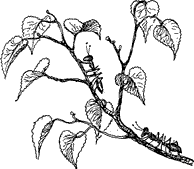
306-1 From The Naturalist in Nicaragua.
From the French of Emile Souvestre
September 15th, Eight O’clock.—This morning, while I was arranging my books, Mother Genevieve came in and brought me the basket of fruit I buy of her every Sunday. For nearly twenty years that I have lived in this quarter I have dealt in her little fruit shop. Perhaps I should be better served elsewhere, but Mother Genevieve has but little custom; to leave her would do her harm and cause her unnecessary pain. It seems to me that the length of our acquaintance has made me incur a sort of tacit obligation to her; my patronage has become her property.
She has put the basket upon my table, and as I wanted her husband, who is a joiner, to add some shelves to my bookcase, she has gone downstairs again immediately to send him to me.
At first I did not notice either her looks or the sound of her voice; but, now that I recall them, it seems to me that she was not as jovial as usual. Can Mother Genevieve be in trouble about anything?
Poor woman! All her best years were subject to such bitter trials that she might think she had received her full share already. Were I to live a hundred years I should never forget the circumstances[315] which first made her known to me and which obtained her my respect.
It was at the time of my first settling in the faubourg. I had noticed her empty fruit shop, which nobody came into, and being attracted by its forsaken appearance I made my little purchases in it. I have always instinctively preferred the poor shops; there is less choice in them, but it seems to me that my purchase is a sign of sympathy with a brother in poverty. These little dealings are almost always an anchor of hope to those whose very existence is in peril—the only means by which some orphan gains a livelihood. There the aim of the tradesman is not to enrich himself, but to live! The purchase you make of him is more than an exchange—it is a good action.
Mother Genevieve at that time was still young, but had already lost that fresh bloom of youth which suffering causes to wither so soon among the poor. Her husband, a clever joiner, gradually left off working to become, according to the picturesque expression of the workshops, “a worshipper of Saint Monday.” The wages of the week, which was always reduced to two or three working days, were completely dedicated by him to the worship of this god of the Barriers,315-2 and Genevieve was obliged herself to provide for all the wants of the household.
One evening, when I went to make some trifling purchases of her, I heard a sound of quarreling in the back shop. There were the voices of several women, among which I distinguished that of Genevieve, broken by sobs. On looking further in, I[316] perceived the fruit-woman with a child in her arms, and kissing it, while a country nurse seemed to be claiming her wages from her. The poor woman, who without doubt had exhausted every explanation and every excuse, was crying in silence, and one of her neighbors was trying in vain to appease the countrywoman. Excited by that love of money which the evils of a hard peasant life but too well excuse, and disappointed by the refusal of her expected wages, the nurse was launching forth in recriminations, threats, and abuse. In spite of myself, I listened to the quarrel, not daring to interfere, and not thinking of going away, when Michael Arout appeared at the shop door.
The joiner had just come from the Barrier, where he had passed part of the day at the public-house. His blouse, without a belt, and untied at the throat, showed none of the noble stains of work; in his hand he held his cap, which he had just picked up out of the mud; his hair was in disorder, his eye fixed, and the pallor of drunkenness in his face. He came reeling in, looked wildly around him, and called Genevieve.
She heard his voice, gave a start, and rushed into the shop; but at the sight of the miserable man, who was trying in vain to steady himself, she pressed the child in her arms and bent over it with tears.
The countrywoman and the neighbor had followed her.
“Come! come! do you intend to pay me, after all?” cried the former in a rage.
“Ask the master for the money,” ironically answered the woman from the next door, pointing[317] to the joiner, who had just fallen against the counter.
The countrywoman looked at him.
“Ah! he is the father,” returned she. “Well, what idle beggars! not to have a penny to pay honest people, and get tipsy with wine in that way.”
The drunkard raised his head.
“What! what!” stammered he; “who is it that talks of wine? I’ve had nothing but brandy! But I am going back again to get some wine! Wife, give me your money; there are some friends waiting for me at the wine shop.”
Genevieve did not answer; he went round the counter, opened the till, and began to rummage in it.
“You see where the money of the house goes!” observed the neighbor to the countrywoman; “how can the poor unhappy woman pay you when he takes all?”
“Is that my fault?” replied the nurse angrily. “They owe it to me and somehow or other they must pay me!”
And letting loose her tongue, as those women out of the country do, she began relating at length all the care she had taken of the child and all the expense it had been to her. In proportion as she recalled all she had done, her words seemed to convince her more than ever of her rights and to increase her anger. The poor mother, who no doubt feared that her violence would frighten the child, returned into the back shop and put it into its cradle.
Whether it is that the countrywoman saw in this act a determination to escape her claims, or that she[318] was blinded by passion, I cannot say; but she rushed into the next room, where I heard the sounds of quarreling, with which the cries of the child were soon mingled. The joiner, who was still rummaging in the till, was startled and raised his head.
At the same moment Genevieve appeared at the door, holding in her arms the baby that the countrywoman was trying to tear from her. She ran toward the counter, and throwing herself behind her husband cried:
“Michael, defend your son!”
The drunken man quickly stood up erect, like one who awakes with a start.
“My son!” stammered he; “what son?”
His looks fell upon the child; a vague ray of intelligence passed over his features.
“Robert,” resumed he; “it is Robert!”
He tried to steady himself on his feet, that he might take the baby, but he tottered. The nurse approached him in a rage.
“My money, or I shall take the child away!” cried she. “It is I who have fed and brought it up: if you don’t pay me for what has made it live, it ought to be the same to you as if it were dead. I shall not go until I have my due or the baby.”
“And what would you do with him?” murmured Genevieve, pressing Robert against her bosom.
“Take it to the Foundling!” replied the countrywoman harshly; “the hospital is a better mother than you are, for it pays for the food of its little ones.”
At the word “Foundling,” Genevieve had exclaimed aloud in horror. With her arms wound round her son, whose head she hid in her bosom,[319] and her two hands spread over him, she had retreated to the wall, and remained with her back against it, like a lioness defending her young ones. The neighbor and I contemplated this scene, without knowing how we could interfere. As for Michael, he looked at us by turns, making a visible effort to comprehend it all. When his eye rested upon Genevieve and the child, it lit up with a gleam of pleasure; but when he turned toward us, he again became stupid and hesitating.
At last, apparently making a prodigious effort, he cried out, “Wait!”
And going to a tub full of water, he plunged his face into it several times.
Every eye was turned upon him; the countrywoman herself seemed astonished. At length he raised his dripping head. This ablution had partly dispelled his drunkenness; he looked at us for a moment, then he turned to Genevieve, and his face brightened up.
“Robert!” cried he, going up to the child and taking him in his arms. “Ah! give him me, wife; I must look at him.”
The mother seemed to give up his son to him with reluctance, and stayed before him with her arms extended, as if she feared the child would have a fall. The nurse began again in her turn to speak, and renewed her claims, this time threatening to appeal to law. At first Michael listened to her attentively, and when he comprehended her meaning he gave the child back to its mother.
“How much do we owe you?” asked he.
The countrywoman began to reckon up the different expenses, which
amounted to nearly 30[320]
[321] francs. The joiner felt to the bottom of his
pockets, but could find nothing. His forehead became contracted by
frowns; low curses began to escape him. All of a sudden he rummaged in
his breast, drew forth a large watch, and holding it up above his head—
“Here it is—here’s your money!” cried he with a joyful laugh; “a watch, number one! I always said it would keep for a drink on a dry day; but it is not I who will drink it, but the young one. Ah! ah! ah! go and sell it for me, neighbor, and if that is not enough, I have my earrings. Eh! Genevieve, take them off for me; the earrings will square all! They shall not say you have been disgraced on account of the child—no, not even if I must pledge a bit of my flesh! My watch, my earrings, and my ring—get rid of all of them for me at the goldsmith’s; pay the woman and let the little fool go to sleep. Give him me, Genevieve; I will put him to bed.”
And taking the baby from the arms of his mother, he carried him with a firm step to his cradle.
It was easy to perceive the change which took place in Michael from this day. He cut all his old drinking acquaintances. He went early every morning to his work, and returned regularly in the evening to finish the day with Genevieve and Robert. Very soon he would not leave them at all, and he hired a place near the fruit shop and worked in it on his own account.
They would soon have been able to live in comfort, had it not been for the expenses which the child required. Everything was given up to his education. He had gone through the regular school[322] training, had studied mathematics, drawing, and the carpenter’s trade, and had only begun to work a few months ago. Till now, they had been exhausting every resource which their laborious industry could provide to push him forward in his business; but, happily, all these exertions had not proved useless; the seed had brought forth its fruits, and the days of harvest were close by.
While I was thus recalling these remembrances to my mind, Michael had come in and was occupied in fixing shelves where they were wanted.
During the time I was writing the notes of my journal, I was also scrutinizing the joiner.
The excesses of his youth and the labor of his manhood have deeply marked his face; his hair is thin and gray, his shoulders stooping, his legs shrunken and slightly bent. There seems a sort of weight in his whole being. His very features have an expression of sorrow and despondency. He answered my questions by monosyllables, and like a man who wishes to avoid conversation. From whence is this dejection, when one would think he had all he could wish for? I should like to know!
Ten O’clock.—Michael is just gone downstairs to look for a tool he has forgotten. I have at last succeeded in drawing from him the secret of his and Genevieve’s sorrow. Their son Robert is the cause of it!
Not that he has turned out ill after all their care—not that he is idle and dissipated; but both were in hopes he would never leave them any more. The presence of the young man was to have renewed and made glad their lives once more; his mother[323] counted the days, his father prepared everything to receive their dear associate in their toils; and at the moment when they were thus about to be repaid for all their sacrifices, Robert had suddenly informed them that he had just engaged himself to a contractor at Versailles.
Every remonstrance and every prayer were useless; he brought forward the necessity of initiating himself into all the details of an important contract, the facilities he should have in his new position of improving himself in his trade, and the hopes he had of turning his knowledge to advantage. At last, when his mother, having come to the end of her arguments, began to cry, he hastily kissed her and went away that he might avoid any further remonstrances.
He had been absent a year, and there was nothing to give them hopes of his return. His parents hardly saw him once a month, and then he only stayed a few moments with them.
“I have been punished where I had hoped to be rewarded,” Michael said to me just now. “I had wished for a saving and industrious son, and God has given me an ambitious and avaricious one! I had always said to myself that when once he was grown up we should have him always with us, to recall our youth and to enliven our hearts. His mother was always thinking of getting him married and having children again to care for. You know women always will busy themselves about others. As for me, I thought of him working near my bench and singing his new songs; for he has learned music and is one of the best singers at the Orphéon. A dream, sir, truly! Directly the bird was[324] fledged, he took to flight, and remembers neither father nor mother. Yesterday, for instance, was the day we expected him; he should have come to supper with us. No Robert to-day either! He has had some plan to finish, or some bargain to arrange, and his old parents are put down last in the accounts, after the customer’s and the joiner’s work. Ah! if I could have guessed how it would have turned out! Fool! to have sacrificed my likings and my money, for nearly twenty years, to the education of a thankless son! Was it for this I took the trouble to cure myself of drinking, to break with my friends, to become an example to the neighborhood? The jovial good fellow has made a goose of himself. Oh! if I had to begin again! No, no! you see women and children are our bane. They soften our hearts; they lead us a life of hope and affection; we pass a quarter of our lives in fostering the growth of a grain of corn which is to be everything to us in our old age, and when the harvest-time comes—good night, the ear is empty!”
While he was speaking, Michael’s voice became hoarse, his eye fierce, and his lips quivered. I wished to answer him, but I could only think of commonplace consolations, and I remained silent. The joiner pretended he wanted a tool and left me.
Poor father! Ah! I know those moments of temptation when virtue has failed to reward us and we regret having obeyed her! Who has not felt this weakness in hours of trial, and who has not uttered, at least once, the mournful exclamation of Brutus?
But if virtue is only a word, what is there then in life which is true and real? No, I will not believe[325] that goodness is in vain! It does not always give the happiness we had hoped for, but it brings some other. In the world everything is ruled by order and has its proper and necessary consequences, and virtue cannot be the sole exception to the general law. If it had been prejudicial to those who practice it, experience would have avenged them; but experience has, on the contrary, made it more universal and more holy. We only accuse it of being a faithless debtor because we demand an immediate payment, and one apparent to our senses. We always consider life as a fairy tale, in which every good action must be rewarded by a visible wonder. We do not accept as payment a peaceful conscience, self-content, or a good name among men—treasures that are more precious than any other, but the value of which we do not feel till after we have lost them!
Michael is come back and returned to his work. His son had not yet arrived.
By telling me of his hopes and his grievous disappointments, he became excited; he unceasingly went over again the same subject, always adding something to his griefs. He has just wound up his confidential discourse by speaking to me of a joiner’s business which he had hoped to buy and work to good account with Robert’s help. The present owner had made a fortune by it, and after thirty years of business he was thinking of retiring to one of the ornamental cottages in the outskirts of the city, a usual retreat for the frugal and successful workingman. Michael had not indeed the 2,000 francs which must be paid down; but perhaps he could have persuaded Master Benoit to[326] wait. Robert’s presence would have been a security for him, for the young man could not fail to insure the prosperity of a workshop; besides science and skill, he had the power of invention and bringing to perfection. His father had discovered among his drawings a new plan for a staircase, which had occupied his thoughts for a long time; and he even suspected him of having engaged himself to the Versailles contractor for the very purpose of executing it. The youth was tormented by this spirit of invention, and while devoting his mind to study he had not time to listen to his feelings.
Michael told me all this with a mixed feeling of pride and vexation. I saw he was proud of the son he was abusing, and that his very pride made him more sensible of that son’s neglect.
[327]Six O’clock P. M.—I have just finished a happy day. How many events have happened within a few hours, and what a change for Genevieve and Michael!
He had just finished fixing the shelves and telling me of his son, while I laid the cloth for my breakfast.
Suddenly we heard hurried steps in the passage, the door opened, and Genevieve entered with Robert. The joiner gave a start of joyful surprise, but he repressed it immediately, as if he wished to keep up the appearance of displeasure.
The young man did not appear to notice it, but threw himself into his arms in an open-hearted manner which surprised me. Genevieve, whose face shone with happiness, seemed to wish to speak, and to restrain herself with difficulty.
I told Robert I was glad to see him, and he answered me with ease and civility.
“I expected you yesterday,” said Michael Arout rather dryly.
“Forgive me, father,” replied the young workman, “but I had business at St. Germain’s. I was not able to come back till it was very late, and then the master kept me.”
The joiner looked at his son sideways, and then took up his hammer again.
“All right,” muttered he in a grumbling tone; “when we are with other people we must do as they wish; but there are some who would like better to eat brown bread with their own knife than partridges with the silver fork of a master.”
“And I am one of those, father,” replied Robert merrily; “but, as the proverb says, ‘you must shell[328] the peas before you can eat them.’ It was necessary that I should first work in a great workshop—”
“To go on with your plan of the staircase,” interrupted Michael, ironically.
“You must now say M. Raymond’s plan, father,” replied Robert, smiling.
“Why?”
“Because I have sold it to him.”
The joiner, who was planing a board, turned round quickly.
“Sold it!” cried he, with sparkling eyes.
“For the reason that I was not rich enough to give it him.”
Michael threw down the board and tool.
“There he is again!” resumed he angrily; “his good genius puts an idea into his head which would have made him known, and he goes and sells it to a rich man, who will take all the honor of it himself.”
“Well, what harm is there done?” asked Genevieve.
“What harm!” cried the joiner in a passion. “You understand nothing about it—you are a woman; but he—he knows well that a true workman never gives up his own inventions for money, no more than a soldier would give up his cross. That is his glory; he is bound to keep it for the honor it does him! Ah! thunder! if I had ever made a discovery, rather than put it up at auction I would have sold one of my eyes! Don’t you see that a new invention is like a child to a workman? He takes care of it, he makes a way for it in the world, and it is only poor creatures who sell it.”
[329]Robert colored a little.
“You will think differently, father,” said he, “when you know why I sold my plan.”
“Yes, and you will thank him for it,” added Genevieve, who could no longer keep silence.
“Never!” replied Michael.
“But, wretched man!” cried she, “he only sold it for our sakes!”
The joiner looked at his wife and son with astonishment. The latter related how he had entered into a negotiation with Master Benoit, who had positively refused to sell his business unless one-half of the 2,000 francs were first paid down. It was in the hopes of obtaining this sum that he had gone to work with the contractor at Versailles; he had had an opportunity of trying his invention and of finding a purchaser. Thanks to the money he received for it, he had just concluded the bargain with Benoit, and had brought his father the key of the new work-yard.
This explanation was given by the young workman with so much modesty and simplicity that I was quite affected by it. Genevieve cried; Michael pressed his son to his heart, and seemed to ask his pardon for having unjustly accused him.
All was now explained with honor to Robert. The conduct which his parents had ascribed to indifference really sprang from affection; he had neither obeyed the voice of ambition nor of avarice, nor even the nobler inspiration of inventive genius; his whole motive and single aim had been the happiness of Genevieve and Michael. The day for proving his gratitude had come, and he had returned them sacrifice for sacrifice!
[330]After the explanation and exclamations of joy were over, all three were about to leave me; but the cloth being laid, I added three more places, and kept them to breakfast.
The meal was prolonged: the fare was only tolerable, but the overflowings of affection made it delicious. Never had I better understood the unspeakable charm of family love. What calm enjoyment in that happiness which is always shared with others; in that community of interests which unites such various feeling; in that association of existences which forms one single being of so many! What is man without those home affections which, like so many roots, fix him firmly in the earth and permit him to imbibe all the juices of life? Energy, happiness—does it not all come from them? Without family life where would man learn to love, to associate, to deny himself? A community in little, is it not this which teaches us how to live in the great one? Such is the holiness of home, that to express our relation with God we have been obliged to borrow the words invented for our family life. Men have named themselves the sons of a heavenly Father!
Ah! let us carefully preserve these chains of domestic union; do not let us unbind the human sheaf and scatter its ears to all the caprices of chance and of the winds; but let us rather enlarge this holy law; let us carry the principles and the habits of home beyond its bounds; and, let us realize the prayer of the Apostle of the Gentiles when he exclaimed to the new-born children of Christ:
“Be ye like-minded, having the same love, being of one accord, of one mind.”
314-1 This is adapted from An Attic Philosopher in Paris.
315-2 The cheap wine shops of Paris are outside the Barriers, to avoid the city tax.
By William Cowper
Before we read this beautiful little poem, let us prepare ourselves by learning something about the author.
William Cowper, the son of an English clergyman, was born in 1731. He was a delicate, sensitive little boy whose life was made miserable by his companions in play and at school. So timid was he that the larger boys tyrannized over him shamefully, and the smaller ones teased him as much as they liked. When his mother died, William was but six years old, and the shrinking little lad was placed in a large boarding school where the other boys were cruel and heartless. At least, so they seemed to the frightened newcomer. Probably they were no more cruel and heartless than most strong and healthy youngsters who are accustomed to give and take without whimpering. Young Cowper was merely the strange lad whose timid and hesitating manner seemed to call for discipline. Years afterwards, still remembering the agony of these years, he wrote of one big boy in particular.
“His savage treatment of me impressed such a dread of his figure upon my mind that I well remember of being afraid to lift my eyes up higher[332] than to his knees, and that I knew him better by his shoe-buckles than by any other part of his dress.”
At ten he was removed to Westminster School, where he made some good friends. Here, too, he took a more manly stand, played football and cricket with the other boys, and redeemed himself from some of his weakness. But he had numerous spells of moodiness and sadness, during which he hid himself from his fellows and refused to join their plays even. He was unusually intelligent, distinguished himself in his studies, and became a favorite with his teachers.
Among his friends here was Warren Hastings, who long years afterwards, as governor of India, was convicted of cruelty and extortion. Cowper showed the loyalty of his nature by refusing utterly to believe in the guilt of his old friend.
William’s father wished to make a lawyer of his son, and when the boy had finished at Westminster he was sent to study law in London. If he had been unhappy in school, he became even more so now, for there was nothing in the legal profession to attract him. Instead of reading law he read literature; instead of writing legal papers he wrote poems and sketches. Finally, however, he became a lawyer, but he could never bring himself to practice his profession.
At one time he was given a clerkship, but in preparation for it he was asked to take an examination before the bar at the House of Lords. Here his old nervousness and timidity overpowered him, and he failed to appear; in fact, he ran away, planning to kill himself, but at the last moment his[333] courage again failed him. After this, his mind gave way, and he was for a time in an asylum. In fact, at intervals thereafter, he had attacks of despondency and moodiness, of fear and discouragement, which showed how seriously his mind was affected.
So far this is not a very attractive picture; but it is one side of the great poet’s character. That there was another we knew, for he made the most loyal friends, who opened their homes to him and were ever willing to care for him.
At one time he was engaged to be married, but an attack of insanity prevented the union, though it did not destroy the ardent friendship of the lovers. Cowper could never wholly throw off the fear of the future. “Day and night,” he once wrote, “I was upon the rack, lying down in horror and rising up in despair.”
His most attached friends, the Unwins, were deeply religious people, and at their house Cowper spent his happiest years. It was a great shock to him when Mr. Unwin was thrown from a horse and killed. From that time a succession of kind friends aided him, watched him through his periods of despair and provided for his simple wants. He was passionately fond of pets, and was happiest in caring for his rabbits, cats and other animals. He liked gardening, too, and spent a great deal of energy upon his plants.
Cowper was one of the finest correspondents that ever wrote, and his graceful and humorous letters are still read with pleasure by all who know them. Strangely enough, his gloominess rarely found its way into his poetry, which often was highly amusing,[334] as you know who have read John Gilpin. The Task is his greatest poem, though there are many short ones of great beauty.
Cowper was sincere and honest, and used good judgment in everything that did not concern himself. Occasionally he became dissatisfied with the style of poetry then most popular, because it was written so strictly according to rule and because heart and nature were all forgotten. What he wrote was different; putting his truthful eyes on birds and flowers, on fine scenery and on noble men and women, he wrote exactly as he saw, and let his fine sentiment and loving heart find gracious expression. The result was that he led the way for Wordsworth, the greater man, who brought our poetry back from the bonds of formality and made it beautiful, sincere and true.
The final years of Cowper were sad ones. Mrs. Unwin was stricken with paralysis, and the poet repaid her years of care and protection by an unfailing attention that lasted till she died. It is said that after the one heart-breaking cry he uttered when he saw her dead body, he never again mentioned her name, though he lived for four years. His end came peacefully enough, in April, 1800.
When Cowper was fifty-six years old his cousin sent to him from Norfolk a picture of his mother, who had then been dead for half a century. How vivid a recollection of her loving care remained to the saddened man may be seen in the poem.
OUT OF NORFOLK, THE GIFT OF MY COUSIN, ANN BODHAM
O that those lips had language! Life has passed
With me but roughly since I heard thee last.
Those lips are thine,—thy own sweet smile I see,
The same that oft in childhood solaced me;
Voice only fails, else how distinct they say,
“Grieve not, my child; chase all thy fears away!”
The meek intelligence of those dear eyes
(Blest be the art that can immortalize,—
The art that baffles time’s tyrannic claim
To quench it!) here shines on me still the same.
Faithful remembrancer of one so dear!
O welcome guest, though unexpected here!
Who bid’st me honor with an artless song,
Affectionate, a mother lost so long.
I will obey,—not willingly alone.
But gladly, as335-1 the precept were her own;
And, while that face renews my filial grief,
Fancy shall weave a charm for my relief,—
Shall steep me in Elysian335-2 revery,
A momentary dream that thou art she.
My mother! when I learned that thou wast dead,
Say, wast thou conscious of the tears I shed?
Hovered thy spirit o’er thy sorrowing son,—
Wretch even then, life’s journey just begun?
Perhaps thou gavest me, though unfelt, a kiss;
Perhaps a tear, if souls can weep in bliss—
Ah, that maternal smile! it answers—Yes.
I heard the bell tolled on thy burial day;
I saw the hearse that bore thee slow away;
[337]And, turning from my nursery window, drew
A long, long sigh, and wept a last adieu!
But was it such?—It was.—Where thou art gone
Adieus and farewells are a sound unknown;
May I but meet thee on that peaceful shore,
The parting word shall pass my lips no more.
Thy maidens, grieved themselves at my concern,
Oft gave me promise of thy quick return;
What ardently I wished I long believed,
And, disappointed still, was still deceived,—
By expectation every day beguiled,
Dupe of to-morrow even from a child.
Thus many a sad to-morrow came and went,
Till, all my stock of infant sorrow spent,
I learned at last submission to my lot;
But, though I less deplored thee, ne’er forgot.
Where once we dwelt our name is heard no more;
Children not thine have trod my nursery floor;
And where the gardener Robin, day by day,
Drew me to school along the public way,
Delighted with my bauble coach, and wrapt
In scarlet mantle warm, and velvet capped,
’Tis now become a history little known,
That once we call’d the pastoral house337-3 our own.
Shortlived possession! but the record fair,
That memory keeps of all thy kindness there,
Still outlives many a storm, that has effaced
A thousand other themes less deeply traced.
Thy nightly visits to my chamber made,
That thou mightst know me safe and warmly laid;
Thy morning bounties ere I left my home,
[338]The biscuit, or confectionery plum;
The fragrant waters on my cheeks bestow’d
By thy own hand, till fresh they shone and glow’d;
All this, and more endearing still than all,
Thy constant flow of love, that knew no fall,
Ne’er roughen’d by those cataracts and breaks,
That humour338-4 interposed too often makes;
All this still legible in memory’s page,
And still to be so to my latest age,
Adds joy to duty, makes me glad to pay
Such honours to thee as my numbers338-5 may;
Perhaps a frail memorial, but sincere,
Not scorn’d in Heaven, though little noticed here.
Could Time, his flight reversed, restore the hours,
When, playing with thy vesture’s tissued338-6 flowers,
The violet, the pink, the jessamine,
I prick’d them into paper with a pin,338-7
(And thou wast happier than myself the while—
Wouldst softly speak, and stroke my head and smile,)—
Could those few pleasant days again appear,
Might one wish bring them, would I wish them here?
I would not trust my heart,—the dear delight
Seems so to be desired, perhaps I might.
But no,—what here we call our life is such,
So little to be loved, and thou so much,
That I should ill requite thee to constrain
Thy unbound spirit into bounds again.
[339]Thou—as a gallant bark, from Albion’s339-8 coast,
(The storms all weathered and the ocean crossed,)
Shoots into port at some well-havened isle,
Where spices breathe and brighter seasons smile;
There sits quiescent on the floods, that show
Her beauteous form reflected clear below,
While airs impregnated with incense play
Around her, fanning light her streamers gay,—
So thou, with sails how swift! hast reached the shore
“Where tempests never beat nor billows roar”:
And thy loved consort339-9 on the dangerous tide
Of life long since has anchored by thy side.
But me,339-10 scarce hoping to attain the rest,
Always from port withheld, always distressed,—
Me339-10 howling blasts drive devious, tempest-tossed,
Sails ripped, seams opening wide, and compass lost;339-11
And day by day some current’s thwarting force
Sets me more distant from a prosperous course.
Yet O, the thought that thou art safe, and he!—339-12
That thought is joy, arrive what may to me.
My boast is not that I deduce my birth
From loins enthroned,339-13 and rulers of the earth;
[340]But higher far my proud pretensions rise,—
The son of parents passed into the skies.
And now, farewell!—Time, unrevoked,340-14 has run
His wonted course; yet what I wished is done.
By contemplation’s help, not sought in vain,
I seem to have lived my childhood o’er again,—
To have renewed the joys that once were mine,
Without the sin of violating thine;
And, while the wings of fancy still are free,
And I can view this mimic show of thee,
Time has but half succeeded in his theft,—
Thyself removed, thy power to soothe me left.
335-1 As though the request were her own.
335-2 The Elysian Fields were the blessed lands of beauty and joy to which the Greeks hoped to go at their death.
337-3 The pastoral house means the rectory, the home of the clergyman.
338-4 Humour here means temper.
338-5 Numbers is used for poetic measures; poetry.
338-6 Tissued is a poetic word for variegated.
338-7 He pricked into paper with a pin the outlines of the variegated forms of violets, pinks and jessamine that decorated his mother’s dress.
339-8 England’s. The old name Albion, which means white, is still used in poetry. Just how the name originated no one knows. Perhaps it alluded to the white chalk cliffs of England which the Gauls could see.
339-9 Cowper’s father died in 1756; his mother in 1737.
339-10 Me is repeated for emphasis; it is the object of drive: “Howling blasts drive me out of the straight line,” is what the lines mean.
339-11 Cowper was too strongly conscious of his weakness and his difference from other men. He wrote in a letter to a friend, “Certainly I am not an absolute fool, but I have more weaknesses than the greatest of all the fools I can recollect at present. In short, if I was as fit for the next world as I am unfit for this,—and God forbid I should speak of it in vanity,—I would not change conditions with any saint in Christendom.”
339-12 “That thou art safe, and that he is safe.”
339-13 Cowper descended from ancient and high lineage on both sides.
By Thomas Moore
Those evening bells! those evening bells.
How many a tale their music tells,
Of youth, and home, and that sweet time
When last I heard their soothing chime!
Those joyous hours are passed away;
And many a heart that once was gay,
Within the tomb now darkly dwells,
And hears no more those evening bells.
And so ’twill be when I am gone—
That tuneful peal will still ring on;
While other bards shall walk these dells,
And sing your praise, sweet evening bells.
340-14 Unrevoked means not called back.
By Edgar Allan Poe
It was many and many a year ago,
In a kingdom by the sea,
That a maiden lived, whom you may know
By the name of Annabel Lee;
And this maiden she lived with no other thought
Than to love, and be loved by me.
I was a child and she was a child,
In this kingdom by the sea;
But we loved with a love that was more than love,
I and my Annabel Lee,—
With a love that the wingèd seraphs of heaven
Coveted her and me.
And this was the reason that long ago,
In this kingdom by the sea,
A wind blew out of a cloud, chilling
My beautiful Annabel Lee;
So that her highborn kinsmen came,
And bore her away from me,
To shut her up in a sepulchre,
In this kingdom by the sea.
The angels, not so happy in heaven,
Went envying her and me.
Yes! that was the reason (as all men know)
In this kingdom by the sea,
That the wind came out of the cloud by night,
Chilling and killing my Annabel Lee.
But our love it was stronger by far than the love
Of those who were older than we,
Of many far wiser than we;
And neither the angels in heaven above,
Nor the demons down under the sea,
Can ever dissever my soul from the soul
Of the beautiful Annabel Lee.
[343]For the moon never beams without bringing me dreams
Of the beautiful Annabel Lee,
And the stars never rise but I feel the bright eyes
Of the beautiful Annabel Lee.
And so, all the night-tide I lie down by the side
Of my darling, my darling, my life, and my bride,
In her sepulchre there by the sea,
In her tomb by the sounding sea.
By Charles Kingsley
Three fishers went sailing out into the west—
Out into the west as the sun went down;
Each thought on the woman who loved him the best,
And the children stood watching them out of the town;
For men must work, and women must weep;
And there’s little to earn, and many to keep,
Though the harbor bar be moaning.
Three wives sat up in the lighthouse tower,
And trimmed the lamps as the sun went down;
And they looked at the squall, and they looked at the shower,
And the night rack came rolling up, ragged and brown;
But men must work, and women must weep,—
Though storms be sudden, and waters deep,
And the harbor bar be moaning.
Three corpses lay out on the shining sands
In the morning gleam as the tide went down,
And the women are weeping and wringing their hands,
For those who will never come back to the town;
For men must work, and women must weep,
And the sooner it’s over, the sooner to sleep,—
And good-bye to the bar and its moaning.
By Thomas Buchanan Read
The road was lone; the grass was dank
With night-dews on the briery bank
Whereon a weary reaper sank.
His garb was old; his visage tanned;
The rusty sickle in his hand
Could find no work in all the land.
He saw the evening’s chilly star
Above his native vale afar;
A moment on the horizon’s bar
It hung, then sank, as with a sigh;
And there the crescent moon went by,
An empty sickle down the sky.
To soothe his pain, Sleep’s tender palm
Laid on his brow its touch of balm;
His brain received the slumberous calm;
And soon that angel without name,
Her robe a dream, her face the same,
The giver of sweet visions came.
She touched his eyes; no longer sealed,
They saw a troop of reapers wield
Their swift blades in a ripened field.
At each thrust of their snowy sleeves
A thrill ran through the future sheaves
Rustling like rain on forest leaves.
They were not brawny men who bowed,
With harvest voices rough and loud,
[346]But spirits, moving as a cloud.
Like little lightnings in their hold,
The silver sickles manifold
Slid musically through the gold.
O, bid the morning stars combine
To match the chorus clear and fine,
That rippled lightly down the line,—
A cadence of celestial rhyme,
The language of that cloudless clime,
To which their shining hands kept time!
Behind them lay the gleaming rows,
Like those long clouds the sunset shows
On amber meadows of repose;
But, like a wind, the binders bright
Soon followed in their mirthful might,
And swept them into sheaves of light.
Doubling the splendor of the plain,
There rolled the great celestial wain,
To gather in the fallen grain.
Its frame was built of golden bars;
Its glowing wheels were lit with stars;
The royal Harvest’s car of cars.
The snowy yoke that drew the load,
On gleaming hoofs of silver trode;
And music was its only goad.
To no command of word or beck
It moved, and felt no other check
Than one white arm laid on the neck,—
The neck, whose light was overwound
With bells of lilies, ringing round
[347]Their odors till the air was drowned:
The starry foreheads meekly borne,
With garlands looped from horn to horn,
Shone like the many-colored morn.
The field was cleared. Home went the bands,
Like children, linking happy hands,
While singing through their father’s lands;
Or, arms about each other thrown,
With amber tresses backward blown,
They moved as they were music’s own.
The vision brightening more and more,
He saw the garner’s glowing door,
And sheaves, like sunshine, strew the floor,—
[348]The floor was jasper,—golden flails,
Swift-sailing as a whirlwind sails,
Throbbed mellow music down the vales.
He saw the mansion,—all repose,—
Great corridors and porticos,
Propped with the columns, shining rows;
And these—for beauty was the rule—
The polished pavements, hard and cool,
Redoubled, like a crystal pool.
And there the odorous feast was spread;
The fruity fragrance widely shed
Seemed to the floating music wed.
Seven angels, like the Pleiad seven,
Their lips to silver clarions given,
Blew welcome round the walls of heaven.
In skyey garments, silky thin,
The glad retainers floated in
A thousand forms, and yet no din:
And from the visage of the Lord,
Like splendor from the Orient poured,
A smile illumined all the board.
Far flew the music’s circling sound;
Then floated back, with soft rebound,
To join, nor mar, the converse round,
Sweet notes, that, melting, still increased,
Such as ne’er cheered the bridal feast
Of king in the enchanted East.
Did any great door ope or close,
It seemed the birth-time of repose,
The faint sound died where it arose;
[349]And they who passed from door to door;
Their soft feet on the polished floor
Met their soft shadows,—nothing more.
Then once again the groups were drawn
Through corridors, or down the lawn,
Which bloomed in beauty like a dawn.
Where countless fountains leapt alway,
Veiling their silver heights in spray,
The choral people held their way.
There, midst the brightest, brightly shone
Dear forms he loved in years agone,—
The earliest loved,—the earliest flown.
He heard a mother’s sainted tongue,
A sister’s voice, who vanished young,
While one still dearer sweetly sung!
No further might the scene unfold;
The gazer’s voice could not withhold;
The very rapture made him bold:
He cried aloud, with claspéd hands,
“O happy fields! O happy bands!
Who reap the never-failing lands.
“Oh master of these broad estates,
Behold, before your very gates
A worn and wanting laborer waits!
Let me but toil amid your grain,
Or be a gleaner on the plain,
So I may leave these fields of pain!
“A gleaner, I will follow far,
With never look or word to mar,
Behind the Harvest’s yellow car;
[350]All day my hand shall constant be,
And every happy eve shall see
The precious burden borne to thee!”
At morn some reapers neared the place,
Strong men, whose feet recoiled apace;
Then gathering round the upturned face,
They saw the lines of pain and care,
Yet read in the expression there
The look as of an answered prayer.
A poem like the preceding abounds in beautiful word pictures, which add to the charm of the imaginary incident which is related.
Here is the first: It is a country road in the harvest season. On one side, stretching away into the dim distance, lie fields already reaped; upon the other, a bank, covered with briery vines, rises steeply into the darkness. The evening star lies close to the horizon, and in the sky the cold crescent moon hangs like an empty sickle. In the grass under the bank, with night dews thickly gathered upon him, lies a poor and weary reaper. His torn clothes, old and ill-kept, his tanned face, slender figure, and more than all else the rusty sickle in his hand, show that he has been long without work, and has suffered in poverty.
The next four scenes are from the reaper’s dream:
1. It is a busy afternoon, and in a field of ripening grain reapers are busy wielding their sickles, but they are not the strong men who talk with loud, rough voices and bind the sheaves with joke and laughter; they are gentle spirits moving like clouds, and their sickles seem like little strokes of lightning as they slide musically through the golden grain. Their shining hands keep time to a beautiful song, and often the reapers glance across the gleaming rows of grain into the rich red of the sunset. The binders follow the reapers and place the sheaves in gleaming rows, while behind them follows the great wagon gathering in the fallen grain,—a wagon not of earth, but built of gold. Beautiful cattle draw the wain, cattle that [351]tread on silver hoofs and move without other command than sweet music, or the soft touch of a white-armed angel. Around the necks of the cattle are white lilies, and from the horns droop garlands of many-colored flowers, freshly picked from the dewy grass.
2. A jasper floor on which the grain lies like sunshine, and where golden flails, falling swiftly, beat out the grain to mellow music, gleams with increasing brightness.
3. The great mansion shines with its long corridors, its gleaming porticos and polished pavement, all beautiful and hard and cool. Inside is spread a fragrant feast to which seven angels sing invitation with their silver clarions. Softly the invited guests float in, a multitude in number, but silently as the stars move in heaven. Sweet music floats around the beautiful room, and smiling faces nod around the board. Doors are opened and closed without sound, and the feet of the servants on the polished floor give no more sound than falling shadows.
4. The groups of angel guests are gathered like flowers upon the lawn where countless fountains play, and among them, moving here and there, are the forms of the loved ones who have passed away before him. His mother, his sister, and one still dearer than either, sing sweetly and walk among fragrant flowers more beautiful than his fancy ever painted.
The last scene is the same as the first, except that it is a cold, chilly morning instead of a damp evening. Some reapers coming near see lying under the briers the poor old reaper with his upturned face, peaceful and quiet, now in death, but bearing the look of an answered prayer.
By Robert Louis Stevenson
The coracle—as I had ample reason to know before I was done with her—was a very safe boat for a person of my height and weight, both buoyant and clever in a seaway—but she was the most cross-grained lop-sided craft to manage. Do as you pleased, she always made more leeway than anything else, and turning round and round was the maneuver she was best at.
She turned in every direction but the one I was bound to go; the most part of the time we were broadside on, and I am very sure I never should have made the ship at all but for the tide. By good fortune, paddle as I pleased, the tide was still sweeping me down; and there lay the Hispaniola right in the fair way, hardly to be missed.
First she loomed before me like a blot of something yet blacker than darkness, then her spars and hull began to take shape, and the next moment, as it seemed (for, the further I went, the brisker grew the current of the ebb), I was alongside of her hawser, and had laid hold.
The hawser was as taut as a bowstring, and the current so strong she pulled upon her anchor. All round the hull, in the blackness, the rippling[353] current bubbled and chattered like a little mountain stream. One cut with my sea-gully, and the Hispaniola would go humming down the tide.
So far so good; but it next occurred to my recollection that a taut hawser, suddenly cut, is a thing as dangerous as a kicking horse. Ten to one, if I were so foolhardy as to cut the Hispaniola from her anchor, I and the coracle would be knocked clean out of the water.
This brought me to a full stop, and if fortune had not again particularly favored me, I should have had to abandon my design. But the light airs which had begun blowing from the southeast and south had hauled round after nightfall into the southwest. Just while I was meditating, a puff came, caught the Hispaniola, and forced her up into the current; and, to my great joy, I felt the hawser slacken in my grasp, and the hand by which I held it dip for a second under water.
With that I made my mind up, took out my gully, opened it with my teeth, and cut one strand after another, till the vessel swung only by two. Then I lay quiet, waiting to sever these last when the strain should be once more lightened by a breath of wind.
All this time I had heard the sound of loud voices from the cabin; but, to say truth, my mind had been so entirely taken up with other thoughts that I had scarcely given ear.
One I recognized for the coxswain’s, Israel Hands, that had been Flint’s gunner in former days. The other was, of course, my friend of the red nightcap. Both men were plainly the worse of drink, and they were still drinking. But they[354] were not only tipsy; it was plain that they were furiously angry. Oaths flew like hailstones, and every now and then there came forth such an explosion as I thought was sure to end in blows. But each time the quarrel passed off, and the voices grumbled lower for a while, until the next crisis came, and, in its turn, passed away without result.
On shore I could see the glow of the great campfire burning warmly through the shoreside trees. Some one was singing a dull, old, droning sailor’s song, with a droop and a quaver at the end of every verse, and seemingly no end to it at all but the patience of the singer. I had heard it on the voyage more than once, and remembered these words:
“But one man of her crew alive,
What put to sea with seventy-five.”
And I thought it was a ditty rather too dolefully appropriate for a company that had met such cruel losses in the morning. But, indeed, from what I saw, all these buccaneers were as callous as the sea they sailed on.
At last the breeze came; the schooner sidled and drew nearer in the dark; I felt the hawser slacken once more, and with a good, tough effort, cut the last fibers through.
The breeze had but little action on the coracle, and I was almost instantly swept against the bows of the Hispaniola. At the same time the schooner began to turn upon her heel, spinning slowly, end for end, across the current.
I wrought like a fiend, for I expected every moment to be swamped; and since I found I could not push the coracle directly off, I now shoved straight astern. At length I was clear of my dangerous neighbor; and just as I gave the last impulsion, my hands came across a light cord that was trailing overboard across the stern bulwarks. Instantly I grasped it.
Why I should have done so I can hardly say. It was at first mere instinct; but once I had it in[356] my hands and found it fast, curiosity began to get the upper hand, and I determined I should have one look through the cabin window.
I pulled in hand over hand on the cord, and, when I judged myself near enough, rose at infinite risk to about half my height, and thus commanded the roof and a slice of the interior of the cabin.
By this time the schooner and her little consort were gliding pretty swiftly through the water; indeed, we had already fetched up level with the campfire. The ship was talking, as sailors say, loudly, treading the innumerable ripples with an incessant weltering splash; and until I got my eye above the window-sill I could not comprehend why the watchmen had taken no alarm. One glance, however, was sufficient; and it was only one glance that I durst take from that unsteady skiff. It showed me Hands and his companion locked together in deadly wrestle, each with a hand upon the other’s throat.
I dropped upon the thwart again, none too soon, for I was near overboard. I could see nothing for the moment, but these two furious, encrimsoned faces, swaying together under the smoky lamp; and I shut my eyes to let them grow once more familiar with the darkness.
The endless ballad had come to an end at last, and the whole diminished company about the campfire had broken into the chorus I had heard so often:
“Fifteen men on the dead man’s chest—
Yo-ho-ho, and a bottle of rum!
Drink and the devil had done for the rest—
Yo-ho-ho, and a bottle of rum!”
[357]I was just thinking how busy drink and the devil were at that very moment in the cabin of the Hispaniola, when I was surprised by a sudden lurch of the coracle. At the same moment she yawed sharply and seemed to change her course. The speed in the meantime had strangely increased.
I opened my eyes at once. All round me were little ripples, combing over with a sharp, bristling sound, and slightly phosphorescent. The Hispaniola herself, a few yards in whose wake I was still being whirled along, seemed to stagger in her course, and I saw her spars toss a little against the blackness of the night; nay, as I looked longer, I made sure she also was wheeling to the southward.
I glanced over my shoulder, and my heart jumped against my ribs. There, right behind me, was the glow of the campfire. The current had turned at right angles, sweeping round along with it the tall schooner and the little dancing coracle; ever quickening, ever bubbling higher, ever muttering louder, it went spinning through the narrows for the open sea.
Suddenly the schooner in front of me gave a violent yaw, turning, perhaps, through twenty degrees; and almost at the same moment one shout followed another from on board; I could hear feet pounding on the companion ladder; and I knew that the two drunkards had at last been interrupted in their quarrel and awakened to a sense of their disaster.
I lay down flat in the bottom of that wretched skiff, and devoutly recommended my spirit to its Maker. At the end of the straits, I made sure we must fall into some bar of raging breakers, where[358] all my troubles would be ended speedily; and though I could, perhaps, bear to die, I could not bear to look upon my fate as it approached.
So I must have lain for hours, continually beaten to and fro upon the billows, now and again wetted with flying sprays, and never ceasing to expect death at the next plunge. Gradually weariness grew upon me; a numbness, an occasional stupor, fell upon my mind even in the midst of my terrors; until sleep at last supervened, and in my sea-tossed coracle I lay and dreamed of home and the old tavern “Benbow.”
It was broad day when I awoke, and found myself tossing at the southwest end of Treasure Island. The sun was up, but was still hid from me behind the great bulk of the Spyglass, which on this side descended almost to the sea in formidable cliffs.
Haulbowline Head and Mizzenmast Hill were at my elbow; the hill bare and dark, the head bound with cliffs forty or fifty feet high, and fringed with great masses of fallen rock. I was scarce a quarter of a mile to seaward, and it was my first thought to paddle in and land.
That notion was soon given over. Among the fallen rocks the breakers spouted and bellowed; loud reverberations, heavy sprays flying and falling, succeeded one another from second to second; and I saw myself, if I ventured nearer, dashed to death upon the rough shore, or spending my strength in vain to scale the beetling crags.
Nor was that all; for crawling together on flat tables of rock, or letting themselves drop into the sea with loud reports, I beheld huge slimy monsters—soft snails, as it were, of incredible bigness[359]—two or three score of them together, making the rocks to echo with their barkings.
I have understood since that they were sea lions, and entirely harmless. But the look of them added to the difficulty of the shore and the high running of the surf, was more than enough to disgust me of that landing place. I felt willing rather to starve at sea than to confront such perils.
In the meantime I had a better chance, as I supposed, before me. North of Haulbowline Head the land runs in a long way, leaving, at low tide, a long stretch of yellow sand. To the north of that, again, there comes another cape—Cape of the Woods, as it was marked upon the chart—buried in tall green pines, which descended to the margin of the sea.
I remembered that the current sets northward along the whole west coast of Treasure Island; and seeing from my position that I was already under its influence, I preferred to leave Haulbowline Head behind me, and reserve my strength for an attempt to land upon the kindlier-looking Cape of the Woods.
There was a great, smooth swell upon the sea. The wind blowing steady and gentle from the south, there was no contrariety between that and the current, and the billows rose and fell unbroken.
Had it been otherwise, I must long ago have perished; but as it was, it is surprising how easily and securely my little and light boat could ride. Often, as I still lay at the bottom, and kept no more than an eye above the gunwale, I would see a big blue summit heaving close above me; yet the coracle would but bounce a little, dance as if on springs,[360] and subside on the other side into the trough as lightly as a bird.
I began after a little to grow very bold, and sat up to try my skill at paddling. But even a small change in the disposition of the weight will produce violent changes in the behavior of a coracle. And I had hardly moved before the boat, giving up at once her gentle dancing movement, ran straight down a slope of water so steep that it made me giddy, and stuck her nose, with a spout of spray, deep into the side of the next wave.
I was drenched and terrified, and fell instantly back into my old position, whereupon the coracle seemed to find her head again, and led me as softly as before among the billows. It was plain she was not to be interfered with, and at that rate, since I could in no way influence her course, what hope had I left of reaching land?
I began to be horribly frightened, but I kept my head, for all that.
First, moving with all care, I gradually bailed out the coracle with my sea-cap; then getting my eye once more above the gunwale, I set myself to study how it was she managed to slip so quietly through the rollers.
I found each wave, instead of the big, smooth, glossy mountain it looked from shore, or from a vessel’s deck, was for all the world like any range of hills on the dry land, full of peaks and smooth places and valleys. The coracle, left to herself, turning from side to side, threaded, so to speak, her way through these lower parts, and avoided the steep slopes and higher, toppling summits of the waves.
[361]“Well, now,” thought I to myself, “it is plain I must lie where I am, and not disturb the balance; but it is plain, also, that I can put the paddle over the side, and from time to time, in smooth places, give her a shove or two toward land.” No sooner thought upon than done. There I lay on my elbows, in the most trying attitude, and every now and again gave a weak stroke or two to turn her head to shore. It was very tiring, and slow work, yet I did visibly gain ground; and, as we drew near the Cape of the Woods, though I saw I must infallibly miss that point, I had still made some hundred yards of easting. I was, indeed, close in. I could see the cool, green tree tops swaying together in the breeze, and I felt sure I should make the next promontory without fail.
It was high time, for now I began to be tortured with thirst. The glow of the sun from above, its thousandfold reflection from the waves, the sea-water that fell and dried upon me, caking my very lips with salt, combined to make my throat burn and my brain ache. The sight of the trees so near at hand had almost made me sick with longing; but the current had soon carried me past the point; and, as the next reach of sea opened out, I beheld a sight that changed the nature of my thoughts.
Right in front of me, not half a mile away, I beheld the Hispaniola under sail. I made sure, of course, that I should be taken; but I was so distressed for want of water, that I scarce knew whether to be glad or sorry at the thought; and, long before I had come to a conclusion, surprise had taken entire possession of my mind, and I could do nothing but stare and wonder.
[362]The Hispaniola was under her mainsail and two jibs, and the beautiful white canvas shone in the sun like snow or silver. When I first sighted her, all her sails were drawing; she was lying a course about northwest; and I presumed the men on board were going round the island on their way back to the anchorage. Presently she began to fetch more and more to the westward, so that I thought they had sighted me and were going about in chase. At last, however, she fell right into the wind’s eye, was taken dead aback, and stood there awhile helpless, with her sails shivering.
“Clumsy fellows,” said I; “they must still be drunk as owls.” And I thought how Captain Smollett would have set them skipping.
Meanwhile, the schooner gradually fell off, and filled again upon another tack, sailed swiftly for a minute or so, and brought up once more dead in the wind’s eye. Again and again was this repeated. To and fro, up and down, north, south, east, and west the Hispaniola sailed by swoops and dashes, and at each repetition ended as she had begun, with idly-flapping canvas. It became plain to me that nobody was steering. And, if so, where were the men? Either they were dead drunk, or had deserted her, I thought, and perhaps if I could get on board, I might return the vessel to her captain.
The current was bearing coracle and schooner southward at an equal rate. As for the latter’s sailing, it was so wild and intermittent, and she hung each time so long in irons, that she certainly gained nothing, if she did not even lose. If only I dared to sit up and paddle, I made sure that I could overhaul her. The scheme had an air of[363] adventure that inspired me, and the thought of the water-breaker beside the fore companion doubled my growing courage.
Up I got, was welcomed almost instantly by another cloud of spray, but this time stuck to my purpose; and set myself, with all my strength and caution, to paddle after the unsteered Hispaniola. Once I shipped a sea so heavy that I had to stop and bail, with my heart fluttering like a bird; but gradually I got into the way of the thing, and guided my coracle among the waves, with only now and then a blow upon her bows and a dash of foam in my face.
I was now gaining rapidly on the schooner. I could see the brass glisten on the tiller as it banged about; and still no soul appeared upon her decks. I could not choose but suppose she was deserted. If not, the men were lying drunk below, where I might batten them down, perhaps, and do what I chose with the ship.
For some time she had been doing the worst thing possible for me—standing still. She headed nearly due south, yawing, of course, all the time. Each time she fell off her sails partly filled, and these brought her in a moment right to the wind again. I have said this was the worst thing possible for me; for helpless as she looked in this situation, with the canvas cracking like cannon and the blocks trundling and banging on the deck, she still continued to run away from me, not only with the speed of the current, but by the whole amount of her leeway, which was naturally great.
But now at last I had my chance. The breeze fell for some seconds very low, and the current[364] gradually turning her, the Hispaniola revolved slowly round her center, and at last presented me her stern, with the cabin window still gaping open, and the lamp over the table still burning on into the day.
The mainsail hung drooped like a banner. She was stock-still, but for the current.
For the last little while I had even lost; but now, redoubling my efforts, I began once more to overhaul the chase.
I was not a hundred yards from her when the wind came again in a clap; she filled on the port tack and was off again, stooping and skimming like a swallow.
My first impulse was one of despair, but my second was toward joy. Round she came till she was broadside on to me—round still till she had covered a half, and then two thirds, and then three quarters of the distance that separated us. I could see the waves boiling white under her forefoot. Immensely tall she looked to me from my low station in the coracle.
And then, of a sudden, I began to comprehend. I had scarce time to think—scarce time to act and save myself. I was on the summit of one swell when the schooner came stooping over the next. The bowsprit was over my head. I sprang to my feet and leaped, stamping the coracle under water. With one hand I caught the jib-boom, while my foot was lodged between the stay and the brace; and as I still clung there panting a dull blow told me that the schooner had charged down upon and struck the coracle, and that I was left without retreat on the Hispaniola.
[365]I had scarce gained a position on the bowsprit, when the flying jib flapped and filled upon the other tack, with a report like a gun. The schooner trembled to her keel under the reverse; but next moment, the other sails still drawing, the jib flapped back again and hung idle.
This had nearly tossed me off into the sea; and now I lost no time, crawled back along the bowsprit, and tumbled head foremost on the deck.
I was on the lee side of the forecastle, and the mainsail, which was still drawing, concealed from me a certain portion of the after-deck. Not a soul was to be seen. The planks, which had not been swabbed since the mutiny, bore the print of many feet; and an empty bottle, broken by the neck, tumbled to and fro like a live thing in the scuppers.
Suddenly the Hispaniola came right into the wind. The jibs behind me cracked aloud; the rudder slammed to; the whole ship gave a sickening heave and shudder, and at the same moment the main-boom swung inboard, the sheet groaning in the blocks, and showed me the lee after-deck.
There were the two watchmen, sure enough: red-cap on his back, as stiff as a handspike, with his arms stretched out like those of a crucifix, and his teeth showing through his open lips; Israel Hands propped against the bulwarks, his chin on his chest, his hands lying open before him on the deck, his face as white, under its tan, as a tallow candle.
For awhile the ship kept bucking and sidling like a vicious horse, the sails filling, now on one tack, now on another, and the boom swinging to and fro till the mast groaned aloud under the strain. Now and again, too, there would come a cloud of[366] light sprays over the bulwark, and a heavy blow of the ship’s bows against the swell: so much heavier weather was made of it by this great rigged ship than by my home-made, lopsided coracle, now gone to the bottom of the sea.
At every jump of the schooner red-cap slipped to and fro; but—what was ghastly to behold—neither his attitude nor his fixed teeth-disclosing grin was anyway disturbed by this rough usage. At every jump, too, Hands appeared still more to sink into himself and settle down upon the deck, his feet sliding ever the farther out, and the whole body canting toward the stern, so that his face became, little by little, hid from me; and at last I could see nothing beyond his ear and the frayed ringlet of one whisker.
At the same time, I observed, around both of them, splashes of dark blood upon the planks, and began to feel sure that they had killed each other in their drunken wrath.
While I was thus looking and wondering, in a calm moment, when the ship was still, Israel Hands turned partly round, and, with a low moan, writhed himself back to the position in which I had seen him first. The moan, which told of pain and deadly weakness, and the way in which his jaw hung open, went right to my heart. But when I remembered the talk I had overheard from the apple barrel, all pity left me.
I walked aft until I reached the mainmast.
“Come aboard, Mr. Hands,” I said ironically.
He rolled his eyes round heavily; but he was too far gone to express surprise. All he could do was to utter one word: “Brandy.”
[367]It occurred to me there was no time to lose; and, dodging the boom as it once more lurched across the deck, I slipped aft, and down the companion stairs into the cabin.
It was such a scene of confusion as you can hardly fancy. All the lockfast places had been broken open in quest of the chart. The floor was thick with mud, where ruffians had sat down to drink or consult after wading in the marshes round their camp. The bulkheads, all painted in clear white, and beaded round with gilt, bore a pattern of dirty hands. Dozens of empty bottles clinked together in corners to the rolling of the ship. One of the doctor’s medical books lay open on the table, half of the leaves gutted out, I suppose, for pipe-lights. In the midst of all this the lamp still cast a smoky glow, obscure and brown as umber.
I went into the cellar; all the barrels were gone, and of the bottles a most surprising number had been drunk out and thrown away. Certainly, since the mutiny began, not a man of them could ever have been sober. Foraging about I found a bottle with some brandy left, for Hands; and for myself I routed out some biscuit, some pickled fruits, a great bunch of raisins, and a piece of cheese. With these I came on deck, put down my own stock behind the rudder head, and well out of the coxswain’s reach, went forward to the waterbreaker, and had a good, deep drink of water, and then, and not till then, gave Hands the brandy.
He must have drunk a gill before he took the bottle from his mouth.
“Ay,” said he, “by thunder, but I wanted some o’ that!”
[368]I had sat down already in my own corner and begun to eat.
“Much hurt?” I asked him.
He grunted, or, rather, I might say, he barked.
“If that doctor was aboard,” he said, “I’d be right enough in a couple of turns; but I don’t have no manner of luck, you see, and that’s what’s the matter with me. As for that swab, he’s good and dead, he is,” he added, indicating the man with the red cap. “He warn’t no seaman, anyhow. And where mought you have come from?”
“Well,” said I, “I’ve come aboard to take possession of this ship, Mr. Hands; and you’ll please regard me as your captain until further notice.”
He looked at me sourly enough, but said nothing. Some of the color had come back into his cheeks, though he still looked very sick, and still continued to slip out and settle down as the ship banged about.
“By the bye,” I continued, “I can’t have these colors, Mr. Hands; and, by your leave, I’ll strike ’em. Better none than these.”
And, again dodging the boom, I ran to the color lines, handed down their cursed black flag, and chucked it overboard.
“God save the king!” said I, waving my cap.
He watched me keenly and slyly, his chin all the while on his breast.
“I reckon,” he said at last—“I reckon, Cap’n Hawkins, you’ll kind of want to get ashore, now. S’pose we talks.”
“Why, yes,” says I, “with all my heart, Mr. Hands. Say on.” And I went back to my meal with a good appetite.
[369]“This man,” he began, nodding feebly at the corpse—“O’Brien were his name—a rank Irelander—this man and me got the canvas on her, meaning for to sail her back. Well, he’s dead now, he is—as dead as bilge; and who’s to sail this ship, I don’t see. Without I gives you a hint, you ain’t that man, as far’s I can tell. Now, look here, you gives me food and drink, and an old scarf or ankecher to tie my wound up, you do; and I’ll tell you how to sail her; and that’s about square all round, I take it.
“I’ll tell you one thing,” says I: “I’m not going back to Captain Kidd’s anchorage. I mean to get into North Inlet, and beach her quietly there.”
“To be sure you did,” he cried. “Why, I ain’t such an infernal lubber, after all. I can see, can’t I? I’ve tried my fling, I have, and I’ve lost, and it’s you has the wind of me. North Inlet? Why, I haven’t no chi’ce, not I! I’d help you sail her up to Execution Dock, by thunder! so I would.”
Well, as it seemed to me, there was some sense in this. We struck our bargain on the spot. In three minutes I had the Hispaniola sailing easily before the wind along the coast of Treasure Island, with good hopes of turning the northern point ere noon, and beating down again as far as North Inlet before high water, when we might beach her safely, and wait till the subsiding tide permitted us to land.
Then I lashed the tiller and went below to my own chest, where I got a soft silk handkerchief of my mother’s. With this, and with my aid, Hands bound up the great bleeding stab he had received in the thigh, and after he had eaten a little and had a swallow or two more of the brandy, he began to[370] pick up visibly, sat straighter up, spoke louder and clearer, and looked in every way another man.
The breeze served us admirably. We skimmed before it like a bird, the coast of the island flashing by, and the view changing every minute. Soon we were past the high lands and bowling beside low, sandy country, sparsely dotted with dwarf pines, and soon we were beyond that again, and had turned the corner of the rocky hill that ends the island on the north.
I was greatly elated with my new command, and pleased with the bright, sunshiny weather and these different prospects of the coast. I had now plenty of water and good things to eat, and my conscience, which had smitten me hard for my desertion, was quieted by the great conquest I had made. I should, I think, have had nothing left me to desire but for the eyes of the coxswain as they followed me derisively about the deck, and the odd smile that appeared continually on his face. It was a smile that had in it something both of pain and weakness—a haggard, old man’s smile; but there was besides that, a grain of derision, a shadow of treachery in his expression as he craftily watched, and watched, and watched me at my work.
The wind, serving us to a desire, now hauled into the west. We could run so much the easier from the northeast corner of the island to the mouth of the North Inlet. Only, as we had no power to anchor, and dared not beach her till the tide had flowed a good deal farther, time hung on our hands.
The coxswain told me how to lay the ship to; after a good many trials I succeeded, and we both sat in silence over another meal.
[371]“Cap’n,” said he, at length, with that same uncomfortable smile, “here’s my old shipmate, O’Brien; s’pose you was to heave him overboard. I ain’t partic’lar as a rule, and I don’t take no blame for settling his hash; but I don’t reckon him ornamental, now, do you?”
“I’m not strong enough, and I don’t like the job; and there he lies, for me,” said I.
“This here’s an unlucky ship—this Hispaniola, Jim,” he went on, blinking. “There’s a power of men been killed in this Hispaniola—a sight o’ poor seamen dead and gone since you and me took ship to Bristol. I never seen sich dirty luck, not I. There was this here O’Brien, now—he’s dead, ain’t he? Well, now, I’m no scholar, and you’re a lad as can read and figure; and, to put it straight, do you take it as a dead man is dead for good, or do he come alive again?”
“You can kill the body, Mr. Hands, but not the spirit; you must know that already,” I replied. “O’Brien there is in another world, and maybe watching us.”
“Ah!” says he. “Well, that’s unfort’nate—appears as if killing parties was a waste of time. Howsomever, sperrits don’t reckon for much, by what I’ve seen. I’ll chance it with the sperrits, Jim. And now, you’ve spoke up free, and I’ll take it kind if you’d step down into that there cabin and get me a—well, a—shiver my timbers! I can’t hit the name on’t; well, you get me a bottle of wine, Jim—this here brandy’s too strong for my head.”
Now, the coxswain’s hesitation seemed to be unnatural; and as for the notion of his preferring wine to brandy, I entirely disbelieved it. The[372] whole story was a pretext. He wanted me to leave the deck—so much was plain; but with what purpose I could in no way imagine. His eyes never met mine; they kept wandering to and fro, up and down, now with a look to the sky, now with a flitting glance upon the dead O’Brien. All the time he kept smiling and putting his tongue out in the most guilty, embarrassed manner, so that a child could have told that he was bent on some deception. I was prompt with my answer, however, for I saw where my advantage lay; and that with a fellow so densely stupid I could easily conceal my suspicions to the end.
“Some wine?” I said. “Far better. Will you have white or red?”
“Well, I reckon it’s about the blessed same to me, shipmate,” he replied; “so it’s strong and plenty of it, what’s the odds?”
“All right,” I answered. “I’ll bring you port, Mr. Hands. But I’ll have to dig for it.”
With that I scuttled down the companion with all the noise I could, slipped off my shoes, ran quietly along the sparred gallery, mounted the forecastle ladder and popped my head out of the fore companion. I knew he would not expect to see me there; yet I took every precaution possible; and certainly the worst of my suspicions proved too true.
He had risen from his position to his hands and knees; and though his leg obviously hurt him pretty sharply when he moved—for I could hear him stifle a groan—yet it was at a good, rattling rate that he trailed himself across the deck. In half a minute he had reached the port scuppers, and picked[373] out a coil of rope, a long knife, or rather a short dirk, discolored to the hilt with blood. He looked upon it for a moment, thrusting forth his under jaw, tried the point upon his hand, and then, hastily concealing it in the bosom of his jacket, trundled back again into his old place against the bulwark.
That was all that I required to know. Israel could move about; he was now armed; and if he had been at so much trouble to get rid of me, it was plain that I was meant to be the victim. What he would do afterward—whether he would try to crawl right across the island from North Inlet to the camp among the swamps, or whether he would fire Long Tom, trusting that his own comrades might come first to help him, was, of course, more than I could say.
Yet I felt sure that I could trust him in one point, since in that our interests jumped together, and that was in the disposition of the schooner. We both desired to have her stranded safe enough, in a sheltered place, and so that, when the time came, she could be got off again with as little labor and danger as might be; and until that was done I considered that my life would certainly be spared.
While I was thus turning the business over in my mind, I had not been idle with my body. I had stolen back to the cabin, slipped once more into my shoes, and laid my hand at random on a bottle of wine, and now, with this for an excuse, I made my reappearance on the deck.
Hands lay as I had left him, all fallen together in a bundle, and with his eyelids lowered, as though he were too weak to bear the light. He looked up, however, at my coming, knocked the neck off[374] the bottle, like a man who had done the same thing often, and took a good swig, with his favorite toast of “Here’s luck!” Then he lay quiet for a little, and then, pulling out a stick of tobacco, begged me to cut him a quid.
“Cut me a junk o’ that,” says he, “for I haven’t no knife, and hardly strength enough, so be as I had. Ah, Jim, Jim, I reckon I’ve missed stays! Cut me a quid, as’ll likely be the last, lad; for I’m for my long home, and no mistake.”
“Well,” said I, “I’ll cut you some tobacco; but if I was you and thought myself so badly, I would go to my prayers, like a Christian man.”
“Why?” said he. “Now, you tell me why.”
“Why?” I cried. “You were asking me just now about the dead. You’ve broken your trust; you’ve lived in sin and lies and blood; there’s a man you killed lying at your feet this moment; and you ask me why! For God’s mercy, Mr. Hands, that’s why.”
I spoke with a little heat, thinking of the bloody dirk he had hidden in his pocket, and designed, in his ill thoughts, to end me with. He, for his part, took a great draught of the wine, and spoke with the most unusual solemnity.
“For thirty years,” he said, “I’ve sailed the seas, and seen good and bad, better and worse, fair weather and foul, provisions running out, knives going, and what not. Well, now I tell you, I never seen good come o’ goodness yet. Him as strikes first is my fancy; dead men don’t bite; them’s my views—amen, so be it. And now, you look here,” he added, suddenly changing his tone, “we’ve had about enough of this foolery. The tide’s made[375] good enough by now. You just take my orders, Cap’n Hawkins, and we’ll sail slap in and be done with it.”
All told, we had scarce two miles to run; but the navigation was delicate, the entrance to this northern anchorage was not only narrow and shoal, but lay east and west, so that the schooner must be nicely handled to be got in. I think I was a good, prompt subaltern, and I am very sure that Hands was an excellent pilot; for we went about and about, and dodged in, shaving the banks, with a certainty and a neatness that was a pleasure to behold.
Scarcely had we passed the heads before the land closed around us. The shores of North Inlet were as thickly wooded as those of the southern anchorage; but the space was longer and narrower, and more like, what in truth it was, the estuary of a river.
Right before us, at the southern end, we saw the wreck of a ship in the last stages of dilapidation. It had been a great vessel of three masts, but had lain so long exposed to the injuries of the weather that it was hung about with great webs of dripping seaweed, and on the deck of it shore bushes had taken root, and now flourished thick with flowers. It was a sad sight, but it showed us that the anchorage was calm.
“Now,” said Hands, “look there; there’s a pet bit for to beach a ship in. Fine flat sand, never a catspaw, trees all around of it, and flowers a-blowing like a garding on that old ship.”
“And once beached,” I inquired, “how shall we get her off again?”
[376]“Why, so,” he replied: “you take a line ashore there on the other side at low water; take a turn about one o’ them big pines; bring it back, take a turn round the capstan, and lie-to for the tide. Come high water, all hands take a pull upon the line, and off she comes as sweet as natur’. And now, boy, you stand by. We’re near the bit now, and she’s too much way on her. Starboard a little—so—steady—starboard—larboard a little—steady—steady!”
So he issued his commands, which I breathlessly obeyed; till, all of a sudden, he cried: “Now, my hearty, luff!” And I put the helm hard up, and the Hispaniola swung round rapidly, and ran stem on for the low wooded shore.
The excitement of these last maneuvers had somewhat interfered with the watch I had kept hitherto, sharply enough, upon the coxswain. Even then I was still so much interested, waiting for the ship to touch, that I had quite forgot the peril that hung over my head, and stood craning over the starboard bulwarks and watching the ripples spreading wide before the bows. I might have fallen without a struggle for my life, had not a sudden disquietude seized upon me, and made me turn my head. Perhaps I had heard a creak, or seen his shadow moving with the tail of my eye; perhaps it was an instinct like a cat’s; but, sure enough, when I looked round, there was Hands, already halfway toward me, with the dirk in his right hand.
We must both have cried out aloud when our eyes met; but while mine was the shrill cry of terror, his was a roar of fury like a charging bull’s.[377] At the same instant he threw himself forward, and I leaped sideways toward the bows. As I did so I let go of the tiller, which sprang sharp to leeward; and I think this saved my life, for it struck Hands across the chest and stopped him, for the moment, dead.
Before he could recover, I was safe out of the corner where he had me trapped, with all the deck to dodge about. Just forward of the mainmast I stopped, drew a pistol from my pocket, took a cool aim, though he had already turned and was once more coming directly after me, and drew the trigger. The hammer fell, but there followed neither flash nor sound; the priming was useless with sea-water. I cursed myself for my neglect. Why had not I, long before, reprimed and reloaded my only weapons? Then I should not have been as now, a mere fleeing sheep before this butcher.
Wounded as he was, it was wonderful how fast he could move, his grizzled hair tumbling over his face, and his face itself as red as a red ensign with his haste and fury. I had no time to try my other pistol, nor, indeed, much inclination, for I was sure it would be useless. One thing I saw plainly: I must not simply retreat before him, or he would speedily hold me boxed into the bows, as a moment since he had so nearly boxed me in the stern. Once so caught, and nine or ten inches of the bloodstained dirk would be my last experience on this side of eternity. I placed my palms against the mainmast, which was of a goodish bigness, and waited, every nerve upon the stretch.
Seeing that I meant to dodge, he also paused; and a moment or two passed in feints on his part,[378] and corresponding movements upon mine. It was such a game as I had often played at home about the rocks of Black Hill Cove; but never before, you may be sure, with such a wildly beating heart as now. Still, as I say, it was a boy’s game, and I thought I could hold my own at it, against an elderly seaman with a wounded thigh. Indeed, my courage had begun to rise so high that I allowed myself a few darting thoughts on what would be the end of the affair; and while I saw certainly that I could spin it out for long, I saw no hope of any ultimate escape.
Well, while things stood thus, suddenly the Hispaniola struck, staggered, ground for an instant in the sand, and then, swift as a blow, canted over to the port side, till the deck stood at an angle of forty-five degrees, and about a puncheon of water splashed into the scupperholes, and lay in a pool between the deck and bulwark.
We were both of us capsized in a second, and both of us rolled, almost together, into the scuppers; the dead red-cap, with his arms still spread out, tumbled stiffly after us. So near were we, indeed, that my head came against the coxswain’s foot with a crack that made my teeth rattle. Blow and all, I was the first afoot again; for Hands had got involved with the dead body. The sudden canting of the ship had made the deck no place for running on; I had to find some new way of escape, and that upon the instant, for my foe was almost touching me. Quick as thought I sprang into the mizzen shrouds, rattled up hand over hand, and did not draw a breath till I was seated on the crosstrees.
[379]I had been saved by being prompt; the dirk had struck not half a foot below me, as I pursued my upward flight; and there stood Israel Hands with his mouth open and his face upturned to mine, a perfect statue of surprise and disappointment.
Now that I had a moment to myself, I lost no time in changing the priming of my pistol, and then, having one ready for service, and to make assurance doubly sure, I proceeded to draw the load of the other, and recharge it afresh from the beginning.
My new employment struck Hands all of a heap; he began to see the dice going against him; and after an obvious hesitation, he also hauled himself heavily into the shrouds, and, with the dirk in his teeth, began slowly and painfully to mount. It cost him no end of time and groans to haul his wounded leg behind him; and I had quietly finished my arrangements before he was much more than a third of the way up. Then, with a pistol in either hand, I addressed him.
“One more step, Mr. Hands,” said I, “and I’ll blow your brains out! Dead men don’t bite, you know,” I added, with a chuckle.
He stopped instantly. I could see by the working of his face that he was trying to think, and the process was so slow and laborious that, in my new-found security, I laughed aloud. Then with a swallow or two, he spoke, his face still wearing the same expression of extreme perplexity. In order to speak he had to take the dagger from his mouth, but, in all else, he remained unmoved.
“Jim,” says he, “I reckon we’re fouled, you and me, and we’ll have to sign articles. I’d have had[380] you but for that there lurch: but I don’t have no luck, not I; and I reckon I’ll have to strike, which comes hard, you see, for a master mariner to a ship’s younker like you, Jim.”
I was drinking in his words and smiling away, as conceited as a cock upon a wall, when, all in a breath back went his right hand over his shoulder. Something sang like an arrow through the air; I felt a blow and then a sharp pang, and there I was pinned by the shoulder to the mast. In the horrid pain and surprise of the moment—I scarce can say it was by my own volition, and I am sure it was without a conscious aim—both my pistols went off, and both escaped out of my hands. They did not fall alone; with a choked cry, the coxswain loosed his grasp upon the shrouds, and plunged head first into the water.
Stevenson was not one of the men who can write only one sort of thing. The numerous little poems contained in the first volume of this series show his sympathetic knowledge of children, while his essays prove that he could handle serious subjects in a most masterly manner. The extract from Treasure Island which you have just been reading displays his skill in still another field—the writing of stories of pure adventure.
One of the striking things in all Stevenson’s writings is his power of vivid description, his ability to make us see things. Nor does he make us wait while he gives us page-long descriptions; he suggests pictures to us with a few words. It may be safely said of descriptions, when they are part of a story, that those which are given in the fewest words, if those few words are the right ones, are most effective. Stevenson fully grasped this fact, and that is the reason he is able to bring all his scenes before us so vividly, without wearying our patience.
352-1 From Treasure Island.
By Grace E. Sellon
Near the town of Haverhill, Massachusetts, in the old homestead of his father’s family, the poet John Greenleaf Whittier was born December 17, 1807. Like all the other children who generation after generation had come to live in this Quaker dwelling, he was brought up in simple, useful ways, and was early given his full share of the duties about the farm. No matter how sharply the cold of the harsh New England winter pierced his homespun clothes, the snow must be shoveled from the paths, firewood must be brought, the stalls in the barn must be littered, and, worst task of all for him, seven cows must be milked. Yet there was plenty of fun to be had, too. When the snow fell so heavily that it blocked all the roads and closed in tightly about the house, the two Whittier boys found it exciting work to dig their way to the outside world.
When the early twilight fell and passed into night, the boys with their sisters joined the group gathered about the great hearth, and there listened to stories of Indians, witches and Christian martyrs, and to many another weird or adventurous tale told by the older members of the family. While they were being thus entertained, the blaze of the red logs went roaring up the chimney,
“The house-dog on his paws outspread
Laid to the fire his drowsy head,
The cat’s dark silhouette on the wall
A couchant tiger’s seemed to fall;
And, for the winter fireside meet,
Between the andirons’ straddling feet,
The mug of cider simmered slow,
The apples sputtered in a row,
And, close at hand, the basket stood
With nuts from brown October’s wood.”
All too soon this pleasant time came to an end, and the boys must go to their bare, unheated room upstairs. There, the poet has written,
“Within our beds awhile we heard
The wind that round the gables roared,
With now and then a ruder shock,
Which made our very bedsteads rock.
We heard the loosened clapboards tost,
The board-nails snapping in the frost;
And on us, through the unplastered wall,
Felt the lightsifted snowflakes fall;
But sleep stole on, as sleep will do
When hearts are light and life is new;
Faint and more faint the murmurs grew,
Till in the summer-land of dreams
They softened to the sound of streams.
Low stir of leaves, and dip of oars,
And lapsing waves on quiet shores.”
In the warm season, though there was much to do in helping plant and harvest the crops, there were good times to be had in climbing to the top of Job’s hill, next to the house, where the friendly oxen were pastured, or in gathering berries or nuts, or in watching the birds, bees and squirrels as they worked or played about their homes. It was these delights of his childhood that the poet was calling[383] to remembrance when he wrote The Barefoot Boy, which may be found elsewhere in these volumes.
Probably there are few country lads to-day who know so little as did the Whittier boys of the common sights and pleasures of city life. The strict Quaker belief regarding children’s amusement barred them from most of the enjoyment familiar to the young people in the great world that lay beyond their home. So little were they acquainted with the forbidden attractions at the circus that one time when President Monroe visited Haverhill, Greenleaf (as the poet was known in his home), looking next day for traces of the presence of the great man, whom he had not been allowed to see, came upon the tracks of an elephant that had been in town with a traveling menagerie, and in his ignorance believed that these were the footsteps of the famous visitor. The theater, so the children were taught, was to be shunned as a place of wickedness. Once when Greenleaf was visiting in Boston he was asked to go to a play by a lady whom he met in the home where he was staying. When he found that the lady was an actress, he became so much afraid of being led into sinful ways that, not daring to remain longer, he started off at once for home.
Though young Whittier was a wide-awake boy and eager to learn, there was only the district school, held for a few weeks each winter, for him to attend. Yet an opportunity was not lacking for bringing to light his poetic gift. One of his schoolmasters, who lived for part of the term in the Whittier home, used to read to the family from various interesting books, and one night chose for[384] their entertainment a volume of Burns’s poems. As the lines of the much-loved Scotch poet fell from the reader’s lips, the young boy listened as he had never before listened in his life. His own power awakened and responded warmly to that of the older poet. From that hour, whether he was at home or at school, he found great pleasure in writing verses, which he often showed to his young friends. Thus it was that his older sister Mary was able, all unknown to him, to send off one of his poems to the Newburyport Free Press. When the paper containing the verses came, the young poet read the lines over and over again, almost too dazed to recognize them as his own. This contribution was followed by another made to the same paper. By this time the editor’s interest had been so much aroused that, learning from the postman of the author’s whereabouts, he traveled to Haverhill to visit him. This editor was no other than William Lloyd Garrison, who later became famous as a leader of the cause of abolition. He urged strongly that the boy’s education be continued. Perhaps his words would have counted for nothing, however, had it not been that somewhat later the editor of the Haverhill Gazette, in which some of young Whittier’s verses had been published, entreated the boy’s parents to send him to the new Haverhill Academy. His father’s consent having been gained, Greenleaf learned from a man who worked on the farm how to make slippers, and thus he became able to pay his own expenses during a term at the Academy. By teaching school in the winter, and by helping to keep the books of a Haverhill merchant, he was able to provide for a[385] second term. Thus was completed his regular schooling.
In the meanwhile his friend Garrison had kept an eye on him, and at the close of 1825 secured for him the editorship of The American Manufacturer, a weekly magazine published in Boston. Young Whittier entered with great interest into the work, contributing articles on politics and temperance as well as numerous poems. Though he received only nine dollars a week, he was able, when called back to Haverhill in 1829, by his father’s illness, to give about one half of what he had earned to help remove the mortgage on the farm.
He remained at home until his father’s death in 1830, editing for a time the Haverhill Gazette and sending to the New England Review, of Hartford, Connecticut, various poems and articles. So much favor did these find with the editor, George D. Prentice, that he invited the young writer to fill his position during a temporary absence. The offer was highly complimentary, for the Review was the principal political journal in Connecticut supporting Henry Clay. However, Whittier was well prepared for the work, for he had become acquainted with the leaders and with the chief interests of the Whig party while editing the Manufacturer, and was himself an enthusiastic follower of Clay. His common sense and shrewd but kindly reading of human nature, united with a high sense of honor and justice, enabled him to fill this responsible position with marked success until his failing health forced him to give it up in January, 1832.
There was much reason for Whittier to look for success in political life, for his editorial work had[386] made him widely known as a man of sane and practical views, and he was so highly regarded in the district where he lived that had he reached the required age of twenty-five, he would in all probability have been made a candidate for Congress in 1832. Thus it was that although he had published more than a hundred favorably received poems between 1828 and 1832, he wrote in the latter year: “My prospects are too good to be sacrificed for any uncertainty. I have done with poetry and literature.”
A far nobler mission, however, and greater usefulness than he could have planned for himself lay before Whittier. It was not political success that was to draw forth the greatness of his nature. The strong and fearless interest with which his friend Garrison had begun to champion the abolition of slavery in the United States appealed to him, he felt with all his heart that the cause was right, and, closing his eyes to the bright promise of political success, he chose to unite himself with the scorned and mistreated upholders of freedom. After thorough consideration and study, he wrote and published in 1833 the pamphlet Justice and Expediency, in which he set forth fully the arguments against slavery. This was the first of his strong and stirring protests against oppression. From that time until the close of the Civil War his fervent, fearless love of liberty voiced itself through ringing verses, in constant appeals to the conscience of the nation. The greatness of this influence, as it worked silently in men’s hearts, who can estimate?
Whittier’s part in the anti-slavery struggle was not always a quiet one. On one occasion, when in[387] company with a famous but unpopular English reformer he was to address an audience on the subject of abolition, he was attacked by a mob while passing quietly along the street with a friend, and narrowly escaped being tarred and feathered. Somewhat later he was set upon in another town by a crowd armed with sticks and stones and other missiles, from which he fled with more haste than dignity. It was while he was editor of the Freeman that Pennsylvania Hall, where the Philadelphia Abolitionists held their meetings, was burned by a mob, and the papers from Whittier’s editorial room in this building were used to help start the blaze.
In 1836 the farm at Haverhill had been sold, and a cottage was bought in Amesbury near the Quaker meetinghouse. It was in this quiet place, under the loving care of his mother and sister, that Whittier made his home after resigning his position with the Freeman. These two women were in their way as unselfishly devoted to the cause of freedom as was the poet himself, for they encouraged his loyalty and bore privation uncomplainingly. In the darkest hour of their need, when it seemed as if their home must be mortgaged, Whittier was invited to become a contributor to the Atlantic Monthly, then being founded, and thus the long period of want was brought to an end.
After the death of his mother, in the following year (1858), Whittier’s association with his sister Elizabeth became even closer than before, though they had always shared each other’s hopes and interests with unusual sympathy and understanding. When she died, in 1864, it seemed to him that part of his life had gone with her. It was with[388] this grief still fresh in his mind that he wrote the best known of his poems, Snow-Bound, A Winter Idyl, in which he pictures in the most simple and lifelike manner the quiet loveliness of his childhood home. With especial tenderness he tells of the much-loved sister, and lets his mingled grief and hope of reunion be seen:
“As one who held herself a part
Of all she saw, and let her heart
Against the household bosom lean,
Upon the motley-braided mat
Our youngest and our dearest sat,
Lifting her large, sweet, asking eyes,
Now bathed within the fadeless green
And holy peace of Paradise.
Oh, looking from some heavenly hill,
Or from the shade of saintly palms,
Or silver reach of river calms,
Do those large eyes behold me still?
With me one little year ago:—
The chill weight of the winter snow
For months upon her grave has lain;
And now, when summer south-winds blow,
And brier and harebell bloom again,
I tread the pleasant paths we trod,
I see the violet-sprinkled sod,
Whereon she leaned, too frail and weak,
The hillside flowers she loved to seek,
Yet following me where’er I went
With dark eyes full of love’s content.
The birds are glad; the brier-rose fills
The air with sweetness; all the hills
Stretch green to June’s unclouded sky;
But still I wait with ear and eye
For something gone which should be nigh,
A loss in all familiar things,
In flower that blooms, and bird that sings.
[389]And yet, dear heart! remembering thee,
Am I not richer than of old?
Safe in thy immortality,
What change can reach the wealth I hold?
What chance can mar the pearl and gold
Thy love hath left in trust with me?
And while in life’s late afternoon
Where cool and long the shadows grow,
I walk to meet the night that soon
Shall shape and shadow overflow,
I cannot feel that thou art far,
Since near at need the angels are;
And when the sunset gates unbar,
Shall I not see thee waiting stand,
And, white against the evening star,
The welcome of thy beckoning hand?”
After the death of Elizabeth Whittier, the Amesbury home was cared for by the poet’s niece. During the remaining years of his life Whittier passed his time here or in the country. He lived in comparative comfort, for the publication of Snow-Bound in 1866 had brought very good returns. These were years of great peace, in which he remained actively interested in the affairs of the nation, yet liked most to dwell upon the beauty of nature and especially upon the thought of God’s goodness that must triumph over all the evil in the world. Among the Hills and the collections Tent on the Beach and At Sundown were produced in the last period; but his religious poems seem best to represent his thought and feeling in the closing years. From these were taken the beautiful verses At Last, read as the poet passed away from earth, September 7, 1892.
Though Whittier remained throughout his life a Quaker not only in dress and speech but in belief[390] and character, yet with his quietness and quaint simplicity was blended no severity nor gloom. He had a great love of fun, which alone can account for his mischievous habit of teasing, and for his keeping such pets as the little bantam rooster that aroused the household each morning with its crowing, and the parrot “Charlie” that swore when excited, stopped the horses in the street with its cries of “whoa,” and nipped the ankles of unwary visitors. Then, too, he was always attractive to children, and often preferred their society to that of older people. But above all else, with each succeeding year he became more just and compassionate towards others. The kindliness of his nature was untouched by the sorrow and sickness that he bore. “Love—love to all the world,” he would often repeat in his last years, and the sweet influence of the benediction is felt by all who read his life and works:
“Best loved and saintliest of our singing train,
Earth’s noblest tributes to thy name belong.
A lifelong record closed without a stain,
A blameless memory shrined in deathless song.”390-2
381-1 The poetical quotations given in this article are from Snow-Bound.
390-2 From an ode written by Oliver Wendell Holmes upon the death of Whittier.
Plain indeed was the little home among the hills of Western Massachusetts, near the town of Cummington, where was born on November 3, 1794, the first great American poet, William Cullen Bryant. His father was a physician of scholarly tastes, and his mother, though not highly educated, was a woman of much practical wisdom. Both parents were kind and affectionate, but followed the custom of that time in treating their children with a strictness unknown to American boys and girls of to-day. Even small acts of disrespect or disobedience were promptly punished, and to aid in the work of correction the Bryant home as well as that of almost every neighbor was provided with a good-sized bundle of birch sticks hanging warningly on the kitchen wall. As the poet himself tells us in a sketch of his early life, the children looked upon the older people of the family with so much awe that they could not go to them freely nor act naturally in their presence.
This severity in his home must have made young Bryant, who was by nature grave and thoughtful, even more serious. Then, too, his mental powers developed with surprising quickness, so that by the time he had reached his teens, he was thinking and expressing himself upon subjects usually discussed by men rather than boys. Having begun to write[392] verses when only nine years old, he had had enough practice in this kind of exercise to compose when thirteen years of age a satirical poem addressed to President Jefferson, because of his part in passing the Embargo Act by which New England commerce had been greatly injured. These verses were published and met with a ready sale. But far more remarkable as an early expression of genius was Thanatopsis, written several months before Bryant’s eighteenth birthday. This poem deals with the subject of death with such deep thoughtfulness and in such a stately and powerful style that although it did not appear until six years later, it was even then believed to have been written by the poet’s father, who had sent it to the publisher.
Though he was thoughtful beyond his years and had shown unusual poetic power, young Bryant was in other ways quite an ordinary boy. He was quiet and studious in the school room, but was active enough in the games played outside. Of the sports enjoyed by himself and the other boys of the district school, he writes: “We amused ourselves with building dams across the rivulet, and launching rafts made of old boards on the collected water; and in winter, with sliding on the ice and building snow barricades, which we called forts, and, dividing the boys into two armies, and using snowballs for ammunition, we contended for the possession of these strongholds. I was one of their swiftest runners in the race, and not inexpert at playing ball, but, being of a slight frame, I did not distinguish myself in these sieges.” Sometimes, on long evenings, Cullen and his elder brother Austin would play that they were the heroes of whom they[393] had read in the Iliad, and, fitted out with swords and spears and homemade armor, they would enact in the barn the great battles of the Trojan War.
Not only the Iliad, but other carefully chosen works of literature were discovered by the boy in his father’s library, and he read widely and well. It proved that this reading had to take the place of a much hoped-for course at college. After attending Williams College for only two terms, he left there, expecting to enter Yale, but was forced to give up his plan, owing to his father’s inability to supply him with the necessary means. He did not let this great disappointment overcome him, however, but a few months later began the study of law, with the result that in 1815 he was admitted to the bar.
It is a fact well worth noting that at the very beginning of his career as a lawyer, on the day when he was walking from his home to the little village where he was to start his practice, having learned, in his doubt and loneliness, a great lesson in faith, he wrote the beautiful poem that shows his genius at its best, and probably more than any other made him famous, the ode To a Waterfowl.
When a little boy, he had prayed, in his simple way, that he might be a great poet, and though he had outgrown the prayer, his desire was unchanged. More than this, he had now produced two works that undoubtedly showed genius. It is not surprising, then, that in a few years a literary career was opened to him and he was able to give up the law, for which he had no especial liking.
In 1825, after his marriage to a Miss Fairchild of Great Barrington, he removed from that town[394] to New York. There he became editor of the New York Review and Athenæum Magazine; and a year later he accepted the position of assistant editor of the Evening Post, a newspaper with which he remained for the rest of his life, assuming in 1829 the office of editor-in-chief. Though his contributions to this paper were not a poet’s work, they enabled him to unite his literary power with his deep interest in the political concerns of the country, and for many years to help direct public opinion during the most critical periods in the history of the new nation. More than this, while steadily provided with a good income he could spend his leisure hours among the quiet country scenes where he found inspiration for his greatest works, his simple nature poems.
The busy years of his life as a journalist were several times interrupted by travel. Besides visiting Mexico, Cuba and various parts of the United States, he made six voyages to Europe, and on the fourth extended the journey to Egypt and the Holy Land. His Letters of a Traveller and Letters from the East tell of the impressions he received in these countries.
Besides translating the Iliad and the Odyssey and writing the two fairy stories in verse, Sella and The Little People of the Snow, Bryant undertook no poetic work of any length. The poems for which his name is most honored are the little lyrics in which the calm and beauty of nature tell us of truths that never change. Among these, some that are best liked by readers both young and old are The Yellow Violet, The Fringed Gentian, A Forest Hymn, The Planting of the Apple Tree,[395] Robert of Lincoln, The Gladness of Nature, March and To a Waterfowl.
These poems, when studied, are sure to reveal the simplicity and sincerity not only of Bryant’s love for nature, but of his character as a man. They show the freedom from affectation that marks alike his writings and his everyday life. He followed almost sternly his high ideals both of moral right and literary correctness, and this has made him seem somewhat cold and formal. But probably all who can read most clearly the meaning of his life and works feel that so true-hearted a man could not have been lacking in warm and generous kindliness.
By William Cullen Bryant
Note.—“He says in a letter that he felt, as he walked up the hills, very forlorn and desolate indeed, not knowing what was to become of him in the big world, which grew bigger as he ascended, and yet darker with the coming on of night. The sun had already set, leaving behind it one of those brilliant seas of chrysolite and opal which often flood the New England skies; and, while he was looking upon the rosy splendor with rapt admiration, a solitary bird made wing along the illuminated horizon. He watched the lone wanderer until it was lost in the distance, asking himself whence it had come and to what far home it was flying. When he went to the house where he was to stop for the night, his mind was still full of what he had seen and felt, and he wrote these lines, as imperishable as our language, To a Waterfowl.”—Parke Godwin, in Biography of Bryant.
Whither, ’midst falling dew,
While glow the heavens with the last steps of day,
Far through their rosy depths dost thou pursue
Thy solitary way?
Vainly the fowler’s eye
Might mark thy distant flight to do thee wrong,
[397]As, darkly painted on the crimson sky,
Thy figure floats along.
Seek’st thou the plashy brink
Of weedy lake, or marge of river wide,
Or where the rocking billows rise and sink
On the chafed ocean side?
There is a Power whose care
Teaches thy way along that pathless coast—
The desert and illimitable air—
Lone wandering, but not lost.
All day thy wings have fanned,
At that far height, the cold, thin atmosphere,
Yet stoop not, weary, to the welcome land,
Though the dark night is near.
And soon that toil shall end;
Soon shalt thou find a summer home and rest,
And scream among thy fellows; reeds shall bend,
Soon, o’er thy sheltered nest.
Thou’rt gone, the abyss of heaven
Hath swallowed up thy form; yet on my heart
Deeply hath sunk the lesson thou hast given,
And shall not soon depart.
He who, from zone to zone,
Guides through the boundless sky thy certain flight,
In the long way that I must tread alone,
Will lead my steps aright.
By Grace E. Sellon
Besides giving to the United States her great president, Abraham Lincoln, the year 1809 also bestowed upon us one of the most gifted and warmly esteemed of American authors, Oliver Wendell Holmes. It was in a pleasant home in Cambridge, not far from the great university in which he was to serve ably for so many years, that Holmes was born. His mother was a bright and sociable little woman, well liked for her lively ways and quick sympathy, and his father, though a grave and scholarly man, was of a kindly nature. Both parents were descended from families that were looked upon as among the best in New England, and this became a matter of no little pride to their son.
The old colonial house where his boyhood and youth were spent contained a well-chosen library. Here, he has written, “he bumped about among books from the time when he was hardly taller than one of his father’s or grandfather’s folios.” Yet he did not read many of these volumes thoroughly. He liked to “read in books rather than through them” and would hunt out a paragraph here and there that especially pleased and satisfied him. The collections of sermons were always passed by, the lives of pious children met with the same neglect, and even The Pilgrim’s Progress seemed to picture the[399] world as such a cruel, gloomy place that this great book too was shunned.
The truth was that, being a lively and cheerful boy, he rebelled against the dark and fear-awakening religion preached by his father, a Congregational minister, discussed by visiting pastors and taught in many of the books that he avoided in the library. He seemed to know by instinct which of the clergymen who called at his father’s home were kindly and friendly, and which of them looked on children as “a set of little fallen wretches,” and for the forlorn looks and solemn ways of the latter he had an especial dislike. “Now and then,” he has written, “would come along a clerical visitor with a sad face and a wailing voice, which sounded exactly as if somebody must be lying dead upstairs, who took no interest in us children, except a painful one, as being in a bad way with our cheery looks, and did more to unchristianize us with his woebegone ways than all his sermons were like to accomplish in the other direction.” In fact, he might have pleased his father by becoming a minister if a certain preacher that he knew had not, to use his own words, “looked and talked so like an undertaker.”
But the dreary sermons, the visits of the long-faced clergymen and the drill in the Catechism were only shadows that came and went. Most of the time young Holmes was as light-hearted a boy as was to be found in all New England. He liked best of all to go hunting, carrying on such trips an old gun of the kind used in the Revolution. A good many of his hours at home were spent in working with tools, and thus he became skilful enough to carve out of wood a skate on which he learned to[400] travel about on the ice. He was active and industrious at school, too, and he made such a good record there that though he whispered a great part of the time he got along peaceably with the school-master. The only serious troubles that he had came from two great fears. Many times after he had gone to bed at night he would be awakened by ghosts or evil spirits mysteriously roaming through the house. Perhaps he was ashamed to tell of this dread to his mother or father, and so the foolish belief that there might be ghosts about stayed with him through boyhood. His other fear was of the doctor’s visits. In helpless terror he would look on while the old physician pronounced his doom and began to measure out the bitter medicine.
In his fifteenth year Holmes left the school at Cambridgeport to attend Phillips Academy, at Andover, and in the following year, 1825, entered Harvard College. During his four years at Harvard he took quite as active an interest in the social life of the college as in his classes. He joined the society known as the Knights of the Square Table, and at the lively meetings of the club, where wine and wit passed freely about the table, he was introduced to a kind of gayety undreamed of in his quiet home. In a humorous description of himself, given at this time in a letter to a former classmate at Andover, he writes:
“I, then, Oliver Wendell Holmes, Junior in Harvard University, am a plumeless biped of the height of exactly five feet three inches when standing in a pair of substantial boots made by Mr. Russell of this town, having eyes which I call blue, and hair which I do not know what to call.... Secondly,[401] with regard to my normal qualities, I am rather lazy than otherwise, and certainly do not study as hard as I ought to. I am not dissipated and I am not sedate, and when I last ascertained my college rank, I stood in the humble situation of seventeenth scholar.”
After graduating from Harvard, Holmes entered the Dane Law School at Cambridge. He did not feel at all sure, however, that he wished to be a lawyer, and at the end of a year he had so far lost interest in his studies that he gave them up. As the physician’s calling seemed much more to his liking, he took two courses of study in a private school of medicine. This preparation was not, of course, sufficient to fit him for a larger practice, so a trip to Europe where he could study under the great professors of the School of Medicine at Paris became necessary. Accordingly, his parents, at some sacrifice to themselves, provided him with the required means, and he set sail from New York in the spring of 1833.
During the two years spent abroad, Holmes gave himself up wholly to his chosen study. “I am more and more attached every day to the study of my profession.... I am occupied from morning to night, and as every one is happy when he is occupied, I enjoy myself as much as I could wish,” he wrote home. This period of hard work, however, was interrupted by summer vacations spent in the countries along the Rhine, in England and in Italy.
Early in 1836, the young physician established himself in Boston. Perhaps it was that people thought him too much of a wit to take their troubles seriously, or perhaps it was that he was better fitted[402] to teach than to practice the doctor’s art. At any rate, his success was very moderate. He was very glad, then, to be appointed Professor of Anatomy at Dartmouth College in 1838, a position that he held until 1840. About this time, too, he received prizes for some Medical Essays that are even to-day regarded as valuable. Thus he was gradually fitting himself for the honorable office offered him in 1847, that of Professor of Anatomy and Physiology in the Medical School of Harvard University. For thirty-five years Holmes filled this position with the greatest success. He was given the fifth hour in the day as his lecture period because he was the only one able to hold the attention of students who had already been listening to four long and difficult lectures. He enlivened the dry subject with funny stories, droll comparisons and interesting descriptions, teaching while he entertained.
In 1840 the young doctor had married Amelia Lee Jackson, daughter of a highly respected Boston family. His wife was of so gentle and tactful a nature that their home was always a well-ordered and pleasant place of rest for the busy doctor, where unwelcome visitors and other annoyances were not allowed to take his time. Yet he was never too much occupied to find pleasure in what interested his wife and his three children.
During all these years when the profession of medicine had been of chief concern to him, and even before he had begun his medical studies, he had occasionally written poems that won a good deal of praise from friends, but brought no widespread notice. From his very earliest years he could feel[403] very keenly and remember the melody of verse. “The low, soft chirp of the little bird heard in the nest, while his mother is brooding over him,” he has written, “lives in his memory, I doubt not, through all the noisy carols of the singing season; so I remember the little songs my mother sang to me when I was old enough to run about, and had not outgrown the rhymes of the nursery.” He enjoyed writing poems for the yearly meetings held by his college class long after their graduation, and he made several contributions to the Harvard Collegian. Just once in these early years had his fame traveled far, and that was the occasion when he wrote Old Ironsides. The frigate Constitution that had served the country so well was to be done away with as a useless vessel. Learning of this, Holmes penned in haste the stanzas that stirred the nation’s feelings and saved the old boat from destruction.
It came, then, as a surprise to the American people, when upon the founding of the Atlantic Monthly in 1857, the name of Holmes was signed to the articles that probably were most popular of all published in that magazine, to which the greatest literary men in the country were contributing. The Autocrat of the Breakfast Table, was the title of the delightful series of humorous essays in which the author seemed really to be talking to his readers. A sort of story bound the numbers together. In the fourth issue appeared, perhaps, the best poem written by Holmes—The Chambered Nautilus. This was a favorite with him and was one of those poems of which he said: “I did not write it, but it was written through me,” for he believed it to be a work of inspiration.
[404]The Autocrat, which is Holmes’ greatest work, was followed by two similar but inferior series, The Professor at the Breakfast Table and The Poet at the Breakfast Table. Between the last two series he had published in 1861 his novel Elsie Venner, followed in 1867 by The Guardian Angel, and in 1885 by A Mortal Antipathy. The first of these novels is considerably the best, but none of them ranks high, for they all deal with unusual people who because of weird inherited traits of mind are forced to go through strange if not impossible experiences.
Still another kind of writing was attempted by Holmes. In 1878 he completed a biography of his intimate friend, the historian Motley, and in 1884 wrote a life of Emerson. These are not, however, among his best productions. Over the Teacups, similar to the Breakfast Table papers, appeared in 1890, and was his last important work.
In 1886, accompanied by his daughter, he spent four months in Europe, chiefly in England. The warm welcome and high honor given him by the English people were very gratifying to the aged professor. He was always at his best when talking, and so brilliant and easy was his wit that had not politeness forbidden he could have entertained a roomful of people during a whole evening. This fact as well as his literary achievements made him popular everywhere.
On the occasion when he received a degree of honor from Cambridge University, the young collegemen greeted him by singing at the tops of their voices a song of “Holmes, sweet Holmes;” and on a similar occasion at Oxford one of the students,[405] making good use of the title of a poem especially known to Holmes’ young readers, asked from the gallery whether the Doctor had come in the “One-Hoss Shay.” It is likely that the worthy old gentleman was quite as pleased with this hearty good will as with the more dignified tributes received during his memorable visit.
After 1890, Holmes wrote only occasionally. Yet he continued to take his usual walks and to answer a part of his large correspondence, leaving the rest to a secretary. Now and then he would go to a concert or to a dinner among friends, and in other ways he showed himself remarkably active. In fact, he had not become feeble in mind or body when death quietly came to him, October 7th, 1894.
Though the brightness of his wit makes Holmes one of the most entertaining of writers it is his deep kindness that gives to what he has written an even greater power and attractiveness. More than all else, he tried both in his writings and in his everyday living to drive away the shadows of all kinds of suffering, and to share with others the cheerfulness of his own genial nature.
“Long be it ere the table shall be set
For the last breakfast of the Autocrat,
And love repeat with smiles and tears thereat
His own sweet songs that time shall not forget.”405-1
405-1 Whittier’s ode on the eightieth birthday of Holmes.
By Oliver Wendell Holmes
Listen, Benjamin Franklin.406-1 This is for you, and such others of tender age as you may tell it to.
When we are as yet small children, long before the time when those two grown ladies offer us the choice of Hercules,406-2 there comes up to us a youthful angel, holding in his right hand cubes like dice, and in his left spheres like marbles. The cubes are of stainless ivory, and on each is written in letters of gold—Truth. The spheres are veined and streaked and spotted beneath, with a dark crimson flush above where the light falls on them and in a certain aspect you can make out upon every one of them the three letters, L, I, E.
The child to whom they are offered very probably clutches at both. The spheres are the most[407] convenient things in the world; they roll with the least possible impulse just where the child would have them. The cubes will not roll at all; they have a great talent for standing still, and always keep right side up. But very soon the young philosopher finds that things which roll so easily are very apt to roll into the wrong corner, and to get out of his way when he most wants them, while he always knows where to find the others, which stay where they are left.
Thus he learns—thus we learn—to drop the streaked and speckled globes of falsehood, and to hold fast the white angular blocks of truth. But then comes Timidity, and after her Good-nature, and last of all Polite-behaviour, all insisting that truth must roll, or nobody can do anything with it; and so the first with her coarse rasp, and the second with her broad file, and the third with her silken sleeve, do so round off and smooth and polish the snow-white cubes of truth, that, when they have got a little dingy by use, it becomes hard to tell them from the rolling spheres of falsehood.
The schoolmistress407-3 was polite enough to say that she was pleased with this, and that she would read it to her little flock the next day. But she should tell the children, she said, that there were better reasons for truth than could be found in mere experience of its convenience, and the inconvenience of lying.
Yes—I said—but education always begins through the senses, and works up to the idea of[408] absolute right and wrong. The first thing the child has to learn about this matter is, that lying is unprofitable—afterwards, that it is against the peace and dignity of the universe.
1. What does the stainless ivory in the cubes indicate?
2. What is the meaning of the veins, streaks, and spots and the dark crimson flush in the spheres?
3. Are the letters L, I, E, always visible? Does this mean that lies are not always known to be lies to the person who tells them, or that they may deceive the person to whom they are told?
4. Does Dr. Holmes mean to imply that it is natural for a little child to lie when he says that the spheres are the most convenient things in the world?
5. What does Dr. Holmes mean when he says that the spheres are apt to roll into the wrong corner?
6. How does Timidity teach a child to lie? How does Good-nature lead him to lie? What are some of the “polite lies” that help to make the cubes roll?
7. Which cuts most deeply a substance upon which it is rubbed—a rasp, a file, or a silken sleeve?
8. Which causes the most lies, Timidity, Good-nature or Polite-behavior?
9. Do you think the schoolmistress is right? If so, what better reasons are there for telling the truth than mere convenience and the inconvenience of lying?
10. What do you understand by “against the peace and dignity of the universe?”
11. Do you think the schoolmistress would agree with the Autocrat in his last statement as to the way in which children are taught the difference between right and wrong?
12. Do you think if a child is first taught that lying is unprofitable he will without further assistance learn that lying is wrong in itself?
13. Do you gain from the whole selection the idea that all lies, even the polite lies of society and the common and apparently harmless lies of business life, are always and wholly wrong?
406-1 The Autocrat of the Breakfast Table is the most famous and the best of the prose works of Oliver Wendell Holmes. It consists of a series of rambling talks on a great variety of subjects, addressed to the people who sit at his table in a boarding house. Holmes himself is the “Autocrat,” and his sparkling talks are full of wit and wisdom. Among those who regularly sit at the Autocrat’s table is a schoolboy, whom he calls Benjamin Franklin, and to whom he tells this beautiful story of the Cubes of Truth.
406-2 When the old Greek hero, Hercules, was a youth, and nearing manhood, two women appeared to him, both offering beautiful gifts. One of the women was Duty, the other Pleasure. Hercules chose to accept the gifts of Duty and to follow her. The opportunity to make this choice did not come till he was old enough to understand. In Holmes’ beautiful allegory the cubes and spheres are presented long before that time, even in early childhood.
407-3 The schoolmistress is one of the most lovable of the characters introduced by Mr. Holmes into The Autocrat of the Breakfast Table. At first she appears only at intervals, but in the book her love story and her marriage to the Autocrat afford the chief interest.
By James Russell Lowell
I wandered down the sunny glade
And ever mused, my love, of thee;
My thoughts, like little children, played,
As gayly and as guilelessly.
If any chanced to go astray,
Moaning in fear of coming harms,
Hope brought the wanderer back alway,
Safe nestled in her snowy arms.
From that soft nest the happy one
Looked up at me and calmly smiled;
Its hair shone golden in the sun,
And made it seem a heavenly child.
Dear Hope’s blue eyes smiled mildly down.
And blest it with a love so deep,
That, like a nursling of her own,
It clasped her neck and fell asleep.
By Grace E. Sellon
Down the street, about a mile from the center of Cambridge, Massachusetts, stands a square, three-story colonial dwelling house, sheltered by pines and great English elms and surrounded by flowering shrubs. In this home, for many years known as Elmwood, the great American poet and essayist was born February 22, 1819, and it was here that he lived during the greater part of his life. In the woods and meadows that lay about Elmwood in the poet’s childhood he spent much time, for he liked especially to be out-of-doors; and so it was that in his earliest years he began to feel the great love for flowers, birds and trees that made him able in later life to show to the readers of his poems how much beauty there is in the very commonest things of nature.
However, all of the things he liked were not out-of-doors. In his father’s library were more than three thousand books, and he began when only a small boy to choose for himself favorite authors. He seems to have been unusually fond of books, for in a little note written when he was eight years old,—his first letter, so far as any one knows,—he tells his brother, “I read French stories,” and adds in a postscript, “I have got three books.” The next year, in a letter to the same brother he writes, “I have got quite a library.”
[412]After learning his letters and other simple things at an elementary school, Lowell was sent when about nine years old to a higher school, where he was thoroughly taught Latin, and otherwise prepared for his entrance into Harvard College in 1834. He was then only fifteen years of age, yet he had such decided tastes in his studies that he was not always willing to give attention to the work required in his college courses, but would follow his own inclinations in his reading. The result was, that though he gained such a reputation among his class-mates for appreciation of literature and ability in original composition that he was made one of the editors of Harvardiana, the college paper, and was chosen in his senior year to write the class poem, yet he was looked upon with growing disapproval by his instructors, because of his irregular ways. At length, it is told, he completely disgraced himself, on the day he was chosen class poet, by rising at the close of the evening prayer service and bowing solemnly to right and left. As punishment for this and all preceding misconduct, he was sent to Concord to continue his studies under a private teacher, and was not allowed to return to Harvard until after classday. Nevertheless, he wrote his poem and later had it printed, for his friends, in a little pamphlet.
After receiving his degree from Harvard in 1838, Lowell decided upon the law as the profession most suitable for him to follow, for at that time a literary career in the United States held out no assurance of a living, even to the best writers. In the preceding year he had written to his intimate friend Shackford: “I thought your brother Charles was[413] studying law. I intend to study that myself, and probably shall be Chief Justice of the United States.” This modest prediction, however, was not to be fulfilled, for after completing a course at the Harvard Law School in 1840 and practicing with but slight interest and success for two years, he gave up the law for a more congenial occupation.
His letters to his confidants “Shack” and Loring during the years at college show his aspiration to become a poet. He reports from time to time his progress in verse making and comments more or less favorably on his “effusions.” This writing of pottery—as it pleased him to call it—continued with more serious interest after his graduation, so that in 1840 he was ready to publish a volume of verse entitled “A Year’s Life.”
The same year was marked by another event of special importance,—his engagement to Maria White, a young woman who was herself a poet and who was deeply interested in all the movements of thought that were making toward freedom and justice before the Civil War. Her influence upon Lowell was to strengthen greatly his confidence in his own best powers as a man and a poet and to help develop in him the broad, kind democratic feeling for his fellow-men that most endears him to his readers. This growth of the poet’s character seems the more remarkable when it is considered that his father, a Unitarian minister, was a man who, though most generous and well-meaning in his regard for others, was well enough content with conditions in his country to feel little sympathy with the reforms then being urged for securing fuller liberty and equality. In his new enthusiasm Lowell[414] turned away from the influence of his younger days and became devoted to the cause of abolition.
In 1842, after abandoning the law, he founded a magazine, The Pioneer, which, however, was issued only three times. After this unsuccessful venture he went back to his poetry, and late in 1843 published a second volume of verse. In the following year appeared his first critical studies in prose, Conversations on Some of the Old Poets. This work, like most of the first book of poems, Lowell found in later life to be unworthy of reprinting.
The income from his writings, though small, was sufficient for him to marry in 1844; and not long after this event he became a regular contributor to the Anti-Slavery Standard. In this appeared the first series of the Biglow Papers, in which, through vigorous prose and verse, largely in the Yankee dialect of Hosea Biglow, he protested against the evils that brought on the Mexican War. The collected numbers of the series were published in 1848 and shared the popularity of two other of Lowell’s greatest works, produced in the same year,—the Fable for Critics and The Vision of Sir Launfal, a beautiful narrative poem filled with the spirit of Christian brotherhood.
It was not long after this that Lowell began to feel that his work as a writer for the abolitionist cause was narrowing in its effect. For “red-hot” reform he had no liking. It seemed to him that the hope of his cause lay not so much in treating others harshly as in living according to the high principles that the reformers professed. “The longer I live,” he wrote, “the more am I convinced that the world must be healed by degrees. I see[415] why Jesus came eating meat and drinking wine and companying with publicans and sinners. He preached the highest doctrine, but he lived the life of other men.... Let us sow the best seed we have ... and convert other men by our crops, not by drubbing them with our hoes or putting them under our harrows.” He decided, then, to take life in a more leisurely way and let the poetic power that he considered his best gift express itself freely.
In 1851, accompanied by his wife and his two children, Lowell visited Europe. The months spent abroad gave him much wished-for opportunities for study and observation, but they were darkened by the death of his son Walter. Close upon this sorrow came the death of Mrs. Lowell in the following year (1853), after the return of the family to Elmwood. From that time for many months the poet could find relief from his keen sense of loss only in his literary work, and in the companionship of his daughter Mabel, the only one of his four children who had lived.
Some lectures on the English poets given at the Lowell institute in 1854-55 found so much favor with the authorities at Harvard College that soon afterward he was appointed to succeed Longfellow as professor of foreign languages and literatures. After a period of study in Europe, he assumed charge of classes at Harvard in 1856, and for sixteen years continued in this work, bringing to it with most remarkable success all the warmth and sincerity and broad scope of his own interest in the subjects that he taught. Not many months afterward he was still further honored by being given[416] the editorship of the newly founded Atlantic Monthly, a position that he held until 1861. The year 1857 was made memorable also by his marriage to Miss Frances Dunlap, a much-valued friend and the governess of his daughter. In 1864 he became joint editor of the North American Review, and in this magazine continued the second series of the Biglow Papers, begun in the Atlantic Monthly, the series in which is expressed his finest power as a poet-patriot. Of the same excellence is the famous Commemoration Ode written for memorial ceremonies held at Harvard College in honor of the students who had fallen during the war. Among other contributions to these periodicals were numerous studies of poets and poetry—essays that rank among the best of their kind. Thus did Lowell prove himself to possess a rare combination of the powers of original composition and of criticism.
So ably had he served the best interests of his country through his writings, that in 1877 he was appointed Minister of the United States to Spain, and served here until 1880, when he was sent as Minister to England. These high trusts, it proved, had not been wrongly placed. Lowell’s devotion to the truest American principles, together with his large experience in public affairs, made him a most successful diplomat. He was given high honors by British universities, and he made many friends in England.
After his return to America in 1885 he withdrew gradually from his former active life. Occasionally he wrote and lectured, and several times he made trips to England where he always received a cordial[417] welcome. It was in his much loved Elmwood that death came to him August 12, 1891.
Lowell was a man of wide learning, and has a prominent place in American literature for his exceptional critical ability and delightful wit, and for the artistic excellence of both his prose and poetry; but the secret of his power lies not so much in these things as in the sincerity and vigor of thought that rise above all bookishness, and in the warm human feeling that reached out for the love of his fellow-men rather than for fame and distinction. Probably that which most endears him to his countrymen is the quality he attributes to others in these words of admiration: “I am sure that both the President (Hayes) and his wife have in them that excellent new thing we call Americanism, which, I suppose, is that ‘dignity of human nature’ which the philosophers of the last century were always seeking and never finding, and which, after all, consists, perhaps, in not thinking yourself either better or worse than your neighbors by reason of any artificial distinction. As I sat behind them at the concert the other night, I was profoundly touched by the feelings of this kingship without mantle and crown from the property-room of the old world. Their dignity was in their very neighborliness, instead of in their distance.” Certainly in the realm of American literature, there is no one better entitled than Lowell to this “kingship without mantle and crown.”
By Elizabeth Barrett Browning
They say that God lives very high,
But if you look above the pines
You cannot see our God, and why?
And if you dig down in the mines
You never see Him in the gold;
Though, from Him, all that’s glory shines.
God is so good, He wears a fold
Of heaven and earth across His face—
Like secrets kept, for love, untold.
But still I feel that His embrace
Slides down by thrills, through all things made,
Through sight and sound of every place.
As if my tender mother laid
On my shut lids, her kisses’ pressure,
Half-waking me at night, and said,
“Who kissed you through the dark, dear guesser?”
Round the young life of Elizabeth Barrett was so much of illness and dreariness, that we have accustomed ourselves to thinking joy came to her only with her marriage, and we forget, often, that her childhood was not unhappy. Few children, it would seem, were ever born with greater promise of a bright life. Her father was wealthy and generous; she had brothers and sisters near her in age and congenial in tastes, and she was, at least, a fairly strong, active child.
She was born on March 6, 1806, at Coxhoe Hall, in the county of Durham, and when she was but three years old, her father removed to Hope End, in Herefordshire. The estate which he purchased there was a beautiful one, and the house, with its Turkish windows and Oriental-looking decorations, was most picturesque. That the scenery which surrounded her in her youth made on Elizabeth an impression which remained with her all her life is shown clearly in various passages in her poems:
“Green the land is where my daily
Steps in jocund childhood played,
Dimpled close with hill and valley,
Dappled very close with shade;
Summer-snow of apple-blossoms running up from glade to glade.”
[420]Of all the brothers and sisters, Elizabeth was her father’s favorite, and he encouraged her constantly in her precocious studies and in her childish attempts at composition. Long before she was able to read Homer in the original, she came upon Pope’s translation of the Iliad, and it took a rare hold upon her. She showed its influence and her own bent toward poetry by composing, before she was fourteen, an epic on the “Battle of Marathon,” of which her father, to whom it was dedicated, thought so highly that he had it printed and circulated it among his friends. But she also showed the influence of her beloved Iliad in a much more childish way, of which she has written delightfully in a poem called Hector in the Garden. A great flower bed, roughly shaped like a man and bordered about with turf, was made for her, and this she named after Hector, the Trojan hero and her great favorite.
“Eyes of gentianellas azure,
Staring, winking at the skies;
Nose of gillyflowers and box;
Scented grasses put for locks,
Which a little breeze at pleasure
Set a-waving round his eyes.”
“Brazen helm of daffodillies,
With a glitter toward the light;
Purple violets for the mouth,
Breathing perfumes west and south;
And a sword of flashing lilies,
Holden ready for the fight.”
“And a breastplate made of daisies,
Closely fitting, leaf on leaf;
Periwinkles interlaced
[421]Drawn for belt about the waist;
While the brown bees, humming praises,
Shot their arrows round the chief.”
It was natural enough that Elizabeth should have wanted to begin the study of Greek; and with the help of her father and of Mr. Boyd, a blind friend of her father’s, she became a most proficient Greek scholar.
When she was fifteen years old she met with an accident which deprived her in part of the out-of-door life and rambles which she had loved, and threw her more than ever upon her books for company. Impatient because a horse which she desired to ride was not ready just when she wanted it, she went out into the field and attempted to saddle it herself. She fell, with the saddle on top of her; and while this did not leave her the invalid she later became, it weakened her and made her an easy prey to the troubles which afterward came upon her.
That Pope, as well as Homer, left his mark on Miss Barrett was shown by her first published volume, which was brought out when she was about twenty. It was entitled An Essay on Mind, and Other Poems, and the poem which gave its name to the book was quite after the manner of Pope. This poem, while remarkable for a girl of Miss Barrett’s age, contained little freshness or originality, and she spoke of it afterwards as having been “long repented of as worthy of all repentance.”
In 1828 Mrs. Barrett died, and left Elizabeth, the eldest of the ten children, with much of the responsibility of the family. Since her death came before her daughter reached fame or began that voluminous correspondence from which have been[422] gathered most of the facts of her life, little can be known of the mother’s character, or of her influence on her daughter. That Miss Barrett was devotedly attached to her mother, however, is to be seen from a sentence in one of her letters. “Her memory,” she says, “is more precious to me than any earthly blessing left behind!”
The beloved home at Hope End was sold in 1832, owing, apparently to some fall in the family fortunes, and the Barretts removed to Sidmouth, in Devonshire. The life there was uneventful, as the life at Hope End had been. Miss Barrett, in writing later of herself, declared that “a bird in a cage would have as good a story.” But she was by no means idle, for her Greek studies and her writing kept her busy and happy. While at Sidmouth, she brought out a translation of the Prometheus Bound of Æschylus, a version with which she was so dissatisfied that she later replaced it, in her collected works, with another.
For three years the Barretts lived at Sidmouth, and their removal to London, in 1835, made important changes in Elizabeth’s life. Her health, never good since her fifteenth year, broke down, and from some date shortly after the arrival in London she became an apparently hopeless invalid, confined to her room and often to her bed. Some compensation for this confinement, however, she found in the new friends, few, indeed, but devoted and congenial, who were admitted to her sick room. Chief among these friends of her earlier London years were John Kenyon, a distant cousin, and Mary Russell Mitford, author of Our Village. Miss Mitford made the acquaintance of Miss Barrett[423] in one of the latter’s rare appearances in society, and she has left an account of the meeting and a description of Miss Barrett which is famous.
“She was certainly one of the most interesting persons that I had ever seen. Everybody who then saw her said the same; so that it is not merely the impression of my partiality or my enthusiasm. Of a slight, delicate figure, with a shower of dark curls falling on either side of a most expressive face, large tender eyes, richly fringed by dark eyelashes, a smile like a sunbeam, and such a look of youthfulness that I had some difficulty in persuading a friend ... that the translatress of the Prometheus of Æschylus, the authoress of the Essay on Mind, was old enough to be introduced into company,—in technical language, was ‘out.’”
Although Miss Mitford was nineteen years older than Miss Barrett, the friendship which sprang up between them was most close, and lasted until Miss Mitford’s death in 1855. Their correspondence was constant and voluminous, as was that, in fact, of Miss Barrett with all of her intimate friends. These letters of hers from her sick room are no more remarkable for number than for brightness and vivacity. Little mention is made of her ailments, except when her friends have specifically demanded news of her health, and the letters deal rather with literary than with other subjects. This was, of course, most natural; the invalid could have little news to communicate from her couch to her friends in the outer world. Her literary activity, too, increased, and she began to contribute to magazines poems of various kinds, which attracted much attention. Not all comment on them was favorable;[424] the people declared that some of them were Sphinx-like—too difficult, if not impossible, of interpretation. But every one realized that here was a real poet, one of striking individuality, and, for a woman, most remarkable learning.
By the autumn of 1838, her health had become so much worse that the doctor ordered removal to a warmer climate, and she was taken to Torquay, where she remained for three years. Her father and her brothers and sisters visited her there from time to time, but her constant companion was her brother Edward, who had all her life been her favorite. What little good Torquay seemed to be doing her was more than overbalanced by a tragedy which occurred in the summer of 1840. Her brother, with two of his friends, went for a sail in a small boat, intending to be absent only until evening. When they did not return, inquiry was set on foot, and it was learned that a small boat had been seen to founder in Babbicombe Bay. The fears caused by this report became certainty three days later, on the recovery of the bodies. The effect on Miss Barrett may be partially imagined. Not only had she lost her best-loved companion, but she was haunted by the morbid feeling that she had caused his death, since he had come to Torquay only to be with her. Twelve years afterward she wrote: “I have lived heart to heart with my husband these five years. I have never yet spoken out, in a whisper even, what is in me; never yet could find heart or breath; never yet could bear to hear a word of reference from his lips.”
Naturally her health suffered greatly from the shock, and it was thought that she could not possibly[425] live more than a few months. Quite unexpectedly, however, she began to improve; it seemed that the desire to quit Torquay, which had grown unendurable to her since the tragedy, gave her strength of body. During the spring and summer of 1841 she was able to resume work on translations, compositions, plans for new poems. Indeed, it was this which saved her, for she wrote some time later to a friend—“I do believe I should be mad at this moment, if I had not forced back the current of rushing recollections by work, work, work.”
After her return to London in the autumn of 1841, her life went on as before—or rather, stood still as before. From her couch she continued to send forth the poems which were bringing her ever-increasing fame, and the letters which were binding her friends closer to her. But an event was drawing nearer, which was from the first an event and not an episode in Miss Barrett’s life. In January, 1845, we find her writing “And I had a letter from Browning the poet last night, which threw me into ecstasies—Browning, the author of Paracelsus, and the king of mystics;” and a little later she says, “I am getting deeper and deeper into correspondence with Robert Browning, poet and mystic, and we are growing to be the truest friends.”
Robert Browning had felt and expressed great admiration for Miss Barrett’s poems and an allusion to himself in her Lady Geraldine’s Courtship gave him an excuse for addressing her. Their correspondence flourished, and they rapidly passed from regarding each other as mere acquaintances, to looking upon each other as friends. In fact,[426] there seems to have been from the very first an almost mystical attraction between them. Miss Barrett might have contented herself all her life with this delightfully personal and literary correspondence, but Browning soon grew impatient and expressed his desire to see her. The admission of a new friend to Miss Barrett’s room was at no time a thing to be undertaken lightly, so hedged about was she by the care of her family; and in this case she herself seems to have hesitated long before allowing Browning to call, for the very feminine reason that “there is nothing to see in me nor to hear in me.” Had she known Browning better, she would have realized that his determination would carry him past all obstacles; and so, indeed, it did.
On May 20, 1845, they met for the first time, and within a short time his friendship for her had ripened into love, and he asked her to marry him. She herself told, in a letter to a friend after her marriage, the story of her courtship.
“He came, and with our personal acquaintance began his attachment for me, a sort of infatuation call it, which resisted the various denials which were my plain duty at the beginning, and has persisted past them all. I began with the grave assurance that I was in an exceptional position and saw him just in consequence of it, and that if he ever recurred to that subject again, I never could see him again while I lived; and he believed me and was silent. To my mind, indeed, it was a bare impulse—a generous man of quick sympathies taking up a sudden interest with both hands.”
Browning was, as she said, silent, but he was not discouraged, and his letters, his visits, his flowers,[427] at length convinced Miss Barrett that his feeling was something more than a “bare impulse.”
“So then,” she continued, “I showed him how he was throwing into the ashes his best affections—how the common gifts of youth and cheerfulness were behind me—how I had not strength, even of heart, for the ordinary duties of life—everything I told him and showed him. ‘Look at this—and this—and this,’ throwing down all my disadvantages. To which he did not answer by a single compliment, but simply that he had not then to choose, and that I might be right or he might be right, he was not there to decide; but that he loved me, and should to his last hour.* * * He preferred, he said, of free and deliberate choice, to be allowed to sit only an hour a day by my side, to the fulfilment of the brightest dream which should exclude me, in any possible world.”
What Robert Browning wanted so much, it was a foregone conclusion that he would have; and Miss Barrett was at last brought to consent to an engagement. But the difficulties were just begun. Mr. Barrett, adored as he was by his daughter, was more than a little tyrannical, especially with his favorite daughter. His family all well knew that he would never under any circumstances be brought to consent to the marriage of any of his children; and he had, moreover, in the case of Elizabeth, the appearance of reason on his side, in that she was, in the opinion of her family and of most of her medical advisers, a hopeless invalid, unfit to be moved. “A life passed between a bed and a sofa, and avoiding too frequent and abrupt transitions even from one to the other, was the only life she[428] could expect on this earth.” Browning believed otherwise, and events showed that he was right.
In the autumn of 1845, the doctors advised that Miss Barrett be taken to Italy, declaring, in fact, that her life depended upon it. Some of her brothers or sisters could easily have accompanied her; there was no lack of money, and the journey was actually planned. For no apparent reason, however, Mr. Barrett refused his consent—said that his daughter should not leave his house. In vain the family argued; in vain a generous friend offered to accompany Miss Barrett, paying all expenses. He was brutally firm. Much hurt by this selfishness and disregard for her life, Miss Barrett promised Browning that if she lived through the winter and were no worse in the following year, she would marry him without her father’s consent, for which they knew it was useless to ask. Accordingly, on September 12, 1846, she walked out of her father’s house, accompanied only by her maid, was married and returned home. One week later she joined her husband, and they set out for Italy, their future home. Mr. Barrett never forgave his daughter, and his unrelenting anger was a deep sorrow to her, in the midst of her great life happiness.
The Brownings went first to Pisa, and from there to Florence, which they afterward regarded as their home, though they made many excursions and spent seasons elsewhere. Mrs. Browning grew so much better that a friend said to her, “You are not improved, you are transformed;” and while she was never strong and was often very ill, she never again sank back to the state in which she had been before her marriage. The happiness which shows in her[429] letters is wonderful. “As for me,” she writes, “when I am so good as to let myself be carried upstairs, and so angelical as to sit still on the sofa, and so considerate, moreover, as not to put my foot into a puddle, why my duty is considered done to a perfection, which is worthy of all adoration.” And again, “If I could open my heart to you in all seriousness, you would see nothing there but a sort of enduring wonder of happiness.”
Mrs. Browning, like her husband, loved Italy, and especially Florence, and many of her poems, notably the Casa Guidi Windows, deal with Italian subjects. Of the poems published after her marriage, however, none are more exquisite than the series of Sonnets from the Portuguese. These sonnets, which are not translations, and to which the name From the Portuguese was given simply as a blind, describe her uncertainty and her joy in the love which was hers.
In 1849 another joy came to her. On March 9th of that year a son, Robert Wiedeman Barrett Browning was born, and from that time on her letters, quite like the letters of any unliterary mother, are full of the wonderful doings of this child. Not that her interest in things literary flagged in the least; she read everything which the libraries of Italy afforded, or which her friends could send to her—novels, for which she confessed to a great liking; poems, political pamphlets, newspapers, all that came to her hand. Her longest and greatest poem, Aurora Leigh, was written during her Italian years. While the story of the poem is in no sense autobiographical, the heroine is in her beliefs and her ideals Mrs. Browning’s self, and[430] this was the poem by which she felt herself most willing to be judged.
Broken by several trips to England and by excursions to the most beautiful parts of Italy, the years slipped by in uneventful happiness. Many friends visited the Brownings, and all came away wondering and delighted at the perfect family life they had been allowed to witness. Frail always, Mrs. Browning was spoken of by acquaintances in her later years as seeming “scarce embodied at all.”
In June, 1861, Mrs. Browning had an attack of bronchial trouble and on the night of the twenty-ninth, alone in the room with her husband, she died; and one writer says “none ever saw Browning upon earth again, but only a splendid surface.” Mrs. Browning was buried at Florence, the city she had loved. Upon the wall of Casa Guidi, the building in which she had lived, the citizens, grateful for her love and understanding of them, placed a marble tablet in her memory.
The wonderful thing about Elizabeth Barrett Browning is that from her weakness should have come poems of such strength. There was nothing morbid in the words which came from her hushed, darkened sick room. Indeed, her spirit was never tamed, and she herself confessed that one of her faults was “head-longness;” that she snatched parcels open instead of untying the string, and tore letters instead of cutting them. In Browning’s poems, which contain numerous beautiful allusions to her, there is nothing more beautiful and more descriptive than the lines—
“O lyric love, half angel and half bird,
And all a wonder and a wild desire.”
By Cervantes
Unlike many of his class, Miguel de Cervantes Saavedra, the greatest of the old Spanish writers, was born to a changeful and busy life. The year 1547 marked his birth, and during the sixty-nine years of his life he was constantly in action.
He served as a soldier in the war against the Turks, and at the Battle of Lepanto, where he lost the use of his left hand, and in other battles in which he took part, he showed great bravery and won a reputation of the highest kind. While returning in 1575 from Italy to Spain, he was captured by Algerian pirates and was sold in Algiers as a slave. Throughout his five years’ captivity, he was constantly threatened with torture, but at no time did his courage fail him. Finally his widowed mother and his sister, helped by some of their friends, none of whom were by any means wealthy, succeeded in getting together sufficient money to ransom him, and immediately on his return to Spain he rejoined his old regiment.
Cervantes had written verses before the beginning of his military career, but had won no name[432] for himself. By 1583, however, he seems to have determined to devote the rest of his life to literature, and in that year he again began writing verses. For a number of years he earned his livelihood by writing for the stage, but few of his plays survive.
In 1605 there appeared the first part of the work which made Cervantes famous, and which has kept his name before the world ever since. This was the inimitable Don Quixote, which gives the burlesque adventures of the self-styled “Knight of the Rueful Countenance.” This book was not intended to satirize knight-errantry itself, for that had long before died out in Spain. What it did aim to do was to make ridiculous the romances of chivalry over which all Spain at the time of Cervantes seemed to have gone mad. How well Cervantes succeeded in his aim may be known from the fact that after the appearance of his masterpiece, no new romance of chivalry was published in Spain.
The hero of this great work, Don Quixote, is presented as the most courteous and affable of gentlemen, wise on all points except those pertaining to chivalry. It was not only, however, the masterly drawing of the characters of Don Quixote and his squire, Sancho Panza, which made the book popular; the inexhaustible fund of humor has made it to the present day a book which every one delights to read.
The following selections from Don Quixote describe some of the typical adventures of the gallant “Knight of the Rueful Countenance,” and will serve to give the reader an idea of the book.
In a village of La Mancha there lived not long since one of those gentlemen that keep a lance in the lance-rack, an old buckler, a lean hack, and a greyhound for coursing. An olla433-1 of rather more beef than mutton, a salad on most nights, scraps on Saturdays, lentils on Fridays, and a pigeon or so extra on Sundays, made away with three-quarters of his income. The rest of it went in a doublet of fine cloth, and velvet breeches and shoes to match for holidays, while on week days he made a brave figure in his best homespun. He had in his house a housekeeper past forty, a niece under twenty, and a lad for the field and market-place, who used to saddle the hack as well as handle the bill-hook. The age of this gentlemen of ours was bordering on fifty, he was of a hardy habit, spare, gaunt-featured, a very early riser and a great sportsman. They will have it his surname was Quixada or Quesada (for here there is some difference of opinion among the authors who write on the subject), although from reasonable conjectures it seems plain that he was called Quixana. This, however, is of but little importance to our tale; it will be enough not to stray a hair’s breadth from the truth in the telling of it.
You must know, then, that the above-named gentleman whenever he was at leisure (which was mostly all the year round) gave himself up to read[434]ing books of chivalry with such ardor and avidity that he almost entirely neglected the pursuit of his field-sports, and even the management of his property; and to such a pitch did his eagerness and infatuation go that he sold many an acre of tillage-land to buy books of chivalry to read, and brought home as many of them as he could get.
* * * * * * * * * * *
In short, his wits being quite gone, he hit upon the strangest notion that ever madman in this world hit upon, and that was that he fancied it was right and requisite, as well for the support of his own honor as for the service of his country, that he should make a knight-errant of himself, roaming the world over in full armor and on horseback in quest of adventures, and putting in practice himself all that he had read of as being the usual practices of knights-errant; righting every kind of wrong, and exposing himself to peril and danger from which, in the issue, he was to reap eternal renown and fame. Already the poor man saw himself crowned by the might of his arm Emperor of Trebizond at least; and so, led away by the intense enjoyment he found in these pleasant fancies, he set himself forthwith to put his scheme into execution.
The first thing he did was to clean up some armor that had belonged to his great-grandfather, and had been for ages lying forgotten in a corner eaten with rust and covered with mildew. He scoured and polished it as best he could, but he perceived one great defect in it, that it had no closed helmet, nothing but a simple morion.434-2 This deficiency, how[435]ever, his ingenuity supplied, for he contrived a kind of half-helmet of pasteboard which, fitted on to the morion, looked like a whole one. It is true that, in order to see if it was strong and fit to stand a cut, he drew his sword and gave it a couple of slashes, the first of which undid in an instant what had taken him a week to do. The ease with which he had knocked it to pieces disconcerted him somewhat, and to guard against that danger he set to work again, fixing bars of iron on the inside until he was satisfied with its strength; and then, not caring to try any more experiments with it, he passed it and adopted it as a helmet of the most perfect construction.
He next proceeded to inspect his hack, which surpassed in his eyes the Bucephalus435-3 of Alexander or the Babieca of the Cid.435-4 Four days were spent in thinking what name to give him, because (as he said to himself) it was not right that a horse belonging to a knight so famous, and one with such merits of his own, should be without some distinctive name, and he strove to adapt it so as to indicate what he had been before belonging to a knight-errant, and what he then was; for it was only reasonable that, his master taking a new character, he should take a new name, and that it should be a distinguished and full-sounding one, befitting the new order and calling he was about to follow. And so, after having composed, struck out, rejected, added to, unmade, and remade a multitude of names out of his memory and fancy, he decided upon calling[436] him Rocinante, a name, to his thinking, lofty, sonorous, and significant of his condition as a hack before he became what he was now, the first and foremost of all the hacks in the world.436-5
Having got a name for his horse so much to his taste, he was anxious to get one for himself, and he was eight days more pondering over this point, till at last he made up his mind to call himself Don Quixote, whence, as has been already said, the authors of this veracious history have inferred that his name must have been beyond a doubt Quixada, and not Quesada as others would have it. Recollecting, however, that the valiant Amadis436-6 was not content to call himself curtly Amadis and nothing more, but added the name of his kingdom and country to make it famous, and called himself Amadis of Gaul, he, like a good knight, resolved to add on the name of his, and to style himself Don Quixote of La Mancha, whereby, he considered, he described accurately his origin and country, and did honor to it in taking his surname from it.
So then, his armor being furbished, his morion turned into a helmet, his hack christened, and he himself confirmed, he came to the conclusion that nothing more was needed now but to look out for a lady to be in love with; for a knight-errant without love was like a tree without leaves or fruit, or a body without a soul. As he said to himself, “If, for my sins, or by my good fortune, I come across[437] some giant hereabouts, a common occurrence with knights-errant, and overthrow him in one onslaught, or cleave him asunder to the waist, or, in short, vanquish and subdue him, will it not be well to have some one I may send him to as a present, that he may come in and fall on his knees before my sweet lady, and in a humble, submissive voice say, ‘I am the giant Caraculiambro, lord of the island of Malindrania, vanquished in single combat by the never sufficiently extolled knight Don Quixote of La Mancha, who has commanded me to present myself before your Grace, that your Highness dispose of me at your pleasure’?” Oh, how our good gentleman enjoyed the delivery of this speech, especially when he had thought of some one to call his Lady! There was, so the story goes, in a village near his own a very good-looking farm girl with whom he had been at one time in love, though, so far as is known, she never knew it nor gave a thought to the matter. Her name was Aldonza Lorenzo, and upon her he thought fit to confer the title of Lady of his Thoughts; and after some search for a name which should not be out of harmony with his own, and should suggest and indicate that of a princess and great lady, he decided upon calling her Dulcinea del Toboso—she being of El Toboso—a name, to his mind, musical, uncommon, and significant, like all those he had already bestowed upon himself and the things belonging to him.
Upon the plain they came in sight of thirty or forty windmills, and as soon as Don Quixote saw them he said to his squire, “Fortune is arranging matters for us better than we could have shaped our desires ourselves, for look there, friend Sancho Panza,438-1 where thirty or more monstrous giants present themselves, all of whom I mean to engage in battle and slay, and with whose spoils we shall begin to make our fortunes; for this is righteous warfare, and it is God’s good service to sweep so evil a breed from off the face of the earth.”
“What giants?” said Sancho Panza.
“Those thou seest there,” answered his master, “with the long arms, and some have them nearly two leagues long.”
“Look, your worship,” said Sancho, “what we see there are not giants but windmills, and what seem to be their arms are the sails that turned by the wind make the millstone go.”
“It is easy to see,” replied Don Quixote, “that thou art not used to this business of adventures: those are giants; and if thou art afraid, away with thee out of this and betake thyself to prayer while I engage them in fierce and unequal combat.”
So saying, he gave the spur to his steed Rocinante, heedless of the cries his squire Sancho sent after him, warning him that most certainly they were windmills and not giants he was going to attack. He, however, was so positive they were giants that he neither heard the cries of Sancho, nor perceived, near as he was, what they were, but[440] made at them shouting, “Fly not, cowards and vile beings, for it is a single knight that attacks you.”
A slight breeze at this moment sprang up, and the great sails began to move, seeing which Don Quixote exclaimed, “Though ye flourish more arms than the giant Briareus,440-2 ye have to reckon with me.”
So saying, and commending himself with all his heart to his lady Dulcinea, imploring her to support him in such a peril, with lance in rest and covered by his buckler, he charged at Rocinante’s fullest gallop and fell upon the first mill that stood in front of him; but as he drove his lance-point into the sail the wind whirled it round with such force that it shivered the lance to pieces, sweeping with it horse and rider, who went rolling over on the plain, in a sorry condition. Sancho hastened to his assistance as fast as his ass could go, and when he came up found him unable to move, with such a shock had Rocinante fallen with him.
“God bless me!” said Sancho, “did I not tell your worship to mind what you were about, for they were only windmills? and no one could have made any mistake about it but one who had something of the same kind in his head.”
“Hush, friend Sancho,” replied Don Quixote; “the fortunes of war more than any other are liable to frequent fluctuations; and moreover I think, and it is the truth, that some sage440-3 turned these giants into mills in order to rob me of the glory of vanquishing them, such is the enmity he bears me;[441] but in the end his wicked arts will avail but little against my good sword.”
“God order it as he may,” said Sancho Panza, and helping him to rise got him up again on Rocinante, whose shoulder was half out; and then, discussing the late adventure, they followed the road to Puerto Lapice, for there, said Don Quixote, they could not fail to find adventure, as it was a great thoroughfare.
Finally they passed the night among some trees, from one of which Don Quixote plucked a dry branch to serve him as a lance, and fixed on it the head he had removed from the broken one.
Rain fell in gentle drops, and Sancho was for going into the fulling mills,441-1 but Don Quixote had taken such a disgust to them on account of the late joke that he would not enter them on any account; so turning aside to the right they came upon another road, different from that which they had taken the night before. Shortly afterwards Don Quixote perceived a man on horseback who wore on his head something that shone like gold, and the moment he saw him he turned to Sancho and said, “I think, Sancho, there is no proverb that is not true, all being maxims drawn from experience itself, the mother of all sciences, especially that one that says, ‘Where one door shuts, another opens.’ I say so because if[442] last night fortune shut the door of the adventure we were looking for against us, cheating us with the fulling mills, it now opens wide another one for better and more certain adventure, and if I do not contrive to enter it, it will be my own fault, and I cannot lay it to my ignorance of fulling mills, or the darkness of the night. I say this because, if I mistake not, there comes toward us one who wears on his head the helmet of Mambrino,442-2 concerning which I took the oath thou rememberest.”
“Mind what you say, your worship, and still more what you do,” said Sancho, “for I don’t want any more fulling mills to finish off fulling and knocking our senses out.”
“The devil take thee, man,” said Don Quixote; “what has a helmet to do with fulling mills?”
“I don’t know,” replied Sancho, “but, faith, if I might speak as I used, perhaps I could give such reasons that your worship would see you were mistaken in what you say.”
“How can I be mistaken in what I say, unbelieving traitor?” returned Don Quixote. “Tell me, seest thou not yonder knight coming towards us on a dappled gray steed, who has upon his head a helmet of gold?”
“What I see and make out,” answered Sancho, “is only a man on a gray ass like my own, who has something that shines on his head.”
[443]“Well, that is the helmet of Mambrino,” said Don Quixote; “stand to one side and leave me alone with him; thou shalt see how, without saying a word, I shall bring this adventure to an issue and possess myself of the helmet I have so longed for.”
“I will take care to stand aside,” said Sancho; “but God grant, I say once more, that it may not be fulling mills again.”
“I have told thee, brother, on no account to mention those fulling mills to me again,” said Don Quixote, “or I vow—and I say no more—I’ll full the soul out of you.”
Sancho held his peace in dread lest his master should carry out the vow he had hurled like a bowl at him.
The fact of the matter as regards the helmet, steed, and knight that Don Quixote saw, was this: In that neighborhood there were two villages, one of them so small that it had neither apothecary’s shop, nor barber, which the other that was close to it had; so the barber of the larger served the smaller; and in it there was a sick man who required to be bled and another man who wanted to be shaved, and on this errand the barber was going, carrying with him a brass basin; but as luck would have it, as he was on the way it began to rain, and not to spoil his hat, which probably was a new one, he put the basin on his head, and being clean it glittered at half a league’s distance. He rode upon a gray ass, as Sancho said, and this was what made it seem to Don Quixote to be a dapple-gray steed and a knight and a golden helmet; for everything he saw he made to fall in with his crazy chivalry and ill errant notions; and when he saw the poor[444] knight draw near, without entering into any parley with him, at Rocinante’s top speed he bore down upon him with the pike pointed low, fully determined to run him through and through, and as he reached him, without checking the fury of his charge, he cried to him, “Defend thyself, miserable being, or yield me of thine own accord that which is so reasonably my due.”
The barber, who without any expectation or apprehension of it saw this apparition coming down upon him, had no other way of saving himself from the stroke of the lance but to let himself fall off his ass; and no sooner had he touched the ground than he sprang up more nimbly than a deer and sped away across the plain faster than the wind.
[445]He left the basin on the ground, with which Don Quixote contented himself, saying that the pagan had shown his discretion and imitated the beaver, which finding himself pressed by the hunters bites and cuts off with its teeth that for which by its natural instinct, it knows it is pursued.
He told Sancho to pick up the helmet, and he, taking it in his hands, said, “By God the basin is a good one, and worth a piece of eight445-3 if it is worth a maravedi,” and handed it to his master, who immediately put it on his head, turning it round, now this way, now that, in search of the visor. Not finding it he said, “Clearly the pagan to whose measure this famous headpiece was first forged must have had a very large head; but the worst of it is half of it is wanting.”
When Sancho heard him call the basin a headpiece he was unable to restrain his laughter, but remembering his master’s wrath he checked himself in the midst of it.
“What art thou laughing at, Sancho?” said Don Quixote.
“I am laughing,” said he, “to think of the great head the pagan must have had who owned this helmet, for it looks exactly like a regular barber’s basin.”
“Dost thou know what I suspect, Sancho?” said Don Quixote; “that this wonderful piece of this enchanted helmet must by some strange accident have come into the hands of some one who was unable to recognize or realize its value, and who, not knowing[446] what he did, and seeing it to be of the purest gold, must have melted down one half for the sake of what it might be worth, and of the other made this which is like a barber’s basin, as thou sayest; but be it as it may, to me who recognize it, its transformation makes no difference, for I will set it to rights at the first village where there is a blacksmith, and in such style that that helmet the god of smithies446-4 forged for the god of battles shall not surpass it or even come up to it; and in the meantime I will wear it as well as I can, for something is better than nothing; all the more as it will be quite enough to protect me from any chance blow of a stone.”
“Will your worship,” said Sancho, “tell me what are we to do with this dapple-gray steed that looks like a gray ass, which that Martino446-5 that your worship overthrew has left deserted here? for, from the way he took to his heels and bolted, he is not likely ever to come back for it; and by my beard but the gray is a good one.”
“I have never been in the habit,” said Don Quixote, “of taking spoil of those whom I vanquish, nor is it the practice of chivalry to take away their horses and leave them to go on foot, unless indeed it be that the victor have lost his own in the combat, in which case it is lawful to take that of the vanquished as a thing won in lawful war; therefore, Sancho, leave this horse, or ass, or whatever thou wilt have it to be; for when its owner sees us gone hence he will come back for it.”
[447]“God knows I should like to take it,” returned Sancho, “or at least to change it for my own, which does not seem to me as good a one; verily the laws of chivalry are strict, since they cannot be stretched to let one ass be changed for another; I should like to know if I might at least change trappings.”
“On that head I am not quite certain,” answered Don Quixote, “and the matter being doubtful, pending better information, I say thou mayest change them, if so be thou hast urgent need of them.”
“So urgent is it,” answered Sancho, “that if they were for my own person I could not want them more;” and forthwith, fortified by this license, he effected the change, and rigged out his beast to the ninety-nines, making quite another thing of it. This done, they broke their fast on the remains of the spoils of war plundered from the sumpter mule, and drank of the brook that flowed from the fulling mills, without casting a look in that direction, in such loathing did they hold them for the alarm they had caused them; and, all anger and gloom removed, they mounted and, without taking any fixed road (not to fix upon any being the proper thing for true knights-errant), they set out, guided by Rocinante’s will, which carried along with it that of his master, not to say that of the ass, which always followed him wherever he led, lovingly and sociably; nevertheless they returned to the high road, and pursued it at a venture without any other aim.
When the author of this great history came to relate what is set down in this chapter he would have preferred to pass it over in silence, fearing it would not be believed, because here Don Quixote’s madness reaches the confines of the greatest that can be conceived, and even goes a couple of bowshots beyond the greatest. But after all, though still under the same fear and apprehension, he has recorded it without adding to the story or leaving out a particle of the truth, and entirely disregarding the charges of falsehood that might be brought against him.
When Don Quixote called Sancho to bring his helmet, Sancho was buying some curds the shepherds agreed to sell him, and flurried by the great haste his master was in did not know what to do with them or what to carry them in; so, not to lose them, for he had already paid for them, he thought it best to throw them into his master’s helmet, and acting on this bright idea he went to see what his master wanted with him. He, as he approached, exclaimed to him, “Give me that helmet, my friend, for either I know little of adventures, or what I observe yonder is one that will, and does, call upon me to arm myself.”
He of the green gaban,448-1 hearing this, looked in all directions, but could perceive nothing except a cart coming towards them with two or three small flags, which led him to conclude it must be carrying[449] treasure of the King’s, and he said so to Don Quixote. He, however, would not believe him, being always persuaded and convinced that all that happened to him must be adventures and still more adventures; so he replied to the gentleman, “He who is prepared has his battle half fought; nothing is lost by my preparing myself, for I know by experience that I have enemies, visible and invisible, and I know not when or where, or at what moment, or in what shapes they will attack me;” and turning to Sancho he called for his helmet; and Sancho, as he had no time to take out the curds, had to give it as it was.
Don Quixote took it, and without perceiving what was in it, thrust it down in hot haste upon his head; but as the curds were pressed and squeezed the whey began to run all over his face and beard, whereat he was so startled that he cried out to Sancho, “Sancho, what’s this? I think my head is softening, or my brains are melting, or I am sweating from head to foot! If I am sweating it is not indeed from fear. I am convinced beyond a doubt that the adventure which is about to befall me is a terrible one. Give me something to wipe myself with, if thou hast it, for this profuse sweat is blinding me.”
Sancho held his tongue, and gave him a cloth, and gave thanks to God at the same time that his master had not found out what was the matter. Don Quixote then wiped himself, and took off his helmet to see what it was that made his head feel so cool, and seeing all that white mash inside his helmet, he put it to his nose, and as soon as he had smelled it he exclaimed, “By the life of my lady[450] Dulcinea del Toboso, but it is curds thou has put here, thou treacherous, impudent, ill-mannered squire!”
To which, with great composure and pretended innocence, Sancho replied, “If they are curds let me have them, your worship, and I’ll eat them; but let the devil eat them, for it must have been he who put them there. I dare to dirty your worship’s helmet! You have guessed the offender finely! Faith, sir, by the light God gives me, it seems I must have enchanters too, that persecute me as a creature and limb of your worship, and they must have put that nastiness there in order to provoke your patience to anger, and make you baste my ribs as you are wont to do. Well, this time, indeed, they have missed their aim, for I trust to my master’s good sense to see that I have got no curds or milk, or anything of the sort; and that if I had, it is in my stomach I would put it and not in the helmet.”
“May be so,” said Don Quixote. All this the gentleman was observing, and with astonishment, more especially when, after having wiped himself clean, his head, face, beard, and helmet, Don Quixote put it on, and settling himself firmly in his stirrups, easing his sword in the scabbard, and grasping his lance, he cried, “Now come who will, here am I, ready to try conclusions with Satan himself in person!”
By this time the cart with the flags had come up, unattended by any one except the carter on a mule, and a man sitting in front. Don Quixote planted himself before it and said, “Whither are you going, brothers? What cart is this? What have you got in it? What flags are those?”
[451]To this the carter replied, “The cart is mine; what is in it is a pair of fine caged lions, which the governor of Oran is sending to court as a present to his Majesty; and the flags are our lord the King’s, to show that what is here is his property.”
“And are the lions large?” asked Don Quixote.
“So large,” replied the man who sat at the door of the cart, “that larger, or as large, have never crossed from Africa to Spain; I am the keeper, and I have brought over others, but never any like these. They are male and female; the male is in that first cage and the female in the one behind, and they are hungry now, for they have eaten nothing to-day, so let your worship stand aside, for we must make haste to the place where we are to feed them.”
Hereupon, smiling slightly, Don Quixote exclaimed, “Lion-whelps to me! to me whelps of lions, and at such a time! Then, by God! those gentlemen who send them here shall see if I am a man to be frightened by lions. Get down, my good fellow, and as you are the keeper open the cages, and turn me out those beasts, and in the midst of this plain I will let them know who Don Quixote of La Mancha is, in spite and in the teeth of the enchanters who send them to me.”
“So, so,” said the gentleman to himself at this; “our worthy knight has shown of what sort he is; the curds, no doubt, have softened his skull and brought his brains to a head.”
At this instant Sancho came up to him, saying, “Señor, for God’s sake do something to keep my master, Don Quixote, from tackling these lions; for if he does they’ll tear us all to pieces here.”
[452]“Is your master then so mad,” asked the gentleman, “that you believe and are afraid he will engage such fierce animals?”
“He is not mad,” said Sancho, “but he is venturesome.”
“I will prevent it,” said the gentleman; and going over to Don Quixote, who was insisting upon the keeper’s opening the cages, he said to him, “Sir Knight, knights-errant should attempt adventures which encourage the hope of a successful issue, not those which entirely withhold it; for valor that trenches upon temerity savors rather of madness than of courage; moreover, these lions do not come to oppose you, nor do they dream of such a thing; they are going as presents to his Majesty, and it will not be right to stop them or delay their journey.”
“Gentle sir,” replied Don Quixote, “you go and mind your tame partridge and your bold ferret, and leave every one to manage his own business; this is mine, and I know whether these gentlemen the lions come to me or not”; and then turning to the keeper he exclaimed, “By all that’s good, sir scoundrel, if you don’t open the cages this very instant, I’ll pin you to the cart with this lance.”
The carter, seeing the determination of this apparition in armor, said to him, “Please your worship, for charity’s sake, señor, let me unyoke the mules and place myself in safety along with them before the lions are turned out; for if they kill them on me I am ruined for life, for all I possess is this cart and mules.”
“O man of little faith,” replied Don Quixote, “get down and unyoke; you will soon see that[453] you are exerting yourself for nothing, and that you might have spared yourself the trouble.”
The carter got down and with all speed unyoked the mules, and the keeper called out at the top of his voice, “I call all here to witness that against my will and under compulsion I open the cages and let the lions loose, and that I warn this gentleman that he will be accountable for all the harm and mischief which these beasts may do, and for my salary and dues as well. You, gentlemen, place yourselves in safety before I open, for I know they will do me no harm.”
Once more the gentleman strove to persuade Don Quixote not to do such a mad thing, as it was tempting God to engage in such a piece of folly. To this, Don Quixote replied that he knew what he was about. The gentleman entreated him to reflect, for he knew he was under a delusion.
“Well, señor,” answered Don Quixote, “if you do not like to be a spectator of this tragedy, as in your opinion it will be, spur your flea-bitten mare and place yourself in safety.”
Hearing this, Sancho with tears in his eyes entreated him to give up an enterprise compared with which the one of the windmills, and the awful one of the fulling mills, and, in fact, all the feats he had attempted in the whole course of his life, were cakes and fancy bread. “Look ye, señor,” said Sancho, “there’s no enchantment here, nor anything of the sort, for between the bars and chinks of the cage I have seen the paw of a real lion, and judging by that I reckon the lion such a paw could belong to must be bigger than a mountain.”
[454]“Fear, at any rate,” replied Don Quixote, “will make him look bigger to thee than half the world. Retire, Sancho, and leave me; and if I die here thou knowest our old compact; thou wilt repair to Dulcinea—I say no more.” To these he added some further words that banished all hope of his giving up his insane project. He of the green gaban would have offered resistance, but he found himself ill-matched as to arms, and did not think it prudent to come to blows with a madman, for such Don Quixote had shown himself to be in every respect; and the latter, renewing his commands to the keeper and repeating his threats, gave warning to the gentleman to spur his mare, Sancho his Dapple, and the carter his mules, all striving to get away from the cart as far as they could before the lions broke loose. Sancho was weeping over his master’s death, for this time he firmly believed it was in store for him from the claws of the lions; and he cursed his fate and called it an unlucky hour when he thought of taking service with him again; but with all his tears and lamentations he did not forget to thrash Dapple so as to put a good space between himself and the cart. The keeper, seeing that the fugitives were now some distance off, once more entreated and warned Don Quixote as he had entreated and warned him before; but he replied that he heard him, and that he need not trouble himself with any further warnings or entreaties, as they would be fruitless, and bade him make haste.
During the delay that occurred while the keeper was opening the first cage, Don Quixote was considering whether it would not be well to do[455] battle on foot, instead of on horseback, and finally resolved to fight on foot, fearing that Rocinante might take fright at the sight of the lions; he therefore sprang off his horse, flung his lance aside, braced his buckler on his arm, and drawing his sword, advanced slowly with marvelous intrepidity and resolute courage, to plant himself in front of the cart, commending himself with all his heart, first to God, and then to his lady Dulcinea.
[456]The keeper, seeing that Don Quixote had taken up his position, and that it was impossible for him to avoid letting out the male without incurring the enmity of the fiery and daring knight, flung open the doors of the first cage, containing, as has been said, the lion, which was now seen to be of enormous size, and grim and hideous mien. The first thing he did was to turn round in the cage in which he lay, and protrude his claws, and stretch himself thoroughly; he next opened his mouth, and yawned very leisurely, and with near two palms’-length of tongue that he had thrust forth, he licked the dust out of his eyes and washed his face; having done this, he put his head out of the cage and looked all round with eyes like glowing coals, a spectacle and demeanor to strike terror into temerity itself. Don Quixote merely observed him steadily, longing for him to leap from the cart and come to close quarters with him, when he hoped to hew him in pieces.
So far did his unparalleled madness go; but the noble lion, more courteous than arrogant, not troubling himself about silly bravado, after having looked all round, as has been said, turned about and presented his hind-quarters to Don Quixote, and very coolly and tranquilly lay down again in the cage. Seeing this, Don Quixote ordered the keeper to take a stick to him and provoke him to make him come out.
“That I won’t,” said the keeper, “for if I anger him, the first he’ll tear to pieces will be myself. Be satisfied, sir knight, with what you have done, which leaves nothing more to be said on the score of courage, and do not seek to tempt fortune a[457] second time. The lion has the door open; he is free to come out or not to come out; but as he has not come out so far, he will not come out to-day. The greatness of your worship’s courage has been fully manifested already; no brave champion, so it strikes me, is bound to do more than challenge his enemy and wait for him on the field; if his adversary does not come, on him lies the disgrace, and he who waits for him carries off the crown of victory.”
“That is true,” said Don Quixote; “close the door, my friend, and let me have, in the best form thou canst, what thou hast seen me do, by way of certificate; to wit, that thou didst open for the lion, that I waited for him, that he did not come out, that I still waited for him, and that still he did not come out, and lay down again. I am not bound to do more; enchantments avaunt, and God uphold the right, the truth, and true chivalry! Close the door as I bade thee, while I make signals to the fugitives that have left us, that they may learn this exploit from my lips.”
The keeper obeyed, and Don Quixote, fixing on the point of his lance the cloth he had wiped his face with after the deluge of curds, proceeded to recall the others, who still continued to fly, looking back at every step, all in a body, the gentleman bringing up the rear. Sancho, however, happening to observe the signal of the white cloth, exclaimed, “May I die, if my master has not overcome the wild beasts, for he is calling to us.”
They all stopped, and perceived that it was Don Quixote who was making signals, and shaking off their fears to some extent, they approached[458] slowly until they were near enough to hear distinctly Don Quixote’s voice calling to them. They returned at length to the cart, and as they came up, Don Quixote said to the carter, “Put your mules to once more, brother, and continue your journey; and do thou, Sancho, give him two gold crowns for himself and the keeper, to compensate for the delay they have incurred through me.”
“That will I give with all my heart,” said Sancho; “but what has become of the lions? Are they dead or alive?”
The keeper, then described the end of the contest, exalting to the best of his power and ability the valor of Don Quixote, at the sight of whom the lion quailed, and would not and dared not come out of the cage, although he had held the door open ever so long; and showing how, in consequence of his having represented to the knight that it was tempting God to provoke the lion in order to force him out, which he wished to have done, he very reluctantly, and altogether against his will, had allowed the door to be closed.
“What dost thou think of this, Sancho?” said Don Quixote. “Are there any enchantments that can prevail against true valor? The enchanters may be able to rob me of good fortune, but of fortitude and courage they can not.”
Sancho paid the crowns, the carter put to, the keeper kissed Don Quixote’s hands for the bounty bestowed upon him, and promised to give an account of the valiant exploit to the King himself, as soon as he saw him at court.
“Then,” said Don Quixote, “if his Majesty should happen to ask who performed it, you must[459] say The Knight of the Lions; for it is my desire that into this the name I have hitherto borne of Knight of the Rueful Countenance be from this time forward changed, altered, transformed, and turned.”
Upon proceeding with their journey, they discovered a small boat, without oars or any other gear, that lay at the water’s edge tied to the stem of a tree growing on the bank. Don Quixote looked all around, and seeing nobody, at once, without more ado, dismounted from Rocinante and bade Sancho get down from Dapple and tie both beasts securely to the trunk of a poplar or willow that stood there. Sancho asked him the reason of this sudden dismounting and tying. Don Quixote made answer, “Thou must know, Sancho, that this bark here is plainly, and without the possibility of any alternative, calling and inviting me to enter it, and in it go to give aid to some knight or other person of distinction in need of it, who is no doubt in some sore strait; for this is the way of the books of chivalry and of the enchanters who figure and speak in them. When a knight is involved in some difficulty from which he cannot be delivered save by the hand of another knight, though they may be at a distance of two or three thousand leagues or more one from the other, they either take him up on a cloud, or they provide a bark for him to get into, and in less than the twinkling of an eye they carry him where they will and where his help[460] is required; and so, Sancho, this bark is placed here for the same purpose; this is as true as that it is now day, and ere this one passes tie Dapple and Rocinante together, and then in God’s hand be it to guide us; for I would not hold back from embarking, though bare-footed friars were to beg me.”
“As that’s the case,” said Sancho, “and your worship chooses to give in to these—I don’t know if I may call them absurdities—at every turn, there’s nothing for it but to obey and bow the head, bearing in mind the proverb, ‘Do as thy master bids thee, and sit down to table with him;’ but for all that, for the sake of easing my conscience, I want to warn your worship that it is my opinion this bark is no enchanted one, but belongs to some of the fishermen of the river, for they catch the best shad in the world here.”
As Sancho said this, he tied the beasts, leaving them to the care and protection of the enchanters with sorrow enough in his heart. Don Quixote bade him not be uneasy about deserting the animals, for he who would carry themselves over such longinquous roads and regions would take care to feed them.
“I don’t understand that logiquous,” said Sancho, “nor have I ever heard the word all the days of my life.”
“Longinquous,” replied Don Quixote, “means far off; but it is no wonder thou dost not understand it, for thou art not bound to know Latin, like some who pretend to know it and don’t.”
“Now they are tied,” said Sancho; “what are we to do next?”
[461]“What?” said Don Quixote, “cross ourselves and weigh anchor; I mean, embark and cut the moorings by which the bark is held;” and jumping into it, followed by Sancho, he cut the rope, and the bark began to drift away slowly from the bank. But when Sancho saw himself somewhere about two yards out in the river, he began to tremble and give himself up for lost; but nothing distressed him more than hearing Dapple bray and seeing Rocinante struggling to get loose, and said he to his master, “Dapple is braying in grief at our leaving him, and Rocinante is trying to escape and plunge in after us. O dear friends, peace be with you, and may this madness that is taking us away from you, turned into sober sense, bring us back to you.”
And with this he fell weeping so bitterly, that Don Quixote said to him, sharply and angrily, “What art thou afraid of, cowardly creature? What art thou weeping at, heart of butter-paste? Who pursues or molests thee, thou soul of a tame mouse? What dost thou want, unsatisfied in the very heart of abundance? Art thou, perchance, tramping barefoot over the mountains, instead of being seated on a bench like an archduke on the tranquil stream of this pleasant river, from which in a short space we shall come out upon the broad sea? But we must have already emerged and gone seven hundred or eight hundred leagues; and if I had here an astrolabe to take the altitude of the pole, I could tell thee how many we have traveled, though either I know little, or we have already crossed or shall shortly cross the equinoctial line which parts the two opposite poles midway.”
[462]“And when we come to that line your worship speaks of,” said Sancho, “how far shall we have gone?”
“Very far,” said Don Quixote, “for of the three hundred and sixty degrees that this terraqueous globe contains, as computed by Ptolemy, the greatest cosmographer known, we shall have traveled one-half when we come to the line I spoke of.”
“By God,” said Sancho, “your worship gives me a nice authority for what you say, putrid Dolly something transmogrified, or whatever it is.”
Don Quixote laughed at the interpretation Sancho put upon “computed,” and the name of the cosmographer Ptolemy.
* * * * * * * *
“I can see with my own eyes,” said Sancho, “that we have not moved five yards away from the bank, or shifted two yards from where the animals stand, for there are Rocinante and Dapple in the very same place where we left them; and watching a point, as I do now, I swear by all that’s good, we are not stirring or moving at the pace of an ant.”
They now came in sight of some large water mills that stood in the middle of the river,462-1 and the instant Don Quixote saw them he cried out to Sancho, “Seest thou there, my friend? there stands the city, castle, or fortress, where there is, no doubt, some knight in durance, or ill-used queen, or infanta, or princess, in aid of whom I am brought hither.”
[463]“What the devil city, fortress, or castle is your worship talking about, señor?” said Sancho; “don’t you see that those are mills that stand in the river to grind corn?”
“Hold thy peace, Sancho,” said Don Quixote; “though they look like mills they are not so; I have already told thee that enchantments transform things and change their proper shapes; I do not mean to say they really change them from one form into another, but that it seems as though they did, as experience proved in the transformation of Dulcinea, sole refuge of my hopes.”
By this time, the boat, having reached the middle of the stream, began to move less slowly than hitherto. The millers belonging to the mills, when they saw the boat coming down the river, and on the point of being sucked in by the draught of the wheels, ran out in haste, several of them, with long poles to stop it, and being all mealy, with faces and garments covered with flour, they presented a sinister appearance. They raised loud shouts, crying, “Devils of men, where are you going to? Are you mad? Do you want to drown yourselves, or dash yourselves to pieces among these wheels?”
“Did I not tell thee, Sancho,” said Don Quixote at this, “that we had reached the place where I am to show what the might of my arm can do? See what ruffians and villains come out against me; see what monsters oppose me; see what hideous countenances come to frighten us! You shall soon see, scoundrels!” And then standing up in the boat he began in a loud voice to hurl threats at the millers, exclaiming, “Ill-conditioned and worse-counselled rabble, restore to liberty and freedom[464] the person ye hold in durance in this your fortress or prison, high or low or of whatever rank or quality he be, for I am Don Quixote of La Mancha, otherwise called the Knight of the Lions, for whom, by the disposition of Heaven above, it is reserved to give a happy issue to this adventure;” and so saying he drew his sword and began making passes in the air at the millers, who, hearing but not understanding all this nonsense, strove to stop the boat, which was now getting into the rushing channel of the wheels.
Sancho, in very real despair, fell upon his knees devoutly appealing to Heaven to deliver him from such imminent peril; which it did by the activity and quickness of the millers, who, pushing against[465] the boat with their poles, stopped it, not, however, without upsetting it and throwing Don Quixote and Sancho into the water; and lucky it was for Don Quixote that he could swim like a goose, though the weight of his armor carried him twice to the bottom; and had it not been for the millers, who plunged in and hoisted them both out, it would have been Troy town with the pair of them. As soon as, more drenched than thirsty, they were landed, Sancho went down on his knees and with clasped hands and eyes raised to heaven, prayed a long and fervent prayer to God to deliver him evermore from the rash projects and attempts of his master.
The surprised fishermen, the owners of the boat, which the mill-wheels had knocked to pieces, now came up, and seeing it smashed they proceeded to strip Sancho and to demand payment for it from Don Quixote; but he with great calmness, just as if nothing had happened to him, told the millers and fishermen that he would pay for the bark most cheerfully, on condition that they delivered up to him, free and unhurt, the person or persons that were in durance in that castle of theirs.
“What persons or what castle art thou talking of, madman?” said one of the millers; “art thou for carrying off the people who come to grind corn in these mills?”
“That’s enough,” said Don Quixote to himself, “it would be preaching in the desert to attempt by entreaties to induce this rabble to do any virtuous action. In this adventure two mighty enchanters must have encountered one another, and one frustrates what the other attempts; one provided a[466] bark for me, and the other upset me; God help us, this world is all machinations and schemes at cross purposes one with the other. I can do no more.” And then turning towards the mills he said aloud, “Friends, whoe’er ye be that are immured in that prison, forgive me that, to my misfortune and yours, I cannot deliver you from your misery; this adventure is doubtless reserved and destined for some other knight.”
So saying he settled with the fishermen, and paid fifty reals for the boat, which Sancho handed to them very much against the grain, saying, “With a couple more bark businesses like this we shall have sunk our whole capital, which is none too large.”
The fishermen and the millers stood staring in amazement at the two figures, so very different to all appearance from ordinary men, and were wholly unable to make out the drift of the observations and questions Don Quixote addressed to them; and coming to the conclusion that they were madmen, they left them and betook themselves, the millers to their mills, and the fishermen to their huts.
Whereupon Don Quixote and Sancho Panza, like a pair of senseless animals themselves, returned to the animals they had left, and thus ended the adventure of the enchanted bark.
Note.—Don Quixote and Sancho his squire, having encountered in a forest a certain duke and his duchess, had been invited to pass some time in the ducal palace. The duke and his friends, bent on amusement, persuaded Don Quixote that a vile enchanter, angered at some ladies, had for punishment caused heavy beards to grow on their faces. They even showed him the ladies, impersonated, of course, by men; and they persuaded him that the beards would be removed if he, with his squire, would take a long ride on a famous wooden horse, Clavileño.
And now night came, and with it the appointed time for the arrival of the famous horse Clavileño, the non-appearance of which was already beginning to make Don Quixote uneasy, for it struck him that, as Malambruno467-1 was so long about sending it, either he himself was not the knight for whom the adventure was reserved, or else Malambruno did not dare to meet him in single combat. But lo! suddenly there came into the garden four wild-men all clad in green ivy bearing on their shoulders a great wooden horse. They placed it on its feet on the ground, and one of the wild-men said, “Let the knight who has heart for it mount this machine.”
Here Sancho exclaimed, “I don’t mount, for neither have I the heart nor am I a knight.”
“And let the squire, if he has one,” continued the wild-man, “take his seat on the croup, and let him trust the valiant Malambruno; for by no sword save his, nor by the malice of any other, shall he be[468] assailed. It is but to turn this peg the horse has in his neck, and he will bear them through the air to where Malambruno awaits them; but lest the vast elevation of their course should make them giddy, their eyes must be covered until the horse neighs, which will be the sign of their having completed their journey.”
With these words, leaving Clavileño behind them, they retired with easy dignity the way they came. As soon as the Distressed One468-2 saw the horse, almost in tears she exclaimed to Don Quixote, “Valiant knight, the promise of Malambruno has proved trustworthy; the horse has come, our beards are growing, and by every hair in them we all of us implore thee to shave and shear us, as it is only mounting him with thy squire and making a happy beginning with your new journey.”
“That I will, Señora Countess Trifaldi,” said Don Quixote, “most gladly and with right good will, without stopping to take a cushion or put on my spurs, so as not to lose time, such is my desire to see you, señora, and all these duennas shaved clean.”
“That I won’t,” said Sancho, “with good will or bad will or any way at all; and if this shaving can’t be done without my mounting on the croup, my master had better look out for another squire to go with him, and these ladies for some other way of making their faces smooth; I’m no witch to have a taste for traveling through the air. What would my islanders say when they heard their governor was going strolling about on the winds?”468-3
[469]“Friend Sancho,” said the duke at this, “the island that I have promised you is not a moving one, or one that will run away; it has roots so deeply buried in the bowels of the earth that it will be no easy matter to pluck it up or shift it from where it is; you know as well as I do that there is no sort of office of any importance that is not obtained by a bribe of some kind, great or small; well, then, that which I look to receive for this government is that you go with your master Don Quixote, and bring this memorable adventure to a conclusion; and whether you return on Clavileño as quickly as his speed seems to promise, or adverse fortune brings you back on foot traveling as a pilgrim from hostel to hostel and from inn to inn, you will always find your island on your return where you left it, and your islanders with the same eagerness they have always had to receive you as their governor, and my good will will remain the same; doubt not the truth of this, Señor Sancho, for that would be grievously wronging my disposition to serve you.”
“Say no more, señor,” said Sancho; “I am a poor squire and not equal to carrying so much courtesy; let my master mount; bandage my eyes and commit me to God’s care, and tell me if I may commend myself to our Lord or call upon the angels to protect me when we go towering up there.”
To this the Trifaldi469-4 made answer, “Sancho, you may freely commend yourself to God or whom you will; for Malambruno, though an enchanter, is a Christian, and works his enchantments with great circumspection, taking very good care not to fall out with any one.”
[470]“Well then,” said Sancho, “God and the most holy Trinity give me help!”
“Cover thine eyes, Sancho,” said Don Quixote, “and mount; for one who sends for us from lands so far distant cannot mean to deceive us for the sake of the paltry glory to be derived from deceiving persons who trust in him; though all should turn out the contrary of what I hope, no malice will be able to dim the glory of having undertaken this exploit.”
“Let us be off, señor,” said Sancho, “for I have taken the beards and tears of the ladies deeply to heart, and I shan’t eat a bite to relish it until I have seen them restored to their former smoothness. Mount, your worship, and blindfold yourself, for if I am to go on the croup, it is plain the rider in the saddle must mount first.”
“That is true,” said Don Quixote, and, taking a handkerchief out of his pocket, he begged the Distressed One to bandage his eyes very carefully; but after having them bandaged he uncovered them, saying, “If my memory does not deceive me, I have read in Virgil of the Palladium of Troy, a wooden horse the Greeks offered to the goddess Pallas, which was big with armed knights, who afterwards destroyed Troy; so it would be as well to see, first of all, what Clavileño has in his stomach.”
“There is no occasion,” said the Distressed One; “I will be bail for him, and I know that Malambruno has nothing tricky or treacherous about him; you may mount without any fear, Señor Don Quixote; on my head be it if any harm befalls you.”
Don Quixote thought that to say anything further with regard to his safety would be putting his[471] courage in an unfavorable light; and so, without more words, he mounted Clavileño, and tried the peg, which turned easily; and as he had no stirrups and his legs hung down, he looked like nothing so much as a figure in some Roman triumph painted or embroidered on a Flemish tapestry.
Much against the grain, and very slowly, Sancho proceeded to mount, and, after settling himself as well as he could on the croup, found it rather hard and not at all soft, and asked the duke if it would be possible to oblige him with a pad of some kind, or a cushion; even if it were off the couch of his lady the duchess, or the bed of one of the pages; as the haunches of that horse were more like marble than wood. On this the Trifaldi observed that Clavileño would not bear any kind of harness or trappings, and that his best plan would be to sit sideways like a woman, as in that way he would not feel the hardness so much.
Sancho did so, and bidding them farewell, allowed his eyes to be bandaged, but immediately afterwards uncovered them again, and looking tenderly and tearfully on those in the garden, bade them help him in his present strait with plenty of Paternosters and Ave Marias, that God might provide some one to say as many for them, whenever they found themselves in a similar emergency.
At this Don Quixote exclaimed, “Art thou on the gallows, thief, or at thy last moment, to use pitiful entreaties of that sort? Cover thine eyes, cover thine eyes, abject animal, and let not thy fear escape thy lips, at least, in my presence.”
“Let them blindfold me,” said Sancho; “as you won’t let me commend myself or be commended to[472] God, is it any wonder if I am afraid there is a legion of devils about here that will carry us off?”
They were then blindfolded, and Don Quixote, finding himself settled to his satisfaction, felt for the peg, and the instant he placed his fingers on it, all the duennas and all who stood by lifted up their voices exclaiming, “God guide thee, valiant knight! God be with thee, intrepid squire! Now, now ye go cleaving the air more swiftly than an arrow! Now ye begin to amaze and astonish all who are gazing at you from the earth! Take care not to wobble about, valiant Sancho! Mind thou fall not, for thy fall will be worse than that rash youth’s who tried to steer the chariot of his father the Sun!”472-5
As Sancho heard the voices, clinging tightly to his master and winding his arms round him, he said, “Señor, how do they make out we are going up so high, if their voices reach us here and they seem to be speaking quite close to us?”
“Don’t mind that, Sancho,” said Don Quixote; “for as affairs of this sort and flights like this are out of the common course of things, you can see and hear as much as you like a thousand leagues off; but don’t squeeze me so tight or thou wilt upset me; and really I know not what thou hast to be uneasy or frightened at, for I can safely swear I never mounted a smoother-going steed all the days of my life; one would fancy we never stirred from one place. Banish fear, my friend, for indeed everything is going as it ought, and we have the wind astern.”
“That’s true,” said Sancho, “for such a strong wind comes against me on this side, that it seems[473] as if the people were blowing on me with a thousand pair of bellows;” which was the case; they were puffing at him with a great pair of bellows; for the whole adventure was so well planned by the duke, the duchess, and their majordomo, that nothing was omitted to make it perfectly successful.
Don Quixote now, feeling the blast, said, “Beyond a doubt, Sancho, we must have already reached the second region of the air, where the hail and snow are generated; the thunder, the lightning, and the thunderbolts are engendered in the third region, and if we go on ascending at this rate, we shall shortly plunge into the region of fire, and I know not how to regulate this peg, so as not to mount up where we shall be burned.”
And now they began to warm their faces, from a distance, with tow that could easily be set on fire and extinguished again, fixed on the end of a cane.
On feeling the heat Sancho said, “May I die if we are not already in that fire place, or very near it, for a good part of my beard has been singed, and I have a mind, señor, to uncover and see whereabouts we are.”
“Do nothing of the kind,” said Don Quixote; “remember the true story of the licentiate Torralva, that the devils carried flying through the air riding on a stick with his eyes shut; who in twelve hours reached Rome and dismounted at Torre di Nona, which is a street of the city, and saw the whole sack and storming and the death of Bourbon, and was back in Madrid the next morning, where he gave an account of all he had seen; and he said, moreover, that as he was going through the air, the devil bade him open his eyes, and he[474] did so, and saw himself so near the body of the moon, so it seemed to him, that he could have laid hold of it with his hand, and that he did not dare to look at the earth lest he should be seized with giddiness. So that, Sancho, it will not do for us to uncover ourselves, for he who has us in charge will be responsible for us; and perhaps we are gaining an altitude and mounting up to enable us to descend at one swoop on the Kingdom of Kandy, as the saker or falcon does on the heron, so as to seize it however high it may soar; and though it seems to us not half an hour since we left the garden, believe me we must have travelled a great distance.”
The duke, the duchess, and all in the garden were listening to the conversation of the two heroes, and were beyond measure amused by it; and now, desirous of putting a finishing touch to this rare and well-contrived adventure, they applied a light to Clavileño’s tail with some tow, and the horse, being full of squibs and crackers, immediately blew up with a prodigious noise, and brought Don Quixote and Sancho Panza to the ground half singed. By this time the bearded band of duennas, the Trifaldi and all, had vanished from the garden, and those that remained lay stretched on the ground as if in swoon. Don Quixote and Sancho got up rather shaken, and looking about them, were filled with amazement at finding themselves in the same garden from which they had started, and seeing such a number of people stretched on the ground; and their astonishment was increased when at one side of the garden they perceived a tall lance planted in the ground, and hanging from it by two[475] cords of green silk, a smooth, white parchment on which there was the following inscription in large gold letters: “The illustrious Don Quixote of La Mancha has, by merely attempting it, finished and concluded the adventure of the Countess Trifaldi, otherwise called the Distressed Duenna; Malambruno is now satisfied on every point, the chins of[476] the duennas are now smooth and clean, and when the squirely flagellation shall have been completed, the white dove shall find herself delivered from the pestiferous hawks that persecute her,476-6 and in the arms of her beloved mate; for such is the decree of the sage Merlin, arch-enchanter of enchanters.”
As soon as Don Quixote had read the inscription on the parchment he perceived clearly that it referred to the disenchantment of Dulcinea, and returning hearty thanks to Heaven that he had, with so little danger, achieved so grand an exploit as to restore to their former complexion the countenances of those venerable duennas, now no longer visible, he advanced towards the duke and duchess, who had not yet come to themselves, and taking the duke by the hand he said, “Be of good cheer, worthy sir, be of good cheer; it’s nothing at all; the adventure is now over and without any harm done, as the inscription fixed on this post shows plainly.”
The duke came to himself slowly and like one recovering consciousness after a heavy sleep, and the duchess and all who had fallen prostrate about the garden did the same, with such demonstrations of wonder and amazement that they would have almost persuaded one that what they pretended so adroitly in jest had happened to them in reality. The duke read the placard with half-shut eyes, and then ran to embrace Don Quixote with open arms, declaring him to be the best knight that had ever been seen in any age. Sancho kept looking about[477] for the Distressed One, to see what her face was like without the beard, and if she was as fair as her elegant person promised; but they told him that, the instant Clavileño descended flaming through the air and came to the ground, the whole band of duennas with the Trifaldi vanished, and that they were already shaved and without a stump left.
The duchess asked Sancho how he had fared on that long journey, to which Sancho replied, “I felt, señora, that we were flying through the region of fire, as my master told me, and I wanted to uncover my eyes for a bit; but my master, when I asked leave to uncover myself, would not let me; but as I have a little bit of curiosity about me, and a desire to know what is forbidden and kept from me, quietly and without any one seeing me I drew aside the handkerchief covering my eyes ever so little, close to my nose, and from underneath looked towards the earth, and it seemed to me that it was altogether no bigger than a grain of mustard seed, and that the men walking on it were little bigger than hazel nuts; so you may see how high we must have got to them.”
To this the duchess said, “Sancho, my friend, mind what you are saying; it seems you could not have seen the earth, but only the men walking on it; it is plain that if the earth looked to you like a grain of mustard seed, and each man like a hazel nut, one man alone would have covered the whole earth.”
“That is true,” said Sancho, “but for all that I got a glimpse of a bit of one side of it, and saw it all.”
[478]“Take care, Sancho,” said the duchess; “with a bit of one side one does not see the whole of what one looks at.”
“I don’t understand that way of looking at things,” said Sancho; “I only know that your ladyship will do well to bear in mind that as we were flying by enchantment, so I might have seen the whole earth and all the men by enchantment, whatever way I looked; and if you won’t believe this, no more will you believe that, uncovering myself nearly to the eyebrows, I saw myself so close to the sky that there was not a palm and a half between me and it; and by everything that I can swear by, señora, it is mighty great! And it so happened we came by where the seven she-goats478-7 are, and by God and upon my soul, as in my youth I was a goatherd in my own country, as soon as I saw them I felt a longing to be among them for a little, and if I had not given way to it I think I’d have burst. So I come and take, and what do I do? without saying anything to anybody, not even to my master, softly and quietly I got down from Clavileño and amused myself with the goats—which are like violets, like flowers—for nigh three-quarters of an hour; and Clavileño never stirred or moved from one spot.”
“And while the good Sancho was amusing himself with the goats,” said the duke, “how did Señor Don Quixote amuse himself?”
To which Don Quixote replied, “As all these things and such like occurrences are out of the ordinary course of nature, it is no wonder that Sancho says what he does; for my own part I can only[479] say that I did not uncover my eyes, either above or below, nor did I see sky or earth or sea or shore. It is true I felt that I was passing through the region of the air, and even that I touched that of fire; but that we passed farther I cannot believe; for the region of fire being between the heaven of the moon and the last region of the air, we could not have reached that heaven where the seven she-goats Sancho speaks of are without being burned; and as we were not burned, either Sancho is lying or Sancho is dreaming.”
“I am neither lying nor dreaming,” said Sancho; “only ask me the tokens of those same goats, and you’ll see by that whether I’m telling the truth or not.”
“Tell us them then, Sancho,” said the duchess.
“Two of them,” said Sancho, “are green, two blood-red, two blue, and one a mixture of all colors.”
“An odd sort of goat, that,” said the duke; “in this earthly region of ours we have no such colors; I mean goats of such colors.”
“That’s very plain,” said Sancho; “of course there must be a difference between the goats of heaven and the goats of the earth.”
“Tell me, Sancho,” said the duke, “did you see any he-goat among those she-goats?”
“No señor,” said Sancho; “but I have heard say that none ever passed the horns of the moon.”
They did not care to ask him anything more about his journey, for they saw he was in the vein to go rambling all over the heavens giving an account of everything that went on there, without having ever stirred from the garden. Such, in[480] short, was the end of the adventure of the Distressed Duenna, which gave the duke and duchess laughing matter not only for the time being, but for all their lives, and Sancho something to talk about for ages, if he lived so long.
Note.—It had been prophesied, by a pretended enchanter, that the Lady Dulcinea del Toboso could be freed from the enchantment under which a wicked magician had placed her, if Sancho would of his own free will give himself three thousand three hundred lashes.
Sancho went along anything but cheerful, and finally he said to his master, “Surely, señor, I’m the most unlucky doctor in the world; there’s many a physician that, after killing the sick man he had to cure, requires to be paid for his work, though it is only signing a bit of a list of medicines, that the apothecary and not he makes up, and, there, his labor is over; but with me, though to cure somebody else costs me drops of blood, smacks, pinches, pin-proddings, and whippings, nobody gives me a farthing.”
“Thou art right, Sancho, my friend,” said Don Quixote, “and I can say for myself that if thou wouldst have payment for the lashes on account of the disenchantment of Dulcinea, I would have given it to thee freely ere this. I am not sure, however, whether payment will comport with the cure, and I would not have the reward interfere with the medicine. Still, I think there will be nothing lost by trying it; consider how much thou wouldst have,[481] Sancho, and whip thyself at once, and pay thyself down with thine own hand, as thou hast money of mine.”
At this proposal Sancho opened his eyes and his ears a palm’s breadth wide, and in his heart very readily acquiesced in whipping himself, and said he to his master, “Very well then, señor, I’ll hold myself in readiness to gratify your worship’s wishes if I’m to profit by it; for the love of my wife and children forces me to seem grasping. Let your worship say how much you will pay me for each lash I give myself.”
“If, Sancho,” replied Don Quixote, “I were to requite thee as the importance and nature of the cure deserves, the treasures of Venice, the mines of Potosi, would be insufficient to pay thee. See what thou hast of mine, and put a price on each lash.”
“Of them,” said Sancho, “there are three thousand three hundred and odd; of these I have given myself five, the rest remain; let the five go for the odd ones, and let us take the three thousand three hundred, which at a quarter real apiece (for I will not take less though the whole world should bid) make three thousand three hundred quarter reals; the three thousand are one thousand five hundred half reals, which make seven hundred and fifty reals; and the three hundred make a hundred and fifty half reals, which come to seventy-five reals, which added to the seven hundred and fifty make eight hundred and twenty-five reals in all. These I will stop out of what I have belonging to your worship, and I’ll return home rich and content, though well whipped.”
[482]“O blessed Sancho! O dear Sancho!” said Don Quixote; “how we shall be bound to serve thee, Dulcinea and I, all the days of our lives that Heaven may grant us! If she returns to her lost shape (and it cannot be but that she will) her misfortune will have been good fortune, and my defeat a most happy triumph. But look here, Sancho; when wilt thou begin the scourging? For if thou wilt make short work of it, I will give a hundred reals over and above.”
“When?” said Sancho; “this night without fail. Let your worship order it so that we pass it out of doors and in the open air, and I’ll scarify myself.”
Night, longed for by Don Quixote with the greatest anxiety in the world, came at last. They made their way at length in among some pleasant trees that stood a little distance from the road, and there vacating Rocinante’s saddle and Dapple’s pack-saddle, they stretched themselves on the green grass and made their supper off Sancho’s stores, and he, making a powerful and flexible whip out of Dapple’s halter and headstall, retreated about twenty paces from his master among some beech trees. Don Quixote, seeing him march off with such resolution and spirit, said to him, “Take care, my friend, not to cut thyself to pieces; allow the lashes to wait for one another, and do not be in so great a hurry as to run thyself out of breath midway; I mean, do not lay on so strenuously as to make thy life fail thee before thou hast reached the desired number; and that thou mayest not lose by a card too much or too little, I will station myself apart and count on my rosary here the lashes thou[483] givest thyself. May heaven help thee as thy good intention deserves.”
“‘Pledges don’t distress a good paymaster,’” said Sancho; “I mean to lay on in such a way as without killing myself to hurt myself, for in that, no doubt, lies the essence of this miracle.”
He then stripped himself from the waist upwards, and snatching up the rope he began to lay on and Don Quixote to count the lashes. He might have given himself six or eight when he began to think the joke no trifle, and its price very low; and holding his hand for a moment, he told his master that he cried off on the score of a blind bargain, for each of those lashes ought to be paid for at the rate of half a real instead of a quarter.
“Go on, Sancho, my friend, and be not disheartened,” said Don Quixote; “for I double the stakes as to price.”
“In that case,” said Sancho, “in God’s hand be it, and let it rain lashes.” But the rogue no longer laid them on his shoulders, but laid on to the trees, with such groans every now and then, that one would have thought at each of them his soul was being plucked up by the roots. Don Quixote, touched to the heart, and fearing he might make an end of himself, and that through Sancho’s imprudence he might miss his own object, said to him, “As thou livest, my friend, let the matter rest where it is, for the remedy seems to me a very rough one, and it will be well to have patience; Rome was not built in a day. If I have not reckoned wrong thou hast given thyself over a thousand lashes; that is enough for the present.”
“No, no, señor,” replied Sancho; “it shall never[484] be said of me, ‘The money paid, the arms broken’; go back a little further, your worship, and let me give myself at any rate a thousand lashes more; for in a couple of bouts like this we shall have finished off the lot, with even cloth to spare.”
“As thou art in such a willing mood,” said Don Quixote, “may heaven aid thee; lay on and I’ll retire.”
Sancho returned to his task with so much resolution that he soon had the bark stripped off several trees, such was the severity with which he whipped himself; and one time, raising his voice, and giving a beech a tremendous lash, he cried out, “Here dies Samson, and all with him!”
At the sound of his piteous cry and of the stroke of the cruel lash, Don Quixote ran to him at once, and seizing the twisted halter, said to him:
“Heaven forbid, Sancho my friend, that to please me thou shouldst lose thy life, which is needed for the support of thy wife and children; let Dulcinea wait for a better opportunity, and I will have patience until thou hast gained fresh strength so as to finish off this business to the satisfaction of everybody.”
“As your worship will have it so, señor,” said Sancho, “so be it; but throw your cloak over my shoulders, for I’m sweating and I don’t want to take cold; it’s a risk that novice disciplinants run.”
Don Quixote obeyed, and stripping himself covered Sancho, who slept until the sun woke him; they then resumed their journey, which for the time being they brought to an end at a village that lay three leagues farther on.
433-1 The olla is the national dish of Spain, and is a stew composed of beef, bacon, sausage, chick-peas and cabbage, with any other meat or vegetables which may be on hand.
434-2 A morion is a helmet without visor or beaver for protecting the face.
435-3 Alexander the Great was so fond of his horse Bucephalus that when it died in India during Alexander’s sojourn there, he founded a city which he called Bucephalia, in honor of the steed.
435-4 The Cid was the greatest of Spanish heroes.
436-5 Rocin is, in Spanish, a horse used for labor, as distinguished from one kept for pleasure or for personal use; ante means before. Thus the name Rocinante meant that the horse had formerly been a hack, or work horse.
436-6 Amadis de Gaul was the hero of one of the most celebrated romances of chivalry.
438-1 When Don Quixote first set out on his quest of adventures, he was unattended. Having been forced, however, to return to his native town, he persuaded a peasant, Sancho Panza by name, to go with him and serve as his squire. While Sancho was a hard-headed, practical man, he was carried away by Don Quixote’s promises of reward, and in time, through listening constantly to the Don’s conversation, he became almost as mad as his master.
440-2 Briareus was a famous giant of ancient mythology, who had fifty heads and one hundred arms.
440-3 By sage is here meant an enchanter or magician.
441-1 Don Quixote and Sancho had remained in terror through an entire night, fancying from the noise they heard that they were near some terrible danger. In the morning they found that this noise proceeded from some fulling mills in the neighborhood.
442-2 Mambrino was a Moorish king, mentioned in some of the romantic poems which Don Quixote is intended to burlesque. He possessed an enchanted golden helmet which rendered the wearer invulnerable, and which was naturally much sought after by all the knights. Rinaldo finally obtained possession of it. Don Quixote, whose helmet had been destroyed, had sworn that he would lead a life of particular hardship until he had made himself master of the wonderful helmet.
445-3 The piece of eight is equal to about one dollar of American money. The maravedi is a small copper coin, of the value of three mills in American money.
446-4 The god of smithies was the old Greek and Roman god Hephæstus, or Vulcan; the god of battles was Mars.
446-5 Martino is a blunder of Sancho’s for Mambrino.
448-1 This was a gentlemanly person whom Don Quixote had met on the road a short time before.
462-1 In certain rivers of Spain, floating mills, moored in mid-stream, were common.
467-1 This was the wicked enchanter who had caused the beards to grow.
468-2 This was the leader of the sorrowful bearded ladies.
468-3 The duke had promised to bestow on Sancho the government of an island.
469-4 The name of the “Distressed One.”
472-5 This was Phaëton, whose story is told in Volume II.
476-6 Don Quixote and Sancho Panza had been persuaded that Dulcinea del Toboso, Don Quixote’s lady, was under enchantment, from which she could not be released until Sancho had given himself three thousand three hundred lashes.
478-7 The “seven she-goats” were the Pleiades.
Note.—The pronunciation of difficult words is indicated by respelling them phonetically. N is used to indicate the French nasal sound; K, the sound of ch in German; ü, the sound of the German ü, and French u; ö, the sound of ö in foreign languages.
The following typographical errors have been corrected.
| Page | Error |
| 24 | Muleteeer changed to Muleteer |
| 102 | Neverthelesss changed to Nevertheless |
| 107 | hugh changed to huge |
| 123 | distiguish changed to distinguish |
| 139 | postion changed to position |
| 191 | fellow-ceatures changed to fellow-creatures |
| 196 | immeditatively changed to meditatively |
| 219 | and Tom Tolliver changed to and Tom Tulliver |
| 267 | miscroscope changed to microscope |
| 314 | acquintance changed to acquaintance |
| 369 | round, I take it. changed to round, I take it.” |
| 407 | Goodnature changed to Good-nature |
| 417 | profundly changed to profoundly |
| 420 | Holden ready for the fight: changed to Holden ready for the fight.” |
| 442 | out, answered changed to out,” answered |
| 468 | senora changed to señora |
| 476 | of enchanters. changed to of enchanters.” |
| 482 | Rosinante’s saddle changed to Rocinante’s saddle |
| 485 | Actaeon changed to Actæon |
| 485 | Aeneas changed to Æneas |
| 485 | Aeschyllus changed to Æschylus |
| 485 | Buchephalus changed to Bucephalus |
| 485 | Clavileno changed to Clavileño |
| 486 | Orpheon changed to Orphéon |
| 486 | Pleiadas changed to Pleiades |
| 486 | Quashguamme changed to Quashquamme |
| 486 | Tete changed to Tête |
The following words had inconsistent spelling and hyphenation:
daylight / day-light
farmhouse / farm-house
firearms / fire-arms
highborn / high-born
homemade / home-made
lopsided / lop-sided
roadside / road-side
skylark / sky-lark
tipsy cake / tipsy-cake
tomorrow / to-morrow
upstream / up-stream
waterbreaker / water-breaker
Other comments
The footnote referred to by marker number 4 on page 30 was printed on page 31.
End of the Project Gutenberg EBook of Journeys Through Bookland, Vol. 7, by
Charles H. Sylvester

*** END OF THIS PROJECT GUTENBERG EBOOK JOURNEYS THROUGH BOOKLAND, VOL. 7 ***

***** This file should be named 23405-h.htm or 23405-h.zip *****
This and all associated files of various formats will be found in:
        http://www.gutenberg.org/2/3/4/0/23405/

Produced by Juliet Sutherland, Julia Miller, and the Online
Distributed Proofreading Team at http://www.pgdp.net


Updated editions will replace the previous one--the old editions
will be renamed.

Creating the works from public domain print editions means that no
one owns a United States copyright in these works, so the Foundation
(and you!) can copy and distribute it in the United States without
permission and without paying copyright royalties.  Special rules,
set forth in the General Terms of Use part of this license, apply to
copying and distributing Project Gutenberg-tm electronic works to
protect the PROJECT GUTENBERG-tm concept and trademark.  Project
Gutenberg is a registered trademark, and may not be used if you
charge for the eBooks, unless you receive specific permission.  If you
do not charge anything for copies of this eBook, complying with the
rules is very easy.  You may use this eBook for nearly any purpose
such as creation of derivative works, reports, performances and
research.  They may be modified and printed and given away--you may do
practically ANYTHING with public domain eBooks.  Redistribution is
subject to the trademark license, especially commercial
redistribution.


*** START: FULL LICENSE ***

THE FULL PROJECT GUTENBERG LICENSE
PLEASE READ THIS BEFORE YOU DISTRIBUTE OR USE THIS WORK

To protect the Project Gutenberg-tm mission of promoting the free
distribution of electronic works, by using or distributing this work
(or any other work associated in any way with the phrase "Project
Gutenberg"), you agree to comply with all the terms of the Full Project
Gutenberg-tm License (available with this file or online at
http://gutenberg.org/license).


Section 1.  General Terms of Use and Redistributing Project Gutenberg-tm
electronic works

1.A.  By reading or using any part of this Project Gutenberg-tm
electronic work, you indicate that you have read, understand, agree to
and accept all the terms of this license and intellectual property
(trademark/copyright) agreement.  If you do not agree to abide by all
the terms of this agreement, you must cease using and return or destroy
all copies of Project Gutenberg-tm electronic works in your possession.
If you paid a fee for obtaining a copy of or access to a Project
Gutenberg-tm electronic work and you do not agree to be bound by the
terms of this agreement, you may obtain a refund from the person or
entity to whom you paid the fee as set forth in paragraph 1.E.8.

1.B.  "Project Gutenberg" is a registered trademark.  It may only be
used on or associated in any way with an electronic work by people who
agree to be bound by the terms of this agreement.  There are a few
things that you can do with most Project Gutenberg-tm electronic works
even without complying with the full terms of this agreement.  See
paragraph 1.C below.  There are a lot of things you can do with Project
Gutenberg-tm electronic works if you follow the terms of this agreement
and help preserve free future access to Project Gutenberg-tm electronic
works.  See paragraph 1.E below.

1.C.  The Project Gutenberg Literary Archive Foundation ("the Foundation"
or PGLAF), owns a compilation copyright in the collection of Project
Gutenberg-tm electronic works.  Nearly all the individual works in the
collection are in the public domain in the United States.  If an
individual work is in the public domain in the United States and you are
located in the United States, we do not claim a right to prevent you from
copying, distributing, performing, displaying or creating derivative
works based on the work as long as all references to Project Gutenberg
are removed.  Of course, we hope that you will support the Project
Gutenberg-tm mission of promoting free access to electronic works by
freely sharing Project Gutenberg-tm works in compliance with the terms of
this agreement for keeping the Project Gutenberg-tm name associated with
the work.  You can easily comply with the terms of this agreement by
keeping this work in the same format with its attached full Project
Gutenberg-tm License when you share it without charge with others.

1.D.  The copyright laws of the place where you are located also govern
what you can do with this work.  Copyright laws in most countries are in
a constant state of change.  If you are outside the United States, check
the laws of your country in addition to the terms of this agreement
before downloading, copying, displaying, performing, distributing or
creating derivative works based on this work or any other Project
Gutenberg-tm work.  The Foundation makes no representations concerning
the copyright status of any work in any country outside the United
States.

1.E.  Unless you have removed all references to Project Gutenberg:

1.E.1.  The following sentence, with active links to, or other immediate
access to, the full Project Gutenberg-tm License must appear prominently
whenever any copy of a Project Gutenberg-tm work (any work on which the
phrase "Project Gutenberg" appears, or with which the phrase "Project
Gutenberg" is associated) is accessed, displayed, performed, viewed,
copied or distributed:

This eBook is for the use of anyone anywhere at no cost and with
almost no restrictions whatsoever.  You may copy it, give it away or
re-use it under the terms of the Project Gutenberg License included
with this eBook or online at www.gutenberg.org

1.E.2.  If an individual Project Gutenberg-tm electronic work is derived
from the public domain (does not contain a notice indicating that it is
posted with permission of the copyright holder), the work can be copied
and distributed to anyone in the United States without paying any fees
or charges.  If you are redistributing or providing access to a work
with the phrase "Project Gutenberg" associated with or appearing on the
work, you must comply either with the requirements of paragraphs 1.E.1
through 1.E.7 or obtain permission for the use of the work and the
Project Gutenberg-tm trademark as set forth in paragraphs 1.E.8 or
1.E.9.

1.E.3.  If an individual Project Gutenberg-tm electronic work is posted
with the permission of the copyright holder, your use and distribution
must comply with both paragraphs 1.E.1 through 1.E.7 and any additional
terms imposed by the copyright holder.  Additional terms will be linked
to the Project Gutenberg-tm License for all works posted with the
permission of the copyright holder found at the beginning of this work.

1.E.4.  Do not unlink or detach or remove the full Project Gutenberg-tm
License terms from this work, or any files containing a part of this
work or any other work associated with Project Gutenberg-tm.

1.E.5.  Do not copy, display, perform, distribute or redistribute this
electronic work, or any part of this electronic work, without
prominently displaying the sentence set forth in paragraph 1.E.1 with
active links or immediate access to the full terms of the Project
Gutenberg-tm License.

1.E.6.  You may convert to and distribute this work in any binary,
compressed, marked up, nonproprietary or proprietary form, including any
word processing or hypertext form.  However, if you provide access to or
distribute copies of a Project Gutenberg-tm work in a format other than
"Plain Vanilla ASCII" or other format used in the official version
posted on the official Project Gutenberg-tm web site (www.gutenberg.org),
you must, at no additional cost, fee or expense to the user, provide a
copy, a means of exporting a copy, or a means of obtaining a copy upon
request, of the work in its original "Plain Vanilla ASCII" or other
form.  Any alternate format must include the full Project Gutenberg-tm
License as specified in paragraph 1.E.1.

1.E.7.  Do not charge a fee for access to, viewing, displaying,
performing, copying or distributing any Project Gutenberg-tm works
unless you comply with paragraph 1.E.8 or 1.E.9.

1.E.8.  You may charge a reasonable fee for copies of or providing
access to or distributing Project Gutenberg-tm electronic works provided
that

- You pay a royalty fee of 20% of the gross profits you derive from
     the use of Project Gutenberg-tm works calculated using the method
     you already use to calculate your applicable taxes.  The fee is
     owed to the owner of the Project Gutenberg-tm trademark, but he
     has agreed to donate royalties under this paragraph to the
     Project Gutenberg Literary Archive Foundation.  Royalty payments
     must be paid within 60 days following each date on which you
     prepare (or are legally required to prepare) your periodic tax
     returns.  Royalty payments should be clearly marked as such and
     sent to the Project Gutenberg Literary Archive Foundation at the
     address specified in Section 4, "Information about donations to
     the Project Gutenberg Literary Archive Foundation."

- You provide a full refund of any money paid by a user who notifies
     you in writing (or by e-mail) within 30 days of receipt that s/he
     does not agree to the terms of the full Project Gutenberg-tm
     License.  You must require such a user to return or
     destroy all copies of the works possessed in a physical medium
     and discontinue all use of and all access to other copies of
     Project Gutenberg-tm works.

- You provide, in accordance with paragraph 1.F.3, a full refund of any
     money paid for a work or a replacement copy, if a defect in the
     electronic work is discovered and reported to you within 90 days
     of receipt of the work.

- You comply with all other terms of this agreement for free
     distribution of Project Gutenberg-tm works.

1.E.9.  If you wish to charge a fee or distribute a Project Gutenberg-tm
electronic work or group of works on different terms than are set
forth in this agreement, you must obtain permission in writing from
both the Project Gutenberg Literary Archive Foundation and Michael
Hart, the owner of the Project Gutenberg-tm trademark.  Contact the
Foundation as set forth in Section 3 below.

1.F.

1.F.1.  Project Gutenberg volunteers and employees expend considerable
effort to identify, do copyright research on, transcribe and proofread
public domain works in creating the Project Gutenberg-tm
collection.  Despite these efforts, Project Gutenberg-tm electronic
works, and the medium on which they may be stored, may contain
"Defects," such as, but not limited to, incomplete, inaccurate or
corrupt data, transcription errors, a copyright or other intellectual
property infringement, a defective or damaged disk or other medium, a
computer virus, or computer codes that damage or cannot be read by
your equipment.

1.F.2.  LIMITED WARRANTY, DISCLAIMER OF DAMAGES - Except for the "Right
of Replacement or Refund" described in paragraph 1.F.3, the Project
Gutenberg Literary Archive Foundation, the owner of the Project
Gutenberg-tm trademark, and any other party distributing a Project
Gutenberg-tm electronic work under this agreement, disclaim all
liability to you for damages, costs and expenses, including legal
fees.  YOU AGREE THAT YOU HAVE NO REMEDIES FOR NEGLIGENCE, STRICT
LIABILITY, BREACH OF WARRANTY OR BREACH OF CONTRACT EXCEPT THOSE
PROVIDED IN PARAGRAPH F3.  YOU AGREE THAT THE FOUNDATION, THE
TRADEMARK OWNER, AND ANY DISTRIBUTOR UNDER THIS AGREEMENT WILL NOT BE
LIABLE TO YOU FOR ACTUAL, DIRECT, INDIRECT, CONSEQUENTIAL, PUNITIVE OR
INCIDENTAL DAMAGES EVEN IF YOU GIVE NOTICE OF THE POSSIBILITY OF SUCH
DAMAGE.

1.F.3.  LIMITED RIGHT OF REPLACEMENT OR REFUND - If you discover a
defect in this electronic work within 90 days of receiving it, you can
receive a refund of the money (if any) you paid for it by sending a
written explanation to the person you received the work from.  If you
received the work on a physical medium, you must return the medium with
your written explanation.  The person or entity that provided you with
the defective work may elect to provide a replacement copy in lieu of a
refund.  If you received the work electronically, the person or entity
providing it to you may choose to give you a second opportunity to
receive the work electronically in lieu of a refund.  If the second copy
is also defective, you may demand a refund in writing without further
opportunities to fix the problem.

1.F.4.  Except for the limited right of replacement or refund set forth
in paragraph 1.F.3, this work is provided to you 'AS-IS' WITH NO OTHER
WARRANTIES OF ANY KIND, EXPRESS OR IMPLIED, INCLUDING BUT NOT LIMITED TO
WARRANTIES OF MERCHANTIBILITY OR FITNESS FOR ANY PURPOSE.

1.F.5.  Some states do not allow disclaimers of certain implied
warranties or the exclusion or limitation of certain types of damages.
If any disclaimer or limitation set forth in this agreement violates the
law of the state applicable to this agreement, the agreement shall be
interpreted to make the maximum disclaimer or limitation permitted by
the applicable state law.  The invalidity or unenforceability of any
provision of this agreement shall not void the remaining provisions.

1.F.6.  INDEMNITY - You agree to indemnify and hold the Foundation, the
trademark owner, any agent or employee of the Foundation, anyone
providing copies of Project Gutenberg-tm electronic works in accordance
with this agreement, and any volunteers associated with the production,
promotion and distribution of Project Gutenberg-tm electronic works,
harmless from all liability, costs and expenses, including legal fees,
that arise directly or indirectly from any of the following which you do
or cause to occur: (a) distribution of this or any Project Gutenberg-tm
work, (b) alteration, modification, or additions or deletions to any
Project Gutenberg-tm work, and (c) any Defect you cause.


Section  2.  Information about the Mission of Project Gutenberg-tm

Project Gutenberg-tm is synonymous with the free distribution of
electronic works in formats readable by the widest variety of computers
including obsolete, old, middle-aged and new computers.  It exists
because of the efforts of hundreds of volunteers and donations from
people in all walks of life.

Volunteers and financial support to provide volunteers with the
assistance they need, is critical to reaching Project Gutenberg-tm's
goals and ensuring that the Project Gutenberg-tm collection will
remain freely available for generations to come.  In 2001, the Project
Gutenberg Literary Archive Foundation was created to provide a secure
and permanent future for Project Gutenberg-tm and future generations.
To learn more about the Project Gutenberg Literary Archive Foundation
and how your efforts and donations can help, see Sections 3 and 4
and the Foundation web page at http://www.pglaf.org.


Section 3.  Information about the Project Gutenberg Literary Archive
Foundation

The Project Gutenberg Literary Archive Foundation is a non profit
501(c)(3) educational corporation organized under the laws of the
state of Mississippi and granted tax exempt status by the Internal
Revenue Service.  The Foundation's EIN or federal tax identification
number is 64-6221541.  Its 501(c)(3) letter is posted at
http://pglaf.org/fundraising.  Contributions to the Project Gutenberg
Literary Archive Foundation are tax deductible to the full extent
permitted by U.S. federal laws and your state's laws.

The Foundation's principal office is located at 4557 Melan Dr. S.
Fairbanks, AK, 99712., but its volunteers and employees are scattered
throughout numerous locations.  Its business office is located at
809 North 1500 West, Salt Lake City, UT 84116, (801) 596-1887, email
business@pglaf.org.  Email contact links and up to date contact
information can be found at the Foundation's web site and official
page at http://pglaf.org

For additional contact information:
     Dr. Gregory B. Newby
     Chief Executive and Director
     gbnewby@pglaf.org


Section 4.  Information about Donations to the Project Gutenberg
Literary Archive Foundation

Project Gutenberg-tm depends upon and cannot survive without wide
spread public support and donations to carry out its mission of
increasing the number of public domain and licensed works that can be
freely distributed in machine readable form accessible by the widest
array of equipment including outdated equipment.  Many small donations
($1 to $5,000) are particularly important to maintaining tax exempt
status with the IRS.

The Foundation is committed to complying with the laws regulating
charities and charitable donations in all 50 states of the United
States.  Compliance requirements are not uniform and it takes a
considerable effort, much paperwork and many fees to meet and keep up
with these requirements.  We do not solicit donations in locations
where we have not received written confirmation of compliance.  To
SEND DONATIONS or determine the status of compliance for any
particular state visit http://pglaf.org

While we cannot and do not solicit contributions from states where we
have not met the solicitation requirements, we know of no prohibition
against accepting unsolicited donations from donors in such states who
approach us with offers to donate.

International donations are gratefully accepted, but we cannot make
any statements concerning tax treatment of donations received from
outside the United States.  U.S. laws alone swamp our small staff.

Please check the Project Gutenberg Web pages for current donation
methods and addresses.  Donations are accepted in a number of other
ways including checks, online payments and credit card donations.
To donate, please visit: http://pglaf.org/donate


Section 5.  General Information About Project Gutenberg-tm electronic
works.

Professor Michael S. Hart is the originator of the Project Gutenberg-tm
concept of a library of electronic works that could be freely shared
with anyone.  For thirty years, he produced and distributed Project
Gutenberg-tm eBooks with only a loose network of volunteer support.


Project Gutenberg-tm eBooks are often created from several printed
editions, all of which are confirmed as Public Domain in the U.S.
unless a copyright notice is included.  Thus, we do not necessarily
keep eBooks in compliance with any particular paper edition.


Most people start at our Web site which has the main PG search facility:

     http://www.gutenberg.org

This Web site includes information about Project Gutenberg-tm,
including how to make donations to the Project Gutenberg Literary
Archive Foundation, how to help produce our new eBooks, and how to
subscribe to our email newsletter to hear about new eBooks.