Introduction
“Nothing extenuate,
Nor set down aught in malice.”
Othello, Act V., Sc. 2.
During the three centuries and a quarter of more or less effective Spanish dominion, this Archipelago never ranked above the
most primitive of colonial possessions.
That powerful nation which in centuries gone by was built up by Iberians, Celts, Phoenicians, Carthaginians, Visigoths, Romans,
and Arabs was in its zenith of glory when the conquering spirit and dauntless energy of its people led them to gallant enterprises
of discovery which astonished the civilized world. Whatever may have been the incentive which impelled the Spanish monarchs
to encourage the conquest of these Islands, there can, at least, be no doubt as to the earnestness of the individuals entrusted
to carry out the royal will. The nerve and muscle of chivalrous Spain ploughing through a wide unknown ocean in quest of glory
and adventure, the unswerving devotion of the ecclesiastics to the cause of Catholic supremacy, each bearing intense privations,
cannot fail to excite the wonder of succeeding generations. But they were satisfied with conquering and leaving unimproved
their conquests, for whilst only a small fraction of this Archipelago was subdued, millions of dollars and hundreds of lives
were expended in futile attempts at conquest in Gamboge, Siam, Pegu, Moluccas, Borneo, Japan, etc.—and for all these toils
there came no reward, not even the sterile laurels of victory. The Manila seat of government had not been founded five years
when the Governor-General solicited royal permission to conquer China!
Extension of dominion seized them like a mania. Had they followed up their discoveries by progressive social enlightenment,
by encouragement to commerce, by the concentration of their efforts in the development of the territory and the new resources
already under their sway, half the money and energy squandered on fruitless and inglorious expeditions would have sufficed
to make high roads crossing and recrossing the Islands; tenfold wealth would have accrued; civilization would [2]have followed as a natural consequence; and they would, perhaps even to this day, have preserved the loyalty of those who
struggled for and obtained freer institutions. But they had elected to follow the principles of that religious age, and all
we can credit them with is the conversion of millions to Christianity and the consequent civility at the expense of cherished
liberty, for ever on the track of that fearless band of warriors followed the monk, ready to pass the breach opened for him
by the sword, to conclude the conquest by the persuasive influence of the Holy Cross.
The civilization of the world is but the outcome of wars, and probably as long as the world lasts the ultimate appeal in all
questions will be made to force, notwithstanding Peace Conferences. The hope of ever extinguishing warfare is as meagre as
the advantage such a state of things would be. The idea of totally suppressing martial instinct in the whole civilized community
is as hopeless as the effort to convert all the human race to one religious system. Moreover, the common good derived from
war generally exceeds the losses it inflicts on individuals; nor is war an isolated instance of the few suffering for the
good of the many. “Salus populi suprema lex.” “Nearly every step in the worldʼs progress has been reached by warfare. In modern times the peace of Europe is only maintained
by the equality of power to coerce by force. Liberty in England, gained first by an exhibition of force, would have been lost
but for bloodshed. The great American Republic owes its existence and the preservation of its unity to this inevitable means,
and neither arbitration, moral persuasion, nor sentimental argument would ever have exchanged Philippine monastic oppression
for freedom of thought and liberal institutions.
The right of conquest is admissible when it is exercised for the advancement of civilization, and the conqueror not only takes
upon himself, but carries out, the moral obligation to improve the condition of the subjected peoples and render them happier.
How far the Spaniards of each generation fulfilled that obligation may be judged from these pages, the works of Mr. W. H.
Prescott, the writings of Padre de las Casas, and other chroniclers of Spanish colonial achievements. The happiest colony
is that which yearns for nothing at the hands of the mother country; the most durable bonds are those engendered by gratitude
and contentment. Such bonds can never be created by religious teaching alone, unaccompanied by the twofold inseparable conditions
of moral and material improvement. There are colonies wherein equal justice, moral example, and constant care for the welfare
of the people have riveted European dominion without the dispensable adjunct of an enforced State religion. The reader will
judge the merits of that civilization which the Spaniards engrafted on the races they subdued; for as mankind has no philosophical
criterion of truth, it is a matter of opinion where the unpolluted fountain of the truest [3]modern civilization is to be found. It is claimed by China and by Europe, and the whole universe is schismatic on the subject.
When Japan was only known to the world as a nation of artists, Europe called her barbarous; when she had killed fifty thousand
Russians in Manchuria, she was proclaimed to be highly civilized. There are even some who regard the adoption of European
dress and the utterance of a few phrases in a foreign tongue as signs of civilization. And there is a Continental nation,
proud of its culture, whose sense of military honour, dignity, and discipline involves inhuman brutality of the lowest degree.
Juan de la Concepcion,1 who wrote in the eighteenth century, bases the Spaniardsʼ right to conquest solely on the religious theory. He affirms that
the Spanish kings inherited a divine right to these Islands, their dominion being directly prophesied in Isaiah xviii. He
assures us that this title from Heaven was confirmed by apostolic authority,2 and by “the many manifest miracles with which God, the Virgin, and the Saints, as auxiliaries of our arms, demonstrated its
unquestionable justice.” Saint Augustine, he states, considered it a sin to doubt the justice of war which God determines;
but, let it be remembered, the same savant insisted that the world was flat, and that the sun hid every night behind a mountain!
An apology for conquest cannot be rightly based upon the sole desire to spread any particular religion, more especially when
we treat of Christianity, the benign radiance of which was overshadowed by that debasing institution the Inquisition, which
sought out the brightest intellects only to destroy them. But whether conversion by coercion be justifiable or not, one is
bound to acknowledge that all the urbanity of the Filipinos of to-day is due to Spanish training, which has raised millions
from obscurity to a relative condition of culture. The fatal defect in the Spanish system was the futile endeavour to stem
the tide of modern methods and influences.
The government of the Archipelago alone was no mean task.
A group of islands inhabited by several heathen races—surrounded by a sea exposed to typhoons, pirates, and Christian-hating
Mussulmans—had to be ruled by a handful of Europeans with inadequate funds, bad ships, and scant war material. For nearly
two centuries the financial administration was a chaos, and military organization hardly existed. Local enterprise was disregarded
and discouraged so long as abundance of silver dollars came from across the Pacific. Such a short-sighted, unstable dependence
left the Colony resourceless when bold foreign traders stamped out monopoly and brought commerce to its natural [4]level by competition. In the meantime the astute ecclesiastics quietly took possession of rich arable lands in many places,
the most valuable being within easy reach of the Capital and the Arsenal of Cavite. Landed property was undefined. It all
nominally belonged to the State, which, however, granted no titles; “squatters” took up land where they chose without determined
limits, and the embroilment continues, in a measure, to the present day.
About the year 1885 the question was brought forward of granting Government titles to all who could establish claims to land.
Indeed, for about a year, there was a certain enthusiasm displayed both by the applicants and the officials in the matter
of “Titulos Reales.” But the large majority of landholders—among whom the monastic element conspicuously figured—could only show their title
by actual possession.3 It might have been sufficient, but the fact is that the clergy favoured neither the granting of “Titulos Reales” nor the
establishment of the projected Real Estate Registration Offices.
Agrarian disputes had been the cause of so many armed risings against themselves in particular, during the nineteenth century,
that they opposed an investigation of the land question, which would only have revived old animosities, without giving satisfaction
to either native or friar, seeing that both parties were intransigent.4
The fundamental laws, considered as a whole, were the wisest devisable to suit the peculiar circumstances of the Colony; but
whilst many of them were disregarded or treated as a dead letter, so many loopholes were invented by the dispensers of those
in operation as to render the whole system a wearisome, dilatory process. Up to the last every possible impediment was placed
in the way of trade expansion; and in former times, when worldly majesty and sanctity were a joint idea, the struggle with
the King and his councillors for the right of legitimate traffic was fierce.
So long as the Archipelago was a dependency of Mexico (up to 1819) not one Spanish colonist in a thousand brought any cash
capital to this colony with which to develop its resources. During the first two centuries and a quarter Spainʼs exclusive
policy forbade the establishment of any foreigner in the Islands; but after they did settle there they were treated with such
courteous consideration by the Spanish officials that they could often secure favours with greater ease than the Spanish colonists
themselves.
Everywhere the white race urged activity like one who sits behind a [5]horse and goads it with the whip. But good advice without example was lost to an ignorant class more apt to learn through
the eye than through the ear. The rougher class of colonist either forgot, or did not know, that, to civilize a people, every
act one performs, or intelligible word one utters, carries an influence which pervades and gives a colour to the future life
and thoughts of the native, and makes it felt upon the whole frame of the society in embryo. On the other hand, the value
of prestige was perfectly well understood by the higher officials, and the rigid maintenance of their dignity, both in private
life and in their public offices, played an important part in the moral conquest of the Filipinos. Equality of races was never
dreamed of, either by the conquerors or the conquered; and the latter, up to the last days of Spanish rule, truly believed
in the superiority of the white man. This belief was a moral force which considerably aided the Spaniards in their task of
civilization, and has left its impression on the character of polite Philippine society to this day.
Christianity was not only the basis of education, but the symbol of civilization; and that the Government should have left
education to the care of the missionaries during the proselytizing period was undoubtedly the most natural course to take.
It was desirable that conversion from paganism should precede any kind of secular tuition. But the friars, to the last, held
tenaciously to their old monopoly; hence the University, the High Schools, and the Colleges (except the Jesuit Schools) were
in their hands, and they remained as stumbling-blocks in the intellectual advancement of the Colony. Instead of the State
holding the fountains of knowledge within its direct control, it yielded them to the exclusive manipulation of those who eked
out the measure as it suited their own interests.
Successful government by that sublime ethical essence called “moral philosophy” has fallen away before a more practical régime. Liberty to think, to speak, to write, to trade, to travel, was only partially and reluctantly yielded under extraneous pressure.
The venality of the conquerorʼs administration, the judicial complicacy, want of public works, weak imperial government, and
arrogant local rule tended to dismember the once powerful Spanish Empire. The same causes have produced the same effects in
all Spainʼs distant colonies, and to-day the mother country is almost childless. Criticism, physical discovery of the age,
and contact with foreigners shook the ancient belief in the fabulous and the supernatural; the rising generation began to
inquire about more certain scientific theses. The immutability of Theology is inharmonious to Science—the School of Progress;
and long before they had finished their course in these Islands the friars quaked at the possible consequences. The dogmatical
affirmation “qui non credit anathema sit,” so indiscriminately used, had lost its power. Public opinion protested against an order of things which checked the social
and material onward [6]movement of the Colony. And, strange as it may seem, Spain was absolutely impotent, even though it cost her the whole territory
(as indeed happened) to remedy the evil. In these Islands what was known to the world as the Government of Spain was virtually
the Executive of the Religious Corporations, who constituted the real Government, the members of which never understood patriotism
as men of the world understand it. Every interest was made subservient to the welfare of the Orders. If, one day, the Colony
must be lost to them, it was a matter of perfect indifference into whose hands it passed. It was their happy hunting-ground and last refuge. But
the real Government could not exist without its Executive; and when that Executive was attacked and expelled by America, the
real Government fell as a consequence. If the Executive had been strong enough to emancipate itself from the dominion of the
friars only two decades ago, the Philippines might have remained a Spanish colony to-day. But the wealth in hard cash and
the moral religious influence of the Monastic Orders were factors too powerful for any number of executive ministers, who
would have fallen like ninepins if they had attempted to extricate themselves from the thraldom of sacerdotalism. Outside
political circles there was, and still is in Spain, a class who shrink from the abandonment of ideas of centuriesʼ duration.
Whatever the fallacy may be, not a few are beguiled into thinking that its antiquity should command respect.
The conquest of this Colony was decidedly far more a religious achievement than a military one, and to the friars of old their nationʼs gratitude is fairly due for having contributed to her glory, but that gratitude is not an inheritance.
Prosperity began to dawn upon the Philippines when restrictions on trade were gradually relaxed since the second decade of
last century. As each year came round reforms were introduced, but so clumsily that no distinction was made between those
who were educationally or intellectually prepared to receive them and those who were not; hence the small minority of natives,
who had acquired the habits and necessities of their conquerors, sought to acquire for all an equal status, for which the masses were unprepared. The abolition of tribute in 1884 obliterated caste distinction; the
university graduate and the herder were on a legal equality if they each carried a cédula personal, whilst certain Spanish legislators exercised a rare effort to persuade themselves and their partisans that the Colony was
ripe for the impossible combination of liberal administration and monastic rule.
It will be shown in these pages that the government of these Islands was practically as theocratic as it was civil. Upon the
principle of religious pre-eminence all its statutes were founded, and the reader will now understand whence the innumerable
Church and State contentions originated. Historical facts lead one to inquire: How far was Spain ever a moral potential factor in the worldʼs progress? Spanish colonization [7]seems to have been only a colonizing mission preparatory to the attainment, by her colonists, of more congenial conditions
under other régimes; for the repeated struggles for liberty, generation after generation, in all her colonies, tend to show that Spainʼs sovereignty
was maintained through the inspiration of fear rather than love and sympathy, and that she entirely failed to render her colonial
subjects happier than they were before.
One cannot help feeling pity for the Spanish nation, which has let the Pearl of the Orient slip out of its fingers through
culpable and stubborn mismanagement, after repeated warnings and similar experiences in other quarters of the globe. Yet although
Spainʼs lethargic, petrified conservatism has had to yield to the progressive spirit of the times, the loss to her is more
sentimental than real, and Spaniards of the next century will probably care as little about it as Britons do about the secession
of their transatlantic colonies.
Happiness is merely comparative: with a lovely climate—a continual summer—and all the absolute requirements of life at hand,
there is not one-tenth of the misery in the Philippines that there is in Europe, and none of that forlorn wretchedness facing
the public gaze. Beggary—that constant attribute of the highest civilization—hardly exists, and suicide is extremely rare.
There are no ferocious animals, insects, or reptiles that one cannot reasonably guard against; it is essentially one of those
countries where “manʼs greatest enemy is man.” There is ample room for double the population, and yet a million acres of virgin
soil only awaiting the co-operation of husbandman and capitalist to turn it to lucrative account. A humdrum life is incompatible
here with the constant emotion kept up by typhoons, shipwrecks, earthquakes, tidal waves, volcanic eruptions, brigands, epidemics,
devastating fires, etc.
It is a beautiful country, copiously endowed by Nature, where the effulgent morning sun contributes to a happy frame of mind—where
the colonistʼs rural life passes pleasantly enough to soothe the longing for “home, sweet home.”
“And yet perhaps if countries we compare
And estimate the blessings which they share,
Though patriots flatter, yet shall wisdom find
An equal portion dealt to all mankind.”
Such is Americaʼs new possession, wherein she has assumed the moral responsibility of establishing a form of government on
principles quite opposite to those of the defunct Spanish régime: whether it will be for better or for worse cannot be determined at this tentative stage. Without venturing on the prophetic,
one may not only draw conclusions from accomplished facts, but also reasonably assume, in the light of past events, what might
have happened under other circumstances. There is scarcely a Power which has not, in the zenith of its prosperity, [8]consciously or unconsciously felt the “divine right” impulse, and claimed that Providence has singled it out to engraft upon
an unwilling people its particular conception of human progress. The venture assumes, in time, the more dignified name of
“mission”; and when the consequent torrents of blood recede from memory with the ebbing tide of forgetfulness, the conqueror
soothes his conscience with a profession of “moral duty,” which the conquered seldom appreciate in the first generation. No
unforeseen circumstances whatever caused the United States to drift unwillingly into Philippine affairs. The war in Cuba had
not the remotest connexion with these Islands. The adversaryʼs army and navy were too busy with the task of quelling the Tagálog
rebellion for any one to imagine they could be sent to the Atlantic. It was hardly possible to believe that the defective
Spanish-Philippine squadron could have accomplished the voyage to the Antilles, in time of war, with every neutral port en route closed against it. In any case, so far as the ostensible motive of the Spanish-American War was concerned, American operations
in the Philippines might have ended with the Battle of Cavite. The Tagálog rebels were neither seeking nor desiring a change
of masters, but the state of war with Spain afforded America the opportunity, internationally recognized as legitimate, to
seize any of the enemyʼs possessions; hence the acquisition of the Philippines by conquest. Up to this point there is nothing
to criticize, in face of the universal tacit recognition, from time immemorial, of the right of might.
American dominion has never been welcomed by the Filipinos. All the principal Christianized islands, practically representing
the whole Archipelago, except Moroland, resisted it by force of arms, until, after two years of warfare, they were so far
vanquished that those still remaining in the field, claiming to be warriors, were, judged by their exploits, undistinguishable
from the brigand gangs which have infested the Islands for a century and a half. The general desire was, and is, for sovereign
independence; and although a pro-American party now exists, it is only in the hope of gaining peacefully that which they despaired
of securing by armed resistance to superior force. The question as to how much nearer they are to the goal of their ambition
belongs to the future; but there is nothing to show, by a review of accomplished facts, that, without foreign intervention,
the Filipinos would have prospered in their rebellion against Spain. Even if they had expelled the Spaniards their independence
would have been of short duration, for they would have lost it again in the struggle with some colony-grabbing nation. A united
Archipelago under the Malolos Government would have been simply untenable; for, apart from the possible secessions of one
or more islands, like Negros, for instance, no Christian Philippine Government could ever have conquered Mindanao and the
Sulu Sultanate; indeed, the attempt might have brought about [9]their own ruin, by exhaustion of funds, want of unity in the hopeless contest with the Moro, and foreign intervention to terminate
the internecine war. Seeing that Emilio Aguinaldo had to suppress two rivals, even in the midst of the bloody struggle when
union was most essential for the attainment of a common end, how many more would have risen up against him in the period of
peaceful victory? The expulsion of the friars and the confiscation of their lands would have surprised no one cognizant of
Philippine history. But what would have become of religion? Would the predominant religion in the Philippines, fifty years
hence, have been Christian? Recent events lead one to conjecture that liberty of cult, under native rule, would have been
a misnomer, and Roman Catholicism a persecuted cause, with the civilizing labours of generations ceasing to bear fruit.
No generous, high-minded man, enjoying the glorious privilege of liberty, would withhold from his fellow-men the fullest measure
of independence which they were capable of maintaining. If Americaʼs intentions be as the world understands them, she is endeavouring
to break down the obstacles which the Filipinos, desiring a lasting independence, would have found insuperable. America claims
(as other colonizing nations have done) to have a “mission” to perform, which, in the present case, includes teaching the
Filipinos the art of self-government. Did one not reflect that America, from her birth as an independent state, has never
pretended to follow on the beaten tracts of the Old World, her brand-new method of colonization would surprise her older contemporaries
in a similar task. She has been the first to teach Asiatics the doctrine of equality of races—a theory which the proletariat
has interpreted by a self-assertion hitherto unknown, and a gradual relinquishment of that courteous deference towards the
white man formerly observable by every European. This democratic doctrine, suddenly launched upon the masses, is changing
their character. The polite and submissive native of yore is developing into an ill-bred, up-to-date, wrangling politician.
Hence rule by coercion, instead of sentiment, is forced upon America, for up to the present she has made no progress in winning
the hearts of the people. Outside the high-salaried circle of Filipinos one never hears a spontaneous utterance of gratitude
for the boon of individual liberty or for the suppression of monastic tyranny. The Filipinos craving for immediate independence,
regard the United States only in the light of a useful medium for its attainment, and there are indications that their future
attachment to their stepmother country will be limited to an unsentimental acceptance of her protection as a material necessity.
Measures of practical utility and of immediate need have been set aside for the pursuit of costly fantastic ideals, which
excite more the wonder than the enthusiasm of the people, who see left in abeyance the reforms they most desire. The system
of civilizing the natives on a [10]curriculum of higher mathematics, literature, and history, without concurrent material improvement to an equal extent, is
like feeding the mind at the expense of the body. No harbour improvements have been made, except at Manila; no canals have
been cut; few new provincial roads have been constructed, except for military purposes; no rivers are deepened for navigation,
and not a mile of railway opened. The enormous sums of money expended on such unnecessary works as the Benguet road and the
creation of multifarious bureaux, with a superfluity of public servants, might have been better employed in the development
of agriculture and cognate wealth-producing public works. The excessive salaries paid to high officials seem to be out of
all proportion to those of the subordinate assistants. Extravagance in public expenditure necessarily brings increasing taxation
to meet it; the luxuries introduced for the sake of American trade are gradually, and unfortunately, becoming necessities,
whereas it would be more considerate to reduce them if it were possible. It is no blessing to create a desire in the common
people for that which they can very well dispense with and feel just as happy without the knowledge of. The deliberate forcing
up of the cost of living has converted a cheap country into an expensive one, and an income which was once a modest competence
is now a miserable pittance. The infinite vexatious regulations and complicated restrictions affecting trade and traffic are
irritating to every class of business men, whilst the Colonyʼs indebtedness is increasing, the budget shows a deficit, and
agriculture—the only local source of wealth—is languishing.
Innovations, costing immense sums to introduce, are forced upon the people, not at all in harmony with their real wants, their
instincts, or their character. What is good for America is not necessarily good for the Philippines. One could more readily
conceive the feasibility of “assimilation” with the Japanese than with the Anglo-Saxon. To rule and to assimilate are two
very different propositions: the latter requires the existence of much in common between the parties. No legislation, example,
or tuition will remould a peopleʼs life in direct opposition to their natural environment. Even the descendants of whites
in the Philippines tend to merge into, rather than alter, the conditions of the surrounding race, and vice versa. It is quite impossible for a race born and living in the Tropics to adopt the characteristics and thought of a Temperate
Zone people. The Filipinos are not an industrious, thrifty people, or lovers of work, and no power on earth will make them
so. The Colonyʼs resources are, consequently, not a quarter developed, and are not likely to be by a strict application of
the theory of the “Philippines for the Filipinos.” But why worry about their lethargy, if, with it, they are on the way to
“perfect contentment”?—that summit of human happiness which no one attains. Ideal government may reach a point where its exactions
tend to make life a [11]burden; practical government stops this side of that point. White men will not be found willing to develop a policy which
offers them no hope of bettering themselves; and as to labour—other willing Asiatics are always close at hand. Uncertainty
of legislation, constantly changing laws, new regulations, the fear of a tax on capital, and general prospective insecurity
make large investors pause.
Democratic principles have been too suddenly sprung upon the masses. The autonomy granted to the provinces needs more control
than the civil government originally intended, and ends in an appeal on almost every conceivable question being made to one
man—the Gov.-General: this excessive concentration makes efficient administration too dependent on the abilities of one person.
There are many who still think, and not without reason, that ten years of military rule would have been better for the people
themselves. Even now military government might be advantageously re-established in Sámar Island, where the common people are
not anxious for the franchise, or care much about political rights. A reasonable amount of personal freedom, with justice,
would suffice for them; whilst the trading class would welcome any effective and continuous protection, rather than have to
shift for themselves with the risk of being persecuted for having given succour to the pulajanes to save their own lives and property.
Civil government, prematurely inaugurated, without sufficient preparation, has had a disastrous effect, and the present state
of many provinces is that of a wilderness overrun by brigand bands too strong for the civil authority to deal with. But one
cannot fail to recognize and appreciate the humane motives which urged the premature establishment of civil administration.
Scores of nobodies before the rebellion became somebodies during the four or five years of social turmoil. Some of them influenced
the final issue, others were mere show-figures, really not more important than the beau sabreur in comic opera. Yet one and all claimed compensation for laying aside their weapons, and in changing the play from anarchy
to civil life these actors had to be included in the new cast to keep them from further mischief.
The moral conquest of the Philippines has hardly commenced. The benevolent intentions of the Washington Government, and the
irreproachable character and purpose of its eminent members who wield the destiny of these islanders, are unknown to the untutored
masses, who judge their new masters by the individuals with whom they come into close contact. The hearts of the people cannot
be won without moral prestige, which is blighted by the presence of that undesirable class of immigrants to whom Maj.-General
Leonard Wood refers so forcibly in his “First Report of the Moro Province.” In this particular region, which is ruled semi-independently
of the Philippine Commission, the peculiar conditions require a special legislation. But, apart from this, the common policy
of its enlightened Gov.-General would serve [12]as a pattern of what it might be, with advantage, throughout the Archipelago.
So much United States money and energy have been already expended in these Islands, and so far-reaching are the pledges made
to their inhabitants, that American and Philippine interests are indissolubly associated for many a generation to come. It
does not necessarily follow that the fullest measure of national liberty will create real personal liberty. Such an idea does
not at all appeal to Asiatics, according to whose instinct every man dominates over, or is dominated by, another. If America
should succeed in establishing a permanently peaceful independent Asiatic government on democratic principles, it will be
one of the unparalleled achievements of the age.
[13]
General Description of the Archipelago
The Philippine Islands, with the Sulu Protectorate, extend a little over 16 degrees of latitude—from 4° 45′ to 21° N., and
longitude from 116° 40′ to 126° 30′ E.—and number some 600 islands, many of which are mere islets, besides several hundreds
of rocks jutting out of the sea. The 11 islands of primary geographical importance are Luzon, Mindanao, Sámar, Panay, Negros,
Palaúan (Parágua), Mindoro, Leyte, Cebú, Masbate, and Bojol. Ancient maps show the islands and provinces under a different
nomenclature. For example: (old names in parentheses) Albay (Ibalon); Batangas (Comintan); Basílan (Taguima); Bulacan (Meycauayan);
Cápis (Panay); Cavite (Cauit); Cebú (Sogbu); Leyte (Baybay); Mindoro (Mait); Negros (Buglas); Rizal (Tondo; later on Manila);
Surigao (Caraga); Sámar (Ibabao); Tayabas (Calilayan).
Luzon and Mindanao united would be larger in area than all the rest of the islands put together. Luzon is said to have over
40,000 square miles of land area. The northern half of Luzon is a mountainous region formed by ramifications of the great
cordilleras, which run N. to S. All the islands are mountainous in the interior, the principal peaks being the following,
viz.:—
| |
Feet above sea level
|
| Halcon (Mindoro)
|
8,868
|
| Apo1 (Mindanao)
|
8,804
|
| Mayon (Luzon)
|
8,283
|
| San Cristóbal (Luzon)
|
7,375
|
| Isarog (Luzon)
|
6,443
|
| Banájao (Luzon)
|
6,097
|
| Labo (Luzon)
|
5,090
|
| South Caraballo (Luzon)
|
4,720
|
| Caraballo del Baler (Luzon)
|
3,933
|
| Maquíling (Luzon)
|
3,720 |
Most of these mountains and subordinate ranges are thickly covered with forest and light undergrowth, whilst the stately trees
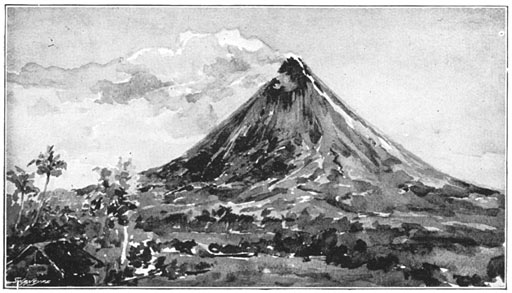
are gaily festooned with clustering creepers and flowering parasites of the most brilliant hues. The Mayon, which is an active
volcano, is comparatively bare, whilst also the Apo, although no longer in eruption, exhibits [14]abundant traces of volcanic action in acres of lava and blackened scoriae. Between the numberless forest-clad ranges are luxuriant
plains glowing in all the splendour of tropical vegetation. The valleys, generally of rich fertility, are about one-third
under cultivation.
There are numerous rivers, few of which are navigable by sea-going ships. Vessels drawing up to 13 feet can enter the Pasig
River, but this is due to the artificial means employed.
The principal Rivers are:—In Luzon Island the Rio Grande de Cagayán, which rises in the South Caraballo Mountain in the centre of the island, and runs in a tortuous
stream to the northern coast. It has two chief affluents, the Rio Chico de Cagayán and the Rio Magat, besides a number of
streams which find their way to its main course. Steamers of 11-feet draught have entered the Rio Grande, but the sand shoals
at the mouth are very shifty, and frequently the entrance is closed to navigation. The river, which yearly overflows its banks,
bathes the great Cagayan Valley,—the richest tobacco-growing district in the Colony. Immense trunks of trees are carried down
in the torrent with great rapidity, rendering it impossible for even small craft—the barangayanes—to make their way up or down the river at that period.
The Rio Grande de la Pampanga rises in the same mountain and flows in the opposite direction—southwards,—through an extensive
plain, until it empties itself by some 20 mouths into the Manila Bay. The whole of the Pampanga Valley and the course of the
river present a beautiful panorama from the summit of Arayat Mountain, which has an elevation of 2,877 feet above the sea
level.
The whole of this flat country is laid out into embanked rice fields and sugar-cane plantations. The towns and villages interspersed
are numerous. All the primeval forest, at one time dense, has disappeared; for this being one of the first districts brought
under European subjection, it supplied timber to the invaders from the earliest days of Spanish colonization.
The Rio Agno rises in a mountainous range towards the west coast about 50 miles N.N.W. of the South Caraballo—runs southwards
as far as lat. 16°, where it takes a S.W. direction down to lat. 15° 48′—thence a N.W. course up to lat. 16°, whence it empties
itself by two mouths into the Gulf of Lingayen. At the highest tides there is a maximum depth of 11 feet of water on the sand
bank at the E. mouth, on which is situated the port of Dagupan.
The Bicol River, which flows from the Bató Lake to the Bay of San Miguel, has sufficient depth of water to admit vessels of
small draught a few miles up from its mouth.
In Mindanao Island the Butuan River or Rio Agusan rises at a distance of about 25 miles from the southern coast and empties itself on the northern
coast, so that it nearly divides the island, and is navigable for a few miles from the mouth.
[15]
The Rio Grande de Mindanao rises in the centre of the island and empties itself on the west coast by two mouths, and is navigable
for some miles by light-draught steamers. It has a great number of affluents of little importance.
The only river in Negros Island of any appreciable extent is the Danao, which rises in the mountain range running down the centre of the island, and finds
its outlet on the east coast. At the mouth it is about a quarter of a mile wide, but too shallow to permit large vessels to
enter, although past the mouth it has sufficient depth for any ship. I went up this river, six hoursʼ journey in a boat, and
saw some fine timber near its banks in many places. Here and there it opens out very wide, the sides becoming mangrove swamps.
The most important Lakes are:—In Luzon Island the Bay Lake or Laguna de Bay, supplied by numberless small streams coming from the mountainous district around it. Its greatest
length from E. to W. is 25 miles, and its greatest breadth N. to S. 21 miles. In it there is a mountainous island—Talim,—of
no agricultural importance, and several islets. Its overflow forms the Pasig River, which empties itself into the Manila Bay.
Each wet season—in the middle of the year—the shores of this lake are flooded. These floods recede as the dry season approaches,
but only partially so from the south coast, which is gradually being incorporated into the lake bed.
Bombon Lake, in the centre of which is a volcano in constant activity, has a width E. to W. of 11 miles, and its length from
N. to S. is 14 miles. The origin of this lake is apparently volcanic. According to tradition it was formed by the terrific
upheaval of a mountain 7,000 or 8,000 feet high, in the year 1700. It is not supplied by any streams emptying themselves into
it (further than two insignificant rivulets), and it is connected with the sea by the Pansipít River, which flows into the
Gulf of Balayan at lat. 13° 52′ N.
Cagayán Lake, in the extreme N.E. of the island, is about 7 miles long by 5 miles broad.
Lake Bató, 3 miles across each way, and Lake Buhi, 3 miles N. to S. and 2½ miles wide, situated in the eastern extremity of
Luzon Island, are very shallow.
In the centre of Luzon Island, in the large valley watered by the above-mentioned Pampanga and Agno Rivers, are three lakes,
respectively Canarem, Mangabol, and Candava; the last two being lowland meres flooded and navigable by canoes in the rainy
season only.
In Mindoro Island there is one lake called Naujan, 2½ miles from the N.E. coast. Its greatest width is 3 miles, with 4 miles in length.
In Mindanao Island there are the Lakes Maguindanao or Boayan, in the centre of the island (20 miles E. to W. by 12 N. to S.); Lanao, 18 miles
distant from the north coast; Liguasan and Buluan towards the [16]south, connected with the Rio Grande de Mindanao, and a group of four small lakes on the Agusuan River.
The Lanao Lake has great historical associations with the struggles between Christians and Moslems during the period of the
Spanish dominion, and is to this day a centre of strife with the Americans.
In some of the straits dividing the islands there are strong currents, rendering navigation of sailing vessels very difficult,
notably in the San Bernadino Straits separating the Islands of Luzon and Sámar, the roadstead of Yloilo between Panay and
Guimarrás Islands, and the passage between the south points of Cebú and Negros Islands.
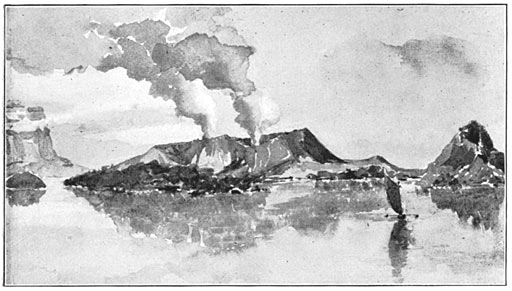
Most of the islets, if not indeed the whole Archipelago, are of volcanic origin. There are many volcanoes, two of them in
frequent intermittent activity, viz. the Mayon, in the extreme east of Luzon Island, and the Taal Volcano, in the centre of
Bombon Lake, 34 miles due south of Manila. Also in Negros Island the Canlaúan Volcano—N. lat. 10° 24′—is occasionally in visible
eruption. In 1886 a portion of its crater subsided, accompanied by a tremendous noise and a slight ejection of lava. In the
picturesque Island of Camiguín a volcano mountain suddenly arose from the plain in 1872.
The Mayon Volcano is in the north of the Province of Albay; hence it is popularly known as the Albay Volcano. Around its base there are several
towns and villages, the chief being Albay, the capital of the province; Cagsaua (called Darága) and Camáling on the one side,
and Malinao, Tobaco, etc., on the side facing the east coast. The earliest eruption recorded is that of 1616, mentioned by
Spilbergen. In 1769 there was a serious eruption, which destroyed the towns of Cagsaua and Malinao, besides several villages,
and devastated property within a radius of 20 miles. Lava and ashes were thrown out incessantly during two months, and cataracts
of water were formed. In 1811 loud subterranean noises were heard proceeding from the volcano, which caused the inhabitants
around to fear an early renewal of its activity, but their misfortune was postponed. On February 1, 1814,2 it burst with terrible violence. Cagsaua, Badiao, and three other towns were totally demolished. Stones and ashes were ejected
in all directions. The inhabitants fled to caves to shelter themselves. So sudden was the occurrence, that many natives were
overtaken by the volcanic projectiles and a few by lava streams. In Cagsaua nearly all property was lost. Father Aragoneses
estimates that 2,200 persons were killed, besides many being wounded.
Another eruption, remarkable for its duration, took place in 1881–82, and again in the spring of 1887; but only a small quantity
of ashes was thrown out, and did very little or no damage to the property in the surrounding towns and villages.
[17]
The eruption of July 9, 1888, severely damaged the towns of Libog and Legaspi; plantations were destroyed in the villages
of Bigaá and Bonco; several houses were fired, others had the roofs crushed in; a great many domestic animals were killed;
fifteen natives lost their lives, and the loss of live-stock (buffaloes and oxen) was estimated at 500. The ejection of lava
and ashes and stones from the crater continued for one night, which was illuminated by a column of fire.
The last great eruption occurred in May, 1897. Showers of red-hot lava fell like rain in a radius of 20 miles from the crater.
In the immediate environs about 400 persons were killed. In the village of Bacacay houses were entirely buried beneath the
lava, ashes, and sand. The road to the port of Legaspi was covered out of sight. In the important town of Tobaco there was
total darkness and the earth opened. Hemp plantations and a large number of cattle were destroyed. In Libog over 100 inhabitants
perished in the ruins. The hamlets of San Roque, Misericordia, and Santo Niño, with over 150 inhabitants, were completely
covered with burning débris. At night-time the sight of the fire column, heaving up thousands of tons of stones, accompanied by noises like the booming
of cannon afar off, was indescribably grand, but it was the greatest public calamity which had befallen the province for some
years past.
The mountain is remarkable for the perfection of its conic form. Owing to the perpendicular walls of lava formed on the slopes
all around, it would seem impossible to reach the crater. The elevation of the peak has been computed at between 8,200 and
8,400 feet. I have been around the base on the E. and S. sides, but the grandest view is to be obtained from Cagsaua (Darága).
On a clear night, when the moon is hidden, a stream of fire is distinctly seen to flow from the crest.
Taal Volcano is in the island of the Bombon Lake referred to above. The journey by the ordinary route from the capital would be about
60 miles. This volcano has been in an active state from time immemorial, and many eruptions have taken place with more or
less effect. The first one of historical importance appears to have occurred in 1641; again in 1709 the crater vomited fire
with a deafening noise; on September 21, 1716, it threw out burning stones and lava over the whole island from which it rises,
but so far no harm had befallen the villagers in its vicinity. In 1731 from the waters of the lake three tall columns of earth
and sand arose in a few days, eventually subsiding into the form of an island about a mile in circumference. In 1749 there
was a famous outburst which dilacerated the coniform peak of the volcano, leaving the crater disclosed as it now is. Being
only 850 feet high, it is remarkable as one of the lowest volcanoes in the world.
The last and most desolating of all the eruptions of importance occurred in the year 1754, when the stones, lava, ashes, and
waves of [18]the lake, caused by volcanic action, contributed to the utter destruction of the towns of Taal, Tanaúan, Sala, and Lipa, and
seriously damaged property in Balayán, 15 miles away, whilst cinders are said to have reached Manila, 34 miles distant in
a straight line. One writer says in his MS.,3 compiled 36 years after the occurrence, that people in Manila dined with lighted candles at midday, and walked about the
streets confounded and thunderstruck, clamouring for confession during the eight days that the calamity was visible. The author
adds that the smell of the sulphur and fire lasted six months after the event, and was followed by malignant fever, to which
half the inhabitants of the province fell victims. Moreover, adds the writer, the lake waters threw up dead alligators and
fish, including sharks.
The best detailed account extant is that of the parish priest of Sala at the time of the event.4 He says that about 11 oʼclock at night on August 11, 1749, he saw a strong light on the top of the Volcano Island, but did
not take further notice. At 3 oʼclock the next morning he heard a gradually increasing noise like artillery firing, which
he supposed would proceed from the guns of the galleon expected in Manila from Mexico, saluting the Sanctuary of Our Lady
of Cagsaysay whilst passing. He only became anxious when the number of shots he heard far exceeded the royal salute, for he
had already counted a hundred times, and still it continued. So he arose, and it occurred to him that there might be a naval
engagement off the coast. He was soon undeceived, for four old natives suddenly called out, “Father, let us flee!” and on
his inquiry they informed him that the island had burst, hence the noise. Daylight came and exposed to view an immense column
of smoke gushing from the summit of the volcano, and here and there from its sides smaller streams rose like plumes. He was
joyed at the spectacle, which interested him so profoundly that he did not heed the exhortations of the natives to escape
from the grand but awful scene. It was a magnificent sight to watch mountains of sand hurled from the lake into the air in
the form of erect pyramids, and then falling again like the stream from a fountain jet. Whilst contemplating this imposing
phenomenon with tranquil delight, a strong earthquake came and upset everything in the convent. Then he reflected that it
might be time to go; pillars of sand ascended out of the water nearer to the shore of the town, and remained erect, until,
by a second earthquake, they, with the trees on the islet, were violently thrown down and submerged in the lake. The earth
opened out here and there as far as the shores of the Laguna de Bay, and the lands of [19]Sala and Tanaúan shifted. Streams found new beds and took other courses, whilst in several places trees were engulfed in the
fissures made in the soil. Houses, which one used to go up into, one now had to go down into, but the natives continued to
inhabit them without the least concern. The volcano, on this occasion, was in activity for three weeks; the first three days
ashes fell like rain. After this incident, the natives extracted sulphur from the open crater, and continued to do so until
the year 1754.
In that year (1754), the same chronicler continues, between nine and ten oʼclock at night on May 15, the volcano ejected boiling
lava, which ran down its sides in such quantities that only the waters of the lake saved the people on shore from being burnt.
Towards the north, stones reached the shore and fell in a place called Bayoyongan, in the jurisdiction of Taal. Stones and
fire incessantly came from the crater until June 2, when a volume of smoke arose which seemed to meet the skies. It was clearly
seen from Bauan, which is on a low level about four leagues (14 miles) from the lake.
Matters continued so until July 10, when there fell a heavy shower of mud as black as ink. The wind changed its direction
and a suburb of Sala, called Balili, was swamped with mud. This phenomenon was accompanied by a noise so great that the people
of Batangas and Bauan, who that day had seen the galleon from Acapulco passing on her home voyage, conjectured that she had
saluted the Shrine of Our Lady of Cagsaysay on her way. The noise ceased, but fire still continued to issue from the crater
until September 25. Stones fell all that night; and the people of Taal had to abandon their homes, for the roofs were falling
in with the weight upon them. The chronicler was at Taal at this date, and in the midst of the column of smoke a tempest of
thunder and lightning raged and continued without intermission until December 4.
The night of All Saintsʼ day (Nov. 1) was a memorable one, for the quantity of falling fire-stones, sand, and ashes increased,
gradually diminishing again towards November 15. Then, on that night, after vespers, great noises were heard. A long melancholy
sound dinned in oneʼs ears; volumes of black smoke rose; an infinite number of stones fell, and great waves proceeded from
the lake, beating the shores with appalling fury. This was followed by another great shower of stones, brought up amidst the
black smoke, which lasted until 10 oʼclock at night. For a short while the devastation was suspended prior to the last supreme
effort. All looked half dead and much exhausted after seven months of suffering in the way described.5 It was resolved to remove the image of Our Lady of Cagsaysay and put in its place the second image of the Holy Virgin.
[20]
On November 29, from seven oʼclock in the evening, the volcano threw up more fire than all put together in the preceding seven
months. The burning column seemed to mingle with the clouds; the whole of the island was one ignited mass. A wind blew. And
as the priests and the mayor (Alcalde) were just remarking that the fire might reach the town, a mass of stones was thrown up with great violence; thunderclaps
and subterranean noises were heard; everybody looked aghast, and nearly all knelt to pray. Then the waters of the lake began
to encroach upon the houses, and the inhabitants took to flight, the natives carrying away whatever chattels they could. Cries
and lamentations were heard all around; mothers were looking for their children in dismay; half-caste women of the Parian
were calling for confession, some of them beseechingly falling on their knees in the middle of the streets. The panic was
intense, and was in no way lessened by the Chinese, who took to yelling in their own jargonic syllables.
After the terrible night of November 29 they thought all was over, when again several columns of smoke appeared, and the priest
went off to the Sanctuary of Cagsaysay, where the prior was. Taal was entirely abandoned, the natives having gone in all directions
away from the lake. On November 29 and 30 there was complete darkness around the lake vicinity, and when light reappeared
a layer of cinders about five inches thick was seen over the lands and houses, and it was still increasing. Total darkness
returned, so that one could not distinguish anotherʼs face, and all were more horror-stricken than ever. In Cagsaysay the
natives climbed on to the housetops and threw down the cinders, which were over-weighting the structures. On November 30 smoke
and strange sounds came with greater fury than anything yet experienced, while lightning flashed in the dense obscurity. It
seemed as if the end of the world was arriving. When light returned, the destruction was horribly visible; the church roof
was dangerously covered with ashes and earth, and the chronicler opines that its not having fallen in might be attributed
to a miracle! Then there was a day of comparative quietude, followed by a hurricane which lasted two days. All were in a state
of melancholy, which was increased when they received the news that the whole of Taal had collapsed; amongst the ruins being
the Government House and Stores, the Prison, State warehouses and the Royal Rope Walk, besides the Church and Convent.
The Gov.-General sent food and clothing in a vessel, which was nearly wrecked by storms, whilst the crew pumped and baled
out continually to keep her afloat, until at length she broke up on the shoals at the mouth of the Pansipit River. Another
craft had her mast split by a flash of lightning, but reached port.
With all this, some daft natives lingered about the site of the town of Taal till the last, and two men were sepulchred in
the Government House ruins. A woman left her house just before the roof [21]fell in and was carried away by a flood, from which she escaped, and was then struck dead by a flash of lightning. A man who
had escaped from Mussulman pirates, by whom he had been held in captivity for years, was killed during the eruption. He had
settled in Taal, and was held to be a perfect genius, for he could mend a clock!
The road from Taal to Balayan was impassable for a while on account of the quantity of lava. Taal, once so important as a
trading centre, was now gone, and Batangas, on the coast, became the future capital of the province.
The actual duration of this last eruption was 6 months and 17 days.
In 1780 the natives again extracted sulphur, but in 1790 a writer at that date6 says that he was unable to reach the crater owing to the depth of soft lava and ashes on the slopes.
There is a tradition current amongst the natives that an Englishman some years ago attempted to cut a tunnel from the base
to the centre of the volcanic mountain, probably to extract some metallic product or sulphur. It is said that during the work
the excavation partially fell in upon the Englishman, who perished there. The cave-like entrance is pointed out to travellers
as the Cueva del Inglés.
Referring to the volcano, Fray Gaspar de San Agustin in his History7 remarks as follows:—“The volcano formerly emitted many large fire-stones which destroyed the cotton, sweet potato and other
plantations belonging to the natives of Taal on the slopes of the (volcano) mountain. Also it happened that if three persons
arrived on the volcanic island, one of them had infallibly to die there without being able to ascertain the cause of this
circumstance. This was related to Father Albuquerque,8 who after a fervent deesis entreating compassion on the natives, went to the island, exorcised the evil spirits there and
blessed the land. A religious procession was made, and Mass was celebrated with great humility. On the elevation of the Host,
horrible sounds were heard, accompanied by groaning voices and sad lamentations; two craters opened out, one with sulphur
in it and the other with green water (sic), which is constantly boiling. The crater on the Lipa side is about a quarter of
a league wide; the other is smaller, and in time smoke began to ascend from this opening so that the natives, fearful of some
new calamity, went to Father Bartholomew, who repeated the ceremonies already described. Mass was said a second time, so that
since then the volcano has not thrown out any more fire or [22]smoke.9 However, whilst Fray Thomas Abresi was parish priest of Taal (about 1611), thunder and plaintive cries were again heard,
therefore the priest had a cross, made of Anobing wood, borne to the top of the volcano by more than 400 natives, with the
result that not only the volcano ceased to do harm, but the island has regained its original fertile condition.”
The Taal Volcano is reached with facility from the N. side of the island, the ascent on foot occupying about half an hour.
Looking into the crater, which would be about 4,500 feet wide from one border to the other of the shell, one sees three distinct
lakes of boiling liquid, the colours of which change from time to time. I have been up to the crater four times; the last
time the liquids in the lakes were respectively of green, yellow, and chocolate colours. At the time of my last visit there
was also a lava chimney in the middle, from which arose a snow-white volume of smoke.
The Philippine Islands have numberless creeks and bays forming natural harbours, but navigation on the W. coasts of Cebú,
Negros and Palaúan Islands is dangerous for any but very light-draught vessels, the water being very shallow, whilst there
are dangerous reefs all along the W. coast of Palaúan (Parágua) and between the south point of this island and Balábac Island.
The S.W. monsoon brings rain to most of the islands, and the wet season lasts nominally six months,—from about the end of
April. The other half of the year is the dry season. However, on those coasts directly facing the Pacific Ocean, the seasons
are the reverse of this.
The hottest season is from March to May inclusive, except on the coasts washed by the Pacific, where the greatest heat is
felt in June, July, and August. The temperature throughout the year varies but slightly, the average heat in Luzon Island
being about 81° 50′ Fahr. In the highlands of north Luzon, on an elevation above 4,000 feet, the maximum temperature is 78°
Fahr. and the minimum 46° Fahr. Zamboanga, which is over 400 miles south of Manila, is cooler than the capital. The average
number of rainy days in Luzon during the years 1881 to 1883 was 203.
Commencing July 11, 1904, three days of incessant rain in Rizal Province produced the greatest inundation of Manila suburbs
within living memory. Human lives were lost; many cattle were washed away; barges in the river were wrenched from their moorings
and dashed against the bridge piers; pirogues were used instead of vehicles in the thoroughfares; considerable damage was
done in the shops and many persons had to wade through the flooded streets knee-deep in water.
The climate is a continual summer, which maintains a rich verdure throughout the year; and during nine months of the twelve
an alternate [23]heat and moisture stimulates the soil to the spontaneous production of every form of vegetable life. The country generally
is healthy.
The whole of the Archipelago, as far south as 10° lat., is affected by the monsoons, and periodically disturbed by terrible
hurricanes, which cause great devastation to the crops and other property. The last destructive hurricane took place in September,
1905.
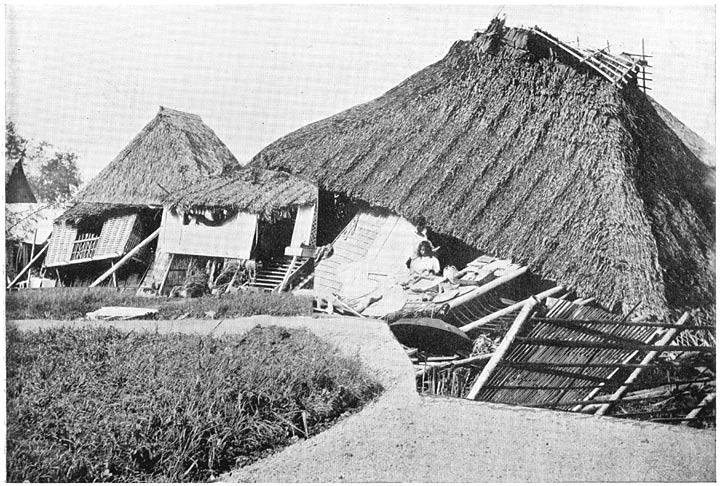
Earthquakes are also very frequent, the last of great importance having occurred in 1863, 1880, 1892, 1894, and 1897. In 1897
a tremendous tidal wave affected the Island of Leyte, causing great destruction of life and property. A portion of Taclóban,
the capital of the island, was swept away, rendering it necessary to extend the town in another direction.
In the wet season the rivers swell considerably, and often overflow their banks; whilst the mountain torrents carry away bridges,
cattle, tree trunks, etc., with terrific force, rendering travelling in some parts of the interior dangerous and difficult.
In the dry season long droughts occasionally occur (about once in three years), to the great detriment of the crops and live-stock.
The southern boundary of the Archipelago is formed by a chain of some 140 islands, stretching from the large island of Mindanao
as far as Borneo, and constitutes the Sulu Archipelago, the Sultanate of which was under the protection of Spain (vide Chap. xxix.). It is now being absorbed, under American rule, in the rest of the Archipelago, under the denomination of Moro Province
(q.v.).
[24]
Discovery of the Archipelago
The discoveries of Christopher Columbus in 1492, the adventures and conquests of Hernan Cortés, Blasco Nuñez de Balboa and
others in the South Atlantic, had awakened an ardent desire amongst those of enterprizing spirit to seek beyond those regions
which had hitherto been traversed. It is true the Pacific Ocean had been seen by Balboa, who crossed the Isthmus of Panamá,
but how to arrive there with his ships was as yet a mystery.
On April 10, 1495, the Spanish Government published a general concession to all who wished to search for unknown lands. This
was a direct attack upon the privileges of Columbus at the instigation of Fonseca, Bishop of Búrgos, who had the control of
the Indian affairs of the realm. Rich merchants of Cadiz and Seville, whose imagination was inflamed by the reports of the
abundance of pearls and gold on the American coast, fitted out ships to be manned by the roughest class of gold-hunters: so
great were the abuses of this common licence that it was withdrawn by Royal Decree of June 2, 1497.
It was the age of chivalry, and the restless cavalier who had won his spurs in Europe lent a listening ear to the accounts
of romantic glory and wealth attained across the seas. That an immense ocean washed the western shores of the great American
continent was an established fact. That there was a passage connecting the great Southern sea—the Atlantic—with that vast
ocean was an accepted hypothesis. Many had sought the passage in vain; the honour of its discovery was reserved for Hernando
de Maghallanes (Portuguese, Fernão da Magalhães).
This celebrated man was a Portuguese noble who had received the most complete education in the palace of King John II. Having
studied mathematics and navigation, at an early age he joined the Portuguese fleet which left for India in 1505 under the
command of Almeida. He was present at the siege of Malacca under the famous Albuquerque, and accompanied another expedition
to the rich Moluccas, or Spice Islands, when the Islands of Banda, Tidor, and Ternate were discovered. It was here he obtained
the information which led him to contemplate the voyage which he subsequently realized.
[25]
On his return to Portugal he searched the Crown Archives to see if the Moluccas were situated within the demarcation accorded
to Spain.1 In the meantime he repaired to the wars in Africa, where he was wounded in the knee, with the result that he became permanently
lame. He consequently retired to Portugal, and his companions in arms, jealous of his prowess, took advantage of his affliction
to assail him with vile imputations. The King Emmanuel encouraged the complaints, and accused him of feigning a malady of
which he was completely cured. Wounded to the quick by such an assertion, and convinced of having lost the royal favour, Maghallanes
renounced for ever, by a formal and public instrument, his duties and rights as a Portuguese subject, and henceforth became
a naturalized Spaniard. He then presented himself at the Spanish Court, at that time in Valladolid, where he was well received
by the King Charles I., the Bishop of Búrgos, Juan Rodriguez Fonseca, Minister of Indian Affairs, and by the Kingʼs chancellor.
They listened attentively to his narration, and he had the good fortune to secure the personal protection of His Majesty,
himself a well-tried warrior, experienced in adventure.
The Portuguese Ambassador, Alvaro de Acosta, incensed at the success of his late countryman, and fearing that the project
under discussion would lead to the conquest of the Spice Islands by the rival kingdom, made every effort to influence the
Court against him. At the same time he ineffectually urged Maghallanes to return to Lisbon, alleging that his resolution to
abandon Portuguese citizenship required the sovereign sanction. Others even meditated his assassination to save the interests
of the King of Portugal. This powerful opposition only served to delay the expedition, for finally the King of Portugal was
satisfied that his Spanish rival had no intention to authorize a violation of the Convention of Demarcation.
Between King Charles and Maghallanes a contract was signed in Saragossa by virtue of which the latter pledged himself to seek
the discovery of rich spice islands within the limits of the Spanish Empire. If he should not have succeeded in the venture
after ten years from the date of sailing he would thenceforth be permitted to navigate and trade without further royal assent,
reserving one-twentieth of his net gains for the Crown. The King accorded to him the title of Cavalier and invested him with
the habit of St. James and the hereditary government [26]in male succession of all the islands he might annex. The Crown of Castile reserved to itself the supreme authority over such
government. If Maghallanes discovered so many as six islands, he was to embark merchandise in the Kingʼs own ships to the
value of one thousand ducats as royal dues. If the islands numbered only two, he would pay to the Crown one-fifteenth of the
net profits. The King, however, was to receive one-fifth part of the total cargo sent in the first return expedition. The King would defray the expense of fitting out and arming five ships of from 60 to 130 tons with a total
crew of 234 men; he would also appoint captains and officials of the Royal Treasury to represent the State interests in the
division of the spoil.
Orders to fulfil the contract were issued to the Crown officers in the port of Seville, and the expedition was slowly prepared,
consisting of the following vessels, viz.: The commodore ship La Trinidad, under the immediate command of Maghallanes; the San Antonio, Captain Juan de Cartagena; the Victoria, Captain Luis de Mendoza; the Santiago, Captain Juan Rodriguez Serrano; and the Concepcion, Captain Gaspar de Quesada.
The little fleet had not yet sailed when dissensions arose.
Maghallanes wished to carry his own ensign, whilst Doctor Sancho Matienza insisted that it should be the Royal Standard.
Another, named Talero, disputed the question of who should be the standard-bearer. The King himself had to settle these quarrels
by his own arbitrary authority. Talero was disembarked and the Royal Standard was formally presented to Maghallanes by injunction
of the King in the Church of Santa Maria de la Victoria de la Triana, in Seville, where he and his companions swore to observe
the usages and customs of Castile, and to remain faithful and loyal to His Catholic Majesty.
On August 10, 1519, the expedition left the port of San Lúcar de Barrameda in the direction of the Canary Islands.
On December 13 they arrived safely at Rio Janeiro.
Following the coast in search of the longed-for passage to the Pacific Ocean, they entered the Solis River—so called because
its discoverer, João de Solis, a Portuguese, was murdered there. Its name was afterwards changed to that of Rio de la Plata
(the Silver River).
Continuing their course, the intense cold determined Maghallanes to winter in the next large river, known then as San Julian.
Tumults arose; some wished to return home; others harboured a desire to separate from the fleet, but Maghallanes had sufficient
tact to persuade the crews to remain with him, reminding them of the shame which would befall them if they returned only to
relate their failure. He added that, so far as he was concerned, nothing but death would deter him from executing the royal
commission.
As to the rebellious captains, Juan de Cartagena was already put in [27]irons and sentenced to be cast ashore with provisions, and a disaffected French priest for a companion. The sentence was carried
out later on. Then Maghallanes sent a boat to each of three of the ships to inquire of the captains whom they served. The
reply from all was that they were for the King and themselves. Thereupon 30 men were sent to the Victoria with a letter to Mendoza, and whilst he was reading it, they rushed on board and stabbed him to death. Quesada then brought
his ship alongside of the Trinidad, and, with sword and shield in hand, called in vain upon his men to attack. Maghallanes, with great promptitude, gave orders
to board Quesadaʼs vessel. The next day Quesada was executed. After these vigorous but justifiable measures, obedience was
ensured.
Still bearing southwards within sight of the coast, on October 28, 1520, the expedition reached and entered the seaway thenceforth
known as the Magellan Straits, dividing the Island of Tierra del Fuego from the mainland of Patagonia.2
On the way one ship had become a total wreck, and now the San Antonio deserted the expedition; her captain having been wounded and made prisoner by his mutinous officers, she was sailed in the
direction of New Guinea. The three remaining vessels waited for the San Antonio several days, and then passed through the Straits. Great was the rejoicing of all when, on November 26, 1520, they found
themselves on the Pacific Ocean! It was a memorable day. All doubt was now at an end as they cheerfully navigated across that
broad expanse of sea.
On March 16, 1521, the Ladrone Islands were reached. There the ships were so crowded with natives that they were obliged to
be expelled by force. They stole one of the shipʼs boats, and ninety men were sent on shore to recover it. After a bloody
combat the boat was regained, and the fleet continued its course westward until it hove to off an islet, then called Jomonjol,
now known as Malhou, situated in the channel between Sámar and Dinagat Islands (vide map). Then coasting along the north of the Island of Mindanao, they arrived at the mouth of the Butuan River, where they
were supplied with provisions by the chief. It was Easter week, and on this shore the first Mass was celebrated in the Philippines.
The natives showed great friendliness, in return for which Maghallanes took formal possession of their territory in the name
of Charles I. The chieftain himself volunteered to pilot the ships to a fertile island, the kingdom of a relation of his,
and, passing between the Islands of Bojol and Leyte, the expedition arrived on April 7 at Cebú, where, on receiving the news,
over two thousand men appeared on the beach in battle array with lances and shields.
The Butuan chief went on shore and explained that the expedition brought people of peace who sought provisions. The King agreed
to a [28]treaty, and proposed that it should be ratified according to the native formula—drawing blood from the breast of each party,
the one drinking that of the other. This form of bond was called by the Spaniards the Pacto de sangre, or the Blood compact (q.v.).
Maghallanes accepted the conditions, and a hut was built on shore in which to say Mass. Then he disembarked with his followers,
and the King, Queen, and Prince came to satisfy their natural curiosity. They appeared to take great interest in the Christian
religious rites and received baptism, although it would be venturesome to suppose they understood their meaning, as subsequent
events proved. The princes and headmen of the district followed their example, and swore fealty and obedience to the King
of Spain.
Maghallanes espoused the cause of his new allies, who were at war with the tribes on the opposite coast, and on April 25,
1521, he passed over to Magtan Island. In the affray he was mortally wounded by an arrow, and thus ended his brief but lustrous
career, which fills one of the most brilliant pages in Spanish annals.
Maghallanes called the group of islands, so far discovered, the Saint Lazarus Archipelago. In Spain they were usually referred
to as the Islas del Poniente, and in Portugal as the Islas del Oriente.
On the left bank of the Pasig River, facing the City of Manila, stands a monument to Maghallanesʼ memory. Another has been
erected on the spot in Magtan Island, where he is supposed to have been slain on April 27, 1521. Also in the city of Cebú,
near the beach, there is an obelisk to commemorate these heroic events.
It was perhaps well for Maghallanes to have ended his days out of reach of his royal master. Had he returned to Spain he would
probably have met a fate similar to that which befell Columbus after all his glories. The San Antonio, which, as already mentioned, deserted the fleet at the Magellan Straits, continued her voyage from New Guinea to Spain,
arriving at San Lúcar de Barrameda in March, 1521. The captain, Alvaro Mesquita, was landed as a prisoner, accused of having
seconded Maghallanes in repressing insubordination. To Maghallanes were ascribed the worst cruelties and infraction of the
royal instructions. Accused and accusers were alike cast into prison, and the King, unable to lay hands on the deceased Maghallanes,
sought this heroʼs wife and children. These innocent victims of royal vengeance were at once arrested and conveyed to Búrgos,
where the Court happened to be, whilst the San Antonio was placed under embargo.
On the decease of Maghallanes, the supreme command of the expedition in Cebú Island was assumed by Duarte de Barbosa, who,
with twenty-six of his followers, was slain at a banquet to which they had been invited by Hamabar, the King of the island.
Juan Serrano had so ingratiated himself with the natives during the sojourn on shore that his life was spared for a while.
Stripped of his raiment and armour, he was [29]conducted to the beach, where the natives demanded a ransom for his person of two cannons from the shipsʼ artillery. Those
on board saw what was passing and understood the request, but they were loath to endanger the lives of all for the sake of
one—”Melius est ut pereat unus quam ut pereat communitas” (Saint Augustine)—so they raised anchors and sailed out of the port, leaving Serrano to meet his terrible fate.
Due to sickness, murder during the revolts, and the slaughter in Cebú, the exploring party, now reduced to 100 souls all told,
was deemed insufficient to conveniently manage three vessels. It was resolved therefore to burn the most dilapidated one—the
Concepcion. At a general council, Juan Caraballo was chosen Commander-in-Chief of the expedition, with Gonzalo Gomez de Espinosa as
Captain of the Victoria. The royal instructions were read, and it was decided to go to the Island of Borneo, already known to the Portuguese and
marked on their charts. On the way they provisioned the ships off the coast of Palaúan Island (Parágua), and thence navigated
to within ten miles of the capital of Borneo (probably Brunei). Here they fell in with a number of native canoes, in one of
which was the Kingʼs secretary. There was a great noise with the sound of drums and trumpets, and the ships saluted the strangers
with their guns.
The natives came on board, embraced the Spaniards as if they were old friends, and asked them who they were and what they
came for. They replied that they were vassals of the King of Spain and wished to barter goods. Presents were exchanged, and
several of the Spaniards went ashore. They were met on the way by over two thousand armed men, and safely escorted to the
Kingʼs quarters. After satisfying his Majestyʼs numerous inquiries, Captain Espinosa was permitted to return with his companions.
He reported to Caraballo all he had seen, and in a council it was agreed that the town was too large and the armed men too
numerous to warrant the safety of a longer stay. However, being in need of certain commodities, five men were despatched to
the town. As days passed by, their prolonged absence caused suspicion and anxiety, so the Spaniards took in reprisal the son
of the King of Luzon Island, who had arrived there to trade, accompanied by 100 men and five women in a large prahu. The prince
made a solemn vow to see that the five Spaniards returned, and left two of his women and eight chiefs as hostages. Then Caraballo
sent a message to the King of Borneo, intimating that if his people were not liberated he would seize all the junks and merchandise
he might fall in with and kill their crews. Thereupon two of the retained Spaniards were set free, but, in spite of the seizure
of craft laden with silk and cotton, the three men remaining had to be abandoned, and the expedition set sail.
For reasons not very clear, Caraballo was deprived of the supreme command and Espinosa was appointed in his place, whilst
Juan Sebastian Elcano was elected Captain of the Victoria. With a native pilot, captured [30]from a junk which they met on the way, the ships shaped their course towards the Moluccas Islands, and on November 8, 1521,
they arrived at the Island of Tidor. Thus the essential object of the expedition was gained—the discovery of a western route
to the Spice Islands.
Years previous the Portuguese had opened up trade and still continued to traffic with these islands, which were rich in nutmegs,
cloves, cinnamon, ginger, sage, pepper, etc. It is said that Saint Francis Xavier had propagated his views amongst these islanders,
some of whom professed the Christian faith.
The King, richly attired, went out with his suite to receive and welcome the Spaniards. He was anxious to barter with them,
and when the Trinidad was consequently laden with valuable spices it was discovered that she had sprung a leak. Her cargo was therefore transferred
to the sister ship, whilst the Trinidad remained in Tidor for repairs, and Elcano was deputed to make the voyage home with the Victoria, taking the western route of the Portuguese in violation of the Treaty of Tordesillas. Elcanoʼs crew consisted of fifty-three
Europeans and a dozen natives of Tidor. The Victoria started for Spain at the beginning of the year 1522; passed through the Sunda Straits at great risk of being seized by the
Portuguese; experienced violent storms in the Mozambique Channel, and was almost wrecked rounding the Cape of Good Hope. A
few of the crew died—their only food was a scanty ration of rice—and in their extreme distress they put in at Santiago Island,
350 miles W. of Cape Verd, to procure provisions and beg assistance from the Portuguese Governor. It was like jumping into
the lionʼs mouth. The Governor imprisoned those who went to him, in defence of his Sovereignʼs treaty rights; he seized the
boat which brought them ashore; inquired of them where they had obtained the cargo; and projected the capture of the Victoria.
Captain Elcano was not slow to comprehend the situation; he raised anchor and cleared out of the harbour, and, as it had happened
several times before, those who had the misfortune to be sent ashore were abandoned by their countrymen.
The Victoria made the port of San Lúcar de Barrameda on September 6, 1522, so that in a little over three years Juan Sebastian Elcano
had performed the most notable voyage hitherto on record—it was the first yet accomplished round the world. It must, however,
be borne in mind that the discovery of the way to the Moluccas, going westward, was due to Maghallanes—of Portuguese birth—and
that the route thence to Europe, continuing westward, had long before been determined by the Portuguese traders, whose charts
Elcano used.
When Elcano and his 17 companions disembarked, their appearance was most pitiable—mere skeletons of men, weather-beaten and
famished. The City of Seville received them with acclamation; but their first act was to walk barefooted, in procession, holding
lighted [31]candles in their hands, to the church to give thanks to the Almighty for their safe deliverance from the hundred dangers which
they had encountered. Clothes, money, and all necessaries were supplied to them by royal bounty, whilst Elcano and the most
intelligent of his companions were cited to appear at Court to narrate their adventures. His Majesty received them with marked
deference. Elcano was rewarded with a life pension of 500 ducats (worth at that date about £112 10s.), and as a lasting remembrance
of his unprecedented feat, his royal master knighted him and conceded to him the right of using on his escutcheon a globe
bearing the motto, “Primus circundedit me.”
Two of Elcanoʼs officers, Miguel de Rodas and Francisco Alva, were each awarded a life pension of 50,000 maravedis (worth
at that time about 14 guineas), whilst the King ordered one-fourth of that fifth part of the cargo, which by contract with
Maghallanes belonged to the State Treasury, to be distributed amongst the crew, including those imprisoned in Santiago Island.
The cargo of the Victoria consisted of twenty-six and a half tons of cloves, a quantity of cinnamon, sandal wood, nutmegs, etc. Amongst the Tidor Islanders
who were presented to the King, one of them was not allowed to return to his native home, because he had carefully inquired
the value of the spices in the Spanish bazaars.
Meanwhile the Trinidad was repaired in Tidor and on her way to Panamá, when continued tempests and the horrible sufferings of the crew determined
them to retrace their course to the Moluccas. In this interval Portuguese ships had arrived there, and a fort was being constructed
to defend Portuguese interests against the Spaniards, whom they regarded as interlopers. The Trinidad was seized, and the Captain Espinosa with the survivors of his crew were granted a passage to Lisbon, which place they reached
five years after they had set out with Maghallanes.
The enthusiasm of King Charles was equal to the importance of the discoveries which gave renown to his subjects and added
glory to his Crown. Notwithstanding a protracted controversy with the Portuguese Court, which claimed the exclusive right
of trading with the Spice Islands, he ordered another squadron of six ships to be fitted out for a voyage to the Moluccas.
The supreme command was confided to Garcia Yofre de Loaisa, Knight of Saint John, whilst Sebastian Elcano was appointed captain
of one of the vessels. After passing through the Magellan Straits, the Commander Loaisa succumbed to the fatigues and privations
of the stormy voyage. Elcano succeeded him, but only for four days, when he too expired. The expedition, however, arrived
safely at the Moluccas Islands, where they found the Portuguese in full possession and strongly established, but the long
series of combats, struggles and altercations which ensued between the rival Powers, in which Captain Andrés de Urdaneta prominently
figured, left no decisive advantage to either nation.
[32]
But the King was in no way disheartened. A third expedition—the last under his auspices—was organized and despatched from
the Pacific Coast of Mexico by the Viceroy, by royal mandate. It was composed of two ships, two transports and one galley,
well manned and armed, chosen from the fleet of Pedro Alvarado, the late Governor of Guatemala. Under the leadership of Ruy
Lopez de Villalobos it sailed on November 1, 1542; discovered many small islands in the Pacific; lost the galley on the way,
and anchored off an island about 20 miles in circumference which was named Antonia. They found its inhabitants very hostile.
A fight ensued, but the natives finally fled, leaving several Spaniards wounded, of whom six died. Villalobos then announced
his intention of remaining here some time, and ordered his men to plant maize. At first they demurred, saying that they had
come to fight, not to till land, but at length necessity urged them to obedience, and a small but insufficient crop was reaped
in due season. Hard pressed for food, they lived principally on cats, rats, lizards, snakes, dogs, roots and wild fruit, and
several died of disease. In this plight a ship was sent to Mindanao Island, commanded by Bernado de la Torre, to seek provisions.
The voyage was fruitless. The party was opposed by the inhabitants, who fortified themselves, but were dislodged and slain.
Then a vessel was commissioned to Mexico with news and to solicit reinforcements. On the way, Volcano Island (of the Ladrone
Islands group) was discovered on August 6, 1543. A most important event followed. The island, now known as Sámar, was called
the Isla Philipina, and a galiot was built and despatched to the group (it is doubtful which), named by this expedition the Philippine Islands in honour of Philip, Prince of Asturias, the son of King Charles I., heir apparent to the throne of Castile, to which he
ascended in 1555 under the title of Philip II. on the abdication of his father.
The craft returned from the Philippine Islands laden with abundance of provisions, with which the ships were enabled to continue
the voyage.
By the royal instructions, Ruy Lopez de Villalobos was strictly enjoined not to touch at the Moluccas Islands, peace having
been concluded with Portugal. Heavy gales forced him nevertheless to take refuge at Gilolo. The Portuguese, suspicious of
his intentions in view of the treaty, arrayed their forces against his, inciting the King of the island also to discard all
Spanish overtures and refuse assistance to Villalobos. The discord and contentions between the Portuguese and Spaniards were
increasing; nothing was being gained by either party. Villalobos personally was sorely disheartened in the struggle, fearing
all the while that his opposition to the Portuguese in contravention of the royal instructions would only excite the Kingʼs
displeasure and lead to his own downfall. Hence he decided to capitulate with his rival and accepted a safe conduct for himself
and party to Europe in Portuguese ships. They arrived at Amboina Island, where Villalobos, already [33]crushed by grief, succumbed to disease. The survivors of the expedition, amongst whom were several priests, continued the
journey home via Cochin China, Malacca and Goa, where they embarked for Lisbon, arriving there in 1549.
In 1558 King Charles was no more, but the memory of his ambition outlived him. His son Philip, equally emulous and unscrupulous,
was too narrow-minded and subtly cautious to initiate an expensive enterprise encompassed by so many hazards—as materially
unproductive as it was devoid of immediate political importance. Indeed the basis of the first expedition was merely to discover
a Western route to the rich Spice Islands, already known to exist; the second went there to attempt to establish Spanish empire;
and the third to search for, and annex to, the Spanish Crown, lands as wealthy as those claimed by, and now yielded to, the
Portuguese.
But the value of the Philippine Islands, of which the possession was but recent and nominal, was thus far a matter of doubt.
One of the most brave and intrepid captains of the Loaisa expedition—Andrés de Urdaneta—returned to Spain in 1536. In former
years he had fought under King Charles I., in his wars in Italy, when the study of navigation served him as a favourite pastime.
Since his return from the Moluccas his constant attention was given to the project of a new expedition to the Far West, for
which he unremittingly solicited the royal sanction and assistance. But the King had grown old and weary of the world, and
whilst he did not openly discourage Urdanetaʼs pretensions he gave him no effective aid. At length, in 1553, two years before
Charles abdicated, Urdaneta, convinced of the futility of his importunity at the Spanish Court, and equally unsuccessful with
his scheme in other quarters, retired to Mexico, where he took the habit of an Augustine monk. Ten years afterwards King Philip,
inspired by the religious sentiment which pervaded his whole policy, urged his Viceroy in Mexico to fit out an expedition
to conquer and christianize the Philippine Islands. Urdaneta, now a priest, was not overlooked. Accompanied by five priests
of his Order, he was entrusted with the spiritual care of the races to be subdued by an expedition composed of four ships
and one frigate well armed, carrying 400 soldiers and sailors, commanded by a Basque navigator, Miguel Lopez de Legaspi. This
remarkable man was destined to acquire the fame of having established Spanish dominion in these Islands. He was of noble birth
and a native of the Province of Guipúzcoa in Spain. Having settled in the City of Mexico, of which place he was elected Mayor,
he there practised as a notary. Of undoubted piety, he enjoyed reputation for his justice and loyalty; hence he was appointed
General of the forces equipped for the voyage.
The favourite desire to possess the valuable Spice Islands still lurked in the minds of many Spaniards. Amongst them was Urdaneta,
[34]who laboured in vain to persuade the Viceroy of the superior advantages to be gained by annexing New Guinea instead of the
Philippines, whence the conquest of the Moluccas would be but a facile task. However, the Viceroy was inexorable and resolved
to fulfil the royal instructions to the letter, so the expedition set sail from the Mexican port of Navidad for the Philippine
Islands on November 21, 1564.
The Ladrone Islands were passed on January 9, 1565, and on the 13th of the following month the Philippines were sighted. A
call for provisions was made at several small islands, including Camiguín, whence the expedition sailed to Bojol Island. A
boat despatched to the port of Butuan returned in a fortnight with the news that there was much gold, wax, and cinnamon in
that district. A small vessel was also sent to Cebú, and on its return reported that the natives showed hostility, having
decapitated one of the crew whilst he was bathing.
Nevertheless, General Legaspi resolved to put in at Cebú, which was a safe harbour; and on the way there the ships anchored
off Limasana Island (to the south of Leyte). Thence, running south-west, the port of Dapítan (Mindanao Is.) was reached.
Prince Pagbuaya, who ruled there, was astonished at the sight of such formidable ships, and commissioned one of his subjects,
specially chosen for his boldness, to take note of their movements, and report to him. His account was uncommonly interesting.
He related that enormous men with long, pointed noses, dressed in fine robes, ate stones (hard biscuits), drank fire, and
blew smoke out of their mouths and through their nostrils. Their power was such that they commanded thunder and lightning
(discharge of artillery), and that at meal times they sat down at a clothed table. From their lofty port, their bearded faces,
and rich attire, they might have been the very gods manifesting themselves to the natives; so the Prince thought it wise to
accept the friendly overtures of such marvellous strangers. Besides obtaining ample provisions in barter for European wares,
Legaspi procured from this chieftain much useful information respecting the condition of Cebú. He learnt that it was esteemed
a powerful kingdom, of which the magnificence was much vaunted amongst the neighbouring states; that the roadstead was one
of great safety, and the most favourably situated amongst the islands of the painted faces.3
The General resolved, therefore, to filch it from its native king and annex it to the Crown of Castile.
He landed in Cebú on April 27, 1565, and negotiations were entered into with the natives of that island. Remembering, by tradition,
the pretensions of the Maghallanesʼ party, they naturally opposed this [35]renewed menace to their independence. The Spaniards occupied the town by force and sacked it, but for months were so harassed
by the surrounding tribes that a council was convened to discuss the prudence of continuing the occupation. The General decided
to remain; little by little the natives yielded to the new condition of things, and thus the first step towards the final
conquest was achieved. The natives were declared Spanish subjects, and hopeful with the success thus far attained, Legaspi
determined to send despatches to the King by the priest Andrés de Urdaneta, who safely arrived at Navidad on October 3, 1565,
and proceeded thence to Spain. In a letter written by Legaspi in 1567 he alluded, for the first time, to the whole archipelago
as the Islas Filipinas.
The pacification of Cebú and the adjacent islands was steadily and successfully pursued by Legaspi; the confidence of the
natives was assured, and their dethroned King Tupas accepted Christian baptism, whilst his daughter married a Spaniard.
In the midst of the invadersʼ felicity the Portuguese arrived to dispute the possession, but they were compelled to retire.
A fortress was constructed and plots of land were marked out for the building of the Spanish settlersʼ residences; and finally,
in 1570, Cebú was declared a city, after Legaspi had received from his royal master the title of Gov.-General of all the lands
which he might be able to conquer.
In May, 1570, Captain Juan Salcedo, Legaspiʼs grandson, was despatched to the Island of Luzon to reconnoitre the territory
and bring it under Spanish dominion.
The history of these early times is very confused, and there are many contradictions in the authors of the Philippine chronicles,
none of which seem to have been written contemporaneously with the first events. It appears, however, that Martin de Goiti
and a few soldiers accompanied Salcedo to the north. They were well received by the native chiefs or petty kings Lacandola,
Rajah of Tondo (known as Rajah Matandá, which means in native dialect the aged Rajah), and his nephew the young Rajah Soliman
of Manila.
The sight of a body of European troops armed as was the custom in the 16th century, must have profoundly impressed and overawed
these chieftains, otherwise it seems almost incredible that they should have consented, without protest, or attempt at resistance,
to (for ever) give up their territory, yield their independence, pay tribute,4 and become the tools of invading foreigners for the conquest of their own race without recompense whatsoever.
[36]
A treaty of peace was signed and ratified by an exchange of drops of blood between the parties thereto. Soliman, however,
soon repented of his poltroonery, and roused the war-cry among some of his tribes. To save his capital (then called Maynila)
falling into the hands of the invaders he set fire to it. Lacandola remained passively watching the issue. Soliman was completely
routed by Salcedo, and pardoned on his again swearing fealty to the King of Spain. Goiti remained in the vicinity of Manila
with his troops, whilst Salcedo fought his way to the Bombon Lake (Taal) district. The present Batangas Province was subdued
by him and included in the jurisdiction of Mindoro Island. During the campaign Salcedo was severely wounded by an arrow and
returned to Manila.
Legaspi was in the Island of Fanay when Salcedo (some writers say Goiti) arrived to advise him of what had occurred in Luzon.
They at once proceeded together to Cavite, where Lacandola visited Legaspi on board, and, prostrating himself, averred his
submission. Then Legaspi continued his journey to Manila, and was received there with acclamation. He took formal possession
of the surrounding territory, declared Manila to be the capital of the Archipelago, and proclaimed the sovereignty of the
King of Spain over the whole group of islands. Gaspar de San Agustin, writing of this period, says: “He (Legaspi) ordered
them (the natives) to finish the building of the fort in construction at the mouth of the river (Pasig) so that His Majestyʼs
artillery might be mounted therein for the defence of the fort and the town. Also he ordered them to build a large house inside
the battlement walls for Legaspiʼs own residence—another large house and church for the priests, etc. ... Besides these two
large houses, he told them to erect a hundred and fifty dwellings of moderate size for the remainder of the Spaniards to live
in. All this they promptly promised to do, but they did not obey, for the Spaniards were themselves obliged to terminate the
work of the fortifications.”
The City Council of Manila was constituted on June 24, 1571. On August 20, 1572, Miguel Lopez de Legaspi succumbed to the
fatigues of his arduous life, leaving behind him a name which will always hold a prominent place in Spanish colonial history.
He was buried in Manila in the Augustine Chapel of San Fausto, where hung the Royal Standard and the heroʼs armorial bearings
until the British troops occupied the city in 1763. A street in Manila and others in provincial towns bear [37]his name. Near the Luneta Esplanade, Manila, there is a very beautiful Legaspi (and Urdaneta) monument, erected shortly after
the Rebellion of 1896.
“Death makes no conquest of this conqueror,
For now he lives in fame, though not in life.”
Richard III., Act 3, Sc. 1.
In the meantime Salcedo continued his task of subjecting the tribes in the interior. The natives of Taytay and Cainta, in
the Spanish military district of Mórong, (now Rizal Province) submitted to him on August 15, 1571. He returned to the Laguna
de Bay to pacify the villagers, and penetrated as far as Camarines Norte to explore the Bicol River. Bolinao and the provinces
of Pangasinán and Ilocos yielded to his prowess, and in this last province he had well established himself when the defence
of the capital obliged him to return to Manila.
At the same time Martin de Goiti was actively employed in overrunning the Pampanga territory with the double object of procuring
supplies for the Manila camp and coercing the inhabitants on his way to acknowledge their new liege lord. It is recorded that
in this expedition Goiti was joined by the Rajahs of Tondo and Manila. Yet Lacandola appears to have been regarded more as
a servant of the Spaniards nolens volens than as a free ally, for, because he absented himself from Goitiʼs camp “without licence from the Maestre de Campo,” he was suspected by some writers of having favoured opposition to the Spaniardsʼ incursions in the Marshes of Hagonoy (Pampanga
coast, N. boundary of Manila Bay).
The district which constituted the ancient province of Taal y Balayan, subsequently denominated Province of Batangas, was
formerly governed by a number of caciques, the most notable of whom were Gatpagil and Gatjinlintan. They were usually at war
with their neighbours. Gatjinlintan, the cacique of the Batangas River (Pansipít?) at the time of the conquest, was famous
for his valour. Gatsun͠gayan, who ruled on the other side of the river, was celebrated as a hunter of deer and wild boar.
These men were half-castes of Borneo and Aeta extraction, who formed a distinct race called by the natives Daghagang. None
of them would submit to the King of Spain or become Christians, hence their descendants were offered no privileges.
The Aetas collected tribute. Gabriel Montoya, a Spanish soldier of Legaspiʼs legion, partially conquered those races, and
supported the mission of an Austin friar amongst them. This was probably Fray Diego Móxica, who undertook the mission of Batangas
on its separation from the local administration of Mindoro Island in 1581. The first Governor of San Pablo or Sampaloc in
the name of the King of Spain was appointed by the soldier Montoya, and was called Bartolomé Maghayin; the second was Cristóbal
Soman͠galit and the third was Bernabé Pindan, all of whom had adopted Christianity. Bay, on the [38]borders of the lake of that name, and four leagues from San Pablo, was originally ruled by the cacique Agustin Maglansan͠gan.
Calilayan, now called Tayabas, was founded by the woman Ladía, and subsequently administered by a native Alcalde, who gave such satisfaction that he was three times appointed the Kingʼs lieutenant and baptized as Francisco de San Juan.
San Pablo, the centre of a once independent district, is situated at the foot of the mountains of San Cristóbal and Banájao,
from which over fourteen streams of fresh water flow through the villages.
The system established by Juan Salcedo was to let the conquered lands be governed by the native caciques and their male successors
so long as they did so in the name of the King of Castile. Territorial possession seems to have been the chief aim of the
earliest European invaders, and records of having improved the condition of the people or of having opened up means of communication
and traffic as they went on conquering, or even of having explored the natural resources of the colony for their own benefit,
are extremely rare.
[39]
Philippine Dependencies, Up To 1898
The Ladrones, Carolines and Pelew Islands
In 1521 Maghallanes cast anchor off the Ladrone Islands (situated between 17° and 20° N. lat. by 146° E. long.) on his way
to the discovery of those Islands afterwards denominated the Philippines. This group was named by him Islas de las Velas.1 Legaspi called them the Ladrones.2 Subsequently several navigators sighted or touched at these Islands, and the indistinct demarcation which comprised them
acquired the name of Saint Lazarusʼ Archipelago.
In 1662 the Spanish vessel San Damian, on her course from Mexico to Luzon, anchored here. On board was a missionary, Fray Diego Luis de San Victores, who was so
impressed with the dejected condition of the natives, that on reaching Manila he made it his common theme of conversation.
In fact, so importunately did he pursue the subject with his superiors that he had to be constrained to silence. In the following
year the Governor, Diego Salcedo, replied to his urgent appeal for a mission there in terms which permitted no further solicitation
in that quarter. But the friar was persistent in his project, and petitioned the Archbishopʼs aid. The prelate submitted the
matter to King Philip IV., and the friar himself wrote to his father, who presented a memorial to His Majesty and another
to the Queen beseeching her influence. Consequently in 1666 a Royal Decree was received in Manila sanctioning a mission to
the Ladrones.
Fray Diego took his passage in the galleon San Diego, and having arrived safely in the Viceregal Court of Mexico, he pressed his views on the Viceroy, who declared that he had
no orders. Then the priest appealed to the Viceroyʼs wife, who, it is said, was entreating her husbandʼs help on bended knee,
when an earthquake occurred which considerably damaged the city. It was a manifestation from heaven, the wily priest avowed,
and the Viceroy, yielding to the superstition of the age, complied with the friarʼs request.
Therefore, in March, 1668, Fray Diego started from Acapulco in [40]charge of a Jesuit mission for the Ladrones, where they subsequently received a pension of ₱3,000 per annum from Queen Maria
Ana, who, meanwhile, had become a widow and Regent. To commemorate this royal munificence, these Islands have since been called
by the Spaniards “Islas Marianas,” although the older name—Ladrones—is better known to the world.
When the mission was fairly established, troops were sent there, consisting of twelve Spaniards and nineteen Philippine natives,
with two pieces of artillery.
The acquiescence of the Ladrone natives was being steadily gained by the old policy of conquest, under the veil of Christianity,
when they suddenly rebelled against the strangerʼs religion, which brought with it restraint of liberty and a social dominion
practically amounting to slavery. Fortunately, Nature came again to the aid of Fray Diego, for, whilst the natives were in
open revolt, a severe storm levelled their huts to the ground, and the priest having convinced them that it was a visitation
from heaven, peace was concluded.
Fray Diego left the mission for Visayas, where he was killed. After his departure the natives again revolted against servile
subjection, and many priests were slain from time to time—some in the exercise of their sacerdotal functions, others in open
warfare.
In 1778 a Governor was sent there from Mexico with thirty soldiers, but he resigned his charge after two yearsʼ service, and
others succeeded him.
The Islands are very poor. The products are Rice, Sago, Cocoanuts, and Cane-sugar to a small extent; there are also pigs and
fowls in abundance. The Spaniards taught the natives the use of fire. They were a warlike people; every man had to carry arms.
Their language is Chamorro, much resembling the Visayan dialect. The population, for a hundred years after the Spanish occupation,
diminished. Women purposely sterilised themselves. Some threw their new born offspring into the sea, hoping to liberate them
from a world of woe, and that they would regenerate in happiness. In the beginning of the 17th century the population was
further diminished by an epidemic disease. During the first century of Spanish rule, the Government were never able to exact
the payment of tribute. Up to the Spanish evacuation the revenue of these Islands was not nearly sufficient to cover the entire
cost of administration. About twenty years ago Governor Pazos was assassinated there by a rebellious group.
There were nine towns with parish priests. All the churches were built of stone, and roofed with reed thatching, except that
of the capital, which had an iron roof. Six of the towns had Town Halls made of bamboo and reed grass; one had a wooden building,
and in two of them (including the capital) the Town Halls were of stone.
[41]
The Seat of Government was at Agaña (called in old official documents the “City of San Ignacio de Agaña”). It is situated
in the Island of Guam, in the creek called the Port of Apra. Ships have to anchor about two miles off Punta Piti, where passengers,
stores, and mails are conveyed to a wooden landing-stage. Five hundred yards from here was the Harbour-masterʼs office, built
of stone, with a tile roof. From Punta Piti there was a bad road of about five miles. The situation of Agaña seems to be ill-suited
for communication with vessels, and proposals were ineffectually made by two Governors, since 1835, to establish the capital
town elsewhere. The central Government took no heed of their recommendations. In Agaña there was a Government House, a Military
Hospital and Pharmacy, an Artillery Dépôt and Infantry Barracks, a well-built Prison, a Town Hall, the Administratorʼs Office
(called by the natives “the shop”), and the ruins of former public buildings. It is a rather pretty town, but there is nothing
notable to be seen.
The natives are as domesticated as the Philippine Islanders, and have much better features. Spanish and a little English are
spoken by many of them, as these Islands in former years were the resort of English-speaking whalemen. For the Elementary
Education of the natives, there was the College of San Juan de Letran for boys, and a girlsʼ school in Agaña; and in 7 of
the towns there was, in 1888, a total of 4 schools for boys, 5 schools for girls, and 9 schools for both sexes, under the
direction of 20 masters and 6 mistresses.
When the Ladrone Islands (Marianas) were a dependency of the Spanish-Philippine General-Government, a subsidized mail steamer
left Manila for Agaña, and two or three other ports, every three months.
An island was discovered by one of the Spanish galleon pilots in 1686, and called Carolina, in honour of Charles II. of Spain, but its bearings could not be found again for years.
In 1696 two canoes, with 29 Pelew Islanders, drifted to the coast of Sámar Island, and landed at the Town of Guivan. They
were 60 days on the drift, and five of them died of privations. They were terror-stricken when they saw a man on shore making
signs to them. When he went out to them in a boat, and boarded one of the canoes, they all jumped out and got into the other;
then when the man got into that, they were in utter despair, considering themselves prisoners.
They were conducted to the Spanish priest of Guivan, whom they supposed would be the King of the Island, and on whom would
depend their lives and liberty. They prostrated themselves, and implored his mercy and the favour of sparing their lives,
whilst the priest did all he could, by signs, to reassure them.
It happened that there had been living here, for some years, two other strange men brought to this shore by currents and contrary
[42]winds. These came forward to see the novelty, and served as interpreters, so that the newcomers were all lodged in native
houses in twos and threes, and received the best hospitality.
They related that their Islands numbered 32, and only produced fowls and sea-birds. One man made a map, by placing stones
in the relative position of the Islands. When asked about the number of the inhabitants, one took a handful of sand to demonstrate
that they were countless. There was a King, they explained, who held his court in the Island of Lamurrec, to whom the chiefs
were subject. They much respected and obeyed him. Among the castaways was a chief, with his wife—the daughter of the King.
The men had a leaf-fibre garment around their loins, and to it was attached a piece of stuff in front, which was thrown over
the shoulders and hung loose at the back. The women were dressed the same as the men, except that their loin vestment reached
to their knees. The Kingʼs daughter wore, moreover, tortoise-shell ornaments.
They were afraid when they saw a cow and a dog, their Island having no quadrupeds. Their sole occupation consisted in providing
food for their families. Their mark of courtesy was to take the hand of the person whom they saluted and pass it softly over
the face.
The priest gave them pieces of iron, which they prized as if they had been of gold, and slept with them under their heads.
Their only arms were lances, with human bones for points. They seemed to be a pacific people, intelligent and well-proportioned
physically. Both sexes wore long hair down to their shoulders.
Very content to find so much luxury in Sámar, they offered to return and bring their people to trade. The Jesuits considered
this a capital pretext for subjecting their Islands, and the Government approved of it. At the instance of the Pope, the King
ordered the Gov.-General, Domingo Zabálburu, to send out expeditions in quest of these Islands; and, between 1708 and 1710,
several unsuccessful efforts were made to come across them. In 1710, two islands were discovered, and named San Andrés. Several
canoes arrived alongside of the ship, and the occupants accepted the Commanderʼs invitation to come on board. They were much
astonished to see the Spaniards smoke, and admired the iron fastenings of the vessel. When they got near shore, they all began
to dance, clapping their hands to beat time. They measured the ship, and wondered where such a large piece of wood could have
come from. They counted the crew, and presented them with cocoanuts, fish, and herbs from their canoes. The vessel anchored
near to the shore, but there was a strong current and a fresh wind blowing, so that it was imprudent to disembark. However,
two priests insisted upon erecting a cross on the shore, and were accompanied by the quarter-master and an officer of the
troops. The weather compelled the master to weigh anchor, and the vessel set sail, leaving [43]on land the four Europeans, who were ultimately murdered. For a quarter of a century these Islands were lost again to the
Spaniards.
In 1721 two Caroline prahus were wafted to the Ladrone Islands, where D. Luiz Sanchez was Governor. The Caroline Islanders
had no idea where they had landed, and were quite surprised when they beheld the priest. He forcibly detained these unfortunate
people, and handed them over to the Governor, whom they entreated, with tears—but all in vain—to be allowed to return to their
homes. There they remained prisoners, until it suited the Governorʼs convenience to send a vessel with a priest to their Island.
The priest went there, and thence to Manila, where a fresh expedition was fitted out. It was headed by a missionary, and included
a number of soldiers whom the natives massacred soon after their arrival. All further attempt to subdue the Caroline Islands
was necessarily postponed.
The natives, at that time, had no religion at all, or were, in a vague sense, polytheists. Their wise men communicated with
the souls of the defunct. They were polygamists, but had a horror of adultery. Divorce was at once granted by the chiefs on
proof of infidelity. They were cannibals. In each island there was a chief, regarded as a semi-spiritual being, to whom the
natives were profoundly obedient. Huts were found used as astrological schools, where also the winds and currents were studied.
They made cloth of plantain-fibre—hatchets with stone heads. Between sunset and sunrise they slept. When war was declared
between two villages or tribes, each formed three lines of warriors, 1st, young men; 2nd, tall men; 3rd, old men; then the
combatants pelted each other with stones and lances. A man hors de combat was replaced by one of the back file coming forward. When one party acknowledged themselves vanquished, it was an understood
privilege of the victors to shower invectives on their retiring adversaries. They lived on fruits, roots and fish. There were
no quadrupeds and no agriculture.
Many Spanish descendants were found, purely native in their habits, and it was remembered that about the year 1566, several
Spaniards from an expedition went ashore on some islands, supposed to be these, and were compelled to remain there.
The Carolines (“Islas Carolinas”) and Pelews (“Islas Palaos”) comprise some 48 groups of islands and islets, making a total
of about 500. Their relative position to the Ladrone Islands is—of the former, S.S.W. stretching to S.E.; of the latter, S.W.
Both groups lie due E. of Mindanao Island (vide map). The principal Pelew Islands are Babel-Druap and Kosor—Yap and Ponapé (Ascencion Is.) are the most important of the
Carolines. The centres of Spanish Government were respectively in Yap and Babel-Druap, with a Vice-Governor of the Eastern
Carolines in Ponapé—all formerly dependent on the General-Government in Manila. The Carolines and Pelews were included in
[44]the Bishopric of Cebú, and were subject, judicially, to the Supreme Court of Manila.
These Islands were subsequently many times visited by ships of other nations, and a barter trade gradually sprang up in dried
cocoanut kernels (coprah) for the extraction of oil in Europe and America. Later on, when the natives were thoroughly accustomed
to the foreigners, British, American, and German traders established themselves on shore, and vessels continued to arrive
with European and American manufactures in exchange for coprah, trepang, ivory-nuts, tortoise-shell, etc.
Anglo-American missionaries have settled there, and a great number of natives profess Christianity in the Protestant form.
Religious books in native dialect, published in Honolulu (Sandwich Is.) by the Hawaiian Evangelical Association, are distributed
by the American missionaries. I have one before me now, entitled “Kapas Fel, Puk Eu,” describing incidents from the Old Testament.
A few of the natives can make themselves understood in English. Besides coprah (the chief export) the Islands produce Rice,
Yams, Bread-fruit (rima), Sugar-cane, etc. Until 1886 there was no Government, except that of several petty kings or chiefs, each of whom still rules
over his own tribe, although the Protestant missionaries exercised a considerable social influence.
In 1885 a Spanish naval officer, named Capriles, having been appointed Governor of the Islands, arrived at Yap, ostensibly
with the object of landing to hoist the Spanish flag as a signal of possession, for it was known in official quarters that
the Germans were about to claim sovereignty. However, three days were squandered (perhaps intentionally) in trivial formalities,
and although two Spanish men-oʼ-war—the Manila and the San Quintin—were already anchored in the Port of Yap, the German warship Iltis entered, landed marines, and hoisted their national flag, whilst the Spaniards looked on. Then the German Commander went
on board the San Quintin to tell the Commander that possession of the Islands had been taken in the name of the Emperor of Germany. Neither Capriles,
the appointed Governor, nor España, the Commander of the San Quintin, made any resistance; and as we can hardly attribute their inactivity to cowardice, presumably they followed their Governmentʼs
instructions. Capriles and España returned to Manila, and were both rewarded for their inaction; the former being appointed
to the Government of Mindoro Island. In Manila an alarming report was circulated that the Germans contemplated an attack upon
the Philippines. Earthworks were thrown up outside the city wall; cannons were mounted, and the cry of invasion resounded
all over the Colony. Hundreds of families fled from the capital and environs to adjacent provinces, and the personal safety
of the German residents was menaced by individual patriotic enthusiasts.
In Madrid, popular riots followed the publication of the incident. The German Embassy was assaulted, and its escutcheon was
burnt in [45]the streets by the indignant mob, although, probably, not five per cent. of the rioters had any idea where the Caroline Islands
were situated, or anything about them. Spain acted so feebly, and Germany so vigorously, in this affair, that many asked—was
it not due to a secret understanding between the respective Ministries, disrupted only by the weight of Spanish public opinion?
Diplomatic notes were exchanged between Madrid and Berlin, and Germany, anxious to withdraw with apparent dignity from an
affair over which it was probably never intended to waste powder and shot, referred the question to the Pope, who arbitrated
in favour of Spain.
But for these events, it is probable that Spain would never have done anything to demonstrate possession of the Caroline Islands,
and for 16 months after the question was solved by Pontific mediation, there was a Spanish Governor in Yap—Sr. Elisa—a few
troops and officials, but no Government. No laws were promulgated, and everybody continued to do as heretofore.
In Ponapé (Ascencion Is.) Sr. Posadillo was appointed Governor. A few troops were stationed there under a sub-lieutenant,
whilst some Capuchin friars—European ecclesiastics of the meanest type—were sent there to compete with the American Protestant
missionaries in the salvation of nativesʼ souls. A collision naturally took place, and the Governor—well known to all of us
in Manila as crack-brained and tactless—sent the chief Protestant missionary, Mr. E. T. Doane, a prisoner to Manila on June
16, 1887.3 He was sent back free to Ponapé by the Gov.-General, but, during his absence, the eccentric Posadillo exercised a most arbitrary
authority over the natives. The chiefs were compelled to serve him as menials, and their subjects were formed into gangs,
to work like convicts; native teachers were suspended from their duties under threat, and the Capuchins disputed the possession
of land, and attempted to coerce the natives to accept their religion.
On July 1 the natives did not return to their bondage, and all the soldiers, led by the sub-lieutenant, were sent to bring
them in by force. A fight ensued, and the officer and troops, to the last man, were killed or mortally wounded by clubs, stones
and knives. The astonished Governor fortified his place, which was surrounded by the enemy. The tribes of the chiefs Nott
and Jockets were up in arms. There was the hulk Da. Maria de Molina anchored in the roadstead, and the Capuchins fled to it on the first alarm. The Governor escaped from his house on the night
of July 4 with his companions, and rushed to the sea, probably intending to swim out to the hulk. But who knows? He and all
his partisans were chased and killed by the natives.
On September 21 the news of the tragedy reached Manila by the man-oʼ-war San Quintin. About six weeks afterwards, three men-oʼ-war [46]were sent to Ponapé with infantry, artillery, a mountain battery, and a section of Engineers—a total of about 558 men—but
on their arrival they met an American warship—the Essex—which had hastened on to protect American interests. The Spaniards limited their operations to the seizure of a few accused
individuals, whom they brought to Manila, and the garrison of Yap was increased to 100 men, under a Captain and subordinate
officers. The prisoners were tried in Manila by court-martial, and I acted as interpreter. It was found that they had only
been loyal to the bidding of their chiefs, and were not morally culpable, whilst the action of the late Governor of Ponapé
met with general reprobation.
Again, in July, 1890, a party of 54 soldiers, under Lieutenant Porras, whilst engaged in felling timber in the forest, was
attacked by the Malatana (Caroline) tribe, who killed the officer and 27 of his men. The news was telegraphed to the Home
Government, and caused a great sensation in Madrid. A conference of Ministers was at once held, and the Cánovas del Castillo
Ministry cabled to the Gov.-General Weyler discretionary power to punish these islanders. Within a few months troops were
sent from Manila for that purpose. Instead, however, of chastising the Kanakas, the Government forces were repulsed by them with great slaughter. The commissariat arrangements were most deficient: my
friend Colonel Gutierrez Soto, who commanded the expedition, was so inadequately supported by the War Department that, yielding
to despair, and crestfallen by reason of the open and adverse criticism of his plan of campaign, he shot himself.
Under the Treaty of Paris (1898) the Island of Guam (Ladrone group) was ceded by Spain to the United States, together with
the Philippine Islands. The remainder of the Ladrone group, the Caroline and the Pelew Islands were sold by Spain to Germany
in June, 1899.
[47]
Attempted Conquest by Chinese
On the death of General Legaspi, the Government of the Colony was assumed by the Royal Treasurer, Guido de Lavezares, in conformity
with the sealed instructions from the Supreme Court of Mexico, which were now opened. During this period, the possession of
the Islands was unsuccessfully disputed by a rival expedition under the command of a Chinaman, Li-ma-hong, whom the Spaniards
were pleased to term a pirate, forgetting, perhaps, that they themselves had only recently wrested the country from its former
possessors by virtue of might against right. On the coasts of his native country he had indeed been a pirate. For the many
depredations committed by him against private traders and property, the Celestial Emperor, failing to catch him by cajolery,
outlawed him.
Born in the port of Tiuchiu, Li-ma-hong at an early age evinced a martial spirit and joined a band of corsairs which for a
long time had been the terror of the China coasts. On the demise of his chief he was unanimously elected leader of the buccaneering
cruisers. At length, pursued in all directions by the imperial ships of war, he determined to attempt the conquest of the
Philippines. Presumably the same incentives which impelled the Spanish mariners to conquer lands and overthrow dynasties—the
vision of wealth, glory and empire,—awakened a like ambition in the Chinese adventurer. It was the spirit of the age.1 In his sea-wanderings he happened to fall in with a Chinese trading junk returning from Manila with the proceeds of her cargo
sold there. This he seized, and the captive crew were constrained to pilot his fleet towards the capital of Luzon. From them
he learnt how easily the natives had been plundered by a handful of foreigners—the probable extent of the opposition he might
encounter—the defences established—the wealth and resources of the district, and the nature of its inhabitants.
[48]
His fleet consisted of 62 war ships or armed junks, well found, having on board 2,000 sailors, 2,000 soldiers, 1,500 women,
a number of artisans, and all that could be conveniently carried with which to gain and organize his new kingdom. On its way
the squadron cast anchor off the Province of Ilocos Sur, where a few troops were sent ashore to get provisions. Whilst returning
to the junks, they sacked the village and set fire to the huts. The news of this outrage was hastily communicated to Juan
Salcedo, who had been pacifying the Northern Provinces since July, 1572, and was at the time in Villa Fernandina (now called
Vigan). Li-ma-hong continued his course until calms compelled his ships to anchor in the roads of Caoayan (Ilocos coast),
where a few Spanish soldiers were stationed under the orders of Juan Salcedo, who still was in the immediate town of Vigan.
Under his direction preparations were made to prevent the enemy entering the river, but such was not Li-ma-hongʼs intention.
He again set sail; whilst Salcedo, naturally supposing his course would be towards Manila, also started at the same time for
the capital with all the fighting men he could collect, leaving only 30 men to garrison Vigan and protect the State interests
there.
On November 29, 1574, the squadron arrived in the Bay of Manila, and Li-ma-hong sent forward his Lieutenant Sioco—a Japanese—at
the head of 600 fighting men to demand the surrender of the Spaniards. A strong gale, however, destroyed several of his junks,
in which about 200 men perished.
With the remainder he reached the coast at Parañaque, a village seven miles south of Manila. Thence, with tow-lines, the 400
soldiers hauled their junks up to the beach of the capital.
Already at the village of Malate the alarm was raised, but the Spaniards could not give credit to the reports, and no resistance
was offered until the Chinese were within the gates of the city. Martin de Goiti, the Maestre de Campo,2 second in command to the Governor, was the first victim of the attack.
The flames and smoke arising from his burning residence were the first indications which the Governor received of what was
going on. The Spaniards took refuge in the Fort of Santiago, which the Chinese were on the point of taking by storm, when
their attention was drawn elsewhere by the arrival of fresh troops led by a Spanish sub-lieutenant. Under the mistaken impression
that these were the vanguard of a formidable corps, Sioco sounded the retreat. A bloody hand-to-hand combat followed, and
with great difficulty the Chinese collected their dead and regained their junks.
In the meantime Li-ma-hong, with the reserved forces, was lying in the roadstead of Cavite, and Sioco hastened to report to
him the result [49]of the attack, which had cost the invader over one hundred dead and more than that number wounded. Thereupon Li-ma-hong resolved
to rest his troops and renew the conflict in two daysʼ time under his personal supervision. The next day Juan Salcedo arrived
by sea with reinforcements from Vigan, and preparations were unceasingly made for the expected encounter. Salcedo having been
appointed to the office of Maestre de Campo, vacant since the death of Goiti, the organization of the defence was entrusted to his immediate care.
By daybreak on December 3 the enemyʼs fleet hove-to off the capital, where Li-ma-hong harangued his troops, whilst the cornets
and drums of the Spaniards were sounding the alarm for their fighting men to assemble in the fort.
Then 1,500 chosen men, well armed, were disembarked under the leadership of Sioco, who swore to take the place or die in the
attempt. Sioco separated his forces into three divisions. The city was set fire to, and Sioco advanced towards the fort, into
which hand-grenades were thrown, whilst Li-ma-hong supported the attack with his shipsʼ cannon.
Sioco, with his division, at length entered the fort, and a hand-to-hand fight ensued. For a while the issue was doubtful.
Salcedo fought like a lion. Even the aged Governor was well to the front to encourage the deadly struggle for existence. The
Spaniards finally gained the victory; the Chinese were repulsed with great slaughter, and their leader having been killed,
they fled in complete disorder. Salcedo, profiting by the confusion, now took the offensive and followed up the enemy, pursuing
them along the sea-shore, where they were joined by the third division, which had remained inactive. The panic of the Chinese
spread rapidly, and Li-ma-hong, in despair, landed another contingent of about 500 men, whilst he still continued afloat;
but even with this reinforcement the morale of his army could not be restored.
The Chinese troops therefore, harassed on all sides, made a precipitate retreat on board the fleet, and Li-ma-hong set sail
again for the west coast of the island. Foiled in the attempt to possess himself of Manila, Li-ma-hong determined to set up
his capital in other parts. In a few days he arrived at the mouth of the Agno River, in the province of Pangasinán, where
he proclaimed to the natives that he had gained a signal victory over the Spaniards. The inhabitants there, having no particular
choice between two masters, received Li-ma-hong with welcome, and he thereupon set about the foundation of his new capital
some four miles from the mouth of the river. Months passed before the Spaniards came in force to dislodge the invader. Feeling
themselves secure in their new abode, the Chinese had built many dwellings, a small fortress, a pagoda, etc. At length an
expedition was despatched under the command of Juan Salcedo. This was composed of about 250 Spaniards and 1,600 natives well
equipped with small arms, ammunition and artillery. The flower of [50]the Spanish Colony, accompanied by two priests and the Rajah of Tondo, set out to expel the formidable foe. Li-ma-hong made
a bold resistance, and refused to come to terms with Salcedo. In the meantime, the Viceroy of Fokien, having heard of Li-ma-hongʼs
daring exploits, had commissioned a ship of war to discover the whereabouts of his imperial masterʼs old enemy. The envoy
was received with delight by the Spaniards, who invited him to accompany them to Manila to interview the Governor.
Li-ma-hong still held out, but perceiving that an irresistible onslaught was being projected against him by Salcedoʼs party,
he very cunningly and quite unexpectedly slipped away, and sailed out of the river with his ships by one of the mouths unknown
to his enemies.3 In order to divert the attention of the Spaniards, Li-ma-hong ingeniously feigned an assault in an opposite quarter. Of course,
on his escape, he had to abandon the troops employed in this manoeuvre. These, losing all hope, and having indeed nothing
but their lives to fight for, fled to the mountains. Hence it is popularly supposed that from these fugitives descends the
race of people in the hill district north of that province still distinguishable by their oblique eyes and known by the name
of Igorrote-Chinese.
“Aide-toi et Dieu tʼaidera” is an old French maxim, but the Spaniards chose to attribute their deliverance from their Chinese rivals to the friendly
intervention of Saint Andrew. This Saint was declared thenceforth to be the Patron Saint of Manila, and in his honour High
Mass was celebrated in the Cathedral at 8 a.m. on the 30th of each November. In Spanish times it was a public holiday and
gala-day, when all the highest civil, military and religious authorities attended the Funcion votiva de San Andrés. This opportunity to assert the supremacy of ecclesiastical power was not lost to the Church, and for many years it was the
custom, after hearing Mass, to spread the Spanish national flag on the floor of the Cathedral for the metropolitan Archbishop
to walk over it. However, a few years prior to the Spanish evacuation the Gov.-General refused to witness this antiquated
formula and it subsequently became the practice to carry the Royal Standard before the altar. Both before and after the Mass,
the bearer (Alférez Real), wearing his hat and accompanied by the Mayor of the City, stood on the altar floor, raised his hat three times, and three
times dipped the flag before the Image of Christ, then, facing the public, he repeated this ceremony. On Saint Andrewʼs Eve
the Royal Standard was borne in procession from the Cathedral through the principal streets of the city, escorted by civil
functionaries and followed by a band of music. This ceremony was known as the Paseo del Real Pendon.
[51]
According to Juan de la Concepcion, the Rajahs4 Soliman and Lacandola took advantage of these troubles to raise a rebellion against the Spaniards. The natives, too, of Mindoro
Island revolted and maltreated the priests, but all these disturbances were speedily quelled by a detachment of soldiers.
The Governor willingly accepted the offer of the commander of the Chinese man-oʼ-war to convey ambassadors to his country
to visit the Viceroy and make a commercial treaty. Therefore two priests, Martin Rada and Gerónimo Martin, were commissioned
to carry a letter of greeting and presents to this personage, who received them with great distinction, but objected to their
residing in the country.
After the defeat of Li-ma-hong, Juan Salcedo again set out to the Northern Provinces of Luzon Island, to continue his task
of reducing the natives to submission. On March 11, 1576, he died of fever near Vigan (then called Villa Fernandina), capital
of the Province of Ilocos Sur. A year afterwards, what could be found of his bones were placed in the ossuary of his illustrious
grandfather, Legaspi, in the Augustine Chapel of Saint Fausto, Manila. His skull, however, which had been carried off by the
natives of Ilocos, could not be recovered in spite of all threats and promises. In Vigan there is a small monument raised
to commemorate the deeds of this famous warrior, and there is also a street bearing his name in Vigan and another in Manila.
For several years following these events, the question of prestige in the civil affairs of the Colony was acrimoniously contested
by the Gov.-General, the Supreme Court, and the ecclesiastics.
The Governor was censured by his opponents for alleged undue exercise of arbitrary authority. The Supreme Court, established
on the Mexican model, was reproached with seeking to overstep the limits of its functions. Every legal quibble was adjusted
by a dilatory process, impracticable in a colony yet in its infancy, where summary justice was indispensable for the maintenance
of order imperfectly understood by the masses. But the fault lay less with the justices than with the constitution of the
Court itself. Nor was this state of affairs improved by the growing discontent and immoderate ambition of the clergy, who
unremittingly urged their pretensions to immunity from State control, affirming the supramundane condition of their office.
An excellent code of laws, called the Leyes de Indias, in force in Mexico, was adopted here, but modifications in harmony with the special conditions of this Colony were urgently
necessary, whilst all the branches of government called for reorganization or reform. Under these circumstances, the Bishop
of Manila, Domingo Salazar,5 took the [52]initiative in commissioning an Austin friar, Alonso Sánchez, to repair firstly to the Viceroy of Mexico and afterwards to
the King of Spain, to expose the grievances of his party.
Alonso Sánchez left the Philippines with his appointment as procurator-general for the Augustine Order of monks. As the execution
of the proposed reforms, which he was charged to lay before His Majesty, would, if conceded, be entrusted to the control of
the Government of Mexico, his first care was to seek the partisanship of the Viceroy of that Colony; and in this he succeeded.
Thence he continued his journey to Seville, where the Court happened to be, arriving there in September, 1587. He was at once
granted an audience of the King, to present his credentials and memorials relative to Philippine affairs in general, and ecclesiastical,
judicial, military and native matters in particular. The King promised to peruse all the documents, but suffering from gout,
and having so many and distinct State concerns to attend to, the negotiations were greatly delayed. Finally, Alonso Sánchez
sought a minister who had easy access to the royal apartments, and this personage obtained from the King permission to examine
the documents and hand to him a succinct résumé of the whole for His Majestyʼs consideration. A commission was then appointed, including Sánchez, and the deliberations lasted
five months.
At this period, public opinion in the Spanish Universities was very divided with respect to Catholic missions in the Indies.
Some maintained that the propaganda of the faith ought to be purely Apostolic, such as Jesus Christ taught to His disciples,
inculcating doctrines of humility and poverty without arms or violence; and if, nevertheless, the heathens refused to welcome
this mission of peace, the missionaries should simply abandon them in silence without further demonstration than that of shaking
the dust off their feet.
Others held, and amongst them was Sánchez, that such a method was useless and impracticable, and that it was justifiable to
force their religion upon primitive races at the point of the sword if necessary, using any violence to enforce its acceptance.
Much ill-feeling was aroused in the discussion of these two and distinct theories. Juan Volante, a Dominican friar of the
Convent of Our Lady of Atocha, presented a petition against the views of the Sánchez faction, declaring that the idea of ingrafting
religion with the aid of arms was scandalous. Juan Volante was so importunate that he had to be heard in Council, but neither
party yielded. At length, the intervention of the Bishops of Manila, Macao and Malacca and several captains and governors
in the Indies influenced the King to put an end to the controversy, on the ground that it would lead to no good.
The King retired to the Monastery of the Escorial, and Sánchez was cited to meet him there to learn the royal will. About
the same time the news reached the King of the loss of the so-called Invincible Armada, [53]sent under the command of the incompetent Duke of Medina Sidonia to annex England. Notwithstanding this severe blow to the
vain ambition of Philip, the affairs of the Philippines were delayed but a short time. On the basis of the recommendation
of the junta, the Royal Assent was given to an important decree, of which the most significant articles are the following,
namely:—The tribute was fixed by the King at ten reales (5s.) per annum, payable by the natives in gold, silver or grain,
or part in one commodity and part in the other. Of this tribute, eight reales were to be paid to the Treasury, one-half real
to the bishop and clergy (sanctorum tax), and one-and-a-half reales to be applied to the maintenance of the soldiery. Full tribute was not to be exacted from
the natives still unsubjected to the Crown. Until their confidence and loyalty should be gained by friendly overtures, they
were to pay a small recognition of vassalage, and subsequently the tribute in common with the rest.
Instead of one-fifth value of gold and hidden treasure due to His Majesty (real quinto), he would thenceforth receive only one-tenth of such value, excepting that of gold, which the natives would be permitted
to extract free of rebate.
A customs duty of three per cent. ad valorem was to be paid on merchandise sold, and this duty was to be spent on the army.
Export duty was to be paid on goods shipped to New Spain (Mexico), and this impost was also to be exclusively spent on the
armed forces. These goods were chiefly Chinese manufactures.
The number of European troops in the Colony was fixed at 400 men-at-arms, divided into six companies, each under a captain,
a sublieutenant, a sergeant, and two corporals. Their pay was to be as follows, namely:—Captain ₱35, sub-lieutenant ₱20, sergeant
₱10, corporal ₱7, rank and file ₱6 per month; besides which, an annual gratuity of ₱10,000 was to be proportionately distributed
to all.
Recruits from Mexico, for military service in the Islands, were not to enlist under the age of 15 years.
The Captain-General was to have a body-guard of 24 men (Halberdiers) with the pay of those of the line, under the immediate
command of a Captain to be paid ₱15 per month.
Salaries due to State employees were to be punctually paid when due; and when funds were wanted for that purpose, they were
to be supplied from Mexico.
The King made a donation of ₱12,000, which, with another like sum to be contributed by the Spaniards themselves, would serve
to liquidate their debts incurred on their first occupation of the Islands.
The Governor and Bishop were recommended to consider the project of a refuge for young Spanish women arrived from Spain and
Mexico, and to study the question of dowries for native women married to poor Spaniards.
[54]
The offices of Secretaries and Notaries were no longer to be sold, but conferred on persons who merited such appointments.
The governors were instructed not to make grants of land to their relations, servants or friends, but solely to those who
should have resided at least three years in the Islands, and have worked the lands so conceded. Any grants which might have
already been made to the relations of the governors or magistrates were to be cancelled.
The rent paid by the Chinese for the land they occupied was to be applied to the necessities of the capital.
The Governor and Bishop were to enjoin the judges not to permit costly lawsuits, but to execute summary justice verbally,
and so far as possible, fines were not to be inflicted.
The City of Manila was to be fortified in a manner to ensure it against all further attacks or risings.
Four penitentiaries were to be established in the Islands in the most convenient places, with the necessary garrisons, and
six to eight galleys and frigates well armed and ready for defence against the English corsairs who might come by way of the
Moluccas.
In the most remote and unexplored parts of the Islands, the Governor was to have unlimited powers to act as he should please,
without consulting His Majesty; but projected enterprises of conversion, pacification, etc., at the expense of the Royal Treasury,
were to be submitted to a Council comprising the Bishop, the captains, etc. The Governor was authorized to capitulate and
agree with the captain and others who might care to undertake conversions and pacifications on their own account, and to concede
the title of Maestre de Campo to such persons, on condition that such capitulations should be forwarded to His Majesty for ratification.
Only those persons domiciled in the Islands would be permitted to trade with them.
A sum of ₱1,000 was to be taken from the tributes paid into the Royal Treasury for the foundation of the Hospital for the
Spaniards, and the annual sum of ₱600, appropriated by the Governor for its support, was confirmed. Moreover, the Royal Treasury
of Mexico was to send clothing to the value of 400 ducats for the Hospital use.
The Hospital for the natives was to receive an annual donation of ₱600 for its support, and an immediate supply of clothing
from Mexico to the value of ₱200.
Slaves held by the Spaniards were to be immediately set at liberty. No native was thenceforth to make slaves. All new-born
natives were declared free. The bondage of all existing slaves from ten years of age was to cease on their attaining twenty
years of age. Those above twenty years of age were to serve five years longer, and then become free. At any time, notwithstanding
the foregoing conditions, they would be entitled to purchase their liberty, [55]the price of which was to be determined by the Governor and the Bishop.6
There being no tithes payable to the Church by Spaniards or natives, the clergy were to receive for their maintenance the
half-real above mentioned in lieu thereof, from the tribute paid by each native subjected to the Crown. When the Spaniards
should have crops, they were to pay tithes to the clergy (diezmos prediales).
A grant was made of 12,000 ducats for the building and ornaments of the Cathedral of Manila, and an immediate advance of 2,000
ducats on account of this grant was made from the funds to be remitted from Mexico.
Forty Austin friars were to be sent at once to the Philippines, to be followed by missionaries from other corporations. The
King allowed ₱500 to be paid against the ₱1,000 passage money for each priest, the balance to be defrayed out of the common
funds of the clergy, derived from their share of the tribute.
Missionaries in great numbers had already flocked to the Philippines and roamed wherever they thought fit, without licence
from the Bishop, whose authority they utterly repudiated.
Affirming that they had the direct consent of His Holiness the Pope, they menaced with excommunication whosoever attempted
to impede them in their free peregrination. Five years after the foundation of Manila, the city and environs were infested
with niggardly mendicant friars, whose slothful habits placed their supercilious countrymen in ridicule before the natives.
They were tolerated but a short time in the Islands; not altogether because of the ruin they would have brought to European
moral influence on the untutored tribes, but because the Bishop was highly jealous of all competition against the Augustine
Order which he assisted. Consequent on the representations of Alonso Sánchez, His Majesty ordained that all priests who went
to the Philippines were, in the first place, to resolve never to quit the Islands without the Bishopʼs sanction, which was
to be conceded with great circumspection and only in extreme cases, whilst the Governor was instructed not to afford them
means of exit on his sole authority.
Neither did the Bishop regard with satisfaction the presence of the Commissary of the Inquisition, whose secret investigations,
shrouded with mystery, curtailed the liberty of the loftiest functionary, sacred or civil. At the instigation of Alonso Sánchez,
the junta recommended the King to recall the Commissary and extinguish the office, but [56]he refused to do so. In short, the chief aims of the Bishop were to enhance the power of the friars, raise the dignity of
the Colonial mitre, and secure a religious monopoly for the Augustine Order.
Gomez Perez Dasmariñas was the next Governor appointed to these Islands, on the recommendation of Alonso Sánchez. In the Royal
Instructions which he brought with him were embodied all the above-mentioned civil, ecclesiastical and military reforms. At
the same time, King Philip abolished the Supreme Court. He wished to put an end to the interminable lawsuits so prejudicial
to the development of the Colony. Therefore the President and Magistrates were replaced by Justices of the Peace, and the
former returned to Mexico in 1591. This measure served only to widen the breach between the Bishop and the Civil Government.
Dasmariñas compelled him to keep within the sphere of his sacerdotal functions, and tolerated no rival in State concerns.
There was no appeal on the spot against the Governorʼs authority. This restraint irritated and disgusted the Bishop to such
a degree that, at the age of 78 years, he resolved to present himself at the Spanish Court. On his arrival there, he explained
to the King the impossibility of one Bishop attending to the spiritual wants of a people dispersed over so many Islands. For
seven years after the foundation of Manila as capital of the Archipelago, its principal church was simply a parish church.
In 1578 it was raised to the dignity of a Cathedral, at the instance of the King. Three years after this date the Cathedral
of Manila was solemnly declared to be a “Suffragan Cathedral of Mexico, under the advocation of Our Lady of the Immaculate
Conception”; Domingo Salazár being the first Bishop consecrated. He now proposed to raise the Manila See to an Archbishopric,
with three Suffragan Bishops. The King gave his consent, subject to approval from Rome, and this following in due course,
Salazár was appointed first Archbishop of Manila, but he died before the Papal Bull arrived, dated August 14, 1595, officially
authorizing his investiture.
In the meantime, Alonso Sánchez had proceeded to Rome in May, 1589. Amongst many other Pontifical favours conceded to him,
he obtained the right for himself, or his assigns, to use a die or stamp of any form with one or more images, to be chosen
by the holder, and to contain also the figure of Christ, the Very Holy Virgin, or the Saints Peter or Paul. On the reverse
was to be engraven a bust portrait of His Holiness, with the following indulgences attached thereto, viz.:—“To him who should
convey the word of God to the infidels, or give them notice of the holy mysteries—each time 300 yearsʼ indulgence. To him
who, by industry, converted any one of these, or brought him to the bosom of the Church—full indulgence for all sins.” A number
of minor indulgences were conceded for services to be rendered to the Pontificate, and for the praying so many Pater Nosters
and Ave Marias. This Bull was dated in Rome July 28, 1591.
[57]
Popes Gregory XIV. and Innocent IX. granted other Bulls relating to the rewards for using beads, medals, crosses, pictures,
blessed images, etc., with which one could gain nine plenary indulgences every day or rescue nine souls from purgatory; and
each day, twice over, all the full indulgences yet given in and out of Rome could be obtained for living and deceased persons.
Sánchez returned to Spain (where he died), bringing with him the body of Saint Policarp, relics of Saint Potenciana, and 157
Marytrs; amongst them, 27 popes, for remission to the Cathedral of Manila.
The Supreme Court was re-established with the same faculties as those of Mexico and Lima in 1598, and since then, on seven
occasions, when the Governorship has been vacant, it has acted pro tem. The following interesting account of the pompous ceremonial attending the reception of the Royal Seal, restoring this Court,
is given by Concepcion.7 He says:—“The Royal Seal of office was received from the ship with the accustomed solemnity. It was contained in a chest
covered with purple velvet and trimmings of silver and gold, over which hung a cloth of silver and gold. It was escorted by
a majestic accompaniment, marching to the sounds of clarions and cymbals and other musical instruments. The cortége passed through the noble city with rich vestments, with leg trimmings and uncovered heads. Behind these followed a horse,
gorgeously caparisoned and girthed, upon whose back the President placed the coffer containing the Royal Seal. The streets
were beautifully adorned with exquisite drapery. The High Bailiff, magnificently robed, took the reins in hand to lead the
horse under a purple velvet pall, bordered with gold. The magistrates walked on either side; the aldermen of the city, richly
clad, carried their staves of office in the august procession, which concluded with a military escort, standard bearers, etc.,
and proceeded to the Cathedral, where it was met by the Dean, holding a Cross. As the company entered the sacred edifice,
the Te Deum was intoned by a band of music.”
In 1886 a Supreme Court, exactly similar to, and independent of, that of Manila, was established in the City of Cebú. The
question of precedence in official acts having been soon after disputed between the President of the Court and the Brigadier-Governor
of Visayas, it was decided in favour of the latter, on appeal to the Gov.-General. In the meantime, the advisability of abolishing
the Supreme Court of Cebú, was warmly debated by the public.
For many years after the conquest, deep religious sentiment pervaded the State policy, and not a few of the Governors-General
acquired fame for their demonstrations of piety. Nevertheless, the conflictive ambition [58]of the State and Church representatives was a powerful hindrance to the progress of the Colony.
The quarrel between Sebastian Hurtado de Corcuera (1635–44) and the Archbishop arose from a circumstance of little concern
to the Colony. The Archbishop ordered a military officer, who had a slave, either to sell or liberate her. The officer, rather
than yield to either condition, wished to marry her, but failing to obtain her consent, he stabbed her to death. He thereupon
took asylum in a convent, whence he was forcibly removed, and publicly executed in front of Saint Augustineʼs Church by order
of the Governor. The Archbishop protested against the act, which, in those days, was qualified as a violation of sanctuary.
The churches were closed whilst the dispute lasted. The Jesuits, always opposed to the Austin friars, sided with the Governor.
The Archbishop therefore prohibited them to preach outside their churches in any public place, under pain of excommunication
and 4,000 ducats fine, whilst the other priests agreed to abstain from attending their religious or literary réunions. Finally, a religious council was called, but a coalition having been formed against the Archbishop, he was excommunicated—his
goods distrained—his salary stopped, and he was suspended in his archiepiscopal functions under a penalty of 4,000 ducats
fine. At this crisis, he implored mercy and the intervention of the Supreme Court. The magistrates decided against the prelateʼs
appeal, and allowed him twelve hours to comply, under pain of continued excommunication and a further fine of 1,000 ducats.
The Archbishop thereupon retired to the Convent of Saint Francis, where the Governor visited him. The Archbishop subsequently
made the most abject submission in an archiepiscopal decree which fully sets forth the admission of his guilt. Such a violent
settlement of disputes did not long remain undisturbed, and the Archbishop again sought the first opportunity of opposing
the lay authority. In this he can only be excused—if excuse it be—as the upholder of the traditions of cordial discord between
the two great factions—Church and State. The Supreme Court, under the presidency of the Governor, resolved therefore to banish
the Archbishop from Manila. With this object, 50 soldiers were deputed to seize the prelate, who was secretly forewarned of
their coming by his co-conspirators. On their approach he held the Host in his hand, and it is related that the sub-lieutenant
sent in charge of the troops was so horrified at his mission that he placed the hilt of his sword upon the floor and fell
upon the point, but as the sword bent he did not kill himself. The soldiers waited patiently until the Archbishop was tired
out and compelled, by fatigue, to replace the Host on the altar. Then they immediately arrested him, conducted him to a boat
under a guard of five men, and landed him on the desert Island of Corregidor. The churches were at once reopened; the Jesuits
preached [59]where they chose; terms were dictated to the contumacious Archbishop, who accepted everything unconditionally, and was thereupon
permitted to resume his office. The acts of Corcuera were inquired into by his successor, who caused him to be imprisoned
for five years; but it is to be presumed that Corcuera was justified in what he did, for on his release and return to Spain,
the King rewarded him with the Governorship of the Canary Islands.
It is chronicled that Sabiniano Manrique de Lara (1653–63), who arrived in the galleon San Francisco Xavier with the Archbishop Poblete, refused to disembark until this dignitary had blessed the earth he was going to tread. It was
he too who had the privilege of witnessing the expurgation of the Islands of the excommunications and admonitions of Rome.
The Archbishop brought peace and goodwill to all men, being charged by His Holiness to sanctify the Colony.
The ceremony was performed with great solemnity, from an elevation, in the presence of an immense concourse of people. Later
on, the pious Governor Lara was accused of perfidy to his royal master, and was fined ₱60,000, but on being pardoned, he retired
to Spain, where he took holy orders.
His successor, Diego Salcedo (1663–68), was not so fortunate in his relations with Archbishop Poblete, for during five years
he warmly contested his intervention in civil affairs. Poblete found it hard to yield the exercise of veto in all matters
which, by courtesy, had been conceded to him by the late Governor Lara. The Archbishop refused to obey the Royal Decrees relating
to Church appointments under the Royal patronage, such preferments being in the hands of the Gov.-General as vice-royal patron.
These decrees were twice notified to the Archbishop, but as he still persisted in his disobedience, Salcedo signed an order
for his expulsion to Marivéles. This brought the prelate to his senses, and he remained more submissive in future. It is recorded
that the relations between the Governor and the Archbishop became so strained that the latter was compelled to pay a heavy
fine—to remain standing whilst awaiting an audience—to submit to contumely during the interviews—and when he died, the Governor
ordered royal feasts to celebrate the joyful event, whilst he prohibited the de profundis Mass, on the ground that such would be inconsistent with the secular festivities.
The King, on being apprised of this, permitted the Inquisition to take its course. Diego Salcedo was surprised in his Palace,
and imprisoned by the bloodthirsty agents of the Santo Oficio. Some years afterwards, he was shipped on board a galleon as a prisoner to the Inquisitors of Mexico, but the ship had to
put back under stress of weather, and Salcedo returned to his dungeon. There he suffered the worst privations, until he was
again embarked for Mexico. On this voyage [60]he died of grief and melancholy. The King espoused the cause of the ecclesiastics, and ordered Salcedoʼs goods, as well as
those of his partisans, to be confiscated.
Manuel de Leon (1669–77) managed to preserve a good understanding with the clergy, and, on his decease, he bequeathed all
his possessions to the Obras Pias (q.v.).
Troubles with the Archbishop and friars were revived on the Government being assumed by Juan de Nárgas (1678–84). In the last
year of his rule, the Archbishop was banished from Manila. It is difficult to adequately appreciate the causes of this quarrel,
and there is doubt as to which was right—the Governor or the Archbishop. On his restoration to his See, he was one of the
few prelates—perhaps the only one—who personally sought to avenge himself. During the dispute, a number of friars had supported
the Government, and these he caused to stand on a raised platform in front of a church, and publicly recant their former acts,
declaring themselves miscreants. Juan de Nárgas had just retired from the Governorship after seven yearsʼ service, and the
Archbishop called upon him likewise to abjure his past proceedings and perform the following penance:—To wear a penitentʼs
garb—to place a rope around his neck, and carry a lighted candle to the doors of the cathedral and the churches of the Parian,
San Gabriel and Binondo, on every feast day during four months. Nargas objected to this degradation, and claimed privilege,
arguing that the Archbishop had no jurisdiction over him, as he was a Cavalier of the Military Order of St. James. But the
Archbishop only desisted in his pretensions to humiliate Nárgas when the new Governor threatened to expel him again.
Fernando Bustamente Bustillo y Rueda (1717–19) adopted very stringent measures to counteract the Archbishopʼs excessive claims
to immunity. Several individuals charged with heinous crimes had taken church asylum and defied the civil power and justice.
The Archbishop was appealed to, to hand them over to the civil authorities, or allow them to be taken. He refused to do either,
supporting the claim of immunity of sanctuary. At the same time it came to the knowledge of the Governor that a movement had
been set on foot against him by those citizens who favoured the Archbishopʼs views, and that even the friars had so debased
themselves as to seek the aid of the Chinese residents against the Governor. José Torralba (q.v.), the late acting-Governor,
was released from confinement by the Governor, and reinstated by him as judge in the Supreme Court, although he was under
an accusation of embezzlement to the extent of ₱700,000. The Archbishop energetically opposed this act. He notified to Torralba
his excommunication and ecclesiastical pains, and, on his own authority, attempted to seize his person in violation of the
privileges of the Supreme Court. Torralba, with his sword and shield in hand, expelled [61]the Archbishopʼs messenger by force. Then, as judge in the Supreme Court, he hastened to avenge himself of his enemies by
issuing warrants against them. They fled to Church asylum, and, with the moral support of the Archbishop, laughed at the magistrates.
There the refugees provided themselves with arms, and prepared for rebellion. When the Archbishop was officially informed
of these facts, he still maintained that nothing could violate their immunity. The Governor then caused the Archbishop to
be arrested and confined in a fortress, with all the ecclesiastics who had taken an active part in the conspiracy against
the Government.
Open riot ensued, and the priests marched to the Palace, amidst hideous clamourings, collecting the mob and citizens on the
way. It was one of the most revolting scenes and remarkable events in Philippine history. Priests of the Sacred Orders of
Saint Francis, Saint Dominic, and Saint Augustine joined the Recoletos in shouting “Viva la Iglesia,” “Viva nuestro Rey Don Felipe Quinto.”8 The excited rabble rushed to the Palace, and the Guard having fled, they easily forced their way in. One priest who impudently
dared to advance towards the Governor, was promptly ordered by him to stand back. The Governor, seeing himself encircled by
an armed mob of laymen and servants of Christ clamouring for his downfall, pulled the trigger of his gun, but the flint failed
to strike fire. Then the crowd took courage and attacked him, whilst he defended himself bravely with a bayonet, until he
was overwhelmed by numbers. From the Palace he was dragged to the common jail, and stabbed and maltreated on the way. His
son, hearing of this outrage, arrived on horseback, but was run through by one of the rebels, and fell to the ground. He got
up and tried to cut his way through the infuriated rioters, but was soon surrounded and killed, and his body horribly mutilated.
The populace, urged by the clerical party, now fought for the liberty of the Archbishop. The prison doors were broken open,
and the Archbishop was amongst the number of offenders liberated. The prelate came in triumph to the Palace, and assumed the
Government in October, 1719. The mob, during their excesses, tore down the Royal Standard, and maltreated those whom they
met of the unfortunate Governorʼs faithful friends. A mock inquiry into the circumstances of the riot was made in Manila in
apparent judicial form. Another investigation was instituted in Mexico, which led to several of the minor actors in this sad
drama being made the scapegoat victims of the more exalted criminals. The Archbishop held the Government for nine years, and
was then transferred to the Mexican Bishopric of Mechoacan.
Pedro Manuel de Arandia (1754–59) is said to have expired of [62]melancholy, consequent, in a measure, on his futile endeavours to govern at peace with the friars, who always secured the
favour of the King.
On four occasions the Supreme State authority in the Colony has been vested in the prelates. Archbishop Manuel Rojo, acting-Governor
at the time of the British occupation of Manila in 1763, is said to have died of grief and shame in prison (1764) through
the intrigues of the violent Simon de Anda y Salazar (q.v.).
José Raon was Gov.-General in 1768, when the expulsion of the Jesuits was decreed. After the secret determination was made
known to him, he was accused of having divulged it, and of having concealed his instructions. He was thereupon placed under
guard in his own residence, where he expired (vide Simon de Anda y Salazár).
Domingo Moriones y Murillo (1877–80), it is alleged, had grave altercations with the friars, and found it necessary to remind
the Archbishop Payo that the supreme power in the Philippines belonged to the State—not to the Church representative.
From the earliest times of Spanish dominion, it had been the practice of the natives to expose to view the corpses of their
relations and friends in the public highways and villages whilst conveying them to the parish churches, where they were again
exhibited to the common gaze, pending the pleasure of the parish priest to perform the last obsequies. This outrage on public
decorum was proscribed by the Director-General of Civil Administration in a circular dated October, 18, 1887, addressed to
the Provincial Governors, enjoining them to prohibit such indecent scenes in future. Thereupon the parish priests simply showed
their contempt for the civil authorities by simulating their inability to elucidate to the native petty governors the true
intent and meaning of the order. At the same time, the Archbishop of Manila issued instructions on the subject to his subordinates
in very equivocal language. The native local authorities then petitioned the Civil Governor of Manila to make the matter clear
to them. The Civil Governor forthwith referred the matter back to the Director-General of Civil Administration. This functionary,
in a new circular dated November 4, confirmed his previous mandate of October 18, and censured the action of the parish priests,
who “in improper language and from the pulpit,” had incited the native headmen to set aside his authority. The author of the
circular sarcastically added the pregnant remark, that he was penetrated with the conviction that the Archbishopʼs sense of
patriotism and rectitude would deter him from subverting the law. This incident seriously aroused the jealousy of the friars holding vicarages, and did not improve the relations between
Church and State.
[63]
Early Relations With Japan
Two decades of existence in the 16th century was but a short period in which to make known the conditions of this new Colony
to its neighbouring States, when its only regular intercourse with them was through the Chinese who came to trade with Manila.
Japanese mariners, therefore, appear to have continued to regard the north of Luzon as “no-manʼs-land”; for years after its
nominal annexation by the Spaniards they assembled there, whether as merchants or buccaneers it is difficult to determine.
Spanish authority had been asserted by Salcedo along the west coast about as far as lat. 18° N., but in 1591 the north coast
was only known to Europeans geographically. So far, the natives there had not made the acquaintance of their new masters.
A large Spanish galley cruising in these waters met a Japanese vessel off Cape Bojeador (N.W. point), and fired a shot which
carried away the strangerʼs mainmast, obliging him to heave-to. Then the galley-men, intending to board the stranger, made
fast the sterns, whilst the Spaniards rushed to the bows; but the Japanese came first, boarded the galley, and drove the Spaniards
aft, where they would have all perished had they not cut away the mizzenmast and let it fall with all sail set. Behind this
barricade they had time to load their arquebuses and drive back the Japanese, over whom they gained a victory. The Spaniards
then entered the Rio Grande de Cagayán, where they met a Japanese fleet, between which they passed peacefully. On shore they
formed trenches and mounted cannons on earthworks, but the Japanese scaled the fortifications and pulled down the cannons
by the mouths.
These were recovered, and the Spanish captain had the cannon mouths greased, so that the Japanese tactics should not be repeated.
A battle was fought and the defeated Japanese set sail, whilst the Spaniards remained to obtain the submission of the natives
by force or by persuasion.
The Japanese had also come to Manila to trade, and were located in the neighbouring village of Dilao,1 where the Franciscan friars undertook [64]their conversion to Christianity, whilst the Dominican Order considered the spiritual care of the Chinese their especial charge.
The Portuguese had been in possession of Macao since the year 1557, and traded with various Chinese ports, whilst in the Japanese
town of Nagasaki there was a small colony of Portuguese merchants. These were the indirect sources whence the Emperor of Japan
learnt that Europeans had founded a colony in Luzon Island; and in 1593 he sent a message to the Governor of the Philippines
calling upon him to surrender and become his vassal, threatening invasion in the event of refusal. The Spanish colonies at
that date were hardly in a position to treat with haughty scorn the menaces of the Japanese potentate, for they were simultaneously
threatened with troubles with the Dutch in the Moluccas, for which they were preparing an armament (vide Chap. vi.). The want of men, ships, and war material obliged them to seek conciliation with dignity. The Japanese Ambassador, Farranda
Kiemon, was received with great honours and treated with the utmost deference during his sojourn in Manila.
The Governor replied to the Emperor, that being but a lieger of the King of Spain—a mighty monarch of unlimited resources
and power—he was unable to acknowledge the Emperorʼs suzerainty; for the most important duty imposed upon him by his Sovereign
was the defence of his vast domains against foreign aggression; that, on the other hand, he was desirous of entering into
amicable and mutually advantageous relations with the Emperor, and solicited his conformity to a treaty of commerce, the terms
of which would be elucidated to him by an envoy.
A priest, Juan Cobo, and an infantry captain were thereupon accredited to the Japanese Court as Philippine Ambassadors. On
their arrival they were, without delay, admitted in audience by the Emperor; the treaty of commerce was adjusted to the satisfaction
of both parties; and the Ambassadors, with some Japanese nobles, set sail for Manila in Japanese ships, which foundered on
the voyage, and all perished.
Neither the political nor the clerical party in Manila was, however, dismayed by this first disaster, and the prospect of
penetrating Japan was followed up by a second expedition.
Between the friars an animated discussion arose when the Jesuits protested against members of any other Order being sent to
Japan. Saint Francis Xavier had, years before, obtained a Papal Bull from Pope Gregory XIII., awarding Japan to his Order,
which had been the first to establish missions in Nagasaki. Jesuits were still there in numbers, and the necessity of sending
members of rival religious bodies is not made clear in the historical records. The jealous feud between those holy men was
referred to the Governor, who naturally decided against the Jesuits, in support of the Kingʼs policy of grasping territory
under the cloak of piety. A certain Fray Pedro Bautista was chosen as Ambassador, and in his suite were three other priests.
These [65]embarked in a Spanish frigate, whilst Farranda Kiemon, who had remained in Manila the honoured guest of the Government, took
his leave, and went on board his own vessel. The authorities bade farewell to the two embassies with ostentatious ceremonies,
and amidst public rejoicings the two ships started on their journey on May 26, 1593. After 30 daysʼ navigation one ship arrived
safely at Nagasaki, and the other at a port 35 miles further along the coast.
Pedro Bautista, introduced by Ferranda Kiemon, was presented to the Emperor Taycosama, who welcomed him as an Ambassador authorized
to negotiate a treaty of commerce, and conclude an offensive and defensive alliance for mutual protection. The Protocol was agreed to and signed by both parties, and the relations between the Emperor and Pedro Bautista became more
and more cordial. The latter solicited, and obtained, permission to reside indefinitely in the country and send the treaty
on by messenger to the Governor of the Philippines; hence the ships in which the envoys had arrived remained about ten months
in port. A concession was also granted to build a church at Meaco, near Osaka, and it was opened in 1594, when Mass was publicly
celebrated.
In Nagasaki the Jesuits were allowed to reside unmolested and practise their religious rites amongst the Portuguese population
of traders and others who might have voluntarily embraced Christianity. Bautista went there to consult with the chief of the
Jesuit Mission, who energetically opposed what he held to be an encroachment upon the monopoly rights of his Order, conceded
by Pope Gregory XIII. and confirmed by royal decrees. Bautista, however, showed a permission which he had received from the
Jesuit General, by virtue of which he was suffered to continue his course pending that dignitaryʼs arrival.
The Portuguese merchants in Nagasaki were not slow to comprehend that Bautistaʼs coming with priests at his command was but
a prelude to Spanish territorial conquest, which would naturally retard their hoped-for emancipation from the Spanish yoke.2 Therefore, in their own interests, they forewarned the Governor of Nagasaki, who prohibited Bautista from continuing his
propaganda against the established religion of the country in contravention of the Emperorʼs commands; but as Bautista took
no heed of this injunction, he was expelled from Nagasaki for contumacy.
It was now manifest to the Emperor that he had been basely deceived, and that under the pretext of concluding a commercial
and political treaty, Bautista and his party had, in effect, introduced themselves into his realm with the clandestine object
of seducing his subjects from their allegiance, of undermining their consciences, perverting them from the religion of their
forefathers, and that all this would bring about the dismemberment of his Empire and the overthrow of his [66]dynasty. Not only had Taycosama abstained from persecuting foreigners for the exercise of their religious rites, but he freely
licensed the Jesuits to continue their mission in Nagasaki and wherever Catholics happened to congregate. He had permitted
the construction of their temples, but he could not tolerate a deliberate propaganda which foreshadowed his own ruin.3
Pedro Bautistaʼs designs being prematurely obstructed, he took his passage back to Manila from Nagasaki in a Japanese vessel,
leaving behind him his interpreter, Fray Jerome, with the other Franciscan monks. An Imperial Decree was then issued to prohibit
foreign priests from interfering with the religion of Japanese subjects; but this law having been set at naught by Bautistaʼs
colleagues, one was arrested and imprisoned, and warrants were issued against the others; meanwhile the Jesuits in Nagasaki
were in no way restrained.
The Governor of Nagasaki caused the Franciscan propagandists to be conducted on board a Portuguese ship and handed over to
the charge of the captain, under severe penalties if he aided or allowed their escape, but they were free to go wherever they
chose outside the Japanese Empire. The captain, however, permitted one to return ashore, and for some time he wandered about
the country in disguise.
Pedro Bautista had reached Manila, where the ecclesiastical dignitaries prevailed upon the Governor to sanction another expedition
to Japan, and Bautista arrived in that country a second time with a number of Franciscan friars. The Emperor now lost all
patience, and determined not only to repress these venturesome foreigners, but to stamp out the last vestige of their revolutionary
machinations. Therefore, by Imperial Decree, the arrest was ordered of all the Franciscan friars, and all natives who persisted
in their adhesion to these missionariesʼ teachings. Twenty-six of those taken were tried and condemned to ignominious exhibition
and death—the Spaniards, because they had come into the country and had received royal favours under false pretences, representing
themselves as political ambassadors and suite—the Japanese, because they had forsworn the religion of their ancestors and
bid fair to become a constant danger and source of discord in the realm. Amongst these Spaniards was Pedro Bautista. After
their ears and noses had been cut off, they were promenaded from town to town in a cart, finally entering Nagasaki on horseback,
each bearing the sentence of death on a breast-board.
On a high ground, near the city and the port, in front of the Jesuitsʼ church, these 26 persons were crucified and stabbed
to death with lances, in expiation of their political offences. It was a sad fate for men who conscientiously believed that
they were justified in violating rights and [67]laws of nations for the propagation of their particular views; but can one complain? Would Buddhist missionaries in Spain
have met with milder treatment at the hands of the Inquisitors?4
Each Catholic body was supposed to designate the same road to heaven—each professed to teach the same means of obtaining the
grace of God; yet, strange to say, each bore the other an implacable hatred—an inextinguishable jealousy! If conversion to
Christianity were for the glory of God only, what could it have mattered whether souls of Japanese were saved by Jesuits or
by others? For King Philip it was the same whether his political tools were of one denomination or the other, but many of
the Jesuits in Japan happened to be Portuguese.
The Jesuits in Manila probably felt that in view of their opposition to the Franciscan missions, public opinion might hold
them morally responsible for indirectly contributing to the unfortunate events related; therefore, to justify their acts,
they formally declared that Pedro Bautista and his followers died excommunicated, because they had disobeyed the Bull of Pope
Gregory XIII.
The general public were much excited when the news spread through the city, and a special Mass was said, followed by a religious
procession through the streets. The Governor sent a commission to Japan, under the control of Luis de Navarrete, to ask for
the dead bodies and chattels of the executed priests. The Emperor showed no rancour whatsoever; on the contrary, his policy
was already carried out; and to welcome the Spanish lay deputies, he gave a magnificent banquet and entertained them sumptuously.
Luis de Navarrete having claimed the dead bodies of the priests, the Emperor at once ordered the guards on the execution ground
to retire, and told Navarrete that he could dispose as he pleased of the mortal remains. Navarrete therefore hastened to Nagasaki,
but before he could reach there, devout Catholics had cut up the bodies, one carrying away a head, another a leg, and so forth.
It happened, too, that Navarrete died of disease a few days after his arrival in Nagasaki. His successor, Diego de Losa, recovered
the pieces of the deceased priests, which he put into a box and shipped for Manila, but the vessel and box of relics were
lost on the way.
Diego de Losa returned to Manila, the bearer of a polite letter and very acceptable presents from the Emperor to the Governor
of the Philippines.
The letter fully expatiated on recent events, and set forth a well-reasoned justification of the Emperorʼs decrees against
the priests, in terms which proved that he was neither a tyrant nor a wanton savage, [68]but an astute politician. The letter stated, that under the pretext of being ambassadors, the priests in question had come
into the country and had taught a diabolical law belonging to foreign countries, and which aimed at superseding the rites
and laws of his own religion, confused his people, and destroyed his Government and kingdom; for which reason he had rigorously
proscribed it. Against these prohibitions, the religious men of Luzon preached their law publicly to humble people, such as
servants and slaves. Not being able to permit this persistence in law-breaking, he had ordered their death by placing them
on crosses; for he was informed that in the kingdom where Spaniards dominated, this teaching of their religious doctrine was
but an artifice and stratagem by means of which the civil power was deceitfully gained. He astutely asks the Gov.-General
if he would consent to Japanese preaching their laws in his territory, perturbing public peace with such novelties amongst
the lower classes?
Certainly it would be severely repressed, argued the Emperor, adding that in the exercise of his absolute power and for the
good of his subjects, he had avoided the occurrence in his dominions of what had taken place in those regions where the Spaniards
deposed the legitimate kings, and constituted themselves masters by religious fraud.
He explains that the seizure of the cargo of a Spanish ship was only a reprisal for the harm which he had suffered by the
tumult raised when the edict was evaded. But as the Spanish Governor had thought fit to send another ambassador from so far,
risking the perils of the sea, he was anxious for peace and mutual good-feeling, but only on the precise condition that no
more individuals should be sent to teach a law foreign to his realm, and under these unalterable conditions the Governorʼs
subjects were at liberty to trade freely with Japan; that by reason of his former friendship and royal clemency, he had refrained
from killing all the Spaniards with the priests and their servants, and had allowed them to return to their country.
As to religion itself, Taycosama is said to have remarked that among so many professed, one more was of little consequence,—hence
his toleration in the beginning, and his continued permission to the Jesuits to maintain their doctrines amongst their own
sectarians. Moreover, it is said that a map was shown to Taycosama, marking the domains of the King of Spain and Portugal,
and that in reply to his inquiry: “How could one man have conquered such vast territory?”—a certain Father Guzman (probably
a Portuguese) answered: “By secretly sending religious men to teach their doctrine, and when a sufficient number of persons
were so converted, the Spanish soldiery, with their aid, annexed their country and overthrew their kings.” Such an avowal
naturally impressed Taycosama profoundly.5
[69]
In Seville there was quite a tumult when the details of the executions in Japan were published.
In the meantime, the lamentable end of the Franciscan missionaries did not deter others from making further attempts to follow
their example. During the first 20 years of the 17th century, priests succeeded in entering Japan, under the pretence of trading,
in spite of the extreme measures adopted to discover them and the precautions taken to uproot the new doctrine, which it was
feared would become the forerunner of sedition. Indeed, many Japanese nobles professing Christianity had already taken up
their residence in Manila, and were regarded by the Emperor as a constant danger to his realm, hence he was careful to avoid
communication with the Philippines. During the short reigns of Dayfusama and his son Xogusama, new decrees were issued, not
against foreign Christians, but against those who made apostates amongst the Japanese; and consequently two more Spanish priests
were beheaded.
In September, 1622, a large number of Spanish missionaries and Christian Japanese men and children were executed in Nagasaki.
Twenty-five of them were burnt and the rest beheaded, their remains being thrown into the sea to avoid the Christians following
their odious custom of preserving parts of corpses as relics. Two days afterwards, four Franciscan and two Dominican friars
with five Japanese were burnt in Omura. Then followed an edict stating the pains and penalties, civil deprivations, etc.,
against all who refused to abandon their apostasy and return to the faith of their forefathers. Another edict was issued imposing
death upon those who should conduct priests to Japan, and forfeiture of the ships in which they should arrive and the merchandise
with which they should come. To all informers against native apostates the culpritsʼ estates and goods were transferred as
a reward.
A Spanish deputation was sent to the Emperor of Japan in 1622, alleging a desire to renew commercial relations, but the Emperor
was so exasperated at the recent defiance of his decrees that he refused to accept the deputiesʼ presents from the Philippine
Government, and sent them and the deputation away.
Still there were friars in Manila eager to seek martyrdom, but the Philippine traders, in view of the danger of confiscation
of their ships and merchandise if they carried missionaries, resolved not to despatch vessels to Japan if ecclesiastics insisted
on taking passage. The Government supported this resolution in the interests of trade, and formally prohibited the transport
of priests. The Archbishop of Manila, on his part, imposed ecclesiastical penalties on those of his subordinates who should
clandestinely violate this prohibition.
Supplicatory letters from Japan reached the religious communities in Manila, entreating them to send more priests to aid in
the spread of Christianity; therefore the chiefs of the Orders consulted together, [70]bought a ship, and paid high wages to its officers to carry four Franciscan, four Dominican and two Recoleto priests to Japan.
When the Governor, Alonso Fajardo de Tua, heard of the intended expedition, he threatened to prohibit it, affirming that he
would not consent to any more victims being sent to Japan. Thereupon representatives of the religious Orders waited upon him,
to state that if he persisted in his prohibition, upon his conscience would fall the enormous charge of having lost the souls
which they had hoped to save. The Governor therefore retired from the discussion, remitting the question to the Archbishop,
who at once permitted the ship to leave, conveying the ten priests disguised as merchants. Several times the vessel was nearly
wrecked, but at length arrived safely in a Japanese port. The ten priests landed, and were shortly afterwards burnt by Imperial
order.
In Rome a very disputed inquiry had been made into the circumstances of the Franciscan mission; but, in spite of the severe
ordeal of the diaboli advocatus, cononization was conceded to Pedro Bautista and his companions.
In 1629 the Papal Bull of Urban VIII., dated September 14, 1627, was published in Manila, amidst public feasts and popular
rejoicing. The Bull declared the missionaries of Japan to be Saints and Martyrs and Patron Saints of the second class. Increased
animation in favour of missions to Japan became general in consequence. Ten thousand pesos were collected to fit out a ship
to carry 12 priests from Manila, besides 24 priests who came from Pangasinán to embark privately. The ship, however, was wrecked
off the Ilocos Province coast (Luzon Is.), but the crew and priests were saved.
A large junk was then secretly prepared at a distance from Manila for the purpose of conveying another party of friars to
Japan; but, just as they were about to embark, the Governor sent a detachment of soldiers with orders to prevent them doing
so, and he definitely prohibited further missionary expeditions.
In 1633 the final extinction of Christians was vigorously commenced by the Emperor To-Kogunsama; and in the following year
79 persons were executed. The same Emperor sent a ship to Manila with a present of 150 lepers, saying that, as he did not
permit Christians in his country, and knowing that the priests had specially cared for these unfortunate beings, he remitted
them to their care. The first impulse of the Spaniards was to sink the ship with cannon shots, but finally it was agreed to
receive the lepers, who were conducted with great pomp through the city and lodged in a large shed at Dilao (now the suburb
of Paco). This gave rise to the foundation of the Saint Lazarusʼ (Lepersʼ) Hospital, existing at the present day.6 The Governor replied [71]to the Emperor that if any more were sent he would kill them and their conductors.
The Emperor then convoked a great assembly of his vassal kings and nobles, and solemnly imposed upon them the strict obligation
to fulfil all the edicts against the entry and permanence of Christians, under severe penalties, forfeiture of property, deprivation
of dignities, or death. So intent was this Prince on effectually annihilating Christianity within his Empire, that he thenceforth
interdicted all trade with Macao; and when in 1640 his decree was disregarded by four Portuguese traders, who, describing
themselves as ambassadors, arrived with a suite of 46 Orientals, they were all executed.
In the same year the Governor of the Philippines called a Congress of local officials and ecclesiastics, amongst whom it was
agreed that to send missionaries to Japan was to send them directly to death, and it was thenceforth resolved to abandon Catholic
missions in that country.
Secret missions and consequent executions still continued until about the year 1642, when the Dutch took Tanchiu—in Formosa
Island—from the Spaniards, and intercepted the passage to Japan of priests and merchants alike. The conquest of Japan was
a feat which all the artifice of King Philip IV.ʼs favourites and their monastic agents could not compass.
In 1862, during the Pontificate of Pius IX., 620 missionaries who had met with martyrdom in Japan, in the 17th century, were
canonized with great pomp and appropriate ceremony in Rome.
[72]
Conflicts with the Dutch
Consequent on the union of the Crowns of Portugal and Spain (1581–1640), the feuds, as between nations, diplomatically subsided, although
the individual antagonism was as rife as ever.
Spanish and Portuguese interests in the Moluccas, as elsewhere, were thenceforth officially mutual. In the Molucca group,
the old contests between the once rival kingdoms had estranged the natives from their ancient compulsory alliances. Anti-Portuguese
and Philo-Portuguese parties had sprung up amongst the petty sovereignties, but the Portuguese fort and factory established
in Ternate Island were held for many years, despite all contentions. But another rivalry, as formidable and more detrimental
than that of the Portuguese in days gone by, now menaced Spanish ascendancy.
From the close of the 16th century up to the year of the “Family Compact” Wars (1763), Holland and Spain were relentless foes.
To recount the numerous combats between their respective fleets during this period, would itself require a volume. It will
suffice here to show the bearing of these political conflicts upon the concerns of the Philippine Colony. The Treaty of Antwerp,
which was wrung from the Spaniards in 1609, 28 years after the union of Spain and Portugal, broke the scourge of their tyranny,
whilst it failed to assuage the mutual antipathy. One of the consequences of the “Wars of the Flanders,” which terminated
with this treaty, was that the Dutch were obliged to seek in the Far East the merchandise which had hitherto been supplied
to them from the Peninsula. The short-sighted policy of the Spaniards in closing to the Dutch the Portuguese markets, which
were now theirs, brought upon themselves the destruction of the monopolies which they had gained by the Union. The Dutch were
now free, and their old tyrantʼs policy induced them to establish independently their own trading headquarters in the Molucca
Islands, whence they could obtain directly the produce forbidden to them in the home ports. Hence, from those islands, the
ships of a powerful Netherlands Trading Company sallied forth from time to time to meet the Spanish galleons from Mexico laden
with silver and manufactured [73]goods. Previous to this, and during the Wars of the Flanders, Dutch corsairs hovered about the waters of the Moluccas, to
take reprisals from the Spaniards. These encounters frequently took place at the eastern entrance of the San Bernadino Straits,
where the Dutch were accustomed to heave-to in anticipation of the arrival of their prizes. In this manner, constantly roving
about the Philippine waters, they enriched themselves at the expense of their detested adversary, and, in a small degree,
avenged themselves of the bloodshed and oppression which for over sixty years had desolated the Low Countries.
The Philippine Colony lost immense sums in the seizure of its galleons from Mexico, upon which it almost entirely depended
for subsistence. Being a dependency of New Spain, its whole intercourse with the civilized world, its supplies of troops and
European manufactured articles, were contingent upon the safe arrival of the galleons. Also the dollars with which they annually
purchased cargoes from the Chinese for the galleons came from Mexico. Consequently, the Dutch usually took the aggressive
in these sea-battles, although they were not always victorious. When there were no ships to meet, they bombarded the ports
where others were being built. The Spaniards, on their part, from time to time fitted out vessels to run down to the Molucca
Islands to attack the enemy in his own waters.
During the Governorship of Gomez Perez Dasmariñas (1590–93), the native King of Siao Island—one of the Molucca group—came
to Manila to offer homage and vassalage to the representative of the King of Spain and Portugal, in return for protection
against the incursions of the Dutch and the raids of the Ternate natives. Dasmariñas received him and the Spanish priests
who accompanied him with affability, and, being satisfied with his credentials, he prepared a large expedition to go to the
Moluccas to set matters in order. The fleet was composed of several frigates, 1 ship, 6 galleys, and 100 small vessels, all
well armed. The fighting men numbered 100 Spaniards, 400 Pampanga and Tagálog arquebusiers, 1,000 Visaya archers and lancers,
besides 100 Chinese to row the galleys. This expedition, which was calculated to be amply sufficient to subdue all the Moluccas,
sailed from Cavite on October 6, 1593. The sailing ships having got far ahead of the galleys, they hove-to off Punta de Azúfre
(N. of Maricaban Is.) to wait for them. The galleys arrived; and the next day they were able to start again in company. Meanwhile,
a conspiracy was formed by the Chinese galleymen to murder all the Spaniards. Assuming these Chinese to be volunteers, their
action would appear to be extremely vile. If, however, as is most probable, they were pressed into this military service to
foreigners, it seems quite natural, that being forced to bloodshed without alternative, they should first fight for their
own liberty, seeing that they had come to the Islands to trade.
All but the Chinese were asleep, and they fell upon the Spaniards in [74]a body. Eighteen of the troops and four slaves escaped by jumping into the sea. The Governor was sleeping in his cabin, but
awoke on hearing the noise. He supposed the ship had grounded, and was coming up the companion en déshabille, when a Chinaman clove his head with a cutlass. The Governor reached his state-room, and taking his Missal and the Image
of the Virgin in his hand, he died in six hours. The Chinese did not venture below, where the priests and armed soldiers were
hidden. They cleared the decks of all their opponents, made fast the hatches and gangways, and waited three days, when, after
putting ashore those who were still alive, they escaped to Cochin China, where the King and Mandarins seized the vessel and
all she carried. On board were found 12,000 pesos in coin, some silver, and jewels belonging to the Governor and his suite.
Thus the expedition was brought to an untimely end. The King of Siao, and the missionaries accompanying him, had started in
advance for Otong (Panay Is.) to wait for the Governor, and there they received the news of the disaster.
Amongst the most notable of the successful expeditions of the Spaniards, was that of Pedro Bravo de Acuña, in 1606, which
consisted of 19 frigates, 9 galleys, and 8 small craft, carrying a total of about 2,000 men, and provisions for a prolonged
struggle. The result was that they subdued a petty sultan, friendly to the Dutch, and established a fortress on his island.
About the year 1607 the Supreme Court (the Governorship being vacant from 1606 to 1608), hearing that a Dutch vessel was hovering
off Ternate, sent a ship against it, commanded by Pedro de Heredia. A combat ensued. The Dutch commander was taken prisoner
with several of his men, and lodged in the fort at Ternate, but was ransomed on payment of ₱50,000 to the Spanish commander.
Heredia returned joyfully to Manila, where, much to his surprise, he was prosecuted by the Supreme Court for exceeding his
instructions, and expired of melancholy. The ransomed Dutch leader was making his way back to his headquarters in a small
ship, peacefully, and without threatening the Spaniards in any way, when the Supreme Court treacherously sent a galley and
a frigate after him to make him prisoner a second time. Overwhelmed by numbers and arms, and little expecting such perfidious
conduct of the Spaniards, he was at once arrested and brought to Manila. The Dutch returned 22 Spanish prisoners of war to
Manila to ransom him, but whilst these were retained, the Dutch commander was nevertheless imprisoned for life.
Some years afterwards a Dutch squadron anchored off the south point of Bataan Province, not far from Punta Marivéles, at the
entrance to Manila Bay. Juan de Silva, the Governor (1609–16), was in great straits. Several ships had been lost by storms,
others were away, and there was no adequate floating armament with which to meet the enemy. However, the Dutch lay-to for
five or six [75]months, waiting to seize the Chinese and Japanese tradersʼ goods on their way to the Manila market. They secured immense booty,
and were in no hurry to open hostilities. This delay gave de Silva time to prepare vessels to attack the foe. In the interval
he dreamt that Saint Mark had offered to help him defeat the Dutch. On awaking, he called a priest, whom he consulted about
the dream, and they agreed that the nocturnal vision was a sign from Heaven denoting a victory. The priest went (from Cavite)
to Manila to procure a relic of this glorious intercessor, and returned with his portrait to the Governor, who adored it.
In haste the ships and armament were prepared. On Saint Markʼs day, therefore, the Spaniards sallied forth from Cavite with
six ships, carrying 70 guns, and two galleys and two launches, also well armed, besides a number of small, light vessels to
assist in the formation of line of battle.
All the European fighting men in Manila and Cavite embarked—over 1,000 Spaniards—the flower of the Colony, together with a
large force of natives, who were taught to believe that the Dutch were infidels. On the issue of this dayʼs events perchance
depended the possession of the Colony. Manila and Cavite were garrisoned by volunteers. Orations were offered in the churches.
The Miraculous Image of Our Lady of the Guide was taken in procession from the Hermitage, and exposed to public view in the
Cathedral. The Saints of the different churches and sanctuaries were adored and exhibited daily. The Governor himself took
the supreme command, and dispelled all wavering doubt in his subordinates by proclaiming Saint Markʼs promise of intercession.
On his ship he hoisted the Royal Standard, on which was embroidered the Image of the Blessed Virgin, with the motto “Mostrate esse Matrem” and over a beautifully calm sea he led the way to battle and to victory.
A shot from the Spanish heavy artillery opened the bloody combat. The Dutch were completely vanquished, after a fierce struggle,
which lasted six hours. Their three ships were destroyed, and their flags, artillery, and plundered merchandise, to the value
of ₱300,000, were seized. This famous engagement was thenceforth known as the Battle of Playa Honda.
Again, in 1611, under de Silva, a squadron sailed to the Moluccas and defeated the Dutch off Gilolo Island.
In 1617 the Spaniards had a successful engagement off the Zambales coast with the Dutch, who lost three of their ships.
In July, 1620, three Mexican galleons were met by three Dutch vessels off Cape Espíritu Santo (Sámar Is.), at the entrance
of the San Bernadino Straits, but managed to escape in the dark. Two ran ashore and broke up; the third reached Manila. After
this, the Gov.-General, Alonso Fajardo de Tua, ordered the course of the State ships to be varied on each voyage.
[76]
In 1625 the Dutch again appeared off the Zambales coast, and Gerónimo de Silva went out against them. The Spaniards, having
lost one man, relinquished the pursuit of the enemy, and the Commander was brought to trial by the Supreme Court.
In 1626, at the close of the Governorship of Fernando de Silva, a Spanish Colony was founded on Formosa Island, but no supplies
were sent to it, and consequently in 1642 it surrendered to the Dutch, who held it for 20 years, until they were driven out
by the Chinese adventurer Koxinga. And thus for over a century and a half the strife continued, until the Dutch concentrated
their attention on the development of their Eastern Colonies, which the power of Spain, growing more and more effete, was
incompetent to impede.
In the middle of the 17th century the Tartars invaded China and overthrew the Min Dynasty—at that time represented by the
Chinese Emperor Yunglic. He was succeeded on the throne by the Tartar Emperor Kungchi, to whose arbitrary power nearly all
the Chinese Empire had submitted. Amongst the few Mongol chiefs who held out against Ta-Tsing dominion was a certain Mandarin
known by the name of Koxinga, who retired to the Island of Kinmuen, where he asserted his independence and defied his nationʼs
conqueror. Securely established in his stronghold, he invited the Chinese to take refuge in his island and oppose the Tartarʼs
rule. Therefore the Emperor ordered that no man should inhabit China within four leagues of the coast, except in those provinces
which were undoubtedly loyal to the new Government. The coast was consequently laid bare; vessels, houses, plantations, and
everything useful to man, were destroyed in order to cut off effectually all communications with lands beyond the Tartar Empire.
The Chinese from the coast, who for generations had earned a living by fishing, etc., crowded into the interior, and their
misery was indescribable.
Koxinga, unable to communicate with the mainland of the Empire, turned his attention to the conquest of Formosa Island, at
the time in the possession of the Dutch. According to Dutch accounts the European settlers numbered about 600, with a garrison
of 2,200. The Dutch artillery, stores, and merchandise were valued at ₱8,000,000, and the Chinese, who attacked them under
Koxinga, were about 100,000 strong. The settlement surrendered to the invadersʼ superior numbers, and Koxinga established
himself as King of the Island. Koxinga had become acquainted with an Italian Dominican missionary named Vittorio Riccio, whom
he created a Mandarin, and sent him as Ambassador to the Governor of the Philippines. Riccio therefore arrived in Manila in
1662, the bearer of Koxingaʼs despatches calling upon the Governor to pay tribute, under threat of the Colony being attacked
by Koxinga if his demand were refused.
[77]
The position of Riccio as a European friar and Ambassador of a Mongol adventurer was as awkward as it was novel. He was received
with great honour in Manila, where he disembarked, and rode to the Government House in the full uniform of a Chinese envoy,
through lines of troops drawn up to salute him as he passed. At the same time, letters from Formosa had also been received
by the Chinese in Manila, and the Government at once accused them of conniving at rebellion. All available forces were concentrated
in the capital; and to increase the garrison the Governor published a decree, dated May 6, 1662, ordering the demolition of
the forts of Zamboanga, Ylígan (Mindanao Is.), Calamianes and Ternale1 (Moluccas).
The only provincial fort preserved was that of Surigao (then called Caraga), consequently in the south the Mahometans became
complete masters on land and at sea for half a year.
The troops in Manila numbered 100 cavalry and 8,000 infantry. Fortifications were raised, and redoubts were constructed in
which to secrete the Treasury funds. When all the armament was in readiness, the Spaniards incited the Chinese to rebel, in
order to afford a pretext for their massacre.
Two junk masters were seized, and the Chinese population was menaced; therefore they prepared for their own defence, and then
opened the affray, for which the Government was secretly longing, by killing a Spaniard in the market-place. Suddenly artillery
fire was opened on the Parian, and many of the peaceful Chinese traders, in their terror, hanged themselves; many were drowned
in the attempt to reach the canoes in which to get away to sea; some few did safely arrive in Formosa Island and joined Koxingaʼs
camp, whilst others took to the mountains. Some 8,000 to 9,000 Chinese remained quiet, but ready for any event, when they
were suddenly attacked by Spaniards and natives. The confusion was general, and the Chinese seemed to be gaining ground; therefore
the Governor sent the Ambassador Riccio and a certain Fray Joseph de Madrid to parley with them. The Chinese accepted the
terms offered by Riccio, who returned to the Governor, leaving Fray Joseph with the rebels; but when Riccio went back with
a general pardon and a promise to restore the two junk masters, he found that they had beheaded the priest. A general carnage
of the Mongols followed, and Juan de la Concepcion says2 that the original intention of the Spaniards was to kill every Chinaman, but that they desisted in view of the inconvenience
which would have ensued from the want of tradesmen and mechanics. Therefore they made a virtue of a necessity, [78]and graciously pardoned in the name of His Catholic Majesty all who laid down their arms.
Riccio returned to Formosa Island, and found Koxinga preparing for warfare against the Philippines, but before he could carry
out his intentions he died of fever. The chiefs successor, of a less bellicose spirit, sent Riccio a second time to Manila,
and a treaty was agreed to, re-establishing commercial relations with the Chinese. Shortly after Koxingaʼs decease a rebellion
was raised in Formosa; and the Island, falling at length into the hands of a Tartar party, became annexed to China under the
new dynasty. Then Riccio was called upon to relate the part he had taken in Koxingaʼs affairs, and he was heard in council.
Some present were in favour of invading the Philippines in great force because of the cruel and unwarranted general massacre
of the Chinese in cold blood; but Riccio took pains to show how powerful Spain was, and how justified was the action of the
Spaniards, as a measure of precaution, in view of the threatened invasion of Koxinga. The Chinese party was appeased, but
had the Tartars cared to take up the cause of their conquered subjects, the fate of the Philippines would have been doubtful.
The rule of the Governors-General of the Islands was, upon the whole, benignant with respect to the natives who manifested
submission. Apart from the unconcealed animosity of the monastic party, the Gov.-Generalʼs liberty of action was always very
much locally restrained by the Supreme Court and by individual officials. The standing rule was, that in the event of the
death or deprivation of office of the Gov.-General, the Civil Government was to be assumed by the Supreme Court, and the military
administration by the senior magistrate. Latterly, in the absence of a Gov.-General, from any cause whatsoever, the sub-inspector
of the forces became Acting-Gov.-General.
Up to the beginning of the last century the authority of the Kingʼs absolute will was always jealously imposed, and the Governors-General
were frequently rebuked for having exercised independent action, taking the initiative in what they deemed the best policy.
But Royal Decrees could not enforce honesty; the peculations and frauds on the part of the secular authorities, and increasing
quarrels and jealousies amongst the several religious bodies, seemed to annihilate all prospect of social and material progress
of the Colony. As early as the reign of Philip III. (1598–1621) the procurators of Manila had, during three years, been unsuccessfully
soliciting from the mother country financial help for the Philippines to meet official discrepancies. The affairs of the Colony
were eventually submitted to a special Royal Commission in Spain, the result being that the King was advised to abandon this
possession, which was not only unproductive, but had become a costly centre of disputes and bad feeling. However, Fray Hernando
de Moraga, a missionary from the [79]Philippines, happened to be in the Peninsula at the time, and successfully implored the King to withhold his ratification
of the recommendation of the Commission. His Majesty avowed that even though the maintenance of this Colony should exhaust
his Mexican Treasury, his conscience would not allow him to consent to the perdition of souls which had been saved, nor to
relinquish the hope of rescuing yet far more in these distant regions.
During the first two centuries following the foundation of the Colony, it was the custom for a Royal Commission to be appointed
to inquire into the official acts of the outgoing Governor before he could leave the Islands—Hacérle la residencia, as it was called.
Whilst on the one hand this measure effectually served as a check upon a Governor who might be inclined to adopt unjustifiable
means of coercion, or commit defalcations, it was also attended with many abuses; for against an energetic ruler an antagonistic
party was always raised, ready to join in the ultimate ruin of the Governor who had aroused their susceptibilities by refusing
to favour their nefarious schemes. Hence when a prima facie case was made out against a Governor, his inexperienced successor was often persuaded to consent to his incarceration whilst
the articles of impeachment were being investigated.
Sebastian Hurtado de Corcuera (1635–44) had been Governor of Panamá before he was appointed to the Philippines. During his
term of office here he had usually sided with the Jesuits on important questions taken up by the friars, and on being succeeded
by Diego Fajardo, he was brought to trial, fined ₱ 25,000, and put into prison. After five yearsʼ confinement he was released
by Royal Order and returned to Spain, where the King partially compensated him with the Government of the Canary Islands.
Juan Vargas (1678–84) had been in office for nearly seven years, and the Royal Commissioner who inquired into his acts took
four years to draw up his report. He filled 20 large volumes of a statement of the charges made against the late Governor,
some of which were grave, but the majority of them were of a very frivolous character. This is the longest inquiry of the
kind on record.
Acting-Governor José Torralba (1715–17) was arrested on the termination of his Governorship and confined in the Fortress of
Santiago, charged with embezzlement to the amount of ₱ 700,000. He had also to deposit the sum of ₱ 20,000 for the expenses
of the inquiry commission. Several other officials were imprisoned with him as accomplices in his crimes. He is said to have
sent his son with public funds on trading expeditions around the coasts, and his wife and young children to Mexico with an
enormous sum of money defrauded from the Government. Figures at that date show, that when he took the Government, there was
a balance in the Treasury of ₱ 238,849, and [80]when he left it in two years and a half, the balance was ₱ 33,226, leaving a deficit of ₱ 205,623, whilst the expenses of
the Colony were not extraordinary during that period. Amongst other charges, he was accused of having sold ten Provincial
Government licences (encomiendas), many offices of notaries, scriveners, etc., and conceded 27 monthsʼ gambling licences to the Chinese in the Parian without
accounting to the Treasury. He was finally sentenced to pay a fine of ₱ 100,000, the costs of the trial, the forfeiture of
the ₱ 20,000 already deposited, perpetual deprivation of public office, and banishment from the Philippine Islands and Madrid.
When the Royal Order reached Manila he was so ill that his banishment was postponed. He lived for a short time nominally under
arrest, and was permitted to beg alms for his subsistence within the city until he died in the Hospital of San Juan de Dios
in 1736.
The defalcations of some of the Governors caused no inconsiderable anxiety to the Sovereign. Pedro de Arandia, in his dual
capacity of Gov.-General and Chief Justice (1754–59), was a corrupt administrator of his countryʼs wealth. He is said to have
amassed a fortune of ₱ 25,000 during his five yearsʼ term of office, and on his death he left it all to pious works (vide “Obras pias”).
Governor Berenguer y Marquina (1788–93) was accused of bribery, but the King absolved him.
In the last century a Governor of Yloilo is said to have absconded in a sailing-ship with a large sum of the public funds.
A local Governor was then also ex-officio administrator; and, although the system was afterwards reformed, official extortion was rife throughout the whole Spanish
administration of the Colony, up to the last.
A strange drama of the year 1622 well portrays the spirit of the times—the immunity of a Gov.-General in those days, as well
as the religious sentiment which accompanied his most questionable acts. Alonso Fajardo de Tua having suspected his wife of
infidelity, went to the house where she was accustomed to meet her paramour. Her attire was such as to confirm her husbandʼs
surmises. He called a priest and instructed him to confess her, telling him that he intended to take her life. The priest,
failing to dissuade Fajardo from inflicting such an extreme penalty, took her confession and proffered her spiritual consolation.
Then Fajardo, incensed with jealousy, mortally stabbed her. No inquiry into the occurrence seems to have been made, and he
continued to govern for two years after the event, when he died of melancholy. It is recorded that the paramour, who was the
son of a Cádiz merchant, had formerly been the accepted fiancé of Fajardoʼs wife, and that he arrived in Manila in their company. The Governor gave him time to confess before he killed
him, after which (according to one account) he caused his house to be razed to the ground, and the land on which it stood
to be strewn with salt. Juan de la Concepcion, [81]however, says that the house stood for one hundred years after the event as a memorial of the punishment.
In 1640 Olivarez, King Philip IV.ʼs chief counsellor, had succeeded by his arrogance and unprecedented policy of repression
in arousing the latent discontent of the Portuguese. A few years previously they had made an unsuccessful effort to regain
their independent nationality under the sovereignty of the Duke of Braganza. At length, when a call was made upon their boldest
warriors to support the King of Spain in his protracted struggle with the Catalonians, an insurrection broke out, which only
terminated when Portugal had thrown off, for ever, the scourge of Spanish supremacy.
The Duke of Braganza was crowned King of Portugal under the title of John IV., and every Portuguese colony declared in his
favour, except Ceuta, on the African coast. The news of the separation of Portugal from Spain reached Manila in the following
year. The Gov.-General at that time—Sebastian Hurtado de Corcuera—at once sent out an expedition of picked men under Juan
Claudio with orders to take Macao,—a Portuguese settlement at the mouth of the Canton River, about 40 miles west of Hongkong.
The attempt miserably failed, and the blue-and-white ensign continued to wave unscathed over the little territory. The Governor
of Macao, who was willing to yield, was denounced a traitor to Portugal, and killed by the populace. Juan Claudio, who was
taken prisoner, was generously liberated by favour of the Portuguese Viceroy of Goa, and returned to Manila to relate his
defeat.3
The Convent of Santa Clara was founded in Manila in 1621 by Gerónima de la Asuncion, who, three years afterwards, was expelled
from the management by the friars because she refused to admit reforms in the conventual regulations. The General Council
subsequently restored her to the matronship for 20 years. Public opinion was at this time vividly aroused against the superiors
of the convents, who, it was alleged, made serious inroads on society by inveigling the marriageable young women into taking
the veil and to live unnatural lives. The public demanded that there should be a fixed limit to the number of nuns admitted.
An ecclesiastic of high degree made strenuous efforts to rescue three nuns who had just been admitted, but the abbess persistently
refused to surrender them until her excommunication was published on the walls of the nunnery.
In 1750 a certain Mother Cecilia, who had been in the nunnery of Santa Catalina since she was 16 years of age, fell in love
with a Spaniard who lived opposite, named Francisco Antonio de Figueroa, and begged [82]to be relieved of her vows and have her liberty restored to her. The Archbishop was willing to grant her request, which was,
however, stoutly opposed by the Dominican friars. On appeal being made to the Governor, as viceregal patron, he ordered her
to be set at liberty. The friars nevertheless defied the Governor, who, to sustain his authority, was compelled to order the
troops to be placed under arms, and the commanding officer of the artillery to hold the cannons in readiness to fire when
and where necessary. In view of these preparations, the friars allowed the nun to leave her confinement, and she was lodged
in the College of Santa Potenciana pending the dispute. Public excitement was intense. The Archbishop ordered the girl to
be liberated, but as his subordinates were still contumacious to his bidding, the Bishop of Cebú was invited to arbitrate
on the question, but he declined to interfere, therefore an appeal was remitted to the Archbishop of Mexico. In the meantime
the girl was married to her lover, and long afterwards a citation arrived from Mexico for the woman to appear at that ecclesiastical
court. She went there with her husband, from whom she was separated whilst the case was being tried, but in the end her liberty
and marriage were confirmed.
During the Government of Niño de Tabora (1626–32), the High Host and sacred vessels were stolen from the Cathedral of Manila.
The Archbishop was in consequence sorely distressed, and walked barefooted to the Jesuitsʼ convent to weep with the priests,
and therein find a solace for his mental affliction. It was surmised that the wrath of God at such a crime would assuredly
be avenged by calamities on the inhabitants, and confessions were made daily. The friars agreed to appease the anger of the
Almighty by making public penance and by public prayer. The Archbishop subjected himself to a most rigid abstinence. He perpetually
fasted, ate herbs, drank only water, slept on the floor with a stone for a pillow, and flagellated his own body. On Corpus
Christi day a religious procession passed through the public thoroughfares solemnly exhorting the delinquents to restore the
body of Our Saviour, but all in vain. The melancholy prelate, weak beyond recovery from his self-imposed privations, came
to the window of his retreat as the cortége passed in front of it, and there he breathed his last.
As in all other Spanish colonies, the Inquisition had its secret agents or commissaries in the Philippines. Sometimes a priest
would hold powers for several years to inquire into the private lives and acts of individuals, whilst no one knew who the
informer was. The Holy Office ordered that its Letter of Anathema, with the names in full of all persons who had incurred pains and penalties for heresy, should be read in public places every
three years, but this order was not fulfilled. The Letter of Anathema was so read in 1669, and the only time since then up to the present day was in 1718.
[83]
During the minority of the young Spanish King Charles II. the regency was held by his mother, the Queen-Dowager, who was unfortunately
influenced by favourites, to the great disgust of the Court and the people. Amongst these sycophants was a man named Valenzuela,
of noble birth, who, as a boy, had followed the custom of those days, and entered as page to a nobleman—the Duke del Infantado—to
learn manners and Court etiquette.
The Duke went to Italy as Spanish ambassador, and took Valenzuela under his protection. He was a handsome and talented young
fellow, learned for those times,—intelligent, well versed in all the generous exercises of chivalry, and a poet by nature.
On his return from Italy with the Duke, his patron caused him to be created a Cavalier of the Order of Saint James. The Duke
shortly afterwards died, but through the influence of the Dowager-Queenʼs confessor—the notorious Nitard, also a favourite—young
Valenzuela was presented at Court, where he made love to one of the Queenʼs maids-of-honour—a German—and married her. The
Prince, Don Juan de Austria, who headed the party against the Queen, expelled her favourite (Nitard) from Court, and Valenzuela
became Her Majestyʼs sole confidential adviser. Nearly every night, at late hours, the Queen went to Valenzuelaʼs apartment
to confer with him, whilst he daily brought her secret news gleaned from the courtiers. The Queen created him Marquis of San
Bartolome and of Villa Sierra, a first-class Grandee of Spain, and Prime Minister. He was a most perfect courtier; and it
is related of him that when a bull-fight took place, he used to go to the royal box richly adorned in fighting attire, and,
with profound reverence, beg Her Majestyʼs leave to challenge the bull. The Queen, it is said, never refused him the solicited
permission, but tenderly begged of him not to expose himself to such dangers. Sometimes he would appear in the ring as a cavalier,
in a black costume embroidered with silver and with a large white-and-black plume, in imitation of the Queenʼs half mourning.
It was much remarked that on one occasion he wore a device of the sun with an eagle looking down upon it, and the words, “I alone have licence.”
He composed several comedies, and allowed them to be performed at his expense for the free amusement of the people. He also
much improved the city of Madrid with fine buildings, bridges, and many public works to sustain his popularity amongst the
citizens.
The young King, now a youth, ordered a deer hunt to be prepared in the Escorial grounds; and during the diversion His Majesty
happened to shoot Valenzuela in the muscle of his arm, whether intentionally or accidentally is not known. However, the terrified
Queen-mother fainted and fell into the arms of her ladies-in-waiting. This circumstance was much commented upon, and contributed
in no small degree to the public odium and final downfall of Valenzuela in 1684. At length Don Juan de Austria returned to
the Court, when the young King was of an age [84]to appreciate public concerns, and he became more the Court favourite than ever Valenzuela or Nitard had been during the Dowager-Queenʼs
administration. Valenzuela fell at once from the exclusive position he had held in royal circles and retired to the Escorial,
where, by order of Don Juan de Austria, a party of young noblemen, including Don Juanʼs son, the Duke of Medina Sidonia, the
Marquis of Valparaiso, and others of rank, accompanied by 200 horsemen, went to seize the disfavoured courtier. He was out
walking at the time of their arrival, but he was speedily apprised of the danger by his bosom friend, the Prior of Saint Jerome
Monastery. The priest hid him in the roof of the monastery, where, being nearly suffocated for want of ventilation, a surgeon
was sent up to bleed him and make him sleep. The search party failed to find the refugee, and were about to return, when the
surgeon treacherously betrayed the secret to them, and Valenzuela was discovered sleeping with arms by his side. He was made
prisoner, confined in a castle, degraded of all his honours and rank, and finally banished by Don Juan de Austria to the furthermost
Spanish possession in the world—the Philippines,—whilst his family was incarcerated in a convent at Talavera in Spain.
When the Pope heard of this violation of Church asylum in the Escorial committed by the nobles, he excommunicated all concerned
in it; and in order to purge themselves of their sin and obtain absolution, they were compelled to go to church in their shirts,
each with a rope around his neck. They actually performed this penance, and then the Nuncio accredited to the Spanish Court,
Cardinal Mellini, relieved them of their ecclesiastical pains and penalties.
Valenzuela was permitted to establish a house within the prison of Cavite, where he lived for several years as a State prisoner
and exile. When Don Juan de Austria died, the Dowager-Queen regained in a measure her influence at Court, and one of the first
favours she begged of her son, the King, was the return of Valenzuela to Madrid. The King granted her request, and she at
once despatched a ship to bring him to Spain, but the Secretary of State interfered and stopped it. Nevertheless, Valenzuela,
pardoned and liberated, set out for the Peninsula, and reached Mexico, where he died from the kick of a horse.
In 1703 a vessel arrived in Manila Bay from India, under an Armenian captain, bringing a young man 35 years of age, a native
of Turin, who styled himself Monseigneur Charles Thomas Maillard de Tournon, Visitor-General, Bishop of Savoy, Patriarch of
Antioch, Apostolic Nuncio and Legate ad latere of the Pope. He was on his way to China to visit the missions, and called at Manila with eight priests and four Italian families.
Following the custom established with foreign ships, the custodian of the Fort of Cavite placed guards on board this vessel.
This act seems to have aroused the indignation of the exalted stranger, who assumed a [85]very haughty tone, and arrogantly insisted upon a verbal message being taken to the Governor (Domingo Sabalburco) to announce
his arrival. In Manila these circumstances were much debated, and at length the Governor instructed the custodian of Cavite
Fort to accompany the stranger to the City of Manila. On his approach a salute was fired from the city battlements, and he
took up his residence in the house of the Maestre de Campo. There the Governor went to visit him as the Popeʼs legate, and
was received with great arrogance. However, the Governor showed no resentment; he seemed to be quite dumfounded by the Patriarchʼs
dignified airs, and consulted with the Supreme Court about the irregularity of a legate arriving without exhibiting the regium exequatur. The Court decided that the stranger must be called upon to present his Papal credentials and the royal confirmation of his
powers with respect to Spanish dominions, and with this object a magistrate was commissioned to wait upon him. The Patriarch
treated the commissioner with undisguised contempt, expressing his indignation and surprise at his position being doubted;
he absolutely refused to show any credentials, and turned out the commissioner, raving at him and causing an uproarious scandal.
At each stage of the negotiations with him the Patriarch put forward the great authority of the Pope, and his unquestionable
right to dispose of realms and peoples at his will, and somehow this ruse seemed to subdue everybody; the Governor, the Archbishop,
and all the authorities, civil and ecclesiastical, were overawed. The Archbishop, in fact, made an unconditional surrender
to the Patriarch, who now declared that all State and religious authority must be subordinate to his will. The Archbishop
was ordered by him to set aside his Archiepiscopal Cross, whilst the Patriarch used his own particular cross in the religious
ceremonies, and left it in the Cathedral of Manila on his departure. He went so far as to cause his master of the ceremonies
to publicly divest the Archbishop of a part of his official robes and insignia, to all which the prelate meekly consented.
All the chief authorities visited the Patriarch, who, however, was too dignified to return their calls. Here was, in fact,
an extraordinary case of a man unknown to everybody, and refusing to prove his identity, having absolutely brought all the
authority of a colony under his sway! He was, as a matter of fact, the legate of Clement XI.
The only person to whom he appears to have extended his friendship was the Maestre de Campo, at the time under ecclesiastical
arrest. The Maestre de Campo was visited by the Patriarch, who so ingeniously blinded him with his patronage, that this official
squandered about ₱20,000 in entertaining his strange visitor and making him presents. The Patriarch in return insisted upon
the Governor and Archbishop pardoning the Maestre de Campo of all his alleged misdeeds, and when this was conceded he caused
the pardon to be proclaimed in a public Act. All the Manila officials were treated by the Patriarch with open disdain, [86]but he created the Armenian captain of the vessel which brought him to Manila a knight of the “Golden Spur,” in a public ceremony
in the Maestre de Campoʼs house in which the Gov.-General was ignored.
From Manila the Patriarch went to China, where his meddling with the Catholic missions met with fierce opposition. He so dogmatically
asserted his unproved authority, that he caused European missionaries to be cited in the Chinese Courts and sentenced for
their disobedience; but he was playing with fire, for at last the Emperor of China, wearied of his importunities, banished
him from the country. Thence he went to Macao, where, much to the bewilderment of the Chinese population, he maintained constant
disputes with the Catholic missionaries until he died there in 1710 in the Inquisition prison, where he was incarcerated at
the instance of the Jesuits.
When King Philip V. became aware of what had occurred in Manila, he was highly incensed, and immediately ordered the Gov.-General
to Mexico, declaring him disqualified for life to serve under the Crown. The senior magistrates of the Supreme Court were
removed from office. Each priest who had yielded to the legateʼs authority without previously taking cognisance of the regium exequatur was ordered to pay ₱1,000 fine. The Archbishop was degraded and transferred from the Archbishopric of Manila to the Bishopric
of Guadalajara in Mexico. In spite of this punishment, it came to the knowledge of the King that the ex-Archbishop of Manila,
as Bishop of Guadalajara, was still conspiring with the Patriarch to subvert civil and religious authority in his dominions,
with which object he had sent him ₱1,000 from Mexico, and had promised a fixed sum of ₱1,000 per annum, with whatever further
support he could afford to give him. Therefore the King issued an edict to the effect that any legate who should arrive in
his domains without royal confirmation of his Papal credentials should thenceforth be treated simply with the charity and
courtesy due to any traveller; and in order that this edict should not be forgotten, or evaded, under pretext of its having
become obsolete, it was further enacted that it should be read in full on certain days in every year before all the civil
and ecclesiastical functionaries.
[87]
British Occupation of Manila
In 1761 King George III. had just succeeded to the throne of England, and the protracted contentions with France had been
suspended for a while. It was soon evident, however, that efforts were being made to extinguish the power and prestige of
Great Britain, and with this object a convention had been entered into between France and Spain known as the “Family Compact.”
It was so called because it was an alliance made by the three branches of the House of Bourbon, namely, Louis XV. of France,
Charles III. of Spain, and his son Ferdinand, who, in accordance with the Treaty of Vienna, had ascended the throne of Naples.
Spain engaged to unite her forces with those of France against England on May 1, 1762, if the war still lasted, in which case
France would restore Minorca to Spain. Pitt was convinced of the necessity of meeting the coalition by force of arms, but
he was unable to secure the support of his Ministry to declare war, and he therefore retired from the premiership. The succeeding
Cabinet were, nevertheless, compelled to adopt his policy, and after having lost many advantages by delaying their decision,
war was declared against France and Spain.
The British were successful everywhere. In the West Indies the Caribbean Islands and Havana were captured with great booty
by Rodney and Monckton, whilst a British Fleet was despatched to the Philippine Islands with orders to take Manila.
On September 14, 1762, a British vessel arrived in the Bay of Manila, refused to admit Spanish officers on board, and after
taking soundings she sailed again out of the harbour.
In the evening of September 22 the British squadron, composed of 13 ships, under the command of Admiral Cornish, entered the
bay, and the next day two British officers were deputed to demand the surrender of the Citadel, which was refused. Brigadier-General
Draper thereupon disembarked his troops, and again called upon the city to yield. This citation being defied, the bombardment
commenced the next day. The fleet anchored in front of a powder-magazine, took possession of the churches of Malate, Ermita,
San Juan de Bagumbayan, and Santiago. Two picket-guards made an unsuccessful sortie against them. The [88]whole force in Manila, at the time, was the Kingʼs regiment, which mustered about 600 men and 80 pieces of artillery. The
British forces consisted of 1,500 European troops (one regiment of infantry and two companies of artillery), 3,000 seamen,
800 Sepoy fusileers, and 1,400 Sepoy prisoners, making a total of 6,830 men, including officers.1
There was no Gov.-General in the Philippines at the time, and the only person with whom the British Commander could treat
was the acting-Governor, the Archbishop Manuel Antonio Rojo, who was willing to yield. His authority was, however, set aside
by a rebellious war party, who placed themselves under the leadership of a magistrate of the Supreme Court, named Simon de
Anda y Salazar. This individual, instead of leading them to battle, fled to the Province of Bulacan the day before the capture
of Manila in a prahu with a few natives, carrying with him some money and half a ream of official stamped paper.2 He knew perfectly well that he was defying the legal authority of the acting-Governor, and was, in fact, in open rebellion
against his mandate. It was necessary, therefore, to give an official colour to his acts by issuing his orders and proclamations
on Government-stamped paper, so that their validity might be recognized if he subsequently succeeded in justifying his action
at Court.
On September 24 the Spanish batteries of San Diego and San Andres opened fire, but with little effect. A richly laden galleon—the
Philipino—was known to be on her way from Mexico to Manila, but the British ships which were sent in quest of her fell in with another
galleon—the Trinidad—and brought their prize to Manila. Her treasure amounted to about ₱2,500,000.3
A Frenchman resident in Manila, Monsieur Faller, made an attack on the British, who forced him to retire, and he was then
accused by the Spaniards of treason. Artillery fire was kept up on both sides. The Archbishopʼs nephew was taken prisoner,
and an officer was sent with him to hand him over to his uncle. However, a party of natives fell upon them and murdered them.
The officerʼs head having been cut off, it was demanded by General Draper. Excuses were made for not giving it up, and the
General determined thenceforth to continue the warfare with vigour and punish this atrocity. The artillery was increased by
another battery of three mortars, placed behind the church of Santiago, and the bombardment continued.
Five thousand native recruits arrived from the provinces, and out [89]of this number 2,000 Pampangos were selected. They were divided into three columns, in order to advance by different routes
and attack respectively the churches of Santiago, Malate, and Ermita, and the troops on the beach. At each place they were
driven back. The leader of the attack on Malate and Ermita—Don Santiago Orendain—was declared a traitor. The two first columns
were dispersed with great confusion and loss. The third column retreated before they had sustained or inflicted any loss.
The natives fled to their villages in dismay, and on October 5 the British entered the walled city. After a couple of hoursʼ
bombardment, the forts of San Andrés and San Eugenio were demolished, the artillery overturned, and the defendersʼ fusileers
and sappers were killed.
A council of war was now held by the Spaniards. General Draper sustained the authority of the Archbishop against the war party,
composed chiefly of civilians determined to continue the defence in spite of the opinion of the military men, who argued that
a capitulation was inevitable. But matters were brought to a crisis by the natives, who refused to repair the fortifications,
and the Europeans were unable to perform such hard labour. Great confusion reigned in the city—the clergy fled through the
Puerta del Parian, where there was still a native guard. According to Zúñiga, the British spent 20,000 cannon balls and 5,000
shells in the bombardment of the city.
Major Fell entered Manila (Oct. 6) at the head of his troops, and General Draper followed, leading his column unopposed, with
two field-pieces in the van, whilst a constant musketry fire cleared the Calle Real (the central thoroughfare) as they advanced.
The people fled before the enemy. The gates being closed, they scrambled up the walls and got into boats or swam off.
Colonel Monson was sent by Draper to the Archbishop-Governor to say that he expected immediate surrender. This requisition
was disputed by the Archbishop, who presented a paper purporting to be terms of capitulation. The Colonel refused to take
it, and demanded an unconditional surrender. Then the Archbishop, a Colonel of the Spanish troops, and Colonel Monson went
to interview the General, whose quarters were in the Palace. The Archbishop, offering himself as a prisoner, presented the
terms of capitulation, which provided for the free exercise of their religion; security of private property; free trade to
all the inhabitants of the Islands, and the continuation of the powers of the Supreme Court to keep order amongst the ill-disposed.
These terms were granted, but General Draper, on his part, stipulated for an indemnity of four millions of pesos, and it was
agreed to pay one half of this sum in specie and valuables and the other half in Treasury bills on Madrid. The capitulation,
with these modifications, was signed by Draper and the Archbishop-Governor. The Spanish Colonel took the document to the Fort
to have it countersigned by the [90]magistrates, which was at once done; the Fort was delivered up to the British, and the magistrates repaired to the Palace
to pay their respects to the conquerors.
When the British flag was seen floating over the Fort of Santiago there was great cheering from the British Fleet. The Archbishop
stated that when Draper reviewed the troops, more than 1,000 men were missing, including sixteen officers. Among these officers
were a Major fatally wounded by an arrow on the first day of the assault, and the Vice-Admiral, who was drowned whilst coming
ashore in a boat.
The natives who had been brought from the provinces to Manila were plundering and committing excesses in the city, so Draper
had them all driven out. Guards were placed at the doors of the nunneries and convents to prevent outrages on the women, and
then the city was given up to the victorious troops for pillage during three hours. Zúñiga, however, remarks that the European
troops were moderate, but that the Indian contingents were insatiable. They are said to have committed many atrocities, and,
revelling in bloodshed, even murdered the inhabitants. They ransacked the suburbs of Santa Cruz and Binondo, and, acting like
savage victorious tribes, they ravished women, and even went into the highways to murder and rob those who fled. The three
hours having expired, the troops were called in, but the following day a similar scene was permitted. The Archbishop thereupon
besought the General to put a stop to it, and have compassion on the city. The General complied with this request, and immediately
restored order under pain of death for disobedience. Some Chinese were in consequence hanged. General Draper himself killed
one whom he found in the act of stealing, and he ordered that all Church property should be restored, but only some priestsʼ
vestments were recovered.
Draper demanded the surrender of Cavite, which was agreed to by the Archbishop and magistrates, but the Commanding Officer
refused to comply. The Major of that garrison was sent with a message to the Commander, but on the way he talked with such
freedom about the surrender to the British, that the natives quitted their posts and plundered the Arsenal. The Commander,
rather than face humiliation, retired to a ship, and left all further responsibility to the Major.
Measures were now taken to pay the agreed indemnity. However, the consequent heavy contributions levied upon the inhabitants,
together with the silver from the pious establishments, church ornaments, plate, the Archbishopʼs rings and breast-cross,
only amounted to ₱546,000. The British then proposed to accept one million at once and draw the rest from the cargo of the
galleon Philipino, should it result that she had not been seized by the British previous to the day the capitulation was signed—but the one
million was not forthcoming. The day before the capture of Manila a royal messenger had been sent off with ₱111,000, [91]with orders to hide them in some place in the Laguna de Bay. The Archbishop now ordered their return to Manila, and issued
a requisition to that effect, but the Franciscan friars were insubordinate, and armed the natives, whom they virtually ruled,
and the treasure was secreted in Majayjay Convent (Tayabas Province). Thence, on receipt of the Archbishopʼs message, it was
carried across country to a place in North Pampanga, bordering on Cagayán and Pangasinán. The British, convinced that they
were being duped, insisted on their claim. Thomas Backhouse, commanding the troops stationed at Pasig, went up to the Laguna
de Bay with 80 mixed troops, to intercept the bringing of the Philipino treasure. He attacked Tunasan, Vinan and Santa Rosa, and embarked for Pagsanján, which was then the capital of the Laguna
Province. The inhabitants, after firing the convent and church, fled. Backhouse returned to Calamba, entered the Province
of Batangas, overran it, and made several Austin friars prisoners. In Lipa he seized ₱3,000, and established his quarters
there, expecting that the Philipino treasure would be carried that way; but on learning that it had been transported by sea to a Pampanga coast town, Backhouse
returned to his post at Pasig.
In the capitulation, the whole of the Archipelago was surrendered to the British, but the magistrate Simon de Anda determined
to appeal to arms. Draper used stratagem, and issued a proclamation commiserating the fate of the natives who paid tribute
to Spaniards, and assuring them that the King of England would not exact it. The Archbishop, as Governor, became Draperʼs
tool, sent messages to the Spanish families, persuading them to return, and appointed an Englishman, married in the country,
to be Alderman of Tondo. Despite the strenuous opposition of the Supreme Court, the Archbishop, at the instance of Draper,
convened a council of native headmen and representative families, and proposed to them the cession of all the Islands to the
King of England. Draper clearly saw that the ruling powers in the Colony, judging from their energy and effective measures,
were the friars, so he treated them with great respect. The Frenchman Faller, who unsuccessfully opposed the British assault,
was offered troops to go and take possession of Zamboanga and assume the government there, but he refused, as did also a Spaniard
named Sandoval.
Draper returned to Europe; Major Fell was left in command of the troops, whilst Drake assumed the military government of the
city, with Smith and Brock as council, and Brereton in charge of Cavite. Draper, on leaving, gave orders for two frigates
to go in search of the Philipino treasure. The ships got as far as Capul Island and put into harbour. They were detained there by a ruse on the part of a
half-caste pilot, and in the meantime the treasure was stealthily carried away.
Simon de Anda, from his provincial retreat, proclaimed himself Gov.-General. He declared that the Archbishop and the magistrates,
[92]as prisoners of war, were dead in the eye of the law; and that his assumption of authority was based upon old laws. None of
his countrymen disputed his authority, and he established himself in Bacolor. The British Council then convened a meeting
of the chief inhabitants, at which Anda was declared a seditious person and deserving of capital punishment, together with
the Marquis of Monte Castro, who had violated his parole dʼhonneur, and the Provincial of the Austin Friars, who had joined the rebel party. All the Austin friars were declared traitors for
having broken their allegiance to the Archbishopʼs authority. The British still pressed for the payment of the one million,
whilst the Spaniards declared they possessed no more. The Austin friars were ordered to keep the natives peaceable if they
did not wish to provoke hostilities against themselves. At length, the British, convinced of the futility of decrees, determined
to sally out with their forces, and 500 men under Thomas Backhouse went up the Pasig River to secure a free passage for supplies
to the camp. Whilst opposite to Maybonga, a Spaniard, named Bustos, and his Cagayán troops fired on them. The British returned
the fire, and Bustos fled to Mariquina. The British passed the river, and sent an officer with a white flag of truce to demand
surrender. Bustos was insolent, and threatened to hang the officer if he returned. Backhouseʼs troops then opened fire and
placed two field-pieces, which completely scared the natives, who fled in such great confusion that many were drowned in the
river. Thence the British drove their enemy before them like a flock of goats, and reached the Bamban River, where the Sultan
of Sulu4 resided with his family. The Sultan, after a feigned resistance, surrendered to the British, who fortified his dwelling,
and occupied it during the whole of the operations. There were subsequent skirmishes on the Pasig River banks with the armed
insurgents, who were driven as far as the Antipolo Mountains.
Meanwhile, Anda collected troops; and Bustos, as his Lieutenant-General, vaunted the power of his chief through the Bulacan
and Pampanga Provinces. A Franciscan and an Austin friar, having led troops to Masilo, about seven miles from Manila, the
British went out to dislodge them, but on their approach most of the natives feigned they were dead, and the British returned
without any loss in arms or men.
The British, believing that the Austin friars were conspiring against them in connivance with those inside the city, placed
these friars in confinement, and subsequently shipped away eleven of them to Europe. For the same reason they at last determined
to enter the Saint Augustine Convent, and on ransacking it, they found that the priests had been lying to them all the time.
Six thousand pesos in coin were found hidden in the garden, and large quantities of wrought silver elsewhere. The whole premises
were then searched, and all the valuables were seized. A British expedition went out to Bulacan, sailing across the Bay and
up [93]the Hagonoy River, where they disembarked at Malolos on January 19, 1763. The troops, under Captain Eslay, of the Grenadiers,
numbered 600 men, many of whom were Chinese volunteers. As they advanced from Malolos, the natives and Spaniards fled. On
the way to Bulacan, Bustos came out to meet them, but retreated into ambush on seeing they were superior in numbers. Bulacan
Convent was defended by three small cannons. As soon as the troops came in sight of the convent, a desultory fire of case-shot
made great havoc in the ranks of the resident Chinese volunteers forming the British vanguard. At length the British brought
their field-pieces into action, and pointing at the enemyʼs cannon, the first discharge carried off the head of their artilleryman
Ybarra. The panic-stricken natives decamped; the convent was taken by assault; there was an indiscriminate fight and general
slaughter. The Alcalde and a Franciscan friar fell in action; one Austin friar escaped, and another was seized and killed to avenge the death of
the British soldiers. The invading forces occupied the convent, and some of the troops were shortly sent back to Manila. Bustos
reappeared near the Bulacan Convent with 8,000 native troops, of whom 600 were cavalry, but they dared not attack the British.
Bustos then manoeuvred in the neighbourhood and made occasional alarms. Small parties were sent out against him, with so little
effect that the British Commander headed a body in person, and put the whole of Bustosʼ troops to flight like mosquitoes before
a gust of wind, for Bustos feared they would be pursued into Pampanga. After clearing away the underwood, which served as
a covert for the natives, the British reoccupied the convent; but Bustos returned to his position, and was a second time as
disgracefully routed by the British, who then withdrew to Manila.
At this time it was alleged that a conspiracy was being organized amongst the Chinese resident in the Province of Pampanga
with the object of assassinating Anda and his Spanish followers. The Chinese cut trenches and raised fortifications, avowing
that their bellicose preparations were only to defend themselves against the possible attack of the British; whilst the Spaniards
saw in all this a connivance with the invaders. The latter no doubt conjectured rightly. Anda, acting upon the views of his
party, precipitated matters by appearing with 14 Spanish soldiers and a crowd of native bowmen to commence the slaughter in
the town of Guagua. The Chinese assembled there in great numbers, and Anda endeavoured in vain to induce them to surrender
to him. He then sent a Spaniard, named Miguel Garcés, with a message, offering them pardon in the name of the King of Spain
if they would lay down their arms; but they killed the emissary, and Anda therefore commenced the attack. The result was favourable
for Andaʼs party, and great numbers of the Chinese were slain. Many fled to the fields, where they were pursued by the troops,
whilst those who were captured were hanged. Such was the inveterate hatred which [94]Anda entertained for the Chinese, that he issued a general decree declaring all the Chinese traitors to the Spanish flag,
and ordered them to be hanged wherever they might be found in the provinces. Thus thousands of Chinese were executed who had
taken no part whatever in the events of this little war.
Admiral Cornish having decided to return to Europe, again urged for the payment of the two millions of pesos instalment of
the indemnity. The Archbishop was in great straits; he was willing to do anything, but his colleagues opposed him, and Cornish
was at length obliged to content himself with a bill on the Madrid Treasury. Anda appointed Bustos Alcalde of Bulacan, and ordered him to recruit and train troops, as he still nurtured the hope of confining the British to Manila—perhaps
even of driving them out of the Colony.
The British in the city were compelled to adopt the most rigorous precautions against the rising of the population within
the walls, and several Spanish residents were arrested for intriguing against them in concert with those outside.
Several French prisoners from Pondicherry deserted from the British; and some Spanish regular troops, who had been taken prisoners,
effected their escape. The Fiscal of the Supreme Court and a Señor Villa Corta were found conspiring. The latter was caught
in the act of sending a letter to Anda, and was sentenced to be hanged and quartered—the quarters to be exhibited in public
places. The Archbishop, however, obtained pardon for Villa Corta on the condition that Anda should evacuate the Pampanga Province:
Villa Corta wrote to Anda, begging him to accede to this, but Anda absolutely refused to make any sacrifice to save his friendʼs
life, and at the same time he wrote a disgraceful letter to the Archbishop, couched in such insulting terms that the British
Commander burnt it without letting the Archbishop see it. Villa Cortaʼs life was saved by the payment of ₱3,000.
The treasure brought by the Philipino served Anda to organize a respectable force of recruits. Spaniards who were living in the provinces in misery, and a crowd
of natives always ready for pay, enlisted. These forces, under Lieut.-General Bustos, encamped at Malinta, about five miles
from Manila. The officers lodged in a house belonging to the Austin friars, around which the troops pitched their tents—the
whole being defended by redoubts and palisades raised under the direction of a French deserter, who led a company. From this
place Bustos constantly caused alarm to the British troops, who once had to retreat before a picket-guard sent to carry off
the church bells of Quiapo. The British, in fact, were much molested by Bustosʼ Malinta troops, who forced the invaders to
withdraw to Manila and reduce the extension of their outposts. This measure was followed up by a proclamation, dated January
23, 1763, in which the British Commander alluded to Bustosʼ troops as “canaille and robbers,” and offered a reward of ₱5,000
[95]for Andaʼs head, declaring him and his party rebels and traitors to their Majesties the Kings of Spain and England. Anda,
chafing at his impotence to combat the invading party by force of arms, gave vent to his feelings of rage and disappointment
by issuing a decree, dated from Bacolor (Pampanga), May 19, 1763, of which the translated text reads as follows, viz.:—
“Royal Government Tribunal of these Islands for His Catholic Majesty:—Whereas the Royal Government Tribunal, Supreme Government
and Captain-Generalship of His Catholic Majesty in these Islands are gravely offended at the audacity and blindness of those
men, who, forgetting all humanity, have condemned as rebellious and disobedient to both their Majesties, him, who as a faithful
vassal of His Catholic Majesty, and in conformity with the law, holds the Royal Tribunal, Government and Captain-Generalship;
and having suffered by a reward being offered by order of the British Governor in council to whomsoever shall deliver me alive
or dead; and by their having placed the arms captured in Bulacan at the foot of the gallows—seeing that instead of their punishing
and censuring such execrable proceedings, the spirit of haughtiness and pride is increasing, as shown in the proclamation
published in Manila on the 17th instant, in which the troops of His Majesty are infamously calumniated—treating them as blackguards
and disaffected to their service—charging them with plotting to assassinate the English officers and soldiers, and with having
fled when attacked—the whole of these accusations being false: Now therefore by these presents, be it known to all Spaniards
and true Englishmen, that Messrs. Drake, Smith and Brock who signed the proclamation referred to, must not be considered as
vassals of His Britannic Majesty, but as tyrants and common enemies unworthy of human society, and therefore, I order that
they be apprehended as such, and I offer ten thousand pesos for each one of them alive or dead. At the same time, I withdraw
the order to treat the vassals of His Britannic Majesty with all the humanity which the rights of war will permit, as has
been practised hitherto with respect to the prisoners and deserters.”
Anda had by this time received the consent of his King to occupy the position which he had usurped, and the British Commander
was thus enabled to communicate officially with him, if occasion required it: Drake therefore replied to this proclamation,
recommending Anda to carry on the war with greater moderation and humanity.
On June 27, 1763, the British made a sortie from the city to dislodge Bustos, who still occupied Malinta. The attacking party
consisted of 350 fusileers, 50 horsemen, a mob of Chinese, and a number of guns and ammunition. The British took up quarters
on one side of the river, whilst Bustos remained on the other. The opposing parties exchanged fire, but neither cared nor
dared to cross [96]the water-way. The British forces retired in good order to Masilo, and remained there until they heard that Bustos had burnt
Malinta House, belonging to the Austin friars, and removed his camp to Meycauayan. Then the British withdrew to Manila in
the evening. On the Spanish side there were two killed, five mortally wounded, and two slightly wounded. The British losses
were six mortally wounded and seven disabled. This was the last encounter in open warfare. Chinamen occasionally lost their
lives through their love of plunder in the vicinity occupied by the British.
During these operations the priesthood taught the ignorant natives to believe that the invaders were infidels—and a holy war
was preached. The friars, especially those of the Augustine Order,5 abandoned their mission of peace for that of the sword, and the British met with a slight reverse at Masilo, where a religious
fanatic of the Austin friars had put himself at the head of a small band lying in ambush.
On July 23, 1763, a British frigate brought news from Europe of an armistice, and the preliminaries of peace, by virtue of
which Manila was to be evacuated (Peace of Paris, February 10, 1763), were received by the British Commander on August 27
following, and communicated by him to the Archbishop-Governor for the “Commander-in-Chief” of the Spanish arms. Anda stood
on his dignity, and protested that he should be addressed directly, and be styled Captain-General. On this plea he declined
to receive the communication. Drake replied by a manifesto, dated September 19, to the effect that the responsibility of the
blood which might be spilt in consequence of Andaʼs refusal to accept his notification would rest with him. Anda published
a counter-manifesto, dated September 28, in Bacolor (Pampanga), protesting that he had not been treated with proper courtesy,
and claiming the governor-generalship.
Greater latitude was allowed to the prisoners, and Villa Corta effected his escape disguised as a woman. He fled to Anda,—the
co-conspirator who had refused to save his life,—and their superficial friendship was renewed. Villa Corta was left in charge
of business in Bacolor during Andaʼs temporary absence. Meanwhile the Archbishop became ill; and it was discussed who should
be his successor in the government in the event of his death. Villa Corta argued that it fell to him as senior magistrate.
The discussion came to the knowledge of Anda, and seriously aroused his jealousy. Fearing conspiracy against [97]his ambitious projects, he left his camp at Polo, and hastened to interrogate Villa Corta, who explained that he had only
made casual remarks in the course of conversation. Anda, however, was restless on the subject of the succession, and sought
the opinion of all the chief priests and the bishops. Various opinions existed. Some urged that the decision be left to the
Supreme Court; others were in favour of Anda, whilst many prudently abstained from expressing their views. Anda was so nervously
anxious about the matter that he even begged the opinion of the British Commander, and wrote him on the subject from Bacolor
(Pampanga) on November 2, 1763.
Major Fell seriously quarrelled with Drake about the Frenchman Faller, whom Admiral Cornish had left under sentence of death
for having written a letter to Java accusing him of being a pirate and a robber. Drake protected Faller, whilst Fell demanded
his execution, and the dispute became so heated that Fell was about to slay Drake with a bayonet, but was prevented by some
soldiers. Fell then went to London to complain of Drake, hence Andaʼs letter was addressed to Backhouse, who took Fellʼs place.
Anda, who months since had refused to negotiate or treat with Drake, still claimed to be styled Captain-General. Backhouse
replied that he was ignorant of the Spaniardsʼ statutes or laws, but that he knew the Governor was the Archbishop. Anda thereupon
spread the report that the British Commander had forged the Preliminaries of Peace because he could no longer hold out in
warfare. The British necessarily had to send to the provinces to purchase provisions, and Anda caused their forage parties
to be attacked, so that the war really continued, in spite of the news of peace, until January 30, 1764. On this day the Archbishop
died, sorely grieved at the situation, and weighed down with cares. He had engaged to pay four millions of pesos and surrender
the Islands, but could he indeed have refused any terms? The British were in possession; and these conditions were dictated
at the point of the bayonet.
Immediately after the funeral of the Archbishop, Anda received despatches from the King of Spain, by way of China, confirming
the news of peace to his Governor at Manila. Then the British acknowledged Anda as Governor, and proceeded to evacuate the
city. But rival factions were not so easily set aside, and fierce quarrels ensued between the respective parties of Anda,
Villa Corta, and Ustariz as to who should be Governor and receive the city officially from the British. Anda, being actually
in command of the troops, held the strongest position. The conflict was happily terminated by the arrival at Marinduque Island
of the newly-appointed Gov.-General, from Spain, Don Francisco de La Torre. A galley was sent there by Anda to bring His Excellency
to Luzon, and he proceeded to Bacolor, where Anda resigned the Government to him on March 17, 1764.
La Torre sent a message to Backhouse and Brereton—the commanding [98]officers at Manila and Cavite,—stating that he was ready to take over the city in due form, and he thereupon took up his residence
in Santa Cruz, placed a Spanish guard with sentinels from that ward as far as the Pontoon Bridge (Puente de Barcas, which
then occupied the site of the present Puente de España), where the British advance-guard was, and friendly communication took
place. Governor Drake was indignant at being ignored in all these proceedings, and ordered the Spanish Governor to withdraw
his guards, under threat of appealing to force. Backhouse and Brereton resented this rudeness and ordered the troops under
arms to arrest Drake, whose hostile action, due to jealousy, they declared unwarrantable. Drake, being apprised of their intentions,
escaped from the city with his suite, embarked on board a frigate, and sailed off.
La Torre was said to be indisposed on the day appointed for receiving the city. Some assert that he feigned indisposition
as he did not wish to arouse Andaʼs animosity, and desired to afford him an opportunity of displaying himself as a delegate,
at least, of the highest local authority by receiving the city from the British, whilst he pampered his pride by allowing
him to enter triumphantly into it. As the city exchanged masters, the Spanish flag was hoisted once more on the Fort of Santiago
amidst the hurrahs of the populace, artillery salutes, and the ringing of the church bells.
Before embarking, Brereton offered to do justice to any claims which might legitimately be established against the British
authorities. Hence a sloop lent to Drake, valued at ₱4,000, was paid for to the Jesuits, and the ₱3,000 paid to ransom Villa
Cortaʼs life was returned, Brereton remarking, that if the sentence against him were valid, it should have been executed at
the time, but it could not be commuted by money payment. At the instance of the British authorities, a free pardon was granted
and published to the Chinese, few of whom, however, confided in it, and many left with the retiring army. Brereton, with his
forces, embarked for India, after despatching a packet-boat to restore the Sultan of Sulu to his throne. In connection with
this expedition, 150 British troops temporarily remained on the Island of Balambangan, near Balabac Island, and Anda sent
a messenger to inquire about this. The reply came that the Moros, in return for British friendliness, invited the hundred
and fifty to a feast and treacherously slew 144 of them.
During this convulsed period, great atrocities were committed. Unfortunately the common felons were released by the British
from their prisons, and used their liberty to perpetrate murders and robbery in alliance with those always naturally bent
that way. So great did this evil become, so bold were the marauders, that in time they formed large parties, infested highways,
attacked plantations, and the poor peasantry had to flee, leaving their cattle and all their belongings in [99]their power. Several avenged themselves of the friars for old scores—others settled accounts with those Europeans who had
tyrannized over them of old. The Chinese, whether so-called Christians or pagans, declared for and aided the British.
The proceedings of the choleric Simon de Anda y Salazár were approved by his Sovereign, but his impetuous disposition drove
from him his best counsellors, whilst those who were bold enough to uphold their opinions against his, were accused of connivance
with the British. Communications with Europe were scant indeed in those days, but Anda could not have been altogether ignorant
of the causes of the war, which terminated with the Treaty of Paris.
A few months afterwards Anda returned to Spain and was received with favour by the King, who created him a Cavalier of the
Order of Charles III. with a pension of 4,000 reales (about £40), and awarded him a pension of 3,000 pesos, and on November
6, 1767, appointed him a Councillor of Castile. In the course of the next three years Gov.-General José Raon, who superseded
La Torre, had fallen into disgrace, and in 1770 Anda was appointed to the governor-generalship of the Islands, specially charged
to carry out the royal will with respect to the expulsion of the Jesuits and the defence of Crown rights in ecclesiastical
matters.
Anda at once found himself in conflict with the Jesuits, the friars, and the out-going Gov.-General Raon. As soon as Raon
vacated his post, Anda, as Gov.-General, had his predecessor confined in the Fort of Santiago, where he died. At the same
time he sent back to Spain two magistrates who had sided with Raon, imprisoned other judges, and banished military officers
from the capital. Andaʼs position was a very peculiar one. A partisan of the friars at heart, he had undertaken the defence
of Crown interests against them, but, in a measure, he was able to palliate the bitterness he thus created by expelling the
Jesuits, who were an eyesore to the friars. The Jesuits might easily have promoted a native revolt against their departure,
but they meekly submitted to the decree of banishment and left the Islands, taking away nothing but their clothing. Having
rid himself of his rivals and the Jesuits, Anda was constantly haunted by the fear of fresh conflict with the British. He
had the city walls repaired and created a fleet of ships built in the provinces of Pangasinán, Cavite, and Zambales, consisting
of one frigate of war with 18 cannon, another with 32 cannon, besides 14 vessels of different types, carrying a total of 98
cannon and 12 swivel guns, all in readiness for the British who never reappeared.
Born on October 28, 1709, in the Province of Alava, Spain, Simon de Andaʼs irascible temper, his vanity, and his extravagant
love of power created enmities and brought trouble upon himself at every step. Exhausted by six years of continual strife
in his private and official [100]capacities, he retired to the Austin Friarsʼ Hospital of San Juan de Dios, in Cavite, where, on October 30, 1776, he expired,
much to the relief of his numerous adversaries. The last resting-place of his mortal remains is behind the altar of the Cathedral,
marked by a tablet; and a monument erected to his memory—107 years after his death—stands on the quayside at the end of the
Paseo de Santa Lucia, near the Fort of Santiago, Manila.
Consequent on the troubled state of the Colony, a serious rebellion arose in Ylogan (Cagayán Province) amongst the Timava
natives, who flogged the Commandant, and declared they would no longer pay tribute to the Spaniards. The revolt spread to
Ilocos and Pangasinán; in the latter province Don Fernando Araya raised a troop of 30 Spaniards with firearms, and 400 friendly
natives with bows and arrows, and after great slaughter of the rebels the ringleaders were caught, and tranquillity was restored
by the gallows.
A rising far more important occurred in Ilocos Sur. The Alcalde was deposed, and escaped after he had been forced to give up his staff of office. The leader of this revolt was a cunning
and wily Manila native, named Diego de Silan, who persuaded the people to cease paying tribute and declare against the Spaniards,
who, he pointed out, were unable to resist the English. The City of Vigan was in great commotion. The Vicar-General parleyed
in vain with the natives; then, at the head of his troops, he dispersed the rebels, some of whom were taken prisoners. But
the bulk of the rioters rallied and attacked, and burnt down part of the city. The loyal natives fled before the flames. The
Vicar-Generalʼs house was taken, and the arms in it were seized. All the Austin friars within a large surrounding neighbourhood
had to ransom themselves by money payments. Silan was then acknowledged as chief over a large territory north and south of
Vigan. He appointed his lieutenants, and issued a manifesto declaring Jesus of Nazareth to be Captain-General of the place,
and that he was His Alcalde for the promotion of the Catholic religion and dominion of the King of Spain. His manifesto was wholly that of a religious
fanatic. He obliged the natives to attend Mass, to confess, and to see that their children went to school. In the midst of
all this pretended piety, he stole cattle and exacted ransoms for the lives of all those who could pay them; he levied a tax
of ₱100 on each friar. Under the pretence of keeping out the British, he placed sentinels in all directions to prevent news
reaching the terrible Simon de Anda. But Anda, though fully informed by an Austin friar of what was happening, had not sufficient
troops to march north. He sent a requisition to Silan to present himself within nine days, under penalty of arrest as a traitor.
Whilst this order was published, vague reports were intentionally spread that the Spaniards were coming to Ilocos in great
force. Many deserted Silan, but he contrived to deceive even the clergy and others by his feigned piety. [101]Silan sent presents to Manila for the British, acknowledging the King of England to be his legitimate Sovereign. The British
Governor sent, in return, a vessel bearing despatches to Silan, appointing him Alcalde. Elated with pride, Silan at once made this public. The natives were undeceived, for they had counted on him to deliver them
from the British; now, to their dismay, they saw him the authorized magistrate of the invader. He gave orders to make all
the Austin friars prisoners, saying that the British would send other clergy in their stead. The friars surrendered themselves
without resistance and joined their Bishop near Vigan, awaiting the pleasure of Silan. The Bishop excommunicated Silan, and
then he released some of the priests. The christian natives having refused to slay the friars, a secret compact was being
made, with this object, with the mountain tribes, when a Spanish half-caste named Vicos obtained the Bishopʼs benediction
and killed Silan; and the Ilocos rebellion, which had lasted from December 14, 1762, to May 28, 1763, ended.
Not until a score of little battles had been fought were the numerous riots in the provinces quelled. The loyal troops were
divided into sections, and marched north in several directions, until peace was restored by March, 1765. Zúñiga says that
the Spaniards lost in these riots about 70 Europeans and 140 natives, whilst they cost the rebels quite 10,000 men.
The submission made to the Spaniards, in the time of Legaspi, of the Manila and Tondo chiefs, was but of local importance,
and by no means implied a total pacific surrender of the whole Archipelago; for each district had yet to be separately conquered.
In many places a bold stand was made for independence, but the superior organization and science of the European forces invariably
brought them final victory.
The numerous revolutionary protests registered in history against the Spanish dominion show that the natives, from the days
of Legaspi onwards, only yielded to a force which they repeatedly, in each generation, essayed to overthrow. But it does not
necessarily follow that either the motives which inspired the leaders of these social disturbances, or the acts themselves,
were, in every case, laudable ones.
The Pampanga natives were among the first to submit, but a few years afterwards they were in open mutiny against their masters,
who, they alleged, took their young men from their homes to form army corps, and busily employed the able-bodied men remaining
in the district to cut timber for Government requirements and furnish provisions to the camp and to the Arsenal at Cavite.
In 1622 the natives of Bojol Island erected an oratory in the mountain in honour of an imaginary deity, and revolted against
the tyranny of the Jesuit missionaries. They proclaimed their intention to regain their liberty, and freedom from the payment
of tribute to [102]foreigners, and taxes to a Church they did not believe in. Several towns and churches were burnt, and Catholic images were
desecrated, but the rebels were dispersed by the Governor of Cebú, who, with a considerable number of troops, pursued them
into the interior. In the same island a more serious rising was caused in 1744 by the despotism of a Jesuit priest named Morales,
who arrogated to himself governmental rights, ordering the apprehension of natives who did not attend Mass, and exercising
his sacerdotal functions according to his own caprice. The natives resisted these abuses, and a certain Dagóhoy, whose brotherʼs
body had been left uninterred to decompose by the priestʼs orders, organized a revenge party, and swore to pay the priest
in his own coin. The Jesuit was captured and executed, and his corpse was left four days in the sun to corrupt. Great numbers
of disaffected natives flocked to Dagóhoyʼs standard. Their complaint was, that whilst they risked their lives in foreign
service for the sole benefit of their European masters, their homes were wrecked and their wives and families maltreated to
recover the tribute. Dagóhoy, with his people, maintained his independence for the space of 35 years, during which period
it was necessary to employ constantly detachments of troops to check the rebelsʼ raids on private property. On the expulsion
of the Jesuits from the Colony, Recoleto friars went to Bojol, and then Dagóhoy and his partisans submitted to the Government
on the condition of all receiving a full pardon.
In 1622 an insurrection was set on foot in Leyte Island against Spanish rule, and the Governor of Cebú went there with 40
vessels, carrying troops and war material, to co-operate with the local Governor against the rebels. The native leader was
made prisoner, and his head placed on a high pole to strike terror into the populace. Another prisoner was garrotted, four
more were publicly executed by being shot with arrows, and another was burnt.
In 1629 an attempt was made in the Province of Surigao (then called Caraga), in the east of Mindanao Island, to throw off
the Spanish yoke. Several churches were burnt and four priests were killed by the rebels, and the rising was only quelled
after three yearsʼ guerilla warfare.
In 1649 the Gov.-General decided to supply the want of men in the Arsenal at Cavite and the increasing necessity for troops,
by pressing the natives of Sámar Island into the Kingʼs service. Thereupon a native headman named Sumoroy killed the priest
of Ybabao, on the east coast of Sámar, and led the mob who sacked and burnt the churches along the coast. The Governor at
Catbalogan got together a few men, and sent them into the mountains with orders to send him back the head of Sumoroy, but
instead of obeying they joined the rebels and sent him a pigʼs head. The revolt increased, and General Andrés Lopez Azáldegui
was despatched to the island [103]with full powers from the Gov.-General, whilst he was supported on the coast by armed vessels from Zamboanga. Sumoroy fled
to the hills, but his mother was found in a hut; and the invading party wreaked their vengeance on her by literally pulling
her to pieces. Sumoroy was at length betrayed by his own people, who carried his head to the Spanish Captain, and this officer
had it exhibited on a pole in the village. Some years afterwards another rebel chief surrendered, under a pardon obtained
for him by the priests, but the military authorities imprisoned and then hanged him.
The riots of 1649 extended to other provinces for the same cause. In Albay, the parish priest of Sorsogón had to flee for
his life; in Masbate Island, a sub-lieutenant was killed; in Zamboanga, a priest was murdered; in Cebú, a Spaniard was assassinated;
and in Surigao (then called Caraga) and Butuan, many Europeans fell victims to the fury of the populace. To quell these disturbances,
Captain Gregorio de Castillo, stationed at Butuan, was ordered to march against the rebels with a body of infantry, but bloodshed
was avoided by the Captain publishing a general pardon in the name of the King, and crowds of insurgents came to the camp
in consequence. The Kingʼs name, however, was sullied, for very few of those who surrendered ever regained their liberty.
They were sent prisoners to Manila, where a few were pardoned, others were executed, and the majority became galley-slaves.
In 1660 there was again a serious rising in Pampanga, the natives objecting to cut timber for the Cavite Arsenal without payment.
The revolt spread to Pangasinán Province, where a certain Andrés Málong was declared king, and he in turn gave to another—Pedro
Gumapos—the title of “Count.” Messages were sent to Zambales and other adjacent provinces ordering the natives to kill the
Spaniards, under pain of incurring “King” Málongʼs displeasure.
Three army-corps were formed by the rebels: one of 6,000 men, under Melchor de Veras, for the conquest of Pampanga; another
of 3,000 men, led by the titular count Gumapos, to annex Ilocos and Cagayán, whilst the so-called King Málong took the field
against the Pangasinán people at the head of 2,000 followers. Ilocos Province declared in his favour, and furnished a body
of insurgents under a chief named Juan Manzano, whilst everywhere on the march the titular kingʼs troops increased until they
numbered about 40,000 men. On the way many Spaniards—priests and laymen—were killed. The Gov.-General sent by land to Pampanga
200 Spanish troops, 400 Pampangos and half-breeds, well armed and provisioned, and Mount Arayat was fortified and garrisoned
by 500 men. By sea: two galleys, six small vessels, and four cargo launches—carrying 700 Spaniards and half-breeds, and 30
Pampangos—went to Bolinao, in Zambales Province. The rebels were everywhere routed, and their chiefs were hanged—some in Pampanga
and others in Manila.
[104]
Almost each generation has called forth the strong arm of the conqueror to extinguish the flame of rebellion in one island
or another, the revolt being sometimes due to sacerdotal despotism, and at other times to official rapacity.
In the last century, prior to 1896, several vain attempts to subvert Spanish authority were made, notably in 1811 in Ilocos,
where the fanatics sought to establish a new religion and set up a new god. An attempt was then made to enlist the wild tribes
in a plot to murder all the Spaniards, but it was opportunely discovered by the friars and suppressed before it could be carried
out.
In June, 1823, an order was received from Spain to the effect that officers commissioned in the Peninsula should have precedence
of all those appointed in the Colony, so that, for instance, a lieutenant from Spain would hold local rank above a Philippine
major. The Philippine officers protested against this anomaly, alleging that the commissions granted to them in the name of
the Sovereign were as good as those granted in Spain. The Gov.-General refused to listen to the objections put forward, and
sent Captain Andrés Novales and others on board a ship bound for Mindanao. Novales, however, escaped to shore, and, in conspiracy
with a certain Ruiz, attempted to overthrow the Government. At midnight all Manila was aroused by the cry of “Long live the
Emperor Novales!” Disaffected troops promenaded the city; the people sympathized with the movement; flags were waved as the
rebels passed through the streets; the barrack used by Novalesʼ regiment was seized; the Cathedral and Town Hall were occupied,
and at 6 oʼclock in the morning Andrés Novales marched to Fort Santiago, which was under the command of his brother Antonio.
To his great surprise, the brother Antonio stoutly refused to join in the rising, and Andrésʼ expostulations and exhortations
were finally met with a threat to fire on him if he did not retire. Meanwhile, the Gov.-General remained in hiding until he
heard that the fort was holding out against Andrésʼ assault, when he sent troops to assist the defenders. Hemmed in between
the fort and the troops outside, Andrés Novales and Ruiz made their escape, but they were soon taken prisoners. Andrés Novales
was found hiding underneath the drawbridge of the Puerta Real. The Gov.-General at once ordered Andrés Novales, Ruiz, and Antonio Novales to be executed. The Town Council then went in
a body to the Gov.-General to protest against the loyal defender of Fort Santiago being punished simply because he was Andrés
Novalesʼ brother. The Gov.-General, however, threatened to have shot any one who should say a word in favour of the condemned.
In a garden of the episcopal palace, near the ancient Puerta del Postigo, the execution of the three condemned men was about to take place, and crowds of people assembled to witness it. At the critical
moment an assessor of the Supreme Court shouted to the Gov.-General [105]that to take the life of the loyal defender of the fort, solely on the ground of his relationship to the rebel leader, would
be an iniquity. His words found a sympathetic echo among the crowd, and the Gov.-General, deadly pale with rage, yielded to
this demonstration of public opinion. Antonio Novales was pardoned, but the strain on his nerves weakened his brain, and he
lived for many years a semi-idiot in receipt of a monthly pension of 14 pesos.
In 1827 the standard of sedition was raised in Cebú and a few towns of that island, but these disturbances were speedily quelled
through the influence of the Spanish friars.
In 1828 a conspiracy of a separatist tendency was discovered, and averted without bloodshed.
In 1835 Feliciano Páran took the field against the Spaniards in Cavite Province, and held out so effectually that the Gov.-General
came to terms with him and afterwards deported him to the Ladrone Islands.
In 1836 there was much commotion of a revolutionary character, the peculiar feature of it being the existence of pro-friar
and anti-friar native parties, the former seeking to subject absolutely the civil government to ecclesiastical control.6
In 1841 a student for the priesthood, named Apolinario de la Cruz, affected with religious mania, placed himself at the head
of a fanatical party in Tayabas, ostensibly for the purpose of establishing a religious sect. Some thousands of natives joined
the movement, and troops had [106]to be sent to suppress the rising. Having assumed the title of King of the Tagálogs, he pretended to have direct heavenly
support, telling the ignorant masses that he was invulnerable and that the soldiersʼ bullets would fly from them like chaff
before the wind.
In 1844, during a rising at Jimamaylan, in Negros Island, the Spanish Governor was killed. The revolt is said to have been
due to the Governor having compelled the State prisoners to labour for his private account.
In 1854 a Spanish half-caste, named Cuesta, came back from Spain with the rank of major, and at once broke out into open rebellion.
The cry was for independence, and four Luzon provinces rose in his support; but the movement was crushed by the troops and
Cuesta was hanged.
In 1870 a certain Camerino raised rebellion in Cavite province, and after many unsuccessful attempts to capture him he came
to terms with the Gov.-General, who gave him a salaried employment for a couple of years and then had him executed on the
allegation that he was concerned in the rising of Cavite Arsenal.
In 1871 there existed a Secret Society of reformers who used to meet in Santa Cruz (Manila) at the house of the Philippine
priest, Father Mariano.7 From the house proper a narrow staircase led to a cistern about 25 feet square, in the side of which there was a door which
closed perfectly. The cistern was divided into two unequal parts, the top compartment being full of water, whilst the lower
part served as the reformersʼ conference room, so that if search were made, the cistern was, in fact, a cistern.
Among the members of this confraternity were Father Agustin Mendoza, the parish priest of Santa Cruz; Dr. José Búrgos, also
a native priest; Máximo Paterno, the father of Pedro A. Paterno; Ambrosio Rianzares Bautista; and others still living (some
personally known to me), under the presidency of José Maria Basa (now residing in Hong-Kong). This Secret Society demanded
reforms, and published in Madrid their organ, Eco de Filipinas, copies of which reached the Islands. The copy for the paper was the result of the societyʼs deliberations. The monks, incensed
at its publication, were, for a long time, puzzled to find out whence the information emanated. Many of the desired reforms
closely affected the position of the regular clergy, the Philippine priests, led by Dr. Búrgos, urging the fulfilment of the
Council of Trent decisions, which forbade the friars to hold benefices unless there were no secular priests available.
It appears that the friars, nevertheless, secured these ecclesiastical [107]preferments by virtue of Papal Bulls of Pius V. and subsequent Popes, who authorized friars to act as parish priests, not
in perpetuity, but so long as secular clergymen were insufficient in number to attend to the cure of souls. The native party
consequently declared that the friars retained their incumbencies illegally and by intrusion, in view of the sufficiency of
Philippine secular priests. Had the Council of Trent enactments been carried out to the letter, undoubtedly the religious
communities in the Philippines would have been doomed to comparative political impotence. The friars, therefore, sought to
embroil Dr. Búrgos and his party in overt acts of sedition, in order to bring about their downfall and so quash the movement.
To this end they contrived to draw a number of Manila and Cavite natives into a conspiracy to subvert the Spanish Government.
The native soldiers of the Cavite garrison were induced to co-operate in what they believed to be a genuine endeavour to throw
off the Spanish dominion. They were told that rockets fired off in Manila would be the signal for revolt. It happened, however,
that they mistook the fireworks of a suburban feast for the agreed signal and precipitated the outbreak in Cavite without
any support in the capital. The disaffected soldiers seized the Arsenal, whilst others attacked the influential Europeans.
Colonel Sábas was sent over to Cavite to quell the riot, and after a short, but stubborn resistance, the rebels were overcome,
disarmed, and then formed up in line. On Colonel Sábas asking if there were any one who would not cry, “Viva España!” one man stepped forward a few paces out of the ranks. The Colonel shot him dead, and the remainder were marched to prison.
The ruse operated effectually on the lay authorities, who yielded to the Spanish monksʼ demand that the extreme penalty of
the law should be inflicted upon their opponents. Thereupon, Dr. José Búrgos (aged 30 years), Father Jacinto Zamora (aged
35 years), and Father Mariano Gomez8 (a dotard, 85 years of age) were executed (February 28, 1872) on the Luneta, the fashionable esplanade outside the walled city, facing the sea.
The friars then caused a bill of indictment to be put forward by the Public Prosecutor, in which it was alleged that a Revolutionary
Government had been projected. The native clergy were terror-stricken. It was decreed that whilst the Filipinos already acting
as parish priests would not be deposed, no further appointments would be made, and the most the Philippine novice could aspire
to would be the position of coadjutor—practically servant—to the friar incumbent. Moreover, the opportunity was taken to banish
to the Ladrone (Marianas) Islands many members of wealthy and influential families whose passive resistance was an eyesore
to the friars. Among these was the late Máximo Paterno [108](q.v.), the father of Pedro A. Paterno; also Dr. Antonio M. Regidor y Jurado and José Maria Basa, who are still living.9
In 1889 I visited a penal settlement—La Colonia Agrícola de San Ramón—in Mindanao Island, and during my stay at the directorʼs
house I was every day served at table by a native convict who was said to have been nominated by the Cavite rebels to the
Civil Governorship of Manila. There was, however, no open trial from which the public could form an opinion of the merits
of the case, and the idea of subverting the Spanish Government would appear to have been a fantastic concoction for the purposes
stated. But from that date there never ceased to exist a secret revolutionary agitation which culminated in the events of
1898.
[109]
The Chinese
Long before the foundation of Manila by Legaspi in 1571 the Chinese traded with these Islands. Their locus standi, however, was invariably a critical one, and their commercial transactions with the semi-barbarous Philippine Islanders were
always conducted afloat. Often their junks were boarded and pillaged by the natives, but, in spite of the immense risk incurred,
the Chinese lacked nothing in their active pursuit. Their chief home port was Canton.
Legaspi soon perceived the advantages which would accrue to his conquest by fostering the development of commerce with these
Islands; and, as an inducement to the Chinese to continue their traffic, he severely punished all acts of violence committed
against them.
In the course of time the Chinese had gained sufficient confidence under European protection, to come ashore with their wares.
In 1588, Chinese were already paying rent for the land they occupied. Some writers assert that they propagated their religious
doctrines as well as their customs, but nothing can be found to confirm this statement, and a knowledge of Chinese habits
inclines one to think it most improbable. In their trading junks they frequently carried their idols, as a Romish priest carries
his missal when he travels. The natives may have imitated the Chinese religious rites years before the Spaniards came. There
is no evidence adduced to prove that they made any endeavour to proselytize the natives as the Spaniards did. On the other
hand, there is reason to believe that some idols, lost by the Chinese in shipwreck and piratical attacks, have been, and still
are, revered by the natives as authenticated miraculous images of Christian Saints (vide “Holy Child of Cebú” and “Our Lady of Cagsaysay”).
The Chinese contributed, in a large measure, to bring about a state of order and prosperity in the new Colony, by the introduction
of their small trades and industries; and their traffic in the interior, and with China, was really beneficial, in those times,
to the object which the conquerors had in view. So numerous, however, did they become, that it was found necessary to regulate
the growing commerce and the modus vivendi of the foreign traders.
[110]
In the bad weather they were unable to go to and from their junks, and, fearing lest under such circumstances the trade would
fall off, the Government determined to provide them with a large building called the Alcayceria. The contract for its construction was offered to any private person or corporation willing to take it up on the following
terms, viz.:—The original cost, the annual expense of maintenance, and the annual rents received from the Chinese tenants
were to be equally shared by the Government and the contractor. The contract was accepted by a certain Fernando de Mier y
Noriega, who was appointed bailiff of the Alcayceria for life, and the employment was to be hereditary in his family, at a salary of 50 pesos per month. However, when the plan
was submitted to the Government, it was considered too extensive, and was consequently greatly reduced, the Government defraying
the total cost (₱ 48,000). The bailiffʼs salary was likewise reduced to ₱ 25 per month, and only the condition of sharing
rent and expense of preservation was maintained. The Alcayceria, was a square of shops, with a back store, and one apartment above each tenement. It was inaugurated in 1580, in the Calle
de San Fernando, in Binondo, opposite to where is now the Harbour-Masterʼs Office, and within firing range of the forts. In
the course of years this became a ruin, and on the same site Government Stores were built in 1856. These, too, were wrecked
in their turn by the great earthquake of 1863. In the meantime, the Chinese had long ago spread far beyond the limits of the
Alcayceria, and another centre had been provided for them within the City of Manila. This was called the Parian, which is the Mexican word for market-place. It was demolished by Government order in 1860, but the entrance to the city
at that part (constructed in 1782) still retains the name of Puerta del Parian.
Hence it will be seen that from the time of the conquest, and for generations following, the Spanish authorities offered encouragement
and protection to the Chinese.
Dr. Antonio Morga, in his work on the Philippines, p. 349, writes (at the close of the 16th century): “It is true the town
cannot exist without the Chinese, as they are workers in all trades and business, and very industrious and work for small
wages.”
Juan de la Concepcion writes1 (referring to the beginning of the 17th century); “Without the trade and commerce of the Chinese, these dominions could not
have subsisted.” The same writer estimates the number of Chinese in the Colony in 1638 at 33,000.2
In 1686 the policy of fixing the statutory maximum number of Chinese at 6,000 was discussed, but commercial conveniences outweighed
its adoption. Had the measure been carried out, it was [111]proposed to lodge them all in one place within easy cannon range, in view of a possible rising.
In 1755 it was resolved to expel all non-Christian Chinese, but a term was allowed for the liquidation of their affairs and
withdrawal. By June 30, 1755, the day fixed for their departure from Manila, 515 Chinamen had been sharp enough to obtain
baptism as Christians, in order to evade the edict, besides 1,108 who were permitted to remain because they were studying
the mysteries and intricacies of Christianity. 2,070 were banished from Manila, the expulsion being rigidly enforced on those
newly arriving in junks.
Except a few Europeans and a score of Western Asiatics, the Chinese who remained were the only merchants in the Archipelago.
The natives had neither knowledge, tact, energy, nor desire to compete with them. The Chinese were a boon to the Colony, for,
without them, living would have been far dearer—commodities and labour of all kinds more scarce, and the export and import
trade much embarrassed. The Chinese and the Japanese are really the people who gave to the natives the first notions of trade,
industry, and fruitful work. The Chinese taught them, amongst many other useful things, the extraction of saccharine juice
from the sugar-cane, the manufacture of sugar, and the working of wrought iron. They introduced into the Colony the first
sugar-mills with vertical stone crushers, and iron boiling-pans.
The history of the last 150 years shows that the Chinese, although tolerated, were always regarded by the Spanish colonists
as an unwelcome race, and the natives have learnt, from example, to despise them. From time to time, especially since the
year 1763, the feeling against them has run very high.
The public clamoured for restrictions on their arrival, impediments to the traffic of those already established there, intervention
of the authorities with respect to their dwellings and mode of living, and not a few urged their total expulsion. Indeed,
such influence was brought to bear on the Indian Council at Madrid during the temporary Governorship of Juan Arechedera, Bishop
of Nueva Segovia (1745–50), that the Archbishop received orders to expel the Chinese from the Islands; but, on the ground
that to have done so would have prejudiced public interests, he simply archived the decree. Even up to the close of Spanish rule, the authorities and the national trading class considered
the question from very distinct points of view; for the fact is, that only the mildest action was taken—just enough to appease
the wild demands of the people. Still, the Chinaman was always subject to the ebb and flow of the tide of official goodwill,
and only since 1843 were Chinese shops allowed to be opened on the same terms as other foreigners. There are now streets of
Chinese shops.
The Chinaman is always ready to sell at any price which will leave him a trifling nett gain, whereas the native, having earned
sufficient for [112]his immediate wants, would stubbornly refuse to sell his wares except at an enormous profit.
Again, but for Chinese coolie competition,3 constant labour from the natives would have been almost unprocurable. The native day-labourer would work two or three days,
and then suddenly disappear. The active Chinaman goes day after day to his task (excepting only at the time of the Chinese
New Year, in January or February), and can be depended upon; thus the needy native was pushed, by alien competition, to bestir
himself. In my time, in the port of Yloilo, four foreign commercial houses had to incur the expense and risk of bringing Chinese
coolies for loading and discharging vessels, whilst the natives coolly lounged about and absolutely refused to work. Moreover,
the exactions of the native create a serious impediment to the development of the Colony. Only a very small minority of the
labouring class will put their hands to work without an advance on their wages, and will often demand it without any guarantee
whatsoever. If a native is commissioned to perform any kind of service, he will refuse to stir without a sum of money beforehand,
whilst the Chinese very rarely expect payment until they have given value for it. Only the direst necessity will make an unskilled
native work steadily for several weeks for a wage which is only to be paid when due. There is scarcely a single agriculturist
who is not compelled to sink a share of his capital in making advances to his labourers, who, nevertheless, are in no way
legally bound thereby to serve the capitalist; or, whether they are or not, the fact is, that a large proportion of this capital
so employed must be considered lost. There are certain lines of business quite impossible without the co-operation of Chinese,
and their exclusion will be a loss to the Colony.
Taxes were first levied on the Mongol traders in 1828. In 1852 a general reform of the fiscal laws was introduced, and the
classification of Chinese dealers was modified. They were then divided into four grades or classes, each paying contributions
according to the new tariff.
In 1886 the universal depression, which was first manifest in this Colony in 1884, still continued. Remedies of most original
character were suggested in the public organs and private circles, and a renewed spasmodic tirade was directed against the
Chinese. A petition, made and signed by numbers of the retail trading class, was addressed to the Sovereign; but it appears
to have found its last resting-place in the Colonial Secretaryʼs waste-paper basket. The Americans in the United States and
Mexico were in open riot against the Celestials—the Governments of Australia had imposed a capitation tax on their entry4—in [113]British Columbia there was a party disposed to throw off its allegiance to Great Britain rather than forego its agitation
against the Chinese. Why should not the Chinese be expelled from the Philippines, it was asked, or at least be permitted only
to pursue agriculture in the Islands? In 1638, around Calamba and along the Laguna shore, they tilled the land; but the selfishness
and jealousy of the natives made their permanence impossible. In 1850 the Chinese were invited to take up agriculture, but
the rancorous feeling of the natives forced them to abandon the idea, and to seek greater security in the towns.
The chief accusation levelled against the Chinaman is, that he comes as an adventurer and makes money, which he carries away,
without leaving any trace of civilization behind him. The Chinese immigrant is of the lowest social class. Is not the dream
of the European adventurer, of the same or better class, to make his pile of dollars and be off to the land of his birth?
If he spends more money in the Colony than the Chinaman does, it is because he lacks the Chinamanʼs self-abnegation and thriftiness.
Is the kind of civilization taught in the colonies by low-class European settlers superior?
The Chinaman settled in the Philippines under Spanish rule was quite a different being to the obstinate, self-willed, riotous
coolie in Hong-Kong or Singapore. In Manila he was drilled past docility—in six months he became even fawning, cringing, and
servile, until goaded into open rebellion. Whatever position he might attain to, he was never addressed (as in the British
Colonies) as “Mr.” or “Esqre,” or the equivalent, “Señor D.,” but always “Chinaman ——” (“Chino ——”).
The total expulsion of the Chinese in Spanish times would have been highly prejudicial to trade. Had it suited the State policy
to check the ingress of the Chinese, nothing would have been easier than the imposition of a ₱50 poll tax. To compel them
to take up agriculture was out of the question in a Colony where there was so little guarantee for their personal safety.
The frugality, constant activity, and commendable ambition of the Celestial clashes with the dissipation, indolence and want
of aim in life of the native. There is absolutely no harmony of thought, purpose, or habit between the Philippine Malay native
and the Mongol race, and the consequence of Chinese coolies working on plantations without ample protection would be frequent
assassinations and open affray. Moreover, a native planter could never manage, to his own satisfaction or interest, an estate
worked with Chinese labour, but the European might. The Chinese is essentially of a commercial bent, and, in the Philippines
at least, he prefers taking his chance as to the profits, in the bubble and risk of independent speculation, rather than calmly
labour at a fixed wage which affords no stimulus to his efforts.
Plantations worked by Chinese owners with Chinese labour might nave succeeded, but those who arrived in the Colony brought
no capital, and the Government never offered them gratuitous allotment of property. [114]A law relating to the concession of State lands existed (”Terrenos baldíos” and “Colonias agrícolas”), but it was enveloped in so many entanglements and so encompassed by tardy process and intricate conditions, that few Orientals
or Europeans took advantage of it.
History records that in the year 1603 two Chinese Mandarins came to Manila as Ambassadors from their Emperor to the Gov.-General
of the Philippines. They represented that a countryman of theirs had informed His Celestial Majesty of the existence of a
mountain of gold in the environs of Cavite, and they desired to see it. The Gov.-General welcomed them, and they were carried
ashore by their own people in ivory and gilded sedan-chairs. They wore the insignia of High Mandarins, and the Governor accorded
them the reception due to their exalted station. He assured them that they were entirely misinformed respecting the mountain
of gold, which could only be imaginary, but, to further convince them, he accompanied them to Cavite. The Mandarins shortly
afterwards returned to their country. The greatest anxiety prevailed in Manila. Rumours circulated that a Chinese invasion
was in preparation. The authorities held frequent councils, in which the opinions were very divided. A feverish consternation
overcame the natives, who were armed, and ordered to carry their weapons constantly. The armoury was overhauled. A war plan
was discussed and adopted, and places were singled out for each division of troops. The natives openly avowed to the Chinese
that whenever they saw the first signs of the hostile fleet arriving they would murder them all. The Chinese were accused
of having arms secreted; they were publicly insulted and maltreated; the cry was falsely raised that the Spaniards had fixed
the day for their extermination; they daily saw weapons being cleaned and put in order, and they knew that there could be
no immediate enemy but themselves. There was, in short, every circumstantial evidence that the fight for their existence would
ere long be forced upon them.
In this terrible position they were constrained to act on the offensive, simply to ensure their own safety. They raised fortifications
in several places outside the city, and many an unhappy Chinaman had to shoulder a weapon reluctantly with tears in his eyes.
They were traders. War and revolution were quite foreign to their wishes. The Christian rulers compelled them to abandon their
adopted homes and their chattels, regardless of the future. What a strange conception the Chinese must have formed of His
Most Catholic Majesty! In their despair many of them committed suicide. Finally, on the eve of Saint Francisʼ Day, the Chinese
openly declared hostilities—beat their war-gongs, hoisted their flags, assaulted the armed natives, and threatened the city.
Houses were burnt, and Binondo was besieged. They fortified Tondo; and the next morning Luis Perez Dasmariñas, an ex-Gov.-General,
led the troops against them. He was joined by 100 picked [115]Spanish soldiers under Tomás de Acuña. The nephew of the Governor and the nephew of the Archbishop rallied to the Spanish
standard nearly all the flower of Castilian soldiery—and hardly one was left to tell the tale! The bloodshed was appalling.
The Chinese, encouraged by this first victory, besieged the city, but after a prolonged struggle they were obliged to yield,
as they could not provision themselves.
The retreating Chinese were pursued far from Manila along the Laguna de Bay shore, thousands of them being overtaken and slaughtered
or disabled. Reinforcements met them on the way, and drove them as far as Batangas Province and into the Mórong district (now
included in Rizal Province). The natives were in high glee at this licence to shed blood unresisted—so in harmony with their
natural instincts. It is calculated that 24,000 Chinese were slain or captured in this revolt.
The priests affirm positively that during the defence of the city Saint Francis appeared in person on the walls to stimulate
the Christians—thus the victory was ascribed to him.
This ruthless treatment of a harmless and necessary people—for up to this event they had proved themselves to be both—threatened
to bring its own reward. They were the only industrious, thriving, skilful, wealth-producing portion of the population. There
were no other artificers or tradespeople in the Colony. Moreover, the Spaniards were fearful lest their supplies from China
of food for consumption in Manila,5 and manufactured articles for export to Mexico, should in future be discontinued. Consequently they hastened to despatch
an envoy to China to explain matters, and to reassure the Chinese traders. Much to their surprise, they found the Viceroy
of Canton little concerned about what had happened, and the junks of merchandise again arrived as heretofore.
Notwithstanding the memorable event of 1603, another struggle was made by the Chinese 36 years afterwards. In 1639, exasperated
at the official robbery and oppression of a certain doctor, Luis Arias do Mora, and the Governor of the Laguna Province, they
rose in open rebellion and killed these officials in the town of Calamba. So serious was the revolt that the Gov.-General
went out against them in person. The rebels numbered about 30,000, and sustained, for nearly a year, a petty warfare all around.
The images of the Saints were promenaded in the streets of Manila; it was a happy thought, for 6,000 Chinese coincidentally
surrendered. During this conflict an edict was published ordering all the Chinese in the provinces to be slain.
In 1660 there was another rising of these people, which terminated in a great massacre.
The Spaniards now began to reflect that they had made rather a [116]bad bargain with the Mongol traders in the beginning, and that the Government would have done better had they encouraged commerce
with the Peninsula. Up to this time the Spaniards had vainly reposed on their laurels as conquerors. They squandered lives
and treasure on innumerable fruitless expeditions to Gamboge, Cochin China, Siam, Pegu, Japan, and the Moluccas, in quest
of fresh glories, instead of concentrating their efforts in opening up this Colony and fostering a Philippine export trade,
as yet almost unknown, if we exclude merchandise from China, etc., in transit to Mexico. From this period restrictions were,
little by little, placed on the introduction of Chinese; they were treated with arrogance by the Europeans and Mexicans, and
the jealous hatred which the native to this day feels for the Chinaman now began to be more openly manifested. The Chinaman
had, for a long time past, been regarded by the European as a necessity—and henceforth an unfortunate one.
Nevertheless, the lofty Spaniard who by favour of the King had arrived in Manila to occupy an official post without an escudo
too much in his pocket, did not disdain to accept the hospitality of the Chinese. It was formerly their custom to secure the
goodwill and personal protection of the Spanish officials by voluntarily keeping lodging-houses ready for their reception.
It is chronicled that these gratuitous residences were well furnished and provided with all the requisites procurable on the
spot. For a whole century the Spaniards were lulled with this easy-going and felicitous state of things, whilst the insidious
Mongol, whose clear-sighted sagacity was sufficient to pierce the thin veil of friendship proffered by his guest, was ever
prepared for another opportunity of rising against the dominion of Castile, of which he had had so many sorry experiences
since 1603. The occasion at last arrived during the British occupation of Manila in 1763. The Chinese voluntarily joined the
invaders, but were unable to sustain the struggle, and it is estimated that some 6,000 of them were murdered in the provinces
by order of the notorious Simon de Anda (vide p. 93). They menaced the town of Pasig—near Manila—and Fray Juan de Torres, the parish priest, put himself at the head of 300 natives,
by order of his Prior, Fray Andrés Fuentes, to oppose them, and the Chinese were forced to retire.
On October 9, 1820, a general massacre of Chinese, British, and other foreigners took place in Manila and Cavite. Epidemic
cholera had affected the capital and surrounding districts; great numbers of natives succumbed to its malignant effects, and
they accused the foreigners of having poisoned the drinking-water in the streams. Foreign property was attacked and pillaged—even
ships lying in the bay had to sail off and anchor out afar for safety. The outbreak attained such grave proportions that the
clergy intervened to dissuade the populace from their hallucination. The High Host was carried through the [117]streets, but the rioters were only pacified when they could find no more victims.
Amongst other reforms concerning the Chinese which the Spanish colonists and Manila natives called for in 1886, through the
public organs, was that they should be forced to comply with the law promulgated in 1867, which provided that the Chinese,
like all other merchants, should keep their trade-books in the Spanish language. The demand had the appearance of being based
on certain justifiable grounds, but in reality it was a mere ebullition of spite intended to augment the difficulties of the
Chinese.
The British merchants and bankers are, by far, those who give most credit to the Chinese. The Spanish and native creditors
of the Chinese are but a small minority, taking the aggregate of their credits, and instead of seeking malevolently to impose
new hardships on the Chinese, they could have abstained from entering into risky transactions with them. All merchants are
aware of the Chinese trading system, and none are obliged to deal with them. A foreign house would give a Chinaman credit
for, say, £300 to £400 worth of European manufactured goods, knowing full well, from personal experience, or from that of
others, that the whole value would probably never be recovered. It remained a standing debt on the books of the firm. The
Chinaman retailed these goods, and brought a small sum of cash to the firm, on the understanding that he would get another
parcel of goods, and so he went on for years.6 Thus the foreign merchants practically sunk an amount of capital to start their Chinese constituents. Sometimes the acknowledged
owner and responsible man in one Chinese retail establishment would have a share in, or own, several others. If matters went
wrong, he absconded abroad, and only the one shop which he openly represented could be embargoed, whilst his goods were distributed
over several shops under any name but his. It was always difficult to bring legal proof of this; the books were in Chinese,
and the whole business was in a state of confusion incomprehensible to any European. But these risks were well known beforehand.
It was only then that the original credit had to be written off by the foreigner as a nett loss—often small when set against
several years of accumulated profits made in successive operations.
The Chinese have guilds or secret societies for their mutual protection, and it is a well-ascertained fact that they had to
pay the Spanish authorities very dearly for the liberty of living at peace with their fellow-men. If the wind blew against
them from official quarters the affair brought on the tapis was hushed up by a gift. These peace-offerings, at times of considerable value, were procured by a tax privately levied on
each Chinaman by the headmen of their guilds. [118]In 1880–83 the Gov.-General and other high functionaries used to accept Chinese hospitality, etc.
In December, 1887, the Medal of Civil Merit was awarded to a Chinaman named Sio-Sion-Tay, resident in Binondo, whilst the
Government for several years had made contracts with the Chinese for the public service. Another Chinaman, christened in the
name of Cárlos Palanca, was later on awarded the Grand Cross of Isabella the Catholic, with the title of Excellency.
Many Chinese have adopted Christianity, either to improve their social standing, or to be enabled thereby to contract marriage
with natives. Their intercessor and patron is Saint Nicholas, since the time, it is said, that a Chinaman, having fallen into the Pasig River, was in danger of being eaten by an alligator,
and saved himself by praying to that saint, who caused the monster to turn into stone. The legendary stone is still to be
seen near the left bank of the river.
There appears to be no perfectly reliable data respecting the number of Chinese residents in the Archipelago. In 1886 the
statistics differed largely. One statistician published that there was a total of 66,740 men and 194 women, of whom 51,348
men and 191 women lived in Manila and suburbs, 1,154 men and 3 women in Yloilo, and 983 men in Cebú, the rest being dispersed
over the coast villages and the interior. The most competent local authorities in two provinces proved to me that the figures
relating to their districts were inexact, and all other information on the subject which I have been able to procure tends
to show that the number of resident Chinese was underrated. I estimate that just before the Rebellion of 1896 there were 100,000
Chinese in the whole Colony, including upwards of 40,000 in and around the capital.
Crowds of Chinese passed to these Islands via Sulu (Joló), which, as a free port, they could enter without need of papers. Pretending to be resident colonists there, they
managed to obtain passports to travel on business for a limited period in the Philippines, but they were never seen again
in Sulu.
In Spanish times the Chinaman was often referred to as a Macao or a Sangley. The former term applied to those who came from Southern China (Canton, Macao, Amoy, etc.). They were usually cooks and domestic
servants. The latter signified the Northern Chinaman of the trading class. The popular term for a Chinaman in general was
a Suya.
In Manila and in several provincial towns where the Chinese residents were numerous, they had their own separate “Tribunals”
or local courts, wherein minor affairs were managed by petty governors of their own nationality, elected bi-annually, in the
same manner as the natives. In 1888 the question of admitting a Chinese Consulate in the Philippines was talked of in official
circles, which proves that the Government was far from seeing the “Chinese question” in the same light as the Spanish or native
merchant class. In the course of time they acquired a certain [119]consideration in the body politic, and deputations of Chinese were present in all popular ceremonies during the last few years
of Spanish rule.
Wherever the Chinese settle they exhibit a disposition to hold their footing, if not to strengthen it, at all hazards, by
force if need be. In Sarawak their Secret Societies threatened to undermine the prosperity of that little State, and had to
be suppressed by capital punishment. Since the British occupation of Hong-Kong in 1841, there have been two serious movements
against the Europeans. In 1848 the Chinese murdered Governor Amiral of Macao, and the colonists had to fight for their lives.
In Singapore the attempts of the Chinese to defy the Government called for coercive measures, but the danger is small, because
the immigrant Chinaman has only the courage to act in mobs.
In Australia and the United States it was found necessary to enact special laws regulating the ingress of Mongols. Under the
Spanish-Philippine Government the most that could be said against them, as a class, was that, through their thrift and perseverance,
they outran the shopkeeping class in the race of life.
The Insular Government “Chinese Exclusion Act,” at present in operation, permits those Chinese who are already in the Islands
to remain conditionally, but rigidly debars fresh immigration. The corollary is that, in the course of a few years, there
will be no Chinese in the Philippines. The working of the above Act is alluded to in Chapter xxxi.
Under a native Government their lot is not likely to be a happy one. One of the aims of the Tagálog Revolutionists was to
exclude the Chinese entirely from the Islands.
[120]
Wild Tribes and Pagans
The population of the Philippines does not consist of one homogeneous race; there are Mahometans, Pagans, and Christians,
the last being in the majority. The one tribe is just as much “Filipino” as the other, and, from the point of view of nationality,
they are all equally fellow-countrymen.1 So far as tradition serves to elucidate the problem of their origin, it would appear that the Filipinos are a mixed people,
descendants of Papuan, Arabian, Hindoo, Malay, Japanese, Chinese, and European forefathers.2
According to the last census (1903), the uncivilized population amounted to 8½ per cent. of the whole.
The chief of these tribes are the Aetas, or Negritos, the Gaddanes, Itavis, Igorrotes, Igorrote-Chinese, Tinguianes, Tagbunuas, Batacs, Manobos, etc. Also among the southern races of Mindanao Island, referred to in Chapters x. and xxix., there are several pagan tribes interspersed between the Mahometan clans.
I have used only the generic denominations, for whilst these tribes are sub-divided (for instance, the Buquils of Zambales, a section of the Negritos; the Guinaanes, a sanguinary people inhabiting the mountains of the Igorrote district, etc.), the fractions denote no material physical
or moral difference, and the local names adopted by the different clans of the same race are of no interest to the general
reader. The expression Bukidnon, so commonly heard, does not signify any particular caste, but, in a general sense, the people of the mountain (bukid).
Aetas, or Negritos, numbering 22,000 to 24,000, inhabit the mountain regions of Luzon, Panay, Negros, and some smaller islands. [121]They are dark, some of them being as black as African negroes. Their general appearance resembles that of the Alfoor Papuan
of New Guinea. They have curly matted hair, like Astrakhan fur. The men cover only their loins, and the women dress from the
waist to the knees. They are a spiritless and cowardly race. They would not deliberately face white men in anything like equal
numbers with warlike intentions, although they would perhaps spend a quiverful of arrows from behind a tree at a retreating
foe.
The Aeta carries a bamboo lance, a palm-wood bow, and poisoned arrows when out on an expedition. He is wonderfully light-footed, and
runs with great speed after the deer, or climbs a tree like a monkey. Groups of fifty to sixty souls live in community. Their
religion seems to be a kind of cosmolatry and spirit-worship. Anything which for the time being, in their imagination, has
a supernatural appearance is deified. They have a profound respect for old age and for their dead. They are of extremely low
intellect, and, although some of them have been brought up by civilized families living in the vicinity of the Negrito mountainous country, they offer little encouragement to those who would desire to train them. Even when more or less domesticated,
the Negrito cannot be trusted to do anything which requires an effort of judgement. At times his mind seems to wander from all social
order, and an apparently overwhelming eagerness to return to his native haunts disconcerts all oneʼs plans for his civilization.
For a long time they were the sole masters of Luzon Island, where they exercised seignorial rights over the Malay immigrants,
until these arrived in such numbers, that the Negritos were forced to retire to the highlands. The taxes imposed upon primitive Malay settlers by the Negritos were levied in kind, and when payment was refused, they swooped down in a posse, and carried off the head of the defaulter.
Since the arrival of the Spaniards, the terror of the white man has made them take definitely to the mountains, where they
appear to be very gradually decreasing.
The Spanish Government, in vain, made strenuous efforts to implant civilized habits among this weak-brained race.
In 1881 I visited the Cápas Missions in Upper Pampanga. The authorities had established there what is called a real,—a kind of model village of bamboo and palm-leaf huts,—to each of which a family was assigned. They were supplied with food,
clothing and all necessaries of life for one year, which would give them an opportunity of tilling the land and providing
for themselves in future. But they followed their old habits when the year had expired and the subsidy ceased. On my second
visit they had returned to their mountain homes, and I could see no possible inducement for them to do otherwise. The only
attraction for them during the year was the fostering of their inbred [122]indolence; and it ought to have been evident that as soon as they had to depend on their own resources they would adopt their
own way of living—free of taxes, military service, and social restraint—as being more congenial to their tastes.
Being in the Bataan Province some years ago, I rode across the mountain range to the opposite coast with a military friend.
On our way we approached a Negrito real, and hearing strange noises and extraordinary calls, we stopped to consult as to the prudence of riding up to the settlement.
We decided to go there, and were fortunate enough to be present at a wedding. The young bride, who might have been about thirteen
years of age, was being pursued by her future spouse as she pretended to run away, and it need hardly be said that he succeeded
in bringing her in by feigned force. She struggled, and again got away, and a second time she was caught. Then an old man
with grey hair came forward and dragged the young man up a bamboo ladder. An old woman grasped the bride, and both followed
the bridegroom. The aged sire then gave them a douche with a cocoa-nut shell full of water, and they all descended. The happy
pair knelt down, and the elder having placed their heads together, they were man and wife. We endeavoured to find out which
hut was allotted to the newly-married couple, but we were given to understand that until the sun had reappeared five times
they would spend their honeymoon in the mountains. After the ceremony was concluded, several present began to make their usual
mountain-call. In the lowlands, the same peculiar cry serves to bring home straggling domestic animals to their nocturnal
resting-place.
There is something picturesque about a well-formed, healthy Negrita damsel, with jet-black piercing eyes, and her hair in
one perfect ball of close curls. The men are not of a handsome type; some of them have a hale, swarthy appearance, but many
of them present a sickly, emaciated aspect. A Negrita matron past thirty is perhaps one of the least attractive objects in
humanity.
They live principally on fish, roots, and mountain rice, but they occasionally make a raid on the neighbouring valleys and
carry off the herds. So great was their cattle-stealing propensity in Spanish times, that several semi-official expeditions
were sent to punish the marauders, particularly on the Cordillera de Zambales, on the west side of Luzon Island.
The husbandry of the Negritos is the most primitive imaginable. It consists of scraping the surface of the earth—without clearance
of forest—and throwing the seed. They never “take up” a piece of land, but sow in the manner described wherever they may happen
temporarily to settle.
The Gaddanes occupy the extreme N.W. corner of Luzon Island, and are entirely out of the pale of civilization. I have never heard [123]that any attempt has been made to subdue them. They have a fine physical bearing; wear the hair down to the shoulders; are
of a very dark colour, and feed chiefly on roots, mountain rice, game, fruits, and fish. They are considered the only really
warlike and aggressively savage tribe of the north, and it is the custom of the young men about to marry to vie with each
other in presenting to the sires of their future brides all the scalps they are able to take from their enemies, as proof
of their manly courage. This practice prevails at the season of the year when the tree, commonly called by the Spaniards “the
fire-tree,” is in bloom. The flowers of this tree are of a fire-red hue, and their appearance is the signal for this race
to collect their trophies of war and celebrate certain religious rites. When I was in the extreme north, in the country of
the Ibanacs,3 preparing my expedition to the Gaddanes tribe, I was cautioned not to remain in the Gaddanes country until the fire-tree blossomed. The arms used by the Gaddanes are frightful weapons—long lances with tridented tips, and arrows pointed with two rows of teeth, made out of flint or sea-shells.
These weapons are used to kill both fish and foe.
The Itavis inhabit the district to the south of that territory occupied by the Gaddanes, and their mode of living and food are very similar. They are, however, not so fierce as the Gaddanes, and if assaults are occasionally made on other tribes, it may be rather attributed to a desire to retaliate than to a love
of bloodshed. Their skin is not so dark as that of their northern neighbours—the Gaddanes or the partially civilized Ibanacs—and their hair is shorter.
The Igorrotes are spread over a considerable portion of Luzon, principally from N. lat. 16° 30′ to 18°. They are, in general, a fine race
of people, physically considered, but semi-barbarous and living in squalor. They wear their hair long. At the back it hangs
down to the shoulders, whilst in front it is cut shorter and allowed to cover the forehead half-way like a long fringe. Some
of them, settled in the districts of Lepanto and El Abra, have a little hair on the chin and upper lip. Their skin is of a
dark copper tinge. They have flat noses, thick lips, high cheek-bones, and their broad shoulders and limbs seem to denote
great strength, but their form is not at all graceful.
Like all the wild races of the Philippines, the Igorrotes are indolent to the greatest degree. Their huts are built bee-hive fashion, and they creep into them like quadrupeds. Fields
of sweet potatoes and sugar-cane are under cultivation by them. They cannot be forced or persuaded to embrace the Western
system of civilization. Adultery is little known, but if it occurs, the dowry is returned and the divorce settled. Polygamy
seems to be permitted, but little practised. Murders are [124]common, and if a member of one hut or family group is killed, that family avenges itself on one of the murdererʼs kinsmen,
hence those who might have to “pay the piper” are interested in maintaining order. In the Province of La Isabela, the Negrito
and Igorrote tribes keep a regular Dr. and Cr. account of heads. In 1896 there were about 100,000 head-hunting Igorrotes in the Benguet district. This tribe paid to the Spaniards a recognition of vassalage of one-quarter of a peso per capita in Benguet, Abra, Bontoc, and Lepanto.
Their aggressions on the coast settlers have been frequent for centuries past. From time to time they came down from their
mountain retreat to steal cattle and effects belonging to the domesticated population. The first regular attempt to chastise
them for these inroads, and afterwards gain their submission, was in the time of Governor Pedro de Arandia (1754–59), when
a plan was concerted to attack them simultaneously from all sides with 1,080 men. Their ranches and crops were laid waste,
and many Igorrotes were taken prisoners, but the ultimate idea of securing their allegiance was abandoned as an impossibility.
In 1881 General Primo de Rivera, at the head of a large armed force, invaded their district with the view of reducing them
to obedience, but the apparent result of the expedition was more detrimental than advantageous to the project of bringing
this tribe under Spanish dominion and of opening up their country to trade and enlightened intercourse. Whilst the expeditionary
forces were not sufficiently large or in a condition to carry on a war à outrance successfully, to be immediately followed up by a military system of government, on the other hand, the feeble efforts displayed
to conquer them served only to demonstrate the impotence of the Europeans. This gave the tribes courage to defend their liberty,
whilst the licence indulged in by the white men at the expense of the mountaineers—and boasted of to me personally by many
Spanish officers—had merely the effect of raising the veil from their protestations of goodwill towards the race they sought
to subdue. The enterprise ignominiously failed; the costly undertaking was an inglorious and fruitless one, except to the
General, who—being under royal favour since, at Sagunta, in 1875, he “pronounced” for King Alfonso—secured for himself the
title of Count of La Union.
The Igorrotes have, since then, been less approachable by Europeans, whom they naturally regard with every feeling of distrust. Rightly
or wrongly (if it can be a matter of opinion), they fail to see any manifestation of ultimate advantage to themselves in the
arrival of a troop of armed strangers who demand from them food (even though it be on payment) and perturbate their most intimate
family ties. They do not appreciate being “civilized” to exchange their usages, independence, and comfort for even the highest
post obtainable by a native in the [125]provinces, which then was practically that of local head servant to the district authority, under the name of Municipal Captain.
To roam at large in their mountain home is far more enjoyable to them than having to wear clothes; to present themselves often,
if not to habitually reside, in villages; to pay taxes, for which they would get little return—not even the boon of good highroads—and
to act as unsalaried tax-collectors with the chance of fine, punishment, and ruin if they did not succeed in bringing funds
to the Public Treasury.
As to Christianity, it would be as hard a task to convince them of what Roman Catholicism deems indispensable for the salvation
of the soul, as it would be to convert all England to the teachings of Buddha—although Buddhism is as logical a religion as
Christianity. Just a few of them, inhabiting the lowlands in the neighbourhood of Vigan and other christian towns, received
baptism and paid an annual tribute of half a peso from the year 1893 to 1896.
Being in Tuguegarao, the capital of Cagayán Province, about 60 miles up the Rio Grande, I went to visit the prisons, where
I saw many of the worst types of Igorrotes. I was told that a priest who had endeavoured to teach them the precepts of Christianity, and had explained to them the marvellous
life of Saint Augustine, was dismayed to hear an Igorrote exclaim that no coloured man ever became a white manʼs saint. Nothing could convince him that an exception to the rule might
be possible. Could experience have revealed to him the established fact—the remarkable anomaly—that the grossest forms of
immorality were only to be found in the trail of the highest order of white manʼs civilization?
The Igorrotes have worked the copper mines of their region for generations past, in their own primitive way, with astonishing results.
They not only annually barter several tons of copper ingots, but they possess the art of manufacturing pots, cauldrons, tobacco-pipes,
and other utensils made of that metal. They also understand the extraction of gold, which they obtain in very small quantities
by crushing the quartz between heavy stones.
Specimens of the different tribes and races of these Islands were on view at the Philippine Exhibition held in Madrid in 1887.
Some of them consented to receive Christian baptism before returning home, but it was publicly stated that the Igorrotes were among those who positively refused to abandon their own belief.
A selection of this tribe was included in the Filipinos on show at the San Louis Exhibition (U.S.A.) in 1904, and attracted
particular attention. Some of them liked the United States so much that they tried hard to break away from their keepers in
order to remain there.
The Calingas are a branch of the Igorrotes, found along the Cagayán River around Ilagán. They are not only head-hunters, but cannibals. A friend of mine, an American
colonel, was up there some [126]time during the war, and explained to me the difficulty he had in convincing a Calinga chief that a manʼs head is his personal
property, and that to steal it is a crime.
The Igorrote-Chinese are supposed to be the descendants of the Chinese who fled to the hills on the departure of the corsair Li-ma-hong from Pangasinán
Province in 1754 (vide p. 50). Their intermarriage with the Igorrote tribe has generated a caste of people quite unique in their character. Their habits are much the same as those of the pure
Igorrotes, but with their fierce nature is blended the cunning and astuteness of the Mongol; and although their intelligence may be
often misapplied, yet it is superior to that of the pure Igorrote. In the Province of Pangasinán there are numbers of natives of Chinese descent included in the domesticated population, and
their origin is evidently due to the circumstances mentioned.
The Tingulanes inhabit principally the district of El Abra (N.W. coast, Luzon Is.). They were nominally under the control of the Spanish
Government, who appointed their headmen petty governors of villages or ranches on the system adopted in the subdued districts.
According to Father Ferrando (63 years ago), the form of oath taken in his presence by the newly-elected headman on receiving
the staff of office was the following, viz.:—“May a pernicious wind touch me; may a flash of lightning kill me, and may the
alligator catch me asleep if I fail to fulfil my duty.” The headman presented himself almost when he chose to the nearest
Spanish Governor, who gave him his orders, which were only fulfilled according to the traditional custom of the tribe. Thus,
the headman, on his return to the ranche, delegated his powers to the council of elders, and according to their decision he
acted as the executive only. Whenever it was possible, they applied their own lex non scripta in preference to acting upon the Spanish Code.
According to their law, the crime of adultery is punished by a fine of 30 pesos value and divorce, but if the adultery has
been mutual, the divorce is pronounced absolute, without the payment of a fine.
When a man is brought to justice on an accusation which he denies, a handful of straw is burnt in his presence. He is made
to hold up an earthenware pot and say as follows:—“May my belly be converted into a pot like this, if I have committed the
deed attributed to me.” If the transformation does not take place at once, he is declared to be innocent.
The Tinguianes are pagans, but have no temples. Their gods are hidden in the mountain cavities. Like many other religionists, they believe
in the efficacy of prayer for the supply of their material wants. Hence if there be too great an abundance of rain, or too
little of it, or an epidemic disease raging, or any calamity affecting the community in general, the Anitos (images representing the gods or saints) are [127]carried round and exhorted, whilst Nature continues her uninterrupted course. The minister of Anito is also appealed to when a child is to be named. The infant is carried into the woods, and the pagan priest pronounces the
name, whilst he raises a bowie-knife over the newborn creatureʼs head. On lowering the knife, he strikes at a tree. If the
tree emits sap, the first name uttered stands good; if not, the ceremony is repeated, and each time the name is changed until
the oozing sap denotes the will of the deity.
The Tinguianes are monogamists, and generally are forced by the parents to marry before the age of puberty, but the bridegroom, or his father
or elder, has to purchase the bride at a price mutually agreed upon by the relations. These people live in cabins on posts
or trees 60 to 70 feet from the ground, and defend themselves from the attacks of their traditional enemies, the Guinaanes, by heaving stones upon them. Nevertheless, in the more secure vicinities of the christian villages, these people build their
huts similar to those of the domesticated natives. From the doors and window-openings skulls of buffaloes and horses are hung
as talismans.
Physically they are of fine form, and the nose is aquiline. They wear the hair in a tuft on the crown, like the Japanese,
but their features are similar to the ordinary lowland native. They are fond of music and personal ornaments. They tattoo
themselves and black their teeth; and for these, and many other reasons, it is conjectured that they descend from the Japanese
shipwrecked crews who, being without means at hand with which to return to their country, took to the mountains inland from
the west coast of Luzon. I spent several months with this tribe, but I have never seen a Tinguian with a bow and arrow; they carry the lance as the common weapon, and for hunting and spearing fish.
Their conversion to Christianity has proved to be an impossible task. A Royal Decree of Ferdinand VI.. dated in Aranjuez,
June 18, 1758, sets forth that the infidels called Tinguianes, Igorrotes, and by other names who should accept Christian baptism, should be exempt all their lives from the payment of tribute and
forced labour. Their offspring, however, born to them after receiving baptism, would lose these privileges as well as the
independence enjoyed by their forefathers. This penalty to future generations for becoming Christians was afterwards extended
to all the undomesticated races.
Many of these tribes did a little barter traffic with the Chinese, but—with the hope that necessity would bring them down
to the christian villages to procure commodities, and thus become socialized—the Government prohibited this trade in 1886.
The Tinguianes appear to be as intelligent as the ordinary subdued natives. They are by no means savages, and they are not entirely strangers
to domestic life. A great many Christian families of El Abra [128]and Ilocos Sur are of Tinguian origin, and I may mention here that the Ilocano dominated natives have the just reputation of being the most industrious
Philippine people. For this reason, Ilocano servants and workmen are sought for in preference to most others.
The Basanes are a very timid people who inhabit the mountains of Mindoro Island. They have long, lank hair and whitish faces, and do
not appear to be of one of the original races. They are occasionally met with (when they do not hide themselves) in the cordillera
which runs north-west to south-east and then ends off in two spurs, between which, after passing Mount Halcon, there is a
large valley leading to the southern shore. The Manguianes, another Mindoro wild tribe, come to the coast villages sometimes to barter, and bring pieces of gold for the purpose. They
also wear gold jewellery made of the metal extracted by themselves.
There is another race of people whose source is not distinctly known, but, according to tradition, they descend from the Sepoys
who formed part of the troops under British command during the military occupation of Manila in 1763 (vide p. 88). The legend is, that these Hindoos, having deserted from the British army, migrated up the Pasig River. However that may be, the sharp-featured, black-skinned
settlers in the Barrio de Dayap, of Cainta Town (Mórong district), are decidedly of a different stock to the ordinary native.
The notable physical differences are the fine aquiline nose, bright expression, and regular features. They are Christians—far
more laborious than the Philippine natives, and are a law-abiding people. I have known many of them personally for years.
They were the only class who voluntarily presented themselves to pay the taxes to the Spaniards, and yet, on the ground that
generations ago they were intruders on the soil, they were more heavily laden with imposts than their fellow-neighbours until
the abolition of tribute in 1884.
There are also to be seen in these Islands a few types of that class of tropical inhabitant, preternaturally possessed of
a white skin and extremely fair hair—sometimes red—known as Albinos. I leave it to physiologists to elucidate the peculiarity of vital phenomena in these unfortunate abnormities of Nature.
Amongst others, I once saw in Negros Island a hapless young Albino girl, with marble-white skin and very light pink-white
hair, who was totally blind in the sunny hours of the day.
The Mahometan and other tribes, inhabiting the Sulu Sultanate, Mindanao, Palaúan (Parágua) and the adjacent islands of the South constituting
“Moroland,” are described in Chapters x. and xxix.
[129]
Mahometans and Southern Tribes
Simultaneously with the Spanish conquest of the Philippines, two Borneo chiefs, who were brothers, quarrelled about their
respective possessions, and one of them had to flee. His partisans joined him, and they emigrated to the Island of Basílan,1 situated to the south of Zamboanga (Mindanao Is.). The Moros, as they are called in the Islands, are therefore supposed to be descended from the Mahometan Dyaks of Borneo. They were
a valiant, warlike, piratical people, who admired bravery in others—had a deep-rooted contempt for poltroons, and lavished
no mercy on the weak.
In the suite of this emigrant chief, called Paguian Tindig, catoe his cousin Adasaolan, who was so captivated by the fertility
of Basílan Island that he wished to remain there; so Tindig left him in possession and withdrew to Sulu Island, where he easily
reduced the natives to vassalage, for they had never yet had to encounter so powerful a foe. So famous did Paguian Tindig
become that, for generations afterwards, the Sultans of Sulu were proud of their descent from such a celebrated hero. After
the Spaniards had pacified the great Butuan chief on the north coast of Mindanao, Tindig consented to acknowledge the suzerainty
of their king, in exchange for undisturbed possession of the realm which he had just founded.
Adasaolan espoused the Princess Paguian Goan, daughter of Dimasangcay, King of Mindanao, by his wife Imbog, a Sulu woman,
and with this relationship he embraced the Mahometan faith. His ambition increased as good fortune came to him, and, stimulated
by the promised support of his father-in-law, he invaded Sulu, attacked his cousin Tindig, and attempted to murder him in
order to annex his kingdom. A short but fierce contest ensued. Tindigʼs fortified dwelling was besieged in vain. The posts
which supported the upper storey were greased with oil, and an entrance could not be effected. Wearied of his failures, Adasaolan
retired from the enterprise, and Tindig, in turn, declared war on the Basílan king after he had been to [130]Manila to solicit assistance from his Spanish suzerainʼs representative, who sent two armed boats to support him.
When Tindig, on his return from Manila, arrived within sight of Sulu, his anxious subjects rallied round him, and prepared
for battle. The two armed boats furnished by the Spaniards were on the way, but, as yet, too far off to render help, so Adasaolan
immediately fell upon Tindigʼs party and completely routed them. Tindig himself died bravely, fighting to the last moment,
and the Spaniards, having no one to fight for when they arrived, returned to Manila with their armed boats.
Adasaolan, however, did not annex the territory of his defeated cousin. Rajah Bongso succeeded Tindig in the Government of
Sulu, and when old age enfeebled him, he was wont to show with pride the scars inflicted on him during the war of independence.
Adasaolan then made alliances with Mindanao and Borneo people, and introduced the Mahometan religion into Sulu. Since then,
Sulu (called “Joló,” by the Spaniards) has become the Mecca of the Southern Archipelago.2
The earliest records relating to Mindanao Island, since the Spanish annexation of the Philippines, show that about the year
1594 a rich Portuguese cavalier of noble birth, named Estevan Rodriguez, who had acquired a large fortune in the Philippines,
and who had a wealthy brother in Mexico, proposed to the Governor Perez Dasmariñas the conquest of this island. For this purpose
he offered his person and all his means, but having long waited in vain to obtain the royal sanction to his project, he prepared
to leave for Mexico, disgusted and disappointed. He was on the point of starting for New Spain; he had his ship laden and
his family on board, when the royal confirmation arrived with the new Governor, Dr. Antonio Morga (1595–96). Therefore he
changed his plans, but despatched the laden ship to Mexico with the cargo, intending to employ the profits of the venture
in the prosecution of his Mindanao enterprise. With the title of General, he and his family, together with three chaplain
priests, started in another vessel for the south. They put in at Otong (Panay Is.) on the way, and left there in April, 1596.
Having reached the great Mindanao River (Rio Grande), the ship went up it as far as Buhayen, in the territory of the chief
Silongan. A party under Juan de la Jara, the Maestre de Campo, was sent ashore to reconnoitre the environs. Their delay in returning caused alarm, so the General buckled on his shield,
and, with sword in hand, disembarked, accompanied by a Cebuáno servant and two Spaniards, carrying lances. On the way they
met a native, who raised his campilán to deal a blow, which the General received on his shield, and cut down the foe to the waist. [131]Then they encountered another, who clove the Generalʼs head almost in two, causing his death in six hours. The Cebuáno at
once ran the native through with a lance. This brave was discovered to be the youngest brother of the chief Silongan, who
had sworn to Mahomet to sacrifice his life to take that of the Castilian invader.
The Generalʼs corpse was sent to Manila for interment. The expedition led by the Maestre de Campo fared badly, one of the party being killed, another seriously wounded, and the rest fleeing on board. The next day it was
decided to construct trenches at the mouth of the river, where the camp was established. The command was taken by the Maestre de Campo, whose chief exploit seems to have been that he made love to the deceased Generalʼs widow and proposed marriage to her, which
she indignantly rejected. Nothing was gained by the expedition, and after the last priest died, the project was abandoned
and the vessel returned to Cebú.
In 1638 another expedition against the Moros was headed by the Gov.-General Sebastian Hurtado de Corcuera, who made the first
landing of troops in Sulu Island on April 17 of that year. He also established some military posts on the coast of Mindanao
Island, one of which was Sampanilla (now called Malábang) on the Illana Bay shore. Four years afterwards it was abandoned
until 1891, when General Weyler went there and had a fort built, which still exists.
It would appear that all over these Islands the strong preyed on the weak, and the boldest warrior or oppressor assumed the
title of Sultan, Datto, etc., over all the territory he could dominate, making the dignity hereditary. So far as can be ascertained, one of the
oldest titles was that of Prince of Sibuguey, whose territory was situated on the bay of that name which washes the N.E. coast
of Zamboanga Province. The title fell into disuse, and the grandson of the last prince, the present Manguiguin, or Sultan of Mindanao, resides at Dinas. The sultanate dates from the year 1640, but, in reality, there never was a sultan
with effective jurisdiction over the whole island, as the title would seem to imply. The Sultanʼs heir is styled the Rajahmudah.
The alliances effected between the Sulu and Mindanao potentates gave a great stimulus to piracy, which hitherto had been confined
to the waters in the locality of those islands. It now spread over the whole of the Philippine Archipelago, and was prosecuted
with great vigour by regular organized fleets, carrying weapons almost equal to those of the Spaniards. In meddling with the
Mahometan territories the Spaniards may be said to have unconsciously lighted on a hornetsʼ nest. Their eagerness for conquest
stirred up the implacable hatred of the Mahometan for the Christian, and they unwittingly brought woe upon their own heads
for many generations. Indeed, if half the consequences could have been foreseen, they surely never would have attempted to
gain what, up to their last day, they [132]failed to secure, namely, the complete conquest of Mindanao and the Sulu Sultanate.
For over two and a half centuries Mahometan war-junks ravaged every coast of the Colony. Not a single peopled island was spared.
Thousands of the inhabitants were murdered, whilst others were carried into slavery for years. Villages were sacked; the churches
were looted; local trade was intercepted; the natives subject to Spain were driven into the highlands, and many even dared
not risk their lives and goods near the coasts. The utmost desolation and havoc were perpetrated, and militated vastly against
the welfare and development of the Colony. For four years the Government had to remit the payment of tribute in Negros Island,
and the others lying between it and Luzon, on account of the abject poverty of the natives, due to these raids. From the time
the Spaniards first interfered with the Mahometans there was continual warfare. Expeditions against the pirates were constantly
being fitted out by each succeeding Governor. Piracy was indeed an incessant scourge and plague on the Colony, and it cost
the Spaniards rivers of blood and millions of dollars only to keep it in check.
In the last century the Mahometans appeared even in the Bay of Manila. I was acquainted with several persons who had been
in Mahometan captivity. There were then hundreds who still remembered, with anguish, the insecurity to which their lives and
properties were exposed. The Spaniards were quite unable to cope with such a prodigious calamity. The coast villagers built
forts for their own defence, and many an old stone watch-tower is still to be seen on the islands south of Luzon. On several
occasions the Christian natives were urged, by the inducement of spoil, to equip corsairs, with which to retaliate on the
indomitable marauders. The Sulu people made captive the Christian natives and Spaniards alike, whilst a Spanish priest was
a choice prize. And whilst Spaniards in Philippine waters were straining every nerve to extirpate slavery, their countrymen
were diligently pursuing a profitable trade in it between the West Coast of Africa and Cuba!
One must admit that, indirectly, the Mahometan attacks had the good political effect of forcing hundreds of Christians up
from the coast to people and cultivate the interior of these Islands.
Due to the enterprise of a few Spanish and foreign merchants, steamers at length began to navigate the waters of the Archipelago,
provided with arms for defence, and piracy by Mahometans beyond their own locality was doomed. In the time of Gov.-General
Norzagaray (1857–60), 18 steam gunboats were ordered out, and arrived in 1860, putting a close for ever to this epoch of misery,
bloodshed, and material loss. The end of piracy brought repose to the Colony, and in no small degree facilitated its social
advancement.
During the protracted struggle with the Mahometans, Zamboanga (Mindanao Is.) was fortified, and became the headquarters of
the [133]Spaniards in the south. After Cavite it was the chief naval station, and a penitentiary was also established there.3 Its maintenance was a great burden to the Treasury—its existence a great eyesore to the enemy, whose hostility was much inflamed
thereby. About the year 1635 its abandonment was proposed by the military party, who described it as only a sepulchre for
Spaniards. The Jesuits, however, urged its continuance, as it suited their interests to have material support close at hand,
and their influence prevailed in Manila bureaucratic centres.
In 1738 the fixed annual expenses of Zamboanga fort and equipment were 17,500 pesos, and the incidental disbursements were
estimated at 7,500 pesos. These sums did not include the cost of scores of armed fleets which, at enormous expense, were sent
out against the Mahometans to little purpose. Each new (Zamboanga) Governor of a martial spirit, and desiring to do something
to establish or confirm his fame for prowess, seemed to regard it as a kind of duty to premise the quelling of imaginary troubles
in Sulu and Mindanao. Some, with less patriotism than selfishness, found a ready excuse for filling their own pockets by the
proceeds of warfare, in making feigned efforts to rescue captives. It may be observed, in extenuation, that, in those days,
the Spaniards believed from their birth that none but a Christian had rights, whilst some were deluded by a conscientious
impression that they were executing a high mission; myth as it was, it at least served to give them courage in their perilous
undertakings. Peace was made and broken over and over again. Spanish forts were at times established in Sulu, and afterwards
demolished. Every decade brought new devices to control the desperate foe. Several Governors-General headed the troops in
person against the Mahometans with temporary success, but without any lasting effect, and almost every new Governor made a
solemn treaty with one powerful chief or another, which was respected only as long as it suited both parties. This continued
campaign, the details of which are too prolix for insertion here, may be qualified as a religious war, for Roman Catholic
priests took an active part in the operations with the same ardent passion as the Mahometans themselves. Among these tonsured
warriors who acquired great fame out of their profession may be mentioned Father Ducos, the son of a Colonel, José Villanueva, and Pedro de San Agustin, the last
being known, with dread, by the Mahometans in the beginning of the 17th century under the title of the Captain-priest. One
of the most renowned kings in Mindanao was Cachil Corralat, an astute, far-seeing chieftain, who ably defended the independence
of his territory, and kept the Spaniards at bay during the whole of his manhood.
An interesting event in the Spanish-Sulu history is the visit of [134]the Sultan Mahamad Alimudin to the Gov.-General in 1750, and his subsequent vicissitudes of fortune. The first royal despatch
addressed by the King of Spain to the Sultan of Sulu was dated in Buen Retiro, July 12, 1744, and everything, for the time
being, seemed to augur a period of peace. In 1749, however, the Sultan was violently deposed by an ambitious brother, Prince
Bantilan, and the Sultan forthwith went to Manila to seek the aid of his suzerainʼs delegate, the Gov.-General of the Philippines,
who chanced to be the Bishop of Nueva Segovia. In Manila the Priest-Governor cajoled his guest with presents, and accompanied
him on horseback and on foot, with the design of persuading him to renounce his religion in favour of Christianity. The Sultan
finally yielded, and avowed his intention to receive baptism. Among the friars an animated discussion ensued as to the propriety
of this act, special opposition being raised by the Jesuits; but in the end the Sultan, with a number of his suite, outwardly
embraced the Christian faith. The Sultan at his baptism received the name of Ferdinand I. of Sulu; at the same time he was
invested with the insignia and grade of a Spanish Lieut.-General. Great ceremonies and magnificent feasts followed this unprecedented
incident. He was visited and congratulated by all the élite of the capital. By proclamation, the festivities included four daysʼ illumination, three daysʼ procession of the giants,4 three days of bull-fighting, four nights of fireworks, and three nights of comedy, to terminate with High Mass, a Te Deum, and special sermon for the occasion.
In the meantime, the Sultan had requested the Governor to have the Crown Prince, Princesses, and retainers escorted to Manila
to learn Spanish manners and customs, and on their arrival the Sultan and his male and female suite numbered 60 persons. The
Bishop-Governor defrayed the cost of their maintenance out of his private purse until after the baptism, and thenceforth the
Government supported them in Manila for two years. At length it was resolved, according to appearances, to restore the Sultan
Ferdinand I. to his throne. With that idea, he and his retinue quitted Manila in the Spanish frigate San Fernando, which was convoyed by another frigate and a galley, until the San Fernando fell in with bad weather off Mindoro Island, and had to make the Port of Calapan. Thence he proceeded to Yloilo, where he
changed vessel and set sail for Zamboanga, but contrary winds carried him to Dapítan (N.W. coast of Mindanao Is.), where he
landed and put off again in a small Visayan craft for Zamboanga, arriving there on July 12, 1751. Thirteen days afterwards
the San Fernando, which had been repaired, reached Zamboanga also.
Before Ferdinand I. left Manila he had (at the instance of the Spanish Gov.-General, José de Obando, 1750–54) addressed a
letter to [135]Sultan Muhamad Amirubdin, of Mindanao. The original was written by Ferdinand I. in Arabic; a version in Spanish was dictated
by him, and both were signed by him. These documents reached the Governor of Zamboanga by the San Fernando, but he had the original in Arabic retranslated, and found that it did not at all agree with the Sultanʼs Spanish rendering.
The translation of the Arabic runs thus:—
“I shall be glad to know that the Sultan Muhamad Amirubdin and all his chiefs, male and female, are well. I do not write a
lengthy letter, as I intended, because I simply wish to give you to understand, in case the Sultan or his chiefs and others
should feel aggrieved at my writing this letter in this manner, that I do so under pressure, being under foreign dominion,
and I am compelled to obey whatever they tell me to do, and I have to say what they tell me to say. Thus the Governor has
ordered me to write to you in our style and language; therefore, do not understand that I am writing you on my own behalf,
but because I am ordered to do so, and I have nothing more to add. Written in the year 1164 on the ninth day of the Rabilajer
Moon, Ferdinand I., King of Sulu, who seals with his own seal.”
This letter was pronounced treasonable. Impressed with, or feigning, this idea, the Spaniards saw real or imaginary indications
of a design on the part of the Sultan to throw off the foreign yoke at the first opportunity. All his acts were thus interpreted,
although no positive proof was manifest, and the Governor communicated his suspicions to Manila. There is no explanation why
the Spaniards detained the Sultan at Zamboanga, unless with the intention of trumping up accusations against him. The Sultan
arrived there on July 12, and nothing was known of the discrepancy between the letters until after July 25. To suppose that
the Sultan could ever return to reign peacefully as a Christian over Mahometan subjects was utterly absurd to any rational
mind.
On August 3 the Sultan, his sons, vassals, and chiefs were all cast into prison, without opposition, and a letter was despatched,
dated August 6, 1751, to the Governor in Manila, stating the cause. The Sultan was the first individual arrested, and he made
no difficulty about going to the fort. Even the Prince Asin, the Sultanʼs brother, who had voluntarily come from Sulu in apparent
good faith with friendly overtures to the Spaniards, was included among the prisoners. The reason assigned was, that he had
failed to surrender christian captives as provided.
The prisoners, besides the Sultan, were the following, viz.:—
- Four sons of the Sultan.
- Prince Asin (brother).
- Prince Mustafá (son-in-law).
- Princess Panguian Banquiling (sister).
- Four Princesses (daughters).
- Datto Yamudin (a noble).
- 160 ordinary male and female retainers.
- Five brothers-in-law.
- One Mahometan Cherif.
- Seven Mahometan priests.
- Concubines with 32 female servants.
[136]
The political or other crime (if any) attributed to these last is not stated, nor why they were imprisoned. The few weapons
brought, according to custom, by the followers of the Sultan who had come from Sulu to receive their liege-lord and escort
him back to his country, were also seized.
A decree of Gov.-General José de Obando set forth the following accusations against the prisoners, viz.:—
(1) That Prince Asin had not surrendered captives. (2) That whilst the Sultan was in Manila, new captives were made by the
party who expelled him from the throne. (3) That the number of arms brought to Zamboanga by Sulu chiefs was excessive. (4)
That the letter to Sultan Muhamad Amirubdin insinuated help wanted against the Spaniards. (5) That several Mahometan, but
no christian books were found in the Sultanʼs baggage. (6) That during the journey to Zamboanga he had refused to pray in
christian form. (7) That he had only attended Mass twice. (8) That he had celebrated Mahometan rites, sacrificing a goat;
and had given evidence in a hundred ways of being a Mahometan. (9) That his conversation generally denoted a want of attachment
to the Spaniards, and a contempt for their treatment of him in Manila,5 and, (10) that he still cohabited with his concubines, contrary to christian usage.
The greatest stress was laid on the recovery of the captive Christians, and the Gov.-General admitted that although the mission
of the fleet was to restore the Sultan to the throne (which, by the way, does not appear to have been attempted), the principal
object was the rescue of christian slaves. He therefore proposed that the liberty of the imprisoned nobles and chiefs should
be bartered at the rate of 500 christian slaves for each one of the chiefs and nobles, and the balance of the captives for
Prince Asin and the clergy. One may surmise, from this condition, that the number of Christians in captivity was very considerable.
A subsequent decree, dated in Manila December 21, 1751, ordered the extermination of the Mahometans with fire and sword; the
fitting out of Visayan corsairs, with authority to extinguish the foe, burn all that was combustible, destroy the crops, desolate
their cultivated land, make captives, and recover christian slaves. One-fifth of the spoil (the Real quinto) was to belong to the King, and the natives were to be exempt from the payment of tribute whilst so engaged.
Before giving effect to such a terrible, but impracticable resolution, it was thought expedient to publish a pamphlet styled
a “Historical Manifest,” in which the Gov.-General professed to justify his acts for public satisfaction. However, public
opinion in Manila was averse to the intended warfare, so to make it more popular, the Governor [137]abolished the payment of one-fifth of the booty to the King. An appeal was made to the citizens of Manila for arms and provisions
to carry on the campaign; they therefore lent or gave the following, viz.:—Twenty-six guns, 13 bayonets, 3 sporting guns,
15 carbines, 5 blunderbusses, 7 braces of pistols, 23 swords, 15 lances, 900 cannon balls, and 150 pesos from Spaniards, and
a few lances and 188 pesos from natives.
Meanwhile, Prince Asin died of grief at his position.
Under the leadership of the Maestre de Campo of Zamboanga, hostilities commenced. With several ships he proceeded to Sulu, carrying a large armament and 1,900 men. When
the squadron anchored off Sulu, a white and a red flag were hoisted from the principal fort, for the Spaniards to elect either
peace or war. Several Sulus approached the fleet with white flags, to inquire for the Sultan. Evasive answers were given,
followed by a sudden cannonade.
No good resulted to the Spaniards from the attack, for the Sulus defended themselves admirably. Tawi Tawi Island was next
assaulted. A captain landed there with troops, but their retreat was cut off and they were all slain. The Commander of the
expedition was so discouraged that he returned to Zamboanga and resigned. Pedro Gastambide then took command, but after having
attacked Basílan Island fruitlessly, he retired to Zamboanga. The whole campaign was an entire fiasco. It was a great mistake
to have declared a war of extermination without having the means to carry it out. The result was that the irate Sulus organized
a guerilla warfare, by sea and by land, against all Christians, to which the Spaniards but feebly responded. The “tables were
turned.” In fact, they were in great straits, and, wearied at the little success of their arms, endless councils and discussions
were held in the capital.
Meanwhile, almost every coast of the Archipelago was energetically ravaged. Hitherto the Spaniards had only had the Sulus
to contend with, but the licence given by the Gov.-General to reprisal excited the cupidity of unscrupulous officials, and,
without apparent right or reason, the Maestre de Campo of Zamboanga caused a Chinese junk from Amoy, carrying goods to a friendly Sultan of Mindanao, to be seized. After tedious
delay, vexation, and privation, the master and his crew were released and a part of the cargo restored, but the Maestre de Campo insisted upon retaining what he chose for his own use. This treachery to an amicable chief exasperated and undeceived the
Mindanao Sultan to such a degree that he forthwith took his revenge by co-operating with the Sulus in making war on the Spaniards.
Fresh fleets of armed canoes replenished the Sulu armadillas, ravaged the coasts, hunted down the Spanish priests, and made
captives.
On the north coast of Mindanao several battles took place. There is a legend that over 600 Mahometans advanced to the village
of Lubungan, but were repulsed by the villagers, who declared their [138]patron, Saint James, appeared on horseback to help them. Fray Roque de Santa Mónica was chased from place to place, hiding
in caves and rocks. Being again met by four Mahometans, he threatened them with a blunderbuss, and was left unmolested. Eventually
he was found by friendly natives, and taken by them to a wood, where he lived on roots. Thence he journeyed to Linao, became
raving mad, and was sent to Manila, where he died quite frantic, in the convent of his Order.
The Sultan and his fellow-prisoners had been conveyed to Manila and lodged in the Fortress of Santiago. In 1753 he petitioned
the Gov.-General to allow his daughter, the Princess Faatima, and two slaves to go to Sulu about his private affairs. A permit
was granted on condition of her returning, or, in exchange for her liberty and that of her two slaves, to remit 50 captives,
and, failing to do either, the Sultan and his suite were to be deprived of their dignities and treated as common slaves, to
work in the galleys, and to be undistinguished among the ordinary prisoners. On these conditions, the Princess left, and forwarded
50 slaves, and one more—a Spaniard, José de Montesinos—as a present.
The Princess Faatima, nevertheless, did return to Manila, bringing with her an Ambassador from Prince Bantilan, her uncle
and Governor of Sulu, who, in the meantime, had assumed the title of Sultan Mahamad Miududin. The Ambassador was Prince Mahamad
Ismael Datto Marayalayla. After an audience with the Governor, he went to the fort to consult with the captive Sultan, and
they proposed a treaty with the Governor, of which the chief terms were as follows, viz.:—
An offensive and defensive alliance.
All captives within the Sultanate of Sulu to be surrendered within one year.
All articles looted from the churches to be restored within one year.
On the fulfilment of these conditions, the Sultan and his people were to be set at liberty.
The treaty was dated in Manila March 3, 1754. The terms were quite impossible of accomplishment, for the Sultan, being still
in prison, had no power to enforce commands on his subjects.
The war was continued at great sacrifice to the State and with little benefit to the Spaniards, whilst their operations were
greatly retarded by discord between the officials of the expedition, the authorities on shore, and the priests. At the same
time, dilatory proceedings were being taken against the Maestre de Campo of Zamboanga, who was charged with having appropriated to himself othersʼ share of the war booty. Siargao Island (off the
N.E. point of Mindanao Is.) had been completely overrun by the Mahometans; the villages and cultivated land were laid waste,
and the Spanish priest was killed.
When the Governor Pedro de Arandia arrived in 1754, the Sultan took advantage of the occasion to put his case before him.
He had, indeed, experienced some of the strangest mutations of fortune, and [139]Arandia had compassion on him. By Arandiaʼs persuasion, the Archbishop visited and spiritually examined him, and then the
Sultan confessed and took the Communion. In the College of Santa Potenciana there was a Mahometan woman who had been a concubine
of the Sultan, but who now professed Christianity, and had taken the name of Rita Calderon. The Sultanʼs wife having died,
he asked for this ex-concubine in marriage, and the favour was conceded to him. The nuptials were celebrated in the Governorʼs
Palace on April 27, 1755, and the espoused couple returned to their prison with an allowance of 50 pesos per month for their
maintenance.
In 1755 all the Sultanʼs relations and suite who had been incarcerated in Manila, except his son Ismael and a few chiefs,
were sent back to Sulu. The Sultan and his chiefs were then allowed to live freely within the city of Manila, after having
sworn before the Governor, on bended knees, to pay homage to him, and to remain peaceful during the Kingʼs pleasure. Indeed,
Governor Arandia was so favourably disposed towards the Sultan Mahamad Alimudin (Ferdinand I.) that personally he was willing
to restore him to his throne, but his wish only brought him in collision with the clergy, and he desisted.
The British, after the military occupation of Manila in 1763, took up the cause of the Sultan, and reinstated him in Sulu.
Then he avenged himself on the Spaniards by fomenting incursions against them in Mindanao, which the Gov.-General, José Raon,
was unable to oppose for want of resources. The Mahometans, however, soon proved their untrustworthiness to friend and foe
alike. Their friendship lasted on the one side so long as danger could thereby be averted from the other, and a certain Datto
Teng-teng attacked the British garrison one night at Balambangan and slaughtered all but six of the troops (vide pp. 92, 98).
In 1836 the sovereignty of the Sultan was distinctly recognized in a treaty made between him and Spain, whereby the Sultan
had the right to collect dues on Spanish craft entering Joló, whilst Sulu vessels paid dues to the Spaniards in their ports
as foreign vessels.
In 1844 Gov.-General Narciso Claveria led an expedition against the Moros and had a desperate, but victorious, struggle with
them at the fort of Balanguigui (an islet 14 miles due east of Sulu Is.), for which he was rewarded with the title of Conde
de Manila.
The town of Sulu (Joló) was formerly the residence of the Sultanʼs Court. This Sovereign had arrogantly refused to check the
piratical cruisings made by his people against Spanish subjects in the locality and about the Islands of Calamianes; therefore,
on February 11, 1851, General Antonio de Urbiztondo, Marquis de la Solana (an ex-Carlist chief), who had been appointed Gov.-General
of the Philippines in the previous year, undertook to redress his nationʼs grievances by force. The Spanish flag was hoisted
in several places. Sulu town, which was shelled by the gunboats, was captured and held by the [140]invaders, and the Sultan Muhamed Pulalon fled to Maybun on the south coast, to which place the Court was permanently removed.
At the close of this expedition another treaty was signed (1851), which provided for the annual payment of ₱1,500 to the Sultan
and ₱600 each to three dattos, on condition that they would suppress piracy and promote mutual trade. Still the Mahometans paid the Spaniards an occasional
visit and massacred the garrison, which was as often replaced by fresh levies.
In 1876 the incursions of the Mahometans and the temerity of the chiefs had again attained such proportions that European
dominion over the Sulu Sultanate and Mindanao, even in the nominal form in which it existed, was sorely menaced. Consequent
on this, an expedition, headed by Vice-Admiral Malcampo, arrived in the waters of the Sultanate, carrying troops, with the
design of enforcing submission. The chief of the land forces appears to have had no topographical plan formed. The expedition
turned out to be one of discovery. The troops were marched into the interior, without their officers knowing where they were
going, and they even had to depend on Sulu guides. Naturally, they were often deceived, and led to precisely where the Mahometans
were awaiting them in ambush, the result being that great havoc was made in the advance column by frequent surprises. Now
and again would appear a few juramentados, or sworn Mahometans, who sought their way to Allah by the sacrifice of their own blood, but causing considerable destruction
to the invading party. With a kris at the waist, a javelin in one hand, and a shield supported by the other, they would advance
before the enemy, dart forward and backwards, make zigzag movements, and then, with a war-whoop, rush in three or four at
a time upon a body of Christians twenty times their number, giving no quarter, expecting none—to die, or to conquer! The expedition
was not a failure, but it gained little. The Spanish flag was hoisted in several places, including Sulu (Joló), where it remained
from February 29, 1876, until the Spanish evacuation of the Islands in 1898.
The Mahometans (called by the Spaniards Moros) now extend over nine-tenths of Mindanao Island, and the whole of the Sultanate of Sulu, which comprises Sulu Island (34
miles long from E. to W., and 12 miles in the broadest part from N. to S.) and about 140 others, 80 to 90 of which are uninhabited.
The native population of the Sulu Sultanate alone would be about 100,000, including free people, slaves, and some 20,000 men-at-arms
under orders of the Dattos.6 The domains of His Highness reach westward as far as Borneo, where, up to 25 years ago, the Sultanate of [141]Brunei7 was actually tributary (and now nominally so) to that of Sulu. The Sultan of Sulu is also feudal lord of two vassal Sultanates
in Mindanao Island. There is, moreover, a half-caste branch of these people in the southern half of Palauan Island (Parágua)
of a very subdued and peaceful nature, compared with the Sulu, nominally under the Sulu Sultanʼs rule.
In Mindanao Island only a small coast district here and there was really under Spanish empire, although Spain (by virtue of
an old treaty, which never was respected to the letter) claimed suzerainty over all the territory subject to the Sultan of
Sulu. After the Sulu war of 1876 the Sultan admitted the claim more formally, and on March 11, 1877, a protocol was signed
by England and Germany recognizing Spainʼs rights to the Tawi Tawi group and the chain of islands stretching from Sulu to
Borneo. At the same time it was understood that Spain would give visible proof of annexation by establishing military posts,
or occupying these islands in some way, but nothing was done until 1880, when Spain was stirred into action by a report that
the Germans projected a settlement there. A convict corps at once took possession, military posts were established, and in
1882 the 6th Regiment of regular troops was quartered in the group at Bongao and Siassi.
Meanwhile, in 1880, a foreign colonizing company was formed in the Sultanate of Brunei, under the title of “British North
Borneo Co.” (Royal Charter of November 7, 1881). The company recognized the suzerain rights of the Sultan of Sulu, and agreed
to pay to him an annual sum as feudal lord. Spain protested that the territory was hers, but could show nothing to confirm
the possession. There was no flag, or a detachment of troops, or anything whatsoever to indicate that the coast was under
European protection or dominion. Notes were exchanged between the Cabinets of Madrid and London, and Spain relinquished for
ever her claim to the Borneo fief of Brunei.
The experience of the unfortunate Sultan Alimudin (Ferdinand I.) taught the Sulu people such a sad lesson that subsequent
sultans have not cared to risk their persons in the hands of the Spaniards. There was, moreover, a Nationalist Party which
repudiated dependence on Spain, and hoped to be able eventually to drive out the Spaniards. Therefore, in 1885, when the heir
to the throne, Mohammad Jamalul Kiram (who was then about 15 years old) was cited to Manila to receive his investiture at
the hands of the Gov.-General, he refused to comply, and the Government at once offered the Sultanate to his uncle, Datto
Harun Narrasid, who accepted it, and presented himself to the Gov.-General in the capital.
The ceremony of investiture took place in the Government House at Malacañan near Manila on September 24, 1886, when Datto
Harun took the oath of allegiance to the King of Spain as his sovereign lord, [142]and received from the Gov.-General, Emilio Terrero, the title of His Excellency Paduca Majasari Maulana Amiril Mauminin Sultan Muhamad Harun Narrasid, with the rank of a Spanish lieut.-general. The Gov.-General was attended by his Secretary, the Official Interpreter, and
several high officers. In the suite of the Sultan-elect were his Secretary, Tuan Hadji Omar, a priest, Pandita Tuan Sik Mustafá, and several dattos. For the occasion, the Sultan-elect was dressed in European costume, and wore a Turkish fez with a heavy tassel of black
silk. His Secretary and Chaplain appeared in long black tunics, white trousers, light shoes, and turbans. Two of the remainder
of his suite adopted the European fashion, but the others wore rich typical Moorish vestments.
The Sultan returned to his country, and in the course of three months the Nationalist Party chiefs openly took up arms against
the King of Spainʼs nominee, the movement spreading to the adjacent islands of Siassi and Bongao, which form part of the Sultanate.8
The Mahometans on the Great Mindanao River, from Cottabato9 upwards, openly defied Spanish authority; and in the spring of 1886 the Government were under the necessity of organizing
an expedition against them. The Spaniards had ordered that native craft should carry the Spanish flag, otherwise they would
be treated as pirates or rebels. In March, 1887, the cacique of the Simonor ranche (Bongao Is.), named Pandan, refused any
longer to hoist the christian ensign, and he was pursued and taken prisoner. He was conveyed on the gunboat Panay to Sulu, and on being asked by the Governor why he had ceased to use the Spanish flag, he haughtily replied that “he would
only answer such a question to the Captain-General,” and refused to give any further explanation. Within a month after his
arrest the garrison of Sulu (Joló) was strengthened by 377 men, in expectation of an immediate general rising, which indeed
took place. The Spanish forces were led by Majors Mattos and Villa Abrille, under the command of Brig.-General Seriná. They
were stoutly opposed by a cruel and despotic chief, named Utto, who advanced at the head of his subjects and slaves. With
the co-operation of the gunboats up the river, the Mahometans were repulsed with great loss.
Scores of expeditions had been led against the Mindanao natives, and their temporary submission had usually been obtained
by the Spaniards—on whose retirement, however, the natives always reverted to their old customs, and took their revenge on
the settlers. Moreover, the petty jealousies existing between the highest officers in the south rendered every peaceful effort
fruitless.
[143]
Datto Utto having defiantly proclaimed that no Spaniard should ever enter his territory, an armed expedition was fitted out;
and from the example of his predecessor in 1881 (vide p. 124) the Gov.-General, Emilio Terrero, perchance foresaw in a little war the vision of titles and more material reward, besides
counterbalancing his increasing unpopularity in Manila, due to the influence of my late friend, the Government Secretary Felipe
Canga-Argüelles. Following in the wake of those who had successfully checked the Mahometans in the previous spring, he took
the chief command in person in the beginning of January, 1887, to force a recantation of Datto Uttoʼs utterances.
The petty Sultans of Bacat, Buhayen and Kudaran͠gan in vain united their fortunes with those of Utto. The stockades of cocoanut
trunks, palma-bravas (q.v.) and earth (cottas) were easily destroyed by the Spanish artillery, and their defenders fled under a desultory fire. There were very few casualties
on either side. Some of the Christian native infantry soldiers suffered from the bamboo spikes (Spanish, puas) set in the ground around the stockades, but the enemy had not had time to cover with brushwood the pits dug for the attacking
party to fall into. In about two months the operations ended by the submission of some chiefs of minor importance and influence;
and after spending so much powder and shot and Christian blood, the General had not even the satisfaction of seeing either
the man he was fighting against or his enemyʼs ally, the Sultan of Kudaran͠gan. This latter sent a priest, Pandita Kalibaudang,
and Datto Andig to sue for peace and cajole the General with the fairest promises. Afterwards the son and heir of this chief,
Rajahmudah Tambilanang, presented himself, and he and his suite of 30 followers were conducted to the camp in the steam launch
Carriedo. Utto, whose residence had been demolished, had not deigned to submit in person, but sent, as emissaries, Dattos Sirun͠gang,
Buat and Dalandung, who excused only the absence of Uttoʼs prime minister. Capitulations of peace were handed to Uttoʼs subordinates,
who were told to bring them back signed without delay, for despatches from the Home Government, received four or five weeks
previously, were urging the General to conclude this affair as speedily as possible. They were returned signed by Utto—or
by somebody else—and the same signature and another, supposed to be that of his wife, the Ranee Pudtli (a woman of great sway
amongst her people) were also attached to a letter, offering complete submission.
The Spaniards destroyed a large quantity of rice-paddy, and stipulated for the subsequent payment of a war indemnity in the
form of cannons (lantacas), buffaloes, and horses.
The General gave the emissaries some trifling presents, and they went their way and he his,—to Manila, which he entered in
state on March 21, with flags flying, music playing, and the streets decorated with bunting of the national colours, to give
welcome to the conqueror [144]of the Mahometan chief—whom he had never seen—the bearer of peace capitulations signed—by whom? As usual, a Te Deum was celebrated in the Cathedral for the victories gained over the infidels; the officers and troops who had returned were
invited by the Municipality to a theatrical performance, and the Gov.-General held a reception in the Palace of Malacañan.
Some of the troops were left in Mindanao, it having been resolved to establish armed outposts still farther up the river for
the better protection of the port and settlement of Cottabato.
Whilst the Gov.-General headed this military parade in the Cottabato district, the ill-feeling of the Sulu natives towards
the Spaniards was gradually maturing. An impending struggle was evident, and Colonel Juan Arolas, the Governor of Sulu, concentrated
his forces in expectation. The Sulus, always armed, prepared for events in their cottas; Arolas demanded their surrender, which was refused, and they were attacked. Two cottas, well defended, were ultimately taken, not without serious loss to the Spaniards. In the report of the slain a captain was
mentioned. Arolas then twice asked for authority to attack the Mahometans at Maybun, and was each time refused. At length,
acting on his own responsibility, on April 15, 1887, he ordered a gunboat to steam round to Maybun and open fire at daybreak
on the Sultanʼs capital, which was in possession of the party opposed to the Spanish nominee (Harun Narrasid). At 11 oʼclock
the same night he started across country with his troops towards Maybun, and the next morning, whilst the enemy was engaged
with the gunboat, he led the attack on the land side. The Mahometans, quite surprised, fought like lions, but were completely
routed, and the seat of the Sultanate was razed to the ground. It was the most crushing defeat ever inflicted on the Sulu
Nationalist Party. The news reached Manila on April 29, and great praise was justly accorded to Colonel Arolas, whose energetic
operations contrasted so favourably with the Cottabato expedition. All manner of festivities in his honour were projected
in Manila, but Arolas elected to continue the work of subduing the Moro country. Notwithstanding his well-known republican
tendencies, on September 20, 1887, the Queen-Regent cabled through her Ministry her acknowledgment of Colonel Arolasʼ valuable
services, and the pleasure it gave her to reward him with a Brig.-Generalʼs commission.10
In 1895 an expedition against the Mahometans was organized under the supreme command of Gov.-General Ramon Blanco. It was
known as the Marahui (or Marauit) Campaign. The tribes around Lake Lanao (ancient name Malanao) and the Marahui district had,
for some time past, made serious raids on the Spanish settlement at Ylígan, which is connected with Lake Lanao by a river
navigable only by canoes. [145]Indeed, the lives and property of Christians in all the territory adjoining Yligan were in great jeopardy, and the Spanish
authorities were set at defiance. It was therefore resolved, for the first time, to attack the tribes and destroy their cottas around the lake for the permanent tranquillity of Yligan. The Spanish and native troops alike suffered great hardships and
privations. Steam launches in sections (constructed in Hong-Kong), small guns, and war material were carried up from Yligan
to the lake by natives over very rugged ground. On the lake shore the launches were fitted up and operated on the lake, to
the immense surprise of the tribes. From the land side their cottas were attacked and destroyed, under the command of my old friend Brig.-General Gonzalez Parrado. The operations, which lasted
about three months, were a complete success, and General Gonzalez Parrado was rewarded with promotion to General of Division.
Lake Lanao, with the surrounding district and the route down to Yligan, was in possession of the Spaniards, and in order to
retain that possession without the expense of maintaining a large military establishment, it was determined to people the
conquered territory with Christian families from Luzon and the other islands situated north of Mindanao. It was the attempt
to carry out this colonizing scheme which gave significance to the Marahui Expedition and contributed to that movement which,
in 1896, led to the downfall of Spanish rule in the Archipelago.
The last Spanish punitive expedition against the Mindanao Mahometans was sent in February, 1898, under the command of General
Buille. The operations lasted only a few days. The enemy was driven into the interior with great loss, and one chief was slain.
The small gunboats built in Hong-Kong for the Marahui Campaign—the General Blanco, Corcuera, and Lanao—again did good service.
There are three branches or tribes of the Malanao Moros around the Lake Lanao:
- (1) Bayabos, at the north of the Lake, their centre being Marahui.
- (2) Onayans, at the south of the Lake, their centre being Bayan.
- (3) Macui tribe includes the remaining Lake Lanao people, except a few independent ranches to the east of the Macui, belonging to the
Bayabos. The Macui claim to be the most ancient, although no tribe can trace descent farther back than the 13th century. Intermarriage
has destroyed traces, but there are over a hundred sultans who claim to be of royal blood.
The other principal Mindanao tribes are as follows, viz.:—Aetas, in the regions near Mount Apo (vide p. 121).
- Bagobos, on the foothills of Mount Apo. A peaceful people, disposed to work, and reputed to be human sacrificers.
- Manobos, in the valley of the Agusan River. There are also some on the Gulf of Davao and in the Cottabato district.
- Samales inhabit the small islands in the Gulf of Davao, but there is [146]quite a large colony of them at Magay, a suburb of Zamboanga, (from the neighbouring islets) under Rajahmudah Datto Mandi.
- Subuanos occupy the peninsula of the Zamboanga Province. They are docile and lazy, and much prone to stealing. They are far less courageous
than the Samales, by whom they are overawed. Some physiognomists consider them to be of the same caste as the Manobos, the Guimbanos of Sulu, and the Samecas of Basilan.
- Tagubans live on the north shore of the Gulf of Davao.
- Tirurayas inhabit the mountains to the west of the Rio Grande.
There is a large number of smaller tribes.
A few years ago we were all alarmed on Corpus Christi Day, during the solemn procession of that feast in Cottabato, by the
sudden attack of a few Mahometans on the crowd of Christians assembled. Of course the former were overwhelmed and killed,
as they quite expected to be. They were of that class known as juramentados, or sworn Mahometans, who believe that if they make a solemn vow, in a form binding on their consciences, to die taking the
blood of a Christian, their souls will immediately migrate to the happy hunting-ground, where they will ever live in bliss,
in the presence of the Great Prophet. This is the most dangerous sect of Mahometans, for no exhibition of force can suffice
to stay their ravages, and they can only be treated like mad dogs, or like a Malay who has run ámok.
The face of a Mindanao south coast Moro is generally pleasant, but a smile spoils his appearance; the parting lips disclose
a filthy aperture with dyed teeth in a mahogany coloured foam of masticated betel-nut. Holes as large as sixpences are in
the ears of the women, who, when they have no ear-rings, wear a piece of reed with a vermilion tip. The dress is artistically
fantastic, with the sárong and the jábul and no trousers visible. Apparently the large majority (perhaps 70 per cent.) of the Párang-Párang Moros have a loathsome
skin disease. Those who live on shore crop their hair, but the swamp, river, and sea people who live afloat let it grow long.
The Sulu Islanders, male and female, dress with far greater taste and ascetic originality than the christian natives. The
women are fond of gay colours, the predominant ones being scarlet and green. Their nether bifurcated garment is very baggy,
the bodice is extremely tight, and, with equally close-fitting sleeves, exhibits every contour of the bust and arms. They
use also a strip of stuff sewn together at the ends called the jábul, which serves to protect the head from the sun-rays. The end of the jábul would reach nearly down to the feet, but is usually held retroussé under the arm. They have a passion for jewellery, and wear many finger-rings of metal and sometimes of sea-shells, whilst
their ear-rings are gaudy and of large dimensions. The hair is gracefully tied in a coil on the top of the head, and [147]their features are at least as attractive as those of the generality of Philippine christian women.
The men wear breeches of bright colours, as tight as gymnastsʼ pantaloons, with a large number of buttons up the sides; a
kind of waistcoat buttoning up to the throat; a jacket reaching to the hips, with close sleeves, and a turban. A chiefʼs dress
has many adornments of trinkets, and is quite elegant, a necessary part of his outfit being the bárong (sword), which apparently he carries constantly.
They are robust, of medium height, often of superb physical development; of a dusky bronze colour, piercing eyes, low forehead,
lank hair, which is dressed as a chignon and hangs down the back of the neck. The body is agile, the whole movement is rapid,
and they have a wonderful power of holding the breath under water. They are of quick perception, audacious, haughty, resolute,
zealous about their genealogies; extremely sober, ready to promise everything and do nothing, vindictive and highly suspicious
of a strangerʼs intentions. Their bearing towards the Christian, whom they call the infidel, is full of contempt. They know
no gratitude, and they would not cringe to the greatest Christian potentate. They are very long-suffering in adversity, hesitating
in attack, and the bravest of the brave in defence. They disdain work as degrading and only a fit occupation for slaves, whilst
warfare is, to their minds, an honourable calling. Every male over 16 years of age has to carry at least one fighting-weapon
at all times, and consider himself enrolled in military service.
They have a certain knowledge of the Arts. They manufacture on the anvil very fine kris daggers, knives, lance-heads, etc.
Many of their fighting-weapons are inlaid with silver and set in polished hardwood or ivory handles artistically carved.
In warfare they carry shields, and their usual arms on land are the campilán, a kind of short two-handed sword, wide at the tip and narrowing down to the hilt, the bárong for close combat, the straight kris for thrusting and cutting, and the waved, serpent-like kris for thrusting only. They are dexterous in the use of arms, and can most skilfully decapitate a foe at a single stroke. At
sea they use a sort of assegai, called bagsacay or simbilin, about half an inch in diameter, with a sharp point. Some can throw as many as four at a time, and make them spread in the
flight; they use these for boarding vessels. They make many of their own domestic utensils of metal, also coats of mail of
metal wire and buffalo horn, which resist hand-weapons, but not bullets. The wire probably comes from Singapore.
The local trade is chiefly in pearls, mother-of-pearl, shells, shark fins, etc.11 The Sultan, in Spanish times, had a sovereign right to all [148]pearls found which exceeded a certain size fixed by Sulu law—hence it was very difficult to secure an extraordinary specimen.
The Mahometans trade at great distances in their small craft, called vintas, for they are wonderfully expert navigators. Their largest vessels do not exceed seven tons, and they go as far as Borneo,
and even down to Singapore on rare occasions.
I found that almost any coinage was useful for purchasing in the market-places. I need hardly add that the Chinese small traders
have found their way to these regions; and it would be an unfavourable sign if a Chinaman were not to be seen there, for where
the frugal Celestial cannot earn a living one may well assume there is little prosperity. Small Chinese coins (known as cash in the China Treaty Ports) are current money there, and I think, the most convenient of all copper coins, for, having a hole
in the centre, they can be strung together. Chinese began to trade with this island in 1751.
The root of the Sulu language is Sanscrit, mixed with Arabic. Each Friday is dedicated to public worship, and the faithful
are called to the temple by the beating of a box or hollow piece of wood. All recite the Iman with a plaintive voice in honour
of the Great Prophet; a slight gesticulation is then made whilst the Pandita reads a passage from the Mustah. I observed that no young women put in an appearance at the temple on the occasion of my
visit.
At the beginning of each year there is a very solemn ceremonial, and, in the event of the birth or death of a child, or the
safe return from some expedition, it is repeated. It is a sort of Te Deum in conformity with Mahometan rites. During a number of days in a certain month of the year they abstain from eating, drinking,
and pleasure of all kinds, and suffer many forms of voluntary penance. Strangers are never allowed, I was told, inside the
Mosque of the Sultan. The higher clergy are represented by the hereditary Cherif, who has temporal power also. The title of Pandita simply means priest, and is the common word used in Mindanao as well as in Palaúan Island. He seems to be almost the chief
in his district—not in a warlike sense, like the Datto; but his word has great influence. He performs all the functions of a priest, receives the vow of the juramentados, and expounds the mysteries and the glories of that better world whither they will go without delay if they die taking the
blood of a Christian.
In theory, the Moros accept the Koran and the teachings of Mahomet: in practice, they omit the virtues of their religious
system and follow those precepts which can be construed into favouring vice; hence they interpret guidance of the people by
oppression, polygamy by licentiousness, and maintenance of the faith by bloodshed. Relays of Arabs come, from time to time,
under the guise of Koran expounders, to feed on the people and whet their animosity towards the Christian.
The Panditas are doctors also. If a Datto dies, they intone a [149]dolorous chant; the family bursts into lamentations, which are finally drowned in the din of the clashing of cymbals and beating
of gongs, whilst sometimes a gun is fired. In rush the neighbours, and join in the shouting, until all settle down quietly
to a feast. The body is then sprinkled with salt and camphor and dressed in white, with the kris attached to the waist. There
is little ceremony about placing the body in the coffin and burying it. The mortuary is marked by a wooden tablet—sometimes
by a stone, on which is an inscription in Arabic. A slip of board, or bamboo, is placed around the spot, and a piece of wood,
carved like the bows of a canoe, is stuck in the earth; in front of this is placed a cocoanut shell full of water.
The old native town, or cotta of Sulu (Joló) was a collection of bamboo houses built upon piles extending a few hundred yards into the sea. This was all
demolished by the Spaniards when they permanently occupied the place in 1876, excepting the Military Hospital, which was re-constructed
of light materials, native fashion. The sea-beach was cleared, and the native village put back inland.
The site is an extremely pretty little bay on the north of the island, formed by the points Dangapic and Candea, and exactly
in front, about four or five miles off, there are several low-lying islets, well wooded, with a hill abruptly jutting out
here and there, the whole forming a picturesque miniature archipelago.
Looking from the sea, in the centre stands the modern Spanish town of Sulu (Joló), built on the shore, rising about a couple
of yards above sea-level, around which there is a short stone and brick sea-wall, with several bends pleasantly relieving
the monotony of a straight line.
Forming a background to the European town, there are three thickly wooded hillocks almost identical in appearance, and at
each extremity of the picture, lying farther back inland, there is a hill sloping down gradually towards the coast. The slope
on the eastern extremity has been cleared of undergrowth to the extent of about 50 acres, giving it the appearance of a vast
lawn. At the eastern and western extremities are the native suburbs, with huts of light material built a few yards into the
sea. On the east side there is a big Moro bungalow, erected on small tree-trunks, quite a hundred yards from the beach seawards.
To the west, one sees a long shanty-built structure running out to sea like a jetty; it is the shore market. The panorama
could not be more charming and curious. Still farther west, towering above every other, stands the Bad Tumantangas peak (Mount of Tears), the last point discernible by the westward-journeying Joloano, who is said to sigh with patriotic
anguish at its loss to view, with all the feeling of a Moorish Boabdil bidding adieu to his beloved Granada.
[150]
The town is uniformly planned, with well-drained streets, running parallel, crossed at rectangles by lovely avenues of shading
trees. Here and there are squares, pretty gardens, and a clean and orderly market-place. There is a simple edifice for a church,
splendid barracks equal to those in Manila when these were built, many houses of brick and stone, others of wood, and all
roofed with corrugated iron.
The neighbourhood is well provided with water from natural streams. The town is supplied with drinking-water conducted in
pipes, laid for the purpose from a spring about a mile and a quarter distant, whilst other piping carries water to the end
of the pier for the requirements of shipping. This improvement, the present salubrity of the town (once a fever focus), and
its latest Spanish embellishments, are mainly due to the intelligent activity of its late Governors, Colonel (now General)
González Parrado, and the late General Juan Arolas.
The town is encircled on the land side by a brick loop-holed wall. The outside (Spanish) defences consisted of two forts,
viz:—The “Princesa de Asturias” and “Torre de la Reina” and within the town those of the “Puerta Blockaus”, “Puerta España” and the redoubt “Alfonso XII.”—this last had a Nordenfeldt gun.
The Spanish Government of Sulu was entirely under martial law, and the Europeans (mostly military men) were constantly on
the alert for the ever-recurring attacks of the natives.
The general aspect of Sulu (Joló) is cheerful and attractive. The day scene, enlivened by the Moro, passing to and fro with
his lithe gait, in gay attire, with the bárong in a huge sash, and every white man, soldier or civilian, carrying arms in self-defence, may well inflame the imaginative
and romantic mind. One can hardly believe one is still in the Philippines. At night, the shaded avenues, bordered by stately
trees, illuminated by a hundred lamps, present a beautiful, picturesque scene which carries the memory far, far away from
the surrounding savage races. Yet all may change in a trice. There is a hue and cry; a Moro has run ámok—his glistening weapon within a foot of his escaping victim; the Christian native hiding away in fear, and the European off
in pursuit of the common foe; there is a tramping of feet, a cracking of firearms; the Moro is biting the dust, and the memory
is brought abruptly back from imaginationʼs flights to full realization of oneʼs Mahometan entourage.
By a decree dated September 24, 1877, all the natives, and other races or nationalities settled there, were exempted from
all kinds of contributions or taxes for 10 years. In 1887 the term was extended for another 10 years; hence, no imposts being
levied, all the Spaniards had to do was to maintain their prestige with peace.
In his relations with the Spaniards, the Sultan held the title of Excellency, and he, as well as several chiefs, received
annual pensions from the Government at the following rates:—
[151]
| |
Pesos.
|
| Sultan of Sulu |
2,400
|
| Sultan of Mindanao |
1,000
|
| Datto Beraduren, heir to the Sulu Sultanate |
700
|
| Paduca Datto Alimudin, of Sulu |
600
|
| Datto Amiral, of Mindanao |
800
|
| Other minor pensions |
600
|
| |
₱6,100 |
and an allowance of 2 pesos for each captive rescued, and 3 pesos for each pirate caught, whether in Sulu or Mindanao waters.
The Sultan is the Majasari (the stainless, the spotless)—the Pontiff-king—the chief of the State and the Church; but it is said that he acknowledges
the Sultan of Turkey as the Padishah. He is the irresponsible lord and master of all life and property among his subjects, although in his decrees he is advised
by a Council of Elders.
Nevertheless, in spite of his absolute authority, he does not seem to have perfect control over the acts of his nobles or
chiefs, who are a privileged class, and are constantly waging some petty war among themselves, or organizing a marauding expedition
along the coast. The Sultan is compelled, to a certain extent, to tolerate their excesses, as his own dignity, or at least
his own tranquillity, is in a great measure dependent on their common goodwill towards him. The chiefs collect tribute in
the name of the Sultan, but they probably furnish their own wants first and pay differences into the Royal Treasury, seeing
that it all comes from their own feudal dependents.
The Sultan claims to be the nominal owner of all the product of Sulu waters. In the valuable Pearl Fisheries he claims to
have a prior right to all pearls above a certain value, although the finder is entitled to a relative bounty from the Sultan.
“Ambal,” a product found floating on the waters and much esteemed by the Chinese as medicine, is subject to royal dues. The
great pearl-fishing centre is Siassi Island (in the Tapul group), lying about 20 miles south of Sulu Island.
The Sultanate is hereditary under the Salic Law. The Sultan is supported by three ministers, one of whom acts as Regent in
his absence (for he might choose to go to Singapore, or have to go to Mecca, if he had not previously done so); the other
is Minister of War, and the third is Minister of Justice and Master of the Ceremonies.
Slavery exists in a most ample sense. There are slaves by birth and others by conquest, such as prisoners of war, insolvent
debtors, and those seized by piratical expeditions to other islands. A creole friend of mine was one of these last. He had
commenced clearing an estate for cane-growing on the Negros coast, when he was seized and carried off to Sulu Island. In a
few years he was ransomed and returned to Negros, where be formed one of the finest sugar haciendas and factories in the Colony.
[152]
In 1884 a Mahometan was found on a desolate isle lying off the Antique coast (Panay Is.), and of course had no document of
identity, so he was arrested and confined in the jail of San José de Buenavista. From prison he was eventually taken to the
residence of the Spanish Governor, Don Manuel Castellon, a very humane gentleman and a personal friend of mine. In Don Manuelʼs
study there was a collection of native arms which took the strangerʼs fancy; one morning he seized a kris and lance, and,
bounding into the breakfast-room, capered about, gesticulated, and brandished the lance in the air, much to the amusement
of the Governor and his guests. But in an instant the fellow (hitherto a mystery, but undoubtedly a juramentado) hurled the lance with great force towards the Public Prosecutor, and the missile, after severing his watch-chain, lodged
in the side of the table. The Governor and the Public Prosecutor at once closed with the would-be assassin, whilst the Governorʼs
wife, with great presence of mind, thrust a table-knife into the culpritʼs body between the shoulder-blade and the collar-bone.
The man fell, and, when all supposed he was dead, he suddenly jumped up. No one had thought of taking the kris out of his
grasp, and he rushed around the apartment and severely cut two of the servants, but was ultimately despatched by the bayonets
of the guards who arrived on hearing the scuffle. The Governor showed me his wounds, which were slight, but his life was saved
by the valour of his wife—Doña Justa.
It has often been remarked by old residents, that if free licence were granted to the domesticated natives, their barbarous
instincts would recur to them in all vigour. Here was an instance. The body of the Moro was carried off by an excited populace,
who tied a rope to it, beat it, and dragged it through the town to a few miles up the coast, where it was thrown on the sea-shore.
The priests did not interfere; like the Egyptian mummies cast on the Stygian shores, the culprit was unworthy of sepulture—besides,
who would pay the fees?
During my first visit to Sulu in 1881, I was dining with the Governor, when the conversation ran on the details of an expedition
about to be sent to Maybun, to carry despatches received from the Gov.-General for the Sultan, anent the Protectorate. The
Governor seemed rather surprised when I expressed my wish to join the party, for the journey is not unattended with risk to
oneʼs life. [I may here mention that only a few days before I arrived, a young officer was sent on some mission a short distance
outside the town of Joló, accompanied by a patrol of two guards. He was met by armed Mahometans, and sent back with one of
his hands cut off. I remember, also, the news reaching us that several military officers were sitting outside a café in Joló
Town, when a number of juramentados came behind them and cut their throats.] However, the Governor did not oppose my wish—on the contrary, he jocosely replied
that he could not extend my passport so far, because the Sulus would not respect it, yet the more Europeans the better.
[153]
Officials usually went by sea to Maybun, and a gunboat was now and again sent round the coast with messages to the Sultan,
but there was no Government vessel in Joló at this time.
Our party, all told, including the native attendants, numbered about 30 Christians, and we started early in the morning on
horseback. I carried my usual weapon—a revolver—hoping there would be no need to use it on the journey. And so it resulted;
we arrived, without being molested in any way, in about three hours, across a beautiful country.
We passed two low ranges of hills, which appeared to run from S.W. to N.E., and several small streams, whilst here and there
was a ranche of the Sultanʼs subjects. Each ranche was formed of a group of 10 to 20 huts, controlled by the cacique. Agriculture
seemed to be pursued in a very pristine fashion, but, doubtless owing to the exuberant fertility of the soil, we saw some
very nice crops of Rice, Indian Corn, Sugar Cane, and Indigo and Coffee plantations on a small scale. In the forest which
we traversed there were some of the largest bamboos I have ever seen, and fine building timber, such as Teak, Narra, Molave,
Mangachapuy, and Camagon (vide Woods). I was assured that Cedars also flourished on the island. We saw a great number of monkeys, wild pigeons, cranes,
and parrots, whilst deer, buffaloes, and wild goats are said to abound in these parts.
On our arrival at Maybun, we went first to the bungalow of a Chinaman—the Sultanʼs brother-in-law—where we refreshed ourselves
with our own provisions, and learnt the gossip of the place. On inquiry, we were told that the Sultan was sleeping, so we
waited at the Chinamanʼs. I understood this man was a trader, but there were no visible signs of his doing any business. Most
of our party slept the siesta, and at about four oʼclock we called at the Palace. It was a very large building, well constructed, and appeared to be built
almost entirely of materials of the country. A deal of bamboo and wood were used in it, and even the roof was made of split
bamboo, although I am told that this was replaced by sheet-iron when the young Sultan came to the throne. The vestibule was
very spacious, and all around was pleasantly decorated with lovely shrubs and plants peculiar to most mid-tropical regions.
The entrance to the Palace was always open, but well guarded, and we were received by three Dattos, who saluted us in a formal way, and, without waiting to ask us any question, invited us, with a wave of the hand, to follow
them into the throne-room.12 The Sultan was seated on our entering, but when the bearer of the despatches approached with the official interpreter by
his side, and we following, he rose in his place to greet us.
His Highness was dressed in very tight silk trousers, fastened partly up the sides with showy chased gold or gilt buttons,
a short Eton-cut olive-green jacket with an infinity of buttons, white socks, ornamented [154]slippers, a red sash around his waist, a kind of turban, and a kris at his side. His general appearance was that of a Spanish
bull-fighter with an Oriental finish off. We all bowed low, and the Sultan, surrounded by his Sultanas, put his hands to his
temples, and, on lowering them, he bowed at the same time. We remained standing whilst some papers were handed to him. He
looked at them—a few words were said in Spanish, to the effect that the bearer saluted His Highness in the name of the Governor
of Sulu. The Sultan passed the documents to the official interpreter, who read or explained them in the Sulu language; then
a brief conversation ensued, through the interpreter, and the business was really over. After a short pause, the Sultan motioned
to us to be seated on floor-cushions, and we complied. The cushions, covered with rich silk, were very comfortable. Servants,
in fantastic costumes, were constantly in attendance, serving betel-nut to those who cared to chew it.
One Sultana was fairly pretty, or had been so, but the others were heavy, languid, and lazy in their movements; and their
teeth, dyed black, did not embellish their personal appearance. The Sultan made various inquiries, and passed many compliments
on us, the Governor, Gov.-General, etc., which were conveyed to us through the interpreter. Meanwhile, the Sultanas chatted
among themselves, and were apparently as much interested in looking at us as we were in their style, features, and attire.
They all wore light-coloured “dual garments” of great width, and tight bodices. Their coiffure was carefully finished, but a part of the forehead was hidden by an ungraceful fringe of hair.
We had so little in common to converse on, and that little had to be said through the interpreter, that we were rather glad
when we were asked to take refreshments. It at least served to relieve the awkward feeling of glancing at each other in silence.
Chocolate and ornamental sweetmeats were brought to us, all very unpalatable. When we were about to take our departure, the
Sultan invited us to remain all night in the Palace. The leader of our party caused to be explained to him that we were thankful
for his gracious offer, but that, being so numerous, we feared to disturb His Highness by intruding so far on his hospitality.
Still the Sultan politely insisted, and whilst the interpretation was being transmitted I found an opportunity to acquaint
our chief of my burning curiosity to stay at the Palace. In any case, we were a large number to go anywhere, so our leader,
in reply to the Sultan, said that he and four Europeans of his suite would take advantage of His Highnessʼs kindness.
We withdrew from the Sultanʼs presence, and some of us Europeans walked through the town accompanied by functionaries of the
royal household and the interpreter. There was nothing striking in the place; it was like most others. There were some good
bungalows of bamboo and thatching. I noticed that men, women, and children were smoking tobacco or chewing, and had no visible
occupation. Many of the smaller dwellings were built on piles out to the sea. We saw a number of divers [155]preparing to go off to get pearls, mother-of-pearl, etc. They are very expert in this occupation, and dive as deep as 100
feet. Prior to the plunge they go through a grotesque performance of waving their arms in the air and twisting their bodies,
in order—as they say—to frighten away the sharks; then with a whoop they leap over the edge of the prahu, and continue to
throw their arms and legs about for the purpose mentioned. They often dive for the shark and rip it up with a kris.
Five of us retired to the Palace that night, and were at once conducted to our rooms. There was no door to my room; it was,
strictly speaking, an alcove. During the night, at intervals of about every hour, as it seemed to me, a Palace servant or
guard came to inquire how the Señor was sleeping, and if I were comfortable. “Duerme el Señor?” (“Does the gentleman sleep?”)
was apparently the limit of his knowledge of Spanish. I did not clearly understand more than the fact that the man was a nuisance,
and I regretted there was no door with which to shut him out. The next morning we paid our respects to His Highness, who furnished
us with an escort—more as a compliment than a necessity—and we reached Joló Town again, after a very enjoyable ride through
a superb country.
The Sultanʼs subjects are spread so far from the centre of government—Maybun—that in some places their allegiance is but nominal.
Many of them residing near the Spanish settlements are quick at learning Castilian sufficiently well to be understood, but
the Spaniards tried in vain to subject them to a European order of things.
About 20 miles up the coast, going north from Zamboanga, the Jesuits sent a missionary in 1885 to convert the Subuanos. He endeavoured to persuade the people to form a village. They cleared a way through the forest from the beach, and at the
end of this opening, about three-quarters of a mile long, I found a church half built of wood, bamboo, and palm-leaves. I
had ridden to the place on horseback along the beach, and my food and baggage followed in a canoe. The opening was so roughly
cleared that I thought it better to dismount when I got half way. As the church was only in course of construction, and not
consecrated, I took up my quarters there. I was followed by a Subuano, who was curious to know the object of my visit. I told him I wished to see the headman, so this personage arrived with one
of his wives and a young girl. They sat on the floor with me, and as the cacique could make himself understood in Spanish,
we chatted about the affairs of the town in posse. The visiting priest had gone to the useless trouble of baptizing a few of these people. They appeared to be as much Christian
as I was Mahometan. The cacique had more than one wife—the word of the Pandita of the settlement was the local law, and the Pandita himself of course had his seraglio. I got the first man, who had followed me, to direct me to the Panditaʼs house. My guide was gaily attired in [156]bright red tight acrobat breeches, with buttons up the side, and a jacket like a waistcoat, with sleeves so close-fitting
that I suppose he seldom took the trouble to undress himself. I left the cacique, promising to visit his bungalow that day,
and then my guide led me through winding paths, in a wood, to the hut of the Pandita. On the way I met a man of the tribe carrying spring-water in a bamboo, which he tilted to give me a drink. To my inquiries
if he were a Christian, and if he knew the Castilian Pandita (Spanish priest), he replied in the affirmative; continuing the interrogation, I asked him how many gods there were, and
when he answered “four,” I closed my investigation of his Christianity. My guide was too cunning to take me by the direct
path to the Panditaʼs bungalow. He led me into a half-cleared plot of land facing it, whence the inmates could see us for at least ten minutes
making our approach. When we arrived, and after scrambling up the staircase, which was simply a notched trunk of a tree about
nine inches diameter, I discovered that the Pandita, forewarned, had fled to the mountain close by, leaving his wives to entertain the visitor. I found them all lounging and
chewing betel-nut, and when I squatted on the floor amongst them they became remarkably chatty. Then I went to the caciqueʼs
bungalow. In the rear of this dwelling there was a small forge, and the most effective bellows of primitive make which I have
ever seen in any country. It was a double-action apparatus, made entirely of bamboo, except the pistons, which were of feathers.
These pistons, working up and down alternately by a bamboo rod in each hand, sustained perfectly a constant draught of air.
One man was squatting on a bamboo bench the height of the bellowsʼ rods, whilst the smith crouched on the ground to forge
his kris on the anvil.
The headmanʼs bungalow was built the same as the others, but with greater care. It was rather high up, and had the usual notched
log-of-wood staircase, which is perhaps easy to ascend with naked feet. The cacique and one of his wives were seated on mats
on the floor. After mutual salutations the wife threw me three cushions, on which I reclined—doing the dolce far niente whilst we talked about the affairs of the settlement. The conversation was growing rather wearisome anent the Spanish priest
having ordered huts to be built without giving materials, about the scarcity of palm-leaves in the neighbourhood, and so forth,
so I bade them farewell and went on to another hut. Here the inmates were numerous—four women, three or four men, and two
rather pretty male children, with their heads shaven so as to leave only a tuft of hair towards the forehead about the size
of a crown piece. To entertain me, six copper tom-toms were brought out, and placed in a row on pillows, whilst another large
one, for the bass accompaniment, was suspended from a wooden frame. A man beat the bass with a stick, whilst the women took
it in turns to kneel on the floor, with a stick in [157]each hand, to play a tune on the series of six. A few words were passed between the three men, when suddenly one of them arose
and performed a war-dance, quaintly twisting his arms and legs in attitudes of advance, recoil, and exultation. The dance
finished, I mounted my horse and left the settlement in embryo, called by the missionaries Reus, which is the name of a town
in Catalonia.
The climate of Mindanao and Sulu Islands is healthy and delightful. The heat of Zamboanga is moderated by daily breezes, and
in Sulu, in the month of June, it is not oppressive. A yearʼs temperature readings on the Illana Bay coast (Mindanao Is.)
are as follows, viz.:—
| Average of
|
Inside the House, Fahrenheit.
|
Outside in the Shade, Fahrenheit. |
| |
6 a.m.
|
Noon.
|
6 p.m.
|
6 a.m.
|
Noon.
|
6 p.m. |
| Jan.–March
|
73°
|
84°
|
83°
|
72°
|
84°
|
80° |
| April–June
|
74½°
|
83°
|
78½°
|
74½°
|
92½°
|
78° |
| July–Sept.
|
74°
|
84°
|
80°
|
72½°
|
88°
|
79° |
| Oct.–Dec.
|
73°
|
85°
|
80°
|
73°
|
83°
|
78° |
The Island of Palaúan (Parágua) was anciently a dependency of the Sultanate of Brunei (Borneo), hence the dominion over this
island of the Sultan of Sulu as suzerain lord of Brunei. At the beginning of the 18th century Spaniards had already settled
in the north of it. It had a very sparse population, and a movement was set on foot to subjugate the natives. In order to
protect the Spanish settlers from Mahometan attacks a fort was established at Labo. However, the supplies were not kept up,
and many of the garrison died of misery, hunger, and nakedness, until 1720, when it was abandoned.
Some years afterwards the island was gratuitously ceded to the Spaniards by the Sultan of Sulu, at their request. Captain
Antonio Fabeau was sent there with troops to take formal possession, being awarded the handsome salary of ₱50 per month for
this service. On the arrival of the ships, an officer was sent ashore; the people fled inland, and the formalities of annexation
were proceeded with unwitnessed. The only signs of possession left there were the corpses of the troops and sailors who died
from eating rotten food, or were murdered by Mahometans who attacked the expedition. Subsequently a fortress was established
at Taytay, where a number of priests and laymen in a few years succeeded in forming a small colony, which at length shared
the fate of Labo. The only Spanish settlement in the island at the date of the evacuation was the colony of Puerta Princesa,
on the east coast.13
[158]
Before starting on my peregrination in Palaúan Island, I sought in vain for information respecting the habits and nature of
the Tagbanúas, a half-caste Malay-Aeta tribe, disseminated over a little more than the southern half of the island.14 It was only on my arrival at Puerta Princesa that I was able to procure a vague insight into the peculiarities of the people
whom I intended to visit. The Governor, Don Felipe Canga-Argüelles, was highly pleased to find a traveller who could sympathize
with his efforts, and help to make known, if only to the rest of the Archipelago, this island almost unexplored in the interior.
He constantly wrote articles to one of the leading journals of Manila, under the title of “Echoes from Parágua” (Palaúan),
partly with the view of attracting the attention of the Government to the requirements of the Colony, but also to stimulate
a spirit of enterprise in favour of this island, rich in hardwoods, etc.
Puerta Princesa is a good harbour, situated on a gulf. The soil was levelled, trees were planted, and a slip for repairing
vessels was constructed. There was a fixed white light visible eleven miles off. It was a naval station for two gunboats,
the Commander of the station being ex-officio Governor of the Colony. It was also a Penal Settlement for convicts, and those suspected by the civil or religious authorities.
To give employment to the convicts and suspects, a model sugar-estate was established by the Government. The locality supplied
nearly all the raw material for working and preserving the establishment, such as lime, stone, bricks, timber, sand, firewood,
straw for bags, rattans, etc.
The aspect of the town is agreeable, and the environs are pretty, but there is a great drawback in the want of drinking-water,
which, in the dry season, has to be procured from a great distance.
The Governor showed me great attention, and personally took command of a gunboat, which conducted me to the mouth of the Iguajit
River. This is the great river of the district, and is navigable for about three miles. I put off in a boat manned by marines,
and was rowed about two miles up, as far as the mission station. The missionary received me well, and I stayed there that
night, with five men, whom I had engaged to carry my luggage, for we had a journey before us of some days on foot to the opposite
coast.
My luggage, besides the ordinary travelling requisites and provisions, included about 90 yards of printed stuffs of bright
colours, six dozen common handkerchiefs, and some 12 poundsʼ weight of beads on strings, with a few odds and ends of trinkets;
whilst my native bearers were provided with rice, dried fish, betel-nut, tobacco, etc., for a week or more. We set out on
foot the next day, and in three days and a half we reached the western shore.
The greatest height above the sea-level on our route was about [159]900 metres, according to my aneroid reading, and the maximum heat at mid-day in the shade (month of January) was 82° Fahr.
The nights were cold, comparatively speaking, and at midnight the thermometer once descended to 59° Fahr.
The natives proved to be a very pacific people. We found some engaged in collecting gum from the trees in the forest, and
others cutting and making up bundles of rattans. They took these products down to the Iguajit River mission station, where
Chinese traders bartered for them stuffs and other commodities. The value of coin was not altogether unknown in the mission
village, although the difference in value between copper and silver coinage was not understood. In the interior they lived
in great misery, their cabins being wretched hovels. They planted their rice without ploughing at all, and all their agricultural
implements were made of wood or bamboo.
The native dress is made of the bark of trees, smashed with stones, to extract the ligneous parts. In the cool weather they
make tunics of bark, and the women wear drawers of the same material. They adorn their waists with sea-shell and cocoanut
shell ornaments, whilst the fibre of the palm serves for a waistband. The women pierce very large holes in their ears, in
which they place shells, wood, etc. They never bathe intentionally. Their arms are bows and arrows, and darts blown through
a kind of pea-shooter made of a reed resembling bojo (q.v). They are a very dirty people, and they eat their fish or flesh raw.
I had no difficulty whatever in procuring guides from one group of huts to the next on payment in goods, and my instructions
were always to lead me towards the coast, the nearest point of which I knew was due west or a few points to the north.
We passed through a most fertile country the whole way. There were no rivers of any importance, but we were well supplied
with drinking-water from the numerous springs and rivulets. The forests are very rich in good timber, chiefly Ipil (Eperma decandria), a very useful hardwood (vide Woods). I estimated that many of these trees, if felled, would have given clean logs of 70 to 80 feet long. I presume the
felling of timber was not attempted by these natives on account of the difficulties, or rather, total want of transport means.
From a plateau, within half a dayʼs journey of the opposite coast, the scenery was remarkably beautiful, with the sea to the
west and an interminable grandeur of forest to the east. There were a few fishermen on the west coast, but further than that,
there was not a sign of anything beyond the gifts of Nature. About half a mile from the coast, on the fringe of the forest,
there was a group of native huts, two of which were vacated for our accommodation in exchange for goods.
With an abundance of fish, we were able to economize our provisions. One of my men fell ill with fever, so that we had to
wait two days on the west coast, whilst I dosed him with Enoʼs fruit salt and quinine. [160]In the meantime, I studied the habits of these people. Among the many things which astonished them was the use of matches,
whilst our cooking highly amused them. Such a thing as a horse I suppose had never been seen here, although I would gladly
have bought or hired one, for I was very weary of our delay. We all went on the march again, on foot nearly all the way, by
the same passes to the Iguajit River, where we found a canoe, which carried us back to Puerta Princesa.
The island produces many marketable articles, such as beeswax, edible birdʼs nests, fine shells, dried shell-fish, a few pearls,
bush-rope or palásan (q.v.) of enormous length, wild nutmegs, ebony, logwood, etc., which the Chinese obtain in barter for knives and other small
manufactures.
The first survey of the Palaúan Island coast is said to have been made by the British. A British map of Puerta Princesa, with
a few miles of adjoining coast, was shown to me in the Government House of this place. It appears that the west coast is not
navigable for ships within at least two miles of the shore, although there are a few channels leading to creeks. Vessels coming
from the west usually pass through the Straits of Balábac, between the island of that name and the islets off the Borneo Island
coast.
In the Island of Balábac there was absolutely nothing remarkable to be seen, unless it were a little animal about the size
of a big cat, but in shape a perfect model of a doe.15 I took one to Manila, but it died the day we arrived. No part of the island (which is very mountainous and fertile) appeared
to be cultivated, and even the officials at the station had to obtain supplies from Manila, whilst cattle were brought from
the Island of Cuyo, one of the Calamianes group.
In the latter years, the Home Government made efforts to colonize Palaúan Island by offering certain advantages to emigrants.
By Royal Order, dated February 25, 1885, the Islands of Palaúan and Mindanao were to be occupied in an effectual manner, and
outposts established, wherever necessary, to guarantee the secure possession of these islands. The points mentioned for such
occupation in Palaúan Island were Tagbusao and Malihut on the east coast, and Colasian and Malanut on the west coast. It also
confirmed the Royal Decree of July 30, 1860, granting to all families emigrating to these newly established military posts,
and all peaceful tribes of the Islands who might choose to settle there, exemption from the payment of tribute for six years.
The families would be furnished with a free passage to these places, and each group would be supplied with seed and implements.
A subsequent Royal Order, dated January 19, 1886, was issued, to the effect:—That the Provincial Governors of the Provinces
of North [161]and South Ilocos were to stimulate voluntary emigration of the natives to Palaúan Island, to the extent of 25 families from
each of the two provinces per annum. That any payments due by them to the Public Treasury were to be condoned. That such families
and any persons of good character who might establish themselves in Palaúan should be exempt from the payment of taxes for
ten years, and receive free passage there for themselves and their cattle, and three hectares of land gratis, to be under
cultivation within a stated period. That two chupas of rice (vide Rice measure) and ten cents of a peso should be given to each adult, and one chupa of rice to each minor each day during
the first six months from the date of their embarking. That the Governor of Palaúan should be instructed respecting the highways
to be constructed, and the convenience of opening free ports in that island. That the land and sea forces should be increased;
and of the latter, a third-rate man-oʼ-war should be stationed on the west coast. That convicts should continue to be sent
to Palaúan, and the Governor should be authorized to employ all those of bad conduct in public works. That schools of primary
instruction should be established in the island wherever such might be considered convenient, etc., etc.16
The Spaniards (in 1898) left nearly half the Philippine Archipelago to be conquered, but only its Mahometan inhabitants ever
persistently took the aggressive against them in regular continuous warfare. The attempts of the Jesuit missionaries to convert
them to Christianity were entirely futile, for the Panditas and the Romish priests were equally tenacious of their respective religious beliefs. The last treaty made between Spain and
Sulu especially stipulated that the Mahometans should not be persecuted for their religion.
To overturn a dynasty, to suppress an organized system of feudal laws, and to eradicate an ancient belief, the principles
of which had firmly established themselves among the populace in the course of centuries, was a harder task than that of bringing
under the Spanish yoke detached groups of Malay immigrants. The pliant, credulous nature [162]of the Luzon settlers—the fact that they professed no deeply-rooted religion, and—although advanced from the migratory to
the settled condition—were mere nominal lieges of their puppet kinglings, were facilities for the achievement of conquest.
True it is that the dynasties of the Aztecs of Mexico and the Incas of Peru yielded to Spanish valour, but there was the incentive
of untold wealth; here, only of military glory, and the former outweighed the latter.
If the Spaniards failed to subjugate the Mahometans, or to incorporate their territory in the general administrative system
of the Colony, after three centuries of intermittent endeavour, it is difficult to conceive that the Philippine Republic (had
it subsisted) would have been more successful. It would have been useless to have resolved to leave the Moros to themselves,
practically ignoring their existence. Any Philippine Government must needs hold them in check for the public weal, for the
fact is patent that the Moro hates the native Christian not one iota less than he does the white man.
[163]
Domesticated Natives—Origin—Character
The generally-accepted theory regarding the origin of the composite race which may be termed “domesticated natives,” is, that
their ancestors migrated to these Islands from Malesia, or the Malay Peninsula. But so many learned dissertations have emanated
from distinguished men, propounding conflicting opinions on the descent of the Malays themselves, that we are still left on
the field of conjecture.
There is good reason to surmise that, at some remote period, these Islands and the Islands of Formosa and Borneo were united,
and possibly also they conjointly formed a part of the Asiatic mainland. Many of the islets are mere coral reefs, and some
of the larger islands are so distinctly of coral formation that, regarded together with the numerous volcanic evidences, one
is induced to believe that the Philippine Archipelago is the result of a stupendous upheaval by volcanic action.1 At least it seems apparent that no autochthonous population existed on these lands in their island form. The first settlers
were probably the Aetas, called also Negritos and Balugas, who may have drifted northwards from New Guinea and have been carried by the strong currents through the San Bernadino Straits
and round Punta Santiago until they reached the still waters in the neighbourhood of Corregidor Island, whilst others were
carried westwards to the tranquil Sulu Sea, and travelling thence northwards would have settled on the Island of Negros. It
is a fact that for over a century after the Spanish conquest, Negros Island had no other inhabitants but these mountaineers
and escaped criminals from other islands.
The sturdy races inhabiting the Central Luzon highlands, decidedly superior in physique and mental capacity to the Aetas, may be of Japanese origin, for shortly after the conquest by Legaspi a Spanish galley cruising off the north coast of Luzon
fell in with Japanese, who probably [164]penetrated to the interior of that island up the Rio Grande de Cagayán. Tradition tells us how the Japanese used to sail down
the east coast of Luzon as far as the neighbourhood of Lamon Bay, where they landed and, descending the little rivers which
flowed into the Lake of Bay, settled in that region which was called by the first Spanish conquerors Pagsanján Province, and
which included the Laguna Province of to-day, with a portion of the modern Tayabas Province.
Either the Japanese extended their sphere from the Lake of Bay shore, or, as some assert (probably erroneously), shipwrecked
Japanese went up the Pansipít River to the Bómbon Lake: the fact remains that Taal, with the Bómbon Lake shore, was a Japanese
settlement, and even up to now the Taaleños have characteristics differing from those of the pure Malay immigrant descendants.
The Philippine patriot, Dr. José Rizal, was a good Japanese-Malay type.
The Tagálogs, who occupy a small portion of Luzon Island, chiefly the provinces of Batangas, Laguna, Rizal, and Bulacan, are
believed to be the cross-breed descendants of these Japanese immigrants. At the period of the Spanish conquest the Tao ílog, that is to say, “the man who came by the river,” afterwards corrupted into the more euphonious name of Tagálog, occupied only the lands from the south shore of Laguna de Bay southwards. Some traded with the Malay settlers at Maynila
(as the city on the Pasig River was then called) and, little by little, radicated themselves in the Manila suburbs of Quiapo,
Sampáloc, and Santa Cruz.2
From the West, long before the Spanish conquest, there was a great influx of Malays, who settled on the shores and the lowlands
and drove the first settlers (Aetas) to the mountains. Central Luzon and the Lake environs being already occupied, they spread all over the vacant lands and
adjacent islands south of Luzon. These expeditions from Malesia were probably accompanied by Mahometan propagandists, who
had imparted to the Malays some notions, more or less crude, of their religion and culture, for at the time of Legaspiʼs arrival
in Manila we find he had to deal with two chiefs, or petty kings, both assuming the Indian title of Rajah, whilst one of them had the Mahometan Arabic name of Soliman. Hitherto the Tao ílog, or Tagálog, had not descended the Pasig River so far as Manila, and the religious rites of the Tondo-Manila people must have
appeared to Legaspi similar to the Mahometan rites,3 for in several of his despatches to [165]his royal master he speaks of these people as Moros. All the dialects spoken by the Filipinos of Malay and Japanese descent have their root in the pure Malay language. After
the expulsion of all the adult male Japanese Lake settlers in the 17th century, it is feasible to suppose that the language
of the males who took their place in the Lake district and intermarried there, should prevail over the idiom of the primitive
settlers, and possibly this amalgamation of speech accounts for the difference between the Tagálog dialect and others of these
islands peopled by Malays.
The Malay immigration must have taken place several generations prior to the coming of the Spaniards, for at that period the
lowland occupants were already divided into peoples speaking different dialects and distinguishing themselves by groups whose
names seem to be associated with the districts they inhabited, such as Pampanga, Iloco, and Cagayán; these denominations are
probably derived from some natural condition, such as Pámpang, meaning a river embankment, Ilog, a river, Cauáyan, a bamboo, etc.
In a separate chapter (x.) the reputed origin of the Mahometans of the southern islands is alluded to. They are also believed to be immigrants from
the West, and at the time of the conquest recent traditions which came to the knowledge of the Spaniards, and were recorded
by them, prove that commercial relations existed between Borneo and Manila. There is a tradition4 also of an attempted conquest of Luzon by a Borneo chief named Lacasama, about 250 years before the Spanish advent; but apparently
the expedition came to grief near Luzon, off an island supposed by some to be Masbate.
The descendants of the Japanese and Malay immigrants were the people whom the Spanish invaders had to subdue to gain a footing.
To the present day they, and the correlative Chinese and Spanish half-castes, are the only races, among the several in these
Islands, subjected, in fact, to civilized methods. The expression “Filipino” neither denotes any autochthonous race, nor any
nationality, but simply one born in those islands named the Philippines: it is, therefore, open to argument whether the child
of a Filipino, born in a foreign country, could be correctly called a Filipino.
The christianized Filipinos, enjoying to-day the benefits of European training, are inclined to repudiate, as compatriots,
the descendants of the non-christian tribes, although their concurrent existence, since the time of their immigrant forefathers,
makes them all equally Filipinos. Hence many of them who were sent to the St. Louis Exhibition in 1904 were indignant because
the United States Government had chosen to exhibit some types of uncivilized natives, representing about one-twelfth of the
Philippine population. Without [166]these exhibits, and on seeing only the educated Filipinos who formed the Philippine Commission, the American people at home
might well have asked—Is not American civilization a superfluity in those islands?
The inhabitants of these Islands were by no means savages, entirely unreclaimed from barbarism before the Spanish advent in
the 16th century. They had a culture of their own, towards which the Malay settlers themselves appear to have contributed
very little. In the nascent pre-Spanish civilization, Japanese immigrants were almost the only agriculturists, mine-workers,
manufacturers, gold-seekers, goldsmiths, and masters of the industrial arts in general. Pagsanján (Laguna) was their great
industrial centre. Malolos (Bulacan) was also an important Japanese trading base. Whilst working the mines of Ilocos their
exemplary industry must undoubtedly have influenced the character of the Ilocanos. Away down in the Bicol country of Camarines,
the Japanese pushed their trade, and from their great settlement in Taal their traffic must have extended over the whole province,
first called by the Spaniards Taal y Balayán, but since named Batangas. From the Japanese, the Malays learnt the manufacture
of arms, and the Igorrotes the art of metal-working. Along the coasts of the large inhabited islands the Chinese travelled
as traders or middlemen, at great personal risk of attack by individual robbers, bartering the goods of manufacturers for
native produce, which chiefly consisted of sinamay cloth, shark-fin, balate (trepang), edible birdsʼ-nests, gold in grain,
and siguey-shells, for which there was a demand in Siam for use as money. Every north-east monsoon brought down the junks
to barter leisurely until the south-west monsoon should waft them back, and neither Chinese nor Japanese made the least attempt,
nor apparently had the least desire, to govern the Islands or to overrule the natives. Without coercion, the Malay settlers
would appear to have unconsciously submitted to the influence of the superior talent or astuteness of the sedulous races with
whom they became merged and whose customs they adopted, proof of which can be traced to the present day.5 Presumably the busy, industrious immigrants had neither time nor inclination for sanguinary conflicts, for those recorded
appear to be confined to the raids of the migratory mountaineers and an occasional attack by some ambitious Borneo buccaneer.
The reader who would wish to verify these facts is recommended to make a comparative study of native character in Vigan, Malolos,
Taal, and Pagsanján.
In treating of the domesticated nativesʼ character, I wish it to be understood that my observations apply solely to the large majority of the six or seven millions of them who inhabit these Islands.
In the capital and the ports open to foreign trade, where cosmopolitan vices and virtues obtain, and in large towns, where
[167]there is a constant number of domiciled Europeans and Americans, the native has become a modified being. It is not in such
places that a just estimate of character can be arrived at, even during many yearsʼ sojourn. The native must be studied by
often-repeated casual residence in localities where his, or her, domestication is only “by law established,” imposing little
restraint upon natural inclinations, and where exotic notions have gained no influence.
Several writers have essayed to depict the Philippine native character, but with only partial success. Dealing with such an
enigma, the most eminent physiognomists would surely differ in their speculations regarding the Philippine native of the present
day. That Catonian figure, with placid countenance and solemn gravity of feature, would readily deceive any one as to the
true mental organism within. The late parish priest of Alaminos (Batangas)—a Franciscan friar, who spent half his life in
the Colony—left a brief manuscript essay on the native character. I have read it. In his opinion, the native is an incomprehensible
phenomenon, the mainspring of whose line of thought and the guiding motive of whose actions have never yet been, and perhaps
never will be, discovered.
The reasoning of a native and a European differs so largely that the mental impulse of the two races is ever clashing. Sometimes
a native will serve a master satisfactorily for years, and then suddenly abscond, or commit some such hideous crime as conniving
with a brigand band to murder the family and pillage the house.
When the hitherto faithful servant is remonstrated with for having committed a crime, he not unfrequently accounts for the
fact by saying, “Señor, my head was hot.” When caught in the act on his first start on highway robbery or murder, his invariable excuse is that
he is not a scoundrel himself, but that he was “invited” by a relation or compadre to join the company.
He is fond of gambling, profligate, lavish in his promises, but lâche in the extreme as to their fulfilment. He will never come frankly and openly forward to make a clean breast of a fault committed,
or even a pardonable accident, but will hide it, until it is found out. In common with many other non-European races, an act
of generosity or a voluntary concession of justice is regarded as a sign of weakness. Hence it is that the experienced European
is often compelled to be more harsh than his real nature dictates.
If one pays a native 20 cents for a service performed, and that be exactly the customary remuneration, he will say nothing,
but if a feeling of compassion impels one to pay 30 cents, the recipient will loudly protest that he ought to be paid more.6 In Luzon the native [168]is able to say “Thank you” (salámat-pô) in his mother-tongue, but in Panay and Negros there is no way of expressing thanks in native dialect to a donor (the nearest
approach to it is Dios macbáyat); and although this may, at first sight, appear to be an insignificant fact, I think, nevertheless, a great deal may be deduced
from it, for the deficiency of the word in the Visaya vernacular denotes a deficiency of the idea which that word should express.
If the native be in want of a trivial thing, which by plain asking he could readily obtain, he will come with a long tale,
often begin by telling a lie, and whilst he invariably scratches his head, he will beat about the bush until he comes to the
point, with a supplicating tone and a saintly countenance hiding a mass of falsity. But if he has nothing to gain for himself,
his reticence is astonishingly inconvenient, for he may let oneʼs horse die and tell one afterwards it was for want of rice-paddy,
or, just at the very moment one wants to use something, he will tell one “Uala-pô”—there is not any.
I have known natives whose mothers, according to their statement, have died several times, and each time they have tried to
beg the loan of the burial expenses. The mother of my first servant died twice, according to his account.
Even the best class of natives do not appreciate, or feel grateful for, or even seem to understand a spontaneous gift. Apparently,
they only comprehend the favour when one yields to their asking. The lowest classes never give to each other, unsolicited,
a centʼs worth, outside the customary reciprocal feast-offerings. If a European makes voluntary gratuities to the natives, he is considered a fool—they entertain a contempt for him, which develops into intolerable impertinence.
If the native comes to borrow, lend him a little less than he asks for, after a verbose preamble; if one at once lent, or
gave, the full value requested, he would continue to invent a host of pressing necessities, until oneʼs patience was exhausted.
He seldom restores the loan of anything voluntarily. On being remonstrated with for his remissness, after the date of repayment
or return of the article has expired, he will coolly reply, “You did not ask me for it.” An amusing case of native reasoning
came within my experience just recently. I lent some articles to an educated Filipino, who had frequently been my guest, and,
at the end of three months, I requested their return. Instead of thanking me for their use, he wrote a letter expressing his
indignation at my reminder, saying that I “ought to know they were in very good hands!” A native considers it no degradation
to borrow money: it gives him no recurrent feeling of humiliation or distress of mind. Thus, he will often give a costly feast
to impress his neighbours with his wealth and maintain his local prestige, whilst on all sides he has debts innumerable. At
most, with his looseness of morality, he regards debt as an inconvenience, not as a calamity.
[169]
Before entering another (middle- or lower-class) nativeʼs house, he is very complimentary, and sometimes three minutesʼ polite
excusatory dialogue is exchanged between the visitor and the native visited before the former passes the threshold. When the
same class of native enters a Europeanʼs house, he generally satisfies his curiosity by looking all around, and often pokes
his head into a private room, asking permission to enter afterwards.
The lower-class native never comes at first call; among themselves it is usual to call five or six times, raising the voice
each time. If a native is told to tell another to come, he seldom goes to him to deliver the message, but calls him from a
distance. When a native steals (and I must say they are fairly honest), he steals only what he wants. One of the rudest acts,
according to their social code, is to step over a person asleep on the floor. Sleeping is, with them, a very solemn matter;
they are very averse to waking any one, the idea being, that during sleep the soul is absent from the body, and that if slumber
be suddenly arrested the soul might not have time to return. When a person, knowing the habits of the native, calls upon him
and is told “He is asleep,” he does not inquire further—the rest is understood: that he may have to wait an indefinite time
until the sleeper wakes up—so he may as well depart. To urge a servant to rouse one, one has to give him very imperative orders
to that effect: then he stands by oneʼs side and calls “Señor, señor!” repeatedly, and each time louder, until one is half
awake; then he returns to the low note, and gradually raises his voice again until one is quite conscious.
In Spanish times, wherever I went in the whole Archipelago—near the capital, or 500 miles from it—I found mothers teaching
their offspring to regard the European as a demoniacal being, an evil spirit, or, at least, as an enemy to be feared! If a
child cried, it was hushed by the exclamation, “Castila!” (European). If a white man approached a poor hut or a fine native
residence, the cry of caution, the watchword for defence was always heard—“Castila!”—and the children hastened their retreat
from the dreaded object. But this is now a thing of the past since the native crossed swords with the “Castila” (q.v.) and
the American on the battle-field, and, rightly or wrongly, thoroughly believes himself to be a match for either in equal numbers.
The Filipino, like most Orientals, is a good imitator, but having no initiative genius, he is not efficient in anything. He
will copy a model any number of times, but one cannot get him to make two copies so much alike that the one is undistinguishable
from the other. Yet he has no attachment for any occupation in particular. To-day he will be at the plough; to-morrow a coachman,
a collector of accounts, a valet, a sailor, and so on; or he will suddenly renounce social trammels in pursuit of lawless
vagabondage. I once travelled [170]with a Colonel Marqués, acting-Governor of Cebú, whose valet was an ex-law student. Still, many are willing to learn, and
really become very expert artisans, especially machinists.
The native is indolent in the extreme, and never tires of sitting still, gazing at nothing in particular. He will do no regular
work without an advance; his word cannot be depended upon; he is fertile in exculpatory devices; he is momentarily obedient,
but is averse to subjection. He feigns friendship, but has no loyalty; he is calm and silent, but can keep no secret; he is
daring on the spur of the moment, but fails in resolution if he reflects. He is wantonly unfeeling towards animals; cruel
to a fallen foe; tyrannical over his own people when in power; rarely tempers his animosities with compassion or pity, but
is devotedly fond of his children. He is shifty, erratic, void of chivalrous feeling; and if familiarity be permitted with
the common-class native, he is liable to presume upon it. The Tagálog is docile and pliant, but keenly resents an injustice.
Native superstition and facile credulity are easily imposed upon. A report emitted in jest, or in earnest, travels with alarming
rapidity, and the consequences have not unfrequently been serious. The native rarely sees a joke, and still more rarely makes
one. He never reveals anger, but he will, with the most profound calmness, avenge himself, awaiting patiently the opportunity
to use his bowie-knife with effect. Mutilation of a vanquished enemy is common among these Islanders. If a native recognizes
a fault by his own conscience, he will receive a flogging without resentment or complaint; if he is not so convinced of the
misdeed, he will await his chance to give vent to his rancour.
He has a profound respect only for the elders of his household, and the lash justly administered. He rarely refers to past
generations in his lineage, and the lowest class do not know their own ages. The Filipino, of any class, has no memory for
dates. In 1904 not one in a hundred remembered the month and year in which General Aguinaldo surrendered. During the Independence
war, an esteemed friend of mine, a Philippine priest, died, presumably of old age. I went to his town to inquire all about
it from his son, but neither the son nor another near relation could recollect, after two daysʼ reflection, even the year
the old man passed away. Another friend of mine had his brains blown out during the Revolution. His brother was anxious to
relate the tragedy to me and how he had lost 20,000 pesos in consequence, but he could not tell me in which month it happened.
Families are very united, and claims for help and protection are admitted however distant the relationship may be. Sometimes
the connection of a “hanger-on” with his hostʼs family will be so remote and doubtful, that he can only be recognized as “un poco pariente nada mas” (a sort of kinsman). But the house is open to all.
The native is a good father and a good husband, unreasonably [171]jealous of his wife, careless of the honour of his daughter, and will take no heed of the indiscretions of his spouse committed
before marriage. Cases have been known of natives having fled from their burning huts, taking care to save their fighting-cocks,
but leaving their wives and children to look after themselves.
If a question be suddenly put to a native, he apparently loses his presence of mind, and gives the reply most convenient to
save himself from trouble, punishment, or reproach. It is a matter of perfect indifference to him whether the reply be true
or not. Then, as the investigation proceeds, he will amend one statement after another, until, finally, he has practically
admitted his first explanation to be quite false. One who knows the native character, so far as its mysteries are penetrable,
would never attempt to get at the truth of a question by a direct inquiry—he would “beat about the bush,” and extract the
truth bit by bit. Nor do the natives, rich or poor, of any class in life, and with very few exceptions in the whole population,
appear to regard lying as a sin, but rather as a legitimate, though cunning, convenience, which should be resorted to whenever
it will serve a purpose. It is my frank opinion that they do not, in their consciences, hold lying to be a fault in any degree.
If the liar be discovered and faced, he rarely appears disconcerted—his countenance rather denotes surprise at the discovery,
or disappointment at his being foiled in the object for which he lied. As this is one of the most remarkable characteristics
of the Filipino of both sexes in all spheres of life, I have repeatedly discussed it with the priests, several of whom have
assured me that the habit prevails even in the confessional.7 In the administration of justice this circumstance is inconvenient, because a witness is always procurable for a few pesos.
In a law-case, in which one or both parties belong to the lowest class, it is sometimes difficult to say whether the false
or the true witnesses are in majority.
Men and women alike find exaggerated enjoyment in litigation, which many keep up for years. Among themselves they are tyrannical.
They have no real sentiment, nor do they practise virtue for virtueʼs sake, and, apart from their hospitality, in which they
(especially the Tagálogs) far excel the European, all their actions appear to be only guided by fear, or interest, or both.
The domesticated Tagálogs of Luzon have made greater progress in civilization and good manners than the Visayos of Panay and
Negros. The Tagálog differs vastly from his southern brother in his true nature, which is more pliant, whilst he is by instinct
cheerfully and [172]disinterestedly hospitable. Invariably a European wayfarer in a Tagálog village is invited by one or another of the principal
residents to lodge at his house as a free guest, for to offer payment would give offence. A present of some European article
might be made, but it is not at all looked for. The Tagálog host lends his guest horses or vehicles to go about the neighbourhood,
takes him round to the houses of his friends, accompanies him to any feast which may be celebrated at the time of his visit,
and lends him his sporting-gun, if he has one. The whole time he treats him with the deference due to the superiority which
he recognizes. He is remarkably inquisitive, and will ask all sorts of questions about oneʼs private affairs, but that is
of no consequence—he is not intrusive, and if he be invited to return the visit in the capital, or wherever one may reside,
he accepts the invitation reluctantly, but seldom pays the visit. Speaking of the Tagálog as a host, pure and simple, he is
generally the most genial man one could hope to meet.
The Negros and Panay Visayoʼs cold hospitality is much tempered with the prospect of personal gain—quite a contrast to the
Tagálog. On the first visit he might admit the white traveller into his house out of mere curiosity to know all about him—whence
he comes—why he travels—how much he possesses—and where he is going. The basis of his estimation of a visitor is his worldly
means; or, if the visitor be engaged in trade, his power to facilitate his hostʼs schemes would bring him a certain measure
of civility and complaisance. He is fond of, and seeks the patronage of Europeans of position. In manners, the Negros and
Panay Visayo is uncouth and brusque, and more conceited, arrogant, self-reliant, ostentatious, and unpolished than his northern
neighbour. If remonstrated with for any fault, he is quite disposed to assume a tone of impertinent retort or sullen defiance.
The Cebuáno is more congenial and hospitable.
The women, too, are less affable in Panay and Negros, and evince an almost incredible avarice. They are excessively fond of
ornament, and at feasts they appear adorned with an amount of gaudy French jewellery which, compared with their means, cost
them a lot of money to purchase from the swarm of Jew pedlars who, before the Revolution of 1896, periodically invaded the
villages.
If a European calls on a well-to-do Negros or Panay Visayo, the women of the family saunter off in one direction or another,
to hide themselves in other rooms, unless the visitor be well known to the family. If met by chance, perhaps they will return
a salutation, perhaps not. They seldom indulge in a smile before a stranger; have no conversation; no tuition beyond music
and the lives of the Saints, and altogether impress the traveller with their insipidity of character, which chimes badly with
their manifest air of disdain.
The women of Luzon (and in a slightly less degree the Cebuánas) [173]are more frank, better educated, and decidedly more courteous and sociable. Their manners are comparatively lively, void of
arrogance, cheerful, and buoyant in tone. However, all over the Islands the women are more parsimonious than the men; but,
as a rule, they are more clever and discerning than the other sex, over whom they exercise great influence. Many of them are
very dexterous business women and have made the fortunes of their families. A notable example of this was the late Doña Cornelia
Laochanco, of Manila, with whom I was personally acquainted, and who, by her own talent in trading transactions, accumulated
considerable wealth. Doña Cornelia (who died in 1899) was the foundress of the system of blending sugar to sample for export,
known in Manila as the fardería. In her establishment at San Miguel she had a little tower erected, whence a watchman kept his eye on the weather. When threatening
clouds appeared a bell was tolled and the mats were instantly picked up and carried off by her Chinese coolie staff, which
she managed with great skill, due, perhaps, to the fact that her three husbands were Chinese.
The Philippine woman makes an excellent general servant in native families; in the same capacity, in European service, she
is, as a rule, almost useless, but she is a good nursemaid.
The Filipino has many excellent qualities which go far to make amends for his shortcomings. He is patient and forbearing in
the extreme, remarkably sober, plodding, anxious only about providing for his immediate wants, and seldom feels “the canker
of ambitious thoughts.” In his person and his dwelling he may serve as a pattern of cleanliness to all other races in the
tropical East. He has little thought beyond the morrow, and therefore never racks his brains about events of the far future
in the political world, the world to come, or any other sphere. He indifferently leaves everything to happen as it may, with
surprising resignation. The native, in general, will go without food for many hours at a time without grumbling; and fish,
rice, betel-nut, and tobacco are his chief wants. Inebriety is almost unknown, although strong drink (nipa wine) is plentiful.
In common with other races whose lives are almost exclusively passed amid the ever-varying wonders of land and sea, Filipinos
rarely express any spontaneous admiration for the beauties of Nature, and seem little sensible to any aspect thereof not directly
associated with the human interest of their calling. Few Asiatics, indeed, go into raptures over lovely scenery as Europeans
do, nor does “the gorgeous glamour of the Orient” which we speak of so ecstatically strike them as such.
When a European is travelling, he never needs to trouble about where or when his servant gets his food or where he sleeps—he
looks after that. When a native travels, he drops in amongst any group [174]of his fellow-countrymen whom he finds having their meal on the roadside, and wherever he happens to be at nightfall, there
he lies down to sleep. He is never long in a great dilemma. If his hut is about to fall, he makes it fast with bamboo and
rattan-cane. If a vehicle breaks down, a harness snaps, or his canoe leaks or upsets, he always has his remedy at hand. He
stoically bears misfortune of all kinds with the greatest indifference, and without the least apparent emotion. Under the
eye of his master he is the most tractable of all beings. He never (like the Chinese) insists upon doing things his own way,
but tries to do just as he is told, whether it be right or wrong. A native enters oneʼs service as a coachman, but if he be
told to paddle a boat, cook a meal, fix a lock, or do any other kind of labour possible to him, he is quite agreeable. He
knows the duties of no occupation with efficiency, and he is perfectly willing to be a “jack-of-all-trades.” Another good
feature is that he rarely, if ever, repudiates a debt, although he may never pay it. So long as he gets his food and fair
treatment, and his stipulated wages in advance, he is content to act as a general-utility man; lodging he will find for himself.
If not pressed too hard, he will follow his superior like a faithful dog. If treated with kindness, according to European notions, he is lost. The native never looks ahead; if left to himself, he will do all sorts of imprudent things, from sheer
want of reflection on the consequences, when, as he puts it, “his head is hot” from excitement due to any cause.
On March 15, 1886, I was coming round the coast of Zambales in a small steamer, in which I was the only saloon passenger.
The captain, whom I had known for years, found that one of the cabin servants had been systematically pilfering for some time
past. He ordered the steward to cane him, and then told him to go to the upper deck and remain there. He at once walked up
the ladder and threw himself into the sea; but the vessel stopped, a boat was lowered, and he was soon picked up. Had he been
allowed to reach the shore, he would have become what is known as a remontado and perhaps eventually a brigand, for such is the beginning of many of them.
The thorough-bred native has no idea of organization on a large scale, hence a successful revolution is not possible if confined
to his own class unaided by others, such as Creoles and foreigners. He is brave, and fears no consequences when with or against
his equals, or if led by his superiors; but a conviction of superiority—moral or physical—in the adversary depresses him.
An excess of audacity calms and overawes him rather than irritates him.
His admiration for bravery and perilous boldness is only equalled by his contempt for cowardice and puerility, and this is
really the secret of the nativeʼs disdain for the Chinese race. Under good European officers he makes an excellent soldier,
and would follow a brave leader to death; however, if the leader fell, he would at once become demoralized. [175]There is nothing he delights in more than pillage, destruction, and bloodshed, and when once he becomes master of the situation
in an affray, there is no limit to his greed and savage cruelty.
Yet, detesting order of any kind, military discipline is repugnant to him, and, as in other countries where conscription is
the law, all kinds of tricks are resorted to to avoid it. On looking over the deeds of an estate which I had purchased, I
saw that two brothers, each named Catalino Raymundo, were the owners at one time of a portion of the land. I thought there
must have been some mistake, but, on close inquiry, I found that they were so named to dodge the Spanish recruiting officers,
who would not readily suppose there were two Catalino Raymundos born of the same parents. As one Catalino Raymundo had served
in the army and the other was dead, no further secret was made in the matter, and I was assured that this practice was common
among the poorest natives.
In November, 1887, a deserter from the new recruits was pursued to Langca, a ward of Meycauáyan, Bulacan Province, where nearly
all the inhabitants rose up in his defence, the result being that the Lieutenant of Cuadrilleros was killed and two of his
men were wounded. When the Civil Guard appeared on the spot, the whole ward was abandoned.
According to the Spanish army regulations, a soldier cannot be on sentinel duty for more than two hours at a time under any
circumstances. Cases have been known of a native sentinel having been left at his post for a little over that regulation time,
and to have become phrenetic, under the impression that the two hours had long since expired, and that he had been forgotten.
In one case the man had to be disarmed by force, but in another instance the sentinel simply refused to give up his rifle
and bayonet, and defied all who approached him. Finally, an officer went with the colours of the regiment in hand to exhort
him to surrender his arms, adding that justice would attend his complaint. The sentinel, however, threatened to kill any one
who should draw near, and the officer had no other recourse open to him but to order a European soldier to climb up behind
the sentry-box and blow out the insubordinate nativeʼs brains.
In the seventies, a contingent of Philippine troops was sent to assist the French in Tonquin, where they rendered very valuable
service. Indeed, some officers are of opinion that they did more to quell the Tuh Duc rising than the French troops themselves.
When in the fray, they throw off their boots, and, barefooted, they rarely falter. Even over mud and swamp, a native is almost
as sure-footed as a goat on the brink of a quarry. I have frequently been carried for miles in a hammock by four natives and
relays, through morassy districts too dangerous to travel on horseback. They are great adepts at climbing wherever it is possible
for a human being to scale a height; like [176]monkeys, they hold as much with their feet as with their hands; they ride any horse barebacked without fear; they are utterly
careless about jumping into the sea among the sharks, which sometimes they will intentionally attack with knives, and I never
knew a native who could not swim. There are natives who dare dive for the caiman and rip it up. If they meet with an accident,
they bear it with supreme resignation, simply exclaiming “desgracia pá”—it was a misfortune.
I can record with pleasure my happy recollection of many a light-hearted, genial, and patient native who accompanied me on
my journeys in these Islands. Comparatively very few thorough-bred natives travel beyond their own islands, although there
is a constant flow of half-castes to and from the adjacent colonies, Europe, etc.
The native is very slowly tempted to abandon the habits and traditional customs of his forefathers, and his ambitionless felicity
may be envied by any true philosopher.
No one who has lived in the Colony for years could sketch the real moral portrait of such a remarkable combination of virtues
and vices. The domesticated nativeʼs character is a succession of surprises. The experience of each year modifies oneʼs conclusions,
and the most exact definition of such an inscrutable being is, after all, hypothetical. However, to a certain degree, the
characteristic indolence of these Islanders is less dependent on themselves than on natural law, for the physical conditions
surrounding them undoubtedly tend to arrest their vigour of motion, energy of life, and intellectual power.
The organic elements of the European differ widely from those of the Philippine native, and each, for his own durability,
requires his own special environment. The half-breed partakes of both organisms, but has the natural environment of the one.
Sometimes artificial means—the mode of life into which he is forced by his European parent—will counteract in a measure natural
law, but, left to himself, the tendency will ever be towards an assimilation to the native. Original national characteristics
disappear in an exotic climate, and, in the course of time, conform to the new laws of nature to which they are exposed.
It is an ascertained fact that the increase of energy introduced into the Philippine native by blood mixture from Europe lasts
only to the second generation, whilst the effect remains for several generations when there is a similarity of natural surroundings
in the two races crossed. Moreover, the peculiar physique of a Chinese or Japanese progenitor is preserved in succeeding generations,
long after the Spanish descendant has merged into the conditions of his environment.
The Spanish Government strove in vain against natural law to counteract physical conditions by favouring mixed marriages,8 but Nature overcomes manʼs law, and climatic influence forces its conditions [177]on the half-breed. Indeed, were it not for new supplies of extraneous blood infusion, European characteristics would, in time,
become indiscernible among the masses. Even on Europeans themselves, in defiance of their own volition, the new physical conditions
and the influence of climate on their mental and physical organisms are perceptible after two or three decades of yearsʼ residence
in the mid-tropics.
All the natives of the domesticated type have distinct Malay, or Malay-Japanese, or Mongol features—prominent cheek-bones,
large and lively eyes, and flat noses with dilated nostrils. They are, on the average, of rather low stature, very rarely
bearded, and of a copper colour more or less dark. Most of the women have no distinct line of hair on the forehead. Some there
are with a frontal hairy down extending to within an inch of the eyes, possibly a reversion to a progenitor (the Macacus radiata) in whom the forehead had not become quite naked, leaving the limit between the scalp and the forehead undefined. The hair
of both males and females stands out from the skin like bristles, and is very coarse. The coarseness of the femaleʼs hair
is, however, more than compensated by its luxuriance; for, provided she be in a normal state of health, up to the prime of
life the hair commonly reaches down to the waist, and occasionally to the ankles. The women are naturally proud of this mark
of beauty, which they preserved by frequent washings with gogo (q.v.) and the use of cocoanut oil (q.v.). Hare-lip is common. Children, from their birth, have a spot at the base of the
vertebrae, thereby supporting the theory of Professor Huxleyʼs Anthropidae sub-order—or man (vide Professor Huxleyʼs “An Introduction to the Classification of Animals,” p. 99. Published 1869).
Marriages between natives are usually arranged by the parents of the respective families. The nubile age of females is from
about 11 years. The parents of the young man visit those of the maiden, to approach the subject delicately in an oratorical
style of allegory. The response is in like manner shrouded with mystery, and the veil is only thrown off the negotiations
when it becomes evident that both parties agree. Among the poorer classes, if the young man has no goods to offer, it is frequently
stipulated that he shall serve on probation for an indefinite period in the house of his future bride,—as Jacob served Laban
to make Rachel his wife,—and not a few drudge for years with this hope before them.
Sometimes, in order to secure service gratis, the elders of the young woman will suddenly dismiss the young man after a prolonged
expectation, and take another Catipad. as he is called, on the same terms. The old colonial legislation—“Leyes de Indias”—in vain prohibited this barbarous ancient
custom, and there was a modern Spanish law (of which few availed themselves) which permitted the intended bride to be [178]“deposited” away from parental custody, whilst the parents were called upon to show cause why the union should not take place.
However, it often happens that when Cupid has already shot his arrow into the virginal breast, and the betrothed foresee a
determined opposition to their mutual hopes, they anticipate the privileges of matrimony, and compel the brideʼs parents to
countenance their legitimate aspirations to save the honour of the family. Honi soit qui mal y pense—they simply force the hand of a dictatorial mother-in-law. The women are notably mercenary, and if, on the part of the girl
and her people, there be a hitch, it is generally on the question of dollars when both parties are native. Of course, if the
suitor be European, no such question is raised—the ambition of the family and the vanity of the girl being both satisfied
by the alliance itself.
When the proposed espousals are accepted, the donations propter nuptias are paid by the father of the bridegroom to defray the wedding expenses, and often a dowry settlement, called in Tagálog
dialect “bigaycaya” is made in favour of the bride. Very rarely the brideʼs property is settled on the husband. I never heard of such a case.
The Spanish laws relating to married personsʼ property were quaint. If the husband were poor and the wife well-off, so they
might remain, notwithstanding the marriage. He, as a rule, became a simple administrator of her possessions, and, if honest,
often depended on her liberality to supply his own necessities. If he became bankrupt in a business in which he employed also
her capital or possessions, she ranked as a creditor of the second class under the “Commercial Code.” If she died, the poor
husband, under no circumstances, by legal right (unless under a deed signed before a notary) derived any benefit from the
fact of his having espoused a rich wife: her property passed to their legitimate issue, or—in default thereof—to her nearest
blood relation. The children might be rich, and, but for their generosity, their father might be destitute, whilst the law
compelled him to render a strict account to them of the administration of their property during their minority. This fact
has given rise to many lawsuits.
A married woman often signs her maiden name, sometimes adding “de ——” (her husbandʼs surname). If she survives him, she again takes up her nomen ante nuptias amongst her old circle of friends, and only adds “widow of ——” to show who she is to the public (if she be in trade), or
to those who have only known her as a married woman. The offspring use both the parental surnames, the motherʼs coming after
the fatherʼs; hence it is the more prominent. Frequently, in Spanish documents requiring the mention of a personʼs name in
full, the motherʼs maiden surname is revived.
Thus marriage, as I understand the spirit of the Spanish law, seems to be a simple contract to legitimize and license procreation.
Up to the year 1844, only a minority of the christian natives had [179]distinctive family names. They were, before that date, known by certain harsh ejaculations, and classification of families
was uncared for among the majority of the population. Therefore, in that year, a list of Spanish surnames was sent to each
parish priest, and every native family had to adopt a separate appellation, which has ever since been perpetuated. Hence one
meets natives bearing illustrious names such as Juan Salcedo, Juan de Austria, Rianzares, Ramon de Cabrera, Pio Nono Lopez,
and a great many Legaspis.
When a wedding among natives was determined upon, the betrothed went to the priest—not necessarily together—kissed his hand,
and informed him of their intention. There was a tariff of marriage fees, but the priest usually set this aside, and fixed
his charges according to the resources of the parties. This abuse of power could hardly be resisted, as the natives have a
radicate aversion to being married elsewhere than in the village of the bride. The priest, too (not the bride), usually had
the privilege of “naming the day.” The fees demanded were sometimes enormous, the common result being that many couples merely
cohabited under mutual vows because they could not pay the wedding expenses.
The banns were verbally published after the benediction following the conclusion of the Mass. In the evening, prior to the
marriage, it was compulsory on the couple to confess and obtain absolution from the priest. The nuptials almost invariably
took place after the first Mass, between five and six in the morning, and those couples who were spiritually prepared first
presented themselves for Communion. Then an acolyte placed over the shoulders of the bridal pair a thick mantle or pall. The
priest recited a short formula of about five minutesʼ duration, put his interrogations, received the muttered responses, and
all was over. To the espoused, as they left the church, was tendered a bowl of coin; the bridegroom passed a handful of the
contents to the bride, who accepted it and returned it to the bowl. This act was symbolical of his giving to her his worldly
goods. Then they left the church with their friends, preserving that solemn, stoical countenance common to all Malay natives.
There was no visible sign of emotion as they all walked off, with the most matter-of-fact indifference, to the paternal abode.
This was the custom under the Spaniards, and it still largely obtains; the Revolution decreed civil marriage, which the Americans
have declared lawful, but not compulsory.
After the marriage ceremony the feast called the Catapúsan9 begins. To this the vicar and headmen of the villages, the immediate friends and relatives of the allied families, and any
Europeans who may [180]happen to be resident or sojourning, are invited. The table is spread, à la Russe, with all the good things procurable served at the same time—sweetmeats predominating. Imported beer, Dutch gin, chocolate,
etc., are also in abundance. After the early repast, both men and women are constantly being offered betel-nut to masticate,
and cigars or cigarettes, according to choice.
Meanwhile, the company is entertained by native dancers. Two at a time—a young man and woman—stand vis-à-vis and alternately sing a love ditty, the burthen of the theme usually opening by the regret of the young man that his amorous
overtures have been disregarded. Explanations follow, in the poetic dialogue, as the parties dance around each other, keeping
a slow step to the plaintive strains of music. This is called the Balítao. It is most popular in Visayas.
Another dance is performed by a young woman only. If well executed it is extremely graceful. The girl begins singing a few
words in an ordinary tone, when her voice gradually drops to the diminuendo, whilst her slow gesticulations and the declining vigour of the music together express her forlornness. Then a ray of joy
seems momentarily to lighten her mental anguish; the spirited crescendo notes gently return; the tone of the melody swells; her measured step and action energetically quicken—until she lapses again
into resigned sorrow, and so on alternately. Coy in repulse, and languid in surrender, the danseuse in the end forsakes her sentiment of melancholy for elated passion.
The native dances are numerous. Another of the most typical, is that of a girl writhing and dancing a pas seul with a glass of water on her head. This is known as the Comítan.
When Europeans are present, the bride usually retires into the kitchen or a back room, and only puts in an appearance after
repeated requests. The conversation rarely turns upon the event of the meeting; there is not the slightest outward manifestation
of affection between the newly-united couple, who, during the feast, are only seen together by mere accident. If there are
European guests, the repast is served three times—firstly for the Europeans and headmen, secondly for the males of less social
dignity, and lastly for the women. Neither at the table nor in the reception-room do the men and women mingle, except for
perhaps the first quarter of an hour after the arrival, or whilst dancing continues.
About an hour after the mid-day meal, those who are not lodging at the house return to their respective residences to sleep
the siesta. On an occasion like this—at a Catapúsan given for any reason—native outsiders, from anywhere, always invade the kitchen in a mob, lounge around doorways, fill up
corners, and drop in for the feast uninvited, and it is usual to be liberally complaisant to all comers.
As a rule, the married couple live with the parents of one or the [181]other, at least until the family inconveniently increases. In old age, the elder members of the families come under the protection
of the younger ones quite as a matter of course. In any case, a newly-married pair seldom reside alone. Relations from all
parts flock in. Cousins, uncles and aunts, of more or less distant grade, hang on to the recently-established household, if
it be not extremely poor. Even when a European marries a native woman, she is certain to introduce some vagabond relation—a
drone to hive with the bees—a condition quite inevitable, unless the husband be a man of specially determined character.
Death at childbirth is very common, and it is said that 25 per cent. of the new-born children die within a month.
Among the lowest classes, whilst a woman is lying-in, the husband closes all the windows to prevent the evil spirit (asuan) entering; sometimes he will wave about a stick or bowie-knife at the door, or on top of the roof, for the same purpose.
Even among the most enlightened, at the present day, the custom of shutting the windows is inherited from their superstitious
forefathers, probably in ignorance of the origin of this usage.
In Spanish times it was considered rather an honour than otherwise to have children by a priest, and little secret was made
of it.
In October, 1888, I was in a village near Manila, at the bedside of a sick friend, when the curate entered. He excused himself
for not having called earlier, by explaining that “Turing” had sent him a message informing him that as the vicar (a native)
had gone to Manila, he might take charge of the church and parish. “Is ‘Turing’ an assistant curate?” I inquired. My friend
and the pastor were so convulsed with laughter at the idea, that it was quite five minutes before they could explain that
the intimation respecting the parochial business emanated from the absent vicarʼs bonne amie.
Consanguine marriages are very common, and perhaps this accounts for the low intellect and mental debility perceptible in
many families.
Poor parents offer their girls to Europeans for a loan of money, and they are admitted under the pseudonym of sempstress or
housekeeper. Natives among themselves do not kiss—they smell each other, or rather, they place the nose and lip on the cheek
and draw a long breath.
Marriages between Spaniards and pure native women, although less frequent than formerly, still take place. Since 1899 many
Americans, too, have taken pure native wives. It is difficult to apprehend an alliance so incongruous, there being no affinity
of ideas, the only condition in common being, that they are both human beings professing Christianity. The husband is either
drawn towards the level of the native by this heterogeneous relationship, or, in despair of remedying the error of a passing
passion, he practically ignores his wife in his own social connections. Each forms then a distinct circle of friends of his,
or her, own selection, whilst the woman is but slightly raised above her [182]own class by the white manʼs influence and contact. There are some exceptions, but I have most frequently observed in the
houses of Europeans married to native women in the provinces, that the wives make the kitchen their chief abode, and are only
seen by the visitor when some domestic duty requires them to move about the house. Familiarity breeds contempt, and these
mésalliances diminish the dignity of the superior race by reducing the birth-origin of both parents to a common level in their children.
The Spanish half-breeds and Creoles constitute a very influential body. A great number of them are established in trade in
Manila and the provinces. Due to their European descent, more or less distant, they are of quicker perception, greater tact,
and gifted with wider intellectual faculties than the pure Oriental class. Also, the Chinese half-breeds,—a caste of Chinese
fathers and Philippine mothers,—who form about one-sixth of the Manila population, are shrewder than the natives of pure extraction,
their striking characteristic being distrust and suspicion of anotherʼs intentions. It is a curious fact that the Chinese
half-caste speaks with as much contempt of the Chinaman as the thorough-bred Filipino does, and would fain hide his paternal
descent. There are numbers of Spanish half-breeds fairly well educated, and just a few of them very talented. Many of them
have succeeded in making pretty considerable fortunes in their negotiations, as middlemen, between the provincial natives
and the European commercial houses. Their true social position is often an equivocal one, and the complex question has constantly
to be confronted whether to regard a Spanish demi-sang from a native or European standpoint. Among themselves they are continually
struggling to attain the respect and consideration accorded to the superior class, whilst their connexions and purely native
relations link them to the other side. In this perplexing mental condition, we find them on the one hand striving in vain
to disown their affinity to the inferior races, and on the other hand, jealous of their true-born European acquaintances.
A morosity of disposition is the natural outcome. Their character generally is evasive and vacillating. They are captious,
fond of litigation, and constantly seeking subterfuges. They appear always dissatisfied with their lot in life, and inclined
to foster grievances against whoever may be in office over them. Pretentious in the extreme, they are fond of pomp and paltry
show, and it is difficult to trace any popular movement, for good or for evil, without discovering a half-breed initiator,
or leader, of one caste or another. They are locally denominated Mestizos.
The Jesuit Father, Pedro Murillo Velarde, at p. 272 of his work on this Colony, expressed his opinion of the political-economical
result of mixed marriages to the following effect:—“Now,” he says, “we have a querulous, discontented population of half-castes,
who, sooner or later, will bring about a distracted state of society, and occupy the [183]whole force of the Government to stamp out the discord.” How far the prophecy was fulfilled will be seen in another chapter.
Being naturally prone to superstitious beliefs, the Islanders accepted, without doubting, all the fantastic tales which the
early missionaries taught them. Miraculous crosses healed the sick, cured the plague, and scared away the locusts. Images,
such as the Holy Child of Ban͠gi, relieved them of all worldly sufferings. To this day they revere many of these objects, which are still preserved.
The most ancient miraculous image in these Islands appears to be the Santo Nino de Cebú—the Holy Child of Cebú. It is recorded that on July 28, 1565, an image of the Child Jesus was found on Cebú Island shore
by a Basque soldier named Juan de Camus. It was venerated and kept by the Austin friars. Irreverent persons have alleged it
was a pagan idol. Against this, it may be argued that the heathen Cebúanos were not known to have been idolaters. In 1627
a fire occurred in Cebú city, when the Churches of Saint Nicholas and of the Holy Child were burnt down. The image was saved,
and temporarily placed in charge of the Recoleto friars. A fire also took place on the site of the first cross erected on
the island by Father Martin de Rada, the day Legaspi landed, and it is said that this cross, although made of bamboo, was
not consumed. There now stands an Oratory, wherein on special occasions is exposed the original cross. Close by is the modern
Church of the Holy Child.
In June, 1887, the Prior of the convent conducted me to the strong-room where the wonderful image is kept. The Saint is of
wood, about fifteen inches high, and laden with silver trinkets, which have been presented on different occasions. When exposed
to public view, it has the honours of field-marshal accorded to it. It is a mystic deity with ebon features—so different from
the lovely Child presented to us on canvas by the great masters! During the feast held in its honour (January 20), pilgrims
from the remotest districts of the island and from across the seas come to purify their souls at the shrine of “The Holy Child.”
In the same room was a beautiful image of the Madonna, besides two large tin boxes containing sundry arms, legs, and heads
of Saints, with their robes in readiness for adjustment on procession days. The patron of Cebú City is Saint Vidal.
The legend of the celestial protector of Manila is not less interesting. It is related that in Dilao (now called Paco), near
Manila, a wooden image of Saint Francis de Assisi, which was in the house of a native named Alonso Cuyapit, was seen to weep
so copiously that many cloths were moistened by its tears. The image, with its hands outspread during three hours, invoked
Godʼs blessing on Manila. And then, on closing its hands, it grasped a cross and skull. Vows were made to the Saint, who was
declared protector of the capital, and the same image [184]is now to be seen in the Franciscan Church, under the appellation of San Francisco de las lágrimas—“Saint Francis of Tears.”
Up to the seventies of last century, a disgusting spectacle used to be annually witnessed at the Church of San Miguel (Manila)
on December 8; it was a realistic representation of the Immaculate Conception!
“Our Lady of Cagsaysay,” near Taal (Batangas), has been revered for many years both by Europeans and natives. So enthusiastic
was the belief in the miraculous power of this image, that the galleons, when passing the Batangas coast on their way to and
from Mexico, were accustomed to fire a salute from their guns (vide pp. 18, 19). This image was picked up by a native in his fishing-net, and he placed it in a cave, where it was discovered by other natives,
who imagined they saw many extraordinary lights around it. According to the local legend, they heard sweet sonorous music
proceeding from the same spot, and the image came forward and spoke to a native woman, who had brought her companions to adore
the Saint.
The history of the many shrines all over the Colony would well fill a volume; however, by far the most popular one is that
of the Virgin of Antipolo—Nuestra Señora de Buen Viaje y de la Paz, “Our Lady of Good Voyage and Peace.”
This image is said to have wrought many miracles. It was first brought from Acapulco (Mexico) in 1626 in the State galleon,
by Juan Niño de Tabora, who was appointed Gov.-General of these Islands (1626–32) by King Philip IV. The Saint, it is alleged,
had encountered numberless reverses between that time and the year 1672, since which date it has been safely lodged in the
Parish Church of Antipolo—a village in the old Military District of Mórong (Rizal Province)—in the custody of the Austin friars.
In the month of May, thousands of people repair to this shrine; indeed, this village of 3,800 inhabitants (diminished to 2,800
in 1903) chiefly depends upon the pilgrims for its existence, for the land within the jurisdiction of Antipolo is all mountainous
and very limited in extent. The priests also do a very good trade in prints of Saints, rosaries, etc., for the sale of which,
in Spanish times, they used to open a shop during the feast inside and just in front of the convent entrance. The total amount
of money spent in the village by visitors during the pilgrimage has been roughly computed to be ₱30,000. They come from all
parts of the Islands.
The legends of the Saint are best described in a pamphlet published in Manila,10 from which I take the following information.
The writer says that the people of Acapulco (Mexico) were loth to part with their Holy Image, but the saintly Virgin herself,
desirous of succouring the inhabitants of the Spanish Indies, smoothed all difficulties. During her first voyage, in the month
of March, 1626, a [185]tempest arose, which was calmed by the Virgin, and all arrived safely in the galleon at the shores of Manila. She was then
carried in procession to the Cathedral, whilst the church bells tolled and the artillery thundered forth salutes of welcome.
A solemn Mass was celebrated, which all the religious communities, civil authorities, and a multitude of people attended.
Six years afterwards the Gov.-General Juan Niño de Tabora died. By his will he intrusted the Virgin to the care of the Jesuits,
whilst a church was being built under the direction of Father Juan Salazár for her special reception. During the erection
of this church, the Virgin often descended from the altar and exhibited herself amongst the flowery branches of a tree, called
by the natives Antipolo (Artocarpus incisa). The tree itself was thenceforth regarded as a precious relic by the natives, who, leaf by leaf and branch by branch, were
gradually carrying it off. Then Father Salazar decreed that the tree-trunk should serve for a pedestal to the Divine Miraculous
Image—hence the title “Virgin of Antipolo.”
In 1639 the Chinese rebelled against the Spanish authority (vide p. 115). In their furious march through the ruins and the blood of their victims, and amidst the wailing of the crowd, they attacked
the Sanctuary wherein reposed the Virgin. Seizing the Holy Image, they cast it into the flames, and when all around was reduced
to ashes, there stood the Virgin of Antipolo, resplendent, with her hair, her lace, her ribbons and adornments intact, and
her beautiful body of brass without wound or blemish! Passionate at seeing frustrated their designs to destroy the deified
protectress of the Christians, a wanton infidel stabbed her in the face, and all the resources of art have ever failed to
heal the lasting wound. Again the Virgin was enveloped in flames, which hid the appalling sight of her burning entrails. Now
the Spanish troops arrived, and fell upon the heretical marauders with great slaughter; then, glancing with trembling anxiety
upon the scene of the outrage, behold! with glad astonishment they descried the Holy Image upon a smouldering pile of ashes—unhurt!
With renewed enthusiasm, the Spanish warriors bore away the Virgin on their shoulders in triumph, and Sebastian Hurtado de
Corcuera, the Gov.-General at the time, had her conveyed to Cavite to be the patroness of the faithful upon the high seas.
A galleon arrived at Cavite, and being unable to go into port, the commander anchored off at a distance. Then the new Gov.-General,
Diego Fajardo (1644–53), sent the Virgin on board, and, by her help, a passage was found for the vessel to enter.
Later on, twelve Dutch warships appeared off Marivéles, the northwestern extremity of Manila Bay. They had come to attack
Cavite, and in their hour of danger the Spaniards appealed to the Virgin, who gave them a complete victory over the Dutchmen,
causing them to flee, [186]with their commander mortally wounded. During the affray, the Virgin had been taken away for safety on board the San Diego, commanded by Cépeda. In 1650 this vessel returned, and the pious prelate, José Millan Poblete,11 thought he perceived clear indications of an eager desire on the part of the Virgin to retire to her Sanctuary. The people,
too, clamoured for the Saint, attributing the many calamities with which they were afflicted at that period to her absence
from their shores. Assailed by enemies, frequently threatened by the Dutch, lamenting the loss of several galleons, and distressed
by a serious earthquake, their only hope reposed in the beneficent aid of the Virgin of Antipolo.
But the galleon San Francisco Xavier feared to make the journey to Mexico without the saintly support, and for the sixth time the Virgin crossed the Pacific Ocean.
In Acapulco the galleon lay at anchor until March, 1653, when the newly-appointed Gov.-General, Sabiniano Manrique de Lara,
Archbishop Miguel Poblete, Father Rodrigo Cárdenas, Bishop-elect of Cagayán, and many other passengers embarked and set sail
for Manila. Their sufferings during the voyage were horrible. Almost overcome by a violent storm, the ship became unmanageable.
Rain poured in torrents, whilst her decks were washed by the surging waves, and all was on the point of utter destruction.
In this plight the Virgin was exhorted, and not in vain, for at her command the sea lessened its fury, the wind calmed, black
threatening clouds dispersed, all the terrors of the voyage ceased, and under a beautiful blue sky a fair wind wafted the
galleon safely to the port of Cavite.
These circumstances gained for the Saint the title of “Virgin of Good Voyage and Peace”; and the sailors,—who gratefully acknowledged
that their lives were saved by her sublime intercession,—followed by the ecclesiastical dignitaries and military chiefs, carried
the image to her retreat in Antipolo (September 8, 1653), where it was intended she should permanently remain. However, deprived
of the succour of the Saint, misfortunes again overtook the galleons. Three of them were lost, and the writer of the brochure
to which I refer supposes (Chap. iv.) that perchance the sea, suffering from the number of furrows cut by the keels of the ships, had determined to take a fierce
revenge by swallowing them up!
Once more, therefore, the Virgin condescended to accompany a galleon to Mexico, bringing her back safely to Philippine shores
in 1672.
This was the Virginʼs last sea voyage. Again, and for ever, she was conveyed by the joyous multitude to her resting-place
in Antipolo Church, and on her journey thither, there was not a flower, adds the chronicler, which did not greet her by opening
a bud—not a mountain pigeon which remained in silence, whilst the breezes and the rivulets poured forth their silent murmurings
of ecstasy. Saintly guardian of the [187]soul, dispersing mundane evils!—no colours, the chronicler tells us, can paint the animation of the faithful; no discourse
can describe the consolation of the pilgrims in their adoration at the Shrine of the Holy Virgin of Antipolo.
Yet the village of Antipolo and its neighbourhood was, in Spanish times, the centre of brigandage, the resort of murderous
highwaymen, the focus of crime. What a strange contrast to the sublime virtues of the immortal divinity enclosed within its
Sanctuary!
On November 26, 1904, this miraculous Image was temporarily removed from Antipolo to Manila for the celebration of the feast
of the Immaculate Conception. Carried by willing hands to the place of embarkation, it made the voyage to the capital, down
the Pasig River, in a gorgeously decorated barge, towed by a steam launch, escorted by hundreds of floating craft and over
20,000 natives, marching along the river banks in respectful accompaniment. The next day a procession of about 35,000 persons
followed the Virgin to the Cathedral of Manila, where she was enshrined, awaiting the great event of December 8. Subsequently
she was restored to her shrine at Antipolo.
The most lucrative undertaking in the Colony is that of a shrine. It yields all gain, without possible loss. Among the most
popular of these “Miraculous Saint Shows” was that of Gusi, belonging to the late parish priest of Ilug, in Negros Island.
At Gusi, half an hourʼs walk from the Fatherʼs parish church, was enthroned San Joaquin, who, for a small consideration, consoled
the faithful or relieved them of iheir sufferings. His spouse, Santa Ana, having taken up her residence in the town of Molo
(Yloilo Province), was said to have been visited by San Joaquin once a year. He was absent on the journey at least a fortnight,
but the waters in the neighbourhood of the Shrine being sanctified the clientèle was not dispersed. Some sceptics have dared to doubt whether San Joaquin really paid this visit to his saintly wife, and
alleged that his absence was feigned, firstly to make his presence longed for, and secondly to remove the cobwebs from his
hallowed brow, and give him a wash and brush up for the year. The Shrine paid well for years—every devotee leaving his mite.
At the time of my pilgrimage there, the holy Fatherʼs son was the petty-governor of the same town of Ilug.
Shrine-owners are apparently no friends of free trade. In 1888 there was a great commotion amongst them when it was discovered
that a would-be competitor and a gownsman had conspired, in Pampanga Province, to establish a Miraculous Saint, by concealing
an image in a field in order that it should “make itself manifest to the faithful,” and thenceforth become a source of income.
It is notorious that in a church near Manila, a few years ago, an image was made to move the parts of its body as the reverend
preacher [188]exhorted it in the course of his sermon. When he appealed to the Saint, it wagged its head or extended its arms, whilst the
female audience wept and wailed. Such a scandalous disturbance did it provoke that the exhibition was even too monstrous for
the clergy themselves, and the Archbishop prohibited it. But religion has many wealth-producing branches. In January, 1889,
a friend of mine showed me an account rendered by the Superior of the Jesuitsʼ School for the education of his sons, each
of whom was charged with one peso as a gratuity to the Pope, to induce him to canonize a deceased member of their Order. I
have been most positively assured by friends, whose good faith I ought not to doubt, that San Pascual Bailón really has, on
many occasions, had compassion on barren women (their friends) and given them offspring. Jose Rizal, in his “Noli me tangere”
hints that the real Pascual was a friar.
Trading upon the credulity of devout enthusiasts by fetishism and shrine quackery is not altogether confined to the ecclesiastics.
A Spanish layman in Yloilo, some few years ago, when he was an official of the prison, known as the “Cotta,” conceived the
idea of declaring that the Blessed Virgin and Child Jesus had appeared in the prison well, where they took a bath and disappeared.
When, at length, the belief became popular, hundreds of natives went there to get water from the well, and the official imposed
a tax on the pilgrims, whereby he became possessed of a modest fortune, and owned two of the best houses in the Square of
Yloilo.
The Feast of Tigbáuang (near Yloilo), which takes place in January, is also much frequented on account of the miracles performed
by the patron Saint of the town. The faith in the power of this minor divinity to dispel bodily suffering is so deeply rooted
that members of the most enlightened families of Yloilo and the neighbouring towns go to Tigbáuang simply to attend High Mass,
and return at once. I have seen steamers entering Yloilo from this feast so crowded with passengers that there was only standing
room for them.
An opprobrious form of religious imposture—perhaps the most contemptible—which frequently offended the public eye, before
the American advent, was the practice of prowling about with doll-saints in the streets and public highways. A vagrant, too
lazy to earn an honest subsistence, procured a licence from the monks to hawk about a wooden box containing a doll or print
covered by a pane of glass. This he offered to hold before the nose of any ignorant passer-by who was willing to pay for the
boon of kissing the glass!
During Holy Week, a few years ago, the captain of the Civil Guard in Tayabas Province went to the town of Atimonan, and saw
natives in the streets almost in a state of nudity doing penance “for the wounds of Our Lord.” They were actually beating
themselves with flails, some of which were made of iron chain, and others of rope with thongs of [189]rattan-cane. Having confiscated the flails—one of which he gave to me—he effectually assisted the fanatics in their penitent
castigation. Alas! to what excesses will faith, unrestrained by reason, bring one!
The result of tuition in mystic influences is sometimes manifested in the appearance of native Santones—indolent scamps who
roam about in remote villages, feigning the possession of supernatural gifts, the faculty of saving souls, and the healing
art, with the object of living at the expense of the ignorant. I never happened to meet more than one of these creatures—an
escaped convict named Apolonio, a native of Cabuyao (Laguna), who, assuming the character of a prophet and worker of miracles,
had fled to the neighbourhood of San Pablo village. I have often heard of them in other places, notably in Cápis Province,
where the Santones were vigorously pursued by the Civil Guard, and as recently as May, 1904, a notorious humbug of this class,
styling himself Pope Isio, alias Nazarenong Gala, was arrested in West Negros and punished under American authority.
The Spanish clergy were justifiably zealous in guarding the Filipinos from a knowledge of other doctrines which would only
lead them to immeasurable bewilderment. Hence all the civilized natives were Roman Catholics exclusively. The strict obedience
to one system of Christianity, even in its grossly perverted form, had the effect desired by the State, of bringing about social
unity to an advanced degree. Yet, so far as I have observed, the native seems to understand extremely little of the “inward
and spiritual grace” of religion. He is so material and realistic, so devoid of all conception of things abstract, that his
ideas rarely, if ever, soar beyond the contemplation of the “outward and visible signs” of christian belief. The symbols of
faith and the observance of religious rites are to him religion itself. He also confounds morality with religion. Natives
go to church because it is the custom. Often if a native cannot put on a clean shirt, he abstains from going to Mass. The
petty-governor of a town was compelled to go to High Mass accompanied by his “ministry.” In some towns the Barangay Chiefs were fined or beaten if they were absent from church on Sundays and certain Feast Days.12
As to the women, little or no pressure was necessary to oblige them to attend Mass; many of them pass half their existence
between private devotion and the confessional.
[190]
The parish priest of Lipa (Batangas) related to a friend of mine that having on one occasion distributed all his stock of
pictures of the Saints to those who had come to see him on parochial business, he had to content the last suppliant with an
empty raisin-box, without noticing that on the lid there was a coloured print of Garibaldi. Later on Garibaldiʼs portrait
was seen in a hut in one of the suburbs with candles around it, being adored as a Saint.
A curious case of native religious philosophy was reported in a Manila newspaper.13 A milkman, accused by one of his customers of having adulterated the milk, of course denied it at first, and then, yielding
to more potent argument than words, he confessed that he had diluted the milk with holy water from the church fonts, for at the same time that he committed the sin he was penitent.
Undoubtedly Roman Catholicism appears to be the form of Christianity most successful in proselytizing uncivilized races, which
are impressed more through their eyes than their understanding. If the grandeur of the ritual, the magnificence of the processions,
the lustre of the church vessels and the images themselves have never been understood by the masses in the strictly symbolic
sense in which they appeal to us, at least they have had their influence in drawing millions to civilization and to a unique
uniformity of precept, the practice of which it is beyond all human power to control.
For Music the native has an inherent passion. Musicians are to be found in every village, and even among the very poorest
classes. Before the Revolution there was scarcely a parish, however remote, without its orchestra, and this natural taste
was laudably encouraged by the priests. Some of these bands acquired great local fame, and were sought for wherever there
was a feast miles away. The players seemed to enjoy it as much as the listeners, and they would keep at it for hours at a
time, as long as their bodily strength lasted. Girls from six years of age learn to play the harp almost by instinct, and
college girls quickly learn the piano. There are no native composers—they are but imitators. There is an absence of sentimental
feeling in the execution of set music (which is all foreign), and this is the only drawback to their becoming fine instrumentalists.
For the same reason, classical music is very little in vogue among the Philippine people, who prefer dance pieces and ballad
accompaniments. In fact, a native musical performance is so void of soul and true conception of harmony that at a feast it
is not an uncommon thing to hear three bands playing close to each other at the same time; and the mob assembled seem to enjoy
the confusion of the melody! There are no Philippine vocalists worth hearing.
Travelling through the Laguna Province in 1882 I was impressed [191]by the ingenuity of the natives in their imitation of European musical instruments. Just an hour before I had emerged from
a dense forest, abundantly adorned with exquisite foliage, and where majestic trees, flourishing in gorgeous profusion, afforded
a gratifying shelter from the scorching sun. Not a sound was heard but the gentle ripple of a limpid stream, breaking over
the boulders on its course towards the ravine below. But it was hardly the moment to ponder on the poetic scene, for fatigue
and hunger had almost overcome sentimentality, and I got as quickly as I could to the first resting-place. This I found to
be a native cane-growerʼs plantation bungalow, where quite a number of persons was assembled, the occasion of the meeting
being the baptism and benediction of the sugar-cane mill. Before I was near enough, however, to be seen by the party—for it
was nearly sunset—I heard the sound of distant music floating through the air. Such a strange occurrence excited my curiosity
immensely, and I determined to find out what it all meant. I soon discovered that it was a bamboo band returning from the
feast of the “baptism of the mill.” Each instrument was made of bamboo on a semi-European model, and the players were merely
farm-labourers.
Philippine musicians have won fame outside their own country. Some years ago there was a band of them in Shanghai and another
in Cochin China on contract. It was reported, too, that the band of the Constabulary sent to the St. Louis Exhibition in 1904
was the delight of the people in Honolulu, where they touched en route.
Slavery was prohibited by law as far back as the reign of Philip II.;14 it nevertheless still exists in an occult form among the natives. Rarely, if ever, do its victims appeal to the law for redress,
firstly, because of their ignorance, and secondly, because the untutored class have an innate horror of resisting anciently-established
custom, and it would never occur to them to do so. Moreover, in the time of the Spaniards, the numberless procuradores and pica-pleitos—touting solicitors had no interest in taking up cases so profitless to themselves. Under the pretext of guaranteeing a loan,
parents readily sell their children (male or female) into bondage. The child is handed over to work until the loan is repaid;
but as the day of restitution of the advance never arrives, neither does the liberty of the youthful victim. Among themselves
it was a law, and is still a practised custom, for the debts of the parents to pass on to the children, and, as I have said
before, debts are never repudiated by them. Slavery, in an overt form, now only exists among some wild tribes and the Moros.
[192]
Education was almost exclusively under the control of the friars. Up to the year 1844 anything beyond religious tuition was
reserved for the Spanish youth, the half-castes, and the children of those in office. Among the many reforms introduced in
the time of Gov.-General Narciso Claveria (1844–49), that of extending Education to the provincial parishes was a failure.
In the middle of the reign of Isabella II. (about 1850) it was the exclusive privilege of the classes mentioned and the native
petty aristocracy, locally designated the gente ilustrada and the pudientes (Intellectuals and people of means and influence). Education, thus limited, divided the people into two separate castes,
as distinct as the ancient Roman citizen and the plebeian. Residing chiefly in the ports open to foreign trade, the Intellectuals
acquired wealth, possessed rich estates and fine houses artistically adorned. Blessed with all the comforts which money could
procure and the refinement resulting from education, they freely associated and intermarried with the Spaniards, whose easy
grace and dignified manners they gradually acquired and retain, to a great extent, to the present day. The other caste—the
Illiterates—were dependents of the Intellectuals. Without mental training, with few wants, and little expenses, they were
as contented, in their sphere, as the upper class were in theirs. Like their masters, they had their hopes, but they never
knew what misery was, as one understands it in Europe, and in this felicitous, ambitionless condition, they never urgently
demanded education, even for their children. The movement came from higher quarters, and during the OʼDonnell ministry a Royal
Decree was sent from Madrid establishing schools throughout the provinces.
On the banks of the Pasig River there was a training college for schoolmasters, who were drafted off to the villages with
a miserable stipend, to teach the juvenile rustics. But the governmental system of centralization fell somewhat hard on the
village teacher. For instance, I knew one who received a monthly salary of 16 pesos, and every month he had to spend two of
them to travel to Manila and back to receive the money—an outlay equal to 12½ per cent. of his total income. For such a wretched
pittance great things were not to be expected of the teacher, even though he had had a free hand in his work. Other circumstances
of greater weight contributed to keep the standard of education among the common townfolk very low; in some places to abolish
it totally. The parish priests were ex-officio Inspectors of Schools for primary instruction, wherein it was their duty to see that the Spanish language was taught. The
old “Laws of the Indies” provided that christian doctrine should be taught to the heathen native in Spanish.15 Several decrees confirming that law were issued from time to time, but their fulfilment did not seem to suit the policy of
the friars. On June 30, 1887, the Gov.-General [193]published another decree with the same object, and sent a communication to the Archbishop to remind him of this obligation
of his subordinates, and the urgency of its strict observance. But it had no effect whatever, and the poor-class villagers
were only taught to gabble off the christian doctrine by rote, for it suited the friar to stimulate that peculiar mental condition
in which belief precedes understanding. The school-teacher, being subordinate to the inspector, had no voice in the matter,
and was compelled to follow the views of the priest. Few Spaniards took the trouble to learn native dialects (of which there
are about 30), and only a small percentage of the natives can speak intelligible Spanish. There is no literature in dialect;
the few odd compositions in Tagalog still extant are wanting in the first principles of literary style. There were many villages
with untrained teachers who could not speak Spanish; there were other villages with no schools at all, hence no preparation
whatever for municipal life.
If the friars had agreed to the instruction of the townfolk through the medium of Spanish, as a means to the attainment of
higher culture, one could well have understood their reluctance to teach it to the rural labourers, because it is obvious
to any one who knows the character of this class that the knowledge of a foreign language would unfit them for agricultural
labour and the lower occupations, and produce a new social problem. Even this class, however, might have been mentally improved
by elementary books translated into dialect. But, unfortunately, the friars were altogether opposed to the education of the
masses, whether through dialect or Spanish, in order to hold them in ignorant subjection to their own will, and the result
was that the majority grew up as untutored as when they were born.
Home discipline and training of manners were ignored, even in well-to-do families. Children were left without control, and
by excessive indulgence allowed to do just as they pleased; hence they became ill-behaved and boorish.
Planters of means, and others who could afford it, sent their sons and daughters to private schools, or to the colleges under
the direction of the priests in Manila, Jaro (Yloilo Province), or Cebú. A few—very few—sent their sons to study in Europe,
or in Hong-Kong.
According to the Budget of 1888 the State contributed to the expense of Education, in that year, as follows, viz.:—
|
P. cts. |
| Schools and Colleges for high-class education in Manila, including Navigation, Drawing, Painting, Book-keeping, Languages,
History, Arts and Trades, Natural History Museum and Library and general instruction.
|
86,450 00 |
| School of Agriculture (including 10 schools and model farms in 10 Provinces) |
113,686 64 |
| General Expenses of Public Instruction, including National Schools in the Provinces |
38,513 70
|
|
₱238,650 34 |
[194]
The teaching offered to students in Manila was very advanced, as will be seen from the following Syllabus of Education in
the Municipal Athenæum of the Jesuits:—
| Agriculture. |
Geometry. |
Philosophy. |
| Algebra. |
Greek. |
Physics and Chemistry. |
| Arithmetic. |
History. |
Rhetoric and Poetry. |
| Commerce. |
Latin. |
Spanish Classics. |
| Geography. |
Mechanics. |
Spanish Composition. |
| English. |
Natural History. |
Topography. |
| French. |
Painting. |
Trigonometry. |
In the highest Girlsʼ School—the Santa Isabel College—the following was the curriculum, viz.:—
| Arithmetic. |
Geology. |
Philippine History. |
| Drawing. |
Geometry. |
Physics. |
| Dress-cutting. |
History of Spain. |
Reading. |
| French. |
Music. |
Sacred History. |
| Geography. |
Needlework. |
Spanish Grammar. |
There were also (for girls) the Colleges of Santa Catalina, Santa Rosa, La Concordia, the Municipal School, etc. A few were
sent to the Italian Convent in Hong-Kong.
A college known as Saint Thomasʼ was founded in Manila by Fray Miguel de Benavides, third Archbishop of Manila, between the
years 1603 and 1610. He contributed to it his library and ₱ 1,000, to which was added a donation by the Bishop of Nueva Segovia
of ₱ 3,000 and his library. In 1620 it already had professors and masters under Government auspices. It received three Papal
Briefs for 10 years each, permitting students to graduate in Philosophy and Theology. It was then raised to the status of
a University in the time of Philip IV. by Papal Bull of November 20, 1645. The first rector of Saint Thomasʼ University was
Fray Martin Real de la Cruz. In the meantime, the Jesuitsʼ University had been established. Until 1645 it was the only place
of learning superior to primary education, and conferred degrees. The Saint Thomasʼ University (under the direction of Dominican
friars) now disputed the Jesuitsʼ privilege to confer degrees, claiming for themselves exclusive right by Papal Bull. A lawsuit
followed, and the Supreme Court of Manila decided in favour of Saint Thomasʼ. The Jesuits appealed to the King against this
decision. The Supreme Council of the Indies was consulted, and revoked the decision of the Manila Supreme Court, so that the
two Universities continued to give degrees until the Jesuits were expelled from the Colony in 1768. From 1785 Saint Thomasʼ
University was styled the “Royal University,” and was declared to rank equally with the Peninsular Universities.
There were also the Dominican College of San Juan de Letran, founded in the middle of the 17th century, the Jesuit Normal
School, the Convent of Mercy for Orphan Students, and the College of Saint Joseph. This last was founded in 1601, under the
direction of the [195]Jesuits. King Philip V. gave it the title of “Royal College,” and allowed an escutcheon to be erected over the entrance. The
same king endowed three professorial chairs with ₱ 10,000 each. Latterly it was governed by the Rector of the University,
whilst the administration was confided to a licentiate in pharmacy.
At the time of the Spanish evacuation, therefore, the only university in the City of Manila was that of Saint Thomas, which
was empowered to issue diplomas of licentiate in law, theology, medicine, and pharmacy to all successful candidates, and to
confer degrees of LL.D. The public investiture was presided over by the Rector of the University, a Dominican friar; and the
speeches preceding and following the ceremony, which was semi-religious, were made in the Spanish language.
In connection with this institution there was the modern Saint Thomasʼ College for preparing students for the University.
The Nautical School naturally stood outside the sphere of ecclesiastical control. Established in 1839 in Calle Cabildo (walled
city), its purpose was to instruct youths in the science of navigation and prepare them for the merchant service within the
waters of the Archipelago and the adjacent seas. During the earthquake of 1863 the school building was destroyed. It was then
re-established in Calle San Juan de Letran, subsequently located in Calle del Palacio, and was finally (in 1898) removed from
the walled city to the business quarter of Binondo. Special attention was given to the teaching of mathematics, and considerable
sums of money were allocated, from time to time, for the equipment of this technical centre of learning.
One of the most interesting and amusing types of the native was the average college student from the provinces. After a course
of two, three, up to eight years, he learnt to imitate European dress and ape Western manners; to fantastically dress his
hair; to wear patent-leather shoes, jewellery, and a latest-fashioned felt hat adjusted carefully towards one side of his
head. He went to the theatre, drove a “tilbury,” and attended native réunions, to deploy his abilities before the beau sexe of his class. During his residence in the capital, he was supposed to learn, amongst other subjects, Latin, Divinity, Philosophy,
and sometimes Theology, preparatory, in many cases, to succeeding his father in a sugar-cane and rice plantation. The average
student had barely an outline idea of either physical or political geography, whilst his notions of Spanish or universal history
were very chaotic. I really think the Manila newspapers—poor as they were—contributed very largely to the education of the
people in this Colony.
Still, there are cases of an ardent genius shining as an exception to his race. Amongst the few, there were two brothers named
Luna—the one was a notably skilful performer on the guitar and violin, who, however, died at an early age. The other, Juan
Luna, developed a natural ability for painting. A work of his own conception—the [196]“Spoliarium,” executed by him in Rome in 1884—gained the second prize at the Madrid Academy Exhibition of Oil Paintings. The
Municipality of Barcelona purchased this chef dʼoeuvre for the City Hall. Other famous productions of his are “The Battle of Lepanto,” “The Death of Cleopatra,” and “The Blood
Compact” (q.v). This last masterpiece was acquired by the Municipality of Manila for the City Hall, but was removed when the
Tagálog Rebellion broke out, for reasons which will be understood after reading Chapter xxii. This artist, the son of poor parents, was a second mate on board a sailing ship, when his gifts were recognized, and means
were furnished him with which to study in Rome. His talent was quite exceptional, for these Islanders are not an artistic
people. Having little admiration for the picturesque and the beautiful in Nature, they cannot depict them: in this respect
they form a decided contrast to the Japanese. Paete (La Laguna) is the only place I know of in the provinces where there are
sculptors by profession. The Manila Academy was open to all comers of all nationalities, and, as an ex-student under its Professors
Don Lorenzo Rocha and Don Agustin Saez, I can attest to their enthusiasm for the progress of their pupils.
In the General Post and Telegraph Office in Manila I was shown an excellent specimen of wood-carving—a bust portrait of Mr.
Morse (the celebrated inventor of the Morse system of telegraphy)—the work of a native sculptor. Another promising native,
Vicente Francisco, exhibited some good sculpture work in the Philippine Exhibition, held in Madrid in 1887: the jury recommended
him for a State pension, to study in Madrid and Rome. The beautiful design of the present insular coinage (Philippine peso)
is the work of a Filipino. The biography of the patriot martyr Dr. José Rizal (q.v.), the most brilliant of all Filipinos,
is related in another chapter.
The native of cultivated intellect, on returning from Europe, found a very limited circle of friends of his own new training.
If he returned a lawyer or a doctor, he was one too many, for the capital swarmed with them; if he had learnt a trade, his
knowledge was useless outside Manila, and in his native village his technical acquirements were generally profitless. Usually
the nativeʼs sojourn in Europe made him too self-opinionated to become a useful member of society. It remains to be seen how
American training will affect them.
The (American) Insular Government has taken up the matter of Philippine education very earnestly, and at considerable outlay:
the subject is referred to in Chapter xxx.
The intellectual and spiritual life, as we have it in Europe, does not exist in the Philippines. If ever a Filipino studied
any subject, purely for the love of study, without the hope of material or social advantage being derived therefrom, he would
be a rara avis.
[197]
The Disease most prevalent among the Filipinos is fever—especially in the spring: and although, in general, they may be considered a
robust, enduring race, they are less capable than the European of withstanding acute disease. I should say that quite 50 per
cent. of the native population are affected by cutaneous disease, said to be caused by eating fish daily, and especially shell-fish.
It is locally known as Sarnas: natives say that monkey flesh cures it.
In 1882 Cholera morbus in epidemic form ravaged the native population, carrying off thousands of victims, the exact number of which has never been
published. The preventive recommended by the priests on this occasion, viz., prayer to Saint Roque, proved quite ineffectual
to stay the plague. A better remedy, found in the country, is an infusion of Niota tetrapetala (Tagálog, Manungal). From time to time this disease reappears. The returns given in the Official Gazette of March 2, 1904, Vol. II., No. 9, show the average monthly mortality due to Cholera, in the 20–1/3 months between March 20, 1902, and December 1, 1903, to be 5,360. Annually, many natives suffer from what
is called Colerin—a mild form of Cholera, but not epidemic. In the spring, deaths always occur from acute indigestion, due to eating too plentifully of new rice.
Many who have recovered from Cholera become victims to a disease known as Beri-Beri, said to be caused by the rice and fish diet. The first symptom of Wet Beri-Beri is a swelling of the legs, like dropsy; that of Dry Beri-Beri is a wasting away of the limbs. Smallpox makes great ravages, and Measles is a common complaint. Lung and Bronchial affections are very rare. The most fearful disease in the Colony is Leprosy.16 To my knowledge it is prevalent in the Province of Bulacan (Luzon Is.), and in the islands of Cebú and Negros. There is an
asylum for lepers near Manila and at Mabolo, just outside the City of Cebú (vide Lepers), but no practical measures were ever adopted by the Spaniards to eradicate this disease. The Spanish authorities
were always too indifferent about the propagation of leprosy to establish a home on one island for all male lepers and another
home, on another island, for female lepers—the only effectual way to extirpate this awful malady. In Baliuag (Bulacan), leper
families, personally known to me, were allowed to mix with the general public. In Cebú and Negros Islands they were permitted
to roam about on the highroads and beg.
The Insular Government has taken up the question of the Lepers, and in 1904 a tract of land was purchased in the Island of
Culion (Calamianes group) to provide for their hygienic isolation. [198]According to the Official Gazette of March 2, 1904, Vol. II., No. 9, the total number of lepers, of whom the Insular Government had obtained cognizance, up
to December 31, 1903, was 3,343. Besides these there would naturally be an unknown number who had escaped recognition.
There is apparently little Insanity in the Islands. From the Report of the Commissioner of Public Health for February, 1904, it would appear that there were
only about 1,415 insane persons in a population of over seven-and-a-half millions.
Since the American advent (1898) the Death-rate is believed to have notably decreased. The Report of the Commissioner of Public Health for 1904 states the death-rate per
thousand in Manila to have been as follows, viz.:—Natives 53.72; Europeans other than Spaniards 16.11; Spaniards 15.42; and
Americans 9.34. The Commissioner remarks that “over 50 per cent. of the children born in the city of Manila never live to
see the first anniversary of their birthday.” The Board of Health is very active in the sanitation of Manila. Inspectors make
frequent domiciliary visits. The extermination of rats in the month of December, 1903, amounted to 24,638. House-refuse bins
are put into the streets at night, and an inspector goes round with a lamp about midnight to examine them. Dead animals, market-rubbish,
house-refuse, rotten hemp, sweepings, etc., are all cremated at Palomar, Santa Cruz, and Paco, and in July, 1904, this enterprising
department started the extermination of mosquitoes! In the suburbs of Manila there are now twelve cemeteries and one crematorium.
[199]
The Religious Orders
History attests that at least during the first two centuries of Spanish rule, the subjugation of the natives and their acquiescence
in the new order of things were obtained more by the subtle influence of the missionaries than by the sword. As the soldiers
of Castile carried war into the interior and forced its inhabitants to recognize their King, so the friars were drafted off
from the mother country to mitigate the memory of bloodshed and to mould Spainʼs new subjects to social equanimity. In many
cases, in fact, the whole task of gaining their submission to the Spanish Crown and obedience to the dictates of Western civilization
was confided solely to the pacific medium of persuasion. The difficult mission of holding in check the natural passions and
instincts of a race which knew no law but individual will, was left to the successors of Urdaneta. Indeed, it was but the
general policy of Philip II. to aggrandize his vast realm under the pretence of rescuing benighted souls. The efficacy of
conversion was never doubted for a moment, however suddenly it might come to pass, and the Spanish cavalier conscientiously
felt that he had a high mission to fulfil under the Banner of the Cross. In every natural event which coincided with their
interests, in the prosecution of their mission, the wary priests descried a providential miracle.
In their opinion the non-Catholic had no rights in this world—no prospect of gaining the next. If the Pope claimed the whole
world (such as was known of it) to be in his gift—how much more so heathen lands! The obligation to convert was imposed by
the Pope, and was an inseparable condition of the conceded right of conquest. It was therefore constantly paramount in the
conquerorʼs mind.1 The Pope could depose and give away the realm of any sovereign prince “si vel paulum deflexerit.” The Monarch held his sceptre under the sordid condition of vassalage; hence Philip II., for the security of his Crown,
could not have disobeyed the will of the Pontiff, whatever his personal [200]inclinations might have been regarding the spread of Christianity.2 If he desired it, he served his ends with advantage to himself—if he were indifferent to it, he secured by its prosecution
a formidable ally in Rome. America had already drained the Peninsula of her able-bodied men to such an extent that a military
occupation of these Islands would have overtaxed the resources of the mother country. The co-operation of the friars was,
therefore, an almost indispensable expedient in the early days, and their power in secular concerns was recognized to the
last by the Spanish-Philippine authorities, who continued to solicit the aid of the parish priests in order to secure obedience
to decrees affecting their parishioners.
Up to the Rebellion of 1896 the placid word of the ecclesiastic, the superstitious veneration which he inspired in the ignorant
native, had a greater law-binding effect than the commands of the civil functionary. The gownsman used those weapons appropriate
to his office which best touched the sensibilities and won the adhesion of a rude audience. The priest appealed to the soul,
to the unknown, to the awful and the mysterious. Go where he would, the convertʼs imagination was so pervaded with the mystic
tuition that he came to regard his tutor as a being above common humanity. The feeling of dread reverence which he instilled
into the hearts of the most callous secured to him even immunity from the violence of brigands, who carefully avoided the
man of God. In the State official the native saw nothing but a man who strove to bend the will of the conquered race to suit
his own. A Royal Decree or the sound of the cornet would not have been half so effective as the elevation of the Holy Cross
before the fanatical majority, who became an easy prey to fantastic promises of eternal bliss, or the threats of everlasting
perdition. Nor is this assertion by any means chimerical, for it has been proved on several occasions, notably in the raising
of troops to attempt the expulsion of the British in 1763, and in the campaign against the Sultan of Sulu in 1876. But through
the Cavite Conspiracy of 1872 (vide p. 106) the friars undoubtedly hastened their own downfall. Many natives, driven to emigrate, cherished a bitter hatred in exile,
whilst others were emerging yearly by hundreds from their mental obscurity. Already the intellectual struggle for freedom
from mystic enthralment had commenced without injury to faith in things really divine.
Each decade brought some reform in the relations between the parish priest and the people. Link by link the chain of priestcraft
encompassing the development of the Colony was yielding to natural causes. The most enlightened natives were beginning to
understand that their spiritual wants were not the only care of the friars, and that [201]the aim of the Religious Orders was to monopolize all within their reach, and to subordinate to their common will all beyond
their mystic circle. The Romish Church owes its power to the uniformity of precept and practice of the vast majority of its
members, and it is precisely because this was the reverse in political Spain—where statesmen are divided into a dozen or more
groups with distinct policies—that the Church was practically unassailable. In the same way, all the members of a Religious
Order are so closely united that a quarrel with one of them brings the enmity and opposition of his whole community. The Progressists,
therefore, who combated ecclesiastical preponderance in the Philippines, demanded the retirement of the friars to conventual
reclusion or missions, and the appointment of clérigos, or secular clergymen to the vicarages and curacies. By such a change they hoped to remedy the abuses of collective power,
for a misunderstanding with a secular vicar would only have provoked a single-handed encounter.
That a priest should have been practically a Government agent in his locality would not have been contested in the abstract,
had he not, as a consequence, assumed the powers of the old Roman Censors, who exercised the most dreaded function of the
Regium Morum. Spanish opinion, however, was very much divided as to the political safety of strictly confining the friars to their religious
duties. It was doubted by some whether any State authority could ever gain the confidence or repress the inherent inclinations
of the native like the friar, who led by superstitious teaching, and held the conscience by an invisible cord through the
abstract medium of the confessional. Others opined that a change in the then existing system of semi-sacerdotal Government
was desirable, if only to give scope to the budding intelligence of the minority, which could not be suppressed.
Emerging from the lowest ranks of society, with no training whatever but that of the seminary, it was natural to suppose that
these Spanish priests would have been more capable than ambitious political men of the world of blending their ideas with
those of the native, and of forming closer associations with a rural population engaged in agricultural pursuits familiar
to themselves in their own youth. Before the abolition of monasteries in Spain the priests were allowed to return there after
10 years residence in the Colony; since then they have usually entered upon their new lives for the remainder of their days,
so that they naturally strove to make the best of their social surroundings.
The Civil servant, as a rule, could feel no personal interest in his temporary native neighbours, his hopes being centred
only in rising in the Civil Service there or elsewhere—Cuba or Porto Rico, or where the ministerial wheel of fortune placed
him.
The younger priests—narrow-minded and biased—those who had just entered into provincial curacies—were frequently the greater
bigots. Enthusiastic in their calling, they pursued with ardour their mission of [202]proselytism without experience of the world. They entered the Islands with the zeal of youth, bringing with them the impression
imparted to them in Spain, that they were sent to make a moral conquest of savages. In the course of years, after repeated
rebuffs, and the obligation to participate in the affairs of everyday life in all its details, their rigidity of principle
relaxed, and they became more tolerant towards those with whom they necessarily came in contact. They were usually taken from
the peasantry and families of lowly station. As a rule they had little or no secular education, and, regarding them apart
from their religious training, they might be considered a very ignorant class. Amongst them the Franciscan friars appeared
to be the least—and the Austins the most—polished of all.
The Spanish parish priest was consulted by the native in all matters; he was, by force of circumstances, often compelled to
become an architect,—to build the church in his adopted village—an engineer, to make or mend roads, and more frequently a
doctor. His word was paramount in his parish, and in his residence he dispensed with that stern severity of conventual discipline
to which he had been accustomed in the Peninsula. Hence it was really here that his mental capacity was developed, his manners
improved, and that the raw sacerdotal peasant was converted into the man of thought, study, and talent—occasionally into a
gentleman. In his own vicinity, when isolated from European residents, he was practically the representative of the Government
and of the white race as well as of social order. His theological knowledge was brought to bear upon the most mundane subjects.
His thoughts necessarily expanded as the exclusiveness of his religious vocation yielded to the realization of a social position
and political importance of which he had never entertained an idea in his native country.
So large was the party opposed to the continuance of priestly influence in the Colony that a six-monthsʼ resident would not
fail to hear of the many misdeeds with which the friars in general were reproached. It would be contrary to fact to pretend
that the bulk of them supported their teaching by personal example. I was acquainted with a great number of the friars, and
their offspring too, in spite of their vow of chastity; whilst many lived in comparative luxury, notwithstanding their vow
of poverty.
There was the late parish priest of Malolos, whose son, my friend, was a prominent lawyer. Father S——, of Bugason, had a whole
family living in his parish. An Archbishop who held the See in my time had a daughter frequently seen on the Paseo de Santa Lucia; and in July, 1904, two of his daughters lived in Calle Quiotan, Santa Cruz, Manila, and two others, by a different mother,
in the town of O——. The late parish priest of Lipa, Father B——, whom I knew, had a son whom I saw in 1893. The late incumbent
of Santa Cruz, Father M—— L——, induced his spiritual flock to petition against his being made prior of his [203]Order in Manila so that he should not have to leave his women. The late parish priest (friar) of Baliuag (Bulacan) had three
daughters and two sons. I was intimately acquainted with the latter; one was a doctor of medicine and the other a planter,
and they bore the surname of Gonzalez. At Cadiz Nuevo (Negros Is.) I once danced with the daughter of a friar (parish priest
of a neighbouring village), whilst he took another girl as his partner. I was closely acquainted, and resided more than once,
with a very mixed-up family in the south of Negros Island. My host was the son of a secular clergyman, his wife and sister-in-law
were the daughters of a friar, this sister-in-law was the mistress of a friar, my host had a son who was married to another
friarʼs daughter, and a daughter who was the wife of a foreigner. In short, bastards of the friars are to be found everywhere
in the Islands. Regarding this merely as the natural outcome of the celibate rule, I do not criticize it, but simply wish
to show that the pretended sanctity of the regular clergy in the Philippines was an absurdity, and that the monks were in
no degree less frail than mankind in common.
The mysterious deaths of General Solano (August 1860) and of Zamora, the Bishop-elect of Cebú (1873), occurred so opportunely
for Philippine monastic ambition that little doubt existed in the public mind as to who were the real criminals. When I first
arrived in Manila, a quarter of a century ago, a fearful crime was still being commented on. Father Piernavieja, formerly
parish priest of San Miguel de Mayumo, had recently committed a second murder. His first victim was a native youth, his second
a native woman enceinte. The public voice could not be raised very loudly then against the priests, but the scandal was so great that the criminal
friar was sent to another province—Cavite—where he still celebrated the holy sacrifice of the Eucharist. Nearly two decades
afterwards—in January 1897—this rascal met with a terrible death at the hands of the rebels. He was in captivity, and having
been appointed “Bishop” in a rebel diocese, to save his life he accepted the mock dignity; but, unfortunately for himself,
he betrayed the confidence of his captors, and collected information concerning their movements, plans, and strongholds for
remittance to his Order. In expiation of his treason he was bound to a post under the tropical sun and left there to die.
See how the public in Spain are gulled! In a Málaga newspaper this individual was referred to as a “venerable figure, worthy
of being placed high up on an altar, before which all Spaniards should prostrate themselves and adore him. As a religieux he was a most worthy minister of the Lord; as a patriot he was a hero.”
Within my recollection, too, a friar absconded from a Luzon Island parish with a large sum of parochial funds, and was never
heard of again. The late parish priests of Mandaloyan and Iba did the same.
I well remember another interesting character of the monastic Orders. He had been parish priest in a Zambales province town,
but intrigues [204]with a soi-disant cousine brought him under ecclesiastical arrest at the convent of his Order in Manila. Thence he escaped, and came over to Hong-Kong,
where I made his acquaintance in 1890. He told me he had started life in an honest way as a shoemakerʼs boy, but was taken
away from his trade to be placed in the seminary. His mind seemed to be a blank on any branch of study beyond shoemaking and
Church ritual. He pretended that he had come over to Hong-Kong to seek work, but in reality he was awaiting his cousine, whom he rejoined on the way to Europe, where, I heard, he became a garçon de café in France.
In 1893 there was another great public scandal, when the friars were openly accused of having printed the seditious proclamations
whose authorship they attributed to the natives. The plan of the friars was to start the idea of an intended revolt, in order
that they might be the first in the field to quell it, and thus be able to again proclaim to the Home Government the absolute
necessity of their continuance in the Islands for the security of Spanish sovereignty. But the plot was discovered; the actual
printer, a friar, mysteriously disappeared, and the courageous Gov.-General Despujols, Conde de Caspe, was, through monastic
influence, recalled. He was very popular, and the public manifestation of regret at his departure from the Islands was practically
a protest against the Religious Orders.
In June, 1888, some cases of personal effects belonging to a friar were consigned to the care of an intimate friend of mine,
whose guest I was at the time. They had become soaked with sea-water before he received them, and a neighbouring priest requested
him to open the packages and do what he could to save the contents. I assisted my friend in this task, and amongst the friarʼs
personal effects we were surprised to find, intermixed with prayer-books, scapularies, missals, prints of saints, etc., about
a dozen most disgustingly obscene double-picture slides for a stereoscope. What an entertainment for a guide in morals! This
same friar had held a vicarage before in another province, but having become an habitual drunkard, he was removed to Manila,
and there appointed a confessor. From Manila he had just been again sent to take charge of the cure of souls.
I knew a money-grabbing parish priest—a friar—who publicly announced raffles from the pulpit of the church from which he preached
morality and devotion. On one occasion a 200-peso watch was put up for ₱500—at another time he raffled dresses for the women.
Under the pretext of being a pious institution, he established a society of women, called the Association of St. Joseph (Confradia de San José), upon whom he imposed the very secular duties of domestic service in the convent and raffle-ticket hawking. He had the audacity
to dictate to a friend of mine—a planter—the value of the gifts he was to make to him, and when the planter was at length
wearied of his importunities, he conspired with a Spaniard to deprive my friend of his estate, alleging [205]that he was not the real owner. Failing in this, he stirred up the petty-governor and headmen against him. The petty-governor
was urged to litigation, and when he received an unfavourable sentence, the priest, enraged at the abortive result of his
malicious intrigues, actually left his vicarage to accompany his litigious protégé to the chief judge of the province in quest of a reversion of the sentence.
A priest of evil propensities brought only misery to his parish and aroused a feeling of odium against the Spanish friars
in general. As incumbents they held the native in contempt. He who should be the parishioner was treated despotically as the
subject whose life, liberty, property, and civil rights were in his sacerdotal lordʼs power. And that power was not unfrequently
exercised, for if a native refused to yield to his demands, or did not contribute with sufficient liberality to a religious
feast, or failed to come to Mass, or protected the virtue of his daughter, or neglected the genuflexion and kissing of hands,
or was out of the priestʼs party in the municipal affairs of the parish, or in any other trivial way became a persona non grata at the “convent,” he and his family would become the pastorʼs sheep marked for sacrifice. As Government agent it was within
his arbitrary power to attach his signature to or withhold it from any municipal document. From time to time he could give
full vent to his animosity by secretly denouncing to the civil authorities as “inconvenient in the town” all those whom he
wished to get rid of. He had simply to send an official advice to the Governor of the province, who forwarded it to the Gov.-General,
stating that he had reason to believe that the persons mentioned in the margin were disloyal, immoral, or whatever it might
be, and recommend their removal from the neighbourhood. A native so named suddenly found at his door a patrol of the Civil
Guard, who escorted him, with his elbows tied together, from prison to prison, up to the capital town and thence to Manila.
Finally, without trial or sentence, he was banished to some distant island of the Archipelago. He might one day return to
find his family ruined, or he might as often spend his last days in misery alone. Sometimes a native who had privately heard
of his “denunciation” became a remontado, that is to say he fled to the mountains to lead a bandits life where the evils of a debased civilization could not reach
him. Banishment in these circumstances was not a mere transportation to another place, but was attended with all the horrors
of a cruel captivity, of which I have been an eye-witness. From the foregoing it may be readily understood how the conduct
of the regular clergy was the primary cause of the Rebellion of 1896; it was not the monksʼ immorality which disturbed the
mind of the native, but their Cæsarism which raised his ire. The ground of discord was always infinitely more material than
sentimental. Among the friars, however, there were many exceptional men of charming manners and eminent virtue. If little
was done to coerce the bulk of the friars to live up to the standard [206]of these exceptions, it was said to be because the general interests of Mother Church were opposed to investigation and admonition,
for fear of the consequent scandal destructive of her prestige.
The Hierarchy of the Philippines consists of one Archbishop in Manila, and four Suffragan Bishoprics, respectively of Nueva
Segovia, Cebú, Jaro, and Nueva Cáceres.3 The provincials, the vicars-general, and other officers of the Religious Orders were elected by the Chapters and held office
for four years. The first Bishop of Manila took possession in 1581, and the first Archbishop in 1598.
The Jesuits came to these Islands in 1581, and were expelled therefrom in 1770 by virtue of an Apostolic Brief4 of Pope Clement XIV., but were permitted to return in 1859, on the understanding that they would confine their labours to
scholastic education and the establishment of missions amongst uncivilized tribes. Consequently, in Manila they refounded
their school—the Municipal Athenæum—a mission house, and a Meteorological Observatory, whilst in many parts of Mindanao Island
they have established missions, with the vain hope of converting Mahometans to Christianity.5 The Jesuits, compared with the members of the other Orders, are very superior men, and their fraternity includes a few, and
almost the only, learned ecclesiastics who came to the Colony. Since their return to the Islands (1859) in the midst of the
strife with the Religious Orders, the people recognized the Jesuits as disinterested benefactors of the country.
Several Chinese have been admitted to holy orders, two of them having become Austin Friars.6 The first native friars date their admission from the year 1700, since when there have been sixteen of the Order of St. Augustine.
Subsequently they were excluded from the confraternities, and only admitted to holy orders as vicars, curates to assist parish
vicars, chaplains, and in other minor offices. Up to the year 1872 native priests were appointed to benefices, but in consequence
of their alleged implication in the Cavite Conspiracy of that year, their [207]church livings, as they became vacant, were given to Spanish friars, whose headquarters were established in Manila.
The Austin Friars were the religious pioneers in these Islands; they came to Cebú in 1565 and to Manila in 1571; then followed the Franciscans in 1577; the Dominicans in 1587, a member of this Order having been ordained first Bishop of Manila, where he arrived in 1581. The Recoletos (unshod Augustinians), a branch of the Saint Augustine Order, came to the Islands in 1606; the Capuchins—the lowest type of European monk in the Far East, came to Manila in 1886, and were sent to the Caroline Islands (vide p. 45). The Paulists, of the Order of Saint Vincent de Paul, were employed in scholastic work in Nueva Cáceres, Jaro, and Cebú, the same as the
Jesuits were in Manila. The Benedictines came to the Islands in 1895. Only the members of the first four Orders above named were parish priests, and each (except
the Franciscans) possessed agricultural land; hence the animosity of the natives was directed against these four confraternities only, and
not against the others, who neither monopolized incumbencies, nor held rural property, but were simply teachers, or missionaries,
whose worldly interests in no way clashed with those of the people. Therefore, whenever there was a popular outcry against
“the friars,” it was understood to refer solely to the Austins, the Franciscans, the Dominicans and the Recoletos.7 There was no Spanish secular clergy in the Islands, except three or four military chaplains.
The Church was financially supported by the State to the extent of about three-quarters of a million pesos per annum.
The following are some of the most interesting items taken from “The Budget for 1888,” viz.:—
| Sanctorum or Church tax of 18¾ cents (i.e., 1½ reales) on each Cédula personal, say on 2,760,613 Cédulas in 1888, less 4 per cent, cost of collection
|
₱496,910.00 |
The friars appointed to incumbencies received in former times tithes from the Spaniards, and a Church tax from the natives
computed by the amount of tribute paid. Tithe payment (diézmos prediales) by the Spaniards became almost obsolete, and the Sanctorum tax on Cédulas was paid to the Church through the Treasury (vide p. 55).
There were priests in missions and newly-formed parishes where the domiciled inhabitants were so few that the Sanctorum tax on the aggregate of the Cédulas was insufficient for their support. These missionaries were allowed salaries, and parish priests were permitted to appropriate
from their revenues, as annual stipend, amounts ranging from 500 to 800 pesos, as a rule, with a few exceptions (such as Binondo
[208]parish and others), rated at 1,200 pesos, whilst one, at least (the parish priest, or missionary of Vergara, Davao Province),
received 2,200 pesos a year. In practice, however, a great many parish priests spent far more than their allotted stipends.
A project was under consideration to value the incumbencies, and classify them, like the Courts of Justice (vide p. 234), with the view of apportioning to each a fixed income payable by the Treasury in lieu of accounting to the Church for the
exact amount of the Sanctorum.
By decree of Gov.-General Terrero, dated November 23,1885, the State furnished free labour (by natives who did not pay poll-tax)
for Church architectural works, provided it was made clear that the cost of such labour could not be covered by the surplus
funds of the Sanctorum. The chief items of Church expenditure were as follows, viz.:—
State outlay for Church.
| |
P. cts.
|
| Archbishopʼs salary
|
12,000 00
|
| Other salaries (Cathedral)
|
40,300 00
|
| Other expenses (Cathedral)
|
3,000 00
|
| Four Bishops, each with a salary of ₱6,000
|
24,000 00
|
| Court of Arches (amount contributed by the State8)
|
5,000 00
|
| Chaplain of Los Baños
|
120 00
|
| Sulu Mission
|
1,000 00
|
| Mission House in Manila for Capuchin friars
|
1,700 00
|
| 12 Capuchins (State paid) for the Caroline and Pelew Islands—6 at ₱300 and 6 at ₱500 each per annum
|
4,800 00
|
| Transport of Missionaries estimated at about, per annum
|
10,000 00
|
| The anticipated total State outlay for the support of the Church, Missions, Monasteries, Convents, etc., including the above and all other items for the financial year of 1888 was
|
₱724,634 50 |
Moreover, the religious Corporations possessed large private revenues. The Dominicansʼ investments in Hong-Kong, derived from
capitalized income, are still considerable. The Austin, Recoleto, and Dominican friars held very valuable real estate in the
provinces, which was rented to the native agriculturists on conditions which the tenants considered onerous. The native planters
were discontented with the treatment they received from these landowners, and their numerous complaints formed part of the
general outcry against the regular clergy. The bailiffs of these corporation lands were unordained brothers of the Order.
They resided in the Estate Houses, and by courtesy were styled “fathers” by the natives. They were under certain religious
vows, but not being entitled to say Mass, they were termed “legos,” or ignorant men, by their own Order.
The clergy also derived a very large portion of their incomes from [209]commissions on the sale of cédulas, sales of Papal Bulls, masses, pictures, books, chaplets and indulgences, marriage, burial and baptismal fees, benedictions,
donations touted for after the crops were raised, legacies to be paid for in masses, remains of wax candles left in the church
by the faithful, fees for getting souls out of purgatory, alms, etc. The surplus revenues over and above parochial requirements
were supposed to augment the common Church funds in Manila. The Corporations were consequently immensely wealthy, and their
power and influence were in consonance with that wealth.
Each Order had its procurator in Madrid, who took up the cudgels in defence of his Corporationʼs interest in the Philippines
whenever this was menaced. On the other hand, the Church, as a body politic, dispensed no charity, but received all. It was
always begging; always above civil laws and taxes; claimed immunity, proclaimed poverty, and inculcated in others charity
to itself.
Most of the parish priests—Spanish or native—were very hospitable to travellers, and treated them with great kindness. Amongst
them there were some few misanthropes and churlish characters who did not care to be troubled by anything outside the region
of their vocation, but on the whole I found them remarkably complaisant.
In Spain there were training colleges of the three Communities, in Valladolid, Ocaña, and Monte Agudo respectively, for young
novices intended to be sent to the Philippines, the last Spanish Colony where friars held vicarages.
The ecclesiastical archives of the Philippines abound with proofs of the bitter and tenacious strife sustained, not only between
the civil and Church authorities, but even amongst the religious communities themselves. Each Order was so intensely jealous
of the others, that one is almost led to ponder whether the final goal of all could have been identical. All voluntarily faced
death with the same incentive, whilst amicable fellowship in this world seemed an impossibility. The first Bishop (vide p. 56) struggled in vain to create a religious monopoly in the Philippines for the exclusive benefit of the Augustine Order. It
has been shown how ardent was the hatred which the Jesuits and the other Religious Orders mutually entertained for each other.
Each sacred fraternity laboured incessantly to gain the ascendancy in the conquered territories, and their Divine calling
served for nothing in palliating the acrimony of their reciprocal accusations and recriminations, which often involved the
civil power.
For want of space I can only refer to a few of these disputes.
The Austin friars attributed to the Jesuits the troubles with the Mahometans of Mindanao and Sulu, and, in their turn, the
Jesuits protested against what they conceived to be the bad policy of the Government, adopted under the influence of the other
Orders in Manila. So [210]distinct were their interests that the Augustine chroniclers refer to the other Orders as different religions.
In 1778 the Province of Pangasinán was spiritually administered by the Dominicans, whilst that of Zambales was allotted to
the Recoletos. The Dominicans, therefore, proposed to the Recoletos to cede Zambales to them, because it was repugnant to
have to pass through Recoleto territory going from Manila to their own province! The Recoletos were offered Mindoro Island
in exchange, which they refused, until the Archbishop compelled them to yield. Disturbances then arose in Zambales, the responsibility
of which was thrown on the Dominicans by their rival Order, and the Recoletos finally succeeded in regaining their old province
by intrigue.
During the Governorship of Martin de Urena, Count de Lizárraga (1709–15), the Aragonese and Castilian priests quarrelled about
the ecclesiastical preferments.
At the beginning of the 18th century the Bishop-elect of Cebú, Fray Pedro Saez de la Vega Lanzaverde, refused to take possession
because the nomination was in partibus. He objected also that the Bishopric was merely one in perspective and not yet a reality. The See remained vacant whilst
the contumacious priest lived in Mexico. Fray Sebastian de Jorronda was subsequently appointed to administer the Bishopric,
but also refused, until he was coerced into submission by the Supreme Court (1718).
In 1767 the Austin friars refused to admit the episcopal visits, and exhibited such a spirit of independence that Pope Benedict
XIV. was constrained to issue a Bull to exhort them to obey, admonishing them for their insubordination.
The friars of late years were subject to a visiting priest—the Provincial—in all matters de vita et moribus, to the Bishop of the diocese in all affairs of spiritual dispensation, and to the Gov.-General as vice-royal patron in all
that concerned the relations of the Church to the Civil Government.9
An observant traveller, unacquainted with the historical antecedents of the friars in the Philippines, could not fail to be
impressed by the estrangement of religious men, whose sacred mission, if genuine, ought to have formed an inseverable bond
of alliance and goodfellowship.
[211]
Spanish Insular Government
From the days of Legaspi the supreme rule in these Islands was usually confided for indefinite periods to military men: but
circumstances frequently placed naval officers, magistrates, the Supreme Court, and even ecclesiastics at the head of the
local government. During the last half century of Spanish rule the common practice was to appoint a Lieut.-General as Governor,
with the local rank of Captain-General pending his three-yearsʼ term of office. An exception to this rule in that period was
made (1883–85) when Joaquin Jovellar, a Captain-General and ex-War Minster in Spain, was specially empowered to establish
some notable reforms—the good policy of which was doubtful. Again, in 1897, Fernando Primo de Rivera, Marquis de Estella,
also a Captain-General in Spain, held office in Manila under the exceptional circumstances of the Tagálog Rebellion of 1896,
in succession to Ramon Blanco, Marquis de Peña Plata. Considering that Primo de Rivera, during his previous Gov.-Generalship
(1880–83), had won great popularity with the Filipinos, he was deemed, in Madrid, to be the man most capable of arresting
the revolutionary movement. How far the confidence of the Home Government was misplaced will be seen in Chapter xxii.
Soon after the conquest the Colony was divided and sub-divided into provinces and military districts as they gradually yielded
to the Spanish sway. Such districts, called Encomiendas,1 were then farmed out to Encomenderos, who exercised little scruple in their rigorous exactions from the natives. Some of the Encomenderos acquired wealth during the terms of their holdings, whilst others became victims to the revenge of their subjects. They must
indeed have been bold, enterprising men who, in those days, would [212]have taken charge of districts distant from the capital. It would appear that their tenure was, in a certain sense, feudal,
for they were frequently called upon to aid the Central Government with vessels, men, and arms against the attacks of common
enemies. Against Mahometan incursions necessity made them warriors,—if they were not so by taste,—civil engineers to open
communications with their districts, administrators, judges, and all that represented social order. Encomiendas were sometimes given to Spaniards as rewards for high services rendered to the commonwealth,2 although favouritism or (in later years) purchase-money more commonly secured the vacancies, and the holders were quite expected
to make fortunes in the manner they thought fit, with due regard for the Royal Treasury (vide p. 54).
The Encomenderos were, in the course of time, superseded by Judicial Governors, called Alcaldes, who received small salaries, from £60 per annum and upwards, but were allowed to trade. The right to trade—called “indulto de comercio”—was sold to the Alcalde-Governors, except those of Tondo,3 Zamboanga, Cavite, Nueva Ecija, Islas Batanes and Antique, whose trading right was included in the emoluments of office.
The Governmentʼs object was economy.
In 1840 Eusebio Mazorca wrote thus4:—“The salary paid to the chiefs of provinces who enjoy the right of trade is more or less ₱300 per annum, and after deducting
the amount paid for the trading right, which in some provinces amounts to five-sixths of the whole—as in Pangasinán; and in
others to the whole of the salary—as in Caraga; and discounting again the taxes, it is not possible to conceive how the appointment
can be so much sought after. There are candidates up to the grade of brigadier who relinquish a ₱3,000 salary to pursue their
hopes and projects in governorship.”
This system obtained for many years, and the abuses went on increasing. The Alcaldes practically monopolized the trade of their districts, unduly taking advantage of their governmental position to hinder the
profitable traffic of the natives and bring it all into their own hands. They tolerated no competition; they arbitrarily fixed
their own purchasing prices, and sold at current rates. Due to the scarcity of silver in the interior, the natives often paid
their tribute to the Royal Treasury in produce,—chiefly rice,—which was [213]received into the Royal Granaries at a ruinously low valuation, and accounted for to the State at its real value; the difference
being the illicit profit made by the Alcalde. Many of these functionaries exercised their power most despotically in their own circuits, disposing of the nativesʼ labour
and chattels without remuneration, and not unfrequently, for their own ends, invoking the Kingʼs name, which imbued the native
with a feeling of awe, as if His Majesty were some supernatural being.
In 1810 Tomás de Comyn wrote as follows:—“In order to be a chief of a province in these Islands, no training or knowledge
or special services are necessary; all persons are fit and admissible.... It is quite a common thing to see a barber or a
Governorʼs lackey, a sailor or a deserter, suddenly transformed into an Alcalde, Administrator, and Captain of the forces
of a populous province without any counsellor but his rude understanding, or any guide but his passions.”5
By Royal Decree of 1844 Government officials were thenceforth strictly prohibited to trade, under pain of removal from office.
In the year 1850 there were 34 Provinces, and two Political Military Commandancies. Until June, 1886, the offices of provincial
Civil Governor and Chief Judge of that province were vested in the same person—the Alcalde Mayor. This created a strange anomaly, for an appeal against an edict of the Governor had to be made to himself as Judge. Then
if it were taken to the central authority in Manila, it was sent back for “information” to the Judge-Governor, without independent
inquiry being made in the first instance; hence protest against his acts was fruitless.
During the Regency of Queen Maria Christina, this curious arrangement was abolished by a Decree dated in Madrid, February
26, 1886, to take effect on June 1 following.
Eighteen Civil Governorships were created, and Alcaldesʼ functions were confined to their judgeships; moreover, the Civil Governor was assisted by a Secretary, so that two new official
posts were created in each of these provinces.
The Archipelago, including Sulu, was divided into 19 Civil Provincial Governments, four Military General Divisions, 43 Military
Provincial Districts, and four Provincial Governments under Naval Officers, forming a total of 70 Divisions and Sub-Divisions.
[214]
Cost of Spanish Administration
|
P. cts. |
| The Gov.-General received a salary of |
40,000 00 |
| The Central Government Office, called “Gobierno General,” with its Staff of Officials and all expenses
|
43,708 00 |
| The General Government Centre was assisted in the General Administration of the Islands by two other Governing Bodies, namely: |
| The General Direction of Civil Administration |
29,277 34 |
| The Administrative Council |
28,502 00 |
| The Chief of the General Direction received a salary of ₱12,000, with an allowance for official visits to the Provinces of
₱500 per annum.
|
| The Council was composed of three Members, each at a salary of ₱4,700, besides a Secretary and officials. |
| Seventy divisions and sub-divisions as follows, viz.:— |
Civil Governments
| Manila Pce |
Salary of Civil Governor ₱5,000 Total Cost. |
20,248 00 |
| Alday, Batangas, Bulacan, Ilocos Norte, Ilocos Sur, La Laguna, Pampanga, Pangasinán. |
Eight First-Class Govts.:
Salary of each Civil Gov. ₱4,500
Total cost of each Govt. ₱8,900
Eight First-Class Govts. cost
|
71,200 00 |
| Bataán, Camarines Norte, Camarines Sur, Mindoro, Nueva Eclia, Tayabas, Zambales. |
Seven Second-Class Govts.:
Salary of each Civil Gov. ₱4,000
Total cost of each Govt. ₱7,660
Seven Second-Class Govts. cost
|
53,620 00 |
| Cagayan, Isabela, Nueva Vizcaya |
Three Third-Class Govts.:
Salary of each Civil Gov. ₱3,500
Total cost of each Govt. ₱6,700
Three Third-Class Govts. cost
|
20,100 00 |
Military General Governments
| Under a Brig.-Gen. and Staff
|
| Gen. Division of S. Visayas |
10,975 00 |
| Gen. Division of N. Visayas |
10,975 00 |
| Gen. Division of Mindanao |
17,825 00 |
| Gen. Division of Cavite |
6,596 66 |
Military Provinces and Districts
| Under a Colonel and Staff
|
| Sulu |
7,240 00 |
| Yloilo |
4,410 00 |
| Cottabato |
5,426 00
|
| Under a Lieut.-Colonel and Staff
|
| East Carolines and Pelew Islands |
4,900 00 |
| West Carolines and Pelew Islands |
5,970 00 |
| Cebú |
3,500 00 |
| Cápiz |
3,500 00 |
| Misámis |
4,816 66 |
| Ladrone Islands |
4,975 00
|
| Under a Major and Staff
|
| Zamboanga |
3,856 66 |
| Surigao |
4,356 66 |
| Davao |
4,156 66 |
| Dapítan |
2,692 00 |
| Zucuran |
2,692 00
|
La Union, Antique, Sámar, Leyte, El Abra, Bojol, Tárlac, Negros, Morong
Each under a Major:—
Nine Districts @ ₱3,040
|
27,360 00 |
Batanes, Calamianes, Romblun, Benguet, Lepanto, Burias, Infante, Príncipe, Bontoc, Concepcion:
Each under a Captain:—
Ten Districts @ ₱1,980
|
19,800 00[215] |
Cagayán (Mindanao)—Biling, Nueva Vizcaya, Sasangani (Palaúan)
Each under a Captain:—
Five Districts @ ₱1,792
|
8,960 00 |
Siassi, Bongao, Tatoan
Each under a Captain:—
Three Districts @ ₱2,032
|
6,096 00 |
| Escalante,6 under a Lieutenant
|
1,525 00 |
| Masbate, under a Cavalry Sub-Lieutenant |
1,450 00 |
Provincial Governments under Naval Officers, Officers in Charge of Naval Stations as ex-officio Governors
| Corregidor |
3,821 00 |
| Balábac |
3,960 00 |
| Isabela de Basílan |
5,276 66 |
| Palaúan (Puerta Princesa) |
6,910 00
|
| Total cost of General Government of the Islands |
500,677 96
|
| Deduct— |
| Officersʼ Pay, etc., included in Army Estimates ₱145,179 96 |
| Officersʼ Pay, etc., included in Navy Estimates 14,640 00
|
| |
159,819 96
|
| |
₱340,858 00 |
The Spanish Government intended, in due course, to establish Civil Government throughout the Islands. A Civil Governor was
the representative of the Gov.-General, whose orders and decrees he had to publish and execute at his own discretion. He could
not absent himself from his province without permission. He had to maintain order, veto petitions for armsʼ licences, hold
under his orders and dispose of the Civil Guard, Carabineers, and local guards. He could suspend the pay for ten days of any
subordinate official who failed to do his duty, or he could temporarily suspend him in his functions with justifiable cause,
and propose to the Gov.-General his definite removal. He had to preside at all municipal elections; to bring delinquents to
justice; to decree the detention on suspicion of any individual, and place him at the disposal of the chief judge within three
days after his capture; to dictate orders for the government of the towns and villages; to explain to the petty-governors
the true interpretation of the law and regulations affecting their districts.
The Governor was chief of police, and could impose fines up to ₱50 without the intervention of judicial authority; and in
the event of the mulcted person being unable to pay, he could order his imprisonment at the rate of one dayʼs detention for
each half-peso of the fine; it was provided, however, that the imprisonment could not exceed 30 days in [216]any case. He had to preside at the ballot for military conscription, but he could delegate this duty to his Secretary, or,
failing him, to the Administrator. Where no harbour-master had been appointed, the Civil Governor acted as such. He had the
care of the primary instruction; and it was his duty specially to see that the native scholars were taught the Spanish language.
Land concessions, improvements tending to increase the wealth of the province, permits for felling timber, and the collection
of excise taxes were all under his care. He had also to furnish statistics relating to the labour poll-tax; draw up the provincial
budget; render provincial and municipal accounts, etc., all of which had to be counter-signed under the word Intervine by the Secretary. He was provincial postmaster-general, chief of telegraph service, prisons, charities, board of health,
public works, woods and forests, mines, agriculture and industry. Under no circumstances could he dispose of the public funds,
which were in the care of the Administrator and Interventor, and he was not entitled to any percentages (as Alcalde-Governors formerly were), or any emoluments whatsoever further than his fixed salary.
A Governor had to be a Spaniard over 30 years of age. It is curious to note, from its political significance, that among the
many classes of persons eligible for a Civil Governorship were those who had been Members of the Spanish Parliament or Senate
during one complete session.
Upon the whole, a Provincial Governor passed life very comfortably if he did not go out of his way to oppress his subjects
and create discord. His tranquillity, nevertheless, was always dependent upon his maintaining a good understanding with the
priesthood of his district, and his conformity with the demands of the friars. If he had the misfortune to cross their path,
it brought him a world of woe, and finally his downfall. There have been Provincial Governors who in reality held their posts
by clerical influence, whilst others who exercised a more independent spirit—who set aside Church interests to serve those
of the State, with which they were intrusted—fell victims to sacerdotal intrigue; for the subordinates of the hierarchy had
power to overthrow as well as to support those who were appointed to their districts. Few improvements appear to have been
made in the provinces by the initiative of the local Governors, nor did they seem to take any special interest in commercial
and agricultural advancement. This lack of interest was somewhat excusable and comprehensible, however, seeing that after
they were appointed, and even though they governed well within the strict limitations of their office, they were constantly
expecting that a ministerial change or the fall of a single minister might remove them from their posts, or that the undermining
influence of favouritism might succeed in accomplishing their withdrawal. It was natural, therefore, that they should have
been indifferent about the fostering of new agricultural enterprises, of opening tracks for bringing down timber, of [217]facilitating trade, or of in any way stimulating the development of the resources of a province when the probability existed
that they would never have the personal satisfaction of seeing the result of their efforts.
Some Governors with whom I am personally acquainted have, in spite of all discouragement, studied the wants of their provinces,
but to no purpose. Their estimates for road-making and mending, bridge-building, and public works generally were shelved in
Manila, whilst the local funds (Fondos locales), which ought to have been expended in the localities where they were collected, were seized by the authorities in the capital
and applied to other purposes.
An annual statement of one province will be sufficient, as an example, to illustrate the nature of this local tax:—
Local Funds7—Albay Province
Provincial Revenue
| |
P. cts. |
P. cts. |
| Stamps on Weights and Measures |
2,490 00 |
| Billiard Tax and Live Stock credentials |
496 00 |
| 90% of fines for shirking forced labour |
1,500 00 |
| Tax in lieu of forced labour |
85,209 00 |
| Vehicle tax |
4,000 00
|
| |
|
93,695 00 |
Municipal Revenue
| Tax paid by sellers in the public market-place |
7,050 00 |
| Tax on slaughter of animals for food |
12,098 00 |
| Tax on local sales of hemp |
40 00 |
| 90% of the Municipal fines and tax on Chinese |
554 00 |
| 10% on tithes paid and house-property tax |
380 00 |
| 10% on Industrial licences |
5,710 00 |
| 10% on Alcohol licences |
2,525 00
|
| |
|
28,357 00
|
| |
|
₱122,052 00 |
In the same year this province contributed to the common funds of the Treasury a further sum of ₱133,009.
There was in each town another local tax called Caja de Comunidad, contributed to by the townspeople to provide against any urgent necessity of the community, but it found its way to Manila
and was misappropriated, like the Fondos locales.
There was not a peso at the disposal of the Provincial Governor for local improvements. If a bridge broke down so it remained
for years, whilst thousands of travellers had to wade through the river unless a raft were put there at the expense of the
very poorest people by order of the petty-governor of the nearest village. The “Tribunal,” which served the double purpose
of Town Hall and Dâk Bungalow for wayfarers, was often a hut of bamboo and palm-leaves, whilst others, [218]which had been decent buildings generations gone by, lapsed into a wretched state of dilapidation. In some villages there
was no Tribunal at all, and the official business had to be transacted in the municipal Governorʼs house. I first visited
Calamba (La Laguna) in 1880, and for 14 years, to my knowledge, the headmen had to meet in a sugar-store in lieu of a Tribunal.
In San José de Buenavista, the capital town of Antique Province, the Town Hall was commenced in good style and left half finished
during 15 years. Either some one for pityʼs sake, or the headmen for their own convenience, went to the expense of thatching
over half the unfinished structure, which was therefore saved from entire ruin, whilst all but the stone walls of the other
half rotted away. So it continued until 1887, when the Government authorized a partial restoration of this building.
As to the roads connecting the villages, quite 20 per cent. of them serve only for travellers on foot, on horse or on buffalo
back at any time, and in the wet season certainly 60 per cent, of all the Philippine highways are in too bad a state for any
kind of passenger conveyance to pass with safety. In the wet season, many times I have made a sea journey in a prahu, simply
because the highroad near the coast had become a mud-track, for want of macadamized stone and drainage, and only serviceable
for transport by buffalo. In the dry season the sun mended the roads, and the traffic over the baked clods reduced them more
or less to dust, so that vehicles could pass. Private property-owners expended much time and money in the preservation of
public roads, although a curious law existed prohibiting repairs to highways by non-official persons.
Every male adult inhabitant (with certain specified exceptions) had to give the State fifteen daysʼ labour per annum, or redeem
that labour by payment. Of course thousands of the most needy class preferred to give their fifteen days. This labour and
the redemption-money were only theoretically employed in local improvements. This system was reformed in 1884 (vide p. 224).
The Budget for 1888 showed the trivial sum of ₱120,000 to be used in road-making and mending in the whole Archipelago. It
provided for a Chief Inspector of Public Works with a salary of ₱6,500, aided by a staff composed of 48 technical and 82 non-technical
subordinates. As a matter of fact, the Provincial and District Governors often received intimation not to encourage the employment
of labour for local improvements, but to press the labouring-class to pay the redemption-tax to swell the central coffers,
regardless of the corresponding misery, discomfort, and loss to trade in the interior. But labour at the Governorʼs disposal
was not alone sufficient. There was no fund from which to defray the cost of materials; or, if these could be found without
payment, some one must pay for the transport by buffaloes and carts and find the implements for the labourersʼ use. [219]How could hands alone repair a bridge which had rotted away? To cut a log of wood for the public service would have necessitated
communications with the Inspection of Woods and Forests and other centres and many monthsʼ delay.
The system of controlling the action of one public servant by appointing another under him to supervise his work has always
found favour in Spain, and was adopted in this Colony. There were a great many Government employments of the kind which were
merely sinecures. In many cases the pay was small, it is true, but the labour was often of proportionately smaller value than
that pay. With very few exceptions, all the Government Offices in Manila were closed to the public during half the ordinary
working-day,—the afternoon,—and many of the Civil Service officials made their appearance at their desks about ten oʼclock
in the morning, retiring shortly after mid-day, when they had smoked their habitual number of cigarettes.
The crowd of office-seekers were indifferent to the fact that the true source of national vigour is the spirit of individual
self-dependence. Constant clamour for Government employment tends only to enfeeble individual effort, and destroys the stimulus,
or what is of greater worth, the necessity of acting for oneʼs self. The Spaniard (except the Basque and the Catalonian) looks
to the Government for active and direct aid, as if the Public Treasury were a natural spring at the waters of which all temporal
calamities could be washed away—all material wants supplied. He will tell you with pride rather than with abashment that he
is an empleado—a State dependent.
National progress is but the aggregate of personal individual activity rightly directed, and a nation weakens as a whole as
its component parts become dormant, or as the majority rely upon the efforts of the few. The spirit of Cæsarism—“all for the
people and nothing by them”—must tend not only to political slavery, but to a reduction in commercial prosperity, national
power, and international influence. The Spaniards have indeed proved this fact. The best laws were never intended to provide
for the people, but to regulate the conditions on which they could provide for themselves. The consumers of public wealth
in Spain are far too numerous in proportion to the producers; hence not only is the State constantly pressed for funds, but
the busy bees who form the nucleus of the nationʼs vitality are heavily taxed to provide for the dependent office-seeking
drones. It is the fatal delusion that liberty and national welfare depend solely upon good government, instead of good government
depending upon united and co-operative individual exertion, that has brought the Spanish nation to its present state of deplorable
impotence.
The Government itself is but the official counterpart of the governed. By the aid of servile speculators, a man in political
circles struggles to [220]come to the front—to hold a portfolio in the ministry—if it only be for a session, when his pension for life is assured on
his retirement. Merit and ability have little weight, and the proteges of the outgoing minister must make room for those of
the next lucky ministerial pension-seeker, and so on successively. This Colony therefore became a lucrative hunting-ground
at the disposal of the Madrid Cabinet wherein to satisfy the craving demands of their numerous partisans and friends. They
were sent out with a salary and to make what they could,—at their own risk, of course,—like the country lad who was sent up
to London with the injunction from his father, “Make money, honestly if you can, but make it.”
From the Conquest up to 1844, when trading by officials was abolished, it was a matter of little public concern how Government
servants made fortunes. Only when the jealousy of one urged him to denounce another was any inquiry instituted so long as
the official was careful not to embezzle or commit a direct fraud on the Real Haber (the Treasury funds). When the Real Haber was once covered, then all that could be got out of the Colony was for the benefit of the officials, great and small. In
1840, Eusebio Mazorca wrote as follows:8—“Each chief of a province is a real sultan, and when he has terminated his administration, all that is talked of in the capital
is the thousands of pesos clear gain which he made in his Government.”
Eusebio Mazorca further states:9—“The Governor receives payment of the tribute in rice-paddy, which he credits to the native at two reales in silver per caban.
Then he pays this sum into the Royal Treasury in money, and sells the rice-paddy for private account at the current rate of
six, eight or more reales in silver per caban, and this simple operation brings him 200 to 300 per cent. profit.”
The same writer adds:—“Now quite recently the Interventor of Zamboanga is accused by the Governor of that place of having
made some ₱15,000 to ₱16,000 solely by using false measures ... The same Interventor to whom I refer, is said to have made
a fortune of ₱50,000 to ₱60,000, whilst his salary as second official in the Audit [221]Department10 is ₱540 per annum.” According to Zúñiga, the salary of a professor of law with the rank of magistrate was ₱800 per annum.
Up to June, 1886, the provincial taxes being in the custody of the Administrator, the Judicial Governor had a percentage assigned
to him to induce him to control the Administratorʼs work. The Administrator himself had percentages, and the accounts of these
two functionaries were checked by a third individual styled the “Interventor,” whose duties appeared to be to intervene in
the casting-up of his superiorsʼ figures. He was forbidden to reside with the Administrator. After the above date the payment
of all these percentages ceased.
But for the peculations by Government officials from the highest circles downwards, the inhabitants of the Colony would doubtless
have been a million or so richer per annum. One frequently heard of officials leaving for Spain with sums far exceeding the
total emoluments they had received during their term of office. Some provincial employees acquired a pernicious habit of annexing
what was not theirs by all manner of pretexts. To cite some instances: I knew a Governor of Negros Island who seldom saw a
native pass the Government House with a good horse without begging it of him; thus, under fear of his avenging a refusal,
his subjects furnished him little by little with a large stud, which he sold before he left, much to their disgust.
In another provincial capital there happened to be a native headman imprudently vain enough to carry a walking-stick with
a chased gold-knob handle studded with brilliants. It took the fancy of the Spanish Governor, who repeatedly expressed his
admiration of it, hoping that the headman would make him a present of it. At length, when the Governor was relieved of his
post, he called together the headmen to take formal leave of them, and at the close of a flattering speech, he said he would
willingly hand over his official-stick as a remembrance of his command. In the hubbub of applause which followed, he added,
“and I will retain a souvenir of my loyal subordinates.” Suiting the action to the word, he snatched the coveted stick out
of the hand of the owner and kept it. A Gov.-General in my time enriched himself by peculation to such an extent that he was
at his witsʼ end to know how to remit his ill-gotten gains clandestinely. Finally, he resolved to send an army Captain over
to Hong-Kong with ₱35,000 to purchase a draft on Europe for him. The Captain went there, but he never returned.
There were about 725 towns and 23 missions in the Colony. Each town was locally governed by a native—in some cases a Spanish
or Chinese half-caste—who was styled the petty-governor or Gobernadorcillo, whilst his popular title was that of Capitan. This service was compulsory. The elections of Gobernadorcillos and their subordinates [222]took place every two years, the term of office counting from the July 1 following such elections. In the few towns where the
Gobernadorcillos were able to make considerable sums, the appointment was eagerly sought for, but as a rule it was considered an onerous task,
and I know several who have paid bribes to the officials to rid them of it, under the pretext of ill-health, legal incapacity,
and so on. The Gobernadorcillo was supported by what was pompously termed a “ministry,” composed of two lieutenants of the town, lieutenants of the wards,
the chiefs of police, of plantations, and of live-stock.
The Gobernadorcillo was nominally the delegate and practically the servant of his immediate chief, the Provincial Governor. He was the arbiter
of local petty questions, and endeavoured to adjust them, but when they assumed a legal aspect, they were remitted to the
local Justice of the Peace, who was directly subordinate to the Provincial Chief Judge. He was also responsible to the Administrator
for the collection of taxes—to the Chief of the Civil Guard for the capture of criminals, and to the priest of his parish
for the interests of the Church. His responsibility for the taxes to be collected sometimes brought him imprisonment, unless
he succeeded in throwing the burden on the actual collectors—the Cabezas de Barangay.
The Gobernadorcillo was often put to considerable expense in the course of his two years, in entertaining and supplying the wants of officials
passing through. To cover this outlay, the loss of his own time, the salaries of writers in the Town Hall, presents to his
Spanish chiefs to secure their goodwill, and other calls upon his private income, he naturally had to exact funds from the
townspeople. Legally, he could receive, if he chose (but few did), the munificent salary of ₱2 per month, and an allowance
for clerks equal to about one-fifth of what he had to pay them. Some of these Gobernadorcillos were well-to-do planters, and were anxious for the office, even if it cost them money, on account of the local prestige which
the title of “Capitan” gave them, but others were often so poor that if they had not pilfered, this compulsory service would
have ruined them. However, a smart Gobernadorcillo was rarely out of pocket by his service. One of the greatest hardships of his office was that he often had to abandon his
plantation or other livelihood to go to the provincial capital at his own expense whenever he was cited there. Many of them
who did not speak or understand Spanish had to pay and be at the mercy of a Secretary (Directorcillo), who was also a native.
When any question arose of general interest to the townspeople (such as a serious innovation in the existing law, or the annual
feasts, or the anticipated arrival of a very big official, etc.) the headmen (principalia) were cited to the Town Hall. They were also expected to assemble there every Sunday and Great Feast Days (three-cross Saint
days in the Calendar), to march thence in procession to the church to [223]hear Mass, under certain penalties if they failed to attend. Each one carried his stick of authority; and the official dress
was a short Eton jacket of black cloth over the shirt, the tail of which hung outside the trousers. Some Gobernadorcillos, imbued with a sense of the importance and solemnity of office, ordered a band to play lively dance music at the head of
the cortége to and from the church. After Mass they repaired to the convent, and on bended knee kissed the priestʼs hand. Town affairs
were then discussed. Some present were chided, others were commended by their spiritual dictator.
In nearly every town the people were, and still are, divided into parties holding divergent views on town affairs, each group
being ready to give the other a “stab in the back” when the opportunity offers, and not unfrequently these differences seriously
affect the social relations of the individual members.
For the direct collection of taxes each township was sub-divided into groups of forty or fifty families called Barangays: each group had to pay taxes to its respective head, styled Cabeza de Barangay, who was responsible to the petty-governor, who in turn made the payment to the Provincial Administrator for remission to
the Treasury (Intendencia) in Manila. This Barangay chiefdom system took its origin from that established by the natives themselves prior to the Spanish conquest, and in some parts of
the Colony the original title of datto was still applied to the chief. This position, hereditary among themselves, continued to be so for many years under Spanish
rule, and was then considered an honourable distinction because it gave the heads of certain families a birthright importance
in their class. Later on they were chosen, like all the other native local authorities, every two years, but if they had anything
to lose, they were invariably re-elected. In order to be ranked among the headmen of the town (the principalia), a Barangay chief had to serve for ten years in that capacity unless he were, meanwhile, elected to a higher rank, such as lieutenant or gobernadorcillo. Everybody, therefore, shirked the repugnant obligations of a chiefdom, for the Government rarely recognized any bad debts
in the collection of the taxes, until the chief had been made bankrupt and his goods and chattels sold to make good the sums
which he could not collect from his group, whether it arose from their poverty, death, or from their having absconded. I have
been present at auction sales of live-stock seized to supply taxes to the Government, which admitted no excuses or explanations.
Many Barangay chiefs went to prison through their inability or refusal to pay othersʼ debts. On the other hand, there were among them some profligate
characters who misappropriated the collected taxes, but the Government had really little right to complain, for the labour
of tax-gathering was a forced service without remuneration for expenses or loss of time incurred.
[224]
In many towns, villages, and hamlets there were posts of the Civil Guard established for the arrest of criminals and the maintenance
of public order; moreover, there was in each town a body of guards called Cuadrilleros for the defence of the town and the apprehension of bandits and criminals within the jurisdiction of the town only. The town
and the wards together furnished these local guards, whose social position was one of the humblest and least enviable. There
were frequent cases of Cuadrilleros passing over to a band of brigands. Some years ago the whole muster belonging to the town of Mauban (Tayabas) suddenly took
to the mountains; on the other hand, many often rendered valuable aid to society, but their doubtful reliability vastly diminished
their public utility.
From the time Philippine administration was first organized up to the year 1884, all the subdued natives paid tribute. Latterly
it was fixed at one peso and ten cents per annum, and those who did not choose to work for the Government during forty days
in the year, paid also a poll-tax (fallas) of ₱3 per annum. But, as a matter of fact, thousands were declared as workers who never did work, and whilst roads were
in an abominable condition and public works abandoned, not much secret was made of the fact that a great portion of the poll-tax
never reached the Treasury. These pilferings were known to the Spanish local authorities as caidas or droppings; and in a certain province I met at table a provincial chief judge, the nephew of a general, and other persons
who openly discussed the value of the different Provincial Governments (before 1884) in Luzon Island, on the basis of so much
for salary and so much for fees and caidas.
However, although the tribute and fallas system worked as well as any other would under the circumstances, for some reason, best known to the authorities, it was
abolished. In lieu thereof a scheme was proposed, obliging every civilized inhabitant of the Philippines, excepting only public servants, the clergy, and a few others, to work for fifteen days per annum without the right of redeeming this obligation by payment. Indeed, the decree to that effect was actually received in Manila from the Home Government, but it was so palpably ludicrous
that the Gov.-General did not give it effect. He had sufficient common sense to foresee in its application the extinction
of all European prestige and moral influence over the natives if Spanish and foreign gentlemen of good family were seen sweeping
the streets, lighting the lamps, road-mending, guiding buffalo-carts loaded with stones, and so on. This measure, therefore,
regarded by some as a practical joke, by others as the conception of a lunatic theorist—was withdrawn, or at least allowed
to lapse.
Nevertheless, those in power were bent on reform, and the Peninsular system of a document of identity (Cédula personal), which works well amongst Europeans, was then adopted for all civilized classes [225]and nationalities above the age of 18 years without exception, its possession being compulsory. The amount paid for this document,
which was of nine classes,11 from ₱25 value downwards, varied according to the income of the holder or the cost of his trading-licences. Any person holding
this document of a value under ₱3½ was subject to fifteen daysʼ forced labour per annum, or to pay 50 cents for each day he
failed to work. The holder of a document of ₱3½ or over paid also ₱1½ “Municipal Tax” in lieu of labour. The “Cédula” thenceforth served as a passport for travelling within the Archipelago, to be exhibited at any time on demand by the proper
authority. No legal document was valid unless the interested parties had produced their Cédulas, the details of which were inscribed in the legal instrument. No petitions would be noticed, and very few transactions could
be made in the Government offices without the presentation of this identification document. The decree relating to this reform,
like most ambiguous Spanish edicts, set forth that any person was at liberty to take a higher-valued Cédula than that corresponding to his position, without the right of any official to ask the reason why. This clause was prejudicial
to the public welfare, because it enabled thousands of able-bodied natives to evade labour for public improvements of imperative
necessity in the provinces. The public labour question was indeed altogether a farce, and simply afforded a pretext for levying
a tax.
It would appear that whilst the total amount of taxation in Spanish times was not burdensome, the fiscal system was obviously
defective.
The (American) Insular Government has continued the issue of the Cédula on a reasonable plan which bears hard on no one. Forced labour is abolished; government work is paid for out of the taxes;
and the uniform cost of the Cédula is one peso for every male between the ages of 18 and 60 years.
In 1890 certain reforms were introduced into the townships, most of which were raised to the dignity of Municipalities. The
titles of Gobernadorcillo and Directorcillo (the words themselves in Spanish bear a sound of contempt) were changed to Capitan Municipal and Secretario respectively (Municipal Captain and Secretary) with nominally extended powers. For instance, the Municipal Captains were
empowered to disburse for public works, without appeal to Manila, a few hundred pesos in the year (to be drawn, in some cases,
from empty public coffers, or private purses). The functions of the local Justices of the Peace were amplified and abused
to such a degree that these officials became more the originators of strife than the guardians of peace. The [226]old-established obligation to supply travellers, on payment therefor, with certain necessaries of life and means of transport
was abolished.
Hitherto it had been the custom for a traveller on arriving at a town without knowing any one there, or without letters of
introduction, to alight (by right) at the Tribunal, or Town Hall. Each such establishment had, or ought to have had, a tariff
of necessary provisions and the means of travelling to the next town (such as ponies, gigs, hammocks, sedan-chairs, etc.,
according to the particular conditions of the locality). Each Barangay or Cabezeria furnished one Cuadrillero (vide pp. 223, 224) for the service of the Tribunal, so that the supply of baggage-carriers, bearers, etc., which one needed could not be refused
on payment. The native official in charge of this service to travellers, and in control of the Cuadrilleros, was styled the Alguacil. Hence the Tribunal served the double purpose of Town Hall and casual ward for wayfarers. There were all sorts of Tribunales,
from the well-built stone and wood house to the poverty-stricken bamboo shanty where one had to pass the night on the floor
or on the table.
By decree of Gov.-General Weyler (1888–91) dated October 17, 1888, which came into force on January 1, 1889, the obligation
of the Tribunal officials to supply provisions to travelling civilians had been already abolished, although, under both reforms,
civilians could continue to take refuge at the Tribunal as theretofore. Notwithstanding the reform of 1890, until the American
advent the European traveller found it no more difficult than before to procure en route the requisite means for provincial travelling.
[227]
Spanish-Philippine Finances
The secession of Mexico from the Spanish Crown in the second decade of last century brought with it a complete revolution
in Philippine affairs. Direct trade with Europe through one channel or another had necessarily to be permitted. The “Situado,”
or subsidy (vide p. 244), received from Mexico became a thing of the past, and necessity urged the home authorities to relax, to a certain extent,
the old restraint on the development of Philippine resources.
In 1839 the first Philippine Budget was presented in the Spanish Córtes, but so little interest did the affairs of the Colony
excite that it provoked no discussion. After the amendment of only one item the Budget was adopted in silence. It was not
the practice in the earliest years to publish the full Philippine Budget in the Islands, although allusion was necessarily
made to items of it in the Gaceta de Manila. However, it could be seen without difficulty in Madrid. Considering that the Filipinos had no political rights, except for
the very brief period alluded to in Chapter xxii. (vide Córtes de Cádiz), it is evident that popular discussion of public finance would have been undesirable, because it could have led to no practical
issue.
There is apparently no record of the Philippine Islands having been at any time in a flourishing financial condition. With
few exceptions, in latter years the collected revenue of the Colony was usually much less than the estimated yield of taxes.
The Budget for 1888 is here given in detail as an example.
Philippine Budgets
| Financial Year. |
Estimated Income. |
Income Realized. |
Difference. |
| |
₱ |
₱ |
₱ |
| 1884–85 |
11,298,508.98 |
9,893,745.87 |
1,404,763.11 |
| 1885–86 |
11,528,178.00 |
9,688,029.70 |
1,840,148.30 |
| 1886–87 |
11,554,379.00 |
9,324,974.08 |
2,229,404.92 |
| 1894–95 |
13,280,139.40 |
13,579,900.00 |
299,760.60 |
| 1896–97 |
17,086,423.00 |
17,474,000.00 |
387,577.00 |
[228]
Anticipated Revenue, Year 1888
|
₱ cts.
|
| Direct Taxes |
5,206,836 93 |
| Customs Dues |
2,023,400 00 |
| Government Monopolies (stamps, cock-fighting, opium, gambling, etc.) |
1,181,239 00 |
| Lotteries and Raffles |
513,200 00 |
| Sale of State property |
153,571 00 |
| War and Marine Department (sale of useless articles. Gain on repairs to private ships in the Government Arsenal) |
15,150 00 |
| Sundries |
744,500 00
|
|
9,837,896 93
|
| Anticipated Expenditure, year 1888 |
9,825,633 29
|
| Anticipated Surplus |
₱ 12,263 64 |
The actual deficit in the last previous Budget for which there was no provision was estimated at ₱1,376,179.56, against which
the above balance would be placed. There were some remarkable inconsistencies in the 1888 Budget. The Inspection of Woods
and Forests was an institution under a Chief Inspector with a salary of ₱6,500, assisted by a technical staff of 64 persons
and 52 non-technical subordinates. The total cost for the year was estimated at ₱165,960, against which the expected income
derived from duties on felled timber was ₱80,000; hence a loss of ₱85,960 was duly anticipated to satisfy office-seekers.
Those who wished to cut timber were subjected to very complicated and vexatious regulations. The tariff of duties and mode
of calculating it were capriciously modified from time to time on no commercial basis whatever. Merchants who had contracted
to supply timber at so much per foot for delivery within a fixed period were never sure of their profits; for the dues might,
meanwhile, be raised without any consideration for trading interests. The most urgent material want of the Colony was easy
means of communication with the interior of the Islands. Yet, whilst this was so sadly neglected, the Budget provided the
sum of ₱113,686.64 for a School of Agriculture in Manila and 10 model farms and Schools of Cultivation in the provinces. It
was not the want of farming knowledge, but the scarcity of capital and the scandalous neglect of public highways and bridges
for transport of produce which retarded agriculture. The 113,000 pesos, if disbursed on roads, bridges, town halls, and landing-jetties,
would have benefited the Colony; as it was, this sum went to furnish salaries to needy Spaniards.
[229]
The following are some of the most interesting items of the Budget:
Curious Items of Revenue
| |
₱ cts.
|
| 2,760,613 Identification Documents (Cedulas personales), costing 4 per cent, to collect—gross value
|
4,401,629 25
|
| Tax on the above, based on the estimated local consumption of Tobacco
|
222,500 00
|
| Chinese Capitation Tax
|
236,250 00
|
| Tax on the above for the estimated local consumption of Tobacco
|
11,250 00
|
| Recognition of vassalage collected from the unsubdued mountain tribes
|
12,000 00
|
| Industrial and Trading Licences (costing ½ per cent, to collect), gross value
|
1,350,000 00
|
| Yield of the Opium Contract (farmed out)
|
483,400 00
|
| Yield of the Cock-fighting Contract (farmed out)
|
149,039 00
|
| Lotteries and Raffles, nett profit say
|
501,862 00
|
| State Lands worked by miners
|
100 00
|
| Sale of State Lands
|
50,000 00
|
| Mint—Profits on the manipulation of the bullion, less expenses of the Mint (₱ 46,150), nett
|
330,350 00
|
| Stamps and Stamped Paper
|
548,400 00
|
| Convict labour hired out
|
50,000 00 |
Curious Items of Expenditure
| |
₱ cts.
|
| 34 per cent, of the maintenance of Fernando Po (by Decree of August 5, 1884)
|
68,618 18
|
| Share of the pension paid to the heir of Christopher Columbus, the Duke de Veragua (₱ 23,400 a year)
|
3,000 00
|
| Share of the pension paid to Ferdinand Columbus, Marquis de Bárboles
|
1,000 00
|
| The Marquis de Bedmar is the heir of the assayer and caster in the Mint of Potosi (Peru). The concern was taken over by the
Spanish Government, in return for an annual perpetual pension, of which this Colony contributed the sum of
|
1,500 00
|
| The Consular and Diplomatic Services, Philippine Share
|
66,000 00
|
| Postal and Telegraph Services (staff of 550 persons)
|
406,547 17
|
| The Submarine Cable Co. Subsidy (Bolinao to Hong-Kong)
|
48,000 00
|
| Charitable Institutions partly supported by Government, including the “Lepersʼ Hospital” ₱500
|
26,887 50 |
The Army and Armed Land Forces
Rank and File and Non-commissioned Officers as follows:—
| Infantry, Artillery, Engineer, and Carabineer Corps |
9,470 |
| Cavalry Corps |
407 |
| Disciplinary Corps (Convicts) |
630 |
| Disciplinary Corps (Non-commissioned Officers) |
92 |
| Three Civil Guard Corps (Provincial Constabulary) |
3,342 |
| Veteran Civil Guard Corps (Manila Military Police) |
400
|
| Total number of men |
14,341 |
[230]
|
Army Officers in the Philippines. |
|
Year 1888. |
| How Employed. |
Lieutenant-Generals. |
Brigadier-Generals. |
Colonels. |
Lieutenant-Colonels. |
Majors. |
Captains. |
Lieutenants. |
Sub-Lieutenants. |
Totals. |
| Governor-General, with local rank of Captain-General |
1 |
|
|
|
|
|
|
|
1 |
| Employed in Government Administration, Political Military Provincial Governments, Staff Officers and Officers at the Orders
of the Governor-General
|
1 |
7 |
7 |
14 |
39 |
37 |
23 |
12 |
140 |
| With command or attached to Army Corps and Disciplinary Corps |
|
|
5 |
11 |
14 |
88 |
136 |
127 |
381 |
| Civil Guard |
|
|
3 |
3 |
9 |
33 |
54 |
54 |
156 |
| Veteran Civil Guard |
|
|
|
|
1 |
|
6 |
6 |
13 |
| Invalid Corps |
|
|
|
|
|
|
1 |
|
1 |
| Military Academy |
|
|
1 |
|
|
1 |
2 |
|
4 |
| Prisons and Penitentiaries |
|
|
|
1 |
1 |
4 |
3 |
|
9 |
| Commissariat Department |
|
1 |
1 |
1 |
|
14 |
18 |
|
35 |
| Judicial Audit Department |
|
1 |
1 |
|
2 |
2 |
|
|
6 |
| In expectation of service |
|
|
1 |
3 |
6 |
12 |
12 |
12 |
46 |
| In excess of Active Service requirements |
|
|
|
3 |
1 |
|
7 |
9 |
20 |
| Total of Officers |
2 |
9 |
19 |
36 |
73 |
191 |
262 |
220 |
812 |
The Archbishop, as Vicar-General of the Armed Forces, ranked in precedence as a Field-Marshal. (In the Spanish Army a Field-Marshal
ranks between a Brig.-General and Lieut.-General.)
Officersʼ Pay Per Annum
| Rank. |
Ordinary Pay. |
When Commanding a Corps. Extra. |
When in Civil Guard. |
When in Veteran Civil Guard. |
|
₱ |
₱ |
₱ |
₱ |
| Captain-General was paid as Governor-General of the Colony |
40,0001 |
| Lieutenant-General (local rank), Sub-Inspector of Army Corps |
12,000 |
| Brigadier-General |
4,500 |
800 |
| Colonel |
3,450 |
600 |
4,200 |
| Lieutenant-Colonel |
2,700 |
400 |
3,288 |
| Major |
2,400 |
|
2,520 |
2,880 |
| Captain |
1,500 |
|
1,584 |
| Lieutenant |
1,125 |
|
1,242 |
1,485 |
| Sub-Lieutenant |
975 |
|
1,068 |
1,275 |
[231]
After 6 yearsʼ and up to 9 yearsʼ service, an officer could claim a free passage back to the Peninsula for himself and, if
married, his family.
After 9 yearsʼ service, his retirement from the Colony for three years was compulsory. If he nevertheless wished to remain
in the Colony, he must quit military service. If he left before completing six yearsʼ service, he would have to pay his own
passage unless he went “on commission” or with sick-leave allowance.
Estimated Annual Disbursements for—
|
₱ cts |
| The Civil Guard (Constabulary), composed of Three Corps = 3,342 Men and 156 Officers |
638,896 77 |
| The Veteran Civil Guard (Manila Police) One Corps = 400 Men and 13 Officers |
73,246 88 |
| The Disciplinary Corps, Maintenance of 630 Convicts and Material |
56,230 63 |
| (For the Disciplinary Convict Corps) 92 Non-commissioned Officers and 23 Officers |
47,909 51 |
|
₱104,140 14
|
Army Estimates
|
₱ cts |
| Estimate according to the Budget for 1888 Plus the following sums charged on other estimates, viz.:—
|
3,016,185 91 |
| Disciplinary Corps, maintenance of 630 Convicts and material |
56,230 63 |
| The Civil Guard |
638,896 77 |
| The Veteran Civil Guard |
73,246 88 |
| Pensions |
117,200 00 |
| Transport and maintenance of Recruits from Provinces |
6,000 00 |
| Expeditions to be made against the Moros—Religious ceremonies to celebrate Victories gained over them—Maintenance of War Prisoners,
etc.
|
11,000 00 |
| Total cost of Army and Armed Land Forces |
₱3,918,760 19
|
Before the walls were built around Manila, about the year 1590, each soldier and officer lived where he pleased, and, when
required, the troops were assembled by the bugle call.
At the close of the 16th century barracks were constructed, but up to the middle of last century the native troops were so
badly and irregularly paid that they went from house to house begging alms of the citizens (vide p. 53, King Philip II.ʼs Decree).
In the 17th century troops died of sheer want in the Fort of Ylígan (Mindanao Is.), and when this was represented to the Gov.-General
he generously ordered that the Spanish soldiers were in future to be paid ₱2 per month and native soldiers ₱1 per month to
hold the fort, at the risk of their lives, against attack from the Mahometans.
In the forts of Labo and Taytay (Palaúan Is.) the soldiersʼ pay was only nominal, rations were often short, and their lives
altogether most wretched. Sometimes they were totally overlooked by the military [232]chiefs, and they had to seek subsistence as best they could when provisions were not sent from the capital (videp. 157).
Mexican soldiers arrived in nearly every ship, but there were no barracks for them, no regular mode of living, no regulations
for their board and lodging, etc.; hence many had to subsist by serving natives and half-breeds, much to the discredit of
the mother country, and consequent loss of prestige. Each time a new expedition was organized a fresh recruiting had to be
made at great cost and with great delay. There was practically no regular army except those necessarily compelled to mount
guard, etc., in the city. Even the officers received no regular pay until 1754, and there was some excuse for stealing when
they had a chance, and for the total absence of enthusiasm in the Service. When troops were urgently called for, the Gov.-General
had to bargain with the officers to fill the minor posts by promises of rewards, whilst the high commands were eagerly sought
for, not for the pay or the glory, but for the plunder in perspective.
In 1739 the Armoury in Manila contained only 25 Arquebuses of native make, 120 Biscayan muskets, 40 Flint guns, 70 Hatchets,
and 40 Cutlasses.
The first regular military organization in these Islands was in the time of Governor Pedro Manuel de Arandia (1754), when
one regiment was formed of five companies of native soldiers, together with four companies of troops which arrived with the
Governor from Mexico. This corps, afterwards known as the “Kingʼs Regiment”2 (Regimiento del Rey) was divided into two battalions, increased to 10 companies each as the troops returned from the provinces.
The 20 companies were each composed as follows:—
1 captain, 1 lieutenant, 1 sub-lieutenant, 4 sergeants, 2 drummers, 6 first corporals, 6 seconds corporals, and 88 rank and
file.
The Gov.-Generalʼs Body Guard of Halberdiers was reformed, and thenceforth consisted of 18 men, under a captain and a corporal.
The Monthly Pay under these reforms was as follows:—
| Staff Officers. |
P. |
Regimental Officers and Staff |
P. c. |
Governor-Generalʼs Body Guard |
P.
|
| Chief of the Staff |
40 |
Captain |
25 00 |
Captain |
35 |
| Adjutant-Major. |
25 |
Lieutenant. |
18 00 |
Corporal |
10 |
| Adjutant. |
18 |
Sub-Lieutenant. |
14 00 |
Guards |
5 |
| Captain |
12 |
Sergeant |
4 00 |
| |
|
Drummer |
3 00 |
| |
|
First Corporal |
3 25 |
| |
|
Second Corporal |
3 00 |
| |
|
Rank and File |
2 62½ |
[233]
From October 1, 1754, the troops were quartered in barracks, Commissariat Officers were appointed, and every man and every
officer was regularly paid fortnightly. The soldiers were not used to this discipline, and desertion was frequent. They much
preferred the old style of roaming about to beg or steal and live where they chose until they were called out to service,
and very vigorous measures had to be adopted to compel them to comply with the new regulations.
In May, 1755, four artillery brigades were formed, the commanding officer of each receiving ₱30 per month pay.
In 1757 there were 16 fortified provincial outposts, at a total estimated cost of ₱37,638 per annum (including Zamboanga,
the chief centre of operations against the Mahometans, which alone cost ₱18,831 in 1757), besides the armed forces and Camp
of Manila, Fort Santiago, and Cavite Arsenal and Fort, which together cost a further sum of ₱157,934 for maintenance in that
year.
Spanish Vessels in Philippine Waters
Year 1898
| Name. |
Class. |
Tons. |
H.P.
|
| Reina Cristina |
Cruiser |
3,500 |
3,950 |
| Castilla |
Cruiser |
3,260 |
4,400 |
| Don Anto. de Ulloa
|
Cruiser |
1,200 |
1,523 |
| Don Juan de Austria |
Cruiser |
1,130 |
1,600 |
| Isla de Cuba |
Cruiser |
1,048 |
2,200 |
| Isla de Luzon |
Cruiser |
1,048 |
2,200 |
| Velasco |
Gunboat |
1,152 |
1,500 |
| Elcano |
Gunboat |
560 |
600 |
| General Lezo |
Gunboat |
520 |
600 |
| Argos |
Gunboat |
508 |
600 |
| Marqués del Duero |
Gunboat |
500 |
550 |
| Manila |
Transport |
1,900 |
750 |
| General Alava |
Transport |
1,200 |
1,000 |
| Cebú |
Transport |
532 |
600 |
| Callao |
Gunboat, and 4 others very small, besides 3 armed steam launches built in Hong-Kong, viz.:—Lanao, Corcuera, and General Blanco.
|
Naval Divisions
| Station. |
Commanderʼs Pay. |
| |
₱
|
| South Division |
5,760 |
| Palaúan (Pta. Princesa) |
4,560 |
| Isabel de Basílan |
3,360 |
| Balábac Island |
3,360 |
| Corregidor Island |
3,360 |
| West Caroline Islands |
3,360 |
| East Caroline Islands |
4,560 |
[234]
Navy Estimates—Judicial Statistics
Harbour-Masters
| Station. |
Pay. |
Station. |
Pay. |
| |
₱ |
|
₱ |
| Manila |
3,200 |
Pangasinán |
1,500 |
| Yloilo |
3,200 |
Ilocos Norte y Sur. |
1,500 |
| Cebú |
1,500 |
Cagayán |
1,500 |
| Cápis |
1,500 |
Ladrone Islands |
1,500 |
| Zamboanga |
1,500 |
Laguimanoc (Civilian) |
144 |
The Chief of the Philippine Naval Forces was a Rear-Admiral receiving ₱16,392 per annum.
There were two Brigades of Marine Infantry, composed of 376 men with 18 officers.
Cavite Arsenal
The chief Naval Station was at Cavite, six miles from Manila. The forces at this station were 90 Marines as Guards, and 244
Marines as reserves. One hundred convicts were employed for Arsenal labour.
The Officer in command of the Cavite Arsenal and Naval Station took rank after the Rear-Admiral, and received a salary of
₱8,496 per annum.
The Navy Estimates (Budget for 1888) amounted to ₱2,573,776·27.
Spanish Judicial Statistics
Civil and Criminal Law Courts
The Civil and Criminal Law Courts were as follows, viz.:—
| 2 Supreme Courts in Manila and Cebú, quite independent of each other. |
| 4 First-Class Courts of Justice in Manila (called “de término.”)
|
| 8 First-Class Courts of Justice in the Provinces (called “de término.”)
|
| 10 Second-Class Courts of Justice in the Provinces (called “de ascenso.”)
|
| 19 Third-Class Courts of Justice in the Provinces (called “de entrada.”)
|
| 7 Provincial Governments with judicial powers. |
Judgesʼ Salaries
| President of the Supreme Court of Manila |
₱7,000 |
| President of the Supreme Court of Cebu |
6,000 |
| Judge of each of the 12 First-Class Courts |
4,000 |
| Judge of each of the 10 Second-Class Courts |
3,000 |
| Judge of each of the 19 Third-Class Courts |
2,000 |
Law Courts Estimate for 1888
| |
₱ cts.
|
| Supreme Court of Manila |
90,382 00 |
| Supreme Court of Cebú |
49,828 00 |
| All the minor Courts and allowances to Provincial Governors with judicial powers |
192,656 00
|
| Estimated total cost for the year |
₱332,866 00 |
[235]
Penitentiaries and Convict Settlements
| Manila (Bilíbid Jail) containing on an average |
900 Native Convicts |
| And in 1888 there were also |
3 Spanish Convicts |
| Cavite Jail contained in 1888 |
51 Native Convicts |
| Zamboanga Jail contained in 1888 |
98 Native Convicts |
| Agricultural Colony of San Ramon (Zamboanga), worked by convict labour, contained in 1888 |
164 Native Convicts |
| Ladrone Island Penal Settlement contained in 1888 |
101 Native Convicts |
| Ladrone Island Penal Settlement contained in 1888 |
3 Spanish Convicts |
| In the Army and Navy Services |
730 Native Convicts
|
|
2,045 Convicts
|
| Total estimated disbursements for Penitentiaries and Convict maintenance in the Settlements for the year |
|
₱82,672.71 |
Brigandage first came into prominence in Governor Arandiaʼs time (1754–59), and he used the means of “setting a thief to catch a thief,”
which answered well for a short time, until the crime became more and more habitual as provincial property increased in value
and capital was accumulated there. In 1888 the Budget provided an allowance of 2,000 pesos for rewards for the capture or
slaughter of these ruffians. Up to the end of Spanish rule, brigandage, pillage, and murder were treated with such leniency
by the judges that there was little hope for the extinction of such crimes. When a band of thieves and assassins attacked
a village or a residence, murdered its inhabitants, and carried off booty, the Civil Guard at once scoured the country, and
often the malefactors were arrested. The Civil Guard was an excellent institution, and performed its duty admirably well;
but as soon as the villains were handed over to the legal functionaries, society lost hope. Instead of the convicted criminals
being garrotted according to law, as the public had a right to demand, they were “protected”; some were let loose on the world
again, whilst others were sent to prison and allowed to escape, or they were transported to a penal settlement to work without
fetters, where they were just as comfortable as if they were working for a private employer. I record these facts from personal
knowledge, for my wanderings in the Islands brought me into contact with all sorts and conditions of men. I have been personally
acquainted with many brigands, and I gave regular employment to an ex-bandit for years.
The Philippine brigand—known in the northern islands as Tulisán and in the southern islands as Pulaján—is not merely an outlaw, such as may yet be found in Southern and Eastern Europe; his infamous work of freebooting is never
done to his satisfaction without the complement of bloodshed, even though his victim yield to him all without demur. Booty
or no booty, blood must flow, if he be the ordinary Tulisán of the type known to the Tagálogs as dugong-aso (blood of a dog). [236]as distinguished from the milder Tulisán pulpul (literally, the blunt brigand), who robs, uses no unnecessary violence, but runs away if he can, and only fights when he
must.
At Christmas, 1884, I went to Laguimanoc in the Province of Tayabas to spend a few days with an English friend of mine.3 On the way there, at Sariaya, I stayed at the house of the Captain of the Civil Guard, when a message came to say that an
attack had been made the night before on my friendʼs house, his manager, a Swede, having been killed, and many others in the
village wounded. The Captain showed me the despatch, and invited me to join him as a volunteer to hunt down the murderers.
I agreed, and within half an hour we were mounted and on their track all through that dark night, whilst the rain poured in
torrents. Four native soldiers were following us on foot. We jumped over ditches, through rice-paddy fields and cocoanut plantations,
and then forded a river, on the opposite bank of which was the next guardsʼ post in charge of a lieutenant, who joined us
with eight foot-soldiers. That same night we together captured five of the wretches, who had just beached a canoe containing
part of their spoils. The prisoners were bound elbows together at their backs and sent forward under escort. We rode on all
night until five oʼclock the next morning, arriving at the convent of Pagbilao just as Father Jesus was going down to say
Mass. I had almost lost my voice through being ten hours in the rain; but the priest was very attentive to us, and we went
on in a prahu to the village where the crime had been committed. In another prahu the prisoners were sent in charge of the
soldiers. In the meantime, the Chief Judge and the Government Doctor of the province had gone on before us. On the way we
met a canoe going to Pagbilao, carrying the corpse of the murdered Swede for burial. When we arrived at Laguimanoc, we found
one native dead and many natives and Chinese badly wounded.
My friendʼs house had the front door smashed in—an iron strong-box had been forced, and a few hundred pesos, with some rare
coins, were stolen. The furniture in the dining-room was wantonly hacked about with bowie-knives, only to satisfy a savage
love for mischief. His bedroom had been entered, and there the brigands began to make their harvest; the bundles of wearing-apparel,
jewellery, and other valuables were already tied up, when lo! the Virgin herself appeared, casting a penetrating glance of
disapproval upon the wicked revelry! Forsaking their plunder, the brigands fled in terror from the saintly apparition. And
when my friend re-entered his home and crossed the bloodstained floor of the dining-room to go to his bedroom, the cardboard
Virgin, with a trade advertisement on the back, was still peeping round the door-jamb to which she was nailed, with the words
“Please to shut the door” printed on her spotless bust.
[237]
The next day the Captain remained in the village whilst I went on with the Lieutenant and a few guards in a prahu down the
coast, where we made further captures, and returned in three days. During our journey in the prahu the wind was so strong
that we resolved to beach our craft on the seashore instead of attempting to get over the shoal of the San Juan River. We
ran her ashore under full sail, and just at that moment a native rushed towards us with an iron bar in his hand. In the evening
gloom he must have mistaken us for a party of weather-beaten native or Chinese traders whose skulls he might smash in at a
stroke and rifle their baggage. He halted, however, perfectly amazed when two guards with their bayonets fixed jumped forward
in front of him. Then we got out, took him prisoner, and the next day he was let off with a souvenir of the lash, as there
was nothing to prove that he was a brigand by profession. The second leader of the brigand gang was shot through the lungs
a week afterwards, by the guards who were on his track, as he was jumping from the window-opening of a hut, and there he died.
The Captain of the Civil Guard received an anonymous letter stating where the brigand chief was hiding. This fact came to
the knowledge of the native cuadrillero officer who had hitherto supplied his friend, the brigand, with rice daily, so he hastened on before the Captain could arrive,
and imposed silence for ever on the fugitive bandit by stabbing him in the back. Thus the cuadrillero avoided the disclosure of unpleasant facts which would have implicated himself. The prisoners were conducted to the provincial
jail, and three years afterwards, when I made inquiries about them, I learnt that two of them had died of their wounds, whilst
not a single one had been sentenced.
The most ignorant classes believe that certain persons are possessed of a mystic power called anting-anting, which preserves them from all harm, and that the body of a man so affected is even refractory to bullet or steel. Brigands
are often captured wearing medallions of the Virgin Mary or the Saints as a device of the anting-anting. In Maragondón (Cavite), the son of a friend of mine was enabled to go into any remote place with impunity, because he was
reputed to be possessed of this charm. Some highwaymen, too, have a curious notion that they can escape punishment for a crime
committed in Easter Week, because the thief on the cross was pardoned his sins.
In 1885 I purchased a small estate, where there was some good wild-boar hunting and snipe-shooting, and I had occasion to
see the man who was tenant previous to my purchase, in Manila Jail. He was accused of having been concerned in an attack upon
the town of Mariquina, and was incarcerated for eighteen months without being definitely convicted or acquitted. Three months
after his release from prison he was appointed petty-governor of his own town, much to the disgust of the people, who in vain
petitioned against it in writing.
[238]
I visited the Penal Settlement, known as the Agricultural Colony of San Ramon, situated about fifteen miles north of Zamboanga,
where I remained twelve days. The director of the settlement was D. Felipe Dujiols, an army captain who had defended Oñate
(in Guipuzcoa, Spain), during the Carlist war; so, as we were each able to relate our personal experiences of that stirring
period, we speedily became friends. As his guest, I was able to acquire more ample information about the system of convict
treatment. With the 25 convicts just arrived, there were in all 150 natives of the most desperate class—assassins, thieves,
conspirators, etc., working on this penal settlement. They were well fed, fairly well lodged, and worked with almost the same
freedom as independent labourers. Within a few yards of the directorʼs bungalow were the barracks, for the accommodation of
a detachment of 40 soldiers—under the command of a lieutenant—who patrolled the settlement during the day and mounted guard
at night. During my stay one prisoner was chained and flogged, but that was for a serious crime committed the day before.
The severest hardship which these convicts had to endure under the rule of my generous host, D. Felipe, was the obligation
to work as honest men in other countries would be willing to do. In this same penal settlement, some years ago, a party of
convicts attacked and killed three of the European overseers, and then escaped to the Island of Basilan, which lies to the
south of Zamboanga. The leader of these criminals was a native named Pedro Cuevas, whose career is referred to at length in
Chap. xxix.
Within half a dayʼs journey from Manila there are several well-known maraudersʼ haunts, such as San Mateo, Imus, Silan, Indan,
the mouths of the Hagonoy River (Pampanga), etc. In 1881 I was the only European amongst 20 to 25 passengers in a canoe going
to Balanga on the west shore of Manila Bay, when about midday a canoe, painted black and without the usual outriggers, bore
down upon us, and suddenly two gun-shots were fired, whilst we were called upon to surrender. The pirates numbered eight;
they had their faces bedaubed white and their canoe ballasted with stones. There was great commotion in our craft; the men
shouted and the women fell into a heap over me, reciting Ave Marias, and calling upon all the Saints to succour them. Just
as I extricated myself and looked out from under the palm-leaf awning, the pirates flung a stone which severely cut our pilotʼs
face. They came very close, flourishing their knives, but our crew managed to keep them from boarding us by pushing off their
canoe with the paddles. When the enemy came within range of my revolver, one of their party, who was standing up brandishing
a bowie-knife, suddenly collapsed into a heap. This seemed to discourage the rest, who gave up the pursuit, and we went on
to Balanga.
The most famous Tulisán within living memory was a Chinese half-caste named Juan Fernandez, commonly known as Tancad (“tall,” in [239]Tagálog) because of his extraordinary stature. His sphere of operations was around Bulacan, Tárlac, Mórong, and Nueva Ecija.
He took part in 21 crimes which could have been proved against him, and doubtless many more. A man of wonderful perception
and great bravery, he was only 35 years old when he was captured in Bulacan Province by the Spanish Captain Villa Abrille.
Brought before a court-martial on the specific charge of being the chief actor in a wholesale slaughter at Tayud, which caused
a great sensation at the time, he and ten of his companions were executed on August 28, 1877, to the immense relief of the
people, to whom the very name of Tancad gave a thrill of horror.
No one experienced in the Colony ever thought of privately prosecuting a captured brigand, for a criminal or civil lawsuit
in the Philippines was one of the worst calamities that could befall a man. Between notaries, procurators, barristers, and
the sluggish process of the courts, a litigant was fleeced of his money, often worried into a bad state of health, and kept
in horrible suspense for years. It was as hard to get the judgement executed as it was to win the case. Even when the question
at issue was supposed to be settled, a defect in the sentence could always be concocted to re-open the whole affair. If the
case had been tried and judgement given under the Civil Code, a way was often found to convert it into a criminal case; and
when apparently settled under the Criminal Code, a flaw could be discovered under the Laws of the Indies, or the Siete Partidas, or the Roman Law, or the Novisima Recopilacion, or the Antiguos fueros, Decrees, Royal Orders, Ordenanzas de buen Gobierno, and so forth, by which the case could be re-opened. It was the same in the 16th century (vide p. 56).
I knew a planter in Negros Island who was charged with homicide. The judge of his province acquitted him, but fearing that
he might again be arrested on the same charge, he came up to Manila with me to procure a ratification of the sentence in the
Supreme Court. The legal expenses were so enormous that he was compelled to fully mortgage his plantation. Weeks passed, and
having spent all his money without getting justice, I lent his notary £40 to assist in bringing the case to an end. The planter
returned to Negros apparently satisfied that he would be troubled no further, but later on, the newly-appointed judge in that
Island, whilst prospecting for fees by turning up old cases, unfortunately came across this one, and my planter acquaintance
was sentenced to eight yearsʼ imprisonment, although the family lawyer, proceeding on the same shifty lines, still hoped to
find defects in the sentence in order to reverse it in favour of his client.
Availing oneʼs self of the dilatoriness of the Spanish law, it was possible for a man to occupy a house, pay no rent, and
refuse to quit on legal grounds during a couple of years or more. A person who had not a cent to lose could persecute another
of means by a trumped-up accusation until he was ruined, by an “informacion de pobreza”—a [240]declaration of poverty—which enabled the persecutor to keep the case going as long as he chose without needing money for fees.4 A case of this kind was often started at the instigation of a native lawyer. When it had gone on for a certain time, the
prosecutorʼs adviser would propose an “extra-judicial arrangement,” to extort costs from the wearied and browbeaten defendant.
About the year 1886 there was a cause célèbre, the parties being the firm of Jurado & Co. versus the Hong-Kong and Shanghai Banking Corporation. The Bank had agreed to make advances on goods to be imported by the firm
in exchange for the firmʼs acceptances. The agreement was subject to six monthsʼ notice from the Bank. In due course the Bank
had reason to doubt the genuineness of certain documents. Mr. Jurado was imprisoned, but shortly released on bail. He was
dismissed from his official post of second chief of Telegraphs, worth ₱4,000 a year. Goods, as they arrived for his firm,
were stored pending litigation, and deteriorated to only a fraction of their original value. His firm was forced by these
circumstances into liquidation, and Mr. Jurado sued the Bank for damages. The case was open for several years, during which
time the Bank coffers were once sealed by judicial warrant, a sum of cash was actually transported from the Bank premises,
and the manager was nominally arrested, but really a prisoner on parole in his house. Several sentences of the Court were
given in favour of each party. Years after this they were all quashed on appeal to Madrid. Mr. Jurado went to Spain to fight
his case, and in 1891 I accidentally met him and his brother (a lawyer) in the street in Madrid. The brother told me the claim
against the Bank then amounted to ₱935,000, and judgement for that sum would be given within a fortnight. Still, years after
that, when I was again in Manila, the case was yet pending, and another onslaught was made on the Bank. The Court called on
the manager to deliver up the funds of the Bank, and on his refusal to do so a mechanic was sent there to open the safes,
but he laboured in vain for a week. Then a syndicate of Philippine capitalists was formed to fleece the Bank, one of its most
energetic members being a native private banker in Manila. Whilst the case was in its first stages I happened to be discussing
it at a shop in the Escolta when one of the partners, a Spaniard, asked me if I would like to see with my own eyes the contending lawyers putting their
heads together over the matter. “If so,” said he, “you have only to go through my shop and up the winding back staircase,
from the landing of which you can see them any day you like at one oʼclock.” I accepted his invitation, and there, indeed,
were the rival advocates laughing, gesticulating, and [241]presumably cogitating how they could plunder the litigant who had most money to spend. At one stage of the proceedings the
Bank specially retained a Spanish lawyer of great local repute, who went to Madrid to push the case. Later on Mr. Francis,
Q.C., was sent over to Manila from Hong-Kong to advise the Bank. The Prime Minister was appealed to and the good offices of
our Ambassador in Madrid were solicited. For a long time the Bank was placed in a most awkward legal dilemma. The other side
contended that the Bank could not be heard, or appear for itself or by proxy, on the ground that under its own charter it
had no right to be established in Manila; that, in view of the terms of that charter, it had never been legally registered
as a Bank in Manila, and that it had no legal existence in the Philippines. This was merely a technical quibble. Several times
when the case was supposed to be finally settled, it was again re-opened. Happily it may now be regarded as closed for ever.
A great many well-to-do natives have a mania for seeing their sons launched into the “learned professions”; hence there was
a mob of native doctors who made a scanty living, and a swarm of half-lawyers, popularly called “abogadillos,” who were a
pest to the Colony. Up to the beginning of the 18th century the offices of solicitors and notaries were filled from Mexico,
where the licences to practise in Manila were publicly sold. After that period the colleges and the university issued licences
to natives, thus creating a class of native pettifogging advocates who stirred up strife to make cases, for this purpose availing
themselves of the intricacies of the law.
The Spanish-Philippine Criminal Law Procedure was briefly as follows:—(1) The Judge of Instruction took the sumaria, i.e., the inquiry into whether a crime had been committed, and, if so, who was the presumptive culprit. It was his duty
to find the facts and sift the case. In a light case he could order the immediate arrest of the presumptive delinquent; in
a grave case he would remit it. (2) In the Court of First Instance the verbal evidence was heard and sifted, the fiscal, or prosecuting attorney, expressing his opinion to the judge. The judge would then qualify the crime, and decide who was
the presumptive culprit. Then the defence began, and when this was exhausted the judge would give his opinion. This court
could not acquit or condemn the accused. The opinion on the sumaria was merely advisory, and not a sentence. This inquiry was called the “vista”; it was not in reality a trial, as the defendant
was not allowed to cross-examine; but, on the other hand, in theory, he was not called upon to prove his innocence before
two courts, but before the sentencing court (Audiencia) only. The case would then be remitted with the sumaria, and the opinion of the Court of First Instance, to the Audiencia, or Supreme Court, for review of errors of law, but not of facts which remained. The Audiencia did not call for testimony, but, if new facts were produced, it would remit back the [242]sumaria to the lower court, with the new written testimony added to the autos (documents in the case). These new witnesses were never confronted with the accused, and might never be seen by him, and
were not cross-examined. If no new facts were elicited, the record of the lower court would be accepted by the Audiencia, errors of law being the only point at issue, and this court might at once pass sentence. In practice the Audiencia usually treated the finding of the lower court as sentence (not merely opinion), and confirmed it, if no new testimony were
produced and there were no errors of law. But, although the opinion of the lower court might be practically an acquittal,
the Audiencia might find errors of law, thus placing the accused twice in jeopardy. If the case were remitted back, in view of new testimony,
it finally returned to the Audiencia for decision, nine judges being required to give their opinion in a grave case, so that if the Court of First Instance and
five judges of the Audiencia found the accused guilty, there was a majority against him. The sentencing court was always the Audiencia. If the sentence were against the accused, a final appeal could be made, by “writ of error,” to the Supreme Court of Spain,
whose decision, however, rested not on facts, but on errors of law.
The (American) Insular Government tacitly admitted that the Spanish written law was excellent, notwithstanding its fulfilment
being dilatory. The Spanish Penal Code has been adopted in its general application, but a new code, based on it, was in course
of compilation in 1904. The application of the Spanish Code occasionally evolves some curious issues, showing its variance
with fundamental American law. For instance, in September, 1905, a native adulteress having been found by her husband in flagrante delicto, he stabbed her to death. The Spanish law sustains the husbandʼs right to slay his faithless consort and her paramour, in
such circumstances (vide p. 80), but provides that the lawful slayer shall be banished from the country. The principle of this law is based on Roman law,
human instinctive reasoning, and the spirit of the law among the Latin nations of Europe. American law assumes this natural
act of the husband to be a crime, but whilst admitting the validity of the Spanish Code in these Islands, the American bench
was puzzled to decide what punishment could be inflicted if the arraigned husband committed contempt of court by thereafter
returning to his native land.
[243]
Trade of the Islands
Its Early History
From within a year after the foundation of the Colony up to the second decade of last century direct communication with Mexico
was maintained by the State galleons, termed the Naos de Acapulco. The first sailings of the galleons were to Navidad, but for over two centuries Acapulco was the port of destination on the
Mexican side, and this inter-communication with New Spain only ceased a few years before that Colony threw off its allegiance
to the mother country. But it was not alone the troubled state of political affairs which brought about the discontinuance
of the galleonsʼ voyages, although the subsequent secession of Mexico would have produced this effect. The expense of this
means of intercourse was found to be bearing too heavily upon the scanty resources of the Exchequer, for the condition of
Spainʼs finances had never, at any period, been so lamentable.
The Commander of the State Nao had the title of General, with a salary of ₱40,000 per annum. The chief officer received ₱25,000 a year. The quarter-master
was remunerated with 9 per cent, on the value of the merchandise shipped, and this amounted to a very considerable sum per
voyage.
The last State galleon left Manila for Mexico in 1811, and the last sailing from Acapulco for Manila was in 1815.
These ships are described as having been short fore and aft, but of great beam, light draught, and, when afloat, had a half-moon
appearance, being considerably elevated at bows and stern. They were of 1,500 tons burden, had four decks, and carried guns.
The Gov.-General, the clergy, the civil functionaries, troops, prisoners, and occasionally private persons, took passage in
these ships to and from the Philippines. It was practically the Spanish Mail.
The Colony had no coin of its own.1 It was simply a dependency [244]of Mexico; and all that it brought in tribute and taxes to its Royal Treasury belonged to the Crown, and was at the Kingʼs
disposal. For many years these payments were made wholly—and afterwards partially—in kind, and were kept in the Royal Stores.
As the junks from China arrived each spring, this colonial produce belonging to the Crown was bartered for Chinese wares and
manufactures. These goods, packed in precisely 1,500 bales, each of exactly the same size, constituted the official cargo,
and were remitted to Mexico by the annual galleon. The surplus space in the ship was at the disposal of a few chosen merchants
who formed the “Consulado,”—a trading ring which required each member to have resided in the Colony a stipulated number of years, and to be possessed
of at least eight thousand pesos.
For the support of the Philippine administration Mexico remitted back to Manila, on the return of the galleon, a certain percentage
of the realized value of the above-mentioned official cargo, but seeing that in any case—whether the Philippine Treasury were
flourishing or not—a certain sum was absolutely necessary for the maintenance of the Colony, this remittance, known as the
“Real Situado,” or royal subsidy, was, from time to time, fixed.2
The Philippine Colony was therefore nominally self-supporting, and the Situado was only a guaranteed income, to be covered, as far as it could be, by shipments of foreign bartered manufactures and local
produce to Mexico. But, as a matter of fact, the Mexican subsidy seldom, if ever, was so covered.
By Royal Decree of June 6, 1665, the Mexican subsidy to the Philippines was fixed at ₱2,500,000, of which ₱2,000,000 was remitted
in coin and ₱500,000 in merchandise for the Royal Stores. Against this was remitted value in goods (Philippine taxes and tribute)
₱ 176,101.40 so that the net Subsidy, or donation, from Mexico was ₱ 2,323,898.60.
Hence, in the course of time, coin—Mexican dollars called pesos—found its way in large quantities to the Philippines, and thence to China.
The yearly value of the merchantsʼ shipments was first limited to ₱250,000, whilst the return trade could not exceed ₱500,000
in coin or stores, and this was on the supposition that 100 per cent. profit would be realized on the sales in Mexico.
The allotment of surplus freight-room in the galleon was regulated by the issue of boletas—documents which, during a long period, served as paper money in fact, for the holders were entitled to use them for shipping
goods, or they could transfer them to others who wished to do so. The demand for freight was far greater than the carrying
power provided. Shipping warrants were delivered gratis to the members of [245]the Consulado, to certain ecclesiastics, and others. Indeed, it is asserted by some writers that the Governorʼs favourites were served
with preference, to the prejudice of legitimate trade.
The Spaniards were not allowed to go to China to fetch merchandise for transhipment, but they could freely buy what was brought
by the Chinese. Indian and Persian goods uninterruptedly found their way to Manila. Spanish goods came exclusively viâ Mexico.
The mail galleon usually sailed in the month of July in each year, and the voyage occupied about five months. Very strict
regulations were laid down regarding the course to be steered, but many calamities befell the ships, which were not unfrequently
lost through the incapacity of the officers who had procured their appointments by favour. For a century and a half there
was practically no competition. All was arranged beforehand as to shape, quantity, size, etc., of each bale. There was, however,
a deal of trickery practised respecting the declared values, and the boletas were often quoted at high prices. Even the selling-price of the goods sent to Mexico was a preconcerted matter.
The day of the departure of the galleon or its arrival with a couple of millions of pesos or more,3 and new faces, was naturally one of rejoicing—it was almost the event of the year. A Te Deum was chanted in the churches, the bells tolled, and musicians perambulated the streets, which were illuminated and draped
with bunting.
So far as commercial affairs were concerned, the Philippine merchants passed very easy lives in those palmy days. One, sometimes
two, days in the week were set down in the calendar as Saint-days to be strictly observed; hence an active business life would
have been incompatible with the exactions of religion. The only misadventure they had to fear was the loss of the galleon.
Market fluctuations were unknown. During the absence of the galleon, there was nothing for the merchants to do but to await
the arrival of the Chinese junks in the months of March, April, and May, and prepare their bales. For a century and a half
this sort of trading was lucrative; it required no smartness, no spirit of enterprise or special tact. Shippers were busy
for only three months in the year, and during the remaining nine months they could enjoy life as they thought fit—cut off
from the rest of the world.
Some there were who, without means of their own, speculated with the Obras Piasfunds, lent at interest.4
[246]
The Philippine merchants often lost the value of their shipments in the State galleons by shipwreck or seizure by enemies.
Mexico frequently lost the Philippine remittances to her, and the specie she sent to the Philippines. The State galleon made
only one voyage a year there and back, if all went well; but if it were lost, the shipment had to be renewed, and it often
happened that several galleons were seized in a year by Spainʼs enemies.
The abortive attempt to annex the British Isles to the Spanish Crown in 1588 brought about the collapse of Spainʼs naval supremacy,
enabling English mariners to play havoc with her galleons from America. The Philippine Islands, as a colony, had at that date
only just come into existence, but during the series of Anglo-Spanish wars which preceded the “Family Compact” (vide p. 87), Philippine-Mexican galleons laden with treasure became the prey of British commanders, notably Admiral Anson. The coasts
were beset by Ansonʼs squadron. He was the terror of the Philippines from the year 1743. His exploits gave rise to consternation,
and numerous councils were held to decide what to do to get rid of him. The captured galleon Pilar gave one-and-a-half million pesos to the enemy—the Covadonga was an immense prize. All over the Islands the Spaniards were on the alert for the dreaded foe; every provincial Governor
sent look-outs to high promontories with orders to signal by beacons if the daring Britisherʼs ships were seen hovering about,
whilst, in Manila, the citizens were forewarned that, at any moment, they might be called upon to repel the enemy.
Not only in fleets of gold-laden vessels did Spain and her dependencies lose immense wealth through her hostile ambition,
for in view of the restrictions on Philippine trade, and the enormous profits accruing to the Spanish merchants on their shipments,
British, Dutch, French, and Danish traders competed with them. Shippers of these nationalities bought goods in Canton, where
they established their own factories, or collecting-stores. In 1731 over three millions of Mexican dollars (pesos) were taken
there for making purchases, and these foreign ships landed the stuffs, etc., in contraband at the American ports, where [247]Spaniards themselves co-operated in the trade which their absolute King declared illicit, whilst the traders considered it
a natural right.
As the Southern (Peninsula) Spanish merchants were helpless to stay this competition, which greatly affected their profits,
their rancorous greed made them clamour against the Philippine trade, to which they chose to attribute their misfortunes,
and the King was petitioned to curtail the commerce of this Colony with Mexico for their exclusive benefit. But it was not
Spanish home trade alone which suffered: Acapulco was so beset by smugglers, whose merchandise, surreptitiously introduced,
found its way to Mexico City, that, in latter days, the Philippine galleonsʼ cargoes did not always find a market. Moreover,
all kinds of frauds were practised about this time in the quality of the goods baled for shipment, and the bad results revealed
themselves on the Mexican side. The shippers, unwisely, thought it possible to deceive the Mexicans by sending them inferior
articles at old prices; hence their disasters became partly due to “the vaulting ambition that oʼerleaps itself and falls
on tʼother side.” The Governor commissioned four of the most respectable Manila traders to inspect the sorting and classification
of the goods shipped. These citizens distinguished themselves so highly, to their own advantage, that the Governor had to
suppress the commission and abandon the control, in despair of finding honest colleagues. Besides this fraud, contraband goods
were taken to Acapulco in the galleons themselves, hidden in water-jars.
In the time of Governor Pedro de Arandia (1754–59) the 100 per cent. fixed profit was no longer possible. Merchants came down
to Acapulco and forced the market, by waiting until the ships were obliged to catch the monsoon back, or lie up for another
season, so that often the goods had to be sold for cost, or a little over. In 1754 returns were so reduced that the Consulado was owing to the Obras Pias over ₱300,000, and to the Casa Misericordia ₱147,000, without any hope of repayment. The Casa Misericordia lent money at 40 per cent., then at 35 per cent., and in 1755 at 20 per cent. interest, but the state of trade made capital
hardly acceptable even at this last rate.
Early in the 18th century the Cadiz merchants, jealous of the Philippine shippers, protested that the home trade was much
injured by the cargoes carried to Mexico in Philippine bottoms. So effectually did they influence the King in their favour
that he issued a decree prohibiting the trade between China and the Philippines in all woven stuffs, skein and woven silk
and clothing, except the finest linen. Manila imports from China were thereby limited to fine linen, porcelain, wax, pepper,
cinnamon, and cloves. At the expiration of six months after the proclamation of the decree, any remaining stocks of the proscribed
articles were to be burnt! Thenceforth trade in such prohibited articles was to be considered illicit, and such goods arriving
in Mexico after that date were to be confiscated.
[248]
By Royal Decree dated October 27, 1720, and published in Mexico by the Viceroy on February 15, 1724, the following was enacted,
viz.:—That in future there should be two galleons per annum, instead of one as heretofore, carrying merchandise to Acapulco,
each to be of 500 tons. That the merchandise sent in the two was to be of the value of ₱300,000 precisely in gold, cinnamon,
wax, porcelain, cloves, pepper, etc., but not silks, or stuffs of any kind containing silk, under pain of confiscation, to
be allotted in three equal parts, namely, to the Fiscal officer, the Judge intervening, and the informer, and perpetual banishment
from the Indies of all persons concerned in the shipment. That the number of Manila merchants was to be fixed, and any one
not included in that number was to be prohibited from trading. No ecclesiastic, or professor of religion, or foreigner could
be included in the elected few, whose rights to ship were non-transferable. That if the proceeds of the sale happened to exceed
the fixed sum of ₱600,000, on account of market prices being higher than was anticipated, only that amount could be brought
back in money, and the difference, or excess, in goods. [If it turned out to be less than that amount, the difference could
not be remitted in cash by Mexican merchants for further purchases, the spirit of the decree being to curtail the supply of
goods from this Colony to Mexico, for the benefit of the Spanish home traders. The infringer of this regulation was subject
to the penalties of confiscation and two yearsʼ banishment from the Indies.]
By Royal Decree of the year 1726, received and published in Manila on August 9, 1727, the following regulations were made
known, viz.:—That the prohibition relating to silk and all-silk goods was revoked. That only one galleon was to be sent each
year (instead of two) as formerly. That the prohibition on clothing containing some silk, and a few other articles, was maintained.
That for five years certain stuffs of fine linen were permitted to be shipped, to the limit of 4,000 pieces per annum, precisely
in boxes containing each 500 pieces.
The Southern Spanish traders in 1729 petitioned the King against the Philippine trade in woven goods, and protested against
the five-yearsʼ permission granted in the above decree of 1726, declaring that it would bring about the total ruin of the
Spanish weaving industry, and that the galleons, on their return to the Philippines, instead of loading Spanish manufactures,
took back specie for the continuance of their traffic to the extent of three or four millions of pesos each year. The King,
however, refused to modify the decree of 1726 until the five years had expired, after which time the Governor was ordered
to load the galleons according to the former decree of 1720.
The Manila merchants were in great excitement. The Governor, under pretext that the original Royal Decree ought to have been
transmitted direct to the Philippines and not merely communicated by the Mexican Viceroy, agreed to “obey and not fulfil”
its conditions.
[249]
From the year 1720, during the period of prohibitions, the Royal Treasury lost about ₱50,000 per annum, and many of the taxes
were not recovered in full. Besides this, the donations to Government by the citizens, which sometimes had amounted to ₱40,000
in one year, ceased. A double loss was also caused to Mexico, for the people there had to pay much higher prices for their
stuffs supplied by Spanish (home) monopolists, whilst Mexican coffers were being drained to make good the deficits in the
Philippine Treasury. The Manila merchants were terribly alarmed, and meeting after meeting was held. A Congress of Government
officials and priests was convened, and each priest was asked to express his opinion on the state of trade.
Commercial depression in the Philippines had never been so marked, and the position of affairs was made known to the King
in a petition, which elicited the Royal Decree dated April 8, 1734. It provided that the value of exports should thenceforth
not exceed ₱500,000, and the amount permitted to return was also raised to ₱1,000,000 (always on the supposition that 100
per cent. over cost laid down would be realized). The dues and taxes paid in Acapulco on arrival, and the dues paid in Manila
on starting, amounted to 17 per cent. of the million expected to return.5 This covered the whole cost of maintenance of ships, salaries, freight, and charges of all kinds which were paid by Government
in the first instance, and then recovered from the Consulado.
The fixed number of merchants was to be decided by the merchants themselves without Government intervention. Licence was granted
to allow those of Cavite to be of the number, and both Spaniards and natives were eligible. Military and other professional
men, except ecclesiastics, could thenceforth be of the number. Foreigners were strictly excluded. The right to ship (boleta) was not to be transferable, except to poor widows. A sworn invoice of the shipment was to be sent to the royal officials and magistrate of the Supreme Court of Mexico for
the value to be verified. The official in charge, or supercargo, was ordered to make a book containing a list of the goods
and their respective owners, and to hand this to the commander of the fortress in Acapulco, with a copy of the same for the
Viceroy. The Viceroy was to send his copy to the Audit Office to be again copied, and the last copy was to be forwarded to
the Royal Indian Council.
[250]
Every soldier, sailor, and officer was at liberty to disembark with a box containing goods of which the Philippine value should
not exceed ₱30, in addition to his private effects. All hidden goods were to be confiscated, one-half to the Royal Treasury,
one-fourth to the Judge intervening, and one-fourth to the informer; but, if such confiscated goods amounted to ₱50,000 in
value, the Viceroy and Mexican Council were to determine the sum to be awarded to the Judge and the informer.
If the shipment met a good market and realized more than 1,000,000 pesos, only 1,000,000 could be remitted in money, and the
excess in duty-paid Mexican merchandise. If the shipment failed to fetch 1,000,000, the difference could not be sent in money
for making new purchases. (The same restriction as in the decree of 1720.)
The object of these measures was to prevent Mexicans supplying trading capital to the Philippines instead of purchasing Peninsula
manufactures. It was especially enacted that all goods sent to Mexico from the Philippines should have been purchased with
the capital of the Philippine shippers, and be their exclusive property without lien. If it were discovered that on the return
journey of the galleon merchandise was carried to the Philippines belonging to the Mexicans, it was to be confiscated, and
a fine imposed on the interested parties of three times the value, payable to the Royal Treasury, on the first conviction.
The second conviction entailed confiscation of all the culpritsʼ goods and banishment from Mexico for 10 years.
The weights and measures of the goods shipped were to be Philippine, and, above all, wax was to be sent in pieces of precisely
the same weight and size as by custom established.
The Council for freight allotment in Manila was to comprise the Governor, the senior Magistrate, and, failing this latter,
the Minister of the Supreme Court next below him; also the Archbishop, or in his stead the Dean of the Cathedral; an ordinary
Judge, a Municipal Councillor, and one merchant as Commissioner in representation of the eight who formed the Consulado of merchants.
The expulsion of the non-christian Chinese in 1755 (vide p. 111) caused a deficit in the taxes of ₱30,000 per annum. The only exports of Philippine produce at this date were cacao, sugar,
wax, and sapanwood. Trade, and consequently the Treasury, were in a deplorable state. To remedy matters, and to make up the
above ₱30,000, the Government proposed to levy an export duty which was to be applied to the cost of armaments fitted out
against pirates. Before the tax was approved of by the King some friars loaded a vessel with export merchandise, and absolutely
refused to pay the impost, alleging immunity. The Governor argued that there could be no religious immunity in trade concerns.
The friars appealed to Spain, and the tax was disapproved of; meantime, most of the goods and the vessel itself rotted pending
the solution of the question by the Royal Indian Council.
[251]
There have been three or four periods during which no galleon arrived at the Philippines for two or three consecutive years,
and coin became very scarce, giving rise to rebellion on the part of the Chinese and misery to the Filipinos. After the capture
of the Covadonga by the British, six years elapsed before a galleon brought the subsidy; then the Rosario arrived with 5,000 gold ounces (nominally ₱80,000).
However, besides the subsidy, the Colony had certain other sources of public revenue, as will be seen by the following:—
Philippine Budget for the Year 1757
| Income.
|
| |
₱ cts. |
| Stamped Paper |
12,199 87½ |
| Port and Anchorage Dues |
25,938 00 |
| Sale of Offices, such as Notaries, Public Scribes, Secretaryships, etc. |
5,839 12½ |
| Offices hired out |
4,718 75 |
| Taxes farmed out |
28,500 00 |
| Excise duties |
4,195 00 |
| Sale of Encomiendas, and 22 provincial govts. hired out
|
263,588 00 |
| Divers taxes, fines, pardons, etc. |
18,156 00 |
| Tribute, direct tax |
4,477 00 |
| Sudsidy from Mexico |
250,000 00 |
| Deficit |
79,844 00
|
| |
₱ 697,455 75 |
| Expenditure.
|
| |
₱ cts. |
| Supreme Court |
34,219 75 |
| Treasury and Audit Office |
12,092 00 |
| University |
800 00 |
| Cost of the annual Galleon |
23,465 00 |
| Clergy |
103,751 00 |
| Land and sea forces all over the Philippines including offensive and defensive operations against Moros—Staff and Material
|
312,864 00 |
| Salaries, Hospital and Divers Expenses |
70,158 00 |
| Remittance in Merchandise to Mexico on account of the Subsidy |
140,106 00
|
| |
₱ 697,455 75 |
When the merchant citizens of Manila were in clover, they made donations to the Government to cover the deficits, and loans
were raised amongst them to defray extraordinary disbursements, such as expeditions against the Mahometans, etc. In the good
years, too, the valuation of the merchandise shipped and the corresponding returns were underrated in the sworn declarations,
so that an immensely profitable trade was done on a larger scale than was legally permitted. Between 1754 and 1759, in view
of the reduced profits, due to the circumstances already mentioned, the Manila merchants prayed the King for a reduction of
the royal dues, which had been originally fixed on the basis of the gross returns being equal to double the cost of the merchandise
laid down in Acapulco. To meet the case, another Royal Decree was issued confirming the fixed rate of royal dues and disbursements,
but in compensation the cargo was thenceforth permitted to include 4,000 pieces of fine linen, without restriction as to measure
or value; the sworn value was abolished, and the maximum return value of the whole shipment was raised to one-and-a-half millions
of pesos. Hence the total dues and disbursements became equal to 11⅓ per cent. instead of 17 per cent., as heretofore, on
the anticipated return value.
In 1763 the Subsidy, together with the Consulado shippersʼ returns, [252]amounted in one voyage to two-and-a-half millions of pesos (vide p. 88). After the independence of Mexico (1819), tribute in kind (tobacco) was, until recently, shipped direct to Spain, and Peninsula
coin began to circulate in these Islands (vide Currency).
Consequent on the banishment of the non-christian Chinese in 1755, trade became stagnant. The Philippines now experienced
what Spain had felt since the reign of Phillip III., when the expulsion of 900,000 Moorish agriculturists and artisans crippled
her home industries, which needed a century and a half to revive. The Acapulco trade was fast on the wane, and the Manila
Spanish merchants were anxious to get the local trade into their own hands. Every Chinese shop was closed by Government order,
and a joint-stock trading company of Spaniards and half-breeds was formed with a capital of ₱76,500, in shares of ₱500 each.
Stores were opened in the business quarter, each under the control of two Spaniards or half-breeds, the total number of shopmen
being 21. The object of the company was to purchase clothing and staple goods of all kinds required in the Islands, and to
sell the same at 30 per cent. over cost price. Out of the 30 per cent. were to be paid an 8 per cent. tax, a dividend of 10
per cent. per annum to the shareholders, and the remainder was to cover salaries and form a reserve fund for new investments.
The company found it impossible to make the same bargains with the Chinese sellers as the Chinese buyers had done, and a large
portion of the capital was soon lost. The funds at that date in the Obras Pias amounted to ₱159,000, and the trustees were applied to by the company for financial support, which they refused. The Governor
was petitioned; theologians and magistrates were consulted on the subject. The theological objections were overruled by the
judicial arguments, and the Governor ordered that ₱130,000 of the Obras Pias funds should be loaned to the company on debentures; nevertheless, within a year the company failed.
A commercial company, known as the “Compañia Guipuzcoana de Carácas,” was then created under royal sanction, and obtained certain privileges. During the term of its existence, it almost monopolized
the Philippine-American trade, which was yet carried on exclusively in the State galleons. On the expiration of its charter,
about the year 1783, a petition was presented to the Home Government, praying for a renewal of monopolies and privileges in
favour of a new trading corporation, to be founded on a modified basis. Consequently, a charter (Real cédula) was granted on March 10, 1785, to a company, bearing the style and title of the “Real Compañia de Filipinas.” Its capital was ₱8,000,000, in 32,000 shares of ₱250 each. King Charles III. took up 4,000 shares; another 3,000 shares
were reserved for the friars and the Manila Spanish or native residents, and the balance was allotted in the Peninsula.
The defunct company had engaged solely in the American trade, [253]employing the galleons; its successor left that sphere of commerce and proposed to trade with the East and Europe.
”6To the ʼReal Compañia de Filipinasʼ was conceded the exclusive privilege of trade between Spain and the Archipelago, with the exception of the traffic between
Manila and Acapulco. Its ships could fly the Royal Standard, with a signal to distinguish them from war-vessels. It was allowed
two years, counting from the date of charter, to acquire foreign-built vessels and register them under the Spanish flag, free
of fees. It could import, duty free, any goods for the fitting out of its ships, or shipsʼ use. It could take into its service
royal naval officers, and, whilst these were so employed, their seniority would continue to count, and in all respects they
would enjoy the same rights as if they were serving in the navy. It could engage foreign sailors and officers, always provided
that the captain and chief officer were Spaniards. All existing Royal Decrees and Orders, forbidding the importation into
the Peninsula of stuffs and manufactured articles from India, China, and Japan were abrogated in favour of this company. Philippine
produce, too, shipped to Spain by the company, could enter duty free. The prohibition on direct traffic with China and India
was thenceforth abolished in favour of all Manila merchants, and the companyʼs ships in particular could call at Chinese ports.
The company undertook to support Philippine agriculture, and to spend, with this object, 4 per cent, of its nett profits.”
In order to protect the companyʼs interests, foreign ships were not allowed to bring goods from Europe to the Philippines,
although they could land Chinese and Indian wares.
By the Treaties of Tordesillas and Antwerp (q.v.), the Spaniards had agreed that to reach their Oriental possessions they
would take only the Western route, which would be viá Mexico or round Cape Horn. These treaties, however, were virtually quashed by King Charles III. on the establishment of the
“Real Compañia de Filipinas.” Holland only lodged a nominal protest when the companyʼs ships were authorized to sail to the Philippines viá the Cape of Good Hope, for the Spaniardsʼ ability to compete had, meanwhile, vastly diminished.
With such important immunities, and the credit which ought to have been procurable by a company with ₱8,000,000 paid-up capital,
its operations might have been relatively vast. However, its balance sheet, closed to October 31, 1790 (five-and-a-half years
after it started), shows the total nominal assets to be only ₱10,700,194, largely in unrecoverable advances to tillers. The
working account is not set out. Although it was never, in itself, a flourishing concern, it brought immense benefit to the
Philippines (at the expense of its shareholders) by opening the way for the Colonyʼs future commercial prosperity. This advantage
operated in two ways. (1) It gave great impulse to agriculture, which [254]thenceforth began to make important strides. By large sums of money, distributed in anticipation of the 4 per cent, on nett
profit, and expended in the rural districts, it imparted life, vigour and development to those germs of husbandry—such as
the cultivation of sugar-cane, tobacco, cotton, indigo, pepper, etc.—which, for a long time had been, and to a certain extent
are still, the staple dependence of many provinces. (2) It opened the road to final extinction of all those vexatious prohibitions
of trade with the Eastern ports and the Peninsula which had checked the energy of the Manila merchants. It was the precursor
of free trade—the stepping-stone to commercial liberty in these regions.
The causes of its decline are not difficult to trace. Established as it was on a semi-official basis, all kinds of intrigues
were resorted to—all manner of favouritism was besought—to secure appointments, more or less lucrative, in the Great Company. Influential incapacity prevailed over knowledge and ability, and the men intrusted with the direction of the companyʼs operations
proved themselves inexperienced and quite unfit to cope with unshackled competition from the outer world. Their very exclusiveness
was an irresistible temptation to contrabandists. Manila private merchants, viewing with displeasure monopoly in any form,
lost no opportunity of putting obstacles in the way of the company. Again, the willing concurrence of native labourers in
an enterprise of magnitude was as impossible to secure then as it is now. The native had a high time at the expense of the
company, revelling in the enjoyment of cash advances, for which some gave little, others nothing. Success could only have
been achieved by forced labour, and this right was not included in the charter.
In 1825 the company was on the point of collapse, when, to support the tottering fabric, its capital was increased by ₱12,500,000
under Real Cédula of that year, dated June 22. King Charles IV. took 15,772 (₱250) shares of this new issue. But nothing could save the wreck,
and finally it was decreed, by Real Cédula of May 28, 1830, that the privileges conceded to the “Real Compañia de Filipinas” had expired—and Manila was then opened to Free Trade with the whole world. It marked an epoch in Philippine affairs.
In 1820 the declared independence of Mexico, acknowledged subsequently by the European Powers, forced Spain to a decision,
and direct trade between the Philippines and the mother country became a reluctant necessity. No restrictions were placed
on the export to Spain of colonial produce, but value limitations were fixed with regard to Chinese goods. The export from
the Philippines to Acapulco, Callao, and other South American ports was limited to ₱750,000 at that date. In the same year
(1820) permission was granted for trade between Manila and the Asiatic ports. Twenty-two years afterwards one-third of all
the Manila export trade was done with China.
When the galleons fell into disuse, communication was definitely [255]established with Spain by merchant sailing ships viâ the Cape of Good Hope, whilst the opening of the Suez Canal (1869) brought the Philippines within 32 daysʼ journey by steamer
from Barcelona.
The voyage viâ the Cape of Good Hope occupied from three to six months; the sailings were less frequent than at the present day, and the
journey was invariably attended with innumerable discomforts. It was interesting to hear the few old Spanish residents, in
my time, compare their privations when they came by the Cape with the luxurious facilities of later times. What is to-day
a pleasure was then a hardship, consequently the number of Spaniards in the Islands was small; their movements were always
known. It was hardly possible for a Spaniard to acquire a sum of money and migrate secretly from one island to another, and
still less easy was it for him to leave the Colony clandestinely.
The Spaniard of that day who settled in the Colony usually became well known during the period of the service which brought
him to the Far East. If, after his retirement from public duty, on the conclusion of his tenure of office, he decided to remain
in the Colony, it was often due to his being able to count on the pecuniary support and moral protection of the priests. The
idea grew, so that needy Spaniards in the Philippines, in the course of time, came to entertain a kind of socialistic notion
that those who had means ought to aid and set up those who had nothing, without guarantee of any kind: “Si hubiera quien me proteja!” was the common sigh—the outcome of Cæsarism nurtured by a Government which discountenanced individual effort. Later on,
too, many natives seemed to think that the foreign firms, and others employing large capital, might well become philanthropic
institutions, paternally assisting them with unsecured capital. The natives were bred in this moral bondage: they had seen
trading companies, established under royal sanction, benefit the few and collapse; they had witnessed extensive works, undertaken
por viâ de administracion miscarry in their ostensible objects but prosper in their real intent, namely, the providing of berths for those who lived
by their wits.
The patriarchal system was essayed by a wealthy firm of American merchants (Russell & Sturgis) with very disastrous results
to themselves. They distributed capital all over the Colony, and the natives abused their support in a most abominable manner.
A native, alleging that he had opened up a plantation, would call on the firm and procure advances against future crops after
scant inquiry. Having once advanced, it was necessary to continue doing so to save the first loans.
Under the auspices of the late Mr. Nicholas Loney, great impulse was given to the commerce of Yloilo, and, due to his efforts,
the Island of Negros was first opened up. His memory is still revered, and he is often spoken of as the original benefactor
to the trading community of that district. Russell & Sturgis subsequently extended their operations to that locality. The
result was that they were deceived in [256]every direction by the natives, who, instead of bringing in produce to pay off advances, sent their sons to college, built
fine houses, bought pianos, jewellery, etc., and in a hundred ways satisfied their pride and love for outward show in a manner
never known before, at the expense of the American capitalists. As bankers, the firm enjoyed the unlimited confidence of those
classes who had something to lose as well as to gain; hence it is said that, the original partners having withdrawn their
money interest, the firm endeavoured to continue the business with a working capital chiefly derived from the funds deposited
by private persons at 8 per cent, per annum. All might have gone well but for the rascality of the native agriculturists,
who brought about the failure of the house in 1875 by taking loans and delivering no produce. The news amazed everybody. Trade
was, for the moment, completely paralyzed. The great firm, which for years had been the mainspring of all Philippine mercantile
enterprise, had failed! But whilst many individuals suffered (principally depositors at interest), fifty times as many families
to-day owe their financial position to the generosity of the big firm; and I could mention the names of half a dozen real-estate
owners in Yloilo Province who, having started with nothing, somehow found themselves possessing comparatively large fortunes
at the time of the liquidation.
Consequent on the smash, a reaction set in which soon proved beneficial to the Colony at large. Foreign and Spanish houses
of minor importance, which had laboured in the shade during the existence of the great firm, were now able to extend their
operations in branches of trade which had hitherto been practically monopolized.
Before Manila was opened to foreign trade, even in a restricted form, special concessions appear to have been granted to a
few traders. One writer mentions that a French mercantile house was founded in Manila many years prior to 1787, and that an
English firm obtained permission to establish itself in 1809. In 1789 a foreign ship was allowed to enter the port of Manila
and to discharge a cargo. This would appear to have been the first. In olden times the demand for ordinary foreign commodities
was supplied by the Chinese traders and a few Americans and Persians. During the latter half of the 18th century a Spanish
man-of-war occasionally arrived, bringing European manufactures for sale, and loaded a return cargo of Oriental goods.
The Philippine Islands were but little known in the foreign markets and commercial centres of Europe before the middle of
the 19th century. Notwithstanding the special trading concessions granted to one foreigner and another from the beginning
of last century, it was not until the port of Manila was unrestrictedly opened to resident foreign merchants in 1834 that
a regular export trade with the whole mercantile world gradually came into existence.
[257]
It is said that whilst the charter of the “Real Compañia de Filipinas” was still in force (1785–1830) a Mr. Butler7 solicited permission to reside in and open up a trade between Manila and foreign ports; but his petition was held to be monstrous
and grievously dangerous to the political security of the Colony; hence it was rejected. The Spaniards had had very good reason
to doubt foreign intercourse after their experience of 1738, when they preferred a war with England to a gross abuse of the
Asiento contract entered into under the Treaty of Utrecht.8 Subsequently the American firm already mentioned, Russell & Sturgis, made a request to be allowed to trade, which, having
the support of the Gov.-General of the day, was granted; and Mr. Butler, taking advantage of this recent precedent, also succeeded
in founding a commercial house in Manila. To these foreigners is due the initiation of the traffic in those products which
became the staple trade of the Colony and paved the way for the bulk of the business being, as it is to-day, in the hands
of European and American merchants.
The distrustful sentiment of olden times (justifiable in the 18th century) pervaded the Spaniardsʼ commercial and colonial
policy up to their last day. Proposed reforms and solicitations for permission to introduce modern improvements were by no
means welcomed. In the provinces clerical opposition was often cast against liberal innovations, and in the Government bureaux
they were encompassed with obstructive formalities, objections, and delays.9
[258]
By Royal Ordinance of 1844 strangers were excluded from the interior; in 1857 unrepealed decrees were brought forward to urge
the prohibition of foreigners to establish themselves in the Colony; and, as late as 1886, their trading here was declared
to be “prejudicial to the material interests of the country.”10
The support of the friars referred to in p. 255 became a thing of the past. Colonists had increased tenfold, the means of communication and of exit were too ample for the
security of the lenders, who, as members of religious communities, could not seek redress at law, and, moreover, those “lucky
hits” which were made by penniless Europeans in former times by pecuniary help “just in the nick of time” were no longer possible,
for every known channel of lucrative transaction was in time taken up by capitalists.
It was the capital brought originally to the Philippines through foreign channels which developed the modern commerce of the
Colony, and much of the present wealth of the inhabitants engaged in trade and agriculture is indirectly due to foreign enterprise.
Negros Island was entirely opened up by foreign capital. In Manila, the fathers of many of the half-castes and pure natives
who at this day figure as men of position and standing, commenced their careers as messengers, warehouse-keepers, clerks,
etc., of the foreign houses.
There were a great many well-to-do Spaniards in trade, but few whose funds on starting were brought by them from the Peninsula.
The first Spanish steamer-owner in the Colony, a baker by trade, owed his prosperity to the support of Russell & Sturgis.
One of the richest Spanish merchants (who died in 1894) once kept a little grocerʼs shop, and after the failure of Russell
& Sturgis he developed into a merchant and shipowner whose firm became, in time, the largest Spanish house operating in hemp
and other produce.
About 14 Spanish firms of a certain importance were established in Manila, Yloilo, and Cebú, in addition to the Europeans
trading here and there on the coasts of the Islands. In Manila there were (and are still) two foreign bank branches11 (one with a sub-branch in Yloilo), three bank agencies, and the Philippine private banking-house of J. M. Tuason & Co.; also
the “Banco Español-Filipino,” which was [259]instituted in 1852, with a capital of ₱400,000, in 2,000 shares of ₱200 each. The capital was subsequently increased to ₱600.000.12 Authorized by charter, it issued notes payable to bearer on demand from ₱10 upwards. The legal maximum limit of note issue
was ₱1,200,000, whilst the actual circulation was about ₱100,000 short of that figure. This bank did a very limited amount
of very secure business, and it has paid dividends of 12 to 15 per cent.; hence the shares were always at a premium. In 1888,
when 12 per cent, dividend was paid, this stock was quoted at ₱420; in 1895 it rose to ₱435. The Obras Pias funds (vide p. 245) constituted the orginal capital of the bank. The new position of this institution, under the (American) Insular Government
since 1905, is explained in Chapter xxxi.
The first Philippine bank was opened in Manila by a certain Francisco Rodriguez about the year 1830.
From the conquest up to the year 1857 there was no Philippine coinage. Mexican dollars were the only currency, and in default
of subsidiary money these dollars, called pesos, were cut. In 1764 cut money was prohibited, and small Spanish silver and copper coins came to the Islands. In 1799 the Gov.-General
forbade the exportation of money, and fixed the peso at 8 reales fuertes and the real at 17 cuartos. Shortly afterwards gold came to the Islands, and was plentiful until 1882. In 1837 other copper coins came from Spain, and
the real fuerte was fixed at 20 cuartos. In 1857 the Manila mint was established, pesetas were introduced, five being equal to one peso, and 32 cuartos being equal to one peseta. Contemporaneously the coinage in
Spain was 34 cuartos to one peseta and 5 pesetas to one duro—the coin nominally equivalent to the peso—but the duro being subdivided into 20 reales vellon, the colonial real fuerte came to be equivalent to 2½ reales vellon. The evident intention was to have one common nominal
basis (peso and duro), but subdivided in a manner to limit the currency of the colonial coinage to its own locality. With
pesos, reales, cuartos, maravedis, and ounces of gold, bookkeeping was somewhat complicated; however, the Government accounts
were rendered easy by a decree dated January 17, 1857, which fixed pesos and cents for official reckoning. Merchants then
adopted this standard. Up to 1860 gold was so abundant that as much as 10 per cent, was paid to exchange an onza of gold (₱16) for silver. In 1878 gold and silver were worth their nominal relative values. Gold, however, has gradually
disappeared from the Colony, large quantities having been exported to China. In 1881 the current premium for purchasing gold
was 2 per cent., and at the beginning of 1885 as much as 10 per cent. premium was paid for Philippine gold of the Isabella
II or any previous coinage. The gold currency of Alfonso XII. (1875–85) was always of less intrinsic value than the coin of
[260]earlier date, the difference averaging about 2 per cent. At the present day gold could only be obtained in very limited quantities
at about the same rate as sight drafts on Europe. Philippine gold pieces are rare.
In 1883 Mexican dollars of a later coinage than 1877 were called in, and a term was fixed after which they would cease to
be legal tender. In 1885 decimal bronze coins were introduced. In July, 1886, a decree was published calling in all foreign
and Chinese chop dollars13 within six months, after which date the introducer of such coin into the Colony would be subject to the penalty of a fine
equal to 20 per cent. of the value imported, the obligation to immediately re-export the coin, and civil action for the misdemeanour.
At the expiration of the six months the Treasury was not in a position to effect the conversion of the foreign medium in private
hands prior to the publication of the decree. The term was extended, but in time the measure became practically void, so far
as the legal tender was concerned. However, the importation of Mexican dollars was still prohibited; but, as they remained
current in Manila at par value, whilst in Hong-Kong and Singapore they could be bought for 8 to 12 per cent, (and in 1894 25
per cent.) less than Manila dollars, large quantities were smuggled into the Colony. It is estimated that in the year 1887
the clandestine introduction of Mexican dollars into Manila averaged about ₱150,000 per month. I remember a Chinaman was caught
in September, 1887, with ₱164,000, imported in cases declared to contain matches. In 1890 there was a “boom” in the silver
market. Owing to the action of the American Silverites, the Washington Treasury called for a monthly supply of 4,000,000 of
silver dollars; consequently sight rate on London in Hong-Kong touched 3s. 10¼d., and in Manila rose to 3s. 10½d., but a rapid
reaction set in when the Treasury demand ceased. In 1895 we heard in Manila that the Government were about to coin Philippine
pesos and absolutely demonetize Mexicans as a medium in the Islands. But this measure was never carried out, probably because
the Government had not the necessary cash with which to effect the conversion. Some few Philippine peso pieces were, however,
put into circulation concurrently with the Mexican pesos.
In June, 1903, the ss. Don Juan, owned by Francisco L. Rojas, of Manila, took on board in Hong-Kong about $400,000 Mexicans (i.e., pesos) for the purpose
of smuggling them into Manila. On board there were also, as passengers, a Señor Rodoreda and a crowd of Chinese coolies. The
vessel caught fire off the west coast of Luzon. The captain, the crew, and the Spanish passenger abandoned the ship in boats,
leaving the Chinese to their awful fate. A steam launch was sent alongside and saved a few dollars, whilst the despairing
Chinese became victims to the flames and sharks. The shipʼs burnt-out hull was towed to Manila Bay. The remaining dollars
were confiscated, and the captain and chief engineer were prosecuted.
[261]
The universal monetary crisis due to the depreciation of silver was experienced here, and the Government made matters still
worse by coining half-pesos and 20-cent pieces, which had not the intrinsic value expressed, and exchange consequently fell
still lower. In September, 1887, a Madrid periodical, Correo de España, stated that the bastard Philippine 50-cent pieces were rejected in Madrid even by money-changers. In May, 1888, the peso
was quoted at 3s.2¾d. (over 19 per cent. below nominal value), and shippers to the Colony, who had already suffered considerably
by the loss on exchange, had their interests still further impaired by this action of the Treasury. For Exchange Fluctuations
vide Chap, xxxi., “Trade Statistics.”
A Custom-house was established and port opened in Zamboanga (Mindanao Is.) for direct communication with abroad in 1831; those
of Sual (Pangasinán) and Yloilo (Panay Is.) in 1855, and that of Cebú in 1863. The Custom-house of Sual was subsequently abolished,
and the port having been closed to direct foreign trade, the place has lost its former importance, and lapsed into the state
of a lifeless village.
Special permission could be obtained for ships to load in and sail direct from harbours where no Custom-houses were established,
on a sum of money being lodged beforehand at the Caja de Depósitos in Manila, to cover duties, dues, etc., to be assessed.
After the opening of the port of Yloilo, three years elapsed before a cargo of produce sailed thence to a foreign port. Since
then it has gradually become the shipping centre for the crops (chiefly sugar and sapanwood) raised in the islands of Panay
and Negros. From about the year 1882 to 1897 it attracted a portion of what was formerly the Cebú trade. Since then the importance
of Yloilo has diminished. Its development as a port was entirely due to foreigners, and considerably aided agriculture in
the Visayas Islands. Heretofore the small output of sugar (which had never reached 1,000 tons in any year) had to be sent
up to Manila. The expense of local freight, brokerages, and double loading and discharging left so little profit to the planters
that the results were then quite discouraging. None but wooden sugar-cane mills were employed at that time, but since then
many small steam-power factories have been erected (vide Sugar). The produce shipped in Yloilo14 was principally carried to the United States in American sailing-ships.
For figures relating to Chief Exports from the various ports, vide Chap. xxxi., “Trade Statistics.”
Most of the carrying Import trade was in the hands of subsidized Spanish steamer-owners, whilst the larger portion of the
Exports was [262]conveyed in foreign vessels, which arrived in ballast from Eastern ports where they had left cargoes.
Smuggling was carried on to a considerable extent for years, and in 1891 a fresh stimulus was given to contraband by the introduction
of a Protectionist Tariff, which came into force on April 1 of that year, and under which Spanish goods brought in Spanish
ships were allowed to enter free of duty.15
In order to evade the payment of the Manila Port Works Tax (q.v.), for which no value was given, large quantities of piece-goods
for Manila were shipped from Europe to Yloilo, passed through the Custom-house there and re-shipped in inter-island steamers
to Manila. In 1890 some two-thirds of the Yloilo foreign imports were for re-shipment.
The circumstances which directly led to the opening of Zamboanga (in 1831) as a commercial port are interesting when it is
remembered that Mindanao Island is still quasi-independent in the interior—inhabited by races unconquered by the Spaniards,
and where agriculture by civilized settlers is as yet nascent. It appears that the Port of Joló (Sulu Is.) had been, for a
long time, frequented by foreign ships, whose owners or officers (chiefly British) unscrupulously supplied the Sulus with
sundry manufactured goods, including arms of warfare, much to the detriment of Spanish interests there, in exchange for mother-of-pearl, pearls, gums, etc. The Spaniards claimed
suzerain rights over the island, but were not strong enough to establish and protect a Custom-house, so they imposed the regulation
that ships loading in Joló should put in at Zamboanga for clearance to foreign ports. The foreigners who carried on this illicit
traffic protested against a sailing-ship being required to go out of her homeward course about one hundred and twenty miles
for the mere formality of customs clearance. A British ship (and perhaps many before her) sailed straight away from Joló,
in defiance of the Spaniards, and the matter was then brought to the notice of the British Government, who intimated that
either Joló must be declared a free port or a Custom-house must be established there. The former alternative was chosen by
the Spaniards, but Zamboanga remained an open port for foreign trade which very rarely came.
The supreme control of merchant shipping and naval forces was vested in the same high official. No foreigner was permitted
to own a vessel trading between Spain and her colonies, or between one Spanish colony and another, or doing a coasting trade
within the Colony. This difficulty was however readily overcome, and reduced to a mere ineffective formality, by foreigners
employing Spaniards to become nominal owners of their vessels. Thus a very large portion of the inter-island steamer carrying-trade
was virtually conducted by foreigners, chiefly British.
Mail-steamers, subsidized by the Government, left the capital every fortnight for the different islands, and there was a quarterly
[263]Pacific Mail Service to the Ladrone Islands.16 Regular mails arrived from, and left for, Europe every fortnight, but as there were intermediate opportunities of remitting
and receiving correspondence, really about three mails were received and three despatched every month. The mail-route for
Europe is viâ Singapore, but there were some seven or eight sailings of steamers per month between Manila and Hong-Kong (the nearest foreign
colony—640 miles), whence mails were forwarded to Europe, Australia, Japan, the United States, etc.
Between the capital and several ports in the adjacent provinces there was a daily service of passenger and light cargo-steamers.
Between Yloilo and the adjoining Province of Antique, the District of Concepcion and the Islands of Negros and Cebú, there
were some half-dozen small steamers, belonging to Filipinos and Spaniards, running regularly with passengers and merchandise,
whilst in the sugar-producing season—from January to May—they were fully freighted with cargoes of this staple article.
The carrying-trade in sailing craft between the Islands was chiefly in the hands of natives and half-castes. There were also
a few Spanish sailing-ship owners, and in the Port of Yloilo a few schooners (called lorchas), loading from 40 to 100 tons of sugar, were the property of foreigners, under the nominal ownership of Spanish subjects,
for the reasons mentioned in the preceding page.
The principal exporters employ middlemen for the collecting of produce, and usually require their guarantee for sales at credit
to the provincial purchasers of imports. These middlemen are always persons of means, born in the Colony, and, understanding
both the intricacies of the native character and the European mode of transacting business, they serve as very useful—almost
indispensable—intermediaries.
It was only when the crisis in the Sugar trade affected the whole world, and began to be felt in the Philippines in 1884,
that the majority of the natives engaged in that industry slowly began to understand that the current price of produce fluctuated
according to supply and demand. Before transactions were so thoroughly in the hands of middlemen, small producers used to
take their samples to the purchasers, “to see how much they cared to pay” as they expressed it—the term “market price” seldom
being used or understood in the provinces, because of the belief that prices rose or fell according to the caprice or generosity
of the foreign buyer. Accustomed to deal, during the first centuries of the Spanish occupation, with the Chinese, the natives,
even among themselves, rarely have fixed prices in retail dealings, and nearly every quotation in small traffic is taken only
as a fancy price, subject to considerable rebate before closing. The Chinese understand the native pretty well; they study
his likings, and they so fix their prices that an enormous reduction can be [264]made for his satisfaction. He goes away quite contented, whilst the Chinaman chuckles over having got the best of the bargain.
Even the import houses, when they advertise their goods for sale, seldom state the prices; it seems as if all regarded the
question of price as a shifty one.
The system of giving credit in the retail trade of Manila, and a few provincial towns, was the ruin of many shopkeepers. There
were few retailers who had fixed prices; most of them fluctuated according to the race, or nationality, of the intending customer.
The Chinese dealer made no secret about his price being merely nominal. If on the first offer the hesitating purchaser were
about to move away, he would call after him and politely invite him to haggle over the bargain.17
The only real basis of wealth in the Colony is the raw material obtained by Agriculture, and Forest produce. Nothing was done
by the conquerors to foster the Industrial Arts, and the Manufacturing Trades were of insignificant importance. Cigars were
the only manufactured export staple, whilst perfumes, a little cordage, and occasionally a parcel of straw or finely-split bamboo hats were shipped.
In the Provinces of Bulacan and Pampanga, split-cane and Nito (lygodium) hats, straw mats, and cigar-cases are made. Some of the finest worked cigar-cases require so much time for making that they
cost up to ₱20 each. Hats can only be obtained in quantities by shippers through native middlemen.
In Yloilo Province a rough cloth called Sinamay is woven18 from selected hemp fibre. Also in this province and that of Antique (Panay Is.), Piña muslin of pure pine-leaf fibre and Husi of mixed pine-leaf and hemp filament are made. Ilocos Province has a reputation in these Islands for its woollen and dyed
cotton fabrics. Taal (Batangas) also produces a special make of cotton stuffs. Pasig, on the river of that name, and Sulípan
(Pampanga), are locally known for their rough pottery, and Cápiz and Romblon for their sugar-bags.
Paete, at the extreme east of the Laguna de Bay, is the centre for white-wood furniture and wood-carving. In Mariquina, near
Manila, wooden clogs and native leather shoes are made. Santa Cruz (Manila) is the gold and silver-workersʼ quarter. The native
women in nearly all the civilized provinces produce some very handsome specimens of embroidery on European patterns. Mats
to sleep upon (petates) straw bags (bayones), baskets (tampipes), alcohol, bamboo furniture, buffalo-hide leather, wax candles, soap, etc., have their centres of manufacture on a small
scale. The first Philippine brewery was opened October 4, 1890, in San Miguel (Manila) by Don Enrique Barretto, to whom was
granted a monopoly by the Spanish Government for twenty years. It is now chiefly owned by a Philippine half-caste, Don Pedro
P. Rojas (resident in Paris), who formed [265]it into a company which has become a very flourishing concern. Philippine capital alone supports these manufactures. The traffic
and consumption being entirely local, the consequent increase of wealth to the Colony is the economized difference between
them and imported articles. These industries bring no fresh capital to the Colony, by way of profits, but they contribute
to check its egress by the returns of agriculture changing hands to the local manufacturer instead of to the foreign merchant.
Want of cheap means of land-transport has, so far, been the chief drawback to Philippine manufactures, which are of small
importance in the total trade of the Colony.
Philippine railways were first officially projected in 1875, when a Royal Decree of that year, dated August 6, determined
the legislative basis for works of that nature. The Inspector of Public Works was instructed to form a general plan of a railway
system in Luzon Island. The projected system included (1) a line running north from Manila through the Provinces of Bulacan,
Pampanga, and Pangasinán. (2) A line running south from Manila, along the Laguna de Bay shore and eastwards through Tayabas,
Camarines, and Albay Provinces. (3) A branch from this line on the Laguna de Bay shore to run almost due south to Batangas.
The lines to be constructed were classed under two heads, viz.:—(1) Those of general public utility to be laid down either
by the State or by subsidized companies, the concession in this case being given by the Home Government; and (2) those of
private interest, for the construction of which concessions could be granted by the Gov.-General.
In 1885 the Government solicited tenders for the laying of the first line of railway from Manila to Dagúpan—a port on the
Gulf of Lingayen, and the only practicable outlet for produce from the Province of Pangasinán and Tárlac District. The distance
by sea is 216 miles—the railway line 196 kilometres (say 120 miles). The subsidy offered by the Government amounted to about
₱7,650 per mile, but on three occasions no tender was forthcoming either from Madrid or in Manila, where it was simultaneously
solicited. Subsequently a modified offer was made of a guaranteed annual interest of 8 per cent, on a maximum outlay of ₱4,964,473.65,
and the news was received in Manila in October, 1886, that the contract had been taken up by a London firm of contractors.
The prospectus of “The Manila Railway Co., Ltd,” was issued in February, 1888. The line was to be completed within four years
from July 21, 1887, and at the end of ninety-nine years the railway and rolling-stock were to revert to the Spanish Government
without compensation. The rails, locomotives (36 tons and 12 tons each), tenders, coaches, waggons, and ironwork for bridges
all came from England. The first stone of the Central Station in Manila (Bilibid Road, Tondo) was laid by Gov.-General Emilio
Terrero on July 31, 1887. In 1890 the original contractors failed, and only the first section of 28 miles was opened to traffic
on March 24, 1891.
[266]
Many other circumstances, however, contributed to delay the opening of the whole line. Compensation claims were very slowly
agreed to; the Government engineers slightly altered the plans; the companyʼs engineers could not find a hard strata in the
bed of the Calumpit River19 (a branch of the Rio Grande de Pampanga) on which to build the piers of the bridge; and lastly the Spanish authorities, who
had direct intervention in the work, found all sorts of excuses for postponing the opening of the line. When the Civil Director
was applied to, he calmly replied that he was going to the baths, and would think about it. Finally, on appeal to the highest
authority, Gov.-General Despujols himself went up to Tárlac, and in an energetic speech, reflecting on the dilatoriness of
his subordinates, he declared the first Philippine railway open to traffic on November 23, 1892. For about a year and a half
passengers and goods were ferried across the Calumpit River in pontoons. Large caissons had to be sunk in the river in which
to build the piers for the iron bridge, which cost an enormous sum of money in excess of the estimate. Later on heavy rains
caused a partial inundation of the line, the embankment of which yielded to the accumulated mass of water, and traffic to
Dagúpan was temporarily suspended. The total outlay on the line far exceeded the companyʼs original calculation, and to avert
a financial collapse fresh capital had to be raised by the issue of 6 per cent. Prior Lien Mortgage Bonds, ranking before
the debenture stock. The following official quotations on the London Stock Exchange will show the public appreciation of the
Manila Railway Companyʼs shares and bonds:—
Official Quotations.
| December. |
7% Cum. Pref. £10 Shares. |
6% Deb. £100 Stock. |
6% Prior Lien Mort. Bonds, Series A., £100. |
6% Prior Lien Mort. Bonds, Series B., £100.
|
| |
£ |
£ |
£ |
£ |
| 1893 |
2 |
49 |
98 |
87 |
| 1894 |
1 |
32 |
104 |
91 |
| 1895 |
½ |
29 |
107 |
85 |
| 1896 |
¼ |
22 |
96 |
64 |
| 1897 |
¼ |
19 |
101 |
75 |
| 1898 |
1¾ |
45 |
110 |
98 |
| 1899 |
1¾ |
33½ |
101½ |
87½ |
| 1900 |
1½ |
42 |
103½ |
97 |
| 1901 |
2 |
55 |
108 |
102 |
| 1902 |
1½ |
52 |
109 |
102 |
| 1903 |
1½ |
58 |
108 |
104 |
| 1904 |
3½ |
83 |
110 |
107 |
| 1905 |
4¾ |
117 |
110 |
106 |
[267]
Up to July 1, 1905, the interest has been regularly paid on the Prior Lien Bonds. No interest has been paid on the debentures
(up to December, 1905) since July 1, 1891, nor on the 7 per cent. Cumulative Preference Shares since July 1, 1890. On January
26, 1895, these shares were officially quoted, for sellers, 0.
Including the termini in Manila (Tondo) and Dagúpan, there are 29 stations and 16 bridges along the main line, over which
the journey occupies eight hours. There are two branch lines, viz.:—from Bigaá to Cabanatúan (Nueva Ecija), and from Angeles
(Pampanga) to Camp Stotsenberg. From the Manila terminus there is a short line (about a mile) running down to the quay in
Binondo for goods traffic only. The country through which this line passes is flat, and has large natural resources, the development
of which—without a railway—had not been feasible owing to the ranges of mountains—chiefly the Cordillera of Zambales—which
run parallel to the coast.
The railway is ably managed, but when I travelled on it in 1904 much of the rolling-stock needed renewal.
In 1890, under Royal Order No. 508, dated June 11 of that year, a 99 yearsʼ concession was granted to a British commercial
firm in Manila to lay a 21-mile line of railway, without subsidy, from Manila to Antipolo, to be called the “Centre of Luzon
Railway.” The work was to be commenced within one year and finished within two years. The basis of the anticipated traffic
was the conveyance of pilgrims to the Shrine of Our Lady of Good Voyage and Peace (vide p. 184); but, moreover, the proposed line connected the parishes of Dilao (then 4,380 pop.), Santa Ana (then 2,115 pop.),
Mariquina (then 10,000 pop.), Cainta (then 2,300 pop.), and Taytay (then 6,500 pop.)—branching to Pasig and Angono—with Antipolo
(then 3,800; now 2,800 pop.). The estimated outlay was about ₱1,000,000, but the concession was abandoned. The project has
since been revived under American auspices.
Under Spanish government there was a land Telegraph Service from Manila to all civilized parts of Luzon Island—also in Panay
Island from Cápiz to Yloilo, and in Cebú Island from the city of Cebú across the Island and up the west coast as far north
as Tuburan. There was a land-line from Manila to Bolinao (Zambales), from which point a submarine cable was laid in April,
1880, by the Eastern Extension Australasia and China Telegraph Company, Ltd., whereby Manila was placed in direct telegraphic
communication with the rest of the world. For this service the Spanish Government paid the company ₱4,000 a month for a period
of 10 years, which expired in June, 1890. In April, 1898, the same company detached the cable from Bolinao and carried it
on to Manila in the s.s. Sherard Osborn, 207 nautical miles having been added to the cable for the purpose. In return for this service the Spanish Government gave
the company certain exclusive [268]rights and valuable concessions. In May, 1898, the American Admiral Dewey ordered the Manila-Hong-Kong cable to be cut, but
the connection was made good again after the Preliminaries of Peace with Spain were signed (August 12, 1898). Cable communication
was suspended, therefore, from May 2 until August 21 of that year.
In 1897 another submarine cable was laid by the above company, under contract with the Spanish Government, connecting Manila
with the Southern Islands of Panay and Cebú (Tuburan). The Manila-Panay cable was also cut by order of Admiral Dewey (May
23, 1898), but after August 12, under an arrangement made between the American and Spanish Governments, it was re-opened on
a neutral basis, and the companyʼs own staff worked it direct with the Manila public, instead of through the medium of Spanish
officials.
Since the American occupation a new cable connecting the Islands with the United States has been laid (opened July 4, 1903),
whilst a network of submarine and land-wires has been established throughout the Archipelago.
Owing to their geographical position, none of the Philippine ports are on the line of the regular mail and passenger steamers
en route elsewhere; hence, unlike Hong-Kong, Singapore, and other Eastern ports, there is little profit to be derived from a cosmopolitan
floating population. Due, probably, to the tedious Customs regulations—the obligation of every person to procure, and carry
on his person, a document of identification—the requirement of a passport to enter the Islands, and complicated formalities
to recover it on leaving—the absence of railroads and hotels in the interior and the difficulties of travelling—this Colony,
during the Spanish régime, was apparently outside the region of tourists and “globe-trotters.” Indeed the Philippine Archipelago formed an isolated
settlement in the Far East which traders or pleasure-seekers rarely visited en passant to explore and reveal to the world its natural wealth and beauty. It was a Colony comparatively so little known that, forty
years ago, fairly educated people in England used to refer to it as “The Manillas,” whilst up to the end of Spanish rule old
residents, on visiting Singapore and Hong-Kong, were often highly amused by the extravagant notions which prevailed, even
there, concerning the Philippines. But the regulations above referred to were an advantage to the respectable resident, for
they had the desirable effect of excluding many of those nondescript wanderers and social outcasts who invade other colonies.
Since the Revolution there has been a large influx of American tourists to the Islands, arriving in the army-transports, passage
free, to see “the new possession,” as the Archipelago is popularly called in the United States.
[269]
Agriculture
In years gone by, before so many colonies were opened up all over the world, the few who, in the Philippines, had the courage
to face the obstacles to agriculture in a primitive country made fairly large fortunes in the main staple products—sugar and
hemp. Prices were then treble what they have since been, labour was cheaper, because the needs of the labouring-class were
fewer, and, owing to the limited demand and the rarity of epidemic cattle-disease, buffaloes for tilling were worth one-eighth
of what they cost at the present day. Although the amount of trade was vastly less, those natives engaged in it were in sounder
positions than the same class generally is now.
Within the last few years there are hundreds who have embarked in agricultural enterprises with only one-tenth of the capital
necessary to make them successful. A man would start planting with only a few hundred pesos and a tract of cleared land, without
title-deeds, and consequently of no negotiable value. In the first year he inevitably fell into the hands of money-lenders,
who reasonably stipulated for a very high rate of interest in view of the absence of guarantees. The rates of interest on
loans under such circumstances varied as a rule from 12 to 24 per cent. I know a Visayo native who, by way of interest, commission,
and charges, demanded as much as 30 per cent. I need not refer to the isolated cases which have come to my knowledge of over
100 per cent. being charged. As at the present day agriculture in the Philippines does not yield 30 per cent. nett profit,
it naturally follows that the money-lender at this rate has to attach the estate upon which he has made loans, and finally
becomes owner of it. In the meantime, the tiller who has directed the labour of converting a tract of land into a plantation,
simply gets a living out of it. Some few were able to disencumber their property by paying, year by year, not only the whole
of the nett returns from the plantation, but also the profits on small traffic in which they may have speculated. It seldom
happened, however, that the native planter was sufficiently loyal to his financial supporter to do this: on the contrary,
although he might owe thousands of pesos, he would spend money in feasts, and undertake fresh obligations [270]of a most worthless nature. He would buy on credit, to be paid for after the next crop, a quantity of paltry jewellery from
the first hawker who passed his way, or let the cash slip out of his hands at the cock-pit or the gambling-table.
Even the most provident seemed to make no reserve for a bad year, and the consequence was that in 1887 I think I may safely
assert that if all the Philippine planters had had to liquidate within twelve months, certainly 50 per cent. of them would
have been insolvent. One of the most hazardous businesses in the Colony is that of advancing to the native planters, unless
it be done with the express intention of eventually becoming owner of an estate, which is really often the case.
The conditions of land-tenure in Luzon Island under Spanish rule stood briefly thus:—The owners either held the lands by virtue
of undisturbed possession or by transferable State grant. The tenants—the actual tillers—were one degree advanced beyond the
state of slave cultivators, inasmuch as they could accumulate property and were free to transfer their services. They corresponded
to that class of farmers known in France as métayers and amongst the Romans of old as Coloni Partiarii, with no right in the land, but entitled to one-half of its produce. Like the ancients, they had to perform a number of services
to the proprietor which were not specified in writing, but enforced by usage. Tenants of this kind recently subsisted—and
perhaps still do—in Scotland (vide “Wealth of Nations,” by Adam Smith, edition of 1886, p. 160). Leases for long periods were exceptional, and I never heard
of compensation being granted for improvements of Philippine estates. The conditions in Visayas are explained on p. 274.
The value of land suitable for Sugar-cane growing varies considerably, being dependent on proximity to a port, or sugar-market, and on quality, facilities for drainage,
transport, site, boundaries, etc.
In the Province of Bulacan, land which in a great measure is exhausted and yields only an average of 21 tons of cane per acre,
was valued (prior to the American occupation), on account of its nearness to the capital, at ₱115 per acre. In Pampanga Province,
a little further north, the average value of land, yielding, say, 30 tons of cane per acre, was ₱75 per acre. Still further
north, in the Province of Nueva Ecija, whence transport to the sugar-market is difficult and can only be economically effected
in the wet season by river, land producing an average of 35 tons of cane per acre would hardly fetch more than ₱30 per acre.
Railroads will no doubt eventually level these values.
In reality, Bulacan land is priced higher than its intrinsic value as ascertained by yield and economy of produce-transport.
The natives are, everywhere in the Colony, more or less averse to alienating real estate inherited from their forefathers,
and as Bulacan is one of the first provinces where lands were taken up, centuries ago, an attachment to the soil is particularly
noticeable. In that province, as a rule, only [271]genuine necessity, or a fancy price far in excess of producing-worth, would induce an owner to sell his land.
Land grants were obtainable from the Spanish Government by proving priority of claim, but the concession was only given after
wearisome delay, and sometimes it took years to obtain the title-deeds. Then large capital was requisite to utilize the property,
the clearance often costing more than the virgin tract, whilst the eviction of squatters was a most difficult undertaking:
“Jʼy suis et jʼy reste,” thought the squatter, and the grantee had no speedy redress at law. On the other hand, the soil is so wonderfully rich
and fertile that the study of geoponics and artificial manuring was never thought essential.
The finest sugar-cane producing island in the Archipelago is Negros, in the Visaya district, between N. latitudes 9° and 11°.
The area of the Island is about equal to that of Porto Rico, but for want of capital is only about one-half opened up. Nevertheless,
it sent to the Yloilo market in 1892 over 115,000 tons of raw sugar—the largest crop it has yet produced. In 1850 the Negros
sugar yield was 625 tons.
The price of uncleared land there, suitable for sugar-cane cultivation, in accessible spots, was, say, ₱35 per acre, and cleared
land might be considered worth about ₱70 per acre. The yield of sugar-cane may be estimated at 40 tons per acre on the estates
opened up within the last ten years, whilst the older estates produce per acre nearly 30 tons of cane, but of a quality which
gives such a high-class sugar that it compensates for the decrease in quantity, taking also into account the economy of manipulating
and transporting less bulk.
Otaheiti cane (yellow) is generally planted in Luzon, whilst Java cane (red) is most common in the southern islands. Tubo is the Tagálog generic name for sugar-cane.
The following equivalents of Philippine land-measures may be useful, viz.:—
| 1 Quiñon |
= 40,000 square varas = 10,000 square brazas. |
| |
= 5 cabans = 6.9444 acres = 2.795 hectares.
|
| 1 Balita |
= 4,000 square varas = 1,000 square brazas. |
| |
= .69444 acre = .2795 hectare.
|
| 1 Loan |
= 400 square varas = 100 square brazas. |
| |
= .06944 acre = .02795 hectare.
|
| 1 Square Braza |
= 3.3611 square English yards. |
| |
= 4,355.98 square English inches.
|
| 1 Square Vara |
= .8402 square English yards. |
| |
= 1,088.89 square English inches.
|
| 1 Acre |
= 5,760 square varas = 1.44 balitas. |
| |
= .72 caban = .404671 hectare. |
The average yield of sugar per acre is about as follows, viz.:—
| Pampanga Province, say @ 6½% extraction |
= 1.95 Tons of Sugar. |
| Other Northern provinces, say @ 5½% extraction |
= 1.65 Tons of Sugar. |
| Negros Island (with almost exclusively European mills), say @ 7½% extraction |
= 2.75 Tons of Sugar. |
[272]
From Yloilo the sugar is chiefly exported to the United States, where there is a demand for raw material only from the Philippines
for the purpose of refining, whilst from Manila a certain quantity of crystal-grain sugar is sent, ready for consumption,
to Spain. Consequently, in the Island of Luzon, a higher class of machinery is employed. In 1890 there were five private estates,
with vacuum-pans erected, and one refinery, near Manila, (at Malabón). Also in 1885 the Government acquired a sugar-machinery
plant with vacuum-pan for their model estate at San Ramon in the Province of Zamboanga; the sugar turned out at the trial
of the plant in my presence was equal to 21 D. S. of that year. Convict labour was employed. During the Rebellion half the
machinery on this estate was destroyed or stolen.
It is a rare thing to see other than European mills in the Island of Negros, whilst in every other sugar-producing province
roughly-made vertical cattle-mills of wood, or stone (wood in the south and stone in the north), as introduced by the Chinese,
are still in use. With one exception (at Cabanatúan, Nueva Ecija), which was a failure, the triple-effect refining-plant is
altogether unknown in this Colony.
The sugar-estates generally are small. There are not a dozen estates in the whole Colony which produce over 1,000 tons of
raw sugar each per season. An estate turning out 500 tons of sugar is considered a large one. I know of one estate which yielded
1,500 tons, and another 1,900 tons in a good season. In the Island of Negros there is no port suitable for loading ships of
large tonnage, and the crops have to be carried to the Yloilo market, in small schooners loading from 40 to 100 tons (vide p. 263). From the estates to the coast there are neither canals nor railroads, and the transport is by buffalo-cart.
The highest tablelands are used for cane-planting, which imperatively requires a good system of drainage. In Luzon Island
the output of sugar would be far greater if more attention were paid to the seasons. The cane should be cut in December, and
the milling should never last over ten weeks. The new cane-point setting should be commenced a fortnight after the milling
begins, and the whole operation of manufacture and planting for the new crop should be finished by the middle of March. A
deal of sugar is lost by delay in each branch of the field labour. In the West Indies the planters set the canes out widely,
leaving plenty of space for the development of the roots, and the ratoons serve up to from five to twenty years. In the Philippines
the setting of cane points is renewed each year, with few exceptions, and the planting is comparatively close.
Bulacan sugar-land, being more exhausted than Pampanga land, will not admit of such close planting, hence Bulacan land can
only find nourishment for 14,300 points per acre, whilst Pampanga land takes 17,800 points on average computation.
In Negros, current sugar is raised from new lands (among the best) [273]and from lands which are hardly considered suitable for cane-planting. Good lands are called “new” for three crops in Negros,
and during that period the planting is close, to choke the cane and prevent it becoming aqueous by too rapid development.
In the Northern Philippines “clayed” sugar (Spanish, Azúcar de pilon) is made. The massecuite, when drawn from the pans, is turned into earthenware conic pots containing about 150 lb. weight. When the mass has set,
the pot is placed over a jar (Tagalog, oya) into which the molasses drains. In six months, if allowed to remain over the jar, it will drain about 20 per cent, of its
original weight, but it is usually sold before that time, if prices are favourable.
The molasses is sold to the distilleries for making Alcohol,1 whilst there is a certain demand for it for mixing with the drinking-water given to Philippine ponies, although this custom
is now falling into disuse, in Manila at least, because molasses is never given to the American imported horses.
From nine tests which I made with steam machinery, of small capacity, in different places in the northern provinces, without
interfering with the customary system of manipulating the cane or the adjustment of the mill rolls, I found the—
| Average juice extraction to be
|
56.37%
|
| Average moisture in the megass on leaving the mill
|
23.27%
|
| Average amount of dry megass2
|
20.36%
|
| |
100.00% |
The average density of juice in the cane worked off as above was 10¾° Beaumé.
In Negros the process is very different. The juice is evaporated in the pan-battery to a higher point of concentration, so
that the molasses becomes incorporated with the saccharine grain. It is then turned out into a wooden trough, about 8 feet
long by 4 feet wide, and stirred about with shovels, until it has cooled so far as to be unable to form into a solid mass,
or lumps. When quite cold, the few lumps visible are pounded, and the whole is packed in grass bags (bayones). Sugar packed in this way is deliverable to shippers, whereas “clayed” sugar can only be sold to the assorters and packers
(farderos), who sun-dry it on mats and then bag it after making up the colour and quality to exporterʼs sample (vide p. 173).
The Labour system in the Northern Philippines is quite distinct [274]from that adopted in the South. The plantations in the North are worked on the co-operative principle (sistema de inquilinos). The landowner divides his estate into tenements (aparcerias), each tenant (aparcero) being provided with a buffalo and agricultural implements to work up the plot, plant, and attend to the cane-growth as if
it were his own property. Wherever the native goes to work he carries the indispensable bowie-knife (Tagálog, guloc; Spanish, bolo). When the cutting-season arrives, one tenant at a time brings in his cane to the mill, and when the sugar is worked off,
usually one-third, but often as much as one-half of the output, according to arrangement, belongs to the tenant. The tenant
provides the hands required for the operations of cane-crushing and sugar-making; the cost of machinery and factory establishment
is for the account of the landowner, who also has to take the entire risk of typhoons, inundations, drought, locusts,3 etc.
During the year, whilst the cane is maturing, the tenants receive advances against their estimated share, some even beyond
the real value, so that, in nearly every case, the full crop remains in the hands of the estate-owner. In the general working
of the plantation hired day-labour is not required, the tenants, in fact, being regarded, in every sense, as servants of the
owner, who employs them for whatever service he may need. Interest at 10 to 12 per cent. per annum is charged upon the advances
made in money, rice, stuffs, etc., during the year; and on taking over the tenantʼs share of output, as against these advances,
a rebate on current price of the sugar is often agreed to.
In the South, plantations are worked on the daily-wages system, (sistema de jornal), and the labourer will frequently exact his pay for several weeks in advance. Great vigilance is requisite, and on estates
exceeding certain dimensions it is often necessary to subdivide the management, apportioning it off to overseers, or limited
partners, called “Axas.” Both on European and native ownersʼ estates these axas were often Spaniards. The axasʼ interest varies on different properties, but, generally speaking, he is either credited with one-third of the product and
supplied with necessary capital, or he receives two-thirds of the yield of the land under his care and finds his own working
capital for its tilth, whilst the sunk capital in land, machinery, sheds, stores, etc., is for the account of the owner.
In 1877 a British company—the “Yengarie”—was started with a large capital for the purpose of acquiring cane-juice all over
the Colony and extracting from it highly-refined sugar. The works, fitted with vacuum-pans and all the latest improvements
connected with this [275]class of apparatus, were established at Mandaloyan, about three miles from Manila up the Pasig River. From certain parts of
Luzon Island the juice was to be conveyed to the factory in tubes, and the promoter, who visited Cebú Island, proposed to
send schooners there fitted with tanks, to bring the defecated liquid to Mandaloyan. The project was an entire failure from
the beginning (for the ordinary shareholders at least), and in 1880 the machinery plant was being realized and the company
wound up.
The classification of sugar in the South differs from that in the North. In the former market it is ranked as Nos. 0, 1, 2,
3 Superior and Current. For the American market these qualities are blended, to make up what is called “Assorted Sugar,” in
the proportion of one-eighth of No. 1, two-eighths of No. 2, and five-eighths of No. 3. In the North the quality is determined
on the Dutch standard. The New York and London markets fix the prices, which are cabled daily to the foreign merchants in
Manila.
From a series of estimates compiled by me I find that to produce 7,000 to 10,000 piculs, the cost laid down in Yloilo would
be, say, ₱2.00 per picul (₱32.00 per ton); the smaller the output the larger is the prime cost, and vice-versa.
Fortunes have been made in this Colony in cane-sugar, and until the end of 1883 sugar-planting paid the capitalist and left
something to the borrowing planter; now it pays only interest on capital. From the year 1884 the subsidized beet-root sugar
manufacturers on the continent of Europe turned out such enormous quantities of this article that the total yield of sugar
exceeded the worldʼs requirements. The consequence was that the cane-sugar manufacture declined almost at the same ratio as
that of beet-root advanced, as will be seen from the subjoined figures:—
| |
Tons.
|
| The worldʼs production in 1880; cane sugar |
3,285,714 |
| The worldʼs production in 1880; beet sugar |
1,443,349
|
| |
4,729,063
|
| |
Tons. |
| The worldʼs production in 1887, cane sugar |
2,333,004 |
| The worldʼs production in 1887, beet sugar |
2,492,610
|
| |
4,825,614
|
| |
Tons. |
| Beet sugar |
Increase 1,049,261 |
| Cane sugar |
Decrease 952,710
|
| The worldʼs output was |
Increased 96,551 |
Since the above date, however, the output of Beet Sugar has become [276]about double that of Cane Sugar, as will be seen from the following figures, viz.:—
| Worldʼs Production. |
Season of 1899–1900. |
Season of 1900–1901. |
| |
Tons. |
Tons.
|
| Cane sugar |
2,867,041 |
3,425,022 |
| Beet sugar |
5,607,944 |
6,096,858
|
| |
8,474,985 |
9,521,880 |
On estates already established at old prices, cane-sugar production pays an interest on capital, but the capitalist is not
necessarily the planter and nominal owner, as has been explained. Since the American occupation the cost of labour, living,
material, live-stock, and all that the planter or his estate need, has increased so enormously that the colonist should ponder
well before opening up a new estate for cane-growing in world-wide competition. For figures of Sugar Shipments vide Chap, xxxi., “Trade Statistics.”
Rice (Oryza) being the staple food of the Filipinos, it is cultivated more or less largely in every province of the Colony. Its market
value fluctuates considerably according to the stocks in hand and the season of the year. It appears to be the only branch
of agriculture in which the lower classes of natives take a visible pleasure and which they understand thoroughly. In 1897
about 80,000 tons were raised.
The natives measure and sell rice (Tagálog, bigas) and paddy (Tagálog, palay) by the caban and its fractions; the caban dry measure is as follows, viz:—
4 Apatans = 1 Chupa; 8 Chupas = 1 Ganta; 25 Gantas = 1 Caban,
the equivalent of which in English measure is thus, viz:—
| 1 Atapan |
= .16875 of a pint.
|
| 1 Chupa |
= .675 of a pint.
|
| 1 Ganta |
= 2 quarts, 1⅖ pints.
|
| 1 Caban |
= 16 gallons, 3 quarts, 1 pint. |
Rice of foreign importation is weighed and quoted by the picul of 133⅓ lbs. avoirdupois, subdivided as follows, viz.:—
16 Taels = 1 Catty; 10 Catties = 1 Chinanta; 10 Chinantas = 1 Picul.
Thirty years ago rice was exported from the Philippines, but now not even sufficient is produced for home consumption, hence
this commodity is imported in large quantities from Siam, Lower Burmah, and Cochin China to supply the deficiency. In 1897
nearly 65,000 tons of rice were brought from those countries, and since the American occupation the annual receipts of foreign
rice have increased to fivefold. Sual (Pangasinán), on the Gulf of Lingayen, was, thirty-five years ago, [277]a port of importance, whence rice was shipped to China (vide p. 261). This falling off of rice-production did not, however, imply a loss to the population in Spanish times when imported rice
was sold cheaply, because, in many provinces, land formerly used for rice-growing was turned to better account for raising
other crops which paid better in a fairly good market.
The natives everywhere continue to employ the primitive method of treating rice-paddy for domestic and local use. The grain
is generally husked by them in a large mortar hewn from a block of molave, or other hardwood, in which it is beaten by a pestle. Sometimes two or three men or women with wooden pestles work at the
same mortar. This mortar is termed, in Tagálog dialect, Luzon, the name given to the largest island of the group. However, I have seen in the towns of Candava (Pampanga), Pagsanján (La
Laguna), near Calamba in the same province, in Naig (Cavite), in Camarines Province, and a few other places, an attempt to
improve upon the current system by employing an ingenious wooden mechanical apparatus worked by buffaloes. It consisted of
a vertical shaft on which was keyed a bevel-wheel revolving horizontally and geared into a bevel pinion fixed upon a horizontal
shaft. In this shaft were adjusted pins, which, at each revolution, caught the corresponding pins in vertical sliding columns.
These columns (five or six)—being thereby raised and allowed to fall of their own weight when the raising-pins had passed
on—acted as pounders, or pestles, in the mortars placed below them. Subsequently, notable progress was made in Camarines Province
by Spaniards, who, in 1888, employed steam power, whilst in Pagsanján (La Laguna) animal motive power was substituted by that
of steam. Also, near Calamba, in the same province, water power was eventually employed to advantage. In Negros, near the
village of Candaguit, there was one small rice-machinery plant worked by steam power, brought by a Spaniard from Valencia
in Spain. Presumably it was not a success, as it remained only a short time in use.
Finally the Manila-Dagúpan Railway gave a great stimulus to the rice-husking and pearling industry, which was taken up by
foreigners. There are now important rice steam-power mills established at Calumpit, Gerona, Moncada, Bayambang, and other
places along the line from Calumpit towards Dagúpan, which supply large quantities of cleaned rice to Manila and other provinces,
where it is invariably more highly appreciated than the imported article. Also, at Nueva Cáceres (Camarines), in 1896, a large
steam-power rice mill was being worked by Don Manuel Pardo, who had a steamer specially constructed in Hong-Kong for the transport
of his output to the provincial markets.
The average yield of cleaned rice from the paddy is 50 per cent., whilst no special use is found for the remaining 50 per
cent. of coarse paddy-bran. The fine bran, almost dust (called in Tagálog Tiki Tiki), [278]serves, however, for several purposes on the farm. The rice grain which is broken in the husking is known as Pináua in Tagálog.
The customary charge for husking and winnowing a caban of paddy is 12½ cents, so that as two cabans of paddy give one caban
of rice, the cost of this labour would be 25 cents per caban of rice.
The average amount of rice consumed by a working man per day is estimated at four chupas, or, say, close upon eight cabans
per annum, which, on the old reckoning—that is to say in Spanish times, taking an average price of 1 peso per caban of paddy
= 2 pesos per caban of rice, plus 25 cents for cleaning = 2.25 pesos per caban of clean rice—amounts to 18 pesos per annum.
A nativeʼs further necessities are fish, an occasional piece of buffalo, betel-nut, tobacco, six yards of cotton print-stuff,
and payment of taxes, all of which (including rice) amounted to say ₱50 in the year, so that a man earning 20 cents per day
during 300 days lived well, provided he had no unforeseen misfortunes. Cock-fighting and gambling of course upset the calculation.
There are, it is said, over 20 different kinds of rice-paddy. These are comprised in two common groups—the one is called Macan rice (Spanish, Arroz de Semillero) which is raised on alluvial soil on the lowlands capable of being flooded conveniently with water, and the other has the
general denomination (in Luzon Is.) of Paga or Dumali (Spanish, Arroz de Secano) and is cultivated on high lands and slopes where inundation is impracticable.
The Macan, or low-land rice, is much the finer quality, the grain being usually very white, although Macan rice is to be found containing up to 25 per cent. of red grain, known in Tagálog as Tan͠gi, or Malagcquit. The white grain is that most esteemed. The yield of grain varies according to the quality of the soil. In the north of Bulacan
Province the average crop of Macan rice may be taken at 80 cabans of grain for one caban of seed. In the south of the same province the return reaches only
one-half of that. In the east of Pampanga Province, in the neighbourhood of Aráyat, Magálang, and Candava villages, the yield
is still higher, giving, in a good year, as much as 100 cabans for one of seed. In Negros a return of 50 cabans to one may
be taken as a fair average.
Paga rice always shows a large proportion of red grain, and the return is, at the most, half that of Macan yield, but whilst rarely more than one crop per annum is obtained from low-lands (Macan rice)—taking the average throughout the Islands—in most places up to three crops of Paga rice can be obtained.
Besides the ordinary agricultural risks to which rice cultivation is exposed, a special danger often presents itself. The
Paga rice is frequently attacked by flies (Tagálog, Alutan͠gia), which suck the flower just before seeding, and the person in charge of the plantation has to stroll in the evenings and
mornings among the setting to whisk off these insects with a bunch of straws on the end of a stick, or [279]catch them with a net to save the grain. Both Macan and Paga are sometimes damaged by an insect, known in Ilocos Province as Talibatab, which eats through the stalk of the plant before maturity, causing the head, or flower, to droop over and wither, but this
does not happen every season.
To plant Macan rice the grain or seed is sown in the month of June on a piece of land called the “seeding-plot,” where, in six weeks, it
attains a height of about one foot, and, provided the rains have not failed, it is then pulled up by the roots and transplanted,
stem by stem, in the flooded fields. Each field is embanked with earth (Tagálog, pilápil) so that the water shall not run off, and just before the setting is commenced, the plough is passed for the last time. Then
men, women, and children go into the inundated fields with their bundles of rice-plant and stick the stalks in the soft mud
one by one. It would seem a tedious operation, but the natives are so used to it that they quickly cover a large field. In
four months from the transplanting the rice is ripe, but as at the end of November there is still a risk of rain falling,
the harvest is usually commenced at the end of December, after the grain has hardened and the dry season has fairly set in.
If, at such an abnormal period, the rains were to return (and such a thing has been known), the sheaves, which are heaped
for about a month to dry, would be greatly exposed to mildew owing to the damp atmosphere. After the heaping—at the end of
January—the paddy, still in the straw, is made into stacks (Tagálog, Mandalá). In six weeks more the grain is separated from the straw, and this operation has to be concluded before the next wet season
begins—say about the end of April. On the Pacific coast (Camarines and Albay), where the seasons are reversed (vide p. 22), rice is planted out in September and reaped in February.
The separation of the grain is effected in several ways. Some beat it out with their feet, others flail it, whilst in Cavite
Province it is a common practice to spread the sheaves in a circular enclosure within which a number of ponies and foals are
trotted.
In Negros Island there is what is termed Ami rice—a small crop which spontaneously rises in succession to the regular crop after the first ploughing.
It seldom happens that a “seeding-plot” has to be allowed to run to seed for want of rain for transplanting, but in such an
event it is said to yield at the most tenfold.
Nothing in Nature is more lovely than a valley of green half-ripened rice-paddy, surrounded by verdant hills. Rice harvest-time
is a lively one among the poor tenants in Luzon, who, as a rule, are practically the landownerʼs partners working for half
the crop, against which they receive advances during the year. Therefore, cost of labour may be taken at 50 per cent. plus
10 per cent. stolen from the ownerʼs share.
Paddy-planting is not a lucrative commercial undertaking, and few [280]take it up on a large scale. None of the large millers employing steam power are, at the same time, grain cultivators. There
is this advantage about the business, that the grower is less likely to be confronted with the labour difficulty, for the
work of planting out and gathering in the crop is, to the native and his family, a congenial occupation. Rice-cultivation
is, indeed, such a poor business for the capitalist that perhaps a fortune has never been made in that sole occupation, but
it gives a sufficient return to the actual tiller of his own land. The native woman is often quite as clever as her husband
in managing the estate hands, for her tongue is usually as effective as his rattan. I venture to say there are not six white
men living who, without Philippine wives, have made fortunes solely in agriculture in these Islands.
[281]
Manila Hemp—Coffee—Tobacco
Hemp (Musa textilis)—referred to by some scientific writers as M. troglodytarum—is a wild species of the plantain (M. paradisiaca) found growing in many parts of the Philippine Islands. It so closely resembles the M. paradisiaca, which bears the well-known and agreeable fruit—the edible banana, that only connoisseurs can perceive the difference in the
density of colour and size of the green leaves—those of the hemp-plant being of a somewhat darker hue, and shorter. The fibre
of a number of species of Musa is used for weaving, cordage, etc., in tropical countries.
This herbaceous plant seems to thrive best on an inclined plane, for nearly all the wild hemp which I have seen has been found
on mountain slopes, even far away down the ravines. Although requiring a considerable amount of moisture, hemp will not thrive
in swampy land, and to attain any great height it must be well shaded by other trees more capable of bearing the sunʼs rays.
A great depth of soil is not indispensable for its development, as it is to be seen flourishing in its natural state on the
slopes of volcanic formation. In Albay Province it grows on the declivities of the Mayon Volcano.
The hemp-tree in the Philippines reaches an average height of 10 feet. It is an endogenous plant, the stem of which is enclosed
in layers of half-round petioles. The hemp-fibre is extracted from these petioles, which, when cut down, are separated into
strips, five to six inches wide, and drawn under a knife attached at one end by a hinge to a block of wood, whilst the other
end is suspended to the extremity of a flexible stick. The bow tends to raise the knife, and a cord, attached to the same
end of the knife, and a treadle are so arranged that by a movement of the foot the operator can bring the knife to work on
the hemp petiole with the pressure he chooses. The bast is drawn through between the knife and the block, the operator twisting
the fibre, at each pull, around a stick of wood or his arm, whilst the parenchymatous pulp remains on the other side of the
knife. There is no use for the pulp. The knife should be without teeth or indentations, but nearly everywhere in Capis Province
I have seen it with a [282]slightly serrated edge. The fibre is then spread out to dry, and afterwards tightly packed in bales with iron or rattan hoops
for shipment.
A finer fibre than the ordinary hemp is sometimes obtained in small quantities from the specially-selected edges of the petiole,
and this material is used by the natives for weaving. The quantity procurable is limited, and the difficulty in obtaining
it consists in the frequent breakage of the fibre whilst being drawn, due to its comparative fragility. Its commercial value
is about double that of ordinary first-class cordage hemp. The stuff made from this fine fibre (in Bicol dialect, Lúpis) suits admirably for ladiesʼ dresses. Ordinary hemp fibre is used for the manufacture of coarse native stuff, known in Manila
as Sinamay, much worn by the poorer classes of natives; large quantities of it come from Yloilo. In Panay Island a kind of texture called
Husi is made of a mixture of fine hemp (lúpis) and pine-apple leaf fibre. Sometimes this fabric is palmed off on foreigners as pure piña stuff, but a connoisseur can easily detect the hemp filament by the touch of the material, there being in the hemp-fibre,
as in horsehair, a certain amount of stiffness and a tendency to spring back which, when compressed into a ball in the hand,
prevents the stuff from retaining that shape. Piña fibre is soft and yielding.
Many attempts have been made to draw the hemp fibre by machinery, but in spite of all strenuous efforts, no one has hitherto
succeeded in introducing into the hemp districts a satisfactory mechanical apparatus. If the entire length of fibre in a strip
of bast could bear the strain of full tension, instead of having to wind it around a cylinder (which would take the place
of the operatorʼs hand and stick under the present system), then a machine could be contrived to accomplish the work. Machines
with cylinders to reduce the tension have been constructed, the result being admirable so far as the extraction of the fibre
is concerned, but the cylinder upon which the fibre coiled, as it came from under the knife, always discoloured the material.
A trial was made with a glass cylinder, but the same inconvenience was experienced. On another occasion the cylinder was dispensed
with, and a reciprocating-motion clutch drew the bast, running to and fro the whole length of the fibre frame, the fibre being
gripped by a pair of steel parallel bars on its passage in one or two places, as might be necessary, to lessen the tension.
These steel bars, however, always left a transversal black line on the filament, and diminished its marketable value. What
is desired is a machine which could be worked by one man and turn out at least as much clean fibre as the old apparatus could
with two men. Also that the whole appliance should be portable by one man.
In 1886 the most perfect mechanical contrivance hitherto brought out was tried in Manila by its Spanish inventor, Don Abelardo
Cuesta; it worked to the satisfaction of those who saw it, but the saving of [283]manual labour was so inconsiderable that the greater bulk of hemp shipped is still extracted by the primitive process.
In September, 1905, Fray Mateo Atienza, of the Franciscan Order, exhibited in Manila a hemp-fibre-drawing machine of his own
invention, the practical worth of which has yet to be ascertained. It is alleged that this machine, manipulated by one man,
can, in a given time, turn out 104 per cent. more clean fibre than the old-fashioned apparatus worked by two men.
Musa textilis has been planted in British India as an experiment, with unsatisfactory result, evidently owing to a want of knowledge of
the essential conditions of the fibre-extraction. One report1 says—
“The first trial at extracting the fibre failed on account of our having no proper machine to bruise the stems. We extemporized a two-roller mill; but as it had no cog-gearing to cause both rollers to turn together, the only
one on which the handle or crank was fixed turned, with, the result of grinding the stems to pulp instead of simply bruising them.”
In the Philippines one is careful not to bruise the stems, as this would weaken the fibre and discolour it.
Another statement from British India shows that Manila hemp requires a very special treatment. It runs thus:—
“The mode of extraction was the same as practised in the locality with Ambadi (brown hemp) and sunn hemp, with the exception that the stems were, in the first place, passed through a sugar-cane mill which got rid of sap averaging
50 per cent. of the whole. The stems were next rotted in water for 10 to 12 days, and afterwards washed by hand and sun-dried.
The out-turn of fibre was 1¾ lbs. per 100 lbs. of fresh stem, a percentage considerably higher than the average shown in the
Saidápet experiments; it was however of bad colour and defective in strength.”
If treated in the same manner in the Philippines, a similar bad result would ensue; the pressure of mill rollers would discolour
the fibre, and the soaking with 48 per cent. of pulp, before being sun-dried, would weaken it.
Dr. Ure, in his “Dictionary of Arts, Manufactures and Mines,” p. 1, thus describes Manila Hemp:—
“A species of fibre obtained in the Philippine Islands in abundance. Some authorities refer these fibres to the palm-tree
known as the Abacá or Anisa textilis. There seem indeed to be several well-known varieties of fibre included under this name, some so fine that they are used
in the most delicate and costly textures, mixed with fibres of the pine-apple, forming piña muslins and textures equal to the best muslins of Bengal.2
[284]
“Of the coarser fibres, mats, cordage and sail-cloth are made. M. Duchesne states that the well-known fibrous manufactures
of Manila have led to the manufacture of the fibres themselves, at Paris, into many articles of furniture and dress. Their
brilliancy and strength give remarkable fitness for bonnets, tapestry, carpets, network, hammocks, etc. The only manufactured
articles exported from the Philippine Islands, enumerated by Thomas de Comyn, Madrid, 1820 (translated by Walton), besides
a few tanned buffalo-hides and skins, are 8,000 to 12,000 pieces of light sail-cloth and 200,000 lbs. of assorted Abacá cordage.”
Manila-hemp rope is very durable; it is equally applicable to cables and to shipsʼ standing and running rigging, but wanting
in flexibility.3
Hemp-growing, with ample capital, appears to be the most lucrative and least troublesome of all agricultural enterprises in
staple export produce in the Colony, whilst it is quite independent of the seasons. The plant is neither affected by disease
nor do insects attack it, and the only ordinary risks appear to be hurricanes, drought, insufficient weeding, and the ravages
of the wild boar.
Planted in virgin soil, each shoot occupies, at first, a space of 20 English square feet. In the course of time, this regularity
of distribution disappears as the original plant is felled and the suckers come up anywhere, spontaneously, from its root.
The plant requires three years to arrive at cutting maturity, or four years if raised from the seed; most planters, however,
transplant the six-month suckers, instead of the seed, when forming a new plantation. The stem should be cut for fibre-drawing
at the flowering maturity; in no case should it be allowed to bear fruit, as the fibre is thereby weakened, and there is sometimes
even a waste of material in the drawing, as the accumulation of fibre with the sap at the knife is greater.
The average weight of dry fibre extracted from one plant equals 10 ounces, or say 2 per cent, of the total weight of the stem
and petioles; but as in practice there is a certain loss of petioles, by cutting out of maturity, whilst others are allowed
to rot through negligence, the average output from a carefully-managed estate does not exceed 3–60 cwt. per acre, or say 4
piculs per caban of land.
The length of the bast, ready for manipulation at the knife, averages in Albay 6 feet 6 inches.
The weight of moisture in the wet fibre, immediately it is drawn from the bast, averages 56 per cent. To sun-dry the fibre
thoroughly, an exposure of five hours is necessary.
The first petioles forming the outer covering, and the slender central stem itself around which they cluster, are thrown away.
Due to the inefficient method of fibre-drawing, or rather the want of mechanical appliances to effect the same, the waste
of fibre probably amounts to as much as 30 per cent. of the whole contained in the bast.
[285]
In sugar-cane planting, the poorer the soil is the wider the cane is planted, whilst the hemp-plant is set out at greater
space on virgin land than on old, worked land, the reason being that the hemp-plant in rich soil throws out a great number
of shoots from the same root, which require nourishment and serve for replanting. If space were not left for their development,
the main stem would flower before it had reached its full height and circumference, whereas sugar-cane is purposely choked
in virgin soil to check its running too high and dispersing the saccharine matter whilst becoming ligneous.
A great advantage to the colonist, in starting hemp-growing in virgin forest-land, consists in the clearance requiring to
be only partial, whilst newly opened up land is preferable, as on it the young plants will sometimes throw up as many as thirty
suckers. The largest forest-trees are intentionally left to shade the plants and young shoots, so that only light rooting
is imperatively necessary. In cane-planting, quite the reverse is the case, ploughing and sunshine being needful.
The great drawback to the beginner with limited capital is the impossibility of recouping himself for his labour and recovering
profit on outlay before three years at least. After that period the risk is small, drought being the chief calamity to be
feared. The plants being set out on high land are extremely seldom inundated, and a conflagration could not spread far amongst
green leaves and sappy petioles. There is no special cropping season as there is in the case of sugar-cane, which, if neglected,
brings a total loss of crop; the plants naturally do not all mature at precisely the same time, and the fibre-extraction can
be performed with little precipitation, and more or less all the year round, although the dry season is preferable for the
sun-bleaching. If, at times, the stage of maturity be overlooked, it only represents a percentage of loss, whilst a whole
plantation of ripe sugar-cane must all be cut with the least possible delay. No ploughing is necessary, although the plant
thrives better when weeding is carefully attended to; no costly machinery has to be purchased and either left to the mercy
of inexperienced hands or placed under the care of highly-paid Europeans, whilst there are few agricultural implements and
no live-stock to be maintained for field labour.
The hemp-fibre, when dry, runs a greater risk of fire than sugar, but upon the whole, the comparative advantages of hemp cultivation
over sugar-cane planting appear to be very great.
Hemp-fibre is classified by the large provincial dealers and Manila firms as of first, second, and third qualities. The dealers,
or acopiadores, in treating with the small native collectors, or their own workpeople, take delivery of hemp under two classes only, viz.:—first
quality (corriente) and second quality (colorada), the former being the whiter, with a beautiful silky gloss.
The difficulties with which the European hemp-cultivator has to [286]contend all centre to the same origin—the indolence of the native; hence there is a continual struggle between capitalist
and labourer in the endeavour to counterbalance the nativeʼs inconstancy and antipathy to systematic work. Left to himself,
the native cuts the plant at any period of its maturity. When he is hard pressed for a peso or two he strips a few petioles,
leaving them for days exposed to the rain and atmosphere to soften and render easier the drawing of the fibre, in which putrefaction
has commenced. The result is prejudicial to the dealer and the plantation owner, because the fibre discolours. Then he passes
the bast under a toothed knife, which is easy to work, and goes down to the village with his bundle of discoloured coarse fibre with a certain amount
of dried sap on it to increase the weight. He chooses night-time for the delivery, so that the acopiador may be deceived in the colour upon which depends the selection of quality, and in order that the fibre, absorbing the dew,
may weigh heavier. These are the tricks of the trade well known to the native. The large dealers and plantation owners use
every effort to enforce the use of knives without teeth, so that the fibre may be fine, perfectly clean and white, to rate
as first-class; the native opposes this on the ground that he loses in weight, whilst he is too dull to appreciate his gain
in higher value. For instance, presuming the first quality to be quoted in Manila at a certain figure per picul and the third
quality at two pesos less, even though the first-class basis price remained firm, the third-class price would fall as the
percentage of third-class quality in the supplies went on increasing.
Here and there are to be found hemp-plants which give a whiter fibre than others, whilst some assert that there are three
or four kinds of hemp-plant; but in general all will yield commercial first-class hemp (Abacá corriente), and if the native could be coerced to cut the plant at maturity—draw the fibre under a toothless knife during the same
day of stripping the petioles—lodge the fibre as drawn on a clean place, and sun-dry it on the first opportunity, then (the
proprietors and dealers positively assert) the output of third-quality need not exceed 5 to 6 per cent. of the whole produced.
In short, the question of quality in Abacá has vastly less relation to the species of the plant than to the care taken in its extraction and manipulation.
The Chinese very actively collect parcels of hemp from the smallest class of native owners, but they also enter into contracts
which bring discredit to the reputation of a province as a hemp-producing district. For a small sum in cash a Chinaman acquires
from a native the right to work his plantation during a short period. Having no proprietary interest at stake, and looking
only to his immediate gain, he indiscriminately strips plants, regardless of maturity, and the property reverts to the small
owner in a sorely dilapidated condition. The market result is that, although the fibre drawn may be white, it is weak, [287]therefore dealings with the Chinese require special scrutiny. Under the native system each labourer on an “estate” (called
in Albay Province laté) is remunerated by receiving one-half of all the fibre he draws; the other half belongs to the laté owner. The share corresponding to the labourer is almost invariably delivered at the same time to the employer, who purchases
it at the current local value—often at much less.
In sugar-planting, as no sugar can be hoped for until the fixed grinding-season of the year, planters have to advance to their
workpeople during the whole twelve months in Luzon, under the aparcero system. If, after so advancing during six or eight months, he loses half or more of his crop by natural causes, he stands
a poor chance of recovering his advances of that year. There is no such risk in the case of hemp; when a man wants money he
can work for it, and bring in his bundle of fibre and receive his half-share value. The few foreigners engaged in hemp-planting
usually employ wage labour.
In Manila the export-houses estimate the prices of second and third qualities by a rebate from first-class quality price.
These rates necessarily fluctuate. When the deliveries of second and third qualities go on increasing in their proportion
to the quantity of first-class sent to the market, the rebate for lower qualities on the basis price (first-class) is consequently
augmented. If the total supplies to Manila began to show an extraordinarily large proportionate increase of lower qualities,
these differences of prices would be made wider, and in this manner indirect pressure is brought to bear upon the provincial
shippers to send as much first-class quality as possible.
The labour of young plant-setting in Albay Province in Spanish times was calculated at 3 pesos per 1,000 plants; the cost
of shoots 2 feet high, for planting out, was from 50 cents to one peso per 100. However, as proprietors were frequently cheated
by natives who, having agreed to plant out the land, did not dig holes sufficiently deep, or set plants without roots, it
became customary in Luzon to pay 10 pesos per 100 live plants, to be counted at the time of full growth, or say in three years,
in lieu of paying for shoots and labour at the prices stated above. The contractor, of course, lived on the estate.
In virgin soil, 2,500 plants would be set in one pisoson of land (vide Albay land measure), or say 720 to each acre.
A hemp-press employing 60 men and boys should turn out 230 bales per day. Freight by mail steamer to Manila in the year 1890
from Albay ports beyond the San Bernardino Straits, was 50 cents per bale; from ports west of the Straits, 37½ cents per bale.
In the extraction of the fibre the natives work in couples; one man strips the bast, whilst his companion draws it under the
knife. A fair weekʼs work for a couple, including selection of the mature plants and felling, would be about 300 lbs. However,
the labourer is not able to give his entire attention to fibre-drawing, for occasionally a [288]day has to be spent in weeding and brushwood clearance, but his half-share interest covers this duty.
The finest quality of hemp is produced in the Islands of Leyte and Marinduque, and in the Province of Sorsogón, especially
Gúbat, in Luzon Island.
Previous to the year 1825, the quantity of hemp produced in these Islands was insignificant; in 1840 it is said to have exceeded
8,500 tons. The average annual shipment of hemp during the 20 years preceding the American occupation, i.e., 1879–98, was 72,815 tons, produced (annual
average over that period) approximately as follows, viz.:—in Albay and Sorsogón, 32,000 tons; in Leyte, 16,000 tons; in Sámar,
9,000 tons; in Camarines, 4,500 tons; in Mindanao, 4,000 tons; in Cebú, 2,500 tons; in all the other districts together, 4,815
tons.
Albay Province is still the leading hemp district in the Islands. A small quantity of low-quality hemp is produced in Cápis
Province (Panay Is.); collections are also made along the south-east coast of Negros Island from Dumaguete northwards and
in the district of Maúban4 on the Pacific coast of Tayabas Province (Luzon Is). For figures of Hemp Shipments, vide Chap. xxxi., “Trade Statistics.”
The highest Manila quotation for first-quality hemp (corriente) during the years 1882 to 1896 inclusive was ₱17.21½ per picul, and the lowest in the same period ₱6.00 per picul (16 piculs
= 1 ton; 2 piculs = 1 bale), whilst specially selected lots from Sorsogón and Marinduque fetched a certain advance on these
figures.
Albay Province (local) Land Measure
| 1 Topon |
= 16 square Brazas = 53.776 English square yards.
|
| 312½ Topones |
= 1 Pisoson = 5,000 square Brazas.
|
| 312½ Topones |
= ½ of Quiñon = 2½ Cabanes = 3.472 acres. |
During the decade prior to the commercial depression of 1884, enormous sums of money were lent by foreign firms and wealthy
hemp-staplers to the small producers against deliveries to be effected. But experience proved that lending to native producers
was a bad business, for, on delivery of the produce, they expected to be again paid the full value and pass over the sums
long due. Hence, capital which might have been employed to the mutual advantage of all concerned, was partially withheld,
and the natives complained then, as they do now, that there is no money.
Fortunately for the Philippines, the fibre known as Manila hemp is a speciality of the Colony, and the prospect of over-production,
almost annihilating profits to producers—as in the sugar colonies—is [289]at present remote, although the competition with other fibre is severe. The chief fibre-producing countries, besides this
colony, are New Zealand, Mauritius, East Indies, Italy, Russia, North America (sisal) and Mexico (henequen).
In 1881 the Abacá plants presented to the Saigon Botanical Gardens were flourishing during the management of Mons. Coroy, but happily for this
Colony the experiment, which was to precede the introduction of “Manila Hemp” into French Cochin China, was abandoned, the
plants having been removed by that gentlemanʼs successor. In 1890 “Manila Hemp” was cultivated in British North Borneo by
the Labuk Planting Company, Limited, and the fibre raised on their estates was satisfactorily reported on by the Rope Works
in Hong-Kong.
In view of the present scarcity of live-stock, hemp, which needs no buffalo tillage, would seem to be the most hopeful crop
of the future. It will probably advance as fast as sugar cultivation is receding, and command a good remunerative price. Moreover,
as already explained, not being distinctly a season crop as sugar is, nor requiring expensive machinery to produce it, its
cultivation is the most recommendable to American colonists.
Coffee (Coffea arabica) planting was commenced in the Colony early in the last century. Up to 1889 plantation-owners in the Province of Batangas
assured me that the trees possessed by their grandfathers were still flourishing, whilst it is well known that in many coffee-producing
colonies the tree bears profitably only up to the twenty-fifth year, and at the thirtieth year it is quite exhausted. Unless
something be done to revive this branch of agriculture it seems as if coffee would soon cease to be an article of export from
these Islands. In the year 1891 the crops in Luzon began to fall off very considerably, in a small measure due to the trees
having lost their vigour, but chiefly owing to the ravages of a worm in the stems. In 1892–93 the best and oldest-established
plantations were almost annihilated. Nothing could be done to stop the scourge, and several of the wealthiest coffee-owners
around Lipa, personally known to me, ploughed up their land and started sugar-cane growing in place of coffee. In 1883 7,451
tons of coffee were shipped, whilst in 1903 the total export did not reach four tons.
The best Philippine Coffee comes from the Provinces of Batangas, La Laguna and Cavite (Luzon Is.), and includes a large proportion
of caracolillo, which is the nearest shape to the Mocha bean and the most esteemed. The temperate mountain regions of Benguet, Bontoc, and
Lepanto (N.W. Luzon) also yield good coffee.
The most inferior Philippine coffee is produced in Mindanao Island, and is sent up to Manila sometimes containing a quantity
of rotten beans. It consequently always fetches a lower price than Manila (i.e., Luzon) coffee, which is highly prized in
the market.
[290]
Manila Quotations for the Two Qualities
Average Prices throughout the Years
| Per Picul of 133⅓ Eng. lbs.
|
1882
|
1883
|
1884
|
1885
|
1886
|
1887
|
1888
|
1890
|
1891 |
|
|
P. cts.
|
P. cts.
|
P. cts.
|
P. cts.
|
P. cts.
|
P. cts.
|
P. cts.
|
P. cts.
|
P. cts. |
| Manila (Luzon) Coffee
|
10.25
|
12.00
|
12.68
|
12.00
|
12.17
|
26.14
|
21.47
|
31.00
|
30.50 |
| Mindanao Coffee
|
9.30
|
10.00
|
12.00
|
9.87
|
9.56
|
19.50 nom.
|
20.34
|
25.80
|
24.40 |
Quotations later than 1891 would serve no practical purpose in the above table of comparison, as, due to the extremely small
quantity produced, almost fancy prices have ruled since that date. In 1896, for instance, the market price ran up to ₱35 per
picul, whilst some small parcels exchanged hands at a figure so capriciously high that it cannot be taken as a quotation.
For figures of Coffee Shipments, vide Chap, xxxi., “Trade Statistics.”
I investigated the system of coffee-growing and trading in all the Luzon districts, and found it impossible to draw up a correct
general estimate showing the nett cost laid down in Manila market. The manner of acquiring the produce and the conditions
of purchase varied so greatly, and were subject to so many peculiar local circumstances, that only an approximate computation
could be arrived at.
Some of the provincial collectors had plantations of their own; others had not, whilst none of them depended entirely upon
the produce of their own trees for fulfilling the contracts in the capital.
Coffee was a much more fluctuating concern than hemp, as the purchase-rate (although perhaps low) was determined out of season
several months before it was seen how the market would stand for the sale of that coffee; in hemp transactions (there being
practically no season for hemp) the purchase-money need only be paid on delivery of the produce by the labourer at rates proportionate
to Manila prices, unless the dealer be simply a speculator, in which case, having contracted in Manila to deliver at a price,
he must advance to secure deliveries to fulfil his contract. Therefore, in coffee, a provincial collector might lose something
on the total yearʼs transactions or he might make an enormous profit, if he worked with his own capital. If he borrowed the
capital from Manila dealers—middlemen—as was often the case, then he might make a fortune for his Manila friends, or he might
lose another yearʼs interest on the borrowed funds.
In Cavite Province districts there was another way of negotiating coffee speculations. The dealer with capital advanced at,
say, 6 or 7 pesos per picul “on joint account up to Manila.” The planter then bound himself to deliver so many piculs of coffee
of the next gathering, and the difference between the advance rate and the sale price in Manila was shared between the two,
after the capitalist had [291]deducted the charges for transport, packing, commission in Manila, etc. All the risk was, of course, on the part of the capitalist,
for if the crop failed the small planter had no means of refunding the advance.
On a carefully-managed plantation, a caban of land (8,000 square Spanish yards) was calculated to yield 10.40 piculs (= 12½
cwt.) of clean coffee, or, say, 9 cwt. per acre. The selling value of a plantation, in full growth, was about ₱250 per caban,
or, say, ₱180 per acre. After 1896 this land value was merely nominal.
The trees begin to give marketable coffee in the fourth year of growth, and flourish best in hilly districts and on highlands,
where the roots can be kept dry, and where the average temperature does not exceed 70° Fahr. Caracolillo is found in greater quantities on the highest declivities facing east, where the morning sun evaporates the superfluous moisture
of the previous nightʼs dew.
In the Province of Cavite there appeared to be very little system in the culture of the coffee-tree. Little care was taken
in the selection of shading-trees, and pruning was much neglected. Nevertheless, very fine coffee was brought from the neighbourhood
of Indan, Silan, Alfonso, and Amadeo. The Batangas bean had the best reputation in Manila; hence the Indan product was sometimes
brought to that market and sold as Batangas coffee.
In Batangas the coffee-plant is usually shaded by a tree called Madrecacao (Gliricidia maculata)—Tagálog, Galedupa pungam. On starting a plantation this tree is placed in rows, each trunk occupying one Spanish yard, and when it has attained two
or three feet in height the coffee-shoot is planted at each angle. Between the third and eighth years of growth every alternate
shading-tree and coffee-plant is removed, as more space for development becomes necessary. The coffee-plants are pruned from
time to time, and on no account should the branches be allowed to hang over and meet. Around the wealthy town of Lipa some
of the many coffee-estates were extremely well kept up, with avenues crossing the plantations in different directions.
At the end of eight years, more or less, according to how the quality of soil and the situation have influenced the development,
there would remain, say, about 2,400 plants in each caban of land, or 1,728 plants per acre. Comparing this with the yield
per acre, each tree would therefore give 9.33 ounces of marketable coffee, whilst in Peru, where the coffee-tree is planted
at an elevation of 5,000 to 6,000 feet above sea-level, each tree is said to yield one pound weight of beans.
In the Philippines the fresh ripe berries, when thoroughly sun-dried, lose an average weight of 52 per cent. moisture.
The sun-dried berries ready for pounding (husking) give an average of 33.70 of their weight in marketable coffee-beans.
It takes eight cabanes measure (vide p. 276) of fresh-picked ripe berries to turn out one picul weight of clean beans.
[292]
Owing to the fact that one year in every five gives a short crop, due either to the nature of the plant or to climatic variations,
it pays better to collect coffee from the very small growers rather than sink capital in large estates on the aparcero system (q.v.).
The coffee-plant imperatively requires shade and moisture, and over-pruning is prejudicial. If allowed to run to its natural
height it would grow up to 15 to 25 feet high, but it is usually kept at 7 to 10 feet. The leaves are evergreen, very shining,
oblong, leathery, and much resemble those of the common laurel. The flowers are small, and cluster in the axils of the leaves.
They are somewhat similar to the Spanish jasmine, and being snow-white, the effect of a coffee plantation in bloom is delightful,
whilst the odour is fragrant. The fruit, when ripe, is of a dark scarlet colour, and the ordinary coffee-berry contains two
semi-elliptic seeds of a horny or cartilaginous nature glued together and enveloped in a coriaceous membrane; when this is
removed each seed is found covered with a silver-grey pellicle.
The Caracolillo coffee-berry contains only one seed, with a furrow in the direction of the long axis, which gives it the appearance of being
a geminous seed with an inclination to open out on one side.
In Arabia Felix, where coffee was first planted in the 15th century, and its cultivation is still extensive, the collection
of the fruit is effected by spreading cloths under the trees, from which, on being violently shaken, the ripe berries fall,
and are then placed upon mats to dry, after which the beans are pressed under a heavy roller.
In the Philippines, women and children—sometimes men—go into the plantations with baskets and pick the berries. The fruit
is then heaped, and, in a few days, washed, so that a great portion of the pulp is got rid of. Then the berries are dried
and pounded in a mortar to separate the inner membrane and pellicle; these are winnowed from the clean bean, which constitutes
the coffee of commerce and is sent in bags to Manila for sale.
The Philippine plantations give only one crop yearly, whilst in the West Indies beans of unequal ripeness are to be found
during eight months of the twelve, and in Brazil there are three annual gatherings.
The seed of the Tobacco-plant (Nicotiana tabacum) was among the many novelties introduced into the Philippines from Mexico by Spanish missionaries, soon after the possession
of the Colony by the Spaniards was an accomplished fact. From this Colony it is said to have been taken in the 16th or 17th
century into the south of China, where its use was so much abused that the sale of this so-called noxious article was, for
a long time, prohibited under penalty of death.
During the first two centuries of Spanish dominion but little direct attention was paid to the tobacco question by the Government,
who only nominally held, but did not assert, the exclusive right of traffic in [293]this article. At length, in the year 1781, during the Gov.-Generalship of José Basco y Vargas (a naval officer), the cultivation
and sale of tobacco was formally decreed a State monopoly, which lasted up to the end of the year 1882. In the meantime, it
became an important item of public revenue. In 1882 the profits of the Tobacco Monopoly amounted to half the Colonyʼs Budget
expenditure.
A few years before that date a foreign company offered to guarantee the Budget (then about ₱15,000,000), in exchange for the
Tobacco Monopoly, but the proposal was not entertained, although in the same year the Treasury deficit amounted to ₱2,000,000.
By Royal Decree of July 1, 1844, a contract was entered into with the firm of OʼShea & Co., renting to them the Monopoly,
but it was suddenly rescinded. The annual profits from tobacco to the Government at that date were about ₱2,500,000.
Government Profit
| 1840 |
₱2,123,505
|
| 1845 |
2,570,679
|
| 1850 |
3,036,611
|
| 1855 |
3,721,168
|
| 1859 |
4,932,463
|
| 1860 |
over 5,000,000
|
| 1869 |
5,230,581 |
A bale of tobacco contains 4,000 leaves in 40 bundles (manos), of 100 leaves each.
The classification of the deliveries depended on the districts where the crop was raised and the length of the leaf.
The tobacco trade being also a Government concern in Spain, this Colony was required to supply the Peninsula State Factories
with 90,000 quintals (of 100 Span, lbs.) of tobacco-leaf per annum.
Government Monopoly was in force in Luzon Island only. The tobacco districts of that island were Cagayán Valley (which comprises
La Isabela), La Union, El Abra, Ilocos Sur y Norte and Nueva Ecija. In no other part of Luzon was tobacco-planting allowed,
except for a short period on the Caraballo range, inhabited by undomesticated mountain tribes, upon whom prohibition would
have been difficult to enforce. In 1842 the Igorrotes were allowed to plant, and, in the year 1853, the Government collection
from this source amounted to 25,000 bales of excellent quality. The total population of these districts was, in 1882 (the
last year of Monopoly), about 785,000.
The Visayas Islands were never under the Monopoly system. The natives there were free to raise tobacco or other crops on their
land. It was not until 1840 that tobacco-planting attracted general attention in Visayas. Government factories or collecting-centres
were established there for classifying and storing such tobacco as the Visayos cared to bring in for sale to the State, but
they were at liberty to sell their produce privately or in the public markets. They also disposed of large quantities by contraband
to the Luzon Island Provinces.5
[294]
Antique Province never yielded more tobacco than could be consumed locally. In 1841 the Antique tobacco crop was valued at
₱80,000. But, in the hope of obtaining higher prices, the enthusiastic Provincial Governor, Manuel Iturriaga, encouraged the
growers, in 1843, to send a trial parcel to the Government collectors; it was, however, unclassed and rejected.
Mindoro, Lucban, and Marinduque Islands produced tobacco about sixty years ago, and in 1846 the Government established a collecting-centre
in Mindoro; but the abuses and cruelty of the officials towards the natives, to force them to bring in their crops, almost
extinguished this class of husbandry.
During the period of Monopoly in the Luzon districts, the production was very carefully regulated by the Home Government,
by enactments revised from time to time, called “General Instructions for the Direction, Administration and Control of the
Government Monopolies.”6 Compulsory labour was authorized, and those natives in the northern provinces of Luzon Island who wished to till the land
(the property of the State)—for title-deeds were almost unknown and never applied for by the natives—were compelled to give
preference to tobacco. In fact, no other crops were allowed to be raised. Moreover, they were not permitted peacefully to
indulge their indolent nature—to scrape up the earth and plant when and where they liked for a mere subsistence. Each family
was coerced into contracting with the Government to raise 4,000 plants per annum, subject to a fine in the event of failure.
The planter had to deliver into the State stores all the tobacco of his crop—not a single leaf could he reserve for his private
consumption.
Lands left uncultivated could be appropriated by the Government, who put their own nominees to work them, and he who had come
to consider himself owner, by mere undisturbed possession, lost the usufruct and all other rights for three years. His right
to the land, in fact, was not freehold, but tenure by villein socage.
Emigrants were sent north from the west coast Provinces of North and South Ilocos. The first time I went up to Cagayán about
200 emigrant families were taken on board our vessel at North Ilocos, en route for the tobacco districts, and appeared to be as happy as other natives in general. They were well supplied with food and
clothing, and comfortably lodged on their arrival at the Port of Aparri.
In the Government Regulations referred to, the old law of Charles III., which enacted that a native could not be responsible
at law for a debt exceeding ₱5, was revived, and those emigrants who had debts were only required to liquidate them out of
their earnings in the tobacco district up to that legal maximum value.
As soon as the native growers were settled on their lands their [295]condition was by no means an enviable one. A Nueva Ecija landowner and tobacco-grower, in a letter to El Liberal (Madrid) in 1880, depicts the situation in the following terms:—The planter, he says, was only allowed to smoke tobacco of
his own crop inside the aërating-sheds which were usually erected on the fields under tilth. If he happened to be caught by
a carabineer only a few steps outside the shed with a cigar in his mouth he was fined 2 pesos—if a cigarette, 50 cents—and
adding to these sums the costs of the conviction, a cigar of his own crop came to cost him ₱7.37½, and a cigarette ₱1.87½.
The fines in Nueva Ecija amounted to an annual average of ₱7,000 on a population of 170,000. From sunrise to sunset the native
grower was subject to domiciliary search for concealed tobacco—his trunks, furniture, and every nook and corner of his dwelling
were ransacked. He and all his family—wife and daughters—were personally examined: and often an irate husband, father, or
brother, goaded to indignation by the indecent humiliation of his kinswoman, would lay hands on his bowie-knife and bring
matters to a bloody crisis with his wanton persecutors... The leaves were carefully selected, and only such as came under
classification were paid for. The rejected bundles were not returned to the grower, but burnt—a despairing sacrifice to the
toiler! The Cabezas de Barangay (vide p. 223) had, under penalty of arrest and hard labour, to see that the families fulfilled their onerous contract. Corporal punishment,
imprisonment, and amercement resulted; of frequent occurrence were those fearful scenes which culminated in riots such as
those of Ilocos in 1807 and 1814, when many Spaniards fell victims to the nativesʼ resentment of their oppression.
Palpable injustice, too, was imposed by the Government with respect to the payments. The Treasury paid loyally for many years,
but as generation succeeded generation, and the native growersʼ families came to feel themselves attached to the soil they
cultivated, the Treasury, reposing on the security of this constancy, no longer kept to the compact. The officials failed
to pay with punctuality to the growers the contracted value of the deliveries to the State stores. They required exactitude
from the native—the Government set the example of remissness. The consequence was appalling. Instead of money Treasury notes
were given them, and speculators of the lowest type used to scour the tobacco-growing districts to buy up this paper at an
enormous discount. The misery of the natives was so distressing, the distrust of the Government so radicate, and the want
of means of existence so urgent, that they were wont to yield their claims for an insignificant relative specie value. The
speculators held the bonds for realization some day; the total amount due by the Government at one time exceeded ₱1,500,000.
Once the Treasury was so hard-pressed for funds that the tobacco ready in Manila for shipment to Spain had to be sold on the
spot and the 90,000 quintals could not be sent—hence [296]purchases of Philippine tobacco had to be made by tender in London for the Spanish Government cigar factories.
At length, during the government of General Domingo Moriones (1877–80), it was resolved to listen to the overwhelming complaints
from the North, and pay up to date in coin. But, to do this, Spain, always in a state of chronic insolvency, had to resort
to an abominable measure of disloyalty. The funds of the Deposit Bank (Caja de Depósitos) were arbitrarily appropriated, and the deposit-notes, bearing 8 per cent. interest per annum, held by private persons, most
of whom were Government clerks, etc., were dishonoured at due date. This gave rise to great clamour on the part of those individuals
whose term of service had ceased (cesantes), and who, on their return to Spain, naturally wished to take their accumulated savings with them. The Gov.-General had no
other recourse open to him but to reinstate them in their old positions, on his own responsibility, pending the financial
crisis and the receipt of instructions from the Government at Madrid.
For a long time the question of abolishing the Monopoly had been debated, and by Royal Order of May 20, 1879, a commission
was appointed to inquire into the convenience of farming out the tobacco traffic. The natives were firmly opposed to it; they
dreaded the prospect of the provinces being overrun by a band of licensed persecutors, and of the two evils they preferred
State to private Monopoly. Warm discussions arose for and against it through the medium of the Manila newspapers. The “Consejo
de Filipinas,” in Madrid, had given a favourable report dated May 12, 1879, and published in the Gaceta de Madrid of July 13, 1879. The clergy defeated the proposal by the Corporations of Friars jointly presenting a Memorial against it—and
it was thenceforth abandoned. The Tobacco Monopoly was the largest source of public revenue, hence the doubt as to the policy
of free trade and the delay in granting it. There existed a possibility of the Treasury sustaining an immense and irretrievable
loss, for a return to Monopoly, after free trade had been allowed, could not for a moment be thought of. It was then a safe
income to the Government, and it was feared by many that the industry, by free labour, would considerably fall off.
As already stated, the Government Monopoly ceased on December 31, 1882, when the tobacco cultivation and trade were handed
over to private enterprise. At that date there were five Government Cigar and Cigarette Factories, viz.:—Malabon, Arroceros,
Meisig, El Fortin, and Cavite, giving employment to about 20,000 operatives.
Up to within a year of the abolition of Monopoly, a very good smokeable cigar could be purchased in the estancos7 from one half-penny and upwards, but as soon as the free trade project was definitely decided upon, the Government factories,
in order to work off their old stocks of inferior leaf, filled the estancos with cigars of the worst quality.
[297]
The Colonial Treasurer-General at the time of this reform entertained very sanguine hopes respecting the rush which would
be made for the Government brands, and the general public were led to believe that a scarcity of manufactured tobacco would,
for some months, at least, follow the establishment of free trade in this article. With this idea in view, Government stocks
sold at auction aroused competition and fetched unusually high prices at the close of 1882 and the first month of the following
year, in some cases as much as 23/– per cwt. being realized over the upset prices. However, the Treasurer-General was carried
too far in his expectations. He was unfortunately induced to hold a large amount of Government manufactured tobacco in anticipation
of high offers, the result being an immense loss to the Treasury, as only a part was placed, with difficulty, at low prices,
and the remainder shipped to Spain. In January, 1883, the stock of tobacco in Government hands amounted to about 100 tons
of 1881 crop, besides the whole crop of 1882. Little by little the upset prices had to be lowered to draw buyers. The tobacco
shipped during the first six months of the year 1883 was limited to that sold by auction out of the Government stocks, for
the Government found themselves in a dilemma with their stores of this article, and the free export only commenced half a
year after free production was granted. On December 29, 1883, a Government sale by auction was announced at 50 per cent. reduction
on their already low prices, but the demand was still very meagre. Finally, in the course of 1884, the Government got rid
of the bulk of their stock, the balance being shipped to the mother country. The colonial authorities continued to pay the
ancient tobacco-tribute to Spain, and the first contract, with this object, was made during that year with a private company
for the supply of about 2,750 tons.
During the first year of Free Trade, cigar and cigarette factories were rapidly started in Manila and the provinces, but up
to 1897 only some eight or ten factories had improved the quality of the manufactured article, whilst prices rose so considerably
that the general public probably lost by the reform. Cigars, like those sold in the estancos in 1881, could never again be got so good for the same price, but at higher prices much better brands were offered.
A small tax on the cigar and tobacco-leaf trade, officially announced in August, 1883, had the beneficial effect of causing
the closure of some of the very small manufactories, and reduced the probability of a large over-supply of an almost worthless
article.
Export-houses continued to make large shipments of leaf-tobacco and cigars until the foreign markets were glutted with Philippine
tobacco in 1883, and in the following years the export somewhat decreased. For figures of Tobacco Leaf and Cigar Shipments,
vide Chap, xxxi., “Trade Statistics.”
As to the relative quality of Philippine tobacco, there are very [298]divided opinions. Decidedly the best Manila cigars cannot compare with those made from the famous leaf of the Vuelta de Abajo
(Cuba), and in the European markets they have very justly failed to meet with the same favourable reception as the Cuban cigars
generally.
During my first journey up the Cagayán River, I was told that some years ago the Government made earnest efforts to improve
the quality of the plant by the introduction of seed from Cuba, but unfortunately it became mixed up with that usually planted
in the Philippine provinces, and the object in view failed completely. On my renewed visit to the tobacco districts, immediately
after the abolition of monopoly, the importance of properly manipulating the green leaf did not appear to be thoroughly appreciated.
The exact degree of fermentation was not ascertained with the skill and perseverance necessary to turn out a well-prepared
article. Some piles which I tested were over-heated (taking the Java system as my standard), whilst larger quantities had
been aërated so long in the shed, after cutting, that they had lost their finest aroma.
There are many risks in tobacco-leaf trading. The leaf, during its growth, is exposed to perforation by a worm which, if not
brushed off every morning, may spread over the whole field. Through the indolence of the native cultivator this misfortune
happens so frequently that rarely does the Cagayán Valley tobacco contain (in the total crop of the season) more than 10 per
cent. of perfect, undamaged leaves. In the aërating-sheds another kind of worm appears in the leaf; and, again, after the
leaves are baled or the cigars boxed, an insect drills little holes through them—locally, it is said to be “picado.”
Often in the dry season (the winter months) the tobacco-leaf, for want of a little moisture, matures narrow, thick and gummy,
and contains an excess of nicotine, in which case it can only be used after several yearsʼ storage. Too much rain entirely
spoils the leaf. Another obstacle to Philippine cigar manufacture is the increasing universal demand for cigars with light-coloured
wrappers, for which hardly two per cent. of the Philippine leaf is suitable in world competition, whilst the operative cannot
handle with economy the delicate light-coloured Sumatra wrapper. The difficulties of transport are so great that it costs
more to bring the finest tobacco-leaf from the field to the Manila factory than it would to send it from Manila to Europe
in large parcels. The labour question is also an important consideration, for it takes several years of daily practice for
a Filipino to turn out a first-class marketable cigar; the most skilful operatives can earn up to ₱50 a month.
The best quality of Philippine tobacco is produced in the northern provinces of Luzon Island, the choicest selections coming
from Cagayán and La Isabela. The Provinces of Nueva Vizcaya, Ilocos Sur y Norte, La Union, Nueva Ecija, and even Pampanga,
yield tobacco.
[299]
In the Visayas, tobacco is cultivated in Panay Island and on the east coast of Negros Island (district of Escalante) and Cebú
Island—also to a limited extent in Mindanao. The Visaya leaf generally is inferior in quality, particularly that of Yloilo
Province, some of which, in fact, is such rubbish that it is difficult to understand how a profit can be expected from its
cultivation. The Escalante (Negros, E. coast) and the Barili (Cebú W. coast) tobacco seemed to me to be the fullest flavoured
and most agreeable leaf in all the Visayas.
A tobacco plantation is about as pretty as a cabbage-field.
In 1883 a company, styled The General Philippine Tobacco Company (“Compañia General de Tabacos de Filipinas”), formed in Spain and financially supported by French capitalists, was established in this Colony with a capital of £3,000,000.
It gave great impulse to the trade by soon starting with five factories and purchasing four estates (“San Antonio,” “Santa
Isabel,” “San Luis,” and “La Concepcion”), with buying-agents in every tobacco district. Up to 1898 the baled tobacco-leaf
trade was chiefly in the hands of this company. Little by little the company launched out into other branches of produce-purchasing,
and lost considerable sums of money in the provinces in its unsuccessful attempt to compete with the shrewd foreign merchants,
but it is still a good going concern.
Prices and Weights of some of the best Cigars Manufactured in Manila packed in Boxes ready for Use or Shipment.
| Per Thousand. |
In Boxes of |
Per Thousand. |
In Boxes of |
| lbs. |
Pesos |
lbs. |
Pesos
|
| 30 |
500 |
10 |
17 |
45 |
50 |
| 30 |
200 |
25 |
17 |
40 |
50 |
| 17 |
150 |
25 |
12 |
30 |
50 |
| 25 |
125 |
25 |
16 |
24 |
50 |
| 23 |
70 |
25 |
12 |
20 |
100 |
| 17 |
60 |
50 |
16 |
18 |
100 |
| 18 |
50 |
50 |
4½ |
13 |
100 |
Cigars and cigarettes are now offered for sale in every town, village, and hamlet of the Islands, and their manufacture for
the immense home consumption (which, of cigars, is about one-third of the whole output), and to supply the demand for export,
constitutes an important branch of trade, giving employment to thousands of operatives.
[300]
Sundry Forest and Farm Produce
Maize—Cacao—Coprah, Etc.
Maize (Zea mays), or “Indian Corn,” forms the staple article of food in lieu of rice in a limited number of districts, particularly in the
South, although as a rule this latter cereal is preferred.
Many agriculturists alternate their crops with that of maize, which, it is said, does not impoverish the land to any appreciable
extent. There is no great demand for this grain, and it is generally cultivated rather as an article for consumption in the
growerʼs household than for trade. Planted in good land it gives about 200-fold, and two crops in the year = 400-fold per
annum; but the setting out of one caban of maize grain occupies five times the surface required for the planting of the same
measure of rice grain. An ordinary caban of land is 8,000 square Spanish yards (vide Land Measure, p. 271), and this superficie derives its denomination from the fact that it is the average area occupied by the planting out of
one caban measure of rice grain. The maize caban of land is quite a special measure, and is equal to 5 rice cabans. Estimating,
therefore, the average yield of rice-paddy to be 50 cabanes measure per ordinary caban of land, the same superficie, were
it suitable for maize-raising, would give one-fifth of 400-fold per annum = 80 cabanes measure of maize per rice caban of
land.
The current price of maize, taking the average in several provinces, is rarely above that of paddy for the same measure, whilst
it is often lower, according to the demand, which is influenced by the custom of the natives in the vicinity where it is offered
for sale.
It is eaten after being pulverized between stone or hardwood slabs with the surfaces set horizontally, the upper one being
caused to revolve on the lower one, which is stationary. In many village market-places one sees heads of maize roasted and
exposed for sale. This is of a special quality, grown in alluvial soil—the intervals of rivers which overflow at certain seasons
of the year. Three crops per annum are obtainable on land of this kind, so that the supply is constant all the year round.
Before the American occupation, the price of the raw maize-heads [301]to the market-sellers was about 60 cuartos per 100, which they retailed out roasted at one cuarto each (3½ cuartos equal about
one penny); the profit was therefore proportionately large when local festivities created a demand.
The Cacao-tree—(Theobroma cacao, or “Food of the gods,” as Linnæus called it)—a native of Central America, flourishes in these Islands in the hot and damp
districts.
It is said to have been imported into the Philippines towards the end of the 17th century from Mexico, where it has been in
very ancient use. Gaspar de San Agustin records the following1:—“In the year 1670 a navigator, Pedro Brabo de Lagunas, brought from Acapulco a pot containing a cacao-plant which he gave
to his brother, Bartolomé Brabo, a priest in Camarines, from whom it was stolen by a Lipa native, Juan del Aguila, who hid
it and took care of it, and from it was propagated all the original Philippine stock.”
Outside the tropics the tree will grow in some places, but gives no fruit. The Philippine quality is very good, and compares
favourably with that of other countries, the best being produced between latitudes 11° and 12° N.
The cultivation of cacao is an extremely risky and delicate business, as, often when the planterʼs hopes are about to be realized,
a slight storm will throw down the almost-ripened fruit in a day. A disease sometimes attacks the roots and spreads through
a plantation. It would be imprudent, therefore, to devote oneʼs time exclusively to the cultivation of this product at the
risk of almost instantaneous ruin. Usually, the Philippine agriculturist rightly regards cacao only as a useful adjunct to
his other crops. In the aspect of a cacao plantation there is nothing specially attractive. The tree itself is not pretty.
The natives who grow the fruit usually make their own chocolate at home by roasting the beans over a slow fire, and after
separating them from their husks (like almond-skins), they pound them with wet sugar, etc., into a paste, using a kind of
rolling-pin on a concave block of wood. The roasted beans should be made into chocolate at once, as by exposure to the air
they lose flavour. Small quantities of cacao are sent to Spain, but the consumption in the Colony, when made into chocolate2 by adding sugar, vanilla, cinnamon, etc., to counteract the [302]natural bitterness of the bean, is considerable. In making the paste, a large quantity of sugar is added, varying from one-third
of its weight to equal parts, whilst one pod of vanilla is sufficient for 1½ lbs. of cacao. Chocolate is often adulterated
with roasted rice and Pili nuts. The roasted Pili nut alone has a very agreeable almond taste. As a beverage, chocolate is in great favour with the Spaniards and half-castes
and the better class of natives. In every household of any pretensions the afternoon caller is invited to “merendar con chocolate,”
which corresponds to the English “5 oʼclock tea.”
The cacao-beans or kernels lie in a fruit something like a gherkin, about 5 inches long and 3 inches in diameter, and of a
dark reddish colour when ripe. The tree bears its fruit on the main branches, or on the trunk itself, but never on twigs or
thin branches. The fruit contains from 15 to 25 beans, in regular rows, with pulpy divisions between them like a water-melon.
The kernels are about the size, shape, and colour of almonds, obtuse at one end, and contain a fatty or oily matter to the
extent of one-half their weight. In order to make “soluble cocoa” as sold in Europe this fatty substance is extracted.
The beans are planted out at short distances in orchards, or in the garden surrounding the ownerʼs dwelling. The tree, in
this Colony, does not attain a great height—usually up to 10 feet—whereas in its natural soil it grows up to 30 feet at least.
Like coffee, it bears fruit in the fourth year, and reaches maturity in the sixth year. The fair annual yield of a tree, if
not damaged by storms or insects, would be about three pints measure of beans, which always find a ready sale. The tree is
most delicate; a slight laceration of the root, or stagnant water near it, may kill it; it needs a moisture-laden sultry air,
which, however, must not exceed 75° Fahr.
If all went well with the crop, large profits might accrue to the cacao-planter, but it rarely happens (perhaps never) during
the six months of fruit-ripening that losses are not sustained by hurricanes, disease in the tree, the depredations of parrots,
monkeys, rats, and other vermin, etc. Practically speaking, cacao-planting should only be undertaken in this Colony by agriculturists
who have spare capital and can afford to lose a crop one year to make up for it in the next. The venture pays handsomely in
fortunate seasons, but it is not the line of planting to be taken up by hand-to-mouth colonists who must seek immediate returns,
nor as a sole occupation.
Castor Oil is obtained in a few places from the seeds of the Palma Christi or Ricinus communis, but the plant is not cultivated, and the oil has not yet become an article of current trade.
Gogo (Entada pursætha), sometimes called Bayogo in Tagálog, is a useful forest product in general demand, on sale at every market-place and native general shop. It is a
fibrous bark, taken in strips of [303]3 or 4 feet long. It looks exactly like cocoa-nut coir, except that its colour is a little lighter and brighter. It is used
for cleansing the hair, for which purpose a handful is put to soak in a basin of water overnight, and the next morning it
will saponify when rubbed between the hands. The soap which issues therefrom is then rubbed in the hair at the time of bathing.
It is in common use among the natives of both sexes and many Europeans. An infusion of Gogo is a purgative. If placed dry in the tinaja jars (Tagálog, Tapayan), containing cacao-beans, the insects will not attack the beans.
Camote (Convolvulus batatas) is the sweet potato or Yam, the foliage of which quickly spreads out like a carpet over the soil and forms tubers, like
the common potato. It is a favourite article of food among the natives, and in nearly every island it is also found wild.
In kitchen-gardens it is planted like the potato, the tuber being cut in pieces. Sometimes it is dried (Tagálog, Pacúmbong camote). It is also preserved whole in molasses (Tagálog, Palúbog na camote).
Gabi (Caladium) is another kind of esculent root, palatable to the natives, similar to the turnip, and throws up stalks from 1 to 3 feet
high, at the end of which is an almost round leaf, dark green, from 3 to 5 inches diameter at maturity.
Potatoes are grown in Cebú Island, but they are rarely any larger than walnuts. With very special care a larger size has been raised
in Negros Island; also potatoes of excellent flavour and of a pinkish colour are cultivated in the district of Benguet; in
Manila there is a certain demand for this last kind.
Mani (Arachis hypogæa), commonly called the “Pea-nut,” is a creeping plant, which grows wild in many places. It is much cultivated, however, partly
for the sake of the nut or fruit, but principally for the leaves and stalks, which, when dried, even months old, serve as
an excellent and nutritious fodder for ponies. It contains a large quantity of oil, and in some districts it is preferred
to the fresh-cut zacate grass, with which the ponies and cattle are fed in Manila.
The Philippine pea-nut is about as large as that seen in England. In 1904 the American Bureau of Agriculture brought to the
Islands for seed a quantity of New Orleans pea-nuts two to three times larger.
Areca Palm (Areca calechu) (Tagálog, Bon͠ga), the nut of which is used to make up the chewing betel when split into slices about one-eighth of an inch thick. This is
one of the most beautiful palms. The nuts cluster on stalks under the tuft of leaves at the top of the tall slender stem.
It is said that one tree will produce, according to age, situation, and culture, from 200 to 800 nuts yearly. The nut itself
is enveloped in a fibrous shell, like the cocoa-nut. In Europe a favourite dentifrice is prepared from the areca-nut.
Buyo (Piper betle) (Tagálog, Igmô), is cultivated with much care in every province, as its leaf, when coated with lime made from [304]oyster-shells and folded up, is used to coil round the areca-nut, the whole forming the buyo (betel), which the natives of these Islands, as in British India, are in the habit of chewing. To the chew a quid of tobacco
is sometimes added. A native can go a great number of hours without food if he has his betel; it is said to be stomachical.
After many years of habit in chewing this nut and leaf it becomes almost a necessity, as is the case with opium, and it is
believed that its use cannot, with safety, be suddenly abandoned. To the newly-arrived European, it is very displeasing to
have to converse with a native betel-eater, whose teeth and lips appear to be smeared with blood. The buyo plant is set out on raised beds and trained (like hops) straight up on sticks, on which it grows to a height of about 6 feet.
The leaf is of a bright green colour, and only slightly pointed. In all market-places, including those of Manila, there is
a great sale of this leaf, which is brought fresh every day.
Cocoanut (Cocos nucifera) plantations pay very well, and there is a certain demand for the fruit for export to China, besides the constant local sales
in the tianguis.3 Niog is the Tagálog name for the cocoanut palm. Some tap the tree by making an incision in the flowering (or fruit-bearing) stalk,
under which a bamboo vessel, called a bombon, is hung to receive the sap. This liquid, known as tuba, is a favourite beverage among the natives. As many as four stalks of the same trunk can be so drained simultaneously without
injury to the tree. In the bottom of the bombon is placed about as much as a desert spoonful of pulverized Ton͠go bark (Rhizophora longissima) to give a stronger taste and bright colour to the tuba. The incision—renewed each time the bombon is replaced—is made with a very sharp knife, to which a keen edge is given by rubbing it on wood (Erythrina) covered with a paste of ashes and oil. The sap-drawing of a stalk continues incessantly for about two months, when the stalk
ceases to yield and dries up. The bombons containing the liquid are removed, empty ones being put in their place every twelve hours, about sunrise and sunset, and
the seller hastens round to his clients with the morning and evening draught, concluding his trade at the market-place or
other known centres of sale. If the tuba is allowed to ferment, it is not so palatable, and becomes an intoxicating drink. From the fermented juice the distilleries
manufacture a spirituous liquor, known locally as cocoa-wine. The trees set apart for tuba extraction do not produce nuts, as the fruit-forming elements are taken away.
The man who gets down the tuba has to climb the first tree, on the trunk of which notches are cut to place his toes in. From under the tuft of leaves two
bamboos are fastened, leading to the next nearest tree, and so on around the group which is thus connected. The bottom bamboo
serves as a bridge, and the top one as a handrail. Occasionally [305]a man falls from the top of a trunk 70 or 80 feet high, and breaks his neck. The occupation of tuba drawing is one of the most dangerous.
When the tree is allowed to produce fruit, instead of yielding tuba, the nuts are collected about every four months. They are brought down either by a sickle-shaped knife lashed on to the end
of a long pole, or by climbing the tree with the knife in hand. When they are collected for oil-extraction, they are carted
on a kind of sleigh,4 unless there be a river or creek providing a water-way, in which latter case they are tied together, stalk to stalk, and
floated in a compact mass, like a raft, upon which the man in charge stands.
The water or milk found inside a cocoanut is very refreshing to the traveller, and has this advantage over fresh water, that
it serves to quench the thirst of a person who is perspiring, or whose blood is highly heated, without doing him any harm.
Well-to-do owners of cocoanut-palm plantations usually farm out to the poorer people the right to extract the tuba, allotting to each family a certain number of trees. Others allow the trees to bear fruit, and although the returns are,
theoretically, not so good, it pays the owner about the same, as he is less exposed to robbery, being able more closely to
watch his own interests. The trees bear fruit in the fifth year, but, meanwhile, care must be taken to defend them from the
browsing of cattle. If they survive that period they will live for a century. At seven yearsʼ growth the cocoanut palm-tree
seldom fails to yield an unvarying average crop of a score of large nuts, giving a nett profit of about one peso per annum.
The cocoanut is largely used for culinary purposes in the Islands. It is an ingredient in the native “curry” (of no resemblance
to Indian curry), and is preserved in several ways, the most common being the Bocayo, a sort of cocoanut toffee, and the Matamis na macapuno, which is the soft, immature nut preserved in molasses.
In the Provinces of Tayabas, La Laguna, E. Batangas and district of La Infanta, the cocoanut-palm is extensively cultivated,
solely for the purpose of extracting the oil from the nut. The cocoanut-oil factories are very rough, primitive establishments,
usually consisting of eight or ten posts supporting a nipa palm-leaf roof, and closed in at all sides with split bamboos.
The nuts are heaped for a while to dry and concentrate the oil in the fruit. Then they are chopped, more or less, in half.
A man sits on a board with his feet on a treadle, from which a rope is passed over, and works to and fro a cylindrical block,
in the end of which is fixed an iron scraper. He picks up the half-nuts one at a time, and on applying them to the scraper
in motion, the white fruit, or pith, falls out into a vessel underneath. These scrapings are then pressed between huge blocks
of wood to express the oil, and the mass is afterwards put into cast-iron cauldrons, of Chinese make, [306]with water, which is allowed to simmer and draw out the remaining fatty particles, which are skimmed off the surface. When
cold, it is sent off to market in small, straight-sided kegs, on ponies which carry two kegs—one slung on each side. The average
estimated yield of the cocoanuts, by the native process, is as follows, viz.:—250 large nuts give one cwt. of dried coprah,
yielding, say, 10 gallons of oil.
Small quantities of Cocoanut Oil (Tagálog, Lan͠guis n͠g niog) are shipped from the Philippines, but in the Colony itself it is an important article of consumption. Every dwelling, rich
or poor, consumes a certain amount of this oil nightly for lighting. For this purpose it is poured into a glass half full
of water, on which it floats, and a wick, made of pith, called tinsin, introduced by the Chinese, is suspended in the centre of the oil by a strip of tin. As the oil is consumed, the wick is
lowered by slightly bending the tin downwards. There are few dwelling-houses, or huts, without a light of some kind burning
during the whole night in expectation of a possible earthquake, and the vast majority use cocoanut oil because of the economy.
It is also in use for cooking in some out-of-the-way places, and is not unpalatable when quite fresh. It is largely employed
as a lubricant for machinery, for which purpose, however, it is very inferior. Occasionally it finds a medicinal application,
and the natives commonly use it as hair-oil. In Europe, cocoa-nut oil is a white solid, and is used in the manufacture of
soap and candles; in the tropics it is seldom seen otherwise than in a liquid state, as it fuses a little above 70° Fahr.
It is only in the last few years that Coprah has acquired importance as an article of export. There are large cocoanut plantations
on all the principal islands, whence supplies are furnished to meet the foreign demand, which is likely to increase considerably.
For figures of Coprah Shipments, vide Chap. xxxi., “Trade Statistics.”
Uses are also found for the hard Shell of the nut (Tagálog, Baoo). In native dwellings these shells serve the poor for cups (tabo ) and a variety of other useful domestic utensils, whilst by all classes they are converted into ladles with wooden handles.
Also, when carbonized, the shell gives a black, used for dyeing straw hats.
Very little use is made of the Coir (Tagálog, Bunot), or outer fibrous skin, which in other countries serves for the manufacture of cocoanut matting, coarse brushes, hawsers,
etc. It is said that coir rots in fresh water, whereas salt water strengthens it. It would therefore be unsuitable for running
rigging, but for shipsʼ cables it cannot be surpassed in its qualities of lightness and elasticity. As it floats on water,
it ought to be of great value on ships, whilst of late years its employment in the manufacture of light ocean telegraph cables
has been seriously considered, showing, as it does, an advantage over other materials by taking a convex curve to the water
surface—an important condition in [307]cable-laying.5 The Spaniards call this product Banote. In this Colony it often serves for cleaning floors and shipsʼ decks, when the nut is cut into two equal parts across the
grain of the coir covering, and with it a very high polish can be put on to hardwoods.
The stem of the Cocoanut Palm is attacked by a very large beetle with a single horn at the top of its head. It bores through
the bark and slightly injures the tree, but I never heard that any had died in consequence. In some countries this insect
is described as the rhinoceros beetle, and is said to belong to the Dynastidæ species.
In the Philippines, the poorest soil seems to give nourishment to the cocoanut-palm; indeed, it thrives best on, or near,
the sea-shore, as close to the sea as where the beach is fringed by the surf at high tide. The common cocoanut-palm attains
a height of about sixty feet, but there is also a dwarf palm with the stem sometimes no taller than four feet at full growth,
which also bears fruit, although less plentifully. A grove of these is a pretty sight.
Sir Emerson Tennent, referring to these trees in Ceylon, is reported to have stated6 that the cocoanut-palm “acts as a conductor in protecting houses from lightning. As many as 500 of these trees were struck
in a single pattoo near Pattalam during a succession of thunderstorms in April 1859.”—Colombo Observer.
Nipa Palm (Nipa fruticans) is found in mangrove swamps and flooded marshy lands. It has the appearance of a gigantic fern, and thrives best in those
lands which are covered by the sea at high tide. In the same manner as the cocoanut-palm, the sap is extracted by incision
made in the fruit-bearing stalk, and is used for distilling a liquid known as nipa wine, which, however, should properly be
termed a spirit. The leaves, which are very long, and about three to five inches wide, are of immense value in the country
for thatched roofs. Nipa is not to be found everywhere; one may go many miles without seeing it, in districts devoid of marshes
and swampy lowlands. In El Abra district (Luzon Is.) nipa is said to be unknown. In such places, another material supplies
its want for thatching, viz.:—
Cogon (Saccharum koenigii), a sort of tall jungle grass with a very sharp edge, plentifully abundant precisely where nipa cannot be expected to grow.
I have ridden through cogon five feet high, but a fair average would be about three to four feet. It has simply to be cut
and sun-dried and is ready for roof thatching.
The Cotton-tree (Gossypium herbaceum, Linn. ?), (Tagálog, Bulac), is found growing in an uncultivated state in many islands of the Archipelago. Long-staple cotton was formerly extensively
cultivated [308]in the Province of Ilocos Norte, whence, many years ago, large quantities of good cotton-stuffs were exported. This industry
still exists. The cultivation of this staple was, however, discouraged by the local governors, in order to urge the planting
of tobacco for the Government supplies. It has since become difficult to revive the cotton production, although an essay,
in pamphlet form (for which a prize was awarded in Madrid), was gratuitously distributed over the Colony in 1888 with that
object. Nevertheless, cotton spinning and weaving are still carried on, on a reduced scale, in the Ilocos provinces (Luzon
west coast).
Wild cotton is practically useless for spinning, as the staple is extremely short, but perhaps by hybridization and careful
attention its culture might become valuable to the Colony. The pod is elliptical, and the cotton which bursts from it at maturity
is snow-white. It is used for stuffing pillows and mattresses. It was a common thing, before the American occupation, to see
(wild) cotton-trees planted along the highroad to serve as telegraph-posts; by the time the seed is fully ripe, every leaf
has fallen, and nothing but the bursting pods remain hanging to the branches.
The Buri Palm is a handsome species, of tall growth, with fan-like leaves. Its juice serves as a beverage resembling tuba. The trunk yields a sago flour. The leaves are beaten on boulder stones to extract a fibre for rope-making, of great strength
and in constant demand.
The Ditá Tree, said to be of the family of the Apocynese and known to botanists as Alstonia scholaris, is possibly a species of cinchona. The pulverized bark has a bitter taste like quinine, and is successfully used by the
natives to allay fever. A Manila chemist once extracted from the bark a substance which he called ditaïne, the yield of crystallizable alkaloid being 2 per cent.
Palma Brava (Coripha minor) (Tagálog, Ban͠ga),7 is a species of palm, the trunk of which is of great local value. It is immensely strong, and will resist the action of water
for years. These trees are employed as piles for quay and pier making—for bridges, stockades, and in any works where strength,
elasticity, and resistance to water are required in combination. When split, a fibrous pith is found in the centre much resembling
cocoanut coir, but the ligneous shell of the stem still retains its qualities of strength and flexibility, and is used for
vehicle-shafts, cooliesʼ carrying-poles, and a variety of other purposes.
Bambusa (Bambusa arundinacea) is a graminifolious plant—one of the most charmingly picturesque and useful adornments of Nature bestowed exuberantly on
the Philippine Islands. It grows in thick tufts in the woods and on the banks of rivers. Its uses are innumerable, and it
has not only become one of the articles of primary necessity to the native, but of incalculable value to all in the Colony.
There are many kinds of bamboos, distinct in formation and size. [309]The Tagálog generic name for knotted bamboo is Cauáyan; the Spanish name is Caña espina. The most common species grows to a height of about 60 feet, with a diameter varying up to eight inches, and is of wonderful
strength, due to its round shape and the regularity of its joints. Each joint is strengthened by a web inside. It is singularly
flexible, light, elastic, and of matchless floating power. The fibre is tough, but being perfectly straight, it is easy to
split. It has a smooth glazed surface, a perfectly straight grain, and when split on any surface, it takes a high polish by
simple friction. Three cuts with the bowie-knife are sufficient to hew down the largest bamboo of this kind, and the green
leaves, in case of extreme necessity, serve for horsesʼ fodder.
There is another variety also hollow, but not so large as that just described. It is covered with a natural varnish as hard
as steel. It is also used for native cabin-building and many other purposes.
A third species, seldom found more than five inches in diameter, is much more solid, having no cavity in the centre divided
by webs. It cannot be applied to so many purposes as the first, but where great strength is required it is incomparable.
When the bamboo-plant is cultivated with the view of rendering it annually productive, the shoots are pruned in the dry season
at a height of about seven feet from the ground. In the following wet season, out of the clump germinate a number of young
shoots, which, in the course of six or eight months, will have reached their normal height, and will be fit for cutting when
required. Bamboo should be felled in the dry season before the sap begins to ascend by capillary attraction. If cut out of
season it is prematurely consumed by grub (gojo), but this is not much heeded when wanted in haste.
The northern native builds his hut entirely of bamboo with nipa palm-leaf or cogon thatching; in the Province of Yloilo I
have seen hundreds of huts made entirely of bamboo, including the roofing. To make bamboo roofing, the hollow canes are split
longitudinally, and, after the webbed joints inside have been cut away, they are laid on the bamboo frame-work, and fit into
each other, the one convexly, the next one concavely, and so on alternately. In frame-work, no joinerʼs skill is needed; two-thirds
of the bamboo are notched out on one side, and the other third is bent to rectangle. A rural bungalow can be erected in a
week. When Don Manuel Montuno, the late Governor of Mórong, came with his suite to stay at my up-country bungalow for a shooting
expedition, I had a wing added in three days, perfectly roofed and finished.
No nails are ever used, the whole being bound with bejuco. The walls of the cabin are made by splitting the bamboo, and, after removing the webbed joints, each half is beaten out
flat. Even in houses of certain pretensions I have often seen split-bamboo flooring, which is highly effective, as it is always
clean and takes a beautiful polish when rubbed over a few times with plantain-leaves. In the [310]parish church of Las Piñas, near Manila, there was an organ made of bamboo, of excellent tone, extant up to the year of the
Revolution.
When the poor village native wants to put up his house he calls a bayanin, and his neighbours assemble to give him a hand. The bowie-knife is the only indispensable tool. One cuts the bamboo to lengths,
another splits it, a third fits it for making the frame-work, another threads the dried nipa-leaves for the roofing, and thus
a modest bahay is erected in a week. The most practicable dwelling is the bamboo and nipa house, the only serious drawback being the risk
of fire.
Rafts, furniture of all kinds, scaffolding, spoons, carts, baskets, sledges, fishing-traps, fleams, water-pipes, hats, dry
and liquid measures, cups, fencing, canoe-fittings, bridges, carrying-poles for any purpose, pitchforks, and a thousand other
articles are made of this unexcelled material. Here it serves all the purposes to which the osier is applied in Europe. It
floats in water, serves for fuel, and ropes made of it are immensely strong. Bamboo salad is prepared from the very young
shoots, cut as soon as they sprout from the root. The value of bamboo in Manila varies according to the season of the year
and length of the bamboo, the diameter of course being proportionate.
Bojo (Tagálog, Buho) is a kind of cane, somewhat resembling the bamboo in appearance only. It has very few knots; is brittle, perfectly smooth
on the outer and inner surfaces—hollow, and grows to about 25 feet high by 2 inches diameter, and is not nearly so useful
as the bamboo. It is used for making light fences, musical instruments, fishing-rods, inner walls of huts, fishing-traps,
torches, etc.
Bejuco, or Rattan-cane, belonging to the Calamus family (Tagálog, Hiantoc, also Dit-án), is a forest product commonly found in lengths of, say, 100 feet, with a maximum diameter of half-an-inch. It is of enormous
strength and pliancy. Its uses are innumerable. When split longitudinally it takes the place of rope for lashing anything
together; indeed, it is just as useful in the regions of its native habitat as cordage is in Europe. It serves for furniture
and bedstead-making, and it is a substitute for nails and bolts. Hemp-bales, sugar-bags, parcels of all kinds are tied up
with it, and hats are made of it. The ring through a buffaloʼs nose is made of whole rattan, to which is often attached a
split strip for a guiding-rein. Every joint in a nativeʼs hut, his canoe, his fence, his cart, woodwork of any kind—indeed,
everything to be made fast, from a bundle of sticks to a broken-down carriage, is lashed together with this split material,
which must, when so employed, be bent with the shiny skin outside, otherwise it will infallibly snap. The demand for this
article is very large.
Bush-rope (Calamus maximus) (Tagálog, Palásan) is also a forest product, growing to lengths of about 100 feet, with a maximum diameter of one inch and a quarter. It is
immensely strong. It is used for raft cables for crossing rivers, stays for bamboo suspension-bridges, [311]and a few other purposes. It is sometimes found with knots as far apart as 30 feet. It is a species quite distinct from the
Walking-stick Palasan (Calamus gracilis) (Tagálog, Tabola) the appreciated feature of which is the proximity of the knots. I have before me a specimen 34 inches long with 26 knots.
Gum Mastic (Almáciga) is an article of minor importance in the Philippine exports, the supply being very limited. It is said that large quantities
exist; but as it is only procurable in almost inaccessible mountainous and uncivilized districts, first-hand collectors in
the provinces, principally Chinese, have to depend upon the services and goodwill of unsubdued tribes. It is chiefly obtained
by barter, and is not a trade which can be worked up systematically. The exports of this product fluctuate considerably in
consequence. For figures of Gum Mastic shipments, vide Chap, xxxi., “Trade Statistics.”
Gutta-percha was formerly a more important article of trade in these Islands until the Chinese drove it out of the market by adulteration.
A little is shipped from Zamboanga.
Wax (Tagálog, patquit) and cinnamon are to be found in much the same way as gum mastic. There is a large consumption of wax in the Islands for
candles used at the numerous religious feasts. The cinnamon is very inferior in quality. It is abundant in Mindanao Island,
but, like gum mastic, it can only be procured in small quantities, depending on the caprice or necessities of the mountain-tribes.
Going along the seashore in Zamboanga Province, on one occasion, I met a mountaineer carrying a bundle of cinnamon to Zamboanga
Port—many miles distant—to sell the bark to the Chinese at [Peso}8 per picul. I bought his load, the half of which I sent
to Spain, requesting a friend there to satisfy my curiosity by procuring a quotation for the sample in the Barcelona market.
He reported that the quality was so low that only a nominal price could be quoted, and that it stood nowhere compared with
the carefully cultivated Ceylon product.
Edible Birdʼs Nest (Collocalia troglodytes—Coll. nodifica esculenta Bonap.) is an article of trade with the Chinese, who readily purchase it at high prices. It is made by a kind of sea-swallow,
and in appearance resembles vermicelli, variegated with blood-coloured spots. The nests are found in high cliffs by the sea,
and the natives engaged in their collection reach them by climbing up bush-rope or bamboos with the branch-knots left on to
support themselves with their toes. It is a very dangerous occupation, as the nests are always built high in almost inaccessible
places. The Filipino risks his life in collecting them, whilst the Chinaman does the safe and profitable business of trading
in the article. In the Philippines the collection begins in December, and the birds deprived of their nests have then to build
a second nest for laying their eggs. These second nests are gathered about the end of January, and so on up to about the fourth
collection. Each successive nest decreases [312]in commercial value, and the last one is hardly worth the risk of taking. Even though there might be venturesome collectors
who would dislodge the last nests, the wet season fortunately sets in and prevents their being reached, hence the bird is
at length able to continue propagation. Birdʼs-nest soup is a delicacy in great demand in China.
These nests are chiefly found in the Calamities group of islands, particularly in Busuanga Island. The Sulu Archipelago and
Palaúan Island also furnish a small quantity of edible birdsʼ-nests.
Balate, or Trepang, is a species of sea-slug, for which the natives find a ready sale to the Chinese at good prices. The fish is
preserved by being gutted, cooked, and sun-dried, and has a shrimp taste. It is found in greatest quantities off the Calamianes
and Palaúan Islands.
Sapan-wood (Caesalpina sappan) (Tagálog, Sibucao, or Sápang), of an inferior quality compared with the Pernambuco wood, is a Philippine product found in most of the large islands. It
is a short, unattractive tree, with epigeous branches spreading out in a straggling manner. The leaves are small and sparse.
The wood is hard, heavy, crooked, and full of knots. It sinks in water, and is susceptible of a fine polish. It is whitish
when fresh cut, but assumes a deep red colour on exposure to the air. The only valuable portion is the heart of the branch,
from which is taken a dye known in the trade as “false crimson,” to distinguish it from the more permanent cochineal dye.
The whole of the colouring-matter can be extracted with boiling water. It is usually shipped from Manila and Yloilo as dunnage,
a small quantity coming also from Cebú. For figures of Sapan-wood shipments, vide Chap, xxxi., “Trade Statistics.”
The Saps of certain Philippine trees serve to give a polished coating to the smoothed surface of other woods. The kind which I have
experimented with most successfully is that of the Ipil tree (Eperna decandria). This gives a glazed covering very similar to Japan-ware varnish. It takes better to the wood in a cold climate than in
the tropics. I have tried it both in the Philippines and in Europe.
Dye Saps are also numerous—for instance, that of the species Marsedenia, called in Bicol dialect Payanguit and Aringuit, with which hemp can be dyed blue; the juice of the skin of a root, known in Bicol as Morinda, is used for dyeing hemp red; the sap of the Talisay tree (Terminalia mauritiana) gives a black dye, and that of the Calumpit tree (Terminalia edulis) is a good straw-coloured dye.
Hardwoods.—These Islands are remarkably rich in valuable timber-trees. For some of the details which I will give of the properties
and applicability of the varieties in general demand, I am indebted to Mr. H. G. Brown (of H. G. Brown & Co. Limited,8 steam saw-mill [313]proprietors in Tayabas Province), admitted to be the most experienced person in this branch of Philippine trade.
Aranga (Homalium) gives logs up to 75 feet long by 24 inches square. It is specially used for sea piling and all kinds of marine work which
is subject to the attacks of sea-worm (Teredo navalis).
Acle (Mimosa acle) gives logs up to 32 feet by 28 inches square. It is strong, tenacious, and durable, whilst it has the speciality of being
difficult to burn, and is much used in house-building; it polishes well, and is much prized by the natives. It is supposed
to be identical with the Payengadu of Burmah.
Anagap (Pithecolobium montanum, Benth.) gives logs up to 18 feet long by 16 inches square. It is sometimes used for house furniture and fittings and for
other purposes where a light durable wood is wanted and is not exposed to sun and rain.
Apiton (Dipterocarpus griffithi, Miq.) gives logs up to 70 feet long by 24 inches square. It contains a gum of which incense is made, is light when seasoned,
works well, and will serve for furniture and general joinerʼs purposes.
Antipolo (Artocarpus incisa) is much esteemed for vesselsʼ outside planking, keels, etc. It is light, very strong, resists sea-worm (Teredo navalis) entirely, and effects of climate. It does not warp when once seasoned, and is a most valuable wood.
Anobing (Artocarpus ovata) is said to resist damp as well as Molave does, but it is not appreciated as a good hardwood. It is plentiful, especially in the district of Laguna de Bay.
Betis (Azaola—Payena betis?) gives logs up to 65 feet long by 20 inches square. It is proof against sea-worm, is used for salt or fresh water piling,
piers, wharves, etc.; also for keels and many other parts of ship-building, and where a first-class wood is indispensably
necessary. It is somewhat scarce.
Batitinan (Lagerstroemia batitinan) gives logs up to 40 feet long by 18 inches square. Is very strong, tough, and elastic; generally used for shipsʼ outside
planking above water. It stands the climate well when properly seasoned; is a wood of the first quality, and can be used for
any purpose except those involving interment in the ground or exposure to ravages of sea-worm. This wood is very much stronger
than Teak, and could be used to advantage in its place for almost all purposes. It makes a good substitute for Black Walnut
in furniture.
Banaba (Munchaustia speciosa—Lagerstremis speciosa?)—a strong and useful wood much used in house- and ship-building; it is thoroughly reliable when seasoned, otherwise it shrinks
and warps considerably.
[314]
Bansalague (Mimusops elengi, Linn.) gives logs up to 45 feet long by 18 inches square. It seems to be known in Europe as bullet-tree wood. It can be
driven like a bolt, and from this fact and its durability it is frequently used for treenails in ship-building in Manila,
etc. It is also used for axe and other tool-handles, belaying-pins, etc., and on account of its compact, close grain it is
admirably adapted for turning purposes; it lasts well in the ground.
Bancal (Nauclea gluberrima) gives logs up to 24 feet long by 16 inches square. This wood is of a yellow colour and very easy to work. It is used for
general joinerʼs work in house-building, etc.
Cedar (Cedrela odorata), of the same natural order as Mahogany (Linn.), gives logs up to 40 feet long by 35 inches square, and is used principally
for cigar-boxes. In the Colony it is known as Calantás. It makes very handsome inside house-fittings.
Camagon or Mabolo (a variety of Diospyros philoshantera) is procured in roughly rounded logs of 9 feet and upwards in length, by up to 12 inches in diameter. It is a close-grained,
brittle wood, and takes a good polish; its colour is black with yellow streaks, and it is used for furniture-making. It might
be termed the Philippine Coromandel wood, and is sometimes referred to as “false ebony.”
Dúngon (a variety of Herculia ambiformis—Sterculia cymbiformis, Blanco) grows up to 50 feet long, giving logs up to 20 inches square. It is sometimes called Ironwood, is very hard and durable, and specially strong in resisting great transverse pressure, or carrying such weight as a heavy
roof. It is used for keels on account of its great strength—it does not resist the sea-worm; it is applied to all purposes
in Manila where more than ordinary strength is required when Molave cannot be procured in sufficiently great lengths and Ipil is unattainable.
Dinglas (Decandria—Bucida comintana) gives logs up to 30 feet by 16 inches square—occasionally even larger sizes. This will also serve as a substitute for Black
Walnut in furniture; it is very strong, hard, and durable.
Ebony (Diospyros nigra) is also found in very limited quantities.
Guijo (Dipterocarpus guijo) gives logs up to 75 feet long by 24 inches square—is very strong, tough and elastic. In Manila this wood is invariably used
for carriage wheels and shafts. In Hong-Kong it is used, amongst other purposes, for wharf-decks or flooring.
Ipil (Eperna decandria) gives logs up to 50 feet long by 26 inches square. It has all the good qualities of Molave, except resistance to sea-worm (in which respect it is the same as Teak), and may be as much relied on for duration under
ground; for sleepers it equals Molave.
Lanete (Anaser laneti) gives logs up to 25 feet long by 18 inches square. It is useful for sculpture, musical instruments, decoration, turning,
and cabinet purposes.
Laúan (Dipterocarpus thurifera) is obtained in sizes the same as [315]Guijo. It is a light, useful wood, and easily worked. It is said that the outside planks of the old Philippine-Mexican galleons
were of this wood because it did not split with shot.
Molave (Vitex geniculata) (Tagalog, Molauin), gives logs up to 35 feet long by 24 inches square. It resists sea-worm (Teredo navalis), white ants (Termes), and action of climate, and consequently is specially valuable for work on the surface of or under ground, and generally
for all purposes where an extra strong and durable wood is required. Often growing crooked, it is commonly used (where produced
and in adjacent countries) for frames of vessels. Owing to its imperviousness to ligniperdous insects and climate, it cannot
possibly be surpassed for such purposes as railway-sleepers. This wood is practically everlasting, and is deservedly called
by the natives, “Queen of the Woods.” It pays better to sell Molave in baulks or logs, rather than sawn to specification, because this tree has the great defect of being subject to heart-cup.
Mr. Thomas Laslett, in his work on timber,9 says, in reference to Molave, “It can be recommended to notice as being fit to supplement any of the hardwoods in present use for constructive purposes.”
From the same work I have extracted the following record of experiments made by Mr. Laslett with this wood:—
Tensile Experiments.—Average of Five Specimens
| Dimensions of each piece. |
Specific gravity. |
Weight the piece broke with. |
Direct cohesion one square inch. |
|
|
lbs. |
| 2″ × 2″ × 30″ |
1021.6 |
31,248 |
7,812 |
Transverse Experiments.—Average of Three Specimens
| Deflections. |
Total weight required to break each piece. |
Specific gravity. |
Weight reduced to specific gravity 1,000. |
Weight required to break one square inch. |
| With the apparatus weighing 390 lbs. |
After the weight was removed |
At the crisis of breaking. |
|
|
|
|
lbs. |
|
lbs. |
| 1.25 |
.166 |
5.166 |
1,243.3 |
1013 |
1231 |
310.83 |
N.B.—It breaks on test with a scarf-like fracture.
[316]
Mangachapuy (Dipterocarpus mangachapuy—Vatica apteranthera) gives logs up to 55 feet long by 20 inches square. It is very elastic and withstands the climate, when seasoned, as well
as Teak. It is used in Manila for masts and decks of vessels and for all work exposed to sun and rain. It is much esteemed
and in great demand by those who know its good qualities.
Macasin can be used for interior house work and floors. It is somewhat inferior to Banaba, but supplies its place when Banaba is scarce. It can be got in greater length and square than Banaba.
Malatapay (a variety of Diospyros philoshantera), veined black and red. It resembles Camagon.
Mancono is a very hard wood found in Mindanao Island; it is classed as a species of lignum-vitæ.
Narra (Pterocarpus palidus santalinus) gives logs up to 35 feet long by 26 inches square. It is the Mahogany of the Philippines, inasmuch as it is always employed
in Manila in the manufacture of furniture, for notwithstanding its somewhat open grain, it polishes well, and is prettily
marked. There is a variety of shades in different logs varying from straw colour to blood-red, the former being more common;
all are, however, equally esteemed. It is a first-rate wood for general purposes. In the London market it is classed with
the Padouk of Burmah.
Palo Maria de Playa (P. Polyandria—Calophyllum inophyllum) (Tagálog, Dangcalán), is greatly appreciated for crooks and curves, but as a rule cannot be found of suitable dimensions for large vessels. It
is better than Molave for this purpose, for, due to the absence of acrid juices, iron bolts do not corrode in it. It is exceedingly tough and not
so heavy as Molave.
Supa (Sindora wallichii, Benth.) gives logs up to 40 feet long by 28 inches square. It produces an oil, and is a strong wood for general purposes,
polishes well and can be used advantageously for house decorations and furniture.
Tíndalo (Eperna rhomboidea) is about the same as Acle in its principal features, but not notable for resisting fire. It is useful for general purposes, and in particular for decorations
and furniture. It is somewhat brittle, and takes a high polish.
Yacal (Dipterocarpus plagatus) gives logs up to 50 feet long by 22 inches square. It is proof against white ants, has great strength and tenacity, and
is much valued in Manila for house-building, etc.
Natives employed in the felling of timber often become very expert in the selection and appreciation of the standing trunks.
The approximate order of resistance of the best woods, estimated by their practical employment and not by theoretical comparative
experiments, would be as follows, viz.:—
[317]
Hardwood Strains
| Tensile Strain. |
Transverse Strain. |
| 1 |
Dúngon. |
8 Acle. |
1 Molave. |
8 Banaba. |
| 2 |
Yacal. |
9 Narra. |
2 Camagon. |
9 Yacal. |
| 3 |
Ipil. |
10 Tíndalo. |
3 Ipil. |
10 Mangachapuy. |
| 4 |
Mangachapuy. |
11 Molave. |
4 Acle. |
11 Laúan. |
| 5 |
Guijo. |
12 Laúan. |
5 Dúngon. |
12 Guijo. |
| 6 |
Banaba. |
13 Cedar. |
6 Tíndalo. |
13 Cedar. |
| 7 |
Camagon. |
14 Lanete. |
7 Narra. |
14 Lanete. |
The hardwoods of the Philippines, suitable for building and trade requirements as described above, are those in general use
only. Altogether about fifty kinds exist, but whilst some are scarce, others do not yield squared logs of sufficient sizes
to be of marketable value. Amongst these are the Quercus concentrica (Tagálog, Alayan), a sort of oak; the Gimbernatia calamansanay (Tagálog, Calamansanay); the Cyrtocarpa quinquestyla (Tagálog, Amaguís), and others.
To carry on successfully a timber trade in this Colony, with ability to fulfil contracts, it is necessary to employ large
capital. Firstly, to ensure supplies by the cutters, the trader must advance them sums amounting in the total to thousands
of pesos, a large percentage of which he can only nominally recover by placing them against future profits; secondly, he must
own several sailing-ships, built on a model suited to this class of business. Several Europeans have lost the little money
they had by having to freight unsuitable craft for transport to the place of delivery, and by only advancing to the native
fellers just when they wanted logs brought down to the beach, instead of keeping them constantly under advance. With sufficient
capital, however, a handsome profit is to be realized in this line of business, if it is not killed by too much new legislation.
So far Philippine woods have not met in London with the appreciation due to their excellent qualities, possibly because they
are not sufficiently well known. In China, however, they are in great demand, in spite of the competition from Borneo (Kúdat
and Sandákan) and Australian shippers. Since the American occupation, large shipments of Oregon Pine have been made to the
Colony: how this wood will stand the climate is not yet ascertainable.
Fruits.—There are few really choice, luscious fruits in the Philippines which can compare with the finest European species. Nothing
in this Colony can equal our grape, peach, cherry, or strawberry.
The Mango (Manguifera indica—Pentandrie, Linn.) ranks first in these Islands. It is oblong—oval-shaped—flattened slightly on both [318]sides, about five inches long, and of a yellow colour when ripe. It is very delicious, succulent, and has a large stone in
the centre from which fibres run at angles. To cut it, the knife must be pressed down from the thick end, otherwise it will
come in contact with the fibres. Philippine mangoes are far superior to any others grown in the East. This fruit has a slight
flavour of turpentine, and, as to smell, Manuel Blanco10 doubts whether it more resembles bugs, onions, or tar. The trees are very large and majestic—the leaves are dark green, and
the whole appearance strikingly noble. Great care is needed to rear the fruit. The natives cut notches in the trunk, and from
the time the tree begins to flower until the fruit is half matured, they light fires on the ground under its branches, as
the smoke is said to hasten the development. The tree begins to bear fruit at ten years old.
The first mangoes of the season are forced, and even picked before they are ripe, so that they may more quickly turn yellow.
They are brought to the Manila market in February, and fetch as much as 20 cents each. The natural ripening time is from the
end of March. In the height of the season they can be bought for two dollars per hundred. Epicures eat as many as ten to a
dozen a day, as this fruit is considered harmless to healthy persons. Mango jelly is also appreciated by Europeans as well
as natives. Luzon and Cebú Islands appear to produce more mangoes than the rest of the Archipelago. From my eight mango-trees
in Mórong district I got annually two pickings, and one year three pickings from two trees.
There are other species of mango-tree of the genus Terebinthaceae, viz.:—Manguifera anisodora, M. altissima, M. rostrata and M. sinnata.
The Banana or Plantain (Musa paradisiaca) is plentiful all over the Islands at all seasons. It grows wild, and is also largely cultivated. It is the fruit of an herbaceous
endogenous plant of the natural order Musaceae. It is said that the specific name paradisiaca is derived, either from a supposition that the plantain was the forbidden fruit of Eden11, or from an Arabic legend that Adam and Eve made their first aprons of the leaves of this tree, which grow to a length of
five to six feet, with a width of 12 to 14 inches. Some 10 to 12 distinct varieties of bananas are commonly to be seen, whilst
it is asserted that there are over 50 sorts differing slightly from each other. The Tagálog generic name for this tree and
fruit is Ságuing. The species known in Tagálog dialect as Lacatan and Bon͠gúlan, of a golden or orange tinge when the skin is removed and possessing a slight pineapple flavour, are the choicest. The Tóndoc is also a very fine class. The stem of the banana-plantain [319]is cut down after fruiting, and the tree is propagated by suckers.12 Renewal of the tree from the seed is only necessary every 12 to 18 years. The fruit is borne in long clusters on strong stalks
which bend over towards the earth. As the suckers do not all rise simultaneously, the stages of growth of the young fruit-bearing
trees vary, so that there is a constant supply all the year round. Moreover, it is customary to cut down, and hang up in the
house, the stalk sustaining the fruit before it is ripe, so that each fruit can be eaten as it matures. The glossy leaves
of the banana-plantain are exceedingly beautiful. They are used for polishing hardwood floors; they serve as a substitute
for plates at the tiánguis and for wrapping-paper at the small native and Chinese grocersʼ shops. In rural places if a carromata driver cannot find a leather horse-collar, he improvises one of banana-leaf.
The Papaw tree (Carica. papaya) flourishes wild—a prolific growth—attains a height of 20 to 25 feet, and is very picturesque. The leaves emerge in a cluster
from the top of the stem, and are about 20 to 30 inches long. They can be used as a substitute for soap for washing linen.
The foliage has the peculiar property of making meat or poultry tender if hung up in the branches. The fruit is of a rich
olive green, and remains so almost to maturity, when it quickly turns yellow. Both in shape and flavour it is something like
a melon, and, although more insipid, it is refreshing in this climate. Containing a quantity of pepsine, it is often recommended
by doctors as a dessert for persons with weak digestive organs.
Besides these fruits, there are Pómelo oranges, about four times the size of the largest European orange; ordinary-sized Oranges of three sorts; Citron; Jack fruit (Anona muricata, Linn., or more probably Artocarpus integrifolia) (Tagálog, Nangca); Custard Apples (Anona squamosa, Linn.) (Tagálog, Atis); Bread-fruit (Artocarpus camansi) (Tagálog, Dalan͠gian or Dalamian); Lomboy (Calyptrantes jambolana—Icosandrie, Linn.), which looks like a damson; Santol (Sandoricum ternatum—Decandrie, Linn.), delicious prepared in syrup; Condol, (Monoecia syngenesia—Cucurbita pepo aspera), a kind of white pumpkin for preserving; Limes (Tagálog, Limonsuangi); small green Limes (Tagálog, Calamánsi) for preserving; another kind called Lucban; a diminutive Mango (Manguifera altissima) (Tagálog, Paho), which is brined and then put in vinegar; Pomegranates (Punica granatum); a very inferior species of wild Strawberry; Chico (Achras sapota—Hexandrie, Linn.), the Chico sapoti of Mexico, extremely sweet, the size and colour of a small potato; Lanson (Lansium domesticum), a curious kind of fruit of an agreeable sweet and acid flavour combined. The pericarp is impregnated with a white viscous
fluid, which adheres [320]very tenaciously to the fingers. When the inner membrane is removed the edible portion is exhibited in three divisions, each
of which envelops a very bitter stone. It is abundant in La Laguna.
Guavas (Psidium pyriferum guyava, Linn.) (Tagálog, Bayabas) of very fine quality, from which jelly is made, are found wild in great abundance. They are so plentiful on waste lands
that I have never seen them cultivated. The peel is an excellent astringent. Lemons13 of two kinds are grown—sometimes as many as a dozen of the small species, about the size of a walnut, may be seen hanging
at one time on a tree only 18 inches high; a well-known small species is called Dayap in Tagálog. Mangosteens, the delicate fruit of the Straits Settlements, are found in the islands of Mindanao and Sulu. In Mindanao Island, on the
neck of land forming the western extremity, the Durien thrives. It is about as large as a pineapple, white inside, and when ripe it opens out in three or four places. It is very
delicious eating, but has a fetid smell. The seeds, as large as beans, are good to eat when roasted. The tree bears fruit
about every 20 years.
Pineapples (Bromelia ananas, Linn.) are abundant in the Southern Islands, where they are cultivated exclusively for the sake of the leaves, the delicate
fibres of which are used to manufacture the fine, costly texture known as Piña (q.v.). This fruit, which is not so fine as the Singapore and Cuban species, is in little demand in the Philippines, as it
is justly considered dangerous to eat much of it.
Grape acclimatization has been attempted in the Philippines, but with very mediocre results. Cebú seems to be the island most suitable
for vine culture, but the specimens of fruit produced can bear no comparison with the European. In Naga (Cebú Is.) I have
eaten green Figs grown in the orchard of a friendʼs house.
Tamarinds (Tamarindus indica, Linn.) (Tagálog, Sampáloc) are never planted for the sake of the fruit. The tree grows wild, and the fruit resembles a bean. Picked whilst green, it
is used by the natives to impart a flavour to certain fish sauces. When allowed to ripen fully, the fruit-pod takes a light-brown
colour—is brittle, and cracks all over under a slight pressure of the fingers. The whole of the ripe fruit can then be drawn
out by pulling the bean-stalk. The ripe tamarind appears to be little appreciated by any one, and it is extremely seldom seen,
even in the form of a preserve, in a native dwelling. Containing, as it does, a large quantity of tannin, it is sometimes
used by the Manila apothecaries, and I once heard that a small parcel was being collected for shipment to Italy.
The Mabolo (Diospyros discolor) (Tagálog, Mabolo, also Talang) is a fruit of great external beauty and exquisite aroma. It is about the size of a large peach, the pubescent skin being
of a fine red colour, but [321]it is not very good eating. Chillies (Capsicum minimum, Blanco), Ginger (Zingiber officinale, Linn.), Capsicums (Capsicum tetragonum, Mill), Capers (Capparris mariana) and Vanilla are found in a wild state. Sago is produced in small quantities in Mindoro Island, where the sago-plant flourishes. The pith is cut out, washed, sun-dried,
and then pounded. The demand for this nutritious article is very limited. In 1904 I found the Cassava plant growing near the south coast of Mindanao Island.
There are many other kinds of orchard and wild fruits of comparatively inferior quality, chiefly used by the natives to make
preserves. There is also a large variety of tuberose and other vegetable products, never eaten by Europeans, such as the favourite
Síncamas (Decandria—Pachyrhizus angulatus), resembling a small turnip. The natives have a taste for many fruits plucked half ripe.
The Flowers of these Islands are too numerous for their description to come within the scope of this work. To the reader who seeks an
exhaustive treatise on the Botany of the Philippines, I would recommend Manuel Blancoʼs “Flora de Filipinas,”14 from which I have taken the following brief notes.
Philippine Flowers
According to Manuel Blanco
| |
Orders. |
Genera. |
Species. |
Varieties. |
Sub-varieties.
|
| Dicotyledones |
126 |
842 |
2,571 |
349 |
5 |
| Monocotyledones |
26 |
325 |
1,425 |
270 |
25 |
| Acotyledones |
3 |
56 |
483 |
11 |
—
|
| |
155 |
1,223 |
4,479 |
630 |
30 |
Some of the most curious and beautiful botanical specimens, not already described in the preceding pages, are the following,
viz.:—
Arum (?) divaricatum, Linn. (Tagálog, Gabigabihán).—A delicate bulb. Common in Pasig and Manila.
Amaryllis atamasco, Blanco (Tagálog, Bácong).—A bulb. Grows to 3 feet. Beautiful large red flower. Blooms in February.
Agave americana (Tagálog, Magui).—It is one of a large variety of Aloes. (Mexican origin?)
Asplendium nidus.—The beautiful Nest-fern.
Bignonia quadripinnata, Blanco (Tagálog, Pinca-Pincahán).—A curious flower.
[322]
Clerodendron longiflorum, D.C.—An extremely beautiful and delicate white flower.
Cactus pitajaya, Blanco (Tagálog, Flor de Caliz).—Gives a grand, showy flower.
Caryota urens, Linn (Tagálog, Taquipan).—A beautiful palm. Grows to 22 feet. The fruit, when tender, is masticated like the Areca catechu.
Caryota onusta, Blanco (Tagálog, Cáuong).—A fine palm. Gives a sweet juice which turns into good vinegar. The trunk gives a Sago, called by the natives Yoro. The ripe seeds are a deadly poison. An infusion of the seeds in water is so caustic that it has been used to throw on to
Moro pirates and thieves; wherever it touches the body it burns so terribly that none can suffer it or cure it. Sometimes
it is thrown into the rivers to stupefy the fish, which then float and can be caught with the hand. When unripe the seeds are made into a preserve. The seeds have also medicinal properties.
Cryptogamia.—Nine families of very luxuriant ferns.
Cryptogamia.—Boletus sanguineus (Tagálog, Culapô).—A curious blood-red Fungus.
Dillenia Reifferscheidia (Tagálog, Catmon).—A very singular, showy flower.
Exocarpus ceramica, D.C.—A curious Cactus.
Euphorbia tirucalli, Linn.—A curious Cactus.
Erythrina carnea, Blanco (Tagálog, Dapdap).—Grows to 20 feet. Gives a lovely red flower.
Hibiscus syriacus, Linn. (Several varieties of Hibiscus.)
Hibiscus abelmoschus, Linn.
Mimosa pudica, Linn.—Mimosa asperata, Blanco (Tagálog, Mahíhin).—The “Sensitive Plant,” so called because at the least contact with anything it closes up all the little petals forming
the leaf. It is one of the most curious plants in the Islands. It has a small red flower. Grows only a few inches from the
ground, among the grass.
Mimosa tenuifolia, Blanco.—The “Sensitive Tree,” which has the same property of closing the leaf on contact.
Mimosa scutifera, Blanco.—A tree with seed-pods hanging down like curls.
Momordica sphoeroidea, Blanco (Tagálog, Buyoc-buyoc).—Climbs high trees. The fruit is eaten when cooked. Soap is obtained from the roots.
Nelumbium speciosum, Wild (Tagálog, Baino; Igorrote, Sucao).—An aquatic plant found in the Lake of Bay and other places. Beautiful pink or red flower. The natives eat the roots and
seeds.
Passiflora laurifolia, Linn.—A curious Passion-flower, quite different to the European species.
Pancratium zeylanicum (Tagálog, Caton͠gal).—A bulb giving a very peculiar flower.
[323]
Pinus toeda.—The only kind of Pine known here. To be found in the mountains of Mancayan (Lepanto) and Benguet.
Spathodea luzonica, Blanco (Tagálog, Tue).—Grows to 15 feet. Gives a gorgeous white flower. Common on the sea-shores. The wood is used for making guitars and clogs.
Philippine Orchids
The principal Orders
** Natural crosses or hybrids—rare and valuable.
| Genera. |
|
Species. |
| Aerides |
|
Augustiarium |
| |
|
Lawrenciæ |
| |
|
Marginatum |
| |
|
Quinquevulnerum |
| |
|
Roebelinii |
| |
|
Sanderianum |
| Bulbophyllum |
|
Dearei |
| Cymbidium |
|
Pendulum |
| |
|
Pendulum atro purpureum |
| Cypripedium |
|
Lævigatum |
| |
|
Boxallii |
| |
|
Stonei |
| |
|
Argus |
| Dendrobium |
|
Anosmum |
| |
|
Aurem philippinense |
| |
|
Crumenatum |
| |
|
Erythroxanthum |
| |
|
Dearei |
| |
|
Macrophyllum |
| |
|
Superbum |
| |
|
Superbum giganteum |
| |
|
Platycanlon |
| |
|
Taurinum |
| Gramatophyllum |
|
Measuresianum |
| |
|
Multiflorum |
| |
|
Multiflorum tigrinum |
| |
|
Speciosum |
| Phalænopsis |
|
Amabalis |
| |
** |
Casta |
| |
** |
Intermedia |
| |
** |
Intermedia brymeriana |
| |
** |
Intermedia portei |
| |
** |
Intermedia lencorrhoda |
| |
|
Luddemaniana ochracia |
| |
|
Schilleriana |
| |
|
Rosea |
| |
|
Sanderiana |
| |
|
Sanderiana punctata |
| |
|
Stuartiana |
| |
|
Stuartiana bella |
| |
|
Stuartiana nobilis |
| |
|
Stuartiana punctatissima |
| |
|
Schilleriana vestalis |
| |
|
Veitchiana |
| |
|
Veitchiana brachyodon |
| Platyclinis or Dendrochilum |
|
Cobbiana |
| |
|
Filiformis |
| |
|
Glumacea |
| |
|
Uncata |
| Renanthera |
|
Storiei |
| Saccolabeum |
|
Violaccum |
| |
|
Blumei |
| |
|
Blumei majus |
| Sarcochilus |
|
Unguiculatus |
| Vanda |
|
Sanderiana |
| |
|
Sanderiana albata |
| |
|
Sanderiana labello viridi |
| |
|
Batemanii |
| |
|
Lamellata boxallii |
The generic name for Orchid in Tagálog is Dapo.
Some interesting facts relating to Philippine Botany
Sweet-smelling Flowers are very rare. Of the few, the most popular in Manila is the Sampaguita (probably a corruption of the Spanish name Santa Paquita), which is sold made up in necklet form on cotton.
Looking on to the Pasig River at Manila in the early morning, one [324]often sees large masses of floating verdure of a small-cabbage appearance. This aquatic plant is the Pistia stratiotes, Linn., (Tagálog, Quiapo).
The firewood in common use as fuel, in great demand, and known as Raja de Tan͠gal, is the Rhizophora longissima. It is also useful for fencing, roof-framing, etc. Another well-known firewood is the Rhizophora gynnorhiza (Tagálog, Bacaúan). Lan͠gary is also used as firewood of an inferior quality. They are swamp-trees.
The species Pteclobyum gives the “Locust-bean,” as sold at every little sweetmeat shop in London. This tree (when raised on or transplanted to highlands)
may be called the friend of the coffee-plant, for it opens its leaves in the sunshine to shade it and closes them when rain
is about to fall, so that the coffee-plant may be refreshed by the water. Also, at night, it closes its leaves to give the
coffee-plant the benefit of the dew. Another peculiar feature is that the branches lopped off for household fuel can, when
barked, be used at once, without needing to be dried or seasoned. Its natural habitat is the mangrove swamp, and the trunk
and root give market fuel.
Colot-colotán, or Manquit, is the Tagálog name given to the Chrysopogon aciculatus, Trin. (Spanish, Amor seco)—the little particles like pointed grass-seeds which stick to oneʼs trousers or skirt when crossing an uncultivated field
and can only be removed by picking them out one by one.
The Tagálog affix aso, to the name of a botanical specimen, means pseudo, i.e. not the genuine species; v.g., Síncamas is the Decandria—Pachyrhizus angulatus (vide p. 321), whereas Sincamas-aso is the D.—Pachyrhizus montanus.
Many places take their names from trees and plants, v.g.:—
| Antipolo |
(Rizal) |
a tree. |
| Bauang |
(Batangas) |
garlic. |
| Bulacan |
(Bulacan) |
a tree. |
| Cápas |
(Pangasinán) |
the cotton-tree (Igorrote dialect). |
| Camagon Is. |
|
a tree. |
| Cabuyao |
(Laguna) |
a tree. |
| Calumpit |
(Bulacan) |
a tree. |
| Culasi |
(Antique) |
a tree. |
| Iba |
(Zambales) |
a plant. |
| Lucbang |
(Tayabas) |
a small lime. |
| Lipa |
(Batangas) |
nettle. |
| Quiapo |
(Manila suburb) |
an aquatic plant. |
| Sampáloc |
(Manila suburb) |
the tamarind-tree. |
| Salomague |
(Ilocos) |
the tamarind-tree. (Igorrote dialect). |
| Tabaco |
(Albay) |
the tobacco-plant. |
| Taal |
(Batangas) |
a tree (same as Ipil).
|
| Talisay |
(Batangas) |
a tree. |
Medicinal Herbs, Roots, Leaves, and Barks abound everywhere. Nature provides ample remedies for dysenteric, strumatic, scorbutic, and many other diseases. An extensive
work on the subject was compiled by Ignacio de Mercado, the son of a Spanish Creole father and Tagálog [325]mother, born in 1648 at Parañaque, seven miles from Manila. He was parish priest in Lipa in 1674, and subsequently held several
other incumbencies up to his death, which took place in Bauang (Batangas) on March 29, 1698. His MS. passed from the pharmacy
of one religious corporation to another to be copied, and for over a century after the British occupation of Manila (1762–63)
it was supposed to be lost. Finally, in 1876, it was discovered by Don Domingo Vidal y Soler, who gave it to the Augustine
friars for publication, but I am not aware that it was ever printed. According to Manuel Blanco, Ignacio de Mercadoʼs MS.
describes 483 medicinal specimens, and attached to the description are 171 coloured sketches of medicinal plants, leaves,
woods, and barks, and also 35 coloured sketches of plants, etc., without any description of their medicinal properties. The
only one of these remedies which I have had occasion to test on myself is Tagulaúay Oil, extracted from the leaves of the plant called in Tagálog Tan͠gantan͠gan. It is an excellent styptic.
Ylang-Ylang (Anona odoratissima, Blanco; Cananga odorata, Hook) and Champaca (Michelia champaca, Linn.) yield odoriferous essential oils, and these fine perfumes are, especially the former, exported to foreign countries.
The export of Ylang-Ylang in the years 1902 and 1903 amounted to 3,949 and 5,942 gallons respectively.
[326]
Mineral Products
Coal—Gold—Iron—Copper—Sulphur, Etc.
Owing to the scarcity of manufacturing industries in this Colony, the consumption of Coal is very limited, and up to 1889 it hardly exceeded 25,000 tons per annum. In 1892 nearly double that quantity found a market.
In 1896 the coal imported from Newcastle (New South Wales) alone amounted to 65,782 tons; in 1897 to 89,798 tons. A small
proportion of this is employed in the forges, foundries, and a few steam-power factories, most of them situated around Manila,
but by far the greater demand is for coaling steam-ships. Since the American occupation the increase of steam-shipping and
the establishment of ice-plants all over the Colony have raised the consumption of coal. Wood fuel is still so abundant in
rural districts that coal will probably not be in general request for the steam sugar-mills for many years to come.
Australia, Great Britain, and Japan supply coal to this Colony; in 1892 Borneo traders sent several cargoes of inferior product
to Manila; nevertheless, local capital has been expended from time to time in endeavours to work up the home deposits.
Philippine coal is more correctly speaking highly carbonized lignite of the Tertiary age, and analogous to Japanese coal.
Batan Island, off the south-east coast of Luzon Island, is said to have the finest lignite beds in the Archipelago.
The island of Cebú contains large deposits of lignite. The mines of Compostela are estimated to be very rich in quantity and
of medium quality. The late owner, Isaac Conui, for want of capital, was unable to develop them fully. Transport by buffalo-carts
from the mines to the coast was very deficient and costly, and Conui, who was frequently my guest in Manila in 1883, unsuccessfully
sought to raise capital for constructing a line of railway from the collieries to Compostela village (east coast). They were
then taken up by a Spaniard, with whom the Spanish Government made contracts for coaling the gunboats. A tram line was laid
down to the pits, but there was a great lack of promptitude [327]in deliveries, and I heard of ships lying off the coaling-wharf for several hours waiting to start coaling. The enterprise has by no means given an adequate return for the over ₱100,000 invested in it up to the year 1897.
The coal-mine of Danao, on the same coast, has not been more prosperous. When I visited it in 1896 it had not yielded a cent
of nett profit. In 1904 I made the acquaintance, in Cebú Island, of a holder of ₱47,000 interest in this enterprise. He told
me that he had got no return for his money in it. He had spent ₱1,000 himself to have the mine inspected and reported on.
He sent the report to his co-partners in Manila, and heard no more about it until he went to the capital, where he learnt
that the Managing Director had resigned, and no one knew who was his successor, what had become of his report, or anything
definite relating to the concern.
Anthracite has been found in Cebú,1 and satisfactory trials have been made with it, mixed with British bituminous coal. Perhaps volcanic action may account for
the volatile bituminous oils and gases having been driven off the original deposits. The first coal-pits were sunk in Cebú
in the Valle de Masanga, but the poor commercial results led to their abandonment about the year 1860. There are also extensive
unworked coal deposits a few miles from the west coast village of Asturias, which I visited in 1896 with a planter friend,
Eugenio Alonso, who was endeavouring to form a coal-mining syndicate. The Revista Minera (a Madrid mining journal) referred in 1886 to the coal of the Alpacó Mountain, in the district of Naga (Cebú Is.) as being
pure, dry, of easy combustion, carrying a strong flame, and almost free from sulphur pyrites. Cebú coal is said to be of better
quality and cleaner than the Labuan and Australian products, but its heating powers being less, it is less serviceable for
long sea voyages.
The coal-mines in the hills around the Cumansi Valley, about eight miles from the Cebú coast (Danao) have been worked for
years without financial success. The quality is reported excellent. Indeed, in several of the larger islands of the Colony
there are outcrop indications of workable coal, unobtainable for want of transport facilities.
In the Province of Albay, the Súgod Collieries were started by a company formed in the year 1874. There were some fifteen
partners, each of whom subscribed a capital of ₱14,300. One of these partners, Ceferino de Arámburu, told me that for a while
the result was so good that a Manila banking firm offered to take over the concern from the shareholders at a premium of 20
per cent. upon the original capital. About 4,000 tons of coal were extracted, most of which was given away as samples, in
the hope of large contracts resulting from the trials, although it is said that the consumption was too rapid, and that it
had to be mixed with Cardiff coal. Seven pits were sunk, and the concern [328]lingered on until the year 1881, when its working was relinquished. The failure was attributed to the shallowness of the pits,
which were only 30 metres deep, whilst it was supposed that if the excavation had been continued before these pits were flooded,
shale and limestone strata could have been removed, exposing a still more valuable seam, in which case it might have been
worth while providing pumping-machinery. The cost of extraction and delivery on the coast was estimated at 75 cents of a peso
per ton, whilst Cardiff coal in Manila was worth, at the time, about eight pesos per ton, and the Australian product ranged
usually at one to one and a half pesos below that figure, port tax unpaid.
In January, 1898, “The Philippine Mining and Development Company, Limited,” was formed in Hong-Kong with a capital of $1,600,000
(Mex.) in 160,000 $10 shares for the development of Philippine coal deposits and other industries, under the management of
a Scotch merchant of long standing and good repute in Manila (since deceased). The Spanish-American conflict which arose four
months later impeded active operations by the company.
In May, 1902, a company styled “Minas de Carbon de Batan” was constituted to purchase from and exploit the coal-mines of Messrs. Gil Hermanos, situated in the Island of Batan, Sorsogón
Province. The purchase price was fixed at ₱500,000, and the companyʼs capital at ₱1,000,000 divided into 5,000 equal shares.
Hopeful reports were made on the property by an American, a Spanish, and a Japanese mining engineer respectively. When I interviewed
the Managing Director of the company, in Manila, two years after its formation, no dividend had yet been paid to the shareholders.
Comparative Analyses of Coal
| Source. |
Fixed Carbon. |
Volatile matter. |
Water. |
Ash.
|
| |
per cent. |
per cent. |
per cent. |
per cent. |
| Cardiff |
83.00 |
8.60 |
4.50 |
3.90 |
| Australia |
71.45 |
16.25 |
2.90 |
9.40 |
| Cebú |
57.94 |
31.75 |
9.23 |
1.08 |
| Rock Spring, Wyo. |
56.50 |
34.50 |
6.25 |
2.75 |
| Cebú |
51.96 |
37.56 |
7.80 |
2.68 |
| Cebú |
49.50 |
35.03 |
11.18 |
3.62 |
I do not know that any capitalist has ever received an adequate return for his investment in Philippine coal-mining.
From the earliest period of the Spanish occupation of these Islands, attention has been given to Gold-seeking.
[329]
It is recorded that in the year 1572 Captain Juan Salcedo (Legaspiʼs grandson) went to inspect the mines of Paracale, (Camarines);
and in the same district the village of Mambulao has long enjoyed fame for the gold-washing in its vicinity.
In the time of Governor Pedro de Arandia (1754–59), a certain Francisco Estorgo obtained licence to work these Paracale mines,
and five veins are said to have been struck. The first was in the Lipa Mountain, where the mine was called “San Nicolás de
Tolentino”; the second, in the Dobójan Mountain, was called “Nuestra Señora de la Soledad de Puerta Vaga”; the third, in Lipara,
was named “Mina de las Animas”; the fourth, in the territory of San Antonio, took the name of “San Francisco,” and the fifth,
in the Minapa Mountains, was named “Nuestra Señora de los Dolores,” all in the district of Paracale, near the village of Mambulao. The conditions of Estorgoʼs licence were, that one-fifth
(real quinto) of the output should belong to the King; that Estorgo was authorized to construct, arm, and garrison a fort for his own
defence against anticipated attacks from Mahometans, and that he should have the title of Castellano, or guardian of the fort.
It was found necessary to establish the smelting-works in Mambulao, so he obtained a licence to erect another fort there on
the same conditions, and this fort was named “San Cárlos.” In a short time the whole enterprise came to grief. Estorgoʼs neighbours,
instigated by native legal pettifoggers in Manila, raised endless lawsuits against him; his means were exhausted, and apparatus
being wanted to work the mines, he had to abandon them.
About the same time, the gold-mines of Pangotcotan and Acupan (Benguet district) were worked to advantage by Mexicans, but
how much metal was won cannot be ascertained. The extensive old workings show how eagerly the precious metal was sought in
the past. The Spanish Government granted only concessions for gold-mining, the title remaining in the Crown. Morga relates
(1609) that the Crown royalty of one-tenth (vide p. 53) of the gold extracted amounted to ₱10,000 annually. According to Centeno, the total production of gold in all the Islands
in 1876 did not not exceed ₱3,600.
During the Government of Alonso Fajardo de Tua (1618–24) it came to the knowledge of the Spaniards that half-caste Igorrote-Chinese
in the north of Luzon peacefully worked gold-deposits and traded in the product. Therefore Francisco Carreño de Valdés, a
military officer commanding the Provinces of Pangasinán and Ilocos, obtained permission from the Governor to make a raid upon
these Igorrote-Chinese and appropriate their treasure-yielding territory. After a seven daysʼ march the Spanish gold-seekers
and troops arrived at the deposits, where they took up their quarters without resistance. The natives held aloof whilst mutual
offers of peace were made. When the Spaniards thought they were in secure possession of the neighbourhood, the [330]natives attacked and slaughtered a number of them. The commander of the district and the leader of the native troops were
among the slain. Then they removed the camp to a safer place; but provisions ran short and the wet season set in, so the survivors
marched back to the coast with the resolution to renew their attempt to possess the spoil in the following year. In the ensuing
dry season they returned and erected a fort, whence detachments of soldiers scoured the neighbourhood to disperse the Igorrote-Chinese,
but the prospectors do not appear to have procured much gold.
Many years ago a Spanish company was formed to work a gold-mine near the mountain of Malaguit, in the Province of Camarines
Norte, but it proved unsuccessful.
At the beginning of last century a company was founded, under the auspices of the late Queen Christina of Spain (great-grandmother
of the present King Alfonso XIII.), which was also an utter failure. I was told that the company had spacious offices established
in Manila, whence occasionally the employees went up to the mines, situated near the Caraballo Mountain, as if they were going
to a picnic. When they arrived there, all denoted activity—for the feast; but the mining work they did was quite insignificant
compared with the squandered funds, hence the disaster of the concern.
The coast of Surigao (north-east extremity of Mindanao Is.) has been known for centuries to have gold-deposits. A few years
ago it was found in sufficiently large quantities near the surface to attract the attention of capitalists. A sample of the
washings was given to me, but gold extraction was never taken up in an organized way in that district. A friend of mine, a
French merchant in Manila, told me in 1886 that for a long time he received monthly remittances of 4½ to 5½ lbs. of alluvial
gold from the Surigao coast, extracted by the natives on their own account. In the same district a Spaniard attempted to organize
labour for systematic gold-washing, but the friars so influenced the natives against him that he could only have continued
his project at the risk of his life, therefore he gave it up.
In an independent way, the natives obtain gold from earth-washings in many districts, particularly in the unsubdued regions
of Luzon Island, where it is quite a common occupation. The product is bartered on the spot to the Chinese ambulant traders
for other commodities. Several times, whilst deer-stalking near the river, a few miles past Montalbán (Rizal), I have fallen
in with natives washing the sand from the river bed in search of gold, and they have shown me some of their findings, which
they preserve in quills.
In other places in Luzon Island gold is procured in very small quantities by washing the earth from the bottoms of pits dug
from 20 to 25 feet deep and 3 feet wide. The extraction of gold from auriferous rock is also known to the natives. The rock
is broken by a stone on [331]an anvil of the same material. Then the broken pieces are crushed between roughly-hewn stone rollers put in motion by buffaloes,
the pulverized ore being washed to separate the particles of the precious metal. I should hardly think the yield was of much
account, as the people engaged in its extraction seemed to be miserably poor.
Gold probably exists in all the largest islands of the Archipelago, but in a dispersed form; for the fact is, that after centuries
of search, large pockets or veins of it have never been traced to defined localities, and, so far as discoveries up to the
present demonstrate, this Colony cannot be considered rich in auriferous deposits. Until the contrary has been proved, I venture
to submit the theory that every gold-bearing reef in these Islands, accessible to man, has been disintegrated by volcanic
action ages ago.
In 1887 a Belgian correspondent wrote to me inquiring about a company which, he stated, had been formed for working a Philippine
mine of Argentiferous Lead. On investigation I learnt that the mines referred to were situated at Acsúbing, near the village
of Consolacion, and at Panoypoy, close to the village of Talamban in Cebú Island. They became the property of a Frenchman2 about the beginning of 1885, and so far no shipment had been made, although the samples sent to Europe were said to have
yielded an almost incredibly enormous amount of gold (!), besides being rich in galena (sulphide of lead) and silver. I went
to Cebú Island in June, 1887, and called on the owner in Mandaue with the object of visiting these extraordinary mines; but
they were not being worked for want of funds, and he left for Europe the same year, the enterprise being finally abandoned.
In 1893 “The Philippines Mineral Syndicate” was formed in London to work scientifically the historical Mambulao Gold Mines
already referred to. One pound shares were offered in these Islands and subscribed to by all classes, from the British Consul
at that time down to native commercial clerks. Mr. James Hilton, a mining engineer, had reported favourably on the prospects.
After the usual gold-mining period of disappointment had passed away, an eccentric old gentleman was sent out as an expert
to revive the whole concern and set it upon a prosperous basis. I had many conversations with him in Manila before he went
to Mambulao, where he soon died. Heavy machinery came out from Europe, and a well-known Manila resident, not a mining engineer,
but an all-round smart man, was sent to Mambulao, and, due to his ability, active operations commenced. This most recent earnest
venture in Philippine gold-mining has not, however, so far proved to be a Golconda to the shareholders.
That there is gold in Mindoro Island is evident from the fact that the Minguianes, a wild tribe, wear gold jewellery made
by themselves, [332]and come down to the coast villages to barter with this metal, for they do not understand trading with the coin medium.
As a general rule, failure in most Philippine mining speculations was chiefly due to the unwillingness of the native to co-operate
with European capitalists in search of quick fortunes for themselves. The native rustic did not seek and would not submit
to constant organized and methodical labour at a daily wage, to be paid periodically when he had finished his work. The only
class whom one could employ in the neighbourhood of the mines was migratory and half-subjected, whilst there was no legislation
whatever in force regulating the relations between workers and capitalists. Some suggested the employment of Chinese, but
the obstacles to this proposal have been pointed out in Chap. viii. It is very doubtful whether much profitable mining will ever be done in this Colony without Chinese labour. Again, the wretched
state of the public highways obliged the few enterprising capitalists to spend their money on the construction of roads which
had already been paid for in taxes.
It is calculated that in the working of mines in the Philippines, as much as ₱1,300,000 was spent from the beginning of the
last century up to 1876, without the least satisfactory result.
A Spanish writer3 asserts that on the coasts of Taal and Bauan, in the Province of Batangas, there were many traces of old gold-mines, and
remarks: “We are already scared in this enlightened century at the number who have spent their silver and their health in
excavating mines in the Philippines, only to undeceive themselves, and find their miserable greed punished.”
Still Gold-seeking continues, and the hope of many an American to-day is centred in the possibility of finding the smile of
fortune in the Benguet and other districts now being scoured by prospectors.
Iron-mines, situated a few miles from Manila, were worked about the middle of the 18th century by Government, but the result
being disastrous, a concession of working rights was put up to public auction, and adjudicated to a certain Francisco Salgado,
who engaged to pay annually to the State ₱20,500 in gold and 125 tons of iron. The concern was an entire failure, chiefly
owing to the usual transport difficulty. Salgado afterwards discovered an iron mine in a place called Santa Inés, near Bosoboso,
in the district of Mórong, and obtained a concession to work it. The ore is said to have yielded 75 per cent. of pure metal.
The greatest obstacle which Salgado had to contend with was the indolence of the natives, but eventually this was overcome
by employing Chinese in their stead. All went well for a time, until the success which attended the undertaking awoke envy
in the capital. [333]Salgado found it desirable to erect his smelting-furnaces on the banks of the Bosoboso River to obtain a good water supply.
For this a special permission had to be solicited of the Gov.-General, so the opportunity was taken to induce this authority
to put a stop to the whole concern on the ground that the Chinese workmen were not Christians! Salgado was ordered to send
these Chinese to the Alcayceria in Binondo (Manila), and ship them thence to China at his own expense. Moreover, on the pretext
that the iron supplied to the Royal Stores had been worked by infidels, the Government refused to pay for the deliveries,
and Salgado became a ruined victim of religious fanaticism.
The old parish priest of Angat, in Bulacan Province, once gave me the whole history of the rich iron-mines existing a few
miles from that town. It appears that at about the beginning of last century, two Englishmen made vain efforts to work these
mines. They erected expensive machinery (which has since disappeared piece by piece), and engaged all the headmen around,
at fixed salaries, to perform the simple duty of guaranteeing a certain number of men each to work there daily. The headmen
were very smart at receiving their pay, some of them having the audacity to ask for it in advance; yet the number of miners
diminished, little by little, and no reasonable terms could induce them to resume work. The priest related that, after the
Englishmen had spent a fortune of about £40,000, and seeing no result, in despair they hired a canoe, telling the native in
charge to paddle out to sea, where they blew their brains out with pistols.
Afterwards a Spaniard, who had made money during years of office as Chief Judge and Governor of the Bulacan Province, thought
he could, by virtue of the influence of his late position, command the services of all the labourers he might require to work
the mine. It was a vain hope; he lost all his savings, and became so reduced in circumstances that for a long time he was
a pauper, accepting charity in the parish convents of the province.
The Angat iron-mines undoubtedly yield a very rich ore—it is stated up to 85 per cent. of metal. Up to the Revolution they
were still worked on a small scale. In 1885, at the foot of these ferruginous hills, I saw a rough kind of smelting-furnace
and foundry in a dilapidated shed, where the points of ploughshares were being made. These were delivered at a fixed minimum
price to a Chinaman who went to Binondo (Manila) to sell them to the Chinese ironmongers. In Malolos (Bulacan) I met one of
the partners in this little business—a Spanish half-caste—who told me that it paid well in proportion to the trifling outlay
of capital. If the natives chose to bring in mineral they were paid for it; when they did not come, the works and expenses
were temporarily stopped.
In Baliuag, a few miles from Angat, where I have stayed a score of times, I observed, at the threshold of several houses,
slabs of iron about 8 feet long by 2 feet wide and 5 inches thick. I inquired [334]about the origin of this novelty, and several respectable natives, whom I had known for years, could only inform me that their
elders had told them about the foreigners who worked the Angat mines, and that the iron in question came from there. Appearing
to belong to no one in particular, the slabs had been appropriated.
Copper is extracted in small quantities by both the wild tribes of the North and the Mahometans of the South, who manufacture
utensils of this metal for their own use. In the North, half-worked copper is obtained from the Igorrotes, but the attempt
of a company—the Compañia Cantabro-Filipina, established in the middle of last century—to exploit the copper deposits in Mancayan, in the district of Lepanto, has hardly
been more successful than all other mining speculations undertaken on a large scale in this Colony.
Marble exists in large beds in the Province of Bataan, which is the west-coast boundary of Manila Bay, and also in the Island
of Romblon, but, under the circumstances explained, no one cared to risk capital in opening quarries. In 1888 surface (boulder)
marble was being cut near Montalbán (Rizal) under contract with the Dominican friars to supply them with it for their church
in Manila. It was of a motley whitish colour, polished well, and a sample of it sent by me to a marble-importer in London
was reported on favourably.
Granite is not found in these Islands, and there is a general want of hard stone for building purposes. Some is procurable
at Angono, up the Lake of Bay, and it is from here that the stone was brought by the Spaniards for the Manila Port Works.
Granite is brought over from Hong-Kong when needed for works of any importance, such as the new Government House in Manila
City, in course of construction when the Spaniards evacuated the Islands. For ordinary building operations there is a material—a
kind of marl-stone called Adobe—so soft when quarried that it can be cut out in small blocks with a hand-saw, but it hardens considerably on exposure to
the air.
Gypsum deposits occur in a small island opposite to the town of Culasi (Antique) on the west coast of Panay, called Marilisan.
The superincumbent marl has been removed in several places where regular workings were carried on for years by natives, and
shiploads of it were sent to Manila until the Spanish Government prohibited its free extraction and export.
Sulphur exists in many islands, sometimes pure, in unlimited quantities, and often mixed with copper, iron, and arsenic. The
crater peak of the Taal Volcano in the Bómbon Lake burst in 1749 (vide p. 18), and from that date, until the eruption of 1754, sulphur was extracted by the natives. These deposits were again worked
in 1780, and during a few years following. Bowring states4 that a well-known [335]naturalist once offered a good sum of money for the monopoly of working the sulphur mines in the Taal district.
Mineral oil was discovered some 12 years ago in the mountains of Cebú Island, a few miles from the west-coast town of Toledo.
A drill-boring was made, and I was shown a sample of the crude Oil. An Irishman was then conducting the experimental works. Subsequently a British engineer visited the place, and reported
favourably on the prospects. In 1896 I was again at the borings. Some small machinery had been erected for working the drills.
A Dutch mining engineer was in charge of the work, which was being financed by a small British syndicate; but so far a continuous
flow had not been obtained, and it was still doubtful whether a well had been struck or not. The Dutchman was succeeded by
an American, who, when the Spanish-American War was on the point of breaking out, had to quit the place, and the enterprise
has since remained in suspense.
There is a tendency, in most new and unexplored countries, to see visionary wealth in unpenetrated regions—to cast the eye
of imagination into the forest depths and the bowels of the earth, and become fascinated with the belief that Nature has laid
vast treasures therein; and the veil of mystery constitutes a tradition until it is rent by scientific investigation.
[336]
Domestic Live-stock—Ponies, Buffaloes, Etc.
The Phillipine pony is not an indigenous animal. It is said to have originated from the small Andalusian horse and the Chinese
mare. I have ridden more than 500 Philippine ponies, and, in general, I have found them swift, strong, and elegant animals
when well cared for. Geldings are rarely met with. Before the American occupation ponies ranged in value from ₱25 to ₱150
for a sound animal. Unfortunately, prices of everything have risen since 1898, and, moreover, a fatal horse-disease, called
“surra,” unknown in the Islands before that period, has considerably reduced the stock of ponies. Due to these causes, ponies
cost to-day about three times the former prices.
The importation of Spanish and Australian horses resulted in failure, because green grass (zacate)—the fodder of Philippine ponies—was not the diet they had been accustomed to. Amateur enthusiasts constantly urged the Spanish
authorities to take measures for the improvement of the breed, and in 1888 the acting Gov.-General Moltó sent a commission
to British India to purchase breeding-horses and mares. A number of fine animals was brought to Manila, but the succeeding
Gov.-General, Weyler, disapproved of the transaction, and the stock was sold to the public. Two stallions and two mares fetched
together ₱2,600, the prices of the others ranging about ₱700 each.
Pony-races took place at Santa Mesa (Manila) every spring. They were organized by “the Manila Jockey Club,” usually patronized
by the Gov.-General of the day, and the great meet lasted three days, when prizes were awarded to the winners. Ponies which
had won races in Manila fetched from ₱300 to ₱1,000. The new racecourse is at Pasay.
In Cebú also there were pony races every autumn on the racecourse facing the Cotta and the Government House.
Since 1898 the American authorities have imported thousands of horses from the United States for the public service, and American
dealers have brought quantities of them from Australia and the United States for private sale. All their fodder, however,
has to be procured from America in pressed bales, as they cannot thrive on the food of the country. It is thought, however,
that a plant, called Teosinte, [337]which is now being cultivated, will be suitable for horse-fodder when the animals become thoroughly acclimatized.
The ordinary native has no notion of the proper treatment of ponies, his idea being, generally, that this highly nervous animal
can be managed by brute force and the infliction of heavy punishment. Sights, as painful as they are ridiculous, are often
the result of this error. Unfortunately, the lower-class native feels little attachment to any animal but the Buffalo, or
Carabao, as it is called here, and the family pig.
Buffaloes six years old are considered in the prime of life for beginning work, and will continue at hard labour, when well
pastured and bathed, for another six years. At 12 years of age a carefully worked buffalo will still serve for light labour
for about five years. It is an amphibious animal, and if left to itself it would pass quite one-third of its life in water
or mud, whilst it is indispensable to allow it to bathe every day. When grazing near flooded land it will roam into the water
up to its neck and immerse its head for two minutes at a time, searching for vegetable food below the surface. Whilst undisturbed
in the field it is usually accompanied by five or six white herons, which follow in its trail in perfect security and feed
on the worms and insects brought to the surface by its foot-prints. It seems also to enjoy the attentions of a small black
bird, which hops about on its back and head to cleanse its skin and ears of vermin. It is curious to watch this bird flying
towards the buffalo, which raises its head to receive it.
The rustic and the buffalo are familiar companions, and seem to understand each other perfectly well. There is a certain affinity
between them in many ways. When a peasant is owner of the animal he works, he treats it almost like one of the family. It
is very powerful, docile, slow in its movements, and easy to train. Many times I have seen a buffalo ridden and guided by
a piece of split rattan attached to a rattan-ring in its nostril by a child three years of age. It knows the voices of the
family to which it belongs, and will approach or stand still when called by any one of them. It is not of great endurance,
and cannot support hard work in the sun for more than a couple of hours without rest and bathing if water be near. Europeans
cannot manage this animal, and very few attempt it; it requires the patience, the voice, and the peculiar movement of the
native.
Altogether the buffalo may be considered the most useful animal in the Philippines. It serves for carting, ploughing, carrying
loads on its back, and almost all labour of the kind where great strength is required for a short time. A peasant possessed
of a bowie-knife, a buffalo, and good health, need not seek far to make an independent living. I owe a certain gratitude to
buffaloes, for more than once they have pulled my carriage out of the mud in the provinces, where horses could get along no
farther. Finally, buffalo-meat is an acceptable article of food when nothing better can be got; by natives it is much relished.
Its flesh, like [338]that of deer and oxen, is sometimes cut into thin slices and sun-dried, to make what is called in the Philippines Tapa, in Cuba Tasajo, and in Spain Cecina.
In the Visayas Islands oxen are used as draught-animals as frequently as buffaloes,—sometimes even for carriages.
Wild buffaloes are met with, and, when young, they are easily tamed. Buffalo-hunting, as a sport, is a very dangerous diversion,
and rarely indulged in, as death or victory must come to the infuriated beast or the chaser. A good hunting-ground is Nueva
Ecija, near the Caraballo de Baler Mountain.
The domesticated buffalo is subject to a bronchial disease called garrotillo; it rarely recovers from a serious sprain, and more rarely still from a broken leg. In 1887–88, an epidemic disease, previously
unknown, appeared among the cattle, and several thousands of them died. From the autopsy of some diseased buffaloes, it was
seen that the inside had become converted into blood. Agriculturists suffered great losses. In the poor neighbourhood of Antipolo
alone, 1,410 head of cattle died within four months, according to a report which the Governor of Mórong showed to me. An old
acquaintance of mine in Bulacan Province lost 85 per cent. of his live-stock in the season, whilst the remainder were more
or less affected.
As a consequence of the Revolution (1896–98) and the War of Independence (1899–1901) the stock of buffaloes was considerably
reduced, many thousands of these useful animals having been stolen from their owners by the belligerents, only to slay them
or work them to death. When peace dawned again on the Colony, rinderpest commenced to make ravages in the buffalo herds, which
are now reduced to a mere fraction of what they were in 1896. The consequences of these losses in live-stock are referred
to in Chap. xxxi. Before the wars, a buffalo could be got for ₱10 in places, such as hemp districts, where ploughing is seldom necessary,
whilst in the sugar-yielding Island of Negros ₱30 was about the lowest price for an average trained animal. The present value
is from ₱125 to ₱250.
In all my travels in this Colony I have seen only five Donkeys, which were imported simply as curiosities.
Mules have been imported into the Islands by the American authorities for the public service. If sold they would fetch about
₱300 each. They are the most satisfactory draught-animals ever introduced and, but for the fear of the new disease “surra,”
might take the place of buffaloes in agriculture.
Sheep do not thrive in this climate. They are brought from Shanghai, and, as a rule, they languish and die in a few months.
Oxen, goats, dogs, cats, pigs, monkeys, fowls, ducks, turkeys, and geese are among the ordinary domestic live-stock. Both
the dogs and the cats are of very poor species, and the European breeds are eagerly sought [339]for. The better class of natives have learned to appreciate the higher instincts of the European dog. Many Chinese dogs with
long, straight hair, pointed nose, small eyes, and black tongues are brought over from Hong-Kong. All thoroughbred Philippine
cats have a twist in their tails, and are not nearly so fine as the European race.
Natives do not particularly relish mutton or goatʼs flesh, which they say is heating to the blood. I have found stewed monkey
very good food, but the natives only eat it on very rare occasions, solely as a cure for cutaneous diseases. No flesh, fish
or poultry has the same flavour here as in Europe; sometimes, indeed, the meat of native oxen sold in Manila has a repulsive
taste when the animal has been quickly fattened for the market on a particular herb, which it eats readily. Neither can it
be procured so tender as in a cold climate. If kept in an ice-chest it loses flavour; if hung up in cool air it becomes flabby
and decomposes. However, the cold-storage established by the American authorities and private firms, since 1898, has greatly
contributed to improve the supply of tender meat, and meat shipments are regularly received from Australia and America.
The seas are teeming with fish, and there are swarms of sharks, whose victims are numerous, whilst crocodiles are found in
most of the deep rivers and large swamps in uncultivated tracts. The Taclobo sea-shell is sometimes found weighing up to about 180 lbs. Fresh-water fish is almost flavourless and little appreciated.
In all the rice-paddy fields, small fish called Dalág (Ophiocephalus vagus), are caught by the natives, for food, with cane nets, or rod and line, when the fields are flooded. Where this piscatorial
phenomenon exists in the dry season no one has been able satisfactorily to explain.
The only beast of prey known in the Philippines is the wild cat, and the only wild animal to be feared is the buffalo.
Both the jungles and the villages abound with insects and reptilia, such as lizards, snakes, iguanas, frogs, and other batrachian
species, land-crabs, centipedes1, tarantulas, scorpions, huge spiders, hornets, common beetles, queen-beetles (elator noctilucus) and others of the vaginopennous order, red ants (formica smaragdina), etc. Ants are the most common nuisance, and food cannot be left on the table a couple of hours without a hundred or so
of them coming to feed. For this reason sideboards and food-cupboards are made with legs to stand in basins of water. There
are many species of ants, from the size of a pinʼs head to half an inch long. On the forest-trees a bag of a thin whitish
membrane, full of young ants, is sometimes seen hanging, and the traveller, for his own comfort, should be careful not to
disturb it.
Boa-Constrictors are also found, but they are rare, and I have never seen one in freedom. They are the most harmless of all
snakes [340]in the Philippines. Sometimes the Visayos keep them in their houses, in cages, as pets. Small Pythons are common. The snakes most to be dreaded are called by the natives Alupong and Daghong-palay (Tagálog dialect). Their bite is fatal if not cauterized at once. The latter is met with in the deep mud of rice-fields and
amongst the tall rice-blades, hence its name. Stagnant waters are nearly everywhere infested with Leeches. In the trees in dense forests there is also a diminutive species of leech which jumps into oneʼs eyes.
In the houses and huts in Manila, and in most low-lying places, mosquitoes are troublesome, but thanks to an inoffensive kind
of lizard with a disproportionately big ugly head called the chacon, and the small house-newt, one is tolerably free from crawling insects. Newts are quite harmless to persons, and are rather encouraged than otherwise. If one attempts to catch a newt by its tail it shakes
it off and runs away, leaving it behind. Rats and mice are numerous. There are myriads of cockroaches; but happily fleas,
house-flies, and bugs are scarce. In the wet-season evenings the croaking of frogs in the pools and swamps causes an incessant
din.
In the dry-season evenings certain trees are illuminated by swarms of fire-flies, which assemble and flicker around the foliage
as do moths around the flame of a candle. The effect of their darting in and out like so many bright sparks between the branches
is very pretty.
There are many very beautiful Moths and Butterflies. In 1897 I brought home about 300 specimens of Philippine butterflies for the Hon. Walter Rothschild.
The White Ant (termes), known here as Anay, is by far the most formidable insect in its destructive powers. It is also common in China. Here it eats through most woods,
but there are some rare exceptions, such as Molave, Ipil, Yacal, etc. If white ants earnestly take possession of the woodwork
of a building not constructed of the finest timber, it is a hopeless case. I have seen deal-wood packing-cases, which have
come from Europe, so eaten away that they could not be lifted without falling to pieces. Merchantsʼ warehouses have had to
be pulled down and rebuilt owing to the depredations of this insect, as, even if the building itself were not in danger, no
one would care to risk the storage of goods inside. The destruction caused by anay is possibly exaggerated, but there is no doubt that many traders have lost considerable sums through having had to realize,
at any price, wares into which this insect had penetrated.
Bats are to be seen in this Colony, measuring up to 5 feet from tip to tip of their wings. They are caught for the value of
their beautiful soft skins, which generally find a sale to Europeans returning home. Bat-shooting is a good pastime, and a
novelty to Europeans. Small Bats frequently fly into the houses in the evening.
Deer and Wild Boars are plentiful, and afford good sport to the [341]huntsman. In Mórong district—in Negros Island—and in Rizal Province, on and in the vicinity of the estate which I purchased—I
have had some good runs. Monkeys, too, abound in many of the forests. In all the islands there is enjoyment awaiting the sportsman.
Pheasants, snipe, a dozen varieties of wild pigeons, woodcock, jungle-fowl (gallus bankiva), wild ducks, water-fowl, etc. are common, whilst there are also turtle-doves, calaos (buceros hydrocorax), hawks, cranes, herons, crows, parrots, cockatoos, kingfishers, parroquets, and many others peculiar to the Archipelago
which I will leave to ornithologists to describe.2 One curious species of pigeon (calanas nicobarina) is called in Spanish Paloma de puñalada because of the crimson feathers on its breast, which look exactly as if they were blood-stained from a dagger-stab.3 In 1898 I saw some specimens of this pigeon in the Hamburg Zoological Gardens. There are several birds of gorgeous plumage,
such as the oropendolo (Spanish name).
It is a curious fact that these Islands have no singing birds.
The Locust Plague is one of the great risks the planter has to run. In 1851 the Government imported some Martins from China with the hope of exterminating the locusts. When the birds arrived in the port of Manila they were right royally
received by a body of troops. A band of music accompanied them with great ceremony to Santa Mesa, where they were set at liberty,
and the public were forbidden to destroy them under severe penalties. At that date there were countless millions of locusts
among the crops. These winged insects (Tagálog, balan͠g) come in swarms of millions at a time, and how to exterminate them is a problem. I have seen a mass of locusts so dense that
a row of large trees the other side of them could not be distinguished. Sailing along the Antique coast one evening, I observed,
on the fertile shore, a large brown-coloured plateau. For the moment I thought it was a tract of land which had been cleared
by fire, but on nearing it I noticed that myriads of locusts had settled on several fields. We put in quite close to them
and I fired off a revolver, the noise of which caused them to move off slowly in a cloud. When locusts settle on cultivated
lands, miles of crops are often ruined in a night by the foliage being consumed, and at daybreak only fields of stalks are
to be seen. In the daytime, when the locusts are about to attack a planted field, the natives rush out with their tin cans,
which serve as drums, bamboo clappers, red flags, etc., to scare them off, whilst others light fires in open spaces with damp
fuel to raise smoke. Another effective method adopted to drive them away is to fire off small mortars, [342]such as the natives use at provincial feasts, as these insects are sensitive to the least noise.
The body of a locust is similar in appearance to a large grasshopper. The females are of a dark brown colour, and the males
of a light reddish-brown. The female extends the extremity of her body in the form of an augur, with which she pierces the
earth to the depth of an inch, there to deposit her eggs. In two or three weeks the eggs hatch. Every few days the females
lay eggs, if allowed to settle. The newly-born insects, having no wings until they are about ten days old, cannot be driven
off, and in the meantime they make great havoc among the crops, where it is difficult to extinguish them. The method employed
to get rid of them is to place a barrier, such as sheets of corrugated iron roofing, at one side of a field, dig a pit in
front of the barrier, and send a number of men to beat round the three sides of the field until the young locusts jump in
heaps into the pit. I have heard planters say that they have succeeded, in this way, in destroying as much as 20 tons of locusts
in one season. I do not know the maximum distance that locusts can fly in one continuous journey, but they have been known
to travel as much as 60 miles across the sea. Millions of unwinged locusts (called lucton) have been seen floating down river streams, whilst, however, the winged insect cannot resist the heavy rains which accompany
a hurricane.
It is said that the food passes through the body of a locust as fast as it eats, and that its natural death is due either
to want of nourishment, or to a small worm which forms in the body and consumes it. It is also supposed that the female dies
after laying a certain number of eggs. Excepting the damage to vegetation, locusts are perfectly harmless insects, and native
children catch them to play with; also, when fried, they serve as food for the poorest classes—in fact, I was assured, on
good authority, that in a certain village in Tayabas Province, where the peasants considered locusts a dainty dish, payment
was offered to the parish priest for him to say Mass and pray for the continuance of the luxury. In former times, before there
were so many agriculturists interested in their destruction, these insects have been known to devastate the Colony during
six consecutive years.
In the mud of stagnant waters, a kind of beetle, called in Visaya dialect Tan͠ga, is found, and much relished as an article of food. In the dry season, as much as fifty cents a dozen is paid for them in
Molo (Yloilo) by well-to-do natives. Many other insects, highly repugnant to the European, are a bonne bouche for the natives.
[343]
Manila Under Spanish Rule
Manila, the capital of the Philippines, is situated on the Island of Luzon at the mouth and on the left (south) bank of the
Pasig River, at N. lat. 14° 36′ by E. long. 120° 52′. It is a fortified city, being encircled by bastioned and battlemented
walls, which were built in the time of Governor Gomez Perez Dasmariñas, about the year 1590. It is said that the labour employed
was Chinese. These walls measure about two miles and a quarter long, and bore mounted old-fashioned cannon. The fortifications
are of stone, and their solid construction may rank as a chef dʼoeuvre of the 16th century. The earthquake of 1880 caused an arch of one of the entrances to fall in, and elsewhere cracks are perceptible.
These defects were never made good. The city is surrounded by water—to the north the Pasig River, to the west the sea, and
the moats all around. These moats are paved at the bottom, and sluices—perhaps not in good working order at the present day—are
provided for filling them with water from the river.
The demolition of the walls and moats was frequently debated by commissions specially appointed from Spain—the last in October,
1887. It is said that a commission once recommended the cleansing of the moats, which were half full of mud, stagnant water,
and vegetable putrid matter, but the authorities hesitated to disturb the deposit, for fear of fetid odours producing fever
or other endemic disease.
These city defences, although quite useless in modern warfare with a foreign Power, as was proved in 1898, might any day have
been serviceable as a refuge for Europeans in the event of a serious revolt of the natives or Chinese. The garrison consisted
of one European and several native regiments.
There are eight drawbridge entrances to the Citadel1 wherein were [344]some Government Offices, branch Post and Telegraph Offices, the Custom-house (temporarily removed to Binondo since May 4,
1887, during the construction of the new harbour), Colleges, Convents, Monasteries, a Prison, numerous Barracks, a Mint, a
Military Hospital, an Academy of Arts, a University, a statue of Charles IV. situated in a pretty square, a fine Town Hall,
a Meteorological Observatory, of which the director was a Jesuit priest, an Artillery Dépôt, a Cathedral and 11 churches.2 The little trade done in the city was exclusively retail. In the month of April or May, 1603, a great fire destroyed one-third
of the city, the property consumed being valued at ₱1,000,000.
Manila City was a lifeless capital, with narrow streets all running at right angles with each other, of sombre, monastic aspect.
It had no popular cafés, no opera-house or theatre; indeed absolutely no place of recreation. Only the numerous religious
processions relieved the uniformity of city life. The whole (walled) city and its environments seem to have been built solely
with a view to self-defence. Since 1887 it had been somewhat embellished by gardens in the public squares.
Besides the churches of the walled city, those of the suburbs are of great historical interest. In the Plaza de Santa Cruz
is established the Monte de Piedad, or Public Pawnshop—a fine building—erected under the auspices of Archbishop Pedro Payo.
The great trading-centre is the Island of Binondo, on the right (north) bank of the Pasig River, where the foreign houses
are established. On the city side of the river, where there was little commerce and no export or import trade whatever, a
harbour was in course of construction, without the least hope of its ever being completed by the Spaniards. All the sea-wall
visible of these works was carried away by a typhoon on September 29, 1890. To defray the cost of making this harbour, a special
duty (not included in the Budget) of one per cent. on exports, two per cent. on imports, 10 cents per ton on vessels (besides
the usual tonnage dues of eight cents per register ton), and a fishing-craft tax were collected since June, 1880. For eighteen
yearsʼ dues-collection of several millions of pesos only a scrap of sea-wall was to be seen beyond the river in 1898, of no
use to trade or to any one. In 1882 fourteen huge iron barges for the transport of stone from Angono for the harbour were
constructed by an English engineer, Mr. W. S. Richardson, under contract with the Port Works, for ₱82,000.
The Port of Manila was officially held to extend for 27 miles [345]westward from the mouth of the Pasig River. This tortuous river, about 14 miles long, flows from the Laguna de Bay.
The anchorage of the port was in the bay, two to two and a half miles south-west from the red light at the river-entrance,
in about six fathoms. There was no special locality reserved for warships.
Ships at the anchorage communicated with the shore by their own boats or steam-launch, and the loading and discharging of
vessels was chiefly effected in the bay, one to three miles off the river mouth, by means of lighters called cascoes.
Manila Bay has a circumference of 120 nautical miles, and is far too large to afford adequate protection to ships. The country
around it is flat in character and has really nothing attractive.
On October 20, 1882, a typhoon drove 11 ships and one steamer ashore from their anchorage, besides dismasting another and
causing three more to collide. When a typhoon is approaching vessels have to run to Cavite for shelter.
The entrance to the bay is divided into two passages by the small Island of Corregidor, on which was a lighthouse showing
a revolving bright light, visible 20 miles off. Here was also a signal-station, communicating by a semaphore with a telegraph
station on the opposite Luzon coast, and thence by wire with Manila. North of Corregidor Island is situated the once important
harbour of Marivéles.3
[346]
The entrance to the Pasig River is between two moles, which run out westward respectively from the citadel on the south bank
and from the business suburb of Binondo on the north bank. At the outer extremity of the northern mole was a lighthouse, showing
a fixed red light, visible eight miles.
Vessels drawing up to 13 feet could enter the river. In the middle of 1887 a few electric lights were established along the
quays from the river mouth to the first bridge, and one light also on that bridge, so that steamers could enter the river
after sunset if desired. The wharfage is wholly occupied by steamers and sailing-craft trading within the Archipelago. The
tides are very irregular. The rise and fall at springs may be taken to be five feet.
Up to 1887 ships needing repairs had to go to Hong-Kong, but in that year a patent slip was established at Cañacao Bay, near
Cavite, seven miles southward from the Manila Bay anchorage. The working capacity of the hydraulic hauling power of the slip
was 2,000 tons.
At Cavite, close by Cañacao, there was a Government Arsenal and a small slip, having a hauling power of about 500 tons.
Up to the year 1893 the streets of Manila City and suburbs were badly lighted—petroleum lamps, and sometimes cocoanut oil,
being used. (The paving was perhaps more defective than the lighting.) In 1892 an Electric Light Company was formed, with
a share capital of ₱500,000 (₱350,000 paid up) for illuminating the city and suburbs and private lighting. Under the contract
with the Municipality the company received a grant of ₱60,000, and the concern was in full working order the following year.
The poorest working class of Manila—fishermen, canoemen, day labourers, etc.—live principally in the ward of Tondo, where
dwellings with thatched roofs were allowed to be constructed. In the wet season the part of this ward nearest to the city
was simply a mass of pollution. The only drainage was a ditch cut around the mud-plots on which the huts were erected. Many
of these huts had pools of stagnant water under them for months, hence [347]it was there that the mortality from fever was at its maximum ratio in the dry season when evaporation commenced. Half the
shore side of Tondo has been many times devastated by conflagrations and by hurricanes, locally termed báguios.
Binondo presents an aspect of great activity during the day. The import and export trade is still largely in the hands of
British merchants, and the retail traffic is, to a great extent, monopolized by the Chinese. Their tiny shops, grouped together
in rows, form bazaars. At each counter sits a Chinaman, casting up accounts, with the ancient abacus4 still serving him for practical reckoning. Another is ready at the counter to strike the bargain, whilst a third crafty Celestial
lounges about the entrance to tout for custom, with a margin on his prices for haggling which is high or low according to
whether the intending purchaser be American, European, half-caste, or native.
There is hardly a street without Chinese dealers, but their principal centre is the Rosario, whilst the finest American and European shops are to be found in the Escolta.5
In 1881 a great fire occurred in the Escolta, and since then the class of property in that important thoroughfare has been much improved. In October, 1885, a second serious
fire took place in this street, and on the site of the ruins there now stands a fine block of buildings formerly occupied
by the Central Post Office and Telegraph Station, and a row of good shops in European style.
During the working hours were to be seen hundreds of smart Chinese coolies, half-naked, running in all directions with loads,
or driving carts, whilst the natives dreamily sauntered along the streets, following their numerous occupations with enviable
tranquillity. In the doorways here and there were native women squatting on the flag-stones, picking lice from each otherʼs
heads, and serving a purchaser between-times with cigars, betel-nut, and food, when occasion offered.
Certain small handicrafts are almost entirely taken up by the Chinese, such as boot-making, furniture-making, small smithʼs-work
and casting, tin-working, tanning, dyeing, etc., whilst the natives are occupied as silversmiths, engravers, saddlers, water-colour
painters, furniture-polishers, bookbinders, etc. A few years ago the apothecaries were almost exclusively Germans; now the
profession is shared with natives, half-castes, and one British firm.
The thoroughfares were crowded with carriages during the whole day drawn by pretty native ponies. The public conveyance regulations
in Spanish times were excellent. The rates for hiring were very moderate, and were calculated by the time engaged. Incivility
of [348]drivers was a thing almost unknown. Their patience was astonishing. They would, if required, wait for the fare for hours together
in a drenching rain without a murmur. Having engaged a vehicle (in Manila or elsewhere) it is usual to guide the driver by
calling out to him each turn he has to take. Thus, if he be required to go to the right—mano (hand) is the word used; if to the left—silla (saddle) is shouted. This custom originated in the days before natives were intrusted to drive, when a postilion rode the
left (saddle) pony, and guided his right (hand) animal with a short rein.
Through the city and suburbs ran lines of tramway with cars drawn by ponies, and (from October 20, 1888 until 1905) a steam
tramway operated as far as Malabon.
Fortunately, Easter week brought two days of rest every year for the ponies, namely, Holy Thursday and Good Friday. As in
Spain also, with certain exceptions, such as doctors, urgent Government service, etc., vehicles were not permitted in the
streets and highways on those days. Soldiers passing through the streets on service carried their guns with the muzzles pointing
to the ground. The church bells were tolled with muffled hammers; hence, the vibration of the metal being checked, the peal
sounded like the beating of so many tin cans. The shops were closed, and, so far as was practicable, every outward appearance
of care for worldly concerns was extinguished, whilst it was customary for the large majority of the population—natives as
well as Europeans—who went through the streets to be attired in black. On Good Friday afternoon there was an imposing religious
procession through the city and suburbs. On the following Saturday morning (Sábado de Gloria), there was a lively scene after the celebration of Mass. In a hundred portals and alleys, public and private vehicles were
awaiting the peal of the unmuffled church bells. The instant this was heard there was a rush in all directions—the clanking
of a thousand poniesʼ feet; the rumbling sound of hundreds of carriages. The mingled shouts of the natives and the Chinese
coolies showed with what bated anxiety and forced subjection material interest and the affairs of this life had been held
in check and made subservient to higher thoughts.
An official computation in the year 1885 stated the average number of vehicles which passed through the main street of the
city (Calle Real) per day to be 950; through the Escolta, the principal street of Binondo, 5,000; and across the bridge, connecting Binondo with Manila City (where the river is 350
feet wide), 6,000.
Sir John Bowring, in the account of his short visit to Manila in 1858, says he was informed on good authority that the average
number of vehicles passing daily at that date through the Escolta amounted to 915; across the bridge, between Binondo and Manila, 1,256; so that apparently in 27 years the number of vehicles
in use had increased by about five to one.
[349]
The Pasig River is navigable by steam-launches and specially-constructed steamers of light draught, which go up the whole
distance into the Laguna de Bay. The river is crossed at Manila and suburbs by three bridges, the chief of which is the Puente de España.6
In the suburbs there were four Theatres, in none of which a dramatic company of any note would consent to perform. In one
(the Teatro Filipino) the performance could be partly seen from the street; another (the Teatro de Tondo) was situated in a dirty thoroughfare in a low quarter; the third (the Teatro del Principe) usually gave an entertainment in dialect for the amusement of the natives; and the fourth (the Teatro Zorrilla), located in Tondo, was built to serve as theatre or circus without any regard to its acoustic properties; hence only one-third
of the audience could hear the dialogue. There was a permanent Spanish Comedy Company (on tour at times in Yloilo and Cebú),
and occasionally a troupe of foreign strolling players, a circus, a concert, or an Italian Opera Company came to Manila to
entertain the public for a few weeks.
In 1880 there used to be a kind of tent-theatre, called the Carrillo where performances were given without any pretence to histrionic art or stage regulations. The scenes were highly ridiculous,
and the gravest spectator could not suppress laughter at the exaggerated attitudes and comic display of the native performers.
The public had full licence to call to the actors and criticize them in loud voices séance tenante—often to join in the choruses and make themselves quite at home during the whole spectacle. About a year afterwards the Carrillo was suppressed. The first Spaniards who systematically taught the Filipinos European histrionics were Ramon Cubero and his
wife, Elisea Raguer (both very popular in their day), whose daughter married the Philippine actor and dramatic author José
Carvajal. The old-fashioned native play was the “Moro Moro,” which continued in full vogue, in the provinces, up to the end of Spanish dominion.7
[350]
In the suburb of Paco there was a bull-ring, which did not generally attract the élite, as a bull-fight there was simply a burlesque upon this national sport as seen in Spain. I have witnessed a Manila espada hang on to the tail of his victim, and a banderillero meet the rush of the bull with a vault over his head, amidst hoots from the shady class of audience who formed the habitués of the Manila ring.
The Civil Governor of the Province had full arbitrary power to enforce the regulations relating to public performances, but
it was seldom he imposed a fine. The programme had to be sanctioned by authority before it was published, and it could neither
be added to nor any part of it omitted, without special licence. The performance was given under the censorship of the Corregidor
or his delegate, whose duty it was to guard the interests of the public, and to see that the spectacle did not outrage morality.
The ostensible purpose of every annual feast all over the Colony was to render homage to the local patron Saint and give thanks
for mercies received in the past year. Every town, village, and suburb was supposed to be specially cared for by its patron
Saint, and when circumstances permitted it there was a religious procession, which was intended to impress on the minds of
the faithful the virtue of the intercessors by ocular demonstration. Vast sums of money were expended from time to time in
adornment of the images, the adoration of which seemed to be tinctured with pantheistic feeling, as if these symbols were
part of the Divine essence.
Among the suburban feasts of Manila, that of Binondo was particularly striking. It took place in the month of October. An
imposing illuminated procession, headed by the clergy, guarded by troops, and followed up by hundreds of native men, women
and children carrying candles, promenaded the principal streets of the vicinity. But the religious feeling of the truly devoted
was shocked by one ridiculous feature—the mob of native men, dressed in gowns and head-wreaths, in representation of the Jews
who persecuted our Saviour, rushing about the streets in tawdry attire before and after the ceremony in such apparent ignorance
of the real intention that it annulled the sublimity of the whole function.
[351]
All Saintsʼ Day—November 1—brought a large income to the priests in the most frequented parish churches. This is one of the
days on which souls can be got out of Purgatory. The faithful flocked in mobs to the popular shrines, where an effort was
made to place a lighted wax candle at the foot of the altar, and on bended knee to invoke the Saintsʼ aid on behalf of their
departed relatives and friends. But the crowd was so great that the pious were not permitted this consolation for more than
two or three minutes. Sacristans made them move on, to leave room for new-comers, and their candles were then extinguished
and collected in heaps, Chinese infidel coolies being sometimes employed to carry away the spoil to the parish priestʼs store.
The wax was afterwards sold to dealers. One church is said to have collected on November 1, 1887, as much as 40 cwts., valued
at ₱37 per cwt. This day was a public holiday, and in the afternoon and evening it was the custom to visit the last resting-places,
to leave a token of remembrance on the tombs of the lamented.
The Asylum for Lepers, at Dalumbayan, in the ward of Santa Cruz, was also visited the same day, and whilst many naturally
went there to see their afflicted relations and friends, others, of morbid tastes, satisfied their curiosity. This Asylum,
subsidized by Government to the extent of ₱500 per annum, was, in the time of the Spaniards, under the care of Franciscan
friars.
In January or February the Chinese celebrate their New Year, and suspend work during a week or ten days. The authorities did
not permit them to revel in fun to the extent they would have done in their own country; nevertheless, Chinese music, gongs,
and crackers were indulged in, in the quarters most thickly populated by this race.
The natives generally have an unbounded passion for cock-fighting, and in the year 1779 it occurred to the Government that
a profitable revenue might be derived from a tax on this sport. Thenceforth it was only permitted under a long code of regulations
on Sundays and feast days, and in places officially designated for the “meet” of the combatants. In Manila alone the permission
to meet was extended to Thursdays. The cock-pit is called the Gallera, and the tax was farmed out to the highest bidding contractor, who undertook to pay a fixed annual sum to the Government,
making the best he could for himself out of the gross proceeds from entrance-fees and sub-letting rents in excess of that
amount. In like manner the Government farmed out the taxes on horses, vehicles, sale of opium, slaughter of animals for consumption,
bridge-tolls, etc., and, until 1888, the market dues. Gambling licences also brought a good revenue, but it would have been
as impossible to suppress cock-fighting in the Islands as gambling in England.8
The Spanish laws relating to the cock-pit were very strict, and were [352]specially decreed on March 21,1861. It was enacted that the maximum amount to be staked by one person on one contest should
be 50 pesos. That each cock should wear only one metal spur. That the fight should be held to be terminated on the death of
one or both cocks, or when one of them retreated. However, the decree contained in all a hundred clauses too tedious to enumerate.
Cock-fighting is discussed among the natives with the same enthusiasm as horse-racing is in England. The majority of sportsmen
rear cocks for several years, bestowing upon them as much tender care as a mother would on her infant. When the hope of the
connoisseur has arrived at the age of discretion and valour, it is put forward in open combat, perhaps to perish in the first
encounter. And the patient native goes on training others.
Within twenty minutesʼ drive from Manila, at Nagtájan, on the right bank of the Pasig River, there was a good European club
(since removed to Ermita), of which the members were chiefly English-speaking merchants and employees. The entrance-fee was
[Pesos]30; the monthly subscription was [Pesos]5, and [Pesos]1 per month extra for the use of a fairly good library.
The principal hotel—the “Hotel de Oriente”—was opened in Binondo in January, 1889, in a large two-storeyed building, with
83 rooms for the public service, and stabling for 25 horses. It was the first building specially erected in the Colony for
an hotel. The accommodation and board were good. It ranked with the best hotels in the East. [In 1903 the building was purchased
by the (American) Insular Government for public offices.] In Manila City and Binondo there were several other Spanish hotels
where the board was tolerable, but the lodging and service abominable. There was a telephone system established throughout
the city and its environs.
The press was represented by five dailies—El Diario de Manila, La Oceania Española, three evening papers, El Comercio, La Voz de España, and (from March 3, 1889) La Correspondencia de Manila—also a bi-weekly, La Opinion. Some good articles appeared at times in the three dailies first mentioned, but as newspapers strictly so-called, the information
in all was remarkably scant, due to the strict censorship exercised jointly by a priest and a layman. There was also a purely
official organ—the Gaceta de Manila.
The first news-sheet published in Manila appears to have been the Filántropo, in the year 1822, which existed only a few years. Others followed and failed in a short time. The first Manila daily paper
was the Estrella, which started in 1846 and lasted three years. Since then several dailies have seen the light for a brief period. The Diario de Manila, started in 1848, was the oldest newspaper of those existing at the end of the Spanish regime.
In Spain journalism began in the 17th century by the publication, at irregular intervals, of sheets called “Relaciones.” The first Spanish [353]newspaper, correctly so called, was established in the 18th century. Seventy-eight years ago there was only one regular periodical
journal in Madrid. After the Peninsula War, a step was made towards political journalism. This led to such an abuse of the
pen that in 1824 all, except the Gaceta de Madrid, the Gaceta de Bayona, the Diario, and a few non-political papers were suppressed. Madrid has now scores of newspapers, of which half a dozen are very readable.
The Correspondencia de España, founded by the late Marquis de Santa Ana as a Montpensier organ, used to afford me great amusement in Madrid. It contained
columns of most extraordinary events in short paragraphs (gacetillas), and became highly popular, hundreds of persons eagerly waiting to secure a copy. In a subsequent issue, a few days later,
many of the paragraphs in the same columns were merely corrections of the statements previously published, but so ingeniously
interposed that the hoax took the public for a long time. Newspapers from Spain were not publicly exposed for sale in Manila;
those which were seen came from friends or by private subscription, whilst many were proscribed as inculcating ideas dangerously
liberal.
There was a botanical garden, rather neglected, although it cost the Colony about ₱8,600 per annum. The stock of specimens
was scanty, and the grounds were deserted by the general public. It was at least useful in one sense—that bouquets were supplied
at once to purchasers at cheap rates, from 25 cents and upwards.
In the environs of Manila there are several pleasant drives and promenades, the most popular one being the Luneta, where a military band frequently played after sunset. The Gov.-Generalʼs palace9 and the residences of the foreign European population and well-to-do natives and Spaniards were in the suburbs of the city
outside the commercial quarter. Some of these private villas were extremely attractive, and commodiously designed for the
climate, but little attention was paid until quite the latter days to architectural beauty.
Very few of the best private residences have more than one storey above the ground-floor. The ground-floor is either uninhabited
or used for lodging the native servants, or as a coach-house, on account of the damp. From the vestibule main entrance (zaguan) one passes to the upper floor, which constitutes the house proper, where the family resides. It is usually divided into
a spacious hall (caida), leading from the staircase to the dining and reception-rooms; on one or two sides of these apartments are the dormitories
and other private rooms. The kitchen is often a separate building, connected with the house by a roofed passage; and by the
side of the kitchen, on the same level, is [354]a yard called the azotea—here the bath-room is erected. The most modern houses have corrugated-iron roofs. The ground-floor exterior walls are of
stone or brick, and the whole of the upper storey is of wood, with sliding windows all around. Instead of glass, opaque oyster-shells
(Tagálog, cápis) are employed to admit the light whilst obstructing the sunʼs rays. Formerly the walls up to the roof were of stone, but
since the last great earthquake of 1880 the use of wood from the first storey upwards has been rigorously enforced in the
capital and suburbs for public safety. Iron roofs are very hot, and there are still some few comfortable, spacious, and cool
suburban residences with tile roof or with the primitive cogon-grass or nipa palm-leaf thatching, very conducive to comfort
although more liable to catch fire.
In Spanish times there were no white burglars, and the main entrance of a dwelling-house was invariably left open until the
family retired for the night. Mosquitoes abound in Manila, coming from the numerous malarious creeks which traverse the wards,
and few persons can sleep without a curtain. To be at oneʼs ease, a daily bath is indispensable. The heat from 12 to 4 p.m.
is oppressive from March to May, and most persons who have no afternoon occupation, sleep the siesta from 1 to 3 oʼclock. The conventional lunch-hour all over the Colony is noon precisely, and dinner at about 8 oʼclock. The
visiting hours are from 5 to 7 in the evening, and réunions and musical soirées from 9. Society was far less divided here than in the British-Asiatic Colonies. There was not the same rigid line drawn as
in British India between the official, non-official, and native. Spaniards of the best families in the capital endeavoured,
with varying success, to europeanize the people of the country, and many of them exchanged visits with half-breeds, and at
times with wealthy pure natives. Spanish hospitality in the Philippines was far more marked than in Europe, and educated foreigners
were generally received with great courtesy.
Since the year 1884 the city and suburbs are well supplied with good drinking-water, which is one of the most praiseworthy
modern improvements undertaken by the Spanish Government. To provide for this beneficial work, a Spanish philanthropist, named
Carriedo—a late commander of an Acapulco galleon—left a sum of money in the 18th century, in order that the capital and accumulated
interest might one day defray the expense. The water supply (brought from Santólan, near Mariquina), being more than sufficient
for general requirements, the city and suburbs were, little by little, adorned with several public fountains. Although Manila
lies low the climate is healthy, and during several years of personal observation I found the average maximum and minimum
temperature at noon in the shade to be 98° and 75° Fahr. respectively. The climate of Manila may be generally summed up as
follows, viz.:—December, January, and February, a delightful spring; March, April, and May, an oppressive heat; June, July,
August, and [355]September, heavy rains and more tolerable heat; October and November, doubtful—sometimes very wet, sometimes fairly dry. Briefly,
as to climate, it is a pleasant place to reside in.
In 1593 Manila already had a coat-of-arms, with the title of “Muy Insigne y siempre leal Ciudad” and in the beginning of the 17th century King Philip III. conferred upon it the title of “La muy noble Ciudad ”; hence it was lately styled “La muy noble y siempre leal Ciudad” (the very noble and always loyal city).
According to Gironnière,10 the civilized population of this Colony in 1845 was as follows, namely:—
| Europeans (including 500 Friars) |
4,050
|
| Spanish-native half-breeds |
8,584
|
| Spanish-native-Chinese half-breeds. |
180,000
|
| Chinese |
9,901
|
| Pure natives |
3,304,742
|
| Total civilized population |
3,507,277 |
In the last Spanish census, taken in 1876, the total number of inhabitants, including Europeans and Chinese, was shown to
be a little under 6,200,000, but a fixed figure cannot be relied upon because it was impossible to estimate exactly the number
of unsubdued savages and mountaineers, who paid no taxes. The increase of native population was rated at about two per cent,
per annum, except in the Negrito or Aeta tribes, which are known to be decreasing.
In Manila City and wards it is calculated there were in 1896 about 340,000 inhabitants, of which the ratio of classes was
approximately the following, namely:—
| |
Per cent.
|
| Pure natives |
68.00
|
| Chinese half-breeds |
16.65
|
| Chinese |
12.25
|
| Spaniards and Creoles |
1.65
|
| Spanish half-breeds |
1.30
|
| Foreigners (other than Chinese) |
0.15
|
| |
100.00 |
The walled city alone contained a population of about 16,000 souls.
Typhoons affect Manila more or less severely about once a year, nearly always between April and middle of December, and sometimes
cause immense destruction to property. Roofs of houses are carried away; the wooden upper-storey frontages are blown out;
ships are torn from their moorings; small craft laden with merchandise are wrecked, and the inhabitants flee from the streets
to make fast their premises, and await in intense anxiety the conclusion of the tempest. A hurricane of [356]this description desolated Manila in October, 1882, and, at the same time, the wind was accompanied by torrents of rain, which
did great damage to the interiors of the residences, warehouses, and offices. A small house, entirely made of wood, was blown
completely over, and the natives who had taken refuge on the ground-floor were left, without a momentʼs notice, with the sky
for a roof. Two Chinamen, who thought to take advantage of the occasion and economically possess themselves of galvanized-iron
roofing, had their heads nearly severed by sheets of this material flying through the air, and their dead bodies were picked
up in the Rosario the next morning. I was busy with the servants all that day in my house, in the unsuccessful attempt to fasten the windows
and doors. Part of the kitchen was carried away; water came in everywhere; and I had to wait patiently, with an umbrella over
me, until the storm ceased. The last similarly destructive hurricane, affecting Manila, occurred on September 26, 1905.
Manila is also in constant danger of destruction from earthquakes. The most serious one within the last century occurred in
June, 1863. The shock lasted half a minute, and the falling débris of the upheaved buildings caused 400 deaths, whilst 2,000 persons were wounded. The total loss of property on that occasion
was estimated at ₱ 8,000,000. Official returns show that 46 public edifices were thrown down; 28 were nearly destroyed; 570
private buildings were wrecked, and 528 were almost demolished. Simultaneously, an earthquake occurred in Cavite—the port
and arsenal south-west of Manila—destroying several public buildings. In 1898 many of the ruins caused by this earthquake
were still left undisturbed within the City of Manila. In 1863 the best buildings had heavy tiled roofs, and many continued
so, in spite of the severe lesson, until after the shock of 1880, when galvanized corrugated iron came into general use for
roofing, and, in fact, no one in Manila or Binondo now builds a house without it.
In 1880 no lives were lost, but the damage to house property was considerable. The only person who suffered physically from
this calamity was an Englishman, Mr. Parker, whose arm was so severely injured that it was found necessary to amputate it.
Prior to 1863 the most serious earthquakes recorded happened in November, 1610; November, 1645; August, 1658; in 1675; in
1699; in 1796, and in 1852. Consequent on the shock of 1645, all the public buildings were destroyed excepting one monastery
and two churches, some 600 persons were killed, and the Gov.-General was extricated from the ruins of his palace.
11According to the Jesuit Father Faura, Director of the Manila Observatory, the following slight quakes occurred in 1881, viz.:—3
in July, 7 in August, 10 in September, and 3 in October. Earth-tremors [357]almost imperceptible are so frequent in these Islands that one hardly heeds them after a few monthsʼ residence.
In a cosmopolitan city like Manila—the temporary home of so many different races—it was interesting to observe the varied
wearing-apparel in vogue. The majority of the Spaniards wore the European costume; the British generally dressed in white
drill, with the coat buttoned up to the neck, and finished off with a narrow collar of the same material. The Chinese always
preserved their own peculiar national dress—the most rational of all—with the pig-tail coiled into a chignon. The pure natives
and many half-breeds wore the shirt outside the trousers. It was usually white, with a long stiff front, and cut European
fashion; but often it was made of an extremely fine yellow-tinted expensive material, called piña (vide p. 283). Some few of the native jeunesse dorée of Manila donned the European dress, much to their apparent discomfort. The official attire of the headman of a Manila ward
and his subordinates was a shirt with the tail outside the trousers, like other natives or half-breeds, but over which was
worn the official distinction of a short Eton jacket, reaching to the hips. All this is now changing, with a tendency to imitate
the Americans.
A native woman wore, as she does now, a flowing skirt of gay colours—bright red, green, and white being the common choice.
The length of train, and whether the garment be of cotton, silk, or satin, depends on her means. Corsets are not yet the fashion,
but a chemisette, which just covers her breast, and a starched neckcloth (pañuelo) of piña or husi stuff are in common use. The pañuelo is square, and, being folded triangularly, it hangs in a point down the back and stands very high up at the neck, in the
17th century style, whilst the other two points are brooched where they meet at the top of the chemisette décolletée. To this chemisette are added immensely wide short sleeves. Her hair is brushed back from the forehead, without a parting,
and coiled into a tight, flat chignon. In her hand she carries a fan, without which she would feel lost. Native women have
an extravagant desire to possess jewellery—even if they never wear it. The head is covered with a white mantle of very thin
material, sometimes figured, but more often this and the neckcloth are embroidered—a work in which they excel. Finally, her
naked feet are partly enveloped in chinelas—a kind of slipper, flat, like a shoe-sole with no heel, but just enough upper in front to put four toes inside. Altogether,
the appearance of a Philippine woman of well-to-do family dressed on a gala day is curious, sometimes pretty, but, in any
case, admirably suited to the climate.
Since 1898 American example, the great demand for piña muslin, at any price, by American ladies, and the scarcity of this texture, due to the plants having been abandoned during
the wars, have necessarily brought about certain modifications in female attire.
There is something very picturesque in the simple costume of a [358]peasant woman going to market. She has no flowing gown, but a short skirt, enveloped in a tápis, generally of cotton. It is simply a rectangular piece of stuff; as a rule, all blue, red, or black. It is tucked in at the
waist, drawn very tightly around the loins, and hangs over the skirt a little below the knees, the open edges being at the
back.
At times the better class wear the more becoming short skirt and tápis of silk or satin, with gold-lace embroidered chinelas. This dress is elegant, and adds a charm to the wearer.
The tápi is smaller. It is not used in the street; it is a sort of négligé apparel worn in the house only, or for going to the bath. The poorest classes go to the river-side to bathe in it. It is
drawn all around from the waist downwards.
The patadiong is more commonly worn by the Visaya than the northern woman. It is somewhat like the tápis, but is drawn round the waist from the back, the open edges meeting, more or less, at the front. In Luzon Island the old
women generally prefer this to the tápis.
On feast days and special occasions, or for dances, the young women who can afford it sport the gaudy flowing gown of bright
particoloured striped silk or satin, known as the saya suelta, with the train cut in a peculiar fashion unknown in Europe.
The figure of a peasant woman is erect and stately, due to her habit from infancy of carrying jars of water, baskets of orchard
produce, etc., on her head with a pad of coiled cloth. The characteristic bearing of both sexes, when walking, consists in
swinging the arms (but more often the right arm only) to and fro far more rapidly than the stride, so that it gives them the
appearance of paddling.
A “first class” Manila funeral, before the American advent, was a whimsical display of pompous ignorance worth seeing once.
There was a hideous bier with rude relics of barbarism in the shape of paltry adornments. A native driver, with a tall “chimney
pot” hat, full of salaried mournfulness, drove the white team. The bier was headed by a band of music playing a lively march,
and followed by a line of carriages containing the relations and friends of the deceased. The burial was almost invariably
within twenty-four hours of the decease—sometimes within six hours.
There is nothing in Manila which instantly impresses one as strikingly national, whether it be in artistic handicraft, music,
painting, sculpture, or even diversions. The peculiar traditional customs of an Eastern people—their native dress, their characteristic
habits, constitute—by their originality and variation, the only charm to the ordinary European traveller. The Manila middle-class
native, in particular, possesses none of this. He is but a vivid contrast to his vivacious Spanish model, a striking departure
from his own picturesque aboriginal state, and an unsuccessful imitator of the grace and easy manners of his Western tutor.
In short, [359]he is neither one thing nor the other in its true representation compared with the genial, genuine, and natural type to be
found in the provinces.
Many yearsʼ residence in Manila, or in any one particular locality of the Archipelago, will not enable either the alien or
the native to form a just opinion of the physical, social, or economic conditions of the Colony; they can only be understood
after extensive travelling through and around the Islands. Nor will three or four tours suffice for the intelligent inquirer,
because first impressions often lead to false conclusions; information obtained through one source must needs be verified
by another; the danger of mistaking isolated cases for general rules has to be avoided, and, lastly, the native does not reveal
to the first-time traveller the intricacies of Philippine life. Furthermore, the traveller in any official capacity is necessarily
the least informed person concerning the real thought and aspirations of the Filipino or true Philippine life; his position
debars him from the opportunity of investigating these things.
It would be beyond the scope of this work to take the reader mentally through the thousand or more miles of lovely scenery,
and into the homes of the unsophisticated classes who still preserve, unalloyed, many of their natural characteristics and
customs. But within half a dayʼs journey from the capital there are many places of historical interest, among which, on account
of its revived popularity since the American advent, may be mentioned Los Baños, on the south shore of the Laguna de Bay.
Los Baños (the baths) owes its origin to the hot springs flowing from the volcanic Maquíling Mountain, which have been known
to the natives from time immemorial when the place was called Maynit, which signifies “hot.”
At the close of the 16th century these mineral waters attracted the attention of Martyr Saint Pedro Bautista (vide p. 64), who sent a brother of his Order to establish a hospital for the natives. The brother went there, but shortly returned to
Manila and died. So the matter remained in abeyance for years. Subsequently a certain Fray Diego de Santa Maria, an expert
in medicine and the healing art, was sent there to test the waters. He found they contained properties highly beneficial in
curing rheumatism and certain other maladies, so thenceforth many natives and Spaniards went there to seek bodily relief.
But there was no convenient abode for the visitors; no arrangements for taking the baths, and the Government did nothing.
A Franciscan friar was appointed chaplain to the sick visitors, but his very incommodious residence was inadequate for the
lodging of patients, and, for want of funds, the priest abandoned the project of establishing a hospital, and returned to
Manila. In 1604 the Gov.-General, Pedro [360]Bravo de Acuña, gave his attention to this place, and consented to the establishment of a hospital, church, and convent. The
hospital was constructed of bamboo and other light material, and dedicated to Our Lady of Holy Waters.
Fray Diego de Santa Maria was appointed to the vicarage and the charge of the hospital. The whole was supported by gifts from
the many sick persons who went there, but the greatest difficulty was to procure food. Several natives made donations of lands,
with the produce of which the hospital was to be maintained. These gifts, however, proved insufficient. The priests then solicited
permission from the villagers of Pila (on the lake shore near Santa Cruz) to pasture cattle on the tongue of land on the opposite
coast called Jalajala, which belonged to them. With their consent a cattle-ranche was established there; subsequently, a building
was erected, and the place was in time known as the Estancia de Jalajala. Then the permission was asked for and obtained from the Pila natives to plant cocoanut palms, fruit-trees, and vegetables.
Later on the Austin and Franciscan friars quarrelled about the right of dominion over the place and district called Maynit,
but eventually the former gave way and ceded their alleged rights in perpetuity to the Franciscans.
In 1640 Los Baños (formerly a dependency of Bay, under the Austin friars) was constituted a “town.” The Franciscans continued
to beg one concession after another, until at length, in 1671, stone buildings were commenced—a church, convent, hospital,
bathing-pond, vapour-house, etc., being constructed. Natives and Europeans flocked in numbers to these baths, and it is said
that people even came from India to be cured. The property lent and belonging to the establishment, the accumulated funds,
and the live-stock had all increased so much in value that the Government appointed an administrator. Thenceforth the place
declined; its popularity vanished; the administrator managed matters so particularly for his own benefit that food again became
scarce, and the priest was paid only 10 pesos per month as salary. In Jalajala a large house was built; the land was put under
regular cultivation; tenants were admitted; but when the property was declared a royal demesne the Pila inhabitants protested,
and nominally regained possession of the lent property. But the administrator re-opened and contested the question in the
law-courts, and, pending these proceedings, Jalajala was rented from the Government. During this long process of legal entanglements
the property had several times been transferred to one and another until the last holder regarded it as his private estate.
At the beginning of last century Jalajala came into the possession of M. Paul de la Gironnière, from whom it passed to another
Frenchman, at whose death a third Frenchman, M. Jules Daillard, became owner. On his decease it became the property of an
English Bank, [361]from whom it was purchased by the Franciscan friars, in 1897, for the sum of ₱.50,000, and re-sold by them to a Belgian firm
in 1900.
The bathing establishment was gradually falling into decay, until its complete ruin was brought about by a fire, which left
only the remnant of walls. The priest continued there as nominal chaplain with his salary of 10 pesos per month and an allowance
of rice. The establishment was not restored until the Government of Domingo Moriones (1877–80). A vapour bath-house and residence
were built, but the hospital was left unfinished, and it was rotting away from neglect when the Spaniards evacuated the Islands.
The portion of the Hospital of Los Baños which remained intact, and the house attached thereto, which the natives called “the
palace,” served to accommodate invalids who went to take the cure. These baths should only be taken in the dry season—December
to May.
Besides the convent and church the town simply consisted of a row of dingy bungalows on either side of the highroad, with
a group of the same on the mountain side. Since the American advent the place has been much improved and extended.
On his way from Manila to Los Baños the traveller will pass (on the left bank of the Pasig River) the ruins of Guadalupe Church, which mark the site of a great massacre of Chinese during their revolt in 1603 (vide p. 114). The following legend of this once beautiful and popular church was given to me by the Recoleto friars at the convent of
the Church of La Soledad, in Cavite:—During the construction of the world-famed Escorial, by order of Philip II., the architectʼs nephew, who was employed by his uncle on the work, killed a man. The King pardoned
him on condition that he be banished to the Philippines. He therefore came to Manila, took holy orders, and designed and superintended
the building of Guadalupe Church, from the scaffolding of which he fell, and having been caught by the neck in a rope suspended
from the timbers he was hanged.
During the wars of the Rebellion and Independence this ancient building was destroyed, only the shot-riddled and battered
outer walls remaining in 1905.
[362]
The Tagálog Rebellion of 1896–98
First Period
After the Napoleonic wars in Spain, the “Junta Suprema Central del Reino” convened the famous “Córtes de Cádiz” by decree dated September 12, 1809. This junta was succeeded by another—“El Supremo Consejo de la Regencia”—when the Córtes passed the first Suffrage Bill known in Spain on January 29, 1810. These Córtes assembled deputies from all the Colonies—Cuba, Venezuela, Chile, Guatemala, Santa Fé, Puerto Rico, the Philippines, etc.;
in fact, all those dependencies which constituted the four Viceroyalties and the eight Captain-Generalships of the day. The
Philippine deputy, Ventura de los Reyes, signed the Act of Constitution of 1812. In 1820 the Córtes again admitted this Colonyʼs representatives, amongst whom were Vicente Posadas, Eulalio Ramirez, Anselmo Jorge Fajárdos,
Roberto Pimental, Esteban Marqués, José Florentino, Manuel Saez de Vismanos, José Azcárraga, and nine others. They also took
part in the parliamentary debates of 1822 and 1823. The Constitution was shortly afterwards suspended, but on the demise of
Ferdinand VII. the Philippine deputies, Brigadier Garcia Gamba and the half-breed Juan Francisco Lecáros, sat in Parliament.
Again, and for the last time, Philippine members figured in the Córtes of the Isabella II. Regency; then, on the opening of Parliament in 1837, their exclusion, as well as the government of the
Ultramarine Provinces by special laws, was voted.
The friars, hitherto regarded by the majority of Filipinos as their protectors and friendly intermediaries between the people
and the civil rulers, had set their faces against the above radical innovations, foreseeing in them a death-blow to their
own preponderance. Indeed, the “friar question” only came into existence after the year 1812.
In 1868 Queen Isabella II. was deposed, and the succeeding Provisional Government (1868–70), founded on Republican principles,
caused an Assembly of Reformists to be established in Manila. The members of this Junta General de Reformas were five Filipinos, namely, Ramon Calderon, Bonifacio Saez de Vismanos, Lorenzo Calvo, Gabriel [363]Gonzalez Esquibel, and Joaquin Pardo de Tavera; eleven civilian Spaniards, namely, Joaquin J. Inchausti, Tomàs Balbas y Castro,
Felino Gil, Antonio Ayala, with seven others and five Spanish friars, namely, Father Fonseca, Father Domingo Trecera, Rector
of the University, (Dominicans), one Austin, one Recoleto and one Franciscan friar. This junta had the power to vote reforms for the Colony, subject to the ratification of the Home Government. But monastic influence
prevailed; the reforms voted were never carried into effect, and long before the Bourbon restoration took place (1874) the
Philippine Assembly had ceased to exist. But it was impossible for the mother country, which had spontaneously given the Filipinos
a taste of political equality, again to yoke them to the old tutelage without demur. Alternate political progress and retrogression
in the Peninsula cast their reflex on this Colony, but the first sparks of liberty had been gratuitously struck which neither
reaction in the Peninsula nor persecution in the Colony itself could totally extinguish. No Filipino, at that period, dreamed
of absolute independence, but the few who had been taught by their masters to hope for equal laws, agitated for their promulgation
and became a thorn in the side of the Monastic Orders. Only as their eyes were spontaneously opened to liberty by the Spaniards
themselves did they feel the want of it.
The Cavite Rising of 1872 (vide p. 106), which the Philippine Government unwisely treated as an important political movement and mercilessly avenged itself by executions
and banishment of many of the best Manila families, was neither forgotten nor forgiven. To me, as a foreigner, scores of representative
provincial natives did not hesitate to open their hearts in private on the subject. The Government lost considerably by its
uncalled-for severity on this occasion. The natives regarded it as a sign of apprehension, and a proof of the intention to
rule with an iron rod. The Government played into the hands of the Spanish clergy, and all the friars gained by strengthening
their monopoly of the incumbencies they lost in moral prestige. Thinking men really pitied the Government, which became more
and more the instrument of the ecclesiastics. Since then, serious ideas of a revolution to be accomplished one day took root
in the minds of influential Filipinos throughout the provinces adjacent to Manila. La Solidaridad, a Philippine organ, founded in Madrid by Marcelo Hilario del Pilar, Mariano Ponce, Eduardo Leyte and Antonio Luna for the
furtherance of Philippine interests was proscribed, but copies entered the Islands clandestinely. In the villages, secret
societies were formed which the priests chose to call “Freemasonry”; and on the ground that all vows which could not be explained
at the confessional were anti-christian, the Archbishop gave strict injunctions to the friars to ferret out the so-called
Freemasons. Denunciations by hundreds quickly followed, for the priests willingly availed themselves of this licence to get
rid of anti-clericals and others who had displeased [364]them. In the town of Malolos (which in 1898 became the seat of the Revolutionary Congress) Father Moïses Santos caused all
the members of the Town Council to be banished, and when I last dined with him in his convent, he told me he had cleared out
a few more and had his eye on others. From other villages, notably in the provinces around the capital, the priests had their
victims escorted up to Manila and consigned to the Gov.-General, who issued the deportation orders without trial or sentence,
the recommendation of the all-powerful padre being sufficient warrant. Thus hundreds of families were deprived of fathers and brothers without warning or apparent justification;—but
it takes a great deal to rouse the patient native to action. Then in 1895 came the Marahui campaign in Mindanao (vide p. 144). In order to people the territory around Lake Lanao, conquered from the Moros, it was proposed to invite families to migrate there from the other islands, and notifications to this effect were issued
to all the provincial governors. At first it was put to the people in the smooth form of a proposal. None volunteered to go,
because they could not see why they should give up what they had to go and waste their lives on a tract of virgin soil with
the very likely chance of a daily attack from the Moros. Peremptory orders followed, requiring the governors to send up “emigrants” for the Ylígan district. This caused a great
commotion in the provinces, and large numbers of natives abandoned their homes to evade anticipated violence. I have no proof
as to who originated this scheme, but there is the significant fact that the orders were issued only to the authorities of those provinces supposed to be affected by the secret societies. Under the then existing
system, the governors could not act in a case like this without the co-operation of the parish priests; hence during the years
1895 and 1896 a systematic course of official sacerdotal tyranny was initiated which, being too much even for the patient
Filipino, was the immediate cause of the members of the Katipunan secret society hastening their plans for open rebellion, the plot of which was prematurely discovered on Thursday, August
20, 1896. The rebellion in Cuba was calling for all the resources in men and material that Spain could send there. The total
number of European troops dispersed over these Islands did not exceed 1,500 well armed and well officered, of which about
700 were in Manila. The native auxiliaries amounted to about 6,000. The impression was gaining ground that the Spaniards would
be beaten out of Cuba; but whilst this idea gave the Tagálogs moral courage to attempt the same in these Islands, so far as
one could then foresee, Spainʼs reverse in the Antilles and the consequent evacuation would have permitted her to pour troops
into Manila, causing the nativesʼ last chance to vanish indefinitely.
Several months before the outbreak, the Katipunan sent a deputation to Japan to present a petition to the Mikado, praying him to annex the Philippines. This petition, said
to have been signed by 5,000 Filipinos, [365]was received by the Japanese Government, who forwarded it to the Spanish Government; hence the names of 5,000 disaffected
persons were known to the Philippine authorities, who did not find it politic to raise the storm by immediate arrests.
The so-called “Freemasonry” which had so long puzzled and irritated the friars, turned out, therefore, to be the Katipunan, which simply means the “League.”1 The leaguers, on being sworn in, accepted the “blood compact” (vide p. 28), taking from an incision on the leg or arm the blood with which to inscribe the roll of fraternity. The cicatrice served
also as a mark of mutual recognition, so that the object and plans of the leaguers should never be discussed with others.
The drama was to have opened with a general slaughter of Spaniards on the night of August 20, but, just in the nick of time,
a woman sought confession of Father Mariano Gil (formerly parish priest of Bigaá, Bulacan), then the parish priest of Tondo,
a suburb of Manila, and opened the way for a leaguer, whose heart had failed him, to disclose the plot on condition of receiving
full pardon. With this promise he made a clean breast of everything, and without an hourʼs delay the civil guard was on the
track of the alleged prime movers. Three hundred supposed disaffected persons were seized in Manila and the Provinces of Pampanga
and Bulacan within a few hours, and, large numbers being brought in daily, the prisons were soon crowded to excess. The implacable
Archbishop Bernardino Nozaleda advocated extermination by fire and sword and wholesale executions. Gov.-General Ramon Blanco
hesitated to take the offensive, pending the arrival of reinforcements which were called for. He informed the Home Government
that the rising was of no great importance, but that he required 1,000 more troops to be sent at once. The reply from Madrid
was that they were sending 2,000 men, 2,000,000 cartridges, 6,000 Remington rifles, and the gunboats Isla de Cuba and Isla de Luzon. Each steamer brought a contingent of troops, so that General Blanco had a total of about 10,000 Spanish regulars by the
end of November. Spainʼs best [366]men had been drafted off to Cuba, and these were chiefly raw levies who had all to learn in the art of warfare.
Meanwhile, the rebellion had assumed alarming proportions. Among the first to be seized were many of the richest and most
prominent men in the Colony—the cream of Manila society. There was intense excitement in the capital as their names gradually
leaked out, for many of them were well known to us personally or by repute. No one who possessed wealth was safe. An opulent
Chinese half-caste, Don Pedro P. Rojas, who was popularly spoken of as the prime supporter of the rebellion, was a guest at
Government House two days before the hour fixed for the general slaughter. It cost him a fortune to be allowed to leave the
Islands. He took his passage for Europe in the Isla de Panay, together with Dr. Rizal, but very prudently left that steamer at Singapore and went on in the French mail to Marseilles
and thence to Paris, where he was still residing in 1905. No documentary evidence could be produced against him, and on June 1, 1897, the well-known politician, Romero Robledo, undertook his defence
in the Córtes, in Madrid, in a brilliant speech which had no effect on his parliamentary colleagues. For the Spaniards, indeed, the personal
character of Pedro P. Rojas was a matter of no moment. The Manila court-martial, out of whose jurisdiction Rojas had escaped,
held his estates, covering over 70,000 acres, under embargo, caused his numerous steam cane-mills to be smashed, and his beautiful
estate-house to be burnt, whilst his 14,000 head of cattle disappeared. Subsequently the military court exonerated Pedro P.
Rojas in a decree which stated “that all those persons who made accusations against him have unreservedly retracted them,
and that they were only extracted from such persons by the tortures employed by the Spanish officials; that the supposed introduction
of arms into the Colony through an estate owned by Pedro P. Rojas is purely fantastical, and that the only arms possessed
by the rebels were those taken by them in combat from the Spanish soldiers.”2 But his second cousin, Francisco L. Rojas, a shipowner, contrabandist, and merchant, was not so fortunate. He was also one
of the first seized, and his trial was pending until General Blanco left the Islands. During this period Rojasʼ wife besought
the General to release him, but he could not do so without incurring public censure, in view of the real or fictitious condemnatory
evidence brought against him by the court-martial. [367]The chief accusation was that of importing arms for the rebellion. It even became a current topic, for a few weeks, that some
German merchants had made a contract with Rojas to sell him the arms, but the Spanish authorities had sufficient good sense,
on this occasion, not to be guided by public outcry. When General Polavieja arrived, Francisco L. Rojasʼ fate became a certainty,
and he was executed as a traitor. The departure of Pedro P. Rojas and the serenity of General Blanco aroused great indignation
among the civilian Spaniards who clamoured for active measures. A week passed before it was apparent to the public that he
had taken any military action. Meanwhile, he was urged in vain by his advisers to proclaim martial law. The press censor would
not allow the newspapers to allude to the conspirators as “rebels,” but as “brigands” (tulisanes). The authorities were anxious to stifle the notion of rebellion, and to treat the whole movement as a marauding affair.
On August 23 the leading newspaper published a patriotic appeal to the Spaniards to go en masse the next day to the Gov.-General to concert measures for public safety. They closed their shops and offices, and assembled
before Government House; but the General refused to receive them, and ordered the newspaper to pay a fine of ₱500, which sum
was at once raised in the streets and cafés.
On August 26, 1,000 rebels made a raid on Coloocan, four miles outside the capital. They killed a few Chinese, and seized
others to place them in the van of their fighting men. The armed crowd was kept at bay by a posse of civil guards, until they
learnt that a cavalry reinforcement was on the way from Manila. Then the rebels, under cover of darkness, fled towards the
river, and were lost sight of. The next morning I watched the troopers cross over the Puente de España. There was mud up to the poniesʼ bellies, for they had scoured the district all around. The hubbub was tremendous among the
habitual saunterers on the Escolta—the Rialto of Manila. For the next few days every Spaniard one met had some startling news to tell, until, by the end of
the week, a reaction set in, and amidst jokes and copitas of spirits, the idea that the Coloocan affair was the prelude to a rebellion was utterly ridiculed. The Gov.-General still
refused to proclaim martial law, considering such a grave measure unnecessary, when suddenly the whole city was filled with
amazement by the news of a far more serious attack near Manila.
[368]
About 4 a.m. on Sunday, August 30, the rebels concentrated at the village of San Juan del Monte, distant half an hour on horseback
from the city gates. They endeavoured to seize the powder magazine. One Spanish artilleryman was killed and several of the
defenders were badly wounded whilst engaged in dropping ammunition from window openings into a stream which runs close by.
Cavalry and infantry reinforcements were at once sent out, and the first battle was fought at the entrance to the village
of San Juan del Monte. The rebels made a hard stand this time under the leadership of Sancho Valenzuela (a hemp-rope maker
in a fairly good way of business), but he showed no military skill and chiefly directed his men by frantic shouts from the
window of a wooden house. Naturally, as soon as they had to retreat, Valenzuela and his three companions were taken prisoners.
The rebels left about 80 dead on the field and fled towards the Pasig River, which they tried to cross. Their passage was
at first cut off by gunboats, which fired volleys into the retreating mob and drove them higher up the bank, where there was
some hand-to-hand fighting. Over a hundred managed to get into canoes with the hope of reaching the Lake of Bay; but, as they
passed up the river, the civil guard, lying in ambush on the opposite shore, fired upon them, and in the consequent confusion
every canoe was upset. The loss to the rebels in the river and on the bank was reckoned at about 50. The whole of that day
the road to San Juan del Monte was occupied by troops, and no civilian was allowed to pass. At 3 p.m. the same day martial
law was proclaimed in Manila and seven other Luzon provinces.
The next morning at sunrise I rode out to the battlefield with the correspondent of the Ejército Español (Madrid). The rebel slain had not yet been removed. We came across them everywhere—in the fields and in the gutters of the
highroad. Old men and youths had joined in the scrimmage and, with one exception, every corpse we saw was attired in the usual
working dress. This one exception we found literally upside down with his head stuck in the mud of a paddy-field. Our attention
was drawn to him (and possibly the Spaniardsʼ bullets, too) by his bright red baggy zouave trousers. We rode into the village,
which was absolutely deserted by its native inhabitants, and stopped at the estate-house of the friars where the Spanish officers
lodged. The padre looked extremely anxious, and the officers advised us not to go the road we intended, as rebel parties were known to be lurking
there. The military advice being practically a command, we took the highroad to Sampáloc on our way back to the city.
In the meantime the city drawbridges, which had probably not been raised since 1852 (vide p. 343, footnote), were put into working order—the bushes which had been left to flourish around the approaches were cut down, and
the Spanish civilians were called upon to form volunteer cavalry and infantry corps. So far the rebel leaders had issued no
[369]proclamation. It was not generally known what their aims were—whether they sought independence, reforms, extermination of
Spaniards or Europeans generally. The attitude of the thoroughbred native non-combatants was glum silence born of fear. The
half-castes, who had long vaunted their superior birth to the native, found themselves between two stools. If the natives
were going to succeed in the battle, they (the half-castes) would want to be the peaceful wire-pullers after the storm. On
the other hand, they had so long striven to be regarded as on a social equality with the Spaniards that they could not now
abstain from espousing their cause against the rebels without exciting suspicion. Therefore, in the course of a few days,
the half-castes resident in the capital came forward to enlist as volunteers. But no one imagined, at that time, how widespread
was the Katipunan league. To the profound surprise of the Spaniards it was discovered, later on, that many of the half-caste volunteers were
rebels in disguise, bearing the “blood compact” mark, and presumably only waiting to see which way the chances of war would
turn to join the winning side.
Under sentence of the court-martial established on August 30, the four rebel leaders in the battle of San Juan del Monte were
executed on September 4, on the Campo de Bagumbayan, facing the fashionable Luneta Esplanade, by the seashore. Three sides
of a square were formed by 1,500 Spanish and half-caste volunteers and 500 regular troops. Escorted by two Austin and two
Franciscan friars, the condemned men walked to the execution-ground from the chapel within the walled city, where they had
been confined since the sentence was passed. They were perfectly self-composed. They arrived on the ground pinioned; their
sentence was read to them and Valenzuela was unpinioned for a minute to sign some document at a table. When he was again tied
up, all four were made to kneel on the ground in a row facing the open sea-beach side of the square. Then amidst profound
silence, an officer, at the head of 16 Spanish soldiers, walked round the three sides of the square, halting at each corner
to pronounce publicly the formula—“In the name of the King! Whosoever shall raise his voice to crave clemency for the condemned
shall suffer death.” The 16 soldiers filed off in fours and stood about five yards behind each culprit. As the officer lowered
his sword the volley was fired, and all but Valenzuela sank down and rolled over dead. It was the most impressive sight I
had witnessed for years. The bullets, which had passed clean through Valenzuelaʼs body, threw up the gravel in front of him.
He remained kneeling erect half a minute, and then gradually sank on his side. He was still alive, and four more shots, fired
close to his head, scattered his brains over the grass. Conveyances were in readiness to carry off the corpses, and the spectators
quitted the mournful scene in silence. This was the first execution, which was followed by four others in Manila and one in
Cavite in General Blancoʼs time, and scores more subsequently.
[370]
Up the river the rebels were increasing daily, and at Pasig a thousand of them threatened the civil guard, compelling that
small force and the parish priest to take refuge in the belfry tower. On the river-island of Pandácan, just opposite to the
European Club at Nagtájan, a crowd of armed natives, about 400 strong, attacked the village, sacked the church, and drove
the parish priest up the belfry tower. In this plight the padre was seen to wave a handkerchief, and so drew the attention of the guards stationed higher up the river. Aid was sent to him
at once; the insurgents were repulsed with great loss, but one European sergeant was killed, and several native soldiers wounded.
The rebellion had spread to the northern province of Nueva Ecija, where the Governor and all the Europeans who fled to the
Government House in San Isidro were besieged for a day (September 8) and only saved from capture by the timely arrival from
Manila of 500 troops, who outflanked the insurgents and dispersed them with great slaughter. In Bulacan the flying column
under Major Lopez Arteaga had a score of combats with the rebels, who were everywhere routed. Spaniards and creoles were maltreated
wherever they were found. A young creole named Chofré, well known in Manila, went out to Mariquina to take photographic views
with a foreign half-caste friend of his named Augustus Morris. When they saw the rebels they ran into a hut, which was set
fire to. Morris (who was not distinguishable as a foreigner) tried to escape and was shot, whilst Chofré was burnt to death.
From Maragondón a Spanish lady was brought to Manila raving mad. At 23, Calle Cabildo (Manila), the house of a friend of mine, I several times saw a Spanish lady who had lost her reason in Mariquina, an hourʼs
drive from Manila.
Crowds of peaceful natives swarmed into the walled city from the suburbs. The Gov.-General himself abandoned his riverside
residence at Malacañan, and came with his staff to Calle Potenciana. During the first four months quite 5,000 Chinese, besides a large number of Spanish and half-caste families, fled to Hong-Kong.
The passport system was revived; that is to say, no one could leave Manila for the other islands or abroad without presenting
himself personally at the Civil Governorʼs office to have his cédula personal viséd.
The seditious tendency of a certain Andrés Bonifacio, a warehouse-man in the employ of a commercial firm in Manila, having
come to the knowledge of the Spaniards, he was prematurely constrained to seek safety in Cavite Province which, thenceforth,
became the most important centre of the rebellion. Simultaneously Emilio Aguinaldo3 rallied his fighting-men, and for a short while these two organizers operated conjointly, Bonifacio being nominally the supreme
chief. From the beginning, however, there was discord between the two leaders as to the plan of campaign to be adopted. Bonifacio
advocated barbarous [371]persecution and extermination of the Europeans, whilst Aguinaldo insisted that he was fighting for a cause for which he sought
the sympathy and moral support of friends of liberty all the world over and that this could never be obtained if they conducted
themselves like savages. Consequent on this disagreement as to the modus operandi, Bonifacio and Aguinaldo became rivals, each seeking the suppression of the other. Aguinaldo himself explains4 that Bonifacio having condemned him to death, he retaliated in like manner, and the contending factions met at Naig. Leaving
his armed followers outside, Aguinaldo alone entered the house where Bonifacio was surrounded by his counsellors, for he simply
wished to have an understanding with his rival. Bonifacio, however, so abusively confirmed his intention to cut short Aguinaldoʼs
career that the latter withdrew, and ordered his men to seize Bonifacio, who was forthwith executed, by Aguinaldoʼs order,
for the prosperity of the cause and the good of his country.
Bonifacioʼs followers were few, and, from this moment, Emilio Aguinaldo gradually rose from obscurity to prominence. Born
at Cauit5 (Cavite) on March 22, 1869, of poor parents, he started life in the service of the incumbent of San Francisco de Malabon.
Later on he went to Manila, where, through the influence of a relative, employed in a humble capacity in the capital, he was
admitted into the College of San Juan de Letran under the auspices of the Dominican friars. Subsequently he became a schoolmaster
at Silan (Cavite), and at the age of twenty-six years he was again in his native town as petty-governor (Municipal Captain).
He is a man of small frame with slightly webbed eyes, betraying the Chinese blood in his veins, and a protruding lower lip
and prominent chin indicative of resolve. Towards me his manner was remarkably placid and unassuming, and his whole bearing
denoted the very antithesis of the dashing warrior. Throughout his career he has shown himself to be possessed of natural
politeness, and ever ready with the soft answer that turneth away wrath. He understands Spanish perfectly well, but does not
speak it very fluently. Aguinaldoʼs explanation to me of the initial acts of rebellion was as follows:—He had reason to know
that, in consequence of something having leaked out in Manila regarding the immature plans of the conspirators, he was a marked
man, so he resolved to face the situation boldly. He had then been petty-governor of his town (Cauit) sixteen months, and
in that official capacity he summoned the local detachment of the civil guard to the Town Hall, having previously arranged
his plan of action with the town guards (cuadrilleros). Aguinaldo then spoke aside to the sergeant, to whom he proposed the surrender of their arms. As he quite anticipated, his
demand was [372]refused, so he gave the agreed signal to his cuadrilleros, who immediately surrounded the guards and disarmed them. Thereupon Aguinaldo and his companions, being armed, fled at once
to the next post of the civil guard and seized their weapons also. With this small equipment he and his party escaped into
the interior of the province, towards Silan, situated at the base of the Sun͠gay6 Mountain, where the numerous ravines in the slopes running towards the Lake Bómbon (popularly known as the Lake of Taal)
afforded a safe retreat to the rebels. Hundreds of natives soon joined him, for the secret of Aguinaldoʼs influence was the
widespread popular belief in his possession of the anting-anting (vide p. 237); his continuous successes, in the first operations, strengthened this belief; indeed, he seemed to have the lucky star of
a De Wet without the military genius.
On August 31, 1896, eleven days after the plot was discovered in Manila, he issued his pronunciamiento simultaneously at his birthplace, at Novaleta, and at San Francisco de Malabon. This document, however, is of little historic
value, for, instead of setting forth the aims of the revolutionists, it is simply a wild exhortation to the people, in general
vague terms, to take arms and free themselves from oppression. In San Francisco de Malabon Aguinaldo rallied his forces prior
to their march to Imus,7 their great strategic point. The village itself, situated in the centre of a large, well-watered plain, surrounded by planted
land, was nothing—a mere collection of wooden or bamboo-and-thatch dwellings. The distance from Manila would be about 16 miles
by land, with good roads leading to the bay shore towns. The people were very poor, being tenants or dependents of the friars;
hence the only building of importance was the friarsʼ estate-house, which was really a fortress in the estimation of the natives.
This residence was situated in the middle of a compound surrounded by massive high walls, and to it some 17 friars fled on
the first alarm. For the rebels, therefore, Imus had a double value—the so-called fortress and the capture of the priests.
After a siege which lasted long enough for General Blanco to have sent troops against them, the rebels captured [373]Imus estate-house on September 1, and erected barricades there. Thirteen of the priests fell into their hands. They cut trenches
and threw up earthworks in several of the main roads of the province, and strengthened their position at Novaleta. Marauding
parties were sent out everywhere to steal the crops and live-stock, which were conveyed in large quantities to Imus. Some
of the captured priests were treated most barbarously. One was cut up piecemeal; another was saturated with petroleum and
set on fire, and a third was bathed in oil and fried on a bamboo spit run through the length of his body. There was a Requiem Mass for this event. During the first few months of the rising many such atrocities were committed by the insurgents. The
Naig outrage caused a great sensation in the capital. The lieutenant had been killed, and the ferocious band of rebels seized
his widow and daughter eleven years old. The child was ravished to death, and they were just digging a pit to bury the mother
alive when she was rescued and brought to Manila in the steam-launch Mariposa raving mad, disguised as a native woman. Aguinaldo, personally, was humanely inclined, for at his headquarters he held captive
one Spanish trooper, an army lieutenant, a Spanish planter, a friar, and two Spanish ladies, all of whom were fairly well
treated. The priest was allowed to read his missal, the lieutenant and trooper were made blacksmiths, and the planter had
to try his hand at tailoring.
The insurgents occupied Parañaque and Las Piñas on the outskirts of Manila, and when General Blanco had 5,000 fresh troops
at his disposal he still refrained from attacking the rebels in their positions. Military men, in conversation with me, excused
this inaction on the ground that, to rout the rebels completely without having sufficient troops to garrison the places taken
and to form flying columns to prevent the insurgents fleeing to the mountain fastnesses, would only require them to do the
work over again when they reappeared. So General Blanco went on waiting in the hope that more troops would arrive with which
to inflict such a crushing defeat on the rebels as would ensure a lasting peace. The rebels were in possession of Imus for
several months. Three weeks after they took it, artillery was slowly carried over to Cavite, which is connected with the mainland
by a narrow isthmus, so the rebels hastened to construct a long line of trenches immediately to the south of this (vide map), whereby communication with the heart of the province was effectually cut off. Not only did their mile and a half of
trenches and stockade check any advance into the interior from the isthmus, but it served as a rallying-point whence Cavite
itself was menaced. The Spaniards, therefore, forced to take the offensive to save Cavite falling into rebel hands, made an
attack on the Novaleta defences with Spanish troops and loyal native auxiliaries on November 10. The next day the Spaniards
were repulsed at Binacayan with the loss of one-third of the 73rd Native Regiment and 60 Spanish troops, with 50 [374]of both corps wounded. The intention to carry artillery towards Imus was abandoned and the Spaniards fell back on Dalahican,
about a mile north of the rebel trenches of Novaleta, where they established a camp at which I spent a whole day. They had
four large guns and two bronze mortars; in the trench adjoining the camp they had one gun. The troops numbered 3,500 Spaniards
under the command of General Rios. The 73rd Native Regiment survivors had quarters there, but they were constantly engaged
in making sorties on the road leading to Manila. No further attempt was made in General Blancoʼs time to dislodge the rebels
from their splendidly-constructed trenches, which, however, could easily have been shelled from the sea side.
A number of supposed promoters of the rebellion filled the Cavite prison, and I went over to witness the execution of 13 of
them on September 12. I knew two or three of them by sight. One was a Chinese half-caste, the son of a rich Chinaman then
living. The father was held to be a respectable man of coolie origin, but the son, long before the rebellion, had a worthless
reputation.
In the Provinces of Pampanga and Bulacan, north of Manila, the rebel mob, under the command of a native of Cabiao (Nueva Ecija)
named Llaneras, was about 3,000 strong. To oppose this Major Lopez Arteaga had a flying column of 500 men, and between the
contending parties there were repeated encounters with no definite result. Whenever the rebels were beaten off and pursued
they fled to their strongholds of San Mateo (Manila, now Rizal) and Angat (Bulacan). The Spaniards made an unsuccessful attempt
to dislodge the enemy at Angat, whilst at San Mateo, where they were supposed to be 5,000 strong, they were left undisturbed.
The rebels attacked Calumpit (Bulacan), pillaged several houses, decapitated an Englishmanʼs cook, and drove the civil guard
and the parish priest up the belfry tower. On the other side of the river, Llaneras visited the rice-mills of an Anglo-American
firm, took some refreshment, and assured the manager, Mr. Scott, that the rebels had not the least intention to interfere
with any foreigners (as distinguished from Spaniards), against whom they had no complaint whatever.
At length a plan of campaign was prepared, and expeditionary forces were to march in two directions through the disaffected
provinces south of Manila, and combine, according to circumstances, when the bulk of the rebels could be driven together.
One division operated from the lake town of Viñan, whilst General Jaramillo took his troops round to Batangas Province and
worked northwards. Before the lake forces had gone very far they met with a reverse at the hands of the rebels in the neighbourhood
of Carmona, but rallied and pushed on towards the rebel quarters near Silan, where the enemy was apparently concentrating
for a great struggle. The combined columns under General Jaramillo at length opened the attack. A pitched battle [375]was fought, and no quarter was given on either side. This fierce contest lasted a whole day, and the Spaniards were forced
to retire with considerable loss. The combined operations accomplished nothing decisive, and served only to check an advance
on the capital by the rebels, who were already in practical possession of the whole of Cavite province excepting the port,
arsenal, and isthmus of Cavite.
In Manila the volunteers mounted guard whilst the regulars went to the front. For a while the volunteers were allowed to make
domiciliary search, and they did very much as they liked. Domiciliary search was so much abused that it had to be forbidden,
for the volunteers took to entering any house they chose, and roughly examined the persons of natives to see if they had the
Katipunan brand. Crowds of suspects were brought into Manila, and shiploads of them were sent away in local steamers to the Caroline
Islands and Mindanao, whilst every mail-steamer carried batches of them en route for Fernando Po. On October 1 the s.s. Manila sailed with 300 Filipinos for Chafarinas Islands, Ceuta, and other African penal settlements. In the local steamers many
of them died on the way. The ordinary prisons were more than full, and about 600 suspects were confined in the dungeons of
Fort Santiago at the mouth of the Pasig River, where a frightful tragedy occurred. The dungeons were over-crowded; the river-water
filtered in through the crevices in the ancient masonry; the Spanish sergeant on duty threw his rug over the only light- and
ventilating-shaft, and in a couple of days carts were seen by many citizens carrying away the dead, calculated to number 70.
Provincial governors and parish priests seemed to regard it as a duty to supply the capital with batches of “suspects” from
their localities. In Vigan, where nothing had occurred, many of the heads of the best families and moneyed men were arrested
and brought to Manila in a steamer. They were bound hand and foot, and carried like packages of merchandise in the hold. I
happened to be on the quay when the steamer discharged her living freight with chains and hooks to haul up and swing out the
bodies like bales of hemp. From Nueva Cáceres (Camarines), the Abellas and several other rich families and native priests
were seized and shipped off. Poor old Manuel Abella, like scores of others, was tortured in Bilibid prison and finally shot.
He was a notary, unfortunately possessed of a fine estate coveted by an impecunious Spaniard, who denounced Abella, and was
rewarded by being appointed “Administrator” of his property, out of which he so enriched himself that he was able, in a few
months, to return to Spain in a good financial position. A friend of mine, a native planter of Balayán, was imprisoned for
months, and then sent back to his town declared innocent. He had been a marked man since 1895, just after his son Quintin,
a law student, had had a little altercation with his clerical professors in Manila. Thousands of [376]peaceful natives were treated with unjustifiable ferocity. The old torture-chamber on the ground-floor of the convent of Baliuag
(Bulacan) is still shown to visitors. The court-martial, established under the presidency of a colonel, little by little practised
systematic extortion, for, within three months of the outbreak, hundreds of the richest natives and half-castes in Manila
were imprisoned for a few days and released conditionally. From the lips of my late friend, Telesforo Chuidian, a wealthy Chinese half-caste, known to all Manila society, I heard
of the squalid misery and privations to which he and others of his class were subjected, but the complete list would fill
a page. Some were even re-arrested for the same nefarious purpose, and the daily papers published their names on each occasion.
Archbishop Nozaleda and Gov.-General Blanco were at variance from the beginning of the revolt, and in accordance with historical
precedent it could only end in one way, namely, that the clerical party advised the Cánovas Ministry to recall the General
and appoint in his stead another who would be obedient to the friars.
General Blanco was not sufficiently sanguinary for the monks. As a strategist he had refused, at the outset, to undertake
with 1,500 European troops a task which was only accomplished by his successor with 28,000 men. But the priests thought they
knew better, and Blanco left for Spain in December, 1896. The relative positions of the parties at this crisis stood as follows:—The
rebels were in possession of the whole of the Province of Cavite excepting the city and arsenal of Cavite and the isthmus
connecting that city with the mainland. They were well fortified at Imus with trenches and stockades extending from the estate-house
fort in several directions, defended by an army of 6,000 to 7,000 men. Their artillery was most primitive, however, consisting
only of a few small guns called lantacas, some new guns of small calibre roughly cast out of the church bells, and iron waterpipes of large diameter converted into
mitrailleuse mortars. They were strongly entrenched behind a mile and a half of strategically constructed earthworks defending the town
of Novaleta, which they held. They were supposed to have at least 20,000 men in occupation there. Including San Francisco
de Malabon, Silan, Perez Dasmariñas, and the several other places they held, their total force in the whole province was estimated
at 35,000 men. About one-fifth of that number was armed with rifles (chiefly Maüsers), the remainder carrying bowie-knives
and bamboo lances. The bowie-knife was irresistible by the Spaniards when the native came to close-quarter fighting. The rebels
had ample supplies of rice, buffaloes, etc., stolen from the non-combatant natives. To my personal knowledge they had daily
communication with Manila, and knew everything that was going on there and the public feeling in the capital. They had failed
in the attempt to seize the town of Santa Cruz (La Laguna), where they killed [377]one Spaniard and then retreated. Loyal natives in Viñan organized volunteer forces to keep them out of that town. Those Manila
volunteers known as the Guerrilla á muerte battalion, with a few regulars, frequently patrolled the lake coast in steam-launches from Manila, and kept the rebels from
occupying that district. North of Manila the rebellion reached no farther than Bulacan and Pampanga Provinces, where Llanerasʼs
flying column, together with the rebels in the mountain fastnesses of Angat and San Mateo, amounted to about 10,000 men. Llaneras
notified the Manila-Dagúpan (English) Railway officials that they were to cease carrying loyal troops on their line; but as
those orders were not heeded, a train was wrecked on November 19 about 20 miles up from the capital. The locomotive and five
carriages were smashed, the permanent-way was somewhat damaged, five individuals were wounded, and the total loss sustained
was estimated at ₱40,000. In the last week of November the friarsʼ estate-house at Malinta, some five miles north of Manila,
was in flames; we could see the blaze from the bay. The slightest reverse to Spanish arms always drew a further crowd of rebels
into the field.
The total European force when General Blanco left was about 10,000 men. In Cavite Province the Spaniards held only the camp
of Dalahican, and the city and arsenal of Cavite with the isthmus. The total number of suspects shipped away was about 1,000.
I was informed by my friend the Secretary of the Military Court that 4,377 individuals were awaiting trial by court-martial.
The possibility of the insurgents ever being able to enter the capital was never believed in by the large majority of Europeans,
although from a month after the outbreak the rebels continued to hold posts within a couple of hoursʼ march from the old walls.
The natives, however, were led to expect that the rebels would make an attempt to occupy the city on Saint Andrewʼs Day (the
patron-saint day of Manila, vide p. 50). The British Consul and a few British merchants were of opinion that a raid on the capital was imminent, and I, among others,
was invited by letter, dated Manila, November 16, 1896, and written under the authority of H.B.M.ʼs Consul, to attend a meeting
on the 18th of that month at the offices of a British establishment to concert measures for escape in such a contingency.
In spite of these fears, business was carried on without the least apparent interruption.
When General Blanco reached Spain he quietly lodged at the Hotel de Roma in Madrid, and then took a private residence. Out
of courtesy he was offered a position in the Cuarto Militar, which he declined to accept. For several months he remained under a political cloud, charged with incompetency to quell
the Philippine Rebellion. But there is something to be said in justification of Blancoʼs inaction. He was importuned from
the beginning by the relentless Archbishop and many leading civilians to take the offensive and start a war à outrance [378]with an inadequate number of European soldiers. His 6,000 native auxiliaries (as it proved later on) could not be relied upon
in a civil war. Against the foreign invader, with Spanish prestige still high, they would have made good loyal fighting-material. Blanco
was no novice in civil wars. I remember his career during the previous twenty-five years. With his 700 European troops he
parried off the attacks of the first armed mobs in the Province of Manila (now Rizal), and defended the city and the approaches
to the capital. Five hundred European troops had to be left, here and there, in Visayas for the ordinary defence. Before the
balance of 300 could be embarked in half a dozen places in the south and landed in Manila, the whole Province of Cavite was
in arms. He could not leave the defence of the city entirely in the hands of untrained and undrilled volunteers and march
the whole of his European regular troops into another province. A severe reverse, on the first encounter, might have proved
fatal to Spanish sovereignty. Blanco had the enormous disadvantage (one must live there to appreciate it) of the wet season,
and the rebels understood this. He had, therefore, to damp the movement by feigning to attach to it as little importance as
possible. Lastly, Blanco was a man of moderate and humane tendencies; a colonial governor of the late Martinez Campos school,
whose policy is—when all honourable peaceful means are exhausted, use force.
The Cánovas party was broken up by the assassination of the Prime Minister on August 8, 1897. This ministry was followed by
the provisional Azcárraga Cabinet, which, at the end of six weeks, was superseded by the Liberal party under the leadership
of Práxedes Sagasta, who, to temporize with America, recalled the inflexible General Weyler from Cuba, and on October 9 appointed
General Ramon Blanco, Marquis de Peña Plata, to take the command there.
General Camilo Polavieja (Marquis de Polavieja) arrived in Manila in December, 1896, as the successor of Blanco and the chosen
Messiah of the friars. He had made a great name in Cuba as an energetic military leader, which, in Spanish colonies, always implied a tinge of wanton cruelty. In Spain he was regarded as the right
arm of the ultra-clericals and a possible supporter of Carlism. He was accompanied by General Lachambre, whose acquaintance
I made in Havana. In the same steamer with General Polavieja came 500 troops, whilst another steamer simultaneously brought
1,500. Polavieja, therefore, on landing, had about 12,000 European troops and 6,000 native auxiliaries; but each steamer brought
fresh supplies until the total European land forces amounted to 28,000. By this time, however, the 6,000 native troops were
very considerably reduced by desertion, and the remainder could hardly be relied upon. But Polavieja started his campaign
with the immense advantage of having the whole of the dry season before him. General Lachambre, as Deputy Commander of the forces, at once took [379]the field against the rebels in Cavite Province. It would be tedious to relate in detail the numerous encounters with the
enemy over this area. Battles were fought at Naig, Maragondón, Perez Dasmariñas, Nasugbú, Taal, Bacoor, Novaleta, and other
places. Imus, which in Manila was popularly supposed to be a fortress of relative magnitude, whence the rebels would dispute
every inch of ground, was attacked by a large force of loyal troops. On their approach the rebels set fire to the village
and fled. Very few remained to meet the Spaniards, and as these few tried to escape across the paddy-fields and down the river
they were picked off by sharp-shooters. It was a victory for the Spaniards, inasmuch as their demonstration of force scared
the rebels into evacuation. But it was necessary to take Silan, which the rebels hastened to strengthen, closely followed
up by the Spaniards. The place was well defended by earthworks and natural parapets, and for several hours the issue of the
contest was doubtful. The rebels fought bravely, leaping from boulder to boulder to meet the foe. In every close-quarter combat
the bowie-knife had a terrible effect, and the loyal troops had suffered heavily when a column of Spaniards was marched round
to the rear of the rebelsʼ principal parapet. They were lowered down with ropes on to a rising ground facing this parapet,
and poured in a continuous rifle fire until the rebels had to evacuate it, and the general rout commenced with great slaughter
to the insurgents, who dispersed in all directions. Their last stronghold south of Manila having been taken, they broke up
into small detachments, which were chased and beaten wherever they made a stand. The Spaniards suffered great losses, but
they gained their point, for the rebels, unable to hold any one place against this onslaught, were driven up to the Laguna
Province and endeavoured unsuccessfully to hold the town of Santa Cruz. It is interesting to remark, in order to show what
the rebel aim at that time really was, that they entered here with the cry of “Long live Spain; Death to the Friars!” After
three monthsʼ hard fighting, General Lachambre was proclaimed the Liberator of Cavite and the adjoining districts, for, by
the middle of March, 1897, every rebel contingent of any importance in that locality had been dispersed.
Like every other Spanish general in supreme command abroad, Polavieja had his enemies in Spain. The organs of the Liberal
party attacked him unsparingly. Polavieja, as everybody knew, was the chosen executive of the friars, whose only care was
to secure their own position. He was dubbed the “General Cristiano.” He was their ideal, and worked hand-in-hand with them.
He cabled for more troops to be sent with which to garrison the reconquered districts and have his army corps free to stamp
out the rebellion, which was confined to the Northern Provinces. Cuba, which had already drained the Peninsula of over 200,000
men, still required fresh levies to replace the sick and wounded, and Polaviejaʼs demand was refused. Immediately after this
[380]he cabled that his physical ailments compelled him to resign the commandership-in-chief, and begged the Government to appoint
a successor. The Madrid journals hostile to him thereupon indirectly attributed to him a lie, and questioned whether his resignation
was due to ill-health or his resentment of the refusal to send out more troops. Still urging his resignation, General Fernando
Primo de Rivera was gazetted to succeed him, and Polavieja embarked at Manila for Spain on April 15, 1897. General Lachambre,
as the hero of Cavite, followed to receive the applause which was everywhere showered upon him in Spain. As to Polaviejaʼs
merits, public opinion was very much divided, and as soon as it was known that he was on the way, a controversy was started
in the Madrid press as to how he ought to be received. El Imparcial maintained that he was worthy of being honoured as a 19th century conquering hero. This gave rise to a volley of abuse on
the other side, who raked up all his antecedents and supposed tendencies, and openly denounced him as a dangerous politician
and the supporter of theocratic absolutism. According to El Liberal of May 11, Señor Ordax Avecilla, of the Red Cross Society, stated in his speech at the Madrid Mercantile Club, “If he (the
General) thought of becoming dictator, he would fall from the heights of his glory to the Hades of nonentity.” His enemies
persistently insinuated that he was really returning to Spain to support the clericals actively. But perhaps the bitterest
satire was levelled against him in El Pais of May 10, which, in an article headed “The Great Farce,” said: “Do you know who is coming? Cyrus, King of Persia; Alexander,
King of Macedonia; Cæsar Augustus; Scipio the African; Gonzalo de Córdova; Napoleon, the Great Napoleon, conqueror of worlds.
What? Oh, unfortunate people, do you not know? Polavieja is coming, the incomparable Polavieja, crowned with laurels, commanding
a fleet laden to the brim with rich trophies; it is Polavieja, gentlemen, who returns, discoverer of new worlds, to lay at
the feet of Isabella the Catholic his conquering sword; it is Polavieja who returns after having cast into obscurity the glories
of Hernan Cortés; Polavieja, who has widened the national map, and brings new territories to the realm—new thrones to his
queen. What can the people be thinking of that they remain thus in silence? Applaud, imbeciles! It is Narvaez who is resuscitated.
Now we have another master!” No Spanish general who had arrived at Polaviejaʼs position would find it possible to be absolutely
neutral in politics, but to compare him with Narvaez, the military dictator, proved in a few daysʼ time to be the grossest
absurdity. On May 13 Polavieja arrived in Barcelona physically broken, half blind, and with evident traces of a disordered
liver. His detractors were silent; an enthusiastic crowd welcomed him for his achievements. He had broken the neck of the
rebellion, but by what means? Altogether, apart from the circumstances of legitimate warfare, [381]in which probably neither party was more merciful than the other, he initiated a system of striking terror into the non-combatant
population by barbarous tortures and wholesale executions. On February 6, 1897, in one prison alone (Bilibid) there were 1,266
suspects, most of whom were brought in by the volunteers, for the forces in the field gave little quarter and rarely made
prisoners. The functions of the volunteers, organized originally for the defence of the city and suburbs, became so elastic
that, night after night, they made men and women come out of their houses for inspection conducted most indecorously. The
men were escorted to the prisons from pure caprice, and subjected to excessive maltreatment. Many of them were liberated in
the course of a few days, declared innocent, but maimed for life and for ever unable to get a living. Some of these victims
were well known to everybody in Manila; for instance, Dr. Zamora, Bonifacio Arévalo the dentist, Antonio Rivero (who died
under torture), and others. The only apparent object in all this was to disseminate broadcast living examples of Spanish vengeance,
in order to overawe the populace. Under General Blancoʼs administration such acts had been distinctly prohibited on the representation
of General Cárlos Roca.
Polaviejaʼs rule brought the brilliant career of the notable Filipino, Dr. José Rizal y Mercado, to a fatal end. Born in Calamba
(La Laguna), three hoursʼ journey from Manila, on June 19, 1861, he was destined to become the idol of his countrymen, and
consequently the victim of the friars and General Polavieja. Often have I, together with the old native parish priest, Father
Leoncio Lopez, spent an hour with Joséʼs father, Francisco Mercado, and heard the old man descant, with pride, on the intellectual
progress of his son at the Jesuitsʼ school in Manila. Before he was fourteen years of age he wrote a melodrama in verse entitled
Junto al Pasig (“Beside the Pasig River”), which was performed in public and well received. But young José yearned to set out on a wider
field of learning. His ambition was to go to Europe, and at the age of twenty-one he went to Spain, studied medicine, and
entered the Madrid University, where he graduated as Doctor of Medicine and Philosophy. He subsequently continued his studies
in Paris, Brussels, London, and at several seats of learning in Germany, where he obtained another degree, notwithstanding
the fact that he had the difficulty of a foreign language to contend with. As happened to many of his confrères in the German Universities, a career of study had simultaneously opened his eyes to a clearer conception of the rights of
humanity. Thrown among companions of socialistic tendencies, his belief in and loyalty to the monarchical rule of his country
were yet unshaken by the influence of such environment; he was destined only to become a disturbing element, and a would-be
reformer of that time-worn institution which rendered secular government in his native land a farce. To give him a party name,
he became an anti-clerical, [382]strictly in a political and lawful sense. He was a Roman Catholic, but his sole aim, outside his own profession, was to save
his country from the baneful influence of the Spanish friars who there held the Civil and Military Government under their
tutelage. He sought to place his country on a level of material and moral prosperity with others, and he knew that the first
step in that direction was to secure the expulsion of the Monastic Orders. He sympathized with that movement which, during
his childhood, culminated in the Cavite Conspiracy (vide p. 106). He looked profoundly into the causes of his countryʼs unhappiness, and to promote their knowledge, in a popular form, he
wrote and published in Germany, in the Spanish language, a book entitled “Noli me tángere.” It is a censorious satirical novel,
of no great literary merit, but it served the authorʼs purpose to expose the inner life, the arrogance, and the despotism
of the friars in their relations with the natives. On his return to the Islands, a year after the publication of this work,
we met at the house of a mutual friend and conversed on the subject of “Noli me tángere,” a copy of which he lent to me.
As an oculist Rizal performed some very clever operations, but he had another mission—one which brought upon him all the odium
of the clerical party, but which as quickly raised him in popular esteem in native circles. He led a party in his own town
who dared to dispute the legality of the Dominican Orderʼs possession of a large tract of agricultural land. He called upon
the Order to show their title-deeds, but was met with a contemptuous refusal. At length prudence dictated a return to Europe.
I often recall the farewell lunch we had together at the Restaurant de Paris, in the Escolta. During his absence his own relations and the chief families in his town became the objects of persecution. They were driven
from the lands they cultivated and rented from the Religious Order, without compensation for improvements, and Spaniards took
their holdings. In 1890 Rizal saw with his own eyes, and perhaps with envy, the growing prosperity of Japan; but the idea
of annexation to that country was distasteful to him, as he feared the Japanese might prove to be rather harsh masters. On
his return to Europe he contributed many brilliant articles to La Solidaridad, the Madrid-Philippine organ mentioned on p. 363; but, disgusted with his failure to awaken in Spain a sympathetic interest in his own countryʼs misfortunes, he left that
field of work and re-visited London, where he found encouragement and very material assistance from an old friend of mine,
a distinguished Filipino. Rizalʼs financial resources were none too plentiful, and he himself was anxious for a position of
productive activity. It was proposed that he should establish himself in London as a doctor, but with his mind always bent
on the concerns of his country he again took to literary work. He edited a new edition of Dr. Antonio de [383]Morgaʼs work on the Philippines8 (the original was published in Mexico in 1609), with notes, and wrote a new book in the form of romance, entitled “El Filibusterismo,”9 the purpose of which was to show how the Filipinos were goaded into outlawry.
About this time two priests, C—— and C——, who had seceded from the Roman Catholic Church, called upon my Philippine friend
to urge him to take an interest in their projected evangelical work in the Islands. They even proposed to establish a new
Church there and appoint a hierarchy—an extremely risky venture indeed. My friend was asked to nominate some Filipino for
the archbishopric. It was put before Rizal, but he declined the honour on the ground that the acceptance of such an office
would sorely offend his mother. Finally, in 1893, a Pampanga Filipino, named C——, came on the scene and proposed to furnish
Rizal with ample funds for the establishment of a Philippine college in Hong-Kong. Rizal accepted the offer and set out for
that colony, where he waited in vain for the money. For a while he hesitated between following the medical profession in Hong-Kong
and returning to Manila. Mutual friends of ours urged him not to risk a re-entry into the Islands; nevertheless, communications
passed between him and the Gov.-General through the Spanish Consul, and nothing could induce him to keep out of the lionʼs
mouth. Rizal avowed that he had been given to understand that he could return to the Islands without fear for his personal
safety and liberty. He arrived in Manila and was arrested. His luggage was searched in the Custom-house, and a number of those
seditious proclamations referred to at p. 204 were found, it was alleged, in his trunks. It is contrary to all common sense to conceive that a sane man, who had entertained
the least doubt as to his personal liberty, would bring with him, into a public department of scrutiny, documentary evidence
of his own culpability. He was arraigned before the supreme authority, in whose presence he defended himself right nobly.
The clerical party wanted his blood, but Gov.-General Despujols would not yield. Rizal was either guilty or innocent, and
should have been fully acquitted or condemned; but to meet the matter half way he was banished to Dapítan, a town on the north
shore of Mindanao Island. I saw the bungalow, situated at the extremity of a pretty little horse-shoe bay, where he lived
nearly four years in bondage. His bright intelligence, his sociability, and his scientific attainments had won him the respect
and admiration of both the civil and religious local authorities. He had such a well-justified good repute as an oculist that
many travelled across the seas to seek his aid. The Cuban insurrection being in [384]full operation, it opened the way for a new and interesting period in Rizalʼs life. Reading between the lines of the letters
he was allowed to send to his friends, there was evidence of his being weighed down with ennui from inactivity, and his friends in Europe took the opportunity of bringing pressure on the Madrid Government to liberate
him. In a house which I visit in London there were frequent consultations as to how this could be effected. In the end it
was agreed to organize a bogus “Society for the Liberation of Prisoners in the Far East.” A few ladies met at the house mentioned,
and one of them, Miss A——, having been appointed secretary, she was sent to Madrid to present a petition from the “Society”
to the Prime Minister, Cánovas del Castillo, praying for the liberation of Rizal in exchange for his professional services
in the Spanish army operating in Cuba, where army doctors were much needed. Hints were deftly thrown out about the “Societyʼs”
relations with other European capitals, and the foreign lady-secretary played her part so adroitly that the Prime Minister
pictured to himself ambassadorial intervention and foreign complications if he did not grant the prayer of what he imagined
to be an influential society with potential ramifications. The Colonial Minister opposed the petition; the War Minister, being
Philippine born, declined to act on his own responsibility for obvious reasons. Repeated discussions took place between the
Crown advisers, to whom, at length, the Prime Minister disclosed his fears, and finally the Gov.-General of the Philippines,
Don Ramon Blanco, was authorized to liberate Rizal, on the terms mentioned, if he saw no objection. As my Philippine friend,
who went from London to Madrid about the matter, remarked to the War Minister, “Rizal is loyal; he will do his duty; but if
he did not, one more or less in the rebel camp—what matters?” The Gov.-General willingly acted on the powers received from
the Home Government, and Rizalʼs conditional freedom dated from July 28, 1896. The governor of Dapítan was instructed to ask
Rizal if he wished to go to Cuba as an army doctor, and the reply being in the affirmative, he was conducted on board the
steamer for Manila, calling on the way at Cebú, where crowds of natives and half-castes went on board to congratulate him.
He had become the idol of the people in his exile; his ideas were then the reflection of all Philippine aims and ambitions; the very name of Rizal raised their hopes to the highest pitch. Most
fantastic reports were circulated concerning him. Deeds in Europe, almost amounting to miracles, were attributed to his genius,
and became current talk among the natives when they spoke sotto voce of Rizalʼs power and influence. He was looked up to as the future regenerator of his race, capable of moving armies and navies
for the cause of liberty. Their very reverence was his condemnation in the eyes of the priests.
There were no inter-island cables in those days, and the arrival of Rizal in the port of Manila was a surprise to the friars.
They [385]expostulated with General Blanco. They openly upbraided him for having set free the soul of disaffection; but the general
would not relinquish his intention, explaining, very logically, that if Rizal were the soul of rebellion he was now about
to depart. The friars were eager for Rivalʼs blood, and the parish priest of Tondo arranged a revolt of the caudrilleros (guards) of that suburb, hoping thereby to convince General Blanco that the rebellion was in full cry, consequent on his
folly. No doubt, by this trick of the friars, many civilian Spaniards were deceived into an honest belief in the ineptitude
of the Gov.-General. In a state of frenzy a body of them, headed by Father Mariano Gil, marched to the palace of Malacañan
to demand an explanation of General Blanco. The gates were closed by order of the captain of the guard. When the general learnt
what the howling outside signified he mounted his horse, and, at the head of his guards, met the excited crowd and ordered
them to quit the precincts of the palace, or he would put them out by force. The abashed priest10 thereupon withdrew with his companions, but from that day the occult power of the friars was put in motion to bring about
the recall of General Blanco. In the meantime Rizal had been detained in the Spanish cruiser Castilla lying in the bay. Thence he was transferred to the mail-steamer Isla de Panay bound to Barcelona. He carried with him letters of recommendation to the Ministers of War and the Colonies, courteously sent
to him by General Blanco with the following letter to himself:—
(Translation.)
Manila, 30th August, 1896.
Dr. Jose Rizal.
My Dear Sir,—
Enclosed I send you two letters, for the Ministers of War and the Colonies respectively, which I believe will ensure to you
a good reception. I cannot doubt that you will show me respect in your relations with the Government, and by your future conduct,
not only on account of your word pledged, but because passing events must make it clear to you how certain proceedings, due
to extravagant notions can only produce hatred, ruin, tears and bloodshed. That you may be happy is the desire of Yours, etc.,
Ramon Blanco.
He had as travelling companion Don Pedro P. Rojas, already referred to, and had he chosen he could have left the steamer at
Singapore as Rojas did. Not a few of us who saw the vessel leave wished him “God speed.” But the clerical party were eager
for his extermination. He was a thorn in the side of monastic sway; he had committed no crime, but he was the friarsʼ arch-enemy
and bête noire. Again the lay [386]authorities had to yield to the monks. Dr. Rizal was cabled for to answer certain accusations; hence on his landing in the
Peninsula he was incarcerated in the celebrated fortress of Montjuich (the scene of so many horrors), pending his re-shipment
by the returning steamer. He reached Manila as a State prisoner in the Colon, isolated from all but his jailors. It was materially impossible for him to have taken any part in the rebellion, whatever
his sympathies may have been. Yet, once more, the wheel of fortune turned against him. Coincidentally the parish priest of
Mórong was murdered at the altar whilst celebrating Mass on Christmas Day, 1896. The importunity of the friars could be no
longer resisted; this new calamity seemed to strengthen their cause. The next day Rizal was brought to trial for sedition and rebellion, before a court-martial composed of eight captains, under the presidency of a lieutenant-colonel. No reliable testimony could
be brought against him. How could it be when, for years, he had been a State prisoner in forced seclusion? He defended himself
with logical argument. But what mattered? He was condemned beforehand to ignominious death as a traitor, and the decree of
execution was one of Polaviejaʼs foulest acts. During the few days which elapsed between sentence and death he refused to
see any priest but a Jesuit, Padre Faura, his old preceptor, who hastened his own death by coming from a sick bed to console
the pupil he was so proud of. In his last moments his demeanour was in accordance with his oft-quoted saying, “What is death
to me? I have sown the seed; others are left to reap.” In his condemned cell he composed a beautiful poem of 14 verses (“My
last Thought”), which was found by his wife and published. The following are the first and last verses.
Mi Ultimo Pensamiento.
Adios, Pátria adorada, region del sol querida,
Perla del Mar de Oriente, nuestro perdido Eden.
A dárte voy alegre la triste mústia vida,
Y fuera mas brillante, mas fresca, mas florida,
Tambien por ti la diera, la diera por tu bien.
Adios, padres y hermanos, trozos del alma mia.
Amigos de la infancia en el perdido hogar.
Dad gracias que descanso del fatigoso dia;
Adios, dulce extrangera, mi amiga, mi alegria,
Adios, queridos seres, morir es descansar.
The woman who had long responded to his love was only too proud to bear his illustrious name, and in the sombre rays which
fell from his prison grating, the vows of matrimony were given and sanctified with the sad certainty of widowhood on the morrow.
Fortified by purity of conscience and the rectitude of his principles, he felt no felonʼs remorse, but walked with equanimity
to the place of execution. About 2,000 regular and volunteer troops formed the square where he knelt [387]facing the seashore, on the blood-stained field of Bagumbayan. After an officer had shouted the formula, “In the name of the
King! Whosoever shall raise his voice to crave clemency for the condemned, shall suffer death,” four bullets, fired from behind
by Philippine soldiers, did their fatal work. This execution took place at 6 a.m. on December 30, 1896. An immense crowd witnessed,
in silent awe, this sacrifice to priestcraft. The friars, too, were present en masse, many of them smoking big cigars, jubilant over the extinction of that bright intellectual light which, alas! can never be
rekindled.
The circumstances under which Rizal, in his exile, made the acquaintance of Josephine Taufer, who became his wife, are curious.
The account was given to me by Mrs. Rizalʼs foster-father as we crossed the China Sea together. The foster-father, who was
an American resident in Hong-Kong, found his eyesight gradually failing him. After exhausting all remedies in that colony,
he heard of a famous oculist in Manila named Rizal, a Filipino of reputed Japanese origin. Therefore, in August, 1894, he
went to Manila to seek the great doctor, taking with him a Macao servant, his daughter, and a girl whom he had adopted from
infancy. The Philippine Archipelago was such a terra incognita to the outside world that little was generally known of it save the capital, Manila. When he reached there he learnt, to
his dismay, that the renowned practitioner was a political exile who lived in an out-of-the-way place in Mindanao Island.
Intent on his purpose, he took ship and found the abode of Dr. Rizal. The American had been forsaken by his daughter in Manila,
where she eventually married a young native who had neither craft nor fortune. The adopted daughter, therefore, was his companion
to Dapítan. When they arrived at the bungalow the bright eyes of the lovely Josephine interested the doctor far more than
the sombre diseased organs of her foster-father. The exile and the maiden, in short, fell in love with each other, and they
mutually vowed never to be parted but by force. The old manʼs eyes were past all cure, and in vain he urged the girl to depart
with him; love dissented from the proposition, and the patient found his way back to Manila, and thence to Hong-Kong, with
his Macao servant—a sadder, but a wiser man. The foster-child remained behind to share the hut of the political exile. When,
an hour after her marriage, she became Widow Rizal, her husbandʼs corpse, which had received sepulture in the cemetery, was
guarded by soldiers for four days lest the superstitious natives should snatch the body and divide it into a thousand relics
of their lamented idol. Then Josephine started off for the rebel camp at Imus. On her way she was often asked, “Who art thou?”
but her answer, “Lo! I am thy sister, the widow of Rizal!” not only opened a passage for her, but brought low every head in
silent reverence. Amidst mourning and triumph she was conducted to the presence of the rebel commander-in-chief, Emilio Aguinaldo,
who received her with the [388]respect due to the sorrowing relict of their departed hero. But the formal tributes of condolence were followed by great rejoicing
in the camp. She was the only free white woman within the rebel lines. They lauded her as though an angelic being had fallen
from the skies; they sang her praises as if she were a modern Joan of Arc sent by heaven to lead the way to victory over the
banner of Castile. But she chose, for the time being, to follow a more womanly vocation, and, having been escorted to San
Francisco de Malabon, she took up her residence in the convent to tend the wounded for about three weeks. Then, when the battle
of Perez Dasmariñas was raging, our heroine sallied forth on horseback with a Mäuser rifle over her shoulder, and—as she stated
with pride to a friend of mine who interviewed her—she had the satisfaction of shooting dead one Spanish officer, and then
retreated to her convent refuge. Again, she was present at the battle of Silan, where her heroic example of courage infused
new life into her brother rebels. The carnage on both sides was fearful, but in the end the rebels fell back, and there, from
a spot amidst mangled corpses, rivulets of blood, and groans of death, Josephine witnessed many a scene of Spanish barbarity—the
butchery of old inoffensive men and women, children caught up by the feet and dashed against the walls, and the bayonet-charge
on the host of fugitive innocents. The rebels having been beaten everywhere when Lachambre took the field, Josephine had to
follow in their retreat, and after Imus and Silan were taken, she, with the rest, had to flee to another province, tramping
through 23 villages on the way. She was about to play another rôle, being on the point of going to Manila to organize a convoy of arms and munitions, when she heard that certain Spaniards
were plotting against her life. So she sought an interview with the Gov.-General, who asked her if she had been in the rebel
camp at Imus. She replied fearlessly in the affirmative, and, relying on the security from violence afforded by her sex and
foreign nationality, there passed between her and the Gov.-General quite an amusing and piquant colloquy. “What did you go
to Imus for?” inquired the General. “What did you go there for?” rejoined Josephine. “To fight,” said the General. “So did
I,” answered Josephine. “Will you leave Manila?” asked the General. “Why should I?” queried Josephine. “Well,” said the General,
“the priests will not leave you alone if you stay here, and they will bring false evidence against you. I have no power to
overrule theirs.” “Then what is the use of the Gov.-General?” pursued our heroine; but the General dismissed the discussion,
which was becoming embarrassing, and resumed it a few days later by calling upon her emphatically to quit the Colony. At this
second interview the General fumed and raged, and our heroine too stamped her little foot, and, woman-like, avowed “she did
not care for him; she was not afraid of him.” It was temerity born of inexperience, for one word of command from the [389]General could have sent her the way many others had gone, to an unrevealed fate. Thus matters waxed hot between her defiance
and his forbearance, until visions of torture—thumb-screws and bastinado—passed so vividly before her eyes that she yielded,
as individual force must, to the collective power which rules supreme, and reluctantly consented to leave the fair Philippine
shores in May, 1897, in the s.s. Yuensang, for a safer resting-place on the British soil of Hong-Kong.
The execution of Dr. Rizal was a most impolitic act. It sent into the field his brother Pasciano with a large following, who
eventually succeeded in driving every Spaniard out of their native province of La Laguna. They also seized the lake gunboats,
took an entire Spanish garrison prisoner, and captured a large quantity of stores. Pasciano rose to the rank of general before
the rebellion ended.11
General Fernando Primo de Rivera, Marquis de Estella, arrived in Manila, as the successor of General Camilo Polavieja, in
the spring of 1897. He knew the country and the people he was called upon to pacify, having been Gov.-General there from April,
1880, to March, 1883. A few days after his arrival he issued a proclamation offering an amnesty to all who would lay down
their arms within a prescribed period. Many responded to this appeal, for the crushing defeat of the rebels in Cavite Province,
accompanied by the ruthless severity of the soldiery during the last Captain-Generalcy, had damped the ardour of thousands
of would-be insurgents. The rebellion was then confined to the north of Manila, but, since Aguinaldo had evacuated Cavite
and joined forces with Llaneras, the movement was carried far beyond the Provinces of Bulacan and Pampanga. Armed mobs had
risen in Pangasinán, Zambales, Ilocos, Nueva Ecija, and Tárlac. Many villages were entirely reduced to ashes by them; crops
of young rice too unripe to be useful to anybody were wantonly destroyed; pillage and devastation were resorted to everywhere
to coerce the peaceful inhabitants to join in the movement. On the other hand, the nerves of the priests were so highly strung
that they suspected every native, and, by persistently [390]launching false accusations against their parishioners, they literally made rebels. Hence at Candon (Ilocos Sur), a town of
importance on the north-west coast of Luzon, five influential residents were simply goaded into rebellion by the frenzied
action of the friars subordinate to the Bishop of Vigan, Father José Hévia de Campomanes. These residents then killed the
parish priest, and without arms fled for safety to the mountain ravines. A few months before, at the commencement of the rebellion,
this same Austin friar, Father Rafael Redondo, had ignominiously treated his own and other native curates by having them stripped
naked and tied down to benches, where he beat them with the prickly tail of the ray-fish to extort confessions relating to
conspiracy. In San Fernando de la Union the native priests Adriano Garcés, Mariano Gaerlan, and Mariano Dacanaya were tortured
with a hot iron applied to their bodies to force a confession that they were freemasons. The rebels attacked Bayambang (Pangasinán),
drove out the Spanish garrison, seized the church and convent in which they had fortified themselves, made prisoner the Spanish
priest, burnt the Government stores, Court-house, and Spanish residences, but carefully avoided all interference with the
British-owned steam rice-mill and paddy warehouses. Troops were sent against them by special train from Tárlac, and they were
beaten out of the place with a loss of about 100 individuals; but they carried off their clerical prisoner. General Monet
operated in the north against the rebels with Spanish and native auxiliary forces. He attacked the armed mobs in Zambales
Province, where encounters of minor importance took place almost daily, with no decisive victory for either party. He showed
no mercy and took no prisoners; his troops shot down or bayoneted rebels, non-combatants, women and children indiscriminately.
Tillage was carried on at the risk of oneʼs life, for men found going out to their lands were seized as spies and treated
with the utmost severity as possible sympathizers with the rebels. He carried this war of extermination up to Ilocos, where,
little by little, his forces deserted him. His auxiliaries went over to the rebels in groups. Even a few Spaniards passed
to the other side, and after a protracted struggle which brought no advantage to the Government, he left garrisons in several
places and returned to Manila. In Aliaga (Nueva Ecija) the Spaniards had no greater success. The rebels assembled there in
crowds, augmented by the fugitive mobs from Pangasinán, and took possession of the town. The Spaniards, under General Nuñez,
attacked them on two sides, and there was fought one of the most desperate battles of the north. It lasted about six hours:
the slaughter on both sides was appalling. The site was strewn with corpses, and as the rebels were about to retreat General
Nuñez advanced to cut them off, but was so severely wounded that he had to relinquish the command on the field. But the flight
of the insurgents was too far advanced to rally them, and they retired south towards Pampanga.
[391]
In Tayabas the officiousness of the Governor almost brought him to an untimely end. Two well-known inhabitants of Pagsanján
(La Laguna) were accused of conspiracy, and, without proof, court-martialled and executed. The Governor went to witness the
scene, and returning the next day with his official suite, he was waylaid near Lucbang by a rebel party, who killed one of
the officers and wounded the Governor. Filipinos returning to Manila were imprisoned without trial, tortured, and shipped
back to Hong-Kong as deck passengers. The wet season had fully set in, making warfare in the provinces exceedingly difficult
for the raw Spanish recruits who arrived to take the place of the dead, wounded, and diseased. Spain was so hard pressed by
Cuban affairs that the majority of these last levies were mere boys, ignorant of the use of arms, ill clad, badly fed, and
with months of pay in arrear. Under these conditions they were barely a match for the sturdy Islanders, over mountains, through
streams, mud-pools, and paddy-fields. The military hospitals were full; the Spaniards were as far off extinguishing the Katipunan as the rebels were from being able to subvert Spanish sovereignty. The rebels held only two impregnable places, namely Angat
and San Mateo, but whilst they carried on an interminable guerilla warfare they as carefully avoided a pitched battle. The
Gov.-General, then, had resort to another edict, dated July 2, 1897, which read thus:—
Edict
Don Fernando Primo de Rivera y Sobremonte, Marquis de Estella, Governor and Captain-General of the Philippines, and Commander-in-Chief
of the Army.
Whereas the unlimited amplitude given to my former edicts by some authorities who are still according the benefits of the
amnesty to those who present themselves after the expiration of the conceded time, imperatively calls for a most absolute
and positive declaration that there is a limit to clemency and pardon, otherwise the indefinite postponement of the application
of the law may be interpreted as a sign of debility; and
Whereas our generosity has been fully appreciated by many who have shown signs of repentance by resuming their legal status,
whilst there are others who abuse our excessive benevolence by maintaining their rebellious attitude, and encroach on our
patience to prolong the resistance; and
Whereas it is expedient to abolish the spectacle of a few groups, always vanquished whilst committing all sorts of felonies
under the protection of a fictitious political flag, maintaining a state of uneasiness and corruption;
Now, therefore, the authorities must adopt every possible means of repression, and I, as General-in-Chief of the Army,
[392]
Order and Command
Article 1.—All persons having contracted responsibilities up to date on account of the present rebellion who fail to report themselves
to the authorities or military commanders before the 10th of July will be pursued and treated as guilty.
Article 2.—Commanding generals in the field, military and civil governors in districts where the rebels exist, will prohibit all
inhabitants from leaving the villages and towns, unless under absolute necessity for agricultural purposes, or taking care
of rural properties or other works. Those comprised in the latter class will be provided by the municipal captains with a
special pass, in which will be noted the period of absence, the place to be visited, and the road to be taken, always provided
that all persons absenting themselves from the villages without carrying such passes, and all who, having them, deviate from
the time, road, or place indicated, will be treated as rebels.
Article 3.—After the 10th instant all persons will be required to prove their identity by the personal document (cédula personal), together with the pass above-mentioned, and neither the amnesty passes already granted nor any other document will have
any legal validity.
All who contravene these orders will be tried by court-martial.
Fernando Primo de Rivera.
The indiscreetness of this measure was soon evident. It irritated the well-disposed inhabitants, from whom fees were exacted
by the Gov.-Generalʼs venal subordinates; the rigorous application of the edict drove many to the enemyʼs camp, and the rebels
responded to this document by issuing the following Exhortation in Tagálog dialect, bearing the pseudonym of “Malabar.” It
was extensively circulated in July, 1897, but bears no date. The Spanish authorities made strenuous but unsuccessful efforts
to confiscate it. It is an interesting document because (1) It admits how little territory the Katipunan itself considered under its dominion. (2) It sets forth the sum total of the rebelsʼ demands at that period. (3) It admits
their impotence to vanquish the loyal forces in open battle.
To the Brave Sons of the Philippines
The Spaniards have occupied the towns of Cavite Province because we found it convenient to evacuate them. We must change our
tactics as circumstances dictate.
We have proved it to be a bad policy to be fortified in one place awaiting the enemyʼs attack. We must take the offensive
when we get the chance, adopting the Cuban plan of ambush and [393]guerilla warfare. In this way we can, for an indefinite period, defy Spain, exhaust her resources, and oblige her to surrender
from poverty, for it must be remembered that the very Spanish newspapers admit that each soldier costs a dollar a day, and
adding to this his passage money, clothing and equipment, the total amounts to a considerable sum. Considering that Spanish
credit abroad is exhausted, that her young men, to avoid conscription, are emigrating to France and elsewhere in large numbers,
Spain must of necessity yield in the end. You already know that Polavieja resigned because the Government were unable to send
him the further 20,000 men demanded. The Cubans, with their guerilla system, avoiding encounters unfavourable to themselves,
have succeeded in wearying the Spaniards, who are dying of fever in large numbers. Following this system, it would be quite
feasible to extend the action of the Katipunan to Ilocos, Pangasinán, Cagayán, and other provinces, because our brothers in these places, sorely tyrannized by the Spaniards,
are prepared to unite with us.
The Provinces of Zambales, Tárlac, Tayabas, etc., are already under the Katipunan Government, and to complete our success, the revolutionary movement should become general, for the ends which we all so ardently
desire, namely:
(1) Expulsion of the friars and restitution to the townships of the lands which the friars have appropriated, dividing the
incumbencies held by them, as well as the episcopal sees equally between Peninsular and Insular secular priests.
(2) Spain must concede to us, as she has to Cuba, Parliamentary representation, freedom of the Press, toleration of all religious
sects, laws common with hers, and administrative and economic autonomy.
(3) Equality in treatment and pay between Peninsular and Insular civil servants.
(4) Restitution of all lands appropriated by the friars to the townships, or to the original owners, or in default of finding
such owners, the State is to put them up to public auction in small lots of a value within the reach of all and payable within
four years, the same as the present State lands.
(5) Abolition of the Government authoritiesʼ power to banish citizens, as well as all unjust measures against Filipinos; legal
equality for all persons, whether Peninsular or Insular, under the Civil as well as the Penal Code.
The war must be prolonged to give the greatest signs of vitality possible, so that Spain may be compelled to grant our demands,
otherwise she will consider us an effete race and curtail, rather than extend, our rights.
Malabar.
[394]
Shortly after this Emilio Aguinaldo, the recognized leader of the rebels, issued a Manifiesto in somewhat ambiguous terms which might imply a demand for independence. In this document he says:—
We aspire to the glory of obtaining the liberty, independence, and honour of the country.... We aspire to a Government representing all the live forces of the country, in which the most
able, the most worthy in virtue and talent, may take part without distinction of birth, fortune, or race. We desire that no
monk, or friar, shall sully the soil of any part of the Archipelago, nor that there shall exist any convent, etc., etc.
Every month brought to light fresh public exhortations, edicts, and proclamations from one side or the other, of which I have
numerous printed copies before me now. About this time the famous Philippine painter, Juan Luna (vide p. 195), was released after six monthsʼ imprisonment as a suspect. He left Manila en route for Madrid in the Spanish mail-steamer Covadonga in the first week of July and returned to Manila the next year (November 1898).
In the field there were no great victories to record, for the rebels confined themselves exclusively to harassing the Spanish
forces and then retreating to the mountains. To all appearances trade in Manila and throughout the Islands was little affected
by the war, and as a matter of fact, the total exports showed a fair average when compared with previous years. The sugar
production was, however, slightly less than in 1896, owing to a scarcity of hands, because, in the ploughing season, the young
labourers in Negros were drafted off to military service. Total imports somewhat increased, notwithstanding the imposition
of a special 6 per cent. ad valorem tax.
But the probability of an early pacification of the Islands was remote. By the unscrupulous abuse of their functions the volunteers
were obliging the well-intentioned natives to forsake their allegiance, and General Primo de Rivera was constrained to issue
a decree, dated August 6, forbidding all persons in military service to plunder, or intimidate, or commit acts of violence
on persons, or in their houses, or ravish women, under penalty of death. In the same month the General commissioned a Filipino,
Don Pedro Alejandro Paterno, to negotiate terms of capitulation with the rebels. By dint of bribes and liberal expenditure
of money (vide Paternoʼs own letter at p. 410) Paterno induced the minor chiefs in arms to accept, in principle, the proposal of peace on the basis of reforms and money.
Paterno was appointed by the Gov.-General sole mediator in the discussion of the terms to be made with Emilio Aguinaldo, and
the Generalʼs private secretary, Don Niceto Mayoral, was granted special powers to arrange with Paterno the details of the
proposed treaty. From Paternoʼs lips I have the following account of the negotiations:—
[395]
On August 4, 1897, he started on a series of difficult journeys into the rebel camps to negotiate severally with the chiefs,
who, one after the other, stoutly refused to capitulate. On August 9 he interviewed Aguinaldo at Biac-na-bató, situated in
the mountains, about a mile north of San Miguel de Mayumo (Bulacan). Aguinaldo withheld his decision until Paterno could report
to him the definite opinions of his generals. Thereupon Paterno returned to the rebel chiefs, some of whom still tenaciously
held out, whilst others were willing to capitulate, subject to Aguinaldoʼs approval. Paternoʼs mission was daily becoming
more perilous, for the irreconcilable leaders regarded him as an evil genius sent to sow discord in the camp. After many delays
the principal warriors assembled at Biac-na-bató on October 31 and held a great meeting, which Paterno, who is a fluent speaker,
attended and harangued his audience in eloquent phrases, but to no purpose. His position was now a somewhat critical one.
Several of the chiefs assumed such a defiant attitude that but for the clement nature of Aguinaldo, Paterno might never have
returned to tell the tale. They clamorously insisted on their resolution to fight. Then Paterno adroitly brought matters to
a crisis in a bold peroration which changed the whole scene. “Capitulate,” he exclaimed, “or get hence and vanquish the enemy!
Is victory to be gained in this hiding-place?” Piqued by this fearless challenge, General Natividad immediately sallied forth
with his troops and encountered the Spaniards for the last time. His dead body was brought into the camp, and, in the shades
of night, with sombre lights flickering around them, in the presence of Natividadʼs bleeding corpse, again Paterno exhorted
them to reflect on the prospects in the field and the offer of capitulation. Impressed by the lugubrious scene, Aguinaldo
yielded, and the next day peace negotiations were opened. But other difficulties intervened. Aguinaldo having heard that a
subordinate chief was conspiring to force his hand to capitulate, abruptly cast aside the papers, declaring that he would
never brook coercion. The deadlock lasted a whole day, but at length Aguinaldo signed conditions, which Paterno conveyed to
General Primo de Rivera at San Fernando (Pampanga). The willingness to capitulate was by no means unanimous. Paterno was forewarned
that on his route a party of 500 Irreconcilables were waiting to intercept and murder him, so to evade them he had to hide
in a wood. Fifteen minutesʼ delay would have cost him his life. Even a Spanish colonel for some occult reason sought to frustrate
the peace negotiations by falsely reporting to General Primo de Rivera that Paterno was inciting the rebels to warfare. But
the General believed in Paternoʼs good faith, although he declared the terms proposed unacceptable, and in like manner three
other amended proposals were rejected, until finally the fifth document was accepted as tantamount to a Protocol of Peace
to serve as a basis for the treaty. Here ends Paternoʼs verbal declaration.
[396]
The Protocol was signed in duplicate by Emilio Aguinaldo of the one part, and Pedro A. Paterno, as Peacemaker, of the other
part. One copy was archived in the office of the Gobierno General in Manila,12 and the other was remitted to the Home Government with a despatch from the Gov.-General.
After many consultations and much deliberation it was decided at a Cabinet meeting to approve unreservedly of the negotiations,
and to that effect a cablegram was sent to General Primo de Rivera fully empowering him to conclude a treaty of peace on the
basis of the Protocol. Meanwhile, it soon became evident that there were three distinct interests at stake, namely, those
of Spain and the Spanish people, those of the friars, and the claims of the rebels. Consequently the traditional feud between
the Archbishop of Manila and the Captain-General was revived.
General Primo de Rivera in his despatch urged the Madrid Government to grant certain reforms, in any case, which could not
fail to affect the hitherto independent position of the friars in governmental affairs. He also drew the attention of the
Government to the defenceless condition of the capital in the event of a foreign attack (vide Senate speeches reported in the Diario de las Sesiones, Madrid, 1899 and 1900). The friars were exceedingly wroth, and combined to defeat the Generalʼs efforts to come to an understanding
with the rebels. They secretly paid natives to simulate the Katipunan in the provinces, and the plot only came to light when these unfortunate dupes fell into the hands of the military authorities
and confessed what had happened. Nevertheless, the General pursued the negotiations with Paterno as intermediary. Aguinaldoʼs
original demand was for a total indemnity of ₱3,000,000, but, in the course of the negotiations alluded to, it was finally
reduced to ₱1,700,000, inclusive of ₱800,000 to be paid to Aguinaldo on his retirement from the Colony.
The terms of the Protocol of Peace having been mutually agreed upon, a treaty, known as the Pacto de Biac-na-bató,13 is alleged to have been signed at Biac-na-bató on December 14, 1897, between Emilio Aguinaldo and others of the one part,
and Pedro A. Paterno, as attorney for the Captain-General, acting in the name of the Spanish Government, of the other part.
Under this treaty the rebels undertook to deliver up their arms and ammunition of all kinds to the Spaniards; [397]to evacuate the places held by them; to conclude an armistice for three years for the application and development of the reforms to be introduced by the other part, and not to conspire against Spanish sovereignty in the Islands, nor aid or abet any movement calculated
to counteract those reforms. Emilio Aguinaldo and 34 other leaders undertook to quit the Philippine Islands and not return
thereto until so authorized by the Spanish Government, in consideration whereof the above-mentioned ₱800,000 was to be paid
as follows:--₱400,000 in a draft on Hong-Kong to be delivered to Aguinaldo on his leaving Biac-na-bató [This draft was, in
fact, delivered to him]; ₱200,000 payable to Aguinaldo as soon as he should send a telegram to the revolutionary general in
command at Biac-na-bató, ordering him to hand over the rebelsʼ arms to the Captain-Generalʼs appointed commissioner [This
telegram was sent], and the final ₱200,000 immediately after the singing of the Te Deum which would signify an official recognition of peace.
It was further alleged that on behalf of the Spanish Government many radical reforms and conditions were agreed to (outside the Treaty of Biac-na-bató),
almost amounting to a total compliance with the demands of the rebels. But no evidence whatever has been adduced to confirm
this allegation. Indeed it is a remarkable fact that neither in the Madrid parliamentary papers (to copies of which I have
referred), nor in the numerous rebel proclamations and edicts, nor in the published correspondence of Pedro A. Paterno, is
even the full text of the treaty given. It is singular that the rebels should have abstained from publishing to the world
those precise terms which they say were accepted and not fulfilled by the Spanish Government, which denies their existence.
Whatever reforms might have been promised would have been purely governmental matters which required no mediator for their
execution; but as to the money payments to be made, Paterno was to receive them from the Government and distribute them. An
Agreement to this effect was, therefore, signed by General Primo de Rivera and Pedro A. Paterno in the following terms, viz.:—
In the peace proposals presented by the sole mediator, Don Pedro Alejandro Paterno, in the name and on behalf of the rebels
in arms, and in the Peace Protocol which was agreed to and [398]submitted to His Majestyʼs Government, which approved of the same, there exists a principal clause relating to the sums of money which were to be handed over to the rebels and their families
as indemnity for the loss of their goods consequent on the war, which sums amounted to a total of ₱1,700,000, which the mediator,
Señor Paterno, was to distribute absolutely at his discretion, but the payment of the said sum will have to be subject to
the conditions proposed by the representative of the Government, H.E. the General-in-Chief of this Army. These conditions
were agreed to be as follows, viz.:—
(1) For the rebels in arms a draft for the sum of ₱400,000 will be handed to Señor Paterno, payable in Hong-Kong, as well
as two cheques for ₱200,000 each, payable only on the condition of the Agreement being fulfilled on the other part. (2) For
the families of those who were not rebels in arms, or engaged in rebellion, but who have likewise suffered the evils of war,
the balance of the sum offered shall be paid in three equal instalments, the last to be paid six months after the date on
which the Te Deum shall be sung, assuming the peace to become an accomplished fact. Peace shall be held to be effectively concluded if, during
the interval of these instalment periods, no party of armed rebels, with recognized leader, shall exist, and if no secret
society shall have been discovered as existing here or abroad with the proved object of conspiracy by those who benefit by
these payments. The representative of the rebels, Don Pedro Alejandro Paterno, and the representative of the Government, the
Captain-General Don Fernando Primo de Rivera, agree to the above conditions, in witness whereof each representative now signs
four copies of the same tenour and effect, one being for the Government, another for the archives of the Captain-Generalcy,
and one copy each for the said representatives.
14Done in Manila on the 15th of December, 1897.
Fernando Primo de Rivera,
The General-in-Chief.
Pedro A. Paterno,
The Mediator.
In the course of a few days a military deputation was sent by the Gov.-General, under the leadership of Lieut.-Colonel Primo
de Rivera, to meet Aguinaldo and his 34 companions-in-arms at a place agreed upon in the Province of Pangasinán. They had
a repast together, and Aguinaldo called for cheers for Spain, in which all heartily joined. Thence they proceeded in vehicles
to Sual to await the arrival of the [399]s.s. Uranus, in which they embarked for Hong-Kong on Monday, December 27, 1897. Armed rebel troops were stationed at several places all
along the route to Sual, ready to avenge any act of treachery, whilst two Spanish generals were held as hostages at the rebel
camp at Biac-na-bató until Aguinaldo cabled his safe arrival in Hong-Kong.
Aguinaldo had very rightly stipulated that a Spanish officer of high rank should accompany him and his followers to Hong-Kong
as a guarantee against foul play. The Gov.-General, therefore, sent with them his two nephews, Lieut.-Colonel Primo de Rivera
and Captain Celestino Espinosa, and Major Antonio Pezzi. Aguinaldo and eight other chiefs, namely, Gregorio H. del Pilar,
Wenceslao Vinegra, Vito Belarmino, Mariano Llaneras, Antonio Montenegro, Luis Viola, Manuel Fino, and Escolástico Viola, stayed
at the Hong-Kong Hotel, whilst the remainder took up their abode elsewhere in the city. Aguinaldo cashed his draft for ₱400,000,
but as to the other two instalments of the ₱800,000, the Spanish Government defaulted.
There was great rejoicing in Manila, in Madrid, and in several Spanish cities, and fêtes were organized to celebrate the conclusion
of peace. In Manila particularly, amidst the pealing of bells and strains of music, unfeigned enthusiasm and joy were everywhere
evident. It was a tremendous relief after sixteen months of persecution, butchery, torture, and pecuniary losses. General
Primo de Rivera received the thanks of the Government, whilst the Queen-Regent bestowed on him the Grand Cross of San Fernando,
with the pension of 10,000 pesetas (nominal value £400). But no one in Spain and few in Manila as yet could foresee how the
fulfilment of the Agreement would be bungled. According to a letter of Pedro A. Paterno, dated March 7, 1898, published in
El Liberal of Madrid on June 17, 1898, it would appear that (up to the former date) the Spanish Government had failed to make any payment
to Paterno on account of the ₱900,000, balance of indemnity, for distribution according to Clause (2) of the Agreement set
forth on the preceding page. The letter says:—
As a matter of justice, I ought to have received the two instalments, amounting to ₱600,000. Why is this obligation not carried
out, and why has General Primo de Rivera not followed my advice by arresting Yocson and his followers from the 5th of last
February? I have my conscience clear respecting the risings in Zambales and Pangasinán Provinces and those about to take place
in La Laguna and Tayabas.
Whatever were the means employed, the rebellion was disorganized for a while, but the Spanish authorities had not the tact
to follow up this coup by temperate and conciliatory measures towards their wavering quondam foes. Persons who had been implicated in the rebellion
were re-arrested on trivial trumped-up charges and imprisoned, whilst others [400]were openly treated as seditious suspects. The priests started a furious campaign of persecution, and sought, by all manner
of intrigue, to destroy the compact, which they feared would operate against themselves. More executions took place. Instead
of the expected general amnesty, only a few special pardons were granted.
There had been over two months of nominal peace; the rebels had delivered up their arms, and there was nothing to indicate
an intention to violate their undertakings. Primo de Rivera, who believed the rebellion to be fast on the wane, shipped back
to Spain 7,000 troops. The Madrid Government at once appointed to vacant bishoprics two friars of the Orders obnoxious to
the people, and it is inconceivable that such a step would have been so speedily taken if there were any truth in the rebelsʼ
pretension that the expulsion of the friars had been promised to them. Rafael Comenge, the President of the Military Club,
was rewarded with the Grand Cross of Military Merit for the famous speech which he had delivered at the Club. It was generally
lauded by Spaniards, whilst it filled all classes of natives with indignation. Here are some extracts from this oration:—
You arrive in time; the cannibals of the forest are still there; the wild beast hides in his lair (bravo); the hour has come to finish with the savages; wild beasts should be exterminated; weeds should be extirpated. (Great applause.) Destruction is the purport of war; its civilizing virtue acts like the hot iron on a cancer, destroying the corrupt tendons
in order to arrive at perfect health. No pardon! (Very good, very good.) Destroy! Kill! Do not pardon, for this prerogative belongs to the monarch, not to the army. . . . From that historical,
honoured, and old land Spain, which we all love with delirious joy, no words of peace come before this treason, but words
of vigour and of justice, which, according to public opinion, is better in quality than in quantity. (Frantic applause, several times repeated, which drowned the voice of the orator.) Soldiers! you are the right arm of Spain. Execute; exterminate if it be necessary. Amputate the diseased member to save
the body; cut off the dry branches which impede the circulation of the sap, in order that the tree may again bring forth leaves
and flowers. (Señor Peñaranda interposed, shouting, “That is the way to speak!” Frantic applause.)
Thirty thousand pesos were subscribed at the Military Club for the benefit of General Primo de Rivera. Admiral Patricio Montojo,
who had co-operated against the rebels by firing a few shots at them when they occupied the coast towns of Cavite Province
and transporting troops to and from Manila, was the recipient of a sword of honour on March 17, 1898. It was presented to
him, on behalf of the [401]Military Club, by Señor Comenge (who escaped from Manila as soon as the Americans entered the port) as a “perpetual remembrance
of the triumph of our ships off the coast of Cavite,” although no deed of glory on the part of the fleet, during the period
of the rebellion, had come to the knowledge of the general public.
The reforms alluded to in the treaty made with the rebel chiefs were a subject of daily conversation; but when the Diario de Manila published an article on March 17, demanding autonomy for the Islands and urging the immediate application of those reforms,
General Primo de Rivera suspended the publication of the newspaper. Some were inquisitive enough to ask, Has a treaty been
signed or a trick been played upon the rebels? The treatment of the people was far from being in harmony with the spirit of
a treaty of peace.
The expatriated ex-rebels became alarmed by the non-receipt of the indemnity instalment and the news from their homes. A committee
of Filipinos, styled La Junta Patriótica, was formed in Hong-Kong. They were in frequent communication with their friends in the Islands. The seed of discontent was
again germinating under the duplicity of the Spanish lay and clerical authorities. Thousands were ready to take the field
again, but their chiefs were absent, their arms surrendered, and the rebellion disorganized. Here and there roving parties
appeared, but having no recognized leaders, their existence did not invalidate the treaty. The Spaniards, indeed, feigned
to regard them only as a remnant of the rebels who had joined the pre-existing brigand bands. The volunteers were committing
outrages which might have driven the people again into open revolt, and General Primo de Rivera had, at least, the sagacity
to recognize the evil which was apparent to everybody. The volunteers and guerilla battalions were consequently disbanded,
not a day too soon for the tranquillity of the city. On March 25, the tragedy of the Calle de Camba took place. This street lies just off the Calle de San Fernando in Binondo, a few hundred yards from the river. In a house frequented by seafaring men a large number of Visayan sailors had
assembled and were, naturally, discussing the topics of the day with the warmth of expression and phraseology peculiar to
their race, when a passer-by, who overheard the talk, informed the police. The civil guard at once raided the premises, accused
these sailors of conspiracy, and, without waiting for proof or refutation, shot down all who could not escape. The victims
of this outrage numbered over 70. The news dismayed the native population. The fact could no longer be doubted that a reign
of terrorism and revenge had been initiated with impunity, under the assumption that the rebellion was broken for many a year
to come. How the particulars of this crime were related by the survivors to their fellow-islanders we cannot know, but it
is a coincidental fact that only now the flame of rebellion spread to the southern Island of Cebú. For over a generation the
Cebuános [402]around Talisay, Minglanilla, and Talambau had sustained a dispute with the friars respecting land-tenure. From time to time
procurators of the Law Court secretly took up the Cebuánosʼ cause, and one of them, Florencio Gonzalez, was cast into prison
and slowly done to death. This event, which happened almost coincidentally with the Calle de Camba tragedy, excited the Cebuános to the utmost degree. Nine days after that unfortunate episode, on April 3, 1898, a party of
about 5,000 disaffected natives made a raid on the city of Cebú. The leaders were armed with rifles, but the rank-and-file
carried only bowie-knives. About 4 p.m. all the forces which could be mustered in the city went out against the rebels, who
overwhelmed the loyalists, cutting some to pieces, whilst the remainder hastened back to the city in great disorder. But,
instead of following up their victory, the half-resolute rioters camped near Guadalupe for the night. At 5 a.m. on April 4
they marched upon the city. Peaceful inhabitants fled before the motley, yelling crowd of men, women and children who swarmed
into the streets, armed with bowie-knives and sticks, demanding food and other trifles. The terrified Spanish volunteers,
after their defeat, took refuge in the Cotta de San Pedro (the Fort), where the Governor, General Montero, joined them, and ordered all foreigners to do the same. Later on the foreigners
were permitted to return to their residences. Amidst the confusion which prevailed, the flight of peaceful citizens, the street-fighting,
and the moans of the dying, the rebels helped themselves freely to all they wanted. The mob of both sexes told the townspeople
that they (the rioters) had nothing to fear, as anting-anting wafers (q.v.) had been served out to them. The rebels had cut the Cebú-Tuburan telegraph-wires (vide p. 267), but in the meantime three small coasting steamers had been despatched to Yloilo, Ylígan, and another port to demand reinforcements.
The next day, at sunrise, the rebels attempted to reach the Fort, but were fired upon from the Governorʼs house, which is
situated in front of it, compelling them to withdraw along the shore road, where the gunboat Maria Cristina opened fire on them. The rebels then retreated to the Chinese quarter of Lutao, around the Cathedral and the Santo Nino Church.
The Spaniards remained under cover whilst the mob held possession of the whole city except the Fort, Government House, the
College, the churches, and the foreigners houses. During the whole day there was an incessant fusillade, the rebelsʼ chief
stronghold being the Recoleto Convent. Groups of them were all over the place, plundering the shops and Spanish houses and
offices. On April 5 a small force of Spanish regulars, volunteers, and sailors made a sortie and fired on the insurgents in
Lutao from long range. They soon retired, however, as the Fort was in danger of being attacked from another side. The same
afternoon the steamer sent to Ylígan for troops returned with 240 on board. During the night the Spanish troops ventured into
the open and shots were exchanged. On April 6 [403]the Venus arrived with 50 soldiers from Yloilo and was at once sent on to Bojol Island in search of rice and cattle, which were difficult
to procure as that island was also in revolt. Native women were not interfered with by either party, nor were the foreigners,
many of whom took refuge at the British Consulate. The rebels wished to advance from Lutao, but were kept back by the fire
from the gunboat Maria Cristina. The Spanish troops did not care to venture past a block of buildings in which were the offices and stores of a British firm.
On April 7 the merchant steamer Churruca arrived with troops, and in a couple of hours was followed by the cruiser Don Juan de Austria, also bringing reinforcements under the command of General Tejeiro (a former Governor of Cebú Is.). The total fresh troops
amounted to about 500 men of the 73rd Native Regiment and Spanish cazadores. Whilst these troops were landing, many of the rebels hastened out of the city towards San Nicolás. General Montero and the
Spanish refugees then emerged from the cotta. After General Tejeiro had strategically deployed his troops, a squad of them, crossing the General Loño Square (now called
Plaza de Rizal) drove the rebels before them and dislodged them from the vicinity of the Recoleto Convent. At the same time the rebels were
attacked at the mestizo quarter called the Parian and at Tiniago, whence they had to retreat, with severe loss, towards San Nicolás, which practically
adjoins Cebú and is only separated therefrom by a narrow river. Simultaneously, the Don Juan de Austria threw a shell into the corner house of the (chiefly Chinese) shopping-quarter, Lutao, which killed several Chinese and set
fire to the house. The flames, however, did not catch the adjoining property, so the troops burst open the doors, poured petroleum
on the goods found therein, and caused the fire to extend until the whole quarter was, as I saw it, a mass of charred ruins
with only the stone walls remaining. To complete the destruction of Lutao, once a busy bazaar, situated in that part of the
city immediately facing the sea, another bomb was thrown into the centre. The troops then marched to San Nicolás, and a third
shell fired at the retreating enemy entered and completely destroyed a large private residence. An attempt was made to procure
supplies from the little Island of Magtan, which lies only half a mile off the coast of Cebú, but the expedition had to return
without having been able to effect a landing at the capital town of Opon, which had risen in rebellion. On April 8 the loyal
troops continued their pursuit of the rebels, who suffered severe losses at San Nicolás and Pili, on the road south of Cebú
city. The corpses collected in the suburbs were carted into the city, where, together with those lying about the streets,
they were piled into heaps, partly covered with petroleum-bathed logs, and ignited. The stench was very offensive for some
hours, especially from a huge burning pile topped with a dead white horse in the General Loño Square. Practically the whole
of the [404]east coast of the island had risen against the Spaniards, but the rebels were careful not to interfere with foreigners when
they could distinguish them as such. A large force of insurgents made another stand at Labangan, where they were almost annihilated;
it is estimated they left quite a thousand dead on the field. The loyal troops followed up the insurgents towards the mountain
region, whilst the Don Juan de Austria cruised down the coast with the intention of bombarding any town which might be in rebel hands. The material losses in Cebú
amounted to about ₱1,725,000 in Lutao, represented by house property of Chinese and half-castes and their cash and stock-in-trade.
The “Compañia General de Tabacos” lost about ₱30,000 in cash in addition to the damage done to their offices and property.
Rich natives and Chinese lost large sums of money, the total of which cannot be ascertained. From the Recoleto Convent ₱19,000
in cash were stolen, and there, as well as in many of the Spanish residences, everything valuable and easily removable was
carried off; but whether all this pillage was committed by the rebels alone must ever remain a mystery. The only foreigner
who lost his life was my late Italian friend Signor Stancampiano, who is supposed to have died of shock, for when I last saw
him he was hopelessly ill. As usual, a considerable number of well-known residents of the city were arrested and charged with
being the prime movers in these doleful events.
Upon the hills on the west coast of Cebú, near Toledo town, some American friends of mine experienced a series of thrilling
adventures. Mr. and Mrs. Wilson, mother and son, to whom I am indebted for their generous hospitality, resided on a large
sugar-estate at Calumampao, of which Mr. Wilson was part owner. They were, naturally, in ignorance of what had taken place
in Cebú City. The rebellion spread to their district, and many of the natives on and about the estate were eager to join in
the movement. Mr. Wilson did his utmost to point out to them the futility of the attempt, but they indulged in all sorts of
superstitions about the invulnerability of their chief, Claudio, and the charm attached to a red flag he carried, and they
were determined to take their chance with him. On April 19 an insurgent force came on to the plantation, compelled the labourers
to join their standard, and coolly quartered themselves in the out-buildings and warehouses. They did no harm to the Wilsons,
but they kidnapped a Spanish gentleman who lived close by, and shot him, in spite of Mr. Wilsonʼs entreaties to spare his
life. The insurgents moved off, taking with them the estate hands, and in a couple of days a company of Spanish soldiers,
under the command of Captain Suarez, arrived at the estate-house. The officer was very affable, and Mr. and Mrs. Wilson treated
him as hospitably as they did all their friends and European passers-by. Naturally the conversation fell on the all-absorbing
topic of the day and the object of his mission. After he and his men had been well refreshed they [405]started down the hill to meet some cavalry reinforcements, and, as the Wilsons watched their departure, to their astonishment
they saw Claudio, at the head of 200 rebels, rushing down the hill with the red flag floating in the air. Simultaneously a
body of Spanish horse approached through the valley; Claudio and his followers, caught between the Spanish cavalry and infantry,
retreated to a storehouse in the valley. The result was that some 40 rebels were killed, others taken prisoners, and the remainder
escaped into the planted fields. Every leader was killed, and every peaceful native whom the Spaniards met on their way was
unmercifully treated. Mr. Wilson was then asked to go on board a Spanish vessel, and when he complied he was charged with
being in league with the rebels. He was allowed to return to shore to fetch his mother—a highly-educated, genial old lady—and
when they both went on board they found there two Englishmen as prisoners. Their guest of a few days previous treated them
most shamefully. When they were well on the voyage to Cebú the prisoners were allowed to be on the upper deck, and Mrs. Wilson
was permitted to use an armchair. The soldiers insulted them, and, leaning their backs against Mrs. Wilsonʼs chair, some sang
ribald songs, whilst others debated whether their captives would be shot on the beach or at the Cotta in Cebú. Sometimes they would draw their swords and look viciously towards them. At last, after a series of intimidations,
they reached Cebú, where, after being detained on board several hours, they were all taken before the Governor and the Chief
Justice, and were only saved from further miseries through the intercession of the American Vice-Consul, who, by the way,
was an Englishman. War had just been declared between America and Spain (April 23, 1898), and the estate had to be left to
the mercy of the rebels, whilst my friends took passage to Singapore on the Gulf of Martaban.
All immediate danger having now been dispelled, the Spaniards solaced themselves with the sweets of revenge. A Spanish functionary
(who with his wife and brotherʼs family were well known to me for several years) caused the soldiers to raid private houses,
and bring out native families by force into the public square, or conduct them to the cemetery on the Guadalupe road, where
they were shot in batches without inquiry and cremated. The heartrending scenes and wailing of the people failed to turn their
persecutor from his purpose, save in one case—that of a colleague, who, wearing his chain of office, stepped forward and successfully
begged for his life. A low estimate of this officialʼs victims is 200. The motive for his awful crime was greed, for he formally
confiscated his victimsʼ goods and shipped them off daily in schooners to Yloilo. His ill-gotten gains would have been greater
but for the action of the Governor, who, fearing that retribution might fall on his own head as the highest authority, ordered
his guilty subordinate to appear before him, and in the presence of Filipinos he [406]reprimanded him, boxed his ears, and commanded him to quit the island within a given period under pain of death. The Governorʼs
indignation was evidently feigned, for he very shortly availed himself of an altogether novel means of terrorism. Sedition
was smouldering throughout the island, but after the events of April the Spaniards seemed too daunted to take the field against
the Cebuános. The Christian Governor, therefore, took into his service a Mindanao Mahometan, Rajahmudah Datto Mandi, and his
band of about 100 Sámal Moros to overrun the island and punish the natives. This chief, with his warriors, had been called
from Zamboanga (Mindanao Is.) to Yloilo by General Rios, who immediately commissioned him to Cebú in the month of July, 1898.
On his arrival there he at once started his campaign under the auspices of the Governor, who granted him full liberty to dispose
of the lives and property of the Cebuános to his heartʼs content, and as proof of the accomplishment of his gory mission he
brought in and presented to his patron the ears which he had cut off the Cebuános. North of Cebú City he and his retainers
made a fresh start, slaying the people, burning villages, and devastating the standing crops. Having accomplished his task
within three months Datto Mandi withdrew with all his men, except two who wished to settle at Pardo. He could not persuade
them to leave, and after his departure they were cut to pieces by the Cebuános. Pending positive corroboration I was very
sceptical about this strange narrative; but, being in Mindanao Island six years afterwards, I went to visit Datto Mandi, who
most readily confirmed all the above particulars, and presented me with his portrait. Prior to the American advent, Datto
Mandi, protégé as well as protector of the Spaniards, exercised a sort of feudal dominion over the services and the sundry cherished belongings
of his people. Speaking of him as I myself found him, he was extremely affable and hospitable. The invitation to Datto Mandi
was perhaps the most singular event of this period, and goes to show with what desperate fear the Spaniards retained their
hold on the island up to the evacuation, which took place on December 26, 1898.
In the provinces north of Manila the rebellion was again in full vigour, and, all trust in Spanish good faith was irrevocably
lost. The Spanish quarters at Subig (Zambales) and Apalit (Pampanga) were attacked and looted in the first week of March.
The new movement bore a more serious aspect than that under Aguinaldo and his colleagues, who, at least, were men of certain
intelligence, inspired by a wish to secure reforms, whereas their successors in revolt were of far less mental capacity, seeking,
apparently, only retaliation for the cruelties inflicted on the people. It is possible, too, that the premium of ₱800,000
per 35 rebel chiefs inflamed the imaginations of the new leaders, who were too ignorant to appreciate the promised reforms
linked with the same bargain. During the month of February the permanent-way of the [407]Manila-Dagúpan Railway had been three times torn up to prevent the transport of loyal troops. At the same time the villages
around were looted and burnt. Early in March the rebels, under the chief leadership of Yocson, of Malolos, attacked and killed
the garrisons and the priests in the north of Pangasinán and Zambales, excepting six soldiers who managed to escape.15 Some of the garrison troops were murdered after surrender. The telegraph-line between Lingayen (Pangasinán) and a place a
few miles from Bolinao (Zambales) was cut down and removed. A lineman was sent out to repair it under escort of civil guards,
who were forced by the rebels to retire. On March 7, about 2 a.m., the Eastern Extension Telegraph Companyʼs cable-station
at Bolinao was besieged by rebels. The village was held by about 400 armed natives, who had killed one native and two European
soldiers on the way. The lighthouse-keeper and the Inspector of Forests safely reached Santa Cruz, 40 miles south, in a boat.
The other civilian Spaniards and priests escaped in another boat, but were pursued and captured by the insurgents, who killed
two of the civilians and brought the European women and friars into the village as prisoners at 4.30 the same afternoon. Eight
soldiers had taken refuge in the cable-station, and at 6 a.m. a message was sent to the British staff requiring them to turn
out the soldiers or quit the premises themselves. They refused to take either course, and declared their neutrality. A similar
message was sent several times, with the same result. By 4 p.m. the soldiers had fortified the station as well as they could,
and the rebels attacked, but were repulsed with a few shots. Nothing happened during the night, but the next day (March 8)
another message was sent to the British staff urging them to withdraw as the rebels would renew the assault at 10 a.m. The
staff again refused to comply. Then it appears that the rebels delayed their attack until the arrival of their chief, hourly
expected. An ultimatum was at length received at the station, to the effect that if all arms were given up they would spare
the soldiersʼ lives. They also demanded the surrender of the two rebels held prisoners by these soldiers. At this stage one
of the companyʼs staff, who were allowed to go and come as they pleased, volunteered to interview the rebels; but matters
could not be arranged, as the Spanish corporal (a plucky youth of twenty years of age) in the station refused to surrender
anything at any price. Still parleying was continued, and on March 11 one of the companyʼs staff again visited the rebel camp
to state that if the regular bi-monthly steamer failed to arrive on the morrow the corporal would surrender arms. Then the
rebel chief proposed that the corporal should meet him half-way between the companyʼs office and the rebel camp, the rebel
pledging his word of honour that no harm should befall the corporal. The corporal, however, could not do this, as it would
have been contrary to the Spanish military code to capitulate on his own [408]authority, but he confirmed his willingness to surrender arms if no steamer arrived the next day, and the companyʼs employee
returned to the camp to notify this resolution. But in a few minutes he observed a commotion among the insurgents; some one
had descried a warship approaching, and the native canoes were very busy making ready for escape or attack. The British delegate,
therefore, hastened back to the station, and at 3 p.m. a Spanish gunboat arrived, to their immense relief, and landed 107
marines. Heavy firing continued all that afternoon, inflicting great loss on the rebels, whilst the Spaniards lost one soldier.
On March 12 a Spanish cruiser anchored off the Bay of Bolinao; also a merchant steamer put into port bringing the Companyʼs
Manila Superintendent with apparatus for communicating with Hong-Kong in case the station were demolished. The next day H.M.S.
Edgar entered, and Bolinao was again perfectly safe.
In consequence of this threatened attack on the cable-station the cable was detached from Bolinao and carried on to Manila
in the following month (vide p. 267).
As soon as the news reached Manila that Bolinao was menaced, General Monet proceeded north with 1,000 men, whilst 3,000 more
followed by railway as far as they could reach. On the way the General had five engagements with the enemy, between Lingayen
(Pangasinán) and Bolinao, where he arrived on the night of March 14, having routed the insurgents everywhere with great loss
to them. On the Spanish side one lieutenant and one soldier were killed. After leaving a garrison of 300 men in Bolinao, General
Monet returned to Manila in the Spanish cruiser the next day.
On March 31 Father Moïses Santos, who had caused all the members of the Town Council of Malolos to be banished in 1895, was
assassinated. He had been appointed Vicar of the Augustine Order and was returning to Malolos station, en route for Manila,
in a buggy which stuck fast in a mud-pool (the same in which I have found myself several times), where he was stabbed to death.
His body was recovered and taken by special train to Manila, where it was interred with great pomp in the Church of St. Augustine.
He was 44 years of age, and had been 19 years in the Colony (vide p. 364).
In April, 1898, the Home Government recalled General Primo de Rivera, appointing in his stead General Basilio Augusti, who
had never before held chief command in the Islands. Primo de Rivera was no doubt anxious to be relieved of a position which
he could not well continue to hold, with dignity to himself, after the Madrid Government had shelved his recommendations for
reforms. His subsequent speeches in the Senate incline one to draw this conclusion. The Colonial Minister, Segismundo Moret
(who became Prime Minister in 1905), warmly supported the proposed reforms, but monastic influences were brought to bear which
Práxedes Sagasta had not the moral courage to resist.
[409]
Don Pedro A. Paterno, the peacemaker, was sorely disappointed, too, that the Government had failed to remunerate him for his
services. His position will be best understood from the subjoined translation of the letter which he addressed to a high authority
on the subject. The original document was read in public session of Congress in Madrid on June 16, 1898, by the Deputy Señor
Muro.
Manila, 23rd of February, 1898.
My Esteemed Friend,—
As it appears that, at last, one is thinking of giving me something for the services rendered by me, and as, according to
you, the recompense is going to be a title of Castile, I wish to speak frankly, in secret, on the subject. I do not wish to
fall into ridicule, because in such a material and mercantile place as Manila a title without rent-roll, or grandeur, or anything
of the nature of an employment, or Cross of Maria Christina, or rewards such as have been showered broadcast by three Captain-Generals
would, in Philippine circles, make me appear as the gullible boy and the laughing-stock of my fellows. To express my private
opinion, I aspire, above all, to the preservation of my name and prestige, and if I were asked to renounce them for a childish
prize, even though it be called a title of Castile, despised by serious statesmen in Europe, I think I should be obliged to
refuse it. But I am willing to meet half-way the state of Spanish society in the Philippines, and as I belong to the family
of the Maguinoó Paterno, I must express myself in another way. That title of Castile might become the cherished ideal in the Philippines
if it were valued as I desire.
In the first place, it must not be less than that of Duke, because the natives have obeyed me as the Great Maguinoó, or Prince of Luzon, and the ex-revolutionists call me the arbiter of their destinies.
The reward from Spain must not be less than the Philippine public already award to me.
In the second place, the reward, to be accepted by me with dignity and preservation of prestige, must be presented to me in
the sense that it is for the general welfare of the Philippines as implied in the title of Grandee of Spain of the First Class with the consequent right to a seat in the Senate to defend the interests of the Colony, seeing that we have no Members of
Parliament, and parliamentary representation is anxiously desired.
I can show that I possess an income of ₱25,000 and more, if necessary.
In the third place, it must be in the nature of a gift and not a purchase, that is to say, the patent of nobility must be
a free gift.
[410]
In the fourth place, it must be valued in dollars, so that the reward may not be held in contempt by the public, who know
my liberality when I pay, with splendid generosity, sea voyages, river and land journeys for myself and for my emissaries,
or when I distribute with abundant profusion pecuniary and material recompenses to buy over the wills of and unite all the insurgent chiefs to bring them to surrender to Spain. Up to the present, I have not received a cent from the revolutionists or from the Spanish Government to cover these expenses.
It is notorious that I have worked so grandly that no one can now ask me to sink into insignificance.
The recent concessions made by the Spanish Government have been seen by the Philippine public. The grade of Captain-General
was given for subjecting a few Moslem chiefs of Mindanao; promotions and grand crosses with pensions have been awarded, and
I, who have put an end to the war at a stroke, saving Spain many millions of dollars—I, who, amidst inundations and hurricanes
have assaulted and conquered the barracks and military posts of the enemy, causing them to lay down their arms to Spain without
bloodshed, and at my command surrender all their chiefs and revolutionary Government with their brigades and companies, I
think I have good right to ask Spain, if she wishes to show herself a mother to me, to give me as much as she has given to
other sons for lesser services.
To conclude, for family reasons, I want a title of Castile, that of Prince or Duke, if possible, and to be a Grandee of the first class, free of nobility patent fees and the sum of ₱—— once for all.
I think that the title of Castile, or Spainʼs reward, if it reaches me without the mentioned formalities, will be an object
of ridicule, and Spain ought not to expose me to this, because I wish to serve her always, in the present and in the future.
I also recommend you very strongly to procure for my brother Maximino Molo Agustin Paterno y Debera Ignacio the title of Count
or a Grand Cross free of duties, for he has not only rendered great services to the nation, but he has continually sustained
the prestige of Spain with the natives.
I am, etc., etc.,
Pedro A. Paterno.
N.B.—1. I told you verbally that if my merits did not reach two millimetres, it is the friendʼs duty to amplify them and extend
them and make others see them as if they were so many metres, especially as they have no equal.
Prince of Limasaba is the first title of Castile conceded to a native of the Philippines. He was the first king of the Island
[411]of Limasaba in the time of Maghallanes, according to Father José Fernandez Cuevas, of the Company of Jesus, in his “Spain
and Catholicism in the Far East,” folio 2 (years 1519 to 1595). In Spain, in modern times, Prince of Peace, Prince of Vergara,
etc.
2. and 3. Verbally I mentioned one million of dollars, and that Parliament should meet sometimes for the Philippines and for extraordinary reasons. Take note that out
of the 25,000 men sent here by Spain on account of the insurrection, statistics show 6,000 struck off the effective list in
the first six months and many millions of dollars expenses. The little present, or the Christmas-box (mi Aguinaldo) is of no mean worth.
Some biographical notes of Don Pedro A. Paterno, with most of which he furnished me himself, may be interesting at this stage.
His Excellency Don Pedro Alejandro Paterno belongs to the class of Filipinos—the Chinese half-caste—remarkable in this Colony
for that comparative intellectual activity of which Don Pedro himself is one of the brightest living examples. In the early
decades of last century a Chinaman, called Molo, carried on a prosperous trade in the Calle del Rosario, in the Manila district of Binondo. His Philippine wife, whose family name was Yamson, carried in her veins the “blue blood,”
as we should say in Europe, of Luzonia. She was the direct descendant of the Great Maguinoó, or Prince of Luzon, a title hereditary, according to tradition. Three sons were the issue of this marriage, one of whom,
Maximino Molo, was the father of Pedro. Averse to indolent pleasure during his fatherʼs lifetime, Maximino, with his own scant
but independent resources, started active life with a canoe and a barge, conveying goods out as far as Corregidor Island to
secure the first dealings with the ships entering the port. In this traffic he made money so fast that he opened an office,
and subsequently a store of his own, in the Escolta. His transactions attained large proportions, and by the time this kind of trade in the bay became obsolete, he was already
one of the most respected middlemen operating between the foreign houses and provincial producers. His Christian name was
abbreviated to Máximo; and so proverbial were his placidity and solicitude for others that his friends affectionately nicknamed
him Paterno (paternal), which henceforth became the adopted cognomen of the family. His unbounded generosity won for him the
admiration of all his race, who graciously recognized him as their Maguinoó. Sympathetic in the ambitions and in the distress of his own people, he was, nevertheless, always loyal to Spanish authority;
but whether his fortune awakened Spanish cupidity, or his influence with the masses excited the friarsʼ jealousy, the fact
is that in 1872 he was banished to the Ladrone Islands, accused of having taken part in the rising of Cavite. Ten years afterwards
he was again in Manila, where I had the [412]pleasure of his acquaintance, and on his decease, which took place July 26, 1900, he left considerable wealth.
Born in 1857, Pedro A. Paterno, at the early age of 14 years, was sent for his education to Spain, where he resided 11 years.
The preparatory period over, he entered the University of Salamanca, and later on that of Madrid, where, under the protection
and tutelage of the Marquis de Heredia, he was introduced into aristocratic circles, in which he became a great favourite.
Amongst his college companions was the Marquis de Mina. At one time it was proposed that he should wed the daughter of the
Marchioness de Montolibar, a suggestion which he disregarded because his heart already inclined towards the Filipina who is
now his wife.
His assistance to the Home Government was of no mean importance. In 1882 he supported the abolition of the Government Tobacco
Monopoly. In 1893 he again rendered valuable service to the State, in consideration of which he was awarded the Grand Cross
of Isabella the Catholic, with the distinction of “Excellency.” In 1895 the oft-discussed question of the title of nobility
he was to receive was revived. After the Peace of Biac-na-bató he fully expected that the usual Spanish custom would have
been followed of conceding a title to the Peacemaker. The precedents for such an act, in modern times, are the titles given
to Manuel Godoy (1795) and to General Espartero16 (1840), who became respectively Prince of Peace and Prince of Vergara for similar services rendered to the Crown. A dukedom,
Paterno believes, would have been his reward if the revolution had definitely terminated with the retirement of Emilio Aguinaldo
from the Islands in 1897.
A man of versatile gifts, Pedro A. Paterno has made his mark in literature with works too numerous to mention; he is a fluent
orator, a talented musician, and the composer of the argument of an opera, Sangdugong Panaguinip (“The Dreamed Alliance”). As a brilliant conversationalist and well-versed political economist he has few rivals in his country.
A lover of the picturesque and of a nature inclined to revel in scenes of aesthetic splendour, his dream of one day wearing
a coronet was nurtured by no vulgar veneration for aristocracy, but by a desire for a recognized social position enabling
him, by his prestige, to draw his fellow-men from the sordid pleasure of mere wealth-accumulation towards the sentimental,
imaginative ideals of true nobility. In 1904 Pedro A. Paterno was the editor and proprietor of the newspaper La Patria, the mission of which was (1) to support the American [413]dominion as a fait accompli, (2) to urge the fulfilment of the promise of eventual Philippine home rule, (3) to sustain a feeling of gratitude towards
Spain, whence the Filipinos derived their civilization, and (4) to support Roman Catholic unity, on the ground that unity
is strength.
In the second week of April, 1898, General Primo de Rivera left Manila for Spain, on the arrival of his successor in the Captain-Generalcy,
General Basilio Augusti, in the s.s. Isla de Mindanao.17 Some days before General Primo de Riveraʼs departure the American Consul at Manila had received despatches from his Government
to prepare to quit the Islands, as war was imminent between Spain and the United States. He was further instructed to hand
over his consulate archives to the British Consul, who would take charge of American interests. But without the concurrence
of the Spanish authorities no official transfer could be made from one consulate to the other, and the General professed ignorance
of the existing relations between his country and America. He cabled to Madrid for information, but managed to delay matters
until his successor assumed office, when the transfer was duly made. Consul Oscar F. Williams was in no way molested. He passed
to and fro in the city without the least insult being offered him by any Spaniard. The Gov.-General courteously proposed to
send a large bodyguard to his consulate, but it was not necessary. Yet, as soon as Consul Williams closed his office and went
on board the s.s. Esmeralda, the American Consulate escutcheon was painted out, and the notice boards outside the doors were kicked about the streets.
General Primo de Rivera was so well aware of the strained relations between Spain and America, that the s.s. Leon XIII., in which he travelled from Manila to Barcelona, was armed as a cruiser, with two 4-inch Hontoria guns mounted aft of the
funnel and two Nordenfeldts in the bows. This steamer, crowded with refugee Spanish families, some of whom slept on the saloon
floors, made its first stoppage at Singapore on April 17. At the next port of call General Primo de Rivera learnt that the
United States of America had presented an ultimatum to his Government. Before he reached Barcelona, in the third week of May,
war between the two countries had already broken out (April 23, 1898). There were riots in Madrid; martial law was proclaimed;
the Parliamentary Session was suspended; a strict censorship of the press was established; the great disaster to Spanish arms
in Philippine waters had taken place; the Prime Minister Sagasta had intimated his willingness to resign, and Primo de Rivera
entered Madrid when it was too late to save the Philippine Islands for Spain, even had the rebel version of the implied reforms
under the alleged Treaty of Biac-na-bató been fulfilled to the letter.
[414]
The leaders of the principal political parties were hastily summoned to the palace to consult separately with the Queen-Regent
on the situation, and they were unanimously of opinion that the Prime Minister who had accepted war should carry them through
the crisis. Spain was apparently more concerned about the salvation of the Antilles than of her Far Eastern Colony.
The friars, fully alive to their moral responsibility towards the nation for the loss of the Philippines, were, nevertheless,
desirous of finding a champion of their cause in the political arena, and Deputy Uria was willing to accept this onerous task.
The Bishop-elect of Porto Rico (an Austin friar) was a fellow-passenger with General Primo de Rivera. According to El Liberal of June 3, 1898, when he arrived in Madrid he went with the Procurator of his Order to interview the Colonial Minister, Señor
Romero Girón, on the prospects of Deputy Uriaʼs proposed debate when Congress should meet again. The Minister pointed out
to them the attendant difficulties, and referred them to the Prime Minister. They immediately went to Señor Sagastaʼs residence,
where they were promptly given to understand that if any one could be found to defend them, there might well be others who would oppose them, so their champion withdrew.
When, months later, Parliament was re-opened, the Minister of War denied in Congress that the Treaty of Biac-na-bató had ever
existed,18 and in support of his contention he cited a cablegram which the Gov.-General Primo de Rivera is alleged to have sent to the
Prime Minister Sagasta. It was published in the Gaceta de Madrid of December 16, 1897, and reads as follows:—
(Translation)
Manila, 12th of December, 1897
To the President of the Council of Ministers, from the Governor-General
At the expiration of the time allowed and announced in the Gazette of November 28, after which rigorous and active war measures would be taken against the rebels, a deputation from the enemy
came to me on behalf of the brothers Aguinaldo, Llaneras, [415]and the so-called Republican Government, offering to surrender themselves, their followers, and their arms, on the sole conditions of their lives being spared and that they should receive means with which to emigrate. It appears to me, and to the general officers of this army, that this surrender is the result of the successive combats
by which we have held the positions taken in Mórong, Paray, Minuyan, and Arayat, and the enthusiasm displayed by the resolute
volunteers in the provinces outside Tagálog sphere. I feel sure of being able to take Biac-na-bató, as well as all the other
points occupied by the rebels, but I am not so certain of being able to secure the persons of the chiefs of the rebellion
with their followers. The war would then be carried on by roving parties who, from their hiding-places in the forests and
mountains, might appear from time to time, and although of little importance, they would sustain the rebellion.
The generals agree with me that the peace will save the honour of Spain and the army, but in view of the importance of the
event I consider it necessary to solicit the approval of the Government.
If the Government should accept the proposals, I will bring them to an issue at once, but I so far distrust them that I cannot
be sure of anything until I have the men and the arms in my possession. In any case, it is now the unanimous opinion that
the situation is saved.
Primo de Rivera.
(Translation of reply)
Madrid, 13th of December, 1897
President of the Council of Ministers to the Governor-General,
Manila
Colonial Ministry Code. H.M. the Queen has perused with great satisfaction your Excellencyʼs telegram, and commands me to
congratulate you in the name of the nation. In view of the opinion of your Excellency and the generals under your orders that
the honour of the army is saved, the Government fully authorizes your Excellency to accept the surrender of the rebel chiefs and their Government on the
terms specified in your telegram. Please advise the surrender as soon as possible in order to give due and solemn publicity
to the event. Receive my sincere congratulations and those of the Government.
Sagasta.
At the period of the above despatches the Peninsular and the Insular authorities were living in a foolʼs paradise with respect
to [416]Philippine affairs. Had it been officially admitted that those reforms which the clerical party so persistently opposed, but
which the home legislators were willing to concede, had been granted to the rebels as a condition of peace, “the honour of
the army” would have suffered in Spanish public opinion. Hence, the Spaniardsʼ conception of national dignity imposed on the
Government the necessity of representing the rebel chiefs as repentant, begging for their lives, and craving the means of
existence in exile as the result of Spanish military valour.
But abroad, where the ministerial denial, mentioned on p. 414, was published by the foreign press, Aguinaldo was universally spoken of as having been “bought off.”
A wiser government would have learnt a lesson from a sixteen-monthsʼ rebellion and have afterwards removed its causes, if
only to ensure the mother countryʼs sovereignty. The probability of the Filipinos being able to subvert Spanish rule by their
own unaided efforts was indeed remote, but a review of Spanish colonial history ought to have suggested to the legislators
that that extraneous assistance to sedition which promoted emancipation in the former Spanish-American territories might one
day be extended to the Filipinos.
The publication of the above documents, however, did little to calm the anger of the Madrid politicians who maintained that
Spanish dominion in the Philippines could only be peacefully assured by a certain measure of reform in consonance with the
nativesʼ aspirations.
Months afterwards, when Spanish sovereignty in the Archipelago was drawing to a close, the Conde de las Almenas opened a furious
debate in the Senate, charging all the Colonial Govs.-General with incompetency, but its only immediate effect was to widen
the breach between political parties.
[417]
The Tagálog Rebellion of 1896–98
Second Period
American Intervention
The prelude to the American occupation of Manila was the demand made on Spain by the Government of the United States of America
to evacuate the Island of Cuba.
Generations of Spanish misrule in that Island had produced a recurrence of the many attempts to throw off the sovereignty
of Spain. In February, 1895, the flag of insurrection was again unfurled, and at Baira a proclamation, claiming independence,
was issued at the instance of one of Cubaʼs most intelligent patriots—Marti. This civil leader, however, died a natural death
a few months afterwards, but the chief command of the insurgents in the field was continued by the mulatto Antonio Maceo.
The rebellion was assuming a serious aspect when General Martinez Campos, who had been instrumental in duping the Cubans in
1878 by the Treaty of Zanjón, was again sent out as Captain-General of the Island. But the Cubans refused to be caught a second
time in the same trap. Martinez Camposʼ theme of “political action combined with military force” held no weight. During his
mild régime the insurrection increased rapidly, and in one encounter he himself was very near falling a prisoner. In eight months he
was relieved of his post, and General Weyler, Marquis de Teneriffe, who had a reputation for severity, succeeded him in command.
He was a man of the Duke of Alba type—the ideal of the traditional Spanish Colonial party who recognized no colonistsʼ rights,
and regarded concessions of liberty to the colonies as maternal dispensations to be hoped for only, but never demanded. Antonio
Cánovas, the ultra-Conservative Prime Minister, had declared that so long as an armed rebel remained in the field he would
not grant reforms, so the prospect of a settlement of the disputes between the Government and the governed was hopeless during
that administration. The duration of the civil war had seriously prejudiced American trade interests; the pursuance of a conflict
[418]under the conditions imposed by General Weyler, who caused all non-combatant Islanders to be “concentrated” in places where
they were left to starve, aroused the just indignation of America and Europe alike. The hand of the assassin brought the Cánovas
Ministry to an end on August 8, 1897; General Weyler was recalled six weeks later, and the United States Government, which
had so repeatedly protested against the indefinite and wanton waste of lives and fortune in Cuba, dictated to Spain a limit
to its continuance. After a Conservative interregnum of six weeks under the leadership of General Marcelo Azárraga, Práxedes
Sagasta came into power at the head of a Liberal ministry and with a Cuban autonomy bill in his portfolio. The newly-appointed
Gov.-General, Ramon Blanco, Marquis de Peña Plata, ex-Gov.-General of the Philippines (vide p. 377)—a more noble and compassionate man than his predecessor—unsuccessfully essayed the policy of coercing the rebels in arms
whilst cajoling peaceful autonomists and separatists with the long-talked-of self-government. Nevertheless, the separatist
movement had in no way abated when the Autonomy Bill was promulgated, and an insular Cuban Government was formed on January
1, 1898. In the meantime the incident of the blowing-up of the American warship Maine, the cause of which has not yet been made clear to the satisfaction of the world, had further incensed the war party in the
United States.1 Autonomy had come too late; examined in detail it was but another form of Spanish dominion, open to almost similar abuses;
it was not the will of the people, and it failed to bring peace. The thousands “concentrated” under Weylerʼs rule still formed
a moribund mass of squalid misery which Spain was still unable or unwilling to relieve. Americaʼs offer to alleviate their
wretchedness materially was received with suspicion, hemmed in with conditions, and not openly rejected for the want of physical
power to do so. Three months of insular government and over 200,000 Spanish troops had effected practically nothing; the prospect
of peace was hopeless, and the United States of America formally called upon Spain to evacuate the Island. Spain argued the
point; America insisted on the course dictated, and sent an ultimatum to Madrid on April 20, 1898, to be accepted or otherwise
within three days. The ministers Polo de Bernabé and General Woodford withdrew from Washington and Madrid respectively, and
war broke out between the United States and Spain on Saturday, April 23, 1898.
[419]
In anticipation of hostilities an American fleet had concentrated at Hong-Kong. On April 23 Major-General Black, the officer
administering the Colony, issued a proclamation of neutrality, and Commodore Dewey withdrew his fleet from British waters
to Mirs Bay,2 at that time within Chinese jurisdiction.
It was known in Manila that the hostile squadron was on the way to the Philippine capital. Submarine mines were laid, or said
to have been laid, for some old cable was purchased for the purpose from the telegraph-ship Sherard Osborn when the submarine cable was removed from Bolinao and carried on to Manila. Admiral Patricio Montojo went with four ships
to await the arrival of the enemy off Subig (Zambales) on the west coast of Luzon. Subig is a fine natural harbour, but with
precipitous shores just as Nature has made it. For years the “project” had existed to carry a State railway there from Manila,
and make Subig the principal Government Naval Station and Arsenal instead of Cavite. But personal interests and the sloth
of the Government combined to frustrate the plan. Under the pressing circumstances the military authorities pretended to be
doing something there, and sent up a commission. Admiral Montojo expected to find batteries of artillery mounted and 14 torpedoes
in readiness, but absolutely nothing had been done, so he at once returned to Manila Bay, and prepared to meet the adversary
off Cavite. In Cavite there were two batteries, with three guns between them, but at the last moment two defective guns were
put ashore there from the Don Juan de Austria and two similar pieces from the Castilla.
In Hong-Kong there was great agitation among the members of the Philippine Patriotic League (Junta Patriotica) and the rebel chiefs exiled under the alleged Treaty of Biac-na-bató. The League had presented to several European Governments,
through its own agents, a sort of Memorandum, to which no official recognition could be given. The leaguers were now anxious to co-operate with the Americans in compelling
the Spaniards to evacuate the Archipelago. An influential American in Hong-Kong accepted the honorary post of treasurer of
the Patriotic League Fund, but quarrels over the spoil resulted in General Aguinaldo being obliged by one of his ex-ministers
to pay him his share, amounting to several thousands of Mexican dollars. Under these circumstances General Aguinaldo and his
suite proceeded to Singapore, travelling incognito, so as to avoid any undue interference, and Aguinaldo took the opportunity to explain in certain official quarters the existing
conditions in the Philippines. The rebel general opportunely arrived in Singapore at or about the time of the outbreak of
American-Spanish hostilities. Certain American authorities in the Far East were desirous of utilizing [420]Aguinaldoʼs services and prestige with the armed natives to control them and prevent reprisals when the American forces should
appear before Manila. It was hoped that, in this way, the lives of many Spaniards in the Islands would be spared. Indeed,
it eventually resulted so, for Aguinaldo, with admirable tact, restrained any impolitic movement on the part of his followers
during the American operations against the Spaniards. Only one who had lived in the Islands could adequately appreciate the
unbounded confidence some 20,000 armed natives must have had in Aguinaldo to have refrained, at his bidding, from retaliating
on their old masters. According to El Liberal newspaper of Madrid, dated June 28, 1898 (which quotes from El Dia), the aspirations of the Revolutionary Party would appear to have been, at that date, as follows, viz.:—
1. Philippine Independence to be proclaimed.
2. A Federal Republic to be established by vote of the rebels; pending the taking of this vote Aguinaldo was to appoint the
members of that Government.
3. The Federal Republic to recognize a temporary intervention of American and European Administrative Commissions.
4. An American Protectorate to be recognized on the same terms as those fixed for Cuba.
5. Philippine ports to be opened to all the world.
6. Precautionary measures to be adopted against the influx of Chinese.
7. The existing judicial system to be reformed.
8. Liberty of the press and right of assembly to be proclaimed.
9. Ample tolerance of all religions and sects, but abolition and expulsion of all monastic Orders.
10. Measures to be adopted for working up the natural resources of the Archipelago.
11. The wealth of the country to be developed by the construction of highroads and railways.
12. The obstacles operating against the development of enterprises and employment of foreign capital to be removed.
13. The new Government to preserve public order and check all reprisals against the Spaniards.
14. Spanish officials to be transported to another safe and healthy island until there should be an opportunity for their
return to Spain.
From Singapore, General Emilio Aguinaldo returned with his suite to Hong-Kong, where instructions had been given apparently
favouring his plans for co-operation in the Islands. Consequent on this, General Aguinaldo and his staff made preparations
for proceeding to Manila in an American warship when it should be deemed opportune to do so. About the same time the Philippine
Patriotic League issued a [421]proclamation which is too long to reproduce here, as it covers eight folios of print. This document sets forth that whereas
the Treaty of Biac-na-bató had not been fulfilled by the Spanish Government, the Revolutionists considered themselves absolved
therefrom, and morally free again to take the offensive in open warfare for the security of their rights and liberty. But
this document does not quote any of the text of the above alleged treaty. Proclamations and exhortations to the rebels were
issued with such frequency that it would be tedious to cite them all, but the following is a fair example:—
(Translation of Full Text)
Philippine Patriots:—
A nation which has nothing good can give nothing. It is evident we cannot depend on Spain to obtain the welfare we all desire.
A country like Spain, where social evolution is at the mercy of monks and tyrants, can only communicate to us its own instincts
of calumny, infamy, inquisitorial proceedings, avarice, secret police, false pretences, humiliation, deprivation of liberties,
slavery, and moral and material decay which characterize its history. Spain will need much time to shake off the parasites
which have grown upon and cling to her; she has no self-dependence so long as her nationality is composed of inquisitorial
monks, ambitious soldiers, demoralized civil servants, and a populace bred to support this state of things in silence. It
is therefore useless to expect anything from Spain.
During three and a half centuries Spainʼs policy has been a delusion. Is there a conflict between Spain and England or Holland?
Then the friars come and relate to us preposterous absurdities of the miracles of Saint Francis and of the Image of the Virgin
of the Rosary, whilst Simon de Anda calls the Pampango natives his brothers so long as they fight to save the Spanish flag
falling into the hands of English or Dutch savages! Is the foreign invasion ended? Then the friars, through their salaried agents in the press, reward us with epithets such
as monkey, buffalo, etc. Is there another conflict imminent between Germany and Spain? Then the friars call the natives Spaniards
and the military officers own us as their sons and they dub us brave soldiers. Is the conflict finished? Then we are again
overgrown boys, beings of inferior race and incapable of being civilized. Is there now to be a struggle with Americans? Then
General Augusti, who is the living symbol of Spanish authority, who ought to be the most prudent of the prudent, the most
cultivated of the cultivated, points at America as a nation composed of all social excrescences; the friars and their enslaved
Spaniards want again to cajole and cheat us with offers of participation in public affairs, recognition of [422]the military grades of ex-rebel chiefs, and other twaddle degrading to those who would listen to it. In fact, they have called
into their councils the sons of the country, whilst they exclusively carry out their own ideas, and reserve to themselves
the right to set aside all the resolutions at a stroke. They offer to enrol in their ranks the insurgents of yesterday, so
that they can have them all shot on the morrow of the present difficulty. What irrision! Do you want another trick exposed?
Now that Spain is in danger of losing the Philippines, the executioners of the other day—the everlasting tyrants—tell us that
America will sell the Islands to England. No, America has its past and its present. America will preserve a clear intelligence;
she is not dominated by friars and tyrants like Spain; she is liberal; she has liberated her slaves against the will of the
Spaniards who were, for the most part, their owners. A country is known by its national character; review its past history
and it is easy to understand the calumny launched against the Americans. But even though we became English, should we not
gain by it? The English have conceded self-government to many of their colonies, and not of the frail delusive sort that Spain
granted to Cuba. In the English colonies there are liberties which Spain never yielded to hers in America or the Philippines.
Our country is very rich, and as a last resource we can buy it from the Americans. Do not be deceived by the Spaniards! Help
the Americans, who promise us our liberty. Do not fall into the error of taking Spain to be a civilized country. Europe and
America consider her the most barbarous of the century. There the weakest is the most persecuted. In no country to-day but
Spain is the Inquisition tolerated. It is proved by the tortures imposed on the prisoners of Montjuich, of the Philippines,
and of Cuba. Spain did not fulfil the agreement entered into with Maximo Gomez at Zanjón, nor that made with Aguinaldo at
Biac-na-bató. Spain is a nation always more ready to promise than to perform. But ask for friars, soldiers, and State dependents
to come and devour our wealth, and instantly you will get them. Spain has nothing else to give, and God grant she will keep
what she has. Spain will flatter you under the present circumstances, but do not be deceived. Submit every fawning offer to
your conscience. Remember the executions of the innocents, the tortures and atrocities which have been the means of covering
with decorations the breasts of those who took the blood of your fathers, brothers, relations and friends. Providence will
aid the Americans in their triumph, for the war is a just one for the nation elected to lead us to the goal of our liberty.
Do not rail against the designs of Providence; it would be suicidal. Aid the Americans!
(Anonymous.)
[423]
On the other side, far richer in poetic imagination and religious fervour, is the Allocution of the Archbishop of Madrid-Alcalá
published in Madrid on the day hostilities commenced. The following extract will suffice to show how the religious sentiment
of the people was indirectly appealed to to convince them that Spain was defending a noble cause.
Very Beloved Sons:—
The cursed hunger for gold and the unquenchable thirst for power have combined to tarnish that flag which the Great Queen
Isabella raised, by the hand of Columbus, in the West Indies. With justice trodden under foot, the voice of the Pope unheeded,
and the intervention of the nations despised with arrogance, every road to the counsels of peace has been barred and the horrors
of war have become a necessity. Let Heaven be witness that we are not the authors of this disaster, and let the responsibility
before God be on that vain people whose dogma seems to be that money is the God of the world.... There, ploughing the seas,
go our soldiers and our sailors. Have no fear, let no one weep, unless, indeed, it be for fear of arriving too late for the
fray. Go, braves, to fight with the blessing of the Fatherland. With you goes all Spain, from the Mediterranean to the Atlantic,
from Irun to Tarifa. With what envy do We contemplate you weighing anchor to leave our shores! Oh! why does juvenility, or
decrepitude, or duty deprive us of the joy of taking part in your enterprise? But no! with you goes our Spanish heart....
May the Immaculate Virgin, whose scapulary hangs around your necks and whose blessed image floats on your flags, protect you
under her mantle in the moment of danger, deliver you from all evil, and shower blessings upon you! May Saint James, patron
of Spain, and the martyr Nicodemus and Saint Telmo and Saint Raymond and the King Saint Ferdinand go before you and ever march
in the vanguard wherever you may go and make you invulnerable to the bullets of the enemy, so that you may return victorious
to tread once more this noble soil and kiss the cheek of the weeping mother who bore you!... We, who cannot go to take part
in the battles, will hold and brandish the arms of prayer, like Moses who prayed on the mountain, whilst Joshua slew his ferocious
enemies in the valley.... God has triumph in His hand and will give it to whom He pleases. He gave it to Spain in Covadonga,
in Las Navas, in El Salado, in the river of Seville, on the plain of Granada, and in a thousand battles which overflow the
pages of history. O Lord, give it us now! Let the nations see that against the right of might there is the might of right!
To all beloved sons, from our heart We have pleasure in [424]sending you our pastoral benediction, in the name of the Father, and the Son, and the Holy Ghost. Amen.
Given in our palace in Madrid on the 23rd of April, 1898.
José Ma
Archbishop-bishop of Madrid-Alcalá.
This Allocution calls to mind Spainʼs last struggle with Mexico. Was it a battle of the saints? The Spaniards relied on Santa
Isabel; the Mexicans appealed to Santa Guadalupe, and the latter came out victorious.
In Manila, as the critical day approached, Gov.-General Augusti issued his general order as to special military service and
his proclamation to the Philippine people. The latter is couched in vituperative and erroneously prophetic language, but both
can be better appreciated from the following translated texts:—
Special Military Service
Whereas it is necessary to adopt every possible means for the defence of this territory and to render assistance to the army
and the fleet in the approaching operations against the United States of North America, I order:
1. It is hereby declared that a state of war exists.
2. All public functionaries of the State and the municipalities, not exceeding 50 years of age and not physically unfit, are
obliged to take up arms in defence of the country and serve whenever they are required. They will proceed, at once, to their
offices and lodge their names and serve under their present chiefs.
3. All Spaniards and sons of Spaniards (although not born in the Peninsula) above the age of 20 and not more than 50, living
in the Provinces, are also hereby required to take up arms.
4. All those not comprised in the foregoing are at liberty to serve as Volunteers.
(a) All native Spaniards who are not employed in the public offices.
(b) All those who are under 20 and more than 50 years of age, and who are strong enough to endure the fatigue of a campaign.
(c) All foreigners (except North Americans) who are domiciled in Manila or in the capitals of the Provinces.
5. The General Sub-Inspector will organize these Volunteers, and distribute them as required for defensive purposes.
6. Public functionaries will receive their orders for military service from their respective administrative chiefs.
7. From this date no one capable of bearing arms is allowed to leave these Islands. This prohibition does not apply to those
who are seriously ill.
[425]
Proclamation
Spaniards:—
Between Spain and the United States of North America hostilities have broken out.
The moment has arrived to prove to the world that we possess the spirit to conquer those who, pretending to be loyal friends,
take advantage of our misfortunes and abuse our hospitality, using means which civilized nations consider unworthy and disreputable.
The North American people, composed of all the social excrescences, have exhausted our patience and provoked war with their
perfidious machinations, with their acts of treachery, with their outrages against the law of nations and international treaties.
The struggle will be short and decisive. The God of Victories will give us one as brilliant and complete as the righteousness
and justice of our cause demand. Spain, which counts upon the sympathies of all the nations, will emerge triumphantly from
this new test, humiliating and blasting the adventurers from those States that, without cohesion and without a history, offer
to humanity only infamous traditions and the sorry spectacle of Chambers in which appear united insolence and defamation,
cowardice and cynicism.
A squadron manned by foreigners, possessing neither instruction nor discipline, is preparing to come to this Archipelago with
the blackguardly intention of robbing us of all that means life, honour, and liberty. Pretending to be inspired by a courage
of which they are incapable, the North American seamen undertake as an enterprise capable of realization the substitution
of Protestanism for the Catholic religion you profess, to treat you as tribes refractory to civilization, to take possession
of your riches as if they were unacquainted with the rights of property, and to kidnap those persons whom they consider useful
to man their ships or to be serviceable in agricultural or industrial labour.
Vain designs! Ridiculous boastings!
Your indomitable bravery will suffice to frustrate the attempt to carry out their plans. You will not allow the faith you
profess to be made a mockery of, with impious hands placed on the temple of the true God, the images you adore to be thrown
down by unbelief. The aggressors shall not profane the tombs of your fathers, they shall not gratify their lustful passions
at the cost of your wivesʼ and daughtersʼ honour, or appropriate the property that your industry has accumulated as a provision
for your old age. No, they shall not perpetrate any of the crimes inspired by their wickedness and covetousness, because your
valour and your patriotism will suffice to punish and abase the people who, claiming to be civilized and polished, have exterminated
the [426]natives of North America instead of bringing to them the life of civilization and of progress.
Filipinos, prepare for the struggle, and united under the glorious Spanish banner, which is ever bedecked with laurels, let
us fight with the conviction that victory will reward our efforts; against the shouts of our enemies let us resist with Christian
decision and the patriotic cry of “Viva España!
Manila, 23rd of April, 1898.
Your General,
Basilio Augusti y Davila.
The volunteers and guerilla battalions which had been so recently disbanded by General Primo de Rivera, because they terrorized
the peaceful inhabitants, were now publicly thanked and praised for their past services and called upon again to serve their
country. The Mayor of Manila issued his own proclamation, exhorting the inhabitants to help the Spaniards against the Americans.
Archbishop Nozaleda also made his appeal to the people, assuring them that four Spanish battleships were on their way out
(although, as a matter of fact, only one existed, namely, the Pelayo 8,500 tons, built in 1887), and that from direct communication with the Almighty he had learnt that the most Christian Spain
would be victorious in the next engagement.
There was a general stampede of those who could get away; numbers of families fled up the Pasig River towards the Lake of
Bay. The approaches to Manila from the north were held by the rebels; Cavite Province threw off the cloak of pacification
and sent fresh levies to invest the highroads leading from the south to the capital. General Augustiʼs wife and children,
who had been conducted for safety to Macabebe (Lower Pampanga), were kidnapped by the rebels. All Americans (about 25), except
one family, took refuge on board foreign ships in the bay. The one exception was a Mr. Johnson, who had been travelling through
the Islands with a cinematograph show, and he refused to remove his wife, who had just given birth. The well-known s.s. Esmeralda took on board a crowd of passengers for Hong-Kong at fancy rates of passage. Refugees offered as much as four times the usual
passage-money for a saloon berth, and deck-passengers were willing to pay three times the normal rate. The Chinese were leaving
the Islands by hundreds by any available opportunity, for they had just as much to fear from the loyal as the rebel faction.
The rich Chinese were robbed and the labouring class were pressed into service fit for beasts of burden. Despised by the Spaniards
and hated by the natives, their lives were not safe anywhere. Foreign families of neutral nationality sought more tranquil
asylum far beyond the suburbs or on ships lying in the harbour. Two days before the Americans arrived a native regiment was
suspected of [427]disaffection. The Spanish officers therefore picked out six corporals and shot them forthwith, threatening to do the same
on the morrow if the ringleaders were not handed over. During the night the whole regiment went over to the rebels with their
rifles and accoutrements. No intelligent European foreigner entertained any doubt as to the result of the coming contest,
but the general fear (which happily proved to be unfounded) was that it would be followed by an indiscriminate massacre of
the Spaniards.
There were warships of several nations in the bay, and the Spanish fleet was moored off Cavite awaiting the arrival of the
adversaryʼs squadron. The Spanish men-of-war, which were always painted white, had their colour changed to dark grey like
the American ships. All coast lights were extinguished. The Island of Corregidor and Funta Restinga were hastily supplied
with a few 6-inch guns from the Castilla. Punta Gorda, Punta Larisi, the rock El Fraile, and Caballo Island had toy batteries compared with the American armament.
The American men-of-war left Mirs Bay (opposite to Hong-Kong Island) on April 27, under the command of Commodore Dewey, and
on the way made a reconnaissance at Subig, but finding no opponent there, they steamed on to Manila. With all lights put out
the American ships entered the bay, passing Corregidor Island at 3 a.m. on Sunday, May 1, 1898. The Olympia, with Commodore Dewey aboard, led the way. The defenders of Corregidor Island3 were apparently slumbering, for the Olympia had already passed when a solitary cannon-shot was heard and responded to. Then a shot or two were fired from the rock El
Fraile and from the battery of Punta Sangley. The American squadron kept its course in line of battle; the Spanish ships,
under the command of Admiral Montojo, who was on board the Reina Cristina, cleared for action, and the opposing fleets took up positions off the north of Cavite (vide plan of Cavite).
After an intimation of “no surrender” from the Spaniards, by a cannon-shot fired from the Fort of Santiago towards the approaching
United States fleet, the American ships opened fire, to which the Spanish fleet responded with a furious broadside; but being
badly directed it did very little damage. The Don Antonio de Ulloa discharged a broadside at the enemyʼs ships with almost no effect, and simultaneously the drums were beaten, whilst the officers
and crews shouted “Long live the King, Queen, and Spain!” Firing on both sides then became general. The well-aimed shots of
the Americans were beginning to tell forcibly against the Spaniards. The Don Juan de Austria advanced towards the Olympia and was met with a shower of shot and shell, obliging her to turn back. The Reina Cristina, seeing the failure of the Don Juan de Austria, steamed full-speed towards the Olympia, intending to engage her at short range, but a perfect hurricane of projectiles from the Olympia [428]made her retreat with her decks strewn with the dead and dying. The Baltimore had one gun put out of action by the Hontoria guns of Punta Sangley, whilst half a dozen men were slightly injured. The Boston also was slightly damaged, but further than that the American ships suffered little or nothing. By 7.30 a.m. the Spanish
flagship Reina Cristina was in flames, so a boat was lowered to transfer the Admiral and his staff to the Isla de Cuba. The captain of the Reina Cristina, Don Luis Cadarso, although mortally wounded, heroically commanded his men up to the moment of death. By 8 a.m. the Spanish
ships were decidedly crippled, and the American squadron withdrew to another part of the bay, where, behind a number of foreign
war and merchant ships, they had left two supply transports, from which they took fresh ammunition. Meantime the little Spanish
gunboats General Lezo, Marqués del Duero, Manila, Velasco, and Argos, which were quite unfit for action, ran ashore at Cavite Viejo. The three shore-batteries of Fort Santiago, the Luneta battlement,
and Fort San Antonio Abad (Malate) respectively continued ineffectual firing towards the American fleet until the Commodore
sent a message telling them to cease fire or he would shell the city. At 11 a.m. the Americans returned in line of battle,
and opened fire on the Spanish ships which still had their flags flying, and cannonaded and silenced the forts at Punta Sangley
and Cañacao. These operations lasted about one hour. Of the Spanish ships the Castillo, and Reina Cristina were burnt; the Don Juan de Austria was blown up, and the Don Antonio de Ulloa, pierced all over with shot, sank after the action, and about half of her crew which had survived the battle were drowned.
Only the two cruisers Isla de Cuba and Isla de Luzon remained in fighting condition, but the position was so hopeless that Admiral Montojo ordered them to run aground in the
Bay of Bacoor.
The Americans then opened fire on the Arsenal and Fort of Cavite, which had not a single gun left in place. Soon a Spanish
officer, named Lostoa, signalled for a truce to save the women, children, and wounded. An American officer met him and replied
that having destroyed the fleet the American mission was ended for the present, and agreed to suspend firing provided the
shore-batteries at the river-mouth were silent. General Augusti was consulted as to this condition, and agreed to it. The
mail-steamer Isla de Mindanao was aground off Las Piñas, and being armed as a cruiser the Americans fired on her and she was soon ablaze. There was still
another parley with reference to Cavite. The Americans demanded the surrender of the Arsenal, the Admiral, and the surviving
crews of the destroyed fleet. As General Peña declined to surrender Cavite, the Americans gave the Spaniards two hours to
evacuate, under the threat of bombarding Manila if the demand were not complied with. Again the answer was negative, and five
hours were allowed so that General Peña could consult with the [429]Captain-General. General Augusti having authorized the evacuation, in less than two hours Cavite and the whole isthmus, including
San Roque, Caridad, Estanzuela, and Dalahican, were under American control. All the Spanish families returned to Manila by
land. The next day (May 2) the débriswas cleared away from Cavite and the environs, and the dwellings were cleansed and put in order for indefinite military occupation.
The evacuation of Corregidor Island was demanded by the Americans, and the 100 men composing the garrison were allowed to
depart in boats for Naig on the west coast of Cavite. Their commander, however, surrendered himself prisoner, and went on
board the Baltimore with his family. He was at once offered (but wisely refused) his liberty, and later on he was put ashore at Balanga (Bataan).
On the Spanish side the losses in men and officers amounted to about 400 killed. It was a decisive victory for the Americans;
the entire Spanish fleet in Philippine waters was destroyed, excepting a few small gunboats stationed about the southern islands.4 After a 15 monthsʼ cruise one of these—the Callao—steamed into Manila Bay on May 12 in complete ignorance of what had happened. The Americans fired a warning shot, and ordered
her to lower her flag. With little hesitation she did so, in view of the immensely superior force displayed. The vessel became
a prize, and the commander a prisoner of war. But he was shortly offered his liberty on parole, which he unfortunately accepted,
for the Spaniards in Manila had so lost their heads that they accused him of cowardice in not having fought the whole American
squadron! He was actually court-martialled and condemned to death, but afterwards reprieved.
The Spaniards exhibited great bravery in the battle of Cavite, and man for man they proved themselves to be in no way inferior
to their opponents. Considering the wretched condition of their old-fashioned ships and armament compared with the splendid
modern equipment which the Americans brought, no other result could have been expected. The American losses were seven men
wounded, none killed, and only slight damage to one vessel.
Long before sunset Admiral Montojo and his surviving officers found their way to Manila.5 In the evening the Admiral serenely passed the hours in his suburban villa, whilst the Americans were in possession of the
Port of Manila, and the stars and stripes floated over the town and arsenal of Cavite, and the forts of Cañacao and Punta
Sangley. So little did the people and the ignorant Spanish [430]priests understand how a modern military occupation was conducted that when Commodore Dewey landed his marines a deputation
of friars and nuns met him to humbly crave clemency for the vanquished. The entry of the American squadron, without opposition,
into the Bay of Manila, was a great surprise to the inhabitants of the capital. Whilst the women and children were driven
off to the suburbs of the city and near-lying villages, male Spaniards, from the highest to the lowest—merchants, State dependents,
Spanish troops, and even those native auxiliaries who still remained loyal hastened to assure the Gov.-General that “the enemy
should not land in Manila without passing over their dead bodies.” Subsequent facts, however, proved these pompous vows to
be merely a figure of speech. From the city walls, the terraces of houses, the church towers, and every available height,
thousands of curious sightseers witnessed the brave defence and the complete defeat of the Spaniards. As the American fleet
advanced in line of battle a Spanish transport was scuttled at the mouth of the Pasig River to bar the entrance. All the small
steamers and sailing-craft in the river moved up as near as possible to the Puente de España. The obsolete guns on the Luneta battlement fired a few solitary shots without the least effect; the Fort of Santiago, defending
the Pasig River entrance, was almost silent, although guns, said to be over a century old, had been hastily mounted there,
notwithstanding the fact that the colonel, who was instructed to have the rust chipped off these ancient pieces of artillery,
committed suicide in despair. Not a single torpedo had been brought into action by the Spaniards. There were several in stock
at Cavite Arsenal, but, when wanted, each had an important piece missing, so they were unserviceable. About 4.30 p.m. the
American ships changed their position, and moved towards Manila City. A formal demand was made on the Gov.-General Augusti
to surrender the capital. The British Consul, who had received instructions to look after American interests pending hostilities,
served as the medium of communication between the representatives of the conflicting parties. The Consuls had an interview
with the Captain-General, who, after a brief consultation with his colleagues, gave the customary Spanish reply to the effect
that he would resist to the last drop of blood in his veins. Frequent intercourse took place between the Spanish Gov.-General
and the American Commodore through the intermediary of the British Consul. The same afternoon another British, another French,
and another German man-of-war entered the Bay. Rear-Admiral Dewey (for he had just been promoted in rank) declared the port
blockaded.
On May 2 he demanded to be put in possession of the telegraph-station, and on this being refused he ordered the cable connecting
Luzon with Hong-Kong to be cut. The Spanish authorities had just time before this measure was taken to report the bare facts
to Madrid [431]by cable. The news produced immense consternation in the Spanish capital. The whole city was instantly in uproar. Mobs of
people filled the streets, wildly denouncing the incapability of a Government which could lead them to such disaster. The
newspaper offices were thronged. Special supplements were issued as quickly as possible. The cafés, clubs, and other public
meeting-places were besieged. General Borbon drove out in a carriage from which he harangued the populace, and was, in consequence,
sent to a fortress for three months. There was an attempt at holding a mass meeting in the Puerta del Sol, but the surging crowd started down the Calle de Sevilla and the Carrera de San Gerónimo shouting, “Long live Weyler!” “To the house of Weyler!” They reached his residence, and after a series of frantic vivas for the army, navy, etc., they called on General Weyler to appear at the balcony. But being himself in somewhat strained
relations with the existing Government, he did not think it prudent to show himself. Then some one having set up the cry of
“Down with the whole Government!” which was responded to with frenzied applause, the rioters set out for Sagastaʼs house,
returning by the Carrera de San Gerónimo. At that moment the mounted civil guard met and charged the crowd. Many were trodden under foot, and arrests were made. The
Civil Governor, Señor Aguilera, followed up in his carriage, and when the military police had dispersed the general mass,
leaving only here and there a group, the Civil Governor stepped out of his carriage and addressed them. His words were hissed
from the balcony of a club, and it was already past midnight when the first outburst of public indignation and despair had
exhausted itself. On May 2 the Heraldo of Madrid, calmly reviewing the naval disaster, commented as follows:—
It was no caprice of the fortune of war. From the very first cannon-shot our fragile ships were at the mercy of the formidable
hostile squadron; were condemned to fall one after the other under the fire of the American batteries; they were powerless
to strike, and were defended only by the valour and breasts of their sailors. What has been gained by the illusion that Manila
was fortified? What has been gained by the intimation that the broad and beautiful bay on whose bosom the Spanish Fleet perished
yesterday had been rendered inaccessible? What use was made of the famous Island of Corregidor? What was done with its guns?
Where were the torpedoes? Where were those defensive preparations concerning which we were requested to keep silence?
Several merchant vessels were seized in and about Manila Bay, and supplies from seawards were cut off from the city, which
was quite at the mercy of Admiral Dewey, who could have bombarded it and forced surrender the same day. But it was not easy
to foresee what might [432]follow. Admiral Dewey had full discretion to act as circumstances might seem to guide him, but it was evident that whatever
the surrender of the Captain-General of the Archipelago might theoretically imply, a military occupation of Manila was far
from being tantamount to possession of the Islands. Hemmed in everywhere on land by the insurgent forces which now occupied
and collected taxes in several Luzon provinces, the Spaniards could have been shelled out of the capital and forced to capitulate,
or driven to extermination by the thousands of armed natives thirsting for their blood. The Americans had, consequently, a
third party to consider. The nativesʼ anxiety to oust the Spaniards was far stronger than their wish to be under American,
or indeed any foreign, control. But whilst a certain section of the common people was perfectly indifferent about such matters,
others, wavering at the critical moment between their opposition to the Spaniards and repulsion of the foreign invader, whoever
he might be, proclaimed their intention to cast in their lot with the former. Lastly, there was Aguinaldoʼs old rebel party,
which rallied to the one cry “Independence.” “Nothing succeeds like success,” and if the rebel version of the alleged Treaty
of Biac-na-bató had been fulfilled in the spirit, no doubt Aguinaldo would have been unanimously revered as a great reformer.
But the relinquishment of the strife by the leaders, the money transaction, and the immediate renewal of Spanish severities,
together created an impression in the minds of the rebel rank-and-file that, in some way, their general welfare had been sacrificed
to personal interest. It was doubtful, therefore, how Aguinaldo would be received on his return to the Islands. With the object
of investigating the feelings of the old rebel party, the leader José Alejandrino and two other rebels accompanied the American
expedition to Cavite, where they disembarked. Several days passed in convincing the rebels of Aguinaldoʼs good faith in all
that had occurred, and in the meantime Aguinaldo himself arrived on May 19 with 12 other rebel leaders in the American despatch-boat
Hugh McCulloch. It yet remained doubtful whether he still held the confidence of the rank-and-file; but when he at length landed at Cavite,
his old companions-in-arms, and many more, rallied to his standard with the greatest enthusiasm. The rebels at that date were
computed to number 30,000, and Aguinaldo, on taking the command, declared himself Dictator. Aguinaldo was, naturally, at that
period, on the most amicable terms with Admiral Dewey, who allowed him to have two modern field-pieces, 500 rifles, and 200,000
rounds of ammunition, enjoining on him the strict observance of his engagement to repress reprisals against the Spaniards.
To prepare the natives for the arrival of the Americans, Emilio Aguinaldo sent over in advance of the American Fleet the following
exhortation:—
[433]
Compatriots:—
Divine Providence is about to place independence within our reach, in a manner most acceptable to a free and independent people.
The Americans, not for mercenary motives but for the sake of humanity, in response to the woes of the persecuted, have thought
fit to extend their protecting arm to our beloved country, now that they have been obliged to sever their relations with Spain
on account of the tyranny practised in Cuba, to the great prejudice of the large commercial interests which the Americans
have there. An American squadron is at this moment preparing to sail for the Philippines. We, your brothers, fear you may
be induced to fire on the Americans. No, brothers, never make this mistake. Rather blow out your own brains than treat with
enmity those who are your liberators.
Your natural enemies, your executioners, the authors of your misery and your woe, are the Spaniards who rule you. Raise against
these your weapons and your hatred. Understand well, against the Spaniards; never against the Americans. Do not heed the Governor-Generalʼs
decree, calling you to arms, even though it cost you your lives. Die rather than be ungrateful to our American liberators.
The Governor-General calls you to arms. Why? To defend your Spanish tyrants? To defend those who have despised you and in
public speeches called for your extermination—those who have treated you little better than savages? No! no! a thousand times,
no!
Glance at history and you will see that in all Spainʼs wars undertaken in the Far East, Philippine blood has been sacrificed;
we were sent to fight for the French in Cochin China over a matter which in no way concerned us; we were forced by Simon de
Anda to spill our blood against the English, who, in any case, would have been better rulers than the Spaniards; every year
our sons are taken away to be sacrificed in Mindanao and Sulu against those who, we are led to believe, are our enemies when,
in reality, they are our brothers, fighting, like us, for their liberty. After such a sacrifice of blood against the English,
the Annamites, the Mindanaos, etc., what reward or thanks have we received from the Spanish Government? Obscurity, poverty,
the slaughter of our dear ones. Enough, brothers, of this Spanish tutelage!
Note that the Americans will attack by sea and prevent any reinforcements coming from Spain, therefore the insurgents must
attack by land.
You will, probably, have more than sufficient arms, because the Americans, having arms, will find means to help us. Wherever
you see the American flag, there flock in numbers. They are our redeemers.
[434]
Our unworthy names are nothing, but we all invoke the name of the greatest patriot our country has seen, certain in the hope
that his spirit will be with us and guide us to victory, our immortal José Rizal.
Cavite being occupied by the American forces, foreign Manila residents were permitted to take refuge there, for no one could
tell when the Spaniards would be forced to capitulate, or what might happen if they did. Meantime the rebels had cut off,
to a considerable extent, but not entirely, supplies of food to the capital, which was, however, well stored; and at no time
during the three and a half monthsʼ siege was there a danger of famine among the civilian population, although prices of commodities
gradually advanced to about double the normal rates. Even the hotels in the city only charged double prices. The Spanish troops
fared far worse; their condition became more and more deplorable. All were badly and insufficiently fed, as much from disorganized
commissariat arrangements as from actual want of supplies. The latest arrivals of youthful raw recruits particularly felt
the pangs of hunger, and as the swarming rebels took one outpost after another from its emaciated defenders and raided the
adjacent provinces, the Spanish prisoners in their hands (soldiers, friars, and civil servants) reached the figure of thousands.
Among them was Brig.-General Garcia Peña (lately in command of Cavite), a colonel, several other officers, a civil governor,
etc., and some hundreds of volunteers.
Of the neutral warships in the bay, Germany had sent the largest number, and the actions of their commanders caused much anxiety
to the blockading forces. In the city the German Consul made little secret of his sympathies for Spain, and was in frequent
consultation with the Captain-General. German and Spanish officers fraternized freely in the streets and cafés. On May 18
a German steamer, with cargo and provisions, was reported outside Manila Bay, but her entry into the port was forbidden by
the Americans. Later on the commander of a German man-of-war and his staff were received and fêted by the Captain-General.
These German officers were invited to a picnic at San Juan del Monte accompanied by several general and other high Spanish
military officers. The German commanderʼs post-prandial oration at the feast was much commented upon, for he is said to have
declared (presumably on his own responsibility) that so long as William II was Emperor of Germany the Philippines should never
come under American sway. The party then rode back to Manila, watched by the rebels, who were too wise to intercept them and
so jeopardize their own cause by creating international complications. There is little doubt that the attitude taken up by
the Germans nurtured the hope entertained by Spaniards all over the world, that at the last hour some political [435]entanglement between the other Powers might operate beneficially for Spainʼs interests.
The city and commercial suburb of Binondo wore their usual aspect, although trade was almost at a standstill. The undisguised
sympathies of Great Britain for America revived the long dormant feeling of distrust and ill-will towards the British residents,
which now became so marked that the Captain-General issued a proclamation commanding due respect to be paid to neutral foreigners.
Even this did not prevent a Spanish officer spitting in the face of an Englishman. Indeed, at any time, there was far more
danger to all civilian classes from the Spanish soldiery than from the rebels, who were strictly enjoined by Admiral Dewey
not to attempt to enter the city. Had they done so, certainly their choicest prize would have been the Archbishop Nozaleda,
who, well aware of this, escaped, long before the capitulation of the city, to Shanghai on board the German warship Darmstadt.
The volunteers, too, were constantly giving trouble to the Spanish authorities, from whom they demanded their pay, and once
when this was refused they threatened to seize the stores.
Although trade in and with Manila had been more or less suspended, and at intervals absolutely so, since the great naval engagement,
just a few profited by the circumstances of war. One British firm there, figuratively speaking, “coined” money. They were
able frequently to run a steamer, well known in Chinese waters (in which I have travelled myself), between Manila and Hong-Kong
carrying refugees, who were willing to pay abnormally high rates of passage. In ordinary times fares ranged from ₱50 saloon
accommodation to ₱8 a deck passage. On one trip, for instance, this steamer, with the cabins filled at ₱125 each, carried
1,200 deck passengers (no food) at ₱20, and 30 deck passengers (with food) at ₱30. Their unsold cargoes on the way in steamers
when Manila was blockaded came in for enormously advanced prices. Shiploads of produce which planters and native middlemen
were glad to convert into pesos at panic rates were picked up “dirt cheap,” leaving rich profits to the buyers. When steamers
could not leave Manila, a Britisher, Mr. B——, walked for several days under the tropical sun to embark for Yloilo with trade
news, and steamers were run at high war rates in and out of Borneo, Hong-Kong, and the Philippine southern ports. One British
firm obtained a special licence to run a steamer between Hong-Kong and the port of Dagúpan, hitherto closed to foreign traffic.
These were, naturally, the exceptions, for, upon the whole, the dislocation and stoppage of trade entailed very serious losses
to the general body of merchants. A few days after the bombardment of Cavite the natives refused to accept the notes of the
Banco Español Filipino (the Spanish bank), and a run was made on the bank to convert them into silver. However, the managers of the Hong-Kong and
Shanghai Banking Corporation, and the Chartered Bank of India, [436]Australia, and China, came to the rescue of the Banco Español-Filipino and agreed to honour the paper issue in order to check the scare. The three banks thereupon opened their doors and satisfied
the note-holders, ordinary business being, meanwhile, suspended.
Aguinaldo had not only been busy organizing his forces, but had, in several engagements with the Spaniards, driven them back
with loss, made prisoners, and replenished his own armouries. He then assumed the Dictatorship and issued the following proclamation:—
Filipinos:—
The Great North American nation, example of true liberty, and, as such, the friend of freedom for our country oppressed and
subjugated by the tyranny and despotism of its rulers, has come to offer its inhabitants protection as decisive as it is disinterested,
regarding our unfortunate country as gifted with sufficient civilization and aptitude for self-government. In order to justify this high conception formed of us by the great American nation, we ought to abstain from all acts which
would destroy that opinion, such as pillage, robbery and every kind of outrage against persons or property. So as to avoid
international conflicts during the period of our campaign I order as follows:—
Article 1.—The lives and properties of all foreigners shall be respected, including in this denomination the Chinese and all Spaniards
who have not directly or indirectly contributed to the bearing of arms against us.
Article 2.—Those of the enemy who shall surrender their arms shall be, in like manner, respected.
Article 3.—Medical establishments and ambulances shall also be respected as well as the persons and effects connected therewith,
provided they show no hostility.
Article 4.—Persons disobeying the above three articles shall be summarily tried and executed if their disobedience should lead to
assassination, incendiarism, robbery or rape.
Given at Cavite, May 24, 1898.
Emilio Aguinaldo.
On June 8, at 5 p.m., a Philippine deputation, headed by Dr. Santos, waited on the American Consul-General in Singapore and
delivered to him a congratulatory address on the American successes in the war with Spain. In reply to this address, the Consul-General
made some pleasing remarks which were received with vociferous cheers by the Filipinos for the President of the United States
and all sympathizers with their welfare. At the close of the reception a band of Philippine musicians played a selection of
graceful airs of their native isles.
With his despatch No. 229, dated Singapore, June 9, the Consul-General [437]sent press reports of these proceedings to the Secretary of State in Washington, who replied as follows6:—
No. 87.
Department of State,
Washington, July 20, 1898.
Sir,—
Your No. 229 of the 9th ultimo, inclosing printed copies of a report from the Straits Times of the same day ... with a view to its communication to the Press, has been received and considered. By Departmentʼs telegram
of the 17th of June you were instructed to avoid unauthorized negotiations with the Philippine insurgents. The reasons for
this instruction were conveyed to you in my No. 78 of the 16th of June, by which the Presidentʼs views on the subject of your
relations with General Aguinaldo were fully expressed. The extract now communicated by you from the Straits Times of the 9th of June, has occasioned a feeling of disquietude and a doubt as to whether some of your acts may not have borne
a significance and produced an impression which this Government would be compelled to regret. The address presented to you
by the 25 or 30 Filipinos who gathered about the consulate discloses an understanding on their part that the object of Admiral
Dewey was to support the cause of General Aguinaldo, and that the ultimate object of our action is to secure the independence
of the Philippines “under the protection of the United States.” Your address does not repel this implication, and it moreover
represents that General Aguinaldo was “sought out by you,” whereas it had been the understanding of the Department that you
received him only upon the request of a British subject ... who formerly lived in the Philippines. Your further reference
to General Aguinaldo as “the man for the occasion” and to your “bringing about” the “arrangement” between “General Aguinaldo
and Admiral Dewey which has resulted so happily” also represents the matter in a light which causes apprehension lest your
action may have laid the ground of future misunderstandings and complications. For these reasons the Department has not caused
the article to be given to the Press, lest it might seem thereby to lend a sanction to views, the expression of which it had
not authorized.
Respectfully yours,
William R. Day.
During the first few weeks following the Cavite naval battle nothing remarkable occurred between the belligerents. The British
Consul and Vice-Consul were indefatigable in the services they rendered as [438]intermediaries between Admiral Dewey and General Augusti. The American fleet was well supplied with coal from British vessels.
The Manila-Dagúpan Railway was in working order, and bringing supplies into the city. The Spanish authorities issued a decree
regulating the price of meat and other commodities. American vessels made occasional trips outside the Bay, and brought in
captive sailing-vessels. Neutral passenger-steamers were allowed to take away refugees other than Spanish subjects. The rebels
outside Manila were very active in the work of burning and pillaging churches and other property. Streams of smoke were daily
seen rising from the valleys. In the outskirts of the city, skirmishes between Spanish troops and rebels were of frequent
occurrence. The Spaniards still managed to preserve routes of communication with the country districts, although, little by
little, the rebels were closing in upon them. Aguinaldo and his subordinate leaders were making strenuous efforts effectually
to cut off all supplies to the city, with the view of co-operating with the Americans to starve the Spaniards into capitulation.
The hospitals in the capital were crowded with wounded soldiers, brought in at great risk from the rural districts. Spanish
soldiers sauntered about the city and Binondo—sad spectacles of emaciation in which body and soul were only kept together
by small doles of rice and dried fish. The volunteers who had enlisted on the conditions of pay, food, and clothing, raised
an unheeded cry of protest, and threatened revolt, whilst the officers whiled away the time in the cafés with resigned indifference.
The Archbishop issued his Pastoral Letter, in which he told the natives that if the foreigners obtained possession of the
Islands there would be an end to all they most dearly cherished. Their altars would be desecrated; the churches would become
temples of heresy; Christian morality would be banished, and vice would become rampant. He reminded them (with the proviso
“circumstances permitting”) that he had appointed June 17 as the day on which the consecration of these Islands to the “Heart
of Jesus” would be solemnly confirmed.
To draw the remnant of loyalty to his side, the Gov.-General instituted a reformed “Consulting Assembly” composed of 15 half-castes
and natives, under the nominal presidency of Pedro A. Paterno, the mediator in the Biac-na-bató negotiations. Señor Paterno,
whose sympathy for Spain was still unalienated, issued a Manifiesto of which the following is a translation (published in El Comercio of Manila on June 2, 1898):—
Filipinos: Beloved Brethren.
I love our country as none other does. I want it to be great, free, and happy, and to shape its own destinies according to
its desires and aspirations. Therefore, I respect all the vital forces in it at the cost of my life and my fortune. A long
time [439]ago I risked my existence for the rights and liberties of the Philippine people, who were sorely agitated, by bringing the
majority together, and directing the salvation of their interests based on liberty and justice. My ideas are neither strange
nor new; they are the result of study and political experience, and not recently conceived under the existing circumstances. I desire, with all the vehemence of my soul, to see my country
strong and great—its honour and dignity respected and in the enjoyment of the greatest happiness. But however great our efforts
may be we need an ally. Let us imitate the example of the Great Powers; they cannot exist alone, however strong and great
they may be. They need help, and the union of strength increases their power. Russia seeks France; Germany seeks Italy and
Austria. Unhappy is the Power that isolates itself! And what better ally can we have than Spain, a nation with which we are
united for nearly four centuries in religion, laws, morals, and customs, understanding full well her virtues and her defects?
The evil days of Spanish colonization are over, and by dint of experience and the sacrifice of blood Spain has understood
that we are already of age, and require reforms in our territory such as the formation of Philippine Militia, which gives
us the force of arms, and the Consulting Assembly, which gives us the power of speech, participation in the higher public
employments, and the ability to control the peaceful development and progress of society. Spain is at war with the United
States; we neither know that nation nor its language. The Americans will endeavour by all imaginable means to induce us to
help them against Spain. And then, alas! they, the all-powerful, will absorb us and reward our treachery to Spain by betraying
us, making us slaves and imposing upon us all the evils of a new colonization. On the other hand, by helping Spain, if we
die, we do so in the fulfilment of our duty; if we live, we shall obtain the triumph of our aspirations without the dangers
and risks of a civil war. We shall not die! No! Under the flag which shields us and our garrisons, fighting with faith, decision,
and ardour, as a country does which yearns to be free and great, the enemy will disappear like the wave which washes the seashore.
Let us hope to obtain from Spain all the good that the American stranger can offer to us. Let us help our old ally, our old
friend Spain, and realize, with her, more quickly our aspirations. These are they:—With the greatest decentralization possible
consistent with national unity, the organization and attributions of public powers must be based on three principles:—(1)
Spanish sovereignty. (2) Local representation. (3) Colonial Government responsibility. Three institutions correspond to these
three principles, viz.: (1) The institution of [440]the General Government of the Philippines. (2) The Insular Deputation or Philippine Assembly. (3) The Governative Council.
In this way the rights of the Government and those of the Colony are harmonized. Let us shun the policy of suspicion and doubt.
With these firm and solid guarantees let us establish civil and political liberty. The Assembly, representing the will of
the people, deliberates and resolves as one would treat oneʼs own affairs in private life, and thus constitutes the legislative
power of the Archipelago. Its resolution will be put into practice with all fidelity by the executive power in its character
of responsible government. There are only Spaniards in the Archipelago; we are all Filipinos and all European Spaniards. Such
is the programme of the party who want home rule for the Philippines—ever Spanish! Thus shall we see the destinies of this country guided under the orange and red flag. Thus will my beloved country be governed,
without detriment to the integrity of Spain. Finally, under Spain our future is clear, and with all certainty we shall be
free and rule. Under the Americans our future is cloudy; we shall certainly be sold and lose our unity; some provinces will
become English, others German, others French, others Russian or Chinese. Let us struggle, therefore, side by side with Spain,
we who love the Philippines united and free. Long live Spain!
Pedro Alejandro Paterno.
Manila, 31st of May, 1898.
This Manifiesto was replied to a week later by the rebel party, who published a Refutation, of which the following is a translation:—
Refutation of the Manifiesto of Señor Paterno.
“Actions speak louder than words.”
A better phrase, or idea, could not be found with which to reply to the Manifiesto of Don Pedro A. Paterno, published in El Comercio of the 2nd instant, than the epigraph which heads these lines.
Señor Paterno begins by saying that he loves his country as none other does; he wants it to be great, free, and happy, and
to shape its own destinies according to its own desires and aspirations. Would to God such beautiful language represented the truth, for it is just what we wish and what we have, long ago, been aiming at, at the risk of our lives and property, as proved
by our actions and our arguments, especially since the middle of the glorious year of 1896, the period in which we commenced
the conquest, by force of arms, of our most cherished liberties. [441]May Señor Paterno forgive us if we cite a little of the history of this movement, so that he may see that neither are we ungrateful,
nor are we acting with precipitation, but as a logical and undeniable consequence of the vile conduct and bad faith of the
Spanish Government.
For over 300 years the country slumbered in ignorance of all that referred to its rights and political liberties. It was resigned
to the Spanish governmental system of spoliation, and no one thought of reforms. But when the Revolution of September, 1868,
broke out in Spain and overthrew the throne of Isabella II., the first revolutionary leaders, inspired by ideas of humanity
and justice, caused an Assembly of Reformists to be established here, one of the members of which, if we remember rightly,
was Don Máximo Molo Paterno, father of Don Pedro. The Assembly agreed to and proposed good and appropriate reforms, amongst
which was that relating to the incumbencies which were monopolized by the friars. What did the Spanish Government do with
these reforms? What did the friars do? Ah! though it may appear cruel to Señor Paterno, historical facts oblige us to remind
him that the Government, in agreement with the friars, engineered the military rising of the City of Cavite in January, 1872,
and at the instigation of its authors and accomplices, sentenced the secular priests Father José Burgos, Father Jacinto Zamora,
Father Mariano Gomez, parish priests of Manila, Santa Cruz (suburb), and Bacoor (Cavite) respectively, to be garotted. Moreover,
another secular priest, Father Agustin, the Philippine lawyers and landed proprietors, Don Joaquin Pardo de Tavera, Don Antonio
Regidor, Don Pedro Carrillo, Don José Basa, and others, amongst whom was Don Maximo Molo Paterno, the father of Don Pedro,
were banished to the Ladrone Islands. This virtuous grand old man (Don Máximo Paterno) did indeed (and we proclaim it with
pride) make sacrifices of health and fortune for the advancement of the liberties of his native country. From the year 1872
the Spanish Government carried on a persistent persecution of all the Philippine reformers by unjust imprisonment and banishment.
In 1888 the authorities went so far as to prosecute 700 representative men of the suburbs of Manila, simply for having presented
a petition of rights and aspirations to the Gov.-General Don Emilio Terrero. There is not a single insalubrious island or
gloomy corner in the country which has not been the forced home of some banished Filipino. No one was sure of his personal
liberty; none were safe in their homes, and if three or four Filipinos met together for an innocent purpose, they were spied,
arrested, and banished. Calumny has brought about enough banishments to Fernando Po, Chafarinas Islands, Ceuta, [442]and other African and Spanish places to demonstrate the bad faith, cruelty, and injustice of the Spanish Government with respect
to the Philippine people. This virile, intelligent people received the supreme decree of reforms with joy and enthusiasm,
sharing the feelings of those who felt in their souls the flame of liberty. This people worked, through legitimate channels,
to advance its ideal, inspired by the purest loyalty to Spain. How did the Spanish Government fulfil, on its part, the decree
spontaneously issued in 1868? By prosecuting and banishing the reformists, and employing a system of terror to damp the courage
of the Filipinos. Vain, ridiculous fallacy!—for it ought to have known better after three centuries of rule of that country
of intelligence, birthplace of Rizal, Luna, Rosario and other living examples of Philippine energy. The Filipinos, lovers
of their liberty and independence, had no other recourse open to them than an appeal to arms, to bring force against force,
terror against terror, death for death, resolute and sworn to practise the system of fire and blood, until they should attain
for the whole Philippine Archipelago absolute freedom from the ignominious sovereignty of Spain. Now let us continue our comments
on the Manifiesto.
Señor Paterno says that a long time ago he risked his existence for the rights and liberties of the Philippine people, even
at the cost of his health and his fortune. We, however, do not see how he put into practice such magnificent ideas, for what
we do know is that Señor Paterno passed his younger days in Madrid, where, by dint of lavish expenditure, he was very well
treated by the foremost men in Spanish politics, without gaining from Spain anything whereby the Philippine people were made
free and happy during that long period of his brilliant existence. On the contrary, the very epoch of the persecutions narrated
above coincided with the period of Don Pedro A. Paternoʼs brilliant position and easy life in Madrid, where, because he published
a collection of poems under the title of “Sampaguitas,” he became distinguished by the nickname of Sampaguitero. We know, also, that Señor Paterno came back to this, his native soil, appointed director of a Philippine Library and Museum
not yet established, without salary, but with the decoration of the Grand Cross of Isabella the Catholic. This was no gain
to us, no distinction to him, seeing that the same decoration was given to the Chinaman Palanca and two others, without their
leaving their homes to obtain them.
How are we then to understand those generous sacrifices of health and fortune for the cause of Philippine liberty? Perhaps
he refers to the recently created Philippine Militia and Consulting Assembly. Well, admitting for argument sake, that with
such [443]Militia and Consulting Assembly the liberty and happiness of the Philippines were assured (a doubtful hypothesis, Señor Paterno),
this happiness is not due to Señor Paternoʼs efforts, but simply to the circumstances. Spain is at war with North America,
and now offers us this sugar-plum to draw us to her side to defend her against invasion.
We ask you again, Señor Paterno, where are those sacrifices?
We do not see them, although we seek them with the light of impartiality, for, as the splendour of justice shines on our flag,
we should not fail to do this even for our greatest enemies, amongst whom we do not count you.
Do you allude to the Peace of Biac-na-bató? If so, we ask, what have you done with that peace to which we subscribed in good
faith, and which you and General Primo de Rivera together have stupidly and scandalously torn into shreds? You have, indeed,
bungled the amnesty when many of the banished are, up to now, suffering the miseries of their sad and unjust fate.
You have put off the promised reforms which, even yet, have not come.
You have delayed the payment of the ₱400,000 for the second and third instalments of the agreed sum.
You have not delivered into the hands of our chief, Don Emilio Aguinaldo, the money as agreed upon.
Ah! You thought that when we had surrendered to you our arms and our garrisoned strongholds—when our forces were dispersed
and we were absent—you could turn back to the Government of iniquity without reflecting that Divine Providence could permit,
in the hour of great injustice, her emissary Don Emilio Aguinaldo to return resolved to chastise energetically the immoral
and impotent Spanish Government.
Then comes Señor Paterno, telling us that however great our efforts may be in the cause of liberty, we cannot live without
an ally, and that we can find no better alliance than the sovereignty of Spain. Frankly, we must say that this is inconceivably
incompatible with Señor Paternoʼs clear intelligence. How do you understand an alliance with sovereignty? How can you imagine
a people great, free and happy under the sovereignty of Spain? Señor Paterno cites, as examples, the alliances between Russia
and France, Germany and Italy and Austria, but, so far, we do not know that Russia is the sovereign power of the French, nor
the Germans that of the Italians and Austrians. Señor Paterno further says that by helping Spain in the war with the United
States, if we die, we do so in the fulfilment of our duty; if we live, we shall obtain the triumph of our aspirations without
the dangers and risks of a civil war. Know, Señor Paterno, and let all know, that in less [444]than six daysʼ operations in several provinces we have already taken 1,500 prisoners, amongst whom is the Brigadier-General
Garcia Peña, one Colonel, several Lieutenant-Colonels, Majors and officers, besides the Governor of the Province of Bulacan,
his wife and all the civil service staff of that province. We also have about 500 Philippine volunteers as prisoners, of whom
10 have died and 40 are wounded, whilst among the European prisoners there is only one wounded. This goes to prove that the
Europeans were too cowardly to defend the sovereignty of Spain in these Islands, therefore we do not understand the appeal
you make to the Filipinos to defend Spain as a duty, when the Spaniards themselves are heedless of that which ought to be
a more rigorous and strict obligation with them, seeing that they defend their own possession which brings them so much lucre
and profit. This does not say much for the duty when the favoured ones themselves forget it and trample upon it. To die to-day
for cowardly Spain! This implies not only want of dignity and delicate feeling, but also gross stupidity in weaving a sovereignty
of frightened Spaniards over the heads of brave Filipinos. It is astonishing that in the face of such an eloquent example
of impotence there should still be a Filipino who defends the sovereignty of Spain.
Remember, Señor Paterno, that we make war without the help of any one, not even the North Americans; but no! we have the help
of God, who is the eternal ally of the great and just causes such as that which we defend against Spain—our own beloved independence!!!
Señor Paterno concludes by explaining his political and administrative principles on the basis of Spanish sovereignty, but,
as we have charged that sovereignty with cowardice and immorality, we dismiss this detail.
To conclude, we will draw the attention of Señor Paterno to two things, viz.:
1. That he commits an injustice in imputing to the North Americans the intention of taking possession of these Islands as soon as we have conquered the Spaniards, for, besides having no grounds on which to make such an allegation against a
nation distinguished for its humanity like the Federal Republic, there is the fact that its own constitution prohibits the absorption of territory outside America, in accordance with that principle laid down by the immortal Monroe, of America for the Americans. There is, moreover, the
historical antecedent that the independence of South America, once under Spanish dominion, is largely due to the protection
of the United States; and
2. That Señor Paterno should reflect on the fact that the Spaniards would never have allowed him to publish his Manifiesto [445]had it not been for the existence and attitude of our Dictator, Don Emilio Aguinaldo. This ought to serve Señor Paterno as
further proof of the cowardice of the Spaniards, who, notwithstanding all that has been shown, insist on creating discord
by provoking civil war: on their heads will fall the responsibilities of the moment and of the historical past.
Cavite, 9th of June, 1898.
The Revolutionists.
The feeling against Don Pedro A. Paterno in the rebel camp was very strong for the time being, because of his supposed complicity
in the alleged Biac-na-bató fraud.
The rebels stopped all the traffic on the Tondo-Malabon steam tramway line, and shortly afterwards the Manila-Dagúpan railway
trains had temporarily to cease running.
On June 10, 1898, General Monet received, through a Chinaman, a message from the Gov.-General to hasten to Manila with all
the force he could bring. Monet had been so long in the northern provinces unsuccessfully trying to hold them against the
rebels that his fate was, for a time, despaired of in the capital. Hemmed in on all sides by the enemy, concentration of all
his detachments for general retreat was impossible. The forces spread over Tárlac, North Pangasinán and Nueva Ecija had to
be left to their fate; their junction was quite impracticable, for, surrounded everywhere by the enemy, each group was then
only just able to defend itself, and subsequently most of them fell prisoners. With only 600 fighting men, escorting 80 wounded,
General Monet set out on his terrible southward march amidst recurring scenes of woe and despair. At every few miles between
San Fernando and Macabebe his progress was hampered by an ever-increasing terror-stricken, weeping crowd of European women
and children who besought him not to let them fall into the hands of a revengeful enemy. In the course of his march at most
another hundred fighting men, a few of whom were natives, were able to join the retreating column. Their ammunition was scarce;
they had no artillery waggons; every carromata (gig) of the districts traversed had been seized by the enemy. Near San Fernando his passage was disputed, but he entered
the town, nevertheless, and evacuated it immediately after, having secured only 12 carts for the transport of the sick and
the wounded and what little remained of the war-material. The greatest difficulty was how to feed the swelling mob of refugees.
At 6 a.m. on June 14 a start was made for Santo Tomás, but they were so fiercely attacked on the road that, for the moment,
annihilation seemed inevitable. Concentrated between Apálit, Santo Tomás, Bacolor, and Mexico the rebel forces were estimated
at 9,000 well-armed men, between whom Monetʼs column had to pass or die. The sobs of the [446]children, the lamentations of the women, the invocation of the saints by the helpless were drowned in the united yelling of
half-starved troopers in their almost superhuman struggle for existence. Fortunately the best order possible, under such distressing
circumstances, was maintained by the splendid officers supporting Monet. They were men personally known to many of us years
before. Lieut.-Colonel Dujiols commanded the vanguard; the rearguard was under Major Roberto White; the refugee families were
in charge of Lieut.-Colonel Oyarzábal, all under the superior orders of Colonel Perez Escotado. At length they cut their way
through to Apálit, where the railway station served them as a stronghold, which they were able to defend whilst food was served
out and some attention could be bestowed on the sick and wounded. On leaving Apálit a group of rebels approached the column
with a white flag saying they were friendly Macabebes, but when they were close enough they opened fire. Nearly the whole
town turned out against the fugitives, and Monet had to hasten the march by deploying his troops to keep the road clear. Understanding
well that Monet was acting only on the defensive to cover his retreat, the rebels sent him an audacious message offering to
spare the lives of his people if he would surrender their arms. The generalʼs reply was in the negative, adding that if he
once reached Santo Tomás not a stick or stone of it would he leave to mark its site. This defiant answer nonplussed the rebels,
who had private interests to consider. To save their property they sent another message to General Monet, assuring him that
he would not be further molested; and to guarantee their promise they sent him the son of a headman as hostage, whose life
they said he could take if they broke their word. That night was, therefore, passed, without attack, at Mandaling, around
which outposts were established and trenches occupied. The following day the retreating column and the refugees reached Macabebe
safely,7 but what became of their leader at this crisis we must leave to future historians to explain. Some nine months afterwards
the acts of two generals were inquired into by a court of honour in Spain; one of [447]them was disgraced,8 and the other, who was accused of having abandoned his whole party to escape alone in disguise, was acquitted.
General Augustiʼs wife and family were chivalrously escorted from Macabebe, where they were quite safe, by a loyal Philippine
volunteer named Blanco (the son of a planter in Pampanga), who was afterwards promoted to effective rank of colonel in Spain.
They were conducted from the Hagonoy marshes to the Bay of Manila and found generous protection from the Americans, who allowed
them to quit the Islands. The Spanish garrisons in the whole of La Laguna and Pampanga had surrendered to the rebels, who
were in practical possession of two-thirds of Luzon Island. General Augusti was personally inclined to capitulate, but was
dissuaded from doing so by his officers.
Several American generals arrived with reinforcements, more were en route, and about the middle of July the Commander-in-Chief, Maj.-General Wesley Merritt, reached the Islands and remained there
until the end of the following month, that is to say, for about 10 or 12 days after the Spanish surrender and the American
military occupation of Manila were accomplished facts. On the way out from San Francisco to Manila some American ships called
at the Ladrone Islands and brought the Spanish garrison of about 40 men prisoners. The surrender of the capital had been again
demanded and refused, for the Spaniards were far from being starved out, and the American commander had strictly forbidden
Aguinaldo to make an attack on the city. Aguinaldo, however, had been wonderfully active elsewhere. In several engagements
the Spaniards were completely routed, and in one encounter the rebel party took over 350 prisoners, including 28 officers;
in another, 250 prisoners and four guns; and 150 Spaniards who fled to Cavite Viejo church were quietly starved into surrender.
Amongst the prisoners were several provincial governors, one of whom attempted to commit suicide. At Bacoor a hotly-contested
battle was fought which lasted about nine hours. The Spaniards were surprised very early one morning, and by the afternoon
they were forced to retreat along the Cavite-Manila road to Las Piñas. The Spanish loss amounted approximately to 250 troops
wounded, 300 dead, and 35 officers wounded or dead. The rebels are said to have lost more than double this number, but whatever
may have been the sacrifice, the victory was theirs. The Spaniards would probably have come better out of this combat but
for the fact that a native regiment, hitherto loyal, suddenly murdered their officers and went over to the rebels. The Spaniards
undoubtedly suffered much from unexpected mutinies of native auxiliaries and volunteers at critical moments, whilst in no
case did [448]rebels pass over to the Spanish side.9 They were not long left in possession of Las Piñas, where a subsequent attack in overwhelming numbers drove the survivors
still nearer to the capital.
Long before the capitulation of Manila the rebels were as well armed as they could wish from three sources,—that is to say,
the Americans, the Spanish arms seized in warfare, and consignments from China. They also made good use of their field-pieces,
and ever and anon the booming of cannon was heard in the streets of Manila. The Spaniards, hard pressed on all sides, seemed
determined to make their last stand in the old citadel. The British banks shipped away their specie to China, and the British
community, whose members were never united as to the course they should adopt for general safety, was much relieved when several
steamers were allowed, by the mutual consent of Admiral Dewey and General Augusti, to lie in the bay to take foreigners on
board in case of bombardment. Emilio Aguinaldo, on his return to the Islands, had declared himself Dictator. The Dictatorial
Government administered the provinces as they were conquered from the Spaniards, collected taxes, and enacted laws. In a monthʼs
time the management of these rural districts had so far assumed shape that Aguinaldo convened deputies therefrom and summoned
a Congress on June 18. He changed the name of Dictatorial to Revolutionary Government, and on June 23 proclaimed the Constitution
of that provisional government, of which the statutes are as follows:—
(Translation)
Don Emilio Aguinaldo y Famy,
President of the Philippine Revolutionary Government and Commander-in-Chief of its army
This Government, desirous of demonstrating to the Philippine people that one of its objects is to abolish with a firm hand
the inveterate vices of Spanish administration, substituting a more simple and expeditious system of public administration
for that superfluity of civil service and ponderous, tardy and ostentatious official routine, I hereby declare as follows,
viz:—
Chapter I
Of the Revolutionary Government
Article 1.—The Dictatorial Government shall be henceforth called the Revolutionary Government, whose object is to struggle for the
independence of the Philippines, until all nations, including Spain, shall expressly recognize it, and to prepare the country
for the establishment of a real Republic. The Dictator shall be henceforth styled the President of the Revolutionary Government.
[449]
Article 2.—Four Government Secretaryships are created: (1) of Foreign Affairs, Navy and Trade; (2) of War and Public Works; (3) of
Police, Public Order, Justice, Public Education and Health; (4) of Finance, Agriculture, and Manufactures. The Government
has power to increase the number of secretaryships when experience has shown that the above distribution of public offices
is insufficient to meet public requirements.
Article 3.—Each Secretary shall assist the President in the administration of affairs concerning his particular branch. The Secretary
at the head of each respective department shall not be responsible for the Presidential Decrees, but shall sign the same to
give them authenticity. But if it should appear that the decree has been issued on the proposal of the Secretary of the corresponding
branch, then the Secretary shall be jointly responsible with the President.
Article 4.—The Secretaryship of Foreign Affairs shall be divided into three centres, one of Diplomacy, one of Navy, and another of
Trade. The first centre shall study and execute all affairs which concern the direction of diplomatic negotiations with other
Powers and the correspondence of this Government connected therewith. The second shall study all that relates to the formation
and organization of our Navy, and the fitting out of whatever expeditions the circumstances of the Revolution may require;
and the third shall attend to all matters concerning home and foreign trade and the preliminary work in connection with the
Treaties of Commerce to be made with other nations.
Article 5.—The Secretaryship of War shall be divided into two centres, the one exclusively of War and the other exclusively of Public
Works. The first centre shall be divided into four sections, one of Campaign, one of Military Justice, one of Military Administration,
and the other of Military Health.
The Campaign section shall draw up and attend to all matters concerning the service and enlistment of the Revolutionary Militia,
the direction of campaigns, the making of plans, fortifications, and the editing of the announcements of battles, the study
of military tactics for the Army, and organization of the respective staffs, artillery, and cavalry corps, and all other matters
concerning campaigns and military operations.
The section of Military Justice shall attend to all matters concerning courts-martial and military sentences, the appointment
of judges and assistant judges in all military-judicial affairs. The military administrator shall take charge of the commissariat
department and all Army equipment, and the Military Health department shall take charge of matters concerning the health and
salubrity of the Militia.
[450]
Article 6.—The other secretaryships shall be divided into so many centres corresponding to their functions, and each centre shall
be sub-divided into sections as the nature and importance of the work requires.
Article 7.—The Secretary of each department shall inspect and watch over the work therein and be responsible to the President of
the Government. At the head of each section there shall be a director, and in each section there shall be an official in charge
assisted by the necessary staff.
Article 8.—The President shall have the sole right to appoint the secretaries, and in agreement with them he shall appoint all the
staff subordinate to the respective departments. Nevertheless, in the election of individuals favouritism must be avoided
on the understanding that the good name of the Fatherland and the triumph of the Revolution need the services of the most
really capable persons.
Article 9.—The secretaries can take part in the sessions of the Revolutionary Congress, whenever they have a motion to present in
the name of the President, or on the interpellation of any deputy, but when the question under debate, or the motion on which
they have been summoned is put to the vote, they shall retire and not take part in that voting.
Article 10.—The President of the Government is the personification of the Philippine people, and as such he cannot be held responsible
for any act whilst he holds that position. His position is irrevocable until the Revolution shall triumph, unless extraordinary
circumstances should compel him to tender his resignation to Congress, in which case only Congress shall elect whomsoever
is esteemed most fit.
Chapter II
Of the Revolutionary Congress
Article 11.—The Revolutionary Congress is the assembly of those deputies from the Philippine provinces, elected in due form, as prescribed
in the Decree of the 18th inst. Nevertheless, if any province could not elect deputies because the majority of its towns had
not yet been able to free themselves from Spanish dominion, the Government can nominate provisional deputies chosen from the
persons of highest consideration by reason of their education and social position up to the number fixed by the said Decree,
always provided that such persons shall have been born or have resided for a long time in the provinces to be represented.
Article 12.—When the deputies shall have met in the town and in the building to be provided by the Revolutionary Government the preliminary
act shall be the election by majority of votes of a [451]commission of five persons who shall examine the documents accrediting the personality of each person, and another commission
of three persons who shall examine the documents exhibited by the first commission of five.
Article 13.—The next day the said deputies shall again meet and the two commissions shall read their respective reports on the validity
of the said documents, all doubts on the same to be resolved by an absolute majority of votes. They shall then at once proceed
to the election, by absolute majority, of a president, a vice-president, and two secretaries, to be chosen from among the
same deputies, after which the Congress shall be held to be constituted, and notice of the same shall be given to the Government.
Article 14.—The meeting-place of Congress is sacred and inviolable, and no armed force can enter therein except on the summons of
the President of the Congress for the purpose of restoring order, should the same have been disturbed by those who know not
how to honour themselves and their solemn functions.
Article 15.—The powers of Congress are:—To look after the general interests of the Philippine people and the fulfilment of the revolutionary
laws; to discuss and vote laws; to discuss and approve, before ratification, all treaties and loans to examine and approve
the accounts of the general expenses which shall be presented annually by the Finance Secretary and to fix the extraordinary
taxes, and others which, in future, may be imposed.
Article 16.—The voice of Congress shall also be heard in all matters of grave importance the resolution of which will admit of delay,
but the President of the Government can resolve questions of an urgent character, rendering an account of his acts to Congress
by means of a message.
Article 17.—Any Deputy can present a bill in Congress, and any Secretary can do so by order of the President of the Government.
Article 18.—The sessions of Congress shall be public, and only in cases where reserve is necessary shall secret sessions be held.
Article 19.—The order of debate and parliamentary usages shall be determined by instructions to be formulated by Congress. The President
shall lead the debate, but shall not vote, unless there fail to be a majority, in which case he shall give his casting vote.
Article 20.—The President of the Government cannot, in any manner, impede the meeting of Congress, nor interfere with the sessions
of the same.
Article 21.—Congress shall appoint a permanent judicial commission, to be presided over by the Vice-President, assisted by one of
the Secretaries and composed of these persons and seven assessors, elected by majority of votes, from among the deputies.
This commission shall revise the sentences given in criminal cases [452]by the provincial councils, and shall judge and sentence, without right of further appeal, cases brought against the Government
Secretaries, Provincial Chiefs and Provincial Councillors.
Article 22.—In the office of the Secretary to Congress there shall be a Book of Honour, in which shall be noted the great services
rendered to the Fatherland and esteemed as such by Congress. Any Filipino, military or civil, can solicit of Congress inscription
in the said book on producing the documents which prove the praiseworthy acts performed by him for the good of the Fatherland
since the present Revolution began. For extraordinary services which may, in future, be rendered, the Government will propose
the inscription, the proposal being accompanied by the necessary justification.
Article 23.—Congress shall determine, on the proposal of the Government, the money rewards to be paid, once for all, to the families
of those who were victims to duty and patriotism in the execution of heroic acts.
Article 24.—The resolutions of Congress shall not be binding until they have received the sanction of the President of the Government.
When the said President shall consider any resolution undesirable, or impracticable, or pernicious, he shall state his reasons
to Congress for opposing its execution, and if Congress still insist on the resolution the said President can outvote it on
his own responsibility.
Chapter III
Of Military Justice
Article 25.—When any commandant of a detachment shall receive notice of an individual in the service having committed a fault or
having performed any act reputed to be a military misdemeanour, he shall inform the Commandant of the District of the same,
and this officer shall appoint a judge and secretary to constitute a Court of Inquiry in the form prescribed in the instructions
dated 20th instant. If the accused held the rank of lieutenant, or a higher one, the same Commandant shall be the judge, and
if the Commandant himself were the accused the Superior Commandant of the Province shall appoint as judge an officer of a
higher rank, and if there were none such the same Commandant of the Province shall open the inquiry. The judge shall always
hold the rank of chief.
Article 26.—When the Court of Inquiry has finished its labours, the Superior Commandant shall appoint three assistant judges of equal
or superior rank to the judge, and a Court-Martial shall be composed of the three assistant judges, the judge, the assessor,
and the president. The Commandant of the District shall be the [453]judge if the accused held the rank of sergeant, or a lower one, and the Superior Commandant shall be judge if the accused
held the rank of lieutenant, or a higher one. This court shall pass sentence in the same form as the Provincial Courts, but
the sentence can be appealed against before the Superior Council of War.
Article 27.—The Superior Council of War shall be composed of six assistant judges, who shall hold the minimum rank of Brigadier-General,
and the War Office adviser. If the number of generals residing in the capital of the Revolutionary Government be insufficient,
the number shall be made up by deputies to be appointed on commission by Congress. The President of this Council shall be
the general of the highest rank amongst them, and if there were more than one of the same rank, one shall be elected by themselves
by majority of votes.
Article 28.—The Superior Council shall judge and sentence, without right of further appeal, Superior Commandants, Commandants of Districts,
and all officers who hold rank of Commandant, or a higher one.
Article 29.—Military misdemeanours are the following:—
(1) Violation of the immunity due to foreigners, both as to their persons and their goods, and violation of the privileges
appertaining to sanitary establishments and ambulances, as well as the persons and effects in, or belonging to, one or the
other, and persons employed in the service of the same so long as they commit no hostile act. (2) Want of respect for the
lives, money, and jewellery of the enemy who surrenders his arms, and for prisoners of war. (3) The entry of Filipinos into
the service of the enemy as spies, or to discover war secrets, make plans of the revolutionistsʼ positions and fortifications,
or present themselves to parley without proving their mission or their individuality. (4) Violation of the immunity due to
those who come with this mission, duly accredited, in the form prescribed by international law.
The following persons also commit military misdemeanours:—
(1) Those who endeavour to break up the union of the revolutionists, fomenting rivalry between the chiefs, and forming divisions
and armed bands. (2) Those who collect taxes without being duly authorized by Government, or misappropriate public funds.
(3) Those who, being armed, surrender to the enemy or commit any act of cowardice before the same; and (4) Those who sequester
any person who has done no harm to the Revolution, or violate women, or assassinate, or seriously wound any undefended persons,
or commit robbery or arson.
Article 30.—Those who commit any of the above-named misdemeanours shall be considered declared enemies of the Revolution and shall
be punished on the highest scale of punishment provided [454]for in the Spanish Penal Code. If the misdemeanour be not provided for in the said code, the culprit shall be confined until
the Revolution has triumphed, unless his crime shall have caused an irreparable injury which, in the opinion of the court,
would justify the imposition of capital punishment.
Additional Clauses
Article 31.—The Government shall establish abroad a Revolutionary Committee, composed of an indefinite number of the most competent
persons in the Philippine Archipelago. This Committee shall be divided into three sections, viz.:—Of diplomacy; of the navy;
and of the army. The diplomatic section shall negotiate with the foreign cabinets the recognition of belligerency and Philippine
independence. The naval section shall be intrusted with the study and organization of a Philippine navy and prepare the expeditions
which the circumstances of the Revolution may require. The army section shall study military tactics and the best form of
organizing staff, artillery and engineer corps, and all that is necessary to put the Philippine army on a footing of modern
advancement.
Article 32.—The Government shall dictate the necessary instructions for the execution of the present decree.
Article 33.—All decrees of the Dictatorial Government which may be in opposition to the present one are hereby rescinded.
Given at Cavite, June 23, 1898.
Emilio Aguinaldo.
The Promulgation of the Constitution of the Revolutionary Government was accompanied by a Message from Emilio Aguinaldo, of
which the following is a translation:—
Message of the President of the Philippine Revolution
It is an established fact that a political Revolution, judiciously carried out, is the violent means employed by nations to
recover the sovereignty which naturally belongs to them, when the same has been usurped and trodden under foot by tyrannical
and arbitrary government. Therefore, the Philippine Revolution cannot be more justifiable than it is, because the country
has only resorted to it after having exhausted all peaceful means which reason and experience dictated.
The old Kings of Castile were obliged to regard the Philippines as a sister nation united to Spain by a perfect similarity
of aims and interests, so much so that in the Constitution of 1812, promulgated at Cádiz, as a consequence of the Spanish
War of Independence, these Islands were represented in the Spanish [455]Parliament. But the monastic communities, always unconditionally propped up by the Spanish Government, stepped in to oppose
the sacred obligation, and the Philippine Islands were excluded from the Spanish Constitution, and the country placed at the
mercy of the discretional or arbitrary powers of the Gov.-General.
Under these circumstances the country clamoured for justice, and demanded of the Peninsular Government the recognition and
restitution of its secular rights, through reforms which should gradually assimilate it to Spain. But its voice was soon stifled,
and its children were rewarded for their abnegation by punishment, martyrdom and death. The religious corporations, whose
interests were always at variance with those of the Filipinos and identified with the Spanish Government, ridiculed these
pretensions, calmly and persistently replying that liberty in Spain had only been gained by the sacrifice of blood.
What other channel, then, was open to the country through which to insist upon the recovery of its lawful rights? No other
remedy remained but the application of force, and convinced of this, it had recourse to revolution.
Now its demands are no longer limited to assimilation with the Spanish Constitution. It asks for a definite separation therefrom;
it struggles for its independence, with the certainty that the time has arrived when it is able and ought to rule itself.
Hence, it has constituted a Revolutionary Government, based on wise and just laws, suited to the abnormal circumstances it
is passing through, preparatory to the founding of a real Republic. Accepting Right as the only standard of its acts, Justice
as its sole aim, and honourable Labour as its sole means, it calls upon all Filipinos, without distinction of birth, and invites
them to unite firmly with the object of forming a noble society, not by bloodshed, nor by pompous titles, but by labour and
the personal merit of each one; a free society where no egoism shall exist—where no personal politics shall overflow and crush,
nor envy nor partiality debase, nor vain boasting nor charlatanry throw it into ridicule.
Nothing else could be expected from a country which has proved by its long suffering and courage in tribulation and danger,
and industry and studiousness in peace, that it is not made for slavery. That country is destined to become great; to become
one of the most solid instruments of Providence for ruling the destinies of humanity. That country has resources and energy
sufficient to free itself from the ruin and abasement into which the Spanish Government has drawn it, and to claim a modest,
though worthy, place in the concert of free nations.
Given at Cavite, June 23, 1898.
Emilio Aguinaldo.
[456]
These public documents were supplemented by the issue, on June 27, of “Instructions,” signed by Emilio Aguinaldo, which, as
they relate solely to working details of the Revolutionary Government offices, are of minor interest to the general reader.
Since June 30 the rebels were in possession of Coloocan (the first, station—beyond Manila—on the Manila-Dagúpan Railway) and
the Manila suburbs of Santa Cruz and Tondo. The rebels purchased four vessels in Singapore and armed them, but, later on,
Admiral Dewey forbade them to fly their flag pending the ultimate settlement of the whole Philippine problem. They also took
possession of the waterworks of Santólan (near San Juan del Monte), but did not cut off the water-supply to the capital. Dissensions
arose in the rebel camp between Emilio Aguinaldo and the leaders Yocson and Sandico. Yocson was the chief who carried on the
war in the northern provinces during the absence of Aguinaldo and his companions (vide pp. 399, 407). The Americans had no less difficulty in dealing with the natives than with the Spaniards. There were frequent altercations
between individual rebels and American soldiers which, in one case at least, near Cavite, resulted very seriously. The rebels
were irritated because they considered themselves slighted, and that their importance as a factor in the hostilities was not
duly recognized; in reality, there was nothing for them to do in co-operation with the Americans, who at any time could have
brought matters to a crisis without them (by shelling the city) but for considerations of humanity. Aguinaldoʼs enemies were
naturally the Spaniards, and he kept his forces actively employed in harassing them in the outlying districts; his troops
had just gained a great victory in Dagúpan (Pangasinán), where, on July 22, the whole Spanish garrison and a number of civilian
Spaniards had to capitulate in due written form. But experience had taught him that any day an attempt might be made to create
a rival faction. Such a contingency had been actually provided for in Article 29 of the Statutes of the Revolutionary Government
already cited. Presumably with a view to maintaining his prestige and keeping his individuality well before the people, he
was constantly issuing edicts and proclamations. He was wise enough to understand the proverbs, “Lʼunion fait la force,” and “A house divided against itself shall surely fall.” Not the least of his talents was that of being able to keep united
a force of 30,000 to 40,000 Filipinos for any object. His proclamation of the Constitution of the Revolutionary Government
on June 23 implied a declaration of independence. He really sought to draw the American authorities into a recognition of
it; but he did not seem to see, what others saw, the inopportunity of their doing so at that stage of Americaʼs relations
with Spain. The generals were not the arbiters of the political situation. Then Aguinaldo adopted a course quite independently of the Great Power which had undertaken the solution of the
Philippine question, and addressed a [457]Memorandum to the foreign Governments, with a copy of an Act of Independence. The result was altogether negative; not a single
Power chose to embarrass America, at that critical period, by a recognition of Aguinaldoʼs party. The Memorandum read as follows:—
(Translation)
To the Powers:—
The Revolutionary Government of the Philippines, on being constituted, explained, by means of a message of the 23rd June last,
the real causes of the Philippine Revolution, and went on to show that this popular movement is the result of those laws which
regulate the life of a nation ardently desiring progress, and the attainment of perfection by the only possible road of liberty.
The Revolution, at the present moment, is predominant in the provinces of Cavite, Batangas, Mindoro, Tayabas, La Laguna, Mórong,
Bulacan, Bataán, Pampanga, Nueva Ecija, Tárlac, Pangasinán, La Union, La Infanta, and Zambales, and is besieging the capital,
Manila. In these provinces the most perfect order and tranquillity reign; they are administered by the authorities elected
by themselves in conformity with the decrees of the 18th and 23rd of June last.
Moreover, the Revolution has about 9,000 prisoners of war, who are treated with the same consideration observed by cultured
nations, agreeably with the sentiments of humanity, and a regular organized army of more than 30,000 men fully equipped on
a war footing.
Under these circumstances the representatives of the townships comprised within the provinces above mentioned, interpreting
the popular will of those who have elected them, have proclaimed the Independence of the Philippines, and requested the Revolutionary
Government to petition and solicit of the foreign Powers an acknowledgment of their belligerency and independence, under the
conviction that the Philippine nation has arrived at that state in which it can and ought to govern itself. As a consequence,
the annexed document has been signed by the said representatives. Wherefore the undersigned, using the faculties reserved
to him as President of the Revolutionary Government of the Philippines, and in the name and representation of the Philippine
nation, implores the protection of all the Powers of the civilized world, and beseeches them formally to recognize the belligerency,
the Revolutionary Government, and the Independence of the Philippines, because these Powers are the bulwarks designated by
Providence to maintain the equilibrium amongst nations by sustaining the weak and restraining the ambitions of the more [458]powerful, in order that the most faultless justice may illuminate and render effective indefinitely the progress of humanity.
Given under my hand and seal in Bacoor, in the Province of Cavite, this 6th day of August 1898.
Emilio Aguinaldo,
The President of the Revolutionary Government.
The accompanying Act of Independence, dated August 1, 1898, and couched in the flowery language of the preceding edicts and
proclamations, was signed by those Filipinos who had been appointed local presidents of the townships in the provinces referred
to. The allusion to “the ambitions of the more powerful” could well be understood to signify an invitation to intervene in
and counteract Americaʼs projects, which might, hereafter, clash with the Aguinaldo partyʼs aspirations. At the same time
a group of agitators, financed by the priests in and out of the Islands, was straining every nerve to disseminate false reports
and create discord between the rebels and the Americans, in the hope of frustrating their coalition. But, even then, with
a hostile host before Manila, and the city inevitably doomed to fall, the fate of Spanish sovereignty depended more on politicians
than on warriors.
In the absence of a Spanish Ambassador at Washington the French and Austro-Hungarian Governments had accepted, conjointly,
the protection of Spanish subjects and interests in the United States on terms set forth in the French Ambassadorʼs letter
to the Secretary of State in Washington, dated April 22, 1898. In August the city of Santiago de Cuba was beleaguered by the
Americans under General Shafter; the forts had been destroyed by Admirals Schley and Sampson; General Linares, in command
there, had been wounded and placed hors de combat; the large force of Spanish troops within the walls was well armed and munitioned, but being half-starved, the morale of the rank-and-file was at a low ebb, and General Toral, who succeeded General Linares, capitulated. The final blow to Spanish
power and hopes in Cuba was the destruction of Admiral Cerveraʼs fleet outside the port of Santiago de Cuba. Cuba was lost
to Spain. No material advantage could then possibly accrue to any of the parties by a prolongation of hostilities, and on
July 22 the Spanish Government addressed a Message to the President of the United States (Mr. William McKinley) to inquire
on what terms peace might be re-established between the two countries. In reply to this inquiry the U.S. Secretary of State
sent a despatch, dated July 30, conveying an outline of the terms to be stipulated. The French Ambassador at Washington, M.
Jules Cambon, having been specially appointed “plenipotentiary to negotiate and sign,” by decree of the Queen-Regent of Spain,
dated August 11, 1898, [459]peace negotiations were entered into, and a Protocol was signed by him and the U.S. Secretary of State, Mr. William R. Day,
for their respective Governments at 4.25 p.m. on August 12, 1898. It is interesting to note the exact hour and date, in view
of subsequent events.
Protocol of Peace
The English Text10
Article 1.—Spain will relinquish all claim of sovereignty over and title to Cuba.
Article 2.—Spain will cede to the United States the Island of Porto Rico and other islands now under Spanish sovereignty in the West
Indies, and also an island in the Ladrones to be selected by the United States.
Article 3.—The United States will occupy and hold the city, bay, and harbour of Manila, pending the conclusion of a treaty of peace which
shall determine the control, disposition, and government of the Philippines.
Article 4.—Spain will immediately evacuate Cuba, Porto Rico, and other islands now under Spanish sovereignty in the West Indies;
and to this end each Government will, within ten days after the signing of this protocol, appoint Commissioners, and the Commissioners
so appointed shall, within 30 days after the signing of this protocol, meet at Havana for the purpose of arranging and carrying
out the details of the aforesaid evacuation of Cuba and the adjacent Spanish islands; and each Government will, within ten
days after the signing of this protocol, also appoint other Commissioners, who shall, within 30 days after the signing of
this protocol, meet at San Juan, in Porto Rico, for the purpose of arranging and carrying out the details of the aforesaid
evacuation of Porto Rico and other islands now under Spanish sovereignty in the West Indies.
Article 5.—The United States and Spain will each appoint not more than five Commissioners to treat of peace, and the Commissioners
so appointed shall meet at Paris not later than October 1, 1898, and proceed to the negotiation and conclusion of a treaty
of peace, which treaty shall be subject to ratification according to the respective constitutional forms of the two countries.
Article 6.—Upon the conclusion and signing of this protocol, hostilities between the two countries shall be suspended, and notice
to that effect shall be given as soon as possible by each Government to the commanders of its military and naval forces.
[460]
Done at Washington in duplicate, in English and in French, by the undersigned, who have hereunto set their hands and seals,
the 12th day of August, 1898.
William R. Day.
Jules Cambon.
For a month before the Protocol was signed the relations between Spaniards and Americans were verging towards a crisis. The
respective land forces were ever on the point of precipitating the end. General F. V. Greene had his brigade encamped along
the Cavite-Manila road, about 2½ miles from the Spanish fort at Malate, with outposts thrown forward to protect the camp.
The rebel lines were situated nearer to Manila, between the Americans and Spaniards. On July 28 General Greene took possession
of a line, from the road already occupied by his forces, in front of the rebelsʼ advanced position, to be ready to start operations
for the reduction of Manila. The American soldiers worked for three days at making trenches, almost unmolested by the Spaniards,
who had a strong line of breastworks not more than 1,000 yards in front. No Americans were killed or wounded whilst so working.
On July 31, at 11 p.m., the Spaniards opened a furious infantry and artillery fire upon the American lines and kept it up
for two hours. Fort San Antonio Abad (Malate) with five guns, Blockhouse No. 14 with two guns, and connecting infantry trenches,
concentrated fire upon the American breastworks, which caused considerable annoyance to the Americans. The night was pitch-dark,
it rained in torrents, there was mud and water everywhere, and the ground was too flat to drain. The 10th Pennsylvania Regiment
and four guns of the Utah Batteries occupied the American line, with two batteries of the 3rd Foot Artillery in reserve. The
last was brought up under a heavy fire, and taking up a position on the right, silenced the Spaniards, who were pouring in
a flanking fire. The whole camp was under arms, and ammunition and reinforcements were sent. The regiments were standing expectantly
in the rain. The 1st California was ordered forward, the bugle sounded the advance, the whole camp cheered, and the men were
delighted at the idea of meeting the enemy. Over a flat ground the American troops advanced under a heavy Spanish fire of
shell and Maüser rifles, but they were steady and checked the Spaniardsʼ attack.
General Greene went forward to the trenches, firing was exchanged, and the wounded were being brought back from the front
in carromatas. The contending parties were separated by bamboo thickets and swamp. The Americans lost that night 10 killed and 30 wounded.
The Spanish loss was much heavier. Most of the Americans killed were shot in the head. The Maüser bullet has great penetrating
power, but does not kill well; in fact it often makes a small wound which hardly bleeds. As pointed out at p. 369, four Maüser bullets passed [461]right through Sancho Valenzuela at his execution and left him still alive. Captain Hobbs, of the 3rd Artillery, was shot through
the thigh at night, and only the next morning saw the nature of the wound.
During the following week the Spaniards made three more night-attacks, the total killed and wounded Americans amounting to
10 men. The American soldiers were not allowed to return the fire, unless the Spaniards were evidently about to rush the breastworks.
There was some grumbling in the camp. The Spaniards, however, got tired of firing to so little purpose, and after the third
night there was silence. Meanwhile, in the daytime the Americans went on strengthening their line without being molested.
On August 7 Admiral Dewey and General Merritt sent a joint note to the Captain-General in Manila, giving him 48 hours to remove
women and children, as, at any time after that, the city might be bombarded. The Captain-General replied thanking the Admiral
and General for their kind consideration, but pointed out that he had no ships, and to send the women and children inland
would be to place them at the mercy of the rebels. On the expiration of the 48 hoursʼ notice, i.e., at noon on August 9, another
joint note was addressed to General Augusti, pointing out the hopelessness of his holding out and formally demanding the surrender
of the city, so that life and property of defenceless persons might be spared. The Captain-General replied requesting the
American commanders to apply to Madrid; but this proposal being rejected, the correspondence ceased.
On August 11 a Council of War was held between Generals Merritt, Anderson, McArthur, and Greene, and the plan of combined
attack arranged between General Merritt and Admiral Dewey was explained. For some hours a storm prevented the landing of more
American troops with supplies, but these were later on landed at Parañaque when the weather cleared up, and were hurriedly
sent on to the camp, where preparations were being made for the assault on the city.
Whilst the Protocol was being signed in Washington the American troops were entrenched about 350 yards from the Spaniards,
who were prepared to make their last stand at the Fort San Antonio Abad (Malate). From the morning of that day there were
apparent signs of an intended sortie by the Spaniards, and, in view of this, the rebels marched towards the American lines,
but were requested to withdraw. Indeed, the native forces were only too anxious to co-operate with the American troops, or
at least, to have the semblance of doing so, in order to justify their claim to enter the beleaguered city as allies of the
invaders. General Merritt, however, discouraged any such alliance, and issued precise orders to his subordinate officers to
avoid, as much as possible, all negotiation with the Aguinaldo party.
Why the Spaniards were still holding the city of Manila at this date is perhaps best understood by the Americans. To the casual
observer [462]it would have appeared expedient to have made the possession of Manila a fait accompli before the Protocol of Peace was signed. The Americans had a large and powerful fleet in Manila Bay; they were in possession
of Cavite, the arsenal and forts, and they had a large army under Maj.-General Merritt and his staff. General Augusti was,
for weeks previous, personally disposed to surrender, and only refused to do so as a matter of form, hence the same means
as were finally employed could apparently have brought about the same result at an earlier date.11 The only hope the Spaniards could entertain was a possible benefit to be derived from international complication. From the
tone of several of the Captain-Generalʼs despatches, published in Madrid, one may deduce that capitulation to a recognized
Power would have relieved him of the tremendous anxiety as to what would befall the city if the rebels did enter. It is known
that, before the bombardment, Admiral Dewey and his colleagues had given the humane and considerate assurance that the city
should not be left to the mercy of the revolutionary forces.
The next day, Saturday, August 13, the Americans again demanded the surrender of the city within an hour, which was refused,
according to Spanish custom. Without the slenderest hope of holding the city against the invaders, the Spaniards preconcerted
a human sacrifice,12 under the fallacious impression that the salvation of their honour demanded it, and operations commenced at 9.45 a.m. The
ships present at the attack were the Olympia (flagship), Monterey, Raleigh, McCulloch, Petrel, Charleston, Baltimore, Boston, and Concord, with the little gunboat Rápido, and the captured (Spanish) gunboat Callao, and the armed steam-launch Barceló. The Concord watched the Fort Santiago at the Pasig River entrance. The American commanders confined the bombardment to the forts and
trenches situated to the south of the city. The whole of the walled city and the trading quarter of Binondo were undamaged.
The fighting-line was led by the Olympia, which sent 4-inch shells in the direction of the fort at Malate (San Antonio de Abad). A heavy shower of rain made it difficult
to get the range, and every shell fell short. The Petrel then took up position and shelled the fort with varying result, followed by the Raleigh. The Rápido and the Callao, being of light draught, were able to lie close in shore and pour in a raking fire from their small-calibre guns with considerable
effect. The distance between the ships and the fort was about 3,500 yards, and, as soon as this was correctly ascertained,
the [463]projectiles had a telling effect on the enemyʼs battery and earthworks. The Olympia hurled about 70 5-inch shells and 16 8-inch shells, and the Petrel and the Raleigh about the same number each. There was rather a heavy wash in the bay for the little Callao and the Barceló, but they were all the time capering about, pouring a hail of small shell whenever they had a chance. The Spaniards at Malate
returned the fire and struck the Callao without doing any damage. The transport Zafiro lay between the fighting-line and the shore, having on board General Merritt, his staff, and a volunteer regiment. The transport
Kwonghoi was also in readiness with a landing-party of troops on board. In another steamer were the correspondents of the London Times and New York Herald, and the special artists of the Century Magazine and the Herald. The field artillery took no part in the operations. The shelling of the Fort San Antonio Abad from the ships lasted until
about 11 a.m., when the general signal was given to cease firing. One shell, from Malate, reached the American camp. The firing
from the ships had caused the Spaniards to fall back. General Greene then ordered the 1st Colorado to advance. Two companies
deployed over a swamp and went along the beach under cover of the Utah Battery. Two other companies advanced in column towards
the Spanish entrenchments with colours flying and bands of music playing lively tunes. The first and second companies fired
volleys to cover the advance of the other columns. They crossed the little creek, near Malate, in front of the fort; then,
by rushes, they reached the fort, which they entered, followed by the other troops, only to find it deserted. The Spaniards
had retreated to a breastwork at the rear of the fort, where they kept up a desultory fire at the Colorado troops, killing
one man and wounding several. Fort San Antonio Abad was now in possession of the 1st Colorado under Lieut.-Colonel McCoy,
who climbed up the flagstaff, hauled down the Spanish flag, and hoisted the Stars and Stripes amidst cheers from the army
and fleet.
Four companies of the 1st Colorado advanced across the fields, entered the Spanish trenches, crossed the bridge, and moved
up the road, the Spaniards still keeping up an ineffective fire from long range.
The 3rd Colorado came up with a band of music, and then the whole regiment deployed in skirmishing order and maintained a
continual rifle fire until they halted on the Luneta Esplanade. The band took up a position in an old Spanish trench and played
as the troops filed past along the beach. The Spaniards were gradually falling back on the city, and the rebels who were located
near the Spanish lines continued the attack; but the Americans gave them the order to cease firing, which they would not heed.
The Americans thereupon turned their guns upon the rebels, who showed an inclination to fight. Neither, however, cared to
fire the first shot; so the rebels, taking another road, drove the Spaniards, in confusion, as far as Ermita, when Emilio
Aguinaldo ordered his men [464]to cease firing as they were just outside the city walls. The rebel commander had received strict orders not to let his forces
enter Manila. The American troops then developed the attack, the Spaniards making, at first, a stubborn resistance, apparently
for appearanceʼ sake, for the fight soon ended when the Spaniards in the city hoisted the white flag on a bastion of the old
walls. Orders were then given to cease firing, and by one oʼclock the terms of capitulation were being negotiated. General
F. V. Greene then sent an order to the troops for the rear regiments to muster on the Luneta Esplanade, and there half the
American army waited in silent expectation. The Spanish entrenchments extended out from the city walls in different directions
as far as three miles. The defenders were about 2,500 in number, composed of Spanish regular troops, volunteers, and native
auxiliaries; about the same number of troops being in the hospitals inside the city. The opponent force amounted to about
15,000 rebels and 10,000 Americans ashore and afloat. The attacking guns threw heavier shot and had a longer range than the
Spanish artillery. The Americans were also better marksmen than the Spaniards. They were, moreover, better fed and in a superior
condition generally. The Americans were buoyed up with the moral certainty of gaining an easy victory, whereas the wearied
Spaniards had long ago despaired of reinforcements coming to their aid; hence their defence in this hopeless struggle was
merely nominal for “the honour of the country.”
For some time after the white flag was hoisted there was street-fighting between the rebels and the loyals. The rattle of
musketry was heard all round the outskirts. The rebels had taken 300 to 400 Spanish prisoners and seized a large quantity
of stores. General Basilio Augusti, who was personally averse to useless bloodshed, relinquished his command of the Colony
about a week prior to the capitulation. Just before the attack on the city he went on board a German steam-launch which was
waiting for him and was conveyed to the German cruiser Kaiserin Augusta, which at once steamed out of the bay northwards. General Fermin Jaúdenes remained as acting-Captain-General.13 Brig.-General of Volunteers and Insp.-General Charles A. Whittier and Lieutenant Brumby then went ashore in the Belgian Consulʼs
launch, and on landing they were met by an interpreter, Cárlos Casademunt, and two officers, who accompanied them to the house
of the acting-Captain-General, with whom the draft terms of capitulation were agreed upon. In his evidence before the Peace
Commission at Paris, General Whittier said: “I think the Captain-General was much frightened. He reported in great trepidation
that the insurgents were coming into the city, and I said that I knew that that was impossible because such precautions had
been taken as rendered it so. [465]“His fear and solicitude about the natives entering the city when I received the surrender of Manila were almost painful to
witness.” Lieutenant Brumby returned to Admiral Dewey to report, and again went ashore with General Merritt. In the meantime
General Jaúdenes had taken refuge in the sacristy of a church which was filled with women and children, presumably with the
wise object of keeping clear of the unrestrained mobs fighting in the suburbs. For some time the Spanish officers refused
to reveal his whereabouts, but eventually he and General Merritt met, and on August 14 the terms of the Capitulation were
signed between General Nicolás de la Peña y Cuellas and Colonels Jose Maria Olaguer Tellin and Cárlos Rey y Rich, as Commissioners
for Spain, and Generals F. V. Greene and Charles A. Whittier, Colonel Crowder, and Captain Lamberton, U.S.N., as Commissioners
for the United States. The most important conditions embodied in the Capitulation are as follows, viz.:
1. The surrender of the Philippine Archipelago.
2. Officers to be allowed to retain their swords and personal effects, but not their horses.
3. Officers to be prisoners of war on parole.
4. The troops to be prisoners of war and to deposit their arms at a place to be appointed by General Merritt.
5. All necessary supplies for their maintenance to be provided from the public Treasury funds, and after they are exhausted,
by the United States.
6. All public property to be surrendered.
7. The disposal of the troops to be negotiated, later on, by the United States and Spanish Governments.
8. Arms to be returned to the troops at General Merrittʼs discretion.
The Capitulation having been signed, Lieutenant Brumby immediately went to Fort Santiago with two signalmen from the Olympia and lowered the Spanish flag, which had been flying there all day. Many Spanish officers and a general crowd from the streets
stood around, and as he drew near to the flagstaff he was hissed by the onlookers. When the orange-and-red banner was actually
replaced by the Stars and Stripes, many in the crowd shed tears. The symbol of Spanish sovereignty had disappeared for ever.
The attitude of the mob was not reassuring, so Lieutenant Brumby asked an infantry officer who was present to bring his detachment
as a guard. A company of infantry happened to be coming along, and presented arms, whilst the band, playing “The Star-spangled
Banner,” enlivened this dramatic ceremony. Whilst this was going on the Spaniards hoisted the Spanish flag on the transport
Cebú and brought it down to the mouth of the Pasig River, where they set fire to it. A party of American marines boarded her,
hauled down [466]the Spanish flag, and tried to save the hull, but it was too far consumed. The Spaniards also destroyed barges and other Government
property lying in the river.
In the official reports furnished by Generals T. M. Anderson and A. McArthur and published in America, the total casualties
on the American side are stated to be as follows, viz.:—On August 13, five killed and 43 wounded. Previous to this in the
trenches there were 14 killed and 60 wounded, making a total of 122.
The approximate number of European Spanish troops in the Archipelago during the year 1898 would stand thus:—
| Total of troops under Gen. Primo de Rivera in January, 1898, say
|
25,000
|
| Shipped back to Spain by Gen. Primo de Rivera after Aguinaldoʼs withdrawal to Hong-Kong (vide p. 400)
|
7,000
|
| At the date of the Capitulation of Manila
|
| Prisoners (regular troops) in hands of the rebels
|
8,000
|
| Detachments in the Luzon Provinces (subsequently surrendered to, or killed by, the rebels)
|
1,000
|
| Killed or mortally wounded in general combat
|
1,000
|
| Wounded and diseased in Manila hospitals
|
2,600
|
| Approximate total in Visayas and Mindanao Island (General Riosʼ jurisdiction)
|
3,000
|
| Approximate total of able-bodied troops in Manila, prisoners of war (to America), up to December 10, 1898
|
2,400
|
| |
25,000 |
General F. V. Greene marched his troops down the Calzada and entered the walled city, where he massed his forces. Sentinels were placed at all the city gates; some rebels got inside
the city, but were disarmed and sent out again. At 7 p.m. the American troops took up their quarters in public buildings,
porches, and even on the streets, for they were tired out. One might have imagined it to be a great British festival, for
the streets were bedecked everywhere with the British colours displayed by the Chinese who were under British protection.
That night General Merritt, General Greene and the staff officers were served at dinner by the late Captain-Generalʼs servants
in the Town Hall (Plaza de la Catedral), the splendid marble entrance of which became temporarily a dépôt for captured arms, ammunition, and accoutrements of war.
No hostile feeling was shown by Spaniards of any class. The inhabitants of the city looked remarkably well after the 105 daysʼ
siege. Trade was absolutely at a standstill, and American troops were drafted out of the walled city to occupy the commercial
quarter of Binondo on the opposite side of the river. The government of the city was at once taken over by Maj.-General Wesley
Merritt, appointments being made by him to the principal departments as follows, viz.:—
[467]
By General Order dated August 15, Brig.-General T. M. Anderson became Commandant of the Cavite district, the garrison of which
would be increased on the arrival of the transports on the way. Brig.-General Arthur McArthur became Military Commandant of
the walled city of Manila and Provost-Marshal of the city of Manila, including all the suburbs, his barracks and staff-quarters
to be within the walled city. The Commandant was to take over the offices, staff, and functions of the late Civil Governor.
Colonel Ovenshine became Deputy Provost-Marshal of the walled city south of the river; Colonel James S. Smith was appointed
Deputy Provost-Marshal of Binondo and all districts situated north of the river.
By General Order dated August 16, Brig.-General F. V. Greene became Treasurer-General; Brig.-General of Volunteers C. A. Whittier
was nominated Commissioner of Customs.
By General Order dated August 15, it was provided that within 10 days a complete list should be sent to Washington of all
public establishments and properties of every description, including horses; that all private property, including horses,
would be respected, and that lodging for the prisoners of war would be provided by the Military Commandant of the city in
the public buildings and barracks not required for the American troops. Colonel C. M. C. Reeve was appointed Chief of Police,
with the 13th Regiment of Volunteer Minnesota Infantry for this service.
On August 16 a notice was placarded outside the General Post Office to the effect that, as all the Spanish staff had refused
to work for the Americans, the local and provincial correspondence could not be attended to. This was, however, soon remedied.
In an order issued on August 22 it was enacted that all natives and all Spanish soldiers were to be disarmed before they were
admitted into the walled city. The insurgent troops were included in the above category, but their arms were restored to them
on their leaving the city. An exception was made in favour of the insurgent officers, from the grade of lieutenant upwards,
who were permitted to enter and leave Manila with their swords and revolvers.
On August 25 a provisional agreement was entered into between the American authorities and Emilio Aguinaldo, to remain in
force pending the result of the Paris Peace Commission, whereby their respective spheres were defined. The Americans retained
jurisdiction over Manila City, Binondo, the right bank of the Pasig River up to the Calzada de Iris and thence to Malacañan,
which was included. The remaining districts were necessarily in the hands of the rebels, there being no recognized independent
government in Luzon other than the American military occupation of the capital and environs.
Towards the end of August, the American Commander-in-Chief, Maj.-General Wesley Merritt, quitted the Islands in order to give
[468]evidence before the Peace Commission at Paris, after having appointed General E. S. Otis to be the first Military Governor
of Manila.
The British Consul, Mr. E. A. Rawson Walker, who had rendered such excellent service to both the contending parties, died
of dysentery in the month of August, and was buried at Paco cemetery.
Philippine refugees returned to the Islands in large numbers, but the American authorities notified the Consul in Hong-Kong
that only those Chinese who could prove to his satisfaction previous residence in Manila would be allowed to return there.
Trading operations were resumed immediately after the capitulation, and the first shipment of cigars made after that date
was a parcel of 140,000 exported to Singapore in the first week of September and consigned to the Tabaqueria Universal. Business in Manila, little by little, resumed its usual aspect. The old Spanish newspapers continued to be published, and
some of them, especially El Comercio, were enterprising enough to print alternate columns of English and Spanish, and, occasionally, a few advertisements in very
amusing broken English. Two rebel organs, La Independencia and La República Filipina, soon appeared. They were shortly followed by a number of periodicals of minor importance, such as El Soldado Español, La Restauracion (a Carlist organ), Thé Kon Leche, El Cometa and El Motin (satirical papers) and two American papers, viz., The Manila American and The Manila Times. Liberty of the press was such a novelty in Manila that La Voz Española over-stepped the bounds of prudence and started a press campaign against the Americans. Delgado, the editor, after repeated
warnings from the Provost-Marshal, was at length arrested. The paper was suppressed for abusing the Americans from the President
downwards, and publishing matter calculated to incite the Spanish inhabitants to riot. The capital was seething with opposition
to the new conditions; many were arrested, but few lamented the incarceration, for the prison was the porch which led to fame,
and through it all who were ambitious to rise from obscurity had to pass. Moreover, imprisonment (for mere trifles) was such
a commonplace event in Spanish times that no native lost caste by the experience of it, unless it were for a heinous crime
which shocked his fellows. Meanwhile, in the public ways and the cafés and saloons, altercations between the three parties,
Spanish, native, and American, were of frequent occurrence.
For some weeks before the capitulation there had been a certain amount of friction between the American soldiery and the rebels,
who resented being held in check by the American authorities. Emilio Aguinaldo had his headquarters at Bacoor, on the Cavite
coast, situated between two divisions of the American army, one at Cavite and the other at Manila, and within easy shelling
distance from the American fleet. For obvious reasons he decided to remove his centre of operations, for it was becoming doubtful
how long peace between the two parties [469]would continue. The rebels had been sorely disappointed that they were not allowed to enter Manila with the Americans, or
even before, for since the first few months of the rebellion they had pictured to themselves the delights of a free raid on
the city. Aguinaldo therefore removed his headquarters to a place three miles north of Manila, but General Otis requested
him to go farther away from the capital. As he hesitated to do so the General sent him an ultimatum on September 13 ordering
him to evacuate that place by the afternoon of the 15th, so during the night of the 14th Aguinaldo moved on with his troops
to Malolos. From this town, situate about 20 miles from Manila, he could better unite and control the rebel factions here
and there over the northern provinces; he could, moreover, either make use of the line of railway or cut off the connection
with Manila, or he could divert supplies from the rich rice districts and Pangasinán ports, whilst the almost impregnable
mountains were of easy access in case of need.
Aguinaldo declared Malolos to be the provisional capital of his Revolutionary Government, and convened a Congress to meet
there on September 15 in the church of Barasoain.14 Fifty-four deputies responded to the summons, and in conformity with Aguinaldoʼs proclamation of June 23 they proceeded to
elect a President of Congress, Vice-President, Secretaries, etc. The result of the voting was a remarkable event of the revolution.
Don Pedro A. Paterno was elected President of Congress! The man whom the revolutionists had, less than four months before,
so satirically admonished for his leaning towards Spanish sovereignty, was chosen to guide the political destinies of this
budding democracy and preside over their republican legislative body! Deputies Benito Legarda and Ocampo were chosen to be
Vice-President and Secretary respectively. Congress voted for Aguinaldo a salary of ₱50,000 and ₱25,000 for representation
expenses. These figures were afterwards reversed, i.e., ₱25,000 salary, and ₱50,000 for expenses; but Aguinaldo, who never
showed any desire for personal gain, was quite willing to set aside the vote. A decree in Congress, dated September 21, imposed
compulsory military service on every able-bodied Philippine male over 18 years of age, except those holding office under the
Revolutionary Government. At an early session of Congress Deputy Tomas del Rosario made a long speech advocating Church Disestablishment.15
The night before Congress met to announce the election of President, etc., an attempt was made to poison Emilio Aguinaldo.
Dinner was about to be served to him; the soup was in the tureen, when one of the three Spanish prisoners who were allowed
to be about the kitchen tasted [470]the soup in a manner to arouse suspicion. The steward at once took a spoonful of it and fell dead on the spot. The three prisoners
in question, as well as 11 Franciscan friars, were consequently placed in close confinement. At the next sitting of Congress
the incident was mentioned and it was resolved to go en masse to congratulate Aguinaldo on his lucky escape. At 5 p.m. the same day a Te Deum was sung in Malolos Church anent this occurrence.
On October 1 the Ratification of Philippine Independence was proclaimed at Malolos with imposing ceremony. From 6 a.m. the Manila (Tondo) railway-station was besieged by the crowd
of sightseers on their way to the insurgent capital (Malolos), which was en fête and gaily decorated with flags for the triumphal entry of General Emilio Aguinaldo, who walked to the Congress House attired
in a dress suit, with Don Pedro A. Paterno on his right and Don Benito Legarda on his left, followed by other representative
men of the Revolutionary Party, amidst the vociferous acclamations of the people and the strains of music. After the formal
proclamation was issued the function terminated with a banquet given to 200 insurgent notabilities. This day was declared
by the Malolos Congress to be a public holiday in perpetuity.
By virtue of Article 3 of the Protocol of Peace the Americans were in possession of the city, bay, and harbour of Manila pending
the conclusion of a treaty of peace. The terms of peace were referred to a Spanish-American Commission, which met in Paris
on October 1, five commissioners and a secretary being appointed by each of the High Contracting Parties. The representatives
of the United States were the Hon. William R. Day, of Ohio, ex-Secretary of State, President of the American Commission; Senator
Cushman K. Davis, of Minnesota; Senator William P. Frye, of Maine; Senator George Gray, of Delaware; and the Hon. Whitelaw
Reid, of New York, ex-Minister Plenipotentiary of the United States in France, assisted by the Secretary and Counsel to their
Commission, Mr. John Bassett Moore, an eminent professor of international law. The Spanish Commissioners were Don Eugenio
Montero Rios, Knight of the Golden Fleece, President of the Senate, ex-Cabinet Minister, etc., President of the Spanish Commission;
Senator Don Buenaventura Abarzuza, ex-Ambassador, ex-Minister, etc.; Don José de Garnica y Diaz, a lawyer; Don Wenceslao Ramirez
de Villa-Urrutia, Knight of the Orders of Isabella the Catholic and of Charles III., etc., Minister Plenipotentiary to the
Belgian Court; and General Don Rafael Cerero y Saenz, assisted by the Secretary to their Commission, Don Emilio de Ojeda,
Minister Plenipotentiary to the Court of Morocco. The conferences were held in a suite of apartments at the Ministry of Foreign
Affairs, placed at their disposal by M. Delcassé. Among other questions to be agreed upon and embodied in the treaty was the
future of the Philippines. For Washington officials these Islands really constituted a terra incognita. Maj.-General Merritt and a number of [471]other officials went to Paris to give evidence before the Commission. At their request, conveyed to me through the American
Embassy, I also proceeded to Paris in October and expressed my views before the Commissioners, who examined me on the whole
question. The Cuban debts and the future of the Philippines were really the knotty points in the entire debate. The Spanish
Commissioners argued (1) that the single article in the Protocol relating to the Philippines did not imply a relinquishment
of Spanish sovereignty over those Islands, but only a temporary occupation of the city, bay, and harbour of Manila by the
Americans pending the conclusion of a treaty of peace. (2) That the attack on Manila, its capitulation, and all acts of force
consequent thereon, committed after the Protocol was signed, were unlawful because the Protocol stipulated an immediate cessation of hostilities; therefore the
Commissioners claimed indemnity for those acts, a restoration to the status quo ante, and “the immediate delivery of the place (Manila) to the Spanish Government” (vide Annex to Protocol No. 12 of the Paris Peace Commission conference of November 3).
The American Commissioners replied: (1) “It is the contention on the part of the United States that this article leaves to
the determination of the treaty of peace the entire subject of the future government and sovereignty of the Philippines necessarily
embodied in the terms used in the Protocol.” (2) It is erroneous to suggest “that the ultimate demands of the United States
in respect of the Philippines were embodied in the Protocol.” (3) That there was no cable communication with Manila, hence
the American commanders could not possibly have been informed of the terms of the Protocol on the day of its signature. The
Spanish Commissioners, nevertheless, tenaciously persisting in their contention, brought matters to the verge of a resumption
of hostilities when the American Commissioners presented what was practically an ultimatum, in which they claimed an absolute
cession of the Islands, offering, however, to pay to Spain $20,000,000 gold, to agree, for a term of years, to admit Spanish
ships and merchandise into the Islands on the same terms as American ships and merchandise, and to mutually waive all claims
for indemnity—(vide Annex to Protocol No. 15 of the Paris Peace Commission conference of November 21).
For a few days the Spaniards still held out, and to appease public feeling in the Peninsula a fleet under Admiral Cámara was
despatched, ostensibly to the Philippines. It was probably never intended that the fleet should go beyond Port Said, for on
its arrival there it was ordered to return, the official explanation to the indignant Spanish public being that America was
preparing to seize the Archipelago by force, if necessary, and send a fleet to Spanish waters under the command of Admiral
Watson. Sagastaʼs Government had not the least intention of letting matters go so far as that, but it suited the Spanish Cabinet,
already extremely unpopular, to make an appearance of resistance. [472]Moreover, Señor Sagasta had personal motives for wishing to protract the negotiations, the examination of which would lead
one too far away from the present subject into Spanish politics.
At the next conference of the Commission the demands of the Americans were reluctantly conceded, and the form in which the
treaty was to be drafted was finally settled. The sitting of the Commission was terminated by the reading of a strongly-worded
protest by Señor Montero Rios in which the Spanish Commissioner declared that they had been compelled to yield to brute force
and abuse of international law against which they vehemently protested. The secretaries of the respective Commissions were
then instructed to draw up the document of the Treaty of Peace, which was signed at 9 p.m. on Saturday, December 10, 1898,
in the Grand Gallery of the Ministry of Foreign Affairs in Paris. The expenses of the Spanish Commission amounted to £8,400.
A delay of six months was agreed upon for the ratification by the two Governments of the treaty, the text of which is given
at the end of this chapter. America undertook to establish equal duties on Spanish and American goods for a period of ten
years; but it subsequently transpired that this was no special boon to Spain, seeing that America declared shortly after the
signing of the treaty that there would be no preferential tariff, and that merchandise of all nations could enter the Islands
at the same rate of duty and on equal terms with America. The clauses of the treaty relating to the Philippines met with determined
opposition in the United States, where politicians were divided into three parties advocating respectively annexation, protection,
and abandonment of the Islands to the natives.
At the closing conferences of the Commission several additional clauses to the treaty were proposed by the one party and the
other and rejected. Among the most singular are the following:—The Spaniards proposed that America should pay annually to
the descendants of Christopher Columbus $7,400 to be charged to the treasuries of Porto Rico and Manila. The Americans proposed
that Spain should concede to them the right to land telegraph-cables in the Canary Islands, or on any territory owned by Spain
on the coast of Africa, or in the Peninsula, in consideration of a cash payment of one million gold dollars.
We must now go back to September to follow the thread of events which intervened from that period and during the 71 daysʼ
sitting of the Peace Commission in Paris. My old acquaintance Felipe Agoncillo was sent to Washington in September by Emilio
Aguinaldo to solicit permission from the American Government to represent the rebelsʼ cause on the Paris Commission, or, failing
this, to be allowed to state their case. The Government, however, refused to recognize him officially, so he proceeded to
Paris. Having unsuccessfully endeavoured to be heard before the Commission, he drew up a protest in duplicate, handing a copy
to the Spanish and another to the [473]American Commissioners. The purport of this document was that whereas the Americans had supplied the Filipinos with war-material
and arms to gain their independence and not to fight against Spain in the interests of America, and whereas America now insisted
on claiming possession of the Archipelago, he protested, in the name of Emilio Aguinaldo, against what he considered a defraudment
of his just rights. His mission led to nothing, so he returned to Washington to watch events for Aguinaldo. After the treaty
was signed in Paris he was received at the White House, where an opportunity was afforded him of stating the Filipinosʼ views;
but he did not take full advantage of it, and returned to Paris, where I met him in July, 1900, holding the position of “High
Commissioner for the Philippine Republic.” His policy was, then, “absolute independence, free of all foreign control.” In
1904 we met again in Hong-Kong, where he was established as a lawyer.
In this interval, too, matters in Manila remained in statu quo so far as the American occupation was concerned. General E. S. Otis was still in supreme command in succession to General
Merritt, and reinforcements were arriving from America to strengthen the position. General Otisʼs able administration wrought
a wonderful change in the city. The weary, forlorn look of those who had great interests at stake gradually wore off; business
was as brisk as in the old times, and the Custom-house was being worked with a promptitude hitherto unknown in the Islands.
There were no more sleepless nights, fearing an attack from the dreaded rebel or the volunteer. The large majority of foreign
(including Spanish) and half-caste Manila merchants showed a higher appreciation of American protection than of the prospect
of sovereign independence under a Philippine Republic. On the other hand, the drunken brawls of the American soldiers in the
cafes, drinking-shops, and the open streets constituted a novelty in the Colony. Drinking “saloons” and bars monopolized quite
a fifth of the stores in the principal shopping street, La Escolta, where such unruliness obtained, to the detriment of American prestige, that happily the Government decided to exclude those
establishments altogether from that important thoroughfare, which has since entirely regained its respectable reputation.
The innovation was all the more unfortunate because of the extremely bad impression it made on the natives and Spaniards,
who are remarkably abstemious. It must also have been the cause of a large percentage of the sickness of the American troops
(wrongly attributed to climate), for it is well known that inebriety in the Philippines is the road to death. With three distinct
classes of soldiers in Manila—the Americans, the rebels, and the Spanish prisoners—each living in suspense, awaiting events
with divergent interests, there were naturally frequent disputes and collisions, sometimes of a serious nature, which needed
great vigilance to suppress.
The German trading community observed that, due to the strange [474]conduct of the commanders of the German fleet, who showed such partiality towards the Spaniards up to the capitulation of
Manila, the natives treated them with marked reticence. The Germans therefore addressed a more than ample letter of apology
on the subject to the newspaper La Independencia (October 17).
As revolutionary steamers were again cruising in Philippine waters, all vessels formerly flying the Spanish flag were hastily
placed on the American register to secure the protection of the Stars and Stripes, and ex-Consul Oscar F. Williams was deputed
to attend to these and other matters connected with the shipping trade of the port.
It was yet theoretically possible that the Archipelago might revert to Spain; hence pending the deliberations of the Peace
Commission, no movement was made on the part of the Americans to overthrow the de facto Spanish Government still subsisting in the southern islands. General Fermin Jáudenes, the vanquished Commander-in-Chief of
the Spanish forces in Manila (Sub-Inspector until General Augusti left), was liberated on parole in the capital until the
first week of October, when the American Government allowed him to return to Spain. He left in the s.s. Esmeralda for Hong-Kong on October 15. Meanwhile, a month before, the Spanish Government appointed General Diego de los Rios Gov.-General
of the Philippines, with residence at Yloilo. Spaniards of all classes were at least personally safe in Manila under American
protection. All who could reach the capital did so, for Spanish sway in the provinces was practically at an end. Aguinaldo
therefore directed his attention both to matters of government in Luzon and to the control of the southern islands.
Neither the Filipinos nor the Spaniards could foresee that the evacuation by the Spaniards of all the Islands would be insisted upon by the American Commissioners in Paris. Moreover, it was no easy task for Aguinaldo to
maintain his own personal prestige (an indispensable condition in all revolutions), carry out his own plans of government,
and keep together, in inactivity, a large half-disciplined fighting force. Three weeks after the capitulation of Manila, Aguinaldo
sent several small vessels to the Island of Panay, carrying Luzon rebels to effect a landing and stir up rebellion in Visayas.
He was anxious to secure all the territory he could before the conditions of peace should be settled in Paris, in the hope
that actual possession would influence the final issue. General Rios was therefore compelled to enter on a new campaign, assisted
by the small gunboats which had remained south since hostilities commenced north in May. Spanish troops were sent to Singapore
en routefor Yloilo, and then a question arose between Madrid and Washington as to whether they could be allowed to proceed to their
destination under the peace Protocol. The Tagálog rebels landed in the province of Antique (Panay Is.), and a few natives
of the locality joined them. They were shortly met by the Spanish troops, [475]and severe fighting took place in the neighbourhood of Bugáson, where the rebels were ultimately routed with great loss of
men and impedimenta.
The survivors fled to their vessels and landed elsewhere on the same coast. In several places on the Island the flag of rebellion
had been unfurled, and General Riosʼ troops showed them no quarter. At the end of six weeks the rebels had been beaten in
numerous encounters, without the least apparent chance of gaining their objective point—the seizure of Yloilo. In the Concepcion
district (East Panay) the rebel chief Perfecto Poblado took the command, but gained no victory with his following of 4,000
men. So far, what was happening in the Islands, other than Luzon, did not officially concern the Americans.
About this time, in Manila, there was by no means that entente cordiale which should have existed between the rebels and the Americans, supposing them to be real allies. In reality, it was only
in the minds of the insurgents that there existed an alliance, which the Americans could not, with good grace, have frankly
repudiated, seeing that General T. M. Anderson was frequently soliciting Aguinaldoʼs assistance and co-operation.16 Aguinaldo was naturally uneasy about the possible prospect of a protracted struggle with the Spaniards, if the Islands should
revert to them; he was none the less irritated because his repeated edicts and proclamations of independence received no recognition
from the Americans. General Anderson had already stated, in his reply (July 22) to a letter from Aguinaldo, that he had no
authority to recognize Aguinaldoʼs assumption of dictatorship. The native swaggering soldiery, with the air of conquerors,
were ever ready to rush to arms on the most trivial pretext, and became a growing menace to the peaceful inhabitants. Therefore,
on October 25, Aguinaldo was again ordered to withdraw his troops still farther, to distances varying from five to eight miles
off Manila, and he reluctantly complied. When this order was sent to him his forces in the neighbourhood of Manila were estimated
to be as follows:—At Coloocan, 3,000 men, with two guns trained on Binondo; Santa Mesa, 380; Pasig, 400; Paco, Santa Ana,
Pandácan, and Pasay, 400 to 500 each; south of Malate, 1,200, and at Santólan waterworks (on which the supply of potable water
to the capital depended), 380.
In Panay Island General Rios published an edict offering considerable reforms, but the flame of rebellion was too widespread
for it to have any effect. The Island of Cebú also was in revolt; the harsh measures of General Montero effected nothing to
Spainʼs advantage, whilst that miserable system of treating suspects as proved culprits created rebels. Neither did the Moro raid on the Cebuános, referred to at p. 406, serve to break their spirit; more than half the villages defied Spanish authority, refused to pay taxes, and forced the
friars to take [476]refuge in Cebú City, which was, so far, safe. Those who were able took passage to ports outside the Archipelago. In Leyte
Island there were risings of minor importance, instigated by Tagálogs, and chiefly directed against the friars, who were everywhere
obnoxious to the people. At Catbalogan (Sámar Is.) an armed mob attacked the Spaniards, who fled to the house of an American.
General Rios had not sufficient troops to dominate several islands covering such a large area. He was so hard pressed in Panay
alone that, even if he had had ample means of transport, he could neither divide his forces nor afford to spend time in carrying
them from one island to another. Towards the end of October he ran short of ammunition, but, opportunely, the Spanish mail-steamer
Buenos Aires brought him a supply with which he could continue the struggle. Fresh Tagálog expeditions were meanwhile sent south, and
coerced or persuaded the Panay people to rise in greater force than ever, until, finally, General Rios had to fall back on
Yloilo. By the middle of November practically the whole island, except the towns of Yloilo, Molo, Jaro and La Paz, was under
rebel dominion. In December General Rios held only the town and port of Yloilo. He had ordered the bridge of Manduriao to
be destroyed, so as to establish a dividing line between him and the rebels who were entrenched on the opposite bank of the
river, neither party being willing to make a bold onslaught on the other, although frequent skirmishing took place. On receipt
of the news of the conclusion of the Treaty of Paris, General Rios proposed to the rebels a mutual cessation of hostilities,
on the ground that no advantage could accrue to either party by a further sacrifice of blood and munitions of war, seeing
that within a few days he was going to evacuate the town and embark his troops, and that, so far as he was concerned, they
could then take his place without opposition. But the rebels, presumably interpreting his humane suggestion as a sign of weakness,
continued to fire on the Spanish troops.
The small detachments and garrisons in Negros Island had been unable to resist the tide of revolt; the west coast of that
island was over-run by the rebels under the leadership of Aniceto Lacson and Juan Araneta (a much respected planter of Bago,
personally known to me), and the local Spanish Governor, Don Isidro Castro, was forced to capitulate, in due written form,
at Bacólod, on November 6, with his troops and all the Spanish civil and military employees. By December 1 it was evident
that, although Spanish empire in Visayas had been definitely broken, there was absolute discord among the (southern) rebels
themselves. They split up into rival factions, each one wanting to set up a government of its own. The American Peace Commissioners
had made their formal demand for the cession of all the Islands, and it was clear to the Spanish Government that General Rios
would sooner or later have to evacuate under the treaty. It was useless, therefore, to continue to shed European blood and
waste treasure in those regions. [477]In the first week of December the Madrid Government ordered General Rios to suspend hostilities and retire to Mindanao Island
with his troops, pending arrangements for their return to the Peninsula. General Rios replied to this order, saying that he
would make the necessary preparations. Meanwhile, on December 11, the rebels approached the fortifications around Yloilo town,
and the Spaniards kept up an almost continuous fusillade. Before daybreak on December 14 the rebels, armed with bowie-knives,
attacked the Spanish entrenchments in great force and drove the Spaniards back from their first to their second redoubt. The
Spaniards rallied, turned their four field-pieces on the enemy, and opened a raking artillery and rifle fire which mowed down
the rebels, who retired in great disorder, leaving about 500 dead and wounded. The Spaniards, who were well protected behind
their stockades, had 6 dead and 17 wounded. Notwithstanding their severe repulse, the rebels again fired on the Spaniards
until some female relations of their General Araneta and others went out to the rebel lines and harangued and expostulated
with the leaders, and so put them to shame with their tongues that thenceforth the rebels ceased to molest the Spaniards.
General Rios then took measures for evacution. On December 23, 1898, he formally handed over Yloilo to the mayor of the town
in the presence of his staff, the naval commanders, and the foreign consuls, and requested the German Vice-Consul to look
after Spanish interests. On the following day the Spanish troops, numbering between five and six hundred, and several civilians
were embarked in perfect order, without any unfortunate incident occurring, on board the s.s. Isla de Luzon, which sailed for Zamboanga, the rallying-place of the Spaniards, whilst some small steamers went to other places to bring
the officials to the same centre.
Before leaving Yloilo, after many tedious delays respecting the conditions, an exchange of prisoners was effected with the
rebels, who at the outset were inclined to be unduly exacting.
The rebels at once took possession of Yloilo, but a controlling American force arrived in the roadstead on December 27, under
the command of General Miller, and was afterwards reinforced up to a total strength of about 3,000 troops.
The Caroline Islands (which were not ceded under the Treaty of Paris) were provisioned for three months, and the Spanish troops
in Cebú Island and Ylígan (Mindanao Is.) had been already ordered to concentrate and prepare for embarkation on the same day
for Zamboanga (Mindanao Is.), where the bulk of them remained until they could be brought back to Spain on the terms of the
treaty of peace. In a few days General Rios left Zamboanga in the s.s. Leon XIII. for Manila, and remained there until June 3, 1899, to endeavour to negotiate the liberation of the Spanish prisoners detained
by Aguinaldo. They were kept under guard in the mountain [478]districts, far away from the capital, in groups miles distant from each other. No one outside the rebel camp could ever ascertain
the exact number of prisoners, which was kept secret. The strenuous efforts made by the Spaniards to secure their release
are fully referred to in Chap. xxvi.
During this period of evacuation the natives in Balábac Island assassinated all the male Europeans resident there, the Spanish
Governor, a lieutenant, and a doctor being among the victims. The European women were held in captivity for awhile, notwithstanding
the peaceful endeavours to obtain their release, supported by the Datto Harun Narrasid, Sultan of Paragua and ex-Sultan of
Sulu (vide p. 142). The place was then attacked by an armed force, without result, but eventually the natives allowed the women to be taken
away.
Some of the Spanish soldiers and the civil servants concentrated in Zamboanga were carried direct to the Peninsula, viá the Straits of Balábac, in the steamers Buenos Aires, Isla de Luzon, and Cachemir, and from Manila many of them returned to their country in the s.s. Leon XIII. In conformity with the Treaty of Paris (Art. 5), little by little all the Spanish troops, temporarily prisoners of the United
States in Manila, were repatriated.
The Philippine Republican Congress at Malolos had now (December 26, 1898) adjourned in great confusion. The deputies could
not agree upon the terms of a Republican Constitution. They were already divided into two distinct parties, the Pacificos
and the Irreconcilables. The latter were headed by a certain Apolinario Mabini (vide p. 546), a lawyer hitherto unknown, and a notorious opponent of Aguinaldo until he decided to take the field against the Americans.
The Cabinet having resigned, Aguinaldo prudently left Malolos on a visit to Pedro A. Paterno, at Santa Ana, on the Pasig River.
At the end of the year 1898, after 327 years of sovereignty, all that remained to Spain of her once splendid Far Eastern colonial
possessions were the Caroline, the Pelew, and the Ladrone Islands (vide p. 39), minus the Island of Guam. Under the treaty of peace, signed in Paris, the Americans became nominal owners of the evacuated
territories, but they were only in real possession, by force of arms, of Cavite and Manila. The rest of the Archipelago, excepting
Mindanao and the Sulu Sultanate, was virtually and forcibly held by the natives in revolt. At the close of 1898 the Americans
and the rebels had become rival parties, and the differences between them foreboded either frightful bloodshed or the humiliation
of the one or the other.
Treaty of Peace
concluded between the United States of America and Spain, signed in Paris on December 10, 1898, and ratified in Washington
on February 6, 1899. The original documents (in duplicate) are drawn up in Spanish and in English respectively.
[479]
The English Text}17
Article 1.—Spain relinquishes all claim of sovereignty over and title to Cuba. And as the Island is, upon its evacuation by Spain,
to be occupied by the United States, the United States will, so long as such occupation shall last, assume and discharge the
obligations that may under international law result from the fact of its occupation, for the protection of life and property.
Article 2.—Spain cedes to the United States the Island of Porto Rico and other islands now under Spanish sovereignty in the West
Indies, and the Island of Guam in the Marianas or Ladrones.
Article 3.—Spain cedes to the United States the archipelago known as the Philippine Islands, and comprehending the islands lying
within the following line: A line running from W. to E. along or near the 20th parallel of N. latitude, and through the middle
of the navigable channel of Bachi, from the 118th to the 127th degree meridian of longitude E. of Greenwich, thence along
the 127th degree meridian of longitude E. of Greenwich to the parallel of 4° 45′ N. latitude, thence along the parallel of
4° 45′ N. latitude to its intersection with the meridian of longitude 119° 35′ E. of Greenwich, thence along the meridian
of longitude 119° 35′ E. of Greenwich to the parallel of latitude 7° 40′ N., thence along the parallel of latitude of 7° 40′
N. to its intersection with the 116th degree meridian of longitude E. of Greenwich, thence by a direct line to the intersection
of the 10th degree parallel of N. latitude with the 118th degree meridian of longitude E. of Greenwich, and thence along the
118th degree meridian of longitude E. of Greenwich to the point of beginning.
The United States will pay to Spain the sum of $.20,000,000 within three months after the exchange of the ratifications of
the present treaty.
Article 4.—The United States will, for the term of 10 years from the date of the exchange of the ratifications of the present treaty,
admit Spanish ships and merchandise to the ports of the Philippine Islands on the same terms as ships and merchandise of the
United States.
Article 5.—The United States will, upon the signature of the present treaty, send back to Spain, at its own cost, the Spanish soldiers
taken as prisoners of war on the capture of Manila by the American forces. The arms of the soldiers in question shall be restored
to them.
Spain will, upon the exchange of the ratification of the present treaty, proceed to evacuate the Philippines, as well as the
Island [480]of Guam, on terms similiar to those agreed upon by the Commissioners appointed to arrange for the evacuation of Porto Rico
and other islands in the West Indies, under the Protocol of August 12, 1898, which is to continue in force till its provisions
are completely executed.
The time within which the evacuation of the Philippine Islands and Guam shall be completed shall be fixed by the two Governments.
Stands of colours, uncaptured war-vessels, small arms, guns of all calibres, with their carriages and accessories, powder,
ammunition, live-stock, and materials and supplies of all kinds, belonging to the land and naval forces of Spain in the Philippines
and Guam, remain the property of Spain. Pieces of heavy ordnance, exclusive of field artillery, in the fortifications and
coast defences, shall remain in their emplacements for the term of six months, to be reckoned from the exchange of ratifications
of the treaty; and the United States may, in the meantime, purchase such material from Spain, if a satisfactory agreement
between the two Governments on the subject shall be reached.
Article 6.—Spain will, upon the signature of the present treaty, release all prisoners of war, and all persons detained or imprisoned
for political offences in connection with the insurrections in Cuba and the Philippines and the war with the United States.
Reciprocally, the United States will release all persons made prisoners of war by the American forces, and will undertake
to obtain the release of all Spanish prisoners in the hands of the insurgents in Cuba and the Philippines.
The Government of the United States will at its own cost return to Spain and the Government of Spain will at its own cost
return to the United States, Cuba, Porto Rico, and the Philippines, according to the situation of their respective homes,
prisoners released or caused to be released by them, respectively, under this article.
Article 7.—The United States and Spain mutually relinquish all claims for indemnity, national and individual, of every kind, of either
Government, or of its citizens or subjects, against the other Government, that may have arisen since the beginning of the
late insurrection in Cuba and prior to the exchange of ratifications of the present treaty, including all claims for indemnity
for the cost of the war.
The United States will adjudicate and settle the claims of its citizens against Spain relinquished in this article.
Article 8.—In conformity with the provisions of Articles 1, 2 and 3 of this treaty, Spain relinquishes in Cuba, and cedes in Porto
Rico and other islands in the West Indies, in the Island of Guam, and in the Philippine Archipelago, all the buildings, wharves,
[481]barracks, forts, structures, public highways and other immovable property which, in conformity with law, belong to the public
domain, and as such belong to the Crown of Spain.
And it is hereby declared that the relinquishment or cession, as the case may be, to which the preceding paragraph refers,
cannot in any respect impair the property or rights which by law belong to the peaceful possession of property of all kinds,
of provinces, municipalities, public or private establishments, ecclesiastical or civic bodies, or any other associations
having legal capacity to acquire and possess property in the aforesaid territories renounced or ceded, or of private individuals,
of whatsoever nationality such individuals may be.
The aforesaid relinquishment or cession, as the case may be, includes all documents exclusively referring to the sovereignty
relinquished or ceded that may exist in the archives of the Peninsula. Where any document in such archives only in part relates
to said sovereignty, a copy of such part will be furnished whenever it shall be requested. Like rules shall be reciprocally
observed in favour of Spain in respect of documents in the archives of the islands above referred to.
In the aforesaid relinquishment or cession, as the case may be, are also included such rights as the Crown of Spain and its
authorities possess in respect of the official archives and records, executive as well as judicial, in the islands above referred
to, which relate to the said islands or the rights and property of their inhabitants. Such archives and records shall be carefully
preserved, and private persons shall without distinction have the right to require, in accordance with law, authenticated
copies of the contracts, wills and other instruments forming part of notarial protocols or files, or which may be contained
in the executive or judicial archives, be the latter in Spain or in the islands aforesaid.
Article 9.—Spanish subjects, natives of the Peninsula, residing in the territory over which Spain by the present treaty relinquishes
or cedes her sovereignty, may remain in such territory, or may remove therefrom, retaining in either event all their rights
of property, including the right to sell or dispose of such property or of its proceeds; and they shall also have the right
to carry on their industry, commerce and professions, being subject in respect thereof to such laws as are applicable to other
foreigners. In case they remain in the territory they may preserve their allegiance to the Crown of Spain by making before
a court of record, within a year from the date of the exchange of ratifications of this treaty, a declaration of their decision
to preserve such allegiance; in default of which declaration they shall be held to have renounced it and to have adopted the
nationality of the territory in which they may reside.
[482]
The civil rights and political status of the native inhabitants of the territories hereby ceded to the United States shall
be determined by the Congress.
Article 10.—The inhabitants of the territories over which Spain relinquishes or cedes her sovereignty shall be secured in the free
exercise of their religion.
Article 11.—The Spaniards residing in the territories over which Spain by this treaty cedes or relinquishes her sovereignty shall
be subject in matters civil as well as criminal to the jurisdiction of the courts of the country wherein they reside, pursuant
to the ordinary laws governing the same; and they shall have the right to appear before such courts, and to pursue the same
course as citizens of the country to which the courts belong.
Article 12.—Judicial proceedings pending at the time of the exchange of ratifications of this treaty in the territories over which
Spain relinquishes or cedes her sovereignty shall be determined according to the following rules: (1) Judgements rendered
either in civil suits between private individuals, or in criminal matters, before the date mentioned, and with respect to
which there is no recourse, or right of review under the Spanish law, shall be deemed to be final, and shall be executed in
due form by competent authority in the territory within which such judgements shall be carried out: (2) Civil suits between
private individuals which may on the date mentioned be undetermined shall be prosecuted to judgement before the court in which
they may then be pending or in the court that may be substituted therefor: (3) Criminal actions pending on the date mentioned
before the Supreme Court of Spain, against citizens of the territory which by this treaty ceases to be Spanish, shall continue
under its jurisdiction until final judgement; but, such judgement having been rendered, the execution thereof shall be committed
to the competent authority of the place in which the case arose.
Article 13.—The rights of property secured by copyrights and patents acquired by Spaniards in the Island of Cuba and in Porto Rico,
the Philippines and other ceded territories, at the time of the exchange of the ratifications of this treaty, shall continue
to be respected. Spanish scientific, literary and artistic works, not subversive of public order in the territories in question,
shall continue to be admitted free of duty into such territories, for the period of ten years, to be reckoned from the date
of the exchange of the ratifications of this treaty.
Article 14.—Spain will have the power to establish Consular officers in the ports and places of the territories, the sovereignty
over which has been either relinquished or ceded by the present treaty.
[483]
Article 15.—The Government of each country will, for the term of ten years, accord to the merchant vessels of the other country the
same treatment in respect of all port charges, including entrance and clearance dues, light dues, and tonnage duties, as it
accords to its own merchant vessels, not engaged in the coastwise trade. This article may at any time be terminated on six
monthsʼ notice given by either Government to the other.
Article 16.—It is understood that any obligations assumed in this treaty by the United States with respect to Cuba are limited to
the time of its occupancy thereof; but it will, upon the termination of such occupancy, advise any Government established
in the Island to assume the same obligations.
Article 17.—The present treaty shall be ratified by the President of the United States, by and with the advice and consent of the
Senate thereof, and by Her Majesty the Queen-Regent of Spain; and the ratifications shall be exchanged at Washington within
six months from the date hereof, or earlier if possible.
In faith whereof, we, the respective Plenipotentiaries, have signed this treaty and have hereunto affixed our seals.
Done in duplicate at Paris, the 10th day of December, in the year of our Lord 1898.
William R. Day.
Cushman K. Davis.
William P. Frye.
Geo. Gray.
Whitelaw Reid.
Eugenio Montero Rios.
B. de Abarzuza.
J. de Garnica.
W. R. de Villa-Urrutia.
Rafael Cerero.
Two years afterwards a supplementary treaty was made between the United States and Spain, whereby the Islands of Cagayán de
Joló, Sibutu, and other islets not comprised in the demarcation set forth in the Treaty of Paris, were ceded to the United
States for the sum of $100,000 gold. These small islands had, apparently, been overlooked when the Treaty of Paris was concluded.
[484]
An Outline of the War of Independence, Period 1899–1901
“I speak not of forcible annexation because that is not to be thought of, and under our code of morality that would be criminal
aggression.”—President McKinleyʼs Message to Congress; December, 1897.
“The Philippines are ours as much as Louisiana by purchase, or Texas or Alaska.”—President McKinleyʼs Speech to the 10th Pennsylvania Regiment; August 28, 1899.
Ignorance of the worldʼs ways, beyond the Philippine shores, was the cause of the Aguinaldo partyʼs first disappointment. A score of
pamphlets has been published to show how thoroughly the Filipinos believed Americaʼs mission to these Islands to be solely
prompted by a compassionate desire to aid them in their struggle for immediate sovereign independence. Laudatory and congratulatory
speeches, uttered in British colonies, in the presence of American officials, and hope-inspiring expressions which fell from
their lips before Aguinaldoʼs return to Cavite from exile, strengthened that conviction. Sympathetic avowals and grandiloquent
phrases, such as “for the sake of humanity,” and “the cause of civilization,” which were so freely bandied about at the time
by unauthorized Americans, drew Aguinaldo into the error of believing that some sort of bond really existed between the United
States and the Philippine Revolutionary Party. In truth, there was no agreement between America and the Filipinos. There was
no American plenipotentiary empowered to make any political compact with the Islanders. At that date there was neither a Philippine
policy nor any fixed programme regarding the future disposal of the Islands, and whatever naval, military, or other officers
might have said to Aguinaldo was said on their own private responsibility, and could in no way affect the action of the American
Government. Without any training in or natural bent for diplomacy, Aguinaldo had not the faintest idea of what foreign “protection”
signified. He thought that after the capture of Manila the Americans would sail away and leave the Filipinos to themselves,
and only reappear if any other Power interfered with their native government.
[485]
Admiral Dewey had a double task to perform. He had to destroy the Spanish fleet, and to co-operate in the taking of Manila.
In the destruction of the fleet the attitude of the natives was of little concern to him. In the taking of the capital it
was important to know what part the natives would play. It was certain they would not be placid spectators of the struggle,
wherever Aguinaldo might be. If they must enter into it, it was desirable to have them led by one who could control them and repress excesses. It would have been better
for the Americans if, pending the issue with the Spaniards, no third party had existed; but, as it did exist, both contending
nations were anxious for its goodwill or its control. Therefore Admiral Deweyʼs recognition of Aguinaldo as a factor in the
hostilities was nothing more nor less than a legitimate stratagem to facilitate his operations against the Spaniards. Dewey
simply neutralized a possible adverse force by admissible military artifice, and Aguinaldo was too ingenuous to see that he
was being outwitted. The fighting section of the Filipinos was intensely irritated at not having been allowed to enter and
sack the capital. They had looked forward to it as the crowning act of victory. The general mass of the christianized Islanders
hoped that Philippine independence would immediately follow the capitulation of Manila, although, in the capital itself, natives
of position and property evinced little enthusiasm for the insurgentsʼ triumph, whilst some inwardly doubted it. In September
a native lawyer, Felipe Agoncillo, was sent to Washington to lay the Filipinosʼ case before the President in the hope of gaining
his personal support of their claims (vide p. 472). The first fear was that the Colony might revert to Spain, but that idea was soon dispelled by the news of the stipulations
of the Treaty of Paris. Simultaneously Aguinaldoʼs revolutionary army was being pushed farther and farther away from the capital,
and it was evident, from the mood of his fighting-men, that if the Americans remained in possession of the Colony, hostilities,
sooner or later, must break out. The Americans officially ignored the Aguinaldo party as a factor in public affairs, but they
were not unaware of the warlike preparations being made. Secret anti-American meetings were held at places called clubs, where
it was agreed to attack simultaneously the Americans inside and outside the capital. General Pio del Pilar slept in the city
every night, ready to give the rocket-signal for revolt. Natives between 18 and 40 years of age were being recruited for military
service, according to a Malolos Government decree dated September 21, 1898. In every smithy and factory bowie-knives were
being forged with all speed, and 10,000 men were already armed with them. General E. S. Otis was willing to confer with Aguinaldo,
and six sessions were held, the last taking place on January 29, six days before the outbreak. Nothing resulted from these
conferences, the Americans alleging that Aguinaldo would make no definite statement of his peopleʼs aims, whilst [486]the Filipinos declare that their intentions were so well understood by the American general that he would listen to nothing
short of unconditional submission.
The following manifesto, dated January 5, signed by Emilio Aguinaldo, clearly shows the attitude of the Revolutionary Party
at this period:—
To My Brethren the Filipinos, and to All the Respected Consuls and Other Foreigners:—
General Otis styles himself Military Governor of these Islands, and I protest one and a thousand times and with all the energy
of my soul against such authority. I proclaim solemnly that I have not recognized either in Singapore or in Hong-Kong or in
the Philippines, by word or in writing, the sovereignty of America over this beloved soil. On the contrary, I say that I returned
to these Islands on an American warship on the 19th of May last for the express purpose of making war on the Spaniards to
regain our liberty and independence. I stated this in my proclamation of the 24th of May last, and I published it in my Manifesto
addressed to the Philippine people on the 12th of June. Lastly, all this was confirmed by the American General Merritt himself,
predecessor of General Otis, in his Manifesto to the Philippine people some days before he demanded the surrender of Manila
from the Spanish General Jaúdenes. In that Manifesto it is distinctly stated that the naval and field forces of the United
States had come to give us our liberty, by subverting the bad Spanish Government. And I hereby protest against this unexpected
act of the United States claiming sovereignty over these Islands. My relations with the American authorities prove undeniably
that the United States did not bring me over here from Hong-Kong to make war on the Spaniards for their benefit, but for the
purpose of our own liberty and independence. . . .
Emilio Aguinaldo.
Aguinaldo having been successively Dictator and President of the Revolutionary Government (vide p. 448), now assumed the new title of President of the Philippine Republic, the Articles of Constitution of which (drawn up by his Prime Minister Apolinario Mabini) were dated January 21, 1899, and
promulgated by him on the following day. In due course the news came that the date of voting in the Senate for or against
the retention of the Islands was fixed. The Americans already in the Colony were practically unanimous in their desire for
its retention, and every effort was made by them to that end. The question of the treaty ratification was warmly discussed
in Washington. A week before the vote was taken it was doubtful whether the necessary two-thirds majority could be obtained.
It was a remarkable coincidence [487]that just when the Republican Party was straining every nerve to secure the two or three wavering votes, the first shots were
exchanged between a native and an American outpost in the suburbs of the capital. Each side accuses the other of having precipitated
hostilities. However that may be, this event took place precisely at a date when the news of it in Washington served to secure
the votes of the hesitating senators in favour of retention.1 The provocative demeanour of the insurgents at the outposts was such that a rupture was inevitable sooner or later, and if
a Senate vote of abandonment had come simultaneously with insurrection, the situation would have been extremely complicated;
it would have been difficult for the Oriental not to have believed that the invader was nervously beating a retreat. The Nebraska
Regiment was at Santa Mesa, guarding its front. Americans were frequently insulted, called cowards, and openly menaced by
the insurgents. In the evening of Saturday, February 4, 1899, an insurgent officer came with a detail of men and attempted
to force his way past the sentinel on the San Juan bridge. About nine oʼclock a large body of rebels advanced on the South
Dakota Regimentʼs outposts, and to avoid the necessity of firing, for obvious reasons, the picquets fell back. For several
nights a certain insurgent lieutenant had tried to pass the Nebraska lines. At length he approached a sentinel, who called
“halt” three times without response, and then shot the lieutenant dead. Several insurgents then fired and retreated; rockets
were at once sent up by the Filipinos, and firing started all along the line, from Caloocan to Santa Mesa. By ten oʼclock
the Filipinos concentrated at Caloocan, Santa Mesa, and Gagalan͠ging, whence they opened a simultaneous, but ineffectual,
fusillade, supplemented by two siege guns at Balichalic and a skirmishing attack from Pandacan and Paco. Desperate fighting
continued throughout the night; the Filipinos, driven back from every post with heavy loss, rallied the next morning at Paco,
where they occupied the parish church, to which many non-combatant refugees had fled. The American warships, co-operating
with their batteries, poured a terrific fire on the church, and kept up a continuous attack on the insurgent position at Caloocan,
where General Aguinaldo was in command. At daylight the Americans made a general advance towards Paco and Santa Ana. At the
former place the Filipinos resisted desperately; the church, sheltering refugees and insurgents, was completely demolished;2 the Filipinosʼ loss amounted to about 4,000 killed and wounded, whilst the Americans lost about 175 killed and wounded. It
is estimated that the approximate number of troops engaged in this encounter was 13,000 Americans and 20,000 Filipinos. The
insurgents at Santa Ana, the survivors of the Paco defeat, and the force which had to abandon the Santólan water-works, [488]where they left behind them a howitzer, all concentrated at Caloocan. The insurgent and American lines formed a semicircle
some 15 miles in extent, making it impossible to give a comprehensive description of the numerous small engagements.
Immediately the news of the rupture reached Washington the Philippine Envoy, Felipe Agoncillo, fled to Montreal, Canada, in
a great hurry, leaving his luggage behind. No one was troubling him, and there was not the least need for such a precipitate
flight from a country where civilized international usages obtain. On February 5 an engagement took place at Gagalan͠ging,
where the natives collected in the hundreds of bungalows around that village awaiting the advance of the Oregon Regiment.
Amongst the spectators was the German Prince Ludwig von Löwenstein. The Americans continued advancing and firing, when suddenly
the prince ran across an open space and took shelter in a hut which he must have known would be attacked by the Oregons. The
order was given to fire into the native dwellings giving cover to the insurgents, and the princeʼs dead body was subsequently
found perforated by a bullet. In his pocket he carried a pass issued by Aguinaldo conceding to the bearer permission to go
anywhere within the insurgent lines, and stating that he was a sympathizer with their cause. It was noticed that the prince
several times deliberately threw himself into danger. No one could ascertain exactly in what capacity he found himself near
the fighting-line. Less than two years previously he had married the daughter of an English earl, and the popular belief was
that, for private reasons, he intentionally courted death.
The rebels were repulsed at every point with great loss. Lines of smoke from the burning villages marked the direction taken
by the Americans advancing under the leadership of Generals Otis, Wheaton, Hale, and Hall. An immense amount of impedimenta
in the shape of pontoons, telegraph posts and wires, ammunition, and provisions followed the infantry in perfect order. On
the line taken by the troops many native householders hoisted white flags to indicate their peaceful intentions. Ambulances
were frequently seen coming in with the wounded Americans and Filipinos, and among them was brought the chief of an Igorrote
tribe with a broken thigh. His tribe, who had been persuaded by Aguinaldo to bring their bows and arrows to co-operate with
him, were placed in the front and suffered great slaughter. In hospital the Igorrote chief spoke with much bitterness of how
he had been deceived, and vowed vengeance against the Tagálogs. The next day at Caloocan the rebels made a determined stand,
but were driven out of the place by 10-inch shells fired from the Monadnock over the American lines. General Hall occupied Santólan and the pumping-station there and repelled the repeated attacks made
on his column. General McArthur with a flying column cleared the surrounding district of the enemy, but owing to the roughness
of the country he was unable to [489]pursue them. Aguinaldo was therefore able to escape north with his army, reinforced by native troops who had been trained
in Spanish service. There was also a concentration of about 2,500 natives from the southern Luzon provinces. The insurgents
had cut trenches at almost every mile along the route north. In the several skirmishes which took place on March 25 the Americans
lost one captain and 25 men killed and eight officers and 142 men wounded. The next day there was some hard fighting around
Polo and Novaliches, where the insurgents held out for six hours against General McArthurʼs three brigades of cavalry and
artillery. After the defeat at Paco, Aguinaldo moved on to the town of Malabon, which was shelled; the enemy therefore immediately
evacuated that place in great confusion, after setting fire to the buildings. Over 1,000 men, women, and children hastened
across the low, swampy lands carrying their household goods and their fighting-cocks; it was indeed a curious spectacle. General
Wheatonʼs brigade captured Malinta, and the insurgents fled panic-stricken after having suffered severely. The American loss
was small in numbers, but Colonel Egbert, of the 22nd Infantry, was mortally wounded whilst leading a charge. As he lay on
the litter in the midst of the fight General Wheaton cheered him with the words, “Nobly done, Egbert!” to which the dying
colonel replied, “Good-bye, General; Iʼm done; Iʼm too old,” and at once expired.
In March the natives tried to burn down one of the busiest Manila suburbs. At 8 oʼclock one evening they set fire to the Chinese
quarters in Santa Cruz, and the breeze rapidly wafted the flames. The conflagration lasted four hours. The English Fire-Brigade
turned out to quench it. Hundreds of Chinese laden with chattels hurried to and fro about the streets; natives rushed hither
and thither frantically trying to keep the fire going whilst the whites were endeavouring to extinguish it; and with the confusion
of European and Oriental tongues the place was a perfect pandemonium. General Hughes was at the head of the police, but the
surging mob pressed forward and cut the hose five times. With fixed bayonets the troops partially succeeded in holding back
the swelling crowd. The electric wires got out of working order, and the city was lighted only by the glare of the flaming
buildings. Bullets were flying in all directions about Tondo and Binondo. The intense excitement was intentionally sustained
by batches of natives who rushed hither and thither with hideous yells to inspire a feeling of terror. Many families, fearing
that the insurgents had broken through the American lines and entered the city en masse, frantically fled from the hotels and houses. Incessant bugle-calls from the natives added to the commotion, and thousands
of Chinese crowded into the Chinese Consulate. Finally the rioters were driven back, and a cordon of troops assured the safety
of the capital. Sharp engagements simultaneously took place at the Chinese cemetery and at San Pedro Macatí. Bands of insurgents
were [490]arrested in Tondo. A group of 60 was captured escorting two cartloads of arms and ammunition to a house. Business was almost
entirely suspended, and a general order was issued by the Military Governor commanding all civilians to remain in their houses
after 7 p.m. This hour was gradually extended to 8 oʼclock, then 9 oʼclock, and finally to midnight, as circumstances permitted.
An edict was posted up fixing the penalties for incendiarism. During two days smoke hovered around the neighbourhood, and
the appearance of Manila from the bay was that of a smouldering city.
In the fighting up country, one of the greatest difficulties for the Americans was that the insurgents would not concentrate
and have a decisive contest. They would fire a few volleys from cover and retreat to other cover, repeating these harassing,
but inconclusive, tactics over many miles of ground. On their march the Americans had to fight a hidden foe who slipped from
trench to trench, or found safety in the woods. Sometimes a trenchful of the enemy would fire a volley and half of them disappear
through gullies leading to other cover. The next point of importance to be reached was Malalos, and on the way some thirty
villages had to be passed. Besides the volleys delivered by hidden insurgents all along the line, a hard-fought battle took
place on March 28 under the personal direction of General Aguinaldo, who concentrated about 5,000 men near Marilao. Aguinaldo
directed the movements without appearing on the field; indeed it is doubtful whether, during this war, he ever led his troops
into action. General McArthurʼs division had halted at Meycauayan the previous night, and in the morning advanced north in
conjunction with General Haleʼs brigade, which took the right, whilst General Otis led his troops to the left of the railroad,
General Wheatonʼs brigade being held in reserve. After a three-mile march these forces fell in with the enemy, who opened
fire from trenches and thickets; but General Otisʼs troops charged them gallantly and drove them back across the river. There
the insurgents rallied, relying upon the splendid trenches which they had dug. The battle raged for three hours, the combatants
being finally within fifty yards of each other. Eventually the American artillery came into play, when the advanced works
of the insurgent defences were literally pulverized and the general rout of the enemy began. They retreated to their second
stronghold of bamboo thickets, pursued by the 1st South Dakota Infantry, which made a brilliant charge in the open, under
a galling fire, with a loss of three lieutenants and seven men killed on the field and about a score wounded. The insurgents,
however, were completely defeated and scattered, leaving 85 dead counted in the trenches and thickets, and a hundred prisoners
in the hands of the Americans. Before abandoning Marílao the insurgents burnt the town to the ground and continued their hurried
flight to Malolos. They had plenty of time to rally, for the Americans found great difficulty in [491]bringing their artillery across the river at Guiguinto. It had to be drawn over the railway bridge by hand whilst the mules
swam across to the northern bank, all being, at the same time, under a desultory fire from the enemy. The resistance of the
Filipinos to the passage of the river at Guiguinto was so stubborn that the Americans lost about 70 killed and wounded. At
6 a.m. the Americans started the advance towards Malolos in the same order taken for the march to Marilao, General Haleʼs
brigade taking the right and General Otisʼs the left of the railroad. Several skirmishes took place on the way and General
Wheaton brought his reserves forward into the general advance. At Bocaue the river presented the same difficulties for artillery
transport as were experienced at Guiguinto, except that the enemy was nowhere to be seen. Bigaá was reached and not an armed
native was in sight, all having apparently concentrated in the insurgent capital, Malolos. The American casualties that day,
due solely to the morning skirmishes, amounted to four killed and thirty wounded.
It is apparent, from the official despatches, that at this time the American generals seriously believed the Aguinaldo party
would acknowledge its defeat and make peace if Malolos, the revolutionary seat of government, fell. All that was going on
in Manila was well known to the insurgents in the field, as the news was brought to them daily by runners who were able to
enter the city during daylight without interference. On March 30 General McArthurʼs division resumed the advance and brought
up the baggage trains, after having repaired the several bridges damaged by the enemy. The environs of Malolos were reconnoitred
up to within a mile of the town, and the dead bodies of insurgent soldiers were seen scattered here and there. Groups of hundreds
of non-combatants were hurrying off from the beleaguered insurgent capital. General Otisʼs brigade pushed forward without
any encounter with the enemy, but General Haleʼs column, which continued to take the right side of the railway, was fired
upon from the woods, the total casualties that day being five killed and 43 wounded. At 7 a.m. (March 31) the Americans opened
the combined attack on Malolos. General McArthur directed the operations from the railway embankment, and half an hourʼs artillery
fire dislodged the enemy from their cover. The columns advanced cautiously towards the town in anticipation of a fierce resistance
and, it was hoped, a fight to the finish. General Otis marched on direct: General Hale executed a flanking movement to the
east; General Wheatonʼs brigades were held in reserve, and a halt of half an hour was made preparatory to the final assault.
The scouts then returned and reported that the insurgents had abandoned their capital! It was a disappointment to the Americans
who had looked forward to inflicting a decisive and crushing defeat on the enemy. The first troops to enter the town were
the 20th Kansas Regiment, under Colonel Funston. The natives, in the [492]wildest confusion, scampered off, after firing a few parting shots at the approaching forces, and the Americans, with a total
loss of 15 killed and wounded, were in undisputed possession of the insurgent capital. Aguinaldo had prudently evacuated it
two days before with his main army, going in the direction of Calumpit. Only one battalion had been left behind to burn the
town on the approach of the Americans. Aguinaldoʼs headquarters, the parish church, and a few hundred yards of railway were
already destroyed when the Americans occupied the place, still partly in flames. Some few hundreds of Chinese were the only
inhabitants remaining in Malolos. The value of the food-stuffs captured in this place was estimated at ₱1,500,000. Simultaneously,
General Hallʼs brigade operated five to seven miles north of Manila and drove the insurgents out of Mariquina, San Mateo,
and the environs of the Montalbán River with a loss of 20 men wounded and Lieutenant Gregg killed. It was now evident that
Aguinaldo had no intention to come to close quarters and bring matters to a crisis by pitched battles. His policy was apparently
to harry the Americans by keeping them constantly on the move against guerilla parties, in the hope that a long and wearisome
campaign would end in the Americans abandoning the Islands in disgust, leaving the Filipinos to their own desired independence.
Aguinaldo had moved on to Calumpit with his main army with the intention of establishing his Government there. On the American
side, active preparations were made to dislodge him. Small gunboats were fitted out for operating on the Rio Grande de Pampanga,
and an armoured train was prepared for use farther north. From Parañaque, on the bay shore south of Manila, the insurgents
fired on the monitor Monadnock, but a few shots from this vessel silenced the shore battery. In several places, within 10 to 15 miles of the capital, armed
groups of insurgents concentrated, but Aguinaldo moved on towards Baliuag, in the province of Bulacan, so as to be within
easy reach of the hill district of Angat in case of defeat.
A few days after the capture of Malolos, General Otis issued a proclamation to the Filipinos, in the hope that by drawing
off public sympathy from the insurgent cause it would dwindle away. The terms of this document were as follows, viz.:—
(1) The supremacy of the United States must and will be enforced throughout every part of the Archipelago. Those who resist
can accomplish nothing except their own ruin.
(2) The most ample liberty of self-government will be granted which is reconcilable with the maintenance of a wise, just,
stable, effective, and economical administration, and compatible with the sovereign and international rights and obligations
of the United States.
(3) The civil rights of the Filipinos will be guaranteed and [493]protected, religious freedom will be assured, and all will have equal standing before the law.
(4) Honour, justice, and friendship forbid the exploitation of the people of the Islands. The purpose of the American Government
is the welfare and advancement of the Filipino people.
(5) The American Government guarantees an honest and effective civil service, in which, to the fullest extent practicable,
natives shall be employed.
(6) The collection and application of taxes and revenues will be put on a sound and honest economical basis. Public funds
will be raised justly and collected honestly, and will be applied only in defraying the proper expenses of the establishment
and maintenance of the Philippine Government, and such general improvements as public interests demand. Local funds collected
for local purposes shall not be diverted to other ends. With such a prudent and honest fiscal administration it is believed
that the needs of the Government will, in a short time, become compatible with a considerable reduction of taxation.
(7) The pure, speedy, and effective administration of justice, whereby the evils of delay, corruption, and exploitation will
be effectually eradicated.
(8) The construction of roads, railways, and other means of communication and transportation, and other public works of manifest
advantage to the people will be promoted.
(9) Domestic and foreign trade, commerce, agriculture, and other industrial pursuits, and the general development of the country
and interest of the inhabitants will be the constant objects of the solicitude and fostering care of the Government.
(10) Effective provision will be made for the establishment of elementary schools, in which the children of the people shall
be educated, and appropriate facilities will also be provided for their higher education.
(11) Reforms in all departments of the Government, all branches of the public service, and all corporations closely touching
the common life of the people must be undertaken without delay, and effected conformably with right and justice in such a
way as to satisfy the well-founded demands and the highest sentiments and aspirations of the Philippine people.
The above proclamation, no doubt, embodies the programme of what the American Government desired to carry out at the time
of its publication.
The Americans resumed the aggressive against the insurgents, and an expedition of 1,509 men and two mountain-guns was fitted
out under the command of General Lawton to proceed up the Pasig River [494]into the Lake of Bay in order to capture Santa Cruz at the eastern extremity. The expedition presented a curious sight; it
comprised 15 native barges or “cascoes” towed by seven tugs. Some of the craft ran aground at Napíndan, the entrance to the
lake, and delayed the little flotilla until daylight. The barges ahead had to wait for the vessels lagging behind. Then a
mist came over the shore, and there was another halt. A couple of miles off an insurgent steamer was sighted, but it passed
on. Finally Santa Cruz was reached; 200 sharpshooters were landed under cover of the launch guns, and fighting continued all
the afternoon until nightfall. Early in the morning the town was attacked, the church situated in the centre was captured,
and the American loss was only six men wounded; the insurgents were driven far away, leaving 68 dead on the field, and a large
number of wounded, whilst hundreds were taken prisoners.
On April 12, at the request of the Spanish General Rios,3 the gunboat Yorktown was despatched to Baler, on the east coast of Luzon, to endeavour to rescue a party of 80 Spanish soldiers, three officers,
and two priests who were holding out against 400 insurgents. These natives, who were all armed with Maüser rifles, laid in
ambush, and surprised the landing-party under Lieutenant Gilmore. The whole party was captured by the insurgents, who were
afterwards ordered to release them all. General Aguinaldo was always as humanely disposed as the circumstances of war would
permit, and, at the request of the commissioners for the liberation of the Spanish prisoners, he gave this little band of
83 heroes and two priests their liberty under a decree so characteristic of Philippine imitative genius in its pompous allusion
to the Spanish glorious past that it is well worth recording.4
General Lawton asserted that 100,000 men would be required to conquer the Philippines, but they were never sent, because there
was always an influential group of optimists who expected an early collapse of the insurgent movement. General Otis sent frequent
cablegrams to Washington expressing his belief that the war would soon come to an end. However, in April, 1899, 14,000 regular
troops were despatched to the Islands to reinforce the Volunteer regiments. It was a wise measure taken not too soon, for
it was clear that a certain amount of [495]discontent had manifested itself among the Volunteers. Moreover, the whole management of the Philippine problem was much hampered
by an anti-annexation movement in America which did not fail to have its influence on the Volunteers, many of whom were anxious
to return home if they could. Senator Hoar and his partisans persistently opposed the retention of the Islands, claiming that
it was contrary to the spirit of the American Constitution to impose a government upon a people against its will. American
sentiment was indeed becoming more and more opposed to expansion of territorial possession beyond the continent, in view of
the unsatisfactory operations in the Philippines—a feeling which was, however, greatly counterbalanced by a recognition of
the political necessity of finishing an unpleasant task already begun, for the sake of national dignity.
About this time the Philippine envoy, Felipe Agoncillo, was in Paris as president of a junta of his compatriots. Some of the members were of opinion that they ought to negotiate for peace directly with the American
Secretary of State, but Agoncillo so tenaciously opposed anything short of sovereign Philippine independence that some of
the members withdrew and returned to the Islands. A year later I found Agoncillo of exactly the same intransigent persuasion.
At the end of April the Americans suffered a severe reverse at Guingua (Bulacan), where Major Bell, with 40 cavalrymen, came
across a strong outpost from which the enemy fired, killing one and wounding five men. With great difficulty the dead and
wounded were carried back under fire, and it was found that the enemy occupied a big trench encircling three sides of a paddy-field
bordering on a wood. As the Americans retreated, the insurgents crept up, aided by a mist, to within short range and fired
another volley. Major Bell sent for reinforcements, and a battalion of infantry was soon on the scene, but their advance was
checked by the continuous firing from the trenches. Artillery was on the way, but the insurgents were not disposed to charge
the Americans, who lay for two hours under cover of a rice-field embankment in a broiling hot sun. One man died of sunstroke.
Finally a second battalion of infantry arrived under the command of Colonel Stotsenberg, who was very popular with his men.
He was received with cheers, and immediately ordered a charge against the enemy in the trenches; but whilst leading the attack
he was shot in the breast, and died immediately. Within short range of the trenches Lieutenant Sisson fell, shot through the
heart. By this time the artillery had arrived, and shelled the trenches. The insurgents, however, held their position well
for a time, until the infantry was close up to them, when, following their usual tactics, they ran off to another trench a
mile or so away. The total American losses that day were two officers and four privates killed, and three officers and 40
men wounded.
Spanish prisoners released by the Filipinos declared that the [496]insurgents had 50,000 rifles and 200 pieces of artillery captured from the Spaniards, ample ammunition manufactured at two
large factories up country, and occasional fresh supplies of war-material shipped from China by Chinese, European, and American
merchants. The preparations made to dislodge Aguinaldo and his main army, entrenched and sheltered by fortifications at Calumpit,
were now completed, and General McArthurʼs division steadily advanced. The flower of the insurgent army was there, well armed
and supplied with artillery and shrapnel shell. Commanded by General Antonio Luna, they were evidently prepared to make at
Calumpit the bold stand which was expected of them at Malolos. The transport difficulties were very great, and as General
McArthur approached, every foot of ground was disputed by the enemy. Bridges had been broken down, and the guns had to be
hauled through jungle and woods under a scorching sun. Many buffaloes succumbed to the fatigue, and hundreds of Chinamen were
employed to do their work. The Bagbag River was reached, but it had to be crossed, and the passage cost the Americans six
men killed and 28 wounded. The Bagbag River was well fortified, and the Americans had to attack its defenders from an open
space. There were trenches at every approach; enormous pieces of rock had been dislodged and hauled down towards the breastworks
of the trenches to form cover. The armoured train, pushed along the railway by Chinamen, then came into action, and its quick-firing
guns opened the assault on the enemyʼs position. Six-pounders were also brought into play; the insurgents were gradually receding;
artillery was wheeled up to the river bank and a regular bombardment of the bridge ensued. The trenches were shelled, and
the insurgents were firing their guns in the direction of the armoured train, but they failed to get the range. Meantime,
a company of the Kansas Regiment made a bold charge across a paddy-field and found shelter in a ditch, whence they kept up
a constant fire to divert the enemyʼs attention whilst Colonel Eunston, the commander of the regiment, with a lieutenant and
four men, crept along the girders of the bridge. The enemy, however, got the range and bullets were flying all around them,
so they slid down the bridge-supports, dropped into the river, and swam to the opposite shore. Scrambling up the bank, revolvers
in hand, they reached the trenches just as the insurgents were hurriedly evacuating them. Indeed, the Filipinosʼ defence of
their trenches was extremely feeble during the whole battle. On the other hand, for the first time, the insurgents ventured
out into the open against the Americans. General Antonio Luna, the Commander-in-Chief, could be seen galloping furiously along
the lines exhorting his men to hold their ground, and he succeeded in deploying them into an extended line of battle to receive
the enemyʼs onslaught. The insurgents kept up a desultory fire whilst the troops forded the river, and then they were pursued
and driven off to the outskirts of the town. The flames [497]rising from several buildings appeared to indicate an intention on the part of the insurgents to abandon their stronghold.
Simultaneously, Generals Hale and Wheaton were coming forward with their columns, each having had some hard fighting on the
way. The junction of forces was effected; a fierce fire was poured into the trenches; General Hale and his men made a dash
across a stream, up to their waists in water; the Utah men followed with their batteries, cheering and dragging their field-pieces
with desperate energy to the opposite bank; the enemy gave way, and the armoured train crossed the bridge. The total American
loss that day did not exceed nine in killed and wounded, whilst the insurgent losses were at least 70. During the night the
engineers repaired the Bagbag bridge for the rest of the troops to pass, and fighting was resumed at six oʼclock in the morning.
The deserted trenches were occupied by the Americans to pick off any insurgents who might venture out into the open. A general
assault by the combined columns was then made on the town, which was captured, whilst the bulk of the insurgents fled in great
confusion towards the hills. The few who lingered in the trenches in the northern suburbs of the town were shelled out of
them by the American artillery placed near the church, and the survivors decamped, hotly pursued for some distance by cavalry.
So great was the slaughter that the insurgentsʼ total losses are unknown. The trenches were choked with dead bodies, and piles
of them were found in many places. When nightfall came and the Americans were resting in Calumpit after their two daysʼ hard
fighting, the whole district was illuminated for miles around by the flames from the burning villages and groups of huts,
whilst the snapping of the burning bamboos echoed through the stillness like volleys of rifle-shots.
Aguinaldo and his Government had hastened north towards Tárlac, and on April 28 he instructed General Antonio Luna to discuss
terms of peace. Ostensibly with this object the general sent Colonel Manuel Argüelles with his aide-de-camp and an orderly
to the American camp at Apálit (Pampanga). These men were seen coming down the railway-track carrying a white flag. An officer
was sent out to meet them, and after handing their credentials to him they were forthwith conducted to General Wheatonʼs headquarters.
General Wheaton sent them on to General McArthur, the chief commander of the Northern Division, and General McArthur commissioned
Major Mallory to escort them to General Otis in Manila. They explained that they were empowered to ask for an armistice for
a few days as it was proposed to summon their Congress for May 1 to discuss the question of peace or war. General Otis replied
that he did not recognize the Philippine Republic, and that there would be no cessation of hostilities until his only terms
were complied with, namely, unconditional surrender. The negotiations were resumed the next day, and Argüelles seemed personally
inclined to meet the American view of the situation; but as his powers were limited to [498]asking for an armistice, he and his companions returned to the insurgent camp with General Otisʼs negative answer. On his
return to the camp Colonel Argüelles was accused of being an “Americanista” in favour of surrender, for which offence a court-martial
passed sentence upon him of expulsion from the insurgent army and 12 yearsʼ imprisonment. Whatever Argüellesʼ personal conviction
may have been matters little, but in the light of subsequent events and considering the impetuous, intransigent character
of General Antonio Luna, it is probable that Argüelles was really only sent as a spy.
On May 5 General McArthurʼs division advanced to Pampanga Province, and Santo Tomás and San Fernando were taken without loss.
A portion of the latter place had been burnt by the retreating insurgents, and the townspeople fled leaving their household
goods behind them. Generals Hale and Lawton were following up, and on the way Baliuag (Bulacan) was occupied and immense stores
of foodstuffs were seized from the insurgents and private owners. The booty consisted of about 150,000 bushels of rice and
over 250 tons of sugar. In other places on the way large deposits of food fell into American hands. The men of the Nebraska
Regiment considered they had had sufficient hard work for the present in long marching, continual fighting, and outpost duty.
They therefore petitioned General McArthur to relieve them temporarily from duty to recuperate their strength. There was no
doubting their bravery, of which they had given ample proof; they had simply reached the limit of physical endurance. The
hospitals were already full of soldiers suffering as much from sunstroke as from wounds received in battle. Consequently some
of the regular regiments who had been doing guard duty in the capital were despatched to the front. In the following July
the Nebraska Volunteer Regiment was one of those sent back to the United States.
On May 19 another party of insurgent officers presented themselves to the military authorities alleging that they had fuller
powers than Argüelles possessed and were prepared to make peace proposals. Everything was discussed over again; but as General
Otisʼs unalterable demand for unconditional surrender was already well known, one can only conclude that the insurgent commissioners
were also spies sent to gauge the power and feeling of the Americans, for they promised to return within three weeks and then
disappeared indefinitely.
On May 22 more peace commissioners were sent by Aguinaldo. They were received by the Schurman Commission of Inquest, who communicated
to them a scheme of government which they had had under consideration in agreement with President McKinley. The proposed plan
embodied the appointment of a Gov.-General, who would nominate a Cabinet to act with him. The President of the United States
was to appoint the judges. The Cabinet members and the judges might be all Americans, or all Filipinos, or both. Moreover,
there was to be an [499]Advisory Council elected by popular vote. This liberal scheme was, however, abandoned, as its proposal seemed to have no effect
in bringing the war to an end, and the negotiations terminated with the Commissioners and the insurgent delegates lunching
together on board the U.S. battleship Oregon, whilst the blood of both parties continued to flow on the battlefield.
General Lawtonʼs brigade was still operating in the Provinces of Bulacan and north of Manila (now called Rizal). The fighting
was so severe and the exposure to sun so disastrous that about the beginning of June he had to send back to Manila 500 wounded
and heat-stricken men. It was found impossible to follow up the ever-retreating insurgents, who again escaped still farther
north. Along the Manila Bay shore detachments of insurgents passed from time to time, driving women and children before them,
so that the Americans would not care to fire on them. Some, however, were picked off from the warships when the insurgents
omitted their precautionary measure. It was impossible to “round up” the enemy and bring him into a combat to the finish.
His movements were so alert that he would fight, vanish in a trice, conceal his arms and uniform, and mingle with the Americans
with an air of perfect innocence. With wonderful dexterity he would change from soldier to civilian, lounging one day in the
market-place and the next day fall into the insurgent ranks. These tactics, which led to nothing whatever in a purely military
sense, were evidently adopted in the vain hope of wearying the Americans into an abandonment of their enterprise.
In the middle of June General Lawtonʼs brigade operated to the south of Manila and in the Cavite province, where the natives
gave battle at the Zapote River, famous for a great Spanish defeat during the rebellion. The insurgents were under cover the
whole time, and their assembled thousands could hardly be seen by the attacking columns. They were also in great force and
strongly entrenched near Las Piñas and at Bacoor.5 From the former place they worked one large and two small guns with much effect, firing canister loaded with nails. One canister
shattered the legs of a private. American infantry, skirmishing along the beach, came across a posse of insurgents who at
once retreated, pursued by the Americans until the latter found themselves surrounded on three sides by hidden sharpshooters,
who poured in a raking fire upon them. The skirmishers withdrew, but were rallied by General Lawton and other officers, who
themselves [500]picked off some of the enemy with rifle-shots. Encouraged by this example, the skirmishers, with one cry, suddenly rushed
towards the insurgents, scattering them in all directions, and safely reached the main body of the brigade with their wounded
comrades.
The only bridge across the Zapote River was strongly defended by the insurgents, who had trenches forming two sides of an
angle. By noon their battery was silenced, and the Americans then attempted to ford the river, whilst others went knee-deep
in mire across the paddy-mud flats. Then a deep stream was the only boundary between the contending parties. The Filipinos
were hardly visible, being under shelter of thickets, whilst the Americans were wading through mud under a broiling sun for
over two hours to reach them, keeping up a constant fusillade. The whole time there was an incessant din from a thousand rifles
and the roar of cannon from the gunboats which bombarded the enemyʼs position near Las Piñas and Bacoor. The strain on the
Americans was tremendous when the insurgents made a flanking movement and fired upon them as they were floundering in the
mud. The 14th Infantry eventually swam across the Zapote River, and under cover of artillery charged the insurgents, who retreated
into the woods. The Filipinos displayed a rare intelligence in the construction of their defences near the Zapote River and
its neighbourhood, and but for the employment of artillery their dislodgement therefrom would have been extremely difficult.
After the battle was over General Lawton declared that it was the toughest contest they had yet undertaken in this war.
At Perez Dasmariñas, in the east of Cavite Province, a battalion of infantry narrowly escaped annihilation. News had been
brought to the American camp that the insurgents had evacuated that town, and that the native mayor was disposed to make a
formal surrender of it to the Americans. The battalion forthwith went there to take possession, but before reaching the place
the enemy closed in on all sides, and a heavy fire was mutually sustained for four hours. The Americans had only just saved
themselves from destruction by a desperate bayonet-charge when they were rescued by General Wheaton, who arrived with reinforcements.
Three months of warfare had wrought dissension in the insurgent camp. Organization was Aguinaldoʼs peculiar talent, without
the exercise of which the movement would have failed at the outset. But the value of this gift was not fully appreciated by
his people. A certain section of the fighting masses had far greater admiration for Antonio Lunaʼs visible prowess than for
the unseen astuteness of Aguinaldoʼs manoeuvres. It was characteristic of the Filipinos to split into factions, but the encouragement
given to General Antonio Lunaʼs aspiration to supersede his supreme chief was unfortunate, for Aguinaldo was not the man to
tolerate a rival. He had rid himself of Andrés Bonifacio (vide p. 371) in 1896, and now another disturber of that unity [501]which is strength had to be disposed of. The point of dispute between these two men was of public knowledge. It has already
been shown how fully cognizant Antonio Luna was of the proposals made to the Americans for an armistice, for the express purpose
of taking the vote of the Revolutionary Congress, for peace or war, on May 1. Aguinaldo was no longer a military dictator,
but President of the so-called Philippine Republic (vide p. 486), by whose will he was disposed loyally to abide. Antonio Lunaʼs elastic conscience urged him to duplicity; he pretended
to submit to the will of the majority, expressed through the Congress, with the reserved intention of carrying on the war
at all hazards, as military dictator, if the vote were for peace. Congress met, and during the debate on the momentous question—peace
or war—the hitherto compact group of intransigents weakened. No agreement could be arrived at in the first session. There
was, however, a strong tendency to accept American sovereignty. Luna feared that Aguinaldoʼs acceptance of the vote of the
majority (if a division were taken) might deprive him of the opportunity of rising to supreme eminence. Lunaʼs violence at
this time was intolerable, up to the point of smacking deputy F.B. in the face. His attempted coercion of the will of others
brought about his own downfall. His impetuosity called forth the expression, “He is a fanatic who will lead us to a precipice.”
In his imagination, all who did not conform to his dominant will were conspirators against him. Hence, at Cavite (Aguinaldoʼs
native province), he disarmed all the troops of that locality, and substituted Ilocanos of his own province, whilst he vented
his ferocity in numerous executions of Tagálogs. Had he lived he would probably have created a tribal feud between Ilocanos
and Tagálogs.
On June 3, 1899, accompanied by his aide-de-camp, Captain Roman, and an escort, Luna entered the official residence of President
Aguinaldo at Cabanatúan (Nueva Ecija). The guard, composed of a company of Cavite men from Canit (Aguinaldoʼs native town),
under the command of Captain Pedro Janolino, saluted him on his entry. As Luna and Roman ascended the staircase to seek Aguinaldo
a revolver-shot was heard. Luna rushed down the stairs in a furious rage and insulted Captain Janolino in the presence of
his troops. This was too much for Janolino, who drew a dagger and thrust it violently into Lunaʼs head. In the scuffle Luna
was knocked down and shot several times. He was able to reach the roadway, and, after shouting “Cowards!” fell down dead.
In the meantime, whilst Captain Roman was running towards a house he was shot dead by a bullet in his breast. The Insurgent
Government passed a vote of regret at the occurrence, and the two officers were buried with military honours. As subsequent
events proved, Aguinaldo had no personal wish to give up the struggle, or to influence a peace vote, but to execute the will
of the people, as expressed through the revolutionary congressmen.
[502]
The situation was becoming so serious for the Americans that a call for 25,000 more volunteers was earnestly discussed at
Washington. It was thought that the levy should be made at once, believing that General Otis really required them, but that
he was reluctant to admit an under-estimate of the enemyʼs strength. The insurgents, finding they were not followed up (the
rainy season was commencing), were beginning to take the offensive with greater boldness, attacking the Americans in the rear.
The War Department, however, hesitated to make the levy owing to the friction which existed between the volunteers and the
regulars, but the case was so urgent that at the end of June it was decided to raise the total forces in the Philippines to
40,000 men.
On June 12, the anniversary of the proclamation at Cavite of Philippine Independence, Aguinaldo, from his northern retreat,
issued a Manifiesto to his countrymen reminding them of the importance of that event. This document, abundant in grandiloquent phrases, is too
lengthy for full citation here, but the following paragraph in it is interesting as a recognition that, after all, there was
a bright side to Spanish dominion:—
Filipinas! Beloved daughter of the ardent sun of the tropics, commended by Providence to the care of noble Spain, be thou
not ungrateful; acknowledge her, salute her who warmed thee with the breath of her own culture and civility. Thou hast longed
for independence, and thine emancipation from Spain has come; but preserve in thine heart the remembrance of the more than
three centuries which thou hast lived with her usages, her language, and her customs. It is true she sought to crush thine
aspiration for independence, just as a loving mother resists the lifelong separation from the daughter of her bosom; it only
proved the excess of affection, the love Spain feels for thee. But thou, Filipinas, flower of the ocean, delicate flower of
the East, still weak, scarce eight months weaned from thy motherʼs breast, hast dared to brave a great and powerful nation
such as is the United States, with thy little army barely disciplined and shaped. Ah, beloved brethren, all this is true;
and still we say we will be slaves to none, nor let ourselves be duped by gentle words.
Certainly Aguinaldo could not have been the author of the above composition published in his name.
By the middle of July the censorship of Press cablegrams from Manila had become so rigid that the public in America and Europe
could get very little reliable telegraphic news of what was going on in the Islands. The American newspaper correspondents
therefore signed a “round robin” setting forth their complaints to General Otis, who took little heed of it. It was well known
that the hospitals were crowded with American soldiers, a great many of whom were suffering [503]solely from their persistence in habits contracted at home which were incompatible with good health in a tropical climate.
Many volunteers, wearied of the war, were urging to be sent back to the States, and there was a marked lack of cordiality
between the volunteer and the regular regiments. In the field the former might well compare with the smartest and the bravest
men who ever carried arms; off active service there was a difference between them and the disciplined regulars perceptible
to any civilian. The natives particularly resented the volunteersʼ habit of entering their dwellings and tampering, in a free
and easy manner, with their goods and the modesty of their women. They were specially disgusted with the coloured regiments,
whose conduct was such that the authorities saw the desirability of shipping them all back to the United States as soon as
other troops were available to replace them, for their lawlessness was bringing discredit on the nation.
In July an expedition was sent up the Laguna de Bay, and the towns on the south shore were successively captured as far as
Calamba, which was occupied on the 26th of the month. Early in the same month the inter-island merchant steamer Saturnus, on its regular voyage to the north-west coast of Luzon ports, put in at San Fernando de la Union to discharge cargo for
that place, which was held by the insurgents. The vessel was flying the American flag. Part of the cargo had been discharged
and preparations were being made to receive freight on board, when the insurgents seized the vessel, carried off the thousands
of pesos and other property on board, poured petroleum on the woodwork, and hauled down the American flag. The American gunboat
Pampanga, patrolling this coast, seeing there was something irregular, hove to and endeavoured to get a tow-line over the Saturnus, but was beaten off by the insurgentsʼ fire from shore. The insurgents then brought field-pieces into action and shelled
the Saturnus, setting her on fire. The vessel became a wreck and sank near the beach. Subsequently a gunboat was sent to San Fernando
de la Union to shell the town.
When the wet season had fully set in, operations of importance were necessarily suspended. Skirmishes and small encounters
occurred in many places where the contending parties chanced to meet, but no further remarkable military event happened in
this year of 1899 until the north-east monsoon brought a cessation of the deluging rains.
Notwithstanding General Otisʼs oft-repeated intimation of “unconditional surrender” as the sole terms of peace, in October
General Aguinaldo sent General Alejandrino from his new seat of government in Tárlac to General Otis with fresh proposals,
but the letter was returned unopened. At that time Aguinaldoʼs army was estimated at 12,000 men. The insurgents had taken
many American prisoners, some of whom were released a few days afterwards, and, in October, Aguinaldo issued a decree voluntarily
granting liberty to all Americans held captive by his people. This resolution, proclaimed as an act of [504]grace, was really owing to the scarcity of food, and for the same reason Aguinaldo simultaneously disbanded a portion of his
army.
In the month of December General Lawton led his brigade to the district of Montalbán and San Mateo, a few miles north of Manila,
to attack the insurgents. The agreed plan was to make a flanking movement against the enemy on the San Mateo River and a frontal
attack immediately the enemy was engaged. The frontal attack was being personally directed by the general, who stood on the
high bank of the river. Captain Breckinridge, the generalʼs aide-de-camp, had just been hit in the groin, and General Lawton
went to speak to him before he was carried away on a litter. Whilst so engaged, the general threw up his hands and fell without
uttering a word. He had been shot through the heart, and died instantly. His body was carried to Manila for public burial,
and the insurgents were as jubilant as the Americans were grieved over this sad occurrence. The date was fixed for the interment
with military pomp, and immense crowds came out to witness the imposing procession. Some Filipinos, expecting the cortege
would pass through a certain street, deposited a bomb in the house of an old woman, unknown to her, but fortunately for her
and all concerned, it was not on the route taken. In memory of the late lamented general the present five-peso bank notes
bear his vignette.
In 1900 the war of independence began to wane. In January, General Joseph Wheeler left Manila to assume command of the late
General Lawtonʼs brigade, and overran the Laguna de Bay south shore towns. Viñan was taken on January 1, but as no garrison
was left there, the insurgents re-entered the town when the Americans passed on. The armed natives were, in reality, playing
a game of hide-and-seek, with no tangible result to themselves further than feeding at the expense of the townspeople. Aguinaldo
was still roaming about central Luzon, but, one by one, his generals either surrendered or were captured. Among these was
General Rizal, captured in January. In this month a plot to blow up the foreign consuls was opportunely frustrated. The Chinese
General Paua, Aguinaldoʼs brother-in-law, surrendered in March and found shopkeeping in Binondo a less risky business than
generalship. In the same month the Manila-Dagúpan Railway was handed over to the companyʼs management, after having been used
for war purposes. General Montenegro surrendered in April, and a fortnight afterwards Don Pedro A. Paterno, late President
of the Insurgent Congress, was captured at Antomoc (Beuguet district); Generals Garcia and Dumangtay were captured; five officers
and two companies of insurgents surrendered in May; and in the same month one Gabriel Cayaban, of Pangasinán Province, was
sentenced to five yearsʼ hard labour and a fine of 2,000 pesos for conspiring with guerillas to raise riot. It cannot be said
that the insurgents in the field had advanced one step towards the attainment of their object. Manila was simultaneously [505]full of conspirators cogitating over murderous plots against the Americans, and a band of them was arrested in the month of
May. The insurgent movement was so far disorganized that it was deemed opportune to entrust natives with police duties, and
in June a Philippine cavalry corps was created. Captain Lara, of the native police, took Generals Pio del Pilar and Salvador
Estrella prisoners, but was himself assassinated on August 4. General Maximino Hizon6 was captured at Mexico (Pampanga), and on June 21 the Military Governor published an amnesty proclamation, granting pardon
and liberty to all who should declare their allegiance to the United States within ninety days. All who had surrendered and
some who were captured took the required oath, and others were coming in. Pio del Pilar was among those who accepted the amnesty
a week after its promulgation, but he was again arrested, September 6, for conspiracy. The Amnesty Proclamation was met by
a counter-proclamation issued by Aguinaldo, dated August 3, 1900, in which he urged a continuance of the war, and offered
rewards for arms. He promised to liberate all prisoners of war who might fall into insurgent hands, on surrender of their
arms and ammunition. He would give them money to return to their lines and for petty expenses en route. He would pay 80 pesos for every American rifle brought in by a prisoner, and 20 pesos for any rifle voluntarily brought
to a Philippine officer, but the deserter would not be allowed to enter the insurgent ranks.
On June 28 there was an attempted rising in Manila, and Don Pedro A. Paterno was placed under closer guard. In July the insurgents
were active in the neighbourhood of Vigan (Ilocos). About 40 volunteer infantry and 60 cavalry went out from Narvican to attack
them, and came across a strongly-entrenched position held by about 300 riflemen and 1,000 men armed with bowie-knives. A sharp
fight ensued, but the Americans, overwhelmed by the mass, had to retreat to Narvican. The insurgents lost about a hundred
men, whilst the American loss was one lieutenant and four men killed, nine wounded and four missing. About the same time,
the insurgents driven back from the Laguna de Bay shore occupied Taal (Batangas), where, under the leadership of Miguel Malvar,
a small battle was fought in the streets on July 12 and the town was burnt; a troop of cavalry was added to the police force
this month, and there was no lack of Filipinos willing to co-operate with Americans for a salary. The backbone of insurgency
having been broken, the dollar proved to be a mightier factor than the sword in the process of pacification. Compared with
former times, the ex-insurgents found in the lucrative employments offered to them by the Americans a veritable El Dorado,
for never before had they seen such a flow of cash. The country had been ravaged; the immense stores collected by [506]the revolutionists had been seized; non-combatant partisans of the insurgent cause were wearied of paying heavy taxes for
so little result; treasure was hidden; fields lay fallow, and for want of food Aguinaldo had had partially to disband his
army. He told me himself that on one occasion they were so hard pressed for food that they had to live for three days on whatever
they could find in the mountains. There were but two courses open to the majority of the ex-soldiers—brigandage or service
under their new masters. Some chose the former, with results which will be hereafter referred to; others, more disposed towards
civil life, were allured by the abundance of silver pesos, which made a final conquest where shot and shell had failed. Still,
there were thousands incognizant of the olive-branch extended to them, and military operations had to be continued even within
a dayʼs journey from the capital. A request had to be made for more cavalry to be sent to the Islands, and the proportion
of this branch of the service to infantry was gradually increased, for “rounding up” insurgents who refused to give battle
was exhausting work for white foot-soldiers in the tropics. In the course of four months nearly all the infantry in the small
towns was replaced by cavalry. In this same month (July) American cavalry successfully secured the Laguna de Bay south shore
towns which the insurgents had re-taken on the departure of the infantry sent there in January. Many well-to-do proprietors
in these towns (some known to me for 20 years), especially in Viñan, complained to me of what they considered an injustice
inflicted on them. The American troops came and drove out the insurgents, or caused them to decamp on their approach; but,
as they left no garrisons, the insurgents re-entered and the townspeople had to feed them under duress. Then, when the American
forces returned six months afterwards, to the great relief of the inhabitants, and left garrisons, many of these townspeople,
on a charge of having given succour to the insurgents, were imprisoned with the only consolation that, after all, a couple
of monthsʼ incarceration by the Americans was preferable to the death which awaited them at the hands of the insurgents if
they had refused them food. The same thing occurred in other islands, notably in Sámar and in Cebú, where the people were
persecuted for giving aid to the armed natives on whose mercy their lives depended. This measure was an unfortunate mistake,
because it alienated the good feeling of those who simply desired peace with the ruling power, whether it were American or
native. There were thousands of persons—as there would be anywhere in the world—quite incapable of taking up arms in defence
of an absent party which gave them no protection, yet naturally anxious to save their lives by payment if need be.7
[507]
On July 19 a proclamation was issued forbidding the possession of firearms without licence. On August 7 the curfew ordinance
was extended to 11 p.m., and again, in the following month, to midnight. In September there was another serious outbreak up
the Laguna de Bay, where two or three hundred insurgents, led by a French half-caste, General Cailles,8 attacked Los Baños, and about the same time the insurgents north of Manila cut the railroad between Malolos and Guiguinto.
Cailles was driven out of Los Baños, but hundreds more insurgents joined him, and a furious battle was fought at Siniloan,
on September 17, between 800 insurgents and a company of the 15th Infantry, who drove the enemy into the mountains.
In November Aguinaldo, who was camping in the province of Nueva Ecija, issued another of his numerous exhortations, in consequence
of which there was renewed activity amongst the roaming bands of adventurers all over the provinces north of the capital.
The insurgent chief advocated an aggressive war, and in the same month it was decided to send more American troops to Manila.
Many of the riff-raff had been inadvertently enrolled in the native police force, and received heavy sentences for theft,
blackmail, and violent abuse of their functions. Indeed it took nearly a couple of years to weed out the disreputable members
of this body. The total army forces in the Islands amounted to about 70,000 men, and at the end of 1900 it was decided to
send back the volunteer corps to America early in the following year, for, at this period, General Aguinaldo had become a
wanderer with a following which could no longer be called an army, and an early collapse of the revolutionary party in the
field was an anticipated event.
From September 1, 1900, the legislative power of the military government was transferred to a civil government, Governor W. H.
Taft being the President of the Philippine Commission, whilst Maj.-General McArthur continued in his capacity of Commander-in-Chief
to carry on the war against the insurgents, which culminated in the capture of General Emilio Aguinaldo on March 23, 1901.
This important event accelerated the close of the War of Independence. On January 14 General Emilio Aguinaldo had his headquarters
at Palánan (Isabela), on the bank of a river which empties itself into Palánan Bay, situated about six miles distant from
the town, on the east coast of Luzon. Being in want of reinforcements, he sent a member of his staff with messages to that
effect to several of his subordinate generals. The fellow turned traitor, and carried the despatches to an American lieutenant,
who sent him on to Colonel Frederick Funston at San Isidro (Nueva Ecija). The despatches disclosed the fact that General Emilio
Aguinaldo requested his cousin, General Baldomero Aguinaldo, to send him, as [508]soon as possible, 400 armed men. With General McArthurʼs approval, Colonel Funston proceeded to carry out a plan which he
had conceived for the capture of General Emilio Aguinaldo. An expedition was made up of four Tagálog deserters from Aguinaldoʼs
army, 78 Macabebe scouts (vide p. 446, footnote), and four American officers, besides Colonel Funston himself. Twenty of the scouts were dressed in insurgent uniforms,
and the remaining natives in common working-clothes. Ten of them carried Spanish rifles, ten others had Krag-Jörgensen rifles,
which they were to feign to have captured from American troops, and the five Americans were disguised as private soldiers.
The party was then carried round the north and east coasts of Luzon, and put ashore in the neighbourhood of Baler by the gunboat
Vicksburg, which approached the coast without lights, and then waited off Palánan Bay. The expedition was nominally commanded by an
insurgent deserter, Hilario Placido,9 whilst three other deserters posed as officers, the Americans playing the role of prisoners captured by the party. Before setting out for Casigúran, some 20 miles away, a messenger was sent on to the
native headman of that town to tell him that reinforcements for Aguinaldo were on their way, and would require food and lodging,
which were forthwith furnished by the headman to these 87 individuals. Some months previously some papers had been captured
bearing the signature and seal of the insurgent general Lacuna, and this enabled the party to send on a letter in advance
to Emilio Aguinaldo, ostensibly in the name of Lacuna, announcing the arrival of the reinforcements furnished in response
to his request of January 14. This letter was accompanied by another one from the pseudo-chief of the expedition, stating
that on the way they had captured five American soldiers and ten Krag rifles. A request was also made for food, which he explained
had run short. Emilio Aguinaldo, therefore, sent Negritos to meet them on the way with a supply of rice. In the morning of
March 23 they were near Palánan. The Macabebe scouts were sent in advance of the soi-disant five American prisoners, and when they entered the town Aguinaldoʼs bodyguard of 50 men was drawn up in parade to receive
them. The native pseudo-officers marched into the camp, and were welcomed by Aguinaldo; but they shortly afterwards took temporary
leave of him, and coming outside ordered their Macabebe troops to form up. Just at the moment the five supposed prisoners
were conducted towards the camp the Macabebes poured three murderous volleys into Aguinaldoʼs troops, two of whom were killed
and 18 wounded. On the other side only one Macabebe was slightly wounded. The Americans witnessed the effect of the first
volley, and, together with the natives posing as officers, rushed into Aguinaldoʼs headquarters. Aguinaldo, Colonel [509]Villa, and one civilian were taken prisoners, whilst other insurgent officers jumped from the window into the river and escaped.
The expedition, after resting a day and a half at the camp, escorted their prisoners to Palánan Bay, where they were all taken
on board the gunboat Vicksburg, which reached Manila on March 27.
The closing scene in Emilio Aguinaldoʼs military career was a remarkable performance of consummate skill, but unworthy of
record in the annals of military glory.
The War of Independence, which lasted until the next year, was a triumph of science over personal valour about equally balanced.
It was a necessary sacrifice of the few for the good of the many. No permanent peace could have been ever hoped for so long
as the Islanders entertained the belief that they could any day eject the invaders by force.
The American citizens naturally rejoiced over the bare fact, briefly cabled without ghastly details, that the Philippine generalissimo
had fallen prisoner, because it portended the peace which all desired. In deference to public opinion, the President promoted
Colonel Funston of the volunteers to the rank of Brig.-General in the regular army.
Emilio Aguinaldo was first taken before General McArthur and then escorted to prison in Calle de Anda, in the walled city. On April 1, 1901, he took the oath of allegiance in the following form, viz.:—
I, Emilio Aguinaldo, hereby renounce all allegiance to any and all so-called revolutionary governments in the Philippine Islands
and recognize and accept the supreme authority of the United States of America therein; I do solemnly swear that I will bear
true faith and allegiance to that Government; that I will at all times conduct myself as a faithful and law-abiding citizen
of the said Islands, and will not, either directly or indirectly, hold correspondence with or give intelligence to an enemy
of the United States, nor will I abet, harbour or protect such enemy; that I impose upon myself these voluntary obligations
without any mental reservations or purpose of evasion, so help me God.
After signing this declaration he was a free man. For a while he resided at Malacañan, on the north bank of the Pasig River,
where one night a pirogue full of assassins came to seek the life of the man who had failed. But his lucky star followed him,
and he removed to Paco and again to Ermita (suburbs of Manila) and finally to his native town of Cauit (Cavite), where I was
his guest. He was living there in modest retirement with his mother and his two good-looking young nieces, who served us at
table. The house is large and comparatively imposing as a provincial residence, being formed of two good substantial houses
connected by a bridge-passage. The whole is enclosed by a low brick wall, topped by iron railings painted flaming red. In
front there is a garden and a spacious compound at the back. In the large drawing-room [510]there is a ceiling fresco representing a Filipina descending a flight of steps from a column to which the chains, now severed,
held her captive. On the steps lies the Spanish flag with a broken staff, and in her hand she holds on high the Philippine
flag of freedom.
In conversation with him he stated that he and his companions returned to the Islands in May, 1898, with many assurances that
America was simply going to aid them to gain their independence. He added that when he landed at Cavite he had no arms, and
the Americans allowed him to take them from the Spanish arsenal. Then they turned him out, and he moved his headquarters to
Bacoor, where his troops numbered between 30,000 and 35,000 men. He said he could easily have taken Manila then, but that
he was begged not to do so as the Americans were waiting for more troops and they wished to make the victory a joint one.
He confessed he had bought experience very dearly. But he profited by that experience when, at Cavite, the Belgian Consul
and Prince Löwenstein came four times to make proposals to him in favour of Germany. The first time, he said, he received
them and demanded their credentials as authorized agents for Germany, but, as they could not produce any, he declined to have
any further intercourse with them. Referring to the first period of the rebellion, Aguinaldo admitted that the prospect of
ejecting the Spaniards from the Islands was very doubtful.
Immediately Aguinaldo had fallen captive, all kinds of extravagant and erroneous versions were current as to how it had happened.
Thousands insisted that he must have voluntarily surrendered, for how could he have been caught when he had the anting-anting? (vide p. 237). As the ball of conjecture went on rolling, some added to this that his voluntary surrender must have been for a money consideration,
and there were still others who furnished a further inducement—his fear of revenge from the late Antonio Lunaʼs party!
Although Aguinaldo gave no proof of being a brilliant warrior, as an organizer he had no rival capable of keeping 30,000 or
more Filipinos united by sentiment for any one purpose. He trusted no comrade implicitly, and for a long time his officers
had to leave their side-arms in an antechamber before entering his apartment. He had, moreover, the adroitness to extirpate
that rivalry which alone destroys all united effort. But the world makes no allowance for the general who fails. To-day he
is left entirely alone, pitied by some, shunned by a few, and almost forgotten by the large majority. He is indeed worthy
of respect for his humanity in the conduct of the war, and of some pity in his present peculiar position. Many of his late
subordinates now occupy good and high-salaried posts. Members of the Government of which he was President have espoused American
doctrine and enjoy high social positions and fat emoluments. Aguinaldoʼs scholarship is too meagre for an elevated position,
and his dignity and self-respect too great for an inferior one.
[511]
The Philippine Republic in the Central and Southern Islands
So interwoven were the circumstances of General Aguinaldoʼs Government in Luzon Island with the events of the period between
the naval battle of Cavite and the ratification of the Treaty of Paris, that they form an integral and inseparable whole in
historical continuity. In the other Islands, however, which followed the revolutionary movement, with more or less adherence
to the supreme leadership of Aguinaldo, the local incidents severally constitute little histories in themselves, each such
island having practically set up its own government with only the barest thread of administrative intercommunication.
The smaller islands, adjacent to Luzon, cannot be justly included in this category, because their local rule, which naturally
succeeded the withdrawal of Spanish administration, was nothing more than a divided domination of self-constituted chiefs
whose freebooting exploits, in one instance, had to be suppressed at the sacrifice of bloodshed, and, in another, to succumb
to the apathy of the people.
In Yloilo, on December 23, 1898, General Diego de los Rios, in the presence of his staff, the naval commanders and the foreign consuls,
formally surrendered the town to the native mayor, prior to his evacuation of Panay Island on the following day. On December
27 an American military force (finally about 3,000 strong) arrived in the roadstead in transports under the command of General
Miller in co-operation with two American warships, afterwards supplemented by two others. The Spanish troops having departed,
the Filipinos who had assumed control of public affairs made their formal entry into Yloilo to the strains of music and the
waving of banners and constituted a government whose effective jurisdiction does not appear to have extended beyond the town
and a dayʼs march therefrom. On January 17 an election was held, Raymundo Melliza,1 an excellent man, being chosen president for the term of two years. Business was resumed; sugar was being brought from Negros
Island, and ships were laden with produce. During the civil [512]administration, which lasted for seven weeks, the absorbing topic was the demand made by General Miller for the surrender
of the town. General Millerʼs force had been despatched to Yloilo waters, after the signing of the Treaty of Paris, simply
to make a demonstration in view of possible anarchy resulting from the Spanish evacuation. The ratification of that Treaty
by a two-thirds Senate majority was not an accomplished fact until February 6 following. There was no certainty that the Senate
would confirm the acquisition of the Islands, and in the interval it was not politic to pass from a formal demand for the
surrender of Yloilo to open hostilities for its possession. These matters of political exigency were undoubtedly beyond the
comprehension of the Ylongos. They attributed to fear the fact that a large fighting-force remained inactive within sight
of the town, whereas General Miller was merely awaiting instructions from the capital which the Manila authorities, in turn,
were delaying, pending the decision in Washington. Intervening circumstances, however, precipitated military action. On the
night of February 4 hostilities had broken out between Aguinaldoʼs troops and the American forces. Insurgent emissaries had
brought Aguinaldoʼs messages to the Ylongos to hold the town against the invaders, and on February 7 General Miller received
orders from Maj.-General Otis to take Yloilo by force if necessary. General Miller thereupon renewed his demand for the surrender
of the place, coupled this time with a declaration that he would bombard it if his demand were refused. Later on he notified
the consular body that the bombardment would commence on the 12th of the month. During the seven weeks of native government,
petty thefts were frequent; an armed insurgent would enter a store and carry off the article selected by him without paying
for it; but there was no riotous open violence committed against the townspeople or foreign traders. The squabbles between
the armed natives and their leaders, however, were several times on the point of producing bloodshed.
According to ex-insurgent General Pablo Araneta, the insurgent army, at the time, in Panay Island was as follows, viz.2:—
| Under the leadership of |
Stationed at |
Tagálogs |
Visayos
|
| Fulion |
Yloilo |
250 |
150 |
| Ananias Diócno |
Yloilo |
400 |
— |
| Pablo Araneta |
Yloilo |
250 |
— |
| Martin Delgado |
Yloilo |
— |
150 |
| Pablo Araneta |
Molo |
— |
100 |
| Silvestre Silvio |
Antique |
150 |
— |
| Detachment of Diócnoʼs forces |
Cápiz |
200 |
— |
| Total all armed with guns |
|
1,250 |
400 |
[513]
The commander-in-chief of the whole army of 1,650 men was Martin Delgado. The Tagálog contingent was under the leadership
of Ananias Diócno, a native of Taal, whose severity in his Cápiz and Yloilo campaigns has left a lasting remembrance. The
headquarters of the Visayos was in the parish-house (convento), whilst the Tagálogs were located in the Fine Arts Institute. Their stipulated remuneration was 4 pesos a month and food,
but as they had received only 1 peso per month on account, and moreover claimed a rise in pay to 5 pesos, the Visayos, on
February 3, assembled on the central plaza of the town and menaced their general officers, who were quartered together in a corner house over a barberʼs shop. They
yelled out to their leaders that if they did not give them their pay they would kill them all, sack the town, and then burn
it. Thereupon the generals hastened round the town to procure funds, and appeased the Visayos with a distribution of 1,800
pesos. The Tagálogs then broke out in much the same way, and were likewise restrained by a payment on account of arrears due.
But thenceforth the insurgent troops became quite uncontrollable and insolent to their officers. The fact that white officers
should have solicited their permission to come ashore unarmed could only be interpreted by the Oriental, soldier or civilian,
in a way highly detrimental to the white manʼs prestige. The Americansʼ good and honest intentions were only equalled by their
nescience of the Malay character. The officers came ashore; the townsfolk marvelled, and the fighting-men, convinced of their
own invincibility, disdainfully left them unmolested. After the insurgent generals had doled out their pay, the men went round
to the shops and braggingly avowed that it was lucky for the shopkeepers that they had got money, otherwise they would have
looted their goods. The Chinese shut up their shops from the beginning of the troubles, leaving only a hole in the closed
door to do a little business, as they were in constant fear for the safety of their lives and their stocks. A great many families
packed up their belongings and went over to Negros Island in small schooners. The little passenger-steamers plying between
Yloilo and Negros were running as usual, crowded to the brim, and flying the Philippine flag without interruption from the
Americans. Amongst the better classes opinions on the situation were much divided. The best Philippine and Spanish families
expressed their astonishment that the Americans made no attempt to take the town immediately after the Spanish evacuation.
There were foreign merchants anxious to delay the American investment because, meanwhile, they were doing a brisk trade, and
there were others longing to see the town in the hands of any civilized and responsible Power. Delegates from one party or
the other, including the native civil government, went off in boats almost daily to parley with General Miller in the roadstead,
each with a different line of real or sophistic [514]argument. The best native families, the foreigners of all classes—those who desired a speedy entry of the Americans and those
who sought to delay it—were agreed as to the needlessness and the mistaken policy of announcing a bombardment. Yloilo is a
straggling, open town. The well-to-do people asked, “Why bombard?” There were no fortifications or anything to destroy but
their house property. Plans were voluntarily offered showing how and at which points a midnight landing of 400 or 500 troops
could be secretly effected for a sunrise surprise which would have cleared the town in an hour of every armed insurgent. The
officers ashore declared they were ready; and as to the men, they were simply longing for the fray, but the word of command
rested with General Miller.
In the evening of February 10 the native civil government held an extraordinary session in the Town Hall to discuss the course
to be adopted in view of the announced bombardment. The public, Filipinos and foreigners, were invited to this meeting to
take part in the debate if they wished, Raymundo Melliza, Victorino Mapa, Martin Delgado, and Pablo Araneta, being amongst
those who were present. It was proposed to burn the town. Melliza vehemently protested against such a barbarous act, and asked
why they should destroy their own property? What could they gain by pillage and flames?3 But a certain V—— and his party clamoured for the destruction of the place, and being supported by an influential lawyer
(native of another province) and by one of the insurgent generals, Melliza exclaimed, “If you insist on plunder and devastation,
I shall retire altogether,” whereupon a tremendous hubbub ensued, in the midst of which Melliza withdrew and went over to
Guimarás Island. But there were touches of humour in the speeches, especially when a fire-eating demagogue gravely proposed
to surround an American warship with canoes and seize her; and again when Quintin Salas declared that the Americans would
have to pass over his corpse before the town surrendered! Incendiaries and thieves were in overwhelming majority at the meeting;
naturally (to the common people in these Islands) an invitation to despoil, lay waste and slay, bolstered up by apparent authority,
found a ready response, especially among the Tagálog mercenaries who had no local attachment here. The instigators of this
barbarity sought no share of the spoils; they had no property interests in Yloilo, but they were jealous of those who had.
The animosity of Jaro and Molo against Yloilo had existed for years, the formersʼ townspeople being envious of the prosperous
development of Yloilo (once a mere fishing-village), which obscured the significance of the episcopal city of Jaro and detracted
from the social importance of the rich Chinese half-caste [515]residential town of Molo.4 Chiefly from these towns came the advocates of anarchy, whose hearts swelled with fiendish delight at the prospect of witnessing
the utter ruin and humiliation of their rivals in municipal prestige. Yloilo, from that moment, was abandoned to the armed
rabble, who raided the small shops for petroleum to throw on to the woodwork of the houses prior to the coming onslaught.
The bombardment having been announced for the 12th, they reckoned on a full day for burning and sacking the town. But early
in the morning of the 11th the steam-launch Pitt, whilst reconnoitring the harbour, was fired upon; the launch replied and withdrew. Natives were observed to be busy digging
a trench and hastening to and from the cotta at the harbour entrance; there was every indication of their warlike intentions. Therefore suddenly, at 9 oʼclock that morning,
without further notification, the Americans opened fire. The natives in the cotta fled along the quayway towards the centre of the town under a shower of bullets hurled from the quick-firing guns. The attack
on Yloilo was hardly a bombardment proper; shells were intentionally thrown over the houses as a warning and burst in suburban
open spaces, but comparatively few buildings were damaged by the missiles. In the meantime, from early morn, the native soldiery,
followed by a riff-raff mob, rushed hither and thither, throwing firebrands on to the petroleum-washed houses, looting stores,
and cutting down whomsoever checked them in their wild career. The Chinese barricaded themselves, but the flames devoured
their well-stocked bazaars; panic-stricken townsfolk ran helter-skelter, escaping from the yelling bands of bloodthirsty looters.
Europeans, revolver in hand, guarded their properties against the murderous rabble; an acquaintance of mine was hastening
to the bank to deposit ₱3,000 when he was met by the leader S——, who demanded his money or his life; one foreign business
house was defended by 15 armed Europeans, whilst others threw out handfuls of pesos to stay the work of the pétroleur. The German Vice-Consul, an old friend of mine, went mad at the sight of his total loss; a Swiss merchant, my friend for
over 20 years, had his fine corner premises burnt down to the stone walls, and is now in comparative poverty. Even Spanish
half-castes were menaced and contemptuously called Cachilas5; and the women escaped for their lives on board the schooners in the harbour. Half the town was blazing, and the despairing
cries of some, the yells of exultant joy of others, mingled with the booming of the invadersʼ cannon.
Two British warships lying in the roadstead sent boats ashore to receive British subjects, and landed a party of marines,
who made gallant efforts to save foreign property. A few British subjects were, however, [516]unable to get away from the town on account of the premature attack of the Americans, which took place on the 11th instead
of February 12, as previously announced.
The American assault on the town, which lasted until 1 oʼclock in the afternoon, was immediately followed up by the landing
of about 1,000 volunteers, and General Miller found that the prognostications of the townspeople were perfectly just, for
the insurgents fled in all directions. There was not a fighting-man left in the town. Some of them continued their hurried
flight as far as Santa Barbara and Janiuay. It was evident that a sudden night-landing, without a word about bombardment,
would have been just as effective, and would have prevented much misery and loss of life and property. Indeed, the arrival
of the American volunteers under these distressing circumstances produced a fresh commotion in Yloilo. Without any warrant
private premises were entered, and property saved from the nativesʼ grasp vanished before the eyes of the owners. Finally
order was restored through the energetic intervention of American officials, who stationed sentinels here and there to protect
what still remained of the townspeopleʼs goods. In due course indemnity claims were forwarded to the military authorities,
who rejected them all.
The insurgents still lingered outside the town on the road to Jaro, and General Miller marched his troops, in battle array,
against them. A couple of miles out of the town, in the neighbourhood of La Paz, the entrenched enemy was routed after a slight
skirmish. The booming of cannon was heard in Yloilo for some hours as the American troops continued their march to Jaro, only
molested by a few occasional shots from the enemy in ambush. The rebel chief Fulion and another, Quintin Salas, held out for
a short while, gradually beating a retreat before the advancing column. The Tagálogs, once under the command of the semi-civilized
Diócno, disappeared in all directions, and finally escaped from the province in small parties in canoes or as best they could.
The handful of braves who still thought fit to resist decided to make a stand at Santa Bárbara, but on the arrival of the
American troops they dispersed like chaff before the wind. General Miller then relinquished the pursuit and returned to Yloilo
to await reinforcements for a campaign through the Island. In the meantime military government was established in Yloilo,
the town was policed, trade resumed its normal aspect, the insurgents in the Island gradually increased, but the Philippine
Republic in Panay was no more. It was clear to all the most sober-minded and best-educated Ylongos that Aguinaldoʼs government
was a failure in Panay at least. The hope of agreement on any policy was remote from its very initiation. Visayos of position,
with property and interests at stake, were convinced that absolute independence without any control or protection from some
established Power was premature and doomed to disaster. Visayan jealousy of [517]Tagálog predominance had also its influence, but the ruling factor was the Tagálog troopsʼ dictatorial air and brutal conduct,
which destroyed the theory of fraternal unity. Self-government at this stage would have certainly led to civil war.
Reinforcements arrived from Manila and the Americans entered upon the pacification of the Island, which needed two years for
its accomplishment. The full record of the Panay campaign would be a monotonous recital of scores of petty encounters of analogous
character. Pablo Araneta, in co-operation with a Spanish deserter named Mariano Perez, met the Americans several times, and
gave better proof of his generalship in retreat than in advance. He operated only in the province of Yloilo, and at Sambang,
near Pavía, his party was severely defeated and the “general” fled. Quintin Salas, over whose dead body, he himself declared,
the Americans would have to pass before Yloilo surrendered, appeared and disappeared, from time to time, around Dumangas.
There was an encounter at Potian with Jolandoni which ended badly for his party. The native priests not only sympathized with
the insurgents, but took an active part in their operations. Father Santiago Pamplona, afterwards ecclesiastical-governor
of the Visayas (Aglipayan), held a command under Martin Delgado. Father Agustin Piña, the parish priest of Molo and the active
adviser in the operations around Pavía—Jaro district, was caught by the Americans and died of “water-cure.”6 The firebrand Pascual Macbanua was killed at Pototan; and finally came the most decisive engagement at Monte Sin͠git, between
Janiuay and Lambunao. The insurgent generalissimo, Martin Delgado, took the field in person; but after a bold stand, with
a slight loss on the American side, the insurgents were completely routed and their leader fled. Pablo Araneta, tired of generalship
without glory, surrendered to the Americans on December 31, 1899. The war still continued for another year, Martin Delgado
being one of the last to declare his defeat. Early in December, 1900, overtures for peace were made to General Miller, the
delegates on the insurgent side being Pablo Araneta, Jovito Yusay, and Father Silvestre Apura, whilst Captain Noble represented
the Americans. Martin Delgado and his co-leaders soon surrendered. There was no question of conditions but that of convincing
the natives of the futility of further resistance and the benefits to them of peace under American rule. With this end in
view, delegates went in commission to the several districts. Pablo Araneta, Father Silvestre Apura, Father Práxedes [518]Magálon and Nicolás Roses visited the district of Concepcion (East Panay) in January 1901 and obtained the submission of the
people there. Peace was at length agreed upon; but the Filipinos were not disposed silently to draw the veil over the past
without glamour and pomp, even in the hour of defeat. Therefore, on February 2, 1901, in agreement between the parties, the
remnant of the little Panay army made a formal surrender, marching under triumphal arches into the episcopal city of Jaro
to stack their arms, between lines of American troops drawn up on either side of their passage, to the strains of peaceful
melody, whilst the banners of the Stars and Stripes floated victoriously in the sultry air. Jaro was crowded with visitors
to witness this interesting ceremonial. The booths did a bustling trade; the whole city was en féte, and the vanquished heroes, far from evincing humiliation, mingled with the mob and seemed as merry as though the occasion
were the marriage-feast of the headmanʼs daughter.
But to complete the picture of peace some finishing-strokes were yet needful. Antique Province was still in arms, and a native
commission composed of Pablo Araneta, Father Silvestre Apura, Father Práxedes Magálon, Victorino Mapa, Cornelio Melliza, and
Martin Delgado proceeded there, and succeeded in concluding peace for the Americans at the end of February, 1901.
The Visayan chief who defied the American invader was no stout patriot who leaves his plough to fight for cherished liberty,
and cheerfully returns to it when the struggle ends. The leaders of the little Panay army and their civilian colleagues had
to be compensated for their acceptance of American rule. Aguinaldo was captured during the month following the Peace of Panay;
the war was coming to an end, and Governor W. H. Taft made his provincial tour to inaugurate civil government in the pacified
Islands. Martin T. Delgado, the very man who had inflicted such calamities upon the Yloilo people, was appointed, on April
11, to be their first provincial Civil Governor at a salary of $3,000 gold per annum, and held that office until March, 1904.
Jovito Yusay was given the provincial government secretaryship with a yearly stipend of $1,800 gold; Pablo Araneta was rewarded
with the post of President of the Board of Health at an annual salary of $1,500 gold, and Victorino Mapa was appointed a judge
of the Supreme Court with an annual emolument of $7,000 gold. In March, 1904, Raymundo Melliza, ex-president of the native
civil government, already referred to as the advocate of social order, succeeded Delgado in the civil government of the Yloilo
province by popular vote.
Yloilo, formerly the second port of the Philippines, is situated on the right bank of the creek. From the creek point to the
square are sheds used for sugar-storing, with, here and there, a commercial or government office between. The most modern
thoroughfares are traced with regularity, and there are many good houses. In the square is the [519]church, which at a distance might be mistaken for a sugar-store, the ruins of the Town Hall, the convent, and a few small,
fairly well-built houses of stone and wood, whilst all one side was once covered by a fine new block of buildings of brick,
stone and wood, with iron roofs.
The Calle Real or High Street is a winding road, which leads through the town into the country. The houses are indescribable—they are of
all styles. Without any pretence at architectural adornment, some are high, others low; some stand back with several feet
of pavement before them, others come forward and oblige one to walk in the road. Here and there is a gap, then a row of dingy
hovels. This is the retail trading-quarter and the centre for the Chinese. Going from the square the creek runs along at the
back of the right-hand-side houses; turning off by the left-hand-side thoroughfares, which cannot be called streets, there
is a number of roughly-built houses and a few good ones dispersed in all directions, with vacant, neglected plots between.
At the extreme end of the Calle Real is the Government House, built of wood and stone, of good style and in a fair condition, with quite the appearance of an
official residence. Before it is a semicircular garden, and in front of this there is a round fenced-in plot, in the middle
of which stands a flag-staff. Just past the Government House there is a bridge crossing the Jaro River, which empties itself
into the creek of Yloilo, and this creek is connected with that of Otong.7
Yloilo lies low, and is always hot. Quite one-third of the shipping and wholesale business quarter stands on land reclaimed
from the swamp by filling up with earth and rubble. The opposite side of the creek, facing the shipping-quarter, is a low
marshy waste, occasionally converted into a swamp at certain tides. The creek forms the harbour of Yloilo, which is just as
Nature made it, except that there is a roughly-constructed quayway on the left-hand shore on entering. Only vessels of light
draft can enter; large vessels anchor in the roadstead, which is the channel between Yloilo harbour and Guimarás Island.
The general aspect of Yloilo and its environs is most depressing. In Spanish times no public conveyances were to be seen plying
for hire in the streets, and there is still no public place of amusement. The Municipality was first established by Royal
Order dated June 7, 1889.
Evidences of the havoc of 1899 are still visible at every turn in Yloilo in the shape of old stone walls, charred remains,
battered houses, vacant spaces, etc. On the other hand, there are many innovations [520]since American administration superseded the native civil government. The plaza, till then a dreary open space, is now a pleasant shady promenade; electric lighting, an ice-factory, four hotels, one American,
one English, and three Philippine clubs, large public schools, an improved quayway, a commodious Custom-house, a great increase
of harbour traffic, a superabundance of lawyersʼ and pawnbrokersʼ sign-boards, and public vehicles plying for hire are among
the novelties which strike one who knew Yloilo in days gone by. The Press is poorly represented by three daily and one weekly
newspapers. Taken as a whole Yloilo still remains one of the most charmless spots in the Archipelago.
The people of Negros Island were in the free enjoyment of local independence since November 6, 1898, the day on which the Spanish Governor, D. Isidro
Castro y Cinceros, together with all his official colleagues, capitulated to the revolutionists under the leadership of Aniceto
Lacson, Leandro Lacson, Juan Araneta, Nicolás Gales, Simon Lizares, Julio Diaz, and José Montilla. Simultaneously with the
prosecution of the Panay Island campaign General Miller opened negotiations for the submission of Negros Island to American
sovereignty. At that time the government of the Island was being peacefully administered to the satisfaction of the Negros
revolutionists, at least, under the constitution proclaimed by them, and presided over by their ex-commander-in-chief, Aniceto
Lacson.8 General Miller therefore commissioned two Filipinos, Esteban de la Rama and Pedro Regalado,9 to proceed to Negros and negotiate terms of surrender to the Americans. For the moment nothing further was demanded than
a recognition of American supremacy, and it was not proposed to subvert their local organization or depose their president.
Aniceto Lacson accepted these terms, and General Miller formally appointed him Governor of the Island in March, 1899. It is
evident, therefore, that no union existed between the local government of Negros and Aguinaldoʼs Republic in Luzon. In fact,
when the Tagálog fighting-men, who were everywhere defeated in Panay, made their escape to Negros and raised the cry of insurrection
against the Americans, Lacson was constrained to appeal to General Miller to send over troops to quell the movement. Thereupon
Colonel Smith was deputed to take troops over to Negros to pursue the common enemy, whilst, in perfect [521]accord with the native governor Lacson, he acted as military governor of the Island. The great cordillera which runs through
the centre of the Island from north to south forms a sort of natural barrier between the people of Occidental and Oriental
Negros. There are trails, but there are no transversal highroads from one coast to the other, and the inhabitants on each
side live as separated in their interests, and, to a certain degree, in their habits, as though they were living in different
islands. The people on the eastern side have always strongly opposed anything approaching governmental cohesion with the other
side. Moreover, for many years past, the south-eastern district of Negros Island has been affected by sporadic apparitions
of riotous religious monomaniacs called Santones (vide p. 189). These conditions, therefore, favoured the nefarious work of the cunning Tagálog and Panay refugees, who found plenty of
plastic material in the Negros inhabitants for the fruitful dissemination of the wildest and most fantastic notions anent
the horrors awaiting them in the new Anglo-Saxon domination. They found no sympathy with the native government of Occidental
Negros, which was as much their enemy as the American troops sent to pursue them, but they entertained the hope that by raising
riot in Negros they would draw off troops from Panay, and so favour the movement in that Island. Armed groups rose everywhere
against the Americans and the established government. In the south-east the notorious Papa Isio appeared as a Santon, preached idolatry, and drew to his standard a large band of ruffians as skilled as himself in villainous devices. Insurgency,
in the true sense of the word, did not exist in Negros; opposition to the American domination was merely a pretext to harass,
plunder, and extort funds from the planters and property-owners. The disaffected people increased so largely in numbers that
Colonel Smith was obliged to call for reinforcements, and the disturbances only came to an end when it was known that the
Panay people had formally laid down their arms in February, 1901. Shortly afterwards Governor W. H. Taft visited Negros Island;
the quasi-autonomous government of that region was modified in conformity with the general plan of provincial civil governments,
and on August 9, 1901, Leandro Locsin (Ylongo by birth) succeeded to the civil governorship, with a salary of $2,500 gold,
by popular vote.
Notwithstanding the severities imposed on the Cebuános during the last eight months of Spanish rule, the Spaniards were able
to evacuate Cebú Island without menace or untoward event. For several months the Governor, General Montero, had held in prison, between life and
death, a number of Filipinos of the best families, amongst whom was Julio Llorente, who afterwards became President of Cebú
and subsequently a magistrate of the Supreme Court of Manila. General Montero made a compact with a young Philippine lawyer,
Sergio Osmeña (afterwards [522]acting-Governor of Cebú) that in exchange for two Spaniards held as hostages in the interior he would release Llorente. Osmeña
procured the liberty of the Spaniards, but it was only on the eve of his departure that Montero permitted the prison doors
to be opened.
On December 26, 1898, a chartered merchant steamer called at Cebú to transport the retiring Spaniards to Zamboanga, the place
of concentration designated by General Rios. The farewell was sadly brief, and almost in silence the Governor handed over
the government property to a most worthy and loyal Cebúano, Pablo Mejía, who was my esteemed friend for many years. The Governor
even offered Mejía about 40 rifles; but Mejía, a lover of order, wrongly believing that a long period of tranquillity was
about to set in, declined to accept them. And without any manifestation of regret on the part of the governed, the last vestige
of Spanish authority vanished from the city which, 333 years before, was the capital of the Philippine Islands.
On the day following the departure of the Spaniards the Cebuános established a provincial government in agreement with the
Katipunan party of Luzon, General Aguinaldoʼs direct representative being Luis Flores, the chief leader of the armed Cebuános, to whom
Pablo Mejía handed over all that he had received from the ex-governor Montero. From its establishment up to the last day of
its existence, this government used the seal and stamps of the Philippine Republic, and was constituted as follows, viz.:—
Provincial Council
| President and Commander-in-Chief |
Luis Flores.
|
| Vice-President |
Julio Llorente.
|
| Commissioner of Police |
Gen. Arcadio Maxílom.
|
| Treasurer-General |
Pablo Mejía.
|
| Minister of Justice |
Miguel Logarta.
|
| Secretary to the Council |
Leoncio Alburo. |
Military Department
| Chief-of-Staff |
Gen. Juan Clímaco.
|
| Military Administrator |
Arsenio Clímaco. (Half-caste Chinese and cousins.) |
Municipal Council (Junta Popular)
| Mayor |
Julio Llorente.
|
| Councillors |
Several citizens elected by popular vote. |
The above constitution was in conformity with a decree of General Aguinaldo dated June 18, 1898, and countersigned by Apolinario
Mabini. Local representatives of the provincial government were appointed throughout the Island for the collection of taxes
and the maintenance of order, and the system worked fairly smoothly until [523]the arrival of the Americans in Cebú City, February 21, 1899. On that date the American gunboat Petrel and a large steam-launch suddenly appeared in Cebú harbour. The United States Vice-Consul seems to have been the only person
who had received prior advice of their intended arrival. The commander of the Petrel sent a message ashore saying that he desired an interview with the government representatives and that he demanded the surrender
of the city, and gave 14 hours to the people to consider his demands; but, as a matter of fact, the negotiations lasted about
24 hours, during which time a council of Filipinos was hurriedly called to decide upon the course the provincial government
should adopt. Very divergent and extreme views were expressed; Pablo Mejía, supported by Julio Llorente and Father Julià,
advocated an acceptance of the inevitable under protest, whilst General Gabino Sepúlveda declared that he would spill his
last drop of blood before the Americans should take possession of the city. But, in the end, Sepúlveda reserved his blood
for a better occasion, and eventually accepted employment under the Americans as prosecuting attorney in Bojol Island. Pablo
Mejíaʼs advice was acted upon, and in the name of the Cebuános, Luis Flores, the President of the Council, signed a protest10 which was handed to the commander of the Petrel by Pablo Mejía and Julio Llorente in the presence of the United States Vice-Consul. The commander of the Petrel forthwith landed 40 marines, who marched to the Cotta de San Pedro (the fortress) and hoisted the American flag there in the presence of armed Filipinos who looked on in silence. The marines
then returned to their vessel, which remained inactive anchored off the cotta, pending the arrival of reinforcements which were sent to Cebú under the command of Colonel Hamer. The provincial government
was permitted to continue its functions and use its official seal, and during five months there was no manifest anti-American
movement. During this period the American commander of the troops adopted tactics similar to those employed by General E. S.
Otis in Manila against Aguinaldo prior to the outbreak in February, 1899. Little by little the Americans required the armed
Filipinos to retire farther and farther away from the capital. This practical isolation disgusted the several chiefs, who
therefore agreed to open the campaign against the invaders. Every act of the provincial councillors was closely watched and
discussed by the Cebuános, amongst whom an intransigent faction secretly charged Mejía and Llorente with being lukewarm in
their protection of Philippine interests and unduly favourable to American dominion. Their death was decreed, and Mejía was
assassinated as he was passing to his house from that of a neighbour a [524]few yards off. Luis Flores had already resigned public office, and Llorente was, at this time, his successor in the presidency
of the Council. Fortunately for him, whilst the murderers were plotting against his life he was called to Manila by General
E. S. Otis, two weeks after Mejíaʼs death, to become a magistrate in the Supreme Court. Segundo Singson (afterwards chief
judge of the Court of First Instance) then assumed the presidency of the provincial council.
On July 24, 1899, Juan Clímaco and Arcadio Maxílom, chafing at the diminution of their influence in public affairs, suddenly
disappeared into the interior and met at Pardo, where the military revolutionary centre was established. Aguinaldoʼs emissary,
Pantaleon E. del Rosario, Melquiades Lasala, a Cebuáno of Bogó (known as Dading), Andrés Jayme, Lorega, and an Ilocano named
Mateo Luga who had served in the Spanish army, led contingents under the supreme command of the insurgent General Arcadio
Maxilom. In the interior they established a fairly well-organized military government. The Island was divided into districts;
there was little interference with personal liberty; taxes for the maintenance of the struggle were collected in the form
of contribution according to the means of the donor; agriculture was not altogether abandoned, and for over two years the
insurgents held out against American rule. The brain of the movement was centred in Juan Clímaco, whilst Mateo Luga exhibited
the best fighting qualities. In the meantime American troops were drafted to the coast towns of Tubúran, Bogó, Cármen, etc.
There were several severe engagements with slaughter on both sides, notably at Monte Súdlon and Compostela. Five white men
joined the insurgent leader Luga, one being an English mercenary trooper, two sailors, and two soldiers; the last two were
given up at the close of hostilities; one of them was pardoned, and the other was executed in the cotta for rape committed at Mandaue.
The co-existence of an American military administration in Cebú City conducting a war throughout the Island, and a Philippine
provincial government with nominal administrative powers over the same region, but in strong sympathy with the insurgent cause,
was no longer compatible. Moreover, outside the city the provincial government was unable to enforce its decrees amongst the
people, who recognized solely the martial-law of the insurgents to whom they had to pay taxes. The Americans therefore abolished
the provincial council, which was not grieved at its dissolution, because it was already accused by the people of being pro-American.
Philippine views of the situation were expressed in a newspaper, El Nuevo Dia, founded by a lawyer, Rafael Palma, and edited conjointly by Jayme Veyra (afterwards a candidate for the Leyte Island governorship)
and an intelligent young lawyer, Sergio Osmeña, already mentioned at p. 521. This organ, the type and style of which favourably compared with any journal ever produced in these Islands, passed through
many vicissitudes; it was alternately suppressed and [525]revived, whilst its editors were threatened with imprisonment in the cotta and deportation to Guam. Meanwhile the Americans made strenuous efforts to secure the co-operation of the Filipinos in municipal
administration, but the people refused to vote. Leading citizens, cited to appear before the American authorities, persistently
declined to take any part in a dual régime. The electors were then ordered, under penalties, to attend the polling, but out of the hundreds who responded to the call
only about 60 could be coerced into voting. Finally a packed municipal council was formed, but one of its members, a man hitherto
highly respected by all, was assassinated, and his colleagues went in fear of their lives.
The war in Panay Island having terminated on February 2, 1901, by the general surrender at Jaro (vide p. 518), General Hughes went to Sámar Island, where he failed to restore peace, and thence he proceeded to Cebú in the month of
August at the head of 2,000 troops. A vigorous policy of devastation was adopted. Towns, villages and crops were laid waste;
Pardo, the insurgent military centre, was totally destroyed; peaceful natives who had compulsorily paid tribute to the insurgents
at whose mercy they were obliged to live, were treated as enemies; their homes and means of livelihood were demolished, and
little distinction was made between the warrior and the victim of the war. Desolation stared the people in the face, and within
a few weeks the native provincial governor proposed that terms of peace should be discussed. The insurgent chief Lorega surrendered
on October 22; Mateo Luga and Arcadio Maxílom submitted five days afterwards and at the end of the month a general cessation
of hostilities followed. A neutral zone was agreed upon, extending from Mandaue to Sógod, and there the three peace commissioners
on behalf of the Americans, namely Miguel Logarta, Pedro Rodriguez, and Arsenio Clímaco met the insurgent chiefs Juan Clímaco
and Arcadio Maxilom. As a result, peace was signed, and the document includes the following significant words, viz.: “putting
the Philippine people in a condition to prove their aptitude for self-government as the basis of a future independent life.”
The signatories of this document on the part of the Filipinos were Pantaleon E. del Rosario, Melquiades Lasala and Andrés
Jayme. After the peace, Mateo Luga and P. E. del Rosario accepted employment under the Americans, the former as Inspector
of Constabulary and the latter as Sheriff of Cebú. A few months later, the Americans, acting on information received, proceeded
to Tubúran on the government launch Philadelphia, arrested Arcadio Maxílom and his two brothers, and seized the arms which they had secreted on their property. On the launch,
one of the Maxíloms unsuccessfully attempted to murder the Americans and was immediately executed, whilst Arcadio and his
other brother jumped overboard; but Arcadio being unable to swim, was picked up, brought to trial at Cebú, and acquitted.
Thus [526]ended the career of General Arcadio Maxílom, whom in 1904 I found living in retirement, almost a hermitʼs life, broken in
spirit and body and worried by numerous lawsuits pending against him.
On April 17,1901, Governor W. H. Taft went to Cebú accompanied by a Filipino, H. Pardo de Tavera, whose views were diametrically
opposed to those of the Cebuáno majority. Governor Taft established civil government there, although the law of habeas corpus had to be suspended because the war was still raging throughout the Island outside the capital. The provincial government
as established by Governor Taft comprises a provincial board composed of three members, namely the Philippine Provincial Governor,
the American Supervisor, and the American Treasurer: hence the Americans are in permanent majority and practically rule the
Island. The executive of this body is the provincial governor and his staff. The first provincial governor appointed by Governor
Taft was Julio Llorente, who resigned the magistracy in Manila and returned to Cebú to take up his new office until the elections
took place in January, 1902, when, by popular vote, Juan Clímaco, the ex-insurgent chief, became provincial governor, and
on the expiration of his term in January, 1904, he was re-elected for another two years.
There is no noteworthy change in the aspect of Cebú since the American occupation. It is a regularly-built city, with hundreds
of good houses, many relatively imposing public buildings, monuments, churches, and interesting edifices. It is a cathedral
city and bishopʼs see, full of historical remininscences, and has still a very pleasant appearance, notwithstanding its partial
destruction and the many remaining ruins caused by the bombardment by the Spanish warship Don Juan de Austria in April 1838, (vide p. 403). Of special interest are the Cathedral, the Church of Santo Nino, or the “Holy Child of Cebú” (vide p. 183), the Chapels of the Paul Fathers and of the Jesuits, and the Cotta de San Pedro (fortress). Also, just outside the city proper is the Church of San Nicolás. Up to about the year 1876 the Jesuits had a fine church of their own, but the friars, jealous of its having become the most
popular place of worship, caused it to be destroyed. Until a few years ago the quarter known as the, Parian was the flourishing centre of the half-caste traders. There was also a busy street of Chinese general shops and native ready-made
clothiers in the Lutao district, a thoroughfare which ran along the seashore from the south of the city proper towards San Nicolás; it was completely
destroyed by the bombardment of 1898, and many of the shopkeepers have erected new premises in the principal shopping street,
called Calle de la Infanta. Again, in 1905, a disastrous fire in the business quarter of the city caused damage to the estimated extent of $500,000
gold.
There is a little colony of foreign merchants in Cebú, which formerly ranked as the third port of the Archipelago, but now
stands second in importance to Manila (vide Trade Statistics, Chap. xxxi.). Several [527]vice-consulates are established here, and in Spanish times it was the residence of the military governor of Visayas as well
as of the governor of the Island and his staff of officials. In 1886 a Supreme Court was inaugurated in Cebú. This city, which
was the capital of the Colony from 1565 to 1571, had a municipality up to the time of Gov.-General Pedro de Arándia (1754–59).
It was then abolished because there was only one Spaniard capable of being a city councillor. One alderman who had served—Juan
Sebastian de Espina—could neither read nor write, and the mayor himself had been deprived of office for having tried to extort
money from a Chinaman by putting his head in the stocks. By Royal Order dated June 7, 1889, and put into force by the Gov.-Generalʼs
Decree of January 31, 1890, the municipality was re-established. The president was the governor of the Island, supported by
an Alcalde and 13 officials. For the government of the Island under the Spanish regime, vide Chap. xiii.
The municipality at present existing is that established by the Taft Commission. The Press, in the days of the Spaniards,
was poorly represented by a little news-sheet, styled the Boletin de Cebú. There are now two periodicals of little or no interest.
There are two large cemeteries at Guadalupe and Mabolo. In 1887 a shooting-butts was established at the end of the Guadalupe
road, and the annual pony-races take place in January. On the Mabolo road there is a Leper Hospital, and the ruins of a partly
well-built jail which was never completed.
Cebú is a port of entry open to foreign trade, with a Custom-house established since the year 1863. The channel for vessels
is marked by buoys, and there are two lighthouses at the north and two at the south entrance to the port. The environs are
pretty, with Magtan Island (on which Maghallanes was killed) in front and a range of hills in the background. There are excellent
roads for riding and driving a few miles out of the city. The climate is very healthy for Europeans; the low ranges of mountains
running north to south of the Island are sparsely wooded, some being quite bare of trees, and the atmosphere is comparatively
dry. The cactus is very common all over the Island, and miles of it are seen growing in the hedges. About an hour and a halfʼs
drive from Cebú City there is the little town of Naga, the environs of which are extremely pretty. From the top of Makdoc
Mountain, at the back of the town, there is a splendid view of the Pandan Valley.
The Cebuános are the most sociable of the Visaya population, whilst the women are the best-looking of all the Filipinas of
pure Oriental descent.
Of all places in the Philippines Cebú will please the conchologist. An old native named Legaspi once had a splendid shell
collection, which he freely exhibited to foreigners. At one time he had a Gloria Maris, [528]which he sold for $150, and some Russian naval officers are said to have offered him $5,000 for a part of his collection.
At certain seasons of the year the Euplectella speciosa, Gray, or Venus baskets, locally known as Regaderas, can be obtained in quantities; they are found in the Cebú waters. The Eup. spec, is the skeleton secretion of an insect of the Porifera division. The basket is a series of graceful fretted spirals. Also
fine Piña stuffs can be purchased here.
The population of Cebú City was 9,629 in 1888; 10,972 in 1896; and 18,330 in 1903. The inhabitants of the whole Island numbered
417,543 in 1876; 518,032 in 1888; 595,726 in 1896; and 653,727 in 1903.
In March, 1899, an American armed force was detailed from Cebú City to Bojol Island to demand the surrender of the native provincial government established there since the Spanish evacuation. Interpreters
from Cebú were sent ashore, and after hearing their explanation of the Americans demands the native president in council resolved
to yield peacefully. A volunteer regiment was then sent ashore, positions were occupied, and all went smoothly on the surface
until the Islandersʼ powers of endurance were exhausted after 22 months of alleged harsh treatment imposed upon them by the
troops. In January, 1901, the cry of rebellion was raised by one Pedro Sanson, whose band of Bojolanos, augmented by levies
from Leyte, Sámar, and Panay Islands numbered about 2,000. Expeditions were sent out against them, and the lukewarm sympathy
of the Islanders was turned to general indignation against the Americans by the alleged wanton destruction of a whole town
by fire, by order of a captain of volunteers. Practically the whole Island became covertly anti-American. Having finished
his campaign in Cebú Island in October, 1901, General Hughes carried his troops over to Bojol Island, where measures of repression
were adopted similar to those which had been so effective in reducing the Cebuános to submission. A large number of small
towns and villages within the range of military operations were entirely destroyed. The once pretty little town of Lauang
was left a complete ruin, and many landmarks of a former progressive civilization have disappeared for ever. Nevertheless,
the insurgents refused to yield until a decree was issued to the effect that if the leaders did not surrender by December
27 the invaders would burn down the town of Tagbiláran. In this town, formerly the seat of the native provincial government,
Pedro Sanson and most of his officers had all their property and worldly possessions; and in view of the beggary which awaited
them if they held out any longer, they accepted terms of peace from Pantaleon E. del Rosario, who went up to the mountains
and acted as negotiator between General Hughes and the insurgent chiefs who finally surrendered. The Filipino, Aniceto Clarin,
appointed provincial governor on April 20, [529]1901, continued in office; Pedro Sanson quietly resumed his occupation of dealer in hemp, etc., and thenceforth peace and
poverty reigned in the Island.
In Cottabato (Mindanao Is.), the attempt to establish a local native government ended in tragic failure. In January, 1899, a Spanish gunboat
silently entered the port without the customary whistling and firing of salute. It brought a despatch to the Governor from
the nominal acting-Gov.-General Rios, who, coming from Yloilo, called at Zamboanga before proceeding to Manila, to receive
on board a number of Spanish refugees. One of the crew of the gunboat also brought a private communication from the Jesuit
Superior in Zamboanga to the Jesuit missionary Father Suarez. The official despatch notified the Governor that the Treaty
of Paris had been signed, and consequently he was to evacuate Cottabato immediately. The private communication told the same
tale to the missionary, with an inquiry from the Jesuit Superior as to whether he could continue his mission after the withdrawal
of the Spanish Governor, and whether it would be of any advantage to do so. The Governor informed the missionary of his intended
departure, and the missionary replied negatively to his superior in Zamboanga. The Governor then called Roman Vilo, his confidential
christian native assistant, and told him that he and all who had been loyal to the Spanish Government and faithful in their
service could take passage to Zamboanga. Vilo, however, for himself and his family, declined the offer on the ground that
all his interests were in and about Cottabato, where he possessed real estate. The Governor then had the Moro-Chinese half-caste
Datto Piang called, and in the presence of Vilo the former was appointed chief of the Moro people and the latter governor
of the christian population. After making a short speech, exhorting the two chiefs, in benevolent phrases, to live in peace
and act mutually for the common good, the Governor, accompanied by the Jesuit missionaries and others who were desirous of
leaving the place, went to Zamboanga on the gunboat.
When, after the lapse of some weeks, Datto Piang felt sure that the Spaniards would never be again in authority at Cottabato,
he begged Vilo to let him have twenty rifles to defend himself against a rival. The christian governor agreed to this, and
week by week Datto Piangʼs demands grew until, at length, all the rifles in the possession of the Christians passed to the
Moros. But there still remained some cannons, and Datto Piang, having represented the necessity of making war on another chief
up the Cottabato River, Vilo was persuaded to lend them to him. Piang had them placed in vintas (war-junks) and Vilo, with several friends, went down to the river-side to witness the departure of the supposed armed expedition.
Suddenly Piang, his son-in-law Datto Ali and this manʼs brother, Datto [530]Djimbangan, at the head of a large party of armed Moros, fell upon and slaughtered the Christians. Viloʼs head was cut off
and the savage Mahometans made a raid on the town, looting all but the shops of the Chinese who were in league, or accord,
with their half-countryman Piang. The Christians who were unable to escape were either massacred or carried off as slaves
into the interior, with the loot. Datto Djimbangan caused the Christian women to be stripped naked and marched through the
streets, whilst he and his companions made their selections for themselves, leaving the remainder for their followers. Amongst
the captives were a father and two sons. In October, 1899, the Americans sent a gunboat to Cottabato, and the wife of this
captive, mother of his two boys, represented her plight to the commander, who forthwith sent for Piang and ordered him immediately
to send a message to the individual holding the captives to release them and hand them over to the messenger, who would conduct
them back to Cottabato. Piang, without a momentʼs hesitation, offered to comply, and sent a vinta up the river with the required order, but at the same time he secretly sent another emissary overland with contrary instructions.
The land messenger, as was expected, arrived first, and when the vinta party reached the place of captivity, Piangʼs people expressed their regret that they could not oblige the party because
they had just cut off the captivesʼ heads. In 1904 a member of the victimsʼ family was a teacher in the Jesuitsʼ Catholic
School in Zamboanga. Datto Piang, who owes his position and influence over the Moros to the protection of the late great Datto
Utto (vide p. 143) is the father-in-law of the terrible Datto Ali whose continual depredations and defiance made Cottabato the centre of that
unabated conflict for the Americans described in Chapter xxix.
In the belief that the Zamboangueños were loyally disposed towards Spain, the Spaniards, after the signing of the Treaty of
Paris, chose Zamboanga (Mindanao Is.) as their point of concentration of all the Spanish troops and civil servants in the southern islands. At that
time General Jaramillo was Gov.-General of Mindanao Island and commander of the forces in Zamboanga; but on the arrival there,
December 27, 1898, of the ex-governor of Cebu, General Montero, with his co-refugees, General Jaramillo transferred his command
to him and left for Manila with General Rios, who had come from Yloilo to Zamboanga to receive refugee passengers for the
capital. Before his departure Jaramillo had led the Zamboangueño Christians to believe that the war with America was, at every
turn, a triumphant success for Spanish arms; fictitious printed telegrams were circulated announcing Spanish victories everywhere,
and one of the most extravagant reported that General Weyler had landed on American soil at Key West with an army of 80,000
Spanish troops. The motive of this harmless ruse was to bolster up [531]Spanish prestige and thereby avoid bloodshed. During several months no trading or mail-steamer came, and the Zamboangueños
were practically cut off from the rest of the world. Military preparations were made for the feigned purpose of resisting
a possible attack on the place by the Americans, who were described to the people as cannibals and ferocious monsters more
terrible than the dreaded Moros. Naturally the real object of the military preparations was the Spaniardsʼ justifiable endeavour
to be ready to defend themselves against open rebellion when the true situation should ooze out. Nor was their misrepresentation
of the Americans mere spiteful calumny; the Spaniards were in great jeopardy, and they instinctively wished to destroy any
feeling of welcome which the natives might have for the new-comers for fear it might operate against themselves at the supreme
moment of danger. Indeed, each party—native and Spanish—was seeking to outwit the other; hence, when the Zamboangueños were
promised a supply of arms for the ostensible purpose of resisting invasion, they pretended to co-operate heartily with the
Spaniardsʼ defensive measures, with the secret design of dispossessing the Spaniards of their arms in order to use them against
them. The Zamboangueños therefore became so persistent in their demand upon Montero to fulfil his predecessorʼs promise that
at last he had frankly to confess that peace had been signed between Spain and America, whereby the Islands were surrendered
to the United States, and that very shortly the Spaniards would evacuate the Archipelago. But the conflicting versions of
the situation, published severally by Jaramillo and Montero, sorely puzzled the natives. The Spaniards were still in undisturbed
possession of Zamboanga for over four months after Monteroʼs arrival, notwithstanding the fact that the American warship Boston called at the port and left the same day and that an officer came ashore without the least objection or consternation on
the part of the Spaniards. The orange-and-red flag still floated over the Fortress del Pilar, and, so far as the Zamboangueños
could ascertain, it looked as if the Spaniards were going to remain. They therefore clamoured more loudly than ever for the
distribution of arms, which this time Montero positively refused, for the Spaniards had never for a moment been deceived as
to the real intentions of the Zamboangueños. On the other hand, by this time, their inoffensive delusion of the people had
lost its virtue, and natives and Spaniards thenceforth became open enemies. After the visit of the Boston the fighting population, no longer able to conceal their disappointment, threw off the mask, quitted the town, cut off the
water-supply which came from the mountains, in collusion with the mutinied crews seized the firearms on board the Spanish
gunboats lying in the harbour, and prepared for war against their old masters. The Spaniards immediately compelled the non-combatant
townspeople and the Chinese to throw up earthworks for mounting artillery and dig trenches for defence against the rebels.
The gunboat Alava co-operated [532]by firing shells into the rebel camp situated just outside the town. The rebels made two unsuccessful assaults, and in the
second attack General Montero was mortally wounded by a rifle-shot. On May 23 the S.S. Leon XIII. arrived; the Spaniards silently embarked for Manila with their dying general, who succumbed during the voyage, and Zamboanga,
one-fourth of which the defenders had destroyed by fire, was occupied by the rebels. During the siege the Filipinos, true
to their instincts, had split up into two rival factions headed by Vicente Alvarez and Isidoro Midel respectively, and in
the interval between the first and second assault on the town these party chiefs had fought out their own quarrel, Midel claiming
to have been the victor. Nevertheless, the popular favourite was Vicente Alvarez, known as the Tamagun Datto (high chief), who became the chosen president of the Zamboanga revolutionary government established immediately after the
Spanish evacuation. Party spirit ran high; life was held in little esteem; a lifeless body found on the highway startled no
one; assassination was an occurrence of small moment; cattle-shooting was practised for amusement, and the five-and-a-half
monthsʼ essay of christian Philippine autonomy was so signalized by jealous self-interest, bitter rivalry, rapacity, and bloodshed
as to make one doubt whether the christian Zamboangueño is one whit superior to his Mahometan neighbour in moral character.
The arrival of an American expedition in the waters of Zamboanga on November 15, 1899, produced a sanguinary crisis in these
faction feuds. Vicente Alvarez at once took measures to oppose the invadersʼ landing, whilst his rival, Isidoro Midel, resolved
to side with the Americans. Divide et impera. The want of unity amongst the natives themselves was a great help to the Americansʼ plans. By this time there appeared a
third aspirant to local fame in the person of Melanio Sanson, a native marine engineer, until recently in the Spanish service,
who pretended to co-operate with Alvarez, styling himself colonel of artillery in charge of the guns abandoned by his former
masters. Each of these three individuals sought to rid himself of his two rivals. On the night of November 15 Isidoro Midel
ended Melanio Sansonʼs rivalry for ever, and the Americans took peaceful possession of the town the next day. Subsequently
Midel arranged a transfer to the Americans of the artillery which had, during the conflict, been under Sansonʼs control. Vicente
Alvarez immediately fled to Mercedes, and thence to Basilan Island, where, aided by Datto Pedro Cuevas, he organized a brigand
band, crossed over to Mindanao Island again, and made a raid on Oriquieta. Chased from place to place by American troops,
he was finally captured and sent to Bilibid prison in Manila, but was subsequently pardoned on his taking the oath of allegiance,
and sent back to Zamboanga, where he earns his living peacefully. Meanwhile, Isidoro Midel had been further rewarded for his
services to the Americans with [533]the office of municipal president, which he held for about 16 months in defiance of public opinion. The feeling which prompted
public opposition to Midelʼs appointment was at least as much anti-American as it was dislike for the nominee. In March, 1901,
municipal elections were held, and Mariano Arquiza succeeded, by popular vote, to the presidency, which he held for two years.
Some weeks before Arquiza vacated office two American miners were murdered by the natives a few miles up the province. The
murderers, when caught, sought to justify their deed by alleging that a municipal councillor named Eduardo Alvarez (no relation
to the Vicente Alvarez already mentioned) had persuaded them that the miners were secretly engaged in poisoning the local
wells. The whole municipal council was therefore cited to appear before the American Governor, who severely reprimanded Alvarez,
whereupon this man withdrew from the audience-chamber, and his fellow-councillors volunteered such information against him
that the Governor instantly issued a warrant for his apprehension. But the native police who went to his house to execute
the warrant let him escape on horseback to the mountains, where he organized a band of outlaws and lived for about four months
by robbery and violence. Under these circumstances the American Governor summarily dismissed Mariano Arquiza from the municipal
presidency in the spring of 1903, and, much to the public chagrin, re-appointed Midel to the vacancy. The offer of $1,000
for the capture of Eduardo Alvarez spurred Midel into further activity, and under his direction the bandit was discovered
hiding in a canoe in a swamp. On the approach of his pursuers the outlaw threw up his hands in sign of surrender, which was
responded to by a volley of gunshots, for it was Alvarezʼs corpse which was wanted in Zamboanga. Isidoro Midel is an interesting
character, apparently about forty-eight years of age. Brought up as a Roman Catholic, he assured me that he was a Protestant,
with the strongest sympathy, however, for the Aglipayan movement (vide Chap. xxx.).
Another interesting man, closely associated with recent events in Zamboanga, is the Mahometan Spanish-Moro half-caste Datto
Mandi, the Rajahmudah or heir-apparent to the Manguiguin or Sultan of Mindanao (vide p. 131). Born about the year 1860, he and his tribe of Sámals lived on friendly terms with the Spaniards, who in 1887 sent him and
a number of his people to the Philippine Exhibition held in Madrid in that year. His exploits in aid of the Spaniards in Cebú
are recorded at page 406. He speaks Spanish fluently, and can just write his name. He is very affable and hospitable to visitors.
The whole family professes the Mahometan religion. He has a beautiful daughter Gafas (which in Moro language signifies “cotton,”
and in Spanish “spectacles”), who attended the American School. His young son Facundo also goes to the American School, and
his other son Pelayo went to the Catholic School in Zamboanga before he was sent to [534]Manila. I was much struck with the intelligence of this handsome boy Pelayo. In the stirring events which immediately followed
the Spanish evacuation, Datto Mandi remained neutral, his old antagonism to Alvarez being counterpoised by the conviction
that a Zamboanga republic must end in a fiasco. He at once accepted the new situation under American dominion, and is headman
of the Sámal tribal ward of Magay, a suburb of Zamboanga. He told me in 1904 that he held under his control 9,600 persons,
from 1,700 of whom he collected capitation tax for the American authorities. At the instance of the Americans, Datto Mandi
issued a proclamation to his tribe, dated April 19, 1900, abolishing their traditional custom of slavery. His position is
not at all an easy one, and it needs much tact to maintain an even balance of goodwill between his Sámal subordinates and
his American superiors. But Datto Mandi had a grievance which rankled in his breast. In the year 1868 the Spanish Government
conceded to a christian native family named Fuentebella some 600 acres of land at Buluan, about 40 miles up the Zamboanga
coast, which in time they converted into a prosperous plantation well stocked with cattle. During the anarchy which succeeded
the Spanish evacuation, a band of about 600 Moros raided the property, murdered seven of the christian residents, and stole
all they could possibly carry away from the plantation and well-furnished estate-house. When Datto Mandi heard of it he went
there in person and rescued the women held in captivity and brought them to Zamboanga, where they lived in perfect security
under his protection until the American advent. Then, in return for his kindness, these women accused the Datto of having been the instigator of the crime, or, at least, a participator in the proceeds thereof, in the hope that, through
the Americans, they would be able to exact an indemnity. The Datto was mulcted in the sum of 5,000 pesos, although he declared to me that neither before nor after the crime was he in any way
concerned in it; and this was the honest belief of many American officials in Zamboanga.
In January, 1905, Datto Mandiʼs daughter was married at a little town a few miles from Yligan (north Mindanao). Several American
officers were present on the occasion, accompanied by a Spanish half-caste who acted as their interpreter. The assembled guests
were having a merry time when suddenly the festivities were interrupted by the intrusion of a juramentado Moro fanatic, who sprang forward with his campilán and at one blow almost severed the interpreterʼs head from his body. Then he turned his attention to the other natives, mortally
wounded two, and cut gashes in several others before he fell dead from the revolver-shots fired by the American officers.
After the dead and wounded were carried away and the pools of blood were mopped up, the wedding ceremony was proceeded with
and the hymeneal festival was resumed without further untoward incident.
[535]
Zamboanga is a clean, pleasant town, and what was left of it after the Spanish evacution is well built, with many substantial
houses and public offices, a church administered by the Jesuits, one large and one small jetty, a pretty esplanade facing
the sea, and other open spaces. A canal running through the town adds to its picturesqueness. At the eastern extremity is
the old fortress, called the Fuerza del Pilar, a fine historical monument reminding one of the Spaniardsʼ many vicissitudes in this region, alluded to in the preceding
pages. Many of the natives concerned, or alleged to have been concerned, in the Cavite Rising of 1872 (vide p. 106) were confined in this fortress. They overcame their jailors and obtained possession of the guns and ammunition. The Spaniards
were consequently in great straits, for possibly their existence depended on which side the townspeople took. The Zamboangueños,
however, helped the Spaniards against the revolted convicts, who were finally subdued; and as a reward for this proof of loyalty
Zamboanga received the title of Muy leal y valiente Villa (very loyal and heroic town). Many years ago a Moro attack was made on Zamboanga, and the Christian natives joined with the
Spaniards in repelling it. It would have gone rather badly with them if they had not done so, for a Philippine Christian was
just as good fish for the Moro net as a Spaniard. However, their co-operation was gratefully acknowledged by declaring the
Zamboangueños to be Spaniards of the first class.
I have never been able to discern clearly what material advantage this brought them, although I have discussed the question
on the spot. The disadvantage of this pompous distinction to the town arose from the ridiculous popular notion that whereas
Spaniards in Spain are all cavaliers, they too, as Spaniards of the first water, ought to regard work as a degradation. Hence
they are a remarkably indolent and effete community, and on landing from a ship there is seldom a porter to be seen to carry
oneʼs luggage. Their speech is a dialect called Chabucano—a mixture of very corrupt Spanish and native tongues.
The environment of Zamboanga is very beautiful, with islands to the south and mountain scenery on the land sides. The climate
is healthy, and with the frequent delightful breezes wafted across the Celebes Sea is not at all oppressive for a tropical
region, and is cooler than Manila, which is 425 miles north.
The people of Sámar Island for a long time tenaciously opposed the American occupation, under several leaders, notably Vicente Lucban and his right-hand
man, Guevara; but neither here, nor in Marinduque Island can it be said that native civil government was established. In the latter Island the insurgent chief was the titular Colonel
Abad, who overran the villages with about 150 followers armed with rifles. In 1901 Abad surrendered, and hostilities, with
real political aim, definitely ended in these Islands thirteen months after the capture of Aguinaldo [536]in Luzon. Although in Sámar Island the war was, as elsewhere, a succession of petty encounters, there were incidents in its
prosecution which attracted much public attention from time to time. At the town of Balangiga, on September 28, 1901, the
local headman and the native parish priest conspired with about 450 armed natives to attack the American camp. The garrison
stationed there was Company “C,” 9th Infantry. The headman had represented to the Americans that he was busy with an important
capture of about 90 brigands, and on this pretext some 45 cut-throats were brought into the town and lodged in the church.
Three officers of the garrison were quartered in the parish-house, and whilst the rank-and-file were at breakfast in a bamboo
building, some distance away from their quarters where they had left their weapons, another 45 supposed brigands were led
through the town to the church, but naturally the soldiers took little notice of this expected event. The town is surrounded
on one side by the open valley and on three sides by almost perpendicular mountains, with defiles between them leading to
the interior of the Island. As soon as the last batch of supposed brigands was brought in, the church bells were rung as a
signal for a mob of natives, armed with bowie-knives, to creep silently through the defiles on two sides. The troopers were
just then suddenly alarmed by the noise of a conflict in the parish-house. The 90 so-called brigands having been passed through
from the church into this house, fired at the three officers and then killed them with their bowie-knives. Simultaneously
the soldiersʼ quarters were attacked. Whilst the troops made a rush forward to secure their weapons they were intercepted
by an armed crowd, through which a small party of Americans finally cut their way and beat off the howling mob, which had
already slaughtered many soldiers, set fire to the quarters, and possessed themselves of over 50 rifles and several thousand
rounds of ammunition. A large number of hostile natives, including the headman, were killed; 28 Americans effected their escape,
but the loss amounted to three officers and about 70 men killed and several more men wounded. General Hughes, in command of
the Visayas District, was operating in Cebú Island at the time of this disaster. Public excitement was intense when the news
of this serious reverse was published. The general who was sent to Sámar to pursue the insurgents, or bandits, is alleged
to have issued, in a moment of uncontrollable wrath, an order to “slay all over ten years and make Sámar a howling wilderness.”
Consequently a great cry of public protest was raised, and the general and his executive officer in the affair were cited
before a court-martial in April, 1902; but the court having found that the general was justified in the measures he took,
both officers were acquitted. Since the capture of Lucban (April 27, 1902), lawless agitation has been persistently rife all
over the Island of Sámar; but this is the work of brigands (vide p. 551) and has no political signification.
[537]
The Spanish Prisoners
Extreme interest was naturally taken by all Europeans in the miserable fate of the thousands of Spanish soldiers and civilians
who had fallen into the rebels hands up to the capitulation of Manila.1 Held captive in groups at different places in the Island of Luzon, many of them passed a wretched existence, with bad food,
scant clothing, and deprived of every pleasure in life beyond the hope of one day seeing their native land. Many of them died,
either from natural causes or the effect of their privations (some of starvation in Tayabas), or as a result of brutal treatment.
A minority of them received as good treatment as possible under the circumstances. The fate of the majority depended chiefly
upon the temperament of the native commander of the district. There were semi-savage native chiefs, and there were others,
like Aguinaldo himself, with humane instincts. Amongst the former, for instance, there was Major Francisco Braganza, who,
on February 28, 1900, in Camarines Sur, ordered one hundred and three Spanish soldiers to be tied up to trees and cut and
stabbed to death with bowie-knifes and their bodies stripped and left without burial. He was tried by court-martial and sentenced
to be hanged, September 26, 1901, and the sentence was carried out at Nueva Cáceres (Camarines Sur) on November 15 following.
Many prisoners managed to escape, no doubt with the aid or connivance of natives, until Aguinaldo issued a decree, dated Malolos,
November 5, 1898, imposing a penalty of twenty [538]yearsʼ imprisonment on whomsoever should give such aid. Aguinaldo told me he was personally inclined to liberate these prisoners,
or, at least, those civilians accustomed to an easy office life who, if they went free, would have had no inclination whatever
to fight, but would have done their best to embark for Spain. The few who might have broken their parole would have been easily caught again “for the last time in their lives,” and the women and children were an obstacle to military
operations. Indeed, from time to time, Aguinaldo did liberate small groups of civilians, amongst whom were some of my old
friends whom I afterwards met in Spain. Aguinaldoʼs Prime Minister, Apolinario Mabini (vide p. 546), was, however, strongly in favour of retaining the Spaniards as hostages until the Spanish Government should officially
recognize the Philippine Republic. It will be clearly seen from the negotiations entered into between the respective parties
that this recognition was the condition which the rebels most pertinaciously insisted upon, whilst the Spaniardsʼ offers of
millions of dollars were always met by much larger demands, which practically implied a refusal to treat on a money basis.
The facts in the negotiations certainly support Aguinaldoʼs statement to me that the rebels never sought money, but political
advantage, by the retention of the prisoners.
The intense excitement in Spain over the prisonersʼ doom called into existence meetings, liberation societies, frequent discussions
in and out of Parliament, and continual protests against the apparent Ministerial lethargy. In reality, the Spanish Government,
fearful of a rupture with America, could take no official action in the matter, further than appeal, indirectly, to the generosity
of the captors, and remind America of her undertaking under Article 6 of the treaty. In January, 1899, the Colonial Minister
cabled to several people in Manila, begging them to use their influence—but they themselves were already in the rebel camp.
No form of compensation in money or armament for the captivesʼ liberty could be officially made without involving Spain in
a casus belli with America. Recognition of a Philippine Republic would have been in direct opposition to the spirit of the treaty of peace.
In September, 1898, the Superiors of the regular clergy in Manila appealed to Rome; the Vatican communicated with President
McKinley, and the President sent an inquiry to Maj.-General E. S. Otis concerning the captive friars. General Otis, after
investigation, reported that these prisoners were fairly well treated. In the following month, whilst the Treaty of Paris
was under discussion, the Spanish Government appealed to the United States Government to aid them in the rescue of the prisoners,
and orders to do so were transmitted to General Otis. The Filipinos and the Americans were ostensibly on good terms at that
period, and General Otis suggested to Aguinaldo that the friars and civilian Spaniards should be set free. On the subject
of this request, [539]Aguinaldo replied to General Otis by letter dated Malolos, November 3, 1898, as follows, viz:—“The Philippine people wish
to retain the Spanish civil functionaries in order to obtain the liberty of the Filipinos who are banished and under arrest,
and the friars in order to obtain from the Vatican a recognition of the rights of the Philippine secular clergy.... It is
not hatred or vengeance which inspires the Filipinos to retain the Spanish civil and religious functionaries, but political
expediency, and the tranquillity of the Philippine people demands this measure.”
At this date there were hundreds of Philippine prisoners held by the Spanish Government in different places, some of them
under worse conditions than the Spanish prisoners. For instance, 218 were deported to the fever-stricken colony of Fernando
Po, and only 94 of them came out alive. The treaty of peace was still being discussed, and on its conclusion, Article 6 stipulated
a release of “all persons detained or imprisoned for political offences in connection with the insurrections in Cuba and the
Philippines,” and that the United States would “undertake to obtain the release of all Spanish prisoners in the hands of the
insurgents”; but there was no proviso that the release of the Philippine prisoners should depend on that of the Spanish prisoners,
and after the treaty was signed, Spain showed no particular haste immediately to carry out her undertaking to return the Philippine
prisoners to their islands.
When General Diego de los Rios evacuated the Visayas Islands and brought his Spanish troops to Manila, en route for Spain, January, 1899, he himself remained in Manila as a Spanish Government Agent to obtain the release of the prisoners.
For the special purpose, by courtesy of the American authorities, he held a kind of semi-official position; but he did
not care to risk his person within the rebel lines. A Spanish merchant, Don Antonio Fuset, president of the Spanish
Club, undertook the negotiations, and succeeded in inducing Apolinario Mabini to issue a decree signed by Aguinaldo and himself,
dated January 22, 1899, giving liberty to all invalid civilians and soldiers. Simultaneously the Spanish Press in Manila
was abusing Aguinaldo and his officers, calling them monkeys and using epithets which brought down their vengeance on the
captives themselves.
The outbreak of the War of Independence (February 4, 1899) precluded direct American intervention in favour of the Spanish
prisoners. General Rios, whose importance was being overshadowed by Señor Fusetʼs productive activity, cabled to Madrid that
he would attend to the matter himself. But the didactic tone of his letters to Aguinaldo was not conducive to a happy result,
and having frankly confessed his failure, the general made an appeal to the consuls and foreign merchants to exercise conjointly
their influence. A letter of appeal from them was therefore drawn up and confided for delivery [540]in the insurgent camp to my late friend Baron Du Marais.2 This chivalrous gentleman, well known as the personification of integrity and honour, had resided many years in the Islands
and spoke Tagálog fluently. On reaching the insurgent camp he was imprisoned on the charge of being a spy, but was shortly
afterwards released, and on his way back to the capital he was waylaid by the natives, who foully murdered him. Señor Fuset
then resumed his labours, and, as a result of his appeal to the generosity of his countrymen, he was able to set out for Boac
and Batangas in the little steamer Castellano to carry supplies to the prisoners detained in those localities. On his journey he distributed to them 500 cotton suits,
290 pairs of shoes, 100 pairs of alpargatas (a sort of hempen shoe or sandal made in Spain), 14,375 packets of cigarettes, and ₱1,287. Several subsequent expeditions
carried supplies to the prisoners, the total amount of material aid furnished to them, in goods and money, being estimated
at ₱60,000.
After five months of fruitless effort General Diego de los Rios left Manila for Spain on June 3, 1899, and was succeeded by
General Nicolás Jaramillo as the negotiator representing Spain. Moreover, it was desirable to recall General Rios, whose cablegrams
commenting on the Americansʼ military operations were making him a persona non grata in official circles.
With the requisite passes procured from Aguinaldo, two Spanish envoys, Señores Toral and Rio, and the Filipino Enrique Marcaida
set out for the insurgent seat of government, which was then at Tárlac. On their arrival there (June 23) Aguinaldo appointed
three commissioners to meet them. At the first meeting the Filipinos agreed to liberate all except the friars, because these
might raise trouble. At the next [541]meeting they offered liberty to all on the following terms, impossible of acceptance by the Spanish commissioners, viz.:—
(1) Spain is to recognize the Independence of the Philippines and repudiate the cession of the Islands to America.
(2) After the recognition and repudiation stipulated in Clause 1, the Philippine Republic will liberate all the prisoners,
without exception, and will pay their expenses back to Spain. If Spain cannot possibly accede to the conditions of Clause
1, the Philippine Republic will accept, in lieu thereof, arms, munitions and provisions, or their money equivalent.
(3) The Spanish Government is to exchange the receipts given for money subscribed to the Philippine loan for the certificates
of that loan.3
The Filipinos declined to say what sum they would consider an equivalent, as per Clause 2, and invited the Spaniards to make
an offer. The Spaniards then proposed ₱1,000,000.
On June 29, at the third conference, the Filipinos refused to accept less than ₱6,000,000. This demand stupefied the Spaniards,
who said they would return to consult General Jaramillo; but they were reluctant to leave the matter unsettled, and a last
conference was held the next day, when the Spaniards raised their offer to ₱2,000,000. The Filipinos then reduced their demand
to ₱3,000,000, which the Spaniards objected to; but they were successful in obtaining the liberty of the Baler garrison and
22 invalids, with all of whom they returned to Manila (vide Baler garrison, p. 494).
On July 5 a decree was issued from Tárlac, signed by Emilio Aguinaldo and countersigned by his minister, Pedro A. Paterno,
to the effect that all invalid prisoners would be at liberty to embark at certain ports designated, if vessels were sent for
them flying only the Spanish flag and a white one bearing the Red Cross. Difficulties, however, arose with the American authorities
which impeded the execution of this plan. General Jaramillo was preparing to send his commissioners again to Tárlac when he
received a cablegram from Madrid telling him to suspend further overtures to the insurgents because international complications
were threatened. It appears that America objected to the proposal to pay to the insurgents a large sum of money.
On August 9 General Jaramillo wished to send the Spanish warship General Alava, or a Spanish merchant vessel with the Red Cross flag, to San Fernando de la Union with provisions for the prisoners, but
General [542]E. S. Otis objected to the proposed proceeding on the ground that it would compromise the dignity of America. But General
Jaramillo still persisted in his project, and after a lapse of three days he again addressed a note on the subject to General
E. S. Otis, from whom he received another negative reply. On September 5 General Jaramillo informed General Otis that the
prisoners were concentrated in the ports named in the insurgentsʼ decree, and solicited permission to send a vessel flying
the Red Cross flag to receive them. Three days afterwards General Otis replied that a recognition of Aguinaldoʼs pretension
to designate certain ports for the Spaniardsʼ embarkation would be not only humiliating but ridiculous. Furthermore, he was
expecting reinforcements shortly, with which peace would be assured and all the ports re-opened, and then America would co-operate
for the liberty of the prisoners. General Jaramillo replied to this communication by addressing to General Otis a lengthy
philosophical epistle on the principles involved in the question, but as General Otis did not care to continue the correspondence,
General Jaramillo sought to bring pressure on him by notifying him that the s.s. P. de Satrústegui would be detained 48 hours in order to learn his decision as to whether that vessel could call for the prisoners. As General
Otis did not reply within the prescribed period General Jaramillo went to see him personally and ineffectually opened his
heart to him in very energetic terms, which General Otis complacently tolerated but persisted in his negative resolution,
and the interview ended with the suggestion that General Jaramillo should obtain Aguinaldoʼs consent for a vessel carrying
the American flag to enter the ports and bring away the prisoners.
About this time an incident occurred which, but for the graciousness of General Otis, might have operated very adversely to
the interests of those concerned. In September, 1899, a Spanish lady arrived in Manila saying that she was the representative
of a Society of Barcelona Ladies formed to negotiate the liberation of the prisoners. She brought with her a petition addressed
to Aguinaldo, said to bear about 3,000 signatures. But unfortunately the document contained so many offensive allusions to
the Americans that General Jaramillo declined to be associated with it in any way. No obstacle was placed in the way of the
lady if she wished to present her petition privately to Aguinaldo; but, apparently out of spite, she had a large number of
copies printed and published broadcast in Manila. General Jaramillo felt it his duty to apologize to General Otis and repudiate
all connexion with this offensive proceeding, which General Otis very affably excused as an eccentricity not worthy of serious
notice.
On September 29 the Spanish commissioners, Toral and Rio, again started for the insurgent capital, Tárlac. The proposal for
vessels to enter the ports under the American flag was rejected by Aguinaldoʼs advisers, Pedro A. Paterno and Felipe Buencamino,
and negotiations [543]were resumed on the money indemnity basis. The Aguinaldo party had already had sore experience of the worth of an agreement
made with Spanish officials, and during the discussion they raised the question of the validity of their powers and the guarantee
for their proposed undertakings. The real difficulty was that America might object to Spain officially making any compact
whatsoever which must necessarily involve a recognition of the Philippine Republic; and even as it was, the renewed suggestion
of a payment of millions of dollars was a secret negotiation. The Spanish commissioners started by proposing that Aguinaldo
should give up 80 per cent. of the prisoners on certain conditions to be agreed upon thereafter, and retain the 20 per cent. as guarantee for the fulfilment of these hypothetical terms; moreover, even the 20 per cent.
were to be concentrated at a place to be mutually agreed upon, etc. The artfulness of the commissionersʼ scheme was too apparent for Paterno and Buencamino to accept it. The commissioners
then presented the Insurgent Government with a voluminous philosophical dissertation on the subject, whilst the Filipinos
sought brief facts and tangible conditions. The Filipinos then offered to address a note to the Spanish Consul in Manila to
the effect that the prisoners who were infirm would be delivered at certain ports as already stated, and that he could send
ships for them on certain terms. Still the commissioners lingered in Tárlac, and on October 23 the Filipinos made the following
proposals, which were practically an intimation to close the debate.
1. Recognition of the Philippine Republic as soon as the difficulties with America should be overcome.
2. The payment of seven millions of pesos.
These conditions having been rejected by the commissioners, Aguinaldoʼs advisers drew up a document stating the reasons why
the negotiations had fallen through, with special reference to the insufficiency of the commissionersʼ powers and the inadmissibility
of their attitude in desiring to treat with Aguinaldo individually instead of with his Government, for which reasons the Philippine
Republic formally declared its resolution definitely to cease all negotiations with the Spanish commissioners, preferring
to deal directly with the Spanish Government. Not satisfied with this formal intimation the commissioners asked that the conditions
of the liberation already granted since January to the invalid prisoners should be modified, and that they should be handed
over to them—the very persons already declared to be insufficiently authorized. In response to this importunity the requisite
passports were immediately sent to the commissioners to enable them to quit the Philippine Republicʼs seat of government and
territory forthwith.
Apart from the moral aspect of the case, and regarded only in the light of a business transaction, it does not appear that
the Filipinos [544]were ever offered a solid guarantee for the fulfilment of any of the proposed conditions. But the insuperable difficulty was
Spainʼs inability to comply with the Filipinosʼ essential condition of recognition of the Philippine Republic.
Finally, in the prosecution of the War of Independence, the American troops drove the insurgents so hard, capturing town after
town, that they were constrained to abandon the custody of the Spanish survivors, who flocked in groups to the American posts,
and eventually embarked for their native land. On May 20, 1900, the Spanish Commission received a letter from the insurgent
General Trias stating that orders had been issued to liberate all the prisoners.
In due course the Spanish warships sunk at the Battle of Cavite were raised by the Americans, and the dead bodies of Spainʼs
defenders on that memorable day were handed over to a Spanish Commission. The same organization also took charge of the bodies
recovered from Baler (east coast of Luzon), and after a Requiem mass was said at the Cathedral these mortal remains were conducted with appropriate solemnity on board the s.s. Isla de Panay, which left Manila for Barcelona on February 14, 1904.
[545]
End of the War of Independence and After
In the month of May, 1901, the prisons were overflowing with captured insurgents, and the military authorities found an ostensible
reason for liberating a number of them. A General Order was issued that to “signalize the recent surrender of General Manuel
Tinio1 and other prominent leaders,” one thousand prisoners of war would be released on taking the oath of allegiance. The flame
of organized insurrection was almost extinguished, but there still remained some dangerous embers. Bands of armed natives
wandered through the provinces under the name of insurgents, and on July 31, 1901, one of Aguinaldoʼs subordinate generals,
named Miguel Malvar, a native of Santo Tomás (Batangas) issued a manifesto from the “Slopes of the Maquiling” (Laguna Province),
announcing that he had assumed the position of Supreme Chief. Before the war he had little to lose, but fishing in troubled
waters and gulling the people with anting-anting and the “signs in the clouds” proved to be a profitable occupation to many. An expedition was sent against him, and he was
utterly routed in an engagement which took place near his native town. After Miguel Malvar surrendered (April 16, 1902) and
Vicente Lucban was captured in Sámar (April 27, 1902), the war (officially termed “insurrection”) actually terminated, and
was formally declared ended on the publication of President Rooseveltʼs Peace Proclamation and Amnesty grant, dated July 4,
1902. A sedition law was passed under which every disturber of the public peace would be thenceforth arraigned, and all acts
of violence, pillage, etc., would come under the common laws affecting those crimes. In short, insurgency ceased to be a valid
plea; if it existed in fact, officially it had become a dead letter. Those who still lingered in the penumbra between belligerence
and brigandage were thenceforth treated as common outlaws whose acts bore [546]no political significance whatever. The notorious “General” San Miguel, for a long time the terror of Rizal Province, was
given no quarter, but shot on the field at Corral-na-bató in March, 1903. One of the famous bandits, claiming to be an insurgent,
was Faustino Guillermo, who made laws, levied tribute, issued army commissions, divided the country up into military departments,
and defied the Government until his stratagem to induce the constabulary to desert brought about his own capture in the Bosoboso
Mountain (Mórong) in June, 1903. A mass of papers seized revealed his pretension to be a patriotic saviour of his people,
but it is difficult indeed to follow the reasoning of a man who starts on that line by sacking his own countrymenʼs villages.
Another interesting individual was Artemio Ricarte, formerly a primary schoolmaster. In 1899 he led a column under Aguinaldo,
and was subsequently his general specially commissioned to raise revolt inside the capital; but the attempt failed, and many
arrests followed. During the war he was captured by the Americans, to whom he refused to take the oath of allegiance and was
deported to Guam. In Washington it was decided to release the political prisoners on that island, and Ricarte and Mabini were
brought back to Manila. As Ricarte still refused to take the oath, he was banished, and went to Hong-Kong in February, 1903.
In the following December he returned to Manila disguised as a seaman, and stole ashore in the crowd of stevedore labourers.
Assuming the ludicrous title of the “Viper,” he established what he called the “triumvirate” government in the provinces,
and declared war on the Americans. His operations in this direction were mostly limited to sending crackbrained letters to
the Civil Governor in Manila from his “camp in the sky,” but his perturbation of the rural districts had to be suppressed.
At length, after a long search, he was taken prisoner at the cockpit in Marivéles in May, 1904. He and his confederates were
brought to trial on the two counts of carrying arms without licence and sedition, the revelations of the “triumvirate,” which
were comical in the extreme, affording much amusement to the reading public. The judgement of the court on Ricarte was six
yearsʼ imprisonment and a fine of $6,000.
Apolinario Mabini, Ricarteʼs companion in exile, was one of the most conspicuous figures in the War of Independence. Of poor
parentage, he was born at Tanaúan (Batangas) in May, 1864, and having finished his studies in Manila he took up the law as
a profession, living in obscurity until the Rebellion, during which he became the recognized leader of the Irreconcilables
and Prime Minister in the Malolos Government. In the political sphere he was the soul of the insurgent movement, the ruling
power behind the presidency of Aguinaldo. It was he who drafted the Constitution of the Philippine Republic, dated January
21, 1899 (vide p. 486). Taken prisoner by the Americans in December, 1899, he was imprisoned on his refusal to subscribe to the oath of allegiance.
On [547]August 1, 1900, he was granted leave to appear before the Philippine Commission, presided over by Mr. W. H. Taft. He desired
to show that, according to his lights, he was not stubbornly holding out against reason. As Mabini was not permitted to discuss
abstract matters, and Mr. Taft reiterated the intention to establish American sovereignty in the Islands, their views were
at variance, and Mabini was deported to Guam, but allowed the privilege of taking his son there as his companion in exile.
On his return to Manila in February, 1903, he reluctantly took the required oath and was permitted to remain in the capital.
Suffering from paralysis for years previous, his mental energy, as a chronic invalid, was amazing. Three months after his
return to the metropolis he was seized with cholera, to which he succumbed on May 13, 1903, at the early age of thirty-nine,
to the great regret of his countrymen and of his many European admirers.
The Irreconcilables, even at the present day, persist in qualifying as legitimate warfare that condition of provincial perturbation
which the Americans and the Federal Party hold to be outlawry and brigandage. Hence the most desperate leaders and their bands
of cut-throats are, in the Irreconcilablesʼ phraseology, merely insurgents still protesting against American dominion. As
late as February, 1902, an attempt was made to revive the war in Leyte Island. At that date a certain Florentino Peñaranda,
styling himself the Insurrectionary Political-Military Chief, issued a proclamation in his island addressed “in particular
to those who are serving under the Americans.” This document, the preamble of which is indited in lofty language, carrying
the reader mentally all round North and South America, Abyssinia and Europe, terminates with a concession of pardon to all
who repent their delinquency in serving the Americans, and an invitation to Filipinos and foreigners to join his standard.
It had little immediate effect, but it may have given an impulse to the brigandage which was subsequently carried on so ferociously
under a notorious, wary ruffian named Tumayo. Thousands, too long accustomed to a lawless, emotional existence to settle down
to prosaic civil life, went to swell the ranks of brigands, but it would exceed the limits of this work to refer to the over
15,000 expeditions made to suppress them. Brigandage (vide p. 235) has been rife in the Islands for a century and a half, and will probably continue to exist until a network of railways in
each large island makes it almost impossible. But brigandage in Spanish times was very mild compared with what it is now.
Such a thing as a common highwayman was almost unknown. The brigands of that period—the Tulisánes of the north and the Pulajánes of the south—went in parties who took days to concoct a plan for attacking a country residence, or a homestead, for robbery
and murder. The assault was almost invariably made at night, and the marauders lived in the mountains, avoiding the highroads
and the well-known tracks. The traveller might then go about the Islands [548]for years without ever seeing a brigand; now that they have increased so enormously since the war, there is not business enough
for them in the old way, and they infest the highways and villages. One effect of the revolution has been to diminish greatly
the awe with which the native regarded the European before they had crossed swords in regular warfare. Again, since 1898,
the fact that here and there a white man made common cause with outlaws has had a detrimental effect on the white manʼs prestige,
and the new caste of bandits which has come into existence is far more audacious than its predecessor. Formerly the outlaws
had only bowie-knives and a few fowling-pieces; now they have an ample supply of rifles. Hence, since the American advent,
the single traveller and his servant journey at great risk in the so-called civilized provinces, especially if the traveller
has Anglo-Saxon features. Parties of three or four, well armed, are fairly safe. Fierce fights with outlaws are of common
occurrence; a full record of brigand depredations would fill a volume, and one can only here refer to a few remarkable cases.
Early in 1904 a Spanish planter of many yearsʼ standing, named Amechazurra, and his brother-in-law, Joaquin Guaso, were kidnapped
and held for ransom. When the sum was carried to the brigandsʼ haunt, Guaso was found with his wrists broken and severely
tortured with bowie-knife cuts and lance-thrusts. Having no power to use his hands, his black beard was full of white maggots.
In this state he was delivered to his rescuers and died the next day. Since the close of the war up to the present day the
provinces of Batangas and Cavite, less than a dayʼs journey from the capital, have not ceased to be in a deplorable condition
of lawlessness. The principal leaders, Montalón and Felizardo,2 were formerly officers under the command of the insurgent General Manuel Trias, who surrendered to the Americans and afterwards
accepted office as Civil Governor of the Province of Cavite. In this capacity he made many unsuccessful attempts to capture
his former colleagues, but owing to his failure to restore tranquillity to the province he resigned his governorship in 1903.
The Montalón and Felizardo bands, well armed, constantly overran the two adjoining [549]provinces to murder the people, pillage their homes, and set fire to the villages. They bore an inveterate hatred towards
all who accepted American dominion, and specially detested their former chief Trias, who, since his return from the St. Louis
Exhibition, has shown a very pro-American tendency. The history of their crimes covers a period of five years. Felizardo was
remarkable for his audacity, his fine horsemanship, and his expert marksmanship. During an attack on Parañaque, mounted on
a beautiful pony stolen from the race-track of Pasay, he rode swiftly past a constabulary sentinel, who shot at him and missed
him, whilst Felizardo, from his seat in the saddle, shot the sentinel dead. The evening before the day Governor Taft intended
to sail for the United States, on his retirement from the governorship, Montalón hanged two constabulary men at a place within
sight of Manila. In December, 1904, all this district was so infested with cut-throats that Manuel Trias, although no longer
an official, offered to organize and lead a party of 300 volunteers against them. On January 24, 1905, the same bandits, Felizardo
and Montalón, at the head of about 300 of their class, including two American negroes, raided Triasʼs native town of San Francisco
de Malabón, murdered an American surgeon and one constabulary private, and seriously wounded three more. They looted the municipal
treasury of 2,000 pesos and 25 carbines, and carried off Triasʼs wife and two children, presumably to hold them for ransom.
The chief object of the attack was to murder Trias, their arch-enemy, but he was away from home at the time. On his return
he set out in pursuit of the band at the head of the native constabulary. The outlaws had about 160 small firearms, and during
the chase several fierce fights took place. Being hunted from place to place incessantly, they eventually released Triasʼs
wife and children so as to facilitate their own escape. Constabulary was insufficient to cope with the marauders, and regular
troops had to be sent to these provinces. In February, 1905, a posse of 25 Moro fighting-men was brought up from Siassi (Tápul
group) to hunt down the brigands. Launches patrolled the Bay of Manila with constabulary on board to intercept the passage
of brigands from one province to another, for lawlessness was, more or less, constantly rife in several of the Luzon provinces
and half a dozen other islands for years after the end of the war. From 1902 onwards, half the provinces of Albay, Bulacan,
Bataán, Cavite, Ilocos Sur, and the islands of Camaguín, Sámar, Leyte, Negros, Cebú, etc., have been infested, at different
times, with brigands, or latter-day insurgents, as the different parties choose to call them. The regular troops, the constabulary,
and other armed forces combined were unable to exterminate brigandage. The system of “concentration” circuits, which had given
such adverse results during the Rebellion (vide p. 392), was revived in the provinces of Batangas and Cavite, obliging the waverers between submission and recalcitration to accept
a defined legal or illegal status. Consequently [550]many of the common people went to swell the roving bands of outlaws, whilst those who had a greater love for home, or property
at stake, remained within the prescribed limits, in discontented, sullen compliance with the inevitable. The system interrupted
the peopleʼs usual occupations, retarded agriculture, and produced general dissatisfaction. The Insular Government then had
recourse to an extreme measure which practically implied the imposition of compulsory military service on every male American,
foreign, or native inhabitant between the ages of eighteen to fifty years, with the exception of certain professions specified
in the Philippine Commission Act No. 1309, dated March 22, 1905. Under this law the native mayor of a town can compel any
able-bodied American (not exempted under the Act) to give five days a month service in hunting down brigands, under a maximum
penalty of ₱100 fine and three monthsʼ imprisonment. And, subject to the same penalty for refusal, any proprietor or tenant
(white, coloured, or native) residing in any municipality, or ward, must report, within 24 hours, to the municipal authority,
the name, residence, and description of any person (not being a resident) to whom he gave assistance or lodging. In no colony where the value of the white manʼs prestige
is appreciated would such a law have been promulgated.
The proceedings of the constabulary in the disturbed provinces having been publicly impugned in a long series of articles
and reports published in the Manila newspaper El Renacimiento, the editors of that public organ were brought to trial on a charge of libel in July, 1905. The substance of the published
allegations was that peaceable citizens were molested in their homes and were coerced into performing constabulary and military
duties by becoming unwilling brigand-hunters. Among other witnesses who appeared at the trial was Emilio Aguinaldo, who testified
that he had been forced to leave his home and present himself to a constabulary officer, who, he affirmed, bullied and insulted
him because he refused to leave his daily occupations and risk his life in brigand-hunting. In view of the peculiar position
of Aguinaldo as a fallen foe, perhaps it would have been better not to have disturbed him in his peaceful life as a law-abiding
citizen, lest the world should misconstrue the intention.
Confined to Pangasinán and La Union provinces, there is an organization known as the “Guards of Honour.” Its recruits are
very numerous, their chief vocation being cattle-stealing and filching other peopleʼs goods without unnecessary violence.
It is feared they may extend their operations to other branches of perversity. The society is said to be a continuation of
the Guardia de Honor created by the Spaniards and stimulated by the friars in Pangasinán as a check on the rebels during the events of 1896–98.
At the American advent they continued to operate independently against the insurgents, whom they harassed very considerably
during the flight northwards [551]from Tárlac. It was to escape the vengeance of this party that Aguinaldoʼs Secretary of State (according to his verbal statement
to me) allowed himself to fall prisoner to the Americans.
The Pulajanes of Sámar seem to be as much in possession of that Island as the Americans themselves, and its history, from the revolution
up to date, is a lugubrious repetition of bloodshed, pillage, and incendiarism. The deeds of the notorious Vicente Lucban
were condoned under the Amnesty of 1902, but the marauding organization is maintained and revived by brigands of the first
water. Every move of the government troops is known to the pulajanes. The spy, stationed at a pass, after shouting the news of the enemyʼs approach to the next spy, darts into the jungle, and
so on all along the line, in most orderly fashion, until the main column is advised. In July, 1904, they slaughtered half
the inhabitants of the little coast village of Taviran, mutilated their corpses, and then set out for the town of Santa Elena,
which was burnt to the ground. In December of that year over a thousand pulajanes besieged the town of Taft (formerly Tubig), held by a detachment of native scouts, whilst another party, hidden in the mountains,
fell like an avalanche upon a squad of 43 scouts, led by an American lieutenant, on their way to the town of Dolores, and
in ten minutes killed the officer and 37 of his men. After this mournful victory the brigands went to reinforce their comrades
at Taft, swelling their forces en route, so that the besiegers of Taft amounted to a total of about 2,000 men. About the same time some 400 pulajanes were met by a few hundred so-called native volunteers, who, instead of fighting, joined forces and attacked a scout detachment
whilst crossing a river. Twenty of the scouts were cut to pieces and mutilated, whilst thirteen more died of their wounds.
Communication in the Island is extremely difficult; the maintenance of telegraph-lines is impossible through a hostile country,
and messages sent by natives are often intercepted, or, as sometimes happens, the messengers, to save their lives, naturally
make common cause with the bandits whom they meet on the way. The hemp-growers and coast-trading population, who have no sympathy
with the brigands, are indeed obliged, for their own security, to give them passive support. Hundreds in the coast villages
who are too poor to give, have to flee into hiding and live like animals in dread of constabulary and pulajanes alike. Between “insurgency” and “brigandage,” in this Island, there was never a very wide difference, and when General Allen,
the Chief of the Constabulary, took the field in person in December, 1904, he had reason to believe that the notorious ex-insurgent
Colonel Guevara was the moving spirit in the lawlessness. Guevara, who had been disappointed at not securing the civil governorship
of the Island, was suddenly seized and confined at Catbalogan jail to await his trial. [552]The Sámar pulajanes are organized like regular troops, with their generals and officers, but they are deluded by a sort of mystic religious teaching
under the guidance of a native pope. In January, 1905, the town of Balangiga (vide p. 536), so sadly famous in the history of Sámar on account of the massacre of American troops during the war, became a pulaján recruiting station. A raid upon the place resulted in the capture of twenty chiefs, gorgeously uniformed, with gaudy anting-anting amulets on their breasts to protect them from American bullets. At this time the regimental Camp Connell, at Calbáyoc, was
so depleted of troops that less than a hundred men were left to defend it. Situated on a pretty site, the camp consists of
two lines of wooden buildings running along the shore for about a mile. At one extremity is the hospital and at the other
the quartermasterʼs dépôt. It has no defences whatever, and as I rode along the central avenue of beautiful palms, after meeting
the ladies at a ball, I pictured to myself the chapter of horror which a determined attack might one day add to the doleful
annals of dark Sámar.
Matters became so serious that in March, 1905, the divisional commander, General Corbin, joined General Allen in the operations
in this Island. Full of tragedy is the record of this region, and amongst its numerous heroes was a Captain Hendryx. In 1902,
whilst out with a detachment of constabulary, he was attacked, defeated, and reported killed. He was seen to drop and roll
into a gully. But four days later there wandered back to the camp a man half dead with hunger and covered with festering wounds,
some so infected that, but for the application of tobacco, gangrene would have set in. It was Captain Hendryx. Delirious for
a while, he finally recovered and resumed his duties. A couple of years afterwards he was shipwrecked going round the coast
on the Masbate. For days he and the ship-master alone battled with the stormy waves, a howling wind ahead, and a murderous rabble on the
coast waiting for their blood. On the verge of death they reached a desolate spot whence the poor captain saved his body from
destruction, but with prostrate nerves, rendering him quite unfit for further service. And the carnage in the Sámar jungles,
which has caused many a sorrow in the homeland, continues to the present day with unabated ferocity. By nature a lovely island,
picturesque in the extreme, there is a gloom in its loveliness. The friendly native has fled for his life; the patches of
lowland once planted with sweet potatoes or rows of hemp-trees, are merging into jungle for want of the tillerʼs hand. The
voice of an unseen man gives one a shudder, lest it be that of a fanatic lurking in the cogon grass to seek his fellowʼs blood. Near the coast, half-burnt bamboos show where villages once stood; bleached human bones
mark the sites of human conflict, whilst decay and mournful silence impress one with the desolation of this fertile land.
The narrow navigable channel [553]separating Sámar from Leyte Island is one of the most delightful bits of tropical scenery.
The Constabulary Service Reports for 1903 and 1904 show that in the former period there were 357 engagements between brigand
bands and the constabulary (exclusive of the army operations), and in the latter period 235 similar engagements. More than
5,000 expeditions were undertaken against the outlaws in each year; 1,185 outlaws were killed in 1903, and 431 in 1904, 2,722
were wounded or captured in 1903, and 1,503 in 1904; 3,446 arms of all sorts were seized in 1903, and 994 in 1904. The constabulary
losses in killed, wounded, died of wounds and disease, and deserted were 223 in 1904. In Cavite Province alone, with a population
of 134,779, there were, in 1903, over 400 expeditions, resulting in 20 brigands killed, 23 wounded, and 253 captured. At this
date brigandage is one of the greatest deterrents to the prosperous development of the Islands.
The Adjutant-Generalʼs Report issued in Washington in December, 1901, gives some interesting figures relating to the Army,
for the War of Independence period, i.e., from February 4, 1899, to June 30, 1901. The total number of troops sent to the
Islands was as follows, viz.:—
| |
Officers. |
Men.
|
| Regular Army |
1,342 |
60,933
|
| Volunteers |
2,135 |
47,867
|
| |
3,477 |
108,800 |
Some were returning from, whilst others were going to the Islands; the largest number in the Islands at any one time (year
1900) was about 70,000 men.
The total casualties in the above period were as follows, viz.:—
| |
Officers. |
Men. |
Total.
|
| Dead (all causes) |
115 |
3,384 |
3,499
|
| Wounded |
170 |
2,609 |
2,779
|
| |
285 |
5,993 |
6,278 |
In the same period the following arms were taken from the insurgents (captured and surrendered):—
| Revolvers |
868
|
| Rifles |
15,693
|
| Cannon |
122
|
| Bowie-knives |
3,516 |
The Insurgent Navy, consisting of four small steamers purchased in Singapore and a few steam-launches, dwindled away to nothing. The “Admiral,”
who lived on shore at Gagalan͠gin (near Manila), escaped to Hong-Kong, but returned to Manila, surrendered, and took the oath
of allegiance on March 3, 1905.
Sedition, in its more virulent and active forms, having been frustrated by the authorities since the conclusion of the war, the Irreconcilables
[554]conceived the idea of inflaming the passions of the people through the medium of the native drama. How the seditious dramatists
could have ever hoped to succeed in the capital itself, in public theatres, before the eyes of the Americans, is one of those
mysteries which the closest student of native philosophy must fail to solve.
The most notable of these plays were Hindi aco patay (“I am not dead”), Ualang sugat (“There is no wound”), Dabas n͠g pilac (“Power of Silver”), and Cahapon, Ngayon at Bucas (“Yesterday, to-day, and to-morrow”). In each case there was an extra last scene not on the programme. Secret police and
American spectators besieged the stage, and after a free fight, a cracking of heads, and a riotous scuffle the curtain dropped
(if there were anything left of it) on a general panic of the innocent and the arrest of the guilty. The latter were brought
to trial, and their careers cut short by process of law.
The simple plot of Hindi aco patay is as follows, viz.:—Maímbot (personifying America) is establishing dominion over the Islands, assisted by his son Macamcám (American Government), and Katuíran (Reason, Right, and Justice) is called upon to condemn the conduct of a renegade Filipino who has accepted Americaʼs dominion,
and thereby become an outcast among his own people and even his own family. There is to be a wedding, but, before it takes
place, a funeral cortége passes the house of Karangalan (the bride) with the body of Tangulan (the fighting patriot). Maímbot (America) exclaims, “Go, bury that man, that Karangalan and her mother may see him no more.” Tangulan, however, rising from his coffin, tells them, “They must not be married, for I am not dead.” And as he cries Hindi aco patay, “I am not dead,” a radiant sun appears, rising above the mountain peaks, simultaneously with the red flag of Philippine liberty.
Then Katuíran (Reason, Right, and Justice) declares that “Independence has returned,” and goes on to explain that the new insurrection
having discouraged America in her attempt to enslave the people, she will await a better opportunity. The flag of Philippine
Independence is then waved to salute the sun which has shone upon the Filipinos to regenerate them and cast away their bondage.
The theme of Cahapon, n͠gayon at Bucas is somewhat similar—a protest against American rule, a threat to rise and expel it, a call to arms, and a final triumph of
the Revolution. About the same time (May, 1903) a seditious play entitled Cadena de Oro (“The golden chain”) was produced in Batangas, and its author was prosecuted. It must, however, be pointed out that there
are also many excellent plays written in Tagalog, with liberty to produce them, one of the best native dramatists being Don
Pedro A. Paterno.
There will probably be for a long time to come a certain amount of disaffection and a class of wire-pullers, men of property,
chiefly half-castes, constantly in the background, urging the masses forward to their [555]own destruction. Lucrative employments have satisfied the ambition of so many educated Filipinos who must find a living, that
the same principle—a creation of material interest—might perhaps be advantageously extended to the uneducated classes. All
the malcontents cannot become State dependents, but they might easily be helped to acquire an interest in the soil. The native
who has his patch of settled land with unassailable title would be loth to risk his all for the chimerical advantages of insurrection. The native boor who has worked land for years
on sufferance, without title, exposed to eviction by a more cunning individual clever enough to follow the tortuous path which
leads to land settlement with absolute title, falls an easy prey to the instigator of rebellion. These illiterate people need
more than a liberal land law—they need to be taken in hand like children and placed upon the parcelled-out State lands with
indisputable titles thereto. And if American enterprise were fostered and encouraged in the neighbourhood of their holdings,
good example might root them to the soil and convert the boloman into the industrious husbandman.
The poorest native who cannot sow for himself must necessarily feed on what his neighbour reaps, and hunger compels him to
become a wandering criminal. It is not difficult partially to account for the greater number in this condition to-day as compared
with Spanish times. In those days there was what the natives termed cayinin. It was a temporary clearance of a patch of State land on which the native would raise a crop one, two, or more seasons.
Having no legal right to the soil he tilled, and consequently no attachment to it, he would move on to other virgin land and
repeat the operation. In making the clearance the squatter had no respect for State property, and the damage which he did
in indiscriminate destruction of valuable timber by fire was not inconsiderable. The law did not countenance the cayinin, but serious measures were seldom taken to prevent it. The local or municipal headmen refrained from interference because,
having no interest whatever in public lands, they did not care, as landowners, to go out of their way to create a bad feeling
against themselves which might one day have fatal consequences. Although no one would for a moment suggest a revival of the
system, there is the undeniable fact that in Spanish times thousands of natives lived for years in this way, and if they had
been summarily evicted, or prosecuted by a forest bureau, necessity would have driven them into brigandage. High wages, government
service, and public works are no remedy; on the contrary, if the people are thereby attracted to the towns, what will become
of the true source of Philippine wealth, which is agriculture? Even in industrial England the cry of “Back to the soil” has
been lately raised by an eminent Englishman known by name to every educated American.
[556]
Modern Manila
Commanding the entrance to Manila Bay there is the Island of Corregidor, situated 27 miles south-west of the city, towards
which the traveller glances in vain, expecting to descry something of a modern fortress, bristling with artillery of the latest
type which, if there, might hold the only channels leading to the capital against a hostile fleet. The anchorage for steamers
is still half a mile to a mile and a half away from the Pasig River, but the new artificial port, commenced by the Spaniards,
is being actively brought to completion by the Americans, so that the day may come when the ocean traveller will be able to
walk from the steamer down a gangway to a quay and land on the south, or Walled City, side of the capital.
In the city and beautiful suburbs of Manila many changes and some improvements have been effected since 1898. After cleansing
the city to a certain extent, embellishment was commenced, and lastly, works of general public utility were undertaken. Public
spaces were laid out as lawns with walks around them; the old botanical-gardens enclosure was removed and the site converted
into a delightful promenade; the Luneta Esplanade,—the joy of the Manila élite who seek the sea-breezes on foot or driving—was
reformed, the field of Bagumbayan, which recalls so many sad historical reminiscences since 1872, was drained; breaches were
made in the city walls to facilitate the entry of American vehicles; new thoroughfares were opened; an iron bridge, commenced
by the Spaniards, was completed; a new Town Hall, a splendidly-equipped Government Laboratory, a Government Civil Hospital,
and a Government Printing Office were built; an immense ice-factory was erected on the south side of the river to meet the
American demand for that luxury1; also a large refrigerated-meat [557]store, chiefly for army supply, was constructed, meat, poultry, vegetables, and other foodstuffs having to be imported on
account of the dearth of beef and tilth cattle due to rinderpest. Fresh meat for private consumption (i.e., exclusive of army
and navy) is imported into Manila to the value of about $700,000 gold per annum. Reforms of more urgent public necessity were
then introduced. Existing market-places were improved, new ones were opened in Tondo and the Walled City; an excellent slaughter-house
was established; the Bridge of Spain was widened; a splendidly-equipped fire-engine and brigade service, with 150 fire-alarm
boxes about the city and suburbs, was organized and is doing admirable work; roads in the distant suburbs were put in good
condition, and the reform which all Manila was looking forward to, namely, the repair of the roads and pavements in the Escolta, the Rosario, and other principal thoroughfares in the heart of the business quarter of Binondo, was postponed for six years. Up to the
middle of 1904 they were in a deplorable condition. The sensation, whilst in a gig, of rattling over the uneven stone blocks
was as if the whole vehicle might at any moment be shattered into a hundred fragments. The improvement has come at last, and
these streets are now almost of a billiard-table smoothness. The General Post Office has been removed from the congested thoroughfare
of the Escolta to a more commodious site. Electric tramcars, in supersession of horse-traction, run through the city and suburbs since April
10, 1905. Electric lighting, initiated in Spanish times, is now in general use, and electric fans—a poor substitute for the
punkah—work horizontally from the ceilings of many shops, offices, hotels, and private houses. In the residential environs
of the city many acres of ground have been covered with new houses; the once respectable quarter of Sampaloc2 has lost its good name since it became the favourite haunt of Asiatic and white prostitutes who were not tolerated in Spanish
times. On the other hand, the suburbs of Ermita and Malate, which are practically a continuation of Manila along the seashore
from the Luneta Esplanade, are becoming more and more the fashionable residential centre. About Sampaloc there is a little
colony of Japanese shopkeepers, and another group of Japanese fishermen inhabits Tondo. The Japanese have their Consulate
in Manila since the American advent, their suburban Buddhist temple was inaugurated in San Roque on April 22, 1905, and in
the same year there was a small Japanese banking-house in the suburb of Santa Cruz.
The Bilíbid Jail has been reformed almost beyond recognition as the old Spanish prison. A great wall runs through the centre,
dividing the long-term from the short-term prisoners. In the centre is the sentry-box, and from this and all along the top
of the wall every movement of the prisoners can be watched by the soldier on guard. [558]Nevertheless, a batch of convicts occasionally breaks jail, and those who are not shot down escape. Gangs of them are drafted
off for road-making in the provinces, where, on rare occasions, a few have been able to escape and rejoin the brigands. In
March, 1905, a squad of 42 convicts working in Albay Province made a dash for freedom, and 40 of them got away.
With the liberty accorded them under the new dominion the Filipinos have their freemason lodges and numerous casinos.3 There are American clubs for all classes of society—the “Army and Navy,” the “University,” the “United States,” a dozen other
smaller social meeting-houses, and societies with quaint denominations such as “Knights of Pythias,” “Haymakers,” “Red Cloud
Tribe,” “Knights of the Golden Eagle,” etc. Other nationalities have their clubs too; the Cercle Français is now located in Calle Alcalá; the English Club, which was formerly at Nagtájan on the river-bank, has been removed to Ermita on the seashore, and under
the new régime the Chinese have their club-house, opened in 1904, in Calle Dasmariñas, where a reception was given to the Gov.-General and the élite of Manila society. The entertainment was very sumptuous, the
chief attractions being the fantastic decorations, the gorgeous “joss house” to a dead hero, and the chapel in honour of the
Virgin del Pilar.
Several new theatres have been opened, the leading one being the National, now called the “Grand Opera House”; comedy is played at the Paz; the Zorrilla (of former times) is fairly well-built, but its acoustic properties are extremely defective, and the other playhouses are,
more properly speaking, large booths, such as the Libertad, the Taft, the Variedades, and the Rizal. In the last two very amusing Tagálog plays are performed in dialect. There is one large music-hall, and a number of cinematograph
shows combined with variety entertainments.
There are numerous second- and third-rate hotels in the city and suburbs. The old “Fonda Lala,” which existed for many years
in the Plaza del Conde, Binondo, as the leading hotel in Spanish days, is now converted into a large bazaar, called the “Siglo XX.,” and its successor,
the “Hotel de Oriente,” was purchased by the Insular Government for use as public offices. The old days of comfortable hackney-carriages
in hundreds about the Manila streets, at 50 cents Mex. an hour, are gone for ever. One may now search hours for one, and,
if found, have to pay four or five times the old tariff. Besides the fact that everything costs more, the scarcity is due
to Surra (vide p. 336), which has enormously reduced the pony stock. There are occasionally sales of American horses, and it is now one of the
novelties to see them driven in carriages, and American ladies riding straddle-legged on tall hacks. In Spanish days no European
gentleman or lady could be seen [559]in a carromata4 (gig) about Manila; now this vehicle is in general use for both sexes of all classes. Bicycles were known in the Islands
ten years ago, but soon fell into disuse on account of the bad roads; however, this means of locomotion is fast reviving.
The Press is represented by a large number of American, Spanish and dialect newspapers. These last were not permitted in Spanish
times.
Innumerable laundries, barbersʼ shops, Indian and Japanese bazaars, shoe-black stalls, tailorsʼ shops, book-shops, restaurants,
small hotels, sweetmeat stalls, newspaper kiosks, American drinking-bars, etc., have much altered the appearance of the city.
The Filipino, who formerly drank nothing but water, now quaffs his iced keg-beer or cocktail with great gusto, but civilization
has not yet made him a drunkard. American drinking-shops, or “saloons,” as they call them, are all over the place, except
in certain streets in Binondo, where they have been prohibited, as a public nuisance, since April 1, 1901. It was ascertained
at the time of the American occupation that there were 2,206 native shops in Manila where drinks were sold, yet no native
was ever seen drunk. This number was compulsorily reduced to 400 for a native population of about 190,000, whilst the number
of “saloons” on February 1, 1900, was 224 for about 5,000 Americans (exclusive of soldiers, who presumably would not be about
the drinking-bars whilst the war was on). But “saloon” licences are a large source of revenue to the municipality, the cost
being from $1,200 gold downwards per annum. A “saloon,” however, cannot now be established in defiance of the general wishes
of the neighbours. There is a law (similar in spirit to the proposed Option Law in England) compelling the intending “saloon”
keeper to advertise in several papers for several days his intention to open such a place, so that the public may have an
opportunity of opposing that intention if they desire to do so.
The American advent has abolished the peaceful solitude of the Walled City where, in Spanish days, dwelt the friar in secluded
sanctity—where dignitaries and officials were separated by a river from the bubbling world of money-makers. An avalanche of
drinking-bars, toilet-saloons, restaurants, livery stables, and other catering concerns has invaded the ancient abodes of
men who made Philippine history. The very names of the city streets remind one of so many episodes in the Islandsʼ progress
towards civilization that to-day one is led to pause in pensive silence before the escutcheon above the door of what was once
a noble residence, to read below a wall-placard, “Horses and buggies for hire. The best turn-out in the city. Telephone No.
——.” This levelling spirit is gradually converting the historic Walled City into a busy retail trading-centre. For a long
time the question of demolishing [560]the city walls has been debated. Surely those who advocate the destruction of this fine historical monument cannot be of that
class of Americans whose delight is to travel thousands of miles, at great expense, only to glance at antiquities not more
interesting, in the possession of others, and who would fain transport Shakespeareʼs house bodily to American soil. The moat
surrounding the Walled City is already being filled up, but posterity will be grateful for the preservation of those ancient
bulwarks—landmarks of a decadent but once glorious civilization. Most of the Spanish feast-days have been abolished, including
the St. Andrewʼs day (vide Li-ma-hong, p. 50), and the following have been officially substituted, viz.:—
| New Yearʼs Day |
January 1
|
| Washingtonʼs birthday |
February 22
|
| Holy Thursday |
— —
|
| Good Friday |
— —
|
| Decoration Day |
May 31
|
| Independence Day |
July 4
|
| Occupation Day |
August 13
|
| Thanksgiving Day |
November 24
|
| Christmas Day |
December 25
|
| Rizal Day |
December 30 |
Manila was formerly the capital of the province of that name, as well as the Philippine metropolis. Since the American occupation
the city and suburbs form a kind of federal zone; what was once Manila Province is now known as Rizal Province, and with it
is incorporated that territory formerly designated Mórong District, the capital town of this newly-created province being
Pasig.
The Municipal Board of Manila is composed of five persons, namely a Philippine mayor and one Philippine and three American
members, who are practically all nominees of the Insular Government. The emolument of the mayor and of each member is $4,500.
The Board, assisted by a staff of 20 persons, native and American, has the control of the ten following departments, viz.:—Police,
Fire, Law, Police Courts, Justice of the Peace Courts, Public Works, Assessments and Collections, Deeds Register, City Schools,
and Sheriffʼs Office connected with the government of the federal zone of Manila.
Manila is the seat of the Insular Government, which comprises (1) the Philippine Commission (Legislative), composed of eight
members, of whom five (including the president) are Americans and three are Filipinos; (2) the Civil Commission (Executive),
the president of which holds the dual office of President of the Philippine Commission and Gov.-General, whilst the four secretaries
of Interior, Finance and Justice, Public Instruction, and Commerce and Police are those same Americans who hold office as
members of the Philippine Commission. The Philippine Commission is empowered to pass statutes, subject to ratification by
Congress, the enacting clause being, By authority of the United States, be it enacted by the Philippine Commission. The Insular Government communicates with the Washington Government through the Department of the Secretary of State for
War.
Up to the end of 1904 the chief authority in these Islands was [561]styled the “Civil Governor.” Thenceforth, by special Act of Congress, the title was changed to that of “Governor-General.”
The Emoluments of the Members of the Insular Government, the Chiefs of Departments, and the principal officers are as follows,
viz.5:—
| |
$ gold |
| President of the Philippine and Civil Commissions |
20,000 |
| Four American Members of the Philippine Commission, ex-officio Members of the Civil Commission
|
each 15,500 |
| Three Philippine Members of the Philippine Commission |
each 5,000 |
Departments
| Architecture Bureau |
Chief |
4,000 |
| Archives, Patents, Copyright and Trade Marks |
Chief |
3,000 |
| Agriculture Bureau |
Chief |
4,000 |
| Audit Office |
Auditor |
7,000 |
| Bilibid Prison |
Warden |
3,000 |
| 6Civil Service Board
|
Chief Examiner |
4,000 |
| Court of First Instance, Manila |
each Judge |
5,500 |
| Court of First Instance, provincial |
Judge |
$4,500 to 5,000 |
| Court of Land Registration |
Judge |
5,000 |
| Court of Customs Appeal |
Judge |
4,500 |
| Civil Hospital |
Chief Physician |
3,000 |
| Civil Sanatorium (Benguet) |
Chief Physician |
2,400 |
| Constabulary |
Executive Officer |
5,500 |
| Coast Guard and Transport Office |
Chief (Navy pay) |
— |
| Cold Storage and Ice-Plant |
Superintendent |
3,600 |
| Customs and Immigration |
Collector of Customs |
7,000 |
| Engineering Department |
Consulting Engineer |
5,000 |
| Ethnological Survey |
Chief |
3,500 |
| Education Department |
Gen. Superintendent |
6,000 |
| Forestry Bureau |
Chief |
3,000 |
| Laboratories (Gov.) |
Superintendent |
6,000 |
| 6Manila Port Works
|
Chief (Army pay) |
— |
| Mining Bureau |
Chief |
3,000 |
| Non-Christian Tribes Bureau |
— |
— |
| Official Gazette, The
|
Editor |
1,800 |
| 6Purchasing Agent
|
— |
4,500 |
| Public Lands Office |
Chief |
3,200 |
| Public Health |
Commissioner |
3,500 |
| Public Printing Office |
Public Printer |
4,000 |
| Post Office |
Director |
6,000 |
| Public Lands |
Chief |
3,200 |
| Supreme Court |
Chief Justice7
|
7,500 |
| Supreme Court |
each associate Judge7
|
7,000 |
| Treasury Office |
Treasurer |
7,000 |
| Weather Bureau |
Director |
2,500 |
[562]
The total cost of the Civil Service for the year 1903 amounted to 8,014,098.77 pesos (vide “Official Gazette,” Vol. II., No. 8, dated February 4, 1904), equal to $4,007,049.38 gold.
At the time of the American occupation (1898) the Government was necessarily military, the first governor being Maj.-General
Elwell S. Otis up to May 5, 1900, when he returned to America and was immediately succeeded by Maj.-General Arthur McArthur.
On January 20, 1899, during General Otisʼs governorship, a Commission of Inquest was appointed under the presidency of Dr.
Jacob Gould Schurman known as the Schurman Commission, which arrived in Manila on May 2 to investigate the state of affairs
in the Islands. The Commission was instructed to “endeavour, without interference with the military authorities of the United
States now in control in the Philippines, to ascertain what amelioration in the condition of the inhabitants and what improvements
in public order may be practicable.” The other members of the Commission were Rear-Admiral George Dewey, Charles Denby, Maj.-General
Elwell S. Otis, and Dean C. Worcester. Admiral Dewey, however, was soon relieved of his obligation to remain on the Commission,
and sailed from Manila on May 19 on the Olympia for New York, via Europe. The commissionersʼ inquiries into everything concerning the Islands, during their few monthsʼ sojourn, are embodied
in a published report, dated December 20, 1900.8 The War of Independence was being waged during the whole time, and military government, with full administrative powers,
continued, as heretofore, until September 1, 1900. In the meantime the Washington Government resolved that military rule in
the Islands should be superseded by civil government. The pacified provinces, and those in conditions considered fit for civil
administration, were to be so established, and pending the conclusion of the war and the subsidence of brigandage, the remainder
of the Archipelago was to be administered as military districts. With this end in view, on March 16, 1900, Judge William H.
Taft9 was commissioned to the Islands and sailed from San Francisco (Cal.) with his four colleagues, on April 15, for Manila, where
he arrived on June 3. In the three monthsʼ interval, pending the assumption of legislative power, the Taft Commission was
solely occupied in investigating conditions. To each commissioner certain subjects were assigned; for example, Mr. Taft took
up the Civil Service, Public Lands, and the [563]Friar questions. Each commissioner held a kind of Court of Inquiry, before which voluntary evidence was taken. This testimony,
later on, appeared in print, and its perusal shows how difficult indeed it must have been for the Commission to have distinguished
the true from the false, the valuable from the trivial. It was the beginning of the end of military rule in the Islands. “The
days of the Empire,” as the military still designate that period, were numbered, and yet not without regret by several native
communities, as evidenced by the fact that they sent petitions to the authorities in Manila against the change to civil government.
Many law-abiding natives explained to me that the feature in military rule which particularly pleased them was its prompt
action—such a contrast to the only civil government of which they had had any experience. About two years later, in 1903,
Lieut.-Gen. Miles, Commander-in-Chief of the U.S. Army, made a tour in the Islands and drew up a report on the conduct of
military operations, charging military officers with the grossest cruelty to the natives. A Senate Commission of Inquest was
appointed, but it was quite impossible to prove anything conclusively on unimpeachable evidence; the general retired from
his command without the blessing of his comrades, and the matter was abated.
The Philippine Commission commenced its functions as the legislative body, with limitary executive powers in addition, on
September 1, 1900, the military governor continuing as the Chief Executive until July 4, 1901. Up to that date the civil executive
authority in the organized provinces was vested in the military governor. From that date Maj.-General Adna R. Chaffee relieved
Maj.-General McArthur in the sole capacity of commander-in-chief of the military division, the full executive civil power
having been transferred to the Civil Commission, and thenceforth the Insular Government became constituted as it is at present.
Governor Taft pursued his investigations until February, 1901, when he started on a provincial tour, heard opinions, and tendered
the hand of peace. Municipalities united at certain centres to meet him; the rich vied with each other to regale him royally;
the crowd flocked in from all parts to greet him; the women smiled in their gala dresses; the men were obsequiousness itself;
delicate viands were placed before him, and, like every other intelligent traveller in these Islands, he was charmed by that
distinguishing trait of the Luzon Islanders—that hospitality which has no parity elsewhere, and for which words cannot be
found adequately to describe it to the reader. As Governor Taft himself said truly, “When a Filipino who has a house says
it is yours, he turns out his family and puts you in.”10 Governor Taftʼs reception was only that which had been accorded to many a personage before his day, travelling in a style
befitting his rank. He returned to Manila, captivated by the fascinating [564]side of Philippine character: the reverse side he could never know by personal experience, and the natives secured in him
a champion of their cause—“Philippines for the Filipinos.” The main object of his official progress was to collect information
for new legislation anent the municipalities. Civil government was rapidly established in all the provinces which were peaceful
and otherwise suitable for it. The War of Independence was drawing to a close (April, 1902), and meanwhile Governor Taft made
tours to Negros, Cebú, and other islands to explain and inaugurate the new régime based on President McKinleyʼs Instructions to the Taft Commission, dated April 7, 1900. Governor Taftʼs administration was
signalized by his complacency towards the natives, his frequent utterances favourable to their aspirations, and his discouragement
of those Americans who sought to make quick fortunes and be gone. But there were other Americans than these, and his favourite
theme, “Philippines for the Filipinos,” aroused unconcealed dissatisfaction among the many immigrants, especially the ex-volunteers,
who not unnaturally considered they had won a right to exploit, within reasonable bounds, the “new possession” gained by conquest.
Adverse critics contended that he unduly protected the Filipino to the prejudice of the white manʼs interest. Frank and unfettered
encouragement of American enterprise would surely have helped the professed policy of the State, which was to lead the Filipinos
to habits of industry; and how could this have been more easily accomplished than by individual example? On the other hand,
the Filipinos, in conformity, regarded him as their patron: many were unconsciously drawn to submission by the suavity of
his rule, whilst his courtesy towards the vanquished served as the keynote to his countrymen to moderate their antipathy for
the native and remove the social barriers to a better understanding. And, in effect, his example did serve to promote a rapprochement between the conquerors and the conquered.
Appointed to the Secretaryship of War, ex-Governor Taft left the Philippines in January, 1904, to take up his new office,
and was succeeded in the presidency of the Philippine and Civil Commissions by Mr. Luke E. Wright.11 On his way back to the United States ex-Governor Taft was entertained by the Emperor of Japan, and on his arrival in his
native city of Cincinnati (Ohio) he made a remarkable speech on the subject of the Philippines, the published reports of which
contain the following significant passage:—“The Filipinos elected the provincial governor and we appointed the treasurer.
We went there [565]to teach the Filipinos honesty, and we appointed American treasurers on the theory that the Americans could not steal. Never,
never have I suffered the humiliation that came to me when seventeen of our disbursing officers, treasurers, were found defaulters!
They are now in Bilíbid prison serving out their twenty-five years.”
Since then the Manila Press has recorded many cases of breach of public trust by those who were sent to teach the Islanders
how to rule themselves (vide p. 493). The financial loss arising from malfeasance on the part of any civil servant is made good to the Treasury by a Guarantee
Society, which gives a bond in each case, whilst it takes years to recover the consequent loss of prestige to the State. The
obvious remedy for this state of things would be the establishment in America of a Colonial Civil Service into which only
youths would be admitted for training in the several departments. Progressive emolument, with the prospect of a long, permanent
career and a pension at the end of it would be inducements to efficiency and moral stability.
The Philippine Civil Service is open to all United States citizens and Filipinos between the ages of 18 and 40 years in accordance
with Philippine Commission Act No. 5, known as the “Civil Service Act,” passed September 19, 1900. The service is divided
into “classified” and “unclassified.” The former division is strictly subject to the provisions of the above Act; the latter
indicates the positions which may be filled by appointment without subjection to the provisions of the said Act. The Act declares
its purpose to be “the establishment and maintenance of an efficient and honest civil service in the Philippine Islands.”
American soldiers who have less than six months to serve can apply for permission to be examined for the civil service. The
Act does not include examination for civil positions in the Military Division of the Islands, but the Civil Service Board
is empowered to hold such examinations to fill vacancies as they may occur in the nine military departments which employ civilians.
General examinations, some in English only, others in Spanish only, or both, are held every Monday, and special examinations
which include those for scientific, professional, and technical positions are taken on specified dates. The commencing salaries
of the positions offered range from $1,200 downwards. Medical attendance is furnished gratis, and the minimum working time
is six and a half hours per day, except from April 1 until June 15—the hottest weather—when the minimum working day is five
hours. American women are employed in the Post Office.
The Civil Commission is located in the Walled City in the building which was formerly the Town Hall, a new Town Hall having
been built outside the walls. Occasionally, when public interest is much aroused on the subject of a proposed measure, the
Commission announces that a public conference will be held for the expression of opinion thereon. A few persons state their
views before the Commissioners, who rebut them [566]séance tenante, and the measure, as proposed, usually becomes law, unless outside agitation and popular clamour induce the Commissioners
to modify it. At times the proceedings have been enlivened by sparkling humour. A worthy and patriotic Filipino once gravely
prefaced his speech thus:—“I rise to speak, inspired by Divine Right”—but he had to wait until the roars of laughter had subsided.
When the “Sedition Act” was being discussed, a less worthy auditor declared assassination of the Chief of a State to be merely
a political offence. He expected to go to prison and pose as a martyr-patriot, but the Commission very rightly damped his
ambition by declaring him to be a fool irresponsible for his acts.
Philippine Commission Acts are passed with great rapidity, amended and re-amended, sometimes several times, to the bewilderment
of the public. Out of 862 Acts passed up to the end of 1903, 686 of them were amended (some five times) and on 782 no public
discussion was allowed. The “Internal Revenue Law of 1904” had not been in force nine months when it was amended (March, 1905)
by another law. By Philippine Commission Acts Nos. 127 and 128 the limits of the Surigao and Misámis provinces were defined
and afterwards upset by Act No. 787. The policy of the Americans anent the Philippines was continually shifting during the
first five years of their occupation, and only since ex-Governor Taft became Secretary of War does it seem to have assumed
a somewhat more stable character.
The Archipelago is divided into 41 provinces (exclusive of the Moro Province, vide p. 577), all under civil rule, in accordance with Congress Act of July 1, 1902, and War Office Order of July 4, 1902, whereby the
remainder of military government ceased. In June, 1904, nearly all the above 41 provinces had native governors with salaries
ranging from $3,000 gold downwards. In most of these provinces the native governor and two American officials of about equal
rank, such as the Treasurer and the Supervisor, form a Provincial Council, but the member who disagrees with the vote of the
other two can appeal to the Gov.-General. After the War of Independence several insurgent chiefs were appointed to provincial
governments; for instance, Cailles in La Laguna, Trias in Cavite, Clímaco in Cebú, etc. For obvious reasons the system is
advantageous. Juan Cailles, Governor of La Laguna, is the son of a Frenchman who married a native in one of the French colonies
and then settled in these Islands. For some time Juan Cailles was registered at the French Consulate as a French citizen.
As commander of the insurgents of La Laguna and Tayabas during the War of Independence, he maintained strict discipline in
his troops, and energetically drew the line between legitimate warfare and common freebooting.
The provincial governor may be either elected or appointed by the Civil Commission. If he be a Filipino, he is usually elected
by [567]vote of the vice-presidents (ex-mayors) and municipal councillors of the province. The mayor of a municipality is styled “Presidente.”
Every male over twenty-three years of age who pays taxes amounting to 30 pesos, or who possesses 500 pesosʼ value of goods
is eligible for election by vote of the townspeople. He holds office for two years, but can be re-elected for a consecutive
term. The municipalities are of four classes according to their importance, the mayorʼs salary being as follows, viz.: First
class, 1,200 pesos; second class, 1,000 pesos; third class, 800 pesos; and fourth class, 600 pesos. Provincial justices of
the peace are paid by litigantsʼ fees only. For municipal improvements, or other urgent necessity, the Insular Government,
from time to time, grants loans to municipalities, repayable with interest. In some cases two or more towns have been wisely
merged into one municipality: for instance, Cauit, Salinas, and Novaleta (Cavite) go together; Baliuag, Bustos, and San Rafael
(Bulacan) form one; Barasoain and Malolos (Bulacan) are united; as are also Taal and Lemery (Batangas). By Philippine Commission
Act No. 719 the 51 municipalities of Yloilo Province were reduced to 17.
Malolos is the new capital of Bulacan Province, and the two former provinces of Camarines Norte and Camarines Sur are now
one, under the name of Ambos Camarines. In the dependent wards of towns (barrios) the municipal police are practically the only official representatives; the post of lieutenant (teniente de barrio) is gratis and onerous, and few care to take it.
The Guardia Civil or Rural Guard of Spanish times has been superseded by the Philippine Constabulary under the supreme and independent command of a cavalry captain (U.S.A.) holding local rank of Brig.-General. In the private
opinion of many regular army officers, this force ought to be under the control of the Division Commander. The officers are
American, European, and Philippine. The privates are Filipinos, and the whole force is about 7,000 strong. The function of
this body is to maintain order in rural districts. For some time there were cases of batches of the rank-and-file passing
over to the brigands whom they were sent to disperse or capture. However, this disturbing element has been gradually eliminated,
and the Philippine Constabulary has since performed very useful service. Nevertheless, many educated natives desire its improvement
or suppression, on account of the alleged abuse of functions to the prejudice of peaceful inhabitants (vide p. 550).
Co-operating with municipal police and the Philippine Constabulary there is an organized Secret Police Service. It is a heterogeneous
band of many nationalities, including Asiatics, which, as an executive force to investigate crimes known to have been committed, renders good service; as an initiative force, with power, with or without authority, to molest peaceful citizens in quest of imaginary misdemeanours, in order [568]to justify the necessity of its employment, it is an unwelcome institution to all, especially the lower-middle and common
classes, amongst whom it can operate with greater impunity.
Not unfrequently when a European nation acquires a new tropical possession, the imaginative mind discovers therein unbounded
wealth which the eye cannot see, hidden stores of gold procurable only by manual labour, and fortune-making possibilities
awaiting whosoever has the courage to reveal them. The propagation of these fallacious notions always allures to the new territory
a crowd of neʼer-do-wells, amongst the bonâ fide workers, who ultimately become loafers preying upon the generosity of the toilers. This class was not wanting in the Philippines;
some had followed the army; others who had finished their term of voluntary military service elected to remain in the visionary
El Dorado. Some surreptitiously opened drinking-shanties; others exploited feminine frailty or eked out an existence by beggarly
imposition, and it was stated by a provincial governor that, to his knowledge, at one time, there were 80 of this class in
his province.12 The number of undesirables was so great that it became necessary for the Insular Government to pass a Vagrant Act, under
which the loafer could be arrested and disposed of. The Act declares vagrancy to be a misdemeanour, and provides penalties
therefor; but it has always been interpreted in a generous spirit of pity for the delinquent, to whom the option of a free
passage home or imprisonment was given, generally resulting in his quitting the Islands. This measure, which brought honour
to its devisers and relief to society, was, in a few instances, abused by those who feigned to be vagrants in order to secure
the passage home, but these were judiciously dealt with by a regulation imposing upon them a short period of previous training
in stone-breaking to fit them for active life in the homeland.
The following General Order was issued by the Division Commander in January, 1905, viz.:—
It is reported by the Civil Governor that in several places in Luzon there have gathered numbers of dishonourably discharged
men from the army who are a hindrance to progress and good order. The Division Commander desires that in future no dishonourably
discharged soldiers be allowed to remain in the Islands, where their presence is very undesirable. It is therefore directed
that, in acting on cases where the sentence is dishonourable [569]discharge without confinement, the dishonourable discharge be made to take effect after arrival in San Francisco, where the
men so discharged should be sent by first transport.
The Philippine Archipelago is a military division under the supreme command of a Maj.-General. The commanders, since the taking
of Manila (1898), have been successively Maj.-Generals Merritt, Otis, McArthur, Chaffee, Davis, Wade, Corbin, and Wood.
The Division is administratively subdivided into three departments, namely Luzon, Visayas, and Mindanao, the two former being
commanded by Brig.-Generals and the last by a Maj.-General.
The Department of Luzon, headquarters at Manila, includes the following principal islands, viz. Luzon, Catanduanes, Romblon, Masbate, Marinduque,
Mindoro, Sibuyán, Polillo, Ticao, Tablas, Lúcbang, and Búrias.
The Department of Visayas, headquarters at Yloilo, embraces the islands of Cebú, Negros, Panay, Leyte, Sámar, and Bojol.
The Department of Mindanao, headquarters at Zamboanga, includes all the remaining islands of the Philippine Archipelago.
Statement of Army Strength in the Philippines on June 30, 190413
| |
Present |
Absent |
Present and Absent |
| |
Officers. |
Troops. |
Officers. |
Troops. |
Officers. |
Troops.
|
| General Officers |
5 |
0 |
0 |
0 |
5 |
0 |
| Gen. Staff Officers |
45 |
0 |
4 |
0 |
49 |
0 |
| Non-Com Officers at posts |
0 |
109 |
0 |
0 |
0 |
109 |
| Medical Department |
93 |
919 |
10 |
0 |
103 |
919 |
| 14Contract Surgeons
|
63 |
0 |
22 |
0 |
85 |
0 |
| 14Contract Dental Surgeons
|
17 |
0 |
0 |
0 |
17 |
0 |
| Engineers |
25 |
395 |
1 |
7 |
26 |
402 |
| Signal Corps |
7 |
353 |
2 |
1 |
9 |
354 |
| Ordnance Corps |
2 |
49 |
0 |
2 |
2 |
51 |
| Officers temporarily in the Division |
33 |
0 |
0 |
0 |
33 |
0 |
| Total Cavalry |
172 |
2,903 |
27 |
32 |
199 |
2,935 |
| Total Artillery |
9 |
293 |
3 |
0 |
12 |
293 |
| Total Infantry |
356 |
7,020 |
78 |
70 |
434 |
7,090
|
| Total American Forces |
827 |
12,041 |
147 |
112 |
974 |
12,153 |
| Philippine Scouts |
77 |
4,565 |
23 |
413 |
100 |
4,978
|
| Total Strength |
904 |
16,606 |
170 |
525 |
1,074 |
17,131 |
[570]
Besides the American troops, there is a voluntary enlistment of Filipinos, forming the Philippine Scout Corps, a body of rural
police supplementary to the constabulary, commanded by a major and 100 American first and second lieutenants. Until recently
the troops were stationed over the Islands in 98 camps and garrison towns, as follows, viz.:—In the Department of Luzon 76,
Visayas 8, and Mindanao 14; but this number is now considered unnecessarily large and is being reduced to effect economy.
The Army, Navy, and Philippine Scouts expenses are entirely defrayed by the United States Treasury. A military prison is established
in the little Island of Malahi, in the Laguna de Bay, whence the escape of a prisoner is signalled by three shots from a cannon,
and whoever captures him receives a $30-reward. As the original notice to this effect required the recovery of the prisoner
“alive or dead,” two armed natives went in pursuit of an American soldier. To be quite sure of their prey they adopted the
safe course of killing him first. Such an unexpected interpretation of the notice as the grim spectacle of an Americanʼs head
was naturally repugnant to the authorities, and the “alive or dead” condition was thenceforth expunged.
[571]
The Land of the Moros
“Allah Akbar!”
The Military Department of Mindanao comprises the large island of that name and the adjacent insular territories inhabited
chiefly by Mahometans, called by the Christians Moros (vide p. 129, et seq.).
The natural features of these southern islands are, in general, similar to those of the other large islands of the Archipelago,
but being peopled by races (exclusive of the settlers) of different habits, customs, religions, and languages, some aggressively
savage and warlike, others more or less tractable, but all semi-civilized, the social aspect is so distinct from that of the
islands inhabited by the Christian Filipinos as almost to appear like another quarter of the tropical globe.
Early in the year 1899 General John C. Bates was appointed to the command of the Mahometan islands. In Mindanao Island there
was no supreme chieftain with whom to treat for the gradual introduction of civilization and American methods, the whole territory
being parcelled out and ruled by petty Sultans, Dattos or chiefs, in separate independence. In the Lake Lanao district, for instance, there is at least one Datto for every 50 men. The only individual who had any pretence to general control of the Mahometan population was Hadji1 Mohammad Jamalul Kiram, the Sultan of Sulu2 (vide p. 141). Therefore, in August, 1899, General Bates and this petty prince made an agreement which was ratified by Congress on February
1 following, on the recommendation of the Schurman Commission (vide p. 562), and thenceforth came into force. The principal conditions of this convention were: (1) The Sultanʼs dignity and certain
monopoly rights were recognized under American suzerainty. (2) An annual pension of 3,000 pesos was secured to him, and annual
salaries ranging from 180 to 900 pesos were to be paid to eight of his Dattos and one priest. (3) A Moro accused of crime was to be tried by a Moro judge, the maximum penalty for murder being fixed at
105 pesos (equal [572]to about ten guineas), which was a fair price in this region, from the Moro point of view, for life here is held very cheap.
(4) Absconding Americans or Sulus were to be mutually surrendered. (5) The Americans were (a) to protect the Sultan against encroachments by foreigners or European nations; (b) not to take arms against the Sulus without consulting the Sultan; (c) not to transfer their dominion over Joló to others except in agreement with the Sultan; (d) to be at liberty to occupy any place in the Sultanʼs domains without trespassing on lands about the royal residence, except
as a military necessity of war with a foreign Power; (e) not to interfere with the Mahometan religion, or its rites, or its customs; (f) not to travel about Sulu Island without the permission of the Sultan, who would provide an escort. (6) The American flag
was to be used on land and at sea. (7) The Sulus were to be free to carry their native arms. (8) The Sultan was at liberty
to collect tribute everywhere in his domains, and to have the right of direct intercourse with the American Gov.-General.
In consideration of the above, the Sultan undertook to maintain order between his Dattos, to repress internecine warfare, and gradually to abolish slavery throughout his jurisdiction.
Apparently the Sultan entered into the agreement much in the spirit of Mr. Micawber, who signed the I.O.U.ʼs and thanked God
his debts were paid. The ruler of Sulu was not over-willing and far less able to give effect to its conditions, his power
being more nominal than real in his own possessions, and in Mindanao almost nil. Nevertheless, it was a politic measure on the Americansʼ part, because its non-fulfilment opened the way for the adoption,
with every appearance of justification, of more direct and coercive intervention in the affairs of this region. General Bates
was succeeded by other generals in the command of this district, without any very visible progress towards definite pacification
and subjection to civilization. The military posts on the coasts, evacuated by the Spaniards, were occupied by American troops
and new ones were created, but every attempt to establish law and order beyond their limits, on the white manʼs system, was
wasted effort. When the Spanish-American War broke out, the Spanish military authorities were on the point of maturing a plan
for the final conquest of Mindanao. Due to the persistent activity of my old friend General González Parrado, they had already
achieved much in the Lake Lanao district, through the Marahui campaign. On the evacuation of the Spaniards the unrestrained
petty chiefs were like lions released from captivity. Blood-shed, oppression, extortion, and all the instinctive habits of
the shrewd savage were again rife. A preconcerted plan of campaign brings little definite result; it never culminates in the
attainment of any final issue, for, on the native side, there is neither union of tribes nor any combined organized attempt
at even guerilla warfare, hence the destruction of [573]a cotta or the decimation of a clan has no immediate and lasting moral effect on the neighbouring warlike tribe. Life is cheap among
them; a Moro thinks no more about lopping off anotherʼs head than he does about pulling a cocoanut from the palm-tree. The
chief abhors the white man because he interferes with the chiefʼs living by the labour of his tribe, and the tribesman himself
is too ignorant even to contemplate emancipation. Subservience to the bidding of the wily Datto, poverty, squalidity, and tribal warfare for bravado or interest seem as natural to the Moro as the sight of the rising sun.
Hence, when the Americans resolved to change all this and marched into the tribal territories for the purpose, the war-gongs
rallied the fighting-men to resist the dreaded foe, unconscious of his mission of liberty under the star-spangled banner.
The sorrows or the joys of one tribe are no concern of the other; thus there was seldom, if ever, any large combination of
forces, and the Americans might be fighting hard in the Taraca country, or around the Lanao Lake, whilst the neighbouring
clan silently and doggedly awaited its turn for hostilities. The signal for the fray would be the defiant reply of a chief
to the Americansʼ message demanding submission, or a voluntary throwing down of the gauntlet to the invader, for the Moro
is valiant, and knows no cringing cowardice before the enemy. Troops would be despatched to the cotta, or fortress, of the recalcitrant ruler, whence the lantaca cannon would come into action, whilst the surging mob of warriors would open fire in squads, or rush forward in a body, bárong or kris in hand, only to be mown down, or put to flight and the cotta razed to the ground. A detailed account of the military operations in these islands would be but a tedious recital of continuous
struggles with the irresistible white man. In Mindanao, the Malanao tribes, occupying the northern regions around the Lake
Lanao districts, seem to have offered the most tenacious resistance. On April 5, 1902, a fierce encounter with the Bacólod
tribes ended with their fort being destroyed, 120 Moros killed, and 11 Americans wounded. In the following month the bloody
battle of Bayan brought such disastrous results to the natives that they willingly accepted peace for the time being. In the
Taraca River engagement, 10 cottas were destroyed, 250 Moros were killed, 52 were taken prisoners, and the booty amounted to 36 cannon and 60 rifles. The Moros
possessed a large number of Remington rifles, looted from the Spaniards, on whom they had often made surprise raids. The Bacólod
and the Taraca tribes, although frequently defeated, gave much trouble long after the other districts had been forced into
submission.
One of the most exciting expeditions was that of Lieutenant Forsyth, who went out reconnoitring with 15 men, marching from
Párang-Párang Camp northwards. Moros came to meet him on the way to warn him not to advance, but Forsyth bravely pushed on
until his party, surrounded by hundreds of hostile natives, was almost all destroyed. Forsyth and [574]his fellow-survivors fled into an unknown region, where they lost themselves, and all would have perished had they not been
befriended by a Datto who enabled them to get back. Then Colonel (now Brig.-General) F. D. Baldwin set out from Malábang Camp in May, attacked
and captured the cottas of the Datto of Binadáyan and the Sultan of Bayan on Lake Lanao, and gained a signal victory over them with a loss of seven
killed and 44 wounded. Lieutenant Forsythʼs horses and rifles were recovered, and the Moros suffered so severely in this engagement
that it was hardly thought they would rise again. In consequence of this humiliation of the great Sultan of Bayan, many minor
Lake Dattos voluntarily cultivated friendly relations with the Americans. Even among the recalcitrant chiefs there was a lull in their
previous activity until they suddenly swept down on the American troops twelve times in succession, killing four and wounding
12 of them. The whole Lanao Lake district was in a ferment when, on September 28, 1902, Captain John J. Pershing was detached
from Baldwinʼs force to lead another expedition against them “composed of a battalion of the 7th Infantry, a troop of the
15th Cavalry, and two platoons of the 25th Field Artillery.”3 Pershing inflicted such a crushing defeat on the Macui Moros, destroying many of their strongholds, one Sultan and a large
number of his warriors, that he was hailed with delight as the pacifier of Mindanao. The expedition returned with a total
loss of only two Americans wounded, and after Pershingʼs heroic exploit, not only was it in the mouth of every one, “there
is peace in Mindanao,” but in the Report of the Secretary of War for 1902, p. 19, there is a paragraph beginning thus:—“Now that the insurrection has been disposed of we shall be able to turn our attention, not merely to the slave trade, but to the already existing slavery among the Moros.”
But peace was by no means assured, and again Captain J. J. Pershing distinguished himself as the successful leader of an expedition
in the Marahui district. Starting from Camp Vicars4 on April 5, 1903, with 150 men, Maxim guns, mortars, and artillery, his instructions were to “explore” the north and west
coast of Lake Lanao, but to overcome any opposition offered. It was quite expected that his progress would be challenged,
hence the warlike preparations. Arrived at Súgud, the Moros kept up a constant fire from the hills on the American front.
On the high ridge running down to the lake the Bacólod fort was clearly seen flying the battle flags of defiance. On the battlements
there was a yelling crowd of Moros beating their gongs, rushing to and fro, flourishing their weapons, and firing their lantaca cannon towards the Americans; but the range was too great to have any effect. The artillery was brought into action, [575]forcing many of the Moros to try their fortunes in the open; but again and again they were repulsed, and by nightfall the
Bacólod ridge was occupied by the troops. The next morning the mortars were brought into play, and shells were dropped into
the fort during all that day and night. On the third day Captain Pershing decided to storm the fort; bridges were constructed
across the ravines, Maxim guns poured shot through the loopholes, and finally an assault party of 10 men rushed across the
bridge and climbed the parapet, where they were met by the Moros, with whom they had a desperate hand-to-hand fight. It was
a fine display of American pluck. The attacking party was quickly supported by more troops, who either killed or captured
the defenders. Finally all the combustible portion of the fort was burnt to the ground, 12 cannon were captured, and about
60 Moros were slain. The demolition of Bacólod fort was a great surprise to the Moros, who had considered it impregnable,
whilst the defeat of the savage Sultan (the Panandungan) destroyed for ever his former unlimited prestige among the tribe. The force was then divided, and before the troops reached
camp again there were several smaller fights, including the bombardment of Calahui cotta. The distance traversed by this expedition was about 80 miles, the American losses being one man killed and two officers
and 14 men wounded. For this signal victory the War Department cabled its thanks to Captain J. J. Pershing on May 11.
As to the management of the Moros, Captain J. J. Pershing expresses the following just opinion, viz.:—“As far as is consistent
with advancement, a government by a Sultan, or a Datto, as the case may be, should be disturbed as little as possible; that is, the people should be managed through the Dattos themselves,” etc.5
The last general in command of the District of Mindanao, prior to the present constitution of the Moro Province, was Brig.-General
Samuel Sumner, who, just before his departure therefrom, wrote as follows, viz.:—“Murder and robbery will take place as long
as we are in the country, at least for years to come. The Moro is a savage, and has no idea of law and order as we understand it. Anarchy practically prevails throughout the region. To take power and control away from the Sultans and Dattos until we can inaugurate and put in force a better government would add to the confusion already existing.”6
The instructions of the President of the United States to the Philippine Commission, dated April 7, 1900, direct as follows,
viz.:—“In dealing with the uncivilized tribes of the Islands the Commission shall adopt the same course followed by Congress
in permitting the [576]tribes of our North American Indians to maintain their tribal organizations and government, and under which many of those
tribes are now living in peace and contentment, surrounded by a civilization to which they are unable or unwilling to conform.”
From the American point of view, but not from the Moro way of looking at things, an apparent state of anarchy prevailed everywhere;
but the Sultans and the Dattos took very good care not to tolerate what, in Europe, one would term anarchy, tending to subvert the local rule. There is
no written code of Moro justice. If a Moro stole a buffalo from another, and the case were brought before the judge, this
functionary and the local chief would, by custom, expect to make some profit for themselves out of the dispute. The thief
would have to pay a fine to the headman or go into slavery, but having no money he would have to steal it to purchase his
freedom. The buffalo being the object of dispute would be confiscated, and to be even with the defendant for the loss of the
buffalo, the plantiff would lop off the defendantʼs head if he were a man of means and could afford to pay 105 pesos fine
for his revenge.
The real difficulty was, and still is, that there is no Sultan, or Datto, of very extended authority to lay hold of and subdue, and whose defeat or surrender would entail the submission of a whole
district or tribe. The work of subjection has to be performed piecemeal among the hundreds of Dattos, each of whom, by established custom, can only act for himself and his own retainers, for every Datto would resent, at the risk of his life, any dictation from another. All this is extremely irritating to the white commander,
who would prefer to bring matters to a definite crisis by one or more decisive contests, impossible of realization, however,
in Mindanao or Sulu Islands.
Such was the condition of affairs in the southern extremity of the Archipelago when it was decided to appoint a Maj.-General
to command it and create a semi-independent government for its local administration. Maj.-General Leonard Wood7 was happily chosen for this arduous and delicate task, and on July 25, 1903, he took up his appointment, holding it for about
two years, when he was transferred to Manila to command the Division in succession to Maj.-General Henry C. Corbin.
This region, now called the Moro Province, was established under [577]Philippine Commission Act No. 787 of June 1, 1903 (which came into effect on July 15 following), and includes all Mindanao8 except the larger portion of Misámis Province and all Surigao Province (N. and E.), which are under civil government,9 the Joló (Sulu) Archipelago, the Tawi Tawi group, and all the islands south of Lat. 8° N., excepting therefrom Palaúan (Parágua)
and Balábac Islands and the islands immediately adjacent thereto, but including the Island of Cagayán de Joló. The seat of
government is at Zamboanga, the headquarters of the military district, whose commander (Maj.-General Wood) acted in the dual
capacity (but not ex-officio) of military commander and President of the Legislative Council of the Moro Province, which was organized September 2, 1903,
and is composed as follows, viz.:—
| Legislative Council
|
Emolument
|
| President, the Provincial Governor
|
$6,000 gold (if he be a civilian).10
|
| Provincial Secretary
|
Not exceeding $4,000 gold
|
| Provincial Treasurer
|
| Provincial Attorney
|
| Provincial Superintendent of Schools
|
| Provincial Engineer |
The Council has power to enact laws “by authority of and subject to annulment or amendment by the Philippine Commission,”
and four members of the six constitute a quorum for legislative action. The Provincial Governor is responsible, and must report
from time to time to the Gov.-General of the Philippines. The province is sub-divided into five governmental districts, and
one sub-district under governors and lieut.-governor respectively.11
| Districts
|
Emolument of Governor
|
| Zamboanga (including Basilan Is.)
|
Not exceeding $3,500 gold if he be a civilian.
|
| Joló (sulu) (including Tawi Tawi group)
|
| Lanao (including Ylígan and Lake Lanao)
|
| Cottabato (including Polloc)
|
| Davao (including Cátil)
|
| Dapítan (a sub-district of Zamboanga)
|
Not exceeding $2,000 gold, if he be a civilian. |
[578]
Each district is controlled by a District Council composed of the governor, the secretary, and the treasurer. At present all
the district governors are army officers.
Section 15 of the above Act No. 787 provides that governors and secretaries of districts must learn and pass an examination
in the dialects of their localities within 18 months after taking office, or be subject to dismissal.
Under Philippine Commission Act No. 82, entitled “The Municipal Code,” amended in its application to the Moro Province by
the Legislative Council of the Moro Province Act No. 35, of January 27, 1904, the Moro districts and sub-districts are furthermore
sub-divided in the following manner, viz.:—
Municipalities are established in the district or sub-district capital towns, and wherever there is a population sufficiently large and
enlightened to be entitled to municipal rights.12 A president (mayor), vice-president, or councillor must be between twenty-six and sixty-five years of age, and must intelligently
speak, read, and write Spanish, English, or the principal local dialect. Ecclesiastics, soldiers in active service, and persons
receiving emolument from public funds are debarred from these offices. Every municipal officer must give a bond with two or
more sureties equal to at least half of the amount of annual funds which will probably pass through his hands. The maximum
salary of a president (mayor) is ₱1,200, and that of municipal secretary ₱600. Certain other officers are also paid, but the
vice-presidency and councillorships are honorary posts. A person elected to office by the people is not permitted to decline
it, except for certain reasons defined in the code, subject to a maximum penalty of six monthsʼ imprisonment. The mayorʼs
symbol of office is a cane with a silver knob, plated ferrule, and black cord and tassels.
Natives whose habits and social condition will not yet permit their inclusion in a municipality are segregated into Tribal Wards13 (Legislative Council Act No. 39, of February 19, 1904). The headman is generally the chief recognized by his race or people
as such, and is immediately responsible to the district governor by whom he is appointed. His annual salary ranges from ₱240
to ₱1,800, and his badge of office is a baldric of red leather with a metal disc, bearing an impression of the Moro Province
seal. He and his advisory council perform the usual municipal functions on a minor scale, and are permitted to “conform to
the local customs of the inhabitants, unless [579]such customs are contrary to law or repugnant to the usages or moral sense of civilized peoples.”
A Tribal Ward is furthermore divided into Tribal Ward Districts. The district headman is the deputy of the tribal ward headman to whom he is immediately responsible. His annual salary ranges
from ₱96 to ₱600, and his badge of office is a baldric of yellow canvas with a metal disc as mentioned above. The tribal ward
headmanʼs district deputies together constitute the police force of the whole ward. Tribal ward headmen and their district
deputies are not required to give bond. At any time, on certain conditions, a member of a tribal ward can apply for full citizenship
in a municipality. In short, the governmental system adopted is intended to raise the native progressively from savagery to
municipal life.
The sources of Revenue are briefly as follows, viz:—
Provincial.—Property tax (⅞ per cent. of assessed value), industrial, cédula (poll tax of 1 peso for each male over 18 years), stamps,
court fees, fines, sales of supplies to municipalities, and forestry collection.
Municipal.—Ownership and transfer of cattle, rents and profits, licences, fines and carts.
Customs Revenues in the five ports of entry, viz.:—Joló, Zamboanga, Cottabato, Siassi, and Bongao.
The Summary of the fiscal year ending June 30, 1904, stands thus:—
Revenue
| Provincial Taxes and Forestry payments |
₱114,713.66 |
| Customs Revenue |
222,664.39
|
| |
₱337,378.05 |
Expenditure
| Provincial |
₱174,361.70 |
| Appropriated for Public Works |
26,181.76 |
| Customs Expenses |
53,170.62 |
| Balance available |
83,663.97
|
| |
₱337,378.05 |
The maintenance of the Constabulary Force, Post Office Department, and Courts of First Instance in this Province is an Insular
Government charge.
The revenue collected within the province (including the customs receipts) is spent therein. No remittance of funds is made
to the Insular Treasury, but provincial accounts are subject to Insular Government audit, and have to be rendered to Manila.
[580]
The troops assigned to this command are as follows, viz.14:—
| Armed Forces in the Moro Province. |
Present and Absent. |
| Officers. |
Troops.
|
| Regular troops15
|
236 |
3,766 |
| Contract and Dental Surgeons and attached Staff |
25 |
— |
| Total American forces |
261 |
3,766 |
| Native troops |
11 |
543
|
| Total Strength, Military District |
272 |
4,309 |
| Philippine Constabulary (Moro and Christian mixed) under Civil Government orders |
22 |
530
|
| |
294 |
4,839 |
On General Woodʼs recommendation, the Bates Agreement (vide p. 571) was rescinded on the ground that it was an obstacle to good government. In truth, the Sultan of Sulu was probably quite
as unable as he was unwilling to carry out its provisions. However, under Philippine Commission Act No. 1259 (amended by Act
No. 1320 of April 12, 1905), certain small annual money allowances are made to the present Sultan of Sulu and his principal
advisers.
In Mindanao, trouble again arose on the east shore of Lake Lanao, and an expedition was organized to march against the Taracas,
who were, however, only temporarily subdued. Defiant messages were sent by the Dattos, and General Wood decided to conduct operations in person. According to private information given to me by officers in Mindanao
some months after the battle, immense slaughter was inflicted on this tribe, whose cottas were annihilated, and they were utterly crushed for the time being. About the beginning of 1904 the depredations of the Moros
in the upper valley of the Cottabato River were revolting beyond all toleration. Cottabato town was pillaged under the leadership
of Datto Ali and of his brother, Datto Djimbangan. In March an expedition invested the Serenaya territory in the Cottabato
district and operated from the 4th to the 14th of that month without any American casualties. Datto Aliʼs fort at Kudaran͠gan
was taken and destroyed.16 This formidable stronghold is described by General Wood [581]thus:—“It was larger than twenty of the largest cottas of the Lake region or Sulu, and would have easily held a garrison of four or five thousand men. It was well located, well
built, well armed, and amply supplied with ammunition. There were embrasures for 120 pieces of artillery. Eighty-five pieces
were captured, among them many large cannon of from 3 inches to 5 ½ inches calibre. The other pieces in the work, small lantacas, were carried off or thrown into the river” (vide First Annual Report of the Moro Province).
Datto Ali thenceforth became a fugitive with some 60 armed followers and about a hundred others whom he pressed into his service
as carriers. After the battle, Datto Djimbangan, Aliʼs brother, was taken unawares at his ranche by a detachment of American
troops. He was conducted as a prisoner to Cottabato, and in February, 1905, he was transferred to the Zamboanga jail to await
his trial for sedition and rebellion. Again the Taracas ventured on a series of attacks on the American military posts in
the locality. A body of troops was despatched there in March, and after ten daysʼ operations this tribe was routed and dispersed,
the American casualties being two men killed, one drowned, 10 wounded, and one officer slightly wounded. On May 8 a party
of 39 men and two officers, reconnoitring about Simbalan, up the Cottabato Valley, was attacked, 13 men being killed, two
taken prisoners, six wounded, and the two officers killed. It would appear that the guides were conducting the party safely,
when a lieutenant insisted on taking another route and landed his troops in a plateau covered with cogon (pampas-grass) about eight feet high. On emerging from this they all got into a stream, where the Moros suddenly fell upon
them. The punitive Simpetan Expedition immediately set out for that district and successfully operated from the 13th to the
28th of May without any American casualties. Datto Ali, who was again on the warpath, is the son-in-law of old Datto Piang,
the terror of the neighbourhood in his younger days and also just after the evacuation by the Spaniards. Ali declared that
he would not yield to the Americans one iota of his independence, or liberate his slaves, and swore vengeance on all who went
in his pursuit. Being the hereditary Datto, the inhabitants of the valley generally sympathized with him, at least passively. In the latter half of 1904, constant endeavour
was made to effect the capture of this chieftain, whilst old Datto Piang, the son of a Chinaman with a keen eye to business,
supplied the Americans with baggage-carriers at a peso a day per man for the troops sent to hunt down his refractory son-in-law.
Active operations were sustained against him, and from the military posts of Malábang (formerly a Moro slave-market) and Párang-Párang
on the Illana Bay coast there were continually small punitive parties scouring the district here and there. At the former
camp I was the guest of the genial Colonel Philip Reade, in command of the 23rd Infantry, when Lieutenant C. R. Lewis was
[582]brought in wounded from a Cottabato River sortie. Colonel Reade, whose regiment had had about the roughest work of any in
the Island, had certainly inspired his men with the never-know-when-you-are-beaten spirit, for the report of a reverse set
them all longing to be the chosen ones for the next party. But up to July, 1905, Datto Ali had been able to elude capture,
although General Wood personally conducted operations against him a year before, establishing his headquarters at Cabacsalan,
near the Lake Ligusan.
The most ferocious and arrogant Mindanao tribes occupy regions within easy access of the coast. Perhaps their character is
due to their having led more adventurous lives by land and sea for generations, plundering the tribes of the interior and
making slave raids in their vintas on the northern islands and christian native coast settlements. In the centre of the Island and around the mountainous region
of the Apo the tribes are more peaceful and submissive, without desire or means for warfare. Many of the Bagobo tribe (which
I have twice visited), in the neighbourhood of Davao, have come down to settle in villages under American protection, paying
only an occasional visit to their tribal territory to make a human sacrifice.
In Basílan Island, a dependency of Zamboanga, about 13 miles distant, Datto Pedro Cuevas accepted the new situation, and under
his influence peace was assured among the large Moro population of that island. The history of this manʼs career bristles
with stirring episodes. Born in 1845, of Tagálog parentage, he started life as a Cavite highwayman, but was captured and deported
to the agricultural colony of San Ramón, near Zamboanga, where he, with other convicts, attacked and killed three of the European
overseers, and Cuevas escaped to Basílan Island. After innumerable difficulties, involving the conquest of a score of villages,
he gained the control of a large number of Yacan Moros and became a sort of chief. Some years afterwards the Moros organized
an attack on the Christians at Zamboanga and Isabela de Basílan, and Cuevas offered to save the Spaniards on condition of
receiving a full pardon. Two Spaniards were accordingly sent as hostages to Cuevasʼ camp, and after Isabela was freed of the
enemy he came to see the Spanish governor. There were several Spaniards present at the interview, and it is related that one
of them let slip a phrase implying doubt as to Cuevasʼ worthiness for pardon, whereupon the undaunted chief remarked, “Sir,
I thought I had won my liberty, seeing that, but for me, you would not be alive to accord it.” Thenceforth he was always a
reliable ally of the Spaniards against Moro incursions. In 1882 Cuevas was opposed by an arrogant Sulu chief, Datto Calun,
who challenged him to single combat, and Cuevas having slain his adversary, the tribe of the vanquished warrior, admiring
the conquerorʼs valour, proclaimed him their Datto, which title was acknowledged by Datto Aliudi, the claimant to the Sulu Sultanate. On [583]July 6, 1904, his graceful daughter Urang was married, with Mahometan rites, to a twenty-one-year-old Spanish half-caste,
Ramón Laracoechea, who was introduced to me by his father, a very pleasant Vizcayan, resident in the Island since 1876. Educated
in Manila, the son speaks English, Spanish, Yacano and Joloáno. The festivities lasted for several days, some Americans being
among the invited guests. Shortly after this event the Datto, at the age of fifty-nine years, ended his adventurous career in this world, regretted by all. In expectation of the demise
of Datto Cuevas, which was anticipated months before, there were three aspirants to the coming vacant dattoship in the persons
of the son-in-law, Ramón, Cuevasʼ nephew, and an American of humble origin and scant education who had married a Zamboangueña
woman.
In Sulu Island social conditions were most deplorable. Under the Bates Agreement the Moros became turbulent, and even attempted
to take Joló town by assault. In August, 1903, General Wood went there, and the Dattos having been invited to meet him, quite a crowd of them came, accompanied by about 600 fighting-men in a splendid fleet of
armed vintas (war-canoes). Precautions had to be taken against possible treachery, and a company of troops was brought into the town in
readiness for any event. The object of the meeting was to discuss the respective limits of the Dattosʼ spheres, but owing to the haughty, insolent tone of the chiefs, nothing definite was arrived at. When they were invited to
state their claims, they arrogantly replied, “We have no information to give. You say you are going to define our limits—well,
what have you to tell us? We come to listen, not to talk.” Some chiefs, however, feigned to offer their submission, and all
was apparently quiet for a time.
Major Hugh L. Scott (14th Cavalry) was then appointed (in September) to the government of that district. The Sultan being
too weak to control his subordinates, many of them rallied their men and independently defied all interference with their
old mode of living and rule. The Sultan, not unnaturally, was averse to ceding his sovereign rights to any one, and he and
his Dattos obstructed, as far as they could, the Americansʼ endeavours to better the conditions of the people. Every few days a juramentado (vide pp. 146, 150) would enter the town and attack a white man with his bárong in broad daylight. There was nothing furtive in his movements, no hiding under cover to take his victim unawares, but a straight,
bold frontal attack. Bárong in hand, a Moro once chased a soldier though the street, upstairs into a billiard-room, and down the other steps, where he
was shot dead by a sentinel. At another time a juramentado obtained access into the town by crawling through a drain-pipe, and chased two soldiers until he was killed. Many Americans
were wounded in the streets of Joló, but the aggressors were always pursued to death. Petty hostilities, attacks and counter-attacks,
the sallies of punitive parties to avenge [584]some violence committed, and the necessity for every individual in the town, civil or military, being armed and always alert,
made life there one of continual excitement and emotion.
In November, 1903, the attitude of the Dattos became very menacing. Datto Andong actually cut a trench just outside the walled town of Joló as a base of operations against
the Americans. It was evident that an important rising of chiefs was contemplated. Major Scott having called upon the biggest
chief, Panglima17 Hassan, to present himself and account for the murder of an American survey party, he came with a large force, estimated
at about 4,000, well armed, as far as the town walls. He said he wanted to enter the town with a suite of only 700 armed men,
including his subordinate Dattos. Finally Major Scott agreed to his entry with 70 warriors, but still the position was threatening with Hassanʼs army in the
vicinity. During the interview Panglima Hassan appeared quite friendly; indeed, whilst he and the major were riding together,
the chief, perceiving that his host was unarmed, gallantly remarked, “As you are without arms I will relinquish mine also,”
and at once took off his bárong and handed it to his attendant. In the meantime Major Scott had sent a request to General Wood for more troops, but the general,
who had only just finished his Taraca operations, replied that he would come to Joló himself. Almost simultaneously with his
arrival in Zamboanga the general had the satisfaction to receive a message from the Taraca Datto offering his submission, and asking to be judged according to the Koran. On General Woodʼs arrival with troops in Joló a
demand was made on Panglima Hassan to surrender. After protracted negotiations and many insolent messages from Hassan, the
general led his troops down to Lake Seite, where an engagement took place, leaving 60 dead Moros on the field. Panglima Hassan,
pursued from place to place, lost many warriors at every halt, the total being estimated at 400 to 500. Cottas were razed to the ground, and the notorious Panglima Hassan himself was captured on November 14, with a loss, so far, of
one soldier killed and five wounded on the American side. Panglima Hassan was being escorted into Joló town by Major Scott
and other officers when suddenly the chief, pointing towards a native-built house, begged the major to save his family. Moved
by compassion and influenced by Hassanʼs previous friendly attitude, the major generously consented, and as they all approached
the entrance, in an instant out rushed the “family”—a mob of armed Moros, who attacked the officers whilst the Panglima made
his escape. Poor Major Scott was so badly cut about on his hands that he had to go into hospital for four months, and I noticed
that he had had one left-hand finger and two right-hand half-fingers amputated. Unable to handle any kind of weapon, in March,
1904, he led his troops against the cunning Datto, who sent out a large body of fighting-men to meet [585]him. After several attacks were repelled, Panglima Hassan took to flight, his followers all the time decreasing in numbers
until, with only 80 men, the chief sought refuge in his cotta at Pang-Pang, the strongest fortress in the Island. Breaches were made in it, and Hassan fled for his life on a swift pony,
with only two retainers, to the crater of an extinct volcano, which was quickly surrounded by the Americans. Each time a head
appeared above the crater edge a volley was fired, but the wounded chief still bravely held out and hit some soldiers before
he died, riddled by bullets, on March 4.
Again, in May, 1905, Datto Pala, of Sulu Island, with a large following, threatened Joló town, and General Wood personally
led the expedition against this chief. Eight miles from Maybun the Moros had dug pits and placed wires to impede the Americansʼ
advance, but, notwithstanding these obstacles, the enemy was vigorously attacked and surrounded near the Maybun Lake, three
miles from the town. After several daysʼ desperate fighting the cotta of Lumbo was captured, and the Datto and his men were vanquished, the losses being about seven Americans killed, about 20 wounded, and over 250 Moros killed.
In June, 1904, Datto Ambutong had a dispute with another about the possession of some property, and on Major Scott being appealed
to in the matter, he ordered Ambutong to appear before him in Joló for a bichâra (judicial inquiry). The Datto, in a sulky mood, at first refused to come, but on further pressure he changed his mind. Early in the morning of the appointed
day a friendly chief, Datto Timbang, came into town with four retainers, all armed, to see the Governor. Major Scott, whose
guest I was, kindly invited me to the interview, during which it transpired that Datto Timbang had heard Ambutong declare
he would come to the bichâra, but he would not leave it without taking heads. Datto Timbang added that he too desired to attend the bichâra with his bodyguard, resolved to slay Ambutong if he observed any threatening move on his part. The major made no objection,
and at the appointed hour four of us—my gallant host, Major Barbour, Captain Charles and myself—went to the bichâra at the Governorʼs office in town. The Governor (i.e., the major) sat at his desk, and we other three took seats just behind
him. Before us were the Datto Ambutong, his opponent in the question at issue, and, a yard off him, the friendly Datto Timbang
and his followers, each with his hand on his bárong, ready to cut down Ambutong at a stroke if need be. Whilst the case was being heard, Hadji Butu, the Sultanʼs Prime Minister,
and Sultan Tattarassa, of Parágua Island, the latter afflicted with locomotor ataxy, came in, saluted us all, and took seats. The business ended, Datto Ambutong rose from his stool, gave his hand to the major,
and then walked to the back of him to salute us. I thought I should like to handle the beautiful bárong which was to have served him in taking heads. The Datto complaisantly allowed me to draw it from the sheath [586]and pass it round to my friends. Sharp as a razor, it was the finest weapon of the class I had ever touched. The handle was
of carved ivory and Camagon wood (vide p. 314), the whole instrument being valued at quite $100. Datto Timbang was watching, and the occasion was not a propitious one
for taking christian blood.
The following translation of a letter which Major Hugh L. Scott courteously gave me will serve to illustrate how lightly human
life is appreciated by the Moro.
This letter from your son, His Highness Datto Mohammed Dahiatul Kalbi, to my father, the Governor of Sulu, Major Scott, and
to my younger brother, Sali.
I want to inform you that at 7 oʼclock in the morning of Saturday, we had a fight with Tallu. I have taken his head, but if
you will allow it, I will bury it, if my father will let me do that, because he is an Islam and I would commit an offence.
It scared my wife very much when she looked at the head in my house. Those that are dead were Sadalani, Namla, Muhamad, and
Salui. Beyond that I have not investigated.
With greetings to my father and to my younger brother, I beg you, my younger brother, to let me bury the head, if my father
does not feel bad about it. If our father should not believe that the head is there, come to our house and see yourself, so
to be sure. I would not soil the faith my father has in me. To close I herewith send the kris of Orang Kaya Tallu. The end
of the pen. Sunday, February 23, 1904.
Whilst I was in Zamboanga in June, 1904, Datto Pedro Cuevas, of Basílan Island, sent a message over to say that there would
be no more trouble with certain pirates who had been caught, as he had cut off their heads.
It would fill a volume to recount the legends of the sharks near Cagayán de Joló which wreck ships; the Moro who heard the
voice of Allah rising from a floating cocoanut to urge him to denounce the Sultanʼs evil ways; the new prophet who could point
at any object and make it disappear, and a hundred other superstitious extravagances.
Joló (vide p. 149), one of the prettiest places on earth, has been improved since the American occupation. Apart from the many new buildings
erected for military convenience, there is now a fine jetty with a tramway, a landing-stage for small vessels, a boysʼ and
a girlsʼ school, some new residences, etc. The municipality is under the presidency of a military officer, and the clean,
orderly aspect of the town is evidence of Anglo-Saxon energy in its administration. In 1904 there was only one drinking-saloon,
kept by a Bohemian-born American, who paid $6,000 a year for his monopoly licence. Much to the disgust [587]of the military, a society of well-intentioned temperance ladies in America procured the prohibition of alcohol-selling in
military canteens and Post Exchanges. The eastern extremity of Joló is appropriated for military purposes, and on the rising
ground is situated the stabling for the cavalry horses. There is a large military hospital, well appointed, and a club-house
for whites, overlooking the picturesque harbour. Outside the town walls towards the west the dwellings of natives, chiefly
from other islands in their origin, extend about a mile as far as Tulay, where the Sultan has a residence. On the way one
passes through the little square, in the centre of which stands a monument erected to commemorate the landing here of Gov.-General
Corcuera, April 17, 1638. During my last visit to Joló I called upon His Highness the Sultan at Tulay, accompanied by the
civil interpreter, Mr. J. Schück, whose late father I had known many years before.18 Tulay signifies bridge in Tagálog, and probably this place derives its name from the bridge spanning the rivulet, which forms a natural division
between this village and the Joló ex-mural western suburb. Just across the bridge, in most unattractive surroundings, stands
a roofed rough pile of wooden planks—the residence of the Sultan. At a few paces to the left of it one sees another gloomy
structure, smaller and more cheerless than the royal abode—it is the domicile of Hadji Butu, the Sultanʼs Prime Minister.
Passing through the ground-floor, which serves as a vestibule and storehouse for nondescript rubbish, I was met by several
armed Moros who conducted me up a dark staircase, the lid of which, at the top, was raised to admit me to the royal presence.
His Highness, the Majasari Hadji Mohammad Jamalul Kiram, reclining on a cane-bottomed sofa, graciously smiled, and extending
his hand towards me, motioned to me to take the chair in front of him, whilst Mr. Schück sat on the sofa beside the Sultan.
His Highness is about thirty-six years of age, short, thick set, wearing a slight moustache and his hair cropped very close.
With a cotton sárong around his loins, the nakedness of his body down to the waist was only covered by jábul (vide p. 146) thrown loosely over him. Having explained that I was desirous of paying my respects to the son of the great Sultan whose
hospitality I had enjoyed years ago at Maybun, I was offered a cigar and the conversation commenced. Just at that moment came
the Prime Minister, who spoke a little English, and at the back of me, facing the Sultan, stood his trusted warriors in [588]semi-circle, attired in fantastic garments and armed to the teeth. From time to time a dependent would come, bend the knee
on the royal footstool and present the buyo box, or a message, or whatever His Highness called for. The footstool attracted my curiosity, and my eye was fixed on it
for a while until I could decipher the lettering, which was upside down. At last I made it out—“Van Houtenʼs Cocoa.” The audience-chamber
needs no minute description; it can be all summed up in bare boards, boxes, bundles, weapons, dirt, a dilapidated writing-desk,
a couple of old chairs, and the Sultanʼs sofa-seat. Of course the Sultan had a grievance. The Americans, he said, had appropriated
his pearl-fisheries, his tribute-money, and other sources of valuable income; they were diverting the taxes payable to him
into their own coffers, with detriment to his estate and his dignity as a ruler.19 The questions in dispute and his position generally were, he added, to be discussed between him and the Insular Government
in Manila in the following month. Naturally, the study of the man and his surroundings interested me far more than conversation
on a subject which was not my business. Speaking with warmth, at every gesture the jábul would slide down to his waist, exposing his bare breast, so that perhaps I saw more of the Majasari than is the privilege of most European visitors. On leave-taking His Highness graciously presented me with a handsome Moro
dress-sword and a betel-cutter set in a solid silver handle, and, in return, I sent him my portrait from Manila.
Exactly a month after my visit, the Sultan, accompanied by Major Scott, the Governor and Commander of Joló, came and made
a short stay in Manila, where he was conducted around town and to the presence of the authorities. Many valuable presents
were officially made to him, together with ₱5,000 pocket-money to console him for the postponement sine die of the “settlement” question. Driving round in wagonettes, his retinue saw the sights of the capital and made their purchases,
but the Sultan himself was strictly guarded from pressmen and others who might give local publicity to his claims.
Americaʼs policy with regard to the Sultan of Sulu and all other Sultans and Dattos, as expounded to me by the best American authorities, is as clear as crystal. They wish all these petty potentates were elsewhere;
but as that cannot be, they must be shorn of all power, princely dignity being out of harmony with American institutions.
Nevertheless, they can call themselves what they like among their own people, provided that in their relations with the Government
of the Islands they are to be simple citizens with dominion over their own [589]personal property, but not over that of others. There is to be no sovereign power, great or small, other than American, and
tribal wards are to supersede dattoships. The Dattos are more numerous than Continental barons, and of varying grades, from the Panglima Hassan type, possessor of fortresses,
commander of 5,000 men, down to the titular lord of four score acres who lounges in the village, in filthy raiment, closely
followed by two juveniles, the one carrying his bright metal buyo box, in case he needs a quid, and the other the bearer of the bárong, lest he must assert his dignity by force. America has decreed that from these and all their compeers the Philippines are
to be preserved.
In November, 1903, the District Governor of Zamboanga summoned the Manguiguin, or Sultan of Mindanao (vide p. 131), and all the Dattos in his district to attend a durbar. The aged Sultan very reluctantly responded to the call, and, accompanied by his Prime
Minister, Datto Ducalat, and a large retinue, the royal party came in about 250 armed vintas. When they were within a few miles of the port they sent a message to ask if they would be allowed to salute with their lantacas, and the reply being in the affirmative, they entered the harbour with great éclat, amidst the booming of a hundred cannon. Interpreters put off to meet them and escorted them to the landing-stage, where
the District Governor waited to receive them. The Sultan wore a gorgeous turban, a royal sárong worked in thread of gold, and shoes with similar adornments. On landing, the old prince, trembling from top to toe, with
despairing glance clutched the arm of the Governor for protection. Never before had he seen the great city of Zamboanga; he
was overcome and terrified by its comparative grandeur, and possibly by the imposing figure of the six-foot Governor himself.
The police had to be called out to restrain the mobs who watched his arrival. On the other hand, as the Sultans, the Dattos and their suites together numbered about 600, and from other places by land about 400 more had come, all armed, many of the
townspeople, with traditional dread, shut themselves up in their houses, believing that such a vast assemblage of Moros might,
at any moment, commence a general massacre. It is well known that the question of public security did engage the attention
of the American authorities, for the gathering was indeed a formidable one, and at the moment General Wood was in Sulu Island,
leading his troops against Panglima Hassan. All the available forces were therefore held in readiness to meet any emergency.
With faltering footsteps and shaking like an aspen leaf, the Manguiguin, followed by his Dattos, approached the double lines of soldiers with fixed bayonets stationed on the quay. There was a pause; the Sultan, who in
his youthful days had known no fear, now realized the folly of walking into the jaws of death. But the Governor assured him,
through the interpreters, that he was doing him the greatest honour that could be rendered to any prince or to [590]the great president of the greatest republic. Only half convinced and full of suspicion, the Sultan walked on in a daze, as
though he were going to his last doom. Having emerged safely from this peril, the great durbar was held, and lasted some hours.
This was followed by a reception at the Army and Navy Club, where a throne was erected under a canopy for the Sultan, with
seats of honour around it for the chief Dattos. The reception over, the royal party was conducted to where waggons and teams awaited them to take them to a suburb at the
foothills of the great sierra. The Governor purposely had the biggest American horses and the largest vehicles brought out
to make an impression. The Sultan point blank refused to enter the waggon. He had run the gauntlet through rows of pointed
steel, and now new horrors awaited him. Perfectly bewildered at the sight of such enormous animals, he turned piteously to
his Prime Minister and invited him to lead the way. “I will follow your Highness,” the minister discreetly replied, but the
muscular Governor, Captain John P. Finley, ended the palaver by gently lifting the Sultan into the vehicle, whilst he himself
immediately entered it, and the timorous Prime Minister and suite summoned up courage to follow. During the drive the Governor
gave the word to the teamsters to detach the forecarriages on reaching the foothills and let the teams go. To the great amazement
of the Moro chiefs, the waggons suddenly became stationary, whilst the released horses galloped on ahead! The Sultan and his
suite glanced at each other speechless with fright. Surely now their last day had come! So this was the trick treacherously
prepared for them to segregate them from their fighting-men! But the teams were caught again, and the waggons brought them
safely back to the sight of the port and the vintas. Allah had turned the hearts of the great white men and rescued his chosen people in the hour of imminent danger. The durbar
was continued day by day until every point had been discussed. Meanwhile the Sultan and suite daily returned to their vintas afloat to eat, drink, and sleep, whilst in the town of Zamboanga the christian natives quaked, and crowds of Moros perambulated
the streets in rich and picturesque costumes, varying in design according to the usage of their tribes. Before the departure
of the royal visitor the troops were formed up, military evolutions were performed with clockwork precision, and volley after
volley was fired in the air. The Sultan declared he could never receive the Governor with such splendour, but he wanted him
to promise to return his visit. It was not politic, however, to agree to do so. And the Sultan and his people left, passing
once more through lines of troops with bayonets fixed, this time with a firmer step than when they landed, thanking the Great
Prophet for their happy deliverance from what had appeared to them a dreamland of dreadful novelty.
The Manguiguin of Mindanao was indeed “a man of sorrows and [591]acquainted with grief,” for in the days of his decrepitude he was jilted by the widow of Utto (vide p. 143), the once celebrated Cottabato Datto, the idol of the Christian-haters.
Education is one of the chief concerns of the Moro Province Government. The efforts of the School Department, up to June 30, 1904, will be understood from the following official statistics, viz.20:—
Teachers employed—15 Americans, 50 Christian Filipinos, and nine Mahometan Filipinos.
41 Schools were established.
2,114 Children were on the school rolls.
1,342 Christian children attended on average.
240 Moro children attended on average.
₱46,898.17 were expended in the School Department, of which ₱28,355.09 were disbursed in Zamboanga District.
Besides the public schools, the Jesuits are permitted to continue their excellent work of civilization and education in their
own schools wherever they have a mission established.
According to Moro custom the fruit of a manʼs labour belongs to the Datto who gives the man a subsistence. The Americans are teaching the man that the fruit of his labour is his own, and, for that
purpose, market-places are established at many centres on the coast with the hope of inculcating free-labour notions, so that
the seller can get cash for his goods and keep it. I visited three of these markets on the south coast of Mindanao, and also
the one in course of construction at Zamboanga (ward of Magay), where Governor John P. Finley was putting his heart and soul
into his scheme for creating an important Moro Exchange. By Legislative Council Act No. 55, the sum of ₱1,850 was appropriated
for its construction, and the Governor had succeeded in persuading the Moros themselves to contribute ₱1,300 towards its completion.
The Moros are urged to come in their produce-laden vintas and occupy the stalls erected for them in the large commodious market-shed, which has accommodation for carts and cattle
if need be. Boats of less than 15 tons gross are free of tax, licence, or documents (Phil. Com. Act No. 1354, of June 15,
1905). Whenever any trouble arises up the coast the Governorʼs official vinta is despatched, manned by Moros, under the command of the Governorʼs messenger, Hadji Nuño, a parvenu Datto whose name reveals his Spanish origin.
Everything within the powers of the Legislative Council of the Moro Province seems to have been done to introduce law, order,
and administrative uniformity, constrain violence, propagate knowledge and set the inhabitants on the path of morality and
prosperity. The result of a centuryʼs labour, at the present rate of development, might, however, be achieved in a decade
if the Insular Government had authority from Washington to relax the rigidity of the “Philippines for the [592]Filipinos” doctrine in the special case of the Moro Province. It is true the Moros are as much Filipinos as the rest of the
Philippine inhabitants, but it will be generations before they can know how to enjoy their birthright without the example
of energetic white men who are, naturally, unwilling to come and philanthropically devote their lives to “pulling the chestnuts
out of the fire” for the Moro. They want to reap some material advantage for themselves. Gen. Leonard Wood, in his First Annual
Report of the Moro Province, remarks:—“What is needed to develop this portion of the world is a suitable class of settlers,
bringing with them knowledge of modern agricultural methods, enterprise and some capital.... If he (the Moro) could see the
results ... it is believed that his ambition would be stimulated and that his development would be comparatively rapid. In
short, a scattering of good agriculturists throughout the province would be of inestimable value to the people. At the present
time such a class of settlers is not coming, and it is not believed they will come until much more liberal inducements are offered them, especially in the way
of obtaining land by settlement. Our standing among the people of these Islands has been much injured by the presence of a
large and tough class of so-called Americans whose energies have been principally extended in the construction, maintenance
and patronage of rum shops, which outnumber other American business establishments.”
The American who would go to Mindanao to settle on 40 acres of land could not be of the class desired.21 A maximum of 1,000 acres to an individual settler and 10,000 acres to a company of not less than five persons, would produce
a rapid and beneficial development of Mindanao and push on its civilization by giant strides. There would be little fear of
the nativesʼ rights being unduly encroached upon by whites if, in addition to the Homestead Law conditions, the period of
application for land were limited to two or three years from the promulgation of the law, with solid guarantees to prevent
a flood of bogus applications from land-grabbers. The Treasurer, in his First Annual Report of the Moro Province, says:—“It
is not reasonable to expect, under present conditions, any systematic effort on their (the Morosʼ) part to cultivate the soil,
as they know, as well as the powers that be, that they have no assurance that the land they will improve to-day will be [593]theirs to-morrow. They have title to not one foot of land, and no guarantee from the Government that present improvements
will be theirs when they are finally settled by the former. A liberal land law will also bring an influx of settlers and capital.... It will not only make this province the richest part of the Philippine
Islands and the State the beneficiary, but it will remove the necessity for the soldier in the field. No other legislation
is going to improve financial conditions here to any extent. There is no doubt the Government land unsettled and untouched
in this province amounts to 90 per cent. of all the tillable land, and equals in area and excels in richness that of all the
tillable land of Luzon.”
The District of Davao is far more developed agriculturally than the other four. Planters whom I know personally are opening
up land and producing large quantities of hemp, giving employment to Bagobos and others, but without any certainty about the
possession of the land. Inexhaustible forests of fine timber remain undisturbed, and are left to decay in the ordinary course
of nature, whilst shiploads of Oregon pine arrive for public works. My attendance at the public conferences on the timber-felling
question, before the Philippine Commission in Manila, did not help me to appreciate the policy underlying the Insular Governmentʼs
apparent reluctance to stimulate the development of the timber industry; indeed, it is not easy to follow the working of the
“Philippines for the Filipinos” policy in several details.
In 1904 General Wood recommended to the Philippine Commission the incorporation of the present provinces of Misámis and Surigao
in the Moro Province, seeing that the people of those provinces and the Moro Province belong to the same races and have identical
interests. As it is, the hill tribes of Misámis find themselves between two jurisdictions, and have to pass nearly a hundred
miles through the Moro Province to reach the sea coast—an anomaly which will no doubt be rectified by including the whole
Island of Mindanao in the Moro Province.
The American Governmentʼs abstinence from proselytism in dealing with the Moros is more likely to succeed than Spainʼs well-meant
“policy of attraction” adopted in the last years of her rule, for whatever progress this system made was counterbalanced by
the futile endeavour to induce the Mahometans to change their religion. Under the wise administration set in progress by General
Leonard Wood there is a hopeful future for Moroland.
[594]
The Spanish Friars, After 1898
The Aglipayan Schism. Education. Politics. Population.
With the American dominion came free cult. No public money is disbursed for the support of any religious creed. No restraint
is placed upon the practice of any religion exercised with due regard to morality. Proselytism in public schools is declared
illegal.1 The prolonged discussion of the friarsʼ position and claims encouraged them to hope that out of the labyrinthine negotiations
might emerge their restoration to the Philippine parishes. For a while, therefore, hundreds of them remained in Manila, others
anxiously watched the course of events from their refuges in the neighbouring British and Portuguese colonies, and the unpopular
Archbishop Bernardino Nozaleda only formally resigned the archbishopric of Manila years after he had left it. Having prudently
retired from the Colony during the Rebellion, he returned to it on the American occupation, and resumed his archiepiscopal
functions until the end of 1899. Preliminary negotiations in Church matters were facilitated by the fact of the Military Governor
of the Islands at the time being a Roman Catholic, an American army chaplain acting as chief intermediary between the lay
and ecclesiastical authorities. The common people were quite unable, at the outset, to comprehend that under American law
a friar could be in their midst without a shred of civil power or jurisdiction. There were Filipinos of all classes, some
in sympathy with the American cause, who were as loud in their denunciation of the proposed return of the friars as the most
intransigent insurgents. They thought of them most in their lay capacity of [595]de facto Government agents all over the Islands. It cannot be said that the parish priests originally sought to discharge civil functions;
they did so, at first, only by order of their superiors, who were the de facto rulers in the capital, and afterwards by direct initiative of the lay authorities, because the Spanish Government was too
poor to employ civil officials. What their functions were is explained in Chapter xii. The complaints of the people against the friars constituted the leading theme of Dr. Rizalʼs writings, notably his “Noli
me tángere,” and the expulsion of the four obnoxious Religious Orders is claimed to have been one of the most important reforms
verbally promised in connexion with the alleged Treaty of Biac-na-bató. The allegation of the prelates and other members of
the regular clergy who gave evidence before the American Civil Commission in 1900, to the effect that the Katipunan Society members invaded the parishes only to murder the friars and rob the churches, should be weighed against the fact that two
hundred thousand Filipinos were ready to leave glowing life for grim death to rid the country of monastic rule. The townspeople,
apparently apathetic, were afraid to express their opinion of the friars until they were backed up by the physical force of
the Katipunan legions. It was the conflict of material interests and the friarsʼ censorship which created the breach between the vicar
and the people. The immorality of the friars was not general and by no means the chief ground, if any, for hostility against
them; the frailties of the few simply weakened the prestige of all and broke the pedestal of their moral superiority. My own
investigations convinced me that the friarsʼ incontinence was generally regarded with indifference by the people; concubinage
being so common among the Filipinos themselves it did not shock them in the pastorʼs case. Moreover, women were proud of the
paternity of their children begotten in their relationship to the friars.
When, on the American occupation, the friar question could be freely discussed, hot disputes at once ensued between the friar
party and the Philippine clergy, supported by the people. In the meantime, an Apostolic Delegate, Monsignor P. L. Chapelle,2 was appointed by the Pope, in agreement with the American Government, to endeavour to adjust the friar problem. The details
to be considered were manifold, but the questions which most interested the public were the return of the friars to the parishes
and the settlement of their property claims. Monsignor Chapelle so vigorously espoused the cause of the friars that he appeared
to be more their advocate than an independent judge in the controversy. Many friars, anxious to [596]quit the Islands, were dissuaded from doing so by this prelate.3 He arrived in Manila on January 2, 1900, and, without having made any personal investigations in the provinces, by the 16th
of April he deemed himself competent to declare that “the accusations adduced against them (the Religious Orders) are the
merest pretexts of shrewd and anti-American Filipino politicians.”4 As a matter of fact, nothing anti-American, or American, had any connexion with the subject. The struggle to expel the friars
from these Islands was initiated years before the Americans contemplated intervention in Philippine affairs. Open rebellion
was started against the friars twenty months before the Battle of Cavite. Nozaleda and Chapelle wished to appoint friars to
the provincial benefices, whilst protests against this proposal were coming from nearly every Christian quarter of the Colony.
The Filipinos desired to have the whole administration of the Church in their own hands and, if possible, to see every friar
leave the Archipelago. The representative Philippine clergy were Dr. Mariano Sevilla, Father Rojas, Father Changco, and Father
Singson. The great champions of the national cause were the first two, who stoutly opposed Nozaledaʼs schemes. Fierce discussions
arose between the parties; Father Sevilla and party defied Nozaleda to make the appointments he desired, and then sent a cablegram
to the Pope to the following effect:—“Archbishop and Apostolic Delegate want to appoint friars to the Philippine benefices.
The Philippine people strongly oppose. Schism imminent.” Father Sevilla could not be wheedled into agreeing to Nozaledaʼs
and Chapelleʼs plans, so he was sent to prison for two months in the Calle de Anda, Manila, and deportation to the Island of Guam was menacingly hinted at. When the reply came from Rome, disapproving of the
action of the two prelates, Father Sevilla was released from prison. Nevertheless, Nozaledaʼs wrath was unappeased. He then
proposed that the benefices should be shared between Filipinos and friars, whilst Father Sevilla insisted on the absolute
deposition of the friars. At this time there were 472 members of the four confraternities in the Islands, mostly in Manila.5 At a meeting of the Philippine clergy the expulsion of the friars was proposed and supported by a majority; but Father Sevilla
vetoed the resolution, and his ruling was obeyed. Moreover, he agreed that the friars should hold some benefices in and near
Manila and the ecclesiastical-educational employments in the colleges. “We,” said Father Sevilla, “are for the Church; let
them continue their work of education; it is not our function.” [597]Nozaleda then made advances towards Father Sevilla, and endeavoured to cajole him by the offer of an appointment, which he
repeatedly refused. Rome, for the time being, had overruled the question of the benefices contrary to Nozaledaʼs wish. For
the moment there was nothing further for the Philippine clergy to defend, but in their general interests Father Sevilla, their
spokesman, elected to remain in an independent position until after the retirement of Monsignor Chapelle, when Father Sevilla
became parish priest of Hagonoy (Bulacan).
The outcome of the controversy respecting the benefices was that the friars could be sent to those parishes where the people
were willing to receive them, without danger of giving rise to public disorder. This was in accordance with President McKinleyʼs
Instructions to the Taft Commission dated April 7, 1900,6 which says: “No form of religion and no minister of religion shall be forced upon any community or upon any citizen of the
Islands.”
Archbishop Nozaleda left for Spain, but did not relinquish his archbishopric until June, 1903.7 In his absence his office was administered by Father Martin Garcia Alcocér, the Spanish bishop of Cebú, whilst the bishopric
of Cebú was left in charge of a popular Chinese half-caste secular priest, Father Singson,8 who subsequently became vicar of Cebú on the appointment of an American prelate, Father Hendrichs, to the bishopric.
In the matter of the Friarsʼ lands, it was apparently impossible to arrive at any settlement with the friars themselves. The purchase of their estates was recommended
by the Insular Government, and the Congress at Washington favourably entertained that proposal. In many places the tenants
refused to pay rent to the friars, who then put forward the extraordinary suggestion that the Government should send an armed
force to coerce the tenants. The Government at once refused to do this, pointing out that the ordinary courts were open to
them the same as to all citizens. Truly the friars found themselves in a dilemma. By the rules of their Order they could not
sue in a court of law; but under the Spanish Government, which was always subservient to their will, they had been able to
obtain redress by force. Under the American Government these immunities and privileges ceased.
In 1902 the Civil Governor of the Philippines, Mr. W. H. Taft, visited the United States, and on May 9 in that year he was
commissioned by his Government to visit Rome on his way back to the Islands in order to negotiate the question of the friarsʼ
lands with the [598]Holy See. The instructions issued to him by the Secretary of War contain the following paragraphs, namely9:—
One of the controlling principles of our Government is the complete separation of Church and State, with the entire freedom
of each from any control or interference by the other. This principle is imperative wherever American jurisdiction extends,
and no modification or shading thereof can be a subject of discussion. . . . By reason of the separation, the Religious Orders
can no longer perform, in behalf of the State, the duties in relation to public instruction and public charities formerly
resting upon them. . . . They find themselves the object of such hostility on the part of their tenantry against them as landlords,
and on the part of the people of the parishes against them as representatives of the former Government, that they are no longer
capable of serving any useful purpose for the Church. No rents can be collected from the populous communities occupying their
lands, unless it be by the intervention of the civil government with armed force. Speaking generally, for several years past
the friars, formerly installed over the parishes, have been unable to remain at their posts, and are collected in Manila with
the vain hope of returning. They will not be voluntarily accepted again by the people, and cannot be restored to their positions
except by forcible intervention on the part of the civil government, which the principles of our Government forbid....It is
for the interest of the Church, as well as for the State, that the landed proprietorship of the Religious Orders in the Philippine
Islands should cease, and that if the Church wishes...to continue its ministration among the people of the Islands...it should
seek other agents therefor. It is the wish of our Government, in case Congress shall grant authority, that the titles of the
Religious Orders to the large tracts of agricultural lands which they now hold shall be extinguished, but that full and fair
compensation shall be made therefor. It is not, however, deemed to be for the interests of the people of the Philippine Islands
that...a fund should thereby be created to be used for the attempted restoration of the friars to the parishes from which
they are now separated, with the consequent disturbance of law and order. Your errand will not be, in any sense or degree,
diplomatic in its nature; but will be purely a business matter of negotiation by you, as Governor of the Philippines, for
the purchase of property from the owners thereof, and the settlement of land titles.”
Governor Taft arrived in Rome in June, 1902, in the pontificate of His Holiness Leo XIII., whose Secretary of State was Cardinal
M. Rampolla. In Governor Taftʼs address to His Holiness, the following interesting passage occurs: “On behalf of the Philippine
Government, it is proposed to buy the lands of the Religious Orders with the hope that the funds thus furnished may lead to
their withdrawal from the [599]Islands, and, if necessary, a substitution therefor, as parish priests, of other priests whose presence would not be dangerous
to public order.”
In the document dated June 22, in reply to Governor Taftʼs address to His Holiness, Cardinal Rampolla says: “As to the Spanish
religious in particular belonging to the Orders mentioned in the instructions, not even they should be denied to return to
those parishes where the people are disposed to receive them without disturbance of public order . . . The Holy See will not
neglect to promote, at the same time, the better ecclesiastical education and training of the native clergy, in order to put
them in the way, according to their fitness, of taking gradually the place of the Religious Orders in the discharge of the pastoral functions. The Holy See likewise recognizes that in order
to reconcile more fully the feelings of the Filipinos to the religious possessing landed estates, the sale of the same is conducive thereto. The Holy See declares it is disposed to furnish the new Apostolic Delegate, who is to be sent to the Philippine Islands,
with necessary and opportune instructions in order to treat amicably this affair in understanding with the American Government
and the parties interested.”
In the same document the Holy See asked for indemnity for “the acts of vandalism perpetrated by the insurgents in the destruction
of churches and the appropriation of sacred vestments,” and also for the damage caused by the occupation by the American Government
of “episcopal palaces, seminaries, convents, rectories, and other buildings intended for worship.” The Holy See further claimed
“the right and the liberty of administering the pious trusts of ecclesiastical origin, or of Catholic foundation, which do
not owe their existence to the civil power exclusively”; also “suitable provisions for religious teaching in the public schools,
especially the primary.”
Governor Taft, in his reply to the Holy See, dated July 3, expressed regret at the suggested appointment of a new Apostolic
Delegate, and sought to bring the Holy See to a definite contract. For the settlement of the friarsʼ land question he proposed
“a tribunal of arbitration to be composed of five members—two to be appointed by His Holiness, two to be appointed by the
Philippine Government, and one, the fifth, to be selected by an indifferent person, like the Governor-General of India”; the
expenses to be defrayed wholly by the Philippine Government, and the tribunal to meet in the City of Manila not later than
January 1, 1903. He further proposed that the lands should be valued in Mexican dollars, and be paid for in three cash instalments
of three, six, and nine months after the report of the award and the delivery of the deeds. Furthermore, that “the payments
ought to be made to the person designated by the Holy See to receive the same,” on the condition that “no money shall be paid
for the lands to be purchased until proper conveyances for the land shall have been made to the Philippine [600]Government.” Another condition was “that all the members of the four Religious Orders of Dominicans, Agustinians, Recoletos,
and Franciscans now in the Islands shall withdraw therefrom after two years from the date of the first payment. An exception
is made in favour of any member of those Orders who has been able to avoid hostility of the people and to carry on his duties
as parish priest, in his parish outside Manila, from August, 1898, to date of this agreement,” because “it is certain that
such a priest is popular with the people.” Governor Taft adds: “Nothing will calm the fears of the people.... except the definite
knowledge ... that the Spanish friars of the four Orders are to leave the Islands at a definite time, and are not to return
to the parishes.”
Cardinal Rampolla replied on July 9 to Governor Taftʼs communication of July 3, which covered his proposed contract and enclosed
a counter project of convention, explaining as follows:—“The Holy See cannot accept the proposition of the Philippine Government
to recall from the Archipelago in a fixed time all the religious of Spanish nationality ... and to prevent their return in
the future. In effect, such a measure ... would be contrary to the positive rights guaranteed by the Treaty of Paris, and
would put, consequently, the Holy See in conflict with Spain ... Such a measure would be, in the eyes of the Filipinos and
of the entire Catholic world, the explicit confirmation of all the accusations brought against the said religious by their
enemies, accusations of which ... the evident exaggeration cannot be disputed. If the American Government, respecting, as
it does, individual rights, does not dare to interdict the Philippine soil to the Spanish religious ... how could the Pope
do it? The Holy See, in accord with the diocesan authorities, will not permit the return of the Spanish religious ... in the
parishes where their presence would provoke troubles.”
The Holy Seeʼs counter-proposal was cabled to the Secretary of War, who, in his reply dated July 14, which was tantamount
to a rejection of it, remarked: “The lay Catholic population and the parish priests of native and non-Spanish blood are practically
a unit in desiring both to expel the friars and to confiscate their lands ... This proposed confiscation, without compensation
for the Church lands, was one of the fundamental policies of the Insurgent Government under Aguinaldo.” As an alternative,
the Secretary of War accepted the proposal of the Holy See to send a new Apostolic Delegate, with necessary instructions to
negotiate the affair amicably. Therefore, in transmitting this reply to Cardinal Rampolla on July 15, Gov. Taft closed the
negotiations by stating: “I have the honour to request ... that the negotiations concerning the various subjects touched upon
in the proposals and counter-proposals be continued in Manila between the Apostolic Delegate and myself, on the broad lines
indicated [601]in this correspondence.... I much regret that we cannot now reach a more precise agreement....”
The receipt of this last communication was courteously acknowledged by Cardinal M. Rampolla on July 18, 1902, and Gov. Taft
then continued his journey to the Philippines.10
Monsignor Chapelleʼs mission had entirely failed to achieve its purpose, and he retired from the Islands on the appointment
of the new Apostolic Delegate, Monsignor Giovanni Battista Guidi. Bora on April 27, 1852, this prelate was a man of great
culture and a distinguished linguist, who had travelled considerably. From Rome he proceeded to Washington, and, with the
United States exequatur, he entered Manila on November 18, 1902, and died there on June 26, 1904. During his mission the conditions of the friarsʼ
land settlement were embodied in a contract dated December 28, 1903, whereby the United States undertook to pay, within six
months from date, the sum of $7,227,000 gold in exchange for the title-deeds and conveyances of all the rural lands belonging
to the three corporations possessing such—namely, the Dominicans, Agustinians, and Recoletos.11 To cover this purchase, bonds were issued in America for $7,000,000 bearing 4 per cent, interest per annum; but, as the bonds
obtained a premium on the money market, the total amount realized on the issue was $7,530,370. It remained, therefore, with
the corporations themselves to deliver the title-deeds, but on personal inquiry of the Gov.-General in the month of July following
I learnt that up to that date they had only partially fulfilled this condition. This, however, concerns them more than it
does the American Government, which is ready to pay for value received. The approximate extent of the friarsʼ lands is as
follows12:—
| Province. |
Acres.
|
| Cavite. |
121,747 |
Some held for centuries. None less than one generation.
|
| La Laguna |
62,172
|
| Rizal |
50,145
|
| Bulacan |
39,441
|
| Rizal (Mórong) |
4,940
|
| Bataán |
1,000
|
| Cebú |
16,413
|
| Cagayán |
49,400 |
Govʼt. grant to Austin friars, Sept. 25, 1880.
|
| Mindoro |
58,455 |
Govʼt. grant to Recoleto friars in 1894.
|
| Total |
403,713 |
[602]
The purchase negotiations became all the more complicated because, from 1893 onwards, the Religious Orders had sold some of
their lands to speculators who undertook to form companies to work them; however, the friars were the largest stockholders
in these concerns.
As the lands become State property they will be offered to the tenants at the time being at cost price, payable in long terms
with moderate interest. The annual compounded sum will be only a trifle more than the rent hitherto paid.13
As Governor Taft stated before the United States Senate, it would be impolitic to allow the tenants to possess the lands without
payment, because such a plan would be promotive of socialistic ideas. The friarsʼ land referred to does not include their
urban property in and around Manila, which, with the buildings thereon, they are allowed to retain for the maintenance of
those members of their Orders who still hope to remain in the Islands. In July, 1904, there were about 350 friars in the Islands,
including the Recoletos in Cavite and the few who were amicably received by the people in provincial parishes, exclusively
in their sacerdotal capacity. At this period, at least, the Filipinos were not unanimous in rejecting friars as parish priests.
Bishop Hendrichs, of Cebú, told me that he had received a deputation of natives from Bojol Island, begging him to appoint
friars to their parishes. In May, 1903, the Centro Católico, a body of lay Filipinos, well enough educated to understand the new position of the clergy, addressed a memorial to the
Papal delegate, Monsignor Guidi, expressing their earnest desire for the retention of the friars. In the localities where
their presence is desired their influence over the people is great. Their return to such parishes is well worth considering.
Their ability to restrain the natives extravagances is superior to that of any lay authority, and it is obvious that, under
the new conditions of government, they could never again produce a conflict like that of the past.
The administrator of the archbishopric of Manila, Father Martin Garcia Alcocér, retired to Spain (October 25, 1903) on the
appointment of the present American Archbishop, Monsignor Jeremiah J. Harty, who arrived in the capital in January, 1904.
He is a man of pleasing countenance, commanding presence, and an impressive orator. Since 1898 churches and chapels of many
denominations and creeds have been opened in the Islands. Natives join them from various motives, for it would be venturesome
to assert that they are all moved by religious conviction. In Zamboanga I had the pleasure of meeting an enthusiastic propagandist,
who assured me with pride that he had drawn quite a number of christian natives from their old belief. His sincerity of purpose
enlisted my admiration, but his explanation of the [603]advantages accruing to his neophytes was too recondite for my understanding.
The limpid purity of purpose in the lofty ideal of uplifting all humanity, so characteristic of the Roman Catholic Church
in Europe, was unfortunately obscured in the latter days of Spanish dominion in these Islands by the multifarious devices
to convert the Church into a money-making channel. If the true religious spirit ever pervaded the provincial Filipinoʼs mind,
it was quickly impaired in his struggle to resist the pastorʼs greed, unless he yielded to it and developed into a fanatic
or a monomaniac.14
Astute Filipinos, of quicker discernment than their fellows, did not fail to perceive the material advantages to be reaped
from a religious system, quite apart from the religion itself, in the power of union and its pecuniary potentiality. As a
result thereof there came into existence, at the close of Spanish rule, the Philippine Independent Church, more popularly known as the Aglipayan Church. Some eight or nine years before the Philippine Rebellion a young Filipino went to Spain, where he imbibed the socialistic,
almost anarchical, views of such political extremists as Lerroux and Blasco-Ybañez. By nature of a revolutionary spirit, the
doctrines of these politicians fascinated him so far as to convert him into an intransigent opponent of Spanish rule in his
native country. In 1891 he went to London, where the circumstance of the visit of the two priests alluded to at p. 383 was related to him. He saw in their suggestion a powerful factor for undermining the supremacy of the friars. The young Filipino
pondered seriously over it, and when the events of 1898 created the opportunity, he returned to the Islands impressed with
the belief that independence could only be gained by union, and that a pseudo-religious organization was a good medium for
that union.
The antecedents and the subsequent career of the initiator of the Philippine Independent Church would not lead one to suppose
that there was more religion in him than there was in the scheme itself. The principle involved was purely that of independence;
the incidence of its development being in this case pseudo-religious, with the view of substituting the Filipino for the alien
in his possession of sway over the Filipinosʼ minds, for a purpose. The initiator of the scheme, not being himself a gownsman,
was naturally constrained to delegate its execution to a priest, whilst he organized another union, under a different title,
which finally brought incarceration to himself and disaster to his successor.
Gregorio Aglípay, the head of the Philippine Independent, or Aglipayan, Church, was born at Bátac, in the province of Ilocos
Norte, [604]on May 7, 1860, of poor parents, who owned a patch of tobacco land on which young Gregorio worked. Together with his father,
he was led to prison at the age of sixteen for not having planted the obligatory minimum of 4,000 plants (vide p. 294). On his release he left field-work and went to Manila, where he took his first lessons at the house of a Philippine lawyer,
Julian Cárpio. Two years afterwards, whilst working in a menial capacity, he attended the school of San Juan de Letran. Through
a poor relation he was recommended to the notice of the Dominican friars, under whose patronage he entered Saint Thomasʼs
University, where he graduated in philosophy and arts. Then he returned to his province, entered the seminary, and became
a sub-deacon of the diocese of Nueva Segovia. In 1889 he was ordained a priest in Manila, Canon Sanchez Luna being his sponsor,
and he said his first mass in the church of Santa Cruz. Although the friars had frequently admonished him for his liberal
tendencies, he was appointed coadjutor curate of several provincial parishes, and was acting in that capacity at Victoria
(Tárlac) when the rebellion of 1896 broke out. About that time he received a warning from a native priest in another parish
that the Spaniards would certainly arrest him on suspicion of being in sympathy with the rebels. In fear of his life he escaped
to Manila, where he found a staunch friend in Canon Sanchez Luna, who allowed him to stay at his house on the pretext of illness.
Canon Luna, who was a Spaniard, obtained from Gov.-General Blanco papers in favour of Aglípay to ensure his safety back to
Victoria. Aglípay then left the capital, making use of the safe-conduct pass to go straight to the rebel camp, where, with
the title of chaplain to General Tinioʼs forces, he was present at several engagements and enjoyed the friendship of General
Emilio Aguinaldo. The Malolos Government appointed him Vicar-General, and after the War of Independence broke out he assumed
command of a large body of insurgents in the mountain region of his native province. In 1899 he proclaimed himself chief of
the Philippine Independent Church, whereupon the Archbishop publicly excommunicated him. Later on he voluntarily presented
himself to the military authorities, and obtained pardon under the amnesty proclamation.
Dr. Mariano Sevilla and several other most enlightened Philippine priests were in friendly relation with Aglípay for some
time, but eventually various circumstances contributed to alienate them from his cause. In his overtures towards those whose
co-operation he sought there was a notable want of frankness and a disposition to treat them with that diplomatic reserve
compatible only with negotiations between two adverse parties. His association with the lay initiator of the scheme, unrevealed
at the outset, incidentally came to their knowledge with surprise and disapproval. Judging, too, from the well-known tenets
of the initiatorʼs associates, there was a suspicion lest the proposed Philippine Independent Church were really only a detail
in a [605]more comprehensive plan involving absolute separation from foreign control in any shape. Again, he hesitated openly to declare
his views with respect to the relations with Rome. Conscience here seemed to play a lesser part than expediency. The millions
in the world who conscientiously disclaim the supremacy of the Pope, at least openly avow it. In the present case the question
of submission to, or rebellion against, the Apostolic successor was quite subordinate to the material success of the plans
for independence. It is difficult to see in all this the evidence of religious conviction.
Dr. Sevilla had been requested to proceed to Rome to submit to the Holy Father the aspirations of the Philippine people with
respect to Church matters, and he consented to do so, provided the movement did not in any way affect their absolute submission
to the Holy See, and that the Philippine Church should remain a Catholic Apostolic Church, with the sole difference that its
administration should be confided to the Filipinos instead of to foreigners, if that reform met with the approval of his Holiness.15
Only at this stage did Aglípay admit that he sought independence of Rome; thereupon the Philippine clergy of distinction abandoned
all thought of participation in the new movement, or of any action which implied dictation to the Holy See. Nevertheless,
two native priests were commissioned to go to Rome to seek the Popeʼs sanction for the establishment of an exclusively Philippine
hierarchy under the supreme authority of the Pope. But His Holiness immediately dismissed the delegates with a non possumus. The petition to His Holiness was apparently only the prelude to the ultimate design to repudiate the white manʼs control
in matters ecclesiastical, and possibly more beyond.
Gregorio Aglípay then openly threw off allegiance to the Pope, went to Manila, and in the suburb of Tondo proclaimed himself
Obispo Máximo (Pontifex Maximus) of his new Church.
[606]
His sect at once found many followers in the provinces of Rizal, Bulacan and Ilocos, and eventually spread more or less over
the other christian provinces. The movement is strongest in Ilocos, where several parishes, indeed, have no other priest than
an Aglipayan. This district is part of the bishopric of Nueva Segovia, now administered by the American Bishop Dougherty.
As to the number of Aglipayan adherents, no reliable figures are procurable from any source, but it is certain they amount
to thousands. I found Aglipayans as far south as Zamboanga. Just a few priests ordained in the Roman Catholic Church have
joined the schismatic cause. One of these repented and offered his submission to the administrator of the archbishopric (Father
Martin Alcocér), who pardoned his frailty and received him again into the Church. No period of preparation was necessary,
at least in the beginning, for the ordination of an Aglipayan priest. He might have been a domestic servant, an artisan, or
a loafer shortly before; hence many would-be converts refused to join when they saw their own or their friendsʼ retainers
suddenly elevated to the priesthood. At Ylígan (Mindanao Is.) an American official arrested a man, tonsured and robed as a
priest in an Aglipayan procession, on a charge of homicide. In 1904 they had not half a dozen well-built churches of their
own, but mat-sheds for their meetings were to be seen in many towns. In the year 1903 these sectarians made repeated raids
on Roman Catholic property, and attempted to gain possession of the churches by force. Riots ensued, religion seemed to be
forgotten by both parties in the mélée, and several were given time for reflection in prison. In April, 1904, at Talisay and Minglanilla (Cebú Is.), they succeeded
in occupying the churches and property claimed by the friars, and refused to vacate them. In the following month an Aglipayan
priest, Bonifacio Purganan, was fined $25 for having taken forcible possession of the Chapel of Peñafrancia (Paco suburb of
Manila). In the province of Yloilo the Aglipayans were forcibly ejected from the church of La Paz. In 1904 they entered a
claim on the novel plea that, as many churches had been subscribed to or partially erected at their expense before they seceded
from the Catholic Church, they were entitled to a restitution of their donations. The Catholics were anxious to have the contention
decided in a formal and definite manner, and the case was heard at the Court of Guagua (Pampanga). The decision was against
the sectarians, on the ground that what had been once given for a specific purpose could not be restored to the donor, or
its application diverted from the original channel, notwithstanding any subsequent change in the views of the donor. It was
probably in consequence of these disputes that in January, 1905, the Secretary of War approved of a proposed Act of the Insular
Government conferring authority upon the Supreme Court of these Islands to hear cases relating to Church property claims and
pronounce a final decision thereon.
[607]
Up to the middle of 1904 the particular doctrines of the Philippine Independent Church were not yet defined, and the Aglipayans
professed to follow the Roman ritual. It was intended, however, to introduce reforms of fundamental importance. For two days
and a half I travelled in company with the titular Aglipayan ecclesiastical governor of the Visayas, from whom I learnt much
concerning the opinions of his sect. It appears that many are opposed to celibacy of the clergy and auricular confession.
My companion himself rejected the biblical account of the Creation, the doctrine of original sin, hereditary responsibility,
the deity of Christ, and the need for the Atonement. His conception of the relations between God and mankind was a curious
admixture of Darwinism and Rationalism; everything beyond the scope of human reasoning had but a slender hold on his mind.
It is most probable that the majority of Aglipayans have given no thought as to the possible application of the power of union
in this particular form, and that their adhesion to the movement is merely a natural reaction following the suppression of
sacerdotal tyranny—an extravagant sense of untrammelled thought which time may modify by sober reflection when it is generally
seen that the clergy of the Roman Catholic Church henceforth strictly limit themselves to the exercise of their proper functions.
With the hope of re-establishing peace and conformity in the Church, His Holiness Pope Pius X. sent to the Islands his new
Apostolic Delegate, Monsignor Ambrose Agius, who reached Manila on February 6, 1905.16
It is doubtful whether the native parish priest, bereft of the white manʼs control, would have sufficient firmness of character
to overcome his own frailties and lead his flock in the true path. Under a Philippine hierarchy there would be a danger of
the natives reverting to paganism and fetichism. There have been many indications of that tendency from years back up to the
present. Only a minority of native Christians seem to have grasped the true spirit of Christianity. All that appeals to the
eye in the rites and ceremonies impresses them—the glamour and pomp of the procession attract them; they are very fervent
in outward observances, but ever prone to stray towards the idolatrous. A pretended apparition of the Blessed Virgin is an
old profitable trick of the natives, practised as recently as December, 1904, in the village of [608]Namacpacan (Ilocos), where a woman, who declared the Virgin had appeared to her in the form of the Immaculate Conception and cured her bad leg, made a small fortune in conjunction with a native priest. In May, 1904,
a small party of fanatics was seen on the Manila seashore going through some pseudo-religious antics, the chief feature of
which was a sea-bath. Profiting by the liberty of cult now existing, it is alleged that the spirits of the departed have made
known their presence to certain Filipinos. A native medium has been found, and the pranks which the spirits are said to play
on those who believe in them have been practised, with all their orthodox frolic, on certain converts to the system. Tables
dance jigs, mysterious messages are received, and the conjuring celestials manifest their power by displacing household articles.
The Coloram sect of the southern Luzon provinces has, it is estimated, over 50,000 adherents whose worship is a jumble of perverted Christian
mysticism and idolatry. The Baibailanes of Negros are not entirely pagans; there is just a glimmer of Christian precept mingled in their belief, whilst the scores
of religious monomaniacs and saint-hawkers who appear from time to time present only a burlesque imitation of christian doctrine.
Great progress has been made in the direction of Education.17 Schools of different grades have been established throughout the Archipelago, and the well-intentioned efforts of the Government
have been responded to by the natives with an astonishing alacrity. Since September 3, 1900, night-schools have also been
opened for students to attend after their dayʼs work. The natives exhibit great readiness to learn, many of them having already
attained a very high standard—a fact which I had the opportunity of verifying through the courtesy of Dr. David P. Barrows,
the able General Superintendent of Education, and his efficient staff. Both the higher schools and the night-schools are well
attended. A special eagerness to learn English is very apparent, and they acquire the language quickly up to a certain point.
In September, 1903,18 out of the 934 towns in the Islands, 338 were supplied with American teachers, the total number of teachers in the Archipelago
being 691 Americans and 2,496 Filipinos. The night-schools were attended by 8,595 scholars. The percentage of school-children
who frequented the day-schools was as follows: In Manila, 10 per cent.; in Nueva Vizcaya Province, 77 per cent. (the highest);
and in Parágua Island, 5 per cent. (the lowest). The average attendance throughout the provinces was 13 per cent. of the total
population of school-children.
Education has received the greatest solicitude of the Insular [609]Government; and Dr. Barrows informed me that at the end of June, 1904, there were 865 American teachers in the Islands (including
about 200 female teachers), 4,000 Philippine teachers of both sexes, and a school attendance throughout the Colony of 227,600
children. For the youngest children there are now seven kindergarten schools in Manila, and more applications for admission
than can be satisfied.
The Normal School, situated in the Manila suburb of Ermita, is a splendidly-equipped establishment, organized in the year 1901 with a branch
for training Filipinos to become teachers in the public schools. The buildings are four of those (including the main structure)
which served for the Philippine Exhibition some years ago. They contain an assembly hall, fourteen class-rooms, two laboratories,
store-rooms, and the principalʼs office. In the same suburb, close to the school, there is a dormitory for the accommodation
of forty girl boarders coming from the provinces. The school is open to both sexes on equal terms, subject to the presentation
of a certificate of character and a preliminary examination to ascertain if they can understand written and spoken English
and intelligibly express their thoughts in that language. The training covers four years, with the following syllabus, viz.:—
- Algebra.
- Arithmetic.
- Botany.
- Drawing.
- English.
- General History.
- Geography.
- Music.
|
- Nature-study.
- Philippine History.
- Physics.
- Physiology and Hygiene.
- Professional Training.
- United States History.
- Zoology.
|
The training-class for children ranging from five to eleven years serves a double purpose by enabling student-teachers to
put into practice the theory of professional training under supervision. For the training of youths who intend to follow a
trade, there is a branch School of Arts and Trades equipped with class-rooms, workshops, mechanical and architectural drawing-rooms, and the allied branches of industry. The
subjects taught are:—
- Architectural Drawing.
- Blacksmithing.
- Cabinet-making.
- Carpentry.
- Cooking.
- Machine-shop Practice.
- Mathematics.
- Mechanical Drawing.
|
- Plumbing.
- Steam Engineering.
- Stenography.
- Telegraphy.
- Tinsmithing.
- Typewriting.
- Wood-carving.
|
There is also a night-class for those working in the daytime who desire to extend their theoretical knowledge.
The Nautical School (vide p. 195), established in Spanish times, is continued with certain reforms, additions having been made to the equipment. American
naval officers have undertaken its superintendence from time to time, and it is now under the direction of a civilian graduate
of the United States Naval Academy. The instruction ranges from history and geography to practical seamanship, with all the
intermediate scientific [610]subjects. Graduates of this school obtain third-mateʼs certificates, and many of them are actually navigating in the waters
of the Archipelago.
A course of study in Vocal Music is also offered to Normal School students, and this may possibly lead to the first discovery of a fine Philippine musical
voice.
There is also a Public School for Chinese situated in the Calle de la Asuncion, in the business quarter of Binondo (Manila).
In the Saint Thomasʼs University (vide p. 194) there are few changes. The diplomas now issued to students in Law and Medicine are only honorific. With or without this
diploma a student must pass an examination at the centres established by the Americans for the faculties of Law and Medicine
before he can practise, and the same obligation applies to Americans who may arrive, otherwise qualified, in the Islands.
Practical instruction in the healing art, or “walking the hospitals,” as it is called in England, is given at the San Juan de Dios Hospital as heretofore. The theoretical tuition in these faculties is furnished at the College of San José. Besides the Government schools, there are many others continuing the Spanish system, such as the Colegio de San Juan de Dios, where, besides the usual subjects taught, the syllabus is as follows:—
- Commerce.
- Drawing.
- Japanese Language.
- Modelling in Plaster.
- Piano, Violin.
|
- Sketching from Nature.
- Stenography.
- Typewriting.
- Watercolouring.
- And preparation for the B.A. examination.
|
The Seminario Central de San Javier, under Jesuit superintendence, is really intended for students proposing to enter the Church. Many, however, follow the course
of study and enter civil life. In the large provincial towns there are Spanish schools, and at Dagúpan the Colegio Instituto follows the same curriculum as that established in the Manila College of San Juan de Letran. In Spanish times Jaro was the educational centre of the Visayas Islands. Since the American advent Yloilo has superseded
Jaro in that respect, and a large school is about to be erected on 75 acres of land given by several generous donors for the
purpose. The system of education is uniform throughout the Islands, where schools of all grades are established, and others
are in course of foundation in every municipality. Including about ₱1,000,000 disbursed annually for the schools by the municipalities,
the cost of Education is about 20 per cent, of the total revenue—a sum out of all proportion to the taxpayersʼ ability to
contribute.
According to the Philippine Commission Act No. 1123, of April, 1904, the official language will be English from January 1,
1906. It will be used in court proceedings, and no person will be eligible for Government service who does not know that language.
In general the popular desire for education is very pronounced. [611]American opinion as to the capability of the Filipinos to attain a high degree of learning and maintain it seems much divided, for many return to America and publicly express pessimistic views on this point. In daily conversation
with young middle-class Filipinos one can readily see that the ambition of the majority is limited to the acquisition of sufficient
English to qualify them for Government employment or commercial occupations. The industries of the Islands are relatively
insignificant. The true source of their wealth is agriculture. In most, not to say all, tropical countries, the educated native
shuns manual labour, and with this tendency dominant in the Filipino, it is difficult to foresee what may happen as education
advances. The history of the world shows that national prosperity has first come from industrial development, with the desire
and the need for education following as a natural sequence. To have free intercourse with the outside world it is necessary
to know a European language. This is recognized even in Japan, where, notwithstanding its independent nationality, half the
best-educated classes speak some European tongue. If the majority of the Filipinos had understood Spanish at the period of
the American advent, it might be a matter of regret that this language was not officially preserved on account of the superior
beauty of all Latin languages; but such was not the case. Millions still only speak the many dialects; and to carry out the
present system of education a common speech-medium becomes a necessity. However, generations will pass away before native
idiom will cease to be the vulgar tongue, and the engrafted speech anything more than the official and polite language of
the better classes. The old belief of colonizing nations that European language and European dress alone impart civilization
to the Oriental is an exploded theory. The Asiatic can be more easily moulded and subjected to the ways and the will of the
white man by treating with him in his native language. It is difficult to gain his entire confidence through the medium of
a foreign tongue. The Spanish friars understood this thoroughly. It is a deplorable fact that the common people of Asia generally
acquire only the bad qualities of the European concurrently with his language, lose many of their own natural characteristics,
which are often charmingly simple, and become morally perverted.
The best native servants are those who can only speak their mother-tongue. In times past the rustic who came to speak Spanish
was loth to follow the plough. If an English farm labourer should learn Spanish, perhaps he would be equally loth. One may
therefore assume that if the common people should come to acquire the English language, agricultural coolie labour would become
a necessity. In 1903 one hundred Philippine youths were sent, at Government expense, to various schools in America for a four-yearsʼ
course of tuition. It is to be hoped that they will return to their homes impressed with the dignity of labour [612]and be more anxious to develop the natural resources of the country than to live at the expense of the taxpayers.
Since the Rebellion, and especially since the American advent, a great number of Filipinos have migrated to the adjacent British
colonies, China, Japan, America, and Europe. There is a small colony of rich Filipinos in Paris, and about 50 or 60 (principally
students) in England. They have no nationality, and are officially described as “Filipinos under the protection of the United
States.” When the Treaty of Paris was being negotiated, the Spanish Commissioners wished to have the option of nationality
conceded to all persons hitherto under the dominion of Spain in the ceded colonies; but the American Commissioners rejected
the proposal, which might have placed their country in the peculiar position of administering a colony of foreigners.
In 1904 the Government sent selected groups of the different Philippine wild and semi-civilized races to the St. Louis Exhibition,
where they were on view for several months; also a Philippine Commission, composed of educated Filipinos, was sent, at public
expense, to St. Louis and several cities in America, including Washington, where the President received and entertained its
members. Many of the members of this Commission were chosen from what is called the Federal Party. In the old days politics played no part in Philippine life. The people were either anti-friar or conformists to the status quo. The Revolution, however, brought into existence several distinct parties, and developed the natural disintegrating tendency
of the Filipinos to split up into factions on any matter of common concern. The Spanish reform party, led by Pedro A. Paterno,
collapsed when all hope was irretrievably lost, and its leader passed over to Aguinaldoʼs party of sovereign independence.
To-day there is practically only one organized party—the Federal—because there is no legislative assembly or authorized channel
for the legitimate expression of opposite views. The Federal Party, which is almost entirely anti-clerical, comprises all
those who unreservedly endorse and accept American dominion and legislation. They are colloquially alluded to as “Americanistas.”
Through the tempting offers of civil service positions with emoluments large as compared with times gone by, many leading
men have been attracted to this party, the smarter half-caste predominating over the pure Oriental in the higher employments.
There are other groups, however, which may be called parties in embryo, awaiting the opportunity for free discussion in the
coining Philippine Assembly.19 Present indications [613]point to the Nationalists as the largest of these coming opposition parties, its present programme being autonomy under American protection. The majority
of those who clamour for “independence” [I am not referring to the masses, but to those who have thought the matter out in
their own fashion] do not really understand what they are asking for, for it generally results from a close discussion of
the subject that they are, in fact, seeking autonomy dependent on American protection, with little idea of what the Powers understand by Protection. In a conversation which I had with
the leader of the Nationalists, I inquired, “What do you understand by independence?” His reply was, “Just a thread of connexion
with the United States to keep us from being the prey of other nations!” Other parties will, no doubt, be formed; and there
will probably be, for some time yet, a small group of Irreconcilables affiliated with those abroad who cannot return home whilst they refuse to take the oath of allegiance prescribed in the United
States Presidentʼs peace and amnesty proclamation, dated July 4, 1902. The Irreconcilables claim real sovereign independence
for the Filipinos; they would wish the Americans to abandon the Islands as completely as if they had never occupied them at
all. It is doubtful whether entire severance from American or European control would last a year, because some other Power,
Asiatic or European, would seize the Colony. Sovereign independence would be but a fleeting vision without a navy superior
in all respects to that of any second-rate naval Power, for if all the fighting-men of the Islands were armed to the teeth
they could not effectively resist a simultaneous bombardment of their ports; nor could they, as inhabitants of an archipelago,
become united in action or opinion, because their inter-communication would be cut off. When this is explained to them, there
are those who admit the insuperable difficulty, and suggest, as a compromise, that Americaʼs position towards them should
be merely that of the policeman, standing by ready to interfere if danger threatens them! This is the naïve definition of
the relation which they (the Irreconcilables) term “Protection.”
However, the cry for “independence” has considerably abated since the Secretary of War, Mr. W. H. Taft, visited Manila in
August, 1905, and publicly announced that America intended to retain the Islands for an indefinitely long period. Before America
relinquishes her hold [614]on the Colony (if ever) generations may pass away, and naturally the Irreconcilable, will disappear with the present one.
That the Filipinos would, if ever they obtain their independence, even though it were a century hence, manage their country
on the pattern set them by their tutors of to-day, is beyond all imagination. “We want them to learn to think as we do,” an
American minister is reported to have said at a public meeting held in Washington in May, 1905. The laudable aim of America
to convert the Filipino into an American in action and sentiment will probably never be realized.
Why the Philippines should continue to be governed by a Commission is not clear to the foreign investigator. Collective government
is inconsonant with the traditions and instincts of these Asiatic people, who would intuitively fear and obey the arbitrary
mandate of a paramount chief, whether he be called Nawab, Sultan, or Governor. Even as it is, the people have, in fact, looked
more to the one man, the Mr. Taft or the Mr. Wright as the case may be, than they have to the Commission for the attainment
of their hopes, and were there an uncontrolled native government, it would undoubtedly end in becoming a one-man rule, whatever
its title might be. The difficulty in making the change does not lie in the choice of the man, because one most eminently
fitted for personal rule in the name of the United States of America (assisted by a Council) is in the Islands just now.
The Philippine Assembly, which is, conditionally, to be conceded to the Islanders in 1907, will be a Congress of deputies
elected by popular vote; the Philippine Commission, more or less as at present constituted, will be practically the Senate
or controlling Upper House. The Filipinos will have no power to make laws, but simply to propose them, because any bill emanating
from the popular assembly can be rejected by the Upper House with an American majority. The Philippine Assembly will be, in
reality, a School of Legislature to train politicians for the possible future concession of complete self-government. In connexion
with the public schools a course of instruction in political economy prepares youths for the proper exercise of the right
of suffrage on their attaining twenty-three years of age. The studies include the Congress Law of July 1, 1902; President
McKinleyʼs Instruction to the Civil Commission of April 7, 1900; Government of the United States, Colonial Government in European
States, and Parliamentary Law.
The question of the Filipinosʼ capacity for self-government has been frequently debated since the Rebellion of 1896. A quarter of a century ago the necessary 500 or 600 Filipinos, half-caste
in the majority, could have been found with all the requisite qualifications for the formation of an intelligent oligarchy.
The Constitution drawn up by Apolinario Mabini, and proclaimed by the Malolos Insurgent Government (January 22, 1899), was
a fair proof of intellectual achievement. But that is not sufficient; the working of it would probably have been [615]as successful as the Government of Hayti, because the Philippine character is deficient in disinterested thought for the common
good. There is no lack of able Filipinos quite competent to enact laws and dictate to the people what they are to do; but
if things are to be reversed and the elected assembly is to be composed of deputies holding the peopleʼs mandates, there will be plenty to do between now and March, 1907, in educating the electors to the point of intelligently
using the franchise, uninfluenced by the caciques, who have hitherto dominated all public acts. According to the census of 1903, there were 1,137,776 illiterate males of the
voting age. In any case, independently of its legislative function, the Philippine Assembly will be a useful channel for free
speech. It will lead to the open discussion of the general policy, the rural police, the trade regulations, the taxes, the
desirability of maintaining superfluous expensive bureaux, the lavish (Manila) municipal non-productive outlay, and ruinous
projects of no public utility, such as the construction of the Benguet road,20 etc.
The Act providing for a Philippine Assembly stipulates that the elected deputies shall not be less than 50 and not more than
100 to represent the civilized portion of the following population, viz.21:—Civilized, 6,987,686; wild, 647,740; total, 7,635,426. The most numerous civilized races are the Visayos (about 2,602,000)
and the Tagálogs (about 1,664,000).
Population of Manila (Approximate Sub-divisions)22
| Race. |
Pop. |
Race. |
Pop. |
Race. |
Pop.
|
| Filipinos |
189,915 |
Americans |
3,700 |
Other Europeans |
1,000 |
| Chinese |
21,500 |
Spaniards |
2,500 |
Other Nationalities |
1,313 |
Total in the Census of 1903 ... 219,928
(Exclusive of the Army and Navy.)
[616]
The divisions of the Municipality of Manila stand in the following order of proportion of population, viz.:—
- 1. Tondo (most).
- 2. Santa Cruz.
- 3. San Nicolás.
- 4. Sampaloc.
- 5. Binondo.
- 6. Ermita.
- 7. Intramuros (i.e., Walled City).
|
- 8. Quiapo.
- 9. Malate.
- 10. San Miguel.
- 11. Paco.
- 12. Santa Ana.
- 13. Pandácan (least).
|
The total number of towns in the Archipelago is 934.
Populations of 40 Provincial Towns of the 934 Existing in the Islands
(Exclusive of Their Dependent Suburbs, Districts, and Wards)23
| Town. |
Civilized Pop.
|
| Bacólod |
5,678
|
| Dagupan |
3,327
|
| San José de Buenavista |
3,636
|
| Batangas |
1,610
|
| Ilagán |
1,904
|
| Balanga |
4,403
|
| Ilígan (or Ylígan) |
2,872
|
| San Fernando (La Union) |
1,142
|
| Balinag |
1,278
|
| Imus |
1,930
|
| Báguio |
270
|
| Jaro |
7,169
|
| San Fernando (Pampanga) |
1,950
|
| Biñan (or Viñan) |
1,173
|
| Joló (Walled City) |
541
|
| Cabanatúan |
1,894
|
| S. Isidro |
3,814
|
| Cápiz |
7,186
|
| Lipa |
4,078
|
| Tabaco |
4,456
|
| Calamba |
2,597
|
| Lingayen |
2,838
|
| Taal |
2,658
|
| Calbayoc |
4,430
|
| Olongapó |
1,121
|
| Taclóban |
4,899
|
| Cebú |
18,330
|
| Majayjay |
1,680
|
| Tárlac |
3,491
|
| Cottabato |
931
|
| Molo |
8,551
|
| Tuguegarao |
3,421
|
| Daet |
2,569
|
| Puerta Princesa |
382
|
| Vigan |
5,749
|
| Davao |
1,010
|
| Santa Cruz (Laguna) |
4,009
|
| Yloilo |
19,054
|
| Dapítan |
1,768
|
| Zamboanga |
3,281 |
Civilized Population, Classified by Birth
According to the Census of 1903
| Born in the Philippine Islands |
6,931,548
|
| Born in China |
41,035
|
| Born in United States |
8,135
|
| Born in Spain |
3,888
|
| Born in Japan |
921
|
| Born in Great Britain |
667
|
| Born in Germany |
368
|
| Born in East Indies |
241
|
| Born in France |
121
|
| Born in Other countries of Europe |
487
|
| Born in All other countries |
275
|
| |
6,987,686 |
The regulations affecting Chinese immigration are explained at p. 633. Other foreigners are permitted to enter the Philippines (conditionally), but all are required to pay an entrance fee (I
had [617]to pay $5.30 Mex.) before embarking (abroad) for a Philippine port, and make a declaration of 19 items,24 of which the following are the most interesting to the traveller:—(1) Sex; (2) whether married or single; (3) who paid the
passage-money; (4) whether in possession of $30 upward or less; (5) whether ever in prison; (6) whether a polygamist. The
master or an officer of the vessel carrying the passenger is required to make oath before the United States Consul at the
port of embarkation that he has made a “personal examination” of his passenger, and does not believe him (or her) to be either
an idiot, or insane person, or a pauper, or suffering from a loathsome disease, or an ex-convict, or guilty of infamous crime
involving moral turpitude, or a polygamist, etc. The shipʼs doctor has to state on oath that he has also made a “personal
examination” of the passenger. If the vessel safely arrives in port, say Manila, she will be boarded by a numerous staff of
Customsʼ officials. In the meantime the passenger will have been supplied with declaration-forms and a printed notice, stating
that an “Act provides a fine of not exceeding $2,000 or imprisonment at hard labour, for not more than five years, or both,
for offering a gratuity to an officer of the Customs in consideration of any illegal act in connexion with the examination
of baggage.” The baggage-declaration must be ready for the officers, and, at intervals during an hour and a half, he (or she)
has to sign six different declarations as to whether he (or she) brings fire-arms. The baggage is then taken to the Custom-house
in a steam-launch for examination, which is not unduly rigid. Under a Philippine Commission Act, dated October 15, 1901, the
Collector of Customs, or his deputy, may, at his will, also require the passenger to take an oath of allegiance in such terms
that, in the event of war between the passengerʼs country and America, he who takes the oath would necessarily have to forfeit
his claim for protection from his own country, unless he violated that oath. No foreigner is permitted to land if he comes
“under a contract expressed, or implied, to perform labour in the Philippine Islands.” In 1903 this prohibition to foreigners
was disputed by a British bank-clerk who arrived in Manila for a foreign bank. The case was carried to court, with the result
that the prohibition was maintained in principle, although the foreigner in question was permitted to remain in the Islands
as an act of grace. But in February, 1905, a singular case occurred, exactly the reverse of the one just mentioned. A young
Englishman who had been brought out to Manila on a four yearsʼ agreement, after four or five months of irregular conduct towards
the firm employing him, presented himself to the Collector of Customs (as Immigration Agent), informed against himself, and
begged to be deported from the Colony. The incentive for this strange proceeding was [618]to secure the informerʼs reward of $1,000. It was probably the first case in Philippine history of a person voluntarily seeking
compulsory expulsion from the Islands. The Government, acting on the information, shipped him off to Hong-Kong, the nearest
British port, in the following month, with a through passage to Europe.
Since the American advent the Administration of Justice has been greatly accelerated, and Municipal Court cases, which in Spanish times would have caused more worry to the parties
than they were worth, or, for the same reason, would have been settled out of court violently, are now despatched at the same
speed as in the London Police Courts. On the other hand, quick despatch rather feeds the nativeʼs innate love for litigation,
so that an agglomeration of lawsuits is still one of the Governmentʼs undesirable but inevitable burdens. There is a complaint
that the fines imposed in petty cases are excessive, and attention was drawn to this by the Municipality of Manila.25 After stating that the fines imposed on 2,185 persons averaged $5 per capita, and that they had to go to prison for non-payment,
the Municipality adds: “It shows an excessive rigour on the part of the judges in the imposition of fines, a rigour which
ought to be modified, inasmuch as the majority of the persons accused before the Court are extremely poor and ignorant of
the ordinances and the laws for the violation of which they are so severely punished.” Sentences of imprisonment and fines
for high crimes are justly severe. During the governorship of Mr. W. H. Taft, 17 American provincial treasurers were each
condemned to 25 yearsʼ imprisonment for embezzlement of public funds. In February, 1905, an army major, found guilty of misappropriation
of public moneys, had his sentence computed at 60 years, which term the court reduced to 40 yearsʼ hard labour. The penalties
imposed on some rioters at Vigan in April, 1904, were death for two, 40 yearsʼ imprisonment and $10,000 fine each for twelve,
30 yearsʼ imprisonment for thirty-one, and 10 yearsʼ imprisonment for twenty-five.
The American law commonly spoken of in the Philippines as the “Law of Divorce” is nothing more than judicial separation in
its local application, as it does not annul the marriage and the parties cannot marry again as a consequence of the action.
The same could be obtained under the Spanish law called the Siete Partídas, with the only difference that before the decree nisi was made absolute the parties might have had to wait for years, and even appeal to Home.
On May 26,1900, the Military Governor authorized the solemnization of marriages by any judge of a court inferior to the Supreme
Court, a justice of the peace, or a minister of any denomination. For the first time in the history of the Islands, habeas corpus proceedings were heard before the Supreme Court on May 19, 1900. Besides the lower courts [619]established in many provincial centres, sessions are held in circuit, each usually comprising two or three provinces. The
provinces are grouped into 16 judicial districts, in each of which there is a Court of First Instance; and there is, moreover,
one additional “Court of First Instance at large.” The Chief Justice of the Supreme Court, some of his assistant judges, several
provincial judges, the Attorney-General, and many other high legal functionaries, are Filipinos. The provincial justices of
the peace are also natives, and necessarily so because their office requires an intimate knowledge of native character and
dialect. Their reward is the local prestige which they enjoy and the litigantsʼ fees, and happily their services are not in
daily request. At times the findings of these local luminaries are somewhat quaint, and have to be overruled by the more enlightened
judicial authorities in the superior courts. Manila and all the judicial centres are amply supplied with American lawyers
who have come to establish themselves in the Islands, where the custom obtains for professional men to advertise in the daily
newspapers. So far there has been only one American lady lawyer, who, in 1904, held the position of Assistant-Attorney in
the Attorney-Generalʼs office.
[620]
Trade and Agriculture Since the American Advent
During the year 1898 there were those who enriched themselves enormously as a consequence of the American advent, but the
staple trade of the Colony was generally disrupted by the abnormal circumstances of the period; therefore it would serve no
practical purpose to present the figures for that year for comparison with the results obtained in the years following that
of the Treaty of Paris.
The tables at the end of this chapter show the increase or decrease in the various branches of export and import trade. Regarded
as a whole, the volume of business has increased since the American occupation—to what extent will be apparent on reference
to the table of “Total Import and Export Values” at p. 639. When the American army of occupation entered the Islands, and was subsequently increased to about 70,000 troops, occupying
some 600 posts about the Archipelago, there came in their wake a number of enterprising business men, who established what
were termed trading companies. Their transactions hardly affected the prosperity of the Colony one way or the other. For this
class of trader times were brisk; their dealings almost exclusively related to the supply of commodities to the temporary
floating population of Americans, with such profitable results that, although many of them withdrew little by little when,
at the close of the War of Independence, the troops were gradually reduced to some 16,000 men, occupying about 100 posts,
others had accumulated sufficient capital to continue business in the more normal time which followed. Those were halcyon
days for the old-established retailers as well as the new-comers; but, as Governor W. H. Taft pointed out in his report to
the Civil Commission dated December 23, 1903,1 “The natural hostility of the American business men, growing out of the war, was not neutralized by a desire and an effort
to win the patronage and goodwill of the Filipinos. The American business men controlled much of the advertising in the American
papers, and the newspapers naturally reflected the opinion of their advertisers [621]and subscribers in the advocacy of most unconciliatory measures for the native Filipino, and in decrying all efforts of the
Government to teach Filipinos how to govern by associating the more intelligent of them in the Government.... The American
business man in the Islands has really, up to this time, done very little to make or influence trade. He has kept close to
the American patronage, and has not extended his efforts to an expansion of trade among the Filipinos.... There are a few
Americans who have pursued a different policy with respect to the Filipinos to their profit.”
Governor Taftʼs comments were only intended to impress upon the permanent American traders, for their own good, the necessity
of creating a new clientèle which they had neglected. The war finished, the wave of temporarily abnormal prosperity gradually receded with the withdrawal
of the troops in excess of requirements; the palmy days of the retailer had vanished, and all Manila began to complain of
“depression” in trade. The true condition of the Colony became more apparent to them in their own slack time, and for want
of reflection some began to attribute it to a want of foresight in the Insular Government. Industry is in its infancy in the
Philippines, which is essentially an agricultural colony. The product of the soil is the backbone of its wealth. The true
causes of the depression were not within the control of the Insular Government or of any ruling factor. Five years of warfare
and its sequence—the bandit community—had devastated the provinces. The peaceful pursuits of the husbandman had been nearly
everywhere interrupted thereby; his herds of buffaloes had been decimated in some places, in others annihilated; his apparatus
or machinery and farm buildings were destroyed, now by the common exigencies of war, now by the wantonness of the armed factions.
The remnant of the buffaloes was attacked by rinderpest, or epizootia, as the Filipino calls this disease, and in some provinces up to 90 per cent. were lost. Some of my old friends assured me
that, due to these two causes, they had lost every head of cattle they once possessed. Laudable effort was immediately made
by the Insular Government to remedy the evil, for so great was the mortality that many agricultural districts were poverty-stricken,
thousands of acres lying fallow for want of beasts for tillage and transport. Washington responded to the appeal for help,
and a measure was passed establishing the Congressional Relief Fund, under which the sum of $3,000,000 was authorized to be
expended to ameliorate the situation. By Philippine Commission Act No. 738, $100,000 of this fund were appropriated for preliminary
expenses in the purchase of buffaloes. Under the supervision of the Insular Purchasing-Agent a contract was entered into with
a Shanghai firm for the supply of 10,000 head of inoculated buffaloes to be delivered in Manila, at the rate of 500 per month,
at the price of ₱85 per head. An agent was sent to Shanghai with powers to reject unsuitable beasts before inoculation, [622]and the Government undertook to remunerate the contractors at the rate of ₱40 for every animal which succumbed to the operation.
The loss on this process was so great that a new contract was entered into with the same firm to deliver in Manila temporarily
immunized buffaloes at the rate of ₱79 per head. On their arrival the animals were inspected, and those apparently fit were
herded on the Island of Masbate for further observation before disposing of them to the planters. The attempt was a failure.
Rinderpest, or some other incomprehensible disease, affected and decimated the imported herds. From beginning to end the inevitable
wastage was so considerable that up to November 20, 1903, only 1,805 buffaloes (costing ₱118,805) were purchased, out of which
1,370 were delivered alive, and of this number 429 died whilst under observation; therefore, whereas the price of the 1,805
averaged ₱65 per head, the cost exceeded ₱126 per head when distributed over the surviving 941, which were sold at less than
cost price, although in private dealings buffaloes were fetching ₱125 to ₱250 per head (vide Buffaloes p. 337, et seq.). Veterinary surgeons and inoculators were commissioned to visit the buffaloes privately owned in the planting-districts,
the Government undertaking to indemnify the owners for loss arising from the compulsory inoculation; but this has not sufficed
to stamp out the disease, which is still prevalent.
Another calamity, common in British India, but unknown in these Islands before the American advent, is Surra, a glandular disease affecting horses and ponies, which has made fatal ravages in the pony stock—to the extent, it is estimated,
of 60 per cent. The pony which fully recovers from this disease is an exceptional animal. Again, the mortality among the field
hands, as a consequence of the war, was supplemented by an outbreak of Cholera morbus (vide p. 197), a disease which recurs periodically in these Islands, and which was, on the occasion following the war, of unusually long
duration. Together with these misfortunes, a visitation of myriads of locusts (vide p. 341) and drought completed the devastation.
Consequent on the total loss of capital invested in live-stock, and the fear of rinderpest felt by the minority who have the
wherewithal to replace their lost herds, there is an inclination among the agriculturists to raise those crops which need
little or no animal labour. Hence sugar-cane and rice-paddy are being partially abandoned, whilst all who possess hemp or
cocoanut plantations are directing their special attention to these branches of land-produce. Due to these circumstances,
the increased cost of labour and living in the Islands since the American advent, the want of a duty-free entry for Philippine
sugar into the United States, the prospective loss of the Japanese market,2 the ever-accumulating capital indebtedness, and the need of costly machinery, [623]it is possible to believe that sugar will, in time, cease to be one of the leading staple products of the Islands.
With regard to the duty levied in the United States on Philippine sugar imports, shippers in these Islands point out how little
it would affect either the United Statesʼ revenue or the sugar trade if the duty were remitted in view of the extremely small
proportion of Philippine sugar to the total consumption in America. For instance, taking the average of the five years 1899–1903,
the proportion was .313 per cent., so that if in consequence of the remission of duty this Philippine industry were stimulated
to the extent of being able to ship to America threefold, it would not amount to 1 per cent, of the total consumption in that
country.
At the close of the 1903 sugar season the planters were more deeply in debt than at any previous period in their history.
In 1904 the manager of an Yloilo firm (whom I have known from his boyhood) showed me statistics proving the deplorable financial
position of the sugar-growers, and informed me that his firm had stopped further advances and closed down on twelve of the
largest estates working on borrowed capital, because of the hopelessness of eventual liquidation in full. For the same reasons
other financiers have closed their coffers to the sugar-planters.
Another object of the grant called the Congressional Relief Fund was to alleviate the distress prevailing in several Luzon
provinces, particularly Batangas, on account of the scarcity of rice, due, in a great measure, to the causes already explained.
Prices of the imported article had already reached double the normal value in former times, and the Government most opportunely
intervened to check the operations of a syndicate which sought to take undue advantage of the prevailing misery. Under Philippine
Commission Acts Nos. 495, 786 and 797, appropriations were made for the purchase of rice for distribution in those provinces
where the speculatorʼs ambition had run up the selling-price to an excessive rate. Hitherto the chief supplying-market had
been the French East Indies, but the syndicate referred to contrived to close that source to the Government, which, however,
succeeded in procuring deliveries from other places. The total amount distributed was 11,164 tons, costing ₱1,081,722. About
22 tons of this amount was given to the indigent class, the rest being delivered at cost price, either in cash or in payment
for the extermination of locusts, or for labour in road-making and other public works. The merchant class contended that this
act of the Government, which deprived them of anticipated large profits, was an interference in private enterprise—a point
on which the impartial reader must form his own conclusions. To obviate a recurrence of the necessity for State aid, the Insular
Government passed an Act urging the people to hasten the paddy-planting. The proclamation embodying this Act permitted the
temporary [624]use of municipal lands, the seed supplied to be repaid after the crop. It is said that some of the local native councils,
misunderstanding the spirit of the proclamation, made its non-observance a criminal offence, and incarcerated many of the
supposed offenders; but they were promptly released by the American authorities.
Under the circumstances set forth, the cultivation of rice in the Islands has fallen off considerably, to what extent may
be partially gathered from a glance at the enormous imports of this cereal, which in the year 1901~ were 167,951 tons; in
1902, 285,473 tons; in 1903, 329,055 tons (one-third of the value of the total imports in that year); and in 1904, 261,553
tons. The large increase of wages and taxes and the high cost of living since the American advent (rice in 1904 cost about
double the old price) have reduced the former margins of profit on sugar and rice almost to the vanishing-point.
If all the land in use now, or until recently, for paddy-raising were suitable for the cultivation of such crops as hemp,
tobacco, cocoanuts, etc., for which there is a steady demand abroad, the abandonment of rice for another produce which would
yield enough to enable one to purchase rice, and even leave a margin of profit, would be rather an advantage than otherwise.
But this is not the case, and naturally a native holds on to the land he possesses in the neighbourhood, where he was perhaps
born, rather than go on a peregrination in search of new lands, with the risk of semi-starvation during the dilatory process
of procuring title-deeds for them when found.
Fortunately for the Filipinos, “Manila hemp” being a speciality of this region as a fibre of unrivalled quality and utility,
there cannot be foreseen any difficulty in obtaining a price for it which will compensate the producer to-day as well as it
did in former times. Seeing that buffaloes can be dispensed with in the cultivation of hemp and coprah, which, moreover, are
products requiring no expensive and complicated machinery and are free of duty into the United States, they are becoming the
favourite crops of the future.
In 1905 there was considerable agitation in favour of establishing a Government Agricultural Bank, which would lend money
to the planters, taking a first mortgage on the borrowerʼs lands as guarantee. In connexion with this scheme, the question
was raised whether the Government could, in justice, collect revenue from the people who had no voice at all in the Government,
and then lend it out to support private enterprise. Moreover, without a law against usury (so common in the Islands) there
would be little to prevent a man borrowing from the bank at, say, 6 per cent.—up to the mortgage value of his estate—to lend
it out to others at 60 per cent. A few millions of dollars, subscribed by private capitalists and loaned out to the planters,
would enormously benefit the agricultural development of the Colony; and if native wealthy men would demonstrate their confidence
in the result by subscribing [625]one-tenth of the necessary amount, perhaps Americans would be induced to complete the scheme. The foreign banks established
in the Islands are not agricultural, but exchange banks, and any American-Philippine Agricultural Bank which may be established
need have little reason to fear competition with foreign firms who remember the house of Russell & Sturgis (vide p. 255) and also have their own more recent experiences. Philippine rural land is a doubtful security for loans, there being no
free market in it.
Between the years 1902 and 1904 the Insular Government confiscated the arable lands of many planters throughout the Islands
for delinquency in taxes. The properties were put up to auction; some of them found purchasers, but the bulk of them remained
in the ownership of the Government, which could neither sell them nor make any use of them. Therefore an Act was passed in
February, 1905, restoring to their original owners those lands not already sold, on condition of the overdue taxes being paid
within the year. In one province of Luzon the confiscated lots amounted to about one-half of all the cultivated land and one-third
of the rural land-assessment in that province. The $2,400,000 gold spent on the Benguet road (vide p. 615) would have been better employed in promoting agriculture.
Up to 1898 Spain was the most important market for Philippine tobacco, but since that country lost her colonies she has no
longer any patriotic interest in dealing with any particular tobacco-producing country. The entry of Philippine tobacco into
the United States is checked by a Customs duty, respecting which there is, at present, a very lively contest between the tobacco-shippers
in the Islands and the Tobacco Trust in America, the former clamouring for, and the latter against, the reduction or abolition
of the tariff. It is simply a clash of trade interests; but, with regard to the broad principles involved, it would appear
that, so long as America holds these Islands without the consent of its inhabitants, it is only just that she should do all
in her power to create a free outlet for the Islandsʼ produce. If this Archipelago should eventually acquire sovereign independence,
Americaʼs moral obligations towards it would cease, and the mutual relations would then be only those ordinarily subsisting
between two nations.
By Philippine Commission Act dated April 30, 1902, a Bureau of Agriculture was organized. The chief of this department is
assisted by experts in soil, farm-management, plant-culture, breeding, animal industry, seed and fibres, an assistant agrostologist,
and a tropical agriculturist. Shortly after its organization, 18,250 packages of field and garden seeds were sent to 730 individuals
for experiment in different parts of the Colony, with very encouraging results. The work of this department is experimental
and investigative, with a view to the improvement of agriculture in all its branches.
In Spanish times agricultural land was free of taxation. Now it [626]pays a tax not exceeding .87 per cent. of the assessed value. The rate varies in different districts, according to local circumstances.
For instance, in 1904 it was .87 per cent. in Baliuag (Bulacan) and in Viñan (La Laguna), and .68 per cent. in San Miguel
de Mayumo (Bulacan). This tax is subdivided in its application to provincial and municipal general expenses and educational
disbursements. The people make no demur at paying a tax on land-produce; but they complain of the system of taxation of capital
generally, and particularly of its application to lands lying fallow for the causes already explained. The approximate yield
of the land-tax in the fiscal year of 1905 was ₱2,000,000; it was then proposed to suspend the levy of this tax for three
years in view of the agricultural depression.
The Manila Port Works (vide p. 344), commenced in Spanish times, are now being carried on more vigorously under contract with the Atlantic, Gulf, and Pacific
Company. Within the breakwater a thirty-foot deep harbour, measuring about 400 acres, is being dredged, the mud raised therefrom
being thrown on to 168 acres of reclaimed land which is to form the new frontage. Also a new channel entrance to the Pasig
River is to be maintained at a depth of 18 feet. The Americans maintain that there will be no finer harbour in the Far East
when the work is completed. The reclaimed acreage will be covered with warehouses and wharves, enabling vessels to load and
discharge at all seasons instead of lying idle for weeks in the typhoon season and bad weather, as they often do now. With
these enlarged shipping facilities, freights to and from Manila must become lower, to the advantage of all concerned in import
and export trade. The cost of these improvements up to completion is estimated at about one million sterling.
The port of Siassi (Tapul group), which was opened in recent years by the Spaniards, was discontinued (June 1, 1902) by the
Americans, who opened the new coastwise ports of Cape Melville, Puerta Princesa, and Bongao (October 15, 1903) in order to
assist the scheme for preventing smuggling between these extreme southern islands and Borneo. Hitherto there had been some
excuse for this surreptitious trade, because inter-island vessels, trading from the other entry-ports, seldom, if ever, visited
these out-of-the-way regions. In February, 1903, appropriations of $350,000 and $150,000 were made for harbour works in Cebú
and Yloilo respectively, although in the latter port no increased facility for the entry of vessels into the harbour was apparent
up to June, 1904. Zamboanga, the trade of which was almost nominal up to the year 1898, is now an active shipping centre of
growing importance, where efforts are being made to foster direct trade with foreign eastern ports. An imposing Custom-house
is to be erected on the new spacious jetty already built under American auspices. Arrangements have also been made for the
Hong-Kong-Australia Steamship Company [627]to make Zamboanga a port of call. Here, as in all the chief ports of the Archipelago, greater advantages for trade have been
afforded by the administration, and one is struck with the appearance of activity and briskness as compared with former times.
These changes are largely owing to the national character of the new rulers, for one can enter any official department, in
any branch of public service, from that of the Gov.-General downwards, to procure information or clear up a little question
“while you wait,” and, if necessary, interview the chief of the department. The tedious, dilatory time and money-wasting “come
later on” procedure of times gone by no longer obtains.
What is still most needed to give a stimulus to agriculture and the general material development of the Islands is the conversion
of hundreds of miles of existing highways and mud-tracks into good hard roads, so as to facilitate communication between the
planting-districts and the ports. The corallaceous stone abounding in the Islands is worthless for road-making, because it
pulverizes in the course of one wet season, and, unfortunately, what little hard stone exists lies chiefly in inaccessible
places—hence its extraction and transport would be more costly than the supply of an equal quantity of broken granite brought
over in sailing-ships from the Chinese coast, where it is procurable at little over the quarrymanʼs labour. From the days
of the Romans the most successful colonizing nations have regarded road-making as a work of primary importance and a civilizing
factor.
Among the many existing projects, there is one for the construction of railroads (1) from Manila (or some point on the existing
railway) northward through the rich tobacco-growing valleys of Isabela and Cagayán, as far as the port of Aparri, at the mouth
of the Cagayán River—distance, 260 miles; (2) from Dagúpan (Pangasinán) to Laoag (Ilocos Norte), through 168 miles of comparatively
well-populated country; (3) from San Fabian (Pangasinán) to Báguio (Benguet), 55 miles; and three other lines in Luzon Island
and one in each of the islands of Negros, Panay, Cebú, Leyte, and Sámar. A railway line from Manila to Batangas, via Calamba (a distance of about 70 miles), and thence on to Albay Province, was under consideration for many years prior to
the American advent; but the poor financial result of the only (120 miles) line in the Colony has not served to stimulate
further enterprise in this direction, except an endeavour of that same company to recuperate by feeder branches, two of which
are built, and another (narrow gauge) is in course of construction from Manila to Antipolo, via Pasig and Mariquina (vide Railways, p. 265).
Since February, 1905, a Congress Act, known as the “Cooper Bill,” offers certain inducements to railway companies. It authorizes
the Insular Government to guarantee 4 per cent, annual interest on railway undertakings, provided that the total of such contingent
liability shall not exceed $1,200,000—that is to say, 4 per cent, could be guaranteed [628]on a maximum capital of $30,000,000. The Insular Government is further empowered under this Act to admit, at its discretion,
the entry of railway material free of duty. As yet, no railway construction has been started by American capitalists. Projects
ad infinitum might be suggested for the development of trade and traffic—for instance, a ship-canal connecting the Laguna de Bay with
the Pacific Ocean; another from Laguimanoc to Atimonan (Tayabas); an artificial entry-port in Negros Island, connected by
railway with two-thirds of the coast, etc.
Up to the present the bulk of the export and import trade is handled by Europeans, who, together with native capitalists,
own the most considerable commercial and industrial productive “going concerns” in the Islands. In 1904 there were one important
and several smaller American trading-firms (exclusive of shopkeepers) in the capital, and a few American planters and successful
prospectors in the provinces. There are hundreds of Americans about the Islands, searching for minerals and other natural
products with more hopeful prospects than tangible results. It is perhaps due to the disturbed condition of the Islands and
the “Philippines for the Filipinos” policy that the anticipated flow of private American capital has not yet been seen, although
there is evidently a desire in this direction. There is, at least, no lack of the American enterprising spirit, and, since
the close of the War of Independence, several joint-stock companies have started with considerable cash capital, principally
for the exploitation of the agricultural, forestal, and mineral wealth of the Islands. Whatever the return on capital may
be, concerns of this kind, which operate at the natural productive sources, are obviously as beneficial to the Colony as trading
can be in Manila—the emporium of wealth produced elsewhere.
There are, besides, many minor concerns with American capital, established only for the purpose of selling to the inhabitants
goods which are not an essential need, and therefore not contributing to the development of the Colony.
The tonnage entered in Philippine ports shows a rapid annual increase in five years. Many new lines of steamers make Manila
a port of call, exclusive of the army transports, carrying Government supplies, and in 1905 there was a regular goods and
passenger traffic between Hong-Kong and Zamboanga. Still, the greater part of the freight between the Philippines and the
Atlantic ports is carried in foreign bottoms. The shipping-returns for the year 1903 would appear to show that over 85 per
cent, of the exports from the Islands to America, and about the same proportion of the imports from that country (exclusive
of Government stores brought in army transports) were borne in foreign vessels. The carrying-trade figures for 1904 were 78.41
per cent, in British bottoms; 6.69 per cent, in Spanish, and 6.65 per cent, in American vessels. The desire to dispossess
the foreigners of the carrying monopoly is not surprising, but it is thought that immediately-operative legislation [629]to that end would be impracticable. The latest legislation on the subject confines the carrying-trade between the Islands
and the United States to American bottoms from July 1, 1906. It is alleged that the success of the new regulations which may
(or may not, for want of American vessels) come into force on that date will depend on the freights charged; it is believed
that exorbitant outward rates would divert the hemp cargoes into other channels, and a large rise in inward freights would
facilitate European competition in manufactured goods. Any considerable rise in freights to America would tend to counterbalance
the benefits which the Filipinos hope to derive from the free entry of sugar and tobacco into American ports. The text of
the Shipping Law, dated April 15, 1904, reads thus; “On and after July 1, 1906, no merchandise shall be transported by sea,
under penalty of forfeiture thereof, between ports of the United States and ports or places of the Philippine Archipelago,
directly, or via a foreign port, or for any part of the voyage in any other than a vessel of the United States. No foreign vessel shall transport
passengers between ports of the United States and ports or places in the Philippine Archipelago, either directly, or via a foreign port, under a penalty of $200 for each passenger so transported and landed.”
The expenses of the Civil Government are met through the insular revenues (the Congressional Relief Fund being an extraordinary
exception). The largest income is derived from the Customsʼ receipts, which in 1904 amounted to about $8,750,000, equal to
about two-thirds of the insular treasury revenue (as distinguished from the municipal). The total Revenue and Expenditure in the fiscal year 1903 (from all sources, including municipal taxes expended in the respective localities, but exclusive
of the Congressional Relief Fund) stood thus:—
| Total Revenue |
|
$14,640,988 |
| Total Expenditure |
$15,105,374 |
| Excess of Expenditure over Revenue |
464,386
|
| |
15,105,374 |
15,105,374 |
In 1903, therefore, Government cost the inhabitants the equivalent of about 46 per cent, of the exportsʼ value, against 45
per cent, in Spanish times, taking the relative averages of 1890–94. The present abnormal pecuniary embarrassment of the people
is chiefly due to the causes already explained, and perhaps partly so to the fact that the ₱30,000,000 to ₱40,000,000 formerly
in circulation had two to three times the local purchasing value that pesos have to-day.
The “Cooper Bill,” already referred to, authorizes the Insular Government to issue bonds for General Public Works up to a
total of $5,000,000, for a term of 30 years, at 4½ per cent, interest per annum; and the municipalities to raise loans for
municipal improvements [630]up to a sum not exceeding 5 per cent. of the valuation of the real estate of the municipalities, at 5 per cent. interest per
annum. For the purchase of the friarsʼ lands a loan of $7,000,000 exists, bearing interest at 4 per cent. per annum, the possible
interest liability on the total of these items amounting to about $2,000,000 per annum.
On November 15, 1901, the high Customs tariff then in force was reduced by about 25 per cent. on the total average, bringing
the average duties to about 17 per cent. ad valorem, but this was again amended by the new tariff laws of May 3, 1905. Opium is still one of the imports, but under a recent
law its introduction is to be gradually restricted by tariff until March 1, 1908, from which date it will be unlawful to import
this drug, except by the Government for medicinal purposes only.
On August 1, 1904, a new scheme of additional taxation came into force under the “Internal Revenue Law of 1904.” This tax
having been only partially imposed during the first six months, the full yield cannot yet be ascertained, but at the present
rate(₱5,280,970.96, partial yield for the fiscal year 1905) it will probably produce at the annual rate of $4,250,000 gold,
which, however, is not entirely extra taxation, taking into account the old taxes repealed under Art. XVII., sec. 244. The
theory of the new scheme was that it might permit of a lower Customs tariff schedule. The new taxes are imposed on distilled
spirits, fermented liquors, manufactured tobacco, matches, banks and bankers, insurance companies, forestry products, valid
mining concessions granted prior to April 11, 1899, business, manufactures, occupations, licences, and stamps on specified
objects (Art. II., sec. 25). Of the taxes accruing to the Insular Treasury under the above law, 10 per cent. is set apart
for the benefit of the several provincial governments, apportioned pro rata to their respective populations as shown by the census of 1903; 15 per cent. for the several municipal governments, provided
that of this sum one-third shall be utilized solely for the maintenance of free public primary schools and expenditure appertaining
thereto. In the aforesaid distribution Manila City ranks as a municipality and a province, and receives apportionment under
this law on the basis of 25 per cent. (Art. XVII., sec. 150).
From the first announcement of the projected law up to its promulgation the public clamoured loudly against it. For months
the public organs, issued in Spanish and dialect, persistently denounced it as a harbinger of ruin to the Colony. Chambers
of Commerce, corporations and private firms, foreign and native, at meetings specially convened to discuss the new law, predicted
a collapse of Philippine industry and commerce. At a public conference, held before the Civil Commission on June 24, 1904,
it was stated that one distillery alone would have to pay a yearly tax of ₱744,000, and that a certain cigar-factory would
be required to pay annually ₱557,425. Petitions against the coming law [631]were sent by all the representative trading-bodies to the Insular Government praying for its withdrawal. When the Commissioners
retired to their hill-station at Báguio (Benguet) they were followed up by protests against the measure, but it became law
under Philippine Commission Act No. 1189. Since the imposition of this tax there has been a general complaint throughout the
civilized provinces of depression in the internal trade, but to what extent it is justified there is no available precise
data on which to form an estimate.
As already stated, the American occupation brought about a rapid rise in the price of everything, not of necessity or in obedience
to the law of supply and demand, but because it was the pleasure of the Americans voluntarily to enhance established values.
To the surprise of the Filipinos, the new-comers preferred to pay wages at hitherto unheard-of rates, whilst the soldiers
lavishly paid in gold for silver-peso value (say, at least, double), of their own volition—an innovation in which the obliging
native complacently acquiesced, until it dawned upon him that he might demand anything he chose. The soldiers so frequently
threw away copper coin given them in change as valueless, that many natives discontinued to offer it. It followed that everybody
was reluctantly compelled to pay the higher price which the American spontaneously elected to give. Labour, food, house-rent,
and all the necessaries of life rose enormously.3 The Colony soon became converted from a cheap into an expensive place of residence. Living there to-day costs at least three
times what it did in Spanish times. Urban property and lands were assessed at values far beyond those at which the owners
truly estimated them. Up to 1904 it was not at all uncommon to find the rent of a house raised to five times that of 1898.
Retailers had to raise their prices; trading-firms were obliged to increase their clerksʼ emoluments, and in every direction
revenue and expenditure thenceforth ranged on an enhanced scale. It is remarkable that, whilst pains were taken by the new-comers
to force up prices, many of them were simultaneously complaining of expensive living! Governor W. H. Taft, with an annual
emolument of $20,000 gold, declared before the United States Senate that the Gov.-Generalʼs palace at Malacañan was too expensive
a place for him to reside in. The lighting of the establishment cost him $125 gold a month, and his servantsʼ wages amounted
to $250 monthly. He added that he would rather pay his own rent than meet the expenses of the Malacañan residence.4
Two and a half years later General Leonard Wood reported:
[632]
“There has been a great increase in the cost of living and in wages in this (Moro) as in other provinces—an increase which
has not been accompanied either by improved methods or increased production. The cause of the increase can be traced, in most
cases, to the foolishly high prices paid by army officials for labour.”5
Wages steadily advanced as a natural consequence of the higher cost of living, and, under the guidance of a native demagogue,
the working classes, for the first time in Philippine history, collectively began to grumble at the idea of labour-pay having
a limit. It was one of the abuses of that liberty of speech suddenly acquired under the new dominion. On February 2, 1902,
this person organized the malcontents under the title of a “Labour Union,” of which he became the first president. The subscription
was 20 cents of a peso per week. The legality of peacefully relinquishing work when the worker felt so inclined was not impugned;
but when the strikers sought to coerce violently their fellow-men, the law justly interfered and imprisoned their leader.
The presidency of the so-called “Labour Union” was thenceforth (September following) carried on by a half-caste, gifted with
great power of organization and fluent oratory. He prepared the by-laws of the association, and fixed the monthly subscription
at one peso per man and one peseta (one-fifth of a peso) per woman. About 100,000 members were enrolled in the union, the
ostensible aim of which was the defence of the working manʼs interests. It is difficult to discern what those interests were
which needed protection; the position of the labouring class was the very reverse of that existing in Europe; the demand for
labourers, at any reasonable wage, exceeded the supply. The idea of a Filipino philanthropically devoting his life to the
welfare of the masses was beyond the conception of all who understood the Philippine character. At the end of about eight
months, notwithstanding the enormous assets from subscriptions, the “Labour Union” became insolvent, with a deficit of 1,000
or more pesos. Where the assets had gone needed investigation. In the meantime the leader, posing as mediator between the
Insular Government and certain notorious outlaws, had endeavoured to negotiate with Governor W. H. Taft for their surrender,
on the condition of full pardon. The Government, at length, becoming suspicious of his intentions and the full measure of
his sympathy for these individuals, caused the leader to be arrested on May 29, 1903, on the allegations of “founding, directing,
and presiding over an illegal association known as ‘The Democratic Labour Union,’” irregularities connected with the foundation
and administration of the same, sedition, confederacy with brigands, and other minor counts.
It was clear to every thinking man, American or European, that the control of such a formidable body was a menace to peace.
The accused was brought to trial on the chief allegations, and in September, 1903, he [633]was sentenced to four years and two monthsʼ imprisonment, but appealed against the sentence to the Supreme Court. Later on
he was tried on the other counts, and, although the public prosecution failed, it served the useful purpose of dissolving
a league the scope of which was shrouded in obscurity, at a period when the political atmosphere was still clouded by aspirations
of impossible and undesirable realization. I followed the course of the trial daily, and I interviewed the accused at his
house a week before it ended. Three hundred documents were read at the trial, and 160 witnesses were brought against him.
To endeavour to establish a case of conspiracy against him, another individual was produced as his colleague. The first accused
was defended by an American advocate with such fervid eloquence, apparently inspired by earnest conviction of his clientʼs
innocence, that those who had to decide his fate acquitted him of the charge of conspiracy on May 11, 1904. The defendantʼs
verbal explanation to me of the “Labour Union” led me to the conclusion that its abolition would benefit the community.
The abnormal rise in wages had the bad effect of inducing the natives to leave their pastoral pursuits to flock into the towns.
The labour question is still a difficult problem, for it is the habit of the Filipino to discontinue work when he has a surplus
in his pocket. Private employers complain of scarcity and the unreliability of the unskilled labourer. Undoubtedly the majority
of them would welcome the return of Chinese coolies, whose entry into the Islands is prohibited by the Insular Government,
in agreement with the desire of the Filipinos, who know full well that the industrious Chinaman would lower wages and force
the Filipinos into activity for an existence.
Consul-General Wildman, of Hong-Kong, in his report for 1900 to the State Department, Washington, said: “There has been, during
the past year, quite an investment of Hong-Kong capital in Manila; but it is the general opinion that no investment in mines or agriculture in the Islands will be of any great value until the introduction of Chinese labour is not only permitted but encouraged.”
Section IV. of the Chinese Exclusion Act of 1902 provides that every Chinese labourer rightfully in any insular territory
of the United States (Hawaii excepted), at the time of the passage of this Act, shall obtain, within one year thereafter,
a certificate of residence, and upon failure to obtain such certificate he shall be deported; and the Philippine Commission
is authorized and required to make all regulations necessary for the enforcement of this section in the Philippine Islands.
No restriction is placed upon their movement from one island to another of the Philippines, but they cannot go from the Philippines
to America.
The regulations established by the Insular Government (Act of March 27, 1903) in conformity with the above-cited Act are as
follows: The Chinese can leave the Islands and return thereto within a year. They must obtain a certificate of departure and
be photographed. To [634]re-enter the Islands they must procure a certificate of departure at the place of embarkation (usually China) for the Philippines.
Thus, during the year ending June 30, 1902, 10,158 Chinese entered Manila, and 11,432 left it with return certificates. Chinese
resident in the Islands must be registered. The first banishment for contravention of this regulation took place on January
6, 1905.
For a long time there was a big contraband business done in Chinese. A coolie would pay as much as 400 pesos premium to find
himself where he could earn up to 100 pesos per month. The contraband agent in China was an ex-Custom-house officer. The Manila
agent was in the Customs service, and the colleagues on the China side were high officials. When the conspiracy was discovered
the agent in China came to Manila to answer the charge, and was at once arrested. A prosecution was entered upon; but after
a protracted trial, the proceedings were quashed, for reasons which need not be discussed. The Exclusion Act is so rigidly
upheld that in the case of a Chinese merchant who died in the Islands leaving a fortune of about 200,000 pesos, his (Chinese)
executor was refused permission to reside temporarily in the Colony for the sole purpose of winding up the deceasedʼs affairs.
The social position of the Chinese permitted to remain in the Islands has changed since the American advent. In former times,
when the highest authorities frowned upon the Chinese community, it was necessary to propitiate them with bags of silver pesos.
There was no Chinese consul in those days; but Chino Cárlos Palanca was practically the protector and dictator of his countrymen
during the last decade of Spanish rule, and, if a cloud descended upon them from high quarters, he used to pass the word round
for a dollar levy to dissipate it. In February, 1900, Chino Palanca was made a mandarin of the first class, and when his spirit
passed away to the abode of his ancestors his body was followed to interment by an immense sympathetic crowd of Celestials.
This pompous funeral was one of the great social events of the year. Now there is a Chinese consul in Manila whose relations
to his people are very different from those between Europeans and their consuls. The Chinese consul paternally tells his countrymen
what they are to do, and they do it with filial submission. He has given them to understand that they occupy a higher position
than that formerly accorded to the Chinese in this Colony (vide Chinese, Chapter viii).
On my first visit to Manila alter the American occupation I was struck to see Chinese in the streets wearing the pigtail down
their backs, and dressed in nicely-cut semi-European patrol-jacket costumes of cloth or washing-stuffs, with straw or felt
“trilby” hats. Now, too, they mix freely among the whites in public places with an air of social equality, and occupy stall
seats in the theatre, which they would not have dared to enter in pre-American times. The Chinese Chamber of Commerce is also
of recent foundation, and its status is so far [635]recognized by the Americans that it was invited to express an opinion on the Internal Revenue Bill, already referred to, before
it became law. The number of Chinese in the whole Archipelago is estimated at about 41,000. When an enterprising American
introduced a large number of jinrikishas, intending to establish that well-known system of locomotion here, the Chinese Consulate
very shortly put its veto on the employment of Chinese runners. The few natives who ran them became objects of ridicule. The
first person who used a jinrikisha in Manila, with Chinese in livery, was a European consul. Other whites, unaccustomed to
these vehicles, took to beating the runners—a thing never seen or heard of in Japan or in colonies where they are used in
thousands. The natural result was that the ʼrikisha man bolted and the ʼrikisha tilted backwards, to the discomfort of the
fool riding in it. The attempted innovation failed, and the vehicles were sent out of the Colony.
Apart from the labour question, if the Chinese were allowed a free entry they would perpetuate the smartest pure Oriental
mixed class in the Islands. On the other hand, if their exclusion should remain in force beyond the present generation it
will have a marked adverse effect on the activity of the people (vide pp. 182, 411).
At the period of the American occupation the Currency of the Islands was the Mexican and Spanish-Philippine peso, of a value constantly fluctuating between 49 and 37 cents. gold
(vide table at p. 647). The shifty character of the silver basis created such an uncertainty in trade and investment transactions that the Government
resolved to place the currency on a gold standard. Between January 1 and October 5, 1902, the Insular Treasury lost $956,750.37½
from the fall of silver. A difficulty to be confronted was the impossibility of ascertaining even the approximate total amount
of silver current in the Islands. Opinions varied from ₱30,000,000 upwards.6 Pending the solution of the money problem, ineffectual attempts were made to fix the relative values by the publication of
an official ratio between gold dollar and silver peso once a quarter; but as it never agreed with the commercial quotation
many days running, the announcement of the official ratio was altered to once in ten days. Seeing that ten days or more elapsed
before the current ratio could be communicated to certain remote points, the complications in the official accounts were most
embarrassing. Congress Act of July 1, 1902, authorized the coinage of subsidiary silver, but did not determine the unit of
value or provide for the issue of either coin or paper money to take the place of the Mexican and Spanish-Philippine pesos
in circulation, so that it was quite inoperative. Finally, Congress Act of March 2, 1903, provided that the new standard should
be a peso equal in value to half a United States gold dollar. The maximum amount authorized to be coined was [636]75,000,000 silver pesos, each containing 416 grains of silver, nine-tenths fine. The peso was to be legal tender for all debts,
public and private, in the Islands, and was to be issued when the Insular Government should have 500,000 pesos ready for circulation.
The peso is officially alluded to as “Philippine currency,” whilst the popular term, “Conant,” derives its name from a gentleman,
Mr. Charles Conant, in whose report, dated November 25, 1901, this coin was suggested. He visited the Islands, immortalized
his name, and modestly retired.
The “Philippine currency,” or “peso Conant,” is guaranteed by the United States Treasury to be equal to 50 cents of a gold
dollar. The six subsidiary coins are 50, 20, and 10 cents silver, 5 cents nickel, and 1 and ½ cent bronze, equivalent to a
sterling value of one shilling to one farthing. This new coinage, designed by a Filipino, was issued to the public at the
end of July, 1903. The inaugurating issue consisted of 17,881,650 silver pesos, in pesos and subsidiary coins, to be supplemented
thereafter by the re-coinage of the Mexican and Philippine pesos as they found their way into the Treasury. For public convenience,
silver certificates, or Treasury Notes, were issued, exchangeable for “Conant” silver pesos, to the extent of 6,000,000 pesosʼ
worth in 10-peso notes; another 6,000,000 pesos in 5-peso notes, and 3,000,000 pesos in 2-peso notes, these last bearing a
vignette of the Philippine patriot, the late Dr. José Rizal. On December 23, 1903, the Governor reported that “not till January
1, 1904, can the Mexican coin be demonetized and denied as legal tender value.” A proclamation, dated January 28, 1904, was
issued by the Insular Treasury in Spanish and Tagalog to the effect (1) that after October 1, 1904, the Government would only
accept Mexican or Philippine pesos at the value of their silver contents, and (2) that after December 31, 1904, a tax would
be levied on all deposits made at the banks of the above-mentioned coinage. Notwithstanding the publication of numerous official
circulars urging the use of the new peso, the Mexican and Spanish-Philippine dollars remained in free circulation during the
first six months of 1904, although rent and certain other payments were reckoned in “Conant” and current accounts at banks
were kept in the new currency, unless otherwise agreed. Naturally, as long as the seller was willing to accept Mexican for
his goods, the buyer was only too pleased to pay in that medium, because if, for instance, he had to pay 10 Mexican dollars,
and only had “Conant” in his pocket, he could call at any of the hundred exchange shops about town, change his 10 “Conant”
into Mexican at a 5 to 20 per cent. premium, settle his bill, and reserve the premium. Almost any Far Eastern fractional coins
served as subsidiary coins to the Mexican or Spanish-Philippine peso, and during nine or ten months there were no less than
three currencies in use—namely, United States, Mexican (with Spanish-Philippine), and “Conant.” It was not practicable to
deny a legal-tender value to so much Mexican, and Spanish-Philippine [637]coin in circulation. The retailer was required to exhibit in his shop a card, supplied by the municipality, indicating the
exchange-rate of the day, and declaring in Spanish, English, and Tagálog as follows: “Our prices are in American currency.
We accept Philippine currency at the rate of...”; but the reckoning in small-value transactions was so bewildering that, in
practice, he would accept any coinage the purchaser chose to give him at face value. From August 1, 1904, when the “Internal
Revenue Law” (vide p. 630) came into operation, merchantsʼ and bankersʼ accounts and all large transactions were settled on the new-currency basis.
Many retailers followed the lead, and the acceptance of the new medium thenceforth greatly increased. Still, for several months,
provincial natives were loth to part with their old coin at a discount, or, as they plainly put it, lose 10 to 20 per cent.
of their cash capital at a stroke. The Insular Treasurer therefore issued another circular in December, 1904, stating that
whosoever engaged in business should make use of the old coinage in trade transactions after December 31, 1904, without special
licence, would be condemned to pay not only that licence, but a heavy fine, or be sent to prison; and that all written agreements made after October, 1904, involving a payment in old currency, would pay a tax of 1 per
cent. per month from the said date of December, 1904. Nevertheless, further pressure had to be exercised by the Civil Governor,
who, in a circular dated January 7, 1905, stated that “it is hereby ordered that the Insular Treasurer and all provincial
treasurers in the Philippine Islands shall, on and after this date and until February 1, 1905, purchase Spanish-Filipino currency,
Mexican currency, Chinese subsidiary silver coins, and all foreign copper coins now circulating in the Philippine Islands
at one peso, Philippine currency, for one peso and twenty centavos, local currency.”
As late as March, 1905, there was still a considerable amount of old coinage in private hands, but practically the new medium
was definitely established. The total number of “Conant” pesos in circulation in the Islands, in the middle of May, 1905,
was 29,715,720 (all minted in America), and “Conant” paper, ₱10,150,000.
From the time of the American occupation up to May, 1902, the two foreign banks—the Hong-Kong and Shanghai Banking Corporation
and the Chartered Bank of India, Australia, and China (vide Banks, p. 258)—were the only depositaries for the Insular Treasury, outside the Treasury itself. In the meantime, two important American
banks established themselves in the Islands—namely, the “Guaranty Trust Company,” and the “International Banking Corporation.”
On May 15, 1902, the “Guaranty Trust Company” was appointed a depositary for Philippine funds both in Manila and in the United
States; and on June 21 following the “International Banking Corporation” was likewise appointed a depositary for the Insular
[638]Treasury, each being under a bond of $2,000,000. These two banks also act as fiscal agents to the United States in the Philippines.7
In 1904 the position of the “Banco Español-Filipino” (vide p. 258) was officially discussed. This bank, the oldest established in Manila, holds a charter from the Spanish Government, the
validity of which was recognized. The Insular Government sought to reduce the amount of its paper currency, which was alleged
to be three times the amount of its cash capital. Meanwhile, the notes in circulation, representing the old Philippine medium,
ceased to be legal tender, and were exchanged for “Conant” peso-value notes at the current rate of exchange.
For a short period there existed an establishment entitled the “American Bank,” which did not prosper and was placed in liquidation
on May 18, 1905, by order of the Gov.-General, pursuant to Philippine Commission Act No. 52 as amended by Act No. 556.
In February, 1909, the terms of Article 4 of the Treaty of Paris (vide p. 479) will lapse, leaving America a freer hand to determine the commercial future of the Philippines. It remains to be seen whether
the “Philippines for the Filipinos” policy, promoted by the first Civil Governor, or the “Equal opportunities for all” doctrine,
propounded by the first Gov.-General, will be the one then adopted by America. Present indications point to the former merging
into the latter, almost of necessity, if it is desired to encourage American capitalists to invest in the Islands. The advocate
of the former policy is the present responsible minister for Philippine affairs, whilst, on this work going to press, the
propounder of the latter doctrine has been justly rewarded, for his honest efforts to govern well, with the appointment of
first American Ambassador to Japan.