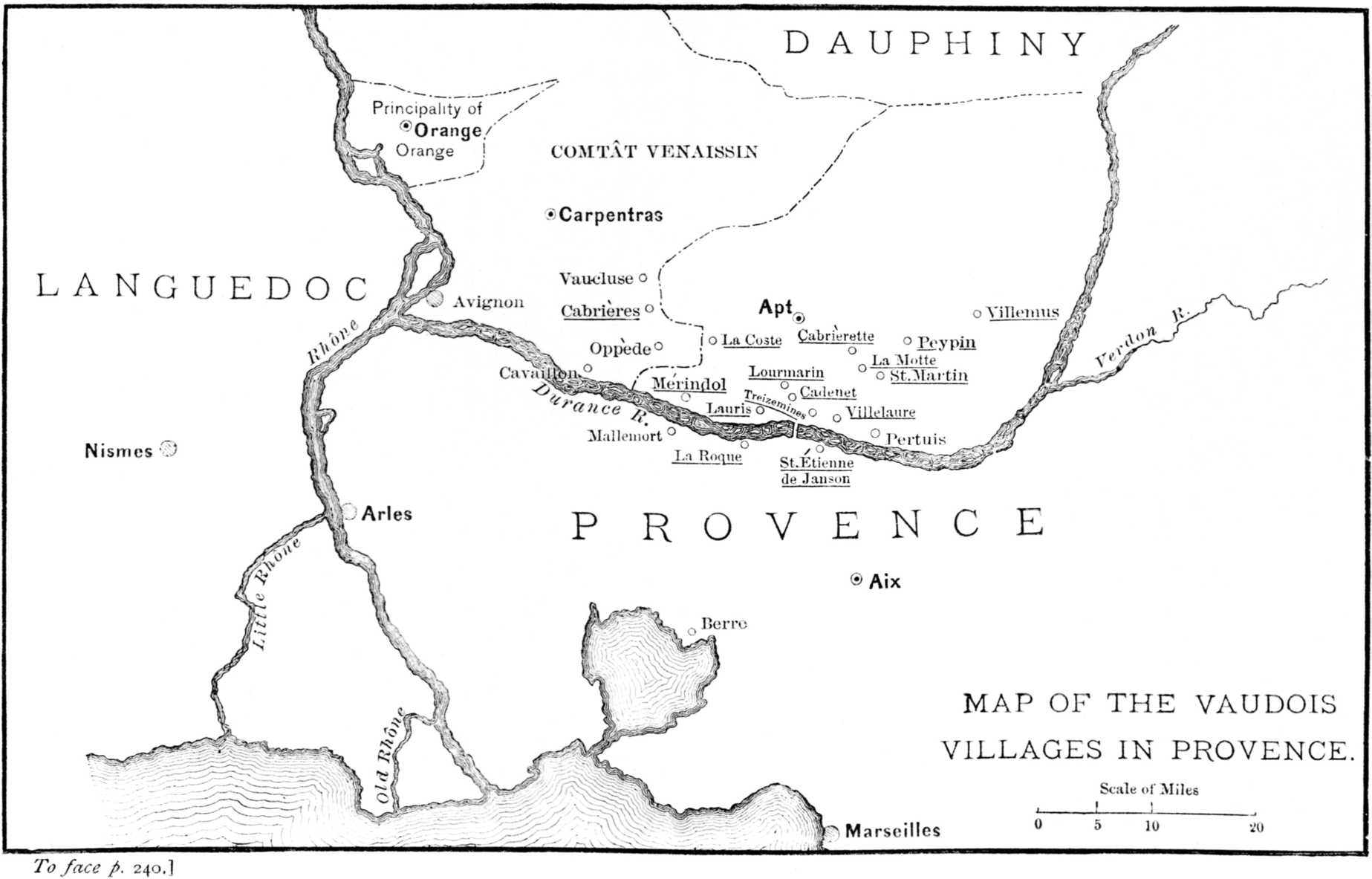
MAP OF THE VAUDOIS VILLAGES IN PROVENCE.
To face p. 240.
The Project Gutenberg EBook of The Rise of the Hugenots, Vol. 1 (of 2), by
Henry Martyn Baird

This eBook is for the use of anyone anywhere at no cost and with
almost no restrictions whatsoever.  You may copy it, give it away or
re-use it under the terms of the Project Gutenberg License included
with this eBook or online at www.gutenberg.org


Title: The Rise of the Hugenots, Vol. 1 (of 2)

Author: Henry Martyn Baird

Release Date: September 24, 2007 [EBook #22762]

Language: English

Character set encoding: ISO-8859-1

*** START OF THIS PROJECT GUTENBERG EBOOK THE RISE OF THE HUGENOTS ***


Produced by Sigal Alon, Daniel J. Mount, Taavi Kalju and
the Online Distributed Proofreading Team at
http://www.pgdp.net
Occupying nearly four columns, appeared in the New York Tribune of Dec. 30th, 1879, from which the following is extracted.
"It embraces the time from the accession of Francis I. in 1515, to the death of Charles IX. in 1574, at which epoch the doctrines of the Reformation had become well-grounded in France, and the Huguenots had outgrown the feebleness of infancy and stood as a distinct and powerful body before the religious world. In preparing the learned and elaborate work, which will give the name of the author an honourable place on the distinguished list of American historians, Professor Baird has made a judicious use of the researches and discoveries which, during the last thirty years, have shed a fresh light on the history of France at the era of the Reformation. Among the ample stores of knowledge which have been laid open to his inquiries are the archives of the principal capitals of Europe, which have been thoroughly explored for the first time during that period. Numerous manuscripts of great value, for the most part unknown to the learned world, have been rescued from obscurity. At the side of the voluminous chronicles long since printed, a rich abundance of contemporary correspondence and hitherto inedited memoirs has accumulated, which afford a copious collection of life-like and trustworthy views of the past. The secrets of diplomacy have been revealed. The official statements drawn up for the public may now be tested by the more truthful and unguarded accounts conveyed in cipher to all the foreign courts of Europe. Of not less importance, perhaps, than the official publications are the fruits of private research, among which are several valuable collections of original documents. While the author has not failed to enrich his pages with the materials derived from these and similar sources, he has made a careful and patient study of the host of original chronicles, histories, and kindred productions which have long been more or less familiar to the world of letters. The fruits of his studious labours, as presented in these volumes, attest his diligence, his fidelity, his equipoise of judgment, his fairness of mind, his clearness of perception, and his accuracy of statement.
"While the research and well-digested erudition exhibited in this work are eminently creditable to the learning and scholarship of the author, its literary execution amply attests the excellence of his taste, and his judgment and skill in the art of composition. His work is one of the most important recent contributions to American literature, and is entitled to a sincere greeting for its manifold learning and scholarly spirit."
Hazell, Watson, and Viney, Printers, London and Aylesbury
The period of about half a century with which these volumes are concerned may properly be regarded as the formative age of the Huguenots of France. It included the first planting of the reformed doctrines, and the steady growth of the Reformation in spite of obloquy and persecution, whether exercised under the forms of law or vented in lawless violence. It saw the gathering and the regular organization of the reformed communities, as well as their consolidation into one of the most orderly and zealous churches of the Protestant family. It witnessed the failure of the bloody legislation of three successive monarchs, and the equally abortive efforts of a fourth monarch to destroy the Huguenots, first with the sword and afterward with the dagger. At the close of this period the faith and resolution of the Huguenots had survived four sanguinary wars into which they had been driven by their implacable enemies. They were just entering upon a fifth war, under favorable auspices, for they had made it manifest to all men that their success depended less upon the lives of leaders, of whom they might be robbed by the hand of the assassin, than upon a conviction of the righteousness of their cause, which no sophistry of their opponents could dissipate. The Huguenots, at the death of[Pg iv] Charles the Ninth, stood before the world a well-defined body, that had outgrown the feebleness of infancy, and had proved itself entitled to consideration and respect. Thus much was certain.
The subsequent fortunes of the Huguenots of France—their wars until they obtained recognition and some measure of justice in the Edict of Nantes; the gradual infringement upon their guaranteed rights, culminating in the revocation of the edict, and the loss to the kingdom of the most industrious part of the population; their sufferings "under the cross" until the publication of the Edict of Toleration—these offer an inviting field of investigation, upon which I may at some future time be tempted to enter.[1]
The history of the Huguenots during a great part of the period covered by this work, is, in fact, the history of France as well. The outlines of the action and some of the characters that come upon the stage are, consequently, familiar to the reader of general history. The period has been treated cursorily in writings extending over wider limits, while several of the most striking incidents, including, especially, the Massacre of St. Bartholomew's Day, have been made the subject of special disquisitions. Yet, although much study and ingenuity have been expended in elucidating the more difficult and obscure points, there is, especially in the English language, a lack of works upon the general theme, combining painstaking investigation into the[Pg v] older (but not, necessarily, better known) sources of information, and an acquaintance with the results of modern research.
The last twenty-five or thirty years have been remarkably fruitful in discoveries and publications shedding light upon the history of France during the age of the Reformation and the years immediately following. The archives of all the principal, and many of the secondary, capitals of Europe have been explored. Valuable manuscripts previously known to few scholars—if, indeed, known to any—have been rescued from obscurity and threatened destruction. By the side of the voluminous histories and chronicles long since printed, a rich store of contemporary correspondence and hitherto inedited memoirs has been accumulated, supplying at once the most copious and the most trustworthy fund of life-like views of the past. The magnificent "Collection de Documents Inédits sur l'Histoire de France," still in course of publication by the Ministry of Public Instruction, comprehends in its grand design not only extended memoirs, like those of Claude Haton of Provins, but the even more important portfolios of leading statesmen, such as those of Secretary De l'Aubespine and Cardinal Granvelle (not less indispensable for French than for Dutch affairs), and the correspondence of monarchs, as of Henry the Fourth. The secrets of diplomacy have been revealed. Those singularly accurate and sensible reports made to the Doge and Senate of Venice, by the ambassadors of the republic, upon their return from the French court, can be read in the collections of Venetian Relations of Tommaseo and Albèri, or as summarized by Ranke and Baschet. The official statements drawn up for the eyes of the public may now be confronted with and tested by the more truthful and unguarded accounts conveyed in cipher to all the foreign courts of Europe. Including the partial collections of[Pg vi] despatches heretofore put in print, we possess, regarding many critical events, the narratives and opinions of such apt observers as the envoys of Spain, of the German Empire, of Venice, and of the Pope, of Wurtemberg, Saxony, and the Palatinate. Above all, we have access to the continuous series of letters of the English ambassadors and minor agents, comprising Sir Thomas Smith, Sir Nicholas Throkmorton, Walsingham, Jones, Killigrew, and others, scarcely less skilful in the use of the pen than in the art of diplomacy. This English correspondence, parts of which were printed long ago by Digges, Dr. Patrick Forbes, and Haynes, and other portions by Hardwick, Wright, Tytler-Fraser, etc., can now be read in London, chiefly in the Record Office, and is admirably analyzed in the invaluable "Calendars of State Papers (Foreign Series)," published under the direction of the Master of the Rolls. Too much weight can scarcely be given to this source of information and illustration. One of the learned editors enthusiastically remarks concerning a part of it (the letters of Throkmorton[2]): "The historical literature of France, rich as it confessedly is in memoirs and despatches of the sixteenth and seventeenth centuries, possesses (as far as I am aware) no series of papers which can compare either in continuity, fidelity, or minuteness, with the correspondence of Throkmorton.... He had his agents and his spies everywhere throughout France."
Little, if at all, inferior in importance to governmental publications, are the fruits of private research. Several voluminous collections of original documents deserve special mention. Not to speak of the publications of the national French Historical[Pg vii] Society, the "Société de l'Histoire du Protestantisme Français" has given to the world, in its monthly Bulletin, so many hitherto inedited documents, besides a great number of excellent monographs, that the volumes of this periodical, now in its twenty-eighth year, constitute in themselves an indispensable library of reference. That admirable biographical work, "La France Protestante," by the brothers Haag (at present in course of revision and enlargement); the "Correspondance des Réformateurs dans les Pays de Langue Française," by M. Herminjard (of which five volumes have come out), a signal instance of what a single indefatigable student can accomplish; the collections of Calvin's Letters, by M. Jules Bonnet; and the magnificent edition of the same reformer's works, by Professors Baum, Cunitz, and Reuss, a treasury of learning, rich in surprises for the historical student—all these merit more particular description than can here be given. The biography of Beza, by Professor Baum, the history of the Princes of Condé, by the Due d'Aumale, the correspondence of Frederick the Pious, edited by Kluckholn, etc., contribute a great deal of previously unpublished material. The sumptuous work of M. Douen on Clément Marot and the Huguenot Psalter sheds new light upon an interesting, but until now obscure subject. The writings of Farel and his associates have been rescued from the oblivion to which the extreme scarcity of the extant copies consigned them; and the "Vray Usage de la Croix," the "Sommaire," and the "Manière et Fasson," can at last be read in elegant editions, faithful counterparts of the originals in every point save typographical appearance. The same may be said of such celebrated but hitherto unattainable rarities as the "Tigre" of 1560, scrupulously reproduced in fac-simile, by M. Charles Read, of Paris, from the copy belonging to the Hôtel-de-Ville, and the fugi[Pg viii]tive songs and hymns which M. Bordier has gathered in his "Chansonnier Huguenot."
No little value belongs, also, to certain contemporary journals of occurrences given to the world under the titles of "Journal d'un Bourgeois de Paris sous le règne de François Ier," "Cronique du Roy Françoys, premier de ce nom," "Journal d'un curé ligueur de Paris sous les trois derniers Valois (Jehan de la Fosse)," "Journal de Jean Glaumeau de Bourges," etc.
The revival of interest in the fortunes of their ancestors has led a considerable number of French Protestants to prepare works bearing upon the history of Protestantism in particular cities and provinces. Among these may be noted the works of MM. Douen and Rossier, on Picardy; Recordon, on Champagne; Lièvre, on Poitou; Bujeaud, on Angoumois; Vaurigaud, on Brittany; Arnaud, on Dauphiny; Coquerel, on Paris; Borrel, on Nismes; Callot and Delmas, on La Rochelle; Crottet, on Pons, Gémozac, and Mortagne; Corbière, on Montpellier, etc. Although these books differ greatly in intrinsic importance, and in regard to the exercise of historical criticism, they all have a valid claim to attention by reason of the evidence they afford of individual research.
Of the new light thrown upon the rise of the Huguenots by these and similar works, it has been my aim to make full use. At the same time I have been convinced that no adequate knowledge of the period can be obtained, save by mastering the great array of original chronicles, histories, and kindred productions with which the literary world has long been acquainted, at least by name. This result I have, accordingly, endeavored to reach by careful and patient reading. It is unnecessary to specify in detail the numerous authors through whose writings it became my laborious but by no means un[Pg ix]grateful task to make my way, for the marginal notes will indicate the exact line of the study pursued. It may be sufficient to say, omitting many other names scarcely less important, that I have assiduously studied the works of De Thou, Agrippa d'Aubigné, La Place, La Planche; the important "Histoire Ecclésiastique," ascribed to Theodore de Bèze; the "Actiones et Monimenta" of Crespin; the memoirs of Castelnau, Vieilleville, Du Bellay, Tavannes, La Noue, Montluc, Lestoile, and other authors of this period, included in the large collections of memoirs of Petitot, Michaud and Poujoulat, etc.; the writings of Brantôme; the Commentaries of Jean de Serres, in their various editions, as well as other writings attributed to the same author; the rich "Mémoires de Condé," both in their original and their enlarged form; the series of important documents comprehended in the "Archives curieuses" of Cimber and Danjou; the disquisitions collected by M. Leber; the histories of Davila, Florimond de Ræmond, Maimbourg, Varillas, Soulier, Mézeray, Gaillard; the more recent historical works of Sismondi, Martin, Michelet, Floquet; the volumes of Browning, Smedley, and White, in English, of De Félice, Drion, and Puaux, in French, of Barthold, Von Raumer, Ranke, Polenz, Ebeling, and Soldan, in German. The principal work of Professor Soldan, in particular, bounded by the same limits of time with those of the present history, merits, in virtue of accuracy and thoroughness, a wider recognition than it seems yet to have attained. My own independent investigations having conducted me over much of the ground traversed by Professor Soldan, I have enjoyed ample opportunity for testing the completeness of his study and the judicial fairness of his conclusions.
The posthumous treatise of Professor H. Wuttke, "Zur Vorgeschichte der Bartholomäusnacht," published in Leipsic since[Pg x] the present work was placed in the printer's hands, reached me too late to be noticed in connection with the narrative of the events which it discusses. Notwithstanding Professor Wuttke's recognized ability and assiduity as a historical investigator, I am unable to adopt the position at which he arrives.
I desire here to acknowledge my obligation for valuable assistance in prosecuting my researches to my lamented friend and correspondent, Professor Jean Guillaume Baum, long and honorably connected with the Académie de Strasbourg, than whom France could boast no more indefatigable or successful student of her annals, and who consecrated his leisure hours during forty years to the enthusiastic study of the history of the French and Swiss Reformation. If that history is better understood now than when, in 1838, he submitted as a theological thesis his astonishingly complete "Origines Evangelii in Gallia restaurati," the progress is due in great measure to his patient labors. To M. Jules Bonnet, under whose skilful editorship the Bulletin of the French Protestant Historical Society has reached its present excellence, I am indebted for help afforded me in solving, by means of researches among the MSS. of the Bibliothèque Rationale at Paris, and the Simler Collection at Zurich, several difficult problems. To these names I may add those of M. Henri Bordier, Bibliothécaire Honoraire in the Department of MSS. (Bibliothèque Rationale), of M. Raoul de Cazenove, of Lyons, author of many highly prized monographs on Huguenot topics, and of the Rev. John Forsyth, D.D., who have in various ways rendered me valuable services.
Finally, I deem it both a duty and a privilege to express my warm thanks to the librarians of the Princeton Theological Seminary and of the Union Theological Seminary in this city; and[Pg xi] particularly to the successive superintendents and librarians of the Astor Library—both the living and the dead—by the signal courtesy of whom, the whole of that admirable collection of books has been for many years placed at my disposal for purposes of consultation so freely, that nothing has been wanting to make the work of study in its alcoves as pleasant and effective as possible.
University of the City of New York,
September 15, 1879.
| BOOK I. | ||
| CHAPTER I | ||
| Page | ||
| France in the Sixteenth Century | 3 | |
| Extent at the Accession of Francis I. | 3 | |
| Gradual Territorial Growth | 4 | |
| Subdivision in the Tenth Century | 5 | |
| Destruction of the Feudal System | 5 | |
| The Foremost Kingdom of Christendom | 6 | |
| Assimilation of Manners and Language | 8 | |
| Growth and Importance of Paris | 9 | |
| Military Strength | 10 | |
| The Rights of the People overlooked | 11 | |
| The States General not convoked | 12 | |
| Unmurmuring Endurance of the Tiers État | 13 | |
| Absolutism of the Crown | 14 | |
| Partial Checks | 15 | |
| The Parliament of Paris | 16 | |
| Other Parliaments | 17 | |
| The Parliaments claim the Right of Remonstrance | 17 | |
| Abuses in the Parliament of Bordeaux | 19 | |
| Origin and Growth of the University | 20 | |
| Faculty of Theology, or Sorbonne | 22 | |
| Its Authority and Narrowness | 23 | |
| Multitude of Students | 24 | |
| Credit of the Clergy | 25 | |
| Liberties of the Gallican Church | 25 | |
| Pragmatic Sanction of. St. Louis (1268) | 26 | |
| Conflict of Philip the Fair with Boniface VIII. | 27 | |
| [Pg xiv]The "Babylonish Captivity" | 28 | |
| Pragmatic Sanction of Bourges (1438) | 29 | |
| Rejoicing at the Council of Basle | 31 | |
| Louis XI. undertakes to abrogate the Pragmatic Sanction | 32 | |
| But subsequently re-enacts it in part | 33 | |
| Louis XII. publishes it anew | 35 | |
| Francis I. sacrifices the Interests of the Gallican Church | 35 | |
| Concordat between Leo X. and the French King | 36 | |
| Dissatisfaction of the Clergy | 37 | |
| Struggle with the Parliament of Paris | 37 | |
| Opposition of the University | 39 | |
| Patronage of the King | 41 | |
| The "Renaissance" | 41 | |
| Francis's Acquirements overrated | 42 | |
| His Munificent Patronage of Art | 42 | |
| The Collége Royal, or "Trilingue" | 43 | |
| An Age of Blood | 44 | |
| Barbarous Punishment for Crime | 45 | |
| And not less for Heresy | 46 | |
| Belief in Judicial Astrology | 47 | |
| Predictions of Nostradamus | 47 | |
| Reverence for Relics | 49 | |
| For the Consecrated Wafer | 50 | |
| Internal Condition of the Clergy | 51 | |
| Number and Wealth of the Cardinals | 51 | |
| Non-residence of Prelates | 52 | |
| Revenues of the Clergy | 52 | |
| Vice and Hypocrisy | 53 | |
| Brantôme's Account of the Clergy before the Concordat | 54 | |
| Aversion to the Use of the French Language | 56 | |
| Indecent Processions—"Processions Blanches" | 59 | |
| The Monastic Orders held in Contempt | 60 | |
| Protests against prevailing Corruption | 61 | |
| The "Cathari," or Albigenses | 61 | |
| Nicholas de Clemangis | 63 | |
| John Gerson | 64 | |
| Jean Bouchet's "Deploration of the Church" | 65 | |
| Changes in the Boundaries of France during the 16th Century | 66 | |
| CHAPTER II. | ||
| 1512-1525. | ||
| The Reformation in Meaux | 67 | |
| Jacques Lefèvre d'Étaples | 67 | |
| Restores Letters to France | 68 | |
| [Pg xv]Wide Range of his Studies | 68 | |
| Guillaume Farel, his Pupil | 68 | |
| Devotion of Teacher and Scholar | 69 | |
| Lefèvre publishes a Latin Commentary on the Pauline Epistles (1512) | 70 | |
| Enters into Controversy with Natalis Beda (1518) | 71 | |
| The Sorbonne's Declaration (Nov. 9, 1521) | 71 | |
| Briçonnet, Bishop of Meaux | 72 | |
| His First Reformatory Efforts | 72 | |
| Invites Lefèvre and Farel to Meaux | 73 | |
| Effects of the Preaching of Roussel and others | 74 | |
| De Roma's Threat | 76 | |
| Lefèvre publishes a Translation of the New Testament (1523) | 77 | |
| The Results surpass Expectation | 79 | |
| Bishop Briçonnet's Weakness | 80 | |
| Forbids the "Lutheran" Doctors to preach | 81 | |
| Lefèvre and Roussel take Refuge in Strasbourg | 84 | |
| Jean Leclerc whipped and branded | 87 | |
| His barbarous Execution at Metz | 88 | |
| Pauvan burned on the Place de Grève | 89 | |
| The Hermit of Livry | 92 | |
| Briçonnet becomes a Jailer of "Lutherans" | 92 | |
| Lefèvre's Writings condemned by the Sorbonne (1525) | 93 | |
| He becomes Tutor of Prince Charles | 94 | |
| Librarian at Blois | 94 | |
| Ends his Days at Nérac | 95 | |
| His Mental Anguish | 95 | |
| Michel d'Arande and Gérard Roussel | 96 | |
| CHAPTER III. | ||
| 1523-1525. | ||
| Francis I. and Margaret of Angoulême—Early Reformatory Movements and Struggles | 99 | |
| Francis I. and Margaret of Angoulême | 99 | |
| The King's Chivalrous Disposition | 100 | |
| Appreciates Literary Excellence | 101 | |
| Contrast with Charles V. | 101 | |
| His Religious Convictions | 102 | |
| His Fear of Innovation | 102 | |
| His Loose Morality | 103 | |
| Margaret's Scholarly Attainments | 104 | |
| Her Personal Appearance | 105 | |
| Her Participation in Public Affairs | 106 | |
| Her First Marriage to the Duke of Alençon | 106 | |
| Obtains a Safe-Conduct to visit her Brother | 106 | |
| [Pg xvi]Her Second Marriage, to Henry, King of Navarre | 107 | |
| Bishop Briçonnet's Mystic Correspondence | 108 | |
| Luther's Teachings solemnly condemned by the University | 108 | |
| Melanchthon's Defence | 109 | |
| Regency of Louise de Savoie | 109 | |
| The Sorbonne suggests Means of extirpating the "Lutheran Doctrines" (Oct. 7, 1523) | 110 | |
| Wide Circulation of Luther's Treatises | 112 | |
| François Lambert, of Avignon | 112 | |
| Life among the Franciscans | 113 | |
| Lambert, the first French Monk to embrace the Reformation | 113 | |
| He is also the First to Marry | 114 | |
| Jean Châtellain at Metz | 114 | |
| Wolfgang Schuch at St. Hippolyte | 115 | |
| Farel at Montbéliard | 117 | |
| Pierre Caroli lectures on the Psalms | 118 | |
| The Heptameron of the Queen of Navarre | 119 | |
| CHAPTER IV. | ||
| 1525-1533. | ||
| Increased Severity—Louis de Berquin | 122 | |
| Captivity of Francis I. | 122 | |
| Change in the Religious Policy of Louise | 123 | |
| A Commission appointed to try "Lutherans" | 124 | |
| The Inquisition heretofore jealously watched | 125 | |
| The Commission indorsed by Clement VII. | 126 | |
| Its Powers enlarged by the Bull | 128 | |
| Character of Louis de Berquin | 128 | |
| He becomes a warm Partisan of the Reformation | 129 | |
| First Imprisonment (1523) | 130 | |
| Released by Order of the King | 130 | |
| Advice of Erasmus | 131 | |
| Second Imprisonment (1526) | 131 | |
| Francis from Madrid again orders his Release | 132 | |
| Dilatory Measures of Parliament | 132 | |
| Margaret of Angoulême's Hopes | 133 | |
| Francis violates his Pledges to Charles V. | 134 | |
| Must conciliate the Pope and Clergy | 135 | |
| Promises to prove himself "Very Christian" | 137 | |
| The Council of Sens (1528) | 138 | |
| Cardinal Duprat | 138 | |
| Vigorous Measures to suppress Reformation | 139 | |
| The Councils of Bourges and Lyons | 139 | |
| [Pg xvii]Financial Help bought by Persecution | 140 | |
| Insult to an Image and an Expiatory Procession | 141 | |
| Other Iconoclastic Excesses | 143 | |
| Berquin's Third Arrest | 143 | |
| His Condemnation to Penance, Branding, and Perpetual Imprisonment | 145 | |
| He Appeals | 145 | |
| Is suddenly Sentenced to Death and Executed | 146 | |
| Francis Treats with the Germans | 147 | |
| And with Henry VIII. of England | 148 | |
| Francis meets Clement at Marseilles | 148 | |
| Marriage of Henry of Orleans to Catharine de' Medici | 148 | |
| Francis Refuses to join in a general Scheme for the Extermination of Heresy | 149 | |
| Execution of Jean de Caturce, at Toulouse | 150 | |
| Le Coq's Evangelical Sermon | 151 | |
| Margaret attacked at College of Navarre | 152 | |
| Her "Miroir de l'Ame Pécheresse" condemned | 152 | |
| Rector Cop's Address to the University | 153 | |
| Calvin, the real Author, seeks Safety in Flight | 154 | |
| Rough Answer of Francis to the Bernese | 155 | |
| Royal Letter to the Bishop of Paris | 156 | |
| Elegies on Louis de Berquin | 157 | |
| CHAPTER V. | ||
| 1534-1535. | ||
| Melanchthon's Attempt at Conciliation, and the Year of the Placards | 159 | |
| Hopes of Reunion in the Church | 159 | |
| Melanchthon and Du Bellay | 160 | |
| A Plan of Reconciliation | 160 | |
| Its Extreme Concessions | 161 | |
| Makes a Favorable Impression on Francis | 162 | |
| Indiscreet Partisans of Reform | 162 | |
| Placards and Pasquinades | 163 | |
| Féret's Mission to Switzerland | 164 | |
| The Placard against the Mass | 164 | |
| Excitement produced in Paris (Oct. 18, 1534) | 167 | |
| A Copy posted on the Door of the Royal Bedchamber | 167 | |
| Anger of Francis at the Insult | 167 | |
| Political Considerations | 168 | |
| Margaret of Navarre's Entreaties | 168 | |
| Francis Abolishes the Art of Printing (Jan. 13, 1535) | 169 | |
| [Pg xviii]The Rash and Shameful Edict Recalled | 170 | |
| Rigid Investigation and many Victims | 171 | |
| The Expiatory Procession (Jan. 21, 1535) | 173 | |
| The King's Speech at the Episcopal Palace | 176 | |
| Constancy of the Victims | 177 | |
| The Estrapade | 177 | |
| Flight of Clément Marot and others | 179 | |
| Royal Declaration of Coucy (July 16, 1535) | 179 | |
| Alleged Intercession of Pope Paul III. | 180 | |
| Clemency again dictated by Policy | 181 | |
| Francis's Letter to the German Princes | 182 | |
| Sturm and Voré beg Melanchthon to come | 182 | |
| Melanchthon's Perplexity | 183 | |
| He is formally invited by the King | 184 | |
| Applies to the Elector for Permission to go | 184 | |
| But is roughly refused | 185 | |
| The Proposed Conference reprobated by the Sorbonne | 187 | |
| Du Bellay at Smalcald | 188 | |
| He makes for Francis a Protestant Confession | 189 | |
| Efforts of French Protestants in Switzerland and Germany | 191 | |
| Intercession of Strasbourg, Basle, etc. | 191 | |
| Unsatisfactory Reply by Anne de Montmorency | 193 | |
| CHAPTER VI. | ||
| 1535-1545. | ||
| Calvin and Geneva—More Systematic Persecution by the King | 193 | |
| Changed Attitude of Francis | 193 | |
| Occasioned by the "Placards" | 194 | |
| Margaret of Navarre and Roussel | 195 | |
| The French Reformation becomes a Popular Movement | 196 | |
| Independence of Geneva secured by Francis | 197 | |
| John Calvin's Childhood | 198 | |
| He studies in Paris and Orleans | 199 | |
| Change of Religious Views at Bourges | 199 | |
| His Commentary on Seneca's "De Clementia" | 200 | |
| Escapes from Paris to Angoulême | 201 | |
| Leaves France | 202 | |
| The "Christian Institutes" | 202 | |
| Address to Francis the First | 203 | |
| Calvin wins instant Celebrity | 204 | |
| The Court of Renée of Ferrara | 205 | |
| Her History and Character | 206 | |
| Calvin's alleged Visit to Aosta | 207 | |
| [Pg xix]He visits Geneva | 208 | |
| Farel's Vehemence | 209 | |
| Calvin consents to remain | 210 | |
| His Code of Laws for Geneva | 210 | |
| His View of the Functions of the State | 210 | |
| Heretics to be constrained by the Sword | 211 | |
| Calvin's View that of the other Reformers | 212 | |
| And even of Protestant Martyrs | 212 | |
| Calvin longs for Scholarly Quiet | 213 | |
| His Mental Constitution | 214 | |
| Ill-health and Prodigious Labors | 214 | |
| Friendly and Inimical Estimates | 214 | |
| Violent Persecutions throughout France | 216 | |
| Royal Edict of Fontainebleau (June 1, 1540) | 218 | |
| Increased Severity, and Appeal cut off | 218 | |
| Exceptional Fairness of President Caillaud | 219 | |
| Letters-Patent from Lyons (Aug. 30, 1542) | 220 | |
| The King and the Sacramentarians | 221 | |
| Ordinance of Paris (July 23, 1543) | 221 | |
| Heresy to be punished as Sedition | 222 | |
| Repression proves a Failure | 222 | |
| The Sorbonne publishes Twenty-five Articles | 223 | |
| Francis gives them the Force of Law (March 10, 1543) | 224 | |
| More Systematic Persecution | 224 | |
| The Inquisitor Mathieu Ory | 224 | |
| The Nicodemites and Libertines | 225 | |
| Margaret of Navarre at Bordeaux | 226 | |
| Francis's Negotiations in Germany | 227 | |
| Hypocritical Representations made by Charles, Duke of Orleans | 228 | |
| CHAPTER VII. | ||
| 1545-1547. | ||
| Campaign against the Vaudois of Mérindol and Cabrières, and Last Days of Francis I. | 230 | |
| The Vaudois of the Durance | 230 | |
| Their Industry and Thrift | 230 | |
| Embassy to German and Swiss Reformers | 232 | |
| Translation of the Bible by Olivetanus | 233 | |
| Preliminary Persecutions | 234 | |
| The Parliament of Aix | 235 | |
| The Atrocious "Arrêt de Mérindol" (Nov. 18, 1540) | 236 | |
| Condemned by Public Opinion | 237 | |
| Preparations to carry it into Effect | 237 | |
| President Chassanée and the Mice of Autun | 238 | |
| [Pg xx]The King instructs Du Bellay to investigate | 239 | |
| A Favorable Report | 240 | |
| Francis's Letter of Pardon | 241 | |
| Parliament's Continued Severity | 241 | |
| The Vaudois publish a Confession | 242 | |
| Intercession of the Protestant Princes of Germany | 242 | |
| The new President of Parliament | 243 | |
| Sanguinary Royal Order, fraudulently obtained (Jan. 1, 1545) | 244 | |
| Expedition stealthily organized | 245 | |
| Villages burned—their Inhabitants murdered | 246 | |
| Destruction of Mérindol | 247 | |
| Treacherous Capture of Cabrières | 248 | |
| Women burned and Men butchered | 248 | |
| Twenty-two Towns and Villages destroyed | 249 | |
| A subsequent Investigation | 251 | |
| "The Fourteen of Meaux" | 253 | |
| Wider Diffusion of the Reformed Doctrines | 256 | |
| The Printer Jean Chapot before Parliament | 256 | |
| CHAPTER VIII. | ||
| 1547-1559. | ||
| Henry the Second and the Organization of the French Protestant Churches | 258 | |
| Impartial Estimates of Francis the First | 258 | |
| Henry, as Duke of Orleans | 259 | |
| His Sluggish Mind | 260 | |
| His Court | 261 | |
| Diana of Poitiers | 262 | |
| The King's Infatuation | 262 | |
| Constable Anne de Montmorency | 263 | |
| His Cruelty | 264 | |
| Disgraced by Francis, but recalled by Henry | 265 | |
| Duke Claude of Guise, and John, first Cardinal of Lorraine | 266 | |
| Marriage of James the Fifth of Scotland to Mary of Lorraine | 268 | |
| Francis the Dauphin affianced to Mary of Scots | 268 | |
| Francis of Guise and Charles of Lorraine | 268 | |
| Various Estimates of Cardinal Charles of Lorraine | 270 | |
| Rapacity of the new Favorites | 272 | |
| Servility toward Diana of Poitiers | 273 | |
| Persecution to atone for Moral Blemishes | 274 | |
| "La Chambre Ardente" | 275 | |
| Edict of Fontainebleau against Books from Geneva (Dec. 11, 1547) | 275 | |
| Deceptive Title-pages | 275 | |
| The Tailor of the Rue St. Antoine | 276 | |
| [Pg xxi]Other Victims of Intolerance | 278 | |
| Severe Edicts and Quarrels with Rome | 278 | |
| Edict of Châteaubriand (June 27, 1551) | 279 | |
| The War against Books from Geneva | 280 | |
| Marshal Vieilleville refuses to profit by Confiscation | 282 | |
| The "Five Scholars of Lausanne" | 283 | |
| Interpositions in their Behalf ineffectual | 284 | |
| Activity of the Canton of Berne | 286 | |
| Progress of the Reformation in Normandy | 287 | |
| Attempt to establish the Spanish Inquisition | 287 | |
| Opposition of Parliament | 288 | |
| President Séguier's Speech | 289 | |
| Coligny's Scheme of American Colonization | 291 | |
| Villegagnon in Brazil | 292 | |
| He brings Ruin on the Expedition | 293 | |
| First Protestant Church in Paris | 294 | |
| The Example followed in the Provinces | 296 | |
| Henry the Second breaks the Truce | 297 | |
| Fresh Attempts to introduce the Spanish Inquisition | 298 | |
| Three Inquisitors-General | 299 | |
| Judges sympathize with the Victims | 300 | |
| Edict of Compiègne (July 24, 1557) | 301 | |
| Defeat of St. Quentin (August 10, 1557) | 302 | |
| Vengeance wreaked upon the Protestants | 302 | |
| Affair of the Rue St. Jacques (Sept. 4, 1557) | 303 | |
| Treatment of the Prisoners | 304 | |
| Malicious Rumors | 305 | |
| Trials and Executions | 307 | |
| Intercession of the Swiss Cantons and Others | 308 | |
| Constancy of Some and Release of Others | 311 | |
| Controversial Pamphlets | 311 | |
| Capture of Calais (January, 1558) | 312 | |
| Registry of the Inquisition Edict | 312 | |
| Antoine of Navarre, Condé, and other Princes favor the Protestants | 313 | |
| Embassy of the Protestant Electors | 313 | |
| Psalm-singing on the Pré aux Clercs | 314 | |
| Conference of Cardinals Lorraine and Granvelle | 315 | |
| D'Andelot's Examination before the King | 317 | |
| His Constancy in Prison and temporary Weakness | 318 | |
| Paul IV.'s Indignation at the King's Leniency | 320 | |
| Anxiety for Peace | 321 | |
| Treaty of Cateau-Cambrésis (April 3, 1559) | 322 | |
| Sacrifice of French Interests | 323 | |
| Was there a Secret Treaty for the Extermination of Protestants? | 324 | |
| The Prince of Orange learns the Designs of Henry and Philip | 325 | |
| Danger of Geneva | 320 | |
| Parliament suspected of Heretical Leanings | 329 | |
| [Pg xxii]The "Mercuriale" | 330 | |
| Henry goes in Person to hear the Deliberations (June 10, 1559) | 332 | |
| Fearlessness of Du Bourg and Others | 334 | |
| Henry orders their Arrest | 335 | |
| First National Synod (May 26, 1559) | 335 | |
| Ecclesiastical Discipline adopted | 336 | |
| Marriages and Festivities of the Court | 338 | |
| Henry mortally wounded in the Tournament (June 30, 1559) | 339 | |
| His Death (July 10, 1559) | 340 | |
| "La Façon de Genève"—the Protestant Service | 341 | |
| Farel's "Manière et Fasson" (1533) | 342 | |
| Calvin's Liturgy (1542) | 343 | |
| CHAPTER IX. | ||
| July, 1559-May, 1560. | ||
| Francis the Second and the Tumult of Amboise | 346 | |
| Epigrams on the Death of Henry | 346 | |
| The Young King | 347 | |
| Catharine de' Medici | 348 | |
| Favors the Family of Guise | 350 | |
| Who make themselves Masters of the King | 351 | |
| Constable Montmorency retires | 352 | |
| Antoine, King of Navarre | 354 | |
| His Remissness and Pusillanimity | 355 | |
| The Persecution continues | 359 | |
| Denunciation and Pillage at Paris | 360 | |
| The Protestants address Catharine | 362 | |
| Pretended Orgies in "La Petite Genève" | 365 | |
| Cruelty of the Populace | 366 | |
| Traps for Heretics | 367 | |
| Trial of Anne du Bourg | 368 | |
| Intercession of the Elector Palatine | 370 | |
| Du Bourg's Last Speech | 371 | |
| His Execution and its Effect | 372 | |
| Florimond de Ræmond's Observations | 374 | |
| Revulsion against the Tyranny of the Guises | 375 | |
| Calvin and Beza discountenance Armed Resistance | 377 | |
| De la Renaudie | 379 | |
| Assembly of Malcontents at Nantes | 380 | |
| Plans well devised | 381 | |
| Betrayed by Des Avenelles | 382 | |
| The "Tumult of Amboise" | 383 | |
| Coligny gives Catharine good Counsel | 384 | |
| [Pg xxiii]The Edict of Amnesty (March, 1560) | 385 | |
| A Year's Progress | 386 | |
| Confusion at Court | 387 | |
| Treacherous Capture of Castelnau | 388 | |
| Death of La Renaudie | 389 | |
| Plenary Commission given to the Duke of Guise | 389 | |
| A Carnival of Blood | 391 | |
| The Elder D'Aubigné and his Son | 393 | |
| Francis and the Prince of Condé | 393 | |
| Condé's Defiance | 394 | |
| An alleged Admission of Disloyal Intentions by La Renaudie | 394 | |
| CHAPTER X. | ||
| May-December, 1560. | ||
| The Assembly of Notables at Fontainebleau, and the Close of the Reign of Francis the Second | 397 | |
| Rise of the Name of the Huguenots | 397 | |
| Their Sudden Growth | 399 | |
| How to be accounted for | 400 | |
| Progress of Letters | 400 | |
| Marot's and Beza's Psalms | 402 | |
| Morality and Martyrdom | 402 | |
| Character of the Protestant Ministers | 402 | |
| Testimony of Bishop Montluc | 403 | |
| Preaching in the Churches of Valence | 404 | |
| The Reformation and Morals | 406 | |
| Francis orders Extermination | 406 | |
| Large Congregations at Nismes | 407 | |
| Mouvans in Provence | 407 | |
| A Popular Awakening | 408 | |
| Pamphlets against the Guises | 409 | |
| Catharine consults the Huguenots | 409 | |
| Edict of Romorantin (May, 1560) | 410 | |
| No Abatement of Rigorous Persecution | 411 | |
| Spiritual Jurisdiction differing little from the Inquisition | 411 | |
| Chancellor Michel de l'Hospital | 412 | |
| Continued Disquiet—Montbrun | 414 | |
| Assembly of Notables at Fontainebleau (Aug. 21, 1560) | 415 | |
| The Chancellor's Address | 416 | |
| The Finances of France | 416 | |
| Admiral Coligny presents the Petitions of the Huguenots | 416 | |
| Bishop Montluc ably advocates Toleration | 418 | |
| Bishop Marillac's Eloquent Speech | 420 | |
| Coligny's Suggestions | 421 | |
| [Pg xxiv]Passionate Rejoinder of the Duke of Guise | 422 | |
| The Cardinal of Lorraine more calm | 423 | |
| New Alarms of the Guises | 424 | |
| The King of Navarre and Condé summoned to Court | 425 | |
| Advice of Philip of Spain | 426 | |
| Navarre's Irresolution embarrasses Montbrun and Mouvans | 427 | |
| The "Fashion of Geneva" embraced by many in Languedoc | 428 | |
| Elections for the States General | 430 | |
| The King and Queen of Navarre | 431 | |
| Beza at the Court of Nérac | 432 | |
| New Pressure to induce Navarre and Condé to come | 433 | |
| Navarre Refuses a Huguenot Escort | 434 | |
| Disregards Warnings | 435 | |
| Is refused Admission to Poitiers | 435 | |
| Condé arrested on arriving at Orleans | 436 | |
| Return of Renée de France | 437 | |
| Condé's Intrepidity | 437 | |
| He is Tried and Condemned to Death | 439 | |
| Antoine of Navarre's Danger | 440 | |
| Plan for annihilating the Huguenots | 441 | |
| Sudden Illness and Death of Francis the Second | 442 | |
| The "Epître au Tigre de la France" | 445 | |
| CHAPTER XI. | ||
| December, 1560-September, 1561. | ||
| The Reign of Charles the Ninth, to the Preliminaries of the Colloquy of Poissy | 449 | |
| Sudden Change in the Political Situation | 449 | |
| The Enemy of the Huguenots buried as a Huguenot | 450 | |
| Antoine of Navarre's Opportunity | 451 | |
| Adroitness of Catharine de' Medici | 452 | |
| Financial Embarrassments | 453 | |
| Catharine's Neutrality | 453 | |
| Opening of the States General of Orleans | 454 | |
| Address of Chancellor L'Hospital | 455 | |
| Cardinal Lorraine's Effrontery | 457 | |
| De Rochefort, Orator for the Noblesse | 457 | |
| L'Ange for the Tiers État | 458 | |
| Arrogant Speech of Quintin for the Clergy | 458 | |
| A Word for the poor, down-trodden People | 459 | |
| Coligny presents a Huguenot Petition | 461 | |
| The States prorogued | 461 | |
| [Pg xxv]Meanwhile Prosecutions for Religion to cease | 462 | |
| Return of Fugitives | 463 | |
| Charles writes to stop Ministers from Geneva | 463 | |
| Reply of the Genevese | 464 | |
| Condé cleared and reconciled with Guise | 465 | |
| Humiliation of Navarre | 466 | |
| The Boldness of the Particular Estates of Paris | 467 | |
| Secures Antoine more Consideration | 467 | |
| Intrigue of Artus Désiré | 468 | |
| General Curiosity to hear Huguenot Preaching | 468 | |
| Constable Montmorency's Disgust | 469 | |
| The "Triumvirate" formed | 471 | |
| A Spurious Statement | 471 | |
| Massacres of Protestants in Holy Week | 474 | |
| The Affair at Beauvais | 474 | |
| Assault on the House of M. de Longjumeau | 476 | |
| New and Tolerant Royal Order | 476 | |
| Opposition of the Parisian Parliament | 477 | |
| Popular Cry for Pastors | 479 | |
| Moderation of the Huguenot Ministers | 479 | |
| Judicial Perplexity | 481 | |
| The "Mercuriale" of 1561 | 481 | |
| The "Edict of July" | 483 | |
| Its Severity creates extreme Disappointment | 484 | |
| Iconoclasm at Montauban | 485 | |
| Impatience with Public "Idols" | 487 | |
| Calvin endeavors to repress it | 487 | |
| Re-assembling of the States at Pontoise | 488 | |
| Able Harangue of the "Vierg" of Autun | 489 | |
| Written Demands of the Tiers État | 490 | |
| A Representative Government demanded | 492 | |
| The French Prelates at Poissy | 493 | |
| Beza and Peter Martyr invited to France | 494 | |
| Urgency of the Parisian Huguenots | 496 | |
| Beza comes to St. Germain | 497 | |
| His previous History | 497 | |
| Wrangling of the Prelates | 498 | |
| Cardinal Châtillon communes "under both Forms" | 499 | |
| Catharine and L'Hospital zealous for a Settlement of Religious Questions | 499 | |
| A Remarkable Letter to the Pope | 500 | |
| Beza's flattering Reception | 502 | |
| He meets the Cardinal of Lorraine | 503 | |
| Petition of the Huguenots respecting the Colloquy | 505 | |
| Informally granted | 507 | |
| Last Efforts of the Sorbonne to prevent the Colloquy | 508 | |
| [Pg xxvi]CHAPTER XII. | ||
| September, 1561-January, 1562. | ||
| The Colloquy of Poissy and the Edict of January | 509 | |
| The Huguenot Ministers and Delegates | 509 | |
| Assembled Princes in the Nuns' Refectory | 510 | |
| The Prelates | 511 | |
| Diffidence of Theodore Beza | 512 | |
| Opening Speech of Chancellor L'Hospital | 512 | |
| The Huguenots summoned | 513 | |
| Beza's Prayer and Address | 514 | |
| His Declaration as to the Body of Christ | 519 | |
| Outcry of the Theologians of the Sorbonne | 519 | |
| Beza's Peroration | 520 | |
| Cardinal Tournon would cut short the Conference | 521 | |
| Catharine de' Medici is decided | 522 | |
| Advantages gained | 522 | |
| The Impression made by Beza | 522 | |
| His Frankness justified | 524 | |
| The Prelates' Notion of a Conference | 526 | |
| Peter Martyr arrives | 527 | |
| Cardinal Lorraine replies to Beza | 528 | |
| Cardinal Tournon's new Demand | 529 | |
| Advancing Shadows of Civil War | 530 | |
| Another Session reluctantly conceded | 531 | |
| Beza's Reply to Cardinal Lorraine | 532 | |
| Claude d'Espense and Claude de Sainctes | 532 | |
| Lorraine demands Subscription to the Augsburg Confession | 533 | |
| Beza's Home Thrust | 534 | |
| Peter Martyr and Lainez the Jesuit | 536 | |
| Close of the Colloquy of Poissy | 537 | |
| A Private Conference at St. Germain | 538 | |
| A Discussion of Words | 540 | |
| Catharine's Premature Delight | 541 | |
| The Article agreed upon Rejected by the Prelates | 541 | |
| Catharine's Financial Success | 543 | |
| Order for the Restitution of Churches | 544 | |
| Arrival of Five German Delegates | 544 | |
| Why the Colloquy proved a Failure | 546 | |
| Catharine's Crude Notion of a Conference | 547 | |
| Character of the Prelates | 547 | |
| Influence of the Papal Legate, the Cardinal of Ferrara | 548 | |
| Anxiety of Pius the Fourth | 548 | |
| The Nuncio Santa Croce | 549 | |
| [Pg xxvii]Master Renard turned Monk | 551 | |
| Opposition of People and Chancellor | 551 | |
| The Legate's Intrigues | 552 | |
| His Influence upon Antoine of Navarre | 554 | |
| Contradictory Counsels | 555 | |
| The Triumvirate leave in Disgust | 556 | |
| Hopes entertained by the Huguenots respecting Charles | 557 | |
| Beza is begged to remain | 559 | |
| A Spanish Plot to kidnap the Duke of Orleans | 559 | |
| The Number of Huguenot Churches | 560 | |
| Beza secures a favorable Royal order | 560 | |
| Rapid Growth of the Reformation | 561 | |
| Immense Assemblages from far and near | 562 | |
| The Huguenots at Montpellier | 563 | |
| The Rein and not the Spur needed | 565 | |
| Marriages and Baptisms at Court "after the Geneva Fashion" | 565 | |
| Tanquerel's Seditious Declaration | 566 | |
| Jean de Hans | 567 | |
| Philip threatens Interference in French Affairs | 567 | |
| "A True Defender of the Faith" | 568 | |
| Roman Catholic Complaints of Huguenot Boldness | 570 | |
| The "Tumult of Saint Médard" | 571 | |
| Assembly of Notables at St. Germain | 574 | |
| Diversity of Sentiments | 575 | |
| The "Edict of January" | 576 | |
| The Huguenots no longer Outlaws | 577 | |
When, on the first day of the year 1515, the young Count of Angoulême succeeded to the throne left vacant by the death of his kinsman and father-in-law, Louis the Twelfth, the country of which he became monarch was already an extensive, flourishing, and well-consolidated kingdom. The territorial development of France was, it is true, far from complete. On the north, the whole province of Hainault belonged to the Spanish Netherlands, whose boundary line was less than one hundred miles distant from Paris. Alsace and Lorraine had not yet been wrested from the German Empire. The "Duchy" of Burgundy, seized by Louis the Eleventh immediately after the death of Charles the Bold, had, indeed, been incorporated into the French realm; but the "Free County" of Burgundy—la Franche Comté, as it was briefly designated—had been imprudently suffered to fall into other hands, and Besançon was the residence of a governor appointed by princes of the House of Hapsburg. Lyons was a frontier town; for the little districts of Bresse and Bugey, lying between the Saône and Rhône, belonged to the Dukes of Savoy. Further to the south, two fragments of foreign territory were completely enveloped by the domain of the French king.[Pg 4] The first was the sovereign principality of Orange, which, after having been for over a century in the possession of the noble House of Châlons, was shortly to pass into that of Nassau, and to furnish the title of William the Silent, the future deliverer of Holland. The other and larger one was the Comtât Venaissin, a fief directly dependent upon the Pope. Of irregular shape, and touching the Rhone both above and below Orange, the Comtât Venaissin nearly enclosed the diminutive principality in its folds. Its capital, Avignon, having forfeited the distinction enjoyed in the fourteenth century as the residence of the Roman Pontiffs, still boasted the presence of a Legate of the Papal See, a poor compensation for the loss of its past splendor. On the shores of the Mediterranean Sea, the Spanish dominions still extended north of the principal chain of the Pyrenees, and included the former County of Roussillon.
But, although its area was somewhat smaller than that of the modern republic, France in the sixteenth century had nearly attained the general dimensions marked out for it by great natural boundaries. Four hundred years had been engrossed in the pursuit of territorial enlargement. At the close of the tenth century the Carlovingian dynasty, essentially foreign in tastes and language, was supplanted by a dynasty of native character and capable of gathering to its support all those elements of strength which had been misunderstood or neglected by the feeble descendants of Charlemagne. But it found the royal authority reduced to insignificance and treated with open contempt. By permitting those dignities which had once been conferred as a reward for pre-eminent personal merit to become hereditary in certain families, the crown had laid the foundation of the feudal system; while, by neglecting to enforce its sovereign claims, it had enabled the great feudatories to make themselves princes independent in reality, if not in name. So low had the consideration of the throne fallen, that when Hugh Capet, Count of Paris, in 987 assumed the title of king of France, basing his act partly on an election by nobles, partly on force of arms, the transaction elicited little opposition from the rival lords who might have been expected to resent his usurpation.[Pg 5]
France contained at this time six principal fiefs—four in the north and two in the south—each nearly or fully as powerful as the hereditary dominions of Hugh, while probably more than one excelled them in extent. These limited dominions, on the resources of which the new dynasty was wholly dependent in the struggle for supremacy, embraced the important cities of Paris and Orleans, but barely stretched from the Somme to the Loire, and were excluded from the ocean by the broad possessions of the dukes of Normandy on both sides of the lower Seine. The great fiefs had each in turn yielded to the same irresistible tendency to subdivision. The great feudatory was himself the superior of the tenants of several subordinate, yet considerable, fiefs. The possessors of these again ranked above the viscounts of cities and the provincial barons. A long series of gradations in dignity ended at the simple owners of castles, with their subject peasants or serfs. In no country of Europe had the feudal system borne a more abundant harvest of disintegration and consequent loss of power.[3]
The reduction of the insubordinate nobles on the patrimonial estates of the crown was the first problem engaging the attention of the early Capetian kings. When this had at length been solved, with the assistance of the scanty forces lent by the cities—never amounting, it is said, to more than five hundred men-at-arms[4]—Louis the Fat, a prince of resplendent ability, early in the twelfth century addressed himself to the task of making good the royal title to supremacy over the neighboring provinces. Before death compelled him to forego the prosecution of his ambitious designs, the influence of the monarchy had been extended over eastern and central France—from Flanders, on the north, to the volcanic mountains of Auvergne, on the south. Meanwhile the oppressed subjects of the petty tyrants, whether within or around his domains, had learned to look for redress to the sovereign[Pg 6] lord who prided himself upon his ability and readiness to succor the defenceless. His grandson, the more illustrious Philip Augustus (1180-1223), by marriage, inheritance, and conquest added to previous acquisitions several extensive provinces, of which Normandy, Maine, and Poitou had been subject to English rule, while Vermandois and Yalois had enjoyed a form of approximate independence under collateral branches of the Capetian family.
The conquests of Louis the Fat and of Philip Augustus were consolidated by Louis the Ninth—Saint Louis, as succeeding generations were wont to style him—an upright monarch, who scrupled to accept new territory without remunerating the former owners, and even alienated the affection of provinces which he might with apparent justice have retained, by ceding them to the English, in the vain hope of cementing a lasting peace between the rival states.[5]
The same pursuit of territorial aggrandizement under successive kings extended the domain of the crown, in spite of disaster and temporary losses, until in the sixteenth century France was second to no other country in Europe for power and material resources. United under a single head, and no longer disturbed by the insubordination of the turbulent nobles, lately humbled by the craft of Louis the Eleventh, this kingdom awakened the warm admiration of political judges so shrewd as the diplomatic envoys of the Venetian Republic. "All these provinces," exclaimed one of these agents, in a report made to the Doge and Senate soon after his return, "are so well situated, so liberally provided with river-courses, harbors, and mountain ranges, that it may with safety be asserted that this realm is not only the most noble in Christendom, rivalling in antiquity our own most illus[Pg 7]trious commonwealth, but excels all other states in natural advantages and security."[6] Another of the same distinguished school of statesmen, taking a more deliberate survey of the country, gives utterance to the universal estimate of his age, when averring that France is to be regarded as the foremost kingdom of Christendom, whether viewed in respect to its dignity and power, or the rank of the prince who governs it.[7] In proof of the first of these claims he alleges the fact that, whereas England had once been, and Naples was at that moment dependent upon the Church, and Bohemia and Poland sustained similar relations to the Empire, France had always been a sovereign state. "It is also the oldest of European kingdoms, and the first that was converted to Christianity," remarks the same writer; adding, with a touch of patriotic pride, the proviso, "if we except the Pope, who is the universal head of religion, and the State of Venice, which, as it first sprang into existence a Christian commonwealth, has always continued such."[8]
Other diplomatists took the same view of the power and resources of this favored country. "The kingdom of France," said Chancellor Bacon, in a speech against the policy of rendering open aid to Scotland, and thus becoming involved in a war with the French, "is four times as large as the realm of England, the men four times as many, and the revenue four times as much, and it has better credit. France is full of expert captains and old soldiers, and besides its own troops it may entertain as many Almains as it is able to hire."[9][Pg 8]
Meantime France was fast becoming more homogeneous than it had ever been since the fall of the Roman power. As often as the lines of the great feudal families became extinct, or these families were induced or compelled to renounce their pretensions, their fiefs were given in appanage to younger branches of the royal house, or were more closely united to the domains of the crown, and entrusted to governors of the king's appointment.[10] In either case the actual control of affairs was placed in the hands of officers whose highest ambition was to reproduce in the provincial capital the growing elegance of the great city on the Seine where the royal court had fixed its ordinary abode. The provinces, consequently, began to assimilate more and more to Paris, and this not merely in manners, but in forms of speech and even in pronunciation. The rude patois, since it grated upon the cultivated ear, was banished from polite society, and, if not consigned to oblivion, was relegated to the more ignorant and remoter districts. Learning held its seat in Paris, and the scholars who returned to their homes after a sojourn in its academic halls were careful to avoid creating doubts respecting the thoroughness of their training by the use of any dialect but that spoken in the neighborhood of the university. As the idiom of Paris asserted its supremacy over the rest of France, a new tie was constituted, binding together provinces diverse in origin and history.
The spirit of obedience pervading all classes of the population contributed much to the national strength. The great nobles had lost their excessive privileges. They no longer attempted, in the seclusion of their ancestral estates, to rival the magnificence or defy the authority of the king. They began to prefer the capital to the freer retreat of their[Pg 9] castles. During the reign of Francis the First, and still more during the reign of his immediate successors, costly palaces for the accommodation of princely and ducal families were reared in the neighborhood of the Louvre.[11] It was currently reported that more than one fortune had been squandered in the hazardous experiment of maintaining a pomp befitting the courtier. Ultimately the poorer grandees were driven to the adoption of the wise precaution of spending only a quarter of the year in the enticing but dangerous vicinity of the throne.[12]
The cities, also, whose extensive privileges had constituted one of the most striking features of the political system of mediæval Europe, had been shorn of their exorbitant claims founded upon royal charters or prescriptive usage. The kings of France, in particular, had favored the growth of the municipalities, in order to secure their assistance in the reduction of refractory vassals. Flourishing trading communities had sprung up on the coasts of the Mediterranean Sea and of the ocean, and on the banks of the navigable rivers emptying into them. These corporations had secured a degree of independence proportioned, for the most part, to the weakness of their neighbors. The policy of the crown had been, while generously conferring privileges of great importance upon the cities lying within the royal domain, to make still more lavish concessions in favor of the municipalities upon or contiguous to the lands of the great feudatories.[13]
No sooner, however, did the humiliation of the landed nobility render it superfluous to conciliate the good-will of the proud and opulent citizens, than the readiest means were sought for reducing them to the level of ordinary subjects. Paris especially, once almost a republic, had of late learned submission and docility.[14] By the change, however, the capital[Pg 10] had lost neither wealth nor inhabitants, being described as very rich and populous, covering a vast area, and wholly given up to trade.[15] In the absence of an accurate census, the number of its inhabitants was variously stated at from 300,000 souls to nearly thrice as many; but all accounts agreed in placing Paris among the foremost cities of the civilized world.[16]
With the military resources at his command, the king had the means of rendering himself formidable abroad and secure at home. The French cavalry, consisting of gentlemen whose duty and honorable distinction it was to follow the monarch in every expedition, still sustained the reputation for the impetuous ardor and the irresistible weight of its charges which it had won during the Middle Ages. If it had encountered unexpected rebuffs on the fields of Crécy, Poitiers and Agincourt, the chivalry of France had been too successful in other engagements to lose courage and enthusiasm. The nobles, both old and young, were still ready at any time to flock to their prince's standard when unfurled for an incursion into Naples or the Milanese. Never had they displayed more alacrity or self-sacrificing devotion than when young Francis the First set out upon his campaigns in Italy.[17] The[Pg 11] French infantry was less trustworthy. The troops raised in Normandy, Brittany, and Languedoc were reported to be but poorly trained to military exercises; but the foot-soldiers supplied by some of the frontier provinces were sturdy and efficient, and the gallant conduct of the Gascons at the disastrous battle of St. Quentin was the subject of universal admiration.[18]
What France lacked in cavalry was customarily supplied by the Reiters, whose services were easily purchased in Germany. The same country stood ready to furnish an abundance of Lansquenets (Lanzknechten), or pikemen, who, together with the Swiss, in a great measure replaced the native infantry. A Venetian envoy reported, in 1535, that the French king could, in six weeks at longest, set on foot a force of forty-eight thousand men, of whom twenty-one thousand, or nearly one-half, would be foreign mercenaries. His navy, besides his great ship of sixty guns lying in the harbor of Havre, numbered thirty galleys, and a few other vessels of no great importance.[19]
The power gained by the crown through the consolidation of the monarchy had been acquired at the expense of the popular liberties. In the prolonged struggle between the king, as lord paramount, and his insubordinate vassals, the rights of inferior subjects had received little consideration. From the strife the former issued triumphant, with an asserted claim to unlimited power. The voice of the masses was but feebly heard in the States General—a convocation of all three orders called at irregular intervals. Upon the ordinary policy of government, this, the only representative body, exercised no permanent control. If, in its occasional sessions, the deputies of the Tiers État exhibited a disposition to intermeddle in those political concerns which the crown claimed as its exclusive prerogative, the king and his advisers found in their audacity an additional motive for postponing as long as possible a resort to an expedient so disa[Pg 12]greeable as the assembling of the States General. Already had monarchs begun to look with suspicion upon the growing intelligence of untitled subjects, who might sooner or later come to demand a share in the public administration.
It was, therefore, only when the succession to the throne was contested, or when the perils attending the minority of the prince demanded the popular sanction of the choice of a regent, or when the flames of civil war seemed about to burst forth and involve the whole country in one general conflagration, that the royal consent could be obtained for convening the States General. During the first half of the sixteenth century the States General were not once summoned, unless the designation of States be accorded to one or two convocations partaking rather of the character of "Assemblies of Notables," and intended merely to assist in extricating the monarch from temporary embarrassment.[20] The repeated wars of Louis the Twelfth, of Francis the First, and of Henry the Second were waged without any reference of the questions of their expediency and of the mode of conducting them to the tribunal of popular opinion. Thousands of brave Frenchmen found bloody graves beyond the Alps; Francis the First fell into the hands of his enemies, and after a weary captivity with difficulty regained his freedom; a new faith arose in France, threatening to subvert existing ecclesiastical institutions; yet in the midst of all this bloodshed, confusion and perplexity the people were left unconsulted.[21] From the accession of Charles[Pg 13] the Eighth, in 1483, to that of Charles the Ninth, in 1560, the history of representative government in France is almost a complete blank. So long was the period during which the States General were suspended, that, when at length it was deemed advisable to convene them again, the chancellor, in his opening address, felt compelled to enter into explanations respecting the nature and functions of a body which perhaps not a man living remembered to have seen in session.[22] Yet, while the desuetude into which had fallen the laudable custom of holding the States every year, or, at least, on occasion of any important matter for deliberation, might properly be traced to the flood of ambition and pride which had inundated the world, and to the inordinate covetousness of kings,[23] there were not wanting considerations to mitigate the disappointment of the people. Chief among them, doubtless, in the view of shrewd observers, was the fact that the assembling of the States was the invariable prelude to an increase of taxation, and that never had they met without benefiting the king's exchequer at the expense of the purses of his subjects.[24]
Meanwhile the nation bore with exemplary patience the accumulated burdens under which it staggered. Natives and foreigners alike were lost in admiration of its wonderful pow[Pg 14]ers of endurance. No one suspected that a terrible retribution for this same people's wrongs might one day overtake the successor of a long line of kings, each of whom had added his portion to the crushing load. The Emperor Maximilian was accustomed to divert himself at the expense of the French people. "The king of France," said he, "is a king of asses; there is no weight that can be laid upon his subjects which they will not bear without a murmur."[25] The warrior and historian Rabutin congratulated the monarchs of France upon God's having given them, in obedience, the best and most faithful people in the whole world.[26] The Venetian, Matteo Dandolo, declared to the Doge and Senate that the king might with propriety regard as his own all the money in France, for, such was the incomparable kindness of the people, that whatever he might ask for in his need was very gladly brought to him.[27] It was not strange, perhaps, that the ruler of subjects so exemplary in their eagerness to replenish his treasury as soon as it gave evidence of being exhausted, came to take about the same view of the matter. Accordingly, it is related of Francis the First that, being asked by his guest, Charles the Fifth, when the latter was crossing France on his way to suppress the insurrection of Ghent, what revenue he derived from certain cities he had passed through, the king promptly, replied: "Ce que je veux"—"What I please."[28][Pg 15]
Yet it must be noted, in passing, that the studied abasement of the Tiers État had already begun to bear some fruit that should have alarmed every patriotic heart. It was, as we have seen, impossible to obtain good French infantry except from Gascony and some other border provinces. The place that should have been held by natives was filled by Germans and Swiss. What was the reason? Simply that the common people had lost the consciousness of their manhood, in consequence of the degraded position into which the king, and the privileged classes, imitating his example, had forced them. "Because of their desire to rule the people with a rod of iron," says Dandolo, "the gentry of the kingdom have deprived them of arms. They dare not even carry a stick, and are more submissive to their superiors than dogs!"[29] No wonder that all efforts of Francis to imitate the armies of free states, by instituting legions of arquebusiers, proved fruitless.[30] Add to this that trade was held in supreme contempt,[31] and the picture is certainly sufficiently dark.
Yet, while, through the absence of any effectual barrier to the exercise of his good pleasure, the king's authority was ultimately unrestricted, it must be confessed that there existed, in point of fact, some powerful checks, rendering the abuse of the royal prerogative, for the most part, neither easy nor expedient. Parliament, the municipal corporations, the university, and the clergy, weak as they often proved in a direct struggle with the crown, nevertheless exerted an influence that ought not to be overlooked. The most headstrong prince hesitated to disregard the remonstrances of any one of these bodies, and their united protest sometimes led to the abandonment of schemes of great promise for the royal treasury. It is true that parliament, university, and char[Pg 16]tered borough owed their existence and privileges to the royal will, and that the power that created could also destroy. But time had invested with a species of sanctity the venerable institutions established by monarchs long since dead, and the utmost stretch of royal displeasure went not in its manifestation further than the mere threat to strip parliament or university of its privileges, or, at most, the arrest and temporary imprisonment of the more obnoxious judges or scholars.
The Parliament of Paris was the legitimate successor of that assembly in which, in the earlier stage of the national existence, the great vassals came together to render homage to the lord paramount and aid him by their deliberations. This feudal parliament was transformed into a judicial parliament toward the end of the thirteenth century. With the change of functions, the chief crown officers were admitted to seats in the court. Next, the introduction of a written procedure, and the establishment of a more complicated legislation, compelled the illiterate barons and the prelates to call in the assistance of graduates of the university, acquainted with the art of writing and skilled in law. These were appointed by the king to the office of counsellors.[32] In 1302, parliament, hitherto migratory, following the king in his journeys, was made stationary at Paris. Its sessions were fixed at two in each year, held at Easter and All Saints respectively. The judicial body was subdivided into several "chambers," according to the nature of the cases upon which it was called to act.
From this time the Parliament of Paris assumed appellate jurisdiction over all France, and became the supreme court of justice. But the burden of prolonged sessions, and the necessity now imposed upon the members of residing at least four months out of every year in the capital, proved an irksome restraint both to prelates and to noblemen. Their attendance, therefore, began now to be less constant. As early as in 1320 the bishops and other ecclesiastical officers were excused, on the ground that their duty to their dioceses and sacred functions demanded their presence elsewhere. From[Pg 17] the general exemption the Bishop of Paris and the Abbot of St. Denis alone were excluded, on account of their proximity to the seat of the court. About the beginning of the fifteenth century, the members, taking advantage of the weak reign of Charles the Sixth, made good their claim to a life-tenure in their offices.[33]
The rapid increase of cases claiming the attention of the Parliament of Paris suggested the erection of similar tribunals in the chief cities of the provinces added to the original estates of the crown. Before the accession of Francis the First a provincial parliament had been instituted at Toulouse, with jurisdiction over the extensive domain once subject to the illustrious counts of that city; a second, at Grenoble, for Dauphiny; a third, at Bordeaux, for the province of Guyenne recovered from the English; a fourth, at Dijon, for the newly acquired Duchy of Burgundy; a fifth, at Rouen, to take the place of the inferior "exchequer" which had long had its seat there; and a sixth, at Aix-en-Provence, for the southeast of France.[34]
To their judicial functions, the Parliament of Paris, and to a minor degree the provincial parliaments, had insensibly added other functions purely political. In order to secure publicity for their edicts, and equally with the view of establishing the authenticity of documents purporting to emanate from the crown, the kings of France had early desired the insertion of all important decrees in the parliamentary records. The registry was made on each occasion by express order of the judges, but with no idea on their part that this form was essential to the validity of a royal ordinance. Presently, however, the novel theory was advanced that parliament had the right of refusing to record an obnoxious law, and that, without the formal recognition of parliament, no edict[Pg 18] could be allowed to affect the decisions of the supreme or of any inferior tribunal.
In the exercise or this assumed prerogative, the judges undertook to send a remonstrance to the king, setting forth the pernicious consequences that might be expected to flow from the proposed measure if put into execution. However unfounded in history, the claim of the Parliament of Paris appears to have been viewed with indulgence by monarchs most of whom were not indisposed to defer to the legal knowledge of the counsellors, nor unwilling to enhance the consideration of the venerable and ancient body to which the latter belonged. In all cases, however, the final responsibility devolved upon the sovereign. Whenever the arguments and advice of parliament failed to convince him, the king proceeded in person to the audience-chamber of the refractory court, and there, holding a lit-de-justice, insisted upon the immediate registration, or else sent his express command by one of his most trusty servants. The judges, in either case, were forced to succumb—often, it must be admitted, with a very bad grace—and admit the law to their records. We shall soon have occasion to note one of the most striking instances of this unequal contest between king and parliament, in which power rather than right or learning won the day. In spite, however, of occasional checks, parliament manfully and successfully maintained its right to throw obstacles in the way of hasty or inconsiderate legislation. In this it was often efficiently assisted by the Chancellor of France, the highest judicial officer of the crown, to whom, on his assuming office, an oath was administered containing a very explicit promise to exercise the right of remonstrance with the king before affixing the great seal of state to any unjust or unreasonable royal ordinance.[35][Pg 19]
Not that either the Parliament of Paris or the provincial parliaments were free of grave defects deserving the severe animadversion of impartial observers. It was probably no worse with the Parliament of Bordeaux than with its sister courts;[36] yet, when Charles the Ninth visited that city in 1564, honest Chancellor L'Hospital seized the opportunity to tell the judges some of their failings. The royal ordinances were not observed. Parliamentary decisions ranked above commands of the king. There were divisions and violence. In the civil war some judges had made themselves captains. Many of them were avaricious, timid, lazy and inattentive to their duties. Their behavior and their dress were "dissolute." They had become negligent in judging, and had thrown the burden of prosecuting offences upon the shoulders of the king's attorney, originally appointed merely to look after the royal domain. They had become the servants of the nobility for hire. There was not a lord within the jurisdiction of the Parliament of Bordeaux but had his own chancellor in the court to look after his interests.[37] It was sufficiently characteristic that the same judicial body of which such things were said to its face (and which neither denied their truth nor grew indignant), should have been so solicitous for its dignity as to send the monarch, upon his approach to the city, an earnest petition that its members should not be constrained to kneel when his Majesty entered their court-room! To which the latter dryly responded, "their genuflexion would not make him any less a king than he already was."[38][Pg 20]
Among the forces that tended to limit the arbitrary exercise of the royal authority, the influence of the University of Paris is entitled to a prominent place. Nothing had added more lustre to the rising glory of the capital than the possession of the magnificent institution of learning, the foundation of which was lost in the mist of remote antiquity. Older than the race of kings who had for centuries held the French sceptre, the university owed its origin, if we are to believe the testimony of its own annals, to the munificent hand of Charlemagne, in the beginning of the ninth century. Careful historical criticism must hesitate to accept as conclusive the slender proof offered in support of the story.[39] It is, perhaps, safer to regard one of the simple schools instituted at an early period in connection with cathedrals and monasteries as having contained the humble germ from which the proud university was slowly developed. But, by the side of this original foundation there had doubtless grown up the schools of private instructors, and these had acquired a certain prominence before the confluence of scholars to Paris from all quarters rendered necessary an attempt to introduce order into the complicated system, by the formation of that union of all the teachers and scholars to which the name of universitas was ultimately given.
If the origin of the University of Paris, like that of the greater number of human institutions, was insignificant when viewed in the light of its subsequent growth, the meagreness of the early course of instruction was almost incredible to those who, in an age of richer mental acquisitions, listened to the prelections of its numerous and learned doctors. The Trivium and the Quadrivium constituted the whole cycle of human knowledge. Grammar, logic, and rhetoric were embraced in the one; music, arithmetic, geometry, and astronomy in the other. He was indeed a prodigy of erudition whose compre[Pg 21]hensive intellect had mastered the details of these, the seven liberal arts, or, to use a familiar line of the period,
Qui tria, qui septem, qui omne scibile novit.
But the ignorant pedagogues of the eleventh century gave place, in the early part of the twelfth, to instructors of real merit—to Peter Abelard, among others, and to his pupil Peter Lombard, the fame of whose lectures attracted to Paris great crowds of youth eager to become proficient in philosophy and
Hitherto there had been but one faculty—the Faculty of Arts; but among the students a distribution into four "nations" had been effected. The Nation of France embraced the students coming from the royal dominions, which then comprised a limited territory, with Paris as its capital, together with the students of Italy, Spain, and the east. The Nation of Picardy consisted of students from the province of that name and from the neighboring County of Flanders. The Nation of Normandy received youths belonging to the rich provinces of Normandy and Brittany, and to the west. The Nation of England gathered those who came from the British Isles, as well as from the extensive territories in southwestern France long held by the kings of England. After the reconquest of Guyenne, however, the German students became the controlling element in the fourth nation, and the designation was changed to the Nation of Germany. The Rector of the university and the four Procurators of the nations were entrusted with the administration of the general interests of the vast scholastic community.
With the rise of new branches of science to contest the supremacy of the old, the institution of other faculties was called for. The demand was not conceded without a determined struggle of so serious a character as to require the intervention of two popes for its settlement. Nevertheless, before the end of the thirteenth century, the three new faculties of theology, medicine, and law had assumed their places by the side of the four original nations. The faculties were represented in the rector's council by three Deans,[Pg 22] invested with power equal to that enjoyed by the procurators of the nations. While the rector, always chosen from the faculty of arts, was the real head of this republic of letters in all that concerned its inner life and management, the honorable privilege of conferring the degrees that gave the right to teach belonged to the chancellor of the university.[40] The former, elected every three months, began and ended his office with solemn processions, the first to invoke the blessing of heaven upon his labors, the second to render thanks for their successful termination. The chancellor, holding office for life, was an ecclesiastic of the church of Paris, originally the bishop or some one appointed by him, who, if he enjoyed less direct control over the scholars in their studies, was yet the chief censor of their morals,[41] and the representative of the university in its dealings with foreign bodies, and especially with the Roman See.[42]
No other mediæval seat of learning attained so enviable a reputation as Paris for completeness of theological training. From all parts of Christendom students resorted to it as to the most abundant and the purest fountain of sound learning. In 1250, Robert de Sorbonne, the private confessor of Louis the Ninth, emulating the munificence of previous patrons of letters, founded a college intended to facilitate the education of secular students of theology. The college took[Pg 23] the name of its author, and, becoming famous for the ability of its instructors, the Sorbonne soon engrossed within its walls almost the entire course of theological teaching given in the University of Paris. Although the students in the colleges of Navarre and Plessis devoted themselves to the acquisition of the same science, they had little public instruction save that for which they resorted to the Sorbonne. By reason of the prominence thus gained as the seat of the principal instruction in theology, the Sorbonne became synonymous with the theological faculty itself.[43]
A body of theologians of admitted eminence necessarily spoke with authority. In France the decisions of the Sorbonne were accepted as final upon almost all questions affecting the doctrine and practice of the Church. Abroad its opinions were esteemed of little less weight than the deliberate judgments of synods. Difficulties in church and state were referred to it for solution. In the age of the reformation the Sorbonne was invited to pronounce upon the truth or falsity of the propositions maintained by Martin Luther, and, a few years later, upon the validity of the grounds of the divorce sought by Henry the Eighth of England. But, unhappily, the reputation of the faculty was tarnished by scholastic bigotry. Slavish attachment to the past had destroyed freedom of thought. With a species of inconsistency not altogether without a parallel in history, the very body which had been active in the promotion of science during the Middle Ages assumed the posture of resistance the moment that the advocates of substantial reform urged the necessity of immediate action. Abuses which had provoked the indignation of Gerson, once Chancellor of the University of Paris, and employed the skilful pen of the bold Rector Nicholas de Clemangis, met with no word of condemnation from the new generation of theologians.
Such was the Sorbonne of the beginning of the sixteenth century, when intriguing doctors, such as Beda and Quercu, ruled in its deliberations. An enemy of liberal studies as well[Pg 24] as of the "new doctrines," the faculty of theology was as ready to attack Erasmus for his devotion to ancient literature, or Jacques Lefèvre for establishing the existence of the "three Marys," as to denounce the Bishop of Meaux for favoring "Lutheran" preachers in his diocese. Against all innovators in church or state, the sentiments of the Sorbonne, which it took no pains to conceal, were that "their impious and shameless arrogance must be restrained by chains, by censures—nay, by fire and flame—rather than vanquished by argument!"[44]
Meanwhile, in the external marks of prosperity the University of Paris was still in its prime at the period of which I speak. The colleges, clustered together in the southern quarter of the city—the present Quartier Latin—were so numerous and populous that this portion continued for many years after to be distinguished as l' Université.[45] The number of students, it is true, had visibly diminished since one hundred years before. The crowd of youth in attendance was no longer so great as in 1409, when, according to a contemporary, the head of a scholastic procession to the Church of Saint Denis had already reached the sacred shrine before the rector had left the Church of the Mathurins in the Rue Saint Jacques, a point full six miles distant.[46] Yet the report of Giustiniano, in 1535, stated it as the current belief that the university still had twenty-five thousand students in attendance, although this seemed to be an exaggerated estimate. "For the most part," he added, "they are young, for everybody, however poor he may be, learns to read and write."[47] Another ambassador, writing eleven years later, represents the students, now numbering sixteen or twenty thousand, as extremely poor. Their instructors, he tells us, received very modest salaries;[Pg 25] yet, so great was the honor attaching to the post of teacher within the university walls, that the competition for professorial chairs was marvellously active.[48]
The influence of the clergy fell little short of that of the university in moderating the arbitrary impulses of the monarch.
The Gallican Church had for many centuries been distinguished for a manly defence of its liberties against the encroachments of the Papal court. Tenacious of the maintenance of doctrinal unity with the See of Rome, the French prelates early met the growing assumption of the Popes with determined courage. At the suggestion of the clergy, and with their full concurrence, more than one French king adopted stringent regulations intended to protect the kingdom from becoming the prey of foreigners. Church and State were equally interested in the successful prosecution of a warfare carried on, so far as the French were concerned, in a strictly defensive manner. The Papal treasury, under guise of annats, laid claim to the entire income of the bishopric or other benefice for the first year after each new appointment. It seized upon the revenues of vacant ecclesiastical offices, which the king specially affected. Every bull or brief needed to secure induction into office—and the number of these articles was almost unlimited—was procured at a heavy expense. Further sums were exacted for pronouncing a dispensation in favor of those appointees whom youth or some other canonical impediment incapacitated for the acceptance and discharge of the requisite functions.
The main objects of both crown and clergy were, consequently, to secure the kingdom from the disastrous results of the interference of Italians in the domestic affairs of France; to preserve the treasure of the realm from exhaustion resulting from the levy of arbitrary imposts fixed by irresponsible aliens, and exacted through the terrors of ecclesiastical penalties; to prevent the right of election to lucrative livings from falling into the hands of those who would use the privilege only as a means of acquiring[Pg 26] riches; and to rescue clergymen themselves from being hurried away for trial beyond the confines of their native land, and possibly from suffering hopeless confinement in Roman dungeons. In a word, it was the aim of the Gallican party to prove that "the government of the church is not a despotism."[49]
It is a somewhat anomalous circumstance that the first decided step in repressing the arrogant claims of the Papal See was taken by a monarch whose singular merits have been deemed worthy of canonization by the Roman Church. Louis the Ninth had witnessed with alarm the rapid strides of the Papacy toward universal dominion. His pride was offended by the pretension of the Pontiff to absolute superiority; his sovereign rights were assailed when taxes were levied in France at the pleasure of a foreign priest and prince. He foresaw that this abuse was likely to take deep root unless promptly met by a formal declaration placing the rights of the French monarch and nation in their true light. For this reason he issued in 1268 a solemn edict, which, as emanating from the unconstrained will of the king, took the name of the "Pragmatic Sanction of Saint Louis."
The preamble of this famous ordinance, upon the authenticity of which doubts have been unnecessarily cast,[50] declares the object of the king to be to secure the safety and tranquillity of the church of his realm, the advancement of divine worship, the salvation of the souls of Christ's faithful people, and the attainment of the favor and help of Almighty God. To his sole jurisdiction and protection had France ever been subject, and so did Louis desire it to remain. The provisions of the Pragmatic Sanction were directed chiefly to guarding the freedom of election and of collation to benefices, and to prohibiting the imposition of any form of taxes by the Pope upon ecclesias[Pg 27]tical property in France, save by previous consent of the prince and clergy.[51]
In this brief document had been laid the foundation of the liberties of the Gallican Church, not under the form of novel legislation, but of a summary of previous usage.
Political reasons, not long after the death of Louis, gave new vigor to the policy of opposition to which this king had pledged France. His grandson, the resolute Philip the Fair, found fresh incitement in the extravagant conduct of a contemporary Pope, Boniface the Eighth. The bold ideas advanced by Hildebrand in the eleventh, and carried into execution by Innocent the Third in the thirteenth century, were wrought into the very texture of the soul of Boniface, and could not be concealed, in spite of the altered condition of mediæval society. Intolerant, headstrong, and despotic, he undertook to exercise a theocratic rule, and commanded contending monarchs to lay down their arms, and submit their disputes to his arbitrament. To such a summons Philip was not inclined to submit. The crafty and unscrupulous prince, whose contempt for divine law was evidenced by his shameless practice of injustice, whose coffers were filled indifferently by the confiscation of the rich spoils of the commanderies of the Templars, and by recklessly debasing the national currency, did not hesitate to engage in a contest with the most presumptuous of Popes. He appealed to the States General, and all three orders indignantly repudiated the suggestion that their country had ever stood to the Papacy in the relation of a fief. The disastrous example of the English John Lackland had found no imitator on the southern side of the channel. The Pope was[Pg 28] declared a heretic. Emissaries of Louis seized him in his native city of Anagni, within the very bounds of the "Patrimony of St. Peter," and the rough usage to which he was then subjected hastened his death. His successors on the pontifical throne proved somewhat more tractable.
During his short and unimportant pontificate, Benedict the Eleventh restored to the chapters of cathedrals the right of electing their own bishops. Upon his death, Philip secured the elevation to the pontifical dignity of an ecclesiastic wholly devoted to French interests, the facile Clement the Fifth, who, in return for the honor conferred upon him, removed the seat of the Papacy to Avignon. Here for the seventy years of the so-called "Babylonish Captivity," the Popes continued to reside, too completely subject to the influence of the French monarchs to dream of resuming their tone of defiance, but scarcely less exacting than before of homage from other rulers. In fact, the burden of the pecuniary exactions of the Popes rather grew than diminished with the change from Rome to Avignon, and with the institution of rival claimants to the tiara, each requiring an equal sum to support the pomp of his court, but recognized as legitimate by only a portion of Christendom. The devices for drawing tribute from all quarters were multiplied to an almost insupportable extent. So effectual did they prove, that no pontiff, perhaps, ever left at his death a more enormous accumulation of treasure than one of the Popes of Avignon, John the Twenty-second. Much of this wealth was derived from the rich provinces of France.
Close upon the "Captivity" followed the "Schism," during which the generally acknowledged Popes, who had returned to Rome, were opposed by pretenders at Avignon and elsewhere. A double incentive was now given to the monarchs of Europe for setting bounds to the ambition of the Papacy. For while the Popes, through the loss of a great part of their authority and prestige, had become less formidable antagonists, their financial extortions had waxed so intolerable as to suggest the strongest arguments appealing to the self-interest of kings. Hence the frequency with which the demand[Pg 29] for "a reformation in the head and the members" resounded from all parts of the Western Church. And hence, too, those memorable councils of Pisa, Constance, and Basle, which, coming in rapid succession at the commencement of the fifteenth century, bade fair to prove the forerunners of a radical reformation. It does not belong here to discuss the causes of their failure to answer this reasonable expectation. Yet with one of these assemblages is closely connected a very important incident in the history of the Gallican Church.
The Council of Basle had not yet concluded its protracted sessions when Charles the Seventh summoned the clergy of France to meet him in the city of Bourges. The times were troublous. The kingdom was rent with intestine division. A war was still raging, during the progress of which the victorious arms of the English had driven the king from his capital and deprived him of more than one-half of his dominions. The work of reinstating the royal authority, though well begun by the wonderful interposition of the Maid of Orleans, was as yet by no means complete. Undaunted, however, by the unsettled aspect of his affairs, Charles—the "King of Bourges," as he was contemptuously styled by his opponents—made his appearance in the national council convened in his temporary capital. He was attended by the dauphin, the Dukes of Burgundy and Brittany, the Count of Maine, and many other noblemen, as well as by a goodly train of doctors of civil and canon law. Awaiting his arrival were five archbishops, twenty-five bishops, and a host of abbots and deputies of universities and chapters of cathedrals. In the presence of this august convocation, in which all that was most prominent in church and state was represented, Charles published, on the seventh of July, 1438, an ordinance which has become celebrated under the name of the "Pragmatic Sanction of Bourges"—by far the more important of the two documents of similar nature emanating from the French throne.[52]
The Pragmatic Sanction, as it is often called by way of pre-eminence, is the magna charta of the liberties of the Gallican[Pg 30] Church. Founded upon the results of the discussions of the Council of Basle, it probably embodies all the reformatory measures which the hierarchy of France was desirous of effecting or willing to accept. How far these were from administering the needed antidote to the poison which was at work and threatened to destroy all true religious life—if, indeed, that life was not already too near extinction—may readily be understood when it is discovered that, with the exception of a few paragraphs relating to ecclesiastical discipline and worship, the following comprise all the important provisions:
The Pragmatic Sanction establishes the obligation of the Pope to convene a general council of the church at least every ten years. The decisions of the Council of Basle are declared to be of perpetual force. Far from deriving its authority from the Holy See, the Œcumenical Council, it is affirmed, depends immediately upon Christ, and the Pope is no less bound than all other Christians to render due obedience to its decisions. The right of appeal from the Pope to the future council—a claim obnoxious in the last degree to the advocates of papal supremacy—is distinctly asserted. The Pope is declared incapable of appointing to any high ecclesiastical dignities, save in a few specified cases; in all others recourse is to be had to election. The pontiff's pretensions to confer minor benefices are equally rejected. No abuse is more sharply rebuked and forbidden than that of expectatives—a species of appointment in high favor with the papal chancery, whereby a successor to ecclesiastical dignities was nominated during the lifetime of the incumbent, and in view of his decease.
The Pragmatic Sanction restricts the troublesome and costly appeals to Rome to cases of great importance, when the parties in interest reside at a distance of more than four days' journey from that city. At the same time it prescribes that no one shall be vexed by such appeals after having enjoyed actual possession of his rank for three years. Going beyond the limits of the kingdom, it enters into the constitution of the "Sacred College," and fixes the number of the cardinals at twenty-four, while placing the minimum age of candidates for the hat at[Pg 31] thirty years. The exaction of the annats is stigmatized as simony. Priests living in concubinage are to be punished by the forfeiture of one-fourth of their annual stipend. Finally the principle is sanctioned that no interdict can be made to include in its operation the innocent with the guilty.[53]
So thorough a vindication of the rights of the Gallican Church had never before been undertaken. The axe was laid at the root of formidable abuses; freedom of election was restored; the kingdom was relieved of a crushing burden of tribute; foreigners were precluded from interfering with the systematic administration of the laws. The clergy, both regular and secular, received the greatest benefits, for, while they could no longer be plundered of so large a part of their incomes, their persons were protected from arbitrary arrest and hopeless exile beyond the Alps.
The council had not adjourned when the tidings of the transactions at Bourges reached the city of Basle. The members were overjoyed, and testified their approval in a grateful letter to the Archbishop of Lyons. But their exultation was more than equalled by the disgust of Pope Eugenius the Third. Indeed, the pontificates of this pope and his immediate successors were filled with fruitless attempts to effect the repeal of the Pragmatic Sanction. A threat was made to place France under an interdict; but this was of no avail, being answered by the counter-threat of the king's representative, who proposed to make a practical application of the instrument, by appealing from his Holiness to a future general council. So the Pope, having a vivid recollection of the perils attending a contest with the French crown, wisely avoided the hazardous venture.[54][Pg 32]
In Louis the Eleventh the papal court seemed to have found a more promising prince to deal with. Animated by hatred of his father, and disposed to oppose whatever had met his father's approval, Louis had, while yet dauphin, given the Pope's agents flattering assurances of his good intentions.[55] On ascending the throne, he permitted his father's memory to be treated with disrespect, by suffering a nuncio to pronounce absolution over the corpse for the heinous sin of originating the Pragmatic Sanction. Later, on receiving the assurance of the Pope's support for the house of Anjou in Naples, he consented to repeal the hateful ordinance. A royal declaration for this purpose was published in 1461, contrary to the advice of the king's council.[56] It met with universal reprobation. The Parliament of Toulouse would register the document only with an accompanying note stating that this had been done "by the most express command of the king." The Parliament of Paris absolutely declined to admit it in its records, and sent a deputation to Louis to set forth the pernicious results that were to be expected from the overthrow of his father's wise regula[Pg 33]tions.[57] The University made bold to appeal to a general council of the Church.
Meanwhile it happened that Louis made the unwelcome discovery that his Italian friends had deceived him, and that the prospect was very remote of obtaining the advantages by which he had been allured. It was not very difficult, therefore, to persuade him to renounce his project. Not content with this, three years after his formal revocation of the entire Pragmatic Sanction, he even re-enacted some of the clauses of the document respecting "expectatives" and "provisions."
But a few years later, in 1467, Louis again conceived it to be for his interest to abrogate the Pragmatic Sanction. At the suggestion of Cardinal Balue, the recent enactment against "expectatives" was repealed. The Parliament of Paris, however, refused to record the letters patent. Among other powerful arguments adduced was the fact that a recent investigation had proved that, in the three years of the pontificate of Pius the Second during which the Pragmatic Sanction had been virtually set aside (1461-1464), Rome drew from the kingdom not less than 240,000 crowns in payment of bulls for archbishoprics, bishoprics, and abbeys falling vacant within this term; 100,000 for priories and deaneries; and the enormous sum of 2,500,000 crowns for "expectatives" and "dispensations."[58] This startling financial exhibit was accompanied by statements of the indirect injury received by the community from the great number of candidates thrown on the tender mercies of relations and friends, whom they thus beggared while awaiting a long deferred preferment.[59] Even when successful, "they received only lead for gold." Frequently, when they were about to clutch the coveted[Pg 34] prize, a rival stepped in armed with documents annulling those previously given. Cases had, indeed, been known in which ten or twelve contestants presented themselves, all basing their claims upon the pontifical warrant.[60]
Cardinal Balue was not slow in finding means to remove from office the intrepid Procureur-général, who had been prominent in urging parliament to resist the measure of repeal. But Saint-Romain's bold stand had confirmed both parliament and university, and neither body would acquiesce in the papal demands. Louis, however, was reconciled to a second abandonment of the scheme by the opportune discovery of the cardinal's treachery. The unhappy prelate met with deserved retribution, for his purple did not save him from enduring his own favorite mode of punishment, and being shut up in a great iron cage. The new Perillus was thus enabled—to the intense satisfaction of many whom he had wronged—to test in his own person the merits of a contrivance which he was reputed himself to have invented.[61]
A concordat subsequently agreed upon by Louis and the Pope fared no better than the previous compacts. Parliament and university were resolute, and the king, having no further advantage to gain by keeping his word, was as careless in its fulfilment as was his wont. The Pragmatic Sanction was still observed as the law of the land. The highest civil courts, ignoring the alleged repeal, conformed their decisions to its letter and spirit, while the theologians of the Sorbonne taught it as the foundation of the ecclesiastical constitution of France. Yet, public confidence in its validity having been shaken, it was desirable to set all doubts at rest by a formal re-enactment. This was proposed by the Dean of St. Martin of Tours, in the[Pg 35] States General held during the minority of Charles the Eighth; but, notwithstanding the well-known opinion of all the orders, this reign passed without the adoption of any decided action.
It was reserved for Louis the Twelfth to take the desired step. In 1499 he published the Pragmatic Sanction anew, and ordered the exclusion from office of all that had obtained benefices from Rome. In vain did the Pope rave. In vain did he summon all upholders of the ordinance to appear before the Fifth Lateran Council. The sturdy prince—the "Father of his people"—who had chosen for his motto the device, "Perdam Babylonis nomen," made little account of the menaces of Julius the Second, whom death overtook, it is said, while about to fulminate a bull transferring the title of "Very Christian King" from Louis the Twelfth of France to Henry the Eighth of England.[62]
Thirsting for military distinction, Francis the First had no sooner obtained the throne than he entered upon the career of arms in northern Italy, and the signal victory of Marignano, won less than ten months after his accession (September 13, 1515), closed his first campaign. This success was productive of more lasting results than merely the temporary possession of the Milanese. It led to a reconciliation with the Pope, and to a stately interview in the city of Bologna. All that was magnificent and captivating to the senses had been studied to dazzle the eyes of a young and imaginative prince; for Leo the Tenth, patron of the arts and of artists, was an adept in scenic effects. Certainly never did pomp and ceremony more easily effect the object for which they were employed. The interview of Bologna paved the way for a concordat, in which the rights of the Gallican Church were sacrificed, and the spoils divided between king and pontiff.[63] Three cardinals took part in the elaboration of the details of the instrument—two on the pontifical, the third on the royal side. The last was the notorious Cardinal Duprat, elevated by Francis to the office of chancellor—a minister of religion who[Pg 36] was soon to introduce venality into every department of government. The source of the concordat determined tolerably well its character.
Appreciating the strength of the opposition its pretensions had always encountered in France, the papal court had resolved to renounce a portion of its claims in favor of the king, in order to retain the rest more securely. Under the pretext that the right of election vested in the chapters had been abused, partly by the choice of illiterate and improper men, partly through the practice of simony, the selection of archbishops and bishops was taken from them and confided to the king. He was empowered to choose a doctor or licentiate of theology or law, not less than twenty-seven years of age, within six months after the see became vacant. The name of the candidate was to be submitted to the Pope for approval, and, if this first nomination was rejected, a second was to be made by the king. Similar regulations were made respecting abbeys and monastic institutions in general, a few exceptions being allowed in favor of those patrons and bodies to whom special privileges had been accorded. The issue of "expectatives" was prohibited; but, as no mention was made of the "annats," it followed, of course, that this rich source of gain to the papal treasury was to lie open, in spite of the provisions of the Pragmatic Sanction to the contrary.[64]
Such were some of the leading features of the concordat between Leo the Tenth and Francis the First—a document introducing changes so violent as to amount almost to a complete revolution in the ecclesiastical constitution of the land.
After receiving the unqualified approval of the Lateran Council, in a session at which few prelates were present from outside of Italy, the concordat, engrossed on white damask, and accompanied by a revocation of the Pragmatic Sanction on cloth of gold, was forwarded to Francis, who had now returned to his kingdom. The latter, not ignorant of the discontent already engendered by the mere rumor of the transaction, first[Pg 37] submitted the concordat alone to a mixed assembly composed of prelates and canons, of presidents and counsellors of parliament, doctors of the university, and other prominent personages. But the king's caution failed of accomplishing what had been intended. The general dissatisfaction found expression in the speech of Cardinal Boissy, demanding that the clergy be consulted by itself on a matter so vitally affecting its interests, and suggesting the necessity of a national council for that purpose. Francis angrily retorted that the clergy must obey, or he would send its bishops to Rome to discuss with the Pope.
Failing in the attempt to forestall the expression of disapprobation of the judiciary by securing the favorable verdict of a picked assembly of influential persons, the king, nevertheless, proceeded to carry into execution that clause of the concordat which enjoined ratification by the parliaments. Letters patent were first dispatched commanding all judges to conform to its provisions, and these were followed shortly by copies of the instrument itself and of the revocation of the Pragmatic Sanction, for registry. At this point properly began one of the most notable contests between the crown and parliaments of France. The Parliament of Paris, taking the ground that so fundamental a change in the national customs demanded mature consideration, deferred action. With the view of exercising a pressure on its deliberations, Francis now commissioned his uncle, the Bastard of Savoy, to be present at the sessions. Against this unprecedented breach of privilege parliament sent a deputation humbly to remonstrate; but all to no purpose. The irritated prince, who entertained the most extravagant views of the royal prerogative, declared his intention to satisfy himself concerning the real disposition of his judges, and assured the deputies that he had firmly resolved to despatch the disobedient to the inferior parliaments of Bordeaux and Toulouse, and fill their places with "men of worth." "I am your king," was his constant exclamation, and this passed with him for an unanswerable argument in support of his views. But the members of parliament were not easily moved. Undoubtedly the success attending their[Pg 38] previous resistance to the repeal of the Pragmatic Sanction, on at least three occasions in the reign of Louis the Eleventh, emboldened them in the present instance. Unawed by the presence of the Bastard of Savoy, they refused to concede the registration of the concordat, and declared that they must continue to observe the Pragmatic Sanction, endorsed, as that ordinance had been, by the representatives of the entire nation. Not only did they protest against suffering the Sanction to be annulled, but they insisted upon the convocation of the clergy in a body similar to that assembled by Charles the Seventh, as an indispensable preliminary to the investigation of the matter.
Francis, who happened to be at his castle of Amboise, on the Loire, now sent word that parliament should appoint a deputation to convey to him the reasons of its refusal. But when the delegates reached the castle-gate, an entire month elapsed before Francis would condescend to grant them audience. They were at length admitted, only to be treated with studied contempt. "There can be but one king in France," was the arrogant language of the young prince to the judges who had grown gray in the service of Charles the Eighth and the good King Louis. "You speak as if you were not my subjects, and as if I dared not try you and sentence you to lose your heads." And when the indignity of his words awakened the spirited remonstrance of the deputies, Francis rejoined: "I am king: I can dispose of my parliament at my pleasure. Begone, and return to Paris at break of day."
A formal command was now addressed to the Parliament of Paris, and the bearer, La Trémouille, informed that body, as it listened to the message, that Francis had repeated to him more than ten times within a quarter of an hour, "that he would not for half his kingdom fail of his word to the Pope, and that if parliament rebelled, he would find means to make it repent of its obstinacy." Under these circumstances, further resistance from a body so completely dependent on the sovereign was not to be thought of. Yet, even when compelled to yield, parliament, at the suggestion of the gens du roi, coupled the registry of the concordat with a declaration that it was made at the ex[Pg 39]press command of the king several times reiterated, that parliament disapproved of the revocation of the Pragmatic Sanction; and that, in the adjudication of causes, it would continue to follow the ordinance of Charles the Seventh, while appealing to the Pope under better advisement, and to a future council of the church. Thus the concordat, projected at Bologna in 1515, and signed at Rome on the sixteenth of August, 1516, was registered by the Parliament of Paris de expressissimo mandato regis, on the twenty-second of March, 1518.[65]
Even now Francis had not quite silenced all opposition. The rector of the University of Paris, not content with entering a formal remonstrance,[66] took a bolder step. Making use of a prerogative long since conceded to the university, of exercising a censure over the press, he posted a notice to all printers and publishers forbidding the reproduction of the concordat on pain of loss of their privileges. The dean and canons of the cathedral church of Paris also handed in a protest. The preachers of several churches rivalled the rector in audacity, by publicly inveighing against the dangers of the ecclesiastical innovations introduced by the king. It is not surprising that a prince impatient even of wholesome rebuke was enraged at this monkish tirade. Parliament was ordered to bring the culprits to justice; but, strange to say, none could be discovered—a circumstance certainly attributable rather to the supineness of the judges than to any lack of witnesses. To the university Francis wrote in a haughty vein, threatening the severe punishment of any of its doctors that dared preach against the government; while, by an edict from[Pg 40] Amboise, he forbade the rector and his associates from assembling for the discussion of political questions.
These were the closing scenes of the exciting drama. The king had triumphed, but not without encountering a spirited opposition from parliament, university, and clergy. If these had succumbed, it had only been before superior strength, and each of the bodies reserved to itself the right of treating the concordat as a nullity and the Pragmatic Sanction as still the ecclesiastical constitution of the land.
Nor was this altogether an empty claim. Some of the provisions of the concordat were never enforced, and that was a solid advantage gained through the opposition. The parliaments persisted in rendering judgment, in such cases as came before them, in conformity with the Pragmatic Sanction. The Bishop of Albi, chosen by the canons, was confirmed in his see, notwithstanding the pretensions of a nominee of the crown. And yet the concordat was not merely maintained by the Pope and the king, but, a few years later, its provisions were extended to monastic foundations previously possessed of an undisputed title to elect. This was done to gratify Francis on the marriage of his second son Henry to Catharine de' Medici, niece of Clement, the reigning pontiff. The somewhat suspicious story is told, that, to aid in carrying out this new act of injustice, Cardinal Duprat, having ordered all ecclesiastical bodies to send him the original documents attesting their right of election, at once consigned the parchments to the fire, in order to destroy all memory of these troublesome claims. If the tale be apocryphal, it at least indicates sufficiently well the estimation in which the prelate's character was held by his contemporaries.
The clergy reluctantly admitted the concordat into their books after the lapse of two centuries, but solely, as they declared, for convenience of reference. The restoration of the Pragmatic Sanction continued to be demanded by one or all the orders of the States General, during the reigns of Francis the Second, Charles the Ninth, and their successors, not least on the ground that the day that witnessed its repeal also beheld the introduction of the "heresy" that had since attained such[Pg 41] formidable proportions.[67] But, if opposed and denounced, the concordat was carried into execution, so far as most of its provisions were concerned, until the French revolution. The advantages gained by the crown were too palpable to be voluntarily relinquished. Almost the entire patronage of the church was thrown into the hands of the king, who, in the reign of Louis the Fifteenth, held at his disposal eighteen archbishoprics, 112 bishoprics, 1,666 abbeys for men, and 317 abbeys and priories for women.[68] It must not be forgotten that the annats, or first-fruits of benefices, now regularly falling into the pontifical treasury, made the concordat scarcely less valuable to the Papal See.[69]
The most enviable distinction of the reign of Francis the First consisted in the fact that it was the era of that extraordinary development of the fine arts and of literature known as the Renaissance. Illustrious during the Middle Ages, and foremost in the pursuit of scholastic learning, France had unfortunately lost that proud eminence when the revival of letters enkindled elsewhere a new passion for discovery. Her adventurous sons had taken the lead in the crusades of the eleventh and twelfth centuries, but three hundred years later no expeditions were fitted out in her ports to explore and appropriate the virgin territories beyond the western sea. The art of printing and the impulse given to astronomical research originated abroad. The famous mediæ[Pg 42]val seat of learning seemed to have been suddenly visited with a premature decay. Even the exiled scholars of the East, fleeing before Turkish barbarism, disdained to settle in a country where the treasures of ancient science which they had brought with them from Mount Athos and Constantinople were so inadequately appreciated.[70]
The reign of Francis the First, however, was destined to remove much of the reproach which had been incurred by reason of this singular tardiness in entering the path of improvement. Born of parents possessed of unusual intelligence and yet rarer education, and stimulated by the companionship of an elder sister whose extensive acquirements furnished the theme of countless panegyrics, Francis early conceived the design of making his court illustrious for the generous patronage extended to the disciples of the liberal arts. His own attainments have been overrated, and posterity has too credulously believed all that admiring and interested courtiers chose to invent in his praise. But, if he was himself ignorant of anything beyond the mere rudiments even of Latin, the universal language of science, he possessed at least one signal merit: he was a munificent friend of those whom poverty would otherwise have precluded from cultivating their resplendent abilities. I shall not repeat the familiar names of the eminent painters and sculptors whom he encouraged and enriched, nor give a list of the skilful architects employed in the construction of his magnificent palaces of St. Germain and Fontainebleau, of Chambord and Chenonceaux. Poetry, not less than painting and architecture, witnessed his liberality. Clément Marot, whose name has been regarded as marking the first truly remarkable epoch in the history of this[Pg 43] department of French art,[71] was a favorite at the court of Francis and Margaret of Angoulême, and repaid their gifts with unbounded eulogy. The more solid studies of the philosopher and the linguist were fostered with equal care. Vatable, Melchior Wolmar, and other scholars of note were invited to France, to give instruction in Greek and Hebrew. Erasmus himself might have been induced to yield to the king's importunate messages, could he have been able to divest himself of the apprehension of annoyance from the bigoted "Sorbonnists;" while even Melanchthon was, at a later period, on the point of accepting a pressing summons to visit the French court on a mission of reconciliation.
Among the most notable achievements of this prince was the foundation of a school of learning intended to supply the deficiencies of the instruction given by the university. In the "Collége Royal" Francis desired to leave a lasting token of his devotion to letters. Here he founded chairs of three languages—of Greek and Hebrew at first, and afterward of Latin—whence was derived the name of Trilingue, under which the college was celebrated in the writings of the day. The monarch's plan encountered the obstacles which prejudice always knows how to set in the way of improvement. The university doctors, fearing that their own prelections would be forsaken for the more brilliant lectures of the salaried professors of the royal school, demanded that the latter should submit to an examination before the more ancient body of instructors; but parliament wisely rejected their pretensions. Liberal men throughout the world rejoiced at the defeat of the Sorbonne and its representative, Beda,[72] while[Pg 44] Marot, alluding to the quarrel in a poetical epistle to the king, poured out in verse his contempt for the "Theologasters" of Paris:
It would be unfair to French scholarship to omit all notice of the fact that there were not wanting natives of France itself whose sound learning entitled them to rank with the most conscientious of German humanists; such men as Lefèvre d'Étaples, a prodigy of almost universal acquirements; or Louis de Berquin, who furnishes a signal instance of a nobleman of high position that did not shun the toil and danger of a more than ordinarily profound investigation of theological truth. Both will claim our attention again.
Yet, by the side or these manifestations of a growing appreciation of art, science, and letters, it must be confessed that there were indications, no less distinct, of a lamentable neglect of moral training, and of a state of manners scarcely raised above that of uncivilized communities of men. It was still an age of blood. The pages of chronicles, both public and private, teem with proofs of the insignificant value set upon human life and happiness. In many parts of France the peasant rarely enjoyed quiet for even a few consecutive months. Organized bands of robbers, familiarly known as "Mauvais Garçons," infested whole provinces, and laid towns and villages under contribution. Not unfrequently two or three hundred men were to be found in a single band, and the robberies, outrages, and murders they committed defy recital. Often the miscreants were aventuriers, or volunteers whose[Pg 45] employers had failed to furnish them their stipulated pay, and who avenged their losses by exactions levied upon the unfortunate peasantry. Indeed, if we may believe the almost incredible statements of one of the laws enacted for their suppression, they had been known to carry by assault even walled cities, and to exercise against the miserable inhabitants cruelty such as disgraces the very name of man.[73]
The character or the punishments inflicted for the commission of crime furnishes a convenient test of national civilization. If France in the sixteenth century be tried by this criterion, the conclusion is inevitable that for her the age of barbarism had not yet completely passed away. The catalogue of crimes to which death was affixed as the penalty is frightfully long; some of them were almost trivial offences. A boy less than sixteen years of age was hung for stealing jewelry from his master.[74] On the other hand, with flagrant inconsistency, a nobleman, René de Bonneville, superintendent of the royal mint, for the murder of his brother-in-law, was dragged to the place of execution on a hurdle, but suffered the less ignominious fate of decapitation. A part of his property was given to his sister, and the rest confiscated to the crown, with the exception of four hundred livres, reserved for the purchase of masses to be said for the benefit of the soul of his murdered victim.[75]
For other culprits extraordinary refinements of cruelty were reserved. The aventuriers, when so ill-starred as to fall into the hands of justice, were customarily burned alive at the stake.[76][Pg 46] The same fate overtook those who were detected in frauds against the public treasury. More frightful than all the rest was the vengeance taken by the law upon the counterfeiter of the king's coin. The legal penalty, which is said to have become a dead letter on the pages of the statute-book long before the French revolution, was in the sixteenth century rigidly enforced: on the 9th of November, 1527, a rich merchant of Paris, having been found guilty of the crime in question, was boiled alive before the assembled multitude in the Marché-aux-pourceaux.[77] Heresy and blasphemy were treated with no greater degree of leniency than the most infamous of crimes. Even before the reformation a lingering death in the flames had been the doom pronounced upon the person who dared to accept or promulgate doctrines condemned by the church. But when the bitterness of strife had awakened the desire to enhance the punishment of dissent, new or extraordinary tortures were resorted to, of the application of which this history will furnish only too many examples. The forehead was branded, the tongue torn out, the hand cut off at the wrist, or the agonies of death prolonged by alternately dropping the wretched victim into the fire and drawing him out again, until exhausted nature found tardy release in death.
But if we can to some extent account for the excess of cruelty which blind frenzy inflicted on the inflexible martyr to his faith, it is certainly more difficult to explain the severity exercised upon the more pliable, whom the arguments of ghostly advisers, or the terrors of the Place de Grève, had induced to recant. Generally the judge did nothing more in their behalf than commute their punishment by ordering them to be strangled before[Pg 47] their bodies were consigned to the flames.[78] Yet in one exceptional case—that of a servant whose master, a gentleman and one of the men-at-arms of the Regent of Scotland, was burned alive—the court went to such a length of leniency as to let the repentant heretic off with the sentence that he first be beaten with rods at the cart's end, and afterwards have his tongue cut out.[79] Even the clearest evidence of insanity did not suffice to remove or even mitigate the penalties of impiety. A poor, crazy woman, who had broken the consecrated wafer when administered to her in her illness, and had applied to it some offensive but absurd epithet, was unhesitatingly condemned to the stake. An appeal to a superior court procuring no reversal of her sentence, she was burned at Tours in the year 1533.[80]
Other marks of a low stage of civilization were not wanting. The belief in judicial astrology was almost universal.[81] Pretenders like Nostradamus obtained respect and wealth at the hands of their dupes. All France trembled with Catharine de' Medici, when the astrologer gave out that the queen would see all her sons kings, and every one foreboded the speedy extinction of the royal line. The "prophecy," as it was gravely styled, obtained public recognition, and was discussed in diplomatic papers. When two of the queen's sons had in fact become kings of France, and a third had been elected to the throne of Poland, while the marriage of the fourth with Queen Elizabeth was under consideration, Catharine's allies saw grounds to congratulate her that the prediction which had so disquieted her was likely to obtain a more pleasing fulfilment than in the successive deaths of her male descendants.[82]
A still more pernicious form of superstition was noticeable in[Pg 48] the credit enjoyed by charms and incantations, not merely among illiterate rustics, but even with persons of high social station. No phase of the magic art led to the commission of more terrible crimes or revealed a worse side of human character than that which pretended to secure the happiness or accomplish the ruin, to prolong the life or hasten the death, of the objects of private love or hatred. While systematically practising upon the credulity of his dupes, the professed master of this ill-omened art frequently resorted to assassination by poison or dagger in the accomplishment of his schemes. Sorcery by means of waxen images was particularly in vogue. Thus, the Queen of Navarre, the sister of Francis the First, in her singular collection of tales, the "Heptameron," gives a circumstantial account of the mode in which her own life was sought by this species of witchcraft.[83] Five puppets had been provided: three, representing enemies (the queen being one of the number), had their arms hanging down; the other two, representing persons whose favor was desired, had them raised aloft. With certain cabalistic words and occult rites the puppets were next secretly hidden beneath an altar whereon the mass was celebrated, and the mysterious "sacrifice" was believed to complete the efficacy of the charm. It was no new superstition imported from abroad, but one that had existed in France for centuries.[84]
The French were behind no other nation in reverence for relics of saints and for pictures and images representing them. In the partial list, compiled by a contemporary, of the curiosities[Pg 49] of this nature scattered through Christendom,[85] the majority of the relics mentioned are selected from the immense treasures laid up in the thousands of cathedrals, parish churches, and abbeys within the domains of the "Very Christian King." In one place the hair of the blessed Virgin was carefully preserved; in another the sword of the archangel Michael, or the entire body of St. Dionysius. It was true that the Pope had by solemn bull, about a century before, declared, in the presence of the French ambassador, that the entire body of this last-named saint was in the possession of the inhabitants of Ratisbon; but, had any one been so rash as to affirm at Saint Denis, near Paris, that the veritable remains were not there, he would certainly have been stoned.[86] At Notre-Dame de l'Ile, above Lyons, no little account was made of the twelve combs of the apostles![87]
The reflecting man who found, by a comparison of the treasures of different churches within his own personal observation, that some of the pretended relics were frivolous or impossible, and that the same members of some favorite saint were reproduced at points widely distant, might well speculate upon the probable benefits to Christendom from a complete inventory of the contents of the churches of two or three thousand bishoprics, of twenty or thirty thousand abbeys, and of more than forty thousand convents.[88] He might find difficulty in believing that our Lord was crucified with fourteen nails; that "an entire hedge" should have been requisite to plait the crown of thorns; that a single spear should have begotten three others; or that from a solitary napkin there should have issued a whole brood of the same kind.[89] He would be scandalized on learning that each apostle had more than four bodies, and the saints at least two or three apiece.[90] And his faith in the genuineness of the objects of popular adoration would be still further shaken, if, on[Pg 50] subjecting them to a closer examination, he discovered that, as was the case at Geneva, he had been worshipping a bone of a deer as the arm of Saint Anthony, or a piece of pumice for the brain of the apostle Peter.[91]
But, whatever sceptical conclusions might be reached by the learned and discerning, the devotion of the common people showed no signs of flagging. In the parish church of St. Stephen at Noyon, it was not the Christian proto-martyr alone that was decorated with a cap and other gewgaws, when his yearly festival came around, but likewise the "tyrants," as they were styled by the people, who stoned him. And the poor women, seeing them thus adorned, took them to be companions of the saint, and each one had his candle. The devil with whom St. Michael contended fared equally well.[92] The very stones that were the instruments of St. Stephen's death were adored at Arles and elsewhere.[93] It was, however, to the Parisians that the palm in this species of superstition rightfully belonged. The knife wherewith an impious Jew had stabbed a consecrated wafer was held in higher esteem than the wafer itself! And so marked was the preference that it aroused the displeasure of one of the most bigoted doctors of the Sorbonne, De Quercu, who reproached the Parisians for being worse than the Jews themselves, "inasmuch as they adored the knife that had served to rend the precious body of Jesus Christ."[94]
When such superstitious respect was paid to the relics of saints, it is not surprising that the consecrated wafer or host received the most extravagant marks of adoration. The king himself was often foremost in public demonstrations in its honor. Louise de Savoie, mother of Francis the First, relates in her quaint diary the pompous ceremonial observed in restoring to its original position a pyx containing the host which had been stolen from the chapel of the palace of St. Germain-en-Laye. The culprit had suffered the customary penalty, having had his hand cut off and being afterward burned alive. In the expiatory procession which took place a few days[Pg 51] later, Francis himself walked with uncovered head and carrying a lighted taper in his hand, from Nanterre to St. Germain. If we may credit his mother's somewhat partial account, the sight of the monarch's signal piety was so touching as to bring tears to the eyes of admiring spectators.[95]
In view of the general prevalence of debasing forms of superstition among the people, it is not inappropriate to consider the condition of that class of the population which is wont to exert the most potent influence in forming the moral sentiments and moulding the character of the unlettered masses. We have already touched upon the external relations of the clergy to the king and to the Pope; let us now look more narrowly into its internal state.
At the period of which I am now treating, the clergy, both regular and secular, had attained unprecedented wealth and power. Never, perhaps, had France been more fully represented in the "Sacred College." Assuredly never since the residence of the Popes in Avignon had the French members possessed such immense riches. Thirteen French cardinals sat in the papal consistory at one time in the reign of Francis the First; twelve at the accession of his son to the throne.[96] Their influence in the kingdom was almost beyond conception, both on account of the multitude of benefices they held, and the distinction of the families from whom they sprang and whose titles they retained. Some were the incumbents of as many as ten bishoprics and abbeys; while the cardinals of Bourbon, of Lorraine, of Châtillon, of Du Bellay, and of Armagnac were of the best blood in the realm, and enjoyed in their own right, or by reason of their office, very extensive jurisdiction.
A standing reproach against the prelates was their non-residence in the dioceses committed to their pastoral supervision.[Pg 52] In fact, when the Council of Trent, by one of its first decrees, forbade a plurality of benefices and enjoined residence, its action was regarded as an open declaration of war against the French episcopate.[97] But if this abuse is deplored by Roman Catholic historians as the fruitful cause of the introduction and rapid progress of Protestantism,[98] the reformers, viewing their work as an instrument specially designed by heaven for the purification of a corrupt church, might well be justified in regarding the negligence of the bishops as a wise providential arrangement. Many a feeble germ of truth was spared the violence of persecution until the kindly sun and the plentiful showers had conferred greater powers of endurance. Happily for the reformers, the duty of watching for the first appearance of reputed heresy, which belonged properly to the bishops, was but poorly discharged by many of the deputies to whom they entrusted it. Nor could a delegated authority always accomplish what might have been done by a principal.[99]
The annual revenues of the clergy of France were estimated by a Venetian ambassador, with unsurpassed facilities for obtaining accurate information, at six million crowns of gold, out of the fifteen millions that constituted the total revenues of the kingdom. While the clergy thus absorbed two-fifths of the whole income of France, the king was limited to one million and a half crowns, or just one-tenth, derived from his particular estates.[100]
Wealth had engendered luxury and vice. Engrossed in the pursuit of pleasure or personal aggrandizement, the vast majority of clergymen had lost all solicitude for the spiritual welfare[Pg 53] of their flocks. About the middle of the century Claude Haton, curate of Mériot—certainly no friend of the reformatory movement—wrote in his Mémoires: "The more rapidly the number of heretics in France increased, the more indifferent to the discharge of their duty in their charges were the prelates and pastors of the church, from cardinals and archbishops down to the most insignificant curate. They cared little or nothing how anything went, if they could but draw the income of their benefices at whatever place of residence they had selected with a view to the promotion of their pleasure.[101] They let their benefices out at the highest rate they could get, little solicitous as to the hands they might fall into, provided only they were well paid according to the terms of the agreement. The archbishops, bishops, and cardinals of France were almost all at the court of the king and the princes. The abbots, priors and curates resided in the large cities and in other places, wherein they took more delight than within the limits of their charges and preaching the true word of God to their subjects and parishioners. From their indifference the Lutheran heretics took occasion to slander the Church of Jesus Christ and to seduce Christians from it."[102]
Such a condition of utter indifference on the part of the clergy to the interests of the souls committed to their charge cannot surprise us when we learn that benefices were conferred without regard to the wants of the people. The Venetian Soranzo, in an address delivered after the fruits of the concordat had had full time to mature,[103] declared that in the majority of cases these ecclesiastical positions were dispensed with little respect to things sacred, and through simple favor. They served as a convenient method of rewarding good services. Little account was made of the quali[Pg 54]fications of the candidate, who might have earned his reward in the army or in the civil service. And so it often happened that he who to-day was a merchant or a soldier, to-morrow was made bishop or abbot. When, indeed, the fortunate man had a wife or was reluctant to assume the habit, he could readily get permission to place the benefice in the name of another, himself retaining the income.[104] "These new pastors," said Correro, "placed in charge of the churches men who had taken it into their heads to be clergymen only to avoid the toils of some other occupation—men who, by their avarice and dissoluteness of life, confused the innocent people and removed their previous great devotion. This was the door, this was the spacious gateway, by which heresies entered France. For the ministers sent from Geneva were easily able to create in the people a hatred of the priests and friars, by simply weighing in the balance the life led by the latter."[105]
It was the fashion among those who passed for philosophers to ascribe the universal dissolution of morals among French ecclesiastics to the operation of the concordat between Francis the First and Pope Leo the Tenth, which, said they, by bringing so many bishops and other high dignitaries to the court in quest of preferment, had corrupted the characters of the prelates, while exposing their flocks to all the evils which neglect is wont to breed. Unfortunately, the portraits of the period preceding the revocation of the Pragmatic Sanction that have come down to us dispel the Arcadian simplicity of manners which seems only to have existed in the imagination of a few warm admirers of everything ancient. If the prelates of France were dissolute after the introduction of the concordat, we are assured by a writer by no means partial to the "new doctrines," that the state of affairs was no better at[Pg 55] an earlier period. In their abbeys or bishoprics they were as debauched as those who followed arms for their profession.[106] The bishops bought their places with money, or with promises which were to be fulfilled after preferment. "And when they had attained these high dignities," he adds, "God knows what lives they led. Assuredly they were far more devoted to their dioceses than they have since been; for they never left them. But it was to lead a most dissolute life with their dogs and birds, with their feasts, banquets, marriage entertainments and courtezans, of whom they gathered seraglios.... All this was permitted, and none dared to remonstrate or utter censure. Even more could be related, which is passed over in silence through fear of creating scandal. Our present bishops, if not better men, are at least more discreet hypocrites, and more skilfully conceal their black vices."[107] Nor were the morals of the monastic orders depicted in brighter colors. "Generally the monks elected the most jovial companion, him who was the most fond of women, dogs, and birds, the deepest drinker—in short, the most dissipated; and this in order that, when they had made him abbot or prior, they might be permitted to indulge in similar debauch and pleasure. Indeed, they bound him beforehand by strong oaths, to which he was forced to conform either voluntarily or by constraint. The worst was that, when they failed to agree in their elections, they usually came to blows with fist and sword, and inflicted wounds and even death. In a word, there was more tumult, more faction and intrigue, than there is at the election of the Rector of the University of Paris."[108] It was not strange, therefore, that Francis, unable otherwise to recompense his deserving nobles, should prefer to bestow upon them rich abbeys and priories, rather than leave these to the monks in their cloisters—monks who, as the monarch used to[Pg 56] say, "were good for nothing but to eat and drink, to frequent taverns and gamble, to twist cords for the cross-bow, set traps for ferrets and rabbits, and train linnets to whistle"—men whose idleness and other vices were so notorious that the expressions, "He is as idle as a priest or monk," and "Avaricious and lewd as a priest or monk," passed into proverbs.[109]
Ecclesiastical teachers themselves so ignorant and corrupt could not be expected to do much for the elevation of the laity. Of popularizing knowledge, especially religious knowledge, the clergy and their adherents had little thought. Latin alone was deemed suitable for the discussion of matters of faith. It was enough to condemn the employment of French for this purpose, that it could be understood by the people. For the reformers was reserved the honor of raising the dialect of the masses to the dignity of a language fit for the highest literary uses, and of compelling even their antagonists to resort to it in self-defence, though, it must be confessed, with a very poor grace. So late as in 1558 we find a leading theologian of the Sorbonne publicly apologizing for the condescension. "Very dear friend," he writes in the address to the reader, "I doubt not that, at first sight, you will regard it as strange and perhaps very wrong that this reply is couched in the vulgar tongue; seeing that it would be much more suitable were it circulated in the Latin rather than the French tongue, inasmuch as the subject-matter consists of things greatly concerning Christian faith, which require rather to be put in Latin than in French. Of this also we have the example of the holy ancient doctors, who were always accustomed to write against heretics in Latin and not in French."[110] If such was the avowed repugnance to the use of the language of the people in the treatment of religious themes, so late as within a year of the death of Henry the Second, it may readily be conceived how deep the aversion was a generation earlier, at the first appearance of the reformation.[Pg 57]
As to acquaintance with the contents of the Holy Scriptures, either in the original or in translation, there was next to none among the professed teachers of science and religion. If the statements of the celebrated scholar and printer, Robert Étienne, or Stephens, seem almost incredible, they nevertheless come from a witness of unimpeachable veracity. Referring to the period of his boyhood or early youth—he was born in 1503—Étienne sketched the biblical attainments of the doctors of the Sorbonne after this fashion: "In those times, as I can affirm with truth, when I asked them in what part of the New Testament some matter was written, they used to answer that they had read it in Saint Jerome or in the Decretals, but that they did not know what the New Testament was, not being aware that it was customary to print it after the Old. What I am going to state will appear almost a prodigy, and yet there is nothing more true nor better proven: Not long since, a member of their college used daily to say, 'I am amazed that these young people keep bringing up the New Testament to us. I was more than fifty years old before I knew anything about the New Testament!'"[111]
The absence of teaching founded upon a rational exposition of the Holy Scriptures was not less marked than was the abundance of reported miracles, by means of which the popular faith was stimulated and sustained. Above all, the doctrine of transubstantiation was fortified by the circulation of stories of wonders such as that which took place at Poitiers, in 1516, when the consecrated wine, spilled by a crazy man, from white instantly became red.[112] At other times imposture was resorted to in support of such profitable beliefs as the existence of purgatorial fires, or to inculcate the advantage accruing from masses for the souls of the dead. The "ghost of Orleans" has become historic. The wife of the provost of the city having died, was buried, as she had[Pg 58] requested, without any pomp and without the customary gifts to the church. Thereupon the Franciscans conceived the scheme of making use of her example to warn others against following a course so detrimental to monastic and priestly interests. The mysterious knockings by means of which the deceased was supposed to give intimation of her miserable doom and of her desire that her body, as of one that had been tainted with heresy, should be removed from the holy ground wherein it had been interred, were listened to with amazement by the awe-stricken people. But the opportune discovery of a novice, conveniently posted above the ceiling of the convent chapel, sadly interfered with the success of the well contrived plot, and eleven monks convicted of complicity in the fraud were banished the kingdom. They would have been even more severely punished had not fear been entertained lest the reformers might find too much occasion for triumph.[113]
More excusable were the theatrical effects which were intended, without actually deceiving, to heighten the religious devotion of worshippers. Thus, every Pentecost or Whit-Sunday, in the midst of the service an angel was seen to descend from the lofty ceiling of the Sainte Chapelle in Paris, attended by two smaller angels, and bearing a silver vase containing water for the use of the celebrant of the high mass.[114] For this somewhat harmless piece of spectacular display a justification might be sought in the religious impressions which the people were supposed to derive most easily through the senses; but nothing could be urged in defence of much that[Pg 59] the clergy tolerated or encouraged. Superstitions of heathen origin were suffered to reign undisturbed. Pagan statues were openly worshipped. An Isis received homage and was honored with burning candles. An Apollo at Polignac was a centre of religious veneration, and even the unsavory surroundings, when the spot where it stood was transformed into a stable, could not deter an anxious crowd of devotees from prostrating themselves before it.[115] What better could be expected in an age and country in which the people were imposed upon by reports that prehistoric coins had been discovered bearing the strange legend: "I believe in Jesus to be born among animals and of a Virgin"?[116]
It was not astonishing that the church itself did little to remove the barbarism prevailing among the common people, for, in point of fact, buffoonery, immodesty, and cruelty had intruded into the very ceremonial of religion. Never were there more disgusting exhibitions of the low state of the public morals than when the occurrence of pestilence, drought, or some other signal visitation of the displeasure of heaven induced a clergy scarcely less rude than the laity to institute propitiatory processions. On such occasions children of both sexes, or perhaps grown men and women, with bare feet, and wearing for their only clothing a sheet that scarcely concealed their forms, passed through the streets of the towns, or wearily trudged from village to village, responsively singing the litanies of the Virgin or the saints, and loudly repeating the refrain, Ora pro nobis.[117] Often shameful indecency and a reckless[Pg 60] disregard of human life were displayed. In one of the villages of Champagne, during the protracted drought of 1556, the sacred scenes of the Passion were publicly enacted in the streets. The person of our Lord was represented by a young man in a state of entire nudity and bound with cords, who at every step was scourged by his companions, personating the Roman soldiers. The picture was true to life, and the blows so far from unreal that the prime actor in the scandalous performance fell a victim to the inhuman treatment and died within a few days. The fruits of practices so coarse and debasing were such as may easily be conceived.[118]
It was a lamentable but notorious fact that, as a consequence of the unnatural divorce of religion and morality, the clergy, both secular and regular, by their excesses had incurred the contempt of the laity. If the Franciscan monks enjoyed an unenviable pre-eminence in this respect, so as to have come to constitute one of the stock characters in the "Heptameron" and similar works, scarcely less constant than the prodigals or parasites of the New Comedy, the other orders were but little behind them. And so Louise de Savoie made this significant entry in her diary: "In the year 1522, in December, my son and I, by the grace of the Holy Ghost, began to understand the hypocrites, white, black, gray, smoky, and of all colors; from whom may God, by his clemency and infinite goodness, be pleased to preserve and defend us. For, if Jesus Christ be not a liar, there is no more dangerous generation in all human kind."[119] Bishops and cardinals won little more respect than the monks; for was it not the most prominent of the wearers of the purple who, as Chancellor of France, introduced venality into the most sacred offices[Pg 61] of state,[120] while by his quarrelsome and unscrupulous diplomacy he richly merited the bon mot of the Emperor Charles the Fifth, that he was more inclined to make four wars than, one peace?[121]
It does not enter into the province of this history to discuss in detail the causes of the deplorable vices that characterized the priesthood on the eve of the great religious movement of the sixteenth century; nor can we pause to make that analysis of the doctrinal errors then prevalent, which belongs rather to the office of the historian of the Reformation. It will be sufficient, therefore, if we glance hastily at some of the partial and abortive efforts directed toward the reform of doctrine and manners of which mediæval France was the theatre.
Foremost among the popular opponents of the papacy were the Cathari and Albigenses. The accounts of the origin of the sect or sects bearing these names are vague and unsatisfactory, and the reports of their creed and worship are inconsistent or incredible. The ruin that overwhelmed them spared no friendly narrative of their history, and scarcely one authoritative exposition of the belief for the profession of which their adherents encountered death with heroic fortitude. Defeat not only compelled the remnants of the Albigenses to succumb to Simon de Montfort and his fellow crusaders, but reduced them to the indignity of having the record of their faith and self-devotion transmitted to posterity only in the hostile chronicles of Roman ecclesiastics. But even partisan animosity has not robbed the world of the edifying spectacle of a large number of men and women, of a quiet and peaceable disposition, persistently and fearlessly protesting, through a long series of years, against the worship of saints and[Pg 62] images, resisting the innovations of a corrupt church, and adhering with constancy to a simple ritual unencumbered with superstitious observances. Careful investigation establishes the fact that the Holy Scriptures were read and accepted as the supreme authority as well in doctrine as in practice, and that the precepts there inculcated were adorned by lives so pure and exemplary as to evoke an involuntary expression of admiration from bitter opponents.
There is little doubt that strange doctrinal errors found a foothold in parts, at least, of the extensive territory in southern France occupied by the Albigenses. Oriental Dualism or Manichæism not improbably disfigured the creed of portions of the sect; while the belief of others scarcely differed from that of the less numerous Waldenses of Provence or their brethren in the valleys of Piedmont. But, whatever may be the truth on this much contested point,[122] the remarkable spread of the Albigenses during the latter part of the twelfth century must be regarded as strongly marking the revolt of the French mind, especially in the more impetuous south, against the priestly absolutism that crushed all freedom of religious thought, and equally against a church tolerating the most flagrant abuses. Nor can the historian who desires to trace the more remote consequences of important moral movements fail to notice the singular fact that the soil watered by Albigensian blood at the beginning of the thirteenth century was precisely that in which the seed sown by the reformers, three hundred years later, sprang up most rapidly and bore the most abundant harvest. After so long a period of suspended activity, the spirit of opposition once more asserted its vital energy—soon, it is true, to meet fresh difficulties, but only such difficulties as would tend to develop and strengthen it.[Pg 63]
With the suppression of the Albigenses all open popular protest against the errors of the church ceases until the advent of the Reformation. The latent tendency did, indeed, manifest its continued existence in those obscure practices known as vauderie, which, distorted by the imagination of reckless informers and interested judges, and converted into the most monstrous crimes against religion and morality, occasioned the death of countless innocent victims.[123] But it was chiefly among the learned, and particularly in the bosom of the University of Paris, that the pressing need of a thorough purification of the church found expression. Not that the remedies advocated were so definite and radical, or based upon so full a recognition of the distinctive character of Christianity, as to merit the name of reformatory projects. Yet, standing somewhat in advance of their contemporaries, a few theologians raised their voices in decided condemnation of those evils which needed only to be held up to public notice to incur the universal reprobation of mankind.
Nicholas de Clemangis, Rector of the University of Paris, subsequently private secretary of Benedict the Thirteenth at Avignon, and perhaps the most elegant writer of his age, drew a startling picture of the wretched state of the church at the beginning of the fifteenth century. No writer had ever described more vividly the corruption of the convents and monasteries, or denounced more unsparingly the unfaithfulness and impurity of the parish clergy, and the simony pervading alike all grades of the hierarchy. His censure was the[Pg 64] more effective because he spoke in sorrow rather than in anger.[124] John Gerson, his contemporary and friend, who reached the eminent position of chancellor of the university, was not less bold in stigmatizing the same evils, while the weight of his authority was even greater. So far, however, was he from grasping the nature and need of a substantial renovation of the existing religious belief, that to his influence in no inconsiderable measure was due the perfidious condemnation and execution of the great Bohemian forerunner of the Reformation, John Huss. The student of mediæval history may be inclined to smile at the subtilties of scholastic distinctions, but he is also compelled to lament the fact that the death of a Realist was greeted with demonstrations of evident satisfaction by a philosopher belonging to the opposite school of the Nominalists.[125]
A century elapsed between the time of Nicholas de Clemangis and Gerson and the almost simultaneous appearance of Ulrich Zwingle in Switzerland and Martin Luther in Germany. During this long interval of expectation the voice of remonstrance was not altogether silent. A few earnest men refused to suppress the indignation they felt at the sight of the impiety that had invaded the sacred precincts of the church. Among[Pg 65] the last of those whose words have come down to us was Jean Bouchet, a native of Poitiers. In 1512, only five years before the publication of the theses of the reformer of Wittemberg, he gave to the world a poem not devoid of historical interest, though possessed of little poetic merit, entitled "La Déploration de l'Église militante."[126] In this spirited lament it is the church herself that addresses the hierarchy—pontiff, cardinals, patriarchs, bishops, and others—as well as kings and secular dignitaries. She complains of the great injuries and molestations she endures. The practice of simony has converted a temple into a loathsome stable. Science and learning are no longer necessary for the candidate for ecclesiastical preferment; a hundred crowns in hand will serve his purpose much better, no matter how bad his moral character may be. As for his qualifications, he is full well provided if he can manage the hounds aright and knows how to hunt with the falcon. "Cease," cries the church through the poet to the French princes, "cease to load me down with gewgaws, with chalices, crosses, and sumptuous ornaments. Furnish me instead with virtuous ministers. The exquisite beauty of abbeys or of silver images is less pleasing in God's sight than the holy life of good prelates."[127] As it is, the dissolute ministers of religion are engrossed in forbidden games, in banquets, and the chase. Decked out with flowers, rings, and trinkets, the bishop in his dress is more like a soldier or a juggler, than a servant of the church. He recites his prayers reluctantly, while words of profane swearing flow freely from his lips. From such disorders as these the church invokes her worldly protectors to deliver her.[Pg 66]
The abuses which Jean Bouchet described, and other abuses of a similar kind, were so notorious that no intelligent man could close his eyes to the evidence of their existence. They had been recited again and again by more eloquent tongues than that of the poet of Poitiers. Dante and Petrarch had held them up to immortal contempt. Boccaccio had made them the subject of ridicule in his popular stories. But neither remonstrance nor taunt had effectually abated the prevailing corruption. It remained that a new remedy should be tried, and the time for its application was close at hand.
It must not be forgotten that the boundaries of France varied considerably during the sixteenth century. Thus Artois and Flanders, at the accession of Francis the First, were nominally fiefs of the French crown, for which Charles of Austria sent to France a very honorable embassy, with Henry, Count of Nassau, at its head, to do homage to the young prince. It was on this occasion that Francis, desirous of gratifying Charles, proposed or consented to the marriage of his favorite with Claude de Châlons, daughter of the Prince of Orange (Jean de Serres, Inventaire Général de l'Histoire de France, 1619, ii. 4, Motley, Dutch Republic, i. 234). Eleven years later, January, 1526, by the Treaty of Madrid, Francis renounced his suzerainty over the counties of Artois and Flanders, as a condition of his release from captivity (Inventaire Général, ii. 96). On the other hand, not to speak of the "Three Bishoprics"—Metz, Toul, and Verdun—definitely incorporated with the French dominions in 1552, France had for a longer or shorter time possession of the Duchy of Milan, of the island of Corsica, and of Piedmont. Not only Bresse, but the very Duchy of Savoy, were for years merged in the realm of France, until restored to Philibert Emmanuel by the disgraceful Treaty of Cateau-Cambrésis.
The reformatory movement, whose almost simultaneous rise at so many different points constitutes one of the most noticeable features of the history of Europe in the sixteenth century, originated, so far as France was concerned, within the bosom of that famous nursery of mediæval learning, the University of Paris. Among the teachers who, during the later years of the reign of Louis the Twelfth, attracted the studious from the most distant parts of Christendom, Jacques Lefèvre, a native of Étaples in Picardy, held a high rank for natural ability and extensive acquirements. It is true that neither his personal appearance nor his extraction commanded respect: he was diminutive in stature, and he could boast of no noble blood running in his veins.[128] A more formidable hinderance in the path to distinction had been the barbarous instruction he had received from incompetent masters, both in the inferior schools and in the university itself. But all obstacles, physical, social, and intellectual, melted away before the ardor of an extraordinarily active mind. Rising steadily above the contracted views, the blind respect for authority, and the self-satisfied ignorance of the instructors of his youth and the colleagues of his manhood and old age, he greeted with delight the advent of those liberal ideas which had wrought so wonderful a change in Germany and Italy. A thirst for knowledge even led him, in imitation of the sages of the early world, to travel to distant parts of Europe, and, if we may credit the statements of his admiring[Pg 68] disciples, to pursue his investigations into portions of Asia and Africa.
To Jacques Lefèvre, of Étaples—better known to foreigners under the Latin designation of Faber Stapulensis—belongs the honor of restoring letters to France. His eulogist, Scævola de Sainte-Marthe, has not exaggerated his merit, when, placing him in the front rank of the learned men whom he celebrates, he likens the Picard doctor to a new sun rising from the Belgian coast to dissipate the fogs and darkness investing his native land and pour upon its youth the full beams of a purer teaching.[129] Lefèvre confined his attention to no single branch of learning. He was equally proficient in mathematics, in astronomy, and in Biblical literature and criticism.[130] Brilliant attainments in so many departments were commended yet more to the admiration of beholders by a modest and unassuming deportment, by morals above reproach, and by a disinterested nature in which there was no taint of avarice. The sincerity of his unselfish love of knowledge was said to be attested by the liberality with which he renounced the entire income of his small patrimony in favor of his needy relations.[131]
Enjoying a reputation for profound and exact learning which had spread to foreign countries, and admired even by the great humanist Erasmus, Lefèvre had drawn to him a small band of the most promising of the scholars in attendance upon the university. Prominent among these for brilliancy and fiery zeal was a student more than thirty years younger than his teacher, Guillaume Farel, destined to fill an important place in the annals of the French reformation, and to play a leading role in the history of Geneva and Neufchâtel. Farel was born in 1489, near Gap, in Dauphiny,[Pg 69] and his childhood was spent at the foot of the Alps. Unlike Lefèvre, he belonged to a family of considerable importance in the provincial nobility. The contrast was still more marked between the mild and timid professor and the pupil in whose nature courage was so prominent an element that it often assumed the appearance of imprudent contempt of danger.
But, in spite of dissimilarity of character, Lefèvre and Farel lived together in close friendship. Together they frequented the churches, and united in the pious work, as they regarded it, of decking out with flowers the pictures of the saints, to whose shrines they made frequent pilgrimages. Lefèvre was scrupulously exact in the performance of his religious duties, and was especially punctual in attendance on the mass. In his zeal for the church, he had even undertaken as a meritorious task to compile the lives of the saints whose names appear on the Roman calendar, and had actually committed to the press an account of those whose feast-days fell within the months of January and February.[132] On the other hand, Farel was so sincere an adherent of the current faith, that, to employ his own forcible description, he had become "a very Pantheon, full of intercessors, saviors and gods, of whom his heart might have passed for a complete register." The papacy had so entrenched itself in his heart, that even the Pope and papal church were not so papal as he. The man who came to him with the Pope's endorsement appeared to him like a god, while he would gladly have overwhelmed in ruin the sacrilegious wretch that dared to say a word against the Roman pontiff and his authority.[133][Pg 70]
But the enthusiastic devotion of Lefèvre and his more impetuous disciple to the tenets of the Roman church was to be shaken by a closer study of the Scriptures. In 1508 Lefèvre completed a Latin commentary upon the Psalms.[134] In 1512 he published a commentary in the same language on the Pauline Epistles—a work which may indeed fall short of the standard of criticism established by a subsequent age, but yet contains a clear enunciation of the doctrine of justification by faith, the cardinal doctrine of the Reformation.[135]
Thus, five years before Luther posted his theses on the doors of the church at Wittemberg, Jacques Lefèvre had proclaimed, in no equivocal terms, his belief in the same great principles. But Lefèvre's lectures in the college and his written commentary were addressed to the learned. Consequently they produced no such immediate and startling effect as the ninety-five propositions of the Saxon monk. Lefèvre was not himself to be an active instrument in the French reformation. His office was rather to prepare the way for others—not, perhaps, more sincere, but certainly more courageous—to enter upon the hazardous undertaking of attempting to renovate the church. His faithful disciple, indeed, has preserved for us a remarkable prophecy, uttered by Lefèvre at the very time when he was still assiduous in his devotion to the Virgin Mary and the saints. Grasping Farel by the hand, the venerable doctor more than once addressed to him the significant words, which made a deep impression on the hearer's mind: "Guillaume, the world is going to be renewed, and you will behold it!"[136][Pg 71]
Lefèvre did not intermit his biblical studies. In 1518 he published a short treatise on "the three Marys," to prove that Mary the sister of Lazarus, Mary Magdalene, and "the woman which was a sinner," were not one and the same person, according to the common belief of the time. Unfortunately, the Roman church, by the lessons set down for the feast-days, had given its sanction to the prevalent error. Now, the fears and suspicions of the theologians of the Sorbonne had, during the past year, been aroused by the fame of Martin Luther's "heresy," and they were ready to resent any attempt at innovation, however slight, either in doctrine or in practice, as evidence of heretical proclivities. Natalis Beda, the ignorant but pedantic syndic of the theological faculty, entered the lists as Lefèvre's opponent, and an animated dispute was waged between the friends of the two combatants. Of so great moment was the decision regarded by Poncher, Bishop of Paris, that he induced Fisher, Bishop of Rochester, to write an essay in refutation of the views of Lefèvre.[137] But the Sorbonne, not content with this, on the ninth of November, 1521, declared that he was a heretic who should presume to maintain the truth of Lefèvre's proposition. Lefèvre himself would probably have experienced even greater indignities at the hands of parliament—whose members were accustomed[Pg 72] to show excessive respect to the fanatical demands of the faculty—had not Guillaume Petit, the king's confessor, induced Francis to interfere in behalf of the Picard professor.[138]
To these two actors in the drama of the French reformation a third must now be added. Guillanme Briçonnet, Bishop of Meaux, stood in the front rank of aspiring and fortunate churchmen. His father, commonly known as the Cardinal of St. Malo, had passed from the civil administration into the hierarchy of the Gallican Church. Rewarded for services rendered to Louis the Eleventh and Charles the Eighth by the gift of the rich abbey of St. Germain-des-Prés and the archbishopric of Rheims, he had, in virtue of his possession of the latter dignity, anointed Louis the Twelfth at his coronation. As cardinal, he had headed the French party in the papal consistory, and, more obedient to his sovereign than to the pontiff, when Louis demanded the convocation of a council at Pisa to resist the encroachments of Julius the Second, the elder Briçonnet left Rome to join in its deliberations, and to face the dangers attending an open rupture with the Pope. The cardinal was now dead, having left to Guillaume, born previously to his father's entrance into orders, a good measure of the royal favor he had himself enjoyed. The younger Briçonnet had been successively created Archdeacon of Rheims and Avignon, Abbot of St. Germain-des-Prés, and Bishop of Lodève and Meaux. His title of Count of Montbrun gave him, moreover, a place in the nobility.[139] Meantime a reformatory tendency had early revealed itself in the efforts[Pg 73] made by the young ecclesiastic to enforce the observance of canonical discipline by the luxurious friars of the monastery of St. Germain. Here, too, he had tasted the first fruits of the opposition which was before long to test his firmness and constancy.
Briçonnet had been appointed Bishop of Meaux (March 19, 1516) about the same time that Francis the First despatched him as special envoy to treat with the Pope. It would seem that the intimate acquaintance with the papal court gained on this occasion, confirming the impressions made by a previous diplomatic mission in the time of Louis the Twelfth, convinced Briçonnet that the church stood in urgent need of reform; and he resolved to begin the work in his own diocese.
Weary of the annoyance and peril arising from the ignorance and malice of his enemies, the theologians of the Sorbonne, Lefèvre d'Étaples longed for a more quiet home, where he might reasonably hope to contribute his share to the great renovation descried long since by his prophetic glance. He was now invited by Briçonnet, to whom his learning and zeal were well known, to accompany him to Meaux, where, at the distance of a little more than a score of miles from the capital, he would at least be rid of the perpetual clamor against Luther and his doctrines that assailed his ears in Paris.[140] He was accompanied, or followed, to Meaux by his pupil, Farel. Over the views of the latter a signal change had come since he entered the university, full of veneration for the saints, and an enthusiastic supporter of the mass, of the papal hierarchy, and of every institution authorized by ecclesiastical tradition. After a painful mental struggle, of which he has himself given us a graphic account,[141] Farel had been reluctantly brought to the startling conviction that the system of which he had been an enthusiastic advocate was a tissue of falsehoods and an abomination in God's sight. It required no[Pg 74] more than this to bring a man of so resolute a character to a decision. Partly by his own assiduous application to study, especially of the Greek and Hebrew languages and of the Church Fathers, partly through the influence of Lefèvre, he had become professor of philosophy in the college of the Cardinal Le Moine. This advantageous position he resigned, in order that he might be able to second the labors of Lefèvre in the new field which Bishop Briçonnet had thrown open to him. Other pupils or friends of the Picard doctor followed—Michel d'Arande, Gérard Roussel, and others, all more or less thoroughly imbued with the same sentiments.
A new era had now dawned upon the neglected diocese of Meaux. Bishop Briçonnet was fully possessed by his new-born zeal. The king's mother and his only sister had honored him with a visit not long after Lefèvre's arrival,[142] and had left him confident that in his projected reforms, and especially in the introduction of the preaching of the Word of God, he might count upon their powerful support. "I assure you," Margaret of Angoulême wrote him a month later, "that the king and madame are entirely decided to let it be understood that the truth of God is not heresy."[143] And a few weeks later the same princely correspondent declared that her mother and brother were "more intent than ever upon the reformation of the church."[144] With such flattering prospects the reformation opened at Meaux.
From the year 1521, when the ardent friends of religious progress made their appearance in the city, the pulpits, rarely entered by the curates or by the mendicant monks unless to demand a fresh contribution of money, were[Pg 75] filled with zealous preachers. The latter expounded the Gospel, in place of rehearsing the stories of the "Golden Legend;" and the people, at first attracted by the novelty of the sound, were soon enamored of the doctrines proclaimed. These doctrines stood, indeed, in signal opposition to those of the Roman church. By slow but sure steps the advocates of the Reformation had come to assume a position scarcely less unequivocal than that of Luther in Germany. In 1514, two years after the publication of the commentary in which he had clearly enunciated the Protestant doctrine on one cardinal point, Lefèvre would seem still to have been unsurpassed in his devotion to pictures and images.[145] Two years later he was regarded by Luther as strangely deficient in a clear apprehension of spiritual truths which, nevertheless, he fully exemplified in a life of singular spirituality and sincerity.[146] And it was not until 1519 that, by the arguments of his own pupil, Farel, he was convinced of the impropriety of saint-worship and of prayers for the dead.[147] But now there could be no doubt respecting Lefèvre's attitude. Placed by Bishop Briçonnet in charge of the "Léproserie," and subsequently entrusted with the powers of vicar-general over the entire diocese,[148] he exerted an influence not hard to trace. A contemporary, when chronicling, a few years later, that "the greater part of Meaux was infected with the false doctrines of Luther," made the cause of all the trouble to be one Fabry (Lefèvre), a priest and scholar, who rejected pictures from the churches, forbade the use of holy water for the dead, and denied the existence of purgatory.[149]
The mystic Gérard Roussel, an eloquent speaker, whom the bishop appointed curate of St. Saintin, and subsequently treasurer and canon of the cathedral, was prominent among the new preachers, but was surpassed in exuberant display of zeal by Martial Mazurier, Principal of the[Pg 76] Collége de St. Michel in Paris, who now fulfilled the functions of curate of the church of St. Martin at Meaux.
It was not long before the apprehension of the monastic orders was aroused by the great popularity of the new teachers. The wool-carders, weavers, and fullers accepted the novel doctrine with delight as meeting a want which they had discovered in spite of poverty and ignorance. The day-laborers frequenting the neighborhood of Meaux, to aid the farmers in harvest-time, carried back to their more secluded districts the convictions they had obtained, and themselves became efficient agents in the promulgation of the faith elsewhere. If the anticipations of a speedy spread of the reformation throughout France were brilliant in the minds of its early apostles, the determination of its opponents was equally fixed. An incident occurred about this time which might almost be regarded as of prophetic import. Farel, who was present, is our sole informant. On one occasion Lefèvre and a few friends were engaged in conversation with some warm partisans of the old abuses, when the old doctor, warming at the prospect he seemed to behold, exclaimed, "Already the Gospel is winning the hearts of the nobles and of the common people alike! Soon it will spread over all France, and cast down the inventions which the hand of man has set up." "Then," angrily retorted one De Roma, a Dominican monk, "Then I, and others like me, will join in preaching a crusade; and should the king tolerate the proclamation of the Gospel, we shall drive him from his kingdom by means of his own subjects!"[150]
The Dominican friar stood forth at that moment the embodiment of the monastic spirit speaking defiance to the nascent reform. The church of the state, with its rich abbeys and priories, its glorious old cathedrals, and boundless possessions of lands and houses, was not to be resigned without a struggle so terrific as to shake the foundations of the throne itself. The germ of the Guises and the League, with Jacques Clément and[Pg 77] Ravaillac, was already formed, and possessed a prodigious latent vitality.
Bishop Briçonnet was himself active in promoting the evangelical work, preaching against the most flagrant abuses, and commending to the confidence of his flock the more eloquent preachers whom he had introduced. The incredible rumor even gained currency that the hot-headed prelate went through his diocese casting down the images and sparing no object of idolatrous worship in the churches.[151] But, however improbable it may be that Briçonnet ever engaged in any such iconoclastic demonstrations, it is a strong Roman Catholic partisan who has preserved the record of this significant warning given by the prelate to his flock, and elicited either by the consciousness of his own moral feebleness, or by a certain vague premonition of danger: "Even should I, your bishop, change my speech and teaching, beware that you change not with me!"[152]
Under Briçonnet's protection Jacques Lefèvre assumed a task less restricted in its influence than preaching, in which he probably took a less active part than his coadjutors. The Bible was a closed book to the common people in France. The learned might familiarize themselves with its contents by a perusal of the Latin Vulgate; but readers acquainted with their mother tongue alone were reduced to the necessity of using a rude version wherein text and gloss were mingled in inextricable confusion, and the Scriptures were made[Pg 78] to countenance the most absurd abuses.[153] The best furnished libraries rarely contained more than a few detached books of the Bible, and these intended for ornament rather than use.[154] Lefèvre resolved, therefore, to apply himself to the translation of the Sacred Scriptures from the Latin Vulgate into the French language. In June, 1523, he published a version of the four gospels, and in the autumn of the same year he gave to the world the rest of the New Testament. Five years later he added a translation of the Old Testament. It was a magnificent undertaking, prompted by a fervent desire to promote the spiritual interests of his countrymen. In its execution, the inaccuracies incident to so novel an enterprise, and the comparative harshness of the style, can readily be forgiven. For, aside from its own merits, the version of Lefèvre d'Étaples formed the basis for the subsequent version of Robert Olivetanus, itself the groundwork of many later translations.
Lefèvre and his associates had not erred in anticipating remarkable results from the publication of the Scriptures in the language of the people. The copies of the New Testament no[Pg 79] sooner left the press than they were eagerly bought. They penetrated into obscure hamlets to which no missionary of the "new doctrines" could find access. By the wool-carders of Meaux the prize thus unexpectedly placed within reach was particularly valued. The liberality of Bishop Briçonnet is said to have freely supplied copies to those who were too poor to afford the purchase-money. The prelate introduced the French Scriptures into the churches of Meaux, where the unparalleled innovation of reading the lessons in an intelligible tongue struck the people with amazement. "You can scarcely imagine," wrote the delighted Lefèvre to a distant friend,[155] "with what ardor God is moving the minds of the simple, in some places, to embrace His word since the books of the New Testament have been published in French, though you will justly lament that they have not been scattered more widely among the people. The attempt has been made to hinder the work, under cover of the authority of parliament; but our most generous king has become in this matter the defender of Christ's cause, declaring it to be his pleasure that his kingdom shall hear the word of God freely and without hinderance in the language which it understands. At present, throughout our entire diocese, on feast-days, and especially on Sunday, both the epistle and gospel are read to the people in the vernacular tongue, and the parish priest adds a word of exhortation to the epistle or gospel, or both, at his discretion."
There did, indeed, seem to be amply sufficient ground for the "exultation" expressed by the worthy Picard at the rapid progress of the Reformation throughout Europe and the flattering prospects offered in France itself.[156] Everything seemed for a time to promise success at Meaux. Bishop Briçonnet received with delight the advice of the Swiss and German reformers.[Pg 80] The letters of Œcolampadius, from Basle, in particular so deeply impressed him, that he commissioned Gérard Roussel to read in the French language and explain the meaning of the Pauline Epistles every morning to a promiscuous gathering of persons of both sexes, and chose out the most evangelical preachers to perform similar duty in all the more important places in his diocese.[157]
But the bishop had excited the active enmity of a resolute and suspicious foe. In forbidding the Franciscan monks entrance to any pulpit within his jurisdiction, he had, even before the advent of Lefèvre and the reformed teachers, incurred their violent animosity.[158] The new movement, while arousing their indignation, gave them the opportunity they coveted for invoking the power of the university and of parliament. At first the bishop was bold enough to denounce the doctors of the Sorbonne as Pharisees and false prophets,[159] while in his private correspondence he stigmatized the clergy as "the estate by the coldness of which all the others are frozen,"[160] or even as "that which is the ruin of all the rest."[161] But, frightened by the incessant clamor and attacks of his enemies, he began gradually to waver, and presently lost all courage. In the end he yielded so far as to suffer to be published in his name official documents which were intended to overturn from the foundation the very fabric he had been striving to rear. In one of these, a "Synodal Decree" addressed to the faithful of his diocese,[Pg 81] the bishop was made to condemn the books of Martin Luther, and to denounce Luther himself as one who was plotting the overthrow of "the estate which keeps all the rest in the path of duty."[162] Quite another description of the clergy this from either of the descriptions which he gave to Margaret of Angoulême! The other document was a letter to the clergy of his diocese, warning them against certain preachers "brought in by himself to share his pastoral cares," who, under cover of proclaiming the Gospel, had "dared, in defiance of the evangelical truth, to preach that purgatory does not exist, and that, consequently, we must not pray for the dead, nor invoke the very holy Virgin Mary and the saints."[163]
The precise time of Briçonnet's pusillanimous defection, as marked by the publication of these pastoral letters, is involved in some obscurity; for assuredly the date affixed to the transcripts that have come down to us conflicts too seriously with the well-known facts of history to be accepted as correct.[164]
Later Roman Catholic historians have asserted that the act was a voluntary one; that Briçonnet had never in reality sympathized with the religious views of reformers whom he had invited to Meaux simply because of his admiration for learning; that no sooner did he discover the heretical nature of their teachings than he removed them from the posts to which they had been assigned; and that he spent the residue of his life in the vain endeavor to retrieve the fatal consequences of his mistake.[165] But this view is confirmed by nothing in the prelate's extant correspondence. Everywhere there is evidence that until his courage broke down, Briçonnet was in full accord with the[Pg 82] reformers. His first step may possibly have been justified at the bar of conscience by the plausible suggestion that, since the anger of the Sorbonne had been directed specially against Meaux, the evangelical preachers could be more serviceable elsewhere. But, from the mere withdrawal of support to positive measures of repression, the transition was both natural and speedy.
Unsatisfied by Bishop Briçonnet's merely negative course, the Parliament of Paris at length cited him to appear and answer before a commission consisting of two of its own counsellors. The information thus obtained was next to be submitted to the judges delegated by the Pope, a tribunal of the institution of which an account will be given in another chapter.[166] To this secret investigation Briçonnet objected, and begged to be tried in open court by the entire body of parliament;[167] but his petition was rejected, and his examination proceeded before the inquisitorial commission. What measures were there taken to influence him is not known. To Martial Mazurier, lately an enthusiastic preacher of the "Lutheran" doctrines, who had himself, through fear, receded from his advanced position, the doubtful honor is ascribed of having been prominent in exertions to overcome the prelate's lingering scruples. However this may be, when Briçonnet had given sufficient guarantees to satisfy the Sorbonne that no apprehension need be entertained of a repetition in Meaux of the dangerous experiment of the public instruction of the people in the Holy Scriptures, there was nothing to be gained by his condemnation. He was accordingly acquitted of all charge of heresy, although condemned to pay the sum of two hundred livres as the expense of bringing to trial the "heretics" whom he had himself helped to make such.[168] Hereupon he is said to have[Pg 83] returned to his diocese, and, having convened a synod, to have prohibited, as we have seen, the circulation of Luther's writings, reintroduced the ecclesiastical practices that had been condemned or discarded, and given to the persecution now set on foot his unequivocal sanction.[169]
The teachers whom Briçonnet had so cordially invited to assist him were compelled one by one to abandon Meaux. Among the earliest to leave was Farel.[170] His was no faint heart. If he gave up his activity in Brie, it was only to return to his native Dauphiny, where a young nobleman, Anemond de Coct, and a preacher, Pierre de Sebeville, were among the leading men whose conversion was the fruit of his indefatigable exertions. After a visit to Guyenne, of which little is known, he passed into German Switzerland, and labored successively in Basle, Strasbourg, and Montbéliard.[171]
Lefèvre and Roussel were among the last to withdraw; but, beset with watchful enemies, they found their position neither safe nor comfortable. It was as difficult to maintain a semblance of friendship with an ecclesiastical system which they detested in their hearts, as to refuse their sympathy and support to the persecuted whose opinions they shared without possessing the courage necessary to suffer in attestation of the common faith. Busy informers at one time found evidence, more than warranting the suspicion that Roussel's manuscripts had furnished the material of which scandalous placards defamatory of the Pope were framed.[172] A little later the proctor of the cathedral drew attention to the ir[Pg 84]regular conventicles held in the church itself, every Sunday and feast-day, after Roussel had preached. These "combers, carders, and other persons of the same stamp, unlettered folk,"[173] brought with them books containing the Epistles of St. Paul, the Gospels, and the Psalms, in flagrant disregard of the prohibitions they had heard respecting the discussion of such topics as faith, the sacraments, the privileges of Rome, and the use of pictures in the churches. It was made the occasion of "charitable rebuke" and then of formal complaint against Roussel by his fellow canons, that he failed to repeat the angelic salutation, according to the orthodox practice, after the exordium of his sermon. To the combined exhortations and threats of his accusers Roussel replied in the chapter that, if he had done wrong, it belonged to the bishop to reprove him, but that as to himself he esteemed the repetition of the Lord's Prayer quite as efficacious as the recital of the Ave Maria.[174]
At last danger thickened, and Lefèvre and Roussel found themselves forced to leave Meaux (October, 1525), and sought refuge within the hospitable walls of Strasbourg; for the persecuting measures adopted by the regent, Louise de Savoie, and the Parliament of Paris, during the king's captivity, as we shall shortly see, had placed the lives of even such prudent reformers in peril.[175] In the free city on the banks of the Rhine, Lefèvre met his pupil Farel, and in the midst of cordial greetings was reminded by him that the day of "renovation" which he had long since predicted and desired had really come.[176] But the contrast between the two men had become sharply drawn. The fearless athlete, soon to measure his strength with no puny antagonists at Neufchâtel, Lausanne, Geneva, and so many other places in French[Pg 85] Switzerland, whose course was to be a succession of rough encounters, discovered that the master from whom he had received the impulse that shaped his entire life, shrank from sundering the last link binding him to the Roman church. And Gérard Roussel was even more timid. The elegant preacher, with fair prospects of preferment, could not bring himself openly to espouse the quarrel of oppressed truth. A mysticism investing his entire belief, and perverting his moral perceptions, led him to imagine that the heart might be kept pure in the midst of many external corruptions, and that the enlightened could worship the Almighty acceptably in spite of superstitious observances, which, while countenancing by apparent acquiescence, they rejected in their hearts. The excellence of the reformation already inaugurated at Strasbourg made a deep and very favorable impression upon Roussel. He wrote to Bishop Briçonnet that the daily preaching of a pure doctrine, "without dross or leaven of the Pharisees,"[177] the crowds of attentive hearers, the schools presided over by men as illustrious for piety as for letters, and the careful provision for the poor, would delight his correspondent were he to see them. He did not dissemble his own great satisfaction that the monasteries had been changed into educational establishments, the pictures taken away from the churches, and every altar removed except one, on which the communion was celebrated, as nearly as possible, according to the plan of its institution.[178] At the same time he renounced none of his excessive caution. His words were still those he had uttered when urged, a twelvemonth earlier, by Farel, Œcolampadius, and Zwingle, to strike out boldly and by an open dispute on religion compel the attention of the thoughtless world. "The flesh is weak! As my friends, Lefèvre and others, urge, the convenient season has not yet come, the Gospel has not yet been scattered sufficiently far and wide. We must not assume the Lord's prerogative for sending laborers into the harvest, but leave[Pg 86] the work to Him whose it is, and who can easily raise up a far richer harvest than that for whose safety we are solicitous!"[179]
Such were the paltry evasions of cowardly souls, to excuse themselves for the neglect of admitted duty. We cannot wonder at the burning words of condemnation which this pusillanimity called forth from the pen of brave Pierre Toussain. "I have spoken to Lefèvre and Roussel," he wrote some months later, "but certainly Lefèvre has not a particle of courage. May God confirm and strengthen him! Let them be as wise as they please, let them wait, procrastinate, and dissemble; the Gospel will never be preached without the cross! When I see these things, when I see the mind of the king, the mind of the duchess [Margaret of Angoulême] as favorable as possible to the advancement of the Gospel of Christ, and those who ought to forward this matter, according to the grace given them, obstructing their design, I cannot refrain from tears. They say, indeed: 'It is not yet time, the hour has not come!' And yet we have here no day or hour. What would not you do had you the Emperor and Ferdinand favoring your attempts? Entreat God, therefore, in behalf of France, that she may at length be worthy of His word."[180]
The remainder of the task imposed on the weak Bishop of Meaux and his new allies, the monks of St. Francis, proved a more difficult undertaking. The shepherds had been dispersed, but the flock refused to forsake the fold. From the nourishing food they had discovered in the Word of God, they could not be induced to return to the husks offered to them in meaningless ceremonies, celebrated in an unknown tongue by men of impure lives. The Gospels in French remained more attractive[Pg 87] than the legendary, even after the bishop had abandoned the championship of the incipient reformation. Briçonnet's own expressed wish was granted: if he had "changed his speech and teaching," the common people, at least, had not changed with him.
Among the first fruits of the Reformation in Meaux was a wool-carder, Jean Leclerc, into whose hands had fallen one of Lefèvre's French Testaments. He was a man of strong convictions and invincible resolution. A bull, issued by Clement the Seventh in connection with the approaching jubilee, had been posted on the doors of the cathedral (December, 1524). It offered indulgence, and enjoined prayers, fasting, and partaking of the Communion, in order to obtain from heaven the restoration of peace between princes of Christendom. Leclerc secretly tore the bull down, substituting for it a placard in which the Roman pontiff figured as veritable Antichrist. Diligent search was at once instituted for the perpetrator of this offence, and for the author of the subsequent mutilation of the prayers to the Virgin hung up in various parts of the same edifice. A truculent order was also issued in the bishop's name, threatening all persons that might conceal their knowledge of the culprits with public excommunication, every Sunday and feast-day, "with ringing of bells and with candles lighted and then extinguished and thrown upon the earth, in token of eternal malediction."[181] Leclerc was discovered, and taken to Paris for trial. The barbarous sentence of parliament was, that he be whipped in Paris by the common executioner on three successive days, then transferred to Meaux to receive the like punishment, and finally branded on the forehead with a red-hot iron, before being banished forever from the kingdom.[182][Pg 88]
The cruel prescription was followed out to the letter (March, 1525). A superstitious multitude flocked together to see and gloat over the condign punishment of a heretic, and gave no word of encouragement and support. But, as the iron was leaving on Leclerc's brow the ignominious imprint of the fleur-de-lis,[183] a single voice suddenly broke in upon the silence. It was that of his aged mother, who, after an involuntary cry of anguish, quickly recovered herself and shouted, "Hail Jesus Christ and his standard-bearers!"[184] Although many heard her words, so deep was the impression, that no attempt was made to lay hands upon her.[185]
From Meaux, Leclerc, forced to leave his home, retired first to Rosoy, and thence to Metz.[186] Here, while supporting himself by working at his humble trade, he lost none of his missionary spirit. Not content with communicating a knowledge of the doctrines of the Reformation to all with whom he conversed, his impatient zeal led him to a new and startling protest against the prevalent, and, in his view, idolatrous worship of images. Learning that on a certain day a solemn procession was to be made to a shrine situated a few miles out of the city gates, he went to the spot under cover of night, and hurled the sacred images from their places. On the morrow the horrified worshippers found the objects of their devotion prostrated and mutilated, and their rage knew no bounds. It was not long before the wool-carder was apprehended. His religious sentiments were no secret, and he had been seen returning from the scene of his nocturnal exploit. He promptly acknowledged his guilt,[Pg 89] and was rescued from the infuriated populace only to undergo a more terrible doom at the hands of the public executioner (July 22, 1525). His right hand was cut off at the wrist, his arms, his nose, his breast were cruelly torn with pincers; but no cry of anguish escaped the lips of Leclerc. The sentence provided still further that, before his body should be consigned to the flames, his head be encircled with a red-hot band of iron. As the fervent metal slowly ate its way toward his very brain, the bystanders with amazement heard the dying man calmly repeat the words of Holy Writ: "Their idols are silver and gold, the work of men's hands." He had not completed the Psalmist's terrific denunciation of the crime and folly of image-worship when his voice was stifled by the fire and smoke of the pyre into which his impatient tormentors had hastily thrown him. If not actually the first martyr of the French Reformation, as has commonly been supposed, Jean Leclerc deserves, at least, to rank among the most constant and unswerving of its early apostles.[187]
The poor wool-carder of Meaux was succeeded by more illustrious victims. One was of the number of the teachers who had been attracted to Bishop Briçonnet's diocese by the prospect of contributing to the progress of a purer doctrine. Jacques Pauvan[188] was a studious youth who had come from Boulogne, in Picardy, to perfect his education in the university, and had subsequently abandoned a career in which he bade fair to obtain distinction, in order to assist his admired teacher, Lefèvre, at Meaux. He was an outspoken man, and[Pg 90] disguised his opinions on no point of the prevailing controversy. He asserted that purgatory had no existence, and that God had no vicar. He repudiated excessive reliance on the doctors of the church. He indignantly rejected the customary salutation to the Virgin Mary, "Hail Queen, Mother of mercy!" He denied the propriety of offering candles to the saints. He maintained that baptism was only a sign, that holy water was nothing, that papal bulls and indulgences were an imposture of the devil, and that the mass was not only of no avail for the remission of sins, but utterly unprofitable to the hearer, while the Word of God was all-sufficient.[189]
Pauvan was put under arrest, and his theses, together with the defence of their contents which one Matthieu Saunier was so bold as to write, were submitted to the Sorbonne. Its condemnation was not long withheld. "A work," said the Paris theologians, "containing propositions extracted and compiled from the pernicious errors of the Waldenses, Wickliffites, Bohemians, and Lutherans, being impious, scandalous, schismatic, and wholly alien from the Christian doctrine, ought publicly to be consigned to the flames in the diocese of Meaux, whence it emanated. And Jacques Pauvan and Matthieu Saunier should, by all judicial means, be compelled to make a public recantation."[190]
Even strong men have their moments of weakness. Pauvan was no exception to the rule. Besides the terrors of the stake, the persuasions of Martial Mazurier came in to shake his constancy. This latter, a doctor of theology, had at one time been so carried away with the desire of innovation as to hurl down a statue of their patron saint standing at the door of the monastery of the Franciscans. He had now, as we have already seen, become the favorite instrument in effecting abjurations similar[Pg 91] to his own. His suggestions prevailed over Pauvan's convictions.[191] The young scholar consented to obey the Sorbonne's demand. The faculty's judgment had been pronounced on the ninth of December, 1525; a fortnight later, on the morrow of Christmas day—a favorite time for striking displays of this kind—Pauvan publicly retracted his "errors," and made the usual "amende honorable," clad only in a shirt, and holding a lighted taper in his hand.[192]
If Pauvan's submission secured him any peace, it was a short-lived peace. Tortured by conscience, he soon betrayed his mental anguish by sighs and groans. Again he was drawn from the prison, where he had been confined since his abjuration,[193] and subjected to new interrogatories. With the opportunity to vindicate his convictions, his courage and cheerfulness returned. As a relapsed heretic, no fate could be in store for him but death at the stake, and this he courageously met on the Place de Grève.[194] But the holocaust was inauspicious for those who with this victim hoped to annihilate the "new doctrines." Before mounting the huge pyre heaped up to receive him, Pauvan was thoughtlessly permitted to speak; and so persuasive were his words that it was an[Pg 92] enemy's exclamation that "it had been better to have cost the church a million of gold, than that Pauvan had been suffered to speak to the people."[195]
Scarcely more encouraging to the advocates of persecution was the scene in the area in front of Notre-Dame de Paris, when, at the sound of the great cathedral bell, an immense crowd was gathered to witness the execution of an obscure person, known to us only as "the hermit of Livry"—a hamlet on the road to Meaux. With such unshaken fortitude did he encounter the flames, that the astonished spectators were confidently assured by their spiritual advisers that he was one of the damned who was being led to the fires of hell.[196]
Where less rigor was deemed necessary, the penalty for having embraced the reformed tenets was reduced to imprisonment for a term of years, often with bread and water for the only food and drink. The place of confinement was sometimes a monastery, at other times the "prisons of Monseigneur the Bishop of Meaux."[197] Thus Briçonnet enjoyed the rare and exquisite privilege of acting as jailer of unfortunates instructed by himself in the doctrines for the profession of which they now suffered! Meantime their companions having escaped detection, although deprived of the advantage of public worship, continued for years to assemble for mutual encouragement and edification, as they had opportunity, in private houses, in retired valleys or caverns, or in thickets and woods. Their minister was that person of[Pg 93] their own number who was seen to be the best versed in the Holy Scriptures. After he had discharged his functions in the humble service, by a simple address of instruction or exhortation, the entire company with one voice supplicated the Almighty for His blessing, and returned to their homes with fervent hopes for the speedy conversion of France to the Gospel.[198] Thus matters stood for about a score of years, until a fresh attempt was made to constitute a reformed church at Meaux, the signal, as will appear in the sequel, for a fresh storm of persecution.
A few words here seem necessary respecting the subsequent fortunes of the venerable teacher whose name at this point fades from the history of the French Reformation. The action of parliament (August 28, 1525), in condemning, at the instigation of the syndic of the theological faculty, nine propositions extracted from his commentary on the Gospels, and in forbidding the circulation of his translation of the Holy Scriptures, had given Lefèvre d'Étaples due warning of danger. We have already seen that a few weeks later (October, 1525) he had taken refuge in Strasbourg under the pseudonym of Antonius Peregrinus. But the incognito of so distinguished a stranger could not be long maintained, and before many days the very boys in the streets knew him by his true name.[199] Meantime the Sorbonne, in his absence, proceeded to censure a large number of propositions drawn from another of Lefèvre's works. Shortly after a letter was received from Francis the First, written in his captivity at Madrid, and enjoining the court to suspend its vexatious persecution of a man "of such great and good renown, and of so holy a life," until the king's return. The refractory judges, however, neglected to obey the order, and continued the proceedings instituted against Lefèvre.[200][Pg 94]
When, however, Francis succeeded in regaining his liberty, a year later, he not only recalled Lefèvre and his companion, Roussel, from exile, but conferred upon the former the honorable appointment of tutor to his two daughters and his third and favorite son, subsequently known as Charles, Duke of Orleans.[201] This post, while it enabled him to continue the prosecution of his biblical studies, also gave him the opportunity of instilling into the minds of his pupils some views favorable to the Reformation.[202] A little later Margaret of Angoulême secured for Lefèvre the position of librarian of the royal collection of books at Blois; but, as even here he was subjected to much annoyance from his enemies, Margaret, now Queen of Navarre, sought and obtained from her brother permission to take the old scholar with her to Nérac, in Gascony.[203] Here, in the ordinary residence of his patron, and treated by the King of Navarre with marked consideration, Lefèvre d'Étaples was at last safe from molestation. The papal party did not, indeed, despair of gaining him over. The Nuncio Aleander, in a singular letter exhumed not long since from the Vatican records, expressed himself strongly in favor of putting forth the effort. Lefèvre's "few errors" had at first appeared to be of great moment, because published at a time when to correct or change the most insignificant syllable, or a faulty rendering, in the ancient translations of the Holy Scriptures approved by the church, was an unheard-of innovation. But, now that more important questions had come up to arrest attention,[Pg 95] the mere matter of retranslation, without introducing unsound doctrine, seemed to be a thing of little or no consequence.[204] Let Lefèvre but leave the heretical company which he kept, and let him make the least bit of a retraction respecting some few passages in his works, and the whole affair would at once be arranged.[205]
The reconciliation of Lefèvre with the church did not take place. The "bit of a retraction" was never written. But none the less are Lefèvre's last days reported to have been disturbed by harassing thoughts. The noble old man, who had consecrated to the translation of the Bible and to exegetical comment upon its books the energy of many years, and who had suffered no little obloquy in consequence, could not forgive himself that he had not come forward more manfully in defence of the truth. One day, not long before his death, it is said, while seated at the table of the King and Queen of Navarre, he was observed to be overcome with emotion. When Margaret expressed her surprise at the gloomy deportment of one whose society she had sought for her own diversion, Lefèvre mournfully exclaimed, "How can I contribute to the pleasure of others, who am myself the greatest sinner upon earth?" In reply to the questions called forth by so unexpected a confession, Lefèvre, while admitting that throughout his long life his morals had been exemplary, and that he was conscious of no flagrant crime against society, proceeded, in words frequently interrupted by sobs, to explain his deep penitence: "How shall I, who have taught others the purity of the Gospel, be able to stand at God's tribunal? Thousands have suffered and died for the defence of the truth in which I instructed them; and I, unfaithful shepherd that I am, after attaining so advanced an age, when I ought to love[Pg 96] nothing less than I do life—nay, rather, when I ought to desire death—I have basely avoided the martyr's crown, and have betrayed the cause of my God!" It was with difficulty that the queen and others who were present succeeded in allaying the aged scholar's grief.[206]
The "anguish of spirit and terror of God's judgment experienced by so pious an old man as Lefèvre," because he had concealed the truth which he ought openly to have espoused, supplied an instructive warning for his even more timid disciples. Farel, who never lacked courage, was not slow to avail himself of it. Taking advantage of the freedom of an old associate, he addressed a letter containing an account of Lefèvre's death, with some serious admonitions, to Michel d'Arande, who never venturing to separate from a church whose corruptions he acknowledged, had reached the position of Bishop of Saint Paul-Trois-Châteaux, in Dauphiny. The letter has perished, but the reply in which the prelate's dejection and internal conflicts but too plainly appear, has seen the light after a burial of three[Pg 97] centuries. Admitting the guilt of his course, the bishop begs the intrepid reformer to pray for him continually, and meanwhile not to withhold his friendly exhortations, that at length the writer may be able to extricate himself from the deep mire in which he finds no firm foundation to stand upon.[207]
Such was the unhappy state of mind to which many good, but irresolute men were reduced, who, in view of the persecution certain to follow an open avowal of their reformatory sentiments, endeavored to persuade themselves that it was permissible to conceal them under a thin veil of external conformity to the rites of the Roman church.
Gérard Roussel, the most distinguished representative of this class of mystics, was appointed by the Queen of Navarre to be her preacher and confessor, and promoted successively to be Abbot of Clairac and Bishop of Oléron. Yet he remained, to his death, a sincere friend of the Reformation. Occasionally, at least, he preached its doctrines with tolerable distinctness; as, for instance, in the Lenten discourses delivered by him, in conjunction with Courault and Bertault, before the French court in the Louvre (1532). In his writings he was still more outspoken. Some of them might have been written not only by a reformer, but by a disciple of Calvin, so sharply drawn were the doctrinal expositions.[208] Meanwhile, in his own diocese he set forth the example of a faithful pastor. Even so bitter an enemy of Protestantism as Florimond[Pg 98] de Ræmond, contrasting Roussel's piety with the worldliness of the sporting French bishops of the period, is forced to admit that his pack of hounds was the crowd of poor men and women whom he daily fed, his horses and attendants a host of children whom he caused to be instructed in letters.[209]
And yet, Gérard Roussel's half measures, while failing to conciliate the adherents of the Roman church, alienated from him the sympathies of the reformers; for they saw in his conduct a weakness little short of entire apostasy. More modern Roman Catholic writers, for similar reasons, deny that Roussel was ever at heart a friend of the Reformation.[210] Not so, however, thought the fanatics of his own time. While the Bishop of Oléron was one day declaiming, in a church of his diocese, against the excessive multiplication of feasts, the pulpit in which he stood was suddenly overturned, and the preacher hurled with violence to the ground. The catastrophe was the premeditated act of a religious zealot, who had brought with him into the sacred place an axe concealed under his cloak. The fall proved fatal to Gérard Roussel, who is said to have expressed on his death-bed similar regrets to those which had disturbed the last hours of Lefèvre d'Étaples. As for the murderer, although arrested and tried by the Parliament of Bordeaux, he was in the end acquitted, on the ground that he had performed a meritorious act, or, at most, committed a venial offence, in ridding the world of so dangerous a heretic as the Bishop of Oléron.[211]
Francis the First and his sister, Margaret of Angoulême, were destined to exercise so important an influence in shaping the history of the French Reformation during the first half of the sixteenth century, that a glance at their personal history and character seems indispensable. Francis Was in his twenty-first year when, by the extinction of the elder line of the house of Orleans, the crown came to him as the nearest heir of Louis the Twelfth.[212] He was tall, but well proportioned, of a fair complexion, with a body capable of enduring without difficulty great exposure and fatigue. In an extant portrait, taken five years later, he is delineated with long hair and scanty beard. The drooping lids give to his eyes a languid expression, while the length of his nose, which earned him the sobriquet of "le roi au long nez," redeems his physiognomy from any approach to heaviness.[213] On the other hand, the Venetian Marino Cavalli, writing shortly before the close of his reign, eulogizes the personal appearance of Francis, at that time more than fifty years old. His mien was so right royal, we are assured, that even a foreigner, never having seen him before, would single him out from any company and instinctively exclaim, "This is the king!" No ruler of the day surpassed him in gravity and nobility of bearing. Well did he deserve to succeed that long line of monarchs upon each of whom the sacred oil, applied at his coronation in the cathe[Pg 100]dral of Rheims, had conferred the marvellous property of healing the king's-evil by a simple touch.[214]
At his accession, the lively imagination of Francis, fed upon the romances of chivalry that constituted his favorite reading, called up the picture of a brilliant future, wherein gallant deeds in arms should place him among the most renowned knights of Christendom. The ideal character he proposed for himself involving a certain regard for his word, Francis's mind revolted from imitating the plebeian duplicity of his wily predecessor, Louis the Eleventh—a king who enjoyed the undesirable reputation of never having made a promise which he intended in good faith to keep. The memory of the disingenuous manner in which Louis, by winking at the opposition of the Parliament of Paris, had suffered the revocation of the Pragmatic Sanction to fail, in spite of his own solemn engagements to carry it into execution, was, undoubtedly, one of the leading motives inducing the young prince, at the very beginning of his reign, to adopt the arbitrary measures already spoken of in a preceding chapter, respecting the papal concordat. Not for half his kingdom, he repeatedly declared, would he break the pledge he had given his Holiness. It is not difficult, however, to reconcile the pertinacity of Francis, on this occasion, with the frequent and well authenticated instances of bad faith in his dealings with other monarchs.[Pg 101]
If his literary abilities were slender and his acquirements meagre, this king had at least the faculty of appreciating excellence in others. The scholars and wits whom, as we have seen, he succeeded in gathering about him, repaid his munificence with lavish praise, couched in all manner of verse, and in every language employed in the civilized world. Even later historians have not hesitated to rate him much higher than his very moderate abilities would seem to warrant.[215] The portrait drawn by the biographer of his imperial rival is, perhaps, full as advantageous as a regard for truth will permit us to accept. "Francis," says Robertson, "notwithstanding the many errors conspicuous in his foreign policy and domestic administration, was nevertheless humane, beneficent, generous. He possessed dignity without pride, affability free from meanness, and courtesy exempt from deceit. All who had access to him, and no man of merit was ever denied that privilege, respected and loved him. Captivated with his personal qualities, his subjects forgot his defects as a monarch, and, admiring him as the most accomplished and amiable gentleman in his dominions, they hardly murmured at acts of maladministration, which, in a prince of less engaging dispositions, would have seemed unpardonable."[216]
Two monarchs could scarcely be more dissimilar than were Francis and the Emperor Charles. "So great is the difference between these two princes," says the Venetian Giustiniano, "that, as her most serene majesty the Queen of Navarre, the king's sister, remarked to me when talking on the subject, one of the two must needs be created anew by God after the pattern of the other, before they could agree. For, whilst the most Christian king is reluctant to assume the burden of great thoughts or undertakings, and devotes himself much to the chase or to his own pleasures, the emperor never thinks of anything but business and aggrandize[Pg 102]ment; and, whereas the most Christian king is simple, open, and very liberal, and quite sufficiently inclined to defer to the judgment and counsel of others, the emperor is reserved, parsimonious, and obstinate in his opinions, governing by himself, rather than through any one else."[217]
This diversity of temperament and disposition had ample scope for manifestation during the protracted wars waged by the two monarchs with each other. Fit representative of the race to which he belonged, Francis was bold, adventurous, and almost resistless in the impetuosity of a first assault. But he soon tired of his undertakings, and relinquished to the cooler and more calculating Charles the solid fruits of victory.[218]
Of the possession of deep religious convictions I do not know that Francis has left any satisfactory evidence. That he was not strongly attached to the Roman church, that he thoroughly despised the ignorant monks, whose dissolute lives he well knew, that he had no extraordinary esteem for the Pope, all this is clear enough from many incidents of his life. It would even appear that, at one or two points, he might have been pleased to witness such a reformation of the church as could be effected without disturbing the existing order. To this he was the more inclined, that he found almost all the men distinguished for their learning arrayed on the side of the "new doctrines," as they were styled, while the pretorian legion of the papacy was headed by the opponents of letters.
It will be found, however, that several circumstances tended to counteract or reverse the king's favorable prepossessions. Not least influential was a pernicious sentiment studiously instilled in his mind by those whose material interests were all on the side of the maintenance of the existing[Pg 103] system—that a change of religion necessarily involves a change of government. We shall hear much during the century of this lying political axiom. When Francis, in his irritation at the Pope, suggested, on one occasion, to the Nuncio, that he might be compelled to follow the example Henry the Eighth, of England, had set him, and permit the spread of the "Lutheran" religion in France, the astute prelate replied: "Sire, to speak with all frankness, you would be the first to repent your rash step. Your loss would be greater than the Pope's; for a new religion established in the midst of a people involves nothing short of a change of prince."[219] And the same author that records this incident tells us that Francis hated the Lutheran "heresy," and used to say that this, like every other new sect, tended more to the destruction of kingdoms than to the edification of souls.[220] Nor must it be overlooked that Francis doubtless felt strongly confirmed in his persuasion, by the rash and disorderly acts of some restless and inconsiderate spirits such as are wont eagerly to embrace any new belief. Not the peasants' insurrections in Germany alone, but as well the excesses of the iconoclasts, and the imprudence of the authors of the famous placards of 1534, although their acts were distinctly repudiated by the vast majority of the French reformers, inflicted irretrievable damage, by furnishing plausible arguments to those who accused the Protestants of being authors or abettors of riot and confusion.
A second reason of the early estrangement of Francis from the "new doctrines" has more frequently been overlooked. The rigid code of morals which the reformers established, and which John Calvin attempted to make in Geneva the law of the state, repelled a prince who, though twice married and both times to women devoted to his interests and faithful to their vows, treated his lawful wives with open neglect, and preferred to consort with perfidious mistresses, who[Pg 104] sold to the enemy for money his confidential disclosures—a prince who, not satisfied with introducing excesses until then unheard of among his nobles, was not ashamed to bestow the royal bounty upon the professed head of the degraded women whom he allowed to accompany the court from place to place.[221]
If to these two motives we add a third—the desire of the king to avail himself of the important influence of the Roman pontiff upon the politics of Europe—we shall be at no loss to account for the singular fact that the brother of Margaret of Angoulême, in spite of his sister's entreaties and the promptings of his own better feeling—at times in defiance of his own manifest advantage—became during the later part of his reign the first of that long line of persecutors of whom the Huguenots were the unhappy victims.
Margaret was two years older than her brother. Born April 11, 1492, in the city of Angoulême, she enjoyed, in common with Francis, all the opportunities of liberal culture afforded by her exalted station. These opportunities her keener intellect enabled her to improve far better than the future king. While Francis was indulging his passion for the chase, in company with Robert de la Marck, "the Boar of the Ardennes," Margaret was patiently applying herself to study. It is not always easy to determine how much is to be set down as truth, and how much belongs to the category of fiction, in the current stories of the scholarly attainments of princely personages. But there is good reason in the present case to believe that, unlike most of the ladies of her age that were reputed prodigies of learning, Margaret of Angoulême did not confine herself to the modern languages, but became pro[Pg 105]ficient in Latin, besides acquiring some notion of Greek and Hebrew. By extensive reading, and through intercourse with the best living masters of the French language, she made herself a graceful writer. She was, moreover, a poet of no mean pretensions, as her verses, often comparing favorably with those of Clément Marot, abundantly testify. It was, however, to the higher walks of philosophical and religious thought that Margaret felt most strongly drawn. Could implicit credit be given to the partial praises of her professed eulogist, Charles de Sainte-Marthe, who owed his escape from the stake to her powerful intercession, we might affirm that the contemplation of the sublime truths of Revelation early influenced her entire character, and that "the Spirit of God began then to manifest His presence in her eyes, her expression, her walk, her conversation—in a word, in all her actions."[222]
But, whatever may have been the precocious virtues of Margaret at the age of fifteen, it is certain that when, by her brother's elevation to the throne, she was introduced to the foremost place at court, it was her remarkable qualities of heart, quite as much as her recognized mental abilities, that called forth universal admiration. Her personal appearance, it is true, was a favorite subject for the encomium of poets; but her portraits fail to justify their panegyrics, and convey no impression of beauty. The features are large, the nose as conspicuously long as her brother's; yet the sweetness of expression, upon which Marot is careful chiefly to dwell in one of his elegant poetical epistles, is not less noticeable.[223][Pg 106]
In the conduct of public affairs Margaret took no insignificant part. Francis was accustomed so uniformly to entrust his mother and sister with important state secrets, that to the powerful council thus firmly united by filial and fraternal ties the term "Trinity" was applied, not only by the courtiers, but by the royal family itself.[224] Foreign diplomatists extolled Margaret's intelligent statesmanship, and asserted that she was consulted on every occasion.[225] It is a substantial claim of Margaret to the respect of posterity, that the influence thus enjoyed was, apparently, never prostituted to the advancement of selfish ends, but constantly exerted in the interest of learning, humanity, and religious liberty.
Margaret was first married, in 1509, to the Duke of Alençon, a prince whose cowardice on the battle-field of Pavia (1525), where he commanded the French left wing, is said to have been the principal cause of the defeat and capture of his royal brother-in-law. He made good his own escape, only to die, at Lyons, of disease induced by exposure and aggravated by bitter mortification. The next two years were spent by Margaret in unremitting efforts to secure her brother's release. With this object in view she obtained from the emperor a safe-conduct enabling her to visit and console Francis in his imprisonment at Madrid, and endeavor to settle with his captor the terms of his ransom. But, while admiring her sisterly devotion, Charles showed little disposition to yield to her solicitations. In fact, he even issued an order to seize her person the moment the term of her safe-conduct should expire—a peril avoided by the duchess only by forced marches. As it was, she crossed the frontier, it is said, a single hour before the critical time. The motive of this signal breach of imperial courtesy[Pg 107] was, doubtless, the well-founded belief that Margaret was bearing home to France a royal abdication in favor of the Dauphin.[226]
Early in 1527, Margaret was married with great pomp to Henri d'Albret, King of Navarre.[227] The match would seem to have been prompted by love and admiration on her side; for the groom had performed a romantic exploit in effecting his escape from prison after his capture at Pavia.[228] In spite of the great disparity between the ages of Margaret and her husband,[229] the union was congenial, and added greatly to the power and resources of the latter. The duchies of Alençon and Berry more than equalled in extent the actual domain of the King of Navarre; for, from the time when Ferdinand the Catholic (in July, 1512) wrested from brave Catharine of Foix and her inefficient husband John[230] all their possessions on the southern slope of the Pyrenees,[231] the authority[Pg 108] of the titular monarch was respected only in the mountainous district of which Pau was the capital, and to which the names of Béarn or French Navarre are indifferently applied. The union thus auspiciously begun lasted, unbroken by domestic contention, until the death of Margaret, in 1549;[232] and the pompous ceremonial attending the queen's obsequies is said to have been a sincere attestation of the universal sorrow affecting the King of Navarre and his subjects alike.
It was through the instrumentality of the Bishop of Meaux that Margaret of Angoulême was first drawn into sympathy with the reformatory movement. Unsatisfied with herself and with the influences surrounding her, she sought in Briçonnet a spiritual adviser and guide. The prelate, in the abstruse and almost unintelligible language of exaggerated mysticism, endeavored to fulfil the trust. His prolix correspondence still exists in manuscript in the National Library of Paris, together with the replies of his royal penitent. Its incomprehensibility may perhaps forever preclude the publication of the greater part;[233] but we can readily forgive the bishop's absurdities and far-fetched conceits, when we find him in his letters leading Margaret to the Holy Scriptures as the only source of spiritual strength, and enjoining a humble and docile reception of its teachings.
On the fifteenth of April, 1521, the University of Paris, whose opinion respecting Luther's tenets the entire Christian world had for two years been anxiously expecting, pronounced its solemn decision. It condemned the writings of the German monk to the flames, on the ground that they were seductive, insulting to the hierarchy,[Pg 109] contrary to Scripture, and schismatic. It likened his latest production, De Captivitate Babylonica, to Alcoran. It branded as preposterous the notion that God had reserved the discovery of what is needful to the salvation of the faithful for Martin Luther to make; as though Christ had left his spouse, the Church, so many centuries, and until now, in the darkness and blindness of error. Such sentiments as he uttered were a denial of the first principles of the faith, an unblushing profession of impiety, an arrogance so impious that it must be repressed by chains and censures—nay, by fire and by flame, rather than refuted by argument.[234] A long list of heretical propositions selected from Luther's works was appended.[235]
In the month of June following, Melanchthon replied to the Sorbonne's condemnation. He declared that, could the great Gerson and his illustrious associates and predecessors rise from the dead, they would fail to recognize in the present race of theologians their legitimate offspring, and that they would deplore the misfortune of the university as well as of the whole of Christendom, in that sophists had usurped the place of theologians, and slanderers the seat of Christian doctors. As for the silly letter prefixed to the decree, the reformer wrote, it is a feeble production full of womanish fury: "He pretends to the sole possession of wisdom. He contemns us. He is a Manichæan, a Montanist; he is mad. Let him be compelled by fire and flame." Who could refrain from derisive laughter at the unmanly and truly monkish weakness of such threats?[236]
In the summer of 1523 the king, in order to provide for the government of France during his expected absence from the capital, appointed his mother temporary regent—a dignity which Louise de Savoie enjoyed more than once during Francis's reign. The chancellor, Antoine Duprat, embraced the opportunity to persuade the queen mother[Pg 110] that she could not better atone for the irregularities of her own life than by enforcing submission to the authority of the papal church. What causes had contributed to the very radical change apparently effected in her mental attitude to the established ecclesiastical system, since she had in the preceding December discovered the monks, of whatever color their cowl might be, to be arrant "hypocrites" and the most "dangerous generation of human kind"—if, indeed, any such change in her mental attitude had really taken place at all, and her present zeal was not altogether assumed from political motives—we have not the means of determining with certainty. However this may be, she was now induced to take a much more decided stand than Francis had ever taken in opposition to the reformed doctrines, of whose spread, not only in Meaux and other cities in the provinces, but even in Paris, both in the schools of learning and without, there began to be symptoms alarming to the hierarchy.
As a preliminary step, the regent sent her confessor, Friar Gilbert Nicolai, to the Sorbonne, with instructions to consult it respecting "the means to be employed for purging this very Christian realm of the damnable doctrine of Luther." It need scarcely be said that the message was received with great delight. The theological doctors soon replied, rendering thanks to Almighty God for having inspired Louise with the holy purpose of executing whatever might be found most likely to promote God's honor and the prosperity of France.[237] What measures did they propose to her as best calculated to accomplish this laudable end? Sermons, disputations, books, and other scholastic means, they write, may be employed in the refutation of the errors of Luther, as indeed they are every day employed, at the Sorbonne's instigation, and from this instrumentality some good effects may be expected; but since, after all, neither sermons nor books, however learned and conclusive, compel any person to renounce his heretical views, more practical and coercive measures must be adopted if the object is to be attained. All[Pg 111] royal officers must be enjoined strictly to enforce every order promulgated against heretics. The prelates must be urged to demand, on pain of excommunication, the surrender of all books of Luther or his supporters found in their dioceses. Meanwhile, the highest ecclesiastical censures are to be directed against those who in any way uphold the heterodox belief. It is only in this way that hope can reasonably be entertained of suppressing this pernicious innovation, which may yet inflict still greater evils upon unfortunate France; since the Scriptures tell us that pestilence, famine, and war served as a rod for the punishment of God's chosen nation of old, whenever it forsook the pure precepts of the law given by the Almighty.
In reply to another inquiry made by the regent at the same time, the Sorbonne enters into greater detail. If any one complains that he is unjustly accused of favoring the heresy that has recently appeared, let him clear himself by following St. Paul's example, who, when brought to the knowledge of the truth, instantly undertook the defence of what he had ignorantly persecuted. Rumors that some persons in high places are friendly to the spread of the new errors have gained lamentable currency, both at home and abroad. They have obtained confirmation from the praise lately lavished by "some great personages" upon the doctrine of Luther, and the blame poured upon its opponents. The execution of the king's order for the burning of Luther's books has been singularly delayed. Worst of all have been the obstacles placed in the way of the pious efforts of the prelates, either without the consent of the king, or by him ill-advised—for example, in the proceedings of the Bishop of Paris against Louis de Berquin. Similar impediments have been interposed to prevent the condemnation by parliament and university of the printed works of this same Berquin and of Lefèvre d'Étaples; while, as if to make the affair still more scandalous, two treatises lately written in refutation of Luther's doctrines have been seized in the name of the king and by his authority.[238]
Such were the complaints of the theological faculty, such the[Pg 112] means suggested for the destruction of the new leaven that was already beginning to assert its mission to permeate society. There were certainly sufficient grounds for apprehension. The works of Luther, as we have before seen, had early been translated into French, and a contemporary writer confirms the statement that they had already been widely disseminated.[239] An order of parliament, referred to in its communication to the regent, had indeed been published, to the sound of the trumpet, throughout the city of Paris (August 3, 1521), strictly commanding all booksellers, printers, and others that might have copies in their possession, to give them up within the space of eight days, on pain of imprisonment and fine.[240] But even this measure failed to accomplish the desired result. The Reformation was silently extending its influence, as some significant events sufficiently proved.
At Avignon, copies of several of the writings of Martin Luther fell into the hands of François Lambert, son of a former private secretary of the papal legate entrusted with the government of the Comtât Venaissin. He was a man of vivid imagination, keen religious sensibilities, and marked oratorical powers. He had at the age of fifteen been so deeply impressed by the saintly appearance of the Franciscans as to seek admission to their monastery as a novice. No sooner did he assume, a year later (1503), the irrevocable vows that constituted him a monk, than his disenchantment began. According to his own account, the quarrelsome and debauched friars no longer felt any of the solicitude they had previously entertained lest the knowledge of their excesses should deter him from embracing a "religious" life. A few years later Lambert became a preacher, and having, through a somewhat careful study of the Holy Scriptures, embraced more evangelical views than were held by most of his order, began to deliver discourses as well received by the people as they were hated by his fellow-monks. Great was the outcry[Pg 113] against him when he openly denounced the misdeeds of a worthless vender of papal indulgences; still greater when copies of Luther's treatises were found in his possession. The books were seized, sealed, condemned, and burned, although scarcely a glance had been vouchsafed at their contents. It was enough for the monkish judges to cry: "They are heretical! They are heretical!" "Nevertheless," exclaims honest Lambert, kindling with indignation at the remembrance of the scene, "I confidently assert that those same books of Luther contain more of pure theology than all the writings of all the monks that have lived since the creation of the world."[241]
Lambert had made full trial of the monastic life. He had even immured himself for some time in a Carthusian retreat, but found its inmates in no respect superior to the Franciscans. At last an opportunity for escape offered. In 1522, when a score of years had passed since he entered upon his novitiate, he was despatched with letters to the general of his order. Instead of fulfilling his commission, he traversed Switzerland, and made his way to Wittemberg, where he satisfied the desire he had long entertained, of meeting the great reformer to whose works he owed his own spiritual enlightenment. Full of zeal for the propagation of the doctrines he had embraced, Lambert, not long after (1524), established himself at Metz as a favorable point from which France might be influenced. But the commotion excited by his opponents—perhaps, also, his own lack of prudence—compelled him within a fortnight to flee to Strasbourg.[242] Here, more secure, but scarcely more judicious, he busied himself with sending over the French borders numbers of tracts composed or translated by himself, and addressing to[Pg 114] Francis and the chief persons of his court appeals which, doubtless, rarely if ever reached their eyes.[243] In another field of labor, to which the Landgrave of Hesse called him, François Lambert performed services far more important than any he was permitted to render his native land. As the first French monk to throw aside his habit—above all, as the first to renounce celibacy and defend in a published treatise the step he had taken (1523), no French reformer, even among those of far greater abilities and wider influence, was regarded by the adherents of the Roman Catholic Church with so intense a dislike.[244]
The firm hold which the Reformation was gaining on the population of several places of great importance, close upon the eastern frontiers of the kingdom, was a portent of evil in the eyes of the Sorbonne; for Metz, St. Hippolyte, and Montbéliard, all destined to be absorbed in the growing territories of France, were already bound to it by close ties of commercial intercourse.
In Metz the powerful appeals of an Augustinian monk, Jean Châtellain, had powerfully moved the masses. He was as eloquent as he was learned, as commanding in appearance as fearless in the expression of his belief.[245] The attempt to molest him would have proved a very dangerous[Pg 115] one for the clergy of Metz to make; for the enthusiasm of the laity in his support knew no bounds, and the churchmen prudently avoided giving it an occasion for manifestation. But, no sooner had Châtellain been induced on some pretext to leave the safe protection of the walls, than a friar of his own order and monastery betrayed him to the bishop.[246] He was hurriedly taken to Nommeny, and thence to Vic for trial and execution. In vain did the Inquisitor of the Faith strive to shake his constancy. His judges were forced to liken their incorrigible prisoner to the deaf adder that stoppeth her ear. As "a preacher of false doctrines," an "apostate" and a "liar toward God Almighty," they declared him excommunicated and deprived of whatever ecclesiastical benefices he might hold. The faithful compiler of the French martyrology gives in accurate, but painful, detail the successive steps by which Châtellain was stripped of the various prerogatives conferred upon him in ordination. I shall not repeat the story of sacred vessels placed in his hands only to be hastily snatched from them, of the scraping of his fingers supposed to remove the grace of consecration, of chasuble and stole indignantly taken away—in short, of all the petty devices of a malice at which the mind wearies and the heart sickens. It was perhaps a fitting sequel to the ceremony that the degrading bishop should hand his victim over to the representative of the secular arm to be put to death, with a hypocritical recommendation to mercy: "Lord Judge, we entreat you as affectionately as we can, as well by the love of God, as from pity and compassion, and out of respect for our prayers, that you do this wretched man no injury tending to death or the mutilation of his body."[247] The prayer was granted—accord[Pg 116]ing to the intent of the petitioner. On the twelfth of January, 1525, Châtellain was led to the place of execution, as cheerful in demeanor, the witnesses said, as if walking to a feast. At the stake he knelt and offered a short prayer, then met his horrible sentence with a constancy that won many converts to the faith for which he had suffered. At the news of the fate of their admired teacher, the citizens of Metz could not contain their rage. A tumultuous scene ensued, in which it was well that the ecclesiastics—there were more than nine hundred within the walls[248]—escaped with no greater injury at the hands of the angry populace than some passing insults. John Vedast, an evangelical teacher, was at that time in confinement, reserved for a similar doom to that of Châtellain. He was liberated by the people, who, in a body membering several thousand men, visited his prison and enabled him to escape to a safe refuge. It was not until a strong detachment of troops had been thrown into the city that the burgesses were reduced to submission.[249] "None the less," admits a Roman Catholic historian, "did Lutheranism spread over the entire district of Metz."[250]
At St. Hippolyte, a town near the Swiss frontier, dependent upon the Duke of Lorraine, similar success and a similarly tragic end were the results of the zealous labors of Wolfgang Schuch, a priest of German extraction. The "good duke" Antoine, having been led to confound the peaceable disciples of Schuch with the revolted peasants, whose ravages had excited widespread alarm throughout Germany, publicly proclaimed his intention of visiting the town that harbored them with fire and sword. To propitiate him by removing his misapprehension, Schuch wrote to the duke a singularly touching letter containing a candid exposition of the religion he professed;[251] but finding that his missive had been of no avail, he resolved to immolate himself in behalf of his flock.[Pg 117] At Nancy, the capital of the duchy, whither he had gone to dissuade Antoine from executing his savage threats, he was thrown into a loathsome dungeon, while the University of Paris was consulted respecting the soundness of thirty-one propositions extracted from his writings by the Inquisitor of Lorraine. On the nineteenth of August, 1525—the theologians of the Sorbonne having some months before reported unfavorably upon the theses submitted to them—Wolfgang Schuch was consigned to the flames.[252]
Less sanguinary results attended the Reformation at Montbéliard, where the indefatigable Farel was the chief actor. One of those highly dramatic incidents, in which the checkered life of this remarkable man abounds, is said to have preceded his withdrawal from the city. Happening, on St. Anthony's day, to meet, upon a bridge spanning a narrow stream in the neighborhood, a solemn procession headed by priests chanting the praises of the saint whose effigy they bore aloft, Farel was seized with an uncontrollable desire to arrest the impious service. Snatching the image from the hands of ecclesiastics who were little prepared for so sudden an onslaught, he indignantly cried, "Wretched idolaters, will you never forsake your idolatry?" At the same instant he threw the saint into the water, before the astonished devotees had time to interfere. Had not some one just then opportunely raised the shout, "The saint is drowning," it might have gone hard with the fearless iconoclast.[253]
The Reformation was thus gaining a foothold in the bishopric of Metz, in the duchy of Lorraine, and the county of Montbéliard—districts as yet independent of France, in which country they were subsequently merged. But, if suffered to be[Pg 118] victorious at these important points, it might readily cross the borders and spread with irresistible force to the contiguous parts of Francis's dominions. Nearer home, the reformatory movement at Meaux, though abandoned by the bishop who had fostered its first development, was not wholly suppressed. In Lyons and Grenoble, Friar Aimé Maigret had preached such evangelical sermons—in French to the people and in Latin to the Parliament of Dauphiny—that he had been sent to Paris to be examined by the Sorbonne. The primate and his council had seen with solicitude that from the ashes of Waldo and the Poor Men of Lyons "very many new shoots were springing up,"[254] and called for some signal act of severity to repress the growing evil.
In Paris itself the Sorbonne found reason for alarm. The sympathy of Margaret of Angoulême with the friends of progress was recognized. It had already availed for the deliverance of Louis de Berquin, whose remarkable history will find a place in the next chapter. Nor did the redoubted syndic of the theological faculty, Beda, or Bédier, reign without a rival in the academic halls. Pierre Caroli, one of the doctors invited by Briçonnet to Meaux, a clever wrangler, and never better pleased than when involved in controversy, albeit a man of shallow religious convictions and signal instability, wearied out by his counter-plots the illustrious heresy-hunter. When forbidden to preach, Caroli opened a course of lectures upon the Psalms in the Collége de Cambray. Having then been interdicted from continuing his prelections, he made the modest request to be permitted to finish the exposition of the 22d Psalm, which he had begun. This being refused, the disputatious doctor posted the following notice on the doors of the college: "Pierre Caroli, wishing to conform to the[Pg 119] orders of the sacred faculty, ceases to teach. He will resume his lectures (when it shall please God) where he left off, at the verse, 'They pierced my hands and my feet.'"[255]
I have reserved for this place a few remarks respecting the Heptameron of Margaret of Angoulême, which seem required by the disputed character or this singular work. I have spoken at length of the virtues of the Queen of Navarre, and I may here add a statement of my strong conviction that the accusation is altogether groundless which ascribes a sinister meaning to the strong expressions of sisterly affection so frequent in her correspondence with Francis the First (see M. Génin, Supplément a la notice sur Marg. d'Angoulême, prefixed to the second volume of the Letters). Nor do I make any account of the vague statement of that mendacious libertine, Brantôme, who doubtless imagined himself to be paying the Queen of Navarre the most delicate compliment, when he said, that "of gallantry she knew more than her daily bread."
But, whatever the purity of Margaret's own private life, the fact which cannot be overlooked is that a book of a decidedly immoral tendency was composed and published under her name. Her most sincere admirers would hail with gratification any satisfactory evidence that the Heptameron was written by another hand. Unfortunately, there seems to be none. On the contrary, we have Brantôme's direct testimony to the effect that the composition of the book was the employment of the queen's idle hours when travelling about in her litter, and that his grandmother, being one of Margaret's ladies of honor, was accustomed to take charge of her writing-case (Ed. Lalanne, viii. 126). Equally untenable is the view taken by the historian De Thou (liv. vi., vol. x. 508), who makes the fault more venial by representing the Heptameron to have been composed by the fair author in her youth. (So, too, Soldan, i. 89.) I am sorry to have to say that the events referred to in the stories themselves belong to a period reaching within a year or two of Margaret's death.
The facts, then, are simply these: The tales of Boccaccio's Decameron were read with great delight by Margaret, by Francis the First, and by his children. They resolved, therefore, to imitate the great Italian novelist by committing to writing the most remarkable incidents supplied by the gossip of the court (see the Prologue to the Heptameron). Francis and his children, finding that Margaret greatly excelled in this species of composition, soon renounced the unequal strife, but encouraged her to pursue an undertaking promising to afford them much amusement. Apportioning, after the example of Boccaccio, a decade of stories, illustrative of some single topic, to each day's entertainment, the Queen of Navarre had reached the seventh day, when the death of[Pg 120] her brother, the near approach of her own end, and disgust with so frivolous an occupation, induced her to suspend her labors. The Heptameron, as the interrupted work was now called, was not apparently intended for publication, but was, after Margaret's death, printed under the auspices of her daughter, the celebrated Jeanne d'Albret.
As to the stories themselves, they treat of adventures, in great part amorous and often immodest. In this particular they are scarcely less objectionable than those of Boccaccio. They differ from the latter in the circumstance that the author's avowed purpose is to insert none but actual occurrences. They are distinguished from them more especially by the attempt uniformly made to extract a wholesome lesson from every incident. The prevalent vices of the day are portrayed—with too much minuteness of detail, indeed, but only that they may be held up to the greater condemnation. It is particularly the monks of various orders who, for their flagrant crimes against morality, are made the object of biting sarcasm. The abominable teachings of these professed instructors of religion are justly reprobated. For example, in the Forty-fourth Nouvelle, Parlamente, while admitting that some Franciscans preach a pure doctrine, affirms that "the streets are not paved with such, so much as marked by their opposites;" and she relates the attempt of one of their prominent men, a doctor of theology, to convince some members of his own fraternity that the Gospel is entitled to no more credit than Cæsar's Commentaries. "From the hour I heard him," she adds, "I have refused to believe the words of any preacher unless I find them in agreement with God's Word, which is the true touchstone to ascertain what words are true and what false" (Ed. Soc. des bibliophiles, ii. 382-384).
Modern French littérateurs have not failed to eulogize the author as frequently rivalling her model in dramatic vividness of narration. At the same time they take exception to the numerous passages wherein she "preaches," as detracting from the artistic merit of her work. It is, however, precisely the feature here referred to that constitutes, in the eyes of reflecting readers, the chief, if not the sole, redeeming trait of the Heptameron. As a favorable example, illustrating the nature of the pious words and exhortations thrown in so incongruously with stories of the most objectionable kind, I translate a few sentences from the Prologue, in which Oisile (the pseudonym for Margaret herself) speaks: "If you ask me what receipt I have that keeps me so joyful and in such good health in my old age, it is this—that as soon as I rise I take and read the Holy Scriptures. Contemplating there the goodness of God, who sent His Son to earth to announce the glad tidings of the remission of all sins by the gift of His love, passion, and merits, the consideration causes me such joy that I take my psalter and sing in my heart as humbly as I can, while repeating with my lips those beautiful psalms and hymns which the Holy Ghost composed in the heart of David and other authors; and the satisfaction I derive from this does me so much good that all the ills that may befall me through the day appear to me to be blessings, seeing that I bear in my heart Him who bore them for me. In like manner, before I sup, I withdraw to give sustenance to my soul in reading, and then at night I recall all I have done during the past day, in order to ask for the pardon of[Pg 121] my faults and thank God for His gifts. Then in His love, fear and peace I take my rest, assured from every ill. Wherefore, my children, here is the pastime upon which I settled long since, after having in vain sought contentment of spirit in all the rest.... For he that knows God sees everything beautiful in Him, and without Him everything unattractive." Prologue, 13-15.
If any one object that no quantity of pious reflections can compensate for the positive evil in the Heptameron, I can but acquiesce in his view, and concede that M. Génin has been much too lenient in his estimate of Margaret's fault. It is a riddle which I leave to the reader to solve, that a princess of unblemished private life, of studious habits, and of not only a serious, but even a positively religious turn of mind—in short, in every way a noble pattern for one of the most corrupt courts Europe has ever seen—should, in a work aiming to inculcate morality, and abundantly furnished with direct religious exhortation, have inserted, not one, but a score of the most repulsive pictures of vice, drawn from the impure scandal of that court.
The year 1525 was critical as well in the religious as in the political history of France. On the twenty-fourth of February, in consequence of the disaster at Pavia, Francis fell into the hands of his rival—Charles, by hereditary descent King of Spain, Naples, and Jerusalem, sovereign, under various titles, of the Netherlands, and by election Emperor of Germany—a prince whose vast possessions in both hemispheres made him at once the wealthiest and most powerful of living monarchs. With his unfortunate captivity, all the fanciful schemes of conquest entertained by the French king fell to the ground. But France felt the blow not less keenly than the monarch. One of the most gallant armies that ever crossed the Alps had been lost. The kingdom was by no means invulnerable, for the capital itself might easily reward a well-executed invasion from the side of Flanders. The recuperative energies of the country could be put forth to little advantage, so long as the place of the king—fons omnis jurisdictionis, as the French legists styled him—was filled by a woman in the capacity of regent. France bade fair to exhibit to the world the inherent weakness of a despotism wherein all power, in fact as well as in theory, centres ultimately in the single person of the supreme ruler as autocrat. For it was his standing boast that he was "emperor" in his own realm, holding it of none other than God, and responsible to God alone, and that as king and emperor he had the exclusive right to make ordinances from which no subject could appeal without rendering himself liable to the penalties pronounced upon trai[Pg 123]tors.[256] Now that the head was taken away, who could answer for the harmonious action of the body which had been wont to depend upon him alone for direction?
Louise de Savoie, to whom the direction of affairs had been confided during her son's absence in Italy, had, for greater convenience, transferred the court temporarily to the city of Lyons, where, under the protection of Margaret of Angoulême, the most evangelical preachers of France had been allowed to proclaim the tenets of the reformers within the churches and in the hearing of thousands of eager listeners. The queen mother had not yet ventured decidedly to depart from the tolerant system hitherto pursued by the crown.[257] But the announcement of the capture of Francis effected a complete revolution in her policy. There is no inherent improbability in the story that Chancellor Duprat—the statesman and ecclesiastic who had gained so strong an ascendancy over the mind of Louise that he was shortly promoted to the Archbishopric of Sens and rewarded with the rich abbey of Saint Bénoit-sur-Loire—insinuated to the queen mother that the misfortunes befalling France were tokens of the Divine displeasure. Had Francis spared no exertions to destroy the first germs of the heresy so insidiously introduced into his kingdom, he would not now, said the churchman, be languishing in the dungeons of Milan or Madrid. Nor could hopes be entertained of his deliverance, and of a return of Heaven's favor, unless the queen mother bestirred herself to retrieve his mistake by the introduction of new measures to crush heresy. Thus is the chancellor said to have argued, and to have earned the cardinal's hat at the Pope's hands. However this may be, it is certain that motives of policy were no[Pg 124] less influential than the pious considerations which, perhaps, might have carried full as much conviction had they come from the lips of a more exemplary prelate.[258] The regent was certainly not ignorant of the fact that the support of Clement the Seventh, now specially needed in the delicate diplomacy lying immediately before her, could best be secured by proving to the pontiff's satisfaction that the house of Valois was clear of all suspicion of harboring or fostering the "Lutheran" doctrines and their adherents.
The ordinary appliances for the suppression of heresy—a duty entrusted by canon law, so far as the preliminary search and the trial of the suspected was concerned, to the bishops and their courts—had confessedly proved inadequate. The prelates were in great part non-residents, and could not from a distance narrowly watch the progress of the objectionable tenets in their dioceses. One or two of their number were accused of culpable sluggishness, if not of indifference or something worse. The question naturally arose, What new and more effective procedure could be devised?
After mature deliberation, the privy council resolved upon a plan which was virtually to remove the cognizance of crimes against religion from the clergy, and commit it to a mixed commission. The Parliament of Paris was accordingly notified that the bishop of that city stood ready to delegate his authority to conduct the trial of all heretics found within his jurisdiction to such persons as parliament might select for the discharge of this important function; and the latter body proceeded at once to designate two of its own members to act in conjunction with two doctors of the Sorbonne, and receive the faculties promised by the Bishop of Paris.[259] A few days later (March 29, 1525), in making a necessary substitution for one of the members who was unable to[Pg 125] serve, parliament not only empowered the commission thus constituted to try the "Lutheran" prisoners, Pauvan and Saulnier, but directed the Archbishops of Lyons and Rheims, and the bishops or chapters of eight of the remaining most important dioceses, to confer upon it similar authority to that already received at the hands of the bishop of the metropolis.[260]
It was, however, no ordinary tribunal which the highest civil court of the kingdom was erecting. The commission was in effect nothing less than a new phase of the Inquisition, embodying many of the most obnoxious features of that detested tribunal. It is true that the "Holy Office," in a modified form, had existed in France ever since the persecutions directed against the Albigenses and the bloody campaigns of Simon de Montfort. But the seat of the solitary Inquisitor of the Faith was Toulouse, not Paris, and his powers had been jealously circumscribed by the courts of justice and the diocesan prelates, both equally interested in rearing barriers to prevent his incursions into their respective jurisdictions. The Inquisitor of Toulouse was now only a spy and informer.[261] Parliament, in particular, had clearly enunciated the principle that neither inquisitor nor bishop had the right to arrest a suspected heretic, inasmuch as bodily seizure was the exclusive prerogative of the officers of the crown. The judges of this supreme court had summoned to their bar a bishop, and his "official," or vicar, and had exacted from them an explicit disavowal of any intention to arrest, in the case of a person whom they had merely detained, as they asserted, until such time as they could deliver him into the hands of a competent civil officer.[262] And it had become a maxim of French jurisprudence, that "an inquisitor of the faith has no power of capture or arrest, save with the assistance, and by authority, of the secular arm."[263]
But the Parliament of Paris, at the instigation of the regent's[Pg 126] advisers, and with the consent of the bishops, was breaking down these important safeguards of personal liberty. It not only accorded to the mixed inquisitorial commission, consisting of two lay and two clerical members, the authority to apprehend persons suspected of heresy, but removed the proceedings of the commission almost entirely from review and correction. A pretext for this extraordinary course was found in the delays heretofore experienced from the interposition of technical difficulties. "The commissioners," said parliament, "by virtue of the authority delegated to them, shall secretly institute inquiries against the Lutherans, and shall proceed against them by personal summons, by bodily arrest, by seizure of goods, and by other penalties. Their decisions shall be executed in spite of any and every opposition and appeal, save in case of the final sentence."[264] While conferring such extravagant privileges, parliament took pains to prescribe that the decisions of the commission should be executed precisely as if they had emanated from the supreme court itself. Such were the lengths to which the most conservative judges were willing to go, in the hope of speedily eradicating the reformed doctrines from French soil.
The regent and her master-spirit, the chancellor, did not rest here. The commission was not irrevocable; and its authority might be disputed. The work of parliament must receive the papal sanction. For this Clement the Seventh did not keep them long waiting. He addressed to parliament (May 20, 1525) a brief conceived in a vein of fulsome eulogy, expressing his marvellous commendation of their acts—acts which he declared to be worthy of the reputation for wisdom in which the French tribunal was justly held. And he incited the judges to fresh zeal by the consideration that the new madness that had fallen upon the world was prepared to confound and overturn, not religion alone, but all rule, nobility, pre-eminence and superiority—nay, all law and order. The reader, it may be feared, will tire of the frequency with which[Pg 127] the same trite suggestions recur. It is, however, not a little important to emphasize the argument which the Roman Curia, and its emissaries at the courts of kings, were never weary of reiterating in the ears of the rich and powerful. And as they seized with avidity every slight incident of disorder that could by any means be associated with the great religious movement now in progress, and presented it as corroboratory proof of the charge preferred against the "Lutherans," it is not surprising that they were generally successful in their appeal to the fears of a class which had so much at stake.
In addition to his endorsement of their pious zeal, Clement's brief informed the judges of parliament that they would find in the accompanying bull his formal confirmation of the inquisitorial commission.[265]
This "letter with the leaden seal," dated the seventeenth of May, might well have opened the eyes of less devoted subjects of the Roman See to the injury they were inflicting upon the French liberties, heretofore so cherished an object of judicial solicitude. Addressing itself to the four commissioners named by parliament, the bull recited the lamentable progress of the doctrines of that "son of iniquity and heresiarch, Martin Luther," and praised the ardor displayed to stay their dissemination in France. It next declared that the Pope, by the advice and with the unanimous consent of the cardinals, instructed the commissioners to proceed either singly or collectively against those persons who had embraced heretical views, "simply and quietly, without noise or form of judgment." He empowered them to act independently of the prelates of the kingdom and the Inquisitor of the Faith, or to call in their assistance, as they should see fit. They might summon witnesses, under pain of ecclesiastical censures. They might make investigations against and put on trial all those infected with heresy, even should the guilty be bishops or archbishops in the church, or be clothed with the ducal authority in the state. When convicted, such persons were to be punished by arrest and imprisonment, or cut off, "like rotten members, from the communion of the church,[Pg 128] and consigned to eternal damnation with Satan and his angels." The commissioners were further authorized to grant permission to any one of the faithful who chose so to do to invade, occupy, and acquire for himself the lands, castles, and goods of the heretics, seizing their persons and leading them away into life-long slavery. From the sentence of the commissioners all appeal, even to the "Apostolic See" itself, was expressly cut off.[266]
Rome had made one of its most brilliant strokes. While adopting as his own the commissioners appointed by parliament, Clement had enlarged their already exorbitant prerogatives, and consummated their independence of secular interference. A new and more efficient inquisition was thus introduced into France, with its secret investigation and unlimited power of inflicting punishment. The Parliament of Paris had, however, committed itself too fully to think of demurring. Accordingly, it proceeded (June 10th) to enter on its records both the regent's letter and the bull of the Pope, to which the letter enjoined obedience.[267]
We have in a previous chapter seen some of the first fruits of the establishment of the inquisitorial commission, in the proceedings instituted against Lefèvre d'Étaples, Gérard Roussel, and others who took part in the attempted reformation of the diocese of Meaux. But, chief among those whom it was sought to destroy, through the agency of the new and well-furbished weapon against heretics, was a nobleman of Artois, whose repeated and remarkable escapes from the hand of the executioner, viewed in connection with the tragic fate that at last overtook him, invest his story with a romantic interest.
Louis de Berquin was a man of high rank, whom friends and enemies alike admired for his uncommon acuteness of mind and his great attainments in letters and science. A contemporary Parisian, whose diary has supplied us more than one of those graphic traits that assist much in bringing before our eyes the living forms of the great actors in the world's past history, seems to have been strongly im[Pg 129]pressed by the commanding appearance and elegance of dress of De Berquin, at this time in the very prime of life.[268] But the great Erasmus, his correspondent, stood in far greater admiration of his extraordinary learning, his purity of life—a rare excellence in a nobleman of the court of Francis the First—his kindness and freedom from all ostentation, his uncompromising hatred of every form of meanness and injustice,[269] and a fearless courage which, in the eyes of the timid sage of Rotterdam, appeared to fall little short of foolhardiness. Like most of the really earnest reformers, De Berquin was originally a very strict observer of the ordinances of the church, and was unsurpassed in attention to fasts, feast-days, and the mass. It was indignation and contempt for the petty persecution inaugurated by Beda and his associates of the Sorbonne that first led him to examine the tenets of Lefèvre. From Lefèvre's works he naturally passed to those of the German reformers. His curiosity turning to admiration, he began to translate and annotate the most striking treatises that fell into his hands. Not content with this, he set himself to writing books on the same topics, and incidentally depicted in no flattering colors the intolerance and ignorance of the Paris theologians. As he made no attempt at concealment, his activity was soon known.
In the spring of 1523, De Berquin's house was visited, his books and papers were seized, and an inventory was made. Beda was the leader of the authorities in the whole affair. Parliament ordered the books and manuscripts to be examined and reported upon by the theological faculty. What the report would be, it was not hard to surmise. When such works were found in De Berquin's possession as that entitled "Speculum[Pg 130] Theologastrorum," and another giving Luther's reasons for maintaining the universal priesthood of Christian believers; when the notes in De Berquin's own handwriting condemned as blasphemous, and as derogatory to the power of the Holy Ghost, the ascription of praise to the Virgin Mary as the "fountain of all grace"—but one answer could be expected to the requisition of parliament. The books and manuscripts were pronounced heretical; their author was commanded to retract. This De Berquin refused to do, and he was, consequently, shut up in the conciergerie—the civil prison within the walls of the ancient palace in which parliament sat. Four days later he was transferred to the dungeons of the Bishop of Paris, to be judged by him with the aid of two counsellors of parliament and of such theologians as he should see fit to call in.[270]
The case was fast becoming serious. De Berquin was made of sterner stuff than the weaklings who recant through fear of the stake; and the syndic of Sorbonne was fully resolved to have him burned if he remained constant. Happily, just at this critical moment the king interfered. From Melun, which he had reached on his way toward the south of France, he despatched an officer—one "Captain Frederick," as his name appears in the records—to demand the release of De Berquin, whose trial he had evoked for the consideration of his own royal council. Parliament attempted to interpose technical difficulties, and responded that the prisoner was no longer in its keeping. But "Captain Frederick" was provided against any quibbling. As his instructions were to break open whatever prison-doors might be barred against him, it was not long before the expected prey of the theologians was given into his custody. In the end De Berquin was set at liberty, such an examination of his case having been made by the king's council as courtiers are wont to institute when the accused is the favorite of the monarch.[271]
It was about this time that Erasmus first made the acquaint[Pg 131]ance of Louis de Berquin. The Artesian nobleman took occasion to write to the great Dutch humanist, of whom he stood in great admiration, to inform him of the position assumed in reference to the writings of the latter by Beda and Du Chesne. Erasmus tells us that he was delighted with his new correspondent. But the constitutional timidity of the scholar compelled him to answer De Berquin by words of caution rather than of encouragement: "If you are wise, repress your encomiums; do not disturb the hornets, and spend your time in your favorite studies. At all events, do not involve me; for the consequences might be inconvenient for us both." But the dictates of worldly wisdom had no influence over De Berquin. Presently Erasmus was vexed to find that De Berquin in his writings was appealing to his friend's authority, and quoting the sentiments of the latter in defence of his own opinions. Now thoroughly alarmed at De Berquin's imprudence, Erasmus remonstrated, plainly intimating that whatever delight others might derive from conflicts such as he saw approaching, nothing was less grateful to himself.
Meantime Louis de Berquin had retired to his own estates, in the expectation of pursuing his plans with less danger of interference than in the capital. Even there, however, he was not safe. The propitious moment for striking a decisive blow seemed to his enemies to have come when, the king being a captive, his mother, the regent, had permitted Pope and parliament to erect a tribunal for the summary trial and execution of heretics. The Bishop of Amiens, in whose diocese De Berquin's lands were situated, having applied to parliament, easily obtained the authority to seize him, disregarding even the ordinary rights of asylum.[272] After his arrest he was again transferred from the episcopal palace to the conciergerie at Paris, and his trial entrusted to the new inquisitorial commission. A series of propositions extracted from his writings, and censured by the Sorbonne, insured his condemnation as a relapsed heretic, and De Berquin was handed over to the secular arm for condign punishment. But again, at[Pg 132] the very instant when his ruin was imminent, he met with unexpected deliverance. The sympathy of the king's sister was enlisted, and she used her influence with her mother to obtain an order adjourning all proceedings against De Berquin until the monarch should be released. Meanwhile she wrote urgent letters in his behalf to Francis and to his favorite, the grand master of the palace and future constable of France, Anne de Montmorency. The reply came in an order from the king, at Madrid, directing his parliament to cease from giving disturbance to Berquin and such men of learning.[273]
It is suggestive of the delays attending even the execution of the will of so arbitrary a prince as Francis, that, although De Berquin was thus delivered from the immediate prospect of death, months passed before he regained his liberty. Successive royal orders were required to secure any alleviation of his hard confinement. Thus, when his health suffered from want of exercise and pure air, parliament grudgingly permitted him to leave his solitary cell for an hour morning and evening, at such time as the court might be clear of other prisoners whom he could contaminate. And when De Berquin complained that his books and writing materials had been denied him, the extent of the parliament's generosity was to grant him "the epistles of St. Jerome and some other Catholic books." At length, the king's patience becoming exhausted by the court's procrastination and technical objections, he sent (November 21, 1526) the Provost of Paris forcibly to remove De Berquin from the conciergerie to the Louvre, where he was soon restored his freedom.[274][Pg 133]
The return of Francis from Madrid, and the rescue of Berquin, Lefèvre, Roussel, and others, from the dangers to which they had been exposed, encouraged the more sanguine reformers to hope that now at length the king would declare himself openly in favor, if not of the evangelical doctrines, at least of some form of religions toleration. Margaret of Angoulême had certainly labored piously and assiduously to open her brother's eyes to the true character of his fanatical advisers. In a letter still preserved and apparently written even before Francis had been removed from Italy to Spain, she begged him to regard his misfortune as only a mark of the Divine love, and intended to give him time for reflection and consecration. This end being accomplished, Heaven would gloriously deliver him and make him a blessing to all Christendom—nay, even to infidel nations to be converted by his means.[275]
However fanciful these brilliant anticipations may now appear, they did not seem unreasonable at the time. It was not improbable that the example of the illustrious German princes, his allies, who had embraced the Reformation, might incline Francis decidedly to the same side. Margaret had conceived great expectations, based upon a projected visit to the French court by Count Von Hohenlohe, Dean of the Cathedral of Strasbourg—a nobleman, who, having become a Protestant, was anxious to turn to the advantage of his new convictions the influence secured to him by high social rank. The correspondence of Francis's sister with the zealous German noble opens a suggestive page of history. At first, Margaret, while applauding the count's design and building great hopes upon it, advises him to defer his visit until the king's return from Spain. Two months later, she is even more anxious to see Hohenlohe in Paris, but feels constrained to tell him that his friends have, for a certain reason, concluded that the proper time has not yet[Pg 134] arrived. A third letter, dated after the restoration of Francis to his throne, informs us what that certain reason was. "I cannot tell you all the grief I feel," Margaret writes, "for I clearly see that the state of things is such that your coming cannot be productive of the comfort you would desire. The king would not be glad to see you. The reason that your visit is deemed inadvisable is the deliverance of the king's children, which the king esteems as important as the deliverance of his own person."[276]
Here was the secret! Unfortunately for the Reformation, policy was supposed to make it an imperative duty to conciliate the favor of the Pope, no less after the release of Francis than while he was yet a prisoner. There were the young princes sent by the regent as hostages for the fulfilment of the treaty with Charles of Spain, for whose liberation measures were to be devised. And there was the oath—to the shame of Francis, it must be added—from the binding force of which the king hoped to be relieved by authority of the Roman bishop; for scarcely had Francis set foot on his own dominions, when he unblushingly retracted all his treaty stipulations. He announced to the emperor that the cession of Burgundy, the Viscounty of Auxonne, and other territories, which had been made by his imperial captor the indispensable condition of his release, was entirely out of the question; and that his promises, extorted while he was in duress, were of no validity! Nevertheless, he offered, in lieu thereof, the payment of a larger ransom than had ever been proffered by a king of France. Indignant at a perfidy somewhat flagrant, even for an age tolerably well accustomed to breaches of faith, the emperor refused the substitute. The arms recently laid aside were resumed. Clement the Seventh and Venice became the allies of Francis, who for the present figured as the champion of the papacy; while his rival, by suffering the traitor Constable de Bourbon with an army of German soldiers to besiege the pontiff in his capital, became responsible in the eyes of the world[Pg 135] for all the atrocities of the famous sack of the city of Rome. When, at length, after three years of hard fighting, peace was concluded by the treaty of Cambray (July, 1529), the terms agreed upon at Madrid were virtually carried into effect; but the emperor consented to receive the sum of two millions of Crowns—êcus-au-soleil—in place of Burgundy, and on payment to restore to the French the dauphin and the Duke of Orleans, the future Henry the Second, so long detained as hostages in Spain.
Meantime the revenues of the royal domain, having during the late wars been subjected to a long and unremitting drain, had proved utterly inadequate to meet the extraordinary demand of treasure for the resumption of the hostilities following close upon Francis's release. Recourse must be had to the purses of the king's subjects. The right to levy taxes resided in the States General alone, and Francis was reluctant, at so critical a juncture, to trample on a time-hallowed principle. He did not, indeed, hesitate to admit that he had been gravely counselled by some of his advisers to resort to a more despotic course; for they maintained that, in so praiseworthy an undertaking as the effort to recover the young princes, the king was warranted by all laws, divine and human, in laying under contribution every one of his subjects, of whatever rank or condition.[277] But, as the same ends might be attained by methods more agreeable to law and precedent, Francis preferred to have recourse to them.
On the sixteenth of December, 1527, one of those anomalous political bodies was convened in the palace of the Parisian parliament to which the name of an assembly of notables is given. All the orders of the state were repre[Pg 136]sented; but the form of a meeting of the States General (as we have seen, most distasteful to the despotic monarch) was studiously avoided.[278] In reply to a very full exposition of the present condition of the kingdom and of the incidents of his capture, made by Francis in person to the assembled clergymen, nobles, jurists, and burgesses of Paris, each order in turn gave its opinion. All united in approving the refusal of the king to surrender Burgundy to the emperor, and in expressing their unwillingness to allow his Majesty to return to Spain and thus redeem the promise he had given in case the treaty failed to be carried into effect. All likewise professed their readiness to contribute, according to their ability, to the necessities of the crown.
The first president, M. de Selve, in the name of parliament, delivered a discourse which the clerk of the assembly, no doubt aptly, describes as "crammed with Latin and with quotations from Scripture, to prove that the treaty of Madrid was null and void."[279] His grounds were that the king could neither dispose of his own person, which belonged to the state, nor alienate Burgundy, which, being a fief of the first rank and a bulwark of the kingdom, was inseparable from France. But probably the whole prodigious mass of classic lore, and of scriptural quotation, even more unfamiliar to most of his hearers, which the pedantic president forced upon the digestion of the unfortunate notables, was required to prove to their satisfaction that Francis had in this affair played the part of the "gentilhomme" he boasted of being.
The speech of the Cardinal of Bourbon was especially important. He announced the willingness of the representatives of the French clergy cheerfully to supply the 1,300,000 livres asked of their order, although at the same time he suggested the propriety of first convoking provincial councils, in which the church might be more fully consulted.[Pg 137] With this gracious concession, however, the cardinal coupled three requests, of which the first and third concerned the liberation of the Pope from his imprisonment and the conservation of the liberties of the Gallican church; but the second had a pointed reference to the Reformation: he prayed "that the king might be pleased to uproot and extirpate the damnable and insufferable Lutheran sect which had, not long since, secretly entered the realm, with all the other heresies that were multiplying therein." By thus acting, he assured him, Francis "would perform the duty of a good prince bearing the name of Very Christian King."
The gratified monarch, delighted with the complaisance of his clerical subjects, did not hesitate to accede to all the petitions the Cardinal offered, and declared that, "so far as concerned heresies, he was determined not to endure them, but would cause them to be wholly extirpated and driven from his kingdom," inflicting on any found tainted therewith such exemplary punishment as to demonstrate his right to the honorable title he bore.[280]
It was a rash promise that Francis had made. Like many other absolute monarchs, he expected without trouble to bring the religious convictions of his subjects into conformity with the standard he was pleased to set up.[281] He had yet to learn[Pg 138] that there are beliefs which, when they take root in the hearts of humble and illiterate peasants or artisans, are too firmly fixed to be eradicated by the most excruciating tortures man's ingenuity has been able to contrive. Through fire and sword, the victim now of persecution, again of open war, the faith denominated heresy was yet to survive, not only the last lineal descendant of the king then sitting on the throne of France, but the rule of the dynasty which was destined to succeed to the power, and reproduce not a few of the mistakes, of the Valois race.
In accordance with the suggestion of the Cardinal of Bourbon, three provincial councils were held early in the ensuing year (1528). The most important was the council of the ecclesiastical province of Sens, which met, however, in the Augustinian monastery at Paris. It was scarcely to be expected that a synod presided over by Antoine Duprat, who, to the dignity of cardinal and the office of Chancellor of France, added the Bishopric of Albi and the Archbishopric of Sens, with the claim to be Primate of the Gauls and of Germany, should discuss with severity the morals of the clergy, or issue stringent canons against the abuse of the plurality of benefices. As an offset, however, the Council of Sens had much to say respecting the new reformation. The good fathers saw in the discordant views of Luther and Carlstadt, of Melanchthon and Zwingle, proof positive that the new doctrines the reformers advanced were devoid of any basis of truth. They ridiculed the claim of the Protestants to the presence of the Spirit of God. But they reserved their severest censures for the practice of holding secret conventicles, and, with an irony best appreciated by those who understand the penalties inflicted by the law on the discovered heretics, they gently reminded the men and women to whom the celebration of a single religious service according to the dictates of their conscience would have insured instantaneous condemnation and a death at the stake, that God hates the deeds of darkness, and that Christ himself said, "What I tell you in darkness, that speak ye in light."[282][Pg 139]
More practical were the prescriptions of the council's decrees respecting the punishment of offenders against the unity of the faith. Heretics who, after conviction, refused to be "united to the church," were to be consigned to prison for life, priests to be degraded, the relapsed to be given over to the secular arm without a hearing. Heretical books, including translations of the Bible, were to be surrendered to the bishop. Indeed, it was stipulated that every book treating of the faith, and printed within the past twenty years, should be submitted to him for examination. Nor was the council satisfied to leave the discovery of heresy to accident. It was particularly enjoined upon every bishop that he, or some competent person appointed by him, should visit any portion of his diocese in which the taint of unsound doctrine was reported to exist, and compel three or more persons of good standing, or even the entire body of the inhabitants of a neighborhood, to denounce under oath those who entertained heretical views, the frequenters of secret conventicles, and even those who merely held aloof from the conversation of the faithful. Lest this stimulus to informers should prove insufficient to extract the desired knowledge, the threat was added that persons refusing to testify would be treated as suspected, and themselves proceeded against.[283]
Not less severe toward the "Lutheran" doctrines did the other two provincial councils show themselves. At the Council of Bourges, the Cardinal of Tournon presided as archbishop—a prelate who was to attain unenviable notoriety as the prime instigator of the massacre of Mérindol and Cabrières, of which an account will be given in a subsequent chapter. Besides the usual regulations for the censure of heretical books and the denunciation of "Lutherans," the decrees contain the significant direction that the professors in the University of Bourges shall employ in their instructions no authors[Pg 140] calculated to divert the students from the ceremonies of the church—a caution deriving its importance from the circumstance that the university, under the patronage of Margaret of Angoulême, now Duchess of Berry as well as Queen of Navarre, had become a centre of reformatory activity.
The letter in which the king had called upon the Archbishop of Lyons to convene the clergy of his province, declared that Francis had ever held the accursed sect of the "Lutherans" in hatred, horror, and abomination, and that its extirpation was an object very near his heart, for the accomplishment of which he would employ all possible means;[284] and the Council of Lyons responded by cordial approval and by the enactment of fresh regulations to suppress conventicles, to prevent the farther dissemination of Luther's writings, and, indeed, to forbid all discussion of matters of faith by the laity. At the same time the council unconsciously revealed the necessity imposed on the private Christian to investigate for himself the nature and grounds of his belief, by strongly reprobating the disastrous custom of admitting into sacred orders a host of illiterate, uncultivated persons of low antecedents—beardless youths—and by confessing that this wretched practice had justly excited the contempt of the world.[285]
Everywhere the clergy conceded the subsidy required by the exigencies of the kingdom. But they left Francis in no doubt respecting the price of their complaisance. This was nothing less than the extermination of the new sect that had made its appearance in France. And the king comprehended and fell in with the terms upon which the church agreed to loosen its purse-strings. No doubtful policy must now prevail! No more Berquins can be permitted to make their boast that they have been able, protected by the king's panoply, to beard the lion in his den![Pg 141]
An incident occurring in Paris, before the adjournment of the Council of Sens, gave Francis a specious excuse for inaugurating the more cruel system of persecution now demanded of him, and tended somewhat to conceal from the king himself, as well as from others, the mercenary motive of the change. Just after the solemnities of Whitsunday, an unheard of act of impiety startled the inhabitants of the capital, and fully persuaded them that no object of their devotions was safe from iconoclastic violence. One of those numerous statues of the Virgin Mary, with the infant Jesus in her arms, that graced the streets of Paris, was found to have been shockingly mutilated. The body had been pierced, and the head-dress trampled under foot. The heads of the mother and child had been broken off and ignominiously thrown in the rubbish.[286] A more flagrant act of contempt for the religious sentiment of the country had perhaps never been committed. The indignation it awakened must not be judged by the standard of a calmer age.[287] In the desire to ascertain the perpetrators of the outrage, the king offered a reward of a thousand crowns. But no ingenuity could ferret them out. A vague rumor, indeed, prevailed, that a similar excess had been witnessed in a village four or five leagues distant, and that the culprits when detected had confessed that they had been prompted to its commission by the promise of a paltry recompense of one hundred sous for every image destroyed. But, since no one seems ever to have been punished, it is probable that this report was a fabrication; and the question whether the mutilation of the Virgin of the Rue des Rosiers was the deliberate act of a religious enthusiast, or a freak of drunken revellers, or, as some imagined, a cunning device of good Catholics to inflame the popular passions against[Pg 142] the "Lutherans," must, for the present, at least, remain a subject of profound doubt.
But, whoever may have been the author, pains were taken to expiate the sacrilege. Successive processions visited the spot. In one of these, five hundred students of the university, chosen from different colleges and belonging to the first families, bore lighted tapers, which they placed on the temporary altar erected in front of the image. The clergy, both secular and regular, came repeatedly with all that was most precious in attire and relics. To add still more to the pomp of the propitiatory pilgrimages, Francis himself took part in a magnificent display, made on the Fête-Dieu, or Corpus Christi (the eleventh of June). He was preceded by heralds and by the Dukes of Cleves and Ferrara and other noblemen of high rank, while behind him walked the King of Navarre, the Cardinal of Lorraine, the Ambassadors of England, Venice, Florence, and other foreign states, the officers of parliament, and a crowd of gentlemen of the king's house, archers and persons of all conditions bringing up the rear. On reaching the spot where the mutilated statue still occupied its niche, Francis, after appropriate religious exercises, ascended the richly carpeted steps, and reverently substituted an effigy in solid silver, of similar size, in place of the image which had been the object of insult.[288][Pg 143]
From this time forward, iconoclastic demonstrations became more common. Paintings, also, when exposed to the public view, shared the perils to which unprotected statues were subjected. The Virgin, and such reputable saints as St. Roch and St. Fiacre, depicted on the walls of the Rue St. Martin, were wantonly disfigured, some two years later; so that at last, the Parliament of Paris, in despair of preventing the repetition of the act, or of discovering its authors, adopted the prudent course of forbidding that any sacred representation should be placed on the exterior walls of a house within ten feet of the ground![289]
The repeated assurances whereby Francis had conciliated the clergy, and secured their contributions to the exchequer, embarrassed him in the exercise of leniency toward Louis de Berquin, now for the third time arraigned for heresy. Moreover, the audacity and violence of the iconoclasts, characteristics assumed by him to be indicative of a disposition to overturn all government, probably took away any inclination he would otherwise have had to interfere in the intrepid nobleman's behalf. De Berquin had no sooner been released from his former imprisonment than he set himself to prepare for new conflicts with his bigoted antagonists. He even resolved to assume the offensive. In vain did Erasmus entreat him to be prudent, suggest the propriety of his temporarily going abroad, and propose that he should apply for some diplomatic commission as a plausible excuse for absenting himself. Beda, he told him, was a monster with many heads, each breathing out poison, while in the "Faculty" he had to do with an immortal antagonist. The monks would secure his ruin were his cause more righteous than that of Jesus Christ. Finally, the tremulous scholar begged him, if no consideration of personal safety moved him, at least not to involve so ardent a lover of peace as Erasmus in a conflict for which he had no taste. But his reasoning had no weight with a man of high resolve and inflexible principle, who could see no honorable course but openly meeting and overthrowing error. "Do[Pg 144] you ask," wrote Erasmus to a correspondent interested in learning De Berquin's fate, "what I accomplished? By every means I employed to deter him I only added to his courage."[290] If we may believe Erasmus's strong expressions—for his own writings have very nearly disappeared—De Berquin assailed the monks with a freedom almost equal to that employed by the Old Comedy in holding up to merited derision the foibles of Athenian generals and statesmen. He even extracted twelve blasphemous propositions from Beda's utterances, and obtained a letter from the king enjoining the Sorbonne either to pass sentence of condemnation on their syndic's assertions, or to prove their truth from the Holy Scriptures.[291] The Dutch philosopher, aghast at his friend's incredible temerity, besought him instantly to seek safety in flight; and, when this last appeal proved as ineffectual as all his frequent efforts in the past, he confessed that he almost regretted that a friendship had ever arisen which had occasioned him so much trouble and disquiet.[292]
A third time Louis de Berquin was arrested, on application of the officer known as the Promoteur de la foi. His trial was committed to twelve judges selected by parliament, among whom figured not only the first president and the vicar-general of the Bishop of Paris, but, strange to say, even so well-disposed and liberal a jurist as Guillaume Budé, the foremost French scholar of the age for broad and accurate learning.[293] The case advanced too slowly to meet De Berquin's impatience. In the assurance of ultimate success, he is even accused by a contemporary chronicler of having offered the court two hundred crowns to expedite the trial.[294] It soon became evident,[Pg 145] however, from, the withdrawal of the liberties at first accorded, that Be Berquin would scarcely escape unless the king again interposed—a contingency less likely to occur in view of the incessant appeals with which Francis was plied, addressed at once to his interest, his conscience, and his pride. But the more desperate the cause of Berquin, and the more uncertain the king's disposition, the more urgent the intercessions of Margaret of Angoulême, whose character is nowhere seen to better advantage than in her repeated letters to her brother about this time.[295]
The sentence was rendered on the sixteenth of April, 1529. De Berquin, being found guilty of heresy, was condemned to do public penance in front of Notre Dame, with lighted taper in hand, and crying for mercy to God and the blessed Virgin. Next, on the Place de Grève, he was to be ignominiously exhibited upon a scaffold, while his books were burned before his eyes. Taken thence in a cart to the pillory, and again exposed to popular derision on a revolving stage, he was to have his tongue pierced and his forehead branded with the ineffaceable fleur-de-lis. His public disgrace over, De Berquin was to be imprisoned for life in the episcopal jail.[296]
More than twenty thousand persons—so intense a hatred had been stirred up against the reformers—assembled to witness the execution of a sentence malignantly cruel.[297] But, for that day, their expectation was disappointed. Louis de Berquin gave notice that he appealed to the absent king and to the Pope himself. It was no part of the programme, however, that the thrice-convicted heresiarch should gain a fresh respite and enlist powerful friends in effecting his[Pg 146] release. No sooner were the judges satisfied that he persisted in his appeal, in spite of the secret and urgent advice of Budé and others, than they rendered a new and more severe sentence (on the seventeenth of April): he must pay the forfeit of his obstinacy with his life, and that, too, within a few hours.[298]
The cause of this intemperate haste is clearly set forth by a contemporary—doubtless an eye-witness of the execution—all whose sympathies were on the side of the prosecution. It was "lest recourse be had to the king, or to the regent then at Blois;"[299] for the delay of even a few days might have brought from the banks of the Loire another order removing De Berquin's case from the commission to the royal council.
The historian must leave to the professed martyrologist the details of the constant death of Louis de Berquin, as of the deaths of many other less distinguished victims of the intolerant zeal of the Sorbonne. Suffice it to say that although, when he undertook to address the people, his voice was purposely drowned by the din of the attendants, though the very children filled the air with shouts that De Berquin was a heretic, though not a person was found in the vast concourse to encourage him by the name of "Jesus"—an accustomed cry even at the execution of parricides—the brave nobleman of Artois met his fate with such composure as to be likened by a by-stander to a student immersed in his favorite occupations, or a worshipper whose devout mind was engrossed by the contemplation of heavenly things.[300] There were indeed blind rumors, as usual in such cases; to the effect that De Berquin recanted at the last moment; and Merlin, the Penitentiary of Notre Dame, who attended him, is reported to have exclaimed that "perhaps no one for a hundred years had died a better Christian."[301] But the "Lutherans"[Pg 147] of Paris had good reason to deny the truth of the former statement, and to interpret the latter to the advantage of De Berquin's consistent faith—so great was the rejoicing over the final success attained in crushing the most distinguished, in silencing the boldest and most outspoken advocate of the reformation of the church. For, in the eyes of the theological faculty and of the clergy of France, Louis de Berquin merited to be styled, by way of pre-eminence, a heresiarch.[302]
Three years had not elapsed since the blow struck at the "Lutheran" doctrines in France, in the execution of their most promising and intrepid representative, before the hopes of the friends of the Reformation again revived from a consideration of the king's political relations. Disappointed at the contemptuous reception of their confession of faith by the Emperor at Augsburg, the Protestant princes of Germany had formed a defensive league. Francis, having basely abandoned his former allies, was left alone to combat the gigantic power of a rival between two portions of whose dominions his own kingdom lay exposed. Every consideration of prudence dictated the policy of lending to the German Protestants, in their endeavor to humble the pride of their common antagonist, the most efficient support of his arms. Under these circumstances religious differences were impotent to prevent the union. Accordingly, in May, 1532, through his ambassador, the sagacious Du Bellay, Francis promised the discontented Elector of Saxony and his associates the contribution of a large sum to enable them to make a sturdy resistance. But the peace shortly concluded with Charles rendered the proffered aid for a time unnecessary.[303][Pg 148]
Equally unproductive of advantage to the professors of the reformed faith was the alliance for mutual defence between Francis and Henry the Eighth of England. Both monarchs were inspired with the same hatred of the emperor, and each had equal reason to complain of the insatiable rapacity of the Roman court. But neither at the pompous interview of the two kings at Boulogne, nor afterward, could Henry prevail upon Francis to take any decided measures against the Pope such as the former, weary of the obstacles thrown in the way of his divorce from Catharine of Aragon, was ready to venture. In his intercourse with the English king, Francis is said to have adopted for his guiding principle the motto, "Ami jusqu'à l'autel,"[304] and declined to sacrifice his orthodoxy to his interests. But the truth was that, in the view of Francis, his interests and his orthodoxy were coincident; and the difficulty experienced by the two kings in coming to a common understanding lay in the fact that, as has been well remarked, while in the enmity of Francis it was not the Pope but the emperor that occupied the foremost place, it was just the reverse with Henry.[305]
Francis had no thought of throwing away so valuable an auxiliary in his Italian projects, or of permanently attaching to Charles so dangerous an opponent as the papal power. And thus it happened that, a year from the time of his consultation with Henry, Francis proceeded to Marseilles to extend a still more cordial welcome to Clement himself. The wily pontiff had so dazzled the eyes of the king, that the latter had consented to, if he had not actually proposed, a marriage between Henry, Duke of Orleans, his second son, and Catharine de' Medici, the Pope's niece.[306] The match was not flattering to Francis's pride; but there were great prospective advantages, and the bride was less objectionable because the bridegroom, as a younger son, was not likely to ascend the throne. But here again the king was destined to be disappointed. Clement's death, soon after, destroyed all hope of Medicean support in Italy; and the[Pg 149] death of Francis, the dauphin, made Henry of Orleans heir apparent to the throne. It was not long before the French people, with the soundness of judgment generally characterizing the deliberate conclusions reached by the masses, came to the opinion, expressed by one of the Venetian ambassadors two years after the wedding: "Monseigneur of Orleans is married to Madam Catharine de' Medici, to the dissatisfaction of all France; for it seems to everybody that the most Christian king was cheated by Pope Clement."[307] Such were the evil auspices under which the Italian girl, only fourteen years of age,[308] entered a country over whose destinies she was to exert a pernicious influence.
There was another part of the Pope's designs in the execution of which he was less successful. He could not persuade Francis to join in a general scheme for the extermination of heresy. In the very first interview, Clement had sounded his host's disposition respecting the propriety of a new crusade. He had bluntly submitted for consideration the question, "Ought not Francis and the pious princes of Germany, with the emperor at their head, to gather up their forces, enlist troops, and make all needful preparations, to overwhelm the followers of Zwingle and Luther; in order that, affrighted by the terrible retribution visited upon their fellows, the remaining heretics should hasten to make their submission to the Roman Church?" At the same time he threw out hints of his ability to assist in the good work if only the French monarch would not refuse his co-operation. But Francis was not ready for so sanguinary an undertaking. Unmoved by the Pope's repeated solicitations, he replied that it seemed to him that "neither piety nor concord would be promoted by substituting an appeal to arms for the appeal to the Holy Scriptures, to whose ultimate decision both Zwinglians and Lutherans professed themselves at all times anxious to submit their doctrines and practice." He added the unpalatable advice that[Pg 150] the matters in dispute be considered by a free and impartial council, and declared that, when the council had rendered its verdict, he would spare no pains to sustain it. All the usual pontifical artifices proved abortive. Francis, while valuing highly the friendship of Rome, was not willing to forego the advantages of alliance with the Elector of Saxony and the Landgrave of Hesse.[309]
While the fickle monarch was thus drawn in opposite directions by conflicting political considerations—at one time strengthening the hands of the Protestant princes of Germany, at another, making common cause with the Pope—the same diversity characterized the internal condition of France.
At Toulouse, the seat of one of most noted parliaments, Jean de Caturce, a lawyer of ability, was put to death by slow fire in the summer of 1532. His unpardonable offence was that he had once made a "Lutheran" exhortation, and that, in the merry-making on the Fête des Rois—Epiphany—he had recommended that the prayer, "May Christ reign in our hearts!" be substituted for the senseless cry, "The king drinks!" No more ample ground of accusation was needed in a city where the luckless wight who failed to take off his cap before an image, or fall on his knees when the bell rang out at "Ave Maria," was sure to be set upon as a heretic.[310][Pg 151]
In striking contrast with the tragedy enacted in the chief city of the south was the favor openly showed to the reformers by the Queen of Navarre, not only in her own city of Bourges, but in Paris itself. The intercessions she had addressed to her brother for the victims of priestly persecution had long since betrayed her secret leaning; and the translation of her "Hours" into French by the Bishop of Senlis, who, by her direction, suppressed all that most directly countenanced superstitious beliefs, was naturally taken as strong confirmation of the prevalent suspicion. But, when she introduced Berthault, Courault, and her own almoner, Roussel, to the pulpits of the capital, and protected them in their evangelical labors, the case ceased to admit of doubt.[311] She even persuaded the king to listen to a sermon in which Le Coq, curate of St. Eustache, argued with force against the bodily presence of Christ in the eucharist, and maintained that the very words, "Sursum corda" in the church service, pointed Him out as to be found at the right hand of God in heaven. Indeed, the eloquent preacher had nearly convinced his royal listener, when the Cardinals of Tournon and Lorraine, by a skilful stratagem, succeeded in destroying the impression he had received, and, it is said, in inducing Le Coq to make a retraction.[312] But the opposition to the public proclamation of the reformed doctrines was too formidable for their advocates to stem. Beda and his colleagues in the Sorbonne left no device untried to silence the preachers; and, although the restless syndic was in the end forced to expiate his seditious words and writings by an amende honorable in front of the church of Notre Dame, and died in prison,[313] Roussel and his fellow-preachers had long before been compelled to exchange their public discourses for private exhortations, and finally to discontinue even these and retreat from Paris.[314][Pg 152]
Even so, however, the theologians could not contain their indignation at the insult they had received. In the excess of their zeal they went so far as to hold up the king's sister to condemnation and derision, in one of those plays which the students of the Collége de Navarre were accustomed annually to perform, as a scholastic exercise in public oratory (on the first of October, 1533). A gentle queen was here represented as throwing aside needle and distaff, at the crafty suggestion of a tempting fury, and as receiving in lieu of those feminine implements a copy of the Gospels—when, lo! she was suddenly transformed into a cruel tyrant. It was perhaps hard to detect the exact connection between the acceptance of the holy book and so disastrous a change of character—neither the students of the Collége de Navarre nor their teachers thought it worth while to trouble themselves about such trifles—but there was no difficulty in recognizing Margaret in the principal actor of the play, or in deciphering the name of Master Gérard Roussel—Magister Gerardus—in Megæra, the fury with the flaming torch, that seduced her. On complaint of his sister, Francis, in some indignation, ordered the arrest of the author of the insipid drama, as well as of the youthful performers. The former could not be found, and the latter, thanks to the queen's clemency, escaped with a less rigorous punishment than the insult deserved.[315]
An equally audacious act was the insertion of a work published by Margaret, under the title of Le miroir de l'âme pécheresse, in a list of prohibited books. When the university, to whom the censorship of the press was entrusted, was called to account by the king, all the faculties promptly repudiated any intention to cast doubt upon the orthodoxy of his sister, and even the originator of the offensive prohibition was forced to plead ignorance of the authorship of the volume in question. The rector of the university termi[Pg 153]nated the long series of disclaimers by rendering thanks to Francis for his fatherly patience.[316]
Just a month after the unlucky dramatic representation of the Collége de Navarre, the city was furnished with fresh food for scandal. On All Saints' day (the first of November, 1533), the university assembled according to custom in the church of the Mathurins, to listen to an address delivered by the rector. But Nicholas Cop's discourse was not of the usual type. Under guise of a disquisition on "Christian Philosophy," the orator preached an evangelical sermon, with the First Beatitude for his text, and propounded the view that the forgiveness of sin and eternal life are simple gifts of God's grace that cannot be earned by man's good works.[317]
Never had academic harangue contained sentiments savoring so strongly of the tenets of the persecuted reformers. True, the rector had not omitted the ordinary invitation to his hearers to join him in the salutation of the Virgin.[318] But even this mark of orthodox Catholicity could not remove the taint of heresy from an address the whole drift of which was to establish the cardinal doctrine of the theology of Luther and Zwingle. It was a bold step. The doctors of the Sorbonne could not suppress their indignation, and Franciscan monks denounced the rector to the Parliament of Paris. When summoned to appear before the court to answer the charges[Pg 154] brought against him, Cop at first endeavored to arouse in the university the traditional jealousy of this invasion of scholastic privileges, claiming that these were violated by his being cited to parliament before he had been in the first instance tried by his peers. And, indeed, after a tumultuous meeting of the university, called at the Mathurins a fortnight after the delivery of Cop's address (the nineteenth of November), the Faculty of Arts came to the same conclusion.[319] But, although the "Four Nations," and apparently the Faculty of Medicine also, promised their support, the Faculties of Theology and Law refused, and Cop did not venture to press his point. Warned of his danger by a friendly tongue, when already on his way to the Palais de Justice, in full official costume and accompanied by his beadles, he consulted his safety by a precipitate flight from the city and from the kingdom.[320]
The incidents just narrated derive their chief interest from the circumstance that they bring to our notice for the first time a young man, Jean Cauvin, or Calvin, of Noyon, soon to figure among the most important actors in the intellectual and religious history of the modern world; for it was not many days before the authorship of the startling theological doctrines enunciated by the rector was directly traced to his friend and bosom companion, the future reformer of Geneva. In fact, Calvin seems to have supplied Cop with the entire address—a production not altogether unworthy of that clear and[Pg 155] vigorous intellect which, within less than two years, conceived the plan of and matured the most orderly and perfect theological treatise of the Reformation—the "Institution Chrétienne." Between the sketch of Christian Philosophy in the discourse written for the rector, and the Christian Institutes, there is, nevertheless, a contrast too striking to be overlooked. And if the salutation to the Virgin, in the exordium, was actually penned by Calvin, as is not improbable, the change in his religious convictions would appear to have been as marked and rapid as the development of his intellectual faculties. At any rate, the recent discovery of the complete manuscript of Nicholas Cop's oration ranks among the most opportune and welcome of antiquarian successes in our times.[321]
Calvin was soon reduced to the necessity of following the rector's example in fleeing from Paris; for the part he had had in preparing the address had become the public talk. The young scholar—he was only in his twenty-fifth year—sought for by the sanguinary lieutenant-criminel, Jean Morin, barely made good his escape. Proceeding to Angoulême, he enjoyed, under the friendly roof of Louis de Tillet, a short period of quiet and an opportunity to pursue his favorite studies.[322]
The incessant representations made to the king respecting the rapid progress of "Lutheran" doctrines in France, and perhaps also the occurrence of such incidents as that just mentioned, seem to have been the cause of the adoption of new measures against the Reformation and its professors. Already, in October, Francis had written a rough answer to the Council of[Pg 156] the Canton of Berne, expressing extreme surprise that they had ventured to intercede for the relatives of Guillaume Farel, accused of heresy, and to beg him to give no credit in this matter either to the royal officers or to the inquisitors of the faith.[323] And he had used these significant words: "Desiring the preservation of the name of very Christian king, acquired for us by our predecessors, we have nothing in the world more at heart than the entire extirpation of heresies, and nothing could induce us to suffer them to take root in our kingdom. Of this you may rest well assured, and leave us to proceed against them, without your giving yourselves any solicitude. For neither your prayers, nor those of any one else whomsoever, could be of any avail in this matter with us."[324]
On his return from the marriage of his son Henry to Catharine de' Medici, celebrated only four days before Cop's university harangue, Francis was induced to make new provisions for the detection and punishment of dissent. Alarmed by the progress of "Lutheran" sentiments in his very capital, as reported to him by parliament, he not only urged that body to renewed diligence, but directed the Bishop of Paris, the tolerant Jean du Bellay, who may have been suspected of too much supineness in the matter,[325] to confer upon two counsellors of parliament all the authority necessary to act for him, without prejudice to his jurisdiction in other cases.[326][Pg 157] Both parliament and bishop were at the same time notified of the receipt of two fresh bulls, kindly furnished by Pope Clement, at Francis's request, to help in the good work of extirpating "that accursed Lutheran sect."[327]
The number of extant poems on the death of Louis de Berquin attests very clearly the estimate placed upon him by the Roman Catholics as the most dangerous heretic—in fact, the heresiarch of the day. A stanza of eight lines, which seems to have been popular (for it has been discovered in MS. both in the Bibliothèque Nationale, Génin, i. 219, and in the library of Soissons, Bulletin de la Soc. de l'hist. du prot. franç., xi. 131), represents the four elements as conspiring, at God's bidding, to take vengeance upon him:
I have been so fortunate as to discover two other poems on the same subject, in a little collection in my possession entitled Martini Theodorici Bellovaci Epigrammata (Parisiis, 1539), which seems to be of such rarity that these pieces may almost be viewed in the light of inedited documents. They are of special interest because of the singular circumstance that this collection of extremely "Catholic" effusions is dedicated to Odet de Coligny, Cardinal of Châtillon, Archbishop of Toulouse, Bishop and Count of Beauvais, elder brother of the more famous Admiral massacred on St. Bartholomew's day. Cardinal Châtillon, created such when only thirteen years old, was, at the time of the publication of this book, a youth of scarcely more than twenty-two, and a devout Roman Catholic, but subsequently, as elsewhere stated, became an avowed Protestant and a prominent Huguenot leader.
In the first of these poems, under the heading of Elegia Ludovici Berquuyni, the writer would almost seem to have had in mind the description by the ancient dramatists of the impious warfare of Capaneus breathing out boastful threats against Jove himself (Septem con. Theb., 416, etc.), or the Titans in conflict with the Gods.[Pg 158]
The other elegy is shorter and less striking in conception, but gives a similar impression of the importance assigned to Louis de Berquin's activity and influence:
The library of Soissons contains a MS. lament from a Protestant source over the death of De Berquin, which is at once simple and touching. It is printed in the Bulletin, xi. 129-131.
It appears almost incredible that, so late as in the year 1534, the hope of reuniting the discordant views of the partisans of reform and the adherents of the Roman Church should have been seriously entertained by any considerable number of reflecting minds, for the chasm separating the opposing parties was too wide and deep to be bridged over or filled. There were irreconcilable differences of doctrine and practice, and tendencies so diverse as to preclude the possibility of harmonious action.
Not so, however, thought many sincere persons on both sides, and not less on the side of the Reformation than on that of the Roman Catholic Church. True, the claims of the papacy were insupportable, and the most flagrant abuses prevailed; but many of the reformers believed it quite within the bounds of possibility that the great body of the supporters of the church might be brought to recognize and renounce these abuses, and break the tyrannical yoke that had, for so many centuries, rested upon the neck of the faithful. The ancient fabric of religion, they said, is indeed disfigured by modern additions, and has been brought, by long neglect, to the very verge of ruin. But these tasteless excrescences can easily be removed, the ravages of time reverently repaired, and the grand old edifice restored to its pristine symmetry and magnificence. In a word, it was a general reformation that was contemplated—no radical reconstruction after a novel plan. And the future council, in which all phases of opinion[Pg 160] would be freely represented, was to provide the adequate and sufficient cure for all the ills afflicting the body politic and ecclesiastic.
By some of the more sanguine adherents of both parties these flattering expectations were long entertained. With others the attempt to effect a religious reconciliation seems to have served merely as a mask to hide political designs; and at this distance of time it is among the most difficult problems of history to determine the proportion in which earnest zeal and rank insincerity entered as factors into the measures undertaken for the purpose of reconciling theological differences. Especially is this true respecting the overtures made by the French monarch to Philip Melanchthon, which now claim our attention.
Early in the spring of the year 1534 Melanchthon received a courteous visit at Wittemberg from an agent of the distinguished French diplomatist, Guillaume du Bellay-Langey, envoy to the Protestant princes of Germany. The interview paved the way for a long correspondence between Melanchthon and Du Bellay himself, in which the latter threw out suggestions of the practicability of some plan for bringing the intelligent and candid men in both countries to adopt a common ground in respect to religion. Finally, in response to Du Bellay's earnest request, his correspondent consented to draw up such a scheme as appeared to himself proper to serve for the basis of union. The result was a paper of a truly wonderful character, in which the reader scarcely knows whether to admire the evident charity dictating every line, or to smile at the simplicity betrayed in the extravagant concessions. In a letter accompanying his proposal Melanchthon set forth at some length both his motives and his hopes. In touching upon controverted points, he claimed to have exhibited a moderation that would prove to be not without utility to the church. He professed his own belief that an accommodation might be effected on every doctrinal point, if only a free and amicable conference were to be held, under royal auspices, between a few good and learned men. The subjects of dispute were less numerous than was generally supposed, and the edge of many a sharply drawn[Pg 161] theological distinction had been insensibly worn away by the softening hand of time. By such a conference as he proposed the perils of a public discussion could be avoided—a form of controversy fatal, for the most part, to the peace of the unlearned. In fact, no radical change was absolutely required in the ancient order or in ecclesiastical polity. Not even the pontifical authority itself need necessarily be abolished; for it was the desire of the Lutheran party, so far as possible, to retain all the accustomed forms. In fine, he begged Du Bellay to exhort the monarchs of Europe to concord while yet there was room left for the counsels of moderation. What calamities might otherwise be in store! What a ruin both of church and state, should a collision of arms be precipitated![328]
But Melanchthon's ardor had carried him far beyond his true reckoning. No other reformer could have brought himself to approve the articles now submitted for the king's perusal; while it was certain that not even this unbounded liberality would satisfy the exorbitant demands of the Roman party.
Melanchthon not only admitted that an ecclesiastical system with bishops in many cities was lawful, but that the Roman pontiff might preside over the entire episcopate. He countenanced, to a certain extent, the current doctrine respecting human tradition and the retention of auricular confession. He discerned a gradual approach to concord in respect to justification, and found no difficulty in the divergent views of free will and original sin. He did, indeed, insist upon the rejection of the worship of saints, and advocate expunging from the ritual all appeals for their assistance. So, too, monks ought to be allowed to forsake the cloister, and monastic establishments could then be advantageously turned into schools of learning. The celibacy of the clergy should, in like manner, be forthwith granted. There was, however, in his view, one point that bristled with difficulties. How to remove them Melanchthon confessed himself unable to suggest. The question of the popish mass was the Gordian knot which[Pg 162] must be reserved for the future council of the church to untie or cut.[329]
A faint suspicion seems, however, to have flitted through the Wittemberg reformer's mind, that possibly, after all his large admissions, his attempt was but labor lost! For, in a letter to Martin Bucer, written on the very day he despatched his communication to Du Bellay, he more than hinted his own despair of effecting an agreement with the Pope of Rome, and excused himself for his apparently lavish proffers, on the plea that he was desirous of making his good French friends comprehend the chief points of controversy![330]
Melanchthon's articles, faithfully transmitted by Du Bellay, produced on the mind of Francis a favorable impression. The ambitious monarch welcomed the prospect of a speedy removal of the doctrinal differences that had previously marred the perfect understanding he wished to maintain with the Protestant princes of Germany. Whether, however, any higher motives than considerations of a political character weighed with him, may well be doubted.
Meantime, an unexpected occurrence for the time dispelled all thought of that harvest of conciliation and harmony which the more moderate reformers looked for as likely to spring up from the seed so liberally sown by Melanchthon.
If, among the advocates of the purification of the church, there was a party which, with Melanchthon, seemed ready to jeopard some of the most vital principles of the great moral and religious movement, in the vain hope of again cementing an unnatural union with the Roman system, there was another faction, to which moderation and half-way measures were utterly repulsive. Its partisans believed themselves warranted in resorting to open acts expressive of detestation of the gilded idolatry of the popular religion. For their views they alleged the Old Testament history as sufficient authority. Had not the servants of Jehovah braved the resentment of the priests of Baal, and disregarded the threats[Pg 163] of kings and queens? Why treat the saints' images, the crucifixes, the gorgeous robes and manufactured relics, with more consideration than was displayed by Hebrew prophets in dealing with heathen abominations? So inveterate an evil as the corruption of all that is most sacred in Christianity could only be successfully combated by vigor and decision. Only under heavy and repeated blows does the monarch of the forest yield to the axe of the woodman.
Between the extremes of ill-judged concession and untimely rashness, the great body of those who had embraced the Reformation endeavored to hold a middle course, but found themselves exposed to many perils, not the result of their own actions, but brought upon them by the timidity or foolhardiness of their associates. A lamentable instance of the kind must now be noticed.
For many months the street-walls of Paris had been employed by both sides in the great controversies of the day, for the purpose of giving publicity to their views. Under cover of night, placards, often in the form of pasquinades, were posted where they would be likely to meet the eyes of a large number of curious readers. So, in the excitement following the arrest and exile of Beda and other impertinent and seditious preachers, placards succeeded each other nightly. In one the theologians of the Sorbonne were portrayed to the life, and each in all his proper colors, by an unfriendly pencil. In another, "Paris, flower of nobility" was passionately entreated to sustain the wounded faith of God, and the King of Glory was supplicated to confound "the accursed dogs," the Lutherans.[331] Under the circumstances, it was not strange that the "Lutheran" placard was hastily torn down by some zealot, with[Pg 164] the exclamation that the author was a heretic, while a crowd stood all day about the other transcribing its unpoetic but pious exhortations to burn the offenders against Divine justice, and no one attempted to remove it.
The success of this method of reaching the masses, who could never be induced to read a formal treatise or book, suggested to some of the more ardent "Lutherans" of Paris the idea of preparing a longer placard, which should boldly attack the cardinal errors of the papal system of religion. But, the press being closely watched in the French capital, it was thought best to have the placard printed in Switzerland, where, indeed, the most competent and experienced hands might be found for composing such a paper. The messenger employed was a young man named Féret, an apprentice of the king's apothecary;[332] and the printing seems to have been done in the humble but famous establishment of Pierre Van Wingle, in the retired Vale of Serrières, just out of Neufchâtel, and on the same presses which, in 1533, gave to the world the first French reformed liturgy, and, two years later, the Protestant translation of the Bible into the French language by Olivetanus.[333] There is less certainty respecting the authorship, but it seems highly probable that not Farel, but an enthusiastic and somewhat hot-headed writer, Antoine de Marcourt, must be held responsible for this imprudent production.[334]
Féret, having on his return eluded detection at the frontiers, reached Paris in safety. He brought with him a large number of copies of a broadside headed, "True Articles respecting the horrible, great and insupportable Abuses of the Papal Mass." Among those to whom the[Pg 165] paper was secretly submitted, there were some who, more prudent than the rest, decidedly opposed its publication. It was too violent, they said. The writer's ill-advised severity would answer no good purpose. The tract would alienate the sympathy of many, and thus retard, instead of advancing, the cause it advocated.[335] Remonstrance, however, proved futile.
Early on the morning of the eighteenth of October, 1534, a placard was found posted upon the walls in all the principal thoroughfares of the metropolis. Everywhere it was read with horror and indignation, mingled with rage; and loud threats and curses were uttered against its unknown author.
The document that called forth these expressions and was the occasion of more important commotions in the sequel, had so direct and potent an influence upon the fortunes of the Reformation in France that it cannot be passed over without a brief reference to the general character of its contents. It began with a solemn address: "I invoke heaven and earth in testimony of the truth, against that proud and pompous papal mass, through which (if God remedy not speedily the evil) the world will be wholly desolated, destroyed, and ruined. For therein is our Lord so outrageously blasphemed and the people so blinded and seduced, that it ought no longer to be suffered or endured." Every Christian must needs be assured that the one sacrifice of Christ, being perfect, demands no repetition. Still the world has long been, and now is, flooded with wretched sacrificing priests, who yet proclaim themselves liars, inasmuch as they chant every Sunday in their vespers, that Christ is a priest forever after the order of Melchisedec. Wherefore not only every man of sound understanding, but "they themselves, in spite of themselves, must admit that the Pope and all his brood of cardinals, bishops, monks, and canting mass-priests, with all who consent thereunto, are false prophets, damnable deceivers, apostates, wolves, false shepherds, idolaters, seducers, liars and execrable blasphemers, murderers of souls, renouncers of Jesus Christ, of his death and passion, false witnesses, traitors, thieves, and rob[Pg 166]bers of the honor of God, and more detestable than devils." After citing from the book of Hebrews some passages to establish the sufficiency of Christ, the writer addresses his opponents: "I demand then of all sacrificing priests, whether their sacrifice be perfect or imperfect? If imperfect, why do they deceive the poor people? If perfect, why need it be repeated? Come forward, priests, and reply if you can!"
The body of Christ cannot, it is argued, be contained in the host. It is above, whither also we are bidden raise our hearts and look for the Lord. To breathe or mutter over the bread and wine, and then adore them, is idolatry. To enjoin this adoration on others is a doctrine of devils. But these impudent heretics, not ashamed of attempting to imprison the body of Jesus in their wafer, have even dared to place this caution in the rubric of their missals, "If the body of our Lord, being devoured of mice or spiders, has been destroyed or much gnawed, or if the worm be found altogether within, let it be burned and placed in the reliquary." "O Earth! How dost thou not open and swallow up these horrible blasphemers! Wretched men, is this the body of the Lord Jesus, the true Son of God? Doth he suffer himself to be eaten of mice and spiders? He who is the bread of angels and of all the children of God, is he given to us to become the food of animals? Will ye make him who is incorruptible at the right hand of God to be the prey of worms and corruption? Were there no other error than this in your infernal theology, well would ye deserve the fagot! Light then your fires to burn yourselves, not us who refuse to believe in your idols, your new gods, and new Christs that suffer themselves to be eaten indifferently by animals and by you who are no better than animals!"[336] Closing with a vivid contrast between the fruits of the mass and those of the true Supper of our Lord, the writer finally exclaims of his opponents, "Truth fails them, Truth threatens and pursues them, Truth[Pg 167] terrifies them; by which their reign shall shortly be destroyed forever."[337]
It would be difficult to exaggerate the effect produced upon the populace of Paris by this intemperate handbill. If any part of the ceremonial of the church was deeply rooted in the devotion of the common people, it was the service of the mass. And in attacking the doctrine of the Real Presence, the authors of this libel, distributed under cover of the darkness, had, in the estimation of the rabble, proved themselves more impious and deserving a more signal punishment than that sacrilegious Jew whose knife had drawn drops of miraculous blood from the transubstantiated wafer. Not the parish priests, nor the doctors of the Sorbonne, could surpass the infuriated populace in loud execrations of the wretch for whom burning alive seemed too mild a punishment.
But a second act of ill-timed rashness accomplished a result even more disastrous for Protestantism than the kindling of the fanatical zeal of the people; for it inflamed the anger of the king, and made him, what all the persuasions of the Roman court had hitherto failed to make him, a determined enemy and persecutor of the "new doctrines." A copy of the placard was secretly affixed by night to the very door of the royal bedchamber in the castle of Amboise,[338] where Francis and his court were at the time sojourning. If the contents of the tract offended the religious principles carefully inculcated upon the king by his spiritual instructors, the audacity of the person who, disregarding bars, bolts and guards, had presumed to invade the privacy of the royal abode and obtrude his unwelcome message, could not but be regarded in the light of a direct personal insult. Francis had not been in the habit of troubling himself about the private opinions of the learned on vexed points of theology; nor had he been inclined to permit his[Pg 168] more fanatical subjects to harass any of those eminent scholars whose literary attainments added lustre to his brilliant court. Yet his claim to the right of enforcing uniformity of belief—and that uniformity a complete conformity to his own creed—had rather been held in abeyance than relinquished. Louis de Berquin had, at his cost, discovered that the royal protection could not be expected even by a personal favorite and a scholar of large acquisitions, when, not content with holding doctrines deemed heretical, he strove to promulgate them. The interposition of Margaret of Angoulême had proved unavailing in his behalf. The heretics who had now ventured to nail an exposé of their dogmas on his bedchamber door could scarcely anticipate greater clemency.
To personal motives were added political considerations. Indulgence to the perpetrators of an act so insulting to the Roman Catholic religion might drive the pontiff, whose friendship was an essential requisite of success in Francis's ambitious projects, to become the fast friend of the emperor, his rival. Pope Clement the Seventh had been succeeded by Paul the Third. The alliance cemented by the marriage of the Duke of Orleans to Catharine de' Medici had been dissolved by the death of the bride's uncle. The favor of the new Pope must be conciliated. Under such circumstances, what were the sufferings of a few poor reformers, when weighed in the balance against the triple crown of his Holiness?
Francis determined to return to Paris for the purpose of superintending in person a search for the culprits. It is true that the Queen of Navarre attempted to moderate his anger by suggesting that it was not unlikely that the placard, far from being composed by the "Lutherans," was the cunning device of their enemies, who thus sought to insure the ruin of the innocent. But the king appears not unreasonably to have rejected the suggestion as improbable; although, seven years later, Margaret reminded him of her surmise, and maintained that the sequel had strongly confirmed its accuracy.[339][Pg 169]
Far, indeed, from yielding to his sister's persuasions, Francis in his anger took a step which he would certainly have been glad himself, a few months later, to be able to forget, and of which his panegyrists have fruitlessly striven to obliterate the memory. On the thirteenth of January, 1535, after the lapse of nearly three months from the date of the publication of the placards—an interval that might surely be regarded as sufficiently long to permit his overheated passions to cool down—the king sent to the Parliament of Paris an Edict absolutely prohibiting any exercise of the Art of Printing in France, on pain of the halter! It was no secret from whom the ignoble suggestion had come. A year and a half earlier (on the seventh of June, 1533), the theologians of the Sorbonne had presented Francis an urgent petition, in view of the multiplication of heretical books, wherein they set forth the absolute necessity of suppressing forever by a severe law the pestilent art which had been the parent of so dangerous a progeny.[340] The king was now acting upon the advice of his ghostly counsellors!
Happily for Francis, however, whose ambition it had hitherto been to figure as a modern Mæcenas, even a subservient parliament declined the customary registration. The king, too, coming to his senses after the lapse of six weeks, so far yielded to[Pg 170] the remonstrances of his more sensible courtiers as to recall his rash edict, or, rather, suspend its operation until he could give the matter more careful consideration. Meanwhile he undertook to institute a censorship. The king was to select twelve persons of quality and pecuniary responsibility, from a list of twice that number of names submitted by parliament; and this commission was to receive the exclusive right to print—and that, in the city of Paris alone—such books as might be approved by the proper authorities and be found necessary to the public weal. Until the appointment of the twelve censors the press was to remain idle! Nor was the suspension of the prohibitory ordinance to continue a day longer than the term required by the monarch to decide whether he preferred to modify its provisions or leave them unchanged. "Albeit on the thirteenth day of January, 1534,"[341] wrote this much lauded patron of letters, "by other letters-patent of ours, and for the causes and reasons therein contained, we prohibited and forbade any one from thenceforth printing, or causing to be printed, any books in our kingdom, on pain of the halter: nevertheless, we have willed and ordained that the execution and accomplishment of our said letters, prohibitions and injunctions, be and continue suspended and surcease until we shall otherwise provide."[342]
Meantime, parliament had not been slack in obeying the command to search diligently for the authors and publishers of[Pg 171] the placards. Many reputed "Lutherans" had been arrested, some of whom, it was given out, pretended to reveal the existence of a plot of the reformers to fall upon the good Christians of the metropolis while assembled in their churches for divine worship, and assassinate them in the midst of their devotions! The credulous populace made no difficulty in accepting the tale. Paris shuddered at the thought of its narrow escape, and some hundreds of thousands of men and women reverently crossed themselves and thanked heaven they had not fallen a prey to the blood-thirsty designs of a handful of peaceable and unarmed adherents of the "new doctrines!" As for Francis himself, a grave historian tells us that his apprehensions were inflamed by the very mention of the word "conspiracy."[343]
The investigation had been committed to practised hands. The prosecuting officer, or lieutenant-criminel, Morin, was as famous for his cunning as he was notorious for his profligacy. Moreover, the judicious addition of six hundred livres parisis to his salary afforded him a fresh stimulus and prevented his zeal from flagging.[344] The timidity or treachery of one of the prisoners facilitated the inquest. Terrified by the prospect of torture and death, or induced by hope of reward, a person, obscurely designated as le Guainier, or Gueynier,[345] made an ample disclosure of the names and residences of his former fellow-believers. The pursuit was no longer confined to those who had been concerned in the distribution of the placards. All reputed heretics were apprehended, and, as rapidly as their trials could be prosecuted, condemned to death. There was a rare harvest of falsehood and misrepresentation. No wonder that innocent and guilty were involved in one common fate.[346][Pg 172]
It does not come within the scope of this history to give an edifying account of the courage displayed by the victims of the frenzy consequent upon the placards. The very names of many are unknown. Among the first to be committed to the flames was a young man, Barthélemi Milon, whom paralysis had deprived of the use of the lower half of his body.[347] His unpardonable offence was that copies of the placard against the mass had been found in his possession. A wealthy draper, Jean du Bourg, had been guilty of the still more heinous crime of having posted some of the bills on the walls. For this he was compelled before execution to go through that solemn mockery of penitence, the amende honorable, in front of the church of Notre Dame, with but a shirt to conceal his nakedness, and holding a lighted taper in his hand; afterward to be conducted to the Fontaine des Innocents, and there have the hand that had done the impious deed cut off at the wrist, in token of the public detestation of his "high treason against God and the king." A printer, a bookseller, a mason, a young man in orders, were subjected to the same cruel death. But these were only the first fruits of the prosecution.[348] However opinions may differ respecting the merits of the cause for which they suffered, there can be but one view taken of their deportment in the trying hour of execution. In the presence of the horrible preparatives for torture, the most clownish displayed a[Pg 173] fortitude and a noble consciousness of honest purpose, contrasted with which the pusillanimous dejection, the unworthy concessions, and the premeditated perjury of Francis, during his captivity at Madrid not ten years before, appear in no enviable light. The monarch who bartered away his honor to regain his liberty[349] might have sat at the feet of these, his obscure subjects, to learn the true secret of greatness.
The punishment of the persons who had taken part in the preparation and dissemination of the placards was deemed an insufficient atonement for a crime in the guilt of which they had involved the city, and, indeed, the whole kingdom. As the offence excelled in enormity any other within the memory of man, so it was determined to expiate it by a solemn procession unparalleled for magnificence. Thursday, the twenty-first of January, 1535, was chosen for the pageant. Along the line of march the streets had been carefully cleaned. A public proclamation had bidden every householder display from his windows the most beautiful and costly tapestries he possessed. At the doors of all private mansions large waxen tapers burned, and, at the intersection of all side streets, wooden barriers, guarded by soldiers, precluded the possibility of interruption.
Early on the appointed morning, the entire body of the clergy of Paris, decked out in their most splendid robes and bearing the insignia of their respective ranks, assembled in Notre Dame, and thence in solemn state marched to the church of St. Germain l'Auxerrois, to meet the king. Sixteen dignitaries bore[Pg 174] aloft the precious reliquary of Sainte Geneviève; others in similar honor supported the no less venerated reliquary of Saint Marcel. Those skilled in local antiquities averred that never before had the sacred remains of either saint been known to be brought across the Seine to grace any similar display.
At Saint Germain l'Auxerrois—that notable church under the very shadow of the Louvre, whose bell, a generation later, gave the first signal for the massacre of St. Bartholomew's Day—the royal court and the civil and municipal bodies that had been permitted to appear on so august an occasion, were in waiting. At length the magnificent column began its progress, and threading the crowded streets of St. Honoré and St. Denis, made its way, over the bridge of Notre Dame, to the island upon which stood and still stands the stately cathedral dedicated to Our Lady. Far on in the van rode Éléonore, Francis's second queen, sister to the emperor, conspicuous for her dignified bearing, dressed in black velvet and mounted on a palfrey with housings of cloth of gold. In her company were the king's daughters by his former wife, the "good Queen Claude," all in dresses of crimson satin embroidered with gold; while a large number of princesses and noble ladies, with attendant gentlemen and guards, constituted their escort.
The monastic orders came next. Franciscans, Dominicans, Augustinians, Carmelites, all were there, with burning tapers and highly prized relics. The parish churches were represented in like manner by their clergy; and these were followed by the chapter of the cathedral and by the multitudinous professors and scholars of the university. Between this part of the procession and the next, came a detachment of the Swiss guards of the king, armed with halberds, and a band of skilled musicians performing, on trumpets, hautboys, and other instruments, the airs of the solemn hymns of the church.
An honorable place was held by the ecclesiastics of the "Sainte Chapelle," originally built by Louis the Ninth, in the precincts of his own palace, for the reception of the marvellous relics he brought home from Holy Land. Those relics were all here, together with the other costly possessions of the chapel—the crown of thorns, the true cross, Aaron's rod that[Pg 175] budded, the great crown of St. Louis, the head of the holy lance, one of the nails used in our Lord's crucifixion, the tables of stone, some of the blood of Christ, the purple robe, and the milk of the Virgin Mary—all borne in jewelled reliquaries by bishops.
Four cardinals in scarlet robes followed—Givri, Tournon, Le Veneur, and Châtillon—an uncongenial group, in which the violent persecutor and the future partisan of the Reformation walked side by side. But the central point in the entire procession was occupied not by these, but by Jean du Bellay, Bishop of Paris, bearing aloft a silver cross in which was enclosed the consecrated wafer of the eucharist, whose title to adoration it was the grand object of the celebration to vindicate. The king's three sons—the dauphin, and the Dukes of Orleans and Angoulême—with a fourth prince of the blood—the Duke of Bourbon Vendôme—held the supports of a magnificent canopy of velvet, sprinkled with golden fleurs-de-lis, above the bishop and his sacred charge. Francis himself walked behind him, with a retinue of nobles, officers of government, judges of parliament, and other civilians closing the line. The king was naturally the object of universal observation.
Dressed in robes of black velvet lined with costly furs, he devoutly followed the elevated host, with uncovered head, and with a large waxen taper in his hands. Several stations had, at great expense, been erected along the designated route. At each of these the procession halted, and the Bishop of Paris placed the silver cross with its precious contents in a niche made to receive it. Then the king, having handed his taper to the Cardinal of Lorraine at his side, knelt down and reverently worshipped with joined hands, until a grand anthem in honor of the sacrament had been intoned. The scene had been well studied, and it made the desired impression upon the by-standers. "There was no one among the people," say the registers of the Hôtel de Ville in unctuous phrase, "be he small or great, that did not shed warm tears and pray God in behalf of the king, whom he beheld performing so devout an act and worthy of long remembrance. And it is to be believed that there lives not a Jew nor an infidel who, had he witnessed the example of[Pg 176] the prince and his people, would not have been converted to the faith."[350]
At the conclusion of the mass—the most brilliant that had ever been celebrated within the walls of the cathedral, Francis proceeded to the episcopal palace, to dine in public, with the princes his children, the high nobility, cardinals, ambassadors, privy counsellors, and some of the judges of the Parliament of Paris. Here it was that he delivered a speech memorable in the history of the great religious movement of the time. Addressing parliament and representatives of the lower judiciary, Francis plainly disclaimed all sympathy with the Reformation. "The errors," he said, "which have multiplied, and are even now multiplying, are but of our own days. Our fathers have shown us how to live in accordance with the word of God and of our mother Holy Church. In that church I am resolved to live and die, and I am determined to prove that I am entitled to be called Very Christian. I notify you that it is my will that these errors be driven from my kingdom. Nor shall I excuse any from the task. Were one of my arms infected with this poison, I should cut it off! Were my own children contaminated, I should immolate them![351] I therefore now impose this duty upon you, and relieve myself of[Pg 177] responsibility." Turning to the doctors of the university, the king reminded them that the care of the faith was entrusted to them, and he therefore appealed to them to watch over the orthodoxy of all teachers and report all defections to the secular courts.
Francis had spoken in the heat of passion, but, in the words of a contemporary, "if his fury was great, still greater was the constancy of the martyrs."[352] Of this, indeed, the king did not have to wait long for a proof. For, after having witnessed, in company with the queen, the amende honorable of six condemned "Lutherans" or "Christaudins," which took place on the square in front of the cathedral, Francis, as he returned to the Louvre, passed the places where these unfortunates were undergoing their supreme torments—three near the Croix du Tiroir, in the Rue St. Honoré, and three at the Halles. The first were men of some note—Simon Fouhet, of Auvergne, one of the royal choristers, supposed to have been the person who posted the placard in the castle of Amboise, Audebert Valleton, of Nantes, and Nicholas L'Huillier, from the Châtelet of Paris. The others were of an inferior station in life—a fruitster, a maker of wire-baskets, and a joiner. All, however, with almost equal composure, submitted to their fate as to the will of Heaven, rather than the sentence of human judges; scarcely seeming, in their firm anticipation of an immortal crown, to notice the tumultuous outcries of an infuriated mob which nearly succeeded in snatching them from the officers of the law, in order to have the satisfaction of tearing their bodies to pieces.[353]
It would seem, however, that the most relentless enemy could scarcely have complained that any womanish indulgence had been shown to the persons singled out to expiate the crime of posting the placard against the mass. To delay the advent of death, the sole term of their excruciating sufferings, an ingeniously contrived instrument of torture was put in play, which if not altogether novel, had at least been but seldom employed up to this time. Instead of[Pg 178] being bound to the stake and simply roasted to death by means of the fagots heaped up around him, the victim was now suspended by chains over a blazing fire, and was alternately lowered into it and drawn out—a refinement of cruelty whose principal recommendation to favor lay in the fact that the diversion it afforded the spectators could be made to last until they were fully satisfied, and the executioner chose to allow the writhing sufferer to be suffocated in the flames.[354] So satisfactory were the results of the Estrapade, that it came to be universally employed as the instrument for executing "Lutherans," with the exception of a favored few, to whom the privilege was accorded of being hung or strangled before their bodies were thrown into the fire. Such was, soon after this time, the fate of a woman, a school-teacher by profession, found guilty of heresy. In any case, the judges took effectual measures to forestall the deplorable consequences that might ensue from permitting the "Lutherans" to address the by-standers, and so pervert them from the orthodox faith. The hangman was instructed to pierce their tongue with a hot iron, or to cut it out altogether; just as, at a later date, the sound of the drum was employed to drown the last utterances of the victims of despotism.[355]
The flames of persecution were not extinguished with the conclusion of the solemn expiatory pageant. For months strangers sojourning in Paris shuddered at the horrible sights almost daily meeting their eyes.[356] The lingering hope that a prince naturally clement and averse to needless bloodshed, would at length tire of countenancing these continuous scenes of atrocity,[Pg 179] seemed gradually to fade away. Great numbers of the most intelligent and scholarly consulted their safety in flight; the friendly court of Renée of France, Duchess of Ferrara, affording, for a time, asylum to Clément Marot, the poet, and to many others. Meantime the suspected "Lutherans" that could not be found were summoned by the town-crier to appear before the proper courts for trial. A list of many such has escaped destruction of time.[357] Fortunately, most of them had gotten beyond the reach of the officers of the law, and the sentence could, at most, effect only the confiscation of their property.
As summer advanced, however, the rigor of the persecution was perceived to be somewhat abating. Finally, on the sixteenth of July, the king so far yielded to the urgency of open or secret friends of progress among the courtiers, as to issue a "Declaration" to facilitate the return of the fugitives. "Forasmuch," said Francis, "as the heresies, which, to our great displeasure, had greatly multiplied in our kingdom, have ceased, as well by the Divine clemency and goodness, as by the diligence we have used in the exemplary punishment of many of their adherents—who, nevertheless, were not in their last hours abandoned by the hand of our Lord, but, turning to Him, have repented, and made public confession of their errors, and died like good Christians and Catholics—no further prosecution of persons suspected of heresy shall be made, but they will be discharged from imprisonment, and their goods restored. For the same reason, all fugitives who return and abjure their errors within six months will receive pardon. But Sacramentarians[358] and the relapsed are excluded from this offer. Furthermore, all men are forbidden, under[Pg 180] pain of the gallows, and of being held rebels and disturbers of the public peace, to read, teach, translate or print, whether publicly or in private, any doctrine contrary to the Christian faith."[359] The concession, it must be confessed, was not a very liberal one; for the exiles could return only on condition of recanting. Yet the new regulations were mild in comparison with the previous practice, which consigned all the guilty alike to death, and left no room for repentance. Consequently, there were not a few, especially of the learned who had been suspected of heresy, that were found ready to avail themselves of the permission, even on the prescribed terms.
In explanation of this change in the policy of Francis, the most remarkable rumors circulated among the people. Not the least strange was one that has been preserved for us by a contemporary.[360] It was reported in the month of June, 1535, that Pope Paul the Third, having been informed of "the horrible and execrable" punishments inflicted by the king upon the "Lutherans," wrote to Francis and begged him to moderate his severity. The pontiff did, indeed, express his conviction that the French monarch had acted with the best intentions, and in accordance with his claim to be called the Very Christian King. But he added, that when God, our Creator, was on earth, He employed mercy rather than strict justice. Rigor ought not always to be resorted to; and this burning of men alive was a cruel death, and better calculated to lead to rejection of the faith than to conversion.[361] He therefore prayed the king to appease his anger, to abate the severity of justice, and grant pardon to the guilty. Francis, consequently, because of his desire to please his Holiness, became more moderate, and enjoined upon parliament to practise[Pg 181] less harshness. For this reason the judges ceased from criminal proceedings against the "Lutherans," and many prisoners were discharged both from the Conciergerie and from the Châtelet.
That this extraordinary rumor was in general circulation appears from the circumstance that it is alluded to by a Paris correspondent of Melanchthon; while another account that has recently come to light states it not as a flying report, but as a well-ascertained fact.[362] Its singularity is shown from its apparent inconsistency with the well-known history and sentiments of the Farnese Paul. It is difficult to conceive how the pontiff who approved of the Society of Jesus and instituted the Inquisition in the kingdom of Naples, could have been touched with compassion at the recital of the suffering of French heretics. Yet the paradoxes of history are too numerous to permit us to reject as apocryphal a story so widely current, or to explain it away by making it only a popular echo of the convictions of the more enlightened as to the views that were most befitting the claimant to a universal episcopate.
Francis himself, however, made no such statement to the Venetian ambassador at his court. Marino Giustiniano, who gave in his report to the doge and senate this very year, was informed by the French king that, on hearing of the suspension by the Emperor Charles the Fifth of all sentences of death against the Flemish heretics, he had also himself ordered that against every species of heretics, except the Sacramentarians, proceedings should indeed be held as before, but not to the extremity of death.[363] It is evident,[Pg 182] therefore, that the suppression of the most cruel features of the persecution had no higher motive than political considerations. Francis had worked himself into a frenzy, and counterfeited the sincerity of a bigot, when it was necessary to make the Pope a friend, and a show of sanguinary ardor seemed most adapted to accomplish his object. He now became tolerant, on discovering that the course he had entered upon was alienating the Protestant princes of Germany, upon whose support he relied in his contest with Charles the Fifth. The turning-point appears to have been coincident with the time when he found that the emperor was endeavoring to outbid him by offering a short-lived toleration to the Netherlanders.
Only eleven days after the solemn propitiatory procession, and while the trial and execution of the French reformers were still in progress, Francis had written to his allies beyond the Rhine, in explanation of the severe punishment of which such shocking accounts had been circulated in their dominions. He justified his course by alleging the disorderly and rebellious character of the culprits, and laid great stress upon the care he had taken to secure German Protestants from danger and annoyance.[364]
A month later, Voré de la Fosse was on his way to Wittemberg, on a private mission to Melanchthon. He was bearer of a long and important letter from John Sturm. The learned writer, a German scholar of eminence and a friend of the reformed doctrines, was at this time lecturing in Paris, and after his departure from Francis's dominions, became rector of the infant university of Strasbourg. He contrasted the hopeful strain in which he had described to his correspondent the prospects of religion, a year since, with the terrors of the present situation. Crediting the king with the best intentions, he cast the blame of so disastrous a change upon the insane authors of the placards, who had drawn on themselves a punishment that would have been well deserved, had it been moderate in degree. But, unhappily, the innocent had[Pg 183] been involved with the guilty, and informers had gratified private malice by magnifying the offence. Francis had, it was true, been led, at the intercession of Guillaume du Bellay and his brother, the Bishop of Paris, to interpose his authority and protect the Germans residing in his realm. But, none the less, he begged Melanchthon to fly to his succor, and to exert an influence over the king which was the result of Voré's continual praise, in putting an end to this unfortunate state of things. Francis, he added, was willing to give pledges for the reformer's safety, and would send him back in great honor to his native land, after the conclusion of the proposed conference. "Lay aside, therefore," wrote Sturm, "the consideration of kings and emperors, and believe that the voice that calls you is the voice of God and of Christ."[365] Voré followed up this invitation with great earnestness both in personal interviews and by letter.[366]
What answer should the reformer give to so pressing an invitation? In his acknowledgment of Sturm's letter, Melanchthon confessed that no deliberation had ever occasioned him so much perplexity. It was not that domestic ties retained him or dangers deterred him. But he was harassed by the fear that he would be unable to accomplish any good. If only this doubt—amounting almost to despair—could be removed, he would fly to France without delay. He approved—so he assured his correspondent—of checking those fanatics who were engaged in sowing absurd and vile doctrines, or created unnecessary tumults. But there were others against whom no such charge could be brought, but who modestly professed the Gospel. If through his exertions some slight concessions were obtained, while points of greater importance were sacrificed, he would benefit neither church nor state. What if he secured immunity from punishment for such as had laid aside the monk's cowl? Must he then consent to the execution of those conscientious men who disapproved of the evident abuses of the mass and of the worship of the saints? Now, as it was[Pg 184] precisely the expression of this disapprobation that had caused the present massacres, he trembled with fear lest he should be put in the position of one that justified these atrocious severities. In short, it was his advice, he said, in view of the cunning devices by which the "phalanxes" of monks were wont to play upon the hopes and fears of the high-born, that Francis, if honestly desirous of consulting the glory of Christ, and the tranquillity of the church, be rather exhorted to assemble a general council. Other measures appeared to him, not only useless, but fraught with peril.[367]
At this point the king himself took a direct part in the correspondence. On the twenty-third of June, 1535, he sent Melanchthon a formal request to visit his court, and there dispute, in his presence, with a select company of doctors, concerning the restoration of doctrinal unity and ecclesiastical harmony. He assured the reformer that he had been prompted by his own great zeal to despatch Voré with this letter—itself a pledge of the public faith—and besought him to suffer no one to persuade him to turn a deaf ear to the summons.[368] Sturm, Cardinal du Bellay, and his brother, all wrote successively, and urged Melanchthon to come to a conference from which they hoped for every advantage.[369]
No wonder that, after receiving so complimentary an invitation, Melanchthon concluded to go to France, and applied (on the eighteenth of August) to the Elector John Frederick for the necessary leave of absence. He briefly sketched the history of the affair, and set forth his own reluctance to enter upon his delicate mission, until provided with the elector's permission and a safe conduct from the French monarch. Two or three months only would be consumed, and he had made arrangements for supplying his chair at Jena during this short absence.[370] It appears, however, that Melanchthon felt[Pg 185] less confident of obtaining a gracious reply to his request than his words would seem to indicate. Consequently, he deemed it prudent to ask Luther to write first and urge his suit. The latter did not refuse his aid. "I am moved to make this prayer," said Luther in his letter to the elector, "by the piteous entreaty of worthy and pious persons who, having themselves scarcely escaped the flames, have by great efforts prevailed upon the king to suspend the carnage and extinguish the fires until Melanchthon's arrival. Should the hopes of these good people be disappointed, the bloodhounds may succeed in creating even greater bitterness, and proceed with burning and strangling. So that I think that Master Philip cannot with a clear conscience abandon them in such straits, and defraud them of their hearty encouragement."[371]
But even the great theological doctor's intercession was unavailing. The very day the elector received "Master Philip's" application, he wrote to Francis explaining his reasons for refusing to let Melanchthon go to Paris. It is true that the letter was not actually sent until some ten days later;[372] but no entreaties could move the elector to reconsider his decision. Melanchthon indignantly left the court and returned to Jena.[373] Here he subsequently received a written refusal from John Frederick, couched in language far from agreeable. The elector expressed astonishment that he should have permitted matters to go so far, and that he continued to apply for permission even after his prince's desire had been intimated. The danger to be apprehended for the peace of Germany was far greater than any possible advantage that could be expected from his mission. And the writer hinted very distinctly that little confidence could be reposed in Francis's pro[Pg 186]fessions, where the Gospel was concerned, as public history sufficiently demonstrated.[374]
The most ungrateful of tasks was reserved for Melanchthon himself—the task of explaining his inability to fulfil his engagement. In a letter to Francis, he expressed the hope that the delay might be only temporary, and he exhorted the king to resist violent counsels, while seeking to promote religious harmony and public tranquillity by peaceable means. To Du Bellay and Sturm he complained not a little of the "roughness" of his prince, whom he had never found more "harsh." He thought that the true motive of the elector's refusal was to be found in the exaggerated report that he had given up everything, merely because he had spoken too respectfully of the ecclesiastical power. "I am called a deserter," he writes. "I am in great peril among our own friends on account of this moderation; as moderate citizens are wont in civil discords to be badly received by both sides. Evidently the fate of Theramenes impends over me; for I believe Xenophon, who affirms that he was a good man, not Lysias, who reviles him."[375][Pg 187]
Meanwhile the proposed conference encountered no less decided reprobation from the Sorbonne, to which Francis had submitted his project. For the "articles" drawn up by Melanchthon, a year before, in a spirit of conciliation much too broad to please the Protestants, when placed in the hands of the same theological body, in a modified form, and without the name of the author, were returned with a very unfavorable report. The Parisian doctors suggested that, as an appropriate method of satisfying himself whether there was any hope of accommodation, Francis might propound such interrogatories as these to the German theologians from whom the articles emanated: "Whether they confessed the church militant, founded by divine right, to be incapable of erring in faith and good morals, of which church, under our Lord Jesus Christ, St. Peter and his successors have been the head. Whether they will obey the church, receive the books of the Bible[376] as holy and canonical, accept the decrees of the general councils and of the Popes, admit the Fathers to be the interpreters of the Scriptures, and conform to the customs of the church?" As an insufferable grievance they complained that the "articles" were not a request for pardon, but actually a demand for concessions.[377]
The plan to entrap Melanchthon and some considerable portion of the German Protestants into conciliatory proposals which Luther and the more decided reformers could not admit, having failed through the abrupt and tolerably rude refusal of the Elector of Saxony to permit his theological professor to comply with the invitation of Francis, the latter appears to have deter[Pg 188]mined to put the best appearance upon the affair. Accordingly, he promptly signified to the Sorbonne his approval of its action, and he seems even to have suffered the rumor to gain currency that he was himself dissuaded from bringing Melanchthon to France, by the skilful arguments of the Cardinal of Tournon.[378]
In spite of the rebuff he had received, however, Francis made an attempt to effect such an arrangement with the Protestant princes of Germany as would secure their co-operation in his ambitious projects against Charles the Fifth. To compass this end he was quite willing to make concessions to the Lutherans as extensive as those which Melanchthon had offered the Roman Catholics.
Four months had not elapsed since the unsuccessful issue of his first mission, before Du Bellay was again in Germany. On the nineteenth of December, he presented himself to the congress of Protestant princes at Smalcald. Much of his address was devoted to a vindication of his master from the charge of cruelty to persons of the same religious faith as that of the hearers. The envoy insisted that the Germans had been misinformed: If Francis had executed some of his subjects, he had not thereby injured the Protestants. The culprits professed very different doctrines. The creed of the Germans had been adopted by common consent. Francis admitted, indeed, that there were some useless and superfluous ceremonies in the church, but could not assent to their indiscriminate abrogation unless by public decree. Ought not the Protestant princes to ascribe to their friend, the French king,[Pg 189] motives as pure and satisfactory as those that impelled them to crush the sedition of the peasants and repress the Anabaptists? As for himself, Francis, although mild and humane, both from native temperament and by education, had seen himself compelled, by stern necessity and the dictates of prudence, to check the promptings of his own heart, and assume for a time attributes foreign to his proper disposition. For gladly as he listened to the temperate discussion of any subject, he was justly offended at the presumption of rash innovators, men that refused to submit to the judgment of those whose prerogative it was to decide in such matters as were now under consideration.
Not content with general assurances, Du Bellay, in a private interview with Brück, Melanchthon, and other German theologians, ventured upon an exposition of Francis's creed which we fear would have horrified beyond measure the orthodox doctors of the Sorbonne.[379] He informed them, with a very sober face, that the king's religious belief differed little from that expressed in Melanchthon's "Common Places." His theologians had never been able to convince him that the Pope's primacy was of divine right. Nor had they proved to his satisfaction the existence of purgatory, which, being the source of their lucrative masses and legacies, they prized as their very life and blood. He was inclined to limit the assumption of monastic vows to persons of mature age, and to give monks and nuns the right of renouncing their profession and marrying. He favored the conversion of monasteries into seminaries of learning. While the French theologians insisted upon the celibacy of the priesthood, for himself he would suggest the middle ground of permitting such priests as had already married to retain their wives, while prohibiting others from following their example, unless they resigned the[Pg 190] sacerdotal office. He would have the sacramental cup administered to the laity when desired, and hoped to obtain the Pope's consent. He even admitted the necessity of reform in some of the daily prayers, and reprehended the want of moderation exhibited by the Sorbonne, which not only condemned the Germans, but would not hesitate on occasion to censure the cardinals or the Holy Pontiff himself.
We cannot find that Du Bellay's honeyed words produced any very deep impression. Princes and theologians knew tolerably well both how sincere was the king's profession of friendliness to the "Lutheran" tenets, and what was the truth respecting the persecution that had raged for months within his dominions. The western breezes came freighted with the fetid smoke of human holocausts, and not even the perfume of Francis's delicately scented speeches could banish the disgust caused by the nauseating sacrifice. The princes might listen with studied politeness to the king's apologetic words, and assent to the general truth that sedition should be punished by severity; but they took the liberty, at the same time, to express a fervent prayer that the advocates of a reformed religion and a pure gospel might not be involved in the fate of the unruly. And they disappointed the monarch by absolutely declining to enter into any alliance against the Emperor Charles the Fifth. The French ambassador returned home, and Francis so dexterously threw aside the mask of pretended favor to a moderate reformation in the church, that it soon became a disputed question whether he had ever assumed it at all.[380][Pg 191]
Meantime the French Protestants were unremitting in their efforts to obtain a more satisfactory solution of the religious question than was contained in the Declaration of Coucy. They wrote to Strasbourg, to Berne, to Zurich, to Basle, imploring the intercession of these states. Particular attention was drawn to the severe treatment endured by their brethren in Provence and Dauphiny. The writers declared themselves to be not rebels, but the most loyal of subjects, recognizing one God, one faith, one law, and one king. They were not "Lutherans," nor "Waldenses," nor "heretics;" but simply Christians, accepting the Decalogue, the Apostles' Creed, and every doctrine taught in either Testament. It was unreasonable that they should be compelled by fines, imprisonment, or bodily pains, to abjure their faith, unless their errors were first proved from the Bible, or before the convocation of a General Council.[381]
The Swiss and Germans made a prompt response. The Senate of Strasbourg addressed Francis, praising his clemency, but calling his attention to the danger all good men were exposed to. "If but a single little word escape the mouth of good Christian men, directed against the most manifest abuses, nay, against the flagitious crimes of those who are regarded as ecclesiastics, how easy will it be, inasmuch as these very ecclesiastics are their judges, to cry out that words have been spoken to the injury of the true faith, the Church of God, and its traditions?"[382]
Zurich, going even further, made the direct request of its royal ally, that hereafter all persons accused of holding heretical views should be permitted by his Majesty to clear themselves by an appeal to the pure Word of God, and no longer be sub[Pg 192]jected without a hearing to torture and manifold punishments.[383] Berne and Basle remonstrated with similar urgency.
Receiving no reply to their appeal, in consequence of the king's attention being engrossed by the war then in progress with the emperor, and by reason of the dauphin's unexpected death, the same cantons and Strasbourg, a few months later, were induced to send a formal embassy. But, if the envoys were fed with gracious words, they obtained no real concession. Francis assured the Bernese and their confederates that "it was, as they well knew, only for love of them that he had enlarged the provisions of his gracious Edict of Coucy, by lately[384] extending pardon to all exiles and fugitives"—that is, "Sacramentarians" and "relapsed" persons included. This, it seemed to him, "ought to satisfy them entirely."[385] It was a polite, but none the less a very positive refusal to entertain the suggestion that the abjuration of their previous "errors" should no longer be required of all who wished to avail themselves of the amnesty. Nor did it escape notice as a significant circumstance, that Francis selected for his mouth-piece, not the friendly Queen of Navarre, but the rough and bigoted Grand-Maître—Anne de Montmorency, the future Constable of France.[386]
In the initial stage of great enterprises a point may sometimes be distinguished at which circumstances, in themselves trivial, have shaped the entire future. Such a point in the history of the Huguenots is marked by the appearance of the "Placards" of 1534. The pusillanimous retreat of Bishop Briçonnet from the advanced post he had at first assumed, robbed Protestantism of an important advantage which might have been retained had the prelate proved true to his convictions. But the "Placards," with their stern and uncompromising logic, their biting sarcasm, their unbridled invective, directed equally against the absurdities of the mass and the inconsistencies of its advocates, exerted a far more lasting and powerful influence than even the lamentable defection of the Bishop of Meaux. Until now the attitude of Francis with respect to the "new doctrines" had been uncertain and wavering. It was by no means impossible that, imitating the example of the Elector of Saxony, the French monarch should even yet put himself at the head of the movement. Severe persecution had, indeed, dogged the steps of the Reformation. Fire and gibbet had been mercilessly employed to destroy it. The squares of Paris had already had the baptism of blood. But the cruelties complained of by the "Lutherans," if tolerated by Francis, had their origin in the bigotry of others. The Sorbonne and the Parisian Parliament, Chancellor Duprat and the queen mother, Louise of Savoie, are entitled to the unenviable distinction of having instigated the sanguinary measures of re[Pg 194]pression directed against the professors of the Protestant faith, of which we have already met with many fruits. The monarch, greedy of glory, ambitious of association with cultivated minds, and aspiring to the honor of ushering in the new Augustan age, more than once seemed half-inclined to embrace those religious views which commended themselves to his taste by association with the fresh and glowing ideas of the great masters in science and art. More than once had the champions of the Church trembled for their hold upon the sceptre-bearing arm; while as often their opponents, with Francis's own sister, had cherished illusory hopes that the eloquent addresses of Roussel and other court-preachers had left a deep impress on the king's heart.
But the "Placards" effectually dissipated alike these hopes and these fears. There was no longer any question as to the orthodoxy of Francis. Apologists for the Reformation might seek to undeceive his mind and remove his prejudices. His own emissaries might endeavor to persuade the Germans, of whose alliance he stood in need, that his views differed little from theirs. But there can be no doubt that, whatever his previous intentions had been, from this time forth his resolution was taken, to use his own expression already brought to the reader's notice, to live and die in Mother Holy Church, and demonstrate the justice of his claim to the title of "very Christian." The audacity of the Protestant enthusiast who penetrated even into the innermost recesses of the royal castle, and affixed the placards to the very chamber door of the king, was turned to good account by Cardinal Tournon and other courtiers of like sentiments, and was adduced as a proof of the assertion so often reiterated, that a change of religion necessarily involved also a revolution in the State. The free tone of the placards seemed to reveal a contemptuous disregard of dignities. The ridicule cast upon the doctrine of transubstantiation was an assault on one of the few dogmas respecting which Francis had implicit confidence in the teachings of the Church. Henceforth the king figures on the page of history as a determined opponent and persecutor of the Reformation, less hostile, indeed, to the "Lutherans," than to the "Sacramentarians," or "Zwinglians," but nevertheless an avowed enemy of innovation. The change[Pg 195] was recognized and deplored by the Reformers themselves; who, seeing Francis in the last years of his reign give the rein to shameful debauchery, and meantime suffer the public prisons to overflow with hundreds of innocent men and women, awaiting punishment for no other offence than their religious faith, pointedly compared him to the effeminate Sardanapalus surrounded by his courtezans.[387]
While so marked a change came over the disposition of the king, it is not strange that a similar revolution was noticed in the sentiments of the courtiers—a class ever on the alert to detect the slightest variation in the breeze to which they trim their sails. The greater part of the high dignitaries, the early historian of the reformed churches informs us, adapting themselves to the king's humor, abandoned the study of the Bible, and in time became violent opponents of practices which they had sanctioned by their own example. Even Margaret of Navarre is accused by the same authority—and he honestly represents the belief of the contemporary reformers—of having yielded to these seductive influences. She plunged, like the rest, he tells us, into conformity with the most reprehensible superstitions; not that she approved them, but because Gérard Roussel and similar teachers persuaded her that they were things indifferent. Thus, allowing herself to trifle with truth, she was so blinded by the spirit of error as to offer an asylum in her court of Nérac to Quintin and Pocques, blasphemous "Libertines" whose doctrines called forth a refutation from the pen of Calvin.[388][Pg 196]
The French Reformation was thus constrained to become a popular movement. The king had refused to lead it. The nobles turned their backs upon it. Its adherents, threatened with the gallows and stake, or driven into banishment, could no longer look for encouragement or direction toward Paris and the vicinage of the court. The timid counsels of the high-born were to be exchanged for the bold and fiery words of reformers sprung from the people. Excluded from the luxurious capital, the Huguenots were, during a long series of years, to draw their inspiration from a city at the foot of the Alps—a city whose invigorating climate was no less adapted to harden the intellectual and moral constitution than the bodily frame, and where rugged Nature, if she bestowed wealth with no lavish hand, manifested her impartiality by more liberal endowments conferred upon man himself. Geneva henceforth becomes the centre of reformatory activity, of which fact we need no stronger evidence than the severe legislation of France to destroy its influence; and the same causes that gave the direction of the movement to the people shaped its theological tendencies. Under the guidance of Francis and Margaret, it must have assumed much of the German or Lutheran type; or, to speak more correctly, the direct influence of Germany upon France, attested by the name of "Lutherans," up to this time the ordinary appellation of the French Protestants, would have been rendered permanent. But now the persecution they had experienced, in consequence of their opposition to the papal mass, confirmed the French reformers in their previous views, and disinclined them to admit even such a "consubstantiation" as Luther's followers insisted upon.
The same complicated political motives that led Francis to relax his excessive rigor against the Protestants of his realm, in order to avoid provoking the anger of the German princes, prompted him to assist in securing the independence of Geneva, which, at the time, he little dreamed would so soon become the citadel of French Protestantism. After a prolonged contest, the city on the banks of[Pg 197] the Rhône had shaken off the yoke of its bishop, and had bravely repelled successive assaults made by the Duke of Savoy. The first preachers of the Reformation, Farel and Froment, after a series of attempts and rebuffs for romantic interest inferior to no other episode in an age of stirring adventure, had seen the new worship accepted by the majority of the people, and by the very advocates of the old system, Caroli and Chapuis. If the grand council had thus far hesitated to give a formal sanction to the religious change, it was only through fear that the taking of so decided a step might provoke more powerful enemies than the neighboring duke. The latter, being fully resolved to humble the insubordinate burgesses, had for two years been striving to cut off their supplies by garrisons maintained in adjoining castles and strongholds; nor would his plans, perhaps, have failed, but for the intervention of two powerful opponents—Francis and the Swiss Canton of Berne.
Louise de Savoie was the sister of Duke Charles. Her son had a double cause of resentment against his uncle: Charles had refused him free passage through his dominions, when marching against the Milanese; and, contrary to all justice, he persistently refused to give up the marriage portion of his sister, the king's mother. Francis avenged himself, both for the insult and for the robbery, by permitting a gentleman of his bedchamber, by the name of De Verez, a native of Savoy, to throw himself into the beleaguered city with a body of French soldiers.
While Geneva was thus strengthened from within, the Bernese, on receipt of an unsatisfactory reply to an appeal in behalf of their allies, came to their assistance with an army of ten or twelve thousand men. Discouraged by the threatening aspect his affairs had assumed, Charles relaxed his grasp on the throat of his revolted subjects, and withdrew to a safe distance. His obstinacy, however, cost him the permanent loss not only of Geneva, but of a considerable part of his most valuable territories, including the Pays de Vaud—a district which, after remaining for more than two hundred and fifty years a dependency of Berne, has within the present[Pg 198] century (in 1803), become an independent canton of the Swiss confederacy.[389]
The horrible slanders put in circulation abroad, in justification of the atrocities with which the unoffending Protestants of France were visited, furnished the motive for the composition and publication of an apology that instantly achieved unprecedented celebrity, and has long outlived the occasion that gave it birth. The apology was the "Institutes;" the author, John Calvin. With the appearance of his masterpiece, a great writer and theologian, destined to exercise a wide and lasting influence not only upon France, but over the entire intellectual world, enters upon the stage of French history to take a leading part in the unfolding religious and political drama.
John Calvin was born on the tenth of July, 1509, at Noyon, a small but ancient city of Picardy. His family was of limited means, but of honorable extraction. Gérard Cauvin, his father, had successively held important offices in connection with the episcopal see. As a man of clear and sound judgment, he was sought for his counsel by the gentry and nobility of the province—a circumstance that rendered it easy for him to give to his son a more liberal course of instruction than generally fell to the lot of commoners. It is not denied by Calvin's most bitter enemies that he early manifested striking ability. In selecting for him one of the learned professions, his father naturally preferred the church, as that in which he could most readily secure for his son speedy promotion. It may serve to illustrate the degree of respect at this time paid to the prescriptions of canon law, to note that Charles de Hangest, Bishop of Noyon, conferred on John Calvin the Chapelle de la Gésine, with revenues sufficient for his maintenance, when the boy was but just twelve years of age! Such abuses as the gift of ecclesiastical benefices to beardless youths, however, were of too frequent occurrence to at[Pg 199]tract special notice or call forth unfriendly criticism. With the same easy disregard of churchly order the chapter of the cathedral of Noyon permitted Calvin, two years later, to go to Paris, for the purpose of continuing his studies, without loss of income; although, to save appearances, a pretext was found in the prevalence of some contagious disease in Picardy. Not long after, his father perceiving the singular proficiency he manifested, determined to alter his plans, and devoted his son to the more promising department of the law, a decision in which Calvin himself, already conscious of secret aversion for the superstitions of the papal system, seems dutifully to have acquiesced. To a friend and near relation, Pierre Robert Olivetanus, the future translator of the Bible, he probably owed both the first impulse toward legal studies and the enkindling of his interest in the Sacred Scriptures. Proceeding next to Orleans, in the university of which the celebrated Pierre de l'Étoile, afterward President of the Parliament of Paris, was lecturing on law with great applause, Calvin in a short time achieved distinction. Marvellous stories were told of his rapid mastery of his subject. Not only did he occasionally fill the chair of an absent professor, and himself lecture, to the great admiration of the classes, but he was offered the formal rank of the doctorate without payment of the customary fees. Declining an honorable distinction which would have interfered with his plan of perfecting himself elsewhere, he subsequently visited the University of Bourges, in order to enjoy the rare advantage of listening to Andrea Alciati, of Milan, reputed the most learned and eloquent legal instructor of the age.
Meanwhile, however, Calvin's interest in biblical study had been steadily growing, and at Bourges that great intellectual and religious change appears to have been effected which was essential to his future success as a reformer. He attached himself to Melchior Wolmar, a distinguished professor of Greek, who had brought with him from Germany a fervent zeal for the Protestant doctrines. Wolmar, reading in the young law student the brilliant abilities that were one day to make his name illustrious, prevailed upon him to devote him[Pg 200]self to the study of the New Testament in the original. Day and night were spent in the engrossing pursuit, and here were laid the foundations of that profound biblical erudition which, at a later date, amazed the world, as well, unfortunately, as of that feeble bodily health that embittered all Calvin's subsequent life with the most severe and painful maladies, and abridged in years an existence crowded with great deeds.
The illness and death of his father called Calvin back to Noyon,[390] but in 1529 we find him again in Paris, where three years later he published his first literary effort. This was a commentary on the two books of Seneca, "De Clementia," originally addressed to the Emperor Nero. The opinion has long prevailed that it was no casual selection of a theme, but that Calvin had conceived the hope of mitigating hereby the severity of the persecution then raging. The author's own correspondence, however, betrays less anxiety for the attainment of that lofty aim, than nervous uneasiness respecting the literary success of his first venture. Indeed, this is not the only indication that, while Calvin was already, in 1532, an accomplished scholar, he was scarcely as yet a reformer, and that the stories of his activity before this time as a leader and religious teacher, at Paris and even at Bourges, deserve only to be classed with the questionable myths obscuring much of his history up to the time of his appearance at Geneva.[391]
The incident that occasioned Calvin's flight from Paris was narrated in a previous chapter. Escaping from the officers sent[Pg 201] to apprehend him as the real author of the inaugural address of the rector, Nicholas Cop, Calvin found safety and scholastic leisure in the house of his friend Louis du Tillet, at Angoulême. If we could believe the accounts of later writers, we should imagine the young scholar dividing his time in this retreat between the preparation of his "Institutes" and systematic labors for the conversion of the inhabitants of the south-west of France. Tradition still points out the grottos in the vicinity of Poitiers, where, during a residence in that city, Calvin is said to have exclaimed, pointing to the Bible lying open before him: "Here is my mass;" and then, with uncovered head and eyes turned toward heaven, "Lord, if at the judgment-day thou shalt reprove me because I have abandoned the mass, I shall reply with justice, 'Lord, thou hast not commanded it. Here is thy law. Here are the Scriptures, the rule thou hast given me, wherein I have been unable to find any other sacrifice than that which was offered upon the altar of the cross!'"[392]
The caverns bearing Calvin's name may never have witnessed his preaching, and the address ascribed to him rests on insufficient authority;[393] but it is certain that the future reformer about this time took his first decided step in renouncing connection with the Roman Church, by resigning his benefices, the revenues of which he had enjoyed, although precluded by his youth from receiving ordination.[394] Not many months later, finding himself solicited on all sides to take an active part as a teacher of the little companies of Protestants[Pg 202] arising in different cities of France, he resolved to leave France and court elsewhere obscurity and leisure to prosecute undisturbed his favorite studies.[395] Accordingly, we find him, after a brief visit to Paris and Orleans, reaching the city of Basle, apparently toward the close of the year 1534.[396]
It was here that Calvin appears to have conceived for the first time the purpose of giving a practical aim to the great work upon the composition of which he had been some time busy. In spite of his professions of unsullied honor, Francis the First had not hesitated to disseminate, by means of his agents beyond the Rhine, the most unfounded and injurious reports respecting his Protestant subjects. It was time that these aspersions should be cleared away, and an attempt be made to touch the heart of the persecuting monarch with compassion for the unoffending objects of his blind fury. Such was the object Calvin set before himself in a preface to the first edition of the "Institutes," addressed "To the Very Christian King of France."[397] It was a document of rare importance.[Pg 203]
He briefly explained the original design of his work to be the instruction of his countrymen, whom he knew to be hungering and thirsting for the truth. But the persecutions that had arisen and that left no place for sound doctrine in France induced him to make the attempt at the same time to acquaint the king with the real character of the Protestants and their belief. He assured Francis that the book contained nothing more nor less than the creed for the profession of which so many Frenchmen were being visited with imprisonment, banishment, outlawry, and even fire, and which it was sought to exterminate from the earth. He drew a fearful picture of the calumnies laid to the charge of this devoted people, and of the wretched church of France, already half destroyed, yet still a butt for the rage of its enemies. It was the part of a true king, as the vicegerent of God, to administer justice in a cause so worthy of his consideration. Nor ought the humble condition of the oppressed to indispose him to grant them a hearing; for the doctrine they professed was not their own, but that of the Almighty himself. He boldly contrasted the evangelical with the papal church, and refuted the objections urged against the former. He defended its doctrine from the charge of novelty, denied that miracles—especially such lying wonders as those of Rome—were necessary in confirmation of its truth, and showed that the ancient Fathers, far from countenancing, on the contrary, condemned the superstitions of the day. He refuted the charge that Protestants forsook old customs when good, or abandoned the only visible church; and in a masterly manner vindicated the Reformation from the oft-repeated charge of being the cause of sedition, conflict, and confusion. He begged for a fair and impartial hearing. "But," he exclaimed in conclud[Pg 204]ing, "if the suggestions of the malevolent so fill your ears as to leave no room for the reply of the accused, and those importunate furies continue, with your consent, to rage with bonds and stripes, with torture, confiscation, and fire, then shall we yield ourselves up as sheep appointed for slaughter, yet so as to possess our souls in patience, and await the mighty hand of God, which will assuredly be revealed in good time, and be stretched forth armed for the deliverance of the poor from their affliction, and for the punishment of the blasphemers now exulting in confidence of safety. May the Lord of Hosts, illustrious king, establish your seat in righteousness and your throne with equity."[398]
The learned theologian's eloquent appeal failed to accomplish its end. If Francis ever received, he probably disdained to read even the dedication, classed by competent critics among the best specimens of writing in the French language,[399] and must have regarded the volume to which it was prefixed as a bold vindication of heresy, and scarcely less insulting to his majesty than the placards themselves. Others, better capable of forming a competent judgment, or more willing to give it a dispassionate examination, applauded the success of a hazardous undertaking that might have appalled even a more experienced writer than the French exile of Noyon. The Institutes gave to a young man, who had scarcely attained the age at which men of mark usually begin to occupy themselves with important[Pg 205] enterprises, the reputation of being the foremost theologian of the age.
Other studies invited Calvin's attention. Not content with perfecting himself in the original languages of the Holy Scriptures, he revised with care the French Protestant Bible, translated by his relation Olivetanus, of which we shall have occasion to speak in another chapter. Meanwhile, in an age of intense mental and moral awakening, no scholastic repose, such as he had pictured to himself, awaited one who had made good his right to a foremost rank among the athletes in the intellectual arena.
Before his unexpected call to a life of unremitting conflict, Calvin visited Italy. In the entire absence of any trustworthy statement of the occasion of this journey, it is almost idle to speculate on the objects he had in view.[400] Certain, however, it is that the court of the Duchess Renée, at Ferrara, offered to a patriotic Frenchman attractions hard to be resisted.
The younger daughter of Louis the Twelfth resembled her father not less in character than in appearance and speech.[401] Cut off by the pretended Salic law from the prospect of ascending the throne, she had in her childhood been thrown as a straw upon the variable tide of fortune. After having been promised in marriage to Charles of Spain, heir to the most extensive and opulent dominions the sun shone upon, and future Emperor of Germany, she had (1528) been given in marriage to the ruler of a petty Italian duchy, himself as inferior to her in mind as in moral character.[402] As for Renée, if her face was homely and unprepossessing, her intellect was vigorous. She had turned to good account the opportunities[Pg 206] for self-improvement afforded by her high rank. Admiring courtiers made her classical and philosophical attainments the subject of lavish panegyric, perhaps with a better basis of fact than in the case of many other princes of the time; while with the French, her countrymen, the generous hospitality she dispensed won for her unfading laurels. "Never was there a Frenchman," writes the Abbé de Brantôme, "who passing through Ferrara applied to her in his distress and was suffered to depart without receiving ample assistance to reach his native land and home. If he were unable to travel through illness, she had him cared for and treated with the utmost solicitude, and then gave him money to continue his journey."[403] Ten thousand poor Frenchmen are said to have been saved by her munificent charity, on the occasion of the recall of the Duke of Guise, after Constable Montmorency's disastrous defeat at St. Quentin. Her answer to the remonstrance of her servants against this excessive drain upon her slender resources bore witness at once to the sincerity of her patriotism and to a virile spirit which no Salic law could extinguish.[404]
The brief stay of Calvin at Ferrara is involved in the same obscurity that attends his motives in visiting Italy. But it is known that he exerted at this time a marked influence not only on others,[405] but on Renée de France herself, who, from this period forward, appears in the character of an avowed friend of[Pg 207] the reformatory movement. Calvin had from prudence assumed the title of Charles d'Espeville, and this name was retained as a signature in his subsequent correspondence with the duchess.
A point so close to the centre of the Roman Catholic world as Ferrara could scarcely afford safety to an ardent reformer, even if the fame of his "Institutes" had not yet reached Rome; and Ercole the Second was too dependent upon the Holy See to shrink from sacrificing the guest his wife had invited to the palace. Returning, therefore, from Ferrara, without apparently pursuing his journey to Rome or even to Florence, Calvin retraced his steps and took refuge beyond the Alps. Possibly he may have stopped on the way in the valley of Aosta, and displayed a missionary activity, which has been denied by several modern critics, but is attested by local monuments and tradition, and has some support in contemporary documents.[406]
Once more in Basle, Calvin resolved, after a final visit to the home of his childhood, to seek out some quiet spot in Germany,[Pg 208] there to give himself up to those scholarly labors which he fancied would be more profitable to France than the most active enterprises he might engage in as a preacher of the Gospel. He had accomplished the first part of his design, had disposed of his property in Noyon, and was returning with his brother and sister, when the prevalence of war in the Duchy of Lorraine led him to diverge from his most direct route, so as to traverse the dominions of the Duke of Savoy and the territories of the confederate cantons of Switzerland. Under these circumstances, for the first time, he entered the city of Geneva, then but recently delivered from the yoke of its bishop and of the Roman Church. He had intended to spend there only a single night.[407] He was accidentally recognized by an old friend, a Frenchman, who at the time professed the reformed faith, but subsequently returned to the communion of the Church of Rome.[408] Du Tillet was the only person in Geneva that detected in the traveller, Charles d'Espeville, the John Calvin who had written the "Institutes." He confided the secret to Farel, and the intrepid reformer whose office it had hitherto been to demolish, by unsparing and persistent blows, the popular structure of superstition, at once concluded that, in answer to his prayers, a man had been sent him by God capable of laying, amid the ruins, the foundations of a new and more perfect fabric. Farel sought Calvin out, and laid before him the urgent necessities of a church founded in a city where, under priestly rule, disorder and corruption had long been rampant. At first his words made no impression. Calvin had traced out for himself a very different course, and was little inclined to exchange a life of study for the perpetual struggles to which he was so unexpect[Pg 209]edly summoned. But when he met Farel's request with a positive refusal, pleading inexperience, fondness for literary pursuits, and aversion to scenes of tumult and confusion, the Genevese reformer assumed a more decided tone. Acting under an impulse for which he could scarcely account himself, Farel solemnly prayed that the curse of God might descend on Calvin's leisure and studies, if purchased at the price of neglecting the duty to which the voice of the Almighty Himself, by His providence, distinctly called him.[409]
The amazed and terrified student felt—to use his own expression—that God had stretched forth His arm from heaven and laid violent hold upon him, rendering all further resistance impossible. He yielded to the unwelcome call, and became the first theological professor of Geneva. Somewhat later he was prevailed upon to add to his functions the duties of one of the pastors of the city.
If the scene impressed itself ineffaceably on the memory or one of the principal actors, its effect, we may be sure, was no less lasting in the case of the other. More than a quarter of a century after, Farel, on receiving the announcement that his worst apprehensions had been realized, in the death of his "so dear and necessary brother Calvin," wrote to a friend a touching letter, in which he referred in a few sentences to the same striking interview. "Oh, why am not I taken away in his stead, and why is not he, so useful, so serviceable, here in health, to minister long to the churches of our Lord! To Whom be blessing and praise, that, of His grace, He made me fall in with him where I had never expected to meet him, and, contrary[Pg 210] to his own plans, compelled him to stop at Geneva, and made use of him there and elsewhere! For he was urged on one side and another more than could be told, and specially by me, who, in God's name, urged him to undertake matters that were harder than death. And albeit he begged me several times, in the name of God, to have mercy on him and suffer him to serve God in other ways, as he has always thus occupied himself, nevertheless, seeing that what I asked was in accordance with God's will, in doing himself violence he has done more and more promptly than any one else has done, surpassing not only others, but himself. Oh, how happily has he run an excellent race!"[410]
For twenty-eight years the name of Calvin was inseparably associated with that of the city which owes its chief renown to his connection with it. Excepting the three years of exile, from 1538 to 1541, occasioned by a powerful reaction against his rigid system of public morality, he was, during the whole of this period, the recognized head of the Genevese commonwealth. A complete mastery of the principles of law, acquired by indefatigable study at Orleans and Bourges, before the loftier teachings of theology engrossed his time and faculties, qualified him to draw up a code to regulate the affairs of his adopted country. If its detailed prohibitions and almost Draconian severity are repugnant to the spirit of the present age, the general wisdom of the legislator is vindicated by the circumstance that he transformed a city noted for the prevalence of every form of turbulence and immorality into the most orderly republic of Christendom. Few, it is true, will be found to defend the theory respecting the duty of the state toward the church in which Calvin acquiesced. But the cruel deaths of Gruet and Servetus were only the legitimate fruits of the doctrine that the civil authority is both empowered and bound to exercise vigilant supervision over the purity of the church. In this doctrine the reformers of the sixteenth century were firm[Pg 211] believers. They held, as John Huss had held a hundred years before, that Truth could appropriately appeal for support to physical force, under circumstances that would by no means have justified a similar resort on the part of Error. The consistent language of their lives was, "If we speak not the truth, we refuse not to die." "If the Pope condemns the pious for heresy, and furious judges unjustly execute on the innocent the penalty due to heretics, what madness is it thence to infer that heretics ought not to be destroyed for the purpose of aiding the pious! As for myself, since I read that Paul said that he did not refuse death if he had done anything to deserve it, I openly offered myself frequently prepared to undergo sentence of death, if I had taught anything contrary to the doctrine of piety. And I added, that I was most worthy of any punishment imaginable, if I seduced any one from the faith and doctrine of Christ. Assuredly I cannot have a different view with regard to others from that which I entertain respecting myself."[411] So wrote Farel, and almost all his contemporaries agreed with him. And thus it happened that the conscientious Calvin and the polished Beza were at the pains of writing long treatises, to prove that "heretics are justly to be constrained by the sword,"[412] almost at the very moment when they were begging the Bernese to intercede[Pg 212] with their ally, King Henry the Second, of France, in behalf of the poor Protestants languishing in the dungeons of Lyons, or writing consolatory letters to Peloquin and De Marsac, destined to suffer death in the flames not many days before the execution of the Spanish physician at Geneva.[413]
In truth, however, it was less Calvin than the age in which he lived that must be held responsible for the crime against humanity with which his name has come to be popularly associated. He did, indeed, desire and urge that Servetus should be punished capitally, although he made an earnest but unsuccessful effort to induce the magistrates to mitigate the severity of the sentence, by the substitution of some more merciful mode of execution.[414] But the other principal reformers of Germany and Switzerland—Melanchthon, Haller, Peter Martyr, and Bullinger gave their hearty endorsement to the cruel act;[415] while if any further proof were needed to attest the sincerity and universality of approval accorded to it, it is afforded by the last letters of the brave men who were themselves awaiting at Chambéry, a few mouths later, death by the same excruciating fate as that which befell Servetus at Geneva.[416][Pg 213]
The prominence obtained by Calvin as chief theologian and pastor of the church of Geneva, however, was foreign to his tastes. He was by preference a scholar, averse to notoriety, fond of retirement, and, if we are to believe his own judgment, timid and even pusillanimous by nature.[417] He had in vain sought seclusion in France. From Basle and Strasbourg he made a hasty retreat in order to preserve his incognito, and avoid the fame the Institutes were likely to earn for him.[418] Only Farel's adjuration detained him in Geneva, and he subsequently confessed that his fortitude was not so great but that he rejoiced even more than was meet when the turbulent Genevese expelled him from their city.[419] But not even then was he able to secure the coveted quiet, for Martin Bucer was not slow in imitating the urgency of Farel, and employed the warning example of the prophet Jonah seeking to flee from the will of the Almighty, to induce him to employ himself in the organization and administration of the French church at Strasbourg.[420] Not less decided was Calvin's reluctance to accede to the repeated invitations of the council and people of Geneva, that he should return and resume his former position.
Such was the man who was called to take the reins of the spiritual direction, not only of a single small city, but of a large body of earnest thinkers throughout France, and even to distant parts of Christendom—a man of stern and uncompromising devotion to that system which he believed to be truth; of slender imagination, but of a memory prodigious in its grasp, of an[Pg 214] understanding wonderfully acute, and of a power of exposition and expression unsurpassed by that possessed by any writer among his contemporaries. His constitution, naturally weak, had been still further enfeebled by excessive application to study. In his letters there are frequent references to the interruptions occasioned by violent pains in his head, often compelling him to stop many times in the writing of a single letter.[421] His strength was taxed to the utmost by the unremitting toil incident to his multifarious occupations. The very recital of his labors fills us with amazement. He preached twice every Sunday, besides frequent sermons on other days. He lectured three times a week on theology. He made addresses in the consistory, and delivered a lecture every Friday in the conference on the Scriptures known as the "Congrégation." To these public burdens must be added others imposed upon him by his wide reputation. From all parts of the Protestant world, but especially from every spot in France where the Reformation had gained a foothold, the opinion of Calvin was eagerly sought on various points of doctrine and ecclesiastical practice. To Geneva, and especially to Calvin, the obscure and persecuted adherents of the same faith, not less than the most illustrious of the Protestant nobility, looked for counsel and direction. Under his guidance that system was adopted for supplying France with ministers of the Gospel which led the Venetian ambassador, near the end of the great reformer's life, to describe Geneva as the mine from which the ore of heresy was extracted.[422] How faithfully he discharged the trust com[Pg 215]mitted to him is sufficiently attested by a voluminous correspondence, some portions of which have escaped the wreck of time; while the steady advance of the doctrines he advocated is an enduring monument to the zeal and sagacity of his exertions.
In his arduous undertaking, however, Calvin had to encounter no little opposition in the very city of Geneva. It was this, even more than bodily infirmity, that bore severely upon his spirits, and robbed him of the rest demanded alike by his overtaxed body and mind. His advocacy of strenuous discipline procured him relentless enemies among the Genevese of the "Libertine" party. Those were stormy times for Calvin, when, in derision of the student, legislator, and theologian, deafening salutes were fired by night before his doors, and when the dogs were set upon him in the streets.[423] But, when we read of the violent antagonism elicited by the publication of the severe provisions of the "Ordinances," regulating even the minor details of the life of a Genevese citizen, it must not be forgotten that the unpopular system, although devised by Calvin, was not imposed by him upon unwilling subjects, but established by a free and decisive vote of the people, in the exercise of its sovereignty, and influenced to its adoption by the same considerations that had determined Calvin himself in devising it.[424][Pg 216]
Such a man could not fail to secure the respect of his opponents, and the undisguised admiration of all who could regard his character and work with some degree of impartiality. Among the most virtuous of his contemporaries was the excellent Étienne Pasquier, who described him as he appeared in the eyes of men of culture—men who, without forsaking the Roman Catholic Church, were stanch friends of reform and of progress. "He was a man," says Pasquier, "that wrote equally well in Latin and in French, and to whom our French tongue is greatly indebted for having enriched it with an infinite number of fine touches. It were my wish that it had been for a better subject. He was a man, moreover, marvellously versed and nurtured in the books of the Holy Scriptures, and such that, had he directed his mind in the right way, he might have ranked with the most illustrious doctors of the church. And, in the midst of his books and his studies, he was possessed of the most active zeal for the progress of his sect. We sometimes saw our prisons overflowing with poor, misled people, whom he unceasingly exhorted, consoled, and comforted by his letters; and there were never lacking messengers to whom the doors were open, in spite of any exertions of the jailers to the contrary. Such were the methods by which he gained over step by step a part of our France."[425]
The flames of the persecution kindled by the publication of the placards continued to burn. From Paris, where Laurent de la Croix fell a victim to the rage of the priests, the conflagration spread to Essarts, in Poitou, where a simple girl was consigned to the fire for reproving a Franciscan[Pg 217] monk; and to Macon, where an unlearned peasant underwent a like punishment, amazing his judges by the familiarity he displayed with the Bible. Agen, in Guyenne, and Beaune, in Burgundy, witnessed similar scenes of atrocious cruelty; while at Nonnay, André Berthelin was burned alive, because, when wending his way to the great fair of Lyons, he refused to kneel down before one of the many pictures or images set up by the roadside for popular adoration. At Rouen, four brave reformers were thrown into a tumbril, reeking with filth, to be drawn to the place of execution, one of them exclaiming with radiant countenance: "Truly, as says the apostle, we are the offscouring of the earth, and we now stink in the nostrils of the men of the world. But let us rejoice, for the savor of our death will be a sweet savor unto God, and will profit our brethren."[426] But the details of these executions are too horrible and too similar to find a place here. Nor, indeed, would it be possible to frame a complete statement of the case of each of the constant sufferers; for, from this time forward, it became a favorite practice with those who presided over these bloody assizes to cut out the tongues of their victims, lest their eloquent appeals should shake the confidence of the spectators in the established faith, and afterward to throw the official record of the trial of Protestants into the fire that consumed their bodies, in order to prevent its furnishing edifying material for the martyrology.[427]
But, as usual, persecution failed utterly of accomplishing what had been expected of it. For a brief moment, indeed, Francis flattered himself that exemplary punishments had purged his kingdom of the professors of the hated doctrines.[428] But, in the course of a few years, he discovered that, in spite of continued severities, the "new faith" had so spread—partly by means of persons suffered to return, in virtue[Pg 218] of the royal declaration of Coucy (on the sixteenth of July, 1535), and partly through the teachings of others who lay concealed during the first violence of the storm—that he had good reason to fear that the last errors were worse than the first.[429] What rendered the matter still more serious was the favor shown to the heretics by persons of high rank and influence.[430]
With the view of employing still more rigid means for the detection and punishment of the offenders, a fresh edict was published from Fontainebleau, on the first of June, 1540. In this long and sanguinary document the monarch—or the Cardinal of Tournon, who enjoyed the credit of a principal part in its preparation—enjoined upon the officers of all the royal courts, whether judges of parliament, seneschals, or bailiffs, to institute proceedings concurrently against all persons tainted with heresy. No appeal was to be permitted to delay their action. The examination of the suspected took precedence of all other cases. Tribunals of inferior jurisdiction were instructed to send prisoners for heresy, together with the record of their examination, to the sovereign courts of parliament, there to be tried in the "Chambre criminelle." The appeal to the "Grand' chambre," customarily allowed to persons claiming immunity on account of order or station, was expressly cut off, so as to render the course of justice more expeditious. Negligent judges were threatened with suspension and removal from office. The high vassals of the crown were ordered to lend to the royal courts their counsel and assistance, and to surrender to them all offenders as guilty of sedition and disturbance of the public peace—crimes of which the king claimed exclusive cognizance. Ecclesiastics were exhorted to show equal diligence in the prosecution of culprits that were in orders. In short, every servant of the king was bidden to abstain from harboring or favoring the "Lutherans," since the errors and[Pg 219] false doctrines the latter disseminated, it was said, contained within them the crime of treason against God and the king, as well as of sedition and riot.[431] Every loyal subject must, therefore, denounce the heretics and employ all means to extirpate them, just as all men are bound to run to help in extinguishing a public conflagration.[432]
The last injunction was not altogether unnecessary. Even among the judges of parliament there were fair-minded persons not inclined to condemn accused men or books on mere report. The ambassador of Henry the Eighth having, in 1538, denounced an English translation of the Holy Scriptures that was in press at Paris, the chancellor commissioned President Caillaud to investigate the case. The latter, finding that the printer's excuse was the scarcity of paper in England, quietly set about a comparison of the suspected version with accessible French translations. He said nothing to doctors of theology or royal prosecuting officers. "It seemed to me," he reported, "quite unnecessary to give the matter such notoriety. Moreover, I mistrusted that, without further investigation, without even looking into it, they would have condemned the English translation for the sole reason that it is in that tongue. For I have seen them sustain that the Holy Scriptures ought not to be translated into the French language or any other vernacular tongue. Nevertheless, the Bible in French was printed in this city so long ago as in 1529, and again this present year, and is for sale by the most wealthy printers. For my part I have seen no prohibition either by the church or by the secular authority, although I once heard some decretal alleged in condemnation." Unfortunately such judges as Louis Caillaud were rare—men that would take the pains to obtain the services of a person acquainted with the English language to translate aloud a Bible suspected of heretical teachings, while themselves[Pg 220] testing its accuracy by scanning versions made from the Vulgate and the Hebrew original![433]
Two years more had scarcely passed before fresh legislation against the Protestants demonstrated the impotence of all measures thus far resorted to. The interval had certainly been improved by their enemies, for the stake had its victims to boast of.[434] And yet the new religious body had its ministers and its secret conventicles, with an ever increasing number of adherents. Accordingly, on the thirtieth of August, 1542, Francis, then at Lyons, addressed new letters patent to the various parliaments, enjoining new vigilance and activity. Previous edicts had not borne all the fruit expected from them; for there was still a bad seed of error and damnable doctrines—so wrote the king—growing and multiplying from day to day. So exemplary a punishment must, therefore, be inflicted, as might forever terrify offenders.[435] The king even threatened delinquent prelates with seizure of their temporalities, in case they failed to exercise due diligence in so important a matter.[436]
King, bishops and parliaments were terribly in earnest. All were agreed that Protestantism must and should be crushed, however little they harmonized as to the reasons of its increase[Pg 221] or the method of suppressing it. The Archbishop of Bordeaux denounced to the parliament of that city the growing audacity of the "Lutherans" of his diocese, who had even dared to preach their doctrines publicly. He accounted for this disorder by the fact that the prosecution and exemplary punishment of heretics had ceased to be the uniform rule; as if the experience of the past score of years had not demonstrated the futility of attempting to compel religious uniformity by the fear of human tribunals and ignominious death. He therefore begged the parliament to spare neither him nor his brother prelates in the matter of defraying the expense of bringing "Lutherans" to trial and death. The secular judges were of the same mind with the prelates, and both took new courage from a declaration of Francis himself, which the archbishop had recently heard with his own ears at Angoulême. In the presence of Cardinal Tournon and others, the king had assured him that "he desired that no sacramentarian should be permitted to abjure, but that all such heretics should be remorselessly put to death!"[437] By such pitiless measures did Francis still think to establish his unimpeachable loyalty to the doctrine of transubstantiation.
But, as ill success continued to attend every attempt to crush the Reformation in France, it was necessary to find some plausible explanation of the failure. The ecclesiastical counsellors of the king alleged that they discovered it in the recent edicts themselves, which they represented as derogating from the efficiency of both prelates and inquisitors of the faith. To meet this new objection, Francis complaisantly published another ordinance (on the twenty-third of July, 1543), carefully defining the respective provinces of the lay and clerical judges. Prelates and inquisitors were authorized to proceed, in accordance with canon law, to obtain information alike against clergymen and laymen, in case of suspected heresy, and the secular judges were strictly enjoined to afford them all[Pg 222] needed assistance in execution of their writs of summons and arrest. But all persons guilty of open heresy, and not actually in holy orders, must be given over, together with the documents relating to their offences, to the royal judges and to the courts of parliament, and by them tried as seditious disturbers of the peace and tranquillity of the commonwealth and of the king's subjects, secret conspirators against the prosperity of his estate, and rebels against his authority and laws.[438] In order, however, to secure to the ecclesiastical tribunals their full control over clergymen, it was provided that any churchman condemned to banishment, or any other punishment short of death, should immediately after the "amende honorable," and before execution of sentence, be remitted to his spiritual superiors to undergo deprivation of office, and such other penalties as canon law might prescribe.[439]
But the succession of edicts, each surpassing the last in severity, had not rendered the path of the judges, whether lay or ghostly, altogether easy. There were found prisoners, accused of holding and teaching heretical doctrines, well skilled in holy lore, however ignorant of the casuistry of the schools, who made good their assertion that they could give a warrant for all their distinctive tenets from the Sacred Scriptures. Their arguments were so cogent, their citations were so apposite, that the auditors who had come with the expectation of witnessing the confusion of a heretic, often departed absorbed in serious consideration of a system that had so much the appearance of truth when defended by a simple man in jeopardy of his life, and when fortified by the authority of the Bible. More learned reformers had appealed successfully to the Fathers to whose teachings the church avowed its implicit obedience. It was clear that some standard of orthodoxy must be established. For, if St. Augustine or St. Cyprian might be brought up to prove the errors of the priests, what was it but[Pg 223] allowing the reformers to place the Roman Church at the bar, even in the very courts of justice? Might not the most damaging losses be expected to flow from such trials?
The public courts, indeed, were not the only places where the inconsistencies of the established church with its own ancient standards and representative theologians were brought out into bold relief. The pulpits of the very capital resounded, it was alleged, with contradictory teachings, scandalizing the faithful not a little at the holy season of Advent.[440]
To put an end to so anomalous a state of affairs, the Parisian theologians, with the consent of the king, resolved to enunciate the true Catholic faith, in the form of twenty-five articles meeting all questions now in dispute (on the tenth of March, 1543). Of the general contents of this new formulary, it is sufficient to observe that it more concisely expressed the doctrines developed in the decisions of the Council of Trent; that it insisted upon baptism as essential to the salvation even of infants; that it magnified the freedom of the human will, and maintained the justification of the sinner by works as well as by faith; and that, dwelling upon the bodily presence of Christ in the consecrated wafer, it affirmed the propriety of denying the cup to the laity, the utility of masses for the dead, the lawfulness of the invocation of the blessed Virgin and the saints, the existence of purgatory, the infallibility of the church, the authority of tradition, and the divine right of the Pope.[441]
On the twenty-third of July, 1543, the very day of the publi[Pg 224]cation of the edict of persecution previously mentioned, Francis by letters-patent gave the force of law to the exposition of the faith drawn up by the theological faculty of "his blessed and eldest daughter, the University of Paris." Henceforth no other doctrines could be professed in France. Dissent was to be treated as "rebellion" against the royal authority.[442]
The sanguinary legislation at which we have glanced bore its most atrocious fruits in the last years of Francis, and in the reign of his immediate successor. The consideration of this topic must, however, be reserved for succeeding chapters. Until now the persecution had been carried on with little system, and its intensity had varied according to the natural temperament and disposition of the Roman Catholic prelates, not less than the zeal of the civil judges. Many clergymen, as well as lay magistrates, had exhibited a singular supineness in the detection and punishment of the reformed. Some bishops, supposed to be at heart friendly to the restoration of the church to its pristine purity of doctrine and practice, had scarcely instituted a serious search. The royal edicts themselves bear witness to their reluctance, in spite of threatened suspension and deprivation. It is true that an attempt had been made to secure greater thoroughness and uniformity, by augmenting the number of inquisitors of the faith, and this, notwithstanding the fact that their authority infringed upon that of the bishops, whose right was scarcely questioned to exclusive cognizance of heresy within their respective dioceses. Not only had Matthieu Ory[443] and others been appointed with jurisdiction over the entire[Pg 225] kingdom, but a special inquisitor was created for the province of Normandy. Even these persons, however, were not always equally zealous in the performance of their allotted task. It was notorious that the good cheer with which Ory was regaled by the astute Protestants of Sancerre led him to report them to be excellent people. A deputy, who next visited the reputed heretics, brought back an equally flattering statement. And so the persecuting "lieutenant particulier" of Bourges seems to have had some ground for his complaint, "that good wine and a right new coat caused all these inquisitors to return well satisfied, without bringing him any prey."[444]
It could not be otherwise, however, than that these severe measures and the employment of new agents in the pitiless work of persecution should induce many feeble souls to suppress their true sentiments, and to make the attempt, under an external conformity with the Roman Church, to maintain opinions and a private devotion quite inconsistent with their professions. And, while the progress of the Reformation was seriously impeded by the timidity of this class of irresolute persons—appropriately styled by their contemporaries "the Nicodemites"—scarcely less danger threatened the same doctrines from the insidious assaults of the Libertines, a party which, ostensibly aiming at reform and religious liberty, really asked only for freedom in the indulgence of vicious propensities. Against both of these pernicious tendencies the eloquent reformer of Geneva employed his pen in forcible treatises, which were not without effect in checking their inroads.[445][Pg 226]
It must be confessed that the Queen of Navarre herself gave no little aid and comfort to the advocates of timid and irresolute counsels, by a course singularly wanting in ingenuousness. This amiable princess knew how to express herself with such ambiguity as to perplex both religious parties and heartily satisfy neither the one side nor the other. She was the avowed friend and correspondent of Melanchthon and Calvin. She was believed to be in substantial agreement with the Protestants. Her views of the fundamental doctrine of justification by faith and the paramount authority of the Holy Scriptures were those for which many a Protestant martyr had laid down his life. Even on the question of the Lord's Supper, her opinions, if mystical and somewhat vague, were certainly far removed from the dogmas of the Roman Church. She condemned, it is true, the extreme to which the "Sacramentarians" went, but it was difficult to see precisely wherein the modified mass she countenanced differed from the reformed service. Certainly not a line in her correspondence with Calvin points to any important difference of sentiment known by either party to exist between them. What shall we say, then, on reading of such language as she used in 1543, when addressing the Parliament of Bordeaux? She had been deputed by her brother to represent him, and was, consequently, received by the court, (on the twenty-fourth of May) with honors scarcely, if at all, inferior to those that would have been accorded to Francis had he presented himself in person. Her special commission was to notify parliament of an expected attack by the English, and to request that due preparation[Pg 227] should be made to ward it off. From this topic she passed to that of heresy, in respect to which she expressed herself to this effect: "She exhorted and prayed the court to punish and burn the true heretics, but to spare the innocent, and have compassion upon the prisoners and captives."[446] If, as the interesting minute of the queen's visit informs us, she next proceeded to claim the immemorial right, as a daughter of France, to open the prisons and liberate the inmates according to her good pleasure,[447] it can scarcely be imagined that the assertion of the right at this time had any other object in view than the release of those imprisoned for conscience' sake. It is true that she took pains to protest that she would avoid meddling with prisoners incarcerated for other crimes than such as her brother was accustomed to pardon; but as the interference of Francis in behalf of Berquin, Marot, and others accused of heresy, was sufficiently notorious, her guarantee could scarcely be considered very broad. Certainly she was not likely to find a "true heretic" worthy of the stake among all those imprisoned as "Lutherans" in the city of Bordeaux.
While Francis, as we have seen, was from year to year aggravating the severity of his enactments against the adherents of the Reformation in his own kingdom, he did not forget his old rôle of ally of the Protestant princes of the empire. It would be too wide a digression from the true scope of this work, should we turn aside to chronicle the successive attempts of the French monarch to secure these powerful auxiliaries in his struggle with his great rival of the house of Hapsburg. One incident must suffice. The hypocrisy of Francis could, perhaps, go no farther than it carried him when, in 1543, his son Charles, Duke of Orleans, at the head of a royal army took possession of the Duchy of Luxemburg. The duke, who can hardly be imagined to have allowed himself to take any important step, certainly no step fraught with such mo[Pg 228]mentous consequences as might be expected to follow this, without explicit instructions from his father, at once despatched an envoy to the Elector of Saxony and the Landgrave of Hesse. The subordinate agent in this game of duplicity was instructed to assure the great Protestant leaders that it was the earnest desire of the Duke of Orleans to see the Gospel preached throughout the whole of France. It was true that filial reverence had hitherto restrained him from gratifying his desires in this direction in his Duchy of Orleans; but in the government of Luxemburg and of all other territories acquired by right of arms, he hoped to be permitted by his royal father to follow his own preferences, and there he solemnly promised to introduce the proclamation of God's holy word. In return for these liberal engagements, the duke desired the German princes, then on the point of meeting for conference at Frankfort, to admit him to an alliance offensive and defensive, especially in matters concerning religion. He assured them of the support not only of his own forces, but of his father's troops, committed to him to use at his discretion, adding, as a further motive, the prospect that the Gospel would find more ready welcome in the rest of France, when the king saw its German advocates close allies of his youngest son.[448]
But the princes were much too familiar with the wiles of Francis to repose any confidence in the lavish professions of his son. And the historian who discovers that the more intimately the king strove to associate himself with the German Protestants, the more fiercely did he commit the Protestants of France to the flames, in order to demonstrate to the Pope the immaculate orthodoxy of his religious belief, will not fail to applaud their discernment. Not[Pg 229] until toward the very close of Francis's reign, when the Lutherans descried portents of a storm that threatened them with utter extermination, raised by the bigotry or craft of Charles the Fifth, did they manifest any anxiety to enter into near connection with the French monarch.
Francis was reaping the natural rewards of a crooked policy, dictated by no strong convictions of truth or duty, but shaped according to the narrow suggestions of an unworthy ambition. If he punished heretics at home, it was partly to secure on his side the common sentiment of the Roman Catholic world, partly because the enemies of the Reformation had persuaded him that the change of religion necessarily involved the subversion of established order and of royal authority. If he made overtures to the Protestant princes of Germany, the flimsy veil of devotion to their interests was too transparent to conceal the total want of concern for anything beyond his own personal aggrandizement.
Two mournful exemplifications of the fruits of his persecuting measures must, however, be presented to the reader's notice, before the curtain can be permitted to fall over the scene on which this monarch played his part. The massacre of Mérindol and Cabrières and the execution of the "Fourteen of Meaux" are the melancholy events that mark the close of a reign opening, a generation earlier, so auspiciously.
That part of Provence, the ancient Roman Provincia, which skirts the northern bank of the Durance, formerly contained, at a distance of between twenty and fifty miles above the confluence of the river with the Rhône near Avignon, more than a score of small towns and villages inhabited by peasants of Waldensian origin. The entire district had been desolated by war about a couple of centuries before the time of which we are now treating. Extensive tracts of land were nearly depopulated, and the few remaining tillers of the soil obtained a precarious subsistence, at the mercy of banditti that infested the mountains and forests, and plundered unfortunate travellers. Under these circumstances, the landed gentry, impoverished through the loss of the greater part of their revenues, gladly welcomed the advent of new-comers, who were induced to cross the Alps from the valleys of Piedmont and occupy the abandoned farms.[449] By the industrious culture of the Vaudois, or Waldenses, the face of the country was soon transformed. Villages sprang up where there had scarcely been a single house. Brigandage disappeared. Grain, wine, olives, and almonds were obtained in abundance from what had been a barren waste. On lands[Pg 231] less favorable for cultivation numerous flocks and herds pastured.[450] A tract formerly returning the scanty income of four crowns a year now contained a thriving village of eighty substantial houses, and brought its owners nearly a hundredfold the former rental.[451] On one occasion at least, discouraged by the annoyance to which their religious opinions subjected them, a part of the Vaudois sought refuge in their ancient homes, on the Italian side of the mountains. But their services were too valuable to be dispensed with, and they soon returned to Provence, in answer to the urgent summons of their Roman Catholic landlords.[452] In fact, a very striking proof both of their industry and of their success is furnished by the circumstance that Cabrières, one of the largest Vaudois villages, was situated within the bounds of the Comtât Venaissin, governed, about the time of their arrival, by the Pope in person, and subsequently, as we have seen, by a papal legate residing in Avignon.[453]
The news of an attempted reformation of the church in Switzerland and Germany awakened a lively interest in this community of simple-minded Christians. At length a convocation of their ministers[454] at Mérindol, in 1530, determined to[Pg 232] send two of their number to compare the tenets they had long held with those of the reformers, and to obtain, if possible, additional light upon some points of doctrine and of practice respecting which they entertained doubt. The delegates were George Morel, of Freissinières, and Pierre Masson, of Burgundy. They visited Œcolampadius at Basle, Bucer and Capito at Strasbourg, Farel at Neufchâtel, and Haller at Berne. From the first-named they received the most important aid, in the way of suggestions respecting the errors[455] into which the isolated position they had long occupied had insensibly led them. Grateful for the kindness manifested to them, and delighted with what they had witnessed of the progress of the faith they had received from their fathers, the two envoys started on their return. But Morel alone succeeded in reaching Provence; his companion was arrested at Dijon and condemned to death. Upon the[Pg 233] report of Morel, however, the Waldenses at once began to investigate the new questions that had been raised, and, in their eagerness to purify their church, sent word to their brethren in Apulia and Calabria, inviting them to a conference respecting the interests of religion.[456]
A few years later (1535) the Waldenses by their liberal contributions furnished the means necessary for publishing the translation of the Holy Scriptures made by Pierre Robert Olivetanus, and corrected by Calvin, which, unless exception be made in favor of the translation by Lefèvre d'Étaples, is entitled to rank as the earliest French Protestant Bible.[457] It was a noble undertaking, by which the poor and humble inhabitants of Provence, Piedmont, and Calabria conferred on France a signal benefit, scarcely appreciated in its full extent even by those who pride themselves upon their acquaintance with the rich literature of that country. For, while Olivetanus in his admirable version laid the founda[Pg 234]tion upon which all the later and more accurate translations have been reared, by the excellence of his modes of expression he exerted an influence upon the French language perhaps not inferior to that of Calvin or Montaigne.[458]
Intelligence of the new activity manifested by the Waldenses reaching the ears of their enemies, among whom the Archbishop of Aix was prominent, stirred them up to more virulent hostility. The accusation was subsequently made by unfriendly writers, in order to furnish some slight justification for the atrocities of the massacre, that the Waldenses, emboldened by the encouragement of the reformers, began to show a disposition to offer forcible resistance to the arbitrary arrests ordered by the civil and religious authorities of Aix. But the assertion, which is unsupported by evidence, contradicts the well-known disposition and practice of a patient people, more prone to submit to oppression than to take up arms even in defence of a righteous cause.[459]
For a time the persecution was individual, and therefore limited. But in the aggregate the number of victims was by no means inconsiderable, and the flames burned many a steadfast Waldensee.[460] The Dominican De Roma enjoyed an unenviable notoriety for his ferocity in deal[Pg 235]ing with the "heretics," whose feet he was in the habit of plunging in boots full of melted fat and boiling over a slow fire. The device did, indeed, seem to the king, when he heard of it, less ingenious than cruel, and De Roma found it necessary to avoid arrest by a hasty flight to Avignon, where, upon papal soil, as foul a sink of iniquity existed as anywhere within the bounds of Christendom.[461] But other agents, scarcely more merciful than De Roma, prosecuted the work. Some of the Waldenses were put to death, others were branded upon the forehead. Even the ordinary rights of the accused were denied them; for, in order to leave no room for justice, the Parliament of Aix had framed an iniquitous order, prohibiting all clerks and notaries from either furnishing the accused copies of legal instruments, or receiving at their hands any petition or paper whatsoever.[462] Such were the measures by which the newly-created Parliament of Provence signalized its zeal for the faith, and attested its worthiness to be a sovereign court of the kingdom.[463] From its severe sentences, however, appeals had once and again been taken by the Waldenses to Francis, who had granted them his royal pardon on condition of their abjuration of their errors within six months.[464]
The slow methods heretofore pursued having proved abortive, in 1540 the parliament summoned to its bar, as suspected of heresy, fifteen or twenty[465] of the inhabitants of the village of Mérindol. On the appointed day the accused made their way to Aix, but, on stopping to[Pg 236] obtain legal advice of a lawyer more candid than others to whom they had first applied, and who had declined to give counsel to reputed Lutherans, they were warned by no means to appear, as their death was already resolved upon. They acted on the friendly injunction, and fled while it was still time.
Finding itself balked for the time of its expected prey, the parliament resolved to avenge the slight put upon its authority, by compassing the ruin of a larger number of victims. On the eighteenth of November, 1540, the order was given which has since become infamous under the designation of the "Arrêt de Mérindol." The persons who had failed to obey the summons were sentenced to be burned alive, as heretics and guilty of treason against God and the King. If not apprehended in person, they were to be burned in effigy, their wives and children proscribed, and their possessions confiscated. As if this were not enough to satisfy the most inordinate greed of vengeance, parliament ordered that all the houses of Mérindol be burned and razed to the ground, and the trees cut down for a distance of two hundred paces on every side, in order that the spot which had been the receptacle of heresy might be forever uninhabited! Finally, with an affectation which would seem puerile were it not the conclusion of so sanguinary a document, the owners of lands were forbidden to lease any part of Mérindol to a tenant bearing the same name, or belonging to the same family, as the miscreants against whom the decree was fulminated.[466][Pg 237]
A more atrocious sentence was, perhaps, never rendered by a court of justice than the Arrêt de Mérindol, which condemned the accused without a hearing, confounded the innocent with the guilty, and consigned the entire population of a peaceful village, by a single stroke of the pen, to a cruel death, or a scarcely less terrible exile. For ten righteous persons God would have spared guilty Sodom; but neither the virtues of the inoffensive inhabitants, nor the presence of many Roman Catholics among them, could insure the safety of the ill-fated Mérindol at the hands of merciless judges.[467] The publication of the Arrêt occasioned, even within the bounds of the province, the most severe animadversion; nor were there wanting men of learning and high social position, who, while commenting freely upon the scandalous morals of the clergy, expressed their conviction that the public welfare would be promoted rather by restraining and reforming the profligacy of the ecclesiastics, than by issuing bloody edicts against the most exemplary part of the community.[468]
Meantime, however, the archbishops of Arles and of Aix urged the prompt execution of the sentence, and the convocations of clergy offered to defray the expense of the levy of troops needed to carry it into effect. The Archbishop of Aix used his personal influence with Chassanée, the First President of the Parliament, who, with the more moderate judges, had only consented to the enactment as a threat which he never intended to execute.[469] And the wily[Pg 238] prelate so far succeeded by his arguments, and by the assurance he gave of the protection of the Cardinal of Tournon, in case the matter should reach the king's ears, that the definite order was actually promulgated for the destruction of Mérindol. Troops were accordingly raised, and, in fact, the vanguard of a formidable army had reached a spot within three miles of the devoted village, when the command was suddenly received to retreat, the soldiers were disbanded, and the astonished Waldenses beheld the dreaded outburst of the storm strangely delayed.[470]
The unexpected deliverance is said to have been due to the remonstrance of a friend, M. d'Allens. D'Allens had adroitly reminded the president of an amusing incident by means of which Chassanée had himself illustrated the ample protection against oppression afforded by the law, in the hands of a sagacious advocate and a righteous judge; and he had earnestly entreated his friend not to show himself less equitable in the matter of the defenceless inhabitants of Mérindol than he had been in that of the "mice of Autun."[471]
The delay thus gained permitted a reference of the affair to[Pg 239] the king. It is said that Guillaume du Bellay is entitled to the honor of having informed Francis of the oppression of his poor subjects of Provence, and invoked the royal interposition.[472] However this may be, it is certain that Francis instructed Du Bellay to set on foot a thorough investigation into the history and character of the inhabitants of Mérindol, and report the results to himself. The selection could not have been more felicitous. Du Bellay was Viceroy of Piedmont, a province thrown into the hands of Francis by the fortunes of war. A man of calm and impartial spirit, his liberal principles had been fostered by intimate association with the Protestants of Germany. Only a few months earlier, in 1539, he had, in his capacity of governor, made energetic remonstrances to the Constable de Montmorency touching the wrongs sustained by the Waldenses of the valleys of Piedmont at the hands of a Count de Montmian, the constable's kinsman. He had even resorted to threats, and declared "that it appeared to him wicked and villanous, if, as was reported, the count had invaded these valleys and plundered a peaceful and unoffending race of men." Montmian had retorted by accusing Du Bellay of falsehood, and maintaining that the Waldenses had suffered no more than they deserved, on account of their rebellion against God and the king. The unexpected death of Montmian prevented the two noblemen from meeting in single combat, but a bitter enmity between the constable and Du Bellay had been the result.[473]
The viceroy, in obedience to his instructions, despatched two agents from Turin to inquire upon the ground into the character and antecedents of the people of Mérindol. Their report, which has fortunately come down to us, constitutes a brilliant testimonial from unbiassed witnesses to[Pg 240] the virtues of this simple peasantry. They set forth in simple terms the affecting story of the cruelty and merciless exactions to which the villagers had for long years been subjected. They collected the concurrent opinions of all the Roman Catholics of the vicinity respecting their industry. In two hundred years they had transformed an uncultivated and barren waste into a fertile and productive tract, to the no small profit of the noblemen whose tenants they were. They were a people distinguished for their love of peace and quiet, with firmly established customs and principles, and warmly commended for their strict adherence to truth in their words and engagements. Averse alike to debt and to litigation, they were bound to their neighbors by a tie of singular good-will and respect. Their kindness to the unfortunate and their humanity to travellers knew no bounds. One could readily distinguish them from others by their abstinence from unnecessary oaths, and their avoidance even of the very name of the devil. They never indulged in lascivious discourse themselves, and if others introduced it in their presence, they instantly withdrew from the company. It was true that they rarely entered the churches, when pleasure or business took them to the city or the fair; and, if found within the sacred enclosure, they were seen praying with faces averted from the paintings of the saints. They offered no candles, avoided the sacred relics, and paid no reverence to the crosses on the roadside. The priests testified that they were never known to purchase masses either for the living or for the dead, nor to sprinkle themselves with holy water. They neither went on pilgrimages, nor invoked the intercession of the host of heaven, nor expended the smallest sum in securing indulgences. In a thunderstorm they knelt down and prayed, instead of crossing themselves. Finally, they contributed nothing to the support of religious fraternities or to the rebuilding of churches, reserving their means for the relief of tho poor and afflicted.[474]
Although the enemies of the Waldenses were not silenced, and wild stories of their rebellious acts still found willing listeners at court,[475] it was impossible to resist the favorable impression made by the viceroy's letter. Consequently, on the eighth of February, 1541, Francis signed a letter granting pardon not only to the persons who by their failure to appear before the Parliament of Aix had furnished the pretext for the proscriptive decree, but to all others, meantime commanding them to abjure their errors within the space of three months. At the same time the over-zealous judges were directed henceforth to use less severity against these subjects of his Majesty.[476]
Little inclined to relinquish the pursuit, however, parliament seized upon the king's command to abjure within three months, as an excuse for issuing a new summons to the Waldenses. Two deputies from Mérindol accordingly presented themselves, and offered, on the part of the inhabitants, to abandon their peculiar tenets, so soon as these should be refuted from the Holy Scriptures—the course which, as they believed, the king himself had intended that they should take. As it was no part of the plan to grant so reasonable a request, the sole reply vouchsafed was a declaration that all who[Pg 242] recanted would receive the benefit of the king's pardon, but all others would be reputed guilty of heresy without further inquiry. Whereupon the Waldenses of Mérindol, in 1542, drew up a full confession of their faith, in order that the excellence of the doctrines they held might be known to all men.[477] The important document was submitted not merely to parliament, but to Cardinal Sadolet, Bishop of Carpentras. The prelate was a man of a kindly disposition, and did not hesitate, in reply to a petition of the Waldenses of Cabrières, to acknowledge the falsity of the accusations laid to their charge.[478] Not long after, he successfully exerted his influence with the vice-legate to induce him to abandon an expedition he had organized against the last-mentioned village; while, in an interview which he purposely sought with the inhabitants, he assured them that he firmly intended, in a coming visit to Rome, to secure the reformation of some incontestable abuses.[479]
The Mérindol confession is said to have found its way even to Paris, and to have been read to the king by Châtellain, Bishop of Maçon, and a favorite of the monarch. And it is added that, astonished at the purity of its doctrine, Francis asked, but in vain, that any erroneous teaching in it should be pointed out to him.[480] It is not, indeed, impossible that the king's interest in his Waldensian subjects may have been deepened by the receipt of a respectful remonstrance against the persecutions now raging in France, drawn up by Melanchthon in the name of the Protestant princes and states of Germany.[481][Pg 243]
The Arrêt de Mérindol yet remained unexecuted when, Chassanée having died, he was succeeded, in the office of First President of the Parliament of Provence, by Jean Meynier, Baron d'Oppède. The latter was an impetuous and unscrupulous man. Even before his elevation to his new judicial position, Meynier had looked with envious eye upon the prosperity of Cabrières, situated but a few miles from his barony; and scarcely had he taken his place on the bench, before, at his bidding, the first notes of preparation for a great military assault upon the villages of the Durance were heard. The affrighted peasants again had recourse to the mercy of their distant sovereign. A second time Francis (on the twenty-fifth of October, 1544) interfered, evoking the case from parliament, and assuming cognizance of it until such time as he might have instituted an examination upon the spot by a "Maître de requêtes" and a theologian sent by him.[482]
The interruption was little relished. A fresh investigation was likely to disclose nothing more unfavorable to the Waldenses than had been elicited by the inquiries of Du Bellay, or than the report which had led Louis the Twelfth, on an earlier occasion (1501), to exclaim with an oath: "They are better Christians than we are!"[483] and, what was worse, the poor relations, both of the prelates and of the judges, had only a sorry prospect of enriching themselves through the confiscation of the property of the lawful owners.[484] It was time to venture something[Pg 244] for the purpose of obtaining the coveted prize. Accordingly, the Parliament of Aix, at this juncture, despatched to Paris one of its official servants, with a special message to the king. He was to beg Francis to recall his previous order. He was to tell him that Mérindol and the neighboring villages had broken out into open rebellion; that fifteen thousand armed insurgents had met in a single body. They had captured towns and castles, liberated prisoners, and hindered the course of justice. They were intending to march against Marseilles, and when successful would establish a republic fashioned on the model of the Swiss cantons.[485]
Thus reinforced, Cardinal Tournon found no great difficulty in exciting the animosity of a king both jealous of any infringement upon his prerogative, and credulous respecting movements tending to the encouragement of rebellion. On the first of January, 1545, Francis sent a new letter to the Parliament of Aix. He revoked his last order, enjoined the execution of the former decrees of parliament, so far as they concerned those who had failed to abjure, and commanded the governor of Provence, or his lieutenant, to employ all his forces to exterminate any found guilty of the Waldensian heresy.[486][Pg 245]
The new order had been skilfully drawn. The "Arrêt de Mérindol," although not alluded to by name, might naturally be understood as included under the general designation of the parliament's decrees against heretics; while the direction to employ the governor's troops against those who had not abjured could be construed as authorizing a local crusade, in which innocent and guilty were equally likely to suffer. Such were the pretexts behind which the first president and his friends prepared for a carnage which, for causelessness and atrocity, finds few parallels on the page of history.
Three months passed, and yet no attempt was made to disturb the peaceful villages on the Durance. Then the looked-for opportunity came. Count De Grignan, Governor of Provence, was summoned by the king and sent on a diplomatic mission to Germany. The civil and military administration fell into the Baron d'Oppède's hands as lieutenant. The favorable conjuncture was instantly improved. On a single day—the twelfth of April—the royal letter, hitherto kept secret, that the intended victims might receive no intimations of the impending blow, was read and judicially confirmed, and four commissioners were appointed to superintend the execution.[487] Troops were hastily levied. All men capable of bearing arms in the cities of Aix, Arles, and Marseilles were commanded, under severe penalties, to join the expedition;[488] and some companies of veteran troops, which happened to be on their way from Piedmont to the scene of the English war, were impressed into the service by D'Oppède, in the king's name.[489][Pg 246]
On the thirteenth of April, the commissioners, leaving Aix, proceeded to Pertuis, on the northern bank of the Durance. Thence, following the course of the river, they reached Cadenet. Here they were joined by the Baron d'Oppède, his sons-in-law, De Pouriez and De Lauris, and a considerable force of men. A deliberation having been held, on the sixteenth, Poulain, to whom the chief command had been assigned by D'Oppède, directed his course northward, and burned Cabrièrette, Peypin, La Motte and Saint-Martin, villages built on the lands of De Cental, a Roman Catholic nobleman, at this time a minor. The wretched inhabitants, who had not until the very last moment credited the strange story of the disaster in reserve for them, hurriedly fled on the approach of the soldiery, some to the woods, others to Mérindol. Unable to defend them against a force so greatly superior in number and equipment, a part of the men are said to have left their wives, old men, and children in their forest retreat, confident that if discovered, feminine weakness and the helplessness of infancy or of extreme old age would secure better terms for them than could be hoped for in case of a brave, but ineffectual defence by unarmed men.[490] It was a confidence misplaced. Unresisting, gray-headed men were despatched with the sword, while the women were reserved for the grossest outrage, or suffered the mutilation of their breasts, or, if with child, were butchered with their unborn offspring. Of all the property spared them by previous oppressors, nothing was left to sustain the miserable survivors. For weeks they wandered homeless[Pg 247] and penniless in the vicinity of their once flourishing settlements; and there one might not unfrequently see the infant lying on the road-side, by the corpse of the mother dead of hunger and exposure. For even the ordinary charity of the humane had been checked by an order of D'Oppède, savagely forbidding that shelter or food be afforded to heretics, on pain of the halter.[491]
Lourmarin, Villelaure, and Treizemines were next burned on the way to Mérindol. On the opposite side of the Durance, La Rocque and St. Étienne de Janson suffered the same fate, at the hands of volunteers coming from Arles. Happily they were found deserted, the villagers having had timely notice of the approaching storm.
Early on the eighteenth of April, D'Oppède reached Mérindol, the ostensible object of the expedition. But a single person was found within its circuit, and he a young man reputed possessed of less than ordinary intellect. His captor had promised him freedom, on his pledging himself to pay two crowns for his ransom. But D'Oppède, finding no other human being upon whom to vent his rage, paid the soldier the two crowns from his own pocket, and ordered the youth to be tied to an olive-tree and shot. The touching words uttered by the simple victim, as he turned his eyes heavenward and breathed out his life, have been preserved: "Lord God, these men are snatching from me a life full of wretchedness and misery, but Thou wilt give me eternal life through Jesus Thy Son."[492]
Meantime the work of persecution was thoroughly done. The houses were plundered and burned; the trees, whether intended for shade or for fruit, were cut down to the distance of two hundred paces from the place. The very site of Mérindol was levelled, and crowds of laborers industriously strove to destroy every trace of human habitation. Two hun[Pg 248]dred dwellings, the former abode of thrift and contentment, had disappeared from the earth, and their occupants wandered, poverty-stricken, to other regions.[493]
Leaving the desolate spot, D'Oppède next presented himself, on the nineteenth of April, before the town of Cabrières. Behind some weak entrenchments a small body of brave men had posted themselves, determined to defend the lives and honor of their wives and children to their last drop of blood. D'Oppède hesitated to order an assault until a breach had first been made by cannon. Then the Waldenses were plied with solicitations to spare needless effusion of blood by voluntary surrender. They were offered immunity of life and property, and a judicial trial. When by these promises the assailants had, on the morrow, gained the interior of the works, they found them guarded by Étienne de Marroul and an insignificant force of sixty men, supported by a courageous band of about forty women. The remainder of the population, overcome by natural terror at the strange sight of war, had taken refuge—the men in the cellars of the castle, the women and children in the church.
The slender garrison left their entrenchments without arms, trusting in the good faith of their enemies. It was a vain and delusive reliance. They had to do with men who held, and carried into practice, the doctrine that no faith is to be observed with heretics. Scarcely had the Waldenses placed themselves in their power, when twenty-five or more of their number were seized, and, being dragged to a meadow near by, were butchered in cold blood, in the presence of the Baron d'Oppède. The rest were taken to Aix and Marseilles. The women were treated with even greater cruelty. Having been thrust into a barn, they were there burned alive. When a soldier, more compassionate than his comrades, opened to them a way of escape, D'Oppède ordered them to be driven back at the point of the pike. Nor were those taken within the town more fortunate. The men, drawn from their subterranean re[Pg 249]treats, were either killed on the spot, or bound in couples and hurried to the castle hall, where two captains stood ready to kill them as they successively arrived. It was, however, for the sacred precincts of the church that the crowning orgies of these bloody revels were reserved. The fitting actors were a motley rabble from the neighboring city of Avignon, who converted the place consecrated to the worship of the Almighty into a charnel-house, in which eight hundred bodies lay slain, without respect of age or sex.[494]
In the blood of a thousand human beings D'Oppède had washed out a fancied affront received at the hands of the inhabitants of Cabrières. The private rancor of a relative induced him to visit a similar revenge on La Coste, where a fresh field was opened for the perfidy, lust, and greed of the soldiery. The peasants were promised by their feudal lord perfect security, on condition that they brought their arms into the castle and broke down four portions of their wall. Too implicit reliance was placed in a nobleman's word, and the terms were accepted. But when D'Oppède arrived, a murderous work began. The suburbs were burned, the town was taken, the citizens for the most part were butchered, the married women and girls were alike surrendered to the brutality of the soldiers.[495]
For more than seven weeks the pillage continued.[496] Twenty-two towns and villages were utterly destroyed. The soldiers, glutted with blood and rapine, were withdrawn from the scene of their infamous excesses. Most of the Waldenses who had escaped sword, famine, and exposure, grad[Pg 250]ually returned to the familiar sites, and established themselves anew, maintaining their ancient faith.[497] But multitudes had perished of hunger,[498] while others, rejoicing that they had found abroad a toleration denied them at home, renounced their native land, and settled upon the territory generously conceded to them in Switzerland.[499] In one way or another, France had become poorer by the loss of several thousands persons of its most industrious class.[500]
The very agents in the massacre were appalled at the havoc they had made. Fearing, with reason, the punishment of their crime, if viewed in its proper light,[501] they endeavored to veil it with the forms of a judicial proceeding. A commission was appointed to try the heretics whom the sword had spared. A part were sentenced to the galleys, others to heavy fines. A few of the tenants of M. de Cental are said to have purchased reconciliation by abjuring their faith.[502] But, to conceal the truth still more effectually, President De la Fond was sent to Paris. He assured Francis that the sufferers had been guilty of the basest crimes, that they had been judicially tried and found guilty, and that their punishment was really below the desert of their offences.[503] Upon these representations, the king[Pg 251] was induced—it was supposed by the solicitation of Cardinal Tournon—to grant letters (at Arques, on the eighteenth of August, 1545) approving the execution of the Waldenses, but recommending to mercy all that repented and abjured.[504]
Thus did the authors of so much human suffering escape merited retribution at the hands of earthly justice during the brief remainder of the reign of Francis the First. If, as some historians have asserted, that monarch's eyes were at last opened to the enormities committed in Provence, it was too late for him to do more than enjoin on his son and successor a careful review of the entire proceedings.[505] After the death of Francis an opportunity for obtaining redress seemed to offer. Cardinal Tournon and Count De Grignan were in disgrace, and their places in the royal favor were held by men who hated them heartily. The new favorites used their influence to secure the Waldenses a hearing. D'Oppède and the four commissioners were summoned to Paris. Count De Grignan himself barely escaped being put on trial—as responsible for the misdeeds of his lieutenant—by securing the advocacy of the Duke of Guise, which he purchased with the sacrifice of his domains at Grignan. For fifty days the trial of the other criminals was warmly prosecuted before the Parliament of Paris; and so ably and lucidly did Auberi present the claims of the oppressed before the crowded assembly, that a severe verdict was confidently awaited.
The public expectation, however, was doomed to disappointment. Only one of the accused, the advocate Guérin, being so[Pg 252] unfortunate as to possess no great influence at court, was condemned to the gallows. D'Oppède escaped with De Grignan, through the protection of the Duke of Guise, and, like his fellow-defendants, was reinstated in office.[506] For the rendering of a decision so flagrantly unjust the true cause must be sought in the sanguinary character of the Parisian judges themselves, who, while they were reluctant, on the one hand, to derogate from the credit of another parliament of France, on the other, feared lest, in condemning the persecuting rage of others, they might seem to be passing sentence upon themselves for the uniform course of cruelty they had pursued in the trial of the reformers.[507]
The oppressed and persecuted of all ages have been ready, not without reason, to recognize in signal disasters befalling their enemies the retributive hand of the Almighty himself lifting for a moment the veil of futurity, to disclose a little of the misery that awaits the evil-doer in another world. But, in the present instance, it is a candid historian of different faith who does not hesitate to ascribe to a special interposition of the Deity the excruciating sufferings and death which, not long after his acquittal, overtook Baron d'Oppède, the chief actor in the mournful tragedy we have been recounting.[508][Pg 253]
The ashes of Mérindol and Cabrières were scarcely cold, before in a distant part of France the flame of persecution broke out with fresh energy.[509] The city of Meaux, where, under the evangelical preachers introduced by Bishop Briçonnet, the Reformation had made such auspicious progress, had never been thoroughly reduced to submission to papal authority. "The Lutherans of Meaux" had passed into a proverb. Persecuted, they retained their devotion to their new faith; compelled to observe strict secrecy, they multiplied to such a degree that their numbers could no longer be concealed. Twenty years after their destruction had been resolved upon, the necessity of a regular church organization made itself felt by the growing congregations. Some of the members had visited the church of Strasbourg, to which John Calvin had, a few years before, given an orderly system of government and worship—the model followed by many Protestant churches of subsequent formation. On their return a similar polity was established in Meaux. A simple wool-carder, Pierre Leclerc, brother of one of the first martyrs of Protestant France, was called from the humble pursuits of the artisan to the responsible post of pastor. He was no scholar in the usual acceptation of the term; he knew only his mother-tongue. But his judgment was sound, his piety fervent, his familiarity with the Holy Scriptures singularly great. So fruitful were his labors, that the handful of hearers grew into assemblies often of several hundreds, drawn to Meaux from villages five or six leagues distant.
Betrayed by their size, the conventicles came to the knowledge of the magistrates, and on the eighth of September, 1546, a descent was made upon the worshipping Christians. Sixty-two persons composed the gathering. The lieutenant and provost of the city, with their meagre suite, could easily have been set at defiance. But the announcement of arrest in the king's[Pg 254] name prevented any attempt either at resistance on their part, or at rescue on that of their friends. Respecting the authority of law, the Protestants allowed themselves to be bound and led away by an insignificant detachment of officers. Only the pointed remark of one young woman to the lieutenant, as she was bound, has come down to us: "Sir, had you found me in a brothel, as you now find me in so holy and honorable a company, you would not have used me thus." As the prisoners passed through the streets of Meaux, their friends neither interfered with the ministers of justice, nor exhibited solicitude for their own safety; but accompanying them, as in a triumphal procession, loudly gave expression to their trust in God, by raising one of their favorite psalms, in Clement Marot's translation:[510]
It was neither the first time, nor was it destined to be by any means the last, that those rugged, but nervous lines thrilled the souls of the persecuted Huguenots of France as with the sound of a trumpet, and braced them to the patient endurance of suffering or to the performance of deeds of valor.
Dragged with excessive and unnecessary violence to Paris, the prisoners were put on trial, and, within a single month, sentence was passed on them. The crime of having celebrated the Lord's Supper was almost inexpiable. Fourteen men, with Leclerc their minister, and Étienne Mangin, in whose house their worship had been held, were condemned to torture and the stake; others to whipping and banishment; the remainder, both men and women, to public penance and attendance upon the execution of their more prominent brethren. Upon one young man, whose tender years alone saved him from the flames, a sentence of a somewhat[Pg 255] whimsical character was pronounced. He was to be suspended under the arms during the auto-da-fé of his brethren, and, with a halter around his neck, was from his elevated position to witness their agony, as an instructive warning of the dangerous consequence of persistence in heretical errors. Mangin's house was to be razed, and on the site a chapel of the Virgin erected, wherein a solemn weekly mass was to be celebrated in honor of the sacramental wafer, the expense being defrayed by the confiscated property of the Protestants.
Neither in the monasteries to which they were temporarily allotted, nor on their way back to Meaux, did the courage of the "Fourteen" desert them. It was even enhanced by the boldness of a weaver, who, meeting them in the forest of Livry, cried out: "My brethren, be of good cheer, and fail not through weariness to give with constancy the testimony you owe the Gospel. Remember Him who is on high in heaven!"[511]
On the seventh of October, Mangin and Leclerc on hurdles, the others on carts, were taken to the market-square, where fourteen stakes had been set up in a circle. Here, facing one another, amid the agonies of death, and in spite of the din made by priests and populace frantically intoning the hymns "O salutaris hostia" and "Salve Regina" they continued till their last breath to animate each other and to praise the Almighty Giver of every blessing. But if the humane heart recoils with horror from the very thought of the bloody holocaust, the scene of the morrow inspires even greater disgust; when Picard, a doctor of the Sorbonne, standing beneath a canopy glittering with gold, near the yet smoking embers, assured the people that it was essential to salvation to believe that the "Fourteen" were condemned to the lowest abyss of hell, and that even the word of an angel from heaven ought not to be credited, if he maintained the contrary. "For," said he, "God would not be God did He not consign them to everlasting damnation." Upon which charitable and pious assertions of the learned theologian the Protestant chronicler had but a simple observation to make: "However, he could not per[Pg 256]suade those who knew them to be excellent men, and upright in their lives, that this was so. Consequently the seed of the truth was not destroyed in the city of Meaux."[512]
Far from witnessing the extinction of the Reformation in his dominions, the last year of the life of Francis the First was signalized by its wider diffusion. At Senlis, at Orleans, and at Fère, near Soissons, fugitives from Meaux planted the germs of new religious communities. Fresh fires were kindled to destroy them; and in one place a preacher was burned in a novel fashion, with a pack of books upon his back.[513] Lyons and Langres, in the east, received reformed teachers about the same time; although from the latter place the pastor and four members of his flock were carried to the capital and perished at the stake. Even Sens, see of the primate, contributed its portion of witnesses for the Gospel, who sealed their testimony in their blood.[514]
In Paris itself parliament tried a native of Dauphiny, Jean Chapot, who, having brought several packages of books from Geneva, had been denounced by a brother printer. His defence was so apt and learned that the judges were nearly shaken by his animated appeals. It fared ill with three doctors of the Sorbonne, Dean Nicholas Clerici, and his assistants, Picard and Maillard, who were called in to refute him; for they could not stand their ground, and were forced, avoiding proofs from the Holy Scriptures, to have recourse to the authority of the church. In the end the theologians covered their retreat with indignant remonstrances addressed to parliament for listening to such seductive speakers; and the majority of the judges, mastering their first inclination to acquit Chapot, condemned him to the stake, reserving for him the easier death by strangling, in case he recanted. An unusual favor was allowed him. He was permitted to make a short speech previously to his execution. Faint and utterly unable to stand, in consequence of the tortures by which his body had been racked, he was supported on either side by an attendant,[Pg 257] and thus from the funeral cart explained his belief to the by-standers. But when he reached the topic of the Lord's Supper, he was interrupted by one of the priests. The milder sentence of the halter was inflicted, in order to create the impression that he had been so weak as to repeat the "Ave Maria." But the practice henceforth uniformly followed by the "Chambre ardente" of parliament, of cutting out the tongues of the condemned before sending them to public execution, confirmed the report that Maillard had exclaimed that "all would be lost, if such men were suffered to speak to the people."[515]
On the thirty-first of March, 1547, Francis the First died, leaving the throne to his only surviving son. With whatever assiduity the poets and scholars of whom the late king had been a munificent patron, and the courtiers who had basked in the sunshine of his favor, might apply themselves to the celebration of his resplendent merits, posterity, less blind to his faults, has declined to confirm the title of "great" affixed to his name by contemporaries. The candid historian, undazzled by the glitter of his chivalric enterprises, may condemn the animus, but can scarcely deny the substantial truth of the bitter reproaches in which the Emperor Charles the Fifth indulged, respecting the uniform faithlessness of his ancient rival.[516] Much less can he pardon the cruel persecution which Francis allowed to be exercised against an unoffending part of his subjects, less from zeal for the tenets of the church whose cause he espoused than from a selfish fear lest his prerogative might be impaired.
Of the three sons of Francis, the dauphin and his youngest[Pg 259] brother, the Duke of Angoulême, had been snatched away by death during the lifetime of their father.[517] The Duke of Orleans, who now ascended the throne as Henry the Second, was not a favorite son.[518] More than once he had incurred his father's grave displeasure by insubordination. A mad frolic, in which the young prince undertook in sport to distribute the high offices of state, as if his father were already dead, and disclosed his intention to recall to power the monarch's disgraced courtiers, occasioned a serious breach. More important consequences might have flowed from the unfortunate incident, had not the youth and the giddy companions of his revel sought safety in temporary exile from court.[519] From his father Henry inherited great bodily vigor, and remarkable skill in all games of strength and agility. His frame, naturally well proportioned, was finely developed by exercise.[520] He was accounted the fleetest runner, and the most[Pg 260] graceful rider in France. He rarely suffered a day to pass without playing ball, not unfrequently after having hunted down a stag or two. In the more dangerous pastimes of mock combat and jousting he delighted to engage, to the no small alarm of all spectators.[521] Unfortunately, however, the intellectual and moral development of the young prince had by no means kept pace with the growth of his physical powers. The sluggishness of his dull and unready comprehension had, at an earlier date, been noticed by the Venetian Marino Cavalli, while, with a courtier's flattery, he likened him to those autumnal fruits that are more tardy in ripening, but are of better quality and last longer than the fruits of summer.[522] Although he had reached the age of twenty-eight years on the very day of his accession, he was still a child in all that respected the serious concerns of life and the duties of his elevated position. Averse to that careful deliberation which the public affairs demanded, and willing to be led by those who would think for him, it immediately became evident that he was destined to be the mere image of a king, while the powers of royalty were to be enjoyed by his trusted advisers and by those who could minister to his immoderate love of pleasure. The issue abundantly proved the truth of the assertion that his reign ought rather to be called the reign of Diana of Poitiers, of Montmorency, and of the Cardinal of Lorraine; of whom the last, it was said, had the king's conscience in his sleeve, and the first his body, as by some species of sorcery.[523][Pg 261]
Scarcely had Francis breathed his last when shrewd observers of the current of political influence were able to make up their minds pretty fully upon the favorites that were to rule under Henry's name. "The French king, straight after his father's death," wrote Dr. Wotton, "hath revoked the Constable to the court again; who is now in as great triumph (as men say) as ever he was, if it be not more.... Of the younger sort of those that are at the court already, these seem to be the chief favorites: Andelot, younger brother to Châtillon, and his brother, the Cardinal of Châtillon; the Duke of Guise's sons, in a manner all, but especially these: Monsieur d'Aumale [Francis, later Duke of Guise], the Bishop of Rheims [Cardinal Charles of Lorraine], and the Bishop of Troyes, who, as I hear say, are all three of the council. Monsieur d'Aumale is in very great favour ... but in greatest estimation and favour of all, as it appeareth hitherto, either of them of the older sort or of the younger sort, seemeth to be the said Bishop of Rheims, who had the chief ordering of the king's house, he being Dolphin; whom I could wish to be of as good judgment in matters of religion as I take the Cardinal du Bellay to be, but I hear he is not so, but very earnest in upholding the Romish blindness.... Of the dames, Madame la Grande Senechale seemeth to be highly esteemed."[524]
To gain a clear view of the various influences—at one time neutralizing each other, and thus tending to the protection of[Pg 262] the reformed doctrines and their professors, but much more frequently acting in concert, and tending to the suppression of those doctrines—it is necessary that we examine in some detail the position of Diana, of the Constable, and of the Guises.
Diana of Poitiers, daughter of Monsieur de St. Vallier, and widow of De Brezé, Grand Seneschal of Normandy, had in her youth been celebrated for her beauty, by which she had first captivated Francis the First, and afterward made Henry forget the claims of his Florentine bride upon his affections. But she was now a matron of forty-seven years of age, and the public wondered as they saw the undiminished devotion of the new monarch to a woman nearly a score of years older than himself. It is true that the courtier's pen of Brantôme ascribes to her all the freshness of youth even at the close of the reign of Henry the Second. His eulogium, however, is scarcely more worthy of credit than Homer's praise of the undiminished personal beauty of Helen, when, twenty years subsequently to the departure of the expedition to Troy, the Ithacan prince found her reigning again at Sparta. But of the influence which Diana possessed over Henry there could be no doubt. By the vulgar it was attributed to the use of charms and love-potions. The infatuation of the monarch knew no bounds. He loaded her with gifts; he entrusted her with the crown jewels;[525] he conferred upon her the dignity of a duchess of Valentinois. In her apartments he spent hours daily, in company with his most intimate courtiers. Through love for her he adopted her favorite colors, and took for his device the crescent, with the words, "Totum donec compleat orbem." The public edifices of his time, it is said, still bear testimony to this dishonorable attachment, in the initials or emblems of Henry and Diana sculptured together upon their façades; and the Venetian Soranzo, at a later period in Henry's reign, magnifying her influence upon every department of the administration, affirms, in particular, that the dispensation of ecclesiastical offices was in her hands.[526] It is not surprising that,[Pg 263] being of an avaricious character, she soon accumulated great wealth.
Anne de Montmorency, one of the four marshals of France, grand-master of the palace, and constable, was among the most notable personages of the sixteenth century. Sprung from a family claiming descent from the first Frank that followed the example of Clovis in renouncing paganism, and bearing on its escutcheon the motto, "God defend the first Christian," he likewise arrogated the foremost rank in the nobility as the first baron of the kingdom. From his youth he was accustomed to association with royalty. Margaret of Navarre was his early friend, and at a later period had occasion to complain of his ingratitude. He was at this time fifty-five years of age, severe, stern, fond of arms, complaisant to royalty, but harsh and overbearing in his relations with inferiors. Of his personal valor there can be no doubt, and he was generally regarded as the ablest general in France—an opinion, it is true, which his subsequent ill-success contributed much to shake.[527] But his martial glory was dimmed by his well-known avarice, his ignorance,[528] and a cruelty that often approached ferocity. Of this last trait a signal instance was afforded when Montmorency was sent, in the year after Henry's accession, to suppress a formidable revolt which had broken out in Guyenne, in consequence of a consider[Pg 264]able increase of the already burdensome impost upon salt. He haughtily refused to accept the keys of the city of Bordeaux tendered to him by the citizens on his approach. His artillery, he said, would serve him as well in gaining admission. The severity of the retribution meted out under his superintendence to those who had ventured to resist the royal authority was unparalleled in French history.[529] If the constable's ferocity did not diminish with age, it acquired a tinge of the ludicrous from his growing superstition. Never would he omit his devotions at the appointed hour, whether at home or in the field—"so conscientious was he." But he would interrupt the recital of his pater-nosters with such orders as the emergency might demand, or his inclination prompt: "Seize such a man! Hang that one to a tree! Run that fellow through at once with your pikes, or shoot him down before my eyes! Cut the knaves to pieces that have undertaken to hold that belfry against the king! Burn that village! Fire everything to the distance of a quarter of a league!" So terrible a reputation did his devotions consequently acquire, that it was a current saying: "Beware of the constable's pater-nosters!"[530]
In fact, Anne de Montmorency was ill-fitted to win popularity. A despatch of Sir John Mason, three years later, gives a glimpse of his relations with his fellow-courtiers. "There is a little square," he writes, "between the Duchess of Valentinois, who ruleth the roast, and the constable. A great many of the court wisheth the increase thereof. He is very ill-beloved, for that he is a hinderer of all men saving his own kinsfolks, whom he doth so advance as no man[Pg 265] may have anything by his will but they, and for that also he feedeth every man with fair words, and performeth nothing."[531]
For six years before the death of Francis the First the constable had been living in retirement upon his estates. The occasion of his banishment from court is stated, by one who enjoyed the best opportunities for learning the truth, to have been the advice which he had given the monarch to permit the Emperor Charles the Fifth to pass through his dominions when going to Netherlands to suppress the revolt of the burghers of Ghent.[532] Francis, indeed, is said on his deathbed to have warned his son against the dangers with which the ambition of the constable and of the family of Guise threatened his kingdom. But, as we have seen, Henry had no sooner received tidings of his father's death, than he at once summoned Montmorency to court, and resigned to him undisputed control of the affairs of state. The Venetian Dandolo, sent to congratulate the monarch upon his advent to the throne, felicitated the favorite on his merited resumption of his former rank and the honor of the "universal charge" which he held.[533] He was now all-powerful. The Duchess d'Étampes, mistress of the late king, to whose influence his disgrace was in part owing, for this and other offences was exiled from court and sent to the castle of her husband.[534] Admiral Annebaut and the Cardinal of Tournon were removed[Pg 266] from the head of the administration. The former, of whose sterling worth Francis entertained so high an appreciation that he had bequeathed to him the sum of 100,000 livres, was compelled to resign his place as Marshal of France in favor of a new favorite—Jacques d'Albon de St. André, of whom more particular mention must be made presently.[535]
Francis is reported to have included the family of Guise with Constable Montmorency in the warning addressed to his son, and the story, received by the people as an undoubted truth, circulated in a poetical form for many years.[536] The Guises were of foreign extraction, and had but recently become residents of France. Claude, the fifth son of the Duke of Lorraine, at that time an independent state, came to the French court, in the early part of the sixteenth century, in quest of opportunities to advance his fortunes greater than were open to a younger member of the reigning family in his father's contracted dominions. Partly through the influence of Montmorency, partly in consequence of his marriage with Antoinette of Bourbon, a princess of royal blood, in some degree also by his own abilities, the young foreigner was rapidly advanced, from the comparatively insignificant position at first assigned him, to more important trusts. At length he became royal lieutenant of the provinces of Champagne and Burgundy, and his small domain of Guise was erected into a[Pg 267] duchy.[537] His younger brother John, who had entered the church as offering the most promising road to the attainment of his ambitious designs, had also come westward; and, proving to be a jovial companion whose presence imposed no restraint upon the license of a profligate court, he fared even better in securing ecclesiastical preferment than his brother in obtaining secular advantages.[538] In his favor Francis made use, in a manner lavish beyond precedent, of the right of nomination to benefices secured to the crown by the concordat. Even an age well accustomed to the abuse of the plurality of offices was amazed to see John of Lorraine at one and the same time Archbishop of Lyons, Rheims, and Narbonne, Bishop of Metz, Toul, Verdun, Therouenne, Luçon, Alby, and Valence, and Abbot of Gorze, Fécamp, Clugny, and Marmoutier.[539] To gratify the French monarch, Pope Leo the Tenth added to the dignity of the young ecclesiastic, by conferring upon him the Cardinal's hat a year or two before he had attained his majority.[540] Shrewd and plausible, the Cardinal of Lorraine, as he was henceforth called, contributed not a little to his brother's rapid advancement; and, as it was well understood that the rich benefices he held and the accumulation of his wealth would go, at his death, to enrich his nephews, he was treated with great deference by all the members of his brother's family.[Pg 268]
An important era in the history of the Guises is marked by the marriage effected, in 1538, between James the Fifth of Scotland and Mary of Lorraine, the eldest daughter of Claude. This royal alliance secured for the Guises a predominant influence in North British affairs after the death of James. It brought them into close connection with the crown of France, when Mary, Queen of Scots, the fruit of this union, was affianced to the son of Henry the Second, the dauphin, afterward Francis the Second. It encouraged the adherents of this house to attribute to it an almost regal dignity, and to intimate more and more plainly its claim upon the throne of France, as descended through the Dukes of Lorraine from Charlemagne—a title superior to that of the Valois, who could trace their origin to no higher source than the usurper Hugh Capet.
But the second generation of the Guises was destined to exert, during the reign of Henry the Second, an influence more controlling than the brothers Claude and John had exerted during his father's reign. The six sons of Claude—all displaying the grasping disposition of the house from which they sprang, all aiming at the acquisition of position and wealth, each of them insatiable, yet never exhibiting a rivalry that might prove detrimental to their common expectations—throw into obscurity the surprising success of their father and uncle, by their own marvellous prosperity. Scarcely had a third part of Henry's reign gone by, before foreign ambassadors wrote home glowing accounts of the influence of the younger favorites. "The credit of the house of Guise in this court," said one, "passeth all others. For albeit the constable hath the outward administration of all things, being for that service such a man as hard it were to find the like, yet have they so much credit as he with whom he is constrained to sail, and many times to take that course that he liketh never a whit."[541] Francis, the eldest son, known until his father's death as the Count of Aumale, and afterward succeeding him as Duke of Guise, entered the inviting profession of arms. The second[Pg 269] son, Charles, chose the life of an ecclesiastic, and soon assumed with respect to his brothers a commanding position similar to that which John had occupied. At an early age he had been elevated to the Archbishopric of Rheims, voluntarily ceded to him by his uncle. Henry, soon after his accession, obtained from the pontiff a place in the consistory for the young ecclesiastic, who then became known as the Cardinal of Guise, and, after his uncle's death, in 1550, as Cardinal of Lorraine. The four younger brothers respectively figured in subsequent years as the Duke of Aumale, the Cardinal of Guise, the Marquis of Elbeuf, and the Grand Prior of France.[542]
Francis of Guise, although but twenty-eight years of age, was already regarded as a brilliant general and an accomplished courtier. Vain and ostentatious, yet possessed of more real military ability than his unfortunate Italian campaign of 1556 would seem to indicate, he won laurels at Metz, at Calais, and at Thionville.[543] Outside of the pursuits of war he was grossly ignorant, and in all civil and religious matters he allowed himself to be governed by the advice of his brother Charles. Even the Protestants, whom he so deeply injured, would for the most part have acquiesced in the opinion of the cabinet minister, De l'Aubespine, that the Duke of Guise was a captain capable of rendering good service to his native land, had he not been hindered and infected by his brother's ambition. It is the same trustworthy authority who states that the duke was more than once induced to exclaim of his brother Charles: "That man in the end will ruin us."[544]
The portraits of men who, for weal or woe, have exercised a[Pg 270] powerful influence upon their times, are frequently painted so differently by their advocates and by their opponents, that for him who would obtain an impartial view of their merits or defects it will prove a difficult task to discover any means of removing the discrepancies in the representations and attaining the truth. Fortunate must he esteem himself if he chance to find some contemporary, less directly interested in the events and persons described, to furnish him with the results of unbiassed observation. In the conflict of the Protestant and Roman Catholic writers of France respecting Charles, Cardinal of Lorraine, the "relations" of the Venetian ambassadors, devoted adherents of the Holy See, made to the doge and senate of their native state, and given under the seal of secrecy, must be esteemed a rich historical legacy. The cardinal's intellect, these envoys tell us, was wonderfully acute. He understood the point at which those who conversed with him were aiming when they had scarcely opened their mouth. His memory was more than usually retentive. He was well educated, and learned not only in Greek, Latin, and Italian, but in the sciences, and especially in theology. He had a rare gift of talking. In the fulfilment of his promises he was less famous. According to one ambassador, he had the reputation of rarely speaking the truth. Another styles him little truthful, and of a deceitful and avaricious disposition.[545] Both agree in representing him as covetous "beyond the avarice natural to the French, even employing dishonorable means to increase his wealth."[546] Both unite in extolling his administra[Pg 271]tive abilities. In observance of the precepts of the church he was exemplary. Yearly did he retire from court to spend the season of Lent on some one of his numerous possessions. In life, "so far as the outside is concerned," he observed the decorum appropriate to his rank, thus presenting a striking contrast to the other cardinals and prelates of the kingdom, who were "of a most licentious character." But he was vindictive, slow in rewarding services, and so violent that it was probable that no other event was so much desired in France as his death.[547] The scandalous stories related by Brantôme, which have generally been understood to apply to Cardinal Charles of Lorraine, really refer, as Ranke has observed,[548] to his uncle, the Cardinal John; but the abbé, who was certainly not unfriendly to the Guises, mingles praise and censure as equal ingredients in sketching the character of the former. If he was "very religious," after Brantôme's idea of religion, he was also esteemed a "great hypocrite," with whom religion served as a stepping-stone to greatness. If he was a "holy" man, he was "not too conscientious." If gracious and affable at times, it was only when something had gone wrong with him; for in prosperity no one was more overbearing.[549]
Such, according to writers of his own religion, was the churchman of whom, with Diana of Poitiers, the cabinet minister who knew both well wrote: "It were to be desired that this[Pg 272] woman and the cardinal had never been born; for they two alone have been the spark that kindled our misfortunes."[550] Pasquin well reflected the sentiments of the people when he altered the motto that accompanied the device of the cardinal—an ivy-clad pyramid—from "Te stante, virebo" to "Te virente, peribo."[551]
With a weak-minded prince, averse to anything except the gratification of his passions, and under the influence of such counsellors, France became almost of necessity a scene of rapacity beyond all precedent. The princes of the blood continued in their exclusion from official positions. Each of the new favorites was not only eager to obtain wealth for himself, but had a number of relations for whom provision must also be made. To the more prominent courtiers above enumerated was added Jacques d'Albon de Saint-André, son of Henry's tutor, who, from accidental intimacy with the king in childhood, was led to aspire to high dignities in the state, and was not long in obtaining a marshal's baton.[552] Herself securing not only the rank of Duchess of Valentinois, with the authority of a queen,[553] but the enormous revenues derived from the customary confirmation of offices at the beginning of a new reign, Diana permitted the constable, the Guises, and Saint-André to partake to a less degree in the spoils of the kingdom. A contemporary writer likens the brood of courtiers she gathered about her to swallows in pursuit[Pg 273] of flies on a summer's evening. Nothing escaped them—rank, dignity, bishopric, abbey, office, or other dainty morsel—all alike were eagerly devoured. Spies and salaried agents were posted in all parts of the kingdom to convey the earliest intelligence of the death of those who possessed any valuable benefices. Physicians in their employ at Paris sent in frequent bulletins of the health of sick men who enjoyed offices in church or state; nor were instances wanting in which, for the present of a thousand crowns, they were said to have hastened a wealthy patient's death. Even the king was unable to give as he wished, and sought to escape the importunity of his favorites by falsely assuring them that he had already made promises to others. Thus only could they be kept at bay.[554] The Guises and Montmorency, to render their power more secure, courted the favor of the king's mistress. The Cardinal of Lorraine, in particular, distinguished himself by the servility which he displayed. For two years he put himself to infinite trouble to be at the table of Diana.[555] After her elevation to the peerage, he addressed to her a letter, still extant, in which he assured her that henceforth his interest and hers were inseparable.[556] To give yet greater firmness to the bond uniting them, the Guises brought about a marriage between their third brother, the Duke of Aumale, and one of the daughters of the Duchess of Valentinois; while the Constable of Montmorency, at a later time, undertook to gain a similar advantage for his own family by causing his son to wed Diana, a natural daughter of the king.
It may at first sight appear somewhat incongruous that a king and court thus given up, the former to flagrant immorality, the[Pg 274] latter to the unbridled pursuit of riches and honors, should early have exhibited a disposition to carry forward in an aggravated form the system of persecution initiated in the previous reign. The secret of the apparent inconsistency may be found in the fact that the courtiers were not slow in perceiving, on the one hand, the almost incalculable gains which the confiscation of the goods of condemned heretics might be made to yield, and, on the other, the facility with which a monarch of a disposition naturally gentle and humane[557] could be persuaded to countenance the most barbarous cruelties, as the supposed means of atoning for the dissoluteness of his own life. The observance of the strict precepts of the moral law, they argued, was of less importance than the purity of the faith. The title of "Very Christian" had been borne by some of his predecessors whose private lives had been full of gallantries. His claim to it would be forfeited by the adoption of the stern principles of the reformers; while the Pontiff who conferred it would never venture to remove the honorable distinction, or refuse to unlock the gates of paradise to him who should prove himself an obedient son of the church and a persecutor of its enemies. To fulfil these conditions was the easier, as the persons upon whom were to be exercised the severities dictated by heaven, plotted revolutions and aspired to convert France into a republic, on the pattern of the cantons of Switzerland. Lending a willing ear to these suggestions, Henry the Second no sooner began to reign than he began to persecute.[558]
Toward the close of the reign of Francis, the prisons of Normandy had become so full of persons incarcerated for religion's sake, that a separate and special chamber had been instituted in the Parliament of Rouen, to give exclusive attention to the trial of such cases.[559] One of Henry's first acts was to establish a[Pg 275] similar chamber in the Parliament of Paris.[560] Judges selected with such a commission were not likely to incline to the side of mercy; and the chamber speedily earned for itself, by the numbers of victims it sent to the flames, the significant popular name of "la Chambre ardente."[561] The rapid propagation of the reformed doctrines by the press gave occasion to the publication of a new edict. The printing of any book containing matters pertaining to the Holy Scriptures was strictly forbidden. Equally prohibited was the sale of books brought from Geneva, Germany, or other foreign parts, without the approval of the Theological Faculty of Paris. All annotated copies of the Bible must contain the name of the author, and the publisher's name and address. Persons of all ranks were warned against retaining in their possession any condemned work.[562] But these restrictions had little effect in repressing the spread of the Reformation. If a severe blow was struck at the publishing trade in France, the dissemination of books printed abroad, and, frequently, with spurious title-pages,[563] was largely[Pg 276] increased. It now assumed, however, a more stealthy and cautious character.
Blood flowed in every part of the kingdom. Not only the capital, but also the provinces furnished their constant witnesses to the truth of the "Lutheran" doctrines. The noted trial and execution of John Brugière revealed to the First President of Parliament the humiliating fact that the Reformation had gained a strong foothold in his native Auvergne.[564] At Paris, one Florence Venot was confined seven weeks in a cell upon the construction of which so much perverted ingenuity had been expended that the prisoner could neither lie down nor stand erect, and the hour of release from weary torture was waited for with ardent longing, even if it led to the stake.[565] But the death of a nameless tailor has, by the singularity of its incidents, acquired a celebrity surpassing that of any other martyrdom in the early part of this reign. In the midst of the tourneys and other festivities provided to signalize the occasion of the queen's coronation and his own solemn entry into Paris, the desire seized Henry to see with his own eyes and to interrogate one of the members of the sect to whose account such serious charges were laid. A poor tailor, arrested in his shop in the Rue St. Antoine, a few paces from the royal palace, for the crime of working on a day which the church had declared holy, was brought before him. So contemptible a dialectician could do little, it was presumed, to shake the faith of the Very Christian King. But the result disappointed the expectations of the cour[Pg 277]tiers and ecclesiastics that were present. The tailor answered with respectful boldness to the questions propounded by Châtellain, Bishop of Macon, a prelate once favorable to the Reformation. Hereupon Diana of Poitiers, an interested opponent, whose coffers were being filled with the goods of condemned heretics, undertook to silence him with the tongue of a witty woman. The tailor, who had patiently borne the ridicule and scorn with which he had hitherto been treated, turned upon the mistress of the king a look of solemn warning as he said: "Madam, let it suffice you to have infected France, without desiring to mingle your poison and filth with so holy and sacred a thing as the true religion of our Lord Jesus Christ." The courtiers were thunderstruck at the turn taken by a discussion to which they had flocked as to a scene of diversion, and the enraged king ordered the tailor's instant trial and punishment. He even desired with his own eyes to see him undergo the extreme penalty of the law. A solemn procession had been ordered to proceed from St. Paul's to Notre Dame. The prayers there offered for the destruction of heresy were followed by an "exemplary demonstration" of the king's pious disposition, in the execution of four "Lutherans" in as many different squares of the city.[566] In order the better to see the punishment inflicted upon the tailor of the Rue St. Antoine, Henry posted himself at a window that commanded the entire spectacle. But it was no coward's death that he beheld. Soon perceiving and recognizing the monarch before whom he had witnessed so good a profession, the tailor fixed his gaze upon him, nor would he avert his face, however much the king ordered that his position should be changed. Even in the midst of the flames he still continued to direct his dying glance toward the king, until the latter, abashed, was compelled to withdraw from the window. For days Henry declared that the spectre haunted his waking hours and drove sleep from his eyes at night; and he[Pg 278] affirmed with an oath that never again would he witness so horrible a scene.[567] Happy would it have been for his memory had he adhered, in the case of Anne du Bourg, to so wise a resolution!
The ashes of one martyr were scarcely cold before new fires were kindled—now before the cathedral, now before some parish church, again in the crowded market or in the distant provincial town. At one time it was a widow that welcomed the rope that bound her, as the zone given her by a heavenly bridegroom in token of her approaching nuptials. A few years later, it was a nobleman who, when in view of his rank the sentence of the judges would have spared him the indignity of the halter which was placed around the neck of his companions, begged the executioner to make no exception in his case, saying: "Deny me not the collar of so excellent an order."[568]
The failure, however, of these fearful exhibitions to strike terror into the minds of the persecuted, or accomplish the end for which they were undertaken, is proved by their frequent recurrence, and not less by the new series of sanguinary laws running through the reign of Henry. An edict from Paris, on the nineteenth of November, 1549, endeavored to remove all excuse for remissness on the part of the prelates, by conferring on the ecclesiastical judges the unheard-of privilege of arresting for the crime of heresy, the exclusive right of passing judgment upon simple heresy, and conjoint jurisdiction with the civil courts in cases in which public scandal, riot, or sedition might be involved.[569] Less than two[Pg 279] years later, when Henry, uniting with Maurice of Saxony and Albert of Brandenburg, received the title of Defender of the Empire against Charles the Fifth, and was on the point of making war on Pope Julius the Third, he issued an edict forbidding his subjects, under severe penalties, from carrying gold or silver to Rome.[570] But, to convince the world of his orthodoxy, he chose the same time for the publication of a new and more truculent measure, known as the Edict of Châteaubriand (on the twenty-seventh of June, 1551), directed against the reformed.[571] This notable law reiterated the old complaint of the ill-success of previous efforts, and the statement of the impossibility of attaining the desired end save by diligent care and rigorous procedure. Its most striking peculiarity was that it committed the trial of heretics to the newly appointed "presidial" judges, whose sentence, when ten counsellors had been associated with them, was to be final.[572] Thus[Pg 280] was it contemplated to put an end to the vexatious delays by means of which the trial of many a reputed "Lutheran" had been protracted and not a few of the hated sect had in the end escaped. But the large number of additional articles exhibit in a singular manner the extent to which the doctrines of the Reformation had spread, the means of their diffusion, and the method by which it was hoped that they might be eradicated. Prominent among the provisions appear those that relate to the products of the press. Evidently the Cardinal of Lorraine and the other advisers of the king were of the same mind with the great advocate of unlicensed printing, when he said: "Books are not absolutely dead things, but do contain a progeny of life in them to be as active as that soul was whose progeny they are.... I know they are as lively and as vigorously productive as those fabulous dragon's teeth; and being sown up and down, may chance to spring up armed men."[573] The edict utterly prohibited the introduction of any books from Geneva and other places notoriously rebellious to the Holy See, the retention of condemned books by booksellers, and all clandestine printing. It instituted a semi-annual visitation of every typographical establishment, a clerical[Pg 281] examination of all packages from abroad, a special inspection thrice a year at the great fairs of Lyons, through which many suspected books found their way into the kingdom. The "porte-panier," or pedler, was forbidden to sell books at all, because many pedlers brought in books from Geneva under pretext of selling other merchandise. The bearers of letters from Geneva were to be arrested and punished. The goods and chattels of those who had fled to Geneva were to be confiscated. Informers were promised one-third of the property of the condemned. And lest the tongue should contaminate those whom the printed volume might not reach, all unlettered persons were warned not even to discuss matters of faith, the sacraments, and the polity of the church, whether at the table, in the field, or in secret conventicle.[574]
It is clear that the "dragon's teeth" were beginning to spring up warriors full armed; but the sowing still went on. From Geneva, from Neufchâtel, from Strasbourg, and from other points, devoted men of ardent piety, and often of no little cultivation, entered France and cautiously sold or distributed the contents of the packs they carried. Often they penetrated far into the country. To such as were detected the penalty of the law was inexorably meted out. A pedler, after every bone of his body had been dislocated in the vain attempt to compel him to betray the names of those to whom he had sold his books, was burned at Paris in the midst of the applauding shouts of a great crowd of persons, who would have torn him to pieces had they been allowed.[575] The printers of French Switzerland willingly entrusted their publications to these faithful men, not without danger of the loss of their goods; and it was almost incredible how many men offered themselves to the extreme perils which threatened them.[576] The Edict of Châteaubriand, intended to destroy the rising intellectual and moral influence of Geneva, it must be noticed, had[Pg 282] the opposite effect; for nothing had up to this time so tended to collect the scattered Protestants of France in a city where, free from the temptation to conformity with the dominant religion, they received a training adapted to qualify them for usefulness in their native land.[577]
Yet the publication of the Edict of Châteaubriand was the signal for the renewal of the severity of the persecution. Every day, says the historian De Thou, persons were burned at Paris on account of religion. Cardinal Tournon and Diana of Poitiers, he tells us, shared in the opprobrium of being the instigators of these atrocities. With the latter it was less fanaticism than a desire to augment the proceeds of the confiscation of the property of condemned heretics which she had lately secured for herself, and was employing to make up the ransom of her two sons-in-law, now prisoners of war.[578] Very few of the courtiers of Henry's court had a spark of the magnanimity that fired the breast of the Marshal de Vieilleville. The name of this nobleman had, unknown to him, been inserted in a royal patent giving to him and others, who desired to shield themselves behind his honorable name, the confiscated goods of all condemned usurers and Lutherans in Guyenne and five other provinces of Southern France. When the document was placed in his hands, and he was assured that it would yield to each of the six patentees twenty thousand crowns within four months, the marshal exclaimed: "And here we stand registered in the courts of parliament as devourers of the people!... Besides that, for twenty thousand crowns to incur individually the curses of a countless number of women and children that will die in the poor-house in consequence of the forfeiture of the lives and property of their husbands and fathers, by fair means or foul—this would be to[Pg 283] plunge ourselves into perdition at too cheap a rate!" So saying, Vieilleville drove his dagger through his own name in the patent, and others, through shame, following his example, the document was torn to pieces.[579]
Of the considerable number of those upon whom the "very rigorous procedures" laid down by the Edict of Châteaubriand were executed in almost all parts of France, according to the historian of the reformed churches,[580] the "Five Scholars of Lausanne" deserve particular mention. Natives of different points in France, these young men, with others, had enjoyed in the distinguished school instituted in the chief city of the Pays de Vaud, under the protection of the Bernese, the instructions of Theodore Beza and other prominent reformed theologians. Their names were: Martial Alba, a native of Montauban; Pierre Écrivain, of Boulogne, in Gascony; Bernard Seguin, of La Réolle, in Bazadois; Charles Favre, of Blanzac; and Pierre Navihères, of Limoges. A short time before Easter, 1552, these young men, who had reached different stages in their course of study,[581] conceived it to be their duty to return to their native land, whence the most pressing calls for additional laborers qualified to instruct others were daily coming to Switzerland. Their plan was cordially endorsed by Beza, before whom it was first laid by one of their number who had been an inmate of his home, and then by the Church of Lausanne; for it evidenced the purity and sincerity of their zeal. Provided with cordial letters from Lausanne, as well as from Geneva, through which they passed, they started each for his native city, intending to labor first of all for the conversion of their own kindred and neighbors. But a different field, and a shorter term of service than they had anticipated, were in store for them. At Lyons, having accepted the invitation of a fellow-traveller to visit him at his country-seat, they[Pg 284] were surprised on the first of May, 1552, by the provost and his guards, and, although they had committed no violation of the king's edicts by proclaiming the doctrines they believed, were hurried to the archiepiscopal prison, and confined in separate dungeons. From their prayers for divine assistance they were soon summoned to appear singly before the "official"—the ecclesiastical judge to whom the archbishop deputed his judicial functions.[582] The answers to the interrogatories, of which they transmitted to their friends a record, it has been truly said, put to shame the lukewarmness of our days by their courage, and amaze us by the presence of mind and the wonderful acquaintance with the Holy Scriptures they display.[583] He who will peruse them in the worm-eaten pages of the "Actiones Martyrum," in which their letters were collected by the pious zeal of a contemporary, cannot doubt the proficiency these youthful prisoners had attained, both in sacred and in human letters, at the feet of the renowned Beza. Their unanswerable defence, however, only secured their more speedy condemnation as heretics. On the thirteenth of May they were sentenced to the flames; but an appeal which they made from the sentence of the ecclesiastical judge, on the plea that it contravened the laws of France, secured delay until their case could be laid before parliament. Months elapsed. Tidings of the danger that overhung the young students of Lausanne reached Beza and Calvin, and called forth their warm sympathy.[584]
The best efforts of Beza and Viret were put forth in their behalf. A long succession of attempts to secure their release on the part of the canton of Berne individually, and of the four Protestant cantons of Switzerland collectively, was the result. One letter to Henry received a highly encouraging reply. An embassy from Zurich, sent when the[Pg 285] king's word had not been kept, was haughtily informed that Henry expected the cantons to trouble him no further with the matter, and to avoid interfering with the domestic affairs of his country, as he himself abstained from intermeddling with theirs.[585] Subsequent letters and embassies to the monarch, intercessions with Cardinal de Tournon, Archbishop of Lyons, who would appear to have given assurances which he never intended to fulfil, and all the other steps dictated by Christian affection, were similarly fruitless. In fact, nothing protracted the term of the imprisonment of the "Five Scholars" but the need in which Henry felt himself to be of retaining the alliance and support of Berne. Yet when, as a final appeal, that powerful canton begged the life of its "stipendiaries" as a "purely royal and liberal gift, which it would esteem as great and precious as if his Majesty had presented it an inestimable sum of silver or gold," other political motives prevented him from yielding to its entreaties. The fear lest his compliance might furnish the emperor and Pope, against whom he was contending, with a handle for impugning his devotion to the church, was more powerful than his desire to conciliate the Bernese. The Parliament of Paris decreed that the death of the "Five" by fire should take place on the sixteenth of May, 1553, and the king refused to interpose his pardon.[586]
Their mission to France had not, however, been in vain. It is no hyperbole of the historian of the reformed churches, when he likens their cells to five pulpits, from which the Word of God resounded through the entire city and much farther.[587] The results of their heroic fortitude, and of the wide dissemination of copies of the confession of their Christian faith, were[Pg 286] easily traced in the conversion of many within and without the prison; while the memory of their joyful constancy on their way to the place of execution—which rather resembled a triumphal than an ignominious procession—and in the flames, was embalmed in the heart of many a spectator.[588]
The Bernese were not discouraged by the ill-success of their intercessions. Three times in the early part of the succeeding year (1554) they begged, but with no better results, for the release of Paris Panier, a man learned in the civil law.[589] With equal earnestness they took the part of the persecuted reformers against the violence of their enemies on many successive occasions. It was all in vain. The libertine king, who saw no merit in the purity of life of the professors of the "new doctrines," and no mark of Antichrist in the profligacy of Paul the Third or of Julius the Third, but viewed with horror the permission granted by the latter to the faithful of Paris to eat eggs, butter and cheese during Lent,[590] maintained his more than papal orthodoxy, and stifled the promptings of a heart by nature not averse to pity.
More than three years had passed away since the publication[Pg 287] of the Edict of Châteaubriand, but none of the fruits which its authors had predicted were visible. The number of the reformed brought to trial, and especially of those condemned to the flames, gradually diminished, whilst it was notorious that the opponents of the dominant church were rapidly multiplying. In some provinces—in Normandy, for example—their placards were mysteriously posted on the walls, and their songs deriding the Franciscan monks were sung in the dark lanes of the cities. Once they had ventured to interrupt the discourse of a preacher on the topic of purgatory, by loud expressions of dissent; but when on the next day the subject was resumed, numbers of hearers left the church with cries of "au fol, au fol," and forced those who would have arrested them in the name of the Cardinal Archbishop of Rouen, to seek refuge from a shower of stones in an adjoining monastery.[591]
The zealous friends of the church, as well as those who were enriched by confiscations, represented to the king that this state of things arose from the fact that the higher magistrates, themselves tainted with heresy, connived at its spread, and that the "presidial" judges abstained from employing the powers conferred by the edict, through fear of compromising themselves with the sovereign courts. Nor could ecclesiastical courts accomplish much, since the secular judges, to whom an appeal was open, found means to clear the guilty. They insisted that the only remedy was the introduction of the Inquisition in the form in which it had proved so efficacious in Spain and Italy. This, it was said, could be attained by taking away the appeal that had hitherto been allowed from the decisions of the church courts, and compelling the nearest secular court to enforce their sentences. It was, furthermore, proposed to confiscate, for the king's benefit, all the property of fugitives, disregarding the claims even of those who had purchased from them without collusion.[592][Pg 288]
In secret sessions held at the house of Bertrand, keeper of the seals, at which were present several of the presidents of parliament known to be least friendly to the Reformation, the necessary legislation was matured at the instance of the Cardinal of Lorraine.[593] But, when the edicts establishing the Spanish inquisition were submitted, by order of the king, to the Parliament of Paris, it soon became evident that not even the intrigues of the presidents who were favorable to them could secure their registration. In the hope of better success, the edicts were for the time withdrawn, and submitted, a few months later, to the part of parliament that held its sessions in summer,[594] accompanied by royal letters strictly enjoining their reception (lettres de jussion). Twice the gens du roi were heard in favor of the new system, pleading its necessity, the utility of enlarging the jurisdiction of the church courts, especially in the case of apostatizing monks and fanatical preachers, and the fact that parliament itself had testified that it was not averse to an inquisition—not only by recording the edicts of St. Louis and Philip the Fair, but also by two recent registrations of the powers of the Inquisitor of the Faith, Matthieu Ory.[595] After[Pg 289] many delays and a prolonged discussion, parliament decided by a large majority that it could not comply with the king's commands, and would indicate to his Majesty other means of eradicating heresy more consistent with the spirit of Christianity.[596]
The president, Séguier, and a counsellor (Adrien du Drac) were deputed to justify before the monarch the course taken by parliament. The royal court was at this time at Villers-Cotterets, not far from Soissons, and the commissioners were informed on their arrival that Henry, displeased and scandalized at the delays of parliament, had begun to suspect it of being badly advised respecting religion and the obedience due to the church. He had said "that, if twelve judges were necessary to try Lutherans, they could not be found among the members of that body." The deputies were warned that they must expect to hear harsh words from the king's lips. Admitted, on the twenty-second of October, into Henry's presence, President Séguier delivered before the Duke of Guise, Constable Montmorency, Marshal St. André, and other dignitaries civil and ecclesiastical, an address full of noble sentiments.[597]
"Parliament," said Séguier, "consists of one hundred and sixty members, who, for ability and conscientious discharge of duty, cannot be matched. I know not any of the number to be alienated from the true faith. Indeed, no greater misfortune could befall the judicature, than that[Pg 290] the supreme court should forfeit the confidence of the monarch by whom its members were appointed. It is not from personal fear that we oppose the introduction of the Inquisition. An inquisition, when well administered, may not, perhaps, always be injurious. Yet Trajan, an excellent emperor, abolished it as against the early Christians, persecuted as the 'Lutherans' now are; and he preferred to depend upon the declarations of those who revealed themselves, rather than to foster the spread of the curse of informers and sow fear and distrust in families. But it is as magistrates that we dread, or rather abhor, the establishment of a bloody tribunal, before which denunciation takes the place of proof, where the accused is deprived of the natural means of defence, and where no judicial forms are observed. We allege nothing of which we cannot furnish recent examples. Many of those whom the agents of the Inquisition had condemned have appealed to parliament. In revising these procedures, we found them so full of absurdities and follies, that, if charity forbids our suspecting those who already discharge this function among us of dishonesty and malice, it permits and even bids us deplore their ignorance and presumption. Yet it is to such judges that you are asked, Sire, to deliver over your faithful subjects, bound hand and foot, by removing the resource of appeal."
Is it politic, the orator proceeded to ask, for the king to introduce an edict standing in direct contradiction to that by which he has given to his own courts exclusive jurisdiction in the trial of the laity and simple clerks, and thus initiate a conflict of laws? Or has the monarch—by whose authority, as supreme head of justice, the decisions of parliament are rendered, whose name stands at the beginning, and whose seal is affixed to the termination of every writ—the right to cut off an appeal to himself, which his subjects, by reason of their paying tribute, can justly claim in return? Rather let the sovereign remedy be applied. In order to put an end to heresy, let the pattern of the primitive church be observed, which was established not by sword or by fire, but which, on the contrary, resisted both sword and fire through long years of persecution. Yet it endured, and even grew, by the doctrine and exemplary life of[Pg 291] good prelates and pastors, residing in their charges. At present the prelates are non-residents, and the people hunger for the Word of God. Now, it is every man's duty to believe the Holy Scriptures, and to bear testimony to his belief by good works. Whoever refuses to believe them, and accuses others of being "Lutherans," is more of a heretic than the "Lutherans" themselves.[598] The remonstrance of parliament, said Séguier, in fine, is in the interest of the poor people and of the courtiers themselves, whom others more needy will seek to strip of their possessions by means of the Inquisition and a brace of false witnesses.[599]
The speech was listened to with attention by Henry, and its close was applauded by his courtiers, who appreciated the truth of the warning conveyed. Two days later the king informed the deputies that he had determined to take the matter into further consideration; and, after their return, not only Henry, but also Guise and Montmorency, sent letters to parliament in which the mission of Séguier and Du Drac was referred to in complimentary terms.[600]
While the influence of the royal court was exerted, in the manner just indicated, to obtain entrance for the Spanish Inquisition, two events occurred equally deserving our attention—an attempt at the colonization of the New World with emigrants of the reformed faith, and the organization of the first Protestant church in France. Through the countenance and under the patronage of an illustrious personage whose name will, from this time forward, frequently figure on these pages—Gaspard de Coligny, Admiral of France—a knight of Malta named Villegagnon, Vice-admiral of Brittany, obtained from Henry "two large ships of two hundred tons burthen," fully equipped and provided with the requisite armament, as well as a third vessel carrying provi[Pg 292]sions.[601] Having embarked with a large number of gentlemen, artisans, and sailors, and having lost some time by being driven back into port to refit after a storm, he at length set sail for America, and anchored in the bay of Rio de Janeiro on the thirteenth of November, 1555. Most of the colonists were adherents of the religion at this time violently persecuted in France; and it is said that Coligny's support had been gained for the enterprise by the promise, on the part of Villegagnon, that in America the reformed should find a safe asylum.[602]
No sooner, therefore, had the small company effected a lodgment on a small and rocky islet, opposite the present city of Rio de Janeiro, than Villegagnon conferred on the fort he had erected the name of Coligny, and wrote to the admiral, as he did subsequently to Calvin, requesting[Pg 293] that pastors should be sent from Geneva.[603] The petition being granted, Pierre Richier and Guillaume Chartier were despatched—the first Protestant ministers to cross the Atlantic. They were received by the vice-admiral with extravagant demonstrations of joy. A church was instituted on the model of that of Geneva; and Villegagnon recognized the validity of its rites by partaking of the holy communion when for the first time administered, on the shores of the Western Continent, according to the reformed practice.
Before long, however, a complete revolution of sentiment and plan was disclosed. The pretext was an animated discussion touching the eucharist, between the Protestant pastors, on the one hand, and Villegagnon, supported by Jean Cointas, a former doctor of the Sorbonne, on the other.[604] The solicitations of the Cardinal of Lorraine, together with a keener appreciation of the danger of harboring the "new doctrines," may have been the cause.[605] Chartier was put out of the way by being sent back to Europe, ostensibly to consult Calvin. Richier and others were so roughly handled that they were glad to leave the island for the continent, and subsequently to return in a leaky vessel to their native land.[606] But the[Pg 294] infant enterprise had received a fatal blow. Nearly all the deceived Protestants carried home the tidings of their misfortunes, and deterred others from following their disastrous example. Three, remaining in Brazil, were thrown into the sea by Villegagnon's command. A few suffered martyrdom after the fall of the intended capital of "Antarctic France" into the hands of the Portuguese. As to Villegagnon himself, he returned to Europe the virulent enemy of Coligny, and turned his feeble pen to the refutation of Protestantism.[607]
But if ruin overtook an enterprise from which French statesmen had looked for new power and wealth for their country, and the reformers had anticipated the rapid advance of their religion in the New World, the founding of the first Protestant church in Paris proved a more auspicious event. More than thirty years had Protestantism been gradually gaining ground; but, up to the year 1555, it had been wanting in organization. The tide of persecution had surged too violently over the evangelical Christians of the capital to permit them to think of instituting a church, with pastors and consistory, after the model furnished by the free city of Geneva, or of holding public worship at stated times and places, or of regularly administering the sacraments. "The martyrs," says a contemporary writer, "were, properly speaking, the only preachers."[608] But now, the courage of the Parisian Protestants rising with the increased severity of the cruel meas[Pg 295]ures devised against them, they were prepared to accept the idea of organizing themselves as an ecclesiastical community. To this a simple incident led the way. In the house of a nobleman named La Ferrière, a small body of Protestants met secretly for the reading of the Scriptures and for prayer. Their host had left his home in the province of Maine to enjoy, in the crowded capital, greater immunity from observation than he could enjoy in his native city, and to avoid the necessity of submitting his expected offspring to the rite of baptism as superstitiously observed in the Roman Catholic Church. On the birth of his child, he set before the little band of his fellow-believers his reluctance to countenance the corruptions of that church, and his inability to go elsewhere in search of a purer sacrament. He adjured them to meet his exigency and that of other parents, by the consecration of one of their own number as a minister. He denounced the anger of the Almighty if they suffered his child to die without a participation in the ordinance instituted by the Master whom they professed to serve. So earnest an appeal could not be resisted. After fasting and earnest prayer the choice was made (September, 1555). John le Maçon, surnamed La Rivière, was a youth of Angers, twenty-two years of age, who for religion's sake had forsaken home, wealth, and brilliant prospects of advancement. He had narrowly escaped the clutches of the magistrates, to whom his own father, in his anger, would have given him up. This person was now set apart as the first reformed minister of Paris. A brief constitution for the nascent church was adopted. A consistory of elders and deacons was established. In this simple manner were laid the foundations of a church destined to serve as the prototype of a multitude of others soon to arise in all parts of France.[609] It was not the least remarkable circumstance attending its origin, that it arose in the midst of the most hostile populace in France, and at a time when the introduction of a new and more odious form of inquisition was under serious consideration. Nor can the thoughtful student of history regard it in any other light than that of a Providential interposi[Pg 296]tion in its behalf, that for two years the infant church was protected from the fate of extermination that threatened it, by the rise of a fresh war between France and Spain—a war originating in the perfidy of the Pope and of Henry the Second, the two great enemies of the reformed doctrines in France—and terminating in a peace ignominious to the royal persecutor.
The signal given by Paris was welcomed in the provinces. In rapid succession organized churches arose in Meaux, Angers, Poitiers, Bourges, Issoudun, Aubigny, Blois, Tours, Pau, and Troyes—all within the compass of two years.[610] The Protestants, thirsting for the preaching of the Word of God, turned their eyes toward Geneva, Neufchâtel, and Lausanne, and implored the gift of ministers qualified for the office of instruction. Hitherto the awakening of the intellect and heart long stupefied by superstition had been partial. Now it seemed to be general. Three months had scarcely elapsed since the foundation of the church at Paris, before it was asking of the Swiss reformers a second minister.[611] A month later, Angers already had a corps of three pastors. "Entreat the Lord," writes the eminent theologian who has left us these details, "to advance His kingdom, and to confirm with the spirit of faith and patience our brethren that are in the very jaws of the lion. Assuredly the tyrant will at length be compelled either to annihilate entire cities, or to concede someplace for the truth.[612]" Meanwhile the fires of per[Pg 297]secution blazed high in various parts of France, but produced no sensible impression on the growth of the Reformation.[613]
On the fifth of February, 1556, Henry concluded with Charles the Fifth, who had lately abdicated the imperial crown, and with Philip the Second, his son, the truce of Vaucelles, which either side swore to observe for the space of five years.[614] In the month of July of the same year Henry broke the truce and openly renewed hostilities. Paul the Fourth, the reigning pontiff, was the agent in bringing about this sudden change. The inducement held out to Henry was the prospect of the investiture of the duchy of Milan and the kingdom of Naples; and Paul readily agreed to absolve the French monarch from the oath which he had so solemnly taken only five months before. Constable Montmorency and his nephew, Admiral Coligny, opposed the act of perfidy; but it was advocated by the Duke of Guise, by the Cardinal of Lorraine, and by one whose seductive entreaties were more implicitly obeyed than those of all others—the dissolute Diana of[Pg 298] Poitiers.[615] And the negotiation had been intrusted to skilful hands.[616] Cardinal Caraffa, the pontiff's nephew, was surpassed in intrigue by no other member of the Sacred College. No conscientious scruples interfered with the discharge of his commission. For Caraffa was at heart an unbeliever. As his hand was reverently raised to pronounce upon the crowds gathered to witness his entry into Paris the customary benediction in the name of the triune God, and his lips were seen to move, there were those near his person, it is said, that caught the ribald words which were really uttered instead: "Let us deceive this people, since it wishes to be deceived."[617]
It was fitting that to such a legate should be committed the task of making a fresh effort to introduce the Spanish Inquisition into France. The Cardinal of Lorraine had been absent in Italy the year before, when the first attempt failed through the resolute resistance of parliament. He was now present to lend his active co-operation. Yet with all his exertions the king could not silence the opposition of the judges,[618] and was finally induced to defer a third attempt until the year 1557, and to give a different form to the undertaking. In the month of February of this year, Henry[Pg 299] applied to the Pontiff, begging him to appoint, by Apostolic brief, a commission of cardinals or other prelates, who "might proceed to the introduction of the said inquisition in the lawful and accustomed form and manner, under the authority of the Apostolic See, and with the invocation of the secular arm and temporal jurisdiction." He promised, on his part, to give the matter his most lively attention, "since he desired nothing in this world so much as to see his people delivered from so dangerous a pestilence as this accursed heresy."[619] And he solicited the greatest expedition on the part of the Pope, for it was an affair that demanded diligence.
Paul, who was in the constant habit of saying that the inquisition was the sole weapon suited to the Holy See, the only battering-ram by means of which heresy could be demolished,[620] did not decline the royal invitation. On the twenty-sixth of April he published a bull appointing a commission consisting of the Cardinals of Lorraine, Bourbon, and Châtillon, with power to delegate their authority to others. Of the three prelates, the first was the real instigator of the cruelties practised during this and the subsequent reigns. The Cardinal of Bourbon was known to be as ignorant as he was inimical to the Reformation, and could be depended upon to support his colleague. The Cardinal of Châtillon, brother of Admiral Coligny and of D'Andelot, was added, it is not improbable, from motives of policy. He was already suspected of favoring the reformed doctrines, which subsequently he openly espoused. Indeed, nearly six years before, the English ambassador, Pickering, after alluding to new measures of persecution devised against the Protestants, wrote: "Cardinal Châtillon, as I hear, is a great aider of Lutherans, and hath been a great stay in this matter, which otherwise had been before now concluded, to the destruction of any man that[Pg 300] had almost spoken of God's Word. Nevertheless, the Protestants here fear that it cannot come to a much better end, where such a number of bishops and cardinals bear the swing."[621] Châtillon's enemies hoped, by placing him on this inquisitorial commission, where his vote would be powerless in opposition to that of the other two cardinals, to compel him either to enter the rank of persecutors, or declare himself openly for the Reformation, and thus destroy his own credit and that of his powerful family.[622]
The papal bull was promptly confirmed by the king, who, in a declaration given at Compiègne, on the twenty-fourth of July, 1557, permitted "his very dear cousins," the three cardinals, to exercise the office of inquisitors-general throughout the monarchy. From sentences given by their subalterns, this document permitted an appeal to be taken, but it was to a body appointed for the purpose by the inquisitors themselves.[623] Parliament, however, again interposed the prerogative it had assumed, of remonstrance and delay, and the king's declaration, as well as the papal bull, remained inoperative.[624]
It is not surprising, perhaps, that the institution of the sacred office, with its bloody code and relentless tribunal, was pressed so repeatedly upon the French monarch and parliament for their acceptance. The number of the Protestants was not only increasing in a most alarming manner,[625] but the very judges before whom, when discovered, the Protestants were brought, began to show signs of compassion, if not of sympathy. So it happened that, in one provincial town, two persons caught with the packages of "Lutheran"[Pg 301] books they had brought into France, after they had made an explicit confession of their faith, were condemned, not to the flames, but to the trifling punishment of public whipping; and scarcely had the blows begun to fall upon the backs of the pedlers, when some of the magistrates themselves threw their cloaks around the culprits, whose confiscated books were afterward secretly returned to them, or bought and paid for.[626] To such a formidable height had this irregularity grown, that, on the very day upon which the confirmation of the three proposed inquisitors-general was made, Henry published a new edict (at Compiègne, on the twenty-fourth of July, 1557) intended to secure an adherence to the penalties prescribed by previous laws. The reader of this edict, remembering the frequency with which the estrapade had done its bloody work for the last quarter of a century, will not be astonished to read that the punishment of death is affixed to the secret or public profession of any other religion than the Roman Catholic. But he will rejoice, for the sake of our common humanity, to learn that "it very frequently happens that our said judges are moved with pity by the holy and malicious words of those found guilty of the said crimes;" and that, to secure the uniform infliction of the extreme penalty upon the professors of the reformed faith, it was now necessary for the king to remove from the judges the slightest pretext or authority for mitigating the sentence that condemned a Protestant to the flames or gallows.[627]
Under cover of the war during three years, Protestantism made rapid strides in France. But the contest itself was disastrous to its originators. The constable, having, when hostilities had once been undertaken contrary to his advice, been unwilling[Pg 302] to resign the chief command to which his office entitled him, assumed the defence of Paris from the north, while to his younger rival in arms, the Duke of Guise, was assigned the more brilliant part in the enterprise—the conquest of the kingdom of Naples. Montmorency's success, however, fell far short of the reputation he enjoyed for consummate generalship. Not only did he fail to relieve his nephews Coligny and D'Andelot, who had shut themselves up with a handful of men in the fortress of St. Quentin; but he himself (on the tenth of August, 1557) met with a signal defeat in which the flower of the French army was routed, and many of its leaders, including the constable himself, were taken prisoners.[628]
The French capital was thrown into a paroxysm of fear on receipt of the intelligence. The road to Paris lay open to the victorious army. The king, not less than the people, expected to hear the Spaniards within a few brief days thundering at the very gates of the city. Charles the Fifth, from his retirement at Yuste, is said to have asked the courier with impatience, whether his son was already in Paris.[629] In the minds of the populace, disappointment and fear were mingled with rage against "the accursed sect of the Lutherans"—the reputed authors of all the public calamities. Every prediction which the priests had for a generation been ringing in the ears of the people seemed now to be in course of fulfilment. In the startling defeat of a large and well-appointed army of France, led by an experienced general, all eyes read tokens of the evident displeasure of the Almighty, not because of the ignorance and immorality of the people, or the bad doctrine and worse lives of its spiritual leaders, or the barbarous cruelty, the shameless impurity, and unexampled bad faith of the court; but because of the existence of heretics who[Pg 303] denied the authority of the Pope, and refused to bow down and worship the transubstantiated wafer. The popular anger was the more ready to kindle because the harsh measures of the government had confessedly failed of accomplishing their object, and because—to use the expressive language of the royal edict—the fire still burned beneath the ashes.[630] An incident which happened little more than a fortnight after the battle of St. Quentin disclosed the bitter fruits of the slanderous reports and violent teachings disseminated among the excitable inhabitants of Paris.
The Protestants of the capital, far from rejoicing over the misfortunes of the kingdom, as their adversaries falsely asserted, met even more frequently than before to offer their united prayers in its behalf. On the evening of the fourth of September, 1557,[631] three or four hundred persons, of every rank of society, quietly repaired to a house in the Rue St. Jacques, almost under the very shadow of the Sorbonne, where the sacrament of the Lord's Supper was to be administered according to previous appointment. Their coming together had not been so noiseless, however, as to escape the attention of some priests, residing in the Collége du Plessis, on the other side of the way, whose suspicions had for some time been fixed upon the spot.[632] The reformed were not[Pg 304] disturbed during the exercise of their worship. But when, toward midnight, they prepared to return to their homes, the fury of their enemies discharged upon them the full force of its pent-up energies. A fanatical crowd blocked the street or filled the opposite windows, ready to overwhelm with a shower of stones and missiles of all descriptions any that might leave the protection of the house. Continual accessions were made of those whom the cries of "Thieves!" "Robbers!" "Conspirators against the realm!" attracted to the place. The discovery of the fact that it was a company not of robbers, but of "Lutherans," only inflamed the rage of the new-comers. The cry was now for blood. Every avenue of escape was guarded, and bonfires lighted here and there dispelled the friendly darkness. Carts and wagons were drawn across the streets, and armed men occupied the street-corners, or, if too cowardly to expose themselves to any danger, stood ready at doors and windows to thrust the fugitives through with their pikes.
The assembled Protestants, awakened to their danger, at first expected a general massacre. But the exhortations of their pastors and elders gave them new courage. In the midst of the storm raging without, they betook themselves to prayer. At length the necessity was recognized of coming to a prompt decision. To await the coming of the civil authorities, for whom their enemies had sent, was to give themselves up to certain death. Nothing remained but to force their way out—a course recommended, we are told, by those who knew the cowardice of a Parisian mob. The men who were provided with swords were placed in the front rank, the unarmed followed in their wake. Again and again small companies issued into the street and faced the angry storm. Each successive company reached a safe refuge. In fact, of all that adopted the bolder course of action, only one person was knocked down and left upon the ground to be brutally murdered and suffer the most shameful[Pg 305] indignities. There were, however, many—one hundred and twenty or more women and children, with a few men—whom fear prevented from following the example of their companions. Around them the rabble, balked of the greater part of its expected victims, raged with increased fury. At one moment they presented themselves at the windows to the view of their enemies, in the vain hope that the sight of so much innocence and helplessness would secure compassion. When only blind hatred and malice were exhibited in return, they withdrew and quietly awaited the fate which they believed to be in store for them at the hands of the mob. From this they were delivered by the sudden arrival of Martine, the king's "procureur" belonging to the Châtelet, with a strong detachment of commissaries and sergeants.
With great difficulty restraining the impetuosity of the mob, the magistrate made on the very spot an examination into the services that had been held. The whole story was told him in simple terms. He found that, while the Protestants had been assembling, the Scriptures had for a long time been read in the French language. The minister had next offered prayer, the whole company kneeling upon the floor. He had afterward set forth the institution of the holy supper as given by St. Paul, had exhibited its true utility and how it ought to be approached, and had debarred from the communion all seditious, disobedient, impure, and other unworthy participants, forbidding them to come near to the sacred table. Then those who had been deemed to be in a fit frame to receive the sacrament had presented themselves, and received the bread and the wine from the hands of the ministers, with the words: "This is the communion of the body and blood of the Lord." Prayers had followed for the king and the prosperity of his kingdom, for all the poor in their affliction, and for the church in general. The services had closed with the singing of several psalms.
So clear a confession was amply sufficient to justify the arrest of the entire company. Men, women, and children were dragged at early dawn to the prison. But their escort was too small, or too indifferent, to afford protection from the insults and violence of the immense throng through the midst[Pg 306] of which they passed.[633] Not content with applying alike to men and to women the most opprobrious epithets, the rabble tore their clothing, covered them with mud and filth, and dealt many a blow—especially to those who from their long robes or age were suspected of being preachers.[634] Into these outrages no judicial investigation was ever instituted, so prevalent was the persuasion that the zeal of the people in defence of the established faith must not be too narrowly watched.
The blame for these excesses must not, however, be laid exclusively to the account of the populace. There were rumors afloat that owed their origin to the deliberate and malicious invention of the better instructed, and that were firmly believed by the ignorant masses. The nocturnal meetings, to which the Protestants were driven by persecution, were represented as devoted to the most abominable orgies. The Protestants were accused of eating little children. It was boldly stated that a luxurious banquet was spread, and that at its conclusion the candles were extinguished, and a scene of the most indiscriminate lewdness ensued.[635] One of the judges of the tribunal of the Châtelet was found sufficiently pliant to declare, in contradiction to the unanimous testimony of the accused, that preparations for the repetition of similar crimes had been discovered in the rooms of the house in the rue St. Jacques, where the Protestants had been surprised. These infamous accusations even found their way[Pg 307] into print, and were disseminated far and wide by the priestly party.
While the poor prisoners were confined in the most loathsome cells—highwaymen and murderers being removed to better quarters to make room for Christians[636]—a judicial investigation was set on foot. The king himself expedited the trials.[637] Within little more than three weeks from the time of their apprehension, three Protestants were put to death (on the twenty-seventh of September). Both sexes and the extremes of youth and old age were represented in these victims. To one, a beautiful young lady of wealth and rank, barely twenty-three years old, the favor was granted of being strangled before her body was consigned to the flames. Yet even in her case the cruel executioner had not abstained from first applying a firebrand wantonly and indecently to different parts of her person.[638] Her companions were burned alive. One of them was an advocate in parliament; both were elders of the reformed church. Five days later a physician and a solicitor met the same fate, but endured greater sufferings, as the wind blew the flames from beneath them, prolonging their torture; and these[Pg 308] were quickly followed by two students at Paris, both of them from the southern part of the realm (on the twenty-third of October).[639]
Meanwhile the wretched prisoners were not deserted by their brethren. Their innocence of the dreadful crimes laid to their charge was maintained in pamphlets, which showed that these accusations were but repetitions of slanders invented by the heathen to overwhelm the early Christians. Their doctrinal orthodoxy was proved by citations from the early church fathers.[640] The Protestants of Paris found means to introduce a long remonstrance into the very chamber of the king. Unfortunately, it had as little influence upon him as similar productions had had with his predecessor. In Switzerland and in a portion of Germany the tidings made a deep impression. Less than two weeks after the blow had been struck at the small community of Parisian Protestants, Calvin wrote the first of a series of letters calculated to sustain their drooping courage, and suggested some of the wise ends Providence might have in view in permitting so severe a discipline.[641] Meantime he applied himself vigorously to arouse in their behalf an effective intervention. "My good brethren," he wrote to the people of Lausanne, "though all the rest should not suffice to move the hearts of those brethren to whom an appeal is made, yet this emergency admits of no delay. It can scarcely be but that, amid so many tortures, first[Pg 309] one and then another be involved in them, until the number of sufferers become an infinite one. In short, the whole kingdom will be in flames. The question no longer is how to satisfy the desire of the poor brethren, but, if we have a single spark of humanity within us, to succor them in such extremity.... Though money be not promptly obtained elsewhere, yet shall I make such efforts, should I be obliged to pledge my head and my feet, that it be forthcoming here."[642]
Beza, with his associates, Carmel, Farel, and Budé, at the same time, by Calvin's request, took active steps to induce the Protestant cantons and princes to intercede with Henry, and their exertions were not in vain.[643] It was the object of the reformers to enlist the intervention of those Protestant powers, in particular, whose alliance and assistance might be deemed indispensable by the French king in his present straits.[644] The four "evangelical" Swiss cantons, encouraged by the success of a recent mission in behalf of the Waldenses of Piedmont, sent to Paris a deputation, whose appearance was greeted by the Protestants with the utmost joy. The ambassadors, however, allowed themselves to be cajoled and deceived by the Cardinal of Lorraine, to whom they had the imprudence to intrust their petition. In reply to their address to the king, they were told (on the fifth of November), in the name of his Majesty, that he invited the confederates in future to trouble themselves no further with the internal affairs of his kingdom, especially in matters of religion, since he was resolved to follow in the steps of[Pg 310] his predecessors.[645] Discouraged by this rebuff, they did not even attempt to press the matter upon the king's notice, or by a personal interview endeavor to mitigate his anger against their brethren. It had been better never to have engaged in the intercession than support it so weakly.[646] The German princes could not be induced to give to the affair the consideration it merited; but a letter of the Count Palatine seems to have somewhat diminished the violence of the persecution.[647][Pg 311]
The constancy of the victims, by disconcerting the plans of their enemies, doubtless contributed much to the temporary lull. No one attracted in this respect greater attention than the most illustrious person among the prisoners—the daughter of the Seigneur de Rambouillet and wife of De Rentigny, standard-bearer of the Duke of Guise—who resolutely rejected the pardon, based on a renunciation of her faith, which her father and husband brought her from the king, and urged her with tears to accept.[648] Others, who, on account of their youth, were expected to be but poor advocates of their doctrinal views, proved more than a match for their examiners. The course was finally adopted of distributing the prisoners, about one hundred in number, in various monastic establishments, whose inmates might win them back to the Roman Catholic Church, whether by argument or by harsher means. The judges could thus rid themselves of the irksome task of lighting new fires, and the energies of the religious orders were put to some account. But the result hardly met the expectations formed. If a few Protestants obtained their liberty, and incurred the censures of their brethren, by unworthy confessions of principle,[649] many more were allowed to escape by the monks, who soon had reason to desire "that their cloisters might be purged of such pests, through fear lest the contagion should spread farther," and found it "burdensome to support without compensation so large a number of needy persons."[650]
While the Protestants were thus demonstrating, by the fortitude with which they encountered severe suffering and even death, the sincerity of their convictions and the purity of their lives, their enemies were unremitting in exertions to aggravate the odium in which they were held by the people. An inquisitor and doctor of the Sorbonne, the notorious De Mouchy, or Demochares, as he called himself, wrote a pamphlet to prove them heretics by the decisions of the doctors.[Pg 312] A bishop found the signs of the true church in the bells at the sound of which the Catholics assembled, and marks of Antichrist in the pistols and arquebuses whose discharge was said to be the signal for the gathering of the heretics. A third controversialist went so far as to accuse the Protestants not only of impurity, but of denying the divinity of Christ, the immortality of the soul, the resurrection of the body, and even the existence of God.[651]
Meanwhile, public affairs assumed a more encouraging aspect. Francis of Guise, recalled from Italy, where his ill-success had been the salvation of the poor Waldenses in their Alpine valleys,[652] had assumed command of a large force, consisting partly of the troops he had taken to Italy, partly of noblemen and gentlemen that flocked to his standard in answer to the king's summons for the defence of the French capital. With this army he succeeded in capturing, in the beginning of January, 1558, the city of Calais, for two hundred years an English possession.[653] The achievement was not a difficult one. The fortifications had been suffered to go to ruin, and the small garrison was utterly insufficient to resist the force unexpectedly sent against it.[654] But the success raised still higher the pride of the Guises.
The auspicious moment was seized by the Cardinal of Lorraine to induce Henry, on the ninth of January, to hold in parliament a lit de justice, and compel the court to register in his presence the obnoxious edict of the previous year, establishing the inquisition.[655] But the engine which had been esteemed both by Pope and king the only[Pg 313] sure means of repressing heresy, failed of its end. New churches arose; those that previously existed rapidly grew.[656] The Reformation, also, now, for the first time, was openly avowed by men of the first rank in the kingdom. Its opponents were filled with dismay upon beholding Antoine de Bourbon, King of Navarre, his brother Louis, Prince of Condé, and François d'Andelot, brother of Admiral Coligny, at the head of the hitherto despised "Lutherans." Antoine de Bourbon-Vendôme was, next to the reigning monarch and his children, the first prince of the blood. Since his marriage with Jeanne d'Albret—in consequence of which he became titular King of Navarre—he had resided for much of the time in the city of Pan, where his more illustrious son, Henry the Fourth, was born. Here he had attended the preaching of Protestant ministers. On his return to court, not long after the capture of Calais, he took the decided step of frequenting the gatherings of the Parisian Protestants. Subsequently he rescued a prominent minister—Antoine de Chandieu—from the Châtelet, in which he was imprisoned, by going in person and claiming him as a member of his household.[657] Well would it have been for France had the Navarrese king always displayed the same courage. Condé and D'Andelot were scarcely less valuable accessions to the ranks of the Protestants.
Other causes contributed to delay the full execution of the plan of the Inquisition. A united embassy from the three Protestant Electors of Germany—the Count Palatine, the Duke of[Pg 314] Saxony, and the Marquis of Brandenburg—and from the Dukes of Deux Ponts and Wurtemberg, bearing a powerful appeal to Henry in behalf of his persecuted subjects, arrived in Paris.[658] Such noble and influential petitioners could not be dismissed—especially at a time when their assistance was indispensable—without a gracious reply;[659] and, in order that the German princes might not have occasion to accuse Henry of too flagrant bad faith, the persecution was allowed for a short time to abate.
An incident of an apparently trivial character, which happened at Paris not long after, proved very clearly that the severities inflicted on some of those connected with the meeting in the Rue St. Jacques had utterly failed of accomplishing their object. On the southern side of the Seine, opposite the Louvre, there stretched, just outside of the city walls, a large open space—the public grounds of the university, known as the Pré aux Clercs.[660] This spot was the favorite promenade of the higher classes of the Parisians. It happened that, on a certain afternoon in May,[661] a few voices in the crowd began to sing one of the psalms which Clément Marot and Théodore de Bèze had translated into French. At the sound the walks and games were forsaken. The tune was quickly caught up, and soon the vast concourse joining in the words, either through sympathy or through love of novelty, the curious were attracted from all quarters to listen to so strange an entertainment. For many successive evenings the same performance was repeated. The numbers increased, it was said, to five or six thousand. Many of the chief personages of the kingdom were to be seen among those who took part. The[Pg 315] King and Queen of Navarre were particularly noticed because of the pleasure they manifested. By the inmates of the neighboring College of the Sorbonne the demonstration was interpreted as an open avowal of heresy. The use of the French language in devotional singing was calculated to throw contempt upon the time-honored usage of performing divine service in the Latin tongue.[662] To the king, at this time absent from the city, the psalm-singing was represented as a beginning of sedition, which must be suppressed lest it should lead to the destruction at once of his faith and of his authority. Henry, too ready a listener to such suggestions, ordered the irregularity to cease; and the Protestant ministers and elders of Paris, desirous of giving an example of obedience to the civil power in things indifferent, enjoined on their members to desist from singing the psalms elsewhere than in their own homes.[663]
The visit of the Dowager Duchess of Lorraine, who was permitted to meet her son upon the borders of France, afforded a good opportunity for an informal discussion of the terms of the peace that was to put an end to a war of which both parties were equally tired. There, in the fortress of Peronne, the Cardinal of Lorraine held a conference with Antoine Perrenot, Cardinal of Granvelle; and a friendship was cemented between the former and the Spanish court[Pg 316] boding no good for the quiet of France or the stability of the throne.
Little was effected in the direction of peace. But Cardinal Lorraine received valuable hints touching the best method for humbling the enemies of his house. Of these no one was more formidable than D'Andelot, who had distinguished himself greatly in the war on the Flemish borders. This young nobleman, the Bishop of Arras affirmed, had been found, during the captivity from which he had recently escaped, to be infected with the contagion of the "new doctrines." Since his return to France, he had even ventured to send a heretical volume to console his brother, the admiral, in prison. The cardinal, jealous of the houses of Châtillon and Montmorency, promptly reported to the king the story of D'Andelot's defection from the faith. His brother, the Duke of Guise, loudly declared that, although he was ready to march to the siege of Thionville, he could entertain no hope of success if D'Andelot were suffered to accompany him, in command of the French infantry.[664]
The sympathy of the younger Châtillon was daily becoming more openly avowed. On a recent visit to Brittany (April, 1558), he had taken with him Fleury and Loiseleur, Protestant ministers. For the first time, the westernmost province of France heard the doctrines preached a generation before in Meaux. The crowd of provincial nobles, flocking to pay their respects to D'Andelot and his wife, Claude de Rieux, heiress of vast estates in this region, were both surprised and gratified at enjoying the opportunity of listening to preachers whose voice had penetrated to almost every nook of France save this. So palpable were the effects, that D'Andelot's brief tour in Brittany furnished additional grounds for Henry's suspicions respecting the young nobleman's soundness in the faith.[665][Pg 317]
D'Andelot was summoned to appear before the king and clear himself of the charges preferred against him. Henry is said, indeed, to have sent previously D'Andelot's brother, the Cardinal of Châtillon, and his cousin, Marshal Montmorency, the constable's eldest son, to urge him to make a submissive and satisfactory explanation. But their exertions were futile. Henry began the conversation by reminding D'Andelot of the great intimacy he had always allowed him and the love he bore him. He told him that he had expected of him anything rather than a revolt from the religion of his prince and an adherence to new doctrines. And he announced as the principal points in his conduct which he condemned, that he had allowed the "Lutheran" views to be preached on his estates, that he had frequented the Pré aux Clercs, that he absented himself from the mass, and that he had sent "books from Geneva" to his brother, the admiral, in his captivity. D'Andelot replied with frankness and intrepidity. He professed gratitude for the many favors he had received from the monarch, a gratitude he had never tired of making known by perilling life and property in that prince's cause. But the doctrine he had caused to be preached was good and holy, and such as his forefathers had held. He denied having been at the Pré aux Clercs, but avowed his entire approval of the service of praise in which the multitude had there engaged. As for his absence from the mass, he thanked God for removing the veil of ignorance that once covered his eyes, and declared that, with the Almighty's favor, he would never again be present at its celebration. In fine, he begged Henry to regard his life and property as being entirely at the royal disposition, but to leave him a free conscience. The Cardinal of Lorraine, who alone of the courtiers was present, here interposed to warn the speaker of the bad way into which he had entered; but D'Andelot replied by appealing to the prelate's own conscience in testimony of the truth of the doctrines he had once favored, but now, from ambitious motives, persecuted.
Greatly displeased with so frank an avowal of sentiments that would have cost one less nobly connected his life, Henry[Pg 318] now pointed to the collar of the "Order of St. Michael" around D'Andelot's neck, and exclaimed: "I did not give you this order to be so employed; for you swore to attend mass and to follow my religion." "I knew not what it is to be a Christian," responded D'Andelot; "nor, had God then touched my heart as He now has, should I have accepted it on such a condition."[666] Unable any longer to endure the boldness of D'Andelot—who richly deserved the title he popularly bore, the fearless knight[667]—Henry angrily commanded him to leave his presence. The young man was arrested and taken by the archers of the guard to Meaux, whence he was subsequently removed to Melun.[668] The position of the court was, however, an embarrassing one. Henry manifested no desire to retain long as a prisoner, much less to bring to the estrapade, the nephew of the constable, and a warrior who had himself held the honorable post of Colonel-General of the French infantry, and was second to none in reputation for valor and skill. The most trifling concession would be sufficient to secure the scion of the powerful families of Châtillon and Montmorency. Even this concession, however, could not for a considerable time be gained. D'Andelot resisted every temptation, and his correspondence breathed the most uncompromising determination.
In a long and admirable letter to Henry, it is true, he humbly asked pardon for the offence his words had given. And he begged the king to believe that, "save in the matter of obedience to God and of conscience," he would ever faithfully expose life and means to fulfil the royal commands. But he also reiterated his inability to attend the mass, and plainly denounced as blasphemy the approval of any other sacrifice than that made upon the Cross.[669] To the ministers of[Pg 319] Paris he wrote, expressing a resolution equally strong; and the letters of the latter, as well as of the great Genevese reformer, were well calculated to sustain his courage. But D'Andelot was not proof against the sophistries of Ruzé, a doctor of the Sorbonne and confessor of the king. Moved by the entreaties of his wife,[670] of his uncle the constable, and of his brother the Cardinal of Châtillon, he was induced, after two months of imprisonment, to consent to be present, but without taking any part, at a celebration of the mass. By the same priest D'Andelot sent a submissive message to the king, to which the bearer, we have reason to believe, attributed a meaning quite different from that which D'Andelot had intended to convey. The noble prisoner was at once released; but the voice of conscience, uniting with that of his faithful friends, soon led him to repent bitterly of his temporary, but scandalous weakness. From this time forward he resumes the character of the intrepid defender of the Protestant doctrines—a character of which he never again divests himself.[671][Pg 320]
Meanwhile, Henry and his adviser, the Cardinal of Lorraine, who really little deserved the reproaches showered on them by the Pope, took steps to encounter the new assaults which the reformed doctrines were making on the established church in every quarter of the kingdom. If the Parliament of Paris[Pg 321] began to exhibit reluctance to shed more innocent blood, it was far otherwise with the decemvirate to whom the three cardinals had delegated their inquisitorial functions, and whose power was supreme.[672] But, to the prosecution of the work of exterminating heresy in France, the continuance of the war with Spain offered insurmountable obstacles. It diverted the attention of the government from the multiplication of "Lutheran" churches and communities. It hampered the court, by compelling it to mitigate its severities, in consequence of the importunate intercessions of its indispensable allies, the Protestant princes across the Rhine and the confederated cantons of Switzerland. Besides, the war had borne no fruit but disappointment. If Calais had been recovered, St. Quentin and other strongholds, which were the key to Paris, had been lost. The brilliant capture of Thionville (on the twenty-second of June, 1558) had been more than balanced by the disastrous rout of Marshal de Thermes at Gravelines (on the thirteenth of July).[673]
The almost uninterrupted hostilities of the last twelve years had not only exhausted the few thousand crowns which Henry had found in the treasury at his accession to the throne, but had reduced the French exchequer to as low an ebb as that of the Spanish king.[674] His antagonist was as anxious as Henry to reduce his expenditures, and obtain leisure for crushing heresy in the Low Countries and wherever else it had shown itself in[Pg 322] his vast dominions. Constable Montmorency, too, employed his powerful influence to secure a peace which would restore him liberty, and the place in the royal favor likely to be usurped by the Guises, if his absence from court were to last much longer. And Paul the Fourth was now as earnestly desirous of effecting a reconciliation between the contending monarchs—that they might unitedly engage in the holy work of persecution—as he had been a few years before to embroil them in war.[675]
The common desire for peace found expression in the appointment of plenipotentiaries, who met, about the middle of October, in the monastery of Cercamps, near Cambray. France was represented by Montmorency, the Cardinal of Lorraine, Marshal St. André, Morvilliers, Bishop of Orleans, and Claude de l'Aubespine, Secretary of State. The Duke of Alva, William of Orange, Ruy-Gomez de Silva, the Bishop of Arras, and Viglius appeared on the part of Philip. England and Savoy were also represented by their envoys. After preliminary discussions, the conference adjourned, to meet in February of the succeeding year at Cateau-Cambrésis.[676] Here, on the third of April, 1559, was concluded a treaty of peace that terminated the struggle for ascendancy in which France and Spain had been engaged, with brief intermissions, ever since the accession of Francis the First and Charles the Fifth.
So far as France was concerned, it was an inglorious close. By a single stroke of the pen Henry gave up nearly two hundred places that had been captured by the French from their enemies during the last thirty years. In return he received Ham, St. Quentin, and three other strongholds held by Philip on his northern frontier. All the fruits of many years of war and an infinite loss of life and treasure[677] were surrendered in an[Pg 323] instant for a paltry price. The Duke of Savoy recovered states which had long been incorporated in the French dominions. The jurisdictions of two parliaments of France became foreign territory. The inhabitants of Turin were left to forget the language they had begun to speak well. The King of Spain could now come to the very gates of Lyons, which before the peace had stood, as it were, in the middle of the kingdom, but was now turned into a border city.[678]
Such were the concessions Henry was willing to make for the purpose of obtaining peace abroad, that he might turn his arms against his own subjects. Philip, if equally zealous, was certainly too prudent to exhibit his eagerness so clearly to his opponent. The interests of France had been sacrificed to the bigotry of her monarch and the selfishness of his advisers. When the terms of the agreement were made known, they awakened in every true Frenchman's breast a feeling of shame and disgust.[679] Henry himself manifested embar[Pg 324]rassment when attempting to justify his course.[680] Abroad the improbable tidings were received with incredulity.[681]
The treaty of Cateau-Cambrésis contained but one article on the subject of religion—that which bound the monarchs of Spain and France to put forth their united exertions for securing a "holy universal council." But common report had it that the omission of more detailed reference to the subject lying so near to the heart of both kings was fully compensated by a secret treaty taken up exclusively with this subject.[682] That treaty was represented as developing a plan which contemplated nothing less than the entire and violent destruction of heresy by the united efforts of their Catholic and Very Christian Majesties. By a single concerted massacre of all dissidents, the whole of Europe was to be brought back to its allegiance to the see of St. Peter.[683] Unfortunately, the secret treaty, if it ever existed, has never come to light; nor have we the testimony of a single person who pretends to have seen it, or to be acquainted with its contents. Indeed, the circumstances of the case seem to render such a[Pg 325] united effort as the conjectural treaty supposes either Quixotic or superfluous—Quixotic, if the two monarchs, without the concurrence of the empire, whose crown had passed from Charles, not to his son Philip, but to his brother Ferdinand, should institute a scheme for a general crusade against the professors of the doctrines that had already gained a firm foothold in one-half of Germany, in Great Britain, and the Scandinavian lands of Northern Europe; superfluous, if it respected only the dominions of the high contracting powers. For the purpose of Henry was no less clearly and repeatedly proclaimed than that of Philip. No subject of either crown could ignore at whom the first blow would be struck, after the pressure of the foreign war had been removed.[684] Nor, in the execution of their plans, could either monarch imagine himself to stand in need of the assistance of his royal brother; for it was not an open war to be carried on, but as yet a struggle with persons, numerous without doubt, but, nevertheless, suspected rather than convicted of heresy, and discovered, for the most part, only by diligent search.
But, if we have reason to think that the treaty of Cateau-Cambrésis was accompanied by no secret and formal stipulations having reference to a combined assault upon Protestantism, we at least know that the negotiations it occasioned gave rise to a singular disclosure of the policy of Philip the Second in the Netherlands—a policy which he deemed applicable to Christendom entire. Among the ambassadors of Philip and the hostages for the execution of the treaty was William of Orange, the future deliverer of the United Provinces. Henry, supposing that the nobleman to whom so honorable a trust had been committed enjoyed the[Pg 326] confidence of his master to an equal extent with the Duke of Alva, his colleague, imprudently broached the subject of the suppression of heresy. The prince wisely encouraged the misapprehension, in order to avoid incurring the contempt in which he would have been held had the discovery been made that Philip had not taken him into his confidence. Henry, waxing earnest on the theme, revealed the intention of Philip and Alva to establish in the Netherlands "a worse than Spanish Inquisition." Thus much the prince himself published to the world.[685] The learned President De Thou adds that Philip's subsequent design was to join his arms to those of France, to make a joint attack upon the "new sectaries."[686] This is not altogether impossible. But the plan was general and vague. Its execution was still in the distant future. Its details were probably but little elaborated. If, outside of the dominions of the two monarchs, any points of attack were proposed with distinctness, they were the free city of Strasbourg, the Canton of Berne with its dependency, the Pays de Vaud—but, above all, Geneva.
That small republic, insignificant in size, but powerful through the influence of its teachers and the books with which its presses teemed, was the eyesore of Roman Catholic France. It was the home of French refugees for religion's sake; and the strictest laws could not check the stream of money that flowed thither for their support. It was the nursery of the reformed doctrines; and the death penalty was ineffectual to cut off intercourse, or to dam up the flood of Calvinistic books which it poured over the kingdom.[Pg 327]
Calvin himself and his friends momentarily expected the blow to fall upon their devoted heads.[687] But the same hand that so often in the eventful history of Geneva interposed in its behalf, by a signal occurrence warded off the stroke.
The apprehensions of the Genevese were well founded. In June, 1559, and but a few days before the date of Calvin's letter, Philip the Second made the offer to the French king, through the Duke of Alva, then in Paris, to aid him in exterminating the Protestants of France. Henry declined for the moment to avail himself of the assistance, which he regarded as unnecessary; but he sent the Constable Montmorency to propose that both monarchs should make a joint expedition against Geneva, and declared himself ready to employ all his forces in the pious undertaking. It may surprise us to learn that the prudent duke in turn rejected the crusade against the Protestant citadel. Even Philip and his equally bigoted agents could close their ears to the call to become the instruments in the extirpation of heresy. While they could see neither reason nor religion in the temporizing policy occasionally manifested by other Roman Catholic sovereigns in their dealings with Protestant subjects, Philip and Alva never suffered their hatred of schism to be so uncompromising as to interfere with what they considered a material interest of the state. Unfortunately for Philip, the quarrel of Geneva would inevitably be espoused by the Bernese and the inhabitants of the other Protestant cantons of Switzerland; and it was certainly undesirable to provoke the enmity of a powerful body of freemen, situated in dangerous proximity to the "Franche Comté"—the remnant of Burgundy still in Spanish hands. It was no less imprudent, in view of future contingencies, to render still more difficult the passage from his Catholic Majesty's dominions in Northern Italy to the Netherlands. So Alva, as he himself reports to his master, rejected the constable's proposition, contenting himself with a few empty[Pg 328] phrases respecting the great profit that would flow to the cause of God and of royalty from an exclusion of Roman Catholic subjects from that pestilent city on the shores of Lake Leman.[688]
Henry had deemed the progress of the reformed doctrines in France so formidable[689] as to dictate the necessity of making peace with Philip, even upon humiliating terms. But where should he begin the savage work for which he had made such sacrifices? His spiritual advisers pointed to the courts of justice, which they accused of being lukewarm, and even infected with heresy. For years they had been dwelling upon the same theme. In 1556 the Sorbonne had denounced the parliament itself as altogether heretical;[690] and, although Henry showed[Pg 329] some indignation at the suggestion, and sarcastically asked whether the theologians aspired to become the supreme judges of the kingdom, it was notorious, two years later, that they had succeeded in sowing in his breast a general distrust respecting the orthodoxy of the entire body.[691] Nor was the suspicion groundless. Chosen from among the most highly educated of French jurisconsults, belonging to a court upon which high prerogatives had been conferred, holding for life a post of enviable distinction, and regarded as the supreme guardians of law and equity, it was in accordance with the very nature of things that the counsellors of the Parisian parliament should so far participate in the progress of ideas in the sixteenth century as to begin to look with abhorrence upon the bloody task imposed on them by the royal edicts. Into what profession would liberal views gain an earlier admission than that of the appointed expositors of the rules of right?
Some recent occurrences not only seemed to demonstrate the fact that the principles of clemency had penetrated into the halls of parliament, but pointed out the very chamber which was most influenced by them. In the Tournelle, or criminal chamber of parliament—before which those accused of Protestantism most naturally came—under the presidency of Séguier,[692][Pg 330] the majority of the counsellors had recently conducted a trial of four youths, on a charge of "Lutheranism," in so skilful a manner as to avoid asking any question the answer to which might compromise the prisoners. And when the bigots insisted on propounding a crucial inquiry, and elicited a decided expression of Protestant sentiments, some of the judges showed unmistakable sympathy, and the chamber, to save appearances in some slight degree, condemned them to leave the country within a fortnight, instead of instantly confirming the sentence of death which had been pronounced against three of their number by the inferior courts.[693] Other "Christaudins" had been sent to their bishops for trial, although their guilt was patent to all.[694] In fine, the Cardinal of Lorraine laid to the account of parliament the spread of the new doctrines throughout France.[695]
In order to discover the truth of the charges, a convocation of the members of all the chambers was ordered for the last Wednesday of April, Such a gathering for inquiry into the sentiments and morals of the judges was called, from the day of the week on which it was held, a Mercuriale.[696] The object of the convocation was announced by the[Pg 331] royal procureur-general, Bourdin, to be the establishment of an understanding between the "Grand' chambre" and the "Tournelle"—the former of which relentlessly condemned the "Lutherans" to the flames, while the latter, to the great scandal of justice, had let off several with simple banishment. The wily adversary of the "new doctrines," therefore, called upon the judges to express their opinions respecting the best method of effecting a return to uniformity. The snare was not laid in vain. For in the free declaration of sentiment, in which the members according to custom indulged, several judges were bold enough to call for the assembling of the Œcumenical Council promised by the lately ratified treaty of peace, as the sole method of extirpating error, and to propose meanwhile the suspension of the capital penalties ordained by the royal edicts.[697]
At his admission into parliament each judge had taken an oath to maintain inviolable secrecy in reference to the deliberations of the court. This was rightly supposed to relate in particular to the expressions of opinion before any formal decision. Nevertheless, the king was at once acquainted by the First President, Le Maistre, and by Minard, one of the presidents à mortier, with the entire proceedings of the Mercuriale. He was told that the "Lutheranism" of certain judges was now manifest. They had spoken in abominable terms of the mass, of the ecclesiastical ordinances, and of prevailing abuses. It would be the ruin of the church if such daring were suffered to pass by unrebuked.[698]
The representation of these enormities inflamed Henry's anger. His courtiers took good care not to suffer it to cool. What if, emboldened by impunity, the Protestants, of whose rapid growth in all parts of France such startling reports were brought to him, should attempt to carry out the plan that was talked of among them, and seize the opportunity of the wedding festivities solemnly to present to his Majesty, by the hands of one of the nobles, the confession of faith of their churches? What punishment of the audacious agent employed would remove[Pg 332] from the minds of the orthodox foreign princes present at court the sinister impression that heresy had struck deep root in the realm of the Very Christian King?[699]
If a candid gentleman of the bed-chamber, like Vieilleville, privately urged Henry to reject the advice of prelates in secular matters, and respectfully decline the assumption of the post of theologian or inquisitor-general of the faith, his remonstrances were overborne by the suggestions of Diana and the Guises, who hoped to reap a rich harvest from new confiscations.[700] The king was entreated to go in person to listen to the discussions in parliament. Early on the morning of the tenth of June, his chamber was visited by a host of ecclesiastics—among them four cardinals, two archbishops, two bishops, and several doctors of the Sorbonne, with De Mouchy, the inquisitor, at their head. They urged him to follow out their suggestion, and were so successful in overcoming his reluctance that, as a contemporary wrote, he thought himself consigned to perdition if he failed to go.[701][Pg 333]
The magnificent hall of the royal palace on the island of the "Cité," in which parliament was accustomed to meet, was in course of preparation for the festivities that were to accompany the marriages of Elizabeth, Henry's daughter, with Philip the Second of Spain, and of his only sister, Margaret, with the Duke of Savoy. Parliament was consequently sitting in the monastery of the Augustinian friars on the southern bank of the Seine.[702] Thither Henry proceeded in state with a retinue of noblemen, and accompanied by the archers of his body-guard. Taking his seat upon the elevated throne prepared for him, with the constable, the Guises, and the princes that had attended him, on his right and left, Henry made to the judges a short address indicative of his purpose to take advantage of the peace in order to labor for the re-establishment of the faith, and of his desire to obtain the advice of his supreme court.[703] When the king had concluded, Bertrand, Cardinal Archbishop of Sens and Keeper of the Seals, announced the command of his Majesty that the consideration of the religious questions undertaken in the Mercuriale should be resumed.
The counsellors could be in no doubt respecting the motives of this solemn and unusual audience; yet they entered upon the discussion with the utmost fearlessness.[704] Claude Viole boldly recommended the convocation of an œcumenical council. Du Faur declaimed against the flagrant abuses of the church. While admitting that the trouble of the kingdom arose from diversity in religion, he pointed out the necessity of a careful scrutiny into the true authors of those troubles, lest the accuser of others should himself be met with a retort similar to that of the ancient prophet to King Ahab—"It is thou that troublest Israel."[705] But Anne du Bourg, a nephew of a late Chancellor of France, and a learned and eloquent speaker, committed himself still further to the cause of liberty and truth. He gave thanks to Almighty God for having brought Henry to listen to the decision of so worthy a matter, and entreated the monarch to give it his attention, as the cause of our Lord Jesus Christ, which ought to be upheld by kings. He advocated a suspension of all persecution against those who were stigmatized as heretics, until the assembling of a council; and warned his hearers that it was a thing of no slight importance to condemn to death those who, in the midst of the flames, called on the name of the Saviour of men.[706] Another counsellor advocated the granting to all the "Lutherans" of the kingdom a term of six months, within which they might recant their errors, and at its close might withdraw from France. But there were others who recommended the employment of severe measures; and the first president recalled with approval the example of Philip Augustus, who, in one day, had burned six hundred heretics, and the fate of the Waldenses, suffocated in the houses and caves in which they had taken refuge.[707]
At the conclusion of the deliberation, Henry summoned to him the noblemen who had accompanied him, and, after having consulted them, angrily declared his great displeasure at the discovery that many of his judges had departed from the faith, and his determination to inflict upon them an exemplary punishment. Then turning to Montmorency, he ordered him to arrest two of the counsellors that had spoken in his presence—Louis du Faur and Anne du Bourg. The constable at once obeyed, and gave them over into the custody of Gabriel, Count Montgomery, captain of the Scottish body-guard. Three other judges soon shared their rigorous imprisonment in the Bastile,[708] and as many more escaped only by flight. It was, however, with the boldness of Du Bourg that Henry was chiefly enraged. He swore that he would see him burned with his own eyes.[709]
But, whilst the enemies of the Reformation were devising new schemes of persecution, and were preparing to strike a blow at the more tolerant sentiments which had stolen into the breasts of the very judges of parliament, its friends took a step that was at once indicative of its progress and dictated by its necessities. A few days before Henry was persuaded to call for a continuation of the discussion commenced at the "Mercuriale"—on the twenty-sixth of May[710]—the first National Synod of the French Protestants convened in the city of Paris. It was a small assemblage in comparison with some others on the list of these national councils extending down for about a century, and its sessions were held with the utmost secrecy in a house in the Faubourg St. Germain. But it performed for French Protestantism the two important[Pg 336] services of giving an authoritative statement of its system of doctrine, and of establishing the principles of its form of government. The confession of faith was full and explicit, as well on the points in which the Protestant and the Roman churches agreed, as respecting the distinctive tenets of the reformed. The "diabolical imaginations" of Servetus were equally condemned with the gross abuses of monastic vows, pilgrimages, celibacy, auricular confession, and indulgences. The pure observance of the sacraments was established, as well against their corrupt and superstitious use in the papal church, as against the "fantastic sacramentarians" who rejected them entirely. Nor need we be surprised to find the warrant of magistrates to interfere in behalf of the truth formally recognized. The right of the individual conscience was a right for the most part ignored by thinking men on both sides during the sixteenth century—covered and hidden by the fallacious application of the principle of universal obligation to the inflexible law of right and of God. The lesson of liberty based upon order was learned only in the school of long and severe persecution. Even after thirty-seven or eight years of violent suffering, the Protestant church of France admitted as an article in her creed, that "God has placed the sword in the hand of magistrates to repress the sins committed not only against the second table of God's commandments, but also against the first!"[711]
The "Ecclesiastical Discipline" laid the foundation of the organization of the Protestants in France. Thoroughly democratic and representative in its character, it instituted, or rather recognized, a court—the consistory—in each particular congregation, with its popular element in the superintendents (surveillants) or elders, who sat with the pastors to adjudicate upon the inferior and local concerns of the members. It provided for the more direct participation of the people in the control of affairs by making the offices of elder and deacon elective, and not perpetual. It provided a court of[Pg 337] appeal in the provincial colloques or synods, to be held at least twice a year, in which each church was to be represented by its pastor and elder. Above all stood the National Synod, the ultimate ecclesiastical authority. The constitution strove to preclude the establishment of a hierarchy, by declaring all churches and ministers equal, and to secure correctness of teaching, not only by requiring the ministers to sign the confession, but by providing for the deposition of those who had lapsed from the faith.
Thus it was that, in the midst of a monarchy surpassed by none for its arbitrary and tyrannical administration, and not many hundred paces from the squares where for a generation the eyes of the public had been periodically feasted with the sight of human sacrifices offered up in the name of religion, the founders of the Huguenot church framed the plan of an ecclesiastical republic, in which the elements of popular representation and decisive authority in an ultimate tribunal, the embodiment of the judgment of the entire church, were perhaps more completely realized than they had ever before been since the times of the early Christians.[712] The few ministers that had met in an upper room, at the hazard of their lives, to vindicate the profession of faith of their persecuted co-religionists, and to sketch the plan of their churchly edifice, as noiselessly retraced their steps to the congregations committed to their charge. But they had planted the seed of a mighty tree which would stand the blasts of many a tempest—always buffeted by the winds, and bearing the scars of many a conflict with the elements—but proudly pre-eminent, and firm as the rock around which its sturdy roots were wound.
Henry had sworn to behold with his own eyes the punishment of Anne du Bourg. But the grateful sight was not in store for him. From the Mercuriale and the persecution of[Pg 338] heretics he turned his attention to the celebration of the marriages which were to cement the indissoluble peace that had at length been concluded between the kingdoms of France and Spain. The most splendid preparations were made for the entertainment of the brilliant train of noblemen who came to represent the dignity of the crown of Spain, and to claim the destined bride of Philip. The "Hôtel des Tournelles"—a favorite palace of more than one king of France—was magnificently decorated; for in its great hall the nuptials were appointed to be celebrated. In the broad street of Saint Antoine, in front of this palace, the lists were erected, and the beauty and nobility of France viewed, from the windows on either side, the contest of the most distinguished knights, and applauded their feats of daring and skill. A few paces farther, and just inside the moat, stood a frowning pile, whose sombre and repulsive front might have struck a beholder as being as much out of place as the skeleton at the feast—the ill-omened Bastile.[713] Five prisoners, immured for their conscientious boldness in its gloomy dungeons, and awaiting a terrible fate, distinctly heard, day after day, as the tourney continued, the inspiriting notes of the clarion and hautboy, deepening by contrast the horrors of their situation.[714] There was the same incongruity between the king's pursuit of pleasure and his ferocity. From the festivities, it is said, he turned aside to order Montgomery to proceed, the very moment the tourney was over, to the Pays de Caux—a hot-bed of the "Lutheran" heresy—to destroy with the sword the resisting, to put out the eyes of the suspected, and to torture and burn the guilty.[715] It was believed, moreover, that he himself would then proceed to the southern parts of France, and set on foot a rigorous persecution of the Protestants, with whom those regions swarmed.[716][Pg 339]
The nuptial torches burned not less bright for the gloom overhanging the despised and abominated Lutherans. But in an instant, as by the touch of a magician's wand, they were turned into the funereal tapers of Henry the Second.[717]
On the thirtieth of June,[718] when the sports of the day were about ending, the gay monarch must needs re-enter the lists in person, and break another lance in honor of Diana of Poitiers, whose colors he wore. The queen had indeed begged him to avoid, for that day at least, the dangerous pastime; she had been terrified, so she said, by one of those strangely vivid dreams that wear, after the event, so much of the guise of prophetic sight.[719] But Henry made light of her fears, and closed his ears to her warning. His choice of an antagonist fell upon Montgomery, captain of his Scottish archers; and although the latter begged leave to decline the perilous honor, the king refused to excuse him.[720] At the appointed signal, the knights rode rapidly to the rude encounter. But Henry's visor was not proof against the lance of[Pg 340] Montgomery, and either broke or was unclasped in the shock. The lance itself was splintered by the blow, and the piece which Montgomery, in his surprise and fright, had neglected instantly to lower, entering above the monarch's eye, penetrated far toward the brain.[721] Rescued from falling, but covered with blood, the wounded prince was hastily stripped of his armor, amid the loud lamentations of the horror-stricken spectators, and borne into the magnificent saloon of the Palais des Tournelles. Here, after lingering a few days, he died on the tenth of July.
It was a month, to the hour, since Henry's visit to parliament.[722]
The body was laid out in state in the very room appointed for the nuptial balls. A splendidly wrought tapestry representing the conversion of St. Paul hung near the remains, but the words, "Saul, Saul, why persecutest thou me?" embroidered upon it, admitted too pointed an application, and the cloth was soon put out of sight.[723] The public, however, needed no such[Pg 341] pictorial reminder. The persecutor had been stopped as suddenly in his career of blood as the young Pharisee near Damascus. But it may be doubted whether the eyes with which he had sworn to see Anne du Bourg burned beheld such a vision of glory as blinded the future apostle's vision. It is more than probable, indeed, that Henry never spoke after receiving the fatal wound;[724] although the report obtained that, as he was carried from the unfortunate tilting-ground, he turned his bleeding face toward the prison in which the parliament counsellors were languishing, and expressed fear lest he had wronged them—a suggestion which the Cardinal of Lorraine hastened to answer by representing it as a temptation of the Prince of Evil.[725]
The charge of having prayed, or administered the sacrament of Baptism or of the Lord's Supper, or taken part in the celebration of Marriage, "according to the fashion of Geneva," so frequently appears in the documents of the[Pg 342] first century after the establishment of the Reformation in France as the chief offence of its early adherents and martyrs, that it is worth while to examine in some detail the model of worship that has exerted so important an influence upon the practice of the Huguenots and their descendants down to the present time.
While discarding the cumbrous ceremonial of the Roman Church, on the ground that it was not only overloaded with superfluous ornament, but too fatally disfigured by irrational, superstitious, or impious observances to be susceptible of correction or adaptation to the wants of their infant congregations, the founders of the reformed churches of the continent did not leave the inexperienced ministers to whose care these congregations were confided altogether without a guide in the conduct of divine worship. Esteeming a written account of the manner in which the public services were customarily performed to be the safest directory for the use of the young or ill-equipped, as well as the surest means of silencing the shameless calumnies of their malignant opponents, they early framed liturgies, not to be imposed as obligatory forms, but rather to serve an important end in securing an orderly conformity in the general arrangement followed in their churches.
The earliest of these liturgical compositions appears to have been a small and thin volume of eighty-seven pages, which, as we learn from the colophon, was "printed by Pierre de Wingle at Neufchâtel, on the twenty-ninth day of August in the year 1533;" that is to say, on the same press which, about a twelvemonth later, sent forth the famous "Placards" against the mass, and a year afterward the Protestant version of the Bible, translated into French by Olivetanus. It is entitled "La Manière et fasson qu'on tient ès lieux que Dieu de sa grace a visités." It was undoubtedly composed by Guillaume Farel, and, like all the other tracts of that vigorous and popular reformer, it has become extremely rare. Indeed, the work was altogether unknown until a single copy, the only one thus far discovered, was found by Professor Baum, of Strasbourg, in the Library of Zurich.[726]
What lends additional interest to the liturgy of Farel, is the circumstance that it is at the same time, as the modern editor remarks, "the earliest Confession of Faith of the Reformed Churches, their first apology in answer to the atrocious, absurd and lying accusations which the hatred of their enemies, especially among the clergy, had invented at will, or had borrowed from pagan calumnies against the Christians of the first centuries." "Do they not exclaim," writes Farel in his preface, "that those accursed dogs of heretics who would uphold this new law live like beasts, renouncing everything, maintaining neither law nor faith, abjuring all the sacraments; that[Pg 343] they reject Baptism, and make light of the Holy Table of our Lord; that they despise the Virgin Mary and the saints, and observe no marriage." To remove the prejudice thus engendered from the minds of the ignorant, is the chief design of the writer, who accordingly appeals at each step for his warrant to the Holy Scriptures, and entreats the reader to have no regard for the antiquity of the abuses he combats, or for the reputation of their advocates, but simply to examine for himself what "our good Saviour Jesus has instituted and commanded." The offices are five in number; for Baptism, Marriage, the Lord's Supper, Preaching, and the Visitation of the Sick; but to a certain extent, and particularly in the last-mentioned office, they are little more than a series of directions for the orderly conduct of worship. In other cases the service is very fully written out.
Nine years after the publication of this very simple liturgy of Farel, appeared the first edition of the liturgy of Geneva, composed by Calvin, or the "Prayers after the fashion of Geneva," as they were usually designated by contemporary Roman Catholic writers. Until recently the first edition was supposed to have been published in 1543, but Professor Felix Bovet, of Neufchâtel, has been so fortunate as to find a copy in the Royal Library of Stuttgart, bearing the date of 1542. This is probably the solitary remaining specimen of the original impression.[727] Although without name of place, it was doubtless printed in Geneva. The title is: "La Forme des Prières et Chantz Ecclésiastiques, avec la Manière d'administrer les Sacremens et consacrer le Marriage, selon la coustume de l'Eglise Ancienne. M.DXLII."
The following brief sketch will perhaps convey a sufficient idea of the form "which is ordinarily used" for the public worship of the morning of the Lord's day.
A brief invocation ("Our help be in the name of the Lord who made heaven and earth") is followed by an exhortation addressed to the congregation ("My brethren, let each one of you present himself before the face of the Lord with confession of his faults and sins, following in his heart my words"). The Confession, which is the most beautiful and characteristic part of the liturgy, comes next. Used by Théodore de Bèze and his companions at the Colloquy of Poissy, with wonderful impressiveness, as preparatory to that reformer's grand vindication of the creed of the Protestants of France, it has been imagined by many that it was composed by him for this occasion. But it had already constituted a part of the public devotions of the French and Swiss Protestants for eighteen or twenty years. A Psalm was then sung, and a prayer offered "to implore God for the grace of His Holy Spirit, to the end[Pg 344] that His Word may be faithfully expounded to the honor of His Name and the edification of the church, and may be received with such humility and obedience as are becoming." The form is "at the discretion of the minister." After the sermon comes a longer prayer for all persons in authority; for Christian pastors; for the enlightenment of the ignorant and the edification of those who have been brought to the truth; for the comfort of the afflicted and distressed;[728] closing with supplications for temporal and spiritual blessings in behalf of those present. The service was concluded by the form of benediction, Numbers, vi. 24-26.
Colladon, in his life of the reformer, tells us that Calvin "collected (recueillit), for the use of the church of Geneva, the form of ecclesiastical prayers, with the manner of administering the sacraments and celebrating marriage, and a notice for the visitation of the sick, as they are now placed with the Psalms." (Baum, Cunitz, and Reuss, vi., pp. xvii., xviii.) And Calvin himself, in his farewell address to his fellow-ministers (April 28, 1564), as taken down from memory by Pinaut, observed: "As to the prayers for Sunday, I took the form of Strasbourg, and borrowed the greater part of it." (Adieux de Calvin, Bonnet, Lettres françaises, ii. 578.) The Strasbourg liturgy to which Calvin here refers was one which he had himself composed for the use of the French refugee church of Strasbourg, when acting as its pastor, during his exile from Geneva (1538-1541). The earliest edition known to be extant is that of which a single copy exists in the collection of M. Gaiffe, and of which M. O. Douen has for the first time given an account in his "Clément Marot et le Psautier huguenot," Paris, 1878, i. 334-339. This Strasbourg liturgy of 1542 (the pseudo-Roman edition already referred to, p. 275), like that of 1545 (which Professors Baum, Cunitz, and Reuss described in their edition of Calvin's works, vi. 174, 175), contains some striking variations from the Geneva forms. In particular, immediately after the "Confession of Sins," it inserts these words: "Here the Minister recites some word of Scripture to comfort consciences, and then pronounces the absolution as follows:
"Let each one of you recognize himself to be truly a sinner, humbling himself before God, and believe that our Heavenly Father will be gracious unto him in Jesus Christ.
"To all those who thus repent and seek Jesus Christ for their salvation, I declare the absolution of their sins, in the name of the Father, of the Son, and of the Holy Ghost. Amen."
It was this Strasbourg liturgy of Calvin that was in the hands of the framers of the English "Book of Common Prayer," and from this they derived the introductory portion of the daily service. "According to the first book of Edward VI., that service began with the Lord's Prayer. The foreign reformers consulted recommended the insertion of some preliminary forms;[Pg 345] and hence the origin of the Sentences, the Exhortation, the Confession, and the Absolution. These elements were borrowed, not from any ancient formulary, but from a ritual drawn up by Calvin for the church at Strasbourg." (C. W. Baird, Eutaxia, or the Presbyterian Liturgies: Historical Sketches, New York, 1855, p. 190.)
The origin of only one of the minor offices of the Geneva liturgy can be distinctly traced to another and older source. The form for the celebration of marriage is taken bodily from the "Manière et Fasson" of Farel, with the omission of two or three unimportant sentences, and the alteration of a very few words—a trifling change, dictated in each case by Calvin's keener literary taste. The form for baptism, Calvin tells us expressly, was somewhat roughly drafted by himself at Strasbourg, when the children of Anabaptists were brought to him for baptism from distances of five or ten leagues around. (Adieux de Calvin, Bonnet, ii. 578.)
The liturgy of Geneva, composed with rapidity under the pressure of the times, but with the skill and fine literary finish that are wont to characterize even the most hurried of Calvin's productions, has maintained its position undisputed to the present time, being the oldest of existing forms of worship in the reformed churches. The gradual change in the French language since the date of its composition has rendered necessary some modernizing of the style both of the prayers and of the accompanying psalms. These modifications, much more radical in the case of the metrical psalms, took place in the eighteenth century, and commended themselves so fully to the good sense of all French-speaking Protestants as soon to be everywhere adopted. The MS. records of the French church in New York (folio 45) contain, under date of March 6, 1763, a resolution unanimously adopted in a meeting of the heads of families and communicants, to change "la vielle version des Pseaumes de David qui est en uzage parmy nous, et de prandre et introduire dans notre Eglize les Pseaumes de la plus nouvelle version qui est en uzage dans les Eglises de Genève, Suisse et Hollande." The liturgy has always been printed at the end of the psalter, and the change of the one involved that of the other. It has been noted above that the "Confession of Sins" was the most characteristic part of Calvin's liturgy. In fact, the initial words of this confession, "Seigneur Dieu, Père Éternel et Toutpuissant," came to stand in the minds of the Roman Catholics who heard them for the entire Protestant service. Bernard Palissy accordingly tells us (Recepte Véritable, 1563, Bulletin, i. 93) that a favorite expression of the Roman Catholics from Taillebourg, when committing all sorts of excesses against the Protestants of Saintes, was: "Agimus a gagné Père Éternel!" As Agimus was the first word of the customary grace said at meals by devout Roman Catholics—"Agimus tibi gratias, omnipotens Deus," etc.—this apparently enigmatical expression was only a profane formula to celebrate the triumph of the Roman over the reformed church. See Bulletin, xii. 247 and 469.
The plans carefully matured by Henry for the suppression of the reformed doctrines were disarranged by his sudden death. The expected victims of the Spanish Inquisition, which he was to have established in France, breathed more freely. It was not wonderful that the "Calvinists," according to an unfriendly historian, preached of the late monarch's fate as miraculous, and magnified it to their advantage;[729] for they saw in it an interposition of the Almighty in their behalf, as signal as any illustrating the Jewish annals. Epigrams of no little merit were composed on the event, and were widely circulated. One likened the lance of Montgomery to the stone from David's sling, which became "the unexpected salvation of the saints."[730] In another, Henry is the soldier who pierces the Crucified through the side of those whom He styles His members; but the impious weapon—such is Heaven's avenging decree—shall be stained with the murderer's own blood.[731] These verses, and others like them, obtaining great currency, offended the ears of the late king's favorites and of the devoted adherents of the Roman Catholic Church, who ceased not for years to pour forth lamentations over the un[Pg 347]timely death of Henry the Second, and the ill-starred peace with which it was so closely connected.[732]
From the hands of a monarch in the prime of life, the sceptre had passed into those of a stripling of sixteen, who was unfortunately endowed neither with his grandfather's intellect nor with his father's vigor of body; but who inherited the enfeebled mental and physical constitution which was, perhaps, the result of the excesses of both. Although married to the beautiful Queen of Scots, some time before his father's reign came to its tragic conclusion, Francis the Second exhibited few of the instincts of a man and of a king, and showed himself to be even more of a minor in intelligence than in years. Content to leave the cares of government to his favorites, he sought only for repose and pleasure. Yet in this, as has been the case in more than one other instance, the most turbulent lot fell to him who would gladly have chosen quiet and sloth.
With Henry's last breath, the supremacy of Constable Montmorency in the councils of state came to an end. In view of the minority of the successor to the throne, two measures were dictated by the customs of the realm—the appointment of the nearest prince of royal blood as regent, and the immediate convocation of the States General to confirm the selection, and to assign to the regent a competent council of state.[733] Unfortunately for the interests of France during the succeeding half-century, there were powerful personages interested in opposing this most natural and just arrangement, and there were specious excuses behind which their ambitious designs might shelter themselves. The Cardinal of Lorraine and the Duke of Guise, with the queen mother, maintained that Francis was in all respects competent to rule; that he had already passed the age at which previous kings had assumed the reins of government; that the laws had prescribed the time from which the majority of subjects, not of the mon[Pg 348]arch, should be reckoned;[734] that, if too young himself to bear the entire burden of the administration, he could delegate his authority to those of his own kin in whom he reposed implicit confidence. There was, therefore, no necessity for establishing a regency, still less for assembling the States General—an impolitic step even in the most quiet times, but fraught with special peril when grave dissensions threaten the kingdom.
With the advent of her eldest son to the throne, Catharine de' Medici first assumed a prominent position, although not an all-controlling influence at court. During the reign of Francis the First she had enjoyed little consideration. Her marriage with Henry, in 1533, had given, as we have seen, little satisfaction to the people, who believed that her kinsman, Pope Clement the Seventh, had deceived the king; and Francis himself, disappointed in his ambitious designs by the pontiff's speedy death, looked upon her with little favor. For several years she had borne no children, and Henry was urged to put her away on the ground of barrenness. Nor was she more happy when her prayers had been answered, and a family of four sons and three daughters blessed her marriage. Her husband's infatuation respecting Diana of Poitiers embittered her life when dauphiness, and compelled her as queen to tolerate the presence of the king's mistress, and pay her an insincere respect. Excluded from all participation in the control of affairs, she fawned upon power where her ambitious nature would have sought to rule. Concealing her chagrin beneath an exterior of contentment, she exhibited, if we may believe the Venetian Soranzo, such benignity of disposition, especially to her own countrymen, that it would be impossible to convey an idea of the love entertained for her both by the court and by the entire kingdom.[735][Pg 349]
Hypocrisy is the vice of timid natures. Such, we have the authority of a contemporary, and one who knew her well, for stating the nature of Catharine was.[736] In her, however, dissimulation was a well-known family trait, which she possessed in common with her kinsman, Pope Leo the Tenth, and all her house.[737] And it must be admitted that the idiosyncrasy had had a fair chance to develop during the five-and-twenty years she had spent in France, threatened with repudiation, contemned as an Italian upstart, suffering the gravest insult at the hands of her husband, but forced to dissemble, and to hide the pain his neglect gave her from the eyes of the curious world. Nor was her position altogether an easy one even now. It is true that her womanly revenge was gratified by the instant dismissal of the Duchess of Valentinois, who, if she retained the greater part of her ill-gotten wealth, owed it to the joint influence of Lorraine and Guise, whose younger brother, the Duke of Aumale, had married Diana's daughter.[738] But her ambitious plan, while securing the authority of her children, to rule herself, was likely to be frustrated by the pretensions of the two families of Montmoreney and Guise, raised by the late monarch to inordinate power in the state, and by the claim to the regency which Antoine of Bourbon-Vendôme, King of Navarre, might justly assert. To establish herself in opposition to all these, her sagacity taught her was impossible. To prevail by allying herself to the most powerful and those from whom she could extort the best terms seemed to be the most politic course. Her choice was quickly made. It was unfortunate for France that her prudence partook more of the character of low[Pg 350] cunning than of true wisdom, and that, in seeking a temporary ascendancy, she neglected the true interests of her own children and of the kingdom they inherited.
In order to prevent the convocation of the States and the appointment of the King of Navarre as regent, but one course appeared to be open to Catharine: she must throw herself into the arms of the Guises. Only thus could she become free from the odious dictation of the constable, under which she had groaned during her husband's reign. The Guises had had a narrow escape, it was said; for Henry the Second, having tardily discovered the insatiable ambition of the Lorraine family, had definitely made up his mind to banish them from court.[739] Now availing themselves of the great influence of their niece, Mary Stuart, over her royal husband, the duke and the cardinal prepared, by a bold stroke, to become masters of the administration, and made to Catharine such liberal offers of power that she readily acquiesced in their plans.
Of their formidable rivals, the King of Navarre was at a distance, in the south. The constable alone was dangerously near. But an immemorial custom furnished a convenient excuse for setting him aside. The body of the deceased monarch must lie in state for the forty days previous to its interment, under protection of a guard of honor selected from among his most trusty servants. Upon Montmorency, as grand master of the palace, devolved the chief care of his late Majesty's re[Pg 351]mains.[740] Delighted to have their principal rival so well occupied, the cardinal and the duke hastened from the Tournelles to secure the person of the living monarch.
When the delegates of the parliaments of France came, a few days later, to congratulate Francis on his accession, and inquired to whom they should henceforth address themselves, the programme was already fully arranged. The king had been well drilled in his little speech. He had, he said, committed the direction of the state to the hands of his two uncles, and desired the same obedience to be shown to them as to himself.[741]
The Cardinal of Lorraine was intrusted with the civil administration and the finances. His brother became head of the department of war, without the title, but with the full powers, of constable.[742] Of royalty little was left Francis but the empty name.[743] There was sober truth lurking beneath the saucy remark of Brisquet, the court fool, who told Francis that in the time of his Majesty's father he used to put up at the "Crescent," but at present he lodged at the "Three Kings!"[744][Pg 352]
Montmorency did, indeed, attempt resistance to the assumption of absolute authority which the Guises thus appropriated rather than received from the young monarch. But he was equally unsuccessful in influencing Francis and the queen mother. The former, when the constable waited upon him in the Louvre, according to one story, scarcely deigned to look at him;[745] but, according to a more trustworthy account, received him with a show of cordiality, and assured him that he would maintain his sons and his nephews, the Châtillons, in the dignities they had attained under previous kings; at the same time, however, adding that, in compassion for the constable's age and long services, he had determined to relieve him of his onerous charges, and to give him full liberty to retire to his estates and obtain needful rest and diversion! Montmorency was too much of a courtier to be taken unawares, and promptly replied that he had come expressly to beg as a favor what the king so graciously offered him.[746] Catharine, to whom he next paid his respects, was less friendly, and, indeed, told him bluntly that, if she were to do her duty, he would lose his head for his insolence to her and her children.[747] Meantime Montmorency had fared no better in his negotiations with Antoine of Bourbon-Vendôme. The latter had not forgotten the little account made in the treaty of Cateau-Cambrésis of his wife's claim upon Spanish Navarre, and was indisposed to form a close alliance with the chief negotiator. He preferred, he said, to stand aloof from a movement intended only to ruin "his cousins of Guise."[748][Pg 353]
The prudent old warrior, long since accustomed to the most startling vicissitudes, determined to bid adieu for a time to the royal court, and to retire to Chantilly, one of his paternal estates, where, in close proximity to the capital, he was accustomed to maintain an almost regal magnificence.[749] So powerful a nobleman, the representative of a family which, from its antiquity and neighboring greatness, was held in special esteem by the Parisians, among the wealthiest of whom it boasted of having two thousand persons its tenants,[750] could not safely be attacked. Accordingly, Montmorency, after having faithfully performed his duty as grand master, and deposited the remains of Henry in the abbey church of St. Denis, returned home with so numerous and powerful a retinue, that the king's appeared but small in comparison.[751]
The power thus boldly seized by the cardinal and duke was energetically wielded. The partisans of the constable were at once removed from all offices of trust, and devoted adherents of the house of Lorraine were substituted. It was not difficult, if we may believe the historian of this reign, to bring the parliaments into similar subjection. The system of venality introduced by Cardinal Duprat had so corrupted the highest courts of justice that they had lost all traces of their former noble independence. The sons of usurers sat in places which had been occupied by the most distinguished jurisconsults of the kingdom, and so debased the administration[Pg 354] of law that, in the eye of a contemporary, parliament had become a den of robbers.[752] Marshal de St. André made proposals, which were accepted, to form an offensive and defensive alliance with the Guises, promising to give his only daughter in marriage to a member of that family, and to settle upon her the immense property which he had accumulated during the last reign by extortion and confiscations, retaining for himself only the life interest.[753] In order to rid the court of the princes of the blood, Condé was sent on a mission to Flanders, to confirm the peace, and the Prince of La-Roche-sur-Yon and the Cardinal of Bourbon were deputed to accompany Princess Elizabeth, Philip's bride, to the Spanish frontier.[754]
Meanwhile the eyes not only of the reformers, who had no more inveterate enemies than the Guises, but also of the friends of order, whatever their creed might be, were anxiously directed to Antoine, King of Navarre. His younger brother, Condé, his cousin, La Roche-sur-Yon, and other great nobles came to meet him at Vendôme, and set forth the disastrous consequences not only to them, but to their children and to the entire kingdom, that would certainly follow the base surrender of the government into the hands of foreigners.[755] Earnestly was he reminded of his undeniable claim to the regency, and entreated to dispossess the usurpers. Nor did the weak prince openly disregard the prayers of the ministers and people, who begged him to view his deliverance from so many perils as intended not merely to advance his own personal interests, but to secure the welfare of those whose tenets he had at heart espoused. But, where vigorous and instantaneous action was requisite, he exhibited only supineness and delay. His manly body contained a womanish soul.[756] His intimate coun[Pg 355]sellors were already in the secret pay of the Guises, and, in return for the large rewards promised,[757] disclosed every movement and plan of their master, while they gave him such advice as was calculated to render all his undertakings abortive.[758] When, after long hesitation, he at length left for St. Germain, he advanced slowly and by short stages, intimidated by the example of the treason of the Constable of Bourbon, in the reign of Francis the First, of the consequences of which the agents of his enemies did not fail frequently to remind him, and apprehensive of the intentions of Philip upon his small principality of Béarn.[759] It is true that at Poitiers, where he was waited upon by a large deputation of ministers from Paris, Orleans, Tours, and other principal cities, and urged, by renouncing the mass and openly espousing the cause of God, to fulfil the expectations of the persecuted faithful, he returned a favorable reply, and declared that, if he still conformed to an idolatry which he abhorred, it was in order not to lose the only means of being serviceable to them. The sturdy men, who admitted no compromises in matters of conscience, and had for years been exposing their bodies to the peril of the flames or gibbet, manfully replied that, if he would find God propitious, he must not endeavor to make his own terms with Him; and that his own experience of divine protection ought to prevent him from temporizing.[760] To Henry Killigrew, who came to meet him at Vendôme with a friendly message from Queen Elizabeth, he spoke with more definiteness and volunteered the expression of the most pious intentions. He declared "that he thought that God had hitherto preserved her Majesty from so many dangers for the setting forth of His word; and,[Pg 356] he trusted, had done the like by him, in having preserved him from many perils; and how desirous he was to set forth religion as much as was in him; which he wished might be for the quiet, and setting forth of God's glory through Christendom (which he minded for his part) and to the discouragement of such as should stand in contrary."[761] But the hopes which Antoine thus held forth were delusive. The trusty agent of the Guises had already notified them that, so far as he could learn, Navarre's principal desire was to be cordially received by the king and his council, in order that the Spanish visitors at Paris might carry home to their master so favorable a report that Philip, convinced that Antoine was no insignificant personage in France,[762] might condescend to indemnify him for the wrong he had done him![763]
But if the King of Navarre expected to make any deep impression upon the subjects of Philip through the friendly reception which he thus solicited by the most craven abasement, his arrival at St. Germain-en-Laye speedily undeceived him. Francis, instead of meeting him on his approach, in accordance with the customary rules of royal courtesy, and entertaining him graciously as they rode side by side to the palace, was purposely taken in an opposite direction on a hunting excursion. Humiliated by this neglect, the adherents of Navarre were still more annoyed when they found that no chamber had been set apart in the castle for the first prince of the blood, to whom immemorial usage conceded the apartments next to those of the reigning monarch. But neither these insults, nor the contemptuous treatment he received at the hands of the courtiers, by whom he was compelled to make every advance, were sufficient to arouse the prince to any noble resolution.[764] To regain the kingdom of which, by his marriage with[Pg 357] Jeanne d'Albret, he had become the titular sovereign, was the great ambition of his life. This was impracticable without the support of the French court. He could not, therefore, afford to break with the all-powerful Guises. What were the prerogatives of the first prince of the blood in the administration of the French government, in comparison with the absolute sovereignty of the little kingdom on either slope of the Pyrenees? In vain did his faithful attendants remonstrate with him, and portray the path of honor as that of ultimate success and safety. Disgusted at his unmanly weakness, they returned crestfallen to their homes, or threw up his service for that of noblemen who, if ancient enemies, could at least prove themselves valuable and trustworthy patrons. The partisans of the Reformation, after waiting fruitlessly to hear a single word uttered in behalf of the churches, now everywhere rapidly multiplying, but still subjected to bitter persecution, disappointed, but full of faith in God, renounced their trust in princes, and awaited a deliverance, in Heaven's own time, from a higher source. Theodore Beza cited Navarre's shameful fall as a new and signal illustration of our Lord's own words: "A rich man shall hardly enter into the kingdom of heaven!"[765]
But the abasement of this irresolute prince was not yet complete. Submitting to the open contempt in which he was held, he not only took part in the solemn ceremony of the new king's anointing at Rheims,[766] where his inferiors were preferred to[Pg 358] him, but attended the meetings of the royal council, where he was little wanted. At one of these sessions a fresh indignity was put upon him. Alarmed by the rising murmurs against the illegal rule of the Guises, Catharine had taken the first of a series of disgraceful steps, by invoking the intervention of a foreign prince in the affairs of France. She implored her royal son-in-law of Spain to lend her his support against the King of Navarre and other princes, who were desirous of "reducing her to the condition of a chambermaid," and of disturbing an otherwise peaceful country. Philip replied by an offer of his own assistance and of forty thousand men whom he professed to hold in readiness for a campaign against the rebels that meditated the overthrow of the French monarchy. The letter of his Catholic Majesty was purposely read in full council, in the hearing of Navarre. But, instead of arousing his indignation, it only excited new fears for the safety of his wife's dominions, and made him more submissively kiss the rod of iron with which the Guises ruled him.[767] Soon afterward he returned to Béarn, whence he made, before the close of the year, two ineffectual attempts to move the inflexible determination of Philip. In October he sent to the court of Spain Pierre, the Bastard of Navarre, who obtained the promise of an equivalent for Navarre, but was unable to secure any decided answer to his request for the island of Sardinia. But when, in December, Antoine despatched a second messenger, at the suggestion of the Duke of Albuquerque, to solicit permission for himself and Queen Jeanne to visit the King of Spain and "kiss his [Philip's] hand," with the view of obtaining such "an indemnity for his kingdom as some secret injunction of the emperor [Charles the Fifth], toward the end of his days, or his own conscience" might have suggested, the unfortunate prince discovered in how base and humiliating a manner he had been duped. It was not worth his while—such was the rude reply—for Antoine to expose his wife and himself to the fatigue of so[Pg 359] long a journey, since no other answer could be given him than that which had been given to his predecessors, and to himself on the occasion of the late treaty of peace.[768] Was it with the expectation of such rewards that the first prince of the blood had pusillanimously declined to assert the rights of his rank and family, and to espouse the cause of the persecuted?
For persecuted the Protestants continued to be. The death of Henry did not for an instant interrupt the work of searching for and punishing reputed heretics. The brief term must be improved, during which the Spaniards and other strangers who had come to witness the marriage festivities were still present, to fulfil the promises given to the Dukes of Alva and Savoy, and demonstrate the catholicity of the Very Christian King.[769] Three days after the fatal termination of Henry's wound in the tournament, the English ambassador wrote to his government: "In the midst of all these great matters and business, they here do not stay to make persecution and sacrifice of poor souls: for the twelfth of this present, two men and one woman were executed for religion; and the thirteenth of the same there was proclamation made by the sound of trumpet, that all such as should speak either against the church or the religion now used in France should be brought before the bishops of the dioceses, and they to do execution upon them."[770] On the fourteenth of July, only four days after Henry's death, new steps were taken to bring to trial the five counsellors of parliament arrested on the day of the famous "Mercuriale." An account of these proceedings, and in particular of those instituted against Anne du Bourg, will presently be given.
The increase of the Protestants in France during the past few months had been great. Even in the capital the progress of[Pg 360] the new doctrines could not be hidden; but so carefully had the veil of secrecy been drawn over the conventicles, that, until a short time before Henry's death, the names and residences of the Parisian reformers had been almost entirely unknown to the argus-eyed clergy. But the treachery of one De Russanges—a goldsmith, who, for appropriating the charitable contributions of the church, had been deposed from the eldership—furnished to the enemy a complete list of the ministers, elders, and other principal men among the Protestants.[771] The information thus obtained was for a time left unimproved, in consequence of the sudden removal of the king; but the zeal of the chief persecutors had not cooled down. New and more stringent edicts were published, consigning to the flames, without form of process, all that made or attended conventicles. Liberal rewards were offered to stimulate denunciation. Domiciliary visits were enjoined upon the proper officers. Extraordinary powers were given to the "lieutenant-criminel" and a few of the counsellors of the Châtelet, known to be inimical to the "new doctrines," to act during the recess of parliament. It was even ordained by letters-patent of the king, that the very houses in which unlawful assemblages had taken place by night and the Lord's Supper had been profanely administered contrary to the rites of the Roman Catholic Church, should be razed to the ground, and never rebuilt, as a memorial for all time.[772] The church followed the example of the civil power. The parishes resounded with excommunications of all that failed to reveal the heretical sentiments of their acquaintance, and with exhortations to watchfulness.[773] Parliament itself had lent its authority to the inquisitorial work, by enjoining upon owners or occupants of houses in the city or suburbs "to make diligent inquiry as to the good and Christian[Pg 361] life" of such as lodged with them. In particular they were to inform against such as did not attend upon divine worship in the churches, especially upon feast-days.[774]
Meanwhile, to De Russanges other informers were added. One was a weak and unstable man whom persecution had once before—in the famous year of the Placards—driven to the basest of offices. Among others two apprentices, brought forward to testify against the Protestant employers who had dismissed them, were pliant instruments in the hands of the heretic-hunters. By a well-concerted movement a simultaneous descent was made, and entire families were put under arrest.[775] In some places, however, an unexpected resistance was encountered. The guests of one Visconte, with whom travellers from Switzerland and Germany frequently lodged, supposed the house to be attacked by robbers, and defended themselves with such bravery against their assailants, that they effected their retreat in safety. Their host's wife and his aged father alone were taken into custody. A dressed capon and some uncooked meat found in the larder—it was on a Friday that the incursion was made—graced the triumph of the captors. "Little Geneva," as that portion of the Faubourg St. Germain-des-Prés most frequented by Protestants was familiarly called, became a scene of indiscriminate pillage. The valuables of those who, through fear, had absented themselves, were greedily appropriated by the officials of the Châtelet and other courts, or fell into the hands of an unorganized force of robbers who gleaned what the others had left behind. In a day the rich became poor and the poor became rich. The depredations extended to other parts of the city where the existence of heresy or wealth was suspected. Paris, we are told, resembled a city taken by assault. Everywhere armed men on foot or on horseback were leading to prison[Pg 362] men, women, and children of all ranks. The thoroughfares were clogged by wagons laden with furniture and other spoils. The street-corners were filled with plunder offered for sale. Never before, even when the inhabitants had fled panic-stricken from Paris in time of war, had the price of such commodities been so low. Numbers of little children, roaming the streets and ready to die of hunger, formed a pitiful accompaniment to the scene. But the tender mercies of the populace were cruel, and few dared to give a "Lutheran" shelter through fear of incurring extreme danger. The most incredible tales of midnight orgies were studiously circulated among the simple-minded people, and served to inflame yet more the lust of cruelty and gain.[776]
In this emergency the Protestants had recourse to the queen mother. Afraid to trust herself entirely to the Guises, the crafty Italian had, from the very commencement of the reign, sought to leave open a retreat in case a change should become necessary. And, in truth, jealousy of the cardinal and his brother, who seemed disposed to keep all the power in their own hands, while giving Catharine only a semblance of authority, was combined in her mind with hatred of Mary of Scots, their niece,[777] whose influence was as powerful with her son and as adverse to herself as that of Diana of Poitiers had been with her husband. Scarcely had the reformers perceived, by the zeal with which Du Bourg's trial was pressed, that the death of Henry had not bettered their condition, when they implored the Prince of Condé, his mother-in-law, Madame de Roye, and Admiral Coligny, to intercede in their behalf with Catharine. At the suggestion of the latter, they even addressed her a letter, in which they informed her of the great hopes they had in the preceding reign founded upon her kind and gentle[Pg 363] disposition, and the prayers they had offered to God that she might prove a second Esther. They entreated her to prevent the new reign from being defiled with innocent blood, and to avert the anger of Heaven, which could only be appeased by putting an end to persecution. The crafty queen, desirous of retaining an influence that might one day be of great service, and solicitous, at any rate, of obtaining their confidence, at first assumed an offended tone. "With what am I menaced?" she said. "For what greater evil could God do me than He has done, removing him whom I loved and prized the most?" But presently becoming more gracious, she promised the noble suppliants to cause the persecution to cease, if the Protestants would intermit their conventicles and live quietly and without scandal.[778] A private letter of remonstrance, written by a gentleman formerly in the service of Queen Margaret of Navarre, is said to have had some weight in extorting this pledge. He reminded her that her present evil advisers were the same persons who had, in the first years of her married life, been advocates of her repudiation; that then in her affliction she had recourse to God, whose word she had read, choosing as her favorite psalm the 141st, albeit not of Marot's translating.[779] Her prayers had been answered in the birth of her children. But the cardinal had banished the psalm-book from the palace, and introduced the immodest songs of Horace and other lewd poets; and from that time there had come upon her a succession of misfortunes. Finally, he begged her to drive away the usurpers of the place that rightfully belonged to the princes of royal blood, and to bring up her children after the example of good king Josiah.[780][Pg 364]
But the promises of Catharine were given only to be broken. Finding the atrocious persecution still in operation, and seeing themselves hunted in their houses, the Protestants again approached her. They denounced the anger of God who would not leave Du Bourg unavenged. They warned her of the danger that over-much oppression would breed revolt—not on the part of those who had embraced the reformed doctrines as taught in the Gospel, from whom she might expect all obedience—but from others, a hundred-fold more numerous, whose eyes were open to the abuses of the papacy, but who, not having submitted themselves to the discipline of the church, would not brook persecution. The embankment, it was to be feared, might give way to the violence of the pressure, and the pent-up waters pour themselves abroad, carrying devastation and ruin to all the neighboring lands.[781] The implied menace aroused the affected indignation of Catharine; but, loth to lose her hold upon the Protestants, she again professed her pity for a sect whose adherents went to the most cruel torments as cheerfully as to a wedding feast, and she expressed a desire to have an interview with one of their ministers. The Protestants did their part, but Catharine failed to keep the appointment; and all that the minister could effect was to convey to her a copy of the yet unpublished Confession of Faith of the French Churches, which, it is more than likely, she never read.[782]
The insincerity of the queen mother's professions was by this time sufficiently apparent; yet the Protestants may be excused for applying, in their distress, to any one in power who made even a show of compassionate feelings. The outrages visited upon the inhabitants of "la petite Genève" were brought to her notice, and she deigned to inquire into their[Pg 365] occasion. But Charles of Lorraine had a ready mode of quieting her curiosity. Some verses found among the effects of the Protestants made mention of the death of Henry as an instance of the divine retribution. Other lines condemned Catharine for her excessive complaisance to the cardinal. These were first placed in her hands. Then the two apprentices, after having been well drilled in their lesson, were brought into her presence. It was a fearful tale they told, and much did it shock the ears of the virtuous Catharine. They pretended to describe orgies at which they had been present. In particular they remembered a conventicle of Protestants in the house of one Trouillas,[783] an advocate, held on Thursday of Holy Week. A great number of men and women, married and unmarried, had been present. The hour was about midnight. The sectaries had first listened to their preaching. Then a pig had been eaten in lieu of the paschal lamb. Finally the lamp had been extinguished, and indiscriminate lewdness followed.
The testimony of the boys—for such they were in years, if not in proficiency in vice—was enforced and embellished in the queen mother's hearing by the Cardinal of Lorraine. The trick had the desired effect. Believing, or feigning to believe, the improbable story, Catharine consented that the persecution of the "Christaudins" should proceed; while to some of her maids of honor, strongly suspected of leaning to the doctrines of the Reformation, she declared that she gave such full credit to this information, that, were she certain that they were Protestants, she would not hesitate, whatever favor or friendship she had hitherto borne them, to have them put to death. Fortunately, however, for the calumniated sect, there were among its adherents those who prized honor above life. Trouillas and his family, although among the number of those who had made good their escape, voluntarily returned and gave themselves into the hands of the civil authorities. When the latter would have put them on trial for their alleged heresy, they declined to answer to the charges on this point until the slanderous accusations affecting their personal morals had been[Pg 366] investigated. The examination not only completely vindicated their character and revealed the grossness of the imposture of which they were the innocent victims, but exhibited the unpleasant fact that an attempt had been made to corrupt witnesses by representing to them that, against such execrable wretches as the accursed "Lutherans," it was a meritorious act to allege even what was false.[784] It is perhaps superfluous to add that Trouillas, in spite of his manly and successful defence, was unable to secure the punishment of his accusers. In fact, while the latter remained at large, both he and his family were kept in prison, until liberated, without satisfaction for the insult received, upon the publication of the edict of amnesty of March, 1560.[785]
It would be a task neither easy nor altogether agreeable to chronicle the executions of Protestants in various cities of the realm. "Never," wrote Hubert Languet, "have the papists raged so; never before was there a more cruel persecution. The prisons are full of wretched men. The woods and solitary places can scarce contain the fugitives."[786] The Parliaments of Toulouse and Aix, as usual, vied in ferocity with that of Paris, where the Guises had not long since restored the "chambre ardente."[787] But the populace of Paris surpassed the judges in envenomed hatred. Not content with applauding the slow roasting of those whom the courts had condemned to this torture, they sought to aggravate the barbarity of other sentences. In August, 1559, a young carpenter was taken from prison to suffer death for his heretical views. He was to have been strangled and then burned. The mob, however, resented the leniency, or were indignant that a pleas[Pg 367]ant show should lose one-half of its attraction. They therefore resolved to defraud the hangman of his share in the work, and suspended the youth, yet living, above the roaring flames.[788]
An ingenious method was devised for the detection of the reformers. At almost every street-corner a picture or image of the Virgin Mary, or of some one of the saints, was set up, crowned with chaplets of flowers, and with waxen tapers burning in its honor. Around this object of devotion were collected at all hours a crowd of porters, water-carriers, and the very dregs of the populace, boisterously singing the praises of the saint. Woe to the unlucky wight who, purposely or through negligence, failed to doff his hat or drop a coin into the box placed in convenient proximity! He was an impious man, a heretic, and fortunate was it for him if he escaped with his life. To refuse to swell the collection of the monk or nun that came to a man's own door to solicit funds for the trial of the Protestants, was equally perilous. In short, it was no unfrequent device for a debtor to get rid of the importunity of his creditor by raising the cry, "Au Christaudin, an Luthérien!" It went hard with the former if he did not both free himself from debt and spoil his creditor.[789]
It is time, however, that we should turn to chronicle the fortunes of a more illustrious victim—the most illustrious victim, in fact, of the first period of French Protestantism.[Pg 368]
Among the five counsellors of parliament arrested by Henry's orders at the "Mercuriale," as related in a previous chapter, Anne du Bourg had incurred his special displeasure by his fearless harangue, and with Du Bourg the trials began. A special commission was appointed for the purpose, consisting of President St. André, a maître de requêtes and two counsellors of parliament, Du Bellay, Bishop of Paris, and Demochares, Inquisitor of the Faith. Brought before it, Du Bourg refused to plead, asserting his prerogative to be judged only by the united chambers of parliament. Letters-patent were therefore obtained from Henry, ordering the prisoner to acknowledge the authority of the commission, under pain of being declared guilty of heresy and of treason. Upon the results of the interrogatories, the Bishop of Paris declared Du Bourg a heretic, ordering him to be degraded from those holy orders which he had assumed, and then delivered over to the secular arm. From this sentence Du Bourg appealed to parliament, on the ground that it was an abuse of ecclesiastical power.[790] The judges—among whom his most determined enemies, the Cardinal of Lorraine and Cardinal Bertrand (the latter as Keeper of the Seals) were not ashamed to take their seats—rejected his appeal, and declared that there had been no abuse.
From the sentence given by the Bishop of Paris, Du Bourg next appealed to the Archbishop of Sens, his superior; and when the latter had confirmed his suffragan's decision, Du Bourg again had recourse to parliament. He pleaded that it was a violation of the very spirit of the law that the same person, acting (as did Bertrand) as Archbishop of Sens, should adjudicate upon a case which he had already acted upon in the capacity of Keeper of the Seals and Chief Justice of France.
The counsel whom Chancellor Olivier, newly reinstated in his office by Francis the Second, assigned to Du Bourg, at his earnest request, put forth strenuous exertions to induce his client to recant. Failing in this, he extorted a promise not to interrupt him in the defence he was about to make. Thereupon the[Pg 369] officious advocate, after pleading, it is true, the injustice of the preceding trial, confessed his client's grievous spiritual errors, and desired, in his name, reconciliation with the church. The judges, glad to seize the opportunity of ridding themselves of a disagreeable case, promptly remanded the prisoner, and were about to depute two of their number to solicit the king's pardon in his behalf. At this moment a communication arrived, signed by Du Bourg, disavowing his counsel's admissions, persisting in his appeal and in the confession of his faith, which he was now ready to seal with his blood, and humbly begging the forgiveness of God for the cowardice of which he accused himself. It is needless to say that his appeal was rejected.
Again Du Bourg appealed from the Archbishop of Sens to the Archbishop of Lyons, "Primate of all the Gauls," and from his unfavorable decision to the parliament. Meanwhile he wrote to the Protestants of Paris, who watched his course with the deepest interest, recognizing the important influence which his firmness or his apostasy must exert on the interests of truth, and begged them not to be scandalized by a course that might appear to proceed from craven fear of death. If he thus had recourse to the judgments of the Pope's tools, he said, it was not through undue solicitude for life, nor because he in any wise approved their doctrine; but that he might have the better opportunity to make known his faith in as many places as possible, and prove that he had not precipitated his own destruction, by failing to make use of all legitimate means of acquittal. As for himself, he felt that he had been so strengthened by God's grace, that the day of his death was an object of desire, which he very joyfully awaited.[791][Pg 370]
At length the last appeal was rejected, and Du Bourg, under sentence of death, was remanded to the Bastile, to await the pleasure of the king. Many months had elapsed since his arrest, but his courage had risen with the trials he was called to face. To prevent any attempt to rescue him he had at one time been shut up in an iron cage, and the very passers-by had been forbidden to tarry and look up at the grim walls of the prison. But the captive was less solicitous to escape than his captors were to detain him. He resolutely declined to avail himself of a bull obtained for him from Rome by friends, through liberal payment of money, and opening the way for an appeal from the Primate of France to the Pope himself. The prison walls, it is said, resounded with the joyful psalms and hymns which he sang, to the accompaniment of the lute.[792]
A few days before Christmas the order was given for his execution. Two events determined the Cardinal of Lorraine: the assassination of President Minard, one of Du Bourg's judges, whose death was caused, doubtless, by the hand of one of the many whom he had wronged, although by some ascribed to the Protestants;[793] and the intercession of the Elector Palatine,[794] who by a special embassy had ex[Pg 371]pressed the desire to make Du Bourg a professor of law in his university at Heidelberg. Unwilling to expose himself to further importunities from abroad which he was resolved to discourage, the prelate gave the signal for the closing of the tragic scene. The sentence was announced to Du Bourg in his cell by the deputed judges. It was that he should forthwith be taken to the place of execution and suspended above the flames until life should be extinct. But the courage of Du Bourg did not fail him. When the counsellors had fulfilled their commission and were about to retire, the fettered prisoner detained them, and uttered a speech of exquisite pathos. It was the bewitching spirit of delusion, he said, the messenger of hell, the capital enemy of truth, that had accused him before them, because he had abandoned her. To that evil spirit had they too readily listened and condemned him and others like him, the children of the God of infinite mercy. It was in no sense disobedience to their prince that they refused to offer sacrifice to Baal. Was it disloyalty to be willing to give up to their sovereign everything, even to the last garment they possessed; to pray for the prosperity and peace of his realm, and that all superstition and idolatry might be banished from its borders; to entreat the Almighty to fill him and those under him in authority with the knowledge of His will in all wisdom and spiritual understanding, that they might walk worthy of the Lord unto all pleasing? Was it not rather disobedience to dishonor and anger God by impiety and blasphemy, and by transferring His glory to another?
The judges themselves were moved to tears as the prisoner pictured the fearful tortures which were daily inflicted upon the innocent Protestants at the bidding of that "red Phalaris," the Cardinal of Lorraine.[795] "Sufferings do not intimidate them," he said, "insults do not weaken[Pg 372] them, satisfying their honor by death. So that the proverb suits you well, gentlemen: the conqueror dies, and the vanquished laments.... No, no, none shall be able to separate us from Christ, whatever snares are laid for us, whatever ills our bodies may endure. We know that we have long been like lambs led to the slaughter. Let them, therefore, slay us, let them break us in pieces; for all that, the Lord's dead will not cease to live, and we shall rise in a common resurrection. I am a Christian, yes, I am a Christian. I will cry yet louder, when I die, for the glory of my Lord Jesus Christ! And since it is so, why do I tarry? Lay hands upon me, executioner, and lead me to the gallows." Then resuming his address to his judges, he protested at great length that he died at their hands only for his unwillingness to recognize other justification, grace, merit, intercession, satisfaction, or salvation than in Jesus Christ. "Put an end, put an end," he cried, "to your burnings, and return to the Lord with amendment of life, that your sins may be wiped away. Let the wicked forsake his way, and the unrighteous man his thoughts, and let him return unto the Lord, and he will have mercy upon him. Live, then, and meditate upon this, O senators; and I go to die!"[796]
He was led under a strong guard to the Place de Grève. A vast concourse of people had assembled to witness the death of the illustrious victim. "My friends," he cried, as with assured countenance he prepared for the execution, "I am here not as a thief or a robber, but for the Gospel." The people listened with breathless interest to the harangue he made them from the scaffold. Then, before he died, he exclaimed again and again: "My God, forsake me not, that I may not forsake Thee!" The judges did him the favor of permitting him to be strangled before he was burned. Perhaps this was done that the story might be circulated that he had at the last moment recanted; but his refusal to kiss the crucifix which was offered him was a visible proof to the contrary.[797][Pg 373] Thus he died, displaying, according to a friendly historian,[798] "the most admirable constancy shown by any that have suffered for this cause."
Du Bourg's martyrdom was the most terrible blow the established church had ever received in France. Never had a more disastrous blunder been committed by the Guises, than when they stirred Henry to imprison and try, and Francis to execute, the most virtuous member of the Parisian senate. Such strength of principle in the midst of affliction, such fortitude upon the brink of death, had never been seen before. The witnesses of the execution never forgot the scene. Thousands who had never before wavered in their allegiance to the Roman Catholic Church, resolved that day to investigate the truth of the faith which had given him so signal a victory over death. "I remember," writes the most envenomed enemy of the Protestants that ever undertook to write their history, "when Anne Du Bourg, counsellor in the Parliament of Paris, was burned, that all Paris was astonished at the constancy of the man. As we returned to our colleges from the execution, we were melted in tears; and we pleaded his cause, after his death, anathematizing those unjust judges who had justly condemned him. His sermon at the gallows and upon the funeral pile did more harm than a hundred ministers could have done."[799]
But the martyrdom of Du Bourg was not a solitary case. The same consequences flowed from the public execution of[Pg 374] others, whose dying words and actions shook to its very foundations the fabric of superstition reared in many a spectator's heart. Florimond de Ræmond, himself an advocate of persecution in the abstract, noticed and deplored the inevitable result. "Meanwhile funeral piles were kindled in all directions. But as, on the one hand, the severity of justice and of the laws restrained the people in their duty, so the incredible obstinacy of those who were led to execution, and who suffered their lives to be taken from them rather than their opinions, amazed many. For who can abstain from wonder when simple women willingly undergo tortures in order to give a proof of their faith, and, while led to death, call upon Jesus Christ their Saviour, and sing psalms; when maidens hasten to the most excruciating torments with greater alacrity than to their nuptials; when men leap for joy at the terrible sight of the preparations for execution, and, half-burned, from the funeral pile mock the authors of their sufferings; when, with indomitable strength of courage and joyful countenance, they endure the lacerating of their bodies by means of heated pincers; when, in short, like an immovable rock, they receive and break all the billows of the most bitter sufferings at the hands of the executioner, and, like those who have eaten the Sardinian herb, die laughing? The lamentable sight of such incredible constancy as this created no little doubt in the minds not only of the simple, but of men of authority. For they could not believe that cause to be bad for which death was so willingly undergone. Others pitied the miserable, and burned with indignation against their persecutors. Whenever they beheld the blackened stakes with the chains attached—memorials of executions—they could not restrain their tears. The desire consequently seized many to read their books, and to become acquainted with the foundations of the faith from which it seemed impossible to tear them by the most refined tortures.... Why need I say more? The greater the number of those who were consigned to the flames, the greater the number of those who seemed to spring from their ashes."[800][Pg 375]
Of the five counsellors of parliament arrested by the late king's orders, Du Bourg was the only martyr. By the others greater weakness was shown, or the judges were less willing to fulfil the cardinal's bloody injunctions.[801] La Porte was reprimanded for finding fault with the rigorous sentences of the "grand' chambre," and liberated on declaring those sentences good and praiseworthy. De Foix was condemned to make a public declaration of his belief in the sole validity of the sacrament as administered in the Romish Church, and to be suspended from his office for a year; Du Faur to beg pardon of God, the king, and his fellow-judges, for having maintained the propriety of holding a holy and free universal council before extirpating the heretics, to pay a considerable fine, and to suffer a five years' suspension. Fumée, more fortunate than his associates, was acquitted in spite of the most strenuous exertions of the Cardinal of Lorraine.[802]
The savage persecution of the Protestants tended powerfully to strengthen the current of popular sentiment that was setting in against the government of the Guises. The sight of so many cruel executions for more than thirty years had not accustomed either the dissidents or the more reflecting among those of the opposite creed to the barbarous work. "Is it not time," they asked, "to put a stop to the ravages of the flames and of the sword of the executioner, when such signal failure has attended their application? Will the[Pg 376] terror of the estrapade quench the burning courage of a sect which has spread over the whole of France, if it could not stifle the fire when first kindled at Meaux and at Paris? Has not the policy of extermination thus far persisted in only accelerating the growth of the new doctrines? Shall the sword rage forever, and must princes of the blood and the noblest and purest in lower ranks of society incur a common fate? Must the persecuted submit with as good grace to the arbitrary decrees of the usurpers who, through their connection with a minor king, have made themselves supreme, as to the legitimate authority of the monarch, advised by his council of state? The Gospel, doubtless, enjoins upon all Christians the most patient submission to legally constituted authority. Its success is to be won by the display of faith and obedience. But concession may degenerate into cowardice, and submission into craven subserviency. Obedience to a tyrant is rebellion against the king whom he defrauds of his authority, his revenues, and his reputation; and treason against God, whose name is suffered to be blasphemed, and whose children are unjustly distressed."
The religious grievances thus ran parallel with the political, and could scarcely be distinguished in the great aggregate of the intolerable oppression to which France was subjected. The legislation of which such grave complaint was made, it must be admitted, was sometimes sufficiently whimsical. The resources of the royal treasury, for instance, being inadequate to meet the demands of creditors, it was necessary to silence their importunity. An inhuman decree was accordingly published, enjoining upon all petitioners who had come to Fontainebleau, where the king was sojourning, to solicit the payment of debts or pensions, to leave the court within twenty-four hours, on pain of the halter! A gallows newly erected in front of the castle was a significant warning as to the serious character of the threat.[803] In order to provide against uprisings such as the violent course taken was well[Pg 377] calculated to occasion, the people must be disarmed. Accordingly, an edict was published, within a fortnight after the accession of Francis, strictly forbidding all persons from carrying pistols and other firearms, and the prohibition was more than once repeated during this brief reign.[804] While thus seeking to repress the display of the popular displeasure in acts of violence and sedition, the Guises resolved to prevent the overthrow of their usurped authority by legitimate means. The convocation of the States General was the safety-valve through which, in accordance with a wise provision, the overheated passions of the people were wont to find vent. But the assembling of the representatives of the three orders would be equivalent to signing the death-warrant of the Guises; while to Catharine, the queen mother, it would betoken an equally dreaded termination of long-cherished hopes. Both Catharine and the Guises, therefore, gave out that whoever talked of convening the States was a mortal enemy of the king, and made himself liable to the pains of treason.[805] Every precaution had been taken to make the boiler tight, and to render impossible the escape of the scalding waters and the steam; it only remained to be seen whether the structure was proof against an explosion.
Such a catastrophe, indeed, seemed now to be imminent.[806] Among the more restless, especially, there was a manifest preparation for some new enterprise. The correspondence of the reformers reveals the fact that, as early as in the commencement of September, a knotty ques[Pg 378]tion had been propounded to the Genevese theologians:[807] "Is it lawful to make an insurrection against those enemies not only of religion, but of the very state, particularly when, according to law, the king himself possesses no authority on which they can rest their usurpation?" This was an interrogatory often put by those who would gladly have followed the example of a Scævola, and sacrificed their own lives to purchase freedom for France. "Hitherto," notes Beza, "we have answered that the storm must be overcome by prayer and by patience, and that He will not desert us who lately showed by so wonderful an example (the death of Henry) not only what He can, but what He will do for His church. Until now this advice has been followed."[808] As the plan for a forcible overthrow of the Guises began to develop under the increasing oppression, and as malcontents from France came to the free city on Lake Leman in greater numbers, Calvin expressed his convictions with more and more distinctness, and endeavored to dissuade the refugees from embarking in so hazardous an undertaking. Its advocates in vain urged that they had received from a prince of the blood (entitled, by the immemorial custom of the realm, to the first place in the council, in the absence of his brother, the King of Navarre) the promise to present their confession of faith to the young monarch of France, and that thousands would espouse his defence if he were assailed. The reformer saw more clearly than they the rising of the clouds of civil war portending ruin to his native land. "Let but a single drop of blood be shed," said Calvin, "and streams will flow that must inundate France."[809] But his prudent advice was unheeded.[Pg 379] Other theologians and jurists of France and Germany had been questioned. They replied more favorably, "It is lawful," they said, "to take up arms to repel the violence of the Guises, under the authority of a prince of the blood, and at the solicitation of the estates of France, or the soundest part of them. Having seized the persons of the obnoxious ministers, it will next be proper to assemble the States General, and put them on trial for their flagrant offences."[810]
An active and energetic man was needed to organize the movement and control it until the proper moment should come for Condé—the "mute" head, whose name was for the time to be kept secret—to declare himself. Such a leader was found in Godefroy de Barry, Seigneur de la Renaudie, a gentleman of ancient family in Périgord. The result justified the wisdom of the choice. Besides the discontent animating him in common with the better part of the kingdom, La Renaudie had private wrongs of his own to avenge. Less than a year before the accession of Francis, his brother-in-law, Gaspard de Heu, had been arrested as a pretended agent for bringing about an alliance between the King of Navarre and the Protestant princes of Germany.[811] In the gloomy castle of the Bois de Vincennes a private trial had been held, in which none of the accustomed forms of law were observed. De Heu had been barbarously tortured and secretly despatched.[812] That it was a judicial murder was proved by the[Pg 380] extraordinary precautions taken to conceal the procedure from the knowledge of the public, and by the selection of the most lonely place about the castle for the grave into which his official assassins hastily thrust the body.[813] La Renaudie held the Cardinal of Lorraine to be the author of the cowardly deed.[814]
La Renaudie displayed incredible diligence.[815] In a few days he had travelled over a great part of France, visiting all the most prominent opponents of the Guises, urging the reluctant, assuring the timid, inciting all to a determined effort. On the first of February he assembled in the city of Nantes a large number of noblemen and of persons belonging to the "tiers état," who claimed to be as complete a representation of the estates of France as the circumstances of the country would admit. It was a hazardous undertaking; but so prudently did the deputies deport themselves, that, although the Parliament of Brittany was then sitting at Nantes, they were not detected in the crowd of pleaders before the court. After solemnly protesting that the enterprise was directed neither against the majesty of the king and of the[Pg 381] princes of the blood, nor against the legitimate estate of the kingdom, the assembly was intrusted with the secret of the name of the prince by whose authority the arrest of the Guises was to be attempted. The tenth of March[816] was fixed upon for the execution of the design. At that date, it was supposed, Francis and his court would be sojourning on the banks of the Loire.[817] Five hundred gentlemen were selected, and placed under the command of ten captains. All were to obey the directions of the "mute" chief, and his delegate, La Renaudie. Others of the confederates were pledged to prevent the provincial towns from sending assistance to the Guises. The force thus raised was to be disbanded only when a legitimate government had been re-established, and the usurpers brought to punishment.[818]
The plan was well devised, and its execution was entrusted to capable hands. The omens, indeed, were favorable. The[Pg 382] Cardinal of Lorraine and his brother, intoxicated by the uniform success hitherto attending their ambitious projects, despised such vague rumors of opposition as reached their ears. The party adverse to their tyranny, composed not only of Protestants and others who sought the best interests of their country, but recruited from the ranks of the restless and of those who had private wrongs to redress, was sure, on the first tidings of its uprising, to secure the active co-operation of many of the most powerful nobles, and possibly might enlist the majority of the population. Rarely has an important secret been so long and so successfully kept. It was deemed little short of a miracle that, in a time of peace, and in a country where the regal authority was so implicitly obeyed, a deliberative assembly of no mean size had been convened from all the provinces of France, and the Guises had obtained intimations of the conspiracy of their enemies by letters from Germany, Spain, and Italy, before any tidings of it reached the ears of their spies carefully posted in every part of the kingdom. So close a reticence augured ill for the permanence of the present usurpation.[819]
But the timidity or treachery of a single person disconcerted all the steps so cautiously taken. The curiosity of Des Avenelles, a lawyer at Paris, in whose house La Renaudie lodged, was excited by the number of the visitors whom his guest attracted. As his host was a Protestant, La Renaudie believed that he risked nothing in making of him a confidant. But the secret was too valuable, or too dangerous, to be kept, and Des Avenelles secured his safety, as well as a liberal reward, by disclosing it to two dependants of the Guises, by whom it was faithfully reported to their masters.[820] The as[Pg 383]tounding information was at first received with incredulity, but soon a second witness was obtained. It could no longer be doubted that the blow of the approach of which letters from abroad, and especially from Cardinal Granvelle, in Flanders,[821] had warned them, was about to descend upon their heads.
When fuller revelations of the extent of the plot were made, the court in consternation shut itself up in the defences of Amboise. Catharine de' Medici, recalling the warning of the Church of Paris, declared that now she saw that the Protestants were men of their word.[822]
Meanwhile, not only were vigorous measures adopted to guard against attack, but the most powerful nobles, who might be suspected of complicity, were sounded respecting their intentions. Coligny and his brother, D'Andelot, who, in virtue of their offices as Admiral and Colonel-General of the infantry, stood at the head of the army, received affectionate invitations from Catharine to visit the court. Upon[Pg 384] their arrival they were taken apart, and were earnestly entreated by the queen mother and Chancellor Olivier to assist them by their counsel, and not to abandon the young king. To so urgent a request Coligny made a frank reply. He explained the existing discontent and its causes, both religious and political. Persecution, and the usurpation of those who were esteemed foreigners by the French, lay at the root of the troubles. He advised the relaxation of the rigorous treatment of the adherents of the Reformation. Extermination was out of the question. The numbers of the Protestants had become too great to permit the entertaining of such a thought. Moreover, the court might be assured that there were those—and they were not few—who would no longer consent to endure the cruelty to which, for forty years, they had been subjected, especially now that it was exercised under the authority of a young king governed by persons "more hated than the plague," and known to be inspired less by religious zeal than by excessive ambition, and by an avarice that could be satisfied only by obtaining the property of the richest houses in France. An edict of toleration, couched in explicit terms and honestly executed, was the only remedy to restore peace and quiet until the convocation of a free and holy council.[823]
The privy council, if not persuaded of the propriety of initiating a policy of toleration, were at least convinced of the necessity of yielding temporarily to the storm; and even the Guises deemed it advisable to make concessions, which could easily be revoked on the advent of more peaceful times. Ac[Pg 385]cordingly, an edict of pretended amnesty was hastily drawn up, and as expeditiously published. The king was moved to take this step—so the edict made him say—by compassion for the number of persons who, from motives of curiosity or simplicity, had attended the conventicles of the preachers from Geneva—for the most part mechanical folk and of no literary attainments—as well as by reluctance to render the first year of his reign notable in after times for the effusion of the blood of his poor subjects. By the provisions of this important instrument the royal judges were forbidden to make inquisition into, or inflict punishment for any past crime concerning the faith: and all delinquents were pardoned on condition that they should hereafter live as good Catholics and obedient sons of Mother Holy Church. But from the benefits of the amnesty were expressly excluded all preachers and those who had conspired against the person of the king or his ministers.[824] The edict—much to the surprise of those who knew the sanguinary disposition of the judges—was promptly registered by parliament; whether it was that the judges were reconciled to the step by a secret article with which, it was said, they accompanied it, to guide in the future interpretation of the law, or that the majority regarded it as a piece of deceit.[825]
In spite of its insincerity, however, the edict, wrung from the unwilling hands of the cardinal and the privy council, marks an important epoch in the history of the Reformed Church in France. Barely nine months had elapsed since five members of the Parisian Parliament had been thrown into the Bastile for daring to advocate a mitigation of the penalties pronounced against the Protestants, until the assem[Pg 386]bling of the long-promised Œcumenical Council. Little more than two months had passed since one of their number, and the most virtuous judge on the bench, had been ignominiously executed. And now the King of France, with the approval and almost at the instigation of the chief persecutor, proclaimed an oblivion of all offences against religion, and the liberation of all persons imprisoned for heresy. The reformers, who had rarely succeeded by their most strenuous exertions in obtaining the release of a few of their co-religionists, could scarcely restrain a smile when they discovered what a potent auxiliary they had obtained unawares—in the fears of their antagonists. "Would that you could read and understand the number of contradictory edicts they have written in a single month!" wrote one who took a deep interest in French affairs. "You would assuredly be amazed at their incredible fright, when no one is pursuing them, except Him whom they least fear! What you could not succeed in obtaining by any of your embassies in former years, they have given of their own accord to those who sought it not—the liberation of the entire number of prisoners on all sides. Most have been released in spite of their open profession of their faith. The injustice of the judges has, however, led to the retention of a few in chains up to this moment."[826]
Notwithstanding its incompleteness and insincerity, however, "the Edict of Forgiveness," as it was termed, is a significant landmark in the history of French Protestantism. It is the point where begins the transition from the period of persecution to the period of civil war. By this concession, reluctantly granted and faithlessly executed, the first recognition was made of the existence of a large and powerful body of dissidents from the Roman Catholic Church. No longer were there a few scattered sectaries whose heretical views might be suppressed by their individual extermination. But a compact and wide-spread and rapidly growing party had assumed dimensions that defied any such paltry measures. It had outgrown persecution. The time for its eradica[Pg 387]tion by open war or by secret massacre might yet come. Meanwhile, it was important to avert present disaster by partial concessions.
The treachery of Des Avenelles had warned the Guises of their danger, but had left them in dismay and doubt. They knew not whom to trust, nor whence to expect the impending blow. Sir Nicholas Throkmorton's correspondence is full of interesting details throwing light upon the confusion and embarrassment of the Guises. "You shall understand," he writes on the seventh of March, "that the Duke of Guise and the Cardinal of Lorraine have discovered a conspiracy wrought against themselves and their authority, which they have bruited (to make the matter more odious) to be meant only against the king: whereupon they are in such fear as themselves do wear privy coats, and are in the night guarded with pistoliers and men in arms. They have apprehended eight or nine, and have put some to the torture." "Being ready to seal up this letter," he adds in a postscript, "I do understand that the fear of this commotion is so great, as the sixth of this present, the Duke of Guise, the Cardinal of Lorraine, the Grand Prior, and all the knights of the Order which were here, watched all night long in the court, and the gates of this town were all shut and kept." On the fifteenth of March he writes: "These men here have their hands full, and are so busied to provide for surety at home, that they cannot intend to answer foreigners. This night a new hot alarm is offered, and our town doth begin again to be guarded. It is a marvel to see how they be daunted, that have not at other times been afraid of great armies of horsemen, footmen, and the fury of shot of artillery: I never saw state more amazed than this at some time, and by and by more reckless; they know not whom to mistrust, nor to trust.... He hath all the trust this daye, that to-morrow is least trusted. You can imagine your advantage." A few days later he writes again: "And now it was thought that this was but a popular commotion, without order, and not to be feared; when, unlooked for, the 17th, in the morning, about four of the clock, there arrived a company of 150 horsemen well appointed, who approached the court gates, and[Pg 388] shot off their pistolets at the church of the Bonhommes, whereupon there was such an alarm and running up and down in the court, as if the enemies being encamped about them had sought to make an entry into the castle: and there was crying, To horse, to horse.... This continued an hour and a half,"[827] etc.
La Renaudie had actually established himself within six leagues of Amboise on the second of March, and had made his arrangements for the vigorous execution of his plans a fortnight later. The Guises were to be seized by a party that counted upon gaining secret admission to the castle, and opening the gates to comrades concealed in the neighborhood. But another act of treachery on the part of a confederate enabled the cardinal and his brother to frustrate a project so sagaciously laid and offering fair promise of success. The parties of cavaliers, who had succeeded, as by a miracle, in eluding the spies and agents of their enemies, posted in every important city of France, and had reached the very vicinity of the court without discovery, were caught in detail at their rendezvous. Companies of fifteen or twenty men thus fell into the hands of the troops hastily assembled by the urgent commands of the king's ministers.
A more powerful detachment of malcontents could not be so easily stopped, and threw itself into the castle of Noizay. It seemed more feasible to overcome them by stratagem than by open assault. The Duke of Nemours, having been sent to reduce the place, allowed Baron de Castelnau, commander of the insurgents, a personal interview. Here the Huguenot defended his adherents against the imputation of having revolted against their lawful monarch, and maintained that, on the contrary, they had come to uphold his honor and free him from the intrigues of the Guises. Seeing, however, the hopelessness of resisting the superior force of his enemy, Castelnau consented to capitulate, after exacting from the Duke of Nemours his princely word that he and his followers should receive no injury, and be permitted to have free access to the king, in order to lay before him their grievances.[Pg 389] The pledge thus given was redeemed in no chivalrous manner. No account was made of the terms accepted. Castelnau and his companions-in-arms were at once thrown into the dungeons of Amboise, and steps were taken for their trial on a charge of treason.[828] Much larger numbers, arriving in the vicinity of Amboise ignorant of what had happened, were surrounded by cavalry and brought in tied to the horses' tails. Many a knight, better accoutred than his fellows, was despatched in a more summary manner and stripped of his armor, after which his body was carelessly thrown into a ditch by the roadside.[829] La Renaudie was so fortunate as to escape this fate and the yet more cruel doom that awaited him at Amboise, by meeting a soldier's death, while courageously fighting against a party of Guisards who fell in with him. He had just slain his antagonist—one Pardaillan, his own relative—when (on the nineteenth of March) he was himself instantly killed by the ball from an arquebuse fired by his opponent's servant.[830]
While the alarm arising from the "tumult" was yet at its height, the Guises took advantage of it to obtain yet larger powers, at the same time securing their position against future assaults. The king, in his terror, was readily induced to accept the warlike uncle of his wife as the only person on whose military prowess and faithfulness he could rely. He regarded the interest of the Guises and his own as identical; for he had been told, and he firmly believed it, that the enmity of the insurgents was directed no less against the crown than against its unpopular ministers.[831] On the seven[Pg 390]teenth of March he therefore gave a commission to "Francis of Lorraine, Duke of Guise, peer, grand master, and grand chamberlain," to be his lieutenant-general with absolute powers, promising to approve of all his acts, and authorizing him to impose the customary punishment upon the seditious, without form or figure of process.[832]
There were those about the monarch who could not but look with concern upon the unlimited authority thus accorded to an ambitious prince. Chancellor Olivier was of this number. He at first refused to affix the seal of state to a paper which falsely purported to have been made by advice of the council. It was, however, at length decided that another edict should be published contemporaneously, extending forgiveness to all that had assembled in arms in the neighborhood of the city of Amboise, under color of desiring to present to the king a confession of their faith. To avail themselves of the benefits of this pardon, they must, within "twice twenty-four hours," return to their homes, in companies of two, or, at the most, three together. The disobedient were to be hung without process of law, and the tocsin might be rung to gather a force for the purpose of capturing them. The king, however, invited all that desired to present him their requests to depute one of their number to lay them before his council, promising, on the pledge of his royal word, redress and security.[833]
The acts of the court little agreed with these words of clemency. Many of those who, in obedience to the edict, turned their steps homeward, found that edict to be only a snare for their simplicity. Indeed, five days only had elapsed when, on the twenty-second of March, a fresh[Pg 391] edict, explanatory of the former, excluded from the amnesty all that had taken part in the conspiracy![834]
But it was at Amboise that the vengeance of the Guises found its widest scope. Day and night the execution of the prisoners stayed not. Their punishment was ingeniously diversified. Some were decapitated, others hung; still others were drowned in the waters of the Loire.[835] The streets of Amboise ran with blood, and the stench of the unburied corpses threatened a pestilence. Ten or twelve dead bodies, in full clothing and tied to a single pole, floated down from time to time toward the sea, and carried tidings of the wholesale massacre to the cities on the lower Loire. Neither trial nor publication of the charge preceded the summary execution. Most frequently the victims were placed in the hangman's hand immediately after the hour for dinner, that their dying agonies might furnish an agreeable diversion to the ladies of the court, who watched the gibbet from the royal drawing-rooms. Few, besides the Duchess of Guise, daughter of Renée of Ferrara, manifested any disgust at the repulsive spectacle. Some of the prisoners who importunately insisted on seeing the king, and making before him a profession of their faith, were summarily hanged from the castle windows. One intrepid reformer had been so fortunate as to be admitted to the queen mother's presence, and there, by his ready and cogent reasoning, had well-nigh brought the Cardinal of Lorraine to admit that his view of the Lord's Supper was correct. Catharine's attention having been for a moment withdrawn, when she returned to the discussion the man had disappeared. Actuated by curiosity or by a desire to spare his life, she requested him to be sent for. It was too late; he had already been despatched.[836] For the most part, the victims displayed great constancy and courage. Many died with the words of the psalms[Pg 392] of Marot and Beza on their lips.[837] Castelnau, after having in his interrogatory made patent to all the hypocrisy of the cardinal and the cowardice of the chancellor, died maintaining that, before he was pronounced guilty of treason, the Guises ought to be declared kings of France. Villemongys, upon the scaffold, dipped his hands in the blood of his companions, and, raising them toward heaven, exclaimed in a loud voice: "Lord, this is the blood of Thy children, unjustly shed. Thou wilt avenge it!"[838] The body of La Renaudie was first hung upon one of the bridges of Amboise, with the superscription: "La Renaudie, styling himself Laforest, author of the conspiracy, chief and leader of the rebels." Afterward it was quartered, and his head, in company with the heads of others, was exposed upon a pole on a public square.[839] The sight of these continually recurring executions, succeeding a fearful struggle in which so many of his subjects had taken part, is said to have affected even the young king, who asked, with tears, what he had done to his people to animate them thus against him. It is even reported that, catching for an instant, through the mist with which his advisers sought to keep his mind enshrouded, a glimpse of the true cause of the discontent, he made a feeble suggestion, which was easily parried, that the Guises should for a time retire from the court, in order that he might find out whether the popular enmity was in reality directed against him, or against his uncles.[840] Their fertile invention, however, was not slow in concocting a story that turned his short-lived pity into settled hatred of the "Huguenot heretics."
On others, and especially upon those whose hearts throbbed with patriotic devotion, a less transient impression was made. Some months after, the young Agrippa d'Aubigné, then a mere child of ten years, was traversing the city of Amboise with his[Pg 393] father. The impaled heads of the victims were still to be recognized. The barbarous sight moved the elder D'Aubigné's soul to its very depths. "They have beheaded France, hangmen that they are!" he cried out in the hearing of the hundreds that were present at the fair. Then, spurring his horse, he scarcely escaped the hands of the rabble who had caught his words. Afterward, when his young son had rejoined him, he placed his hand on Agrippa's head, and exclaimed, full of emotion: "My child, you must not spare your head after mine, to avenge these chieftains full of honor, whose heads you have just seen! If you spare yourself in this matter, you will have my curse."[841]
The Prince of Condé had set out for the court about the time of the discovery of the conspiracy. If the coldness of the courtiers whom he met on the way did not convince him that he was suspected, the position in which he soon found himself at Amboise left him no doubts. Surrounded by spies, he was viewed more as a prisoner than as a guest. The Guises even counselled Francis to stab him with his dagger while pretending to sport with him. The crime was averted both by the caution of the prince and by a reluctance on the part of the young king to imbrue his hands in the blood of his kinsman—a sentiment which the Guises interpreted as cowardice.[842] But, unable to resist the urgency of those who accused Condé of being the true head of the conspiracy, and maintained that the testimony of many of the prisoners rendered the fact indubitable, Francis at length summoned the young Bourbon to his presence. He informed him of the accusations, and assured him that, should they prove true, he would make him feel the difficulty and the danger of attacking a king of France. At Condé's request an assembly of all the princes, and of the members of the Privy Council and of the Order of St. Michael, was summoned, that he might return his answer to the charges laid against him.[843][Pg 394] In the midst of the august gathering, Louis of Bourbon arose and recited the conversation which he had had with the king. He knew, he said, that he had enemies about him who sought his entire ruin and that of his house. He had, therefore, solicited to be heard in this company, and his answer was: that, excepting the person of the king, his brothers, and the queens, his mother and wife—and he said it with all respect to their presence—whoever had asserted to the king that Condé was the chief of certain seditious individuals who were said to have conspired against his person and estate, had "falsely and miserably lied." To prove his innocence he offered to waive for the time the privileges of his rank as prince of the blood, and in single combat force his accuser at the point of the sword to confess himself a poltroon and a calumniator. As Condé looked proudly around, no one ventured to accept the gauntlet he had thrown down. On the contrary, the Duke of Guise, his most bitter enemy, promptly stepped forward to offer him his services as second in the single combat proposed! Hereupon Condé begged the king to esteem him hereafter a faithful and honorable man, and entreated his Majesty to lend no ear to the authors of such calumnies, but to regard them as common enemies of the crown and of the public peace.[844]
It is well known that the Huguenots were accused by their enemies of intending to remodel the government of France. According to some, the king was to be retained, but shorn of his authority; according to others, he was to be dispensed with altogether. Under any circumstances, the Swiss confederation was to be imitated or reproduced in France. That which gave the pretended scheme most of its air of probability, in the eyes of the unreflecting, and compensated[Pg 395] for the entire absence of proof of its substantial reality, was the familiarity of many of the Huguenots—both religious and political—with Geneva, Basle, Berne, and other small republican states. These were fountains of Protestant doctrine; these had afforded many a refugee shelter from persecution in France. It was notorious that the free institutions of these cities were the object of admiration on the part of the Calvinists.[845]
I believe that no contemporary writer has brought forward a particle of evidence in support of this view, and impartial men have rejected it as incredible. But a history of the Parliament of Bordeaux, lately published,[846] contains an extract from the records of that court, which, if trustworthy, would go far to establish the reality of treasonable designs entertained by the Huguenots. Under date of Sept. 4, 1561, the following entry appears:
"Ledit jour, M. Géraut Faure, official de Périgueux, a dit: qu'il y a deux ans que le feu Sieur de La Renaudie fust à la maison dudit official, à Nontron, lui dire que c'estoit grande folie qu'un tel royaume fust gouverné par un roi seul, et que si l'official vouloit l'entendre, qu'il lui feroit un grand avantage; car on délibéroit de faire un canton à Périgueux, et un autre a Bordeaux dont il espéroit avoir la superintendance. Et lors luy tenant de tels propos, retira à part ledit official sans qu'autre l'entendist. Ainsi signé: Faure."
The late M. Boscheron des Portes, giving full credit to the assertion of the "official" of Périgueux, believed that the party of which La Renaudie was a prominent leader contemplated, in 1559-1560, the formation of "a federative republic broken up into cantons, the number and situation of which were already, it would appear, determined upon by the authors of the project." And he deplores the blind sectarian spirit which could induce Frenchmen to acquiesce in a plan designed to destroy the unity and consequent power of a realm whose consolidation every successive king since the origin of the monarchy had unceasingly pursued.
I imagine that few unbiassed minds will follow this usually judicious historian in his singularly precipitate acceptance of the "official's" statement. It is in patent contradiction with well-known facts respecting the constitution of the Huguenot party. The noblemen who gave this party their support had everything to lose, and nothing to gain, by the change from a monarchical to a republican form of government. Condé, the "chef muet," was a prince of the blood, not so far removed from the throne as to regard it altogether im[Pg 396]possible that he or his children might yet succeed to the crown. The main body of the party had had no reason to entertain hostility to regal authority. The prevailing discontent was not directed against the young king, but against the persons surrounding him who had illegally usurped his name and the real functions of royalty. If persecution for religion's sake had long raged, the victims had never uttered a syllable smacking of disloyalty, and continued to hope, not without some apparent reason, that the truth might yet reach the heart of kings.
But, independently of the gross inconsistency between the design ascribed to La Renaudie and the known sentiments of the Huguenots at this time, there are other marks of improbability connected with the statement of Géraut Faure. It was not made at the time of the pretended disclosure, or shortly after, when, if genuine, it would have insured the informer favor and reward; but, after the lapse of "two years," when Francis the Second had been dead nine months, and when under a new king fresh political issues had arisen. In fact, if the term of two years be construed strictly, it carries us back to September, 1559, when Francis the Second had been barely three months on the throne, and the plans of the Huguenots had, to all appearance, by no means had time to assume the completeness implied in Faure's statement. Not to speak of the great vagueness and the utter absence of circumstantial details in the announcement of the conspiracy and in the promised advantages, it should be remarked that the confidant selected by La Renaudie was a very unlikely person to be chosen. The "official," an ecclesiastical judge deputed by the Bishop of Périgueux to take charge of spiritual jurisdiction in his diocese, could scarcely be regarded by La Renaudie as the safest depositary of so valuable a trust.
The tempest which had threatened to overwhelm the Guises at Amboise had been successfully withstood; but quiet had not returned to the minds of those whose vices were its principal cause. The air was still thick with noxious vapors, and none could tell how soon or in what quarter the elements of a new and more terrible convulsion would gather.[847] The recent commotion had disclosed the existence of a body of malcontents, in part religious, in part also political, scattered over the whole kingdom and of unascertained numbers. To its adherents the name of Huguenots was now for the first time given.[848] What the origin of this celebrated appellation was, it is now perhaps impossible to discover. Although a number of plausible derivations have been given, it is not unlikely that all are equally far removed from the truth, and that the word arose from some trivial circumstance that has completely passed into oblivion. It has been traced back to the name of the Eidgenossen or confederates, under which the party of freedom figured in Geneva when the authority of the bishop[Pg 398] and duke was overthrown;[849] or to the Roy Huguet, or Huguon, a hobgoblin supposed to haunt the vicinity of Tours, to whom the superstitious attributed the nocturnal assemblies of the Protestants;[850] or to the gate du roy Huguon of the same city, near which those gatherings were wont to be made.[851] Some of their enemies maintained the former existence of a diminutive coin known as a huguenot, and asserted that the appellation, as applied to the reformed, arose from their "not being worth a huguenot" or farthing.[852] And some of their friends, with equal confidence and no less improbability, declared that it was invented because the adherents of the house of Guise secretly put forward claims upon the crown of France in behalf of that house as descended from Charlemagne, whereas the Protestants loyally upheld the rights of the Valois sprung from Hugh Capet.[853] In the diversity of[Pg 399] contradictory statements, we may perhaps be excused if we suspend our judgment of their respective merits, and prefer to look upon this partisan name as one with whose original import not a score of persons in France besides its fortuitous inventor may have been acquainted, and which may have had nothing to recommend it to those who so readily adopted it, save novelty and the recognized need of some more convenient name than "Lutherans," "Christaudins," or the awkward circumlocution, "those of the religion." Be this as it may, not a week had passed after the conspiracy of Amboise before the word was in everybody's mouth. Few knew or cared whence it arose.[854]
A powerful party, whatever name it might bear, had sprung up, as it were, in a night. There was sober truth conveyed in the jesting letter of some fugitives to the Cardinal of Lorraine. Twenty or thirty Huguenots succeeded in breaking the bars of their prison at Blois, and, letting themselves down by cords, escaped. Some others at Tours, a few days later, were equally fortunate. Scarcely had the latter regained their liberty when they wrote a letter to the prelate who was supposed to take so deep an interest in their concerns, informing him that, having heard of the escape of his prisoners at Blois, they had been so grieved, that, for the love they bore him, they had immediately started out in search. And they begged him not to distress himself on account of their absence; for they assured him that they would all soon return to see him, and would bring with them not only these, but all the rest of those that had conspired to take his life.[855]
No feature of the rise of the Reformation in France is more[Pg 400] remarkable than the sudden impulse which it received during the last year or two of Henry the Second's life, and especially within the brief limits of the reign of his eldest son. The seed had been sown assiduously for nearly forty years; but the fruit of so much labor had been comparatively slight and unsatisfactory. Much of the return proved to be of a literary and philosophical, rather than of a religious character, and tended to intellectual development instead of the purification of religions belief and practice. Much of the seed was choked by relentless persecution. Bishops and preachers, the gay poet, and the time-serving courtier, fell away with alarming facility, when the blight of the royal displeasure fell upon those who professed a desire to abolish the superstitious observances of the established church.
But now, within a few brief months, the harvest seemed, as by a miracle, to be approaching simultaneously over the whole surface of the extended field. The grains of truth long since lodged in an arid soil, and apparently destitute of all vitality, had suddenly developed all the energy of life. France to the reformers, whose longing eyes were at length permitted to see this day, was "white unto the harvest," and only the reapers were needed to put forth the sickle and gather the wheat into the garner. There was not a corner of the kingdom where the number of incipient Protestant churches was not considerable. Provence alone contained sixty, whose delegates this year met in a synod at the blood-stained village of Mérindol. In large tracts of country the Huguenots had become so numerous that they were no longer able or disposed to conceal their religious sentiments, nor content to celebrate their rites in private or nocturnal assemblies. This was particularly the case in Normandy, in Languedoc, and on the banks of the Rhône.
It may be worth while to pause here, and inquire into some of the causes of this rapid spread of the doctrines of the Reformation after the long period of comparative stagnation preceding. One of these was undoubtedly the astonishing progress of letters in France during the last forty years. From being neglected and rough, the French language, during[Pg 401] the first half of the sixteenth century, became the most polite of the tongues spoken in Western Europe—thanks to a series of eminent prose writers and poets who graced the royal court. The generation reaching manhood in the latter years of the reign of Henry the Second were far better educated than the contemporaries of Francis the First. The public mind, through the elevating tendencies of schools fostered by royal bounty, was to a considerable degree emancipated from the thraldom of superstition. It repudiated the silly romanese, passing for the lives of the saints, with which the public had formerly been satisfied. It scrutinized minutely every pretended miracle of the papal churches and convents, and exposed the trickery by which a corrupt clergy sought to maintain itself in popular esteem. Thus the growing intelligence and widening information of the people prepared them to appreciate the merits of the great doctrinal controversy now occupying the attention of enlightened minds. Interest in the discussion of the most important themes that can occupy the human contemplation was both stimulated and gratified by a constant influx of religious works from the teeming presses of Strasbourg, Basle, Lausanne, Neufchâtel, and especially Geneva. And the verdict of the great majority of readers and thinkers was favorable to the Swiss and German controversialists.
Next to the Bible, translated originally by Olivetanus, and in its successive editions rendered more conformable to the Hebrew and Greek texts, the "Christian Institutes" exerted the most powerful influence. The close logic of Calvin's treatises, speaking in a style clear, concise and nervous, and touching a chord of sympathy in each French reader, made its deep impress upon the intellect and heart, while captivating the ear. Calvin's commentaries on the sacred volume rendered its pages luminous and familiar. Other works exerted an influence scarcely inferior. The "Actions and Monuments" of the martyrs, by Jean Crespin, printer and scholar, not only perpetuated the memory of the witnesses for the truth, but stimulated others to copy their fidelity. Marot and Beza's metrical versions of the Psalms, wafted into popularity, even among those[Pg 402] who at first little sympathized with the piety of the words, by the novelty and beauty of the music to which they were sung, were powerful auxiliaries to the arguments of the theologian. They entered the house of the peasant and invested its homely scenes with a calm derived from the contemplation of the bliss of a heaven where the fleeting distinctions of the present shall melt away. They nerved the humble artisan to patience and to the cheerful endurance of obloquy and reproach. They attracted to the gathering of persecuted reformers in the by-street, in the retired barn, or on the open heath or mountain side, the youth who preferred their melody and intelligible words to the jargon of a service conducted in a tongue understood only by the learned. In the royal court, or rising in loud chorus from a thousand voices on the crowded Pré-aux-Clercs, they were winged messengers of the truth, where no other messengers could have found utterance with impunity.
The blameless purity of life of the men and women whom, for religion's sake, the officers of the law put to death with every species of indignity and with inhuman cruelty, when contrasted with the flagrant corruption of the clergy and the shameless dissoluteness of the court, openly fostered for their own base ends by cardinals themselves accused of every species of immorality and suspected of atheism, deeply affected the minds of the reflecting. One Anne Du Bourg put to death by a Charles of Lorraine made more converts in a day than all the executioners could burn in a year.
But, if the rapid spread of Protestant doctrines at this precise date is due to any one cause more than to another, that cause may probably be found in the character and numbers of the religious teachers. Converts from the Papal Church, principally priests and monks, were the first apostles of the Reformation. Few of them had received systematic training of any kind, none had a thorough acquaintance with biblical learning. Many embraced the truth only in part; some professed it from improper motives. The Lenten preachers whose leaning towards "Lutheranism" was sufficiently marked to attract the hatred of the Sorbonne, were generally orators,[Pg 403] more solicitous of popularity than jealous for the truth—fickle and inconstant men whose apostasy inflicted deep wounds upon the cause with which they had been identified, and more than neutralized all the good done by their previous exertions. But now a brotherhood of theologians took their place, not less zealous for the faith than disciplined in intellect. Geneva[856] was the nursery from which a vigorous stock was transplanted to French soil. The theological school in which Calvin and Beza taught, moulded the destinies of France. The youths who came from the shores of Lake Leman were no neophytes, nor had they to unlearn the casuistry of the schools or to throw off a monastic indolence which habit had made a second nature. They embraced a vocation to which nothing but a stern sense of duty, or the more powerful attraction of Divine love, could prompt. They entered an arena where poverty, fatigue, and almost inevitable death stared them in the face. But they entered it intelligently and resolutely, with the training of mind and of soul which an athlete might receive from such instructors, and their prayerful, trustful and unselfish endeavor met an ample recompense.[857][Pg 404]
The course of events in many cities of Southern France is illustrated by the occurrences at Valence, which the most authentic and trustworthy historian of this reign has described at length. This episcopal city, situated on the Rhône, about midway between Lyons and Avignon, had for some time contained a small community of Huguenots. When, in order to avoid persecution, their minister, who had become known to their enemies, was replaced by another, a period of unexampled growth began. The private houses in which the Protestants met were too small to contain the worshippers. They now adjourned to the large schools, but at first held their services by night. Soon their courage grew with the advent of a second minister and with large accessions to their ranks. The younger and more impetuous part of the Protestants, disregarding the prudent counsels of their pastors and elders, ventured upon the bold step of seizing upon the Church of the Franciscans, and caused the Gospel to be openly preached from its pulpit. The people assembled, summoned by the ringing of the bell; and it was not long before the reformed doctrines were relished and embraced by great crowds. A goodly number of armed gentlemen simultaneously took possession of the adjoining cloisters, and protected the Protestant rites. The co-religionists of Montélimart and Romans, considerable towns not far distant, emboldened by the example of Valence, resorted to public preaching in the churches or within their precincts.[858][Pg 405]
On receiving the intelligence of the sudden outbreak of Protestant zeal in his diocese, the Bishop of Valence—himself at one time possibly half-inclined to become a convert—despatched thither the Seneschal of Valentinois with the royal Edict of Forgiveness published at Amboise for all who had taken arms and conspired against the king. The citizens were summoned to a public assembly, in which the magistrates, the consuls, the clergy, and the chief Huguenots were conspicuous. After reading and explaining the terms of the royal clemency, the seneschal turned to the Protestants, who stood by themselves, and demanded whether they intended to avail themselves of its protection. Mirabel, their chief spokesman, replied that it was the custom of the reformed churches to offer prayer to God before treating of so important affairs as this, and proffered a request that they be allowed to invoke His presence and blessing. Permission was granted. A citizen of Valence, who was also a deacon of the Reformed Church, thereupon came forward, and uttered a fervent prayer for the prosperity of the king and his realm, and for the progress of the Gospel. The Protestant gentlemen reverently uncovered their heads and knelt upon the ground, and their Roman Catholic neighbors imitated their example. But it was noticed that the clergy stood unmoved and refused to join in the act of worship. The prayer being ended, a Huguenot orator delivered the answer of his brethren. It was, that they rejoiced and rendered thanks for the benignity of their young prince; but that they could not avail themselves of the pardon offered. They had never conspired against their king. On the contrary, they professed a religion that enjoined the most dutiful obedience. As for bearing arms, it had only been resorted to by the Huguenots in order that they might protect themselves against the unauthorized insults and violence of private persons. The citizen was followed by a procureur, who, for eight years, had kept the criminal records of Valence. He bore public testimony to a wonderful change that had come[Pg 406] over the city since the introduction of the preaching of the Gospel. The acts of violence which formerly rendered the streets so dangerous by night that few dared to venture out of their houses, even to visit their neighbors, had almost disappeared. The fearful story of crime which used to confront him every morning had been succeeded by a chronicle of quiet and peace. It would seem that with a change of doctrine had also come a transformation of life. The speaker challenged the other side to gainsay his statements; and when not a voice was heard in contradiction, he administered to the Papists a scathing rebuke for the calumnies which some of them had forged against the Protestants behind their backs. With this triumphant refutation of the charges of disorder, the assembly broke up.[859]
The province of Dauphiny, within whose limits Valence, Romans and Montélimart were comprehended, was a government entrusted to the Duke of Guise. Moved with indignation at finding it become the hotbed of Protestantism, he determined to crush the Huguenots before impunity had given them still greater boldness. The governors of adjacent provinces were ordered to assist in the pious undertaking. King Francis, in a paroxysm of rage, wrote to Tavannes, acting governor of Burgundy, to take all the men-at-arms under his command and march to the assistance of Clermart, Lieutenant-Governor of Dauphiny, in cutting to pieces those who had taken up arms under color of religion. They were, he heard, three or four thousand men, and had instituted public preaching "after the Geneva fashion," with all other insolent acts conceivable. He begged him to punish them as they deserved, showing no pity or compassion, since they had refused to take advantage of the forgiveness of past offences which had been sent them. He was to extirpate the evil.[860]
These and other equally brutal instructions were obeyed with alacrity; but their execution was effected rather by treachery[Pg 407] than by open force. The Huguenots of Valence were first induced by promises of security to lay aside their arms, then imprisoned and despoiled by a party consisting of the very dregs of the population of Lyons and Vienne. Two of the ministers were put to death[861] in company with three of the principal men, one being the procureur who had given such noble testimony to the morals of the Protestants. More would have been executed had not the Bishop of Valence been induced to intercede for his episcopal city, and obtain amnesty for its citizens. Romans and Montélimart fared little better than Valence.[862]
At Nismes, in Languedoc—destined periodically, for the next three centuries, to be the scene of civil dissension arising from religious intolerance—as early as in Holy Week, three Protestant ministers had been preaching in private houses and administering baptism. On Easter Monday a large concourse from the city and the surrounding villages publicly passed out into the suburbs—armed, if we may believe the cowardly Vicomte de Joyeuse, with corselets, arquebuses, and pikes—and celebrated the Lord's Supper "after the manner of Geneva." Neither the presidial judges nor the consuls exhibited much disposition to second the efforts of the provincial government in suppressing these manifestations.[863]
In Provence the commotion assumed a more military aspect, in immediate connection with the conspiracy of Amboise. Mouvans, an able leader, after failing in an attempt to gain admission to Aix, long maintained himself in the open country. Keeping up a wonderful degree of discipline in his army, he allowed his soldiers, indeed, to destroy the images in the churches and to melt down the rich reliquaries of gold and silver, but scrupulously required them to place the precious metal in the hands of the local authorities. At length, forced to capitulate to the Comte de Tende, the royal governor, he obtained the promise of security of person and[Pg 408] liberty of worship. New acts of treachery rendered his position unsafe, and he retired to Geneva. It was thence that he returned to the Duke of Guise, who professed to be eager to secure for himself the services of so able a commander, a noble answer: "So long as I know you to be an enemy of my religion and of the public peace, and to be occupying the place of right belonging to the princes of the blood, you may be assured you have an enemy in Mouvans, a poor gentleman, but able to bring against you fifty thousand good servants of the King of France, who are ready to endanger life and property in redressing the wrongs you have inflicted on the faithful subjects of his Majesty."[864]
It was impossible to ignore the fact: France had awakened from the sleep of ages. The doctrines of the Reformation were being embraced by the masses. It was impossible to repress the impulse to confess with the mouth[865] what was believed in the heart. At Rouen, the earnest request of the authorities, seconded by the prudent advice of the ministers, might prevail upon the Protestant community still to be content with an unostentatious and almost private worship, upon promise of connivance on the part of the Parliament of Normandy. But Caen, St. Lô, and Dieppe witnessed great public assemblies,[866] and Central and Southern France copied the exam[Pg 409]ple of Normandy. The time for secret gatherings and a timid worship had gone by. They were no longer in question. "When cities and almost entire provinces had embraced the faith of the reformers," a recent historian has well remarked,[867] "secret assemblies became an impossibility. A whole people cannot shut themselves up in forests and in caverns to invoke their God. From whom would they hide? From themselves? The very idea is absurd."
The political ferment was not less active than the religious. The pamphlets and the representations made by the emissaries of the Guises to foreign powers, in which the movement at Amboise was branded as a conspiracy directed against the king and the royal authority, called forth a host of replies vindicating the political Huguenots, and setting their project in its true light, as an effort to overthrow the intolerable usurpation of the Guises. The tyrants were no match for the patriots in the use of the pen; but it fared ill with the author or printer of these libels, when the strenuous efforts made to discover them proved successful.[868] The politic Catharine de' Medici, fearing a new and more dreadful outburst of the popular discontent, renewed her hollow advances to the Protestant churches,[869] held a long consultation with Louis Re[Pg 410]gnier de la Planche (the eminent historian, whose profoundly philosophical and exact chronicle of this short reign leaves us only disappointed that he confined his masterly investigations to so limited a field) respecting the grounds of the existing dissatisfaction,[870] and despatched Coligny to Normandy for the purpose of finding a cure for the evil.
The Guises, on the other hand, resolved to meet the difficulties of their situation with boldness. The opposition, so far as it was religious, must be repressed by legislation strictly enforced. Accordingly, in the month of May, 1560, an edict was published known as the Edict of Romorantin, from the place where the court was sojourning, but remarkable for nothing save the misapprehensions that have been entertained respecting its origin and object.[871] It restored[Pg 411] exclusive jurisdiction in matters of simple heresy to the clergy, excluding the civil courts from all participation, save to execute the sentence of the ecclesiastical judge. But it neither lightened nor aggravated the penalties affixed by previous laws. Death was still to be the fate of the convicted heretic, to whom it mattered little whether he were tried by a secular or by a spiritual tribunal, except that the forms of law were more likely to be observed by the former than by the latter. A section directed against the "assemblies" in which, under color of religion, arms were carried and the public peace threatened, declared those who took part in them to be rebels liable to the penalties of treason.[872]
A remarkable figure now comes upon the stage of French affairs in the person of Chancellor Michel de l'Hospital. Chancellor Olivier, who had merited universal respect while losing office in consequence of his steadfast resistance to injustice under the previous reign, had forfeited the esteem of the good by his complaisance when restored to office by the Guises at the beginning of the present reign. Overcome with remorse for the cruelties in which he had acquiesced since his reinstatement, he fell sick shortly after the tumult of Amboise. When visited during his last illness by the Cardinal of Lorraine, he coldly turned his back upon him and muttered, "Ah! Cardinal, you have caused us all to be damned."[873] He died not long afterward, and was buried[Pg 412] without regret, despised by the patriotic party on account of his unfaithfulness to early convictions, and hated by the Guises for his tardy condemnation of their measures.
Of L'Hospital, because raised to the vacant charge by the Lorraine influence, little good was originally expected.[874] But the lapse of a few years revealed the incorruptible integrity of his character and the sagacity of his plans.[875] Elevated to the highest judicial post at a critical juncture, he accepted a dignity for which he had little ambition, only that he might the better serve his country. What he could not remedy he resolved to make as endurable as possible. It was not within the power of a single virtuous statesman to allay the storm and quiet the surging waters; but by good-will, perseverance, and nerve, he might steer the ship of state through many a narrow channel and by many a hidden rock. An ardent lover and earnest advocate of toleration, he yet considered it politic to consent to urge the Parliament of Paris, in the king's name, to register the Edict of Romorantin, in accordance with which the system of persecution was for a while to be continued. One of the original conspirators of Amboise, according to the explicit statement of a writer who saw his signature affixed to the secret papers of the confederates,[876] he made no[Pg 413] opposition to the article that pronounced the penalties of treason upon those who assembled in arms to celebrate the rites of religious worship. Yet he dissembled not from timidity, treachery, or ambition, but solely that by unremitting labor he might heal the unhappy dissensions of his country. "Patience, patience, tout ira bien," were the words he always had in his mouth for encouragement and consolation.[877]
As the summer advanced the perplexities of the Guises increased. Every day there were new alarms. The English ambassador, not able to conceal his satisfaction at the perplexity of his queen's covert enemies, wrote to Cecil: "If I should discourse particularly unto you what these men have done since my last letters ... you would think me as fond in observing their doings as they mad in variable executing. But you may see what force fear hath that occasioned such variety.... They be in such security, as no man knoweth overnight where the king will lodge. Tomorrow from all parts they have such news as doth greatly perplex them. Every day new advertisements of new stirs, as of late again in Dauphiny, in Anjou, in Provence; and to make up their mouths, the king being in the skirts of Normandy, at Rouen, upon Corpus Christi Day, there was somewhat to do about the solemn procession, so as there was many slain in both parts. But at length the churchmen had the worse, and for an advantage, the order is by the king commanded, that the priests for their outrage shall be grievously punished. What judge you when the Cardinal of Lorraine is constrained to command to punish the clergy, and such as do find fault with others' in[Pg 414]solence, contemning the reverent usage to the holy procession!"[878]
New commotions had indeed arisen in the south-east, where Montbrun, a nephew of Cardinal Tournon, the inquisitor-general, had entered the small domain of the Pope, the Comtât Venaissin, as a Huguenot leader.[879] Condé had dexterously escaped the snares laid for him, and had taken refuge with his brother, Navarre.[880] Their spies reported to the Guises a state of universal commotion; and deputies from all parts of France rehearsed in the ears of the Bourbon princes the story of the usurpations of the Guises and the Protestant grievances, and urged them, by every consideration of honor and safety, to undertake to redress them.[881] The Guises had for some time been pressing the King of Spain and the Pope to forward the convening of a universal council, without which all would go to ruin.[882] In view of the great apathy displayed both by Philip and by Pius—perhaps, also, with the secret hope of enticing Navarre and Condé to come within their reach[883]—they consented to the plan which Catharine de' Medici, at the suggestion of L'Hospital and Coligny, now advocated, of summoning a council of notables to devise measures for allaying the existing excitement.[884][Pg 415]
On the twenty-first of August this celebrated assembly was convened by royal letters in the stately palace at Fontainebleau.[885] Antoine of Navarre and the Prince of Condé declined, on specious pretexts, the king's invitation. Constable Montmorency accepted it, but came with a formidable escort of eight hundred attendants. His three nephews, the Châtillons, followed his example, and shared his protection. At the appointed hour a brilliant company was gathered in the spacious apartments of the queen mother. On either side of the king's throne sat Mary of Scots, and Catharine de' Medici, and the young princes—Charles Maximilian, Duke of Orleans, Edward Alexander, and Hercules.[886] Four cardinals, in their purple—Bourbon, Lorraine, Guise, and Châtillon—sat below. Next to these were placed the Duke of Guise, as lieutenant-general of the kingdom; the Duke of Montmorency, as constable; L'Hospital, as chancellor; Marshals St. André and Brissac; Admiral Coligny; Marillac, Archbishop of Vienne; Morvilliers, Bishop of Orleans; Montluc, Bishop of Valence; and the other members of the privy council. In front of these, the members of the Order of St. Michael, and the rest of the notables, occupied lower benches.[887]
The session opened with brief speeches delivered by Francis and his mother, setting forth the object of this extraordinary[Pg 416] convocation, but referring their auditors to the chancellor and to the king's uncles for further explanations. Chancellor L'Hospital was less concise. He entertained the assembly with a lengthy comparison of the political malady to a bodily disease,[888] pronouncing the cure to be easy, if only the cause could be detected. He closed by assigning a somewhat singular reason for summoning but two of the three orders of the state. The presence of the people, he said, was in no wise necessary, inasmuch as the king's sole object was to relieve the third estate. Because, forsooth, the poor people—bowed down to the earth with taxes and burdens, which the noblesse would not touch with one of their fingers—was the party chiefly interested in the results of the present deliberations, it was quite unessential that its complaints or requests should be heard! The Duke of Guise and his brother, the cardinal, next laid before the assembly an account of their administration of the army and finances; and the first day's session ended with the pleasant announcement that the royal revenues annually fell short of the regular expenses by the sum—very considerable for those days—of two and one-half millions of livres.
When next the notables met, two days later, the king formally proposed a free discussion of the subject in hand. The youngest member of the privy council was about to speak, when Gaspard de Coligny arose, and, advancing to the throne, twice bowed humbly to the king. By the royal orders, he said, he had lately visited Normandy and investigated the origin of the recent commotions. He had satisfied himself that they were owing to no ill-will felt toward the crown; but only to the extreme and illegal violence with which the inhabitants had been treated for religion's sake. He had, therefore, believed it to be his duty to listen to the requests of the persecuted, who offered to prove that their doctrines were conformable to the Holy Scriptures and to the traditions of the primitive church, and to take charge of the two petitions which they had drawn up and addressed to his Majesty and the[Pg 417] queen mother. They were without signatures; for these could not be affixed without the royal permission previously granted the reformed to assemble together. But, with that permission, he could obtain the names of fifty thousand persons in Normandy alone. In answer to Coligny's prayer that the king would take his action in good part, Francis assured him that his past fidelity was a sufficient pledge of his present zeal; and commanded L'Aubespine, secretary of state, to read the papers which the admiral had just placed in his hands.
The petitions,[889] addressed, one to the king, the other to the queen mother, purported to come from "the faithful Christians scattered in various parts of the kingdom." They set forth the severity of the persecutions the Huguenots had undergone, and were yet undergoing, for attempting to live according to the purity of God's word, and their supreme desire to have their doctrine subjected to examination, that it might be seen to be neither seditious nor heretical. The suppliants begged for an intermission of the cruel measures which had stained all France with blood. They professed an unswerving allegiance, as in duty bound, to the king whom God had called to the throne. And of that king they prayed that the occasion of so many calumnies, invented against them by reason of the secret and nocturnal meetings to which they had been driven by the prohibition of open assemblies, might be removed; and that, with the permission to meet publicly for the celebration of divine rites, houses for worship might also be granted to them.[890][Pg 418]
It was a perilous step for the admiral to take. By his advocacy of toleration he incurred liability to the extreme penalties that had been inflicted upon others for utterances much less courageous. But the very boldness of the movement secured his safety where more timid counsels might have brought him ruin. Besides, it was not safe to attack so gallant a warrior, and the nephew of the powerful constable. Yet the audible murmurs of the opposite party announced their ill-will.
The fearlessness of the admiral, however, kindled to a brighter flame the courage of others. Strange as it may appear, toleration and reform found their warmest and most uncompromising advocates on the episcopal bench.[891] Montluc, Bishop of Valence, drew a startling contrast between the means that had been taken to propagate the new doctrines, and those by which the attempt had been made to eradicate them. For thirty years, three or four hundred ministers of irreproachable morals, indomitable courage, and notable diligence in the study of the Holy Scriptures, had been attracting disciples by the sweet name of Jesus continually upon their lips, and had easily gained over a people that were as sheep without a shepherd. Meanwhile, popes had been engrossed in war and in sowing discord between princes; the ministers of justice had made use of the severe enactments of the kings against heresy[Pg 419] to enrich themselves and their friends; and bishops, instead of showing solicitude for their flocks, had sought only to preserve their revenues. Forty bishops might have been seen at one time congregated at Paris and indulging in scandalous excesses, while the fire was kindling in their dioceses.[892] The inferior clergy, who bought their curacies at Rome, added ignorance to avarice.[893] The ecclesiastical office became odious and contemptible when prelates conferred benefices on their barbers, cooks, and footmen. What must be done to avert the just anger of God? Let the king, in the first place, see that God's name be no longer blasphemed as heretofore. Let God's Word be published and expounded. Let there be daily sermons in the palace, to stop the mouths of those who assert that, near the king, God is never spoken of. Let the singing of psalms take the place of the foolish songs sung by the maids of the queens; for to prohibit the singing of psalms, which the Fathers extol, would be to give the seditious a good pretext for saying that the war was waged not against men, but against God, inasmuch as the publication and the hearing of His praises were not tolerated. A second remedy was to be found in a universal council, or, if the sovereign pontiff continued to refuse so just a demand, in a national council, to which the most learned of the new sect should be offered safe access. As to punishments, while the seditious, who took up arms under color of religion, ought to be repressed, experience had taught how unavailing was the persecution of those who embraced their views from conscientious motives, and history[Pg 420] showed that three hundred and eighteen bishops at the Council of Nice, one hundred and fifty at Constantinople, and six hundred and thirty at Chalcedon, refused to employ other weapons, against the worst of convicted heretics, than the word of God. Montluc closed his eloquent discourse by opposing the proposition to grant the right of public assembly, because of the dangers to which it might lead; but advocated a wise discrimination in the punishment of offenders, according to their respective numbers and apparent motives.[894]
The Archbishop of Vienne, the virtuous Marillac, an elegant and effective orator, made a still more cogent speech. He regarded the General Council as the best remedy for present dissensions; but it was in vain to expect one, since, between the Pope, the emperor, the kings, and the Lutherans, the right time, place, and method of holding it could never be agreed upon by all; and France was like a man desperately ill, whose fever admitted of no delay that a physician might be called in from a distance. Hence, the usual resort to a national council, in spite of the Pope's discontent, was imperative. France could not afford to die in order to please his Holiness.[895] Meanwhile, the prelates must be obliged to reside in their dioceses; nor must the Italians, those leeches that absorbed one-third of all the benefices and an infinite number of pensions, be exempted from the operation of the general rule.[896] Would paid troops be permitted thus to absent themselves from their posts in the hour of danger? Simony must be abolished at once, as a token of sincerity in the desire to reform the church. Otherwise Christ would come down and drive his unworthy servants from His church, as He once drove the money-changers from the temple. Especially must church[Pg 421]men repent with fasting, and take up the word of God, which is a sword, "whereas, at present," said the speaker, "we have only the scabbard—in mitres and croziers, in rochets and tiaras." Everything that tended to disturb the public tranquillity, whether from seditious leaders, or from equally seditious zealots, must be repressed.
Nor was the advice given by Marillac for securing the continued obedience of the people less sound. He regarded the assembling of the States General as indispensable, in view of the great debts and burdens of the people. He warned the king's counsellors lest the people, accustomed to have its complaints of grievances unattended to, should begin to lose the hope of relief, and lest the proverbial promptness and gentleness which the French nation had always shown in meeting the king's necessities should be so badly met and so frequently offended as at last to turn into rage and despair.[897]
Such was "the learned, wise, and Christian harangue," as the chronicler well styles it, of "an old man eloquent," whom, like another Isocrates, "the dishonest victory" of his country's real enemies was destined to "kill with report." The profound impression it made was deepened by the speech of Admiral Coligny, whose turn it was, on the next day (the twenty-fourth of August), to announce his sentiments, he declared himself ready to pledge life and all he held most dear, that the hatred of the people was in no wise directed against the king, but against his ministers, whom he loudly blamed for surrounding their master with a guard, as though he needed this protection against his loyal subjects. Supporting the proposition of the Archbishop of Vienne for assembling the States General, the admiral advocated, in addition, the im[Pg 422]mediate dismissal of the guard, in order to remove all jealousy between king and people, and the discontinuance of persecution, until such time as a council—general or national—might be assembled. Meanwhile, he advised that the requests of the reformed, whose petitions he had presented, be granted; that the Protestants be allowed to assemble for the purpose of praying to God, hearing the preaching of His word, and celebrating the holy sacraments. If houses of worship were given them in every place, and the judges were instructed to see to the maintenance of the peace, he felt confident that the kingdom would at once become quiet and the subjects be satisfied.[898]
The Guises spoke on the same day. The duke made a short, but passionate rejoinder to Coligny, and gave little or no attention to the question proposed for deliberation. He bitterly retorted to the proposal for the dismissal of the body-guard, by saying that it had been placed around the king only since the discovery of the treasonable plot of Amboise, and he indignantly maintained that a conspiracy against ministers was only a cover for designs against their master. As for the announcement of the admiral that he could bring fifty thousand names to his petitions, which he construed as a personal threat, he angrily replied that if that or a greater number of the Huguenot sect should present themselves, the king would oppose them with a million men of his own.[899] The question of religion he left to be discussed by others of more learning; but well was he assured that not all the councils of the world would detach him from the ancient faith. The assembling of the States he referred to the king's discretion.[900]
The cardinal was more politic, and suppressed the manifestation of that deadly hatred which, from this time forward, the[Pg 423] brothers cherished against Coligny. He declared, however, that, although the petitioners laid claim to such loyalty, their true character was apparent from the affair at Amboise, as well as from the daily issue of libellous pamphlets and placards, of which he had not less than twenty-two on his table directed against himself, which he carefully preserved as his best eulogium and claim to immortality. He advocated the severe repression of the seditious; yet, with a stretch of hypocrisy and mendacity uncommon even with a Guise, he expressed himself as for his own part very sorry that such "grievous executions" had been inflicted upon those who went "without arms and from fear of being damned to hear preaching, or who sang psalms, neglected the mass, or engaged in other observances of theirs," and as being in favor of no longer inflicting such useless punishments! Nay, he would that his life or death might be of some service in bringing back the wanderers to the path of truth. He opposed a council as unnecessary—it could not do otherwise than decide as its predecessors—but consented to a convocation of the clergy for the reformation of manners. The States General he thought might well be gathered to see with what prudence the administration of public affairs had been carried on.[901]
With the Cardinal of Lorraine the discussion ended. All the knights of the order of St. Michael acquiesced in his opinions,[Pg 424] but indulged in no farther remarks. On the twenty-sixth of August the decision was announced. The States General were to convene on the tenth of December, at Meaux, or such other city as the king might hereafter prefer. A month later (on the twentieth of January) the prelates were to come together wherever the king might be, thence to proceed to the national, or to the general council, if such should be held. Meanwhile, in each bailiwick and "sénéchaussée," the three orders were to be separately assembled, in order to prepare minutes of their grievances, and elect delegates to the States General; and all legal proceedings and all punishment for the matter of religion were to be suspended save in the case of those who assembled in arms and were seditious.[902]
Such was the history of this famous assembly, in which, for the first time, the Huguenots found a voice; where views were calmly expressed respecting toleration and the necessity of a council, which a year before had been punished with death; where the chief persecutor of the reformed doctrines, carried away by the current, was induced to avow liberal principles.[903] This was progress enough for a single year. The enterprise of Amboise was not all in vain.
The Assembly of Fontainebleau had not dispersed when the court was thrown into fresh alarm. An agent of the King of Navarre, named La Sague, was discovered almost by accident,[Pg 425] who, after delivering letters from his master to various friends in the neighborhood of Paris, was about to return southward with their friendly responses. He had imprudently given a treacherous acquaintance to understand that a formidable uprising was contemplated; and letters found upon his person seemed to bear out the assertion. The most cruel tortures were resorted to in order to elicit accusations against the Bourbons from suspected persons.[904] Among others, François de Vendôme, Vidame of Chartres, one of the correspondents, was (on the twenty-seventh of August) thrown into the Bastile.[905] Three days later a messenger was despatched by the king to Antoine of Navarre, requesting him at once to repair to the capital, and to bring with him his brother Condé, against whom the charge had for six months been rife, that he was the head of secret enterprises, set on foot to disturb the peace of the realm.[906] At the same time an urgent request was sent to Philip the Second for assistance.[907][Pg 426]
Nor was his Catholic Majesty reluctant to grant help—at least on paper. But he accompanied his promises with advice. In particular, he sent Don Antonio de Toledo to dissuade the French government from holding a national council in Paris for the reformation of religion, as he understood it was proposed to do during the coming winter. This, he represented, would be prejudicial to their joint interests; "for, should the French alter anything, the King of Spain would be constrained to admit the like in all his countries." To which it was replied in Francis's name, that "he would first assemble his three estates, and there propone the matter to see what would be advised for the manner of a calling a general council, not minding without urgent necessity to assemble a council national." As to the Spanish help, conditioned on the prudence of the French government, the Argus-eyed Throkmorton, who by his paid agents could penetrate into the boudoirs of his fellow-diplomatists and read their most cherished secrets,[908] wrote to Queen Elizabeth that a gentleman had reported to him that he had seen "at the Pope's nuncio's hands a letter from the nuncio in Spain, wherein the aids were promised, and that the King of Spain had written to the French king that he would not only help him to suppress all heresy, trouble, and rebellion in France, but also join him to cause all such others as will not submit to the See Apostolic to come to order." In fact, Throkmorton was enabled to say just how many men were to come from Flanders, and how many from Spain, and how many were to enter by way of Narbonne, and how many by way of Navarre.[Pg 427] Quick work was to be made of schism, heresy, and rebellion in France. "This done, and the parties for religion clean overthrown," added the ambassador, "these princes have already accorded to convert their power towards England and Geneva, which they take to be the occasioners and causers of all their troubles."[909]
The King of Navarre had, even before the receipt of the royal summons, discovered the mistake he had committed in not listening to the counsel, and copying the example of the constable, who had come to Fontainebleau well attended by retainers. Unhappily, the irresolution into which he now fell led to the loss of a capital opportunity. The levies ordered by Francis in Dauphiny, for the purpose of assisting the papal legate in expelling Montbrun from the "Comtât," enabled the Sieur de Maligny to collect a large Huguenot force without attracting notice. It had been arranged that these troops should be first employed in seizing the important city of Lyons for the King of Navarre. A part of the Huguenot soldiers had, indeed, already been secretly introduced into the city,[910] when letters were received from the irresolute Antoine indefinitely postponing the undertaking. After having for several days deliberated respecting his best course of conduct in these unforeseen circumstances, Maligny decided to withdraw as quietly as he had come; but a porter, who had caught a glimpse of the arms collected in one of the places of rendezvous, informed the commandant of the city. In the street engagement which ensued the Huguenots were successful, and for several hours held possession of the city from the Rhône to the Saône. Finding it impossible, however, to collect the whole force to carry out his original design, Maligny retired under cover of the night, and was so fortunate as to suffer little loss.[911][Pg 428]
Maligny's failure disconcerted Montbrun and Mouvans, with whom he had intended to co-operate, but had little effect in repressing the courage of the Huguenot people. Of this the royal despatches are the best evidence. Francis wrote to Marshal de Termes that since the Assembly of Fontainebleau there had been public and armed gatherings in an infinite number of places, where previously there had been only secret meetings. In Périgord, Agenois, and Limousin, an infinite number of scandalous acts were daily committed by the seditious, who in most places lived after the fashion of Geneva. Such canaille must be "wiped out."[912] A month later those pestilent "books from Geneva" turn up again. Count de Villars, acting for Constable Montmorency in his province of Languedoc, had burned two mule-loads of very handsomely bound volumes, much to the regret of many of the Catholic troopers, who grudged the devouring flames a sacrifice worth more than a thousand crowns.[913] But he quickly followed up the chronicle of this valiant action with a complaint of his impotence to reduce the sectaries to submission. The Huguenots of Nismes had taken courage, and guarded their gates. So, or even worse, was it of Montpellier[914] and Pézénas. Other cities were about to follow their example.[Pg 429]
These were but the beginnings of evil. Three days passed, and the Lieutenant-Governor of Languedoc sent a special messenger to the king, to inform him of the rapid progress of the contagion. Fifteen of the most considerable cities of the province had openly received ministers.[915] Ten thousand foot and five hundred horse would be needed to reduce them, and, when taken, they must be held by garrisons, and punished by loss of their municipal privileges.[916] A fortnight more elapsed. Three or four thousand inhabitants of Nismes had retired in arms to the neighboring Cevennes.[917] When they descended into the plain, a larger number, who had submitted on the approach of the soldiery, would unite with them and form a considerable army. "Heresy, alas, gains ground daily," despondingly writes Villars; "the children learn religion only in the catechism brought from Geneva; all know it by heart." The cause of the evil he seemed to find in the circumstance—undoubtedly favorable to the Huguenots—that, of twenty-two bishops whose dioceses lay in Languedoc, all but five or six were non-residents.[918]
To all which lamentations the answer came back after the[Pg 430] accustomed fashion: "Slay, hang without respect to the forms of law; send lesser culprits, if preferable, to the galleys."[919]
In Normandy, too, it began to be impossible for the Huguenots to conceal themselves. At Rouen, in spite of the severe penalties threatened, seven thousand persons gathered in the new market-place, on the twenty-sixth of August, "singing psalms, and with their preacher in the midst on a chair preaching to them," while five hundred men with arquebuses stood around the crowd "to guard them from the Papists." A few days before, at the opening of the great fair of Jumièges, a friar, according to custom, undertook to deliver a sermon; but the people, not liking his doctrine, "pulled him out of the pulpit and placed another in his place."[920]
Nor was the courage of the Huguenots less clearly manifested a little later in the elections preparatory to the holding of the States General. In spite of strict injunctions issued by the Cardinal of Lorraine to the officers in each bailiwick and sénéchaussée, to prevent the debate of grievances from touching upon the authority of the Guises or that of the Church, and especially to defeat the election of any but undoubted friends of the Roman Church, his friends were successful in neither attempt. The voice of the oppressed people made itself heard in thunder-tones at Blois, at Angers,[921] and elsewhere. Even in Paris—the stronghold of the Roman faith—the reformed ventured, in face of a vast numerical majority against them, to urge in the Hôtel-de-Ville the insertion of their remonstrances in the "cahiers" of the city. Of thirteen provinces, ten addressed such complaints to the States General.[922]
But the clerical order did not forget its old demands, even where the Tiers État leaned to toleration. The provincial[Pg 431] estates of Poitou, meeting in the Dominican convent of Poitiers, presented a contrast of this kind. The delegates of the people, after listening to the eloquent appeal of an intrepid Huguenot pastor, determined to petition the States General for the free exercise of the reformed religion. The representatives of the church made its complaints regarding the "ravishing wolves, false preachers, and their adherents, who are to-day in so great numbers that there are not so many true sheep knowing the voice of their shepherds." The "mild and holy admonitions" of the church having been thrown away upon these reprobates, the clergy proposed to open a register of all that should neglect to receive the sacrament at Easter, and to attend the church services with regularity. And it made the modest demand that all persons honored with an entry in this book should, as heretics, be deprived of all right to make contracts, that their wills be declared hull and void, and that all their property—in particular all houses in which preaching had been held—be confiscated. Of course, the aid of the secular arm was invoked, in view of "the great number and power of the said heretics."[923]
On the twentieth of July, at the urgent request of the King and Queen of Navarre, the "Venerable Company of the Pastors of Geneva" had sent the eloquent Theodore Beza to Gascony "to instruct" the royal family in the word of God.[924] In the dress of a nobleman he had traversed France and reached Nérac in safety. Here he at once exercised a powerful influence upon the king. The fickle mind of Antoine was susceptible of no deep impressions; but it was very easily affected for the time. His queen, Jeanne d'Albret, was his very opposite in mental and moral constitution. Whereas the very first blast threw him into a fervor of enthusiastic devotion to the purer faith, the heart of the queen—a woman not made to be led, but to lead—yielded slowly to the melting influences of the Gospel. But it never lost its[Pg 432] glow. Jeanne came very reluctantly to the determination to cast in her lot with the Reformation. She hesitated to risk the loss of her possessions, and regretted to abandon the attractions of the world. When, however, the decision was once made, the question was never reopened for fresh deliberation.[925]
At this time, Antoine, we are told, renounced the mass, and was supposed to think, as he certainly spoke, of nothing but the means of advancing the cause in which he had embarked. Beza preached before him in one of the churches, and all signs pointed to the rapid establishment of the Reformation on a firm basis. The eloquent orator added his persuasion to the entreaties of the representatives of the Protestant churches of France and the exhortations of Constable Montmorency. All had urged Antoine to make his appearance at Fontainebleau with a powerful escort. We have seen the ill-success with which the joint effort was attended. The spies whom the Guises kept in pay around the King of Navarre, in the persons of his most intimate advisers, deterred him from a movement which they portrayed as fraught with peril. A few days after the conclusion of the assembly came the king's summons. To this Antoine at first replied that, if the accusers of his brother, of whose innocence he was fully persuaded, would declare themselves, and if he were assured that impartial justice would be shown, he would come to the court in company with few attendants. Condé wrote, at the same time, and expressed perfect confidence in his ability to disprove all the allegations against him, provided a safe access to the court was afforded him. On this point the suspicions of the Bourbon princes were soon set at rest by new letters from the king and his mother, assuring them that they would find not only security, but an opportunity to refute charges which Francis and Catharine professed themselves unwilling to credit.[926] To these reassuring words were[Pg 433] joined the solicitations of their own brother, the shallow Cardinal of Bourbon,[927] and of the Cardinal of Armagnac. The princes, already discouraged by tidings of the failure of the projects of Montbrun, Mouvans and Maligny in the east, lent too ready an ear to these suggestions. The first open manifestation of weakness was when the King and Queen of Navarre, with their son, young Prince Henry of Béarn, consented to hear mass in the presence of many of their courtiers. But the extent of Antoine's concessions was, for a time, kept concealed from his followers. At the very moment when Beza was diligently visiting the well affected nobles, and urging them to lend prompt assistance, the Guises were exulting, with joy mingled with fear, over the promise given by Antoine to the Count of Crussol, that he would come, with an insignificant escort to Orleans, whither Francis had advanced. The tidings appeared too good to be true.[928] For, although the French king had received assurances of assistance from Philip—who was reported by the French envoy at Toledo to be favorable to the exercise of any severity against the Bourbon princes,[929] so great[Pg 434] was his personal enmity toward them—yet the same ambassador had not failed to inform Charles that the troops ostensibly prepared for a French campaign were really intended for Italy and to make good the Spanish monarch's losses in Africa. On the other hand, unless Philip could send six hundred thousand or seven hundred thousand crowns to Flanders to pay arrearages and debts, he could not move a soldier across the lines from that quarter.[930]
The strictest orders had been given to the commandants of important points, such as Bordeaux and Poitiers, through which Antoine might intend passing, to guard them against him, in case of his showing any inclination to come otherwise than peaceably.[931] These precautions, however, proved unnecessary. Antoine intended to abide by his engagement. When by slow stages he had at length reached Limoges, he found a number of friendly noblemen awaiting him. In a few days more seven or eight hundred gentlemen had come in, well equipped and armed. They begged him at once to declare for the liberation of France, according to his previous promises. The nobility, they said, were only waiting for the word of command. Meanwhile Gascony, Poitou, and the coasts offered six or seven thousand foot soldiers, already enrolled under captains, and prepared to defend him against present attack. Provence and Languedoc would march to his assistance with three or four thousand horse and foot. Normandy would raise as many more. He would at once become so formidable that, without a blow, he could assume the guardianship of the king. Bourges and Orleans would fall into his hands, and the States General be held free of constraint. The very forces of the enemy would desert the sinking cause of the hated Guises. As for the necessary funds, with the best filled purses in France at his command, he could scarcely feel any lack. The suggestions of the Huguenot lords, backed by the entreaties of Beza, were,[Pg 435] however, overborne by the secret insinuations of his treacherous counsellors. At Verteuil—a few leagues beyond—Navarre clearly announced his intentions, and dismissed his numerous friends with hearty thanks for their kind attentions. He would ask the king's pardon for those who had accompanied him thus far in arms. "Pardon!" replied one of the gentlemen, "think only of very humbly asking it for yourself, who are going to give yourself up as a prisoner with the halter around your neck. So far as I can see, you have more need of it than we have, who have determined not to sell our lives at so cheap a rate, but to die fighting rather than submit to the mercy of those detested enemies of the king. And since we are miserably forsaken by our leaders, we hope that God will raise up others to free us from the oppression of these tyrants."[932] This retort proving futile, as did also the warning of the Princess of Condé, who wrote and sent a messenger to her husband to escape from the toils of his enemies while it was still possible, the Huguenot gentry retired in disgust; and Beza seized the first opportunity (on the seventeenth of October) to steal away from the King of Navarre, and undertake his perilous return to Geneva, which he succeeded in reaching after a series of hair-breadth escapes.[933]
The King of Navarre had disregarded the counsels of Calvin and other prudent advisers, who believed that, if he presented himself with a powerful escort at the gates of Orleans, the Guises would yield without a blow.[934] Antoine felt confident that his enemies would never venture to lay hands on a prince of the royal blood. His blind infatuation seemed to infect Condé also. Their presumption was somewhat shaken when the royal governor of Poitiers forbade[Pg 436] their entrance into that city. But the depth of the ruin into which they had plunged was more clearly revealed to their eyes as they began to approach Orleans. Friendly voices whispered the existence of a plan for their destruction; friendly hands offered to effect their escape to Angers, and thence into Normandy.[935] But the die was cast. Hostile troops enveloped them, and they resolved to continue their journey.
Navarre had figured upon the journey much as a provost-marshal leading his brother to prison.[936] Now the imaginary resemblance was turned into a sad reality. On Thursday, the thirty-first of October, the Bourbons reached Orleans.[937] Their reception soon convinced them that they had placed their heads in the jaws of the lion. None of the courtiers save the cardinal, their brother, and La Roche-sur-Yon, their cousin, deigned to do them honor. That very day, after a few angry accusations from Francis, and a courageous vindication of his conduct by the chivalrous prince, Condé was arrested in the king's presence and by his order.[938] The King of Navarre also was, indeed, little better than a prisoner, so closely did he find himself watched.[939] In vain did Navarre remonstrate and plead the royal promise of security, offering himself to become a surety for his brother; the king denied redress. Then it was that Condé turned to the Cardinal of Bourbon, one of the few that had come to do him honor and said: "Sir, by your assurances you have delivered up your own[Pg 437] brother to death."[940] Others shared in Condé's misfortune. Madame de Roye, his mother-in-law and a sister of Admiral Coligny, was brought a prisoner to St. Germain, and a careful search was made among her papers and elsewhere for the purpose of obtaining proofs of Condé's guilt.[941]
It was at this inauspicious moment that a distinguished princess reached Orleans, after an absence of thirty-two years from her native land, and was received with marked honors by the king and all the court, who went out to meet her and escort her to the city.[942] This was the celebrated Renée, younger daughter of Louis the Twelfth, and widow of Ercole, Duke of Ferrara, now returning, after the death of her husband, to spend her declining years at her retreat of Montargis on the Loing. The scene which she beheld awakened in her breast regret and indignation which she was not slow in expressing. To the Duke of Guise, who had married her daughter, Anne d'Este, she administered a severe rebuke. "Had I been present," she said, "I would have prevented this ill-advised step. It is no trifling matter to treat a prince of the blood in such a manner. The wound is one that will long bleed; for no man has ever yet attacked the blood of France but he has had reason to regret it."[943]
The courage of the imprisoned prince rose with his misfortunes. The house in which he was incarcerated was flanked by a tower whose embrasures commanded the approach, the windows were newly barred, and the door was half-[Pg 438]walled up to preclude the possibility of escape.[944] But Prince Louis stoutly maintained that it was not he that was a captive, since, though his body was confined, his spirit was free and his conscience clean and guiltless; but rather they were prisoners, who, with the freedom of their body, felt their conscience to be enslaved and harassed by a ceaseless recollection of their crimes.[945] His wife, the virtuous Éléonore de Roye, fruitlessly applied for admission in order to minister to his wants. She was rudely repulsed by the king, at whose feet she had thrown herself in a flood of tears, with the bitter remark that her husband was his mortal enemy, who had conspired not only to obtain his crown, but his life also, and that he could do no less than avenge himself upon him.[946] It was only by special effort that the few who dared avow themselves friends of the disgraced Bourbons, succeeded in obtaining for Condé legal counsel, and that these were allowed to hold brief interviews with the prince in the presence of two officers of the crown.[947] No others were admitted, save a pretended friend, to sound his disposition toward the Guises. Comprehending the motive of his visit, Condé begged him to inform those who had sent him, "that he had received so many outrages at their hands that there remained no path of reconciliation, save at the point of the sword; and that, although he seemed to be at their mercy, he still had confidence that God would avenge the injury done by them to a prince who had come at the command and relying on the word of his king, but had been shamefully imprisoned at their suggestion, in order to make in him a beginning of the destruction of the royal blood."[948]
A commission, consisting of Chancellor L'Hospital, President De Thou, Counsellors Faye and Viole, and a few others, was[Pg 439] appointed, on the thirteenth of November, to conduct the trial. Condé refused to plead before them, taking refuge in his privilege, as a prince, to be tried only before the king and by his peers.[949] His appeals, however, were rejected by the privy council, and he was commanded, in the king's name, to answer, under pain of being held a traitor. In view of the known desire and intention of the king and his chief advisers, the trial was likely to be expeditious and not over-scrupulous.[950] The most innocent expressions of disapproval of the violent executions at Amboise were perverted into open approval of a plot against the king. The prosecution sought to establish the heresy of the prince, in order to furnish some ground for finding him guilty of treason against Divine as well as royal authority. Nor was this difficult. A priest, in full officiating vestments, was introduced, as by royal command, to say mass in Condé's presence. But the young Bourbon drove him out with rough words, declaring "that he had come to his Majesty with no intention of holding any communion with the impieties and defilements of the Roman Antichrist, but solely to relieve himself of the false accusations that had been made against him."[951] Before so partial a court the trial could have but one issue. Condé was found guilty, and condemned to be beheaded on a scaffold erected before the king's temporary residence, at the opening[Pg 440] of the States General.[952] The sentence was signed not only by the judges to whom the investigation had been entrusted, but by members of the privy council, by the members of the Order of St. Michael, and by a large number of less important dignitaries, without even a formal examination into the merits of the case—so anxious were the Guises to involve as many influential persons as possible in the same responsibility with themselves. Of the privy councillors, Du Mortier and Chancellor de l'Hospital alone refused to append their signatures without a longer term for reflection, and endeavored to ward off the blow by procrastination.[953]
Navarre was himself in almost equal danger. An attempt to poison him was frustrated by its timely revelation; a plot to assassinate him on leaving the king's residence, by the strength of his body-guard. A still more atrocious scheme was concocted. Francis was to stab his cousin of Navarre with his dagger, leaving his attendants to despatch him with their swords. Such murderous projects can rarely be kept secret. Even Catharine de' Medici is said to have attempted to dissuade Antoine from going to the palace by warning him of the danger he would incur. At the door of the king's chamber a friendly hand interposed, and a friendly voice asked: "Sire, whither are you going to your ruin?" But the prince, with a resolution which it had been well had he manifested at an earlier period, paused only a moment to say to his faithful Renty: "I am going to the spot where a conspiracy has been entered into to take my life.... If it please God, He will save me; but, if I die, I entreat you, by the fidelity I have ever known in you, ... to carry the shirt I wear, all covered with blood, to my wife and son, and to conjure my wife, by the great love she has always borne me,[Pg 441] and by her duty (since my son is not yet old enough to avenge my death), to send it, torn by the dagger, and bloody, to the foreign princes of Christendom, that they may avenge my death, so cruel and treacherous."[954] These gloomy forebodings were not destined to be realized. Francis's anger evaporated in words, or was restrained by his mother's secret injunctions,[955] and Antoine of Navarre was suffered to go away unharmed. The duke and cardinal, who witnessed the scene from the recess of a window, are said to have muttered half audibly as they left the room, "That is the most cowardly heart that ever was!"[956]
The assassination of the King of Navarre was, however, but a part of a larger plot for the utter destruction of the Huguenots and of Protestantism in France, the details of which are but imperfectly known.[957] It is alleged that preliminary lists of those infected by heresy had been obtained from all parts of France, and that a more exact knowledge was to be obtained by compelling all classes—from the[Pg 442] nobility and members of the Order of St. Michael down to the simple citizen—to subscribe to the articles of faith drawn up eighteen years before by the Sorbonne.[958] At the close of the sessions of the States General, the full forces at the command of the court were to be set on foot, and four armies, under the Duke of Aumale and Marshals St. André, Brissac, and Termes, were to serve as the instruments of destruction. Termes was to effect a junction with a Spanish force entering France through Béarn; and the Governor of Bayonne was instructed to surrender that important city into the hands of Philip. The expenses of the crusade were to be defrayed by the clergy, who, from cardinal down to chaplain, were to retain of their income only the amount necessary for their bare subsistence.[959] The recent publication of the Pope's bull, renewing the Council of Trent, meanwhile served as a good excuse for forbidding the discussion of religious questions by the States General, then about to meet, by the king's direction, at Orleans instead of Meaux.[960]
The moment for the execution of this widespread plan of destruction was approaching, when its devisers were startled by the sudden discovery that the health of their nephew, the king, was fast failing. Francis's constitution, always frail, and now still further undermined, was giving way in connection with a gathering in the ear, which resisted the efforts of the most skilful physicians.[961] "This King," wrote the[Pg 443] English ambassador, on the twenty-first of November, giving to his fellow-envoy at Madrid the first intimation of Francis's illness, "thought to have removed hence for a fortnight, but the day before his intended journey he felt himself somewhat evil disposed of his body, with a pain in his head and one of his ears, which hath stayed his removing from hence."[962] But the rapid progress of the disease soon made it clear that the trip to Chenonceau, "the queen's house," whence the king "was not to return hither until the Estates are assembled," would never be taken by Francis. The sceptre must pass into other hands even more feeble than his.
The Guises in consternation proposed to Catharine to hasten the death of Navarre and Condé,[963] and perhaps to put into immediate execution their ulterior projects. But Catharine de' Medici little relished an increased dependence[964] upon a family she had good reason to distrust. Instead of accepting the advances of the Guises, she hastened to make terms with the King of Navarre. In an interview with that weak prince, a compact was made which[Pg 444] proved the source of untold evils. He had been forewarned by ladies in Catharine's interest, as he valued his life, to oppose none of her demands; but the wily Florentine scarcely expected so easy a triumph as she obtained. To the amazement of friend and foe, Antoine de Bourbon ceded his right to the regency, without a struggle, to the queen mother, a foreigner and not of royal blood. For himself he merely retained the first place under her, as lieutenant-general of the kingdom. He even consented to be reconciled to his cousins of Guise, and, after publicly embracing them, promised to forget all past grounds of quarrel.[965]
The vows which Francis made "to God and to all the saints of paradise, male and female, and particularly to Notre-Dame-de-Cléry, that, if they should grant him restoration of health, he would never cease until he had wholly purged the kingdom of those wicked heretics,"[966] proved unavailing. On the fifth of December, 1560, he died in the eighteenth year of his age and the seventeenth month of his reign. "God, who pierced the eye of the father, had now stricken the ear of the son."[967]
The most annoying of the anonymous pamphlets against the Guises was a letter bearing the significant direction: Au Tigre de la France. Under this bloodthirsty designation every one knew that the Cardinal of Lorraine alone[Pg 445] could be meant, and the style of the production showed that a master-hand in literature had been concerned in the composition. The Guises were furious, but it was impossible to discover the author or publisher of the libel. Both succeeded admirably in preserving their incognito. Yet, as victims were wanted to appease the anger of the ruling family, two unhappy men expiated by their death a crime of which they were confessedly innocent. The incident, which comes down to us attested not only by the best of contemporary historians, but by the records of the courts, recently brought to light, may serve to illustrate the prevalent corruption of the judges and the occasional whimsical application of the so-called justice wherein they were given to indulging. Diligent search on the part of the friends of the Guises led to the detection of only a single copy of the "Tigre," and this was found in the house of one Martin Lhomme, or Lhommet, a printer by trade, and miserably poor. There was no evidence at all that he had had any part in printing or publishing it. None the less did the judges of parliament, and particularly M. Du Lyon, to whom the case was specially confided, prosecute the trial with relentless ardor. On the 15th of July, the unfortunate Lhomme, after having been subjected to torture to extract information respecting his supposed accomplices, was publicly hung on a gibbet on the Place Maubert, in Paris. The well-informed Regnier de La Planche (p. 313) is our authority for the statement that Du Lyon having, at a supper, a few days later, been called to account for the iniquity of his decision, made no attempt to defend it, but exclaimed: "Que voulez-vous? We had to satisfy Monsieur le Cardinal with something, since we had failed to catch the author; for otherwise he would never have given us any peace (il ne nous eust jamais donné relasche)." Still more unreasonable was the infliction of the death-penalty upon Robert Dehors, a merchant of Rouen, who had chanced to ride into Paris just as Lhomme was being led to execution. Booted as he still was, he became a witness of the brutality with which the crowd followed the poor printer, and seemed disposed to snatch him from the executioner's hands in order to tear him in pieces. Indignant at this violation of decency, Dehors had the imprudence to remonstrate with those about him, dissuading them from imbruing their hands in the blood of a wretched man, when their desire was so soon to be accomplished by the minister of the law. The Rouen merchant little understood the ferocity of the Parisian populace. The mob instantly turned their fury upon him, and but for the intervention of the royal archers he would have met on the spot the fate from which he had sought to rescue another to whose person and offence he was an utter stranger. As it was, he escaped instant death only to become a victim to the perverse ingenuity of the same judges, and be hung on the same Place Maubert, "for the sedition and popular commotion caused by him, at the time of the execution of Martin Lhomme, by means of scandalous expressions and blasphemies uttered and pronounced by the said Dehors against the honor of God and of the glorious Virgin Mary, wherewith the said prisoner induced the people to sedition and public scandals." (See Registres du parlement, July 13, 15, and 19, 1560, reprinted by Read in "Le Tigre.")
It is not, perhaps, very much to be wondered at that a pamphlet so dan[Pg 446]gerous to have in one's possession should have so thoroughly disappeared that a few years since not a copy was known to be in existence. It doubtless fared with the "Tigre" much as it did with another outspoken libel—"Taxe des parties casuelles de la boutique du Pape"—published a few years later, of which Lestoile (Read, p. 21) tells us that he was for a long time unsuccessful in the search for a copy, to replace that which, to use his own words, "I burned at the St. Bartholomew, fearing that it might burn me!"
By a happy accident, M. Louis Paris, in 1834, discovered a solitary copy that had apparently been saved from destruction by being buried in some provincial library. The discovery, however, was of little avail to the literary world, as the pamphlet was eagerly bought by the famous collector Brunet, only to find a place in his jealously guarded cases, where, after a fashion only too common in these days, a few privileged persons were permitted to inspect it under glass, but not a soul was allowed to copy it. Fortunately, after M. Brunet's death, the city of Paris succeeded in purchasing the seven printed leaves, of which the precious book was composed, for 1,400 francs! Even then the singular fortunes of the book did not end. Placed in the Hôtel-de-Ville, this insignificant pamphlet, almost alone of all the untold wealth of antiquarian lore in the library, escaped the flames kindled by the insane Commune. M. Charles Read, the librarian, had taken it to his own house for the purpose of copying it and giving it to the world. This design has now been happily executed, in an exquisite edition (Paris, 1875), containing not only the text, illustrated by copious notes, but a photographic fac-simile. M. Read has also appended a poem entitled "Le Tigre, Satire sur les Gestes Mémorables des Guisards (1561), "for the recovery of which we are indebted to M. Charles Nodier. Although some have imagined this to be the original "Tigre" which cost the lives of Lhomme and Dehors, it needs only a very superficial comparison of the two to convince us that the poem is only an elaboration, not indeed without merit, of the more nervous prose epistle. The author of the latter was without doubt the distinguished François Hotman. This point has now been established beyond controversy. As early as in 1562 the Guises had discovered this; for a treatise published that year in Paris (Religionis et Regis adversus exitiosas Calvini, Bezæ, et Ottomani conjuratorum factiones defensio) uses the expressions: "Hic te, Ottomane, excutere incipio. Scis enim ex cujus officina Tigris prodiit, liber certe tigride parente, id est homine barbaro, impuro, impio, ingrato, malevolo, maledico dignissimus. Tu te istius libelli auctorem ... audes venditare?" While an expression in a letter written by John Sturm, Rector of the University of Strasbourg, July, 1562, to Hotman himself (Tygris, immanis illa bellua quam tu hic contra Cardinalis existimationem divulgari curasti), not only confirms the statement of the hostile Parisian pamphleteer, but indicates Strasbourg as the place of publication (Read, pp. 132-139).
The "Epistre envoyée au Tigre de la France" betrays a writer well versed in classical oratory. Some of the best of modern French critics accord to it the first rank among works of the kind belonging to the sixteenth century. They contrast its sprightliness, its terse, telling phrases with the heavy, dragging constructions that disfigure the prose of contemporary works. Without copy[Pg 447]ing in a servile fashion the Catilinarian speeches of Cicero, the "Tigre" breathes their spirit and lacks none of their force. Take, for example, the introductory sentences: "Tigre enragé! Vipère venimeuse! Sépulcre d'abomination! Spectacle de malheur! Jusques à quand sera-ce que tu abuseras de la jeunesse de nostre Roy? Ne mettras-tu jamais fin à ton ambition démesurée, à tes impostures, à tes larcins? Ne vois-tu pas que tout le monde les sçait, les entend, les cognoist? Qui penses-tu qui ignore ton détestable desseing et qui ne lise en ton visage le malheur de tous tes [nos] jours, la ruine de ce Royaume, et la mort de nostre Roy?" Or read the lines in which the writer sums up a portion of the Cardinal's villainy: "Quand je te diray que les fautes des finances de France ne viennent que de tes larcins? Quand je te diray qu'un mari est plus continent avec sa femme que tu n'es avec tes propres parentes? Si je te dis encore que tu t'es emparé du gouvernement de la France, et as dérobé cet honneur aux Princes du sang, pour mettre la couronne de France en ta maison—que pourras-tu répondre? Si tu le confesses, il te faut pendre et estrangler; si tu le nies, je te convaincrai."
A passage of unsurpassed bitterness paints the portrait of the hypocritical churchman: "Tu fais mourir ceux qui conspirent contre toy: et tu vis encore, qui as conspiré contre la couronne de France, contre les biens des veuves et des orphelins, contre le sang des tristes et des innocens! Tu fais profession de prescher de sainteté, toy qui ne connois Dieu que de parole; qui ne tiens la religion chrétienne que comme un masque pour te déguiser; qui fais ordinaire trafic, banque et marchandise d'éveschés et de bénéfices: qui ne vois rien de saint que tu ne souilles, rien de chaste que tu ne violes, rien de bon que tu ne gâtes!... Tu dis que ceux qui reprennent tes vices médisent du Roy, tu veux donc qu'on t'estime Roy? Si Cæsar fut occis pour avoir pretendu le sceptre injustement, doit-on permettre que tu vives, toy qui le demandes injustement?"
With which terribly severe denunciation the reader may compare the statements of a pasquinade, unsurpassed for pungent wit by any composition of the times, written apparently about a year later. Addressing the cardinal, Pasquin expresses his perplexity respecting the place where his Eminence will find an abode. The French dislike him so much, that they will have him neither as master nor as servant; the Italians know his tricks; the Spaniards cannot endure his rage; the Germans abhor incest; the English and Scotch hold him to be a traitor; the Turk and the Sophy are Mohammedans, while the cardinal believes in nothing! Heaven is closed against the unbeliever, the devils would be afraid to have him in hell, and in the ensuing council the Protestants are going to do away with purgatory! "Et tu miser, ubi peribis?" Copy in State Paper Office (1561).
The peroration of "Le Tigre" is worthy of the great Roman orator himself. The circumstance that, on account of the limited number of copies of M. Read's edition, the "Tigre" must necessarily be accessible to very few readers, will be sufficient excuse for here inserting this extended passage, in which, for the sake of clearness, I have followed M. Read's modernized spelling:
"Mais pourquoi dis-je ceci? Afin que tu te corriges? Je connais ta jeu[Pg 448]nesse si envieillie en son obstination, et tes mœurs si dépravées, que le récit de tes vices ne te sçauroit émouvoir. Tu n'es point de ceux-là que la honte de leur vilainie, ni le remords de leurs damnables intentions puisse attirer à aucune résipiscence et amendement. Mais si tu me veux croyre, tu t'en iras cacher en quelque tannière, ou bien en quelque désert, si lointain que l'on n'oye ni vent ni nouvelles de toy! Et par ce moyen tu pourras éviter la pointe de cent mille espées qui t'attendent tous les jours!
"Donc va-t'-en! Descharge-nous de ta tyrannie! Evite la main du bourreau! Qu'attends-tu encore? Ne vois-tu pas la patience des princes du sang royal qui te le permet? Attends-tu le commandement de leur parolle, puisque leur silence t'a déclaré leur volonté? En le souffrant, ils te le commandent; en se taisant, ils te condamnent. Va donc, malheureux, et tu éviteras la punition digne de tes mérites!"
If the sudden catastrophe which brought to an end the bloody rule of Henry was naturally interpreted as a marked interposition of Heaven in behalf of the persecuted "Lutherans," it is not surprising that the unexpected death of his eldest son, in the flower of his youth, and after the briefest reign in the royal annals, seemed little short of a miracle. Had Francis lived but a week longer, the ruin of the Huguenots might perhaps have been consummated. Condé would have been executed at the opening of the States General. Navarre and Montmorency, if no worse doom befell them, would have been incarcerated at Loches and Bourges. The Estates, deprived of the presence of these leaders, and overawed by the formidable military preparations of the Guises,[968] would readily have acquiesced in the most extreme measures. Liberty and reform would have found a common grave.[969] But a few hours sufficed to disarrange this programme. The political power was, at one stroke, transferred from the hands of[Pg 450] Francis and Charles of Lorraine to those of Catharine de' Medici and the King of Navarre; and the Protestants of Paris recognized in the event a direct answer to the petitions which they had offered to Almighty God on the recent days of special humiliation and prayer.[970]
The altered posture of affairs was equally patent to the princes of late complete masters of the destinies of the country. In the first moments of their excessive terror, they are said to have shut themselves up in their palaces, and to have declined to leave this refuge until assured that no immediate violence was contemplated.[971] Even after the immediate danger had passed, however, they were too shrewd to pay to the remains of their nephew the tokens of respect exacted of the constable in behalf of Henry's corpse,[972] preferring to provide for their own safety and future influence by being present at the meeting of the States. The paltry convoy of Francis from Orleans to the royal vaults of St. Denis presented so unfavorable a contrast to the pompous ceremonial of his father's interment, that it was wittily said, "that the mortal enemy of the Huguenots had not been able to escape being himself buried like a Huguenot."[973] A bitter taunt aimed at the unfaithfulness and ingratitude of the Guises fell under their own eyes. A slip of paper was found pinned to the velvet funereal pall, on which were written—with allusion to that famous chamberlain of Charles the Seventh, who, seeing his master's body abandoned by the courtiers that had flocked to do obeisance to his son and successor, himself buried it with great pomp and at his own expense—the words: "Where is Messire Tanneguy du Chastel? But he was a Frenchman!"[974][Pg 451]
Never had prince of the blood a finer opportunity for maintaining the right, while asserting his own just claims, than fell to the lot of Antoine of Navarre. The sceptre had passed from the grasp of a youth of uncertain majority to that of a boy who was incontestably a minor. Charles, the second son of Henry the Second, who now succeeded his older brother, was only ten years of age. It was beyond dispute that the regency belonged to Antoine as the first prince of the blood. Every sentiment of self-respect dictated that he should assume the high rank to which his birth entitled him,[975] and that, while exercising the power with which it was associated, in restraining or punishing the common enemies both of the public liberties and of the family of the Bourbons, he should protect the Huguenots, who looked up to him as their natural defender. But the King of Navarre had, unfortunately, entered into the humiliating compact with the queen mother, to which reference was made in the last chapter. From this agreement he now showed no disposition to withdraw. The utopian vision of a kingdom of Navarre, once more restored to its former dimensions, still flitted before his eyes, and he preferred the absolute sovereignty of this contracted territory to the influential but dangerous regency which his friends urged him to seize. Besides, he was sluggish, changeable, and altogether untrustworthy. "He is an exceedingly weak person"—suggetto debolissimo—said Suriano. "As to his judgment, I shall not stop to say that he wears rings on his fingers and pendants in his ears like a woman, although he has a gray beard and bears the burden of many years; and that in great matters he listens to the counsels of flatterers and vain men, of whom he has a thousand about him."[976] Liberal in promises, and exhibiting occasional sparks of courage, the fire of Antoine's resolution soon died out, and he earned the reputation of being no more[Pg 452] formidable than the most treacherous of advocates. Sensual indulgence had sapped the very foundations of his character.[977] It is true that his friends, forgetting the disappointment engendered by his recent displays of timidity, reminded him again of the engagements into which he had entered, to interfere in defence of the oppressed, of his glorious opportunity, and of his accountability before the Divine Tribunal.[978] But their appeals accomplished little. Catharine was able to boast, in a letter to the French Ambassador at Madrid, just a fortnight after the death of Francis, that "she had great reason to be pleased" with Navarre's conduct, for "he had placed himself altogether in her hands, and had despoiled himself of all power and authority." "I dispose of him," she said, "just as I please."[979] And to her daughter, Queen Isabella of Spain, she wrote by the same courier: "He is so obedient; he has no authority save that which I permit him to exercise."[980] The apprehensions felt by Philip the Second regarding the exaltation of a heretic, in the person of his hated neighbor of Na[Pg 453]varre, to the first place in the vicinage of the French throne, might well be quieted after such reassuring intelligence.
Yet the position of Catharine, it must be admitted, was by no means an easy one. The ablest statesman might have shrunk from coping with the financial difficulties that beset her. The crown was almost hopelessly involved. Henry the Second had in the course of a dozen years accumulated, by prodigal gifts and by needless wars, a debt—enormous for that age—of forty-two millions of francs, besides alienating the crown lands and raising by taxation a larger sum of money than had been collected in eighty years previous.[981] The Venetian Michele summed up the perplexities of the political situation under two questions: How to relieve the people, now thoroughly exhausted;[982] and, how to rescue the crown from its poverty. But, in reality, the financial embarrassment was the least of the difficulties of the position Catharine had assumed. The kingdom was rent with dissensions. Two religions were struggling—the one for exclusive supremacy, the other at least for toleration and recognition. Catharine had no strong religious convictions to actuate her in deciding which of the two she should embrace. Two powerful political parties were contending for the ascendency—that of the princes of the blood and of constitutional usage, and that of an ambitious family newly introduced into the kingdom, but a family which had succeeded in attaching to itself most, if not all, of the favorites of preceding kings. Catharine's ambition, in the absence of any convictions of right, regarded the success of either as detrimental to her own authority. She had, therefore, resolved to play off the one against the other, in the hope of being able, through their mutual antagonism, to become the mistress of both. Under the reign of Francis the Second she had gained some notion of the humiliation to which the Guises, in their moment of fancied[Pg 454] security, would willingly have reduced her. Yet, after all, the illegal usurpation of the Guises, who might, from their past experience, be more tolerant of her ambitious designs, was less formidable to her than the claims of the Bourbon princes, based as were these claims upon ancestral usage and right, and equally fatal to her pretensions and to those of their rivals. It was a situation of appalling difficulty for a woman sustained in her course by no lofty consciousness of integrity and devotion to duty—for a woman who was by nature timid, and by education inclined to resort for guidance to judicial astrology or magic rather than to religion.[983]
A brief delay in the opening of the sessions of the States General was necessitated by the sudden change in the administration. At length, on the thirteenth of December, the pompous ceremonial took place in the city of Orleans. It was graced by the presence of the boy-king, Charles the Ninth, and of his mother, his brother, the future Henry the Third, and his sister Margaret. The King of Navarre, the aged Renée of Ferrara, and other members of the royal house, also figured here with all that was most distinguished among the nobility of the realm.
To the chancellor was, as usual, entrusted the honorable and[Pg 455] responsible duty of laying before the representatives of the three orders the reasons of their present convocation. This office he discharged in a long and learned harangue. If the hearers were treated without stint to that profusion of ancient learning, upon which the orators of the age seem to have rested a great part of their claim to patient attention, they also listened to much that was of more immediate concern to them, respecting the origin of the States General, and the occasions for which they had from time to time been summoned by former kings. L'Hospital announced that the special object of the present meeting was to devise the means of allaying the seditions which had arisen in consequence of religious differences. "These," said L'Hospital, "are the causes of the most serious dissensions. It is folly to hope for peace, rest, and friendship between persons of opposite creeds. A Frenchman and an Englishman holding a common faith will entertain stronger affection for each other than two citizens of the same city who disagree about their theological tenets."[984] So powerful was still the prejudice of the age with one who was among the first to catch a glimpse of the true principles of religious toleration! That two discordant religions should permanently co-exist in a state, he agreed with most of his contemporaries in regarding as utterly impossible. For how could the adherents of the papacy and the disciples of the new faith conceal their differences under the cloak of a common charity and mutual forbearance?[985][Pg 456]
Yet the dawn of more enlightened principles could be detected in a subsequent part of the chancellor's speech. After prescribing a universal council—that panacea which all the state doctors of the day offered for the cure of the ills of the body politic—he advocated the employment, meantime, of persuasion instead of force, of gentleness rather than rigor, of charity and good works, as more effective than the most trenchant of material weapons. And, while he recommended his hearers to pray for the conversion of the erring, he exclaimed: "Let us remove those diabolical words, names of parties, factions, and seditions—'Lutherans,' 'Huguenots,' and 'Papists'—and let us retain only the name of 'Christians.'"[986] In concluding his address, he did not forget to dwell upon the lamentable condition of the royal finances, thrown into almost inextricable confusion by twelve or thirteen years of continuous war and the expenses attending three magnificent weddings. He begged the estates, while they exposed their grievances, not to fail to provide the king with means for meeting his obligations.[987][Pg 457]
It now devolved upon the deputies to prepare a statement of their grievances, and for this purpose the "noblesse" retired to the Dominican, the clergy to the Franciscan, and the "tiers" to the Carmelite convents.[988] The Cardinal of Lorraine had had the effrontery to solicit, through his creatures, the honor of representing the three orders collectively; but the proposition had been rejected with undissembled derision. Loud voices were heard from among the deputies of the people, crying, "We do not choose to select him to speak for us of whom we intend to offer our complaints!"[989] Three orators were deputed to speak for the three orders.[990] The Sieur de Rochefort, in behalf of the nobles, declared their approval of the government of Catharine, but insisted at some length upon the necessity of conciliating their good will by a studious regard for their privileges. He likened the king to the sun and the "noblesse" to the moon. Any conflict between the two would produce an eclipse that would darken the entire earth. He denounced the chicanery of the ecclesiastical courts and the non-residence of the priests;[991] and he closed by presenting a petition, which was read[Pg 458] aloud by one of the secretaries of state, demanding the grant of churches for the use of those nobles who preferred the purer worship.[992] The Bordalese lawyer, Jean L'Ange, in the name of the people, dwelt chiefly on the three capital vices of the clergy—ignorance, avarice, and luxury,[993] and portrayed very effectively the general disorders, the intolerable tyranny of the Guises, the exhausted state of the public treasury, and the means of restoring the Church to purity of faith and regularity of discipline.
But it was the clerical delegate, Jean Quintin, that attracted most attention. Standing between the other two orators, he delivered a speech of great length and insufferable arrogance. He admitted that the clergy might need reformation; but the Church with its hierarchy must not be touched—that was the body of Christ. Charles must defend the Church against heresy—against that Gospel falsely and maliciously so called, which consisted in profaning churches, in breaking the sacred images, in the marriage of priests and nuns. He must not suffer the Reformation to affect the articles of faith, the sacraments, traditions, ordinances, or ceremonial. Should any one venture to resuscitate heresies long dead and buried, he begged the king to declare him a champion of heresy and to proceed against him. He insisted on the presumption in favor of the Catholic Church, and demanded the unconditional submission of its opponents. "They must believe us, without waiting for a council; not we them." He was warm in his praise of the Emperors Theodosius II. and Valentinian III., who confiscated the goods of heretics, banished them, and deprived them of the right of conveying or receiving property by will. He raised his voice par[Pg 459]ticularly in behalf of Burgundy and of his own diocese of Autun, whose inhabitants "were well-nigh drowned by the much too frequent inundations of pestilent books from the infected lagoons of Geneva."[994]
In the midst of this tirade against the inroads of Calvinism, the prudent doctor of canon law did not, however, altogether lose sight of the temporal concerns of the priesthood. He proffered an urgent request for the restoration of canonical elections, laying the growth of heresy altogether to the account of the abrogation of the Pragmatic Sanction by the Concordat in 1517. The sanction being re-established, "the detestable and damnable sects, the execrable and accursed heresies of to-day" would incontinently flee from the church. If he painted the portrait of the prelate elected by the suffrages of his diocese in somewhat too nattering colors, he certainly gave a vivid picture of the sad straits to which the clergy were reduced by the imposition of the repeated tithes on their revenues, now become customary. Masses were unsaid, churches had been stripped of their ornaments. Missals and chalices even had, in some places, been sold at auction to meet the exorbitant demands of royal officers. It was to be feared that, if Christian kings continued to lay sacerdotal possessions under contribution, the Queen of the South would rise up in judgment with this generation, and would condemn it. Lest, however, this commination should not prove terrible enough, the examples of Belshazzar and others were judiciously subjoined. On the other hand, Charles was urged to acquire a glory superior to that of Charlemagne, and to earn the surname of Clerophilus, or Maximus, by freeing the clergy of its burdens. By a very remarkable condescension, after this lofty flight of eloquence, the clerical advocate deigned to utter a short sentence or two in the interest of the "noblesse," and even of the poor, down-trodden people—begging the king to lighten the burdens[Pg 460] which that so good, so obedient people had long borne patiently, and not to suffer this third foot of the throne to be crushed or broken.[995] When the crown had returned to this course of just action, the Church would pray very devoutly in its behalf, the nobility fight valiantly, the people obey humbly. It would be paradise begun on earth.[996]
Thus spoke the chosen delegates of the three orders when summoned into the royal presence for the first time after the lapse of seventy-seven years. The nobility and clergy vied with each other in extolling their own order; the people made little pretension, but had a large budget of grievances demanding redress. Nearly forty years had the Reformation been gaining ground surely and steadily. It had found, at last, recognition more or less explicit in the noblesse and the "tiers état." But the clergy had made no progress, had learned nothing. The speech of Quintin, their chosen representative, on this critical occasion, was long and tiresome; but, instead of convincing, it only excited shame and disgust.[997]
Indeed, an allusion of his to the favorers of heresy daring to present petitions in behalf of the Huguenots, who demanded places in which to worship God, was taken by Admiral Coligny as a personal insult to himself, for which Quintin was compelled to make a public apology.[998]
The incredible supineness of Antoine of Navarre prevented the States from demanding with much decision that the regency[Pg 461] should be entrusted in the hands of him to whom it belonged of right. For how could enthusiasm be manifested in a matter regarding which the person chiefly interested showed such utter indifference? But the religious demands of the Huguenots were made distinctly known. As expressed in a petition presented in their name to the queen mother by the Admiral's hands, these demands were comprehended under three heads: the convocation of a free universal council, which should decide definitely respecting the religious questions in dispute; the immediate liberation of all prisoners whose only crime was of a religious character—even if disguised under the false accusation of sedition; and liberty of assembling for the purpose of listening to the preaching of God's word, and for the administration of the sacraments, under such conditions as the royal council might deem necessary for the prevention of disorder.[999] So gracious was Catharine's answer, so brilliant were the signs of promise, that there were those who hoped soon to behold in France a king "very Christian" in fact no less than in name.[1000]
It was, however, no easy matter to grant these reasonable requests. The Roman Catholic party resisted, with all the energy of desperation, the concession of any places for worship according to the reformed faith. Catharine was loth to take the decided step of disregarding their remonstrances. It seemed more convenient to avail herself of the representations of the majority of the delegates of the "tiers état," who regarded it as necessary to apply for new powers from their constituents, in consequence of the death of the monarch who had summoned them. The estates were accordingly prorogued to meet again at Pontoise on the first of May.[1001] The[Pg 462] matter of the "temples" was adjourned until that time. Meanwhile, in order to conciliate the Huguenots, orders were issued that all prosecutions for religious offences should surcease, and that the prisoners should at once be liberated, with the injunction to live in a Catholic fashion for the future.[1002] This concession, poor as it was, met with opposition on the part of the Parisian parliament, and was only registered—after more than a month's refusal—because of the king's express desire.[1003] But it was far from satisfying the Protestants; for, in answer to their very first demand, they were referred to the Council of Trent, which the pontiff had recently ordered to reassemble at the coming Easter. Such a convocation—neither convened in a place of safe access, nor consisting of the proper persons to represent Christendom, nor under free conditions[1004]—could not be recognized by the Huguenots of France as a competent tribunal to act in the final adjudication of their cause. They must refuse to appear either at Trent or at the assembly of French prelates, to be held as a preliminary to their proceeding to the universal council, in accordance with the resolutions of the notables at Fontainebleau.[1005]
Yet, as contrasted with the earlier legislation, the provisional[Pg 463] dispositions of the royal letter were highly encouraging. They permitted a large number of persons incarcerated for religion's sake to issue from prison. The exiles, it was said, returned tenfold as numerous as they left the country. Great was the indignation of their adversaries when all these, with numbers recruited from the ranks of the reformers in England, Flanders, Switzerland, and even from Lucca, Florence and Venice, began to preach with the utmost boldness. They might be accused of gross ignorance, and of uttering a thousand stupid remarks, but one thing could not be denied—every preacher had a crowd to hear him.[1006]
No such toleration, however, as that now proclaimed was necessary to induce the ministers of the reformed doctrines, who had qualified themselves for their apostolic labors under the teaching of Calvin and Beza, to enter France. The gibbet and the fearful "estrapade" had not deterred them. The prelates, therefore, induced the queen mother to attempt by other means to stem the flood of preachers that poured in from Geneva. On the twenty-third of January, seven or eight days before the adjournment of the States General, a letter was despatched in the name of Charles IX. to the syndics and councils of the city of Geneva. Its tone was earnest and decided. It had appeared—so the king was made to say—from a very careful examination into the sources of the existing divisions, that they were caused by the seditious teachings of preachers mostly sent by the Genevese authorities,[Pg 464] or by their principal ministers, as well as by an infinite number of defamatory pamphlets, which these preachers had disseminated far and wide throughout the kingdom. To them were directly traceable the recent commotions. He therefore called on the magistracy to recall these sowers of discord, and threatened in no doubtful terms to take vengeance on the city should the same course be continued after the receipt of the present warning.[1007] Never was accusation more unjust, never was unjust accusation answered more promptly and with truer dignity. On the very day of the receipt of the king's letter (the twenty-eighth of January) the magistrates deliberated with the ministers, and despatched, by the messenger who had brought it, a respectful reply written by Calvin himself. So far, they said, from countenancing any attempts to disturb the quiet of the French monarchy, it would be found that they had passed stringent regulations to prevent the departure of any that might intend to create seditious uprisings. They had themselves sent no preachers into France, nor had their ministers done more than fulfil a clear dictate of piety, in recommending, from time to time, such as they found competent, to labor, wherever they might find it practicable, for the spread of the Gospel, "seeing that it is the sovereign duty of all kings and princes to do homage to Him who has given them rule." As for themselves, they had condemned a resort to arms, and had never counselled the seizure of churches, or other unauthorized acts.[1008][Pg 465]
At no time since the death of the late king had the reversal of the sentence against Condé been doubtful. The time had now arrived for his complete restoration to favor. The first step was taken in the privy council, where, on the thirteenth of March, the chancellor declared that he knew of no informations made against him. Whereupon the prince was proclaimed, by the unanimous voice of the council, sufficiently cleared of all the charges raised by his enemies. The Bourbon, who had refused, until his honor should be fully satisfied, to enjoy the liberty which he might easily have obtained, had been invited by Charles to the court, which was sojourning at Fontainebleau, and now resumed his seat in the council.[1009] Just three months later (on Friday, the thirteenth of June) the Parliament of Paris, after a prolonged examination, in which all the forms of law were observed with punctilious exactness, gave its solemn attestation of the innocence of Louis of Condé, of Madame de Roye, his mother-in-law, and of the others who had so narrowly escaped being plunged with him in a common destruction.[1010] Such declarations might be supposed to savor indifferently well of hypocrisy. They were, however, outdone in the final scene of this pompous farce, enacted about two months later in one of the halls of the castle of St. Germain. On the twenty-fourth of August a stately assembly gathered in the king's presence. Catharine, the princes of the blood, five cardinals, and a goodly number of dukes and counts, were present; for Louis of Bourbon-Vendôme, Prince of Condé, and Francis of Guise were to be publicly reconciled to each other. Charles first announced the object for which he had summoned this assemblage, and called upon the Duke of Guise to express his sentiments. "Sir," said the latter, addressing Condé, "I neither have, nor would I de[Pg 466]sire to have, advanced anything against your honor; nor have I been the author or the instigator of your imprisonment!" To which Condé replied: "Sir, I hold to be bad and miserable him or those who have been its causes." Nothing abashed, Guise made the rejoinder: "I believe that it is so; that concerns me in no respect." After this gratifying exhibition of convenient memory, if not of Christian forgiveness, the prince and duke, at the king's request, embraced each other; and the auditory, highly edified, broke up.[1011] It was fitting that this hollow reconciliation should take place on the very day upon which, eleven years later, a more treacherous compact was to bear fruit fatal to thousands.
It has been necessary to anticipate the events of subsequent months, in order to give the sequel of the singular procedure. We must now return to the spring of this eventful year. It was not long after the adjournment of the States General before the King of Navarre began to perceive some results of his humiliating agreement with Catharine de' Medici. The Guises were received by her with greater demonstrations of favor than were the princes of the blood. The keys of the castle were even intrusted to the custody of Francis, on the pretext that he was entitled to this privilege as grand master of the palace. In vain did Antoine remonstrate against this insulting preference, and threaten to leave the court if his rival remained. Catharine found means to detain Constable Montmorency, who had intended to leave court in company with Navarre, and the latter was compelled to suppress his disgust. But the deliberations of the Particular Estates of Paris, held soon after, had more weight in securing for Navarre a portion of the consideration to which he was entitled. Disregarding[Pg 467] the prohibition to touch upon political matters, they boldly discussed the necessity of an account of the vast sums of money that had passed through the hands of the Guises, and of the restitution of the inordinate gifts which the cardinal and his brother, Diana of Poitiers, the Marshal of St. André, and even the constable, had obtained from the weakness of preceding monarchs. This boldness disturbed Catharine. She employed the constable to mediate for her with Antoine; and soon a new compact was framed, securing to the latter more explicit recognition as lieutenant-general, and a more positive influence in the affairs of state.[1012]
That influence he occasionally seemed anxious to exert in behalf of the reformed faith. He assured Gluck, the Danish ambassador, that, before the expiration of the year, he would cause the Gospel to be preached throughout the entire kingdom. And he displayed some magnanimity when he answered Gluck, who had expressed anxiety that Lutheranism should be substituted for Calvinism in France, that "inasmuch as the two Protestant communions agreed in thirty-eight of the forty articles in which both differed from the Pope, all Protestants ought to make common cause against the oppression of the Roman See; it would afterward be an easy task to arrange their minor differences, and restore the Church to its pristine purity and splendor."[1013]
So wonderful an awakening as that which was now witnessed in almost every part of France could not long continue without arousing violent resistance. The very signs that seemed to indicate the speedy triumph of the Reformation were, indeed, the occasion of the institution of an organized opposition of the most formidable character. Hints of the propriety of calling in foreign assistance had even before this time been audibly whispered. The theologians of the Sorbonne, alarmed at the apparent favor displayed for the reformed teachers by the court, had despatched one Artus Désiré with a letter to Philip[Pg 468] the Second, in which they supplicated his intervention in behalf of the Catholic religion, now threatened with ruin. Happily the enterprise was nipped in the bud, and, on the arrest of Artus at Orleans, on his way to Spain, the nefarious conspiracy was fully divulged. The priestly agent, after craven prayers for his life, was immured for a time in a cloister.[1014] Well might the Romish party fear. The curiosity to hear the preaching of the Word of God by men of piety and learning, the desire to hear those grand psalms of Marot solemnly chanted by the chorus of thousands of human voices, had infected every class of society. The records of the chapters of cathedrals, during this period of universal spiritual agitation, are little else, we are told, than a list of cases of ecclesiastical discipline instituted against chaplains, canons, and even higher dignitaries, for having attended the Huguenot services. At Rouen, the chief singer of Notre Dame acknowledged before the united chapter that he had often been present at the "assemblies"—nay, more—"that he had never heard anything there which was not good."[1015]
In the court at Fontainebleau the contagion daily spread. Beza, it is true, gave expression to the warning that "not to be a Papist and to be a Christian were different things."[1016] But of external marks of an altered condition of things there was no lack. Little account was taken of the arrival of Lent. Meat was openly sold and eaten.[1017] Huguenot preachers conducted[Pg 469] their services publicly in the apartments of the Prince of Condé and of Admiral Coligny, first outside of the castle, and then within its precincts. Catharine herself, partaking of the general zeal, declared her intention to hear the Bishop of Valence preach before the young king and the court, in the saloon of the castle. Such was the news that irritated and alarmed the aged, but still vigorous Anne of Montmorency. By birth, by tradition, by long association, the constable was a devoted Roman Catholic. If any motive were wanting to determine him to cling to the ancient régime, it was afforded by the proposition made in the late Particular Estates of Paris that the favorites of the last two monarchs should be required to disgorge the enormous gifts that had helped to impoverish the nation. This project, for which he held the Huguenots responsible, was repugnant alike to his pride and to his exorbitant avarice. His prejudices were, moreover, skilfully fanned into a flame by interested companions. His wife, Madeleine de Savoie—partly from conviction, partly through jealousy of his children by a former marriage—her brother, the Count of Villars,[1018] and the Marshal of St. André—a crafty, insidious adviser—plied him with plausible arguments. Diana, the Duchess of Valentinois, solicited him by daily messages. How could the first Christian baron abandon the ancient faith? How could the favorite of Henry the Second consent to let his rich acquisitions escape him?[1019]
On one occasion the constable was himself induced to attend the service in the castle at which Bishop Montluc preached; but he came out highly displeased at the doctrines he had heard,[1020][Pg 470] and more convinced than ever that there was a secret compact between Catharine de' Medici and the King of Navarre to change the religion of the country. The next day a number of high nobles, in part ancient enemies—Montmorency, Guise, Montpensier, St. André—met in the obscure chapel of the "basse-court," where a Dominican monk held forth to the common retainers of the royal court. The constable's eldest son, the upright but sluggish Marshal de Montmorency, himself having a secret leaning for the reformed doctrines, was alarmed by this threatening demonstration, and immediately sought, in a private interview with his father, to deter him from entering the arena as the ally of his former antagonists and the opponent of his own nephews, Coligny and D'Andelot. Better, he urged, to be umpire than participant in so ungrateful a contest. The Châtillons, of whom Anne had said that, if they were as good Christians in deed as they were in profession, they would exercise forgiveness toward the Guises, themselves came to see their offended uncle, and protested that they wished the cardinal and his brothers no evil, but desired merely to remove their ability to do them further damage. Neither his son nor his nephews made any impression on the obstinate disposition of the constable. He had caught at the bait by which skilful anglers allured him. He fancied himself the chosen champion of the church of his fathers, now assaulted by redoubtable enemies. What a glorious prospect lay before him if he succeeded! What a halo would surround his name, if the splendor of the military achievements of his youth should be thrown into the shade by the superior glory of having, in his old age, rescued the most Christian nation of the world from the inroads of heresy! To every argument he could only be brought to repeat the trite sophism, "that a change of religion could not be effected without a revolution in the state," and that, though he had no fear of being compelled to restore the gifts he had received from the late monarchs, he would not suffer their actions to be questioned or their honor impeached.[1021][Pg 471]
On Easter day (the sixth of April), the finishing stroke was given to the new compact between the leaders of the anti-reformed party. Anne de Montmorency and François de Guise partook side by side of the sacrament in the chapel of Fontainebleau, and that evening Guise, Joinville, and St. André were invited guests at the table of the constable.[1022] To the union now distinctly formed, its opponents, in allusion to the number of the foremost members and to their proscriptive designs, soon applied the name of "Triumvirate"—the designation by which it has ever since been known. What the details of these designs were is not altogether certain. If the document that has come down to us, purporting to be an authoritative statement emanating from the original parties to the scheme, could be depended on as genuine, it would disclose to us an atrocious plot, not only against the Huguenots of France, but for the extirpation of Protestantism throughout the world. The sanguinary project was to be executed under the superintendence of his Catholic Majesty of Spain. The King of Navarre, the support of heresy in France, was first to be seduced by promises or terrified by threats. Should neither course prove successful, Philip was to raise an army in the most secret manner before winter. Should Antoine yield at once, he was to be expelled from the kingdom, with his wife and children. Should he attempt resistance, the Duke of Guise would declare himself the head of the Catholics, and, between him and Philip, the heretical King of Navarre would speedily be crushed. Then were all that had ever professed the re[Pg 472]formed faith to be slain. Not one was to be spared. The entire race of the Bourbons was to be exterminated, lest an avenger or a resuscitator of Protestantism should arise from its descendants. The emperor and the Catholic princes of Germany would prevent the Protestants beyond the Rhine from sending succor to their French brethren. The Roman Catholic cantons of Switzerland, with the assistance of the Pope, would engage the Protestant cantons. To the Duke of Savoy, supported by Philip and the Italian dukes, was intrusted the welcome task of destroying utterly the nest of heresy—Geneva. Here should the executioner revel in the blood of his victims. Not an inhabitant was to escape. All, without respect to age or sex, were to be slain with the sword or drowned in the lake, as an evidence that divine retribution had compensated for the delay by the severity of the punishment, causing the children to bear, as an example memorable to all time, the penalty of the wickedness of their fathers. The fruits of the French confiscations would be applied as a loan to the expenses of the crusade in Germany, where the united forces of France, the emperor, and the Catholic princes would subjugate the followers of Luther, as they had already exterminated the disciples of Calvin.
Such are the reported details of a plan almost too gross for belief. It is true that the existence of similar schemes—less extensive, perhaps, but equally sanguinary, and, in the light of history, not much less absurd—formed by the adherents of the papacy during the sixteenth century, is too well attested to admit of doubt. But the historical difficulties surrounding this document have never yet been satisfactorily explained, and the student of the Huguenot annals must still content himself with regarding it as a summary of reports current within the first two years of the reign of Charles the Ninth, respecting the secret designs of the Triumvirs, rather than as an authorized statement of their intentions.[1023][Pg 473]
While the intrigues of the Duchess of Valentinois and other bigots had been successful at court, the enemies of the Hugue[Pg 474]nots had not been idle in other parts of France. Fearful of the effect which the apparent union between Catharine and the King of Navarre might produce in accelerating the advance of the reformed doctrines, they resolved to stir up the zeal of the populace—that portion of the people that retained the strongest devotion for the traditional faith—in the country as well as in the capital.[1024] Holy week furnished opportunities that were eagerly embraced. Fanatical priests and monks wrought up the excitable mob to a frenzy.[1025] When their passions had reached a fervent heat, it was easy to bring on seditious explosions, the blame of which could be attached to the other party. "Few cities in the realm," says Abbé Bruslart in his journal, "escaped at this time riots and tumultuous scenes occasioned by the new religion."[1026] Amiens, Pontoise, and Paris itself were among the scenes of these disorders. Twenty cities witnessed the slaughter of Protestants by the infuriated rabble.[1027]
The disturbance that attracted more attention than any other took place in the episcopal city of Beauvais—about forty miles north of Paris—on Easter Monday, the very next day after Montmorency, Guise, and St. André had been confirming their inauspicious compact at the sacred feast in honor of a risen Redeemer. The Bishop of Beauvais was the celebrated Cardinal Odet de Châtillon, long suspected of being at heart a convert to the reformed doctrines. More bold than[Pg 475] he had formerly been, he now openly fostered their spread in his diocese.[1028] But even the personal popularity of the brother of Coligny and D'Andelot could not, in the present instance, secure immunity for the preachers who proclaimed the Gospel under his auspices. Incited by the priesthood, the people overleaped all the bounds within which they had hitherto contained themselves. The occasion was a rumor spread abroad that the Cardinal, instead of attending the public celebration of the mass in his cathedral church, had, with his domestics, participated in a private communion in his own palace, and that every communicant had, at the hands of the Abbé Bouteiller, received both elements, "after the fashion of Geneva." Hereupon the mob, gathering in great force, assailed a private house in which there lived a priest accused of teaching the children the doctrines of religion from the reformed catechisms. The unhappy Adrien Fourré—such was the schoolmaster's name—was killed; and the rabble, rendered more savage through their first taste of blood, dragged his corpse to the public square, where it was burned by the hands of the city hangman. Odet himself incurred no little risk of meeting a similar fate. But the strength of the episcopal palace, and the sight of their bishop clothed in his cardinal's costume, appeased the mob for the time; and before the morrow came, a goodly number of the neighboring nobles had rallied for his defence.[1029]
If such riotous attacks followed the preaching of the ecclesiastics in the provinces, the demonstrations of hostility to the exercises of the Protestants could not be of a milder type in the midst of the turbulent populace of Paris, and within a stone's throw of the Collége de la Sorbonne. Toward the end of[Pg 476] April information was received that the city residence of the Sieur de Longjumeau, situated on the Pré aux Clercs, was becoming a haunt of the Huguenots. It was not long before the rabble, with ranks recruited from the neighboring colleges, instituted an assault. But they met with a resistance upon which they had not counted. Forewarned of his danger, Longjumeau had gathered beneath his roof a number of friendly nobles, and laid in a good supply of arms. The undisciplined crowd fled before the well-directed fire of the defenders, and left several men dead and a larger number wounded on the field. Not satisfied with this victory by force of arms, Longjumeau resorted to parliament. But the court displayed its usual partiality for the Roman Catholic faith. While it abstained from justifying the assailants, and forbade the students from assembling in the neighborhood, it reiterated the adage that "there is nothing more incompatible than the co-existence of two different religions in the same state,"[1030] censured the nobleman's conduct, and ordered him forthwith to retire to his castle at Longjumeau.[1031]
The only salvation of France lay in putting an end to such alarming exhibitions of discord, from the frequent recurrence of which it was to be feared that the country stood upon the verge of civil war. For this reason, Catharine de' Medici yielded to the persuasions of Chancellor L'Hospital, and, on the nineteenth of April, caused a royal letter to be addressed to all the judges, in which the practice of self-control and tolerance was enjoined. Insulting expressions based on differences of religion were strictly forbidden. The very use of[Pg 477] the hateful epithets of "Papist" and "Huguenot" was proscribed. Far from offering a reward for denunciation, the king proclaimed it criminal to violate the sanctity of the home for the alleged purpose of ferreting out unlawful assemblages. He again ordered the release of all imprisoned for religion's sake, and extended an invitation to exiles to return to their homes, if they would live in a Catholic manner, granting them permission, if they were otherwise disposed, to sell their property and leave the kingdom.[1032]
It would have been not a little surprising if so tolerant an edict, even though it did little more than repeat the provisions of the last royal letters on the same subject (of the twenty-eighth of January), had been accepted without opposition by the Romish party.[1033] Still more strange if parliamentary jealousy had not taken umbrage at the neglect of immemorial usage, when the letter was sent to the lower courts before having received the honor of a formal registry at the hands of the Parisian judges. It is difficult to say which offence was most resented. Toleration, parliament remonstrated, was a tacit approval of a diversity of religion—a thing unheard of from Clovis's reign down to the present day. Kings and emperors—nay, even popes—had[Pg 478] fallen into error and been proclaimed heretical or schismatic, but never had such calamity befallen a king of France. It were better for Charles to make open profession of his intention to live and die in his religion, and to enforce conformity on the part of his subjects, than to open the door wide to sedition by tolerating dissent. Better to renew the prohibition of heretical conventicles, and to reiterate the ancient penalties. Particularly ill-advised was it that Charles should be made to pronounce seditious those who applied the names "Papist" and "Huguenot" to their opponents, for it seemed to establish side by side two rival sects, although the name of the one was so novel as never to have found a place in any former missives of the crown.[1034]
The refusal of the Parisian parliament to verify the edict in the customary manner prevented its universal observance; but, notwithstanding this untoward circumstance, it proved exceedingly favorable to the development of the Huguenot movement.[1035] Scarcely a month after its publication, Calvin, in a letter to which we have more than once had occasion to refer, expressed his astonishment at the ardor with which the French Protestants were pressing forward to still greater achievements. The cry from all parts of Charles the Ninth's dominions was for ministers of the Gospel.[1036] "The eagerness with which pastors[Pg 479] are sought for on all hands from us is not less than that with which sacerdotal offices are wont to be solicited among the papists. Those who are in quest of them besiege my doors, as if I must be entreated after the fashion of the court; and vie with each other, as if the possession of Christ's kingdom were a quiet one. And, on our part, we desire to fulfil their earnest prayers to the extent of our ability; but we are thoroughly exhausted; nay, we have for some time been compelled to drag from the book-stores every workman that could be found possessed even of a slight tincture of literature and religious knowledge."[1037]
The letters that reached Calvin and his colleagues by every messenger from Southern France—many of which have recently come to light in the libraries of Paris and Geneva—present a vivid picture of the condition of whole districts and provinces. From Milhau comes the intelligence that the mass has for some time been banished from the place, but that a single pastor is by no means sufficient; he must have a colleague, that one minister may take exclusive care of the neighboring country, "where there is an infinite number of churches," while the other remains in the city. Everywhere there is an abundance of hot-headed persons who, by their breaking of crosses and images, and even plundering of churches, give the adversary an opportunity for calumniating. "May the Lord, of His goodness, be pleased to purge His church of them!"[1038]
In these most difficult circumstances—while, on the one hand, the demand for ministers was largely in excess of the supply, and, on the other, the folly of certain inconsiderate enthusiasts seemed likely to draw upon the great body of Protestants the unwarranted charge of disorder and insubordination to law—the Huguenot ministers fearlessly took a position that strikingly exhibits their excellent judgment, as[Pg 480] well as their high moral principle. They declined to countenance a policy which offered, to say the least, bright temporary advantages. They refused to trust the vessel freighted with their best hopes for the future of France, to be carried into port on the treacherous waves of popular excitement. They preferred to abate somewhat of the proper demands which they might have exacted with success, that they might deprive their enemies of the slightest ground for maligning their loyalty to their native land and its legitimate king. When the Protestants of Montauban—a town then beginning to assume a religious character which it has never since lost—learned that they had been falsely accused of having revolted from the king, and of having elected a governor of their own, established a polity similar to that of the Swiss cantons, and coined money as an independent state, they not only refuted the charges to the satisfaction of the royal lieutenant sent to investigate the truth,[1039] but they discontinued the public celebration of the Lord's Supper, in order to avoid even the appearance of unwillingness to obey the king's commands. At the same time they wrote to Geneva an earnest request that, notwithstanding the need of teachers in France, no persons that had been monks or chaplains should be admitted to the ministry unless after long and careful scrutiny. They did more harm, they disquieted the churches more, they said, than the most violent persecutions that had befallen the Protestants. For they refused to submit to discipline, made light of the decisions of their brethren, and, while seeking only their own pleasure, drew odium upon the ministers who endeavored to uphold good order among the people.[1040]
The position of the Huguenots was certainly anomalous, and presented the strangest inconsistencies. The royal letters enjoined that no inquiries should be made with the view of dis[Pg 481]turbing any one for religion's sake; the Parliament of Paris refused to register these letters and obey the provisions; the still more fanatical counsellors of the Parliament of Toulouse rather increased than diminished their severities, and daily consigned fresh victims to the flames.[1041] It was natural that the clergy should take advantage of these circumstances to renew their remonstrances against the continuance of the existing toleration. The Cardinal of Lorraine seized the opportunity afforded him by the solemn ceremonial of Charles's anointing at Rheims (on the thirteenth of June, 1561) to present to the queen mother the collective complaints of the prelates, because, so far from witnessing the rigid enforcement of the royal edicts, they beheld the heretical conventicles held with more and more publicity from day to day, and the judges excusing themselves from the performance of their duty by alleging the number of conflicting laws, in the midst of which their course was by no means easy. He therefore recommended the convocation of the parliament with the princes and members of the council, that, by their advice, some permanent and proper settlement of this vexed question might be reached.[1042] Catharine, who, in the publication of the letters-patent of April, had followed the advice of Chancellor L'Hospital, and seemed to lean to the side of toleration, now yielded to the cardinal's persuasions—whether from a belief that the mixed assembly which he proposed to convene would pursue the path of conciliation already pointed out by the government, or from a fear of alienating a powerful party in the state.
On the twenty-third of June, Charles, accompanied by his mother, by the King of Navarre, and the other princes of the blood, and by the council of state, came to the chamber of parliament, and the chancellor announced to the assembled members the object of this extraordinary visit.[Pg 482] It was to obtain advice not respecting religion itself—that was reserved for the deliberation of the national council, and its merits could not be discussed here—but respecting the best method of appeasing the commotions daily on the increase, caused by a diversity of religious tenets. He therefore begged all present to express in brief terms their opinions on this important topic. It is not surprising that the answers given should have been of the most varied import. Ever since the time of Henry the Second, the Parliament of Paris had contained a considerable number of friends, more or less open, of Protestantism, and among the princes and noblemen who came to join in the deliberation, the number of its warm advocates was proportionately still greater. At the same time, the Roman Catholic party was largely represented in the ranks of the members of the parliament proper, as recent events had indicated; while, among the high nobility and the dignitaries of the church, the weight of the constable and the Duke of Guise, the cardinals of Bourbon, Tournon, Lorraine, and Guise, and the Bishop of Paris, counterbalanced the influence of the King of Navarre, the Prince of Condé, the Châtillons, and the chancellor. Five or six different opinions were announced by the successive speakers;[1043] but they could all be reduced to three. The more tolerant advocated the suspension of all punishments until the determination of the questions in dispute by a council. A second class, on the contrary, maintained the propriety and expediency of enforcing the laws which made death the penalty of heretical[Pg 483] belief. The rest—and they mustered in the end a majority of three[1044] over the advocates of toleration, while they were much more numerous than the champions of bloody persecution—advised the king to give to the ecclesiastical courts exclusive cognizance of heresy, according to the provisions of the Edict of Romorantin, and to forbid the holding of public or private conventicles, whether with or without arms, in which sermons should be preached or the sacraments administered otherwise than according to the customs of the Romish Church.[1045] Such was the result of the deliberations of the Mercuriale of June and July, 1561,[1046] in the course of which opinions had been freely expressed far more radical than those of Anne Du Bourg in the Mercuriale of 1559.
The edict for which the direction had been thus marked out was published on the eleventh of July, 1561.[1047] It has become celebrated in history as the "Edict of July." After reiterating the injunctions of previous royal letters, and forbidding all insults and breaches of the peace, on pain of the halter, Charles was made to prohibit "all enrollings, signatures, or other things tending to sedition." Preachers in the churches were strictly commanded to abstain from uttering words calculated to excite the popular passions or prejudice. The most important portion of the law, however, was that which punished, by confiscation of body and goods, all who attended, whether with or without arms, conventicles in which preaching was held or the holy sacraments administered. Of simple heresy the cognizance was still restricted, as by the edict of Romorantin in the previous year, to the church courts; but no higher penalty could be imposed on the guilty, when handed[Pg 484] over to the secular arm, than banishment from the kingdom. The punishment of all offences in which public disorder or sedition was mingled with heresy, remained in the hands of the presidial judges.[1048] These were the leading features of this severe ordinance. It is true that the edict was expressly stated to be only provisional—to last no longer than until the Universal or National Council, whichever might be held—that pardon was offered to those who would live in a Catholic manner for the future, that calumny was threatened with exemplary punishment. Yet it was clear that the law was framed in the interest of the Roman Catholics, and in their interest alone. The Duke of Guise openly exulted. He exclaimed in the hearing of many, "that his sword would never rest in its scabbard when the execution of this decision was in question."[1049] The disappointment of the Protestants was not less extreme. At court, Admiral Coligny did not hesitate to declare that its provisions could never be executed.[1050] The farther they were removed from St. Germain, the more loudly the Huguenots murmured, the greater was their indisposition to submit to the harsh conditions imposed upon them. In Guyenne and Gascony, and in Languedoc, where whole towns were to be found containing scarcely one avowed partisan of the papacy, the discontent was open and threatening. How long did the bigots of Paris intend to keep their eyes closed and refuse to recognize the altered aspect of affairs? Until what future day was the simplest of rights—the right of the social and public worship of God—to be proscribed? Must the inhabitants of entire districts continue, month after month, and year after year, to stand in the eye of the law as culprits, with the halter around their necks, and beg mercy of a despised priesthood and a dissolute court, for the crime of assembling in the open field, in the school-houses, or even in the parish churches,[Pg 485] where their fathers had worshipped before them, to listen to the preaching of God's word?
With the rising excitement the power of the ministers to control the ardor of their flocks steadily declined. How could the people be moderate, or even prudent, when their rights were so thoroughly ignored? The events of Montauban during August and the succeeding months, may serve to illustrate the growing impatience of the laity. Until now, as we have seen, the earnest warnings of their pastors had generally been successful in restraining the Huguenots from touching the symbols of a hated system so temptingly exhibited before their eyes. But, a few weeks after the unofficial intelligence of the enactment of the edict of July had reached the city, the work of destruction commenced. On the night of the fourteenth of August the Church of St. Jacques received the first bands of iconoclasts. The pictures and images were torn down or hurled from their niches and destroyed; but the chalices, the silver crosses, and other precious articles, were left untouched. The object was neither robbery nor plunder. A week later, the same fate befel the paintings in the church of the Augustinians. After another and a shorter interval, the chapels of St. Antoine, St. Michel, St. Roch, St. Barthélemi, and Notre Dame de Baquet, witnessed similar scenes of destruction. It was at this juncture that the edict of July was brought to Montauban and publicly proclaimed. Nothing could have been more inopportune. The raging fever of the popular pulse had been mistaken for a transient excitement, and the specific now administered, far from quenching the patient's burning thirst, only stimulated it to a more irrepressible craving. That very evening (Tuesday, the twenty-sixth of August), the people, irritated beyond endurance, gathered around the Dominican church. The monks, forewarned of their danger, had taken the precaution to fortify themselves. They now rang the tocsin, but no one came to their rescue, and the stronghold was speedily taken. The assailants, however, cherished no enmity toward God's image in human flesh and bones. So, after effectually destroying all man's efforts to represent the Divine likeness in stone or on canvas, the Huguenots proceeded to the Carmelite Church.[Pg 486] Here rich trophies awaited them—a "Saint Suaire" and relics, which, on close inspection, were found to be the bones of horses instead of belonging to the saintly personages whose names they had borne. The reader will scarcely feel surprise to learn that the monks—with the single exception of the Franciscans—now judged that the time for them to leave the city had arrived.
Instructed by the somewhat suggestive example of the fate that had befallen their brethren, the black and white friars, and, doubtless considering discretion the better part of valor, the priests of the collegiate church of St. Stephen abandoned their preparations for defence, and, stipulating only for their own safety, gave up their paintings to be consigned to the flames. A bonfire was kindled on one of the public squares; and while the sacred pictures and images thrown upon it were being slowly consumed, bands of children looked on and chanted in chorus the metrical paraphrase of the ten commandments. The city being thus cleared of its public objects of superstitious devotion,[1051] the people next turned their attention to those of a more private character. As the crowds moved along the streets they earnestly appealed to the inmates of the houses to follow the noble example the churches had set them. We are informed by a contemporary record that the iconoclasts carefully abstained from trespassing, and confined themselves to an exhibition of those passages of Sacred Writ in which an idolatrous worship was prohibited. But, if the brief argumentation for which the rapidity of the transaction allowed time was not in all cases sufficient to produce entire conviction, it may be presumed that any remaining scruples were removed by the contagion of the popular enthusiasm. Montauban was purged of image-worship as in a day, and without the injury of man, woman, or child.[1052]
Coligny was right. The Edict of July could not be carried into execution in those parts of France where, as in Montauban, the mass of the population had openly adopted Protestantism.[Pg 487] If the resistance encountered was often accompanied by an earnestness that disdained to be trammelled by the customary forms of civil law, it was almost always exercised in accordance with the dictates of natural justice. If the people, emancipated from the service of images, believed themselves to possess an indisputable right to dash in pieces or burn the curiously wrought saints sculptured in marble or portrayed by the painter's pencil, this fact is less wonderful than that they scrupulously spared the lives of the priests and monks to whose pecuniary advantage their former worship had principally redounded. The plain Huguenot, like the plain Christian in the primitive age, was fully persuaded that he had an owner's title in the public idol, which not only justified him in destroying it when he had discovered its vanity, but rendered it his imperative duty to execute the natural impulse. As for the obligation of nine-tenths of the population to use the idol tenderly, because of any rightful claim of the remaining tithe, this was a consideration that scarcely occurred to them.
Nor were they very solicitous respecting the dangers that might arise from over-precipitancy. Not so with Calvin, from whose closely logical intellect the influence of a thorough training in the principles of French law had not been obliterated. Never was disapprobation more clearly expressed than in the reformer's letter to the church of Sauve—a small town in the Cevennes mountains, a score of miles from Nismes—where a Huguenot minister, in his inconsiderate zeal, had taken an active part in the "mad exploit" of burning images and overturning a cross. This conduct Calvin regarded as the more reprehensible in one "whose duty it was to moderate others and hold them in check." He denied that "God ever enjoined on any persons to destroy idols, save on every man in his own house, or in public on those placed in authority," and he demanded that this "fire-brand" should exhibit his title to be lord of the territory in which he had undertaken to exercise so distinct a function of royalty. "In thus speaking," he added, "we are not become the advocates of the idols. Would to God that idolatry might be exterminated, even at the cost of our[Pg 488] lives! But since obedience is better than all sacrifice, we must look to what is lawful for us to do, and must keep within our bounds." "Have pity, very dear brethren," he wrote in conclusion, "on the poor churches, and do not wittingly expose them to butchery. Disavow this act, and openly declare to the people whom he has misled, that you have separated yourselves from him who was its chief author, and that, for his rebellion, you have cut him off from your communion."[1053] Calvin's advice was that of the whole body of Protestant divines in France and its neighborhood. Even an idolatrous worship must not be overturned by violent means.
The States General, after having been first summoned to meet at Melun on the first of May, and then prorogued, when it was found that some of the particular States had introduced the consideration of the public affairs of the kingdom, instead of devising means for the payment of the royal debt,[1054] finally met at Pontoise on the first of August. It does not come within the scope of this history to dwell at great length upon the proceedings of this important political assembly. The States were bold and decided in tone. It was only after finding that those who had a clear right to the regency were unwilling to assert it, that they consented, in deference to the request of Du Mortier, Admiral Coligny, and Antoine himself, to ratify the contract between Catharine de' Medici and the King of Navarre.[1055] Nearly four weeks were spent in the discussion of the subjects that were to be incorporated in the "cahiers," or bills of remonstrance to be presented to the king. It was at the solemn reception of the three orders in the great hall of the neighboring castle of St. Germain-en-[Pg 489]Laye,[1056] on the twenty-seventh of August, that the "tiers état" expressed with greatest distinctness its sentiments respecting the present condition of the realm. Jacques Bretagne, vierg[1057] of the city of Autun, a townsman of the clerical orator of the first of January, whose arrogance had inspired such universal disgust, was their spokesman. After reflecting with considerable severity upon the deficiency of the clergy in sound learning and spirituality—qualities for which they ought to be pre-eminently distinguished—he took an impressive survey of the excessive burdens of the people—burdens by which it had been reduced to such deep poverty as to be altogether unable to do anything to relieve the crown until it had obtained time to recruit its exhausted resources.[1058] He declared it to be utterly inconceivable how such enormous debts had been incurred, while the purses of the "third estate" had been drained by unheard-of subsidies. As he had before exhibited the obligations of the clergy by biblical example, so the orator next proved, by reference to the Holy Scriptures, that it was the duty of Charles to cause his subjects to be instructed by the preaching of God's word, as the surest foundation of his regal authority. Then, approaching the vexed question of toleration, he declared that never had monarch more reason to study the Word of Life than the youthful King of France amid the growing divisions and discords of his realm. The different opinions[Pg 490] held by Charles's subjects, he said, arose only from their great solicitude for the salvation of their souls. Both parties were sincere in their profession of faith. Let persecution, therefore, cease. Let a free national council be convened, under the presidency of the king in person, and let sure access be given to it. In fine, let places be conceded to the advocates of the new doctrines for the worship of Almighty God in the open day, and in the presence of royal officers; for the voluntary service of the heart, which cannot be constrained, is alone acceptable to heaven. From such toleration, not sedition, but public tranquillity, must necessarily result. And lest the ordinary allegation of the necessary truth of the Papal Church, on account of its antiquity, should be employed to corroborate the existing system of persecution, the deputy of the people reminded the king and court that the same argument might be rendered effective in hardening Jews and Turks in their ancient unbelief. "We need not busy ourselves in examining the length of time, with a view to determining thereby the truth or falsity of any religion. Time is God's creature, subject to Himself, in such a manner that ten thousand years are not a minute in reference to the power of our God!"[1059]
If the harangue of the orator of the third estate was alarming to the clergy, its written demands were little calculated to reassure them. For of several propositions made for the payment of the public debts from the ecclesiastical property, none were very satisfactory to the priests. According to one, all benefices were to be laid under contribution. The holders of the lowest in valuation were to give up one-fourth of their revenues; the holders of more valuable benefices a larger proportion; while the high dignitaries of the church were to be limited to a yearly stipend of six thousand livres for[Pg 491] bishops, eight thousand for archbishops, and twelve thousand for cardinals. But the most obnoxious scheme was one proposing an innovation of a very radical character. The aggregate revenues of the temporalities of the Gallican Church were estimated at four million livres; the temporalities themselves were worth one hundred and twenty millions. It was gravely proposed to dispose of all this property by sale. Forty-eight millions might be reserved, which, if invested at the usual rate of one-twelfth, or eight and a-third per cent., would secure to the clergy the revenue they now enjoyed. Forty-two millions would be required to pay off the debts of the crown. The remaining thirty millions might be deposited with the chief cities of the kingdom, to be loaned out to foster the development of commerce; while the moderate interest thus obtained would suffice to fortify the frontiers and support the soldiery.[1060]
The constitutional changes proposed by the formal cahier of the third estate were of an equally radical character. They looked to nothing short of a representative government, protected by suitable guarantees, and a complete religious liberty.[Pg 492] On the one hand, the monarch was to be guided in the administration by a council of noblemen and learned and loyal subjects. Except in the case of princes of the blood, no two near relatives, as father and son, or two brothers, should sit at the same time in the council; while ecclesiastics of every grade were to be utterly excluded, both because they had taken an oath of fealty to the Pope, and because their very profession demanded a residence in their respective dioceses. On the other hand, the States General were to be convened at least once in two years, and no offensive war was to be undertaken, no new impost or tax to be raised, without consulting them. Happy would it have been for France, had its people obtained, by some such reasonable concessions as these, the inestimable advantage of regular representation in the government! At the price of a certain amount of political discussion, a bloody revolution might, perhaps, have been avoided.
In the matter of religion, the third estate recommended, first of all, the absolute cessation of persecution and the repeal of all intolerant legislation, even of the edict of July past; grounding the recommendation partly on the failure of all the rigorous laws hitherto enacted to accomplish their design, partly on the greater propriety and suitableness of milder measures. And they judiciously added, with a charitable discernment so rare in that age as to be almost startling: "The diversity of opinions entertained by the king's subjects proceeds from nothing else than the strong zeal and solicitude they have for the salvation of their souls."[1061] Strange that so sensible an observation should be immediately followed by a disclaimer of any intention to ask for pardon for seditious persons, libertines, anabaptists, and atheists, the enemies of God and of the public peace!
It was natural that, in accordance with these views, the third estate should call for the convocation of a national council to settle religious questions, to be presided over by the king himself, in which no one having an interest in retarding a reformation should sit, and where the word of God should be the sole guide in the decision of doubt[Pg 493]ful points. Meanwhile, the third estate proposed, that in every city a church or other place should be assigned for the worship of those who were now forced to hold their meetings by night because of their inability to join with a good conscience in the ceremonies of the "Romish Church"—for so the document somewhat curtly designated the establishment.[1062]
While the States General were occupied at Pontoise in considering the means of relieving the king's pecuniary embarrassments, Catharine had assembled at Poissy all the bishops of France to take into consideration the religious reformation which the times imperatively demanded. The Pope as yet delayed the long-promised œcumenical council, and there was little hope of obtaining its actual convocation on fair and practical terms unless, indeed, he should be frightened into it by the superior terrors of a French national council, which might throw France into the arms of the Reformation. Tired of the duplicity of the pontiff, alarmed by the rapid progress of religious dissensions at home, not unwilling, perhaps, to make an attempt at reconciliation, which, if successful, would confirm her own authority and remove the anxieties to which she was daily exposed—now from the side of the Guises, and again from that of the Huguenots—the queen mother had yielded to the suggestion frequently made to her, and had consented to a discussion between the French prelates and the most learned Protestant ministers.[1063][Pg 494]
Accordingly, on the twenty-fifth of July an invitation had everywhere been extended by proclamation at the sound of the trumpet, to all Frenchmen who had any correction of religious affairs at heart, to appear with perfect safety and be heard before the approaching assembly at Poissy.[1064] Even before this public announcement, however, steps had been taken to secure the presence of the most distinguished orator among the reformed, and, next to Calvin, their most celebrated theologian. On the fourteenth of July, the Parisian pastors, and, on the succeeding days, the Prince of Condé, the Admiral, and the King of Navarre, had written to Theodore Beza, begging him to come and thus take advantage of the opportunity offered by the favorable disposition of the royal court.[1065] Similar invitations were sent to Pietro Vermigli—the celebrated reformer of Zurich, better known by the name of Peter Martyr—a native of Florence, now just sixty-one years of age, whose eloquence, it was hoped, might exercise a deep influence upon his countrywoman, the queen mother.[1066] So ear[Pg 495]nest, indeed, was the court in its desire to bring about the conference, that Catharine, well aware that, should tidings of the project reach the ears of the Pope, he would leave no stone unturned to frustrate her design, gave secret orders that all the couriers that left France for Rome about this time should be stripped of their despatches on the Italian borders! This daring step was actually executed by means of the governors of cities in Piedmont, who were devoted to her interests.[1067]
In spite of this flattering invitation, however, there was much in the condition of French affairs, especially in view of the edict of July just published, that made the two Swiss reformers and their colleagues hesitate before undertaking a mission which might possibly prove productive of less benefit than injury to the cause they had at heart. Well might they suspect the sincerity of a court from which so unfair an ordinance as that of July had but just emanated. What good results could flow from an interview for which the blood-stained persecutor of their brethren, Charles, Cardinal of Lorraine, professed his eagerness, promising himself and his friends an easy victory over the Huguenot orators?[1068][Pg 496]
The Protestants of Paris viewed the matter in a different light. So soon as they heard that Beza had concluded not to accede to their request, they wrote again, on the tenth of August. In this letter they begged him, although it was already so late that they had little hope of his being able to reach Poissy in time to take part in the opening of the colloquy, at least to change his mind, and to set out as soon, and travel as expeditiously as possible, in order to succor those who had, in his absence, entered upon the contest. Already, seeing little eagerness on the part of the Protestants, their adversaries had begun to boast of victory. The common cry at Paris, even, was that the Protestants would not dare to maintain their errors "before so good a company." If the prelates should be allowed to adjourn without advantage being taken of the opportunity accorded the reformers of defending their faith, the nobles would be too much disgusted to interfere in their behalf a second time; and the queen had distinctly said that, in that case, she would never be able to believe that they had any right on their side. "As to the edict," they added, "which has induced you to adopt this resolution, although it is very bad, yet it can place you in no danger; for by it there is nothing condemned excepting the 'assemblies;' and as to simple heresy, as they call it, it can at most be punished only by banishment from the kingdom, without other loss. Moreover, we know with certainty that this edict was made for the sole purpose of contenting King Philip and the Pope, and drawing some money from the ecclesiastics. These ends are bad, but it seems to us that there is nothing in all this that ought to prevent our appearing for the maintenance of the truth of God, since it has pleased Him to give us the opportunity of coming forward and being heard, as we have so long desired."[1069] Two days later Antoine of Navarre added his solicitations in an earnest letter to the "Magnificent Seigniors, the Syndics and Council of the Seigniory of Geneva."[1070][Pg 497]
That it was no personal fear which had occasioned Beza's delay was soon proved. Antoine had written on the twelfth of August; on the sixteenth, without waiting for a safe-conduct, the reformer was already on his way to St. Germain, acting upon the principle laid down by Calvin: "If it be not yet God's pleasure to open a door, it is our duty to creep in at the windows, or to penetrate through the smallest crevices, rather than allow the opportunity of effecting a happy arrangement to escape us."[1071] So expeditious, in fact, was Beza, that on the twenty-second of August he was in Paris.[1072] The next day he reached the royal court at St. Germain.
The theologian whose advent had been so anxiously awaited was a French exile for religion's sake. Born, on the twenty-fourth of June, 1519, of noble parents, in the small but famous Burgundian city of Vezelay, none of the reformers sacrificed more flattering prospects than did Theodore Beza when he cast in his lot with the persecuted Protestants. At Bourges he had been a pupil of Wolmar, until that eminent teacher was recalled to Germany. At Orleans he had been admitted a licentiate in law when scarcely twenty years old. At Paris he gave to the world a volume of Latin poetry of no mean merit, which secured the author great applause. The "Juvenilia" were neither more nor less pagan in tone than the rest of the amatory literature of the age framed on the model of the classics. That they were immoral seems never to have been suspected until Beza became a Protestant, and it was desirable[Pg 498] to find means to sully his reputation. The discovery of the hidden depths of iniquity in the reformer's youthful productions it was reserved for the same prurient imaginations to make that afterward fancied that they had detected obscene allusions in the most innocent lines of the Huguenot psalter. At the age of forty-two years, Beza, after having successively discharged with great ability the functions of professor of Greek in the Académie of Lausanne, and of professor of theology in that of Geneva, was, next to Calvin, the most distinguished Protestant teacher of French origin. He was a man of commanding presence, of extensive erudition, of quick and ready wit, of elegant manners and bearing. No better selection could have been made by the Huguenots of a champion to represent them at the court of Charles the Ninth.[1073]
Meantime the prelates had been in session more than three weeks. But little good had thus far come of their deliberations. In vain, had the king delivered before them a speech in which he incited them "to provide such good means that the people might be induced to live in concord, and in obedience to the Catholic Church." In vain had he assured them that he would not give them permission to separate until they had made a satisfactory settlement of the religious affairs of the kingdom.[1074][Pg 499] The prelates much preferred to fritter away their time in the discussion of petty details of ecclesiastical order and discipline—in regulating the number of priests, settling the dignity of cathedral churches, prescribing the duties of bishops, and other matters of equal importance—"fancying that, in answering such questions, they were applying an efficacious remedy to the ills that desolated the church in these times of troubles and divisions."[1075] In the words of a minister of state, writing to a French ambassador on the very day of Beza's arrival at court, they intended to treat of the reformation of manners alone, "without coming to the point of doctrine, which they had as lief touch as handle fire."[1076]
The doubtful allegiance of some of their own number to the Romish Church was a source of peculiar vexation. As the prelates were about to join in the celebration of the Lord's Supper, Cardinal Châtillon and two other bishops insisted upon communicating under both forms; and when their demand was refused, they went to another church and celebrated the divine ordinance with many of the nobility, all partaking both of the bread and of the wine, thus earning for themselves the nickname of Protestants.[1077]
What with the disinclination of the bishops to enter into the consideration of the real difficulties that beset the kingdom, and the open hostility of the Pope and of Philip the Second[1078] to any assembly that bore the least resemblance to a national council, Catharine and her principal adviser, the chancellor, had an arduous and well-nigh hopeless task. They strove to quiet the King of Spain and the Pope by the[Pg 500] assurance that the prelates had only been assembled in order to prepare them to go in a body to attend the universal council soon to be convened. "Those who are dangerously ill," wrote Catharine in her defence, "may be excused for applying all herbs to their ache, in order to alleviate it when it becomes insupportable. Meanwhile they send for the good physician—whom I take to be a good council—to cure so furious and dangerous a disease." Only those who feel the suffering, she intimated, can talk understandingly with respect to its treatment.[1079]
Catharine was not, however, satisfied with this general apology; she even undertook to express to the pontifical court her idea of some of the reforms which were dictated by the times.[1080] On the fourth of August—nearly three weeks before Beza's arrival—she wrote a letter to Pius the Fourth of so radical a character that its authenticity has been called into question, although without sufficient reason. After acquainting the Pope with the extraordinary increase in the number of those who had forsaken the Roman Church, and with the impossibility of restoring unity by means of coercion, she declared it a special mark of divine favor that there were among the dissidents neither Anabaptists nor Libertines, for all held the creed as explained by the early councils of the[Pg 501] Church. It was, consequently, the conviction of many pious persons that, by the concession of some points of practice, the present divisions might be healed. But more frequent and peaceful conferences must be held, the ministers of religion must preach concord and charity to their flocks, and the scruples of those who still remained in the pale of the Church must be removed by the abolition of all unnecessary and objectionable practices. Images, forbidden by God and disapproved of by the Fathers, ought at once to be banished from public worship, baptism to be stripped of its exorcisms, communion in both forms to be restored, the vernacular tongue to be employed in the services of the church, private masses to be discountenanced. Such were the abuses which it seemed proper to correct, while leaving the papal authority undiminished, and the doctrines of the Church unaffected by innovations.[1081] To such a length was a woman—herself devoid of strong convictions, and possessing otherwise little sympathy with the belief or the practice of the reformers—carried by the force of the current by which she was surrounded. But, whether the letter was dictated by L'Hospital, or inspired by Bishop Montluc—at this time suspected of being more than half a Huguenot at heart—the fact that a production openly condemning the Roman Catholic traditional usages on more than one point should have emanated from the pen of Catharine de' Medici, is certainly somewhat remarkable. At Rome the letter produced a deep impression. If the Pope did not at once give utterance to his serious apprehensions, he was at least confirmed in his resolution to redeem his pledge in respect to a universal council, and he must have congratulated himself on having already despatched an able negotiator to the French court, in the person of the Cardinal of Ferrara, a legate whose intrigues will occupy us again presently.[1082][Pg 502]
Despite Pope and prelates, Beza met with the most flattering reception. He was welcomed upon his arrival by the principal statesmen of the kingdom. L'Hospital showed his eagerness to obtain the credit of having introduced him. Coligny, the King of Navarre, and the Prince of Condé betrayed their joy at his coming. The Cardinals of Bourbon and Châtillon shook hands with him. Indeed, the contrast between Bourbon's present cordiality and his coldness a year before at Nérac, provoked Beza to make the playful remark that "he had not undergone any change since the cardinal had refused to speak to him through fear of being excommunicated."[1083] Afterward, attended by a numerous escort,[1084] the reformer was conducted to the quarters of the Prince of Condé, where the princess and Madame de Coligny showed themselves "marvellously well disposed." On the morrow, which was Sunday, Beza preached in the prince's apartments before a large and honorable audience. Condé himself, however, was absent, engaged in making that unfortunate St. Bartholomew's Day reconciliation with the Duke of Guise, of which mention has already been made.[1085] Certainly neither Beza nor the other reformers could complain of the greeting extended to[Pg 503] them. "They received a more cordial welcome than would have awaited the Pope of Rome, had he come to the French court," remarks a contemporary curate with a spice of bitterness.[1086]
That very evening Beza and Lorraine crossed swords for the first time in the apartments of Navarre.[1087] The former, coming by invitation, was much surprised to find there before him not only Antoine and his brothers, but Catharine de' Medici and Cardinal Lorraine, neither of whom had he previously met. Without losing his self-possession, however, he briefly adverted to the occasion of his coming, and the queen mother in return graciously expressed the joy she would experience should his advent conduce to the peace and quietness of the realm. Hereupon the cardinal took part in the conversation, and said that he hoped Beza might be as zealous in allaying the troubles of France as he had been successful in fomenting discord—a remark which Beza did not let pass unchallenged, for he declared that he neither had distracted nor intended to distract his native land. From inquiries respecting Beza's great master, Calvin, his age and health, the discourse turned to certain obnoxious expressions which Lorraine attributed to Beza himself; but the latter entirely disclaimed being their author, much to the confusion of the cardinal, who had expected to create a strong prejudice against his opponent in the minds of the by-standers. The greater part of the evening, however, was consumed in a discussion respecting the real presence. Beza, while denying that the sacramental bread and wine were transmuted into the body and blood of Christ, was willing to admit, according to Calvin's views and his own, "that the bread is sacramentally Christ's body—that is, that although that body is now in heaven alone, while we have the signs with us on earth, yet the very body of Christ is as truly given to us and received by faith, and that to our eternal life, on account of God's promise, as the sign is in a natural manner placed in our[Pg 504] hands."[1088] The statement was certainly far enough removed from the theory of the Romish Church to have consigned its author to the flames, had the theologians of the Sorbonne been his judges. But it satisfied the cardinal,[1089] who confessed that he was little at home in a discussion foreign to his ordinary studies—a fact quite sufficiently apparent from his confused statements[1090]—and did not attempt to conceal the little account which he made of the dogma of transubstantiation.[1091] "See then, madam," said Beza, "what are those sacramentarians, who have been so long persecuted and overwhelmed with all kinds of calumnies." "Do you hear, cardinal?" said the queen to Lorraine. "He says that the sacramentarians hold no other opinion than that to which you have assented."[1092] With this satisfactory conclusion the discussion, which had lasted a couple of hours,[1093] was concluded. The queen mother left greatly pleased with the substantial agreement which the two champions of opposite creeds had attained in their first interview, and flattering herself that greater results might attend the public conferences. The cardinal, too, professed high esteem for Beza, and said to him, as he was going[Pg 505] away: "I adjure you to confer with me; you will not find me so black as I am painted."[1094] Beza might have been pardoned, had he permitted the cardinal's professions somewhat to shake his convictions of the man's true character. He was, however, placed on his guard by the pointed words of a witty woman. Madame de Crussol, who had listened to the entire conversation, as she shook the cardinal's hand at the close of the evening, significantly said, in a voice loud enough to be heard by all: "Good man for to-night; but to-morrow—what?"[1095] The covert prediction was soon fulfilled. The very next day the cardinal was industriously circulating the story that Beza had been vanquished in their first encounter.[1096]
The Protestant ministers, assembled at St. Germain about ten days before Beza's arrival,[1097] had, with wise forethought, presented to the king a petition embracing four points of prime importance.[1098] They guarded against an unfair treatment of the cause they had come to maintain, by demanding that their opponents, the prelates, should not be permitted to constitute themselves their judges, that the king and his council should preside in the conferences, and that the controversy should be decided by reference to the Word of God. Moreover, lest the incidents of the discussion should be perverted,[Pg 506] and each party should so much the more confidently arrogate to itself the credit of victory as the claim was more difficult of refutation, they insisted on the propriety of appointing, by common consent of the two parties, clerks whose duty it would be to take down in writing an accurate account of the entire proceedings. To so reasonable a petition the court felt compelled to return a gracious reply. The requests could not, however, be definitely granted, the ministers were told, without first consulting the prelates, and gaining, if possible, their consent.[1099] This was no easy matter. Many of the doctors of Poissy, and even some members of the council, maintained that with condemned heretics, such as the Huguenots had long been, it was wrong to hold any sort of discussion.[1100] Day after day passed, but the attainment of the object for which the ministers had come seemed no nearer than when they left their distant homes. They were not yet permitted to appear before the king and vindicate the confession of faith which they had, several months before, declared themselves prepared to maintain.[1101] Meantime it was notorious that their enemies were ceaselessly plotting to arrange every detail of the conference—if, indeed, it must be held—in a manner so unfavorable to the reformers, that they might rather appear to be culprits brought up for trial and sentence, before a court composed of Romish prelates, than as the advocates of a purer faith.[1102] At length, weary of the protracted delay, the Protestant[Pg 507] ministers presented themselves before Catharine de' Medici, on the eighth of September, and demanded the impartial hearing to which they were entitled; and they plainly announced their intention to depart at once, unless they should receive satisfactory assurances that they would be shielded from the malice of their enemies.[1103] It was well for the Protestants that they exhibited such decision. Catharine, who always deferred a definite decision on important matters until the last moment—a habit not unfrequently leading to the hurried adoption of the means least calculated to effect her selfish ends—was constrained to yield a portion of their demands. In the presence of the Protestants an informal decree was passed, with the consent of Navarre, Condé, Coligny, and the chancellor[1104]—those members of the council who happened to be in the audience chamber—that the bishops should not be made judges; that to one of the secretaries of state should be assigned the duty of writing out the minutes of the conference, but that the Protestants should retain the right of appending such notes as they might deem proper. The king would be present at the discussions, together with the princes of the blood. But Catharine peremptorily declined to grant a formal decree according these points. This, she said, would only be to furnish the opposite party with a plausible pretext for refusing to enter into the colloquy.[1105] Meanwhile she urged them to maintain a modest demeanor, and to seek only the glory of God, which she professed to believe that they had greatly at heart.[1106]
The Romish party, however, was unwilling to approach the[Pg 508] distasteful conference without a final attempt to dissuade the queen from so perilous an undertaking. As the Protestants left Catharine's apartments, a deputation of doctors of the Sorbonne entered the door. They came to beg her not to grant a hearing to heretics already so often condemned. If this request could not be accorded, they suggested that at least the tender ears of the king should be spared exposure to a dangerous infection. But Catharine was too far committed to listen to their petition. She was resolved that the colloquy should be held, and held in the king's presence.[1107]
On Tuesday, the ninth of September, 1561, the long-expected conference was to be opened. That morning, at ten o'clock, a procession of ministers and delegates of the Reformed churches left St. Germain-en-Laye on horseback for the village of Poissy. The ministers, twelve in number, were men of note: Théodore de Bèze, or Beza, with whom the reader is already well acquainted; Augustin Marlorat, a native of Lorraine, formerly a monk, but now famous in the Protestant ranks, and the leading pastor in Rouen, a man over fifty years of age; François de Saint Paul, a learned theologian and the founder of the churches of Montélimart, a delegate from Provence; Jean Raymond Merlin, professor of Hebrew at Geneva, and chaplain of Admiral Coligny; Jean Malot, pastor at Paris; François de Morel, who had presided in the First National Synod of 1559, and had recently been given to the Duchess Renée of Ferrara, as her private chaplain; Nicholas Folion, surnamed La Vallée, a former doctor of the Sorbonne, now pastor at Orleans; Claude de la Boissière, of Saintes; Jean Bouquin, of Oléron; Jean Virel; Jean de la Tour, a patriarch of nearly seventy years; and Nicholas des Gallars, who, after having been a prominent preacher at Geneva and Paris, had for the past two years ministered to the large congregation of French refugees in London. It was a body of Huguenot theologians unsurpassed for ability by any others within the kingdom.[1108][Pg 510]
So high ran the excitement of the populace, stirred up by frequent appeals to the worst passions in the human breast, and by highly-colored accounts of the boldness with which the "new doctrines" had for weeks been preached within the precincts of the court, that serious apprehension was entertained lest Beza and his companions might be assaulted by the way.[1109] The peaceable ministers of religion were, therefore, accompanied by a strong escort of one hundred mounted archers of the royal guard. After a ride of less than half an hour, they reached the nuns' convent, in which the prelates had been holding their sessions.
Meantime, an august and imposing assembly was gathered in the spacious conventual refectory.[1110] On an elevated seat, upon the dais at its farther extremity, was the king, on whose youthful shoulders rested the crushing weight of the government of a kingdom rent by discordant sentiments and selfish factions, and already upon the verge of an open civil war. Near him sat his wily mother—that "merchant's daughter" whose plebeian origin the first Christian baron of France had pointed out with ill-disguised contempt, but whose plans and purposes had now acquired such world-wide importance that grave diplomats and shrewd churchmen esteemed the difficult riddle of her sphinx-like countenance and character a worthy subject of prolonged study. Not far from their royal brother, were two children: the elder, a boy of ten years, Edward Alexander, a few years later to appear on the pages of[Pg 511] history under the altered name of Henry the Third, the last Valois King of France; the younger, a girl of nine—that Margaret of Valois and Navarre, whose nuptials have attained a celebrity as wide as the earth and as lasting as the records of religious dissensions. Antoine and Louis of Bourbon, brothers by blood but not in character; Jeanne d'Albret, heiress of Navarre, more queenly at heart than many a sovereign with dominions far exceeding the contracted territory of Béarn; the princes representing more distant branches of the royal stock, and the members of the council of state, completed the group. On two long benches, running along the opposite sides of the hall, the prelates were arranged according to their dignities. Tournon, Lorraine, and Châtillon, each in full cardinal's robes, faced their brethren of the Papal Consistory, Armagnac, Bourbon, and Guise, while a long row of archbishops and bishops filled out the line on either side. Altogether, forty or fifty prelates, with numerous attendant theologians and members of the superior clergy, regular and secular, had been marshalled to oppose the little band of reformers.[1111]
It was an array of pomp and power, of ecclesiastical place and wealth and ambition, of traditional and hereditary nobility, of all that an ancient and powerful church could muster to meet the attack of fresh and vigorous thought, the inroad of moral and religious reforms, the irrepressible conflict of a faith based solely upon a written revelation. The external promise of victory was all on the side of the prelates. Yet, strange to say, the engagement that was about to take place was none of their seeking. With the exception of the Cardinal of Lorraine, they were well-nigh unanimous in reprobating a venture from which they apprehended only disaster. Perhaps even Lorraine now repented his presumption, and felt less assured of his dialectic skill since he had tried the mettle of his Genevese antagonist. Rarely has battle been forced upon an army after a greater number of fruitless attempts to avoid it than those made by the French ecclesiastics, backed by the alternate solicitations[Pg 512] and menaces of Pius the Fourth, and Philip of Spain. Such reluctance was ominous.
On the other side, the feeling of the reformers was, indeed, confidence in the excellence of the cause they represented, but confidence not unmingled with anxiety.
A letter written by Beza only a few days before affords us a glimpse of the secret apprehensions of the Protestants. "If Martyr come in time," he wrote Calvin, "that is, if he greatly hasten, his arrival will refresh us exceedingly. We shall have to do with veteran sophists, and, although we be confident that the simple truth of the Word will prove victorious, yet it is not in the power of every man instantly to resolve their artifices and allege the sayings of the Fathers. Moreover, it will be necessary for us to make such answers that we shall not seem, to the circle of princes and others that stand by, to be seeking to evade the question. In short, when I contemplate these difficulties, I become exceedingly anxious, and much do I deplore our fault in neglecting the excellent instruments which God has given us, and thus in a manner appearing to tempt His goodness. Meanwhile, however, we have resolved not to retreat, and we trust in Him who has promised us a wisdom which the world cannot resist.... Direct us, my father, like children by your counsels in your absence from us, since you cannot be present with us. For, simple children I daily see and feel that we are, from whose mouth I hope that our wonderful Lord will perfect the praise of His wisdom."[1112]
The king opened the conference with a few words before the Protestants were admitted,[1113] and then called upon the chancellor to explain more fully the objects of the gathering. Hereupon Michel de L'Hospital, seating himself, by Charles's direction, on a stool at the king's right hand, set forth at considerable length the religious dissensions which had fallen upon France, and the ineffectual measures to which[Pg 513] the king and his predecessors had from time to time resorted. Severity and mildness had proved equally futile. Dangerous division had crept in. He begged the assembled prelates to heal this disease of the body politic, to appease the anger of God visibly resting upon the kingdom by every means in their power; especially to reform any abuses contrary to God's word and the ordinances of the apostles, which the sloth or ignorance of the clergy might have introduced, and thus remove every excuse which their enemies might possess for slandering them and disturbing the peace of the country. As the chief cause of sedition was diversity of religious opinion, Charles had acceded to the advice of two previous assemblies, and had granted a safe-conduct to the ministers of the new sect, hoping that an amicable conference with them would be productive of great advantage. He, therefore, prayed the company to receive them as a father receives his children, and to take pains to instruct them. Then, at all events, it could not be said, as had so often been said in the past, that the dissenters had been condemned without a hearing. Minutes of the proceedings carefully made and disseminated through the kingdom would prove that the doctrine they professed had been refuted, not by violence or authority, but by cogent reasoning. Charles would continue to be the protector of the Gallican Church.[1114]
These preliminaries over, the Protestants were summoned. Conducted by the captain of the royal guard, they entered and advanced toward the king, until their farther progress was arrested by a railing which separated the space allotted to the king and his courtiers, with the assembled prelates, from the lower end of the hall filled by a crowd of curious spectators.[1115] No place had been assigned the Protestants where they might sit during the colloquy on an equality with their opponents, the Romish ecclesiastics. They[Pg 514] were subjected to the paltry indignity of appearing in the guise of culprits brought to the bar to be judged and condemned. In truth, the spirit of conciliation which L'Hospital had been at so much pains to inculcate had found little welcome in the breast of the prelates. "Here come the Genevese curs," exclaimed a cardinal as the reformers made their appearance. "Certainly," quietly retorted Beza, whose ear had caught the insulting expression, turning to the quarter whence it came, "faithful dogs are needed in the Lord's sheep-fold to bark at the rapacious wolves."[1116]
When the twelve ministers had reached the bar, Theodore Beza, at their request, addressed the king: "Sire, since the issue of all enterprises, both great and small, depends upon the aid and favor of our God, and chiefly when these enterprises concern the interests of His service and matters which surpass the capacity of our understandings, we hope that your Majesty will not find it amiss or strange if we begin by the invocation of His name, supplicating Him after the following manner."
As the orator pronounced these words, he reverently kneeled upon the floor. His colleagues and the delegates of the churches followed his example. A deep solemnity fell upon the assembly. According to one account of the scene, even the Roman cardinals stood with uncovered heads while the Huguenot minister prayed. Catharine de' Medici joined with still greater devotion, while King Charles remained seated on his throne.[1117] After a moment's pause, Beza, with hands stretched out to heaven, according to the custom of the reformed churches of[Pg 515] France,[1118] commenced his prayer with the confession of sins which in the Genevan liturgy of Calvin formed the introduction to the worship of the Lord's day.[1119]
"Lord God! Almighty and everlasting Father, we acknowledge and confess before Thy holy majesty that we are miserable sinners, conceived and born in guilt and corruption, prone to do evil, unfit for any good; who, by reason of our depravity, transgress without end Thy holy commandments. Wherefore we have drawn upon ourselves by Thy just sentence, condemnation and death. Nevertheless, O Lord, with heartfelt sorrow we repent and deplore our offences; and we condemn ourselves and our evil ways, with a true repentance beseeching that Thy grace may relieve our distress. Be pleased, therefore, to have compassion upon us, O most gracious God! Father of all mercies; for the sake of thy son Jesus Christ, our Lord and only Redeemer. And, in removing our guilt and pollution, set us free and grant us the daily increase of Thy Holy Spirit; to the end that, acknowledging from our inmost hearts our unrighteousness, we may be touched with a sorrow that shall work true repentance, and that this may mortify all our sins, and thereby bear the fruit of holiness and righteousness that shall be well-pleasing to thee, through the same Jesus Christ, our Lord and only Saviour.
"And, inasmuch as it pleaseth Thee this day so far to exhibit Thy favor to Thy poor and unprofitable servants, as to enable them with freedom, and in the presence of the king whom Thou hast set over them, and of the most noble and illustrious[Pg 516] company on earth, to declare that which Thou hast given them to know of Thy holy Truth, may it please Thee to continue the course of Thy goodness and loving kindness, O God and Father of lights, and so to illumine our understandings, guide our affections, and form them to all teachableness, and so to order our words, that in all simplicity and truth, after having conceived, according to the measure which it shall please Thee to grant unto us, the secrets Thou hast revealed to men for their salvation, we may be able, both with heart and voice to propose that which may conduce to the honor and glory of Thy holy name, and the prosperity and greatness of our king and of all those who belong to him, with the rest and comfort of all Christendom, and especially of this kingdom. O Almighty Lord and Father, we ask Thee all these things in the name and for the sake of Jesus Christ, Thy Son our Saviour, as He Himself hath taught us to seek them, saying: 'Our Father, which art in heaven, etc.'"[1120]
Having concluded his petitions, Beza arose from his knees, and addressed the king. His speech was graceful and conciliatory.[1121] It was a great privilege, he said, for a faithful and affectionate subject to be permitted to see his prince, and thus to be more clearly impressed with the fealty and submission which is his due. Still happier was he if permitted to be seen by his prince, and, what was more important, to be heard, and finally accepted and approved by him. To these great advantages a part of Charles's very humble and obedient subjects, much to their regret, had long been strangers. It were sufficient ground for gratitude to God to the end of their days that now at length they were granted an audience before the king and so noble and illustrious a company. But, when the same day that admitted them into the royal presence also invited, or rather kindly and gently constrained them with[Pg 517] common voice to confess the name of their God, and declare the obedience they owed Him, their minds were so incompetent to conceive, their tongues so inadequate to utter the promptings of their hearts, that they preferred to confess their impotence by modest silence rather than to disparage so great a benefit by the defect of their words. Yet one of the points they had so long desired was still unfulfilled, and that the most important, namely the acceptance of their service as agreeable. Would to God that so happy a termination might by their coming be put, not so much to their past sufferings—of which the memory was well-nigh extinguished by this joyful day—as to the troubles that had afflicted the kingdom in consequence of religious dissensions, and to the attending ruin of so great a number of the king's poor subjects.
What, then, had hitherto prevented the Huguenots from obtaining a boon so long and ardently desired? It was the belief entertained by some that they were, through ambition or restless love of innovation, the enemies of all concord, and the impression in the minds of others that their arrogance demanded impossible conditions of peace. The prejudice arising from this and other sources to which he avoided an allusion, lest he might seem to be reopening old wounds, was so strong, that the reformed would have good reason to give way to despair, were they not sustained by a good conscience, by their assurance of the gentleness and equity of Charles and the illustrious princes of the blood, and by a charitable presumption that the prelates with whom they had come to confer were disposed to exert themselves with them in the common endeavor rather to make the truth clear than to obscure it. Respecting the extent of the differences between the prelatic and the reformed beliefs, those who represented them as of insignificant importance, and those who made them as great as between the creed of Christians and the creed of Jews or Moslems, were equally mistaken. If in some of the principal articles of the Christian faith there was full agreement, on others, alas! there was an opposition between their tenets. The orator here enumerated in considerable detail the articles of the ancient creeds in which the Huguenot, not less than the Roman Catholic,[Pg 518] professed his concurrence. What then, some one would say, are not these the terms of our belief? In what are we at variance? To which inquiry the true answer was, that the two sides differed not only because they gave some of these articles divergent interpretations, but because the Church had built upon this foundation a structure that comported little with it, "as if the Christian religion were an edifice which was never finished." To speak with greater detail, the reformed maintained, in opposition to the Romish theory, that there could be no satisfaction for sin save in Christ, and that to suppose the blessed Saviour to pay but a part of the price of man's salvation, would be to rob him of his perfect mercy, and of his offices of prophet, priest, and king. They agreed with the Romanists neither in their definition of justifying faith, nor in their account of its origin and effects. The same might be said respecting good works. And, again, as to the Holy Scriptures, they received the Old and New Testaments as the word of God and the complete revelation of all that is necessary for salvation, and consequently, as the touchstone for testing the Fathers, the councils, and the traditions of the Church. Two points remained for consideration: the sacraments and the government of the Church. "We are agreed, in our opinion," said Beza, "regarding the meaning of the word sacrament. The sacraments are visible signs by means of which our union with our Lord Jesus Christ is not merely signified or set forth, but is truly offered to us on the Lord's side, and therefore confirmed, sealed, and, as it were, engraved by the Holy Spirit's efficiency in those who by a true faith apprehend Him who is thus signified and presented to them. We, consequently, agree that in the sacraments there must necessarily supervene a heavenly, a supernatural change. For we do not assert that the water of holy baptism is simply water, but that it is a true sacrament of our regeneration, and of the washing of our souls in the blood of Jesus Christ. So also we do not say that the bread is simply bread, but the sacrament of the precious body of our Lord Jesus Christ which was offered up for us. Yet we do not say that this change takes place in the substance of the signs, but in the use and end for which they are ordained." The reformer[Pg 519] then touched upon the doctrines of transubstantiation and consubstantiation; both of which he rejected. "If then," he continued, "some one asks us, whether we make Jesus Christ absent from His Holy Supper, we answer that we do not. But, if we regard the local distance (as we must do, when His corporeal presence and His humanity distinctly considered are in question), we say that His body is as far removed from the bread and wine as the highest heaven is from the earth; since, as to ourselves, we are on the earth, and the sacraments also; while, as to Him, His flesh is in heaven, so glorified that his glory, as says St. Augustine, has not taken away from Him the nature, but only the infirmity of a true body."
The last words of the sentence were inaudible, except to those who were close to the speaker. The words, "We say that His body is as far removed from the bread and wine as the highest heaven is from the earth," had fired the train to the magazine of concealed impatience and anger underlying the studied external calmness of the prelatical body. An explosion instantly ensued. The cry, "Blasphemavit! Blasphemavit Deum!" resounded from every quarter.[1122] Beza's voice was drowned in the noisy expressions of disapproval by which the theologians of the Sorbonne sought to testify their own unimpeachable orthodoxy.[1123] It seemed for the[Pg 520] moment as if the ecclesiastics would continue their repetition of the words and actions of the Jewish high-priest in the ancient Sanhedrim, and break up the conference with the exclamation: "What further need have we of witnesses? Behold, now ye have heard his blasphemy." Some of the prelates arose as if to leave, and Cardinal Tournon went so far as to address himself to Charles and beg him either to impose silence upon Beza, or to permit him and his brother ecclesiastics to retire. But no notice was taken of his request.[1124] On the contrary, the queen and the Cardinal of Lorraine felt constrained to express their displeasure at this outburst of passion on the part of the prelates, and their desire that the conference should proceed.[1125]
When the storm had somewhat spent its violence, and comparative silence had been restored, Beza, in no wise discomposed by the uproar, resumed his interrupted discourse. He deemed it unnecessary to dwell upon the matter of the administration of holy baptism, he said, for none could confound the reformers with the Anabaptists, who found no more determined enemies than they were. With respect to the other five sacraments of the Romish Church, while the reformed refused to designate them by that name, they believed that among themselves true confirmation was established, penitence enjoined, marriage celebrated, ordination conferred, and the visitation of the sick and dying practised, conformably to God's Word. The last point—the government of the Church—Beza despatched with a few words; for, appealing to the prelates themselves to testify to the results of their recent deliberations, he described the structure ecclesiastic as one in which everything was so perverted, everything in such confusion and ruin, that scarce could the best architects in the world, whether they considered the present order or had regard to life and morals, recognize the remains, or detect the traces of that ancient edifice so symmetrically laid out and reared by the apostles. He closed by declaring the fervent desire of those whose spokesman he was[Pg 521] for the restoration of the Church to its pristine purity, and by making on their behalf a warm profession of loyalty and devotion to their earthly king. As he concluded, Beza and his associates again kneeled in prayer. Then rising, he presented anew to Charles the confession of faith of the reformed churches, begging him to receive it as the basis of the present conference between their delegates and the Romish prelates.[1126]
As soon as Beza had ended his speech, Cardinal Tournon, the oldest member of the Papal consistory in France, and presiding officer in the convocation of the prelates, rose, trembling with anger, and addressed the king. It was only by express command of Charles, he said, that the prelates had consented to hear "these new evangelists." They had hesitated from conscientious scruples, fearing, with good reason, as the event had proved, that they would utter words unworthy of entering the ears of a very Christian king, and calculated to offend the good people around him. It was for this reason that the ecclesiastical convocation had instructed him, in such case, humbly to entreat his Majesty to give no credit to the words of him who had spoken for "those of the new religion," and to suspend his judgment until he had heard the answer they intended to give. But for their respect for the king, he said, the prelates, on hearing the abominable blasphemies pronounced in their hearing, would have risen and broken off the colloquy. He prayed Charles with the greatest humility to persevere in the faith of his fathers, and invoked the Virgin Mary and the blessed saints of paradise that thus it might be.[1127][Pg 522]
How long the age-stricken cardinal, the active persecutor of an entire generation of reformers, would have proceeded in his diatribe against the "blasphemy" of the Genevese doctor, is doubtful. He was cut short in the midst of it by the queen mother, who, in a decided tone, informed him that the plan of the conference had been adopted only after mature deliberation, with the advice of the council of state and by consent of parliament. No change or innovation was contemplated, but the appeasing of the troubles incident upon diversity of religious sentiment, and the restoration to the right path of such as had erred. The matter in hand was to demonstrate the truth by means of the simple Word of God, which should be the sole rule. "We are here," she said, "for the purpose of hearing you on both sides, and of considering the matter on its own merits. Therefore, reply to the speech of Sieur de Bèze which you have just heard." "The speech was too long for us to undertake to answer it on the spur of the moment," responded Tournon, in a more tractable tone; but he promised that, if a copy of it were given to them in writing, a suitable refutation would soon be forthcoming on the part of the prelates.[1128] Thus the conference broke up for the day.
It could not be denied that Beza had spoken with great effect. For the first time in forty years the Reformation had obtained a partial hearing. The time-honored fashion of condemning its professors without even the formality of a trial had for once been violated; and, to the[Pg 523] satisfaction of some and the dismay of many, it was found that the arguments that could be alleged in its behalf were neither few nor insignificant. The Huguenots had acquired a new position in the eyes of the court; that was certain. They were not a few seditious persons, who must be put down. They were not a handful of enthusiasts, whom it were folly to attempt to reason with. The child had become a full-grown man, whose prejudices—if prejudices they were—must be overcome by calm argument, rather than removed by chastisement.[1129] If the studied arrangement of the bar at the Colloquy of Poissy had been employed by the petty malice of their opponents in order to give them the aspect of convicted culprits, public opinion, unbiassed by such solemn trifling, regarded the disputants as equals in the eye of the law, and attempted to derive from the bearing of the champions some impression concerning the justice of their respective positions.
The change in the basis for the settlement of the controversy was not less apparent. For an entire generation the advocates of Protestantism had been pressing the claims of the Holy Scriptures as the ultimate authority for the decision of all doubtful questions. The only reply was a reference to the dogmas of the Church, and the demand of an unconditional submission to them. Beza had only reiterated the offer, made a thousand times by his fellow-reformers, to surrender at once his religious position should it be rendered untenable by means of proofs drawn from the Scriptures. Cardinal Tournon had again made the trite rejoinder of the clergy; but sensible persons were tired of the unsatisfactory repetition. Catharine had given expression to the peremptory requisition of all enlightened France when she announced the sole appeal as lying to the "simple Word of God."
From this exhibition of his brilliant oratorical powers, and from those displays that shortly followed, Theodore Beza ac[Pg 524]quired the highest reputation both with friend and foe. Even those who would have it that "he deceived the people," that his acquirements were superficial, that he lacked good judgment, and, on the whole, had "a very hideous soul," could not help admitting that he was of a fine presence, ready wit, and keen intellect, and that his excellent choice of language and ready utterance entitled him to the credit of eloquence.[1130] On the other hand, nothing could exceed the admiration and love excited by his ardent espousal of their cause in the breasts of the Protestants in all parts of the kingdom. His appearance at Poissy became their favorite episode in recent history. His portrait was hung up in many a chamber. He was almost adored by whole multitudes of Frenchmen,[1131] as one whom noble birth, learning, and brilliant prospects had not deterred from following the dictates of his conscientious convictions; whom security in a foreign land had not rendered indifferent to the interests of the land of his birth; whose persuasive eloquence had won new adherents to the cause of the oppressed from among the rich and noble; who had maintained the truth unabashed in the presence of the king and "of the most illustrious company on earth."
Nor will the candid student of history, if he but consider the attitude of the prelates at the colloquy of Poissy, be more inclined than were the Protestants of his own day to censure Theodore Beza for any degree of alleged injudiciousness exhibited in that celebrated sentence in his speech which provoked the outburst of indignation on the part of Tournon and his colleagues. What, forsooth, had their rev[Pg 525]erences come to the colloquy expecting to hear from the lips of the reformed orators? If not the most orthodox of sentiments—more orthodox than many sentiments whose proclamation had been tolerated in their own private convocation—was there not a moderate allowance of hypocrisy in their pretended horror at the impiety of the heretic Beza? For certainly it was scarcely to be anticipated by the most sanguine that he would profess an unwavering belief in the transmutation of the substance of the bread and wine into the very body and blood of Jesus Christ that suffered on the cross; seeing that for a little more than a third of a century those of whom he was the avowed representative had, it must be admitted, pretty clearly testified to the contrary on a thousand "estrapades" from the Place de Grève to the remotest corner of France. Surely this extreme sensitiveness, this refined orthodoxy, unable to endure the simple enunciation of an opinion differing from their own on the part of an avowed opponent, savored a little of affectation; the more so as it came from prelates whose solicitude for their flocks had been manifested more in the way of seeking to obtain as large a number of folds as possible, than in the way of giving any special pastoral supervision to one, and who found a more congenial residence at the dissolute court where pleasures and preferment could best be obtained, than in obscure dioceses where a rude peasantry were thirsting for instruction in the first rudiments of a Christian education. The truth was—and no one was so blind as not to see it—that the Romish prelates had come determined to seize the first good opportunity to break up the colloquy, because from the colloquy they had good reason to apprehend serious injury to their interests. Nothing short of a complete betrayal of his cause by Beza could have precluded this.[1132][Pg 526] Had he been never so cautious, he could not have avoided giving some handle to those who were watching him so closely. Not the nature of the sentiment he expressed, but the danger lest the prelates might take advantage of it to refuse peremptorily to proceed with the colloquy, was the true ground of Catharine's displeasure.[1133] In order to remove this, so far as it might be based upon any misapprehension of the import of his words, Beza addressed to the queen, on the next day, a dignified but conciliatory letter of explanation.[1134]
A full week elapsed before the Cardinal of Lorraine was ready to make his reply. Meantime the prelates had met, and had resolved that, instead of embracing a discussion of the entire field of controversy between the two churches, the conference should be restricted to two points—the nature of the church and the sacraments. It was even proposed that a formula of faith should be drawn up and submitted to the Protestant ministers. If they refused to subscribe to it, they were to be formally excommunicated, and the conference abruptly broken off. Such was the crude notion of a colloquy conceived by the prelates. No discussion at all, if pos[Pg 527]sible![1135] Otherwise only on those points where agreement was most difficult, and it was easiest to excite the odium theologicum of the by-standers. On the other hand, when this came to the ears of the Protestants, they felt constrained to draw up another solemn protest to the king against the folly of making the prelates judges in a suit in which they appeared also as one of the parties—a course so impolitic that it would rob the colloquy of all the good effects that had been expected to flow from it.[1136]
The remonstrance was not without its effect. On the next day, the sixteenth of September, the same assemblage was again gathered in the conventual refectory of Poissy, to hear the reply of the Cardinal of Lorraine. The reformers appeared as on the previous occasion; but their ranks had received a notable accession in the venerable Peter Martyr, just arrived from Zurich. The prelates had, it is true, objected to the admission of a native of Italy; for the invitation, it was urged, had been extended only to Frenchmen. But the queen, who had greeted her distinguished countryman with flattering marks of attention, interfered in his behalf, and, at the last moment, announced it to be her desire that he should appear at the colloquy.[1137] The same trickery that had brought Beza to the bar, in order to give him the appearance of a criminal put upon trial, rather than that of the representative of a religious party claiming to possess the unadulterated truth, assigned Charles of Lorraine a pulpit among his brother prelates, where, with a theologian more proficient in theological controversy at his elbow, he could assume the air of a judge giving his final sentence respecting the matters in dispute.[1138] His long exordium was devoted to a consideration of the royal and the sacer[Pg 528]dotal authority, each of which he in turn extolled. Then passing to the particular occasion of the convocation of so goodly a number of archbishops, bishops, and theologians—to all of whom he professed himself inferior in intelligence, knowledge, and eloquence—he expressed most sincere pity for the persons who a week ago had, by the king's command, been introduced into this assembly—persons long separated from the prelates by a discordant profession of faith and by insubordination, but showing, according to their own assertions, some desire to be instructed by returning to this their native land and to the house of their fathers, who stood ready to receive and embrace them as children so soon as they should recognize the Church's authority. He would utter no reproaches, but compassionate their infirmity. He would recall, not reject; unite, not separate. The prelates had gladly heard the confession of faith the Huguenots had made, and heartily wished that, as they agreed in the words of that document, so they might also agree in the interpretation of its articles. Dismissing the consideration of the remaining points, as requiring more time than could be given on a single day, the cardinal undertook to prove only two positions, viz.: that the Church is not an invisible, but a visible organization, and that the Lord Jesus Christ is really and bodily present in the Holy Supper. He then called upon the reformed ministers, if, in their views respecting the eucharist, they could accord neither with the Latin Church, nor with the Greek, nor with the Lutherans of Germany, at least to seek that solitude for which they seemed to long. "If you have so little desire to approach our faith and our practice," he said, "go also farther from us, and disturb no longer the flocks over which you have no legitimate charge, according to the authority which we have of God; and, allowing your new opinions, if God permit, to grow as old as our doctrine and traditions have grown, you will restore peace to many troubled consciences and leave your native land at rest." He urged Charles to cling steadfastly to the faith of his ancestors, of whom none had gone astray, and who had transmitted to him the proud title of "Very Christian" and of "First Son of the Church." He exhorted the queen mother and[Pg 529] his other noble hearers to emulate the glorious examples set for their imitation by Clotilde, who brought Clovis to the Christian religion, and by their own illustrious ancestry; and he concluded by declaring the unalterable determination of the ecclesiastics of the Gallican Church never to forsake the holy, true, and Catholic doctrine which they preached, and to sustain which they would not spare their blood nor their very lives.[1139]
Such was the substance of the speech of Charles of Lorraine, so long heralded by his brother ecclesiastics and by the devout Roman Catholics of the land as the sure refutation of all the heresies which the reformers might advance. It was fitting that some signal proof of its success should be given. Scarcely had Lorraine ceased when the whole body of prelates arose and gathered around the throne. Tournon was again their spokesman. He declared the full approval with which the Gallican bishops regarded the address of the Cardinal of Lorraine. They were ready, if need be, to sign it with their own blood, for it was in accordance with the will of Christ and of his bride, our Mother Holy Church. They begged Charles to give it full credit, and persevere in the Catholic faith of his fathers. Let the Protestants sign what the cardinal had said, as a preliminary to their receiving further instruction. If they refused, let Charles purge his very Christian realm of them, so that there might be only "une foy, une loy, un roy."[1140] He was followed at once by Theodore Beza, who, on the contrary, urged his Majesty to grant him the lib[Pg 530]erty of replying on the very spot to the arguments of his opponent. But Catharine, after a brief consultation with the members of the royal council seated near her, denied the request, and adjourned the discussion until another occasion.[1141]
The opportunity thus promised, however, seemed distant and doubtful. The determination of the prelates to have nothing to do with any project for a fair and equal conference was undisguised, and rumors were frequent and ominous that the queen would yield before their resolute attitude. The decision of the reformers, under these circumstances, was soon taken: it was, that, if these repeated delays were persisted in, they would leave the court, protesting against the injustice which had been manifested to them and to their cause.[1142] Yet their anxiety was great. That dark cloud of portentous aspect could be descried by all sharp-sighted observers. It was the approaching storm of civil war, every moment rising higher above the horizon.[1143] Even now its advent was heralded by the anarchy pervading entire provinces—a righteous retribution for the sanguinary legislation and the yet more barbarous executions ordered by the courts of law, to repress the free action of the human intellect in the most noble sphere in which its energies could be exercised—the region of religious thought.
Another tedious week passed by. Again, in view of the threats of an abrupt termination of the colloquy, the Huguenot ministers petitioned Charles to give them a patient hearing;[Pg 531] reminding him of the distance they had come—some of their number even from foreign lands, relying on his royal word for a friendly interview with the prelates of his kingdom—in order to exhibit the inveterate abuses which the Pope and his agents had introduced into the Church. Other remonstrances of like tenor followed.[1144] At last, with great reluctance,[1145] the twenty-fourth of September was selected for a third conference. The obstinate resistance of the Romish ecclesiastics gained them one point. The public character of the colloquy was abandoned.[1146] The large refectory was exchanged for the small chamber of the prioress. The king was not present. Catharine presided, and Antoine and Jeanne d'Albret, with the members of the royal council, replaced the more numerous assemblage of the previous occasions. Instead of the crowd of prelates whose various and striking dress formed a notable feature of the colloquy, there appeared five or six cardinals, about as many bishops, and fifteen or sixteen theologians of the Sorbonne, laden with thick folios—the writings of the Fathers of the first five centuries, with which the Cardinal of Lorraine still professed his ability to confute the Reformed.[1147] Again the twelve Huguenot ministers were admitted; but the lay depu[Pg 532]ties of the churches were excluded.[1148] The discussion was long and desultory. Beza began by replying to the first part of the cardinal's speech, and showed that there is an invisible as well as a visible church, and that the marks of the true church are the preaching of God's Word and the right administration of the sacraments. Not a succession of ministry from the apostles, but a succession of doctrine is essential.[1149] He was followed by a theologian of the Sorbonne, Claude D'Espense, who, after making the gratuitous admission that he wholly disapproved of the persecutions to which the Protestants had been subjected,[1150] attempted to prove that the Protestant ministers had no "calling" to their office, and that recourse must be had to tradition to explain and supplement the Holy Scriptures. When Beza was about to reply, the floor was seized by a coarse Dominican friar, one Claude de Sainctes, who in a scurrilous speech went over much of the same ground, and, waxing more and more vehement, did not hesitate to assert that tradition stood on a firmer foundation than the Bible itself, which could be perverted to countenance the most opposite doctrines.[1151] An hour and a half of precious time was wasted by this unseasonable interruption, which had disgusted friend as well as foe. Then Beza, after remonstrating against the long and irregular character of the discussion, proceeded, amid frequent interruptions, to set forth the views of the reformers respecting the extraordinary vocation which they had received.[Pg 533]
But this portion of the debate was soon closed by the Cardinal of Lorraine, who, declaring that the doctrine respecting the Church had been sufficiently considered, proposed the question of the sacraments, asserting that the prelates refused to proceed with the conference until this should be settled. He then demanded of the ministers whether they would subscribe to the Augsburg Confession, which was received by the Protestants of Germany. His object was manifest. He had long since resolved on adopting this course, with the view of either setting the French reformers at war with their brethren beyond the Rhine, or sowing dissension in the ranks of the Huguenots themselves. Beza, however, was not unprepared for the question. He replied by asking whether the cardinal was himself ready to give the Augsburg Confession his unqualified approval. The wily prelate parried this home thrust, and still persisted in his inquiry. Under these circumstances, could the reformers have relied upon the fairness of the conduct of the conference, their course would have been clear. But, aware that their distinct refusal to consider a formula which their opponents were not themselves prepared to adopt would be seized upon as a welcome pretext for abruptly breaking off the colloquy, Beza, after declaring that he and his brethren were deputed by the French churches to maintain their own confession, and that this document alone furnished the proper subject for debate, asked that a copy of the articles which they were required to sign might be furnished him for the deliberation of his fellow-ministers. The request was granted; and, as the session ended, a short extract was handed to him, which asserted the real presence of Christ's body and blood in the sacrament, and its actual reception by those who partook of the holy ordinance.[1152]
Two days later the colloquy was renewed. The delay, which had at first been a source of annoyance to the ministers, was now recognized by them as a providential interference in their be[Pg 534]half. What they had only surmised, they now learned with certainty from trustworthy friends. Their hesitation to sign the Augsburg Confession was to be used as a convenient handle for breaking up the conference; their refusal, for involving them in a quarrel with Protestant Germany; their consent, for causing their expulsion from the churches they had betrayed, or splitting those churches up into many parts.[1153] Theodore Beza opened the discussion by reading the reply which he had carefully prepared by common consent of all his brethren. Never had his oratorical skill been exhibited to better advantage. He began by showing the evident impropriety of introducing, as his opponents had done in the last conference, a discussion of the validity of the divine vocation of the Protestant ministers; for they had come here to confer, not to officiate—much less to witness the institution of the semblance of a penal prosecution against them. The objectionable character of such a debate would be the more manifest, should he address any supposed bishop with whom he was disputing and who had inquired: "By what authority do you preach and administer the sacraments?" and retort by asking him in turn: "Were you elected by the elders of the church of which you are bishop? Did the people seek for you? Were inquiries first made respecting your life, your morals, and your belief?" or,[Pg 535] "Who ordained you? How much did you pay him?" The answers to such questions would make many a bishop blush. Beza next reminded the cardinal of his promise to confute the Protestants by the testimony of the Fathers of the first five centuries. For a discussion based upon them the ministers had come prepared. But now he brought them a single article on the Lord's Supper, and imperiously said: "Sign this, or we will proceed no farther!" Even were the Huguenots prisoners brought before him for trial, they would not be so treated. Their very office required the prelates to speak differently, for the bishop must be "able by sound doctrine both to exhort and to convince the gainsayers."
Then turning to the queen mother, Beza reminded her that he and his companions were there, not only for the purpose of submitting a confession of their faith, but to serve God, Charles, and herself, by laboring in all possible ways to appease the troubles that had arisen in connection with religion. To dismiss them without giving them an opportunity for an amicable conference would not be the means of allaying the prevailing disturbances; and those who proposed to do so knew it well. Were the handful of Protestants at Poissy the only persons concerned, there might, in the world's eye, be little likelihood that danger would result from treating them as their enemies desired. But it might please her Majesty to consider that they were here in behalf of a million persons in this realm, in Switzerland, Poland, Germany, England, and Scotland, who watched the proceedings of the colloquy, and who would be astonished to hear, as they would hear, that, instead of such a conference as had been promised, the ministers had received the tenth part of an article, and had been told: "Sign this; otherwise we will proceed no farther." What would be gained if the Protestants did sign it; for, did the prelates agree in the Augsburg Confession? If there was a real desire to confer, let persons be appointed who were willing to meet the Protestants, and let them examine together the Holy Scriptures and the old Fathers of the Christian Church, with the books before them, and let secretaries write out the results of the discussion in an authentic form. Then it would be[Pg 536] known that the ministers had not come to sow troubles, but to promote accord.[1154]
The prelates were much excited when Beza concluded. His reference to episcopal elections stung them to the quick. Lorraine angrily accused him of insulting not only the sacerdotal, but the royal authority, since it was Francis the First that had taken away the election of the priesthood from the people.[1155] Beza, replying, said that this very act was an evidence of the radical disturbance of the ancient order, when avarice, ambition, and unworthy rivalry between monks and canons rendered such a change necessary. Pressed again to sign the article submitted two days before, Beza persisted that it was unjust to endeavor to compel the Protestants to subscribe to that to which the prelates refused their own indorsement.[1156]
The discussion was next carried on between the doctors of the Sorbonne and Beza and Martyr. The latter spoke in Italian,[1157] and won universal applause; but he was rudely interrupted by the Cardinal of Lorraine, who said that he did not want to hear a foreign language. A little later, a Spaniard, Lainez, the second general of the rising order of Jesus, who had just reached Paris in the train of the Cardinal Legate of Ferrara, begged permission to speak. Leave was[Pg 537] granted him, and he indulged in an address much more remarkable for its coarse invective than for its weight of argument.[1158] Not content with dissuading his hearers from listening to the Protestant ministers as persons already sufficiently convicted of error, he called them apes and foxes,[1159] and advised that they be sent to Trent, where the Pope had convoked a free council to which they might have free access. He condemned the French for holding a separate council, and reprobated the discussion of topics of such importance as those now under consideration in the presence of women, and of men trained to war. After these gentle hints respecting the qualifications of the queen and his noble auditors to act as judges, he approached the all-absorbing question of the real presence—a feeble part of his speech in which we may be excused from following him. The remainder of the day was spent in warm debate, which continued until the approach of night. Just as all were rising and about to leave, however, the queen called to her Beza and the Cardinal of Lorraine, and adjured them in God's name to strive for the establishment of peace. A knot of friends gathered around each; the conference was renewed amid much confusion and noise; but the darkness soon necessitated an adjournment.[1160]
It was the last day of the Colloquy of Poissy. If anything more had until now been needed to demonstrate the futility of all hopes based upon an open discussion regulated solely by the caprice of the Cardinal of Lorraine, it was certainly furnished by the experience of the last[Pg 538] session. Catharine, however, was loth to abandon the scheme from which she had expected such important results to flow. With her usual incapacity to understand the strength of religious convictions deeply implanted in the soul, she still hoped to secure, from a private interview of the more moderate Roman Catholics with a few of the leading Protestants, a plan of agreement that might serve to unite both communions. Some of her more conscientious advisers shared in the same sanguine expectations.
Five Roman Catholic ecclesiastics were chosen to confer with as many Protestant ministers. They were selected as well for learning and ability as for reputed moderation of sentiment.[1161] The Bishops Montluc of Valence, and Du Val of Séez in Normandy, the Abbé's de Salignac and Bouteiller, and D'Espense, doctor in the Sorbonne, were probably all believed to be half inclined to fall in with the reformatory current. Of Montluc and D'Espense, mention has already more than once been made. Bouteiller, it will be remembered, was the priest who had officiated in the Cardinal of Châtillon's episcopal palace at Beauvais, the last Easter preceding, when the communion was administered under both kinds, "after the fashion of Geneva."[1162] Salignac was a timid man, a fair sample of the "Nicodemites," who had proved the bane of the Reformation in France. For thirty years he had held, and to some extent—if we may credit his own words—professed the same doctrines as Calvin, continually exhorting his hearers to turn from an empty, formal worship, to Christ as the only Saviour. Confessedly he had not rejected "that false doctrine"—for thus he did not hesitate, in his private correspondence with a Protestant, to designate the Romish creed—so openly as the reformers were wont to do; but he claimed to have won the universal approval of the best men around him by his attacks upon "Babylon," which he had approached sometimes "by mines," sometimes "in open warfare,"[Pg 539] according to time and circumstances.[1163] Since no violent opposition seems ever to have been made, no persecution ever to have arisen against Salignac, and in view of the fact that the conflict of the last thirty years had been sufficiently sanguinary and little calculated to reassure timid combatants, it is highly probable that the prudent abbé's subterranean operations greatly outnumbered his more valiant exploits. Well might the reformers, who knew that victory was to be obtained, not by burrowing under the ground, but by facing the perils of the battle-field, exclaim:
Theodore Beza, Peter Martyr, Angustin Marlorat, Jean de L'Espine, and Nicholas des Gallars, were appointed to represent the Protestants, and it was arranged that secretaries should be present at the conferences to note the progress made toward unity. The ten theologians met in the apartments of the King of Navarre, at St. Germain. Their conclusions were to be submitted to the Protestant ministers and delegates present at the court, and at the same time carried to Poissy for ratification by the still assembled prelates. Both parties were in earnest in seeking for common ground on which they might stand. Compelled by the instructions the bishops had received, to commence with the knotty question of the[Pg 540] eucharist instead of adopting the more natural order of the articles of the confession of faith, the Romish party inquired whether, abandoning discussion for the time, both sides might not agree on the formula which had been drawn up and approved by four of their number on the twenty-fifth of September, or on some similarly moderate statement. The question, so far as the formula they referred to was concerned, was promptly answered by Peter Martyr. The Zurich reformer, somewhat apprehensive, as he had lately shown, lest his colleagues should, in their eagerness for accord, make something approaching a sacrifice of doctrine, greatly to their surprise drew from his pocket a paper which he proceeded to read: "I reply, for my part, that the body of Christ is truly and substantially nowhere else than in heaven. I do not, however, deny that Christ's true body and his true blood, which were given on the cross for the salvation of men, are by faith and spiritually received by the believing in the Holy Supper."[1164] A friendly but laborious discussion, not of ideas nor of doctrines, but of words, ensued. At length a statement was drawn up sufficiently comprehensive, yet sufficiently general to admit of being approved in good conscience by the entire number of theologians.[1165] But the prelates of Poissy promptly rejecting the article, the next day it was necessary to renew the deliberation. A second form of agreement was drafted,[1166] which the Roman[Pg 541] Catholic deputies felt confident would meet with the approval of those who had sent them.
Although the article itself was to be kept secret until submitted to the prelates, the tidings that a harmonious result had been reached rapidly flew through the court and was carried to Catharine herself. Beza and Montluc were summoned into her presence. In the excess of her joy at the prospect of the peaceful solution of a difficult problem, and of an issue of the colloquy which would greatly conduce to her glory and the firmer establishment of her rule, Catharine even cordially embraced the reformer, and bade him go on in the good way he and his companions had entered. Beza, not blind to the difficulties that still beset their path, replied that their highest desires were for truth and peace, but that a good beginning only had been made.[1167] The Cardinal of Lorraine, after reading the article, expressed the belief that the prelates of Poissy would be pleased,[1168] and for his own part seemed to regard the Protestants as having surrendered the entire ground of controversy to the Roman Catholics.[1169] But both queen and cardinal were soon undeceived. The assembled prelates rejected the modified article with scorn, treating with insult the deputies that brought it, as having betrayed their cause and played into the hands of the reformers.[1170] Under these circumstances a continuation of the conference would have[Pg 542] been absurd. The Roman Catholic deputies, despairing of any good fruits from their efforts at conciliation, never returned; and the last vestige of the colloquy, on which such brilliant anticipations had been based, vanished into thin air.[1171] The prelates themselves continued to sit for a few days. A committee of three bishops and sundry doctors of the Sorbonne, to whom the article agreed upon by the Roman Catholic and Huguenot delegates was submitted for examination, pronounced it (on the sixth of October) to be incomplete, dangerous, and heretical. Three days later the prelates published a formal condemnation of it, offered a definition which they declared to be orthodox, and called upon the king to require Beza and his companions either to sign this new formula, or to consult the public peace by leaving France altogether. A long series of canons, in which the question of church discipline was touched lightly, and that of doctrine not at all—the paltry result of more than two months of sufficiently animated,[1172] if not very harmonious discussion—was at the same time given to the world.[1173][Pg 543]
From a political point of view, the assembly of the prelates at Poissy had not been unprofitable to the government. Alarmed by the radical projects of the wholesale confiscation of ecclesiastical property which had found no little favor with the other orders at Pontoise, equally alarmed by the possibility of being compelled to enter into a full and fair discussion with the champions of the Protestant doctrines, the wealthy dignitaries of the Gallican Church brought themselves, not without a severe struggle, to purchase exemption from these perils by a pecuniary concession which delighted the perplexed financiers of France. They pledged themselves to pay, by semi-annual instalments, the entire sum needed for the redemption of the royal domain which had been alienated to satisfy the public creditors.[1174] But in return they demanded important equivalents. The first item was that the severe "Edict of July" should be made perpetual and irrevocable. This request Catharine and the council denied. To declare that odious law, which it had never been possible to carry into execution in several provinces of France, a part of the fundamental constitution, would be a gratuitous insult to the Huguenots, and would precipitate the country instantly into the abyss upon the verge of which it was already hanging.
The other demands of the bishops it seemed more practicable to grant. They required that Charles should by solemn edict order the instantaneous restitution of the churches seized by the[Pg 544] Huguenots. In spite of the earnest protest of Beza,[1175] the government (on the eighteenth of October) complied with the request.[1176] Within twenty-four hours after the receipt of this edict, all persons who had taken possession of churches were commanded, on penalty of death as rebels and felons, to vacate them, restoring whatever valuables they had removed, and replacing the images and crosses they had destroyed. At the same time the prohibition of the use of insulting language and acts was renewed, and both parties were bidden to place their arms in the hands of the local magistrates.[1177] Thus, to use Beza's language, was Christ betrayed, but at a much dearer price than that for which he was, centuries ago, sold by Judas—for sixteen millions of francs instead of the thirty pieces of silver.[1178] Having, by extorting the Edict of Restitution, succeeded in paving the way for renewed commotions, soon to culminate in open and widespread war, the prelates adjourned, with mingled satisfaction and disgust, toward the end of October, 1561.[1179]
The conference of Poissy had scarcely been definitely abandoned when five German Protestants appeared upon the scene. Three of these—Andreä, Beuerlin, and Balthasar Bidembach—had been sent by the Duke of Würtemberg; the others—Bouquin and Dilher—by the Elector Palatine. Early in the summer, the King of Navarre, anxious to strengthen himself by enlisting in his favor the Protestant princes of Germany, had expressed to them the desire, in which Catharine coincided, that some theologians[Pg 545]—learned and pious men, and inclined to peace—should be sent from beyond the Rhine to take part in the adjustment of the religious questions at the Colloquy of Poissy. The Protestant electors, the Landgrave of Hesse, and the Duke of Würtemberg, were unable, however, to agree on the instructions to be given to the envoys. While the duke, devotedly attached to the doctrines of Luther, was bent upon strongly recommending the adoption of the Augsburg Confession, the other princes could not acquiesce in his plan. The landgrave refused to throw additional difficulties in the way of the reformed churches of France, just emerging from a period of relentless persecution, and seeking for the public recognition of the right to worship God, for which so many martyrs had cheerfully laid down their lives. The Elector of Saxony distrusted the sincerity of the intentions of the French court. As for the Count Palatine, he himself had embraced the reformed theology, and could not be expected to urge the Huguenots to give up their own well-digested confession for one which they considered far inferior to it in all respects.[1180] And so it happened that, in consequence of a diversity of sentiment regarding both doctrine and policy, there was no general deputation sent to France, and the delegates of the two princes who complied with the invitation arrived at Paris after the colloquy—too late to do any harm, if not soon enough to do much good. They were courteously received by the court. The Würtembergers, in particular, were allowed frequent opportunities of explaining the merits of the Lutheran doctrine of the Lord's Supper. Before their return into Germany, they were distinctly informed by Navarre that, while he recommended a closer union between the two branches of the Protestant Church, his own views accorded with those of the adherents of the Augsburg Confession; and that his only reason for delaying to subscribe to it was a fear lest this step might interfere with the execution of the union he desired to effect.[1181][Pg 546]
The Colloquy of Poissy had proved, so far as the objects contemplated by its originators were concerned, a complete failure. Instead of drawing the Roman Catholic and the reformed churches together, it had only widened the breach separating them. Instead of exhibiting in a clearer light the common ground on which a union might be practicable, it had rendered patent to all the antagonism which could not be cloaked by ambiguous phrases and incomplete statements of doctrine. It is certainly worth while to inquire into some of the causes of a result so unexpected to a great number of intelligent men, who had framed their anticipations upon no superficial view of the subject.
The crude notions of the court respecting the character which such a conference ought to assume must be regarded as one of these causes. Catharine, while extending the most gracious invitations to foreign Protestants, was herself apparently undecided how to treat the Huguenots when they should make their appearance. Even if we grant that her explanations of the object of the projected colloquy, referred to on a preceding page,[1182] received their coloring from the fact that she was supplying her ambassador in Germany with plausible representations wherewith to appease such irritated bigots as feared that the French queen intended to propose a grave discussion of the religious[Pg 547] question upon its own merits, yet the entire course of the conference exhibits her inability to comprehend the nature of a fair debate of the matters in dispute. The Huguenot ministers and delegates were obliged to petition that the prelates should not be permitted to act as their judges, and afterward to remind her of the promise she had given them to this effect. Even after the point had been nominally accorded, the most important questions respecting the conference were decided in the council, where five cardinals and three bishops had seats.[1183] Under these circumstances it is not astonishing that Lorraine assumed a tone of superiority which his relation to the debate by no means warranted.
Besides this, the character of the assembly of prelates itself precluded the possibility of an adjustment. With the exception of six or seven, so insignificant were these ecclesiastical dignitaries individually, that, as a modern historian has well remarked, not one distinguished himself sufficiently to be named by any of the writers who treat of the conference. They were, generally, the younger sons of the most distinguished families in France, and had entered the church not from devotion, but in consequence of an immemorial custom which consigned to the episcopal dignity or to a rich abbacy the youth whom an elder brother debarred from entertaining the hope of succeeding to his father's dignities and possessions. Few of them had ever seen their dioceses save on some great festival; none possessed the literary or theological training necessary to qualify them for coping with the master-minds among the Protestants. Accordingly, each bishop had to come to Poissy with one or more "theologians," doctors of the Sorbonne, to whose better judgment and superior learning he was content to defer on every disputed point. There was little probability that a body thus constituted would consent to enter into a candid consideration of the differences separating the Roman Catholic and Protestant worlds.[1184]
But the single event said by an eye-witness and actor in these[Pg 548] scenes to have conduced more than any other to destroy all hope of agreement, was the arrival at court of the papal legate, Ippolito D'Este, Cardinal of Ferrara.[1185] Pope Pius IV. had long been watching the affairs of France with deep solicitude. If his legates, Tournon and Lorraine, had failed to alarm him by their reports of the progress of the "new doctrines," he could not but be troubled by the accounts which came from his nuncio in France, Sebastiano Gualtieri, Bishop of Viterbo. Gualtieri, an experienced diplomatist, learned, eloquent—and not wanting in cunning,[1186] if we may believe his successor in office—had proved himself unequal to the duties of his present position, by giving way to extreme despondency. In the gay capital of France he led a wretched life, in constant dread of future disaster, and ceaselessly uttering lugubrious prognostications. To the Pope he announced that religious matters in France were desperate; everything was rushing to ruin with ever-increasing velocity. The queen mother was unsound in the faith, although, from motives of policy, she dissembled her true sentiments. She favored a preacher, one Bouteiller, who was equally unsound; and she refused to dismiss him when admonished of her error. He begged the pontiff to recall him, so that he might not witness the funeral obsequies of the unhappy kingdom.[1187]
Pius, rendered more apprehensive by these continual tidings of evil, and displeased with much that his legates had done,[1188] could no longer delay to take decided action. Accordingly, he resolved to grant Gualtieri's request, and to send as apostolic nuncio in his place Santa Croce, Bishop of[Pg 549] Pisa, who had formerly occupied this position at Paris, but was now acting in a similar capacity in Portugal.[1189] But so grave did the conjuncture appear in the eyes of the papal court, that, at a solemn consistory held on the twenty-eighth of June, the resolution was adopted to despatch a third legate to St. Germain! The pretext of this extraordinary mission was the desire to testify more clearly than the selection of the two previously existing legates had done, to the earnestness of the solicitude felt at Rome for the interests of the Church in France.[1190] The true reason would appear to have been to correct the mistakes which the existing legates were supposed to have committed. For the delicate post of legatus a latere, no better candidate could be found than the Cardinal of Ferrara. Although a man of no high intellectual abilities, he had received a thorough training in the Macchiavellian theory of politics,[1191] and, during many years of diplomatic service, had enjoyed a fair opportunity for schooling himself in its practical workings. The son of Lucretia Borgia, the grandson of Pope Alexander the Sixth, could scarcely help being an adept at intrigue. Next to this special qualification, his highest recommendations were that he was the brother-in-law of Renée of France, and so by marriage uncle of the Duke of Guise; and that he had twelve good reasons for feeling deep concern for the steadfastness of French orthodoxy, viz.: the three archbishoprics, the one bishopric, and the eight rich abbeys which he held within the confines of Charles's dominions, deriving therefrom an income which was popularly estimated at from forty to sixty thousand crowns.[1192][Pg 550]
The new legate accepted the appointment with alacrity. Not so the nuncio. It was no small trial to leave the quiet court of Lisbon—where his predecessors had been accustomed, during a short stay of a year or two, to accumulate a handsome fortune[1193]—for the turmoil of the French capital, threatened every day with the outbreak of civil war, where nothing but censure and hatred could be reaped.[1194] But Santa Croce did not hesitate long to renounce his golden prospects, and almost at the same moment that the Cardinal of Ferrara started from the banks of the Tiber, the Bishop of Pisa set forth from the gates of Lisbon. Neither legate nor nuncio, however, was in much haste to reach his destination. Ferrara could plead ill-health, Santa Croce the prostrating heat of the season.[1195] It took each of the prelates two months and a half to accomplish his journey—the legate reaching the French court on the nineteenth of September, the nuncio toward the end of the same month.[1196] The former travelled in great magnificence, with a brilliant escort of four hundred horsemen or more, and accompanied by several bishops and other persons of distinction, among whom was Lainez, the Jesuit, whose acquaintance we have already made. Avoiding the larger French cities where the Reformation had gained a foothold, and where, consequently, marks of popular insult were apprehended,[1197] he received a brilliant welcome at the court, the king's brother Henry, and others, riding out to greet him at his approach. The people were less cordial. His assumed devotion could not deceive those who knew him to be a devotee of pleasure.[1198] His appearance forcibly reminded them of the[Pg 551] old story of Master Fox turned hermit, and cries of "Au Renard! Au Renard!" were so loudly uttered when he was seen in the streets preceded by an attendant carrying a large silver cross, the badge of his office, that he was soon fain to discard the obnoxious emblem.[1199] This was not the only insult he was compelled to swallow. A portrait of his grandfather, Pope Alexander the Sixth, was engraved and published, with an account of his life and death, in which the moral character of Lucretia Borgia was painted in the darkest colors.[1200] It was, however, speedily suppressed by the civil authorities.
The plenary powers which the papal commission conferred upon Ippolito d'Este created an opposition even in higher circles. He had, it is true, apprehending an unfavorable reception, taken the pains to invite the French ambassador at Venice to confer with him while he was stopping in Ferrara on his way to Paris, and had assured him that he went with the sole intention of subserving the interests of France, and would use the powers given him by the Pope no farther than Charles desired.[1201] This and reiterated assurances of the same tenor, after his arrival, did not remove the scruples of Michel de l'Hospital. The latter insisted that the authority which the Pope pretended to confer upon his legate was in direct contravention of the resolution of the recent States General, that ecclesiastical benefices should henceforth be at the disposition, not of the Pope, but of the prelates in their respective dioceses, and that no papal dispensations should hereafter be received. He therefore declined to give to the pontifical warrant the official ratification without which it was of no validity in the kingdom; and he was supported in his[Pg 552] refusal by the majority of the royal council. He was, however, overruled. It would be highly improper, the Cardinal of Ferrara persuaded Catharine and her advisers to believe, that a prelate allied to the royal house of France should be the first legate to be denied the customary honors. And so L'Hospital, after receiving a direct order from the king, and having had several altercations with the legate, reluctantly affixed the great seal of France, taking care to relieve himself of all responsibility by writing below it the words, Me non consentiente. This addition for the present rendered the document entirely useless, for parliament promptly refused to receive or register that which had failed to meet with the chancellor's approbation.[1202]
The first great aim of Ferrara was to prevent the assembly of prelates at Poissy from assuming in any degree the character of a national council by undertaking a genuine reformation of doctrine or practice, and to induce the reference of all such questions as ought there to have been discussed, to the Council of Trent.[1203] How well he succeeded was shown by the event. By purposely delaying his arrival until the assembly had convened, he avoided the defeat that he might have experienced had he been on the spot and opposed its opening.[1204] He was sufficiently early, however, to effect all that was really of moment. His manners were conciliatory and paved the way for his intrigues. Catharine was the more friendly both to him and to Santa Croce, because of the contrast between their deportment and that of Gualtieri, whom she hated for his sour disposition and boorish ways.[1205] Navarre and the princes suspected of a leaning toward Protestantism were plied with other arts. In fact, so well did the legate counterfeit liberality of sentiment, that even the Pope and his brethren of the Roman consistory seem to have become a little alarmed. For he went so[Pg 553] far, on one occasion, as to accompany the Huguenot nobles to hear the sermon of one of their ministers, greatly to the displeasure of the Pope and of Philip the Second, as well as of the Cardinal of Tournon and other bigots at the French court who could not follow the tangled thread of his tortuous policy.[1206] It was difficult for him to convince them that he had made this extraordinary concession simply in order to induce Antoine and his more intractable queen in their turn to attend the Roman Catholic services. Navarre was naturally the person whom legate and nuncio were most anxious to influence. For, respecting Catharine, they soon satisfied themselves that, if she was not a very ardent Romanist, she was nothing of a Protestant.[1207] The King of Navarre, however, was to be gained only by skilful and concerted diplomacy. Easy to be duped as he was, he had met with so many disappointments that he required something more than vague assurances to induce him to throw away the solid advantages derived from still being the reputed head of the Huguenots. For about this time his agents at Madrid and at Rome had been coldly received. Philip and his minister Alva excused themselves from paying any attention to his claims upon Navarre or an equivalent, until Antoine had shown more decided devotion to Catholicism than was afforded by simply attending mass, and they had made it evident that[Pg 554] armed intervention in behalf of the French adherents of the old faith was rather to be expected from the Spaniard, than any act of condescension in favor of the titular king. From Rome he had scarcely obtained more encouragement than from Madrid.[1208] Under these circumstances, it seemed that little was needed to make his alienation from Romanism complete.
While, therefore, the Spanish ambassador, Chantonnay, brother of Cardinal Granvelle, by his severity and his continual threats of war not only discouraged the Navarrese king, but rendered himself so hateful to the court that his presence could scarcely be endured,[1209] the papal emissaries, to whom the Venetian Barbaro lent efficient aid, allured him by brilliant hopes of a sovereignty which Philip, induced by the Pope's intercessions, would confer upon him. Convinced that the destruction of all hope of recovering Navarre from the Spanish king would instantly cause Antoine to throw himself without disguise into the arms of the Calvinists, and would thus secure the speedy triumph of the Reformation throughout all France,[1210] they even persuaded Chantonnay to abate somewhat of his insolence, and to ascribe his master's delay in satisfying Antoine's requests to Philip's belief that his suppliant was confident of being able to frighten the Spaniards into restitution.[1211] They represented to Antoine himself that his only chance of success lay in devotion to the Catholic faith. Join[Pg 555]ing arms with "those flagitious men" the Huguenots, he would arouse the hostility of almost all Christendom. The Pope, the priests, even the greater part of France, would be his enemies. In a conflict with them he could place little reliance upon troops unaccustomed to war and drawn from every quarter—none at all upon the English, who were ancient enemies, or upon the Germans, who fought for pay. Better would it be for him to secure but half his demands by peace, than to lose all by trying the fortunes of war.[1212]
How thoroughly the legate and nuncio, with the assistance of their faithful allies, the Spanish ambassador and the Guises, Montmorency and St. André, were successful in seducing the unstable King of Navarre from his allegiance to the Protestant faith, this, and the disastrous results of his defection, will be developed in a subsequent part of our history.
The edict of the eighteenth of October, for the restitution of the churches of which the Huguenots had taken possession, was by no means an exponent of the true dispositions of the court. It was rather a measure of political expediency, reluctantly adopted, to attain the double end of securing the pecuniary grant of which the government stood in pressing need, and of preventing Philip from executing the threats of invasion which Alva had but too plainly made in his interview with the French envoy extraordinary, Montbéron d'Auzances, and the ambassador, Sebastien de l'Aubespine[1213]—threats which nothing would have been more likely to convert into stern realities than the concession of the churches for[Pg 556] which the Protestants clamored. It was a measure determined upon by a royal council in which the influence of the party inclined to Protestant and liberal principles was preponderant; in which the advice of the moderate Chancellor L'Hospital was supreme; in which the plans of the Guises, of Montmorency and St. André, were set aside, to make room for those of Condé and Montluc, Bishop of Valence. It is this fact that furnishes the clue to a circumstance which at first sight seems an inexplicable paradox, namely, that almost the very day on which the intolerant resolution, compelling the Huguenots to surrender the churches, even in places where they constituted the vast majority of the population, was adopted, the members of the triumvirate, formed for the express purpose of upholding the papal church in France, left the court in disgust. It was scarcely to be expected that these ambitious nobles, accustomed to occupy the first rank, and to dispose of the national concerns according to their own private pleasure, should submit with good grace to the decisions of a council in which the Bourbons held the sway, and a hated chancellor's opinions were followed whom they themselves had raised to his elevated position. Much less was it natural for them to remain when the measures which the administration proposed were of enlarged toleration, instead of greater repression. Accordingly, the Duke of Guise left Saint Germain for Joinville, one of his estates on the borders of Lorraine, while his brother, the cardinal, repaired to his archbishopric of Rheims. Here, while pretending to apply himself with unheard-of diligence to his duties as a spiritual shepherd, and preaching, as was reported, rather the Lutheran than the Romish view of the eucharist, he was making bids as high as those of the duke, if of a different kind, for the favor and support of the neighboring German princes who adhered to the Confession of Augsburg. Catharine, not sorry to be rid of their presence, and "best pleased when the world was discordant," gave them a kind dismissal. The elements were less propitious. An extraordinarily severe storm that swept over St. Germain on the day of their departure gave rise to a report among the courtiers that "the devil was carrying them off." It was little suspected, quaintly remarks[Pg 557] the narrator of this incident, how soon he was going to bring them back![1214] Cardinal Tournon and Constable Montmorency followed the example of the Guises, and went into retirement.
The prospect was at this moment as dark to the papal party as it was full of encouragement for the Huguenots and their sympathizers. Nothing but a resort to violence could avert the speedy downfall of the authority of the Roman pontiff in France. A few months more of peace, and everything might be lost.[1215] If the young king continued under the influences now surrounding him, he might become a Huguenot openly, as it was pretty well understood, by those who had the opportunity of seeing him daily and noting his words and actions, that he was already half inclined to be one now. The Queen of Navarre, the Prince of Condé, and the leading Protestants at court perceived this and could not hide their delight. One day about this time, Jeanne D'Albret drew the English ambassador apart from the courtiers waiting upon her, and, having seated him by her side, related a conversation she had within the past few days held with Charles. It is thus reported by Throkmorton in a despatch to Queen Elizabeth: "Good aunt," said the king, "I pray you tell me what[Pg 558] doth this mean, that the king, my uncle, your husband, doth every day go to mass, and you come not there, nor my cousin, your son, the Prince of Navarre? I answered (quoth the queen), Sire, the king, my husband doth so because you go thither, to wait upon you and obey your order and commandment. Nay, aunt (quoth he), I do neither command nor desire him to do so. But if it be naught (as I do hear say it is), he might well enough forbear to be at it, and offend me nothing at all; for if I might as well as he, and did believe of it as he doth, I would not be at it myself. The queen said, Why, sir, what do you believe of it? The king answered, The queen, my mother, Monsieur de Cipierre, and my schoolmaster doth tell me, that it is very good, and that I do there daily see God; but (said the king) I do hear by others that neither God is there nor the thing very good. And surely, aunt, to be plain with you, I would not be there myself. And therefore you may boldly continue and do as you do, and so may the king, my uncle, your husband, use the matter according to his conscience for any displeasure he shall do unto me. And, surely, aunt (quoth he), when I shall be at my own rule I mean to quit the matter! But I pray you (said the king), keep this matter to yourself, and use it so that it come not to my mother's ears."[1216]
It need not occasion surprise that the Queen of Navarre paused, in the midst of her expressions of intense gratification, to give utterance to the fear that Charles might be "too toward, too virtuous, and too good to tarry amongst them," or recalled the many similar "acts and sayings of the late King Edward of England, who did not live long."[1217]
When the first intimation of the edict for the restoration of[Pg 559] the churches reached Beza, his impulse was to abandon forthwith a court where his hopes had been so cruelly disappointed, and a want of proper confidence had been displayed by his very friends among the royal counsellors. But his indignant remonstrances were met by the assurance that benevolent designs for the Reformation were concealed beneath the apparent harshness of the law, which was a necessary concession to certain circumstances. He was entreated to be of good courage and to remain. Catharine joined her solicitations to those of Condé, Admiral Coligny, and other chiefs of the Protestants. Beza reluctantly consented, and while Martyr was suffered to depart with courteous acknowledgments of his services, the Genevese was still more honorably retained at court.[1218] The new measure from which brilliant results were expected was the calling of an assembly of notables, including representatives from each of the parliaments, the princes of the blood, and members of the council, etc., which was to meet in December, and to suggest some decree on the subject of the religious question, of a provisional, if not of a permanent character.[1219]
About the same time, upon a rumor that the Duke of Nemours, a faithful ally of the Guises, had plotted to carry off the young Duke of Orleans, the future Henry the Third, into Spain, with the view of affording his brother-in-law Philip a specious pretext for interfering in Trench affairs,[1220] Catharine de' Medici turned to the Protestants,[Pg 560] and inquired what forces of theirs she could rely upon in the threatened contest with the Spanish, Papal, and German Roman Catholic troops. Her question elicited the significant fact that there were two thousand one hundred and fifty Huguenot churches in France, varying in size from a mere handful of believers to a community of thousands of members, embracing almost the entire population of a provincial city, and under the guidance of several pastors. In the name of these churches a petition was presented to the king, asking for places of worship, and loyally tendering life and property in his defence.[1221]
To restrain the impatience of so numerous a body as the Protestants, while waiting for the assembly of the notables which was to confer the full measure of liberty they desired, was the task imposed upon Beza. He was to serve as a hostage for the obedience of the reformed churches.[1222] But the sagacious theologian recognized the difficulty of the position he was called to fill. He warned the government accordingly against disappointing the hopes it aroused in the breasts of his fellow Protestants, and he urged that if they must be temporarily denied the use of the places of worship which they had occupied wherever they constituted the bulk of the population, the present rigor must be somewhat abated during the interval before their formal emancipation. After much importunity a mandate was obtained, addressed to the[Pg 561] royal officers, in which they were instructed to interpret the previous edicts with leniency, permitting different degrees of liberty, according to the various circumstances in which they were placed. In Normandy and Gascony the religious meetings might be open and unrestricted. In Paris they must be held secretly in private houses, and not more than two hundred persons could be gathered together.[1223] Everywhere, however, the Protestants were to be protected, and this was a great step gained. For those very officers, whose task it had not unfrequently been to drag the Huguenots to prison, were now constituted the guardians of their lives and property.[1224]
Yet, how to restrain the impetuosity, how to check the demands of the multitudes recently converted to the reformed faith, how to induce them to give up the churches where whole generations of their ancestors had worshipped before them, and in which they believed that they had the clearest right of property, and hand them over to a mere handful of ignorant or interested persons who would not listen to reason or Scripture—this was the problem that seemed even beyond the power of Beza's wit to solve. The young vine, in whose branches the full sap of spring was rapidly circulating, must have room for healthy growth. From all parts of France the constant cry was for the Word of God and for liberty. Although the number of daily attendants on Calvin's lectures was roughly estimated at a thousand,[1225] it was impossible for Geneva to supply the drafts made upon her, when there were three hundred parishes, apparently in a single province, which had thrown off the mass, but had as yet been unsuccessful in their quest of pastors;[1226] when the history of hundreds of towns and villages was the counterpart of the history of Foix, where, in[Pg 562] two months, an infant church of thirty or forty members had grown to have five or six hundred, and the Protestant population was almost in the majority in the town, although as yet, notwithstanding incessant efforts to obtain a pastor, the only public service consisted of the repetition by a layman of the prayers contained in the liturgy of Calvin[1227]—when many a minister met with success similar to that which attended Pierre Fornelet, who could point to fifteen villages in the vicinity of Châlons-sur-Marne, begging for Huguenot pastors, and all this the fruit of seven weeks of apostolic labours; and could record the fact that poor men and women flocked to the city from a distance of seven or eight leagues, when they simply heard that the Gospel was preached there[1228]—when it was estimated by competent witnesses that from four to six thousand ministers could be profitably employed within the bounds of the kingdom.[1229]
In some places, by strenuous exertion, the ministers were successful in persuading their flocks to refrain from overt acts tending to provoke outbursts of hostility. At Troyes, in Champagne, a thousand persons convened by day or by night, not summoned by the sound of bells, but quietly notified by an "advertisseur" of the daily changing place of meeting. Yet even there, on Sunday and on public holidays, the Huguenots took pains to hold their "assemblée" in the open day, before the eyes of their enemies.[1230] At Paris, the Protestants, compelled to go some distance into the country for worship, on their return (Sunday, the twelfth of October), found the gates closed against them, and were attacked by a mob composed of the dregs of the[Pg 563] populace. Many of their number were killed or wounded. The assailants retreated when the Huguenot gentry, with swords drawn, rallied for the defence of their unarmed companions, whom they could not, however, guarantee from the stones and other missiles hurled at them. For a few days the public services were intermitted at the earnest request of the Prince of La Roche-sur-Yon, in the interest of good order and to prevent disturbance.[1231] But a month later the Huguenots assembled openly, and in still greater numbers. On reaching the suburbs, the women were placed in the centre, with the men who had come on foot around them, while those who were mounted on horseback shielded the whole from attack. A body of guards was posted by the prince in the immediate neighborhood.[1232]
In the south of France the people were less easily curbed, and the indiscretion or treachery of their enemies often furnished provocation for acts which the sober judgment of their pastors refused to sanction. The chapter of the cathedral of Montpellier, with the view of overawing the city, had, in October, introduced a garrison into the commanding Fort St. Pierre. On a Sunday (the nineteenth of October) the Protestants laid siege, and on the succeeding day the chapter entered into a composition with the citizens, by which the canons retained the liberty of celebrating their services, but bound themselves to lay down their arms and dismiss the soldiers they had called in. When, however, a soldier, as he was leaving, drew a pistol and killed one of the Protestants, the fury of the latter could not be repressed. They cried that treacherous designs were on foot, and madly killed many of the canons and their sympathizers. Then, directing their indignation against the churches, where the doctrine that no faith need[Pg 564] be kept with heretics had been inculcated, they overturned in a few hours the work of four or five centuries. The next day, of sixty churches and chapels in Montpellier or its neighborhood, not one was open. Not a priest, not a monk, dared to show his face. Yet this same excitable populace, which had been wrought up to frenzy by a soldier's treacherous act, submitted without resistance when, on the twentieth of November, Joyeuse, in the king's name, published the obnoxious edict for the restitution of all churches within twenty-four hours. The cathedral was given up, and the services according to the rites of the reformed church were held in the spacious "École mage," until, by a new arrangement with the canons, the Protestants were once more put in possession of two of the old ecclesiastical edifices. Yet the edict did not arrest the rapid progress of the new faith. The mass was not reinstated, and the small Roman Catholic minority remained at home on the feast-days. Even the lowest class of the population—elsewhere, from ignorance and prejudice, the stronghold of the papal religion—here seemed to share in the universal tendency, and, unfortunately, as a local chronicler, to whom we are indebted for these particulars, informs us, took no better way of testifying its devotion than by "mutilating sepulchral monuments, unearthing the dead, and committing a thousand acts of folly." Carrying their hatred of everything that reminded them of the period of judicial abuse to the length of detesting even the insignia of office, the people compelled the ministers of the law to doff their traditional square cap and assume a hat such as was worn by the rest of the population.[1233] Thus the strength of the reformatory current could be gauged by the mud and rubbish which it tore from the banks on either side—an addition to its bulk that contributed nothing to its power, while marring its purity and sullying its fair antecedents. A class of persons attached themselves to the Huguenot[Pg 565] community that could not be brought into subjection to the discipline instituted with such difficulty at Geneva. It would seem invidious to lay their excesses to the account of the Huguenot leaders, whether religious or political, since those excesses met with the severe reprobation of the latter.[1234]
"Would that our friends might restrain themselves at least for two months!" was the ejaculation of Beza, in view of the natural impatience exhibited on all sides. "I fear our own party more than I do our adversaries."[1235] The rein was needed, not the spur. When, instead of two hundred persons, the Parisian assemblies of Huguenots often consisted of six thousand, a fanatical populace, accustomed for a whole generation to see the very suspicion of Lutheranism expiated in the flames of the Place de Grève or of the Halles, could ill brook the sight of such open gatherings for the reformed worship. How much greater the popular indignation when it became known that Chancellor L'Hospital had authorized two places for public worship according to the rites of the reformed churches, in the neighborhood of the Gate of St. Antoine and the Gate of St. Marceau! Added to these palpable proofs of the court's complicity with the heretics, was the no less scandalous fact that marriages and baptisms, celebrated "after the fashion of Geneva," were of frequent occurrence; that the nuptials of young De Rohan, cousin of Antoine of Navarre, and Mademoiselle de Brabançon, niece of the Duchess d'Étampes, had been performed on St. Michael's Day, and in the presence of Condé and the Queen of Navarre, by Theodore Beza himself; and that in a masquerade[Pg 566] in the royal palace Charles the Ninth had worn a cap which bore an unmistakable resemblance to a bishop's mitre![1236]
While legate and nuncio labored to put an end to these hateful manifestations by personal solicitation addressed to Catharine, to Cardinal Châtillon, and others,[1237] the priests and monks were no less active in stirring up the passions of the people to open resistance. In the scholastic halls of the Collége de Harecourt, one Tanquerel, a doctor of the Sorbonne, enunciated the dangerous maxim that "the Pope can depose heretical kings and emperors." At this menacing declaration, which, under a king in his minority and a regency divided in its sentiments on religious questions, was much more than a theoretical abstraction, the government took alarm. The Parliament of Paris investigated the offence, and the doctrine of Tanquerel was severely condemned. Tanquerel himself having fled from the city to avoid the consequences of his rashness, the Dean of the Sorbonne was required, by order of the supreme court, to utter in his name a solemn recantation in the presence of the assembled theologians and of a committee[Pg 567] of parliament; and two theologians were deputed to St. Germain to beg the king's forgiveness.[1238]
The preachers were not behind the doctors in the use of seditious language. They attacked the government and its entire policy; and one of their number—Jean de Hans—while delivering Advent discourses in the church of St. Barthélemi, in the very neighborhood of the palace, so distinguished himself for the extravagance of his denunciations, that he was arrested and carried off to the court at St. Germain. Yet such was his well-known popularity with the Parisians, that it was found necessary to effect his capture by a troop of forty armed men; and the powerful intercession made in his behalf induced the government to forget his disrespectful language respecting the princes, and to release him after barely a week's imprisonment.[1239]
Unfortunately, Tanquerel's treasonable thesis and Hans's excited declamation were not mere harmless speculations which might never be of any practical importance to the state. The King of Spain had taken the pains to inform the queen mother that he had fully made up his mind to interfere in the affairs of France, and to enforce Catholic supremacy at the point of the sword. She might accept or decline the offers of the self-appointed champion of orthodoxy; but, if she declined, he was resolved none the less to afford his succor to any true friend of the Church that chose to request it. Timid and irresolute Catharine, who desired to steer[Pg 568] clear of the Scylla of Spanish intervention quite as much as of the Charybdis of Huguenot supremacy, trembled for the security of her unballasted bark. But the watchful old man who sat on St. Peter's reputed seat was thrown into a paroxysm of delight. When the Ambassador Vargas handed him a copy of the message his master had sent to St. Germain, Pope Pius paused a moment, after he had read the undisguised threat, then burst out with a flood of benedictions on the head of the Spanish king. "There," he cried, "is a truly Catholic prince, there a true defender of the faith! I expected no less of him."[1240] And Philip intended to carry his menaces into effect. On the twenty-fifth of October his secretary, Courteville, left Madrid, ostensibly on a visit to his infirm father in Flanders, but in reality intrusted with a very important commission, which, in an age when it was no uncommon thing for a messenger to be waylaid and robbed of his despatches, could scarcely be otherwise discharged. He was to make diligent inquiries of Margaret of Parma, Regent of the Netherlands, as to the actual condition of the provinces, and the material support they could give the undertaking upon which Philip has set his heart. While passing through Paris he was to confide his dangerous secret to the Ambassador Chantonnay, and instruct him to support any of the Roman Catholic nobles that might show a disposition to rise,[1241] or to instigate them to action by the promise of Philip's support. Neither Margaret nor Chantonnay, however, could fulfil the monarch's desires. The former thought that Philip had thrown away the golden opportunity by failing to interfere[Pg 569] while the question of Catharine's and Navarre's claims to the administration was in dispute, and when the number of sectaries was much smaller than at present; and by the time Courteville reached Poissy, where Chantonnay was stopping, the assembled nobles had dispersed to their homes, and the Guises were practically farther from Paris than from Brussels. So the execution of Philip's plan, both agreed, must be deferred for some time.[1242]
It could not be denied that the situation was critical in the extreme. Long-headed diplomatists of the conservative school shook their heads ominously. They hinted that there might be only too much truth in the current Catholic saying that the Medici family was destined to be fatal to Christendom. Under Leo the Tenth Germany was lost to the papacy, under Clement the Eighth England had apostatized, and now under Pius the Fourth, a third Pope of the same ill-starred race, France was on the brink of ruin. The king was a boy, without experience and without authority, the council full of discord, the supreme power in the hands of the queen, who, though sagacious, was yet only a woman, and both timid and irresolute. The King of Navarre, while noble and gracious, was a prince of little constancy and limited practice in government. The people were in disorder and manifest division. Everywhere there were seditious and insolent men, who, under the pretext of religion, had disturbed the general peace, overturned customs and discipline, and put in doubt the royal authority and the safety of all. Oh, that Philip the Second had the courage of his father, or that Charles the Fifth had had his son's glorious opportunity—then would France be France no longer![1243] For just so certainly as the Spanish king was looked upon with suspicion by the rulers, was he longed for by all that hated the present state of things, and,[Pg 570] most of all, by the prelates and the rest of the Catholics, who knew not in what other quarter to look for salvation.[1244]
It was not possible that peace should long be maintained under such circumstances. It could not be but that the Huguenots, conscious of their growing numbers, confident of the near approach of the day when their rights were to be formally recognized, and impatient of the fetters with which their enemies still attempted to embarrass their progress, would assert their rights from day to day with increasing boldness. The priests and the rabble, on the other hand, regarded this new courage with suspicion, and interpreted every action as springing from insufferable insolence. They were on the watch to detect fresh examples of Huguenot audacity. They complained of the numbers that flocked to hear the reformed preachers, of the arms which some carried for self-defence—a precaution not very astonishing in view of the excited feelings of the Parisians and the frequent outbursts of their fury, and still less extraordinary on the part of the "noblesse," who were accustomed to wear a sword at all times. They went so far as to assert that the Huguenot multitude usurped the entire pavement, and were become so overbearing that they were ready to pick a quarrel with any one that presumed "to look at them." A peaceable Catholic must needs, to avoid abuse and hard blows, show more skill in getting out of their way than he would in shunning a mad dog. The streets resounded with their profane psalm-singing, and ill fared it with the unlucky wight that ventured to remonstrate, or dared to find fault with their provoking use of meat on the prohibited days. He was likely to have a broken head for his pains, or be shut up in prison by judges who sympathized with the "new doctrines."[1245] The court, however, more correctly ascribing the disturbances that occurred on such occasions to the attacks made upon the Protestants by their[Pg 571] opponents, detached the "chevalier du guet" and his archers to attend the meetings and to prevent the disturbance of the worshippers on their way to and from the places assigned for the Protestant services in the suburbs.
At length, on Saturday, the twenty-seventh of December, a serious commotion took place. One of the two spots where Catharine, at the chancellor's suggestion, had permitted the Huguenots of the capital to meet for worship, was a spacious building on the southern side of the Seine, outside the walls and not far from the gate of St. Marceau. It bore the enigmatical designation of "Le Patriarche," derived—so antiquarians alleged—from the circumstance that it had been built long before by a patriarch of Alexandria expelled from his see by the Moslems.[1246] Here a congregation of several thousand persons[1247] had assembled in the afternoon. The introductory services over, the pastor, Jean Malot, had been preaching for a quarter of an hour, when his sermon was noisily interrupted. Separated from the "Patriarche" by a narrow lane stood the parish church of Saint Médard. Under the pretext of summoning the people to vespers, the priests had ordered all the bells in the tower to be rung violently, and hoped by the din to put an end to the heretical worship in the vicinity. Finding it impossible to make himself heard, the minister endeavored to restrain his excited audience, and after the singing of a psalm resumed his discourse. It was all in vain: St. Médard's bells pealed out the tocsin, and the sound of the dis[Pg 572]charge of fire-arms, and the crash of stones hurled from the belfry, increased the confusion. Meanwhile two Protestants had quietly gone over to the side door of the church, to request an abatement of the interruption. Their civil request was answered with violence. One of the men barely escaped with his life; the other, a deacon of the church, was killed on the spot. Five or six royal archers, commanded by the provost, Rouge-Oreille, next summoned the party within the church to desist, but met with no better success. At length the people, now congregated around the entrance, and subjected to a storm of missiles from the windows and the tower, forced open the doors and entered the church. Here they discovered the corpse of their murdered brother. The priests and sacristans, though armed with swords and clubs, were soon driven to take refuge in the belfry. In the struggle the ecclesiastics themselves became iconoclasts, and, when their supply of less sacred implements ran low, broke in pieces the images of saints, and rained the fragments upon the Huguenot crowd. Finally a threat to set fire to the belfry put an end at once to the ringing of the tocsin and to the holy shower. Meantime the tumultous peals of St. Médard's bells had drawn to the spot the "chevalier du guet," one Gabaston, who, on learning the circumstances, promptly lent aid in quelling the disturbance, and arrested a number of the leaders in the riotous proceedings. Yielding to an injudicious impulse, the motley crowd of Huguenots and of persons who had been attracted to the scene by the noise resolved to accompany the prisoners to the "Petit Châtelet," and the march assumed the appearance of a triumphal procession. Between Gabaston's troop of over two hundred mounted and foot archers, and the detachment of Rouge-Oreille, walked a band of unarmed Protestants, followed by the Roman Catholic prisoners, many of them in their ecelesiastical dresses, and tied together two by two. It was deemed little short of a miracle that the procession, even with its escort of soldiery, should be suffered to enter the city and pass through its densely crowded streets on a public holiday, without being attacked by the intensely Roman Catholic populace.[1248][Pg 573]
Such was the famous "tumult of Saint Médard"—the result of a plan adopted expressly to stir up the inveterate hostility of the Parisians against the adherents of the Reformation, and to serve as the pretext for demanding the prohibition of the Protestant "assemblies."[1249] The popular explosion that had been expected instantly to follow the application of the match was deferred until the morrow, when a rabble such as the capital alone could pour forth gutted the interior of the "Patriarche" and would have set it on fire, had it not been repulsed by a small body of Huguenot gentlemen.[1250] The plot had proved abortive; but it was the innocent victims and the friends of good order, not the conspirators, who paid the penalty of the broken law. While the priest of Saint Médard and his accomplices were promptly discharged, without even a reprimand, Gabaston and one "Nez-d'Argent," royal officers who had interfered to restore order, were executed by command of parliament.[1251][Pg 574]
About a week after the occurrence of the seditious disturbance just narrated, the assembly of notables was convened at St. Germain (January, 1562). To this body it was proposed to refer the religious condition of the realm, with the view of reaching some more definite and satisfactory settlement than the "Edict of July," whose provisions had become a dead letter before the ink with which they were written was dry.
The chancellor, who, according to custom, set forth at considerable length the circumstances constraining the king, by his mother's advice, to summon the representatives of his trusty parliaments, with the highest lords of the kingdom, to give him their counsel, dwelt upon the signal failure of all the measures of repression hitherto adopted, and upon the necessity of finding other remedies for the public ills. He disclaimed any intention on the king's part to introduce a discussion respecting the two religions in order to settle their respective merits. It was not to establish the faith, but to regulate the state, that they were assembled. Those who were in no sense Christians might yet be citizens; and, in leaving the Church, a man did not cease to be a good subject of the king. "We can live in peace," he added, "with those who do not observe the same ceremonies and usages, and we can apply to ourselves the current saying: A wife's faults ought either to be cured or to be endured."[1252] When the opinions of the members of the assembly were successively given, the apprehensions entertained by the Romish party, from the very initiation of the plan of the conference, were seen to be well grounded.[1253] The[Pg 575] orthodoxy of the sentiments of the majority was by no means above suspicion. The nuncio, Santa Croce, chronicles with alarm the preponderance of those who openly advocated the adoption of lenient measures. It was evident that the Edict of July, with its bloody policy, could command the votes of only a small minority. The pontifical ambassador trembled lest the Protestants should, after all, obtain the largest concessions. He was, consequently, as despondent as ever his predecessor had been.[1254] But, more prudent than the Bishop of Viterbo, he took pains to conceal his fears from the eyes of the courtiers, lest he should furnish the Huguenots with fresh means of influencing the wavering government. Accordingly, instead of giving up everything as lost, he spared neither time nor money, besieging the doors of the grandees who were believed to be true friends of the Holy See, and entreating them to dismiss all intention of leaving the court, and thus abandoning the field to their enemies.[1255] He even sought an interview with Catharine de' Medici, and, in company with the Spanish ambassador, offered her the united forces of the Pope and of Philip to repress any disturbances that might arise from the adoption of a course unpalatable to the Huguenots; and he returned from the audience persuaded that "these preachers would obtain no churches, and would gain nothing from the conference."[1256]
In this conclusion, however, the nuncio was but partially correct. It is true that the small faction favoring an adherence to the old persecuting policy succeeded, by uniting with the ad[Pg 576]vocates of a limited toleration, in defeating the project of the more liberal party;[1257] but, as will be seen, it was by no means true that Protestantism gained nothing by the results of the deliberations.
These results were embodied in the famous law which, from the circumstance that it was signed on the seventeenth of January. 1562, is known in history as the "Edict of January." It began by repealing the provisional edict of the preceding July, because, in consequence of its sweeping prohibition of all public and private assemblies, it had failed of accomplishing the objects intended, as was clear from the more aggravated seditions ensuing. It ordained that "those of the new religion" should give up all the churches they had seized, and prohibited them from building others, whether inside or outside of the cities. But the cardinal prescription was that, while all assemblages for the purpose of listening to preaching, either by day or by night, were forbidden within the walled cities, the penalties should be suspended "provisionally and until the determination of a general council" in the case of unarmed gatherings for religious worship held by day outside these limits. The Protestants, both on their way to their services and on their return, were to be exempt from molestation on the part of the royal magistrates, who were enjoined to punish all seditious persons, whatever might be their religion. The ministers were commanded to inquire carefully into the life and morals of those whom they admitted to their communion, to permit royal officers to be present at all their religious exercises, and to take a solemn oath before the local magistrates to observe this ordinance, promising, at the same time, to teach no[Pg 577] doctrines at variance with the true word of God as contained in the Nicene Creed and in the canonical books of the Old and New Testaments. Inflammatory and insulting harangues were forbidden alike to the Romish and the Protestant preachers. All seditious combinations, the enrolment of troops, and the levy of money, were prohibited; nor could even an ecclesiastical synod or consistory be held without the previous consent of the royal officers and in their presence.[1258]
Such were the most important features of a law the promulgation of which marks the termination of the first great period in the history of the Huguenots of France—the period of persecution inflicted mainly according to cruel legal ordinances and under the forms of judicial procedure. From the moment of the publication of this charter—imperfect and inadequate as it manifestly was—the Huguenots ceased to be outlaws, and became, in the eye of the law, at least, a class entitled within certain limits to the protection of the ministers of justice. Unhappily for France, the solemn recognition of Protestant rights was scarcely conceded by representatives of the entire nation before an attempt was made by a desperate faction to annul and overturn it by intrigue and violence. The next act in this remarkable drama is, therefore, the inauguration of the period of Civil War, or of oppression exercised in defiance of acknowledged rights and of the accepted principles of equity—a lamentable period, in which every bloody contest originated in the determination of the one party to circumscribe or destroy, and of the other to maintain in its integrity the fundamental basis of toleration laid down in the Edict of January.
[1] Meantime I am glad that we may expect before very long, from the pen of my brother, Charles W. Baird, the history of the Huguenot emigration to the American colonies in the seventeenth and eighteenth centuries—a work based upon extensive research, that will afford much interesting information respecting a movement hitherto little understood, and fill an important gap in our historical literature.
[2] Of the different modes of spelling this name, I choose the mode which, according to the numerous fac-similes given by Dr. Forbes, the worthy knight seems himself to have followed with commendable uniformity.
[3] Mignet, Essai sur la formation territoriale et politique de la France depuis la fin du onzième siècle jusqu'à la fin du quiinzième. Notices et Mémoires Historiques, ii. 154.
[4] Mignet, 157, 158.
[5] A manuscript chronicle of the time of Charles the Sixth, quoted by Guizot, Histoire de la Civilisation en France, iv. 144, states the interesting fact that the inhabitants of Périgord and the adjoining districts, thus surrendered to Henry the Third of England, for centuries bore so hearty a grudge against the French king, of whom the rest of France was justly proud, and whose name the church had enrolled in the calendar, that they never would consent to regard him as a saint or to celebrate his feast day!
[6] "Le quali tutte provincie sono così bene poste," etc. Relazione di Francia dell' Amb. Marino Cavalli, in Relations des Ambassadeurs Vénitiens (Tommaseo, Paris), i. 220.
[7] "Dico che il regno di Francia per universal consenso del mondo fu riputato il primo regno di cristianità," etc. Commentario del regno di Francia del clarissimo sig. Michel Suriano, Rel. des Amb. Vén., i. 470.
[8] "Dopo il papa che è universal capo della religione, e la signoria di Venezia, che, come è nata, s'è conservata sempre cristiana." Suriano, ubi supra, i. 472.
[9] This was in the early part of Queen Elizabeth's reign, Dec. 15, 1559, MSS. British Museum. I use the summary in the Calendar of State Papers (Stevenson), p. 197, note.
[10] Marino Cavalli stated, in 1546, that this systematic policy of continually incorporating and never alienating had been pursued for eighty years. So successful had it proved, that everything had been absorbed by confiscation, succession, or purchase. There was, perhaps, no longer a single prince in the kingdom with an income of 20,000 crowns; while even their scanty resources and straitened estates the princes possessed simply as ordinary proprietors, from whose actions an appeal was open to the king. Relazioni Venete (Albèri, Firenze), serie 1, i. 234, 235.
[11] Yet the old prejudice against city life had not fully died out. So late as in 1527, Chassanée wrote: "Galliæ omnis una est nobilium norma. Nam rura et prædia sua (dicam potius castra) incolentes urbes fugiunt, in quibus habitare nobilem turpe ducitur. Qui in illis degunt, ignobiles habentur a nobilibus." Catalogus Gloriæ Mundi, fol. 200.
[12] Michel Suriano, Rel. des Amb. Vén., i. 488.
[13] Mignet, ubi supra, ii. 160, etc.
[14] Rel. dell' Amb. Marino Cavalli (1546), ubi supra, i. 229.
[15] It would seem that the Venetian ambassadors were never free from apprehension lest their admiration of what they had seen abroad might be construed as disparagement of their own island city. Hence, Marino Giustiniano (A. D. 1535), after making the statement which we have given in the text, is careful to add: "Pur non arriva di richezza ad una gran gionta quanto Venezia; nè anco ha maggior popolo, per mio giudizio, di che loro si gloriano." Rel. Venete (Albèri, Firenze), serie 1, i. 148.
[16] The lowest estimate, which is that of Guicciardini (Belgiæ Descriptio, apud Prescott, Philip II., i. 367), is probably nearest the mark; the highest, 800,000, is that of Davila, Storia delle Guerre Civili, 1. iii. (Eng. trans., p. 79). Marino Cavalli, in 1546, says 500,000; Michel Suriano, in 1561, between 400,000 and 500,000. M. Dulaure is even more parsimonious than Guicciardini, for he will allow Paris, in the sixteenth century, not more than 200,000 to 210,000 souls! Histoire de Paris, iv. 384. Some of the exaggerated estimates may be errors of transcription. At least Ranke asserts that this is the case with the 500,000 of Fran. Giustiniani in 1537, where the original manuscript gives only 300,000. Französische Geschichte, v. (Abschn. 1), 76.
[17] See, for example, the MS. receipt, from which it appears that, in 1516, Sieur Imbert de Baternay pledged his entire service of plate to help defray the expenses of the war. Capefigue, François Premier et la Renaissance, i. 141.
[18] Marino Giustiniano (1535), Rel. Venete (Albèri), i, 185, François de Rabutin, Guerres de Belgique (Ed. Panthéon), 697.
[19] Marino Giustiniano, ubi supra.
[20] M. A. Boullée (in his Histoire complète des États-Généraux, i. 181, etc.) and other writers give the character of States General to the gathering of princes, clergy, etc., at Tours, in May, 1506. This was the assembly from which Louis XII. obtained the welcome advice to break an engagement to give his daughter Claude, heiress of Brittany, in marriage to Charles, the future emperor of Germany, in order that he might be free to bestow her hand on Francis of Angoulême. M. Boullée is also inclined to call the assembly after the battle of St. Quentin, January 5, 1558, a meeting of the States General. But Michel Suriano is correct in stating (Rel. des Amb. Vén., Tommaseo, i. 512-514) that between Louis XI.'s time and 1560 the only States General were those of 1483. Chancellor L'Hospital's words cited below are conclusive.
[21] Some of Louis XI.'s successors imbibed his aversion for these popular assemblies, and would, like Louis, have treated any one as a rebel who dared to talk of calling them. Michel Suriano, Rel. des Amb. Vén. (Tommaseo), i. 512-514.
[22] Chancellor L'Hospital's remarkable words were: "Or, messieurs, parceque nous reprenons l'ancienne coustume de tenir les estats jà délaissés par le temps de quatre-vingts ans ou environ, où n'y a mémoire d'homme qui y puisse atteindre, je diray en peu de paroles que c'est que tenir les estats, pour quelle cause Fon assembloit les estats, la façon et manière, et qui y présidoit, quel bien en vient au roy, quel au peuple, et mesmes s'il est utile au roy de tenir les estats, ou non." The address in full in La Place, Commentaires de l'Estat de la République, etc. (Ed. Panthéon), 80.
[23] Michel Suriano, ubi supra.
[24] "Tellement que sous ces beaux et doux appasts, l'on n'ouvre jamais telles assemblees que le peuple n'y accoure, ne les embrasse, et ne s'en esiouysse infiniement, ne considerant pas qu'il n'y a rien qu'il deust tant craindre, comme estant le general refrain d'iceux, de tirer argent de luy.... Au contraire jamais on ne feit assemblee generale des trois Estats en cette France, sans accroistre les finances de nos Roys à la diminution de celles du peuple." Pasquier, Recherches de la France, l. ii. c. 7, p. 82.
[25] "Il rè di Francia è rè d'asini, perchè il suo popolo supoorta ogni sorte di peso, senza rechiamo mai." Michel Suriano, Commentarii (Rel. des Amb. Vén., Tommaseo), i. 486.
[26] Guerres de Belgique (Éd. Panthéon), 585.
[27] "Egli può riputar poi tutti li danari della Francia esser suoi; perche nelli suoi bisogni, sempre che li dimanda, gli sono portati molto volontariamente per la incomparabil benevolenza di essi popoli." Relaz. Ven. (Albèri), ii. 172.
[28] Cayet, Hist. de la guerre sous le règne de Henry IV., i. 248. We shall see that Francis carried out the same ideas of absolute authority in his dealings both with reputed heresy and with the Gallican Church itself. He seems even to have believed himself commissioned to do all the thinking in matters of religion for his more intellectual sister; for, if Brantôme may be credited, when Constable Montmorency, on one occasion, had the temerity to suggest to him that all his efforts to extirpate error in France would be futile until he began with Margaret of Angoulême, Francis silenced him with the remark: "No more on that subject! She loves me too much; she will never believe anything but what I desire." Femmes illustres: Marguerite, reine de Navarre.
[29] "Stanno a quelli soggetti più che cani." Relaz. Ven., ii. 174.
[30] Ibid., ubi supra.
[31] "Mercatores aspernantur," says Chassanée in 1527, "ut vile atque abjectum omnium genus." Catal. Gloriæ Mundi, fol. 200.
[32] Mignet, ubi supra, ii. 173.
[33] See the sketch by Daniel, Histoire de France, reprinted in Leber, Collection de pièces relatives à l'histoire de France, vi, 266, etc.; also Mignet, ubi supra, ii. 177, etc.
[34] Mignet, ubi supra, ii. 212; Floquet, Histoire du parlement de Normandie, tom. i.; Daniel, ubi supra; Vicomte de Bastard-D'Estang, Les parlements de France, i. 189.
[35] The formula is worthy of attention: "Quand on vous apportera à sceller quelque lettre, signée par le commandement du Roi, si elle n'est de justice et raison, ne la scellerez point, encore que ledit Seigneur le commandast par une ou deux fois; mais viendrez devers iceluy Seigneur, et lui remonstrerez tous les points par lesquels ladite lettre n'est pas raisonnable, et après que aura entendu lesdita points, s'il vous commande la sceller, la scellerez, car lors le péché en sera sur ledit Seigneur et non sur vous." In full in M. de Saint-Allais, De l'ancienne France (Paris, 1834), ii. 91; see also Capefigue, François Premier et la Renaissance, i. 106.
[36] Certainly not than with the Parliament of Aix. See its shortcomings in the papers of Prof. Joly, of the Faculté des Lettres of Caen, entitled "Les juges des Vaudois: Mercuriales du parlement de Provence au XVIe siècle, d'après des documents inédits." Bulletin de l'hist. du Prot. fr., xxiv. (1875), 464-471, 518-523, 555-564.
[37] "Qu'il n'y a pas un seigneur en ce ressort, qui n'aye son chancelier en ceste Cour." Boscheron des Portes, Histoire du parlement de Bordeaux (Bordeaux, 1877), i. 191-194, from Registers of Parliament.
[38] "La génuflexion ne le ferait pas moins roi qu'il était." Ibid., i. 185.
[39] See Pasquier's conclusive argument in his chapter: "Que l'opinion est erronée par laquelle on attribue l'institution de l'Université de Paris à l'Empereur Charlemagne." Recherches de la France, 800. So universally accepted, however, in Pasquier's time, was the story of Charlemagne's agency in the matter, that "de croire le contraire c'est estre hérétique en l'histoire," p. 798.
[40] The chancellor "de Notre Dame," the chancellor proper, alone had the power to create doctors in theology, law, and medicine; but candidates for the degree of master of arts might apply either to him or to the rival chancellor of Sainte Geneviève: "Quant aux Maistres és Arts, à l'un ou l'autre Chancelier, selon le choix qui en est fait par celuy qui veut prendre sa licence." Pasquier, Recherches, 840.
[41] "Le premier juge et censeur de la doctrine et mœurs des escoliers, que nous appelons Chancelier de l'Université." Pasquier, ubi supra, 265.
[42] Pasquier has a fund of quaint information respecting the university, the chancellor, the rector, etc. Of the contrast between rector and chancellor he remarks: "Quant au Chancelier de l'Université il pare seulement de ce coup contre toutes ces grandeurs (sc. du Recteur); que le Recteur fait des escoliers pour estudier (tout ainsi que le capitaine des soldats, quand il les enrolle pour combattre) mais le Chancelier fait des capitaines quand il baille le bonnet de Theologie, Decret, Medecine, et Arts, pour enseigner et monter en chaire." Ubi supra, 843.
[43] Sleidanus, De statu rel., etc., ad annum 1521.
[44] "Vinculis, censuris, imo ignibus et flammis coercendam, potius quam ratione convincendam." Determination of the Fac. of Theology against Luther, April 15. 1521, Gerdes, Hist. Evang. Renov., iv. 10, etc., Documents.
[45] From the Cité, or island on which the city was originally built, and the Ville, or Paris north of the Seine. Pasquier, Recherches, 797; J. Sinceri, Itinerarium Galliæ (1627), 270.
[46] Juvenal des Ursins, apud Pasquier, 267.
[47] Relazioni Venete (Albèri), i. 149.
[48] Ibid., i. 226.
[49] "Donc, le gouvernement de l'Église n'est pas un empire despotique." Abbé Claude Fleury, Discours sur les Libertés de l'Église gallicane, 1724 (reprinted in Leber, Coll. de pièces relatives à l'hist. de France, iii. 252).
[50] "On a contesté l'authenticité de cette pièce, mais elle est aujourd'hui généralement reconnu." Isambert, Recueil gén. des anciennes lois françaises, i. 339.
[51] Preuves des Libertez de l'Eglise Gallicane, pt. ii.; Isambert, ubi supra; Ordonnances des Roys de France de la troisième race, i. 97-98. Section 5 sufficiently expresses the feelings of the king in reference to the insatiable covetousness of the Roman court: "Item, exactiones et onera gravissima pecuniarum, per curiam Romanam ecclesiæ regni nostri impositas vel imposita, quibus regnum nostrum miserabiliter depauperatum extitit, sive etiam imponendas, aut imponenda levari, aut colligi nullatenus volumus, nisi duntaxat pro rationabili, pia et urgentissima causa, inevitabili necessitate, et de spontaneo et expresso consensu nostro et ipsius ecclesiæ regni nostri." See also Sismondi, Histoire des Français, vii. 104.
[52] Sismondi, Hist. des Français, xiii. 317, etc.
[53] The Pragmatic Sanction is long and intricate, consisting in great part of references to those portions of the canons of the Council of Basle which it confirms. The entire document may be seen in the Ordonnances des Roys de Fr. de la troisième race, xiii. 267-291, and in the Recueil gén. des anc. lois franç., ix. 3-47. Isambert thus defines the term pragmatic: "On appelle pragmatique toute constitution donnée en connaissance de cause du consentiment unanime de tous les grands, et consacrée par la volonté du prince. Le mot pragma signifie prononcée, sentence, édit; il était en usage avant Saint Louis."
[54] Abbé Claude Fleury, Libertés de l'Église Gallicane, in Leber, iii. 321.
[55] "Commemoravit (i. e., the papal legate) ea quæ per ipsum tibi nostro nomine pollicenda, vovenda et promittenda, nos, antequam regnum suscepisemus, religionis instinctus quidam deduxerat." Letter of Louis XI. to the Pope, Tours, Nov. 27, 1461.
[56] Louis XI.'s letter to the Pope, annulling the Pragmatic Sanction, is in the Ordonnances des roys de Fr. de la troisième race, xv., 193-194. Its tone could not have been more submissive had it been penned for him by the Pope himself. The Pragmatic Sanction is referred to contemptuously as "constitutio quædam in regno nostro quam Pragmaticam vocant." Louis professes to be moved by the consideration that obedience is better than all sacrifice, and that the Pragmatic Sanction is hateful to the Papal See, "utpote quæ in seditione et schismatis tempore ... nata est; et quæ, dum tibi, a quo sacræ leges oriuntur et manant, quantamlibet eripit auctoritatem, omne jus et omnem legem dissolvit." It was "as if the rod should shake itself against them that lift it up, or as if the staff should lift up itself, as if it were no wood." Nothing could surpass Louis's obsequiousness: "Sicut mandasti ... pellimus dejicimus stirpitusque abrogamus," etc. He pledges his royal word to overcome opposition: "Quod si forte obnitentur aliqui aut reclamabunt, nos in verbo regio pollicemur tuæ Beatitudini atque promittimus exsequi facere tua mandata, omni appellationis aut oppositionis obstaculo prorsus excluso," etc. Louis was never more to be distrusted than when he bound himself by the most stringent promises.
[57] See the Remonstrances of Parliament, Ordonnances, etc., xv. 195-207.
[58] The calculations on which these figures are based can be seen in sections 73-76 of the Remonstrances above referred to. Ibid., xv. 195-207.
[59] "Les autres ambitieux de benefices, si espuisoient les bourses de leurs parens et amis, tellement qu'ils demeuroient en grand' mendicité et misere, ou'aucunesfois estoient cause de l'abreviation de leurs jours; et tout le fruit qu'ils emportoient, c'estoit pour or du plomb." Ibid., section 64.
[60] Ibid., ubi supra.
[61] Historians have represented Cardinal Balue as enclosed in the very cage he had used for the victims of his own cruelty. This appears to be incorrect. There is an entry in the accounts of Louis XI., under date of February 11, 1469, of the payment of sixty livres Tournois to Squire Guion de Broc, to be used by him "in having constructed, at the castle Douzain, an iron cage, which the said lord (i. e., Louis) has ordered to be made for the security and guard of the person of the Cardinal of Angers (Balue)." Vatout, Château d'Amboise, 64, 65, note.
[62] Fleury, ubi supra, 340.
[63] See Capefigue's animated description of the scene in the cathedral of Bologna, ubi supra, i. 229.
[64] The text of the concordat is given in the Recueil gén. des anc. lois, etc., xii. 75-97.
[65] Leue, publiée et registrée par l'ordonnance et du commandement du Roy, nostre sire, réiterée par plusieurs fois en presence du seigneur de la Trimouille, etc. Recueil des anc. lois, xii. 97.
[66] Appellatio Univ. Parisiensis pro sacrarum Electionum et juris communis defensione, adversus Concordata Bononiensia, apud Gerdes. Hist. Ev. Renov. i. 61-69 (Documents). "Idcirco," it runs, "a domino nostro Papa non recte consulto, et ... pragmaticæ sanctionis statutorum abrogatione, novorum statutorum editione, ... ad futurum concilium legitime ac in tuto loco, et ad quem libere et cum securitate ... adire poterimus ... provocavimus et appellavimus, prout in his scriptis provocamus et appellamus."
[67] I have made considerable use of the very clear dissertation on the Pragmatic Sanction and the concordat, republished in Leber, Collection de pièces relatives à l'hist. de France, tome 3. The commotion in Paris at the introduction of the concordat is described in a lively manner by the unknown author of the "Journal d'un bourgeois de Paris sous le règne de François Ier," 39, 70, etc.
[68] Almanach royal pour l'an 1724 (Paris), 34.
[69] Leo X. also obtained from Francis, as an equivalent for the concessions embodied in the concordat, the sum of 100,000 livres, as the dower of Madeleine de la Tour d'Auvergne, a princess of royal blood, married in 1518 to Lorenzo de' Medici, Count of Urbino, the Pope's nephew. The money was to be levied upon the next tithe taken from the revenues of the French clergy, which Leo thus authorized. Catharine de' Medici sprang from this marriage. See the receipt of Lorenzo for the instalment of a quarter of the dower, in the Bulletin de la Soc. de l'hist. du prot. français, ix. (1860), 122.
[70] Mignet, Établissement de la Réforme à Genève, Mémoires, ii. 243. Étienne Pasquier draws a dark picture of the barbarism reigning at Paris at the accession of Francis. More highly honored than any other university of Europe, that of Paris had fallen so low that the Hebrew tongue was known only by name, and as for Greek, the attention given to it was more apparent than real. "Car mesmes lors qu'il estoit question de l'expliquer, ceste parole couroit en la bouche de plusieurs ignorans, Græcum est, non legitur." The very Latin, which was the language in ordinary use, was rude and clumsy. Recherches de la France, 831.
[71] La Harpe, Cours de litérature, vi. 405.
[72] Gaillard, Histoire de François premier (Paris ed., 1769), vii. 282-300. Félibien, among the many interesting documents he has preserved, reproduces one of the first programmes of the professors of the Collége Royal, preserved from destruction, doubtless, simply from the circumstance that it formed the ground of a citation of the professors by the syndic of the university (Beda), January, 1534, wherein he alleges that "some simple grammarians or rhetoricians, who had not studied with the faculty, had undertaken to read in public and to interpret the Holy Scriptures, as appears from certain bills posted in the streets and squares of Paris." In the programme, Agathius Guidacerius, Francis Vatable, P. Arnesius (Danesius), and Paul Paradisus figure as lecturing—the first two upon the Psalms, the third on Aristotle, and the last on Hebrew grammar and the book of Proverbs. Michel Félibien, Histoire de la ville de Paris (Paris, 1725), iv. 682.
[73] The law of 1523 thus sets forth some of their exploits: "Outre mesure multiplient leurs pilleries, cruautez et meschancetez, jusques à vouloir assaillir les villes closes: les aucunes desquelles ils out prinses d'assaut, saccagées, robées et pillées, forcé filles et femmes, tué les habitans inhumainement, et cruellement traitté les aucuns en leur crevant les yeux, et coupant les membres les uns après les autres, sans en avoir pitié, faisant ce que cruelles bestes ne feroient," etc. Isambert, Recueil des lois anc., xii. 216. See also Journal d'un bourgeois de Paris (1516), 36; and Lettres de Marguerite d'Angoulême, Nouvelle Coll., lettre 7.
[74] Journal d'un bourgeois (1516), 37.
[75] Ibid, (anno 1527), 328.
[76] Ibid., 36. It would appear that even this penalty did not deter them from the commission of their infamous crimes, for a fresh edict, in 1523 (Isambert, xii., 216), prescribes that for exemplary punishment "lesdicts blasphemateurs exécrables avant que souffrir mort, ayent la gorge ouverte avec un fer chaud et la langue tirée ou coupée par les dessouz; et ce faict penduz et attachez au gibet ou potence, et estranglez, selon leurs desmerites!"
[77] Journal d'un bourgeois, 327. The Marché-aux-pourceaux, or swine market, was a little west of the present Palais Royal, just outside of the walls of Paris, as they existed in the time of Francis I. See the atlas accompanying Dulaure, Histoire de Paris. In December, 1581, the Parliament of Rouen sentenced one Salcède to this horrible death. Bastard d'Estang, Les parlements de France, i. 428.
[78] Journal d'un bourgeois, 326.
[79] Ibid., 251.
[80] Ibid., 434. A somewhat similar instance is mentioned by the continuator of the Chronicles of Enguerrand de Monstrelet (anno 1503), l. iii. c. 220.
[81] See the vigorous treatise it called forth from the pen of the great Reformer of Geneva in 1549, under the title of "Advertissement contre l'Astrologie qu'on appelle judiciaire, et autres curiositez qui règnent aujourd'huy dans le monde." Paul L. Jacob, Œuvres françoises de Calvin, 107, etc.
[82] Despatch of La Mothe Fénélon, June 3, 1573, Corr. dipl., v. 345, 346.
[83] L'Heptaméron dea Nouvelles de très haute et très illustre princesse Marguerite d'Angoulême, Reine de Navarre. Publié sur les MSS. par la Soc. des Bibliophiles français. Première Journée, Première Nouvelle.
[84] The practice of magic with small waxen images into which pins were thrust, impious words being uttered at the same time, was at least as old in France as the beginning of the fourteenth century. In 1330 Robert of Artois employed it to compass the death of Philip of Valois and his queen; just as two centuries and a half later the adherents of the League resorted to the same device to destroy Henry III. and Henry of Navarre. See note L to the Heptameron (edit. cit.), i. 170. Jean de Marcouville (Recueil mémor. Paris, 1564, Cimber et Danjou, iii. 415) alludes to similar sorcery just after the death of Philip the Fair, in 1314. It was therefore no "Italian sorcery" introduced into France by Catharine de' Medici, as M. De Félice seems to suppose (Hist. des prot. de France, liv. ii. c. 17).
[85] "Advertissement très-utile du grand profit qui reviendroit à la Chrétienté, s'il se faisoit inventaire de tous les corps saints et réliques," etc., 1543 (Œuvres françoises de Calvin). A racy treatise, which well exhibits the service done by the author to the French language.
[86] Ibid., 171.
[87] Ibid., 169.
[88] Ibid., 139.
[89] Ibid., 155.
[90] Ibid., 139.
[91] Ibid., 140.
[92] Ibid., 179, 180.
[93] Ibid., 172.
[94] Ibid., 156.
[95] "Et lors faisoit beau voir mon fils porter honneur et reverence au saint sacrement, que chacun en le regardant se prenoit à pleurer de pitié et de joye." Journal de Louise de Savoie, Collection de mémoires (Petitot), xvi. 407.
[96] Gaillard, Hist. de François premier, vii. 45, etc.; Mézeray, Abrégé chron. de l'hist. de France (Amst., 1682), iv. 644.
[97] Gaillard, ubi supra.
[98] Cénac Moncaut, Histoire des Pyrénées (Paris, 1854), iv. 342, referring primarily to southern France.
[99] Since the end of the thirteenth century the bishop had been accustomed to delegate the contentious jurisdiction of his diocese to an ecclesiastical judge, taking the name of vicar, or more commonly official ("vicarius generalis officialis"). The court itself became known as the officialité. Trials for heresy, breach of promise of marriage, etc., came before it. See the Dictionnaire de la conversation (1857), s. v. Official.
[100] Michel Surriano (1561), Rel. des Amb. Vén., Tommaseo, i. 502. The other half went to princes, barons, and other possessors of lands, etc.
[101] How they behaved there, the abbé of Mériot elsewhere tells us: "Et si le plus souvent à telles noyseay estoient les premiers les prebstres, l'espée au poing, car ilz estoient des premiers aux danses, jeux de quilles, d'escrime, et ès tavernes où ilz ribloient et par les rues toute nuict aultant que les plus meschans du pays." Mém de Claude Haton, 18.
[102] Mémoires de Claude Haton, i. 89, 90.
[103] Giovanni Soranzo returned from France in 1558, or a year before the close of the reign of Henry II.
[104] Relazioni Venete, Albèri, ii. 409. Brantôme is a familiar instance of a favorite thus rewarded from the estates of the church. His amusing vindication of the anomaly is worthy of a perusal. See Digression contre les Eslections des Benefices, Œuvres, tom. vii. On one occasion an enemy of the loquacious courtier caused the assassination of his titular abbot, apparently in the hope of depriving Brantôme of his chief source of revenue! Ibid., vii. 294.
[105] "Solo col ponderar loro la vita che tenevano." Relazione di G. Correro, 1569, Tommaseo, ii. 150.
[106] "Je n'ay point ouy dire, ny leu qu'auparavant ils fussent plus gens-de-bien, et mieux vivants; car en leurs Eveschez et Abbayes, ils estoient autant desbauchez que Gens-d'armes; car comme j'ay dit cydevant, qu'à la cour s'ils faisoient l'amour, c'estoit discrètement et sans scandale," etc. Brantôme, ubi supra, vii. 312.
[107] "Au moins plus sages hypocrites, qui cachent mieux leurs vices noirs." Brantôme, ubi supra, vii. 287-289.
[108] Brantôme, ubi supra, vii. 280.
[109] Brantôme, vii. 286.
[110] Réponse à quelque apologie, etc. Par Antoine de Mouchy, surnommé Démochares, docteur en théologie, 1558. Feuillet 2. Apud Henri Lutteroth, La réformation en France pendant sa première période (Paris, 1859), 137.
[111] "Je suis esbahi de ce que ces jeunes gens nous alleguent le Nouveau Testament. J'avoys plus de cinquante ans que je ne scavoys que c'estoit du Nouveau Testament." Robert Étienne, apud Baum, Origines Evangelii in Gallia restaurati (Strasbourg, 1838), 35.
[112] "Un beau miracle," says the Journal d'un bourgeois de Paris, 38.
[113] Histoire ecclésiastique des Églises Réformées au royaume de France (commonly ascribed to Theodore de Bèze, or Beza) Lille edit., i. 11; Gaillard, vi. 460. A MS. narrative of the farce, dictated by Calvin and taken down by his secretary, Charles de Jonvillers, has been discovered in the Geneva Library. It is printed in the Bulletin de la Soc. de l'hist. du prot. franç., iii. (1854), 33, etc. Calvin, who had himself been a student in the University of Orleans, and was fully acquainted with the circumstances, drew up this piquant monograph for J. Sleidan to use in his famous history of the times, where an account may accordingly be read.
[114] See the order of Spifame, of Oct. 5, 1527, for payment to the master mechanic on several annual recurrences of the scene, Bulletin de la Soc. de l'hist. du prot. franç., xxv. (1876), 236, with M. Bordier's erratum.
[115] Farel, Du vray Usage de la Croix, 129, 131.
[116] "Credo in Jesum inter animalia ex virgine nasciturum." Chassanée, Catalogus Gloriæ Mundi, fol. 295. The medals were said to have been unearthed at Autun, the residence of Chassanée, who informs us "multum curavi invenire, sed non potui." But, in addition to the coins, Chassanée gravely tells us there was also a church built by the Franks at Chartres before the advent of Christ, in honor of the most blessed Virgin parituræ; "from which it is demonstrated that, if other Gentiles prophesied in word concerning Christ, the Franks believed on him in deed, just as also the Greeks, who erected a temple to the unknown God." Ibid., ubi supra.
[117] From the simple costume worn arose the designation of "les processions blanches."
[118] Le protestantisme en Champagne: Récits extraits d'un manuscrit de N. Pithou, seigneur de Chamgobert concernant l'histoire de la fondation, etc., de l'église réf. de Troyes dès 1539 à 1595, par Ch. L. B. Recordon (Paris, 1863), 31-33.
[119] The original of this remarkable record, the more significant from the subsequent position of Louise as a determined enemy of the Protestants, may be seen in Journal de Louise de Savoie, Coll. de mémoires (Petitot), xvi. 407.
[120] See Mézeray's bitter words respecting Cardinal Duprat's last hours and character, Abrégé chronologique, iv. 584.
[121] "Poi me disse che per opera del Reverendissimo di Granmont non si faria cosa buona in questa cosa, perche et lui et il Gran Cancellario di Francia erano huomini più disposti a fare quattro guerre die una pace." Cardinal Campeggio to Cardinal Salviati, apud H. Laemmer, Monumenta Vaticana hist. ecclés. sæculi XVI. illustrantia, ex tab. sanctæ sedis Apostolicæ secretis, Frib. Brisg., 1861, 67.
[122] The Manichæism of the Albigenses is maintained by Mosheim, Gieseler, Schmidt, etc. A good summary of the evidence in favor of this view is given in an article in the London Quarterly Review for April, 1855. The defence of the Albigenses from this serious charge is ably conducted by George Stanley Faber in his "Inquiry into the History and Theology of the Ancient Vallenses and Albigenses" (London, 1838). One of the more recent apologists is F. de Portal, in his "Les descendants des Albigeois et des Huguenots" (Paris, 1860).
[123] At Arras, for instance, in 1460, a number of men and women were burned alive as Vaudois, after having been entrapped into an admission of their guilt by a treacherous advocate. Too late they exposed the deceit practised upon them, and protested their innocence. The alleged crimes were: flying to their place of assembly by witchcraft, adoring the devil, trampling upon the cross, blasphemy, riotous feasting, and vile offences against morality—staple charges recurring again and again, ad nauseam, whenever persecuted men and women have been compelled to meet secretly for God's worship. See L. Rossier, Histoire des protestants de Picardie (Paris, 1861), 1-4; and more at length, Chronicon Cornelii Zantfliet, which styles the sufferers heretics a hundred times worse than Waldenses. Martene et Durand, Vet. Scriptorum ampliss. collectio (Paris, 1729), vii. 501.
[124] If, as Adolphe Müntz concludes, after a critical examination of style, etc. (Nicolas de Clémangis; sa vie et ses écrits, Paris, 1846), the famous treatise De ruina Ecclesiæ, or De corrupto Ecclesiæ statu, emanated not from Clemangis at Avignon, but from some member of the University of Paris hostile to the Popes of Avignon, yet the undisputed writings of Clemangis contain denunciations of the corruptions of the church quite as decided as any found in the spurious treatise. In his tract De Præsulibus Simoniacis, for example, he declares that the degradation of the clergy, fostered by the cupidity of the episcopate, had indeed made God's house a den of robbers. It was "rapinæ officina in qua venalia exponuntur sacramenta ... in qua peccata etiam venduntur," etc. Müntz, 53. Certainly it would be hard to portray the life of the priests in darker colors than they appear in the letters of C. to Gerson, the authenticity of which is not challenged. See the extracts in Von Polenz, Calvinismus in Frankreich, i. 115. According to Nicholas de Clemangis, the chaste priest was a rare exception, and an object of ridicule to his companions.
[125] The complicated motives inducing the Council of Constance to acquiesce in the cruel sentence of Huss were skilfully traced as far back as by the learned Mosheim, Institutes of Eccles. Hist. (ed. Murdoch), ii. 429, note.
[126] This rare poem has been reprinted, with the unimportant passages omitted, in the Bulletin de la Soc. de l'hist. du prot. franç., v. (1857) 268, etc.
[128] Scævolæ Sammarthani Elog. lib. i., i. 3. "Statura fuit supra modum humili," etc.
[129] Sc. Sammarthani Elog., ubi supra.
[130] Lefèvre's scientific works were numerous, and some of them passed through many editions during the early years of the sixteenth century. See Haag, La France protestante, art. Lefèvre. I have before me his edition of the Arithmetic of Boëtius, with introduction and commentary, of the year 1510, and copies of his Astronomical Treatises of 1510 and 1516, the last of these published at Cologne.
[131] Sc. Sammarth. Elog., ubi supra.
[132] Epistre à tons Seigneurs et Peuples (Edit. J. G. Fick), 172.
[133] The passage in which Farel describes his former superstition is so characteristic, that I quote a few sentences: "Pour vray la papauté n'estoit et n'est tant papale que mon cœur l'a esté.... Car tellement il avoit aveuglé mes yeux et perverti tout en moy, que s'il y avoit personnage qui fut approuvé selon le pape, il m'estoit comme Dieu; si quelqu'un faisoit ou disoit quelque chose, d'ou le pape et son estat en fut en quelque mespris, j'eusse voulu qu'un tel ... fut du tout abbatu, ruiné et destruit.... Ainsy Satan avoit logé le pape, sa papauté, tout ce qui est de luy en mon cœur, de sorte que le pape mesme, comme je croy, n'en avoit point tant en soy ne [ni] les siens aussy, comme il y en avoit en moy.... Et ainsy je persevere, ayant mon panteon en mon cœur, et tant d'advocats, tant de sauveurs, tant de dieux que rien plus ... tellement que je pouvoye bien estre tenu pour un registre papal, pour martyrologe," etc. Epistre à tous Seigneurs et Peuples, 164, 167, 169.
[134] Herminjard, Correspondance des Réformateurs, i. 4, 481.
[135] See the dedication, dated Dec. 15, 1512, Herminjard, Correspondance des Réformateurs, i. 2-9.
[136] Letter of Farel to Pellican (1556), Herminjard, Correspondance des Réformateurs, i. 481: "Pius senex, Jacobus Faber, quem tu novisti, ante annos plus minus quadraginta, me manu apprehensum, ita alloquebatur: 'Gulielme, oportet orbem mutari, et tu videbis' dicebat." So in the "Epistre à tous Seigneurs et Peuples" (Ed. Fick), 170: "Souventefois me disoit que Dieu renouvelleroit le monde, et que je le verroye." A few years later, at Strasbourg, the reformer reminded his former master of his prediction: "Voicy par la grace de Dieu, le commencement de ce qu'autrefois m'avez dit du renouvellement du monde," and Lefèvre, then in exile, blessed God, and begged Him to perfect what he had then seen begun at Strasbourg. Ibid., 171. These statements are confirmed by a passage in the Commentary on St. Paul's Epistles, in which, after deploring the corruption of the church, Lefèvre observes: "Yet the signs of the times announce that a renewal is near, and while God is opening new ways for the preaching of the Gospel, by the discoveries and conquests of the Portuguese and Spaniards in all parts of the world, we must hope that He will visit His church and raise it from the degradation into which it is fallen." Herminjard, i. 5.
[137] Scævolæ Sammarthani, Elogia doctorum in Gallia virorum, lib. i. (Jenæ, 1696); Bayle, s. v. Fèvre and Farel; Tabaraud, Biographie univ., art. Lefèvre; C. Schmidt, Wilhelm Farel, in Leben und ausgew. Schriften d. Väter d. ref. Kirche; C. Chenevière, Farel, Froment, Viret (Genève, 1835).
[138] Gaillard, Histoire de François premier (Paris, 1769), vi. 397. It was the unpardonable offence of Lefèvre in the eyes of his critic that he, a simple master of arts, had dared to investigate matters that fell to the province of doctors of theology alone. Letter of H. C. Agrippa (1519), in Herminjard, Correspondance des Réformateurs, i. 51: "Tantum virum semel atque iterum ... vocarunt hominem stultum, insanum fidei, Sacrarum Literarum indoctum et ignarum, et qui, duntaxat humanarum artium Magister, præsumptuose se ingerat iis quæ spectant ad Theologos." As it clearly appears that Lefèvre was not a doctor of the Sorbonne, Professor Soldan is mistaken in saying: "Seit 1493 lebte er als Doctor der Theologie zu Paris, u. s. w." The error is of long standing.
[139] See Alphonse de Beauchamp's sketches of the lives of the two Briçonnets, in the Biographie universelle.
[140] According to a contemporary letter, this was the sole cause of Lefèvre's departure. "Faber Stapulensis ab urbe longe abest ad XX. lapidem, neque ullam ob causam quam quod convitia in Lutherum audire non potest." Glareanus to Zwingle, Paris, July 4, 1521, Herminjard, i. 71.
[141] Epistre à tous Seigneurs et Peuples, 168-175.
[142] In October, 1521. Herminjard, i. 76.
[143] "Vous asseurant que le Roy et Madame ont bien delibéré de donner à congnoistre que la vérité de Dieu n'est point hérésie." Margaret of Angoulême to Briçonnet, Nov., 1521, MSS. National Lib., Herminjard, i. 78; Génin, ii. 273.
[144] "Vos piteulx desirs de la reformacion de l'Eglise, où plus que jamais le Roy et Madame sont affectionnés." Same to same, Dec, 1521, Ibid., Herminjard, i. 84; Génin, ii. 274. Compare Louise de Savoie's own entry in her journal, in December, 1522, a year later, to which reference has already been made.
[145] See the valuable remarks of M. Herminjard (i. 289, note) respecting the date of the "manifestation of the Gospel" in France.
[146] Luther to Spalatin, Oct. 19, 1516, Herminjard, i. 26.
[147] Herminjard, i. 41, 205, 206.
[148] Lefèvre was placed in charge of the Léproserie, Aug. 11, 1521, and was appointed vicar-general au spirituel, May 1, 1523. Herminjard, i. 71 and 157.
[149] Journal d'un bourgeois de Paris, 277, under date of 1526.
[150] "Moy et autres comme moy, lèverons une cruciade de gens, et ferons chasser le Roy de son Royaume par ses subjectz propres, s'il permet que l'Évangile soit presché." Farel au Duc de Lorraine, Herminjard, i. 483.
[151] Pierre de Sébeville au Chevalier Coct, Grenoble, Dec. 28, 1524: "Je te notifie que l'évesque de Meaulx en Brie, près Paris, cum Jacobo Fabro Stapulensi, depuis trois moys en visitant l'evesché, ont bruslé actu tous les imaiges, réservé le crucifix, et sont personellement ajournés a Paris, à ce moys de Mars venant, coram suprema curia, et universitate erucarum parrhissiensium, quare id factum est." Herminjard, i. 315.
[152] Fontaine, Histoire catholique, apud Merle d'Aubigné, Hist. de la Réform., liv. xii. The earliest Protestant chronicle, by Antoine Froment, of which there is a MS. fragment in the Library of Geneva, gives a slightly different form to Briçonnet's caution: "Autrefois, en leur preschant l'Évangile, il leur avoit dit, comme Sainct Paul escript au Gallates, que sy luy-mesme ou un Ange du ciel leur preschoit autre doctrine que celle qu'il leur preschoit, qu'ils ne [le] receussent pas." Herminjard, i. 158.
[153] Nisard, Histoire de la littérature française, i. 275. The only printed work in favor of which the claim of Lefèvre's translation to be the oldest in the French language could be disputed is the "Bible" of Guyars des Moulins, finished in 1297, and printed by order of Charles VIII. in 1487; but the greater part of this is a free translation, not of the Scriptures themselves, but of a summary—the "Historia scholastica" of Pierre le Mengeur (latinized "Comestor")—and is consequently no bible at all. See M. Charles Read, in Bulletin, i. 76, who remarks that, "everything considered, it may therefore be asserted that the translations of Lefèvre d'Étaples and of Olivetanus are the first versions without embellishment or gloss (non historiées et non glossées), and that thus the first two versions of the Bible into the language of the people are Protestant."
[154] The inventory of the library of the Count of Angoulême, father of Margaret and Francis I., consisting of nearly two hundred volumes, contains the title "Les Paraboles de Salomon, les Espistres Saint Jehan, les Espistres Saint Pol et l'Apocalipse, le tout en ung volume, escript en parchemin et à la main, et en françoys, couvert de velous changeant et a deux fermoeres, l'un aux armes de mon diet Seigneur, et l'autre aux armes de ma dicte dame." Aristotle, Boethius, Boccaccio, and Dante figure in the list, the latter both in Italian and in French. The inventory is printed in an appendix to the edition of the Heptameron of Margaret of Angoulême published by the Soc. dea bibliophiles français (Paris, 1853), a work enriched with many original documents of considerable value.
[155] This important letter of Lefèvre to Farel, July 6, 1524, first published in part from the MS. in the Geneva Library, in the Bulletin de l'hist. du prot. franç., xi. (1862), 212, is given in full by Herminjard, i. 220, etc.
[156] "O bone Deus, quanto exulto gaudio, cum percipio hanc pure agnoscendi Christum gratiam, jam bonam partem pervasisse Europæ! Et spero Christum tandem nostras Gallias hac benedictione invisurum."
[157] "Provinciam interpretandi populo promiscui sexus, quotidie una hora mane, epistolas Pauli lingua vernacula editas, non concionando, sed per modum lecturæ interpretando." Lefèvre to Farel, ubi supra, i. 222. He gives the names of four such "lectores puriores"—Gadon, Mangin, Neufchasteau, and Mesnil—of whom we know little.
[158] Parliament, however, as late as June 1, 1525, sustained his episcopal authority by prohibiting the monks from preaching in Meaux, whether in the morning or in the evening, when the bishop either himself preached or had preaching before him in that part of the day. Reg. of Parliament, Preuves des Libertez de l'Eglise Gallicane, iv. 102.
[159] Gaillard, vi. 409.
[160] "L'estat par la froideur duquel tous les aultres sont gelléz." Briçonnet to Margaret of Angoulême, Dec. 22, 1521, Herminjard, i. 86.
[161] "Celluy qui tous ruyne." Same to same, Jan. 31, 1524, ibid., i. 186.
[162] "L'état qui contient tous les autres dans le devoir," as translated by Herminjard, i. 154.
[163] See both documents in Herminjard, i. 153 and 156.
[164] Instead of October 15, 1523, it is probable that these documents ought to be placed nearly, if not quite, two years later. See M. Herminjard's remarks on this difficult point, Correspondance des réformateurs, i. 158, note. The same uncertainty affects Briçonnet's subsequent pastoral, revoking the powers accorded to "Lutheran preachers," attributed to December 13, 1523, ibid., i. 171.
[165] Maimbourg, Histoire du Calvinisme (Paris, 1682), liv. i. 11-14; Daniel, Histoire de France (Paris, 1755), x. 23.
[166] Registres du parlement, Oct. 3, 1525, Preuves des Libertez de l'Église gallicane, iv. 102.
[167] "Et supplie la Cour qu'il soit interrogé en pleine cour, et non par Commissaires." Registres du parlement, Oct. 20, 1525, ibid., iv. 103.
[168] Registres du parlement, Nov. 29, 1525, where the Bishop of Meaux is ordered to pay 200 livres parisis for the trial of the heretics, prisoners from Meaux (Preuves des Libertez, iii. 166), and the receipt for the same (Ibid., ubi supra). This was, however, merely an application of the general prescription of Nov. 24, 1525, requiring all prelates to defray the expenses of the trial of any heretics discovered in their dioceses, with the right to indemnify themselves from the property of the convicted heretics (Ibid., iii. 165). So the Archbishop of Tours contributed to the expenses incurred in the trial of Jean Papillon, Feb. 5, 1526 (Ibid., iii. 167).
[169] Daniel, x. 23, 24; Gaillard, vi. 409-411.
[170] Neither the reason nor the precise time of his departure is known. It was apparently as early as 1523.
[171] See Haag, La France protestante, art. Farel; Dr. E. Schmidt, Wilhelm Farel, in Hagenbach, Leben d. Väter und Begründer der Reformirten Kirche, vii. 3, etc. A brief but very accurate sketch in Herminjard, i. 178, etc.
[172] MS. Seminary of Meaux, January 11, 1524/5, Bulletin, x. 220.
[173] "Plusieurs peigneurs, cardeurs et autres gens de même trempe, non lettrés."
[174] MS. Seminary of Meaux, February 6, 1524/5, Bulletin, x. 220.
[175] Compare for the date, Herminjard, i. 378, 389, 401. Gérard Roussel was ordered by parliament to be seized wherever found, etiam in loco sacro. So, too, were Caroli and Prévost. Jacques Lefèvre was cited to appear. Régistres du parlement, Oct. 3, 1525, Preuves des Libertez de l'Égl. gall., iii. 102, 103.
[176] Farel to Pellican, 1556, Herminjard, i. 481.
[177] "Ita invigilent Verbo ecclesiarum ministri, ut, nulla pene hora diei, suum desit pabulum et quidem syncerum, ut nulla subsit palea aut fermenti pharisaici commissura."
[178] Roussel to Briçonnet, Strasbourg, Dec, 1525, Herminjard, i. 406, 407.
[179] Roussel to Farel, Meaux, Aug. 24, 1524, Herminjard, i. 271—a document that throws a flood of light upon the motives of the conduct of both Roussel and Lefèvre. A letter of the same date to Œcolampadius is, in some respects, even more instructive. Notice the pitiful weakness revealed in these sentences: "Reclamabunt episcopi, reclamabunt doctores, reclamabunt scholæ, assentiente populo, occurret Senatus (parliament). Quid faciet homuncio adversus tot leones?" Herminjard, i. 278. A reference to the book of Daniel might have enabled the Canon of Meaux to answer his own question.
[180] Pierre Toussain to Œcolampadius, Malesherbes, July 26, 1526, Herminjard, i. 447.
[181] Mandement de Guillaume Briçonnet an clergé de son diocèse, le 21 janvier, 1525, Herminjard, i. 320, etc.
[182] It may seem surprising that Jean Leclerc escaped the stake in punishment of his temerity. But the reason is found in the circumstance that he was tried, not for heresy, but for irreverence. This appears from the Registres du parlement for March 20, 1524/5. The interesting discussions of that session, printed in the Bulletin de la Soc. de l'hist. du prot. français, iii. (1854) 23, etc., establish the fact that the reformed doctrines were already making formidable headway in Paris and the adjoining towns. A brother of Bishop Briçonnet took a prominent part in the debate, and gave a deplorable view of the prevalence of impiety and heresy in the higher circles of society.
[183] For a description of the punishment, see Bastard d'Estang, Les parlements de France.
[184] "Vive Jésus Christ et ses enseignes!"
[185] Histoire ecclésiastique des églises réformées, attributed to Theodore Beza (Ed. of Lille, 1841), i. 4; Crespin, Actiones et Monimenta Martyrum (Geneva, 1560), fol. 46; Haag, La France protestante, art. Leclerc; Daniel, x. 23, who finds no more suitable epithet for Leclerc than "ce scélérat."
[186] At this time a city of the Empire, and not conquered by France until the reign of Henry II. (1552).
[187] The story of Leclerc's fortunes is told both by Crespin, ubi supra, fol. 46, and by the Histoire ecclésiastique, i. 4; but, strange to say, both these early authorities fall into the same error: they place the first arrest of Leclerc in 1523, and his death a year later. Almost all subsequent writers have implicitly followed their authority. The Registres du parlement de Paris, already referred to, March 20, 1524/5, fix the former event as having occurred only three days before—"depuis trois jours" (p. 27); while François Lambert's letter to the Senate of Besançon, dated August 15, 1525, expressly states that Leclerc was burned Saturday, July 22, 1525. Herminjard, i. 372. Jean Châtellain had been executed at Vic, in Lorraine, six months earlier (January 12, 1525). See P. Lambert to the Elector of Saxony, Herminjard, i. 346.
[188] In accordance with the uncertain orthography of the age, the name is variously written—Pauvan, Pauvant, Pavanne, or Pouvent.
[189] Pauvan's propositions, with the vindication by Saunier (or Saulnier) are recapitulated in the censure of the theological faculty, dated Dec. 9, 1525, and published in extenso among the documents appended to Gerdesius, Hist. Evang. Renov., iv. 36, etc. Professor Soldan (i. 107) and others are incorrect in placing the propositions and their condemnation by the Sorbonne subsequent to the abjuration, which in this very document the Sorbonne demands.
[190] Ibid., iv. 47.
[191] "You err, Master Jacques," Crespin tells us that Mazurier used to say, "You err, Master Jacques; for you have not looked into the depth of the sea, but merely upon the surface of the waters and waves." "You err, Master Jacques" became a proverbial expression in the mouths of the inhabitants of Meaux for a generation or more. Actiones et Monimenta (Geneva, 1560), fol. 52 verso.
[192] "Tout nud, en sa chemise, criant mercy à Dieu et à la vierge Marie." Journal d'un bourgeois, ubi infra.
[193] His sentence seems to have been seven years' imprisonment in the priory of St. Martin des Champs, and it was the prior that denounced him to parliament. Ibid., ubi infra.
[194] Crespin, ubi supra, fol. 53; Hist. ecclés., i. 4; Haag, France prot., s. v. On the 26th of August, 1526, if, as is likely, he is the "jeune filz, escolier bénéficié, non aiant encore ses ordres de prestrise, nommé maistre ... natif de Thérouanne, en Picardie," whom the Journal d'un bourgeois de Paris refers to—page 291—as having abjured on Christmas eve, 1525, and been burned "le mardi 28e aoust, 1526." At any rate, as M. Herminjard has remarked, Beza and Crespin are certainly wrong in placing Pauvan's recantation and execution respectively a year too early (in 1524 and 1525, instead of 1525 and 1526). The date of the Sorbonne's judgment is decisive on this point.
[195] Our authority for the remark of the Parisian doctor, Pierre Cornu, is Farel, in a MS. note to a hitherto inedited letter of Pauvan, and in his speech at the discussion at Lausanne. Herminjard, i. 293, 294. Farel's application was not without pungency: "Votre foi est-elle si bien fondée qu'un jeune fils, qui encore n'avoit point de barbe, vous ait fait tant de dommage, sans avoir tant étudié ne veu, sans avoir aucun degré, et vous étiez tant?" The admirer of heroic fortitude will scarcely subscribe to the words of the Jesuit Daniel, Hist. de France, x. 24: "On ne donne place dans l'histoire à ces méprisables noms, que pour ne laisser ignorer la première origine de la funeste contagion," etc.
[196] Histoire ecclés., i. 4.
[197] Journal d'un bourgeois de Paris sous le règne de François Ier, April 14, 1526, p. 284.
[198] Crespin, Actiones et monimenta, fol. 118.
[199] Haag, La France protestante, art. Lefèvre; Schmidt, Wilhelm Farel. Bayle (Diet. s. v. Fèvre) maintains, on the authority of Melchior Adam's Life of Capito, that Lefèvre and Roussel were sent by Margaret of Angoulême on a secret mission to Strasbourg. Erasmus, in a letter of March, 1526, and Sleidan (lib. v. ad fin.) know nothing of this, and speak of the trip as merely a flight.
[200] Haag, ubi supra, vi. 507, note.
[201] Haag, La France protestante, art. Lefèvre; Gaillard, Hist. de François premier, vi. 411. The boy, at this time Duke of Angoulême, did not assume the name of Charles until after his eldest brother's death. The Swiss cantons, acting as his sponsors, had given him the somewhat uncommon Christian name Abednego (Abdénago)! Herminjard, ii. 17, 195.
[202] The Duke of Orleans may have had sincere predilections for Protestantism. At least, it is barely possible that the very remarkable instructions given to his secretary, Antoine Mallet, when on the 8th of September, 1543, Charles sent him to the Elector of Saxony and the Landgrave of Hesse, were something besides mere diplomatic intrigue to secure for his father's projects the support of these Protestant princes. See, however, a fuller discussion of this incident farther on, Chapter VI.
[203] Margaret to Anne de Montmorency, Génin, Lettres de Marguerite d'Angoulême, i. 279, and Herminjard, ii. 250.
[204] "Come un cavallo ch' ha un apostema stringendoli il naso non sente il cauterio."
[205] "Una retrattationcella." The letter of the Nuncio to Sanga, secretary of Clement VII., Brussels, December 30, 1531, appeared in H. Laemmer, Monumenta Vaticana (ex Tabulariis Sanctæ Sedis Apostolicæ Secretis), Friburgi Brisgoviæ, 1861. I have called attention to its importance in the Bulletin de la Société de l'hist. du prot. franç., xiv. (1865), 345. M. Herminjard has given a French translation, ii. 386.
[206] This incident has been rejected as apocryphal by Bayle, and, after him, by Tabaraud (in the Biographie universelle), as well as more recently by Haag (France protestante). It has rested until now on the unsupported testimony of Hubert Thomas, secretary of the Elector Palatine, Frederick II., whom he accompanied on a visit to Charles V. in Spain. On his return the Elector fell sick at Paris, where he received frequent visits from the King and Queen of Navarre. It was on one of these occasions that Margaret related to him this story, in the hearing of the secretary. (It is reproduced in Jurieu, Histoire du Calvinisme, etc., Rotterdam, 1683, pt. i. 70.) Bayle objected that it was incredible that the reformers should have failed to allude to so striking and suggestive an occurrence. The objection has been scattered to the winds. With singular good fortune, M. Jules Bonnet has discovered among the hidden treasures of the Geneva Library an original memorandum in Farel's own handwriting, prefixed to a letter he had received from Michel d'Arande, fully confirming the discredited statements. "Jacobus Faber Stapulensis noster laborans morbo quo decessit, per aliquot dies ita perterritus fuit judicio Dei, ut actum de se vociferaret, dicens se æternum periisse, quod veritatem Dei non aperte professus fuerit, idque dies noctesque vociferando querebatur. Et cum a Gerardo Rufo admoneretur ut bono esset animo, Christo quoque fideret, is respondit: 'Nos damnati sumus, veritatem celavimus quam profiteri et testari debebamus.' Horrendum erat tam pium senem ita angi animo et tanto horrore judicii Dei concuti; licet tandem liberatus bene sperare cœperit ac perrexerit de Christo." Bulletin de la Soc. de l'hist. du prot. fr., etc., xi. 215; Herminjard, iii. 400.
[207] "Quo tandem ex hoc profundo limo, in quo non est substantia, eripi queam." Michel d'Arande to Farel (1536 or 1537), Bulletin de la Soc. de l'hist. du prot. franç., ubi supra; Herminjard, iii. 399, etc.
[208] Speaking of Roussel's as yet inedited MS., "Familière exposition du symbole et de l'oraison dominicale," Professor C. Schmidt, than whom no one has better studied the mysticism of the sixteenth century, remarks that the basis of the work is the doctrine of justification by faith, the sole authority invoked is that of the Scriptures, the only head of the church is Jesus Christ, the perfect church is the invisible church, the visible church is recognized by the preaching of the Gospel in its purity, and by the administration of the two sacraments as originally instituted. He adds that the doctrines of the Lord's Supper and of predestination are expounded in a thoroughly Calvinistic manner. See Professor S.'s excellent monograph, "Le mysticisme quiétiste en France au début de la réformation sous François premier," read before the Soc. de l'hist. du prot. fr., Bulletin, vi. 449, etc.
[209] Historia de ortu, progressu et ruina hæreseon hujus sæculi (Col. 1614), lib. vii. c. 3, p. 392.
[210] E. g., Tabaraud, Biographie univ., art. Roussel.
[211] Haag, France protestante, art. Gérard Roussel; Gaillard, Hist. de François premier, vi. 418; Flor. de Ræmond, ubi supra.
[212] He was born at Cognac, Sept. 12, 1494.
[213] See the fac-simile in the magnificent work of M. Niel, Portraits des personnages français les plus illustres du 16me siècle, Paris, 1848, 2 vols. fol.
[214] The envoy's description of Francis's curative power is interesting. "Ha una proprietà, o vero dono da Dio, come han tutti li rè di Francia, di far guarire li amalati di scrofule.... E questo lo fa in giorno solenne, come Pasqua, Natale e Nostra Donna. Si confessa e communica; dipoi tocca li amalati in croce al volto, dicendo: 'Il Rè ti tocca, e Iddio ti guarisca!'" Cavalli thinks there can be no doubt of the reality of the cures effected; otherwise, why should continually increasing numbers of sick folk come from the most distant countries, if they received no benefit? Relazioni Venete (Albèri), ser. i., i. 237. It must not be imagined, however, that the kings of France engrossed all virtue of this kind. The monarchs of England were wont to hallow on Good Friday certain rings which thenceforth guaranteed the wearer against epilepsy. These cramp-rings, as they were called, were no less in demand abroad than at home. Sir John Mason wrote from Brussels, April 25, 1555, that many persons had expressed the desire to obtain them, and begged Sir W. Petrie to interest himself in procuring him some of this year's blessing by Queen Mary. MSS. State Paper Office.
[215] The small size of the brain and the depression of the forehead indicated in all the different contemporary portraits of Francis have been noticed by M. Niel (Portraits, i. 10), who dryly adds that in view of them he might have been inclined to withhold the eulogies he has inserted in his notice of the monarch, "had he not recollected in time that the laws of phrenology are not infallible."
[216] Robertson, Charles V., iii. 396.
[217] Relazione di Francia (1538), Albèri, i. 203, 204. It will be noticed that Giustiniano wrote at a period when the youthful ardor of Francis had somewhat cooled down.
[218] The French king's proverbial ill-success gave rise to the taunt that his was "un esser savio in bocca e non in mente," but Marino Cavalli is charitably inclined to ascribe his misfortune rather to the lack of the right men to execute his designs, than to any fault of his own. Rel. des Amb. Vén., Tommaseo, i. 282.
[219] "Sire, vous en seriez marri le premier, et vous en prendroit très mal, et y perdriez plus que le pape; car une nouvelle religion, mise parmi un peuple, ne demande après que changement du prince." Brantôme, M. l'Admiral de Chastillon, Œuvres, ix. 202.
[220] Brantôme, Femmes illustres: Marguerite, reine de Navarre. Also Homines ill.: François premier (Œuvres, vii. 256, 257).
[221] The Bulletin de la Soc. de l'hist. du prot. franç., v. 380, 381, publishes from a MS. in the library of the Louvre, an order from Francis I., countersigned by Bayard, directing his treasurer to pay to "Cecille de Viefville, dame des filles de joye suivans nostre court," the sum of forty-five livres tournois. This gift is to be shared with "les autres femmes de sa voccation," as she and they shall see fit, and to be received as "a New-Year's present for the first of January past, such as it has been customary from all time to make." The last clause may have been inserted for the purpose of palliating the disgraceful usage. This precious document is followed by Cecile's receipt, dated, like the order, Hesdin, February 18, 1539 (1540 New Style).
[222] Ch. de Sainte-Marthe, Oraison funèbre, 1550, apud Génin, i. 3.
—Ined. Epistle of Marot to Margaret, prefixed to Génin, Notice, xiii., xiv. One of the two crayons of Margaret by contemporary artists, reproduced by Niel, Portraits des personnages illustres, etc., tome ii., was taken in early life; the other represents her as wearing the sombre dress she preferred in her last years.
[224] Vie politique de Marg. d' Angoulême, by Leroux de Lincy, prefixed to the Heptaméron (Ed. of the Soc. des bibliophiles), i. p. lxiv.
[225] "La serenissima regina di Navarra ... è donna di molto valore, e spirito grande, e che intervienne in tutti i consigli." Relaz. di Francesco Giustiniano, 1538, Albèri, i. 203.
[226] The document contained a proviso that, should Francis be liberated, the Dauphin was to restore to him the sovereignty for the term of his natural life. It was dated Madrid, November, 1525. Isambert, Recueil des anciennes lois, etc., xii. 237-244.
[227] "Le mercredy penultiesme jour de janvier, au dict an, ils furent espousez an diet lieu de Saint Germain (en Laye). Après furent faictes jouxtes et tournois et gros triomphes par l'espace de huict jours ou environ." Journal d'un bourgeois, 302. Olhagaray states the date differently, viz., January 24th; ubi infra, 488.
[228] See Olhagaray, Histoire de Foix, Béarn, et Navarre (Paris, 1609), 487.
[229] He was born April, 1503, and was consequently eleven years younger than Margaret.
[230] Catharine's bitter reproach addressed to her husband has become famous: "Had I been king, and you queen, we had been reigning in Navarre at this moment." Prescott, Reign of Ferdinand and Isabella, iii. 353. Olhagaray gives another of her speeches: "O Roy vous demeurés Jean d'Albret, et ne pensés plus au Royaume de Navarre que vous avez perdu par vostre nonchalance." Ubi supra, 455.
[231] The Spanish conquest of Navarre is narrated at length by Prescott, Reign of Ferdinand and Isabella, iii. 347-367. See also Olhagaray, 454, etc., and Moncaut, Histoire des Pyrénées, iv. 233-271. It will be borne in mind that the great crime of John d'Albret was his adhesion to Louis XII. of France, in his determined struggle with Julius II.; and that Ferdinand's title was justified by a pretended bull of this Pope giving the kingdoms of his enemies to be a prey to the first invader that might seize them in behalf of the Pontifical See. The bull, however, is now generally admitted to be a Spanish forgery. See Prescott, ubi supra. Baron A. de Ruble observes (Mém. de La Huguerye, 1, note): "On sait aujourd'hui que cette bulle est apocryphe."
[232] Brantôme does, indeed, accuse Henry of using severity toward his wife, on account of her religious innovations, until threatened with the displeasure of Francis; but the truth seems to be that the King of Navarre was himself not ill-disposed to the religious reformation.
[233] M. Herminjard has been criticised for inserting too many of Bishop Briçonnet's epistles in the first volume of his Correspondance des réformateurs dans les pays de langue française. M. Génin also gives specimens of the bishop's bombast, observing maliciously: "Si Briçonnet argumenta en pareil style aux conciles de Pise et du Latran, il dut embarrasser beaucoup ses adversaires." Lettres de Marg. d'Angoulême, i. 128.
[234] "O impiam et inverecundam arrogantiam," etc. See chapter I., p. 24.
[235] Determinatio Facultatis, etc., Gerdes., iv. (Doc.) 10, etc.; Bretschneider, Corpus Reformatorum (Opera Melanchthonis), i. 366, etc., 371, etc.
[236] Adversus furiosum Parisiensium theologastrorum decretum Philippi Melanchthonis pro Luthero apologia, Bretschneider, i. 399-416.
[237] Lettre de la faculté de théologie à la reine, Oct. 7, 1523, Gerdes., iv. (Doc.) 16, 17.
[238] Articules concernans les responces que après meure délibération a fait la faculté de théologie. Gerdes., iv. (Doc.) 17-21.
[239] "Qui [les livres de Luther] furent imprimez et publiez par toutes les villes d'Alemaigne et par tout le royaume de France." Journal d'un bourgeois de Paris, 94.
[240] Ibid., 104.
[241] "Ego confidenter loquar, credens in Domino quod verum sit, quod plus syncerioris theologiæ in libris prædictis continetur, quam in omnibus scriptis omnium monachorum, qui a principio fuerunt."
[242] A contemporary song (1525) denouncing woes against Strasbourg for harboring the "Lutherans," contains these doggerel lines:
Bulletin de la Soc. de l'hist. du prot. franç., ix. (1860) 381.
[243] Margaret of Angoulême, out of all patience, at last sent word requesting him to desist from these untimely letters to her brother—"qu'il n'escripva plus ny au Roy ny à aultres." Toussain to Farel, December 17, 1524, Herminjard, i. 313.
[244] Witness the malignant satisfaction exhibited by the Nuncio Aleander when noting the reported death of Lambert and his entire family: "Mi ha detto hoggi, che Francesco Lamberto d'Avignon, qual fugito dal monasterio, et ito astar un tempo con Luther ha scritto infiniti libri contra la Chiesa di Dio, quest' anno in terra del Langravio di Hassia insieme con la moglie et figliuoli tutti miserabilmente, et come da miracolo, in gran calamità son crepati." Aleander to Sanga, Brussels, November 25, 1531, Vatican Library, Laemmer, Monumenta, 90. See Lambert's autobiographical sketch, entitled: "Rationes propter quas Minoritarum conversationem habitumque rejecit," Gerdes., iv. (Doc.) 21-28, and translated, Herminjard, i. 118, etc.; F. W. Hassencamp, Fr. Lambert von Avignon; Haag, France prot., s. v.; Baum, Lambert von Avignon.
[245] So says Lambert, who states: "Novi ilium ex intimis; fuit enim mihi perinde atque Jonathas Davidi." Præf. ad Comm. in Hoseam, Gerdes., Scrinium antiquarium, vi. 490.
[246] The Bishop of Metz was John, Cardinal of Lorraine, uncle of the more notorious Cardinal Charles. Châtellain had written a poetical chronicle of Metz reaching to the year 1524. A friendly hand continued it, and recorded the fate of Châtellain, described as
The chronicle, which certainly possesses no striking literary merit, is printed among the Preuves of Dom Calmet, Histoire de Lorraine (Nancy, 1748), iii. pp. cclxxii., etc.
[247] Crespin, Actiones et Monimenta (Geneva, 1560), fol. 44-46.
[248] "Quorum (Antichristi prophetæ) fæx in eadem civitate tam multa est, ut eosdem nongentos esse ferant." Lamberti præf. ad Comm. in Hoseam, Gerdes., Scrinium Antiq., vi. 485, etc.
[249] Ibid., ubi supra.
[250] Hist. de l'église gallicane, apud Gaillard, vi. 404.
[251] The letter is given by Crespin, Actiones et Monimenta, fol. 50; also Gerdes., iv. (Doc), 48-50.
[252] Gerdes., iv. 51; Crespin, fol. 49-52; Haag, s. v.
[253] The incident, it must be confessed, is by no means above suspicion (see Kirchhofer, Life of Wm. Farel, London ed., p. 40, and Schmidt, Wilhelm Farel, p. 6), although, as Merle d'Aubigné observes, Hist. of the Reformation, bk. xii. c. 13, it is in keeping with Farel's character. Œcolampadius, foreseeing the possibility of his indulging in such inconsiderate words and actions, warned him, as early as Aug. 19, 1524, to temper his zeal with mildness, and to treat his opponents rather as was most expedient, than as they deserved to be treated. Herminjard, i. 265-267.
[254] "Ceste hérésie luthérienne, qui commance fort à pulluler par deça. Et jam plures de cineribus valde (Valdo) renascuntur plantulæ." Council of the Archbishop of Lyons to Noel Beda, January 23, 1525. The title of primate was assumed both by the Archbishop of Sens and the Archbishop of Lyons, the former having apparently the better claim and enjoying nominally a Wider supremacy (as "Primat des Gaules et de Germanie"); but the latter gradually vindicated his pretension to spiritual authority over most of France. See Encyclopédie méthodique, s. v. Sens, and Lyon.
[255] Gaillard, Hist. de François premier, vi. 408.
[256] Registres du parlement, Feb. 26, 1417/8, Preuves des Libertez, i. 124, etc.
[257] Yet the trial of Aimé Maigret had been specially committed by Louise to the Sorbonne, as early as January, 1525 (Letter of the Council of the Archbishop of Lyons to Beda, Jan. 23, 1525, Herminjard, i. 326); and Zwingle knew, in March, of a more or less successful effort to convince the regent that the evangelical doctrines were subversive of peace—the proof alleged being drawn from Germany, where "everything was turned upside down." Dedication to Francis I., prefixed to De vera et falsa religione commentarius, Herminjard, i. 351.
[258] See Mézeray's unfavorable portrait of the unscrupulous Duprat, Abrégé chron., iv. 584.
[259] The four were Philippe Pot, President in the chambre des enquêtes, and André Verjus, a counsellor, from parliament, and Guillaume Du Chesne and Nicholas Le Clerc, doctors of theology. For the first on the list, Jacques de la Barde was soon after substituted. Registres du parlement, March 20, 1524/5, Preuves des Libertez, i. 164.
[260] Registres du parlement, ubi supra.
[261] Soldan, Gesch. des Prot. in Frankreich, i. 102.
[262] Registres du parlement, July 29, 1458, Preuves des Libertez, i. 138.
[263] "Un inquisiteur de la foi n'a capture ou arrét en ce royaume, sinon par l'aide et autorité du bras seculier." Pithou, Essaie, art. 37.
[264] "Nonobstant oppositions ou appellations quelconques, semotâ executione a definitiva, si en est appellé." Registres du parlement, Preuves des Libertez, iii. 164.
[265] "Nos quoque comprobavimus ... sicut per alias nostras sub plumbo literas poteritis cognoscere." Registres du parlement, ubi supra.
[266] Recueil des anc. lois françaises, par Jourdan, Decrusy et Isambert, xii. 232-237.
[267] Isambert, ubi supra.
[268] The author of the anonymous Journal d'un bourgeois dé Paris, 383, 384. His description, written in 1528, is interesting: "Ledict Barquin avoit environ 50 ans, et portoit ordinairement robbe de veloux, satin et damas, et choses (chausses) d'or, et estoit de noble lignée et moult grand clerc, expert en science et subtil, mais néantmoins il faillit en son sens." Erasmus makes him some seven years younger, Letter to Utenhoven, July 1, 1529, Opera, ii. 1206, seq.; and Herminjard, Correspondance des réformateurs, ii. 183, seq.
[269] His account is important, but too full for insertion here. See the letter above quoted.
[270] Arrêt du parlement, Aug. 5, 1523, Haag, France prot. s. v. Berquin.
[271] Félibien, Hist. de la ville de Paris, ii. 948; Journal d'un bourgeois de Paris, 169, 170; Haag, s. v.; Erasmus, Opera, ubi supra.
[272] "Etiam in loco sacro." Registres du parlement, January 8, 1526, Preuves des Libertez, iii., 166.
[273] Margaret's gratitude to Montmorency for his kind offices is very fully attested by a passage in an extant letter (Génin, Lettres de Marg. d'Ang., 1ère Coll., No. 54): "Vous merciant du plaisir que m'avés fait pour le pauvre Berquin, que j'estime aultant que si c'estoit moy mesmes, et par cela pouvés vous dire que vous m'avés tirée de prison, etc." To Francis she expressed the assurance "que Celuy pour qui je croy qu'il a souffert aura agréable la miséricorde que pour son honneur avez fait à son serviteur et au vostre." Ibid., 2de Coll., No. 35.
[274] The chief authorities for the first two imprisonments of De Berquin are the long and important letter of Erasmus, to which I shall have occasion again to refer (Opera, ii. 1206, seq.), Félibien, Hist. de la ville de Paris, ii. 948, 984, 985; Journal d'un bourgeois de Paris, 169, 170, 277, 278; Haag, s. v.
[275] It is somewhat amusing, in the light of subsequent events, to read such outbursts of sisterly enthusiasm as this: "O que bien-heureuse sera vostre brefve prison, par qui Dieu tant d'ames deslivrera de celle d'infidélité et esternelle damnacion." Lettres de Marg. d'Ang., 2de Coll., No. 5, Lyons, May 1525. See, too, 1ère Coll., No. 26, addressed to Montmorency.
[276] Margaret's letters to Count Hohenlohe were translated into Latin and published by himself. M. Génin has rendered them into French, and inserted them in his Lettres de Marg. d'Angoulême, 1ère Coll., Nos. 48-51. The letter of July 5, 1526, is the most important.
[277] This precious bit of special pleading deserves notice. In the instructions of the king to the Archbishop of Lyons, to be read at the council in that city, Francis thus expressed himself: "Et combien que pour ung tel et si bon œuvre que celluy qui se offre de présent, le dict sire fut conseillé, que juridiquement et par tous droicts divins et humains, il pouvoit et debvoit raisonnablement mettre, subimposer et faire contribuer toutes manières de gens, de quelque qualité, auctorité, condition qu'ils fuissent, soient d'église, nobles, ou du tiers et commun estat, au paiement de la ditte rançon, etc." Labbei Concilia, xix. fol. 1137.
[278] The reason assigned for not convoking the States General in proper form, viz., that time did not permit the necessary delay, must be considered scarcely sufficient to explain the irregularity. Ibid., ubi supra.
[279] "Fist un discours farci de latin et de citations de l'Écriture, dans lequel il conclut que le traité de Madrid estoit nul." Isambert, xii. 299.
[280] The declaration is significant and noteworthy as the first of many similar assurances. Among the documents in Isambert, Recueil des anc. lois françaises, is a full account of the proceedings of the notables, xii. 292-301.
[281] If Francis was sanguine of success in suppressing the Reformation in his kingdom, there were others who went farther still. Barthélemi de Chassanée this very year (1527) chronicles the destruction of "Lutheranism" in France as an accomplished fact! The passage is not unworthy of notice. After explaining the significance of the fleurs-de-lis on the royal escutcheon by the wonderful efficacy of the lily as the antidote of the serpent's poison, and remarking that the kings of France had thrice extracted the mortal virus from the bite of Mohammed, "serpentis venenosi," the writer adds: "Et, his temporibus, videmus nostram fidem et religionem Christianam sanatam esse a morsu pestiferi serpentis Lutheri, qui infinitas hæreses in fide Christiana seminavit, quæ fuerunt extirpatæ a Rege nostro Francisco Christianissimo, qui non cessat insudare, ut Clemens summus Pontifex a sua Sede ejectus restituatur, quem Carolus Borbonius dux exercitus Caroli Austriaci electi in Imperatorem, in urbe obsederat hoc anno Domini 1527 die 6 Maii." Catalogus Gloriæ Mundi, fol. 143.
[282] Labbei Concilia, xix. fol. 1160.
[283] The reader may, if his patience will hold out, wade through the prolix decrees of the Council of Sens as published by Cardinal Duprat in 1529, and printed in Labbei Concilia (Venice, 1732), xix. 1149-1202. It is worthy of remark that the confiscation of the property of condemned heretics, if laymen, to the state, is ordered, "tanquam reorum læsæ majestatis." Fol. 1159.
[284] Labbei Concilia, xix. fol. 1139.
[285] The words of the decree are sufficiently distinct: "Illam plurimum gravem et onerosam ecclesiis, laicis vero contemtibilem, sacerdotum multitudinem, qui solent plerumque illiterati, moribus inculti, servilibus operibus addicti, imberbes, inopes, fictitiis titulis ad sacros ordines obrepere, non sine magno status clericalis opprobrio." Ibid., xix. fol. 1128. The decrees of the councils of Bourges and Lyons are given in Labbei Concilia, xix. 1041-1048, and 1095 etc.
[286] The image was affixed to the house of the Sieur de Beaumont, at the corner of the Rue des Hosiers and the Rue des Juifs. Félibien, Hist. de Paris, iv. 676.
[287] The strong language of the author of the "Cronique du Roi Françoys Ier" (edited by G. Guiffrey, Paris, 1860) may serve as an index of the popular feeling: "La nuict du dimenche, dernier jour de may, ... par quelque ung pire que ung chien mauldict de Dieu, fut rompue et couppée la teste à une ymaige de la vierge Marie ... qui fut une grosse horreur à la crestienté." Page 66.
[288] The silver image, though protected by an iron grating, fared no better than its predecessor. Stolen before the death of Francis, it was succeeded by a wooden statue, and, when this was destroyed by "heretics," by one of marble! The detailed accounts of the expiatory processions in Félibien, ii. 982, 983, in the Régistres du parlement, ibid., iv. 677-679, in G. Guiffrey, appendix to "Cronique du Roy Françoys Ier," 446-459, from MSS. Nat. Lib., in Gaillard, vi. 434, 435, and in the Journal d'un bourgeois, 348-351, give a vivid view of the picturesque ceremonial of the times. It must have been a very substantial compensation for the trouble to which the unknown author of the outrage of the Rue des Rosiers put the clergy, that the mutilated statue of the Virgin, having been placed above the altar in the church of St. Gervais, was said to have wrought notable miracles, and even to have raised two children from the dead! Journal d'un bourgeois, ubi supra. See also "Cronique du Roy Françoys Ier," 67, and especially the poem (Ibid., appendix, 459-464), in twenty-five stanzas of eight lines each, which, I fear, has nothing to recommend it, unless it be length!
[289] May, 1530. Félibien, ii 988, 989; Journal d'un bourgeois, 410.
[290] "Quæris, quid profecerim? Tot modis deterrens, addidi animum."
[291] Erasmus to Utenhoven, ubi supra; also his letter to Vergara, Sept. 2, 1527, and Beda's Apology, Herminjard, ii. 38, 39, 40.
[292] Erasmus to Utenhoven, ubi supra.
[293] It was one of the great merits of Francis I., in the eyes of De Thou, the historian, that he had drawn Budé from comparative obscurity, and, following his wise counsels, founded the Collége Royale. Erasmus styled him "The Wonder of France" (De Thou, liv. iii., i. 233), and Scævole de Ste. Marthe, "omnium, qui hoc patrumque sæculo vixere, sine controversia doctissimus" (Elog. 3). He was at this time one of the maîtres de requêtes. Crespin, fol. 58.
[294] Journal d'un bourgeois, 378.
[295] The series of letters ends with a prayer which it would have been difficult, we must suppose, for a brother to resist: "Il vous plera (plaira), Monseigneur, faire en sorte que l'on ne die (dise) point que l'eslongnement vous ait fait oblier vostre très-humble et très-obéissante subjette et seur Marguerite." Génin, 2de Coll., No. 52.
[296] A MS. of the Bibliothèque Nationale, printed by M. Génin (i. 218, etc.), and G. Guiffrey, Cronique, etc., 76, note, gives these and other interesting details, which are in part confirmed by Erasmus.
[297] Ibid., ubi supra.
[298] It was a slight suggestion of mercy that prompted the judges to permit him to be strangled before his body was consigned to the flames.
[299] "Ce qui fut faict et expédié ce mesme jour en grande diligence, affin qu'il ne fût recourru du Roy ne de madame la Regente, qui estoit lors à Bloys, etc." Journal d'un bourgeois, 383.
[300] For De Berquin's history, see Erasmus, ubi supra; Journal d'un bourgeois, 378, etc.; Crespin, Actiones et Monimenta (ed. of 1560), fol. 57-59; Histoire ecclés., i. 5; Félibien, ii. 985; Haag, s. v.
[301] Journal d'un bourgeois, and Hist. ecclés., ubi supra.
[302] So he is styled by Martin of Beauvais, writing some few months later, in a sufficiently bold plea for the use of fire and fagot: "Si vero hæresiarchæ Berquini, et suorum sequacium pervicacia delibutus (hæreticus) incorrigibilis videatur, ne fortassis plusquam vipereum venenum latenter surrepat, et sanos inficere possit, subito auferte eum de medio vestrum, execrantes atque aversantes illius perversitatem, et abscisum velut palmitem aridum (juxta Joannis sententiam) subjectis ignibus torrere facite." Paraclesis catholica Franciæ ad Francos, ut fortes in Fide et Vocatione qua vocati sunt, permaneant, authore Martino Theodorico Bellovaco, Juris Cæsarei Professore (Parisiis, 1539), p. 14.—See note at the end of this chapter.
[303] F. W. Barthold, Deutschland und die Hugenoten, i. 15; Soldan, Gesch. des Prot. in Frankreich, i. 115-120.
[304] Mézeray, Abrégé chronologique, iv. 577.
[305] Soldan, i. 121.
[306] October 28, 1533.
[307] "Con mala sodisfazione di tutta la Francia, perchè pare ad ogniuno che Clemente pontefice abbia gabbato questo rè cristianissimo." Marino Giustiniano (1535), Relaz. Ven., Albèri, i. 191.
[308] Catharine de' Medici was born April 13, 1519.
[309] These interesting particulars are contained in a MS. letter in the Zurich Archives (probably written by Oswald Myconius to Joachim Vadian). The writer had them directly from the mouth of Guillaume du Bellay, the French ambassador, who was with the king at the interview of Marseilles. Du Bellay also gave some details of his own conversations with Clement. The latter freely admitted that there were some things that displeased him in the mass, but naturally wanted so profitable an institution to be treated tenderly and cautiously. Correspond. des réformateurs, iii. 183-186.
[310] The truth respecting Toulouse probably lies about midway between the censures of the Huguenot and the eulogy of the Roman Catholic historian. According to the author of the Histoire ecclésiastique, the parliament was the most sanguinary in France, the university careless of letters, the population jealous of any proficiency in liberal studies. According to Florimond de Ræmond, writing somewhat later, Toulouse was worthy of eternal praise, because, notwithstanding a marvellous confluence of strangers from all parts, and in spite of being completely surrounded by regions infected with heresy, it had so persisted in the faith as to contain within its walls not a single family that did not live in conformity with the prescriptions of the church! Historia de ortu, progressu et ruina hæreseon hujus sæculi, ii. 486.
[311] Crespin, Actiones et Monimenta, fol. 64.
[312] Florimond de Ræmond, ii. 394, 395.
[313] March 6, 1535. Journal d'un bourgeois, 453.
[314] Hist. ecclés., i. 9; Crespin, ubi supra.
[315] John Calvin gives a contemporary's account in a letter to François Daniel from Paris, October, 1533. Herminjard, Correspond. des réformateurs, iii. 106, etc.; and translated in Bonnet, Calvin's Letters, i. 36, etc. See also Jean Sturm's letter of about the same date, Herminjard, iii. 93.
[316] Calvin's letter above quoted, one of the oldest of his MS. autographs. Dr. Paul Henry, in his valuable Life and Times of John Calvin (Eng. trans., i. 37) inadvertently makes Cop rector of the Sorbonne, an office that never existed.
[317] A single sentence may serve to indicate the distinctness with which this is asserted: "Evangelium remissionem peccatorum et justificationem gratis pollicetur; neque enim accepti sumus Deo quod legi satisfaciamus, sed ex sola Christi promissione, de qua qui dubitat pie vivere non potest, et gehennæ incendium sibi parat." Opera Calvini, Baum, Cunitz, et Reuss, x. 34.
[318] Some officious pen has indeed stricken out from the MS. the sentence, "Quod nos consecuturos spero, si beatissimam Virginem solenni illo præconio longe omnium pulcherrimo salutaverimus: Ave gratia plena!" But on the margin the sensible Nicholas Colladon, a colleague of Beza and an early biographer of Calvin, has written the words: "Hæc, quia illis temporibus danda sunt, ne supprimenda quidem putavimus."
[319] "Ægre fert Facultas injuriam toti unversitati illatam, quod tractus fuerit ad superiorem Judicem ... summus suus magistratus, et, eam ob rem, censet Facultas ut ejus accusatores et qui supplicationem superiori Judici porrexerunt, citentur in facie universitatis, causas rei allaturi." Bullæus, vi. 238, apud Herminjard, iii. 117, note. See many interesting particulars respecting the privileges claimed by the university, in Pasquier, Recherches de la France, liv. iii. ch. 29.
[320] He was to have been thrown into the Conciergerie. See Beza's preface to Calvin's Com. on Joshua, 1565, apud Herminjard, iii. 118, note. Parliament complained to Francis, and the latter in his reply, Lyons, Dec. 10, 1533, ordered proceedings to be instituted for the capture of Cop and the punishment of the person who had facilitated his flight by giving him warning. Francis to parliament, Herminjard, iii. 118. A reward of 300 crowns was accordingly offered for the apprehension of the fugitive rector, dead or alive. Martin Bucer to Amb. Blaurer, January, 1534, Herminjard, iii. 130.
[321] A fragment of Cop's address—about the first third—was discovered by M. Jules Bonnet in the MSS. of the Library of Geneva, bearing on the margin the note: "Hæc Joannes Calvinus propria manu descripsit, et est auctor." This portion is printed in Herminjard, Corresp. des réformateurs, iii. 418-420, and Calv. Opera, Baum, Cunitz, et Reuss, ix. 873-876. Merle d'Aubigné used it in his Hist. of the Ref. in the time of Calvin, ii. 198, etc. Still more fortunate than M. Bonnet, Messrs. Baum, Cunitz, and Reuss very recently found a complete copy of the same address in the archives of one of the churches of Strasbourg. The newly found portion is of great interest. Calvini Op., x. (1872), 30-36.
[322] Calvin to Fr. Daniel (1534), Bonnet, i. 41; Histoire ecclés., i. 9.
[323] Francis I. to Council of Berne, Marseilles, Oct. 20, 1533, MS. Berne Archives, Herminjard, iii. 95, 96.
[324] Berne was accustomed to give and take hard blows. So, although the chancellor of the canton endorsed on the king's missive the words, "Rude lettre du Roi, ... relative aux Farel," the council was not discouraged; but, when sending two envoys, about a month later, to the French court, instructed them, among other things, again to intercede for a brother of Farel. Herminjard, iii. 96, note.
[325] Du Bellay was himself believed, not without reason, to have sympathy for the reformed doctrine, and it was under his auspices, as well as those of the King and Queen of Navarre, that the evangelical preachers had lately held forth in the pulpits of the capital. See, for instance, Bucer to Blaurer, Jan., 1534, Herminjard, Corresp. des réformateurs, iii. 130.
[326] Francis I.'s letter to Du Bellay, Lyons, Dec. 10, 1533, MS. Dupuy Coll., Bibl. nat., Bulletin de la Soc. de l'hist. du prot. franç., i. 437. His orders to parliament of same date, Herminjard, Corresp. des réformateurs, iii. 114, etc.
[327] Francis to parliament, ubi supra, iii. 116.
[328] Melanchthon to Du Bellay, Aug. 1, 1534, Opera (Bretschneider, Corpus Reformatorum), ii. 740.
[329] This is only a brief summary of the most essential points in these strange articles, which may be read entire in Melanch. Opera, ubi supra, ii. 744-766.
[330] Ibid., ii. 775, 776.
[331] See the interesting letter of a young Strasbourg student at Paris, Pierre Siderander, May 28, 1533, Herminjard, Correspondance des réformateurs, iii. 58, 59. The refrain of one placard,
gave Clément Marot occasion to reply in a couple of short pieces, the longer beginning:
[332] Crespin, Actiones et Monimenta (Ed. of 1560), fol. 64.
[333] Bulletin, ix. 27, 28.
[334] Merle d'Aubigné, on the authority of the hostile Florimond de Ræmond, ascribes it to Farel. But the style and mode of treatment are quite in contrast with those of Farel's "Sommaire," republished almost precisely at this date; while many sentences are taken verbatim from another treatise, "Petit Traicte de l'Eucharistie," unfortunately anonymous, but which there is good reason to suppose was written by Marcourt. The author of the latter avows his authorship of the placard. See the full discussion by Herminjard, Correspondance des réformateurs, iii. 225, note, etc.
[335] Courault was foremost in his opposition. Crespin, Actiones et Monimenta, fols. 64, 65.
[336] "Qui estes pire que bestes, en vos badinages lesquels vous faites à l'entour de vostre dieu de paste, duquel vous vous jouez comme un chat d'une souris: faisans des marmiteux, et frappans contre vostre poictrine, après l'avoir mis en trois quartiers, comme estans bien marris, l'appelans Agneau de Dieu, et lui demandans la paix."
[337] This singular placard is given in extenso by Gerdesius, Hist. Evang. Renov., iv. (Doc.) 60-67; Haag, France prot., x. pièces justif., 1-6; G. Guiffrey, Cronique du Roy Françoys Ier, Appendix, 464-472.
[338] Journal d'un bourgeois, 442. Not Blois, as the Hist. ecclésiastique, i. 10, and, following it, Soldan, Merle d'Aubigné, etc., state. Francis had left Blois as early as in September for the castle of Amboise, see Herminjard, Corresp. des réformateurs, iii. 231, 226, 236.
[339] "Ne me puis garder de vous dire qu'il vous souviengne de l'opinion que j'avois que les vilains placars estoient fait par ceux guiles cherchent aux aultres." Marg. de Navarre to Francis I., Nérac, Dec., 1541, Génin, ii. No. 114. Although Margaret's supposition proved to be unfounded, it was by no means so absurd as the reader might imagine. At least, we have the testimony of Pithou, Seigneur de Chamgobert, that a clergyman of Champagne confessed that he had committed, from pious motives, a somewhat similar act. The head of a stone image of the Virgin, known as "Our Lady of Pity," standing in one of the streets of Troyes, was found, on the morning of a great feast-day in September, 1555, to have been wantonly broken off. There was the usual indignation against the sacrilegious perpetrators of the deed. There were the customary procession and masses by way of atonement for the insult offered to high Heaven. But Friar Fiacre, of the Hôtel-Dieu, finding himself some time later at the point of death, and feeling disturbed in conscience, revealed the fact that from religious considerations he had himself decapitated the image, "in order to have the Huguenots accused of it, and thus lead to their complete extermination!" Recordon, Protestantisme en Champagne, ou récits extraits d'un MS. de N. Pithou (Paris, 1863), 28-30.
[340] A. F. Didot, Essai sur la typographie, in Encyclop. moderne, xxvi. 760, apud Herminjard, iii. 60.
[341] That is, 1535 New Style. For it will remembered that, until 1566, the year in France began with Easter, instead of with the first day of January. Leber, Coll. de pièces rel. à l'hist. de France, viii. 505, etc.
[342] "Combien que ... nous eussions prohibé et défendu que nul n'eust dès lors en avant à imprimer ou faire imprimer aulcuns livres en nostre royaulme, sur peine de la hart." As neither of these disgraceful edicts was formally registered by parliament, they are both of them wanting in the ordinary records of that body, and in all collections of French laws. The first seems, indeed, to have disappeared altogether. M. Crapelet, Études sur la typographie, 34-37, reproduces the second, dated St. Germain-en-Laye, February 23, 1534/5, from a volume of parliamentary papers labelled "Conseil." Happily, the preamble recites the cardinal prescription of the previous and lost edict, as given above in the text. M. Merle d'Aubigné carelessly places the edict abolishing printing after, instead of before, the great expiatory procession. Hist. of the Reformation in the Time of Calvin, iii. 140.
[343] Félibien, Hist. de la ville de Paris, ii. 997.
[344] Soissons MS., Bulletin, xi. 255.
[345] I. e., gaînier, sheath-or scabbard-maker. Hist. ecclésiastique, i. 10; Journal d'un bourgeois, 444; see Varillas, Hist. des révol. arrivées dans l'Eur. en matière de rel., ii. 222.
[346] "Qui ad se ea pericula spectare non putabant, qui non contaminati erant eo scelere, hi etiam in partem pœnarum veniunt. Delatores et quadruplatores publice comparantur. Cuilibet simul et testi et accusatori in hac causa esse licet." J. Sturm to Melanchthon, Paris, March 4, 1535, Bretschneider, Corpus Reformatorum, ii. 855, etc.
[347] The name and the affliction of this first victim give Martin Theodoric of Beauvais an opportunity, which he cannot neglect, to compare him with a pagan malefactor and contrast him with a biblical personage. "Hunc gladium ultorem persenserunt quam plurimi degeneres et alienigenæ in flexilibus perversarum doctrinarum semitis obambulantes; inter alios, paralyticus Lutheranus Neroniano Milone perniciosior. Cui malesano opus erat salutifer Christus, ut sublato erroris grabato, viam Veritatis insequutus fuisset. At vero elatus, in funesto sacrilegi cordis desiderio perseverans, flammis combustus cum suis participibus seditiosis Gracchis, exemplum sui cunctis hæreticis relinquens deperiit. Et peribunt omnes sive plebeii, sive primates," etc. Paraclesis Franciæ (Par. 1539), 5.
[348] The Journal d'un bourgeois, 444-452, gives an account, in the briefest terms and without comment, of the sentences pronounced and executed. See also G. Guiffrey, Cronique du Roy François Ier, 111-113.
[349] The real message sent by Francis I. to his mother, after the disaster of Pavia, was quite another thing from the traditional sentence: "Tout est perdu sauf l'honneur." What he wrote was: "Madame, pour vous avertir comme je porte le ressort de mon infortune, de toutes choses ne m'est demeuré que l'honneur et la vie sauve," etc. Papiers d'État du Card, de Granvelle, i. 258. It is to be feared that, if saved in Italy, his honor was certainly lost in Spain, where, after vain attempts to secure release by plighting his faith, he deliberately took an oath which he never meant to observe. So, at least, he himself informed the notables of France on the 16th of December, 1527: "Et voulurent qu'il jurast; ce qu'il fist, sachant ledict serment n'estre valable, au moyen de la garde qui luy fust baillée, et qu'il n'estoit en sa liberté." Isambert, Recueil des anc. lois franç., xii. 292.
[350] Registres de l'hôtel de ville. Félibien, pièces justif., v. 345. In the preceding account these records, together with those of parliament (ibid., iv. 686-688), the narrative of Félibien himself (ii. 997-999), and the Soissons MS. (Bulletin, xi. 254, 255), have been chiefly relied upon. See also Cronique du Roy Françoys Ier, 113-121.
[351] "En sorte que si un des bras de mon corps estoit infecté de cette farine, je le vouldrois coupper; et si mes enfans en estoient entachez, je les vouldrois immoler." Voltaire (Hist. du parlement de Paris, i. 118), citing the substance of this atrocious sentiment from Maimbourg and Daniel, who themselves take it from Mézeray, says incredulously: "Je ne sais où ces auteurs ont trouvé que François premier avait prononcé ce discours abominable." M. Poirson answers by giving as authority Théodore de Bèze (Hist. ecclés., i. 13). But on referring to the documentary records from the Hôtel de Ville, among the pièces justificatives collected by Félibien, v. 346, the reader will find the speech of Francis inserted at considerable length, and apparently in very nearly the exact words employed. The contemporary Cronique du Roy Françoys Ier, giving the fullest version of the speech (pp. 121-12), attributes to the king about the same expressions.
[352] Histoire ecclés., i. 13.
[353] Histoire ecclés., ubi supra.
[354] "Une espèce d'estrapade où l'on attachoit les criminels, que les bourreaux, par le moyen d'une corde, guindoient en haut, et les laissoient ensuite tomber dans le feu à diverses reprises, pour faire durer leur supplice plus longtems." Félibien, ii. 999.
[355] Gerdes, Hist. Evang. renov., iv. 109. For the nature of the penalty, see Bastard D'Estang, Les parlements de France, i. 425, note on punishments.
[356] When John Sturm wrote, March 4th, eighteen—when Latomus wrote, somewhat later, twenty-four—adherents of the Reformation had suffered capitally. Bretschneider, Corp. Reform., ii. 855, etc. "Plusieurs aultres héréticques en grant nombre furent après bruslez à divers jours," says the Cronique du Roy Françoys Ier, p. 129, "en sorte que dedans Paris on ne véoit que potences dressées en divers lieux," etc.
[357] G. Guiffrey, Cronique du Roy Françoys Ier, 130-132; Soissons MS. in Bulletin, etc., xi. 253-254. We may recognize, among the misspelt names, those, for example, of Pierre Caroli, doctor of theology and parish priest of Alençon, already introduced to our notice; Jean Retif, a preacher; François Berthault and Jean Courault, lately associated in preaching the Gospel under the patronage of the Queen of Navarre; besides the scholar Jacques Lefèvre d'Étaples, and Guillaume Féret, who brought the placards from Switzerland.
[358] Under the head of Sacramentarians were included all who, like Zwingle, denied the bodily presence of Christ in or with the elements of the eucharist.
[359] "De ne lire, dogmatiser, translater, composer ni imprimer, soit en public ou en privé, aucune doctrine contrariant à la foy chrétionne." Declaration of Coucy, July 16, 1535, Isambert, Recueil des anc. lois franç., xii. 405-407. See also a similar declaration, May 31, 1536, ibid., xii. 504.
[360] Journal d'un bourgeois de Paris, 458, 459.
[361] Neantmoins Dieu le créateur, luy estant en ce monde, a plus usé de miséricorde que de rigueur, et qu'il ne faut aucunes fois user de rigueur, et que c'est une cruelle mort de faire brusler vif un homme, dont parce il pourroit plus qu'autrement renoncer la foy et la loy. Ibid., ubi supra.
[362] "Et le très-crestien et bon roy François premier du nom, à la prière du pape, pardonna à tous, excepté a ceulx qui avoient touché à l'honneur du saint sacrement de l'autel." Soissons MS., Bulletin, xi. 254. Sturm to Melanchthon, July 6, 1535, says: "Pontificem etiam aiunt æquiorem esse, et haud paulo meliorem quam fuerunt cæteri. Omnino improbat illam suppliciorum crudelitatem, et de hac re dicitur misisse [literas ad Regem]." Herminjard, iii. 311. Cf. Erasmus Op., 1513.
[363] "Sapendo, come sua Maestà m'ha detto, che Cesare in Fiandra aveva sospeso ogni esecuzione di morte contro questi eretici, ha anche egli concesso che contra ogni sorte di eretici si proceda come avanti, ma citra mortem, eccetto i sacramentarii." Relazione del clarissimo Marino Giustiniano (1535), Relaz. Venete, i. 155.
[364] Francis I. to the German Princes, February 1, 1535, Bretschneider, Corpus Reform., ii. 828, etc.
[365] Sturm to Melanchthon, March 4, 1535, Bretschneider, Corpus Reform., ii. 855, etc.
[366] A letter of Voré is found in Bretschneider, ubi supra, ii, 859.
[367] Melanchthon to Sturm, May 5, 1535, ibid., ii. 873.
[368] Ibid., ii. 879. The address was, "Dilecto nostro Philippo Melanchthoni."
[369] "Nihil est quod de vestro congressu non sperem," are Cardinal du Bellay's words, June 27th. Ibid., ii. 880, 881.
[370] Ibid., ii. 904, 905. The university had been temporarily removed from Wittemberg to Jena, on account of the prevalence of the plague.
[371] Luther to the Elector of Saxony, Aug. 17, 1535, Works (Ed. Dr. J. K. Innischer), lv. 103.
[372] August 28, 1535. The reasons alleged to Francis were, the injurious rumors the mission might give rise to, and the damage to the university from Melanchthon's absence. At some future time, the elector said, he would permit Melanchthon to visit the French king, should his Majesty still desire him to do so, and present hinderances be removed.
[373] "Subindignabundus hinc discessit." Luther to Justus Jonas, Aug. 19.
[374] "Daneben was eurer Person halb, dessgleichen auch in Sachen des Evangelii für Trost, Hoffnung oder Zuversicht zu dem Franzosen zu haben, ist wohl zu bedenken, dieweil vormals wenig Treue oder Glaube von ihm gehalten, wie solches die öffentliche Geschicht anzeigen." Letter of Aug. 24, 1535. The elector expressed himself at greater length to his chancellor, Dr. Brück (Pontanus). Such a mission would appear suspicious when the elector was on the point of having a conference with the King of Hungary and Bohemia. Melanchthon might make concessions that Dr. Martin (Luther) and others could not agree to, and the scandal of division might arise. Besides, he could not believe the French in earnest; they doubtless only intended to take advantage of Melanchthon's indecision. For it was to be presumed that those most active in promoting the affair were "more Erasmian than evangelical (mehr Erasmisch denn Evangelisch)." Bretschneider, ii. 909, etc.
[375] See the three letters, and other interesting correspondence, Bretschneider, ii. 913, etc. However it may have been with M., Luther's regret at the elector's refusal was of brief duration. As early as Sept. 1st he wrote characteristically to Justus Jonas: "Respecting the French envoys, so general a rumor is now in circulation, originating with most worthy men, that I have ceased to wish that Philip should go with them. It is suspected that the true envoys were murdered on the way, and others sent in their place(!) with letters by the papists, to entice Philip out. You know that the Bishops of Maintz, Lüttich, and others, are the worst tools of the Devil; wherefore I am rather anxious for Philip. I have therefore written carefully to him. The World is the Devil, and the Devil is the World." Luther's Works (Ed. Walch), xxi. 1426.
[376] That is, including the apocryphal books.
[377] "Qui est, Sire," they observe with evident amazement at the bare suggestion, "demander de nous retirer à eux, plus qu'eux se convertir à l'Église." The articles having been submitted through Du Bellay, August 7, 1535, the Faculty's answer was returned on the 30th of the same month, accompanied by a more elaborate Instructio, the former in French, the latter in Latin. Both are printed among the Monumenta of Gerdes, 75-78, and 78-86.
[378] Florimond de Ræmond (l. vii. c. 4), and others writers copying from him, represent Tournon as purposely putting himself in the king's way with an open volume of St. Irenæus in his hands. Obtaining in this way his coveted opportunity of portraying the perils arising from intercourse with heretics, the prelate enforced his precepts by reading a pretended story related by St. Polycarp, that the Apostle John had on one occasion hastily left the public bath on perceiving the heretic Cerinthus within. Soldan (Gesch. des Prot. in Frankreich, i. 163) sensibly remarks that little account ought to be made of the statements of a writer who associates Louise de Savoie—in her later days a notorious enemy of the Reformation, who had at this time been four years dead—- with her daughter Margaret, in "importuning" the king to invite Melanchthon.
[379] Some years earlier, Du Bellay had, while on an embassy, set forth his royal master's pretended convictions in favor of the Reformation with so much verisimilitude as to alarm the papal nuncio, who dreaded the effect of his speeches upon the Protestants. "Non è piccola murmoration quì en Corte, ch'l Orator Francese facea più che l'officio suo richiede in animar Lutherani." Aleander to Sanga, Ratisbon, July 2, 1532, Vatican MSS., Laemmer, 141.
[380] Sleidan, De statu rel. et reipubl., lib. ix., ad annum 1535. The Jesuit Maimbourg rejects the secret conference of Du Bellay as apocryphal, in view of Francis's persecution of the Protestants at Paris, and his declaration of January 21st. But Sleidan's statement is fully substantiated by an extant memorandum by Spalatin, who was present on the occasion (printed in Seckendorff, Gerdes, iv. 68-73 Doc., and Bretschneider, ii. 1014). It receives additional confirmation from a letter of the Nuncio Morone to Pope Paul III., Vienna, Dec. 26, 1536 (Vatican MSS., Laemmer, 178). Morone received from Doctor Matthias, Vice-Chancellor of the Empire, an account of Francis's recent offer to the German Protestants "di condescendere nelle loro opinioni," on condition of their renouncing obedience to the emperor. He reserved only two points of doctrine as requiring discussion: the sacrifice of the mass, and the authority and primacy of the Pope. The Protestants rejected the interested proposal of the royal convert.
[381] The authorship of this interesting document, and the way it reached its destination, are equally unknown. It is published—for the first time, I believe—in Baum, Cunitz, and Reuss, Opera Calvini (1872), x. part ii. 55, 56.
[382] Senatus Argentoratensis Francisco Regi, July 3, 1536, ibid., x. 57-61.
[383] Senatus Turicensis Francisco Regi, July 13, 1536, ibid., x. 61.
[384] Edict of Lyons, May 31, 1536, Herminjard, iv. 192.
[385] François Ier aux Conseils de Zurich, Berne, Bâle et Strasbourg, Compiègne, Feb. 20, and Feb. 23, 1537, Basle MSS., ibid., iv. 191-193. Cf. the documents, mostly inedited, iv. 70, 96, 150.
[386] Le Conseil de Berne au Conseil de Bâle, March 15, 1537, ibid., iv. 202, 203, Sleidan (Strasb. ed. of 1555), lib x. fol. 163 verso. It must, however, be remarked that the "evangelical cities" would not take the rebuff as decisive, and, within a few months, were again writing to Francis in behalf of his persecuted subjects of Nismes and elsewhere. Le Conseil de Berne à François Ier, Nov. 17, 1537, Berne MSS., Herminjard, iv. 320.
[387] The Protestants might be pardoned, under the circumstances, if their language was somewhat bitter respecting both emperor and king. "Combien que j'espère que nostre Antioche (Charles V.), qui nous presse maintenant, sera serré de si près, qu'il ne luy souviendra des gouttes de ses mains, ne de ses pieds; car il en aura par tout le corps. De son compagnon Sardanapalus (Francis I.), Dieu luy garde la pareille. Car ils sont bien dignes de passer tous deux par une mesme mesure." Calvin to M. de Falaise, Feb. 25, 1547, Lettres françaises, i. 191.—The expression "Sardanapalus inter scorta" occurs in a letter of Calvin to Farel, Feb. 20, 1546 (Bonnet, Letters of John Calvin, ii., 35, 36). It will, therefore, be seen from the date that Merle d'Aubignê is mistaken in referring the description to Henry II. Hist. de la Réf., liv. xii. c. 1.
[388] Histoire ecclésiastique, i. 14.
[389] Mémoires de Martin du Bellay (Edition Petitot), xviii. 271-273. See also Mignet, Établissement de la réforme religieuse à Genève, Mém. historiques, ii. 308, etc. Also, Merle d'Aubigné, Hist. of the Reformation in the Time of Calvin, v. 395, etc.
[390] In dedicating to Wolmar his commentary on II. Corinthians, Calvin deplored the loss sustained in the interruption of his Greek studies under his old teacher, "manum enim, quæ tua est humanitas, porrigere non recusasses ad totum stadii decursum, nisi me, ab ipsis prope carceribus, mors patris revocasset." Upon the basis of the words here italicized, Merle d'Aubigné builds up a story of outcries and intrigues of priests (against Calvin) who "did all in their power to get him put into prison"! Ref. in Time of Calvin, ii. 28. M. Herminjard observes hereupon that one need not be very thoroughly versed in Latin or in Roman antiquities to understand Calvin's allusion; and every classical scholar will sympathize with M. Herminjard when he expresses, in view of the historian's blunder, "un étonnement proportionné à la célébrité de l'auteur." Corresp. des réformateurs, ii. 333.
[391] See the very sensible remarks of Herminjard, ubi supra, iii. 202.
[392] A. Crottet, Histoire des églises réf. de Pons, Gémozac, et Mortagne en Saintonge (Bordeaux, 1841), 10-11, and Merle d'Aubigné, Hist. of the Ref. in the Time of Calvin (Am. ed.), iii. 53, tell the story without any misgivings, and the latter with characteristic embellishment. But it rests on the unsupported and slender authority of Florimond de Ræmond, lib. vii. c. 14, from whose account I cannot even find that the scene was laid in the caverns.
[393] Stähelin (Johannes Calvin, Leben und ausgewählte Schriften, i. 33) well remarks that what makes this address very suspicious is the circumstance that a quite similar passage occurs in Calvin's letter to Sadolet, leading us to the conclusion that we have here only a "reminiscence" of this much later document.
[394] He resigned his chapel of La Gésine and his curacy of Pont l'Evêque, May 4, 1534. Herminjard, iii. 201.
[395] This, and not the persecution at that time raging in France, is the reason assigned by Calvin himself in the preface to his commentary on the Psalms, where he tells us that, the very year of his conversion, seeing "que tous ceux qui avoyent quelque désir de la pure doctrine se rangeoyent à lui pour apprendre," he began to seek some hiding-place and means of withdrawing from men. "Et de faict," he adds, "je veins en Allemagne, de propos délibéré, afin que là je peusse vivre à requoy en quelque coin incognu." Corresp. des réformateurs, iii. 242, 243. See the same in the Latin ed., Calvini opera (Amsterdam, 1667), iii. c. 2. This preface is dated Geneva, July 23, 1557.
[396] Whether before or after the appearance of the "Placards," is uncertain. On Calvin's early life, see Beza's Life, already referred to; the Histoire ecclésiastique; various letters in J. Bonnet's Letters of Calvin, and Herminjard, Corresp. des réformateurs; Haag, France protestante; the reformer's life by Paul Henry, D.D., and especially the scholarly work of Dr. E. Stähelin (2 vols., Elberfeld, 1860-1863).
[397] The mooted question whether Calvin wrote the Institutes originally in Latin or in French—in other words, whether there was a French edition before the first Latin edition of 1536—has been set at rest by M. Jules Bonnet, who, in a contribution to the Bulletin de l'histoire du protestantisme français, vi. (1858) 137-142, establishes the priority of the Latin. The chief points in the proof are: 1st, the absence of even a single copy of the supposed French edition of 1535; 2d, Calvin's statement to Francis Daniel, Oct. 13, 1536, "I am kept continually occupied upon the French version of my little book;" 3d, his decisive words in the preface to the edition of 1551: "Et premièrement l'ay mis en latin à ce qu'il pust servir à toutes gens d'estude, de quelque nation qu'ils fussent; puis après désirant de communiquer ce qui en pouvoit venir de fruict à nostre nation françoise, l'ay aussy translaté en nostre langue." See also chap. iii. of Professors Baum, Cunitz, and Reuss, Introd. to Institution de la religion chrétienne (Calv. Opera, t. iii.).
[398] Opera Calvini (Amst., 1667), t. ix.
[399] "La dédicace à François Ier, qui est peut-étre une des plus belles choses que possède notre langue." Paul L. Jacob, bibliophile (Lacroix), "Avertissement" prefixed to Œuvres françaises de Calvin. The Institutes he designates "ce chef-d'œuvre de science théologique, de philosophie religieuse et de style." "Here," says Henri van Laun, "was a force and concision of language never before heard in France.... The influence of Calvin's writings upon the style of his successors, and upon the literary development of his country, cannot easily be over-estimated. With him French prose may be said to have attained its manhood; the best of his contemporaries, and of those who had preceded him, did but use as a staff or as a toy that which he employed as a burning sword." History of French Literature (New York, 1876), i. 338, 339.
[400] Yet it is more probable, as Stähelin suggests (Joh. Calvin, ii. 93), that the classical associations of Italy drew him to the peninsula, which was at that time the home of art, than that his fame, having already penetrated to Ferrara, procured him a direct invitation from Renée to visit her.
[401] Showing, according to Brantôme, "en son visage et en sa parole qu'elle estoit bien fille du Roy et de France." Dames illustres, Renée de France.
[402] See the pompous ceremonial on this occasion and the epithalamium of Clément Marot, in Cronique du Roy François Ier (G. Guiffrey, 1860), 68-73.
[403] Dames illustres, ubi supra.
[404] "Que voulez-vous? Ce sont des pauvres François de ma maison; et lesquels si Dieu m'eust donné barbe au menton et que je fusse homme, seroient maintenant tous mes sujets. Voire me seroient-ils tels, si cette meschante Loy Salicque ne me tenoit trop de rigueur." Ibid., ubi supra. A readable account of the life of this remarkable woman is given in "Some Memorials of Renée of France, Duchess of Ferrara" (2d edit., London, 1859), a volume enriched, to some extent, with letters drawn from the Paris National Library, and from less accessible collections in Great Britain.
[405] Possibly including the wonderfully precocious child, Olympia Morata. See M. Jules Bonnet's monograph, Vie d'Olympia Morata, épisode de la Renaissance et de la Réforme en Italie. Stähelin has well traced Calvin's religious influence upon Renée and the important family of Soubise. Joh. Calvin, i. 94-110. The extant letters of Calvin to Renée are full of manly and Christian frankness, and affectionate loyalty. Lettres françaises, i. 428, etc.
[406] Stähelin is skeptical about, and Prof. Billiet and M. Douen reject altogether the story of Calvin's labors at Aosta. Thus much M. Bonnet believes to be established by concurrent MS. and traditional authority: That, early in the year 1536, Calvin had succeeded in gaining over to the reformed doctrines a number of influential men in this Alpine valley, of the families of La Creste, La Visière, Vaudan, Borgnion, etc.; that he and his converts were accused of plotting to induce the district to embrace Protestantism, and imitate the example of its Swiss neighbors, by constituting itself a canton, free of the Duke of Savoy; that the estates, on the 28th of February, 1536, declared their intention (with a unanimity procured, perhaps, by the expulsion of the opposite party) to live and die in the obedience of the Duke of Savoy and of mother Holy Church; that Calvin and his principal adherents escaped with difficultly into Switzerland; and that expiatory processions were instituted at Aosta, in token of gratitude for deliverance from heresy, in which the bishop and the most prominent noblemen, as well as the common people, "walked with bare feet and in sackcloth and ashes, notwithstanding the rigor of the season." Tradition still points out the "farm-house of Calvin," his "bridge," and the window by which he is said to have escaped. The event is commemorated by a monument of the market-place, bearing an inscription that testifies to its having been erected in 1541, and renewed in 1741 and 1841. See the interesting Aostan documents contributed by M. Bonnet to the Bulletin de l'hist. du protest. français, ix. (1860) 160-168, and his letter to Prof. Rilliet, ibid., xiii. (1864) 183-192.
[407] This is Calvin's distinct statement: "quum rectum iter Argentoratum tendenti bella clausissent, hac (Geneva) celeriter transire statueram, ut non longior quam unius noctis moræ in urbe mihi foret." Calvin, Preface to Psalms.
[408] "Unus homo, qui nunc turpi defectione iterum ad Papistas rediit, statim fecit ut innotescerem." Ibid., ubi supra. Consequently Beza, in his Latin Life of Calvin, is mistaken when he asserts: "eos [sc. Farel and Viret] igitur quum, ut inter bonos fieri solet, Calvinus transiens invisisset," etc.; for it was Farel that sought him out, on Du Tillet's information.
[409] Calvin, in the preface to the Psalms already quoted, says: "Genevæ non tam consilio, vel hortatu, quam formidabili Gulielmi Farelli obtestatione retentus sum, ac si Deus violentam mihi e cœlo manum injiceret. Et quum privatis et occultis studiis me intelligeret esse deditum, ubi se vidit rogando nihil proficere, usque ad maledictionem descendit, ut Deus otio meo malediceret, si me a ferendis subsidiis in tanta necessitate subducerem. Quo terrore perculsus susceptum iter ita omisi," etc.—Beza throws these words into Farel's mouth: "At ego tibi, inquit, studia tua praetextenti denuntio Omnipotentis Dei nomine, futurum ut nisi in opus istud Domini nobiscum incumbas, tibi non tam Christum quam teipsum quærenti Dominus maledicat." Vita Calvini (Op. Calv., Amst. 1661, tom. i).
[410] This interesting letter, dated Neufchâtel, June 6, 1564, was communicated by M. Herminjard to the editor of the fine edition of Farel's Du Vray Usage de la Croix, printed by J. G. Fick, Geneva, 1865, who gives it entire, pp. 314, etc.
[411] "Sane non possum de aliis aliud sentire quam quod de me statuo." Farel to Calvin, Sept. 8, 1553, Calv. Opera, ix. (Epistolæ), 71.
[412] Declaration pour maintenir la vraye foy que tiennent tous chrestiens de la Trinité des personnes en un seul Dieu. Par Jean Calvin. Contre les erreurs detestables de Michel Servet Espaignol. Où il est aussi monstré, qu'il est licite de punir les heretiques: et qu'à bon droict ce meschant a esté executé par justice en la ville de Genève. 1554.—In this famous little book the author classifies doctrinal errors according to their gravity. Slight superstitions and the ignorance into which simple folk have fallen, are to be borne with till God reveal the truth to them. Offences of greater magnitude, because injurious to the church, should be visited with mild penalties. "But when malicious spirits attempt to overthrow the foundations of religion, utter execrable blasphemies against God, and disseminate damnable speeches, like deadly poison, to drag souls to perdition—in short, engage in schemes to cause the people to revolt from the pure doctrine of God—then it is necessary to have recourse to the extreme remedy, so that the evil may not spread farther" (pp. 48, 49).
[413] See Calvin to C. and T. Zollicoffre, March 28, and the same to Peloquin and De Marsac, Aug. 22, 1553. Servetus was burned Oct. 27.
[414] Two months before the execution Calvin wrote to Farel, Aug. 20, 1553: "Spero capitale saltem fore judicium pœnæ vero atrocitatem remitti cupio;" and on the 26th of October, he again wrote, "Genus mortis conati sumus mutare, sed frustra. Cur non profecerimus, coram narrandum differo." Calv. Opera, ix. 70, 71. As it is thus in evidence not only that Calvin did not burn Servetus, but desired him not to be burned, and made an ineffectual attempt to rescue him from the flames, we might anticipate for the stale calumny a speedy end, were not the tenacity of life characterizing such inventions so notorious as to have passed into a proverb.
[415] Melanchthon, for example, after expressing his entire satisfaction with Calvin's treatise, and his conviction that the church both now and hereafter owes and will owe him gratitude for it, adds: "Affirmo etiam, vestros magistratus juste fecisse, quod hominem blasphemum, re ordine judicata, interfecerunt." Mel. to Calvin, Oct. 14, 1554, Opera (Bretschneider), viii. 362.
[416] Laborie, one of the heroic "five," sending from prison an account of his examination, states that, when one of his judges asked him whether he did not know that God had by Moses sanctioned the punishment of heretics, he freely admitted it: "Hæreticos certe puniendos facile concessi, et in exemplum proposui impurum illum canem Servetum, qui Genevæ ultimo supplicio affectus fuit: verum sedulo caverent, ne in Christianos et Dei filios velut hæreticos animadvertant," etc. Letter in Crespin, Actiones et Monimenta Martyrum (Genevæ, 1560), fol. 291.
[417] "Ego qui natura timido, molli et pusillo animo esse fateor." Preface to the Psalms.
[418] "Porro, an propositum esset mihi famam aucupari, patuit ex brevi discessu, præsertim quum nemo illic sciverit me authorem esse." Ibid.
[419] "Me tamen non tanta sustinnit magnanimitas, quin turbulenta ejectione plus quam deceret lætatus sim." Ibid.
[420] "Præstantissimus Christi minister, M. Bucerus me iterum simili qua usus fuerat Farellus, obsecratione, ad novam stationem retraxit. Jonæ itaque exemplo, quod proposuerat, territus," etc. Ibid.
[421] "La difficulté est," he writes to M. de Falaise, April, 1546, "des fascheries et rompemens de teste qui interviennent, pour interrompre vingt fois une lettre, ou encore d'advantaige." He adds (and the details are interesting) that, although his general health is good, "je suis tormenté sans cesse d'une doleur qui ne me souffre quasi rien faire. Car oultre les sermons et lectures, il y a desjà un mois que je n'ay guères faict, tellement que j'ay presque honte de vivre arnsi inutile." Lettres françaises, i. 141, 142. Many a scholar of his day, or of ours, would consider a week of health well occupied with the preparation and delivery of two sermons and three theological lectures.
[422] "Ginevra ... che è la minera di questa sorte di metallo." Relazione di M. Suriano, 1561. Relations des Amb. Vénitiens, i. 528.
[423] This period of his life was referred to by him in his last address to the body of his colleagues: "J'ay vescu içy en combats merveilleux; j'ay esté salué par mocquerie le soir devant ma porte de 50 ou 60 coups d'arquebute. Que pensez-vous que cela pouvoit estonner un pauvre escholier, timide comme je suis, et comme je l'ay toujours esté, je le confesse?... On m'a mis les chiens à ma queue, criant hère, hère, et m'ont prins par la robbe et par les jambes." Adieux de Calvin, apud Bonnet, Lettres françaises, ii. 575.
[424] "This sacrifice," M. Gaberel forcibly observes, "has scarcely a parallel in history. Men willingly consent to make the greatest efforts, to perform the most painful acts of self-denial, with the aim of saving their country. Formerly the Genevese suffered unto death to preserve their independence. Now the same unselfish spirit is demanded of them in ordinary times that they exhibited in evil days. And, if the people accepts the 'Ordinances,' it is because it has narrowly scanned the slavery to which that moral license was leading it, which Rome authorizes in order to confiscate all other liberties. It accepts the 'Ordinances' because it has just escaped the treacherous machinations, the servitude prepared for it by men whose principle is to go just as their own heart leads them.... Strengthened by this vote, Calvin can henceforth hope to succeed in his project, and make of Geneva the Protestant metropolis, bearing as its motto, 'Holiness to the Lord.'" Histoire de l'église de Genève, i. 346, 347.
[425] Recherches de la France (ed. of 1621), p. 769. Giovanni Michiel, in 1561, told the Doge of Venice: "Nè potria vostra Serenità creder l'intelligenza e le pratiche grandi che ha nel regno il principal ministro di Genevra che chiamano il Calvino, Francese e Picardo di nazione, uomo di estraordinaria autorità, per la vita, per la dottrina, e per i scritti appresso tutti quelli di questa sette." Rel. des Amb. Vén., i. 415.
[426] Histoire ecclésiastique, i. 13-17; Crespin, Actiones et Monimenta (Geneva, 1560), fol. 65, etc.
[427] Histoire ecclésiastique, i. 15.
[428] "En manèire que pensions nostredit royaume en estre purgé du tout et nettoyé," Francis is made to say in the Edict of Fontainebleau. Isambert, Recueil des anciennes lois françaises, xii. 677, etc.
[429] "Tellement qu'il est fort à douter que les nouveaux erreurs soient pires que les premiers." Ibid., xii. 677.
[430] "Plusieurs gros personnages, qui secrettement les recèlent, supportent et favorisent en leurs fausses doctrines, leur aydans et subvenans de leurs biens, de lieux, et de places secrettes et occultes, èsquelles ils retirent leurs sectateurs, pour les instruire èsdites erreurs et infections." Ibid., xii. 677.
[431] "Attendu que tels erreurs et fausses doctrines contiennent en soy crime de lèze majesté divine et humaine, sédition du peuple, et perturbation de nostre estat et repos public." Ibid., xii. 680.
[432] "Mais tantost et incontinent qu'ils en seront advertis, les révéler à justice, et de tout leur pouvoir aider à les extirper, comme un chacun doit courir à esteindre le feu public." Ibid., xii. 680.
[433] President Louis Caillaud to the chancellor (Antoine Du Bourg), Oct. 22, 1538. Musée des archives nationales; Documents orig. exposés dans l'Hotel Soubise (Paris, 1872), 347.
[434] Among others, two "Lutherans," otherwise unknown to us, whose execution a young German student, Eustathius de Knobelsdorf, witnessed on the Place Maubert, and described in a letter to George Cassander, professor at Bruges, like himself a Roman Catholic. One of the "Lutherans," a beardless youth of scarcely twenty years, the son of a shoemaker, after having his tongue cut out and his head smeared with sulphur, far from showing marks of terror, signified, by a motion to the executioner, his perfect willingness to meet death. "I doubt, my dear Cassander," writes De Knobelsdorf, "whether those celebrated philosophers, who have written so many books on the contempt of death, would have endured so cruel tortures with such constancy. So far did this youth seem to be raised above what is of man." Letter of July 10, 1542. Translated in Bulletin, vi. (1858), 420-423; and Baum, Theodor Beza, i. 52-55.
[435] "En sorte que la justice, punition, correction, et démonstration en soit faite telle et si griefve, que ce puisse estre perpétuel exemple à tous autres."
[436] Isambert, Recueil des anciennes lois françaises, xii. 785-787.
[437] "Lui a dit qu'il voulait qu'aucun sacramentaire ne fût admis à abjurer, ains fût puni de mort." Reg. secr. du Parl. de Bordeaux, July 7, 1543, Boscheron des Portes, i. 47, 48.
[438] "Conspirateurs occultes contre la prospérité de nostre estat, dépendant principalement et en bonne partie de la conservation de l'intégrité de la foy catholique en nostredit royaume, rebelles et désobéyssans a nous et à nostre justice." Recueil des anc. lois françaises, xii. 819.
[439] Ibid., xii. 820.
[440] The preamble of the royal letters giving execution to the Twenty-five Articles of the Sorbonne mentions as a moving cause "plusieurs scandales et schismes par cy devant intervenus, et mesmement en cest advent de Noel dernier passé, par le moyen et à l'occasion de contentions, contradictions et altercations de certain prédicateurs preschans et publians divers et contraires doctrines." Recueil des anc. lois françaises, xii. 820.
[441] Recueil des anc. lois franç., xii. 821-825. Among other recommendations appended to the articles, was the following somewhat interesting one, designed to correct the irreverence of the age: "Quand il vient à propos d'alleguer le nom des saincts apostres et évangelistes ou saincts docteurs, qu'ils n'ayent à les nommer par leurs norm simplement, sans aucune préface d'honneur, comme ont accoustumé dire, 'Paul,' 'Jacques,' 'Mathieu,' 'Pierre,' 'Hiérosme,' 'Augustin,' etc. Et ne leur doit estre grief adjouster et préposer le nom de 'sainct,' en disant, 'sainct Pierre,' 'sainct Paul,' etc.!"
[442] Ibid., xii. 820. In answer to these Articles, Calvin wrote his "Antidote aux articles de la faculté Sorbonique de Paris."
[443] Ory, Oriz, or Oritz, as his name was indifferently written, was a prominent character in subsequent scenes of blood, and was, as we may hereafter see, the agent employed by Henry II. to cajole, or frighten his aunt, Renée, and bring her back into the bosom of the Roman Church. The letters-patent giving this personage, who is styled "doctor of theology and prior of the preaching friars (Dominicans) of Paris," authority to exercise the functions of inquisitor of the faith throughout the kingdom, in place of Valentin Lievin, deceased, are of May 30, 1536, Recueil des anc. lois fr., xii. 503. Similar letters were issued April 10, 1540. His confirmation by Henry II., June 22, 1550, ibid., xiii. 173.
[444] Histoire ecclésiastique, i. 13. It is, in fact, an interesting circumstance that Rocheli, or Rochetti, the deputy inquisitor referred to in the text, not long after became a convert to Protestantism, and applied himself to preaching the doctrines he had once labored to overturn.
[445] The first, entitled "Epistolæ duæ; prima de fugiendis impiorum illicitis sacris et puritate Christianæ religionis; secunda de Christiani hominis officio in sacerdotiis papalis ecclesiæ vel administrandis vel abjiciendis," 1537. The second, "Contre la secte fantastique et furieuse des Libertins qui se disent spirituels," 1544. The latter, from its pointed reference to Quintin and Pocquet, two notorious leaders, seems to have given offence to Margaret of Navarre, by whom they had been harbored in ignorance of their true character. A letter written to the queen by Calvin immediately upon learning this, April 28, 1545 (Bonnet, Lettres françaises, i. 111-117), is at once one of the best examples of his nervous French style, and a fine illustration of manly courage tempered with respect for a princess who had deserved well of Protestantism. A single sentence admirably portrays his attitude toward the formidable sect which had so devastated the Low Countries and had now entered France in the persons of two of its worst apostles—a sect regarded by him as more pernicious and execrable than any previously existing: "Un chien abaye, s'il voit qu'on assaille son maistre; je seroys bien lasche, si en voyant la vérité de Dieu ainsi assaillie, je faisoys du muet sans sonner mot."
[446] "A exhorté et prié la cour de vouloir faire punir et brûler les vrais hérétiques," etc. Reg. du Parl., May 24, 1543, Boscheron des Portes, Hist. du parlement de Bordeaux, i. 63.
[447] "Réclame son privilége de fille de France écrit dans un livre qui est à Saint Denis, de faire ouvrir les prisons," etc. Ibid., ubi supra.
[448] The text of this singular document, dated Rheims, Sept. 8, 1543, is in Gerdes., Hist. Reform., iv. (Monumenta) 107-109. When the "Instructions" fell into the hands of Charles V., he naturally tried to make capital of a paper so little calculated to please Roman Catholics, emanating from a son of the "Most Christian king." And Francis thought himself compelled to clear himself from the charge of lukewarmness in the faith, if not of actual heretical bias, by exercising fresh severities upon the devoted Protestants of his own dominions.
[449] This was true particularly of the wealthy noble family to whom belonged the fief of Cental, perhaps at a somewhat later date. Among the Waldensian villages owned by it were those of La Motte d'Aigues, St. Martin, Lourmarin, Peypin, and others in the same vicinity. Bouche, Histoire de Provence, i. 610.
[450] Crespin, Actiones et Monimenta (Geneva, 1560), fols. 88, 90, 100.
[451] Ibid., ubi supra, fol. 100; Garnier, Histoire de France, xxvi. 27.
[452] Leber, Collection de pièces rel. à l'hist. de France, xvii. 550.
[453] The Comtât Venaissin was not reincorporated in the French monarchy until 1663. Louis XIV., in revenge for the insult offered him when, on the twentieth of August of the preceding year, his ambassador to the Holy See was shot at by the pontifical troops, and some of his suite killed and wounded, ordered the Parliament of Aix to re-examine the title by which the Pope held Avignon and the Comtât. The parliament cited the pontiff, and, when he failed to appear, loyally declared his title unsound, and, under the lead of their first president (another Meynier, Baron d'Oppède), proceeded at once to execute sentence by force of arms, and oust the surprised vice-legate. No resistance was attempted. Meynier was the first to render homage to the king for his barony; and the people of Avignon, according to the admission of the devout historian of Provence, celebrated their independence of the Pope and reunion to France by Te Deums and a thousand cries of joy and thanksgiving to Almighty God. Bouche, Histoire de Provence, ii. (Add.) 1068-1071.
[454] "Ministri, quos Barbas eorum idiomate id est, avunculos, vocabant." Crespin, fol. 88.
[455] The Histoire ecclésiastique, i. 22, while admitting that the Vaudois "had never adhered to papal superstition," asserts that "par longue succession de temps, la pureté de la doctrine s'estoit grandement abastardie." From the letter of Morel and Masson to Œcolampadius, it appears that, in consequence of their subject condition, they had formed no church organization. Their Barbes, who were carefully selected and ordained only after long probation, could not marry. They were sent out two by two, the younger owing implicit obedience to the elder. Every part of the extensive territory over which their communities were scattered was visited at least once a year. Pastors, unless aged, remained no longer than three years in one place. While supported in part by the laity, they were compelled to engage in manual labor to such an extent as to interfere much with their spiritual office and preclude the study that was desirable. The most objectionable feature in their practice was that they did not themselves administer the Lord's Supper, but, while recommending to their flock to discard the superstitions environing the mass, enjoined upon them the reception of the eucharist at the hands of those whom they themselves regarded as the "members of Antichrist." Œcolampadius, while approving their confession of faith and the chief points of their polity, strenuously exhorted them to renounce all hypocritical conformity with the Roman Church, induced by fear of persecution, and strongly urged them to put an end to the celibacy and itinerancy of their clergy, and to discontinue the "sisterhoods" that had arisen among them. The important letters of the Waldensee delegates and of Œcolampadius are printed in Gerdes., Hist. Evang. Renov., ii. 402-418. An interesting account of the mission is given by Hagenbach, Johann Oekolampad und Oswald Myconius, 150, 151.
[456] Crespin, fol. 89; Hist. ecclés., i. 22; Herminjard, iii. 66.
[457] Printed at Neufchâtel, by the famous Pierre de Wringle, dit Pirot Picard; completed, according to the colophon, June 4, 1535. The Waldenses having determined upon its publication at the Synod of Angrogna, in 1532, collected the sum, enormous for them, of 500 (others say 1,500) gold crowns. Adam (Antoine Saunier) to Farel, Nov. 5, 1532, Herminjard, ii. 452. Monastier, Hist. de l'église vaudoise, i. 212. The part taken by the Waldenses in this publication is attested beyond dispute by ten lines of rather indifferent poetry, in the form of an address to the reader, at the close of the volume:
Taking the first letter of each successive word, we obtain the lines:
See L. Vulliemin, Le Chroniqueur, Recueil historique (Lausanne, 1836), 103, etc. Bulletin de l'hist. du prot. français, i. 82.
[458] "D'un commun accord," says an able critic, "on a mis Calvin à la tête de tous nos écrivains en prose; personne n'a songé à méconnaître les obligations que lui a notre langue. D'où vient qu'on a été moins juste envers Robert Olivetan, tandis qu'à y regarder de près, il y a tout lieu de croire que sa part a été au moins égale à celle de Calvin dans la réformation de la langue? L'Institution de Calvin a eu un très-grand nombre de lecteurs; mais il n'est pas probable qu'elle ait été lue et relue comme la Bible d'Olivetan." Le Semeur, iv. (1835), 167. By successive revisions this Bible became that of Martin, of Osterwald, etc.
[459] Sleidan (Fr. trans. of Courrayer), ii. 251, who remarks of this charge of rebellion, "C'est l'accusation qu'on intente maintenant le plus communément, et qui a quelque chose de plus odieux que véritable."
[460] Professor Jean Montaigne, writing from Avignon, as early as May 6, 1533, said: "Valdenses, qui Lutheri sectam jamdiu sequuntur istic male tractantur. Plures jam vivi combusti fuerunt, et quotidie capiuntur aliqui; sunt enim, ut fertur, illius sectæ plus quam sex millia hominum. Impingitur eis quod non credant purgatorium esse, quod non orent Sanctos, imo dicant non esse orandos, teneant decimas non esse solvendas presbyteris, et alia quædam id genus. Propter quæ sola vivos comburunt, bona publicant." Basle MS., Herminjard, iii. 45.
[461] Crespin and the Hist. ecclés. place De Roma's exploits before, De Thou relates them after the massacre. As to the surpassing and shameless immorality of the ecclesiastics of Avignon, it is quite sufficient to refer to Crespin, ubi supra, fol. 97, etc., and to the autobiography of François Lambert, who is a good witness, as he had himself been an inmate of a monastery in that city.
[462] Crespin, fol. 103, b.
[463] The Parliament of Provence, with its seat at Aix, was instituted in 1501, and was consequently posterior in date and inferior in dignity to the parliaments of Paris, Toulouse, Grenoble, Bordeaux, Dijon, and Rouen.
[464] By royal letters of July 16, 1535, and May 31, 1536. Histoire ecclés., i. 23.
[465] There is even greater discrepancy than usual between the different authorities respecting the number of Waldenses cited and subsequently condemned to the stake. Crespin, fol. 90, gives the names of ten, the royal letters of 1549 state the number as fourteen or fifteen, the Histoire ecclésiastique as fifteen or sixteen. M. Nicolaï (Leber, Coll. de pièces rel. à l'hist. de France, viii. 552) raises it to nineteen, which seems to be correct.
[466] Histoire ecclés., i. 23; Crespin, Actiones et Monimenta, fol. 90; De Thou, i. 536; Nicolaï, ubi supra; Recueil des anc. lois françaises, xii. 698. See the arrêt in Bouche, Hist. de Provence, ubi supra. The last-mentioned author, while admitting the proceedings of the Parliament of Aix to be apparently "somewhat too violent," excuses them on the ground that the Waldenses deserved this punishment, "non tant par leurs insolences et impiétez cy-devant commises, mais pour leur obstination à ne vouloir changer de religion;" and cites, in exculpation of the parliament, the "bloody order of Gastaldo," in consequence of which, in 1655, fire, sword, and rapine were carried into the peaceful valley of Luserna (ibid., 615, 623)! The massacre of the unhappy Italian Waldenses thus becomes a capital vindication of the barbarities inflicted a century before upon their French brethren.
[467] See the remark of M. Nicolaï (Leber, Coll. de pièces rel. à l'hist. de France, viii. 556).
[468] Crespin (fols. 91-94) gives an interesting report of some discussions of the kind. It may be remarked that the Archbishop of Aix, who was the prime mover in the persecution, had exposed himself to unusual censure on the score of irregularity of life.
[469] The remark is ascribed to Chassanée: "itaque decretum ipsi tale fecissent, eo consilio factum potius, ut Lutheranis, quorum multitudinem augeri quotidie intelligebant, metus incuteretur, quam ut revera id efficeretur quod ipsius decreti capitibus continebatur." Crespin, ubi supra, fol. 98.
[470] Crespin, ubi supra, fol. 100.
[471] The ludicrous story of the "mice of Autun," which thus obtains a historic importance, had been told by Chassanée himself. It appears that on a certain occasion the diocese of Autun was visited with the plague of an excessive multiplication of mice. Ordinary means of stopping their ravages having failed, the vicar of the bishop was requested to excommunicate them. But the ecclesiastical decree was supposed to be most effective when the regular forms of a judicial trial were duly observed. An advocate for the marauders was therefore appointed—no other than Chassanée himself; who, espousing with professional ardor the interests of his quadrupedal clients, began by insisting that a summons should be served in each parish; next, excused the non-appearance of the defendants by alleging the dangers of the journey by reason of the lying-in-wait of their enemies, the cats; and finally, appealing to the compassion of the court in behalf of a race doomed to wholesale destruction, acquitted himself so successfully of his fantastic commission, that the mice escaped the censures of the church, and their advocate gained universal applause! See Crespin, fol. 99; De Thou, i. 536, Gamier, xxvi. 29, etc. Crespin, writing at least as early as 1560, speaks of the incident as being related in Chassanée's Catalogus Gloriæ Mundi; but I have been unable to find any reference to it in that singular medley.
[472] De Thou, i. 539.
[473] This striking incident is not noticed in the well-known Memoirs of Du Bellay, written by his brother. The reader will agree with me in considering it one of the most creditable in Du Bellay's eventful life. Calvin relates it in two letters to Farel, published by Bonnet (Calvin's Letters, i. 162, 163-165). The reformer had had it from Du Bellay's own lips at Strasbourg, and had perused the letter in which the latter threw up his alliance with Montmian, and stigmatized the baseness of his conduct.
[474] De Thou, i. 539; Crespin, ubi supra, fols. 100, 101.—Historians have noticed the remarkable points of similarity this report presents to that made by the younger Pliny to the Emperor Trajan regarding the primitive Christians. Plinii Epistolæ, x. 96, etc.
[475] Calvin's Letters (Bonnet), i. 228, 229. Strange to say, even M. Nicolaï, otherwise very fair, credits one of these absurd rumors (Leber, ubi supra, xvii. 557). While the inhabitants of Mérindol entered into negotiations, it is stated that those of Cabrières, subjects of the Pope, took up arms. Twice they repulsed the vice-legate's forces, driving them back to the walls of Avignon and Cavaillon. Flushed with success, they began to preach openly, to overturn altars, and to plunder churches. The Pope, therefore, Dec., 1543, called on Count De Grignan for assistance in exterminating the rebels. But the incidents here told conflict with the undeniable facts of Cardinal Sadolet's intercession for, and peaceable relations with the inhabitants of Cabrières in 1541 and 1542; as well as with the royal letters of March 17, 1549 (1550 New Style), and the report of Du Bellay. Bouche, on the weak authority of Meynier, De la guerre civile, gives similar statements of excesses, ii. 611, 612.
[476] Hist. ecclés., i. 24; Crespin, fol. 101; De Thou, i. 539; Bouche, ii. 612. The last asserts that this unconditional pardon was renewed by successive royal letters, dated March 17, 1543, and June 14, 1544; but that in those of Lyons, 1542, the king had meanwhile, at Cardinal Tournon's instigation, exhorted the Archbishop and Parliament of Aix to renewed activity in proceeding against the heretics. Ibid, ii. 612-614.
[477] Given in full by Crespin, ubi supra, fols. 104-110, and by Gerdes., Hist. Reform., iv. 87-99; in its brief form, as originally composed in French to be laid before the Parliament of Provence, in Bulletin de l'hist. du prot. français, viii. 508, 509. Several articles were added when it was laid before Sadolet. Crespin, fol. 110.
[478] De Thou, i. 540; Crespin, fol. 110.
[479] Crespin, fols. 110, 111.
[480] Ibid., fol. 110.
[481] May 23, 1541. Bretschneider, Corpus Reform., iv. 325-328; Gerdes., iv. (Doc). 100,101. But when the Germans intervened later in behalf of the few remnants of the dispersed Waldenses, they received a decided rebuff: "Il leur répondit assez brusquement, qu'il ne se mêloit pas de leurs affaires, et qu'ils ne devoient pas entrer non plus dans les siennes, ni s'embarrasser de ce qu'il faisoit dans ses États, et de quelle manière il jugeoit à propos de châtier ses sujets coupables." De Thou, i. 541.
[482] Hist. ecclés., i. 27, 28; Crespin, fol. 114.
[483] Vesembec, apud Perrin, History of the Old Waldenses (1712), xii. 59; Garnier, xxvi. 23.
[484] Henry II.'s letters of March 17, 1549, summoning Meynier and his accomplices to the bar of the Parliament of Paris, state distinctly the motives of the perpetrators of the massacre, as alleged by the Waldenses in their appeal to Francis I.: "Auquel ils firent entendre, qu'ils étaient journellement travaillés et molestés par les évêques du pays et par les présidens et conseillers de notre parlement de Provence, qui avaient demandé leurs confiscations et terres pour leurs parens," etc. Hist. ecclés., ubi supra.
[485] "Sur ce que l'on auroit fait entendre audit feu Seigneur Roi, qu'ils étaient en armes en grande assemblée, forçant villes et châteaux, eximant les prisonniers des prisons," etc. Letters Patent of Henry II., ubi supra, i. 46; also, i. 28; De Thou, i. 541. Notwithstanding the evident falsity of these assertions of Courtain, the parliament's messenger, writers of such easy consciences as Maimbourg (Hist. du calvinisme, liv. ii. 83) and Freschot (Origine, progressi e ruina del Calvinismo nella Francia, di D. Casimiro Freschot, Parma, 1693, p. 34) are not ashamed to endorse them. Freschot says: "Nello stesso tempo che mandavano à Parigi le loro proposizioni, travagliavano ad accrescere le loro forze, non che ad assicurare il proprio Stato. Per il che conseguire avendo praticato alcune intelligenze nella città di Marsiglia, s'avanzarono sin' al numero di sedici mila per impossessarsene," etc. The assertions of so ignorant a writer as Freschot shows himself to be, scarcely require refutation. See, however, Le Courrayer, following Bayle, note to Sleidan, ii. 256. The impartial Roman Catholic continuation of the Eccles. Hist. of the Abbé Fleury, xxviii. 540, gives no credit to these calumnies.
[486] The substance of the royal order of January 1, 1545, is given in the Letters-Patent of Henry II., dated Montereau, March 17, 1549 (1550, New Style), which constitute our best authority: "Le feu dit Seigneur permit d'exécuter les arrêts donnés contre eux, révoquant lesdites lettres d'évocation, pour le regard des récidifs non ayant abjuré, et ordonna que tous ceux qui se trouveraient chargés et coupables d'hérésie et secte Vaudoise, fussent exterminés," etc. Hist. ecclés., i. 46.
[487] The names are preserved: they were the second president, François de la Fond; two counsellors, Honoré de Tributiis and Bernard Badet; and an advocate, Guérin, acting in the absence of the "Procureur géneral." Letters-Patent of Henry II., ubi supra; De Thou, i. 541; Hist. ecclés., i. 28.
[488] De Thou, ubi supra; Sleidan, Hist. de la réformation (Fr. trans. of Le Courrayer), ii. 252.
[489] The fleet carrying these troops, consisting of twenty-five galleys, was under the joint command of Poulin, Poulain, or Polin—afterward prominent in military affairs, under the name of Baron de la Garde—and of the Chevalier d'Aulps. Bouche, ii. 601. The Baron de la Garde is made the object of a special notice by Brantôme.
[490] Crespin, fol. 115. Sleidan and De Thou give a similar incident as befalling fugitives from Mérindol. Garnier, alluding to the absence of any attempt at self-defence on the part of the Waldenses, pertinently remarks: "On put connoître alors la fausseté et la noirceur des bruits que l'on avoit affecté de répandre sur leurs préparatifs de guerre: pas un ne songea à se mettre en défense: des cris aigus et lamentables portés dans un moment de villages en villages, avertirent ceux qui vouloient sauver leur vie de fuir promptement du côté des montagnes." Hist. de France, xxvi. 33.
[491] So say the Letters-Patent of Henry II.: "Furent faites défenses à son de trompe tant par autorité dudit Menier, que dudit de la Fond, de non bailler à boire et manger aux Vaudois, sans savoir qui ils étaient; et ce sur peine de la corde." Hist. ecclés., i. 47; Crespin, fol. 115.
[492] Crespin, and Hist. ecclês., ubi supra.
[493] Many, overtaken in their flight, were slain by the sword, or sent to the galleys, and about twenty-five, having taken refuge in a cavern near Mus, were stifled by a fire purposely kindled at its mouth. Sleidan, ii. 255.
[494] Hist. ecclés., i. 29; Crespin, fol. 116; De Thou, ubi supra; Sleidan, ii. 254. The deposition of Antoine d'Alagonia, Sieur de Vaucler, a Roman Catholic who was present and took an active part in the enterprise (Bouche, ii. 616-619), is evidently framed expressly to exculpate D'Oppède and his companions, and conflicts too much with well-established facts to contribute anything to the true history of the capture of Cabrières.
[495] De Thou, i. 543; Sleidan, ii. 255. Of the affair at La Coste, the Letters-Patent of Henry II. say: "Au lieu de La Coste y auroit eu plusieurs hommes tués, femmes et filles forcées jusques au nombre de vingt-cinq dedans une grange." Ubi supra, i. 47.
[496] "Et infinis pillages étaient faits par l'espace de plus de sept semaines." Ibid, ubi supra.
[497] Hist. ecclés., i. 30.
[498] Letters-Patent of Henry II., ubi sup.
[499] At Geneva the fugitives were treated with great kindness. Calvin was deputed by the Council of the Republic, in company with Farel, to raise contributions for them throughout Switzerland. Reg. of Council, May, 1545, apud Gaberel, Hist. de l'église de Genève, i. 439. Nine years later the council granted a lease of some uncultivated lands near Geneva to 700 of these Waldenses. The descendants of the former residents of Mérindol and Cabrières are to be found among the inhabitants of Peney and Jussy. Reg. of Council, May, 10, 1554, Gaberel, i. 440.
[500] Bouche, ii. 620, states, as the results of the investigations of Auberi, advocate for the Waldenses, that about 3,000 men, women and children were killed, 666 sent to the galleys, of whom 200 shortly died, and 900 houses burned in 24 villages of Provence.
[501] Francis I., on complaint of Madame De Cental, whose son had lost an annual revenue of 12,000 florins by the ruin of his villages, had, June 10, 1545, called upon the Parliament of Aix to send full minutes of its proceedings. Bouche, ii. 620, 621.
[502] De Thou, i. 544.
[503] "Et sachant que la plainte en était venue jusqu'à [notre] dit feu père, auraient envoyé ledit De la Fond devers lui, lequel ... aurait obtenu lettres données à Arques, le 18me jour d'août 1545, approuvant paisiblement ladite exécution; n'ayant toutefois fait entendre à notre dit feu père la vérité du fait; mais supposé par icelles lettres que tous les habitane des villes brûlées étaient connus et jugés hérétiques et Vaudois." Letters-Patent of Henry II., ubi supra, i. 47; De Thou, i. 544.
[504] Letters-Patent of Henry II., ubi supra.
[505] De Thou, i. 544; Hist. ecclés., i. 30. It is worthy of notice, however, that the letters of Henry II., from which we have so often drawn, and which would naturally have alluded to this incident, are silent in regard to the supposed change of view on Francis's part.
[506] De Thou, i. 545. Care was even taken to state that Guérin was punished for a different crime—that of forging papers to clear himself from accusations of malfeasance in other official duties than those in which the Waldenses were concerned, and which came to light in consequence of a quarrel between D'Oppède and himself. Garnier, xxvi. 40; Bouche, ii. 622. The leniency with which D'Oppède was treated may be accounted for in part, perhaps, by the fact that the Pope addressed Henry II. a very pressing letter in his behalf, as "persecuted in consequence of his zeal for religion." Martin, Hist. de France, ix. 480.
[507] "Mais, craignant ceux d'entre les juges qui n'étaient pas moins cruels et sanguinaires en leurs cœurs que les criminels qu'ils devaient juger, qu'en les condamnant ils ne vinssent à rompre le cours des jugemens qu'euxmêmes prononçaient tous les jours en pareilles cause, et voulant aussi sauver l'honneur d'un autre parlement," etc. Hist. ecclés., i. 50.
[508] "Mais il fut saisi pen après d'une douleur si excessive dans les intestins, qu'il rendit son âme cruelle au milieu des plus affreux tourmens; Dieu prenant soin lui-même de lui imposer le châtiment auquel ses juges ne l'avoient pas condamné, et qui, pour avoir été un peu tardif, n'en fut que plus rigoureux." De Thou, i. 545. See a more detailed account of his death, and the exhortations of a pious surgeon, Lamotte, of Aries, in Crespin, fol. 117. Other instances in Hist. ecclésiastique.
[509] The story of the martyrdom of the "Fourteen of Meaux" is told in detail by Crespin, Actiones et Monimenta, fols. 117-121, and the Hist. ecclés. des égl. réf., i. 31-33.
[510] Ps. 79. I quote, with the quaint old spelling, from a Geneva edition of 1638, in my possession, which preserves unchanged the original words and the grand music with which the words were so intimately associated.
[511] The hero of this action was of course arrested. Crespin, fol. 120.
[512] Hist. ecclés., i. 33; Crespin, fol. 121.
[513] Hist. ecclés., i. 33-35.
[514] Ibid., ubi supra.
[515] Hist. ecclés., i. 34. Occasionally, instead of cutting out the tongue of the "Lutheran," a large iron ball was forced into his mouth, an equally effective means of preventing distinct utterance. This was done to two converted monks, degraded and burned in Saintonge, in August, 1546. A. Crottet, Hist. des églises réf. de Pons, Gémozac et Mortagne, 212.
[516] Alluding to the compacts into which Francis had entered, the emperor accuses him of having purposely violated them all: "los quales nunca a guardado, como es notorio, sino por el tiempo que no a podido renobar guerra, ó a querido esperar de hallar oportunidad de dañarme con disimulacion." From Henry he anticipates little better treatment. Instruct. of Charles V. to the Infante Philip, Augsburg, Jan. 18, 1548, Pap. d'état du Card, de Granvelle, iii. 285. It ought to be added, however, that both Francis and his son retorted with similar accusations; and that, in this case at least, all three princes seem to have spoken the exact truth.
[517] The dauphin Francis died at Tournon, Aug. 10, 1536, probably from the effects of imprudently drinking ice-water when heated by a game at ball. None the less was one of his dependants—the Count of Montecuccoli—compelled by torture to avow, or invent the story, that he had poisoned him at the instigation of Charles the Fifth. He paid the penalty of his weakness by being drawn asunder by four horses! How little Francis I. believed the story is seen from the magnificence and cordiality with which, three years later, he entertained the supposed author and abettor of the crime. See an interesting note of M. Guiffrey, Cronique du Roy Françoys Ier, 184-186. The imperialists replied by attributing the supposed crime, with equal improbability, to Catharine de' Medici, the youthful bride of Henry, who succeeded to his brother's title and expectations. Charles of Angoulême, a prince whose inordinate ambition, if we may believe the memoirs of Vieilleville, led him to exhibit unmistakable tokens of joy at a false report of the drowning of his two elder brothers, died on the 8th of September, 1545, of infection, to which he wantonly exposed himself by entering a house and handling the clothes of the dead, with the presumptuous boast "that never had a son of France been known to die of the plague."
[518] See Brantôme, Hommes illustres (Œuvres, vii. 369, 370).
[519] This was as early as 1538. Mémoires de Vieilleville (Ed. Petitot), liv. v. c. 24, 25.
[520] "The king is a goodly tall gentleman, well made in all the parts of his body, a very grim countenance, yet very gentle, meek, and well beloved of all his people." The Journey of the queen's ambassadors to Rome, anno 1555 (the last to pay reverence to the Pope, under Mary), printed in Hardwick, State Papers, I. 68.
[521] "Non senza pericolo," says Matteo Dandolo, "perchè corrono molte volte alle sbarre con poco vedere, sì che si abbatterono un giorno a correre all' improvviso il padre (Francis) contra il figlio, e diede lui alla buona memoria di quello un tal colpo nella fronte, che gli levò la carne più che se gli avesse dato una gran frignoccola." Relazioni Venete, ii. 171.
[522] Relations Vén. (Ed. Tommaseo), i. 286.
[523] Histoire ecclésiastique, i., 43. The most striking features of the character of Henry are well delineated by the Venetian ambassadors who visited the court of France during the preceding and the present reigns. Even the Protestants who had experienced his severity speak well of his natural gentleness, and deplore the evils into which he fell through want of self-reliance. The discriminating Regnier de la Planche styles him "prince de doux esprit, mais de fort petit sens, et du tout propre à se laisser mener en lesse" (Histoire de l'estat de France, éd. Panthéon litt., 202). Claude de l'Aubespine draws a more flattering portrait, as might be expected from one who served as minister of state in the councils of Francis I. and the three succeeding monarchs: "Ce prince estoit, à la vérité, très-bien nay, tant de corps que de l'esprit.... Il avoit un air si affable et humain que, dès le premier aspect, il emportoit le cœur et la dévotion d'un chacun. Aussi a il esté constamment chery et aimé de tous ses subjets durant sa vie, désiré et regretté après sa mort" (Histoire particulière de la cour du Roy Henry II., Cimber et Danjou, Archives curieuses, iii. 277). Tavannes is less complimentary: "Le roy Henry eut les mesmes defauts de son predecesseur, l'esprit plus foible, et se peut dire le règne du connestable, de Mme. de Valentinois et de M. de Guise, non le sien." (Mémoires de Gaspard de Saulx, seigneur de Tavannes, ed. Petitot, i. 410.)
[524] Dr. Wotton to the Council, Paris, April 6, 1547, State Paper Office, and printed in Fraser-Tytler, England under the Reigns of Edward VI. and Mary, i. 35, etc.
[525] De l'Aubespine (Cimber et Danjou), iii. 284, 285.
[526] Relaz. Venete, ii. 437, 438.
[527] The legate Santa Croce describes his qualities thus: "Erat Montmorantius animo alacri et prompto, ingenio acri, corpora vivido, somni ac vini parcissimus, negotiis vehementer deditus, etc." He mentions as remarkable the facility with which, in the midst of the most pressing affairs of state or military exigencies, he could give his attention, as grand master of the royal household, to the most minute matters respecting the king's food or dress. De Civilibus Gall. Dissens. Comment. (Martene et Durand, Ampliss. Coll., v. 1429).
[528] The devoted "connestabliste" Begnier de la Planche does not conceal the aversion the head of the family which he delights in exalting entertained for letters: "Il avoit opinion," he writes, "que les lettres amolissoyent les gentilshommes et les faisoyent dégénérer de leurs majeurs, et mesmes estoit persuadé que les lettres avoyent engendré les hérésies et accreu les luthériens en telle nombre qu'ils estoyent au royaume; en sorte qu'il avoit en peu d'estime les sçavans, et leurs livres." Histoire de l'estat de la France tant de la république que de la religion sous le règne de François II., p. 309.
[529] The people were as a body declared attainted of treason, their hôtel-de-ville was razed to the ground, their written privileges were seized and reduced to ashes. The bells that had sounded out the tocsin, at the outbreak of the insurrection, were for the most part broken in pieces and melted. One miserable man was hung to the clapper of the same bell that he had rung to call the people to arms. Others for the like crime were broken on the wheel or burned alive. Tristan de Moneins, lieutenant of the King of Navarre, had been basely murdered by the citizens: they were now compelled to disinter his remains, being allowed the use of no implements, but compelled to scrape off the earth with their nails! De Thou, i. 459, etc.
[530] Brantôme, Homines illustres (Œuvres, viii., 129).
[531] Sir John Mason to Council, Poissy, Sept. 14, 1550, State Paper Office.
[532] Claude de l'Aubespine, Histoire particulière de la cour du Roy Henry II. (Cimber et Danjou), iii. 277.
[533] "Onorevolissimo universal carico che tiene." Relazioni Venete, ii. 166. It is somewhat painful to find from a letter of Margaret of Navarre, written after Henry's accession, that this amiable princess was compelled to depend, for the continuance of her paltry pension of 25,000 livres as sister of Francis, upon the kind offices of the constable. Lettres de Marguerite d'Angoulême, t. i., No. 154. The king's affection for Montmorency was so demonstrative that he ordered that, after their death, the constable's heart and his own should be buried together in a single monument, as an indication to posterity of his partiality. Jod. Sincerus (Itinerarium Galliæ, 1627, pp. 281-284) takes the trouble to transcribe not less than three of the epitaphs in the Church of the Celestines, in which Montmorency receives more than his proportion of fulsome praise.
[534] Relazioni Venete, ii. 175, 176.
[535] De Thou, i. 237, 245.
[536] A contemporary writer (apud De Thou, i. 237, note) pretends to cite the monarch's precise words. The current quatrain was the following:
Regnier de la Planche, Hist. de l'estat de France sous François II., éd. Panthéon lit., p. 261. The lines are given, with a few variations, by almost every history of the times; Recueil des choses mémorables, etc., 1565, p. 31; Mémoires de Condé, i. 533. De Thou is a firm believer in the truth of the vulgar report (ubi supra), and even Davila (Eng. trans. of Sir Charles Cottrell, 1678, p. 7) admits that later events have added much credit to the current belief.
[537] By arrangement with his elder brother Antoine (A. D. 1530), Claude received, as his portion of the paternal estate, four or five considerable seigniories enclosed within the territorial limits of France: Guise on the north, not far from the boundary of the Netherlands; Aumale and Elbeuf in Normandy; Mayenne in Maine, on the borders of Brittany; and Joinville, in Champagne, on the northeastern frontier of the kingdom; besides others of minor importance. Calmet, Hist. de Lorraine (Nancy, 1752), v. 481, 482.
[538] De Thou draws no flattering sketch of his course: "Le dernier de ces deux prélats avoit eu beaucoup de part aux bonnes graces de François Ier, sans autre mérite que de s'être rendu utile à ses plaisirs et d'avoir su se distinguer par une libéralité folle et indiscrète, deux moyens par lesquels il avoit été assez heureux pour adoucir la juste indignation de ce prince contre son frère, Claude duc de Guise." Hist. univ., i. 523.
[539] Soldan, Gesch. des Protestantismus in Frankreich, i. 214. A still longer list is given by Dom Calmet, Hist. de Lorraine, v. 482.
[540] In 1518. Abbé Migne, Dictionnaire des Cardinaux; table chronologique.
[541] Sir John Mason to Council, Feb. 23, 1551. State Paper Office.
[542] Mémoires de Castlenau, liv. i., c. 1; Migne, ubi supra.
[543] Pasquier, an impartial writer, but somewhat given to panegyric, paints a very flattering portrait of Guise, in a letter written after the death of the duke: "Il fut seigneur fort débonnaire, bien emparlé tant en particulier qu'en public, vaillant et magnanime, prompt à la main," etc. Œuvres choisies, ii. 258.
[544] "Le due de Guyse, grand chef de guerre, et capitaine capable de servir sa patrie, si l'ambition de son frère ne l'eust prévenu et empoisonné. Aussi a-il dict plusieurs fois de luy: Cest homme enfin nous perdra." De l'Aubespine, Hist. part., iii. 286.
[545] "Di dir poche volte il vero. Poco veredico, di natura duplice ed avara, non meno nel suo particolare che nelle cose del rè." Suriano regards the cardinal as without a rival in this particular: "Che di saper dissimulare non ha pari al mondo." Tommaseo, i. 526.
[546] Not to speak of the property he obtained by dispossessing the rightful owners, he received, by favor of Diana, on the death of his uncle, Cardinal John, the benefices the latter had enjoyed, with all his personal wealth. Charles now had 300,000 livres of income; but he never thought of paying off his uncle's enormous debts: "Laissa toutes les debtes d'iceluy, qui estoyent immenses, à ses créanciers, pour y succéder par droit de bangueroute!" De l'Aubespine, iii. 281. The papal envoy, Cardinal Prospero di Santa Croce, combines the traits of ambition, avarice, and hypocrisy in his portrait of his colleague in the sacred consistory, and makes little of his learning: "Carolus a Lotharingia ... juvenis non illiteratus, ac ingenio versuto et callido, maxime ambitioni et avaritiæ dedito, quæ vitia religionis ac sanctimoniæ simulatione obtegere conabatur." Prosperi Santacrucii de Civilibus Galliæ dissensionibus commentariorum libri tres (Martene et Durand Amplissima Collectio), v. 1438. After these delineations of his character by not unfriendly pens, it is scarcely surprising that a caustic contemporary pamphlet—Le livre des marchands (1565)—should describe him as "ce cardinal si avare, et si ambitieux de nature, que l'avarice et l'ambition mise dedans des balances, elles demeureroyent égalles entre deux fers." (Ed. Pantheon, p. 423.)
[547] "Non credo fosse in quel regno desiderata alcuna cosa più che la sua morte." Relaz. di Gio. Michiel, Tommaseo, i. 440. I have united the accounts of two ambassadors, Soranzo and Michiel, the first belonging to 1558, the other to 1561. Both are contained in Tommaseo's edit. of the Relations Vénitiens.
[548] Werke, viii. 141.
[549] Brantôme, Œuvres (Ed. of Fr. Hist. Soc.), iv. 275, etc.
[550] "Et seroit à desirer que ceste femme et le cardinal n'eussent jamais esté; car ces deux seuls out esté les flamesches de nos malheurs." De l'Aubespine, iii. 286. The reader will, after this, make little account of the extravagant panegyric by the Father Alby (inserted by Migne in his Dict. des Card., s. v. Lorraine); yet he may be amused at the precise contradiction between the estimate of the cardinal's political services made by this ecclesiastic and that of the practical statesman given above. He seems to the priest born for the good of others: "ayant pour cela merité de la postérité toutes les louanges d'un homme né pour le bien des autres, et le titre même de cardinal de France, qui lui fut donné par quelques écrivains de son temps." This blundering eulogist makes him to have been assigned by Francis I. as counsellor of his son.
[551] Brantôme, Hommes illustres (Œuvres, viii. 63).
[552] Mém. de Vieilleville, i. 179.
[553] La Planche, 205.
[554] Mém. de Vieilleville, i. 186-189.
[555] "Pour du tout s'asseurer, ils se jettèrent du commencement au party de ceste femme; et specialement le cardinal, qui estoit des plus parfaicts en l'art de courtiser. Comme tel il se gehenna tellement par l'espace de près de deux ans, que ne tenant point de table pour sa personne, il disnoit à la table de Madame; ainsi estoit-elle appellée par la Royne mesme." L'Aubespine, Hist. particulière, iii. 281.
[556] "Ne pouvant doresenavant estre aultre mon intérest que le vostre. De quoy Dieu soit loué," etc. Letter of the Card. of Lorraine, Bulletin de la Soc. de l'hist. du prot. franç., ix. (1860), 216.
[557] De Thou, i. 496. Henry was a religious prince also, according to Dandolo. The ambassador's standard, however, was not a very severe one: "Sua maestà si dimostra religiosa, non cavalca la domenica, almen la mattina." Relaz. Venete, ii. 173.
[558] Histoire ecclés. des égl. réf., i, 43, 44.
[559] Une chambre spéciale composée de "dix ou douze conseillers des plus sçavants et des plus zélés, pour connoistre du faict d'hérésie, sans qu'elle pust vacquer à d'autres affaires." Reg. secr., 17 avril, 1545; Floquet, Hist. du. parl. de Normandie, ii. 241.
[560] In the preamble to the edict of Paris issued two years later, Henry rehearses the ordinance and its motives: "Et pour ceste cause dès nostre nouvel avénement à la couronne, voulans à l'exemple et imitation de feu nostredit seigneur et père, travailler et prester la main à purger et nettoier nostre royaume d'une telle peste, nous aurions pour plus grande et prompte expédition desdites matières et procez sur le fait desdites hérésies, erreurs et fausses doctrines ordonné et estably une chambre particulière en nostre parlement à Paris, pour seulement vaquer ausdites expéditions, sans se divertir à autres actes." Isambert, xiii. 136. Cf. Martin, Hist. de France, ix. 516.
[561] Martin, Hist. de France, ix. 516.
[562] Edict of Fontainebleau, Dec. 11, 1547. Isambert, xiii. 37, 38.
[563] A singular illustration of this device is given in a letter recently discovered. In 1542 a printer, to secure for his edition of the Protestant liturgy and psalter a more ready entrance into Roman Catholic cities, added the whimsical imprint: "Printed in Rome, with privilege of the Pope"!—Naturally enough, this very circumstance aroused suspicion at the gates of Metz, and 600 copies were stopped. The ultimate fate of the books is unknown. Letter of Peter Alexander, May 25, 1542, Baum, Cunitz, and Reuss, Calvini Opera, vi. p. xv. A single copy of this Roman edition has recently come to light. It proves to be the earliest edition thus far discovered of Calvin's Strasbourg Liturgy, the prototype of his Geneva Liturgy. O. Douen, Clement Marot et le Psautier huguenot (Paris, 1878), i. 334-339; and farther on in note at the close of this chapter.
[564] Crespin, fols. 152-155. De Thou (i. 446) mistakes the date of the sentence of the Parliament of Paris, March 3, 1548 (1547 Old Style), for that of the execution. The awkward old French practice of making the year begin with Easter, instead of January 1st, has in this, as in many other instances, led to great confusion, even in the minds of those who were perfectly familiar with the custom. The "Histoire ecclésiastique," for instance, places the execution of Brugière in the reign of Francis I., whereas it belongs to the first year of the reign of his son. So does White, Massacre of St. Bartholomew, p. 19.
[565] Crespin, fol. 156.
[566] Inedited letter of Constable Montmorency of July 8, 1549, in the Bulletin de la Soc. de l'hist. du prot. fr., ix. (1860) 124, 125. "Voilà," says this document, "le debvoir où ledit seigneur s'est mis pour continuer la possession de ce nom et titre de Très-Chrestien."
[567] Hist. ecclés. des égl. réf., i. 50, 51. Crespin, fol. 157, etc. The registers of parliament can spare for the auto-da-fé but a few lines at the conclusion of a lengthy description of the magnificent procession, and inaccurately designate the locality: "Cette aprèsdinée fut faicte exécution d'aucuns condamnez au feu pour crime d'hérésie, tant au parvis N. D. que en la place devant Ste. Catherine du Val des Escolliers." Reg. of Parl., July 4, 1549 (Félibien, Preuves, iv. 745, 746).
[568] Anne Audeberte and Louis de Marsac. Hist. ecclés. des égl. réf., i. 52, 58; Crespin, fols. 156, 227-234.
[569] Isambert, Recueil gén. des anc. lois fr., xiii. 134-138. Of course the provision giving to church courts the right of arrest, so opposed to the spirit of the "Gallican Liberties," displeased parliament, which duly remonstrated (Preuves des libertez de l'ég. gall., iii. 171), but was compelled to register the law, with conditions forbidding the exaction of pecuniary fines, and the sentence of perpetual imprisonment.
[570] De Thou, i. 167. Hist. ecclés., i. 53.
[571] De Thou, ubi supra. Mézeray well remarks that the Protestants recognized the fact then, as they always have done since, in similar circumstances, that there is no more disastrous time for them than when the court of France has a misunderstanding with that of Rome. Abrégé chronologique, iv. 664.
[572] "A right of appeal to the supreme courts has hitherto been, and still is, granted to persons guilty of poisoning, of forgery, and of robbery; yet this is denied to Christians; they are condemned by the ordinary judges to be dragged straight to the flames, without any liberty of appeal.... All are commanded, with more than usual earnestness, to adore the breaden god on bended knee. All parish priests are commanded to read the Sorbonne Articles every Sabbath for the benefit of the people, that a solemn abnegation of Christ may thus resound throughout the land.... Geneva is alluded to more than ten times in the edict, and always with a striking mark of reproach." Calvin's Letters (Bonnet), Eng. tr., iii. 319, 320. I cannot agree with Soldan (Geschichte des Prot. in Frankreich, i. 228) in the statement that the Edict of Châteaubriand left the jurisdiction essentially as fixed by the ordinance of Nov. 19, 1549. For the edict does not, as he asserts, permit "the civil judges—presidial judges as well as parliaments—equally with the spiritual, to commence every process." It deprives the ecclesiastical judge, 1st, of the right which the ordinance of 1549 had conferred, of initiating any process where scandal, sedition, etc., were joined to simple heresy, and these cases—under the interpretation of the law—constituted a large proportion of cases; 2d, of the right of deciding with the secular judges in these last-named cases; and 3d, of the power of arrest. De Thou, himself a president of parliament (ii. 375, liv. xvi.), therefore styles it "un édit, par lequel le Roi se réservoit une entière connoissance du Luthéranisme, et l'attribuoit à ses juges, sans aucune exception, à moins que l'hérésie dont il s'agissoit ne demandât quelque éclaircissement, ou que les coupables ne fussent dans les ordres sacrés."
[573] Milton's Areopagitica. This was the view somewhat bitterly expressed in one of the poems of the "Satyres Chrestiennes de la cuisine Papale " (Geneva, 1560; reprinted 1857), addressed "aux Rostisseurs," p. 130:
[574] Recueil gén. des anc. lois fr., xiii. 189-208.
[575] Hist. ecclés., i. 59.
[576] Letter of Beza to Bullinger, Lausanne, May 10, 1552 (Baum, Thedor Beza, i. 423): "Et tamen vix credas quam multi sese libenter his periculis objiciant ut ædificent Ecclesiam Dei."
[577] Beza to Bullinger, Oct. 28, 1551, Baum, i. 417: "Tantum abest ut Evangelii amplificationem ea res (cruentissimum regis edictum) impediat ut contra nihil æque prodesse sentiamus ad oves Christi undique dispersas in unum veluti gregem cogendas. Id testari vel una Geneva satis potest, in quam hodie certatim ex omnibus et Galliæ et Italiæ regionibus tot exules confluunt, ut tantæ multitudini vix nunc sufficiat."
[578] De Thou, ii. 181.
[579] Mémoires de Vieilleville (written by his secretary, Vincent Carloix), ed. Petitot, i. 299-301. This incident belongs to the year 1549.
[580] Histoire ecclés., i. 54-60.
[581] Soldan is scarcely correct (Gesch. des Prot. in Frank., i. 235) in representing them to have completed their course of study; "alii diutius quam alii," are the words of Crespin, Actiones et Monimenta Martyrum, fol. 185.
[582] In fact, there seem to have been two "officials" at Lyons—the ordinary "official" so-called, or "official buatier" as he is styled in the narrative of Écrivain (Baum, i. 392), and the "official de la primace," i. e., of the Archbishop, as Primate of France (Ibid., i. 388).
[583] Baum, Theodor Beza, i. 176.
[584] See a letter of Calvin to the prisoners, in Bonnet, Lettres franç. de Calvin, i. 340.
[585] It was in view of this response of the king that Bullinger wrote to Calvin: "He lives that delivered His people from Egypt; He lives who brought back the captivity from Babylon; He lives who defended His church against Cæsars, kings, and profligate princes. Verily we must needs pass through many afflictions into the kingdom of God. But woe to those who touch the apple of God's eye!" See Calvin's Letters (Eng. trans.), ii. 349, note.
[586] Prof. Baum has graphically described the unsuccessful intercession of the Swiss cantons in his Theodor Beza, i. 177-179.
[587] Histoire ecclés. des égl. réf., i. 57.
[588] Ibid., ubi supra; Crespin, Actiones et Mon., fols. 185-217 (also in Galerie Chrétienne, i. 268-330); De Thou, ii. 180, 181. The description of the closing scenes of the lives of the Five Scholars of Lausanne is among the most touching passages in the French martyrology, but the limits of this history do not admit of its insertion (see Baum, i. 179-181, and Soldan, i. 236-238). Their progress to the place of execution was marked by the recital of psalms, the benediction, "The God of peace, that brought again from the dead, etc.," and the Apostles' creed; and, after mutual embraces and farewells, their last words, as their naked bodies, smeared with grease and sulphur, hung side by side over the flames, were: "Be of good courage, brethren, be of good courage!"
[589] Beza to Bullinger, Dec. 24, 1553, and May 8, 1554; Baum, Theodor Beza, i. 431, 438.
[590] The bull of Julius the Third sanctioning the use of these proscribed articles of food—at whose instigation it was given is uncertain—was regarded by the Parliament of Paris as allowing a "scandalous relaxation" of morals, and the keeper of the seals gave orders, by cry of the herald, that all booksellers and printers be forbidden to sell copies of it (Feb. 7, 1553). But this was not sufficient, since the bull was afterward publicly burned by order of Henry the Second and the parliament. Reg. of Parliament, in Félibien, Hist. de Paris, iv. 763; see also ibid., ii. 1033.
[591] Floquet, Hist. du parlement de Normandie, ii. 258-260.
[592] Garnier, Hist. de France, xxvii. 49, etc., whose account of the attempted introduction of the Spanish Inquisition into France is the most correct and comprehensive.
[593] Ibid., ubi supra; De Thou, ii. 375. The edict establishing the Spanish inquisition is not contained in any collection of laws, as it was never formally registered. Dulaure (Hist. de Paris, iv. 133, 134) gives, apparently from the Reg. criminels du parl., registre coté 101, au 20 mai 1555, an extract from it: "Que les inquisiteurs de la foi et juges ecclésiastiques peuvent librement procéder à la punition des hérétiques, tant clercs que laïcs, jusqu'à sentence dèfinitive inclusivement; que les accusés qui, avant cette sentence, appelleront comme d'abus resteront toujours prisonniers, et leur appel sera porté au parlement. Mais, nonobstant cet appel, si l'accusé est déclaré hérétique par les inquisiteurs, et pour ne pas retarder son châtiment, il sera livré au bras séculier." (Soldan, from Lamothe-Langon, iii. 458, reads exclusivement, which must be wrong, if, indeed, the whole be not a mere paraphrase, which I suspect.)
[594] By the advice of the Cardinal of Lorraine, the Parliament of Paris had been divided into two sections, holding their sessions each for six months, and each vested with the powers of the entire body. This change went into effect July 2, 1554, and lasted three years. It was made ostensibly to relieve the judges and expedite business, but really in the interest of despotism, to diminish the authority of the undivided court sitting throughout the year. De Thou, ii. 246, 247.
[595] The post of Inquisitor-General of the Faith in France, having his seat at Toulouse, had, as we have already seen, long existed. It was filled in 1536 by friar Vidal de Bécanis (the letters patent appointing whom are given in the Bulletin de la Soc. de l'hist. du prot. fr., i. (1853), 358). He was succeeded by Louis de Rochetti, who left the Roman Catholic Church, and was burned alive at Toulouse, Sept. 10, 1538. Afterward Bécanis was reinstated (Ibid., ubi supra). A circular letter of this inquisitor-general, accompanying a list of heretical and prohibited works, is given, Ibid., i. 362, 363, 437, etc.
[596] Garnier, Hist. de France, xxvii. 49-54.
[597] The date, Oct. 16th, usually given (by De Thou, Garnier, etc.) for this harangue is incorrect. The publication of the valuable "Mémoires-journaux du Duc de Guise," which Messrs. Michaud and Poujoulat (1851) have brought out of their obscurity, affords us the advantage of reading the account of the deputation and speech of Séguier in the words of his own report, from the Registers of Parliament (pp. 246-249). From this we learn that Séguier and Du Drac left Paris on Saturday, Oct. 19th, reached Villera-Cotterets on Monday the 21st, and had an audience on Tuesday the 22d.
[598] "Qu'il falloit croire l'Escriture et rendre tesmoignage de sa créance par bonnes œuvres, et qui ne la veut croire et accuse les autres estre luthériens, est plus hérétique que les mesmes luthériens." Mémoires de Guise, 248.
[599] Mémoires de Guise, 246-249; Gamier, xxvii. 55-70; De Thou, liv. xvi., ii. 375-377.
[600] Mém. de Guise, 249, 250.
[601] According to Claude Haton (p. 38), a part of the emigrants were, by the king's permission, drawn from the prisons of Paris and Rouen. Nor does the pious curate see anything incongruous in the attempt to employ the released criminals in converting the barbarians to the true faith. However, although Villegagnon was a native of Provins, where Haton long resided, the curate's authority is not always to be received with perfect assurance.
[602] The reconciliation between the statements of the text (in which I have followed the unimpeachable authority of the Hist. ecclés. des églises réformées) and the assertion of the equally authoritative life of Coligny by Francis Hotman (Latin ed., 1575, p. 18, Eng. tr. of D. D. Scott, p. 70). that Coligny's "love for true religion and vital godliness, and his desire to worship God aright," dated from the time of his captivity after the fall of St. Quentin (1557), and the opportunity he then enjoyed for reading the Holy Scriptures, is to be found probably in the view that, having previously been convinced of the truth of the reformed doctrines, he was not brought until then to their bold confession and courageous espousal—acts so perilous in themselves and so fatal to his ambition and to his love of ease. Respecting Villegagnon's promise to establish the "sincere worship of God" in his new colony, see the rare and interesting "Historia navigationis in Braziliam, quæ et America dicitur. Qua describitur autoris navigatio, quæque in mari vidit memoriæ prodenda: Villegagnonis in America gesta, etc. A Joanne Lerio, Burgundo, etc., 1586." Jean l'Hery or Léry was a young man of twenty-two, who accompanied the ministers and skilled workmen whom Villegagnon invited to Brazil, partly from pious motives, partly, as he tells us, from curiosity to see the new world (page 6). Despite his sufferings, the adventurous author, in later years, longed for a return to the wilderness, where among the savages better faith prevailed than in civilized France: "Ita enim apud nos fides nulla superest, resque adeo nostra tota Italica facta est," etc. (page 301).
[603] Jean Léry, ubi supra, 4-6.
[604] What Villegagnon actually believed was an enigma to Léry, for the vice-admiral rejected both transubstantiation and consubstantiation, and yet maintained a real presence. Léry, 58, 54. Cointas had at first solemnly abjured Roman Catholicism, and applied for admission to the Reformed Church. Ibid., 46.
[605] Léry himself is in doubt respecting the exact occasion of the change in Villegagnon's conduct. Some of the colonists were fully persuaded "inde id accidisse, quod a Cardinali Lotharingo, aliisque qui ad eum e Gallia scripserunt ... graviter fuisset reprehensus, quod a Catholica Romanensi Ecclesia descivisset: hisque literis eum ita perterritum fuisse, ut sententiam repente mutaverit." Others believed him guilty of premeditated treachery: "Post meum tamen reditum accepi Villagagnonem cum Card. Lotharingo consilium jam inivisse, antequam e Gallia excederet, de vera Religione simulanda, ut facilius auctoritate Colignii maris præfecti abuterentur," etc. Hist. navig. in Brasiliam, 62, 63.
[606] The Protestants were bearers of a Bellerophontic letter, addressed to the magistrates of whatever French port they might enter, intended to compass their destruction as heretics and rebels. They made the harbor of Hennebon, in Brittany, whose Protestant officers disclosed the secret plan and welcomed the half-famished fugitives. Léry, 304-330; Hist. ecclés., i. 102; La Place, Commentaires de l'estat de la rel. et républ., 25.
[607] De Thou, ii. 381-384; Hist. ecclés., 100-102; Léry, 339 et passim; La Place, ubi supra. "Clarissimi, erudissimique viri D. Nicolai Villagagnonis, equitis Rhodii, adversus novitium Calvini ... dogma de sacramento Eucharistiæ, opuscula tria, Coloniæ, 1563." In the preface of the first of these treatises, Villegagnon denies the reports of his fickleness and cruelty as slanders of the returning Protestants, and defends his conduct in throwing the three monks into the sea. In a dedication to Constable Montmorency (dated 1560) he clears himself from the charge of atheism brought against him because he expelled the ministers "on discovering the vanity of their religion." There are subjoined Richier's articles, etc.
[608] Hist. ecclés., i. 61.
[609] Hist. ecclés. des égl. réf., i. 61-63.
[610] Hist. ecclés. des égl. réf., i. 63-71.
[611] "In Gallia pergunt ecclesiæ zelo plane mirabili. Parisienses novum ministrum petunt, quern brevi, ut spero, missuri sumus." Beza to Bullinger, Jan. 1, 1556 (Baum, i. 450).
[612] Beza to Bullinger, Feb. 12, 1556 (Ib., i. 453). The curate of Mériot deplores the progress of the Reformation during this year. "L'hérésie prenoit secrètement pied en France.... Mais ah! le malheur advint tel que la plus part des grands juges de la court de parlement, comme présidens et conseillers, furent et estoient intoxiquez et empoisonnez de ladite hérésie luthérienne et calvinienne, et qui pis est de la moytié, se trouva finallement des évesques qui estoient tous plains et couvers de ceste mauldite farinne. Et pour ce que le roy tenoit le main forte pour faire pugnir de la peine du feu les coulpables, y en avait mille à sa suitte et en la ville de Paris, lesquelz faisoient bonne mine et meschant jeu, feignoient d'estre vrays catholiques, et en leur secret et consciences estoient parfaictz héréticques." Mém. de Claude Haton, 27.
[613] The execution of the "Five from Geneva" at Chambéry, in Savoy—then, as now again, a part of France—and the violent persecution in the neighborhood of Angers, are well known (Crespin, fols. 283-321; Hist. ecclés. des égl. réf., i. 68, 69). The inclination to resist force by force, manifested by some Protestants in Anjou, was promptly discouraged by Calvin; letter of April 19, 1556 (Lettres franç., ii. 90). The number and names of the martyrs will probably never be ascertained. "N'estoit quasi moys de l'an qu'on n'en bruslast à Paris, à Meaux et à Troie en Champagne deux ou trois, en aulcun moy plus de douze. Et si pour cela les aultres ne cessoient de poursuivre leur entreprinse de mettre en avant leur faulce religion." Mém. de Cl. Haton, 48. The Bulletin de la Soc. de l'hist. du prot. fr., vii. (1858) 14, extracts from the registers of the Parliament of Toulouse, June 11, 1556, the sentence of a victim hitherto unknown—one Blondel. He had dared to protest against the impiety of the procession of the "Fête-Dieu," or "Corpus Christi," by singing "a profane hymn of Clément Marot." Parliament turned aside from the procession, and in the sacristy of the church of St. Stephen rapidly tried him, and ordered him to be burned the same day at the stake in a public square, as a "reparation of the injury done to the holy faith." Certainly a church dedicated to the Christian protomartyr was not the most appropriate place for drawing up such a decree!
[614] De Thou, ii. 404.
[615] De Thou, ii. 412-416.
[616] The papal letter sent by the hands of Caraffa to Henry (together with a sword and hat solemnly blessed by Paul himself) is reprinted in Cimber et Danjou, Archives curieuses, iii. 425, 426.
[617] De Thou, ii. 417.
[618] A letter of Henry himself to M. de Selve, his ambassador at Rome, gives us the fact of the effort and of its failure: "Voyant les hérésies et faulces doctrines, qui à mon très grand regret, ennuy et desplaisir, pullulent en mes royaume et pays de mon obéissance, j'avoys despiéca advisé, selon les advis que le cardinal Caraffe estant dernièrement pardeça m'en a donné de la part de nostre Saint-Père, de mettre sus et introduire l'inquisition selon la forme de droict, pour estre le vray moien d'extirper la racine de telles erreurs, pugnir et corriger ceulx qui lea font et commettent avec leurs imitateurs, toutes fois pour ce que en cela se sont trouvez quelques difficultez, alléguant ceulx des estats de mon royaume, lesquels ne veulent recevoir, approuver, ne observer la dicte inquisition, les troubles, divisions et aultres inconveniens qu'elle pourroit apporter avec soy, et mesmes, en ce temps de guerre, il m'a semblé pour le mieulx de y parvenir par aultre voye," etc. Mémoires de Guise, p. 338. The letter is inaccurately given in Sismondi, Hist. des Français, xviii. 623. See Dulaure, H. de Paris, iv. 135.
[619] "Comme celluy qui ne désire autre chose en ce monde, que veoir mon peuple nect et exempt d'une telle dangereuse peste et vermyne que sont lesdictes hérésies et faulces et reprouvées doctrines." Henry to De Selve, ubi supra.
[620] Sismondi, Hist. des Français, xviii. 62.
[621] Sir Wm. Pickering to Council, Melun, Sept. 4, 1551, State Paper Office MSS. Patrick Fraser Tytler, Reigns of Edward VI. and Mary, i. 420.
[622] Hist. ecclés. des égl. réf., i. 72.
[623] See the declaration of Henry, in Preuves des Libertez de l'Égl. gallicane, part iii. 174.
[624] Hist. ecclés. des égl. réf., i. 72, 73.
[625] "Hoc quidem tibi possum pro comperto affirmare regnum Dei tantum nunc progressum in decem minimum Galliæ urbibus ac Lutetiæ præsertim facere ut magni nescio quid Dominus illic moliri aperte videatur." Beza to Bullinger, March 27, 1557, Baum, Theodor Beza, i. 461.
[626] At Autun, in Sept., 1556. Hist. ecclés., i. 70. No wonder that the example set by the judges of Autun "served greatly to instruct others!"
[627] Recueil gén. des anc. lois fr., xiii. 494-497. The respective jurisdictions of the clerical and lay judges remained the same. An article, however, was appended declaring that in future the confiscated property of condemned heretics should no more inure to the crown, or be granted to private individuals, but should be applied to charitable purposes. What a feeble barrier this provision proved to the cupidity of the courtiers, long glutted with the spoils of "Lutherans"—real or pretended—the case of Philippine de Luns showed very clearly, some two or three months later.
[628] Besides the accounts of the disastrous battle of St. Quentin given by the Mémoires of Rabutin, Coligny and other contemporaries, and by De Thou and other historians of a somewhat later date, the graphic narrative of its incidents contained in Prescott's Reign of Philip the Second (lib. i., c. vii.) is well worthy of perusal.
[629] Prescott, i. 240, note.
[630] "Comme feu soubs la cendre." Recueil gén. des anc. lois fr., xiii. 134.
[631] By an unpardonable negligence, Mr. Browning places the "affaire de la rue St. Jacques" before the battle of St. Quentin, in the month of May, 1557. History of the Huguenots, i. 45.
[632] A contemporary account of the affair by the reformer Knox, dated Dieppe, Dec. 7, 1557, although it adds little to our knowledge of the incidents, is of considerable interest. I cite a few sentences: "Almost in everie notabill Citie within France thair be assemblit godlie Congregationis of sic as refusit all societie with the sinagoge of Sathan, so were (and yit are) dyvers Congregationis in Paris, and kirkis having thair learnit ministeris for preishing Chrystis Evangell, and for trew ministratioun of the halie Sacramentis instited be him. The brute whairof being spred abrod, great search was maid for thair aprehensioun, and at lenth, according to the pre-disingnit consall of oure God, who hath apoyntit the memberis to be lyke to the heid, the bludthirstie wolves did violentlie rusche in amongis a portioun of Chrystis simpill lambis. For thois hell-houndis of Sorbonistis, accompanyit with the rascall pepill, and with sum sergeantis maid apt for thair purpois, did so furiouslie invade a halie assemblie convenit (nye the number of four hundreth personis) to celebrat the memorie of oure Lordis deth," etc. Printed from MS. volume in possession of Dr. McCrie, in David Laing's Works of John Knox (Edinb., 1855), iv. 299.
[633] "As ravisching wolves rageing for blood, murderit sum, oppressit all, and schamfullie intreatit both men and wemen of great blude and knawin honestie." Knox, ubi supra, p. 300.
[634] Hist. ecclés. des égl. réf., i. 73-75. This detailed and most authentic account is taken verbatim from that of Crespin, which may be read in the Galerie chrétienne, ii. 253-259; De la Place (ed. Panthéon lit.), p. 4; De Thou, v. 530. Claude Haton gives a story which bears but a faint resemblance to the truth—the mingled result of imperfect information and prejudice. Mémoires, i. 51-53.
[635] "And yit is not this the end and chief point of thair malice; for thai, as children of thair father, wha is the autour of all lies, incontinent did spread a most schamfull and horribill sclander, to wit, that thai convenit upon the nycht for no uthir cause but to satisfie the filthie lustis of the flesche." Knox, ubi supra, p. 300. For an unfriendly account of the pretended orgies, see Claude Haton (Mém.), i. 49-51.
[636] Foul play was even employed, in addition to barbarous treatment, if Knox was rightly informed: "But theis cruell tirantis and privie murdereris, as thai have permittit libertie of toung to none, sa by poysone haif thai murderit dyvers in prisone." Knox, ubi supra.
[637] Henry ordered parliament to try the accused by a commission consisting of two presidents and sixteen counsellors, and enjoined that this matter should take precedence of all others. Hist. ecclés des égl. réf., ubi infra; Crespin, ubi infra.
[638] The courageous words of Philippine de Luns, when she was bidden to give her tongue to have it cut off, were long remembered: "Since I bemoan not my body," said she, "shall I bemoan my tongue?" Beza alludes to her as "matrona quædam et genere et pietate valde nobilis, fidem ad extremum usque spiritum professa signis omnibus, quum, abscisa lingua et ardente face pudendis ipsius turpissime ac crudelissime injecta, torreretur." Beza ad Turicenses (inhabitants of Zurich), Nov. 24, 1557; given in Baum, App. to vol. i. 501; Hist. ecclés., i. 82. A courtier, the Marquis of Trans, son-in-law of the keeper of the seals, was not ashamed to ask for and obtain the confiscation of her estates, in violation of the provision of the late Edict of Compiègne, "que plusieurs trouvèrent mauvais." De la Place, Commentaires de l'estat de la religion et république, soubs les rois Henry et François Seconds et Charles Neufviesme, p. 4.
[639] Beza to Farel, Nov. 11, 1557, Baum, i. 490.
[640] The Scotch reformer, John Knox, being detained by unfavorable tidings at Dieppe, on his return from Geneva, not only devoted himself to visiting and strengthening his persecuted brethren in France (M'Crie, Life of Knox, i. 202; Brandes, J. Knox, Elberfeld, 1862, p. 136), but had the Apology of the Parisian Protestants translated into English, himself adding the prefatory remarks, from which several quotations have been made above. The treatise seems never to have been printed until the present century, the probable reason, according to Mr. Laing, being the subsequent release of so many of the prisoners as survived.
[641] "Jusques icy ceulx qui out esté appeléz au martyre ont esté contemptibles au monde, tant pour la qualité de leurs personnes, que pource que le nombre n'a pas esté si grand pour ung coup. Que sçavons-nous s'il a desjà appresté une issue telle qu'il y aura de quoy nous esjouir et le glorifier au double?" Letter of Calvin, Sept 16, 1557. Bonnet, Lett. fr. de Calv., ii. 139-145.
[642] Calvin aux églises de Lausanne, de Mouden, et de Payerne, Ibid., ii. 150, 151.
[643] The MS. letter of Beza and his companions to the "Seigneurs" of Berne (to whom their allies had referred the entire matter, in order to obviate all delay), dated Basle, Sept. 27, 1557, is in the archives of Berne, and has been printed for the first time in the Bulletin, xvii. (April, 1868) 164-166. The writers urge the utmost haste, both for the sake of the prisoners of Paris and of some other Protestants confined in the dungeons of Dijon.
[644] This was particularly the advice of the friendly Count George of Montbéliard, as recorded by Beza: "Comes fuit in ea sententia, ut, dum Helvetii priores cum rege agerent, sollicitaremus alios etiam Germanos principes, ac præsertim eos, a quibus Pharao ille nova auxilia hoc ipso tempore postularet." Letter to Zurich, Nov. 24, 1557, Baum, i. 495.
[645] "Par la response que le roy fit dernièrement aux députés que les seigneurs des cantons de Zurich, Berne, Basle et Schaffouse, ses très-chers et bons amys envoyèrent par deçà à la requeste de ceulx de la vallée d'Angrogne, pour le faict de la religion, Sa Majesté estimoit que les dicts seigneurs des dicts cantons se contenteroient et ne prendroient plus d'occasion de renvoyer devers luy pour semblable cause, comme ils ont faict les seigneurs Johan Escher, Jean Wyss, Jacob Gœtz et Louys Oechsly, présens porteurs ... ce que le dict seigneur a trouvé un pen estrange, pour la considération qu'il a tousiours eue envers les dicts seigneurs des cantons et aultres ses amys de ne s'empescher ni soulcier des choses qui touchent l'administration de leurs Estats, ni la justice de leurs subiets, ainsi qu'il luy semble qu'ils doibvent [faire] envers luy, priant les dicts seigneurs des dicts cantons estre contans de doresnavant ne se donner peine de ce qu'il fera et exécutera en son royaulme, et moings au faict de la religion, qu'il veult et a délibéré d'observer et suivre, telle que ses prédécesseurs et luy (comme roys très-chrestiens) ont faict par le passé, et contenir ses dicts subiects en icelle, dont il n'a à rendre compte à aultre que à Dieu, par l'aide, bonté et protection duquel il s'asseure maintenir son dict royaulme en estat, en la tranquillité et prospérité là où il a esté jusques icy." Réponse du roi. The Swiss envoys were intrusted on their return with a letter from the Cardinal of Lorraine to the magistrates of the Protestant cantons, full as usual of honeyed words. It closed with these words: "Priant Dieu, Messieurs, vous donner ce que plus désyrez. De Sainct-Germain en Laye, le 6e jour de novembre 1557. Vostre meilleur voysin et amy, Cardinal de Lorraine." This was pretty fair dissembling even for the smooth tongue of the arch-persecutor of the Huguenots. It must be confessed, however, that the sheep's clothing never seemed to fit him well; the wolfish foot or the bloodthirsty jaws had an irresistible propensity to show themselves. The letter of the cantons, the king's reply, and Lorraine's letter, from the MSS. in the archives of Basle, are printed in the Bulletin de la Société de l'hist. du prot. français, xvii. 164-167.
[646] Baum, Theodor Beza, i. 317; Heppe, Leben Theod. Beza, 52-58.
[647] "Ab eo tempore (Oct. 23d) audimus perlectis Palatini literis datas aliquas judiciorum inducias." Beza's letter of Nov. 24th, ubi supra. It is not improbable that the interference of Henry's allies had some salutary effect, in spite of the rough answer they received. Hist. ecclés. des églises réf., i. 84, which, however, says nothing of the reply to the Swiss.
[648] Beza, letter of Nov. 24, 1557, ubi supra. See a letter of Calvin to this noblewoman (Dec. 8, 1557), Lettres franç. (Bonnet), ii. 159.
[649] Hist. ecclés., i. 84.
[650] Calvin to Bullinger, Bonnet (Eng. tr.), iii. 411; Baum, i. 317, 318.
[651] Histoire ecclésiastique des églises réformées, i. 78.
[652] Cf. the anonymous letter to Henry the Second, inserted in La Place, Commentaires de l'estat de la religion et république (éd. Panthéon Littéraire), p. 5; and in Crespin (see Galerie chrétienne, ii. 246).
[653] Guise's glory was, according to parliament, in registering (Feb. 15th) the king's gift to him of the "maison des marchands" at Calais, "d'avoir expugné une place et conquis un pays que depuis deux cens ans homme n'avoit non seulement entrepris de faict, mais ne compris en l'esprit." Reg. of Parliament, apud Mémoires de Guise, p. 422.
[654] De Thou, ii. 549-552; Prescott, Philip the Second, i. 255-257.
[655] Hist. ecclés. i. 87, 88.
[656] In Normandy the burdens imposed by the war indirectly favored the growth of Protestantism. "The troubles of religion were great in this kingdom during the year 1558," writes a quaint local antiquarian. "The common people was pretty easily seduced. Moreover, the 'imposts' and 'subsidies' were so excessive that, in many villages, no assessments of 'tailles' were laid; the 'tithes' (on ecclesiastical property) were so high that the curates and vicars fled away, through fear of being imprisoned, and divine service ceased to be said in a large number of parishes adjoining this city of Caen: as in the villages of Plumetot, Periers, Sequeville, Puto, Soliers, and many others. Seeing which, some preachers who had come out of Geneva took possession of the temples and churches." Les Recherches et Antiquitez de la ville de Caen, par Charles de Bourgueville, sieur du lieu, etc. Caen, 1588. Pt. ii. 162.
[657] Hist. ecclés. des égl. réf., i. 89.
[658] The letter, dated March 19th, is reproduced in the Galerie chrét., abridgment of Crespin, ii. 266-269. Melanchthon wrote, in the name of the theologians assembled at Worms, an earnest appeal to the same monarch, on the 1st of Dec, 1557. Opera Mel. (Bretschneider), ix. 383-385.
[659] Hist. ecclés., i. 89. Galerie chrétienne, ii. 270.
[660] See Dulaure's plan of Paris under Francis I. Hist. de Paris, Atlas.
[661] The date is fixed as well by the Reg. of Parliament (cf. infra), as by a passage in a letter of Calvin to the Marquis of Vico, of July 19, 1558 (Lettres franç., Bonnet, ii. 212), in which the psalm-singing is alluded to as having occurred "about two months ago"—"il y a environ deux moys."
[662] De Thou, ii. 578.
[663] Hist. ecclés. des égl. réf., i. 90. How large a body of Parisians took part in these demonstrations appears from the Registers of Parliament. On the 17th of May, 1558, the Bishop of Paris reported to parliament that he had given orders to find out "les autheurs des assemblées qui se sont faictes ces jours icy, tant au pré aux Clercs, que par les rues de cette ville de Paris, et à grandes troupes de personnes, tant escolliers, gentilshommes, damoiselles que autres chantans à haute voix chansons et pseaumes de David en François." On the following day the procureur general was directed to inquire into the "monopoles, conventicules et assembées illicites, qui se font chacun jour en divers quartiers et fauxbourgs de cette ville de Paris, tant d'hommes que de femmes, dont la pluspart sont en armes, et chantent publiquement à haute voix chansons concernant le faict de la religion, et tendant à sedition et commotion populaire, et perturbation du repos et tranquillité publique." Reg. of Parl., apud Félibien, Hist. de Paris, Preuves, iv. 783. The charge of carrying arms seems to have been true only so far that the "gentilshommes" wore their swords as usual.
[664] La Place, Commentaires de l'estat, etc., p. 9; De Thou, ii. 563.
[665] Hist. ecclés. de Bretagne depuis la réformation jusqu'à l'édit de Nantes, par Philippe Le Noir, Sieur de Crevain. Published from the MS. in the library of Rennes, by B. Vaurigaud, Nantes, 1851, 2-17.
[666] Hist. ecclés. des égl. réf., i. 91.
[667] Ib., ubi supra.
[668] De Thou, ii. 566, 567; Hist. ecclés., ubi supra; La Place, Commentaires de l'estat, pp. 9, 10; Calvin, Lettres franç. (July 19th), ii. 212, 213.
[669] The closing words of this letter, written probably in May, 1558, and published for the first time in the Bull. de la Soc. de l'hist. du prot. fr. (1854), iii. 243-245, from the MS. belonging to the late Col. Henri Tronchin, are so brave and so loyal, that the reader will readily excuse their insertion: "Et ce que je vous demande, Sire, n'est point, grâces à Dieu, pour crainte de la mort, et moins encore pour désir que j'aye de recouvrer ma liberté, car je n'ay rien si cher que je n'abandonne fort voluntiers pour le salut de mon âme et la gloire de mon Dieu. Mais, toutefois, la perplexité où je suis de vous vouloir satisfaire et rendre le service que je vous doibs, et ne le pouvoir faire en cela avec seureté de ma conscience, me travaille et serre le cueur tellement que pour m'en délivrer j'ay esté contrainct de vous faire ceste très humble requeste."
[670] Cf. Calvin's letter to the Marq. of Vico, July 19, 1558. Bonnet, Lettres franç., ii. 213, 214: "Sa femme luy monstrant son ventre pour l'esmouvoir à compassion du fruict qu'elle portoit."
[671] Among the many important services which the French Protestant Historical Society has rendered, the rescue from oblivion of the interesting correspondence relating to D'Andelot's imprisonment merits to be reckoned by no means the least (Bulletin, iii. 238-255). Even the graphic narrative of the Histoire ecclésiastique fails to give the vivid impression conveyed by a perusal of these eight documents emanating from the pens of D'Andelot, Macar (one of the pastors at Paris), and Calvin. The dates of these letters, in connection with a statement in the Hist. ecclés., fix the imprisonment of D'Andelot as lasting from May to July, 1558. A month later Calvin wrote to Garnier: "D'Andelot, the nephew of the constable, has basely deceived our expectations. After having given proofs of invincible constancy, in a moment of weakness he consented to go to mass, if the king absolutely insisted on his doing so. He declared publicly, indeed, that he thus acted against his inclinations; he has nevertheless exposed the gospel to great disgrace. He now implores our forgiveness for this offence.... This, at least, is praiseworthy in him, that he avoids the court, and openly declares that he had never abandoned his principles." Letter of Aug. 29th, Bonnet, Eng. tr., iii. 460; see also Ath. Coquerel, Précis de l'histoire de l'égl. réf. de Paris, Pièces historiques, pp. xxii.-lxxvi.; twenty-one letters of Macar belonging to 1558. If the reformers condemned D'Andelot's concession, Paul the Fourth, on the other hand, regarded his escape from the estrapade as proof positive that not only Henry, but even the Cardinal of Lorraine, was lukewarm in the defence of the faith! Read the following misspelt sentences from a letter of Card. La Bourdaisière, the French envoy to Rome, to the constable (Feb. 25, 1559), now among the MSS. of the National Library of Paris. The Pope had sent expressly for the ambassador: "Il me declara que cestoit pour me dire quil sebayssoit grandement comme sa magesté ne faysoit autre compte de punyr les hereticques de son Royaume et que limpunite de monsieur dandelot donnoit une tres mauvayse reputation a sadicte mageste devant laquelle ledict Sr. dandelot avoit confessé destre sacramentayre et qui leust (qu 'il l'eût) mené tout droit au feu comme il meritoit ... que monsieur le cardinal de Lorrayne, lequel sa Saincteté a fait son Inquisiteur, ne se sauroit excuser quil nayt grandement failly ayant layssé perdre une si belle occasion dun exemple si salutayre et qui luy pouvoit porter tant dhonneur et de reputation, mais quil monstre bien que luy mesme favorise les hereticques, dautant que lors que ce scandale advynt, il estoit seul pres du roy, sans que personne luy peust resister ne l'empescher duser de la puyssance que sadicte Saincteté luy a donnée." Of course, Paul could not let pass unimproved so fair an opportunity for repeating the trite warning that subversion of kingdoms and other dire calamities follow in the train of "mutation of religion." The punishment of D'Andelot, however, to which he often returned in his conversation, the Pontiff evidently regarded as a thing to be executed rather than spoken about, and he therefore begged the French ambassador to write the letter to the king in his own cipher, and advise him "to let no one in the world see his letter." Whereupon Card. La Bourdaisière rather irreverently observes: "Je croy que le bonhomme pense que le roy dechiffre luy mesme ses lettres!" a supposition singularly absurd in the case of Henry, who hated business of every kind. La Bourdaisière conceived it, on the other hand, to be for his own interest to take the first opportunity to give private information of the entire conversation to the constable, D'Andelot's uncle, and to advise him that it would go hard with his nephew, should he fall into Paul's hands ("quil feroit un mauvais parti sil le tenoit"). Soldan, Gesch. des Prot. in Frank., i. (appendix), 607, 608; Bulletin de l'histoire du prot. français, xxvii. (1878), 103, 104.
[672] Letter of Calvin, Aug. 29, 1558, Bonnet, Eng. tr., iii. 460.
[673] De Thou (liv. 20), ii. 568, etc., 576, etc.
[674] Prescott, Philip II., i. 268-270, has described the straits in which Philip found himself in consequence of the deplorable state of his finances. Henry was compelled to resort to desperate schemes to procure the necessary funds. As early as February, 1554—a year before the truce of Vaucelles—he published an edict commanding all the inhabitants of Paris to send in an account of the silver plate they possessed. Finding that it amounted to 350,000 livres, he ordered his officers to take and convert it into money, which he retained, giving the owners twelve per cent. as interest on the compulsory loan. They were informed, and were doubtless gratified to learn, that the measure was not only one of urgency, but also precautionary—lest the necessity should arise for the seizure of the plate, without compensation, it may be presumed. Reg. des ordon., apud Félibien, H. de Paris, preuves, v. 287-290.
[675] Prescott, Philip the Second, i. 270.
[676] De Thou, ii. 584, 585, 660, etc.
[677] More than one hundred thousand lives and forty millions crowns of gold, if we may believe the Mémoires de Vieilleville, ii. 408, 409. "Quod multo sanguine, pecunia incredibili, spatio multorum annorum Galli acquisierant, uno die magna cum ignominia tradiderunt," says the papal nuncio, Santa Croce, De civil. Gall. diss. com., 1437. See, however, Ranke, Civil Wars and Monarchy in France, Am. tr., p. 127.
[678] Mém. de Vieilleville, ubi supra. The text of the treaty is given in Recueil gén. des anc. lois françaises, xiii. 515, etc., and in Du Mont, Corps diplomatique, v. pt. 1, pp. 34, etc.; the treaty between France and England, with scrupulous exactness, as usual, in Dr. P. Forbes, State Papers, i. 68, etc.
[679] The prevalent sentiment in France is strongly expressed by Brantôme, by the memoirs of Vieilleville, of Du Villars, of Tavannes, etc. "La paix honteuse fut dommageable," says Tavannes; "les associez y furent trahis, les capitaines abandonnez à leurs ennemis, le sang, la vie de tant de Français negligée, cent cinquante forteresses rendues, pour tirer de prison un vieillard connestable, et se descharger de deux filles de France." Mém. de Gaspard de Saulx, seign. de Tavannes, ii. 242. Du Villars represents the Duke of Guise as remonstrating with Henry for giving up in a moment more than he could have lost in thirty years, and as offering to guard the least considerable city among the many he surrendered against all the Spanish troops: "Mettez-moy dedans la pire ville de celles que vous voulez rendre, je la conserveray plus glorieusement sur la bresche, etc." (Ed. Petitot, ii. 267, liv. 10). But the duke's own brother was one of the commissioners; and Soldan affirms the existence of a letter from Guise to Nevers (of March 27, 1559) in the National Library, fully establishing that the duke and the cardinal understood and were pleased with the substance of the treaty (Soldan, Gesch. des Prot. in Frankreich, i. 266, note).
[680] "Henricus rex se propterea quacumque ratione pacem inire voluisse dicebat, 'quod intelligeret, regnum Franciæ ad heresim declinare, magnumque in numerum venisse, ita ut, si diutius diferret, neque ipsius conscientiæ, neque regni tranquillitati prospiceret: ... se propterea ad quasvis pacis conditiones descendisse, ut regnum hæreticis ac malis hominibus purgaret.' Hæc ab eo satis frigide et cum pudore dicebantur." Santa Croce, De civil. Gall. diss. comment., 1437.
[681] Ibid., ubi supra.
[682] "Selon l'article secret de la paix," says Tavannes (Mém., ii. 247, Ed. Petitot), "les heretiques furent bruslez en France, plus par crainte qu'ils ne suivissent l'exemple des revoltez d'Allemagne, que pour la religion." But, it may be asked, was there anything novel in this? It had needed no secret article, for a generation back, to conduct a "Christaudin" to the flames.
[683] The English commissioners, Killigrew and Jones, in a despatch written eight or nine months later, express the current belief respecting the wide scope of the persecution: "Wheras, upon the making of the late peace, there was an appoinctement made betwene the late Pope, the French King, and the King of Spaine, for the joigning of their forces together for the suppression of religion; it is said, that this King mindethe shortly to send to this new Pope [Pius IV.], for the renewing of the same league; th' end wherof was to constraine the rest of christiendome, being protestants, to receive the Pope's authorité and his religion; and therupon to call a generall counsaill." Letter from Blois, January 6, 1559/60, Forbes, State Papers, i. 296.
[684] "Voila," says Agrippa d'Aubigné, "les conventions d'une paix en effect pour les royaumes de France et d'Espagne, en apparence de toute la Chrestienté, glorieuse aux Espagnols, desaventageuse aux François, redoutable aux Reformez: car comme toutes les difficultez qui se presenterent au traicté estoient estouffées par le desir de repurger l'église, ainsi, après la paix establie, les Princes qui par elle avoient repos du dehors, travaillerent par emulation à qui traitteroit plus rudement ceux qu'on appeloit Heretiques: et de là nasquit l'ample subject de 40 ans de guerre monstrueuse." Histoire universelle, liv. i., c. xviii. p. 46.
[685] "Mais quand estant en France j'eus entendu de la propre bouche du Roy Henry, que le Duc d'Alve traictoit des moyens pour exterminer tous les suspects de la Religion en France, en ce Pays et par toute la Chrestienté, et que ledit Sieur Roy (qui pensoit, que comme j'avois esté l'un des commis pour le Traicté de la Paix, avois eu communication en si grandes affaires, que je fusse aussi de cette partie) m'eust declaré le fond du Conseil du Roy d'Espaigne et du Duc d'Alve: pour n'estre envers Sa Majesté en desestime, comme si on m'eust voulu cacher quelque chose, je respondis en sorte que ledit Sieur Roy ne perdit point cette opinion, ce qui luy donna occasion de m'en discourir assés suffisament pour entendre le fonds du project des Inquisiteurs." Apologie de Guillaume IX., Prince d'Orange, etc., Dec. 13, 1580; apud Du Mont, Corps diplomatique, v., pt. 1, p. 392.
[686] De Thou, ii. (liv. xxii.), 653.
[687] "De nostre costé nous ne sçavons pas si nous sommes loing des coups; tant y a que nous sommes menasséz par-dessus tout le reste." Calvin to the Church of Paris, June 29, 1559. Lettres franç., ii. 282, 283. On the next day the author of the threats was mortally wounded in the tournament.
[688] The Duke of Alva gives all the details of this remarkable negotiation in a letter to Philip, June 26, 1559, now among the Papiers de Simancas, ser. B., Leg. no. 62-140, which M. Mignet has printed in his valuable series of articles reviewing the Collection of Calvin's French Letters by M. Bonnet, published in the Journal des Savants, 1857, pp. 171, 172. An extract, without date, from a MS. in the Library at Turin, seems to refer to this time: "Le roi (Henri II.) déclare criminels de lèse-majesté tous ceux qui auront quelque commerce avec Genève, ou en recevront lettres. Cette ville est cause de tous les malheurs de la France, et il la poursuivra à outrance pour la réduire. Il promet secours de gens de pied et de cheval au duc de Savoie, et vient d'obtenir du pape un bref pour décider le roi d'Espagne. Ils vont unir leurs forces pour une si sainte enterprise." Gaberel, Hist. de l'égl. de Genève, i. 442.
[689] And he did not exaggerate the importance of the crisis. The adherents of the reformed faith had become numerous, and many were restive under their protracted sufferings. "I am certainly enformid," wrote the English ambassador, Throkmorton, to Secretary Cecil (May 15, 1559), "that about the number of fifty thousand persones in Gascoigne, Guyen, Angieu, Poictiers, Normandy, and Main, have subscribed to a confession in religion conformable to that of Geneva; which they mind shortly to exhibit to the King. There be of them diverse personages of good haviour (sic): and it is said amongst the same, that after they have delivered their confession to the King, that the spiritualty of Fraunce will do all they can to procure the King, to the utter subversion of them: for which cause, they say, the spiritualty seemeth to be so glad of peaxe, for that they may have that so good an occasion to worke their feate. But," he adds, "on th' other side these men minde, in case any repressing and subversion of their religion be ment and put in execution against them, to resist to the deathe." Forbes, State Papers, i. 92.
[690] "Heri scriptum est ad me Lutetia.... Sorbonicos ad Regem cucurrisse et tempus ejus eonveniendi aucupatos petiisse curam inquirendorum Lutheranorum. Quum Rex respondisset: 'Se eam curam Senatui mandasse, iique respondissent, 'totam curiam Parlamenti Parisienis inquinatam esse,' iracunde intulisse, 'quid vultis igitur faciam, aut quid consilii capiam? An ut vos in eorum locum substituam, et Rempublicam meam administretis?'" Letter of Hotman to Bullinger, Aug. 15, 1556, apud Baum, Theod. Beza, i. 294.
[691] "The king, however, looks on all the judges with a suspicious eye." Calvin to Garnier, Aug. 29, 1558. Bonnet, Eng. tr., iii. 460.
[692] Séguier, the leading jurist in the Parisian Parliament, like most of the judges that possessed much legal acumen, and all those that were inclined to tolerant sentiments, was reputed unsound in the faith. Sir Nicholas Throkmorton, the English ambassador, says of him: "One of the Presidentes of the court of Parliament, named Siggier, a verey wise man, and one whome the constable for his judgement dothe muche stay upon, is noted to be a Protestant, and of the chiefest setters forward and favorers of the rest of that courte against the cardinalles." The same accurate observer states that, of the "six score" counsellors present in the Parliamentary session which Henry attended, only "one of the Presidentes called Magistri and fourteen others were of the King and the cardinalles side, and did agree with them and condescend to the punishment of suche as shuld seme to resist to the cardinalles orders devised for reformation toching religion: the said Siggier, Rancongnet, and another President, with the rest of the counsaillors, were all against the cardinalles. Whereupon it is judged," he adds, "that the House of Guise hathe taken this occasion to weaken the constable: and because they wold not directly begynne with Siggier, for feare of manifesting their practise, they have founde the meanes to cause these counsaillors to be taken; supposing, that in th' examination of them somme mater may be gathered to toche Siggier withall, and therby to overthrow him." Despatch of June 13, 1559, Forbes, State Papers, i. 127.
[693] Hist. ecclés. des égl. réf., i. 106.
[694] When President Séguier was defending himself and his colleagues from the charge made by the Cardinal of Lorraine that they did not punish the heretics, and alleged as proof the fact that only three accused of "Lutheranism" remained in their prison, the cardinal rejoined: "Voire, vous les avez expédiez en les renvoyant devant leurs évesques! Vrayement voylà une belle expédition, à ceux mesmes qui out faict profession de leur foy devant vous, tout au contraire de la saincte église de Rome!" Pierre de la Place, Commentaires de l'estat de la rel. et rép., p. 11.
[695] "Non, non, dict-il, monsieur le président; mais vous estes cause que non seulement Poictiers, mais tout Poictou jusques au pays de Bordeaux, Tholouse, Provence, et généralement France est toute remplie de ceste vermine, qui s'augmente et pullule soubs espérance de vous." Ib., ubi supra.
[696] Ib., ubi supra, Hist. ecclés., i. 107, 108.
[697] La Place, Comm. de l'estat de la rel. et rép., p 12.
[698] Idem. Serranus, de statu, etc., i., fol. 14.
[699] "There is another consideration of the proceadings of these maters, whiche (savyng your Majestie's correction) in myne opinion, is as great as the rest: ... that forasmuch as the multitude of Protestantes, being spred abrode in sundry partes of this realme in diverse congregations, ment now amiddes of all these triumphes to use the meane of somme nobleman to exhibit to the King their confession (wherof your Majesté shall receive a copie herwithal) to th' intent the same mighte have bene openly notified to the world; the King being lothe, that at the arrivall here of the Duke of Savoy, the Duke of Alva, and others, these maters shuld have appeared so farre forward, hathe thought good before hande, for the daunting of suche as might have semed to be doers therin, to prevent their purpose by handeling of these counsaillors in this sorte." Throkmorton to Queen Elizabeth, June 13, 1559, Forbes, State Papers, i. 128.
[700] Vieilleville, ii. 401-404; De Thou, ii. 667; Forbes, State Papers, i. 127.
[701] Mém. de Vieilleville, ii. 405. The date of Henry's visit to parliament is not free from the same contradictory statements that affect many of the most important events of history. De Thou, and, following him, Félibien, Browning, and others, place it five days later than I have done in the text. La Place, the anonymous "Discours de la mort du Roy Henry II." (in the Recueil des choses mémorables, published in 1565, and later in the Mémoires de Condé), Castelnau, the Histoire ecclés., etc., are our best authorities. As Sir Nicholas Throkmorton gave an account of the Mercuriale in his despatch to the queen of June 13th (Forbes, State Papers, i. 126-130), I am surprised that Dr. White, who refers, to this interesting paper (although by an oversight ascribing it to June 19th) should, while correcting M. de Félice's error, have preferred the date of June 15th. "Massacre of St. Bartholomew," Am. ed., p. 51.
[702] Discours de la mort du Roy Henry II. (Recueil des choses mémorables, 1565.) Dulaure, Hist. de Paris, ii. 434-437. Cf. also the maps accompanying that work.
[703] The Discours de la mort du Roy Henry II. add that Henry demanded the reason of the Parliament's delay to register an edict they had received from him against the "Lutherans"—doubtless the last—establishing the inquisitorial commission of three cardinals. "Cest édict estoit sorti de l'oracle dudict cardinal de Lorreine." Baum, Theodore Beza, ii. 31, note, etc., has already called attention to the gross inaccuracies of Browning, in his description of the incidents of the Mercuriale, as well as of the king's visit to parliament. (Hist. of the Huguenots, i. 54, etc.). Among other assertions altogether unwarranted by the evidence, he states that Henry, in order to entrap the unwary, "declared himself free from every kind of angry feeling against those counsellors who had adopted the new religion, and begged them all to speak their opinions freely," etc. (p. 55). If true, this would rob Du Bourg's course of half its heroism.
[704] "Whereas," wrote Throkmorton to Queen Elizabeth, "the Kinge's presence is very rare, and hathe seldome happened but upon somme great occasion; so I endevored myself (as much as I could) to learne the cause of their assemblé." Forbes, State Papers, i. 126.
[705] Strangely enough, Mr. Smedley, History of the Reformed Religion in France, i. 87, note, following a careless annotator of De Thou, discovers an inaccuracy in the allusion where no inaccuracy exists. It was not to Ahab's question, but to Elijah's retort, that Du Faur made reference. See La Place, p. 13.
[706] La Place, Comm. de l'estat, etc., p. 13; Hist. ecclés., i. 122; (Crespin, Gal. chrét., ii. 303); De Thou, ii. 670. Félibien, Hist. de Paris, ii. 1066.
[707] La Place, ubi supra.
[708] Among them Paul de Foix, "who is cousin to the King of Navarre." Throkmorton to Queen Elizabeth, June 23, 1559, Forbes i. 126.
[709] La Place, Com. de l'estat, etc., p. 14; Discours de la mort du Roy Henry II.; De Thou, ii. 671; Félibien, Hist. de Paris, ii. 1067; Vieilleville, ii. 405-406; Hist. ecclés. i., 122-123. Even Anne de Montmorency was struck with Du Bourg's boldness, and exclaimed, "Vous faictes la bravade." Forbes, State Papers, i. 126.
[710] The date is variously given as the 25th or 26th of May. The latter, adopted by the Histoire ecclésiastique, is probably correct. See Triqueti, Premiers jours du protestantisme en France (Paris, 1859), 253, 254.
[711] "Confession de Foy faite d'un commun accord par les Françoys, qui desirent vivre selon la purité de l'Evangile," etc. In the Recueil des choses mémorables (1565) this document is published with the preface and the supplicatory letter addressed to the king (Francis II.) after the "Tumulte d'Amboise."
[712] The proceedings of the first French National Synod are best given in Aymon, Tous les synodes nationaux des églises réf. de France (La Haye, 1710), i. 1-12; Hist. univ. du sieur d'Aubigné, liv. ii., c. iii., t. i., pp. 56-64. They are faithfully, although not always literally, translated in Quick's Synodicon in Gallia Reformata (London, 1692), i., viii.-xv., 2-7. See also Histoire ecclésiastique, i. 108-121; La Place, Com. de l'estat de la religion, et république soubs les roys Henry et François Seconds, etc., 14-16.
[713] See the history of the Hôtel des Tournelles and the plan of Paris in the reign of Francis I., in Dulaure, Hist. de Paris, iii. 355-357, and Atlas.
[714] "Duquel lieu tous les prisonniers de léans pouvoyent ouir les clairons, hault-bois et trompettes dudict tournoy." Discours de la mort du Roy Henry II., Recueil des choses mémorables, p. 5; Mémoires de Condé, i. 216.
[715] Ibid., ubi supra.
[716] "I am credibly enformed, that the Frenche King, after the perfection of the ceremonies toching his doughter and King Philip, and his suster to the Duke of Savoy, myndeth himself to make a journey to the countreis of Poictou, Gascoigne, Guyon, and other places, for the repressing of religion; and to use th' extremest persecution he may against the protestants in his countreys, and the like in Scotlande; and that with celerité, ymediatly after the finishing of the same ceremonies." Throkmorton to Cecil, May 23, 1559, Forbes, State Papers, i. 101.
[717] "Paix blasmable, dont les flambeaux de joye furent les torches funèbres du roy Henry II." Mém. de Tavannes, ii. 242.
[718] "The last of this present." Throkmorton to Council, June 30 and July 1, 1559. Forbes, State Papers, i. 151. So in a subsequent letter, relating a message to him from the constable on July 1st, he speaks of "the mischaunce happened the daie before to the king." Ibid., i. 154.
[719] Hist. ecclés., i. 123, 124. Catharine de' Medici's dream, in which the Huguenots saw a parallel to that of Pilate's wife, was not a fabrication of theirs. According to her daughter Margaret, Catharine had many such visions on the eve of important events. "Mesme la nuict devant la misérable course de lice, elle songea comme elle voyoit le feu Roy mon père blessé à l'œil, comme il fust; et estant esveillée, elle le supplia plusieurs fois de ne vouloir point courir ce jour, et vouloir se contenter de voir le plaisir du tournoi, sans en vouloir estre. Mais l'inévitable destin ne permit tant de bien à ce royaume, qu'il put recevoir cet utile conseil." Mémoires de Marguerite de Valois (edition of French Hist. Soc.), 42.
[720] Pierre de Lestoile, 14.
[721] Lettere di Principi, iii. 196, apud Ranke, Civil Wars and Monarchy in France in the 16th and 17th centuries, Am. tr., p. 167. Sir Nicholas Throkmorton, who alone of the diplomatic corps was an eye-witness, thus describes the scene in a letter written the same evening: "Wherat it happened, that the King, after he had ronne a good many courses very well and faire, meeting with yong Monsieur de Lorges, capitaine of the scottishe garde, received at the said de Lorge his hands such a counterbuff, as, the blow first lighting upon the King's head, and taking away the pannage which was fastened to his hedpece with yron, he dyd break his staff withall; and so with the rest of the staff hitting the King upon the face gave him such a counterbuff, as he drove a splinte right over his eye on his right side: the force of which stroke was so vehement, and the paine he had withall so great, as he was moch astonished, and had great ado (with reling to and from) to kepe himself on horseback; and his horse in like manner dyd somwhat yeld. Wherupon with all expedition he was unarmed in the field, even against the place where I stode.... I noted him to be very weake, and to have the sens of all his lymmes almost benommed; for being caryed away, as he lay along, nothing covered but his face, he moved nether hand nor fote, but laye as one amased." Letter to the Council, June 30 and July 1, 1559, Forbes, State Papers, i. 151.
[722] Discours de la mort du Roy Henry II., in fine. Recueil des choses mémorables, and Mém. de Condé, i. 216.
[723] Hist. ecclés., i. 123, 124. The singular coincidence is no invention of the Protestants. It is confirmed by a contemporary pamphlet by the "king-at-arms of Dauphiny" (Paris, 1559), Le Trespas et Ordre des Obseques, ... de feu de tresheureuse memoire le Roy Henry deuxieme, etc., which says: "La dicte salle, ensemble lesdicts théatres, estoient tendus tout autour d'une tapisserie d'or et de soie à grandes figures, des actes des apostres." (Reprint of Cimber et Danjou, iii. 317.)
[724] De Thou, ii. 674. Yet Francis II., in the preamble to the commission as lieutenant-general given to Guise, March 17, 1560, seems incidentally to vouch for the contrary: "Voire de telle sorte que nostredit seigneur et père, à son décez, ne nous auroit rien tant recommandé, que d'user à nosdits subjets de toutes gracieusetez," etc. Recueil de choses mém., 20. Card. Santa Croce speaks of him as "ita ex vulnere concussus, ut primo die sensum fere omnem amiserit." De civilibus Galliæ dissentionibus commentaria (Martene et Durand, Ampliss. Collectio), v. 1438, 1439.
[725] Discours de la mort du Roy Henry II., Recueil des choses mém., in initio, and Mém. de Condé, i. 213-216; La Planche, 202; La Place, Commentaires, etc., 20; J. de Serres, De statu rel., etc. (1570), i., fol. 18; Hist. ecclés., i. 123; De Thou, ii. 674; Davila (Cottrell's tr.), p. 11; Santa Croce, v. 1438, etc. It is characteristic that so important a date as that of the fatal tournament should be differently stated; La Place, the Hist. ecclés., and De Thou making it June 29th. The confusion is increased by subsequent writers. Motley (Rise of the Dutch Republic, i. 204) making Henry die on the 10th of July of the wound inflicted eleven days before, and Prescott (Philip the Second, i. 295) representing him as lingering ten days and dying on the ninth of July.
[726] Professor Baum published the "Manière et Fasson," on the occasion of the Tercentenary of the French Reformed Church, in 1859, in an elegantly printed pamphlet, itself a fac-simile of the original in all respects, except the use of Roman in place of Gothic letters. This pamphlet in turn is out of print, and it is to Professor Baum's kindness that I am indebted for the copy of which I have made use.
[727] Printed with marginal notes giving all modifications in other early editions in Joh. Calvini Opera (Baum, Cunitz, et Reuss), 1867, v. 164-223—a work which is the result of almost incredible labor and research. In February, 1868, the distinguished senior editor wrote to me: "Nous avons dejà maintenant copié de notre main et collationné à Neufchâtel, à Genève et autres endroits, quelque chose comme six mille pièces, lettres et consilia et autres calviniana."
[728] The beautiful petitions for "all our poor brethren who are dispersed under the tyranny of Antichrist," and for prisoners and those persecuted by the enemies of the Gospel, were not in the original edition, but appear in that of 1558. Calv. Opera, Baum, Cunitz and Reuss, vi. 177, note.
[729] Davila, p. 20.
[730] "Lancea sanctorum tunc inopina salus." Epigram apud Le Laboureur, Additions aux mém. de Castelnau, i. 276.
[732] "O que si ce bon roy eusse vescu," says Montluc, "ou si ceste paix ne se fust faite, qu'il eust bien rembarré les Luthériens en Allemagne." Mémoires, Petitot ed., ii. 483.
[733] Davila, Civil Wars of France, p. 6. Hist. du tumulte d'Amboise, Recueil des choses mémorables, in initio; Mém. de Condé, i. 320.
[734] Yet Catharine herself, in a letter written in 1563 to her son Charles IX., just after he had declared himself to be of age, admits the full truth of her opponents' assertion, that Francis II. was a minor!—"que l'on cognoisse les désordres qui out esté jusques icy par la minorité du Roy vostre frère, qui empeschoit que l'on ne pouvoit faire ce que l'on désiroit." Avis donnez par Catherine de Médicis à Charles IX., pour la police de sa cour, etc., printed in Cimber et Danjou, Archives curieuses, v. 245-254.
[735] "Di natura benignissima, e cerca di gratificare ciascuno, e massime gl' Italiani quanto più gli è possibile, ed è tanto amato, non solamente da tutta la corte, ma da tutto il regno che è cosa incredibile." Rel. del clarmo Giovanni Soranzo, 1558, Relaz. Ven., ii. 429, 430.
[736] "La Royne mère, ambitieuse et craintive." Mém. de Tavannes, ii. 256.
[737] Relaz. di Giovanni Michiel (1561), Tommaseo, i. 426.
[738] La Planche, 204, 205: "The Duchesse of Valentinoys and Duches of Buillon are commaunded, that neither they nor any of theirs shall resort to the courte.... The yong Frenche Quene hath sent to the Duches of Valentinoys, to make accompt of the French King's cabenet and of all his jewels." Throkmorton to Queen, July 13, 1559, Forbes, State Papers, i. 158, 159.
[739] Regnier de la Planche, p. 203: "Lequel (Henry) ... avoit entièrement résolu, après avoir achevé ces mariages, et renvoyé les estrangers, de les déchasser arrière de soy, comme une peste de son royaume." So Hist. ecclés., liv. iii. I can scarcely agree with De Thou (ii., 681, liv. xxiii.) in supposing Catharine deceived in the character of the Guises: "Comme elle ne connoissoit pas encore le caractère de ces Princes, elle crut qu'ils se soumettroient en tout à ses volontés," etc. This statement does injustice to the perspicacity of Catharine, who for so many years had been quietly, but none the less carefully, studying these courtiers and all others that figured on the stage of French politics. La Planche, with his usual acumen, makes much of the advantage which this circumstance conferred upon her (ubi supra): "La royne mère, italienne, florentine, et de la race des Medicis, et qui plus est, ayant depuis vingt-deux ans [rather, for twenty-five years] eu tout loisir de considérer les humeurs et façons de toutes ces gens, regardoit ce jeu, et sceut si bien empoigner l'occasion, qu'elle gaigna finalement la partie."
[740] For a full and not uninteresting account of the obsequies, see the pamphlet already referred to: "Le Trespas et l'Ordre des obseques," etc. Paris, 1559. Reprinted in Cimber et Danjou, iii. 307, etc.
[741] Regnier de la Planche, Hist. de l'estat de France sous François II., 206. "The French King," wrote Throkmorton to his royal mistress, "alredy hathe geven him (the constable) to understande, that the Cardinal of Lorrain and the Duke of Guise shal manage his hole affairs." Throkmorton to the Queen, July 18, 1559, Forbes, State Papers, i. 166.
[742] "Ut re vera sit conestabilis." Beza to Bullinger, Sept. 12, 1559, apud Baum, ii. App. 1. The title of constable was for life. Of the tenure of the office, the memoirs of Vieilleville make Henry II. say: "Vous sçavez que les estats de connestable, mareschaux et chancelliers de France sont totalement collez et cousus à la teste de ceulx qui en sont honnorez, que l'on ne peut arracher l'un sans l'autre." Mém., i. 207.
[743] Huguenot and papist agreed in this, if they could agree in nothing else. "Guisiani fratres," said Beza, "ita inter se regnum sunt partiti ut regi nihil præter inane nomen sit relictum." Beza, ubi supra. Cardinal Santa Croce used almost the same expression: "Eo devenerat ut regi solum nomen reliquisse, alia omnia sibi sumsisse videretur." Commentarii, v. 1440.
[744] The poor fellow's wit was recompensed with a public flogging. The incident is told in the recently published Journal d'un curé ligueur (Jehan de la Fosse), 37. It need scarcely be said that the Crescent referred to Diana of Poitiers.
[745] "Nam cum ... regem de more salutatum venisset ... Lotharingii suasu ne respicere hominem voluit." Santa Croce, Comment., v. 1439.
[746] La Planche, 206.
[747] In a remark which he was accused of once making to Henry II., "that he was surprised that the king had no child resembling him, save his illegitimate, but acknowledged daughter, Diana, married to the constable's son!" La Planche, 204, 207; De Thou, ii. 685.
[748] Blaise de Montluc, a trusty agent, kept Guise well posted respecting the King of Navarre's words and disposition. "Encores que M. le Connestable luy ayt escript plusieurs lettres, néantmoins il m'a toujours dict qu'il ne se fieroit jamais de luy, ayant bien cogneu que ce semblant d'amitié qu'il luy portoit n'estoit que pour l'attirer de son costé, affin de ruiner ses cousins," etc. Instruction donnée par le seign. de Montluc à M. de la Tour, 22 juillet, 1559, Mém. de Condé, i. 307; Mém. de Guise, 450.
[749] The wealth and power of the Montmorency family were proverbial; their palaces were among the most magnificent in France. Of one of them the English ambassadors wrote, four years earlier, a long description for the benefit of Queen Mary, beginning: "We saw another house which the said constable had but lately built, called Écouen, which was praised for the fairest house in France." The Journey of the Queen's Ambassadors to Rome, Anno 1555 (Hardwick, State Papers, i. 63).
[750] See the Livre des marchands, Paris, 1565, ascribed to Louis Regnier de la Planche, the reputed author of the most authentic history of this reign (Ed. Panthéon litt., 429, 453, et passim).
[751] De la Planche, 207.
[752] De la Planche, p. 208.
[753] Ibid., p. 205, 206; De Thou, ii. 683, whose account, as in so many other instances during this reign, is almost exclusively based upon the invaluable history of Regnier de la Planche.
[754] La Planche, p. 208; Tumulte d'Amboise, ubi supra; Languet, Epist. secretæ, ii. p. 2.
[755] La Planche, p. 212; La Place, 26; De Thou, ii. 684.
[756] "Rex Navarrorum animum in corpore virili gerit muliebrem." J. C. Portanus, Oct. 30, 1559, Languet, Epist. secretæ, ii. 4.
[757] The Bishop of Mende was to become a member of the privy council; D'Escars to be made a knight of the order of St. Michael, and to command fifty men-at-arms. La Planche, 213.
[758] The Guises did not fail, however, to take precautions against a surprise. If Throkmorton was well informed, the duke had "caused two thousand corselets to be laid up in the house of Burbone (Bourbon), nere to the court, to serve in case of innovacion; if that any such matter shuld happen upon the arrivall of the King of Navarre." Desp. of Aug. 8, 1559, Forbes, State Papers, i. 194.
[759] La Planche, ubi supra.
[760] Idem, 213, 214.
[761] Throkmorton to the queen, Aug. 15, 1559, Forbes, i. 202.
[762] "Qu'il n'est point petit compagnon en France."
[763] Instruction of Montluc to La Tour, already cited, Mém. de Guise, 450.
[764] Antoine did, indeed, continue his protestations of his firm intention "not to fail to do the best he could to advance God's true religion and cause." He made secret appointments with the English ambassador, at one time about eleven o'clock at night, near the abbey of St. Denis, at another time in disguise in the cloisters of the Augustinian friars, and had much to say about his satisfaction "that he had so good a colleague" as Elizabeth "in so good a cause." But the diplomatic correspondence does not show a single step which Navarre ever ventured to take in behalf of that "good cause." See Throkmorton's despatch of Aug. 25th, Forbes, State Papers, i. 213, 214.
[765] "Navarrus ad quem jure ipso et more majorum hactenus inviolata pertinebat regni administratio, quamvis a plerisque Ecclesiis salutatus et rogatus ne tam præclaram et divinitus oblatam occasionem negligeret, quamvis summo et aperto ludibrio a Guisianis exceptus, tamen omnibus annuit et suo exemplo confirmavit Christi dictum; Difficile est divitem ingredi in regnum cœlorum." Beza to Bullinger, Sept. 12, 1559, apud Baum, ii., App., 1, 2; La Place, 27; La Planche, 213-216; De Thou, ii. 686, 687.
[766] Held Sept. 18th. See a description in Forbes, State Papers, i. 232. Navarre, as one of the six temporal peers, represented the Duke of Burgundy; Guise represented the Duke of Normandy; Nevers, the Duke of Guyenne, etc.
[767] La Planche, 218; De Thou, ii. 688. That the promise of assistance was only given in order to frighten Navarre was patent to all who were cognizant of Philip's projected African campaign.
[768] De Thou (ii. 722, 723) gives an account apparently correct, save in one or two particulars, of these two missions. The slavish letter of Antoine to D'Audoz or D'Odoux, as De Thou writes the name of the second messenger, may be read in the Négociations relatives au règne de François II. (drawn from the papers of the Bishop of Limoges, French ambassador to Philip, and published by the French government, under the editorial care of M. Paris, 1841), pp. 164-166. Compare Agrippa d'Aubigné, i. 91.
[769] La Planche, 209.
[770] Throkmorton to Cecil, July 13, 1559, Forbes, State Papers, i. 161.
[771] La Planche, 221; Beza to Bullinger, Sept. 12, 1559, Baum, ii., App., 3.
[772] La Planche, 221; Mém. de Castelnau (Eng. tr. of 1724, p. 23), bk. i. c. 5; Declarations of Sept. 4th and Nov. 14, 1559, in the Mémoires de Guise, 450, 451. These declarations were registered by parliament, with the proviso that no house should be razed unless the owners were privy to the crime or guilty of inexcusable negligence. Mémoires de Condé, i, 310.
[773] La Planche, ubi supra.
[774] Arrêt du parlement, of September 6, 1559, in Mémoires de Condé, i. 308, 309.
[775] In August there were nineteen Protestants in Parisian dungeons, sentenced to be executed for heresy, some in one place, some in another. A man and a woman were rescued, on the twenty-first of this month, while on their way to execution at Meaux. Forbes, State Papers, i. 211, 212.
[776] La Planche, 221, 223; Hist. ecclés., i. 144—147, where the account is taken word for word from La Planche; De Thou, ii. 691, 692; Félibien, Hist. de Paris, ii. 1069; Mém. de Castelnau, liv. i., c. 4.
[777] "La royne Catherine de Medicis, florentine, nation desireuse de nouvelleté ... haissoit, comme belle mere, la Royne sa fille, qui l'esloignoit des affaires et portoit l'amitié du Roy son fils a MM. de Guise, lesquels ne luy deportoient du gouvernement qu'en ce qu'ils cognoissoient qu'elle ne pouvoit nuire, luy donnant credit en apparence sans effect," Mém. de Tavannes, ii. 260.
[778] La Planche, 211; Hist. ecclés., i. 141, seq.; Beza to Bullinger, Sept. 12, 1559; Baum, ii., App., 3.
[780] "Coppie de lettres envoyées à la Royne Mère par un sien serviteur après la mort du feu Roy Henri deuxième." Cimber et Danjou, Archives curieuses, iii. 349, etc. The substance of Villemadon's letter, which is dated August 26th, 1559, is given by La Planche, 211, 212, and, after him, by Hist. ecclés., i. 141, 142.
[781] La Planche, 219; Hist. ecclés., i. 143; cf. Forbes, State Papers, i. 226.
[782] La Planche, 220; Hist. ecclés., ubi supra. It is not at all improbable that those who endeavored to influence Catharine showed too little discretion in their zeal, and needlessly provoked her displeasure by reference to the judgment of God upon her husband. So, at least, thought the judicious Frenchman Languet, who added, with some bitterness, that whoever urged upon them moderation was rewarded for his pains by being called a traitor to the faith. Epist. secretæ, ii. 41.
[783] Or, Trouillard, according to Castelnau, ubi supra.
[784] La Planche, 223-225; Castelnau, liv. i., c. 4; De Thou, ii. 691.
[785] La Planche and De Thou, ubi supra.
[786] Epistolæ secretæ, ii. 30.
[787] See ante, c. viii., p. 275. The authority of the Mémoires de Tavannes (ii. 258)—"Les chambres ardentes sont érigées pour persecuter les Huguenots, et ce d'autant plus que les princes du sang et les frères de Coligny favorisoient la religion nouvelle"—cannot weigh against the positive statement of the preamble of Henry II.'s edict of Paris, Nov. 19, 1549, ante, c. viii., p. 275. Yet Drion, Hist. chron. de l'église prot. de France, i. 63, places the original institution here.
[788] Drion, i. 64; Hist. ecclés., i. 151. On the other hand, Protestant sympathizers sometimes interfered with the course of law in the interest of their brethren in the faith. "Since our arrivall to this towne," wrote Killigrew and Jones from Blois, Nov. 14, 1559, "there were xvii persones taken for the worde's sake, and committed to the sergeaunts to be conveyed to Orleauns, and other places therabouts, to be prosecuted. Notwithstanding, it hathe so happened, as the prisoners in the way betwene this towne and Orleans were rescued, and taken from the sergeaunts who had charge of them, by sixty men on horsebacke, and so were conveyed away." Forbes, State Papers, i. 261. At Rouen, Jan. 29, 1560, a bookbinder was snatched from between two friars, as he was being led in a cart to be burned alive, a cloak thrown over him, and he conveyed out of the hands of his enemies. Unfortunately, the gates having been closed, he was recaptured the same night, and the cruel sentence was executed the next day, with a guard of 300 men-at-arms, for fear of the people. Memorandum of Feb. 8th, State Paper Office.
[789] La Planche, 236, 337; De Thou, ii. 705, 706.
[790] "Comme d'abus." La Place, 19; Crespin, Gal. chrétienne, ii. 304.
[791] La Planche, 209, 210; La Place, 20; Hist. ecclés., i. 138, 139; Crespin, Galerie chrétienne, ii. 305-318; Forbes, State Papers, i. 185. The Mémoires de Condé, i. 217-304, reprint entire a contemporary pamphlet entitled, "La vraye histoire, contenant l'inique jugement et fausse procédure faite contre le fidèle serviteur de Dieu Anne du Bourg, conseillier pour le Roy, en la Cour du Parlement de Paris," etc. (Paris) 1561. It contains in full the interrogatories and replies, Du Bourg's confession, etc., and will amply repay a careful reading. It concludes with a pregnant sentence: "Voila l'issue et fin de l'histoire que j'avoye proposé d'écrire, pour un commencement de beaucoup de troubles, guerres et divisions: car d'injustice procède tout mal." Significant and prophetic words to be written and published the year before the outbreak of the first civil war! The editor of 1743, p. 217, well observes that the execution of Du Bourg may be regarded as one of the chief causes of the conspiracy of Amboise, which broke out soon after, and, consequently, of the troubles agitating France for nearly forty years.
[792] La Planche, 227-235; Hist. ecclés., i. 153-155.
[793] There was no proof that Antoine Minard's murder was wrought by a Protestant hand. An address of Du Bourg, in which he reminded the unrighteous judge of the coming judgment of God, was, after the event, perversely construed as a threat of assassination. A Scotchman, Robert Stuart, a kinsman of the queen, was charged with firing the fatal pistol-shot, but even under the torture revealed nothing. Public opinion was divided, some attributing the catastrophe to Minard's well-known immorality ("d'autant," says La Planche, "qu'il y estoit du tout adonné, et qu'il ne craignoit de séduire toutes les dames et damoiselles qui avoyent des procès devant luy," etc.), others to his equally flagrant injustice, others still to the "Lutherans." La Planche, 233, 234.
[794] Not, as La Planche, 235, and the Hist. ecclés., i. 154, state, Otho Henry, but his successor, Frederick III. Baum, Theodor Beza, ii. 35, 36; Languet, Epistolæ sec., ii. 36.
[795] So the English agents, Killigrew and Jones, wrote from Blois, Dec. 27, 1559: "Bourg was not executed, till about the xx of this present: who before his deathe made suche an oration to the Lords of the parliament, as it moved as many of them as were there to shede teares," Forbes, State Papers, i. 290.
[796] La Place, 22, 23; Crespin, Galerie chrétienne, ii. 318-322.
[797] La Place, 23; Crespin, Galerie chrétienne, ii. 322, 323; Hist. ecclés., i. 155, 156; De Thou, ii. 700-703.
[798] La Planche, 236. "Inter quos," writes Jean Crespin in the colophon to the edition of his Actiones et Monimenta Martyrum of 1560, "egregie cordatus Dei Martyr Annas a Burgo supremæ Parisiensis Curiæ senator, xxiij. die mensis Decemb. anni M.D.LIX. admirabilem martyrii coronam accepit." In the preface dated Feb. 26th—two months after Du Bourg's death—he is styled "senator innocentissimus, integerrimus, sanctissimus."
[799] Florimond de Ræmond, Historia de ortu, progressu, et ruina hæsreseon hujus sæculi (Col. 1613), lib. vii, c. vi., p. 411. We have La Planche's testimony to the somewhat extraordinary statement that the judges themselves declared Du Bourg happy in suffering in behalf of so just a cause, and excused themselves for their own conduct by alleging the pressure of the Guises (p. 228). "Stulte fecerunt gubernatores Gallici, quod eum publice supplicio affecerunt," wrote Languet, a few months later; "ejus enim supplicium est una ex non minimis causis horum tumultuum." Epist. sec., ii, 47.
[800] Florimond de Ræmond, ii. 410, 411. Let not the humane reader mistake. Policy, not pity, dictated toleration. The same Florimond de Ræmond, presiding as the oldest counsellor, read an arrêt of the Parliament of Bordeaux, not only ordering the disinterment of a child buried in the cemetery of Ozillac in Saintonge, but that of all the bodies of Huguenots that had been placed in any other cemetery within ten years. Plaintes des églises réformées de France, etc., 1597; apud Bulletin de la Soc. de l'hist. du prot. fr., xi. (1862), 145.
[801] Compare La Planche, 242.
[802] The singular details of these trials, which strikingly illustrate the horrible corruption of the French judiciary in the sixteenth century, are given by La Planche, 242-245; Hist. ecclés., i. 160-164; De Thou, ii. 703, 704; La Place, 24, who remarks upon the singularly different judgments in the five cases, and attributes the variety to the change in the state of the kingdom, and to the diversity of the interrogatories addressed to the prisoners. The sentences against Du Faur and De Foix were subsequently annulled and erased from the records of the parliament, on the ground of irregularity.
[803] De Thou, ii. 699; Agrippa d'Aubigné, Histoire universelle (Maillé, 1616), i. 89.
[804] Recueil gén. des anc. lois franç. (July 23, 1359), xiv. 1; (Dec. 17th), xiv. 14; and (Aug. 5, 1560), xiv. 46.
[805] La Planche, 218. Cf. Histoire du tumulte d'Amboise.
[806] "In Gallia omnia sunt perturbatissima," wrote Languet (Jan. 31, 1560), "et scribitur esse omnino impossibile, ut res diu eo modo consistant." The Cardinal of Lorraine, he added, has dissipated the single church of Paris, but during this very period there have been established more than sixty churches in other parts of the kingdom; nor are the Genevese able to supply so many ministers as they are asked to furnish. Meantime many are defending themselves against the royal officers. The Gascons lately drove off the commissioners sent by the Parliament of Bordeaux to make inquisition for Lutherans. The same has happened in the district of Narbonne, not far from Marseilles. Epistolæ sec., ii., pp. 32, 33.
[807] Beza to Bullinger, Sept. 12, 1559 (Baum, ii., App., p. 3). Calvin, in his letters to Bullinger and Peter Martyr, both dated May 11, 1560, by the expression "eight months ago," points back to the same period. Calvin's Letters (Bonnet), Eng. tr., iv. 104-106.
[808] Beza, ubi supra.
[809] Calvin's Letters, iv. 107. So the ministers of Geneva declare before the council: "que pour les troubles arrivés en France, ils n'en sont nullement coupables; qu'il ne doit pas être inconnu au Conseil qu'ils ont détourné, autant qu'ils ont pu, d'aller à Amboise, ceux qu'ils ont sceu avoir quelque dessein d'y aller." Registers, Jan. 28, 1561, apud Gaberel, Histoire de l'égl. de Genève, i., pièces justif., 203.
[810] La Planche, 237.
[811] De Heu was a man of great influence. He had been échevin at Metz, and the chief mover in introducing Protestantism into that city. In 1543 he invited Farel to come thither. Persecution drove him to Switzerland. He returned from exile upon the fall of Metz into the hands of the French, in 1552. When he found that the change had only aggravated the condition of the Protestants, he became prominent in the effort to enlist the sympathy and support of the German princes in behalf of the French reformation. Bulletin de l'hist. du prot. fr., xxv. (1876), 164.
[812] The whole affair remained involved in impenetrable obscurity until the recent fortunate discovery of the "Procès verbal" (or original minute) "de l'exécution à mort de Caspar de Heu, Sr. de Buy" among the MSS. of the Bibliothèque Nationale, 22562, 1re partie, pp. 110-113. It is now printed in the Appendix to "Le Tigre," 103-108, and Bulletin de l'hist. du prot. fr., xxv. (1876), 164-168. The very date (which proves to be Sept. 1, 1558) was previously unknown.
[813] "Ce pendant," says the royal lieutenant, in the interesting document just described, "aurions fait faire une fosse dans les fosses du donjon dudit chasteau, soubz les arches du pont de la poterne, comme nous semblant lieu le plus caché et secret d'alentour dudit chasteau, d'autant que l'on ne va souvent ny aysement esdits fossez, et que les herbes y sont communément grandes," etc. Le Tigre, 108.
[814] The author of that terrible invective, "Le Tigre," reminds the cardinal of this crime in one of the finest outbursts of indignant reproach: "N'oys-tu pas crier le sang de celuy que tu fis estrangler dans une chambre du boys de Vincennes? S'il estoit coupable, que [pourquoi] n'a il esté puny publiquement? Où sont les tesmoingts qui l'ont chargé? Pourquoy as-tu voulu en sa mort rompre et froisser toutes les loix de France, si tu pençoys que par les loix, il peut estre condemné?" Also in the versified "Tigre," lines 315-326. It is only just to La Renaudie to add that, according to La Planche, those who knew him best acquitted him of the charge of being much influenced by these and other personal considerations. Hist. de l'estat de France, 238, 316-318.
[815] "Homme, comme l'on dit, de grand esprit, et de diligence presque incroyable." Hist. du tumulte d'Amboise, in Recueil des choses mémorables (1565), and Mémoires de Condé, i. 324.
[816] According to De Thou, ii. 762, March 15th. So Davila, 22, and La Place, 33. Calvin (Letter to Sturm, March 23, 1560, Bonnet, iv. 91) says "before March 15." Castelnau, i. 6, says March 10th.
[817] The uniform statement of the contemporary authorities from whom our accounts of the "Tumult" are derived, is to the effect that the blow was to be struck at Blois, but that, on discovering their peril, the Guises hastily removed the court, for greater safety, to the castle of Amboise. And yet the correspondence of the English commissioners discloses the fact that the time of the removal had been decided upon on the 28th of January, several days before the Nantes assembly. See Ranke, Am. ed., 176. "The Frenche King, as it is said, the 5th of February removeth hens towardes Amboise; and will be fifteen dayes in going thither." Despatch of Killigrew and Jones, from Blois, January 28, 1559/60, Forbes, State Papers, i. 315. In fact, the general outline of the royal progress was indicated by the Spanish ambassador, Perrenot Chantonnay, to Philip II., so far back as December 2, 1559: "La cour, lui avait-il écrit, a le projet de passer le curéme à Amboise, de se rendre en Guyenne au printemps, en passant par Poitiers, Bordeaux, Bayonne, d'aller ensuite à Toulouse, de demeurer l'hiver suivant en Provence et en Languedoc, et d'agir vigoureusement contre les hérétiques." Mignet, Journal des Savants, 1857, 419, from Simancas MSS. The Spanish ambassador saw so much that appalled him in the rapid progress of the Reformation in every part of France, that he feared alike for the North and the South, when the king was not present to check its growth.
[818] La Planche, 238, 239; Hist. ecclés., i. 158, 159; De Thou, ii. 754-762 (where La Renaudie's harangue is given at length); Castelnau, liv. i., c. 8; Davila, 22; La Place, 33. Hist. du tumulte d'Amboise, ubi supra.
[819] De Thou, ii. 762, 763.
[820] Castelnau, 1. i., c. 8; La Planche, 245, 246; Hist. eccl., i. 164; La Place, 33; De Thou, ii. 763. The Histoire du tumulte d'Amboise, apud Recueil des choses mémorables (1565), i. 5, and Mém. de Condé, i. 329, describes Des Avenelles as "prest de se donner à louage au premier offrant;" adding "estant ambitieux et nécessiteux tout ensemble, il pensa avoir trouvé le moyen pour se rendre riche et memorable à jamais." For a favorable view of Des Avenelles's motives, see De Thou, ii. 775. The 12th of February was the date when these tidings reached the Guises, as appears from the speech of Morage or Morague, sent in March to deliver to parliament for registry the edict of amnesty for past religious offences. Mém. de Condé, i. 337. The king, who had started on his hunting tour from Blois on the 5th of February, was, when the news came, between Marchenoir and Montoire (places north and northwest of Blois). The first intimations must, however, have been very vague and general, since, on the 19th of February, the Cardinal of Lorraine wrote to Coignet, French ambassador in Switzerland, directing him to set one or two persons to watch La Renaudie ("à la queue de la Regnaudie pour l'observer de loin, n'en perdre connaissance ni jour, ni nuit"), and seize him the moment he entered the French territories—evidently supposing him to be still in Switzerland and far from Amboise. Letter of Card. Lorraine from Montoire, Feb. 19, 1560, Imp. Lib. Paris, Mignet, Journal des Savants, 1857, 420, 421. It was, doubtless, the receipt of more definite warnings that led the Guises to hasten the termination of the king's pleasure excursion. On the 22d of February, Francis arrived at Amboise, "which was two dayes sooner then was loked for." Throkmorton to the queen, Feb. 27, 1560, Forbes, State Papers, i. 334.
[821] Castelnau, ubi supra.
[822] La Planche and Hist. ecclés., ubi supra. I need not call attention to the gross absurdity into which Jean de Tavannes falls (Mém. ii. 260, 261), when he makes Catharine, through policy and hatred of Mary of Scots and of the Guises, whom the Scottish queen supported, favor the malcontents! Can the younger Tavannes have been misled by the hypocritical representations with which she once and again attempted ineffectually to deceive the reformers when they appealed to her to put an end to the persecutions?
[823] See the synopsis of Coligny's speech in La Planche, 247, 248. Tavannes ascribes Coligny's impunity throughout this reign to Catharine's interposition, revealing the plans of his enemies, etc. (Mémoires, ii. 264). It was much more probably owing to his powerful family alliances, and particularly to the fear of throwing the weight of the enormous influence of his uncle, Constable Montmorency, into the opposite scale. Yet it must be confessed that Catharine displayed for the admiral, on more than one occasion, that respect which integrity always exacts from vice, and which is most likely to be manifested in the hour of danger. Early in this reign the court faction had endeavored to sow discord between the two principal men of the Protestant party, by intimating to Coligny that Condé was seeking to obtain the governorship of Picardy, which the former held. The calumny, however, failed of its object.
[824] Recueil des anc. lois franç, xiv. 22-24; La Planche, 248; La Place, 37; Hist. ecclés., i. 166, 167; De Thou, ii. 764; Forbes, i. 877. A Latin version, but out of its chronological position in Languet, Epist. sec., ii. p. 15. The date of the publication of this important document at Paris is indicated in a letter of Hubert Languet: "Certum est undecima Martii Lutetiæ propositum esse edictum, in quo Rex condonat suis subditis quidquid hactenus peccatum est in religione." Epist. sec., ii. 44.
[825] "Car aucuns conseillers disoyent que c'estoit un attrape-minault." La Planche, 248.
[826] Beza to Bullinger, June 26, 1560; in Baum, ii., App. 13.
[827] Throkmorton's Correspondence in Forbes, State Papers, i. 353, 354, 374-378.
[828] Hist. du tumulte d'Amboise, ubi supra; La Planche, 251, 252; La Place, 34, 35; De Thou, ii. 767, 768; Mém. de Castelnau, liv. i., c. 8; Throkmorton to the queen, March 21, 1560, Forbes, State Papers, i. 376, 377. Vieilleville, if we may credit Carloix, foresaw the impossibility of keeping his honor in this mission, and refused to take it. Mém. de Vielleville, ii. 420, etc.
[829] La Planche, ubi supra.
[830] La Planche, 254; La Place, 35; De Thou, ii. 769; Davila, 25. Sir Nich. Throkmorton, March 21, 1560, Forbes, State Papers, i. 380. M. Mignet has shown (Journal des Savants, 1857, 477, note) that the death of La Renaudie cannot have taken place before the evening of the 19th, or the morning of the 20th.
[831] Even in their letter to their sister, the Queen Dowager of Scotland (April 9, 1560), the Cardinal of Lorraine and the Duke of Guise had the assurance to speak of the affair of Amboise as "a conspiracy made to kill the king, in which we were not forgotten." Forbes, State Papers, i. 400.
[832] Cf. the commission in the Recueil des choses mémorables (1565), 19-24; La Planche, 252, 253; De Thou, ii. 768; Davila, 24.; Agrippa d'Aubigné, liv. ii., c. 15.
[833] Recueil des anc. lois fr., xiv., 24-26; La Planche, 253, 254; Languet, ii. 48, 49; De Thou, ii. 769. It need scarcely be added that the aim of the insurgents is misrepresented to be, "under veil of religion, to ravage all the rich cities and houses of the kingdom."
[834] La Planche, 257, 262.
[835] "The 17th of this present there were twenty-two of these rebellis drowned in sacks, and the 18th of the same at night twenty-five more. Among all these which be taken, there be eighteen of the bravest captains of France." Throkmorton to the queen, March 21st, Forbes, i. 378.
[836] La Planche, 257, 263.
[837] Throkmorton, ubi supra.
[838] La Planche, 263, 265; La Place, 34, 35; Hist. du tumulte d'Amboise, apud Mém. de Condé, i. 327; D'Aubigné, ubi supra.
[839] Ibid., 254-258; La Place, 35; Hist. du tumulte, ubi supra; Throkmorton, ubi supra, i. 380.
[840] La Planche, 258.
[841] Mémoires de Théodore Agrippa d'Aubigné (Ed. Panthéon lit.), 472.
[842] La Planche, 267.
[843] I have followed in the text the account of La Planche. La Place, 36, represents Condé as voluntarily making his appearance and declaration before the king and the princes and knights that were present, on hearing that the ambassadors of several foreign princes had named him in their despatches as the author of the enterprise.
[844] La Planche, 268, 269; La Place, 36; Hist. ecclés., i. 171; De Thou, ii. 773, 774; Mém. de Castelnau, liv. i., c. 11. The Cardinal of Lorraine, however, was deeply mortified and vexed. "El cardenal estava presente teniendo los ojos en tierra, sin hablar palabra, mostrando solamente descontentemiento de lo que passava." MSS. Simancas, apud Mignet, Journal des Savants, 1857, 479.
[845] The accusation referred to occurs, for instance, in a private diary, part of which has recently come to light, begun by one Friar Symeon Vinot, Sept. 10, 1563. He notes: "L'an 1561 "—an error for 1560—"commença à, s'elever en France la secte des Hugguenotz, ou (a mieulx dire) Eygnossen, pour ce qu'il [ils] vouloient fayre les villes franches, et s'allier ensemble, comme les villes des Schwysses, qu'on dict en allemand Egnossen, cest a dire Aliez," etc. Bulletin de l'hist. du prot. fr., xxv. (1876) 380.
[846] Histoire du parlement de Bordeaux, depuis sa création jusqu'à sa suppression (1541-1790), œuvre posthume de C. B. F. Boscheron des Portes, président honoraire de la cour d'appel de Bordeaux, etc. (Bordeaux, 1877), i. 130.
[847] Reaching Paris early in May, 1560, Hubert Languet wrote that suspicion was everywhere rife; men of any standing scarcely dared to converse with each other; some great calamity seemed on the point of breaking forth. The king's ministers evidently feared the great cities; so the court proceeded from one provincial town to another. Disturbances in Rouen and Dieppe had frightened the Guises away from Normandy, whither they had intended leading their royal nephew. Letter from Paris, May 15th, Epistolæ secr., ii. 50.
[848] "En ce temps (Mars, 1560) furent appellés Huguenots." Journal d'un curé ligueur (Jehan de la Fosse), 36.
[849] Soldan, Geschichte des Prot. in Frankreich, who, in an appendix, has very fully discussed the whole matter (i. 608-625). There is some force in the objection that has been urged against this view, that, were it correct, Beza, himself a resident of Geneva, could not have been ignorant of the derivation, and would not, in the Histoire ecclésiastique, prepared under his supervision, if not by him, have given his sanction to another explanation.
[850] La Planche, 262; Hist. ecclés., i. 169, 170; De Thou, ii. (liv. xxiv.) 766. This is also Étienne Pasquier's view, who is positive that he heard the Protestants called Huguenots by some friends of his from Tours full eight or nine years before the tumult of Amboise; that is, about 1551 or 1552: "Car je vous puis dire que huict ou neuf ans auparavant l'entreprise d'Amboise je les avois ainsi ouy appeller par quelques miens amis Tourengeaux." Recherches de France, 770. This is certainly pretty strong proof.
[851] La Place, 34; Davila, i. 20; Agrippa d'Aubigné, i. 96. See also Pasquier, ubi supra.
[852] Mém. de Castelnau, liv. ii., c. 7. A somewhat similar reason had, in Poitou, caused them, for a time, to be called Fribours, the designation casually given to a counterfeit coin of debased metal. Pasquier, 770.
[853] Advertissement au Peuple de France, apud Recueil des choses mémorables (1565), 7. Also in the Complainte au Peuple François, ibid., p. 10. Both of these papers were published immediately after the Tumulte d'Amboise. The eminent Pierre Jurieu—"le Goliath des Protestants"—tells us that, having at one time accepted the derivation from "eidgenossen" as the most plausible, he subsequently returned to that which connects the word Huguenot with Hugues or Hugh Capet. The nickname confessedly arose, so far as France was concerned, first in Touraine, and became general at the time of the tumult of Amboise, nearly thirty years after the reformation of Geneva. "Qui est-ce qui auroit transporté en Touraine ce nom trente ans après sa naissance, de Genève où il n'avoit jamais esté cognu?" Histoire du calvinisme et celle du papisme, etc. Rotterdam, 1683, i. 424, 425.
[854] J. de Serres, i. 67; Pasquier, 771: "Mot qui en peu de temps s'espandit par toute la France."
[855] La Planche, 270. At Amboise, too, so soon as the court had departed, the prisons were broken open, and the prisoners—both those confined for religion and for insurrection—released. The gallows in various parts of the place were torn down, and the ghastly decorations of the castle, in the way of heads and mutilated members, disappeared. Languet, letter of May 15th, Epist. secr., ii. 51.
[856] M. Archinard, conservator of the archives of the Venerable Company of Pastors of Geneva, has compiled from the records a list of 121 pastors sent by the Church of Geneva to the Reformed Churches of France within eleven years—1555 to 1566. Many others have, doubtless, escaped notice. Bulletin de la Soc. de l'hist. du prot. fr., viii. (1859) 72-76. Cf. also Ib., ix. 294 seq., for an incomplete list of Protestant pastors in France, probably in 1567, from an old MS. in the Genevan library.
[857] The high moral and intellectual qualifications of the Protestant ministers were eulogized by the Bishop of Valence, Montluc, in his speech before the king at Fontainebleau, to which I shall soon have occasion to refer again. "The doctrine, sire," he said, "which interests your subjects, was sown for thirty years; not in one, or two, or three days. It was introduced by three or four hundred ministers, diligent and practised in letters; men of great modesty, gravity, and appearance of sanctity; professing to detest every vice, and, particularly, avarice; fearless of losing their lives in confirmation of their preaching; who always had Jesus Christ upon their lips—a name so sweet that it gives an entrance into ears the most carefully closed, and easily glides into the heart of the most hardened." "Harangue de l'Evesque de Vallence," apud Recueil des choses mémorables (1565), i. 290; Mém. de Condé, i. 558; La Place, 55. The eloquent Bishop of Valence must be regarded as a better authority than those persons who, according to Castelnau, accused the Calvinist ministers of Geneva of "having more zeal and ignorance than religion." Mém. de Castelnau, liv. iii., c. 3.
[858] Calvin, in a letter sent by François de Saint Paul, a minister whom he induced to accept the urgent call of the church of Montélimart, dissuaded that church from this step which was already contemplated. Better is it, said he, to increase the flock, and to gather in the scattered sheep, meanwhile keeping quiet yourselves. "At least, while you hold your assemblies peaceably from house to house, the rage of the wicked will not so soon be enkindled against you, and you will render to God what He requires, namely, the glorifying of His name in a pure manner, and the keeping of yourselves unpolluted by all superstitious observances, until it please Him to open a wider door." Lettres françaises (Bonnet), ii. 335, 336. The author of the Histoire ecclés. des églises réf., i. 138, expresses a belief that had such wise counsels been followed, incomparably the greater part of the district would have embraced the Reformation.
[859] La Planche, 284-286.
[860] Letter of Francis II. to Gaspard de Saulx, Seign. de Tavannes, April 12, 1560, apud Négotiations relatives au règne de François II., etc. (Collection de documents inédits), 341-343.
[861] With a label attached to their necks bearing this inscription: "Voicy les chefs des rebelles."
[862] La Planche, 286-289.
[863] Letter of the Vte. de Joyeuse to the king, April 26, 1560, apud Nég. sous François II., 361-363.
[864] La Planche, 293.
[865] Hence the festival of Corpus Christi witnessed in some places serious riots, especially in Rouen, where a number of citizens of the reformed faith refused to join in the otherwise universal practice of spreading tapestry on the front of their houses when the host was carried by. Houses were broken into, at the instigation of the priests, and near a score of persons killed. Languet, Paris, June 16th, Epist. sec., ii. 59, 60.
[866] La Planche, 294; Hist. ecclés., i. 194; Floquet, Hist. du parl. de Normandie, ii. 284, 288, 294, 302-306, etc. At Dieppe the Huguenots had gone so far as to erect, with the pecuniary assistance afforded by Admiral Coligny, an elegant and spacious "temple," as the Protestant place of worship was styled. Vieilleville, much to his regret, felt compelled to demolish it (Aug., 1560), for it stood in the very heart of the city. I quote a part of his secretary's appreciative description: "C'estoit ung fort brave édifice, ressemblant au théatre de Rome qu'on appelle Collisée, ou aux arênes de Nysmes. On fut trois jours à le verser par terre, et ne partismes de Dieppe que n'en veissions la fin." Mém. de Vieilleville, ii. 448, etc.; Floquet, ii. 318-336.
[867] De Félice, liv. i., c. 12 (Am. ed., p. 111).
[868] See La Planche, 312, 313, and the "Histoire des cinq rois" (Recueil des choses mém), 1598, p. 99, for the punishment of the possessor of a copy of a virulent pamphlet against the cardinal, entitled Le Tigre (see the note at the end of this chapter); and Négociations sous François II., 456, for a letter from court ordering search to be made for the author and publisher of the "Complaincte des fidèles de France contre leurs adversaires les papistes." "En ung lundy après Pasques, 15e du moys, fut affiché devant S. Hilaire un papier estant imprimé d'autre impression de Paris, et y avoit à l'intitulation: Les Estats opprimez par la tyrannie de MM. de Guise au roy salut." Journal de Jehan de la Fosse, 37. The piece referred to is inserted in the Mémoires de Condé, i. 405-410.
[869] La Planche, 299-302. The remonstrance, signed Theophilus, which they addressed her, insisted on the ill-success of the persecutions to which for forty years they had been subjected; for one killed, two hundred had joined their assemblies; for ten thousand open adherents, the Reformation had one hundred thousand secret upholders. The Edict of Forgiveness answered no good purpose: "c'estoit bien peu d'oster pour un instant la douleur d'une maladie, si quant et quant la cause et la racine n'en estoit ostée."
[870] La Place, 41-45; La Planche, 316, 317; Mém. de Castelnau, l. ii., c. 7; De Thou, ii., liv. xxv. 788-791. I confess, however, that the careful perusal of La Planche's bold speech has nearly convinced me that the ascription of the anonymous "Hist. de l'estat de Fr. sous François II." to his pen is erroneous. I shall not insist upon the fact that the description of La Planche as "homme politique plustost que religieux" is inappropriate to the author of this history. But I can scarcely conceive of La Planche correcting errors in his own speech, and not only expressing an utter dissent from the account which he himself gave the queen of the motives that led La Renaudie to engage in the enterprise that had for its object the overthrow of the Guises, but even accusing himself of falling into a grave mistake with regard to the importance of the differences of creed between the Protestants and the Roman Church: "s'abusant en ce qu'il meit en avant des différends de la religion." La Planche had suggested a conference of theologians—ostensibly to make a faithful translation of the Bible, in reality to compare differences—and had expressed the opinion that there would be found less discord than there appeared to be. The condemnation of this view certainly does not mark a man of political rather than religious tendencies! I fear that we must look elsewhere for the author of this excellent history.
[871] It has been ascribed to the virtuous and tolerant Chancellor L'Hospital, who, it is said, drew it up in order to defeat the project of the Guises to introduce the Spanish Inquisition. (La Planche, 305; cf. also De Thou, ii. 781.) But the edict was published before the appointment of L'Hospital, and while Morvilliers, a creature of the Guises, provisionally held the seals after Chancellor Olivier's death; and the spiritual jurisdiction it established differed little in principle from an inquisition. In fact, three of the French prelates, the Cardinals of Lorraine, Bourbon, and Châtillon, had, as we have seen, been constituted a board of inquisitors of the faith; and, soon after the publication of the Edict of Romorantin, the Cardinal of Tournon was set over them as inquisitor-general. The subject has been well discussed by Soldan, Geschichte des Prot. in Frankreich, i. 338-342. The Duc d'Aumale, in his usually accurate Histoire des Princes de Condé (i. 113), repeats the blunder of La Planche and De Thou.
[872] Recueil des anc. lois fr., xiv. 31-33; La Planche, 305, 306; La Place, 46, 47. It is, of course, "an edict holily conceived and promulgated," in the estimation of Florimond de Ræmond, v. 113. The only redeeming feature I can find in it is the article by which malicious informers made themselves liable to all the penalties they had sought to inflict on others.
[873] La Place, 36 (who states that the burning of Du Bourg was an occasion of deep remorse in Olivier's last hours); La Planche, 266; J. de Serres, De statu rel. et reip., i., fol. 35; De Thou, ii. (liv. xxiv.), 775; Hist. du tumulte d'Amboise, ubi supra.
[874] La Planche, 305.
[875] If we may credit that professed panegyrist, Scævola de St. Marthe, L'Hospital was of an august appearance, of a dignified and tranquil countenance, and, if his intellectual constitution had a philosophic stamp, his features bore a not less remarkable resemblance to the head of the Stagirite as delineated on ancient medals. Elogia doctorum in Gallia virorum qui nostra patrumque memoria floruerunt (Ienæ, 1696), lib. ii., p. 95.
[876] This remarkable statement is made by Agrippa d'Aubigné, Mémoires, 478 (Ed. Panthéon Lit.). He tells us that he had inherited from his father, himself one of the conspirators, the original papers of the enterprise of Amboise. The suggestion was made by a confidant, that the possession of the proof of L'Hospital's complicity would certainly secure him 10,000 crowns, either from the chancellor or from his enemies; whereupon the youth threw all the papers into the fire lest he might in an hour of weakness succumb to the temptation. In his Hist. universelle, i. 95, D'Aubigné makes the same assertion with great positiveness: "L'Hospital, homme de grand estime, luy succeda, quoyqu'il eust esté des conjurez pour le faict d'Amboise. Ce que je maintiens contre tout ce qui en a esté escrit, pource que l'original de l'entreprise fut consigné entre les mains de mon père, où estoit son seing tout du long entre celuy de Dandelot et d'un Spifame: chose que j'ai faict voir a plusieurs personnes de marque."
[877] La Planche, 305; La Place, 38; De Thou, ii. 776; Davila, p. 29. I cannot refrain from inserting La Planche's worthy estimate of his course and its results: "Car pour certain, encores que s'il eust prins un court chemin pour s'opposer virilement au mal, il seroit plus à louer, et Dieu, peut-estre, eust bény sa Constance, si est-ce qu'autant qu'on en peut juger, luy seul, par ses modérés déportemens a esté l'instrument duquel Dieu s'est servy pour retenir plusieurs flots impétueux, où fussent submergés tous les François." Ubi supra.
[878] Throkmorton to Cecil, June 24, 1560, State Paper Office; printed in Wright, Queen Elizabeth, i. 32, 33.
[879] La Planche, 338-343.
[880] Ibid., 315; De Thou, ii. 787, 788.
[881] The long address delivered to the two brothers at Nérac, and reproduced verbatim by La Planche (318-338), is a very complete summary of the views of the Huguenots at this juncture.
[882] Letter of Cardinal Lorraine to the Bishop of Limoges, French ambassador to Philip the Second, July 28, 1560. The council "we hold to be the sole and only remedy for our ills," is the minister's language. Although the state of affairs was better than it had been, yet "so many persons were imbued with these opinions, that it was not possible to find out on whom reliance could be placed." Négociations sous François II., 442-444.
[883] Ibid., ubi supra; La Planche, 349; De Thou, ii. 782.
[884] La Planche, ubi supra. An assembly of notables was, as the term imports, a body consisting, not of representatives of the three orders, regularly summoned under the forms observed in the holding of the States General, but of the most prominent men of the kingdom, arbitrarily selected and invited by the crown to act as its advisers on some extraordinary emergency. "Telles assemblées," says Agrippa d'Aubigné, "ont esté appelées petits estats." Hist. univ., i. 96.
[885] "This house is both beautiful and larger than any I had before seen in France or England. I may resemble the state thereof to the honour of Hampton Court, which as it passeth Fontainebleau with the great hall and chambers, so is it inferior in outward beauty and uniformity," etc. The Journey of the Queen's Ambassadors to Rome, Anno 1555, Hardwick, State Papers, i. 67.
[886] Charles Maximilian, now a boy of ten, was the successor of Francis, known as Charles the Ninth. Edward Alexander, Duke of Alençon, had his name changed in 1565 to Henry, and became Duke of Anjou. He was at this time not quite nine years of age. He was subsequently king, under the title of Henry the Third. Hercules became Francis of Alençon in 1565, and was the only one of the brothers that never ascended the throne. He was now a little over six years old.
[887] La Place, 53; La Planche, 350, 351; De Thou, ii. 706; Mém. de Castelnau, 1. ii., c. 8; Davila, 29. Minor discrepancies between these accounts need not be noted.
[888] "As if," says Calvin to Bullinger, "finding himself at his wits' end, he had called in a consultation of state doctors." (Bonnet, iv. 135.)
[889] "Deux requestes de la part des Fideles de France, qui desirent viure selon la reformation de l'Euangile, donnees pour presenter au Conseil tenu à Fontainebleau au mois d'Aoust, M.D.LX." Recueil des choses mémorables faites et passees pour le faict de la Religion et estat de ce Royaume, depuis la mort du Roy Henry II. iusques au commencement des troubles. Sine loco, 1565, vol. i. 614-619.
[890] La Place, 54, 55, and La Planche, 351, are, as usual in this reign, our best authorities in reference to Coligny's address and the presentation of the petition; see also Hist. ecclés., i. 173, 174; De Thou, ii. 797; Castelnau, liv. ii., c. 8; Davila, bk. ii., p. 30. La Place and Jean de Serres, De statu, etc., i. 96 (who are followed by De Thou, etc.), seem to be more correct in assigning the address to the second session, than La Planche, the Hist. ecclés., etc., who place it at the very commencement of the first. Calvin, in a letter to Bullinger, Oct. 1, 1560 (Bonnet, iv. 135) describes the scene in the same manner as La Place. Vita Gasparis Colinii (1575), 27, etc.; Vie de Coligny (Cologne, 1686), p. 213, etc. Mr. Browning (Hist. of the Huguenots, i. 29) erroneously attributes the authorship of the last mentioned work to Francis Hotman (who died in 1590); whereas the author wrote after Maimbourg and Varillas, whose statements he controverts. (Pref., p. ii., and p. 86.) Hotman, as noticed elsewhere, was the author of the preceding and much more authentic book.
[891] Not, however, precisely in the ranks of the clergy. Marillac was a layman, whose success in negotiation had been rewarded with the archiepiscopal see of Vienne. In his youth he had been suspected of composing an apology for a "Lutheran" burned at the stake in Paris; and he died broken-hearted, seeing the ruin to which both church and state were tending, two months after the Assembly of Fontainebleau. La Place, 72, 73; La Planche, 360, 361. Neither was Montluc of Valence a clergyman. Paris, Négotiations sous François II., Notice, p. xxxvii.
[892] It was not unfrequently recommended, as a species of panacea for the evils in the church, that the bishops should all be sent off to their dioceses. An edict to that effect had recently been promulgated, and it was supposed that the parish curates would soon be directed to follow their example. (Languet, ii. 68.) "What else will result from this I know not," quietly adds the sensible diplomatist, "but that they will betray their ignorance and baseness, and that the contempt and hatred already entertained for them by the people will be augmented." Elsewhere, in expressing the same view of the absurdity of the order, he gives this unflattering description of the prelates: "cum plerique sint plane indocti et præterea luxu, libidinibus, et aliis sceleribus perditissimi," etc. (Ibid., ii. 73.)
[893] "Autant de deux escus que les banquiers avoyent envoyés à Rome, autant de curés nous avoyent-ils renvoyés," adds Montluc. La Place, 56.
[894] The harangue of Montluc is contained word for word, though with erroneous date, in the Recueil des choses mémorables (1565), pp. 286-305; also in La Place, 55-58; Mém. de Condé, 557-562. Summary in De Thou, ii. 797-800; Jean de Serres, De statu rel. et reip. (1571), i. 99-106.
[895] "Et qu'en tout événement nous ne voulons périr pour luy complaire." La Place, 60; La Planche, 354.
[896] "Et sur ce, ne fault espargner les Italiens qui occupent la troisiesme partie des bénéfices du royaume, ont pensions infinies, succent nostre sang comme sangsues," etc. La Place and La Planche, ubi supra.
[897] La Place, 64; La Planche, 359. Both historians give the speech verbatim. J. de Serres, i. 106-126; Letter of Calvin to Bullinger, Oct. 1, 1560, ubi supra; Hist. ecclés., i. 174-178. Would that these words of wholesome advice and sound philosophy had not been left unheeded by royalty and noblesse! The course of politic humanity to which they pointed might have saved a monarch his head, the noblesse countless lives and the loss of large possessions, and France a bloody revolution.
[898] La Planche, 361; La Place, 66; De Thou, ii. 802; Mém. de Castelnau, liv. ii. c. 8; Hist. ecclés., i. 178; Jean de Serres, i. 127.
[899] La Planche, 361, 362; La Place, 67. The latter and J. de Serres, i. 129, are certainly wrong in attributing this passionate menace to the Cardinal of Lorraine. De Thou, ii. 802; Castelnau, 1. ii., c. 8.
[900] La Planche, etc., ubi supra. Calvin to Bullinger, Oct. 1, 1560 (Bonnet, iv. 136).
[901] La Planche, 362, 363; La Place, 67; J. de Serres, De statu rel. et reip., i. 128-131; De Thou, ii. 802, 803. After seeing the head instigator of persecution, still gory with the blood of the recent slaughter, assume with such effrontery the language of pity and toleration, we may be prepared for his duplicity at the interview of Saverne. The compiler of the Hist. ecclés. (i, 179) explains the consent of the Guises to the convocation of the estates by supposing them to have hoped by this measure not merely to take away the excuse of their opponents, but, by obtaining a majority, to secure the declaration of Navarre and Condé as rebels, whether they came or declined to appear. Calvin (letter to Bullinger, ubi supra, p. 137) gives the same view. So does Barbaro: "Forse non tanto per volontà che s'avesse d'esseguirle quanto per adomentare gli risvegliati, et guadagnar, come si fece." The Pope and Philip violently opposed the plan "perchè nè l'uno nè l'altro sapeva il secreto." "By the plan of the council, ... they succeeded in feeding with vain hopes (dar pasto) those who sought to make innovations in the faith." Rel. des Amb. Vén., i. 524, etc.
[902] La Planche, 363, 364; La Place, 68; De Thou, ii. 803 (liv. xxv). Cf. the edict in full apud Négociations sous François II., 486-490; also a letter of Francis in which he explains his course to Philip II., ib. 490-497.
[903] The cardinal had, however, made a somewhat similar discourse, just about six months before, to Throkmorton, much to the good knight's disgust. He had expressed a recognition of the faults prevalent in the church, and pretended to be desirous of reforming it in an orderly manner. "I am not so ignorant," he said, "nor so led with errors that reigne, as the world judgeth." He declared himself in favor of a general council, and spoke with satisfaction of an edict just despatched to Scotland, "to surcease the punishment of men for religion." "And of this purpose," adds the ambassador with pardonable sarcasm, "he made suche an oration as it were long to write, evon as thoughe he had bene hired by the Protestants to defend their cause earnestly!" Despatch to the queen, Feb. 27, 1559/60, Forbes, State Papers, i. 337, 338.
[904] Sommaire récit de la calomnieuse accusation de M. le prince de Condé, Mémoires de Condé, ii. 373; Languet, ii. 66.
[905] Throkmorton to Cecil, Sept. 3, 1560, State Paper Office; La Place, 68, 69; La Planche, 345, 346; De Thou, ii. 804-806; Castelnau, 1. ii., c. 7.
[906] La Planche, p. 375. Instructions to M. de Crussol, going by order of the king to the King of Navarre, Aug. 30, 1560, apud Négoc. sous François II., pp. 482-486. The beginning of this paper, directing Crussol to express regret that Navarre had not come to the council of Fontainebleau, and to announce the result of its recommendations, is sufficiently conciliatory. If, however, Navarre should hesitate to obey the summons, the agent was bidden to frighten him into compliance. On the first show of resistance, Francis would collect his own troops, consisting of thirty thousand or forty thousand foot, and seven hundred or eight hundred horse, expected levies of ten thousand Swiss, and six thousand or seven thousand German lansquenets. Philip had assured him of the assistance of all his forces, foot and horse, both from the side of Netherlands and of Spain. The Dukes of Lorraine, Savoy, and Ferrara would bring fourteen thousand to sixteen thousand foot and one thousand five hundred horse. The king's arrangements were complete, and he was resolved to make an example. The arrest of La Sague was, however, not to be mentioned. Letter of Francis to the King of Navarre, Aug. 30, in Recueil des choses mém. (1565), 75, 76, and Mém. de Condé, i. 573.
[907] See the message in cipher appended to a despatch to the French ambassador at Madrid, Aug. 31, 1560, apud Nég. sous François II., pp. 490-497. The discovery is said to have been made within five or six days. Condé is implicated. Against Navarre there is as yet no proof. The Queen of England, is suspected of complicity, despite the recent treaty (of July 23d, by which Mary, Queen of Scots, renounced her claims upon the crown of England). The affright of the Guises may be judged from the circumstance that two copies of the despatch were forwarded—one by Guyenne, the other by Languedoc—so that at least one might reach its destination.
[908] Thomas Shakerly, the Cardinal of Ferrara's organist, sent him budgets of news not less regularly than the secretary of the Duke of Savoy's ambassador at Venice supplied the English agent copies of all the most important letters his master received. See the interesting letter of John Shers to Cecil, Venice, Jan. 18, 1561, State Paper Office.
[909] Throkmorton to queen, Poissy, Oct. 10, 1560, State Paper Office.
[910] In a despatch to his ambassador at Madrid, Sept. 18, 1560 (Négoc. sous François II., 523, etc.), Francis states that 1,000 or 1,200 armed soldiers had been posted in sixty-six houses, ready to sally out by night, capture the city, and open the gates to 2,000 men waiting outside. Of course, according to the king or his ministers, the object was plunder, and the enterprise a fair specimen of Huguenot sanctity.
[911] La Planche, 365-368; La Place, 69; Nég. sous François II., ubi supra; Mém. de Castelnau, 1. ii., c. 9; Languet, ii. 70; De Thou, ii. 806. Calvin, in a letter to Beza (Sept. 10, 1560), seems to allude, though not by name, to Maligny, and to condemn his rashness; but the passage is purposely too obscure to throw much light upon the matter. Bonnet, iv. 126, etc.
[912] Letter of the king, apud Négoc. sous François II., 580, 581.
[913] The curious reader may task his ingenuity in deciphering the somewhat remarkable spelling in which the count quaintly relates the occurrence in question: "Aytant o Pont-Sainct-Esperit, je trouvis entre les mains de Rocart, capitayne de là, deux charges de mulles de livres de Genaive, fort bien reliez: toutefoys cela ne les en carda que je ne les fice toux brûler, comensent le prumier à les maytre o fu; de coe je fu bien suivi de monsieur de Joyeuse, vous asseurent qu' ill i en avoet beocoup de la copagnie qu'il les playnoet fort, les estiment plus de mille aycus: pour sayte foys-là je ne les voullus croere." Letter of Villars to the constable, Oct. 12, 1560, apud Négoc. sous François II., p. 655.
[914] On Sunday, the 28th of July, a gathering composed almost entirely of women was discovered. Nothing daunted, 1,200 persons met the next night, with torches and open doors, in the large school-rooms, where their pastor, Maupeau, preached an appropriate sermon from Rev. vi. 9, on "the souls of them that were slain for the word of God." Soon the same place was resorted to by day. Summoned before the magistrates, judge, and consuls, the Huguenots declared their loyalty, but said that they had no idea that the king wanted to dictate to the conscience, which belongs to God. Presently the church of St. Michael was seized. Then the Cardinal of Lorraine (Oct. 14th) wrote to the bishop, telling him to call upon M. de Villars for aid in suppressing assemblies and the preaching. Hist. ecclés. des égl. réf., i. 207-210.
[915] They are Nismes, Montpellier, Montagnac, Annonay, Castres, Marsillargues, Aigues Mortes, Pézénas, Gignac, Sommières, St. Jean de Gardonnenches, Anduze, Vauvers (Viviers?), Uzès, and Privas.
[916] Sommaire des instructions données à Pignan envoyé au roy par Honorat de Savoye, Cte. de Villars, Oct. 15, 1560, apud Négoc. sous François II., 659-661.
[917] On hearing of the seizure of Aigues Mortes by treachery. Hist. ecclés. des égl. réf., i. 211.
[918] Letters of De Villars to the Guises, Oct. 27 and 29, 1560. Nég. sous François II., 671.
[919] Letter of the king to the Cte. de Villars, November 9, 1560. Ib., p. 673.
[920] H. Barnsleye to Cecil, August 28, 1560, State Paper Office.
[921] I know of no more scathing exposure of the morals of the clergy than that given by François Grimaudet, the representative of the Tiers État of Anjou, and inserted verbatim in La Planche, 389-396. It was honored by being made the object of a special censure of the Sorbonne!
[922] La Planche, 387-397; Hist. ecclés. des égl. réf., i. 199.
[923] Remonstrances, plaintes, et doléançes de l'estat ecclés., MSS. Arch. du départ, de la Vienne, Hist. des Protestants et des églises réf. du Poitou, par A. Lièvre (Poitiers, 1856), i. 84, 85.
[924] Geneva MS., apud Baum, Theodor Beza, ii. 110.
[925] See the interesting passage in the Hist. ecclés. des égl. réf., i. 204.
[926] "As touching the occurrents of this Court, it may please your Majesty to be advertised, that the King of Navarre being on his way to this Court, hath had letters, as I am informed, written unto him, of great good opinion conceived of him by this King, with all other kind of courtesies, to cause him to repair thither." Despatch of Sir Nicholas Throkmorton, Orleans, Nov. 17, 1560, Hardwick, State Papers, i. 138.
[927] The portrait of this personage is painted in no flattering colors by Calvin in two letters, to Sulcer, Oct. 1, 1560 ("whose mind is more lumpish than a log, unless when it is a little quickened by wine"), and to Bullinger, of the same date ("one whom you might easily mistake for a cask or a flagon, so little has he the shape of a human being"). Bonnet, Eng. tr., iv. 131-135.
[928] The despatches that passed between the court and the French ambassador in Spain reveal the general alarm. Oct. 4th, Cardinal Lorraine expects Navarre and Condé within the first half of the month, "dont je suis fort ayse." Oct. 5th, Francis writes that, within two days, he has heard that they intend carrying out their enterprise. Oct. 9th, the secretary of state complains of "fresh alarm daily." Négoc. sous François II., 604-607, 610, 650. Others were, in the end, as much astounded as the Guises at Navarre's pacific attitude. Throkmorton, writing to the privy council that this king was looked for shortly at Orleans, adds that all bruits of trouble by him were clean appeased, which caused great marvel. Despatch to privy council, Paris, Oct. 24, 1560, State Paper Office.
[929] Letter of Bishop of Limoges to the Cardinal of Lorraine, Sept. 26, 1560, apud Négotiations sous François II., 562: "Je vous supplie de croire que le roy et mes seigneurs de son conseil [i. e., Francis and the Guises] ne feront rien pour extirper un tel mal qui ne soit icy [in Spain] bien pris et receu à l'endroict de qui que ce soit [sc. Navarre and Condé]: tant ceux-cy craignent qu'il y ait changement en notre religion et estat." Cf. also pp. 551, 552.
[930] Négociations sous François II., 553, 554.
[931] Instructions of the king to M. de La Burie, commanding in Guyenne, Sept., 1560, apud Négociations sous François II., 578-580; also Ib., 644.
[932] La Planche, 377.
[933] La Planche, 375; Baum, Theodor Beza, ii. 120-123, whose account of this episode in the reformer's life is well written and interesting. For the general facts above stated the best authority is, as usual, La Planche, 373-377; see also La Place, 71; De Thou, ii. 807, 827; Hist. ecclés., i. 205; Castelnau, l. ii., c. 9; Davila, 34, 35; Calvin's Letters (Bonnet), iv., pp. 132, 137, 143, 147-151.
[934] Calvin to Bullinger, Dec. 4th, and to Sulcer, Dec. 11, 1560 (Bonnet, iv. 149 and 151).
[935] La Planche, 377; Agrippa d'Aubigné, liv. ii., c. 19.
[936] La Planche, ubi supra.
[937] Sommaire récit de la calomnieuse accusation de M. le prince de Condé, in the Recueil des choses mém. (1565), 722-754, and Mémoires de Condé, ii. 373-395—a contemporaneous account by one who speaks of himself as "ayant assisté à la conduicte de la plus grand part de tout le négoce."
[938] "Nevertheless, upon his coming, being accompanied with his brethren, the Cardinal of Bourbon and Prince of Condé, after they have [had] done their reverence to the king and queens, the Prince of Condé was brought before the council, who committed him forthwith prisoner to the guard of Messrs. de Bresy and Chauveney, two captains of the guard, and their companies of two hundred archers." Despatch of Sir Nicholas Throkmorton, ubi supra.
[939] "The King of Navarre goeth at liberty, but as it were a prisoner." Despatch of Sir Nich. Throkmorton, ubi supra. "Tanquam captivus." Same to Lord Robert Dudley, same date, State Paper Office.
[940] La Place, 73; La Planche, 380, 381; Castelnau, 1. ii., c. 10.
[941] La Place, 74: La Planche and Castelnau, ubi supra; Sommaire récit, ubi supra. "Madame de Roy (Roye), the Admiral of France his sister ... is taken and constituted prisoner." Despatch of Sir Nich. Throkmorton, Orleans, November 17, 1560, Hardwick, State Papers, i. 139.
[942] "The Dutchess of Ferrara, mother to the Duke that now is, according to that I wrote heretofore to your Majesty, is arrived at this Court, the 7th of this present, and was received by the King of Navarre, the French King's brethren, and all the great Princes of this Court." Ubi supra.
[943] Brantôme, Femmes illustres, Renée de France; La Planche, 381; La Place, 74; "que si elle y eust esté, elle l'eust empesché, et que ceste playe saigneroit long temps après, d'autant que jamais homme ne s'estoit attaché au sang de France, qu'il ne s'en fust trouvé mal." De Thou, ii. 830.
[944] "He remaineth close in a house, and no man permitted to speak with him; and his process is in hand. And I hear he shall now be committed to the castle of Loches, the strongest prison in all this realm." Sir Nich. Throkmorton, November 17, 1560, ubi supra, i. 138.
[945] La Place, 75, ubi supra; De Thou, ii. 832, 833 (liv. 26); Sommaire récit, ubi supra.
[946] La Planche, 402.
[947] Ib., 401; La Place, 75; Sommaire récit, ubi supra.
[948] La Planche, 400; Castelnau, liv. ii., c. 10.
[949] Sommaire récit, ubi supra. "For, being a prince of the blood, he said, his process was to be adjudged either by the Princes of the blood or by the twelve Peers; and therefore willed the Chancellor and the rest to trouble him no further." Throkmorton, Nov. 28, 1560, Hardwick, State Papers, i. 151. Castelnau (liv. ii., c. 11) has, by a number of precedents, proved the validity of this claim.
[950] Mémoires de Condé, i. 619, containing the royal arrêt of Nov. 20th, rejecting Condé's demand; Sommaire récit. The (subsequent) First President of parliament, Christopher de Thou, was, after Chancellor L'Hospital, the leading member of the commission. His son, the historian, may be pardoned for dismissing the unpleasant subject with careful avoidance of details. La Planche makes no mention of the chancellor in connection with the case, but records Condé's indignant remonstrance against so devoted a servant of the Guises as the first president acting as judge.
[951] La Planche, 399.
[952] La Planche, 401; Davila, 37, 38; Castelnau, l. ii., c. 12. The unanimous voice of contemporary authorities, and the accounts given by subsequent historians, are discredited by De Thou alone (ii. 835, 836), who expresses the conviction, based upon his recollection of his father's statement, that the sentence was drawn up, but never signed. He also represents Christopher de Thou as suggesting to Condé his appeal from the jurisdiction of the commission, and opposing the violent designs of the Guises.
[953] La Planche, 401; Castelnau, liv. ii., c. 12.
[954] La Planche, 405, 406, has preserved this striking speech, which I have somewhat condensed in the text. Agrippa d'Aubigné, Histoire universelle, ubi supra.
[955] La Planche, it may be noticed, leans to this supposition. Ibid., 405.
[956] Ibid., 406; D'Aubigné, ubi supra.
[957] See Michele Suriano's account, Rel. des Amb. Vén., i. 528. The ambassador seems to have entertained no doubt of the complete success that would have crowned the movement had Francis's life been spared: "Il quale, se vivea un poco più, non solamente averia ripresso, ma estinto dal tutto quell' incendio che ora consuma il regno." The Spanish ambassador, Chantonnay, writing to his master, Nov., 1560, confirms the statements of Protestant contemporaries respecting the plan laid out for the destruction of the Bourbons, and then of the admiral and his brother D'Andelot; but the wily brother of Cardinal Granvelle, much as he would have rejoiced at the destruction of the heads of the Huguenot faction, was alarmed at the wholesale proscription, and expressed grave fears that so intemperate and violent a course would provoke a serious rebellion, and perhaps give rise to a forcible intervention in French affairs, on the part of Germany or England. "Pero á mi paresce que seria mas acertado castigar poco á poco los culpados que prender tantos de un golpe, porque assi se podrian meter en desesperacion sus parientes, y causar alguna grande rebuelta y admitir mas facilmente las platicas de fuera del reyno ... o de Alemania o de Inglaterra." Papiers de Simancas, apud Mignet, Journal des Savants, 1859, p. 39.
[958] Mém. de Castelnau, liv. ii., c. 12; La Planche, 404; Mémoires de Mergey (Collection Michaud and Poujoulat), 567. The Count of La Rochefoucauld, hearing through the Duchess of Uzès—a bosom confidant of Catharine, but a woman who was not herself averse to the Reformation—that Francis had remarked that the count "must prepare to say his Credo in Latin," had made all his arrangements to pass from Champagne into Germany with his faithful squire De Mergey, both disguised as plain merchants.
[959] La Planche, 404; De Thou, ii. 835 (liv. xxvi.). The latter does not place implicit confidence in these reports, while conceding that subsequent events would induce a belief that they were not destitute of a foundation. According to Throkmorton, also, writing to Cecil, Sept. 3, 1560, the chief burden was to rest with the clergy, who gave eight-tenths of the whole subsidy. State Paper Office.
[960] Ibid., 403; De Thou, iii. 82.
[961] Throkmorton's despatches from Orleans, several frequently sent off on a single day, acquaint us with the rapid progress of the king's disease, and the cold calculations based upon it. "The constitution of his body," he writes in the third of his letters that bear date Nov. 28th (Hardwick, State Papers, i. 156), "is such, as the physicians do say he cannot be long-lived: and thereunto he hath by his too timely and inordinate exercise now in his youth, added an evil accident; so as there be that do not let to say, though he do recover this sickness, he cannot live two years; whereupon there is plenty of discourses here of the French Queen's second marriage; some talk of the Prince of Spain, some of the Duke of Austrich, others of the Earl of Arran." No wonder that cabinet ministers and others often grew weary of the interminable debates respecting the marriages of queens regnant, and that William Cecil, as early as July, 1561, wrote respecting Queen Bess: "Well, God send our Mistress a husband, and by time a son, that we may hope our posterity shall have a masculine succession. This matter is too big for weak folks, and too deep for simple." Hardwick, State Papers, i. 174.
[962] Throkmorton to Chamberlain, Nov. 21, 1560. British Museum.
[963] De Thou, ii. 833, etc. (liv. 26); D'Aubigné, liv. ii., c. 20, p. 103.
[964] On the 17th of Nov. Throkmorton had written: "The house of Guise practiseth by all the means they can, to make the Queen Mother Regent of France at this next assembly; so as they are like to have all the authority still in their hands, for she is wholly theirs." Hardwick, State Papers, i. 140. D'Aubigné (ubi supra), who attributes to the sagacious counsel of Chancellor de l'Hospital the credit of influencing Catharine to take this course.
[965] I must refer the reader for the details of this remarkable interview and its results, which, it must be noted, Catharine insisted on Antoine's acknowledging over his signature, to the Histoire de l'Estat de France, tant de la république que de la religion, sous le règne de François II., commonly attributed to Louis Regnier de la Planche (pp. 415-418)—a work whose trustworthiness and accuracy are above reproach, and respecting which my only regret is that its valuable assistance deserts me at this point of the history.
[966] Ibid., 413.
[967] The words in the text are those of Calvin, in a letter to Sturm, written Dec. 16, 1560, not many days after the receipt of the astonishing intelligence. "Did you ever read or hear," he says, "of anything more opportune than the death of the king? The evils had reached an extremity for which there was no remedy, when suddenly God shows himself from heaven! He who pierced the eye of the father has now stricken the ear of the son." Bonnet, Calvin's Letters, Am. ed., iv. 152.
[968] Evidently the Guises had acquiesced with so much alacrity in the convocation of the States General only because of their confidence in their power to intimidate any party that should undertake to oppose them. Chantonnay, the Spanish ambassador, informed Philip of this before Francis's death, and gave the Cardinal of Lorraine as his authority for the statement: "Le ha dicho el cardenal de Lorrena que para aquel tiempo avria aqui tanta gente de guerra y se daria tal órden que a qualquiera que quiziesse hablar se le cerrasse la boca, y assi ne se hiziesse mas dello que ellos quiziessen." Simancas MSS., apud Mignet, Journal des savants, 1859, p. 40.
[969] Letter of Beza to Bullinger, Jan. 22, 1561, Baum, ii., App., 18.
[970] From Nov. 20th to Dec. 1st, De la Place, 77, 78.
[971] La Planche, 418.
[972] "Si possible estoit," wrote Calvin, "il seroit bon de leur faire veiller le corps da trespassé, comme ils out faict jouer ce rosle aux aultres." Letter to ministers of Paris, Lettres franchises, ii. 347.
[973] "Lutherano more sepultus Lutheranorum hostis." Letter of Beza to Bullinger, ubi supra, p. 19. "Dont advint un brocard: que le roy, ennemy mortel des huguenauds, n'avoit pen empescher d'estre enterré à la huguenaute." La Planche, 421.
[974] De la Place, 76.
[975] "De consentir que une femme veuve, une estrangère et Italienne domine, non-seulement il luy tourneroit à grand déshonneur, mais à un tel préjudice de la couronne, qu'il en seroit blasmé à jamais." Calvin to the ministers of Paris, Lettres fr., ii. 346.
[976] Commentarii del regno di Francia, probably written early in 1562, in Tommaseo, Rel. des Amb. Vén., i. 552-554.
[977] Calvin, who read his contemporaries thoroughly, wrote to Bullinger (May 24, 1561): "Rex Navarræ non minus segnis aut flexibilis quam hactenus liberalis est promissor; nulla fides, nulla constantia, etsi enim videtur interdum non modo viriles igniculos jacere, sed luculentam flammam spargere, mox evanescit. Hoc quando subinde accidit non aliter est metuendus quam prævaricator forensis. Adde quod totus est venereus," etc. Baum, vol. ii., App., 32.
[978] Letter of Francis Hotman, Strasbourg, December 31, 1560, to the King of Navarre, Bulletin, ix. (1860) 32.
[979] "En quoy il fault que je vous dye que le roy de Navarre, qui est le premier, et auquel les lois du royaume donnent beaucoup d'avantage, s'est si doulcement et franchement porté à mon endroict, que j'ay grande occasion de m'en contenter, s'estant du tout mis entre mes mains et despouillé du pouvoir et d'auctorité soubz mon bon plaisir.... Je l'ay tellement gaigné, que je fais et dispose de luy tout ainsy qu'il me plaist." Letter of Catharine to the Bishop of Limoges, December 19, 1560, ap. Négociations relat. au règne de Fr. II., p. 786, 787.
[980] "Encore que je souy contraynte d'avoyr le roy de Navarre auprès de moy, d'aultent que lé louys de set royaume le portet ynsin, quant le roy ayst en bas ayage, que les prinse du sanc souyt auprès de la mère; si ne fault-y qu'il entre en neule doulte, car y m'é si aubéysant et n'a neul comendement que seluy que je luy permès." The fact that this letter was written by Catharine's own hand well accounts for the spelling. Négociations, etc., 791.
[981] Mémoires de Castelnau, liv. iii., c. 2. In July, 1561, the salaries of the officers of the Parliament of Paris were in arrears for nearly a year and a half. Mémoires de Condé (Edit. Michaud et Poujoulat), 579.
[982] "Che certo non può più." Relaz. di Giovanne Michele, ap. Tommaseo, Relations des Amb. Vén., i. 408.
[983] And yet—such are the inconsistencies of human character—this queen, whose nature was a singular compound of timidity, hypocrisy, licentiousness, malice, superstition, and atheism, would seem at times to have felt the need of the assistance of a higher power. If Catharine was not dissembling even in her most confidential letters to her daughter, it was in some such frame of mind that she recommended Isabella to pray to God for protection against the misfortunes that had befallen her mother. The letter is so interesting that I must lay the most characteristic passage under the reader's eye. The date is unfortunately lost. It was written soon after Charles's accession: "Pour se, ma fille, m'amye, recommendé-vous bien à Dyeu, car vous m'avés veue ausi contente come vous, ne pensent jeamès avoyr aultre tryboulatyon que de n'estre asés aymayé à mon gré du roy vostre père, qui m'onoret pluls que je ne merités, mes je l'aymé tant que je avés tousjour peur, come vous savés fayrement asés: et Dyeu me l'a haulté, et ne se contente de sela, m'a haulté vostre frère que je aymé come vous savés, et m'a laysée aveque troys enfans petys, et en heun reaume (un royaume) tout dyvysé, n'y ayent heum seul à qui je me puise du tout fyer, qui n'aye quelque pasion partycoulyère." God alone, she goes on to say, can maintain her happiness, etc. Négociations, etc., 781, 782.
[984] "C'est folie d'espérer paix, repos et amitié entre les personnes qui sont de diverses religions.... Deux François et Anglois qui sont d'une mesme religion, ont plus d'affection et d'amitié entre eux que deux citoyens d'une mesme ville, subjects à un mesme seigneur, qui seroyent de diverses religions." La Place, p. 85; Histoire ecclés., i. 264.
[985] Yet the Huguenots, more enlightened than the chancellor, while not renouncing the notion that the civil magistrate is bound to maintain the true religion, justly censured L'Hospital's statements as refuted by the experience of the greater part of the world. "Disaient davantage, qu'à la vérité, puisqu'il n'y a qu'une vraye religion à laquelle tous, petite et grands, doivent viser, le magistrat doit sur toutes choses pourvoir à ce qu'elle seule soit avouée et gardée aux pays de sa sujettion; mais ils niaient que de là il fallût conclure qu'amitié aucune ni paix ne pût être entre sujets de diverses religions, se pouvant vérifier le contraire tant par raisons péremptoires, que par expérience du temps passé et présent en la plupart du monde." Histoire ecclés., i. 268.
[986] "Ostons ces mots diaboliques, noms de parts, factions et séditions; luthériens, huguenauds, papistes; ne changeons le nom de chrestien." La Place, p. 87.
[987] The chancellor's address is given in extenso in Pierre de la Place, Commentaires de l'estat de la religion et république pp. 80-88; and in the Histoire ecclés. des égl. réf., i. 257-268. De Thou, iii. (liv. xxvii.) 3-7. "Habuit longam orationem Cancellarius," says Beza, "in qua initio quidem pulchre multa de antiquo regni statu disseruit, sed mox aulicum suum ingenium prodidit." Letter to Bullinger, Jan. 22, 1561, Baum, Theod. Beza, ii. App., 19. Prof. Baum has shown (vol. ii., p. 159, note) that this last assertion is fully borne out by portions of the speech, even when viewed quite independently of the impatience naturally felt by a Huguenot when an enlightened statesman undertook to sail a middle course where justice was so evidently on one side. I refer, for instance, to that extraordinary passage in which L'Hospital speaks of the treatment to which the Protestants had hitherto been subjected as so gentle, "qu'il semble plus correction paternelle que punition. Il n'y a eu ni portes forcées, ny murailles de villes abbattues, ni maisons bruslées, ny priviléges ostés aux villes, commes les princes voisins ont faict de nostre temps en pareils troubles et séditions." La Place, ubi supra, p. 87. See other points specified in Histoire ecclés., ubi supra.
[988] La Place, 88.
[989] Ib., 79; Hist. ecclés., i. 269, 270; Beza to Bullinger, Jan. 22, 1561, ubi supra: "quam ipsius audaciam cum nobilitas et plebs magno cum fremitu repulisset, indignatus ille ne suæ quidem Ecclesiæ patrocinium suscipere voluit."
[990] This was on the 1st day of Jan., 1561: "Habuerunt hi singuli suas orationes publice, sedente rege et delecto ipsius concilio, Calendis Januarii." Letter of Beza, ubi supra, p. 20.
[991] All previous legislation appears to have proved fruitless. "Wheresoever the carcase is, there will the eagles be gathered together." It was all in vain to endeavor to confine the gay and aspiring ecclesiastics to the provinces, so long as promotion was only to be found at Paris and worldly pleasures in the large cities. An edict of 1557, enjoining residence, Haton tells us, had little effect. It was obeyed only by the poorest and most obscure of the curates, and by them only for a short time. The great were not able to observe it, if they would. How could they? They could not have told on which benefice to reside, for they held many. "Ung homme seul tenoit un archevesché, un évesché et trois abbayes tout ensemble; ung aultre deux ou trois cures, avec aultant de prieurez, le tout par permission et dispense du pape.... Et pour ce ne sçavoient auquel desditz bénéfices ilz debvoient résider." Mém. de Claude Haton, i. 91.
[992] La Place, Commentaries, 89-93; De Thou, iii. (liv. xxvii.) 8-10, Hist. ecclés., i. 277-279.
[993] La Place, Commentaires, 89; De Thou, iii. (liv. xxvii.) 8-10; Hist. ecclés., i. 277, 279. None of these authors give more than a very imperfect sketch of L'Ange's harangue. Beza, in the letter more than once referred to above, says: "Nobilitatem ferunt valde fortiter et libere locutam, sed plebs imprimis graviter et copiose disseruit de rerum omnium perturbatione, de intolerabili quorundam potentia, etc.... adeo ut omnes audientes valde permoverit." Baum, Theod. Beza, ii., App., 20, 21.
[994] "Quasi noyés de telles trop fréquentes inondations des infectées lagunes de Genève." The mention of the heretical capital requires an apology on the part of our pious orator, and he adds in Latin, after the fashion of other parts of his mongrel address: "Desplicet aures vestras et os meum fœdasse vocabulo tam probroso, sed ex ecclesiarum præscripto cogor." La Place, 101.
[995] "Encores, Sire, vous supplierons-nous très-humblement pour ce tant bon et tant obéissant peuple françois, duquel Dieu (vostre père et le leur aussi) vous a faict seigneur et roy; prenez en pitié, sire, et soublevez un peu les charges que dès long temps ils portent patiemment. Pour Dieu, sire, ne permettez que ce tiers pied de vostre throne soit aucunement foulé, meurtry ny brisé." La Place, 108.
[996] Quintin's speech is given in full by La Place, 93-109; Hist. ecclés., i. 270-274; De Thou, iii., liv. xxvii., 11, etc. Letter of Beza to Bullinger, ubi supra.
[997] "Son discours, qu'il lut presque tout entier, fut long et ennuyeux.... rempli de lonanges fades, et de flatteries outrées, fit rougir, et ennuya les assistans." De Thou, iii. 11, 12. Quintin's address drew forth from the Protestants a written reply, directed to the queen, exposing his "ignorance, calumnies, and malicious omissions." It is inserted in Hist. ecclés. des égl. réf., i. 275-277.
[998] La Place, 109, 112; De Thou, iii. 12, 14; Hist. eccl., i. 280.
[999] Beza, Letter to Bullinger, Geneva, Jan. 22, 1561; Baum, Th. Beza, ii., App., 21, 22; Calvin to Ministers of Paris, Lettres franç., ii. 348.
[1000] "Hanc supplicationem, scribitur ad nos, Regina ex Amyraldi manu acceptam promisisse se Concilio exhibituram, et magna omnium spes est nobis omnia hæc concessum iri, modo privatis locis et sine tumultu pauci simul conveniant.... Ita brevi futurum spero ut Gallia tandem Regem et nomine et re christianissimum habeat." Beza, ubi supra.
[1001] Catharine's fears that the States would enter upon the discussion of matters affecting her regency undoubtedly had much to do with this action (Hist. ecclés. des églises réf., i. 280: "qu'on craignoit vouloir passer plus outre en d'autres affaires qu'on ne vouloit remuer"). Ostensibly in order to avoid confusion and expense, each of the thirteen principal provinces was to depute only two delegates to Pontoise.
[1002] Letter of Charles IX., Jan. 28, 1561, Mémoires de Condé, ii. 268.
[1003] March 1st, "puysque la volunté du Roy est," Mém. de Condé, ii. 273. When the secretary of state, Bourdin, brought to parliament the mandates of Charles and Catharine from Fontainebleau, of Feb. 13th and 14th, ordering its registry, he stated that Charles had granted this document "at the urgent prayer of the three estates, and in order to obviate and provide against troubles and divisions, while waiting for the decision of the General Council granted by the Pope." On the 22d of February a new missive of the king was received in parliament, enjoining the publication of the letter of January 28th, with the modification that any of the liberated prisoners that would not consent to live in a Catholic fashion must leave the kingdom under pain of the halter. Mém. de Condé, ii. 271, 272.
[1004] Calvin, Mémoire aux églises réf. de France, Dec., 1560, Lettres franç. (Bonnet), ii. 350.
[1005] Letter of Calvin to brethren of Paris, Feb. 26, 1561, ap. Baum, ii., App., 26; Bonnet, Lettres fr. de Calvin, ii. 378, etc.
[1006] "E benchè la più parte fossero ignoranti, e predicasse mille pazzie, però ogn'uno aveva il suo séguito." Michel Suriano, Commentarii del regno di Francia, Relations des Amb. Vén. (Tommaseo), i. 532. M. Tommaseo supposes this relation to belong to 1561, and mentions the somewhat remarkable opinion of others that it was somewhere between 1564 and 1568. The document itself gives the most decided indications that it was written in the early part of 1562, before the outbreak of the first civil war—indeed, before the return of the Guises to court. After stating that Charles IX. when he ascended the throne was ten years old (page 542), the author says that he is now eleven and a half. The proximate date would, therefore, seem to be January or February, 1562. Throkmorton wrote to the queen, Paris, Nov. 14, 1561, that "the Venetians had sent Marc Antonio Barbaro to reside there, in the place of Sig. Michaeli Soriano." State Paper Office MSS.
[1007] Gaberel, Histoire de l'église de Genève, i., pièces just., p. 201-203, from the Archives of Geneva; Soulier, Histoire des édits de pacification (Paris, 1682), 22-25.
[1008] Gaberel, Hist. de l'église de Genève, i. (pièces justif.), 203-206. He gives the deliberation of the council, as well as the reply. Lettres franç. de Calvin, ii. 373-378. It needs scarcely to be noticed that the "Sieur Soulier, prêtre," while he parades the royal letter as a convincing proof of the seditious character of the Huguenot ministers, does not deign even to allude to the satisfactory reply. No wonder; so apposite a refutation would have been sadly out of place in a book written expressly to justify the successive steps of the violation of the solemn compacts between the French crown and the Protestants—to prepare the way, in fact, for the formal revocation of the edict of Nantes (three years later) toward which the priests were fast hurrying Louis XIV.
[1009] La Place, Commentaires, 120; Sommaire récit de la calomnieuse accusation de Monsieur le prince de Condé, avec l'arrest de la cour contenant la déclaration de son innocence, in the Mém. de Condé, ii. 383; De Thou, iii. 38.
[1010] The arrêt of parliament of June 13th is given in Histoire ecclés., i. 291-293; Sommaire récit de la calomnieuse accusation de Monsieur le prince de Condé, iii. 391-394. See also La Place, 128-130; De Thou, iii. 50, 51; Journal de Bruslart, Mém. de Condé, i. 39, 40.
[1011] Strange to say, the editor of the Mémoires de Condé in the Collection Michaud-Poujoulat expresses his disbelief of this occurrence; but not only are the historians explicit, but an official statement was drawn up and signed by the secretaries of state, under Charles's orders. This notarial document is inserted in La Place, 139, 140, and in the Histoire ecclésiastique, i. 296, 297; De Thou, iii. 56, gives the wrong date, Aug. 28th. Beza had from the lips of Condé, that very afternoon, an account, which he transmitted the next day to Calvin. Letter of Aug. 25th, apud Baum, iii., App., 47.
[1012] La Place, 121; De Thou, iii. (liv. xxvii.) 40; Mém. de Condé, ii. 24, 25.
[1013] La Place, 121, 122; De Thou, iii. (liv. xxvii.) 40, 41.
[1014] Letter of Beza to Wolf, March 25, 1561, ap. Baum, ii., App., 30, 31; The Journal de Jehan de la Fosse, under May, 1561 (p. 43), has this entry: "Artus Désiré fist amende honorable, tout nud, la torche au poing, dedans le palais, en ung jeudy, 14e du mois, et fut condamné à rester dedans les Chartreux cinq ans au pain et à l'eau: il y fut quatre moys; les ungs disent qu'il s'en fut, les aultres que les Chartreux le firent sortir, craignant les huguenots. Depuis il ne se cacha pas, et se promenoit à Paris."
[1015] "Où il n'a rien entendu qui ne fust bon." Reg. capit. Eccles. Rothom., March 16, 1561, apud Floquet, Hist. du parlement de Normandie, ii. 374, 375.
[1016] "Aliud est Christianum esse quatn Papistam non esse." Letter to Wolf, March 25, 1561, ap. Baum, ubi supra.
[1017] This very year parliament had issued an order, at the commencement of Lent, directing the sick, "permission préalablement obtenue," to purchase the meat they needed of the butcher of the Hôtel-Dieu, who alone was permitted to sell, and who was compelled to submit weekly to the court a record, not only of the permissions granted and the persons to whom he sold, but even of the quantity which each applicant obtained! Registers of Parliament, Feb. 27, 1561, apud Félibien, Histoire de Paris, iv., Preuves, 797.
[1018] Honorat de Savoie, Comte de Villars, had a private grudge to satisfy against the admiral, who had complained to the king of the cruelties which he had perpetrated in Languedoc. La Place, 122.
[1019] La Place, Commentaires, ubi supra; De Thou, iii. (liv. xxvii.) 41-43; Hist. ecclés., i. 287; Huguenot poetical libel in Le Laboureur, Add. to Castelnau, i. 745.
[1020] "Auquel (l'evesque de Valence) il dict qu'il se contentoit de ceste fois, et qu'il n'y retournerois plus." La Place, Commentaires, ubi supra; De Thou, ubi supra.
[1021] La Place, Commentaires, 123, De Thou, iii. (liv. xxvii.) 45. How deep the disappointment felt by the Protestants at the constable's course must have been, can be gathered from the sanguine picture of the prospects of the French Reformation drawn by Languet a couple of months earlier. Arguing from the comparative mildness of Montmorency in the persecutions under Henry II., from the fact that he had allowed no one of his five sons to enter the ecclesiastical state, which offered rare opportunities of advancement, and from the influence which his sons and his three nephews—all favorably inclined to, if not open adherents of the new doctrines—would exert over the old man, he not unnaturally came to this conclusion: "I am, therefore, of opinion that, if the Guises still retain any power, the constable will join Navarre for the purpose of overwhelming them, and will make no opposition to Navarre if he sets on foot a moderate reformation of doctrine." Epist. secr., ii., p. 102.
[1022] La Place and De Thou, ubi supra.
[1023] This document first appears in the Mémoires de Condé, under the title "Sommaire des choses premièrement accordées entre les Ducs de Montmorency Connestable, et De Guyse Grand Maistre, Pairs de France, et le Mareschal Sainct André, pour la Conspiration du Triumvirat, et depuis mises en déliberation à l'entrée du Sacré et Sainct Concile de Trente, et arrestée entre les Parties, en leur privé Conseil faict contre les Hérétiques, et contre le Roy de Navarre, en tant qu'il gouverne et conduit mal les affaires de Charles neufiesme Roy de France, Mineur; lequel est Autheur de continuel accroissement de la nouvelle Secte qui pullule en France." The principal provisions are given by De Thou, iii. (liv. xxix.) 142, 143, under date of 1562, who explicitly states his disbelief of its authenticity. Neither, indeed, does the compiler of the Mém. de Condé vouch for it. Among other objections that have been urged with force against the genuineness of the document, are the following: The improbability that the Triumvirs would mature a plan involving all the Catholic sovereigns of Europe without previously obtaining their consent, of which there is no trace; the inconsistency of the project with the well-known policy and character of the German Emperor Ferdinand; the improbability that the Council of Trent would indorse a plan aimed at the humiliation of Navarre, who, when the council actually reassembled in January, 1562, was completely won over to the Roman party. In favor of the document may be urged: First, that M. Capefigue (Histoire de la réforme, de la ligue, etc., ii. 243-245) asserts: "J'ai trouvé cette pièce, qu'on a crue supposée, en original et signée dans les MSS. Colbert, bibl. du roi." Prof. Soldan, who has devoted an appendix to the first volume of his Gesch. des Prot. in Frankreich, to a discussion of this reported agreement between the Triumvirs, was unsuccessful in finding any trace of such a paper. Secondly, that the Mémoires de Guise, the manuscript of which, according to the statement of the editor, M. Aimé Champollion, fils (Notice sur François de Lorraine, due d'Aumale et de Guise, prefixed to his Mémoires, first published in the Collection Michaud-Poujoulat, 1851, p. 5), is partly in the handwriting of the duke himself, partly in that of his secretary, Millet, insert the "Sommaire" precisely as it stands in the Mémoires de Condé, without any denial of its authenticity. This would appear, at first sight, to settle the question beyond cavil. But it must be borne in mind that many of the mémoires of the sixteenth century are compiled on the plan of including all contemporary papers of importance, whether written by friend or by foe. Frequently the most contradictory narratives of the same event are placed side by side, with little or no comment. This is precisely the case with those of Guise, in which, for example, no less than four accounts—three of them from Huguenot sources—are given of the massacre of Vassy. Now we have the testimony of De Thou (ubi supra) that this agreement, industriously circulated by the Prince of Condé and the Huguenots, made a powerful impression not only in France, but in Germany and all Northern Europe. So important a document, even if a forgery, would naturally find a place in such a collection as the Mémoires of Guise. Altogether the matter is in a singularly interesting position. Could the manuscript seen by M. Capefigue be found and re-examined critically, the truth might, perhaps, be reached. M. Henri Martin, in his excellent Histoire de France, x. 79, note, accepts the document as genuine.
[1024] The "plebe e populo minuto," the Venetian Michiel tell us, "è quello che si vede certo con gran fervenzia e devozione frequentar le chiese, e continuar li riti cattolici." Relations des Amb. Vén. i., 412.
[1025] "Aulcuns desditz ecclésiasticques," is Claude Haton's ingenuous admission respecting his fellow priests of this period, "estoient fort vicieux encores pour lors, et les plus vicieux estoient ceux qui plus resistoient auxditz huguenotz, jusques à mettre la main aux cousteaux et aux armes." Mémoires, i. 129.
[1026] Mémoires de Condé, i. 27.
[1027] "In viginti urbibus aut circiter trucidati fuerunt pii a furiosa plebe." Letter of Calvin to Bullinger, May 24, 1561, apud Baum, ii., App., 33. At Mans, on Lady-Day (March 25th), so serious a riot took place, that the bishop felt compelled to apologize in a letter to Catharine (April 23d), in which he excuses his flock by alleging that they were exasperated beyond endurance by the sight of a Huguenot "assemblée" openly held by day in the "Faubourg St. Jehan," contrary to the royal ordinances—some of the attendants, he asserts, coming out of the meeting armed. His letter is to be found in the Mém. de Condé, ii. 339.
[1028] And was openly denounced by his clergy from the pulpit, in Passion Week, as an "apostate," a "traitor," a "new Judas," etc. Bulletin, xxiii. 84.
[1029] De Thou, iii. (liv. xxviii.) 51, 52; Histoire ecclés., i. 287; La Place, 124; Calvin to Bullinger, Baum, ii., App., 33; Journal de Bruslart, Mém. de Condé, ii. 27. Interesting documents from the municipal records of Beauvais, Bulletin, xxiii. (1874) 84, etc. Letter of Chantonnay, Rheims, May 10, 1561 (Mém. de Condé, ii. 11), who adds: "L'Admiral ha tant peu avec le crédit qu'il ha ver Monsieur de Vendosme [Navarre], que l'on a exécuté deux ou trois de ceulx du peuple; lequel depuis s'est levé de nouveau, et a pendu le bourreau qui feit l'exécution."
[1030] "Car, de toutes les choses, la plus incompatible en ung estat, ce sont deux religions contraires."
[1031] Journal de Bruslart, Mémoires de Condé, i. 26, etc.; Registers of Parliament, ibid., ii. 341, etc., and apud Félibien, Hist. de Paris, Preuves, iv. 798, Arrêt of April 28th and 29th. According to the information that had reached Calvin, twelve had been killed and forty wounded by Longjumeau and his friends (Calvin to Bullinger, ubi supra). The parliamentary registers do not give the precise number. The good curate of S. Barthélemi makes no allusion to any attack, but sets down the loss of the Roman Catholics at three killed and nine wounded. Journal de Jehan de la Fosse, 41. Hubert Languet says seven were killed. Epist. secr., ii. 117.
[1032] Letters patent of Fontainebleau, April 19, 1561, Mém. de Condé, ii. 334, 335; La Place; and Hist. ecclés., ubi supra; De Thou, iii. (liv. xxviii.) 52.
[1033] How the devoted adherents of the Roman church received this edict and its predecessor appears from the Mémoires of Claude Haton. In the city of Provins, a short distance from Paris, one or two preachers reluctantly consented to read it in the churches; but "maistre Barrier," a Franciscan and curate of Sainte Croix, instead of the required proclamation, made these remarks to the people at the commencement of his sermon: "On m'a cejourd'-huy apporté ung mémoire et papier escript, qu'on m'a dict estre la coppie d'un édict du roy, pour vous le publier; et veult-on que je vous dye que les chatz et les ratz doibvent vivre en paix les ungs avec les aultres, sans se rien faire de mal l'ung à l'autre, et que nous aultres Françoys, e'est assavoir les hérétiques et les catholicques, fassions ainsi, et que le roy le veult. Je ne suis crieur ni trompette de la ville pour faire telles publications. Dieu veuille par sa miséricorde avoir pitié de son église et du royaume de France, les deux ensemble sont prestz de tomber en grande ruyne; Dieu veuille bailler bon conseil à nostre jeune roy et inspirer ses gouverneurs à bien faire; ils entrent à leur gouvernement par ung pauvre commencement, mais ce est en punition de noz pechez." Mémoires de Claude Haton, i. 123, 124.
[1034] La Place, 124-126; Histoire ecclés., i. 288, etc.; De Thou, iii. (liv. xxviii.) 52, 53. The remonstrance of parliament was, in point of fact, little more than an echo of the strenuous protest of the Spanish ambassador to the queen mother. See Chantonnay to Catharine de' Medici, April 22, 1561, Mémoires de Condé, ii. 6-10.
[1035] According to Claude Haton, the edict was received with ineffable delight, especially in those cities of the kingdom where there were Huguenot judges. The Catholics were despised. The Huguenots became bold: "En toutes compagnies, assemblées et lieux publicz, ilz huguenotz avoient le hault parler." Despite the prohibition of the employment of insulting terms, they called their adversaries "papaux, idolâtres, pauvres abusez." and "tisons du purgatoire du pape." Mémoires, i. 122. Doubtless a smaller measure of free speech than this would have sufficed to stir up the bile of the curate of Mériot.
[1036] Already, on the 6th of March, Claude Boissière had written to the Genevan reformer from Saintes: "God has so augmented His church that we number to-day by the grace of God thirty-eight pastors in this province" (Saintonge in Western France), "each of us having the care of so many towns and parishes, that, had we fifty more, we should scarcely be able to satisfy half the charges that present themselves." Geneva MSS., apud Bulletin, xiv. (1855) 320, and Crottet, Hist. des égl. réf. de Pons, Gémozac, etc., 57.
[1037] Letter to Bullinger, May 24, 1561, apud Baum, ii., App., 32, and Bonnet, Eng. tr., iv. 190.
[1038] Letter of Gilbert de Vaux, April 5, 1561. MS. in Nat. Lib. of Paris, apud Bulletin, xiv. 321, 322.
[1039] After having examined the churches, convents, etc., the lieutenant, though a Roman Catholic, reported to the Toulouse parliament "qu'il avoit trouvé une telle obéissance en ceste ville que le roy demande à tous ses subjects, de sorte qu'il n'y avoit eu jamais un coup frappé, ne injure dicte aux papistes par ceux de l'Evangile."
[1040] Letter of Du Vignault to M. d'Espeville (Calvin), May 26, 1561, in Geneva MSS., Bulletin, xiv. (1865) 322-324.
[1041] "Ceux de Tholoze sont du tout enragés, car ils ne cessent de brusler les paoures fidèles de jour à aultre. Le trouppeau est fort désolé, et croy qu'est sans pasteur." Letter of La Chasse, Montpellier, June 14, 1561, to M. d'Espeville, Geneva MSS., ubi supra, p. 325.
[1042] La Place, 127, 128; De Thou, iii., liv. xxviii. 53.
[1043] Mémoires de Castelnau, 1. iii., c. 3. The discussion was long, and would have been tedious, had it not turned upon so important a topic. There were 140 members of parliament, and according to its regulations no one was allowed to concur simply in the views of another, but each counsellor was compelled to express his own sentiments, which were then committed to writing. As some of the high dignitaries of state also gave their opinions, there were altogether more than 150 speakers, and parliament met twice a day to listen to them. The Bishop of Paris, after harshly advocating the rekindling of the extinct fires of the estrapade, was compelled to hear in return some plain words from Admiral Coligny, who boldly accused the bishops and priests of being the cause of all the evils from which the Christian world was suffering, while at the same time they instigated a cruel persecution of those who exposed their crimes. The letters of Hubert Languet, who was in Paris at the time, are exceedingly instructive. Epist. secr., ii. 122, 125, etc.
[1044] Or seven, according to Languet, Epist. sec., ii. 130.
[1045] Journal de Bruslart, Mémoires de Condé, i. 40, etc.; Despatches of Chantonnay, Mém. de Condé, ii. 12-15; La Place, 130; Hist. ecclés., i. 293, 294; De Thou, iii. (liv. xxviii.) 54. Cf. Martin, Hist. de France, x. 82, Baum, Theod. Beza, ii. 172, etc., and Soldan, Geschichte des Prot. in Frankreich, i. 428.
[1046] It is styled a "mercuriale" in a contemporary letter of Du Pasquier (Augustin Marlorat), Rouen, July 11, 1561, Bulletin, xiv. (1865) 364: "On dit que la mercuriale est achevée, mais la conclusion n'est pas encores publiée."
[1047] H. Martin, Hist. de France, x. 83.
[1048] The text of the Edict of July is given in Isambert, Recueil gén. des anc. lois fr., xiv. 109-111; Histoire ecclés., i. 294-296; Mém. de Condé, i. 42-45. Cf. La Place, 130, 131; De Thou, iii. 54, 55; Mém. de Castelnau, 1. iii., c. 3.
[1049] "Que son épée ne tiendrait jamais au fourreau quand il serait question da faire sortir effet à cet arrêté." Martin, x. 83.
[1050] Ibid., ubi supra.
[1051] The cathedral alone persisted in holding out a day or two longer, and then made an unwilling sacrifice of its pictures, protesting at the same time that it only wanted peace and friendship.
[1052] Hist. ecclés. des égl. réf., i. 530-532.
[1053] Letter to the church of Sauve, July, 1561, Bonnet, Lettres franç., ii. 415-418. It is instructive to note that the Provincial Synod of Sommières took the decisive step of deposing the pastor of Sauve; nor was he pardoned until he had been convinced of his error, and had declared that he had done nothing except through righteous zeal, and in order to preclude many scandals. Geneva MS., apud Bonnet, ubi supra.
[1054] See the royal letters of prorogation of March 25th, Mém. de Condé, ii. 281-284.
[1055] La Place, Commentaires, 140; De Thou, iii. 57; Mém. de Castelnau, 1. iii., c. 4.
[1056] The famous chateau of St. Germain-en-Laye, a favorite residence of the monarchs of the later Valois branch, is situated on the river Seine, a few miles below Paris. Poissy, where the assembly of the prelates convened, was selected on account of its proximity to the court. It is also on the Seine, which, between Poissy and St. Germain, makes a great bend toward the north; across the neck of the peninsula the distance from place to place is only about three miles. Pontoise, deriving its name from its bridge over the river Oise, a tributary of the Seine, lies about eight miles north of St. Germain.
[1057] The origin of the singular designation of this officer—a designation quite unique—is discussed con amore by Chassanée, in that remarkable book, Catalogus Gloriæ Mundi (edition of 1586), lib. xi., c. 5, fol. 239. Chassanée, who was himself of Autun, traces the title and office of vierg back to the Vergobretus of ancient Gallic times. Cæsar, Bell. Gallic, i. 16.
[1058] The curious may find an instructive paragraph in his speech, devoted to a list of onerous taxes bearing in great part, or exclusively, on the people. La Place, 145.
[1059] "Le temps est une créature de Dieu à luy subjecte, de manière que dix mille ans ne sont une minute en la puissance de nostre Dieu." The long speech of M. Bretagne, certainly one of the noblest pleas for freedom of religious worship to be found within the limits of the sixteenth century, is inserted in full in the Recueil des choses mémorables (1565), 620-645, in La Place, liv. vi. 141-150, and in the Hist. ecclés. des églises réformées, i. 298-305. Summary in De Thou, iii. 57, 58.
[1060] Projects somewhat similar had been made, early in the year, in some of the provincial estates. In those of Languedoc, held at Montpellier in March, 1561, Terlon, a "capitoul" of Toulouse, speaking for the "tiers état," advocated the sale of all the secular possessions of the clergy, reserving only a residence for the incumbent, and assigning him a pension equal to his present income, to be paid by the cities of the kingdom. Chabot, a lawyer of Nismes, went further, and, when the clamor of the people had secured the hearing at first denied him, did not hesitate to say that the burdens of the province should be placed upon the shoulders of the priests and monks—whom he stigmatized as ignorant and corrupt—because of the evils they had inflicted upon the people. He even wanted a petition to this effect, signed by thirty syndicates favorable to the reformed religion, to be inserted in the cahier of Languedoc. Mémoires d'Achille Gamon—advocate and consul of Annonay—apud Collection de Mémoires, Michaud et Poujoulat, 611. Some such wholesale confiscation seems even to have entered into the plans of the cabinet. In May, 1561, royal letters were sent to the Bishop of Paris, to the provost, and indeed, throughout France, demanding a return of the true value of all episcopal and other revenues (Mémoires de Condé, i. 27). The object was plain enough. The clergy remonstrated energetically, as may be imagined (Ib., i. 29-39). The Paris clergy had especial recourse to the Cardinal of Lorraine, in a letter of June 3d. Honest Abbé Bruslart, touched to the quick by the suggestion, notes in his quaint journal: "Voilà les incommoditez de la nouvelle religion," etc. (Ib., i. 28).
[1061] "La diversité d'opinion soubstenues par vos subjects ne provient que d'ung grand zelle et affection qu'ils ont au salut de leurs ames."
[1062] La Place, 152; De Thou, iii. 58, 59; Hist. ecclés., i. 306; Garnier, H. de France, xxix. 308, etc., who gives a very full abstract; but Ranke, v. 93-97, publishes from the MS. the hitherto inedited cahier.
[1063] Catharine's own account is given in an important letter to the Bishop of Rennes, written September 14, 1561—five days after the colloquy commenced: "Ayant esté requise, y a déja quelques mois, de la pluspart de la noblesse et des gens du tiers estat de ce Royaume, de faire ouïr lea ministres, qui sont départis en plusieurs villes de cedit Royaume, sur leur Confession de Foy; je fus conseillée par mon frere le Roy de Navarre, les autres Princes du sang, et les Gens du Conseil du Roy Monsieur mon fils, de ce faire; ayant avisé après avoir longuement et meurement délibéré là-dessus, que aux grands troubles ... il n'y avoit meilleur moyen ny plus fructueux pour faire abandonner les dits Ministres et retirer ceux qui leur adherent, que en faissant confondre leur doctrine et montrant et découvrant ce qu'il y a d'erreur et d'hérésie." Le Laboureur, Add. to Castelnau, i. 732, 733.
[1064] Baum, Theod. Beza, ii. 175; Martin, Hist. de France, x. 84. The restriction of the invitation to Frenchmen is referred to by Catharine in a letter of September 14 (Le Laboureur, Add., i. 733): "Ayant ... accordé à ceux desdits Ministres qui seroient nez en France, de comparoittre à Poissy."
[1065] The letters of La Rivière, Condé, Châtillon, and Antoine of Navarre, are printed in Baum, App., 34, 35. The question naturally arises, Why did not Calvin himself, who had been specially invited by the Protestant princes, receive permission from the magistrates of Geneva to go to Poissy? The truth is, that the Protestants of Paris "did not see the possibility of his being present without grave peril, in view of the rage conceived against him by the enemies of the Gospel, and the disturbances his name alone would excite in the country were he known to be in it." "In fact," they say in a letter but recently brought to light, "the Admiral by no means favors your undertaking the journey, and we have learned with certainty that the queen would not relish seeing you there, frankly saying that she cannot pledge herself for your safety in these parts, as she can for that of the rest. Meanwhile, the enemies of the Gospel, on the other hand, say that they would be glad to hear all the rest [of the reformers], but that, as for you, they could not bring themselves to listen to you or look at you. You see, sir, in what esteem you are held by these venerable prelates. I suspect that you will not be very much grieved by it, nor consider yourself dishonored by being thus regarded by such gentry!" La Rivière, in the name of all the ministers of Paris, to Calvin, July 31, 1561, Bulletin, xvi. (1867), 602-604.
[1066] Letter of the Syndics and Council of Geneva to the Lords of Zurich, July 21, 1561, and Charles IX.'s safe-conduct for Peter Martyr, July 30, Baum, ii., App., 36, 37.
[1067] Le Laboureur, Add. to Castelnau, i. 724; cf. letter of Card. de la Bourdaisière to the Bishop of Rennes, Rome, August 23, 1561, ibid., and of Chantonnay to Tisnacq, September 6, Mém. de Condé, ii. 18.
[1068] The papal nuncio, Prospero di Santa Croce, indeed, represents the Cardinal of Lorraine as the originator of the perilous scheme. When Lorraine and Tournon, whom the Pope had constituted his legates, with the commission to put forth their most strenuous exertions to uphold the Roman Church in France, found advice, exhortation, and persuasion all in vain, Lorraine, in an evil hour, advised the holding of a colloquy: "Lotharingius audaci potius quam prudenti consilio reginæ persuasit, ut Possiaci conventus haberetur episcoporum Galliæ, in quo de religione ac moribus tractaretur: simulque copia fieret Hugonottorum principibus, Ministros illi vocant, si vellent, veniendi, neque iis solum qui erant in Gallia, sed ex finitimis etiam provinciis vocarentur, ut quæ erant de religione controversa proponerentur; futurum sperans, ut ne respondere quidem ad sua postulata auderent. Confidebat enim Lotharingius et doctrinæ et eloquentiæ suæ, et plurimum, ut debebat, ipsius causæ bonitati." Cardinal Tournon was opposed to this course: "Non probabat hoc factum Turnonius, ut qui disputationem omnem cum hæreticis fugiendam noverat." P. Santacrucii de civilibus Galliæ dissensionibus commentarii, Martene et Durand, tom. v. 1462.
[1069] Letter of La Rivière, in the name of all the ministers of Paris, Aug. 10, 1561, Baum, ii., App., 37-39.
[1070] The letter, now in the State archives of Geneva, is signed "Le Roy de Navarre bien vostre, Anthoyne," Baum, ubi supra, ii. 40. The character of this contemptible prince is best understood when such lines are read in the light of the intrigues he was at this very moment—as we shall have occasion to see—carrying on at Rome. When it is borne in mind that the colloquy of Poissy preceded the edict of January by four months, and that Beza manifested no little hesitation in coming to France, it becomes somewhat difficult to comprehend Mr. Froude's account (Hist. of England, vii. 390): "The Cardinal of Lorraine demanded from the Parliament of Paris the revocation of the edicts (sic) of January. Confident of his power, he even challenged the Protestants to a public discussion before the court. Theodore Beza snatched eagerly at the gage; the Conference of Poissy followed," etc.
[1071] Letter of Calvin to Martyr, Aug. 17, 1561, apud Baum, ii., App., 40; and Bonnet, Calvin's Letters, Eng. tr., iv. 209.
[1072] Letter of Beza to Calvin, Aug. 22, 1561, written three hours after his arrival, apud Baum, ii., App., 44.
[1073] See the admirable biography of Beza, by Dr. H. Heppe, being the sixth volume of the Leben und ausgewählte Schriften der Väter und Begründer der reformirte Kirche; as well as the more extended work of Prof. Baum, frequently referred to.
[1074] "Les avertissant qu'il ne leur donneroit congé de se départir jusques à ce qu'ils y eussent donné ordre." Letter of the Sieur du Mortier, French amb. at Rome, to the Bp. of Rennes, Aug. 9, 1561, apud Le Laboureur, Additions to Castelnau, i. 730. This authority would seem to be a positive proof that the speech which is attributed by La Place and other historians of the period to the king at the opening of the conference with the Protestants on the 9th of September, has, by a very natural error, been transposed from this place. De Thou, La Popelinière, and others have made the more serious blunder of placing the chancellor's speech, which belongs here, at the same conference, and omitting the true address which La Place, etc., insert. Prof. Baum (Theodor Beza, ii. 242, note) first detected the inconsistencies between the two reported speeches of L'Hospital on the 9th of September, but gave preference in the text to the wrong document. Prof. Soldan has elucidated the whole matter with his usual skill (Geschichte des Prot. in Frankreich, i. 440, note).
[1075] De Thou, iii. 63; La Place, 155.
[1076] "Sans venir au fait de la doctrine, où ils ne veulent toucher non plus qu'au feu." Letter of Secretary Bourdin to his brother-in-law Bochetel, the Bishop of Rennes, French ambassador in Germany, Aug. 23, 1561, apud Laboureur, Add. aux Mém. de Castelnau, i. 731. If we are to construe the language of the Histoire ecclés. des égl. réf. (i. 307) with verbal strictness, the theological discussions occasionally waxed so hot that the prelates found themselves unable to solve the knotty questions with which they were occupied, without recourse to the convincing argument of the fist!
[1077] Languet, letter of Aug. 6th, ii. 130.
[1078] Letter of Chantonnay, Aug. 31 (Mém. de Condé, ii. 16).
[1079] "Mais ceux qui sont extremement malades sont excusez d'appliquer toutes herbes à la douleur pour l'appaiser, quand elle est insupportable, attendant le bon medecin, que j'estime devoir estre un bon Concile, pour une si furieuse et dangereuse maladie." Letter of Catharine to the Bishop of Rennes, Aug. 23, 1561, apud Le Laboureur, Add. to Castelnau, i. 727.
[1080] An incident, preserved for us by Languet, which happened about this time, reveals somewhat of Catharine's temper and of the doubts that pervaded the young king's mind. On Corpus Christi day, the queen mother, in conversation with her son, recommended to him that, while duly reverencing the sacrament, he should not entertain so gross a belief as that the bread which was carried around in the procession was the very body of Christ which hung from the cross. Charles replied that he had received the same warning from others, but coupled with the injunction that he should say nothing about it to any one. "Yet," responded Catharine smiling, "you must take care not to forsake your ancestral religion, lest your kingdom may be thrown into confusion, and you yourself be driven into banishment." To which Charles aptly replied: "The Queen of England has changed the religion of her kingdom, but no one gives her any trouble." Epist. secr., ii. 127.
[1081] De Thou (iii., liv. xxviii., pp. 60-63) gives the substance, Gerdesius (Scrinium Antiq., v. 339, seq.) the text of this extraordinary letter. See also Jean de Serres, i. 212, etc.
[1082] From Hurault's letter of July 12th, to the Bishop of Rennes, we learn the date of the Cardinal of Ferrara's departure from Rome—July 2d. He travelled so slowly, however, that it was not until September 19th that he reached St. Germain.
[1083] "Que je n'avoys reçu change depuis qu'il n'avoit voulu parler à moy de peur d'estre excommunié." Letter of Beza to Calvin, Aug. 25, 1561, Baum, ii. Appendix, 46. This long and important letter, giving a graphic account of the first days of Beza at St. Germain, was signed, for safety's sake, "T. de Chalonoy," and addressed to "Monsieur d'Espeville, à Villedieu." The Duke d'Aumale has also published this letter in his Histoire des Princes de Condé, i. 340-342. There are some striking differences in the two; none more noteworthy than the omission in Prof. Baum's copy of a sentence which very clearly marks the distrust still felt by the reformers of the upright Chancellor L'Hospital. After reference to L'Hospital's greeting, Beza originally wrote: "Force me fut de le suyvre, mais ce fut avec un tel visage qu'il congnut assez que je le congnoissois." From the later copy and from the Latin translation inserted by Beza himself in the collection of Calvin's letters, these words are omitted.
[1084] "Avec une troupe cent foys plus grande que je n'eusse desiré." Ubi supra.
[1085] Letter of Beza of Aug. 25th, ubi supra. Beza, to whom Condé immediately afterward gave an account of the act of reconciliation, was not altogether satisfied with it. I have spoken of it as unfortunate, because it removed all the obstacles to the more complete union of the constable and the Guises against the Huguenots. La Place, 140; De Thou, iii. (liv. xxviii.) 56.
[1086] "Estant arrivez à la court, ilz y furent mieux accueillis que n'eust esté le pape de Rome, s'il y fust venu." Mém. de Claude Haton, i. 155.
[1087] Letter of Beza of Aug. 25th, Baum. ii., Appendix, 47-54; La Place, 155-157; De Thou, iii. (liv. xxviii.) 64; Hist. ecclés. des égl. réf. i. 309-312.
[1088] "Nous confessons, dy-je, que panis est corpus sacramentale, et pour définir que c'est à dire sacramentaliter, nous disons qu'encores que le corps soit aujourd'huy au ciel et non ailleurs, et les signes soyent en la terre avec nous, toutefoys aussi veritablement nous est donné ce corps et reçu par nous, moyennant la foy," etc. Baum, ii. App., 52.
[1089] "Je le croy ainsy, dit-il, Madame, et voilà qui me contente." Ibid., ubi supra.
[1090] "Sed illud totum ita complectebatur, ut satis ostenderet penitus se non tenere quid hoc rei esset. Agnoscebat enim se aliis studiis tempus impendisse." Beza, ubi supra, p. 50. The Latin version of Beza's letter of August 25th, made under the writer's own supervision, for publication with a selection of Calvin's letters (Geneva, 1576), contains a fuller account of the discussion than the French original actually despatched. See Baum, ubi supra, 45-54.
[1091] "Cardinalis testatus iterum non urgere se transubstantiationem." Latin version, ubi supra. "Car, disoit il, pour la transsubstantiation je ne suys poinct d'advis qu'il y ayt schisme en l'eglise." French original, ubi supra, 50, 51.
[1092] "Tum ego ad reginam conversus: 'Ecce inquam sacramentarios illos tam diu vexatos, et omnibus calumniis oppressos.' 'Escoutez vous,' dit elle, 'Monsieur le cardinal? Il dit que les sacrementaires n'out point aultre opinion que ceste-cy à laquelle vous accordez.'" Letter of Beza, ubi supra, 52.
[1093] Cf. letter of Beza, ubi supra, 47 and 52.
[1094] "Vous trouverez que je ne suis pas si noir qu'on me faict." Beza, ubi supra.
[1095] "Bon homme pour ce soir, mays demain quoy?" Beza, ubi supra.
[1096] "Le lendemain le bruict courut, non seulement à la cour, mais aussi à Possy, et jusques aux pays loingtains, que de Bèze avoit esté vaincu et réduict par le cardinal de Lorraine au premier colloque faict entr'eux." La Place, 157. So Beza himself heard the very morning he wrote: "Or est-il que tout ce matin il n'a cessé de se venter qu'il m'a convaincu et reduict à son opinion;" but he adds: "J'ay bons tesmoins et bons garants, Dieu mercy, de tout le contraire." Ubi supra. So also in his letter of Aug. 30th (Ib., 59): "Cardinalis fortiter jactat me primo statim congressu a se superatum, sed a gravissimis tesbibus refellitur." "Ce que le Connétable ayant dit à le Reine à son disner, comme s'en rejouissant, elle lui dict tout hautement, comme celle qui avoit assisté, qu'il estoit très-mal informé." Histoire ecclés. des égl. réf., i. 312.
[1097] "Duodecima hujus mensis profectos esse in aulam octo ex fratribus nostris, quibus nunc accessit noster Galasius." Letter of Beza, Aug. 22, 1561, Baum, 2 App., 44.
[1098] Aug. 17th. Hist. ecclés., i. 308, etc., where this document is given; La Place, 154; Letter of Beza of Aug. 22d, ubi supra, 45.
[1099] La Place, 154. "Ce même jour selon nostre requeste a esté accordé que nous serons ouys et que nos parties ne seront nos juges, mais il y a encore de l'encloueure qui fait que n'avons encore eu une reponse resolutive, laquelle on diet que nous aurons solemnement et en cour pleniere." Beza, letter of Aug. 25th, Baum, ii., App., 47
[1100] La Place, ubi supra. "Nous avons entendu a ce matin qu'on avoyt mis en deliberation au conseil, si nous devions estre ouys selon nostre requeste. Mais la royne a tranché tout court, qu'elle ne vouloit point qu'on deliberat de cela, mais qu'elle vouloyt que nous fussions ouys, qu'on regardast seulement aux conditions par nous proposées. Les ecclesiastiques qui estoyent presens out dit qu'ils ne vouloyent rien respondre de ceste affaire, qu'ils n'en eussent parlé à leurs compaygnons." Letter of François de Morel, Aug. 25, 1561, Baum, ii., App., 55.
[1101] On the 9th of June, 1561, Hist. ecclés. des égl. réf, i. 308.
[1102] Letter of Beza to Calvin, Sept. 12, 1561, Baum, ii., App., 60.
[1103] "Eo deventum est ut necesse fuerit nos parenti Reginæ testari statim discessuros nisi nobis adversus hostium audaciam caveretur." Beza, ubi supra.
[1104] Beza to Calvin, Sept. 12, 1561, ubi supra.
[1105] Not unreasonably did the queen mother allege—and none knew it better than she—that even written engagements derive their chief value from the good faith of those that make them: "Que il estoit malaisé mesmes avec l'escripture d'empescher de decevoir celuy qui ha intention de tromper." La Place, 157.
[1106] "Sans rien chercher que la gloire de Dieu, de laquelle elle estimoit qu'ils fussent studieux et amateurs." La Place, 157. Compare the letter of Catharine to the Bp. of Rennes, Sept. 14, 1561, apud Le Laboureur, Add. to Castelnau, i, 733.
[1107] Beza to Calvin, Sept. 12, 1561, ubi supra; La Place, 157; Hist. ecclés. des égl. réf., i. 314.
[1108] La Place, 154; Baum, Theodor Beza, ii. 230-234. To the names mentioned in the text must be added the name of Jean de l'Espine, who joined his brethren soon after their arrival at Poissy. He was a Carmelite monk of high reputation for learning, who now, for the first time, threw aside the cowl and subscribed to the reformed confession of faith. For an interesting account of his conversion caused by conversing with and witnessing the triumphant death of a Protestant, Jean Rabec, executed April 24, 1556, see Ph. Vincent, Recherches sur les commencements et premiers progrès de la Réf. en la ville de la Rochelle, 1693, apud Bulletin, ix. 30-32. The delegates of the churches were more numerous than the ministers; there were twenty-two, according to the Histoire ecclésiastique, i. 316; though the Abbé Bruslart (Mém. de Condé, i. 51), swells the number to twenty-eight. The names of twelve, representing twelve of the principal provinces, are given, with variations, by two MSS. of the National Library of Paris (Dupuy Coll., vols. 309 and 641), see F. Bourquelot, notes to Mém. de Claude Haton, i. 155.
[1109] Beza to Calvin, Sept. 12, apud Baum, ii., App. 61; La Place, 158.
[1110] Beza, ubi supra. An engraving of the period, reproduced by Montfaucon, affords a pleasant view of the quaint scene.
[1111] La Place, 157; Hist. ecclés. des égl. réf., i. 314; De Thou, iii. 65.
[1112] Letter of Beza to Calvin, Aug. 30, 1561, ap. Baum, ii., App., 59.
[1113] The speeches of Charles and L'Hospital seem to have been delivered before the introduction of Beza; cf. Hist. ecclés. des églises réf., i. 316. Prof. Baum, following La Place, 157, and De Thou, iii. 65-67, represents them as having been delivered subsequently. Theodor Beza, ii. 238.
[1114] La Place, 158; Hist. ecclés. des égl. réf., i. 314, 315. I have alluded to the fact, first noticed by Prof. Soldan, that De Thou and others have placed here a speech which was in reality delivered five or six weeks earlier; while not only they, but also the accurate La Place and the author of the Histoire ecclés. des égl. réf., have done the same by the king's speech, and a rejoinder of Tournon to L'Hospital's address.
[1115] Hist. ecclés. des égl. réf., i. 316.
[1116] This interesting incident Prof. Baum discovered in a fragmentary MS. in the remarkable collection of the late Col. Tronchin. Theodor Beza, ii. 238. The text is thus given in the Bulletin xiii. (1864) 284: "M. de Besze, entrant dans la conférence de Poissy avec un ministre de Genève, un cardinal dit: Voici les chiens de Genève! M. de Besze, l'ayant entendu, répondit: Il est bien nécessaire que, dans la bergerie du Seigneur, il y ait des chiens pour abboyer contre les loups."
[1117] "Es sind auch die Cardinäl, diewyl er geredt, mit entdektem Houpt gestunden, und beede mal, diewyl sy gebätet, hat sich die alte Künigin niderglassen und mit gebätet, der Künig aber ist bliben still sitzen." Letter of Haller to Bullinger, Berne, Sept. 23, 1561, ap. Baum, ii., App., 73.
[1118] Baum, ii. 245.
[1119] La Place, 159; Hist. ecclés. des égl. réf. i. 316. The current, but erroneous belief, that this confession was first composed by Theodore Beza at the Colloquy of Poissy, has already been noticed. It had been printed, as we have seen (ante, c. viii. p. 343), in the Geneva Liturgy as early as in 1542; and earlier still in that of Strasbourg. It was already the favorite of martyrs and confessors. Jean Vernou, in 1515, recited it at the estrapade. "Verum antequam mactaretur," says Jean Crespin, "preces ad Deum fudit, ita exorsus: 'Domine Deus et Pater omnipotens ego certe coram sacrosancta majestate tua ex animo et syncere agnosco me peccatorem esse miserrimum,' et cætera quæ in precationum formula recitantur statim initio." The margin reads: "Initium precum solennium Geneuæ." Actiones et monimenta martyrum, Genevæ 1560, fol. 321.
[1120] La Place, 159; Hist. ecclés. des égl. réf., i. 316.
[1121] "De Bèze portant la parole pour tous les autres, commença et continua longuement sa rémonstrance en assez doux termes, se soûmettant souventefois, si l'on montroit par la Sainte Escriture," etc. Letter of Catharine de' Medici to the Bishop of Rennes, Sept. 14, 1561, apud Le Laboureur, Add. Castelnau, i. 733.
[1122] "His solumodo verbis Cardinales atque Episcopi usque adeo exasperati atque exacerbati sunt, ut in hæc verba, orationem ipsius interpellates, proruperint: blasphemavit, blasphemavit Deum! Sed eorum adversis admurmurationibus D. Beza minime perturbatus, eodem vultu," etc. Letter of Joh.. Guil. Stuckius to Conrad Hubert, Sept. 18, 1561, Baum, ii., App., 66.
[1123] "Da Beza eine schöne Oration gethon, darinn er kurtz perstringiert alle strytigen Artikel, und als er letstlich kom uff den Artikel von der Gegenwirtikeit Christi im Sacrament, und under anderm gesagt das sige so veer von einander als der Himmel von der Erden, habend die Sorbonischen angfangen klopfen, rütschen, brummlen, das nieman nüt mer mögen hören, dess die alte Königin übel zufriden gsyn. Dessgleichen auch der Cardinal von Lutringen und sy gheissen in Stille losen, man werde sy doch hernach auch gutwilliklich verhören." Letter of Haller to Bullinger, Sept. 25, 1561, Baum, ii., App., 73. "Cela fut trouvé si nouveau et estrange entre les prélats, que soubdain ils commencèrent tous à murmurer et faire un grand bruict; lequel toutesfois estant aucunement appaisé," etc. La Place, 167, 168. "Hic enim mussitare Cardinales et Episcopi, et tantum non vestes scindere." Letter of Martyr to the Senate of Zurich, Sept. 12, 1561, Baum, ii., App., 63.
[1124] Hist. ecclés. des égl. réf., i. 327.
[1125] Letter of Haller, ubi supra.
[1126] The admirable speech of Theodore Beza is given word for word by La Place, 159-167, and somewhat modernized by the Hist. ecclés. des égl. réf., i. 316-327. Cf. De Thou, iii. 67, 68; Castelnau, 1. iii., c. 4; Abbé Bruslart, Mém. de Condé, i. 51; Letters of Stuck, Haller, and Martyr, ubi supra. Summa eorum quæ a die 22. Augusti usque ad 15. Septembr. in aula regis Galliæ acta sunt, apud F. C. Schlosser, Leben des Theodor de Beza und des Peter Martyr Vermili (Heidelberg, 1809), Appendix, 355-359. Discours des Actes de Poissy, ubi supra, 652-657.
[1127] Hist. ecclés. des égl. réf., i. 327; La Place, 168; De Thou, iii. 68; Letter of Haller, ubi supra; Actes de Poissy, Recueil des choses mém., 657, 658.
[1128] The response of the queen is concisely given by La Place, the Hist. ecclés. des égl. réf., the Actes de Poissy, and De Thou (ubi supra); but the graphic account upon which the text is based is found in the letter of Haller to Bullinger, Sept. 25, 1561, which Prof. Baum discovered at Zurich, and has published in the volume of documents which figures as an appendix to the second volume of his extremely valuable biography of Beza. It is superfluous for me to acknowledge formally my obligations to this rich storehouse of original authorities, since the frequent references that I have already made, and shall doubtless have occasion for some time to make, to its separate documents, will sufficiently attest the high estimate I place upon its value. The correspondence of the reformers is always an important commentary upon the contemporaneous history. In the present instance, much of the most trustworthy information is derived from it. Prof. Baum's own narrative is admirable (Book iv., c. 5).
[1129] "Car d'y proceder à present par la force," writes Catharine de' Medici at this very time, "il s'y voit un si éminent peril, pour estre ce mal penetré si avant comme il est, que je n'en suis en sorte du monde conseillée par ceux qui aiment le repos de cet Estat." Letter of Sept. 14th, apud Le Laboureur, i. 734.
[1130] The testimony of Marc' Antonio Barbaro is the more interesting from the reluctance he manifests to say any good of the reformer, whom he blames for a great part of the progress of the Huguenots in France. "È d'assai bello aspetto, ma d'animo molto brutto, perciocchè, oltra l'eresie sue, è sedizioso e pieno di vizii e di scelerità, che non racconto per brevità. Ha vivo spirito, e ingegno acuto, ma non è prudente, nè ha ponto di giudizio. Mostra d'esser eloquente, perchè parla assai con belle parole e prontamente," etc. Rel. des Amb. Vén., i. 52.
[1131] "Ha operato tanto con la sua lingua, che non solamente ha persuaso infiniti, massimamente dei nobili e grandi, ma è quasi adorato da molti nel regno, i quali tengono nelle camere la figura sua." Ib., ubi supra.
[1132] So Calvin's eye saw in an instant, and he applauded Beza's boldness. "Your speech is now before us," he wrote to Beza, Sept. 24th, "in which God wonderfully directed your mind and your tongue. The testimony which stirred up the bile of the holy fathers could not but be given, unless you had been willing basely to tergiversate and to expose yourself to their taunts." "I wonder that they were thrown into agitation respecting this matter alone, since they were not less severely hit in other places. It is a stupid assertion that the conference was broken off in consequence of this ground of offence. For those who now, by rabidly laying hold of one ground, after a certain fashion subscribe to the rest of the doctrine, would have found out a hundred other grounds. This also has, therefore, turned out happily." Calvini Epistolæ, Opera, ix. 157.
[1133] To her ambassador in Germany, instructed to defend her course in convening the conference, however, she purposely exaggerated her indignation, and gave a different coloring to the facts of the case. "Mais estant enfin (de Bèze) tombé sur le fait de la Cene, il s'oublia en une comparaison si absurde et tant offensive des oreilles de l'assistance, que pen s'en fallut, que je ne luy imposasse silence, et que je ne les renvoyasse tous, sans les laisser passer plus avant." She accounts for the fact that she did not stop him, by noticing that he was evidently near the end of his speech, and by the consideration that, "as they are accustomed to take advantage of everything 'pour la confirmation et persuasion de leur doctrine,' they would rather have gained by such a command; and moreover, that those who had heard his arguments would have gone away imbued with and persuaded of his doctrine, without hearing the answer that might be made." Letter of Cath. of Sept. 14th, ubi supra. Prof. Baum well remarks that "the last words furnish the most irrefragable proof of the great and convincing impression which the speech in general had made." Theod. Beza, ii. 263, note.
[1134] It is inserted in La Place, 168, 169, and Hist. ecclés. des égl. réf., i. 328-330; De Thou, iii. (liv. 28) 69. Letter of Cath., ubi supra.
[1135] "Would that he had been dumb, or that we had been deaf!" the Cardinal of Lorraine is said to have exclaimed in the prelatic consultation. La Place and Hist. ecclés. des égl. réf., ubi supra; J. de Serres, i. 273.
[1136] La Place, 170; Hist. ecclés. des égl. réf., i. 330, 331, where the protest is reproduced.
[1137] "Me excludere volebant adversarii, ne interessem, tanquam hominem peregrinum. Regina tamen mater per Condæum principem eo ipso articulo, cum profisciscendum erat, evocavit et adesse voluit." Letter of Martyr to the Senate of Zurich, Sept. 19, 1561, Baum, ii., App., 67.
[1138] Hist. ecclés. des égl. réf., i. 332.
[1139] Hist. ecclés. des égl. réf., i. 332-348; La Place, 170-177; De Thou, iii. 70; J. de Serres, i. 273-280. The impression made by the cardinal's speech upon his Romanist and Protestant hearers differed widely. According to the Abbé Bruslart (Mém. de Condé, i. 52), he spoke "en si bons et élégans termes, et d'une si bonne grace et asseurance, que nos adversaires mesmes l'admiroient." Stuck makes him speak "admodum inepte" (ap. Baum, ii., App., 66); while Beza writes: "Nihil unquam audivi impudentius, nihil ineptius.... Cætera ejusmodi quæ certe mihi nauseam moverunt" (Ib., 63, 64). Peter Martyr judged more leniently (Ib., 67, 68). It is, therefore, hardly likely that Beza said, as Dr. Henry White alleges without referring to his authority (Massacre of St. Bartholomew, 64); "Had I the Cardinal's eloquence I should hope to convert half France."
[1140] La Place, 178; Hist. ecclés. des égl. réf., ubi supra; Jean de Serres, i. 280; De Thou, iii. 71.
[1141] La Place, etc., ubi supra; J. de Serres, i. 281.
[1142] "Nobis certum est," says Beza in a letter of Sept. 17th, "vel mox congredi vel protestatione facta discedere, si pergant diem de die ducere." Baum, ii., App., 64.
[1143] "Quid novi sperare possim non video. Nempe vel ipsa necessitas aliquid extorquebit, vel, quod Deus avertat, expectanda sunt omnia belli civilis incommoda. Quotidie ex diversis regni partibus multa ad nos tristia afferuntur in utramque partem, quoniam utrinque peccatur plerisque locis." Letter of Beza, Sept. 17th, ubi supra. In a similar strain Stuck writes on the next day: "In Gascony and Normandy scarcely an image is any longer to be seen; masses have ceased to be said. Undoubtedly, unless the liberty of preaching and hearing the Gospel with impunity be granted, there is great reason to fear an intestine war." Baum, ii., App., 67. Cf. Summa eorum, etc., apud Schlosser, Leben des Theodor de Beza, Anhang, 358, 359.
[1144] La Place, Hist. ecclés. des égl. réf., Jean de Serres, etc., ubi supra, Castelnau, l. iii., c. 4.
[1145] No wonder; the prelates had just solemnly decreed, as Abbé Bruslart informs us (Mém. de Condé, i. 52): "Non erat congrediendum cum his qui principia et fundamentum totius nostræ fidei et religionis christianæ negant." Not only so; but they had protested against the heretics being heard, and had declared that whoever conferred with them would be excommunicated! "Disants que ceux qui conféreroient avec eux seroient excommuniés." The reader, if he cannot admire their consistency, will certainly be struck with astonishment at the fortitude of the prelates who, a few hours later, could bring themselves with so little apparent trepidation under the highest censures of the Church. Bruslart goes on to tell us that it was the Cardinal of Lorraine who brought them into this dreadful condemnation, partly hoping to convert the Huguenots, partly to please Catharine de' Medici!
[1146] "Mais ce ne fut pas en si grande compagnie qu'auparavant. Car Messieurs les preslats croignoyent que le monde ne fut infecté de nos heresies, qu'ils appellent." Letter of Beza to the Elector Palatine, Oct. 3, 1861, Baum, ii., App., p. 88.
[1147] Baum, Theodor Beza, ii. 311, 312.
[1148] Ib., ubi supra, Hist. ecclés., i. 349. Letter of N. des Gallars to the Bishop of London, Sept. 29th, Baum, ii., App., 80.
[1149] Beza's speech is given in full by La Place, 179-189; Hist. eccl. des égl. réf., i. 350-362; and J. de Serres, i. 282-312. See also De Thou, iii. 71, and N. des Gallars, ubi supra.
[1150] "Et hoc quidem prorsus inepte, quia neque conquesti eramus, neque quemquam poterat videri magis accusare, quam eum ipsum [sc. Cardinal Loth.] cui accesserat advocatus." Letter of Beza, Sept. 27th, apud Baum, ii., App., 75. It was Beza's firm belief that D'Espense had been hired by Lorraine to compose his speech of the 16th of September, as well as to defend him on the present occasion. He therefore not inappositely calls him, in this letter to Calvin, "conductitius Balaam."
[1151] La Place, 189, 190; Hist. ecclés. des égl. réf., i. 364; Jean de Serres, i. 315; Beza, ubi supra.
[1152] La Place, 192; Jean de Serres, i. 321-323; Hist. ecclés. des égl. réf., i. 370; Beza to Calvin, Baum, ii., App., 77; N. des Gallars to the Bishop of London, ibid., 81; De Thou, iii. 73.
[1153] Letter of Beza to Calvin, Sept. 27th, ubi supra. Besides permitting the communication of this information, the break in the conferences (caused by the discovery, on Catharine's part, that the majority of the prelates had resolved to submit a proposition respecting the mass, drawn up in a strictly Romish sense—a refusal to sign which they intended to take as the signal for declining to hold any further intercourse with the Protestants) furnished an opportunity for Montluc, Bishop of Valence—a prelate suspected of Protestant proclivities—and Claude d'Espense, one of the most moderate of the theologians of the Sorbonne, to meet privately, by request of Catharine de' Medici, with Beza and Des Gallars. The result of their interview was the provisional adoption of a declaration on the subject of the eucharist, which, though undoubtedly Protestant in its natural import, was rejected by the rest of the ministers as not sufficiently explicit. Hist. ecclés. des égl. réf., ubi supra. See a full account in Baum, Theodor Beza, ii. 342-344. They rightly judged that where there is essential discrepancy of belief, little or nothing can be gained by cloaking it in ambiguous expressions.
[1154] Beza's address is inserted in La Place, 193-196; Hist. ecclés. des égl. réf., i. 371, etc. See also De Thou, iii. (liv. xxviii.), 74; letters of Beza to Calvin, and N. des Gallars to the Bishop of London, ubi supra; Jean de Serres, i. 327, etc.
[1155] La Place, De Thou, letters of Beza, and des Gallars, etc., ubi supra. "Comme si les feu rois François le grand, Henry le débonnaire, François dernier décédé, et Charles à present règnant (et faisoit sonner ces mots autant qu'il pouvoit) avoient été tyrans et simoniacles." Hist. ecclés. des égl. réf., i. 375.
[1156] La Place, Hist. ecclés. des égl. réf., etc., ubi supra. Letter of Beza to the Elector Palatine, Oct. 3d, Baum, ii., App., 88, 89.
[1157] Because he was not sufficiently familiar with French, according to La Place, 197 (ne sçachant parler françois); and in order to make himself better understood by the queen "ut a regina intelligi posset," than he would have been had he spoken in Latin. Letter of Beza, Baum, ii., App., 79. "D'Espense," says La Place ubi supra, "lors donna ceste louange audict Martyr, qu'il n'y avoit eu homme de ce temps qui si amplement et avec telle érudition eust escript du faict du sacrement que luy."
[1158] Although Lainez spoke in Italian (see Baum, ii. 363), it is needless to say that the Cardinal of Lorraine made no objection to the use of a language which, it may be added, he understood perfectly. The reader may see some reason in the summary of Lainez's speech given in the text, for dissenting from the remark of MM. Oimber et Danjou, iv. 34, note: "Il [Lainez] fit entendre dans le colloque de Poissy, des paroles de paix et de conciliation."
[1159] "I said," writes Beza, in giving an account of his brief reply to Lainez, "that I would concede all the Spaniard's assertions when he proved them. As to his statement that we were foxes, and serpents, and apes, we no more believed it than we believed in transubstantiation." Letter to Calvin, Baum, ii., App., 79.
[1160] La Place, 198; Hist. ecclés. des égl. réf., i. 377-379; Jean de Serres, i. 335-339; Letter of Beza to Calvin, Sept. 27th, Baum, ii., App., 79.
[1161] "Qui præ ceteris doctrina et ingenio, atque etiam moderatione præstare existimantur." Letter of N. des Gallars, ubi supra, 82. "Gens doctes et traictables." Letter of Beza to the Elector Palatine, ibid., 90.
[1162] Ante, p. 475.
[1163] "Fateor equidem (nec causa est cur id negem) falsam istam doctrinam, non tam fortasse aperte, quam ipsi facere soletis, confutasse: Babylonem tamen cum cuniculis, tum aperto etiam marte, ut res et tempus ferebat, ita semper oppugnavi, ut noster iste in eo genere conatus optimo cuique semper probaretur." Letter of Salignac to Calvin, Calvini Opera, ix. 163, 164. Calvin (probably, as Prof. Baum remarks, at Beza's suggestion) wrote to Salignac, about a month after the termination of the Colloquy of Poissy, a respectful but extremely frank letter, in which he urged him to espouse with decision the cause he secretly advocated. He reminded him that it was no mean honor to have been among the first fruits of the revival of truth in France. He urged him to put an end to his inordinate hesitation, by the consideration of the number of those who were still vacillating, but who would forthwith imitate his example if he forsook the enemy's camp for the fold of Christ. Letter of Calvin to Salignac, Nov. 19, 1561, Calvini Opera, ix. 163; Calvin's Letters (Bonnet), iv. 239-241. Salignac's reply, from which the extract given above is taken, is characteristic of the man—less conscious of his weakness than Gérard Roussel, but equally faint-hearted. See also Baum, ii. 387, 388.
[1164] See Prof. Baum's graphic account, ii. 390-392. The next day Martyr wrote out and presented a fuller statement of his belief, which is inserted among the documents of Baum, ii., App., 84, 85.
[1165] "En tant que la foy rend les choses promises présentes, et que la foy prent véritablement le corps et le sang de nostre Seigneur Jésus-Christ, par la vertu du Sainct-Esprit; en cest esgard nous confessons la présence du corps et du sang d'iceluy en la saincte cène, en laquelle il nous présente, donne et exhibe véritablement la substance de son corps et sang, par l'opération de son Sainct-Esprit; y recevons et mangeons spirituellement et par foy," etc. Mém. de Condé, i. 55; La Place, 199; Jean de Serres, i. 340. Letter of Des Gallars, Baum, ii., App., 83.
[1166] "Nous confessons que Jésus-Christ en sa céne nous présente, donne et exhibe véritablement la substance de son corps et de son sang par l'opération du Sainct-Esprist; et que nous recevons et mangeons spirituellement et par foy ce propre corps, qui est mort pour nous, pour estre os de ses os, et chair de sa chair, à fin d'en estre vivifié, et percevoir tout ce qui est requis à nostre salut. Et pour ce que la foy appuyée sur la parolle de Dieu fait et rend présentes les choses prises, et que par ceste foy nous prenons vrayement et de faict le vray et naturel corps et sang de nostre Seigneur par la vertu du Sainct-Esprit, en cest esgard nous confessons la présence du corps et sang d'iceluy en sa saincte cène." La Place, 199; J. de Serres, i. 341. Letter of des Gallars, ubi supra, 83, 84; Languet, Epist. secr., ii. 148; Mém. de Condé, i. 55.
[1167] Letter of Beza, Oct. 3d and 4th, Baum, ii., App., 93; Hist. ecclés. des égl. réf., i. 382.
[1168] "Peutêtre qu'il pensait dire vrai," shrewdly observes the author of the Hist. des églises réformées (i. 382), "n'ayant jamais le loisir telles gens de bien penser, s'ils croient ou non, ni à ce qu'ils pensent croire."
[1169] Letter of N. des Gallars, ubi supra, 84: "Quum hanc formam legisset Cardinalis, mire approbavit, ac lætatus est quasi ad ejus castra transissemus."
[1170] "Intelligimus etiam ipsos a suis objurgari quasi sentiant nobiscum aut colludant." Letter of N. des Gallars, Oct. 6th, ubi supra. See also letter of Beza, Oct. 3d, Baum, ii., App., 94.
[1171] The most extended and accurate view of the Colloquy of Poissy is afforded by Prof. Baum, who has consecrated to it two hundred and fifty pages of the second volume of his masterly biography of Beza (pp. 168-419). The correspondence of Beza and others that were present at the colloquy, collected by Prof. Baum in the supplementary volume of documents (published in 1852), and the detailed accounts of the Histoire ecclés. des égl. réf, of La Place (Commentaires de l'estat de la rel. et république, which here terminate), and of Jean de Serres, who, in this part of his history, does little more than translate La Place, are the most important sources of authentic information. Castelnau's account of the colloquy (1. iii., c. 4) is remarkably incorrect. He makes the ten delegates confer together for three months, without agreeing on a single point, and finally separate on the 25th of November. Davila is brief and unsatisfactory (pp. 50, 51).
[1172] From what Martyr wrote to the magistrates of Zurich (Oct. 17th) respecting the conduct of the bishops in connection with the subscription to the canons, it would appear that the close of the prelatic assembly did not disgrace the amenities of the debates at its commencement (see ante, p. 499): "Accidit mira Dei providentia, ut repente inter episcopos, qui erant Poysiaci, tam grave dissidium ortum fuerit, ut fere ad manus venerint, imo, ut homines fide digni affirmant res ut pugnis et unguibus est acta." Baum, ii., App., 107. See also the extract from Martyr's letter of the same date to Bullinger, cited by Prof. Baum, ii. 401, note.
[1173] Histoire ecclés., i. 383-405. See Baum, ii. 399-401.
[1174] The vote was, according to Beza's letter of Oct. 21st, sixteen millions of francs with interest within six years (Baum, ii., App. 109); according to the Journal of Bruslart, Mém. de Condé, i. 53, within twelve years. Prof. Soldan, Geschichte des Prot. in Frankreich, i. 512, 513, gives the details of the famous "Contract of Poissy." It must be admitted that both nobles and people were ready enough with plans for paying off the national indebtedness out of the property of the Church. These generous economists found that, according to the ancient customs, one-third of the ecclesiastical revenues ought to be employed for the support of the clergy, one-third to be given to the poor, and the remaining third expended in keeping the sacred edifices in repair. They proposed, therefore, to relieve the clergy of the latter two-thirds of their possessions, and apply them to the extinction of the royal debt, assuming that the nation would maintain the churches in better condition, and feed the poor more effectively than had ever been done hitherto! Languet, Letter of Aug. 17th, Epist. secr., ii. 136.
[1175] Baum, ii. 408.
[1176] Oct. 20th, according to Recueil des anc. lois franç., xiv. 122.
[1177] Text of the edict in Mém. de Condé, ii. 520-528 (De Thou, iii. 99, following the Hist. ecclés. des égl. réf., erroneously gives the date as Nov. 3d); Letter of Beza, Oct. 21st, Baum, ii., App., 109; Letter of Martyr, Oct. 17th, ibid., 107.
[1178] Beza, ubi supra; Car. Joinvillæus, Nov. 5th, Baum, ii., App., 123.
[1179] Oct. 19th, according to Bruslart, Mém. de Condé, i. 59. According to La Place, the assembly of the prelates did not break up until the 30th of October, after a session of about three months: "Et le trentiesme dudict mois ... fut ainsi finie ladicte assemblée, sans apporter autre fruict, après avoir esté toutesfois assemblés [les prélats] par l'espace de trois mois ou environ." (Page 201.)
[1180] "De fait," wrote Calvin of the Augsburg Confession, "elle est si maigrement bastie, si molle et si obscure, qu'on ne s'y sauroit arrester." Letter to Beza, Sept. 24, 1561. Bonnet, Lettres franç., ii. 428; Baum, ii., App., 70.
[1181] The account of the occasion of the mission of delegates from Germany, given in the text, is based on Soldan, Gesch. des Prot, in Frankreich, i. 531-537. He has, I think, sufficiently demonstrated the inaccuracy of the ordinary story (accepted even by Prof. Baum, Theod. Beza, ii. 370, 419, etc.), which attributes their advent chiefly, if not wholly, to the desire of Lorraine. It is said that, after hearing Beza's speech of the ninth of September, the cardinal sought to obtain, through the instrumentality of the Marshal de Vieilleville, at Metz, and his salaried spy Rascalon, at Heidelberg, some decided Lutherans, to be employed in bringing the Protestants at Poissy into contempt, through the wrangling of their theologians with those of Germany. See the Hist. ecclés. des égl. réf., etc. Yet it is not improbable, as La Place, Commentaires, 200, seems to hint that Navarre's project was maliciously countenanced by the Cardinal of Lorraine. But the circumstance that, of the five German theologians, not less than two were opposed to the Augsburg Confession, proves conclusively that they could not have been despatched with the view of helping the cardinal out in his attempt. Bossuet's admiration of the prelate's sagacity, in thus seeking to give a brilliant demonstration of the variations of doctrine among Protestants, certainly seems to be wasted.
[1182] Ante, c. xi., p. 493.
[1183] See the list of the twenty members of the council, in Recueil des anc. lois franç., xiv. 55, 56.
[1184] See Baum, ii. 215.
[1185] "Affulserat aliqua spes concordiæ, sed Legatus Pontificius, i. e., Cardinalis Ferrariensis omnia perturbavit." Letter of Martyr to the magistrates of Zurich, Oct. 17, 1561, Baum, ii., App., 108.
[1186] "Quique ingenio, eloquentia, artificio plurimum valebat." Prosp. Santacrucii, Comment de civil. Galliæ dissen., 1461.
[1187] "Ne ipse exequiis, ut dicebat, illius regni interesset." Ibid., ubi supra. Somewhat maliciously Santa Croce suggests that Gualtieri was all the more reluctant to remain after he heard of the creation of nineteen new cardinals, and learned that his own name was not included in the list.
[1188] "Angebatur interea Romæ gravissimis curis Pius pontifex, quod nec quæ legati fecissent satis probaret, et in dies malum magis serpere, omniaque remedia minus juvare audiebat." Ib., 1462.
[1189] He was described to the Pope by his secretary, Prosper himself tells us, as "virum exercitatum, magni animi, multarum literarum, eloquentem, magnæque apud Gallos auctoritatis," having obtained great familiarity with French affairs when nuncio in Henry the Second's lifetime. Ib., 1463.
[1190] "Non tam ut numerus legatorum, quam ut plus auctoritatis legatio haberet, si ab ipsius (ut dicunt) pontificis latere legatus discederet ... quasi aliorum legatorum creatio, quod erant jam in Gallia, neque Roma proficiscerentur, non satis diligenter curare negotium diceretur." Ib., 1462.
[1191] "Grande hombre de entretenimientos y de encantar." Vargas calls him. Letter to Granvelle, Nov. 15, 1561, Papiers d'état du card. de Granvelle, vi. 416.
[1192] "Diess waren zwölf gewiss mächtige Gründe," etc. Baum, ii. 302; La Place, 153; Marc' Ant. Barbaro, Rel. des Amb. Vén., ii. 86.
[1193] "Multum inde auri reportaturus existimetur, si ibi annum vel biennium communi omnium more transigat." Santacrucii, de civil. Galliæ diss. comment., 1464.
[1194] That is, excepting the cardinal's hat, which his friends informed him would be the reward of his services in France. Ibid., ubi supra.
[1195] Ibid., 1462, 1463, 1465.
[1196] Ibid., 1465.
[1197] "Lugduno hucusque omnes fere declinavit urbes in itinere, ut quæ jam habeant Ministros, et ideo irrisiones extimuerit." Letter of Peter Martyr, Sept. 19th, Baum, ii., App., 68.
[1198] "These artifices," wrote Languet from Paris at the time, "impose upon no one; and especially from this man, who is very well known here, who heretofore has surpassed even the highest princes in the luxury and splendor of his mode of life, and of whose utter want of knowledge of letters no one is ignorant." Letter of Sept. 20, 1561, Epist. secr., ii. 140.
[1199] La Place, 153.
[1200] Ibid., ubi supra; Baum, ii. 305.
[1201] Letter of the ambassador, Hurault de Bois-Taillé, July 12, 1561, Le Laboureur, Add. to Castelnau, i. 729. Hurault, however, suspected that some mischief, which time would reveal, lay concealed under this outward show of complaisance.
[1202] La Place, 153.
[1203] Ibid., ubi supra.
[1204] Compare Baum, ii. 302, 303.
[1205] Santacrucii, de civil. Galliæ diss. com., 1465: "Quod mirum in modum oderat episcopi Viterbensis et mores agrestes, et naturam subacerbam, semperque, ut diximus, male ominantem." Vargas, viewing the same personage from another point, was far more complimentary. Papiers d'état du cardinal de Granvelle, vi. 404, 405.
[1206] Marc' Antonio Barbaro, Relations des Ambassadeurs Vénitiens, ii. 88; Letter of Santa Croce, Poissy, Nov. 15, 1561, Lettres anecdotes écrites au card. Borromée par Prosper de Sainte-Croix, nonce du pape Pie IV. auprès de Catherine de Medicis, 1561-1565. (Aymon, Tous les synodes nat. (1710), i. 15.) Vargas, Spanish ambassador at the papal court, who feared that the legate might be induced to lend his influence to Navarre's scheme for procuring a restitution of his wife's domains, or an equivalent for them, besieged the pontiff with accounts of his scandalous intimacy with French heretics of rank. "Repetíle lo que otras vezes le havia dicho, y con quanto escándolo y ofension de la religion se tractava en Francia, estrechándose en amistad con Vandoma y almirante Chatiglon, obispo de Valencia, y los demas principales hereges, con gran desconsuelo y desfavor de los cathólicos; y de como no era hombre apto para una legacion semejante," etc. He accused him of already aiming at the pontifical see, as if it were now vacant, and urged his immediate recall. Letter of Vargas to Philip II. from Rome, Nov. 7, 1561; Papiers d'état du cardinal de Granvelle, vi. 403, 404; see also pp. 405, 406.
[1207] Examine the curious passage in Santacrucii, de civil. Galliæ diss. comment., 1470, 1471.
[1208] See the correspondence of Vargas with Philip II. (letters of Sept. 30, Oct. 3 and 7, 1561), Papiers d'état du card. Granvelle, vi. 342, 372, and 380; De Thou, iii. 78, 79; or the very full account of Prof. Soldan, i. 515-521.
[1209] Rel. di Marc' Antonio Barbaro, Rel. des Amb. Vén., ii. 88, 89. "È proceduto esso ambasciatore con la regina e Navarra con parole quasi sempre aspre e severe, minacciando di guerra dal canto del re suo, et dicendo in faccia alle lor maestà parole assai gagliarde e pungenti, e levando al re di Navarra del tutto la speranza della ricompensa, stando le cose in quei termini, et ponendoli inanzi l'inimicizia di Filippo."
[1210] "Etenim si de ilia (spe) ejiceretur dubium non erat, quin se totum ad Calvinistas converteret, et qui cum pudore ac simultatione illis favebat, perfricta fronte eorum sectam ita promoveret, ut brevissimo tempore totum Galliæ regnum occuparet." Sanctacrucii, de civ. Gall. diss. comment., 1471.
[1211] Ibid., 1473.
[1212] Santacrucii, de civ. Galliæ diss. com., 1472, 1473. That the whole affair was planned in deceit and treachery, is patent not only from Santa Croce's account both in his letters and in his systematic treatise, but from the whole of the Vargas correspondence. Even when the Pope—much to the ambassador's disgust—thought of complying with Antoine's request to intercede with Philip for some indemnification for the loss of the kingdom of Navarre, he took the pains to explain that his urgency would not amount to importunity, much less to a command; his aim was only to feed Antoine with false hopes while France was in so precarious a situation: "esto seria por cumplir con Vandome y entretenerle, por estar Francia en los términos en que está," etc. Papiers d'état du cardinal de Granvelle, vi. 344.
[1213] De Thou, iii. 78, 79.
[1214] Hist. ecclés. des égl. réf., i. 419 (the author of which, however, erroneously gives the end of November as the date of their departure); Jean de Serres, Commentarii de statu relig. et reipubl., i. 345 (who makes the same mistake); De Thou, iii. 99. "Cur autem aliquid adhuc spei habeam, illud etiam in causa est quod nudius tertius Guisiani omnes serio discesserunt, omnibus bonis invisi, ac plerisque etiam malis. Abiit quoque Turnonius et Conestabilis.... Probabile est aliquid simul moliri, sed tamen incerto eventu. De hoc intra paucos dies certi erimus, utinam ne nostro malo." Letter of Beza to Calvin, Oct. 21, 1561, Baum, ii., App., 110.
[1215] That the Huguenots were about this time as sanguine as their opponents were despondent, may be seen from the prediction of Languet (letter of October 9th), that unless the opposite party precipitated a war within two or three months, everything would be safe; so great would be the accession of strength that the reformers would actually be the strongest. At court everything tended in that direction, and the queen mother herself was not likely to try to stem the current. Martyr, it was reported, had several times brought tears to her eyes, when conversing with her. "However," dryly observes the diplomatist, "I am not over-credulous in these matters." Epist. secr., ii. 145.
[1216] Throkmorton to Queen Elizabeth, Paris, November 26, 1561, State Paper Office.
[1217] Others besides Jeanne were apprehensive. The Viscount de Gruz, in his memorial to Queen Elizabeth (Sept. 24, 1561), stated that the king's constitution was so bad that he was not likely to live long, for he ate and slept very little. His brothers were equally infirm in health. Monsieur D'Orléans had a very bad cough, and the physicians feared that he had the disease of his late brother, Francis; while Monsieur D'Anjou had been ill for more than a year, and was dying from day to day. State Paper Office.
[1218] Letters of Beza, Oct. 21st and Nov. 4th, ubi supra. "Tantum abest ut impetrarim (abeundi facultatem) ut etiam regina ipsa me accersitum expresse rogarit ut saltem ad tempus manerem."
[1219] "Nam ex singulis parlamentis duo huc evocantur ad diem decembris vicesimum," etc. Beza to Calvin, Oct. 30, Baum, ii., App., 117; Histoire ecclés. des égl. réf., i. 418.
[1220] "Je ny voulu faillir de vous advertir," writes the Prince of Condé in an autograph postscript of a letter (of Oct. 10th) thanking the magistrates of Zurich for Martyr's visit to France, "des entreprinses des Seigneurs de Guyse et de Nemours, ennemys de la vraye religion, qui, voyants que soub le regne du roy de France, le regne de Jesus Christ sestoit tellement advance que facillement lon pouvoit appercepvoir que la tyrannie de Lantechrist de Romme seroit en brief totallement dechassee du dit pays, apres sestre bande du coste du Roy d'Espaigne, pour maintenir la dicte tyrannie papale delibererent de desrober et emmener en Espaigne, au Roy Phelippe, le second fils de France monsieur d'Orleans, esperans que soub le nom du dit jeusne prince frere du Roy ils auroient occasion de faire la guerre en France et contre les Evangelistes, estimans que bientost le pape donneroit le royaulme de France au premier occupant selon sa Tyrannique coustume," etc. Baum, ii., App., 102, 103. Nemours, after his conspiracy was discovered, fled from court. He wrote, however, disclaiming any ulterior object in his invitations to the young Prince of Orleans, to whom he had in jest proposed to go with him to Spain.
[1221] Hist. ecclés. des égl. réf., i. 419-421. Cf. Beza to Calvin, Nov. 4th, Baum, ii., App., 120.
[1222] Letter of Beza, Nov. 4th, ubi supra; "Regina nescio quo modo libenter me videt, quod est apud multos testata, et re ipsa sum expertus. Ideo cupiunt nostri proceres me his manere, quasi fidei et obedientias nostrarum Ecclesiarum obsidem tantisper dum in futuro illo conventu aliquid certi constituatur, et ipsi conventui me volunt interesse."
[1223] Beza's letters, apud Baum, ii., App., 117, 121, 122; Hist. ecclés. des égl. réf., i. 418.
[1224] "Graces à Dieu, les choses sont bien changées en peu d'heure, estant maintenant faicts guardiens des assemblées ceux-là mesme qui nous menoyent en prison." Postscript to Beza's letter of Nov. 4th, Baum, ii., App., 122.
[1225] "C'est merveille des auditeurs des leçons de Monsieur Calvin; jestime quils sont journellement plus de mille." Letter of De Beaulieu, Geneva, Oct. 3, 1561, Baum, ii., App., 92.
[1226] Letter of De Beaulieu, ubi supra, 91.
[1227] "Mais ne nous a esté possible jamais recouvrer ung ministre, quelque diligence que nous avons faicte, seulement par quelqu'un de nous faisons faire des prières ainsi que par vostre Eglise sont dressées." Lettre de l'église de Foix à la Vénérable Compagnie (1561); Gaberel, i., Pièces justif., 165-167.
[1228] Lettre de Fornelet à, l'église de Neufchatel, Oct. 6, 1561, Baum, ii., App., 95-100, Bulletin, xii. 361-366; Letter of Fornelet to Calvin, of the same date, Bulletin, etc., xiv. 365.
[1229] Letter of De Beaulieu, ubi supra.
[1230] Letter of Jacques Sorel for the "classe" of Troyes, Oct. 13, 1561, Bulletin, xii. 352-355, Baum, ii., App., 103, 104.
[1231] Otherwise, 15,000 or 20,000 Huguenots, of whom 2,000 or 3,000 were armed horsemen, would doubtless have come together, and possibly seized some church edifices. The prince issued a very severe order against future assailants. Letter of Languet, Oct. 17, 1561. Epist. secr., ii. 149, 150. Ordonnance de M. le Prince de La Roche-sur-Yon, lieutenant-général de sa Majesté en la ville de Paris, publié le 16 Octobre 1561, Mém. de Condé, i. 57-59. Bruslart, as usual, misrepresents the whole affair, i. 56. Languet was present with the Protestants.
[1232] Languet, ii. 155.
[1233] Mémoires de Philippi (Collection Michaud et Poujoulat), 624, 625: "Le populaire des fidèles continuoit de mettre en pièces les sepulchres, déterrer les morts, et faire mille follies.... Le peuple porta sa haine jusqu'aux bennets quarrés, et les gens de justice furent obligés de prendre des chapeaux ou bonnets ronds."
[1234] As a single instance out of many, I cite a passage from a letter of Pierre Viret to Calvin (Nismes, Oct. 31, 1561), illustrative of the relation of the Huguenot ministers to the acts of mistaken zeal with which this period abounded: "Hic apud nos omnia sunt pacatissima, Dei beneficio. Ego, quoad possum, studeo in officio continere non solum nostros Nemausenses [inhabitants of Nismes], sed etiam vicinos omnes: sed interea multis in locis et templa occupantur, et idola dejiciuntur sine nostro consilio. Ego omnia Domino committo, qui pro sua bona voluntate cuncta moderabitur." Baum, ii., App., 120.
[1235] Letter from St. Germain, Nov. 4, 1561, Baum, ii., App., 121. "Denique nostros potius quam adversaries metuo."
[1236] Mém. de Condé, i. 67, etc.; Letter of Santa Croce (Nov. 15, 1561), in Cimber et Danjou, vi. 5, 6, and Aymon, i. 5.
[1237] Santa Croce, ubi supra. Of the Cardinal of Ferrara's apprehensions and the grounds for them, Shakerley, the legate's own organist, and a spy of the English ambassador, secretly wrote to Throkmorton from the French court at St. Germain: "Here is new fire, here is new green wood reeking; new smoke and much contrary wind blowing against Mr. Holy Pope; for in all haste the King of Navarre with his tribe will have another council, and the Cardinal [of Ferrara] stamps and takes on like a madman, and goeth up and down here to the Queen, there to the Cardinal of Tournon, with such unquieting of himself as all the house marvels at it." Shakerley to Throkmorton, Dec. 16, 1561, State Paper Office. Printed in Froude, vii. 391. When a "holy friar" was preaching before the court, his sermon "being without salt," the hearers laughed, the king played with his dog, Catharine went to sleep, and Ferrara "plucked down his cap." Same to same, Dec. 14, 1561, "two o'clock after midnight." This industrious correspondent, who employed the small hours of the night in transmitting to the English ambassador his master's secrets, confessed to Throkmorton that he had no belief in the depth of Ferrara's assumed concern, having "so marked the living of priests" that he believed that "whensoever they are sure to have the same livings that they have without being troubled, they care not an the Pope were hanged, with all his indulgences," Letter of Dec. 16, 1561. State Paper Office.
[1238] Journal de Bruslart, Mém. de Condé, i. 60, etc.
[1239] Ibid., i. 65; a highly colored, partisan, and consequently inaccurate account is given by Claude Haton, i. 214-221. T. Shakerley, in his letter of Dec. 16th, relates the friar's interview with Catharine, who, on seeing the fellow's boldness and the strength of his popularity among the merchants of Paris (at least sixty of whom escorted him), easily accepted his disclaimers, told him "she was much content to hear that his preaching was good, without giving trouble to the people," and bade him "go his way and preach and fear no harm, for it should always please her son and her that the people should be taught as in old time they had been preached unto." The intercession of the Parisians, accompanied "by offers of forty thousand crowns pledge of his forthcoming," Shakerley affirms, "has given such a blow to the preachers of the other side [the Huguenots] that there is wonderful change." State Paper Office.
[1240] "Y quando leyó aquel passo de la letra (que si la reyna madre no quisiesse el ayuda que se le offrescia, la darie V. M. á quien se la pidiesse para favorescer la religion y conservarle en la verdad) reparó un rato y hechó á V. M. muchas bendiciones, diziendo que aquello era un principe veramente cathólico y defensor de la religion, y que no esperava ménos de V. M." Vargas to Philip II., Nov. 7, 1561, Papiers d'état du card. de Granvelle, vi. 399. The Pope had agreed to assist the orthodox party with sixty galleys (Ibid., vi. 437), and he cared little if the French knew that he was in league with Philip (Ibid., vi. 401)—their fears might serve as a check upon their insolence.
[1241] "Qui premier voulsist monstrer les dens audist Sieur de Vendosme et ses adhérens."
[1242] "Rapport secret du secrétaire Courtewille, et fondement de son envoy devers Madame la duchesse de Parma ès Pays-Bas en Decembre, 1561." Papiers d'état du card. de Granvelle, vi. 433, etc. Letter of Margaret of Parma to Philip II., Dec. 13, 1561, Ibid., vi. 444, seq.
[1243] "E s'avesse quello spirito che aveva il padre, o il padre avesse avuto la presente fortuna, la Francia non saria più Francia."
[1244] Michel Suriano, Rel. des Amb. Vén., i. 558-562.
[1245] Discours sur le Saceagement des Eglises Catholiques ... en l'an 1562. Par F. Claude de Sainctes, 1563. Reprinted in Cimber et Danjou, iv. 371. Claude Haton, i. 177, 178. I need not stop to refute these partial statements. They are not surprising, coming as they do from writers who accept all the vile stories of Huguenot midnight orgies with unquestioning faith.
[1246] It is described in an "arrêt" of parliament as "une maison size au fauxbourg S. Marcel, rue de Mouffetard, vulgairement dicte la maison du Patriarche, pour ce que un patriarche d'Alexandrie déchassé par les barbares la fit anciennement bastir, ayant entrée sur la grande rue dudict S. Marcel." Félibien, Hist. de Paris, iv., Preuves, 806.
[1247] De Thou (iii. 100) is much below the mark in stating the number at about two thousand; the author of the "Histoire véritable de la mutinerie" does not seem to exaggerate when he estimates it at twelve thousand to thirteen thousand. The congregation was unusually large, the day being the festival of St. John, and a holiday. The day before, the Protestants had for the first time been permitted to assemble on a feast-day, and Beza himself had preached without interruption to crowded audiences at Popincourt and at the Patriarche. He had again preached on the morning of St. John's Day. Letter of Beza to Calvin, Dec, 30, 1561, Baum, ii., App., 148.
[1248] Hist. ecclés. des égl. réf., i. 422.
[1249] That the disturbance was premeditated is proved by the fact, attested by the Histoire véritable, p. 60, that the precious possessions of the church had been removed from St. Médard a few hours before its occurrence. Its object was clearly revealed by the haste with which the parliament despatched a messenger to St. Germain, to solicit the king in council to revoke the permission heretofore granted the Protestants to meet in the suburbs of Paris. Hist. ecclés. des égl. réf., i. 422.
[1250] With this scene the connection of the "Patriarche" with the reformed services disappears from history. It had been let to the Protestants by a merchant of Lucca, who was himself only a tenant. In the ensuing summer the owner, moved by displeasure for the impiety of the religious services it had witnessed, made a gift of the "Patriarche" to the parliament, asking that it might be employed for the relief of the poor and other charitable purposes. Arrêt of parliament, Aug. 18, 1562, Félibien, iv., Preuves, 806. Of course, Saint Médard was suitably propitiated by solemn expiatory processions and pageantry.
[1251] And with every indignity on the part of the people. See extracts from "Journal de 1562," in Baum, ii. 480, 481. The authorities I have made use of in the account of the St. Médard riot given in the text are: "Histoire véritable de la mutinerie, tumulte et sédition, faite par les Prestres Sainct Médard contre les Fideles, le Samedy xxvii iour de Decembre, 1561" (in Recueil des choses mémorables, 822, etc.; Mém. de Condé, ii. 541, etc.; Cimber et Danjou, iv. 49, etc.), a contemporaneous pamphlet written by an eye-witness; other documents inserted in Mém. de Condé, among them the Journal de Bruslart, i. 68; Letter of Beza, who was present, to Calvin, Dec. 30, 1561, apud Baum, ii. App., 148-150; Hist. ecclés., i. 421; De Thou, iii. 100; Claude Haton, i. 179, etc.; Castelnau, l. iii., c. 5; J. de Serres, i. 346; Claude de Sainctes, Saccagement (in Cimber et Danjou). It is almost superfluous to add that the Roman Catholic and Protestant authorities differ widely in the coloring given to the event. If any reader should be inclined to think that I have given undue weight to the Huguenot representations, let him examine the Roman Catholic De Thou—here, as everywhere, candid and impartial.
[1252] De Thou, iii. (liv. xxix.) 118-123; Eecueil des choses mém., 686-695; Mémoires de Condé, ii. 606, etc.
[1253] Abbé Bruslart accuses Chancellor L'Hospital of packing the convention with delegates of the parliaments who were his creatures; "La pluspart desquels avoient esté éleus et choisis par monsieur le Chancelier De l'Hospital, qui n'estoit sans grande suspition." Journal de Bruslart, Mém. de Condé, i. 70.
[1254] Strange to say, Santa Croce employs, in his letters to Cardinal Carlo Borromeo, the very same despairing expressions as those for the use of which in his Latin commentaries he condemns Gualtieri. He wishes to be recalled; he declares: "Che questo regno è nell' estrema ruina, che non vi è speranza alcuna, che si vede cascar a occhiate, che tutto è infetto, in capite et in membris," and that he does not want to be present at the funeral of this wretched kingdom. Letter of January 7, 1562, Aymon, i. 21, 22; Cimber et Danjou, vi. 16,17.
[1255] Ibid., ubi supra.
[1256] Letter of Santa Croce, Jan. 15, 1562, Aymon, i. 35-40.
[1257] Of forty-nine opinions, twenty-two were given in favor of an unconditional grant of the Protestant demand for churches, sixteen for a simple toleration of their religious assemblies and worship, such as had been informally practised for the last two months, while eleven stood out boldly for the continued hanging and burning of heretics. Among the most determined of these last were the Constable and Cardinal Tournon. Much to their regret, they saw themselves compelled to acquiesce in a liberal policy which they detested, in order to avoid opening the doors wide to the establishment of Protestantism in France. See Baum, Theodor Beza, ii. 499. Compare, on the course of the proceedings, Beza's letters and those of Santa Croce, ubi supra.
[1258] See the text of the Edict of January, in Du Mont, Corps diplomatique, v. 89-91; Mém. de Condé, iii. 8-15; Agrippa d'Aubigné, liv. ii., t. i. 124-128; J. de Serres, etc.
End of the Project Gutenberg EBook of The Rise of the Hugenots, Vol. 1 (of 2), by
Henry Martyn Baird

*** END OF THIS PROJECT GUTENBERG EBOOK THE RISE OF THE HUGENOTS ***

***** This file should be named 22762-h.htm or 22762-h.zip *****
This and all associated files of various formats will be found in:
        http://www.gutenberg.org/2/2/7/6/22762/

Produced by Sigal Alon, Daniel J. Mount, Taavi Kalju and
the Online Distributed Proofreading Team at
http://www.pgdp.net


Updated editions will replace the previous one--the old editions
will be renamed.

Creating the works from public domain print editions means that no
one owns a United States copyright in these works, so the Foundation
(and you!) can copy and distribute it in the United States without
permission and without paying copyright royalties.  Special rules,
set forth in the General Terms of Use part of this license, apply to
copying and distributing Project Gutenberg-tm electronic works to
protect the PROJECT GUTENBERG-tm concept and trademark.  Project
Gutenberg is a registered trademark, and may not be used if you
charge for the eBooks, unless you receive specific permission.  If you
do not charge anything for copies of this eBook, complying with the
rules is very easy.  You may use this eBook for nearly any purpose
such as creation of derivative works, reports, performances and
research.  They may be modified and printed and given away--you may do
practically ANYTHING with public domain eBooks.  Redistribution is
subject to the trademark license, especially commercial
redistribution.


*** START: FULL LICENSE ***

THE FULL PROJECT GUTENBERG LICENSE
PLEASE READ THIS BEFORE YOU DISTRIBUTE OR USE THIS WORK

To protect the Project Gutenberg-tm mission of promoting the free
distribution of electronic works, by using or distributing this work
(or any other work associated in any way with the phrase "Project
Gutenberg"), you agree to comply with all the terms of the Full Project
Gutenberg-tm License (available with this file or online at
http://gutenberg.org/license).


Section 1.  General Terms of Use and Redistributing Project Gutenberg-tm
electronic works

1.A.  By reading or using any part of this Project Gutenberg-tm
electronic work, you indicate that you have read, understand, agree to
and accept all the terms of this license and intellectual property
(trademark/copyright) agreement.  If you do not agree to abide by all
the terms of this agreement, you must cease using and return or destroy
all copies of Project Gutenberg-tm electronic works in your possession.
If you paid a fee for obtaining a copy of or access to a Project
Gutenberg-tm electronic work and you do not agree to be bound by the
terms of this agreement, you may obtain a refund from the person or
entity to whom you paid the fee as set forth in paragraph 1.E.8.

1.B.  "Project Gutenberg" is a registered trademark.  It may only be
used on or associated in any way with an electronic work by people who
agree to be bound by the terms of this agreement.  There are a few
things that you can do with most Project Gutenberg-tm electronic works
even without complying with the full terms of this agreement.  See
paragraph 1.C below.  There are a lot of things you can do with Project
Gutenberg-tm electronic works if you follow the terms of this agreement
and help preserve free future access to Project Gutenberg-tm electronic
works.  See paragraph 1.E below.

1.C.  The Project Gutenberg Literary Archive Foundation ("the Foundation"
or PGLAF), owns a compilation copyright in the collection of Project
Gutenberg-tm electronic works.  Nearly all the individual works in the
collection are in the public domain in the United States.  If an
individual work is in the public domain in the United States and you are
located in the United States, we do not claim a right to prevent you from
copying, distributing, performing, displaying or creating derivative
works based on the work as long as all references to Project Gutenberg
are removed.  Of course, we hope that you will support the Project
Gutenberg-tm mission of promoting free access to electronic works by
freely sharing Project Gutenberg-tm works in compliance with the terms of
this agreement for keeping the Project Gutenberg-tm name associated with
the work.  You can easily comply with the terms of this agreement by
keeping this work in the same format with its attached full Project
Gutenberg-tm License when you share it without charge with others.

1.D.  The copyright laws of the place where you are located also govern
what you can do with this work.  Copyright laws in most countries are in
a constant state of change.  If you are outside the United States, check
the laws of your country in addition to the terms of this agreement
before downloading, copying, displaying, performing, distributing or
creating derivative works based on this work or any other Project
Gutenberg-tm work.  The Foundation makes no representations concerning
the copyright status of any work in any country outside the United
States.

1.E.  Unless you have removed all references to Project Gutenberg:

1.E.1.  The following sentence, with active links to, or other immediate
access to, the full Project Gutenberg-tm License must appear prominently
whenever any copy of a Project Gutenberg-tm work (any work on which the
phrase "Project Gutenberg" appears, or with which the phrase "Project
Gutenberg" is associated) is accessed, displayed, performed, viewed,
copied or distributed:

This eBook is for the use of anyone anywhere at no cost and with
almost no restrictions whatsoever.  You may copy it, give it away or
re-use it under the terms of the Project Gutenberg License included
with this eBook or online at www.gutenberg.org

1.E.2.  If an individual Project Gutenberg-tm electronic work is derived
from the public domain (does not contain a notice indicating that it is
posted with permission of the copyright holder), the work can be copied
and distributed to anyone in the United States without paying any fees
or charges.  If you are redistributing or providing access to a work
with the phrase "Project Gutenberg" associated with or appearing on the
work, you must comply either with the requirements of paragraphs 1.E.1
through 1.E.7 or obtain permission for the use of the work and the
Project Gutenberg-tm trademark as set forth in paragraphs 1.E.8 or
1.E.9.

1.E.3.  If an individual Project Gutenberg-tm electronic work is posted
with the permission of the copyright holder, your use and distribution
must comply with both paragraphs 1.E.1 through 1.E.7 and any additional
terms imposed by the copyright holder.  Additional terms will be linked
to the Project Gutenberg-tm License for all works posted with the
permission of the copyright holder found at the beginning of this work.

1.E.4.  Do not unlink or detach or remove the full Project Gutenberg-tm
License terms from this work, or any files containing a part of this
work or any other work associated with Project Gutenberg-tm.

1.E.5.  Do not copy, display, perform, distribute or redistribute this
electronic work, or any part of this electronic work, without
prominently displaying the sentence set forth in paragraph 1.E.1 with
active links or immediate access to the full terms of the Project
Gutenberg-tm License.

1.E.6.  You may convert to and distribute this work in any binary,
compressed, marked up, nonproprietary or proprietary form, including any
word processing or hypertext form.  However, if you provide access to or
distribute copies of a Project Gutenberg-tm work in a format other than
"Plain Vanilla ASCII" or other format used in the official version
posted on the official Project Gutenberg-tm web site (www.gutenberg.org),
you must, at no additional cost, fee or expense to the user, provide a
copy, a means of exporting a copy, or a means of obtaining a copy upon
request, of the work in its original "Plain Vanilla ASCII" or other
form.  Any alternate format must include the full Project Gutenberg-tm
License as specified in paragraph 1.E.1.

1.E.7.  Do not charge a fee for access to, viewing, displaying,
performing, copying or distributing any Project Gutenberg-tm works
unless you comply with paragraph 1.E.8 or 1.E.9.

1.E.8.  You may charge a reasonable fee for copies of or providing
access to or distributing Project Gutenberg-tm electronic works provided
that

- You pay a royalty fee of 20% of the gross profits you derive from
     the use of Project Gutenberg-tm works calculated using the method
     you already use to calculate your applicable taxes.  The fee is
     owed to the owner of the Project Gutenberg-tm trademark, but he
     has agreed to donate royalties under this paragraph to the
     Project Gutenberg Literary Archive Foundation.  Royalty payments
     must be paid within 60 days following each date on which you
     prepare (or are legally required to prepare) your periodic tax
     returns.  Royalty payments should be clearly marked as such and
     sent to the Project Gutenberg Literary Archive Foundation at the
     address specified in Section 4, "Information about donations to
     the Project Gutenberg Literary Archive Foundation."

- You provide a full refund of any money paid by a user who notifies
     you in writing (or by e-mail) within 30 days of receipt that s/he
     does not agree to the terms of the full Project Gutenberg-tm
     License.  You must require such a user to return or
     destroy all copies of the works possessed in a physical medium
     and discontinue all use of and all access to other copies of
     Project Gutenberg-tm works.

- You provide, in accordance with paragraph 1.F.3, a full refund of any
     money paid for a work or a replacement copy, if a defect in the
     electronic work is discovered and reported to you within 90 days
     of receipt of the work.

- You comply with all other terms of this agreement for free
     distribution of Project Gutenberg-tm works.

1.E.9.  If you wish to charge a fee or distribute a Project Gutenberg-tm
electronic work or group of works on different terms than are set
forth in this agreement, you must obtain permission in writing from
both the Project Gutenberg Literary Archive Foundation and Michael
Hart, the owner of the Project Gutenberg-tm trademark.  Contact the
Foundation as set forth in Section 3 below.

1.F.

1.F.1.  Project Gutenberg volunteers and employees expend considerable
effort to identify, do copyright research on, transcribe and proofread
public domain works in creating the Project Gutenberg-tm
collection.  Despite these efforts, Project Gutenberg-tm electronic
works, and the medium on which they may be stored, may contain
"Defects," such as, but not limited to, incomplete, inaccurate or
corrupt data, transcription errors, a copyright or other intellectual
property infringement, a defective or damaged disk or other medium, a
computer virus, or computer codes that damage or cannot be read by
your equipment.

1.F.2.  LIMITED WARRANTY, DISCLAIMER OF DAMAGES - Except for the "Right
of Replacement or Refund" described in paragraph 1.F.3, the Project
Gutenberg Literary Archive Foundation, the owner of the Project
Gutenberg-tm trademark, and any other party distributing a Project
Gutenberg-tm electronic work under this agreement, disclaim all
liability to you for damages, costs and expenses, including legal
fees.  YOU AGREE THAT YOU HAVE NO REMEDIES FOR NEGLIGENCE, STRICT
LIABILITY, BREACH OF WARRANTY OR BREACH OF CONTRACT EXCEPT THOSE
PROVIDED IN PARAGRAPH F3.  YOU AGREE THAT THE FOUNDATION, THE
TRADEMARK OWNER, AND ANY DISTRIBUTOR UNDER THIS AGREEMENT WILL NOT BE
LIABLE TO YOU FOR ACTUAL, DIRECT, INDIRECT, CONSEQUENTIAL, PUNITIVE OR
INCIDENTAL DAMAGES EVEN IF YOU GIVE NOTICE OF THE POSSIBILITY OF SUCH
DAMAGE.

1.F.3.  LIMITED RIGHT OF REPLACEMENT OR REFUND - If you discover a
defect in this electronic work within 90 days of receiving it, you can
receive a refund of the money (if any) you paid for it by sending a
written explanation to the person you received the work from.  If you
received the work on a physical medium, you must return the medium with
your written explanation.  The person or entity that provided you with
the defective work may elect to provide a replacement copy in lieu of a
refund.  If you received the work electronically, the person or entity
providing it to you may choose to give you a second opportunity to
receive the work electronically in lieu of a refund.  If the second copy
is also defective, you may demand a refund in writing without further
opportunities to fix the problem.

1.F.4.  Except for the limited right of replacement or refund set forth
in paragraph 1.F.3, this work is provided to you 'AS-IS' WITH NO OTHER
WARRANTIES OF ANY KIND, EXPRESS OR IMPLIED, INCLUDING BUT NOT LIMITED TO
WARRANTIES OF MERCHANTIBILITY OR FITNESS FOR ANY PURPOSE.

1.F.5.  Some states do not allow disclaimers of certain implied
warranties or the exclusion or limitation of certain types of damages.
If any disclaimer or limitation set forth in this agreement violates the
law of the state applicable to this agreement, the agreement shall be
interpreted to make the maximum disclaimer or limitation permitted by
the applicable state law.  The invalidity or unenforceability of any
provision of this agreement shall not void the remaining provisions.

1.F.6.  INDEMNITY - You agree to indemnify and hold the Foundation, the
trademark owner, any agent or employee of the Foundation, anyone
providing copies of Project Gutenberg-tm electronic works in accordance
with this agreement, and any volunteers associated with the production,
promotion and distribution of Project Gutenberg-tm electronic works,
harmless from all liability, costs and expenses, including legal fees,
that arise directly or indirectly from any of the following which you do
or cause to occur: (a) distribution of this or any Project Gutenberg-tm
work, (b) alteration, modification, or additions or deletions to any
Project Gutenberg-tm work, and (c) any Defect you cause.


Section  2.  Information about the Mission of Project Gutenberg-tm

Project Gutenberg-tm is synonymous with the free distribution of
electronic works in formats readable by the widest variety of computers
including obsolete, old, middle-aged and new computers.  It exists
because of the efforts of hundreds of volunteers and donations from
people in all walks of life.

Volunteers and financial support to provide volunteers with the
assistance they need, is critical to reaching Project Gutenberg-tm's
goals and ensuring that the Project Gutenberg-tm collection will
remain freely available for generations to come.  In 2001, the Project
Gutenberg Literary Archive Foundation was created to provide a secure
and permanent future for Project Gutenberg-tm and future generations.
To learn more about the Project Gutenberg Literary Archive Foundation
and how your efforts and donations can help, see Sections 3 and 4
and the Foundation web page at http://www.pglaf.org.


Section 3.  Information about the Project Gutenberg Literary Archive
Foundation

The Project Gutenberg Literary Archive Foundation is a non profit
501(c)(3) educational corporation organized under the laws of the
state of Mississippi and granted tax exempt status by the Internal
Revenue Service.  The Foundation's EIN or federal tax identification
number is 64-6221541.  Its 501(c)(3) letter is posted at
http://pglaf.org/fundraising.  Contributions to the Project Gutenberg
Literary Archive Foundation are tax deductible to the full extent
permitted by U.S. federal laws and your state's laws.

The Foundation's principal office is located at 4557 Melan Dr. S.
Fairbanks, AK, 99712., but its volunteers and employees are scattered
throughout numerous locations.  Its business office is located at
809 North 1500 West, Salt Lake City, UT 84116, (801) 596-1887, email
business@pglaf.org.  Email contact links and up to date contact
information can be found at the Foundation's web site and official
page at http://pglaf.org

For additional contact information:
     Dr. Gregory B. Newby
     Chief Executive and Director
     gbnewby@pglaf.org


Section 4.  Information about Donations to the Project Gutenberg
Literary Archive Foundation

Project Gutenberg-tm depends upon and cannot survive without wide
spread public support and donations to carry out its mission of
increasing the number of public domain and licensed works that can be
freely distributed in machine readable form accessible by the widest
array of equipment including outdated equipment.  Many small donations
($1 to $5,000) are particularly important to maintaining tax exempt
status with the IRS.

The Foundation is committed to complying with the laws regulating
charities and charitable donations in all 50 states of the United
States.  Compliance requirements are not uniform and it takes a
considerable effort, much paperwork and many fees to meet and keep up
with these requirements.  We do not solicit donations in locations
where we have not received written confirmation of compliance.  To
SEND DONATIONS or determine the status of compliance for any
particular state visit http://pglaf.org

While we cannot and do not solicit contributions from states where we
have not met the solicitation requirements, we know of no prohibition
against accepting unsolicited donations from donors in such states who
approach us with offers to donate.

International donations are gratefully accepted, but we cannot make
any statements concerning tax treatment of donations received from
outside the United States.  U.S. laws alone swamp our small staff.

Please check the Project Gutenberg Web pages for current donation
methods and addresses.  Donations are accepted in a number of other
ways including checks, online payments and credit card donations.
To donate, please visit: http://pglaf.org/donate


Section 5.  General Information About Project Gutenberg-tm electronic
works.

Professor Michael S. Hart is the originator of the Project Gutenberg-tm
concept of a library of electronic works that could be freely shared
with anyone.  For thirty years, he produced and distributed Project
Gutenberg-tm eBooks with only a loose network of volunteer support.


Project Gutenberg-tm eBooks are often created from several printed
editions, all of which are confirmed as Public Domain in the U.S.
unless a copyright notice is included.  Thus, we do not necessarily
keep eBooks in compliance with any particular paper edition.


Most people start at our Web site which has the main PG search facility:

     http://www.gutenberg.org

This Web site includes information about Project Gutenberg-tm,
including how to make donations to the Project Gutenberg Literary
Archive Foundation, how to help produce our new eBooks, and how to
subscribe to our email newsletter to hear about new eBooks.