The Project Gutenberg eBook of The History of the American Expedition Fighting the Bolsheviki, by Joel R. Moore and Harry H. Mead and Lewis E. Jahns
This eBook is for the use of anyone anywhere in the United States and
most other parts of the world at no cost and with almost no restrictions
whatsoever. You may copy it, give it away or re-use it under the terms
of the Project Gutenberg License included with this eBook or online
at
www.gutenberg.org. If you
are not located in the United States, you will have to check the laws of the
country where you are located before using this eBook.
Title: The History of the American Expedition Fighting the Bolsheviki
Campaigning in North Russia 1918–1919
Author: Joel R. Moore and Harry H. Mead and Lewis E. Jahns
Release Date: September 5, 2007 [eBook #22523]
[Most recently updated: November 28, 2022]
Language: English
Character set encoding: UTF-8
Produced by: Don Kostuch
*** START OF THE PROJECT GUTENBERG EBOOK FIGHTING THE BOLSHEVIKI ***
The History of the American Expedition Fighting the Bolsheviki
by Joel R. Moore and Harry H. Mead and Lewis E. Jahns
[Transcriber’s Notes]
Here are the definitions of several unfamiliar (to me) words.
batmen: Soldier assigned to an officer as a servant.
batushka: Village priest.
drosky: Cart
felcher: Second-rate medical student or anyone with some medical knowledge.
hors de combat: Out of the fight; disabled; not able to fight.
junker: Aristocratic Prussian landholder devoted to militarism and
authoritarianism, providing the German military forces with many of its
officers.
knout: Whip with a lash of leather thongs, formerly used in Russia for flogging
criminals. To flog with the knout.
mashie nib: Mashie-Niblick (mah-she nib-lik)—Wood shafted golf club with about
the same loft and length as today’s seven iron.
poilus: French common soldier, especially in World War I.
verst: Russian measure of distance; 3500 feet, 0.6629 mile, 1.067 km.
viand: Choice or delicate food.
volplane: Glide in an airplane without power.
I (Don Kostuch) am the son of John Kostuch, then from Detroit, who was a
Mechanic in the 339th, Company M. He saw some action in the fall of 1918 but
due to flu, exposure and a dislocated joint, was evacuated to England on
December 1, 1918 before the gruesome winter described in the book. {sources:
“M” Company 339th records and Golden C. Bahr papers, 1918–1919.}
Fort Snelling, Minnesota The following text is copied from a newspaper clipping
in the book. The Declaration of War is on one side and an incomplete local news
item is on the other side.
From The Indianapolis News, Monday, April 9, 1917
U. S. Declaration of War
Sixty-fifth Congress of the United States of America
At the First Session
Begun and held at the City of Washington on Monday, the second day of
April, one thousand nine hundred and seventeen
JOINT RESOLUTION
Declaring that a state of war exists between the Imperial German
Government and the Government of the people of the United States and
making provision to the same.
Whereas the Imperial German Government has committed repeated acts of
war against the Government and the people of the United States of
America, Therefore be it
Resolved by the Senate and House of Representatives of the United States
of America in Congress assembled, That the state of war between the
United States and the Imperial German Government which has thus been thrust
upon the United States is hereby formally declared; and that the President be,
and he is hereby, authorized and directed to employ the entire naval and
military forces of the United States and the resources of the Government to
carry on war against the Imperial German Government; and to bring the conflict
to a successful termination all of the resources of the country are hereby
pledged by the Congress of the United States.
??
Speaker of the House of Representatives
Thomas R. Marshall
Vice President of the United States and President of the Senate
Approved 6 April, 1917
Woodrow Wilson
From The Indianapolis News, Monday, April 9, 1917
COUNTY PLEDGES AID FOR FOOD MOVEMENT
RESOLUTIONS ADOPTED, AT COURTHOUSE MEETING.
APPEAL MADE TO PEOPLE
The movement to make the state of Indiana economically and
agriculturally prepared for war, as recommended by Governor James P,
Goodrich, had its beginning in Marion county at a meeting of farmers and
those interested in soil cultivation held Saturday afternoon in the
criminal courtroom.
The necessity for the efficient utilization of all the soil resources of
Indiana were emphasized in addresses at the meeting, which was the
beginning of a plan to create a county-wide interest in the movement.
Another Meeting Monday.
The general idea of the need for greater food production, as outlined at
the meeting, will be crystallized into definite plans for meeting the
situation at a meeting called for Monday night, to be held in the
criminal court room. Representatives of commercial, labor and civic
bodies and organizations of all kinds are invited and requested to
attend the meeting Monday night and assist in the work.
Stirring appeals to the people of Indianapolis and the county to respond to the
agricultural need which this country faces in the present war period were made
by speakers, including: Charles V. Fairbanks, formerly Vice-president of the
United States; the Rev. Frank L. Loveland, pastor of the Meridian Street M. E.
Church; H. Orme, president of the Better Farming Association, and Ralph M.
Gilbert, county agricultural agent.
Resolutions Adopted.
Resolutions were adopted at the meeting pledging the support of the
citizens of Marion county in all measures taken for the defense of the
nation and urging the people to respond to the resolutions prepared for
greater and efficient food production. The resolutions prepared by a
committee composed of Mord Gardner, Ralph C. Avery, Fred L., Smock, John
E. Shearer, C. C. Osborn, Grace May Stutsman, Charles P. Wright and Leo
Fesler were as follows:
“Whereas, By joint resolution of congress and the proclamation of the
President, war has been declared on Germany, and
“‘Whereas, The President has earnestly appealed to all citizens to
support the government in every possible way, and our Governor has
called, for meetings in each county to plan preparedness in every
occupation. “Resolved, That we, the citizens of Marion county, assembled
in meetings at the courthouse do loyally pledge the support... [torn]
The following map was provide by Mike Grobbel (http://grobbel.org) who
photographed it from the Frederick C. O’Dell Map Collection, Folder Number 9,
Map Number 1, Bentley Historical Library, University of Michigan. Mr. Grobbel
is the grandson of “CORP. C. A. GROBBELL, “I” Co.” mentioned on page 284 as a
recipient of the French Croix de Guerre. The correct spelling is
“Grobbel”.
Corp. Grobbel received the Distinguished Service Cross, not mentioned in
this book.
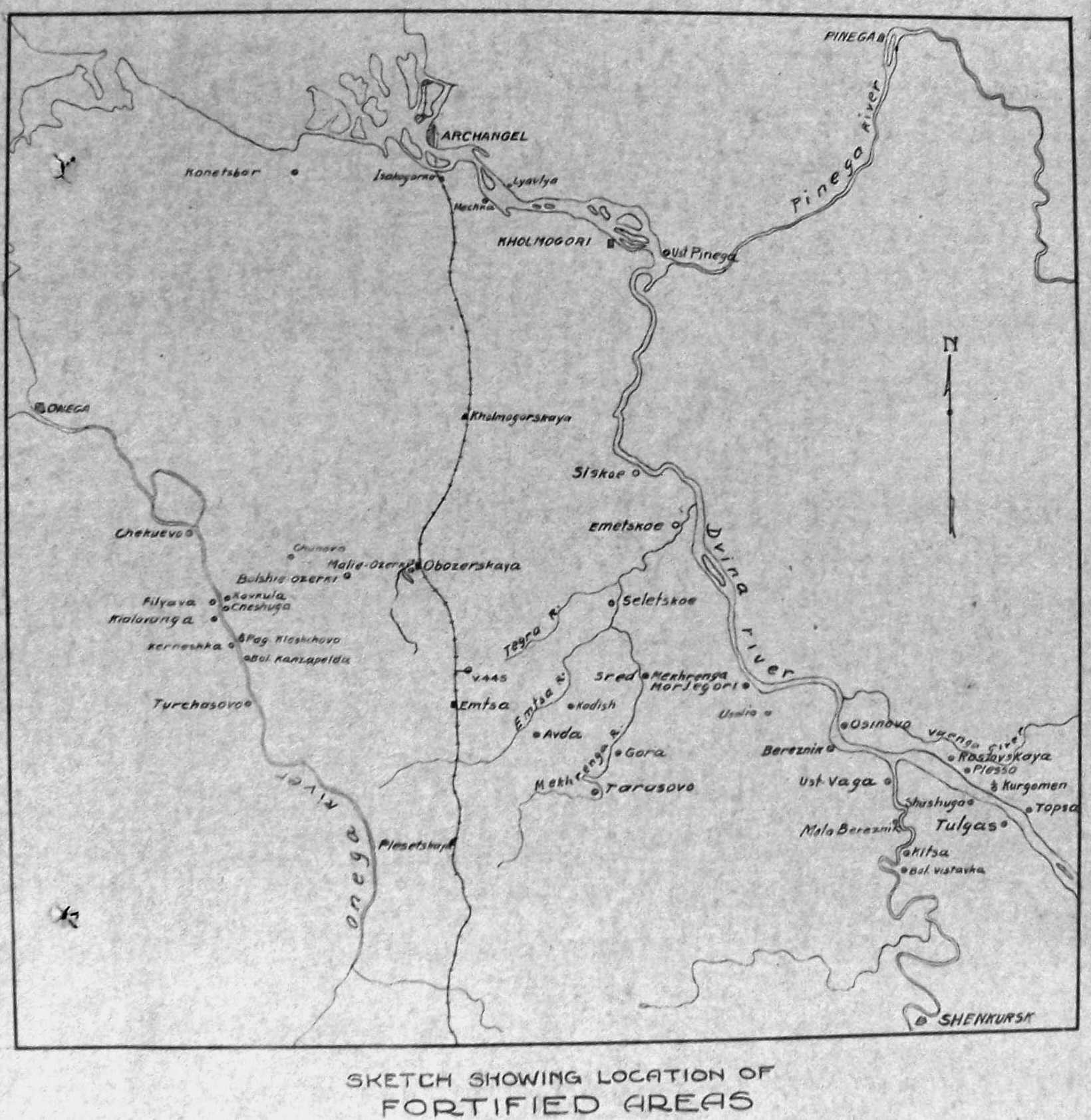
Sketch Showing Location of
FORTIFIED AREAS
[End of Transcriber’s notes]
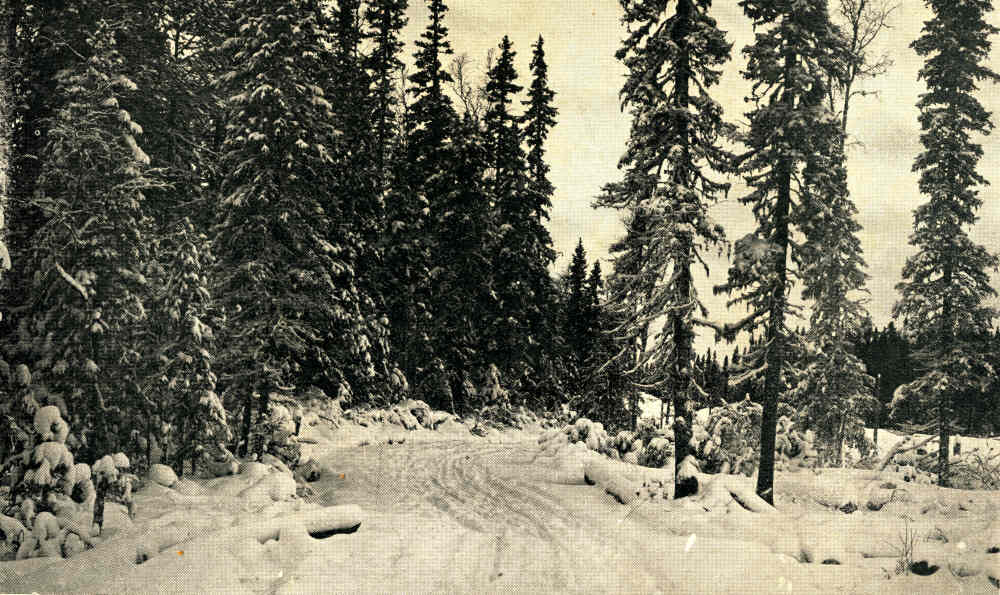
Hundreds of Miles Through Solid Forests of Pine and Spruce.
The History of the American Expedition Fighting the Bolsheviki
Campaigning in North Russia
1918–1919
Compiled and Edited by
CAPT. JOEL R. MOORE, 339th U. S. Infantry
LIEUT. HARRY H. MEAD, 339th U. S. Infantry
LIEUT. LEWIS E. JAHNS, 339th U. S. Infantry
Published by
The Polar Bear Publishing Co.
Detroit, Mich.
COPYRIGHT 1920
BY
JOEL R. MOORE
PRESS OF
TOPPING-SANDERS COMPANY
DETROIT
To the men who in North Russia died in battle and of wounds, or of sickness
due directly to hardship and exposure, this book is reverently dedicated.
To Our Comrades and Friends
To our comrades and friends we address these prefatory words. The book is about
to go to the printers and binders. Constantly while writing the historical
account of the American expedition, which fought the Bolsheviki in North
Russia, we have had our comrades in mind. You are the ones most interested in
getting a complete historical account. It is a wonderful story of your own
fighting and hardships, of your own fortitude and valor. It is a story that
will make the eyes of the home folks shine with pride.
Probably you never could have known how remarkably good is the record of your
outfits in that strange campaign if you had not commissioned three of your
comrades to write the book for you. In the national army, we happened to be
officers; in civil life we are respectively, college professor, lawyer, and
public accountant, in the order in which our names appear on the title page.
But we prefer to come to you now with the finished product merely as comrades
who request you to take the book at its actual value to you—a faithful
description of our part in the great world war. We are proud of the record the
Americans made in the expedition.
We think that nothing of importance has been omitted. Some sources of
information were not open to us—will be to no one for years. But from some
copies of official reports, from company and individual diaries, and from
special contributions written for us, we have been able to write a complete
narrative of the expedition. In all cases except a few where the modesty of the
writer impelled him to ask us not to mention his name, we have referred to
individuals who have contributed to the book. To these contributors all, we
here make acknowledgment of our debt to them for their cordial co-operation.
For the wealth of photo-engravures which the book carries, we have given
acknowledgment along with each individual engraving, for furnishing us with the
photographic views of the war scenes and folk scenes of North Russia. Most of
them are, of course, from the official United States Signal Corps war pictures.
When we started the book, we had no idea that it would develop into the big
book it is, a de luxe edition, of fine materials and fine workmanship.
We have not been able to risk a large edition. Only two thousand copies are
being printed. They are made especially for the boys who were up there under
the Arctic Circle, made as nice as we could get them made. Of many of the
comrades we have lost track, but we trust that somehow they will hear of this
book and become one of the proud possessors of a copy. To our comrades and
friends, we offer this volume with the expectation that you will be pleased
with it and that after you have read it, you will glow with pride when you pass
it over to a relative or friend to read.
Detroit, Michigan,
September, 1920
JOEL R. MOORE
HARRY H. MEAD
LEWIS E. JAHNS
Index of Photo-Engravures
| Hundreds of Miles Through Solid Forests |
| Surgical Operation, Receiving Hospital, Archangel |
| Old Glory Protects Our Hospital |
| Used as 53rd Stationary Hospital |
| “Olympia” Sailors Fought Reds |
| After 17-Hour March in Forest |
| Loading a Drosky at Obozerskaya |
| Wireless Operators-Signal Platoon |
| A Shell Screeched Over This Burial Scene |
| Vickers Machine Gun Helping Hold Lines |
| Our Armored Train |
| First Battalion Hurries Up River |
| Lonely Post in Dense Forest |
| Statue of Peter the Great and Public Buildings, Archangel |
| Drawing Rations, Verst 455 |
| List Honors to a Soldier |
| Olga Barracks |
| Street Car Strike in Archangel |
| American Hospitals |
| “Supply” Co. Canteen “Accommodates” Boys |
| Red Cross Ambulances, Archangel |
| “Cootie Mill” Operating at Smolny Annex |
| Single Flat Strip of Iron on Plow Point |
| Thankful for What at Home We Feed Pigs |
| Artillery “O. P.” Kodish |
| Mill for Grinding Grain |
| Pioneer Platoon Clearing Fire Lane |
| Testing Vickers Machine Gun |
| Doughboy Observing Bolo in Pagosta, near Ust Padenga |
| Cossack Receiving First Aid |
| Ready for Day’s Work |
| Flax Hung Up to Dry |
| 310th Engineers at Beresnik |
| Joe Chinzi and Russian Bride |
| Watching Her Weave Cloth |
| Doughboy Attends Spinning Bee |
| Doughboy in Best Bed—On Stove |
| Defiance to Bolo Advance |
| 337th Hospital at Beresnik |
| Onega |
| Y. M. C. A., Obozerskaya |
| Trench Mortar Crew, Chekuevo—Hand Artillery |
| Wounded and Sick—Over a Thousand in All |
| Bolo Killed in Action—For Russia or Trotsky? |
| Monastery at Pinega |
| Russian 75’s Bound for Pinega |
| “G” Men near Pinega |
| Lewis Gun Protects Mess Hall |
| Something Like Selective Draft |
| Canadian Artillery, Kurgomin |
| Watch Tower, Verst 455 |
| Toulgas Outpost |
| One of a Bolo Patrol |
| Patrolling |
| By Reindeer Jitney to Bakaritza |
| Russian Eskimos at Home near Pinega |
| Fortified House, Toulgas |
| To Bolsheozerki |
| Colonel Morris, at Right |
| Russian Eskimo Idol |
| Ambulance Men |
| Practising Rifle and Pistol Fire, on Onega Front |
| French Machine Gun Men at Kodish |
| Allied Plane Carrying Bombs |
| Dance at Convalescent Hospital—Nurses and “Y” Girls |
| Subornya Cathedral |
| Building a Blockhouse |
| Market Scene, Yemetskoe |
| Old Russian Prison—Annex to British Hospital |
| Wash Day—Rinsing in River |
| Archangel Cab-Men |
| Minstrels of “I” Company Repeat Program in Y. M. C. A |
| Archangel Girls Filling Christmas Stockings |
| Y. M. C. A. Rest Room, Archangel |
| Russian Masonry Stove—American Convalescent Hospital |
| Comrade Allikas Finds His Mother in Archangel |
| Printing “The American Sentinel” |
| Flashlight of a Doughboy Outpost at Verst 455 |
| Bolo Commander’s Sword Taken in Battle of Bolsheozerki |
| Eight Days without a Shave, near Bolsheozerki |
| Woodpile Strong-Point, Verst 445 |
| Verst 455—“Fort Nichols” |
| Back from Patrol |
| Our Shell Bursts near the Bolo Skirmish Line |
| Blockhouse at Shred Makrenga |
| Hot Summer Day at Pinega before the World War |
| Dvina River Ice Jam in April |
| Bare Mejinovsky—Near Kodish |
| Bolo General under Flag Truce at 445, April, 1919 |
| After Prisoner Exchange Parley |
| Pioneer Platoon Has Fire |
| 310th Engineers Under Canvas near Bolsheozerki with “M” Co |
| Hospital “K. P.’s” |
| Red Cross Nurses |
| Bartering |
| Mascots |
| Colonel Dupont (French) at 455 Bestows Many Croix de Guerre Medals on Americans |
| Polish Artillery and Mascot |
| Russian Artillery, Verst 18 |
| Canadian Artillery—Americans Were Strong for Them |
| Making Khleba—Black Bread |
| Stout Defense of Kitsa |
| Christmas Dinner, Convalescent Hospital, Archangel |
| “Come and Get It” at 455 |
| Doughboys Drubbed Sailors |
| Yank and Scot Guarding Bolo Prisoners, Beresnik |
| View of Archangel in Summer |
| General Ironside Inspecting Doughboys |
| Burial of Lt. Clifford Phillips, American Cemetery, Archangel |
| Major J. Brooks Nichols in his Railway Detachment Field Hq |
| Ready to Head Memorial Day Parade, Archangel, 1919 |
| American Cemetery, Archangel |
| Soldiers and Sailors of Six Nations Reverence Dead |
| Graves of First Three Americans Killed, Obozerskaya, Russia |
| Sailors Parade on Memorial Day |
| Through Ice Floes in Arctic Homeward Bound |
| Out of White Sea into Arctic, under Midnight Sun |
INTRODUCTION
The troopships “Somali,” “Tydeus,” and “Nagoya” rubbed the Bakaritza and
Smolny quays sullenly and listed heavily to port. The American doughboys
grimly marched down the gangplanks and set their feet on the soil of
Russia, September 5th, 1918. The dark waters of the Dvina River were
beaten into fury by the opposing north wind and ocean tide. And the
lowering clouds of the Arctic sky added their dismal bit to this
introduction to the dreadful conflict which these American sons of
liberty were to wage with the Bolsheviki during the year’s campaign.
In the rainy fall season by their dash and valor they were to expel the
Red Guards from the cities and villages of the state of Archangel,
pursuing the enemy vigorously up the Dvina, the Vaga, the Onega and the
Pinega Rivers, and up the Archangel-Vologda Railway and the
Kodish-Plesetskaya-Petrograd state highway. They were to plant their
entrenched outposts in a great irregular horseshoe line, one cork at
Chekuevo, the toe at Ust-Padenga, the other cork of the shoe at
Karpagorskaya. They were to run out from the city of Archangel long,
long lines of communication, spread wide like the fingers of a great
hand that sought seemingly to cover as much of North Russia as possible
with Allied military protection.
In the winter, in the long, long nights and black, howling forests and
frozen trenches, with ever-deepening snows and sinking thermometer, with
the rivers and the White Sea and the Arctic Ocean solid ice fifteen feet
thick, these same soldiers now seen disembarking from the troopships,
were to find their enemy greatly increasing his forces every month at
all points on the Allied line. Stern defense everywhere on that
far-flung trench and blockhouse and fortified-village battle line. They
were to feel the overwhelming pressure of superior artillery and
superior equipment and transportation controlled by the enemy and
especially the crushing odds of four to ten times the number of men on
the battle lines. And with it they were to feel the dogged sense of the
grim necessity of fighting for every verst of frozen ground. Their very
lives were to depend upon the stubbornness of their holding retreat.
There could be no retreating beyond Archangel, for the ships were frozen
in the harbor. Indeed a retreat to the city of Archangel itself was
dangerous. It might lead to revulsion of temper among the populace and
enable the Red Guards to secure aid from within the lines so as to carry
out Trotsky’s threat of pushing the foreign bayonets all under the ice
of the White Sea. And in that remarkable winter defense these American
soldiers were to make history for American arms, exhibiting courage and
fortitude and heroism, the stories of which are to embellish the annals
of American martial exploits. They were destined, a handful of them
here, a handful there, to successfully baffle the Bolshevik hordes in
their savage drives.
In the spring the great ice crunching up in the rivers and the sea was
to behold those same veteran Yanks still fighting the Red Guard armies
and doing their bit to keep the state of Archangel, the North Russian
Republic, safe, and their own skins whole. The warming sun and bursting
green were to see the olive-drab uniform, tattered and torn as it was,
covering a wearied and hungry and homesick but nevertheless fearless and
valiant American soldier. With deadly effect they were to meet the
onrushing swarms of Bolos on all fronts and slaughter them on their wire
with rifle and machine gun fire and smash up their reserves with
artillery fire. With desperation they were to dispute the overwhelming
columns of infantry who were hurled by no less a renowned old Russian
General than Kuropatkin, and at Malo Bereznik and Bolsheozerki, in
particular, to send them reeling back in bloody disaster. They were to
fight the Bolshevik to a standstill so that they could make their
guarded getaway.
Summer was to see these Americans at last handing over the defenses to Russian
Northern Republic soldiers who had been trained during the winter at Archangel
and gradually during the spring broken in for duty alongside the American and
British troops and later were to hold the lines in some places by themselves
and in others to share the lines with the new British troops coming in twenty
thousand strong “to finish the bloody show.” Gaily decorated Archangel was to
bid the Americanski dasvedanhnia and God-speed in June. Blue rippling
waters were to meet the ocean-bound prows. Music from the Cruiser “Des Moines”
(come to see us out) was to blow fainter and fainter in the distance as they
cheered us out of the Dvina River for home.
Now the troops are hurrying off the transport. They are just facing the
strange, terrible campaign faintly outlined. It is now our duty to
faithfully tell the detailed story of it—“The History of the American
North Russian Expedition,” to try to do justice in this short volume to
the gripping story of the American soldiers “Campaigning in North
Russia, 1918–1919.”
The American North Russian Expeditionary Force consisted of the 339th
Infantry, which had been known at Camp Custer as “Detroit’s Own,” one
battalion of the 310th Engineers, the 337th Ambulance Company, and the
337th Field Hospital Company. The force was under the command of Col.
George E. Stewart, 339th Infantry, who was a veteran of the Philippines
and of Alaska. The force numbered in all, with the replacements who came
later, about five thousand five hundred men.
These units had been detached from the 85th Division, the Custer
Division, while it was enroute to France, and had been assembled in
southern England, there re-outfitted for the climate and warfare of the
North of Russia. On August the 25th, the American forces embarked at
Newcastle-on-Tyne in three British troopships, the “Somali,” the
“Tydeus” and the “Nagoya” and set sail for Archangel, Russia. A fourth
transport, the “Czar,” carried Italian troops who travelled as far as
the Murmansk with our convoy.
The voyage up the North Sea and across the Arctic Ocean, zig-zagging day
and night for fear of the submarines, rounding the North Cape far toward
the pole where the summer sun at midnight scarcely set below the
northwestern horizon, was uneventful save for the occasional alarm of a
floating mine and for the dreadful outbreak of Spanish “flu” on board
the ships. On board one of the ships the supply of yeast ran out and
breadless days stared the soldiers in the face till a resourceful army
cook cudgelled up recollections of seeing his mother use drainings from
the potato kettle in making her bread. Then he put the lightening once
more into the dough. And the boys will remember also the frigid breezes
of the Arctic that made them wish for their overcoats which by order had
been packed in their barrack bags, stowed deep down in the hold of the
ships. And this suffering from the cold as they crossed the Arctic
circle was a foretaste of what they were to be up against in the long
months to come in North Russia.
We had thought to touch the Murmansk coast on our way to Archangel, but
as we zig-zagged through the white-capped Arctic waves we picked up a
wireless from the authorities in command at Archangel which ordered the
American troopships to hasten on at full speed. The handful of American
sailors from the “Olympia,” the crippled category men from England and
the little battalion of French troops, which had boldly driven the Red
Guards from Archangel and pursued them up the Dvina and up the
Archangel-Vologda Railway, were threatened with extermination. The Reds
had gathered forces and turned savagely upon them.
So we sped up into the White Sea and into the winding channels of the
broad Dvina. For miles and miles we passed along the shores dotted with
fishing villages and with great lumber camps. The distant domes of the
cathedrals in Archangel came nearer and nearer. At last the water front
of that great lumber port of old Peter the Great lay before us strange
and picturesque. We dropped anchor at 10:00 a. m. on the fourth day of
September, 1918. The anchor chains ran out with a cautious rattle. We
swung on the swift current of the Dvina, studied the shoreline and the
skyline of the city of Archangel, saw the Allied cruisers, bulldogs of
the sea, and turned our eyes southward toward the boundless pine forest
where our American and Allied forces were somewhere beset by the
Bolsheviki, or we turned our eyes northward and westward whence we had
come and wondered what the folks back home would say to hear of our
fighting in North Russia.
I
U. S. A. MEDICAL UNITS ON THE ARCTIC OCEAN
Someone Blunders About Medicine Stores—Spanish Influenza At Sea And No
Medicine—Improvised Hospitals At Time Of Landing—Getting Results In Spite Of
Red Tape—Raising Stars And Stripes To Hold The Hospital—Aid Of American Red
Cross—Doughboys Dislike British Hospital—Starting American Receiving
Hospital—Blessings On The Medical Men.
At Stoney Castle camp in England, inquiry by the Americans had elicited
statement from the British authorities that each ship would be well
supplied with medicines and hospital equipment for the long voyage into
the frigid Arctic. But it happened that none were put on the boat and
all that the medical officers had to use were three or four boxes of
medical supplies that they had clung to all the way from Camp Custer.
Before half the perilous and tedious voyage was completed, the dreaded
Spanish influenza broke out on three of the ships. On the “Somali,”
which is typical of the three ships, every available bed was full on the
fifth day out at sea. Congestion was so bad that men with a temperature
of only 101 or 102 degrees were not put into the hospital but lay in
their hammocks or on the decks. To make matters worse, on the eighth day
out all the “flu” medicines were exhausted.
It was a frantic medical detachment that paced the decks of those three
ships for two days and nights after the ships arrived in the harbor of
Archangel while preparations were being made for the improvisation of
hospitals.
On the 6th of September they debarked in the rain at Bakaritza. About
thirty men could be accommodated in the old Russian Red Cross Hospital,
such as it was, dirt and all. The remainder were temporarily put into
old barracks. What “flu”-weakened soldier will ever forget those double
decked pine board beds, sans mattress, sans linen, sans pillows? If
lucky, a man had two blankets. He could not take off his clothes. Death
stalked gauntly through and many a man died with his boots on in bed.
The glory of dying in France to lie under a field of poppies had come to
this drear mystery of dying in Russia under a dread disease in a strange
and unlovely place. Nearly a hundred of them died and the wonder is that
more men did not die. What stamina and courage the American soldier
showed, to recover in those first dreadful weeks!
No attempt is made to fasten blame for this upon the American medical
officers, nor upon the British for that matter. Many a soldier, though,
was wont to wish that Major Longley had not himself been nearly dead of
the disease when the ships arrived. To the credit of Adjutant Kiley,
Captains Hall, Kinyon, Martin and Greenleaf and Lieutenants Lowenstein
and Danzinger and the enlisted medical men, let it be said that they
performed prodigies of labor trying to serve the sick men who were
crowded into the five hastily improvised hospitals.
The big American Red Cross Hospital, receiving hospital at the base, was
started at Archangel November 22nd by Captain Pyle under orders of Major
Longley. The latter had been striving for quite a while to start a
separate receiving hospital for American wounded, but had been blocked
by the British medical authorities in Archangel. They declared that it
was not feasible as the Americans had no equipment, supplies or medical
personnel.
However, the officer in charge of the American Red Cross force in
Archangel offered to supply the needed things, either by purchasing them
from the stores of British medical supplies in Archangel or by sending
back to England for them. It is said that the repeated letters of Major
Longley to SOS in England somehow were always tangled in the British and
American red tape, in going through military channels.
At last Major Longley took the bull by the horns and accepted the aid of
the Red Cross and selected and trained a personnel to run the hospital
from among the officers and men who had been wounded and were recovered
or partially recovered and were not fit for further heavy duty on the
fighting line. He had the valuable assistance also of the two American
Red Cross nurses, Miss Foerster and Miss Gosling, the former later being
one of five American women who, for services in the World War, were
awarded the Florence Nightingale Medal.
On September 10th, we opened the first Red Cross Hospital which was also
used in connection with the Russian Red Cross Hospital and was served by
Russian Red Cross nurses. Captain Hall and Lieutenant Kiley were in
charge of the hospital.
A few days later an infirmary was opened for the machine gunners and
Company “C” of the engineers at Solombola.
A good story goes in connection with this piece of history of the little
Red Cross hospital on Troitsky near Olga barracks. There had been rumor
and more or less open declaration of the British medical authorities
that the Americans would not be permitted to start a hospital of their
own in Archangel. The Russian sisters who owned the building were
interested observers as to the outcome of this clash in authority. It
was settled one morning about ten o’clock in a spectacular manner much
to the satisfaction of the Americans and Russians. Captain Wynn of the
American Red Cross came to the assistance of Captain Hall, supplying the
American flag and helping raise it over the building and dared the
British to take it down. Then he supplied the hospital with beds and
linen and other supplies and comfort bags for the men, dishes, etc. This
little hospital is a haven of rest that appears in the dreams today of
many a doughboy who went through those dismal days of the first month in
Archangel. There they got American treatment and as far as possible food
cooked in American style.
In October the number of sick and wounded men was so large that another
hospital for the exclusive use of convalescents was opened in an old Russian
sailor’s home in the near vicinity of American Headquarters.
![[Illustration: ]](images/016Pic1_25.jpg)
RED CROSS PHOTO
Surgical Operation American Receiving Hospital, Archangel, 1918.
![[Illustration: ]](images/016Pic2_A25.jpg)
U. S. OFFICIAL PHOTO
Old Glory Protects Our Hospital.
![[Illustration: ]](images/016Pic2_B25.jpg)
U. S. OFFICIAL PHOTO
Used as 53rd Stationary Hospital.
![[Illustration: ]](images/016Pic2_C25.jpg)
U. S OFFICIAL PHOTO
Sailors from “Olympia” Fought Reds.
![[Illustration: ]](images/016Pic2_D25.jpg)
U. S. OFFICIAL PHOTO
After 17-Hour March in Forest.
![[Illustration: ]](images/016Pic3_A25.jpg)
U.S. Official Photo
Loading a Drosky at Obozerskaya
![[Illustration: ]](images/016Pic3_B25.jpg)
U.S. Official Photo
Wireless operators—Signal Platoon
During this controversy with the British medical authorities, the head American
medical officer was always handicapped, as indeed was many a fighting line
officer, by the fact that the British medical officer outranked him. Let it be
understood right here that many a British officer was decorated with insignia
of high rank but drew pay of low rank. It was actually done over and over again
to give the British officer ranking authority over the American officers.
What American doughboy who ever went through the old 53rd Stationary
hospital will ever forget his homesickness and feeling of outrage at the
treatment by the perhaps well-meaning but nevertheless callous and
coarse British personnel. Think of tea, jam and bread for sick and
wounded men. An American medical sergeant who has often eaten with the
British sergeants at that hospital, Sergeant Glenn Winslow, who made out
the medical record for every wounded and sick man of the Americans who
went through the various hospitals at Archangel, and who was frequently
present at the British sergeant’s mess at the hospital, relates that
there were plenty of fine foods and delicacies and drink for the
sergeant’s messes, corroborated by Mess Sgt. Vincent of. “F” Company.
And a similar story was told by an American medical officer who was
invalided home in charge of over fifty wounded Americans. He had often
heard that the comforts and delicacies among the British hospital
supplies went to the British officers’ messes. Captain Pyle was in
command on the icebreaker “Canada” and saw to it that the limited supply
of delicacies went to the wounded men most in need of it. There were
several British officers on the icebreaker enroute to Murmansk who set
up a pitiful cry that they had seen none of the extras to which they
were accustomed, thinking doubtless that the American officer was
holding back on them. Captain Pyle on the big ship out of Murmansk took
occasion to request of the British skipper that the American wounded on
board the ship be given more food and more palatable food. He was asked
if he expected more for the doughboy than was given to the Tommie. The
American officer’s reply was characteristic of the difference between
the attitude of British and American officers toward the enlisted man:
“No, sir, it is not a question of different treatment as between Tommie
and doughboy. It is difference in the feeding of the wounded and sick
American officers and the feeding of wounded and sick American enlisted
men. My government makes no such great difference. I demand that my
American wounded men be fed more like the way in which the officers on
this ship are fed.”
Lest we forget, this same medical officer in charge at one time of a
temporary hospital at a key point in the field, was over-ranked and put
under a British medical officer who brought about the American officer’s
recall to the base because he refused to put the limited American
medical personnel of enlisted men to digging latrines for the British
officers’ quarters.
Many a man discharged from the British 53rd Stationary Hospital as fit
for duty, was examined by American medical officers and put either into
our own Red Cross Hospital or into the American Convalescent Hospital
for proper treatment and nourishment back to fighting condition. It was
openly charged by the Americans that several Americans in the British
hospital were neglected till they were bedsore and their lives
endangered. Sick and wounded men were required to do orderly work. When
a sturdy American corporal refused to do work or to supervise work of
that nature in the hospital, he was court-martialed by order of the
American colonel commanding the American forces in North Russia. Of
course it must needs be said that there were many fine men among the
British medical officers and enlisted personnel. But what they did to
serve the American doughboys was overborne by the mistreatment of the
others.
Finally no more wounded Americans were sent to the British hospital and
no sick except those sick under G. O. 45. These latter found themselves
cooped up in an old Russian prison, partially cleaned up for a hospital
ward. This was a real chamber of horrors to many an unfortunate soldier
who was buffetted from hospital to Major Young’s summary court to
hospital or back to the guardhouse, all the while worrying about the
ineffectiveness of his treatment.
So the American soldiers at last got their own receiving hospital and
their own convalescent hospital. Of course at the fighting fronts they
were nearly always in the hands of their own American medical officers
and enlisted men. The bright story of the Convalescent Hospital appears
in another place. This receiving hospital was a fine old building which
one time had been a meteorological institute, a Russian imperial
educational institution. Its great stone exterior had gathered a
venerable look in its two hundred years. The Americans were to give its
interior a sanitary improvement by way of a set of modern plumbing. But
the thing that pleased the wounded doughboy most was to find himself,
when in dreadful need of the probe or knife, under the familiar and
understanding and sympathetic eyes of Majors Henry or Longley or some
other American officer, to find his wants answered by an enlisted man
who knew the slang of Broadway and Hamtramck and the small town slang of
“back home in Michigan, down on the farm,” and to find his food cooked
and served as near as possible like it was “back home” to a sick man.
Blessings on the medical men!
II
FALL OFFENSIVE ON THE RAILROAD
Third Battalion Hurries From Troopship To Troop-Train Bound For Obozerskaya—We
Relieve Wearied French Battalion—“We Are Fighting An Offensive War”—First
Engagement—Memorable Night March Ends At Edge Of Lake—Our Enemy Compels Respect
At Verst 458—American Major Hangs On—Successful Flank March Takes Verst
455—Front Line Is Set At 445 By Dashing Attack—We Hold It Despite Severe
Bombardments And Heavy Assaults.
On the afternoon of September the fifth the 3rd Battalion of the 339th
Infantry debarked hurriedly at Bakaritza. Doughboys marched down the
gangplank with their full field equipment ready for movement to the
fighting front. Somewhere deep in the forest beyond that skyline of pine
tree tops a handful of French and Scots and American sailors were
battling the Bolos for their lives. The anxiety of the British staff
officer—we know it was one of General Poole’s staff, for we remember
the red band on his cap, was evidenced by his impatience to get the
Americans aboard the string of tiny freight cars.
Doughboys stretched their sea legs comfortably and formed in column of
squads under the empty supply shed on the quay, to escape the cold
drizzle of rain, while Major Young explained in detail how Captain
Donoghue was to conduct the second train.
All night long the two troop trains rattled along the Russki railway or
stood interminably at strange-looking stations. The bare box cars were
corded deep with sitting and curled up soldiers fitfully sleeping and
starting to consciousness at the jerking and swaying of the train. Once
at a weird log station by the flaring torchlights they had stood for a
few minutes beside a northbound train loaded with Bolshevik prisoners
and deserters gathered in that day after the successful Allied
engagement. Morning found them at a big bridge that had been destroyed
by artillery fire of the Red Guards the afternoon before, not far from
the important village of Obozerskaya, a vital keypoint which just now we
were to endeavor to organize the defense of, and use as a depot and
junction point for other forces.
No one who was there will forget the initial scene at Obozerskaya when
two companies of Americans, “I” and “L”, proceeded’ up the railroad
track in column of twos and halted in ranks before the tall station
building, with their battalion commander holding officers call at
command of the bugle. An excited little French officer popped out of his
dugout and pointed at the shell holes in the ground and in the station
and spoke a terse phrase in French to the British field staff officer
who was gnawing his mustache. The latter overcame his embarrassment
enough to tell Major Young that the French officer feared the Bolo any
minute would reopen artillery fire. Then we realized we were in the
fighting zone. The major shouted orders out and shooed the platoons off
into the woods.
Later into the woods the French officers led the Americans who relieved
them of their circle of fortified outposts. Some few in the vicinity of
the scattered village made use of buildings, but most of the men stood
guard in the drizzly rain in water up to their knees and between
listening post tricks labored to cut branches enough to build up a dry
platform for rest. The veteran French soldier had built him a fire at
each post to dry his socks and breeches legs, but “the strict old
disciplinarian,” Major Young, ordered “No fires on the outpost.”
And this was war. Far up the railroad track “at the military crest” an
outpost trench was dug in strict accordance with army book plans. The
first night we had a casualty, a painful wound in a doughboy’s leg from
the rifle of a sentry who cried halt and fired at the same time. An
officer and party on a handcar had been rattling in from a visit to the
front outguard. All the surrounding roads and trails were patrolled.
Armed escorts went with British intelligence officers to outlying
villages to assemble the peasants and tell them why the soldiers were
coming into North Russia and enlist their civil co-operation and inspire
them to enlist their young men in the Slavo-British Allied Legion, that
is to put on brass buttoned khaki, eat British army rations, and drill
for the day when they should go with the Allies to clear the country of
the detested Bolsheviki. To the American doughboys it did not seem as
though the peasants’ wearied-of-war countenances showed much elation
nor much inclination to join up.
The inhabitants of Obozerskaya had fled for the most part before the Reds. Some
of the men and women had been forced to go with the Red Guards. They now crept
back into their villages, stolidly accepted the occupancy of their homes by the
Americans, hunted up their horses which they had driven into the wilderness to
save them from the plundering Bolo, greased up their funny looking little
droskies, or carts, and began hauling supplies for the Allied command
and begging tobacco from the American soldiers.
Captain Donoghue with two platoons of “K” Company, the other two having
been dropped temporarily at Issaka Gorka to guard that railroad repair
shop and wireless station, now moved right out by order of Colonel
Guard, on September seventh, on a trail leading off toward Tiogra and
Seletskoe. Somewhere in the wilds he would find traces of or might
succor the handful of American sailors and Scots who, under Col.
Hazelden, a British officer, had been cornered by the Red Guards.
“Reece, reece,” said the excited drosky driver as he greedily accepted
his handful of driver’s rations. He had not seen rice for three years.
Thankfully he took the food. His family left at home would also learn how to
barter with the generous doughboy for his tobacco and bully beef and crackers,
which at times, very rarely of course, in the advanced sectors, he was lucky
enough to exchange for handfuls of vegetables that the old women plucked out of
their caches in the rich black mould of the small garden, or from a cellar-like
hole under a loose board in the log house.
“Guard duty at Archangel” was aiming now to be a real war, on a small
scale but intensive. Obozerskaya, about one hundred miles south of
Archangel, in a few days took on the appearance of an active field base
for aggressive advance on the enemy. Here were the rapid assembling of
fighting units; of transport and supply units; of railroad repairing
crews, Russian, under British officers; of signals; of armored
automobile, our nearest approach to a tank, which stuck in the mud and
broke through the frail Russki bridges and was useless; of the feverish
clearing and smoothing of a landing field near the station for our
supply of spavined air-planes that had already done their bit on the
Western Front; of the improvement of our ferocious-looking armored
train, with its coal-car mounted naval guns, buttressed with sand bags
and preceded by a similar car bristling with machine guns and Lewis
automatics in the hands of a motley crew of Polish gunners and Russki
gunners and a British sergeant or two. This armored train was under the
command of the blue-coated, one-armed old commander Young, hero of the
Zeebrugge Raid, who parked his train every night on the switch track
next to the British Headquarters car, the Blue Car with the Union Jack
flying over it and the whole Allied force. Secretly, he itched to get
his armored train into point-blank engagement with the Bolshevik armored
train.
“All patrols must be aggressive,” directed a secret order of Col. Guard,
the British officer commanding this “A” Force on the railroad, “and it
must be impressed on all ranks that we are fighting an offensive war,
and not a defensive one, although for the time being it is the duty of
everybody to get the present area in a sound state of defense. All posts
must be held to the last as we do not intend to give up any ground which
we have made good.”
And within a week after landing in Russia the American soldier was
indeed making head on an offensive campaign, for on September 11th two
platoons of “M” Company reconnoitering in force met a heavy force of
Bolos on similar mission and fought the first engagement with the Red
Guards, driving the Reds from the station at Verst 466 and taking
possession of the bridge at Verst 464.
We had ridden out past the outguard on the armored train, left it and
proceeded along the railway. Remember that first Bolo shell? Well, yes.
That thing far down the straight track three miles away Col. Guard,
before going to the rear, derisively told Lieut. Danley could not be a
Bolo armored train but was a sawmill smoke stack. Suddenly it flashed.
Then came the distant boom. Came then the whining, twist-whistling shell
that passed over us and showered shrapnel near the trenches where lay
our reserves. He shortened his range but we hurried on and closed with
his infantry with the decision in the American doughboy’s favor in his
first fight. He had learned that it takes many shrapnel shells and
bullets to hit one man, that to be hit is not necessarily to be killed.
A few days later “L” Company supported in the nick of time by two
platoons of “I” Company repulsed a savage counter-attack staged by the
Red Guards, September 16th, on a morning that followed the capture of a
crashing Red bombing plane in the evening and the midnight conflagration
in “L” Company’s fortified camp that might have been misinterpreted as
an evacuation by the Bolo. In this engagement Lieut. Gordon B. Reese and
his platoon of “I” Company marked themselves with distinction by
charging the Reds as a last resort when ammunition had been exhausted in
a vain attempt to gain fire superiority against the overwhelming and
enveloping Red line, and gave the Bolshevik soldiers a sample of the
fighting spirit of the Americans. And the Reds broke and ran. Also our
little graveyard of brave American soldiers at Obozerskaya began to
grow.
It was the evening before when the Bolo airman, who had dropped two small bombs
at the Americans at Obozerskaya, was obliged to volplane to earth on the
railroad near the 464 outguard. Major Young was there at the time. He declared
the approaching bomb-plane by its markings was certainly an Allied plane,
ordered the men not to discharge their Lewis gun which they had trained upon
it, and as the Bolos hit the dirt two hundred yards away, he rushed out
shouting his command, which afterwards became famous, “Don’t fire! We are
Americans.” But the Bolo did not pahneemahya and answered with his own
Lewis gun sending the impetuous American officer to cover where he lay even
after the Bolo had darted into the woods and the doughboys ran up and pulled
the moss off their battalion commander whom they thought had been killed by the
short burst of the Bolo’s automatic fire, as the major had not arisen to reply
with his trusty six shooter.
Meanwhile “K” Company had met the enemy on the Seletskoe-Kodish front as
will be related later, and plans were being laid for a converging attack
by the Kodish, Onega and Railroad columns upon Plesetskaya. “L” Company
was sent to support “K” Company and the Railroad Force marked time till
the other two columns could get into position for the joint drive.
Machine gun men and medical men coming to us from Archangel brought
unverified stories of fighting far up the Dvina and Onega Rivers where
the Bolshevik was gathering forces for a determined stand and had caused
the digging of American graves and the sending back to Archangel of
wounded men. This is told elsewhere. Our patrols daily kept in contact
with Red Guard outposts on the railroad, occasionally bringing in
wounded Bolos or deserters, who informed us of intrenchments and armored
trains and augmenting Bolshevik regiments.
Our Allied force of Cossacks proved unreliable and officer’s patrols of
Americans served better but owing to lack of maps or guides were able to
gain but little information of the forest trails of the area. British
intelligence officers depending on old forester’s maps and on deserters
and prisoners and neutral natives allowed the time for “Pat Rooney’s
work,” personal reconnaissance, to go by till one day, September 28th,
General Finlayson arrived at Obozerskaya in person at noon and
peremptorily ordered an advance to be started that afternoon on the
enemy’s works at Versts 458 and 455. Col. Sutherland was caught
unprepared but had to obey.
Calling up one company of the resting French troops under the veteran
African fighter, Captain Alliez, for support, Col. Sutherland asked
Major Young to divide his two American companies into two detachments
for making the flank marches and attacks upon the Red positions. The
marches to be made to position in the afternoon and night and the
attacks to were be put on at dawn. The armored train and other guns
manned by the Poles were to give a barrage on the frontal positions as
soon as the American soldiers had opened their surprise flank and rear
attacks. Then the Bolos were supposed to run away and a French company
supported by a section of American machine guns and a “Hq.” section that
had been trained hastily into a Stokes mortar section, were to rush in
and assist in consolidating the positions gained.
But this hurriedly contrived advance was doomed to failure before it
started. There had not been proper preparations. The main force
consisting of “M” Company and two platoons of “I” Company and a small
detachment of Engineers to blow the track in rear of the Bolo position
at 455 was to march many miles by the flank in the afternoon and night
but were not provided with even a map that showed anything but the
merest outlines. The other detachment consisting of two remaining
platoons of “I” Company were little better off only they had no such
great distance to go. Both detachments after long hours were unable to
reach the objective.
This was so memorable a night march and so typical of the fall
operations everywhere that space has been allowed to describe it. No one
had been over the proposed route of march ordered by Col. Sutherland. No
Russian guide could be provided. We must follow the blazed trail of an
east-and-west forest line till we came to a certain broad
north-and-south cutting laid out in the days of Peter the Great. Down
this cutting we were to march so many versts, told by the decaying old
notched posts, till we passed the enemy’s flank at 455, then turn in
toward the railroad, camp for the night in the woods and attack him in
the rear at 6:00 a. m.
At five o’clock in the afternoon the detachment struck into the woods.
Lieut. Chantrill, the pleasant British intelligence officer who acted as
interpreter, volunteered to go as guide although he had no familiarity
with the swamp-infested forest area. It was dark long before we reached
the broad cutting. No one will forget the ordeal of that night march.
Could not see the man ahead of you. Ears told you he was tripping over
fallen timber or sloshing in knee-deep bog hole. Hard breathing told the
story of exertion. Only above and forward was there a faint streak of
starlight that uncertainly led us on and on south toward the vicinity of
the Bolo positions.
Hours later we emerge from the woods cutting into a great marsh. Far in
the dark on the other side we must hit the cutting in the heavy pine
woods. For two hours we struggle on. We lose our direction. The marsh is
a bog. To the right, to the left, in front the tantalizing optical
illusion lures us on toward an apparently firmer footing. But ever the
same, or worse, treacherous mire. We cannot stand a moment in a spot. We
must flounder on. The column has to spread. Distress comes from every
side. Men are down and groggy. Some one who is responsible for that body
of men sweats blood and swears hatred to the muddler who is to blame.
How clearly sounds the exhaust of the locomotives in the Bolo camp on
the nearby railroad. Will their outguards hear us? Courage, men, we must
get on.
This is a fine end. D—- that unverified old map the Colonel has. It did
not show this lake that baffles our further struggles to advance. Detour
of the unknown lake without a guide, especially in our present exhausted
condition, is impossible. (Two weeks later with two Russian guides and
American officers who had explored the way, we thought it a wonderful
feat to thread our way around with a column). Judgment now dictates that
it is best to retrace our steps and cut in at 461 to be in position to
be of use in the reserve or in the consolidation. We have failed to
reach our objective but it is not our fault. We followed orders and
directions but they were faulty. It is a story that was to be duplicated
over and over by one American force after another on the various fronts
in the rainy fall season, operating under British officers who took
desperate chances and acted on the theory that “You Americans,” as Col.
Sutherland said, “can do it somehow, you know.” And as to numbers, why,
“Ten Americans are as good as a hundred Bolos, aren’t they?”
But how shall we extricate ourselves? Who knows where the cutting may be
found? Can staggering men again survive the treacherous morass? It is
lighter now. We will pick our way better. But where is the cutting?
Chantrill and the Captain despair. Have we missed it in, the dark? Then
we are done for. Where is the “I” Co. detachment again? Lost? Here
Corporal Grahek, and you, Sgt. Getzloff, you old woodsmen from north
Michigan pines, scout around here and find the cutting and that rear
party. Who is it that you men are carrying?
No trace of the rear part of the column nor of the cutting! One thing
remains to do. We must risk a shout, though the Reds may hear.
“Danley! eeyohoh!”
“Yes, h-e-e-e-r-r-e on the c-u-t-t-i-n-g!”
Did ever the straight and narrow way seem so good. The column is soon
united again and the back trail despondingly begun. Daylight of a Sunday
morning aids our footsteps. We cross again the stream we had waded waist
deep in the pitch dark and wondered that no one had been drowned.
Zero hour arrives and we listen to the artillery of both sides and for
the rat-tat-tat of the Bolo machine guns when our forces move on the
bridgehead. We hurry on. The battle is joined. Pine woods roar and
reverberate with roar. By taking a nearer blazed trail we may come out
to the railway somewhere near the battle line.
At 8:40 a. m. we emerge from the woods near our armored train. At field
headquarters, Major Nichols, who in the thick of the battle has arrived
to relieve Major Young, orders every man at once to be made as
comfortable as possible. Men build fires and warm and dry their clammy
water-soaked feet, picture of which is shown in this volume. Bully and
tea and hard tack revive a good many. It is well they do, for the fight
is going against us and two detachments of volunteers from these men are
soon, to be asked for to go forward to the battle line.
Considerable detail has been given about this march of “I” and “M”
because writer was familiar with it, but a similar story might be told
of “H” in the swamps on the Onega, or of “K” or “L” and “M. G.” at
Kodish, or of “A,” “B,” “C” or “D” on the River Fronts, and with equal
praise for the hardihood of the American doughboy hopelessly mired in
swamps and lost in the dense forests, baffled in his attempts because of
no fault of his own, but ready after an hour’s rest to go at it again,
as in this case when a volunteer platoon went forward to support the
badly suffering line. The Red Guards composed of the Letts and sailors
were fiercely counter-attacking and threatening to sweep back the line
and capture field-headquarters.
During the preceding hours the French company had pressed in gallantly
after the artillery and machine gun barrage and captured the bridgehead,
and, supported by the American machine gun men and the trench mortar
men, had taken the Bolo’s first trench line, seeking to consolidate the
position.
Lieut. Keith of “Hq.” Company with twenty-one men and three Stokes
mortars had gone through the woods and taking a lucky direction, avoided
the swamp and cut in to the railroad, arriving in the morning just after
the barrage and the French infantry attack had driven the Reds from
their first line. They took possession of three Bolshevik shacks and a
German machine gun, using hand grenades in driving the Reds out. Then
they placed their trench mortars in position to meet the Bolo
counter-attack.
The Bolos came in on the left flank under cover of the woods, the French
infantry at that time being on the right flank in the woods, and two
platoons of Americans being lost somewhere on the left in the swamp.
This counterattack of the Reds was repulsed by the trench mortar boys
who, however, found themselves at the end of the attack with no more
ammunition for their mortars, Col. Sutherland not having provided for
the sending of reserve ammunition to the mortars from Obozerskaya.
Consequently the second attack of the Reds was waited with anxiety. The
Reds were in great force and well led. They came in at a new angle and
divided the Americans and French, completely overwhelming the trench
mortar men’s rifle fire and putting Costello’s valiant machine guns out
of action, too. Lieut Keith was severely wounded, one man was killed,
four wounded and three missing. Sgt. Kolbe and Pvt. Driscoll after
prodigies of valor with their machine guns were obliged to fall back
with the French. Kolbe was severely wounded. So the Bolo yells that day
sounded in triumph as they won back their positions from the Americans
and French.
The writer knows, for he heard those hellish yells. Under cover of the
single “M” Company platoon rushed up to the bridge, the Americans and
French whose gallant efforts had gone for naught because Col.
Sutherland’s battle plan was a “dud,” retired to field headquarters at
461. A half platoon of “I” men hurried up to support. The veteran Alliez
encouraged the American officer Captain Moore, to hang on to the bridge.
Lieut. Spitler came on with a machine gun and the position was
consolidated and held in spite of heavy shelling by the Bolo armored
trains and his desperate raids at night and in the morning, for the
purpose of destroying the bridge. His high explosive tore up the track
but did no damage to the bridge. His infantry recoiled from the Lewis
gun and machine gun fire of the Americans that covered the bridge and
its approaches.
The day’s operations had been costly. The French had lost eight, killed
and wounded and missing. The Americans had lost four killed, fourteen
wounded, among whom were Lieuts. Lawrence Keith and James R. Donovan,
and five missing. Many of these casualties were suffered by the resolute
platoon at the bridge. There Lieut. Donovan was caught by machine gun
fire and a private by shrapnel from a searching barrage of the Bolos, as
was also a sergeant of “F” Company who was attached for observation. But
the eight others who were wounded, two of them mortally, owed their
unfortunate condition to the altogether unnecessary and ill-advised
attempt by Col. Sutherland to shell the bridge which was being held by
his own troops. He had the panicky idea that the Red Guards were coming
or going to come across that bridge and ordered the shrapnel which cut
up the platoon of “M” Company with its hail of lead instead of the Reds
who had halted 700 yards away and themselves were shelling the bridge
but to no effect. Not only that but when Col. Sutherland was informed
that his artillery was getting his own troops, he first asked on one
telephone for another quart of whisky and later called up his artillery
officer and ordered the deadly fire to lengthen range. This was observed
by an American soldier, Ernest Roleau, at Verst 466, who acted as
interpreter and orderly in Sutherland’s headquarters that day.
The British officer sadly retired to his Blue Car headquarters at Verst
466, thinking the Reds would surely recapture the bridge. But Major
Nichols in command at field headquarters at Verst 461 thought
differently. When the order came over the wire for him to withdraw his
Americans from the bridge, this infantry reserve officer whose
previously most desperate battle, outside of a melee between the Bulls
and Bears on Wall Street, had been to mashie nib out of a double
bunkered trap on the Detroit Country Club golf course, as usual with
him, took “plenty of sand.” He shoved the order to one side till he
heard from the officer at the front and then requested a countermanding
order. He made use of the veteran Alliez’s counsel. And for two dubious
nights and days with “M” and “I” Companies he held on to the scant three
miles of advance which had been paid for so dearly. And the Reds never
did get back the important bridge.
Now it was evident that the Bolshevik rear-guard action was not to be
scared out. It was bent on regaining its ground. During these last
September days of supposed converging drive in three columns on
Plesetskaya our widely separated forces had all met with stiff
resistance and been worsted in action. The Bolshevik had earned our
respect as a fighter. More fighting units were hurried up. Our “A” Force
Command began careful reconnaissance and plans of advance. American
officers and doughboys had their first experiences, of the many
experiences to follow, of taking out Russian guides and from their own
observations and the crude old maps and from doubtful hearsay to piece
together a workable military sketch of the densely forested area.
Artillery actions and patrol actions were almost daily diet till, with
the advance two weeks later on October thirteenth, the offensive
movement started again. This time French and Americans closely
co-operated. The Reds evidently had some inkling of it, for on the
morning when the amalgamated “M”-“Boyer” force entered the woods, inside
fifteen minutes the long, thin column of horizon blue and olive drab was
under shrapnel fire of the Bolo. With careful march this force gained
the flank and rear of the enemy at Verst 455, and camped in a hollow
square, munched on hardtack and slept on their arms in the cold rain.
Lieut. Stoner, Capt. Boyer, the irrepressible French fun-maker, Capt.
Moore and Lieut. Giffels slept on the same patch of wet moss with the
same log for a pillow, unregardful of the TNT in the Engineer officer’s
pocket, which was for use the next morning in blowing the enemy’s
armored train.
At last 5:00 a. m. comes but it is still dark and foggy. Men stretch
their cold and cramped limbs after the interminable night. No smokes. No
eats. In ten minutes of whispering the columns are under way. The
leading platoon gets out of our reach. Delay while we get a new guide
lets them get on ahead of the other platoons. Too bad. It spoils the
plan. The main part of the attacking forces can not press forward fast
enough to catch up. The engineers will be too late to blow the track in
rear of the Bolo train.
The Red Guard listening posts and his big tower on the flank now stand
him in good stead. He sees the little platoon of Franco-Americans
approaching in line, and sends out a superior force to meet the attack.
Ten minutes of stiff fire fight ensues during which the other attacking
platoons strive to get up to their positions in rear and rear flank. But
our comrades are evidently out-numbered and being worsted. We must
spring our attack to save them.
Oh, those bugles! Who ever heard of a half mile charge? And such a melee.
Firing and yelling and tooting like ten thousand the main party goes in. What
would the first “old man” of the 339th, our beloved Colonel John W. Craig, have
said at sight of that confused swarm of soldiers heading straight for the Bolo
positions. Lucky for us the Bolo does not hold his fire till we swarm out of
the woods. As it is in his panic he blazes away into the woods pointblank with
his artillery mounted on the trains and with his machine guns, two of which
only are on ground positions. And his excited aim is characteristically high,
Slavo Bogga. We surge in. He jumps to his troop trains, tries to cover
his withdrawal by the two machine guns, and gets away, but with hundreds of
casualties from our fire that we pour into the moving trains. Marvellous luck,
we have monkeyed with a buzz saw and suffered only slight casualties, one
American killed and four wounded. Two French wounded.
The surprise at 455 threw “the wind” up the Bolo’s back at his forward
positions, 457 and 457-1/2, and Lieuts. Primm and Soyer’s amalgamated
French-American attacking party won a quick victory. The armored train
came on through over the precious bridge at Verst 458, the track was
repaired and our artillery came up to 455 and answered the Red armored
train that was shelling us while we consolidated the position. Lieut.
Anselmi’s resolute American signal men unmindful of the straggling Bolos
who were working south in the woods along the railroad, “ran” the
railway telephone lines back to field headquarters at 458 and
established communications with Major Nichols.
As soon as transportation was open “I” Company and Apsche’s company of French
moved up and went on through to battle the Reds in the same afternoon out of
their position at Verst 450 where they had rallied and to advance on the
fifteenth to a position at 448, where the Americans dug in. Trouble with the
French battalion was brewing for the British Command. The poilus had
heard of the proposed armistice on the Western Front. “La guerre finis,”
they declared, and refused to remain with “I” Company on the line.
So on October sixteenth this company found itself single-handed holding
the advanced position against the counter-attack of the reinforced Reds.
After a severe artillery barrage of the Reds, Captain Winslow pushed
forward to meet the attack of the Bolos and fought a drawn battle with
them in the woods in the afternoon. Both sides dug in. “I” Company lost
one killed and four wounded.
Meanwhile “M” Company, after one day to reorganize and rest, hurried up
during the afternoon fight and prepared to relieve “I” Company. Sleeping
on their arms around the dull-burning fires at 448 between noisy periods
of night exchanges of fire by the Americans and Red Guards, this company
next morning at 6:00 a. m. went through under a rolling barrage of Major
Lee’s artillery, which had been able to improve its position during the
night, thanks to the resolute work of Lieut. Giffels and his American
Engineers on the railroad track. Stoner’s platoon destroyed the heavy
outpost of Bolos with a sharp fire fight and a charge and swept on, only
halting when he reached a large stream. Beyond this was a half-mile
square clearing with characteristic woodpiles and station and woodmen’s
houses, occupied by a heavy force of six hundred Red Guards, themselves
preparing for attack on the Americans. Here Captain Moore timed his
three platoons and Lieut. Spitler’s machine guns for a rush on three
sides with intent to gain a foothold at least within the clearing. The
very impetuosity of the doughboy’s noisy attack struck panic into the
poorly led Bolsheviks and they won an easy victory, having possession of
the position inside half an hour. The Reds were routed and pursued
beyond the objectives set by Col. Sutherland. And the old company horse
shoe again worked. Though many men had their clothes riddled not a man
was scratched.
The position was consolidated. An hour after the engagement two sections
of the French Company that had sulked the preceding day came smilingly
up and helped fortify the flanks. Their beloved old battalion commander,
Major Alabernarde, had shamed them out of their mutinous conduct and
they were satisfied again to help their much admired American comrades
in this strange, faraway side show of the great world war.
One or two interesting reminiscences here crowd in. It was during the
charge on 445 that Lieut. Stoner missed a dugout door by a foot with his
hand grenade and his tender heart near froze with horror an hour
afterward when he came back from pursuit of the Reds to find that with
the one Bolo soldier in the dugout were cowering twenty-seven women and
children, one eight days old. The red-whiskered old Bolo soldier had a
hand grenade in his pocket and Sergeant Dundon nearly shook his yellow
teeth loose trying to make him reply to questions in English. And the
poor varlet nearly expired with terror later in the day when Lieut. Riis
of the American Embassy stood him up with his back against a shack.
“Comrades, have mercy on me! My wife and my children,” he begged as he
fell on his knees before the click of the camera.
Another good story was often told about the alleged “Bolo Spy Dog
Patrols” first discovered when the British officer led his Royal Scots,
most of them raw Russian recruits, to the front posts at 445 to
reinforce “M” Co. “Old Ruble” had been a familiar sight to the
Americans. At this time he had picked up a couple of cur buddies, and
was staying with the Americans at the front, having perpetual pass good
at any part of the four-square outpost. But the British officer reported
him to the American officer as a sure-enough trained Bolshevik patrol
dog and threatened to shoot him. And at four o’clock the next morning
they did fire at the dogs and started up the nervous Red Guards into
machine gun fire from their not distant trench line and brought everyone
out to man our lines for defense. And the heavy enemy shelling cut up
Scots (Russians) as well as Americans.
Here the fall advance on the Archangel-Vologda Railway ended. We were a few
versts north of Emtsa, but “mnoga, mnoga versts,” many versts, distant
from Vologda, the objective picked by General Poole for this handful of men.
Emtsa was a railroad repair shop village. We wanted it. General Ironside who
relieved Poole, however, had issued a general order to hold up further advances
on all the fronts. So we dug in. Winter would soon be on, anyway.
The Red Guards, however, meant to punish us for the capture of this
position. He thoroughly and savagely shelled the position repeatedly and
the British artillery moved up as the Yankee engineers restored the
destroyed railroad track and duelled daily with the very efficient Red
artillery. We have to admit that with his knowledge of the area the Red
artillery officer had the best of the strategy and the shooting. He had
the most guns too.
Major Nichols was heard to remark the day after he had been through the
severe six gun barrage of the Reds who poured their wrath on the
Americans at 445 before they could but more than get slight shrapnel
shelters made, and had suffered four casualties, and the Royal Scots had
lost a fine Scotch lieutenant and two Russian soldiers. “This shelling
of course would be small peanuts to the French and British soldiers who
were on the Western Front, but to us Americans fresh from the fields and
city offices and shops of Michigan it is a little hell.” And so the
digging was good at 445 during the last of October and the first of
November while Major Nichols with “M” and “I” and French and American
machine gun sections held this front.
On the fourth of November “I” Company supported by the French machine
gunners sustained a terrific attack by the Reds in powerful force,
repulsed them finally after several hours, with great losses, and gained
from General Ironside a telegram of congratulations. “I” Co. lost one
killed, one missing, two wounded, one of which was Lieut. Reese. After
that big attack the enemy left us in possession and we began to fear
winter as much as we did the enemy. The only event that broke the
routine of patrols and artillery duels was the accidental bombing by our
Allied airplane of our position instead of the half-mile distant enemy
trenches, one of the two 112-lb. bombs taking the life of Floyd Sickles,
“M” Company’s barber and wounding another soldier.
Amusing things also are recalled. The American medical officer at the
front line one morning looked at a French soldier who seemed to be
coming down with a heavy cold and generously doped him up with hot water
and whiskey. Next morning the whole machine gun section of French were
on sick call. But Collins was wise, and perhaps his bottle was empty.
One day a big, husky Yank in “I” Company was brokenly “parlevooing” with
a little French gunner, who was seen to leap excitedly into the air and
drape himself about the doughboy’s neck exclaiming with joy, “My son, my
son, my dear sister’s son.” This is the truth. And he took the Yank over
to his dugout for a celebration of this strange family meeting, filled
him up with sour wine, and his pockets with pictures of dancing girls.
Of course we were to learn to our discomfort and peril that winter was
the time chosen by Trotsky for his counter-offensive against the Allied
forces in the North. Of that winter campaign we shall tell in later
chapters. We leave the Americans now on the railroad associated with
their French comrades and 310th Engineers building blockhouses for
defense and quarters to keep warm.
III
RIVER PUSH FOR KOTLAS
First Battalion Hurries Up The River—We Take Chamova—The Lay Of The River
Land—Battling For Seltso—Retire To Yakovlevskoe—That Most Wonderful
Smoke—Incidents Of The March—Sudden Shift To Shenkursk Area—The Battalion
Splits—Again At Seltso—Bolos Attack—Edvyinson A Hero.
That dismal, gloomy day—September 6, 1915—the first battalion, under
Lt.-Col. James Corbley, spent on board transport, watching the third
battalion disembark and getting on board the freight cars that were to
carry them down to the Railroad Front. Each man on board was aching to
set foot on dry land once more and would gladly have marched to any
front in order to avoid the dull monotony aboard ship, with nothing of
interest to view but the gleaming spires of the cathedrals or the cold,
gray northern sky, but there is an end to all such trials, and late that
evening we received word that our battalion was to embark on several
river barges to proceed up the Dvina River.
The following day all hands turned to bright and early and from early
dawn until late that afternoon every man that was able to stand, and
some that were not, were busily engaged in making up packs, issuing
ammunition and loading up the barges. By six o’clock that evening they
had marched on board the barges—some of the men in the first stages of
“flu” had to be assisted on board with their packs. These barges, as we
afterward learned, were a good example of the Russian idea of sanitation
and cleanliness. They had been previously used for hauling coal, cattle,
produce, flax, and a thousand-and-one other things, and in their years
of usage had accumulated an unbelievable amount of filth and dirt. In
addition to all this, they were leaky, and the lower holds, where
hundreds of men had to sleep that week, were cold, dismal and damp.
Small wonder that our little force was daily decreased by sickness and
death. After five days of this slow, monotonous means of travel, we
finally arrived at the town of Beresnik, which afterward became the base
for the river column troops.
The following day “A” Company, 339th Infantry, under Capt. Otto Odjard,
took over the defense of the village in order to relieve a detachment of
Royal Scots who were occupying the town. All that day we saw and heard
the dull roar of the artillery further up the river, where the Royal
Scots, accompanied by a gunboat, were attempting to drive the enemy
before them. Meeting with considerable opposition in the vicinity of
Chamova, a village about fifty versts from Beresnik, a rush call was
sent in for American reinforcements.
The first battalion of the 339th Infantry left Beresnik about September 15th
under command of Major Corbley, and started up the Dvina. The first incident
worthy of record occurred at Chamova. As advance company we arrived about 1:00
a. m. at Chamova, which was garrisoned by a small force of Scots. We put out
our outposts in the brush which surrounded the town, and shortly afterward,
about 5:00 a. m., we were alarmed by the sound of musketry near the river bank.
We deployed and advanced to what seemed to be a small party from a gunboat.
They had killed two Scots who had mistaken them for a supply boat from Beresnik
and gone to meet them empty-handed. The Bolo had regained his boat after a
little firing between him and the second platoon which was at the upper end of
the village. We were trying to locate oars for the clumsy Russian
barzhaks on the bank, intending to cross to the island where the gunboat
was moored and do a little navy work, when the British monitor hove into sight
around a bend about three miles down stream, and opened fire on the gunboat.
The first shot was a little long, the second a little short, and the third was
a clean hit amid ship which set the gunboat on fire. John Bolo in the meantime
took a hasty departure by way of the island. We were immensely disappointed by
the advent of the monitor, as the gunboat would have been very handy in
navigating the Russian roads.
This Monitor, by the way, was much feared by the Russians, but was very
temperamental, and if it was sadly needed, as it was later at Toulgas when we
were badly outranged, it reposed calmly at Beresnik. When the Monitor first
made its advent on the Dvina she steamed into Beresnik, and her commander
inquired loftily, “Where are the bloody Bolsheviks, and which is the way to
Kotlas?” Upon being informed she steamed boldly up the Dvina on the road to
Kotlas, found the Bolo, who promptly slapped a shell into their internal
workings, killing several men and putting the Monitor temporarily hors de
combat. After that the Monitor was very prudent and displayed no especial
longing to visit Kotlas.
In order to better comprehend the situation and terrain of the river
forces, a few words regarding the two rivers and their surroundings will
not be without interest. This region is composed of vast tundras or
marshes and the balance of the entire province is covered with almost
impenetrable forests of pine and evergreen of different varieties. The
tundras or marshes are very treacherous, for the traveler marching along
on what appears to be a rough strip of solid ground, suddenly may feel
the same give way and he is precipitated into a bath of ice cold muddy
water. Great areas of these tundras are nothing more than a thickly
woven matting of grasses and weeds overgrowing creeks or ponds and many
a lonely traveler has been known to disappear in one of these marshes
never to be seen again.
This condition is especially typical of the Dvina River. The Dvina is a
much larger river than the Vaga and compares favorably to the lower
Mississippi in our own country. It meanders and spreads about over the
surrounding country by a thousand different routes, inasmuch as there
are practically no banks and nothing to hold it within its course. The
Vaga, on the other hand, is a narrower and swifter river and much more
attractive and interesting. It has very few islands and is lined on
either side by comparatively steep bluffs, varying from fifty to one
hundred feet in height. The villages which line the banks are larger and
comparatively more prosperous, but regarding the villages more will be
said later.
![[Illustration: ]](images/032Pic1_A25.jpg)
U. S. OFFICIAL PHOTO
A Shell Screeched Over This Burial Scene.
![[Illustration: ]](images/032Pic1_B25.jpg)
U. S. OFFICIAL PHOTO
Vickers Machine Gun Helping Hold Lines.
![[Illustration: ]](images/032Pic2_A25.jpg)
U. S. OFFICIAL PHOTO
Our Armored Train.
![[Illustration: ]](images/032Pic2_B25.jpg)
RENICKE
First Battalion Hurries Up River.
![[Illustration: ]](images/032Pic2_C25.jpg)
RED CROSS PHOTO
Lonely Post in Dense Forest.
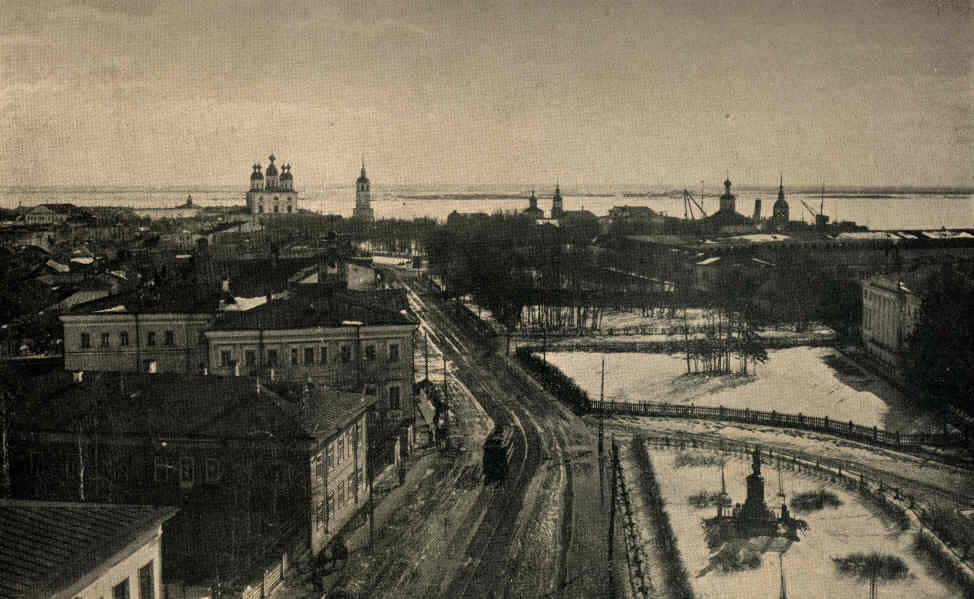
MORRIS
Statue of Peter the Great and State Buildings in Archangel.
![[Illustration: ]](images/032Pic3_A25.jpg)
U. S. OFFICIAL PHOTO
Drawing Rations, Verst 455.
![[Illustration: ]](images/032Pic3_B25.jpg)
RED CROSS PHOTO
Last Honors to a Soldier.
We continued our march up the Dvina, about two days behind the fleeing
Bolo, hoping that he would decide to make a stand. This he did at
Seltso. On the morning of September 19th, through mud and water, at
times waist deep and too precarious for hauling artillery, the advance
began on Seltso. At 1:00 p. m. the advance party, “D” Company, under
Captain Coleman, reached Yakovlevskaya, a village just north of Seltso
and separated from it by a mile of wide open marsh which is crossed by a
meandering arm of the nearby Dvina. A single road and bridge lead across
to Seltso. “D” Company gallantly deployed and wading the swamp
approached within one thousand five hundred yards of the enemy, who
suddenly opened up with machine guns, rifles, and Russian pom pom. This
latter gun is a rapid fire artillery piece, firing a clip of five shells
weighing about one pound apiece, in rapid succession. We later
discovered that they, as well as most of the flimsy rifles, were made by
several of the prominent gun manufacturers of the United States.
“D” Company found further advance impossible without support and dug in.
“C” Company under Capt. Fitz Simmons hurried up and took position in a
tongue of woods at the right of “D” and were joined after dark by “B”
Company. None of the officers in command of this movement knew anything
of the geography nor much of anything else regarding this position, so
the men were compelled to dig in as best they could in the mud and water
to await orders from Colonel Corbley, who had not come up. At eleven
o’clock that night a drizzling rain set in, and huddled and crouched
together in this vile morass, unprotected by even an overcoat, without
rations, tired and exhausted from the day’s march and fighting, the
battalion bivouacked. All night the enemy kept searching the woods and
marshes with his artillery, but with little effect. During the night we
learned that the Bolo had a land battery of three-inch guns and five
gunboats in the river at their flank with six and nine-inch guns aboard
rafts. This was none too pleasing a situation for an infantry attack
with no artillery preparation, coupled with the miserable condition of
the troops.
As daylight approached the shelling became more and more violent. The
Bolo was sending over everything at his command and it was decided to
continue the attack lest we be exterminated by the enemy artillery. At
daybreak Lt. Dressing of “B” Company took out a reconnaissance patrol to
feel out the enemy lines of defense, but owing to the nature of the
ground he had little success. His patrol ran into a Bolo outpost and was
scattered by machine gun fire. It was here that Corporal Shroeder was
lost, no trace ever being found of his body or equipment.
About noon two platoons of Company “B” went out to occupy a certain
objective. This they found was a well constructed trench system filled
with Bolos, and flanked by machine gun positions. In the ensuing action
we had three men killed and eight men wounded, including Lt. A. M.
Smith, who received a severe wound in the side, but continued handling
his platoon effectively, showing exceptional fortitude. The battle
continued during the afternoon all along the line. “C” and “D” were
supporting “B” with as much fire as possible. But troops could not stay
where they were under the enemy fire, and Col. Corbley, who had at last
arrived, ordered a frontal attack to come off after a preparatory
barrage by our Russian artillery which had at last toiled up to a
position.
Here fortune favored the Americans. The Russian artillery officer placed
a beautiful barrage upon the village and the enemy gunboats, which
continued from 4:45 to 5:00 p.m. At 5:00 o’clock, the zero hour, the
infantry made the attack and in less than an hour’s time they had gained
the village.
The Bolsheviks had been preparing to evacuate anyway, as the persistence
of our attack and effectiveness of our rifle fire had nearly broken
their morale. Americans with white, strained faces, in contrast with
their muck-daubed uniforms, shook hands prayerfully as they discussed
how a determined defense could have murdered them all in making that
frontal attack across a swamp in face of well-set machine gun positions.
However, the Americans were scarcely better off when they had taken
Seltso, for their artillery now could not get up to them. So the enemy
gunboats could shell Seltso at will. Hence it appeared wise to retire
for a few days to Yakovlevskaya. In the early hours of the morning
following the battle the Americans retired from Seltso. They were
exceedingly hungry, dog-tired, sore in spirit, but they had undergone
their baptism of fire.
After a few days spent in Yakovlevskoe we set out again, and advanced as
far as a village called Pouchuga. Here we expected another encounter
with the Bolo, but he had just left when we arrived. We were fallen out
temporarily on a muddy Russian hillside in the middle of the afternoon,
the rain was falling steadily, we had been marching for a week through
the muddiest mud that ever was, the rations were hard tack and bully,
and tobacco had been out for several weeks. A more miserable looking and
feeling outfit can scarce be imagined. A bedraggled looking convoy of
Russian carts under Lt. Warner came up, and he informed us that he could
let us have one package of cigarettes per man. We accepted his offer
without any reluctance, and passed them out. To paraphrase Gunga Din,
says Capt. Boyd:
“They were British and they stunk as anyone who smoked British issue cigarettes
with forty-two medals can tell you, but of all the smokes I’ve (I should say
‘smunk’ to continue the paraphrase) I’m gratefulest to those from Lt. Warner.
You could see man after man light his cigarette, take a long draw, and relax in
unadulterated enjoyment. Ten minutes later they were a different outfit, and
nowhere as wet, cold, tired or hungry. Lucy Page Gaston and the Anti-Cigarette
League please note.”
After a long day’s march we finally arrived in a “suburb” of Pouchuga
about 7:00 p.m. with orders to place our outposts and remain there that
night. By nine o’clock this was done, and the rest of the company was
scattered in billets all over the village, being so tired that they
flopped in the first place where there was floor space to spread a
blanket. Then came an order to march to the main village and join Major
Corbley. At least a dozen of the men could not get their shoes on by
reason of their feet being swollen, but we finally set out on a pitch
black night through the thick mud. We staggered on, every man falling
full length in the mud innumerable times, and finally reached our
destination. Captain Boyd writes:
“I shall never forget poor Wilson on that march, cheery and good-spirited in
spite of everything. His loss later at Toulgas was a personal one as well as
the loss of a good soldier.
“I also remember Babcock on that march—Babcock, who was one of our best machine
gunners, never complaining and always dependable. We were ploughing along
through the mud when from my place at the head of the column I heard a splash.
I went back to investigate and there was Babcock floundering in a ditch with
sides too slippery to crawl up. The column was marching stolidly past, each man
with but one thought, to pull his foot out of the mud and put it in a little
farther on. We finally got Babcock up to terra firma, he explained that it had
looked like good walking, nice and smooth, and he had gone down to try it. I
cautioned him that he should never try to take a bath while in military
formation, and he seemed to think the advice was sound.”
Now the battalion was needed over on the Vaga river front, the story of
whose advance there is told in another chapter. By barge the Americans
went down the Dvina to its junction with the Vaga and then proceeded up
that river as far as Shenkursk. To the doughboys this upper Vaga area
seemed a veritable land of milk and honey when compared with the
miserable upper Dvina area. Fresh meat and eggs were obtainable. There
were even women there who wore hats and stockings, in place of boots and
shawls. We had comfortable billets. But it was too good to be true. In
less than a week the Bolo’s renewed activities on the upper Dvina made
it necessary for one company of the first battalion to go again to that
area. Colonel Corbley saw “B” Company depart on the tug “Retvizan” and
so far as field activities were concerned it was to be part of the
British forces on the Dvina from October till April rather than part of
the first battalion force. The company commander was to be drafted as
“left bank” commander of a mixed force and hold Toulgas those long, long
months. The only help he remembers from Colonel Corbley or Colonel
Stewart in the field operations was a single visit from each, the one to
examine his company fund book, the other to visit the troops on the line
in obedience to orders from Washington and General Ironside. Of this
visit Captain Boyd writes:
“When Col. Stewart made his trip to Toulgas his advent was marked principally
by his losing one of his mittens, which were the ordinary issue variety. He
searched everywhere, and half insinuated that Capt. Dean, my adjutant, a
British officer, had taken it. I could see Dean getting hot under the collar.
Then he told me that my orderly must have taken it. I knew Adamson was more
honest than either myself or the colonel, and that made me hot. Then he finally
found the mitten where he had dropped it, on the porch, and everything was
serene again.
“Col. Stewart went with me up to one of the forward blockhouses, which at that
time was manned by the Scots. After the stock questions of ‘where are you from’
and ‘what did you do in civil life’ he launched into a dissertation on the
disadvantages of serving in an allied command. The Scot looked at him in
surprise and said, ‘Why, sir, we’ve been very glad to serve with the Americans,
sir, and especially under Lt. Dennis. There’s an officer any man would be proud
to serve under.’ That ended the discussion.”
After this slight digression from the narrative, we may take up the
thread of the story of this push for Kotlas. Royal Scots and Russians
had been left in quiet possession of the upper Dvina near Seltso after
the struggle already related. But hard pressed again, they were waiting
the arrival of the company of Americans, who arrived one morning about
6:00 a. m. a few miles below our old friend, the village of
Yakovlevskoe. We marched to the village, reported to the British officer
in command at Seltso, and received the order, “Come over here as quick
as you possibly can.” The situation there was as follows: The Bolos had
come back down the river in force with gunboats and artillery, and were
making it exceedingly uncomfortable for the small British garrisons at
Seltso and Borok across the river. We marched around the town, through
swamps at times almost waist deep, and attacked the Bolo trenches from
the flank at dusk. We were successful, driving them back, and capturing
a good bit of supplies, including machine guns and a pom pom. The Bolos
lost two officers and twenty-seven men killed, while we had two men
slightly wounded, both of whom were later able to rejoin the company.
“We expected a counter attack from the Bolo, as our force was much
smaller than his, and spent the first part of the night making trenches.
An excavation deeper than eighteen inches would have water in the
bottom. We were very cold, as it was October in Russia, and every man
wet to the skin, with no blankets or overcoats. About midnight the
British sent up two jugs of rum, which was immediately issued, contrary
to military regulations. It made about two swallows per man, but was a
lifesaver. At least a dozen men told me that they could not sleep before
that because they were so cold, but that this started their circulation
enough so they were able to sleep later.
In the morning we advanced to Lipovit and attacked there, but ran into a
jam, had both flanks turned by a much larger force, and were very
fortunate to get out with only one casualty. Corporal Downs lost his
eye, and showed extreme grit in the hard march back through the swamp,
never complaining. I saw, after returning to the States, an interview
with Col. Josselyn, at that time in command of the Dvina force, in which
he mentioned Downs, and commended him very highly.”
The ensuing week we spent in Seltso, the Bolos occupying trenches around
the upper part of our defenses. They had gunboats and naval guns on
rafts, and made it quite uncomfortable for us with their shelling,
although the only American casualties were in the detachment of 310th
Engineers. Our victory was short lived, however, for in a few days our
river monitor was forced to return to Archangel on account of the
rapidly receding river, which gave the enemy the opportunity of moving
up their 9.2 inch naval guns, with double the range of our land
batteries, making our further occupation of Seltso impossible.
On the afternoon of October 14, the second and third platoons of Company
“B” were occupying the blockhouses when the Bolos made an attack, which
was easily repelled. As we were under artillery fire with no means of
replying, the British commander decided to evacuate that night. It was
impossible to get supplies out owing to the lack of transportation
facilities. That part of Company “B” in the village left at midnight,
followed by the force in the blockhouses at 3:00 a. m. After a very hard
march we reached Toulgas and established a position there.
Our position at Toulgas in the beginning was very unfavorable, being a
long narrow string of villages along the Dvina which was bordered with
thick underbrush extending a few hundred yards to the woods. We had a
string of machine gun posts scattered through the brush, and when our
line of defense was occupied there was less than two platoons left as a
reserve. With us at this time we had Company “A” of the 2nd Tenth Royal
Scots (British) under Captain Shute, and a section of Canadian
artillery.
The Bolos followed us here and after several days shelling, to which
because of being outranged we were unable to reply, they attacked late
in the afternoon of October 23rd. Our outposts held, and we immediately
counter attacked. The enemy was repulsed in disorder, losing some
machine guns, and having about one hundred casualties, while we came out
Scot free.
It was during the shelling incidental to this that Edvinson, the Viking,
did his stunt. He was in a machine gun emplacement which was hit by a
small H. E. shell. The others were considerably shaken up, and pulled
back, reporting Edvinson killed, that he had gone up in the air one way,
and the Lewis gun the other. We established the post a little farther
back and went out at dusk to get Edvinson’s body. Much was the surprise
of the party when he hailed them with, “Well, I think she’s all right.”
He had collected himself, retrieved the Lewis gun, taken it apart and
cleaned it and stuck to his post. The shelling and sniping here had been
quite heavy. His action was recognized by the British, who awarded him a
Military Medal, just as they did Corporal Morrow who was instrumental in
reoccupying and holding an important post which had been driven in early
in the engagement. Corporal Dreskey and Private Lintula also
distinguished themselves at this point.
Here we may leave “B” Company and the Scots and Russians making a
fortress of Toulgas on the left bank of the Dvina. The Reds were busy
defending Plesetskaya from a converging attack and not till snow clouds
gathered in the northern skies were they to gather up a heavy force to
attack Toulgas. We will now turn to the story of the first battalion
penetrating with bayonets far up the Vaga River.
IV
DOUGHBOYS ON GUARD IN ARCHANGEL
Second Battalion Lands To Protect Diplomatic Corps—Colonel Tschaplin’s Coup
d’Etat Is Undone By Ambassador Francis—Doughboys Parade And Practice New
Weapons—Scowling Solombola Sailors—Description Of Archangel—American
Headquarters.
With the arrival of the American Expeditionary Force, the diplomatic
corps of the various Allied nations which had been compelled to flee
north before the Red radicals that had overthrown the Kerensky
provisional government, asked for troops in the city of Archangel itself
to stabilize the situation.
The second battalion of the 339th under command of Major J. Brooks
Nichols disembarked at Smolny Quay at four o’clock of the afternoon of
September 4th, the same day the ships dropped anchor in the harbor. A
patrol was at once put out under Lieut. Collins of “H” Company. It was
well that American troops were landed at once as will prove evident from
the following story.
The new government of Archangel was headed by the venerable Tchaikowsky,
a man who had been a revolutionary leader of the highest and saneest
type for many years. He had lived for a period of years in America, on a
farm in Kansas, and had been a writer of note in Russia and England for
many years. He was a democratic leader and his government was readily
accepted by the people. But as with all newly constructed governments it
moved very slowly and with characteristic Russian deliberation and
interminable talk and red tape.
This was too much for the impatient ones among the Russians who had
invited the Allied expedition. One Colonel Tschaplin (later to be dubbed
“Charley Chaplin” by American officers who took him humorously) who had
served under the old Czar and had had, according to his yarns—told by
the way in the most engaging English—a very remarkable experience with
the Bolsheviks getting out of Petrograd. He was, it is said, influenced
by some of the subordinate English officers to make a daring try to
hasten matters.
On the evening of the 5th of September, while the American soldiers were
patrolling the Smolny area, near Archangel proper, this Col. Tschaplin executed
his coup d’etat. He quietly surrounded the homes of Tchaikowsky and
other members of the Archangel State Government and kidnapped them, hiding them
away on an island in the Dvina River.
Great excitement prevailed for several days. The people declared
Tschaplin was moving to restore monarchy under aid of the foreign arms
and declared a strike on the street railroads and threatened to take the
pumping station and the electric power station located at Smolny.
American troops manned the cars and by their good nature and patience
won the respect and confidence of the populace, excited as it was. The
American ambassador, the Hon. David R. Francis, with characteristic
American directness and fairness called the impetuous Tschaplin before
him and gave him so many hours in which to restore the rightful
government to power. And Tchaikowsky came back into the State House on
September 11th much to the rejoicing of the people and to the harmony of
the Allied Expedition. The diplomatic and military authorities of the
American part of the expedition had handled the situation in a way that
prevented riot and gained esteem for Americans in the eyes of all the
Russians.
Archangel, Smolny and Bakaritza now were busy scenes of military activity. Down
the streets of Archangel marched part of a battalion of doughboys past the
State House and the imposing foreign Embassy Building. Curious eyes looked upon
the O. D. uniform and admired the husky stalwarts from over the seas.
Bright-eyed women crowded to the edge of the boardwalks amongst the long-booted
and heavily bewhiskered men. Well-dressed men with shaven faces and marks of
culture studied the Americans speculatively. Russian children began making
acquaintance and offering their flattering Americanski Dobra.
At Solombola, Smolny, Bakaritza, sounds of firing were heard daily, but
the populace were quieted when told that it was not riot or Bolo attack
but the Americans practising up with their ordnance. In fact the
Americans, hearing of actions at the fronts, were desperately striving
to learn how to use the Lewis guns and the Vickers machine guns. At Camp
Custer they had perfected themselves in handling the Colt and the
Brownings but in England had been obliged to relinquish them with the
dubious prospect of re-equipping with the Russian automatic rifles and
machine gun equipment at Archangel. Now they were feverishly at work on
the new guns for reports were coming back from the front that the enemy
was well equipped with such weapons and held the Americans at great
disadvantage.
Here let it be said that the American doughboy in the North Russian
campaign mastered every kind of weapon that was placed in his hands or
came by fortune of war to his hand. He learned to use the Lewis gun and
the Vickers machine gun of the British and Russian armies, also the
one-pounder, or pom pom. He became proficient in the use of the French
Chauchat automatic rifle and the French machine gun, and their rifle
grenade guns. He learned to use the Stokes mortars with deadly effect on
many a hard-fought line. And during the winter two platoons of “Hq.”
Company prided themselves on the mastery of a battery of Russian
artillery patterned after the famous, in fact, the same famous French 75
gun.
While the 2nd Battalion under Major Nichols was establishing itself in
quarters at Smolny, where was a great compound of freshly unloaded
supplies of food, herring and whiskey (do not forget the hard stuff)
and, becoming responsible for the safety of the pumping station and the
electric power station and the ships in the harbor, Captain Taylor
established the big Headquarters Company at Olga barracks at the other
end of the city on September seventh where he could train his men for
the handling of new weapons and could co-operate with Captain Kenyon’s
machine gun men. They on the same day took up quarters in Solombola
Barracks and were charged with the duty of not only learning how to use
the new machine guns but to keep guard over the quays and prevent
rioting by the turbulent Russian sailors. Their undying enmity had been
earned by the well-meant but untactful, yes, to the sailors apparently
treacherous, conduct of General Poole toward them on the Russian ships
in the Murmansk when he got them off on a pretext and then seized the
ships to prevent their falling into the hands of the Red Guards. And
while the doughboys on the railroad and Kodish fronts in the fall were
occasionally to run up against the hard-fighting Russian sailors who had
fled south to Petrograd and volunteered their services to Trotsky to go
north and fight the Allied expeditionary forces, these doughboys doing
guard duty in Archangel over the remnants of stores and supplies which
the Bolo had not already stolen or sunk in the Dvina River, were
constantly menaced by these surly, scowling sailors at Solombola and in
Archangel.
Really it is no wonder that the several Allied troop barracks were
always guarded by machine guns and automatics. Rumor at the base always
magnified the action at the front and always fancied riot and uprising
in every group of gesticulating Russkis seen at a dusky corner of the
city.
The Supply Company of the regiment became the supply unit for all the American
forces under Captain Wade and was quartered at Bakaritza, being protected by
various units of Allied forces. “Finish” the package of Russki horse skin and
bones which the boys “skookled” from the natives, that is, bought from the
natives, became the most familiar sight on the quays, drawing the
strange-looking but cleverly constructed drosky, or cart, bucking into
his collar under the yoke and pulling with all his sturdy will, not minding the
American “whoa” but obedient enough when the doughboy learned to sputter the
Russki “br-r-r br-r-r.”
Archangel is situated on one of the arms of the Dvina River which deltas
into the White Sea. Out of the enormous interior of North Russia,
gathering up the melted snows of a million square miles of seven-foot
snow and the steady June rains and the weeks of fall rains, the great
Mississippi of North Russia moves down to the sea, sweeping with deep
wide current great volumes of reddish sediment and secretions which give
it the name Dvina. And the arm of the Arctic Ocean into which it carries
its loads of silt and leachings, and upon which it floats the
fishermen’s bottoms or the merchantmen’s steamers, is called the White
Sea. Rightly named is that sea, the Michigan or Wisconsin soldier will
tell you, for it is white more than half the year with ice and snow, the
sporting ground for polar bears.
While we were fighting the Bolsheviki in Archangel, the National
Geographic Society, in a bulletin, published to our people certain facts
about the country. It is so good that extracts are in this chapter
included:
“The city of Archangel, Russia, where Allied and American troops have their
headquarters in the fight with the Bolshevik forces, was the capital of the
Archangel Province, or government, under the czar’s regime—a vast, barren and
sparsely populated region, cut through by the Arctic Circle.
“West and east, the distance across the Archangel district is about that from
London to Rome, from New York to St. Louis, or from Boston to Charleston, S. C.
Its area, exclusive of interior waters, is greater than that of France, Italy,
Belgium and Holland combined. Yet there are not many more people in these great
stretches than are to be found in Detroit, Mich., or San Francisco or
Washington.
“Arable land in all this territory is less than 1,200 square miles, and
three-fourths of that is given over to pasturage. The richer grazing land
supports Holmagor cattle, a breed said to date back to the time of Peter the
Great, who crossed native herds with cattle imported from Holland.
“About fifteen miles from the mouth of the Dvina River, which affords an outlet
to the White Sea, lies the city of Archangel. Norsemen came to that port in the
tenth century for trading. One expedition was described by Alfred the Great.
But first contact with the outside world was established in the sixteenth
century when Sir Richard Chancellor, an English sailor, stopped at the bleak
haven while attempting a northeast passage to India. Ivan the Terrible summoned
him to Moscow and made his visit the occasion for furthering commercial
relations with England. Thirty years after the Englishman’s visit a town was
established and for the next hundred years it was the Muscovite kingdom’s only
seaport, chief doorway for trade with England and Holland.
“When Peter the Great established St. Petersburg as his new capital much trade
was diverted to the Baltic, but Archangel was compensated by designation as the
capital of the Archangel government.
“Boris Godunov threw open to all nations, and in the seventeenth century Tartar
prisoners were set to work building a large bazaar and trading hall. Despite
its isolation the city thus became a cosmopolitan center and up to the time of
the world war Norwegian, German, British, Swedish and Danish cargo vessels came
in large numbers.
“Every June thousand of pilgrims would pass through Archangel on their way to
the famous far north shrine, Solovetsky Monastery, situated on an island a
little more than half a day’s boat journey from Archangel.
“The city acquired its name from the Convent of Archangel Michael. In the
Troitski Cathedral, with its five domes, is a wooden cross, fourteen feet high,
carved by the versatile Peter the Great, who learned the use of mallet and
chisel while working as a shipwright in Holland after he ascended the throne.”
To the sailor looking from the deck of his vessel or to the soldier
approaching from Bakaritza on tug or ferry, the city of Archangel
affords an interesting view. Hulks of boats and masts and cordage and
docks and warehouses in the front, with muddy streets. Behind, many
buildings, grey-weathered ones and white-painted ones topped with many
chimneys, and towering here and there a smoke stack or graceful spire or
dome with minarets. Between are seen spreading tree tops, too. All these
in strange confused order fill all the horizon there with the exception
of one space, through which in June can be seen the 11:30 p. m. setting
sun. And in this open space on clear evenings, which by the way, in
June-July never get even dusky, at various hours can be seen a wondrous
mirage of waters and shores that lie on the other side of the city below
the direct line of sight.
Prominently rises the impressive magnitudinous structure of the
reverenced cathedral there, its dome of the hue of heaven’s blue and set
with stars of solid gold. And when all else in the landscape is bathed
in morning purple or evening gloaming-grey, the levelled rays of the
coming or departing sun with a brilliantly striking effect glisten these
white and gold structures. Miles and miles away they catch the eye of
the sailor or the soldier.
Built on a low promontory jutting into the Dvina River, the city appears
to be mostly water-front. In fact, it is only a few blocks wide, but it
is crescent shaped with one horn in Smolny—a southern suburb having
dock and warehouse areas—and the other in Solombola on the north, a
city half as large as Archangel and possessing saw-mills, shipyards,
hospitals, seminary and a hard reputation, Archangel is convex westward,
so that one must go out for some distance to view the whole expanse of
the city from that direction. A mass of trees, a few houses, some large
buildings and churches mainly near the river, with a foreground of
shipping, is the summer view. The winter view is better, the bare trees
and the smaller amount of shipping at the docks permitting a better view
of the general layout of the city, the buildings and the type of houses
used by the population as homes.
Along the main street, Troitsky Prospect, runs a two-track trolley line
connecting the north and south suburbs mentioned in the preceding
paragraph. The cars are light and run very smoothly. They are operated
chiefly by women. Between the main street and the river-front near the
center of the city is the market-place. This covers several blocks and
is full of dingy stalls and alleys occupied by almost hopeless traders
and stocks in trade. As new wooden ware, home-made trinkets, second-hand
clothing and fresh fish can be obtained there the year around, and in
summer the offerings of vegetables are plentiful and tempting, the
market-place never lacks shoppers who carry their paper money down in
the same basket they use to carry back their purchases.
Public buildings are of brick or stone and are colored white, pink, grey
or bright red to give a light or warm effect. Down-town stores are built
some of brick and some of logs. Homes are square in type, with few
exceptions, built of logs, usually of very plain architecture, set
directly against the sidewalks, the yards and gardens being at the side
or rear. For privacy, each man’s holdings are surrounded by a seven-foot
fence. Thus the streets present long vistas of wooden ware, partly house
and partly fence, with sometimes over-hanging trees, and with an
inevitable set of doorsteps projecting from each house over part of the
sidewalk. This set of steps is seldom used, for the real entrance to the
home is at the side of the house reached through a gateway in the fence.
The houses in Archangel are usually of two stories, with double windows
packed with cotton or flax to resist the cold. When painted at all, the
houses have been afflicted by their owners with one or more coats of
yellowish-brown stuff familiar to every American farmer who has ever
“primed” a big barn. A few houses have been clap-boarded on the outside
and some of these have been painted white.
The rest of the street view is snow, or, lacking that, a cobbled
pavement very rough and uneven, and lined on each side—sometimes on one
side only, or in the centre—with a narrow sidewalk of heavy planks laid
lengthwise over the otherwise open public sewer, a ditch about three
feet wide and from three to six feet deep. Woe be to him who goes
through rotten plank! It has been done.
So much for general scenic effects at Archangel. The Technical
Institute, used as Headquarters by the American Forces, is worth a
glance. It is a four-story solid-looking building about one hundred and
fifty feet square and eighty feet high, with a small court in the
centre. The outside walls of brick and stone are nearly four feet thick,
and their external surface is covered by pink-tinted plaster which
catches the thin light of the low-lying winter sun and causes the
building to seem to glow. On the front of the building there are huge
pillars rising from the second story balcony to the great Grecian gable
facing the river.
Inside, this great building is simple and severe, but rather pleasing.
Windows open into the court from a corridor running around the building
on each floor, and on the other side of the corridor are the doors of
the rooms once used as recitation and lecture halls, laboratories,
manual training shops, offices, etc. Outside, it was one of the city’s
imposing buildings; inside, it was well-appointed. To the people of the
city it was a building of great importance. It was worthy to offer the
Commander of the American troops.
Here Colonel Stewart set up his Headquarters. The British Commanding
General had his headquarters, the G. H. Q., N. R. E. F., in another
school building in the centre of the city, within close reach of the
Archangel State Capitol Building. Colonel Stewart’s headquarters were
conveniently near the two buildings which afterward were occupied and
fitted up for a receiving hospital and for a convalescent hospital
respectively, as related elsewhere, and not far either from the
protection of the regimental Headquarters Company quartered in Olga
Barracks.
Here the Commanding Officer of this expeditionary force of Americans off
up here near the North Pole on the strangest fighting mission ever
undertaken by an American force, tried vainly to keep track of his
widely dispersed forces. Up the railroad he had seen his third
battalion, under command of Major C. G. Young, go with General Finlayson
whom General Poole had ordered to take Vologda, four hundred miles to
the south. His first battalion, under Lieutenant Colonel Corbley he had
seen hurried off up the Dvina River under another British
Brigadier-General to take Kotlas hundreds of miles up the river. His
second battalion under Major J. Brooks Nichols was on duty in Archangel
and the nearby suburbs. These forces, and his 310th Engineer Battalion
and his Ambulance and Hospital Units were shifted about by the British
Generals and Colonels and Majors often without any information whatever
to Colonel Stewart, the American commanding officer. He lost touch with
his battalion and company commanders.
He had a discouraging time even in getting his few general orders
distributed to the American troops. No wonder that often an American
officer or soldier reporting in from a front by order or permission of a
British field officer, did not feel that American Headquarters was his
real headquarters and in pure ignorance was guilty of omitting some duty
or of failure to comply with some Archangel restriction that had been
ordered by American Headquarters. As to general orders from American
Headquarters dealing with the action of troops in the field, those were
so few and of so little impressiveness that they have been forgotten. We
must say candidly that the doughboy came to look upon American
Headquarters in Archangel as of very trifling importance in the strange
game he was up against. He knew that the strategy was all planned at
British G. H. Q., that the battle orders were written in the British
field officer’s headquarters, that the transportation and supplies of
food were under control of the British that altogether too much of the
hospital service was under control of the British. Somehow the doughboy
felt that the very limited and much complained about service of his own
American Supply Unit, that lived for the most part on the fat of the
land in Bakaritza, should have been corrected by his commanding officer
who sat in American Headquarters. And they felt, whether correctly or
not, that the court-martial sentences of Major C. G. Young, who acted as
summary court officer at Smolny after he was relieved of his command in
the field, were unnecessarily harsh. And they blamed their commanding
officer, Colonel Stewart, for not taking note of that fact when he
reviewed and approved them. The writers of this history of the
expedition think the doughboy had much to justify his feeling.
V
WHY AMERICAN TROOPS WERE SENT TO RUSSIA
This Was A Much Mooted Question Among Soldiers—Partisan Politicians Attacked
With Vitriol—Partisan Explanations Did Not Explain—Red Propaganda Helped
Confuse The Case—Russians Of Archangel, Too, Were Concerned—We Who Were There
Think Of Those Pitiable Folk And Their Hopeless Military And Political
Situation That Tried Our Patience And That Of The Directors Of The Expedition
Who Undoubtedly Knew No Better Than We Did.
To many people in America and England and France the North Russian
Expedition appears to have been an unwarrantable invasion of the land of
an ally, an ally whose land was torn by internal upheavals. It has been
charged that commercial cupidity conceived the campaign. Men declare
that certain members of the cabinet of Lloyd George and of President
Wilson were desirous of protecting their industrial holdings in North
Russia.
The editors of this work can not prove or disprove these allegations nor
prove or disprove the replies made to the allegations. We have not the
time or means to do so even if our interests, political or otherwise,
should prompt us to try it. From discussion of the partisan attacks on
and defense of the administration’s course of action toward Russia in
1918-19, both of which are erratic and acrimonious, we plead to be
excused.
We shall tell the story of the genesis of the expedition as well as we
can. We do not profess to know all about it. It will be some time before
the calm historian can possess himself of all the facts. Till such time
we hope that this brief statement will stand. We offer it hesitatingly
with keen consciousness of the danger that it will probably suit neither
of the two parties in controversy over the sending of troops to North
Russia.
But we offer this straightforward story confidently to our late
comrades. They have entrusted us with the duty of writing the history of
what they did in North Russia as their bit in the Great World War. And
we know our comrades, at least, and we hope the general reader, too,
will credit us with writing in sincerity and good faith.
Early in 1918, for the Allied forces, it looked dark. The Germans were
able to neglect the crumbled-in Eastern Front and concentrate a tornado
drive on the Western Front. It was at last realized that the controlling
Bolshevik faction in Russia was bent on preventing the resumption of the
war on the Eastern Front and possibly might play its feeble remnants of
military forces on the side of the Germans. The Allied Supreme Council
at Versailles decided that the other allies must go to the aid of their
old ally Russia who had done such great service in the earlier years of
the war. On the Russian war front Germany must be made again to feel
pressure of arms. Organization of that front would have to be made by
efforts of the Allied Supreme War Council.
They had some forces to build on. Several thousand Czecho-Slovak troops
formerly on the Eastern Front had been held together after the
dissolution of the last Russian offensive in 1917. Their commander had
led them into Siberia. Some at that time even went as far as
Vladivostok. These troops had desired to go back to their own country or
to France and take part in the final campaign against the Germans. There
was no transportation by way of the United States. Negotiations with the
Bolshevist rulers of Russia, the story runs, brought promises of safe
passage westward across central Russia and then northward to Archangel,
thence by ship to France.
This situation in mind the Allied Supreme War Council urged a plan
whereby an Allied expedition of respectable size would be sent to
Archangel with many extra officers for staff and instruction work, to
meet the Czechs and reorganize and re-equip them, rally about them a
large Northern Russian Army, and proceed rapidly southward to reorganize
the Eastern Front and thus draw off German troops from the hard pressed
Western Front. This plan was presented to the Allied Supreme War Council
by a British officer and politician fresh from Moscow and Petrograd and
Archangel, enthusiastic in his belief in the project.
The expedition was to be large enough to proceed southward without the
Czechs, sending them back to the West by the returning ships if their
morale should prove to be too low for the stern task to be essayed on
the restored Eastern Front. General Poole, the aforementioned British
officer in command, seems to have been very sure that the Bolsheviks who
had so blandly agreed to the passage of the Czechs through the country
would not object to the passage of the expedition southward from
Archangel, via Vologda, Petrograd and Riga to fight the Germans with
whom they, the Bolsheviki, had compacted the infamous Brest-Litovsk
treaty.
All this while, remember, the old allies of Russia had preserved a
studied neutrality toward the factional fight in Russia. They steadily
refused to recognize the Bolshevik government of Lenine and Trotsky.
While this plan was still in the whispering stages, the activities of
the Germans in Finland where they menaced Petrograd and where their
extension of three divisions to the northward and eastward seemed to
forecast the establishment of submarine bases on the Murmansk and
perhaps even at Archangel where lay enormous stores of munitions
destined earlier in the war to be used by the Russians and Rumanians
against the Huns. At any rate, the port of Archangel would be one other
inlet for food supplies to reach the tightly blockaded Germans.
Since the autumn of 1914 military supplies of all kinds, chiefly made in
America and England, had been sent to Archangel for the use of the
Russian armies. At the time of the revolution against the old Czar
Nicholas, in 1917, there were immense stores in the warehouses of the
Archangel district and the Archangel-Vologda Railway had been widened to
standard gauge and many big American freight cars supplied to carry
those supplies southward. And these stores had been greatly augmented
during the Kerensky regime, the enthusiastic time immediately subsequent
to the fall of the Czar, when anti-German Russians were exulting “Now
the arch traitor is gone, we can really equip our armies,” and when the
Allies believed that after a few months of confusion the revolutionary
government would become a more trustworthy ally than the old imperial
government had been.
![[Illustration: ]](images/048Pic2_A25.jpg)
U.S. Official Photo
Olga Barracks.
![[Illustration: ]](images/048Pic2_B25.jpg)
U.S. Official Photo
Street Car Strike in Archangel.
![[Illustration: ]](images/048Pic3_A25.jpg)
U.S. Official Photo
American Hospitals and Headquarters.
![[Illustration: ]](images/048Pic3_B25.jpg)
U.S. Official Photo
“Supply” C. canteen “Accommodates” Boys.
![[Illustration: ]](images/048Pic3_C25.jpg)
U.S. Official Photo
Red Cross Ambulances, Archangel.
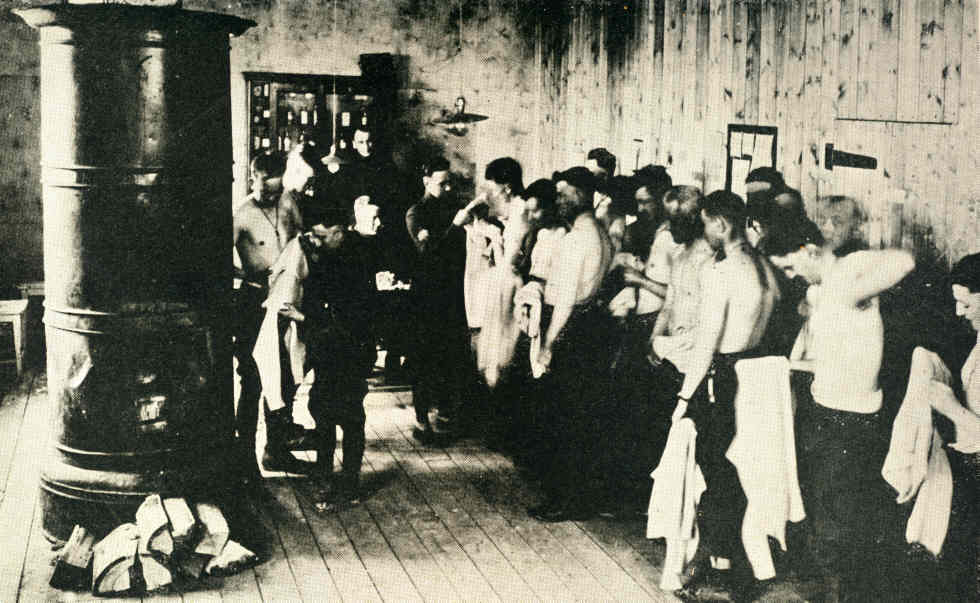
U.S. Official Photo
“Cootie Mill” Operating at Smolny Annex of Convalescent Hospital.
![[Illustration: ]](images/048Pic5_A25.jpg)
Wisckot
Single Flat Strip of Iron on Plow point.
![[Illustration: ]](images/048Pic5_B25.jpg)
Wagner
Thankful for What at Home We Feed Pigs.
Now, although Archangel was the chief port of entry for military
supplies to the new Russian government, the geographical situation of
the northern province, or rather state, of Archangel had left it rather
high and dry in the hands of a local government, which, so distantly
affiliated with Moscow and Petrograd, did not reflect fully either the
strength or weaknesses of the several regimes which succeeded one
another at the capital between the removal of the Czar and the machine
gun assumption of control by the bloody pair of zealots and tricksters,
Lenine and Trotzky. Consequently, when Kerensky disappeared the
government at Archangel did not greatly change in character.
To be sure, it had no army or military force of its own. The central
government sent north certain armed Red Guards, and agents of government
called “commissars,” who were to organize and control additions to the
Red Guards and to supervise also the civil government of Archangel
state, as much as possible. These people of the northern state were
indeed jealous of their rights of local government. And the work of the
Red agents in levying on the property and the man-power of the North was
passively resisted by these intelligent North Russians.
All this was of great interest to the Allied Supreme War Council because
of the danger that the war supplies would be seized by the rapidly
emboldened Bolshevik government and be delivered into the hands of the
Germans for use against the Allies. For since the Brest-Litovsk treaty
it had appeared from many things that the crafty hand of Germany was
inside the Russian Bolshevik glove.
Moreover, there were in North Russia, as in every other part, many
Russians who could not resign themselves to Bolshevik control, even of
the milder sort, nor to any German influence. Those in the Archangel
district banded themselves together secretly and sent repeated calls to
the Allies for help in ridding their territory of the Bolshevik Red
Guards and German agents, using as chief arguments the factors above
mentioned. While the anti-Bolshevists were unwilling to unmask in their
own state, for obvious reason, their call for help was made clear to the
outside world and furnished the Allied Supreme War Council just the
pretext for the expedition which it was planning for a purely military
purpose, namely, to reconstruct the old Eastern fighting front.
In fact, when a survey of the military resources of the European Allies
had disclosed their utter lack of men for such an expedition and it was
found that the only hope lay in drawing the bulk of the needed troops
from the United States forces, and when the statement of the cases in
the usual polite arguments brought from President Wilson a positive
refusal to allow American troops to go into Russia, it was only by the
emphasis, it is said, of the pathetic appeal of the North Russian
anti-Bolshevists, coupled with the stirring appeals of such famous
characters as the one-time leader of the Russian Women’s Battalion of
Death and the direct request of General Foch himself for the use of the
American troops there in Russia as a military necessity to win the war,
that the will of President Wilson was moved and he dubiously consented
to the use of American troops in the expedition.
Even this concession of President Wilson was limited to the one regiment
of infantry with the needed accompaniments of engineer and medical
troops. The bitter irony of this limitation is apparent in the fact that
while it allowed the Supreme War Council to carry out its scheme of an
Allied Expedition with the publicly announced purposes before outlined,
committing America and the other Allies to the guarding of supplies at
Murmansk and Archangel and frustrating the plans of Germany in North
Russia, it did not permit the Allied War Council sufficient forces to
carry out its ultimate and of course secret purpose of reorganizing the
Eastern Front, which naturally was not to be advertised in advance
either to Russians or to anyone. The vital aim was thus thwarted and the
expedition destined to weakness and to future political and diplomatic
troubles both in North Russia and in Europe and America.
During the months spent in winning the participation of the United
States in an Allied Expedition to North Russia, England took some
preliminary steps which safeguarded the Murmansk Railway as far south
toward Petrograd as Kandalaksha.
Royal Engineers and Marines, together with a few officers and men from
French and American Military Missions, who had worked north with the
diplomatic corps, were thus for a dangerously long period the sole
bulwark of the Allies against complete pro-German domination of the
north of Russia. Some interesting stories could be told of the clever
secret work of the American officers in ferreting out the evidences in
black and white, of the co-operation of the German War Office with
Lenine and Trotsky. And stories of daring and pluck that saved men’s
lives and kept the North Russians from a despairing surrender to the
Bolsheviki.
Meanwhile England was taking measures herself to support these men so as
to form a nucleus for the larger expedition when it should be
inaugurated by the Allied Supreme War Council. But the total number of
British officers and men who could be spared for the purpose, in view of
the critical situation on the Western Front, was less than 1,200. And
these had to be divided between the widely separated areas of Murmansk
and Archangel. And the officers and men sent were nearly all, to a man,
those who had already suffered wounds or physical exhaustion on the
Western Front. This was late in June. About this time the plan of the
Allied Supreme War Council as already stated was, under strict
limitations, acceded to by President Wilson, and the doughboys of the
339th Infantry in July found themselves in England hearing about
Archangel and disgustedly exchanging their Enfields for the Russian
rifles.
For various reasons the command of the expedition was assigned by
General Foch to General Poole, the British officer who had been so
enthusiastic about rolling up a big volunteer army of North Russians to
go south to Petrograd and wipe out the Red dictatorate and re-establish
the old hard-fighting Russian Front on the East. Naturally, American
soldiers who fought that desperate campaign in North Russia now feel
free to criticize the judgment of General Foch in putting General Poole
in command. It appears from the experiences of the soldiers up there
that for military, for diplomatic and for political reasons it would
have been better to put an American general in command of the
expedition. And while we are at it we might as well have our little say
about President Wilson. We think he erred badly in judgment. He either
should have sent a large force of Americans into North Russia—as we did
into Cuba—a force capable of doing up the job quickly and thoroughly,
or sent none at all. He should have known that the American doughboy
fights well for a cause, but that a British general would have a hard
time convincing the Americans of the justice of a mixed cause. This is
confession of a somewhat blind prejudice which the American citizen has
against the aggressive action of British arms wherever on the globe they
may be seen in action, no matter how justifiable the ultimate turn of
events may prove the British military action to have been. We say that
this prejudice should have been taken into account when the American
doughboy was sent to Russia to fight under British command. It might not
be out of order to point out that the North Russian shared with his
American allies in that campaign the same prejudice, unreasonable at
times without doubt, but none the less painful prejudice against the
British command of the expedition. And all this in spite of the fact
that most of the British officers were personally above reproach, and
General Ironside, who soon succeeded the failing Poole, was every inch
of his six foot-four a man and a soldier, par excellence.
The French were able to send only part of a regiment, one battalion of
Colonial troops and a machine gun company, who reached the Murmansk late
in July about the time the Americans were sailing from England. They
were soon sent on to Archangel, where political things were now come to
a head.
The Serbian battalion which had left Odessa at the time of the summer
collapse of the Russian armies in 1917 had gradually worked its way
northward from Petrograd on the Petrograd-Kola Railroad with the
intention of shipping for the Western fighting front by way of England.
They had been of potential aid to the Allied military missions during
the summer and now were permitted by the Serbian government to be joined
to the Allied expedition. They were accordingly put into position along
the Kola Railroad. These troops, of course, as well as thousands of
British troops which were stationed in the Murmansk and by the British
War Office were numbered in the North Russian Expeditionary forces, were
of no account whatever in the military activities of that long fall and
winter and spring campaign in the far away Archangel area where the
American doughboys for months, supported here and there by a few British
and French and Russians, stood at bay before the swarming Bolos and
battled for their lives in snow and ice.
The battalion of Italian troops with its company of skii troops which
sailed from England with the American convoy also went to the Murmansk
and all the American doughboy saw of Italians in the fighting area of
Archangel, North Russia, was the little handful of well dressed Italian
officers and batmen in the city of Archangel. Of course, we had plenty
of representation of Italian fighting blood right in our own ranks. They
were in the O. D. uniform and were American citizens. And of course the
same thing could be said of many another nationality that was
represented in the ranks of American doughboys and whose bravery in
battle and fortitude in hardships of cold and hunger gave evidence that
no one nationality has a corner on courage and “guts” and manhood. To
call the roll of one of those heroic fighting companies of doughboys or
engineers or medical or hospital companies in the olive drab would
evidence by the names of the men and officers that the best bloods of
Europe and of Asia were all pulsing in the American ranks.
The presence of British, French and American war vessels and the first
small bodies of troops encouraged the Murmansk Russian authorities to
declare their independence of the Red Moscow crowd and to throw in their
lot with the Allies in the work of combatting the agents of the German
War Office in the North. In return the Allies were to furnish money,
food and supplies. Early in July written agreement to this effect had
been signed by the Murmansk Russian authorities and all the Allies
represented, including the United States. It will be recalled that
Ambassador Francis had been obliged to leave Petrograd by the Bolshevik
rulers, and he had gone north into Murmansk.
The result of this agreement with the Murmansk and the arrival of further
troops at the Murmansk coast, together with the promise of more to follow
immediately, was to influence the Russian local government of the state of
Archangel to break with the hated Reds. And so, on August 1st, a quiet coup
d’etat was effected. The anti-Bolshevists came out into the open. The
Provisional North Russian Government was organized. The people were promised an
election and they accepted the situation agreeably for they had detested the
Red government. Two cargoes of food had no little also to do with the
heartiness of their acceptance of the Allied military forces and the overturn
of the Bolshevik government.
Within forty-eight hours came the military forces already mentioned, the
advance forces of the British that preceded the Allied expedition,
consisting of a huge British staff, a few British soldiers, a few French
and a detachment of fifty American sailors from the “Olympia.” In a few
days the battalion of French colonials sailed in from Murmansk.
The coming of the troops prevented the counter coup of the Reds. They
could only make feeble resistance. The passage up the delta of the Dvina River
and the actual landing while exciting to the jackies met with little
opposition. Truth to tell, the wily Bolsheviks had for many weeks seen the
trend of affairs, and, expecting a very much larger expedition, had sent or
prepared for hasty sending south by rail toward Vologda or by river to Kotlas
of all the military supplies and munitions and movable equipment as well as
large stores of loot and plunder from the city of Archangel and suburbs. Count
von Mirbach, the German ambassador at Moscow, threatened Lenine and Trotsky
that the German army then glowering in Finland, across the way, would march on
Petrograd unless the military stores were brought out of Archangel.
The rearguard of the Bolshevik armed forces was disappearing over the
horizon when the American jackies seized engines and cars at Archangel
Preestin and Bakaritza, which had been saved by the hindering activities
of anti-Bolshevik trainmen, and dashed south in pursuit. There is a
heroic little tale of an American Naval Reserve lieutenant who with a
few sailors took a lame locomotive and two cars with a few rifles and
two machine guns, mounted on a flat car, and hotly gave chase to the
retreating Red Guards, routing them in their stand at Issaka Gorka where
they were trying to destroy or run off locomotives and cars, and then
keeping their rear train moving southward at such a rate that the Reds
never had time to blow the rails or burn a bridge till he had chased
them seventy-five miles. There a hot box on his improvised armored train
stopped his pursuit. He tore loose his machine guns and on foot reached
the bridge in time to see the Reds burn it and exchange fire with them,
receiving at the end a wound in the leg for his great gallantry.
The Red Guards were able to throw up defenses and to bring up supporting
troops. A few days later the French battalion fought a spirited, but
indecisive, engagement with the Reds. It was seen that he intended to
fight the Allies. He retreated southward a few miles at a time, and
during the latter part of August succeeded in severely punishing a force
of British and French and American sailors, who had sought to attack the
Reds in flank. And it was this episode in the early fighting that caused
the frantic radiogram to reach us on the Arctic Ocean urging the
American ships to speed on to Archangel to save the handful of Allied
men threatened with annihilation on the railroad and up the Dvina River.
And we were to go into it wholehearted to save them, and later find
ourselves split up into many detachments and cornered up in many another
just such perilous position but with no forces coming to support us.
The inability of the Allied Supreme War Council to furnish sufficient
troops for the North Russian expedition, and the delay of the United
States to furnish the part of troops asked of her, very nearly condemned
the undertaking to failure before it was fairly under way. However, as
the ultimate success of the expedition depended in any event on the
success of the Allied operations in far off Siberia in getting the
Czecho-Slovak veterans and Siberian Russian allies through to Kotlas,
toward which they were apparently fighting their way under their gallant
leader and with the aid of Admiral Kolchak, and because there was a
strong hope that General Poole’s prediction of a hearty rallying of
North Russians to the standards of the Allies to fight the Germans and
Bolsheviki at one and the same time, the decision of the Supreme War
Council was, in spite of President Wilson’s opposition to the plan, to
continue the expedition and strengthen it as fast as possible. To the
American soldier at this distance it looks as though the French and
British, perhaps in all good faith, planned to muddle along till the
American authorities could be shown the fitness or the necessity of
supporting the expedition with proper forces. But this was playing with
a handful of Americans and other Allied troops a great game of hazard.
Only those who went through it can appreciate the peril and the hazard.
To the credit of the American doughboys and Tommies and Poilus and
others who went into North Russia in the fall of 1918 let it be said
that they smashed in with vim and gallant action, thinking that they
were going to do a small bit away up there in the north to frustrate the
military and political plans of the Germans. And although they were not
all interested in the Russian civil war at the beginning, they did learn
that the North Russian people’s ideal of government was the
representative government of the Americans, while the Red Guards whom
they were fighting stood for a government which on paper at its own face
value represented only one class and offered hatred to all other
classes. When it tried to put into effect its so-called constitution
that had been dreamed out of a nightmare of oppression and hate, it
failed completely. Machine gun beginning begot cruel offspring of
provisional courts of justice and sword-revised soviets of the people so
that packed soviets and Lenine-picked delegates and Trotsky-ridden
ministers made the actual soviet government as much resemble the ideal
soviet government as a wild-cat mining stock board of directors
resembles a municipal board of public works. And the world knows now, if
it did not in 1918-19, that the Russian Socialist Federated Soviet
Republic was, and is, a highly centralized tyranny, frankly called by
its own leaders “The Dictatorship of the Proletariat.” The Russian
people prayed for “a fish and received a serpent.”
VI
ON THE FAMOUS KODISH FRONT IN THE FALL
“K” Company Hurries To Save Force “B”—Importance Of Kodish Front—Hazelden’s
Force Destroyed—First Fight At Seletskoe—Both Sides Burn Bridges—Desperate
Fighting At Emtsa River—Capture Of Kodish—Digging In—We Lose Village After Days
Of Hard Fighting—Trenches And Blockhouses.
Nowhere did the Yanks in North Russia find the fighting fiercer than did
those who were battling their way toward Plesetskaya on the famous
Kodish front. Woven into their story is that of the most picturesque
American fighter and doughtiest soldier of the many dauntless officers
and men who struggled and bled in that strange campaign. This man was
Captain Michael Donoghue, commanding officer of “K” Company, 339th
Infantry. He afterward was promoted in the field to rank of major and
his old outfit of Detroit boys proudly remember that “K” stands for
Kodish where they and their commander earned the plaudits of the
regiment.
It will be remembered that the third battalion was hurried from
troopship to troop train and steamed south as fast as the rickety Russki
locomotives of the 1880 type could wobble, and it will be remembered
that Captain Donoghue, the senior captain of that battalion, was chosen
to go with half of his “K” Company to the relief of a mixed force of
American sailors and British Royal Scots and French infantry who had
been surrounded, it was rumored, and were in imminent danger of
annihilation.
With his little force of one hundred and twenty men, including a medical
officer with eight enlisted medical men, transporting his rations and extra
munitions on the dumpy little Russki droskie, the American officer led
out of Obozerskaya at three o’clock in the afternoon, bivouacked for the night
somewhere on the trail in a cold drizzle, and reached Volshenitsa, the juncture
of the trails from Seletskoe and Emtsa, about noon of the 8th of September.
Four versts beyond Volshenitsa the column passed the scene of the battle
between the Bolos and “B” Force. Gear and carts scattered around and two
or three fresh graves told that this was serious business. A diary of an
American sailor and the memoranda of a British officer, broken off
suddenly on the 30th of August, that were picked up told of the
adventures of the handful of men we were going to hunt. More
explanations of the genesis of this Kodish front is now in order.
Consideration of the map will show that Kodish was of great strategic
Importance. Truth to tell it was of more importance than our High
Command at first estimated. The Bolshevik strategists were always aware
of its value and never permitted themselves to be neglectful of it.
Trotsky knew that the strategy and tactics of the winter campaign would
make good use of the Kodish road. Indeed it was seen in the fall by
General Poole that a Red column from Plesetskaya up the Kodish road was
a wedge between the railroad forces and the river forces, always
imperiling the Vaga and Dvina forces with being cut off if the Reds came
strong enough.
The first movement on Kodish by the Allied troops had been made by “B”
force under the command of Col. Hazelden of the British army. With about
two hundred men composed of French soldiers, a few English soldiers,
American sailors from the Olympic, and some local Russian volunteers, he
had pushed up the Dvina and Vaga to Seletskoe and operating from there
had sent a party of French even as far as Emtsa River, a few miles north
of Kodish.
But before he could attack Kodish, Hazelden was ordered to strike across
the forest area and attack the Reds in the rear near Obozerskaya where
the Bolshevik rear guard with its excellent artillery strategist was
stubbornly holding the Allied Force “A.” Passing through Seletskoe he
left the Russian volunteers to oppose the Reds in Kodish, and guard his
rear. But these uncertain troops fled upon approach of the Bolos and
about the first of September Col. Hazelden instead of being in a
position to demoralize the Reds on the railroad by a swift blow from
behind, found himself in desperate defense, both front and rear, and
beleagured in the woods and swamps some twenty-seven versts east of
Obozerskaya.
He managed to get a message through to Sisskoe just before the Reds
closed in on him from behind. About a hundred English marines, a section
of machine gunners, a platoon of Royal Scots, and some Russian
artillery, all enroute to Archangel from their chase of the Reds up the
Dvina, were ordered off their barges at Sisskoe, were christened “D”
Force, and, under the command of Captain Scott, British officer, were
given the task of preventing the Reds from Kodish from cutting off the
river communications.
This force was also to help Col. Hazelden out. But as we have seen, his
force had been destroyed, and Americans hurriedly sent out. At
Volshenitsa Captain Donoghue received a message by aeroplane from Col.
Guard at Obozerskaya that “D” Force was held up at Tiogra by the Reds.
After patrolling the forest five days and finding the trail to Emtsa
impassable during the wet season, “K” Company received both the welcome
reinforcements of Lieut. Gardner and the twenty men who had been left at
Lewis gun School at Bakaritza, and orders to proceed on to Seletskoe.
The Red Guards hearing of the American successes on the railway and
hearing of the approach of this force from the railroad in their rear
went back to Kodish, and on the morning of September 16th “K” Company
became a full-fledged member of “D” Force to be better known the world
over in the bitterest part of this campaign as the Kodish Force.
Here the doughboys got their baptism of fire when they took over under fire the
outposts of the village of Seletskoe. For the Bolos who had retreated the week
before had told the inhabitants they would be back and they were making their
threat, or promise, as you will have it, good. For two days and nights the
Americans beat off the attacks, principally through the good work of Sgt.
Michael Kinney, the gallant soldier who fell at Kodish on New Year’s Day. Aided
by the accurate fire of the French machine gun section, the “K” men inflicted
such heavy penalties that the Reds quit in panic, assassinated their commander
and skurried south thirty miles. However, this victory was not exploited by the
Allied force. It seems that the commander of the force had sent out a Russian
patrol on the east bank of the Emtsa River which brought back information that
a heavy force of the enemy was operating in the rear of “D” force.
Accordingly Captain Scott ordered a retreat from Seletskoe to Tiogra,
taking up a position on the north bank of the Emtsa River after burning
the bridge to prevent pursuit by the Reds who it was afterwards found
were fleeing in the opposite direction, after having burned another
bridge on the Emtsa further to the south to prevent the Americans from
pursuing them.
An interesting story was often repeated about this funny episode which
was due to the credence given by the British officer to the report of
the highly imaginative Russian patrol.
An English corporal on one of the outposts of Seletskoe was not informed
by Captain Scott of the retreat during the night. Next morning he went
forward and discovered that the Reds had burned their bridge. But when
he went to report that fact he found the village of Seletskoe evacuated
by his own forces, natives also having fled with everything of value
from the samovar to the cow. A few hours later the old corporal appeared
on the other bridgeless bank of the Emtsa across from the “K” men who
were digging in and said in a puzzled way, “I saiy, old chap, wots the
bloody gaime?”
Of course as soon as an improvised pontoon could be rigged up “K”
Company and the rest of the happily informed force were in pursuit again
of the Reds. The bridge was constructed by a detachment of the 310th
American Engineers, who had come up with Col. Henderson, of the famous
“Black Watch,” the new commander.
The French machine gunners by this time were badly needed on the
railroad force. In their place came a company of the Russian Officers’
Training Corps.
On September 23rd Seletskoe was again occupied and the Yanks began
improving its defenses, taking much satisfaction in the arrival from
Archangel of Lieut. Ballard’s American machine gun platoon. Within two
days also their ranks were greatly strengthened by the arrival of Lieut.
Chappel from Issaka Gorka with the other two platoons of “K” company
closely followed by Captain Cherry with “L” Company from the Railroad
force.
General Finlayson, whose job it was to take Plesetskaya, now sought to shove
the Kodish force ahead rapidly so as to trap the Reds on the railroad between
the two forces. Accordingly the next morning, September 26th, “K” Company and
two platoons of “L” and the machine gun section moved south toward Kodish to
achieve the mission that had been assigned to Col. Hazelden. The Bolshevik was
found the next morning strongly entrenched on the other side of the river Emtsa
near the burned bridge and after severe losses suffered in the gaining of a
foothold on the north side of the river by crossing on a raft, the Americans
had to dig in. In fact they lay for over a week in the swamp hanging
tenaciously to their position but unable to advance. Men’s feet swelled in
their wet boots till the shoes burst. But still they hung on under the example
of their game old captain, At this time Lieut. Chappel was victim of a Bolo
machine gun while trying to lead a raiding squad up to its capture. Six others
were killed and twenty-four were wounded. Droskies needed for
transportation of supplies and ammunition had to be used to take back the
wounded and sick from exposure to Seletskoe. No “K” or “L” or “M. G.” man who
was there will ever forget those days.
It was obvious that the Kodish force must be augmented. English marines
and a section of Canadian artillery came up. Headquarters was
established in the four-house village of Mejnovsky, eight miles back.
Steady sniping and patrol action was carried on actively by both forces.
Col. Henderson’s further attempt to throw a force across the river by
means of a raft was frustrated by the Reds. October 7th Lieut.-Col.
Gavin came up to assume command.
This energetic and keen British officer soon worked out plans for
effecting an advance. Using the American engineers, he soon had a ferry
in use three versts—about two miles—below Mejnovsky.
And on October the 12th “K” and “L” Companies crossed on that ferry and
marched up the left bank of the Emtsa till within one thousand yards of
the flank of the strong Bolo position, and bivouacked in the swamp for
the night. In the morning Captain Cherry took his company and two
platoons of “K” and struck south to pass by the flank and fall upon
Kodish in rear of the enemy who was holding the position in great force
at the river.
The remainder of “K” Company moved upon the right of the enemy front
line at the river crossing. At the time Donoghue struck, a frontal
demonstration was made upon the Reds by the English marines and American
machine guns firing across the river and by the Canadian artillery
shelling the woods where the Red reserves were thought to be. The plan
failed because of the inability of Captain Cherry to reach his
objective, on account of the bottomless swamps that he encountered.
Captain Donoghue gained a foot-hold and then was forced to dig in and
during the afternoon repulsed two counter attacks of the Bolos, having
paid for the capture of the two Bolo machine guns by severe losses.
During the night under cover of these two platoons, “L” and the English
marines crossed the river, where the Reds had held them so many days.
And during the following day the right of the Bolo position was turned
by a movement through the woods.
But at four o’clock in the afternoon the enemy’s second, position, a mile north
of the village, developed surprising strength. In fact, the Reds
counterattacked just at dark and once more the doughboys lay down, on their
arms, in the rain-flooded swamp, where the dark, frosty morning would find them
stiff and ugly customers for the Reds to tackle. In fact they did rise up and
smite the Bolshevik so swiftly that he fled from his works and left Kodish in
such a hurry that he gave no forwarding address for his mail. Captain Donoghue
set up his headquarters in Kodish and sent detachments out to follow the Reds
and to threaten the Red Shred Makhrenga and Taresevo forces. During this fight,
or rather after it, the Canadians taught our boys their first lesson in looting
the persons of the dead. Our men had been rather respectful and gentle with the
Bolo dead who were quite numerous on the Emtsa River battlefield. Can you call
a tangle of woods a field? But the Canadians, veterans of four years fighting,
immediately went through the pockets of the dead for roubles and knives and so
forth and even took the boots off the dead, as they were pretty fair boots.
The officer who reports this says he has often heard of dead men’s boots
but had to go to war to actually see them worn.
In passing let it be stated that many a footsore doughboy helped himself to a
dry pair of boots from a dead Red Guard or in winter to a pair of
valenkas, or warm felt boots. One of “Captain Mike’s” nervy sergeants
protested against being sent back to Seletskoe to get him a new pair of shoes,
for he hated the ill-fitting British army shoe, as all Americans did, and
prevailed upon Donoghue to let him wait a few days till after a battle when he
sure enough helped himself to a fine pair of boots.
One thing the American never did take from the dead Bolo was his Russian
tobacco, for it was worse even than the British issue tobacco. A good
story is told on one of Donoghue’s lieutenants. During the excitement of
burning the bridge over the Emtsa at Tiogra, time when the two forces
fled from one another, the officer, greatly fatigued, sat down on the
bridge during the preparations by the men. He was missed later on the
march and the man whom the captain sent back to find the lieutenant
arrived just in time to keep what little hair the popular bald-headed
little officer had from being singed off by the leaping flames. Lieut.
Ryan does not like to be kidded about it.
The morning of the seventeenth of October saw the American forces again
on the advance. Good news had come of the successes on the railroad.
The Kodish force was in the strategic position now to force the Reds to
give up Emtsa and Plesetskaya. But Trotsky’s northern army commander
evidently well understood that situation, for he gave strict attention
to this Kodish force of Americans and at the fifteenth verst pole on the
main road his Red Guards held the Americans all day. Again the next day
he made Donoghue’s Yanks strive all day. Just at night successful
flanking movements caused the enemy to evacuate his formidable position.
It was here that Sgt. Cromberger, one of Ballard’s machine gun men,
distinguished himself by going single-handed into the Bolo lines to
reconnoiter.
The converging advances upon Plesetskaya by the three columns, up the
Onega Valley, on the railroad and on the Kodish-Plesetskaya-Petrograd
highway now seemed about to succeed. Hard fighting by all three columns
had broken the Bolshevik’s confidence somewhat.
Of course at this time of writing it can be seen better than it could
then. He did not make a stand at Avda. He was found by our patrols way
back at Kochmas, only a few miles from the railroad. Meanwhile the
Russian Officers’ Training Corps which was armed with forty Lewis guns
and acted rather independently, together with the Royal Scot platoon and
a large number of “partisans,” anti-Bolshevik volunteers of the area,
effected the capture of Shred Makhrenga, Taresevo and other villages,
which added to the threat of the Kodish force on Plesetskaya.
Plesetskaya at that moment was indeed of immense value to the Reds. It
was the railroad base of their four columns that were holding up the
left front of their Northern Army. But they were discouraged. Our
patrols and spies sent into Plesetskaya vicinity reported and stories of
deserters and wounded men all indicated that the Reds were getting ready
to evacuate Plesetskaya. A determined smash of the three Allied columns
would have won the coveted position. But the Kodish force now received
the same strange order from far-off Archangel that was received on the
other fronts:
“To hold on and dig in.” No further advances were to be made. Thinking
of their eleven comrades killed in this advance and of the thirty-one
wounded and of the many sick from exposure, the Americans on the Kodish
force as well as the English marines and Scots who also had lost
severely, were loath to stop with so easy a victory in sight.
Of course General Ironside’s main idea was right, but its application at
that time and place seemed to work hardship on the Kodish force. And the
sequel proves it. To add to their discomfort, the very size of this
force which had struggled so valiantly this little distance, was now
reduced by the withdrawal of the English marines and of “L” Company, and
by the ordering of the Canadian artillery guns to the Dvina front. The
remaining force with Captain Donoghue totalled one hundred and eighty
men, which seemed very small to them, in view of the fact that a mere
reconnoitering patrol from the Bolos now returning to activity always
showed anywhere from seventy-five to one hundred rifles and a machine
gun or two. However, they made the best of their remaining days in
October to fortify the Kodish-Avda front sector of the road. The Yanks
were to be prepared for the worst. And they got it. Let us take a look
at the position held by these Americans. It is typical of the positions
in which many of the far-flung detachments found themselves.
At the seventeenth verst pole was a four-man outpost. At the sixteenth
verst pole Lieut. Ballard had two of his machine guns, a Lewis gun crew
and some forty-six men from “K” Company. Four versts behind him on the
densely wooded road Lieut. Gardner with forty men and a Vickers gun was
occupying the old Bolo dugouts. One verst further back in the big
clearing was Kodish village, a place which by all the rules of field
strategy was absolutely untenable. Here with four Vickers guns were the
remainder of “K” Company along with the sick and the lame and the halt,
scarce forty men really able to do active duty, but obliged to stay on
to support their comrades. The nearest friendly troops, including their
artillery, were back at Seletskoe, thirty versts away. On October 29th
the Reds returned to Avda. The noise from that village and reports
brought by patrols indicated that this enemy who erstwhile was on the
run, and whom our high command now held lightly, was determined to
regain Kodish. And while striking heavily at their enemy on the railroad
as we have seen, the Red Guards now fell upon this single company of
Americans strung out along the Kodish-Avda road.
In the afternoon of November 1st the enemy drove in our cossack post of
“K” men at verst seventeen, began shelling us with his artillery and for
several days kept raiding Ballard heavier and heavier. Meanwhile Captain
Donoghue sent out from Kodish every available man to strengthen the
line. Night and day the men labored to erect additional defenses, with
scarcely time to close an eye in sleep, patrolling all the trails on
their flanks. On the fourth of November, the day the Reds were massed in
such numbers on the railroad, they succeeded in forcing Ballard from his
trenches at the sixteenth verst pole. He fell back to the new defenses
at the fifteenth verst. It is related by his men that he passed between
Bolo forces who lined the road but permitted the Americans to escape.
Lieut. Gardner was now reinforced at the twelfth verst pole, for a
patrol had lost a man somewhere on the river flank and it was thought
that the enemy was preparing to pass by the flank and bag this body of
American fighters by taking the newly constructed bridge on the Emtsa in
the rear of Donoghue’s small force. This bridge was their “only way
home.”
Their worst fears came true. On the morning of the fifth of November
these Yanks way out at front of Kodish, holding the enemy off
desperately from the frontal attack, and endeavoring vainly to frustrate
the flank attacks of their enemy in greatly superior numbers, suddenly
heard great bursts of machine gun fire way towards the rear in the
vicinity of Kodish. Instantly they knew that Reds had worked down the
river by the flank from Avda or even from Emtsa on the railroad and were
attacking in force three miles to their rear. That made the situation
desperate. But the Yanks who had in the beginning of the campaign been
looked down upon by the Red Capped British High Command because of their
greenness, now showed their fineness of fighting stuff by fighting on
with undiminished vigor and effectiveness. Nowhere did they give way.
Day and night they were on the alert. Attacks from the front, sly raids
from the woods on each side of the road, heart chilling assaults upon
the cluster of houses in Kodish way in their rear, and steady progress
of the Red Guards toward the bridge on the Emtsa, their only way out of
the bag in which the worn and depleted company was being trapped,
brought the prolonged struggle to a crisis in the middle of the
afternoon of the eighth of November.
It came as follows: Colonel Hazelden, survivor of the disaster earlier
in the fall, as already related, had returned to command the
Kodish-Shred Makhrenga fronts, when Col. Gavin was sent to command the
railroad front where Colonel Sutherland had fizzled.
This gallant officer was on his way to the perilous front to see
Ballard. Just as he passed Gardner at the twelfth verst pole, he found
himself and the two detachments of Americans at last completely cut off
by a whole battalion of Red Guards fresh from the south of Russia, sent
up by Trotsky to brace his Northern Army. For half an hour there raged a
fight as intense as was the bitter reality of the emergency to the forty
Americans with Gardner in those dugouts. By almost miraculous luck in
directing their fire through the screen of trees that shielded the Reds
from view, Sgt. Cromberger’s Vickers gun and Cpl. Wilkie’s Lewis gun
inflicted terrible losses upon this fresh battalion just getting into
action against the Americanskis. It was massed preparatory to the final
dispositions of its commander to overwhelm the Americans. But with the
hail of bullets tearing through their heavy ranks, the Bolos were unable
long to stand it, and at last broke from control, yelling and screaming,
to suffer still more from the well-handled guns when they left their
cover and ran for the woods. And so the little force was saved. But so
loud and prolonged were the yells of the frightened and wounded Reds
that Captain Donoghue, a verst in the rear at his field headquarters, he
related afterwards, paced the floor of the log shack in an agony of
certainty that his brave men were all gone. He had been sure that the
howling of the scattered pack had been the fervent yells of a last
bayonet charge wiping out the Yankees.
The Reds could not get themselves together for another attack at this
point before dark but did drive Ballard back verst after verst that
afternoon. It was a grim handful of “M. G.” and “K” men who looked at
their own losses and counted the huge enemy losses of that desperate day
and wondered how many such days would whittle them off to the point of
annihilation. Col. Hazelden had gone back to headquarters. Captain
Donoghue now acted with his usual decisiveness.
The Americanskis had slipped out of the bag before the Red string was
tied. And in the morning of the 9th of November the good old Vickers
guns and Lewis guns were peeking from their old concealed strongholds on
the American side of the Emtsa. Artillery support was reported on the
way to argue with the Bolo artillery. A platoon of “L” Company which had
come up during the last of the fighting, together with a platoon of
replacement men from the old Division in France, who had just come
across the trail from the railroad, now took over the active defense of
the bridge.
Both sides began digging in. American Engineers came up to build block
houses. And the fagged warriors of machine gun and “K” infantry men now
retired a short distance to the rear to make themselves as comfortable
as possible in the woods, and try to forget their recent harrowing
experiences and the sight of the seven bleeding stretchers that were
part of the cost of trying to hold a place that was a veritable death
trap. Here it was that Major Nichols on a look-see from the railroad
detachments found them. He had been sent across by the French colonel
commanding Vologda force, under which this Kodish force had recently
been brought. He was the first American field officer that had come to
inspect this hard-battered outfit. And his report on their miserable
plight had no little influence in bringing them relief.
Shortly afterward “K” Company was relieved by “E” Company which had come
down from Archangel guard duty, and “K” Company went to reserve position
in Seletskoe and later marched across the trail to Obozerskaya, took
troop train to Archangel for a much needed and highly deserved two
weeks’ change of scenery and rest, arriving one evening in November in
an early winter’s snow storm at Smolny Quay where the “M” Company men
captured them and their luggage and carried them off to a big feed,
first one they had had in Russia. Lieut. Ballard’s heroic machine gun
platoon a few days later was also relieved, by Lieut. O’Callaghan’s
platoon. So ended the fall campaign on the famous Kodish front.
VII
PENETRATING TO UST PADENGA
Taking Of Shenkursk On Vaga—“Horse Marines”—Battling At Puia—Bad Position For
Troops—Retirement To Ust Padenga—Critical Situation—“C” Company Stands Heavy
Losses—Lieutenant Cuff And Men Killed In Hand To Hand Fighting—Bolshevik
Patrols—Cossack Forces Weak On Defense.
While the old first battalion was, as we have seen, fighting up to
Seltso on the Dvina River, numerous reports were coming in daily that a
strong force of the Bolsheviki were operating on the Vaga River. This
river is a tributary of the Dvina and empties into it at a village
called Ust Vaga, about thirty versts below Beresnik and on which is
located the second largest town or city in the province of Archangel.
This river was strategically of more value than the upper Dvina,
because, as a glance at the map will show, its possession threatened the
rear of both the Dvina and the Kodish columns. Accordingly, on the
fifteenth day of September, accompanied by a river gunboat, the
remaining handful of Company “A”, comprising two platoons, under Capt.
Odjard and Lieut. Mead, went on board a so-called fast river steamer en
route to Shenkursk. On the seventeenth day of September this detachment
took possession of Shenkursk without firing a single shot, the
Bolsheviki having fled in disorder upon word of our arrival. The
citizens of this village turned out en masse to welcome us as their
deliverers, and the Slavo-British Allied Legion soon gained a
considerable number of new recruits.
Shenkursk is a village about one hundred and twenty-five versts up the
Vaga River from its junction with the Dvina River. It is by far one of
the most substantial and prosperous in the province of Archangel. It
differs very materially from all the surrounding country in that it is
located on good sandy soil on a high bluff overlooking the river and is
comparatively dry, even in wet weather. It is quite a summer resort
town, has a number of well constructed brick buildings, half a dozen or
more schools, a seminary, monastery, saw mill, and in many others
respects is far above the average Russian village.
Upon their arrival our troops were quartered in an old Cossack garrison,
reminiscent of the days of the Czar. We prepared to settle down very
comfortably for the winter. Our dream of rest and quiet was rudely
shattered, however, for two days later we were notified that the British
command for the Vaga River troops was on its way to Shenkursk, and that
we were to push further on down the river to stir up the enemy. Without
question we were quite willing to leave the enemy rest in peace as long
as he did not molest us, but such was not the fortune nor luck of war,
and therefore, on September 1st, the small detachment of American
troops, reinforced by some thirty or forty S. B. A. L. troops, went
steaming up the Vaga River on the good ship “Tolstoy,” a decrepit old
river steamer on which we had mounted a pom pom and converted it into a
“battle cruiser.” The troops immediately christened themselves the horse
“marines” and the name was quite an appropriate one as later events
proved.
About noon that day Capt. Odjard and Lieut. Mead with two platoons
arrived opposite a village named Gorka when suddenly without any warning
the enemy, concealed in the woods on both sides of the river, opened up
a heavy machine gun and rifle fire. Our fragile boat was no protection
from this fire. To attempt to run around and withdraw in the shallow
stream was next to impossible, so after a hasty consultation the
commander grasped the horns of the dilemma by running the boat as close
to the shore as possible, where the troops immediately swarmed overboard
in water up to their waists, quickly gained the protection of the shore
and spreading out in perfect skirmish order, poured a hot fire into the
enemy, who was soon on the run. This advance continued for some several
days until under the severe marching conditions, lack of food, clothing,
etc., a halt was made at Rovdinskaya, a village about ninety versts from
Shenkursk, and a few days later more reinforcements arrived under
Lieuts. McPhail and Saari.
A number of incidents on this advance clearly indicated that we were
operating in hostile and very dangerous country. Our only line of
communication with our headquarters was the single local telegraph line,
which was constantly being cut by the enemy. At one time a large force
of the enemy got in our rear and we were faced with the unpleasant
situation of having the enemy completely surrounding us. Capt. Odjard
determined upon a bold stroke. Figuring that by continuing the advance
and striking a quick blow at the enemy ahead of us, those in the rear
would anticipate the possibility of heavy reinforcements bringing up our
rear. On October 8th we engaged the enemy at the village of Puiya. We
inflicted heavy casualties upon him. He suffered no less than fifty
killed and several hundred wounded. As anticipated, the enemy in our
rear quickly withdrew and thus cleared the way for our retreat. We
retired to Rovdinskaya, which position we held for several weeks. The
situation was growing more desperate day by day. Our rations were at the
lowest ebb; cold weather had set in and the men were poorly and lightly
clad, in addition to which our tobacco ration had long since been
completely exhausted, which added much to the general dissatisfaction
and lowering of the morale of the troops.
With the approach of the Russian winter a new and dangerous problem
presented itself. At the outset of the expedition it had been planned
that the troops on the railroad front were to push well down the
railroad to or beyond Plesetskaya. The Vaga Column was to go as far as
Velsk and there establish a line of communication across to the railroad
front. Unfortunately, their well-laid plans fell through and perhaps
fortunately so. The forces of the railroad had been checked near Emtsa,
far above Plesetskaya. The other troops on the Dvina had by this time
retired to Toulgas and as a consequence the smallest force in the
expedition, the Vaga Column, was now in the most advanced position of
these three fronts, a very dangerous and poorly chosen military
position.
![[Illustration: ]](images/064Pic1_A25.jpg)
WAGNER
Artillery “O. P.,” Kodish.
![[Illustration: ]](images/064Pic1_B25.jpg)
LANMAN
Mill for Grinding Grain.
![[Illustration: ]](images/064Pic2_A25.jpg)
U. S. OFFICIAL PHOTO
Pioneer Platoon Clearing Fire Lane.
![[Illustration: ]](images/064Pic2_B25.jpg)
U. S OFFICIAL PHOTO
Testing a Vickers Machine Gun.
![[Illustration: ]](images/064Pic2_C25.jpg)
U. S. OFFICIAL PHOTO (152813)
Doughboy Observing Bolo in Pagosta—Near Ust Padenga.
![[Illustration: ]](images/064Pic2_D25.jpg)
U. S. OFFICIAL PHOTO
Cossack Receiving First Aid, Vistavka.
![[Illustration: ]](images/064Pic3_A25.jpg)
LANMAN
Ready for Day’s Work.
![[Illustration: ]](images/064Pic3_B25.jpg)
DOUD
Flax Hung Up to Dry.
![[Illustration: ]](images/064Pic3_C25.jpg)
WAGNER
310th Engineers at Beresnik.
To make matters still worse, from the village of Nyandoma on the Vologda
railroad, there is a well defined winter trail, running straight across
country to the village of Ust Padenga, located on the Vaga River, about
half way between Shenkursk and Rovdinskaya. Rumors were constantly
coming in that the Bolo was occupying the villages all along this trail
in order to launch a big drive on Shenkursk as soon as winter set in. On
these frozen, packed trails, troops, artillery, etc., could be moved as
easily and readily as by rail.
In order then to withdraw our lines and to add greater safety to the
columns, it was finally decided to withdraw from Rovdinskaya to Ust
Padenga.
At one o’clock on the morning of October 18th, as we lay shivering and
shaking in the cold and dismal marshes, which we chose to call our front
line, orders came through for us to hold ourselves in readiness for a
quick and rapid retreat the following morning. All that night we had
Russian peasants, interpreters, etc., scouring the villages about us for
horses and carts to assist in our withdrawal. At 6:00 a. m. that morning
the withdrawal began. The god of war, had he witnessed this strange
sight that morning, must have recalled a similar sight a hundred years
and more prior to that, at Moscow, when the army of the great Napoleon
was scattered to the winds by the cavalry and infantry of the Russian
hordes. Three hundred and more of the ludicrous two-wheeled Russian
carts preceded us with the artillery, floundering, miring, and slipping
in the sticky, muddy roads. Following at their rear, came the tired,
worn and exhausted troops—unshaven, unkempt and with tattered
clothing. They were indeed a pitiful sight. All that day they marched
steadily on toward Ust Padenga. To add to the difficulty of the march, a
light snow had fallen which made the roads a mere quagmire. Late that
night we arrived at the position of Ust Padenga, which was to become our
winter quarters and where later so many of our brave men were to lay
down their lives in the snow and cold of the Russian forests.
With small delay for rest or recuperation we at once began preparation
for the defense of this position. Our main position and the artillery
were stationed in a small village called Netsvetyavskaya, situated on a
high bluff by the side of which meandered the Vaga River. In front of
this bluff flowed the Padenga River, a small tributary of the Vaga, and
at our right, all too close for safety, was located the forest. About
one thousand yards directly ahead of us was located the village of Ust
Padenga proper, which was garrisoned by a company of Russian soldiers.
To our right and about seventeen hundred yards ahead of us on another
bluff was located the village of Nijni Gora, to be the scene of fierce
fighting in the snow.
On the last day of October Company “A”, which had been on this front for
some forty days without a relief, were relieved by Company “C” and a
battery of Canadian Artillery was also brought up to reinforce this
position.
All was now rather quiet on this front, but rumors more and more
definite were coming in daily that the Bolo was getting ready to launch
a big drive on this front. From the location of our troops here, several
hundred miles and more from our base on the Dvina and with long drawn
out lines of communication, some of the stations forty miles or so
apart, it was apparent that if attacked by a large force, we would have
to give way. It was also plainly apparent that in case the Vaga River
force was driven back to the Dvina it would necessitate the withdrawal
of the forces on the Dvina from their strongly fortified position at
Toulgas—consequently, we received orders that this position at Ust
Padenga must be held at all cost. Such was the critical position of the
Americans sent up the river by order of General Poole on a veritable
fool’s errand. The folly of his so-called “active defense” of Archangel
was to be exposed most plainly at Ust Padenga and Shenkursk in winter.
By the middle of November the enemy was becoming more and more active in
this vicinity. On the seventeenth day of November a small patrol of
Americans and Canadians were ambushed and only one man, a Canadian,
escaped. The ambush occurred in the vicinity of Trogimovskaya, a village
about eight versts below Ust Padenga, where it was known that the Bolo
was concentrating troops.
On the morning of November 29th, acting under orders from British
Headquarters, a strong patrol, numbering about one hundred men, was sent
out at daybreak, under Lieut. Cuff of “C” Company, to drive the enemy
out of this position. The only road or trail leading into this town ran
through a dense forest. The snow, of course, was so deep in the forest
that it was impossible to proceed by any other route than this roadway
or trail. As this patrol was approaching one of the most dense portions
of the forest they were suddenly met by an overwhelming attacking party,
which had been concealed in the forest. The woods were literally
swarming with them and after a sharp fight Lieut. Francis Cuff, one of
the bravest and most fearless officers in the expedition, in command of
the patrol, succeeded in withdrawing his platoon.
A detachment of the patrol on the edge of the woods skirting the Vaga
River was having considerable difficulty extricating itself, however,
and without faltering Lieut. Cuff immediately deployed his men and
opened fire again upon the enemy. During this engagement, he, with
several other daring men, became separated from their fellows and it was
at this time that he was severely wounded. He and his men, several of
whom were also wounded, although cut off and completely surrounded,
fought like demons and sold their lives dearly, as was evidenced by the
enemy dead strewn about in the snow near them. The remains of these
heroic men were later recovered and removed to Shenkursk, where they
were buried almost under the shadows of the cathedral located there.
During this period the thermometer was daily descending lower and lower;
snow was falling continually and the days were so short and dark that
one could hardly distinguish day from night. These long nights of bitter
cold, with death stalking at our sides, was a terrible strain upon the
troops. Sentries standing watch in the lonely snow and cold were
constantly having feet, hands, and other parts of their anatomy frozen.
Their nerves were on edge and they were constantly firing upon white
objects that could be seen now and then prowling around in the snow.
These objects as we later found were enemy troops clad in white clothing
which made it almost impossible to detect them.
About this time an epidemic of “flu” broke out in some of the villages.
In view of the Russian custom of keeping the doors and windows of their
houses practically sealed during the winter and with their utter
disregard for the most simple sanitary precautions, small wonder it was
that in a short time the epidemic was raging in practically every
village within our lines. The American Red Cross and medical officers of
the expedition at once set to work to combat the epidemic as far as the
means at their disposal would permit. The Russian peasant, of course, in
true fatalist fashion calmly accepted this situation as an inevitable
act of Providence, which made the task of the Red Cross workers and
others more difficult. The workers, however, devoted themselves to their
errand of mercy night and day and gradually the epidemic was checked.
This voluntary act of mercy and kindness had a great effect upon the
peasantry of the region and doubtless gave them a better and more kindly
opinion of the strangers in their midst than all the efforts of our
artillery and machine guns ever could have done. And when in the winter
horses and sleighs meant life or death to the doughboys, the peasants
were true to their American soldier friends.
After the fatal ambush of Lieutenant Cuff’s patrol at Ust Padenga, “C”
Company, was relieved about the first of December by Company “A.” During
the remainder of the month there was more or less activity on both sides
of the line. About the fifth or sixth of the month, the enemy brought up
several batteries of light field artillery in the dense forests and
begun an artillery bombardment of our entire line. Fortunately, however,
we soon located the position of their guns and our artillery horses were
immediately hitched to the guns, and supported by two platoons of “A”
Company under Captain Odjard and Lieut. Collar, swung into a position
from which they obtained direct fire upon the enemy guns with the result
that four guns were shortly thereafter put out of commission.
From this time on, there were continual skirmishes between the outposts
and patrols. The Bolo’s favorite time for patrolling was at night and
during the early hours of the morning when everything was pitch dark.
They all wore white smocks over their uniforms and they could easily
advance within fifteen or twenty feet of our sentries and outposts
without being seen. They were not always so fortunate, however, in this
reconnoitering, as a picture on a following page proves which shows one
of their scouts clad in the white uniform and cap, who was shot down by
one of our sentries when he was less than fifteen feet away from the
sentry. Outside of the terrific cold and the natural hardships of the
expedition, the month of December was comparatively quiet on the Padenga
front.
However, in the neighborhood of Shenkursk there was a growing feeling
that a number of the enemy troops were in nearby villages and that the
enemy was constantly occupying more and more of them daily. In order to
break up this growing movement and to assure the natives of the
Shenkursk region that we would brook no such interference or happenings
within our lines, on the fifth of December, a strong detachment,
consisting of Company “C” under Lieut. Weeks, and Russian infantry,
mounted Cossacks, and a pom pom detachment, set out for Kodima about
fifty versts north and east of Shenkursk toward the Dvina River.
It was reported that there were about one hundred and fifty or two
hundred of the enemy located in this village, who were breaking a trail
through from the Dvina River in order that they could send across
supporting troops from the Dvina for the attack on Shenkursk. Our
detachment, after a day and a half’s march, arrived in the vicinity of
Kodima and prepared to take the position. At about the moment when the
attack was to begin, it was found that the pom poms and the Vickers guns
were not working. The thermometer at this time stood at fifty below zero
and the intense cold had frozen the oil in the buffers of the pom poms
and machine guns, rendering them worse than useless. Fortunately, this
was discovered in time to prevent any casualties, for it was later found
that there were between five hundred and one thousand of the enemy
located in this position and that they were intrenched in prepared
positions and well equipped with rifles, machine guns and artillery.
Our forces, of course, were compelled to retreat, but this maneuver
naturally gave the enemy greater courage and the following week it was
reported that they were advancing from Kodima on Shenkursk. We at once
dispatched a large force of infantry, artillery, and mounted Cossacks to
delay this advance. This maneuver was also a miserable failure, and it
is not difficult to understand the reason for same when one considers
that this detachment was composed of Americans, Canadians, and Russians,
of every conceivable, type and description, and orders issued to one
body might be and usually were entirely misunderstood by the others.
Shortly after this, however, the Cossack Colonel desired to vindicate
his troops and a new attack was planned in which the Cossacks, supported
by their own artillery, were to launch a drive against the enemy at
Kodima. After a big night’s pow-wow and a typical Cossack demonstration
of swearing eternal allegiance to their leader and boasting of the dire
punishment they were going to inflict upon the enemy, they sallied forth
from Shenkursk with their banners gaily flying. No word was heard from
them until the following evening when just at dusk across the river
came, galloping like mad, the first news-bearers of our valiant cohorts.
On gaining the shelter of Shenkursk, most of them were completely
exhausted and many of their horses dropped dead from over-exertion on
the way, while others died in Shenkursk.
Our first informants described at great detail a thrilling engagement in
which they had participated and how they had fought until their
ammunition became exhausted, when they were forced to retreat. Others
described in detail how Prince Aristoff and his Adjutant, Captain
Robins, of the British Army, had fought bravely to the last and when
about to be taken prisoners, used the last bullets remaining in their
pistols to end their lives, thus preventing capture. More and more of
the scattered legion were constantly arriving, and each one had such a
remarkably different story to tell from that of his predecessor, that by
the following morning, we were all inclined to doubt all of the stories.
However, it is true that Colonel Aristoff and Robins failed to return,
and we were compelled for the time being to assume that at least part of
the stories were true. The Cossacks immediately went into deep mourning
for the loss of their valiant leader and affected great grief and
sorrow. This, however, did not prevent them from ransacking the
Colonel’s headquarters and carrying off all his money and jewelry and,
in fact, about everything that he owned. Four days later, however, in
the midst of all this mourning and demonstrations, we were again treated
to a still greater surprise, for that afternoon who should come riding
into the village but the Colonel himself along with his adjutant. It can
be readily imagined what scrambling and endeavor there was on the part
of the sorrowing ones to return undetected to the Colonel’s headquarters
his stolen property and belongings. For days thereafter, the garrison
resounded to the cracking of the Colonel’s knout, and this time the
wailing and shedding of tears was undoubtedly more real than any that
had been shed previously to that time. These various unfortunate
affairs, while harmful enough in themselves, did far greater harm than
such incidents would ordinarily warrant, in this respect, that they gave
the enemy greater and greater confidence all along, meanwhile lowering
the morale of our Russian cohorts as well as our own troops.
And here we leave these hardy Yanks, far, far to the south of Archangel.
When their story is picked up again in the narrative, it will be found
to be one of the most thrilling stories in American military exploits.
VIII
PEASANTRY OF THE ARCHANGEL PROVINCE
Russian Peasant Born Linguist—Soldiers See Village Life—Communal Strips Of Land
Tilled By Grandfather’s Methods—Ash Manure—Rapid Growth During Days Of
Perpetual Daylight—Sprinkling Cattle With Holy Water—“Sow In Mud And You Will
Be A Prince”—Cabbage Pie At Festival—Home-Brewed “Braga” More Villainous Than
Vodka—Winter Occupations And Sports—North Russian Peasants Less Illiterate Than
Commonly Supposed.
The province of Archangel is in the far north or forest region of
Russia. It is a land of forest and morass, plentifully supplied with
water in the form of rivers, lakes and marshes, along the banks of which
are scant patches of cultivated land, which is invariably the location
of a village. Throughout the whole of this province the climate is very
severe. For more than half of the year the ground is covered by deep
snow and the rivers are completely frozen. The arable land all told
forms little more than two per cent of the vast area. The population is
scarce and averages little more at the most than two to the square mile,
according to the latest figures, about 1905.
During the late fall and early winter, shortly after Company “A” had
been relieved at Ust Padenga, we were stationed in the village of
Shegovari. Here we had considerable leisure at our disposal and
consequently the writer began devoting more time to his linguistic
studies. Difficult as the language seems to be upon one’s first
introduction to it, it was not long before I was able to understand much
of what was said to me, and to express myself in a vague roundabout way.
In the latter operation I was much assisted by a peculiar faculty of
divination which the Russian peasant possesses to a remarkably high
degree. If a foreigner succeeds in expressing about one-fourth of an
idea, the Russian peasant can generally fill up the remaining
three-fourths from his own intuition. This may perhaps be readily
understood when one considers that a great majority of the upper classes
speak French or German fluently and a great number English as well.
Then, too, the many and varied races that have united and intermingled
to form the Russian race may offer an equally satisfactory explanation.
Shegovari may be taken as a fair example of the villages throughout the
northern half of Russia, and a brief description of its inhabitants will
convey a correct notion of the northern peasantry in general. The
village itself is located about forty versts above Shenkursk on the
banks of the Vaga river, which meanders and winds about the village so
that the river is really on both sides. On account of this location
there is more arable land surrounding the village than is found in the
average community and dozens of villages are clustered about this
particular location, the villages devoting most of their time to
agricultural pursuits.
I believe it may safely be said that nearly the whole of the female
population and about one-half the male inhabitants are habitually
engaged in cultivating the communal land, which comprises perhaps five
hundred acres of light, sandy soil. As is typical throughout the
province this land is divided into three large fields, each of which is
again subdivided into strips. The first field is reserved for one of the
most important grains, i.e., rye, which in the form of black bread, is
the principal food of the population. In the second are raised oats for
the horses and here and there some buckwheat which is also used for
food. The third field lies fallow and is used in the summer for
pasturing the cattle.
This method of dividing the land is so devised in order to suit the
triennial rotation of crops, a very simple system, but quite practical
nevertheless. The field which is used this year for raising winter
grain, will be used next summer for raising summer grain and in the
following year will lie fallow. Every family possesses in each of the
two fields under cultivation one or more of the subdivided strips, which
he is accountable for and which he must cultivate and attend to.
The arable lands are of course carefully manured because the soil at its
best is none too good and would soon exhaust it. In addition to manuring
the soil the peasant has another method of enriching the soil. Though
knowing nothing of modern agronomical chemistry, he, as well as his
forefathers, have learned that if wood be burnt on a field and the ashes
be mixed with the soil, a good harvest may be expected. This simple
method accounts for the many patches of burned forest area, which we at
first believed to be the result of forest fires. When spring comes round
and the leaves begin to appear, a band of peasants, armed with their
short hand axes, with which they are most dextrous, proceed to some spot
previously decided upon and fell all trees, great and small within the
area. If it is decided to use the soil in that immediate vicinity, the
fallen trees are allowed to remain until fall, when the logs for
building or firewood are dragged away as soon as the first snow falls.
The rest of the piles, branches, etc., are allowed to remain until the
following spring, at which time fires may be seen spreading in all
directions. If the fire does its work properly, the whole of the space
is covered with a layer of ashes, and when they have been mixed with the
soil the seed is sown, and the harvest, nearly always good, sometimes
borders on the miraculous. Barley or rye may be expected to produce
about six fold in ordinary years and they may produce as much as thirty
fold under exceptional circumstances!
In most countries this method of treating the soil would be an absurdly
expensive one, for wood is entirely too valuable a commodity to be used
for such a purpose, but in this northern region the forests are so
boundless and the inhabitants so few that the latter do not make any
great inroad upon the former.
The agricultural year in this region begins in April, with the melting
snows. Nature which has been lying dormant for some six months, now
awakes and endeavors to make up for lost time. No sooner does the snow
disappear than the grass immediately sprouts forth and the shrubs and
trees begin to bud. The rapidity of this transition from winter to
spring certainly astonished the majority of us, accustomed as we were to
more temperate climes.
On the Russian St. George’s Day, April 23rd, according to the old
Russian calendar, or two weeks later according to our calendar, the
cattle are brought forth from their winter hibernation and sprinkled
with holy water by the priest. They are never very fat at any time of
the year but at this particular period of the year their appearance is
almost pitiful. During the winter they are kept cooped up in a shed,
usually one adjoining the house or under the porch of same with very
little, if any, light or ventilation, and fed almostly exclusively on
straw. It is quite remarkable that there is one iota of life left in
them for when they are thus turned out in the spring they look like mere
ghosts of their former selves. With the horses it is a different matter
for it is during the winter months in this region that the peasants do
most of their traveling and the horse is constantly exposed to the
opposite extreme of exposure and the bleak wind and cold, but is well
fed.
Meanwhile the peasants are impatient to begin the field labor—it is an
old Russian proverb known to all which says: “Sow in mud and you will be
a prince,” and true to this wisdom they always act accordingly. As soon
as it is possible to plough they begin to prepare the land for the
summer grain and this labor occupies them probably till the end of May.
Then comes the work of carting out manure, etc., and preparing the
fallow field for the winter grain which will last until about the latter
part of June when the early hay making generally begins. After the hay
making comes the harvest which is by far the busiest time of the year.
From the middle of July—especially from St. Elijah’s day about the
middle of July, when the Saint according to the Russian superstition,
may be heard rumbling along the heavens in his chariot of fire—until
the end of August or early September the peasant may work day and night
and yet find that he has barely time to get all his work done. During
the summer months the sun in this region scarcely ever sets below the
horizon and the peasant may often be found in the fields as late as
twelve o’clock at night trying to complete the day’s work. In a little
more than a month from this time he has to reap and stack his grain,
oats, rye and whatever else he may have sown, and to sow his winter
grain for the next, year. To add to the difficulty both grains often
ripen about the same time and then it requires almost superhuman efforts
on his part to complete his task before the first snow flies.
When one considers that all this work is done by hand—the planting, plowing,
reaping, threshing, etc., in the majority of cases by home made instruments, it
is really a more remarkable thing that the Russian peasant accomplishes so much
in such a short space of time. About the end of September, however, the field
labor is finished and on the first day of October the harvest festival begins.
At this particular season of the year our troops on the Vaga river were
operating far below Shenkursk in the vicinity of Rovdinskaya and it was our
good fortune to witness a typical parish fete—celebrated in true Russian style.
While it is true during the winter months that the peasant lives a very, frugal
and simple life, it is not in my opinion on account of his desire so to do but
more a matter of necessity. During the harvest festivals the principal
occupation of the peasant seems to be that of eating and drinking. In each
household large quantities of braga or home brewed beer is prepared and
a plentiful supply of meat pies are constantly on hand. There is also another
delectable dish, which I am sure did not appeal to our troops to the fullest
extent. It was a kind of pie composed of cabbage and salt fish, but unless one
was quite accustomed to the odor, he could not summon up sufficient courage to
attack this viand. It, however, was a very popular dish among the peasants.
After a week or so of this preparation the fete day finally arrives and the
morning finds the entire village attending a long service in the village
church. All are dressed in their very best and the finest linens and brightest
colors are very much in evidence. After the service they repair to their
different homes—of course many of the poorer ones go to the homes of the more
well to do where they are very hospitably received and entertained. All sit
down to a common table and the eating begins. I attended a dinner in a
well-to-do peasant’s house that day and before the meal was one-third through I
was ready to desist. The landlord was very much displeased and I was informed
confidentially by one of the Russian officers who had invited me that the
landlord would take great offense at the first to give up the contest—and that
as a matter of fact instead of being a sign of poor breeding, on the contrary
it was considered quite the thing to stuff one’s self until he could eat no
more. As the meal progressed great bowls of braga and now and then a
glass of vodka were brought in to help along the repast. After an almost
interminable time the guests all rose in a body and facing the icon crossed
themselves—then bowing to the host—made certain remarks which I afterward found
out meant, “Thanks for your bread and salt”—to which the host replied, “Do not
be displeased, sit down once more for goodluck,” whereupon all hands fell to
again and had it not been for a mounted messenger galloping in with important
messages, I am of the opinion that we would probably have spent the balance of
the day trying not to displease our host.
If the Russian peasant’s food were always as good and plentiful as at
this season of the year, he would have little reason to complain, but
this is by no means the case. Beef, mutton, pork and the like are
entirely too expensive to be considered as a common article of food and
consequently the average peasant is more or less of a vegetarian, living
on cabbage, cabbage soup, potatoes, turnips and black bread the entire
winter—varied now and then with a portion of salt fish.
From the festival time until the following spring there is no
possibility of doing any agricultural work for the ground is as hard as
iron and covered with snow. The male peasants do very little work during
these winter months and spend most of their time lying idly upon the
huge brick stoves. Some of them, it is true, have some handicraft that
occupies their winter hours; others will take their guns and a little
parcel of provisions and wander about in the trackless forests for days
at a time. If successful, he may bring home a number of valuable
skins—such as ermine, fox and the like. Sometimes a number of them
associate for the purpose of deep sea fishing, in which case they
usually start out on foot for Kem on the shores of the White Sea or for
the far away Kola on the Murmansk Coast. Here they must charter a boat
and often times after a month or two of this fishing they will be in
debt to the boat owner and are forced to return with an empty pocket.
While we were there we gave them all plenty to do—village after village
being occupied in the grim task of making barb wire entanglements, etc.,
building block houses, hauling logs, and driving convoys. This was of
course quite outside their usual occupation and I am of the impression
that they were none to favorably impressed—perhaps some of them are
explaining to the Bolo Commissars just how they happened to be engaged
in
these particular pursuits.
For the female part of the population, however, the winter is a very busy and
well occupied time. For it is during these long months that the spinning and
weaving is done and cloth manufactured for clothing and other purposes. Many of
them are otherwise engaged in plaiting a kind of rude shoe—called lapty,
which is worn throughout the summer by a great number of the peasants—and I
have seen some of them worn in extremely cold weather with heavy stockings and
rags wrapped around the feet. This was probably due to the fact, however, that
leather shoes and boots were almost a thing of the past at that time, for it
must be remembered that Russia had been practically shut off from the rest of
the world for almost four years during the period of the war. The evenings are
often devoted to besedys—a kind of ladies’ guild meeting, where all
assemble and engage in talking over village gossip, playing games and other
innocent amusements, or spinning thread from flax.
Before closing this chapter, I wish to comment upon an article that I
read some months ago regarding what the writer thought to be a
surprising abundance of evidence disproving the common idea of
illiteracy among the Russian peasants. It is admitted that the peasants
of this region are above the average in the way of education and
ability, but as I have later learned they are not an average type of the
millions of peasants located in the interior and the south of Russia,
whose fathers and forefathers and many of themselves spent the greater
part of their lives as serfs. While the peasants of this region
nominally may have come under the heading of serfs, yet when they were
first driven into this country for the purpose of colonization and
settlement by Peter the Great, they were given far greater liberties
than any of the peasants of the south enjoyed. They were settled on
State domains and those that lived on the land of landlords scarcely
ever realized the fact, inasmuch as few of the landed aristocracy ever
spent any portion of their time in the province of Archangel unless
compelled to do so. In addition to this liberty and freedom, there was
also the stimulating effect of the cold, rigorous climate and therefore
it is more readily understood why the peasants of this region are more
energetic, more intelligent, more independent and better educated than
the inhabitants of the interior to the south.
After becoming somewhat acquainted with the family life of the peasantry, and
no one living with them as intimately as we did, could have failed to have
become more than ordinarily acquainted, we turned our attention to the local
village government or so-called Mir. We had early learned that the chief
personage in a Russian village was the starosta, or village elder, and
that all important communal affairs were regulated by the Selski Skhod
or village assembly. We were also well acquainted with the fact that the land
in the vicinity of the village belonged to the commune, and was distributed
periodically among the members in such a way that every able bodied man
possessed a share sufficient for his maintenance, or nearly so. Beyond this,
however, few of us knew little or nothing more. We were fortunate in having
with us a great number of Russian born men, who of course were our
interpreters, one of whom, by the way, Private Cwenk, was killed on January
19th, 1919, in the attack of Nijni Gora when he refused to quit his post,
though mortally injured, until it was too late for him to make his escape.
Through continual conversations and various transactions with the peasants
(carried on of course through our interpreters) the writer gradually learned
much of the village communal life. While at first glance there are many points
of similarity between the family life and the village life, yet there are also
many points of difference which will be more apparent as we continue. In both,
there is a chief or ruler, one called the khozain or head of the house
and the other as above indicated, the starosta or village elder. In both
cases too there is a certain amount of common property and a common
responsibility. On the other hand, the mutual relations are far from being so
closely interwoven as in the case of the household.
From these brief remarks it will be readily apparent that a Russian
village is quite a different thing from a provincial town or village in
America. While it is true in a sense that in our villages the citizens
are bound together in certain interests of the community, yet each
family, outside of a few individual friends, is more or less isolated
from the rest of the community—each family having little to interest it
in the affairs of the other. In a Russian village, however, such a state
of indifference and isolation is quite impossible. The heads of
households must often meet together and consult in the village assembly
and their daily duties and occupations are controlled by the communal
decrees. The individual cannot begin to mow the hay or plough the fields
until the assembly has decided the time for all to begin. If one becomes
a shirker or drunkard everyone in the village has a right to complain
and see that the matter is at once taken care of, not so much out of
interest for the welfare of the shirker, but from the plain selfish
motive that all the families are collectively responsible for his taxes
and also the fact that he is entitled to a share in the communal
harvest, which unless he does his share of the work, is taken from the
common property of the whole.
As heretofore stated on another page of this book, the land belonging to
each village is distributed among the individual families and for which
each is responsible. It might be of interest to know how this
distribution is made. In certain communities the old-fashioned method of
simply taking a census and distributing the property according to same
is still in use. This in a great many instances is quite unfair and
works a great hardship—where often the head of the household is a widow
with perhaps four or five girls on her hands and possibly one boy.
Obviously, she cannot hope to do as much as her neighbor, who, perhaps,
in addition to the father, may have three or four well-grown boys to
assist him. It might be logically suggested, then, that the widow could
rent the balance of her share of the land and thus take care of same. If
land were in demand in Russia, especially in the Archangel region, as it
is in the farming communities of this country, it might be a simple
matter—but in Russia often the possession of a share of land is quite
often not a privilege but a decided hardship. Often the land is so poor
that it cannot be rented at any price, and in the old days it was quite
often the case that even though it could be rented, the rent would not
be sufficient to pay the taxes on same. Therefore, each family is quite
well satisfied with his share of the land and is not looking for more
trouble and labor if they can avoid it, and at the assembly meetings,
when the land is distributed each year, it is amusing to hear the
thousand-and-one excuses for not taking more land, as the following
brief description will illustrate.
It is assembly day, we will imagine, and all the villagers are assembled
to do their best from having more land and its consequent
responsibilities thrust upon them. Nicholas is being asked how many
shares of the communal land he will take, and after due deliberation and
much scratching of the head to stir up the cerebral processes (at least
we will assume that is the function of this last movement) he slowly
replies that inasmuch as he has two sons he will take three shares for
his family to farm, or perhaps a little less as his health is none too
good, though as a matter of fact he may be one of the most ruddy-faced
and healthiest individuals present.
This last remark is the signal for an outburst of laughter and ridicule
by the others present and the arguments pro and con wax furious. Of a
sudden, a voice in the crowd cries out: “He is a rich moujik, and he
should have five shares of the land as his burden at the least.”
Nicholas, seeing that the wave is about to overwhelm him, then resorts
to entreaty and makes every possible explanation now why it will be
utterly impossible for him to take five shares, his point now being to
cut down this allotment if within his power. After considerable more
discussion the leader of the crowd then puts the question to the
assembly and inquires if it be their will that Nicholas take four
shares. There is an immediate storm of assent from all quarters and this
settles the question beyond further argument.
This native shrewdness and spirit of barter is quite typical of the
Russian peasant in all matters—large or small—and he greets the
outcome of every such combat with stoical indifference, in typical
fatalist fashion.
The writer recalls one experience in the village of Shegovari on the
occasion of our first occupation of this place. It was before the rivers
had frozen over and headquarters at Shenkursk was getting ready to
install the sledge convoy system which was our only means of
transportation during the long winter months. Shegovari being a large
and prosperous community and there being a plentiful supply of horses
there, we were accordingly dispatched to this place to take over the
town and buy up as many horses as could be commandeered in this section.
In company with a villainous looking detachment of Cossacks we set out
from Shenkursk on board an enormous barge being towed by the river
steamer “Tolstoy.” On our way we became pretty well acquainted with
Colonel Aristov, the commander of the Cossacks, who, through his
interpreter, filled our ears with the various deeds of valor of himself
and picked cohorts. He further informed us that the village where we
were going was hostile to the Allied troops, and that there was some
question just at that time as to whether it was not in fact occupied by
the enemy. Consequently he had devised a very clever scheme, so he
thought, for getting what we were after and incidentally putting horses
on the market at bargain rates.
We were to bivouac for the night some ten miles or so above the town and at
early dawn we would steam down the river on our gunboat. If there were any
signs of hostility we were at once to open up on the village with the pom pom
mounted on board our cruiser, and the infantry were to follow up with an attack
on land. The colonel’s idea was that a little demonstration of arms would
thoroughly cow the native villagers and therefore they would be willing to meet
any terms offered by him for the purchase of their horses. Fortunately or
unfortunately (which side one considers) the plan failed to materialize, for
when we anchored alongside the village the peasants were busily occupied in
getting their supply of salt fish for the winter and merely took our arrival as
one of the usual unfortunate visitations of Providence. The colonel at once
sent for the starosta (the village elder as heretofore explained) who
immediately presented himself with much bowing and scraping, probably wondering
what further ill-luck was to befall him. The colonel with a great display of
pomp and gesticulating firmly impressed the starosta that on the
following day all the peasants were to bring to this village their horses,
prepared to sell them for the good of the cause. ... The following morning the
streets were lined up with horses and owners, and they could be seen corning
from all directions. At about ten o’clock the parade began. Each peasant would
lead his horse by the colonel, who would look them over carefully and then ask
what the owner would take for his horse. Usually he would be met with a bow and
downcast eyes as the owner replied: “As your excellency decides.” “Very well,
then, you will receive nine hundred roubles or some such amount.” Instantly the
air of submissiveness and meekness disappears and a torrent of words pours
forth, eulogizing the virtues of this steed and the enormous sacrifice it would
be to allow his horse to go at that price. After the usual haggling the bargain
would be closed—sometimes at a greater figure and sometimes at a lesser.
Now the amusing part of this transaction to me was that with my interpreter we
moved around amongst the crowd and got their own values as to some of these
horses. What was our amazement some moments later to see them pass before the
colonel who in a number of cases offered them more than their estimates
previously given to myself, whereupon they immediately went through the
maneuvers above described and in some cases actually obtained increases over
the colonel’s first hazard.
This lesson later stood us in good stead, for some weeks later it
devolved upon us to purchase harnesses and sleds for these very horses
and the reader may be sure that such haggling and bargaining (all
through an interpreter) was never seen before in this part of the
country. Somehow the word got around that the Amerikanskis who were
buying the sleds and harness had gotten acquainted with the horse
dealing method of some weeks past and therefore it was an especial event
to witness the sale and purchase of these various articles, and,
needless to say, there was always an enthusiastic crowd of spectators
present to cheer and jibe at the various contestants. All these various
transactions must have resulted with the balance decidedly in favor of
the villagers, for they were extremely pleasant and hospitable to us
during our entire stay here and instead of being hostile were exactly
the opposite, actually putting themselves to a great amount of trouble
time after time to meet with our many demands for logs and laborers,
although they were in no way bound to do these things.
In our dealings with the community here, as elsewhere, all transactions were
carried on with the starosta or village head. We naturally figured that
this officer was one of the highest and most honored men of the village,
probably corresponding to the mayor of one of our own cities, but we were later
disillusioned in this particular. It seems that each male member of the
community must “do time” some time during his career as village elder, and each
one tried to postpone the task just as long as it was in his power to do so.
True it is that the starosta is the leader of his community during his
regime, but therein is the difficulty, for coupled with this power is the
further detail of keeping a strict and accurate account of all the business
transactions of the year, all the moneys, wages, etc., due the various members
for labors performed and services rendered. This, of course, is due to the fact
that everything is owned in common by the community: Land, food products, wood,
in short, practically all tangible property.
Imagine, then, the starosta who, we will say, at eight or nine o’clock
on a cold winter’s night is called upon to have a dozen or more drivers ready
the next morning at six o’clock to conduct a sledge convoy through to the next
town, another group of fifty or a hundred workmen to go into the forests and
cut and haul logs for fortifications, and still others for as many different
duties as one could imagine during time of war. He must furthermore see, for
example, that the same drivers are properly called in turn, for it is the
occasion of another prolonged verbal battle in case one is called out of his
turn. During the day he is probably busily occupied in commandeering oats and
hay for the convoy horses and when night comes he certainly has earned his
day’s repose, but his day does not end at nightfall as in the case of the other
members of the commune.
During our stay here, practically every night he would call upon the commanding
officer to get orders for the coming day, to check over various claims and
accounts and each week to receive pay for the entire community engaged in these
labors. One occasion we distinctly recall as a striking example of this
particular starosta’s honesty and integrity. He had spent the greater
part of the evening in our headquarters, checking over accounts involving some
three or four thousand roubles for the pay roll the following day. Finally the
matter was settled and the money turned over to him, after which we all retired
to our bunks. At about one o’clock that morning the sentry on post near
headquarters awakened us and said the starosta was outside and wished to
see the commander, whereupon the C. O. sent word for him to come up to our
quarters. After the usual ceremony of crossing himself before the icon the
starosta announced that he had been overpaid about ninety roubles, which
mistake he found after reaching his home and checking over the account again.
We were too dumfounded to believe our ears. Here was this poor hard-working
moujik who doubtless knew that the error would never have been discovered by
ourselves, and, even if it had, the loss would have been trifling, yet he
tramped back through the snow to get this matter straightened out before he
retired to the top of the stove for the night. Needless to say, our C. O.
turned the money back to him as a reward for his honesty, in addition to which
he was given several hearty draughts of rum to warm him up for his return
journey, along with a small sack of sugar to appease his wife who, he said,
always made things warmer for him when he returned home with the odor of rum
about him.
![[Illustration: ]](images/080Pic1_A25.jpg)
U. S. OFFICIAL PHOTO (159458)
Joe Chinzi and Russian Bride.
![[Illustration: ]](images/080Pic1_B25.jpg)
DOUD
Watching Her Weave Cloth.
![[Illustration: ]](images/080Pic2_A25.jpg)
U.S. OFFICIAL PHOTO
Doughboy Attends Spinning-Bee.
![[Illustration: ]](images/080Pic2_B25.jpg)
DOUD
Doughboy in the Best Bed—On Stove.
![[Illustration: ]](images/080Pic2_C25.jpg)
MORRIS
Defiance to Bolo Advance.
![[Illustration: ]](images/080Pic2_D25.jpg)
DOUD
337th Hospital at Beresnik.
![[Illustration: ]](images/080Pic3_A25.jpg)
RED CROSS PHOTO
Onega.
![[Illustration: ]](images/080Pic3_B25.jpg)
U. S. OFFICIAL PHOTO
Y M. C. A., Obozerskaya.
IX
“H” COMPANY PUSHES UP THE ONEGA VALLEY
Two Platoons Of “H” Company By Steamer To Onega—Occupation Of
Chekuevo—Bolsheviki Give Battle—Big Order To Little Force—Kaska Too Strongly
Defended—Doughboys’ Attack Fails—Cossacks Spread False Report—Successful
Advance Up Valley—Digging In For Winter.
Meanwhile “H” Company was pushing up the Onega Valley. Stories had
leaked out in Archangel of engagements up the Dvina and up the railroad
where American soldiers had tasted first sweets of victory, and “H” men
now piled excitedly into a steamer at Archangel on the 15th of September
and after a 24-hour ride down the Dvina, across the Dvina Bay up an arm
of the White Sea called Onega Bay and into the mouth of the Onega River,
landed without any opposition and took possession. The enemy had been
expelled a few days previously by a small detachment of American sailors
from the “Olympia.”
The “H” force consisted of two platoons commanded by Lieuts. Phillips
and Pellegrom, who reported to an English officer, Col. Clark.
The coming of Americans was none too soon. The British officer had not
made much headway in organizing an effective force of the anti-Bolshevik
Russians. The Red Guards were massing forces in the upper part of the
valley and, German-like, had sent notice of their impending advance to
recapture the city of Onega.
On September 18th Lieut. Pellegrom received verbal orders from Col.
Clark to move his platoon of fifty-eight men with Lieut. Nugent, M. R.
C., and one man at once to Chekuevo, about fifty miles up the river.
Partly by boat and partly by marching the Americans reached the village
of Chekuevo and began organizing the defenses, on the 19th. Three days
later Lieut. Phillips was hurried up with his platoon to reinforce and
take command of the hundred and fifteen Americans and ninety-three
Russian volunteers. At dawn on the twenty-fourth the enemy attacked our
positions from three sides with a force of three hundred and fifty men
and several machine guns.
The engagement lasted for five hours. The main attack coming down the
left bank of the Onega River was held by the Americans till after the
enemy had driven back the Allies, Russians, on the right bank and placed
a machine gun on our flank.
Then the Americans had to give ground on the main position and the Reds
placed another machine gun advantageously. Meanwhile smaller parties of
the enemy were working in the rear. Finally the enemy machine guns were
spotted and put out of action by the superior fire of our Lewis
automatics, and the Bolshevik leader, Shiskin, was killed at the gun.
This success inspirited the Americans who dashed forward and the Reds
broke and fled. A strong American combat patrol followed the retreating
Reds for five miles and picked up much clothing, ammunition, rifles, and
equipment, and two of his dead, ten of his wounded and one prisoner and
two machine guns. Losses on our side consisted of two wounded. Our
Russian allies lost two killed and seven wounded.
The action had been carried on in the rain under very trying conditions
for the Americans who were in their first fire fight and reflected great
credit upon Lieut. Phillips and his handful of doughboys who were
outnumbered more than three to one and forced to give battle in a place
well known to the enemy but strange to the Americans and severely
disadvantageous.
Outside of a few patrol combats and the capture of a few Bolshevik
prisoners the remainder of the month of September was uneventful.
The Onega Valley force, like the Railway and Kodish forces, was sparring
for an opening and plans were made for a general push on Plesetskaya. On
September 30th Lieut. Phillips received an order as follows:
“The enemy on the railway line is being attacked today (the 29th) and some
Cossacks are coming to you from Obozerskaya. On their arrival you will move
south with them and prevent enemy from retiring across the river in a westerly
direction.
“Open the wire to Obozerskaya and ascertain how far down the line our troops
have reached and then try to keep abreast of them but do not go too far without
orders from the O/CA force (Col. Sutherland at Obozerskaya). I mean by this
that you must not run your head against a strong force which may be retiring
unless you are sure of holding your ground. There is a strong force at
Plesetskaya on the railway and it is possible that they may retire across your
front in the direction of the line running from Murmansk to Petrograd. The
commandant of Chekuevo must supply you with carts for rations and, as soon as
you can, make arrangements for food to be sent to you from the railway. The S.
S. service can run up to you with supplies and can keep with you until you
reach the rapids, if you go so far. Don’t forget that the enemy has a force at
Turchesova, south of you. Keep the transports in the middle of your column so
that no carts get cut off, and it would be a good thing if you could get
transport from village to village.
“Captain Burton, R. M. L. I., will remain in command
at Chekuevo.”
W. J. CLARK, Lieut.-Col.
The Americans knew that this was a big contract, but let us now look at
the map and see what the plan really called for. Forty miles of old
imperial telegraph and telephone line to the eastward to restore to use
between Chekuevo and Obozerskaya. No signal corps men and no telling
where the wires needed repair. And sixty miles more or less to the south
and eastward on another road to make speed with slow cart transport with
orders to intercept an enemy supposed to be preparing to flee westward
from the railway. Not forgetting that was to be done in spite of the
opposition of a strong force of Red Guards somewhere in the vicinity of
Turchesova thirty-five miles up the valley. “A little job, you know,”
for those one hundred and fifteen Americans, veterans of two weeks in
the wilds of North Russia.
The American officer from his reconnaissance patrols and from friendly
natives learned that the enemy instead of seeking escape was massing
forces for another attack on the Americans.
About seven hundred of the Red Guards were heavily entrenched in and
around Kaska and were recruiting forces. In compliance with his orders,
Lieut. Phillips moved out the next morning, October 1st, with the
eighteen mounted Cossacks, joined in the night from Obozerskaya, and his
other anti-Bolshevik Russian volunteer troops. Movement began at 2:30 a.
m. with about eight miles to march in the dark and zero hour was set for
five o’clock daybreak. Two squads of the Americans and Russian
volunteers had been detached by Lieut. Phillips and given to the command
of Capt. Burton to make a diversion attack on Wazientia, a village
across the river from Kaska. Lieut. Pellegrom was to attack the enemy in
flank from the west while Lieut. Phillips and the Cossacks made the
frontal assault.
Phillip’s platoon was early deserted by the Cossacks and, after
advancing along the side of a sandy ridge to within one hundred yards of
the enemy, found it necessary to dig in. Lieut. Pellegrom on the flank
on account of the nature of the ground brought his men only to within
three hundred yards of the enemy lines and was unable to make any
communication with his leader. Captain Burton was deserted by the
volunteers at first fire and had to retreat with his two squads of
Americans. The fire fight raged all the long day. Phillips was unable to
extricate his men till darkness but held his position and punished the
enemy’s counter attacks severely. The enemy commanded the lines with
heavy machine guns and the doughboys who volunteered to carry messages
from one platoon to the other paid for their bravery with their lives.
Believing himself to be greatly outnumbered the American officer
withdrew his men at 7:30 p. m. to Chekuevo, with losses of six men
killed and three wounded. Enemy losses reported later by deserters were
thirty killed and fifty wounded.
Again the opposing sides resorted to delay and sparring for openings. At
Chekuevo the Americans strengthened the defenses of that important road
junction and kept in contact with the enemy by daily combat patrols up
the valley in the direction of Kaska, scene of the encounter. It was
during this period that one day the “H” men at Chekuevo were surprised
by the appearance of Lieut. Johnson with a squad of “M” Company men who
had patrolled the forty miles of Obozerskaya road to Chekuevo looking
for signs of the enemy whom a mounted patrol of Cossacks sent from
Obozerskaya had declared were in possession of the road and of Chekuevo.
They learned from these men that on the railway, too, the enemy had
disclosed astonishing strength of numbers and showed as good quality of
fighting courage as at Kaska and had administered to the American troops
their first defeat. They learned, too, that the French battalion was
coming back onto the fighting line with the Americans for a heavy united
smash at the enemy.
A new party of some fifteen Cossacks relieved the eighteen Cossacks who
returned to Archangel. The force was augmented materially by the coming
of a French officer and twenty-five men from Archangel.
The same boat brought out the remainder of “H” Company under command of
Capt. Carl Gevers, who set up his headquarters at Onega, October 9th,
under the new British O/C Onega Det., Col. (“Tin Eye”) Edwards, and sent
Lieut. Carlson and his platoon to Karelskoe, a village ten miles to the
rear of Chekuevo, to support Phillips.
Success on the railroad front, together with information gathered from
patrols led Col. Edwards to believe the enemy was retiring up the
valley. An armed reconnaissance by the whole force at Chekuevo moving
forward on both sides of the Onega River on October 19th, which was two
days after the Americans on the railroad had carried Four Hundred and
Forty-five by storm and the Bolo had “got up his wind” and retired to
Emtsa. Phillips found that the enemy had indeed retired from Kaska and
retreated to Turchesova, some thirty-five miles up the valley.
Phillips occupied all the villages along the river Kachela in force,
sending his combat patrols south of Priluk daily to make contact. Winter
showed signs of early approach and, in compliance with verbal orders of
Col. Edwards at Onega, Phillips withdrew his forces to Chekuevo on
October 25th. This seems to have been in accordance with the wise plan
of the new British Commanding General to extend no further the
dangerously extended lines, but to prepare for active defense just where
snow and frost were finding the various widely scattered forces of the
expedition. On the way back through Kaska it was learned that two of the
“H” men who had been reported missing in the fight at Kaska, but who
were in fact killed, had been buried by the villagers. They were
disinterred and given a regular military funeral, and graves marked.
Outside of daily patrols and the reliefs of platoons changing about for
rest at Onega there was little of excitement during the remainder of
October and the month of November. Occasionally there would be a flurry,
a “windy time” at British Headquarters in Onega and patrols and
occupying detachments sent out to various widely separated villages up
the valley. There seems to have been an idea finally that the village of
Kyvalanda should be fortified so as to prevent the Red Guards from
having access to the valley of the Chulyuga, a tributary of the Onega
River, up which in the winter ran a good road to Bolsheozerke where it
joined the Chekuevo road to Oborzerskaya. Wire was brought up and the
village of Kyvalanda was strongly entrenched, sometimes two platoons
being stationed there.
Captain Gevers had to go to hospital for operation. This was a loss to
the men. Here old Boreas came down upon this devoted company of
doughboys. They got into their winter clothing, gave attention to making
themselves as comfortable shelters as possible on their advanced
outposts, organized their sleigh transport system that had to take the
place of the steamer service on the Onega which was now a frozen barrier
to boats but a highway for sleds. They had long winter nights ahead of
them with frequent snow storms and many days of severe zero weather. And
though they did not suspect it they were to encounter hard fighting
during and at the end of the winter.
X
“G” COMPANY FAR UP THE PINEGA RIVER
Reds Had Looted Villages Of Pinega Valley—Winter Sees Bolsheviks Returning To
Attack—Mission Of American Column—Pinega—Pinkish-White Political Color—Yank
Soldiers Well Received—Take Distant Karpogora—Greatly Outnumbered Americans
Retire—“Just Where Is Pinega Front?”
In making their getaway from Archangel and vicinity at the time the
Allies landed in Archangel, the Reds looted and robbed and carried off
by rail and by steamer much stores of furs, and clothing and food, as
well as the munitions and military equipment. What they did not carry by
rail to Vologda they took by river to Kotlas. We have seen how they have
been pursued and battled on the Onega, on the Railroad, on the Vaga, on
the Dvina. Now we turn to the short narrative of their activities on the
Pinega River. As the Reds at last learned that the expedition was too
small to really overpower them and had returned to dispute the Allies on
the other rivers, so, far up the Pinega Valley, they began gathering
forces. The people of the lower Pinega Valley appealed to the Archangel
government and the Allied military command for protection and for
assistance in pursuing the Reds to recover the stores of flour that had
been taken from the co-operative store associations at various points
along the river. These co-operatives had bought flour from the American
Red Cross. Accordingly on October 20th Captain Conway with “G” Company
set off on a fast steamer and barge for Pinega, arriving after three
days and two nights with a force of two platoons, the other two having
been left behind on detached service, guarding the ships in the harbor
of Bakaritza. Here the American officer was to command the area,
organize its defense and cooperate with the Russian civil authorities in
raising local volunteers for the defense of the city of Pinega, which,
situated at the apex of a great inverted “V” in the river, appeared to
be the key point to the military and political situation.
Pinega was a fine city of three thousand inhabitants with six or seven
thousand in the nearby villages that thickly dot the banks of this broad
expansion of the old fur-trading and lumber river port. Its people were
progressive and fairly well educated. The city had been endowed by its
millionaire old trader with a fine technical high school. It had a large
cathedral, of course. Not far from it two hours ride by horseback, an
object of interest to the doughboy, was the three hundred-year-old
monastery, white walls with domes and spires, perched upon the grey
bluffs, in the hazy distance looking over the broad Pinega Valley and
Soyla Lake, where the monks carried on their fishing. In Pinega was a
fine community hall, a good hospital and the government buildings of the
area.
Its people had held a great celebration when they renounced allegiance
to the Czar, but they had very sensibly retained some of his old trained
local representatives to help carry on their government. Self government
they cherished. When the Red Guards had been in power at Archangel they
had of course extended their sway partially to this far-off area. But
the people had only submitted for the time. Some of their able men had
had to accept tenure of authority under the nominal overlordship of the
Red commissars. And when the Reds fled at the approach of the Allies,
the people of Pinega had punished a few of the cruel Bolshevik rulers
that they caught but had not made any great effort to change all the
officers of civil government even though they had been Red officials for
a time. In fact it was a somewhat confused color scheme of Red and White
civil government that the Americans found in the Pinega Valley. The
writer commanded this area in the winter and speaks from actual
experience in dealing with this Pinega local government, half Red as it
was. The Americans were well received and took up garrison duty in the
fall, raising a force of three hundred volunteers chiefly from the
valley above Pinega, whose people were in fear of a return of the Reds
and begged for a military column up the valley to deliver it from the
Red agitators and recover their flour that had been stolen.
November 15th Captain Conway, acting under British G. H. Q., Archangel,
acceded to these requests and sent Lieut. Higgins with thirty-five
Americans and two hundred and ten Russian volunteers to clear the valley
and occupy Karpogora.
For ten days the force advanced without opposition. At Marynagora an
enemy patrol was encountered and the next day the Yanks drove back an
enemy combat patrol. Daily combat patrol action did not interfere with
their advance and on Thanksgiving Day the “G” Company boys after a
little engagement went into Karpogora. They were one hundred and twenty
versts from Pinega, which was two hundred and seven versts from
Archangel, a mere matter of being two hundred miles from Archangel in
the heart of a country which was politically about fifty-fifty between
Red and White. But the Reds did not intend to have the Americans up
there. On December 4th they came on in a much superior force and
attacked. The Americans lost two killed and four wounded out of their
little thirty-five Americans and several White Guards, and on order from
Captain Conway, who hurried up the river to take charge, the flying
column relinquished its hold on Karpogora and retired down the valley
followed by the Reds. A force of White Guards was left at Visakagorka,
and one at Trufanagora, and Priluk and the main White Guard outer
defense of Pinega established at Pelegorskaya.
Like the whole expedition into Russia of which the Pinega Valley force
was only one minor part, the coming of the Allied troops had quieted the
areas occupied but, in the hinterland beyond, the propaganda of the wily
Bolshevik agents of Trotsky and Lenine succeeded quite naturally in
inflaming the Russians against what they called the foreign bayonets.
And here at the beginning of winter we leave this handful of Americans
holding the left sector of the great horseshoe line against a gathering
force, the mutterings of whose Red mobs was already being heard and
which was preparing a series of dreadful surprises for the Allied forces
on the Pinega as well as on other winter fronts. Indeed their activities
in this peace-loving valley were to rise early in the winter to major
importance to the whole expedition’s fate and stories of this flank
threat to Archangel and especially to the Dvina and Vaga lines of
communication, where the Pinega Valley merges with the Dvina Valley, was
to bring from our American Great Headquarters in France the terse
telegram: “Just where is the Pinega Front?”
It was out there in the solid pine forests one hundred fifty miles to the east
and north of Archangel. Out where the Russian peasant had rigged up his
strange-looking but ingeniously constructed sahnia, or sledge. Where on
the river he was planting in the ice long thick-set rows of pines or branches
in double rows twice a sled length apart. These frozen-in lines of green were
to guide the traveller in the long winter of short days and dark nights safely
past the occasional open holes and at such times as he made his trip over the
road in the blinding blizzards of snow. Out there where the peasant was
changing from leather boots to felt boots and was hunting up his scarfs and his
great parki, or bearskin overcoat. That is where “G” Company, one
hundred strong, was holding the little, but important, Pinega Front at the end
of the fall campaign.
XI
WITH WOUNDED AND SICK
Lest We Forget S. O. L. Doughboy—Column In Battle And No Medical
Supplies—Jack-Knife Amputation—Sewed Up With Needle And Thread From Red Cross
Comfort Kit—Diary Of American Medical Officer—Account Is Choppy But Full Of
Interest.
Some things the doughboy and officer from America will never have grace enough
in his forgiving heart to ever forgive. Those were the outrageous things that
happened to the wounded and sick in that North Russian campaign. Of course much
was done and in fact everything was meant to be done possible for the comfort
of the luckless wounded and the men who, from exposure and malnutrition, fell
sick. But there were altogether too many things that might have been avoided.
Lest we forget and go off again on some such strange campaign let us chronicle
the story of the grief that came to the S. O. L. doughboy.
One American medical officer who went up with the first column of
Americans in the Onega River Valley in the fall never got through
cussing the British medical officer who sent him off with merely the
handful of medical supplies that he, as a medical man, always carried
for emergencies of camp. Story has already been told of the lack of
medical supplies on the two “flu”-infected ships that took the soldiers
to Russia. Never will the American doughboy forget how melancholy he
felt when he saw the leaded shrouds go over the side of the sister ship
where the poor Italians were suffering and dying. And the same ill-luck
with medical supplies seemed to follow us to North Russia.
Dr. Nugent, of Milwaukee, writes after the first engagement on the Onega
front he was obliged to use needle and thread from a doughboys’ Red
Cross comfort kit to take stitches in six wounded men.
Lieut. Lennon of “L” Company reports that during the first action of his
Company on the Kodish Front in the fall, there was no medical officer
with the unit in action. The American medical officer was miles in rear.
Wounded men were bandaged on the field with first aid and carried back
twenty-six versts. And he relates further that one man on the field
suffered the amputation of his leg that day with a pocket knife. The
officer further states that the American medical officer at Seletskoe
was neglectful and severe with the doughboys. At one time there was no
iodine, no bandages, no number 9’s at Kodish Front. The medical officer
under discussion was never on the front and gained the hearty dislike of
the American doughboys for his conduct.
This matter of medical and surgical treatment is of such great
importance that space is here accorded to the letter and diary notes of
an American officer, Major J. Carl Hall, our gallant and efficient
medical officer of the 339th Infantry, who from his home in Centralia,
Illinois, August 6th, 1920, sends us a contribution as follows:
“Take what you can use from this diary. Thought I would avoid the
English antagonism throughout but later have decided to add the
following incident at Shenkursk, December 12, 1918. I was ordered by the
British General, Finlayson, to take the duties of S. M. O. and sanitary
officer of Vaga Column, that all medical and sanitary questions,
including distribution of American personnel would be under the British
S. M. O. Dvina forces—right at the time the American soldiers were
needing medical attention most. This order absolutely contradicted my
order from the American headquarters at Archangel, making me powerless
to care for the American soldiers. I wired the British I could not obey
it, unless sent from American headquarters. Col. Graham, British officer
in charge of Shenkursk column, informed me that I was disobeying an
order on an active front, for which the maximum punishment was death. I
immediately told him I was ready to take any punishment they might
administer and sooner or later the news would travel back to U. S. A.
and the general public would awaken to the outrageous treatment given
the American soldiers by the hands of the British. This affair was
hushed and I received no punishment, for he knew that there would have
to be too many American lives accounted for. I returned to the base at
Archangel and was then placed in charge of the surgery of the American
Red Cross Hospital.
“The Russian-English nurse story you know and also add that 75% of all
medical stores obtained from the British on the river front, if not
stolen by myself and men, were signed over to us with greatest
reluctance, red tape, and delay. It was a question of fight, quarrel,
steal and even threaten to kill in order to obtain those supplies justly
due us.
“Would like very much to have given you a more satisfactory report—but
right now am rushed for time—anyway, probably you can obtain most of
the essential points.
“Yours very truly,
(Signed) JOHN C. HALL.”
This faithful and illuminating diary account of Major Hall’s is typical
of the story on the other four fronts, except that British medical
officers dominated on the Railroad front and on the Onega front and at
Kodish.
Upon arrival of 339th Infantry in Russia on Sept. 4th, 1918, as
Regimental Surgeon, established an infirmary in Olga Barracks,
Archangel. After taking over civilian hospital by American Red Cross, I
then established a twenty bed military hospital and an infirmary at
Solombola.
On Sept. 10th I was ordered to report to Major Rook, R. A. M. C, at
Issakagorka, on railroad front, four miles south of Bakaritza, for
instructions regarding medical arrangements on River and Railroad
fronts.
On Sept. 11th I reported to Col. McDermott, R. A. M. C., A. D. M. S.,
North Russian Expeditionary Force, and there received instructions that
I should leave immediately for Issakagorka.
Accompanied by my interpreter, Private Anton Russel, and Sgt. Paul
Clark, boarded Russian launch for Bakaritza six miles up the Dvina and
on the opposite bank of the river, where we transferred to train and
proceeded to Issakagorka. Upon arrival there and reporting to Major
Rook, R. A. M. C., I was informed that I should go armed night and day
for they were having trouble with local Bolsheviks and expected an
attack any time.
Issakagorka is a village located in a swamp with about 2,000 population,
and every available room occupied. The overcrowded condition due to the
presence of many refugees from Petrograd and Moscow and other Bolshevik
territories. The streets deep. An odor of decaying animal matter,
stagnant water and feces is to be had on the streets and in all the
homes. At the house in which I was billeted, a fair example of
practically all Russian homes, the toilet was inside.
On Sept. 14th I was ordered to railroad front to inspect medical
arrangements. Arrived at Obozerskaya and found that Lieut. Ralph Powers
had taken over the railroad station and had almost completed
arrangements for a Detention Hospital of forty beds. He had just
evacuated thirty sick and wounded. The first aid station being in a log
hut, one-quarter mile west of station, in charge of Capt. Wymand Pyle,
M. C. In this there were ten stretchers which they had used for
temporary beds until cases could be evacuated to the rear.
Pits had been dug for latrines daily because the ground was so swampy
the pit would fill with water by night. The Americans had been
instructed to boil water before drinking, but after investigating I
found it had been almost impossible for they had no way to boil it only
by mess cup, and the officers found it difficult to get the men to
strictly observe this order. The return trip from the front to
Issakagorka was made on the ambulance train. This train consisted of
five coaches, which had been used in the war against Germany, and all
badly in need of repair. Two were nothing more than box cars fitted with
stretchers. Two were a slight improvement over these, having
double-decked framework for beds, which were fitted with mattresses and
blankets. The other coach was divided into compartments. One an
operating room, which was built on modern plans, and the other
compartment was built on the style of the American Pullman, and occupied
by the Russian doctor in charge of train, one felcher or assistant
doctor (a sanitar), which is a Russian medical orderly, and two Russian
female nurses.
Our sick and wounded were being evacuated by this train from the front
to Bakaritza; there kept at the Field Hospital 337th or taken by boat to
Archangel.
I reported to General Finlayson on Sept. 16 and was given 50,000 roubles
to be delivered to Col. Joselyn, then in charge of river forces, and
informed to leave for river front to make medical arrangements for the
winter drive.
At noon Sept. 18th, with Lieut. Chappel and two platoons of infantrymen,
boarded a box car, travelled to Bakaritza, where we transferred to a
small, dirty Russian tug. The day was spent going south on Dvina River,
toward Beresnik. At the same time Lieut. Chappel with the platoons of
infantrymen boarded a small boat and proceeded up the river.
The tug on which we were had no sleeping accommodations and on account
of the number aboard we had to sleep the first night sitting erect.
The cockroaches ran around in such large numbers that when we ate it was
necessary to keep a very close watch, or one would get into the food.
The following day the infantrymen were left at Siskoe and we went on to
Beresnik. Lieut. Chappel was killed two days after leaving us.
Arrived at Beresnik, which is about one hundred and fifty miles from
Archangel, after a thirty-eight-hour trip; reported to Major Coker, and
then visited British Detention Hospital in charge of Capt. Watson, R. A.
M. C. The hospital being a five-room log building with the toilet built
adjoining the kitchen.
In this hospital there were twenty sick and wounded Americans and Royal
Scots. The beds were stretchers placed on the floor about one and
one-half feet apart. The food consisted of bully beef, M and V, hard
tack, tea and sugar, as reported by the patients stationed there. The
pneumonia patients, Spanish influenza and wounded were all fed alike.
It was here that I met Capt. Fortescue, R. A. M. C. A general
improvement in sanitation was ordered and Capt. Watson instructed to
give more attention to the feeding of patients. With Capt. Fortescue I
visited civilian hospital two miles northwest of Beresnik; found Russian
female doctor in charge, and, looking over buildings, decided to take
same over for military hospital. Conditions of buildings fair; five in
number, and would accommodate one hundred patients in an emergency. The
equipment of the hospital was eight iron beds. Vermin of all kinds, and
cockroaches so thick that they had to be scraped from the wall and
shovelled into a container. The latrines were built in the buildings, as
is Russian custom, and were full to overflowing. The four patients who
were there were retained and cared for by the civilian doctor. While at
Beresnik we stayed at the Detention Hospital.
The following morning, Sept. 21st, with Capt. Fortescue, boarded British
motor launch. After travelling for about thirty versts we transferred on
to several tugs and barges, and on Sept. 23rd boarded hospital boat
“Vologjohnin,” and left for front after hearing that there were eight or
ten casualties, several having been killed, but unable to ascertain name
of village where the wounded were.
After an hour slowly moving up stream, because of sand bars and mines,
the tug was suddenly stranded in mid-stream. After trying for two hours
the captain gave up in despair. We then arranged with engineers (a squad
on board same tug) to make a raft with two barrels. When this was about
completed two boats approached from opposite directions. We then
transferred to the “Viatka” and proceeded to Troitza and there succeeded
in commandeering twenty horses.
The following day with Capt. McCardle, American Engineer, Capt.
Fortescue and Pvt. Russel, with our horses, we crossed the river by
ferry and then proceeded to the front. Traveling very difficult on
account of the swampy territory and lack of information from natives who
seemed afraid of us. The horses sank in the mud and water above their
knees. The Bolos had told natives that the Allies would burn their homes
and take what little food they had.
Arrived at Zastrovia and saw American troops who informed us that the
hospital was located in the next village. Lower Seltso about three miles
farther. Upon arrival there we located the hospital, which was in a log
hut, considered the best the village afforded, in charge of Capt. Van
Home and Lieut. Katz with eight enlisted Medical detachment men. Lieut.
Goodnight with twenty or thirty Ambulance men had just arrived at this
place. Eight sick and wounded Americans were being treated in hospital.
Arranged for two more rooms so capacity of hospital might be increased.
It was vitally important that these cases be evacuated at once, but
there was no possible way except by river, which was heavily mined.
Decided it best to attempt evacuation by rowboat. Sgt. Clair Petit
volunteered to conduct convoy to hospital boat at Troitza. Convoy was
arranged and patients safely placed on board hospital boat, where they
were hurriedly carried to Archangel.
Returned to headquarters boat the following morning and all seemed to be
suffering from enteritis, due to the water not being boiled. Sanitation
in these villages almost an impossibility. Barn built in one end of
home, with possibly a hallway between it and the kitchen. The hay loft
is usually on a level with the kitchen floor, a hole in many houses is
cut through this floor and used as a toilet. Or it quite often is
nothing more than a two-inch board nailed over the sills. In the very
best southern villagers’ homes there may be a closed toilet in the
hallway between the barn and kitchen. These are the billets used by the
Allied troops on the river front in North Russia. The native seldom
drinks raw water, but nearly always quenches his thirst by drinking tea.
Wired Major Longley at base Sept. 22nd for one-half of 337th Field
Hospital to be sent to Beresnik, to take over civilian hospital.
Communication with the base was very poor. Unable to get any definite
answer to my telegrams.
Another trip was made from Troitza to Beresnik with hospital boat
“Currier.” Sick and wounded Royal Scots taken to Field Hospital at
Beresnik. After arrival they were loaded on two-wheeled carts and hauled
two miles to the hospital.
Upon arrival at Beresnik found Capt. Martin, with one-half of Field
Hospital 337th, had taken over civilian hospital.
On Sept. 28th it was decided to establish a detention hospital at
Shenkursk, so Capt. Watson and twelve R. A. M. C. men with medical
supplies for a twenty-bed hospital were placed on board hospital boat
“Currier.” After posting two guards with machine guns on the boat we
started on the trip to Shenkursk. A distance of about ninety-five versts
from Beresnik on the Vaga River.
All along the way the boat stopped to pick up wood and at each stop
natives would come down to the river banks with vegetables and eggs,
willing to trade most anything for a few cigarettes or a little tobacco.
Arrived at Shenkursk at 5:00 p. m., Sept. 29th, and about one-half hour
later the American Headquarters boat docked next to the hospital boat.
When the various boats docked at Shenkursk all the natives of the town
came down to the banks of the river and were very curious as well as
friendly. The village of Shenkursk is situated on a hill and surrounded
by forest. One company of Americans and a detachment of Russians in
control of town. It had been taken only a few days before.
Capt. Fortescue and I looked over civilian hospital and found it to be
very filthy. Owing to the fact that it was so small and occupied to its
full capacity, decided to look further. Directing our steps to the
school, we found a very clean, desirable building, large enough to
accommodate at least one hundred patients.
After consulting the town commandant, were given permission to take over
building for military hospital. Capt. Watson and Capt. Daw, with
equipment for thirty beds, were placed in charge. Stretchers were used
as beds, until it was possible to make an improvement or procure some
from base. Employed two Russian female nurses. Wired to Major Longley
for one-half of Field Hospital 337th to take over this hospital, and in
addition more medical officers and personnel, for Ambulance work. On
Oct. 2nd Capt. Fortescue returned to Beresnik, which left me as A. D. A.
D. M. S. river forces. The same day we took quarters with Russian
professor and established an office in same building.
Upon investigation we found that the American troops had not been issued
any tobacco or cigarettes for several weeks and were smoking tea leaves,
straw or anything that would smoke. The paper used for these cigarettes
was mostly news and toilet paper.
On Oct. 3rd, with Russian medical officer and six American enlisted
medical men, we proceeded to Rovidentia, the advance front, about
thirty-five miles from Shenkursk on Vaga River. Established a small
detention hospital here of ten beds, leaving the Russian medical officer
and six American enlisted medical men in charge. This village was
occupied by two platoons of Americans and about one hundred Russians.
In comparison to previous villages I visited in Russia, Shenkursk was an
improvement over most of them. Mainly because of its location, there
being a natural drainage, and the water was much better, containing very
little animal and vegetable matter.
On Oct. 7th with Pvts. Russel and Stihler again embarked on hospital
boat “Vologjohnin,” and the following morning at 8:00 a.m. proceeded to
Beresnik with a few Russian wounded, arriving at 2:00 p.m. Made
inspection of hospital. Capt. Martin with one-half of Field Hospital
working overtime, making beds, cleaning wards and hospital grounds, and
at the same time caring for thirty sick and wounded patients. Marked
improvement over previous condition.
Left Beresnik Oct. 9th on hospital boat “Vologjohnin” with headquarters
boat and small gunboat. Downpour of rain. Gunboat landed on sand bar and
headquarters boat turned back, but the “Vologjohnin” kept on going until
dark. Anchored opposite an island and at daybreak proceeded further,
finally reaching the only boat, the “Yarrents,” left on the river front.
Before leaving Beresnik three more men were placed on board the boat.
The personnel aboard at this time consisted of Capt. Hall in charge, two
Russian female nurses, five American medical men and two British.
Upon arrival at Toulgas I received word from Major Whittaker that
sixteen wounded and six sick Royal Scots were located in the hospital at
Seltso, but that Seltso had been under shell fire that day and would be
too dangerous to bring hospital boat up. That night, under the cover of
darkness with all lights extinguished, I ordered hospital boat to
Seltso. We arrived at Seltso but the British troops who were stationed
there stated they knew nothing of the sick and wounded Royal Scots, but
that Royal Scots were stationed across the river. They stated that it
would be very dangerous to attempt to go across the river, and no one on
the hospital boat knew the exact location of the Royal Scots. After a
while a British sergeant stated that he would go along and direct the
way, but when the boat pulled out the sergeant was not to be found. But
we went across the river. The barge directly opposite was empty, so we
went to the next barge about two versts farther up. That one had been
sunk, so we went a few more versts to the third barge which had been
used by the Royal Scots but which had been evacuated by them that day. I
decided that we had gone far enough, and we returned to Toulgas. On the
way back we picked up two wounded officers of the Polish Legion, who had
just come from the Borak front, in a small rowboat, and stated it was at
that place that they had the sick and wounded Scots. It would be
impossible to reach this place by boat, because they had quite a time in
getting through with a small boat. They would not believe that we had
come up the river so far, and made the remark that we had been within a
few yards of the Bolshevik lines.
On Oct. 11th, after getting in touch with Major Whittaker, who stated
that the Royal Scots would be placed on the left bank of the river
opposite Seltso, I ordered the boat to Seltso to make another attempt to
get the Royal Scots. Although we had the window well covered, the
Bolsheviks must have seen the light from a candle which was used to
light the cabin. They began firing, but could not get the range of the
boat. We then returned without success.
On the afternoon of Oct. 12th, while Seltso was under shell fire, the
“Vologjohnin” was docked about twenty-nine yards behind the Allied barge
with the big naval gun, and did not leave until the shell fire became
heavy. About 8:00 p.m., after transferring the sick troops and female
nurses from the “Vologjohnin,” another attempt was made, although the
Russian crew refused to make another trip, and would not start until I
insisted that the trip had to be made and placed several armed guards,
American Medical men, on the boat. On this night the medical supplies
were handed over to Capt. Griffiths, R. A. M. C, and casualties were
safely placed on board. After returning to Toulgas the female nurses and
sick troops who had been left there were again placed on board. The
“Vologjohnin” proceeded to Beresnik where all casualties, totaling
forty-three, were handed over to the 337th Field Hospital.
(The Major modestly omits to tell that he with his pistol compelled the
crew to run the boat up to get the wounded men. General Pershing
remembered Major Hall later with a citation. He repeated the deed two
days later, that time for Americans instead of Scots.)
Left Beresnik Oct. 14th with hospital boat for Seltso and upon arrival
there, the town was again under shell fire. All afternoon and evening
the hospital boat was docked within twenty-five yards of the big gun.
Received reports that several Americans had been wounded so I ordered
the Russian crew and medical personnel of boat, with stretchers, to
upper Seltso to get the wounded. The seriously wounded had to be carried
on stretchers through mud almost knee deep, while the others were placed
on two-wheeled carts and brought to the boat, a distance of two miles.
After two hours they succeeded in getting six wounded Americans on
board, one dying, another almost dead, and a third in a state of shock
from a shrapnel wound in thigh. Necessary to ligate heavy bleeders. Bolo
patrol followed along after bearers.
That night the Allies retreated on both sides of the river. British
Commanding Officer taken aboard hospital boat. Remained over night
anchored in mid-stream. Nothing could have prevented the Bolo boats from
coming down stream and either sink our boat or take us prisoners, for
our guns were left in the retreat. Several wounded on opposite bank but
it was necessary for them to be evacuated overland for several versts
under most extreme difficulties on two-wheeled carts through mud in many
places to the horses’ bellies. By moving up and down stream next day the
wounded were found. It was necessary to have the boat personnel serve
what extra tea and hard tack they had to the weary, mud-spattered Royal
Scots.
Americans retreated to Toulgas on right bank of river where Lieut. Katz,
M. C., with medical detachment men established a detention hospital.
On Oct. 16th thirty-five sick and wounded patients were transferred to
Field Hospital 337th, Beresnik. Capt. Kinyon, M. C.., Lieut. Danziger,
M. C., Lieut. Simmons, D. C., and one-half of Field Hospital 337th
arrived at Beresnik from base, and placed on board hospital boat
“Currier.” Arranged to take personnel and supplies to Shenkursk and
establish hospital there, at this time occupied by Capt. Watson and
fourteen R. A. M. C. men. Pvt. Stihler transferred to British hospital
barge “Michigan” to work in office of D. A. D. M. S. In addition to
being used for the office of the D. A. D. M. S., the barge was also used
for a convalescent hospital of forty beds, in charge of Capt. Walls, R.
A. M. C.
Left Beresnik Oct. 18th with complete equipment and personnel for
hospital of one hundred beds, also medical and Red Cross supplies. Many
refugees and several prisoners on board. Placed guards from medical
personnel over stores and prisoners. One prisoner tried to escape
through window of boat but was caught before he could get away.
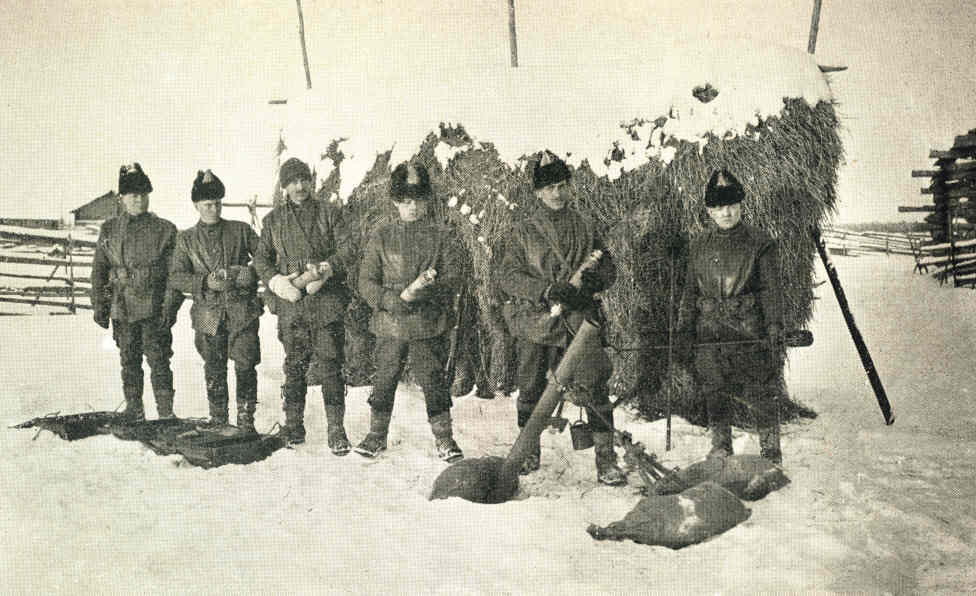
RED CROSS PHOTO
Trench Mortar Crew, Chekuevo—Hand Artillery.
![[Illustration: ]](images/096Pic2_A25.jpg)
U. S. OFFICIAL PHOTO (152755)
Wounded and Sick—Over a Thousand in All.
![[Illustration: ]](images/096Pic2_B25.jpg)
U S OFFICIAL PHOTO
Bolo Killed in Action—For Russia or Trotsky?
![[Illustration: ]](images/096Pic2_C25.jpg)
ROULEAU
Monastery at Pinega.
![[Illustration: ]](images/096Pic2_D25.jpg)
U. S. OFFICIAL PHOTO
Russian 75’s Bound for Pinega.
![[Illustration: ]](images/096Pic3_A25.jpg)
HILL
“G” Men Near Pinega.
![[Illustration: ]](images/096Pic3_B25.jpg)
HILL
Lewis Gun Protects Mess Hall, Pinega.
He was reported later as Bolshevik spy, another as a Lett officer.
Travel by night is against the rules of Russian river boat crew. Had to
use force to get them to continue moving. Arrived at Shenkursk Oct. 19th
and delivered prisoners. Relieved Capt. Watson, R. A. M. C., and
personnel from duty at detention hospital, and started Field Hospital
337. Returned to Beresnik and found that hospital now working about full
capacity. After placing all seriously sick and wounded on board hospital
ship “Currier” we proceeded to Archangel, and arrived there Oct. 22nd.
Boat greatly in need of repairs.
Arranged with Major Longley to get Red Cross and medical supplies, and
had them placed aboard. Among the Red Cross supplies were ten bags of
sugar to be divided between the hospitals and used for the purpose of
bartering natives for vegetables, eggs and chickens.
Oct. 25th, 1918, weather growing colder. Departed for Beresnik on
hospital boat. The Russian crew did not want to travel at night but I
insisted and we kept on going. Awakened by cooties. After lighting my
candle found quite a number.
Oct. 26th, 1918, stopped for a short time to pick up wood. Awakened by
rumbling and cracking noise against boat and upon looking out saw we
were running through floating ice. This condition persisted for
thirty-five versts until we reached Beresnik. Crew stopped boat and
refused to go any farther. Necessary to use some moral “suasion.” When
we arrived at Beresnik found that one paddle was out of order and bow of
boat dented in many places and almost punctured in one place.
Reported to General Finlayson, who ordered me to proceed with boat after
unloading medical and Red Cross supplies, to Pianda, which is about
twelve versts back up river on a tributary of the Dvina River, and
report on the situation at Charastrovia for billets or building for
convalescent hospital. Left Bereznik for Pianda Oct. 28th and had to run
boat through two miles of almost solid ice, four inches thick. At the
mouth of this tributary had to make three attempts before successfully
penetrating ice enough to get into channel of stream.
The following day after leaving a few medical supplies with Canadian
Artillery Headquarters and arranging transportation for myself and
personnel, with a few cooking utensils and blankets, we started for
Beresnik. Stopped at Charastrovia and looked over several buildings but
nothing available worth while. Natives very unfriendly and suspicious.
Arrived at Beresnik, reported to the General and spent the night at
Field Hospital 337.
Oct. 30th left on tug “Archangel” for Kurgomin with dentist. Received
report that several casualties were there to be evacuated. Reached Pless
but found the river full of ice again. Captain of boat stated that he
could not get to Kurgomin, but within about three miles of the place.
Docked boat and walked through mud and water to my knees to Kurgomin.
Found there had been a small detention hospital of fifteen beds
established by Capt. Fortescue in charge of Capt. Watson, R. A. M. C.
Good building at Pless for a hospital of fifty or seventy-five beds,
which was necessary to be taken over and used as advance base evacuating
hospital after Dvina froze. Sent dentist with equipment over to opposite
bank to take care of men’s teeth of Co. “B”, then holding the front on
the left bank. Getting his field equipment together and using cabin as
his office, he was able to care for twenty men. All to be evacuated were
walking cases. Very dark and mud twelve inches deep. Officially reported
that Bolos were coming around the rear that night. We arrived tired, but
safely, where the boat was waiting and returned eight miles through ice.
Waited until morning before going farther and at daybreak started for
Chamova. Stopped there while dentist cared for several Co. “D” men.
Finally reached Beresnik after being stuck on sand bars many times, as
river was very shallow at that time of the year and channel variable.
Handed patients over and spent night at Field Hospital 337.
Following day found it necessary to be deloused. We had nothing but
Serbian barrels for clothing disinfectors at that time. Reported that a
thresh delouser had been started for Beresnik. Sanitation greatly
improved.
After a few days’ rest and arranging with engineers to make ambulance
sled, started again on tug “Archangel” for Dvina front. On the way only
one hour when boat ran aground, and after two hours’ work (pushing with
poles by all on board) we succeeded getting into channel and anchored
for the night.
Started again at daybreak and stopped at Chamova. “D” Company 339th
Infantry at that place with one medical enlisted man, who had taken
three years in medicine. The only man with medical knowledge available.
He had established an aid station with two stretchers for beds. Place
comfortable and clean. General sanitation and billeting the same as in
all other Russian villages.
Reached Pless and left some medical stores with Capt. Watson, then
proceeded to Toulgas with medical and Red Cross supplies. On way to
headquarters a few stray shots were fired by snipers, but no harm done.
Left medical and Red Cross supplies at Lower Toulgas and took aboard
eight sick and wounded troops. Started for Beresnik. Stopped at Chamova
to pick up one sick and one wounded American.
Arrived at Beresnik Nov. 8th. With medical and Red Cross supplies left
for Shenkursk on hospital ship “Currier.” Natives very friendly along
the Vaga River and anxious to barter. Arrived at Shenkursk Nov. 11th.
Over one hundred patients in hospital. Officers had taken over an
additional building for contagious ward which was full of “flu” and
pneumonia cases. With every caution against the spread of the disease,
the epidemic was growing. Russian soldier seems to have no resistance,
probably due to the lack of proper kind of food for the last four years.
Seven at hospital morgue at one time, before we could get coffins made.
People were dying by hundreds in the neighboring villages. Found it
necessary to try and organize medical assistance in order to combat the
epidemic. Funerals of three or four passed wailing through the streets
every few hours.
The Russian funeral at Shenkursk was as follows: Corpse is carried out
in the open on the lid of the coffin, face exposed, and a yellow robe
(used for every funeral) is thrown over the body. The body is then
carried to the church where there is little or no ventilation except
when the doors are opened. Here during the chants every member of the
funeral party, at different times during the service, proceeds to kiss
the same spot on an image, held by the priest. It is their belief that
during a religious service it is impossible to contract disease.
Visited civilian hospitals Nov. 16th, which were in a most horrible
state. No ventilation and practically all with Spanish influenza and, in
addition, many with gangrenous wounds. Tried to enlighten the Russian
doctor in charge with the fact that fresh air would be beneficial to his
cases. But he seemed to think I was entirely out of my sphere and
ignored what I said. I reported the situation to British headquarters
and thereafter he reluctantly did as I suggested. Then arranged with
headquarters to send Russian medical officer and felchers with American
medical officers out to villages where assistance was needed most,
instructing each to impress on the natives the necessity of fresh air
and proper hygiene. They found there was such a shortage of the proper
kind of food that the people had no resistance against disease, and were
dying by the hundreds. In the meantime established annex to civilian
hospital in a school building. Had wooden beds made and placed felchers
in charge.
Tried to segregate cases in Shenkursk and immediate vicinity as much as
possible. After getting everything in working order I found a shortage
of doctors. So I proceeded to villages not yet reached by others. Report
from Ust Padenga that Lieut. Cuff and fourteen enlisted men killed or
missing on patrol Nov. 29th; some of the bodies recovered.
Weather growing colder. Twenty degrees below zero, with snow four inches
deep. Evacuated sick and wounded from Ust Padenga eighteen versts beyond
Shenkursk in sleds filled with hay and blankets necessary for warmth.
Shakleton shoes had not arrived at that time. Most cases coming back in
good condition, but pneumonia cases would not stand the exposure.
Condition at Ust Padenga very uncertain. Lieut. Powers and Lieut.
Taufanoff in charge of ten-bed detention hospital. Advised them to keep
their hospital clear for an emergency.
Action reported on Dvina and hospital captured; later retaken. Slight
action every day or so at Ust Padenga. Lieut. Powers caring for all
civilians in and around that place. Visited one home where I found the
father sick and in adjoining room the corpse of his wife and two
children. In another village I found twenty-four sick in four families;
eight of which were pneumonia cases. In one peasant home, six in family,
all sick with a child of eight years running a fever, but trying to care
for others. All sleeping in the same room; three on the floor and
balance together in a loft made by laying boards between the sills. They
informed me that no food had been cooked for them for three days. The
child eight years old was then trying to make some tea. This same room
was used as a dining room and kitchen. It had double windows, all sealed
air-tight.
Russian troops very difficult to discipline along sanitary or hygienic
lines and have no idea of cleanliness. A guard on the latrine was an
absolute necessity. I adopted this plan in hospital, but impossible to
get their officers to follow this rule at their barracks latrines.
Reported it to British headquarters but they stated that they could not
do anything.
Dec. 8th, 1918. Left by sled for Ust Padenga to inspect hospital.
Arrived at 11:00 a.m. Very cold day. General conditions very good
considering circumstances. Using pits out in open for latrines. Men
living in double-decker beds, and as comfortable as possible in the
available billets. Hospital consisted of two rooms in a log hut, but
light, dry and comfortable. Beds improvised with stretchers laid across
wooden horses. Had three casualties which they were evacuating that day.
Started for Shenkursk at 3:00 p.m. Began snowing and my driver proceeded
in circles leaving the horse go as he chose. A Russian custom when they
lose their bearings. I got somewhat anxious and had been trying to
inquire with the few Russian terms I had been forced to learn. Driver
stated that he did not know the way, and we ran into snow drifts, into
gullies, over bluffs, through bushes, and after floundering around in
the snow for six hours I heard the bugle from Shenkursk which was just
across the river. I then started the direction which I thought was up
the river and by good luck, ran into the road that led across the Vaga
to Shenkursk.
December 12th, 1918. Hospital inspected by Major Fitzpatrick of American
Red Cross.
December 14th, 1918. Left Shenkursk for Shegovari where Lieut. Goodnight
and 337th Ambulance men were running a detention hospital of eight beds
and infirmary for American platoon, stationed at that place which is
forty versts down Vaga river from Shenkursk toward Beresnik, where we
arrived at 6:00 p.m. Looked over his hospital and continued on to Kitsa.
Remained over night and left at daylight December 15th, going across
Vaga through woods to Chamova, arriving at noon. Very cold day.
Here given a team of horses and proceeded to Toulgas, the farthest Dvina
front. Found small hospital with several sick at Lower Toulgas in charge
of British medical officer. Stayed over night at headquarters two versts
further up the river. The following day some artillery firing. Proceeded
to front line dressing station in charge of Lieut. Christie and ten
337th Ambulance men. One from advance headquarters on left bank, British
holding front. One company of Americans and one of Scots on right bank.
Stopped at Shushuga on return, eight versts from Toulgas. Across the
river from this place is Pless where an evacuation hospital was
conducted by Capt. Watson, R. A. M. C., with fourteen British and one
American Ambulance man, used as a cook and interpreter. Stretchers used
for beds. Casualties held here for two or three days and evacuated by
sled to Beresnik about fifty versts to the rear. At Shushuga there were
two Ambulance men conducting a first aid station. Village held by one
platoon of Americans.
Returned to Beresnik making a change of horses at Chamova and Ust Vaga.
The latter place held by twenty-eight American engineers and about one
hundred Russians. First aid given by a Russian felcher.
Inspected wards, kitchen, food, etc. Found there was no complaint as to
treatment received. December 16th, 1918. With rations for five days left
for Archangel by sleigh, making a change of horses about every twenty
versts. Arrived at Archangel at 2:00 p.m., December 23, 1918.
XII
ARMISTICE DAY WITH AMERICANS IN NORTH RUSSIA
“B” And “D” Busy With Attacking Bolos—“L” Vigilantly Holding Front Near
Kodish—Quiet On Other Fronts—Engineers Building Blockhouses With Willing
Assistance Of Doughboys—How Was Our Little War Affected—“We’re Here Because
We’re Here”—No Share In Victory Shouting—“F” On Lines Of Communication.
Armistice Day, November 11th, 1918, with American soldiers in North
Russia, was a day of stern activity for continued war. A great thrill of
pride possessed the entire force because the Yanks on the Western Front
had been in at the death of Hun militarism. The wonderful drives of our
armies under Pershing which crushed in the Hindenberg Lines, one after
another, had been briefly wirelessed and cabled up to Russia. We got the
joyful news in Archangel on the very day the fighting ceased on the
Western Front.
But the “B” and “D” Company men were too busy on Armistice Day to listen
to rumors of world peace. The Reds had staged that awful four-day
battle, told next in this story, and the American medical and hospital
men were sadly busy with thirty bleeding and dead comrades who had
fallen in defending Toulgas. “C” was far out at Ust Padenga earnestly
building blockhouses. “A” was at Shenkursk with Colonel Corbley, resting
after two months stiff fighting and with American Engineers of the 310th
building blockhouses. For they correctly suspected that the Reds would
not quit just because of the collapse of the Germans.
“L” Company and Ballard’s Machine Gun platoon were hourly prepared to
fight for their position at the Emtsa River against the Red force
flushed with the victorious recapture of Kodish. 310th Engineers were
skillfully and heartily at work on the blockhouses and gun emplacements
and log shelters for this Kodish force, doomed to a desperate winter,
armistice or no armistice. Old “K” Company, breathless yet from its
terrific struggle to hold Kodish, was back at base headquarters at
Seletskoe waiting patiently for “E” Company to relieve them.
Captain Heil’s company had left Archangel by railroad and was somewhere
on the cold forest trail between Obozerskaya and Seletskoe.
“F” Company, as we have seen, was now on the precious lines of
communication, now more subject to attack because of the numerous winter
trails across the hitherto broad, impassable expanses of forest and
swamp, which were now beginning to freeze up. Far out on their left
flank and to their rear was the little force of “G” Company who were
holding Pinega and a long sector of road which was daily becoming more
difficult to safeguard. And hundreds of miles across this state of
Archangel in the Onega Valley our “H” Company comrades felt the
responsibility of wiring in themselves for a last ditch stand against
the Reds who might try to drive them back and flank their American and
Allied comrades on the railroad.
On the railroad the 3l0th Engineers were busy as beavers building, with
the assistance of the infantrymen, blockhouses and barracks and gun
emplacements and so forth. For, while the advanced positions on the
railroad were of no value in themselves, it was necessary to hold them
for the sake of the other columns. Obozerskaya was to be the depot and
sleigh transportation point of most consequence next to Seletskoe, which
itself in winter was greatly dependent on Obozerskaya.
“I” and “M” Companies were resting from the hard fall offensive
movement, the former unit at Obozerskaya, the latter just setting foot
for the first time in Archangel for a ten day rest, the company having
gone directly from troopship to troop train and having been “shock
troops” in everyone of the successive drives at the Red army positions.
In Archangel “Hq.” Company units were assisting Machine Gun units in
guarding important public works and marching in strength occasionally on
the streets to glare down the scowling sailors and other Red
sympathizers who, it was rumored persistently, were plotting a riot and
overthrow of the Tchaikowsky government and throat-cutting for the
Allied Embassies and military missions.
Oh, Armistice Day in Archangel made peace in our strange war no nearer.
It was dark foreboding of the winter campaign that filled the thoughts
of the doughboy on duty or lying in the hospital in Archangel that day.
Out on the various fronts the American soldiers grimly understood that
they must hold on where they were for the sake of their comrades on
other distant but nevertheless cotangent fronts on the circular line
that guard Archangel. In Archangel the bitter realization was at last
accepted that no more American troops were to come to our assistance.
Of course every place where two American soldiers or officers exchanged
words on Armistice Day, or the immediate days following, the chief topic
of conversation was the possible effect of the armistice upon our little
war. Vainly the scant telegraphic news was studied for any reference to
the Russian situation in the Archangel area. Was our unofficial war on
Russia’s Red government to go on? How could armistice terms be extended
to it without a tacit recognition of the Lenine-Trotsky government?
As one of the boys who was upon the Dvina front writes: “We would have
given anything we owned and mortgaged our every expectation to have been
one of that great delirious, riotous mob that surged over Paris on
Armistice Day; and we thought we had something of a title to have been
there for we claimed the army of Pershing for our own, even though we
had been sent to the Arctic Circle; and now that the whole show was over
we wanted to have our share in the shouting.”
But the days, deadly and monotonous, followed one another with ever
gloomy regularity, and there was no promise of relief, no word, no news
of any kind, except the stories of troops returning home from France.
Doubtless in the general hilarity over peace, we were forgotten. After
all, who had time in these world stirring days to think of an
insignificant regiment performing in a fantastic Arctic side show.
Truth to tell, the Red propagandists on Trotsky’s Northern Army staff
quickly seized the opportunity to tell the Allied troops in North Russia
that the war was over and asked us what we were fighting for. They did
it cleverly, as will be told elsewhere. Yet the doughboy only swore
softly and shined his rifle barrel. He could not get information
straight from home. He was sore. But why fret? His best answer was the
philosophic “We’re here because we’re here” and he went on building
blockhouses and preparing to do his best to save his life in the
inevitable winter campaign which began (we may say) about the time of
the great world war Armistice Day, which in North Russia did not mean
cease firing.
Before passing to the story of the dark winter’s fighting we must notice
one remaining unit of the American forces, hitherto only mentioned. It
is the unit that after doing tedious guard duty in Archangel and its
suburbs for a couple of months, all the while listening impatiently to
stories of adventure and hardship and heroism filtering in from the
fronts and the highly imaginative stories of impending enemy smashes and
atrocities rumoring in from those same fronts and gaining color and
tragic proportions in the mouth-to-mouth transit, that unit “F” Company,
the prize drill company of Camp Custer in its young life, now on October
30th found itself on a slow-going barge en route to Yemetskoe, one
hundred and twenty-five versts, as the side wheeler wheezed up the
meandering old Dvina River.
There in the last days of the fall season this company of Americans took
over the duty of patrolling constantly the line of communications and
all trails leading into it so that no wandering force of Red Guards
should capture any of the numerous supply trains bound south with food,
powder and comforts—such as they were—for the Americans and Allied
forces far south on the Dvina and Vaga fronts.
It was highly important work admirably done by this outfit commanded by
Captain Ralph Ramsay. Any slackening of alertness might have resulted
disastrously to their regimental comrades away south, and while this
outfit was the last of the 339th to go into active field service it may
be said in passing that in the spring it was the last unit to come away
from the fighting front in June, and came with a gallant record, story
of which will appear later. Winter blizzards found the outfit broken
into trusty detachments scattered all the way from Kholmogori, ninety
versts north of Yemetskoe, to Morjegorskaya, fifty-five versts south of
company headquarters in Yemetskoe. And it was common occurrence for a
sergeant of “F” Company with a “handful of doughboys” to escort a mob of
Bolshevik prisoners of war to distant Archangel.
XIII
WINTER DEFENSE OF TOULGAS
General Ironside Makes Expedition Aim Defensive—Bolsheviki Help Give It
Character—Toulgas—Surprise Attack Nov. 11th By Reds—Canadian Artillery Escapes
Capture—We Win Back Our Positions—“Lady Olga” Saves Wounded Men—Heroic
Wallace—Cudahy And Derham Carry Upper Toulgas By Assault—Foukes—A Jubilant
Bonfire—Many Prisoners—Ivan Puzzled By Our War—Bolo Attack In January
Fails—Dresing Nearly Takes Prisoner—Winter Patrolling—Corporal Prince’s Patrol
Ambushed—We Hold Toulgas.
General Ironside had now taken over command of the expedition and
changed its character more to accord with the stated purpose of it. We
were on the defensive. The Bolshevik whose frantic rear-guard actions
during the fall campaign had often been given up, even when he was
really having the best of it, merely because he always interpreted the
persistence of American attack or stubbornness of defense to mean
superior force. He had learned that the North Russian Expeditionary
Force was really a pitifully small force, and that there was so much
fussing at home in England and France and America about the justice and
the methods of the expedition, that no large reinforcements need be
expected. So the Bolsheviks on Armistice Day, November 11, began their
counter offensive movement which was to merge with their heavy winter
campaign. So the battle of November 11th is included in the narrative of
the winter defense of Toulgas.
Toulgas was the duplicate of thousands of similar villages throughout
this province. It consisted of a group of low, dirty log houses huddled
together on a hill, sloping down to a broad plain, where was located
another group of houses, known as Upper Toulgas. A small stream flowed
between the two villages and nearly a mile to the rear was another group
of buildings which was used for a hospital and where first aid was given
to the wounded before evacuating them to Bereznik, forty or fifty miles
down the river.
The forces engaged in the defense of this position consisted of several
batteries of Canadian artillery, posted midway between the hospital and
the main village. In addition to this “B” Company, American troops, and
another company of Royal Scots were scattered in and about these
positions. From the upper village back to the hospital stretched a good
three miles, which of course meant that the troops in this position,
numbering not more than five hundred were considerably scattered and
separated. This detailed description of our position here is set forth
so specifically in order that the reader may appreciate the attack which
occurred during the early part of November.
On the morning of November 11th, while some of the men were still
engaged in eating their breakfasts and while the positions were only
about half manned, suddenly from the forests surrounding the upper
village, the enemy emerged in attack formation. Lieut. Dennis engaged
them for a short time and withdrew to our main line of defense. All
hands were immediately mustered into position to repel this advancing
wave of infantry. In the meantime the Bolo attacked with about five
hundred men from our rear, having made a three day march through what
had been reported as impassable swamp. He occupied our rearmost village,
which was undefended, and attacked our hospital. This forward attack was
merely a ruse to divert the attention of our troops in that direction,
while the enemy directed his main assault at our rear and undefended
positions for the purpose of gaining our artillery. Hundreds of the
enemy appeared as if by magic from the forests, swarmed in upon the
hospital village and immediately took possession. Immediately the
hospital village was in their hands, the Bolo then commenced a desperate
advance upon our guns.
At the moment that this advance began, there were some sixty Canadian
artillery men and one Company “B” sergeant with seven men and a Lewis
gun. Due to the heroism and coolness of this handful of men, who at once
opened fire with their Lewis guns, forcing the advancing infantry to
pause momentarily. This brief halt gave the Canadians a chance to
reverse their gun positions, swing them around and open up with muzzle
bursts upon the first wave of the assault, scarcely fifty yards away. It
was but a moment until the hurricane of shrapnel was bursting among
solid masses of advancing infantry, and under such murderous fire, the
best disciplined troops and the most foolhardly could not long
withstand. Certain it was that the advancing Bolo could not continue his
advance. The Bolos were on our front, our right flank and our rear, we
were entirely cut off from communication, and there were no
reinforcements available. About 4:00 p. m. we launched a small counter
attack under Lt. Dennis, which rolled up a line of snipers which had
given us considerable annoyance. We then shelled the rear villages
occupied by the Bolos, and they decamped. Meanwhile the Royal Scots, who
had been formed for the counter attack, went forward also under the
cover of the artillery, and the Bolo, or at least those few remaining,
were driven back into the forests.
The enemy losses during this attack were enormous. His estimated dead
and wounded were approximately four hundred, but it will never be known
as to how many of them later died in the surrounding forests from wounds
and exposure. This engagement was not [only] disastrous from the loss of
men, but was even more disastrous from the fact that some of the leading
Bolshevik leaders on this front were killed during this engagement. One
of the leading commanders was an extremely powerful giant of a man,
named Melochofski, who first led his troops into the village hospital in
the rear of the gun positions. He strode into the hospital, wearing a
huge black fur hat, which accentuated his extraordinary height, and
singled out all the wounded American and English troops for immediate
execution, and this would undoubtedly have been their fate, had it not
been for the interference of a most remarkable woman, who was christened
by the soldiers “Lady Olga.”
This woman, a striking and intelligent appearing person, had formerly
been a member of the famous Battalion of Death, and afterwards informed
one of our interpreters that she had joined the Soviets out of pure love
of adventure, wholly indifferent to the cause for which she exposed her
life. She had fallen in love with Melochofski and had accompanied him
with his troops through the trackless woods, sharing the lot of the
common soldiers and enduring hardships that would have shaken the most
vigorous man. With all her hardihood, however, there was still a touch
of the eternal feminine, and when Melochofski issued orders for the
slaughter of the invalided soldiers, she rushed forward and in no
uncertain tones demanded that the order be countermanded and threatened
to shoot the first Bolo who entered the hospital. She herself remained
in the hospital while Melochofski with the balance of his troops went
forward with the attack and where he himself was so mortally wounded
that he lived only a few minutes after reaching her side. She eventually
was sent to the hospital at the base and nursed there. Capt. Boyd states
that he saw a letter which she wrote, unsolicited, to her former
comrades, telling them that they should not believe the lies which their
commissars told them, and that the Allies were fighting for the good of
Russia.
At daybreak the following day, five gun boats appeared around the bend
of the river, just out of range of our three inch artillery, and all day
long their ten long ranged guns pounded away at our positions, crashing
great explosives upon our blockhouse, which guarded the bridge
connecting the upper and middle village, while in the forests
surrounding this position the Bolo infantry were lying in wait awaiting
for a direct hit upon this strong point in order that they could rush
the bridge and overwhelm us. Time after time exploding shells threw huge
mounds of earth and debris into the loop holes of this blockhouse and
all but demolished it.
Here Sergeant Wallace performed a particularly brave act. The blockhouse
of which he was in command was near a large straw pile. A shell hit near
the straw and threw it in front of the loop holes. Wallace went out
under machine gun fire from close range, about seventy-five yards, and
under heavy shelling, and removed the straw. The same thing happened a
little later, and this time he was severely wounded. He was awarded the
Distinguished Conduct Medal by the British. Private Bell was in this
blockhouse when it was hit and all the occupants killed or badly
wounded. Bell was badly gashed in the face, but stuck with his Lewis gun
until dark when he could be relieved, being the only one in the
shattered blockhouse which held the bridge across the small stream
separating us from the Bolos.
For three days the gun boats pounded away and all night long there was
the rattle and crack of the machine guns. No one slept. The little
garrison was fast becoming exhausted. Men were hollow-eyed from
weariness and so utterly tired that they were indifferent to the
shrieking shells and all else. At this point of the siege, it was
decided that our only salvation was a counter attack. In the forests
near the upper village were a number of log huts, which the natives had
used for charcoal kilns, but which had been converted by the enemy into
observation posts and storehouses for machine guns and ammunition. His
troops were lying in and about the woods surrounding these buildings. We
decided to surprise this detachment in the woods, capture it if possible
and make a great demonstration of an attack so as to give the enemy in
the upper village the impression that we were receiving reinforcements
and still fresh and ready for fighting. This maneuver succeeded far
beyond our wildest expectations.
Company “B,” under command of Lt. John Cudahy, and one platoon of Company “D”
under Lt. Derham, made the counter attack on the Bolo trenches. Just before
dawn that morning the Americans filed through the forests and crept upon the
enemy’s observation posts before they were aware of any movement on our part.
We then proceeded without any warning upon their main position. Taken as they
were, completely by surprise, it was but a moment before they were in full
rout, running panic-stricken in all directions, thinking that a regiment or
division had followed upon them. We immediately set fire to these huts
containing their ammunition, cartridges, etc., and the subsequent explosion
that followed probably gave the enemy the impression that a terrific attack was
pending. As we emerged from the woods and commenced the attack upon upper
Toulgas we were fully expecting stiff resistance, for we knew that many of
these houses concealed enemy guns. Our plans had succeeded so well, however,
that no supporting fire from the upper village came and the snipers in the
forward part of the village seeing themselves abandoned, threw their guns and
came rushing forward shouting “tovarish, tovarish,” meaning the same as
the German “kamerad.” As a matter of fact, in this motley crew of
prisoners were a number of Germans and Austrians, who could scarcely speak a
word of German and who were probably more than thankful to be taken prisoners
and thus be relieved from active warfare.
During this maneuver one of their bravest and ablest commanders, by the
name of Foukes, was killed, which was an irreparable loss to the enemy.
Foukes was without question one of the most competent and aggressive of
the Bolo leaders. He was a very powerful man physically and had long
years of service as a private in the old Russian Army, and was without
question a most able leader of men. During this four days’ attack and
counter attack he had led his men by a circuitous route through the
forests, wading in swamps waist deep, carrying machine guns and rations.
The nights were of course miserably cold and considerable snow had
fallen, but Foukes would risk no fire of any kind for fear of discovery.
It was not due to any lack of ability or strategy on his part that this
well planned attack failed of accomplishment. On his body we found a
dramatic message, written on the second day of the battle after the
assault on the guns had failed. He was with the rear forces at that time
and dispatched or had intended to dispatch the following to the command
in charge of the forward forces:
“We are in the two lowest villages—one steamer coming up river—perhaps
reinforcements. Attack more vigorously—Melochofski and Murafski are killed. If
you do not attack, I cannot hold on and retreat is impossible. (Signed)
FOUKES.”
Out of our force of about six hundred Scots and Americans we had about a
hundred casualties, the Scots suffering worse than we. Our casualties
were mostly sustained in the blockhouses, from the shelling. It was here
that we lost Corporal Sabada and Sergeant Marriott, both of whom were
fine soldiers and their loss was very keenly felt. Sabada’s dying words
were instructions to his squad to hold their position in the rear of
their blockhouse which had been destroyed.
It was reported that Trotsky, the idol of the Red crowd, was present at
the battle of Toulgas, but if he was there, he had little influence in
checking the riotous retreat of his followers when they thought
themselves flanked from the woods. They fled in wild disorder from the
upper village of Toulgas and for days thereafter in villages far to our
rear, various members of this force straggled in, half crazed by
starvation and exposure and more than willing to abandon the Soviet
cause. For weeks the enemy left the Americans severely alone. Toulgas
was held.
But it was decided to burn Upper Toulgas, which was a constant menace to
our security, as we had no men to occupy it with sufficient numbers to
make a defense and the small outposts there were tempting morsels for
the enemy to devour. Many were reluctant to stay there, and it was
nervous work on the black nights when the wind, dismal and weird, moaned
through the encompassing forest, every shadow a crouching Bolshevik.
Often the order came through to the main village to “stand to,” because
some fidgety sentinel in Upper Toulgas had seen battalions, conjured by
the black night. So it was determined to burn the upper village and a
guard was thrown around it, for we feared word would be passed and the
Bolos would try to prevent us from accomplishing our purpose. The
inhabitants were given three hours to vacate. It was a pitiful sight to
see them turned out of the dwellings where most of them had spent their
whole simple, not unhappy lives, their meagre possessions scattered awry
upon the ground.
The first snow floated down from a dark foreboding sky, dread announcer of a
cruel Arctic winter. Soon the houses were roaring flames. The women sat upon
hand-fashioned crates wherein were all their most prized household goods, and
abandoned themselves to a paroxysm of weeping despair, while the children
shrieked stridently, victim of all the realistic horrors that only childhood
can conjure. Most of the men looked on in silence, uncomprehending resignation
on their faces, mute, pathetic figures. Poor moujiks! They didn’t understand,
but they took all uncomplainingly. Nitchevoo, fate had decreed that they
should suffer this burden, and so they accepted it without question.
But when we thought of the brave chaps whose lives had been taken from
those flaming homes, for our casualties had been very heavy, nearly one
hundred men killed and wounded, we stifled our compassion and looked on
the blazing scene as a jubilant bonfire. All night long the burning
village was red against the black sky, and in the morning where had
stood Upper Toulgas was now a smoking, dirty smudge upon the plain.
We took many prisoners in this second fight of Toulgas. It was a trick
of the Bolos to sham death until a searching party, bent on examining
the bodies for information, would approach them, when suddenly they
would spring to life and deliver themselves up. These said that only by
this method could they escape the tyranny of the Bolsheviki. They
declared that never had they any sympathy with the Soviet cause. They
didn’t understand it. They had been forced into the Red Army at the
point of a gun, and were kept in it by the same persuasive argument.
Others said they had joined the Bolshevik military forces to escape
starvation.
There was only one of the thirty prisoners who admitted being an ardent
follower of the cause, and a believer in the Soviet articles of
political doctrine, and this was an admission that took a great deal of
courage, for it was instilled universally in the Bolos that we showed no
mercy, and if they fell into the hands of the cruel Angliskis and
Americanskis there was nothing but a hideous death for them.
Of course our High Command had tried to feed our troops the same kind of
propaganda. Lenine, himself, said that of every one hundred Bolsheviks
fifty were knaves, forty were fools, and probably one in the hundred a
sincere believer. Once a Bolshevik commander who gave himself up to us
said that the great majority of officers in the Soviet forces had been
conscripted from the Imperial Army and were kept in order by threats to
massacre their families if they showed the slightest tendency towards
desertion. The same officer told me the Bolshevik party was hopelessly
in the minority, that its adherents numbered only about three and a half
in every hundred Russians, that it had gained ascendancy and held power
only because Lenine and Trotsky inaugurated their revolution by seizing
every machine gun in Russia and steadfastly holding on to them. He said
that every respectable person looked upon the Bolsheviks as a gang of
cutthroats and ruffians, but all were bullied into passive submission.
We heard him wonderingly. We tried to fancy America ever being
brow-beaten and cowed by an insignificant minority, her commercial life
prostrated, her industries ravished, and we gave the speculation up as
an unworthy reflection upon our country. But this was Russia, Russia who
inspired the world by her courage and fortitude in the great war, and
while it was at its most critical stage, fresh with the memories of
millions slain on Gallician fields, concluded the shameful treaty of
Brest Litovsk, betraying everything for which those millions had died.
Russia, following the visionary Kerensky from disorder to chaos, and
eventually wallowing in the mire of Bolshevism. Yes, one can expect
anything in Russia.
They were a hardboiled looking lot, those Bolo prisoners. They wore no
regulation uniform, but were clad in much the same attire as an ordinary
moujik—knee leather boots and high hats of gray and black curled fur.
No one could distinguish them from a distance, and every peasant could
be Bolshevik. Who knew? In fact, we had reason to believe that many of
them were Bolshevik in sympathy. The Bolos had an uncanny knowledge of
our strength and the state of our defenses, and although no one except
soldiers were allowed beyond the village we knew that despite the
closest vigilance there was working unceasingly a system of enemy
espionage with which we could never hope to cope.
Some of the prisoners were mere boys seventeen and eighteen years old.
Others men of advanced years. Nearly all of them were hopelessly
ignorant, likely material for a fiery tongued orator and plausible
propagandist. They thought the Americans were supporting the British in
an invasion of Russia to suppress all democratic government, and to
return a Romanoff to the throne.
That was the story that was given out to the moujiks, and, of course,
they firmly believed it, and after all why should they not, judging by
appearances? We quote here from an American officer who fought at
Toulgas:
“If we had not come to restore the Tsar, why had we come, invading Russia, and
burning Russian homes? We spoke conciliatingly of ‘friendly intervention,’ of
bringing peace and order to this distracted country, to the poor moujik, when
what he saw were his villages a torn battle ground of two contending armies,
while the one had forced itself upon him, requisitioned his shaggy pony, burned
the roof over his head, and did whatever military necessity dictated. It was
small concern to Ivan whether the Allies or the Bolsheviks won this strange
war. He did not know what it was all about, and in that he was like the rest of
us. But he asked only to be left alone, in peace to lead his simple life,
gathering his scanty crops in the hot brief months of summer and dreaming away
the long dreary winter on top of his great oven-like stove, an unworrying
fatalistic disciple of the philosophy of nitchevoo.”
After the fierce battle to hold Toulgas, the only contact with the enemy
was by patrols. “D” Company came up from Chamova and relieved “B”
Company for a month. Work was constantly expended upon the winter
defenses. The detachment of 310th Engineers was to our men an invaluable
aid. And when “B” went up to Toulgas again late in January, they found
the fortifications in fine shape. But meanwhile rumors were coming in
persistently of an impending attack.
The Bolo made his long expected night attack January 29, in conjunction
with his drive on the Vaga, and was easily repulsed. Another similar
attack was made a little later in February, which met with a similar
result. It was reported to us that the Bolo soldiers held a meeting in
which they declared that it was impossible to take Toulgas, and that
they would shoot any officer who ordered another attack there.
It was during one of the fracases that Lt. Dressing captured his
prisoner. With a sergeant he was inspecting the wire, shortly after the
Bolo had been driven back, and came upon a Bolo who threw up his hands.
Dressing drew his revolver, and the sergeant brought his rifle down to a
threatening position, the Bolo became frightened and seized the bayonet.
Dressing wishing to take the prisoner alive grabbed his revolver by the
barrel and aimed a mighty swing. Unfortunately he forgot that the
British revolver is fastened to a lanyard, and that the lanyard was
around his shoulder. As a result his swing was stopped in midair, nearly
breaking his arm, the Bolo dropped the bayonet and took it on the run,
getting away safely, leaving Dressing with nothing to bring in but a
report.
March 1st we met with a disaster, one of our patrols being ambushed, and
a platoon sent out to recover the wounded meeting a largely superior
force, which was finally dispersed by artillery. We lost eight killed
and more wounded. Sergeant Bowman, one of the finest men it has been my
privilege to know, was killed in this action and his death was a blow
personally to every man in the company.
Corporal Prince was in command of the first patrol, which was ambushed.
In trying to assist the point, who was wounded, Prince was hit. When we
finally reached the place of this encounter the snow showed that Prince
had crawled about forty yards after he was wounded and fired his rifle
several times. He had been taken prisoner.
From this time on the fighting in the Upper Dvina was limited to the
mere patrol activities. There to be sure was always a strain on the men.
Remembering their comrades who had been ambushed before, it took the
sturdiest brand of courage for small parties to go out day and night on
the hard packed trails, to pass like deer along a marked runway with
hunter ready with cocked rifle. The odds were hopelessly against them.
The vigilance of their patrols, however, may account for the fact that
even after his great success on the Vaga, the commander of Bolshevik
Northern Army did not send his forces against the formidably guarded
Toulgas.
One day we were ordered by British headquarters to patrol many miles
across the river where it had been reported small parties of Bolos were
raiding a village. We had seventeen sleighs drawn by little shaggy
ponies, which we left standing in their harnesses and attached to the
sleighs while we slept among the trees beside a great roaring blaze that
our Russian drivers piled high with big logs the whole night through;
and the next morning, in the phantom gloom we were off again, gliding
noiselessly through the forest, charged with the unutterable stillness
of infinite ethereal space; but, as the shadows paled, there was
unfolded a fairyland of enchanted wonders that I shall always remember.
Invisible hands of artistry had draped the countless pines with garlands
and wreaths of white with filmy aigrettes and huge, ponderous globes and
festoons woven by the frost in an exquisite and fantastic handiwork; and
when the sun came out, as it did for a few moments, every ornament on
those decorated Christmas trees glittered and twinkled with the magic of
ten thousand candles. It was enchanted toyland spread before us and we
were held spell bound by a profusion of airy wonders that unfolded
without end as we threaded our way through the forest flanked by the
straight, towering trunks.
After a few miles the ponies could go no further through the high
drifts, so we left them and made our way on snowshoes a long distance to
a group of log houses the reported rendezvous of the Bolsheviks, but
there were no Bolos there, nor any signs of recent occupancy, so we
burned the huts and very wearily dragged our snow shoes the long way
back to the ponies. They were wet with sweat when we left them belly
deep in the snow; but there they were, waiting with an attitude of
patient resignation truly Russian and they made the journey homeward
with more speed and in higher spirits than when they came. There is only
one thing tougher than the Russian pony and that is his driver, for the
worthies who conducted us on this lengthy journey walked most of the way
through the snow and in the intense cold, eating a little black bread,
washed down with hot tea, and sleeping not at all.
![[Illustration: ]](images/112Pic1_A25.jpg)
WAGNER
Something Like a Selective Draft.
![[Illustration: ]](images/112Pic1_B25.jpg)
WAGNER
Canadian Artillery, Kurgomin.
![[Illustration: ]](images/112Pic2_A25.jpg)
U. S. OFFICIAL
Watch-Tower, Verst 455.
![[Illustration: ]](images/112Pic2_B25.jpg)
U. S. OFFICIAL
Toulgas Outpost.
![[Illustration: ]](images/112Pic2_C25.jpg)
U. S. OFFICIAL
One of a Bolo Patrol.
![[Illustration: ]](images/112Pic2_D25.jpg)
U. S. OFFICIAL
Patrolling.
Those long weeks of patrol and sentry duty were wearing on the men.
Sentinels were continually seeing things at night that were not. Once we
were hurried out into the cold darkness by the report of a great
multitude of muttering voices approaching from the forest, but not a
shot answered our challenge and the next morning there in the snow were
the fresh tracks of timber wolves—a pack had come to the end of the
woods—no wonder the Detroit fruit salesman on guard thought the Bolos
were upon us.
But not long afterwards the Bolos did come and more cunningly and
stealthily than the wolf pack, for in the black night they crept up and
were engaged in the act of cutting the barbed wire between the
blockhouses, when a sentinel felt—there was no sound—something
suspicious, and sped a series of machine gun bullets in the direction he
suspected. There was a fight lasting for hours, and in the morning many
dead Bolos were lying in the deep snow beyond the wire defenses. They
wore white smocks which, at any distance, in the dim daylight, blended
distinctly with the snow and at night were perfectly invisible. We were
grateful to the sentinel with the intuitive sense of impending danger.
Some soldiers have this intuition. It is beyond explanation but it
exists. You have only to ask a soldier who has been in battle combat to
verify the truth of this assertion.
Still we decided not to rely entirely upon this remarkable faculty of
intuition, some man might be on watch not so gifted; and so we tramped
down a path inside the wire encompassing the center village. During the
long periods between the light we kept up an ever vigilant patrol.
The Bolos came again at a time when the night was blackest, but they
could not surprise us, and they lost a great many men, trying to wade
through waist deep snow, across barbed wire, with machine guns working
from behind blockhouses two hundred yards apart. It took courage to run
up against such obstacles and still keep going on. When we opened fire
there was always a great deal of yelling from the Bolos—commands from
the officers to go forward, so our interpreters said, protests from the
devils, even as they protested, many were hit; but it is to be noted
that the officers stayed in the background of the picture. There was no
Soviet leader who said “follow me” through the floundering snow against
those death scattering machine guns—it did not take a great deal of
intelligence to see what the chances were.
So weeks passed and we held on, wondering what the end would be. We did
not fear that we should lose Toulgas. With barbed wire and our
surrounding blockhouses we were confident that we could withstand a
regiment trying to advance over that long field of snow; but the danger
lay along our tenuous line of communication.
The plight of the Yankee soldier in North Russia fighting the Bolsheviki in the
winter of 1918-19 was often made the subject of newspaper cartoon. Below is
reproduced one of Thomas’ cartoons from The Detroit News, which shows
the doughboy sitting in a Toulgas trench—or a Kodish, or Shred Makrenga, or
Pinega, or Chekuevo, or Railroad trench. Of course this dire position was at
one of those places and at one of those times before the resourceful Yanks had
had time to consolidate their gains or fortify their newly accepted position in
rear of their former position. In a few hours—or few days at most, the American
soldier would have dug in securely and made himself rudely comfortable. That
rude comfort would last till some British officer decided to “put on a bit of a
show,” or till the Reds in overwhelming numbers or with tremendous artillery
pounding or both combined, compelled the Yanks to fight themselves into a new
position and go through the Arctic rigors of trench work again in zero weather
for a few days. The cartoonist knows the unconquerable spirit of humor with
which the American meets his desperate situations; for he puts into the
soldier’s mouth words that show that although he may have more of a job than he
bargained for, he can joke with his buddie about it. As reserve officers of
that remarkable North Russian expeditionary force the writers take off their
hats in respect to the citizen soldiers who campaigned with us under conditions
that were, truth to say, usually better but sometimes much worse than the
trench situation pictured by the cartoon below. With grit and gumption and good
humor those citizen soldiers “endured hardness as good soldiers.”
![[Illustration: ]](images/114Pic25.jpg)
Well, Bill, we certainly got a job after the war.
“Peace Conference News: After War Labor Problem.”
XIV
GREAT WHITE REACHES
Lines Of Communication Guarded Well—Fast Travelling Pony Sleighs—Major Williams
Describes Sled Trip—A Long Winter March—Visiting Three Hundred Year Old
Monastery—Snowshoe Rabbit Story—Driving Through Fairyland—Lonely, Thoughtful
Rides Under White North Star—Wonderful Aurora Borealis.
We left “F” Company in the winter, swirling snows guarding the many
points of danger on the long lines of communication. They were in
December scattered all the way from Archangel to Morjegorskaya. For a
few weeks in January, Lieut. Sheridan with his platoon sat on the Bolo
lidtilters in Leunova in the lower Pinega Valley and then was hurried
down the Dvina to another threatened area. The Red success in pushing
our forces out of Shenkursk and down the Vaga made the upper Dvina and
Vaga roads constantly subject to raiding parties of the Bolsheviki.
Early in February “K” Company came up from Archangel and took station at
Yemetskoe, one platoon being left at Kholmogori. “F” Company had been
needed further to the front to support the first battalion companies
hard pressed by the enemy. Nervous and suspected villages alike were
vigilantly visited by strong patrols. On February 12th Captain Ramsay
hurried up with two platoons to reinforce Shred Mekhrenga, traveling a
distance of forty versts in one day. But the enemy retired mysteriously
as he had oft before just when it seemed that he would overpower the
British-Russian force that had been calling for help. So the Americans
were free to go back to the more ticklish Vaga-Dvina area.
From here on the story of “F” Company on the lines of communication
merges into the story of the stern rear guard actions and the final
holding up of the advance of the Reds, and their gallant part will be
read in the narrative related elsewhere.
Mention has already been made of the work of “G” and “M” Company
platoons on the isolated Pinega Valley lines and of “H” Company guarding
the very important Onega-Obozerskaya road, over which passed the mails
and reinforcements from the outside world. The cluster of villages
called Bolsheozerki was on this road. Late in March it was overpowered
by a strong force of the Reds and before aid could come the Bolshevik
Northern Army commander had wedged a heavy force in there, threatening
the key-point Obozerskaya. This point on the line of communication had
been guarded by detachments from the Railroad force at Obozerskaya,
Americans alternating with French soldiers, and both making use of
Russian Allied troops. At the time of its capture it was occupied by a
section of French supported by Russian troops. The story of its
recapture is told elsewhere.
The trail junction point Volshenitsa, between Seletskoe and Obozerskaya,
was fitted up with quarters for soldiers and vigilantly guarded against
surprise attacks by the Reds from 443, or Emtsa. Sometimes it was held
by British and Russians from Seletskoe and sometimes by Americans from
Obozerskaya.
It sounds easy to say “Guarding lines of communication.” But any veteran
of the North Russian expedition will tell you that the days and nights
he spent at that duty were often severe tests. When that Russki
thermometer was way below forty and the canteen on the hip was solid ice
within twenty minutes of leaving the house, and the sleigh drivers’
whiskers were a frozen Niagara, and your little party had fifteen versts
to go before seeing another village, you wondered how long you would be
able to handle your rifle if you should be ambushed by a party of Bolos.
With the settling down of winter the transportation along the great winter
reaches of road became a matter of fast traveling pony sleighs with frequent
exchange of horses. Officers and civil officials found this travel not
unpleasant. The following story, taken from the Red Cross Magazine and
adapted to this volume, will give the doughboy a pleasing recollection and the
casual reader a vivid picture of the winter travel.
This might be the story of Captain Ramsay driving to Pinega in January
to visit that front. Or it might be old “Three-Hair” Doc Laird sledging
to Soyla to see “Military Pete” Primm’s sturdy platoon. Or it might be
Colonel Stewart on his remarkable trip to the river winter fronts.
However, it is the story of the active American Red Cross Major
Williams, who hit the long trails early and showed the rest the way.
“I have just returned from a trip by sled up the Pinega River, to the
farthest point on that section where American troops are located. The
trip consumed six days and this, with the trip to the Dvina front, makes
a total of twenty days journeying by sled and about eight hundred miles
covered. Horses and not reindeer are used for transport. The Russian
horse, like the peasant, must be a stout breed to stand the strain and
stress of existence. They are never curried, are left standing in the
open for hours, and usually in spots exposed to cruel winds when there
is a semblance of shelter available within a few feet. The peasants do
not believe in ‘mollycoddling’ their animals, nor themselves.
“On the return trip from Dvina I had a fine animal killed almost
instantly by his breaking his neck. It was about five o’clock in the
afternoon, pitch dark of course, and our Russian driver who, clad in
reindeer skin and hood, resembled for all the world a polar bear on the
front of the sled shouted meaningless and unnecessary words to our two
horses to speed them on their way.
“All sexes and ages look alike in these reindeer parkis. We were in a
semi-covered sled with narrow runner, but with safety skids to prevent it from
completely capsizing. At the foot of every Russian hill the road makes a sharp
turn. For a solid week we had been holding on at these turns, but finally had
become accustomed, or perhaps I should say resigned, to them. Going down a long
hill the horse holds back as long as he can, the driver assisting in retarding
the movement of the sled. But on steep hills, where this is not possible, it is
a case of a run for life.
“Our horse shied sharply at a sleeping bag which had been thrown from
baggage sled ahead. The safety skids could not save us, but made the
angle of our overturn more complete. Kirkpatrick, several pieces of his
luggage, and an abnormal quantity of hay added to my discomfort. His
heavy blanket roll, which he had been using as a back rest, was thrown
twenty feet. The top of the sled acted as an ideal snow scoop and my
head was rubbed in the snow thoroughly before our little driver, who was
hanging on to the reins (b-r-r b-r-r b-r-r) could hold down the horse.
It was not until an hour later, when our driver was bringing in our
baggage, that I discovered that our lives had been in the hands of a
thirteen-year-old girl.
“After a trip of this sort one becomes more and more enthusiastic about
his blanket roll. Sleeping at all times upon the floor, and occasionally
packed in like sardines with members of peasant families all in the same
room, separated only by an improvised curtain, we kept our health,
appetites and humor.
“A small village of probably two hundred houses. The American soldiers
have been in every house. At first the villagers distrusted them. Now
they are the popular men of the community with the elders as well as
children. Their attitude toward the Russian peasant is helpful,
conciliatory, and sympathetic. One of these men told me that on the
previous day he had seen a woman crying on the street, saying that their
rations would not hold out and they would be forced to eat straw. The
woman showed me a piece of bread, hardly a square meal for three
persons, which she produced carefully wrapped as if worth its weight in
gold from a box in the corner. They had been improvident in the use of
their monthly ration of fifteen pounds of flour per person and the end
of the month, with yet three days to go, found them in a serious
dilemma. When the hard tack and sugar were produced they were speechless
with astonishment. And the satisfaction of the American soldier was
great to see.
“Up on the Pinega River, many miles from any place, we passed a
considerable body of American soldiers headed to the front. Every man
was the picture of health, cheeks aglow, head up, and on the job. These
same men were on the railroad front—four hundred miles in another
direction—when I had seen them last. There they were just coming out of
the front line trenches and block houses, wearing on their heads their
steel hats and carrying on their backs everything but the kitchen stove.
“Now they were rigged more for long marching, in fur caps, khaki coats
of new issue with woollen lining, and many carried Alpine poles, for in
some places the going was hard.
“From our sled supply every man was given a package of Red Cross
cigarettes, and every man was asked if he had received his Christmas
stocking. They all had. I dined, by the way, with General Ironside last
night, and he was very strong in his praise for this particular body of
men who have seen strenuous service and are in for more.”
One of the most memorable events in the history of a company of
Americans in Russia was the march from Archangel to Pinega, one hundred
and fifty miles in dead of winter. The first and fourth platoons made
the forced march December 18th to 27th inclusive, hurrying to the relief
of two platoons of another company with its back to the wall.
Two weeks later the second and third platoons came through the same
march even faster, although it was forty degrees below zero on three
days, for it was told at Archangel that the other half of “M” Company
was in imminent danger of extermination.
The last instructions for the march, given in the old Smolny barracks,
are typical of march orders to American soldiers:
“We march tomorrow on Pinega. Many versts but not all in one day. We
shall quarter at night in villages, some friendly, some hostile. We may
meet enemy troops. We march one platoon ahead, one behind the 60-sleigh
convoy. Alert advance and rear parties to protect the column from
surprise.
“Ours is a two-fold mission: First, to reinforce a half of another
company which is now outnumbered ten to one; second, to raise a regiment
of loyal Russian troops in the great Pinega Valley where half the people
are loyal and half are Bolo sympathizers. We hold the balance of power.
Hold up your chins and push out your chests and bear your arms proudly
when passing among the Russian people. You represent the nation that was
slow to wrath but irresistible in might when its soldiers hit the
Hindenburg Line. Make Russians respect your military bearing. The loyal
will breathe more freely because you have come. The treacherous Bolo
sympathizers will be compelled to wipe off their scowls and will fear to
try any dirty work.
“And further, just as important, remember not only to bear yourselves as
soldiers of a powerful people, but bear yourselves as men of a courteous,
generous, sympathetic, chivalrous people. Treat these simple people right and
you win their devoted friendship. Respect their oddities. Do not laugh at them
as do untactful soldiers of another nation. Molest no man’s property except of
military necessity. You will discover likable traits in the character of these
Russians. Here, as everywhere in the world, in spite of differences of language
and customs, of dress and work and play and eating and housing, strangers among
foreign people will find that in the essentials of life folks is folks.
“You will wear your American field shoes and Arctics in preference to
the clumsy and slippery bottomed Shackleton boot. Overcoats will be
piled loosely on top of sleighs so as to be available when delay is
long. Canteens will be filled each evening at Company “G-I” can. Drink
no water in villager’s home. You may buy milk. Everyone must protect his
health. We have no medical man and only a limited supply of number
nines.
“Tomorrow at noon we march. Prepare carefully and cheerfully.”
The following account of the march is copied from the daily story
written in an officer’s diary:
To OUIMA—FIRST DAY, DECEMBER 18TH
After the usual delay with sleigh drivers, with shoutings and “brrs” and
shoving and pullings, the convoy was off at 11:55 a. m. December 18. The
trail was an improved government road. The sun was on our right hand but
very low. The fire station of Smolny at last dropped out of the rearward
view. The road ran crooked, like the Dvina along whose hilly banks it
wound. A treat to our boys to see rolling, cleared country. Fish towns
and lumber towns on the right. Hay stacks and fields on the left, backed
by forests. Here the trail is bareswept by the wind from across the
river. Again it is snow blown and men and ponies slacken speed in the
drifts. Early sets the sun, but the white snow affords us light enough.
The point out of sight in front, the rear party is lost behind the
curve. Tiny specks on the ice below and distant are interpreted to be
sledges bound for some river port. Nets are exposed to the air and wait
now for June suns to move out the fetters of ice. Decent looking houses
and people face the strange cavalcade as it passes village after
village. It is a new aspect of Russia to the Americans who for many
weeks have been in the woods along the Vologda railroad.
Well, halting is a wonderful performance. The headman—starosta—must be
hunted up to quarter officers and men. He is not sure about the drivers.
Perhaps he fears for the great haystacks in his yard. We cannot wait. In we go
and Buffalo Bill’s men never had anything on these Russki drivers. But it all
works out, Slava Bogga for army sergeants. American soldiers are quick
to pull things through anyway. Without friction we get all in order. Guard is
mounted over the sleighs. Now we find out that Mr. Poole was right in talking
about “friendly Russians.” Our lowly hosts treat us royally. Tea from the
samovar steams us a welcome. It is clean homes, mostly, soldiers find
themselves in,—clean clothing, clean floors, oil lamps, pictures on the walls.
To LIABLSKAYA—SECOND DAY, DECEMBER 19TH
Crawled out of our sheepskin sleeping bags about 6:00 o’clock well
rested. Breakfasted on bacon and bread and coffee. Gave headman ten
roubles. Every soldier reported very hospitable treatment. Tea for all.
Milk for many. Some delay caused by the sledge drivers who joined us
late at night from Bakaritza with oats. Left at 8:40. Billeting party
given an hour’s start, travelling ahead of the point to get billets and
dinner arranged. Marching hard. Cold sleet from southeast with drifting
snow. The Shackelton boot tricky. Men find it hard to navigate. Road
very hilly. Cross this inlet here. Down the long hill and up a winding
hill to the crest again which overhangs the stream that soon empties
into the big Dvina. To the left on the ice-locked beach are two scows.
It is warmer now for the road winds between the pines on both sides. The
snow ceases gradually but we do not see the least brightness in the sky
to show location of old Sol. We are making four versts an hour in spite
of the hills and the cumbrous boots. The drivers are keeping up well.
Only once is the advance party able to look back to the rear guard, the
caravan being extended more than a verst. Here is another steep hill.
See the crazy Russki driver give his pony his head to dash down the
incline. Disaster hangs in a dizzy balance as he whirls round and round
and the heavily loaded sled pulls horse backwards down the hill. Now we
meet a larger party of dressed-up folks going to church. It is holy day
for Saint Nicholas.
The long hill leading into Liablskaya is a good tester for courage. Some of the
men are playing out—eight versts more will be tough marching. Here is the
billeting officer to tell us that the eight versts is a mistake—it is nineteen
instead. We must halt for the night. No one is sorry. There is the blazing
cook’s fire and dinner will be ready soon. It is only 12:15, but it seems
nearly night. Men are quickly assigned to quarters by the one-eyed old headman,
Kardacnkov, who marks the building and then goes in to announce to the
householder that so many Amerikanski soldats will sleep there.
Twenty-five minutes later the rear guard is in. Our host comes quickly with
samovar of hot water and a pot of tea. He is a clerical man from Archangel, a
soldier from the Caucasus. With our M. & V. we have fresh milk.
It is dark before 3:00 p.m. We need a lamp. All the men are well
quartered and are trying to dry their shoes. We find the sergeants in a
fine home. A bos’n of a Russian vessel is home on leave. We must sit in
their party and drink a hop-ferment substitute for beer. Their coffee
and cakes are delicious and we hold converse on the political situation.
“American soldiers are here to stop the war and give Russia peace” is
our message. In another home we find a war prisoner from Germany, back
less than a week from Petrograd front. He had to come around the
Bolsheviki lines on the Vologda R. R. He says the B. government is on
its last legs at Petrograd.
To KOSKOGOR—THIRD DAY, DECEMBER 20TH
Oh, you silvery moon, are you interested in that bugle call? It is telling our
men to come to breakfast at once—6:45, for we start for Koskogor at 8:00 a. m.
or before. The start is made at 7:45. Road is fine—well-beaten yesterday by
marketing convoys and by Russians bound for church to celebrate Saint Nick’s
Day. Between the pines our road winds. Not a breath of air has stirred since
the fine snow came in the night and “ridged each twig inch deep with pearl.”
What a sight it would have been if the sun had come up. Wisconsin, we think of
you as we traverse these bluffs. You tenth verst, you break a beautiful scene
on us with your trail across the valley. You courageous little pony, you
deserve to eat all that hay you are lugging up that hill. Your load is not any
worse than that of the pony behind who hauls a giant log on two sleds. You
deserve better treatment, Loshad. When Russia grows up to an educated
nation animal power will be conserved.
Here we see the primitive saw mill. Perched high on a pair of horses is
a great log. Up and down cuts the long-toothed saw. Up pulls the man on
top. Down draws the man on the ground. Something is lacking—it is the
snap-ring that we so remember from boyhood wood-cutting days in
Michigan.
Here we are back to the river again and another picturesque scene with
its formidable hill—Verst 18. But we get on fast for the end is in
sight. The windmill for grinding grain tells us a considerable village
is near. We arrive and stop on the top of the hill in the home of a
merchant-peasant, Lopatkin: a fine home—house plants and a big clock
and a gramophone. It is cold, for the Russian stove has not been fired
since morning—great economy of fuel in a land of wood.
To KHOLMOGORA—FOURTH DAY, DECEMBER 21ST
Harbinger of hope! Oh you red sky line! Shall we see the sun today?
It is 8:00 a. m. and from our hill top the wide red horizon in the south
affords a wonderful scene. In the distance, headlands on the Dvina cut
bold figures into the red. Far, far away stretches the flat river. Now
we are safely down the long, steep hill and assembled on the river.
Sergeant Getzloff narrowly escapes death from a reckless civilian’s pony
and sleigh. We crawl along the east shore for a verst and then cross
squarely to the other side, facing a cold, harsh wind. What a wonderful
subject for a picture. Tall pines—tallest we have yet seen in Russia,
on the island lift their huge trunks against the red, the broad red band
on the skyline. And now, too, the upland joins itself to the scene.
The going is drifty and sternly cold. Broad areas allow the biting wind
full sweep. Ears are covered and hands are thrashed. That “stolen horse”
pole there may be a verst post. Sure enough, and “5,” it says, “16 to
go.” Look now for the barber poles. We are too late to get a glimpse of
the sun. Red is the horizon yet but the sun has risen behind a low cloud
screen. The advance guard has outwalked the convoy and while ponies toil
up the hill, we seek shelter in the lee of a house to rest, to smoke.
The convoy at last comes up. One animal has a ball of ice on his foot.
We make the drivers rest their ponies and look after their feet. Ten
minutes and then on.
It is a desperate cold. A driver’s ears are tipped with white. The
bugler’s nose is frozen on the windward side. Everyone with yarn mittens
only is busy keeping fingers from freezing. Here it is good going for
the long straight road is flanked by woods that protect road from drifts
and traveller from icy blasts. This road ends in a half mile of drifts
before a town on the bank of a tributary to the Dvina. We descend to the
river.
So there you are, steamboat, till the spring break-up frees you and then
you will steam up and down the river with logs and lumber and hemp and
iron and glass and soldiers perhaps—but no Americans, I hope. What is
this train that has come through our point? Bolshevik? Those uniforms of
the Russki M. P.’s are alarmingly like those we have been shooting at.
Go on with your prisoners. Now it is noon. The sun is only a hand high
in the sky. The day has grown grey and colder. Or is it lack of food
that makes us more susceptible to winter’s blasts? A bit of hard tack
now during this rest while we admire the enduring red of the sky. We are
nearing our objective. For several versts we have skirted the edge of
the river and watched the spires and domes of the city come nearer to
us. We wind into the old river town and pass on for a verst and a half
to an old monastery where we find quarters in a subsidiary building
which once was an orphan’s home. The old women are very kind and
hospitable. The rooms are clean and airy and warm.
AT MONASTERY—FIFTH DAY, DECEMBER 22ND
We spend the day at rest. Men are contented to lie on the warm floors
and ease their feet and ankles. We draw our rations of food, forage and
cigarettes. It is bitterly cold and we dread the morrow. The Madam
Botchkoreva, leader of the famous women’s Battalion of Death, comes to
call on us. She excites only mild interest among the soldiers.
To UST PINEGA—SIXTH DAY, DECEMBER 23RD
Zero is here on the edge of a cutting wind. But we dash around and
reorganize our convoy. Five sleds and company property are left at the
monastery in charge of two privates who are not fit to march further.
Five horses are unfit to go. Billeting party leaves about 8:00 a. m. The
convoy starts at 8:40. Along the river’s edge we move. A big
twelve-verst horseshoe takes us till noon. Men suffer from cold but do
not complain. We put up in village. People are friendly. Officers are
quartered with a good-natured peasant. Call up Pinega on long distance
phone. We are needed badly. Officer will try to get sleighs to come to
meet us forty versts out of Pinega. Maj. Williams, Red Cross, came in to
see us after we had gone to bed, on his way to Pinega.
To VERKHNE PALENGA—SEVENTH DAY, DECEMBER 24TH
At breakfast telegram came from Pinega promising one hundred horses and
Red Cross Christmas dinners. Get away at 7:50 a. m. The lane is full of
snow but the winding road through the pines is a wonderfully fine road.
For thirteen versts there is hardly a drift. The hills are very
moderate. Wood haulers are dotting the river. Stores are evidently
collecting for scow transport in the summer. No, do not take to the ice.
Keep on to the left, along the river. This hill is not so bad. We lost
our point on a tortuous road, but find that we have avoided a ravine.
The fourteenth verst takes us across the river—follow the telephone
wires there. Come back, you point, and take the road to the left that
climbs that steep bluff yonder. What a sight from the top! The whole
convoy lies extended from advance guard on the hill to rear guard on the
river.
Up and down our winding pine-flanked road takes us. It is hard going but
the goal is only a few versts away. Now we are in sight of the village
and see many little fields. Oh boy! see that ravine. This town is in two
parts. Hospitable is the true word. Men turn out and cut notches in the
ice to help the ponies draw the sleds up the hill. It is some show.
Several of the ponies are barely able to make the grade. The big man of
the village is Cukov. We stay in his home—fine home. Headman Zelenian
comes to see us. Opened our Red Cross Christmas stockings and doughboys
share their meagre sweets with Russki children.
To LEUNOVO—EIGHTH DAY, DECEMBER 25TH
Up at 6:00 for a Merry Christmas march. Away at 8:05. Good road for
thirteen versts, to Uzinga. Here we stop and call for the headman who
gets his men to help us down the hill to the river. Not cold. Holes in
the river for washing clothes. Officer reported seeing women actually
washing clothes. Found out what the high fences are for. Hang their flax
up to dry. The twenty-fourth verst into Leunovo is a hard drag. Quarters
are soon found. People sullen. Forester, Polish man who lives in house
apart at north end of village, tells me there are many Bolsheviki
sympathizers in the town. Also that Ostrov and Kuzomen are affected
similarly. This place will have to be garrisoned by American soldiers to
protect our rear from treachery.
TO GBACH—NINTH DAY, DECEMBER 26TH
Delay in starting due to necessity for telephoning to Pinega in regard to
rations and sleighs. Some error in calculations. They had sleighs waiting us at
Gbach this morning instead of tomorrow morning. Snow falling as we start on the
river road at 8:25. We find it glada (level) nearly all the way but
drifty and hard walking. Nevertheless we arrive at end of our twenty-one verst
march at 1:25. Met by friendly villagers and well quartered. These people need
phone and a guard the same as at Verkne Palenga. Find that people here view the
villages of Ostrov and Kuzomen with distrust. Kulikoff, a prominent leader in
the Bolo Northern army, hails from one of these villages. Spent an hour with
the village schoolmaster. Had a big audience of men and boys. Sgt. Young and
interpreter came through from Pinega to untangle the sleigh situation. We find
that it is again all set here for an early start with one hundred sleighs. A
spoiled can of M. & V. makes headquarters party desperately sick.
TO PINEGA—TENTH DAY, DECEMBER 27TH
Hard to get up this morning. Horses and sleighs came early as promised.
Put one man and his barrack bag and equipment into each sleigh and in
many sleighs added a light piece of freight to lighten our regular
convoy sleds. Got away at 9:00 a. m. Nice day for driving. The Russian
sleigh runs smoothly and takes the bumps gracefully. It is the first
time these solders have ridden in sleighs. Urgency impels us. Light ball
snow falls. Much hay cut along this valley. We meet the genial Red Cross
man who passes out cigarettes and good cheer to all the men.
Arrive at Soyla at noon. Some mistake made. The hundred horses left
yesterday and the headman goes out to get them again for us to go on
this evening. Seventeen sleighs got away at 3:00 p. m. Twenty-five more
at 7:00 p. m. At 9:30 we got away with the remainder of company. Have a
good sleigh and can sleep. Here is Yural and I must awake and telephone
to Pinega to see how situation stands. Loafer in telegraph office
informs us of the battle today resulting in defeat of White Guards, the
volunteers of Pinega who were supporting the hundred Americans. Bad
news. It is desperately cold. No more sleeping. The river road is bleak.
We arrive at last—3:00 a. m. In the frosty night the hulks of boats and
the bluffs of Pinega loom large. So endeth diary of the remarkable
march.
No group of healthy men anywhere in the world, no matter what the danger
and hardships, will long forego play. It is the safety valve. It may be
expressed in outdoor sports, or indoor games, or in hunting, fishing or
in some simple diversion. It may be in a tramp or a ride into some new
scenery to drink in beauty, or what not, even to getting the view-points
of strange peoples. What soldier will ever forget the ride up to the old
three-hundred-year-old monastery and the simple feed that the monks set
out for them. Or who will forget the dark night at Kodish when the
orator called out to the Americans and they joshed him back with great
merriment.
Often the soldier on the great line of communication duty whiled away an
hour helping some native with her chores. “Her” is the right word, for
in that area nearly every able-bodied man was either in the army,
driving transport, working in warehouses, or working on construction, or
old and disabled. Practically never was a strong man found at home
except on furlough or connected with the common job of the peasants,
keeping the Bolo out of the district.
For a matter of several weeks in weather averaging twenty-four degrees
below zero three American soldiers were responsible for the patrol of
seven versts of trail leading out from a village on the line of
communication toward a Bolo position which was threatening it. One or
all of them made this patrol by sleigh every six or eight hours,
inspecting a cross-trail and a rest shack which Bolo patrols might use.
Their plan was never to disturb the snow except on the path taken by
themselves, so that any other tracks could be easily detected. One day
there were suspicious signs and one of the men tramped a circle around
the shack inspecting it from all sides before entering it.
Next morning, before daylight, another one of the trio made the patrol and
being informed of the circle about the shack, saw what he took to be additional
tracks leading out and into the shack and proceeded to burn the shack as his
orders were, if the shack were ever visited and promised to be of use to the
enemy. Later by daylight a comrade making the patrol came back with the joke on
his buddie who in the darkness had mistaken a huge snowshoe rabbit’s tracks,
made out of curiosity smelling out the man’s tracks. Often the patrol sled
would travel for hours through a fairy land. The snow-laden trees would be
interlaced over the trail, so that the sled travelled in a wonderful crystal,
grey, green and golden tunnel. Filtering beams of sunlight ahead of it. A mist
of disturbed snow behind it. No sound save from the lightly galloping pony, the
ooh-chee-chee of the driver or the bump of the sleigh against a tree or a root,
or the occasional thunder of a rabchik or wild turkey in partridge-like
flight. Beside the trail or crossing might be seen the tracks of fox and wolf
and in rare instances of reindeer.
Or on the open road in the night: solemn again the mood of the doughboy as he
recollects some of those lonely night rides. Here on his back in the hay of the
little sled he reclines muffled in blankets and robes, his driver hidden in his
great bearskin parki, or greatcoat, hidden all but his two piercing
eyes, his nose and whiskers that turned up to shield his face. With a jerk the
fiery little pony pulls out, sending the two gleaming sled tracks to running
rearward in distant meeting points, the woods to flying past the sleigh and the
snow to squealing faintly under the runners; sending the great starry heavens
to sweep through the tops of the pine forest and sending the doughboy to long
thoughts and solemn as he looks up at the North Star right above him and thinks
of what his father said when he left home:
“Son, you look at the North Star and I’ll look at it and every time we
will think of one another while you are away, and if you never come
back, I’ll look at the North Star and know that it is looking down at
your grave where you went with a purpose as fixed as the great star and
a motive as pure as its white light.” Oh, those wonderful night heavens
to the thoughtful man!
Every veteran at this point in the narrative thinks now of the wonderful
nights when the Northern Lights held him in their spell. Always the
sentry called to his mates to come and see. It cannot be pictured by
brush or pen, this Aurora Borealis. It has action, it has color, sheets
of light, spires, shafts, beams and broad finger-like spreadings, that
come and go, filmy veils of light winding and drifting in, weaving in
and out among the beams and shafts, now glowing, now fading. It may be
low in the north or spread over more than half the heavens. It may shift
from east to western quarter of the northern heaven. Never twice the
same, never repeating the delicate pattern, nor staying a minute for the
admirer, it brightens or glimmers, advances or retreats, dies out
gradually or vanishes quickly. Always a phenomenon of wonder to the
soldier who never found a zero night too cold for him to go and see, was
the Aurora Borealis.
XV
MOURNFUL KODISH
Donoghue Brings Valuable Reinforcements—Bolshevik Orator On Emtsa
Bridge—Conditions Detrimental To Morale—Preparations For Attack On
Kodish—Savage Fighting Blade To Blade—Bolsheviks Would Not Give Way—Desperately
Bitter Struggle—We Hold Kodish At Awful Cost—Under Constant And Severe
Barrage—Half-Burned Shell-Gashed Houses Mark Scene Of Struggle—We Retire From
Kodish—Again We Capture Kodish But Can Not Advance—Death Of Ballard—Counter
Attack Of Reds Is Barely Stemmed—Both Sides See Futility Of Fighting For
Kodish—“K” Means Kodish Where Heroic Blood Of Two Continents Stained Snows
Richly.
We left “K” Company and Ballard’s platoon of machine gun men, heroes of
the fall fighting at Kodish, resting in Archangel. We have seen that the
early winter was devoted to building defenses against the Reds who
showed a disposition to mass up forces for an attack. “K” Company had
come back to the force in December and with “L” Company gone to reserve
in Seletskoe. Captain Donoghue had become “Major Mike” for all time and
Lt. Jahns commanded the old company. Donoghue had taken back to the
Kodish Force valuable reinforcements in the shape of Smith’s and
Tessin’s trench mortar sections of “Hq” Company.
It had been in the early weeks of winter during the time that Captain
Heil with “E” Company and the first platoon machine gunners were holding
the Emtsa bridge line, that the Bolsheviki almost daily tried out their
post-armistice propaganda. The Bolo commander sent his pamphlets in
great profusion; he raised a great bulletin board where the American
troops and the Canadian artillery forward observers could read from
their side of the river his messages in good old I. W. W. style and
content; he sent an orator to stand on the bridge at midnight and
harangue the Americans by the light of the Aurora Borealis.
He even went so far as to bring out to the bridge two prisoners whom the
Bolos had had for many weeks. One was a Royal Scot lad, the other was
Pvt. George Albers of “I” Company who had been taken prisoner one day on
the railroad front. These two prisoners were permitted to stand near
enough their comrades to tell them they were well treated.
Captain Heil was just about to complete negotiations for the exchange of
prisoners one day when a patrol from another Allied force raided the
Bolos in the rear and interrupted the close of the deal. The Bolos were
occupied with their arms. And shortly afterward Donoghue heard of the
negotiations and the wily propaganda of the Reds and put a stop to it.
On another page is told the story of similar artifices resorted to by
the Reds on the Toulgas Front to break into the morale of the American
troops.
It was well that the American officer adopted firm measures.
To be sure the great rank and file of American soldiers like their
people back home could not be fooled by propaganda. They could see
through Red propaganda as well as they could see through the old German
propaganda and British propaganda and American for that matter. Of
course not always clearly. But it was wise to avoid the stuff if
possible, and to discount it good-humoredly when it did contact with us.
The black night and short, hazy days, the monotonous food, the great
white, wolf-howling distances, and the endless succession of one d—-
hardship after another was quite enough. Add to that the really pathetic
letters from home telling of sickness and loneliness of those in the
home circle so far away, and the uselessly sobful letters that carried
clippings from the partisan papers that grossly exaggerated and
distorted stories of the Arctic campaign and also carried suggestions of
resistance to the military authorities, and you have a situation that
makes us proud at this time of writing that our American men showed a
real stamina and morale that needs no apology.
The story of this New Year’s Day battle with the Bolos proves the point.
For six weeks “E” Company had been on the line. Part of “L” Company had
been sent to reinforce Shred Makrenga and the remainder was at Seletskoe
and split up into various side detachments. Now they came for the
preparations for their part in the united push on Plesetskaya, mentioned
before. “K” Company came up fresh from its rest in Archangel keen to
knock the Bolo out of Kodish and square the November account. Major
Donoghue was to command the attacking forces, which besides “E” and “K”
consisted of one section of Canadian artillery, one platoon of the “M.
G.” Company, one trench mortar section, a medical detachment and a
detachment of 310th Engineers who could handle a rifle if necessary with
right good will. Each unit caught a gleam of fire from the old
Irishman’s eye as he looked them over on December 28th and 29th, while
“L” Company came up to take over the front so as to relieve the men for
their preparations for the shock of the battle.
The enemy was holding Kodish with two thousand seven hundred men,
supported by four pieces of artillery and a reserve of seven hundred
men. Donoghue had four hundred fifty men. At 6:00 a. m. “E” and “K”
Companies were on the east bank of the Emtsa moving toward the right
flank of the Bolos and firing red flares at intervals with Very pistol
to inform Donoghue of their progress.
Meanwhile the seven Stokes mortars were putting a fifteen-minute barrage
of shells, a great 1000-shell burst, on the Bolo trenches, which added
to the 20-gun machine and Lewis gun barrage, demoralized the Red front
line and gave the two infantry companies fifteen minutes later an easy
victory as they swung in and on either side of the road advanced rapidly
toward Kodish village. Meanwhile the Canadian artillery pounded the Bolo
reserves in Kodish.
![[Illustration: ]](images/128Pic1_A25.jpg)
U. S. OFFICIAL PHOTO
By Reindeer Jitney to Bakaritza.
![[Illustration: ]](images/128Pic1_B25.jpg)
PRIMM
Russian Eskimos at Home, Near Pinega.
![[Illustration: ]](images/128Pic1_C25.jpg)
WAGNER
Fortified House, Toulgas.
![[Illustration: ]](images/128Pic2_A25.jpg)
U. S. OFFICIAL
To Bolskeozerki.
![[Illustration: ]](images/128Pic2_B25.jpg)
WAGNER
Colonel Morris—at Right.
![[Illustration: ]](images/128Pic2_C25.jpg)
RED CROSS
Russian Eskimo Idol.
![[Illustration: ]](images/128Pic2_D25.jpg)
DOUD
Ambulance Men.
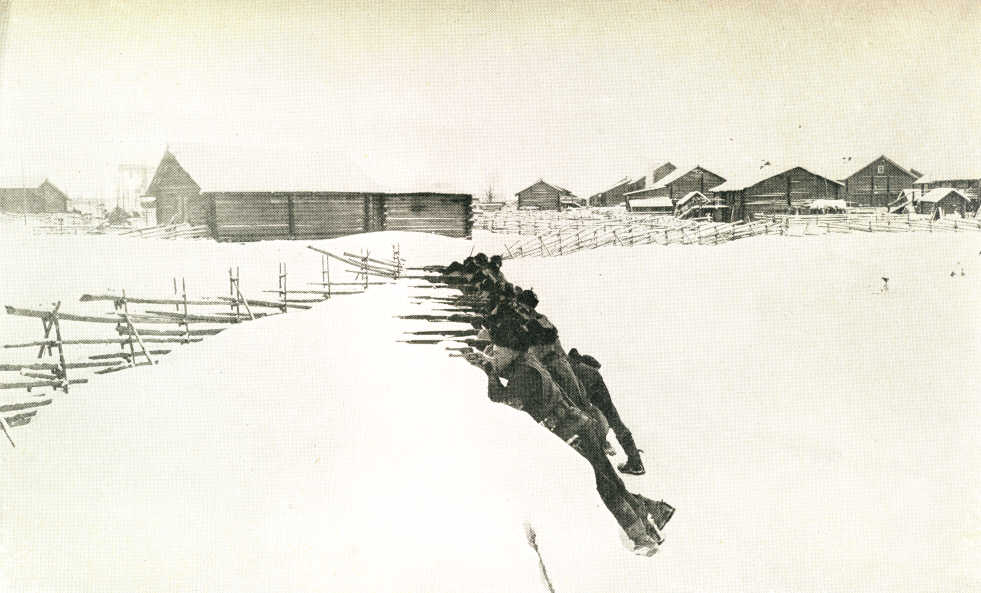
RED CROSS PHOTO
Practising Rifle and Pistol Fire Oil Onega Front.
![[Illustration: ]](images/128Pic4_A25.jpg)
WAGNER
French Machine Gun Men at Kodish.
![[Illustration: ]](images/128Pic4_B25.jpg)
U.S. OFFICIAL PHOTO
Allied Plane Carrying Bombs.
The Reds tried to rally at a ridge of ground a verst in front of Kodish
but the dreadful trench mortars again showered them at eight hundred
yards with this new kind of hell and they were easily dislodged by the
infantry and machine gun fire. At 1:00 p. m. after seven hours hard
fighting the Americans were again in possession of Kodish. An
interesting side incident of this recapture of Kodish was the defeat of
a company of Reds occupying a Kodish flank position at the church on the
river two versts away. The Reds disputed but Sergeant Masterson and
fifteen men of “E” Company dislodged them. But time was valuable.
Donoghue’s battle order that day called for his force to take Kodish and
its defenses, Avda and its defenses and to occupy Kochmas. Only a matter
of twenty miles of deep snow and hard fighting.
So the enemy was attacked again vigorously at one of the old fighting
spots of the fall campaign, at Verst 12. As in the previous fighting the
Red Guards, realizing the strategic value of this road fought
tenaciously for every verst of it. They had been prepared for the loss
of Kodish village itself; it was untenable. But they refused to budge
from Verst 12. The trench mortars could not reach their dugout line. And
the Red machine guns poured a hot fire into the village of Kodish as
well as into the two platoons that forced their way a half a verst from
the village toward this stubborn stronghold of the Reds.
Darkness fell on the combatants locked in desperate fight. All the
American forces were brought up into Kodish for they had expected to get
on to Avda as their order directed. Out in front the night was made
lurid by flares and shell fire and gun fire where the two devoted
platoons of “K” and “E” Companies with two machine guns of the first
platoon of “M. G.” Company hung on. Lts. Jahns, Shillson and Berger were
everywhere among their men and met nothing but looks of resolution from
them, for if this little force of less than a hundred men gave way the
whole American force would be routed from Kodish. There could be no
orderly retreat from the village under such desperate conditions in the
face of such numbers. They had to stick on. Half their number were
killed and wounded, among whom was the gallant Lt. Berger of “E” Company
who had charged across the bridge in the morning in face of machine gun
fire. Sergeants Kenney and Grewe of “K” Company gave their lives that
night in moving courageously among their men. Frost bites cruelly added
to the miseries of those long night hours after the fighting lulled at
eleven o’clock.
Morning discovered the force digging in. The odds were all against them.
Again they were standing in Kodish where after personal reconnaisance
Col. Lucas, their nominal superior officer, commanding Vologda Force,
had said no troops should be stationed as it was strategically
untenable. But a new British officer had come into command of the
Seletskoe detachment, and perhaps that accounts for the foolhardy order
that the doughty old Donoghue received; “Hold what you have got and
advance no further south; prepare defenses of Kodish.” What an irony of
fate. His force had been the only one of the various forces that had
actually put any jab into the push on Plesetskaya. Now they were to be
penalized for their very desperately won success.
The casualties had been costly and had been aggravated by the rapid
attacks of the frost upon hands and feet. In temperature way below zero
the men lay in the snow on the outskirts and in that lowly village under
machine gun fire and shrapnel. They undermined the houses to get warmth
and protection in the dugouts thus constructed under them. Barricades
they built; and chipped out shallow trenches in the frozen ground. Again
the trench mortar came into good use. A platoon of “K” and a platoon of
“E” found themselves partly encircled by a strong force of Reds, with a
single mortar near them to support. This mortar although clogged
repeatedly with snow and ice worked off two hundred fifty shells on the
Reds and finally spotted the enemy machine gun positions and silenced
them, contributing greatly to the silencing of the enemy fire and to his
discouragement.
The firer of this mortar, Pvt. Barone of “Hq” Company, who worked
constantly, a standing target for the Bolos, near the end of the fight
fell with a bullet in his leg. And so the Americans scrapped on. And
they did hold Kodish. Seven were killed and thirty-five wounded, two
mortally, in this useless fight. Lt. O’Brien of “E” Company was severely
wounded and at this writing is still in hospital. “The memories of these
brave fellows,” says Lt. Jack Commons, “who went as the price exacted,
Lt. Berger of “E” Company, Sgts. Kenney and Grewe and many other steady
and courageous and loyal pals through the months of hardship that had
preceded, made Kodish a place horrible, detested, and unnerving to the
small detachment that held it.”
Meanwhile their fellows at the river bank with the engineers were
slashing down the trees on the Bolo side clearing the bank to prevent
surprise of the Allied position over the seven foot ice that now made
the river into a winding roadway. More blockhouses and gun positions
were put in. It was only a matter of time till they would have to
retreat to the old position on the river.
On January 4th Donoghue sent “E” Company back to occupy and help
strengthen the old position at the river, from where they sent
detachments forward to help “K” and “M.G.” and trench mortar hold the
shell-shattered village of Kodish. The enemy confined himself chiefly to
artillery shelling, always replied to vigorously by our gallant Canadian
section who, though outgunned, sought to draw part of the enemy fire
their way to lighten the barrage on their American comrades caught like
rats in the exposed village. From their three hills about the doomed
village of Kodish the Reds kept up a continuous sharpshooting which
fortunately was too long range to be effective. And the enormous losses
which the Reds had suffered on their side that bloody New Year’s Day
made them hesitate to move on the village with infantry to be mowed down
by those dreadful Amerikanski fighters, when a few days of steady
battering with artillery would perhaps do just as well.
Flesh and blood can stand only so much. Terrible was the strain. No
wonder that on the seventh day of this hell a lieutenant with a single
platoon holding the village after receiving magnified reports from his
patrols of strong Bolo flanking forces, imagined a general attack on
Kodish. The French Colonel, V. O. C. O., had said Kodish should not be
held. And in the night he set fire to the ill-fated village and
retreated to the river. Swift came the command from the fiery old
Donoghue: “Back to that village with me, the Reds shall not have it.”
And his men reoccupied it before dawn. But no one but they can ever know
how they suffered. The cold twenty below zero stung them in the village
half burned. Their beloved old commander’s words stung them. Hateful to
them was the certainty that he was grimly carrying out a written order
superior indeed to the French Colonel’s V. O. but which was not based on
a true knowledge of the situation by the far-distant British officer who
went over Col. Lucas’ head and ordered Kodish held. Could they hold on?
They did, with a display of fortitude that became known to the world and
which makes every soldier who was in the expedition thrill with honest
pride and admiration for them. The Americans held it till they were
relieved by a company of veteran fighters, the King’s Liverpools,
supported by a half company of “Dyer’s Battalion” of Russians.
In passing let it be remarked that the English officer, Captain Smerdon,
soon succeeded in convincing the British O. C. Seletskoe that Kodish was
no place for any body of soldiers to hold. He gallantly held it but only
temporarily, for soon he and the Canadians and trench mortar and machine
gun men and the Dyer’s Battalion men were back under Major Donoghue
holding the old Emtsa river line and its two supporting blockhouse
lines.
Our badly shattered “E” Company and “K” Company went to reserve in
Seletskoe. The former company in the middle of January went to Archangel
for a ten day rest, and will be heard of later in the winter on another
desperate front. Old “K” Company was glad to just find warm bunks in
Seletskoe and regain their old fighting pep that had been exhausted in
the New Year’s period of protracted fighting under desperate odds. Here
let us insert the story of a two-man detachment of those redoubtable
trench mortar men who rivaled their comrades’ exploits with rifle and
bayonet or machine gun. Corp. Andriks and Pvt. Forthe of “Hq” Company
trench mortar platoon were loaned for a few days to the British officer
at Shred Makrenga to instruct his Russian troops in the use of the
Stokes mortars. But the two Yanks in the two months they were on that
hard-beset front spent most of their time in actually fighting their
guns rather than in teaching the Russians. This is only one of many
cases of the sort, where small detachments of American soldiers sent off
temporarily on a mission, were kept by the British officers on active
duty. They did such sterling service.
Ever hear of the “lost platoon of “D” Company?” Like vagabonds they
looked when finally their platoon leader, Lt. Wallace, cut loose from
the British officer and reported back to Lieut.-Col. Corbley on the
Vaga. But the erratic Reds would not settle down to winter quarters.
They had frustrated the great push on Plesetskaya with apparent ease.
They had the Allied warriors now ill at ease and nervous.
The trench mortar men and the machine gun men can tell many an
interesting story of those January days on the Kodish Front serving
there with the mixed command of Canadians and King’s Liverpools and
Dyer’s Battalion of Russians. These latter were an uncertain lot of
change-of heart Bolshevik prisoners and deserters and accused spies and
so forth, together with Russian youths from the streets of Archangel,
who for the uniform with its brass buttons and the near-British rations
of food and tobacco had volunteered to “help save Russia.” By the rugged
old veteran, Dyer, they had been licked into a semblance of fighting
trim. This was the force which Major Donoghue had at command when again
came the order to take Kodish. This time it was not a great offensive
push to jab at the Red Army vitals, but it was a defensive thrust, a
desperate operation to divert attention of the Reds from their
successful winter operations against the Shred Makrenga front. Two
platoons of Couriers du Bois, the well trained Russian White Guards
under French tutelage, and those same Royal Marines that had been with
him the first time Kodish was taken in the bloody fight in the fall. And
Lt. Ballard’s gallant platoon of machine gun men came to relieve the
first “M. G.” platoon and to join the drive. They had an old score to
settle with the Bolos, too.
Again the American officer led the attack on Kodish and this time easily
took the village, for the Reds were wise enough not to try to hold it.
Their first lines beyond the village yielded to his forces after stiff
fighting, but the old 12th Verst Pole position held three times against
the assaults of the Allied troops.
Meanwhile the courageous “French-Russians” had marched fourteen miles
through the woods, encircling the Bolo flank, and fell upon his
artillery position, captured the guns and turned them upon the Red
reserves at Avda. But the other forces could not budge the Reds from
Verst 12 and so the Couriers du Bois, after holding their position
against counter attack all the afternoon, blew up the Red field pieces
and retreated in the face of a fresh Bolo battalion from Avda.
And during the afternoon the Americans who were engaged in this fight
lost an officer whose consummate courage and wonderful cheerfulness had
won him the adoration of his men and the respect and love of the
officers who worked with him.
Brave, energetic, cheerful old Ballard’s death filled the Machine Gun
Company and the whole regiment with mingled feelings of sorrow and
pride. Over and beyond the call of duty he went to his death while
striving to save the fortune of the day that was going against his
doughty old leader Donoghue. He did not know that the Liverpool Company
had left a hole in the line by finding a trail to the rear after their
second gallant but fruitless assault, and he went forward of his own
initiative, with a Russian Lewis gun squad to find position where he
could plant one of his machine guns to help the S. B. A. L. platoons and
Liverpools whom old Donoghue was coming up to lead in another charge on
the Bolo position.
Lt. Ballard ran into the exposed hole in the line and pushed forward to
a place where his whole squad was ambushed and the Russian Lewis gunner
was the only one to get out. He returned with his gun and dropped among
the Americanski machine gunners, telling of the death of Ballard and the
Russian soldiers at the point of the Bolshevik bayonets. Lt. Commons of
“K” Company declares that Ballard met his death at that place by getting
into the hole in the line which he supposed was held by English and
Russians and by being caught in a cross fire of Bolo Colt machine guns.
Whichever way it was, his body was never seen nor recovered. Hope that
he might have been taken as a wounded prisoner by the Reds still lived
in the hearts of his comrades. And all officers and men of the American
forces who came into Detroit the following July vainly wished to believe
with the girl who piteously scanned every group that landed, that
Ballard might yet be heard from as a prisoner in Russia. No doubt he was
killed.
The battle continued. Finally the withdrawal of the Couriers du Bois and
the coming through of the Avda Battalion of the Reds, together with Red
reinforcements from Kodlozerskaya-Pustin, reduced Donoghue’s force to a
stern defensive and he retreated at five o’clock in good order to the
old lines on the river.
The half-burned and scarred buildings of Kodish mournfully reminded the
soldier of the losses that had decimated the ranks of the forces that
fought and refought over the village. Into their old strongholds they
retired, keeping a sharp lookout for the expected retaliation of the
Reds. It came two days later. And it nearly accounted for the entire
force, although that was not so remarkable, Lt. Commons, the Major’s
adjutant, says, because so many even of the shorter engagements on this
and other fronts had been equally narrow squeaks for the Americans and
their Allies.
The Reds in this fight reached the second line of defense with their
flanking forces, and bombarded it with new guns brought up from
Plesetskaya. Meanwhile, all along the front they attacked in great force
and succeeded in taking one blockhouse, killing the seven gallant
Liverpool lads who fought up all their ammunition and defied the Bolo
steel to steel. But the remainder of the front held, largely through the
effective work of the American trench mortar and the deadly machine
gunners shooting for revenge of the death of Ballard, their nervy
leader, held fast their strongholds.
At last the Reds found their losses too severe to continue the attack.
And they had been constantly worried by the gallant Russian Couriers du
Bois, who fearlessly stayed out in the woods and nipped the Bolo forces
in flank or rear. And so they withdrew. There was little more fighting
on this front. The Reds were content to let well enough alone. Kodish in
ruins was theirs. Plesetskaya was safe from threats on that hard fought
road.
This was the last fight for the Americans on the Kodish Front. “K”
Company had already looked for the last time on the old battle scenes
and at the wooden crosses which marked the graves of their heroic dead,
and had gone to Archangel to rest, later to duty on the lines of
communication at Kholmogori and Yemetskoe. Now the trench mortar platoon
and “M. G.” platoon went to the railroad front, and Major Donoghue was
the last one to leave the famous Kodish Front, where he had won
distinction. It was now an entirely British-Russian front and the
American officer who had remained voluntarily to lead in the last big
fight because of his complete knowledge of the battle area now went to
well-earned rest in Archangel.
In closing the story of the Americans on the Kodish Front we turn to the
words written us by Lt. John A. Commons:
“Thus the Kodish Front was really home to the men of “K” Company, for
most of their stay in the northern land. To “E” and “L” and Machine Gun
and Trench Mortar “Hq” platoon it was also, but for a shorter period,
their only shelter from the rains of the fall and the bite of the
winter. “K”, however, meant Kodish. There they had their first fight,
there their dead were buried. There they had their last battle. And
there their memories long will return, mostly disagreeable to be sure,
but still representing very definitely their part, performed with
honesty, courage and distinction, in the big work that was given the
Yankee doughboys to do ‘on the other side.’
“The scraps mentioned here were the tougher part of the actions at the
front. In between the line should be read first the cold as it was felt
only out in the Arctic woods, away from the villages and their warm
houses. Then, too, everything was one ceaseless and endless repetition
of patrolling and scouting. Many were the miles covered by these lads
from Detroit and other cities and towns of America among the soft snow
and the evergreens. Many a time did these small parties have their own
little battles way out in the woods. Much has been said here and there
of the influence of Bolshevik propaganda upon the American forces. It is
true that these soldiers got a lot of it, and it is true that these
soldiers read nearly all that they got. But it is true also that there
was not a single incident of the whole campaign which could with honesty
be attributed to this propaganda. On the Kodish Front it is quite safe
to say that there was more of this ludicrous literature—not ludicrous
to the Russian peasant, but very much so to the average American—taken
in than on any other. Scarce a patrol went out which did not bring back
something with which to while away a free hour or so, or with which to
start a fire. It was always welcome.
“But it was seriously treated in the same spirit that moved a corporal
of Ballard’s machine gun platoon who felt strongly the discrepancy
between the remarks of the Bolshevik speaker on the bridge to the effect
that his fellows were moved by brotherly love for the Yanks and the FACT
that nine out of every ten Bolshevik cartridges captured had the bullets
clipped. The corporal reciprocated later with a machine gun, not for the
love but for the bullets.
“So they stuck and fought, suffering through the bitter months of winter
just below the Arctic Circle, where the winter day is in minutes and the
night seems a week. And there is not one who is not proud that he was
once a “side kicker” and a “buddy” to some of those fine fellows of the
various units who unselfishly and gladly gave the last that a man has to
give for any cause at all.”
XVI
UST PADENGA
Positions Near Ust Padenga In January—Bolo Patrols—Overwhelming Assault By
Bolos January Nineteenth—Through Valley Of Death—Canadian Artillery And Machine
Gun Fire Punishes Enemy Frightfully When He Takes Ust Padenga—Death Of
Powers—Enemy Artillery Makes American Position Untenable—Escaping From
Trap—Retreating With Constant Rear-Guard Actions—We Lose Our Last Gun—“A”
Company Has Miraculous Escape But Suffers Heavy Losses.
Outside of routine patrolling, outpost duties and intermittent shelling
and sniping, the early part of the month of January, 1919, was
comparatively quiet on the Ust Padenga front. The troops now engaged in
the defense of this sector were Company “A,” 339th Infantry, a platoon
of “A” Company, 310th Engineers, Canadian Artillery, English Signal
Detachment and several companies of Russians and Cossacks.
It will be recalled that the main positions of our troops was in
Netsvetiafskaya, on a high bluff overlooking Ust Padenga and Nijni
Gora—the former about a thousand yards to our left front on the bank of
the Vaga, and the latter about a mile to our right front located on
another hill entirely surrounded by a deep ravine and valleys. In other
words our troops were in a V-shaped position with Netsvetiafskaya as the
base of the V, Ust Padenga as the left fork, and Nijni Gora as the right
fork of same. The Cossack troops refused to occupy the position of Nijni
Gora, claiming that it was too dangerous a position and almost
impossible to withdraw from in case they were hard pressed.
Consequently, orders were issued from British headquarters at Shenkursk,
ordering an American platoon to occupy Nijni Gora and the Cossacks to
occupy Ust Padenga.
On the afternoon of January 18, the fourth platoon of Company “A,” with
forty-six men under command of Lieut. Mead, relieved the second platoon
and took over the defense of Nijni Gora. The weather at this time was
fearfully cold, the thermometer standing about forty-five degrees below
zero. Rumors after rumors were constantly coming in to our intelligence
section that the enemy was preparing to make a desperate drive on our
positions at this front. His patrols were getting bolder and bolder. A
few nights before, one of the members of such a patrol had been shot
down within a few feet of Pvt. George Moses, one of our sentinels, who,
single handed, stood his post and held off the patrol until assistance
arrived. We had orders to hold this front at all cost. By the use of
field glasses we could see considerable activity in the villages in
front of us and on our flanks, and during the night the inky blackness
was constantly being illuminated by flares and rockets from many
different points. It is the writer’s opinion that these flares were used
for the purpose of guiding and directing the movements of the troops
that on the following day annihilated the platoon in Nijni Gora.
On the morning of that fatal nineteenth day of January, just at dawn the
enemy’s artillery, which had been silent now for several weeks, opened
up a terrific bombardment on our position in Nijni Gora. This artillery
was concealed in the dense forest on the opposite bank of the Vaga far
beyond the range of our own artillery. Far in the distance at ranges of
a thousand to fifteen hundred yards, we could see long skirmish lines of
the enemy clad in ordinary dark uniforms. Whenever they got within range
we would open fire with rifles and machine guns which succeeded in
repelling any concerted movement from this direction. At this time there
were twenty-two men in the forward position in command of Lt. Mead and
about twenty-two men in command of the platoon sergeant in the rear
position, After about an hour’s violent shelling the barrage suddenly
lifted, Instantly, from the deep snow and ravines entirely surrounding
us, in perfect attack formation, arose hundreds of the enemy clad in
white uniforms, and the attack was on.
Time after time well directed bursts of machine gun fire momentarily
held up group on group of the attacking party, but others were steadily
and surely pressing forward, their automatic rifles and muskets pouring
a veritable hail of bullets into the thin line of the village defenders.
Our men fought desperately against overwhelming odds. Corporal Victor
Stier, seeing a Russian machine gun abandoned by the panic-stricken
Russians in charge of same, rushed forward and manning this gun
single-handed opened up a terrific fire on the advancing line. While
performing this heroic task he was shot through the jaw by an enemy
bullet. Still clinging to his gun he refused to leave it until ordered
to the rear by his commanding officer. On his way back through the
village he picked up the rifle of a dead comrade and joined his comrades
in the rear of the village determined to stick to the end. It was while
in this position that he was again hit by a bullet which later proved
fatal—his death occurring that night. He was an example of the same
heroic devotion to duty that marked each member of this gallant company
throughout the expedition. Being thus completely surrounded, the enemy
now advancing with fixed bayonets, and many of our brave comrades lying
dead in the snow, there was nothing left for those of us in the forward
position to do but to cut our way through to the rear position in order
to rejoin our comrades there. The enemy had just gained the street of
the village as we began our fatal withdrawal—fighting from house to
house in snow up to our waists, each new dash leaving more of our
comrades lying in the cold and snow, never to be seen again. How the
miserable few did succeed in eventually rejoining their comrades no one
will ever know. We held on to the crest of the hill for a few moments to
give our artillery opportunity to open up on the village and thus cover
our withdrawal. Again another misfortune arose to add more to the danger
and peril of our withdrawal. A few days previously our gallant and
effective Canadian artillery had been relieved by a unit of Russian
artillery and during the early shelling this fateful morning, the
Russian artillerymen deserted their guns—something that no Canadian
ever would have done in such a situation. By the time the Russians were
forced back to their guns at the point of a pistol in the hands of
Captain Odjard, our little remaining band had been compelled to give way
in the face of the terrific fire from the forests on our flanks and the
oncoming advance of the newly formed enemy line. To withdraw we were
compelled to march straight down the side of this hill, across an open
valley some eight hundred yards or more in the terrible snow, and under
the direct fire of the enemy. There was no such thing as cover, for this
valley of death was a perfectly open plain, waist deep with snow. To run
was impossible, to halt was worse yet and so nothing remained but to
plunge and flounder through the snow in mad desperation, with a prayer
on our lips to gain the edge of our fortified positions. One by one, man
after man fell wounded or dead in the snow, either to die from the
grievous wounds or terrible exposure. The thermometer still stood about
forty-five degrees below zero and some of the wounded were so terribly
frozen that their death was as much due to such exposure as enemy
bullets. Of this entire platoon of forty-seven men, seven finally
succeeded in gaining the shelter of the main position uninjured. During
the day a voluntary rescue party under command of Lieut. McPhail, “Sgt.”
Rapp, and others of Company “A” with Morley Judd of the Ambulance Corps,
went out into the snow under continuous fire and brought in some of the
wounded and dead, but there were twelve or more brave men left behind in
that fatal village whose fate was never known and still remains unknown
to the present day, though long since reported by the United States War
Department as killed in action. Many others were picked up dead in that
valley of death later in the day and others died on their way back to
hospitals. These brave lads made the supreme sacrifice, fighting bravely
to the last against hopeless odds. Through prisoners later captured by
us, we learned that the attacking party that morning numbered about nine
hundred picked troops—so the reader will readily appreciate what chance
our small force had.
All that day and far into the night the enemy’s guns continued hammering
away at our positions. Under cover of darkness the Russians and Cossacks
in the village of Ust Padenga withdrew to our lines—a move which the
enemy least suspected. The following days were just a repetition of this
day’s action. The enemy shelled and shelled our position and then sent
forward wave after wave of infantry. The Canadian Artillery under
command of Lieut. Douglas Winslow rejoined us and, running their guns
out in the open sight, simply poured muzzle burst of shrapnel into the
enemy ranks, thus breaking up attack after attack. Two days later after
a violent artillery preparation, the enemy, still believing our Russian
comrades located in the village of Ust Padenga, started an open attack
upon this deserted position over part of the same ground where so many
of our brave comrades had lost their lives on the nineteenth. They
advanced in open order squarely in the face of our artillery, machine
gun, and rifle fire, but by the time they had gained this useless and
undefended village, hundreds of their number lay wounded and dying in
the snow. The carnage and slaughter this day in the enemy’s ranks was
terrific, resulting from a most stupid military blunder, but it atoned
slightly for our losses previous thereto. The valley below us was dotted
with pile after pile of enemy dead, the carnage here being almost equal
to the terrific fighting later at Vistavka. When he discovered his
mistake and useless sacrifice of men, and seeing it was hopeless to
drive our troops from this position by his infantry, the enemy then
resorted to more violent use of his artillery. Shells were raining into
our position now by the thousands, but our artillery could not respond
as it was completely outranged. By the process of attrition our little
body of men was growing smaller day by day, when to cap the climax late
that day a stray shell plunged into our little hospital just as the
medical officer, Ralph C. Powers, who had been heroically working with
the dead and dying for days without relief and who refused to quit his
post, was about to perform an operation on one of our mortally wounded
comrades. This shell went through the walls of the building and through
the operating room, passing outside where it exploded and flared back
into the room. Four men were killed outright, including Sgt. Yates K.
Rodgers and Corp. Milton Gottschalk, two of the staunchest and most
heroic men of Company “A.” Lieutenant Powers was mortally wounded and
later died in the hospital at Shenkursk, where he and many of his brave
comrades now lie buried in the shadow of a great cathedral.
This was the beginning of the end for us in this position. The enemy was
slowly but surely closing in on Shenkursk as evidenced by the following
notation, made by one of our intelligence officers in Shenkursk, set
forth verbatim:
“January 22, Canadian artillery and platoon of infantry left of Nikolofskia at
6:30 a.m., spent the day there establishing helio communication between church
towers, here and there. All quiet there. At 10:00 a. m. one of the mounted
Cossack troopers came madly galloping from Sergisfskia saying that the Bolos
were approaching from there and that he had been fired upon. He was terrified
to death; other arrivals verify this report. The defenses are not all manned
and a patrol sent in that direction. They are sure out there in force right
enough. The clans are rapidly gathering for the big drive for the prize,
Shenkursk. Later—Orders from British Headquarters for troops at Ust Padenga to
withdraw tonight. 10:00 p. m.—There is a red glare in the sky in the direction
of Ust Padenga and the flames of burning buildings are plain to be seen. There
is —— a popping down there and the roar of artillery is clearly heard.”
That night, January 22nd, we withdrew from this shell-torn and flaming
village, leaving behind one of our guns which the exhausted horses could
not move. We did not abandon this position a moment too soon, for just
as we had finished preparations for withdrawal an incendiary shell
struck one of the main buildings of the village, and instantly the
surrounding country was as bright as day. All that night, tired,
exhausted and half-starved, we plodded along the frozen trails of the
pitch black forest. The following morning we halted for the day at
Shelosha, but late that day we received word to again withdraw to
Spasskoe, a village about six versts from Shenkursk. Again we marched
all night long, floundering through the snow and cold, reaching Spasskoe
early that morning. On our march that night it was only by means of a
bold and dangerous stroke that we succeeded in reaching Spasskoe. The
enemy had already gotten between us and our objective and in fact was
occupying villages on both sides of the Vaga River, through one or the
other of which we were compelled to pass. We finally decided that under
the cover of darkness and in the confusion and many movements then on
foot, we could possibly march straight up the river right between the
villages, and those on one side would mistake us for others on the
opposite bank. Our plan worked to perfection and we got through safely
with only one shot being fired by some suspicious enemy sentry, but
which did us no harm, and we continued silently on our way.
For days now we had been fighting and marching, scarcely pausing for
food and then only to force down a ration of frozen bully beef or piece
of hard tack, and we expected here at least to gain a short breathing
spell, but such was not fate’s decree. About 4:00 a.m. we finally
“turned in,” but within a couple of hours we were again busily occupied
in surveying our positions and making our plans. About 7:30 a. m. Lieut.
Mead and Capt. Ollie Mowatt, in command of the artillery, climbed into a
church tower for observation, when to our surprise we could plainly see
a long line of artillery moving along the Shenkursk road, and the
surrounding villages alive with troops forming for the attack. Scarcely
had we gotten our outposts into position when a shell crashed squarely
over the village, and again the battle was on. All that day the battle
raged, the artillery was now shelling Shenkursk as well as our own
position. The plains in front of us were swarming with artillery and
cavalry, while overhead hummed a lone airplane which had travelled about
a hundred and twenty-five miles to aid us in our hopeless encounter, but
all in vain.
At 1:30 p. m. an enemy shell burst squarely on our single piece of
artillery, putting it completely out of action, killing several men,
seriously wounding Capt. Otto Odjard, as well as Capt. Mowatt, who later
died from his wounds. While talking by telephone to our headquarters at
Shenkursk, just as we were being notified to withdraw, a shell burst
near headquarters, demolishing our telephone connections. Again
assembling our men we once more took up our weary retreat, arriving that
evening in Shenkursk, where, worn and completely exhausted, we flung
ourselves on floors and every available place to rest for the coming
siege, about to begin.
XVII
THE RETREAT FROM SHENKURSK
Shenkursk Surrounded By Bolsheviki—Enemy Artillery Outranged Ours—British
General At Beresnik Orders Retreat—Taking Hidden Trail We Escape—Shenkursk
Battalion Of Russians Fails Us—Description Of Terrible March—Casting Away Their
Shackletons—Resting At Yemska Gora—Making Stand At Shegovari—Night Sees Retreat
Resumed—Cossacks Cover Rear—Holding Ill-Selected Vistavka—Toil, Vigilance And
Valor Hold Village Many Days—Red Heavy Artillery Blows Vistavka To Splinters In
March—Grand Assault Is Beaten Off For Two Days—Lucky Cossacks Smash In And Save
Us—Heroic Deeds Performed—Vistavka Is Abandoned.
After five days and nights of ceaseless fighting and marching, it is
necessary to say that we were soon sleeping the sleep of utterly
exhausted and worn out soldiers, but alas, our rest was soon to be
disturbed and we were to take up the weary march once more. Immediately
after our arrival within the gates of Shenkursk, the British High
Command at once called a council of war to hastily decide what our next
step should be. The situation briefly stated was this: Within this
position we had a large store of munitions, food, clothing, and other
necessaries sufficient to last the garrison, including our Russian
Allies, a period of sixty days. On the other hand, every available
approach and trail leading into Shenkursk was held by the enemy, who
could move about at will inasmuch as they were protected by the
trackless forests on all sides, and thus would soon render it impossible
for our far distant comrades in Archangel and elsewhere on the lines to
bring through any relief or assistance. Furthermore, it was now the dead
of the Arctic winter and three to four months must yet elapse before the
block ice of the Vaga-Dvina would give way for our river gunboats and
supply ships to reach us.
Between our positions and Beresnik, our river base, more than a hundred
miles distant, were but two occupied positions, the closest being
Shegovari, forty-four miles in rear of us, with but two Russian
platoons, and Kitsa, twenty miles further with but one platoon and a few
Russian troops. There were hundreds of trails leading through the
forests from town to town and it would be but a matter of days or even
hours for the enemy to occupy these positions and then strike at
Beresnik, thus cutting off not only our forces at Shenkursk but those at
Toulgas far down the Dvina as well. Already he had begun destroying the
lines of communication behind us.
That afternoon at 3:10 p. m. the last message from Beresnik arrived
ordering us to withdraw if possible. While this message was coming over
the wire and before our signal men had a chance to acknowledge it, the
wires suddenly “went dead,” shutting off our last hope of communication
with the outside world. We later learned from a prisoner who was
captured some days later that a strong raiding party had been dispatched
to raid the town of Yemska Gora on the line and to cut the wires.
Fortunately for us they started from their bivouac on a wrong trail
which brought them to their objective several hours later, during which
time the battle of Spasskoe had been fought and we had been forced to
retire, all of which information reached Beresnik in time for the
general in command there to wire back his order of withdrawal, just as
the wires were being cut away.
With this hopeless situation before us, and the certain possibility of a
starvation siege eventually forcing us to surrender, the council decided
that retreat we must if possible and without further delay. All the
principal roads or trails were already in the hands of the enemy.
However, there was a single, little used, winter trail leading straight
back into the forest in rear of us which, with devious turns and
windings, would finally bring us back to the river trail leading to
Shegovari, about twenty miles further down the river. Mounted Cossacks
were instantly dispatched along this trail and after several hours of
hard riding returned with word that, due to the difficulty of travel and
heavy snows, the enemy had not yet given serious consideration to this
trail, and as a consequence was unoccupied by them.
Without further delay English Headquarters immediately decided upon
total evacuation of Shenkursk. Orders were at once issued that all
equipment, supplies, rations, horses, and all else should be left just
as it stood and each man to take on that perilous march only what he
could carry. To attempt the destruction of Shenkursk by burning or other
means would at once indicate to the enemy the movement on foot;
therefore, all was to be left behind untouched and unharmed. Soon the
messengers were rapidly moving to and fro through the streets of the
village hastily rousing the slumbering troops, informing them of our
latest orders. When we received the order we were too stunned to fully
realize and appreciate all the circumstances and significance of it.
Countless numbers of us openly cursed the order, for was it not a
cowardly act and a breach of trust with our fallen comrades lying
beneath the snow in the great cathedral yard who had fought so valiantly
and well from Ust Padenga to Shenkursk in order to hold this all
important position? However, cooler heads and reason soon prevailed and
each quickly responded to the task of equipping himself for the coming
march.
Human greed often manifests itself under strange and unexpected
circumstances, and this black night of January 23, 1919, proved no
exception to the rule. Here and there some comrade would throwaway a
prized possession to make more room for necessary food or clothing in
his pack or pocket. Some other comrade would instantly grab it up and
feverishly struggle to get it tied onto his pack or person, little
realizing that long before the next thirty hours had passed he, too,
would be gladly and willingly throwing away prize after prize into the
snow and darkness of the forest.
At midnight the artillery, preceded by mounted Cossacks, passed through
the lane of barbed wire into the forests. The Shenkursk Battalion, which
had been mobilized from the surrounding villages, was dispatched along
the Kodima trail to keep the enemy from following too closely upon our
heels. This latter maneuver was also a test of the loyalty of this
battalion for there was a well defined suspicion that a large portion of
them were at heart sympathizers of the Bolo cause. Our suspicions were
shortly confirmed; very soon after leaving the city they encountered the
enemy and after an exchange of a few shots two entire companies went
over to the Bolo side, leaving nothing for the others to do but flee for
their lives.
Fortune was kind to us that night, however, and by 1:00 a. m. the
infantry was under way. Company “A”, which had borne the brunt of the
fighting so many long, weary days, was again called upon with Company
“C” to take up the rear guard, and so we set off into the blackness of
the never ending forest. As we marched out of the city hundreds of the
natives who had somehow gotten wind of this movement were also scurrying
here and there in order to follow the retreating column. Others who were
going to remain and face the entrance of the Bolos were equally
delighted in hiding and disposing of their valuables and making away
with the abandoned rations and supplies.
Hour after hour we floundered and struggled through the snow and bitter
cold. The artillery and horses ahead of us had cut the trail into a
network of holes, slides and dangerous pitfalls rendering our footing so
uncertain and treacherous that the wonder is that we ever succeeded in
regaining the river trail alive. Time after time that night one could
hear some poor unfortunate with his heavy pack on his back fall with a
sickening thud upon the packed trail, in many cases being so stunned and
exhausted that it was only by violent shaking and often by striking some
of the others in the face that they could be sufficiently aroused and
forced to continue the march.
At this time we were all wearing the Shackleton boot, a boot designed by
Sir Ernest Shackleton of Antarctic fame, and who was one of the advisory
staff in Archangel. This boot, which was warm and comfortable for one
remaining stationary as when on sentry duty, was very impracticable and
well nigh useless for marching, as the soles were of leather with the
smooth side outermost, which added further to the difficulties of that
awful night. Some of the men unable to longer continue the march cast
away their boots and kept going in their stocking feet; soon others were
following the example, with the result that on the following day many
were suffering from severely frostbitten feet.
The following morning, just as the dull daylight was beginning to appear
through the snow-covered branches overhead, and when we were about
fifteen versts well away from Shenkursk, the roar of cannon commenced
far behind us. The enemy had not as yet discovered that we had abandoned
Shenkursk and he was beginning bright and early the siege of Shenkursk.
Though we were well out of range of his guns the boom of the artillery
acted as an added incentive to each tired and weary soldier and with
anxious eyes searching the impenetrable forests we quickened our step.
At 9:00 a. m. we arrived at Yemska Gora on the main road from Shenkursk,
where an hour’s halt was made. All the samovars in the village were at
once put into commission and soon we were drinking strong draughts of
boiling hot tea. Some were successful in getting chunks of black bread
which they ravenously devoured. The writer was fortunate in locating an
old villager who earlier in the winter had been attached to the company
sledge transport and the old fellow brought forth some fishcakes to add
to the meagre fare. These cakes were made by boiling or soaking the vile
salt herring until it becomes a semi-pasty mass, after which it is mixed
with the black bread dough and then baked, resulting in one of the most
odoriferous viands ever devised by human hands and which therefore few,
if any, of us had summoned up courage enough to consume. On this
particular morning, however, it required no courage at all and we
devoured the pasty mass as though it were one of the choicest of viands.
The entire period of the halt was consumed in eating and getting ready
to continue the march.
At 10:00 a. m. we again fell in and the weary march was resumed. The
balance of the day was simply a repetition of the previous night with
the exception that it was now daylight and the footing was more secure.
At five o’clock that afternoon we arrived at Shegovari, where the little
garrison of Company “C” and Company “D”, under command of Lieut. Derham,
was anxiously awaiting us, for after the attack of the preceding day,
which is described in the following paragraph, they were fearful of the
consequences in case they were compelled to continue holding the
position through the night without reinforcements.
Shortly after the drive had begun at Ust Padenga marauding parties of
the enemy were reported far in our rear in the vicinity of Shegovari. On
the night of January 21st some of the enemy, disguised as peasants,
approached one of the sentries on guard at a lonely spot near the
village and coldly butchered him with axes; another had been taken
prisoner, and with the daily reports of our casualties at Ust Padenga,
the little garrison was justly apprehensive. On the morning of January
23rd a band of the enemy numbering some two hundred men emerged from the
forest and had gained possession of the town before they were detected.
Fortunately the garrison was quickly assembled, and by judicious use of
machine guns and grenades quickly succeeded in repelling the attack and
retaining possession of the position, which thus kept the road clear for
the troops retreating from Shenkursk. Such was the condition here upon
our arrival.
Immediately we at once set up our outposts and fortunately got our
artillery into position, which was none too soon, for while we were
still so engaged our Cossack patrols came galloping in to report that a
great body of the enemy was advancing along the main road. Soon the
advance patrols of the enemy appeared and our artillery immediately
opened upon them. Seeing that we were thus prepared and probably
assuming that we were going to make a stand in this position, the enemy
retired to await reinforcements. All through the night we could see the
flames of rockets and signal lights in surrounding villages showing them
the enemy was losing no time in getting ready for an attack. Hour after
hour our guns boomed away until daylight again broke to consolidate our
various positions.
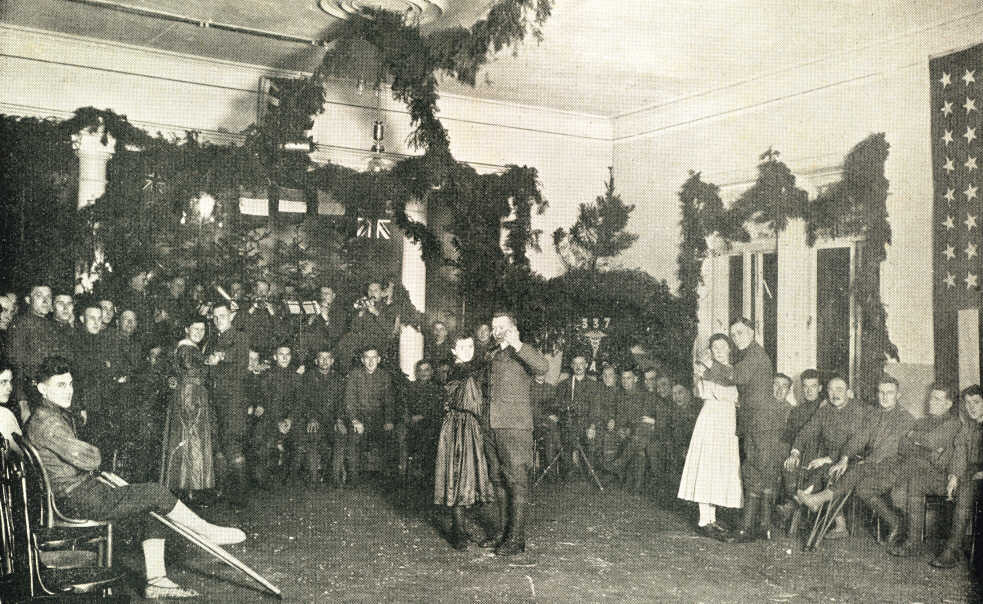
RED CROSS PHOTO
Holiday Dance at Convalescent Hospital—Nurses and “Y” Girls.
![[Illustration: ]](images/144Pic2_A25.jpg)
ROZANSKEY
Subornya Cathedral.
![[Illustration: ]](images/144Pic2_B25.jpg)
U. S. OFFICIAL PHOTO
Building a Blockhouse.
Our position here was a very undesirable one from a military standpoint,
due to the fact that the enemy could approach from most any direction
under cover of the forest and river trails. Our next position was Kitsa,
which was situated about twenty miles further down the river toward
Beresnik, the single trail to which ran straight through the forests
without a single house or dwelling the entire way. This would have been
almost impossible to patrol, due to the scarcity of our numbers,
consequently, it was decided to continue our retreat to this position.
At 5:00 p. m., under cover of darkness, we began assembling and once
more plunged into the never-ending forest in full retreat, leaving
Shegovari far behind. We left a small body of mounted Cossacks in the
village to cover our retreat, but later that night we discovered a
further reason for this delay here. At about eleven that night, as we
were silently pushing along through the inky blackness of the forest,
suddenly far to the south of us a brilliant flame commenced glowing
against the sky, which rapidly increased in volume and intensity. We
afterward learned that our Cossack friends had fired the village before
departing in order that the enemy could not obtain further stores and
supplies which we were compelled to abandon.
At midnight of January 26th the exhausted column arrived in Vistavka, a
position about six versts in advance from Kitsa, and we again made ready
to defend this new position.
The next day we made a hasty reconnaissance of the place and soon
realized that of all the positions we had chosen, as later events
conclusively proved, this was the most hopeless of all. Vistavka,
itself, stood on a high bluff on the right bank of the Vaga. Immediately
in front of us was the forest, to our left was the forest, and on the
opposite bank of the river more forest. The river wound in and around at
this point and at the larger bends were several villages—one about five
versts straight across the river called Yeveevskaya—and another further
in a direct line called Ust Suma. About six or seven versts to our rear
was Kitsa and Ignatevskaya lying on opposite sides of the river—Kitsa
being the only one of all these villages with any kind of prepared
defenses at all. However, we at once set to work stringing up barbed
wire and trying to dig into the frozen snow and ground, which, however,
proved adamant to our shovels and picks. To add further to the
difficulty of this task the enemy snipers lying in wait in the woods
would pick off our men, so that we finally contented ourselves with snow
trenches, and thus began the defense of Vistavka, which lasted for about
two months, during which time thousands upon thousands of shells were
poured into the little village, and attack after attack was repulsed.
Within two days after our occupation of this place the enemy had gotten
his light artillery in place and with his observers posted in the trees
of the surrounding forest he soon had our range, and all through the
following month of February he continued his intermittent shelling and
sniping. Night after night we could hear the ring of axes in the
surrounding woods informing us that the Bolo was establishing his
defenses, but our numbers were so small that we could not send out
patrols enough to prevent this. Our casualties during this period were
comparatively light and with various reliefs by the Royal Scots, Kings
Liverpools, “C” and “D” Companies, American Infantry, we held this place
with success until the month of March.
By constant shelling during the month of February the enemy had
practically reduced Vistavka to a mass of ruins. With no stoves or fire
and a constant fare of frozen corned beef and hard tack, the morale of
the troops was daily getting lower and lower, but still we grimly stuck
to our guns.
On the evening of March 3rd the Russian troops holding Yeveevskaya got
possession of a supply of English rum, with the result that the entire
garrison was soon engaged in a big celebration. The Bolo, quick to take
advantage of any opportunity, staged a well-planned attack and within
an hour they had possession of the town. Ust Suma had been abandoned
almost a month prior to this time, which left Vistavka standing alone
with the enemy practically occupying every available position
surrounding us. As forward positions we now held Maximovskaya on the
left bank and Vistavka on the right.
The following day the enemy artillery, which had now been reinforced by
six and nine-inch guns, opened up with renewed violence and for two days
this continued, battering away every vestige of shelter remaining to us.
On the afternoon of the fifth the barrage suddenly lifted to our
artillery about two versts to our rear, and simultaneously therewith the
woods and frozen river were swarming with wave after wave of the enemy
coming forward to the attack. To the heroic defenders of the little
garrison it looked as though at last the end had come, but with grim
determination they quickly began pouring their hail of lead into the
advancing waves. Attack after attack was repulsed, but nevertheless the
enemy had succeeded in completely surrounding us. Once more he had cut
away our wires leading to Kitsa and also held possession of the trails
leading to that position. For forty-eight hours this awful situation
continued—our rations were practically exhausted and our ammunition was
running low. Headquarters at Kitsa had given us up for lost and were
preparing a new line there to defend. During the night, however, one of
our runners succeeded in getting through with word of our dire plight.
The following day the Kings Liverpools with other troops marched forth
from Kitsa in an endeavor to cut their way through to our relief. The
Bolo, however, had the trails and roads too well covered with machine
guns and troops and quickly repulsed this attempt.
Late that afternoon those in command at Kitsa decided to make another
attempt to bring assistance to our hopeless position and at last ordered
a mixed company of Russians and Cossacks to go forward in the attempt.
After issuing an overdose of rum to all, the commander made a stirring
address, calling upon them to do or die in behalf of their comrades in
such great danger. The comrades in question consisted of a platoon of
Russian machine gunners who were bravely fighting with the Americans in
Vistavka. Eventually they became sufficiently enthusiastic and with a
great display of ceremony they left Kitsa. As was to be expected, they
at once started on the wrong trail, but as good fortune would have it
this afterward proved the turning point of the day. This trail, unknown
to them, led into a position in rear of the enemy and before they
realized it they walked squarely into view of a battalion of the enemy
located in a ravine on one of our flanks, who either did not see them
approaching or mistakenly took them for more of their own number
advancing. Quickly sensing the situation, our Cossack Allies at once got
their machine guns into position and before the Bolos realized it these
machine guns were in action, mowing down file after file of their
battalion. To counter attack was impossible for they would have to climb
the ravine in the face of this hail of lead, and the only other way of
escape was in the opposite direction across the river under direct fire
from our artillery and machine guns. Suddenly, several of the enemy
started running and inside of a minute the remainder of the battalion
was fleeing in wild disorder, but it was like jumping from the frying
pan into the fire, for as they retreated across the river our artillery
and machine guns practically annihilated them. Shortly thereafter the
Cossacks came marching through our lines where they were welcomed with
open arms and again Vistavka was saved. That night fresh supplies and
ammunition were brought up and the little garrison was promised speedy
relief.
Our total numbers during this attack did not amount to more than four
hundred men, including the Cossack machine gunners and Canadian
artillery-men. We afterward learned that from four to five thousand of
the enemy took part in this attack.
The next day all was quiet and we began to breathe more easily, thinking
that perhaps the enemy at last had enough. Our hopes were soon to be
rudely shattered, for during this lull the Bolo was busily occupied in
bringing up more ammunition and fresh troops, and on the morning of the
seventh he again began a terrific artillery preparation. As stated
elsewhere on these pages, our guns did not have sufficient range to
reach the enemy guns even had we been successful in locating them, so
all we could do was to lie shivering in the snow behind logs, snow
trenches and barbed wire, hoping against hope that the artillery would
not annihilate us.
The artillery bombardment continued for two days, continuing up to noon
of March 9th, when the enemy again launched another attack. This time we
were better prepared and, having gotten wind of the plan of attack, we
again caught a great body of the infantry in a ravine waist deep in
snow. We could plainly see and hear the Bolo commissars urging and
driving their men forward to the attack, but there is a limit to all
endurance and once again one or two men bolted and ran, and it was but a
matter of minutes until all were fleeing in wild disorder.
Space does not permit the enumeration of the splendid individual feats
of valor performed by such men as Lieuts. McPhail of Company “A”, and
Burns of the Engineers, with their handful of men—nor the grim tenacity
and devotion to duty of Sgts. Yarger, Rapp, Garbinski, Moore and Kenny,
the last two of whom gave up their lives during the last days of their
attacks. Even the cooks were called upon to do double duty and, led by
“Red” Swadener, they would work all night long trying to prepare at
least one warm meal for the exhausted men, the next day taking their
places in the snow trenches with their rifles on their shoulders
fighting bravely to the end. Then, too, there were the countless numbers
of such men as Richey, Hutchinson, Kurowski, Retherford, Peyton, Russel,
De Amicis, Cheney, and others who laid down their lives in this hopeless
cause.
The attack was not alone directed against the position of Vistavka, for
on the opposite bank of the river the garrison at Maximovskaya was
subjected to an attack of almost equal ferocity. The position there was
surrounded by forests and the enemy could advance within several hundred
yards without being observed. The defenders here, comprising Companies
“F” and “A”, bravely held on and inflicted terrific losses upon the
enemy.
It was during these terrible days that Lt. Dan Steel of Company “F”
executed a daring and important patrol maneuver. This officer, who had
long held the staff position of battalion adjutant, feeling that he
could render more effective service to his comrades by being at the
front, demanded a transfer from his staff position to duty with a line
company, which transfer was finally reluctantly given—reluctantly
because of the fact that he had virtually been the power behind the
throne, or colonel’s chair, of the Vaga River column. A few days later
found him in the thick of the fighting at Maximovskaya, and when a
volunteer was needed for the above mentioned patrol he was the first to
respond. The day in question he set forth in the direction of
Yeveevskaya with a handful of men. The forests were fairly alive with
enemy patrols, but in the face of all these odds he pushed steadily
forward and all but reached the outskirts of the village itself where he
obtained highly valuable information, mapped the road and trails through
the forests, thus enabling the artillery to cover the same during the
violent attacks of these first ten days of March.
By five o’clock of that day the attack was finally repulsed and we still
held our positions at Vistavka and Maximovskaya—but in Vistavka we were
holding a mere shell of what had once been a prosperous and contented
little village. The constant shelling coupled with attacks and counter
attacks for months over the same ground had razed the village to the
ground, leaving nothing but a shell-torn field and a few blackened
ruins. It was useless to hold the place longer and consequently that
night it was decided to abandon the position here and withdraw to a new
line about three versts in advance of Kitsa.
Under cover of darkness on the night of March 9th we abandoned the
position at Vistavka, and as stated in the previous chapter, established
a new line of defense along a trail and in the forests about three
versts in advance of Kitsa. While our position at Vistavka was
practically without protection, this position here was even worse. We
were bivouacked in the open snow and woods where we could only dig down
into the snow and pray that the Bolo artillery observers would be unable
to locate us. Our prayers in this respect were answered, for this
position was not squarely in the open as Vistavka was, and therefore not
under the direct fire of his artillery. The platoons of “F” Company at
Maximovskaya were brought up here to join the balance of their company
in holding this position, “A” Company being relieved by “D” Company and
sent across the river to Ignatovskaya. “F” Company alternated with
platoons of the Royal Scots in this position in the woods for the
balance of the month, during which there was constant shelling and
sniping but with few casualties among our ranks. The latter part of
March “F” Company was relieved for a short time, but the first week in
April were again sent back to the Kitsa position. By this time the
spring thaws were setting in and the snow began disappearing. Our plans
now were to hold these positions at Kitsa and Maximovskaya until the
river ice began to move out and then burn all behind us and make a
speedy getaway, but how to do this and not reveal our plans to the enemy
a few hundred yards across No Man’s Land was the problem.
XVIII
DEFENSE OF PINEGA
Kulikoff And Smelkoff Lead Heavy Force Against Pinega—Reinforcements Hastened
Up To Pinega—Reds Win Early Victories Against Small Force Of Defenders—Value Of
Pinega Area—Desperate Game Of Bluffing—Captain Akutin Reorganizes White
Guards—Russians Fought Well In Many Engagements—Defensive Positions Hold
Against Heavy Red Attack—Voluntary Draft Of Russians Of Pinega Area—American
Troops “G” And “M” Made Shining Page—Military-Political Relations Eminently
Successful.
The flying column of Americans up the Pinega River in late fall we
remember retired to Pinega in face of a surprisingly large force. The
commander of the Bolshevik Northern Army had determined to make use of
the winter roads across the forests to send guns and ammunition and food
and supplies to the area in the upper valley of the Pinega. He would
jolt the Allies in January with five pieces of artillery, two 75’s and
three pom poms, brought up from Kotlas where their stores had been taken
in the fall retreat before the Allies. One of his prominent commanders,
Smelkoff, who had fought on the railroad in the fall, went over to the
distant Pinega front to assist a rising young local commander, Kulikoff.
These two ambitious soldiers of fortune had both been natives and bad
actors of the Pinega Valley, one being a noted horse thief of the old
Czar’s day.
With food, new uniforms and rifles and common and lots of nice crisp
Bolshevik money and with boastful stories of how they had whipped the
invading foreigners on other fields in the fall and with invective
against the invaders these leaders soon excited quite a large following
of fighting men from the numerous villages. With growing power they
rounded up unwilling men and drafted them into the Red Army just as they
had done so often before in other parts of Russia if we may believe the
statements of wounded men and prisoners and deserters. Down the valley
with the handful of Americans and Russian White Guards there came an
ever increasing tide of anti-Bolshevists looking to Pinega for safety.
The Russian local government of Pinega, though somewhat pinkish, did not
want war in the area and appealed to the Archangel state government for
military aid to hold the Reds off. Captain Conway reported to Archangel
G. H. Q. that the population was very nervous and that with his small
force of one hundred men and the three hundred undisciplined volunteer
White Guards he was in a tight place. Consequently, it was decided to
send a company of Americans to relieve the half company there and at the
same time to send an experienced ex-staff officer of the old Russian
Army to Pinega with a staff of newly trained Russian officers to serve
with the American officer commanding the area and raise and discipline
all the local White Guards possible.
Accordingly, Capt. Moore with “M” Company was ordered to relieve the
Americans at Pinega, and Capt. Akutin by the Russian general commanding
the North Russian Army was ordered to Pinega for the mission already
explained. Two pieces of field artillery with newly trained Russian
personnel were to go up and supplies and ammunition were to be rushed up
the valley.
On December 18th the half company of American troops set off for the
march to the city of Pinega. The story of that 207-verst march of
Christmas week, when the days were shortest and the weather severe, will
be told elsewhere. Before they reached the city, which was desperately
threatened, the fears of the defenders of Pinega had been all but
realized. The Reds in great strength moved on the flank of the White
Guards, surrounded them at Visakagorka and dispersed them into the
woods. If they had only known it they might have immediately besieged
the city of Pinega. But they respected the American force and proceeded
carefully as far as Trufanagora.
On the very day of this disaster to the White Guards the Americans on
the road were travelling the last forty-six versts rapidly by sleigh.
News of this reinforcing column reached the Reds and no doubt slowed up
their advance. They began fortifying the important Trufanagora, which
was the point where the old government roads and telegraph lines from
Mezen and Karpogora united for the Pinega-Archangel line.
Reference to the war map will show that this Pinega area gave all the
advantages of strategy to the Red commander, whose rapid advance down
the valley with the approach of winter had taken the Archangel
strategists by surprise. His position at Trufanagora not only gave him
control of the Mezen road and cut off the meats from Mezen and the
sending of flour and medical supplies to Mezen and Petchura, in which
area an officer of the Russian Northern Army was opposing the local Red
Guards, but it also gave him a position that made of the line of
communication to our rear a veritable eighty-mile front.
In our rear on the line of communication were the villages of Leunova,
Ostrov and Kuzomen, which were scowlingly pro-Bolshevik. One of the
commanders, Kulikoff, the bandit, hailed from Kuzomen. He was in
constant touch with this area. When the winter trails were frozen more
solidly he would try to lead a column through the forest to cut the
line.
Now began a struggle to keep the lower valley from going over to the
Bolsheviki while we were fighting the Red Guards above the city. It was
a desperate game. We must beat them at bluffing till our Russian forces
were raised and we must get the confidence of the local governments.
Half the new American force was sent under Lt. Stoner to occupy the
Soyla area on the line of communication, which seemed most in danger of
being attacked. The men of this area, and the women and children, too,
for that matter, were soon won to the cordial support of the Americans.
Treacherous Yural was kept under surveillance and later subsided and
fell into line with Pinega, which was considerably more than fifty per
cent White, in spite of the fact that her mayor was a former Red.
The rout of the White Guards at Visakagorka had not been as bad as
appeared at first. The White Guards had fought up their ammunition and
then under the instructions of their fiery Polish leader, Mozalevski,
had melted into the forest and reassembled many versts to the rear and
gone into the half-fortified village of Peligorskaya. Here the White
Guards were taken in hand by their new commander, Capt. Akutin, and
reorganized into fighting units, taking name from the villages whence
they came. Thus the Trufanagora Company of White Guards rallied about a
leader who stimulated them to drill for the fight to regain their own
village from the Reds who at that very moment were compelling their
Trufanagora women to draw water and bake bread and dig trenches for the
triumphant and boastful Red Guards.
This was an intense little civil war. No mercy and no quarter. The Reds
inflamed their volunteers and conscripts against the invading Americans
and the Whites. The White Guards gritted their teeth at the looting Reds
and proudly accepted their new commander’s motto: White Guards for the
front; Americans for the city and the lines of communication.
And this was good. During the nine weeks of this successful defense of
the city the Russian White Guards stood all the casualties, and they
were heavy. Not an American soldier was hit. Yankee doughboys supported
the artillery and stood in reserves and manned blockhouses but not one
was wounded. Three hospitals were filled with the wounded White Guards.
American soldiers in platoon strength or less were seen constantly on
the move from one threatened spot to another, but always, by fate it
seemed, it was the Russian ally who was attacked or took the assaulting
line in making our advances on the enemy.
On January 8th and again on January 29th and 30th we tried the enemy’s
works at Ust Pocha. Both times we took Priluk and Zapocha but were held
with great losses before Ust Pocha. At the first attempt Pochezero was
taken in a flank attack by the Soyla Lake two-company outguard of Soyla.
But this emboldened the Reds to try the winter trail also. On January
24th they nearly took our position.
News of the Red successes at Shenkursk reached the Pinega Valley. We
knew the Reds were now about to strike directly at the city. Capt.
Akutin’s volunteer force, although but one-third the size of the enemy,
was ready to beat the Reds to the attack. With two platoons of Americans
and seven hundred White Guards the American commander moved against the
advancing Reds. Two other platoons of Americans were on the line of
communications and one at Soyla Lake ready for counter-attack. Only one
platoon remained in Pinega. It was a ticklish situation, for the Red
agitators had raised their heads again and an officer had been
assassinated in a nearby village. The mayor was boarding in the American
guardhouse and stern retaliation had been meted out to the Red spies.
The Reds stopped our force after we had pushed them back into their
fortifications and we had to retire to Peligora, where barbed wire,
barricades, trenches and fortified log houses had been prepared for this
rather expected last stand before the city of Pinega. For weeks it had
looked dubious for the city. Enemy artillery would empty the city of
inhabitants, although his infantry would find it difficult to penetrate
the wire and other fortifications erected by the Americans and Russians
under the able direction of a British officer, Lieut. Augustine of a
Canadian engineer unit. Think of chopping holes in the ice and frozen
ground, pouring in water and freezing posts in for wire supports! Then
came the unexpected. After six days of steady fighting which added many
occupants to our hospital and heavy losses to the enemy, he suddenly
retreated one night, burning the village of Priluk which we had twice
used as field base for our attack on him.
From Pinega we looked at the faint smoke column across the forest deep
with snow and breathed easier than we had for many anxious weeks. Our
pursuing forces came back with forty loads of enemy supplies they left
behind in the various villages we had captured from his forces. Why? Was
it operations in his rear of our forces from Soyla, or the American
platoon that worried his flank near his artillery, or Shaponsnikoff in
the Mezen area threatening his flank, or was it a false story of the
arrival of the forces of Kolchak at Kotlas in his rear? Americans here
at Pinega, like the vastly more desperate and shattered American forces
on the Vaga and at Kodish at the same time, had seen their fate
impending and then seen the Reds unaccountably withhold the final blow.
The withdrawal of the Reds to their stronghold at Trufanagora in the
second week in February disappointed their sympathizers in Pinega and
the Red Leunova area, and from that time on the occupation of the Pinega
Valley by the Americans was marked by the cordial co-operation of the
whole area. During the critical time when the Reds stood almost at the
gates of the city, the Pinega government had yielded to the demands of
the volunteer troops that all citizens be drafted for military service.
This was done even before the Archangel authorities put its decree
forth. Every male citizen between ages of eighteen and forty-five was
drafted, called for examination and assigned to recruit drill or to
service of supply or transportation. There was enthusiastic response of
the people.
The square opposite the cathedral resounded daily to the Russki recruit
sergeant’s commands and American platoons drilling, too, for effect on
the Russians, saw the strange new way of turning from line to column and
heard with mingled respect and amusement the weird marching song of the
Russian soldier. And one day six hundred of those recruits, in obedience
to order from Archangel, went off by sleigh to Kholmogora to be
outfitted and assigned to units of the new army of the Archangel
Republic. Among these recruits was a young man, heir-apparent to the
million roubles of the old merchant prince of Pinega, whose mansion was
occupied by the Americans for command headquarters and billets for all
the American officers engaged in the defense of the city. This young man
had tried in the old Russian way to evade the local government
official’s draft. He had tried again at Capt. Akutin’s headquarters to
be exempted but that democratic officer, who understood the real meaning
of the revolution to the Russian people and who had their confidence,
would not forfeit it by favoring the rich man’s son. And when he came to
American headquarters to argue that he was needed more in the officers’
training camp at Archangel than in the ranks of recruits, he was told
that revolutionary Russia would surely recognize his merit and give him
a chance if he displayed marked ability along military lines, and wished
good luck. He drilled in the ranks. And Pinega saw it.
The Americans had finished their mission in Pinega. In place of the
three hundred dispirited White Guards was a well trained regiment of
local Russian troops which, together with recruits, numbered over two
thousand. Under the instruction of Lieut. Wright of “M” Company, who had
been trained as an American machine gun officer, the at first
half-hearted Russians had developed an eight-gun machine gun unit of
fine spirit, which later distinguished itself in action, standing
between the city and the Bolsheviks in March when the Americans had left
to fight on another front. Also under the instruction of a veteran
Russian artillery officer the two field-pieces, Russian 75’s, had been
manned largely by peasant volunteers who had served in the old Russian
artillery units. In addition, a scouting unit had been developed by a
former soldier who had been a regimental scout under the old Russian
Government. Pinega was quiet and able to defend itself.
Compared with the winter story of wonderful stamina in enduring
hardships at Shenkursk and Kodish and the sanguine fighting of those
fronts, this defense of Pinega looks tame. Between the lines of the
story must be read the things that made this a shining page that shows
the marked ability of Americans to secure the co-operation of the
Russian local government in service of supply and transportation and
billeting and even in taking up arms and assuming the burdens of
fighting their own battles.
Those local companies of well-trained troops were not semi-British but truly
Russian. They never failed their dobra Amerikanski soldats, whose close
order drill on the streets of Pinega was a source of inspiration to the Russian
recruits.
Furthermore, let it be said that the faithful representation of American
ideals of manhood and square deal and democratic courtesy, here as on
other fronts, but here in particular, won the confidence of the at first
suspicious and pinkish-white government. Our American soldiers’ conduct
never brought a complaint to the command headquarters. They secured the
affectionate support of the people of the Pinega Valley. Never was any
danger of an enemy raiding force surprising the American lieutenant,
sergeant or corporal whose detachment was miles and miles from help. The
natives would ride a pony miles in the dark to give information to the
Americans and be gratified with his thanks and cigarettes.
Freely the Pinega Russians for weeks and weeks provided sleighs and billets and
trench-building details and so forth without expecting pay. An arrogant British
officer travelling with a pocket full of imprest money could not command the
service that was freely offered an American soldier. The doughboy early learned
to respect their rude homes and customs. He did not laugh at their oddities but
spared their sensitive feelings. He shook hands a dozen times heartily if
necessary in saying dasvedania, and left the Russian secure in his own
self-respect and fast friend of the American officer or soldier.
For his remarkable success in handling the ticklish political situation
in face of overwhelming military disadvantages, and also in rallying and
putting morale into the White Guard units of the Pinega area, during
those nine desperate weeks, the American officer commanding the Pinega
forces, Captain Joel R. Moore, was thanked in person by General
Maroushevsky, Russian G. H. Q., who awarded him and several officers and
men of “M” and “G” Russian military decorations. And General Ironside
sent a personal note, prized almost as highly as an official citation,
which the editors beg the indulgence here of presenting merely for the
information of the readers:
Archangel, March 18, 1919.
My Dear Moore:
I want to thank you for all the hard work you did when in command of the
Pinega area. You had many dealings with the Russians, and organized
their defense with great care and success.
All the reports I have received from the Russian authorities express the
fact that you dealt with them sympathetically under many difficult
circumstances.
As you probably found, responsibility at such a distance from
headquarters is difficult to bear, even for an experienced soldier, and
I think you carried out your duties as Commander with great credit.
I am especially pleased with the manner in which you have looked after
your men, which is often forgotten by the non-professional soldier. In
such conditions as those prevailing in Russia, unless the greatest care
is taken of the men, they lose health and heart and are consequently no
good for the job for which they are here.
Believe me yours very sincerely,
(Signed) EDMOND IRONSIDE, Major-General.
When the Americans left the Pinega sector of defense in March, they carried
with them the good wishes of the citizens and the Russian soldiers of that
area. The writer travelled alone the full length of the lower Pinega Valley
after his troops had passed through, finding everywhere the only word necessary
to gain accommodations and service was the simple sentence uttered in broken
Russian, Yah Amerikanski Kapitan, Kammandant Pinega. The American
soldiers, hastening Archangel-ward so as to be ready for stern service on
another hard-beset front, found themselves aided and assisted cheerfully by the
Pinega Valley peasants who were grateful for the defense of their area in the
desperate winter campaign.
During those ticklish weeks of Bolshevik pressure of greatly superior
numbers constantly threatening to besiege Pinega, and of a political
propaganda which was hard to offset, the Americans held on
optimistically. If they had made a single false step politically or if
their White Guards had lost their morale they would have had a more
exciting and desperate time than they did have in the defense of Pinega.
XIX
THE LAND AND THE PEOPLE
Archangel Area—Occupations Of People—Schools—Church—Dress—In Peasant
Homes—Great Masonry Stove—Best Bed In House On Stove—Washing Clothes In River
Below Zero—Steaming Bath House—Festivals—Honesty Of Peasants.
To the doughboy penetrating rapidly into the interior of North Russia,
whether by railroad or by barge or by more slow-going cart transport,
his first impression was that of an endless expanse of forest and swamp
with here and there an area of higher land. One of them said that the
state of Archangel was 700 miles long by 350 wide and as tall as the
50-foot pine trees that cover it. Winding up the broad deep rivers he
passed numerous villages with patches of clearings surrounding the
villages, and where fishing nets, or piles of wood, numerous hay stacks
and cows, and occasionally a richer area where high drying-racks held
the flax, told him that the people were occupied chiefly in fishing,
trapping, wood-cutting, flax raising, small dairying, and raising of
limited amounts of grain and vegetables. He was to learn later that this
north country raised all kinds of garden and field products during the
short but hot and perpetually daylight summer.
Between villages the forest was broken only by the hunter or the
woodchopper or the haymaker’s trails. The barge might pass along beside
towering bluffs or pass by long sandy flats. Never a lone peasant’s
house on the trail was seen. They lived in villages. Few were the
improved roads. The Seletskoe-Kodish-Plesetskaya-Petrograd highway on
which our troops fought so long was not much of a road. These roads ran
from village to village through the pine woods, crossing streams and
wide rivers by wooden bridges and crossing swamps, where it was too much
to circuit them, by corduroy. North Russia’s rich soil areas, her rich
ores, her timber, her dairying possibilities have been held back by the
lack of roads. The soldier saw a people struggling with nature as he had
heard of his grandfathers struggling in pioneer days in America.
To many people, the mention of North Russia brings vision of wonderful
furs in great quantity. In normal times such visions would not be far
wrong. But under the conditions following the assumption of central
control by the Bolsheviks and the over-running of large sections of the
north country by their ravenous troops, few furs have been brought to
market in the ordinary places. In order to find the fur-catches of the
winters of 1917, 1918 and 1919 before the peaceful security of the
settled sections of Russia has been restored, it will be necessary to
travel by unusual routes into the country far to the northeast of
Archangel—into the Mezen and Pechura districts. There will be found
fur-clad and half-starved tribes cut off from their usual avenues of
trade and hoarding their catches of three seasons while they wonder how
long it will be until someone opens the way for the alleviation of their
misery. Information travels with amazing speed among these simple
people, and they will run knowingly no risk of having their only wealth
seized without recompense while en route to the distant markets. The
Bolshevik forces have been holding a section of the usual road to Pinega
and Archangel, and these fur-gathering tribes are wise and stubborn even
while slowly dying. They absolutely lack medicine and surgical
assistance, and certain food ingredients and small conveniences to which
they had become accustomed through their contact with more settled
peoples during the last half-century.
For those Americans in whose minds Russia is represented largely by a
red blank it would mean an education of a sort to see the passage of the
four seasons, the customs and life of the people, and the scenery and
buildings in any considerable section of Russia.
In the north, the division of the year into seasons is rather uncertain
from year to year. Roughly, the summertime may be considered to last
from May 25th to September 1st, the rainy season until the freeze-up in
late November, the steady winter from early December until early April,
and the thaw-season or spring to fill out the cycle until late May. The
summer may break into the rainy season in August, and the big freeze may
come very early or very late. The winter may be extreme, variable or
steady, the latter mood being most comfortable; and the thaw season may
be short and decisive or a lingering discouraging clasp on the garments
of winter. Summers have been known to be very hot and free from rain,
and they have been known to be very cloudy and chilly. Indeed, twelve
hours of cloud in that northern latitude will reduce the temperature
very uncomfortably. The woodsmen and peasants can foretell quite
accurately some weeks ahead when the main changes are due, which is of
great help to the stranger as well as to themselves.
A little inquiry by American officers and soldiers brought out the
information that the great area lying east, south and west of Archangel
city has been gradually settled during four hundred years by several
types of people, most of them Russians in the sense in which Americans
use the word, but most of them lacking a sense of national
responsibility. Throughout this long time, people have settled along the
rivers and lakes as natural avenues of transportation. They sought a
measure of independence and undisturbed and primitive comfort. Such they
found in this rather isolated country because it offered good hunting
and fishing, fertile land with plenty of wood, little possibility of
direct supervision or control by the government, refuge from political
or civil punishment, few or no taxes, escape from feudalism or from hard
industrial conditions, and—more recently—grants by the government of
free land with forestry privileges to settlers.
Notwithstanding all this, the Government of Archangel State, with its
hundreds of thousands of square miles, has never been self-supporting,
but has had to draw on natural resources in various ways for its
support. This has been done so that there is as yet not noticeable
depletion, and the people have remained so nearly satisfied—until
recently aroused by other inflammatory events—that it is safe to say
that no other larger section of the Russian Empire has been so free from
violence, oppression and revolution as has the North.
It has been so difficult to visit this northern region in detail that knowledge
of it has been scant and meagre. Although many reports have been forwarded by
United States agents to various departments of their government ever since
Russia began to disintegrate, such was the lack of liaison between departments,
and so great the disinclination to take advantage of the information thus
accumulated, that when the small body of American troops was surprised by
orders to proceed to North Russia there was no compilation of information
concerning their theatre of operations available for them. An amusing error was
actually made in the War Department’s ordering a high American officer to
proceed to Archangel via Vladivostok, which as a cursory glance at the map of
the world would discover, is at the far eastern, vostok means eastern,
edge of Siberia, thousands of miles from Archangel. And similar stories were
told by British officers who were ordered by their War Office to report to
Archangel by strange routes. England, who has lived almost next door to North
Russia throughout her history, and who established in the 16th century the
first trading post known in that country, seems to have been in similar
difficulties. The detailed information regarding the roads, trails and villages
of the north country which filtered down as far as the English officers who
controlled the various field operations of the Expedition turned out to be nil
or erroneous. Thereby hang many tales which will be told over and over wherever
veterans of that campaign are to be found.
The lack of transportation within this great hinterland of Archangel, as
can be verified by any doughboy who marched and rassled his supplies
into the interior, is an immediate reason for the comparative
non-development of this region. It has not been so many years since the
first railroad was run from central Russia to Archangel. At first a
narrow-gauge line, it was widened to the full five-foot standard Russian
gauge after the beginning of the great war. It is a single-track road
with half-mile sidings at intervals of about seven miles. At these
sidings are great piles of wood for the locomotives, and at some of them
are water-tanks. While this railroad is used during the entire year, it
suffers the disadvantage of having its northern terminal port closed by
ice during the winter. After the opening of the great war a parallel
line was built from Petrograd north to Murmansk, a much longer line
through more unsettled region but having the advantage of a northern
port terminal open the year around. These two lines are so far apart as
to have no present relation to each other except through the problem of
getting supplies into central Russia from the north. They are
unconnected throughout their entire length.
Similarly, there is a paucity of wagon-roads in the Archangel district,
and those that are passable in the summer are many miles apart, with
infrequent cross-roads. Roads which are good for “narrow-gauge” Russian
sleds in the winter when frozen and packed with several feet of snow,
are often impassable even on foot in the summer. And dirt or corduroy
roads which are good in dry summer or frozen winter are impassable or
hub-deep in mud in the spring and in the fall rainy season. For
verification ask any “H” company man who pulled his army field shoes out
of the sticky soil of the Onega Valley mile after mile in the fall of
1918 while pressing the Bolsheviki southward. Good roads are possible in
North Russia, but no one will ever build them until industrial
development demands them or the area becomes thickly populated; that is,
disregarding the possibility of future road-building for military
operations. Military roads have, as we know, been built many times in
advance of any economic demand, and have later become valuable aids in
developing the adjacent country.
Another reason for the non-development of the north country in the past
is the lack of available labor-supply. People are widely scattered. The
majority of the industrious ones are on their own farms, and of the
remainder the number available for the industries of any locality is
small. Added to this condition is a very noticeable disinclination on
the part of everybody toward over-exertion at the behest of others;
coupled with a responsiveness to holidays that is incomprehensible to
Americans who believe in making time into money. While the excessive
proportion of holidays in the Russian calendar is deprecated by the more
far-sighted and educated among the Russians, there is no hesitation on
that score noticeable among the bulk of the people. Holidays are holy
days and not to be neglected. Consequently the supply of labor for hire
is not satisfactory from the employer’s standpoint, because it is not
only small but unsteady. The Russian workman is faithful enough when
treated understandingly. But if allowance is not made beforehand for his
limitations and his customs, those who deal with him will be sorely
disappointed.
It is said that there are upwards of seventy regular holidays, most of
them of church origin, aside from Sundays; and in addition, holidays by
proclamation are not infrequent. Some holidays last three days and some
holiday seasons—notably the week before Lent—are celebrated in a
different village of a group each day. The villagers in all perform only
the necessary work each day and flock in the afternoon and evenings to
the particular village which is acting as host and entertainment center
for that day. It is all very pleasant, but it is no life for the solid
business man or the industrious laborer. Fortunately the agricultural
and forestry areas of the north, of which this passage is written, yield
a comfortable, primitive living to these hardy people without constant
work. The needs of modern industry as we understand it, have not entered
to cause confusion in their social structure. The sole result has been
to delay the development of resources and industry by deterring the
application of capital and entrepreneurship on any large scale.
Before the war the English had active interest in flax and timber and
some general trading, and the Germans flooded the North with
merchandise, but these activities were more in the nature of utilizing
the opportunities created by the needs of the scattered population than
of developing rapidly a great country.
Soldiers in Archangel saw American flour being unloaded from British
ships in Archangel and sliding down the planks from the unloading quay
into the Russian boats. And at the other side they saw Russian bales of
flax being hoisted up into the ship for transport to England. England
was energetically supplying flour and food and other supplies for an
army of 25,000 anti-Bolsheviki and aid to a civil population of several
hundred thousand inhabitants and refugees in the North Russian area.
This taking of the little stores of flax and lumber and furs that were
left in the country by the English seemed to the suspicious anti-British
of Russia and America to be corroboration of the allegations of
commercial purpose of the expedition, though to the pinched population
of England to let those supplies of flour and fat and sugar leave
England for Russia meant hardship. In all fairness we can only say that
Russia was getting more than England in the exchange.
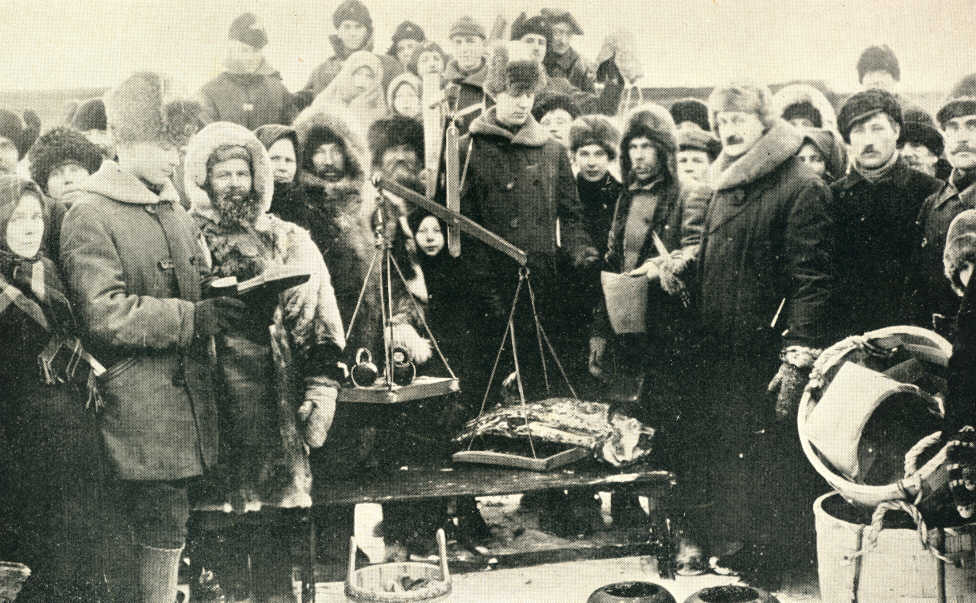
U. S. OFFICIAL PHOTO
Market Scene, Yemetskoe—Note Primitive Balances Weighing Beef.
![[Illustration: ]](images/160Pic2_A25.jpg)
LANMAN
Old Russian Prison, Annex to British Hospital.
![[Illustration: ]](images/160Pic2_B25.jpg)
WAGNER
Wash Day—Rinsing Clothes in River.
![[Illustration: ]](images/160Pic2_C25.jpg)
LANMAN
Archangel Cab-Men.
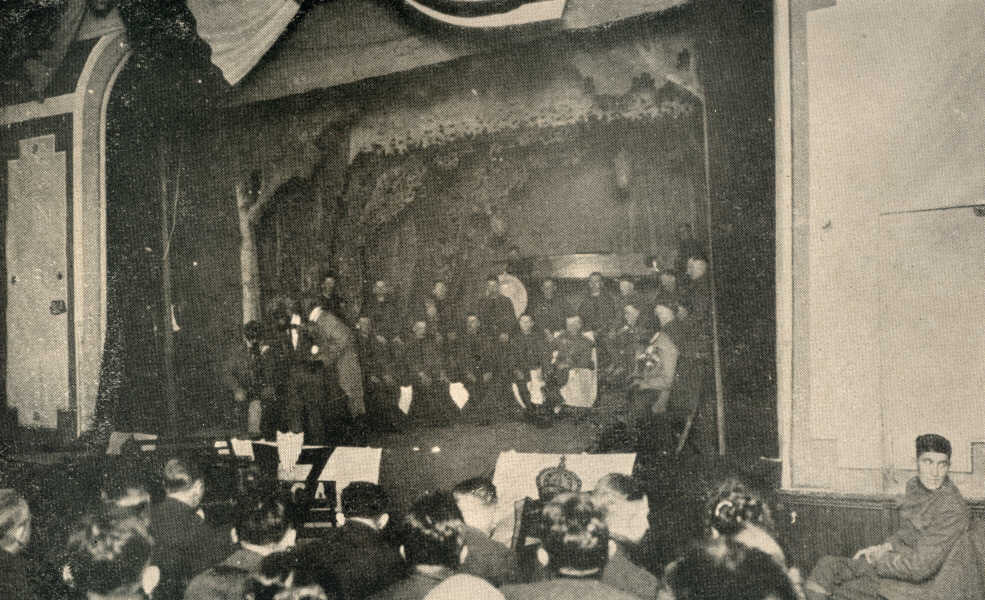
U. S. OFFICIAL PHOTO
Minstrels of “I” Company Repeat Program in Y. M. C. A.
![[Illustration: ]](images/160Pic3_A25.jpg)
U. S OFFICIAL PHOTO
Archangel Girls Filling Xmas Stockings.
![[Illustration: ]](images/160Pic3_B25.jpg)
U. S. OFFICIAL PHOTO
Y. M. C. A. Rest Room, Archangel.
Outside of the cities in the life and customs of the people exists a
broad simplicity which is unlike the social atmosphere of most of the
districts of rural America. Persons, however, who are acquainted with
the rural districts of Norway and Sweden feel quite at home in the
atmosphere of the North Russian village life.
The villages are composed of the houses of the small farmers who till
the surrounding land, together with church, school, store, and grain and
flax barns. Except for a few new villages along the railways, all are to
be found along some watercourse navigable at least for small barges. For
the waterways are the first, and for a long time the only avenues of
communication and trade. In the winter they make the very best roadways
for sleds. Wherever there was a great deal of open farm land along a
river several of these village farm centers grew up in close proximity.
The villages in such a group often combine for convenience, in local
government, trading, and support of churches and schools. The majority
of the villagers belong to a few large family groups which have grown in
that community for generations and give it an enviable permanence and
stability.
Family groups are represented in the councils of the community by their
recognized heads, usually active old men. In these later troublous
times, when so many of the men have disappeared in the maelstrom of the
European war or are engaged in the present civil strife, women are quite
naturally the acting heads of many families; and the result has led some
observers to conclude that the women have better heads for business and
better muscles for farming than have the men. It is certain that in some
communities the women outshine in those respects the men who still
remain. The same council of family heads which guides the local affairs
of each village, or group of villages, also attends through a committee
to the affairs of the local cooperative store society which exists for
trading purposes and acts in conjunction with the central society of
Archangel. Each little local store has a vigilant keeper now frequently
some capable young widow, who has no children old enough to help her to
till some of the strips of land.
The election and the duties of the headman have been dealt with heretofore. His
word is law and the soldiers came to know that the proper way to get things was
to go through the starosta. In every village is a teacher, more or less
trained. Each child is compelled to attend three years. If desirous he may go
to high schools of liberal arts and science and technical scope, seminaries and
monastic schools.
Of course, some children escape school, but not many, and the number of
absolute illiterates under middle age who have been raised in North
Russia is comparatively small. The writer well recalls that peasants
seldom failed to promptly sign their names to receipts. Around our
bulletin boards men in Russian camp constantly stood reading. One of the
requests from the White Guards was for Archangel newspapers. One of the
pleasantest winter evenings spent in North Russia was at the time of a
teachers’ association meeting in the Pinega Valley. And one of the
cleanest and busiest school-rooms ever visited was one of those little
village schools. To be sure the people were limited in their education
and way behind the times in their schools but they were eager to get on.
Also, in every small center of population there is a Russian State
Church. In America we have been accustomed to call these Greek Catholic
Churches, but they are not. The ritual and creed are admittedly rather
similar, but the church government, the architecture, the sacred
pictures and symbols, and the cross, are all thoroughly Russian. Until
the revolution, the Czar was the State head of the Church, and the
Ecclesiastical head was appointed by him. In the North at present
whatever aid was extended in times past from the government to the
churches—and to the schools as well—is looked for from the Provisional
Government at Archangel; and under the circumstances is very meagre if
not lacking altogether for long periods. The villagers do not close the
churches or schools for such a minor reason as that, however. They feed
and clothe the teacher and heat the church and the school. The priest
works his small farm like the rest of them—that is, if he is a “good”
priest. If he is not a “good” priest he charges heavily for special
services, christenings, weddings or funerals, and begs or demands more
for himself than the villagers think they can afford (and they afford a
great deal, for the villagers are very devout and by training very
long suffering), and the next year finds himself politely kicked
upstairs
to another charge in a larger community which the villagers quite
logically believe will better be able to support his demands. Such an
affair is managed with the utmost finesse.
Within the family all share in the work—and the play. The grown men do
the hunting, fishing, felling of timber, building, hauling, and part of
the planting and harvesting. The women, boys and girls do a great deal
toward caring for the live-stock, and much of the work in the field.
They also do some of the hauling and much of the sawing and splitting of
wood for the stoves of the house, besides all of the housework and the
spinning, knitting, weaving and making of clothing. The boys’ specialty
during the winter evenings often is the construction of fishnets of
various sized meshes, and the making of baskets, which they do
beautifully.
On Sundays and holidays, even in these times of hardship, the native
dress of the northern people is seen in much of its former interesting
beauty. The women and girls in full skirts, white, red or yellow waists
with laced bodices of darker color, fancy head-cloths and startling
shawls, tempt the stares of the foreigner as they pass him on their way
to church or to a dance. The men usually content themselves with their
cleanest breeches, a pair of high boots of beautiful leather, an
embroidered blouse buttoning over the heart, a broad belt, and a woolly
angora cap without a visor. Suspenders and corsets are quite absent.
On week-days and at work the dress of the North Russian peasant is, after five
years of wartime, rather a nondescript collection of garments, often pitiful.
In the winter the clothing problem is somewhat simplified because the four
items of apparel which are customary and common to all for out-of-doors wear
are made so durably that they last for years, and when worn out are replaced by
others made right in the home. They are the padded over-coat of coarse cloth or
light skins, the valinka of felt or the long boot of fur, the
parki—a fur great coat without front opening and with head-covering
attached, and the heavy knitted or fur mitten. In several of the views shown in
this volume these different articles of dress may be seen, some of them on the
heads, backs, hands and feet of the American soldiers.
What American soldier who spent days and days in those Russian log houses does
not remember that in the average house there is little furniture. The walls,
floors, benches and tables are as a rule kept very clean, being frequently
scrubbed with sand and water. In the house, women and children are habitually
bare-footed, and the men usually in stocking-feet. The valinka would
scald his feet if he wore them inside, as many a soldier found to his dismay.
Sometimes chairs are found, but seldom bed-steads except in the larger homes.
Each member of the family has a pallet of coarse cloth stuffed with fluffy
flax, which is placed at night on the floor, on benches, on part of the top of
the huge stone or brick stove, or on a platform laid close up under the ceiling
on beams extending from the stove to the opposite wall of the living-room. The
place on the stove is reserved for the aged and the babies. It was the best bed
in the house and was often proffered to the American with true hospitality to
the stranger. The bed-clothes consist of blankets, quilts and sometimes robes
of skins. Some of the patch-work quilts are examples of wonderful needle-work.
In the day-time it is usual to see the pallets and rolls of bedding stored on
the platform just mentioned, which is almost always just over the low, heavy
door leading in from the outer hall to the main living-room.
In North Russia the one-room house is decidedly the exception, and
because of the influence of the deep snows on the customs of the people
probably half the houses have two stories. One large roof covers both
the home and the barn. The second story of the barn part can be used for
stock, but is usually the mow or store-room for hay, grains, cured meat
and fish, nets and implements, and is approached by an inclined runway
of logs up which the stocky little horses draw loaded wagons or sleds.
When the snow is real deep the runway is sometimes unnecessary. The mow
is entered through a door direct from the second story of the home part
of the building, and the stable similarly from the ground floor.
The central object, and the most curious to an American, in the whole
house is the huge Russian stove. In the larger houses there are several.
These stoves are constructed of masonry and are built before the
partitions of the house are put in and before the walls are completed.
In the main stove there are three fire-boxes and a maze of surrounding
air-spaces and smoke-passages, and surmounting all a great chimney which
in two-story houses is itself made into a heating-stove with one
fire-box for the upper rooms. When the house is to be heated a little
door is opened near the base of the chimney and a damper-plate is
removed, so that the draft will be direct and the smoke escape freely
into the chimney after quite a circuitous passage through the body of
the stove. A certain bunch of sergeants nearly asphyxiated themselves
before they discovered the secret of the damper in the stove. They were
nearly pickled in pine smoke. And a whole company of soldiers nearly
lost their billet in Kholmogori when they started up the sisters’ stoves
without pulling the plates off the chimney.
Then the heating fire-box is furnished with blazing pine splinters and
an armful of pine stove-wood and left alone for about an hour or until
all the wood is burnt to a smokeless and gasless mass of hot coals and
fine ash. The damper plate is then replaced, which stops all escape of
heat up the chimney, and the whole structure of the stove soon begins to
radiate a gentle heat. Except in the coldest of weather it is not
necessary to renew the fire in such a stove more than once daily, and
one armful of wood is the standard fuel consumption at each firing.
Another of the fire-boxes in the main stove is a large smooth-floored
and vaulted opening with a little front porch roofed by a hood leading
into the chimney. This is the oven, and here on baking days is built a
fire which is raked out when the walls and floor are heated and is
followed by the loaves and pastry put in place with a flat wooden paddle
with a long handle. See the picture of the stove and the pie coming out
of the oven in the American convalescent hospital in Archangel. The
third fire-box is often in a low section of the stove covered by an iron
plate, and is used only for boiling, broiling and frying. As there is
not much food broiled or fried, and as soup and other boiled food is
often allowed to simmer in stone jars in the oven, the iron-covered
fire-box is not infrequently left cold except in summer. The
stove-structure itself is variously contrived as to outward architecture
so as to leave one or more alcoves, the warm floors of which form
comfortable bed-spaces. The outer surface of the stove is smoothly
cemented or enameled. So large are these stoves that partition-logs are
set in grooves left in the outer stove-wall, and a portion of the wall
of each of four or five rooms is often formed by a side or corner of the
same stove. And radiation from the warm bricks heats the rooms.
Washing of clothes is done by two processes, soaping and rubbing in hot
water at home and rinsing and rubbing in cold water at the river-bank or
through a hole cut in the ice in the winter. Although the result may
please the eye, it frequently offends the nose because of the common use
of “fish-oil soap.” Not only was there dead fish in the soap but also a
mixture of petroleum residue. No wonder the soldier-poet doggereled:
“It’s the horns of the cootie and beg-bug,
The herring and mud-colored crows,
My strongest impression of Russia,
Gets into my head through my nose.”
Bathing is a strenuous sport pursued by almost every individual with
avidity. It is carried on in special bath-houses of two or more rooms,
found in the yard of almost every peasant family. The outer door leads
to the entry, the next door to a hot undressing-room, and the inner door
to a steaming inferno in which is a small masonry stove, a cauldron of
hot water, a barrel of ice-water, a bench, several platforms of various
altitudes, several beaten copper or brass basins, a dipper and a lot of
aromatic twigs bound in small bunches. With these he flails the dead
cuticle much to the same effect as our scouring it off with a rough
towel. Such is the grandfather of the “Russian Bath” found in some of
our own cities. After scrubbing thoroughly, and steaming almost to the
point of dissolution on one of the higher platforms, a Russian will dash
on cold water from the barrel and dry himself and put on his clothes and
feel tip-top. An American would make his will and call the undertaker
before following suit. In the summer there is considerable open-air
river bathing, and the absence of bathing-suits other than nature’s own
is never given a thought.
The people of this north country are shorter and stockier than the
average American. The prevailing color of hair is dark brown. Their
faces and hands are weather-beaten and wrinkle early. Despite their
general cleanliness, they often look greasy and smell to high heaven
because of their habit of anointing hair and skin with fats and oils,
especially fish-oil. Not all do this, but the practice is prevalent
enough so that the fish-oil and old-fur odors are inescapable in any
peasant community and cling for a long time to the clothing of any
traveler who sojourns there, be it ever so briefly. American soldiers in
1918–1919 became so accustomed to it that they felt something intangible
was missing when they left the country and it was some time before a
clever Yank thought of the reason.
Before the great world war, a young peasant who was unmarried at
twenty-two was a teacher, a nun, or an old maid. The birth-rate is high,
and the death-rate among babies not what it is in our proud America.
Young families often remain under the grandfather’s rooftree until
another house or two becomes absolutely necessary to accommodate the
overflow. If through some natural series of events a young woman has a
child without having been married by the priest, no great stir is made
over it. The fact that she is not thrown out of her family home is not
consciously ascribed to charity of spirit, nor are the villagers
conscious of anything broad or praiseworthy in their kindly attitude.
The result is that the baby is loved and the mother is usually happily
wed to the father of her child. The North Russian villager is an
assiduous gossip, but an incident of this kind receives no more
attention as an item of news that if its chronology had been thoroughly
conventional by American standards.
Marriages are occasions of great feasting and rejoicing; funerals
likewise stir the whole community, but the noise of the occasion is far
more terrifying and nerve-wracking. Births are quiet affairs; but the
christening is quite a function, attended with a musical service, and
the “name-day” anniversary is often celebrated in preference to the
birthday anniversary by the adult Russian peasant. Everybody was born,
but not everybody received such a fine name from such a fine family at
such a fine service under the leadership of such a fine priest; and not
everybody has such fine god-parents. The larger religious festivals are
also occasions for enjoyable community gatherings, and especially during
the winter the little dances held in a large room of some patient man’s
house until the wee small hours are something not to be missed by young
or old. Yes, the North Russian peasant plays as well as works, and so
keen is his enjoyment that he puts far more energy into the play.
Because of his simple mode of existence it is not necessary to overwork
in normal times to obtain all the food, clothing, houses and utensils he
cares to use. Ordinarily he is a quiet easy-going human.
Perhaps there is more of sense of humor in the apparently phlegmatic passivity
of the Russian nitchevo than is suspected by those not acquainted with
him. There is also a great timidity in it; for the Russian moujik or
christianik (peasant farmer) has scarcely been sure his soul is his own, since
time immemorable. But his sense of humor has been his salvation, for it has
enabled him to be patient and pleasant under conditions beyond his power to
change. Courtesy to an extent unknown in America marks his daily life. He is
intelligent, and is resourceful to a degree, although not well educated.
The average North Russian is not dishonest in a personal way. That is,
he has no personal animus in his deviousness unless someone has directly
offended him. He will haul a load of small articles unguarded for many
versts and deliver every piece safely, in spite of his own great hunger,
because he is in charge of the shipment. But he will charge a commission
at both ends of a business deal, and will accept a “gift” almost any
time for any purpose and then mayhap not “deliver.” Only a certain small
class, however, and that practically confined to Archangel and environs,
will admit even most privately that any gift or advantage is payment for
a given favor which would not be extended in the ordinary course of
business. This class is not the national back-bone, but rather the
tinsel trimmings in the national show-window.
One time a passing British convoy commandeered some hay at Bolsheozerki. Upon
advice of the American officer the starosta accepted a paper due bill
from the British officer for the hay. Weeks afterward the American officer
found that the Russian had been up to that time unable to get cash on his due
bill. Naturally he looked to the American for aid. The officer took it up with
the British and was assured that the due bill would be honored. But to quiet
the feeling of the starosta he advanced him the 92 roubles, giving the
headman his address so that he could return the 92 roubles to the American
officer when the British due bill came cash. Brother officers ridiculed the
Yank officer for trusting the Russian peasant, who was himself waiting
doubtfully on the British. But his judgment was vindicated later and the
honesty of the starosta demonstrated when a letter travelled hundreds of
miles to Pinega with 92 roubles for the American officer.
XX
HOLDING THE ONEGA VALLEY
December Fighting—Drawn Struggle Near Turchesova—Fighting Near Khala In
February—Corporal Collins And Men Are Ambushed Near Bolsheozerki—“H” Company In
Two Savage Battles—Lieuts. Collins And Phillips Both Mortally Wounded.
The enemy, who was massing up forces in the upper Pinega valley and, as
we have seen, caused British G. H. Q. to send one company of Americans
hurrying up the valley for a 150-mile march Christmas week, was also
fixing up a surprise for the G. H. Q. on the other end of the great line
of defense. That same Christmas week “H” Company found itself again up
against greatly superior forces who, as they boasted, were commencing
their winter campaign to drive the invaders of Russia to the depths of
the White Sea.
On December 20th one squad of “H” men were in a patrol fight with the
enemy which drove the Reds from the village of Kleshevo. On the
following day Lt. Ketcham with twenty Americans and a platoon of R. A.
N. B., Russian Allied Naval Brigade, proceeded south for reconnaissance
in force and engaged a strong enemy patrol in Priluk, driving the Reds
out, killing one, wounding one, and taking one prisoner. On December
22nd Lt. Carlson’s platoon occupied Kleshevo and Lt. Ketcham’s platoon
occupied the village on the opposite side of the river. The next day at
a village near Priluk Lt. Carlson’s men on patrol encountered a Bolo
combat patrol and inflicted severe losses and took five prisoners.
Christmas Day and several other days were occupied with these patrol
combats by the two opposing forces, each of which thought the other had
gone into winter quarters.
In conformity with the general advance planned on all fronts by the
British Command to beat the enemy to the attack and to reach a position
which would nullify the enemy’s tremendous advantage of position with
his base at Plesetskaya, the British Officer in command of the Onega
Valley Detachment, planned an attack on Turchesova. Lt. E. R. Collins
with the second fourth platoons left Pogashitche at 4:00 a. m. December
29, proceeding up the Schmokee River in an attempt to get around
Turchesova and strike the enemy in the flank. It was found, however,
that the woods on this side were impassable and so the force left the
river by a winter trail for Pertema, proceeding thence to Goglova, to
reinforce the Polish company of Allies who had captured that village on
the same morning.
This was wise. The next morning the enemy counter-attacked Goglova in
great force, but, fortunately, was repulsed without any casualties on
our side. He had, however, a threatening position in the village of
Zelyese, about a mile to the left flank and rear of our position and was
discovered to be preparing to renew the battle the next day. Lt. Collins
was obliged to divide his force just as again and again the American
officers all along that great Russian winter front again and again were
compelled to divide in the face of greatly superior and encircling
forces.
Taking Lt. Ketcham’s platoon early the next morning, he boldly struck at
the enemy force in his rear and after an hour’s fighting the “H” men had
possession of the village. But the enemy was at once reinforced from
Turchesova and delivered a counter-attack that the “H” men repulsed with
severe losses. Our wounded in the action were two; none killed.
Horseshoes again. The enemy dead and wounded were over fifty. The enemy
continued firing at long range next day, New Years of 1919, and wounded
one “H.”
Indications pointed toward an inclination of the enemy to evacuate
Turchesova. Therefore, a message received by Lt. Collins at 5:00 p. m.,
January 1, from British O. C. Onega Det., ordering a withdrawal within
two hours to Kleshevo, came as a surprise to the American soldiers. In
this hasty retreat much confusion arose among the excited Russian
drivers of sleighs. Some horses and drivers were injured; much
ammunition, equipment, and supplies were lost.
The enemy did not follow and for the remainder of January and up to
February 9th the “H” Company men performed the routine duties of patrol
and garrison duties in the Onega Valley in the vicinity of Kleshevo
without any engagement with the enemy who seemed content to rest in
quarters and keep out of the way of the Americans and Allies.
On February 10th Lt. Ketcham with a combat patrol drove the enemy from
Khala whom he encountered with a pair of machine guns on patrol. He
defeated the Reds without any casualties, inflicting a loss on the enemy
of one killed and two wounded.
For more than a month the sector of defense was quiet except for an
occasional rise of the “wind.” Active patrols were kept out. Captain
Ballensinger assumed command of the company and moved his headquarters
from Onega to Chekuevo. As the mail from and to Archangel from the
outside world as well as supplies and reinforcements of men were now
obliged to use the road from Obozerskaya to Bolsheozerki to Chekuevo to
Onega to Kem and so on to Kola and return, it became part of the duty of
“H” Company to patrol the road from Chekuevo to Obozerskaya; taking two
days coming and two days going with night stops at Chinova or
Bolsheozerki.
The last of these patrols left Chekuevo on Sunday, March 16, fell into
the hands of the advance patrols of the Bolo General who had executed a
long flank march, annihilated the Franco-Russian force at Bolsheozerki,
and occupied the area with a great force of infantry, mounted men, skii
troops, and both light and heavy artillery, as related elsewhere in
connection with the story of the defense of the railroad.
The next day Lt. Collins with thirty men and a Lewis gun started toward
Bolsheozerki to discover the situation with orders to report at Chinova
to Col. Lucas, the French officer in command of the Vologda Force.
Travelling all night, he reached Col. Lucas in the morning and the
latter determined to push on under escort of the Americans and attempt
to reach Bolsheozerki and Oborzerskaya, being at that time ignorant of
the real strength of the force of Reds that had interrupted the
communications.
About noon, March 18th, the detachment in escort formation left Chinova
and proceeded without signs of enemy till within four versts of
Bolsheozerki, where they were met by sudden burst of a battery of
machine guns. Luckily the range was wrong. The horses bolted upsetting
the sleighs and throwing Col. Lucas into the neck-deep snow. The
Americans returned the fire and slowly retired with the loss of but one
man killed. Crawling in the snow for a great distance gave many of them
severe frost bites, one of the most acute sufferers being the French
Col. Lucas. The detachment returned to Chinova to report by telephone to
Chekuevo and to organize a defensive position in case the enemy should
advance toward Chekuevo. The enemy did not pursue. He was crafty. That
would have indicated his great strength.
By order of Col. Lawrie, British O. C. Onega Det., Lt. Phillips was sent
with about forty “H” Company men to reinforce Lt. Collins. It was the
British Colonel’s idea that only a large raiding party of Bolos were at
Bolsheozerki for the purpose of raiding the supply trains of food that
were coming from Archangel to Chekuevo. Phillips reached Chinova before
daybreak of the twentieth. Lt. Collins was joined at the little village
of Chinova by three companies of Yorks, enroute from Murmansk to
Obozerskaya, a U. S. Medical corps officer, Lt. Springer, and four men
joined the force and an attack was ordered on Bolsheozerki by these
seventy Americans and three hundred Yorks. They did not know that they
were going up against ten times their number.
At 2:00 a. m. the movement started and at nine in the morning the
American advance guard drew fire from the enemy. Deploying as planned on
the left of the road the “H” men moved forward in line of battle. One
company of Yorks moved off to the right to attack from the woods and one
on the left of the Americans. One York company was in reserve. After
advancing over five hundred yards in face of the enemy machine gun fire,
the Americans were exhausted by the deep snow and held on to a line
within one hundred yards of the enemy. The Yorks on the right and left
advanced just as gallantly and were also held back by the deep snow and
the severity of the enemy machine gun fire.
The fight continued for five hours. Lovable old Lt. Collins fell
mortally wounded by a Bolo bullet while cheering his men on the
desperate line of battle. At last Lt. Phillips was obliged to report his
ammunition exhausted and appealed for reinforcements and ammunition.
Major Monday passed on the appeal to Col. Lawrie who gave up the attack
and ordered the forces to withdraw under cover of darkness, which they
all did in good order. Losses had not been as heavy as the fury of the
fight promised. One American enlisted man was killed and Lt. Collins
died of hemorrhage on the way to Chekuevo. Eight American enlisted men
were severely wounded. The Yorks lost two officers and two enlisted men
killed, and ten enlisted men wounded. Many of the American and British
soldiers were frostbitten.
During the next week the enemy, we learned later, greatly augmented his
forces and strengthened his defenses of Bolsheozerki with German wire,
machine guns, and artillery. He was evidently bent on exploiting his
patrol action success and aimed to cut the railroad at Obozerskaya and
later deal with the Onega detachment at leisure. Our troops made use of
the lull in the activities to make thorough patrols to discover enemy
positions and to send all wounded and sick to Onega for safety, bringing
up every available man for the next drive to knock the Bolo out of
Bolsheozerki. This was under the command of Lt.-Col. Morrison (British
army).
Meanwhile the Bolo General had launched a vicious drive at the Americans
and Russians who stood between him and his railway objective, encircling
them with three regiments, and on April 2, after two days of continuous
assault was threatening to overpower them. In this extremity Col. Lawrie
answered the appeal of the British officer commanding at Obozerskaya by
ordering another attack on the west by his forces. Captain Ballensinger
reports in substance as follows:
In compliance with orders he detailed April 1, one N. C. O. and ten
privates to man two Stokes mortars, also one N. C. O. and seven privates
for a Vickers gun. Both these details reported to a Russian trench
mortar officer and remained under his command during the engagement. The
balance of the available men at the advance base Usolia was divided into
two platoons, the first under Lt. Phillips and the other under the First
Sergeant. These platoons under Capt. Ballensinger’s command, as part of
the reserve, joined the column on the road at the appointed time.
They arrived at their position on the road about four versts from
Bolsheozerki about 1:00 a. m. April 2. Zero hour was set at daybreak,
3:00 a. m. The first firing began about thirty minutes later, “A”
Company of the Yorks drawing fire from the northern or right flank of
the enemy. They reported afterward that the Bolos had tied dogs in the
woods whose barking had given the alarm. That company advanced in the
face of strong machine gun fire and Capt. Bailey, a British officer went
to his death gallantly leading his men in a rush at the guns on a ridge.
But floundering in the snow, with their second officer wounded, they
were repulsed and forced to retire.
At 5:00 a. m. Lt. Pellegrom, having hurried out from Archangel, reported
for duty and was put in command of a platoon.
At 6:00 a. m. “A” Company Yorks was in desperate straits and by verbal
order of Col. Lund one platoon of Americans was sent to support their
retirement. Lt. Phillips soon found himself hotly engaged.
The original plan had been to send the Polish Company in to attack the
southern villages or the extreme left of the Bolo line, but owing to
their lateness of arrival they were not able to go in there and were
held for a frontal attack, supported by the American trench mortars.
They were met by a severe machine gun fire and after twenty minutes of
hot fire and heavy losses retired from action.
Meanwhile “C” Company Yorks which had been sent around to attack on the
north of Bolsheozerki got lost in the woods in the dark, trying to
follow an old trail made by a Russian officer and a few men who had come
around the north end of the Bolsheozerki area a few days previously with
messages from Obozerskaya. The company did not get into action and had
to return. Thus the attack had failed, and the force found itself on a
desperate defensive.
The “A” Yorks, who had suffered severely, retired from action
immediately after the first counter-attack of the Bolo had been
repulsed. Then the whole defense of this messed-up attacking force fell
upon the American platoon and a dozen Yorks with a doughty British
officer. Phillips, through the superb control of his men, kept them all
in line and his Lewis guns going with great effectiveness and gave
ground slowly and grudgingly, in spite of casualties and great severity
of cold.
When Phillips fell with the wound which was later to prove fatal,
Pellegrom came up with his platoon to relieve the exhausted platoon, and
“C” Company Yorks arrived on the line from their futile flank march just
in time to join the Americans at 9:00 a. m. in checking the redoubled
counterattack of the hordes of Bolos.
Meanwhile the Polish troops refused to go back into the fighting line to
help stem the Bolo attack. Peremptory order brought two of their Colt
automatics up to the line where for forty-five minutes they engaged the
enemy, but again retired to the rear and assisted only by firing their
machine gun over the heads of the Americans and British battling for
their very lives all that afternoon in the long thin line of American O.
D. and British Khaki.
The Bolo was held in check and at dusk the Americans and British and
Poles withdrew in good order.
This ill-fated attack had met with a savage repulse but no doubt it had
a great effect upon the Bolshevik General at Bolsheozerki. On his right
he had himself met bloody disaster from a company of Americans who had
fought his attacking battalions to a standstill for sixty hours and here
on his left flank was another Company of Americans who had twice
attacked him and seemed never to stay defeated. April sun was likely to
soften his winter road to mush very soon and then these Americans and
their allies would have him at their mercy.
The losses of the enemy were not known but later accounts from prisoners
and from natives of the village, who were there, placed them very high.
In this last attack “H” lost one officer, who died of wounds later, also
one man killed, one mortally wounded and seven others wounded. The
British lost one officer killed, one wounded, two privates killed, two
missing and ten wounded. The Polish Company lost five killed, eight
missing and ten wounded.
Of the gallant Phillips who fell at Bolsheozerki we are pleased to
include the following from his company commander:
“But when he went forward something made me look him over again, and the look I
saw on his face and especially in his eyes, I shall never forget.
“I have never seen a look like it before or since. It was by no means the look
of a man being afraid (I have seen those looks) nor was it a look of ‘I don’t
care what happens.’ It was a look that made me watch him all the way out. It
made me hunt him up with my glasses, while I was watching the enemy. The latter
was pressing us awfully hard that day, and when I observed our troops slowly
giving ground, I went out in person to see if the look on Phillip’s face had
something to do with it. But I soon changed my mind. He was all along the line
encouraging his men to hold on, he helped to put new Lewis guns in position. In
short, he was everywhere without apparent thought of the bullets flying all
around him. He pulled back wounded men to be carried back behind the lines. I
know that his men would have held every bit of ground, had the British who were
holding the flanks not fallen way back behind them.
“When the fateful bullet struck him, it knocked him down as if a ton of brick
had fallen on him. He said to me, ‘My God, I got it. Captain, don’t bother with
me, I am done for, just look after the boys’.”
Let us here relate the story of his plucky fight for life after a Bolo
bullet tore through his breast.
Borne tenderly in the arms of his own men to a sleigh which was gently
drawn to Chanova and thence to Chekuevo, he rallied from his great loss
of blood. Apparently his chances for recovery were good. He sat up in
bed, ate with relish and exchanged greetings with his devoted “H”
company men who to a man would gladly have changed places with him—what
a fine comradeship there was between citizen-officer and
citizen-soldier. Contrary to expectations Phillips was soon moved from
Chekuevo to Onega for safety and for better care. But very soon after
reaching Onega hemmorhage began again. Then followed weeks of struggle
for life. Everything possible was done for him with the means at hand.
Although the hospital afforded no X-ray to discern the location of the
fatal arterial lesion through which his life was secretly spurting away,
the post mortem revealed the fact that the Bolshevik rifle bullet had
severed a tiny artery in his lung.
Care-worn American medical men wept in despair. Wireless messages
throbbed disheartening reports on his condition to anxious regimental
comrades on other fronts and at Archangel. At last the heroic struggle
ended. On the tenth of May Phillips bled to death of his wound.
The valiant company had done its best in the fall and winter fighting.
The company retired to Chekuevo and Onega, doing guard duty and patrols
during the spring. The only event of note was the midnight game of
baseball between the medics and doughboys. The medics could not hit the
pills as hard as the doughboys. They left Onega June 5th, by steamboat
for Economia Island and left Russia June 15th.
XXI
ICE-BOUND ARCHANGEL
Ferry Boat Fights Ice—Archangel Cosmopolitan—Bartering For Eats—Strange Wood
Famine—Entertainment At American Headquarters—Doughboy Minstrelsy—Reindeer
Teams—Russian Eskimo—Bolshevik Prisoners—S. B. A. L. Mutiny—Major Young’s Scare
At Smolny—Shakleton Boots—British Rations For Yank Soldiers—Corporal Knight
Writes Humorous Sketch Of Ice-Bound Archangel.
On the ferry boat the troops speculated whether or not we would get
stuck in the ice before we could cross the river to Archangel Preestin.
It was November 22nd, 1918. The Dvina ran under glass. On the streets of
Archangel sleighs were slipping. Winter was on and Archangel in a few
days would be ice-bound. For a few days more the ice-breakers would keep
the ferry going across the Dvina and would cut for the steamships a way
out to sea. Then the White Sea would freeze solid for six months. In a
few days the Archangel-Economia winter railroad would be running.
Icebreakers would for a while brave the Arctic gales that swept the
north coast. Then they would surrender and the great white silence would
begin.
Varied and interesting are the tales that are told of that winter in
Archangel. They are descriptive as well as narrative but there is not
much coherence to the chapter. However, to the soldiers who were there,
or who were out and in Archangel during the winter of 1918-19 this
chapter will be pleasing.
In from a far-off front for a few days rest, or in on some mission such
as the bringing of Bolshevik prisoners or to get some of the company
property which had been left behind when in the fall the troops left
troopships so hurriedly, these groups of American soldiers from the
fighting fronts always found Archangel of interest. They found that it
was a half-modern, half-oriental city, half-simple, half-wicked, with
the gay along with the drab, with bright lights along with the gloom.
In Archangel were all kinds of people—whiskered moujiks beating their
ponies along the snow-covered streets, sleek-looking people of the
official class, well-dressed men and women of cultured appearance, young
women whose faces were pretty and who did not wear boots and shawls but
dressed attractively and seemed to enjoy the attention of doughboys, and
soldiers of several nations, veterans of war and adventure in many
climes. What a cosmopolitan crowd it was in that frozen-in city of the
North!
The doughboy from the front soon learned that the city had its several
national centers—the British quarters, French, Italian, and so forth,
where their flags denoted their headquarters and in vicinity of which
would be found their barracks and quarters and clubs. The Yank found
himself welcome in every quarter of the city but hailed with most
camaraderie in the French quarter. With the Russian night patrols he
soon came to an amicable understanding and Russian cafes soon found out
that the Yanks were the freest spenders and treated them accordingly.
Woe to the luckless “Limmey” who tried to edge in on a Yank party in a
Russian place.
When the doughboy returned to his company at the front he had a few great tales
to tell of the eats he had found at some places. Some companies had done well.
On the market-place and elsewhere the resourceful Amerikanski looking for food,
especially vegetables, to supplement his mess, learned his first word of
Russian—Skulka rouble.In spite of the watchful British M. P.’s, Ruby
Queens and Scissors cigarettes were soon bringing in small driblets of cabbage
and onions and potatoes. Happy the old mess sergeant who got his buddies expert
at this game. And much more contented were the men with the mess. In another
chapter read the wonderful menu of the convalescent hospital.
In the city the doughboy found the steaming bahnya or bathhouse, and at
the “cootie mill” turned in his shirt to rid himself of the “seam squirrels.”
All cleaned up, with little gifts and cheery words he sought his buddies who
were in hospital sick or wounded. He got books and records and gramaphones and
other things at the Red Cross and “Y” to take back to the company. He
accumulated a thousand rumors about the expedition and about happenings back
home. He tired of the gloom and magnified fears of Archangel’s being
overpowered by the Bolos and usually returned to the front twice glad—once that
he had seen Archangel and second that he was back among his comrades at the
front.
During those weary ice-bound months it was a problem to keep warm. Poor
management by high American and British officers at one time, to the
writer’s knowledge, suffered American soldiers at Smolny to be actually
endangered in health. As far as proper heating of quarters was concerned
men at the front provided better for themselves than did the commander
at Smolny, Major Young, provide for those fighters in from the fighting
front for rest. And that might be said too for his battalion mess. No
wonder the doughboy set out to help himself in these things.
Strange to the American soldiers was the fact that at Archangel, a city
of saw-mills, sitting in a nick of a great forest that extended for
hundreds of miles south, east and west, there was such difficulty in
getting supplies of fuel. A desperate sergeant took a detail of men and
salvaged a lot of logs lying near the river’s edge, borrowed some Russki
saws with a few cigarettes, commandeered some carts and brought to the
cook’s kitchen and to the big stoves in the barracks a fine supply of
wood. But the joke of it was that the watchful Russian owner of the logs
sent in his bill for the wood to the British G. H. Q. And a ream of
correspondence was started between Major Young and G. H. Q., the
typewriter controversy continuing long, like Katy-did and Katy-didn’t,
long after the sergeant with diplomacy, partial restoration, and sugar
had appeased the complaining Russian.
At American headquarters in the Technical Institute was held many a
pleasant entertainment to while away the winter hours. The auditorium
possessed a stage and a good dance floor. The moving picture machine and
the band were there. Seated on the backless wooden benches soldiers
looked at the pictures or listened to the orchestra or to their own
doughboy talent showing his art at vaudeville or minstrelsy.
Or on officers’ entertainment night they and their guests chosen from
charming Russian families, joyfully danced or watched the antics of
Douglas Fairbanks, Fatty Arbuckle, Charlie Chaplin, and even our dear
deceased old John Bunnie. Not a silver lining but has its cloudy
surface, and many were the uncomfortable moments when the American
officer found himself wishing he could explain to his fair guest the
meaning of the scene. More than rumor spread through that North country,
attributing wonderful powers to the Americans based on some Douglas
Fairbanks exploit. Can it be that the enemy heard some of these rumors
and were unwilling at times to go against the Americans?
Enlisted men’s entertainments by the “Y” and their own efforts to battle ennui
with minstrel show and burlesque and dances have already been mentioned. The
great high Gorka built by the American engineers in the heart of the
city afforded a half-verst slide, a rush of clinging men and women as their
toboggan coursed laughing and screaming in merriment down to the river where it
pitched swiftly again down to the ice. Here at the Gorka as at “the
merry-go-round,” the promenade near Sabornya, the doughboy learned how to put
the right persuasion into his voice as he said Mozhna, barishna, meaning: Will
you take a slide or walk with me, little girl? At Christmas, New Year’s and St.
Patrick’s Day, they had special entertainments. Late in March “I” Company three
times repeated its grand minstrel show.
Many a doughboy in Archangel, Kholmogora, Yemetskoe, Onega or Pinega, at
one time or another during the long winter, got a chance to ride with
the Russian Eskimo and his reindeer. Doughboys who were supporting the
artillery the day that the enemy moved on Chertkva and threatened
Peligorskaya, can recall seeing the double sled teams of reindeer that
came flashing up through the lines with the American commanding officer
who had been urgently called for by the Russian officer at Peligorskaya.
Sergeant Kant will never forget that wild ride. He sat on the rear sled,
or rather he clung to the top of it during that hour’s ride of twelve
miles. The wise old buck reindeer who was hitched as a rudder to the
rear of his sled would brace and pull back to keep the sergeant’s sled
from snapping the whip at the turns, and that would lift the sled clear
from the surface. And when the old buck was not steering the sled but
trotting with leaping strides behind the sled then the bumps in the road
bounced the sled high. Out in front the reindeer team of three strained
against their simple harness and supplied the rapid succession of jerks
that flew the sleds along toward the embattled artillery. The reindeer
travelled with tongues hanging out as if in distress; they panted; they
steamed and coated with frost; they thrust their muzzles into the
cooling snow to slake their thirst; but they were enjoying the wild run;
they fairly skimmed over the snow trail. The Eskimo driver called his
peculiar moaning cry to urge them on, slapped his lead reindeer with the
single rein that was fastened to his left antler, or prodded his team on
the haunches with the long pole which he carried for that purpose and
for steering his light sled, and with surprising nimbleness leaped on
and off his sled as he guided the sled past or over obstructions. A
snow-covered log across the trail caused no delay. A leap of three
antlered forms, twelve grey legs flashing in the air, a bump of the
light sled that volplanes an instant in a shower of snow, a quick leap
and a grab for position back on the sled, the thrilling act is over, and
the Eskimo has not shown a sign of excitement in his Indian-like stoic
face. On we skim at unbroken pace. We soon reach the place.
One of the views shown in this volume is that of a characteristic
reindeer team and sled. Another shows the home of the North Russian
branch of the Eskimo family. The writer vividly recalls the sight of a
semi-wild herd of reindeer feeding in the dense pine and spruce woods.
They were digging down through the deep snow to get the succulent
reindeer moss. We approached on our Russian ponies with our, to them,
strange-looking dress. What a thrill it gave us to see them, as if at
signal of some sentry, raise their heads in one concerted, obedient look
for signal of some leader, and then with great bounds go leaping away to
safety, flashing through the dark stems of the trees like a flight of
grey arrows discharged from a single bow. Further on we came upon the
tented domiciles of the owners of this herd. Our red-headed Russian
guide appeased the clamors of the innumerable dogs who bow-wowed out
from all sides of the wigwam-like tents of these North Russian nomad
homes, while we Americans looked on in wonder. Here was the very
counterpart of the American Indian buck and squaw home that our grandads
had seen in Michigan. The women at last appeared and rebuked the ragged
half-dressed children for their precipitate rushing out to see the
strangers. For a little tobacco they became somewhat talkative and
willingly enough gave our guide information about the location of the
hidden still we were going to visit, where pine pitch was baked out and
barrelled for use in repairing the steamboats and many fishing boats of
the area. We studied this aborigine woman and questioned our guide later
about these people. Like our Indians they are. Pagans they are and in
this volume is a picture of one of their totem poles. Untouched by the
progress of civilization, they live in the great Slavic ocean of people
that has rolled over them in wave after wave, but has not changed them a
bit. Space can not be afforded for the numerous interesting anecdotes
that are now in the mind of the writer and the doughboy reader who so
many times saw the reindeer and their Russian Eskimo owners in their
wilds or in Archangel or other cities and villages where they appear in
their annual winter migrations.
Probably the one most interesting spot in the frozen port city was the
American expeditionary post-office. Here at irregular intervals, at
first via ice-breaker, which battled its way up to the edge of the ice
crusted coast north of Economia, came our mail bags from home. Later
those bags came in hundreds of miles over the winter snow roads, hauled
by shaggy ponies driven by hairy, weather-beaten moujiks. Mail-letters,
papers, little things from home, the word still connotes pleasure to us.
Mail days were boon days, and at the mail-place a detail always arrived
early and cheerful.
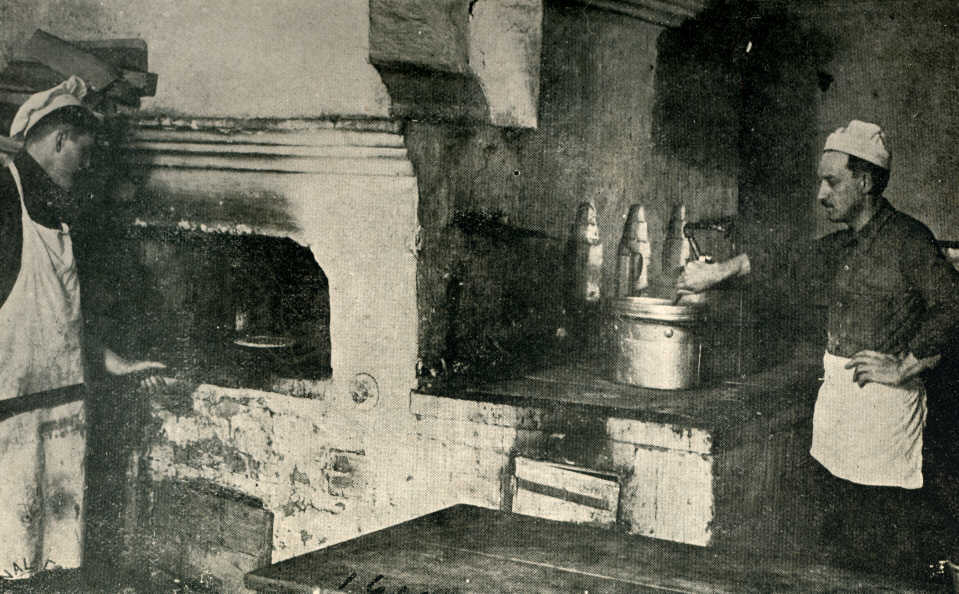
U. S. OFFICIAL PHOTO
Russian Masonry Stove—American Convalescent Hospital.
![[Illustration: ]](images/176Pic2_A25.jpg)
U. S. OFFICIAL PHOTO
Pvt. Allikas Finds His Mother in Archangel.
![[Illustration: ]](images/176Pic2_B25.jpg)
U. S OFFICIAL PHOTO
Printing “The American Sentinel.”
Familiar sights in the streets of winter Archangel were the working parties
composed of Bolshevik prisoners of war. Except for the doughboy guard it might
have been difficult to tell them from a free working party. They all looked
alike. In fact, many a scowling face on a passing sled would have matched the
Bolo clothes better than some of those boyish faces under guard. And how the
prisoners came to depend on the doughboy. Several times it was known and
laughingly told about that Bolo prisoners individually managed to escape, sneak
home or to a confederate’s home, get food, money and clean clothes, and then
report back to the American guards. They preferred to be prisoners rather than
to remain at large. Once a worried corporal of a prisoner guard detail at the
convalescent hospital was inventing a story to account to the sergeant for his
A. W. O. L. prisoner when to his mingled feeling of relief and disgust, in
walked the lost prisoner, nitchevo, khorashaw.
The corporal felt about as sheepish as a sergeant and corporal of
another company had felt one night when they had spent an hour and a
half outmaneuvering the sentries, carrying off a big heavy case to a
dark spot, and quietly opening the case found that instead of Scotch
“influenza cure” it was a box of horseshoes. In that case horseshoes
meant no luck.
Is war cruel? In that city of Archangel with nowhere to retreat, nervous
times were bound to come. “The wind up their back,” that is, cold
shivers, made kind-hearted, level-headed men do harsh things. Comrade
Danny Anderson of “Hq” Company could tell a blood-curdling story of the
execution he witnessed. Six alleged agents of the German war office,
Russian Bolo spies, in one “windy” moment were brutally put away by
British officers. Their brains spattered on the stone wall. Sherman said
it. We are glad to say that such incidents were remarkably rare in North
Russia. The Allied officers and troops have a record of which they may
be justly proud.
Here we may as well tell of the S. B. A. L. mutiny in Archangel in early
winter. It is the story of an occurrence both pitiful and aggravating.
After weeks of feeding and pampering and drilling and equipping and
shining of brass buttons and showing off, when the order came for them
to prepare to march off to the fighting front, the S. B. A. L. held a
soviet in their big grey-stone barracks and refused to get ready to go
out because they had grievances against their British officers. This was
aggravatingly unreasonable and utterly unmilitary. Severe measures would
have to be used. They were given till 2:00 p. m. to reconsider their
soviet resolution.
Meanwhile G. H. Q. had ordered out the American “Hq” Company trench mortar
section and a section of the American Machine Gun Company to try bomb and
bullet argument on the S. B. A. L.’s who were barricading their barracks and
pointing machine guns from their windows. Promptly on the minute, according to
orders, the nasty, and to the Americans pitifully disagreeable job, was begun.
In a short time a white flag fluttered a sign of submission. But several had
been killed and the populace that swarmed weeping about the American soldiers
reproachfully cried: “Amerikanski nit dobra.” And they did not feel at
all glorious.
A few minutes later to the immense disgust of the doughboys, a company
of English Tommies who by all rules of right and reason should have been
the ones to clean up the mutinous mess into which the British officers
had gotten the S. B. A. L.’s, now hove into sight, coming up the
recently bullet-whistling but now deadly quiet street, with rifles slung
on their shoulders, crawling along slowly at sixty to the minute
pace—instead of a riot-call double time, and singing their insulting
version of “Over There the Yanks are Running, Running, everywhere, etc.”
And their old fishmonger reserve officer—he wore Colonel’s insignia,
wiped off his whiskey sweat in unconcealed relief. His battle of
Archangel had been cut short by the Americans who had eagerly watched
for the first sign of surrender by the foolish Russian soldiers. The
finishing touch was added to the short-lived S. B. A. L. mutiny when the
tender-hearted but severe old General Maroushevsky punished the thirteen
ring-leaders of the S. B. A. L. soviet with death before a Russian
firing squad. This mutiny was described in various ways and use was made
of it by agitators in Archangel. The writer has followed the account
given to him by a machine gun sergeant who was handling one of the guns
that day. His story seemed to contain the facts and feelings most
commonly expressed by American officers and enlisted men who were in
Archangel when the unfortunate incident took place.
We are bound to comment that we believe it never would have occurred if
a tactful, honest American officer had been in charge of the S. B. A. L.
Americans know how tactless and bull-dozing some British orders—not
many to be sure—could be. We fortunately had bluffs enough to offset
the bull-dozings. A stormy threat by a sneering, drunken officer to turn
his Canadian artillery on the bloomin’ Yanks could be met by a
cold-as-steel rejoiner that the British officer would please realize his
drunken condition, and take back the sneering threat and come across
with a reasonable order or suffer the immediate consequences. And then
usually the two could cooperate. Such is a partnership war incident.
Late in winter, after the success of the enemy in the Shenkursk area had
given the secret sympathizers in Archangel renewed hope that Trotsky’s
army would at last crush the Allies before Archangel, rumor persistently
followed rumor that Archangel was being honeycombed with spies. The
sailors at Solombola wore darker scowls and strange faces began to
appear at Smolny where the city’s power station lay. In the Allied
intelligence staff, that is secret information service, there was
redoubled effort. We smile as we think of it. About the time of the Bolo
General’s brilliant smash through our line and capture of Bolsheozerki,
menacing Obozerskaya, a few little outbursts were put down in Archangel.
A few dozen rusty rifles were confiscated. Major Young laid elaborate
plans for the, to him, imminent riot at Smolny. Soldiers who had learned
from experience how difficult it was for their enemy to keep a skirmish
line even when his officers were behind with pistol and machine gun
persuasion, now grew sick of this imaginary war in Archangel. One
company going out to the front on March 27th, was actually singing in
very jubilation because they were getting away from battalion mess and
“stand-to” for riot-scare.
A distinguished citizen of the world, Sir Ernest Shakleton, visited the
city of Archangel in the winter. But no one ever saw him try to navigate
Troitsky Prospect in his own invention, the Shakleton boot. How dear to
his heart are the thoughts of that boot, as the doughboy recalls his
first attempts to walk in them. The writer’s one and only experience
with them resulted in his taking all the road for steering his course
and calling for the assistance of two brother officers—and “Chi” was
the strongest he had drunk, too. Of course the doughboy mastered the art
of navigating in them. For downright laughableness and ludicrity the
Charlie Chaplin walk has nothing on the Shakleton gliding-wabble. The
shimmy and the cheek dance would not draw a second look while a stranger
could grin audibly at the doughboy shuffle-hip-screwing along in
Shakleton’s. Many a fair barishna on Troitsky Prospect held her furs up
to conceal her irrepressible mirth at the sight. Aw, Shakletons.
Allusion has been made to the battalion mess of bully and “M. and V.”
Another part of the British issue ration was dried vegetables, which the
soldiers nicknamed “grass stew,” much to the annoyance of one Lt.
Blease, our American censor who read all our letters in England to see
that we did not criticise our Allies. One day at Soyla grass stew was on
the menu, says a corporal. One of the men offered his Russian hostess a
taste of it. She spat it out on the hay before the cow. The cow was
insulted and refused either stew or hay. Much was done to improve the
ration by General Ironside who accepted with sympathy the suggestions of
Major Nichols. Coffee finally took the place of tea. More bread and less
hard tack was issued. Occasionally fresh meat was provided. But on the
whole the British ration did not satisfy the American soldier.
This leads to a good story. One day during the Smolny riot-scare the
writer with a group of non-commissioned officers in going all over the
area to discover its possibilities for tactics and strategy, visited the
Russian Veterinarian School. Here we saw the poor Russki pony in all
stages of dissection, from spurting throat to disembowelment and
horse-steaks. “Me for the good old bully,” muttered a corporal devoutly,
as he turned his head away. Here we remember the query of a corporal of
Headquarters Company who said: “Where is that half million dogs that
were in Archangel when we landed last September?” The Russians had no
meat market windows offering wieners and bologny but it sure was a tough
winter for food in that city congested with a large refugee population.
And dogs disappeared.
Of the purely military life in Archangel in the long winter little can
be said. The real work was done far out at the fronts anyway. No
commander of a company of troops fighting for his sector of the line
ever got any real assistance from Archangel except of the routine kind.
Many a commendatory message and many a cheering visit was paid the
troops by General Ironside but we can not record the same for Colonel
Stewart. He was not a success as a commanding officer. He fell down
weakly under his great responsibility. Before the long winter was over
General Richardson was sent up to Archangel to take command.
During the early winter a doughboy in Archangel in this spirit of good humor
wrote a letter published later in The Stars and Stripes in France. It is
so good that we include it here.
“Sometimes, about once or twice every now and then, copies of The Stars and
Stripes find their way up here to No Woman’s Land and are instantly
devoured by the news-hungry gang, searching for information regarding their
comrades and general conditions in France, where we belong, but through Fate
were sent up to this part of the world to quell Bolshevism and guard the
Northern Lights.
“We are so far north that the doggone sun works only when it feels
inclined to do so, and in that way it is like everything else in Russia.
The moon isn’t so particular, and comes up, usually backwards, at any
time of the day or night, in any part of the sky, it having no set
schedule, and often it will get lost and still be on the job at noon.
Yes, we are so far north that 30 degrees below will soon be tropical
weather to us, and they will have to build fires around both cows before
they can milk them. Probably about next month at this time some one will
come around and say we will be pulling out of here in a day or so, but
then, the days will be six months long.
“In our issue of your very popular paper we noticed a cartoon, “Pity the
boys in Siberia,” but what about us, Ed? Now, up here in this tough town
there are 269,83l. inhabitants, of which 61,329 are human beings and
208,502 are dogs. Dogs of every description from the poodle to the St.
Bernard and from the wolfhound to the half-breed dachshund, which is
half German and half Bolshevik and looks the part.
“The wind whistles across the Dvina River like the Twentieth Century
Limited passing Podunk, and snowflakes are as numerous as retreating
Germans were in France a few weeks ago. We have good quarters when we
are here, thank fortune for that, and good food, when it comes up. If we
can stand the winter we will be all jake, for a Yank can accustom
himself to anything if he wants to. But just the same, we would like to
see your artists busy on “The Boys in Northern Russia” and tell them not
to leave out the word “Northern.”
“We also read in The Stars and Stripes that the boys in Italy had some
tongue twisters and brain worriers, but listen to this: Centimes and sous and
francs may be hard to count, but did you ever hear of a rouble or a kopec? A
kopec is worth a tenth of a cent and there are a hundred of them in a rouble.
As you will see, that makes a rouble worth a dime, and to make matters worse
all the money is paper, coins having gone out of circulation since the
beginning of the mix-up. A kopec is the size of a postage stamp, a rouble looks
like a United Cigar Store’s Certificate, a 25-rouble note resembles a porous
plaster and a 100-rouble note the Declaration of Independence.
“When a soldier in search of a meal enters a restaurant, he says to the
waitress, ‘Barishna, kakajectyeh bifstek, pozhalysta,’ which means ‘An
order of beefsteak, lady, please: You see, you always say to a woman
‘barishna’ and she is always addressed in that manner. She will answer
the hungry customer with, ‘Yah ochen sojalaylu, shto unaus nyet yestnik
prepasov siechas’ (a simple home cure for lockjaw), meaning, “I am very
sorry, but we are right out of food today.’ He will try several other
places, and if he is lucky he is apt to stumble across a place where he
can get something to eat, but when he looks at the bill of fare and
learns that it cost him about $7.50 for a sandwich and a cup of coffee,
he beats it back to the barracks.
“Every time you get on a street car (‘dramvay’) you have to count out 60
kopecs for your fare, and most of us would rather walk than be jammed in
the two-by-four buses and fish for the money. Before boarding a car each
passenger usually hunts up a couple of five gallon milk cans, a market
basket or two and a bag of smoked herring, so they will get their
kopec’s worth out of the ride, besides making the atmosphere nice and
pleasant for the rest of the passengers. If you should see a soldier
walking down the street with his nose turned up and his mouth puckered
in apparent contempt, you would be wrong in thinking he was conceited,
for if the truth be known he has probably just got his shirt back from
the washwoman, and she has used fish-oil instead of soap and he is
trying to escape the fumes. When you take your clothes to have them
laundered and tell the woman to please omit the odor, she’ll tell you
that she has no soap and if you want them washed to your satisfaction
please send in a cake. Anything in the world to keep your clothes from
smelling of fish-oil, so you double-time back and get her the soap, and
then she gives the kids a bath, and that’s the end of your soap.
“When a Russian meets another man he knows on the street, both lift hats
and flirt with each other. If they stop to talk, they always shake
hands, even if they haven’t seen each other for fully twenty minutes.
Then they simply must shake hands again when they leave. When a man
meets a lady friend he usually kisses her hand and shows her how far he
can bend over without breaking his suspenders. ‘Ah,’ he will say, ‘yah
ochen rrad vasveedyat, kak vui pazhavaetye?’ which in the United States
means ‘How do you do?’ to which she will reply, ‘Blogadaru vas, yah
ochen korosho,’ or ‘very well, thank you.’ It is the knockout. A fellow
has to shake hands so much that some of them are getting the habit
around the company.
“And another thing, Ed, are they really holding a separate war up here
for our benefit? Just because we weren’t in on the big doings in France
is no reason why they should run a post-season series especially for us.
We appreciate the kindness and honor and all that, but what we want to
know is where everybody gets that stuff. Believe me, after all the dope
we got on the trenches, about pianos and wooden floors, steam heat, and
other conveniences, when we see ourselves on outpost duty with one
blanket and a poncho, sleeping (not on duty, of course) in twenty-eight
inches of pure ooooozy mud, which before we awaken turns into thin, fine
ice, it makes us want to cry out and ask the universe what we have done
to deserve this exile.
“Now don’t think, dear old Ed. that we are kicking. American soldiers
never do. We just wanted to have something to write you about, to remind
you that we ARE a part of the American E. F., although ‘isolated.’
“With best wishes to your paper and a Merry Christmas and a Happy New
Year to all the boys, I’ll close with the consoling assurance in my
heart that we’ll meet you back on Broadway, anyway.
C. B. KNIGHT, Corp. “Hq” Co., 339th Inf.,
American E. F., Archangel, Russia.”
XXII
WINTER ON THE RAILROAD
We Come Under French Flag—Thanksgiving Day At Verst 455—Exploration And
Blockhouse Building—First Occupation Of Bolsheozerki—Airplane Bombs Our Own
Front Line Troops—Year’s End Push On Plesetskaya Fiasco—Nichols Makes Railroad
Sector Impregnable—Bolo Patrol Blows Up Our Big Six—Heavy Drive By Reds At
Winter’s End—“I” Company Relieves French-Russian Force—Valorous Conduct Of Men
Gives Lie To Charges Of Loss Of Morale.
In the narrative telling of the fighting on the Vaga and Dvina, we have
already seen that the Red Guards had disillusioned us in regard to the
quiet winter campaign we hoped and expected. Now we shall resume the
story of the Railroad, or Vologda Force, as it had become known, and
tell of the attempted Allied push on Plesetskaya to relieve the pressure
on the River Fronts.
After our digging in at Verst 445 in early November, a Company of
Liverpools came from Economia to aid the French infantry and American
and French machine gunners, supported by French artillery, to hold that
winter front. The American units who had fought on the railroad in the
fall were all given ten days rest in Archangel. Soon the Americans were
once more back on the front. And it started off uneventful. A French
officer, Colonel Lucas, had come into command of the Vologda Force.
American units were generously supplied with the French Chauchat
automatic rifles, and ammunition for them, and with French rifles and
tromblons to throw the rifle grenades. Earnest business of learning to
use them.
Those who were stationed at field headquarters of the Front Sector of
the Vologda Force, which was at Verst 455, will recollect with great
pleasure the Thanksgiving Day half-holiday and program arranged by Major
Nichols, commanding the American forces. He gave us Miss Ogden, the Y.
W. C. A. woman from d. o. U. S. A. to read President Wilson’s
proclamation. How strange it seemed to us soldiers standing there under
arms. And Major Moodie the old veteran of many a British campaign, and
friend of Kitchener, the good old story teller praised the boys and
prayed with them. Major Nichols and Major Alabernarde spoke cheering and
bracing words to the assembled American and French soldiers. It was an
occasion that raised fighting morale.
The President’s Thanksgiving proclamation was transmitted to the
American troops in Russia through the office of the American Embassy.
The soldiers listened intently to the words of Mr. De Witt C. Poole,
Jr., the American Charge d’Affaires who since the departure of
Ambassador Francis, was the American diplomatic representative in
European Russia. His message was as follows:
“The military Command has been asked to make this day a holiday for the troops,
so far as military requirements permit, and to communicate to them upon an
occasion fraught with tradition and historical memories, the hearty greetings
of all Americans who are working with them in Northern Russia.
“The American Embassy desires the troops to know that both here and at
Washington there is a full understanding of the difficulties of the work which
they are being called upon to do and a desire no less ardent than their own
that they should realize as soon as possible the blessings of the peace which
is foreshadowed by the armistice on the Western Front.”
The chief note in the President’s proclamation which lingered on the
doughboy’s ear was as follows:
“Our gallant armies have participated in a triumph which is not marred or
stained by any purpose of selfish aggression. In a righteous cause they have
won immortal glory and have nobly served their nation in serving mankind.”
Work of building blockhouses went rapidly forward under the steady work
of the 310th Engineers and the cheerful labor of the infantrymen who
found the occupation of swinging axes and hauling logs through the snow
to be not unpleasant exercise in the stinging winter weather that was
closing down. A commodious building began to go up at 455 for the Y. M.
C. A. French-Russian force under a terrific bombardment and barrage of
machine to use for winter entertainments for the men stationed in that
stronghold.
Exploration of the now more available winter swamp trails went on
carefully. The chain of lakes and swamps several miles to the west ran
north from Sheleksa concentration camp of the Bolos to Bolsheozerki,
parallel to the Railroad line of operations. This Bolsheozerki was an
important point on the government road which went from Obozerskaya to
Onega. It was thought wise to protect this village as in winter mail
would have to be sent out of Archangel by way of Obozerskaya, via Onega,
via Kem, via Kola, the open winter port on the Murmansk coast hundreds
of miles away to the west and north. And troops might be brought in,
too. A look at the map will discover the strategic value of this point
Bolsheozerki. American and French troops now began to alternate in the
occupation of that cluster of villages.
A sergeant of “M” Company might tell about the neat villages, about the
evidences of a higher type than usual of agriculture in the broad clearing,
about the fishing nets and wood cutters’ tools, and last, but not least about
the big schoolhouse and the winsome barishna who taught the primary
room.
Nothing more than an occasional patrol or artillery exchange took place
on the railroad although there was an occasional flurry when the British
intelligence officers found out that the Reds were plotting a raid or a
general attack. It was known that they had begun to augment their forces
on our front. Sound of their axes had been as constant on the other side
of No Man’s Land as it had on our side. They were erecting blockhouses
for the winter. Occasionally their airplanes exchanged visits with ours,
always dropping a present for us. No casualties resulted from their
bombs directed at us. Unfortunately one day our bombing plane mistook
our front line for the Red front line and dropped two big bombs on our
own position and caused one death and one severe wound.
The accident happened just as an American company was being relieved by
a French company. And it was a good thing the commander of the company
consumed the remainder of the day in getting his excited and enraged men
back to Obozerskaya because by that time the men were cooled off and the
nervous Royal Air Force had no occasion to use its rifles in
self-defense as it had prepared to do. They wisely stayed inside, as in
fact did the few other English sergeants and enlisted men at Obozerskaya
that ticklish night. The few wild Yanks who roamed the dark, without
pass, had all the room and road. There was a particularly good mission
at once found for this American company on another front, whether by
design or by coincidence. A board of officers whitewashed the Canadian
flyers of the Royal Air Force and the incident was closed.
Of course all the accidents did not happen to Americans. During the
winter on the Railroad, a sad one happened to a fine British officer. A
brooding enlisted man of the American medical corps went insane one dark
night and craftily securing a rifle held up the first Englishman he
found. He roundly berated the British officer with being the cause of
the North Russian War on the Bolsheviki, told the puzzled but patiently
listening officer to say a prayer and then suddenly blew off the poor
man’s head and himself went off his nut completely.
With the beginning of the winter campaign Pletsetskaya’s importance to
the Red Army began to loom up. Trotsky’s forces could be readily
supplied from that city and his forces could be swiftly shifted from
front to front to attack the widely dispersed forces of the Allied
Expedition. It was seen now clearly that the fall offensive should have
been pushed through to Plesetskaya by the converging Onega, Railroad and
Kodish Forces. And plans were made to retrieve the error by putting on a
determined push late in December to take Plesetskaya and reverse the
strategic situation so as to favor the Allied Expeditionary Forces.
The Onega Force was to make a strong diversion toward the Bolo extreme
left; the Kodish Force was to smash through Kodish to Kochmas assisted
by a heavy force of Russians and English operating on and through Gora
and Taresevo, and thence to Plesetskaya; the French-trained company of
Russian Courier-du-Bois were to go on snow shoes through the snow from
Obozerskaya to the rear of Emtsa for a surprise attack; and timed with
all these was the drive of the Americans and British Liverpools on the
Railroad straight at the Bolo fortifications at Verst 443 and Emtsa.
Study of the big map will show that the plan had its merits.
There were one or two things wrong with the plan. One was that it
underestimated the increased strength of the Bolshevik forces both in
numbers and in morale and discipline. The other was the erroneous
estimate of the time required to make the distances in the deep snow. Of
course it was not the fault of the plan that the information leaked out
and disaffected men deserted the Allied Russian auxiliaries’ ranks and
tipped off the push to the Bolsheviki.
The story of the New Year’s battles by “H” on the one hand and “K” on
the other have been told. It remains to relate here the “railroad push”
fiasco. The Courier-du-Bois got stuck in the deep snow, exhausted and
beaten before they were anywhere near Emtsa. American Machine Gun men at
Verst 445 front reported that S. B. A. L. deserters had gone over to the
Bolo lines. The Reds on December 29th and 30th became very active with
their artillery. Reports came in of the failure of the Russian-British
force that was to attack Tarsevo, and of the counter attack of the Reds
in the Onega Valley. So the Liverpools and the French company and
Winslow’s “I” Company and Lt. Donovan’s combination company of two
platoons of “G” and “M” who were all set for the smash toward Emtsa and
Plesetskaya found their orders suddenly countermanded on December 31st
and settled down to the routine winter defensive.
In order to facilitate troop movements and to make command more compact,
the French Colonel in command of the railroad force arranged that the
Americans should man the sectors of defense during the month of February
all alone and that the French battalion should occupy in March. This
worked out fairly satisfactory. “L” Company and half of “E” Company,
after rest at Archangel from their desperate work at Kodish, joined “I”
Company and half of “G” Company on the railroad under Major Nichols,
where an uneventful but busy month was passed in patrolling, instruction
and so forth.
Every sector of the railroad front was made practically impregnable to
infantry attack by the energetic work of “A” and “B” Company engineers
and the Pioneer platoon of Headquarters Company. And the dugouts which
they constructed at Verst 445 proved during the intermittent artillery
shelling of January-March to be proof against the biggest H. E. the Bolo
threw. Major Nichols sure drove the job of fortification through with
thoroughness and secured a very formidable array of all sorts of weapons
of defense. A great naval gun that could shoot twenty versts was mounted
on an American flat car and taken to his popular field headquarters at
Verst 455, where it was the pet of the crew of Russian sailors. And
constant instruction and practice with the various weapons of the
British, French and Russian types, which were in the hands of the
Americans gave them occupation during the many days of tension on this
winter front, where they daily expected the same thing to happen that
was overpowering their comrades on the River Fronts. And when at the
very end of the winter and the break of spring, the Reds did come in
great force the defenses were so strong and well manned that they held
at every point.
In March the French had a little excitement while the battalion of Americans
were at rest in Archangel. A daring Bolshevik patrol in force circumnavigated
through the deep snow of the pine woods on skiis and surprised the poilu
defenders of their favorite howitzer on the railway track, killing several and
capturing the big six-inch trouble maker. They destroyed it by feeding it a
German hand grenade and then made their getaway. Successes on other fronts
seemed to stimulate the Bolos to try out the defenses on this hitherto very
quiet front. They gave the Frenchies lots of trouble with their raiding
parties. Whether the fact that the French had local Russian troops with them
had anything to do with the renewal of activity is not provable, but it seems
probable, judging from the hatred seen expressed between Bolos and
anti-Bolsheviks on other fronts that winter.
And before the month of March was gone, Major Nichols was hurried back
to the Railroad Front, taking “L” and “E” Companies with him. The
French-Russian forces were in trouble. They had lost the strategic
Bolsheozerki, story of the severe fighting about which will form a
separate chapter. Rumor has it that the Russian troops on the front were
demoralized and that the enemy would strike before the Americans could
get there to relieve the French-Russian force.
General Ironside himself went to the railroad and the new Bolsheozerki
front and saw that quick action only could save the situation. He gave
Major Nichols free hand with his battalion and released “E” Company
which was on the Bolsheozerki front by sending “M” Company to the
desperate spot. Nichols with characteristic decisiveness determined to
make the relief before the set time and have his own men meet the
attack. It worked at all points. At Verst 445, the very front, “I”
Company gallantly went in to relieve the French and Russian under
artillery barrage and a heavy machine gun barrage together with a heavy
infantry attack on one flank. This company which has been unjustly
accused of having mutinied the day before at Archangel, was on this day
and three succeeding days subjected to all the fury of attack that the
Red Army commander had been mustering up for so many days to crush the
French-Russian force. And “I” Company supported by the French artillery,
by machine gun and trench mortar men, stood the Reds off with great
resolution and inflicted terrible losses. The railroad front line was
saved. The flank position gained by the Reds at Bolsheozerki would be of
doubtful value to them as long as the railroad sectors held. The
stoutness of the American defenses and the stoutness of their morale had
both been vindicated in terrific battle action.
And hereafter any veteran of the winter campaign fighting the
Bolsheviki, who still meets the false story of alleged mutiny of one of
the companies of the 339th Infantry in Archangel, a false story that
will not down even after emphatic denial by high army authorities who
investigated the reports that slipped out to the world over the British
cables, may ignore the charges as distortions which partisans who are
pro-Bolshevik are in the habit of giving currency with the vain idea of
trying to show that the Bolshevik propaganda convinced the American
soldier. They may refer to this valorous battle action of the alleged
mutinous company and to shining examples of its morale and valor in the
long fall and winter campaign fighting the Bolsheviki. The story of the
discontent which gave rise to the false story is told elsewhere.
In this connection the editors wish to add further that in their
estimation the morale of this fighting company and of the other American
units was remarkably good. And the story of this “I” Company going in to
relieve the French-Russian force under a terrific bombardment and
barrage of machine guns, the distant roar of which was heard for three
days and nights by the writer who was on an adjoining front, has not
been told with complete emphasis to the good fighting spirit of Captain
Winslow’s men. We would like to make it stronger.
The winter drive of the Reds on the Railroad merged into their spring
raids and threats. The French soldiers did not return again to the front
and the Americans stayed on. Major Nichols began breaking in units of
the new Archangel government troops who served alongside the Yanks and
were in the spring to relieve the American entirely.
XXIII
BOLSHEOZERKI
Bolsheozerki One-Reel Thriller—Brilliant Strategy Of Trotsky’s Northern Army
Commander—General Ironside And Major Nichols Take Personal Command Of Critical
Situation—Twelve Miles Out In Woods With Five Pieces Of Artillery—“M” Company
Relieves “E”—Little Force Beleaguered For Days—Three Invincible Days And
Nights—Reds Ambush Several Parties—Enemy Baffled And Punished
Dreadfully—American Pluck And Luck Triumph.
Bolsheozerki was a one reel thriller. Kodish had been a repetition of
nightmares both for the Reds and the Yanks. Shenkursk had been a five
act drama the tragic end of which had been destined when the Americans
were ordered to dig in so far forward, isolated from the supporting
forces. This last front, Bolsheozerki, sprang suddenly into acute
importance in March just at the end of winter and was savagely fought.
The brilliant strategy of the Bolo Northern Army commander, General
Kuropatkin, in sending a Bolo general with a great flying wedge between
the Onega Force and the Railroad Force was executed with a surprisingly
swift flank movement that caught the French napping at the lightly held
Bolsheozerki position, March 16-17. Their force was annihilated, a
convoy was captured, and the old priest of the area came fleeing to
Obozerskaya with news of this enemy drive that would soon, unless
checked, capture Obozerskaya, and thus pierce a vital point of the whole
Archangel defense. The railroad front sectors would be cut off,
Seletskoe would be pinched, and the River Fronts taken in rear if
Obozerskaya with its stores, munitions and transportation fell into the
hands of the Bolsheviki.
General Ironside hastened to Obozerskaya to take personal command. The
French Colonel commanding there had himself been cut off at Chinova on
the west side of Bolsheozerki and had failed to fight his way through
the next day, March 18th, with an escort of “H” Company men, story of
which is related elsewhere. Ironside ordered up three Companies of Yorks
and a Polish Company, who had been on the road from Onega to
Bolsheozerki to join the Americans at Chinova for a smash at the
gathering Reds in Bolsheozerki. Their gallant but futile fight with its
hard losses on March 23rd, from the enemy fire and winter frost has been
told. Meanwhile General Ironside hurried out an American company from
Archangel together with an Archangel Regiment Company and eighty Yorks
and some of the French Legion Courier du Bois to make an attack on the
Reds at the same time on their other flank. But the Reds had their
artillery all set to command the road at Verst 19 and threw the Russian
troops into confusion with severe losses. “E” Company of Americans
resolutely floundered for hours through the five-foot snow to reach a
distant viewpoint of the village of Bolsheozerki where they could hear
the furious action between “H” and the Reds on the farther side, but by
field telephone, were ordered by Colonel Guard to return to Verst 18 on
the road and dig in.
For a few days both sides used the winter sleigh roads for all they were
worth in bringing up artillery and supplies and men and wire, and so
forth. The Reds had sixty versts to haul their loads but they had the
most horses, which they used without mercy. An American soldier who was
ambushed and taken prisoner during this fighting says that he never saw
before nor since so many dead horses, starved and overdriven, as he saw
on the winter trail south from Bolsheozerki. The Reds brought up
artillery enough to cover approaches to both their west and east fronts
where the Allied forces were menacing them.
Ironside ordered out five pieces of French-Russian artillery, a
hazardous but necessary move. These guns were set along the snowpacked
broad corduroy highway near Verst 18, twelve miles from Obozerskaya, and
four miles from the overwhelming force of Bolsheviks. Day and night the
old howitzer, with airplane observation, roared defiance at Bolsheozerki
and the Russian 75’s barked viciously first at the village positions of
the Reds and then at their wood’s artillery and infantry positions which
the Reds were pushing forward at this devoted Allied force that stood
resolutely between them and Obozerskaya.
Fresh companies of Americans and Russians relieved those who were
shivering and exhausted in the snow camp at Verst 18. Company “C,” 310th
Engineers platoon, hastily threw up barricades of logs for the doughboys
and before the day of attack, had completed two of the several projected
blockhouses. Part of them, who had not been sent back to build the
second defense position that now seemed inevitable, were found with the
doughboys, rifle in hand, during the desperate days that followed. The
company of Yanks who now took over the active defense of this camp, “M”
Company, was a resourceful outfit which soon improved its barricades and
built brush shelters within which they could conceal their warm fires.
By their reputation as fighters and by their optimism they won the
spirited support of the green Russian supporting company. And the
machine gun crews of Russians who stood with the Americans at the
critical front and rear road positions did themselves proud.
Every day made the Verst 18 position less hazardous. The Reds made a
mistake in waiting to mass up a huge force, seven thousand—their
prisoners and their own newspapers afterward admitted. If they had
struck quickly after March 23rd the Allied force would have soon been
out of ammunition and been compelled to retire. But during the days
devoted to massing up the Red forces and working around through the deep
snow to attack the rear of the Verst 18 camp, the Allied force of two
hundred Americans and four hundred Allied troops, mostly Russians, were
stocked up with food and munitions and artillery shells sufficient to
stand against a desperate, continuous onslaught. And they did.
Came then the three days’ continuous attack by the enemy in his
determined attempt to gain possession of the road so as to be able to
move his artillery over it to attack Obozerskaya. His men could travel
light through the woods on skiis but to get artillery and the heavy
munitions across he must have that one road. He must first dispose of
the stubborn force in the road at Verst 18. For this attack, he used
three regiments. The 2nd Moscow, whose Commissar we took prisoner the
first day; the 90th Saratov whose commanding officer was shot from his
white horse the second day; and the 2nd Kasan.
The first day’s fight began, on the morning of the last day of March
with a surprise attack at the rear, cutting our communications off,
ambushing two parties of officers and men, and threatening to capture
the two 75’s which were guarded by a single platoon of “M” Company and
two Russian machine guns. The artillery officer reversed his guns and
gave the enemy direct fire, shrapnel set for muzzle burst. Another
platoon reinforced the one and a Lewis gun Corporal distinguished
himself by engaging the two Bolo machine guns that had been set in the
road to the rear. The guns were held.
Meanwhile under cover of this attack at the rear a heavy assault was
delivered against the forward blockhouses and barricades. Fortunately
the Reds directed their attack at the points held by the Americans
rather than at the four flank positions held by the green Archangel
troops. The shooting was good that day for the veteran Yanks and they
repulsed all attacks at front and rear with terrible losses to the
enemy. Night found the Americans shaking hands with themselves for being
in a tightly fortified place and carrying plenty more ammunition to
every firing point where the enemy was expected to appear again the next
day. According to the prisoners taken this was only a preliminary attack
to develop our lines of fire. The next day he would envelop the little
force in great numbers.
He did. At day-break, 3:30 a. m., April 1st, he threw his weight into
three waves of assault on the front line and attacked later in the rear.
The stoutly fortified men did not budge but worked every death dealing
weapon with great severity. Rifle grenades came into use as the enemy by
sheer weight of masses surged within their 200-yard range. The machine
guns faltered only once and then a Yankee Corporal, William Russell,
Company “M” 339th Infantry, won for himself a posthumous American
citation and D. S. C. for his heroic deed in regaining fire control by
engaging the enemy machine gun which crawled up to short range in the
thick woods with his Lewis gun. The Russian artillery observer
distinguished himself by his accuracy in covering the enemy assaulting
lines with shrapnel. As on the preceding day every attacking line of the
enemy was repulsed. And darkness closed the scene at 9:00 p. m. with the
little force still intact but standing to arms all night, front, flanks
and rear.
The cold was severe but the Bolsheviki lying on their arms out in the
snow where their assaulting lines faltered and dug in, suffered even
more and many crawled in to give themselves up rather than freeze. Back
to their camp they could not go for they had been promised the usual
machine gun reception if they retired from the fight. That probably
accounts for their commanding officer’s riding up on his white horse to
his death. He thought his men had won their objective when fire ceased
for an hour in the middle of the day, and he rode almost to our
barricade.
This was the fiercest fighting. The all night’s vigil did not bring a
renewal of the attack till after the Bolo artillery gave the position
two thorough rakings which destroyed one of the barricades and drove
everyone to shelter behind the pine trees. Then the infantry attack
petered out before noon. This was the day that “H” Company and the Yorks
again attacked on the other side of Bolsheozerki, with the severe losses
mentioned elsewhere. But their attack helped the badly wearied “M”
Company who stood bearing the brunt of attack in the Bolo’s road to
Obozerskaya. Their artillery vigorously shelled the Reds in Bolsheozerki
and felt out his advance lines with patrols but were content mainly to
stand fast to their works and congratulate themselves that their losses
had been so slight after so terrific a struggle. The horse shoes had
again been with that outfit of Americans. Three dead, three missing in
action, one wounded and three shell shocked. The Yorks and Russians
suffered no casualties. The ground was covered with Bolshevik dead.
On the night of April 4th the American Company was relieved by a company
of Yorks and an additional company of Russians, and for a few more days
the Bolos occupied Bolsheozerki but they had shot their bolt. They made
no more attempts to break through to the railroad and take Obozerskaya.
Savagely the Red Guards had three times resisted attempts to dislodge
them from Bolsheozerki. Just as stubbornly and with terrible deadliness
the little force at Verst 18 had held the Reds in Bolsheozerki when they
tried to move upon Obozerskaya. And when the April sun began to soften
the winter roads into slush he had to feint an attack on Volshenitsa and
escape between two days from Bolsheozerki, returning to Shelaxa.
The Americans had never had such shooting. They knew the enemy losses
were great from the numbers of bodies found and from statements of
prisoners and deserters. Later accounts of our American soldiers who
were ambushed and captured, together with statements that appeared in
Bolshevik newspapers placed the losses very high. The old Russian
general massed up in all over seven thousand men in this spectacular and
well-nigh successful thrust. And his losses from killed in action,
wounded, missing and frost-bitten were admitted by the Bolshevik
reports to be over two thousand.
It was in this fighting that Bolshevik prisoners were taken in almost
frozen condition to the American Y. M. C. A. man’s tent for a drink of
hot chocolate which he was serving to the Americans, Yorks, Russians and
all during those tight days. And the genial Frank Olmstead was
recognized by the prisoners as a “Y” man who had been in the interior of
Russia in the days when Russians were not fighting Americans but
Germans.
To the doughboy or medic or engineer who stood there at bay those three
invincible days, Bolsheozerki means deep snow, bitter cold, cheerless
tents, whiz-bangs, high explosive, shrap, rat-tat-tat interminable, roar
and crash, and zipp and pop of explosive bullet, with catch-as-catch-can
at eats, arms lugged off with cases of ammunition, constant tension,
that all ended up with luck to the plucky.
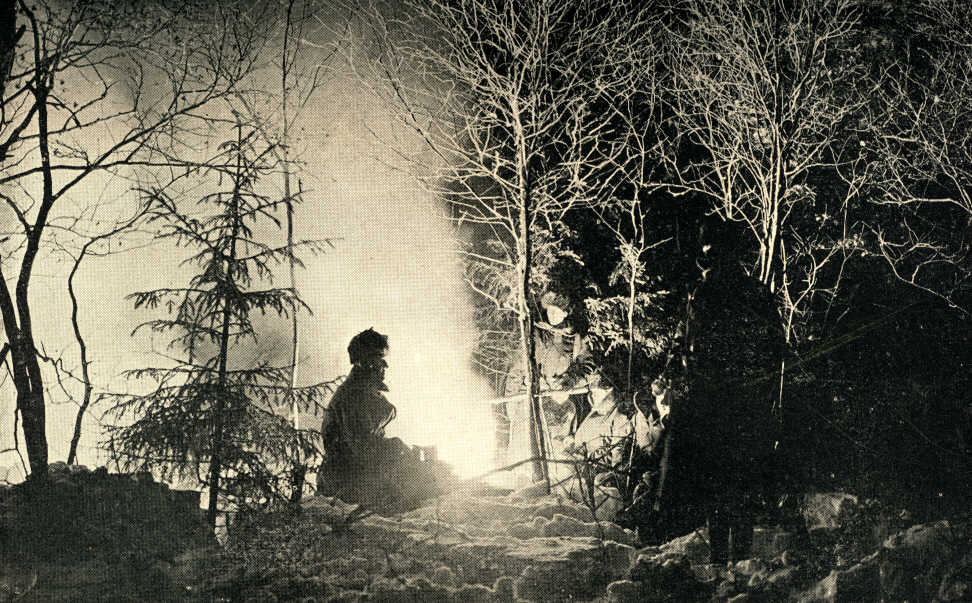
RED CROSS PHOTO
Flashlight of a Doughboy Outpost at Verst 455.
![[Illustration: ]](images/192Pic3A.jpg)
U.S. Official Photo
Bolo Commander’s Sword Taken in Battle of Bolsheozerki
![[Illustration: ]](images/192Pic3B.jpg)
U.S. Official Photo 158853
After Eight Days—Near Bolsheozerki
![[Illustration: ]](images/192Pic4A.jpg)
U.S. Official Photo
Wood Pile Strong Point—Verst 445
![[Illustration: ]](images/192Pic4B.jpg)
U.S. Official Photo 161108
Verst 455—“Fort Nichols”
![[Illustration: ]](images/192Pic2_A25.jpg)
WAGNER
Back from Patrol.
![[Illustration: ]](images/192Pic2_B25.jpg)
U S. OFFICIAL PHOTO
Our Shell Bursts Near Bolo Skirmish Line.
![[Illustration: ]](images/192Pic2_C25.jpg)
WAGNER
Blockhouse, Shred Makrenga.
XXIV
LETTING GO THE TAIL-HOLT
Preparing For Spring Defensive—River Situation Ticklish—Must Hold Till Our
Gunboats Can Get Up—“F” Company Crosses River On Cracking Ice—Canadian
Artillery Well Placed And Effectively Handled Holds Off Red Flotilla—Engineers
Help Clear Dvina With Dynamite—Joyful Arrival Of British Gunboat “Glow Worm”—We
Retake Ignatavskaya—Amusing Yet Dangerous Fishing Party—British Relief Forces
Arrive On Vaga—Toulgas Is Lost And Retaken—British-Russian Drive At Karpogora
Fails—Old White Guard Pinega Troops Hold Their City Against Red Drive
Again—Kodish And Onega Fronts Quiet—Railroad Front Active But No Heavy
Fighting—General Richardson Helps Us Let Go Tail-Holt.
Many an uncomfortable hour in the winter General Ironside and his staff
spent studying over the spring defense against the Reds. It was well
known that the snows would melt and ice would loosen on the distant
southern river valley heights and as customary the river from Kotlas to
Toulgas would be open to the Red gunboats several days before the ice
would be released in the lower river stretches, necessary to permit the
Allied fleets of gunboats to come in from the Arctic Ocean and go up to
help defend the advanced positions on the Dvina and Vaga upper river
fronts. It was feared that Red heavy artillery would blow our fortified
positions into bits, force our evacuation at a time when there was no
such thing as transportation except by the rivers. These would be for a
few days in control of the Reds. Thus our Americans and Allies who had
so gallantly reddened the snows with their stern defense in the winter
might find themselves at the mercy of the Reds.
Every effort was made to improve the shell-proof dugouts. Engineers and
doughboys slaved at the toil. Wire was hurried for the double apron
defenses on which to catch the mass attacks of the Bolsheviki. Supplies
were stored at every point for sixty days so that a siege could be
stood. And an Allied fleet was arranged to come as soon as the
icebreakers could get them through the choked-up neck of the White Sea.
And meanwhile the Canadian artillery was strengthened with the hope that
they could oppose the Red fleets and delay them till the river opened to
passage of the Allied fleets coming to save the troops.
The battle-worn veterans of “A” and “D” were strengthened by the men of
“F” Company who had come into the front lines in March and now were
bearing their full share and then some of the winter’s end defense
against the Red pressure. Cossack allies and Archangel regiments also
were added to the Russian quotas that had done service on those fronts
in the winter. Russian artillery units also were sent to Toulgas. In
every way possible these desperate fronts were prepared to meet the
heralded spring drive of the Red Guards.
As the ice and snow daily disappeared more and more Americans began
arranging “booby traps” and dummy machine gun posts in the woods. These
machine gun posts were prepared by fastening a bucket of water with a
small hole punched in the bottom above another bucket which was tied to
the trigger of a machine gun or rifle. The amount of water could be
regulated so as to cause the gun to fire at regular intervals of from
thirty minutes to an hour. Through the woods we strung concealed wires
and sticks attached to hand grenades, the slightest touch of which would
cause them to explode. Meanwhile in the rear, “B” Company Engineers, who
had relieved “A” Company Engineers, were busily engaged in stuffing gun
cotton, explosives and inflammable material in every building and shed
at Kitsa and Maximovskaya.
On April nineteenth the ice in the Vaga was heaving and cracking. Kitsa,
the doomed Kitsa, where the Yanks and Scots and Canadians alternately
had held on so many days, expecting any time another overwhelming
attack, was at this time being held by “F” Company. But the British
officer in command had delayed his order to evacuate till Captain Ramsay
was barely able to lead his men across. One more foolhardy day of delay
would have lost the British officer a company of much needed troops.
Sharp on the hour of midnight April 19th “F” Company silently withdrew
from the front line positions and started across the river, the ice of
which was already beginning to move. As they marched through the inky
darkness of the woods the dummy guns began discharging which kept the
enemy deceived as to our movements.
As the last man crossed the river a rocket went up as a signal to the
Engineers that “F” Company and the other infantry units had arrived
safely at Ignatavskaya. The following moment the entire surrounding
country shook to a series of terrific explosions both at Kitsa and
Maximovskaya and then a great red glare emblazoned the sky as the two
oil soaked villages burst into flame. The engineers quickly joined the
party and from then on until the following morning they continued in a
forced march back to prepared positions at Mala-Beresnik and Nizhni
Kitsa on opposite sides of the river about eight versts in rear of
Kitsa.
The positions here were a godsend after our experience of the past two
months in the open and exposed positions further up the river. Here for
more than two months hundreds of Russian laborers had been busily
engaged in stringing mile after mile of barbed wire about the positions
and constructed practically bomb-proof shelters. Furthermore, our
artillery commanded a good view of the river, which was all important,
for as the ice was now moving out we knew that the enemy gunboats would
soon come steaming down river with nothing but land batteries to stop
them since the mouth of the Dvina and the White Sea would not be free
from ice for several weeks to come, thus making it impossible for our
gunboats there to get down to these positions.
And the ice went out of the upper river with a crunching roar. The Reds
came on with their water attacks, but with little success. The Canadian
artillery was well prepared and so well manned that it beat the Red
flotilla badly. Fortunately the Bolo gunners were not as accurate as on
former occasions. So losses from this source were comparatively few.
The lower Dvina was unusually rapid in clearing this spring. The 310th
Engineers had assisted by use of dynamite. The Red army command had
counted on three weeks to press his water attacks. But by May tenth
gunboats had gone up the Dvina to help batter Toulgas into submission.
And when on May seventeenth Commander Worlsley of Antarctic fame went
steaming up the Vaga on board the “Glow Worm,” a heavily armed river
gunboat, the worries of the Americans in the battle-scarred Vaga column
were at an end.
With the gunboats now at their disposal the morale of all ranks was
greatly improved and it was thereupon decided to retake the position at
Ignatavskaya immediately across the river from Kitsa, which position was
held by the enemy, giving him the opportunity of sheltering thousands of
his troops there with his artillery on the opposite side of the river to
further protect them.
On the morning of May 19th several strong patrols went forward into the
woods in the direction of the enemy and quickly succeeded in gaining
contact with his outposts. The Bolo must have sensed some activity for
at 10:30 a. m. he commenced a violent artillery bombardment. Shortly
thereafter his airplanes came flying over our lines and machine-gunned
our trenches. The men had long since become so accustomed to this little
by-play that they gave it little consideration other than keeping well
under cover. Others even gave it less regard, as the following amusing
incident indicates:
During the shelling of that morning a great number of enemy shells
exploded in the river and these explosions immediately brought large
numbers of fish to the surface. The company cook, seeing such a splendid
opportunity to replenish the company larder, crawled down to the edge of
the river, jumped into a rowboat and soon was occupied in filling his
boat with fish, utterly disregardful of the intermittent shelling and
sniping. That evening, needless to say, the cook was the most popular
man in his company.
At 9:30 p. m. the boats brought down battalion after battalion of fresh
Russian troops from Zaboria who were landed near our positions under
cover preparatory to the attack on Ignatavskaya. It might be well to
mention here that at this time of the year the Arctic sun was
practically shining the entire twenty-four hours, only about midnight
barely disappearing below the rim of the horizon, making it dark enough
in the woods in the dull twilight to advance without observation. At
midnight the infantry pushed forward along the road toward the Bolo
outpost positions. American infantry also covered the opposite bank of
the river.
Our guns on the river in conjunction with the land batteries immediately
opened up with a terrific bombardment, shelling the Bolo positions for
twenty minutes until the infantry had gained the outposts of the village
and a few moments later when the barrage had lifted they entered
Ignatavskaya, which had been in the hands of the enemy for more than a
month. Our attack took the enemy clearly by surprise, for in the village
itself we found great numbers of enemy dead and wounded, who had been
caught under our curtain of fire from the artillery, and for the next
several days we were busy in bringing in other wounded men and prisoners
from the surrounding woods, estimated at more than two hundred alone.
We quickly consolidated the new position with our old ones and patiently
sat tight, awaiting the coming of the new British reinforcements, which
had by this time landed in Archangel. From this time on our fighting was
practically at an end on the Vaga River.
Over on the Dvina during the months of March and April, “B” and “C”
Company were still holding forth at Toulgas and Kurgomin far up the
river. They were daily employed in patrol and defensive duty. The Bolo
had acquired a healthy respect for these positions after his terrible
repulses on this front during the winter.
In fact, so strong was this position here that by April we had gradually
begun relieving American troops at Toulgas and supplanting them, about
five to one, by fresh Russian troops from Archangel, who subsequently
fell before the most vicious and deadly of all the enemy
weapons—Bolshevik Propaganda.
During the night of April 25 and 26, these Russian troops who had been
secretly conniving with the Red spies and agents, suddenly revolted,
turned their guns on their own as well as the British officers there,
and allowed the enemy lurking in the woods to walk unmolested into the
positions that months of shelling and storm attacks had failed to shake.
True, some of the Russians, especially the artillery men, remained loyal
and by superhuman efforts succeeded in withdrawing with some equipment
and guns to Shushuga on the same side of the river. Yorkshire troops and
machine gunners were quickly rushed up to bolster up these loyal men and
a few days later retribution swift and terrible was visited upon the
deserters and their newly made comrades.
Shortly prior to the defection of the troops in Toulgas, and unknown to
them, a battery of large six-inch guns had been brought up to the
artillery position at Kurgomin on the opposite side of the river, which,
with the guns already in position there, made it one of our strongest
artillery positions. The enemy was given ample time in which to fully
occupy the position at Toulgas, which he at once proceeded to do.
On the 26th day of April our artillery suddenly opened fire on Toulgas
and at the same time dropped a curtain barrage on the far side of the
village, making retreat practically impossible. During this time
thousands of shells of high explosive gas and shrapnel were placed in
the village proper with telling effect. Unable to go forward or back, we
inflicted enormous losses upon the enemy, and shortly thereafter the
loyal Russians, supported by English infantrymen, entered the village,
putting the remaining numbers to flight and once again Toulgas was ours.
With the settling of the roads and trails the enemy was able to mass up
forces and continue his harrying tactics but could make no impression on
the Allied lines. Americans were gradually withdrawn from the front
lines and Russians served along with the Liverpools and Yorks, who were
now looking every week for the promised volunteers from England who were
to relieve not only the Americans but the Liverpools and Yorks and other
British troops in North Russia. “F” Company was active in patrolling
during the month of May and reported last combat patrol with enemy near
Kitsa on May twentieth. This company of Americans had been the last one
to get into action in the fall and enjoyed the distinction of being the
last one to leave the front, leaving on June 5 for Archangel.
Meanwhile the spring drive of the Red Guards who had massed up near
Trufanagora on the Pinega River was menacing Pinega. After the Americans
had been withdrawn from that area in March for duty on another front,
Pinega forces under command of Colonel Deliktorski were augmented by the
previously mentioned “Charlie” Tschaplan, now a Russian colonel with
three companies, and supported by another section of Russian artillery.
Also an old British veteran of the Mesopotamian campaign, personal
friend of General Ironside, was sent out to Leunova to take command of
a joint drive at the Bolsheviki. He had with him the well-known Colonel
Edwards with his Asiatic troops, the Chinese coolies who had put on the
S. B. A. L. uniform, and a valorous company of British troops equipped
with skiis and sleds to make the great adventurous forest march across
the broad base of the big inverted V so as to cut the Reds off far in
their rear near Karpogora.
But that British-Russian adventure resulted disastrously. Two British
officers lost their lives and their troops were nearly frozen in the
woods and badly cut up by the Reds who had been all set for them with a
murderous battery of machine guns. Too late the British-Russian command
of the Pinega Valley found that the Americans had been right in their
strategy which had not failed to properly estimate the Bolo strength and
to properly measure the enormous labor and hardship of the cross-forest
snows. Again the enthusiastic and fearless but woefully reckless Russian
Colonel and English Colonel threw their men into death traps as they had
done previously on other fronts. With success in defense the Reds gained
their nerve back and again, as in December, January and February, began
a drive on Pinega.
Then the stoutness of the city’s White Guard defenses and their morale
was put to the test. “K” Company men at Kholmogori waited with anxiety
for the decision, for if Pinega fell then, Red troops would press down
the river to threaten Kholmogori, which, though safe from winter attack
because of the blockhouses built by American Engineers and doughboys,
would be at the mercy of the gunboats the Reds were reported to have
rigged up with guns sent over from Kotlas. But the Pinega artillery and
machine guns and the stout barricades of the Pelegor and Kuligor
infantrymen held out, though one of the gallant Russian officers, who
had won the admiration of the Americans in the winter by continuing
daily on duty with his machine gun company after he had been wounded
severely in the arm, now fell among his men.
Later Allied gunboats ascended the Pinega River and that area was once
more restored to safety. Spring thaw-up severed the Red communications
with Kotlas, which was on the Dvina. The Bolsheviki in the upper Pinega
could no longer maintain an offensive operation. Archangel was relieved
from the menace on its left.
With the Vaga and Dvina Rivers now so well protected by the naval forces
of the Allies, the Bolo drives up the Kodish-Seletskoe road were now no
longer of much strategic importance to them. In the latter part of the
winter they had hopes of themselves controlling the water. Then they had
put on drives at Shred Mekhrenga and at the Kodish front but with severe
losses and no gains. Now in the spring the warfare was reduced to combat
patrol actions with an occasional raid, most of the aggressive being
taken by our Allies, the Cossacks, and Russian Archangel troops.
On the Onega the spring was very quiet after the Reds withdrew their
huge force from Bolsheozerki April 19. They withdrew under cover of a
feinted attack in force on Volshenitsa, which was on the other flank of
the railroad force. With the opening of Archangel harbor the
Onega-Oborzerskaya road was no longer of so vital importance to us and
the Reds’ one savage thrust at it just at the close of winter, as
related already, was their last drive. “H” Company had a quiet time
during the remaining April and May days. And that company of men
deserved the rest.
On the railroad the coming of spring meant the renewal of activities.
For us it meant constant combat patrols and daily artillery duels.
However, the Bolshevik seemed to be discouraged over his failure at the
end of winter. His heralded May Day drive did not materialize. We
brought our Russian infantrymen and machine gunners up to the front
sectors, gradually displacing Americans until finally on May seventh
Major Nichols was relieved at Verst 455—it should have been
re-christened Fort Nichols—by Colonel Akutin, whose Russian troops took
over the active defense of the front, with the Americans at Obozerskaya
in reserve. At this place and at Bolsheozerki, “G”, “L”, “M”, “I”, and
“E” Companies in the order named at the end of May, together with
machine gun company platoons, were relieved by British and Russian
troops. American Engineers also withdrew from this front just about the
time that the First Battalion and “F” Company were embarking from
Beresnik and “K” Company was steaming out of Yemeskoe and Kholmogori for
Archangel. Most of the boys of the First Battalion had been up the river
for months and had never seen the streets of Archangel.
One of the interesting features of the spring defensive was the arrival
of General Wilds P. Richardson from France to take command of all
American forces during the remainder of the time we were in North
Russia. He arrived on a powerful ice-breaker which cut its way into
Archangel on April seventeenth. At that time we were still running
trains across the Dvina River on the railroad track laid on the ice, and
continued to do so for several days.
General Richardson, veteran of many years of service in Alaska,
immediately made his way to the various fronts. At Verst 455 on the
railroad he said in part to the soldiers assembled there for his
inspection:
“When I was detailed to come to North Russia, General Pershing,
Commander-in-Chief of the A. E. F., told me that he desired me to come up to
command the troops, help out if I could, and to cheer them up, as he had an
idea that you thought you had been overlooked and forgotten, and were not part
of the A. E. F. When I arrived here I found a telegram from General Pershing
stating briefly all that I could have said, more and, better, and I only want
to emphasize to you that which was sent out and published, that your comrades
in France have been doing wonderful work just as well as you have up here. Your
people are pleased and proud of you. They have not forgotten you, nor has the
A. E. F. in France. They want to see you come home as soon as you can, with the
right spirit and without any act by company or individual that you will be
ashamed of. You are here to do a certain duty, determined by the highest
authority in our country and in others of our Allies, and by the best minds in
the world in connection with this great war which we have been waging and were
drawn into through no fault of our own.
“While the 339th and other detachments that have come with them to perform a
share of the work in North Russia seemed far away and at times you perhaps felt
lonely and that you were not getting the same consideration, you still were as
much a part of the game, as far as forces stand, as any portion of the Western
Front.
“Remember, you are Americans in a foreign country taking part in a great game,
making history which will be written and talked of for generations, doing your
duty as best you can so as to maintain the highest standard that the Army has
attained in Europe.”
General Pershing’s telegram as transmitted to the Americans fighting the
Bolsheviki in, North Russia was as follows:
“Inform our troops that all America resounds with praise of the splendid record
that the American Expeditionary Forces have made. The reputation of the
American soldier for valor and for splendid discipline under the most trying
conditions has endeared every member of the Expeditionary Forces not only to
his relatives and friends but to all Americans. Their comrades in France have
not forgotten that the Americans in Northern Russia are part of the American
Expeditionary Forces, and we are proud to transmit to you the generous praise
of the American people. I feel sure that every soldier in Northern Russia will
join his comrades here in the high resolve of returning to America with
unblemished reputations. I wish every soldier in Northern Russia to know that I
fully appreciate that his hardships have continued long after those endured by
our soldiers in France and that every effort is being made to relieve the
conditions in the North at the earliest possible moment.”
The Americans had let go the tail holt. The spring defensive had been
surprisingly easy after the desperate winter defensive with the
persistently heralded threats of Trotsky’s Northern Army to punish the
invaders with annihilation. In fact, there was a suspicion that the Reds
were content to merely harry the Americans, but not to take any more
losses going against them, preferring to wait till they had gone and
then deal with the Archangel regiments of some twenty-five thousand and
the British troops coming out from England. Probably if the truth were
known Kolchak and Denikin were in the spring of 1919 taking much of
Trotsky’s attention. They were getting the grain fields of Russia that
the Reds needed, which was of more importance than the possession of the
Archangel province.
Then there was the political side of the case. The Peace Conference was
struggling with the Russian problem. Lenine and Trotsky could well
afford to deal not too violently and crushingly with the Allied troops
in the North of Russia while they were with both open and underground
diplomacy and propaganda seeking to get recognition of their rule.
Anyway, we found ourselves letting go that tail holt which in the winter had
seemed to be all that the Detroit News cartoonist pictured it, “H—- to
hang on, and death to let loose.” And we did not get many more bad scratches or
bites from the Bolo bob-cat.
![[Illustration: ]](images/200Pic_25.jpg)
“Come on home, Yank! What did you grab him for in the first place?”
“It is hell to hang on, but it’s death to let loose.”
The Hard Job Is To Let Go. From Detroit News.
XXV
THE 310TH ENGINEERS
Engineers Busy Right From Start—Seen On All Fronts—Great Aid To
Doughboys—Occasionally Obliged To Join Firing Line—Colonel Morris Gives
Interesting Summary Of Engineer Work—General Ironside Pays Fine Tribute To
310th Engineer Detachment.
The 310th Engineers went into quarters at Bakaritza, September 7th,
where it was said German agents two years before had blown up Russian
munitions even as they had blown many a dock in our own country. They
looked mournfully at the potato fields the retreating Bolos had robbed
and destroyed and they fished for the one hundred motor trucks said to
have been sunk in the Dvina River by the Reds, hoping to get the reward
offered by the British.
They fixed up their quarters, built sheds for the commissary and
quartermaster stores of the Americans and began preparations for their
construction work upon the Railroad and River fronts. On a dark night in
October one platoon crossed the Dvina in the storm thinking of G. W.
crossing the Delaware, and took station in Solombola and began building
“Camp Michigan.” The third week in October the engineers saw the Russki
sleighs running about, but then came an Indian Summer-like period. The
greater part of November was spent in making the Russian box cars
habitable for the soldiers and engineers on the Railroad front.
One American company on the railroad had hated to give up its
taploo-shkas which they had fitted up for quarters, to the British units
that had been weeks at Archangel while they were overworked at the front. But
Col. Stewart raised a fine hope. He ordered a detail of men from that company,
resting ten days at Archangel, to go to Bakaritza to assist the American
Engineers to make a protected string of troop taplooshkas for the company. And
while they were at it the engineers “found” an airplane motor and rigged up
electric lights for the entire train. They set up their tiny sheet iron stoves,
built there three tiers of bunks and were snug, dry, warm and light for the
winter. Some proud company that rode back to the front, feeling grateful to the
engineers.
It was zero weather when they went south just before Thanksgiving to
help build blockhouses and hospitals, Y. M. C. A. and so forth, on the
Railroad. Christmas found them at Obozerskaya holding mass in a Y. M. C.
A. to usher in the day. In January this Company “B” exchanged places
with “A” Company 310th Engineers, who had been further forward on the
railroad. There they constructed for Major Nichols the fine dugouts and
the heavy log blockhouses which were to defy the winter’s end drive and
the spring shelling of the Bolsheviki. On January 19th and 20th they
found themselves under shell fire but suffered no casualties.
In the latter part of February this “B” Company of Engineers responded
to the great needs for new defenses on the Vaga front, travelling by way
of Kholmogorskaya, Yemetskoe and Beresnik to reinforce the hard-working
engineers then assisting the hard-pressed doughboys fighting their
bitter retreat action.
They were building defenses at Kurgomin and getting ready for the
opening of the river when Toulgas fell, due to the treachery of the
disaffected Archangel Russian troops. They saw the ice go out of the
Dvina, April 26th, snap shot of which is shown, and witnessed the first
engagement between the British boat fleet and the Red fleet in May.
The greatest of camaraderie and loyalty were manifested between
engineers of the 310th and doughboys of the 339th. They have been mentioned
repeatedly in the narrative of battles and engagements. From the official
report of Lt.-Col. P. S. Morris, who commanded the 310th Engineer Detachment in
North Russia, we present the following facts of interest:
The 310th Engineers arrived in England, August 3rd, 1918. The First
Battalion, under Major P. S. Morris, was detached from the regiment by
verbal order of Major-General Biddle immediately upon arrival to
Cowshot Camp, Surrey, England, where we were equipped for the
expedition. We remained under canvas until August 26th, 1918, at which
time we entrained for Newcastle, England. On August 27th, the entire
command left England on board H. M. S. “Tydeus.” The mess and quarters
were clean and the food was good. The health of the men was exceptional,
as none of the men contracted influenza which was very prevalent on the
other three ships of the convoy. We anchored at Archangel on September
4th, 1918. and debarked on September 7th.
When detached from the 310th Engineers the entire Headquarters
detachment was taken with the Second Battalion, leaving this battalion
without a non-com staff for headquarters; even the Battalion
Sergeant-Major was taken, as we were told there was no place in the
table of organization for a battalion sergeant-major when the battalion
is acting separately. No extra officers were furnished us. Upon our
arrival it was found necessary to open an Engineer depot. Capt. William
Knight, Battalion Adjutant, was put in charge. Lieut. R. C. Johnson,
Company “C,” was detached from his company and assigned to duty as
Regimental Adjutant, Topographical Officer and Personnel Adjutant.
Lieut. M. K. Whyte, Company “B,” was assigned as Supply and
Transportation Officer. As the Northern Russian Expedition covers a
front of approximately five hundred miles and the 310th Engineers were
the only engineering troops with the expedition, the shortage of
officers was a very great handicap. It was necessary to put sergeants
first-class and sergeants in charge of sectors, with what engineers
personnel could be spared. The shortage of officers was not relieved
until April 17th, 1919, when six engineer officers reported.
All the engineering equipment went straight to France. We were
re-equipped in England with English Field Company tools. The English
table of organization does not include mapping or reconnaissance
supplies, which were purchased in small quantities in London.
Upon arrival, the battalion was placed under the direction of
Lieut.-Col. R. G. S. Stokes, C. R. E., Allied Forces, North Russia, for
Engineer operations and distributions of personnel. We remained under
command of Col. Stewart, 339th Infantry, senior American officer, for
all administrative matters.
There were very few engineers here at the time of our arrival and an
immense amount of work to be done at the base besides furnishing
engineer personnel for the forward forces in operation at the time. It
was decided to place one company at the front and the two companies at
the base until some of the important base work could be finished. “A”
Company was then ordered to the front and “B” and “C” Companies remained
at the Base. “B” Company at Bakaritza and “C” Company at Solombola.
On our arrival the forward forces consisted of three main columns or
forces known as “A” force, operating on the Archangel-Vologda Railroad,
with Obozerskaya as a base; “C” force, operating on the Dvina and Vaga
Rivers, with Beresnik as a base; and “D” force, with Seletskoe as a
base. It was necessary to attach engineers to each of these forces; so
one platoon of “A” Company, commanded by an officer, joined “A” force;
one sergeant and ten men joined “D” force, and the remainder of “A”
Company consisting of five officers and approximately one hundred eighty
men joined “C” force, where they were divided into small detachments
with each operating force.
The base work consisted mainly of construction of warehouses and billets
and operation of sawmills, street car systems, water works and power
plants. This work was divided among “B” and “C” Companies.
Later in the fall it became necessary to have two more columns in the
field, one on the Onega River with Onega as a base and one on the Pinega
River with Pinega as a base. By the time this became necessary, the rush
on base work was over and “B” Company was moved forward, having one
detachment of one sergeant and twelve men with “D” force and one platoon
with Onega River Column. The remainder of the company was doing
construction and fortification work on the lines of communication along
the railroad and roads to flanking forces.
In spite of our shortage of personnel and equipment, the morale of the
engineers has been the highest. They have gone about their work in a
most soldier-like manner and have shown extreme gallantry in the actions
in which they have participated.
The engineers were found on every front, as well as at Archangel, the
various sub-bases, the force headquarters of the various columns, and
also were found in winter at work on second and third line defenses.
They often worked under fire as the narrative has indicated. At night
they performed feats of engineering skill. Never was a job that appalled
or stumped them. They generally had the active and willing assistance of
the doughboys in doing the rough work with axe and shovel and wire. The
writers themselves have killed many a tedious hour out helping doughboy
and engineer chop fire lanes and otherwise clear land for the field of
fire.
Here is Colonel Morris’ summary of the engineer work done. This includes
much but not all of the doughboy engineering also. One thing the
engineers, doughboys and medics did do in North Russia was to
demonstrate American industry:
| Blockhouses (some of logs and some of lumber) | 316 |
| Machine gun emplacements | 273 |
| Dugouts | 167 |
| Double Apron Wire | 266,170 yards |
| Knife Rests (wire entanglement) | 2,250 yards |
| Concertinas (wire entanglement) | 485 |
| Barricades (some of earth, some logs) | 46 |
| Billets (mostly of lumber) | 151 |
| Standard Huts (of lumber) | 42 |
| Latrines | 114 |
| Washhouses (of lumber) | 33 |
| Warehouses (of lumber) | 30 |
| Stables (of lumber) | 14 |
| Clearing (fire lanes and field of fire) | 1,170 acres |
| Railroad Cars (lined and remodelled) | 257 |
| Rafts | 12 |
| Bridges (of lumber and of logs) | 4,500 lineal feet |
| Roads | 11,000 lineal yards |
| Trenches | 14,210 yards |
| Topography—total copies of maps and designs | 109,145 |
| Topography—plane table road traverses | 1,200 miles |
In connection with their mapping work engineers took many pictures,
several of which are included in this volume. All the mapping work of
the expedition was done by the American engineers. See the one in this
volume.
The longest bridge constructed was the 280-foot wooden bridge which
spanned the Emtsa River. At Verst 445, close to No Man’s Land, a
sixty-foot crib bridge was constructed by Lieut. W. C. Giffels. This
work was completed in two nights and was entirely finished before the
enemy knew that an advance was anticipated. Not a single spike or bolt
was driven on the job. Railway spikes were driven into the ties behind
our own lines and ties carried up and placed. Finally the rails were
forced in under the heads of the spikes and were permanently fastened.
In this district there are three types of road—mail roads, winter
roads, and trails. The mail roads are cleared about eighty feet wide
through the woods. An attempt has been made at surfacing and ditching,
and the bad places corduroyed. The winter roads are cleared about twenty
feet wide. Wherever possible they go through forestry clearings, swamps
and lakes, or down rivers. For this reason they can only be used after a
solid freeze-up. The trails are only cleared about six feet wide and are
often impassable for a horse and sleigh. Approximately four and one-half
miles of road have been corduroyed by this regiment, and a considerable
part of the front line roads were drained.
This battalion was called upon for a great diversity of work, which it
would have been impossible to do had not the men been carefully selected
in the United States. Company “C” was called upon to help operate the
Archangel power plant and street railway system the day they arrived.
This they were able to do very successfully.
Shortly afterwards they raised and spliced a submerged power cable, used
for conducting electricity under the river; one platoon was on railroad
maintenance and construction work; and one platoon operated the saw
mill. All the companies have been in action and have done construction
work under fire.
Two main features have governed all our construction work; first, the
large supply of timber, and second, the very cold climate. All of our
barracks, washhouses, latrines, blockhouses, and stables, were designed
to use available timber stocks. For a form of rapid construction we used
double walls six inches apart and filled the spaces with sawdust. This
proved very satisfactory and much faster than the local method which
calls for a solid log construction.
The supply of engineer material has presented many problems of
difficulty and interest. The distance to the nearest home base, England,
was two to three weeks voyage. The port was not opened to supplies until
after the 1st of June. Coupled with the necessary reshipment to the
various fronts by barge and railway before the freeze-up, this caused a
tremendous over-crowding of the dockage and warehouse facilities. The
congestion and inevitable confusion at the port and warehouses has
sometimes made it impossible to ever ascertain what had arrived.
The local stocks of engineer materials are limited to what can be found
in Archangel itself and in the subsidiary ports of Economia and
Bakaritza. In 1916 and 1917, tremendous stocks of all sorts of war
material were to be found here, mostly brought from England and destined
for the Rumanian and Russian fronts. In the spring of 1918, the
Bolsheviks, anticipating the Allies landing, moved out to Vologda and
Kotlas as much as they could rush out by the railway and river, and on
the arrival of the first troops here not more than five per cent of the
military material still remained.
The materials of most use to the engineers, which still remained, were
forty thousand reels of barb wire and cable. A large amount of heavy
machinery was also left behind, from which we have been able to locate
and put in use a considerable number of various sized electric
generators. A dozen complete searchlight sets, somewhat damaged by
weather, were among this equipment. We overhauled these and used them
for night construction work and also used several of the generator units
of these sets to illuminate the headquarters train, work train, and
hospital trains employed on the railway front.
The problem of transportation was one of the most difficult for us to
contend with. The rail and road situations have already been explained.
The country is very short of horses, the best specimens having long
since been mobilized in the old Russian Army.
With motor transportation, the situation is no better. The Bolsheviks
evacuated the best cars to Vologda before the arrival of the expedition
and it is alleged that most of those they did not get away, were run
into the Dvina River. The few trucks that did remain behind were in
wretched condition. The British turned over two Seabrook trucks to us.
We made all repairs and furnished our own drivers. In addition to these
two trucks, the battalion supply officer secured five more, four
independently. The owners were willing to give them to us, without cost,
in order to forestall their being requisitioned by the Russian Motor
Battalion. The condition of these trucks was poor. During the
construction of the “Michigan” Barracks, the transportation was so
inadequate that we were compelled to run both night and day. Through our
control of the Makaroff sawmill, we had two tug-boats belonging to the
mill, but it was only rarely that we could use them for other purposes.
It was a fine record our comrades, the engineers, made in the
expedition. As the ribald old marching song goes:
“Oh, the infantry, the infantry, with dirt behind their ears,
The infantry, the infantry, that drink their weight in beers,
Artillery, the cavalry, the doggoned engineers,
They could never lick the infantry in a hundred thousand years.”
But just the same the doughboy was proud to see the 310th Engineers
cited as a unit by General Ironside who called the 310th Engineers the
best unit, bar none, that he had ever seen soldier in any land. He knows
that without the sturdy and resourceful engineer boys with him in North
Russia the defense against the Bolshevik army would have been
impossible.
XXVI
“COME GET YOUR PILLS”
Medical Units Do Fine Work—Volunteers Of Old Detroit Red Cross Number Eight
Appear In North Russia As 337th Ambulance—Some Unforgettable Stories That Make
Our Teeth Grit—Wonderful Work Of 337th Field Hospital Unit—Death Of
Powers—Medical Men Do Heroic Duty.
Owing to the nature of the country in which the campaign was fought, the
337th Ambulance Company was not able to function as an ambulance company
proper. It was split up into fifteen detachments serving in various
parts of the area under conditions exactly as difficult as those
described for the medical and hospital units. In fact, the three
companies of men—medical, hospital, and ambulance—who ministered to
the needs of the wounded and sick were very soon hopelessly mixed up on
the various fronts.
At first among the officers there were some heart-burnings as to the
apparent incongruity of a hospital man doing field duty and an ambulance
man doing hospital duty and so forth, but their American sense of humor
and of humanity soon had each doing his level best wherever he might be
found, whether under American or British senior officers or none. The
writer remembers many a medical—or was he hospital or ambulance—man
that did effective and sympathetic field service to wounded comrades
with no medical officer to guide the work.
The 337th Ambulance Company was originally a volunteer outfit known as
No. 8 Red Cross Ambulance Company of Detroit. Early in the history of
the 85th Division it came to Camp Custer and was trained for duty
overseas. After a month in the Archangel field several national army men
were transferred to fill up again its depleted ranks.
It was the commanding officer of this Ambulance Company, Captain
Rosenfeld, who, though too strict to be popular with his outfit, was
held in very high esteem by the doughboys for his vigilant attention to
them. It was a sight to see him with his dope bottle of cough syrup
going from post to post dosing the men who needed it. He will not be
forgotten by the man who was stricken with acute appendicitis at a post
where no medical detachment was stationed. He commandeered an engine and
box car and ran out to the place and took the man into the field
hospital himself and operated inside an hour, saving the man’s life. For
his gallantry in going to treat wounded men at posts which were under
fire, the French commander remembered him with a citation. He is the
officer whom the Bolshevik artillery tried to snipe with three-inch
shells, as he passed from post to post during a quiet time at Verst 445.
At Yemetskoe in February, one night just after the terrible retreat from
Shenkursk, forty wounded American, British, and Russian soldiers lay on
stretchers on the floor in British field hospital. They were just in
from the evacuation from Shenkursk front, cold and faint from hunger.
There was no American medical personnel at that village. They were all
at the front. Mess Sgt. Vincent of “F” Company went in to see how the
wounded soldiers were getting along. He was just in time to see the
British medical sergeant come in with a pitcher of tea, tin cups, hard
tack, and margarine and jam. He put it on the floor and said; “Here is
your supper; go to it.”
Sgt. Vincent protested to the English sergeant that the supper was not
fit for wounded men and that they should be helped to take their food.
The British sergeant swore at him, kicked him out of the hospital and
reported him to the British medical officer who attempted, vainly, to
put the outraged American sergeant under arrest.
Sergeant Vincent then reported the matter to Captain Ramsay of “F”
Company, who ordered him to use “F” Company funds to buy foods at the
British N. A. C. B. canteen. This, with what the Y. M. C. A. gave the
sergeant, enabled him to feed the American and Russian wounded the day
that they rested there. This deed was done repeatedly by Mess Sgt.
Vincent during those dreadful days. In all, he took care of over three
hundred sick and wounded Americans and Russians that passed back from
the fighting lines through Yemetskoe.
Doughboys at Seletskoe tell of equally heartless treatment. There at 20
degrees below zero they were required one day to form sick call line
outside of the British medical officer’s nice warm office. This was not
necessary and he was compelled to accede to the firm insistence of the
American company commander that his sick men should not stand out in the
cold. That was only one of many such outrageous incidents. And the
doughboys unfortunately did not always have a sturdy American officer
present to protect them as in this case.
Corporal Simon Bogacheff states that he left Archangel December 8th or
9th with seventy-three other wounded men and “flu” victims. After
fifteen days the “Stephen” landed at Dundee after a very rough voyage in
the pitching old boat. He had to buy stuff on the side from the cooks as
he could not bear the British rations. Men were obliged to steal raw
potatoes and buy lard and fry them. The corporal, who could talk the
Serbian language, fraternized with them and gained entrance to a place
where he could see English sergeants’ mess. Steaks and vegetables for
them and cases of beer.
Alfred Starikoff of Detroit states that he was sent out of Archangel in
early winter suffering from an incurable running sore in his ear. He
boarded an ice-breaker at the edge of the frozen White Sea. After a
four-hour struggle they cleared the icebound shore and made the open
sea, which was not open but filled with a great floe of polar ice. At
Murmansk he was transferred to a hospital ship and then without
examination of his ear trouble was sent to shore. There he put in five
protesting weeks doing orderly work at British officers’ quarters.
Finally he was allowed to proceed to England, Leith, Liverpool,
Southampton, London, Notty Ash, and thence to Brest, thence to the U. S.
in May to Ford Hospital. The delay in Murmansk did him no good. American
veterans of the campaign know that this is not the only case of where
sick and wounded doughboys were delayed at Murmansk, once merely to make
room for British officers who were neither wounded nor sick. Let Uncle
Sam remember this in his next partnership war.
![[Illustration: ]](images/208Pic1_A25.jpg)
ROULEAU
Hot Summer Day at Pinega Before War.
![[Illustration: ]](images/208Pic1_B25.jpg)
DOUD
Dvina River Ice Jam.
![[Illustration: ]](images/208Pic1_C25.jpg)
WAGNER
Mejinovsky—Near Kodish.
![[Illustration: ]](images/208Pic2_A25.jpg)
MCKEE
Bolo General Under Flag Truce Near 445—April 1919.
![[Illustration: ]](images/208Pic2_B25.jpg)
U. S. OFFICIAL PHOTO
After a Prisoner Exchange Parley.
Only on the Pinega front did the American medical officer enjoy free
action. An interesting story could be told of the American hospital and
the two Russian Red Cross (local) hospitals and the city civil hospital
which were all under control of Capt. C. R. Laird, the red-haired, where
he had any, unexcitable old doctor from Nebraska, who treated one
hundred and fourteen wounded Russian soldiers in one night.
And a romantic thread in the narrative would be the story of Sistra
Lebideva, the alleged Bolshevik female spy, who was released from prison
in Pinega by the American commanding officer and given duty as nurse in
the Russian receiving hospital. She was a trained nurse in an apron, and
a Russian beauty in her fine clothes. The Russian lieutenant who acted
as intelligence officer on the American commander’s staff in
investigating the nurse’s case, fell hopelessly in love with her. An
American lieutenant, out of friendship for the Russian officer, several
weeks later took the nurse to Archangel disguised as a soldier. Then the
Russian lieutenant was ordered to Archangel to explain his conduct. He
had risked his commission and involved himself in appearances of
pro-Bolshevism by disobeying an order to send the suspected nurse in as
a
spy. He had connived at her escape from her enemies in Pinega, who, when
the Americans left, would have ousted her from the hospital and thrust
her back into prison. He was saved by the intercession of the American
officer and she was set free upon explanations. But the romance ended
abruptly when Sistra Lebideva threw the Russian lieutenant over and went
to nurse on another front where later the Russians turned traitor.
The 337th Field Hospital Company was trained at Camp Custer as a part of
the 310th Sanitary Train, was detached in England and sent to North
Russia with the other American units. It was commanded by Major Jonas
Longley, Fond du Lac, Wisconsin, who till April was the senior American
medical officer. The enlisted personnel consisted of eighty men.
The first duty of the unit in Russia was caring for “flu” patients. It
went up the Dvina River to Beresnik on September 22nd, taking over a
Russian civilian hospital, Three weeks later the hospital barge dubbed
“The Michigan” came up from Archangel with the “B” section of Field
Hospital Company. Five days later this section of the field hospital
proceeded by hospital sidewheeler to Shenkursk and took over a large
high school building for a permanent field hospital. Here the unit gave
service to the one hundred and fifty cases of “flu” among the Russians.
This was where Miss Valentine, the English girl who had been teaching
school for several years in Russia, came on to nurse the Russians during
the “flu” and later became very friendly with the Americans, and was
accused of being a Bolshevik sympathizer, which story is wound all
around by a thread of romance clean and pretty.
During the Bolo’s smashing in of the Ust Padenga front and the
subsequent memorable retreat from Shenkursk this section of field
hospital men had their hands full. It was in the field hospital at
Shenkursk that the gallant and beloved Lt. Ralph G. Powers of the
Ambulance Corps died and his body had to be left to the triumphant
Bolos. Powers had been mortally wounded by a shell that entered his
dressing station at Ust Padenga where he was alone with six enlisted
men. His wounds were dressed by a Russian doctor who was with the
Russian company supporting “A” Company. Lt. Powers had gone to the
railroad front in September, shifted to the Kodish front during severe
fighting, and then to the distant Shenkursk front. He was never relieved
from front line duty, although three medical officers at this time were
in Shenkursk. Capt. Kinyon immediately sent Lt. Katz to Ust Padenga upon
the loss of Powers, who will always be a hero to the expeditionary
veterans.
It was at Ust Padenga that Corp. Chas. A. Thornton gave up his chair to
a weary Supply Company man, Comrade Carl G. Berger, just up from
Shenkursk with an ambulance, and a Bolo three-inch shell hurled through
the log wall and decapitated the luckless supply man. In the hasty
retreat the hospital men, like the infantry men, had to abandon
everything but the clothes and equipment on their backs.
During the holding retreat of the 1st Battalion of the Vaga a small
hospital was established temporarily at Kitsa.
Later during the slowing up of the retreat, hospitals were opened at Ust
Vaga and Osinova. Here this section stayed. The other section had been
at Beresnik all the time. During the latter days of the campaign the
field hospital company took over the river front field medical duties so
that the medical detachments of the 339th and the detachments of the
337th Ambulance Company could be assembled for evacuation at Archangel.
And the 337th Field Hospital Company itself was assembled at Archangel
June 13th and sailed June 15th. Their work had for the most part been
under great strain in the long forest and river campaign, always seeing
the seamy side of the war and lacking the frequent changes of scenery
and the blood-stirring combats which the doughboy encountered. It took
strong qualities of heart and nerve to be a field hospital man, or an
ambulance or medical man.
XXVII
SIGNAL PLATOON WINS COMMENDATION
Learning Wireless In A Few Weeks—Sterling Work Of Field Buzzers—With Assaulting
Columns—Wires Repaired Under Shell Fire—General Ironside’s Commendatory
Official Citation.
In the North Russian Expedition the doughboy had to learn to do most
anything that was needful. A sergeant, two corporals and four men of the
Headquarters Company Signal Platoon actually in four months time
mastered the mysteries of wireless telegraphy. This is usually a year’s
course in any technical school. But these men were forced by necessity
to learn how to receive and to send messages in a few weeks’ time.
They were trained at first for a few days at Tundra, the wireless
station used by the British and French for intercepting messages. Later
at Obozerskaya and at Verst 455 they gained experience that made them
expert in picking messages out of the air. At one time the writer was
shown a message which was intercepted passing from London to Bagdad. It
was no uncommon thing for a doughboy to intercept messages from Egypt or
Mesopotamia and other parts of the Mediterranean world, from Red Moscow,
Socialist Berlin, starving Vienna and from London.
At one period in the spring defensive of the Archangel-Vologda Railroad,
this American wireless crew was the sole reliance of the force, as the
Obozerskaya station went out of order for a time, and the various
points, Onega, Seletskoe and Archangel were kept in communication by
this small unit at Verst 455. “H” Company men will recall that out of
the blue sky from the east one day came a message from Major Nichols
asking if their gallant leader, Phillips, had any show of recovering
from the Bolo bullet in his lung. The message sent back was hopeful.
The record of the signal platoon under Lieutenant Anselmi, of Detroit,
shows also that several of these signal men rendered great service as
telegraphers. One of the pleasant duties of the doughboy buzzer
operators one day in spring was to receive and transmit to Major J.
Brooks Nichols the message from his royal majesty, King George of Great
Britain and Ireland, that for gallantry in action he had been honored
with election to the Distinguished Service Order, the D. S. O.
But it is the field telephone men who really made the signal platoon its
great reputation. General Ironside’s letter of merit is included later
in this account. Here let us record in some detail the work of the
American signal platoon.
Thirty men maintained nearly five hundred miles of circuit wire that lay
on the surface of the ground and was subject in one-third of that space
to constant disruption by enemy artillery fire and to constant menace
from enemy patrols. The switchboard at Verst 455 was able to give thirty
different connections at once at any time of day or night; at 448, ten;
and at 445, six. This means a lot of work. The writer knows that the
field telephone man is an important, in fact, invaluable adjunct to his
forces whether in attack or in defense. For when the attack has been
successful and the officer in command wishes to send information quickly
to his superior officer asking for supplies of ammunition or for more
forces or for artillery support to come up and assist in beating off the
enemy counter-attack, the field telephone is indispensable. Hence the
doughboy who carries his reels of wire along with the advancing skirmish
line shares largely in the credit for doing a job up thoroughly. At the
capture of Verst 445 the signal men were able to talk through to Major
Nichols at 448 within four minutes of the time the doughboys’ cheers of
victory had sounded! And within fifteen minutes a line had been extended
out to the farthest point where doughboys were digging in. There they
were able later to give the artillery commander information of the
effect of his shells long before he could get his own signals into place
for observation. The British signals were good, but, as the writers well
recall, it was especially assuring when the buzzer sounded to have an
American doughboy at the other end say he would make the connection or
take the message. They never fell down on the job.
General Ironside’s commendation is not a bit too strong in its praises
of the signal platoon. We are glad to make it a part of the history, and
without doubt all the veterans who read these pages will join us in the
little glow of pride with which we pass on this official citation of the
Commanding General’s, which is as follows:
“The Signal Platoon of the 339th Infantry, under Second Lieutenant Anselmi, has
performed most excellent work on this front. Besides forming the Signals of the
Railway Detachment, the platoon provided much needed reinforcements for other
Allied Signal Units, and the readiness with which they have co-operated with
the remainder of Allied Signal Service has been of the greatest service
throughout.
“Please convey to all ranks of the platoon my appreciation of the services they
have rendered.”
(Signed) E. IRONSIDE, Major-General,
Commander-in-Chief, Allied Forces, Archangel, Russia.
G. H. Q., 23rd May, 1919.
And our American commander, General Richardson, in transmitting the
letter through regimental headquarters said, “Their work adds further to
the splendid record made by American Forces in Europe.”
XXVIII
THE DOUGHBOY’S MONEY IN ARCHANGEL
Coin And Paper Of North Russia—Trafficking In Exchange—New Issue Of Paper
Roubles—Trying To Peg Rouble Currency—Yanks Lose On Pay Checks Drawn On British
Pound Sterling Banks.
The writer has a silver Nicholas the Fifth rouble. It is one of the very
few silver coins seen in Russia. Here and there a soldier was able to
get hold of silver and gold coins of the old days, but they were very
scarce. The Russian peasant had to feel a high degree of affection for
an American before he would part with one of his hoarded bits of real
money.
Of paper money there was no end. When the Americans landed, they were
met by small boys on the streets with sheets of Archangel state money
under their arms. The perforations of some Kerenskies were not yet
disturbed when great sheets and rolls of it were taken from the bodies
of dead Bolos. Everybody had paper money. The Bolsheviki were
counterfeiting the old Czar’s paper money and the Kerensky money and
issuing currency of their own. The Polar Bear and Walrus 25-rouble notes
of Archangel and their sign-board size government gold bond notes were
printed in England, as were later the other denominations of Archangel
roubles, better known as British roubles. Needless to say there was a
great speculation in money and exchange. Nickolai and Kerensky and
Archangel and British guaranteed roubles tumbled over one another in the
market. Of course trafficking in money was taboo but was brisk.
Early the Yankee got on to this game. His American money was even more
prized than the English or French. The Russian gave him great rolls of
roubles of various sorts for his greenbacks. Then he took the good money
on the ships in the harbor and bought, usually through a sailor, boxes
of candy and cartons of cigarettes and,—whisper this, bottles and cases
of whiskey of which thousands of cases found their way to Archangel. The
Russian then went out into the ill-controlled markets and side streets
of Archangel and sold to his own countrymen these luxuries at prices
that would make an American sugar profiteer or bootlegger seem a piker.
Meanwhile the Yank or Tommie or Poilu went to his own commissary or to
the British Navy and Army Canteen Bureau, “N. A. C. B.” to the
doughboy’s memory, or to our various “Y” canteens and at a fixed rate of
exchange—a rate fixed by the bankers in London—to use his roubles in
buying things. He could also use the roubles in buying furs and skins of
the Russians who still had the same saved from the looting Bolsheviki.
At the rate first established, an English pound sterling was
exchangeable for forty-eight roubles and vice versa. But on the illicit
market, the pound would bring anywhere from eighty to one hundred and
forty roubles. The American five dollar bill which was approximately
worth fifty roubles in this “pegged” rouble money on the market when an
American ship was in the harbor, would bring one hundred to one hundred
and fifty roubles. No wonder the doughboy who was stationed around
Archangel or Bakaritza found it possible to stretch his money a good
way. Many a dollar of company fund was made to buy twice as much or more
than it otherwise would have bought. And in passing, let it be remarked
that the Yank who had access to N. A. C. B. and other canteen stores was
not slow in joining the thrifty Russki in this trafficking game, illicit
though it was. And truth to tell, many a case of British whiskey was
stolen by Yank and Tommie and Russki and Poilu and sent rejoicing on its
way through these devious underground channels of traffic. One American
officer in responsible position had to suffer for it when he returned to
the States. The doughboys and medics and engineers who were up there are
still filled with mixed emotions on the subject, a mixture of
indignation and admiration.
“Let him now who is guiltless throw the first stone.”
Returning to the discussion of currency, let it be recorded that after
the market was flooded with all sorts of money and after the ships
stopped coming because of the great ice barrier, the money market became
wilder than ever. Finally the London bankers who had been the victims of
this speculation, decided upon a new issue of pegged currency. At forty
to the pound the old roubles were called in. That is, every soldier who
had forty-eight roubles could exchange them for forty new crisp and
pretty roubles. Their beauty was marred by the rubber stamp which was
put over the sign of old Nicholas’ rule, which the thoughtless or
tactless London money maker printed on the issue. The Russian would have
none of this new money with that suggestion of restoration of Czar rule.
Inconsistently enough they still prized the old Nickolai rouble notes as
the very best paper currency in the land, and loud was the outcry at
giving forty-eight Nickolais for forty English-printed and guaranteed
roubles of their own new Archangel government.
To stimulate the retirement of all other forms of currency, which
measure in a settled country would have been a sensible economic
pressure, the Archangel government set a date when not forty-eight but
fifty-six roubles might be exchanged for forty new roubles. Then a date
for sixty-four, then for seventy-two and then eighty. Thus the skeptical
peasant and the suspicious soldier saw his old roubles steadily decline
in exchange value for the new roubles. Of course they had always grabbed
all the counterfeit stuff and used it in exchange with no compunctions.
That was the winning part of the game. Now they were pinched. It
afforded some merriment to hear the outcries of some who had been making
rolls of money in the trafficking.
At the same time there was real suffering on the part of peasants in far
distant areas who could not get their currency up for exchange or for
stamping and punching which itself was finally necessary to even get the
eighty-forty rate. They felt mistreated. To their simple hearts and
ignorant minds, it was nothing short of robbery by the distant London
bankers. Soldiers on the far distant fronts were caught also in the
currency reform. Some of the fault was neglect by their own American
officers and some was indifference to the subject by those American
officers at Archangel who were in position to know what was going to be
the result of the attempt to peg the currency at a fixed rate.
An officer who was in Archangel during the summer on Graves Commission
service after the American units had been withdrawn, reports that
speculators for a song bought up great bales of the old Kerensky and
Nickolai currency supposed to be cancelled, dead, defunct stuff, and
when there was a considerable evacuation of central Russians who had
been for months refugees in Archangel, this currency came out of hiding,
and its traffickers realized a handsome profiteerski by selling it to
the returning people at sixty to the pound sterling, for in interior
Russia the old stuff was still in circulation. At any rate that was
Shylokov’s advertisement. During the summer, the money market, says
Lieut. Primm, became a violent wonder. On one day a person could not
obtain two hundred and fifty roubles for one hundred North Russian
roubles and a day or two later he might be importuned to take three
hundred old for one hundred new.
Neither the soldiers nor the Russians saw any justice in this
flip-flopping of the currency market, to which of course they themselves
were contributors. The thing they saw clearly was that when they had
need of English credit (that is, checks) to send money to London banks
or when they wanted to buy goods from England or America, then they
could buy only with the new, the guaranteed rouble, which might be dear,
even at one hundred and twenty-five to the pound sterling and was dearer
of course in terms of old roubles, the more the demand was for the new
roubles which were in the hands of speculators who manipulated the
market as sweetly for themselves as the American profiteers with their
oral and written advertisements manipulate our foodstuffs and goods for
us. On the other hand, if the soldier or peasant or small merchant had
dues coming to him in English money he then found them valued at forty
to the pound sterling. This difference between eighty and one hundred
and twenty-five he thought (naturally enough to his unsophisticated
mind) was due to the vacillation in policy of enforcement of the pegged
rate and prosecution of the traffickers.
However opinion may differ as to the blame for the inability to peg the
exchange, we know it was a bonanza to the speculators. Ponzi ought to
have been there to compete with the whiskered money sharks. And we know
there were Americans as well as British, French, Russians and other
nationals who were numbered among those speculators.
After all is said we must admit that the money situation was one that
was exceedingly difficult to handle. It was infinitely worse in
Bolshevikdom. The doughboy who used to find pads of undetached
counterfeit Kerenskie on the dead Bolsheviks, can well believe that
thirty dollars of good American chink one day in the Soviet part of
Russia bought an American newspaper man one million paper roubles of the
Lenine-Trotsky issue, and that before night, spending his money at the
famine prices in the worthless paper, he was a dead-broke millionaire.
During the time American soldiers were in Russia they were paid in
checks drawn on London. During the war, this was at the pegged rate
($4.76-1/4) which had been fixed by agreement between London and New
York bankers to prevent violent fluctuations. But at the end of the war,
after the Armistice, the peg was pulled and the natural course of the
market sent the pound sterling steadily downward, as the American dollar
rose in value as compared with other currencies of the world. To those
who were dealing day by day this was all in the game of money exchange.
But to the soldier in far-off North Russia who had months of pay coming
to him when he left the forests of the Vaga and Onega this was a real
financial hardship. Many a doughboy whose wife or mother was in need at
home because of the rapidly mounting prices put up by the slackers in
the shops and the slackers in the marts of trade, now saw his little pay
check shrink up in exchange value. He felt that his superior officers in
the war department had hardly looked after his interests as well as they
might have done. Major Nichols did succeed at Brest in getting the old
pegged rate for the men and officers, but many had already parted with
the checks at heavy discount for fear that the nearer they got to the
land for which they had been fighting, the more discount there would be
on the pay checks with which their Quartermaster had paid them their
pittances. Soldiers of the second detachment came on home with Colonel
Stewart to Camp Custer and were obliged (most of them) to take their
little $3.82 per pound sterling of the British pound sterling paid them
by Quartermaster Major Ely in North Russia, at $4.76-1/4. Later, through
the efforts of the late Congressman Nichols, many of those soldiers were
reimbursed. Of course complete restitution would have been made by the
war department if all the soldiers had sent their claims in. Hundreds of
American veterans of the North Russian campaign lost ten to twenty per
cent of their pay check’s hard earned value.
XXIX
PROPAGANDA AND PROPAGANDA AND—
Propaganda Two-Edged Tool—From Crusaders To Carping Cynics—Be Warned—Afraid To
Tell The Truth—Startling Stories Of Bolo Atrocities Published—Distortion
Disgusts Brave Men—Wrong To Play On Race Prejudices—Our Own Government Missed
Main Chance—Doughboy Beset By Active Enemy In Front And Plagued By Active
Propaganda Of Hybrid Varieties—Sample Of Bolshevik Propaganda Used On
Americans—Yanks Punched Holes In Red Propaganda—Propaganda To Doughboy Connotes
Lies And Distortion And Concealment Of Truth.
“Over there, over there, the Yanks are coming,” sang the soldiers in
training camp as they changed from recruits into fighting units of the
85th Division at Battle Creek. And the morale of the 339th was
evidenced, some thought, by the fervor with which the officers and men
roared out their hate chorus, “Keep your head down, you dirty Hun. If
you want to see your father in your Fatherland, Keep your head down, you
dirty Hun.” Maybe so, maybe not. Maybe morale is made of finer stuff
than hate and bombast. Maybe idealism does enter into it. Of course
there are reactionary periods in the history of a people when
selfishness and narrowness and bigotry combine to cry down the
expression of its idealism. Not in 1918.
No secret was made of the fact that the Americans went into the war with
a fervor born of an aroused feeling of world-responsibility. We must do
our part to save Christian civilization from the mad nationalism of the
German people led by their diabolic Hohenzollern reigning family and war
bureaucracy. Too much kultur would ruin the world. Germany must be
whipped. We tingled with anticipation of our entrance to the trenches
beside the bled-white France. We were going “Over There” in the spirit
of crusaders.
What transformed a hesitating, reluctant, long-suffering people into
crusaders? Propaganda. Press work. Five-minute men. Open and secret
work. It was necessary to uncover and oppose the open and secret
propaganda of paid agents of Germany, and woefully deluded
German-Americans who toiled freely to help Kaiser Bill, as though to
disprove the wisdom of the statement that no man can serve two masters.
We beat their propaganda, uncovered the tracks of the Prussian beast in
our midst, found out, we thought, the meaning of explosions and fires
and other terrible accidents in our munition plants, and turned every
community into vigilant searchers for evidences of German propaganda or
deviltry of a destructive kind and we persecuted many an innocent man.
And now we sadly suspect that in fighting fire with fire, that is in
fighting propaganda with propaganda, we descended by degrees to use the
same despicable methods of distorting truth for the sake of influencing
people to a certain desired end. England and France and all other
countries had the same sad experience. Doubtless we could not very well
avoid it. It is part of the hell of war to think about it now.
Propaganda, fair one, you often turn out to be a dissipated hag, a camp
follower.
Many years from now some calm historian going over the various Blue Books and
White Books and Red Books, with their stories of the atrocities of the enemy,
ad nauseam, will come upon the criminating Official Documents of various
nations that sought to propagandize the world into trembling, cowering belief
in a new dragon. Bolshevism with wide-spread sable wings, thrashing his spiny
tail and snorting fire from his nostrils was volplaning upon the people of
earth with open red mouth and cruel fangs and horrid maw down which he would
gulp all the political, economic and religious liberties won from the centuries
past. The dragon was about to devour civilization.
And the historian will shake his head sadly and say, “Too bad they fell
for all that propaganda. Poor Germans. Poor Britishers. Poor Frenchmen.
Poor Russians. Poor Americans. Too bad. What a mess that propaganda was.
Propaganda and propaganda and—well, there are three kinds of propaganda
just as there are three kinds of lies; lies and lies and d—- lies.”
In this volume we are historically interested in the propaganda as it
was presented and as it affected us in the campaign fighting the
Bolsheviki in North Russia in 1918-19. We write this chapter with great
hesitation and with consciousness that it is subject to error in
investigation and sifting of evidences and subject to error of bias on
the part of the writer. However, no attempt has been made to compel the
parts of this volume to be consistent with one another. Facts have been
stated and comments have been written as they occurred to the writers.
If they were forced to be consistent with one another it would be using
the method of the propagandizer. We prefer to appear inconsistent and
possibly illogical rather than to hold back or frame anything to suit
the general prejudices of the readers. Take this chapter then with fair
warning.
Keenly disappointed we were to be told in England that we were not to
join our American comrades who were starting “Fritz” backward in
Northern France. We were to go to Archangel for guard duty. The expert
propagandists in England were busy at once working upon the American
soldiers going to North Russia. The bare truth of the matter would not
be sufficient. Oh no! All the truth must not be told at once either.
It’s not done, you know. Certainly not. Soldiers and the soldiers’
government might ask questions. British War Office experts must hand out
the news to feed the troops. And they did.
Guard duty in Archangel, as we have seen, speedily became a fall
offensive campaign under British military command. And right from the
jump off at the Bolshevik rearguard forces, British propaganda began
coming out. Does anyone recall a general order that came out from our
American Commanding officer of the Expedition? Is there a veteran of the
American Expeditionary force in North Russia who does not recall having
read or hearing published the general orders of the British G. H. Q.
referring to the objects of the expedition and to the character of the
enemy, the Bolsheviki?
“The enemy. Bolsheviks. These are soldiers and sailors who, in the
majority of cases are criminals,” says General Poole’s published order,
“Their natural, vicious brutality enabled them to assume leadership. The
Bolshevik is now fighting desperately, firstly, because the restoration
of law and order means an end to his reign, and secondly, because he
sees a rope round his neck for his past misdeeds if he is caught.
Germans. The Bolsheviks have no capacity for organization but this is
supplied by Germany and her lesser Allies. The Germans usually appear in
Russian uniform and are impossible to distinguish.” Why was that last
sentence added? Sure enough we did not distinguish them, not enough to
justify the propaganda.
Immediately upon arrival of the Americans in the Archangel area they had
found the French soldiers wildly aflame with the idea that a man
captured by the Bolsheviks was bound to suffer torture and mutilation.
And one wicked day when the Reds were left in possession of the field
the French soldiers came back reporting that they had mercifully put
their mortally wounded men, those whom they could not carry away, out of
danger of torture by the Red Guards by themselves ending their ebbing
lives. Charge that sad episode up to propaganda. To be sure, we know
that there were evidences in a few cases, of mutilation of our own
American dead. But it was not one-tenth as prevalent a practice by the
Bolos as charged, and as they became more disciplined, their warfare
took on a character which will bear safe comparison with our own.
The writer remembers the sense of shame that seized him as he
reluctantly read a general order to his troops, a British piece of
propaganda, that recited gruesome atrocities by the Bolsheviks, a
recital that was supposed to make the American soldiers both fear and
hate the enemy. Brave men do not need to be fed such stuff. Distortion
of facts only disgusts the man when he finally becomes undeceived.
“There seems to be among the troops a very indistinct idea of what we
are fighting for here in North Russia.” This is the opening statement of
another one of General Poole’s pieces of propaganda. “This can be
explained in a very few words. We are up against Bolshevism, which means
anarchy pure and simple.” Yet in another statement he said: “The
Bolshevik government is entirely in the hands of Germans who have backed
this party against all others in Russia owing to the simplicity of
maintaining anarchy in a totally disorganized country. Therefore we are
opposed to the Bolshevik-cum-German party. In regard to other parties we
express no criticism and will accept them as we find them provided they
are for Russia and therefore for ‘out with the Boche.’ Briefly we do not
meddle in internal affairs. It must be realized that we are not invaders
but guests and that we have not any intention of attempting to occupy
any Russian territory.”
That was not enough. Distortion must be added. “The power is in the
hands of a few men, mostly Jews” (an appeal to race hatred), “who have
succeeded in bringing the country to such a state that order is
non-existent. The posts and railways do not run properly, every man who
wants something that some one else has got, just kills his opponent only
to be killed himself when the next man comes along. Human life is not
safe, you can buy justice at so much for each object. Prices of
necessities have so risen that nothing is procurable. In fact the man
with a gun is cock of the walk provided he does not meet another man who
is a better shot.”
Was not that fine stuff? Of course there were elements of truth in it.
It would not have been propaganda unless it had some. But its falsities
of statement became known later and the soldiers bitterly resented the
attempt to propagandize them.
The effect of this line of propaganda was at last made the subject of an
informal protest by Major J. Brooks Nichols, one of our most influential
and level-headed American officers, in a letter to General Ironside,
whose sympathetic letter of reply did credit to his respect for other
brave men and credit to his judgment. He ordered that the propaganda
should not be further circulated among the American soldiers. It must be
admitted that the French soldiers also suffered revulsion of feeling
when the facts became better known. The British War Office methods of
stimulating enthusiasm in the campaign against the Bolsheviki was a
miserable failure. Distortion and deception will fail in the end. You
can’t fool all the soldiers all the while. Truth will always win in the
end. The soldier has right to it. He fights for truth; he should have
its help.
Our own military and government authorities missed the main chance to
help the soldiers in North Russia and gain their most loyal service in
the expedition. Truth, not silence with its suspected acquiescence with
British propaganda and methods of dealing with Russians; truth not
rumors, truth, was needed; not vague promises, but truth.
In transmitting to us the Thanksgiving Day Proclamation, our American
diplomatic representative in North Russia, Mr. Dewitt Poole, published
to the troops the following: “But so great a struggle cannot end so
abruptly. In the West the work of occupying German territory continues.
In the East German intrigue has delivered large portions of Russia into
unfriendly and undemocratic hands. The President has given our pledge of
friendship to Russia and will point the way to its fulfillment.
Confident in his leadership the American troops and officials in
Northern Russia will hold to their task to the end.” This was a
statement made by our American Charge d’ Affairs after the Armistice, it
will be noted.
The New Year’s editorial in The Sentinel, our weekly paper, says, in
part: “We who are here in North Russia constitute concrete evidence that there
is something real and vital behind the words of President Wilson and other
allied statesmen who have pledged that ‘we shall stand by Russia.’ Few of us,
particularly few Americans, realize the debt which the whole world owes to
Russia for her part in this four years struggle against German junkerism. Few
of us now realize the significance that will accrue as the years go by to the
presence of allied soldiers in Russia during this period of her greatest
suffering. The battle for world peace, for democracy, for free representative
government, has not yet been fought to a finish in Russia.”
With the sentiment of those two expressions, the American soldier might
well be in accord. But he was dubious about the fighting; he was
learning things about the Bolsheviks; he was hoping for statement of
purposes by his government. But as the weeks dragged by he did not get
the truth from his own government. Neither from Colonel Stewart,
military head of the expedition, nor from the diplomatic and other
United States’ agencies who were in Archangel, did he get satisfying
facts. They allowed him to be propagandized, instead, both by the
British press and news despatches and by the American press and
political partisanships of various shades of color that came freely into
North Russia to plague the already over-propagandized soldier.
Of the Bolshevik propaganda mention has been made in one or two other
connections. We may add that the Bolos must have known something of our
unwarlike and dissatisfied state of mind, for they left bundles of propaganda
along the patrol paths, some of it in undecipherable characters of the Russian
alphabet; but there was a publication in English, The Call, composed in
Moscow by a Bolshevik from Milwaukee or Seattle or some other well known Soviet
center on the home shore of the Atlantic.
These are some of the extracts. The reader may judge for himself:
“Do you British working-men know what your capitalists expect you to do about
the war? They expect you to go home and pay in taxes figured into the price of
your food and clothing, eight thousand millions of English pounds or forty
thousand millions of American dollars. If you have any manhood, don’t you think
it would be fair to call all these debts off? If you think this is fair, then
join the Russian Bolsheviks in repudiating all war debts.
“Do you realize that the principle reason the British-American financiers have
sent you to fight us for, is because we were sensible enough to repudiate the
war debts of the bloody, corrupt old Czar?
“You soldiers are fighting on the side of the employers against us, the working
people of Russia. All this talk about intervention to ‘save’ Russia amounts to
this, that the capitalists of your countries, are trying to take back from us
what we won from their fellow capitalists in Russia. Can’t you realize that
this is the same war that you have been carrying on in England and America
against the master class? You hold the rifles, you work the guns to shoot us
with, and you are playing the contemptible part of the scab. Comrade, don’t do
it!
“You are kidding yourself that you are fighting for your country. The
capitalist class places arms in your hands. Let the workers cease using these
weapons against each other, and turn them on their sweaters. The capitalists
themselves have given you the means to overthrow them, if you had but the sense
and the courage to use them. There is only one thing that you can do: arrest
your officers. Send a commission of your common soldiers to meet our own
workingmen, and find out yourselves what we stand for.”
All of which sounds like the peroration of an eloquent address at a
meeting of America’s own I. W. W. in solemn conclave assembled. Needless
to say this was not taken seriously. Soldiers were quick to punch holes
in any propaganda, or at any rate if they could not discern its
falsities, could clench their fists at those whom they believed to be
seeking to “work them.” Fair words and explosive bullets did not match
any more than “guard duty” and “offensive movements” matched.
Lt. Costello, in his volume, “Why Did We Go To Russia.”, says: “The
preponderant reason why Americans would never be swayed by this propaganda
drive, lay in their hatred of laziness and their love of industry. If the
Bolsheviki were wasting their time, however, in their propaganda efforts
directed at effects in the field, it must be a source of great comfort to Lenin
and Trotsky, Tchitcherin and Peters and others of their ilk, to know that their
able, and in some case, unwitting allies in America, who condone Bolshevist
atrocities, apologize for Soviet shortcomings, appear before Congressional
committees and other agencies and contribute weak attempts at defense of this
Red curse are all serving them so well.”
“Seeing red,” we see Red in many things that are really harmless. In
Russia, as in America, many false accusations and false assumptions are
made. We now know that of certainty the Bolshevik, or Communistic party
of Russia was aided by like-minded people in America and vice versa, but
we became rather hysterical in 1919 over those I.W.W.-Red outbursts, and
very nearly let the conflict between Red propaganda and anti-Red
propaganda upset our best traditions of toleration, of free speech, and
of free press. Now we are seeing more clearly. Justice and toleration
and real information are desired. Propaganda to the American people is
becoming as detested as it was to the soldiers. Experience of the
veterans of the North Russian campaign has taught them the foolishness
of propaganda and the wisdom of truth-telling. The Germans, the
Bolsheviks, the British War Office, Our War Department and self-seeking
individuals who passed out propaganda, failed miserably in the end.
XXX
REAL FACTS ABOUT ALLEGED MUTINY
Mail Bags And Morale—Imaginative Scoop Reporters And Alarmists—Few Men Lost
Heads Or Hearts—Colonel Stewart Cables To Allay Needless Fears—But War
Department Had Lost Confidence Of People—Too Bad Mutiny Allegations Got
Started—Maliciously Utilized—Officially Investigated And Denied—Secretary
Baker’s Letter Here Included—Facts Which Afforded Flimsy Foundation Here
Related—Alleged Mutinous Company Next Day Gallantly Fighting—Harsh Term Mutiny
Not Applied By Unbiased Judges.
Four weeks to nine or twelve weeks elapsed between mailing and
receiving. It is known that both ignorance and indifference were
contributing causes. We know there is in existence a file of courteous
correspondence between American and British G. H. Q. over some bags of
American mail that was left lying for a time at Murmansk when it might
just as well have been forwarded to Archangel for there were no
Americans at that time on the Murmansk.
Many slips between the arrival of mail at Archangel and its distribution
to the troops. How indignant a line officer at the front was one day to
hear a visitor from the American G. H. Q. say that he had forgotten to
bring the mail bags down on his train. Sometimes delivery by airplane
resulted in dropping the sacks in the deep woods to be object of
curiosity only to foxes and wolves and white-breasted crows, but of no
comfort to the lonesome, disappointed soldiers.
Ships foundered off the coast of Norway with tons of mail. Sleds in the
winter were captured by the Bolos on the lines of communication. These
troubles in getting mail into Russia led the soldiers to think that
there might be equal difficulty in their letters reaching home. And it
certainly looked that way when cablegrams began insistently inquiring
for many and many a soldier whose letters had either not been written,
or destroyed by the censor, or lost in transit.
And that leads to the discussion of what were to the soldier rather
terrifying rules of censorship. Intended to contribute to his safety and
to the comfort and peace of mind of his home folks the way in which the
rules were administered worked on the minds of the soldiers. Let it be
said right here that the American soldier heartily complied in most
cases with the rules. He did not try to break the rules about giving
information that might be of value to the enemy. And when during the
winter there began to come into North Russia clippings from American and
British newspapers which bore more or less very accurate and descriptive
accounts of the locations and operations, even down to the strategy, of
the various scattered units, they wondered why they were not permitted
after the Armistice especially, to write such things home.
And if as happened far too frequently, a man’s batch of ancient letters
that came after weeks of waiting, contained a brace of scented but
whining epistles from the girl he had left behind him and perhaps a
third one from a man friend who told how that same girl was running
about with a slacker who had a fifteen-dollar a day job, the man had to
be a jewel and a philosopher not to become bitter. And a bitter man
deteriorates as a soldier.
To the credit of our veterans who were in North Russia let it be said
that comparatively very few of them wrote sob-stuff home. They knew it
was hard enough for the folks anyway, and it did themselves no good
either. The imaginative “Scoops” among the cub reporters and the
violently inflamed imaginations and utterances of partisan politicians
seeking to puff their political sails with stories of hardships of our
men in North Russia, all these and many other very well-meaning people
were doing much to aggravate the fears and sufferings of the people at
home. Many a doughboy at the front sighed wearily and shook his head
doubtfully over the mess of sob-stuff that came uncensored from the
States. He sent costly cablegrams to his loved ones at home to assure
them that he was safe and not “sleeping in water forty degrees below
zero” and so forth.
Not only did the screeching press articles and the roars of certain
congressmen keep the homefolks in perpetual agony over the soldiers in
Russia, but the reports of the same that filtered in through the mails
to our front line campfires and Archangel comfortable billets caused
trouble and heart-burnings among the men. It seems incredible how much
of it the men fell for. But seeing it in their own home paper, many of
the men actually believed tales that when told in camp were laughed off
as plain scandalous rumor.
War is not fought in a comfortable parlor or club-room, but some of the
tales which slipped through the censor from spineless cry-babies in our
ranks of high and low rank, and were published in the States and then in
clippings found their way back to North Russia, lamented the fact of the
hardship of war in such insidious manner as to furnish the most
formidable foe to morale with which the troops had to cope while in
Russia. The Americans only laughed at Bolshevik propaganda which they
clearly saw through. To the statement that the Reds would bring a
million rifles against Archangel they only replied, “Let ’em come, the
thicker grass the heavier the swath.”
But when a man’s own home paper printed the same story of the million
men advancing on Archangel with bloody bayonets fixed, and told of the
horrible hardships the soldier endured—and many of them were indeed
severe hardships although most of the news stories were over-drawn and
untruthful, and coupled with these stories were shrieks at the war
department to get the boys out of Russia, together with stories of
earnest and intended-to-help petitions of the best people of the land,
asking and pleading the war department to get the boys out of Russia,
then the doughboy’s spirit was depressed.
![[Illustration: ]](images/224Pic1_A25.jpg)
U. S. OFFICIAL PHOTO
Pioneer Platoon Has Fire at 455.
![[Illustration: ]](images/224Pic1_B25.jpg)
U S. OFFICIAL PHOTO (158856)
310th Engineers Near Bolsheozerki.
![[Illustration: ]](images/224Pic2_A25.jpg)
U.S. OFFICIAL
Hospital “K. P.’s”
![[Illustration: ]](images/224Pic2_B25.jpg)
U.S. OFFICIAL PHOTO
Red Cross Nurses.
![[Illustration: ]](images/224Pic2_C25.jpg)
U.S. OFFICIAL
Bartering.
![[Illustration: ]](images/224Pic2_D25.jpg)
U.S. OFFICIAL PHOTO
Mascots.
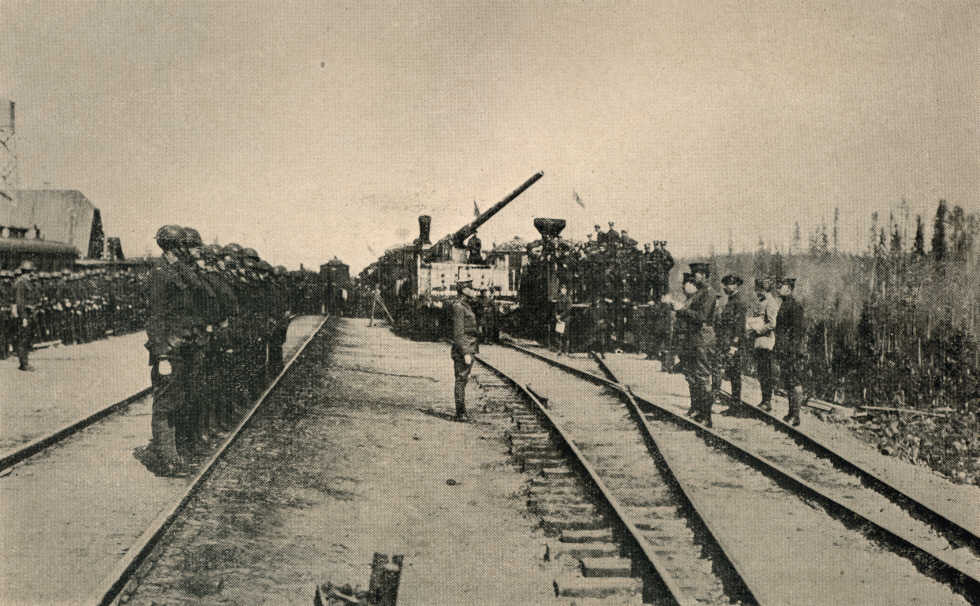
U. S. OFFICIAL PHOTO
Col. Dupont (French) at Verst 455, Bestows Many Croix de Guerre Medals.
![[Illustration: ]](images/224Pic3_A25.jpg)
U. S. OFFICIAL PHOTO
Polish Artillery and Mascot.
![[Illustration: ]](images/224Pic3_B25.jpg)
U. S. OFFICIAL PHOTO (158870)
Russian Artillery, Verst 18.
Suffer he did occasionally. Many of his comrades had a lot of suffering
from cold. But aside from the execrable boot that Sir Shakleton had
dreamed into existence, he himself possessed more warm clothing than he
liked to carry around with him. But not a few soldiers forgot to look
around and take sober stock of their actual situation and fell prey to
this sob-stuff. Fortunately for the great majority of them, and this
goes for every company, the great rank and file of officers and men
never lost their heads and their stout hearts.
And now we may as well deal with the actual facts in regard to the
alleged mutiny of American troops in North Russia. There was no mutiny.
In February Colonel Stewart had cabled to the War Department that “The
alarmist reports of condition of troops in North Russia as published in
press end of December are not warranted by facts. Troops have been well
taken care of in every way and my officers resent these highly
exaggerated reports, feeling that slur is cast upon the regiment and its
wonderful record. Request that this be given to the press and especially
to Detroit and Chicago papers to allay any unnecessary anxiety.”
He was approximately correct in his statements. His intent was a
perfectly worthy one. But it was not believed by the wildly excited
people back home. Perhaps if the war department had been entirely frank
with the people in cases, say, like the publication of casualty reports
and reports of engagements, then its well-meant censorship and its
attempts to allay fear might have done some good.
As it was the day, March 31st, 1919, came when a not unwilling British cable
was scandalled and a fearsome press and people was startled with the story of
an alleged mutiny of a company of American troops in North Russia. The
“I-told-you-so’s” and the “wish-they-would’s” of the States were gratified. The
British War Office was, too, and made the most of the story to propagandize its
tired veterans and its late-drafted youths who had been denied part in war by
the sudden Armistice. Those were urged to volunteer for service in North
Russia, where it was alleged their English comrades had been left unsupported
by the mutinous Yanks. Yes, there was a pretty mess made of the story by our
own War Department, too, who first was credulous of this really incredulous
affair, tried to explain it in its usually stupid and ignorant way of
explaining affairs in North Russia, only made a bad matter worse, and then
finally as they should have done at first, gave the American Forces in North
Russia a Commanding General, whose report as quoted from the Army and Navy
Journal of April 1920, will say:
“The incident was greatly exaggerated, but while greatly regretting that any
insubordination took place, he praised the general conduct of the 339th
Infantry. Colonel Richardson states that the troops were serving under very
trying conditions, and that much more serious disaffections appeared among
troops of the Allies on duty in North Russia. He further says the disaffection
in the company of the 339th Infantry, U. S. A., was handled by the regimental
commander with discretion and good judgment.”
Colonel Stewart, himself, stated to the press when he led his troops
home the following July:
“I did not have to take any disciplinary action against either an officer or
soldier of the regiment in connection with the matter, so you may judge that
the reports that have appeared have been very, very greatly exaggerated. Every
soldier connected with the incident performed his duty as a soldier. And as far
as I am concerned, I think the matter should be closed.”
In a letter to a member of Congress from Michigan, Secretary Baker
refers to the alleged mutiny as follows:
“A cablegram, dated March 31, 1919, received from the American Military
Attache at Archangel, read in part as follows:
“‘Yesterday morning, March 30th, a company of infantry, having received orders
to the railroad front, was ordered out of the barracks for the purpose of
packing sleds for the trip across the river to the railroad station. The
non-commissioned officer that was in charge of the packing soon reported to the
officers that the men refused to obey. At this some of the officers took
charge, and all except one man began reluctantly to pack after a considerable
delay. The soldier who continued to refuse was placed in confinement. Colonel
Stewart, having been sent for, arrived and had the men assembled to talk with
them. Upon the condition that the prisoner above mentioned was released, the
men agreed to go. This was done, and the company then proceeded to the railway
station and entrained there for the front. That they would not go to the front
line positions was openly stated by the men, however, and they would only go to
Obozerskaya. They also stated that general mutiny would soon come if there was
not some definite movement forthcoming from Washington with regard to the
removal of American troops from Russia at the earliest possible date.’
“The War Department on April 10, 1919, authorized the publication of
this cablegram, and on April 12, 1919, authorized the statement that the
report from Murmansk was to the effect that the organization which was
referred to was Company “I” of the 339th Infantry, and that the dispatch
stated:
“‘It is worthy to note that the questions that were put to the officers by the
men were identical with those that the Bolshevik propaganda leaflets advised
them to put to them.’
“If reports differing from the above appeared in the newspapers, they
were secured from sources other than the War Department and published
without its authority.
“On March 16, 1920, Brigadier General Wilds P. Richardson, U. S. Army,
was ordered by the Commanding General, American Expeditionary Forces, to
proceed to North Russia and to assume command of the American Forces in
that locality. General Richardson arrived at Murmansk on April 8, 1920,
where it was reported to him that a company of American troops at
Archangel had mutinied and that his presence there was urgently needed.
He arrived at Archangel on April 17, 1920, and found that conditions had
been somewhat exaggerated, especially in respect to the alleged mutiny
of the company of the 339th Infantry. General Richardson directed an
investigation of this matter by the Acting Inspector General, American
Forces in North Russia. This officer states the facts to be as follows:
“‘Company “I”, 339th Infantry, was in rest area at Smallney Barracks, in the
outskirts of Archangel, Russia, when orders were received to go to the railroad
point and relieve another company. The following morning the first sergeant
ordered the company to turn out and load sleds. He reported to the captain that
the men did not respond as directed. The captain then went to the barracks and
demanded of the men standing around the stove: “Who refuses to turn out and
load sleds?” No reply from the men. The captain then asked the trumpeter, who
was standing nearby, if he refused to turn out and load the sleds, and the
trumpeter replied he was ready if the balance were, but that he was not going
out and load packs of others on the sleds by himself, or words to that effect.
The captain then went to the phone and reported the trouble as “mutiny” to Col.
Stewart, the Commanding Officer, American Forces in North Russia. Col. Stewart
directed him to have the men assemble in Y. M. C. A. hut and he would be out at
once and talk to them. The colonel arrived and read the Article of War as to
mutiny and talked to the men a few minutes. He then said he was ready to answer
any questions the men cared to ask. Some one wanted to know ‘What are we here
for and what are the intentions of the U. S. Government?’ The colonel answered
this as well as he could. He then asked if there was anyone of the company who
would not obey the order to load the sleds; if so, step up to the front. No one
moved. The colonel then directed the men to load the sleds without delay, which
was done.
“‘The testimony showed that the captain commanding Company “I”, 339th Infantry,
did not order his company formed nor did he ever give a direct order for the
sleds to be loaded. He did not report this trouble to the commanding officer (a
field officer) of Smallney Barracks, but hastened to phone his troubles to the
Commanding Officer, American Forces in North Russia.’
“The inspector further states that the company was at the front when the
investigation was being made (May, 1919) and that the service of all
concerned, at that time, was considered satisfactory by the battalion
commander.
“The conclusions of the inspector were that from such evidence as could
be obtained the alleged mutiny was nothing like as serious as had been
reported, but that it was of such a nature that it could have been
handled by a company officer of force.
“The inspector recommended to the Commanding General, American Forces,
North Russia, that the matter be dropped and considered closed. The
Commanding General, American Forces, North Russia, concurred in this
recommendation.
“General Richardson, in his report of operations on the American Forces
in North Russia, referring to this matter states:
“‘MORALE. Archangel and North Russia reflected in high degree during the past
winter the disturbed state of the civilized world after four years of
devastating war. The military situation was difficult and at times menacing.
“‘Our troops in this surrounding, facing entirely new experiences and uncertain
as to the future, bore themselves as a whole with courageous and creditable
spirit. It was inevitable that there should be unrest, with some criticism and
complaint, which represented the normal per cent chargeable to the human
equation under such conditions. This culminated, shortly before my arrival, in
a temporary disaffection of one of the companies. This appears not to have
extended beyond the privates in ranks, and was handled by the regimental
commander with discretion and good judgment.
“‘This incident was given wide circulation in the States, and I am satisfied
from my investigation that an exaggerated impression was created as to its
seriousness. It is regrettable that it should have happened at all, to mar in
any degree the record of heroic and valiant service performed by this regiment
under very trying conditions.’ “The above are the facts in regard to this
matter, and it is hoped that this information may meet your requirements.
“Very sincerely yours,
“NEWTON D. BAKER,
“Secretary of War.”
However, as a matter of history the facts must be told in this volume. “I”
Company of the 339th Infantry, commanded by Captain Horatio G. Winslow, was on
the 30th of March stationed at Smolny Barracks, Archangel, Russia. It had been
resting for a few days there after a long period of service on the front. The
spirit of the men had been high for the most part, although as usual in any
large group of soldiers at rest there was some of what Frazier Hunt, the noted
war correspondent, calls “good, healthy grousing.” The men had the night before
given a fine minstrel entertainment in the Central Y. M. C. A.
Group psychology and atmospheric conditions have to be taken into
consideration at this point. By atmospheric conditions we mean the
half-truths and rumors and expressions of feeling that were in the air.
A sergeant of the company questioned carefully by the writer states
positively that the expressions of ugliness were confined to
comparatively few members of the company. The feeling seemed to spread
through the company that morning that some of the men were going to
speak their minds.
Here another fact must be introduced. A few nights before this there had
been a fire in camp that spread to their barracks and burned the company
out, resulting in the splitting of the company into two separated parts,
and in giving the little first sergeant and commanding officer
inconvenience in conveying orders and directions to the men. And it was
rumored in the morning in one barracks that the men of the other
barracks were starting something. The platoon officer in command there
had gone to the front to make arrangements for the billeting and
transportation of troops, who were to start that day for the front some
several miles south of Obozerskaya. Now the psychology began to work.
Why hurry the loading, let’s see what the men of that platoon now will
do.
The captain notices the delay in proceedings. He has heard a little something
of what is in the air. It is nothing serious, yet he is nervous about it. His
first sergeant, a nervous and a nervy little man too, for Detroit has seen the
Croix de Guerre he won, showed anxiety over the dilatoriness of the men
in loading the sleighs. And the men were only just human in wanting to see what
the captain was going to do about that other platoon that was rumored to be
starting something. Of course in the psychology of the thing it was not in
their minds that they would be called upon to express themselves. The others
were going to do that.
But when the captain went directly to the men and asked them what they
were thinking and feeling they found themselves talking to him. Here and
there a man spoke bitterly about the Russian regiments in Archangel not
doing anything but drill in Archangel. Of course he had only half-truth.
That is the way misunderstandings and bad feelings feed. At that moment
a company of the Archangel Regiment was at a desperate front,
Bolsheozerki, standing shoulder to shoulder with “M” Company out of “I”
Company’s own battalion. But these American soldiers at that moment with
their feelings growing warmer with expression of them, thought only of
the drilling Russian soldiers in Archangel and of the S. B. A. L.
soldiers who had mutinied earlier in the winter and been subdued by
American soldiers in Archangel. And so if the truth be told, those
soldiers spoke boldly enough to their captain to alarm him. He thought
that he really had a serious condition before him.
From remarks by the men he judged that for the sake of the men and the
chief commanding officer, Colonel Stewart, it would be well to have a
meeting in the Y. M. C. A. where they could be properly informed, where
they could see ALL that was going on and not be deluded by the rumors
that other groups of the company were doing something else, and where
the common sense of the great, great majority of the men would show them
the foolishness of the whole thing. And he invited the colonel to
appear.
Meanwhile the senior first lieutenant of the company, Lieut. Albert E.
May, one of the levelest-headed officers in the regiment, had put the
first and only man who showed signs of insubordination to an officer
under arrest. It developed afterward that the lieutenant was a little
severe with the man as he really had not understood the command, he
being a man who spoke little English and in the excitement was puzzled
by the order and showed the “hesitation” of which so much was made in
the wild accounts that were published. This arrest was afterward
corrected when three sergeants of the platoon assured the officer that
the man had not really intended insubordination.
It is regrettable that the War Department was so nervous about this
affair that it would be fooled into making the explanation of this
“hesitation” on the ground of the man’s Slavic genesis and the pamphlet
propaganda of the Reds. The first three men who died in action were
Slavs. The Slavs who went from Hamtramck and Detroit to Europe made
themselves proud records as fighters. Hundreds of them who had not been
naturalized were citizens before they took off the O. D. uniform in
which they had fought. It was a cruel slur upon the manhood of the
American soldier to make such explanations upon such slight evidences.
It would seem as though the War Department could have borne the outcry
of the people till the Commanding Officer of those troops could send
detailed report. And as for the Red pamphlets, every soldier in North
Russia was disgusted with General March’s explanations and comments.
To return to the account, let it be said, Colonel Stewart, when he
appeared at the Y. M. C. A. saw no murmurous, mutinous, wildly excited
men, such as the mob psychology of a mutiny would necessarily call for.
Instead, he saw men seated orderly and respectfully. And they listened
to his remarks that cleared up the situation and to his proud
declaration that American soldiers on duty never quit till the job is
done or they are relieved. Questions were allowed and were answered
squarely and plainly.
While the colonel had been coming from his headquarters the remainder of
the loading had been done under direction of Lieut. May as referred to
before, and at the conclusion of the colonel’s address, Captain Winslow
moved his men off across the frozen Dvina, proceeded as per schedule to
Obozerskaya, put them on a troop train, and as related elsewhere took
over the front line at a critical time, under heavy attack, and there
the very next day after the little disaffection and apparent
insubordination, which was magnified into a “mutiny,” his company added
a bright page to its already shining record as fighters. The editors
have commented upon this at another place in the narrative. We wish here
to state that we do not see how an unbiased person could apply so harsh
a term as mutiny to this incident.
The allegation has been proved to be false. There was no mutiny. Any
further repetition of the allegation will be a cruel slander upon the
good name of the heroic men who were killed in action or died of wounds
received in action in that desperate winter campaign in the snows of
Russia. And further repetition of the allegation will be insult to the
brave men who survived that campaign and now as citizens have a right to
enjoy the commendations of their folks and friends and fellow citizens
because of the remarkably good record they made in North Russia as
soldiers and men.
XXXI
OUR ALLIES, FRENCH, BRITISH AND RUSSIANS
Kaleidoscopic Picture And Chop Suey Talk In Archangel—Poilu Comrades—Captain
Boyer—Dupayet, Reval And Major Alabernarde—“Ze French Sarzhont, She Say”—Scots
And British Marines Fine Soldiers—Canadians Popular—Yorks Stand Shoulder To
Shoulder—Tribute To General Ironside—Daredevil “Bob” Graham Of “Australian
Light Horse”—Commander Young Of Armored Train—Slavo-British Allied
Legion—French Legion—White Guards—Archangel Regiments—Chinese—Deliktorsky,
Mozalevski, Akutin.
What a kaleidoscopic recollection of uniforms and faces we have when one
asks us about our allies in North Russia. What a mixture of voices, of
gutturals and spluttering and yeekings and chatterings, combined with
pursing of lips, eyebrow-twistings, bugging eyes, whiskers and long
hair, and common hand signs of distress or delight or urgency or
decisiveness: Nitchevo, bonny braw, tres bien, khorashaw, finish, oi
soiy, beaucoup, cheerio, spitzka, mozhnya barishna, c’mon kid,
parlezvous, douse th’ glim, yah ocean, dobra czechinski, amia spigetam,
ei geh ha wa yang wa, lubloo, howse th’ chow, pardonne, pawrdun, scuse,
eesveneets,—all these and more too, strike the ear of memory as we
tread again the board sidewalks of far off smelly Archangel.
What antics we witnessed, good humored miscues and errors of form in
meeting our friends of different lands all gathered there in the strange
potpourri. Soldiers and “civies” of high and low rank, cultured and
ignorant, and rich and poor, hearty and well, and halting and lame,
mingled in Archangel, the half-shabby, half-neat, half-modern,
half-ancient, summer-time port on the far northern sea. Rags and red
herrings, and broadcloth and books, and O. D. and Khaki, and horizon
blue, crowded the dinky ding-ding tramway and counted out kopecs to the
woman conductor.
And many are the anecdotes that are told of men and occasions in North
Russia where some one of our allies or bunch of them figures
prominently, either in deed of daring, or deviltry, or simply good
humor. Chiefly of our own buddies we recall such stories to be sure, but
in justice to the memory of some of the many fine men of other lands who
served with us we print a page or two of anecdotes about them. And we
hope that some day we may show them Detroit or some other good old
American burg, or honk-honk them cross country through farm lands we now
better appreciate than before we saw Europe, by woods, lake and stream
to camp in the warm summer, or spend winter nights in a land with us as
hosts, a land where life is really worth living.
Those “mah-sheen” gunners in blue on the railroad who stroked their
field pets with pride and poured steady lines of fire into the pine
woods where lay the Reds who were encircling the Americans with rifle
and machine gun fire. How the Yankee soldiers liked them. And many a
pleasant draught they had from the big pinaud canteen that always came
fresh from the huge cask. How courteously they taught the doughboy
machine gunner the little arts of digging in and rejoiced at the rapid
progress of the American.
How now, Paul, my poilu comrade, bon ami, why don’t you add the
house itself to the pack on your back? Sure, you’ll scramble along somehow to
the rest of the camp in the rear, and on your way you will pass bright remarks
that we non compree but enjoy just the same, for we know you are wishing
the doughboy good luck. How droll your antics when hard luck surprises. We
swear and you grimace or paw wildly the air. And we share a common dislike for
the asperity shown by the untactful, inefficient, bulldozing old Jack.
Here is a good story that “Buck” Carlson used to tell in his inimitable
way. Scene is laid in the headquarters of the British Colonel who is
having a little difficulty with his mixed command that contains soldiers
of America, France, Poland, China, where not, but very few from England
at that time. A French sergeant with an interpreter enters the room and
salutes are exchanged. The sergeant then orders his comrade to convey
his request to the colonel.
“Ker-nell, par-don,” says the little interpreter after a snappy French
salute which is recognized by a slight motion of the colonel’s thumb in
the general direction of his ear. “Ze sarzhont, she say, zat ze French
man will please to have ze tobak, ze masheen gun am-mu-nish-own and ze
soap.”
“But, my man,” says the colonel reddening, “I told you to tell the
sergeant he should go on as ordered and these things will come later, I
have none of these things now to give him, but they will soon arrive and
he shall be supplied. But now he must hurry out with his detachment of
machine gunners to help the Americans. Go, my man.” More salutes and
another conversation between the two French soldiers with arms and spit
flying furiously.
“Ker-nell, sir, par-don, again, but ze sar-zhont, she say, zat wiz-out
ze to-bak, ze am-mu-nish-own and ze soap, he weel not go, par-don,
ker-nell!”
This time the colonel was angered to popping point and he smote the
table with a thump that woke every bedbug and cockroach in the building
and the poor French interpreter looked wildly from the angry British
colonel to his tough old French sergeant who now leaped quickly to his
side and barked Celtic rejoinder to the colonel’s fist thumping
language. No type could tell the story of the critical next moment.
Suffice it to say that after the storm had cleared the colonel was heard
reporting the disobedience to a French officer miles in the rear. The
officer had evidently heard quickly from his sergeant and was inclined
to back him up, for in substance he said to the offended British
officer: “Wee, pardon, mon ker-nell, it eez bad,” meaning I am sorry,
“but will ze gallant ker-nell please to remember zat consequently zare
eez no French offitzair wiz ze French de-tach-mont, ze sar-zhont will be
treated wiz ze courtesy due to ze offitzair.”
And it was true that the sergeant, backed up by his French officer,
refused to go as ordered till his men had been supplied with the
necessary ammunition and “ze to-bak and ze soap.” The incident
illustrates the fact that the French officer’s relation to his enlisted
men is one of cordial sympathy. He sees no great gulf between officer
and enlisted man which the British service persists to set up between
officers and enlisted men.
Hop to it, now Frenchie, you surely can sling ’em. We need a whole lot
from your 75’s. We are guarding your guns, do not fear for the flanks.
Just send that barrage to the Yanks at the front. And how they do send
it. And we remember that the French artillery officers taught the
Russians how to handle the guns well and imbued them with the same
spirit of service to the infantry. And many a Red raid in force and
well-planned attack was discouraged by the prompt and well-put shrapnel
from our French artillery.
And there was Boyer. First we saw him mud-spattered and grimy crawling from a
dugout at Obozerskaya, day after his men had won the “po-zee-shown.” His
animation he seems to communicate to his leg-wearied men who crowd round him to
hear that the Yanks are come to relieve them. With great show of fun but
serious intent, too, he “marries the squads” of Americans and Frenchies as they
amalgamate for the joint attack. “Kat-tsank-awn-tsank” comes to mean 455 as he
talks first in French to his poilus and then through our Detroit doughboy
French interpreter to the doughboys. Captain he is of a Colonial regiment,
veteran of Africa and every front in Europe, with palm-leafed war cross,
highest his country can give him, Boyer. He relies on his soldiers and they on
him. “Fires on your outposts, captain?” “Oui, oui, nitchevo, not ever
mind, oui, comrade,” he said laughingly. His soldiers built the fires so
as to show the Reds where they dare not come. Truth was he knew his men must
dry their socks and have a warm spot to sit by and clean their rifles. He
trusted to their good sense in concealing the fire and to know when to run it
very low with only the glowing coals, to which the resting soldier might
present the soles of his snoozing shoes. Captain Boyer, to you, and to your
men.
It is not easy to pass over the names of Dupayet and Reval and
Alebernarde. For dynamic energy the first one stands. For linguistic aid
the second. How friendly and clear his interpretation of the orders of
the French command, given written or oral. Soldier of many climes he.
With songs of nations on his lips and the sparkle of mirth in his eye.
“God Save the King,” he uttered to the guard as password when he
supposed the outguard to be a post of Tommies, and laughingly repeated
to the American officer the quick response of the Yank sentry man who
said: “To hell with any king, but pass on French lieutenant, we know you
are a friend.”
And Alabernarde, sad-faced old Major du Battalion, often we see you
passing among the French and American soldiers along with Major Nichols. Your
eyes are crow-tracked with experiences on a hundred fields and your bronzed
cheek hollowed from consuming service in the World War. We see the affectionate
glances of poilus that leap out at sight of you. You hastened the equipment of
American soldiers with the automatics they so much needed and helped them to
French ordnance stores generously. Fate treated you cruelly that winter and
left you in a wretched dilemma with your men in March on the railroad. We would
forget that episode in which your men figured, and remember rather the
comradery of the fall days with them and the inspiration of your soldierly
excellence. To you, Major Alabernarde.
On the various fronts in the fall the doughboy’s acquaintance with the
British allies was limited quite largely, and quite unfortunately we
might say, to the shoulder strappers. And all too many of those
out-ranked and seemed to lord it over the doughboy’s own officers, much
to his disgust and indignation. What few units of Scots and English
Marines and Liverpools got into action with the Americans soon won the
respect and regard of the doughboys in spite of their natural antipathy,
which was edged by their prejudice against the whole show which was
commonly thought to be one of British conception. Tommie and Scot were
often found at Kodish and Toulgas and on the Onega sharing privations
and meagre luxuries of tobacco and food with their recently made friends
among the Yanks.
And in the winter the Yorks at several places stood shoulder to shoulder
with doughboys on hard-fought lines. Friendships were started between
Yanks and Yorks as in the fall they had grown between Frenchies and
Americans, Scots and Yanks, and Liverpools and Detroiters. Bitter
fighting on a back-to-the-wall defense had brought the English and
American officers together also. Arrogance and antipathy had both
dissolved largely in the months of joint military operations and better
judgment and kinder feelings prevailed. Grievances there are many to be
recalled. And they were not all on one side. But except as they form
part of the military narrative with its exposure of causes and effects
in the fall and winter and spring campaigns, those grievances may mostly
be buried. Rather may we remember the not infrequent incidents of
comradeship on the field or in lonely garrison that brightened the
relationships between Scots and Yorks and Marines and Liverpools in
Khaki on the one hand and the O. D. cousins from over the sea who were
after all not so bad a lot, and were willing to acknowledge merit in the
British cousin.
It must be said that Canadians, Scots, Yorks and Tommies stood in about
this order in the affections of the Yankee soldiers. The boys who fought
with support of the Canadian artillery up the rivers know them for hard
fighters and true comrades. And on the railroad detachment American
doughboys one day in November were glad to give the Canadian officer
complimentary present-arms when he received his ribbon on his chest,
evidence of his election to the D. S. O., for gallantry in action.
Loyally on many a field the Canadians stood to their guns till they were
exhausted, but kept working them because they knew their Yankee comrades
needed their support.
One of the pictures in this volume shows a Yank and a Scot together
standing guard over a bunch of Bolshevik prisoners at a point up the
Dvina River. American doughboys risked their lives in rescuing wounded
Scots and the writer has a vivid remembrance of seeing a fine expression
of comradeship between Yanks and Scots and American sailors starting off
on a long, dangerous march.
Mention has been made in another connection of the friendship and
admiration of the American soldiers for the men of the battalion of
Yorks. In the three day’s battle at Verst 18 a York sergeant over and
over assured the American officer that he would at all times have a
responsible York standing beside the Russki machine gunner and prevent
the green soldiers from firing wildly without order in case the
Bolshevik should gain some slight advantage and a necessary shift of
American soldiers might be interpreted by the green Russian machine
gunners as a movement of the enemy. And those machine guns which were
stationed at a second line, in rear of the Americans, never went off.
The Yorks were on the job. And after the crisis was past an American
corporal asked his company commander to report favorably upon the
gallant conduct of a York corporal who had stood by him with six men all
through the fight.
Of the King’s Liverpools and other Tommies mention has been made in
these pages. Sometimes we have to fight ourselves into favor with one
another. Really there is more in common between Yank and Tommie than
there is of divergence. Hardship and danger, tolerance and observation,
these brought the somewhat hostile and easily irritated Yank and Tommie
together. Down underneath the rough slams and cutting sarcasm there
exists after all a real feeling of respect for the other.
This volume would not be complete without some mention of that man who
acted as commanding general of the Allied expedition, William Edmund
Ironside. He was every inch a soldier and a man. American soldiers will
remember their first sight of him. They had heard that a big man up at
Archangel who had taken Gen. Poole’s job was cleaning house among the
incompetents and the “John Walkerites” that had surrounded G. H. Q. in
Poole’s time. He was putting pep into G. H. Q. and reorganizing the
various departments.
When he came, he more than came up to promises. Six foot-four and built
accordingly, with a bluff, open countenance and a blue eye that spoke
honesty and demanded truth. Hearty of voice and breathing cheer and
optimism, General Ironside inspired confidence in the American troops
who had become very much disgruntled. He was seen on every front at some
time and often seen at certain points. By boat or sledge or plane he
made his way through. He was the soldier’s type of commanding officer.
Never dependent on an interpreter whether with Russian, Pole, or French,
or Serbian, or Italian, he travelled light and never was seen with a
pistol, even for protection. Master of fourteen languages it was said of
him, holder of an Iron Cross bestowed on him by the Kaiser in an African
war when he acted as an ox driver but in fact was observing for the
British artillery, on whose staff he had been a captain though he was
only a youth, he was a giant intellectually as well as physically.
When British fighting troops could not be spared from the Western Front
in the fall of 1918 and the British War Office gambled on sending
category B men to Archangel—men not considered fit to undergo active
warfare, a good healthy general had to be found. Ironside, lover of
forlorn hopes, master of the Russian language, a good mixer, and
experienced in dealing with amalgamated forces, was the obvious man. Of
course, there were some British officers who bemoaned the fact, in range
of American ears too, that some titled high ranking officers were passed
over to reach out to this Major of Artillery to act as Major-General.
And he was on the youthful side of forty, too.
Edmund Ironside ought to have been born in the days of Drake, Raleigh,
and Cromwell. He would have a bust in Westminster and his picture in the
history books. But in his twenty years of army life he has done some big
things and it can be imagined with what gusto he received his orders to
relieve Poole and undertook to redeem the expedition, to make something
of the perilous, forlorn hope under the Arctic winter skies.
In The American Sentinel issue of December 10th, which was the first
issue of our soldier paper, we read:
“It is a great honor for me to be able to address the first words in the first
Archangel paper for American soldiers. I have now served in close contact with
the U. S. Army for eighteen months and I am proud to have a regiment of the U.
S. Army under my command in Russia.
“I wish all the American soldiers the best wishes for the coming Christmas and
New Year and I want them to understand that the Allied High Command takes the
very greatest interest in their welfare at all times.”
EDMUND IRONSIDE, Major-General.
Without doubt the General was sincere in his efforts to bring about
harmony and put punch and strength into the high command sections as
well as into the line troops. But what a bag Poole left him to hold.
Vexed to death must that big man’s heart have been to spend so much time
setting Allies to rights who had come to cross purposes with one another
and were blinded to their own best interests. British thought he was too
lenient with the willful Americans. Americans thought he was pampering
the French. British, French and Americans thought he was letting the
Russkis slip something over on the whole Allied expedition. Green-eyed
jealousy, provincial jealousy, just plain foolish jealousy tormented the
man who was soon disillusioned as to the glories to be won in that
forlorn expedition but who never exhibited anything but an undaunted
optimistic spirit. He was human. When he was among the soldiers and
talking to them it was not hard for them to believe the tale that after
all he was an American himself, a Western Canadian who had started his
career as a military man with the Northwest Mounted Police.
An American corporal for several weeks had been in the field hospital
near the famous Kodish Front. One day General Ironside leaned over his
bunk and said: “What’s the trouble, corporal?” The reply was,
“Rheumatism, sir.” At which the British hospital surgeon asserted that
he thought the rheumatism was a matter of the American soldier’s
imagination. But he regretted the remark, for the general, looking
sternly at the officer, said: “Don’t talk to me that way about a
soldier. I know, if you do not, that many a young man, with less
exposure than these men have had in these swamps, contracts rheumatism.
Do not confuse the aged man’s gout with the young man’s muscular
rheumatism.” Then he turned his back on the surgeon and said heartily to
the corporal: “You look like a man with lots of grit. Cheer up, maybe
the worst is over and you will be up and around soon. I hope so.”
And there was many a British officer who went out there to Russia who
won the warm friendship of Americans. Of course, those were short
friendships. But men live a lot in a small space in war. One day a young
second lieutenant—and those were rare in the British uniforms, for the
British War Office had given the commanding general generous leeway in
adding local rank to the under officers—had come out to a distant
sector to estimate the actual needs in signal equipment. He rode a
Russian horse to visit the outpost line of the city. He rode in a
reindeer sled to the lines which the Russian partisan forces were
holding. He sat down in the evening to that old Russian merchant
trader’s piano, in our headquarters, and rambled from chords and airs to
humoresque and rhapsodies. And the American and Russian officers and the
orderlies and batmen each in his own place in the spacious rooms melted
into a tender hearing that feared to move lest the spell be broken and
the artist leave the instrument. Men who did not know how lonesome they
had been and who had missed the refinements of home more than they knew,
blessed the player with their pensive listening, thanked fortune they
were still alive and had chances of fighting through to get home again.
And after playing ceased the British officer talked quietly of his home
and the home folks and Americans thought and talked of theirs. And it
was good. It was an event.
In sharp contrast is the vivid memory of that picturesque Lt. Bob Graham
of the Australian Light Horse. He could have had anything the doughboy
had in camp and they would have risked their lives for him, too, after
the day he ran his Russian lone engine across the bridge at Verst 458
into No Man’s Land and leaped from the engine into a marsh covered by
the Bolo machine guns and brought out in his own arms an American
doughboy. Starting merely a daredevil ride into No Man’s Land, his
roving eye had spied the doughboy delirious and nearly dead flopping
feebly in the swamp.
Hero of Gallipoli’s ill-fated attempt, scarred with more than a score of
wounds; with a dead man’s shin bone in the place of his left upper arm
bone that a Hun shell carried off; with a silver plate in his
head-shell; victim of as tragic an occurrence as might befall any man,
when as a sergeant in the Flying Squadron in France he saw a young
officer’s head blown off in a trench, and it was his own son, Bob
Graham, “Australian Force” on the Railroad Detachment, was missed by the
doughboys when he was ordered to report to Archangel.
There the heroic Bob went to the bad. He participated in the shooting
out of all the lights in the Paris cafe of the city in regular wild
western style; he was sent up the river for his health; he fell in with
an American corporal whose acquaintance he had made in a sunnier clime,
when the American doughboy had been one of the Marines in Panama and Bob
Graham was an agent of the United Fruit Company. They stole the British
officer’s bottled goods and trafficked unlawfully with the natives for
fowls and vegetables to take to the American hospital, rounded up a
dangerous band of seven spies operating behind our lines, but made such
nuisances of themselves, especially the wild Australian “second looie,”
that he was ordered back to Archangel. There the old general, who knew
of his wonderful fighting record, at last brought him on to the big
carpet. And the conversation was something like this:
“Graham, what is the matter? You have gone mad. I had the order to strip
you of your rank as an officer to see if that would sober you. But an
order from the King today by cable raises you one rank and now no one
but the King himself can change your rank. You deserved the promotion
but as you are going now it is no good to you. All I can do is to send
you back to England. But I do not mean it as a disgrace to you. I could
wish that you would give me your word that you would stop this madness
of yours.” And the general looked kindly at Bob.
“Sir, you have been white with me. You have a right to know why I have
been misbehaving these last weeks. Here, sir, is a letter that came to
me the day I helped shoot up the cafe. In Belgium I married an American
Red Cross nurse. This is a picture of her and the new-born son come to
take the place of the grown-up son who fell mortally wounded in my arms
in France. To her and the baby I was bound to go if I had to drink
Russia dry of all the shipped-in Scotch and get myself reduced to the
ranks for insubordination and deviltry. Sir, I’m fed up on war. I thank
you for sending me back to England.”
And Corporal Aldrich tells us that his old friend Bob Graham’s present
address is First National Bank, Mobile, Alabama. His father, an
immigrant via Canada from old Dundee in Scotland, was elected governor
of Alabama on the dry issue. And officers and doughboys who knew the
wild Australian in North Russia know that his father might have had some
help if Bob were at home. With a genial word for every man, with a
tender heart that winced to see a child cry, with a nimble wit and a
brilliant daring, Lt. Bob Graham won a place in the hearts of Americans
that memory keeps warm.
And other British officers might be mentioned. There was, for example,
the grizzled naval officer, Commander Young, whose left sleeve had been
emptied at Zeebrugge, running our first armored train. We missed his
cheery countenance and courteous way of meeting American soldiers and
officers when he left us to return to England to take a seat in
Parliament which the Socialists had elected him to. We can see him again
in memory with his Polish gunners, his Russian Lewis gun men, standing
in his car surrounded by sand bags and barbed wire, knocking hot wood
cinders from his neck, which the Russki locomotive floated back to him.
And many a time we were moved to bless him when his guns far in our rear
spoke cheeringly to our ears as they sent whining shells curving over us
to fall upon the enemy. It is no discredit to say that many a time the
doughboy’s eye was filled with a glistening drop of emotion when his own
artillery had sprung to action and sent that first booming retort. And
some of those moments are bound in memory with the blue-coated figure of
the gallant Commander Young.
The Russian Army of the North was non-existent when the Allies landed.
All the soldiery previously in evidence had moved southward with the
last of the lootings of Archangel and joined the armies of the soviet at
Vologda, or were forming up the rear guard to dispute the entrance of
the Allies to North Russia. The Allied Supreme Command in North Russia,
true to its dream of raising over night a million men opened recruiting
offices in Archangel and various outlying points, thinking that the
population would rally to the banners (and the ration carts) in droves.
But the large number of British officers waited in vain for months and
months for the pupils to arrive to learn all over the arts of war. At
last after six months two thousand five hundred recruits had been
assembled by dint of advertising and coaxing and pressure. They were
called the Slavo-British Allied Legion, S. B. A. L. for short.
These Slavo-Brits as they were called never distinguished themselves
except in the slow goose step—much admired by Colonel Stewart, who
pointed them out to one of his captains as wonders of precision, and
also distinguished themselves in eating. They failed several times under
fire, once they caused a riffle of real excitement in Archangel when
they started a mutiny, and finally they were used chiefly as labor units
and as valets and batmen for officers and horses. They were charged with
having a mutinous spirit and with plotting to go over to the Bolsheviks.
They did in small numbers at times. It is interesting to note that they
were trained under British officers who enlisted them from among
renegades, prisoners and deserters from ranks of the Bolsheviks,
refugees and hungry willies, and, that once enlisted they were not fed
the standard British ration of food or tobacco, the which they held as a
grievance. It never made the American soldier feel comfortable to see
the prisoners he had taken in action parading later in the S, B. A. L.
uniform, and especially in the case of Russians who came over from the
Bolo lines and gave up with suspiciously strong protestations of dislike
for their late commanders.
The Russians who were recruited and trained by the French in the
so-called French Legion, under the leadership of the old veteran Boyer
who is mentioned elsewhere were found usually with a better record. The
Courier du Bois on skiis in white clothing did remarkably valuable
scouting and patrolling work and at times as at Kodish and Bolsheozerki
hung off on the flanks of the encircling Bolo hordes and worried the
attackers with great effectiveness.
The French also had better luck in training the Russian artillery
officers and personnel than did the British although some of the latter
units did good work. It seemed to be a better class of Russian recruit
that chose the artillery. Doughboys who were caught on an isolated road
like rats in a trap will remember with favor the Russian artillery men
who with their five field pieces on that isolated road ate, slept and
shivered around their guns for eight days without relief, springing to
action in a few seconds at any call. By their effective action they
contributed quite largely to the defense, active fighting of which fell
upon two hundred Yanks facing more than ten times the number. Why should
it surprise one to find an occasional Yank returned from Archangel who
will say a good word for a Russian soldier. There were cordial relations
between Americans and more than a few Russian units.
In certain localities in the interior where the peasants had organized
to resist the rapacious Red Guard looters, there were little companies
of good fighters, in their own way. These were usually referred to as
Partisans or White Guards depending upon the degree to which they were
authorized and organized by the local county governments. They always at
first strongly co-operated with the Allied troops, which they looked
upon as friends sent in to help them against the Bolsheviki. Toward the
Americans they maintained their cordial relations throughout, but after
the first months seemed to cool toward the other Allied troops. This
sounds conceited, and possibly is, but the explanation seems to be that
the Russian understood American candor and cordial democracy, the actual
sympathetic assistance offered by the doughboy to the Russian soldier or
laborer and took it at par value.
Further explanation of the cooling of the ardor of the local partisans
toward the British in particular may be found in the fact that the
British field commanders often found it convenient and really necessary
to send the local troops far distant from their own areas. There they
lost the urge of defending their firesides and their families. They were
in districts which they quite simply and honestly thought should
themselves be aiding the British to keep off the Bolsheviki. They could
not understand the military necessities that had perhaps called these
local partisans off to some other part of the fighting line on those
long forest fronts. He lacked the broader sense of nationality or even
of sectionalism. And as demands for military action repeatedly came to
him the justice of which he saw only darkly he became a poorer and
poorer source of dependence. He would not put his spirit into fighting,
he was quite likely to hit through the woods for home.
When the Allies early in the fall found they could not forge through to
the south, rolling up a bigger and bigger Russian force to crush the
Bolsheviki, who were apparently, as told us, fighting up to keep us from
going a thousand miles or so to hit the Germans a belt—a fly-weight
buffet as it were—and when we heard of the Armistice and began digging
in on a real defensive in the late fall and early winter, the
Provisional Government at Archangel under Tchaikowsky had already made
some progress in assembling an army. In the winter small units of this
Archangel army began co-operating in various places, and as the winter
wore on, began to take over small portions of the line, as at Toulgas,
Shred Mekrenga, Bolsheozerki, usually however with a few British
officers and some Allied soldiers to stiffen them. Although many of
these men had been drafted by the Archangel government and as we have
seen by such local county governments as Pinega, they were fairly well
trained under old Russian officers who crept out to serve when they saw
the new government meant business. And many capable young officers came
from the British-Russian officers’ school at Bakaritsa.
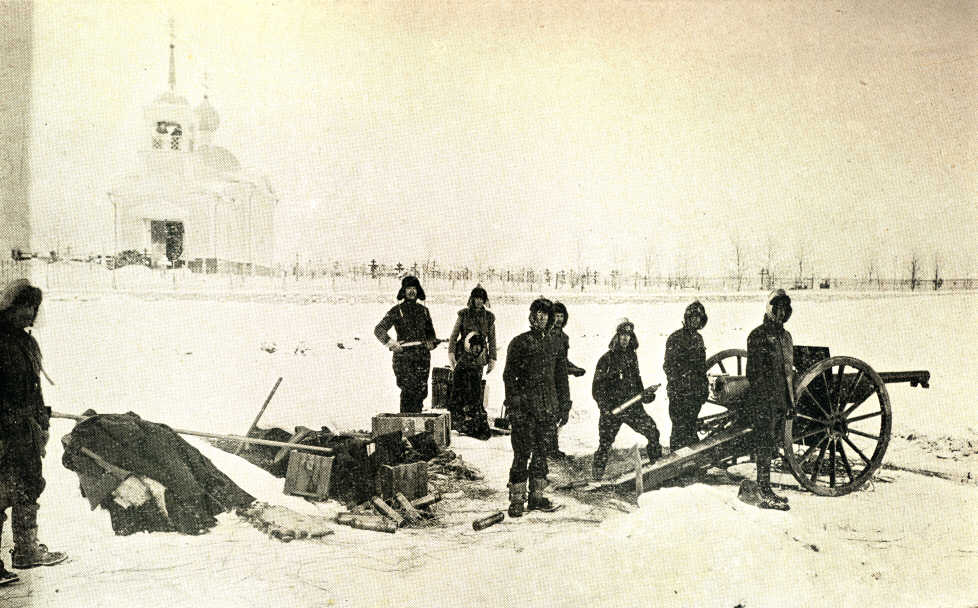
RED CROSS PHOTO
Canadian Artillery—Americans Were Strong for Them.
![[Illustration: ]](images/240Pic2_A25.jpg)
ROZANSKEY
Making “Khleba”—Black Bread.
![[Illustration: ]](images/240Pic2_B25.jpg)
WAGNER
Stout Defense of Kitsa.
Needless to say, these troops were at their best when they were in
active work on the lines. Rest camp and security from attack quickly
reduced their morale. And the next time they were sent up to the forward
posts they were likely to prove undependable.
In doing the ordinary drudgery of camp life the Russian soldier as the
doughboy saw him was very unsatisfactory. Many a Yank has itched to get
his hands on the Russian Archangelite soldier, especially some of our
hard old sergeants who wanted to put them on police and scavenger
details to see them work. In this reluctance to work, their refusal
sometimes even when the doughboy pitched into the hateful job and set
them a good example, they were only like the civilian males whose
aversion to certain kinds of work has been mentioned before. When some
extensive piece of work had to be done for the Allies like policing a
town, that is, cleaning it up for sake of health of the soldiers or
smoothing off a landing place for airplanes, it was a problem to get the
labor.
In the erection of large buildings or bridges the Russian man’s axe and
saw and mallet and plane worked swiftly and skillfully and unceasingly
and willingly. Those tools were to him as playthings. Not so with an
American-made long-handled shovel in his hands. Then it was necessary to
hire both women and men. The men thought they themselves were earning
their pay, but as the women in Russia do most of the back-breaking,
stooping work anyway, they just caught on to those American shovels and
to the astonishment of the American doughboy who superintended the work
they did twice as much as the men for just half the pay and with half
the bossing.
It is not a matter of false pride on the part of the Slavic male that
keeps him from vying with his better half in doing praiseworthy work. It
is lack of education. He has never learned. He is so constituted that he
cannot learn quickly. He will work himself to exhaustion day after day
in raising a house, cradling grain, playing an accordeon, or performing
a folk dance. His earliest known ancestors did those things with fervor
and it is doubtful if the modus operandi has changed much since the
beginning, since Adam was a Russian.
The “H” Company boys could tell you stories of the Chinese outfit of S. B. A.
L. under the British officer, the likable Capt. Card, who later lost his life
in the forlorn hope drive on Karpogora in March. One day he was approached by a
Chinese soldier who begged the loan of a machine gun for a little while. It
seems that the Chinese had gotten into argument with a company of Russian S. B.
A. L. men as to the relative staying qualities of Russians and Chinese under
fire. And they had agreed upon a machine gun duel as a fair test. The writer
one night at four in the morning woke when his Russian sleigh stopped in a
village and rubbed his sleepy eyes open to find himself looking up into the
questioning face of a burly sentry of the Chinese race. And he obeyed the
sentry’s directions with alacrity. He was not taking any chances on a
misunderstanding that might arise out of an attempted explanation in a
three-cornered Russo-Chino-English conversation.
Captain Odjard’s men might tell stories about the redoubtable Russian
Colonel Deliktorsky, who was in the push up the rivers in September.
Impetuous to a fault he flung himself and his men into the offensive
movement. “In twelve minutes we take Toulgas,” was his simple battle
order to the Americans. No matter to him that ammunition reserves were
not ordered up. Sufficient to him that he showed his men the place to be
battled for. And he was a favorite.
On the railroad in the fall a young Bolshevik officer surrendered his
men to the French. Next time the American officer saw him he was
reporting in American headquarters at Pinega that he had conducted his
men to safety and dug in. Afterwards Bolshevik assassins or spies shot
him in ambush and succeeded only in angering him and he went into battle
two days later with a bandage covering three wounds in his neck and
scalp. “G” and “M” Company men will remember this fiery Mozalevski.
Then there was the studious Capt. Akutin, a three-year veteran of a
Russian machine gun battalion, a graduate student of science in a
Russian university, a man of new army and political ideals in keeping
with the principles of the Russian Revolution. His great success with
the Pinega Valley volunteers and drafted men was due quite largely to
his strength of character, his adherence to his principles. The people
did not fear the restoration of the old monarchist regime even though he
was an officer of the Czar’s old army. American soldiers in Pinega
gained a genuine respect and admiration for this Russian officer, Capt.
Akutin, and he once expressed great pleasure in the fact that they
exchanged salutes with him cordially.
XXXII
FELCHERS, PRIESTS AND ICONS
Felcher Is Student Of Medicine—Or Pill Passer Of Army Experience—Sanitation And
Ventilation—Priests Strange Looking To Soldiers—Duties And
Responsibilities—Effect Of Bolshevism On Peasant’s Religious Devotions—The
Icons—Interesting Stories—Doughboys Buried By Russian Priests—Respect For
Russian Religion.
During the fall of 1918 when the influenza epidemic was wreaking such
great havoc among the soldiers and natives in the Archangel Province,
our medical corps as heretofore explained were put to almost superhuman
efforts in combating the spread of this terrible disease. There were
very few native doctors in the region, and it was, therefore, well nigh
impossible to enlist outside aid. In some of the villages we received
word that there were men called felchers who could possibly be of some
assistance. We were at once curious to ascertain just what kind of
persons these individuals were and upon investigation found that the
Russian Company located in our sector had a young officer who was also a
felcher and who was giving certain medical attention to his troops. We
immediately sent for him and in answer to our inquiries he explained as
nearly as possible just what a felcher was.
It seems that in Russia, outside the large cities and communities, there
is a great scarcity of regularly licensed medical practitioners, many of
these latter upon graduation enter the army where the pay is fairly good
and the work comparatively easy, the rest of them enter the cities
where, of course, practice is larger and the remuneration much better
than would be possible in a small community. These facts developed in
the smaller communities the use of certain second-rate students of
medicine or anyone having a smattering of medical knowledge, called
felchers.
In many cases the felcher is an old soldier who has traveled around the
world a bit; and from his association in the army hospitals with doctors
and students has picked up the technique of dressing wounds, setting
broken bones and administering physic. Very often they are, of course,
unable to properly diagnose the ailments or conditions of their
patients. They, however, are shrewd enough to follow out the customary
army method of treating patients and regardless of the disease promptly
administer vile doses of medicine, usually a physic, knowing full well
that to the average patient, the stronger the medicine and the more of
it he gets, the better the treatment is, and a large percentage of the
recoveries effected by these felchers is more or less a matter of faith
rather than physic or medicine.
The regularly licensed practitioners as a rule have great contempt for
these felchers, but the fact remains that in the small communities where
they practice the felcher accomplishes a great amount of good, for
having traveled considerably and devoted some time to the study of
medicine he is at least superior in intelligence to the average peasant,
and, therefore, better qualified to meet such emergencies as may arise.
This lack of medical practitioners, coupled with the apathy of the
peasants regarding sanitary precautions and their unsanitary methods of
living accounts to some extent for the violence and spread of plagues,
so common throughout Russia.
Regarding the spread of disease and plagues through Russia caused as
above stated by lack of sanitary conditions, a word or two further would
not be amiss. In the province of Archangel, for example, a great
majority of houses are entirely of log construction, built and modelled
throughout by the owner, and perhaps some of his good neighbors. They
are really a remarkable example of what may be done in the way of
construction without the use of nails and of the modern improved methods
of house construction. It is an actual fact that these simple peasants,
equipped only with their short hand axes, with the use of which they are
adepts, can cut down trees, hew the logs and build their homes
practically without the use of any nails whatever. The logs, of course,
are first well seasoned before they are put into the house itself and
when they are joined together they are practically air tight, but to
make sure of this fact the cracks are sealed tight with moss hammered
into the chinks. Next the windows of these houses are always double,
that is, there is one window on the outside of the frame and another
window on the inside. Needless to say, during the winter these windows
are practically never opened.
During the winter months the entire family—and families in this country
are always large—eat, sleep, and live in one room of the house in which
the huge brick home-made stove is located. In addition to the human
beings living in the room there are often a half dozen or more chickens
concealed beneath the stove, sometimes several sheep, and outside the
door may be located the stable for the cattle. Nevertheless, the
peasants are remarkably healthy, and in this region of the world
epidemics are rather uncommon which may perhaps be explained by the fact
that the peasants are out of doors a large part of the time and in
addition thereto the air is very pure and healthful. Sewerage systems
and such means of drainage are entirely unknown, even in the city of
Archangel, which at the time we were there, contained some hundred
thousand inhabitants. The only sewerage there was an open sewer that ran
through the streets of the city. Small wonder it is under such
conditions that when an epidemic does break out that it spreads so far
and so rapidly.
One of the most familiar characters seen in every town, large or small, was the
Batushka. This character is usually attired in a long, black or gray
smock and his hair reaches in long curls to his shoulders. At first sight to
the Yankee soldiers he resembled very much the members of the House of David or
so-called “Holy Roller” sect in this country. This mysterious individual,
commonly called Batushka, as we later discovered, was the village
priest. The priest of course belonged to the Russian Orthodox Church and whose
head in the old days was the Czar. The priests differ very greatly from the
ministers of the gospel and priests in the English-speaking world. They have
certain religious functions to perform in certain set ways, outside of which
they never venture to stray. The Russian priest is merely expected to conform
to certain observances and to perform the rites and ceremonies prescribed by
the Church. He rarely preaches or exhorts, and neither has nor seeks to have a
moral control over his flock. Marriage among the priests is not prohibited but
is limited, that is to say, the priest is allowed to marry but once, and
consequently, in choosing the wife he usually picks one of the strongest and
healthiest women in the community. This selection is in all seriousness an
important matter in the priest’s life because he draws practically no salary
from his position and must own a share of the community land, till and
cultivate the same in exactly the same manner as the rest of the community,
consequently his wife must be strong and healthy in order to assist him in the
many details of managing his small holdings. In case she were such a strong and
healthy person, the loss of the wife would be a calamity in more ways than one
to the priest as is apparent by the above statements.
While the religious beliefs and doctrines of the average peasant is only
used by him as a practical means toward an end, yet it must be admitted
that the Russian people are in a certain sense religious. They regularly
go to church on Sundays and Holy Days, of which there are countless
numbers, cross themselves repeatedly when they pass a church or Icon,
take the holy communion at stated seasons, rigorously abstain from
animal food, not only on Wednesdays and Fridays but also during Lent and
the other long fasts, make occasional pilgrimages to the holy shrines
and in a word fulfill carefully the ceremonial observance which they
suppose necessary for their salvation.
Of theology in its deeper sense the peasant has no intelligent
comprehension. For him the ceremonial part of religion suffices and he
has the most unbounded childlike confidence in the saving efficacy of
the rites which he practices.
Men of education and of great influence among the people were these
sad-faced priests, until the Bolsheviks came to undermine their power;
for the Bolsheviks have spared not the old Imperial government. The
church had been a potent organization for the Czar to strengthen his
sway throughout his far-reaching dominions and every priest was an
enlisted crusader of the Little Father. So the Bolsheviki, sweeping over
the country, have seized, first of all, upon these priests of Romanoff,
torturing them to death with hideous cruelty, if there be any truth in
stories, and finding vindictive delight in deriding sacred things and
violating holy places.
The moujik, ever susceptible to influence, has been quick to become
infected with this bacillus of agnosticism, and while he still professes
the faith and observes many of the forms as by habit, his fervor is
cooling and already is grown luke-warm. Now on Sundays, despite all of
the execrations of the priest, and the terrible threats of eternal
damnation, he often dozes the Sabbath away unperturbed on the stove; and
lets the women attend to the church going. Under Bolshevik rule Holy
Russia will be Agnostic Russia; and it is a pity, for religious teaching
was the guiding star of these poor people, and religious precepts, hard,
gloomy and dismal though they were, the foundation of the best in their
character.
Icons are pictorial, usually half length representations of the Saviour
or the Madonna or some patron saint, finished in a very archaic
Byzantine style on a yellow or gold background, and vary in size from a
square inch to several square feet. Very often the whole picture is
covered with various ornaments, ofttimes with precious stones. In
respect to their religious significance icons are of two classes, simple
or miracle-working. The former are manufactured in enormous quantities
and are to be found in every Russian house, from the lowest peasant to
the highest official. They are generally placed high up in a corner of
the living room facing the door, and every good Orthodox peasant on
entering the door bows in the direction of the icon and crosses himself
repeatedly. Before and after meals the same ceremony is always performed
and on holiday or fete days a small taper or candle is kept burning
before the icon throughout the day.
An amusing incident is related which took place in the allied hospital
in Shenkursk. A young medical officer had just arrived from Archangel
and was sitting in the living room or entrance-way of the hospital
directly underneath one of these icons. One of the village ladies,
having occasion to call at the hospital, entered the front door and as
usual stepped toward the center of the room facing the icon, bowed very
low and started crossing herself. The young officer who was unacquainted
with the Russian custom, believing that she was saluting him, quickly
stepped forward and stretched forth his hand to shake hands with her
while she was still in the act of crossing herself. Great was his
consternation when he was later informed by his interpreter of the
significance of this operation.
Doughboys on the Railroad front at Obozerskaya will recall the fact that
when the first three Americans killed in action in North Russia were
buried, it was impossible to get one of our chaplains from Archangel to
come to Obozerskaya to bury them. The American officer in command
engaged the local Russian priest to perform the religious service. By
some trick of fate it had happened that these first Americans who fell
in action were of Slavic blood, so the strange funeral which the
doughboys witnessed was not so incongruous after all.
With the long-haired, wonderfully-robed priest came his choir and many
villagers, who occupied one side of the square made by the soldiers
standing there in the dusk to do last honors to their dead comrades.
With chantings and doleful chorus the choir answered his solemn oratory
and devotional intercessions. He swung his sacred censer pot over each
body and though we understood no word we knew he was doing reverence to
the spirit of sacrifice shown by our fallen comrades. There in the
darkness by the edge of the forest, the priest and his ceremony, the
firing squad’s volley, and the bugler’s last call, all united to make
that an allied funeral. The American soldier and the priest and his
pitiful people had really begun to spin out threads of sympathy which
were to be woven later into a fabric of friendliness. The doughboy
always respected the honest peasant’s religious customs.
XXXIII
BOLSHEVISM
Why Chapter Is Written—Venerable Kropotkin’s Message Direct From Central
Russia—Official Report Of United States Department Of State—Conclusions Of
Study Prepared For National Chamber Of Commerce—Authoritative Comment By Men
Who Are In Position To Know—A Cartoon And Comment Which Speak For Veterans.
The writers have an idea that the veterans of the North Russian
Expedition would like a short, up-to-date chapter on Bolshevism. We used
to wonder why it was that John Bolo was so willing to fight us and the
White Guards. We would not wish to emphasize the word willing for we
remember the fact that many a time when he was beaten back from our
defenses we knew by the sound that he was being welcomed back to his
camp by machine guns. And the prisoners and wounded whom we captured
were not always enthusiastic about the Bolshevism under whose banner
they fought. To be fair, however, we must remark that we captured some
men and officers who were sure enough believers in their cause.
And the general reader will probably like a chapter presented by men who
were over in that civil war-torn north country and who might be expected
to gather the very best materials available on the subject of
Bolshevism. And what we have gathered we present with not much comment
except that we ourselves are trying to keep a tolerant but wary eye upon
those who profess to believe in Bolshevism. We say candidly that we
think Bolshevism is a failure. But we do not condemn everyone else who
differs with us. Let there be fair play and justice to all, freedom of
thought and speech, with decent respect for the rights of all.
The first article is adapted from an article in The New York Times of
recent date, according to which Margaret Bondfield, a member of the British
Labor Delegation which recently visited Russia, went to see Peter Kropotkin,
the celebrated Russian economist and anarchist, at his home at Dimitroff, near
Moscow. The old man gave her a message to the workers of Great Britain and the
western world:
“In the first place, the workers of the civilized world and their
friends among other classes should persuade their governments to give up
completely the policy of armed intervention in the affairs of Russia,
whether that intervention is open or disguised, military, or under the
form of subventions by different nations.
“Russia is passing through a revolution of the same significance and of
equal importance that England passed through in 1639-1648 and France in
1789-1794. The nations of today should refuse to play the shameful role
to which England, Prussia, Austria, and Russia sank during the French
Revolution.
“Moreover, it is necessary to consider that the Russian
Revolution—which seeks to erect a society in which the full production
of the combined efforts of labor, technical skill and scientific
knowledge shall go to the community itself—is not a mere accident in
the struggle of parties. The revolution has been in preparation for
nearly a century by Socialist and Communist propaganda, since the times
of Robert Owen, Saint-Simon, and Fourier. And although the attempt to
introduce the new society by the dictatorship of a party apparently
seems condemned to defeat, it must be admitted that the revolution has
already introduced into our life new conceptions of the rights of labor,
its true position in society, and the duties of each citizen.
Not only the workers, but all progressive elements in the civilized
nations should bring to an end the support so far given to the
adversaries of the revolution. This does not mean that there is nothing
to oppose in the methods of the Bolshevist government. Far from it! But
all armed intervention by a foreign power necessarily results in an
increase of the dictatorial tendencies of the rulers and paralyzes the
efforts of those Russians who are ready to aid Russia, independent of
her government, in the restoration of her life.
“The evils inherent in the party dictatorship have grown because of the
war conditions in which this party has maintained itself. The state of
war has been the pretext for increasing the dictatorial methods of the
party as well as the reason for the tendency to centralize each detail
of life in the hands of the government, which has resulted in the
cessation of many branches of the nation’s usual activities. The natural
evils of state Communism have been multiplied tenfold under the pretext
that the distress of our existence is due to the intervention of
foreigners.
“It is my firm opinion that if the military intervention of the Allies
is continued it will certainly develop in Russia a bitter sentiment with
respect to the western nations, a sentiment that will be utilized some
day in future conflicts. This bitter feeling is already growing.
“So far as our present economic and political situation is concerned,
the Russian revolution, being the continuation of the two great
revolutions in England and France, undertakes to progress beyond the
point where France stopped when she perceived that actual equality
consists in economic equality.
“Unfortunately, this attempt has been made in Russia under the strongly
centralized dictatorship of a party, the Maximalist Social Democrats.
The Baboeuf conspiracy, extremely centralized and jacobinistic, tried to
apply a similar policy. I am compelled frankly to admit that, in my
opinion, this attempt to construct a communist republic with a strongly
centralized state communism as its base, under the iron law of the
dictatorship of a party, is bound to end in a fiasco. We are learning in
Russia how communism should not be introduced, even by a people weary of
the ancient regime and making no active resistance to the experimental
projects of the new rulers.
“The Soviet idea—that is to say, councils of workers and peasants,
first developed during the revolutionary uprisings of 1905 and
definitely realized during the revolution of February, 1917—the idea of
these councils controlling the economic and political life of the
country, is a great conception. Especially so because it necessarily
implies that the councils should be composed of all those who take a
real part in the production of national wealth by their own personal
efforts.
“But as long as a country is governed by the dictatorship of a party,
the workers’ and peasants’ councils evidently lose all significance.
They are reduced to the passive role formerly performed by the states
generals and the parliaments when they were convened by the king and had
to combat an all-powerful royal council.
“A labor council ceases to be a free council when there is no liberty of
the press in the country, and we have been in this situation for nearly
two years—under the pretext that we are in a state of war. But that is
not all. The workers’ and peasants’ councils lose all their significance
unless the elections are preceded by a free electoral campaign and when
the elections are conducted under the pressure of the dictatorship of a
party. Naturally, the stock excuse is that the dictatorship is
inevitable as a method to fight the ancient regime. But such a
dictatorship evidently becomes a barrier from the moment when the
revolution undertakes the construction of a new society on a new
economic basis. The dictatorship condemns the new structure to death.
“The methods resorted to in overthrowing governments already tottering
are well known to history, ancient and modern. But when it is necessary
to create new forms of life—especially new forms of production and
exchange—without examples to follow, when everything must be
constructed from the ground up, when a government that undertakes to
supply even lamp chimneys to every inhabitant demonstrates that it is
absolutely unable to perform this function with all its employees,
however limitless their number may be, when this condition is reached
such a government becomes a nuisance. It develops a bureaucracy so
formidable that the French bureaucratic system, which imposes the
intervention of 40 functionaries to sell a tree blown across a national
road by a storm, becomes a bagatelle in comparison. This is what you,
the workers in the occidental countries, should and must avoid by all
possible means since you have at heart the success of a social
reconstruction. Send your delegates here to see how a social revolution
works in actual life.
“The prodigious amount of constructive labor necessary under a social
revolution cannot be accomplished by a central government, even though
it may be guided by something more substantial than a collection of
Socialist and anarchistic manuals. It requires all the brain power
available and the voluntary collaboration of specialized and local
forces, which alone can attack with success the diversity of the
economic problems in their local aspects. To reject this collaboration
and to rely on the genius of a party dictatorship is to destroy the
independent nucleus, such as the trade unions and the local co-operative
societies by changing them into party bureaucratic organs, as is
actually the case at present. It is the method not to accomplish the
revolution. It is the method to make the realization of the revolution
impossible. And this is the reason why I consider it my duty to warn you
against adopting such methods.
It must be evident to the reader that Russia is at present being ruled
by a system of pyramided majorities, many of which are doubtful popular
majorities. In the name of the Red Party Lenin and Trotsky rule. They
themselves admit it. The dictatorship of the proletariat, and similar
terms are used by them in referring to their highly centralized control.
We Americans are in the habit of overturning state and national
administrations when we think one party has ruled long enough. Even a
popular war president at the pinnacle of his power found the American
people resenting, so it has been positively affirmed, his plea for the
return of his party to continued control in 1918. Can we as a
self-governing people look with anything but wonder at the occasional
American who fails to see that the perpetual rule of one party year
after year which we as Americans have always doubted the wisdom of, is
the very thing that Lenin and Trotsky have fastened upon Russia. Russia,
that wanted to be freed from the Romanoff rule and its bureaucratic
system of fraud, waste, and cruelty, today groans under a system of
despotism which is just as, if not more, wasteful, fraudulent and cruel.
There are sincere people who might think that because the Bolsheviks
have kept themselves in power, that they must be right. We can not agree
with the reasoning. Even if we knew nothing about the bayonets and
machine guns and firing squads and prisons, we would not agree to the
reasoning that the Bolshevik government is right just because it is in
power. We prefer the reasoning of the greatest man whom America has
produced, Abraham Lincoln, whose words, which we quote, seem to us to
exactly fit the present Russian situation:
“A majority held in restraint by constitutional checks and limitations, and
always changing easily with deliberate changes of popular opinions and
sentiments, is the only free sovereign of a free people. Whoever rejects it
does of necessity fly to anarchy or to despotism. Unanimity is impossible. The
rule of a minority, as a permanent arrangement, is wholly inadmissible; so
that, rejecting the majority principle, anarchy or despotism in some form is
all that is left.”—Abraham Lincoln.
The Chamber of Commerce of the United States has, through Frederic J.
Haskin, Washington, D. C., distributed an admirable pamphlet, temperate
and judicial, which compares the Soviet system with the American
constitutional system. This pamphlet written by Hon. Burton L. French,
of Idaho, concludes his discussion as follows:
“In a government that has been heralded so widely as being the most
profound experiment in democracy that has ever been undertaken, we would
naturally expect that the franchise would be along lines that would
recognize all mankind embraced within the citizenship of the nation as
standing upon an equal footing. The United States has for many years
adhered to that principle. It was that principle largely for which our
fathers died when they established our government, and yet that
principle seems foreign to the way of thinking of Lenin and Trotsky as
they shaped the Russian constitution.
PARALLEL 8—THOSE WHO MAY VOTE
RUSSIA
1. The franchise extends to all over 18 years of age who have acquired the
means of living through manual labor, and also persons engaged in housekeeping
for the former.
2. Soldiers of the army and navy.
3. The former two classes when incapacitated.
UNITED STATES
All men (and women in many states, and soon in all) who are citizens and over
21 years of age, excepting those disfranchised on account of illiteracy, mental
ailment or criminal record.
“Bear in mind the liberal franchise with which the American Nation meets her
citizens and let me ask you to contemplate the franchise that is handed out to
the people of Russia who are; 18 years of age or over who have acquired the
means of living through labor that is productive and useful to society and
persons engaged in housekeeping in behalf of the former are entitled to the
franchise. Who else? The soldiers of the army and navy. Who else? Any of the
former two classes who have become incapacitated.
“Now turn to the next sections of the Russian constitution and see who
are disfranchised.
“The merchant is disfranchised; ministers of all denominations are
disfranchised; and then, while condemning the Czar for tyranny, the
soviet constitution solemnly declares that those who were in the employ
of the Czar or had been members of the families of those who had ruled
in Russia for many generations shall be denied suffrage.
“Persons who have income from capital or from property that is theirs by
reason of years of frugality, industry, and thrift are penalized by
being denied the right to vote. They are placed in the class with
criminals, while the profligate, the tramp who works enough to obtain
the means by which he can hold body and soul together, is able to
qualify under the constitution of Russia and is entitled to a vote.
Under that system in the United States the loyal men and women who
bought Liberty Bonds, in their country’s peril would be disfranchised
while the slacker would have the right of suffrage.
“Persons who employ hired labor in order to obtain from it an increase
in profits may not vote or hold office. Under that system the
manufacturer who furnishes employment for a thousand men would be denied
the ballot, while those in his employ could freely exercise the right of
franchise. Under that system the farmer who hires a crew of men to help
him harvest his crop is denied the franchise. Under that system the
dairyman who hires a boy to milk his cows or to deliver milk is denied
the franchise.
“The constitution of Russia adopts the declaration of rights as part of
the organic act to the extent that changes have not been made, by the
constitution. Examine them—the constitution and the declaration of
rights—we find other most astounding doctrines in the soviet
fundamental law. I shall not discuss but merely mention a few of them.
They do not pertain so much to the structure of government as they do to
the economic and social conditions surrounding the people under the
soviet system:
“First. Private ownership of land is abolished. (No compensation, open
or secret, is paid to the former owner.)
“Second. Civil marriage alone is legal. By act of the All-Russian
Congress of Soviets a marriage may be accomplished by the contracting parties
declaring the fact orally, or by writing to the department of registry of
marriage. Divorce is granted by petition of both or either party upon proof
alone that divorce is desired.
“Third. The teaching of religious doctrines is forbidden in private
schools, as well as in schools that are public.
“Fourth. No church or religious society has the right to own property.
(The soviet leaders boldly proclaim the home and the church as the enemies of
their system, and from the foregoing it would seem that they are trying to
destroy them.)
“Fifth. Under the general authority granted to the soviets by the
constitution inheritance of property by law or will has been abolished.
“These amazing features of the constitution and laws enacted under the
constitution speak more eloquently than any words that could be used to
amplify them in portraying the hideousness of a system of government
that, if permitted to continue, must inevitably crush out the home in
large part by the flippancy with which marriage and divorce are
regarded, by the refusal of permitting the land to be held in private
ownership, and by refusing the parent the right at death to pass on to
his wife or to his children the fruits of years of toil.
“What, then, is my arraignment of sovietism according to the soviet
constitution?
“1. The people have no direct vote or voice in government, except the
farmers in their local rural soviets and the city dwellers in their
urban soviets.
“2. The rural, county, provincial, regional, and All-Russian soviets are
elected indirectly, and the people have no direct vote in the election.
“3. The people have no voice in the election of executive officers of
the highest or lowest degrees.
“4. There is no mention of independent judicial officers in the
constitution.
“5. The people are very largely disfranchised.
“6. The farmer of Russia is discriminated against.
“7. The system raises class against class; the voters vote by trade and
craft groups instead of on the basis of thought units.
“8. The system strikes a blow at the church and the home.
“9. The system is pyramidal and means highly centralized and autocratic
power.
“The soviet system of government can not be defended. It is against the
interests of the very men for whom it is supposed to have been
established—the laboring man. He is the man most of all who must suffer
under any kind of government or system that is wrong. He is the man who
would be out of bread within the shortest time. He is the man whose
family would be destitute of clothing in the shortest time. He is the
man whose family will suffer through disease, famine, and pestilence in
the shortest time.
“As it is against the best interest of the laboring man, so it is
against the best interest of all the people, and, as a matter of fact,
the overwhelming mass of people of this country and all countries is
made up of laboring people.
“Finally, the soviet government, as foreshadowed in its constitution, is
obviously unjust, unfair and discriminatory. This fact will appear at
once to any mind trained to the American manner of thought, which takes
the trouble to investigate sovietism, and whatever tendency there may be
to approve will disappear with better understanding.”
“Men in high places who have had opportunity to get the facts,” says Mr.
Burton, “give their impressions of the experiment:
“WOODROW WILSON, President of the United States.—‘There is a closer
monopoly of power in Moscow and Petrograd than there ever was in Berlin.’
“SAMUEL GOMPERS, President of the American Federation of Labor.—
‘Bolshevism is as great an attempt to disrupt the trade unions as it is to
overturn the government of the United States. It means the decadence or
perversion of the civilization of our time. To me, the story of the desperate
Samson who pulled the temple down on his head is an example of what is meant by
bolshevism.’
“MORRIS HILLQUIT, International Secretary of the Socialist Party.—‘The
Socialists of the United States would have no hesitancy whatsoever in joining
forces with the rest of their countrymen to repel the Bolsheviki who would try
to invade our country and force a form of government upon our people which our
people were not ready for, and did not desire.’
“HERBERT HOOVER, Former United States Food Administrator.—‘The United
States has been for one hundred and fifty years steadily developing a social
philosophy of its own. This philosophy has stood this test in the fire of
common sense. We have a willingness to abide by the will of the majority. For
all I know it may be necessary to have revolutions in some places in Europe in
order to bring about these things, but it does not follow that such
philosophies have any place with us.’
“WILLIAM HOWARD TAFT, Former President of the United States.—‘I do not
fear bolshevism in this country. I do not mean that in congested centers
foreigners and agitators will not have influence. But Americans as a whole have
a deep love for America. It is a vital love that the sensational appeals of
bolshevists and agitators cannot weaken’.”
A yellowed and tattered cartoon that hung on a Company bulletin board at
466 when the snow was slipping away.
“America Looks Mighty. Good After You’ve Seen Europe” is the title.
On the right stands the Bolshevik orator on a soap box. His satchel
bursting out with propaganda and pamphlets on Bolshevism from Europe. In
his hand he holds a pamphlet that has a message for the returning
doughboys. The agitator’s hair and whiskers bristle with hatred and
envy. His yellow teeth look hideous between his snarling lips. And he
points a long skinny finger for the doughboy to see his message, which
is, “Down with America, it’s all Wrong.” So much for the man who came
from Europe to wreck America.
Now look at the Man Who Went to Europe to Save America and is now back
on the west side of the Statue of Liberty. Does he look interested in
Bolshevism Or downhearted over America? No. In his figure a manful
contrast to the scraggly agitator. In his face no hate, no malice. He
does not even hate the self-deluded agitator.
His clean-brushed teeth are exposed by a good-humored smile of assurance and
confidence. He does not extend a fist but he waves off the fool Bolshevik
orator with a good-natured but nevertheless final answer. And here it is:
“Go on—Take That Stuff Back to Where You Got it—I Wouldn’t Trade a Log Hut
on a Swamp in America for the Whole of Europe!”
We are thinking that the cartoon just about says it for all returned
soldiers from North Russia. We want nothing to do with the Bolo agitator
in this country who would make another Russia of the United States. We
let them blow off steam, are patient with their vagaries, are willing to
give every man a fair hearing if he has a grievance, but we don’t fall
for their wild ideas about tearing things up by the roots.
![[Illustration: ]](images/254Pic25.jpg)
Soldier standing erect on the left says “Go on—Take That
Stuff Back to Where You Got it—I Wouldn’t Trade a Log Hut on a Swamp in America
for the Whole of Europe!”
Orator is holding a paper saying “Down with America! It’s all wrong!”
Papers in orator’s sack: “Bolshevism from Europe” “East side of New York
propaganda.”
AMERICA LOOKS MIGHTY GOOD AFTER YOU’VE SEEN EUROPE.
—COLUMBUS EVENING DISPATCH.
XXXIV
Y. M. C. A. AND Y. W. C. A. WITH TROOPS
Justice Where Justice Is Due—Summary Of Work Of “Y” Men—“Y” Women And Hostess
House—Seen Near Front—Devoted Women Stay In Russia When We Leave—Christian
Associations Point Way To Help Russia.
The editors have felt that “justice where justice is due” demands a few
pages in this volume about the service of our Y. M. C. A. with us in
North Russia. We know that there is a great deal of bitterness against
the “Y.” Much of it was engendered by the few selfish and crooked and
cowardly men who crept into the “Y” service, and the really great
service of the Y. M. C. A. is badly discounted and its war record sadly
sullied. We know that here and there in North Russia a “Y” man failed to
“measure up” but we know that on the whole our Y. M. C. A. in North
Russia with us, did great service.
To get a fair and succinct story, we wrote to Mr. Crawford Wheeler,
whose statement follows. He was the Chief Secretary in the North Russia
area. The first paragraph is really a letter of transmissal, but we
approve its sentiment and commend its manly straightforwardness to our
comrades and the general reader:
“This is written purely from memory. I haven’t a scrap of material at
hand and I have hurried in order that you might have the stuff promptly.
Please indicate, in case you use this material, that it is not based on
records,—for I cannot vouch for all the figures. However, in the main,
the outline is right. I wish the “Y” might have a really good chapter in
your book, for I always have felt, with many of the other boys in our
service, that we are condemned back here for the sins of others. If the
“Y” in North Russia was not a fairly effective organization which went
right to the front and stayed there, then a lot of officers and men in
the 339th poured slush in my ears. Were it not for the rather
unfortunate place which a “Y” man occupies back here, none of us would
seek even an iota of praise, for in comparison with the rest of you, we
deserve none; but I’m sure you understand the circumstances which impel
me to insert the foregoing plea, ‘Justice where justice is due.’ That’s
all.
“The Y. M. C. A. shared the lot of the American North Russian
Expeditionary Force as an isolated fighting command from the day it
landed until the last soldier left Archangel. It shared in the successes
and the failures of the expedition. It contributed something now and
then to the welfare and comfort and even to the lives of the American
and Allied troops both at the front and in the base camps. It made a
record which only the testimony of those who were part of the expedition
is qualified to estimate.
“When the American soldiers of the 339th Infantry landed in Archangel on
September 5th, 1918, they found a “Y” in town ahead of them. The day
after the port was captured by allied forces early in August, Allen
Craig of the American Y. M. C. A. had secured a spacious building in the
heart of the city for use as a “Y” hut. With very little equipment he
managed to set up a cocoa and biscuit stand and a reading and writing
room and the hall of the building was opened for band concerts and
athletic nights. It really was little more than a barn until the arrival
of secretaries and supplies in October made improvements possible.
“A party of ten secretaries, who had spent the previous year in Central
Russia under the Bolshevik regime, landed in the first week of October,
having come around from Sweden and Norway. Two weeks later another ten
secretaries arrived from the same starting point. These men formed the
nucleus of the “Y” personnel which was to serve the American troops
through the winter and spring. They were sent to points at the front
immediately after their arrival, and more than a few doughboys will
remember the first trip of the big railroad car to the front south of
Obozerskaya, with Frank Olmstead in charge.
“The British Y. M. C. A. sent a party of twenty-five secretaries to
Archangel early in the fall and considerations of practical policy made
it advisable to combine operations under the title of the Allied Y. M.
C. A. To the credit of the British secretaries, it must be said that
they turned over all their supplies to the American management. These
supplies constituted practically all the stock of biscuit and canteen
products used until Christmas time, and British secretaries took their
places under the direction of the American headquarters.
“The “Y” was fortunate to have secured several trucks and Ford cars in a
shipment before the Allied landing, and they became part of the
expeditionary transport system at once. The Supply Company of the 339th
used one truck, and the British transport staff borrowed the other one.
Major Ely, Quartermaster of the American forces, got one of the Fords,
and another one went to the American Red Cross.
“By the middle of November the “Y” had secretaries on the river fronts
near Seletskoe and Beresnik at the railroad front and with the Pinega
detachment. Supplies dribbled through to them in pitifully small
amounts, usually half of the stuff stolen before it reached the front.
The British N. A. B. C. sold considerable quantities of biscuit and
cigarettes to the “Y,” both at the front bases and from the Archangel
depot. On the railroad front a really respectable service was
maintained, because transport was not so difficult. One secretary made
the trip around the blockhouses and outposts daily with a couple of
packsacks filled with gum, candy and cigarettes, which were distributed
as generously as the small capacity of the sacks permitted. Two cars
equipped with tables for reading and writing and with a big cocoa urn
were stationed at Verst 455, where the headquarters train and reserve
units stood. These cars were moved to points north and south on the line
twice weekly for small detachments to get their ration of biscuit and
sweets, small as it was.
![[Illustration: ]](images/256Pic1_A25.jpg)
RED CROSS PHOTO
Christmas Dinner, Convalescent Hospital.
![[Illustration: ]](images/256Pic1_B25.jpg)
U. S. OFFICIAL PHOTO
“Come and Get It” at Verst 455.
![[Illustration: ]](images/256Pic2_A25.jpg)
WAGNER
Doughboys Drubbed Sailors.
Brig. Gen. Richardson and Adm. McMully at Army-Navy Game.
![[Illustration: ]](images/256Pic2_B25.jpg)
WAGNER
Yank and Scot Guarding Prisoners.
“Another row of cars was maintained at Obozerskaya, where the first
outpost entertainment hut was opened about Christmas time with a program
of moving pictures, athletic stunts and feeds. Shipments were made from
this base to the secretaries at Seletskoe, who did their best to make
the winter less monotonous and miserable for the second battalion men
stationed on that front. The “Y” opened a hut in Pinega in early
November, and by the middle of December had established a point for the
“H” Company men west of Emtsa on, the Onega River line.
“Meanwhile, the Central “Y” hut at Archangel had been remodelled and
fully equipped for handling large crowds, and it served several hundred
allied soldiers daily. Whenever a company of Americans came in from the
front, a special night was arranged for them to have a program in the
theatre hall, with movies, songs, stunts and eats on the bill. A series
of basketball games was carried on between the base unit companies and
other commands which were in Archangel for a week or more awaiting
transfer to another point. Huts were opened in the Smolny base camp at
Solombola, both of them barely large enough to afford room for a cocoa
and biscuit counter, a piano, and a reading room. Shortly after
Christmas another “Y” station was put in commission across the river at
the Preestin railroad terminal, where detachments and individuals often
endured a long wait in the cold or arrived chilled to the bone from a
trip on the heatless cars.
“About Christmas time twenty-five more secretaries arrived from the
American Y. M. C. A. headquarters in England, and with this addition to
personnel, it was possible to make headquarters something more than a
table and a telephone. A fairly efficient supply and office staff was
built up and with the landing of two or three belated cargoes, “Y” folk
began to see a rosier period ahead. But transport difficulties made it
almost impossible to get stuff moved to the front, where the men needed
it most. ‘When there are neither guns nor ammunition enough,’ said the
British headquarters, ‘how can we afford to take sleds for sending up
biscuits and cigarettes?’
“Nevertheless, by hook or crook, several convoys were pushed through to
Bereznik, each time reviving the hopes of the men in the outposts, who thought
at last they might get some regular service. Tom Cotton and “Husky” Merrill,
two football stars from Dartmouth, were in charge of the “Y” points on the
Dvina advanced front, and whatever success the “Y” attained in that vicinity
belongs primarily to their credit. They ended an eventful career in the spring
of 1919 by getting captured when the Bolsheviks and Russian mutineers staged a
coup d’etat at Toulgas and captured the village. Their escape was more a
matter of luck than of planning. They paddled down the river in a boat. In
their hasty exit from the village, they left behind all their personal
belongings.
“At Shenkursk the “Y” hut and stock also fell to the Bolos, but the secretaries
got out with the troops. The column which made the terrible retreat from
Shenkursk found the “Y” waiting for it at Shegovari, with hot cocoa and
biscuit. Despite the congested transport, the service on this line was kept up
all through the winter and spring, “Dad” Albertson, “Ken” Hollinshead and
Brackett Lewis making themselves mighty effective in their service to the men
on this sector. Albertson has written a book, “Fighting Without a War,”
which embodies his experiences and observations with the doughboys at the
front.
“One of the best pieces of service performed by the “Y” during the whole
campaign was carried on at the time of the fierce Bolshevik drive for
Obozerskaya from the west in February and March. This drive cost the “Y” two of
its best secretaries, but service was maintained without a break from the first
day until the end when the Bolos retreated. Merle Arnold was in the village
running a “Y” post when the attack occurred and was captured along with six
American soldiers. Bryant Ryall, who ran the “Y” tent in the woods at Verst 18,
next fell a victim to the Bolos, while on the way to Obozerskaya for more
supplies. Olmstead, who came from 455 to help in this desperate place,
remained, and as a result of his work at this front, received the French
Croix de Guerre and the Russian St. George Cross.
“Other decorations were awarded to Ernest Rand on the Pinega sector and
to “Dad” Albertson on the Dvina front, both of them receiving the St.
George Cross. The British military medal was to have been given
Albertson, but technicalities made it impossible. Several other
secretaries were mentioned in despatches by the American and British
commands, all of them for service at the fighting front. It was the
policy of the “Y” from the start to send the best men to the front, rush
the best supplies to the front, give the men from the front the best
service while at the base camps, and do it without thought of payment.
It is a fact that the Archangel ‘show’ cost the “Y” more per capita
served than any other piece of front service rendered overseas. The
heavy cost was accentuated by the immense loss to supplies in the supply
ships, warehouses and cars or convoys, from theft and breakage and
freezing. The totals of the business done by the “Y” up in the Russian
Arctic area are astounding, when the difficulties of transport are
considered More than $1,000,000 worth of supplies were received and
distributed before the American troops left Archangel. This included
twenty-five motion picture outfits, everyone of which was in use by late
spring, a million and a half feet of film, fairly large shipments of
athletic goods, baseball equipment and phonographs, and thousands of
books and magazines, which filled a most important part in the program.
Until early spring the “Y” bought most of its canteen supplies from the
British N. A. C. B., through a credit established in London. These
stocks were sold to the “Y” virtually at the British retail prices and
were resold at the same figures, with a resulting loss to the “Y,” as
the loss and damage mounted up to forty per cent at times. In May,
several shipments of American canteen stocks arrived at Archangel, which
enabled the secretaries to cut loose the strings on ‘ration plans’
before the troops started home.
“A hut was opened at the embarkation point, Economia, in the early
spring, and troops quartered there had a complete red triangle service
ready for them when sailing time arrived. A secretary or two went with
each transport, equipped with a small stock of sweets and cigarettes to
distribute on the voyage. Most of the American secretaries did not
leave, however, until after the troops departed. Some of them remained
until the closing act of the show in August. Two more were captured when
the Bolos staged their mutiny at Onega. All these men eventually were
released from captivity in Moscow and reached America safely.
“The Y. M. C. A. received hearty co-operation from the American Red
Cross, from the American Embassy, and from the American headquarters
units. Sugar and cocoa were turned over frequently by the Red Cross when
the “Y” ran completely out of stocks and an unstinted use of Red Cross
facilities was open at all times to the “Y” men. The embassy and
consulate transmitted the “Y” cables through their offices to England
and America and co-operated with urgent pleas for aid at times when such
pleas were essential to the adoption of policies to better the “Y”
service. The headquarters of the 339th Infantry and the 310th Engineers
responded to every reasonable request made by the “Y” for assignments of
helpers, huts or other facilities in the different areas where work was
carried on. The naval command showed special courtesies in forwarding
supplies on cruisers and despatch boats from England and Murmansk and in
permitting the “Y” men to travel on their ships.
“Altogether more than sixty American secretaries took part in the North
Russian show. About eight or ten of them, however, were on the Murmansk
line, and were said by the American command to have done good work with
the engineers and sailors in that area. Whatever record the American “Y”
made in North Russia, it can in truth be said of the secretarial force
that with few exceptions they gave the best that was in them and they
never felt satisfied with their work. The service which Olmstead and
Cotton and Arnold and Albertson and Beekman and a dozen others rendered,
ranks with the best work done by the Y. M. C. A. men in any part of the
world. Correspondents from the front in France and members of the
American command who arrived late in the day, expressed their surprise
and gratification at the spirit which animated the “Y” workers up in the
Russian Arctic region. But the best test is the record which lives in
the hearts of American soldiers, and on their fairminded testimony the
“Y” men wish to secure their verdict for whatever they deserve for their
service in North Russia with the American soldiers fighting the
Bolsheviki.”
TO OUR Y. W. C. A. AMERICAN GIRLS
In that old school reader of ours we used to read with wet eyes and
tight throat the story of the soldier who lay dying at Bingen on the
Rhine and told his buddie to tell his sister to be kind to all the
comrades. How he yearned for the touch of his mother’s or sister’s hand
in that last hour, how the voice of woman and her liquid eye of love
could soothe his dying moments. And the veterans of the World War now
understand that poetic sentiment better than they did when as barefooted
boys they tried to conceal their emotions behind the covers of the book,
for in the unlovely grime and grind of war the soldier came to long for
the sight of his own women kind. They will now miss no opportunity to
sing the praises of their war time friends, the Salvation Army Lassies
and the girls of the Y. W. C. A.
In North Russia we were out of luck in the lack of Salvation Army
Lassies enough to reach around to our front, but in that isolated war
area we were fortunate to receive several representatives of the
American Y. W. C. A. Some were girls who had already been in Russia for
several years in the regular mission work among the Russian people, and
two of them we hasten to add right here, were brave enough to stay
behind when we cut loose from the country. Miss Dunham and Miss Taylor
were to turn back into the interior of the country and seek to help the
pitiful people of Russia. We take our hats off to them.
What doughboy will forget the first sight he caught of an American “Y” girl in
North Russia? He gave her his eyes and ears and his heart all in a minute. Was
he in the hospital? Her smile was a memory for days afterward. If a
convalescent who could dance, the touch of her arm and hand and the happy swing
of the steps swayed him into forgetfulness of the pain of his wounds. If he
were off outpost duty on a sector near the front line and seeking sweets at a
Y. M. C. A. his sweets were doubled in value to him as he took them from the
hand of the “Y” girl behind the counter. Or at church service in Archangel her
voice added a heavenly note to the hymn. In the Hostess House, he watched her
pass among the men showering graciousness and pleasantries upon the whole
lonesome lot of doughboys. One of the boys wrote a little poem for The
American Sentinel which may be introduced here in prose garb a la Walt
Mason.
“There’s a place in old Archangel,
That we never will forget,
And of all the cozy places,
It’s the soldier’s one best bet.
It’s the place where lonely Sammies
Hit the trail for on the run,
There they serve you cake and coffee,
’Till the cake and coffee’s done.
And they know that after eating,
There’s another pleasure yet,—
So to show how they are thoughtful,
They include a cigarette.
There’s a place back in the corner,
Where you get your clothing checked,
And the place is yours, They tell you,
—well—Or words to that effect.
There are magazines a-plenty,
From the good old U. S. A.
There’s a cheery home-like welcome
for you any time of day.
Will we, can we e’er forget them,
In the future golden years,
And the kindness that was rendered,
By these Lady Volunteers?
Just as soon as work is finished,
Don’t you brush your hair and blouse,
And go double-double timing,
To the cordial Hostess House?”
One of the pretty weddings in Archangel that winter was that celebrated by the
boys when Miss Childs became home-maker for Bryant Ryal, the “Y” man who was
later taken prisoner by the Bolsheviki. She was within twelve miles of him the
day he was captured. Doughboys were quick to offer her comforting assurances
that he would be treated well because American “Y” men had done so much in
Russia for the Russian soldiers before the Bolshevik debacle. And when they
heard that he was actually on his way to Moscow with fair chance of liberation,
they crowded the taplooska Ryal home and made it shine radiantly with
their congratulations.
But it was not the institutional service such as the Hostess House or
the Huts or the box car canteen, such as it was, which endeared the “Y”
girls to the doughboys as a lot. It was the genuine womanly friendliness
of those girls.
The writer will never forget the scene at Archangel when the American
soldiers left for Economia where the ship was to take them to America.
Genuine were the affectionate farewells of the people—men, women and
children; and genuine were the responses of the soldiers to those
pitiable people. Our Miss Dickerson, of the Y. W. C. A. Hostess House,
was surrounded by a tearful group of Russian High School girls who had
been receiving instruction in health, sanitation and other social
betterments and catching the American Young Women’s Christian
Association vision of usefulness to the sick, ignorant and unhappy ones
of the community. Around her they gathered, a beautiful picture of
feminine grief in its sweet purity of girlish tears, and at the same
time a beautiful picture of promising hope for the future of Russia when
all of that long-suffering people may be reached by our tactful
Christian women.
In this connection now I think of the conversation with our Miss Taylor
the last Sunday we were in Economia. She and Miss Dunham were staying on
in Archangel hoping to get permission to go into the interior of the
country again. And it is reported that they did. She said to me:
“Wherever you can, back home among Christian people, tell them that
these poor people here in Russia have had their religious life so torn
up by this strife that now they long for teachers to come and help them
to regain a religious expression.”
A prominent worker among the College Y. M. C. A.’s in America, “Ken”
Hollinshead, who was a “Y” secretary far up on the Dvina River in the
long, cold, desperate winter, also caught the vision of the needs of the
Russian people who had been Rasputinized and Leninized out of the faith
of their fathers and were pitifully like sheep without a shepherd. He
remarked to the writer that when the Bolshevist nightmare is over in
Russia, he would like to go back over there and help them to revive what
was vital and essential in their old faith and to improve it by showing
them the American way of combining cleanliness with godliness, education
with creed-holding, work with piety.
Can the Russians be educated? The soldiers know that many a veteran
comrade of theirs in the war was an Americanized citizen. He had in a
very few years in America gained a fine education. The general reader of
this page may look about him and discover examples for himself. Last
winter in a little church in Michigan the writer found the people
subscribing to the support of a citizen of the city who, a Russian by
birth, came to this country to find work and opportunity. He was drawn
into the so-called mission church in the foreign settlement of the city,
learned to speak and read English, caught a desire for education, is
well-educated and now with his American bride goes to Russia on a
Christian mission, to labor for the improvement of his own nation. He is
to be supported by that little congregation of American people who have
a vision of the kind of help Russia needs from our people.
Another story may be told. When the writer saw her first in Russia, she
was the centre of interest on the little community entertainment hall
dance floor. She had the manner of a lady trying to make everyone at
ease. American soldiers and Russian soldiers and civil populace had
gathered at the hall for a long program—a Russian drama, soldier
stunts, a raffle, a dance which consisted of simple ballet and folk
dances. The proceeds of the entertainment were to go toward furnishing
bed linen, etc., for the Red Cross Hospital being organized by the
school superintendent and his friends for the service of many wounded
men who were falling in the defense of their area.
She was trim of figure and animated of countenance. Her hair was dressed
as American women attractively do theirs. Her costume was dainty and her
feet shod in English or American shoes. We could not understand a word
of her Russian tongue but were charmed by its friendly and well-mannered
modulations. We made inquiries about her. She was the wife of a man who,
till the Bolsheviki drove the “intelligenza” out, had been a professor
in an agricultural school of a high order. Now they were far north,
seeking safety in their old peasant city and she was doing stenographer
duty in the county government office.
We often mused upon the transformation. Only a few years before she had
been as one of the countless peasant girls of the dull-faced,
ill-dressed, red-handed, coarse-voiced type which we had seen
everywhere with tools and implements of drudgery, never with things of
refinement, except, perhaps, when we had seen them spinning or weaving.
And here before us was one who had come out from among them, a sight for
weary eyes and a gladness to heavy ears. How had she accomplished the
metamorphosis? The school had done it, or rather helped her to the
opportunity to rise. She had come to the city-village high school and
completed the course and then with her ability to patter the keys of a
Russian typewriter’s thirty-six lettered keyboard, had travelled from
Archangel to Moscow, to Petrograd, to Paris, to complete her education.
And she told the writer one time that she regretted she had not gone to
London and New York before she married the young Russian college
professor.
The school,—the common school and the high school—therein lies the
hope of Russia. What that woman has done, has been done by many another
ambitious Russian girl and will be done by many girls of Russia. Russian
boys and girls if given the advantages of the public school will develop
the Russian nation.
XXXV
“DOBRA” CONVALESCENT HOSPITAL
Description Of Hospital Building—Grateful Memories—Summary Of Medical And
Surgical Cases—Feeding The Convalescents—Care And Entertainment—Captain
Greenleaf Fine Manager.
The American Convalescent Hospital at Archangel, Russia (American
Expeditionary Forces, North Russia), was opened October 1, 1918, in a
building formerly used as a Naval School of Merchant Sailors. A two and
one-half story building, facing the Dvina River and surrounded by about
two acres of land, over one-half of which was covered with an attractive
growth of white birch trees. The entire building, with the exception of
one room, Chief Surgeon’s Office, and two smaller rooms, for personnel
of the Chief Surgeon’s Office and the Convalescent Hospital, was devoted
to the American convalescent patients and their care. The half story,
eighty-five by eighty-five feet square, over the main building, was used
for drying clothes and as a store room. The building proper was of wood
construction, with two wings (one story) constructed with 24-inch brick
and plaster walls. The floors were wood, the walls smoothly plastered
and the general appearance, inside and outside, attractive.
In addition to the inside latrines, an outside latrine with five seats
and a urinal was built by our men. This latrine contained a heater.
Nearly all the windows, throughout the building, were double sash and
glass and could be opened for sufficient air, dependent upon the outside
temperature. The first floor ceilings were fourteen feet in height,
those on the second floor were twelve feet high. No patient had less
than six hundred cubic feet of air space.
Large brick stoves, one in the smaller and two in the larger rooms,
heavily constructed and lined with fire brick, heated the building. A
wood fire was built in these stoves twice daily, with sufficient heat
being thrown off to produce a comfortable, uniform temperature at all
times. The building was lighted by electricity. The entire building was
rewired by American electricians and extra lights placed as necessary.
The beds were wooden frame with heavy canvas support. These beds were
made by American carpenters. Each patient was supplied with five
blankets.
During the first four months it was necessary for the men to use a
near-by Russian bath-house for bathing. This was done weekly and a
check kept upon the patients. February 1st, 1919, a wing was completed
with a Thresh Disinfector (for blankets and clothing), a wash room and
three showers. A large boiler furnished hot water at all hours. The
construction of this building was begun November 1st, 1918, but
inability to obtain a boiler and plumbing materials deferred its
completion. Three women were employed for washing and ironing, and clean
clothing was available at all times.
Water buckets were located on shelves in accessible places throughout
the building for use in case of fire. Each floor had a hose attachment.
Two fires from overheated stoves were successfully extinguished without
injury to patients or material damage to the building. The main floors
were scrubbed daily with a two per cent creosole solution, the entire
floor space every other day. All rooms contained sufficient box
cuspidors filled with sawdust.
The kitchen contained a large brick stove and ovens and this, in conjunction
with a smaller stove on the second floor, could be utilized to prepare food for
three hundred men. Bartering with the Russians was permitted. By this means, as
well as comforts supplied by the American Red Cross, such as cocoa, chocolate,
raisins, condensed milk, honey, sugar, fruit (dried and canned), oatmeal, corn
meal, rice, dates and egg powder, a well balanced diet was maintained
throughout the winter. Semi-monthly reports of all exchanges, by bartering,
were forwarded to Headquarters. The usual mess kits and mess line were
employed. The large dining and recreation room had sufficient tables and
benches to seat all patients. Boiled drinking water was accessible at all
times. During the eight months the Hospital has been operating, over 3,872
pounds of grease, 2,138 pounds of bones and 8,460 pounds of broken and stale
bread have been bartered with Russian peasants. In return, besides eggs, fish,
veal and other vegetables over 32,600 pounds (902 poods) of potatoes have been
received. Accompanying this report is a statement (a) of British rations
(one week issue), (b) a statement of food barter (17 days) and
(c) the menu for one week.
The large room, facing the river, twenty-eight feet by sixty-one feet,
was available for mess hall, recreation and entertainments. The space,
twenty-eight feet by twenty-one feet, was separated by a projecting wall
and pillars and contained a victrola and records, a piano, a library
(one hundred fifty books furnished by the American Red Cross, exchanged
at intervals), a magazine rack, reading table, machine guns and rack, a
bulletin board and several comfortable chairs made by convalescents. A
portable stage for entertainments was placed in this space when
required. A complete set of scenery with flies and curtains was
presented by the American Red Cross. In the center of the room a
regulation boxing ring could be strung, the benches and tables being so
arranged as to form an amphitheatre. The entire room could be cleared
for dancing. At one end was a movie screen and in the adjoining room a
No. 6 Powers movie machine which was obtained from the American Y. M. C.
A. and installed December 5th, 1918.
During the winter the following entertainments were given:
| Vaudeville | 5 |
| Boxing exhibitions | 4 |
| Lectures | 4 |
| Minstrel shows | 2 |
| Dances | 10 |
| Musical entertainments | 6 |
| Russian | 3 |
| English | 2 |
| Band concert | 1 |
| Kangaroo court | 1 |
A twelve-piece orchestra from the 339th Infantry band furnished music
for the dances as well as occasionally during Sunday dinners. Each
Wednesday and Sunday nights moving pictures were shown. These included a
number of war films showing operations on the Western Front and
productions of Fairbanks, Farnum, Billy Burke, Eltinge, Hart, Mary
Pickford, Kerrigan, Arbuckle, Bunny and Chaplin. During May baseballs,
gloves and bats have been supplied by the American Y. M. C. A. Sunday
afternoons religious services were conducted by chaplains of the
American Force.
Canteen supplies, consisting of chocolate, stick candy, gum, cigars,
cigarettes, smoking and chewing tobacco, toilet soap, tooth paste,
canned fruits (pineapple, pears, cherries, apricots, peaches) and canned
vegetables could be purchased from the Supply Company, 339th Infantry.
These supplies were drawn on the first of each month and furnished the
men at cost.
The personnel consisted of Capt. C. A. Greenleaf, Commanding Officer,
Medical Corps; an officer from the Supply Company, 339th Infantry
(charge of equipment); two Sergeants, Medical Corps; three Privates,
Medical Corps. With these exceptions all the details required for the
care and maintenance of the hospital were furnished by men selected from
the convalescent patients.
It took seventy-six men every day for the various kitchen, cleaning, clerical
and guard details and in addition other details from convalescent patients were
made as follows: Six patrols of ten men each, each patrol in charge of a
non-commissioned officer and three sections of machine gunners were always
prepared for an emergency. Guards were furnished for Headquarters building. Two
type-setters and one proof-reader reported for work, daily, at the office of
The American Sentinel (a weekly publication for the American troops).
Typists, stenographers and clerks were furnished different departments at
Headquarters as required. Orderlies, kitchen police and cooks were furnished to
the American Red Cross Hospital and helpers to American Red Cross Headquarters.
This was light work always which was conducive to the convalescence of the men.
Captain Greenleaf always managed to care for all patients. On January
18th, 1919, a ward was opened at Olga Barracks which accommodated
twenty-five patients. These patients were rationed by Headquarters
Company and reported for sick call at the infirmary located in the same
building.
On March 11th, 1919, an Annex was opened at Smolny Barracks with eighty
beds. For this purpose a barracks formerly occupied by enlisted men was
remodelled. New floors were put in, the entire building sheathed on the
inside, rooms constructed for office and sick call and a kitchen in
which a new stove and ovens were built. This Annex was operated from the
Convalescent Hospital, one Sergeant, Medical Corps, and two Privates,
Medical Corps, were detailed to this building. Details from the patients
operated the mess and took care of the building. Supplies were sent
daily from the hospital to the Annex and the mess was of the same
character.
On April 28th, 1919, three tents were erected in the yard of the
Hospital. Plank floors were built, elevated on logs and these
accommodated thirty-six patients. On April 28th, 1919, with the
Hospital, Annex and tents two hundred eight-two patients could be
accommodated. This number represents the maximum Convalescent Hospital
capacity, during its existence and was sufficient for the requirements
of the American Forces. The ward at Olga Barracks was only used for a
few weeks.
During April eighty-two patients were discharged from the Convalescent
Hospital and sent to Smolny Barracks for “Temporary Light Duty at Base.”
The Convalescent Hospital was the best place, bar none, in Russia, to
eat in winter of 1918-19. The commanding officer was fortunate to have
as a patient the mess sergeant of Company “D.” That resourceful doughboy
took the rations issued by the British and by systematic bartering with
the natives he built up a famous mess. Below is a verbatim extract from
Captain Greenleaf’s report.
BARTER RETURN
Period: 17 days—from March 27th, 1919, to April 14th. 1919
COMMODITIES BARTERED
| Bread, stale |
372 lbs. |
| Bread, pieces of |
403
|
| Grease |
365 lbs. |
| Bones |
331 lbs. |
| Beans |
425 lbs. |
| Peas |
156 lbs. |
| Rice |
746 lbs. |
| Dates |
25 lbs. |
| Bacon |
678 lbs. |
| Lard |
960 lbs. |
| Sugar |
274 lbs. |
| Jam |
56 lbs. |
| Pea Soup |
318 pkgs. |
| Limejuice |
3 cases |
COMMODITIES RECEIVED IN RETURN
| Potatoes |
5281 lbs. |
| Carrots |
133 lbs. |
| Cabbage |
339.5 lbs. |
| Turnips |
851 lbs. |
| Onions |
200 lbs. |
| Veal |
938 lbs. |
| Liver |
76.5 lbs. |
| Eggs |
198 |
The menu for the week of April 20-26, inclusive, was as follows:
APRIL 20—SUNDAY
BREAKFAST
Boiled eggs
Fried bacon
Oatmeal and milk
Bread and butter Coffee.
DINNER
Roast veal and gravy
Mashed potatoes
Sage dressing
Stewed tomatoes
Apple pie
Mixed pickles
Bread and butter
Coffee.
SUPPER
Roast beef
Potato salad
Lemon cake
Bread and jam
Cocoa.
APRIL 21—MONDAY
BREAKFAST
Oatmeal and milk
Fried bacon
Wheatcakes and syrup
Bread and jam
Coffee.
DINNER
Steaks
Creamed potatoes
Cabbage, fried
Bread and butter
Peach pudding
Coffee.
SUPPER
Beef stew
Fried cakes
Bread and butter
Tea.
APRIL 22—TUESDAY
BREAKFAST
Oatmeal and milk
Fried bacon
Bread and jam
Coffee.
DINNER
Roast mutton
Baked potatoes
Mashed turnips
Bread and butter
Chocolate pudding
Coffee.
SUPPER
Hamburger steak
Boiled potatoes
Stewed dates
Bread and butter
Coffee.
APRIL 23—WEDNESDAY
BREAKFAST
Oatmeal and milk
Fried bacon
Bread and jam
Coffee.
DINNER
Roast beef
Mashed potatoes
Creamed peas
Bread and butter
Bread pudding
Coffee.
SUPPER
Mutton chops
Boiled potatoes
Bread and butter
Chocolate cake
Coffee.
APRIL 24—THURSDAY
BREAKFAST
Oatmeal and milk
Fried bacon
Bread and jam
Coffee.
DINNER
Roast beef
Escalloped potatoes
Baked turnips
Bread and butter
Rice pudding
Coffee.
SUPPER
Mutton stew
Rolls and jam
Tea.
APRIL 25—FRIDAY
BREAKFAST
Oatmeal and milk
Fried bacon
Wheatcakes and syrup
Bread and jam
Coffee.
DINNER
Steaks
Boiled potatoes
Creamed onions
Bread and butter
Fruit pudding, cherry
Coffee.
SUPPER
Hamburger steak
Boiled potatoes
Stewed apricots
Bread and butter
Coffee.
APRIL 26—SATURDAY
BREAKFAST
Rice and milk
Fried bacon
Bread and butter
Coffee.
DINNER
Roast beef
Creamed potatoes
Baked beans
Bread and butter
Chocolate pudding
Coffee.
SUPPER
Vegetable stew
Stewed prunes
Bread and butter
Tea.
To the doughboy, who that week in April was eating his bully and hardtack in
the forest at Kurgomin or Khalmogora or Bolsheozerki or Chekuevo or Verst 448,
this menu seems like a fairy tale, but he knows that the boys who had fought on
the line and fallen before Bolo fire or fallen ill with the hardship strain,
were entitled to every dainty and luxury that was afforded by the dobra
convalescent hospital.
From October 1st, 1918, to June 12th, 1919, this American Convalescent
Hospital served eleven hundred and eighty out of the fifty-five hundred
Americans of the expeditionary force. From Captain Greenleaf’s official
report the following facts of interest are presented.
Of infectious and epidemic diseases there were two hundred and forty-six
cases of which four were mumps, one hundred and sixty-seven were
influenza and the remainder complications which resulted from influenza.
The pneumonia cases developed early. One man reported from guard duty,
developed a rapidly involving pneumonia which soon became general and
culminated in death within twenty-four hours. The best results followed
the use of Dovers powder and quinine,—alternation two and one-half
grains of Dovers with five grains of quinine every two hours, five to
ten grains of Dovers being given at bedtime. Expectorants were given as
required. Very little stimulation was necessary. Many of these cases,
after the acute symptoms subsided, showed a persistent tachycardia which
continued for some days and in a few cases (seven) became chronic. In
these cases medication proved of little benefit, rest and a proper diet
being the most efficacious treatment. Patients convalescing from
pneumonia were evacuated to England or given Base Duty.
Of tuberculosis there were only thirteen cases which were as far as
possible isolated. Of venereal cases there were only one hundred and
seventy-four. They had received treatment in British 53rd Stationary
Hospital, and came to the American Convalescent hospital simply for
re-equipment. Nearly all were immediately discharged to duty.
Of nervous diseases there were nineteen cases, all of which were
neuritis except two cases of paralysis. Of mental diseases and defects
there were only fourteen. This is a remarkable showing when we consider
the strain of the strange, long, dark winter campaign, and of these
fourteen cases six were mental deficiency that were not detected by the
experts at time of enlistment and induction, three were hysteria, two
neurasthenia, and three psychasthenia. Here let us add that there was
only one case of suicide and one case of attempted suicide.
There were eighteen eye cases and nineteen ear cases, three nose, and
eighteen of the throat. Of the circulatory system the total was
sixty-eight of which twenty-two were heart trouble and thirty-one
hemorrhoids brought on by exposure.
There were eighty respiratory cases, ninety-three digestive cases, of
which sixteen were appendicitis and thirty-two were hernia. Of
genito-urinary, which were non-venereal, there were twenty cases. Of
skin diseases there were thirty-nine. Scabies was the only skin lesion
which has been common among the troops. Warm baths and sulphur ointment
were used with excellent results.
From exposure there were one hundred and one cases of bones and locomotion.
Trench feet were bad to treat. From external causes there were two hundred and
fifty-five cases. Of these two were burns, two dislocation, twenty-six severe
frost bite cases, two exhaustion from exposure, twenty-three fractures and
sprains, and two hundred wound cases. Many severely wounded were sent to
Hospital ship “Kalyon,” and many were evacuated to Base Section Three in
England and only the convalescent wounded, of course, came to the dobra
convalescent hospital.
The following is Capt. Greenleaf’s summary:
| Patients |
1180 |
| Hospital days,
actual |
17048 |
| Hospital days, per
patient |
14.45 |
| Hospital days, awaiting evacuation |
11196 |
| Hospital days, per
patient |
9.49 |
| Hospital days, special
duty |
7273 |
| Hospital days, per
patient |
6.16 |
| Hospital days,
total |
35517 |
| Hospital days, per
patient |
30.10 |
NOTE—This table is made out in this manner for several reasons. In the
first place evacuation lists were submitted to the Chief Surgeon each
Friday, containing a list of those patients who were unfit for further
front line duty in Russia. Lack of transportation and the long delays in
completing the evacuations should not be charged to actual hospital
days. Again it was necessary, under the conditions and owing to the fact
that the hospital was dependent upon patients for its existence, that
men be selected who were competent to have charge of certain work. A
most efficient mess sergeant and competent cooks were selected. The men
to have charge of the heating system and boilers were chosen. Good
interpreters were held. And many cases in which a competent man entered
as a patient, who was skillful in certain work, that man was held
indefinitely, for the good of the service and the hospital. In this
summary these cases have been listed as hospital days, special duty.
DISPOSITION OF PATIENTS IN AMERICAN CONVALESCENT HOSPITAL
EVACUATED TO ENGLAND
| October 27, 1918 |
46 |
| December 6, 1918 |
56 |
| December 27, 1918 |
10 |
| January 24, 1919 |
7 |
| February 24, 1919 |
15 |
| June 1, 1919 |
183 |
| Total |
317 |
| DISCHARGED TO AMERICAN RED CROSS HOSPITAL | |
| For surgical attention | 24 |
| For medical attention | 18 |
| DISCHARGED TO BRITISH HOSPITALS | |
| For special treatment | 13 |
The medical care of our comrades was as well-looked after as possibly
could be in North Russia. All patients were examined, when they entered
the hospital and classified. They were marked,—no duty, light duty
inside, light duty outside, light duty sitting, or light duty not
involving the use of right (or left) arm. A record, showing their
organization, company, rank, duty, diagnosis, date of admission, source
of admission, room and bed, was made. Their business in private life was
considered and they were assigned to work compatible with their
training. Any medication they might need was prescribed. Owing to lack
of bottles patients reported for medicine four times daily and a record
was thus kept of dosage. Patients were examined weekly and
re-classified. Sick call was held, daily, at 8:30 a. m., at which time
patients requiring special attention, reported and also, surgical
dressings were applied.
The last patient was discharged to duty June 12th, 1919. We know that
the one thousand one hundred and eighty men who passed through that
hospital join the writers in saying that, considering conditions, the
convalescent hospital was a wonder.
XXXVI
AMERICAN RED CROSS IN NORTH RUSSIA
American Red Cross On Errands Of Mercy Precede Troops—Summary Of Aid Given
People—Aid And Comforts Freely Given American Troops—Summary—Commendatory Words
Of General Richardson—Our Weekly “Sentinel” Put Out By Red Cross—Returned Men
Strong For American Red Cross Work In North Russia.
Even before the question of American participation in the Allied
expedition to North Russia had been decided upon, the American Red Cross
had dispatched a mission of thirteen persons, with four thousand two
hundred tons of food and medicine, for the relief of the civilian
population. When, shortly thereafter, a considerable detachment of
American doughboys, engineers and ambulance corps troops were landed,
the Red Cross had the nucleus of an organization to provide for the
needs of our soldiers as well as for the civilian population.
A report, made public here by the American Red Cross on its work in
North Russia, gives an interesting picture of conditions on our Arctic
battle front during the war. The food situation among the civilian
population was acute. With the city swollen in population through a
steady influx of refugees, few fresh supplies were coming in and hoarded
supplies were rapidly diminishing. Coarse bread and fish were staple
articles of food, and there was a grave shortage of clothing.
The desperate need for foodstuffs in the regions far north along the
Arctic shores was brought sharply to the attention of the Allied Food
Committee when delegates from Pechora arrived by reindeer teams and
camped at the doors of the committee urging assistance. They brought
samples of the bread they were forced to eat. It was made of a small
quantity of white flour mixed with ground-up dried fish. Other samples
which were shown were made from immature frostbitten rye grain, and a
third was composed of a small quantity of white flour mixed with
reindeer moss. A small quantity of rye flour mixed with chopped coarse
straw, was the basis of a fourth example.
Much attention was devoted by the Red Cross to caring for school
children and orphans. Over two million hot lunches were distributed,
during a period of a few months, to three hundred and thirty schools
with twenty thousand pupils. Every orphanage in the district was
outfitted with the things it needed and received a regular fortnightly
issue of food supplies. Over twenty thousand suits of underwear were
given out to refugees. To provide for the many persons separated from
their families or from employment on account of the war, the Red Cross
established a regular free employment agency.
The writer recalls having seen in Pinega in February men who had left
their Petchora homes eight months before to go to Archangel for the
precious flour provided by the American Red Cross. The civil war had
made transportation slow and extremely hazardous.
Expeditions were constantly sent out from Archangel to various points
with supplies of food, clothing, and medicaments. The most extensive of
the civilian relief enterprises undertaken by the Red Cross Mission to
Russia was the sending of a boat from Archangel to Kern with a cargo of
fifty-five tons. This was distributed either by the Red Cross officials
themselves or by responsible local authorities.
Food rations and clothing were given to three hundred destitute families
in Archangel which, upon careful investigation, were found to be
deserving. Housing conditions were improved and clothing, which had been
salvaged from sunken steamers and lay idle in the customs house, was
dried and distributed.
Besides supplying all Russian civilian hospitals in and around Archangel
regularly with medicine, sheets, blankets, pillows and food rations, the
Red Cross opened up a Red Cross hospital in Archangel, which was finally
turned over to the local government to be used as a base hospital for
the Russian army. Red Cross medicines are credited with having checked
the serious influenza epidemic and with having worked against its
recurrence.
Medicaments worth one million roubles were sent by the Red Cross to the
various district zemstvos. Russian prisoners of war, returning from
Germany through the Bolshevik lines to North Russia, were also taken
care of.
Work among the American soldiers in North Russia was thorough and
effective. The daily ration was supplemented and many American soldiers
received from the Red Cross quantities of rolled oats, sugar, milk, and
rice, besides all the regular Red Cross comforts, including cigarettes,
stationery, chewing gum, athletic goods, playing cards, toilet articles,
phonographs, sweaters, socks, blankets, etc.
Supplies were sent as regularly as possible to the troops on the line,
generally in the face of apparently insurmountable transportation
difficulties. Units of troops, even in the most inaccessible and out of
the way places, were visited by Red Cross workers, occasionally at great
danger to their lives.
With the assistance of the Red Cross The American Sentinel, a weekly
newspaper, was printed and distributed among the troops and did much to keep up
their morale. One of the last acts performed by the Red Cross for the American
Expeditionary Forces in Archangel was to help and speed to their new homes
eight war brides.
The veteran of the North Russian expedition will never look at his old
knit helmet or wristlets, scarf, or perhaps eat a rare dish of rolled
oats, or bite off a chew of plug, or listen to a certain piece on the
graphaphone, or look at a Red Cross Christmas Seal without a warm
feeling under his left breast pocket for the American Red Cross.
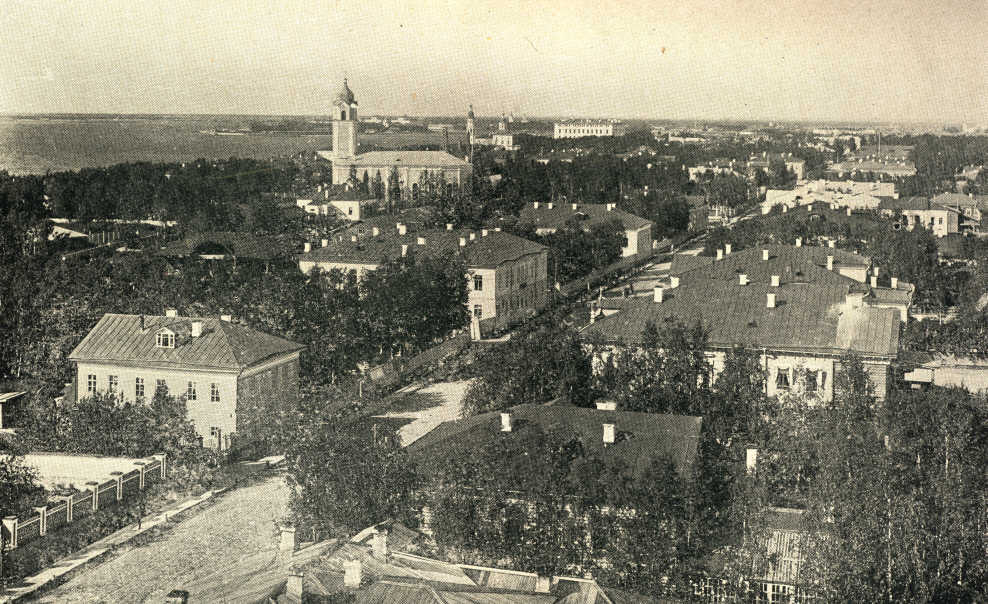
PRIMM
View of Archangel in Summer.
![[Illustration: ]](images/272Pic2_A25.jpg)
U. S. OFFICIAL PHOTO
General Ironside Inspecting Doughboys.
![[Illustration: ]](images/272Pic2_B25.jpg)
U. S. OFFICIAL PHOTO (159488)
Burial of Lieut. Clifford Phillips.
XXXVII
CAPTIVE DOUGHBOYS IN BOLSHEVIKDOM
Doughboy Captives Still Coming Out Of Red Russia—Red Cross Starts Prisoner
Exchange In Archangel Area—White Flag Incidents In No Man’s Land—Remarkable
Picture Taken—Men Who Were Liberated—Sergeant Leitzell’s Gripping Story Of
Their Captivity.
In August, 1920, came out of Bolshevik Russia, as startlingly as though
from the grave, Corp. Prince of “B” Company, who had been wounded and
captured at Toulgas, March 1, 1919. This leads to our story of the
captives in Bolshevikdom. One of the interesting incidents of the spring
defensive was the exchange of prisoners. It was brought about quite
largely through the efforts of the American Red Cross, which was very
anxious to try to get help to the Americans still in interior Russia,
especially the prisoners of war. When the Bolsheviki captured the Allied
men at Bolsheozerki in March they took a British chaplain, who pleaded
that he was a non-combatant and belonged to a fraternal order whose
principles were similar to the Soviet principles. Thinking they had a
convert, the Soviet Commissar gave Father Roach his freedom and sent him
through the lines at the railroad front in April.
News was brought back by Father Roach that many American and British and
French prisoners were at Moscow or on their way to Moscow.
Accordingly, the American Red Cross was instrumental in prevailing upon
the military authorities to open white flag conversations at the front
line in regard to a possible exchange of prisoners. A remarkable
photograph is included in this volume of that first meeting. One or two
other meetings were not quite so formal. At one time the excited Bolos
forgot their own men and the enemy who were parleying in the middle of
No Man’s Land, and started a lively artillery duel with the French
artillery. At another time the Americans’ Russian Archangel Allies got
excited and fired upon the Bolshevik soldiers who were sitting under a
white flag on the railroad track watching the American captain come
towards them. Happy to say, there were no casualties by this mistake.
But it sure was a ticklish undertaking for the Americans themselves
later in the day to walk out under a flag of truce to explain the
mistake and inquire about the progress of the prisoners exchange
conversations going on. At Vologda, American, British and French
officers were guests of the Bolshevik authorities. Their return was
expected and came during the first week of May.
One American soldier, Pvt. Earl Fulcher, of “H” Company, and one French
soldier were brought back and in exchange for them four former Bolshevik
officers were given. Report was brought that other soldiers were being
given their freedom by the Bolshevik government and were going out by
way of Petrograd and Viborg, Finland. It was learned that some American
soldiers were in hospital under care of the Bolshevik medical men. Every
effort was made by military authorities in North Russia to clear up the
fate of the many men who had been reported missing in action and missing
after ambush by the Reds who cut off an occasional patrol of Americans
or British or French soldiers.
But the Bolshevik military authorities were unable to trace all of their
prisoners. In the chaos of their organization it is not surprising. We
know that our own War Department lost Comrade Anthony Konjura, Company
“A” 310th Engineers, while he was on his way home from Russia, wounded,
on the hospital ship which landed him in England. There his mother went
and found him in a hospital. An American sergeant whose story appears in
this volume, says that while he was in Moscow six British soldiers were
luckily discovered by the Red authorities in a foul prison where they
had been lost track of. Even as this book goes to press we are still
hoping that others of our own American comrades and of our allies will
yet come to life out of Russia and be restored to their own land and
loved ones.
Corporal Arthur Prince, of “B” Company, who was ambushed and wounded and
captured in March, 1919, at Toulgas was, finally in August, 1920,
released from hospital and prison in Russia and crippled and sick joined
American troops in Germany. His pluck and stamina must have been one
hundred per cent to stand it all those long seventeen months. His
comrade, Herbert Schroeder, of “B” Company, who was captured on the 21st
of September, has never been found. His comrades still hope that he was
the American printer whom the Reds declared was printing their
propaganda in English for them at Viatka.
Comrade George Albers, “I” Company, in November, 1918, was on a lone
observation post at the railroad front. A Bolo reconnaissance patrol
surprised and caught him. He was the American soldier who was shown to
the comrades at Kodish on the river bridge after Armistice Day. He was
afterward sent on to Moscow and went out with others to freedom. With
him went out Comrades Walter Huston and Mike Haurlik of “C” Company, who
had been taken prisoners in action on November 29th near Ust Padenga on
the same day that gallant Cuff and his ten men were trapped and all were
killed or captured. These two men survived. In this liberated party was
also Comrade Anton Vanis, of Company “D” who was lost in the desperate
rear guard action at Shegovari. Also came Comrade William R. Schuelke,
“H” Company, who had been given up for dead. And in the party was Merle
V. Arnold, American “Y” man, who had been captured in March at
Bolsheozerki. Six of our allied comrades, Royal Scots, came out with the
party. These men all owed their release chiefly to the efforts of Mr. L.
P. Penningroth, of Tipton, Iowa, Secretary of the Prisoners-of-War
Release Station in Copenhagen, who secured the release of the men by
going in person to Moscow.
With the return of Comrade Schuelke we learn that he was one of the “H”
Company patrol under Corporal Collins which was ambushed near
Bolsheozerki, March 17th. One of his comrades, August Peterson, died
April 12th in a Bolshevik hospital. His Corporal, Earl Collins, was in
the same hospital severely wounded. His fate is still unknown but
doubtless he is under the mossy tundra. His comrade, Josef Romatowski,
was killed in the ambush, comrade John Frucce was liberated via Finland
and his comrade, Earl Fulcher, as we have seen, was exchanged on the
railroad front in May.
On March 31st two other parties of Americans were caught in ambush by
the Reds who had surrounded the Verst 18 Force near Bolsheozerki.
Mechanic Jens Laursen of “M” Company was captured along with Father
Roach and the British airplane man wounded in the action which cost also
the life of Mechanic Dial of “M” Company. And at the same time another
party going from the camp toward Obozerskaya consisting of Supply
Sergeant Glenn Leitzell and Pvt. Freeman Hogan of “M” Company together
with Bryant Ryal, a “Y” man, going after supplies, were captured by the
Reds. These men were all taken to Moscow and later liberated. Their
story has been written up in an interesting way by Comrade Leitzell. It
fairly represents the conditions under which those prisoners of war in
Bolshevikdom suffered till they were liberated:
“On March 31st, 1919, at 8:30 a. m. I left the front lines with a
comrade, Freeman Hogan, and a Russian driver, on my way back to
Obozerskaya for supplies. About a quarter of a verst, 500 yards, from
our rear artillery, we were surprised by a patrol of Bolos, ten or
twelve in number, who leaped out of the snowbanks and held us up at the
point of pistols, grenades and rifles. Then they stripped us of our arms
and hurried us off the road and into the woods. To our great surprise we
were joined by Mr. Ryal, the Y. M. C. A. Secretary who had been just
ahead of us.
“At once they started us back to their lines with one guard in front,
three in the rear and three on snow skiis on each side of the freshly
cut trail in the deep snow. We knew from the signs and from the fire
fight that soon followed that a huge force of the Reds were in rear of
our force. After seven versts through the snow we reached the village of
Bolsheozerki. On our arrival we were met by a great many Bolsheviks who
occupied the villages in tremendous numbers. Some tried to beat us with
sticks and cursed and spat on us as we were shoved along to the
Bolshevik commander.
“One of the camp loiterer’s scowling eyes caught sight of the sergeant’s gold
teeth. His cupidity was aroused. Raising his brass-bound old whipstock he
struck at the prisoner’s mouth to knock out the shining prize. But the prisoner
guard saved the American soldier from the blow by shoving him so vigorously
that he sprawled in the snow while the heavy whip went whizzing harmlessly past
the soldier’s ear. The Bolo sleigh driver swore and the prisoner guard scowled
menacingly at the brutal but baffled comrade. The American soldiers needed no
admonitions of skora skora to make them step lively toward the Red
General’s headquarters.
“One of the first things we saw on our arrival was a Russian sentry who
had gone over from our lines. They demanded our blouses and fur caps,
also our watches and rings. In a little while we saw three others
arrive—Father Roach of the 17th King’s Company of Liverpool and Private
Stringfellow of the Liverpools, also Mechanic Jens Laursen of our own
“M” Company who had escaped death in the machine gun ambush that had
killed his comrade Mechanic Dial and driver and horse. Later Lieut.
Tatham of the Royal Air Force came in with a shattered arm. His two
companions and the sleigh drivers had been mortally wounded and left by
the Bolsheviks on the road.
“After that we had our interview with a Bolshevik Intelligence Officer
who tried to get information from us. But he got no information from us
as we pleaded that we were soldiers of supply and were not familiar with
the details of the scheme of defense. And it worked. He sent us away
under guard, who escorted us in safety through the camp to a shack.
“Here we were billetted in a filthy room with a lot of Russian
prisoners, some the survivors of the defense of Bolsheozerki and some
the recalcitrants or suspected deserters from the Bolo ranks. We were
given half of a salt fish, a lump of sour black bread and some water for
our hunger. On the bread we had to use an ax as it was frozen. We
managed to thaw some of it out and wash it down with water. After this
we stretched in exhaustion on the floor and slept off the day and night
in spite of the constant roar of Bolo guns and the bursting of shells
that were coming from our camp at Verst 18. By that sign we knew the
Bolo had not overpowered our comrades by his day’s fighting. It was the
only comforting thought we had as we pulled the dirty old rags about us
that the Reds had given us in exchange for our overcoats and blouses,
and went to sleep.
“We woke up in the morning midst the roar of a redoubled fight. A fine
April Fool’s Day we thought. We were stiff and sore and desperately
hungry. But our breakfast was the remainder of the fish and sour bread.
Later the guard relieved us of some of our trinkets and pocket money,
after which they gave us our rations for the day, consisting of a half
can of horse meat, a salt fish, and twelve ounces of black bread.
“Then we were taken to see the General commanding this huge force. He
gave us a cigarette, which was very acceptable as we were quite
unnerved, not knowing what would happen to us afterwards if we gave no
more information than we had the day before. He tried to impress us by
taking his pistol and pointing out on a map of the area just where his
troops were that day surrounding our comrades in the beleagured camp in
the woods at Verst 18 on the road, as well as many versts beyond them
cutting a trail through the deep snow to the very railroad in rear of
Obozerskaya. He boasted that his forces that day would crush the
opposing force and he would move upon Obozerskaya and go up and down the
railroad and clear away every obstacle as he had done in the Upper Vaga
Valley, where he boasted he had driven the Allied troops from Shenkursk
and pursued them for over sixty miles. Then he informed us that we were
to be sent as prisoners to Moscow.
“Later in the morning we were started south toward Emtsa on foot. We
could hear the distant cannonading on the 445 front as we marched along
during the day on the winter trail which if it had been properly
patrolled by the French and Russians would not have permitted the
surprise flank march in force by this small army that menaced the whole
Vologda force. Our thirty-five verst march that day and night—for we
walked till 10:00 p. m.—was made more miserable by the thought that our
comrades were up against a far greater force than they dreamed, as was
evidenced to us by the hordes of men we had seen in Bolsheozerki and the
transportation that filled every verst of the trail from the south. We
made temporary camp in a log hut along the road, building a roaring fire
outside. We would sleep a half hour and then go outside the hut to thaw
out by the fire, and so on through the wretched night.
“At 4:00 a. m. we started again our footsore march, after a fragment of
black bread and a swallow of water, and walked twenty-seven versts to
Shelaxa, the Red concentration camp. Here we underwent a minute search.
All papers were taken for examination. Our American money was returned
to us, as was later a check on a London bank which one of my officers
had given me. I secreted it and some money so well in a waist belt that
later I had the satisfaction of cashing the check in Sweden into kronen
in King Gustave’s Royal Bank in Stockholm. After a meal of salt fish and
black bread fried in fish oil, and some hot water to drink, we were
given an hour’s rest and then started on the road again to Emtsa,
twenty-four versts away, reaching that railroad point at midnight. Here
we were brought before the camp commandant who roughly stripped us of
all our clothes except our breeches and gave us the Bolshevik underwear
and ragged outer garments that they had discarded. And buddies who have
seen Bolo prisoners come into our lines can imagine how bad a discarded
Bolo coat or undershirt must be. After this we were locked up in a box
car with no fire and three guards over us.
“Next morning, April 3rd, the car door was opened and the Bolshevik
soldiers made angry demonstrations toward us and were kept out only by
our guards’ bayonets. We were fed some barley wash and the rye bread
which tasted wonderful after the previous food. I paid a British
two-shilling piece which I had concealed in my shoe to a guard to get me
a tin to put our food in, and we made wooden spoons. That night we were
lined up against the car and asked if we knew that we were going to be
shot. But this event, I am happy to say, never took place. We went by
train to Plesetskaya that day. Father Roach was taken to the
commandant’s quarters and we did not see him till the next day, when he
told us he had enjoyed a fine night’s sleep and expected to be sent back
across the lines and would take messages to our comrades to let them
know we were alive and on our way to Moscow.”
It is interesting to note that the American Sergeant’s insistence that
he and his companions be given bath and means to shave, won the respect
and assistance of the guard and the Bolshevik officer. Of course in
making the two day’s march in prisoner convoy from Bolsheozerki to Emtsa
there had been severe hardship and privation and painful uncertainty and
mental agony over their possible fate. And they had not stopped long
enough in one place to enable them to make an appeal for fair treatment.
Imagine the three American soldiers and the “Y” man and the two British
soldiers sitting disconsolately in a filthy taplooshka, hands and faces
with three days and nights of grime and dirt, scratching themselves under their
dirty rags, cussing the active cooties that had come with the shirts, and
trying to soothe their itching bewhiskered faces. Here the resourceful old
sergeant keenly picked out the cleanest one of the guards and approached him
with signs and his limited Russki gavareet and made his protest at being
left dirty. He won out. The soldier horoshawed several times and
seechassed away to return a few minutes later with a long Russian blade
and a tiny green cake of soap and a tin of hot water. Under the stimulation of
a small silver coin from the sergeant’s store he assumed the role of barber and
smoothed up the faces of the whole crowd of prisoners. And then followed the
trip under guard to the steaming bath-house that is such a vivid memory to all
soldiers who soldiered up there under the Arctic Circle. In this connection it
may be related that later on at Moscow the obliging Commissar of the block in
which they were quartered hunted up for them razors and soap and even found for
them tooth brushes and tubes of toothpaste which had been made in Detroit, U.
S. A., and sold to Moscow merchants in a happier time.
“On April 5th we left Plesetskaya, after saying good-bye to the English
Chaplain who seemed greatly pleased that he was to get his freedom and
had his pockets full of Bolshevik propaganda. We reached Naundoma after
a night of terrible cold in the unheated car and during the next two
days on the railway journey to Vologda had nothing to eat. On April 7th
we reached that city and were locked up with about twenty Russians. Here
we got some black bread that seemed to have sand in it and some sour
cabbage soup which we all shared, Russians and all, from a single
bucket. Next day we thought it a real improvement to have a separate tin
and a single wooden spoon for the forlorn group of Americans and
British.
“At Plesetskaya we were questioned very thoroughly by a Russian officer
who spoke English very well and showed marked sympathy toward us and saw
to it that we were better treated, and later in Moscow saw to it that we
had some small favors. In three days’ time we were again on the train
for Moscow, travelling in what seemed luxury after our late experience.
The trains to Moscow ran only once a week as there were no materials to
keep up the equipment.
“On our arrival we found the streets sloppy and muddy, with heaps of ice
and snow and dead horses among the rubbish. Few business places were
open, all stores having been looted. Here and there was a semi-illicit
stand where horsemeat, salt fish, carrots or cabbage and parsnips, and
sour milk could be bought on the sly if you had the price. But it was
very little at any price and exceedingly uncertain of appearance. We
were sent to join the other prisoners, French, English, Scotch and
Americans who had preceded us from the front to Moscow. They had tales
similar to ours to tell us.
“The next morning at 10:00 a. m. we were wondering when we would eat.
The answer was: Twelve noon. Cabbage soup headed the menu, then came
dead horse meat, or salt fish if you chose it, black bread and water.
Same menu for supper. We learned that the people of the city fared
scarcely better. All were rationed. The soldiers and officials of the
Bolsheviks fared better than the others. Children were favored to some
extent. But the ‘intelligenza’ and the former capitalists were in sore
straits. Many were almost starving. Death rate was high. The soldier got
a pound of bread, workmen half a pound, others a quarter of a pound. In
this way they maintained their army. Fight, work for the Red government
or starve. Some argument. Liberty is unknown under the Soviet rule.
Their motto as I saw it is: What is yours is mine.’ “
Captivity with all its desperate hardships and baleful uncertainties,
had its occasional brighter thread. The American boys feel especially
grateful to Mr. Merle V. Arnold, of. Lincoln, Nebraska, the American Y.
M. C. A. man who had been captured by the Red Guards a few days
preceding their capture. He was able to do things for them when they
reached Moscow. And when he was almost immediately given his liberty and
allowed to go out through Finland, he did not forget the boys he left
behind. He carried their case to the British and Danish Red Cross and a
weekly allowance of 200 roubles found its way over the belligerent lines
to Moscow and was given to the boys, much to the grateful assistance of
the starving allied prisoners of war.
But they became resourceful as all American soldiers seem to become, whether at
Bakaritza, Smolny, Archangel, Kholmogora, Moscow or wherenot, and they found
ways of adding to their rations. Imagine one of them lining up with the
employees of a Bolo public soup kitchen and going through ostensibly to do some
work and playing now-you-see-it-now-you-don’t-see-it with a dish of salt or a
head of cabbage or a loaf of bread or a chunk of sugar, or when on friendly
terms with the Bolshevik public employees volunteering to help do some work
that led them to where a little money would buy something on the side at inside
employees’ prices. Imagine them with their little brass kettle, stewing it over
their little Russian sheet-iron stove, stirring in their birdseed substitute
for rolled oats and potatoes and cabbage and perhaps a few shreds of as clean a
piece of meat as they could buy, on the sly. See the big wooden spoons
travelling happily from pot to lips and hear the chorus of Dobra, dobra.
They will not ever forget the English Red Cross woman who constantly
looked out for the five Americans, the thirty-five British and fifteen
French prisoners, finding ways to get for them occasional morsels of
bacon and bread and small packages of tea and tobacco. On Easter day she
entertained them all in the old palace of Ivan the Terrible.
How good it was one day to meet an American woman who had eighteen years
before married a Russian in Chicago and come to Moscow to live. Her
husband was a grain buyer for the Bolshevik government but she was a
hater of the Red Rule and gave the boys all the comfort she could, which
was little owing to the surveillance of the Red authorities.
And one day the sergeant met an American dentist who had for many years
been the tooth mechanic for the old Czar and his family. He fixed up a
tooth as best he could for the American soldier. The Reds had about
stripped him but left him his tools and his shop so that he could serve
the Red rulers when their molars and canines needed attention.
The American boys gained the confidence of the Russians in Moscow just
as they had always done in North Russia. They were finally given
permission to participate in the privileges of one of the numerous clubs
that the Red officials furnished up lavishly for themselves in the
palatial quarters of old Moscow. Here they could find literature and
lectures and lounging room and for a few roubles often gained a hot
plate of good soup or a delicacy in the shape of a horse steak. Of
course the latter was always a little dubious to the American doughboy,
for in walking the street he too often saw the poor horse that dropped
dead from starvation or overdriving, approached by the butcher with the
long knife. He merely raised the horse’s tail, slashed around the anal
opening of the animal with his blade, then reached in his great arm and
drew out the entrails and cast them to one side for the dogs to growl
and fight over. Later would come the sleigh with axes and other knives
to cut up the frozen carcass. On May day the boys nearly lost their
membership in the club, along with its soup and horse-steak privileges
because they would not march in the Red parade to the gaily decorated
square to hear Lenin speak to his subjects.
Was the Red government able to feed the people by commandeering, the
food? No. At last the peasants gained the sufferance of the Red rulers
to traffic their foodstuffs on the streets even as we have seen them
with handfuls of vegetables on the market streets of Archangel. Prices
were out of sight. Under a shawl in a tiny box, an old peasant woman on
Easter Day was offering covertly a few eggs at two hundred roubles
apiece.
Imagine the feelings of the boys when they walked about freely as they
did, being dressed in the regular Russian long coats and caps and being
treated with courtesy by all Russians who recognized them as Americans.
Here they found themselves looking at the great hotel built on American
lines of architecture to please the eye and shelter the American
travellers of the olden times before the great war, a building now used
by the Red Department of State. Here they were examined by one of
Tchicherin’s men upon their arrival in the Red capital. Further they
could walk about the Kremlin, and visit a part of it on special
occasions. They could see the execution block and the huge space laid
out by Ivan the Terrible, where thousands of Russians bled this life
away at the behest of a cruel government.
Or they could stand before the St. Saveur cathedral, a noble structure
of solid marble with glorious murals within to remind the Slavic people
of their unconquerable resistance to the great Napoleon and of his
disastrous retreat from their beloved Moscow.
They cannot be blamed for coming out of Moscow convinced that the heart
of the Slavic people is not in this Bolshevik class hatred and class
dictatorship stuff of Lenin and Trotsky; equally convinced that the
heart of the Russian people is not unfearful of the attempted return of
the old royalist bureaucrats to their baleful power, and convinced that
the heart of this great, courteous, patient, longsuffering Slavic people
is groping for expression of self-government, and that America is their
ideal—a hazy ideal and one that they aspire toward only in general
outlines. Their ultimate self-government may not take the shape of
American constitutionalism, but Russian self-government must in time
come out of the very wrack of foreign and internecine war. And every
American soldier who fought the Bolshevik Russian in arms or stood on
the battle line beside the Archangel Republic anti-Bolshevik Russian,
might join these returned captives from Bolshevikdom in wishing that
there may soon come peace to that land, and that they may develop
self-government.
“We finally received our release. We had known of the liberation of Mr. Arnold
and several of our North Russian comrades and had been hoping for our turn to
come. Mr. Frank Taylor, an Associated Press correspondent, was helpful to us,
declaring to the Bolshevik rulers that American troops were withdrawing from
Archangel. We had been faithful (sic) to the lectures, for a purpose of
dissimulation, and the Red fanatics really thought we were converted to the
silly stuff called bolshevism. It was plain to us also that they were playing
for recognition of their government by the United States. So we were given
passports for Finland. The propaganda did not deceive us.
“At the border a suspicious sailor on guard searched us. He turned many
back to Petrograd. The train pulled back carrying four hundred women and
children and babies disappointed at the very door to freedom, weeping,
penniless, and starving, starting back into Russia all to suit the whim
of an ignorant under officer. Under the influence of flattery he
softened toward us and after robbing us of everything that had been
provided us by our friends for the journey, taking even the official
papers sent by the Bolshevik government to our government which we were
to deliver to American representatives in Finland, he let us go.
“After he let us go we saw the soldiers in the house grabbing for the American
money which Mr. Taylor had given us. They had not thought it worth while to
take the Russian roubles away from us. Of course they were of no value to us in
Finland. After a two kilometer walk, carrying a sick English soldier with us,
my three comrades and I reached the little bridge that gave us our
freedom.”—By Sgt. Glenn W. Leitzell, Co. M, 339th Inf.
XXXVIII
MILITARY DECORATIONS
In the North Russian Expedition Fighting the Bolsheviki, American
officers and men fought at one time or another under the field standards
of four nations, American, British, French, and (North) Russian. And for
their valor and greatly meritorious conduct, mostly over and beyond the
call of duty, many soldiers were highly commended by their field
officers, American, French, British, and Russian, in their reports to
higher military authorities. Many, but not all, of these officers and
soldiers were later cited in orders and awarded decorations. Not every
deserving man received a citation. That is the luck of war.
It was a matter of keen regret to the British Commanding General that he
was so hedged by orders from England that his generous policy of
awarding decorations to American soldiers was abruptly ended in
mid-winter when it became apparent that the United States would not
continue the campaign against the Bolsheviki but would withdraw American
troops at the earliest possible moment.
The Russian military authorities were eager to show their appreciation
of their American soldier allies, but due to the indifference of Colonel
Stewart to this not many soldiers were decorated with Russian old army
decorations.
The French decorations were probably the sincerest marks of esteem and
admiration. They were bestowed by French officers who were close to the
doughboy in the field. And they are prized as tokens of the affection of
the French for Americans.
In speaking of American decorations we can hardly write without heat.
The doughboy did not get his just deserts. And he, without doubt, is
correct in placing the blame for the neglect at the door of the American
commanding officer, Colonel Stewart. Men and officers who died
heroically up there in that North Russian campaign, and others who carry
wound scars, and yet others who performed valiantly in that desperate
campaign, went unrewarded.
AMERICAN DECORATIONS
Distinguished Service Cross
BUGLER JAMES F. REVELS, “I” Co., 339th Inf., for gallantry in action,
Sept. 16th, 1918, Obozerskaya, Russia.
LIEUT. CHARLES F. CHAPPEL, “K” Co., 339th Inf., for gallantry in action,
Sept. 27th, 1918, Kodish, Russia. (Citation posthumous.)
SGT. MATHEW G. GRAHEK, “M” Co., 339th Inf., for gallantry in action,
Sept. 29th, 1918, at Verst 458, Obozerskaya, Russia.
SGT. CORNELIUS T. MAHONEY, “K” Co., 339th Inf., for gallantry in action,
October 16th, 1918, Kodish, Russia.
CORP. ROBERT M. PRATT, “M” Co., 339th Inf., for gallantry in action,
October 17th, 1918, Verst 445, near Emtsa, Russia.
PVT. VICTOR STIER, “A” Co., 339th Inf., for gallantry in action, January
19th, 1919, Ust Padenga, Russia. (Citation posthumous.)
PVT. LAWRENCE B. KILROY, 337th Ambulance Company, for gallantry in
action, Kodish, Russia.
PVT. HUBERT C. PAUL, 337th Ambulance Company, for gallantry in action,
Kodish, Russia.
LIEUT. CLIFFORD F. PHILLIPS, “H” Co., 339th Inf., for gallantry in
action, April 2nd, 1919, near Bolsheozerki. (Citation posthumous.)
CORP. THEODORE SIELOFF, “I” Co., 339th Inf., for gallantry in action,
Nov. 4th, 1918, at Verst 445, near Emtsa, Russia.
PVT. CLARENCE H. ZECH, 337th Ambulance Company, for gallantry in action,
Kodish, Russia.
CORP. WILLIAM H. RUSSELL, “M” Co., 339th Inf., for gallantry in action,
April 1st, 1919, near Bolsheozerki, Russia. (Citation posthumous.)
PVT. CHESTER H. EVERHARD, 337th Ambulance Company, for gallantry in
action, April 2nd, 1919, near Bolsheozerki, Russia.
LIEUT. HOWARD H. PELLEGROM, “H” Co., 339th Inf., for gallantry in
action, April 2nd, 1919, near Bolsheozerki, Russia.
FRENCH DECORATIONS
Legion of Honor
MAJOR J. BROOKS NICHOLS, 339th Inf.
COL. GEORGE E. STEWART, 339th Inf.
Croix de Guerre
PVT. WALTER STREIT, “M” Co.
SGT. MATHEW G. GRAHEK, “M” Co.
PVT. JAMES DRISCOLL, “M.G.” Co.
PVT. CLARENCE A. MILLER, “M” CO.
PVT. ARTHUR FRANK, “M.G.” CO.
PVT. LEO R. ELLIS, “I” Co.
LIEUT. JAMES R. DONOVAN, “M” Co. 339th Inf.
SGT. FRANK GETZLOFF, “M” Co.
CORP. C. A. GROBBELL, “I” Co.
LIEUT. GEORGE W. STONER, “M” Co., 339th Inf.
PVT. JOHN H. ROMPINEN, “M” Co.
PVT. ALFRED FULLER, “K” Co.
MAJOR MICHAEL J. DONOGHUE, 339th Inf.
LIEUT. CLARENCE J. PRIMM, “M” Co., 339th Inf.
LIEUT. DWIGHT FISTLER, “I” Co., 339th Inf.
SGT. CHARLES HEBNER, “M” Co.
PVT. OTTO GEORGIA, “K” Co.
LIEUT. PERCIVAL L. SMITH, “Hq.” Co., 339th Inf.
LIEUT. WESLEY K. WRIGHT, “M” Co., 339th Inf.
LIEUT. GILBERT T. SHILLSON, “K” CO., 339th Inf.
SGT. HARVEY B. PETERSON, “M” Co.
PVT. HERMAN A. SODER, “I” Co.
PVT. THOMAS McELROY, “M” Co.
CORP. BENJAMIN JONDRO, “M” Co.
PVT. TOBIAS LePLANT, “K” Co.
PVT. FRANK RANK, “I” Co.
SGT. CHARLES V. RIHA, “M” Co.
LIEUT. ROBERT J. WIECZOREK, “M” Co., 339th Inf.
LIEUT. WOODHULL SPITLER, “M.G.” Co., 339th Inf.
SGT. JOHN P. GRAY, “M” CO.
CAPT. JOSEPH ROSENFELD, 337th Amb.
SGT. JACOB KANTROWITZ, “M” Co.
LIEUT. JOHN J. BAKER, “E” Co., 339th Inf.
PVT. CLYDE PETERSON, “K” Co.
CORP. THEODORE H. SIELOFF, “I” Co.
PVT. RAY LAWRENCE, “M” Co.
CAPT. HORATIO G. WINSLOW, “I” Co., 339th Inf.
CORP. JOHN C. SMOLINSKI, “I” Co.
PVT. JOHN KUKORIS, “I” Co.
LIEUT. LEWIS E. JAHNS, “K” Co., 339th Inf.
MAJOR J. BROOKS NICHOLS, 339th Inf., Commanding officer Allied troops,
Railway Detachment.
PVT. SAMUEL H. DARRAH, “K” Co.
LIEUT. CHARLES B. RYAN, “K” Co., 339th Inf.
CORP. FRANK L. O’CONNOR, “M” Co.
MR. FRANK OLMSTEAD, Y. M. C. A.
PVT. OSCAR LIGHTER, “M” Co.
PVT. ALFRED STARIKOFF, “M” Co.
CORP. ROBERT M. PRATT, “M” Co.
PVT. ERNEST P. ROULEAU, “M” Co.
CAPT. JOEL R. MOORE, “M” Co., 339th Inf. (with silver star, divisional
citation).
BRITISH DECORATIONS
Distinguished Service Order
MAJOR J. BROOKS NICHOLS, 339th Inf.
Commanding officer American and Allied troops, Railway Detachment, fall
offensive and winter and spring defensive campaigns of Vologda Force.
MAJOR MICHAEL J. DONOGHUE, 339th Inf.
Commanding officer American and Allied troops, Kodish offensive in fall
and winter defensive campaigns of the Seletskoe Detachment of Vologda
Force.
CAPTAIN ROBERT P. BOYD, “B” CO., 339th Inf.
Commanding officer American and Allied troops left bank of Dvina, fall
offensive and winter defensive campaigns of Dvina-Kotlas Force.
LIEUT.-COL. P. S. MORRIS, JR., 310th Engineers.
Chief Engineer A. E. F., North Russia, during fall offensive and winter
and spring campaigns.
Military Cross
CAPT. OTTO A. ODJARD, Commanding Officer “A” Co., 339th Inf.
LIEUT. ALBERT M. SMITH, “B” Co., 339th Inf.
LIEUT. LAWRENCE P. KEITH, “M.G.” Co. 339th Inf.
LIEUT. GORDON B. REESE, “I” Co., 339th Inf.
LIEUT. HARRY S. STEELE, “C” Co., 339th Inf.
LIEUT. W. C. GIFFELS, “A” Co., 310th Engrs.
LIEUT. HARRY M. DENNIS, “B” Co. 339th Inf.
LIEUT. JOHN A. COMMONS, “K” Co., 339th Inf.
LIEUT. H. D. McPHAIL, “A” Co., 339th Inf.
LIEUT. CHARLES B. RYAN, “K” Co., 339th Inf.
LIEUT. H. T. KETCHAM, “H” Co., 339th Inf.
LIEUT. HARRY J. COSTELLO, “M.G.” Co., 339th Inf. (received his medal
from the hand of the Prince of Wales, in Washington, D. C.)
MAJOR CLARE S. McARDLE, Commanding officer 1st Battalion 310th Engrs.
LIEUT. EDWIN J. STEPHENSON, “A” Co., 310th Engrs.
LIEUT. B. A. BURNS, “A” Co., 310th Engrs.
CAPT. W. O. AXTELL, “B” Co., 310th Engrs.
LIEUT. E. W. LEGIER, “C” Co., 310th Engrs.
Distinguished Conduct Medal
SGT. MATHEW G. GRAHEK, “M” Co., 339th Inf.
SGT. F. W. WOLFE, “K” Co., 339th Inf.
SGT. G. M. WALKER, “K” Co., 339th Inf.
SGT. CHAS. J. HAYDEN, “I” Co., 339th Inf.
CORP. J. C. DOWNS, “B” Co., 339th Inf.
SGT. A. V. TIBBALS, “A” Co., 310th Engrs.
CORP. GEORGE R. YOHE, Signal Platoon, “Hq.” Co., 339th Inf.
PVT. WALTER A. SPRINGSTEEN, Signal Platoon, “Hq.” Co., 339th Inf.
CORP. JAMES MORROW, “B” Co., 339th Inf.
SGT. PETER CSATLOS, “A” Co., 310th Engrs.
SGT. FLOYD A. WALLACE, “B” Co., 339th Inf.
Military Medal
SGT. CARL W. VENABLE, “L” Co., 339th Inf.
PVT. 1ST CLASS JAMES W. DRISCOLL, “M.G.” Co., 339th Inf.
SGT. MICHAEL J. KENNEY, “K” Co., 339th Inf.
SGT. E. J. HERMAN, “A” Co., 310th Engrs.
CORP. J. S. MANDERFIELD, “A” Co., 310th Engrs.
SGT. E. P. TROMBLEY, “A” Co., 339th Inf.
CORP. H. T. DANIELSON, “A” Co., 339th Inf.
CORP. J. FRANCZAC, “A” Co., 339th Inf.
BUGLER C. J. CAMPUS, “A” Co., 339th Inf.
MECH. A. J. HORN, “A” Co., 339th Inf.
SGT. J. A. NEES, “A” Co., 339th Inf.
SGT. ARNOLD W. NOLF, “A” Co., 310th Engrs.
SGT. H. H. HAMILTON, “A” Co., 310th Engrs.
PVT. BERGER W. BERGSTROM, “A” Co., 310th Engrs.
PVT. RUSSELL F. McGUIRE, “A” Co., 310th Engrs.
PVT. MICHAEL KOWALSKI, “H” Co., 339th Inf.
SGT. E. W. PAUSCH, “C” Co., 339th Inf.
SGT. JOHN BENSON, “C” Co., 310th Engrs.
SGT. SILVER K. PARISH, “B” Co., 339th Inf.
PVT. CHARLES BELL, “B” Co., 339th Inf.
PVT. JOSEPH EDYINSON, “B” Co., 339th Inf.
SGT. L. E. STOVER, “B” Co., 310th Engrs.
CORP. W. C. BUTZ, “B” Co., 310th Engrs.
CORP. F. W. WILKIE, “K” Co., 339th Inf.
SGT. L. BARTELS, “K” Co., 339th Inf.
CORP. J. STEYSKAL, “K” Co., 339th Inf.
PVT. E. E. HELMAN, “K” Co., 339th Inf.
CORP. WILLIAM C. SHAUGHNESSEY, Signal Platoon, “Hq.” Co., 339th Inf.
PVT. LOUIS L. HOPKINS, “Hq.” Co., 339th Inf.
PVT. CHARLES E. GARRETT, “Hq.” Co., 339th Inf.
PVT. GUY HINMAN, “Hq.” Co., 339th Inf.
PVT. JAMES R. WAGGENER, “Hq.” Co., 339th Inf.
PVT. CLARENCE A. MILLER, “M” Co., 339th Inf.
Meritorious Service Medal
SGT. EWALD T. BILLEAU
PVT. A. H. DITTBERNER
SGT. L. S. SCHNEIDER
SGT. DELBERT KRATZ
1ST. SGT. V. B. ROGERS
SGT. F. W. YATES
PVT. JERRY DAUBEK
CORP. A. N. ERICKSON
All of “A” Company, 310th Engineers
RUSSIAN DECORATIONS
St. Vladimir with Swords and Ribbons
REAR-ADMIRAL NEWTON A. McCULLY, Commanding U. S. Naval Forces.
MAJOR MICHAEL J. DONOGHUE, 339th Inf.
MAJOR J. BROOKS NICHOLS, 339th Inf.
COL. JAMES A. RUGGLES, Chief of American Military Mission, Military
Attache to Embassy in Russia.
St. Anne With Swords
CAPT. JOEL R. MOORE, “M” Co., 339th Inf.
LIEUT. J. R. DONOVAN; “M” Co., 339th Inf.
LIEUT. ALBERT M. SMITH, “B” Co., 339th Inf.
LIEUT. GORDON B. REESE, “I” Co., 339th Inf.
LIEUT. HARRY S. STEELE, “C” Co., 339th Inf.
LIEUT. GEORGE W. STONER, “M” Co., 339th Inf.
LIEUT. CLARENCE J. PRIMM, “M” Co., 339th Inf.
LIEUT. F. B. LITTLE, Med. Corps, 339th Inf.
LIEUT. W. C. GIFFELLS, “A” Co., 310th Engrs.
LIEUT. E. W. LEGlER, “C” Co., 310th Engrs.
LIEUT. HARRY J. COSTELLO, “M.G.” Co., 339th Inf.
CAPT. EUGENE PRINCE, Military Mission.
CAPT. HUGH S. MARTIN, Military Mission.
CAPT. J. A. HARTZFELD, Military Mission.
LIEUT. SERGIUS M. RIIS, Naval Attache to Embassy.
St. Stanislaus
CAPT. OTTO A. ODJARD, “A” Co., 339th Inf.
CAPT. ROBERT P. BOYD, “B” Co., 339th Inf.
MAJOR C. S. McARDLE, 310th Engrs.
CAPT. JOHN J. CONWAY, “G” Co., 339th Inf.
LIEUT. LAWRENCE P. KEITH, “Hq.” Co., 339th Inf.
LIEUT. WESLEY K. WRIGHT, “M” Co., 339th Inf.
LIEUT. JOHN A. COMMONS, “K” Co., 339th Inf.
LIEUT. H. T. KETCHAM, “H” Co., 339th Inf.
LIEUT. HARRY M. DENNIS, “B” Co., 339th Inf.
LIEUT. CHARLES B. RYAN, “K” Co., 339th Inf.
LIEUT. H. D. McPHAIL, “A” Co., 339th Inf.
CAPT. WILLIAM KNIGHT, 310th Engrs.
LIEUT. ROBERT J. WIECZOREK, “M” Co., 339th Inf.
LIEUT. DWIGHT FISTLER, “I” Co., 339th Inf.
LIEUT. B. A. BURNS, “A” Co., 310th Engrs.
LIEUT. A. W. KLIEFOTH, Military Mission.
LIEUT. M. B. ROGERS, Military Mission.
LIEUT. E. L. PACKER, Military Mission.
MAJOR D. O. LIVELY, American Red Cross.
CAPT. ROGER LEWIS, American Red Cross.
LIEUT. FRED MASON, American Red Cross.
LIEUT. GEORGE POLLATS, American Red Cross.
Cross of St. George
PVT. JOHN C. ADAMS
PVT. HARRISON BUSH
SGT. JOSEPH CURRY
PVT. FRED DeLANEY
1ST. SGT. W. DUNDON
BUGLER GEORGE GARTON
SGT. M. G. GRAHEK
PVT. GEO. HANRAHAN
SGT. CHAS. A. HEBNER
CORP. FRED HODGES
SGT. WM. R. HUSTON
SGT. JACOB KANTROWITZ
CORP. WM. NIEMAN
CORP. F. L. O’CONNOR
SGT. CHAS. W. PAGE
CORP. ROBT. M. PRATT
SGT. CHAS. V. RIHA
CORP. F. J. ROMANSKI
PVT. JOHN ROMPINEN
CORP. JOS. RYDUCHOWSKI
PVT. LEO SCHWABE
SGT. NORMAN ZAPFE
CORP. W. ZIMMERMAN
All of “M” Company, 339th Infantry.
Also MR. ERNEST RAND, and MR. FRANK OLMSTEAD, Y. M. C. A.
St. Anne Silver Medal
CORPORAL WALTER J. PICARD, “M” Company, 339th Inf.
St. Stanislaus Silver Medal
PVT. HAROLD METCALFE
PVT. ERNEST ROULEAU
PVT. FRANK STEPNAVSKI
COOK JOSEPH PAVLIN
COOK THEODORE ZECH
All of “M” Company, 339th Infantry
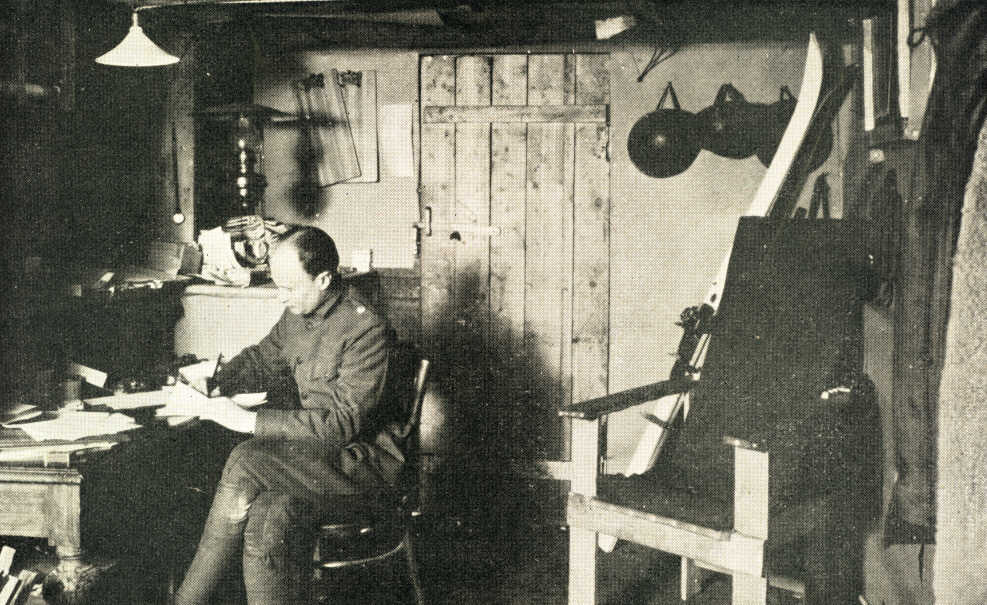
U. S. OFFICIAL PHOTO
Major Nichols in His Railway Detachment Field Headquarters
![[Illustration: ]](images/287Pic2_A25.jpg)
LANMAN
Ready to Head Memorial Day Parade.
![[Illustration: ]](images/287Pic2_B25.jpg)
LANMAN
American Cemetery in Archangel.
![[Illustration: ]](images/287Pic2_C25.jpg)
LANMAN
Soldiers and Sailors of Six Nations Reverence Dead.
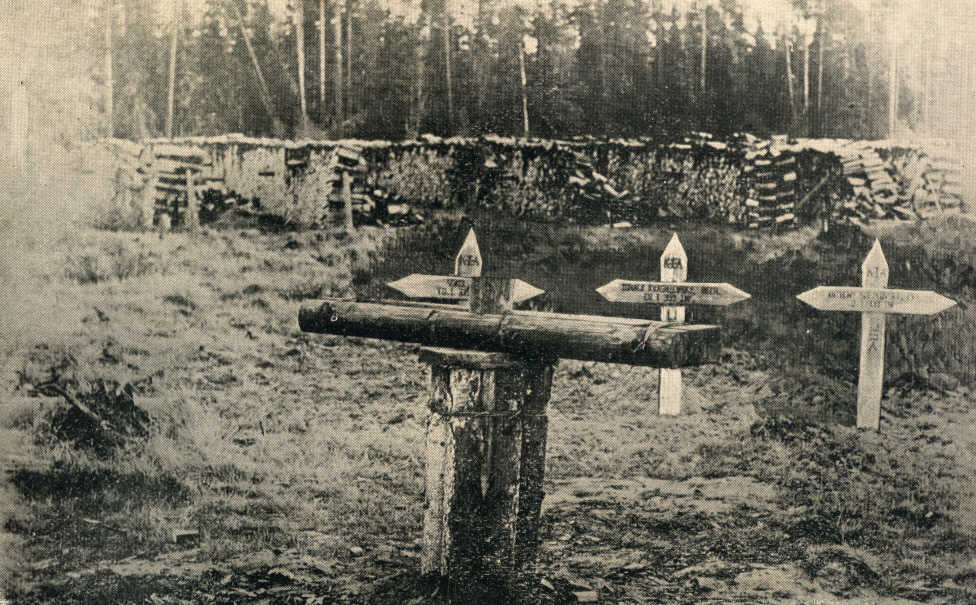
U. S. OFFICIAL PHOTO
Graves of First Three Americans Killed Fighting Bolsheviki—Obozerskaya, Russia.
![[Illustration: ]](images/287Pic3_A25.jpg)
LANMAN
Sailors Parade on Memorial Day, Archangel.
![[Illustration: ]](images/287Pic3_B25.jpg)
LANMAN
Through Ice Floes in Arctic Homeward-Bound.
![[Illustration: ]](images/287Pic3_C25.jpg)
ROZANSKEY
Out of White Sea into Arctic Under Midnight Sun.
XXXIX
HOMEWARD BOUND
“At The Earliest Possible Date”—Work Of Detroit’s Own Welfare
Association—“Getting The Troops Out Of Russia”—We Assemble At
Economia—Delousers And Ball Games—War Mascots—War Brides—Remarkable Memorial
Day Service In American Military Cemetery In Archangel—Tribute To Our Comrades
Who Could Not Go Home—Our Honored Dead.
“At the earliest possible moment” was the date set by the War Department
for the withdrawal of the troops from Russia. This was the promise made
the American people during the ice-bound winter, the promise made more
particularly to appease vigorous protests of “The Detroit’s Own Welfare
Association,” which under the leadership of Mr. D. P. Stafford, had been
untiring in its efforts to move the hand of the War Department.
Congressmen Doremus and Nichols and Townsend had also been very active
in “getting the Americans out of North Russia.”
To us wearied veterans of that strange war, the nine months of guerrilla
war, always strenuous and at times taking on large proportions,—to us
the “earliest possible moment” could not arrive a minute too soon. We
had fought a grim fight against terrible odds, we had toiled to make the
defenses more and more impregnable so that those who relieved us might
not be handicapped as we had been. We hated to be thought of as
quitters, we suffered under the reproachful eyes of newly arriving
veteran Scots and Tommies who had been mendaciously deceived into
thinking we were quitters. We suffered from the thought that the
distortion, exaggeration and partisan outcry at home was making use of
half-statements of returned comrades or half-statements from uncensored
letters, in such a way as to make us appear cry-babies and quitters. But
down in our hearts we were conscious that our record, our morale, our
patriotism were sound. We believed we were entitled to a speedy getaway
for home. We accepted the promise with pleasure. We felt friendly toward
the Detroit’s Own Welfare Association for its efforts and the efforts of
others. We could have wished that there had not been so much excitement
of needless fears and incitement of useless outcry. It cost us hard
earned money to cable home assurances to our loved ones that we were
well and safe, so that they need not believe the wild tales that we were
sleeping in water forty below zero, or thawing out the cows before we
milked them, or simply starving to death. We could have wished that
returned comrades who tried to tell the real facts and allay needless
fears—the actual facts were damnable enough—might not have been
treated as shamefully as some were by a populace fooled by a mixed
propaganda that was a strange combination, as it appears to us now, of
earnest, sympathetic attempts to do something for “Detroit’s Own,” of
bitter partisan invective, and of insidious pro-bolshevism.
For the cordial welcome home which was given to the Polar Bear veterans
in July, our heartfelt appreciation is due. Veterans who marched behind
Major J. Brooks Nichols between solid crowds of cheering home-folks on
July 4th at Belle Isle could not help feeling that the city of Detroit
was proud of the record of the men who had weathered that awful
campaign. It was a greeting that we had not dreamed of those days away
up there in the northland when we were watching the snow and ice melt
and waiting news of the approach of troopships.
At Economia we assembled for the purpose of preparing for our voyage
home. To the silt-sawdust island doughboys came from the various fronts.
By rail from Obozerskaya and Bolsheozerki, by barge from Beresnik and
Kholmogori and Onega, came the veterans of this late side show of the
great world war. With them they had their mascots and their War Brides,
their trophies and curios, their hopeful good humor and healthy play
spirit.
Who will not recall with pleasure the white canvass camp we made on the
“policed-up” sawdust field. Did soldiers ever police quite so willingly
as they did there on the improvised baseball diamond, where “M” Company
won the championship and the duffle-bagful of roubles when the first
detachment of the 339th was delousing and turning over Russian
equipment, and “F” Company won the port belt and roubles in the series
played while the remainder of the Polar Bears were getting ready to
sail.
Who will forget the day that the Cruiser “Des Moines” steamed in from
the Arctic? Every doughboy on the island rushed to the Dvina’s edge.
They stood in great silent throat-aching groups, looking with blurred
eyes at the colors that grandly flew to the breeze. And then as the
jackies gave them a cheer those olive drab boys answered till their
throats were hoarse. That night they sat long in their tents—it was not
dusk even at midnight, and talked of home. A day or so later they spied
from the fire-house tower vessels that seemed to be jammed in a polar
ice floe which a north wind crowded into the throat of the White Sea.
Then to our joy a day or two later came the three transports, the long
deferred hope of a homeward voyage.
Everyone was merry those days. Even the daily practice march with
full-pack ordered by Colonel Stewart, five miles round and round on the
rough board walks of the sawdust port, was taken with good humor.
Preparations for departure included arrangements for carrying away our
brides and mascots.
Here and there in the Economia embarkation camp those days and nightless
nights in early June many a secret conclave of doughboys was held to
devise ways and means of getting their Russian mascots aboard ship. Of
these boys and youths they had become fond. They wanted to see them in
“civvies” in America and the mascots were anxiously waiting the outcome
at the gangplank.
At Chamova one winter night a little twelve-year old Russian boy
wandered into the “B” Company cook’s quarters where he was fed and given
a blanket to sleep on. Welz, the cook, mothered him and taught him to
open bully cans and speak Amerikanski. This incident had its counterpart
everywhere. At Obozerskaya “M” Company picked up a boy whose father and
mother had been carried off by the Bolsheviks. He and his pony and
water-barrel cart became part of the company. At Pinega the “G” Company
boys adopted a former Russian Army youth who for weeks was the only man
who could handle their single Colt machine gun. In trying to get him on
board the “Von Stenben” in Brest—it had been simple in Economia—they
got their commanding officer into trouble. Lt. Birkett was arrested,
compelled to remain at Brest but later released and permitted to bring
the youth to America with him where he lives in Wisconsin. And out on a
ranch in Wyoming a Russian boy who unofficially enlisted with the
American doughboys to fight for his Archangel state is now learning to
ride the American range with Lt. Smith. Major Donoghue’s “little
sergeant” is in America too and goes to school and his Massachusetts
school teacher calls him Michael Donoghue. And others came too.
In marked contrast to these passengers who came with the veterans from
North Russia via Brest, which they remember for its Bokoo Eats and its
lightning equipment-exchange mill, is the story of one of the fifty
general prisoners whom they guarded on the “Von Steuben.” One of them
was a bad man, since become notorious. He was missing as the ship
dropped anchor that night in the dark harbor. It was feared by the
“second looie” and worried old sergeant that the man was trying to make
an escape. When they found him feigning slumber under a life boat on a
forbidden deck they chose opposite sides of the life boat and kicked him
fervently, first from one side then the other till he was submissive.
The name of the man at that time meant little to them—it was Lt. Smith.
But a few days afterward they could have kicked themselves for letting
Smith off so easy, for the press was full of the stories of the
brutalities of “Hardboiled” Smith. Lt. Wright and Sergeant Gray are not
yearning to do many events of the Russian campaign over but they would
like to have that little event of the homeward bound voyage to do over
so they could give complete justice to “Hardboiled” Smith.
In contrast with the stories of brutal prison camps of the World War we
like to think of our buddies making their best of hardships and trials
in North Russia. We have asked two well-known members of the expedition
to contribute reminiscences printed below.
“As ithers see us” is here shown by extract from a letter by a Red Cross
man who saw doughboys as even our Colonel commanding did not see. This
Red Cross officer, Major Williams, of Baltimore, saw doughboys on every
front and sector of the far-extended battle and blockhouse line. He may
speak with ample knowledge of conditions. In part he writes:
“Americans, as a rule, are more popular in Russia than any other
nationality. The American soldier in North Russia by his sympathetic
treatment of the villagers, his ability to mix and mingle in a homey
fashion with the Russian peasants in their family life and daily toil,
and particularly the American soldier’s love of the little Russian
children, and the astonishing affection displayed by Russian children
toward the Americans furnishes one of the most illuminating examples of
what was and may be accomplished through measures of peaceful
intercourse. The American soldier demonstrated in North Russia that he
is a born mixer.
“I could write a book, giving concrete examples coming under my
observation, from voluminous notes in my possession. As I dictate this,
there is a vision of an American soldier who stopped by my sled, at some
remote village in a trackless forest, and urged me to visit with him a
starving family. This soldier, from his own rations, was helping to feed
thirteen Russians, and his joy was as great as theirs when the Red Cross
came to their relief.”
The next contribution is from the pen of a man who, born in Kiev,
Russia, had in youth seen the Czar’s old army, who had served years in
the U. S. army after coming to America, who was one of the finest
soldiers and best known men in the North Russian expedition.
“It is almost an axiom with the regular army of our own country and
those of foreign nations, that soldier and discipline are synonymous.
Meaning thereby the blind discipline of the Prussian type.
“That such an axiom is entirely wrong has been shown us by the National
Army. No one will affirm that the new-born army was a model to pass
inspection even before our own High Moguls of the regular army. And yet,
what splendid success has that sneered at, ‘undisciplined,’ army
achieved.
“And where is the cause of its success? The ‘Uneducatedness’ in the
sense of the regular army. The American citizen in a soldier uniform
acted like a free human being, possessing initiative, self-reliance, and
confidence, which qualities are entirely subdued by the so called
education of a soldier. It is not the proper salute or clicking of the
heels that makes the good soldier, but the spirit of the man and his
character. And these latter qualities has possessed our national army.
Fresh from civilian life with all the liberty-loving tendencies, our
boys have thrown themselves into the fight on their own accord, once
they realized the necessity of it. The whip of discipline could never
accomplish so much as the conscience of necessity. And that is what the
national army possessed. And that is the cause of its success. And
therefore I love it.
“So long as the United States remains a free country, there is no danger
for the American people. That spirit which has manifested itself in the
National Army is capable to accomplish everything. It is the free
institutions of the country that brought us victory, not the so called
‘education’ gotten in the barracks.
“I admired the national army man in fight, because I loved him as a
citizen. And unless he changes as a citizen, he will not change as a
fighter. To me the citizen and soldier are synonymous. A good citizen
makes a good soldier, and vice versa. Let the American citizen remain as
free-loving and self-reliant as he is now, and he will make one of the
best soldiers in the world. Let him lose that freedom loving spirit, and
he will have to be Prussianized.
“I have my greatest respect for the national army man, because I have
seen him at his best. In the moments of gravest danger he has exhibited
that courage which is only inborn in a free man. And when I saw that
courage, I said, He does not need any ‘education.’ Let him remain a free
man, and God help those who will try to take away his freedom.”
SGT. J. KANT, Co. “M” 339th Inf.
From distant Morjagorskaya, hundreds of versts, walked a bright-eyed
Slavic village school teacher to say goodbye to her doughboy friend who
was soon to sail for home. But to her great joy and reward, Nina Rozova
found that her lover, George Geren, of Detroit, had found a way to make
her his wife at once. One certain sympathetic American Consul, Mr.
Shelby Strother, had told George he would help him get his bride to
America if he wanted to marry the pretty teacher.
Blessings on that warm-hearted Consul. He helped eight of the boys to bring
away their brides. In this volume is a picture of a doughboy-barishna
wedding party, Joe Chinzi and Elena Farizy. On a boat from Brest to Hoboken,
among one hundred sixty-seven war brides from France, Belgium, England and
Russia, Elena was voted third highest in the judges’ beauty list. And John
Karouch saw his Russian bride, Alexandra Kadrina, take the first beauty prize.
The writer well remembers the beautiful young Russian woman of Archangel who
wore mourning for an American corporal and went to see her former lover’s
comrades go away on the tug for the last time. They had been to the cemetery
and they looked respectfully and affectionately at her for they knew it was her
hand that had made the corporal’s grave there in the American cemetery in
Archangel the one most marked by evidences of loving care.
One of the last duties of the veterans of this campaign was the paying of
honors to their dead comrades in the American cemetery which Ambassador Francis
had purchased for our dead. This was without doubt the most remarkable Memorial
Day service in American history. From The American Sentinel is taken the
following account:
“American Memorial Day was celebrated at Archangel yesterday. Headed by
the American Band, a company of American troops, and detachments of the
U. S. Navy, Russian troops, Russian Navy, British troops, British Navy,
French troops, French Navy, Italian and Polish troops, formed in parade
at Sabornaya at ten o’clock in the morning and marched to the cemetery.
“Here a short memorial service was held. Brief addresses were delivered
by General Richardson, General Miller, Charge D’Affaires Poole, and
General Ironside.
“In his introductory address General Richardson said:
“‘Fellow Soldiers of America and Allied Nations: We are assembled here
on the soil of a great Ally and a traditional friend of our country, to
do what honor we may to the memory of America’s dead here buried, who
responded to their country’s call in the time of her need and have laid
down their lives in her defense. Throughout the world wherever may be
found American soldiers or civilians, are gathered others today for the
fulfillment of this sacred and loving duty. I ask you to permit your
thought to dwell at this time with deep reverence upon the fact that no
higher honor can come to a soldier than belongs to those who have made
this supreme sacrifice, and whose bodies lie here before us, but whose
spirits, we trust, are with us.’
“Before introducing General Miller, General Richardson thanked the
Allied representatives for their participation in the celebration of
Memorial Day.
“Mr. Poole said:
“‘This day was first instituted in memory of those who fell in the
American Civil War. It became the custom to place flowers on the graves
of soldiers and strew flowers on the water in memory of the sailor dead,
marking in this way one day in each year when the survivors of the war
might join with a later generation to revere the memory of those who had
made for the common good the supreme sacrifice of life. For Americans it
is an impressive thought that we are renewing this consecration today in
Russia, in the midst of a civic struggle which recalls the deep trials
of our own past and which is, moreover, inextricably bound up with the
World War which has been our common burden.
“‘This war, which was begun to put down imperial aggression upon the
political liberties, of certain peoples, has evolved into a profound
social upheaval, touching the most remote countries. We cannot yet see
definitely what the results of its later developments will be, but
already there lies before forward looking men the bright prospect of
peace and justice and liberty throughout the world such as we recently
dared hope for only within the narrow confines of particular countries.
To the soldiers of the great war—inspired from the outset by a dim
foresight of this stupendous result—we now pay honor; and in
particular, to the dead whose graves are before us.
“‘These men, like their comrades elsewhere in the most endless line of battle,
have struck their blow against the common enemy. They have had the added
privilege of assisting in the most tragic, and at the same time the most
hopeful, upheaval for which the war has been the occasion. Autocracy in Russia
is gone. A new democracy is in the struggle of its birth. The graves before us
are tangible evidence of the deep and sympathetic concern of the older
democracies. These men have given their lives to help Russia. They have labored
in an enterprise which is a forecast of a new order in the world’s affairs and
have made of it a prophecy of success. Here within this restricted northern
area there has been an acid test of the practicability of co-operation among
nations for the attainment of common ends. Nowhere could material and moral
conditions have been more difficult than we have seen them these past months;
under no circumstances could differences in national temperament or the
frailties and shortcomings of individuals be brought into stronger relief. Yet
the winter of our initial difficulties is given way to a summer of maturing
success. Co-operation begun in the most haphazard fashion has developed after a
few months of mutual adjustment into concerted and harmonious action. It seems
to me that herein lies striking proof of the generous spirit of modern
international intercourse and proof of the most practical kind that, as nations
succeed to doing away with war, they will be able to apply the energies thus
released to common action in the beneficent field of world wide social and
political betterment. If this ideal is to be measurably attained, as I believe
it is, these men have indeed made their sacrifice to a great cause. They have
given their lives to the progress of civilization and their memory shall be
cherished as long as civilization lasts.’
“The Northern Morning, a Russian daily of Archangel, reported on the
Memorial Day Exercises as follows:
“‘In memory of the fallen during the Civil War in America, on the
initiative of President Lincoln, the 30th of May was fixed as a day to
remember the fallen heroes. In this year our American friends have to
pass this day far from their country, America, in our cold northland,
between the graves of those who are dear not only to our friends,
Allies, but also to us Russians; the sacred graves beneath which are
concealed those who, far from their own country, gave away their lives
to save us. These are now sacred and dear places, and the day of the
thirtieth of May as a day of memorial to them will always be to us a day
of mourning. This day will not be forgotten in the Russian soul. It has
to be kept in memory as long as the name of Russian manhood exists.
“‘After the speeches a military salute was fired. A heart-breaking call
of the trumpet over the graves of the fallen sounded the mourning notes.
Those who attended the meeting will never forget this moment of the
bugle call. The signal as it broke forth filled the air with sorrowness
and grief, as if it called the whole world to bow before those who,
loving their neighbors, without hesitation gave their lives away for the
sacred cause of humanity.’
“Honor be to the fallen: blessings and eternal rest to those protectors
of humanity who gave their lives away for the achievement of justice and
right. Sleep quietly now, sons of liberty and light. You won before the
world never-fading honor and eternal glory.”
And so at last came the day to sail. We were going out. No Americans
were coming to take our place. We were going to leave the “show” in the
hands of the British—who themselves were to give it up before fall. The
derided Bolshevik bands of brigands whom we had set out to chase to
Vologda and Kotlas, had developed into a well-disciplined,
well-equipped fighting organization that responded to the will of Leon
Trotsky. Although we had seen an Archangel State military force also
develop behind our lines and come on to the active fighting sectors, we
knew that Archangel was in desperate danger from the Bolshevik Northern
Army of Red soldiers. They were out there just beyond the fringe of the
forest only waiting, perhaps, for us to start home.
We must admit that when we thought of those wound-chevroned Scots who
had remained on the lines with the new Archangel troops of uncertain
morale and recalled the looks in their eyes, we sensed a trace of bitter
in our cup of joy. Why if the job had been worth doing at all had it not
been worth while for our country to do it wholeheartedly with adequate
force and with determination to see it through to the desired end. We
thought of the many officers and men who had given their lives in this
now abandoned cause. And again arose the old question persistent,
demanding an answer: Why had we come at all? Was it just one of those
blunders military-political that are bound to happen in every great war?
The thought troubled us even as we embarked for home.
That night scene with the lowering sun near midnight gleaming gold upon
the forest-shaded stretches of the Dvina River and casting its mellow,
melancholy light upon the wrecked church of a village, is an
ineffaceable picture of North Russia. For this is our Russia—a church;
a little cluster of log houses, encompassed by unending forests of
moaning spruce and pine; low brooding, sorrowful skies; and over all
oppressive stillness, sad, profound, mysterious, yet strangely lovable
to our memory.
Near the shell-gashed and mutilated church are two rows of unadorned
wooden crosses, simple memorials of a soldier burial ground. Come
vividly back into the scene the winter funerals in that yard of our
buddies, brave men who, loving life, had been laid away there, having
died soldier-like for a cause they had only dimly understood. And the
crosses now rise up, mute, eloquent testimony to the cost of this
strange, inexplicable war of North Russia.
We cast off from the dirty quay and steamed out to sea. On the deck was
many a reminiscent one who looked back bare-headed on the paling shores,
in his heart a tribute to those who, in the battle field’s burial spot
or in the little Russian churchyards stayed behind while we departed
homeward bound.
This closes our narrative. It is imperfectly told. We could wish we had
time to add another volume of anecdotes and stories of heroic deeds. For
errors and omissions we beg the indulgence of our comrades. We trust
that the main facts have been clearly told. Here by way of further
dedication of this book to our honored dead, whose names appear at the
head of our lengthy casualty list of five hundred sixty-three, let us
add a few simple verses of sentiment, the first two of which were
written by “Dad” Hillman and the others added on by one of the writers.
THE HONOR ROLL
of the
AMERICAN EXPEDITION WHO FOUGHT AGAINST THE
BOLSHEVIKI IN NORTH RUSSIA
1918–1919
IN RUSSIA’s FIELDS
(After Flanders Fields)
In Russia’s fields no poppies grow
There are no crosses row on row
To mark the places where we lie,
No larks so gayly singing fly
As in the fields of Flanders.
We are the dead. Not long ago
We fought beside you in the snow
And gave our lives, and here we lie
Though scarcely knowing reason why
Like those who died in Flanders.
At Ust Padenga where we fell
On Railroad, Kodish, shot and shell
We faced, from just as fierce a foe
As those who sleep where poppies grow,
Our comrades brave in Flanders.
In Toulgas woods we scattered sleep,
Chekuevo and Kitsa’s tangles creep
Across our lonely graves. At night
The doleful screech owl’s dismal flight
Heart-breaking screams in Russia.
Near railroad bridge at Four-five-eight,
And Chamova’s woods, our bitter fate
We met. We fell before the Reds
Where wolves now howl above our heads
In far off lonely Russia.
In Shegovari’s desperate fight,
Vistavka’s siege and Seltso’s night,
In Bolsheozerki’s hemmed-in wood,
In Karpogor, till death we stood
Like they who died in Flanders.
And some in Archangel are laid
’Neath rows of crosses Russian-made
With marker of the Stars and Stripes
Not minding bugle, drum or pipes
We sleep, the brave, in Russia.
And comrades as you gather far away
In God’s own land on some bright day
And think of us who died and rest
Just tell our folks we did our best
In far off fields of Russia.
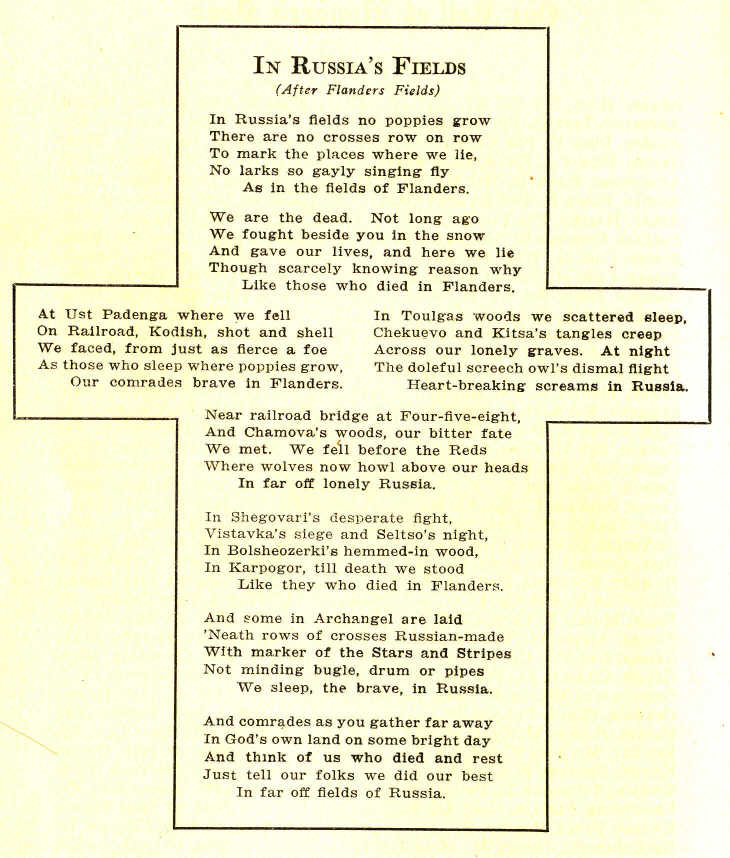
Our Roll of Honored Dead
KILLED IN ACTION
AGNEW, JOHN, Sgt. Co. K
Sept. 27, 1918, Belfast, Ireland.
ANDERSON, JAKE C., Pvt. 1st class Co. B
Nov. 11,1918, Cave City, Ky.
ANGOVE, JOHN P., Pvt. Co. B
Nov. 13, 1918, Painesdale, Mich.
ASSIRE, MYRON J., Co. A, 310th Engrs
Oct. 26,1918.
AUSLANDER, FLOYD R., Pvt. Co. H
April 2, 1919, Decker, Mich.
AUSTIN, FLOYD E., Pvt. 1st class Co. E
Dec. 30, 1918, Scottsburg, Ind.
AVERY, HARLEY, Pvt. Co. H
Oct. 1, 1918, Lexington, Mich.
BALLARD, CLIFFORD B., Second Lt. M. G. Co
Feb. 7, 1919, Cambridge, Mass.
BERGER, CARL G., Wag. Sup. Co
Jan. 19, 1919, Detroit.
BERGER, CARL H., Second Lt. Co. E
Dec. 31, 1918, Mayville, Wis.
BORESON, JOHN, Pvt. Co. H,
Oct. 1, 1918, Stephenson, Mich.
BOSEL, JOHN J., Corp. Co. C
Nov. 29, 1918, Detroit.
CHAPPEL, CHARLES F., First Lt. Co. K
Sept. 27, 1918, Toledo, Ohio.
CHEENEY, Roy D., Corp. Co. C.
Nov. 29, 1918, Pueblo, Colo.
CHRISTIAN, ARTHUR, Pvt. Co. L.
Oct. 14, 1918, Atlanta, Mich.
CLARK, JOSHUA A., Pvt. Co. C.
Feb. 4, 1919, Woodville, Mich.
CLEMENS, RAYMOND C., Pvt. Co. C.
Nov. 29, 1918, St. Joseph, Mich.
COLE, ELMER B., Pvt. Co. A
Jan. 23, 1919, Hamersluya, Pa.
CONRAD, REX H., Corp. Co. F
Mar. 26, 1919, Ponca, Mich.
CROOK, ALVA, Pvt. Co. M
April 1, 1919, Lakeview, Mich.
CRONIN, LOUIS, Pvt. Co. K
Oct. 13, 1918, Flushing, Mich.
CROWE, BERNARD C., Sgt. Co. K
Dec. 30, 1918, Detroit.
CUFF, FRANCIS W., First Lt. Co. C
Nov. 29, 1918, Rio, Wis.
DeAMICIS, GUISEPPE, Corp. Co. A
Jan. 19, 1919, Detroit.
DIAL, CHARLES O., Mech. Co. M
Mar. 31, 1919, Carlisle, Ind.
DYMENT, SCHLIOMA, Pvt. Co. M
Sept. 30, 1918, Detroit.
ELLIS, LEO R, Pvt. Co. I.
Nov. 4,1918, Chicago, Ill.
FOLEY, MORRIS J., Corp. Co. B
Sept. 20, 1918, Detroit.
FULLER, ALFRED W., Pvt. 1st class Co. K
Dec. 30, 1918, Trenton, Mich.
GASPER, LEO, Pvt. Co. B
Nov. 11, 1918, Chesaning, Mich.
GAUCH, CHARLES D., Pvt. Hq. Co
Oct. 1, 1918, Kearney, N. J.
GOTTSCHALK, MILTON E., Corp. Co. A
Jan. 22, 1919, Detroit.
GRAHAM, CLAUS, Pvt. Co. H
Oct. 1, 1918, Toledo, Ohio.
HESTER, HARLEY H., Corp. M. G. Co
Sept. 27, 1918, Cave City, Ky.
KENNEY, MICHAEL J., Sgt. Co. K
Dec. 30, 1918, Detroit.
KENNY, BERNARD F., Corp. Co. A
Mar. 9, 1919, Hemlock, Mich.
KISSICK, THURMAN L., Pvt. Co. C
Nov. 29, 1918, Ringos Mill, Ky.
KREIZINGER, EDWARD, Corp. Co. L.
Sept. 27, 1918, Detroit.
KUDZBA, PETER, Pvt. CO. B
Sept. 20, 1918, Chicago, Ill.
KWASNIEWSKI, IGNACY H., Mech. Co. I.
Sept. 16, 1918, Detroit.
LADOVICH, NIKODEM, Pvt. Co. C
Feb. 4, 1919, Pittsburgh, Pa.
MALM, CLARENCE A., Pvt. 1st class Co. G
Dec. 4, 1918, Battle Creek, Mich.
MARRIOTT, FRED R, Sgt. Co. B
Nov. 12, 1918, Port Huron, Mich.
McCONVILL, EDWARD, Pvt. Co. H
Mar. 23, 1919, Shawmut, Mass.
McLAUGHLIN, FRANK S., Pvt. Co. I
Oct. 16, 1918, Elks Rapids, Mich.
MERRICK, WALTER A., Pvt. Co. M
Oct. 14, 1918, Sandusky, Mich.
MERTENS, EDWARD L., Corp. Co. L
Sept. 27, 1918, Detroit.
MOORE, ALBERT E., Corp. Co. A
Mar. 7, 1919, Detroit.
MUELLER, FRANK J., Pvt. Co. E
Dec. 30, 1918, Marshfield, Wis.
OZDARSKI, JOSEPH S., Pvt. Co. L.
Oct. 14, 1918, Detroit.
PATRICK, RALPH M., Pvt. Co. A
Jan. 19, 1919, Long Lake, Mich.
PAWLAK, JOSEPH, Pvt. Co. B
Mar. 1, 1919, Detroit.
PILARSKI, ALEK, Pvt. Co. B
Nov. 11, 1918, Detroit.
PITTS, JAY B., Pvt. Co. G
Dec. 4, 1918, Kalamazoo, Mich.
RAMOTOWSKE, JOSEF, Pvt. 1st class Co. H
Mar. 22, 1919, Detroit.
REDMOND, NATHAN L., Corp. Co. H
Mar. 19, 1919, Detroit.
RICHARDSON, EUGENE E., Pvt. Co. H
Oct. 1, 1918, Detroit.
RICHEY, AUGUST K, Corp. Co. A
Jan. 19, 1919, Dowagiac, Mich.
RITCHER, EDWARD, Pvt. Co. H
Oct. 1, 1918, Mishawaka, Ind.
ROBBINS, DANIEL, Pvt. Co. B
Mar. 1, 1919, Blaine, Mich.
ROGERS, YATES K, Sgt. Co. A
Jan. 22, 1919, Memphis, Tenn.
RUTH, FRANK J., Pvt. Co. B
Mar. 1, 1919, Detroit.
SAPP, FRANK E., Corp. Co. M
April 1, 1919, Rodney, Mich.
SAVADA, JOHN, Corp. Co. B
Nov. 13, 1918, Hamtramck, Mich.
SCHMANN, ADOLPH, Pvt. Co. C.
Nov. 13, 1918, Milwaukee, Wis.
SCRUGGS, FRANK W., Pvt. Co. A
Jan. 19, 1919, Bettelle, Ala.
SILKAITIS, FRANK, Pvt. Co. H
Oct. 1, 1918, Chicago, III.
SMITH, WILBUR B., Sgt. Co. C.
Jan. 20, 1919, Fort Williams, Canada.
SOCZKOSKI, ANTHONY, Pvt. Co. I
Sept. 16, 1918, Detroit.
SOKOL, PHILIP, Pvt. Co. L.
Sept. 16, 1913, Pittsburgh, Pa.
SPELCHER, ELMER E., Cook Co. C
Feb. 4, 1919, Akron, Ohio.
STALEY, GLENN P., Pvt. Co. K
Sept. 17, 1918, Whitemore, Mich.
SWEET, EARL D., Pvt. Co. A
Mar. 9, 1919, McGregor, Mich.
SYSKA, FRANK, Pvt. Co. D
Jan. 23, 1919, Detroit.
TAYLOR, OTTO V., Pvt. Co. K
Oct. 16, 1918, Alexandria, Ind.
TRAMMELL, DAUSIE W., Pvt. Co. A
Mar. 9, 1919, Clio, Ky.
VanDerMEER, JOHN, Pvt. Co. B
Sept. 20, 1918, Kalamazoo, Mich.
VanHERWYNEN, JOHN, Pvt. Co. D
Sept. 20, 1918, Vriesland, Mich.
VOJTA, CHARLES J., Pvt. Co. K
Sept. 27, 1918, Chicago, III.
WAGNER, HAROLD H., Pvt. 1st class Co. E.
Dec. 30, 1918, Harlan, Mich.
WELSTEAD, WALTER J., Pvt. Co. A
Mar. 9, 1919, Chicago, III.
WENGER, IRVIN, Pvt. Co. C
Nov. 29, Grand Rapids, Mich.
ZAJACZKOWSKI, JOHN, Pvt. Co. B
Nov. 12, 1918, Detroit.
DEATH FROM OTHER CAUSES
BLOOM, ELMER, Sgt. Co. A., 310th Engrs.
(drowned) Oct. 8, 1918.
CONNOR, LLOYD, Corp. Co. A., 310th Engrs.
(drowned) Oct. 8, 1918.
DARGAN, ARTHUR, Pvt. Co. A., 310th Engrs.
(drowned) Oct. 8, 1918.
HILL, C. B., Lt. Co. A., 310th Engrs.
(drowned) Oct. 8, 1918.
LOVELL, ALBERT W., Pvt. Hq. Co
Aug. 10, 1918 (drowned), England.
MARCHLEWSKI, JOSEPH D., Pvt. Co. G
Oct. 28, 1918 (accident), Alpena, Mich.
MARTIN, J. C., Corp. Co. E.
Oct. 21, 1918 (accidentally shot), Portland, Mich.
RUSSELL, WM. H., Corp. Co. M
April 19, 1919 (accident by grenade), Detroit.
SAWICKIS, FRANK K, Pvt. Co. I
April 29,1919 (Bolo grenade), Racine, Wis.
SICKLES, FLOYD A., Pvt. Co. M
Dec. 6,1918 (accident), Deckerville, Mich.
SZYMANSKI, LOUIS A., Pvt. Co. C
Nov. 27, 1918 (accidentally shot), Detroit.
WILSON, DALE, Pvt. 1st class Co. B
April 3, 1919, Alexander, Mich.
WING, HOMER, Pvt. Co. A, 310th Engrs
May 31,1919 (rly. accident), Detroit.
YOUNG, EDWARD L., Sgt. Co. G
Mar. 14, 1919 (suicide), Moosie, Pa.
DIED OF WOUNDS RECEIVED IN ACTION
BALL, ELBERT, Pvt. 1st class Co. B
Nov. 14, 1918, Henderson, Ky.
BOWMAN, WILLIAM H., Sgt. Co. B
Mar. 1, 1919, Penn Laird, Va.
CLISH, FRANK, Pvt. Co. B
Mar. 1, 1919, Baraga, Mich.
COLLINS, EDMUND R., First Lt. Co. H
Mar. 24, 1919, Racine, Wis.
COOK, CLARENCE, Pvt. Co. A
Feb. 20, 1919, Stilton, Kan.
DETZLER, ALLICK F., Pvt. Co. B
Nov. 15, 1918, Prescott, Mich.
DUNAETZ, ISIADOR, Pvt. Co. C
Jan. 31, 1919, Sodus, Mich.
ETTER, FRANK M., Sgt. Co. C
Feb. 6, 1919, Marion, Ind.
FRANKLIN, WALTER E., Pvt. Co. E
Dec. 31, 1918, Bellevue, Mich.
GRAY, ALSON W., Corp. Co. K
Nov. 8, 1918, South Boston, Va.
KOSLOUSKY, MATTIOS, Pvt. Co. H
April 2, 1919, Chicago, Ill.
LEHMANN, WILLIAM J., Corp. Co. A
Jan. 23, 1919, Danville, III.
LENCIONI, SEBASTIANO, Pvt. Co. A
Jan. 22, 1919, Whitewater, Wis.
LYTTLE, ALFRED E., Corp. Co. A., 310th Engrs
Oct. 31, 1918.
MEISTER, EMANUEL A., Sgt. Co. C
Sept. 27, 1918, Detroit.
MORRIS, JOHN H. W., Pvt. Co. B, 310th Engrs
Oct. 18, 1918.
MYLON, JAMES J., Corp. Co. E
Dec. 31, 1918, Detroit.
NIEMI, MATTIE I, Pvt. Co. M
Sept. 30, 1918, Verona, Mich.
PETERSON, AUGUST B., Pvt. Co. H
Mar. 22, 1919, Whitehall, Mich.
PHILLIPS, CLIFFORD F., First Lt. Co. H
May 10,1919, Lincoln, Nebr.
POWERS, RALPH E., Lt. 337th Amb. Co
Jan. 22, 1919, Detroit.
ROSE, BENJAMIN, Pvt. Co. A
Mar. 11, 1919, Packard, Ky.
SKOSELAS, ANDREW, Pvt. Co. C
Feb. 4, 1919, Eastlake, Mich.
SMITH, GEORGE J., Pvt. Co. A
Jan. 19, 1919, Yale, Mich.
STIER, VICTOR, Pvt. Co. A
Jan. 19, 1919, Cincinnati, Ohio.
TAMAS, STANLEY P., Pvt. Co. D
Oct. 29, 1918, Manistee, Mich.
ZIEGENBEIN, WILLIAM J., Corp. Co. A, 310th Engrs
Oct. 16, 1918.
MISSING IN ACTION
BABINGER, WILLIAM R., Corp. Hq. Co
Oct. 2, 1918, Detroit.
CARTER, JAMES, Pvt. Hd. Co.
Oct. 2, 1918, Cornwall, England.
CARTER, WILLIAM J., Pvt. 1st class Co. A
Jan. 19, 1919, Detroit.
COLLINS, EARL W., Corp. Co. H
Mar. 18, 1919, Detroit.
CWENK, JOSEPH, Pvt. 1st class Co. A
Jan. 19, 1919, Milan, Mich.
FRANK, ARTHUR, Pvt. M. G. Co
Sept. 29, 1918, Detroit.
GUTOWSKI, BOLESLAW, Pvt. Co. C
Nov. 29, 1918, Wyandotte, Mich.
HODGE, ELMER W., Pvt. Co. C
Nov. 29, 1918, Shelby, Mich.
HUTCHINSON, ALFRED G., Pvt. Co. A
Jan. 19, 1919, Plainwell, Mich.
JENKS, STILLMAN V., Pvt. 1st class Co. A
Jan. 19, 1919, Shelby, Mich.
JONKER, NICHOLAS, Pvt. Co. C.
Nov. 29, 1918, Grand Rapids, Mich.
KEEFE, THOMAS H., Pvt. Co. C
Feb. 4, 1919, Chicago, Ill.
KIEFFER, SIMON P., Pvt. M. G. Co
Sept. 29, 1918, Detroit.
KOWALSKI, STANLEY, Pvt. Co. A
Jan. 19, 1919, Lodz, Poland.
KUSSRATH, CHARLES AUG., JR., Pvt. Co. A
Jan. 19, 1919, Chicago, Ill.
KUROWSKI, MAX J., Pvt. Co. A
Jan. 19, 1919, Grand Rapids, Mich.
MANNOR, JOHN T., Pvt. 1st class Co. A
Jan. 19, 1919, Menominee, Mich.
MARTIN, WILLIAM J., Pvt. Co. A
Jan. 19, 1919, Detroit.
McTAVISH, STEWART M., Pvt. 1st class Co. A
Jan. 19, 1919, Stratford, Can.
PEYTON, EDWARD W., Corp. Co. A
Jan. 19, 1919, Richmond, Ky.
POTH, RUSSELL A., Pvt. Co. A
Jan. 19, 1919, Brown City, Mich.
RAUSCHENBERGER, ALBERT, Corp. Co. A
Jan. 19, 1919, Grand Rapids, Mich.
RETHERFORD, LINDSAY, Pvt. 1st class Co. A
Jan. 19, 1919, Hustonville, Ky.
RUSSELL, ARCHIE E., Pvt. 1st class Co. A
Jan. 19. 1919, Hesperia. Mich.
SAJNAJ, LEO, Pvt. 1st class Co. A
Jan. 19, 1919, Chicago, Ill.
SCHROEDER, HERBERT A., Corp. Co. B
Sept. 20, 1918, Detroit.
SCOTT, PERRY C, Corp. Hq. Co
Oct. 2, 1918, Detroit.
WEITZEL, HENRY R., Pvt. Co. C
Nov. 29, 1918. Bay City, Mich.
WILLIAMS, EDSON A., Pvt. Co. A
Jan. 19, 1919, Minneapolis. Minn.
PRISONERS OF WAR
ALBERS, GEORGE, Pvt. 1st class Co. I
Nov. 3, 1918, Muskegon, Mich.
FRUCCE, JOHN, Pvt. Co. H
Mar. 22. 1919, Muskegon, Mich.
FULCHER, EARL W., Pvt. Co. H
Mar. 22, 1919, Tyre, Mich.
HAURILIK, MIKE M., Pvt. Co. C
Nov. 29, 1918, Detroit.
HOGAN, FREEMAN, Pvt. Co. M
Mar. 31, 1919, Detroit.
HUSTON, WALTER L.. Pvt. Co. C.
Nov. 29. 1918. Muskegon, Mich.
LAURSEN, JENS C. Mech. Co. M
May 1, 1919. Marlette, Mich.
LEITZELL, GLENN W., Sgt. Co. M
Mar. 31. 1919, Mifflinburg. Pa.
PRINCE, ARTHUR, Corp. Co. B
Mar. 1. 1919, Onaway, Mich.
TRIPLETT, JOHNNIE, Pvt. Co. C
Nov. 29, 1918, Lackay, Ky.
SCHEULKE, WILLIAM R. Pvt. Co. H
Mar. 22, 1919, Stronach, Mich.
VANIS, ANTON J., Pvt. Co. D
Jan. 23, 1919, Chicago, Ill.
DIED OF DISEASE
BAYER, ARTHUR, Pvt. Co. G
Sept. 12, 1918, Kalamazoo, Mich.
BAYER, CHARLES, Pvt. Co. F
Sept. 12, 1918, Detroit.
BERRYHILL, CHESTER W., Pvt. Co. F
Sept. 11, 1918, Midland, Mich.
RICKERT, ALBERT F., Pvt. Co. c.
Sept. 5. 1918, Mt. Clemens, Mich.
BIGELOW, JOHN W., Pvt. Co. E
Sept. 10. 1918, Copefish, Mich.
BRIEVE, JOSEPH, Pvt. Co. E
Sept. 7. 1918, Holland, Mich.
BURDICK, ANDREW, Pvt. Co. B
Sept. 19, 1918, Manitou Island, Mich.
BYLES, JAMES B., Wag. Sup. Co
Feb. 21, 1919, Valdosta, Ga.
CANNIZZARO, RAYFIELD, Pvt. Co. K
Sept. 13, 1918. Edmore, Mich.
CASEY, MARCUS T., Second Lt. Co. C
Sept. 16. 1918, New Richmond, Wis.
CIESIELSKI, WALTER, Pvt. 1st class Co. E
Feb. 27, 1919, Detroit.
CLARK, CLYDE, Pvt. Co. L.
Sept. 18, 1918, Lansing. Mich.
DUSABLOM, WILLIAM H., Pvt. Co. I
Sept. 18, 1918, Trenton, Mich.
EASLEY, ALBERT H., Pvt. Co. L.
Sept. 13, 1918, Kewadin, Mich.
FARRAND, RAY, Pvt. Co. I.
Sept. 13, 1918, Armada, Mich.
FIELDS, CLARENCE, Pvt. Co. F
Sept. 19, 1918. Bay City. Mich.
FINNEGAN, LEO, Pvt. Co. B
Sept. 17, 1918, Grand Rapids, Mich.
GARIEPY, HENRY, Sergt. Co. B
Sept. 10, 1918. Sault Ste. Marie, Mich.
GRESSER, JOSEPH A., Pvt. Co. C.
Sept. 8, 1918. Wyandotte, Mich.
HENDY, ALFRED H., Pvt. Co. C.
Sept. 23, 1918, Grosse Ile, Mich.
HENLEY, JOHN T., Pvt. Co. I.
Sept. 11, 1918, Chicago. Ill.
HODGSON, FRED L., Pvt. Co. M
Sept. 14. 1918, Cassopolis, Mich.
HUNT, BERT, Pvt. Co. D
Sept. 16, 1918, Hudsonville, Mich.
JACKSON, JESSE C, Pvt. 1st class Hq. Co
Sept. 15, 1918, Detroit.
JORDAN, CARL B., Pvt. Co. B
Sept. 10, 1918. Ferry, Mich.
KALASKA, JOSEPH. Pvt. Co. I
Sept. 18, 1918, Trenton, Mich.
KEICZ, ANDRZEI, Pvt. Co. C
Sept. 13, 1918, Detroit.
KISTLER, HERBERT B., Pvt. Co. I
Sept. 11, 1918, Lancaster Pa.
KROLL, JOHN, JR., Pvt. Co. D
Sept. 10, 1918, Holland, Mich.
KUKLA, VALENTINE, Pvt. Co. K
Sept. 12. 1918, Kawkawlin, Mich.
KULWICKI, ANDREW J., Pvt. Co. K
Jan. 28, 1918. Milwaukee, Wis.
LANTER, MARION F., Pvt. Co. I
April 26, 1919, Savoy, Ky.
LAUZON, HENRY, Pvt. Co. L
Sept. 28, 1918, Pinconning. Mich.
LINK, STEPHEN J., First Lt. Hq. Co
Sept. 20, 1918, Taylorville, Ill.
MALUSKY, JOSEPH, Pvt. Co. C
Sept. 10, 1919, Fountain, Mich.
MAYBAUM, HAROLD, Pvt. Co. E
Sept. 9, 1918, Ainsworth, Ind.
McDONALD, ANGUS, Pvt. Co. E
Sept. 12, 1918, Marilla, Mich.
MEAD, WILLIAM C, Pvt. Co. B
Sept. 14, 1918, Mayville, Mich.
MICHEL, LEWIS M., Pvt. Co. c.
Sept. 10, 1918, Parnassus, Pa.
NERI, VINCENT, Bug. Co. C
Sept. 11, 1918, Detroit.
NICHOLLS, CHARLES B., Pvt. Co. B
Sept. 12, 1918, Rose City, Mich.
NUNN, ARTHUR, Pvt. Co. M
Sept. 13,1918. Croswell, Mich.
O’BRIEN, RAYMOND, Pvt. Hq. Co
Sept. 12, 1918, Saginaw, Mich.
O’CONNOR, LAWRENCE S., Corp. Co. C
Sept. 8, 1918, Lancaster, Ohio.
PARROTT, JESSE F., Pvt. Co. K
Sept. 25, 1918, Mt. Clemens, Mich.
PASSOW, FERDINAND, Pvt. Co. D
Sept. 11. 1918, Mosinee, Wis.
PETRASKA, OSCAR H., Pvt. Co. K
Sept. 10, 1918. Wyandotte, Mich.
PETULSKI, JOHN, Pvt. CO. K
Sept. 15, 1918, Detroit.
ROSE, FLOYD, Pvt. Co. I.
Sept. 10, 1918. Vicksburg, Mich.
ROWE, EZRA T., Pvt. M. G. Co
Sept. 16, 1918, Hart, Mich.
RYNBRANDT, RAYMOND R, Pvt. Co. D
Sept. 11, 1918, Byron Center, Mich.
SCHEPEL, TIEMON, Pvt. Co. D
Sept. 11, 1918, Holland, Mich.
SHAUGHNESSY, JOHN, Pvt. Hq. Co
Sept. 15, 1918, Missoula, Mont.
SHINGLEDECKER, DWIGHT, Pvt. Co. A
Sept. 11, 1918, Dowagiac, Mich.
STOCKEN, ORVILLE I., Pvt. Co. A
Sept. 13, 1918, Battle Creek, Mich.
SURRAN, HARRY H., Pvt. Co. A
Sept. 14, 1918, Culver, Ind.
TEGGUS, WILLIAM G., Corp. Hq. Co
Sept. 11, 1918, Pontiac, Mich.
THOMPSON, HENRY, Pvt. Co. A
Sept. 16, 1918, Elkhart, Ind.
VAN DEVENTER, GEORGE E., Pvt. Co. C
Sept. 11, 1918, Rupert, Idaho.
WADSWORTH, LAURENCE L., Pvt. Co. I
Sept. 20, 1918, Aurora, Ind.
WALDEYER, NORBERT C, Pvt. Co. D
Sept. 16, 1918, Detroit.
WAPRZYCKI, SYLVESTER, Pvt. 337th Amb. Co
Sept. 14. 1918.
WEAVER, LEWIS T., Pvt. Co. A
Sept. 15, 1918. Marlette, Mich.
WEESNER, CLIFFFORD E., Pvt. Co. F
Sept. 11. 1918, Jackson, Mich.
WETERSHOF, JOHN T., Pvt. Co. B
Sept. 11, 1918, Grand Rapids. Mich.
WHITFORD, JASON, Pvt. Co. C.
Sept. 19, 1918, Whitemore, Mich.
WITT, LOUIS C, Pvt. Hq. Co
Sept. 13. 1918, Detroit.
WOOD, STEWART W., Corp. Co. C
Sept. 7. 1918, Atlanta, Ga.
ZLOTCHA, MIKE, Pvt. Co. E
Sept. 23, 1918. Hamtramck, Mich.
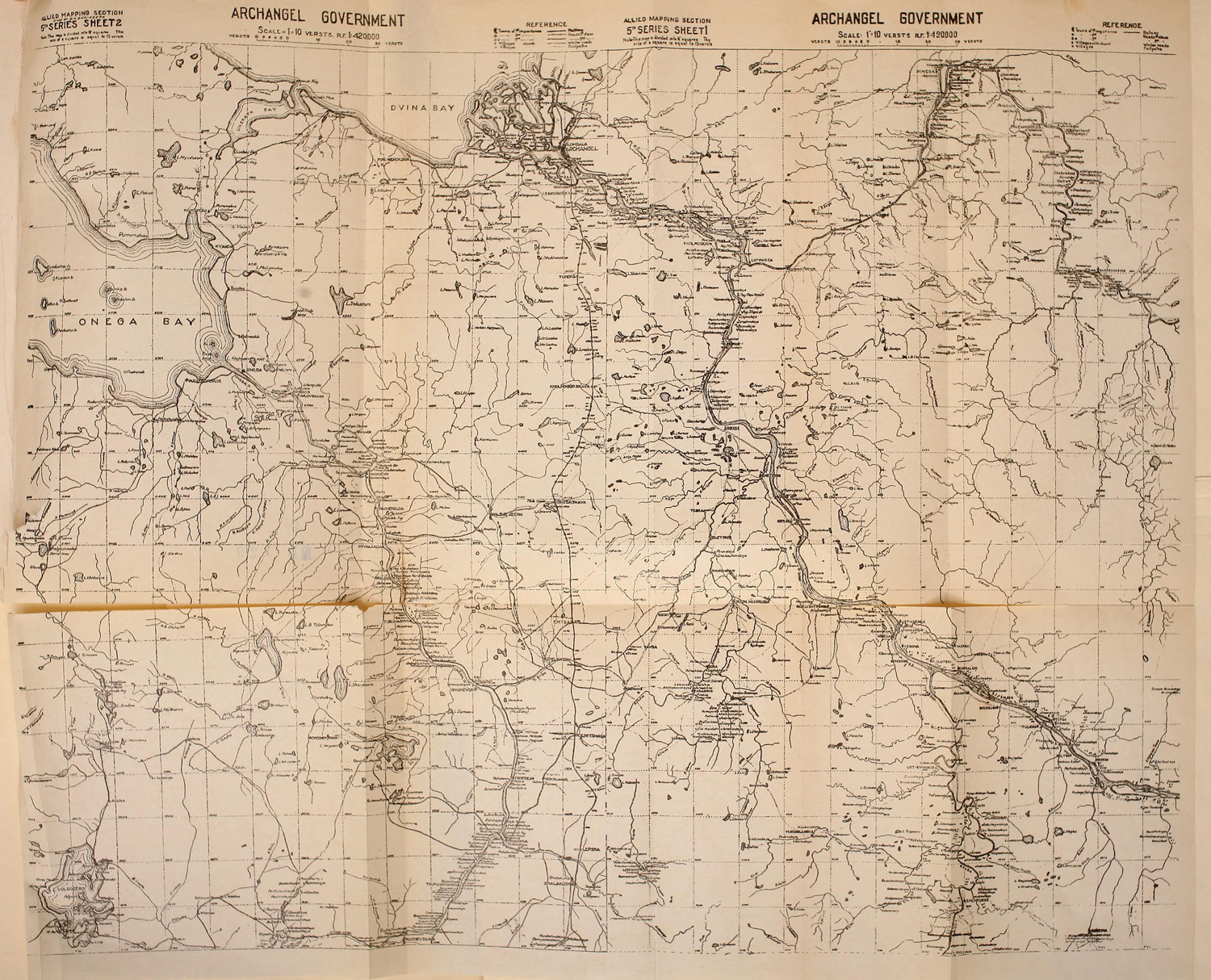
Map of the Archangel Fighting Area
*** END OF THE PROJECT GUTENBERG EBOOK FIGHTING THE BOLSHEVIKI ***
Updated editions will replace the previous one—the old editions will
be renamed.
Creating the works from print editions not protected by U.S. copyright
law means that no one owns a United States copyright in these works,
so the Foundation (and you!) can copy and distribute it in the United
States without permission and without paying copyright
royalties. Special rules, set forth in the General Terms of Use part
of this license, apply to copying and distributing Project
Gutenberg™ electronic works to protect the PROJECT GUTENBERG™
concept and trademark. Project Gutenberg is a registered trademark,
and may not be used if you charge for an eBook, except by following
the terms of the trademark license, including paying royalties for use
of the Project Gutenberg trademark. If you do not charge anything for
copies of this eBook, complying with the trademark license is very
easy. You may use this eBook for nearly any purpose such as creation
of derivative works, reports, performances and research. Project
Gutenberg eBooks may be modified and printed and given away--you may
do practically ANYTHING in the United States with eBooks not protected
by U.S. copyright law. Redistribution is subject to the trademark
license, especially commercial redistribution.
START: FULL LICENSE
THE FULL PROJECT GUTENBERG LICENSE
PLEASE READ THIS BEFORE YOU DISTRIBUTE OR USE THIS WORK
To protect the Project Gutenberg™ mission of promoting the free
distribution of electronic works, by using or distributing this work
(or any other work associated in any way with the phrase “Project
Gutenberg”), you agree to comply with all the terms of the Full
Project Gutenberg™ License available with this file or online at
www.gutenberg.org/license.
Section 1. General Terms of Use and Redistributing Project Gutenberg™ electronic works
1.A. By reading or using any part of this Project Gutenberg™
electronic work, you indicate that you have read, understand, agree to
and accept all the terms of this license and intellectual property
(trademark/copyright) agreement. If you do not agree to abide by all
the terms of this agreement, you must cease using and return or
destroy all copies of Project Gutenberg™ electronic works in your
possession. If you paid a fee for obtaining a copy of or access to a
Project Gutenberg™ electronic work and you do not agree to be bound
by the terms of this agreement, you may obtain a refund from the person
or entity to whom you paid the fee as set forth in paragraph 1.E.8.
1.B. “Project Gutenberg” is a registered trademark. It may only be
used on or associated in any way with an electronic work by people who
agree to be bound by the terms of this agreement. There are a few
things that you can do with most Project Gutenberg™ electronic works
even without complying with the full terms of this agreement. See
paragraph 1.C below. There are a lot of things you can do with Project
Gutenberg™ electronic works if you follow the terms of this
agreement and help preserve free future access to Project Gutenberg™
electronic works. See paragraph 1.E below.
1.C. The Project Gutenberg Literary Archive Foundation (“the
Foundation” or PGLAF), owns a compilation copyright in the collection
of Project Gutenberg™ electronic works. Nearly all the individual
works in the collection are in the public domain in the United
States. If an individual work is unprotected by copyright law in the
United States and you are located in the United States, we do not
claim a right to prevent you from copying, distributing, performing,
displaying or creating derivative works based on the work as long as
all references to Project Gutenberg are removed. Of course, we hope
that you will support the Project Gutenberg™ mission of promoting
free access to electronic works by freely sharing Project Gutenberg™
works in compliance with the terms of this agreement for keeping the
Project Gutenberg™ name associated with the work. You can easily
comply with the terms of this agreement by keeping this work in the
same format with its attached full Project Gutenberg™ License when
you share it without charge with others.
1.D. The copyright laws of the place where you are located also govern
what you can do with this work. Copyright laws in most countries are
in a constant state of change. If you are outside the United States,
check the laws of your country in addition to the terms of this
agreement before downloading, copying, displaying, performing,
distributing or creating derivative works based on this work or any
other Project Gutenberg™ work. The Foundation makes no
representations concerning the copyright status of any work in any
country other than the United States.
1.E. Unless you have removed all references to Project Gutenberg:
1.E.1. The following sentence, with active links to, or other
immediate access to, the full Project Gutenberg™ License must appear
prominently whenever any copy of a Project Gutenberg™ work (any work
on which the phrase “Project Gutenberg” appears, or with which the
phrase “Project Gutenberg” is associated) is accessed, displayed,
performed, viewed, copied or distributed:
This eBook is for the use of anyone anywhere in the United States and most
other parts of the world at no cost and with almost no restrictions
whatsoever. You may copy it, give it away or re-use it under the terms
of the Project Gutenberg License included with this eBook or online
at
www.gutenberg.org. If you
are not located in the United States, you will have to check the laws
of the country where you are located before using this eBook.
1.E.2. If an individual Project Gutenberg™ electronic work is
derived from texts not protected by U.S. copyright law (does not
contain a notice indicating that it is posted with permission of the
copyright holder), the work can be copied and distributed to anyone in
the United States without paying any fees or charges. If you are
redistributing or providing access to a work with the phrase “Project
Gutenberg” associated with or appearing on the work, you must comply
either with the requirements of paragraphs 1.E.1 through 1.E.7 or
obtain permission for the use of the work and the Project Gutenberg™
trademark as set forth in paragraphs 1.E.8 or 1.E.9.
1.E.3. If an individual Project Gutenberg™ electronic work is posted
with the permission of the copyright holder, your use and distribution
must comply with both paragraphs 1.E.1 through 1.E.7 and any
additional terms imposed by the copyright holder. Additional terms
will be linked to the Project Gutenberg™ License for all works
posted with the permission of the copyright holder found at the
beginning of this work.
1.E.4. Do not unlink or detach or remove the full Project Gutenberg™
License terms from this work, or any files containing a part of this
work or any other work associated with Project Gutenberg™.
1.E.5. Do not copy, display, perform, distribute or redistribute this
electronic work, or any part of this electronic work, without
prominently displaying the sentence set forth in paragraph 1.E.1 with
active links or immediate access to the full terms of the Project
Gutenberg™ License.
1.E.6. You may convert to and distribute this work in any binary,
compressed, marked up, nonproprietary or proprietary form, including
any word processing or hypertext form. However, if you provide access
to or distribute copies of a Project Gutenberg™ work in a format
other than “Plain Vanilla ASCII” or other format used in the official
version posted on the official Project Gutenberg™ website
(www.gutenberg.org), you must, at no additional cost, fee or expense
to the user, provide a copy, a means of exporting a copy, or a means
of obtaining a copy upon request, of the work in its original “Plain
Vanilla ASCII” or other form. Any alternate format must include the
full Project Gutenberg™ License as specified in paragraph 1.E.1.
1.E.7. Do not charge a fee for access to, viewing, displaying,
performing, copying or distributing any Project Gutenberg™ works
unless you comply with paragraph 1.E.8 or 1.E.9.
1.E.8. You may charge a reasonable fee for copies of or providing
access to or distributing Project Gutenberg™ electronic works
provided that:
• You pay a royalty fee of 20% of the gross profits you derive from
the use of Project Gutenberg™ works calculated using the method
you already use to calculate your applicable taxes. The fee is owed
to the owner of the Project Gutenberg™ trademark, but he has
agreed to donate royalties under this paragraph to the Project
Gutenberg Literary Archive Foundation. Royalty payments must be paid
within 60 days following each date on which you prepare (or are
legally required to prepare) your periodic tax returns. Royalty
payments should be clearly marked as such and sent to the Project
Gutenberg Literary Archive Foundation at the address specified in
Section 4, “Information about donations to the Project Gutenberg
Literary Archive Foundation.”
• You provide a full refund of any money paid by a user who notifies
you in writing (or by e-mail) within 30 days of receipt that s/he
does not agree to the terms of the full Project Gutenberg™
License. You must require such a user to return or destroy all
copies of the works possessed in a physical medium and discontinue
all use of and all access to other copies of Project Gutenberg™
works.
• You provide, in accordance with paragraph 1.F.3, a full refund of
any money paid for a work or a replacement copy, if a defect in the
electronic work is discovered and reported to you within 90 days of
receipt of the work.
• You comply with all other terms of this agreement for free
distribution of Project Gutenberg™ works.
1.E.9. If you wish to charge a fee or distribute a Project
Gutenberg™ electronic work or group of works on different terms than
are set forth in this agreement, you must obtain permission in writing
from the Project Gutenberg Literary Archive Foundation, the manager of
the Project Gutenberg™ trademark. Contact the Foundation as set
forth in Section 3 below.
1.F.
1.F.1. Project Gutenberg volunteers and employees expend considerable
effort to identify, do copyright research on, transcribe and proofread
works not protected by U.S. copyright law in creating the Project
Gutenberg™ collection. Despite these efforts, Project Gutenberg™
electronic works, and the medium on which they may be stored, may
contain “Defects,” such as, but not limited to, incomplete, inaccurate
or corrupt data, transcription errors, a copyright or other
intellectual property infringement, a defective or damaged disk or
other medium, a computer virus, or computer codes that damage or
cannot be read by your equipment.
1.F.2. LIMITED WARRANTY, DISCLAIMER OF DAMAGES - Except for the “Right
of Replacement or Refund” described in paragraph 1.F.3, the Project
Gutenberg Literary Archive Foundation, the owner of the Project
Gutenberg™ trademark, and any other party distributing a Project
Gutenberg™ electronic work under this agreement, disclaim all
liability to you for damages, costs and expenses, including legal
fees. YOU AGREE THAT YOU HAVE NO REMEDIES FOR NEGLIGENCE, STRICT
LIABILITY, BREACH OF WARRANTY OR BREACH OF CONTRACT EXCEPT THOSE
PROVIDED IN PARAGRAPH 1.F.3. YOU AGREE THAT THE FOUNDATION, THE
TRADEMARK OWNER, AND ANY DISTRIBUTOR UNDER THIS AGREEMENT WILL NOT BE
LIABLE TO YOU FOR ACTUAL, DIRECT, INDIRECT, CONSEQUENTIAL, PUNITIVE OR
INCIDENTAL DAMAGES EVEN IF YOU GIVE NOTICE OF THE POSSIBILITY OF SUCH
DAMAGE.
1.F.3. LIMITED RIGHT OF REPLACEMENT OR REFUND - If you discover a
defect in this electronic work within 90 days of receiving it, you can
receive a refund of the money (if any) you paid for it by sending a
written explanation to the person you received the work from. If you
received the work on a physical medium, you must return the medium
with your written explanation. The person or entity that provided you
with the defective work may elect to provide a replacement copy in
lieu of a refund. If you received the work electronically, the person
or entity providing it to you may choose to give you a second
opportunity to receive the work electronically in lieu of a refund. If
the second copy is also defective, you may demand a refund in writing
without further opportunities to fix the problem.
1.F.4. Except for the limited right of replacement or refund set forth
in paragraph 1.F.3, this work is provided to you ‘AS-IS’, WITH NO
OTHER WARRANTIES OF ANY KIND, EXPRESS OR IMPLIED, INCLUDING BUT NOT
LIMITED TO WARRANTIES OF MERCHANTABILITY OR FITNESS FOR ANY PURPOSE.
1.F.5. Some states do not allow disclaimers of certain implied
warranties or the exclusion or limitation of certain types of
damages. If any disclaimer or limitation set forth in this agreement
violates the law of the state applicable to this agreement, the
agreement shall be interpreted to make the maximum disclaimer or
limitation permitted by the applicable state law. The invalidity or
unenforceability of any provision of this agreement shall not void the
remaining provisions.
1.F.6. INDEMNITY - You agree to indemnify and hold the Foundation, the
trademark owner, any agent or employee of the Foundation, anyone
providing copies of Project Gutenberg™ electronic works in
accordance with this agreement, and any volunteers associated with the
production, promotion and distribution of Project Gutenberg™
electronic works, harmless from all liability, costs and expenses,
including legal fees, that arise directly or indirectly from any of
the following which you do or cause to occur: (a) distribution of this
or any Project Gutenberg™ work, (b) alteration, modification, or
additions or deletions to any Project Gutenberg™ work, and (c) any
Defect you cause.
Section 2. Information about the Mission of Project Gutenberg™
Project Gutenberg™ is synonymous with the free distribution of
electronic works in formats readable by the widest variety of
computers including obsolete, old, middle-aged and new computers. It
exists because of the efforts of hundreds of volunteers and donations
from people in all walks of life.
Volunteers and financial support to provide volunteers with the
assistance they need are critical to reaching Project Gutenberg™’s
goals and ensuring that the Project Gutenberg™ collection will
remain freely available for generations to come. In 2001, the Project
Gutenberg Literary Archive Foundation was created to provide a secure
and permanent future for Project Gutenberg™ and future
generations. To learn more about the Project Gutenberg Literary
Archive Foundation and how your efforts and donations can help, see
Sections 3 and 4 and the Foundation information page at www.gutenberg.org.
Section 3. Information about the Project Gutenberg Literary Archive Foundation
The Project Gutenberg Literary Archive Foundation is a non-profit
501(c)(3) educational corporation organized under the laws of the
state of Mississippi and granted tax exempt status by the Internal
Revenue Service. The Foundation’s EIN or federal tax identification
number is 64-6221541. Contributions to the Project Gutenberg Literary
Archive Foundation are tax deductible to the full extent permitted by
U.S. federal laws and your state’s laws.
The Foundation’s business office is located at 809 North 1500 West,
Salt Lake City, UT 84116, (801) 596-1887. Email contact links and up
to date contact information can be found at the Foundation’s website
and official page at www.gutenberg.org/contact
Section 4. Information about Donations to the Project Gutenberg Literary Archive Foundation
Project Gutenberg™ depends upon and cannot survive without widespread
public support and donations to carry out its mission of
increasing the number of public domain and licensed works that can be
freely distributed in machine-readable form accessible by the widest
array of equipment including outdated equipment. Many small donations
($1 to $5,000) are particularly important to maintaining tax exempt
status with the IRS.
The Foundation is committed to complying with the laws regulating
charities and charitable donations in all 50 states of the United
States. Compliance requirements are not uniform and it takes a
considerable effort, much paperwork and many fees to meet and keep up
with these requirements. We do not solicit donations in locations
where we have not received written confirmation of compliance. To SEND
DONATIONS or determine the status of compliance for any particular state
visit
www.gutenberg.org/donate.
While we cannot and do not solicit contributions from states where we
have not met the solicitation requirements, we know of no prohibition
against accepting unsolicited donations from donors in such states who
approach us with offers to donate.
International donations are gratefully accepted, but we cannot make
any statements concerning tax treatment of donations received from
outside the United States. U.S. laws alone swamp our small staff.
Please check the Project Gutenberg web pages for current donation
methods and addresses. Donations are accepted in a number of other
ways including checks, online payments and credit card donations. To
donate, please visit: www.gutenberg.org/donate
Section 5. General Information About Project Gutenberg™ electronic works
Professor Michael S. Hart was the originator of the Project
Gutenberg™ concept of a library of electronic works that could be
freely shared with anyone. For forty years, he produced and
distributed Project Gutenberg™ eBooks with only a loose network of
volunteer support.
Project Gutenberg™ eBooks are often created from several printed
editions, all of which are confirmed as not protected by copyright in
the U.S. unless a copyright notice is included. Thus, we do not
necessarily keep eBooks in compliance with any particular paper
edition.
Most people start at our website which has the main PG search
facility:
www.gutenberg.org.
This website includes information about Project Gutenberg™,
including how to make donations to the Project Gutenberg Literary
Archive Foundation, how to help produce our new eBooks, and how to
subscribe to our email newsletter to hear about new eBooks.
![[Illustration]](images/JFK_Stone.jpg)