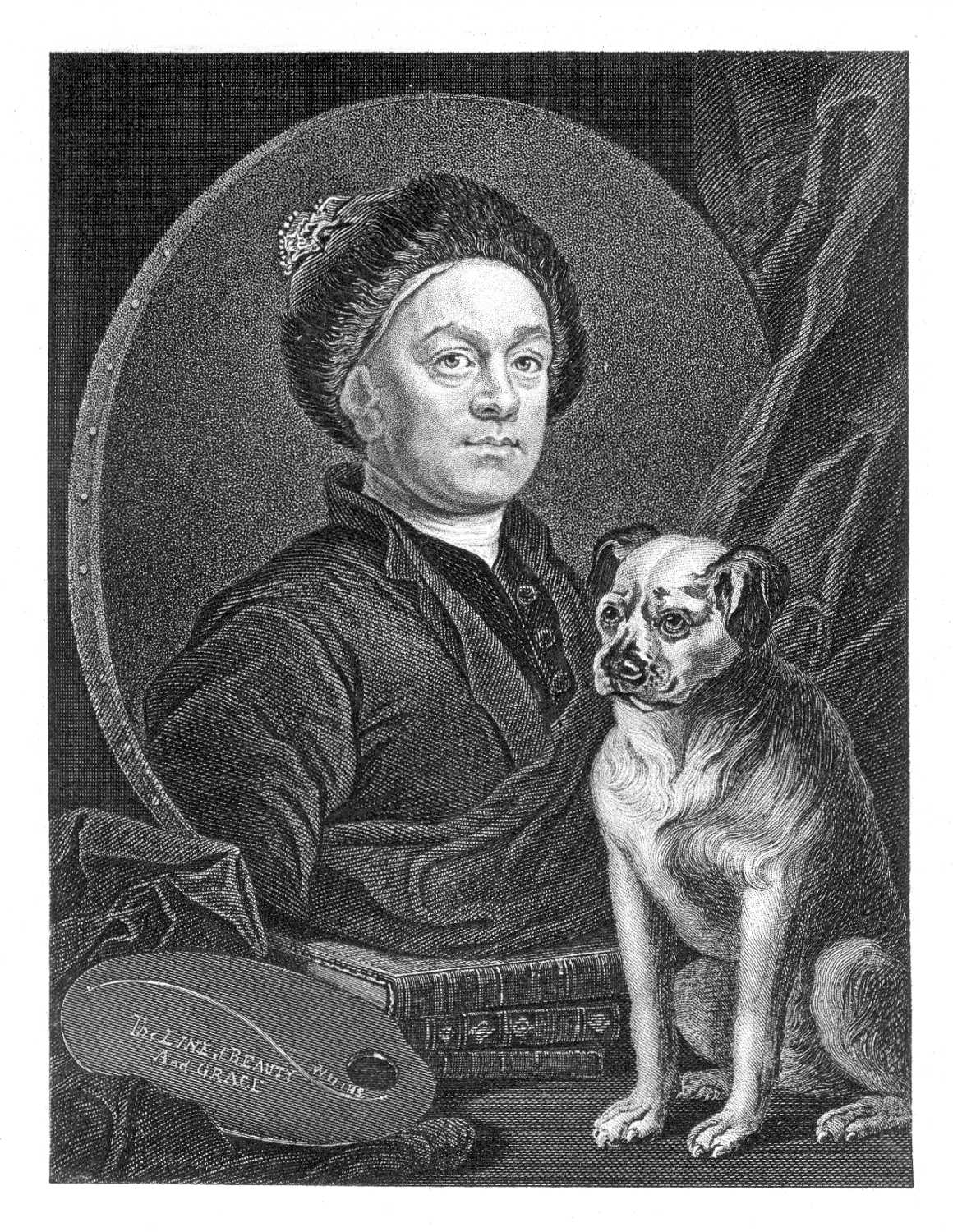
 WILLIAM HOGARTH.
The Project Gutenberg EBook of The Works of William Hogarth: In a Series
of Engravings, by John Trusler

This eBook is for the use of anyone anywhere at no cost and with
almost no restrictions whatsoever.  You may copy it, give it away or
re-use it under the terms of the Project Gutenberg License included
with this eBook or online at www.gutenberg.org


Title: The Works of William Hogarth: In a Series of Engravings
       With Descriptions, and a Comment on Their Moral Tendency

Author: John Trusler

Contributor: John Hogarth
             John Nichols

Engraver: William Hogarth

Release Date: September 4, 2007 [EBook #22500]

Language: English

Character set encoding: ISO-8859-1

*** START OF THIS PROJECT GUTENBERG EBOOK WORKS OF WILLIAM HOGARTH ***


Produced by Susan Skinner, Bryan Ness and the Online
Distributed Proofreading Team at https://www.pgdp.net (This
book was produced from scanned images of public domain
material from the Google Print project.)
WILLIAM HOGARTH.
London:
PUBLISHED BY JONES AND CO.
TEMPLE OF THE MUSES, (LATE LACKINGTON'S,) FINSBURY SQUARE.
1833.
C. BAYNES, PRINTER, 13 DUKE STREET, LINCOLN'S INN FIELDS.[Pg 1]
William Hogarth is said to have been the descendant of a family originally from Kirby Thore, in Westmorland.
His grandfather was a plain yeoman, who possessed a small tenement in the vale of Bampton, a village about fifteen miles north of Kendal, in that county; and had three sons.
The eldest assisted his father in farming, and succeeded to his little freehold.
The second settled in Troutbeck, a village eight miles north west of Kendal, and was remarkable for his talent at provincial poetry.
Richard Hogarth, the third son, who was educated at St. Bees, and had kept a school in the same county, appears to have been a man of some learning. He came early to London, where he resumed his original occupation of a schoolmaster, in Ship-court in the Old Bailey, and was occasionally employed as a corrector of the press.
Mr. Richard Hogarth married in London; and our artist, and his sisters, Mary and Anne, are believed to have been the only product of the marriage.
William Hogarth was born November 10, and baptised Nov. 28, 1697, in the parish of St. Bartholomew the Great, in London; to which parish, it is said, in the Biographia Britannica, he was afterwards a benefactor.
The school of Hogarth's father, in 1712, was in the parish of St. Martin, Ludgate. In the register of that parish, therefore, the date of his death, it was natural to suppose, might be found; but the register has been searched to no purpose.
Hogarth seems to have received no other education than that of a mechanic, and his outset in life was unpropitious. Young Hogarth was bound apprentice to a silversmith (whose name was Gamble) of some eminence; by whom he was confined to that branch of the trade, which consists in engraving arms and cyphers upon the plate. While thus employed, he gradually acquired some knowledge of drawing; and,[Pg 2] before his apprenticeship expired, he exhibited talent for caricature. "He felt the impulse of genius, and that it directed him to painting, though little apprised at that time of the mode Nature had intended he should pursue."
The following circumstance gave the first indication of the talents with which Hogarth afterwards proved himself to be so liberally endowed.
During his apprenticeship, he set out one Sunday, with two or three companions, on an excursion to Highgate. The weather being hot, they went into a public-house; where they had not long been, before a quarrel arose between some persons in the same room; from words they soon got to blows, and the quart pots being the only missiles at hand, were sent flying about the room in glorious confusion. This was a scene too laughable for Hogarth to resist. He drew out his pencil, and produced on the spot one of the most ludicrous pieces that ever was seen; which exhibited likenesses not only of the combatants engaged in the affray, but also of the persons gathered round them, placed in grotesque attitudes, and heightened with character and points of humour.
On the expiration of his apprenticeship, he entered into the academy in St. Martin's Lane, and studied drawing from the life: but in this his proficiency was inconsiderable; nor would he ever have surpassed mediocrity as a painter, if he had not penetrated through external form to character and manners. "It was character, passions, the soul, that his genius was given him to copy."
The engraving of arms and shop-bills seems to have been his first employment by which to obtain a decent livelihood. He was, however, soon engaged in decorating books, and furnished sets of plates for several publications of the time. An edition of Hudibras afforded him the first subject suited to his genius: yet he felt so much the shackles of other men's ideas, that he was less successful in this task than might have been expected. In the mean time, he had acquired the use of the brush, as well as of the pen and graver; and, possessing a singular facility in seizing a likeness, he acquired considerable employment as a portrait-painter. Shortly after his marriage, he informs us that he commenced painter of small conversation pieces, from twelve to fifteen inches in height; the novelty of which caused them to succeed for a few years. One of the earliest productions of this kind, which distinguished him as a painter, is supposed to have been a representation of Wanstead Assembly; the figures in it were drawn from the life, and without burlesque. The faces were[Pg 3] said to bear great likenesses to the persons so drawn, and to be rather better coloured than some of his more finished performances. Grace, however, was no attribute of his pencil; and he was more disposed to aggravate, than to soften the harsh touches of Nature.
A curious anecdote is recorded of our artist during the early part of his practice as a portrait painter. A nobleman, who was uncommonly ugly and deformed, sat for his picture, which was executed in his happiest manner, and with singularly rigid fidelity. The peer, disgusted at this counterpart of his dear self, was not disposed very readily to pay for a reflector that would only insult him with his deformities. After some time had elapsed, and numerous unsuccessful applications had been made for payment, the painter resorted to an expedient, which he knew must alarm the nobleman's pride. He sent him the following card:—"Mr. Hogarth's dutiful respects to Lord ——; finding that he does not mean to have the picture which was drawn for him, is informed again of Mr. Hogarth's pressing necessities for the money. If, therefore, his lordship does not send for it in three days, it will be disposed of, with the addition of a tail and some other appendages, to Mr. Hare, the famous wild beast man; Mr. H. having given that gentleman a conditional promise on his lordship's refusal." This intimation had its desired effect; the picture was paid for, and committed to the flames.
Hogarth's talents, however, for original comic design, gradually unfolded themselves, and various public occasions produced displays of his ludicrous powers.
In the year 1730, he clandestinely married the only daughter of Sir James Thornhill, the painter, who was not easily reconciled to her union with an obscure artist, as Hogarth then comparatively was. Shortly after, he commenced his first great series of moral paintings, "The Harlot's Progress:" some of these were, at Lady Thornhill's suggestion, designedly placed by Mrs. Hogarth in her father's way, in order to reconcile him to her marriage. Being informed by whom they were executed, Sir James observed, "The man who can produce such representations as these, can also maintain a wife without a portion." He soon after, however, relented, and became generous to the young couple, with whom he lived in great harmony until his death, which took place in 1733.
In 1733 his genius became conspicuously known. The third scene of "The Harlot's Progress" introduced him to the notice of the great: at a Board of Treasury, (which was held a day or two after the appearance of[Pg 4] that print), a copy of it was shown by one of the lords, as containing, among other excellences, a striking likeness of Sir John Gonson, a celebrated magistrate of that day, well known for his rigour towards women of the town. From the Treasury each lord repaired to the print-shop for a copy of it, and Hogarth rose completely into fame.
Upwards of twelve hundred subscribers entered their names for the plates, which were copied and imitated on fan mounts, and in a variety of other forms; and a pantomime taken from them was represented at the theatre. This performance, together with several subsequent ones of a similar kind, have placed Hogarth in the rare class of original geniuses and inventors. He may be said to have created an entirely new species of painting, which may be termed the moral comic; and may be considered rather as a writer of comedy with a pencil, than as a painter. If catching the manners and follies of an age, living as they rise—if general satire on vices,—and ridicule familiarised by strokes of Nature, and heightened by wit,—and the whole animated by proper and just expressions of the passions,—be comedy, Hogarth composed comedies as much as Moliere.
Soon after his marriage, Hogarth resided at South Lambeth; and being intimate with Mr. Tyers, the then spirited proprietor of Vauxhall Gardens, he contributed much to the improvement of those gardens; and first suggested the hint of embellishing them with paintings, some of which were the productions of his own comic pencil. Among the paintings were "The Four Parts of the Day," either by Hogarth, or after his designs.
Two years after the publication of his "Harlot's Progress," appeared the "Rake's Progress," which, Lord Orford remarks, (though perhaps superior,) "had not so much success, for want of notoriety: nor is the print of the Arrest equal in merit to the others." The curtain, however, was now drawn aside, and his genius stood displayed in its full lustre.
The Rake's Progress was followed by several works in series, viz. "Marriage a-la-Mode, Industry and Idleness, the Stages of Cruelty, and Election Prints." To these may be added, a great number of single comic pieces, all of which present a rich source of amusement:—such as, "The March to Finchley, Modern Midnight Conversation, the Sleeping Congregation, the Gates of Calais, Gin Lane, Beer Street, Strolling Players in a Barn, the Lecture, Laughing Audience, Enraged Musician," &c. &c. which, being introduced and described in the subsequent part of this work, it would far exceed the limits, necessarily assigned to these brief memoirs, here minutely to characterise.[Pg 5]
All the works of this original genius are, in fact, lectures of morality. They are satires of particular vices and follies, expressed with such strength of character, and such an accumulation of minute and appropriate circumstances, that they have all the truth of Nature heightened by the attractions of wit and fancy. Nothing is without a meaning, but all either conspires to the great end, or forms an addition to the lively drama of human manners. His single pieces, however, are rather to be considered as studies, not perhaps for the professional artist, but for the searcher into life and manners, and for the votaries of true humour and ridicule. No furniture of the kind can vie with Hogarth's prints, as a fund of inexhaustible amusement, yet conveying at the same time lessons of morality.
Not contented, however, with the just reputation which he had acquired in his proper department, Hogarth attempted to shine in the highest branch of the art,—serious history-painting. "From a contempt," says Lord Orford, "of the ignorant virtuosi of the age, and from indignation at the impudent tricks of picture dealers, whom he saw continually recommending and vending vile copies to bubble collectors, and from having never studied, or indeed having seen, few good pictures of the great Italian masters, he persuaded himself that the praises bestowed on those glorious works were nothing but the effects of prejudice. He talked this language till he believed it; and having heard it often asserted (as is true) that time gives a mellowness to colours, and improves them, he not only denied the proposition, but maintained that pictures only grew black and worse by age, not distinguishing between the degrees in which the proposition might be true or false. He went farther: he determined to rival the ancients, and unfortunately chose one of the finest pictures in England as the object of his competition. This was the celebrated Sigismonda of Sir Luke Schaub, now in the possession of the Duke of Newcastle, said to be painted by Correggio, probably by Furino."—"It is impossible to see the picture," (continues his lordship,) "or read Dryden's inimitable tale, and not feel that the same soul animated both. After many essays, Hogarth at last produced his Sigismonda,—but no more like Sigismonda than I to Hercules."
Notwithstanding Hogarth professed to decry literature, he felt an inclination to communicate to the public his ideas on a topic connected with his art. His "Analysis of Beauty" made its appearance in one volume quarto, in the year 1753. Its leading principle is, that beauty fundamentally consists in that union of uniformity which is found in the curve or waving line; and that round swelling figures are most pleasing[Pg 6] to the eye. This principle he illustrates by many ingenious remarks and examples, and also by some plates characteristic of his genius.
In the year 1757, his brother-in-law, Mr. Thornhill, resigned his office of king's serjeant-painter in favour of Hogarth, who received his appointment on the 6th of June, and entered on his functions on the 16th of July, both in the same year. This place was re-granted to him by a warrant of George the Third, which bears date the 30th October, 1761, with a salary of ten pounds per annum, payable quarterly.
This connexion with the court probably induced Hogarth to deviate from the strict line of party neutrality which he had hitherto observed, and to engage against Mr. Wilkes and his friends, in a print published in September, 1762, entitled The Times. This publication provoked some severe strictures from Wilkes's pen, in a North Briton (No. 17.) Hogarth replied by a caricature of the writer: a rejoinder was put in by Churchill, in an angry epistle to Hogarth (not the brightest of his works); and in which the severest strokes fell on a defect the painter had not caused, and could not amend—his age; which, however, was neither remarkable nor decrepit; much less had it impaired his talents: for, only six months before, he had produced one of his most capital works. In revenge for this epistle, Hogarth caricatured Churchill, under the form of a canonical bear, with a club and a pot of porter.
During this period of warfare (so virulent and disgraceful to all the parties), Hogarth's health visibly declined. In 1762, he complained of an internal pain, the continuance of which produced a general decay of the system, that proved incurable; and, on the 25th of October, 1764, (having been previously conveyed in a very weak and languid state from Chiswick to Leicester Fields,) he died suddenly, of an aneurism in his chest, in the sixty-seventh or sixty-eighth year of his age. His remains were interred at Chiswick, beneath a plain but neat mausoleum, with the following elegant inscription by his friend Garrick:—
| RAKE'S PROGRESS. | |||
| Plate | 1 | Heir taking Possession | 11 |
| " | 2 | Surrounded by Artists | 13 |
| " | 3 | Tavern Scene | 15 |
| " | 4 | Arrested for Debt | 17 |
| " | 5 | Marries an Old Maid | 19 |
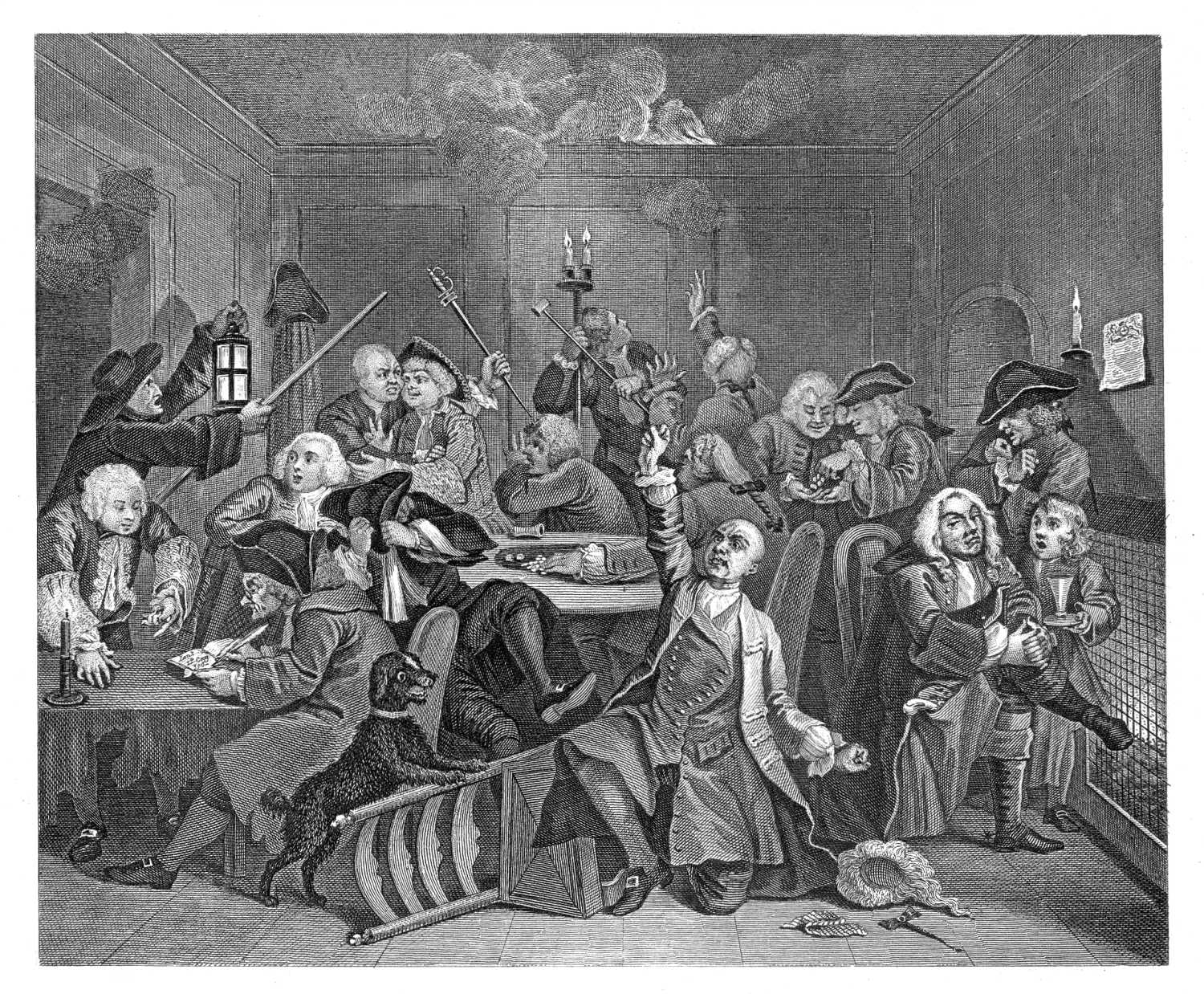
| " | 6 | Gaming House | 21 |
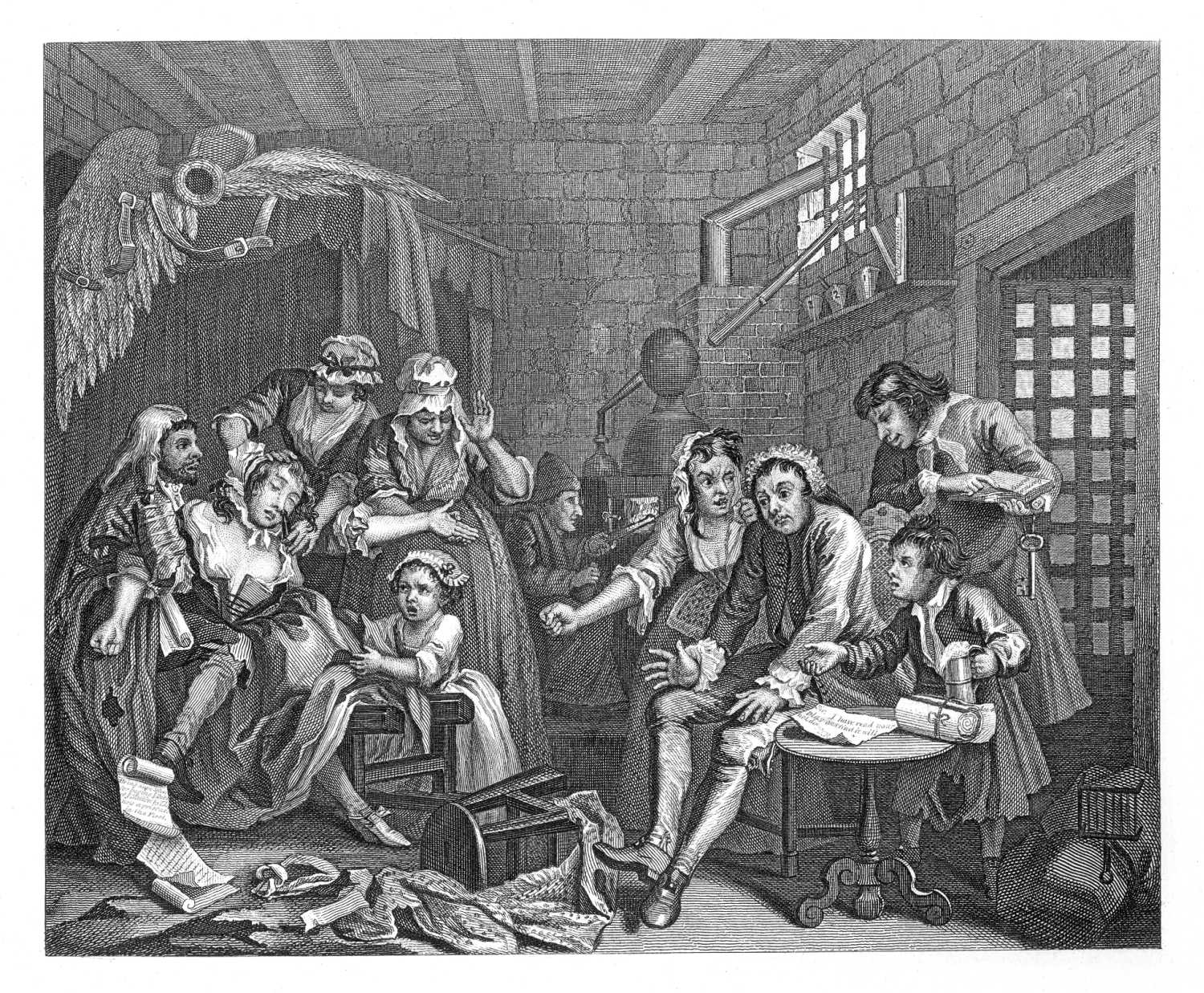
| " | 7 | Prison Scene | 23 |
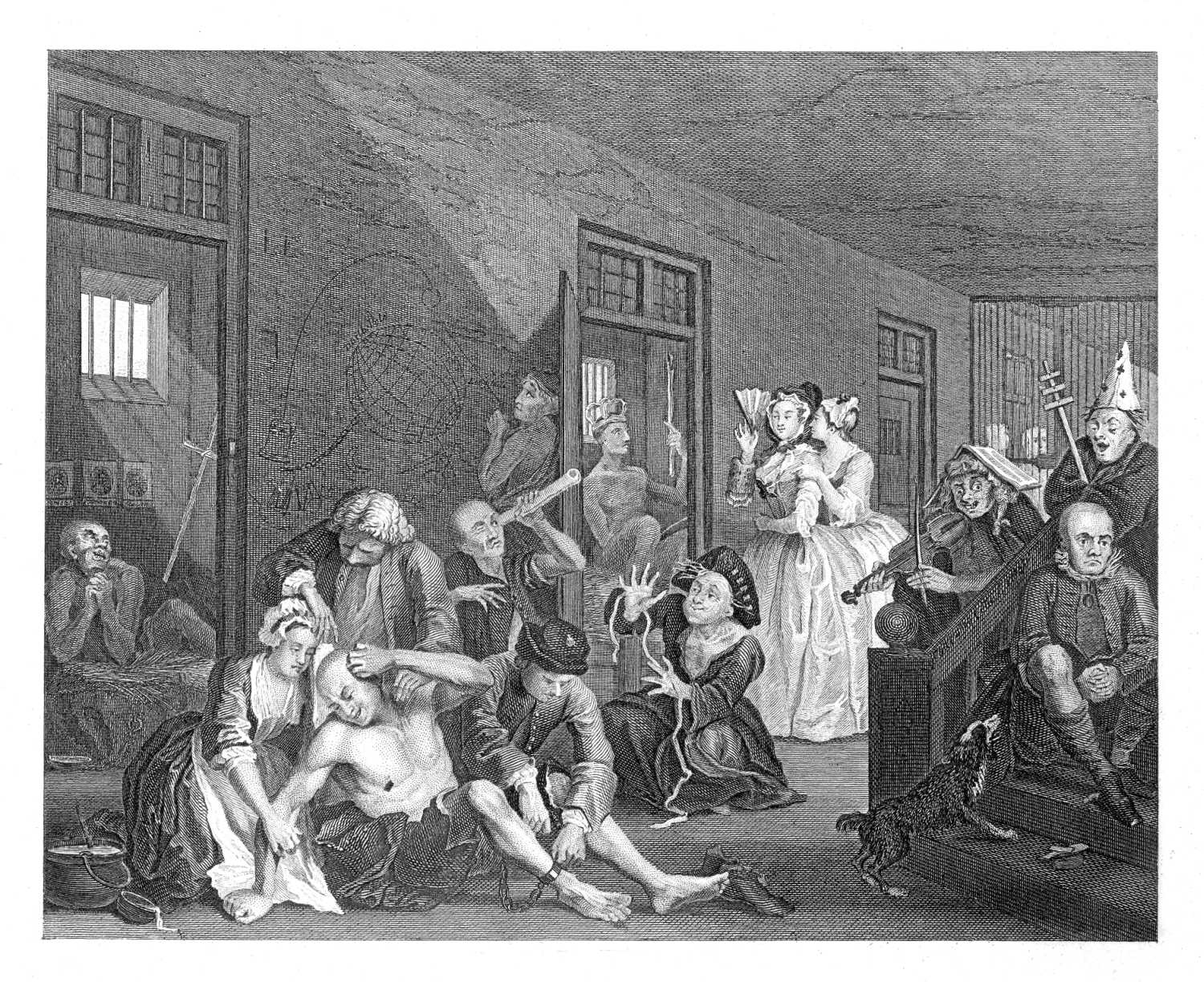
| " | 8 | Mad House | 25 |
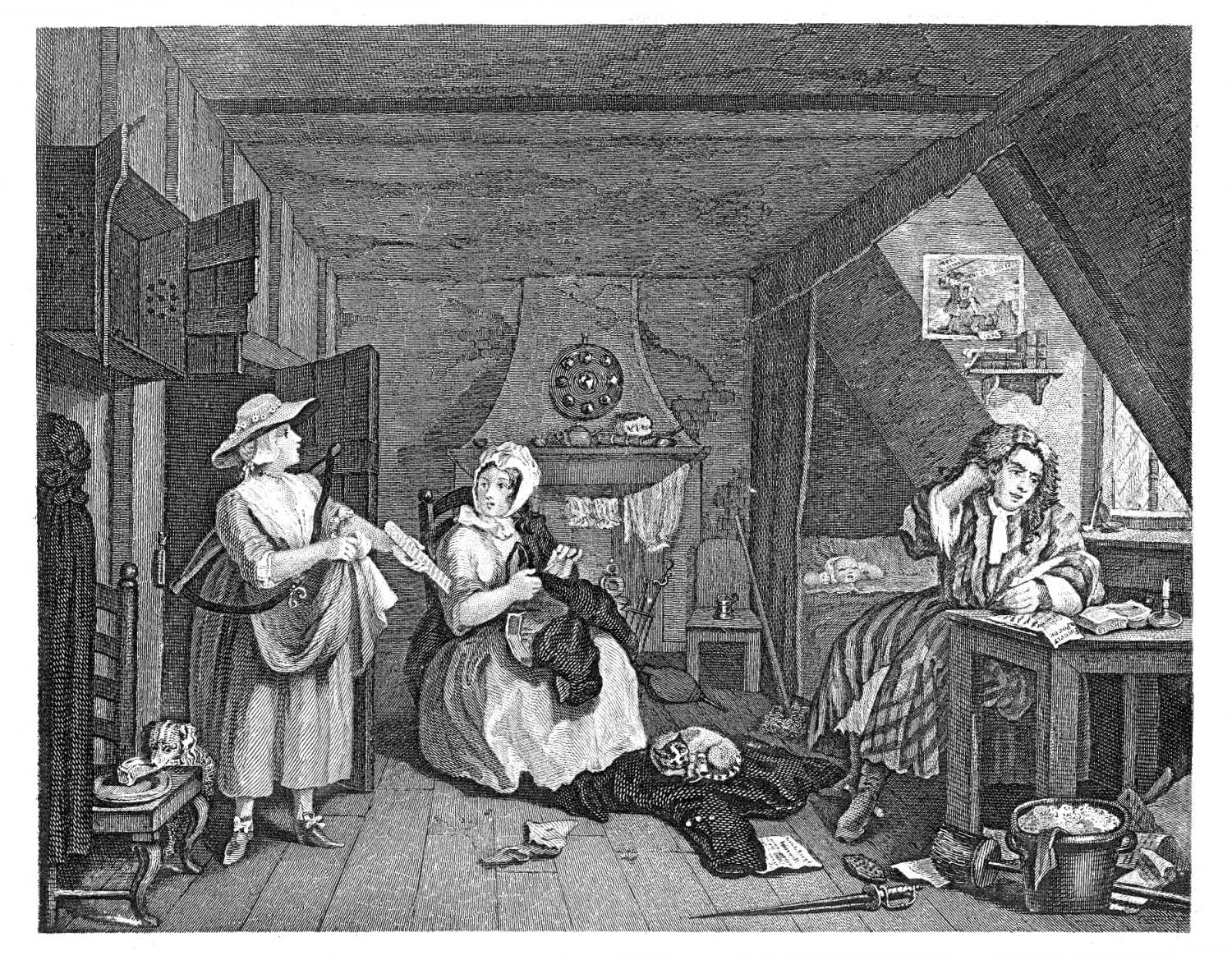
| The Distressed Poet | 27 | ||
| The Bench | 29 | ||
| The Laughing Audience | 31 | ||
| Gate of Calais | 33 | ||
| The Politician | 35 | ||
| Taste in High Life | 37 | ||
| HARLOT'S PROGRESS. | |||
| Plate | 1 | 39 | |
| " | 2 | 41 | |
| " | 3 | 43 | |
| " | 4 | 45 | |
| " | 5 | 47 | |
| " | 6 | 49 | |
| The Lecture | 51 | ||
| The Chorus | 53 | ||
| Columbus breaking the Egg | 55 | ||
| Modern Midnight Conversation | 57 | ||
| Consultation of Physicians | 59 | ||
| Portrait of Daniel Lock, Esq. | 61 | ||
| The Enraged Musician | 63 | ||
| Masquerades and Operas | 65 | ||
| TIMES OF THE DAY. | |||
| Morning | 67 | ||
| Noon | 69 | ||
| Evening | 71 | ||
| Night | 73 | ||
| Sigismonda | 75 | ||
| Portrait of Martin Fowkes, Esq. | 77 | ||
| The Cockpit | 78 | ||
| Captain Thomas Coram | 81 | ||
| Country Inn Yard | 83 | ||
| INDUSTRY AND IDLENESS. | |||
| Plate | 1 | 85 | |
| " | 2 | 87 | |
| " | 3 | 89 | |
| " | 4 | 91 | |
| " | 5 | 93 | |
| " | 6 | 95 | |
| " | 7 | 97 | |
| " | 8 | 99 | |
| " | 9 | 101 | |
| " | 10 | 103 | |
| " | 11 | 105 | |
| " | 12 | 107 | |
| Southwark Fair. | 109 | ||
| Garrick as Richard III. | 111 | ||
| FRANCE AND ENGLAND. | |||
| Plate | 1 | France | 113 |
| " | 2 | England | 115 |
Of all the follies in human life, there is none greater than that of extravagance, or profuseness; it being constant labour, without the least ease or relaxation. It bears, indeed, the colour of that which is commendable, and would fain be thought to take its rise from laudable motives, searching indefatigably after true felicity; now as there can be no true felicity without content, it is this which every man is in constant pursuit of; the learned, for instance, in his industrious quest after knowledge; the merchant, in his dangerous voyages; the ambitious, in his passionate pursuit of honour; the conqueror, in his earnest desire of victory; the politician, in his deep-laid designs; the wanton, in his pleasing charms of beauty; the covetous, in his unwearied heaping-up of treasure; and the prodigal, in his general and extravagant indulgence.—Thus far it may be well;—but, so mistaken are we in our road, as to run on in the very opposite tract, which leads directly to our ruin. Whatever else we indulge ourselves in, is attended with some small degree of relish, and has some trifling satisfaction in the enjoyment, but, in this, the farther we go, the more we are lost; and when arrived at the mark proposed, we are as far from the object we pursue, as when we first set out. Here then, are we inexcusable, in not attending to the secret dictates of reason, and in stopping our ears at the timely admonitions of friendship. Headstrong and ungovernable, we pursue our course without intermission; thoughtless and unwary, we see not the dangers that lie immediately before us; but hurry on, even without sight of our object, till[Pg 10] we bury ourselves in that gulf of woe, where perishes at once, health, wealth and virtue, and whose dreadful labyrinths admit of no return.
Struck with the foresight of that misery, attendant on a life of debauchery, which is, in fact, the offspring of prodigality, our author has, in the scenes before us, attempted the reformation of the worldling, by stopping him as it were in his career, and opening to his view the many sad calamities awaiting the prosecution of his proposed scheme of life; he has, in hopes of reforming the prodigal, and at the same time deterring the rising generation, whom Providence may have blessed with earthly wealth, from entering into so iniquitous a course, exhibited the life of a young man, hurried on through a succession of profligate pursuits, for the few years Nature was able to support itself; and this from the instant he might be said to enter into the world, till the time of his leaving it. But, as the vice of avarice is equal to that of prodigality, and the ruin of children is often owing to the indiscretion of their parents, he has opened the piece with a scene, which, at the same time that it exposes the folly of the youth, shews us the imprudence of the father, who is supposed to have hurt the principles of his son, in depriving him of the necessary use of some portion of that gold, he had with penurious covetousness been hoarding up, for the sole purpose of lodging in his coffers.[Pg 11]
Hoadley.
The history opens, representing a scene crowded with all the monuments of avarice, and laying before us a most beautiful contrast, such as is too general in the world, to pass unobserved; nothing being more common than for a son to prodigally squander away that substance his father had, with anxious solicitude, his whole life been amassing.—Here, we see the young heir, at the age of nineteen or twenty, raw from the University, just arrived at home, upon the death of his father. Eager to know the possessions he is master of, the old wardrobes, where things have been rotting time out of mind, are instantly wrenched open; the strong chests are unlocked; the parchments, those securities of treble interest, on which this avaricious monster lent his money, tumbled out; and the bags of gold, which had long been hoarded, with griping care, now exposed to the pilfering hands of those about him. To explain every little mark of usury and covetousness, such as the mortgages, bonds, indentures, &c. the piece of candle stuck on a save-all, on the mantle-piece; the rotten furniture of the room, and the miserable contents of the dusty wardrobe, would be unnecessary: we shall only notice the more striking articles. From the vast quantity of papers, falls an old written journal, where, among other memorandums, we find the following, viz. "May the 5th, 1721. Put off my bad shilling." Hence, we learn, the store this penurious miser set on this trifle: that so penurious is the disposition of the miser, that notwithstanding he may be possessed of many large bags of gold, the fear of losing a single shilling is a continual trouble to him. In one part of the room, a man is hanging it with black cloth, on which are placed escutcheons, by way of dreary ornament; these escutcheons contain the arms of the covetous, viz. three vices, hard screwed, with the motto, "Beware!" On the floor, lie a pair of old shoes, which this sordid wretch is supposed to have long preserved for the weight of iron in the nails, and has been soling with leather cut from the covers of an old Family Bible; an excellent piece of satire, intimating, that such men would sacrifice even their God to the lust of money. From these and some other objects too striking to pass unnoticed, such as the gold[Pg 12] falling from the breaking cornice; the jack and spit, those utensils of original hospitality, locked up, through fear of being used; the clean and empty chimney, in which a fire is just now going to be made for the first time; and the emaciated figure of the cat, strongly mark the natural temper of the late miserly inhabitant, who could starve in the midst of plenty.—But see the mighty change! View the hero of our piece, left to himself, upon the death of his father, possessed of a goodly inheritance. Mark how his mind is affected!—determined to partake of the mighty happiness he falsely imagines others of his age and fortune enjoy; see him running headlong into extravagance, withholding not his heart from any joy; but implicitly pursuing the dictates of his will. To commence this delusive swing of pleasure, his first application is to the tailor, whom we see here taking his measure, in order to trick out his pretty person. In the interim, enters a poor girl (with her mother), whom our hero has seduced, under professions of love and promises of marriage; in hopes of meeting with that kind welcome she had the greatest reason to expect; but he, corrupted with the wealth of which he is now the master, forgets every engagement he once made, finds himself too rich to keep his word; and, as if gold would atone for a breach of honour, is offering money to her mother, as an equivalent for the non-fulfilling of his promise. Not the sight of the ring, given as a pledge of his fidelity; not a view of the many affectionate letters he at one time wrote to her, of which her mother's lap is full; not the tears, nor even the pregnant condition of the wretched girl, could awaken in him one spark of tenderness; but, hard hearted and unfeeling, like the generality of wicked men, he suffers her to weep away her woes in silent sorrow, and curse with bitterness her deceitful betrayer. One thing more we shall take notice of, which is, that this unexpected visit, attended with abuse from the mother, so engages the attention of our youth, as to give the old pettifogger behind him an opportunity of robbing him. Hence we see that one ill consequence is generally attended with another; and that misfortunes, according to the old proverb, seldom come alone.
Mr. Ireland remarks of this plate—"He here presents to us the picture of a young man, thoughtless, extravagant, and licentious; and, in colours equally impressive, paints the destructive consequences of his conduct. The first print most forcibly contrasts two opposite passions; the unthinking negligence of youth, and the sordid avaricious rapacity of age. It brings into one point of view what Mr. Pope so exquisitely describes in his Epistle to Lord Bathurst—
The introduction to this history is well delineated, and the principal figure marked with that easy, unmeaning vacancy of face, which speaks him formed by nature for a DUPE. Ignorant of the value of money, and negligent in his nature, he leaves his bag of untold gold in the reach of an old and greedy pettifogging attorney, who is making an inventory of bonds, mortgages, indentures, &c. This man, with the rapacity so natural to those who disgrace the profession, seizes the first opportunity of plundering his employer. Hogarth had, a few years before, been engaged in a law suit, which gave him some experience of the PRACTICE of those pests of society."
 THE RAKE'S PROGRESS.
Hoadley.
We are next to consider our hero as launched into the world, and having equipped himself with all the necessaries to constitute him a man of taste, he plunges at once into all the fashionable excesses, and enters with spirit into the character he assumes.
The avarice of the penurious father then, in this print, is contrasted by the giddy profusion of his prodigal son. We view him now at his levee, attended by masters of various professions, supposed to be here offering their interested services. The foremost figure is readily known to be a dancing-master; behind him are two men, who at the time when these prints were first published, were noted for teaching the arts of defence by different weapons, and who are here drawn from the life; one of whom is a Frenchman, teacher of the small-sword, making a thrust with his foil; the other an Englishman, master of the quarter-staff; the vivacity of the first, and the cold contempt visible in the face of the second, beautifully describe the natural disposition of the two nations. On the left of the latter stands an improver of gardens, drawn also from the life, offering a plan for that purpose. A taste for gardening, carried to excess, must be acknowledged to have been the ruin of numbers, it being a passion that is seldom, if ever, satisfied, and attended with the greatest expense. In the chair sits a professor of music, at the harpsichord, running over the keys, waiting to give his pupil a lesson; behind whose chair hangs a list of the presents, one Farinelli, an Italian singer, received the next day after his first performance at the Opera House; amongst which, there is notice taken of one, which he received from the hero of our piece, thus: "A gold snuff-box, chased, with the story of Orpheus charming the brutes, by J. Rakewell, esq." By these mementos of extravagance and pride, (for gifts of this kind proceed oftener from ostentation than generosity,) and by the engraved frontispiece to a poem, dedicated to our fashionable spendthrift, lying on the floor, which represents the ladies of Britain sacrificing their hearts to the idol Farinelli, crying out, with the greatest earnestness, "one G—d, one Farinelli," we are given to understand the prevailing dissipation and luxury of the times. Near the principal figure in this plate is that of him, with one hand on his breast, the other on his sword, whom we may easily discover to be a bravo; he is represented as having brought a letter of recommendation, as one disposed to under[Pg 14]take all sorts of service. This character is rather Italian than English; but is here introduced to fill up the list of persons at that time too often engaged in the service of the votaries of extravagance and fashion. Our author would have it imagined in the interval between the first scene and this, that the young man whose history he is painting, had now given himself up to every fashionable extravagance; and among others, he had imbibed a taste for cock-fighting and horse-racing; two amusements, which, at that time, the man of fashion could not dispense with. This is evident, from his rider bringing in a silver punch-bowl, which one of his horses is supposed to have won, and his saloon being ridiculously ornamented with the portraits of celebrated cocks. The figures in the back part of this plate represent tailors, peruke-makers, milliners, and such other persons as generally fill the antichamber of a man of quality, except one, who is supposed to be a poet, and has written some panegyric on the person whose levee he attends, and who waits for that approbation he already vainly anticipates. Upon the whole, the general tenor of this scene is to teach us, that the man of fashion is too often exposed to the rapacity of his fellow creatures, and is commonly a dupe to the more knowing part of the world.
"How exactly," says Mr. Ireland, "does Bramston describe the character in his Man of Taste:—
"Of the expression in this print, we cannot speak more highly than it deserves. Every character is marked with its proper and discriminative stamp. It has been said by a very judicious critic (the Rev. Mr. Gilpin) from whom it is not easy to differ without being wrong, that the hero of this history, in the first plate of the series, is unmeaning, and in the second ungraceful. The fact is admitted; but, for so delineating him, the author is entitled to our praise, rather than our censure. Rakewell's whole conduct proves he was a fool, and at that time he had not learned how to perform an artificial character; he therefore looks as he is, unmeaning, and uninformed. But in the second plate he is ungraceful.—Granted. The ill-educated son of so avaricious a father could not have been introduced into very good company; and though, by the different teachers who surround him, it evidently appears that he wishes to assume the character of a gentleman, his internal feelings tell him he has not attained it. Under that consciousness, he is properly and naturally represented as ungraceful, and embarrassed in his new situation."
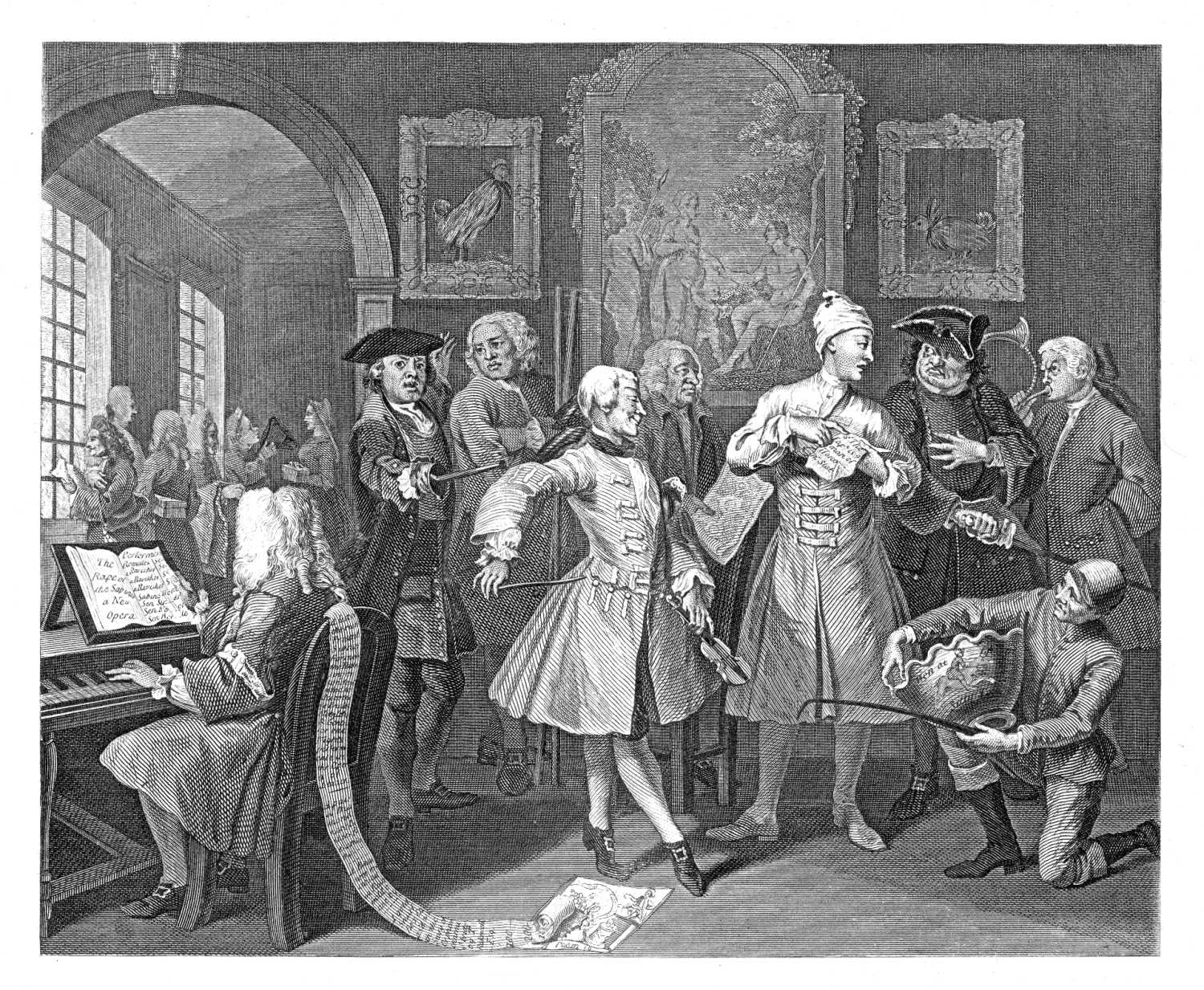 THE RAKE'S PROGRESS.
Mr. Ireland having, in his description of this Plate, incorporated whatever is of value in Dr. Trusler's text, with much judicious observation and criticism of his own, the Editor has taken the former verbatim.
"This Plate exhibits our licentious prodigal engaged in one of his midnight festivities: forgetful of the past, and negligent of the future, he riots in the present. Having poured his libation to Bacchus, he concludes the evening orgies in a sacrifice at the Cyprian shrine; and, surrounded by the votaries of Venus, joins in the unhallowed mysteries of the place. The companions of his revelry are marked with that easy, unblushing effrontery, which belongs to the servants of all work in the isle of Paphos;—for the maids of honour they are not sufficiently elevated.
"He may be supposed, in the phrase of the day, to have beat the rounds, overset a constable, and conquered a watchman, whose staff and lantern he has brought into the room, as trophies of his prowess. In this situation he is robbed of his watch by the girl whose hand is in his bosom; and, with that adroitness peculiar to an old practitioner, she conveys her acquisition to an accomplice, who stands behind the chair.
"Two of the ladies are quarrelling; and one of them delicately spouts wine in the face of her opponent, who is preparing to revenge the affront with a knife, which, in a posture of threatening defiance, she grasps in her hand. A third, enraged at being neglected, holds a lighted candle to a map of the globe, determined to set the world on fire, though she perish in the conflagration! A fourth is undressing. The fellow bringing in a pewter dish, as part of the apparatus of this elegant and Attic entertainment, a blind harper, a trumpeter, and a ragged ballad-singer, roaring out an obscene song, complete this motley group.
"This design may be a very exact representation of what were then the nocturnal amusements of a brothel;—so different are the manners of former and present times, that I much question whether a similar exhibition is now to be seen in any tavern of the metropolis. That we are less licentious than our predecessors, I dare not affirm; but we are certainly more delicate in the pursuit of our pleasures.[Pg 16]
"The room is furnished with a set of Roman emperors,—they are not placed in their proper order; for in the mad revelry of the evening, this family of frenzy have decollated all of them, except Nero; and his manners had too great a similarity to their own, to admit of his suffering so degrading an insult; their reverence for virtue induced them to spare his head. In the frame of a Cæsar they have placed a portrait of Pontac, an eminent cook, whose great talents being turned to heightening sensual, rather than mental enjoyments, he has a much better chance of a votive offering from this company, than would either Vespasian or Trajan.
"The shattered mirror, broken wine-glasses, fractured chair and cane; the mangled fowl, with a fork stuck in its breast, thrown into a corner, and indeed every accompaniment, shews, that this has been a night of riot without enjoyment, mischief without wit, and waste without gratification.
"With respect to the drawing of the figures in this curious female coterie, Hogarth evidently intended several of them for beauties; and of vulgar, uneducated, prostituted beauty, he had a good idea. The hero of our tale displays all that careless jollity, which copious draughts of maddening wine are calculated to inspire; he laughs the world away, and bids it pass. The poor dupe, without his periwig, in the back-ground, forms a good contrast of character: he is maudlin drunk, and sadly sick. To keep up the spirit of unity throughout the society, and not leave the poor African girl entirely neglected, she is making signs to her friend the porter, who perceives, and slightly returns, her love-inspiring glance. This print is rather crowded,—the subject demanded it should be so; some of the figures, thrown into shade, might have helped the general effect, but would have injured the characteristic expression."
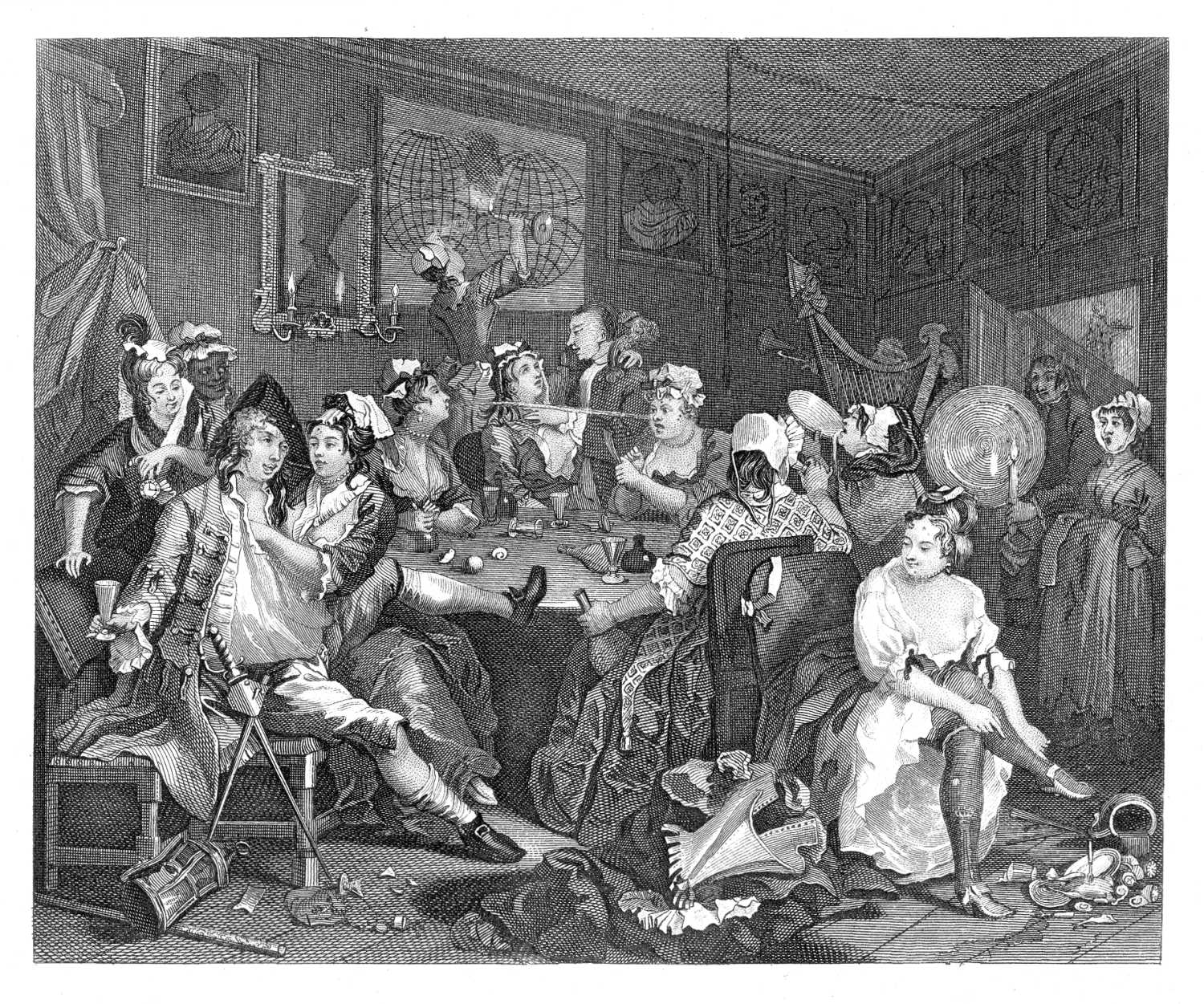 THE RAKE'S PROGRESS.
The career of dissipation is here stopped. Dressed in the first style of the ton, and getting out of a sedan-chair, with the hope of shining in the circle, and perhaps forwarding a former application for a place or a pension, he is arrested! To intimate that being plundered is the certain consequence of such an event, and to shew how closely one misfortune treads upon the heels of another, a boy is at the same moment stealing his cane.
The unfortunate girl whom he basely deserted, is now a milliner, and naturally enough attends in the crowd, to mark the fashions of the day. Seeing his distress, with all the eager tenderness of unabated love, she flies to his relief. Possessed of a small sum of money, the hard earnings of unremitted industry, she generously offers her purse for the liberation of her worthless favourite. This releases the captive beau, and displays a strong instance of female affection; which, being once planted in the bosom, is rarely eradicated by the coldest neglect, or harshest cruelty.
The high-born, haughty Welshman, with an enormous leek, and a countenance keen and lofty as his native mountains, establishes the chronology, and fixes the day to be the first of March; which being sacred to the titular saint of Wales, was observed at court.
Mr. Nichols remarks of this plate:—"In the early impressions, a shoe-black steals the Rake's cane. In the modern ones, a large group of sweeps, and black-shoe boys, are introduced gambling on the pavement; near them a stone inscribed Black's, a contrast to White's gaming-house, against which a flash of lightning is pointed. The curtain in the window of the sedan-chair is thrown back. This plate is likewise found in an intermediate state; the sky being made unnaturally obscure, with an attempt to introduce a shower of rain, and lightning very aukwardly represented. It is supposed to be a first proof after the insertion of the group of blackguard gamesters; the window of the chair being only marked for an alteration that was afterwards made in it. Hogarth appears to have so far[Pg 18] spoiled the sky, that he was obliged to obliterate it, and cause it to be engraved over again by another hand."
Mr. Gilpin observes:—"Very disagreeable accidents often befal gentlemen of pleasure. An event of this kind is recorded in the fourth print, which is now before us. Our hero going, in full dress, to pay his compliments at court on St. David's day, was accosted in the rude manner which is here represented.—The composition is good. The form of the group, made up of the figures in action, the chair, and the lamplighter, is pleasing. Only, here we have an opportunity of remarking, that a group is disgusting when the extremities of it are heavy. A group in some respects should resemble a tree. The heavier part of the foliage (the cup, as the landscape-painter calls it) is always near the middle; the outside branches, which are relieved by the sky, are light and airy. An inattention to this rule has given a heaviness to the group before us. The two bailiffs, the woman, and the chairman, are all huddled together in that part of the group which should have been the lightest; while the middle part, where the hand holds the door, wants strength and consistence. It may be added too, that the four heads, in the form of a diamond, make an unpleasing shape. All regular figures should be studiously avoided.—The light had been well distributed, if the bailiff holding the arrest, and the chairman, had been a little lighter, and the woman darker. The glare of the white apron is disagreeable.—We have, in this print, some beautiful instances of expression. The surprise and terror of the poor gentleman is apparent in every limb, as far as is consistent with the fear of discomposing his dress. The insolence of power in one of the bailiffs, and the unfeeling heart, which can jest with misery, in the other, are strongly marked. The self-importance, too, of the honest Cambrian is not ill portrayed; who is chiefly introduced to settle the chronology of the story.—In pose of grace, we have nothing striking. Hogarth might have introduced a degree of it in the female figure: at least he might have contrived to vary the heavy and unpleasing form of her drapery.—The perspective is good, and makes an agreeable shape."
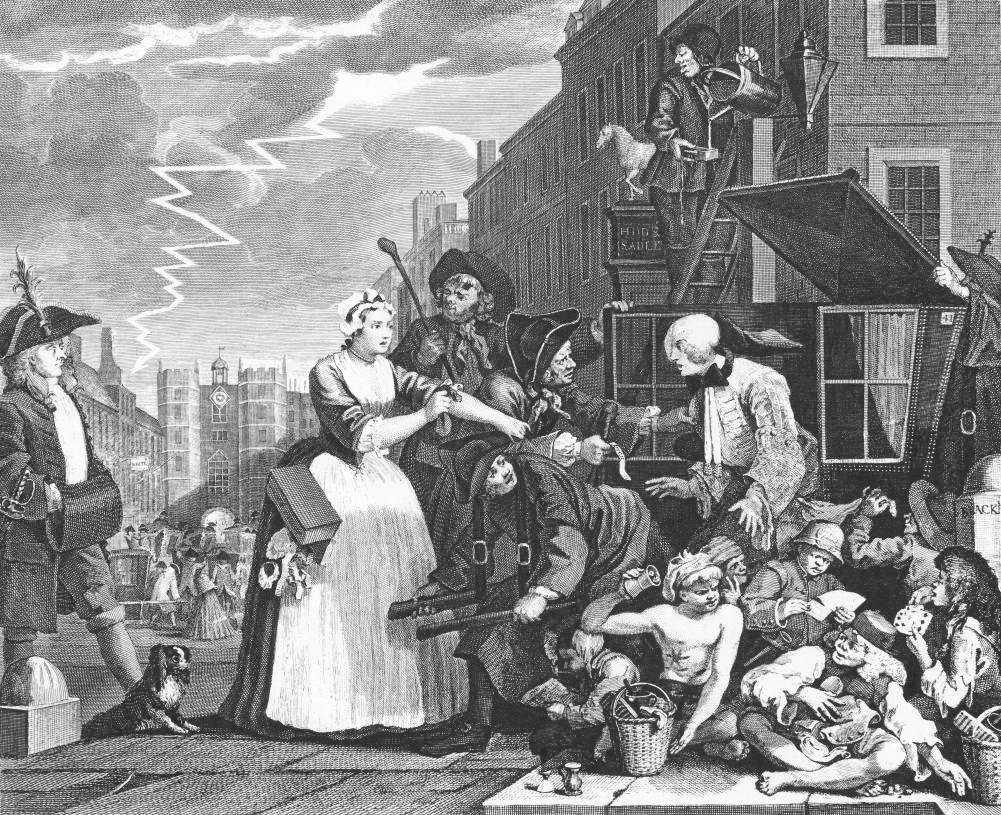 THE RAKE'S PROGRESS.
To be thus degraded by the rude enforcement of the law, and relieved from an exigence by one whom he had injured, would have wounded, humbled, I had almost said reclaimed, any man who had either feeling or elevation of mind; but, to mark the progression of vice, we here see this depraved, lost character, hypocritically violating every natural feeling of the soul, to recruit his exhausted finances, and marrying an old and withered Sybil, at the sight of whom nature must recoil.
The ceremony passes in the old church, Mary-le-bone, which was then considered at such a distance from London, as to become the usual resort of those who wished to be privately married; that such was the view of this prostituted young man, may be fairly inferred from a glance at the object of his choice. Her charms are heightened by the affectation of an amorous leer, which she directs to her youthful husband, in grateful return for a similar compliment which she supposes paid to herself. This gives her face much meaning, but meaning of such a sort, that an observer being ask, "How dreadful must be this creature's hatred?" would naturally reply, "How hateful must be her love!"
In his demeanor we discover an attempt to appear at the altar with becoming decorum: but internal perturbation darts through assumed tranquillity, for though he is plighting his troth to the old woman, his eyes are fixed on the young girl who kneels behind her.
The parson and clerk seem made for each other; a sleepy, stupid solemnity marks every muscle of the divine, and the nasal droning of the lay brother is most happily expressed. Accompanied by her child and mother, the unfortunate victim of his seduction is here again introduced, endeavouring to enter the church, and forbid the banns. The opposition made by an old pew-opener, with her bunch of keys, gave the artist a good opportunity for indulging his taste in the burlesque, and he has not neglected it.
A dog (Trump, Hogarth's favorite), paying his addresses to a one-eyed quadruped of his own species, is a happy parody of the unnatural union going on in the church.
The commandments are broken: a crack runs near the tenth, which says, Thou shalt not covet thy neighbour's wife; a prohibition in the present case hardly necessary.[Pg 20] The creed is destroyed by the damps of the church; and so little attention has been paid to the poor's box, that it is covered with a cobweb! These three high-wrought strokes of satirical humour were perhaps never equalled by any exertion of the pencil; excelled they cannot be.
On one of the pew doors is the following curious specimen of church-yard poetry, and mortuary orthography.
This is a correct copy of the inscription. Part of these lines, in raised letters, now form a pannel in the wainscot at the end of the right-hand gallery, as the church is entered from the street. The mural monument of the Taylor's, composed of lead, gilt over, is still preserved: it is seen in Hogarth's print, just under the window.
A glory over the bride's head is whimsical.
The bay and holly, which decorate the pews, give a date to the period, and determine this preposterous union of January with June, to have taken place about the time of Christmas;
Addison would have classed her among the evergreens of the sex.
It has been observed, that "the church is too small, and the wooden post, which seems to have no use, divides the picture very disagreeably." This cannot be denied: but it appears to be meant as an accurate representation of the place, and the artist delineated what he saw.
The grouping is good, and the principal figure has the air of a gentleman. The light is well distributed, and the scene most characteristically represented.
The commandments being represented as broken, might probably give the hint to a lady's reply, on being told that thieves had the preceding night broken into the church, and stolen the communion-plate, and the ten commandments. "I suppose," added the informant, "that they may melt and sell the plate; but can you divine for what possible purpose they could steal the commandments?"—"To break them, to be sure," replied she;—"to break them."
 THE RAKE'S PROGRESS.
Though now, from the infatuated folly of his antiquated wife, in possession of a fortune, he is still the slave of that baneful vice, which, while it enslaves the mind, poisons the enjoyments, and sweeps away the possessions of its deluded votaries. Destructive as the earthquake which convulses nature, it overwhelms the pride of the forest, and engulfs the labours of the architect.
Newmarket and the cockpit were the scenes of his early amusements; to crown the whole, he is now exhibited at a gaming-table, where all is lost! His countenance distorted with agony, and his soul agitated almost to madness, he imprecates vengeance upon his own head.
That he should be deprived of all he possessed in such a society as surround him, is not to be wondered at. One of the most conspicuous characters appears, by the pistol in his pocket, to be a highwayman: from the profound stupor of his countenance, we are certain he also is a losing gamester; and so absorbed in reflection, that neither the boy who brings him a glass of water, nor the watchman's cry of "Fire!" can arouse him from his reverie. Another of the party is marked for one of those well-dressed continental adventurers, who, being unable to live in their own country, annually pour into this, and with no other requisites than a quick eye, an adroit hand, and an undaunted forehead, are admitted into what is absurdly enough called good company.
At the table a person in mourning grasps his hat, and hides his face, in the agony of repentance, not having, as we infer from his weepers, received that legacy of which[Pg 22] he is now plundered more than "a little month." On the opposite side is another, on whom fortune has severely frowned, biting his nails in the anguish of his soul. The fifth completes the climax; he is frantic; and with a drawn sword endeavours to destroy a pauvre miserable whom he supposes to have cheated him, but is prevented by the interposition of one of those staggering votaries of Bacchus who are to be found in every company where there is good wine; and gaming, like the rod of Moses, so far swallows up every other passion, that the actors, engrossed by greater objects, willingly leave their wine to the audience.
In the back-ground are two collusive associates, eagerly dividing the profits of the evening.
A nobleman in the corner is giving his note to an usurer. The lean and hungry appearance of this cent. per cent. worshipper of the golden calf, is well contrasted by the sleek, contented vacancy of so well-employed a legislator of this great empire. Seated at the table, a portly gentleman, of whom we see very little, is coolly sweeping off his winnings.
So engrossed is every one present by his own situation, that the flames which surround them are disregarded, and the vehement cries of a watchman entering the room, are necessary to rouse their attention to what is generally deemed the first law of nature, self-preservation.
Mr. Gilpin observes:—"The fortune, which our adventurer has just received, enables him to make one push more at the gaming-table. He is exhibited, in the sixth print, venting curses on his folly for having lost his last stake.—This is, upon the whole, perhaps, the best print of the set. The horrid scene it describes, was never more inimitably drawn. The composition is artful, and natural. If the shape of the whole be not quite pleasing, the figures are so well grouped, and with so much ease and variety, that you cannot take offence.
"The expression, in almost every figure, is admirable; and the whole is a strong representation of the human mind in a storm. Three stages of that species of madness which attends gaming, are here described. On the first shock, all is inward dismay. The ruined gamester is represented leaning against a wall, with his arms across, lost in an agony of horror. Perhaps never passion was described with so much force. In a short time this horrible gloom bursts into a storm of fury: he tears in pieces what comes next him; and, kneeling down, invokes curses upon himself. He next attacks others; every one in his turn whom he imagines to have been instrumental in his ruin.—The eager joy of the winning gamesters, the attention of the usurer, the vehemence of the watchman, and the profound reverie of the highwayman, are all admirably marked. There is great coolness, too, expressed in the little we see of the fat gentleman at the end of the table."
 THE RAKE'S PROGRESS.
By a very natural transition Mr. Hogarth has passed his hero from a gaming house into a prison—the inevitable consequence of extravagance. He is here represented in a most distressing situation, without a coat to his back, without money, without a friend to help him. Beggared by a course of ill-luck, the common attendant on the gamester, having first made away with every valuable he was master of, and having now no other resource left to retrieve his wretched circumstances, he at last, vainly promising himself success, commences author, and attempts, though inadequate to the task, to write a play, which is lying on the table, just returned with an answer from the manager of the theatre, to whom he had offered it, that his piece would by no means do. Struck speechless with this disastrous occurrence, all his hopes vanish, and his most sanguine expectations are changed into dejection of spirit. To heighten his distress, he is approached by his wife, and bitterly upbraided for his perfidy in concealing from her his former connexions (with that unhappy girl who is here present with her child, the innocent offspring of her amours, fainting at the sight of his misfortunes, being unable to relieve him farther), and plunging her into those difficulties she never shall be able to surmount. To add to his misery, we see the under-turnkey pressing him for his prison fees, or garnish-money, and the boy refusing to leave the beer he ordered, without being first paid for it. Among those assisting the fainting mother, one of whom we observe clapping her hand, another applying the drops, is a man crusted over, as it were, with the rust of a gaol, supposed to have started from his dream, having been disturbed by the noise at a time when he was settling some affairs of state; to have left his great plan unfinished, and to have hurried to the assistance of distress. We are told, by the papers falling from his lap, one of which contains a scheme for paying the national debt, that his confinement is owing to that itch of politics some persons are troubled with, who will neglect their own affairs, in order to busy them[Pg 24]selves in that which noways concerns them, and which they in no respect understand, though their immediate ruin shall follow it: nay, so infatuated do we find him, so taken up with his beloved object, as not to bestow a few minutes on the decency of his person. In the back of the room is one who owes his ruin to an indefatigable search after the philosopher's stone. Strange and unaccountable!—Hence we are taught by these characters, as well as by the pair of human wings on the tester of the bed, that scheming is the sure and certain road to beggary: and that more owe their misfortunes to wild and romantic notions, than to any accident they meet with in life.
In this upset of his life, and aggravation of distress, we are to suppose our prodigal almost driven to desperation. Now, for the first time, he feels the severe effects of pinching cold and griping hunger. At this melancholy season, reflection finds a passage to his heart, and he now revolves in his mind the folly and sinfulness of his past life;—considers within himself how idly he has wasted the substance he is at present in the utmost need of;—looks back with shame on the iniquity of his actions, and forward with horror on the rueful scene of misery that awaits him; until his brain, torn with excruciating thought, loses at once its power of thinking, and falls a sacrifice to merciless despair.
Mr. Ireland remarks, on the plate before us:—"Our improvident spendthrift is now lodged in that dreary receptacle of human misery,—a prison. His countenance exhibits a picture of despair; the forlorn state of his mind is displayed in every limb, and his exhausted finances, by the turnkey's demand of prison fees, not being answered, and the boy refusing to leave a tankard of porter, unless he is paid for it.
"We see by the enraged countenance of his wife, that she is violently reproaching him for having deceived and ruined her. To crown this catalogue of human tortures, the poor girl whom he deserted, is come with her child—perhaps to comfort him,—to alleviate his sorrows, to soothe his sufferings:—but the agonising view is too much for her agitated frame; shocked at the prospect of that misery which she cannot remove, every object swims before her eyes,—a film covers the sight,—the blood forsakes her cheeks—her lips assume a pallid hue,—and she sinks to the floor of the prison in temporary death. What a heart-rending prospect for him by whom this is occasioned!
"The wretched, squalid inmate, who is assisting the fainting female, bears every mark of being naturalised to the place; out of his pocket hangs a scroll, on which is inscribed, 'A scheme to pay the National Debt, by J. L. now a prisoner in the Fleet.' So attentive was this poor gentleman to the debts of the nation, that he totally forgot his own. The cries of the child, and the good-natured attentions of the women, heighten the interest, and realise the scene. Over the group are a large pair of wings, with which some emulator of Dedalus intended to escape from his confinement; but finding them inadequate to the execution of his project, has placed them upon the tester of his bed. They would not exalt him to the regions of air, but they o'ercanopy him on earth. A chemist in the back-ground, happy in his views, watching the moment of projection, is not to be disturbed from his dream by any thing less than the fall of the roof, or the bursting of his retort;—and if his dream affords him felicity, why should he be awakened? The bed and gridiron, those poor remnants of our miserable spendthrift's wretched property, are brought here as necessary in his degraded situation; on one he must try to repose his wearied frame, on the other, he is to dress his scanty meal."
 THE RAKE'S PROGRESS.
See our hero then, in the scene before us, raving in all the dismal horrors of hopeless insanity, in the hospital of Bethlehem, the senate of mankind, where each man may find a representative; there we behold him trampling on the first great law of nature, tearing himself to pieces with his own hands, and chained by the leg to prevent any further mischief he might either do to himself or others. But in this scene, dreary and horrid as are its accompaniments, he is attended by the faithful and kind-hearted female whom he so basely betrayed. In the first plate we see him refuse her his promised hand. In the fourth, she releases him from the harpy fangs of a bailiff; she is present at his marriage; and in the hope of relieving his distress, she follows him to a prison. Our artist, in this scene of horror, has taken an opportunity of pointing out to us the various causes of mental blindness; for such, surely, it may be called, when the intuitive faculties are either destroyed or impaired. In one of the inner rooms of this gallery is a despairing wretch, imploring Heaven for mercy, whose brain is crazed with lip-labouring superstition, the most dreadful enemy of human kind; which, attended with ignorance, error, penance and indulgence, too often deprives its unhappy votaries of their senses. The next in view is one man drawing lines upon a wall, in order, if possible, to find out the longitude; and another, before him, looking through a paper, by way of a telescope. By these expressive figures we are given to understand that such is the misfortune of man, that while, perhaps, the aspiring soul is pursuing some lofty and elevated conception, soaring to an uncommon pitch, and teeming with some grand discovery, the ferment often proves too strong for the feeble brain to support, and lays the whole magazine of notions and images in wild confusion. This melancholy group is completed by the crazy tailor, who is staring at the mad astronomer with a sort of[Pg 26] wild astonishment, wondering, through excess of ignorance, what discoveries the heavens can possibly afford; proud of his profession, he has fixed a variety of patterns in his hat, by way of ornament; has covered his poor head with shreds, and makes his measure the constant object of his attention. Behind this man stands another, playing on the violin, with his book upon his head, intimating that too great a love for music has been the cause of his distraction. On the stairs sits another, crazed by love, (evident from the picture of his beloved object round his neck, and the words "charming Betty Careless" upon the bannisters, which he is supposed to scratch upon every wall and every wainscot,) and wrapt up so close in melancholy pensiveness, as not even to observe the dog that is flying at him. Behind him, and in the inner room, are two persons maddened with ambition. These men, though under the influence of the same passion, are actuated by different notions; one is for the papal dignity, the other for regal; one imagines himself the Pope, and saying mass; the other fancies himself a King, is encircled with the emblem of royalty, and is casting contempt on his imaginary subjects by an act of the greatest disdain. To brighten this distressful scene, and draw a smile from him whose rigid reasoning might condemn the bringing into public view this blemish of humanity, are two women introduced, walking in the gallery, as curious spectators of this melancholy sight; one of whom is supposed, in a whisper, to bid the other observe the naked man, which she takes an opportunity of doing by a leer through the sticks of her fan.
Thus, imagining the hero of our piece to expire raving mad, the story is finished, and little else remains but to close it with a proper application. Reflect then, ye parents, on this tragic tale; consider with yourselves, that the ruin of a child is too often owing to the imprudence of a father. Had the young man, whose story we have related, been taught the proper use of money, had his parent given him some insight into life, and graven, as it were, upon his heart, the precepts of religion, with an abhorrence of vice, our youth would, in all probability, have taken a contrary course, lived a credit to his friends, and an honour to his country.
 THE RAKE'S PROGRESS.
This Plate describes, in the strongest colours, the distress of an author without friends to patronise him. Seated upon the side of his bed, without a shirt, but wrapped in an old night-gown, he is now spinning a poem upon "Riches:" of their use he probably knoweth little; and of their abuse,—if judgment can be formed from externals,—certes, he knoweth less. Enchanted, impressed, inspired with his subject, he is disturbed by a nymph of the lactarium. Her shrill-sounding voice awakes one of the little loves, whose chorus disturbs his meditations. A link of the golden chain is broken!—a thought is lost!—to recover it, his hand becomes a substitute for the barber's comb:—enraged at the noise, he tortures his head for the fleeting idea; but, ah! no thought is there!
Proudly conscious that the lines already written are sterling, he possesses by anticipation the mines of Peru, a view of which hangs over his head. Upon the table we see "Byshe's Art of Poetry;" for, like the pack-horse, who cannot travel without his bells, he cannot climb the hill of Parnassus without his jingling-book. On the floor lies the "Grub-street Journal," to which valuable repository of genius and taste he is probably a contributor. To show that he is a master of the PROFOUND, and will envelope his subject in a cloud, his pipe and tobacco-box, those friends to cogitation deep, are close to him.
His wife, mending that part of his dress, in the pockets of which the affluent keep their gold, is worthy of a better fate. Her figure is peculiarly interesting. Her face, softened by adversity, and marked with domestic care, is at this moment agitated by the appearance of a boisterous woman, insolently demanding payment of the milk-tally. In the excuse she returns, there is a mixture of concern, complacency, and mortification. As an addition to the distresses of this poor family, a dog is stealing the remnant of mutton incautiously left upon a chair.
The sloping roof, and projecting chimney, prove the throne of this inspired bard to be high above the crowd;—it is a garret. The chimney is ornamented with a dare for larks, and a book; a loaf, the tea-equipage, and a saucepan, decorate the shelf.[Pg 28] Before the fire hangs half a shirt, and a pair of ruffled sleeves. His sword lies on the floor; for though our professor of poetry waged no war, except with words, a sword was, in the year 1740, a necessary appendage to every thing which called itself "gentleman." At the feet of his domestic seamstress, the full-dress coat is become the resting-place of a cat and two kittens: in the same situation is one stocking, the other is half immersed in the washing-pan. The broom, bellows, and mop, are scattered round the room. The open door shows us that their cupboard is unfurnished, and tenanted by a hungry and solitary mouse. In the corner hangs a long cloak, well calculated to conceal the threadbare wardrobe of its fair owner.
Mr. Hogarth's strict attention to propriety of scenery, is evinced by the cracked plaistering of the walls, broken window, and uneven floor, in the miserable habitation of this poor weaver of madrigals. When this was first published, the following quotation from Pope's "Dunciad" was inscribed under the print:
All his books, amounting to only four, was, I suppose, the artist's reason for erasing the lines.
 THE DISTRESSED POET.
It having been universally acknowledged that Mr. Hogarth was one of the most ingenious painters of his age, and a man possessed of a vast store of humour, which he has sufficiently shown and displayed in his numerous productions; the general approbation his works receive, is not to be wondered at. But, as owing to the false notions of the public, not thoroughly acquainted with the true art of painting, he has been often called a caricaturer; when, in reality, caricatura was no part of his profession, he being a true copier of Nature; to set this matter right, and give the world a just definition of the words, character, caricatura, and outré, in which humorous painting principally consists, and to show their difference of meaning, he, in the year 1758, published this print; but, as it did not quite answer his purpose, giving an illustration of the word character only, he added, in the year 1764, the group of heads above, which he never lived to finish, though he worked upon it the day before his death. The lines between inverted commas are our author's own words, and are engraved at the bottom of the plate.
"There are hardly any two things more essentially different than character and caricatura; nevertheless, they are usually confounded, and mistaken for each other; on which account this explanation is attempted.
"It has ever been allowed, that when a character is strongly marked in the living face, it may be considered as an index of the mind, to express which, with any degree of justness, in painting, requires the utmost efforts of a great master. Now that, which has of late years got the name of caricatura, is, or ought to be, totally divested of every stroke that hath a tendency to good drawing; it may be said to be a species of lines that are produced, rather by the hand of chance, than of skill; for the early scrawlings of a child, which do but barely hint the idea of a human face, will always be found to be like some person or other, and will often form such a comical resemblance, as, in all probability, the most eminent caricaturers of these times will not be[Pg 30] able to equal, with design; because their ideas of objects are so much more perfect than children's, that they will, unavoidably, introduce some kind of drawing; for all the humorous effects of the fashionable manner of caricaturing, chiefly depend on the surprise we are under, at finding ourselves caught with any sort of similitude in objects absolutely remote in their kind. Let it be observed, the more remote in their nature, the greater is the excellence of these pieces. As a proof of this, I remember a famous caricatura of a certain Italian singer, that struck at first sight, which consisted only of a straight perpendicular stroke, with a dot over. As to the French word outré, it is different from the rest, and signifies nothing more than the exaggerated outlines of a figure, all the parts of which may be, in other respects, a perfect and true picture of nature. A giant or a dwarf may be called a common man, outré. So any part, as a nose, or a leg, made bigger, or less than it ought to be, is that part outré, which is all that is to be understood by this word, injudiciously used to the prejudice of character."—Analysis of Beauty, chap. vi.
To prevent these distinctions being looked upon as dry and unentertaining, our author has, in this group of faces, ridiculed the want of capacity among some of our judges, or dispensers of the law, whose shallow discernment, natural disposition, or wilful inattention, is here perfectly described in their faces. One is amusing himself in the course of trial, with other business; another, in all the pride of self-importance, is examining a former deposition, wholly inattentive to that before him; the next is busied in thoughts quite foreign to the subject; and the senses of the last are locked fast in sleep.
The four sages on the Bench, are intended for Lord Chief Justice Sir John Willes, the principal figure; on his right hand, Sir Edward Clive; and on his left, Mr. Justice Bathurst, and the Hon. William Noel.
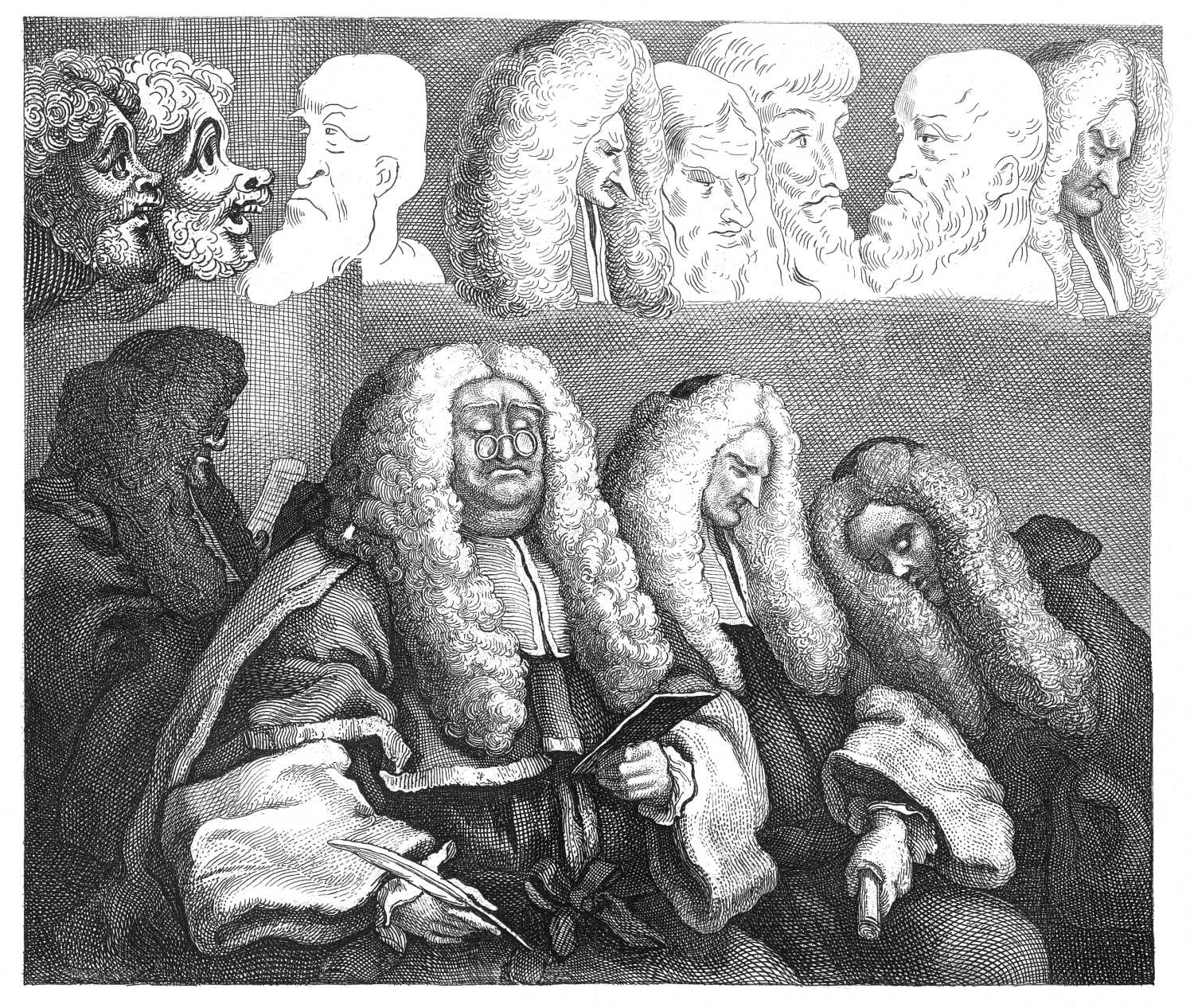 THE BENCH.
"From the first print that Hogarth engraved, to the last that he published, I do not think," says Mr. Ireland, "there is one, in which character is more displayed than in this very spirited little etching. It is much superior to the more delicate engravings from his designs by other artists, and I prefer it to those that were still higher finished by his own burin.
"The prim coxcomb with an enormous bag, whose favours, like those of Hercules between Virtue and Vice, are contended for by two rival orange girls, gives an admirable idea of the dress of the day; when, if we may judge from this print, our grave forefathers, defying Nature, and despising convenience, had a much higher rank in the temple of Folly than was then attained by their ladies. It must be acknowledged that, since that period, the softer sex have asserted their natural rights; and, snatching the wreath of fashion from the brow of presuming man, have tortured it into such forms that, were it possible, which certes it is not, to disguise a beauteous face——But to the high behest of Fashion all must bow.
"Governed by this idol, our beau has a cuff that, for a modern fop, would furnish fronts for a waistcoat, and a family fire-screen might be made of his enormous bag. His bare and shrivelled neck has a close resemblance to that of a half-starved greyhound; and his face, figure, and air, form a fine contrast to the easy and degagée assurance of the Grisette whom he addresses.
"The opposite figure, nearly as grotesque, though not quite so formal as its companion, presses its left hand upon its breast, in the style of protestation; and, eagerly contemplating the superabundant charms of a beauty of Rubens's school, presents her with a pinch of comfort. Every muscle, every line of his countenance, is acted upon by affectation and grimace, and his queue bears some resemblance to an ear-trumpet.
"The total inattention of these three polite persons to the business of the stage, which at this moment almost convulses the children of Nature who are seated in the[Pg 32] pit, is highly descriptive of that refined apathy which characterises our people of fashion, and raises them above those mean passions that agitate the groundlings.
"One gentleman, indeed, is as affectedly unaffected as a man of the first world. By his saturnine cast of face, and contracted brow, he is evidently a profound critic, and much too wise to laugh. He must indisputably be a very great critic; for, like Voltaire's Poccocurante, nothing can please him; and, while those around open every avenue of their minds to mirth, and are willing to be delighted, though they do not well know why, he analyses the drama by the laws of Aristotle, and finding those laws are violated, determines that the author ought to be hissed, instead of being applauded. This it is to be so excellent a judge; this it is which gives a critic that exalted gratification which can never be attained by the illiterate,—the supreme power of pointing out faults, where others discern nothing but beauties, and preserving a rigid inflexibility of muscle, while the sides of the vulgar herd are shaking with laughter. These merry mortals, thinking with Plato that it is no proof of a good stomach to nauseate every aliment presented them, do not inquire too nicely into causes, but, giving full scope to their risibility, display a set of features more highly ludicrous than I ever saw in any other print. It is to be regretted that the artist has not given us some clue by which we might have known what was the play which so much delighted his audience: I should conjecture that it was either one of Shakespear's comedies, or a modern tragedy. Sentimental comedy was not the fashion of that day.
"The three sedate musicians in the orchestra, totally engrossed by minims and crotchets, are an admirable contrast to the company in the pit."
 THE LAUGHING AUDIENCE.
The thought on which this whimsical and highly-characteristic print is founded, originated in Calais, to which place Mr. Hogarth, accompanied by some of his friends, made an excursion, in the year 1747.
Extreme partiality for his native country was the leading trait of his character; he seems to have begun his three hours' voyage with a firm determination to be displeased at every thing he saw out of Old England. For a meagre, powdered figure, hung with tatters, a-la-mode de Paris, to affect the airs of a coxcomb, and the importance of a sovereign, is ridiculous enough; but if it makes a man happy, why should[Pg 34] he be laughed at? It must blunt the edge of ridicule, to see natural hilarity defy depression; and a whole nation laugh, sing, and dance, under burthens that would nearly break the firm-knit sinews of a Briton. Such was the picture of France at that period, but it was a picture which our English satirist could not contemplate with common patience. The swarms of grotesque figures who paraded the streets excited his indignation, and drew forth a torrent of coarse abusive ridicule, not much to the honour of his liberality. He compared them to Callot's beggars—Lazarus on the painted cloth—the prodigal son—or any other object descriptive of extreme contempt. Against giving way to these effusions of national spleen in the open street, he was frequently cautioned, but advice had no effect; he treated admonition with scorn, and considered his monitor unworthy the name of Englishman. These satirical ebullitions were at length checked. Ignorant of the customs of France, and considering the gate of Calais merely as a piece of ancient architecture, he began to make a sketch. This was soon observed; he was seized as a spy, who intended to draw a plan of the fortification, and escorted by a file of musqueteers to M. la Commandant. His sketch-book was examined, leaf by leaf, and found to contain drawings that had not the most distant relation to tactics. Notwithstanding this favourable circumstance, the governor, with great politeness, assured him, that had not a treaty between the nations been actually signed, he should have been under the disagreeable necessity of hanging him upon the ramparts: as it was, he must be permitted the privilege of providing him a few military attendants, who should do themselves the honour of waiting upon him, while he resided in the dominions of "the grande monarque." Two sentinels were then ordered to escort him to his hotel, from whence they conducted him to the vessel; nor did they quit their prisoner, until he was a league from shore; when, seizing him by the shoulders, and spinning him round upon the deck, they said he was now at liberty to pursue his voyage without further molestation.
So mortifying an adventure he did not like to hear recited, but has in this print recorded the circumstance which led to it. In one corner he has given a portrait of himself, making the drawing; and to shew the moment of arrest, the hand of a serjeant is upon his shoulder.
The French sentinel is so situated, as to give some idea of a figure hanging in chains: his ragged shirt is trimmed with a pair of paper ruffles. The old woman, and a fish which she is pointing at, have a striking resemblance. The abundance of parsnips, and other vegetables, indicate what are the leading articles in a Lenten feast.
Mr. Pine, the painter, sat for the friar, and from thence acquired the title of Father Pine. This distinction did not flatter him, and he frequently requested that the countenance might be altered, but the artist peremptorily refused.
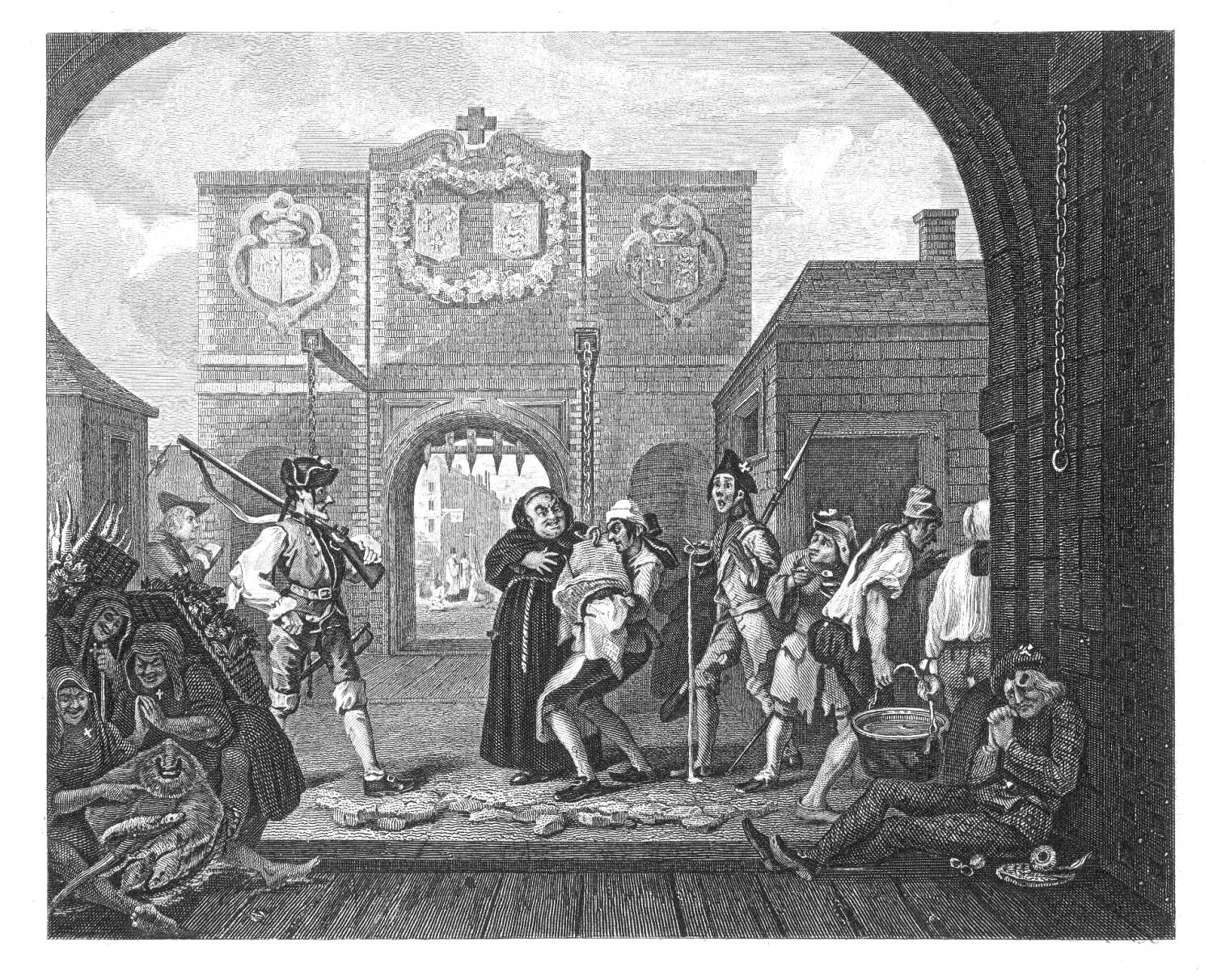 GATE OF CALAIS.
One of our old writers gives it as his opinion, that "there are onlie two subjects which are worthie the studie of a wise man," i.e. religion and politics. For the first, it does not come under inquiry in this print,—but certain it is, that too sedulously studying the second, has frequently involved its votaries in many most tedious and unprofitable disputes, and been the source of much evil to many well-meaning and honest men. Under this class comes the Quidnunc here pourtrayed; it is said to be intended for a Mr. Tibson, laceman, in the Strand, who paid more attention to the affairs of Europe, than to those of his own shop. He is represented in a style somewhat similar to that in which Schalcken painted William the third,—holding a candle in his right hand, and eagerly inspecting the Gazetteer of the day. Deeply interested in the intelligence it contains, concerning the flames that rage on the Continent, he is totally insensible of domestic danger, and regardless of a flame, which, ascending to his hat,—
From the tie-wig, stockings, high-quartered shoes, and sword, I should suppose it was painted about the year 1730, when street robberies were so frequent in the metropolis, that it was customary for men in trade to wear swords, not to preserve their religion and liberty from foreign invasion, but to defend their own pockets from "domestic collectors."
The original sketch Hogarth presented to his friend Forrest; it was etched by Sherwin, and published in 1775.
 THE POLITICIAN.
The picture from which this print was copied, Hogarth painted by the order of Miss Edwards, a woman of large fortune, who having been laughed at for some singularities in her manners, requested the artist to recriminate on her opponents, and paid him sixty guineas for his production.
It is professedly intended to ridicule the reigning fashions of high life, in the year 1742: to do this, the painter has brought into one group, an old beau and an old lady of the Chesterfield school, a fashionable young lady, a little black boy, and a full-dressed monkey. The old lady, with a most affected air, poises, between her finger and thumb, a small tea-cup, with the beauties of which she appears to be highly enamoured.
The gentleman, gazing with vacant wonder at that and the companion saucer which he holds in his hand, joins in admiration of its astonishing beauties!
This gentleman is said to be intended for Lord Portmore, in the habit he first appeared at Court, on his return from France. The cane dangling from his wrist, large muff, long queue, black stock, feathered chapeau, and shoes, give him the air of
The old lady's habit, formed of stiff brocade, gives her the appearance of a squat pyramid, with a grotesque head at the top of it. The young one is fondling a little black boy, who on his part is playing with a petite pagoda. This miniature Othello has been said to be intended for the late Ignatius Sancho, whose talents and virtues[Pg 38] were an honour to his colour. At the time the picture was painted, he would have been rather older than the figure, but as he was then honoured by the partiality and protection of a noble family, the painter might possibly mean to delineate what his figure had been a few years before.
The little monkey, with a magnifying glass, bag-wig, solitaire, laced hat, and ruffles, is eagerly inspecting a bill of fare, with the following articles pour diner; cocks' combs, ducks' tongues, rabbits' ears, fricasee of snails, grande d'œufs buerre.
In the centre of the room is a capacious china jar; in one corner a tremendous pyramid, composed of packs of cards, and on the floor close to them, a bill, inscribed "Lady Basto, Dr to John Pip, for cards,—£300."
The room is ornamented with several pictures; the principal represents the Medicean Venus, on a pedestal, in stays and high-heeled shoes, and holding before her a hoop petticoat, somewhat larger than a fig-leaf; a Cupid paring down a fat lady to a thin proportion, and another Cupid blowing up a fire to burn a hoop petticoat, muff, bag, queue wig, &c. On the dexter side is another picture, representing Monsieur Desnoyer, operatically habited, dancing in a grand ballet, and surrounded by butterflies, insects evidently of the same genus with this deity of dance. On the sinister, is a drawing of exotics, consisting of queue and bag-wigs, muffs, solitaires, petticoats, French heeled shoes, and other fantastic fripperies.
Beneath this is a lady in a pyramidical habit walking the Park; and as the companion picture, we have a blind man walking the streets.
The fire-screen is adorned with a drawing of a lady in a sedan-chair—
As Hogarth made this design from the ideas of Miss Edwards, it has been said that he had no great partiality for his own performance, and that, as he never would consent to its being engraved, the drawing from which the first print was copied, was made by the connivance of one of her servants. Be that as it may, his ridicule on the absurdities of fashion,—on the folly of collecting old china,—cookery,—card playing, &c. is pointed, and highly wrought.
At the sale of Miss Edwards's effects at Kensington, the original picture was purchased by the father of Mr. Birch, surgeon, of Essex-street, Strand.
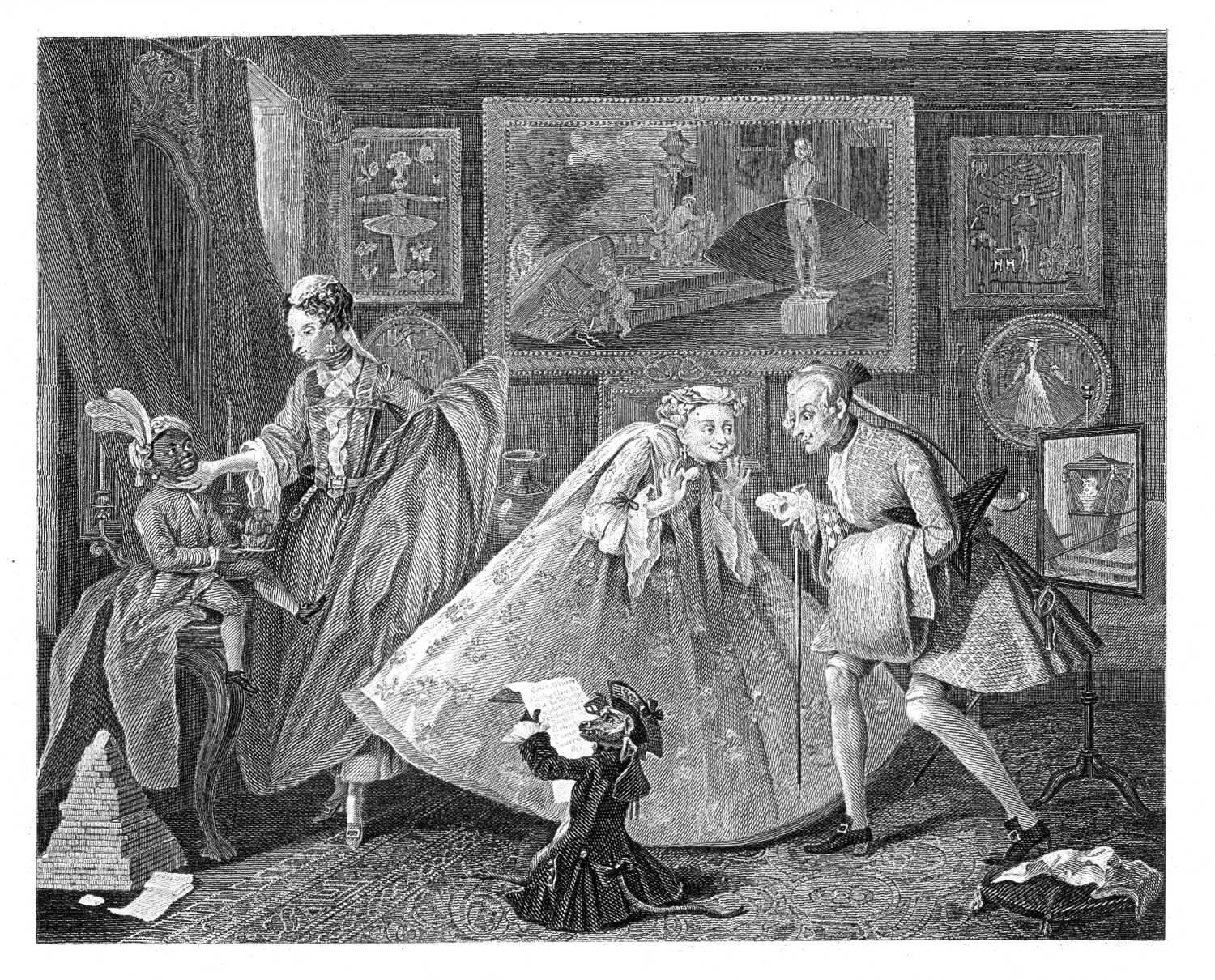 TASTE IN HIGH LIFE.
The general aim of historical painters, says Mr. Ireland, has been to emblazon some signal exploit of an exalted and distinguished character. To go through a series of actions, and conduct their hero from the cradle to the grave, to give a history upon canvass, and tell a story with the pencil, few of them attempted. Mr. Hogarth saw, with the intuitive eye of genius, that one path to the Temple of Fame was yet untrodden: he took Nature for his guide, and gained the summit. He was the painter of Nature; for he gave, not merely the ground-plan of the countenance, but marked the features with every impulse of the mind. He may be denominated the biographical dramatist of domestic life. Leaving those heroic monarchs who have blazed through their day, with the destructive brilliancy of a comet, to their adulatory historians, he, like Lillo, has taken his scenes from humble life, and rendered them a source of entertainment, instruction, and morality.
This series of prints gives the history of a Prostitute. The story commences with her arrival in London, where, initiated in the school of profligacy, she experiences the miseries consequent to her situation, and dies in the morning of life. Her variety of wretchedness, forms such a picture of the way in which vice rewards her votaries, as ought to warn the young and inexperienced from entering this path of infamy.
The first scene of this domestic tragedy is laid at the Bell Inn, in Wood-street, and the heroine may possibly be daughter to the poor old clergyman who is reading the direction of a letter close to the York waggon, from which vehicle she has just alighted. In attire—neat, plain, unadorned; in demeanor—artless, modest, diffident: in the bloom of youth, and more distinguished by native innocence than elegant symmetry; her conscious blush, and downcast eyes, attract the attention of a female fiend, who panders to the vices of the opulent and libidinous. Coming out of the door of the inn, we discover two men, one of whom is eagerly gloating on the devoted victim. This is a portrait, and said to be a strong resemblance of Colonel Francis Chartres.[Pg 40]
The old procuress, immediately after the girl's alighting from the waggon, addresses her with the familiarity of a friend, rather than the reserve of one who is to be her mistress.
Had her father been versed in even the first rudiments of physiognomy, he would have prevented her engaging with one of so decided an aspect: for this also is the portrait of a woman infamous in her day: but he, good, easy man, unsuspicious as Fielding's parson Adams, is wholly engrossed in the contemplation of a superscription to a letter, addressed to the bishop of the diocese. So important an object prevents his attending to his daughter, or regarding the devastation occasioned by his gaunt and hungry Rozinante having snatched at the straw that packs up some earthenware, and produced
From the inn she is taken to the house of the procuress, divested of her home-spun garb, dressed in the gayest style of the day; and the tender native hue of her complexion incrusted with paint, and disguised by patches. She is then introduced to Colonel Chartres, and by artful flattery and liberal promises, becomes intoxicated with the dreams of imaginary greatness. A short time convinces her of how light a breath these promises were composed. Deserted by her keeper, and terrified by threats of an immediate arrest for the pompous paraphernalia of prostitution, after being a short time protected by one of the tribe of Levi, she is reduced to the hard necessity of wandering the streets, for that precarious subsistence which flows from the drunken rake, or profligate debauchee. Here her situation is truly pitiable! Chilled by nipping frost and midnight dew, the repentant tear trickling on her heaving bosom, she endeavours to drown reflection in draughts of destructive poison. This, added to the contagious company of women of her own description, vitiates her mind, eradicates the native seeds of virtue, destroys that elegant and fascinating simplicity, which gives additional charms to beauty, and leaves, in its place, art, affectation, and impudence.
Neither the painter of a sublime picture, nor the writer of an heroic poem, should introduce any trivial circumstances that are likely to draw the attention from the principal figures. Such compositions should form one great whole: minute detail will inevitably weaken their effect. But in little stories, which record the domestic incidents of familiar life, these accessary accompaniments, though trifling in themselves, acquire a consequence from their situation; they add to the interest, and realise the scene. In this, as in almost all that were delineated by Mr. Hogarth, we see a close regard paid to things as they then were; by which means his prints become a sort of historical record of the manners of the age.
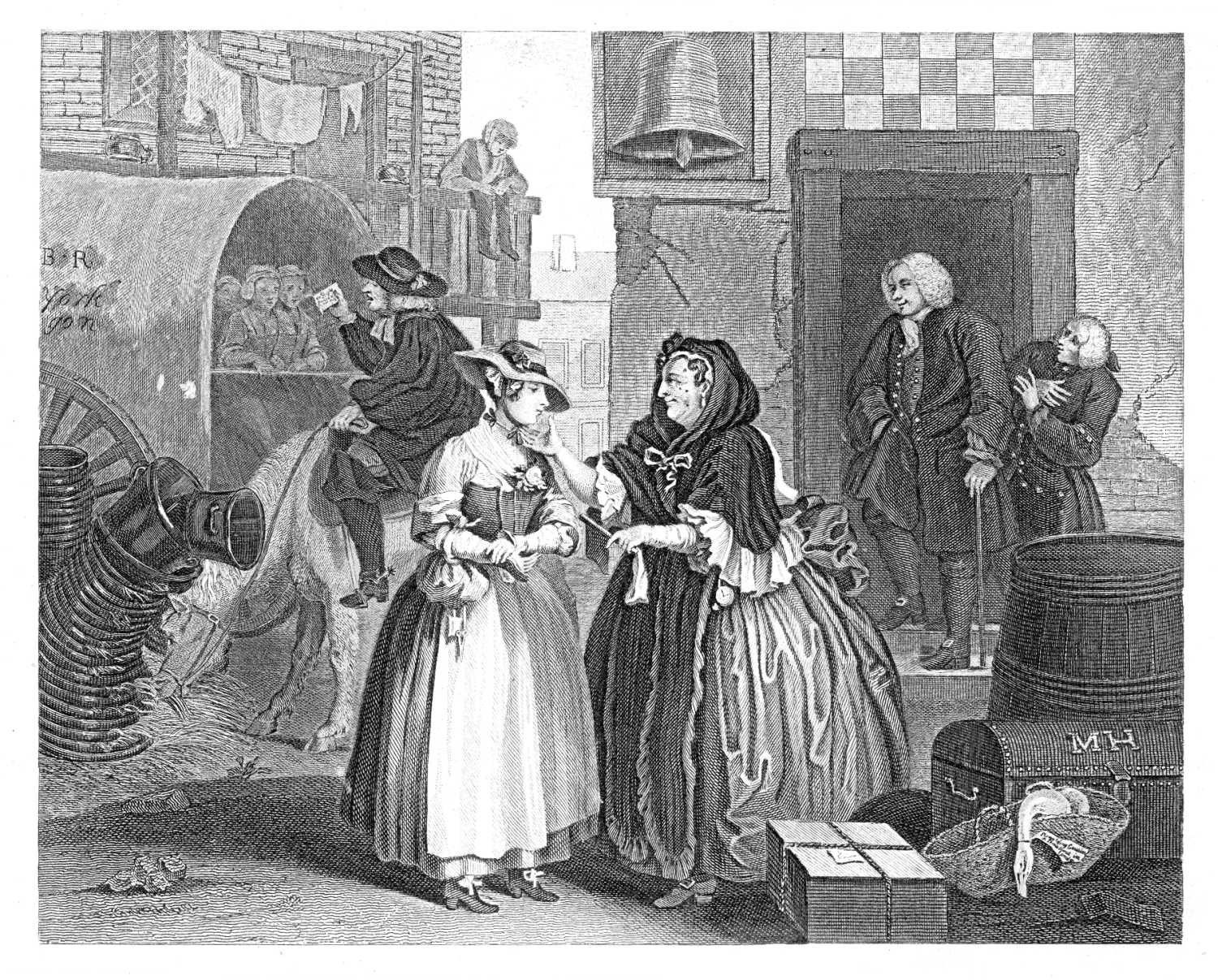 THE HARLOT'S PROGRESS.
Entered into the path of infamy, the next scene exhibits our young heroine the mistress of a rich Jew, attended by a black boy,[1] and surrounded with the pompous parade of tasteless profusion. Her mind being now as depraved, as her person is decorated, she keeps up the spirit of her character by extravagance and inconstancy. An example of the first is exhibited in the monkey being suffered to drag her rich head-dress round the room, and of the second in the retiring gallant. The Hebrew is represented at breakfast with his mistress; but, having come earlier than was expected, the favourite has not departed. To secure his retreat is an exercise for the invention of both mistress and maid. This is accomplished by the lady finding a pretence for quarrelling with the Jew, kicking down the tea-table, and scalding his legs, which, added to the noise of the china, so far engrosses his attention, that the paramour, assisted by the servant, escapes discovery.
The subjects of two pictures, with which the room is decorated, are David dancing before the ark, and Jonah seated under a gourd. They are placed there, not merely as circumstances which belong to Jewish story, but as a piece of covert ridicule on the old masters, who generally painted from the ideas of others, and repeated the same tale ad infinitum. On the toilet-table we discover a mask, which well enough intimates where she had passed part of the preceding night, and that masquerades, then a very fashionable amusement, were much frequented by women of this description; a sufficient reason for their being avoided by those of an opposite character.
Under the protection of this disciple of Moses she could not remain long. Riches were his only attraction, and though profusely lavished on this unworthy object, her[Pg 42] attachment was not to be obtained, nor could her constancy be secured; repeated acts of infidelity are punished by dismission; and her next situation shows, that like most of the sisterhood, she had lived without apprehension of the sunshine of life being darkened by the passing cloud, and made no provision for the hour of adversity.
In this print the characters are marked with a master's hand. The insolent air of the harlot, the astonishment of the Jew, eagerly grasping at the falling table, the start of the black boy, the cautious trip of the ungartered and barefooted retreating gallant, and the sudden spring of the scalded monkey, are admirably expressed. To represent an object in its descent, has been said to be impossible; the attempt has seldom succeeded; but, in this print, the tea equipage really appears falling to the floor; and, in Rembrandt's Abraham's Offering, in the Houghton collection, now at Petersburg, the knife dropping from the hand of the patriarch, appears in a falling state.
Quin compared Garrick in Othello to the black boy with the tea-kettle, a circumstance that by no means encouraged our Roscius to continue acting the part. Indeed, when his face was obscured, his chief power of expression was lost; and then, and not till then, was he reduced to a level with several other performers. It has been remarked, however, that Garrick said of himself, that when he appeared in Othello, Quin, he supposed, would say, "Here's Pompey! where's the tea-kettle?"
 THE HARLOT'S PROGRESS.
We here see this child of misfortune fallen from her high estate! Her magnificent apartment is quitted for a dreary lodging in the purlieus of Drury-lane; she is at breakfast, and every object exhibits marks of the most wretched penury: her silver tea-kettle is changed for a tin pot, and her highly decorated toilet gives place to an old leaf table, strewed with the relics of the last night's revel, and ornamented with a broken looking-glass. Around the room are scattered tobacco-pipes, gin measures, and pewter pots; emblems of the habits of life into which she is initiated, and the company which she now keeps: this is farther intimated by the wig-box of James Dalton, a notorious street-robber, who was afterwards executed. In her hand she displays a watch, which might be either presented to her, or stolen from her last night's gallant. By the nostrums which ornament the broken window, we see that poverty is not her only evil.
The dreary and comfortless appearance of every object in this wretched receptacle, the bit of butter on a piece of paper, the candle in a bottle, the basin upon a chair, the punch-bowl and comb upon the table, and the tobacco-pipes, &c. strewed upon the unswept floor, give an admirable picture of the style in which this pride of Drury-lane ate her matin meal. The pictures which ornament the room are, Abraham offering up Isaac, and a portrait of the Virgin Mary; Dr. Sacheverell and Macheath the highwayman, are companion prints. There is some whimsicality in placing the two ladies under a canopy, formed by the unnailed valance of the bed, and characteristically crowned by the wig-box of a highwayman.
When Theodore, the unfortunate king of Corsica, was so reduced as to lodge in a garret in Dean-street, Soho, a number of gentlemen made a collection for his relief. The chairman of their committee informed him, by letter, that on the following day, at twelve o'clock, two of the society would wait upon his majesty with the money. To give his attic apartment an appearance of royalty, the poor monarch placed an arm-chair[Pg 44] on his half-testered bed, and seating himself under the scanty canopy, gave what he thought might serve as the representation of a throne. When his two visitors entered the room, he graciously held out his right hand, that they might have the honour of—kissing it!
A magistrate, cautiously entering the room, with his attendant constables, commits her to a house of correction, where our legislators wisely suppose, that being confined to the improving conversation of her associates in vice, must have a powerful tendency towards the reformation of her manners. Sir John Gonson, a justice of peace, very active in the suppression of brothels, is the person represented. In a View of the Town in 1735, by T. Gilbert, fellow of Peterhouse, Cambridge, are the following lines:
Pope has noticed him in his Imitation of Dr. Donne, and Loveling, in a very elegant Latin ode. Thus, between the poets and the painter, the name of this harlot-hunting justice, is transmitted to posterity. He died on the 9th of January, 1765.
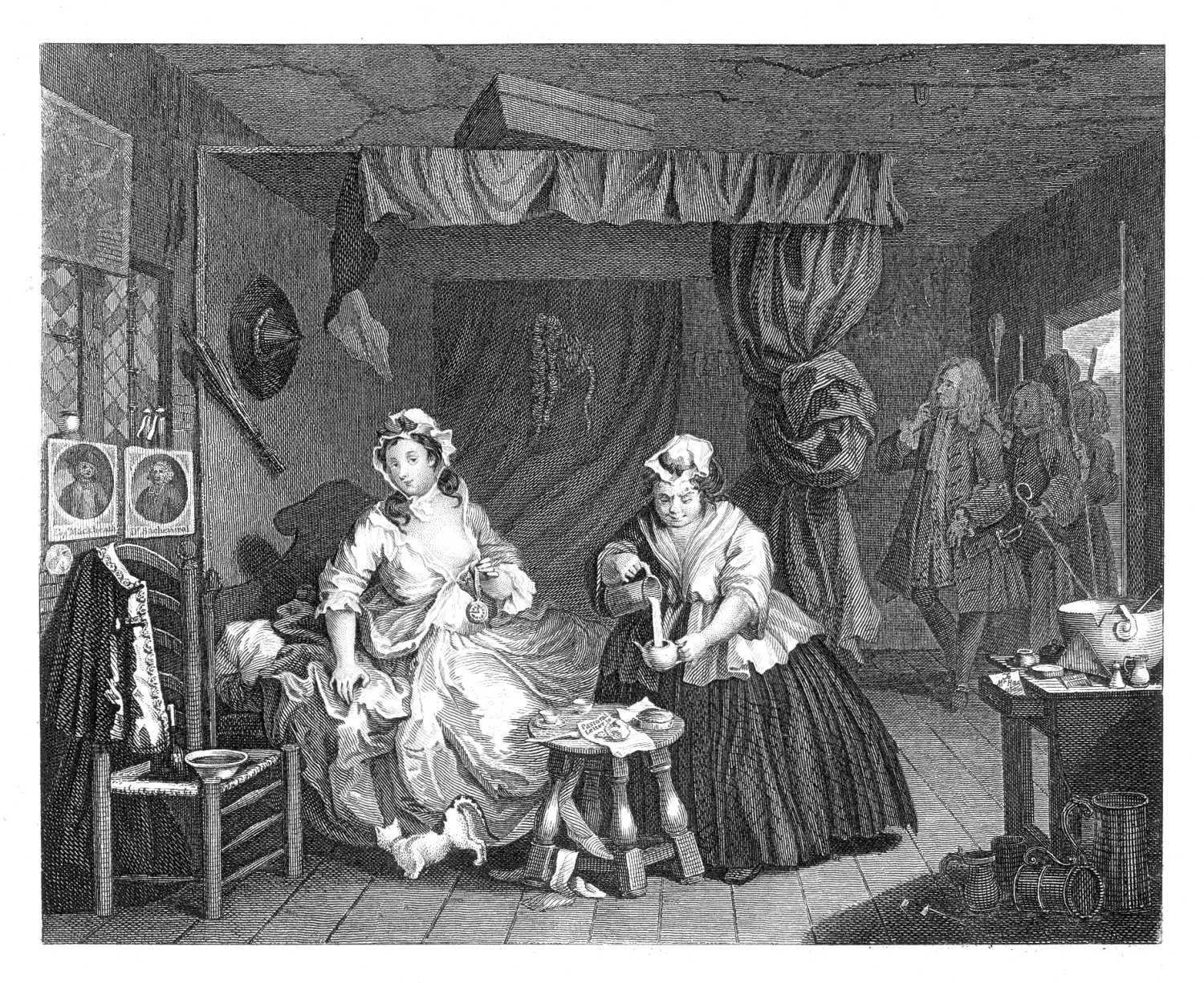 THE HARLOT'S PROGRESS.
The situation, in which the last plate exhibited our wretched female, was sufficiently degrading, but in this, her misery is greatly aggravated. We now see her suffering the chastisement due to her follies; reduced to the wretched alternative of beating hemp, or receiving the correction of a savage task-master. Exposed to the derision of all around, even her own servant, who is well acquainted with the rules of the place, appears little disposed to show any return of gratitude for recent obligations, though even her shoes, which she displays while tying up her garter, seem by their gaudy outside to have been a present from her mistress. The civil discipline of the stern keeper has all the severity of the old school. With the true spirit of tyranny, he sentences those who will not labour to the whipping-post, to a kind of picketing suspension by the wrists, or having a heavy log fastened to their leg. With the last of these punishments he at this moment threatens the heroine of our story, nor is it likely that his obduracy can be softened except by a well applied fee. How dreadful, how mortifying the situation! These accumulated evils might perhaps produce a momentary remorse, but a return to the path of virtue is not so easy as a departure from it.
To show that neither the dread, nor endurance, of the severest punishment, will deter from the perpetration of crimes, a one-eyed female, close to the keeper, is picking a pocket. The torn card may probably be dropped by the well-dressed gamester, who has exchanged the dice-box for the mallet, and whose laced hat is hung up as a companion trophy to the hoop-petticoat.
One of the girls appears scarcely in her teens. To the disgrace of our police, these unfortunate little wanderers are still suffered to take their nocturnal rambles in the most public streets of the metropolis. What heart, so void of sensibility, as not to heave a pitying sigh at their deplorable situation? Vice is not confined to colour, for a black woman is ludicrously exhibited, as suffering the penalty of those frailties, which are imagined peculiar to the fair.[Pg 46]
The figure chalked as dangling upon the wall, with a pipe in his mouth, is intended as a caricatured portrait of Sir John Gonson, and probably the production of some would-be artist, whom the magistrate had committed to Bridewell, as a proper academy for the pursuit of his studies. The inscription upon the pillory, "Better to work than stand thus;" and that on the whipping-post near the laced gambler, "The reward of idleness," are judiciously introduced.
In this print the composition is good: the figures in the back-ground, though properly subordinate, are sufficiently marked; the lassitude of the principal character, well contrasted by the austerity of the rigid overseer. There is a fine climax of female debasement, from the gaudy heroine of our drama, to her maid, and from thence to the still object, who is represented as destroying one of the plagues of Egypt.
Such well dressed females, as our heroine, are rarely met with in our present houses of correction; but her splendid appearance is sufficiently warranted by the following paragraph in the Grub-street Journal of September 14th, 1730.
"One Mary Moffat, a woman of great note in the hundreds of Drury, who, about a fortnight ago, was committed to hard labour in Tothill-fields Bridewell, by nine justices, brought his majesty's writ of habeas corpus, and was carried before the right honourable the Lord Chief Justice Raymond, expecting to have been either bailed or discharged; but her commitment appearing to be legal, his lordship thought fit to remand her back again to her former place of confinement, where she is now beating hemp in a gown very richly laced with silver."
 THE HARLOT'S PROGRESS.
Released from Bridewell, we now see this victim to her own indiscretion breathe her last sad sigh, and expire in all the extremity of penury and wretchedness. The two quacks, whose injudicious treatment, has probably accelerated her death, are vociferously supporting the infallibility of their respective medicines, and each charging the other with having poisoned her. The meagre figure is a portrait of Dr. Misaubin, a foreigner, at that time in considerable practice.
These disputes, it has been affirmed, sometimes happen at a consultation of regular physicians, and a patient has been so unpolite as to die before they could determine on the name of his disorder.
While the maid servant is entreating them to cease quarrelling, and assist her dying mistress, the nurse plunders her trunk of the few poor remains of former grandeur. Her little boy, turning a scanty remnant of meat hung to roast by a string; the linen hanging to dry; the coals deposited in a corner; the candles, bellows, and gridiron hung upon nails; the furniture of the room; and indeed every accompaniment; exhibit a dreary display of poverty and wretchedness. Over the candles hangs a cake of Jew's Bread, once perhaps the property of her Levitical lover, and now used as a fly-trap. The initials of her name, M. H. are smoked upon the ceiling as a kind of memento mori to the next inhabitant. On the floor lies a paper inscribed "anodyne necklace," at that time deemed a sort of charm against the disorders incident to children; and near the fire, a tobacco-pipe, and paper of pills.
A picture of general, and at this awful moment, indecent confusion, is admirably represented. The noise of two enraged quacks disputing in bad English; the harsh, vulgar scream of the maid servant; the table falling, and the pot boiling over, must pro[Pg 48]duce a combination of sounds dreadful and dissonant to the ear. In this pitiable situation, without a friend to close her dying eyes, or soften her sufferings by a tributary tear; forlorn, destitute, and deserted, the heroine of this eventful history expires! her premature death, brought on by a licentious life, seven years of which had been devoted to debauchery and dissipation, and attended by consequent infamy, misery, and disease. The whole story affords a valuable lesson to the young and inexperienced, and proves this great, this important truth, that A DEVIATION FROM VIRTUE IS A DEPARTURE FROM HAPPINESS.
The emaciated appearance of the dying figure, the boy's thoughtless inattention, and the rapacious, unfeeling eagerness of the old nurse, are naturally and forcibly delineated.
The figures are well grouped; the curtain gives depth, and forms a good back-ground to the doctor's head; the light is judiciously distributed, and each accompaniment highly appropriate.
 THE HARLOT'S PROGRESS.
The adventures of our heroine are now concluded. She is no longer an actor in her own tragedy; and there are those who have considered this print as a farce at the end of it: but surely such was not the author's intention.
The ingenious writer of Tristram Shandy begins the life of his hero before he is born; the picturesque biographer of Mary Hackabout has found an opportunity to convey admonition, and enforce his moral, after her death. A wish usually prevails, even among those who are most humbled by their own indiscretion, that some respect should be paid to their remains; that their eyes should be closed by the tender hand of a surviving friend, and the tear of sympathy and regret shed upon the sod which covers their grave; that those who loved them living, should attend their last sad obsequies; and a sacred character read over them the awful service which our religion ordains, with the solemnity it demands. The memory of this votary of prostitution meets with no such marks of social attention, or pious respect. The preparations for her funeral are as licentious as the progress of her life, and the contagion of her example seems to reach all who surround her coffin. One of them is engaged in the double trade of seduction and thievery; a second is contemplating her own face in a mirror. The female who is gazing at the corpse, displays some marks of concern, and feels a momentary compunction at viewing the melancholy scene before her: but if any other part of the company are in a degree affected, it is a mere maudlin sorrow, kept up by glasses of strong liquor. The depraved priest does not seem likely to feel for the dead that hope expressed in our liturgy. The appearance and employment of almost every one present at this mockery of woe, is such as must raise disgust in the breast of any female who has the least tincture of delicacy, and excite a wish that such an exhibition may not be displayed at her own funeral.
In this plate there are some local customs which mark the manners of the times when it was engraved, but are now generally disused, except in some of the provinces very distant from the capital; sprigs of rosemary were then given to each of the mourners: to appear at a funeral without one, was as great an indecorum as to be without a white[Pg 50] handkerchief. This custom might probably originate at a time when the plague depopulated the metropolis, and rosemary was deemed an antidote against contagion. It must be acknowledged that there are also in this print some things which, though they gave the artist an opportunity of displaying his humour, are violations of propriety and customs: such is her child, but a few removes from infancy, being habited as chief mourner, to attend his parent to the grave; rings presented, and an escutcheon hung up, in a garret, at the funeral of a needy prostitute. The whole may be intended as a burlesque upon ostentatious and expensive funerals, which were then more customary than they are now. Mr. Pope has well ridiculed the same folly;
The figures have much characteristic discrimination; the woman looking into the coffin has more beauty than we generally see in the works of this artist. The undertaker's gloating stare, his companion's leer, the internal satisfaction of the parson and his next neighbour, are contrasted by the Irish howl of the woman at the opposite side, and evince Mr. Hogarth's thorough knowledge of the operation of the passions upon the features. The composition forms a good shape, has a proper depth, and the light is well managed.
Sir James Thornhill's opinion of this series may be inferred from the following circumstance. Mr. Hogarth had without consent married his daughter: Sir James, considering him as an obscure artist, was much displeased with the connexion. To give him a better opinion of his son-in-law, a common friend, one morning, privately conveyed the six pictures of the Harlot's Progress into his drawing-room. The veteran painter eagerly inquired who was the artist; and being told, cried out, "Very well! Very well indeed! The man who can paint such pictures as these, can maintain a wife without a portion." This was the remark of the moment; but he afterwards considered the union of his daughter with a man of such abilities an honour to his family, was reconciled, and generous.
When the publication was advertised, such was the expectation of the town, that above twelve hundred names were entered in the subscription book. When the prints appeared, they were beheld with astonishment. A subject so novel in the idea, so marked with genius in the execution, excited the most eager attention of the public. At a time when England was coldly inattentive to every thing which related to the arts, so desirous were all ranks of people of seeing how this little domestic story was delineated, that there were eight piratical imitations, besides two copies in a smaller size than the original, published, by permission of the author, for Thomas Bakewell. The whole series were copied on fan-mounts, representing the six plates, three on one side, and three on the other. It was transferred from the copper to the stage, in the form of a pantomime, by Theophilus Cibber; and again represented in a ballad opera, entitled, the Jew Decoyed; or, the Harlot's Progress.
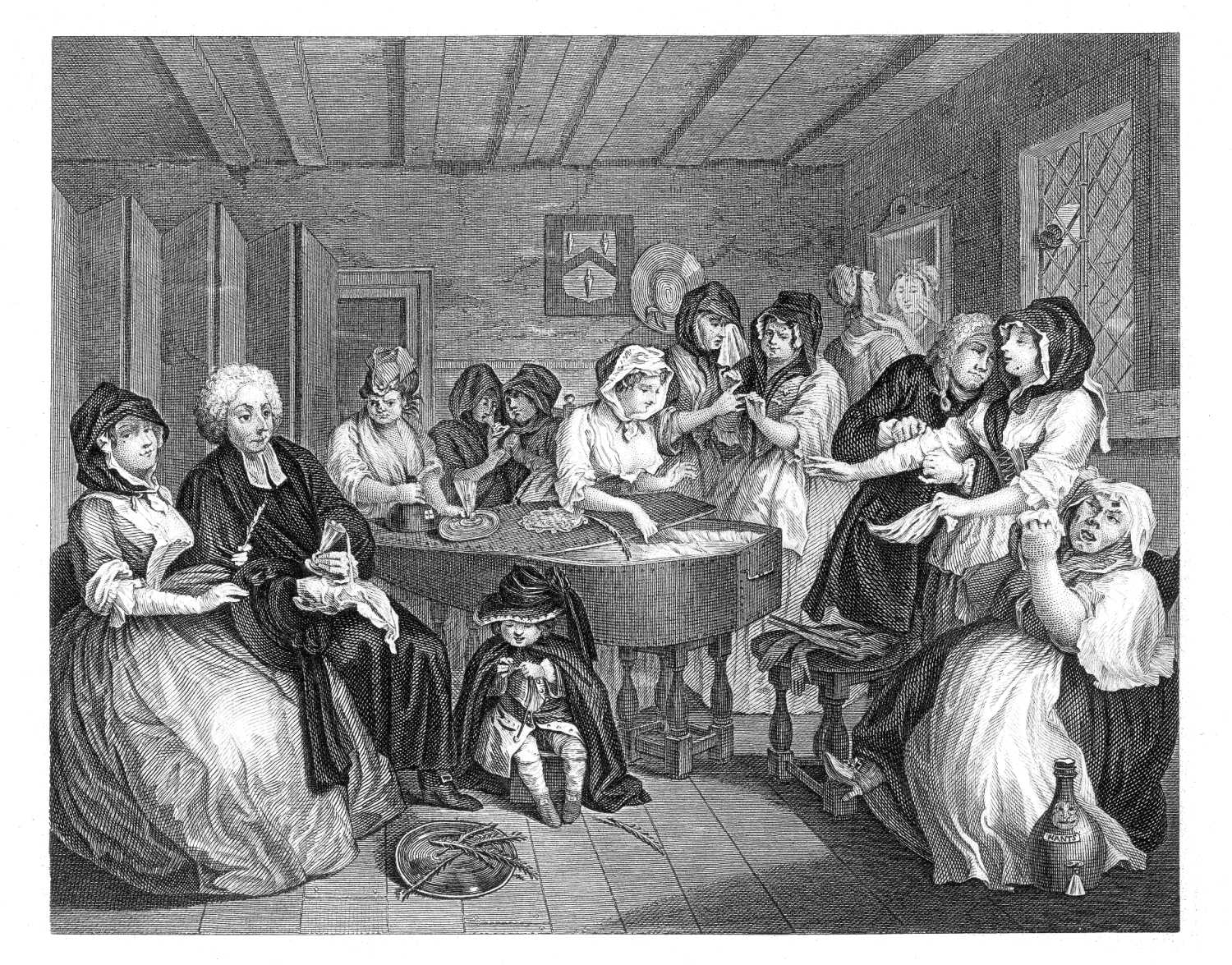 THE HARLOT'S PROGRESS.
I was once told by a fellow of a college, says Mr. Ireland, that he disliked Hogarth, because he had in this print ridiculed one of the Universities. I endeavoured to defend the artist, by suggesting that this was not intended as a picture of what Oxford is now, but of what it was in days long past: that it was that kind of general satire with which no one should be offended, &c. &c. His reply was too memorable to be forgotten. "Sir, the Theatre, the Bench, the College of Physicians, and the Foot Guards, are fair objects of satire; but those venerable characters who have devoted their whole lives to feeding the lamp of learning with hallowed oil, are too sacred to be the sport of an uneducated painter. Their unremitting industry embraced the whole circle of the sciences, and in their logical disputations they displayed an acuteness that their followers must contemplate with astonishment. The present state of Oxford it is not necessary for me to analyze, as you contend that the satire is not directed against that."
In answer to this observation, which was uttered with becoming gravity, a gentleman present remarked, as follows. "For some of the ancient customs of this seminary of learning, I have much respect, but as to their dry treatises on logic, immaterial dissertations on materiality, and abstruse investigations of useless subjects, they are mere literary legerdemain. Their disputations being usually built on an undefinable chimera, are solved by a paradox. Instead of exercising their power of reason they exert their powers of sophistry, and divide and subdivide every subject with such casuistical minuteness, that those who are not convinced, are almost invariably confounded. This custom, it must be granted, is not quite so prevalent as it once was: a general spirit of reform is rapidly diffusing itself; and though I have heard cold-blooded declaimers assert, that these shades of science are become the retreats of ignorance, and the haunts of dissipation, I consider them as the great schools of urbanity, and favourite seats of the belles lettres. By the belles lettres, I mean history, biography, and poetry; that all these are universally cultivated, I can exemplify by the manner in which a highly accomplished young man, who is considered as a model by his fellow-collegians, divides his hours.
"At breakfast I found him studying the marvellous and eventful history of Baron Munchausen; a work whose periods are equally free from the long-winded obscurity of Tacitus, and the asthmatic terseness of Sallust. While his hair was dressing, he[Pg 52] enlarged his imagination and improved his morals by studying Doctor what's his name's abridgement of Chesterfield's Principles of Politeness. To furnish himself with biographical information, and add to his stock of useful anecdote, he studied the Lives of the Highwaymen; in which he found many opportunities of exercising his genius and judgment in drawing parallels between the virtues and exploits of these modern worthies, and those dignified, and almost deified ancient heroes whose deeds are recorded in Plutarch and Nepos.
"With poetical studies, he is furnished by the English operas, which, added to the prologues, epilogues, and odes of the day, afford him higher entertainment than he could find in Homer or Virgil: he has not stored his memory with many epigrams, but of puns has a plentiful stock, and in conundra is a wholesale dealer. At the same college I know a most striking contrast, whose reading"—But as his opponent would hear no more, my advocate dropped the subject; and I will follow his example.
It seems probable, that when the artist engraved this print, he had only a general reference to an university lecture; the words datur vacuum were an after-thought. Some prints are without the inscription, and in some of the early impressions it is written with a pen.
The scene is laid at Oxford, and the person reading, universally admitted to be a Mr. Fisher, of Jesus College, registrat of the university, with whose consent this portrait was taken, and who lived until the 18th of March, 1761. That he should wish to have such a face handed down to posterity, in such company, is rather extraordinary, for all the band, except one man, have been steeped in the stream of stupidity. This gentleman has the profile of penetration; a projecting forehead, a Roman nose, thin lips, and a long pointed chin. His eye is bent on vacancy: it is evidently directed to the moon-faced idiot that crowns the pyramid, at whose round head, contrasted by a cornered cap, he with difficulty suppresses a laugh. Three fellows on the right hand of this fat, contented "first-born transmitter of a foolish face," have most degraded characters, and are much fitter for the stable than the college. If they ever read, it must be in Bracken's Farriery, or the Country Gentleman's Recreation. Two square-capped students a little beneath the top, one of whom is holding converse with an adjoining profile, and the other lifting up his eyebrows, and staring without sight, have the same misfortune that attended our first James—their tongues are rather too large. A figure in the left-hand corner has shut his eyes to think; and having, in his attempt to separate a syllogism, placed the forefinger of his right hand upon his forehead, has fallen asleep. The professor, a little above the book, endeavours by a projection of his under lip to assume importance; such characters are not uncommon: they are more solicitous to look wise, than to be so. Of Mr. Fisher it is not necessary to say much: he sat for his portrait, for the express purpose of having it inserted in the Lecture!—We want no other testimony of his talents.
 THE LECTURE.
The Oratorio of Judith, Mr. Ireland observes, was written by Esquire William Huggins, honoured by the music of William de Fesch, aided by new painted scenery and magnifique decoration, and in the year 1733 brought upon the stage. As De Fesch[2] was a German and a genius, we may fairly presume it was well set; and there was at that time, as at this, a sort of musical mania, that paid much greater attention to sounds than to sense; notwithstanding all these points in her favour, when the Jewish heroine had made her theatrical début, and so effectually smote Holofernes,
the audience compelled her to make her exit. To set aside this partial and unjust decree, Mr. Huggins appealed to the public, and printed his oratorio. Though it was adorned with a frontispiece designed by Hogarth, and engraved by Vandergucht, the world could not be compelled to read, and the unhappy writer had no other resource than the consolatory reflection, that his work was superlatively excellent, but unluckily[Pg 54] printed in a tasteless age; a comfortable and solacing self-consciousness, which hath, I verily believe, prevented many a great genius from becoming his own executioner.
To paint a sound is impossible; but as far as art can go towards it, Hogarth has gone in this print. The tenor, treble, and bass of these ear-piercing choristers are so decisively discriminated, that we all but hear them.
The principal figure, whose head, hands, and feet are in equal agitation, has very properly tied on his spectacles; it would have been prudent to have tied on his periwig also, for by the energy of his action he has shaken it from his head, and, absorbed in an eager attention to true time, is totally unconscious of his loss.
A gentleman—pardon me, I meant a singer—in a bag wig, immediately beneath his uplifted hand, I suspect to be of foreign growth. It has the engaging air of an importation from Italy.
The little figure in the sinister corner, is, it seems, intended for a Mr. Tothall, a woollen-draper, who lived in Tavistock-court, and was Hogarth's intimate friend.
The name of the performer on his right hand,
I cannot learn, nor do I think that this group were meant for particular portraits, but a general representation of the violent distortions into which these crotchet-mongers draw their features on such solemn occasions.
Even the head of the bass-viol has air and character: by the band under the chin, it gives some idea of a professor, or what is, I think, called a Mus. D.
The words now singing, "The world shall bow to the Assyrian throne," are extracted from Mr. Huggins' oratorio; the etching is in a most masterly style, and was originally given as a subscription ticket to the Modern Midnight Conversation.
I have seen a small political print on Sir Robert Walpole's administration, entitled, "Excise, a new Ballad Opera," of which this was unquestionably the basis. Beneath it is the following learned and poetical motto:
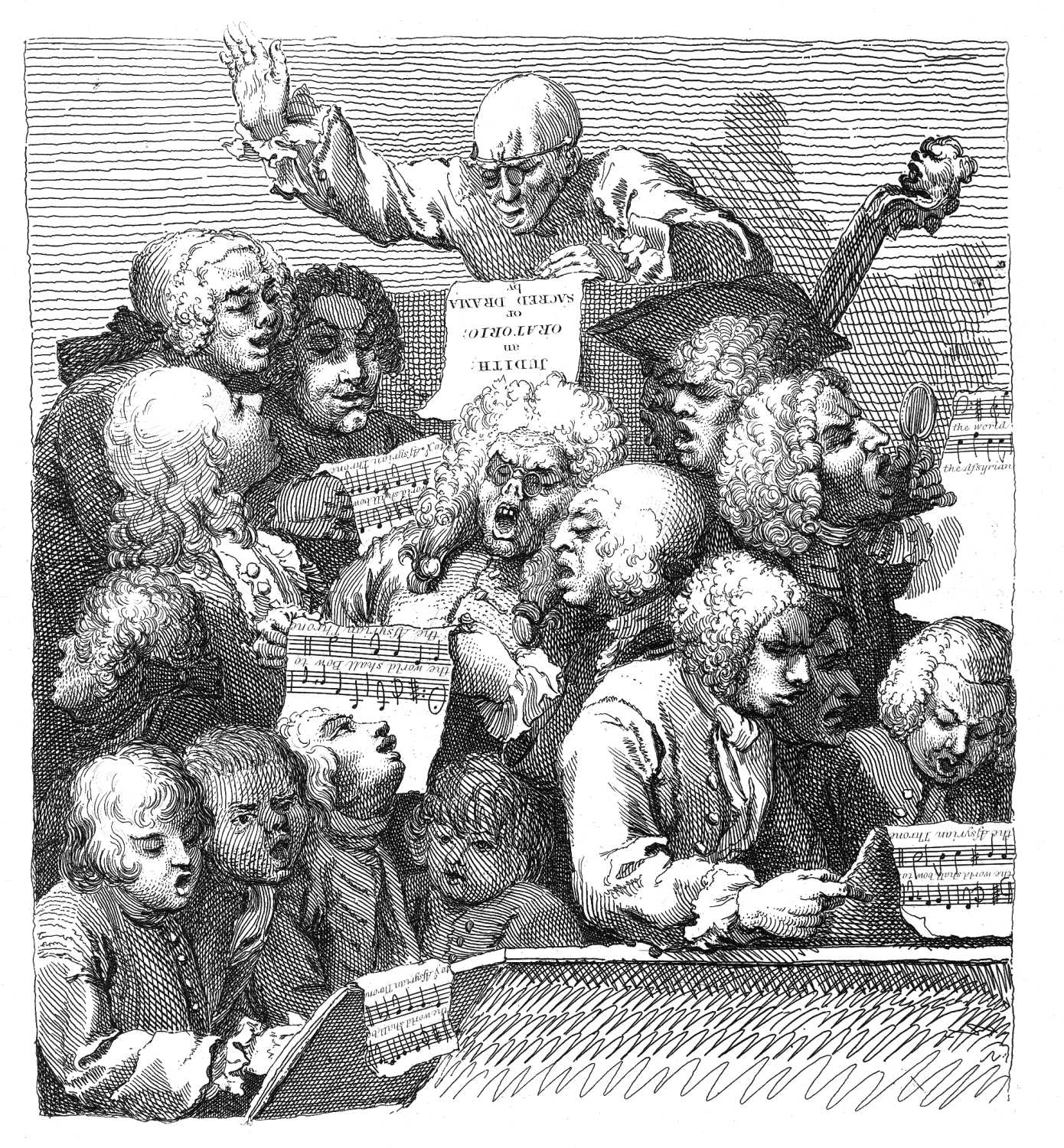 THE CHORUS.
By the success of Columbus's first voyage, doubt had been changed into admiration; from the honours with which he was rewarded, admiration degenerated into envy. To deny that his discovery carried in its train consequences infinitely more important than had resulted from any made since the creation, was impossible. His enemies had recourse to another expedient, and boldly asserted that there was neither wisdom in the plan, nor hazard in the enterprise.
When he was once at a Spanish supper, the company took this ground, and being by his narrative furnished with the reflections which had induced him to undertake his voyage, and the course that he had pursued in its completion, sagaciously observed, that "it was impossible for any man, a degree above an idiot, to have failed of success. The whole process was so obvious, it must have been seen by a man who was half blind! Nothing could be so easy!"
"It is not difficult now I have pointed out the way," was the answer of Columbus: "but easy as it will appear, when you are possessed of my method, I do not believe that, without such instruction, any person present could place one of these eggs upright on the table." The cloth, knives, and forks were thrown aside, and two of the party, placing their eggs as required, kept them steady with their fingers. One of them swore there could be no other way. "We will try," said the navigator; and giving an egg, which he held in his hand, a smart stroke upon the table, it remained upright. The emotions which this excited in the company are expressed in their countenances. In the be-ruffed booby at his left hand it raises astonishment; he is a DEAR ME! man, of the same family with Sterne's Simple Traveller, and came from Amiens only yesterday. The fellow behind him, beating his head, curses his own stupidity; and the whiskered ruffian, with his fore-finger on the egg, is in his heart cursing Columbus. As to the two veterans on the other side, they have lived too long to be agitated with trifles: he who wears a cap, exclaims, "Is this all!" and the other, with a bald head, "By St. Jago, I did not think of that!" In the face of Columbus there is not that violent and excessive triumph which is exhibited by little characters on little occasions; he is too elevated to be overbearing; and, pointing to the conical solution of his problematical conundrum, displays a calm superiority, and silent internal contempt.[Pg 56]
Two eels, twisted round the eggs upon the dish, are introduced as specimens of the line of beauty; which is again displayed on the table-cloth, and hinted at on the knife-blade. In all these curves there is peculiar propriety; for the etching was given as a receipt-ticket to the Analysis, where this favourite undulating line forms the basis of his system.
In the print of Columbus, there is evident reference to the criticisms on what Hogarth called his own discovery; and in truth the connoisseurs' remarks on the painter were dictated by a similar spirit to those of the critics on the navigator: they first asserted there was no such line, and when he had proved that there was, gave the honour of discovery to Lomazzo, Michael Angelo, &c. &c.
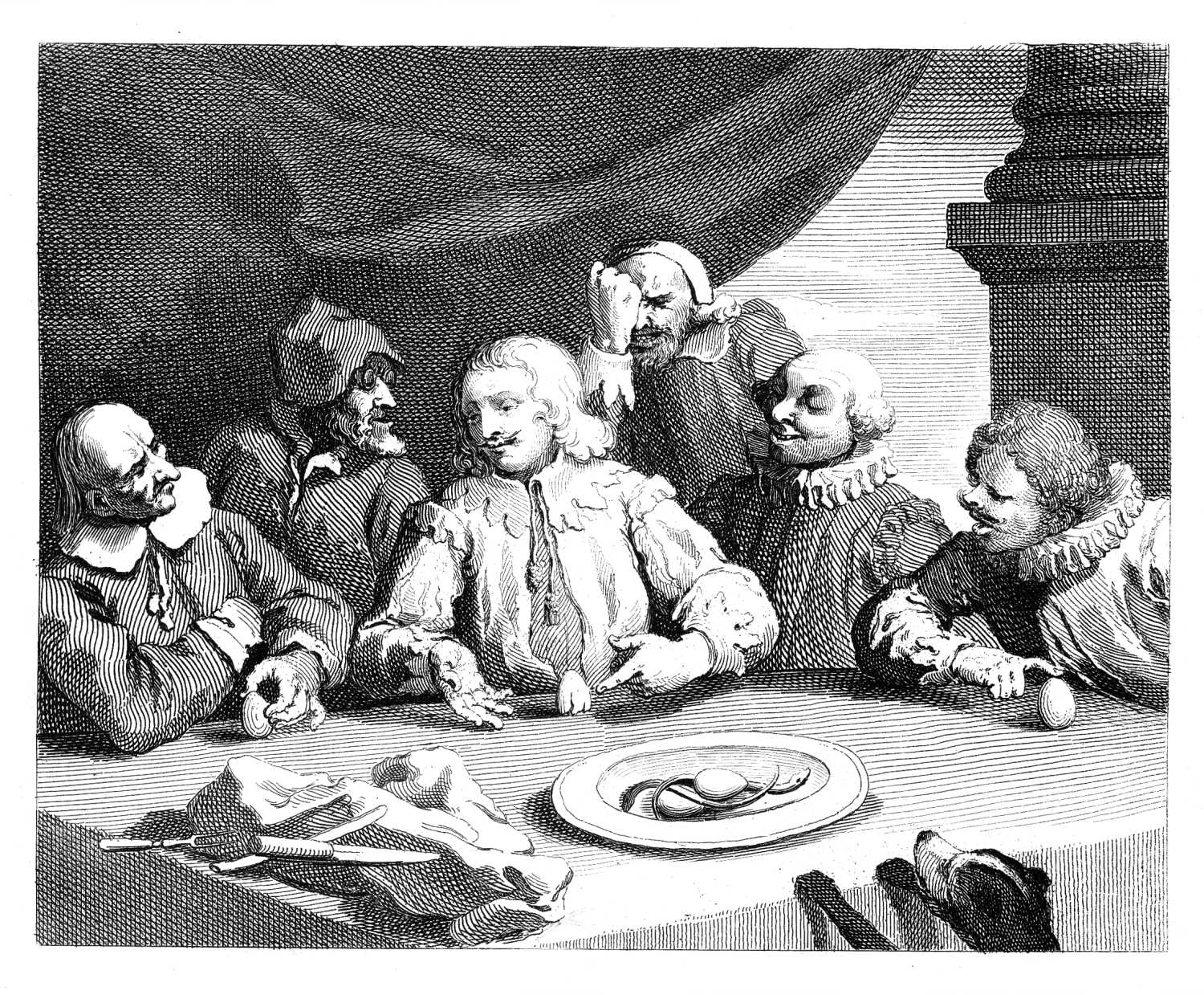 COLUMBUS BREAKING THE EGG.
Notwithstanding this inscription, which was engraved on the plate some time after its publication, it is very certain that most of these figures were intended for individual portraits; but Mr. Hogarth, not wishing to be considered as a personal satirist, and fearful of making enemies among his contemporaries, would never acknowledge who were the characters. Some of them the world might perhaps mistake; for though the author was faithful in delineating whatever he intended to portray, complete intoxication so far caricatures the countenance, that, according to the old, though trite proverb, "the man is not himself." His portrait, though given with the utmost fidelity, will scarcely be known by his most intimate friends, unless they have previously seen him in this degrading disguise. Hence, it becomes difficult to identify men whom the painter did not choose to point out at the time; and a century having elapsed, it becomes impossible, for all who composed the group, with the artist by whom it was delineated,
Mrs. Piozzi was of opinion that the divine with a cork-screw, occasionally used as a tobacco-stopper, hanging upon his little finger, was the portrait of parson Ford, Dr. Johnson's uncle; though, upon the authority of Sir John Hawkins, of anecdotish memory, it has been generally supposed to be intended for Orator Henley. As both these worthies were distinguished by that rubicundity of face with which it is marked, the reader may decree the honour of a sitting to which he pleases.
The roaring bacchanalian who stands next him, waving his glass in the air, has pulled off his wig, and, in the zeal of his friendship, crowns the divine's head. He is evidently drinking destruction to fanatics, and success to mother church, or a mitre to the jolly parson whom he addresses.
The lawyer, who sits near him, is a portrait of one Kettleby, a vociferous bar-orator, who, though an utter barrister, chose to distinguish himself by wearing an enormous full-bottom wig, in which he is here represented. He was farther remarkable for a diabolical squint, and a satanic smile.
A poor maudlin miserable, who is addressing him, when sober, must be a fool; but, in this state, it would puzzle Lavater to assign him a proper class. He seems endeavouring to demonstrate to the lawyer, that, in a poi—poi—point of law, he has been[Pg 58] most cruelly cheated, and lost a cau—cau—cause, that he ought to have got,—and all this was owing to his attorney being an infernal villain. This may very probably be true; for the poor man's tears show that, like the person relieved by the good Samaritan, he has been among thieves. The barrister grins horribly at his misfortunes, and tells him he is properly punished for not employing a gentleman.
Next to him sits a gentleman in a black periwig. He politely turns his back to the company, that he may have the pleasure of smoking a sociable pipe.
The justice, "in fair round belly, with good capon lin'd,"—the justice, having hung up his hat, wig, and cloak, puts on his nightcap, and, with a goblet of superior capacity before him, sits in solemn cogitation. His left elbow, supported by the table, and his right by a chair, with a pipe in one hand, and a stopper in the other, he puffs out the bland vapour with the dignity of an alderman, and fancies himself as great as Jupiter, seated upon the summit of Mount Olympus, enveloped by the thick cloud which his own breath has created.
With folded arms and open mouth, another leans back in his chair. His wig is dropped from his head, and he is asleep; but though speechless, he is sonorous; for you clearly perceive that, where nasal sounds are the music, he is qualified to be leader of the band.
The fallen hero, who with his chair and goblet has tumbled to the floor, by the cockade in his hat, we suppose to be an officer. His forehead is marked, perhaps with honourable scars. To wash his wounds, and cool his head, the staggering apothecary bathes it with brandy.
A gentleman in the corner, who, from having the Craftsman and London Evening in his pocket, we determine to be a politician, very unluckily mistakes his ruffle for the bowl of his pipe, and sets fire to it.
The person in a bag-wig and solitaire, with his hand upon his head, would not now pass for a fine gentleman, but in the year 1735 was a complete beau. Unaccustomed to such joyous company, he appears to have drank rather more than agrees with him.
The company consists of eleven, and on the chimney-piece, floor, and table, are three and twenty empty flasks. These, added to a bottle which the apothecary holds in his hand, prove that this select society have not lost a moment. The overflowing bowl, full goblets, and charged glasses, prove that they think, "'Tis too early to part," though the dial points to four in the morning.
The different degrees of drunkenness are well discriminated, and its effects admirably described. The poor simpleton, who is weeping out his woes to honest lawyer Kettleby, it makes mawkish; the beau it makes sick; and the politician it stupifies. One is excited to roaring, and another lulled to sleep. It half closes the eyes of justice, renders the footing of physic unsure, and lays prostrate the glory of his country, and the pride of war.
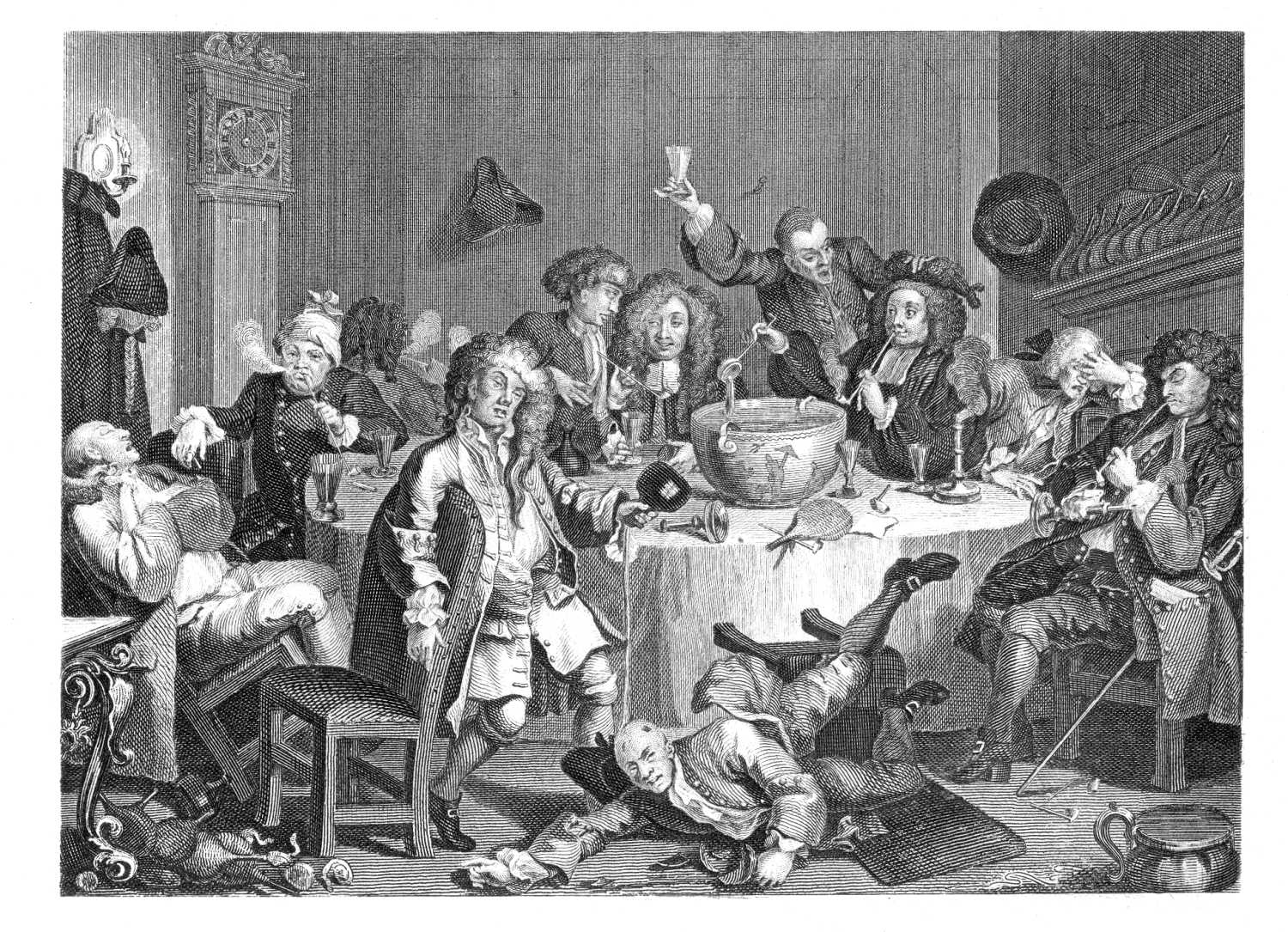 A MIDNIGHT MODERN CONVERSATION.
This plate is designed, with much humour, according to the rules of heraldry, and is called The Undertakers' Arms, to show us the connexion between death and the quack doctor, as are also those cross-bones on the outside of the escutcheon. When an undertaker is in want of business, he cannot better apply than to some of those gentlemen of the faculty, who are, for the most part, so charitably disposed, as to supply the necessities of these sable death-hunters, and keep them from starving in a healthy time. By the tenour of this piece, Mr. Hogarth would intimate the general ignorance of such of the medical tribe, and teach us that they possess little more knowledge than their voluminous wigs and golden-headed canes. They are represented in deep consultation upon the contents of an urinal. Our artist's own illustration of this coat of arms, as he calls it, is as follows: "The company of undertakers beareth, sable, an urinal, proper between twelve quack heads of the second, and twelve cane heads, or, consultant. On a chief, Nebulæ, ermine, one complete doctor, issuant, checkie, sustaining in his right hand a baton of the second. On the dexter and sinister sides, two demi-doctors, issuant of the second, and two cane heads, issuant of the third; the first having one eye, couchant, towards the dexter side of the escutcheon; the second faced, per pale, proper, and gules guardant. With this motto, Et plurima mortis imago. The general image of death."
It has been said of the ancients, that they began by attempting to make physic a science, and failed; of the moderns, that they began by attempting to make it a trade, and succeeded. This company are moderns to a man, and, if we may judge of their capacities by their countenances, are indeed a most sapient society. Their practice is very extensive, and they go about, taking guineas,
Many of them are unquestionably portraits, but as these grave and sage descendants of Galen are long since gone to that place where they before sent their patients, we are unable to ascertain any of them, except the three who are, for distinction, placed in the chief, or most honourable part of the escutcheon. Those who, from their exalted situation, we may naturally conclude the most distinguished and sagacious leeches of their[Pg 60] day, have marks too obtrusive to be mistaken. He towards the dexter side of the escutcheon, is determined by an eye in the head of his cane to be the all-accomplished Chevalier Taylor, in whose marvellous and surprising history, written by his own hand, and published in 1761, is recorded such events relative to himself and others, as have excited more astonishment than that incomparable romance, Don Belianis of Greece, the Arabian Nights, or Sir John Mandeville's Travels.
The centre figure, arrayed in a harlequin jacket, with a bone, or what the painter denominates a baton, in the right hand, is generally considered designed for Mrs. Mapp, a masculine woman, daughter to one Wallin, a bone-setter at Hindon, in Wiltshire. This female Thalestris, incompatible as it may seem with her sex, adopted her father's profession, travelled about the country, calling herself Crazy Sally; and, like another Hercules, did wonders by strength of arm.
On the sinister side is Dr. Ward, generally called Spot Ward, from his left cheek being marked with a claret colour. This gentleman was of a respectable family, and though not highly educated, had talents very superior to either of his coadjutors.
For the chief, this must suffice; as for the twelve quack heads, and twelve cane heads, or, consultant, united with the cross bones at the corners, they have a most mortuary appearance, and do indeed convey a general image of death.
In the time of Lucian, a philosopher was distinguished by three things,—his avarice, his impudence, and his beard. In the time of Hogarth, medicine was a mystery, and there were three things which distinguished the physician,—his gravity, his cane-head, and his periwig. With these leading requisites, this venerable party are most amply gifted. To specify every character is not necessary; but the upper figure on the dexter side, with a wig like a weeping willow, should not be overlooked. His lemon-like aspect must curdle the blood of all his patients. In the countenances of his brethren there is no want of acids; but, however sour, each individual was in his day,
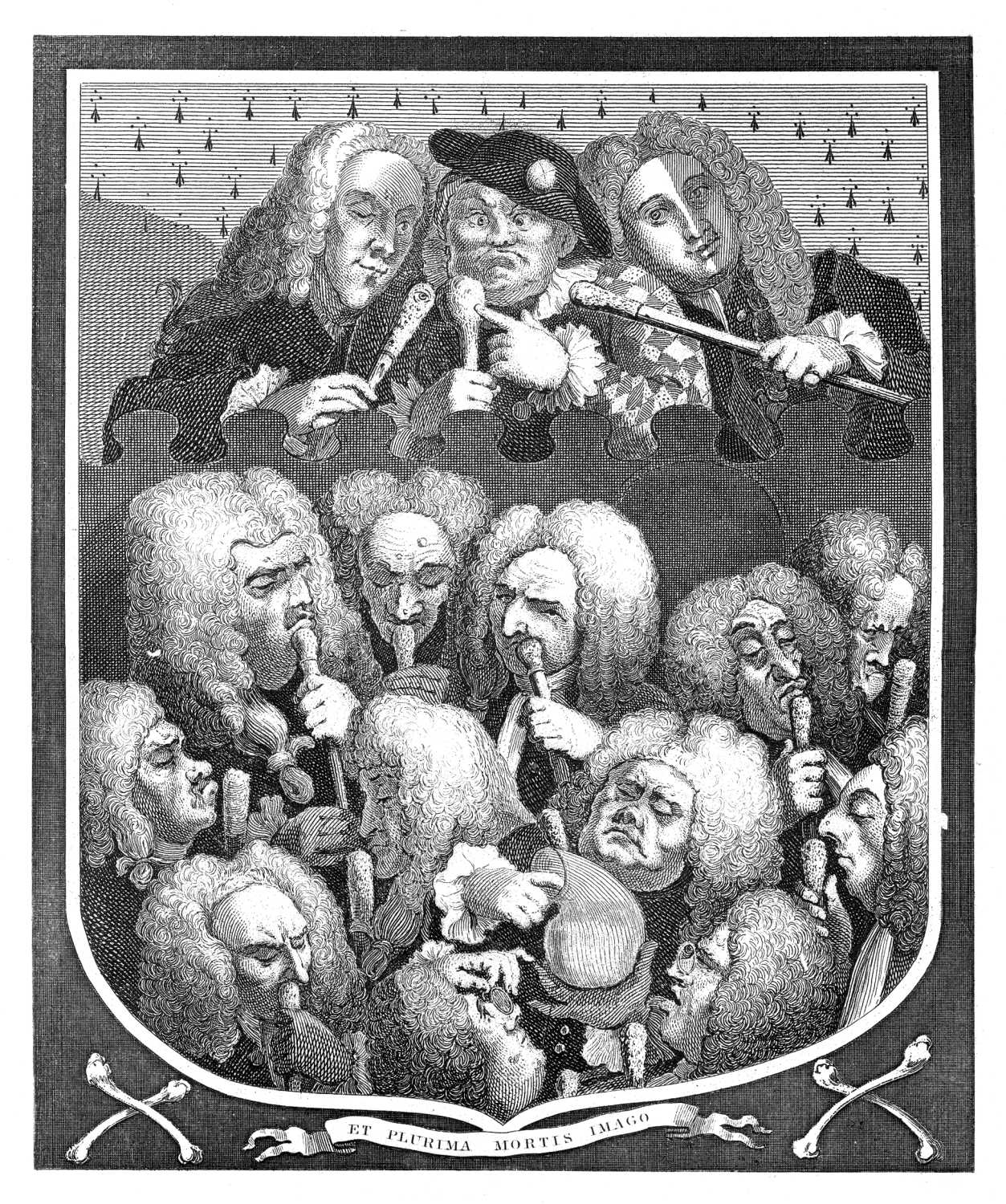 CONSULTATION OF PHYSICIANS.
Daniel Lock was an architect of some eminence. He retired from business with an ample fortune, lived in Surrey-street, and was buried in the chapel of Trinity College, Cambridge. This portrait was originally engraved by J. M'Ardell from a painting by Hogarth, and is classed among the productions of our artist that are of uncertain date.
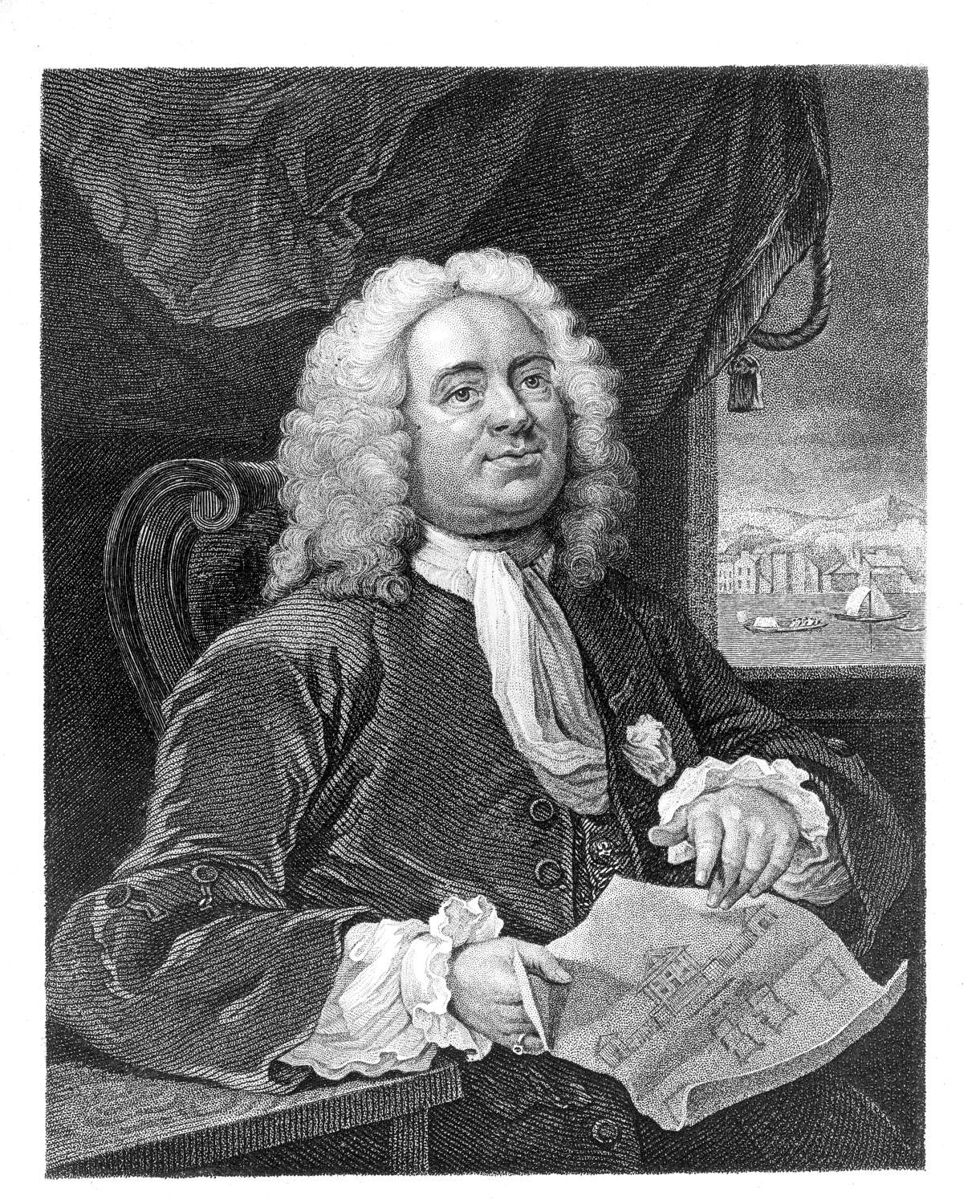 DANIEL LOCK, ESQ. F.A.S.
We have seen displayed the distress of a poet; in this the artist has exhibited the rage of a musician. Our poor bard bore his misfortunes with patience, and, rich in his Muse, did not much repine at his poverty. Not so this master of harmony, of heavenly harmony! To the evils of poverty he is now a stranger; his adagios and cantabiles have procured him the protection of nobles; and, contrary to the poor shirtless mendicant of the Muses that we left in a garret, he is arrayed in a coat decorated with frogs, a bag-wig, solitaire, and ruffled shirt. Waiting in the chamber of a man of fashion, whom he instructs in the divine science of music, having first tuned his instrument, he opens his crotchet-book, shoulders his violin, flourishes his fiddle-stick, and,
Rapt in Elysium at the divine symphony, he is awakened from his beatific vision, by noises that distract him.
Confounded with the din, and enraged by the interruption, our modern Terpander starts from his seat, and opens the window. This operates as air to a kindling fire; and such a combination of noises burst upon the auricular nerve, that he is compelled to stop his ears,—but to stop the torrent is impossible!
In this situation he is delineated; and those who for a moment contemplate the figures before him, cannot wonder at his rage.
Of the dramatis personæ who perform the vocal parts, the first is a fellow, in a tone that would rend hell's concave, bawling, "Dust, ho! dust, ho! dust!" Next to him, an amphibious animal, who nightly pillows his head on the sedgy bosom of old Thames, in a voice that emulates the rush of many waters, or the roaring of a cataract, is bellowing "Flounda,a,a,ars!" A daughter of May-day, who dispenses what in London is called milk, and is consequently a milk-maid, in a note pitched at the very top of her voice, is crying, "Be-louw!" While a ballad-singer dolefully drawls out The Ladie's Fall, an infant in her arms joins its treble pipe in chorus with the screaming parrot, which is on a lamp-iron over her head. On the roof of an opposite house are two cats, performing what an amateur of music might perhaps call a bravura duet; near them appears
A little French drummer, singing to his rub-a-dub, and the agreeable yell of a dog, complete the vocal performers.
Of the instrumental, a fellow blowing a horn, with a violence that would have almost shaken down the walls of Jericho, claims the first notice; next to him, the dustman rattles his bell with ceaseless clangour, until the air reverberates the sound.
The intervals are filled up by a paviour, who, to every stroke of his rammer, adds a loud, distinct, and echoing, Haugh! The pedestrian cutler is grinding a butcher's cleaver with such earnestness and force, that it elicits sparks of fire. This, added to the agonizing howls of his unfortunate dog, must afford a perfect specimen of the ancient chromatic. The poor animal, between a man and a monkey, piping harsh discords upon a hautboy, the girl whirling her crepitaculum, or rattle, and the boy beating his drum, conclude the catalogue of this harmonious band.
This delineation originated in a story which was told to Hogarth by the late Mr. John Festin, who is the hero of the print. He was eminent for his skill in playing upon the German flute and hautboy, and much employed as a teacher of music. To each of his scholars he devoted one hour each day. "At nine o'clock in the morning," said he, "I once waited upon my lord Spencer, but his lordship being out of town, from him I went to Mr. V——n. It was so early that he was not arisen. I went into his chamber, and, opening a shutter, sat down in the window-seat. Before the rails was a fellow playing upon the hautboy. A man with a barrow full of onions offered the piper an onion if he would play him a tune. That ended, he offered a second onion for a second tune; the same for a third, and was going on: but this was too much; I could not bear it; it angered my very soul—'Zounds!' said I, 'stop here! This fellow is ridiculing my profession; he is playing on the hautboy for onions!'"
The whole of this bravura scene is admirably represented. A person quaintly enough observed, that it deafens one to look at it.
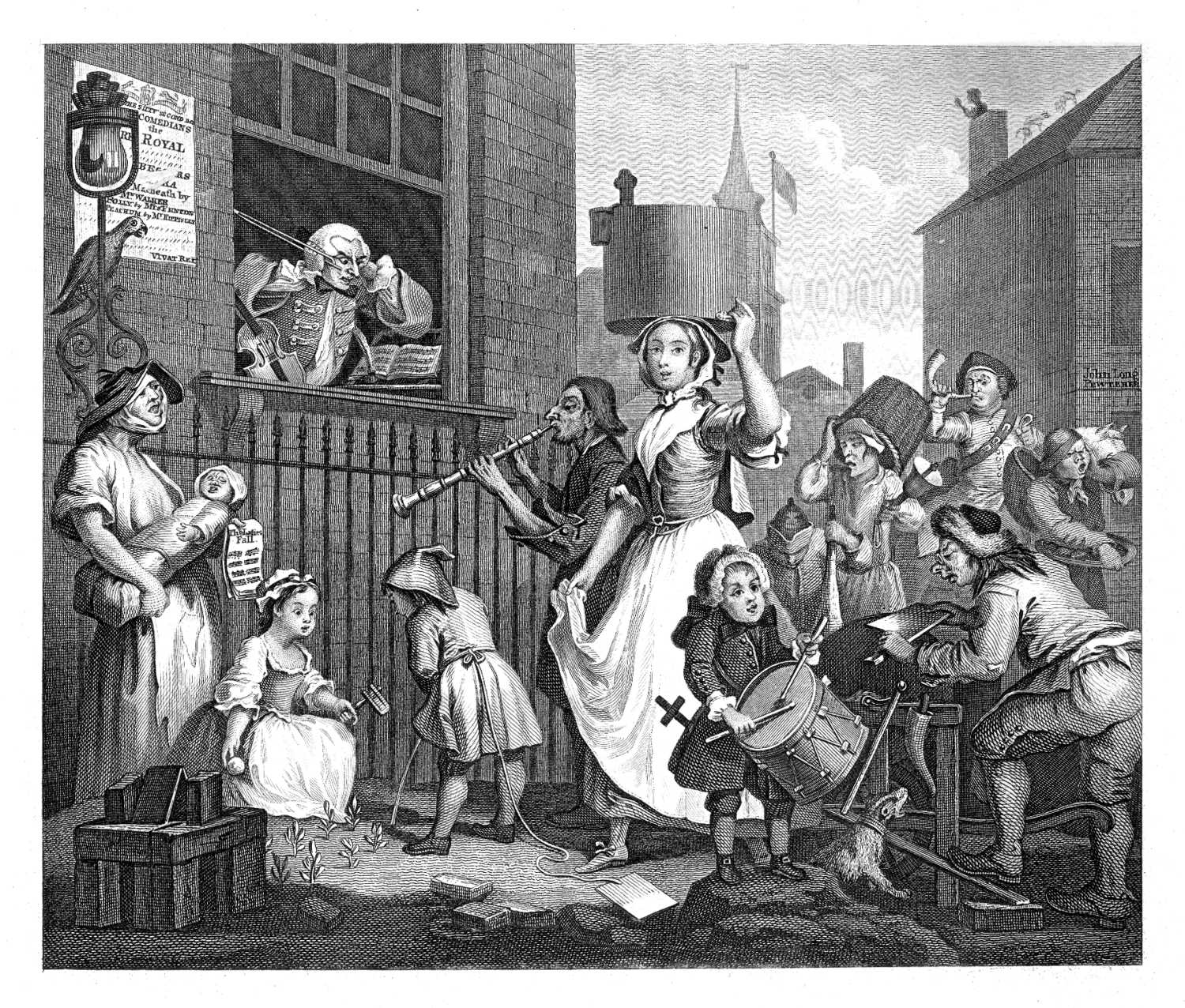 THE ENRAGED MUSICIAN.
This print appeared in 1723. Of the three small figures in the centre the middle one is Lord Burlington, a man of considerable taste in painting and architecture, but who ranked Mr. Kent, an indifferent artist, above his merit. On one side of the peer is Mr. Campbell, the architect; on the other, his lordship's postilion. On a show-cloth in this plate is also supposed to be the portrait of king George II. who gave 1000l. towards the Masquerade; together with that of the earl of Peterborough, who offers Cuzzoni, the Italian singer, 8000l. and she spurns at him. Mr. Heidegger, the regulator of the Masquerade, is also exhibited, looking out of a window, with the letter H under him.
The substance of the foregoing remarks is taken from a collection lately belonging to Captain Baillie, where it is said that they were furnished by an eminent connoisseur.
A board is likewise displayed, with the words, "Long Room. Fawks's dexterity of hand." It appears from the following advertisement that this was a man of great consequence in his profession: "Whereas the town hath been lately alarmed, that the famous Fawks was robbed and murdered, returning from performing at the duchess of Buckingham's house at Chelsea; which report being raised and printed by a person to gain money to himself, and prejudice the above-mentioned Mr. Fawks, whose unparalleled performance has gained him so much applause from the greatest of quality, and most curious observers: We think, both in justice to the injured gentleman, and for the satisfaction of his admirers, that we cannot please our readers better than to acquaint them he is alive, and will not only perform his usual surprising dexterity of hand, posture-master, and musical clock: but, for the greater diversion of the quality and gentry, has agreed with the famous Powell of the Bath for the season, who has the largest, richest, and most natural figures, and finest machines in England, and whose former performances in Covent Garden were so engaging to the town, as to gain the approbation of the best judges, to show his puppet-plays along with him, beginning in the Christmas holidays next, at the Old Tennis-court, in James's-street, near the Haymarket; where any incredulous persons may be satisfied he is not left this world,[Pg 66] if they please to believe their hands, though they can't believe their eyes."—"May 25," indeed, "1731, died Mr. Fawks, famous for his dexterity of hand, by which he had honestly acquired a fortune of 10,000l. being no more than he really deserved for his great ingenuity, by which he had surpassed all that ever pretended to that art."
This satirical performance of Hogarth, however, was thought to be invented and drawn at the instigation of Sir James Thornhill, out of revenge, because Lord Burlington had preferred Mr. Kent before him to paint for the king at his palace at Kensington. Dr. Faustus was a pantomime performed to crowded houses throughout two seasons, to the utter neglect of plays, for which reason they are cried about in a wheel-barrow.
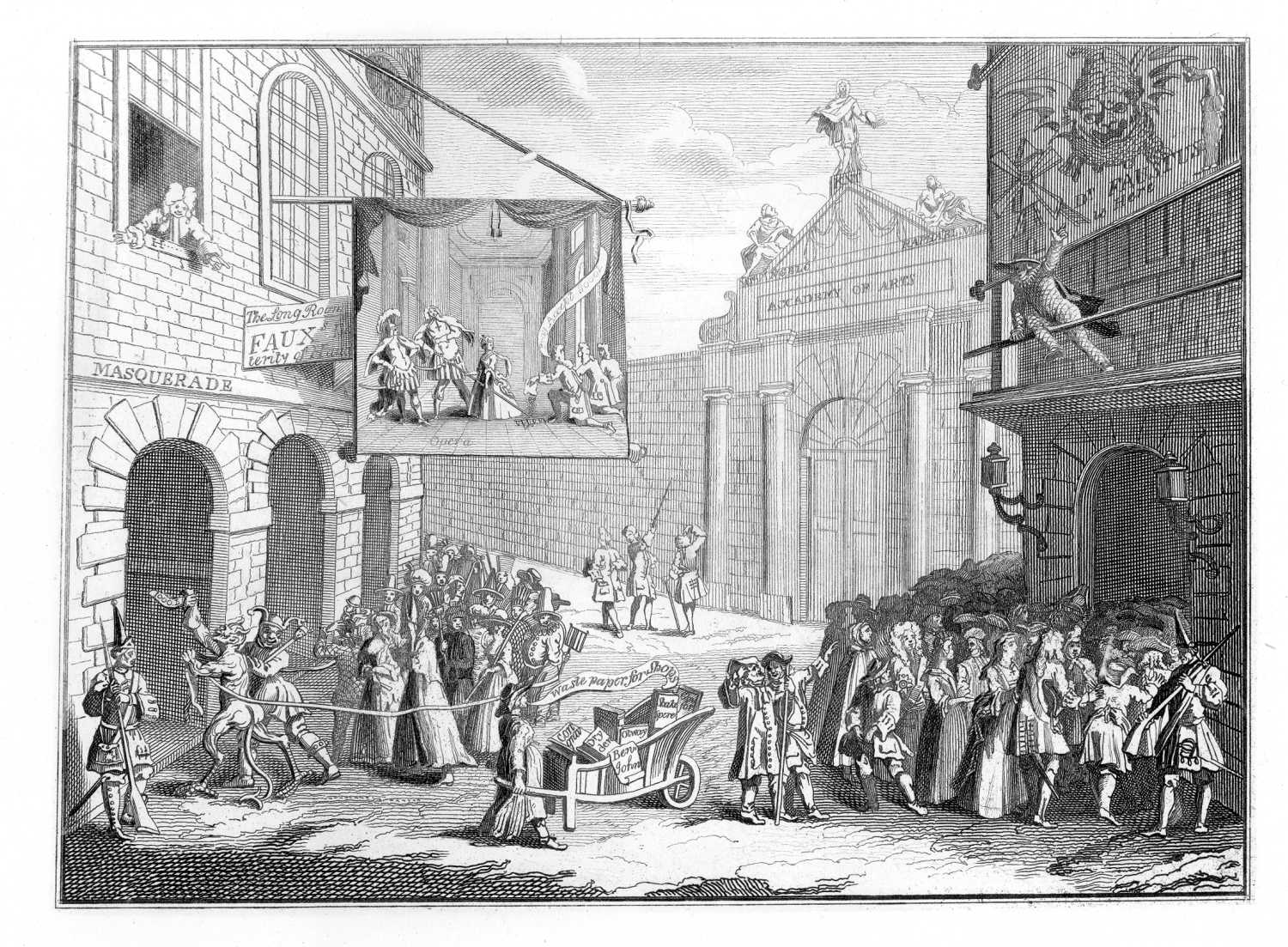 MASQUERADES AND OPERAS, BURLINGTON GATE.
This withered representative of Miss Bridget Alworthy, with a shivering foot-boy carrying her prayer-book, never fails in her attendance at morning service. She is a symbol of the season.—
she looks with scowling eye, and all the conscious pride of severe and stubborn virginity, on the poor girls who are suffering the embraces of two drunken beaux that are just staggered out of Tom King's Coffee-house. One of them, from the basket on her arm, I conjecture to be an orange girl: she shows no displeasure at the boisterous salute of her Hibernian lover. That the hero in a laced hat is from the banks of the Shannon, is apparent in his countenance. The female whose face is partly concealed, and whose neck has a more easy turn than we always see in the works of this artist, is not formed of the most inflexible materials.
An old woman, seated upon a basket; the girl, warming her hands by a few withered sticks that are blazing on the ground, and a wretched mendicant,[3] wrapped in a tattered and parti-coloured blanket, entreating charity from the rosy-fingered vestal who is going to church, complete the group. Behind them, at the door of Tom King's Coffee-house, are a party engaged in a fray, likely to create business for both surgeon and magistrate: we discover swords and cudgels in the combatants' hands.
On the opposite side of the print are two little schoolboys. That they have shining morning faces we cannot positively assert, but each has a satchel at his back, and according with the description given by the poet of nature, is
The lantern appended to the woman who has a basket on her head, proves that these dispensers of the riches of Pomona rise before the sun, and do part of their business by an artificial light. Near her, that immediate descendant of Paracelsus, Dr. Rock, is[Pg 68] expatiating to an admiring audience, on the never-failing virtues of his wonder-working medicines. One hand holds a bottle of his miraculous panacea, and the other supports a board, on which is the king's arms, to indicate that his practice is sanctioned by royal letters patent. Two porringers and a spoon, placed on the bottom of an inverted basket, intimate that the woman seated near them, is a vender of rice-milk, which was at that time brought into the market every morning.
A fatigued porter leans on a rail; and a blind beggar is going towards the church: but whether he will become one of the congregation, or take his stand at the door, in the hope that religion may have warmed the hearts of its votaries to "Pity the sorrows of a poor blind man," is uncertain.
Snow on the ground, and icicles hanging from the penthouse, exhibit a very chilling prospect; but, to dissipate the cold, there is happily a shop where spirituous liquors are sold pro bono publico, at a very little distance. A large pewter measure is placed upon a post before the door, and three of a smaller size hang over the window of the house.
The character of the principal figure is admirably delineated. She is marked with that prim and awkward formality which generally accompanies her order, and is an exact type of a hard winter; for every part of her dress, except the flying lappets and apron, ruffled by the wind, is as rigidly precise as if it were frozen. It has been said that this incomparable figure was designed as the representative of either a particular friend, or a relation. Individual satire may be very gratifying to the public, but is frequently fatal to the satirist. Churchill, by the lines,
lost a considerable legacy; and it is related that Hogarth, by the introduction of this withered votary of Diana into this print, induced her to alter a will which had been made considerably in his favour: she was at first well enough satisfied with her resemblance, but some designing people taught her to be angry.
Extreme cold is very well expressed in the slip-shod footboy, and the girl who is warming her hands. The group of which she is a part, is well formed, but not sufficiently balanced on the opposite side.
The church dial, a few minutes before seven; marks of little shoes and pattens in the snow, and various productions of the season in the market, are an additional proof of that minute accuracy with which this artist inspected and represented objects, which painters in general have neglected.
Govent Garden is the scene, but in the print every building is reversed. This was a common error with Hogarth; not from his being ignorant of the use of the mirror, but from his considering it as a matter of little consequence.
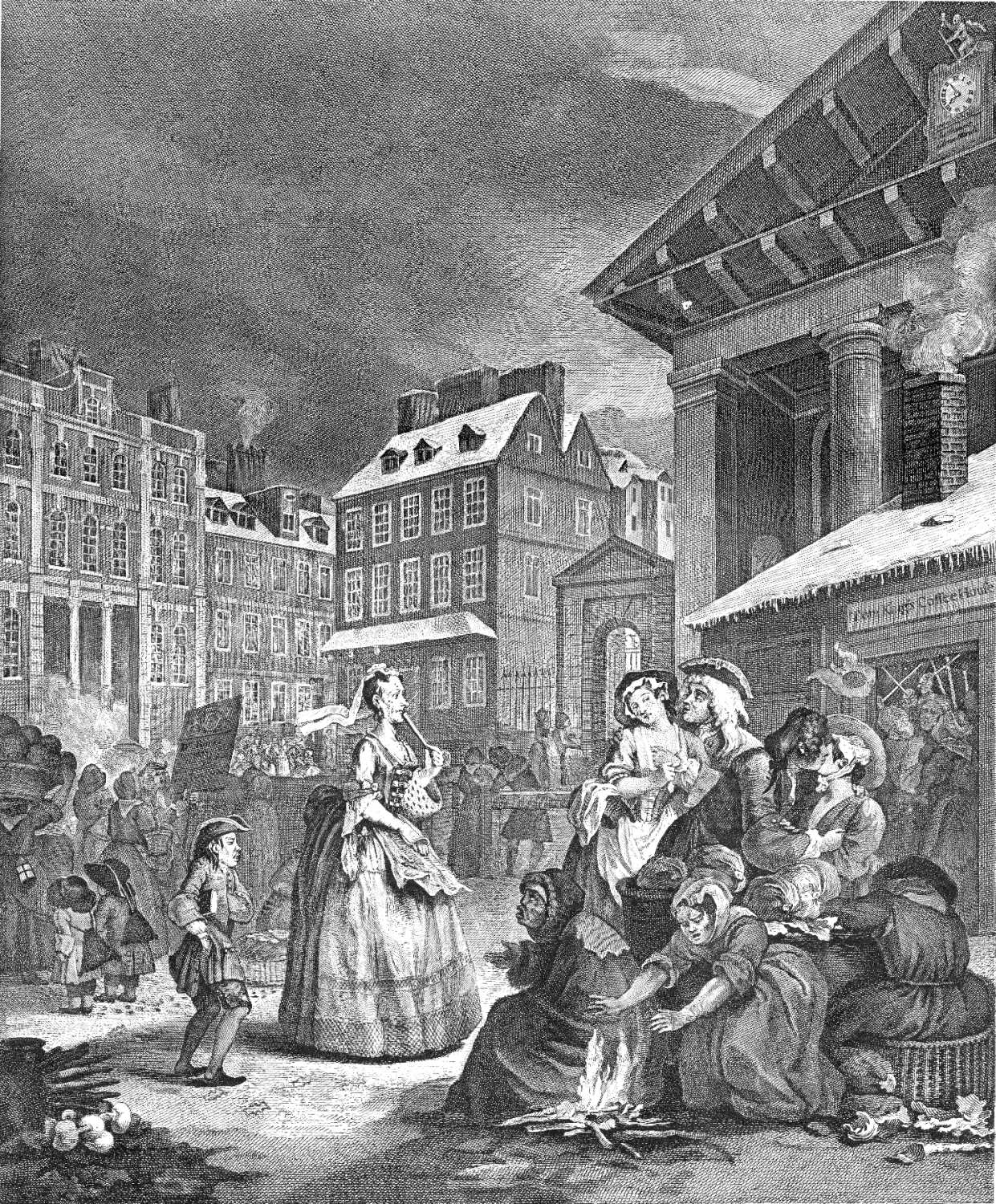 MORNING.
Among the figures who are coming out of church, an affected, flighty Frenchwoman, with her fluttering fop of a husband, and a boy, habited à-la-mode de Paris, claim our first attention. In dress, air, and manner, they have a national character. The whole congregation, whether male or female, old or young, carry the air of their country in countenance, dress, and deportment. Like the three principal figures, they are all marked with some affected peculiarity. Affectation, in a woman, is supportable upon no other ground than that general indulgence we pay to the omnipotence of beauty, which in a degree sanctifies whatever it adopts. In a boy, when we consider that the poor fellow is attempting to copy what he has been taught to believe praiseworthy, we laugh at it; the largest portion of ridicule falls upon his tutors; but in a man, it is contemptible!
The old fellow, in a black periwig, has a most vinegar-like aspect, and looks with great contempt at the frippery gentlewoman immediately before him. The woman, with a demure countenance, seems very piously considering how she can contrive to pick the embroidered beau's pocket. Two old sybils joining their withered lips in a chaste salute, is nauseous enough, but, being a national custom, must be forgiven. The divine seems to have resided in this kingdom long enough to acquire a roast-beef countenance. A little boy, whose woollen nightcap is pressed over a most venerable flowing periwig, and the decrepit old man, leaning upon a crutch-stick, who is walking before him, "I once considered," says Mr. Ireland, "as two vile caricatures, out of nature, and unworthy the artist. Since I have seen the peasantry of Flanders, and the plebeian youth of France, I have in some degree changed my opinion, but still think them rather outré."
Under a sign of the Baptist's Head is written, Good Eating; and on each side of[Pg 70] the inscription is a mutton chop. In opposition to this head without a body, unaccountably displayed as a sign at an eating-house, there is a body without a head, hanging out as the sign of a distiller's. This, by common consent, has been quaintly denominated the good woman. At a window above, one of the softer sex proves her indisputable right to the title by her temperate conduct to her husband, with whom having had a little disagreement, she throws their Sunday's dinner into the street.
A girl, bringing a pie from the bakehouse, is stopped in her career by the rude embraces of a blackamoor, who eagerly rubs his sable visage against her blooming cheek.
Good eating is carried on to the lower part of the picture. A boy, placing a baked pudding upon a post, with rather too violent an action, the dish breaks, the fragments fall to the ground, and while he is loudly lamenting his misfortune, and with tears anticipating his punishment, the smoking remnants are eagerly snatched up by a poor girl. Not educated according to the system of Jean Jacques Rousseau, she feels no qualms of conscience about the original proprietor, and, destitute of that fastidious delicacy which destroys the relish of many a fine lady, eagerly swallows the hot and delicious morsels, with all the concomitants.
The scene is laid at the door of a French chapel in Hog-lane; a part of the town at that time almost wholly peopled by French refugees, or their descendants.
By the dial of St. Giles's church, in the distance, we see that it is only half past eleven. At this early hour, in those good times, there was as much good eating as there is now at six o'clock in the evening. From twenty pewter measures, which are hung up before the houses of different distillers, it seems that good drinking was considered as equally worthy of their serious attention.
The dead cat, and choked kennels, mark the little attention shown to the streets by the scavengers of St. Giles's. At that time noxious effluvia was not peculiar to this parish. The neighbourhood of Fleet-ditch, and many other parts of the city, were equally polluted.
Even at this refined period, there would be some use in a more strict attention to the medical police of a city so crowded with inhabitants. We ridicule the people of Paris and Edinburgh for neglecting so essential and salutary a branch of delicacy, while the kennels of a street in the vicinity of St. Paul's church are floated with the blood of slaughtered animals every market-day. Moses would have managed these things better: but in those days there was no physician in Israel!
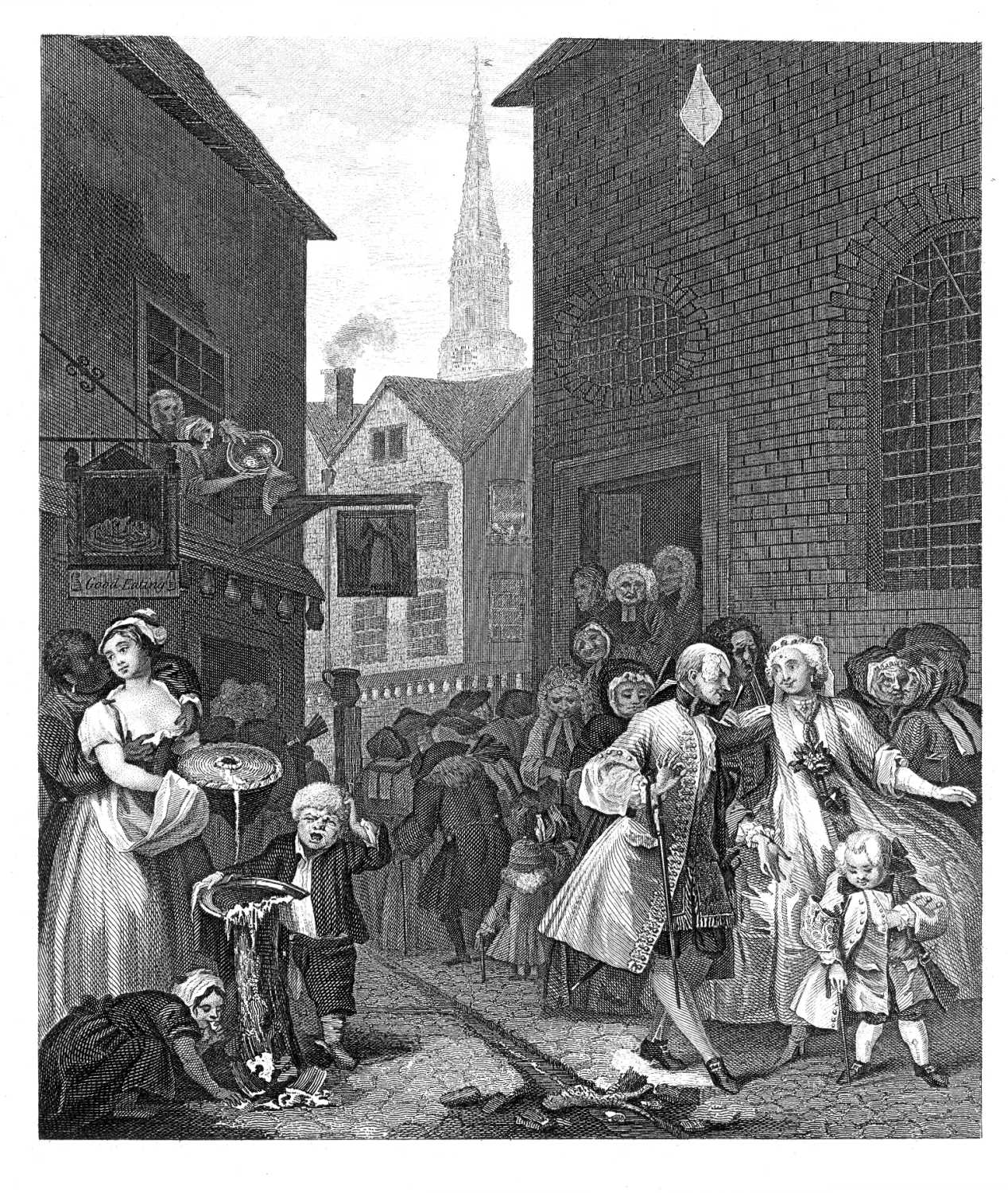 NOON.
NOON.
It is not easy to imagine fatigue better delineated than in the appearance of this amiable pair. In a few of the earliest impressions, Mr. Hogarth printed the hands of the man in blue, to show that he was a dyer, and the face and neck of the woman in red, to intimate her extreme heat. The lady's aspect lets us at once into her character; we are certain that she was born to command. As to her husband, God made him, and he must pass for a man: what his wife has made him, is indicated by the cow's horns; which are so placed as to become his own. The hopes of the family, with a cockade in his hat, and riding upon papa's cane, seems much dissatisfied with female sway. A face with more of the shrew in embryo than that of the girl, it is scarcely possible to[Pg 72] conceive. Upon such a character the most casual observer pronounces with the decision of a Lavater.
Nothing can be better imagined than the group in the alehouse. They have taken a refreshing walk into the country, and, being determined to have a cooling pipe, seat themselves in a chair-lumbered closet, with a low ceiling; where every man, pulling off his wig, and throwing a pocket-handkerchief over his head, inhales the fumes of hot punch, the smoke of half a dozen pipes, and the dust from the road. If this is not rural felicity, what is? The old gentleman in a black bag-wig, and the two women near him, sensibly enough, take their seats in the open air.
From a woman milking a cow, we conjecture the hour to be about five in the afternoon: and, from the same circumstance, I am inclined to think this agreeable party is going to their pastoral bower, rather than returning from it.
The cow and dog appear as much inconvenienced by heat as any of the party: the former is whisking off the flies; and the latter creeps unwillingly along, and casts a longing look at the crystal river, in which he sees his own shadow. A remarkably hot summer is intimated by the luxuriant state of a vine, creeping over an alehouse window. On the side of the New River, where the scene is laid, lies one of the wooden pipes employed in the water-works. Opposite Sadler's Wells there still remains the sign of Sir Hugh Middleton's head, which is here represented; but how changed the scene from what is here represented!
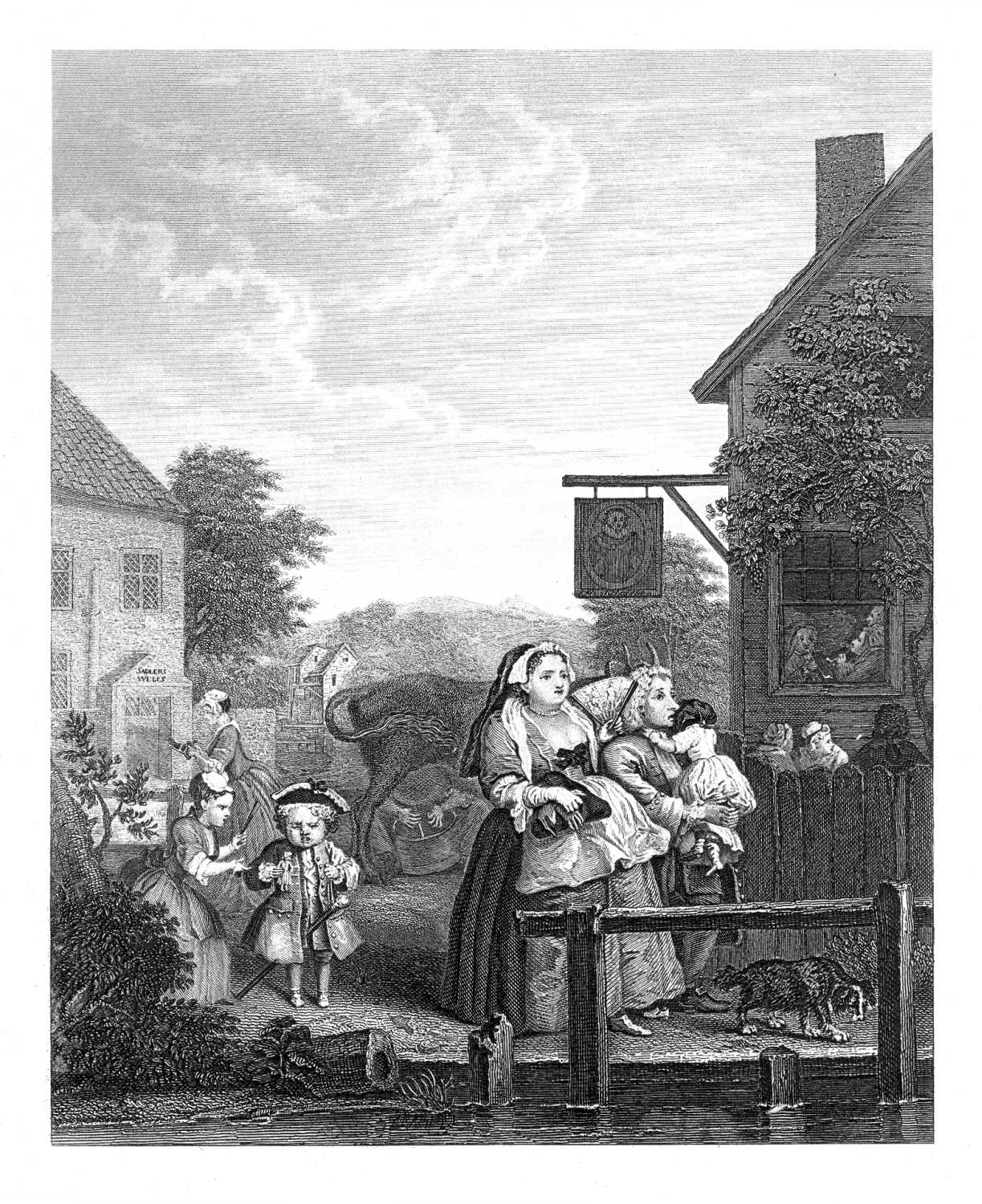 EVENING.
Mr. Walpole very truly observes, that this print is inferior to the three others; there is, however, broad humour in some of the figures.
The wounded free-mason, who, in zeal of brotherly love, has drank his bumpers to the craft till he is unable to find his way home, is under the guidance of a waiter. This has been generally considered as intended for Sir Thomas de Veil, and, from an authenticated portrait which I have seen, I am, says Mr. Ireland, inclined to think it is, notwithstanding Sir John Hawkins asserts, that "he could discover no resemblance." When the knight saw him in his magisterial capacity, he was probably sober and sedate; here he is represented a little disguised. The British Xantippe showering her favours from the window upon his head, may have its source in that respect which the inmates of such houses as the Rummer Tavern had for a justice of peace. On the resignation of Mr. Horace Walpole, in February, 1738, De Veil was appointed inspector-general of the imports and exports, and was so severe against the retailers of spirituous liquors, that one Allen headed a gang of rioters for the purpose of pulling down his house, and bringing to a summary punishment two informers who were there concealed. Allen was tried for this offence, and acquitted, upon the jury's verdict declaring him lunatic.
The waiter who supports his worship, seems, from the patch upon his forehead, to have been in a recent affray; but what use he can have for a lantern, it is not easy to divine, unless he is conducting his charge to some place where there is neither moonlight nor illumination.
The Salisbury flying coach oversetting and broken, by passing through the bonfire, is said to be an intended burlesque upon a right honourable peer, who was accustomed to drive his own carriage over hedges, ditches, and rivers; and has been sometimes known to drive three or four of his maid servants into a deep water, and there leave them in the coach to shift for themselves.[Pg 74]
The butcher, and little fellow, who are assisting the terrified passengers, are possibly free and accepted masons. One of them seems to have a mop in his hand;—the pail is out of sight.
To crown the joys of the populace, a man with a pipe in his mouth is filling a capacious hogshead with British Burgundy.
The joint operation of shaving and bleeding, performed by a drunken 'prentice on a greasy oilman, does not seen a very natural exhibition on a rejoicing night.
The poor wretches under the barber's bench display a prospect of penury and wretchedness, which it is to be hoped is not so common now, as it was then.
In the distance is a cart laden with furniture, which some unfortunate tenant is removing out of the reach of his landlord's execution.
There is humour in the barber's sign and inscription; "Shaving, bleeding, and teeth drawn with a touch. Ecce signum!"
By the oaken boughs on the sign, and the oak leaves in the free-masons' hats, it seems that this rejoicing night is the twenty-ninth of May, the anniversary of our second Charles's restoration; that happy day when, according to our old ballad, "The king enjoyed his own again." This might be one reason for the artist choosing a scene contiguous to the beautiful equestrian statue of Charles the First.
In the distance we see a house on fire; an accident very likely to happen on such a night as this.
On this spot once stood the cross erected by Edward the First, as a memorial of affection for his beloved queen Eleanor, whose remains were here rested on their way to the place of sepulture. It was formed from a design by Cavalini, and destroyed by the religious fury of the Reformers. In its place, in the year 1678, was erected the animated equestrian statue which now remains. It was cast in brass, in the year 1633, by Le Sœur; I think by order of that munificent encourager of the arts, Thomas Howard, Earl of Arundel. The parliament ordered it to be sold, and broken to pieces; but John River, the brazier who purchased it, having more taste than his employers, seeing, with the prophetic eye of good sense, that the powers which were would not remain rulers very long, dug a hole in his garden in Holborn, and buried it unmutilated. To prove his obedience to their order, he produced to his masters several pieces of brass, which he told them were parts of the statue. M. de Archenholtz adds further, that the brazier, with the true spirit of trade, cast a great number of handles for knives and forks, and offered them for sale, as composed of the brass which had formed the statue. They were eagerly sought for, and purchased,—by the loyalists from affection to their murdered monarch,—by the other party, as trophies of triumph.
The original pictures of Morning and Noon were sold to the Duke of Ancaster for fifty-seven guineas; Evening and Night to Sir William Heathcote, for sixty-four guineas.
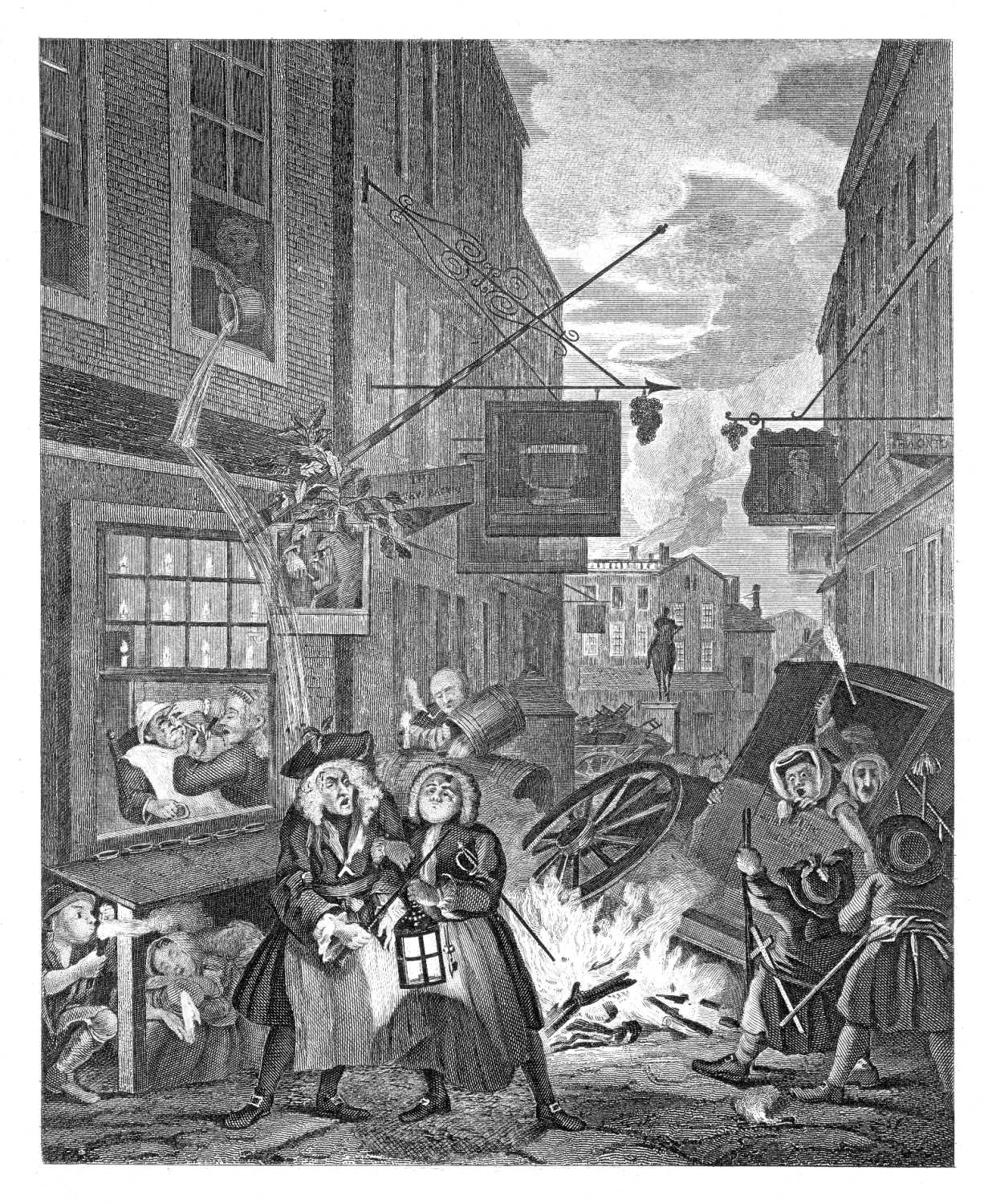 NIGHT.
Hogarth's Epistle.
A competition with either Guido, or Furino, would to any modern painter be an enterprise of danger: to Hogarth it was more peculiarly so, from the public justly conceiving that the representation of elevated distress was not his forte, and his being surrounded by an host of foes, who either dreaded satire, or envied genius. The connoisseurs, considering the challenge as too insolent to be forgiven, before his picture appeared, determined to decry it. The painters rejoiced in his attempting what was likely to end in disgrace; and to satisfy those who had formed their ideas of Sigismonda upon the inspired page of Dryden, was no easy task.
The bard has consecrated the character, and his heroine glitters with a brightness that cannot be transferred to the canvass. Mr. Walpole's description, though equally radiant, is too various, for the utmost powers of the pencil.
Hogarth's Sigismonda, as this gentleman poetically expresses it, "has none of the sober grief, no dignity of suppressed anguish, no involuntary tear, no settled meditation on the fate she meant to meet, no amorous warmth turned holy by despair; in short, all is wanting that should have been there, all is there that such a story would have banished from a mind capable of conceiving such complicated woe; woe so sternly felt, and yet so tenderly." This glowing picture presents to the mind a being whose contending passions may be felt, but were not delineated even by Corregio. Had his tints been aided by the grace and greatness of Raphael, they must have failed.
The author of the Mysterious Mother sought for sublimity, where the artist strictly copied nature, which was invariably his archetype, but which the painter, who soars into fancy's fairy regions, must in a degree desert. Considered with this reference, though the picture has faults, Mr. Walpole's satire is surely too severe. It is built upon a comparison with works painted in a language of which Hogarth knew not the idiom,[Pg 76]—trying him before a tribunal, whose authority he did not acknowledge, and from the picture having been in many respects altered after the critic saw it, some of the remarks become unfair. To the frequency of these alterations we may attribute many of the errors: the man who has not confidence in his own knowledge of the leading principles on which his work ought to be built, will not render it perfect by following the advice of his friends. Though Messrs. Wilkes and Churchill dragged his heroine to the altar of politics, and mangled her with a barbarity that can hardly be paralleled, except in the history of her husband,—the artist retained his partiality; which seems to have increased in exact proportion to their abuse. The picture being thus contemplated through the medium of party prejudice, we cannot wonder that all its imperfections were exaggerated. The painted harlot of Babylon had not more opprobrious epithets from the first race of reformers than the painted Sigismonda of Hogarth from the last race of patriots.
When a favourite child is chastised by his preceptor, a partial mother redoubles her caresses. Hogarth, estimating this picture by the labour he had bestowed upon it, was certain that the public were prejudiced, and requested, if his wife survived him, she would not sell it for less than five hundred pounds. Mrs. Hogarth acted in conformity to his wishes, but after her death the painting was purchased by Messrs. Boydell, and exhibited in the Shakspeare Gallery. The colouring, though not brilliant, is harmonious and natural: the attitude, drawing, etc. may be generally conceived by the print. I am much inclined to think, that if some of those who have been most severe in their censures, had consulted their own feelings, instead of depending upon connoisseurs, poor Sigismonda would have been in higher estimation. It has been said that the first sketch was made from Mrs. Hogarth, at the time she was weeping over the corse of her mother.
Hogarth once intended to have appealed from the critics' fiat to the world's opinion, and employed Mr. Basire to make an engraving, which was begun, but set aside for some other work, and never completed.
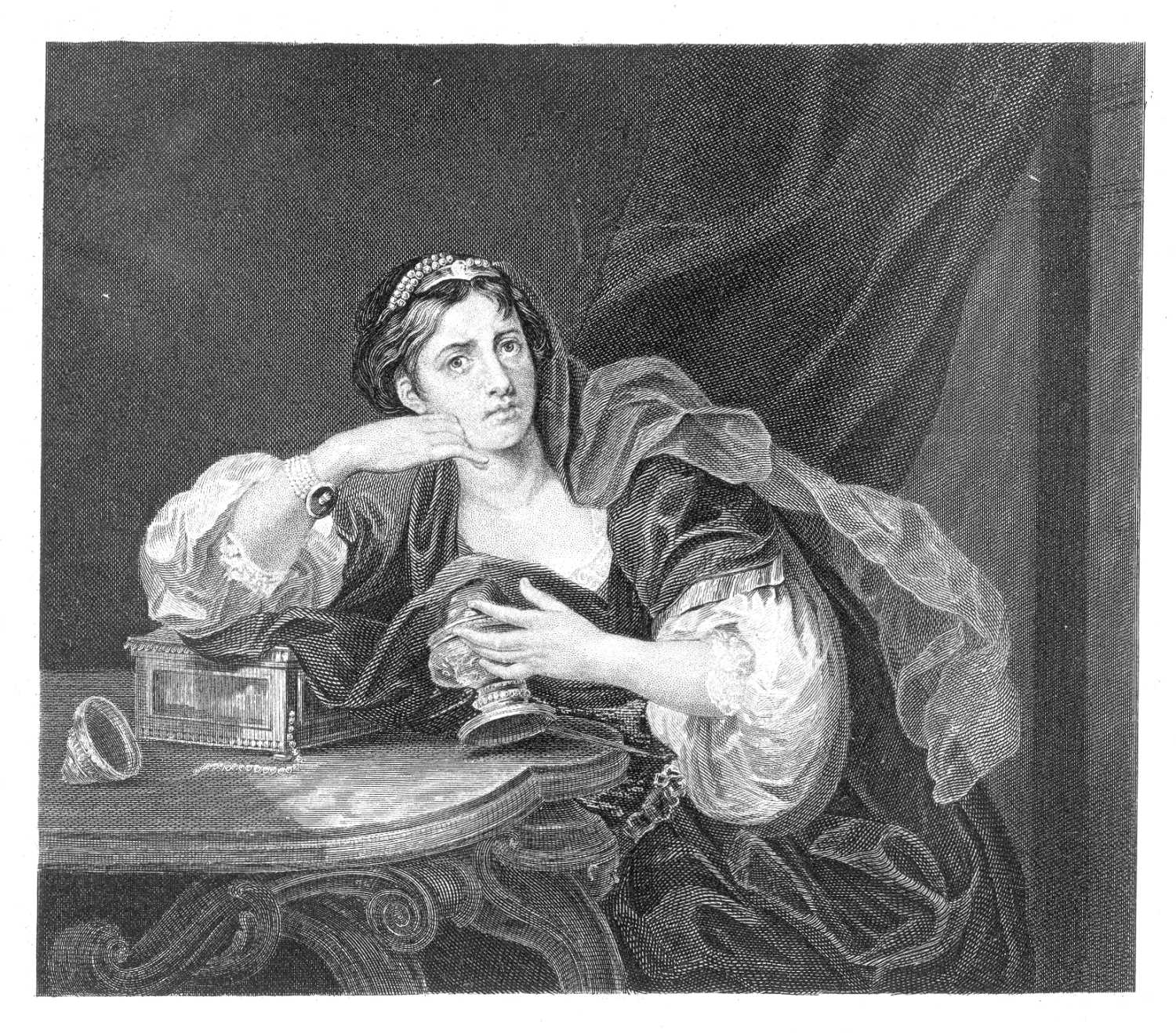 SIGISMONDA,
Martin Folkes was a mathematician and antiquary of much celebrity in the philosophical annals of this country. He was at the early age of twenty-four admitted a member of the Royal Society, where he was greatly distinguished. Two years afterwards he was chosen one of the council, and was named by Sir Isaac Newton himself as vice president: he was afterwards elected president, and held this high office till a short time before his death, when he resigned it on account of ill-health. In the Philosophical Transactions are numerous memoirs of this learned man: his knowledge in coins, ancient and modern, was very extensive: and the last work he produced was concerning the English Silver Coin from the Conquest to his own time. He was president of the Society of Antiquaries at the time of his death, which happened on the 28th of June, 1754, at the age of sixty-four. A few days before his death he was struck with a fit of the palsy, and never spoke after this attack.
 PORTRAIT OF MARTIN FOLKES, ESQ.
The scene is probably laid at Newmarket, and in this motley group of peers,—pick-pockets,—butchers,—jockies,—rat-catchers,—gentlemen,—gamblers of every denomination, Lord Albemarle Bertie, being the principal figure, is entitled to precedence. In the March to Finchley, we see him an attendant at a boxing match; and here he is president of a most respectable society assembled at a cockpit. What rendered his lordship's passion for amusements of this nature very singular, was his being totally blind. In this place he is beset by seven steady friends, five of whom at the same instant offer to bet with him on the event of the battle. One of them, a lineal descendant of Filch, taking advantage of his blindness and negligence, endeavours to convey a bank note, deposited in our dignified gambler's hat, to his own pocket. Of this ungentlemanlike attempt his lordship is apprised by a ragged post-boy, and an honest butcher: but he is so much engaged in the pronunciation of those important words, Done! Done! Done! Done! and the arrangement of his bets, that he cannot attend to their hints; and it seems more than probable that the stock will be transferred, and the note negociated in a few seconds.
A very curious group surround the old nobleman, who is adorned with a riband, a star, and a pair of spectacles. The whole weight of an overgrown carpenter being laid upon his shoulder, forces our illustrious personage upon a man beneath; who being thus driven downward, falls upon a fourth, and the fourth, by the accumulated pressure of this ponderous trio, composed of the upper and lower house, loses his balance, and tumbling against the edge of the partition, his head is broke, and his wig, shook from the seat of reason, falls into the cockpit.
A man adjoining enters into the spirit of the battle,—his whole soul is engaged. From his distorted countenance, and clasped hands, we see that he feels every stroke given to his favourite bird in his heart's core,—ay, in his heart of hearts! A person at the old peer's left hand is likely to be a loser. Ill-humour, vexation, and disappointment are painted in his countenance. The chimney-sweeper above, is the very quintessence of affectation. He has all the airs and graces of a boarding-school miss. The sanctified quaker adjoining, and the fellow beneath, who, by the way, is a very similar figure to Captain Stab, in the Rake's Progress, are finely contrasted.
A French marquis on the other side, astonished at this being called amusement, is exclaiming Sauvages! Sauvages! Sauvages!—Engrossed by the scene, and opening his snuff-box rather carelessly, its contents fall into the eyes of a man below, who,[Pg 79] sneezing and swearing alternately, imprecates bitter curses on this devil's dust, that extorts from his inflamed eyes, "A sea of melting pearls, which some call tears."
Adjoining is an old cripple, with a trumpet at his ear, and in this trumpet a person in a bag-wig roars in a manner that cannot much gratify the auricular nerves of his companions; but as for the object to whom the voice is directed, he seems totally insensible to sounds, and if judgment can be formed from appearances, might very composedly stand close to the clock of St. Paul's Cathedral, when it was striking twelve.
The figure with a cock peeping out of a bag, is said to be intended for Jackson, a jockey; the gravity of this experienced veteran, and the cool sedateness of a man registering the wagers, are well opposed by the grinning woman behind, and the heated impetuosity of a fellow, stripped to his shirt, throwing his coin upon the cockpit, and offering to back Ginger against Pye for a guinea.
On the lower side, where there is only one tier of figures, a sort of an apothecary, and a jockey, are stretching out their arms, and striking together the handles of their whips, in token of a bet. An hiccuping votary of Bacchus, displaying a half-emptied purse, is not likely to possess it long, for an adroit professor of legerdemain has taken aim with a hooked stick, and by one slight jerk, will convey it to his own pocket. The profession of a gentleman in a round wig is determined by a gibbet chalked upon his coat. An enraged barber, who lifts up his stick in the corner, has probably been refused payment of a wager, by the man at whom he is striking.
A cloud-capt philosopher at the top of the print, coolly smoking his pipe, unmoved by this crash of matter, and wreck of property, must not be overlooked: neither should his dog be neglected; for the dog, gravely resting his fore paws upon the partition, and contemplating the company, seems more interested in the event of the battle than his master.
Like the tremendous Gog, and terrific Magog, of Guildhall, stand the two cock-feeders; a foot of each of these consequential purveyors is seen at the two extremities of the pit.
As to the birds, whose attractive powers have drawn this admiring throng together, they deserved earlier notice:
Having disposed of the substances, let us now attend to the shadow on the cockpit, and this it seems is the reflection of a man drawn up to the ceiling in a basket, and there suspended, as a punishment for having betted more money than he can pay. Though suspended, he is not reclaimed; though exposed, not abashed; for in this degrading situation he offers to stake his watch against money, in another wager on his favourite champion.[Pg 80]
The decorations of this curious theatre are, a portrait of Nan Rawlins, and the King's arms.
In the margin at the bottom of the print is an oval, with a fighting cock, inscribed ROYAL SPORT.
Of the characteristic distinctions in this heterogeneous assembly, it is not easy to speak with sufficient praise. The chimney-sweeper's absurd affectation sets the similar airs of the Frenchman in a most ridiculous point of view. The old fellow with a trumpet at his ear, has a degree of deafness that I never before saw delineated; he might have lived in the same apartment with Xantippe, or slept comfortably in Alexander the copper-smith's first floor. As to the nobleman in the centre, in the language of the turf, he is a mere pigeon; and the peer, with a star and garter, in the language of Cambridge, we must class as—a mere quiz. The man sneezing,—you absolutely hear; and the fellow stealing a bank note,—has all the outward and visible marks of a perfect and accomplished pick-pocket; Mercury himself could not do that business in a more masterly style.
Tyers tells us that "Pope, while living with his father at Chiswick, before he went to Binfield, took great delight in cock-fighting, and laid out all his school-boy money, and little perhaps it was, in buying fighting cocks." Lord Orrery observes, "If we may judge of Mr. Pope from his works, his chief aim was to be esteemed a man of virtue." When actions can be clearly ascertained, it is not necessary to seek the mind's construction in the writings: and we must regret being compelled to believe that some of Mr. Pope's actions, at the same time that they prove him to be querulous and petulant, lead us to suspect that he was also envious, malignant, and cruel. How far this will tend to confirm the assertion, that when a boy, he was an amateur of this royal sport, I do, says Mr. Ireland, not pretend to decide: but were a child, in whom I had any interest, cursed with such a propensity, my first object would be to correct it: if that were impracticable, and he retained a fondness for the cockpit, and the still more detestable amusement of Shrove Tuesday, I should hardly dare to flatter myself that he could become a merciful man.—The subject has carried me farther than I intended: I will, however, take the freedom of proposing one query to the consideration of the clergy,—Might it not have a tendency to check that barbarous spirit, which has more frequently its source in an early acquired habit, arising from the prevalence of example, than in natural depravity, if every divine in Great Britain were to preach at least one sermon every twelve months, on our universal insensibility to the sufferings of the brute creation?
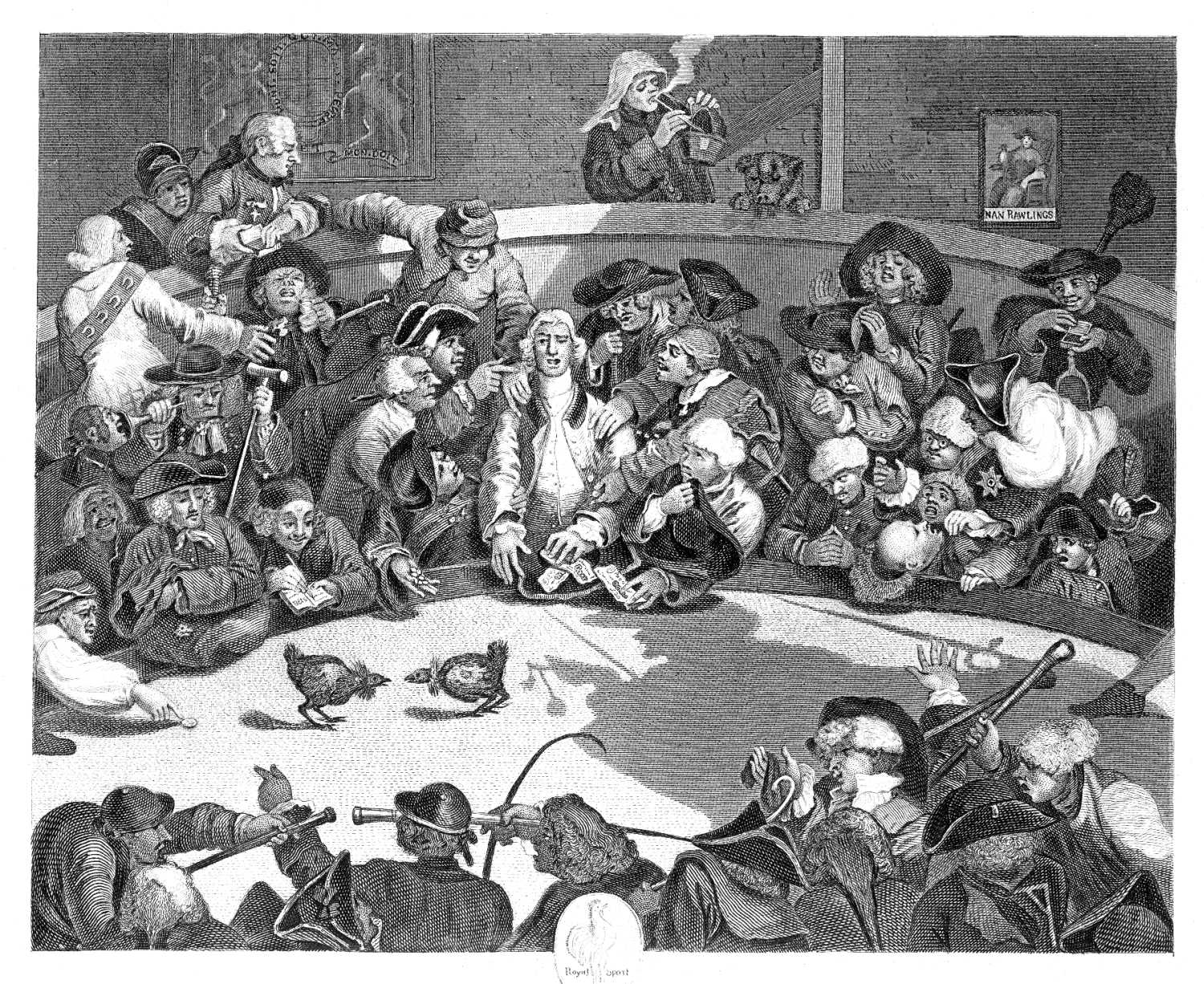 THE COCK PIT.
Captain Coram was born in the year 1668, bred to the sea, and passed the first part of his life as master of a vessel trading to the colonies. While he resided in the vicinity of Rotherhithe, his avocations obliging him to go early into the city and return late, he frequently saw deserted infants exposed to the inclemencies of the seasons, and through the indigence or cruelty of their parents left to casual relief, or untimely death. This naturally excited his compassion, and led him to project the establishment of an hospital for the reception of exposed and deserted young children; in which humane design he laboured more than seventeen years, and at last, by his unwearied application, obtained the royal charter, bearing date the 17th of October, 1739, for its incorporation.
He was highly instrumental in promoting another good design, viz. the procuring a bounty upon naval stores imported from the colonies to Georgia and Nova Scotia. But the charitable plan which he lived to make some progress in, though not to complete, was a scheme for uniting the Indians in North America more closely with the British Government, by an establishment for the education of Indian girls. Indeed he spent a great part of his life in serving the public, and with so total a disregard to his private interest, that in his old age he was himself supported by a pension of somewhat more than a hundred pounds a year, raised for him at the solicitation of Sir Sampson Gideon and Dr. Brocklesby, by the voluntary subscriptions of public-spirited persons, at the head of whom was the Prince of Wales. On application being made to this venerable and good old man, to know whether a subscription being opened for his benefit would not offend him, he gave this noble answer: "I have not wasted the little wealth of which I was formerly possessed in self-indulgence or vain expenses, and am not ashamed to confess, that in this my old age I am poor."
This singularly humane, persevering, and memorable man died at his lodgings near Leicester-square, March 29, 1751, and was interred, pursuant to his own desire, in the vault under the chapel of the Foundling Hospital, where an historic epitaph records his virtues, as Hogarth's portrait has preserved his honest countenance.
"The portrait which I painted with most pleasure," says Hogarth, "and in which I particularly wished to excel, was that of Captain Coram for the Foundling Hospital;[Pg 82] and if I am so wretched an artist as my enemies assert, it is somewhat strange that this, which was one of the first I painted the size of life, should stand the test of twenty years' competition, and be generally thought the best portrait in the place, notwithstanding the first painters in the kingdom exerted all their talents to vie with it.
"For the portrait of Mr. Garrick in Richard III. I was paid two hundred pounds, (which was more than any English artist ever received for a single portrait,) and that too by the sanction of several painters who had been previously consulted about the price, which was not given without mature consideration.
"Notwithstanding all this, the current remark was, that portraits were not my province; and I was tempted to abandon the only lucrative branch of my art, for the practice brought the whole nest of phyzmongers on my back, where they buzzed like so many hornets. All these people have their friends, whom they incessantly teach to call my women harlots, my Essay on Beauty borrowed, and my composition and engraving contemptible.
"This so much disgusted me, that I sometimes declared I would never paint another portrait, and frequently refused when applied to; for I found by mortifying experience, that whoever would succeed in this branch, must adopt the mode recommended in one of Gay's fables, and make divinities of all who sit to him. Whether or not this childish affectation will ever be done away is a doubtful question; none of those who have attempted to reform it have yet succeeded; nor, unless portrait painters in general become more honest, and their customers less vain, is there much reason to expect they ever will."
Though thus in a state of warfare with his brother artists, he was occasionally gratified by the praise of men whose judgment was universally acknowledged, and whose sanction became a higher honour, from its being neither lightly nor indiscriminately given.
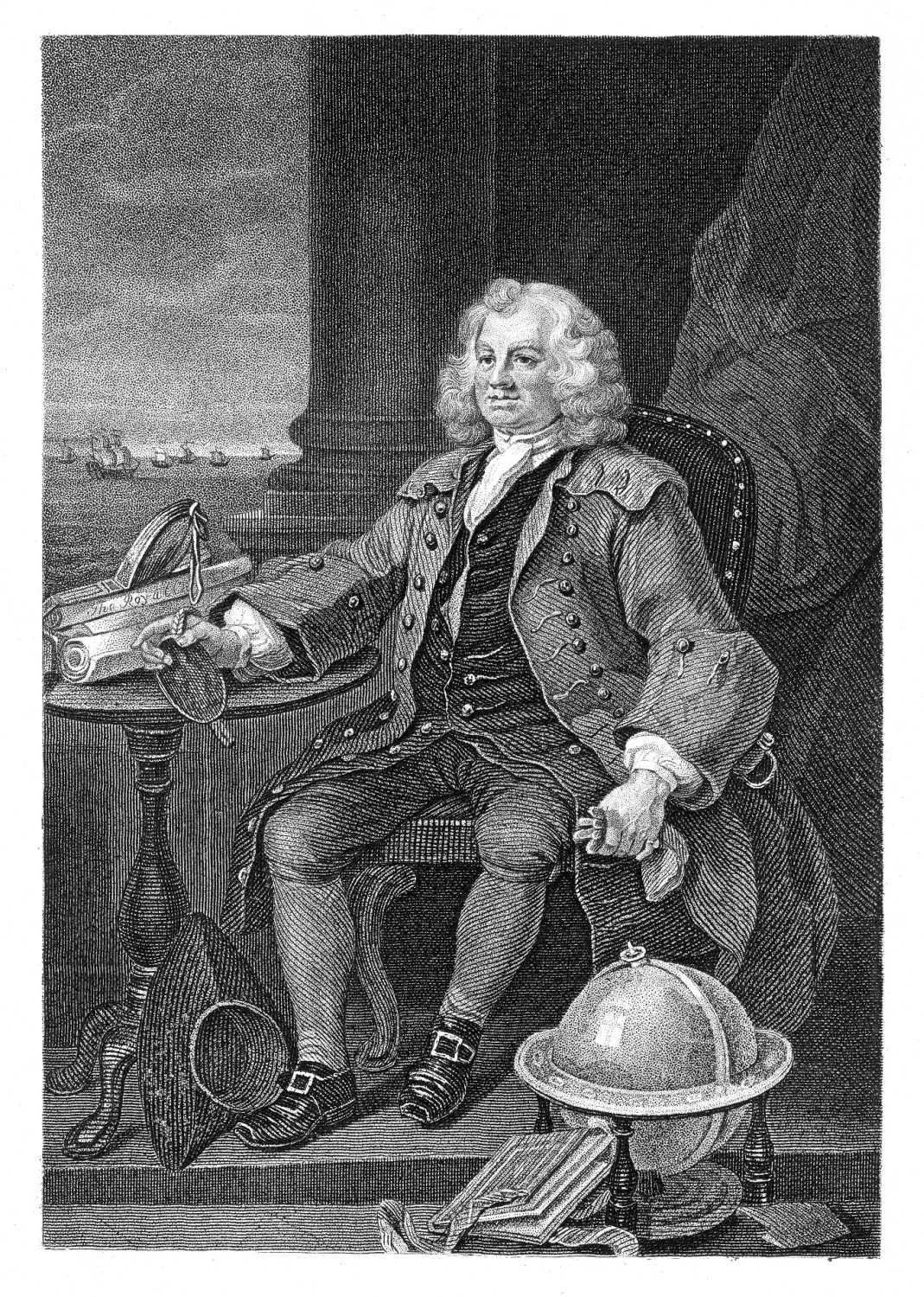 CAPTAIN THOMAS CORAM.
E.
Among the writers of English novels, Henry Fielding holds the first rank; he was the novelist of nature, and has described some scenes which bear a strong resemblance to that which is here delineated. The artist, like the author, has taken truth for his guide, and given such characters as are familiar to all our minds. The scene is a country inn yard, at the time passengers are getting into a stage-coach, and an election procession passing in the back-ground. Nothing can be better described; we become of the party. The vulgar roar of our landlady is no less apparent than the grave, insinuating, imposing countenance of mine host. Boniface solemnly protests that a bill he is presenting to an old gentleman in a laced hat is extremely moderate. This does not satisfy the paymaster, whose countenance shows that he considers it as a palpable fraud, though the act against bribery, which he carries in his pocket, designates him to be of a profession not very liable to suffer imposition. They are in general less sinned against than sinning. An ancient lady, getting into the coach, is from her breadth a very inconvenient companion in such a vehicle; but to atone for her rotundity, an old maid of a spare appearance, and in a most grotesque habit, is advancing towards the steps.
A portly gentleman, with a sword and cane in one hand, is deaf to the entreaties of a poor little deformed postilion, who solicits his customary fee. The old woman smoking her short pipe in the basket, pays very little attention to what is passing around her: cheered by the fumes of her tube, she lets the vanities of the world go their own[Pg 84] way. Two passengers on the roof of the coach afford a good specimen of French and English manners. Ben Block, of the Centurion, surveys the subject of La Grande Monarque with ineffable contempt.
In the window are a very curious pair; one of them blowing a French-horn, and the other endeavouring, but without effect, to smoke away a little sickness, which he feels from the fumes of his last night's punch. Beneath them is a traveller taking a tender farewell of the chambermaid, who is not to be moved by the clangour of the great bar bell, or the more thundering sound of her mistress's voice.
The back-ground is crowded with a procession of active citizens; they have chaired a figure with a horn-book, a bib, and a rattle, intended to represent Child, Lord Castlemain, afterwards Lord Tylney, who, in a violent contest for the county of Essex, opposed Sir Robert Abdy and Mr. Bramston. The horn-book, bib, and rattle are evidently displayed as punningly allusive to his name.[4]
Some pains have been taken to discover in what part of Essex this scene is laid; but from the many alterations made by rebuilding, removal, &c. it has not been positively ascertained, though it is probably Chelmsford.
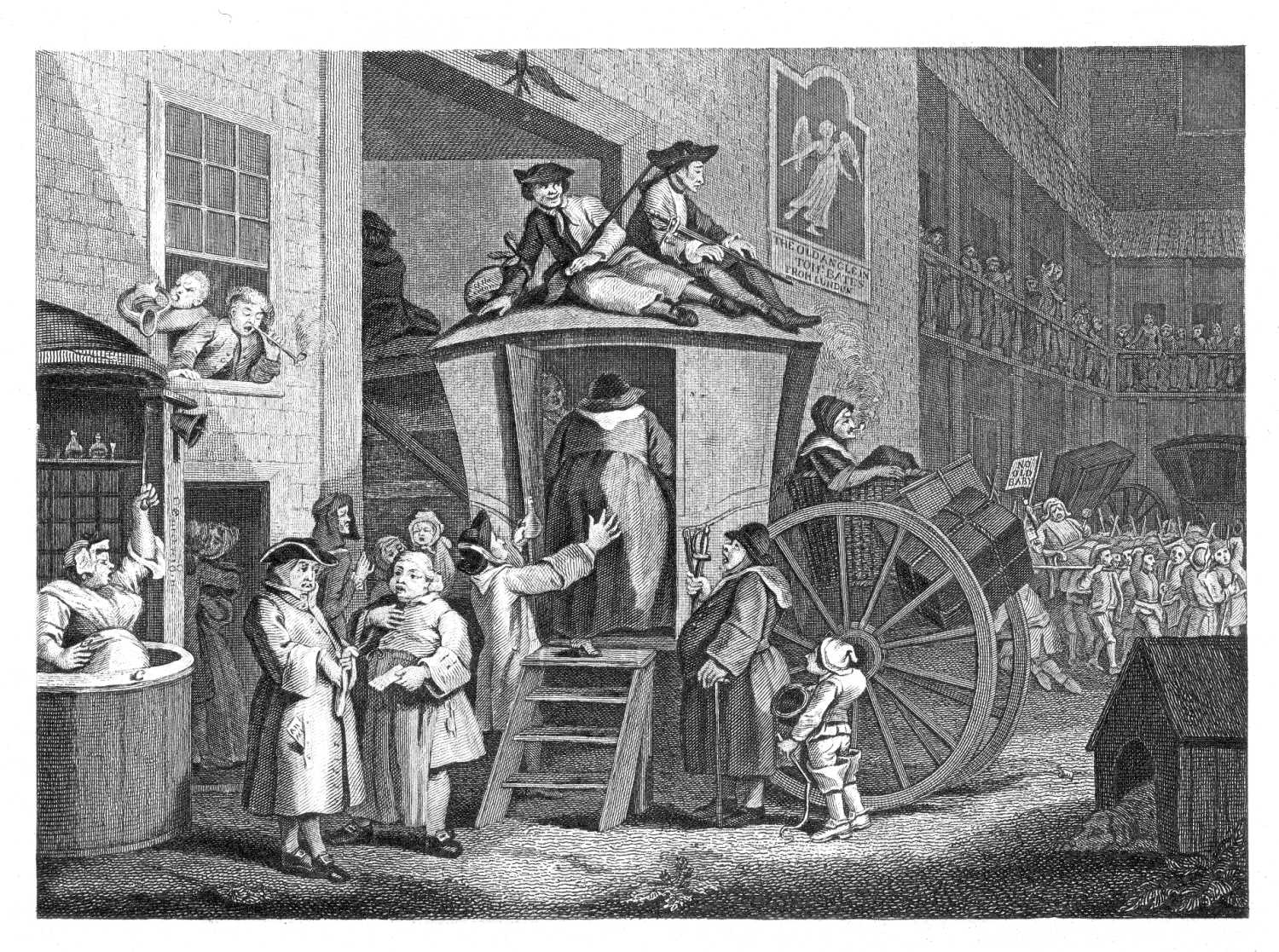 COUNTRY INN YARD.
As our future welfare depends, in a great measure, on our own conduct in the outset of life, and as we derive our best expectations of success from our own attention and exertion, it may, with propriety, be asserted, that the good or ill-fortune of mankind is chiefly attributable to their own early diligence or sloth; either of which becomes, through habit in the early part of life, both familiar and natural. This Mr. Hogarth has made appear in the following history of the two Apprentices, by representing a series of such scenes as naturally result from a course of Industry or Idleness, and which he has illustrated with such texts of scripture as teach us their analogy with holy writ. Now, as example is far more convincing and persuasive than precept, these prints are, undoubtedly, an excellent lesson to such young men as are brought up to business, by laying before them the inevitable destruction that awaits the slothful, and the reward that generally attends the diligent, both appropriately exemplified in the conduct of these two fellow-'prentices; where the one, by taking good courses, and pursuing those purposes for which he was put apprentice, becomes a valuable man, and an ornament to his country; the other, by giving way to idleness, naturally falls into poverty, and ends fatally, as shown in the last of these instructive prints.
In the chamber of the city of London, where apprentices are bound and enrolled, the twelve prints of this series are introduced, and, with great propriety, ornament the room.
"The drunkard shall come to poverty, and drowsiness shall clothe a man with rags."
Proverbs, chap. xxiii. verse 21.
"The hand of the diligent maketh rich."—Proverbs, chap. x. verse 4.
The first print presents us with a noble and striking contrast in two apprentices at the looms of their master, a silk-weaver of Spitalfields: in the one we observe a serene[Pg 86] and open countenance, the distinguishing mark of innocence; and in the other a sullen, down-cast look, the index of a corrupt mind and vicious heart. The industrious youth is diligently employed at his work, and his thoughts taken up with the business he is upon. His book, called the "'Prentice's Guide," supposed to be given him for instruction, lies open beside him, as if perused with care and attention. The employment of the day seems his constant study; and the interest of his master his continual regard. We are given to understand, also, by the ballads of the London 'Prentice, Whittingham the Mayor, &c. that hang behind him, that he lays out his pence on things that may improve his mind, and enlighten his understanding. On the contrary, his fellow-'prentice, with worn-out coat and uncombed hair, overpowered with beer, indicated by the half-gallon pot before him, is fallen asleep; and from the shuttle becoming the plaything of the wanton kitten, we learn how he slumbers on, inattentive alike to his own and his master's interest. The ballad of Moll Flanders, on the wall behind him, shows that the bent of his mind is towards that which is bad; and his book of instructions lying torn and defaced upon the ground, manifests how regardless he is of any thing tending to his future welfare.
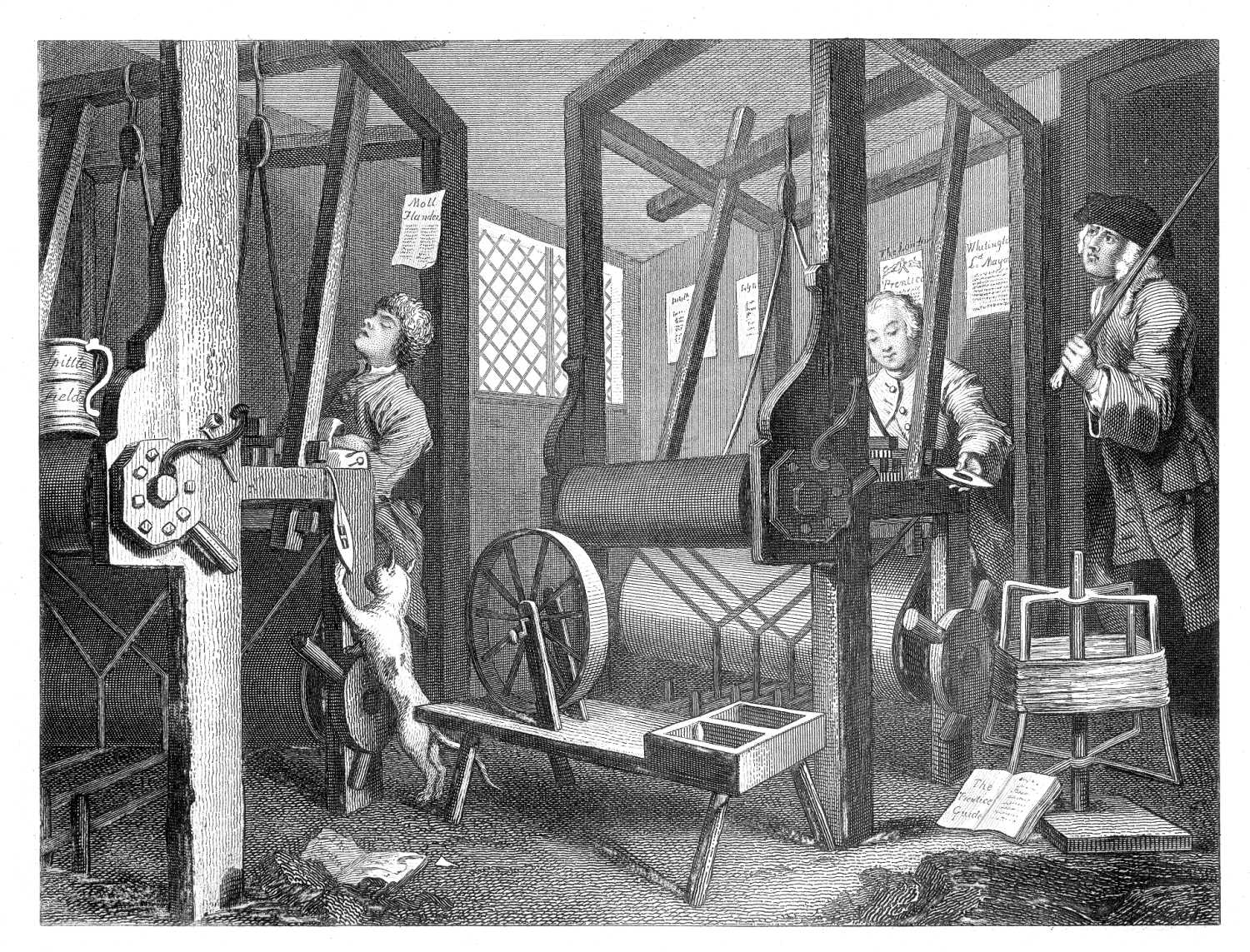 INDUSTRY AND IDLENESS.
"O how I love thy law; it is my meditation all the day."—Psalm cxix. verse 97.
This plate displays our industrious young man attending divine service in the same pew with his master's daughter, where he shows every mark of decent and devout attention.
Mr. Hogarth's strong bias to burlesque was not to be checked by time or place. It is not easy to imagine any thing more whimsically grotesque than the female Falstaff. A fellow near her, emulating the deep-toned organ, and the man beneath, who, though asleep, joins his sonorous tones in melodious chorus with the admirers of those two pre-eminent poets, Hopkins and Sternhold. The pew-opener is a very prominent and principal figure; two old women adjoining Miss West's seat are so much in shadow, that we are apt to overlook them: they are, however, all three making the dome ring with their exertions.
The preacher, reader, and clerk, with many of the small figures in the gallery and beneath, are truly ludicrous, and we regret their being on so reduced a scale, that they are scarce perceptible to the naked eye. It was necessary that the artist should exhibit a crowded congregation; but it must be acknowledged he has neglected the rules of perspective. The print wants depth. In the countenance of Miss West and her lover there is a resemblance. Their faces have not much expression; but this is atoned for by a natural and pleasing simplicity. Character was not necessary.
 INDUSTRY AND IDLENESS.
"Judgments are prepared for scorners, and stripes for the back of fools."
Proverbs, chap. xix. verse 29.
As a contrast to the preceding plate, of the industrious young man performing the duties of a Christian, is this, representing the idle 'prentice at play in the church-yard during divine service. As an observance of religion is allowed to be the foundation of virtue, so a neglect of religious duties has ever been acknowledged the forerunner of every wickedness; the confession of malefactors at the place of execution being a melancholy confirmation of this truth. Here we see him, while others are intent on the holy service, transgressing the laws both of God and man, gambling on a tomb-stone with the off-scouring of the people, the meanest of the human species, shoe-blacks, chimney-sweepers, &c. for none but such would deign to be his companions. Their amusement seems to be the favourite old English game of hustle-cap, and our idle and unprincipled youth is endeavouring to cheat, by concealing some of the half-pence under the broad brim of his hat. This is perceived by the shoe-black, and warmly resented by the fellow with the black patch over his eye, who loudly insists on the hat's being fairly removed. The eager anxiety which marks these mean gamblers, is equal to that of two peers playing for an estate. The latter could not have more solicitude for the turn of a die which was to determine who was the proprietor of ten thousand acres, than is displayed in the countenance of young Idle. Indeed, so callous is his heart, so wilfully blind is he to every thing tending to his future welfare, that the tombs, those standing monuments of mortality, cannot move him: even the new-dug grave, the sculls and bones, those lively and awakening monitors, cannot rouse him from his sinful lethargy, open his eyes, or pierce his heart with the least reflection; so hardened is he with vice, and so intent on the pursuit of his evil course. The hand of the boy, employed upon[Pg 90] his head, and that of the shoe-black, in his bosom, are expressive of filth and vermin; and show that our hero is within a step of being overspread with the beggarly contagion. His obstinate continuance in his course, until awakened by the blows of the watchful beadle, point out to us, that "stripes are prepared for the backs of fools;" that disgrace and infamy are the natural attendants of the slothful and the scorner; and that there are but little hopes of his alteration, until he is overtaken in his iniquity, by the avenging hand of Omnipotence, and feels with horror and amazement, the unexpected and inevitable approach of death. Thus do the obstinate and incorrigible shut their ears against the alarming calls of Providence, and sin away even the possibility of salvation.
The figures in this print are admirably grouped, and the countenances of the gamblers and beadle strikingly characteristic.
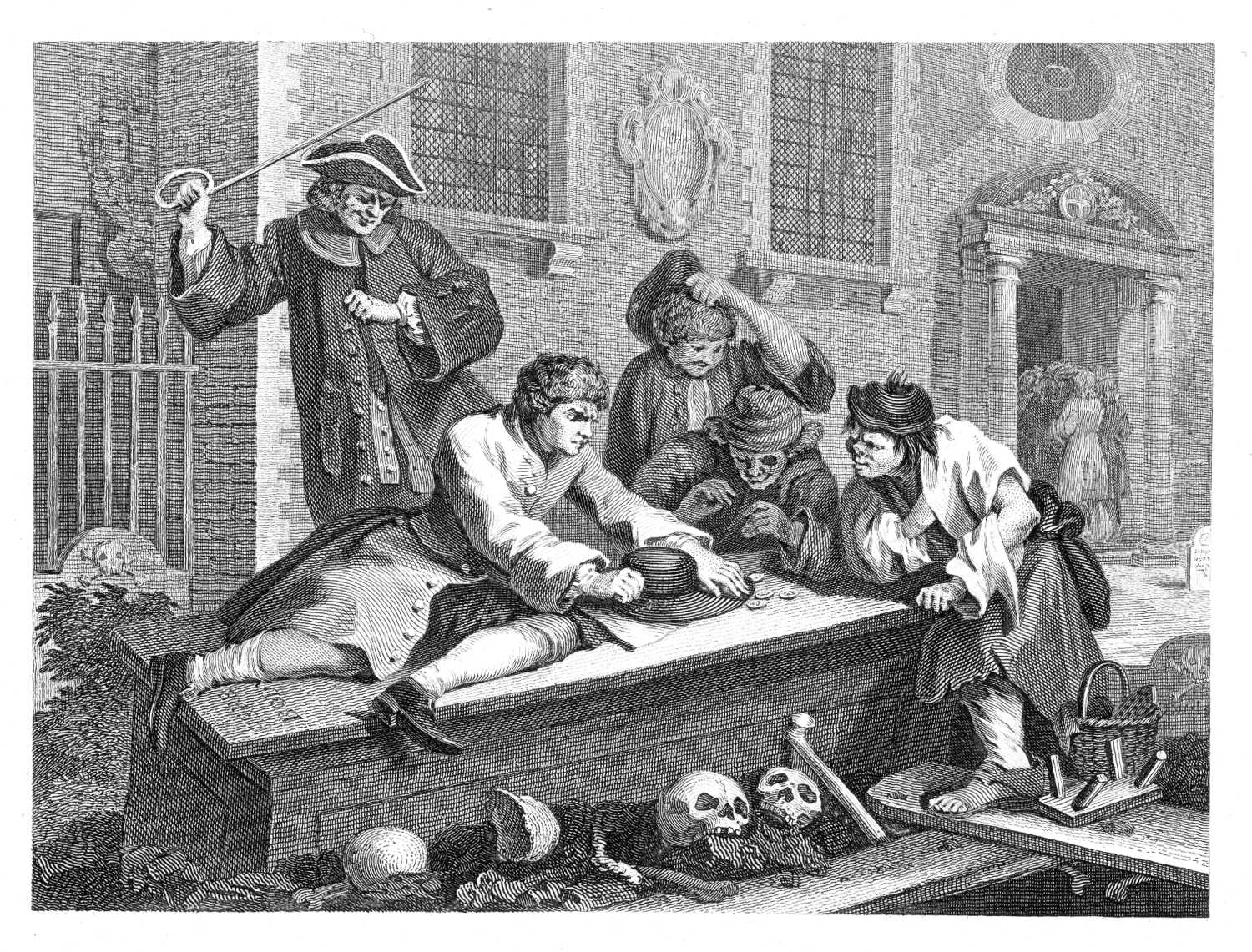 INDUSTRY AND IDLENESS.
"Well done, thou good and faithful servant; thou hast been faithful over a few things, I will make thee ruler over many things." Matthew, chap. xxv. verse 21.
The industrious apprentice, by a discreet and steady conduct, attracts the notice of his master, and becomes a favourite: accordingly, we behold him here (exquisitely continued from the first and second prints) in the counting-house (with a distant view of the looms, and of the quilsters, winding quills for the shuttles, from whence he was removed) entrusted with the books, receiving and giving orders, (the general reward of honesty, care, and diligence,) as appears from the delivery of some stuffs by a city porter, from Blackwell-hall. By the keys in one hand and the bag in the other, we are shown that he has behaved himself with so much prudence and discretion, and given such proofs of fidelity, as to become the keeper of untold gold: the greatest mark of confidence he could be favoured with. The integrity of his heart is visible in his face. The modesty and tranquillity of his countenance tell us, that though the great trust reposed in him is an addition to his happiness, yet, that he discharges his duty with such becoming diffidence and care, as not to betray any of that pride which attends so great a promotion. The familiar position of his master, leaning on his shoulder, is a further proof of his esteem, declaring that he dwells, as it were, in his bosom, and possesses the utmost share of his affection; circumstances that must sweeten even a state of servitude, and make a pleasant and lasting impression on the mind. The head-piece to the London Almanack, representing Industry taking Time by the fore-lock, is not the least of the beauties in this plate, as it intimates the danger of delay, and advises us to make the best use of time, whilst we have it in our power; nor will the position of the gloves, on[Pg 92] the flap of the escritoire, be unobserved by a curious examiner, being expressive of that union that subsists between an indulgent master and an industrious apprentice.
The strong-beer nose and pimpled face of the porter, though they have no connexion with the moral of the piece, are a fine caricatura, and show that our author let slip no opportunity of ridiculing the vices and follies of the age, and particularly here, in laying before us the strange infatuation of this class of people, who, because a good deal of labour requires some extraordinary refreshment, will even drink to the deprivation of their reason, and the destruction of their health. The surly mastiff, keeping close to his master, and quarrelling with the house-cat for admittance, though introduced to fill up the piece, represents the faithfulness of these animals in general, and is no mean emblem of the honesty and fidelity of the porter.
In this print, neither the cat, dog, nor the porter are well drawn, nor is much regard paid to perspective; but the general design is carried on by such easy and natural gradations, and the consequent success of an attentive conduct displayed in colours so plain and perspicuous, that these little errors in execution will readily be overlooked.
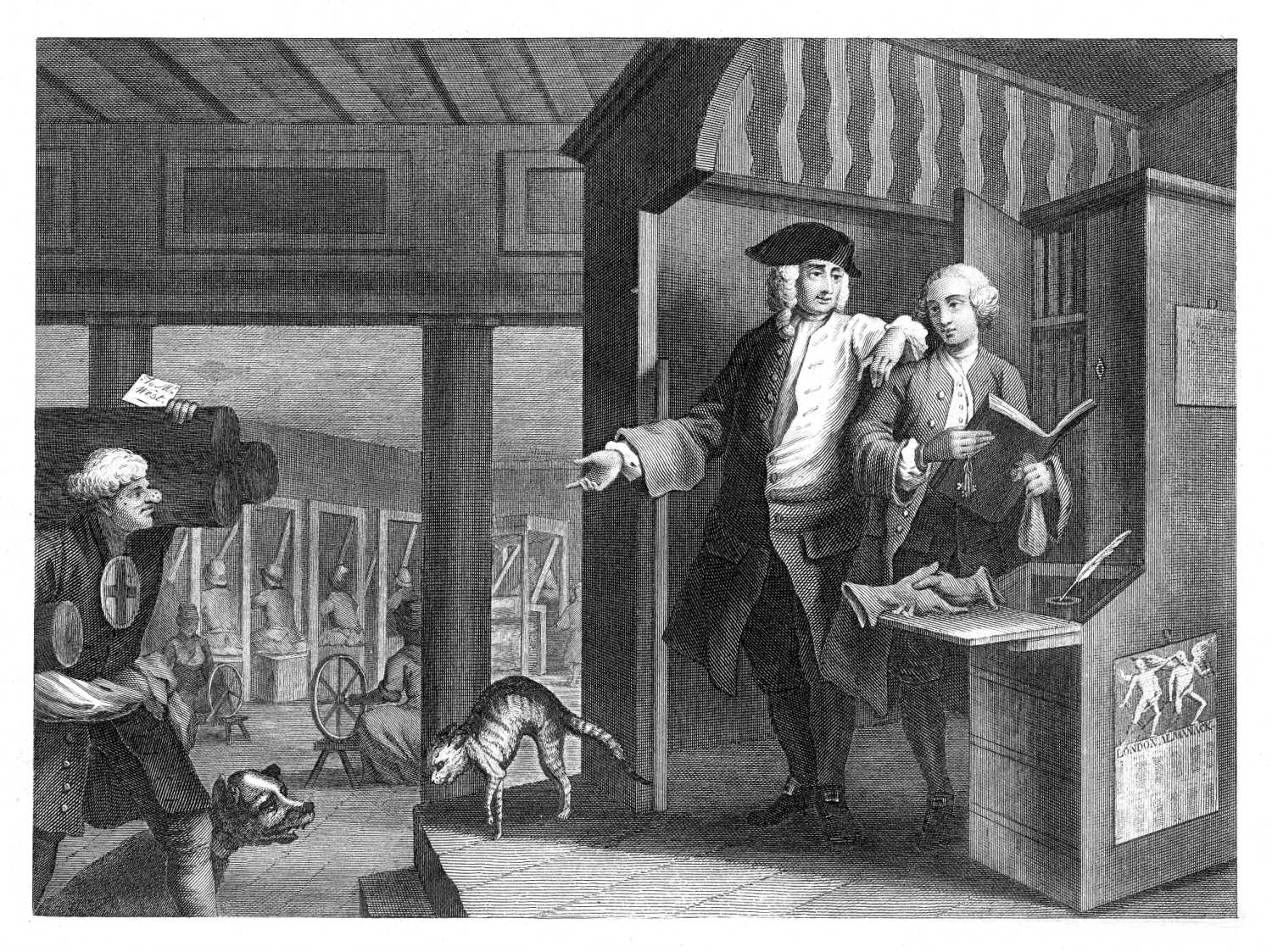 INDUSTRY AND IDLENESS.
"A foolish son is the heaviness of his mother." Proverbs, chap. x. verse 1.
Corrupted by sloth and contaminated by evil company, the idle apprentice, having tired the patience of his master, is sent to sea, in the hope that the being removed from the vices of the town, and the influence of his wicked companions, joined with the hardships and perils of a seafaring life, might effect that reformation of which his friends despaired while he continued on shore. See him then in the ship's boat, accompanied by his afflicted mother, making towards the vessel in which he is to embark. The disposition of the different figures in the boat, and the expression of their countenances, tell us plainly, that his evil pursuits and incorrigible wickedness are the subjects of their discourse. The waterman significantly directs his attention to a figure on a gibbet, as emblematical of his future fate, should he not turn from the evil of his ways; and the boy shows him a cat-o'-nine-tails, expressive of the discipline that awaits him on board of ship; these admonitions, however, he notices only by the application of his fingers to his forehead, in the form of horns, jestingly telling them to look at Cuckold's Point, which they have just passed; he then throws his indentures into the water with an air of contempt, that proves how little he is affected by his present condition, and how little he regards the persuasions and tears of a fond mother, whose heart seems ready to burst with grief at the fate of her darling son, and perhaps her only stay; for her dress seems to intimate that she is a widow. Well then might Solomon say, that "a foolish son is the heaviness of his mother;" for we here behold her who had often rejoiced in the prospect of her child being a prop to her in the decline of life, lamenting his depravity, and anticipating with horror the termination of his evil course. One would naturally imagine, from the common course of things, that this scene would have awakened his reflection, and been the means of softening the rugged[Pg 94]ness of his disposition,—that some tender ideas would have crossed his mind and melted the obduracy of his heart; but he continues hardened and callous to every admonition.
The group of figures composing this print has been copied by the ingenious Lavater; with whose appropriate remarks we conclude our present description. "Observe," says this great analyst of the human countenance, "in the annexed group, that unnatural wretch, with the infernal visage, insulting his supplicating mother; the predominant character on the three other villain-faces, though all disfigured by effrontery, is cunning and ironical malignity. Every face is a seal with this truth engraved on it: 'Nothing makes a man so ugly as vice; nothing renders the countenance so hideous as villainy.'"
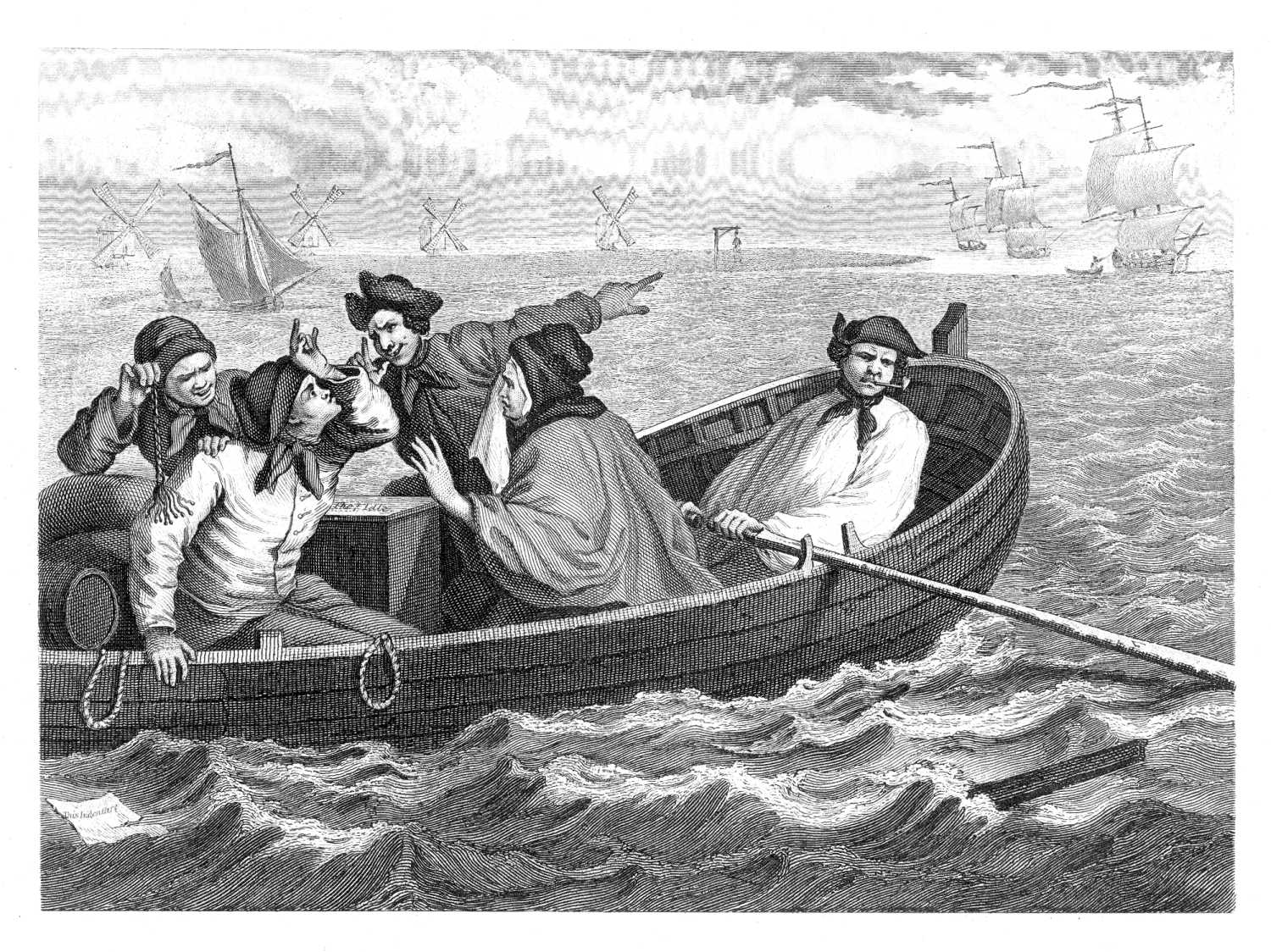 INDUSTRY AND IDLENESS.
"The virtuous woman is a crown to her husband." Proverbs, chap. xiii. verse 4.
The reward of industry is success. Our prudent and attentive youth is now become partner with his master, and married to his daughter. The sign, by which this circumstance is intimated, was at first inscribed Goodchild and West. Some of Mr. Hogarth's city friends informing him that it was usual for the senior partner's name to precede, it was altered.
To show that plenty reigns in this mansion, a servant distributes the remains of the table to a poor woman, and the bridegroom pays one of the drummers, who, according to ancient custom, attend with their thundering gratulations the day after a wedding. A performer on the bass viol, and a herd of butchers armed with marrow-bones and cleavers, form an English concert. (Madame Pompadour, in her remarks on the English taste for music, says, they are invariably fond of every thing that is full in the mouth.) A cripple with the ballad of Jesse, or the Happy Pair, represents a man known by the name of Philip in the Tub, who had visited Ireland and the United Provinces; and, in the memory of some persons now living, was a general attendant at weddings. From those votaries of Hymen who were honoured with his epithalamiums, he received a small reward. To show that Messrs. West and Goodchild's habitation is near the monument, the base of that stately column appears in the back-ground. The inscription which until lately graced this structure, used to remind every reader of Pope's lines,
The duke of Buckingham's epigram on this magnificent pillar is not so generally known:
A footman and butcher, at the opposite corner, compared with the other figures, are gigantic; they might serve for the Gog and Magog of Guildhall.
It has been said that the thoughts in this print are trite, and the actions mean, which must be in part acknowledged, but they are natural, and appropriate to the rank and situation of the parties, and to the fashions of the time at which it was published.
 INDUSTRY AND IDLENESS.
"The sound of a shaken leaf shall chase him." Leviticus, chap. xxvi. verse 26.
The idle apprentice, as appears by this print, is advancing with rapid strides towards his fate. We are to suppose him returned from sea after a long voyage; and to have met with such correction abroad for his obstinacy, during his absence from England, that though it was found insufficient to alter his disposition, yet it determined him to pursue some other way of life; and what he entered on is here but too evident (from the pistols by the bed-side, and the trinkets his companion is examining, in order to strip him of) to be that of the highway. He is represented in a garret, with a common prostitute, the partaker of his infamy, awaking, after a night spent in robbery and plunder, from one of those broken slumbers which are ever the consequences of a life of dishonesty and debauchery. Though the designs of Providence are visible in every thing, yet they are never more conspicuous than in this,—that whatever these unhappy wretches possess by wicked and illegal means, they seldom comfortably enjoy. In this scene we have one of the finest pictures imaginable of the horrors of a guilty conscience. Though the door is fastened in the strongest manner with a lock and two bolts, and with the addition of some planks from the flooring, so as to make his retreat as secure as possible; though he has attempted to drive away thought by the powerful effects of spirituous liquors, plain from the glass and bottle upon the floor, still he is not able to brave out his guilt, or steel his breast against reflection. Behold him roused by the accidental circumstance of a cat's coming down the chimney, and the falling of a few bricks, which he believes to be the noise of his pursuers! Observe his starting up in bed, and all the tortures of his mind imprinted in his face! He first stiffens into[Pg 98] stone, then all his nerves and muscles relax, a cold sweat seizes him, his hair stands on end, his teeth chatter, and dismay and horror stalk before his eyes. How different is the countenance of his wretched bed-fellow! in whom unconcern and indifference to every thing but the plunder are plainly apparent. She is looking at an ear-ring, which, with two watches, an etwee, and a couple of rings, are spread upon the bed, as part of last night's plunder. The phials on the mantel-piece show that sickness and disease are ever attendant on prostitution; and the beggarly appearance of the room, its wretched furniture, the hole by way of window, (by the light of which she is examining her valuable acquisition, and against which she had hung her old hoop-petticoat in order to keep out the cold,) and the rat's running across the floor, are just and sufficient indications that misery and want are the constant companions of a guilty life.
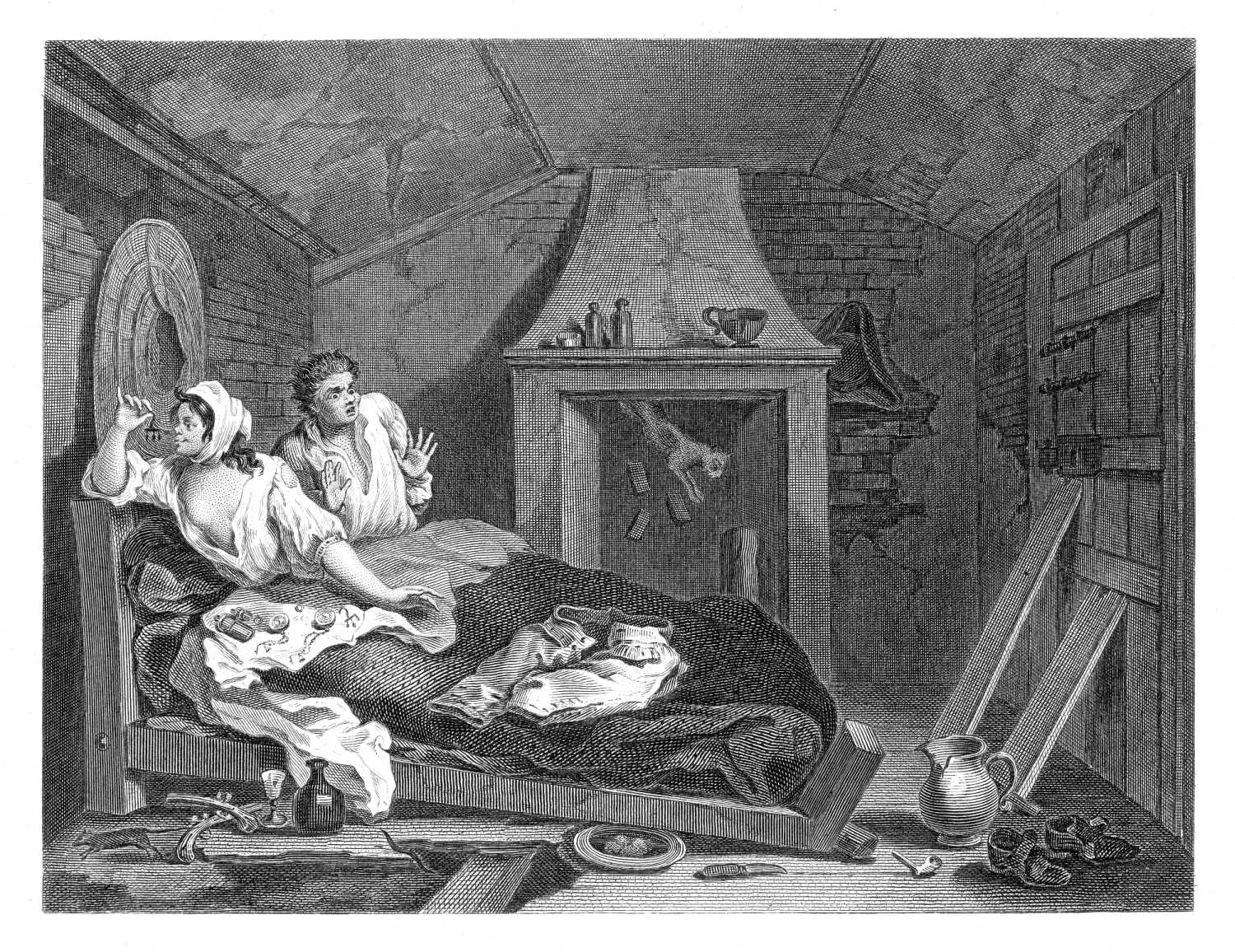 INDUSTRY AND IDLENESS.
'With all thy gettings get understanding. Exalt her and she shall promote thee; she shall bring thee to honour, when thou dost embrace her.' Proverbs, chap. iv. verse 7, 8.
From industry become opulent, from integrity and punctuality respectable, our young merchant is now sheriff of London, and dining with the different companies in Guildhall. A group on the left side are admirably characteristic; their whole souls seem absorbed in the pleasures of the table. A divine, true to his cloth, swallows his soup with the highest goût. Not less gratified is the gentleman palating a glass of wine. The man in a black wig is a positive representative of famine; and the portly and oily citizen, with a napkin tucked in his button-hole, has evidently burnt his mouth by extreme eagerness.
The backs of those in the distance, behung with bags, major perukes, pinners, &c. are most laughably ludicrous. Every person present is so attentive to business, that one may fairly conclude they live to eat, rather than eat to live.
But though this must be admitted to be the case with this party, the following instance of city temperance proves that there are some exceptions. When the Lord Mayor, Sheriffs, Aldermen, Chamberlain, &c. of the city of London were once seated round the table at a public and splendid dinner at Guildhall, Mr. Chamberlain Wilkes lisped out, "Mr. Alderman B——, shall I help you to a plate of turtle, or a slice of the haunch,—I am within reach of both, sir?" "Neither one nor t'other, I thank you, Sir," replied the Alderman, "I think I shall dine on the beans and bacon which are at this end of the table." "Mr. Alderman A——," continued the Chamberlain, "which would you choose, sir?" "Sir, I will not trouble you for either, for I believe I shall follow the example of my brother B——, and dine on beans and bacon," was the reply. On this second refusal the old Chamberlain rose from his seat, and, with every mark of[Pg 100] astonishment in his countenance, curled up the corners of his mouth, cast his eyes round the table, and in a voice as loud and articulate as he was able, called "Silence!" which being obtained, he thus addressed the pretorian magistrate, who sat in the Chair: "My Lord Mayor, the wicked have accused us of intemperance, and branded us with the imputation of gluttony; that they may be put to open shame, and their profane tongues be from this day utterly silenced, I humbly move, that your Lordship command the proper officer to record in our annals, that two Aldermen of the city of London prefer beans and bacon to either turtle soup or venison."
Notwithstanding all this, there are men, who, looking on the dark side, and perhaps rendered splenetic, and soured by not being invited to these sumptuous entertainments, have affected to fear, that their frequent repetition would have a tendency to produce a famine, or at least to check the increase, if not extirpate the species, of those birds, beasts, and fish, with which the tables of the rich are now so plentifully supplied. But these half reasoners do not take into their calculation the number of gentlemen so laudably associated for encouraging cattle being fed so fat that there is no lean left; or that more ancient association, sanctioned and supported by severe acts of parliament, for the preservation of the game. From the exertions of these and similar societies, we may reasonably hope there is no occasion to dread any such calamity taking place; though the Guildhall tables often groaning under such hecatombs as are recorded in the following account, may make a man of weak nerves and strong digestion, shake his head, and shudder a little. "On the 29th October, 1727, when George II. and Queen Caroline honoured the city with their presence at Guildhall, there were 19 tables, covered with 1075 dishes. The whole expense of this entertainment to the city was 4889l. 4s."
To return to the print;—a self-sufficient and consequential beadle, reading the direction of a letter to Francis Goodchild, Esq. Sheriff of London, has all the insolence of office. The important and overbearing air of this dignified personage is well contrasted by the humble simplicity of the straight-haired messenger behind the bar. The gallery is well furnished with musicians busily employed in their vocation.
Besides a portrait of William the Third, and a judge, the hall is ornamented with a full length of that illustrious hero Sir William Walworth, in commemoration of whose valour the weapon with which he slew Wat Tyler was introduced into the city arms.
 INDUSTRY AND IDLENESS.
"The adulteress will hunt for precious life." Proverbs, chap. vi. verse 26.
From the picture of the reward of diligence, we return to take a further view of the progress of sloth and infamy; by following the idle 'prentice a step nearer to the approach of his unhappy end. We see him in the third plate herding with the worst of the human species, the very dregs of the people; one of his companions, at that time, being a one-eyed wretch, who seemed hackneyed in the ways of vice. To break this vile connexion he was sent to sea; but, no sooner did he return, than his wicked disposition took its natural course, and every day he lived served only to habituate him to acts of greater criminality. He presently discovered his old acquaintance, who, no doubt, rejoiced to find him so ripe for mischief: with this worthless, abandoned fellow, he enters into engagements of the worst kind, even those of robbery and murder. Thus blindly will men sometimes run headlong to their own destruction.
About the time when these plates were first published, which was in the year 1747, there was a noted house in Chick Lane, Smithfield, that went by the name of the Blood-Bowl House, so called from the numerous scenes of blood that were almost daily carried on there; it being a receptacle for prostitutes and thieves; where every species of delinquency was practised; and where, indeed, there seldom passed a month without the commission of some act of murder. To this subterraneous abode of iniquity (it being a cellar) was our hero soon introduced; where he is now represented in company with his accomplice, and others of the same stamp, having just committed a most horrid act of barbarity, (that of killing a passer-by, and conveying him into a place under ground, contrived for this purpose,) dividing among them the ill-gotten booty, which consists of[Pg 102] two watches, a snuff-box, and some other trinkets. In the midst of this wickedness, he is betrayed by his strumpet (a proof of the treachery of such wretches) into the hands of the high constable and his attendants, who had, with better success than heretofore, traced him to this wretched haunt. The back-ground of this print serves rather as a representation of night-cellars in general, those infamous receptacles for the dissolute and abandoned of both sexes, than a further illustration of our artist's chief design; however, as it was Mr. Hogarth's intention, in the history before us, to encourage virtue and expose vice, by placing the one in an amiable light, and exhibiting the other in its most heightened scenes of wickedness and impiety, in hopes of deterring the half-depraved youth of this metropolis, from even the possibility of the commission of such actions, by frightening them from these abodes of wretchedness; as this was manifestly his intention, it cannot be deemed a deviation from the subject. By the skirmish behind, the woman without a nose, the scattered cards upon the floor, &c. we are shown that drunkenness and riot, disease, prostitution, and ruin are the dreadful attendants of sloth, and the general fore-runners of crimes of the deepest die; and by the halter suspended from the ceiling, over the head of the sleeper, we are to learn two things—the indifference of mankind, even in a state of danger, and the insecurity of guilt in every situation.
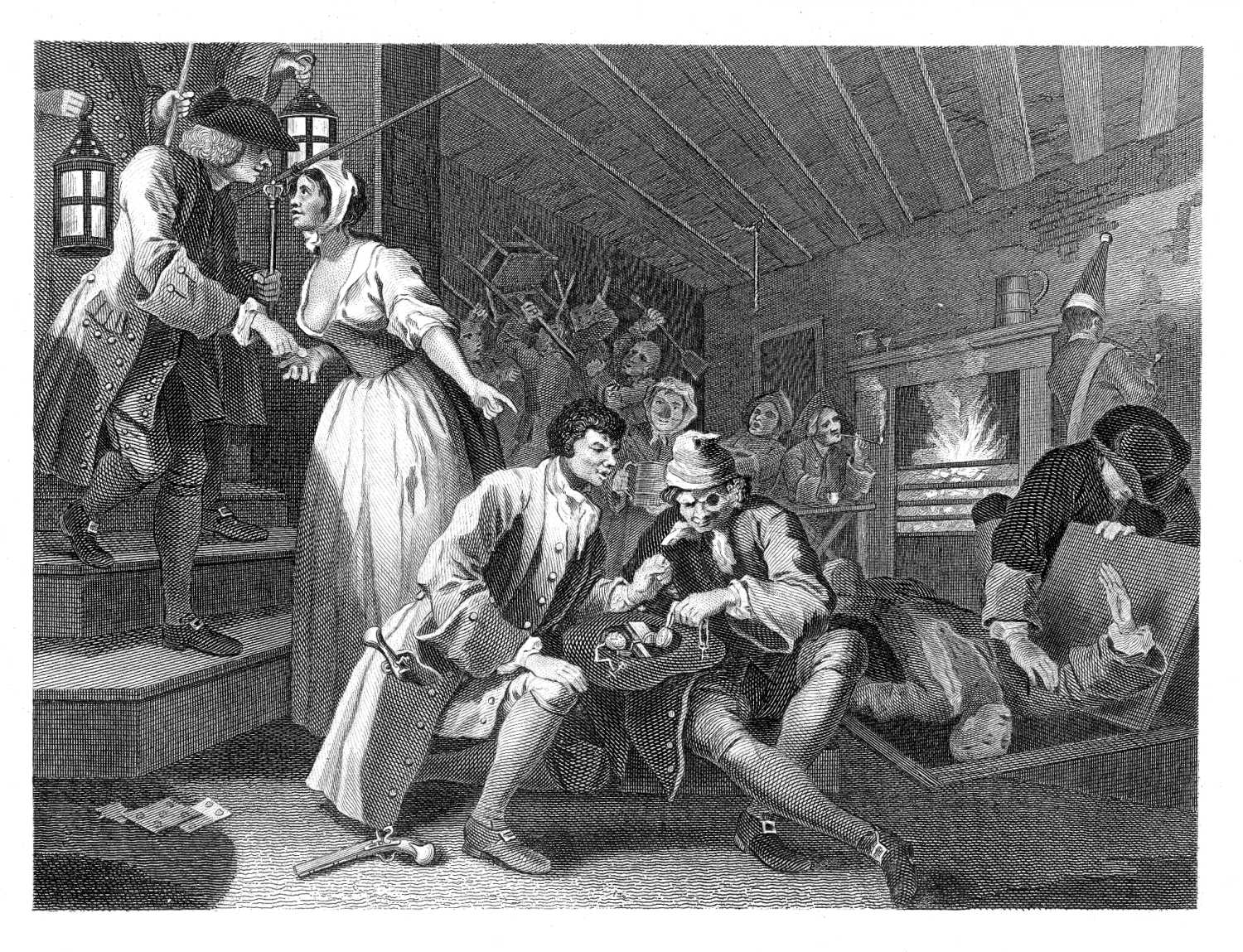 INDUSTRY AND IDLENESS.
"Thou shalt do no unrighteousness in judgment." Leviticus, chap. xix. verse 15.
"The wicked is snared in the work of his own hands." Psalms, chap. ix. verse 16.
Imagine now this depraved and atrocious youth hand-cuffed, and dragged from his wicked haunt, through the streets to a place of security, amidst the scorn and contempt of a jeering populace; and thence brought before the sitting magistrate, (who, to heighten the scene and support the contrast, is supposed to be his fellow-'prentice, now chosen an alderman,) in order to be dealt with according to law. See him then at last having run his course of iniquity, fallen into the hands of justice, being betrayed by his accomplice; a further proof of the perfidy of man, when even partners in vice are unfaithful to each other. This is the only print among the set, excepting the first, where the two principal characters are introduced; in which Mr. Hogarth has shown his great abilities, as well in description, as in a particular attention to the uniformity and connexion of the whole. He is now at the bar, with all the marks of guilt imprinted on his face. How, if his fear will permit him to reflect, must he think on the happiness and exaltation of his fellow-'prentice on the one hand, and of his own misery and degradation on the other! at one instant, he condemns the persuasions of his wicked companions; at another, his own idleness and obstinacy: however, deeply smitten with his crime, he sues the magistrate, upon his knees, for mercy, and pleads in his cause the former acquaintance that subsisted between them, when they both dwelt beneath the same roof, and served the same common master: but here was no room for lenity, murder was his crime, and[Pg 104] death must be his punishment; the proofs are incontestable, and his mittimus is ordered, which the clerk is drawing out. Let us next turn our thoughts upon the alderman, in whose breast a struggle between mercy and justice is beautifully displayed. Who can behold the magistrate, here, without praising the man? How fine is the painter's thoughts of reclining the head on one hand, while the other is extended to express the pity and shame he feels that human nature should be so depraved! It is not the golden chain or scarlet robe that constitutes the character, but the feelings of the heart. To show us that application for favour, by the ignorant, is often idly made to the servants of justice, who take upon themselves on that account a certain state and consequence, not inferior to magistracy, the mother of our delinquent is represented in the greatest distress, as making interest with the corpulent self-swoln constable, who with an unfeeling concern seems to say, "Make yourself easy, for he must be hanged;" and to convince us that bribery will even find its way into courts of judicature, here is a woman feeing the swearing clerk, who has stuck his pen behind his ear that his hands might be both at liberty; and how much more his attention is engaged to the money he is taking, than to the administration of the oath, may be known from the ignorant, treacherous witness being suffered to lay his left hand upon the book; strongly expressive of the sacrifice, even of sacred things, to the inordinate thirst of gain.
From Newgate (the prison to which he was committed; where, during his continuance he lay chained in a dismal cell, deprived of the cheerfulness of light, fed upon bread and water, and left without a bed to rest on) the prisoner was removed to the bar of judgment, and condemned to die by the laws of his country.
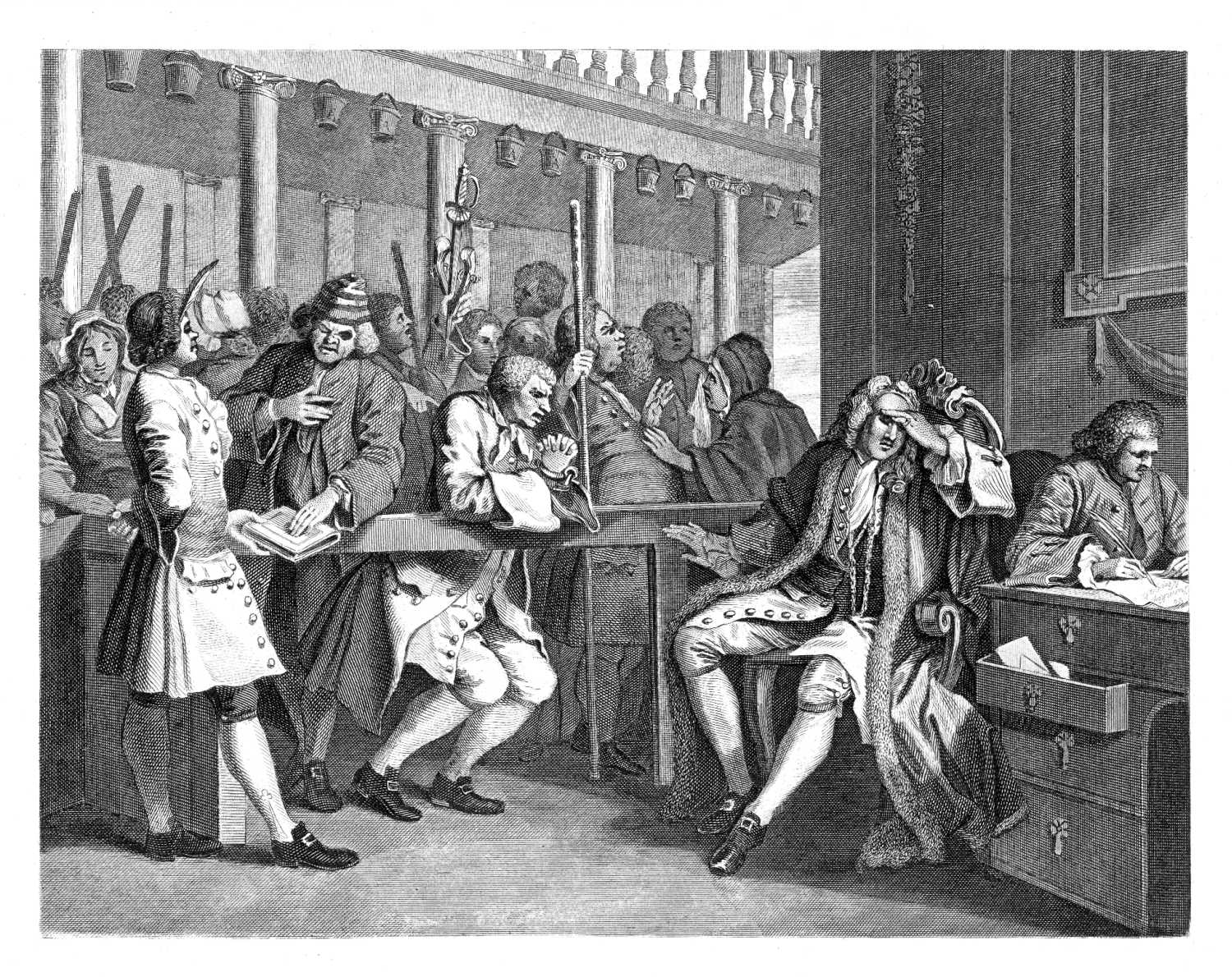 INDUSTRY AND IDLENESS.
"When fear cometh as desolation, and their destruction cometh as a whirlwind; when distress cometh upon them, then shall they call upon God, but he will not answer." Proverbs, chapter i. verse 7, 8.
Thus, after a life of sloth, wretchedness, and vice, does our delinquent terminate his career. Behold him, on the dreadful morn of execution, drawn in a cart (attended by the sheriff's officers on horseback, with his coffin behind him) through the public streets to Tyburn, there to receive the just reward of his crimes,—a shameful ignominious death. The ghastly appearance of his face, and the horror painted on his countenance, plainly show the dreadful situation of his mind; which we must imagine to be agitated with shame, remorse, confusion, and terror. The careless position of the Ordinary at the coach window is intended to show how inattentive those appointed to that office are of their duty, leaving it to others, which is excellently expressed by the itinerant preacher in the cart, instructing from a book of Wesley's. Mr. Hogarth has in this print, digressing from the history and moral of the piece, taken an opportunity of giving us a humorous representation of an execution, or a Tyburn Fair: such days being made holidays, produce scenes of the greatest riot, disorder, and uproar; being generally attended by hardened wretches, who go there, not so much to reflect upon their own vices, as to commit those crimes which must in time inevitably bring them to the same shameful end. In confirmation of this, see how earnestly one boy watches the motions of the man selling his cakes, while he is picking his pocket; and another waiting to receive the booty! We have here interspersed before us a deal of low humour, but such as is common on occasions like this. In one place we observe an old bawd turning up her eyes and drinking a glass of gin, the very picture of hypocrisy; and a man indecently helping up a girl into the same cart; in another, a soldier sunk up to his knees[Pg 106] in a bog, and two boys laughing at him, are well imagined. Here we see one almost squeezed to death among the horses; there, another trampled on by the mob. In one part is a girl tearing the face of a boy for oversetting her barrow; in another, a woman beating a fellow for throwing down her child. Here we see a man flinging a dog among the crowd by the tail; there a woman crying the dying speech of Thomas Idle, printed the day before his execution; and many other things too minute to be pointed out: two, however, we must not omit taking notice of, one of which is the letting off a pigeon, bred at the gaol, fly from the gallery, which hastes directly home; an old custom, to give an early notice to the keeper and others, of the turning off or death of the criminal; and that of the executioner smoking his pipe at the top of the gallows, whose position of indifference betrays an unconcern that nothing can reconcile with the shocking spectacle, but that of use having rendered his wretched office familiar to him; whilst it declares a truth, which every character in this plate seems to confirm, that a sad and distressful object loses its power of affecting by being frequently seen.
 INDUSTRY AND IDLENESS.
"Length of days is in her right hand, and in her left hand riches and honour." Proverbs, chap. iii. ver. 16.
Having seen the ignominious end of the idle apprentice, nothing remains but to represent the completion of the other's happiness; who is now exalted to the highest honour, that of Lord Mayor of London; the greatest reward that ancient and noble city can bestow on diligence and integrity. Our artist has here, as in the last plate, given a loose to his humour, in representing more of the low part of the Lord Mayor's show than the magnificent; yet the honour done the city, by the presence of the Prince and Princess of Wales, is not forgotten. The variety of comic characters in this print serves to show what generally passes on such public processions as these, when the people collect to gratify their childish curiosity, and indulge their wanton disposition, or natural love of riot. The front of this plate exhibits the oversetting of a board, on which some girls had stood, and represents them sprawling upon the ground; on the left, at the back of the scaffold, is a fellow saluting a fair nymph, and another enjoying the joke: near him is a blind man straggled in among the crowd, and joining in the general halloo: before him is a militia-man, so completely intoxicated as not to know what he is doing; a figure of infinite humour. Though Mr. Hogarth has here marked out two or three particular things, yet his chief intention was to ridicule the city militia, which was at this period composed of undisciplined men, of all ages, sizes, and height; some fat, some lean, some tall, some short, some crooked, some lame, and in general so unused to muskets, that they knew not how to carry them. One, we observe, is firing his piece and turning his head another way, at whom the man above is laughing, and at which the child is frightened. The boy on the right, crying, "A full and true account of the ghost of Thomas Idle," which is supposed to have appeared to the Mayor,[Pg 108] preserves the connexion of the whole work. The most obtrusive figure in his Lordship's coach is Mr. Swordbearer, in a cap like a reversed saucepan, which this great officer wears on these grand occasions. The company of journeymen butchers, with their marrow-bones and cleavers, appear to be the most active, and are by far the most noisy of any who grace this solemnity. Numberless spectators, upon every house and at every window, dart their desiring eyes on the procession; so great indeed was the interest taken by the good citizens of London in these civic processions that, formerly, it was usual in a London lease to insert a clause, giving a right to the landlord and his friends to stand in the balcony, during the time of "the shows or pastimes, upon the day commonly called the Lord Mayor's Day."
Thus have we seen, by a series of events, the prosperity of the one and the downfall of the other; the riches and honour that crown the head of industry, and the ignominy and destruction that await the slothful. After this it would be unnecessary to say which is the most eligible path to tread. Lay the roads but open to the view, and the traveller will take the right of course; give but the boy this history to peruse, and his future welfare is almost certain.
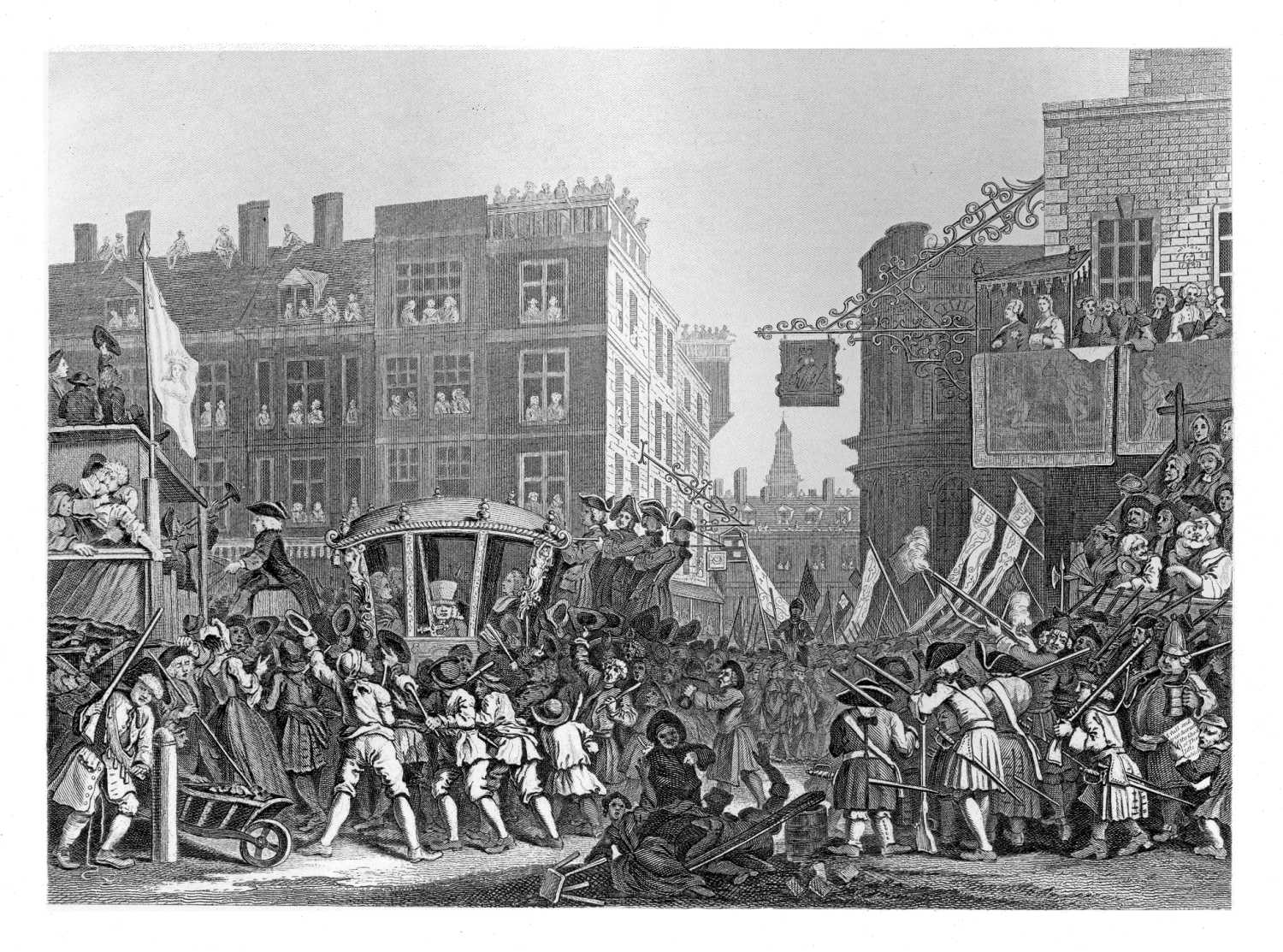 INDUSTRY AND IDLENESS.
The subject of the plate under consideration is that of the Borough Fair; a fair held some time since in the Borough of Southwark, though now suppressed. This fair was attended, generally, by the inhabitants of town and country, and, therefore, was one that afforded great variety; especially as, before its suppression, it was devoted to every thing loose and irregular. A view of the scene, of which the following print is a faithful representation, will affirm this truth.
The principal view upon the left represents the fall of a scaffold, on which was assembled a strolling company, pointed out, by the paper lantern hanging in front, to be that belonging to Cibber and Bullock, ready dressed to exhibit "The Fall of Bajazet." Here we see merry-andrews, monkeys, queens and emperors, sinking in one general confusion; and, that the crash may appear the greater, the stand beneath is humorously supposed to consist of earthenware and china. Notwithstanding this fatal overthrow, few below are seen to notice it; witness the boys and woman gambling at the box and dice, the upright monkey, and the little bag-piper dancing his wooden figures. Above this scaffold hangs a painting, the subject of which is the stage mutiny; whose figures are as follow:—On one side is Pistol, (strutting and crying out, "Pistol's alive,") Falstaff, Justice Shallow, and many other characters of Shakspeare. On the other, the manager bearing in his hand a paper, on which is written, "it cost 6000l." a scene-painter, who has laid his brushes aside, and taken up a cudgel; and a woman holding an ensign, bearing the words, "We'll starve 'em out." In the corner is a man, quiet and snug, hugging a bag of money, laughing at the folly of the rest; and behind, a monkey, perched upon a sign iron, supposed to be that of the Rose Tavern in Drury-lane, squeaking out, "I am a gentleman." These paintings are in general designed to show what is exhibited within; but this alludes to a dispute that arose at the time when this print was published, which was in the year 1733, between the players and the patentee of Drury-lane Theatre, when young Cibber, the son of the[Pg 110] Laureate, was at the head of the faction. Above, on one side, is an equilibrist swinging on a slack rope; and on the other, a man flying from the tower to the ground, by means of a groove fastened to his breast, slipping over a line strained from one place to the other. At the back of this plate is Lee and Harper's great booth, where, by the picture of the wooden horse, we are told, is represented "The Siege of Troy." The next paintings consist of the fall of Adam and Eve, and a scene in Punch's opera. Beneath is a mountebank, exalted on a stage, eating fire to attract the public attention; while his merry-andrew behind is distributing his medicines. Further back is a shift and hat, carried upon poles, designed as prizes for the best runner or wrestler. In front is a group of strollers parading the fair, in order to collect an audience for their next exhibition; in which is a female drummer, at that time well known, and remarked for her beauty, which we observe has caught the eye of two countrymen, the one old, the other young. Behind these men is a buskined hero, beset by a Marshalsea Court officer and his follower. To the right is a Savoyard exhibiting her farthing show; and behind, a player at back sword riding a blind horse round the fair triumphantly, in all the boast of self-important heroism, affecting terror in his countenance, glorying in his scars, and challenging the world to open combat: a folly for which the English were remarkable. To this man a fellow is directing the attention of a country gentleman, while he robs him of his handkerchief. Next him is an artful villain decoying a couple of unthinking country girls to their ruin. Further back is a man kissing a wench in the crowd; and above, a juggler performing some dexterity of hand. Indeed it would be tedious to enter into an enumeration of the various matter of this plate; it is sufficient to remark that it presents us with an endless collection of spirited and laughable characters, in which is strikingly portrayed the character of the times.
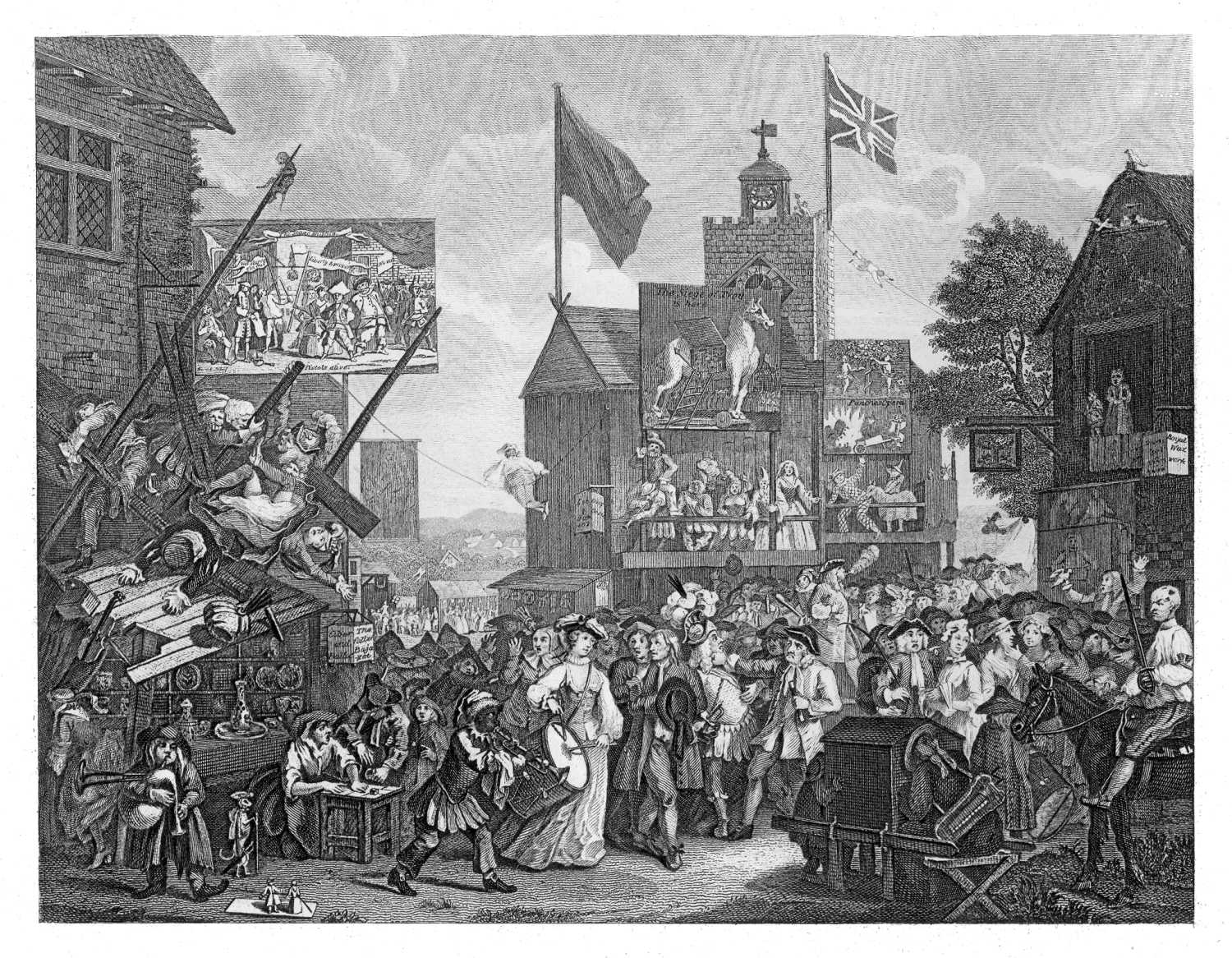 SOUTHWARK FAIR.
Such is the exclamation of Richard, and such is the disposition of his mind at the moment of this delineation. The lamp, diffusing a dim religious light through the tent, the crucifix placed at his head, the crown, and unsheathed sword at his hand, and the armour lying on the ground, are judicious and appropriate accompaniments. Those who are acquainted with this prince's history, need not be told that he was naturally bold, courageous, and enterprising; that when business called him to the field, he shook off every degree of indulgence, and applied his mind to the management of his affairs. This may account for his being stripped no otherwise than of his armour, having retired to his tent in order to repose himself upon his bed, and lessen the fatigues of the preceding day. See him then hastily rising, at dead of night, in the utmost horror from his own thoughts, being terrified in his sleep by the dreadful phantoms of an affrighted imagination, seizing on his sword, by way of defence against the foe his disordered fancy presents to him. So great is his agitation, that every nerve and muscle is in action, and even the ring is forced from his finger. When the heart is affected, how great is its influence on the human frame!—it communicates its sensibility to the extreme parts of the body, from the centre to the circumference; as distant water is put in motion by circles, spreading from the place of its disturbance. The paper on the floor containing these words,
brought him by the Duke of Norfolk, saying he found it in his tent, and lying here unattended to, as a mark of contempt, plainly informs us that however a man may[Pg 112] attempt to steel himself against the arrows of conscience, still they will find a way to his breast, and shake the sinner even in his greatest security. And indeed we cannot wonder, when we reflect on the many murders he was guilty of, deserving the severest punishment; for Providence has wisely ordained that sin should be its own tormentor, otherwise, in many cases, the offender would, in this life, escape unpunished, and the design of heaven be frustrated. But Richard, though he reached a throne, and by that means was exempt from the sufferings of the subject, yet could not divest himself of his nature, but was forced to give way to the workings of the heart, and bear the tortures of a distracted mind. The expression in his face is a master-piece of execution, and was a great compliment paid by Mr. Hogarth to his friend Garrick; yet not unmerited, as all that have seen him in the part must acknowledge the greatness of the actor. The figures in the distance, two of whom,
are properly introduced, and highly descriptive.
The tents of Richmond are so near
Considered as a whole, the composition is simple, striking, and original, and the figures well drawn. The whole moral tenour of the piece informs us that conscience is armed with a thousand stings, from which royalty itself is not secure; that of all tormentors, reflection is the worst; that crowns and sceptres are baubles, compared with self-approbation; and that nought is productive of solid happiness, but inward peace and serenity of mind.
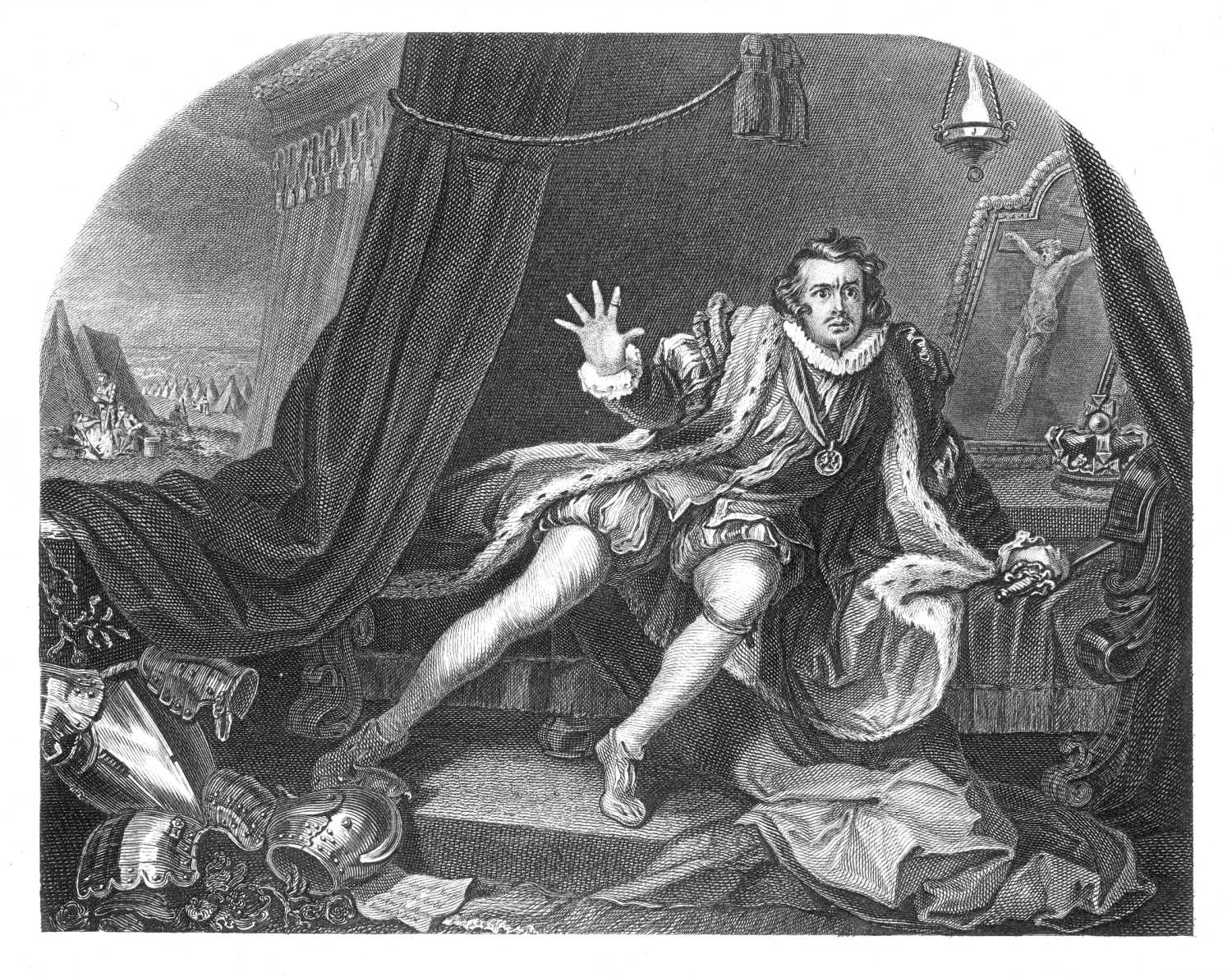 GARRICK.
In the two following designs, Mr. Hogarth has displayed that partiality for his own country and contempt for France, which formed a strong trait in his character. He neither forgot nor forgave the insults he suffered at Calais, though he did not recollect that this treatment originated in his own ill humour, which threw a sombre shade over every object that presented itself. Having early imbibed the vulgar prejudice that one Englishman was a match for four Frenchmen, he thought it would be doing his country a service to prove the position. How far it is either useful or politic to depreciate the power, or degrade the character of that people with whom we are to contend, is a question which does not come within the plan of this work. In some cases it may create confidence, but in others lead to the indulgence of that negligent security by which armies have been slaughtered, provinces depopulated, and kingdoms changed their rulers.
The scenes of all Mr. Hogarth's prints, except The Gate of Calais, and that now under consideration, are laid in England. In this, having quitted his own country, he seems to think himself out of the reach of the critics, and, in delineating a Frenchman, at liberty to depart from nature, and sport in the fairy regions of caricature. Were[Pg 114] these Gallic soldiers naked, each of them would appear like a forked radish, with a head fantastically carved upon it with a knife: so forlorn! that to any thick sight he would be invisible. To see this miserable woe-begone refuse of the army, who look like a group detached from the main body and put on the sick list, embarking to conquer a neighbouring kingdom, is ridiculous enough, and at the time of publication must have had great effect. The artist seemed sensible that it was necessary to account for the unsubstantial appearance of these shadows of men, and has hinted at their want of solid food, in the bare bones of beef hung up in the window, the inscription on the alehouse sign, "Soup maigre au Sabot Royal," and the spider-like officer roasting four frogs which he has impaled upon his sword. Such light and airy diet is whimsically opposed by the motto on the standard, which two of the most valorous of this ghastly troop are hailing with grim delight and loud exultation. It is, indeed, an attractive motto, and well calculated to inspire this famishing company with courage:—"Vengeance, avec la bonne Bière, et bon bœuf d'Angleterre." However meagre the military, the church militant is in no danger of starving. The portly friar is neither emaciated by fasting nor weakened by penance. Anticipating the glory of extirpating heresy, he is feeling the sharp edge of an axe, to be employed in the decollation of the enemies to the true faith. A sledge is laden with whips, wheels, ropes, chains, gibbets, and other inquisitorial engines of torture, which are admirably calculated for the propagation of a religion that was established in meekness and mercy, and inculcates universal charity and forbearance. On the same sledge is an image of St. Anthony, accompanied by his pig, and the plan of a monastery to be built at Black Friars.
In the back-ground are a troop of soldiers so averse to this English expedition, that their serjeant is obliged to goad them forward with his halberd. To intimate that agriculture suffers by the invasion having engaged the masculine inhabitants, two women, ploughing a sterile promontory in the distance, complete this catalogue of wretchedness, misery, and famine.
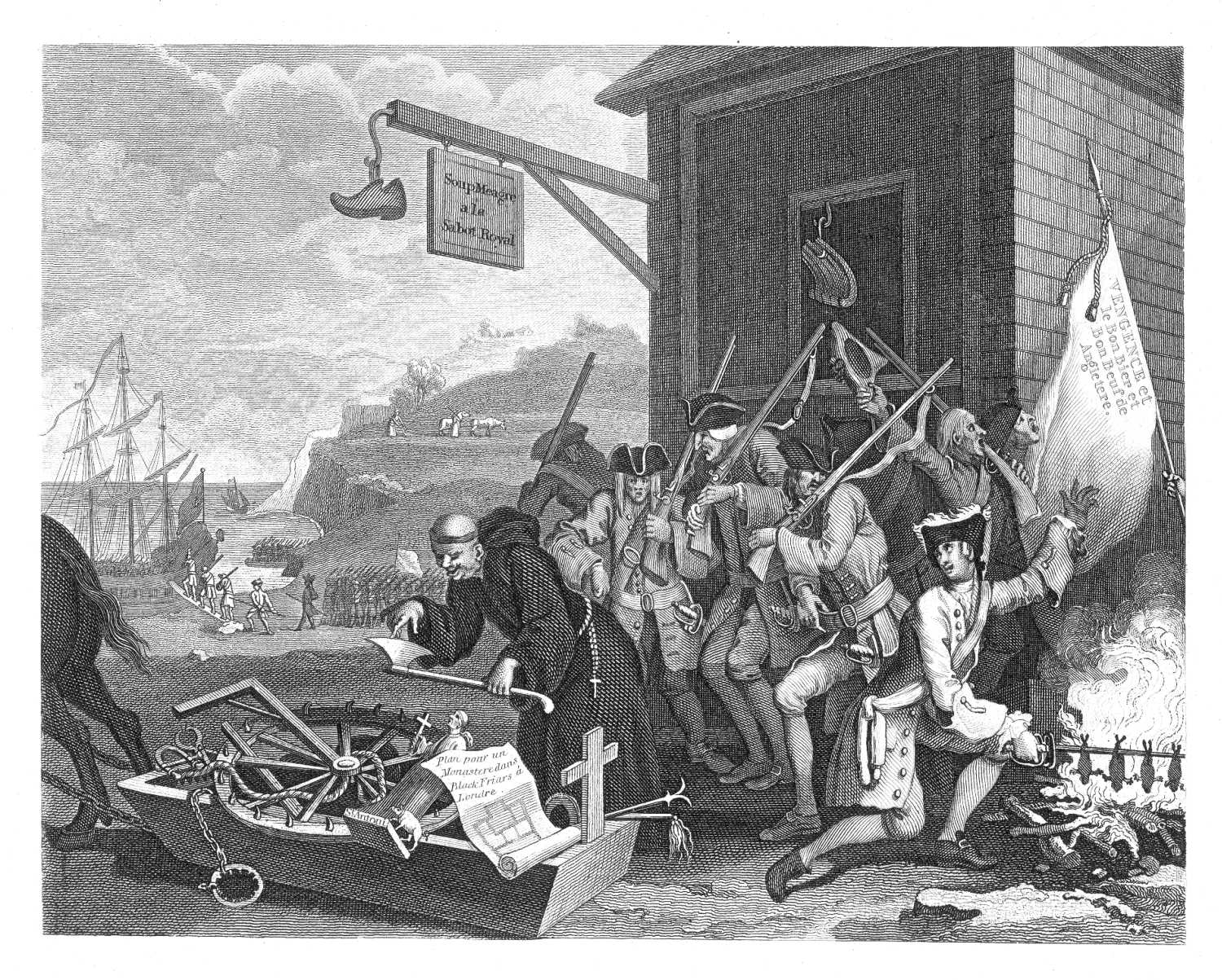 FRANCE.
From the unpropitious regions of France our scene changes to the fertile fields of England.
Instead of the forlorn and famished party who were represented in the last plate, we here see a company of well-fed and high-spirited Britons, marked with all the hardihood of ancient times, and eager to defend their country.
In the first group a young peasant, who aspires to a niche in the temple of Fame, preferring the service of Mars to that of Ceres, and the dignified appellation of soldier to the plebeian name of farmer, offers to enlist. Standing with his back against the halberd to ascertain his height, and, finding he is rather under the mark, he endeavours to reach it by rising on tiptoe. This artifice, to which he is impelled by towering ambition, the serjeant seems disposed to connive at—and the serjeant is a hero, and a great man in his way; "your hero always must be tall, you know."
To evince that the polite arts were then in a flourishing state, and cultivated by more than the immediate professors, a gentleman artist, who to common eyes must pass for a grenadier, is making a caricature of le grand monarque, with a label from his mouth worthy the speaker and worthy observation, "You take a my fine ships; you be de pirate; you be de teef: me send my grand armies, and hang you all." The action is[Pg 116] suited to the word, for with his left hand this most Christian potentate grasps his sword, and in his right poises a gibbet. The figure and motto united produce a roar of approbation from the soldier and sailor, who are criticising the work. It is so natural that the Helen and Briseis of the camp contemplate the performance with apparent delight, and, while one of them with her apron measures the breadth of this herculean painter's shoulders, the other, to show that the performance has some point, places her forefinger against the prongs of a fork. The little fifer, playing that animated and inspiring tune, "God save the King," is an old acquaintance: we recollect him in the March to Finchley. In the back-ground is a serjeant, teaching a company of young recruits their manual exercise.
This military meeting is held at the sign of the Gallant Duke of Cumberland, who is mounted upon a prancing charger,
Underneath is inscribed "Roast and Boiled every day," which, with the beef and beverage upon the table, forms a fine contrast to the soup maigre, bare bones, and roasted frogs, in the last print. The bottle painted on the wall, foaming with liquor, which, impatient of imprisonment, has burst its cerements, must be an irresistible invitation to a thirsty traveller. The soldier's sword laid upon the round of beef, and the sailor's pistol on the vessel containing the ale, intimate that these great bulwarks of our island are as tenacious of their beef and beer, as of their religion and liberty.
These two plates were published in 1756; but in the London Chronicle for October 20, 1759, is the following advertisement: "This day are republished, Two prints designed and etched by William Hogarth, one representing the preparations on the French coast for an intended invasion; the other, a view of the preparations making in England to oppose the wicked designs of our enemies; proper to be stuck up in public places, both in town and country, at this juncture."
The verses which were inserted under each print, and subjoined to this account, are, it must be acknowledged, coarse enough. They were, however, written by David Garrick.
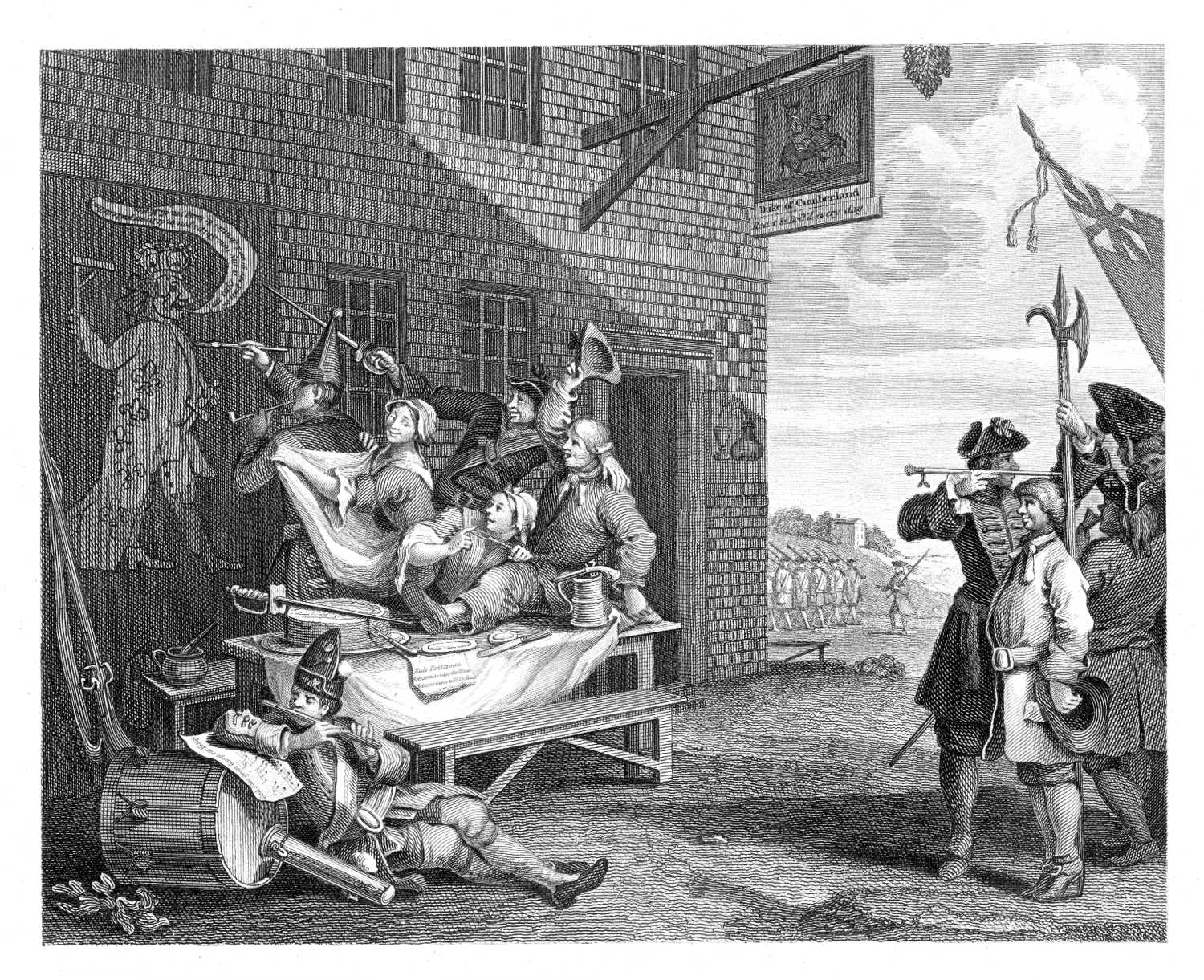 ENGLAND.
[1] The attendant black boy gave the foundation of an ill-natured remark by Quin, when Garrick once attempted the part of Othello. "He pretend to play Othello!" said the surly satirist; "He pretend to play Othello! He wants nothing but the tea-kettle and lamp, to qualify him for Hogarth's Pompey!"
[2] He was a respectable performer on the violin, some years chapel-master at Antwerp, and several seasons leader of the band at Marybone Gardens. He published a collection of musical compositions, to which was annexed a portrait of himself, characterised by three lines from Milton:
He died in 1750, aged seventy years, and gives one additional name to a catalogue I have somewhere seen of very old professors of music, who, saith my author, "generally live unto a greater age than persons in any other way of life, from their souls being so attuned unto harmony, that they enjoy a perpetual peace of mind." It has been observed, and I believe justly, that thinking is a great enemy to longevity, and that, consequently, they who think least will be likely to live longest. The quantity of thought necessary to make an adept in this divine science, must be determined by those who have studied it.—It would seem by this remark, that Mr. Ireland was not aware that to acquire proficiency in the divine science to which he so pleasantly alludes, requires great application and study.
[3] "What signifies," says some one to Dr. Johnson, "giving halfpence to common beggars? they only lay them out in gin or tobacco." "And why," replied the doctor, "should they be denied such sweeteners of their existence? It is surely very savage to shut out from them every possible avenue to those pleasures reckoned too coarse for our own acceptance. Life is a pill which none of us can swallow without gilding, yet for the poor we delight in stripping it still more bare, and are not ashamed to show even visible marks of displeasure, if even the bitter taste is taken from their mouths."
[4] At this election a man was placed on a bulk, with a figure representing a child in his arms: as he whipped it he exclaimed, "What, you little child, must you be a member?" This election being disputed, it appeared from the register-book of the parish where Lord Castlemain was born, that he was but twenty years of age when he offered himself a candidate.
The following words were inconsistently hyphenated in the original text:
The orthography of the original text has been preserved. In particular the following words are as they appear in the original:
The following words were inconsistently accented in the original text:
End of the Project Gutenberg EBook of The Works of William Hogarth: In a
Series of Engravings, by John Trusler

*** END OF THIS PROJECT GUTENBERG EBOOK WORKS OF WILLIAM HOGARTH ***

***** This file should be named 22500-h.htm or 22500-h.zip *****
This and all associated files of various formats will be found in:
        https://www.gutenberg.org/2/2/5/0/22500/

Produced by Susan Skinner, Bryan Ness and the Online
Distributed Proofreading Team at https://www.pgdp.net (This
book was produced from scanned images of public domain
material from the Google Print project.)


Updated editions will replace the previous one--the old editions
will be renamed.

Creating the works from public domain print editions means that no
one owns a United States copyright in these works, so the Foundation
(and you!) can copy and distribute it in the United States without
permission and without paying copyright royalties.  Special rules,
set forth in the General Terms of Use part of this license, apply to
copying and distributing Project Gutenberg-tm electronic works to
protect the PROJECT GUTENBERG-tm concept and trademark.  Project
Gutenberg is a registered trademark, and may not be used if you
charge for the eBooks, unless you receive specific permission.  If you
do not charge anything for copies of this eBook, complying with the
rules is very easy.  You may use this eBook for nearly any purpose
such as creation of derivative works, reports, performances and
research.  They may be modified and printed and given away--you may do
practically ANYTHING with public domain eBooks.  Redistribution is
subject to the trademark license, especially commercial
redistribution.


*** START: FULL LICENSE ***

THE FULL PROJECT GUTENBERG LICENSE
PLEASE READ THIS BEFORE YOU DISTRIBUTE OR USE THIS WORK

To protect the Project Gutenberg-tm mission of promoting the free
distribution of electronic works, by using or distributing this work
(or any other work associated in any way with the phrase "Project
Gutenberg"), you agree to comply with all the terms of the Full Project
Gutenberg-tm License (available with this file or online at
https://gutenberg.org/license).


Section 1.  General Terms of Use and Redistributing Project Gutenberg-tm
electronic works

1.A.  By reading or using any part of this Project Gutenberg-tm
electronic work, you indicate that you have read, understand, agree to
and accept all the terms of this license and intellectual property
(trademark/copyright) agreement.  If you do not agree to abide by all
the terms of this agreement, you must cease using and return or destroy
all copies of Project Gutenberg-tm electronic works in your possession.
If you paid a fee for obtaining a copy of or access to a Project
Gutenberg-tm electronic work and you do not agree to be bound by the
terms of this agreement, you may obtain a refund from the person or
entity to whom you paid the fee as set forth in paragraph 1.E.8.

1.B.  "Project Gutenberg" is a registered trademark.  It may only be
used on or associated in any way with an electronic work by people who
agree to be bound by the terms of this agreement.  There are a few
things that you can do with most Project Gutenberg-tm electronic works
even without complying with the full terms of this agreement.  See
paragraph 1.C below.  There are a lot of things you can do with Project
Gutenberg-tm electronic works if you follow the terms of this agreement
and help preserve free future access to Project Gutenberg-tm electronic
works.  See paragraph 1.E below.

1.C.  The Project Gutenberg Literary Archive Foundation ("the Foundation"
or PGLAF), owns a compilation copyright in the collection of Project
Gutenberg-tm electronic works.  Nearly all the individual works in the
collection are in the public domain in the United States.  If an
individual work is in the public domain in the United States and you are
located in the United States, we do not claim a right to prevent you from
copying, distributing, performing, displaying or creating derivative
works based on the work as long as all references to Project Gutenberg
are removed.  Of course, we hope that you will support the Project
Gutenberg-tm mission of promoting free access to electronic works by
freely sharing Project Gutenberg-tm works in compliance with the terms of
this agreement for keeping the Project Gutenberg-tm name associated with
the work.  You can easily comply with the terms of this agreement by
keeping this work in the same format with its attached full Project
Gutenberg-tm License when you share it without charge with others.

1.D.  The copyright laws of the place where you are located also govern
what you can do with this work.  Copyright laws in most countries are in
a constant state of change.  If you are outside the United States, check
the laws of your country in addition to the terms of this agreement
before downloading, copying, displaying, performing, distributing or
creating derivative works based on this work or any other Project
Gutenberg-tm work.  The Foundation makes no representations concerning
the copyright status of any work in any country outside the United
States.

1.E.  Unless you have removed all references to Project Gutenberg:

1.E.1.  The following sentence, with active links to, or other immediate
access to, the full Project Gutenberg-tm License must appear prominently
whenever any copy of a Project Gutenberg-tm work (any work on which the
phrase "Project Gutenberg" appears, or with which the phrase "Project
Gutenberg" is associated) is accessed, displayed, performed, viewed,
copied or distributed:

This eBook is for the use of anyone anywhere at no cost and with
almost no restrictions whatsoever.  You may copy it, give it away or
re-use it under the terms of the Project Gutenberg License included
with this eBook or online at www.gutenberg.org

1.E.2.  If an individual Project Gutenberg-tm electronic work is derived
from the public domain (does not contain a notice indicating that it is
posted with permission of the copyright holder), the work can be copied
and distributed to anyone in the United States without paying any fees
or charges.  If you are redistributing or providing access to a work
with the phrase "Project Gutenberg" associated with or appearing on the
work, you must comply either with the requirements of paragraphs 1.E.1
through 1.E.7 or obtain permission for the use of the work and the
Project Gutenberg-tm trademark as set forth in paragraphs 1.E.8 or
1.E.9.

1.E.3.  If an individual Project Gutenberg-tm electronic work is posted
with the permission of the copyright holder, your use and distribution
must comply with both paragraphs 1.E.1 through 1.E.7 and any additional
terms imposed by the copyright holder.  Additional terms will be linked
to the Project Gutenberg-tm License for all works posted with the
permission of the copyright holder found at the beginning of this work.

1.E.4.  Do not unlink or detach or remove the full Project Gutenberg-tm
License terms from this work, or any files containing a part of this
work or any other work associated with Project Gutenberg-tm.

1.E.5.  Do not copy, display, perform, distribute or redistribute this
electronic work, or any part of this electronic work, without
prominently displaying the sentence set forth in paragraph 1.E.1 with
active links or immediate access to the full terms of the Project
Gutenberg-tm License.

1.E.6.  You may convert to and distribute this work in any binary,
compressed, marked up, nonproprietary or proprietary form, including any
word processing or hypertext form.  However, if you provide access to or
distribute copies of a Project Gutenberg-tm work in a format other than
"Plain Vanilla ASCII" or other format used in the official version
posted on the official Project Gutenberg-tm web site (www.gutenberg.org),
you must, at no additional cost, fee or expense to the user, provide a
copy, a means of exporting a copy, or a means of obtaining a copy upon
request, of the work in its original "Plain Vanilla ASCII" or other
form.  Any alternate format must include the full Project Gutenberg-tm
License as specified in paragraph 1.E.1.

1.E.7.  Do not charge a fee for access to, viewing, displaying,
performing, copying or distributing any Project Gutenberg-tm works
unless you comply with paragraph 1.E.8 or 1.E.9.

1.E.8.  You may charge a reasonable fee for copies of or providing
access to or distributing Project Gutenberg-tm electronic works provided
that

- You pay a royalty fee of 20% of the gross profits you derive from
     the use of Project Gutenberg-tm works calculated using the method
     you already use to calculate your applicable taxes.  The fee is
     owed to the owner of the Project Gutenberg-tm trademark, but he
     has agreed to donate royalties under this paragraph to the
     Project Gutenberg Literary Archive Foundation.  Royalty payments
     must be paid within 60 days following each date on which you
     prepare (or are legally required to prepare) your periodic tax
     returns.  Royalty payments should be clearly marked as such and
     sent to the Project Gutenberg Literary Archive Foundation at the
     address specified in Section 4, "Information about donations to
     the Project Gutenberg Literary Archive Foundation."

- You provide a full refund of any money paid by a user who notifies
     you in writing (or by e-mail) within 30 days of receipt that s/he
     does not agree to the terms of the full Project Gutenberg-tm
     License.  You must require such a user to return or
     destroy all copies of the works possessed in a physical medium
     and discontinue all use of and all access to other copies of
     Project Gutenberg-tm works.

- You provide, in accordance with paragraph 1.F.3, a full refund of any
     money paid for a work or a replacement copy, if a defect in the
     electronic work is discovered and reported to you within 90 days
     of receipt of the work.

- You comply with all other terms of this agreement for free
     distribution of Project Gutenberg-tm works.

1.E.9.  If you wish to charge a fee or distribute a Project Gutenberg-tm
electronic work or group of works on different terms than are set
forth in this agreement, you must obtain permission in writing from
both the Project Gutenberg Literary Archive Foundation and Michael
Hart, the owner of the Project Gutenberg-tm trademark.  Contact the
Foundation as set forth in Section 3 below.

1.F.

1.F.1.  Project Gutenberg volunteers and employees expend considerable
effort to identify, do copyright research on, transcribe and proofread
public domain works in creating the Project Gutenberg-tm
collection.  Despite these efforts, Project Gutenberg-tm electronic
works, and the medium on which they may be stored, may contain
"Defects," such as, but not limited to, incomplete, inaccurate or
corrupt data, transcription errors, a copyright or other intellectual
property infringement, a defective or damaged disk or other medium, a
computer virus, or computer codes that damage or cannot be read by
your equipment.

1.F.2.  LIMITED WARRANTY, DISCLAIMER OF DAMAGES - Except for the "Right
of Replacement or Refund" described in paragraph 1.F.3, the Project
Gutenberg Literary Archive Foundation, the owner of the Project
Gutenberg-tm trademark, and any other party distributing a Project
Gutenberg-tm electronic work under this agreement, disclaim all
liability to you for damages, costs and expenses, including legal
fees.  YOU AGREE THAT YOU HAVE NO REMEDIES FOR NEGLIGENCE, STRICT
LIABILITY, BREACH OF WARRANTY OR BREACH OF CONTRACT EXCEPT THOSE
PROVIDED IN PARAGRAPH F3.  YOU AGREE THAT THE FOUNDATION, THE
TRADEMARK OWNER, AND ANY DISTRIBUTOR UNDER THIS AGREEMENT WILL NOT BE
LIABLE TO YOU FOR ACTUAL, DIRECT, INDIRECT, CONSEQUENTIAL, PUNITIVE OR
INCIDENTAL DAMAGES EVEN IF YOU GIVE NOTICE OF THE POSSIBILITY OF SUCH
DAMAGE.

1.F.3.  LIMITED RIGHT OF REPLACEMENT OR REFUND - If you discover a
defect in this electronic work within 90 days of receiving it, you can
receive a refund of the money (if any) you paid for it by sending a
written explanation to the person you received the work from.  If you
received the work on a physical medium, you must return the medium with
your written explanation.  The person or entity that provided you with
the defective work may elect to provide a replacement copy in lieu of a
refund.  If you received the work electronically, the person or entity
providing it to you may choose to give you a second opportunity to
receive the work electronically in lieu of a refund.  If the second copy
is also defective, you may demand a refund in writing without further
opportunities to fix the problem.

1.F.4.  Except for the limited right of replacement or refund set forth
in paragraph 1.F.3, this work is provided to you 'AS-IS' WITH NO OTHER
WARRANTIES OF ANY KIND, EXPRESS OR IMPLIED, INCLUDING BUT NOT LIMITED TO
WARRANTIES OF MERCHANTIBILITY OR FITNESS FOR ANY PURPOSE.

1.F.5.  Some states do not allow disclaimers of certain implied
warranties or the exclusion or limitation of certain types of damages.
If any disclaimer or limitation set forth in this agreement violates the
law of the state applicable to this agreement, the agreement shall be
interpreted to make the maximum disclaimer or limitation permitted by
the applicable state law.  The invalidity or unenforceability of any
provision of this agreement shall not void the remaining provisions.

1.F.6.  INDEMNITY - You agree to indemnify and hold the Foundation, the
trademark owner, any agent or employee of the Foundation, anyone
providing copies of Project Gutenberg-tm electronic works in accordance
with this agreement, and any volunteers associated with the production,
promotion and distribution of Project Gutenberg-tm electronic works,
harmless from all liability, costs and expenses, including legal fees,
that arise directly or indirectly from any of the following which you do
or cause to occur: (a) distribution of this or any Project Gutenberg-tm
work, (b) alteration, modification, or additions or deletions to any
Project Gutenberg-tm work, and (c) any Defect you cause.


Section  2.  Information about the Mission of Project Gutenberg-tm

Project Gutenberg-tm is synonymous with the free distribution of
electronic works in formats readable by the widest variety of computers
including obsolete, old, middle-aged and new computers.  It exists
because of the efforts of hundreds of volunteers and donations from
people in all walks of life.

Volunteers and financial support to provide volunteers with the
assistance they need, is critical to reaching Project Gutenberg-tm's
goals and ensuring that the Project Gutenberg-tm collection will
remain freely available for generations to come.  In 2001, the Project
Gutenberg Literary Archive Foundation was created to provide a secure
and permanent future for Project Gutenberg-tm and future generations.
To learn more about the Project Gutenberg Literary Archive Foundation
and how your efforts and donations can help, see Sections 3 and 4
and the Foundation web page at https://www.pglaf.org.


Section 3.  Information about the Project Gutenberg Literary Archive
Foundation

The Project Gutenberg Literary Archive Foundation is a non profit
501(c)(3) educational corporation organized under the laws of the
state of Mississippi and granted tax exempt status by the Internal
Revenue Service.  The Foundation's EIN or federal tax identification
number is 64-6221541.  Its 501(c)(3) letter is posted at
https://pglaf.org/fundraising.  Contributions to the Project Gutenberg
Literary Archive Foundation are tax deductible to the full extent
permitted by U.S. federal laws and your state's laws.

The Foundation's principal office is located at 4557 Melan Dr. S.
Fairbanks, AK, 99712., but its volunteers and employees are scattered
throughout numerous locations.  Its business office is located at
809 North 1500 West, Salt Lake City, UT 84116, (801) 596-1887, email
business@pglaf.org.  Email contact links and up to date contact
information can be found at the Foundation's web site and official
page at https://pglaf.org

For additional contact information:
     Dr. Gregory B. Newby
     Chief Executive and Director
     gbnewby@pglaf.org


Section 4.  Information about Donations to the Project Gutenberg
Literary Archive Foundation

Project Gutenberg-tm depends upon and cannot survive without wide
spread public support and donations to carry out its mission of
increasing the number of public domain and licensed works that can be
freely distributed in machine readable form accessible by the widest
array of equipment including outdated equipment.  Many small donations
($1 to $5,000) are particularly important to maintaining tax exempt
status with the IRS.

The Foundation is committed to complying with the laws regulating
charities and charitable donations in all 50 states of the United
States.  Compliance requirements are not uniform and it takes a
considerable effort, much paperwork and many fees to meet and keep up
with these requirements.  We do not solicit donations in locations
where we have not received written confirmation of compliance.  To
SEND DONATIONS or determine the status of compliance for any
particular state visit https://pglaf.org

While we cannot and do not solicit contributions from states where we
have not met the solicitation requirements, we know of no prohibition
against accepting unsolicited donations from donors in such states who
approach us with offers to donate.

International donations are gratefully accepted, but we cannot make
any statements concerning tax treatment of donations received from
outside the United States.  U.S. laws alone swamp our small staff.

Please check the Project Gutenberg Web pages for current donation
methods and addresses.  Donations are accepted in a number of other
ways including including checks, online payments and credit card
donations.  To donate, please visit: https://pglaf.org/donate


Section 5.  General Information About Project Gutenberg-tm electronic
works.

Professor Michael S. Hart was the originator of the Project Gutenberg-tm
concept of a library of electronic works that could be freely shared
with anyone.  For thirty years, he produced and distributed Project
Gutenberg-tm eBooks with only a loose network of volunteer support.


Project Gutenberg-tm eBooks are often created from several printed
editions, all of which are confirmed as Public Domain in the U.S.
unless a copyright notice is included.  Thus, we do not necessarily
keep eBooks in compliance with any particular paper edition.


Most people start at our Web site which has the main PG search facility:

     https://www.gutenberg.org

This Web site includes information about Project Gutenberg-tm,
including how to make donations to the Project Gutenberg Literary
Archive Foundation, how to help produce our new eBooks, and how to
subscribe to our email newsletter to hear about new eBooks.