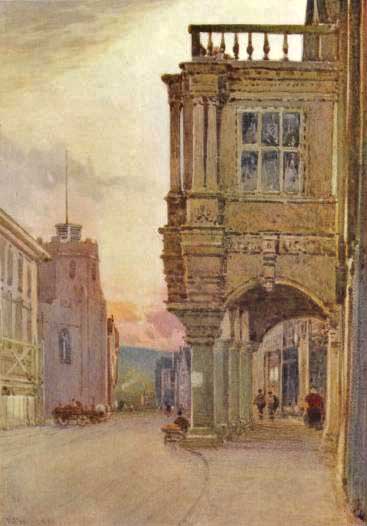
 The Guildhall, Exeter
This eBook is for the use of anyone anywhere at no cost and with
almost no restrictions whatsoever.  You may copy it, give it away or
re-use it under the terms of the Project Gutenberg License included
with this eBook or online at www.gutenberg.org
Title: Devon, Its Moorlands, Streams and Coasts
Author: Rosalind Northcote
Release Date: September 1, 2007 [eBook #22485]
Language: English
Character set encoding: ISO-8859-1
***START OF THE PROJECT GUTENBERG EBOOK DEVON, ITS MOORLANDS, STREAMS AND COASTS***
The Guildhall, Exeter
LONDON—EXETER
CHATTO & WINDUS—JAMES G. COMMIN
M CM VIII
The first and one of the greatest difficulties to confront a writer who attempts any sort of description of a place or people is almost sure to be the answer to the question, How much must be left out? In the present case the problem has reappeared in every chapter, for Devon is 'a fair province,' as Prince says in his 'Worthies of Devon,' and 'the happy parent of ... a noble offspring.'
My position is that of a person who has been bidden to take from a great heap of precious stones as many as are needed to make one chain; for however grasping that person may be, and however long the chain may be made, when all the stones have been chosen, the heap will look almost as great and delightful as before: only a few of the largest and brightest jewels will be gone.
The fact that I have been able to take only a small handful from the vast hoard that constitutes the history of Devon will explain, I hope, the many omissions that must strike every reader who has any knowledge of the county—omissions of which no one can be more conscious than myself. A separate volume might very well be written about the bit of country touched on in each chapter.
This book does not pretend to include every district. I have merely passed through a great part of the county, stopping here at an old church with interesting monuments, there at a small town whose share in local history—in some instances, in the country's history—is apt to be forgotten, or at a manor-house[Pg viii] which should be remembered for its association with one of the many 'worthies' who, as Prince says—with the true impartiality of a West-countryman in regard to his own county—form 'an illustrious troop of heroes, as no other county in the kingdom, no other kingdom (in so small a tract) in Europe, in all respects, is able to match, much less excel.'
From the 'Tale of Two Swannes,' a view of the banks of the River Lea, published in 1590, I have ventured to borrow the verses that close an address 'To the Reader':
| Sonnet by Henry Newbolt | page v | |
| Preface | vii | |
| Chap. I. | Exeter | 1 |
| II. | The Exe | 13 |
| III. | The Otter and the Axe | 47 |
| IV. | Dartmoor | 71 |
| V. | The Teign | 89 |
| VI. | Torbay | 106 |
| VII. | The Dart | 119 |
| VIII. | Kingsbridge, Salcombe, and the South Hams | 141 |
| IX. | The Three Towns | 155 |
| X. | The Tamar and the Tavy | 179 |
| XI. | The Taw and the Torridge | 201 |
| XII. | Lundy, Lynmouth, and the Borders of Exmoor | 244 |
| XIII. | Castles and Country-Houses | 272 |
| List of authorities consulted | 315 | |
| Index | 317 |
| The Guildhall, Exeter | Frontispiece |
| Exeter from Exwick | 2 |
| Exeter Cathedral | 5 |
| The Exe: Tiverton | 13 |
| Topsham | 41 |
| Exmouth from Cockwood | 45 |
| Ottery St. Mary | 47 |
| Sidmouth | 51 |
| Branscombe | 61 |
| Beer Beach | 65 |
| Seaton Headland | 67 |
| The Windypost, or Beckamoor Cross | 71 |
| Yes Tor: Dartmoor | 73 |
| Lustleigh Cleave | 75 |
| Wistman's Wood | 77 |
| Widdecombe-in-the-Moor | 81 |
| Sheepstor | 83 |
| Lydford Bridge | 84 |
| Hey Tor | 89 |
| Fingle Bridge | 91 |
| Chudleigh Glen | 101 |
| Teignmouth and Shaldon | 103[Pg xi] |
| Torquay from the Bay | 106 |
| Berry Head | 113 |
| Brixham Trawlers | 115 |
| Postbridge | 119 |
| Dartmeet Bridge | 121 |
| Holne Bridge | 123 |
| Fore Street, Totnes | 129 |
| Sharpham Woods: River Dart | 133 |
| Dartmouth Castle | 139 |
| Salcombe | 141 |
| Bolt Head | 146 |
| Slapton Lea | 151 |
| The Tamar, near Saltash | 155 |
| Drake's Island, Plymouth Sound | 171 |
| Brent Tor. From Lvdford Moors | 179 |
| Tavy Cleave | 185 |
| Brent Tor | 198 |
| Bideford | 201 |
| Appledore | 211 |
| Clovelly | 215 |
| Morthoe | 221 |
| Bull Point: Morthoe | 223 |
| Barnstaple Bridge | 227 |
| Torrington | 230 |
| Lantern Rock: Ilfracombe | 244 |
| Countisbury Foreland | 255 |
| [Pg xii]Lynmouth | 259 |
| Malmsmead | 263 |
| Lorna's Bower | 265 |
| Waterslide: Doone Valley | 267 |
| Doone Valley | 269 |
| Powderham Castle | 272 |
| Berry Pomeroy Castle | 285 |
| Compton Castle | 295 |
| Okehampton Castle | 297 |
| Sydenham House | 299 |
| Bradfield | 306 |
| Pynes, near Exeter | 308 |
There are not many towns which stir the imagination as much as Exeter. To all West-Countrymen she is a Mother City ... and there is not one among them, however long absent from the West, who does not feel, when he sets foot in Exeter, that he is at home again, in touch with people of his own blood and kindred.... In Exeter all the history of the West is bound up—its love of liberty, its independence, its passionate resistance to foreign conquerors, its devotion to lost causes, its loyalty to the throne, its pride, its trade, its maritime adventure—all these many strands are twined together in that bond which links West-Countrymen to Exeter.' Mr Norway is a West-Countryman, and he sums up very justly the sentiment, more or less consciously realized, of the people for whom he speaks, and especially the feeling of the citizens.
Not only the Cathedral, the Castle, and Guildhall, bear legends for those who know how to read them, but here and again through all the streets an ancient house, a name, or a tower, will bring back the memory of one of the stirring events that have happened. One royal pageant after another has clattered and glittered through the streets, and the old carved gabled houses in the side-lanes must many a time have shaken to the heavy tramp of armed men, gathered to defend the city or to march out against the enemy.
'Exeter,' says Professor Freeman, 'stands distinguished as the one great English city which has, in a more marked way than[Pg 2] any other, kept its unbroken being and its unbroken position throughout all ages. It is the one city in which we can feel sure that human habitation and city life have never ceased from the days of the early Cæsars to our own.... The city on the Exe, Caerwisc, or Isca Damnoniorum, has had a history which comes nearer than that of any other city of Britain to the history of the ancient local capitals of the kindred land of Gaul.... To this day, both in feeling and in truth, Exeter is something more than an ordinary county town.'
 Exeter from Exwick
The city is very picturesquely placed, and before ruthless 'improvements' swept away the old gates and many ancient buildings, the general effect must have been particularly delightful. 'This City is pleasantly seated upon a Hill among Hills, saving towards the sea, where 'tis pendant in such sort as that the streets (be they never so foul) yet with one shower of rain are again cleansed ...,' wrote Izacke, in his Antiquities of Exeter. 'Very beautiful is the same in building;' and he ends with some vagueness, 'for considerable Matters matchable to most Cities in England.' The earliest history can only be guessed at from what is known of the history of other places, and from the inferences to be drawn from a few scanty relics; but there is evidence that Exeter existed as a British settlement before the Romans found their way so far West. It is not known when they took the city, nor when they abandoned it, nor is there any date to mark the West Saxon occupation. Professor Freeman, however, points out a very interesting characteristic proving that the conquest cannot have taken place until after the Saxons had ceased to be heathens. 'It is the one great city of the Roman and the Briton which did not pass into English hands till the strife of races had ceased to be a strife of creeds, till English conquest had come to mean simply conquest, and no longer meant havoc and extermination. It is the one city of the present England in which we can see within recorded times the Briton and Englishman living side by side.' In the days of Athelstan, 'Exeter was not purely English; it was a city of two nations and two tongues.... This shows that ... its British inhabitants obtained very favourable terms from the conquerors,[Pg 3] and that, again, is much the same as saying that it was not taken till after the West Saxons had become Christians.'
The earliest reliable records of the city begin about 876, when the Danes overwhelmed the city and were put to flight by King Alfred. A few years later they again besieged Exeter, but this time it held out against them until the King, for the second time, came to the rescue, and the enemy retreated. Alfred, careful of the city and its means of defence, built a stronghold—very possibly in the interval between these two invasions—upon the high ground that the Briton had chosen for his fastness, and on which the Castle rose in after-days. Rather more than a hundred years later Athelstan strengthened the city by repairing the Roman walls. But it is with an event of greater importance that Athelstan's name is usually associated, for it was he who made the city a purely English one by driving out all the Britons into the country beyond the Tamar. It is probable that there was already a monastery in Exeter in the seventh century, and that it was broken up during the storms that raged later. In any case, Athelstan founded or refounded a monastery, and in 968 Edgar, who had married the beautiful daughter of Ordgar, Earl of Devon, settled a colony of monks in Exeter. About thirty years afterwards the Danes, under Pallig, sailed up the Exe and laid siege to the town, but were repulsed with great courage by the citizens. Beaten off the city, they fell upon the country round, and a frightful battle was fought at Pinhoe. A curious memorial of it survives to this day. During the furious struggle the Saxons' ammunition began to run low, and the priest of Pinhoe rode back to Exeter for a fresh supply of arrows. In recognition of his service, the perpetual pension of a mark (13s. 4d.) was granted him, and this sum the Vicar of the parish still receives. Two years later the Danes made a successful assault upon the city, and seized much plunder, but made no stay.
Edward the Confessor visited Exeter, and assisted at the installation of Leofric as first Bishop of Exeter, when the see was transferred from Crediton. The Queen also played a prominent part in the ceremony, for Exeter and the royal revenues within it made part of her 'morning gift.' Leofric instituted several re[Pg 4]forms, added to the wealth of his cathedral, and left it a legacy of lands and books. The most interesting of the manuscripts is the celebrated Exeter Book, a large collection of Anglo-Saxon poems on very different subjects. To give some idea of their variety, it may be mentioned that, amongst other poems of an entirely distinct character, there are religious pieces, many riddles, the legends of two saints, the Scald's or Ancient Minstrel's tale of his travels, and a poem on the 'Various Fortunes of Men.'
Seventeen years after King Edward's visit, William the Conqueror's messengers came before the chief men of Exeter demanding their submission. But the citizens sent back the lofty answer that 'they would acknowledge William as Emperor of Britain; they would not receive him as their immediate King. They would pay him the tribute which they had been used to pay to Kings of the English, but that should be all. They would swear no oaths to him; they would not receive him within their walls.' William naturally would not listen to conditions, and arrived to direct the siege in person. For eighteen days the repeated attacks of the Normans were sturdily resisted; then the enemy dug a mine, which caused the walls to crumble, and surrender was inevitable. 'The Red Mount of Exeter had been the stronghold of Briton, Roman, and Englishman;' under the hands of the Norman here rose the Castle of Rougemont, of which a tower, a gateway, and part of the walls, stand to this day. In proportion to the size and strength of that castle, however, the remains are inconsiderable, but it fell into decay very long ago, and as early as 1681 Izacke writes of 'the Fragments of the ancient Buildings ruinated, whereon time ... hath too much Tyrannized.'
In the year after King Stephen began to reign, Baldwin de Redvers, Earl of Devon and keeper of the Castle, declared for the Empress Maud, and held the Castle for three months against the citizens, headed by two hundred knights who had been sent by the King. At the end of this time the wells ran dry, so that the besieged were driven to use wine for their cookery, and even to throw over their 'engines,' set on fire by the enemy.
Henry II granted to the citizens of Exeter the first of their many[Pg 5] charters of privileges, and in the reigns of King John and Henry III the municipal system was very much developed, and the city first had a Mayor. Under Edward I a beginning was made towards the almost entire reconstruction of the Cathedral. Bishop Warelwast, the nephew of William I, had raised the transeptal towers—a feature that no other English cathedral possesses—and since his time the Lady Chapel had been added, but the design of the Cathedral as a whole was evolved by Bishop Quivil. He planned what was practically a new church, and his intentions were faithfully carried out. Before his day the towers were merely 'external castles,' but Bishop Quivil broke down their inner walls, and filled the space with lofty arches, and the towers became transepts. Bishop Stapledon spent huge sums in collecting materials, but before much progress with the work had been made he was murdered by a London mob, in the troubled reign of Edward II; and the actual existence of much of the building is due to Bishop Grandisson, who, sparing himself in no matter, lavished treasure and devotion on his Cathedral. Writing to Pope John XXII, the Bishop said 'that if the church should be worthily completed, it would be admired for its beauty above every other of its kind within the realms of England or France.'
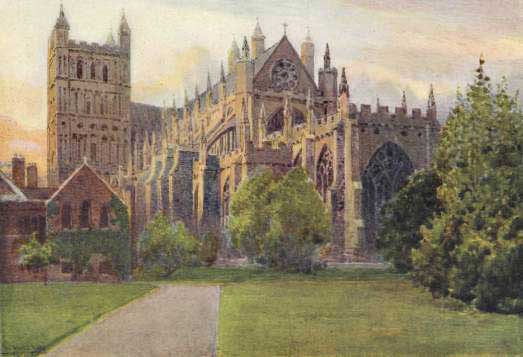 Exeter Cathedral
One of the most beautiful features of the Cathedral is the unbroken length of roof at the same height through nave and choir, the effect intensified by the exquisite richness and grace of the vaulting. And the spreading fans gain an added grace, springing as they do from that 'distinctive group of shafts' which, says Canon Edmonds, 'makes the Exeter pillar the very type of the union of beauty and strength.' In the central bay of the nave, on the north side, is the Minstrels' Gallery, one of the few to be found in England. It is delicately and elaborately sculptured, and each of the twelve angels in the niches holds a musical instrument—a flageolet, a trumpet and two wind instruments, a tambour, a violin, an organ, a harp, bagpipes, the cymbals, and guitars.
The choir is unusually long, and from the north and south aisles open chapels and chantries, in some of which the carving[Pg 6] is very rich and fine. The Bishop's throne is elaborately carved, and more than sixty feet high, and yet there is not one nail in it. During the Commonwealth a brick wall was built across the west end of the choir, completely dividing the Cathedral. This was done to satisfy the Presbyterians and Independents, each of whom wished to hold their services here, and the two churches formed by this division were called Peter the East and Peter the West. The screen in the west front was added after the Cathedral was finished; it is covered with statues in niches, figures of 'kings, warriors, saints, and apostles, guardians as it were of the entrance to the sanctuary.' High above them, in the gable niche, is the statue of St Peter, to whom the Cathedral is dedicated.
King Edward and Queen Eleanor kept Christmas at Exeter in 1285, and here the King held the Parliament which passed the Statute of Coroners that is still law. During this visit the King gave leave to the Bishop and Chapter to surround the close with a wall and gates, for at this time it was used to heap rubbish upon, and 'the rendezvous of all the bad characters of the place.' Edward III granted his eldest son the Duchy of Cornwall—a grant that carried with it the Castle of Exeter, and to the King's eldest son it has always since belonged.
Henry VI in 1482 visited the city in peace and splendour. Margaret, his Queen, came about eighteen years later, while Warwick's plans were ripening, and the event is marked in the Receiver's accounts by the entry: 'Two bottles of wine given to John Fortescue, before the coming of Margaret, formerly Queen.' Not long afterwards Warwick and the Duke of Clarence fled to Exeter, which had to stand a siege on their behalf; but the effort to take the city was half-hearted, and in twelve days the attempt was abandoned. Edward IV arrived in pursuit, but too late, for 'the byrdes were flown and gone away,' and a quaint farce was solemnly played out. The city had just shown openly that its real sympathies were Lancastrian, but neither King nor citizens could afford to quarrel. 'Both sides put the best face on matters; the city was loyal; the King was gracious ... the citizens gave him a full purse, and he gave them a sword, and all parted friends.'[Pg 7]
Richard III's visit was more eventful. The allegiance yielded him by the West was of the flimsiest character, and in the autumn of 1483 a conspiracy was formed, and Henry, Earl of Richmond, was proclaimed King in Exeter. Here Richard hastened at the head of a strong force, to find that nearly all the leaders had fled, and there remained only his brother-in-law, Sir John St Leger, and Sir John's Esquire, Thomas Rame. So the King 'provided for himself a characteristic entertainment,' and both knight and squire were beheaded opposite the Guildhall. Before he left, Richard went to look at the Castle, and asked its name. The Mayor answered, 'Rougemont'—a word misunderstood by the King, who became 'suddenly fallen into a great dump, and as it were a man amazed.' Shakespeare's lines give the explanation of his discomfiture. 'It seems,' comments Fuller, 'Sathan either spoke this oracle low or lisping.'
The next siege of Exeter was when the followers of Perkin Warbeck surged in thousands round the city. Their assault was vigorous and determined; they tried to undermine the walls, burned the north gate, and, repulsed at this point, broke through the defences at the east gate. After a sharp struggle in the streets, the rebels were thrust back, and were forced to march northwards, leaving Exeter triumphant. Three weeks later Henry VII entered Exeter with Warbeck, as his prisoner. The King was very gracious to the city that had just given such eminent proofs of its loyalty, and bestowed on the citizens a second sword of honour and a cap of maintenance, and ordered that a sword-bearer should be appointed to carry the sword before the Mayor in civic procession.
Henry VIII gave Exeter 'the highest privilege,' says Professor Freeman, 'that can be given to an English city or borough.' He made it a county, 'with all the rights of a county under its own Sheriff.' An Act of Parliament was also passed to undo the harm done by Isabel de Fortibus, representative of the Earls of Devon, when she made a weir about the year 1280—still called Countess Weir—that blocked the free waterway to the sea. As the tide naturally comes up the river a little way beyond Exeter, before[Pg 8] the weir was made ships had been able to sail up to the watergate of the city. The first attempts to improve matters after this Act was passed failed, but a canal was constructed with tolerable success in the reign of Elizabeth.
In 1549 came the siege of Exeter that followed the burning of Crediton barns. The Devonshire rebels had been reinforced by a large number of Cornishmen, who resented the new Prayer-Book, and the law obliging them to hear the services in English instead of Latin, more bitterly and with greater reason than the people of Sampford Courtenay. For to them it was more than unwelcome change in the Liturgy; it meant also that their services were read in an alien tongue. 'We,' the Cornish, 'whereof certain of us understand no English, utterly refuse the new English,' was their protest. It is curious to think that more than half a century later English was a foreign language in Cornwall. In James I's reign, 'John Norden ... constructing his Speculum, his topographical description of this kingdom,' writes: 'Of late the Cornishmen have muche conformed themselves to the use of the English tongue;' and adds that all but 'some obscure people' are able to 'convers with a straunger' in English. The bitterness aroused by the religious question was intensified by a report which was 'blazed abroad,' as Hooker says, 'a Gnat making an Elephant, that the gentlemen were altogether bent to over-run, spoil, or destroy the people.' No one could have acted with greater loyalty and courage than the Mayor, John Blackaller, and his powers were put to a hard trial before the end of the siege. Not only was there an active and vigorous enemy without, but within the walls the majority secretly, and some persons openly, sided with the enemy. The most unceasing vigilance and unfaltering resolution were needed to frustrate all plots and plans. One great danger was averted by a certain John Newcomb, an ex-miner, who, suspicious of a possible peril, watched diligently for its slightest sign. One day an anxious crowd looked at him 'crawling about on the ground with a pan of water in his hand. Every now and again he would listen attentively, with his ear in the dust, and, rising, place the pan on the spot. At last he has[Pg 9] it. Like the beating of a pulse, the still water in the pan vibrates in harmony with the stroke of the pickaxe far underneath, and the old miner rises exultant.' A counter-mine was hurriedly made, and through a tiny opening it was seen that barrels of gunpowder and pitch and piles of faggots were heaped beneath the west gate. Fortunately, this gate stood below the steep slope on which the city lies, and on discovering the enemy's alarming preparations, every householder was ordered, at a given signal, to empty a great tub of water into the kennel, and every tap in the city was turned on. 'At which time also, by the Goodness of God, there fell a great Shower, as the like, for the Time, had not been seen many years before.' A tremendous torrent rushed down the streets, and, being concentrated upon the mine, completely flooded it.
There is no place here to speak of the straits to which the citizens were put before a sufficient number of troops reached Lord Russell to enable him to march to the relief of the besieged. Nor is there room for an account of the splendid resistance made by the rebels to the great force pitted against them, which included a regiment of seasoned German Lanzknechts and three hundred Italian musketeers, besides English cavalry. 'Valiantly and stoutly they stood to their Tackle, and would not give over as long as Life and Limb lasted ... and few or none were left alive.... Such was the Valour and stoutness of these men that the Lord Greie reported himself, that he never, in all the Wars that he had been in, did know the like.'
In recognition of the loyalty shown by the citizens under this great trial, Queen Elizabeth 'complimented the city with an augmentation of arms,' and 'of her own free will added the well-known motto, Semper Fidelis.' Encouraged by the Queen's protection, commerce increased and prospered. Guilds had long flourished in Exeter, and it is recorded that as early as 1477 there was a quarrel between the Mayor and citizens and the Company of Taylors. A Guildhall existed even before there was a Mayor of Exeter, but the present building dates from 1464. It has a fine common hall, with a lofty, vaulted roof and much panelling, and the panels are set with little shields, the arms of the Mayors, of[Pg 10] various companies, and certain benefactors to the city. Later was added the cinque-cento front that projects over the footway, and has become so essential a characteristic in the eyes of those who care for Exeter. This front was built in 1593, and 'in its confusion of styles—English windows between Italian columns—it has all the impress of that transitional age.'
Many of the trades that throve in Exeter formed guilds, and in looking casually at the names of a few of them, one finds that the bakers had already a Master and Company in 1428-29, and that some years later the charter of the Glovers and Skinners was renewed. In 1452 there was a dispute as to whether the Cordwainers or Tuckers should take precedence in the Mayor's procession, and later again the Guild of Weavers, Sheremen, and Tuckers came still more prominently before the public.
'Trafiquing' in wool and woollen goods was the most important trade, and though its zenith was passed in the seventeenth century, it continued to do well till the later half of the eighteenth. Defoe speaks of the 'serge manufacture of Devonshire' as 'a trade too great to be described in miniature,' and says he is told that at the weekly market 'sixty to seventy to eighty, and sometimes a hundred, thousand pounds' value in serges is sometimes sold.' Probably the account given him was a little exaggerated, but Lysons quotes the statement that in the most prosperous days £50,000 or £60,000 worth of woollen goods had been sold in a week. Many were the petitions sent up to Parliament in the reign of William and Mary, begging protection for the local wool-trade, and that competition from unhappy Ireland might be discouraged. The great hall of the New Inn was used as an exchange, and here were held yearly three great cloth-fairs, where merchants from London and from all parts gathered, and stalls and shops in the inn were let to 'foreigners.' The Tuckers' Hall, built of ruddy stone, still stands in Fore Street, and the hall has a fine cradle roof with plaster panels.
The most powerful of all the companies was incorporated later than many of the guilds, for the Merchant Adventurers received their charter from Queen Elizabeth. Their power and wealth was[Pg 11] very considerable; they cast their lines in all directions, and they secured a monopoly of trading with France. This company supplied with money, and had a stake in, some of Sir Humphrey Gilbert's and Captain Davis's enterprises, and Sir Francis Drake himself invited the 'gentilmen merchauntes' and others of the city to 'adventure with him in a voiage supportinge some speciall service ... for the defence of 'religion, Quene and countrye.'' About Charles I's reign the importance of the company gradually declined, and the society was eventually dissolved.
During the Civil War, Exeter was twice besieged, but on neither occasion so rigorously as in 1549. When the war broke out, the Earl of Bedford appointed the Mayor, the Sheriff, and five Aldermen, Commissioners for the Parliament. The defences were put in order and arms collected, and amongst other expenses is recorded '£300 for 17 packs of wool taken from Mr Robin's Cellars for the Barricadoes.' Nevertheless, zeal for the Parliament must have been but lukewarm, for when Prince Maurice's troops surrounded the city, it was surrendered at the end of fourteen days, and after the besieged had suffered no further inconvenience than 'the being kept from taking the air without their own walls.' The next year Queen Henrietta Maria came to a city which was considered a safer refuge than Oxford, and here Princess Henrietta was born, and was baptized in the Cathedral with great pomp, 'a new font having been erected for the purpose, surmounted by a rich canopy of state.' Charles II always showed the warmest affection for his sister, famed, as Duchess of Orleans, for her beauty and charm, and a portrait of the Princess given by the King to the city hangs in the Guildhall. It is a full-length portrait, and she is represented standing, one hand lightly gathering together the folds of her white satin dress.
During the autumn and winter of 1645-46 Exeter was gradually hemmed in by bodies of Parliamentary troops stationed at posts in the neighbourhood, and with the new year the siege became a closer one. It would seem, however, that there was no very acute distress from lack of food; but Fuller, who was in the city at the time, mentions with satisfaction the appearance[Pg 12] of 'an incredible number of Larks ... for multitude like Quails in the Wildernesse, and as fat as plentifull ... which provided a feast for many poor people, who otherwise had been pinched for provision.' As the spring advanced, the King's cause lapsed into a condition too hopeless to be bettered by further resistance, and on April 9 Sir John Berkeley, for over two years the faithful guardian of the city, signed the articles of its surrender, on honourable terms, to Sir Thomas Fairfax.
There is no space to speak of later dramatic incidents in Exeter—the trial and execution of Mr Penruddocke and Mr Grove, leaders of a Royalist rising of Wiltshire gentlemen, whose speeches on the scaffold are given at length by Izacke; nor of the joy that greeted the Restoration, when 'Tar-barrels and Bonefires capered aloft'; nor of Charles II's visit, nor the entrance of the Duke of Monmouth in 1680 with five thousand horsemen, and nine hundred young men in white uniforms marching before him. One may not even pause before the gorgeous spectacle of William III's arrival, heralded by a procession in which appeared two hundred negroes in white-plumed, embroidered turbans, and a squadron of Swedish horsemen 'in bearskins taken from the beasts they had slain, with black armour and broad flaming swords.'
It has been only possible to name the most outstanding points in the history of a city—once more to quote Professor Freeman—'by the side of which most of the capitals of Europe are things of yesterday.... The city alike of Briton, Roman, and Englishman, the one great prize of the Christian Saxon, the city where Jupiter gave way to Christ, but where Christ never gave way to Woden—British Caerwisc, Roman Isca, West Saxon Exeter, may well stand first on our roll-call of English cities. Others can boast of a fuller share of modern greatness; none other can trace up a life so unbroken to so remote a past.'
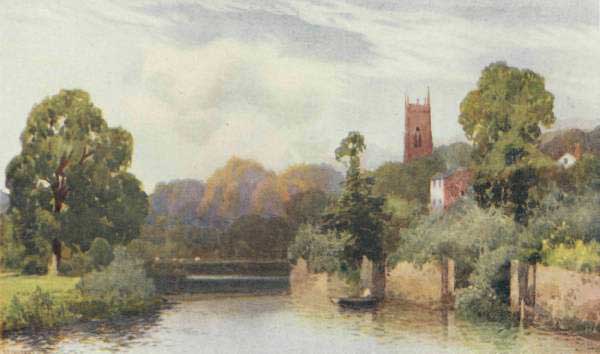 The Exe: Tiverton
The river Exe rises in a bog on Exmoor, beyond the borders of Somersetshire. 'Be now therefore pleased as you stand upon Great Vinnicombe top ... to cast your eye westward, and you may see the first spring of the river Exe, which welleth forth in a valley between Pinckerry and Woodborough,' says Westcote.
But our author has no feeling for the rolling hills, and noble lines, and hazy blue distances of Exmoor, and without one word of praise continues: 'Let us for your more ease, and the sooner to be quit of this barren soil, cold air, uneven ways, and untrodden paths, swim with the stream the better to hasten our speed.'
The first little town that the Exe comes to in Devonshire is Bampton, nowadays best known, perhaps, for its pony-fairs, when (so runs one account) 'Exmoor ponies throng the streets, flood the pavements, overflow the houses, pervade the place. Wild as hawks, active and lissom as goats, cajoled from the moors, and[Pg 14] tactfully manœuvred when penned, these indigenous quadrupeds will leap or escalade lofty barriers in a standing jump or a cat-like scramble.' Cattle and sheep are less conspicuously for sale at this popular and crowded fair, held on the last Thursday in October.
The first fact recorded of Bampton's history is of such ancient date that it may be hoped the vastness of the achievement has been rounded and filled out during the flight of time; for the historian, with unconscious irony, blandly remarks that here 'Cynegils, first Christian King of the West Saxons,' put twenty thousand (or maybe more) Britons to the sword. He does not mention how Cynegils continued his propagation of the Gospel.
The nave of the church at Bampton is built in the manner most common to this country—that is, early Perpendicular, but the chancel is Decorated. In many of the churches there is some portion of Decorated work. The screen and roof of the church are worth seeing, and in the churchyard are several unusually large and fine old yew-trees, one or two girdled by stone benches. Leaving Bampton, one passes along a green and fertile valley, the fields interrupted at intervals by copses, where thickets of undergrowth and multitudes of young saplings are struggling for the mastery—a picture of prodigal wealth in plants, bushes, and trees.
Seven miles to the south is Tiverton. Tiverton is a small town, but its story is interesting, and incidents cluster round the castle, church, the well-known school, and the former kersies and wool-market, and, besides, it is filled with memories of the melancholy experiences it has passed through—fires, floods, the plague, and at least one siege.
The borough was originally granted by Henry I to his cousin, Richard de Riparis (or de Redvers or Rivers), Earl of Devon, whose descendants possessed it for nearly two centuries, when, the direct line failing, the borough and title passed to a cousin, a Courtenay, in whose family the title still remains.
Richard de Redvers, 'the faithful and beloved counsellor' of Henry I, is supposed to have begun the Castle of Tiverton, and he attached to it 'two parks for pleasure and large and rich demesne for hospitality.' His grandson, William Rivers, was one of the[Pg 15] four Earls who carried the silken canopy at the second coronation of King Richard I, after his return from Palestine. William's daughter, Mary, married Robert Courtenay, Baron of Okehampton; and so it was that, when the House of Rivers became extinct in the male line, their possessions passed to the Courtenays, and Mary's great-grandson became first Earl of Devon of the line of the Courtenays.
It is not thought probable that the Castle as it stands contains work older than the fourteenth century. Part of the building of that date remains unaltered, and part has been transformed into a modern house. The old walls are in places covered with ivy, and on the southern side are pierced by one or two pointed windows whose stonework is more or less broken. A round tower at the southeastern angle still looks very solid and undisturbed. At a few yards' distance, on the south of the Castle, stand the ruins of the chapel; the walls of three sides are still standing, although imperfect and partly fallen down, and almost smothered in ivy. Originally this square tower at the south-west angle was joined to the Castle, and two more round towers stood at the northern angles. Near the chapel is a low wall, and looking over it one sees a very steep slope to the river, sixty feet beneath. A wide and deep moat surrounded the Castle on the other sides.
It is said that Tiverton suffered both in the Civil War of 1150 and also in the Wars of the Roses, and though there is little evidence to support this assertion, there can be no doubt that indirectly the town must have been disagreeably affected. For Baldwin de Redvers fortified his castle at Exeter, and it is very likely that retainers from Tiverton were sent to strengthen the garrison; and when the Earl was driven from the country by King Stephen, his servants and their families were probably distressed by want, if not by the sword.
During the Wars of the Roses, three successive Earls of Devon lost their lives, and many of their followers must have fallen too, leaving defenceless widows and children.
The Earls of Devon had many manors, but lived much in their Castle at Tiverton, and some were buried in the adjoining church[Pg 16] of St Peter. To the third Earl, known as 'the Good' or 'the Blind' Earl, and his wife a tomb was erected, 'having their effigies of alabaster, sometimes sumptuously gilded.' So writes Risdon, about the year 1630, and adds regretfully, 'Time hath not so much defaced, as men have mangled that magnificent monument.' It has now entirely disappeared. The epitaph it bore was this:
The church is a fine Perpendicular building, and has a high embattled tower, with slender crocketed pinnacles springing sixteen feet above the summit. The roof is battlemented, and the tracery in the windows is graceful. On either side of the chancel stands an altar-tomb—that on the north side being in memory of John Waldron, on the south of George Slee, both benefactors to the town in having founded almshouses. The sides of the tombs are boldly and curiously sculptured, being covered with raised devices, and a deeply lettered inscription is engraved in the top of each. A picture of St Peter being delivered by the angel from prison, painted by Richard Cosway, hangs over a north doorway. Cosway was born in Tiverton, and the letter that accompanied his gift expressed good feeling and his warm affection for his native town.
The most distinctive feature of the church is the very decorative 'Greenway' chapel. John Greenway was a rich wool-merchant of Tiverton, and on the walls of the chapel was inscribed this couplet:
It is interesting to note, of the three saints to whom the chapel was dedicated, that St Christopher was the patron of mariners and one of the 'sea-saints,' St Blaze the special patron of wool-[Pg 17]combers; while St Anne particularly presides over riches. An old distich runs:
So that the help of all three was peculiarly necessary to make John Greenway a prosperous man!
The chapel is late Perpendicular, and it is most elaborately carved and decorated. The roof is covered with different kinds of ornamentation, and the cornice bears the arms of Greenway, of the Drapers' Company, and other devices. Along the corbel line are carved scenes from the Bible, beneath is a sea of gentle ripples, with several large ships in full sail upon it, and above and beside the windows is a multitude of different designs—merchants' marks, animals, roses, anchors, horses and men; and a very delightful ape sits on a projecting pedestal, close to the porch. The porch is extremely elaborate, both within and without. On the frieze are six panels, each carved with a different Scriptural subject, separated from one another by single figures. Over the porch are the arms of the Courtenays, and above them an emblem and more carving, besides two large niches, now empty, at each side of the door. Inside the porch, over the door leading into the church, is a carving of the Assumption, and the roof is richly carved with merchants' marks and other ciphers and designs on little shields. The roof inside the chapel is also carved; and in the floor is a brass engraved with the figures of the merchant and his wife—he in a long fur-edged robe, and she wearing embroidered draperies and jewels, and a pomander ball hanging on one of the long ends of her girdle.
It is interesting to hear that in this church Mendelssohn's Wedding March was first played at a wedding. The 'Midsummer Night's Dream' music had just been published as a pianoforte duet, when Mr Samuel Reay, of Tiverton, made an arrangement of it for the organ, and the first marriage at which the march was played was that of Mr Tom Daniel and Miss Dorothea Carew, in June, 1847.
Tiverton was famed in early days for its trade in wool. It is[Pg 18] supposed that woollen goods were first manufactured here towards the end of the fourteenth century, and at the beginning of the sixteenth several merchants of the town were making ventures far and wide. Baizes, plain cloths, and kerseys were the most important of the manufactures, and there was some commerce in these with Spain. Traffic in woollen goods was now very brisk in different parts of the country, and during the reign of Henry VIII special statutes were enacted 'affecting cloths called white straits of Devon, and Devonshire kerseys called dozens.' In Elizabeth's reign trade prospered here as elsewhere; but later friction arose on the question of imports. The manufacturers on more than one occasion tried to introduce Irish worsted to weave into cloth, and this was met by the most violent opposition from the wool-combers, who believed that it would take away their work, although it was explained that their work depended on making serge for Dutch markets, for which the Irish worsted could not be used. The wool-combers had at different times various causes for complaint, and these they vented in riots so serious that (about 1749) the authorities asked for the protection of some troops, who were accordingly sent to Tiverton, and, on a fresh uproar not long after their arrival, were called out to quell the mob. Towards the latter half of the eighteenth century the woollen trade languished; but in the first quarter of the nineteenth century a new business sprang up—that of producing machine-made lace and tulle.
Tiverton's merchants marked their prosperity in an admirable manner, for over ninety gifts in land, money, and almshouses have been made. The gifts and bequests were usually intended to benefit the poor, but in a few cases they were for the general good. In addition there remains the memory of about twenty 'benefactions,' many of which were 'absorbed in the tumult of the Civil War or generally dissipated by neglect or mismanagement.' Greenway founded almshouses, as well as the aisle in the church, and although these dwellings have been altered to some extent, the tiny chapel still attached to them is very picturesque. A cornice contains twelve circles, within each a pierced quatrefoil, and in the centre of every quatrefoil a shield,[Pg 19] bearing a coat of arms, a merchant's mark, or other design. The cornice is supported by several rather grotesque animals, and below, in stone letters, this legend:
A wide moulded arch forms the doorway, and above are coats of arms and an eagle rising from a bundle of sticks, an emblem attached to the Courtenay arms that appears in several parts of St Peter's Church.
On Waldron's almshouses is this curious inscription:
On one wall is a pack of wool bearing Waldron's staplemark and a ship, and below them the words, 'Remember the poor.'
The greatest gift by far was that of Peter Blundell, who built and endowed the well-known school that is called after him, and founded six scholarships at Oxford and Cambridge as a further benefit to the scholars of Blundell's. His will dictates most particular instructions regarding the salaries of the master and usher, and as to the actual building, even directing that there should be 'in the kitchen one fair great chimney with an oven.'
In 1882 the school was transferred to Howden, but the building that Peter Blundell planned, beneath the steep hill close to the Lowman, is long and rather low, the colour a warm, soft yellow, still more softened by stray indefinite tints of cream and buff. The slate roof is high-pitched, the windows are square and mullioned, and there are two porches, each with a window directly above the hooded doorway, and crowned by a gable. The school-house stands back in a yard of plots of grass and pebbled paths, and shaded by great old lime-trees surrounded by a high wall.[Pg 20]
Samuel Wesley was at one time head-master here, and was not universally popular, for his scathing wit blighted the esteem earned by his high gifts and principles.
Many of Blundell's scholars have done good work in the world, but perhaps the most famous of them are the late Archbishop of Canterbury (Dr. Temple) and R. D. Blackmore, the novelist, who were here in the 'thirties, contemporaries and friends, both 'day-boys' and lodging in the same house in Cop's Court. Twenty years before the Archbishop came to Blundell's, that celebrated sportsman 'Jack' Russell was here, embarked on a stormy career, perpetually in scrapes due to his passion for sport, which even led him to the point of trying to keep hounds while he was actually at school. Contemporaries of Blackmore's were two distinguished soldiers and writers on military subjects, Sir Charles Chesney and his brother Sir George, the author of that account of an imaginary German invasion which created so much excitement when, under the name of 'The Battle of Dorking,' it appeared in 1871 in Blackwood's Magazine.
Fire has caused terrible loss and disaster here, for as many as seven big conflagrations have taken place in Tiverton, and in one alone six hundred houses were destroyed, besides £200,000 worth of goods and merchandise. In addition, at least eight smaller, but still considerable, fires took place at comparatively short intervals, so that between the years 1598 and 1788 the townsfolk suffered from this cause no fewer than fifteen times.
A curious account exists of the fire in 1598—'when,' says the chronicler, 'he which at one a clocke was worth Five Thousand Pound, and as the Prophet saith [a footnote suggests the prophet Amos, vi. 5, 6] dranke his Wine in bowles of fine silver plate, had not by two a Clocke so much as a wooden dish left to eate his Meate in, nor a house to couer his sorrowfull head, neyther did thys happen to one man alone, but to many.... In a twinkling of an eye came that great griefe uppon them, which turn'd their wealth to miserable want, and their riches to unlooktfor pouertie: and how was that? Mary, Sir, by Fyer.
'But no fier from heaven, no unquenchable fier such as worthily[Pg 21] fell on the sinfull Citie of Sodom and Gomorra; but a sillie flash of fier, blazing forth of a frying pan ... and here was dwelling in a little lowe thatcht house, a poore beggarly woman: who, with a companion, began to bake pancakes with strawe'—here he becomes sarcastic—'for their abilitie and prouission was so good that there was no wood in the house to doe it.... Sodenly, the fier got into the Pan.' Straw lying close by was ablaze in a moment, then the roof, then, alas! by means of an 'extreame high wind,' a hay-house standing near, and 'in less than halfe an hower the whole Toune was set on fier.'
A terrible picture is drawn of the rapidity and voracity of the flames—people crying for help in every direction, 'insomuch that the people were so amazed that they knew not which way to turne, nor where the most neede was'—and of the number of people who were burned and the desolation of the town.
As to those saved, 'the residue of the woefull people remaining yet aliue, being overburdened with extream sorrow, runs up and down the fieldes like distraught or franticke men.... Moreouer, they are so greatly distrest for lacke of food, that they seeme to each mannes sighte more liker spirits and Ghostes, than living creatures.'
The account concludes with a moral pointed in many figures of speech, to the effect that this great trouble was a judgment on the rich, who did not sufficiently consider their poor neighbours, and various cities are exhorted to take warning thereby. 'O famous London ... Thou which art the chief Lady Cittie of this Land, whose fame soundeth through al Christian Kingdoms, cast thy deere eyes on this ruinous Towne.... Consider this thou faire citie of Exeter, thou which art next neighbour to this distressed Town ... pitie her heauie happe, that knowes not what miserie hanges ouer thy owne head.'
An appeal to the public was made on behalf of these sufferers, and Queen Elizabeth responded with a grant of £5,000.
In the fire of 1612 the destruction was even greater. 'No noyse thundered about the streets, but fire, fire, in every place were heard the voyces of fire.... All the night long the towne seemed like unto a burning mountaine, shooting forth fiery comets, with[Pg 22] streaming blazes, or like unto the Canopie of the World, beset with thousands of night candles or bright burning Torches.'
When the Civil War broke out, Tiverton, though not unanimous, mainly sided with the Parliament. After the Battle of Stratton, however, the triumphant Royalists suddenly descended on the town, turned out Colonel Weare, who was in command of the Parliamentary forces, and took possession. Many skirmishes must have taken place either in or about the town, for large bodies of the troops belonging to King or Parliament moved backwards and forwards in the immediate neighbourhood during the course of the war.
Culpeper, the herbalist, to illustrate the powers of the plant moonwort, tells of a wonderful incident that occurred to Lord Essex's horse, presumably when his army was here in 1644. Moonwort has (or perhaps had) a miraculous effect on iron, with power to open locks or unshoe horses. 'Country people that I know, call it Unshoe the Horse. Besides I have heard commanders say, that in White Down in Devonshire, near Tiverton, there were found thirty horseshoes, pulled off from the feet of the Earl of Essex's horses, being there drawn up in a body, many of them being but newly shod, and no reason known, which caused much admiration, and the herb described usually grows upon heaths.' Probably almost all the neighbourhood thought witchcraft a better explanation.
It is very difficult entirely to disentangle accounts that seem to contradict each other, but apparently Essex moved away from Tiverton after a short stay, and certainly the King sent his army to Tiverton the same autumn to halt there for a while on its way from Plymouth to Chard. And as this army was returning, reduced and exhausted, from fighting and long, hard marches in Cornwall, it could not have been sent to a town in possession of the enemy. The next year Fairfax sent General Massie to take Tiverton. The Governor, Sir Gilbert Talbot, was in a far from happy position, for afterwards he wrote: 'My horse were mutinous, and I had but two hundred foot in garrison, and some of my chief officers unfaithful.' In spite of his disadvantages, he was able to repulse[Pg 23] the enemy in their first attack on church and castle, though unable to prevent their gaining possession of the town. Two days later Fairfax himself arrived, and batteries, furnished with 'several great Peeces,' were erected against the church and castle. The actual fighting lasted only a short time, for a shot broke the chain of the drawbridge, and it fell; the Parliamentary soldiers rushed across it without even waiting for the command, and the Royalists lost their heads and their courage and fled.
A copy of a letter that General Massie wrote from Tiverton to a Cheshire gentleman still exists, and in it he refers to a pamphlet, sent with the letter, even the title-page of which throws light on Puritan methods of influencing popular opinion against the Cavaliers. This startling page runs as follows:
A True and Strange
of a
Who was entertained by the Devill to be servant to him with the consent of his Father, about Crediton in the West, and how the Devill carried him up in the aire, and shewed him the torments of Hell, and some of the Cavaliers there, and what preparation there was made for Goring and Greenvile against they came.
Also how the Cavaliers went to rob a Carrier, and how the Carrier and his Horses turned themselves into
Leaving Tiverton and following the Exe downstream, the wayfarer may ponder two proverbs referring to Tiverton, neither of them especially flattering. It used to be, and no doubt is still, considered lucky to start off running directly the cuckoo is heard for the first time in the year, and thirty or forty years ago, if a girl obeyed this tradition, anyone near her would laugh and say: 'Run, run! and don't let no Tiverton man catch you!' The other saying is cryptic: 'He must go to Tiverton and ask Mr Able.' An interpretation suggested is that this was originally said to a questioner who asked for unattainable information, and that 'Mr Able' meant anyone able to furnish it. It is not[Pg 24] exactly a satisfactory solution, and as to the reference to Tiverton, though it may be complimentary, one doubts whether it does not carry more than a suspicion of sarcasm.
Four miles to the south of Tiverton is a pleasant well-wooded valley, in which stands Bickleigh. This village was the birthplace of a rascal, who was such a brilliant and talented rascal that his adventures are very interesting. Witty, courageous, and full of resource, he had, besides, two strong points in his favour. In spite of a very rough and wandering life, his warm affection for his wife never failed, and—all dogs adored him! Bampfylde Moore Carew belonged to a very old family in the West, and his father was rector of Bickleigh. A happy-go-lucky career was foreshadowed at the very outset, for his two 'illustrious godfathers,' Mr Hugh Bampfylde and Major Moore, disputed as to whose name should stand first, and, as they could not agree, the matter was decided by spinning a coin. A few of the most interesting events in his career may be quoted from a little biography first published anonymously in 1745, thirteen years before his death. Carew was sent to Blundell's, where for a while he did well, although his tastes led him to be out with 'a cry' of hounds that the scholars of Blundell's kept among them, whenever it was possible. On one occasion some farmers complained to the head-master of the damage that had been done in hunting a deer over standing corn, and the boy, to escape punishment, ran away from school and joined some gipsies. Carew took very kindly to the life, but repeated accounts of his parents' unhappiness brought him home after a year and a half's wanderings. Though overwhelmed with 'marks of festive joy,' the call 'of the wind on the heath,' was too strong to be resisted, and in a short time he slipped away again and went back to his chosen people. He must have been a very finished actor, with a genius for 'make-up,' to have imposed on half the people that he befooled. Amongst his first rôles were those of a shipwrecked mariner; a poor Mad Tom, trying to eat live coals; and a Kentish farmer, whose drowned farm in the Isle of Sheppey could no longer support his wife and 'seven helpless infants.' Carew's restless disposition took him to[Pg 25] Newfoundland, and on his return he successfully played the parts of a nonjuring clergyman, dispossessed of his living for conscience' sake; a Quaker—here is a good example of his wonderful gift—in an assembly of Quakers; a ruined miller; a rat-catcher; and, having borrowed three children from a tinker, a grandmother. Carew once wheedled a gentleman, who boasted that he could not be taken in by beggars, into giving him liberal alms twice in one day—in the morning as an unfortunate blacksmith, whose all had been destroyed by fire; whilst in the afternoon, on crutches, his face 'pale and sickly, his gestures very expressive of pain,' he pleaded as a disabled tinner, who, from 'the damps and hardships he had suffered in the mines,' could not work to keep his family.
At the death of Clause Patch, the King of the Gipsies, Carew was elected King in his stead. Before he died, the aged King, feeling his end approaching, bestowed a few last words of advice on his followers, well worth quoting.
Of begging in the street and interrupting people who are talking, he said: 'If they are tradesmen, their conversation will soon end, and may be well paid for by a halfpenny; if an inferior clings to the skirt of a superior, he will give twopence rather than be pulled off; and when you are happy enough to meet a lover and his mistress, never part with them under sixpence, for you may be sure they will never part from one another.'
This is followed by shrewd advice as to the choice of an appeal: 'Whatever people seem to want, give it them largely in your address to them. Call the beau sweet Gentleman; bless even his coat or periwig; and tell him they are happy ladies where he's going. If you meet with a schoolboy captain, such as our streets are full of, call him noble general; and if the miser can be in any way got to strip himself of a farthing, it will be by the name of charitable Sir.... If you meet a sorrowful countenance with a red coat, be sure the wearer is a disbanded officer. Let a female always attack him, and tell him she is the widow of a poor marine, who had served twelve years, and then broke his heart because he was turned out without a penny. If you meet a homely but dressed-up lady, pray for her lovely face, and beg a penny.'[Pg 26]
After his election as King of the Gipsies, or King of the Beggars, as he is more often called, Carew was soon involved in fresh adventures. But one day grey ill-luck looked his way; he was arrested and sent for trial to Exeter. Courage and audacity never failed him, for when the Chairman of Quarter Sessions announced that the prisoner was to be transported to a country which he pronounced Merryland, Carew calmly criticised his pronunciation, and said he thought that Maryland would be more correct. To Maryland he was sent in charge of a brutal sea-captain, and on his arrival, burdened with a heavy iron collar riveted round his neck, was set to all sorts of drudgery. Before very long he contrived to escape into the forests, and after some danger from wild beasts he reached a tribe of friendly Indians, who received him with great kindness. Later he stole a canoe, and, returning to civilized regions, posed as a kidnapped Quaker, in which character he succeeded in gaining the compassion of Whitefield, the great preacher, who gave him 'three or four pounds of that county paper money.' By the help of several ingenious ruses he was able to get home again, and soon afterwards, aided by a turban, a long, loose robe, and flowing beard, appeared as a destitute Greek, whose 'mute silence, his dejected countenance, a sudden tear that now and then flowed down his cheek,' touched the hearts of the benevolent. In an unlucky moment he was impressed for the navy; next travelled in Russia, Poland, Sweden, and other countries, but, returning to England, was again seized, put in irons, and transported. With his usual indomitable spirit and resource, he escaped once more into the forests, and after dangers and hardships reached England. Finally, he ended his days in peace where he began them, and was buried at Bickleigh in 1758.
Five miles east of Tiverton is a village called Sampford Peverell, which in the early part of the nineteenth century suddenly sprang into notice through the strange proceedings of a mysterious spirit, known as the Sampford Ghost. This 'goblin sprite,' as one account calls it, declared itself in a manner well known to psychical researchers, by violent knockings, and by causing a sword, a heavy book, and an iron candlestick to fly about the room. Two maid-[Pg 27]servants received heavy blows while they were in bed, and there were other strange and distressing phenomena. These manifestations were continued for more than three years. Numberless visitors, drawn by curiosity from all parts of the country, came to investigate the matter, but no explanation could be found, and though there were suspicions that the whole affair was a very elaborate hoax, and a reward of £250 was offered for information that might throw light upon it, no single attempt was made to claim the money.
Sampford Peverell is a small place, and rather out of the way, but so long ago as in the reign of Edward I it is recorded that John de Hillersdon held the manor on a tenure that reflects the unquiet state of the country. He held it 'in fee, in serjeanty, by finding for our lord the King, in his army in Wales, and elsewhere in England, whensoever war should happen, one man with a horse caparisoned or armed for war at his proper costs for forty days to abide in the war aforesaid.' Hugh Peverell held the Manor of Sandford, near Crediton, on much the same terms, but had to provide 'one armed horseman and two footmen.'
Following down Sampford stream for about three miles, one arrives at the point where the stream reaches an opening into the Culm Valley, and empties itself in the Culm. A very short distance beyond is the little town of Cullompton, of which the most interesting feature is a fine Perpendicular church. An old writer insists that here was formerly 'the figure of Columbus, to which many pilgrims resorted, and which brought considerable sums to the priests'; but of this statement I can find neither confirmation nor denial. The tower of the church is high and decorated. Within, the roof, richly carved and gilded, rests on a carved wall-plate, supported by angel corbels, and most exquisite is the carving of the rood-screen, which has also been gilded and coloured. A very rare possession of this church is 'a portion of a Calvary, and above is an ornamental rood-beam, supported by angels; the Golgotha, carved out of the butts of two trees, is now in the tower, and is hewn and carved to represent rocks bestrewn with skulls and bones; the mortice holes for the crucifix[Pg 28] and attendant figures remain.' Early fifteenth-century figures painted on the wall were discovered when the church was 'restored' in 1849, but they were covered with whitewash!
The making of woollen goods throve in earlier times in Cullompton, and a rich clothier, John Lane by name, and his wife Thomasine, added a very beautiful aisle to the church about 1526. The roof of the 'Lane' aisle is covered with exquisite fan-tracery, rich carvings, and figures of angels, and pendants droop from the centre. The pillars, the buttresses, and parts of the outside walls are decorated by carvings of Lane's monogram, his merchant's mark, and different symbols of his trade.
Three miles south-east of Cullompton is another church famed for its beautiful screen. The Plymtree screen is probably unique in bearing on its panels the likenesses of Henry VII, his son Prince Arthur, and Cardinal Morton. The upper part of the screen is a magnificent bit of carving. Graceful pillars rise like stems, and their lines curve outwards into the lines of palm-leaves, overspreading one another, while the arches they form are filled with most delicate tracery, supported on the slenderest shafts. Above are four rows of carving, each of different design—one a vine, with clusters of grapes, and this is repeated more heavily on the capital of a pillar in the nave. The screen must have been glorious in gold and vermilion, and gold lines cross each other, making a sort of lattice-work, with ornaments at the points of intersection—a large double rose, a little shield with the Bouchier knot, or the Stafford knot, or a very naturally carved spray of oak-leaves. Below, the panels are painted with saints and angels and bishops. The King, Prince, and Cardinal appear in a representation of the Adoration of the Three Kings, each one bringing his offering in a differently-shaped vessel. Mr Mozley, a former Rector of Plymtree, has written a most interesting pamphlet on the subject, tracing out the likeness of these portraits to other pictures or busts of the three. He points out that, whereas in most paintings of the Three Kings each has a crown, that of the foremost usually laid on the ground, in this group King Henry alone is crowned; the Cardinal has none; and the Prince, who is represented as very[Pg 29] young, is wearing a boy's cap. Mr Mozley has searched carefully for a reason that would account for the group in this little church, and has found what seems to be a perfectly sufficient connecting link. Lord Hastings, who married the heiress of Lord Hungerford, and incidentally acquired the Manor of Plymtree, was the warm friend and political ally of Cardinal Morton. The son and successor of Lord Hastings was a close personal friend of Henry VI, and in consequence a colleague of the Cardinal, the King's chief counsellor. There is no date on the screen, but from various deductions it is believed to have been painted about the end of the fifteenth century, or a little later, and either during the lifetime or just after the death of the three subjects of the group, and of Lord Hastings.
Bradninch lies a short distance to the west of Plymtree, and this church contains a very fine screen and an old and remarkable painting of the Crucifixion. It was originally placed in an aisle that was built in the reign of Henry VII by the Fraternity of St John, or the Guild of Cordwainers.
The Culm runs past Bradninch, at a little distance to the east, and a few miles farther on the river passes under the dark hills of Killerton Park, a heavily wooded and irregular ridge, rising at either extremity and ending in a decided slope down to the flat space just around. The house is not an old one, although the Aclands have been here since the reign of Queen Elizabeth, when Sir John Acland moved from the estate at Landkey, near Barnstaple, where they were already settled in the reign of Henry II. He built a house at Culm John (quite close to Killerton) that was garrisoned for the King during the Civil War, and held out when almost every other place in Devonshire had surrendered. But it has since been pulled down.
There are many stories of different members of this family, but perhaps the most romance lies in that of Lady Harriot Acland, who, with serene courage, followed her husband through the horrors and hardships of a campaign.
In 1776 Major Acland was with the army that had been sent to crush the American struggle for Independence, and his wife had[Pg 30] accompanied him. The following extract is taken from a statement by General Burgoyne, the General commanding the troops in Canada: 'In the course of that campaign, she had traversed a vast space of country in different extremities of seasons. She was restrained from offering herself to a share of the hazard expected before Ticonderoga, by the positive injunction of her husband. The day after the conquest of that place he was badly wounded, and she crossed the Lake Champlain to join him.'
When he was recovered, Lady Harriot continued to follow his fortunes through the campaign, and acquired a 'two-wheel tumbril, which had been constructed by the artillery.' Colonel Acland was with the most advanced corps of the army, and they were often in so much danger of being surprised that they had to sleep in their clothes. Once the Aclands' tent and all that was in it was burned, but this accident 'neither altered the resolution nor the cheerfulness of Lady Harriot, and she continued her progress a partaker of the fatigues of the advanced corps. The next call upon her fortitude was more distressful. On the march of the 19th, the Grenadiers being liable to action at every step, she had been directed by Major Acland to follow the route of the artillery and luggage which was not exposed. At the time the action began she found herself near a small uninhabited hut, where she alighted. When it was found the action was becoming general and bloody, the surgeons of the hospital took possession of the same place as the most convenient for the first care of the wounded. Thus was this lady in hearing of one continued fire of cannon and musketry for some hours together, with the presumption, from the post of her husband at the head of the Grenadiers, that he was in the most exposed part of the action. She had three female companions—the Baroness of Reidesel, and the wives of two British officers, Major Harnage and Lieutenant Reynell; but in the event their presence served but little for comfort. Major Harnage was soon brought to the surgeons, very badly wounded; and a little while after came intelligence that Lieutenant Reynell was shot dead. Imagination will want no help to figure the state of the whole group.' Not long afterwards Lady Harriot passed through an even severer ordeal.[Pg 31] During another engagement 'she was exposed to the hearing of the whole action, and at last received the shock of her individual misfortune mixed with the intelligence of the general calamity; the troops were defeated, and Major Ackland, desperately wounded, was a prisoner.
'The day of the 8th was passed by Lady Harriot and her companions in common anxiety; not a tent, not a shed being standing except what belonged to the hospital, their refuge was among the wounded and dying.
'I soon received a message from Lady Harriot, submitting to my decision a proposal (and expressing an earnest solicitude to execute it if not interfering with my designs) of passing to the camp of the enemy and requesting General Gates's permission to attend her husband.... I was astonished at this proposal. After so long an agitation of the spirits, exhausted not only for want of rest, but absolutely want of food, drenched in rains for twelve hours together, that a woman should be capable of such an undertaking as delivering herself to the enemy, probably in the night, and uncertain of what hands she might fall into, appeared an effort above human nature. The assistance I was enabled to give her was small indeed; I had not even a cup of wine to offer her; but I was told she had found from some kind and fortunate hand a little rum and dirty water. All I could furnish to her was an open boat and a few lines written upon dirty and wet paper, to General Gates, recommending her to his protection.
'Mr Brudenell, the chaplain to the Artillery, ...readily undertook to accompany her, and with one female servant, and the Major's valet-de-chambre (who had a ball, which he had received in the late action, then in his shoulder), she rowed down the river to meet the enemy. But her distresses were not yet to end. The night advanced before the boat reached the enemy's outposts, and the sentinel would not let it pass, nor even come on shore. In vain Mr Brudenell offered the flag of truce.... The guard threatened to fire into the boat if they stirred before daylight.' And for seven or eight dark and cold hours they were obliged to wait. Happily, when at length she did reach the shore, Lady Harriot was[Pg 32] received with all courtesy by General Gates, and had the joy of nursing her husband back to health.
A little to the south-west of Killerton Park lie the well-ordered park and beautiful grounds of Lord Poltimore. John Bampfylde, his ancestor, was lord of this manor in the reign of Edward I, but the line of succession has been threatened by an episode, told by Prince (in his 'Worthies of Devon'), that reads like a folk-story. At one time the head of the family was a child, who, left an orphan very young, was given as a ward 'to some great person in the East Country.' This gentleman carried the child away to his own home, and, although not going quite so far as the wicked uncle in The Babes in the Wood, behaved very treacherously to his ward; 'concealing from him his quality and condition, and preventing what he could any discovery thereof, his guardian bred him up as his servant, and at last made him his huntsman.'
To any who concerned themselves about the boy, the false guardian 'some years after gave it out, he was gone to travel (or the like pretence), in-so-much his relations and friends, believing it to be true, looked no further after him.' But Bampfylde's tenants were more faithful, and one of them, on his own responsibility, rose to the tremendous effort and enterprise of starting off in search of him. His loyalty was rewarded with full success, for he was able to find and identify the young man, and, biding his time, the tenant grasped an opportunity of talking quietly to him, and 'acquainted him with his birth and fortunes, and finally arranged his escape.' And in this way the true heir came to his own again.
In the spring of 1646 Poltimore House was chosen by Fairfax as the meeting-place of his commissioners and those sent by Sir John Berkeley, and here they discussed the articles of the surrender of besieged Exeter, and drew up the treaty that could be accepted by both sides.
Sir Coplestone Bampfylde, having 'a vigorous soul,' worked for the Restoration with so much zeal that messengers were sent from the Parliament to arrest him, and he was forced to hide.
But 'his generous mind could not be affrighted from following[Pg 33] his duty and honour,' and as the citizens of Exeter, by this time very dissatisfied with the Government, were beginning to arm, declaring for a free Parliament, Sir Coplestone and other gentlemen composed an address, demanding the recall of the members secluded in 1648, and 'all to be admitted without any oath or engagement previous to their entrance.' He next took his way to London, to present 'an humble petition of right' on behalf of the county to General Monk, but was seized by the Parliament and flung into the Tower. His imprisonment was brief, and Charles II rewarded Bampfylde's energy by choosing him to be the first High Sheriff of the county of his reign, and later appointing him to other posts of 'trust and honour.'
John Bampfylde, a descendant of Sir Coplestone's, was a poet, and among his verses occurs this charming sonnet, on that not unknown event in Devon—a Wet Summer:
Poltimore is nearly two miles east of the Exe, and if a straight line across country were followed to the river, the traveller would arrive almost at the point where the Culm flows into the larger stream. The valley here is rather broad, and the river winds between pleasant, rich, green meadows and wooded hills, most of which rise in gentle, easy slopes. Not quite two miles north of Exeter, the Exe turns due south, and is joined by the Creedy, running south-west. Westcote, in flowery language, describes the scene, painting a picture which would stand good to-day, but[Pg 34] that nearly all the mills are gone. Cowley Bridge, 'built of fair square stone,' stands just above the junction, 'where Exe musters gloriously, being bordered on each side with profitable mills, fat green marshes and meadows (enamelled with a variety of golden spangles of fragrant flowers, and bordered with silver swans), makes a deep show, as if she would carry boats and barges home to the city; but we are opposed by Exwick wear, and indeed wears have much impaired his lustre and portable ability, which else might have brought his denominated city rich merchandise home to the very gates.'
Here one may leave the Exe to follow the Creedy upstream for five miles or so, till Crediton is reached. 'Creedy' comes from the Celtic word Crwydr, a hook or crook, a name that its tortuous way must have earned. The river runs between crumbling banks of soft earth, and shifts its course a little after any great flood. It is curious to notice the difference after heavy rains between the Exe and the Creedy, for while the former will be still a comparatively clear brown, even when it comes down a great swirling flood, thundering over the weirs and hurrying along honeycombs of foam, the Creedy will have turned to a surging, turbid volume of water, of a deep red, terra-cotta colour, that leaves traces of red mud in the overhanging trees when the river has subsided.
The valley is a narrow one, and on the hill-sides are copses and orchards, lovely as a sea of pink and white blossoms, and very admirable on a bright day in September, when the bright crimson cider apples, and golden ones with rosy cheeks, are showing among the leaves, and the hot sunshine, following a touch of frost, brings out the clean, crisp, sweet scent of ripe apples till it floats across roads and hedges. Leland remarks that 'the ground betwixt Excestre and Crideton exceeding fair Corn Greese and Wood. There is a praty market in Kirton.' Kirton was the popular name for the town. Its origin is far to seek, for the saying runs:
However this may have been, it is, at any rate, certain that the Bishops of Devon were seated at Crediton for over one hundred and forty years before, in 1050, Leofric removed to Exeter. And nearly two and a half centuries before the first Bishop settled at Crediton, religious feeling was awake, as is shown by the story of St Boniface, or, as he was originally called, Wynfrith. This saint, the great missionary to the Germans, is believed to have been born here in the year 680, and at a very early age he wished to become a monk. His desire was not at once granted, for his father could not bear to part with him, and much opposition had to be overcome before he was allowed to go to school in Exeter. After he was ordained, Boniface won the respect and confidence of Ina, King of the West Saxons, but feeling that his work lay in another country, he went to Thuringia, to throw his strength into the conversion of the heathen. Combining 'learning, excellency of memory, integrity of life, and vivacity of spirit, he was fit for great employment,' says an old writer, and he was chosen Archbishop of Mentz, becoming the chief authority on all spiritual matters in Germany. In spite of the heavy cares and toils entailed by his high office, St Boniface still laboured personally among the recalcitrant heathen, and in his seventy-sixth year
Eight Bishops lived and died at Crediton, and the ninth demanded that the see should be transferred from Crediton to Exeter. The chief reason put forward was that Exeter was a strong city, and less likely to be ravaged by Irish Danes and other 'barbarian pirates,' but Professor Freeman suggests that Leofric also desired the change because he had been educated on the Continent, where it was never the custom for a Bishop's chief seat to be in a village when a larger town was in his diocese. Anyhow, Leofric obtained his wish, and was led to his throne in St Peter's Church in Exeter by the King on one hand and the Queen on the other, in the presence of two Archbishops and other nobles.
The palace and park at Crediton remained in the possession of the Bishops till the Dissolution.[Pg 36]
The beautiful Church of St Cross stands either upon or close to the site of the original cathedral of the Bishops, which, on the removal of the See to Exeter, was made a collegiate church, with precentor, treasurer, dean, eighteen canons and as many vicars, besides singing-men or lay-vicars.
The present church is mainly Perpendicular, though the Lady Chapel is early Decorated, and there are portions of still earlier work. The tower is central, square, and rather low. It is surmounted by four embattled turrets, and battlements run round the roof of the church. The whole building is of a soft rose-red colour, but the walls within were once whitewashed, and are now of a slightly cooler tint. The clustered pillars look as if, over a warm, soft grey, a faint, transparent tinge of rose-colour had passed, leaving a very lovely effect; they are tall and graceful, and delicate carving adorns the capitals. The nave is lofty and unusually long. On the south side of the chancel are sedilia, once elaborately decorated and glorious in vermilion and gold; a design resembling a very large but intricate network in gold spreads over the backs of the sedilia, and a little figure, with faint traces of colour and gilding, stands at one end. On the north side of the chancel is the effigy, lying at full length, of William Peryam; and close by is a monument to John Tuckfield, engraved with an epitaph full of praise, in which occur these lines, in peculiar lettering and spelling:
The Lady Chapel is beautifully decorated. At the south end of the choir is a large tomb, on which lie, side by side, the effigies of a knight in armour and a lady with a wonderful head-dress, large and square. The figures are somewhat mutilated, but the little angels that supported her head can just be distinguished. The tomb is supposed to be that of Sir John Sully and his wife; he, having fought at Crecy and Poictiers, lived to give evidence, at the age of 105, in the great Scrope and Grosvenor controversy.[Pg 37]
In the south porch is a bit of early English work, a piscina and holy-water stoup side by side, under one arch, with a very slender detached shaft between. The upper portion of the font is late Norman, and is dark, shallow, and square. Behind the font a small door and tiny staircase lead up to the parvise, where is stored a library that was given for the priest's use. The books include a 'Vinegar' Bible, an Eikon Basilike, and other treasures.
There is a curious account of a miracle that took place in this church on August 1, 1315, while Bishop Stapeldon was celebrating Mass. Thomas Orey, a fuller by trade, of Keynsham, became suddenly blind one day in Easter week for no apparent reason. A vivid dream that, if he should visit the Church of Holy Cross at Crediton, his sight would return, induced him to journey there with his wife, and several witnesses, afterwards called by the Bishop to give evidence, solemnly asserted that when he arrived in the town he was totally blind. Two days he spent in the church, and on the third, he being 'instant at prayer before the altar of St Nicholas, suddenly recovered his sight.'
Crediton had for a long time a very important trade in woollen goods, which were made here as early as in the thirteenth century. In the reign of Queen Elizabeth it was one of the principal centres of the manufacture in the county, and, indeed, caused Exeter so much jealousy that weavers, tuckers, and others, petitioned the authorities until it was ordained that the serge-market should be removed from here, and a weekly one set up in Exeter, to the great and natural indignation of Crediton. 'Their market for kersies hath been very great, especially of the finer sort,' says Westcote, 'for the aptness and diligent industry of the inhabitants ... did purchase it a supereminent name above all other towns, whereby grew this common proverb—as fine as Kirton spinning ... which spinning was very fine indeed, which to express, the better to gain your belief, it is very true that 140 threads of woollen yarn spun in that town were drawn together through the eye of a tailor's needle; which needle and threads were, for many years together, to be seen in Watling-street, in London, in the shop of one Mr Dunscombe.'[Pg 38]
Crediton was once, for a brief but fateful moment, the focus of a very serious movement. During 1549 discontent showed itself in many parts of England, and very gravely in the West, where a rising of Devonshire and Cornish men brought about the 'Affair of the Crediton Barns,' and culminated in the siege of Exeter. The first definite outbreak was at Sampford Courtenay, on Whit Monday, June 10. On Sunday the Book of Common Prayer was used for the first time, but the people were dissatisfied. They did not care to hear the service in their own tongue instead of in Latin, and they resented all the other changes. And when on Monday the priest was 'preparing himself to say the service as he had done the day before ... they said he should not do so.... In the end, whether it were with his will or against his will, he ravisheth himself in his old Popish attire, and sayeth Mass, and all such services as in Times past accustomed.'
The news of this incident spread; other villages followed suit, and the local magistrates unwillingly recognized that the ferment of rebellion was working, and met together to try and reason the people into a more submissive frame of mind. But the movement was too full of force to be arrested by such gentle methods, and the justices, 'being afraid of their own shadows, ... departed without having done anything at all.' Unfortunately, their reasoning had merely an irritating effect, so that, when a certain gentleman named Helions tried mildly to enforce some of the remonstrances, a man struck him on the neck with a billhook and killed him. This blow seems to have stirred the mob into taking a definite course of action, and they marched on Crediton. News of the disturbance had, meanwhile, reached the King, and Sir Peter and Sir Gawen Carew were sent down in haste to deal with the matter. From Exeter, they and several other gentlemen rode to confer with the people; but the people, having had notice of the arrival of the knights, 'they intrench the highways, and make a mighty rampire at the Town's End, and fortify the same' and 'also the Barns of both sides of the way.' The walls were pierced with 'loops and holes for their shot,' and 'so complenished with men, well appointed with bows and arrows and other weapons,[Pg 39] that there was no passage nor entry for them into the town.' Nor would they listen to 'the Gentlemen,' but refused all conference.
The 'Warlike Knights' then tried force, but were driven back with loss, by a heavy volley. 'Whereupon some one strong man of that company,' says Hooker (who must have admired decision), 'unawares of the gentlemen, did set one of the barns on fire, and then the Commoners, seeing that, ran and fled away out of the town.' This ended all the trouble in Crediton, though the smoking barns served as fuel to the growing spirit of revolt, and the 'Barns of Crediton' became a party-cry.
Clarendon mentions briefly that Charles I came here on his way into Cornwall, and reviewed the troops under Prince Maurice.
About one hundred and fifty years later the distant echoes of war sounded faintly in Crediton, for French prisoners of war on parole, Napoleon's soldiers, were allowed to live in this town. Vague rumours of them may still be heard. The sexton remembers that his mother often told about them, and one of the first people he buried was a man named Henry, 'though,' he explained, 'they spell it rather differently.' The melancholy fate of this stranger throws a light on one of the disregarded tragedies in the train of war, for Henri was not a soldier, but the son of a French prisoner. For some reason he never went home, and died in the workhouse.
Amongst the conditions that the prisoners on parole had to sign was: 'Not to withdraw one mile from the boundaries prescribed there without leave for that purpose from the said Commissioners;' and on some roads a stone was put up marking the limits. One of these stones, of grey limestone, and very like a milestone with no inscription, is still to be seen jutting out from the bank of Shobrooke Park, on the Stockleigh Pomeroy road. Another witness to the presence of the French prisoners lies in the name that clings to a bit of road running behind the Vicarage, for it is still sometimes called the Belle Parade, and tradition says that here they used to assemble on Sundays.
Returning along the river, one passes through the property of the late Sir Redvers Buller. Downes is a white house standing[Pg 40] amongst green open lawns sloping to the river, and it has a background of great trees and ample shrubberies. The Bullers at one time lived chiefly in Cornwall, and Downes was originally a shooting-box. A hay-loft stood at one end, and when the house was enlarged the archway under which the hay-waggons were driven was left standing, and now forms part of the drawing-room—a room with an unusually high ceiling. A member of the family has been kind enough to send me notes of one or two incidents in the history of the Bullers.
'The whole Buller family was at one time reduced to a single individual, John Francis Buller. He died of the smallpox. His mother insisted on seeing him after death. It was in the days when air was considered highly prejudicial to smallpox patients, who were covered with red cloth, and every window and cranny through which air might enter was carefully closed. To minimize the risk to his mother, who would listen to no dissuasion, all the windows and doors were opened, and a draught of air admitted, with the result that when his mother entered the room the dead man rose from his bed and received her.' Mr Buller lived to marry Rebecca, daughter of the Bishop Trelawney who was one of the seven Bishops sent to the Tower by James II. His arrest created intense indignation in his own county; and he is the Trelawney referred to in the well-known fragment, all that remains of a ballad written at the time to express Cornish feeling:
A later Mr Buller of Downes had a brief but unpleasant experience of the feeling of the mob in regard to the Reform Bill.
'I recollect hearing that at the time of the first Reform Bill (1830) the members of the House of Commons were threatened with dire consequences if they could not give what the mob considered satisfactory answers to their questions.
'Mr Buller of Downes was on his way to the House in his own[Pg 41] carriage, when a crowd stopped him, demanding to know how he meant to vote. He took no notice of their request, but remained quietly seated, when some of the men opened the carriage door with cries of, "Pull him out! Pull him out!" and were proceeding to carry out their threat, when his servant, who was standing behind the carriage, sprang up to the roof, and, waving his hat, shouted: "What! don't you know my master, Squire Buller? Why, he's always for the people!" Whereupon the door was closed again with a bang, the coachman told to drive on, and "Squire Buller" reached the House without further molestation.'
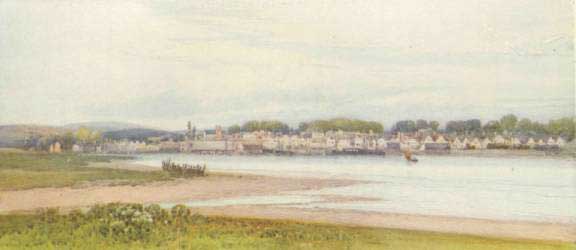 Topsham
Two miles farther on the river passes the village of Newton St Cyres, or Syriak Newton, as some of the older writers called it. The church has several interesting features, and escaped the ruthless 'restoration' that so many village churches suffered from at the beginning of the nineteenth century. Alders and willows overhang the stream, which winds its way to the south-west, and about two miles farther on one arrives again at Cowley Bridge. The Valley of the Exe gets ever wider and flatter, and after Exeter has been passed the flatness on either side of the banks increases as the river draws near the estuary.
Topsham stands at the head of the estuary, and is a pleasant little town, whose great days are gone by. It is difficult to believe that in the reign of William III Topsham had more trade with Newfoundland than any other port in the country excepting London. Presumably it was at this time that certain Dutch merchants came to live here, and built themselves quaint narrow houses of small Dutch bricks, painted the colour of bath-bricks. Rounded gable-ends are a feature of these houses, which may still be seen along the Strand. In many cases the clerk's house, a smaller, humbler dwelling of exactly the same design, stands close to the merchant's, separated by their respective gardens.
Till wooden ships were superseded, frigates for the navy were built here, but now, although some of the largest ships stop and unload their cargoes for Exeter, there is little of the stir and bustle that the town must once have rejoiced in.
Miss Celia Fiennes, who rode through England about 1695,[Pg 42] mentions Topsham in her diary as 'a little market place and a very good Key; hither they convey on horses their serges and soe load their shipps wh comes to this place, all for London.' She also speaks of Starcross, on the farther side of the river, 'where the Great shipps ride, and there they build some shipps.'
In the end of the seventeenth century there sprang from Topsham a man of great resoluteness, pluck, and the spirit to fight against tremendous odds in cold blood. Robert Lyde, mate of the Friend's Adventure, himself wrote an account of his fortunes on board that vessel. Lyde's great bitterness against the French is explained by the fact that he had already suffered intensely at their hands. Two years before he had been captured at sea by a French privateer, and imprisoned at St Malo, 'where we were used with such inhumanity and cruelty that if we had been taken by the Turks we could not have been used worse.' The prisoners were almost starved, and their condition was wretched in every respect. 'These and their other barbarities made so great an impression on me that I did resolve never to go a prisoner there again, and this resolution I did ever since continue in.' But when he was for the second time made prisoner—this time on board the Friend's Adventure—there seemed no escape from this evil fate. The crew were all removed from the ship, excepting Lyde and one boy, who, under a prize-master and six men, were to help in sailing her to St Malo. The idea of returning to the identical prison where he had endured such misery made Lyde desperate, and, finding no easier expedient, he determined to pit himself against the seven as soon as he could persuade the boy to join him. The boy, not unnaturally, hung back from such a venture, and before he could screw his courage to the sticking-place they had arrived off a small harbour near Brest, and the French had fired a 'patteroe' for a pilot. 'Whereupon, considering the inhuman usage I formerly had in France, and how near I was to it again, struck me with such terror that I went down between decks and prayed God for a southerly wind, to prevent her from going into that harbour, which God was most graciously pleased to grant me, for which I returned my unfeigned thanks.'[Pg 43]
Lyde's anxiety to attack the French was now redoubled, and when they invited him to their breakfast, he was so 'ready to faint with eagerness to encounter them' that he could not stay in the same cabin. He went up 'betwixt decks' to the boy, 'and did earnestly entreat him to go up presently to the cabin and stand behind me, and knock down but one man, in case two laid on me, and I would kill and command all the rest presently.' The boy, however, was timid, and when Lyde, to spur him into resistance, told all the horrible details of his former captivity, he calmly replied: 'If I do find it as hard as you say when I am in France, I will go along with them in a privateer.' 'These words,' writes Lyde, 'struck me to the heart, which made me say: "You dog! What! will you go with them against your King and Country, and Father and Mother? Sirrah! I was a prisoner in France four months, and my tongue cannot express what I endured there, yet I would not turn Papist and go with them. If I should take my brother in a French privateer, after he had sailed willingly with them, I would hang him immediately."' Perhaps at this point the boy began to fear opposing Lyde as much as attacking all the Frenchmen, for he now consented to help, and was told that if he would knock down the man at the helm, all the others should be Lyde's affair. The sang-froid of the ensuing conversation is remarkable. 'Saith the boy, "If you be sure to overcome them, how many do you count to kill?" I answered that I intended to kill three of them. Then the boy replied, "Why three, and no more?" I answered that I would kill three for three of our men that died in Prison when I was there.' Lyde went on to express a hope that some day a 'Man-of-War or Fireship' will try to avenge 'the Death of those four hundred men that died in the same Prison of Dinan.' But the boy's fears found the present scheme too merciful, and he protested, 'Four alive would be too many for us.'
The attack was made when two Frenchmen were asleep in the cabin. 'I went softly aft into the cabin, and put my back against the bulkhead, and took the iron crow and held it with both my hands in the middle of it, and put my legs to shorten myself, because the cabin was very low. But he that being nighest to me,[Pg 44] hearing me, opened his eyes, and perceiving my intent and upon what account I was coming, he endeavoured to rise to make resistance against me, but I prevented him by a blow upon his forehead which mortally wounded him.' The other man received a heavy blow as he was rising, 'very fiercely endeavouring to come against me.... The master, lying in his cabin on my right hand, rose and sat in his cabin, and seeing what I had done, he called me by most insulting names.' But 'having his eyes every way,' Lyde turned on him with a blow which made him 'lie as still as if he had been dead.'
He then went to 'attack the two men who were at the pump, where they continued pumping without hearing or knowing what I had done;' but one of the wounded men crawled out of the cabin, and when the men at the pump 'saw his blood running out of the hole in his forehead, they came running aft to me, grinding their teeth as if they would have eaten me; but I met them as they came within the steeridge door, and struck at them; but the steeridge not being above four foot high, I could not have a full blow at them, whereupon they fended off the blows, took hold of the crow with both their hands close to mine, striving to haul it from me; then the boy might have knocked them down with much ease, but that his heart failed him.' The master was by this time so far recovered that he was able to join the other two, so that Lyde fought for his life against the three. The boy at one moment, thinking him overborne, 'cried out for fear. Then I said, "Do you cry, you villain, now I am in such a condition? Come quickly and knock this man on the head that hath hold of my left arm." The boy took some courage, but struck so faintly that he missed his blow, which greatly enraged me; and I, feeling the Frenchman about my middle hang very heavy, said to the boy, "Go round the binikle and knock down that man that hangeth on my back"; so the boy did strike him one blow on the head, and he went out on deck staggering to and fro.' After a further tremendous effort, Lyde killed one of the three struggling with him, and the two others then begged for quarter; and at last he set sail for Topsham, with five living prisoners under hatches. But his[Pg 45] troubles were not yet all passed. Exhausted as he was, he dared not rest, and suffered from want of sleep, bad weather, and, when he reached home, a cold welcome. Arrived at Topsham Bar, he had no English colours to run up, and the pilot he signalled feared to come out. Lyde did not dare to bring in the ship by himself at night, and was blown off the coast, so that he had the further labour of getting close to the bar a second time. In the end he did succeed in getting safely home.
 Exmouth from Cockwood
Just beyond Topsham the little river Clyst joins the Exe. It has given names to a surprising number of villages and manors, considering the shortness of its course—Clyst St Mary, Clyst St Laurence, Honiton Clyst, and so on. At Clyst St George a small estate used to be held on the curious tenure of 'the annual tender of an ivory bow.' About two miles east of the river the land begins to slope upwards to the moorland of Woodbury Common, and on one part of the heath are the remains of an ancient entrenchment called Woodbury Castle. 'No castle at all, built with little cost,' says Westcote, 'without either lime or hewn stone: only a hasty fortification made of mother-earth for the present to serve a turn for need, with plain ditches, the Saxons' usual structure, who commonly lay sub dio, with no other shelter or coverture than the starry canopy.'
Woodbury and Lympstone—a village on the edge of the estuary—were once owned by the family of De Albemarle, which name was gradually transformed into Damarel, and in this guise is not uncommon in the West to-day.
Two and a half miles farther on is Exmouth—a town fortunate in the delightful views on every side. The sea stretches away to the south; on the north-east the hills rise towards Woodbury Common; on the west lie the broad, shining reaches of the river, and beyond them the beautiful heights of Haldon. Here 'Ex taketh his last tribute with a wider channel and curled waves, shedding itself into the sea.'
Exmouth has a rather curious history. In the early part of the eighteenth century it was little more than a hamlet, chiefly consisting of fishermen's cottages; but soon afterwards it became a[Pg 46] fashionable watering-place—according to report, because one of the judges on circuit was charmed with the sea-bathing here. The town continues to flourish and is greatly patronized by visitors. The strangeness of the history lies in the fact that Exmouth should ever have been reduced to such a humble condition, for it inherited great traditions. When the Danes descended on it in 1001, they found there a town and a castle, and being 'valiantly repelled by the guardians' of the latter, they revenged themselves by burning the town.
In the reign of King John, Exmouth was a port of some consequence, and when Edward III was at war with France it was able to contribute no fewer than ten ships for an attack on Calais. Risdon says there was 'sometime a castle, but now the place hath no defence than a barred haven and the inhabitants' valour.' It is a little puzzling that both he and Westcote, writing about the beginning of the seventeenth century, should imply that the old fortress had no successor, for a very few years later Exmouth was garrisoned for the King. Either a fort must have been erected in the short interval, or some building turned into a tolerable substitute, for in the spring of 1646 'Fort Exmouth' was blockaded by Colonel Shapcote, and defended with great courage by Colonel Arundell. It capitulated less than a month before the surrender of Exeter.
 Ottery St. Mary
The River Otter rises in Somerset, and runs nearly due south, bearing slightly westwards till it reaches Honiton. Here it makes a curve still farther to the west, and from Ottery St Mary runs southwards to the sea. In Westcote's day, when the derivations of names were taken in a light-hearted spirit, it was said: 'The river Otter, or river of otters (water-dogs), taking name from the abundance of these animals (which we term otters) sometime haunting and using it.' But the more serious authorities of to-day do not allow that the otters in this river have anything to do with the matter, and say that the name comes from the Welsh y dwr, the water. It is a rapid and very clear stream, flowing through green and fertile valleys.
Honiton filled Defoe with admiration when he came to it on his journey to the West. He describes it as 'a pleasant, good town, that stands in the best and pleasantest part of the whole country ... and to the entrance into Honiton the view of the country is the most beautiful landscape in the world, a mere picture, and I do not remember the like in any one place in England.' Beyond this pleasantness there is nothing very remarkable in the town;[Pg 48] perhaps its most uncommon feature being a stream of clear water that runs down the street, with square dipping-places at intervals.
To the west the town looks over a space of comparatively flat country, but on the north-west it is overshadowed by St. Cyres Hill, and farther north is the bold height of Dumpdon. On the top of this hill are the remains of an oval camp, and a few miles away to the north-west is the better-known camp called Hembury Fort. The fort stands very high, and looks south to the sea beyond the Vale of the Otter, and west to Haldon and the fringes of Dartmoor over Exeter. Three ramparts surround the fort, which covers a large space of ground, and it is 'divided into two parts by a double agger.... Several Roman coins, and an iron "lar" representing a female figure three inches high, have been found here.'
A great Roman road passes by Honiton. The Fosseway ran from Caithness to Totnes (according to some authorities, on into Cornwall), and crossed the country between Exeter or Seaton and Lincolnshire. It is thought that the Romans, in making their famous roads, usually followed the line of still older British ways.
In coaching days Honiton was well known as a stage for changing horses. Gay, who was a Devonshire man, a native of Barnstaple, says in his Journey to Exeter, 1716, from London:
Here the poet mentions the one characteristic of the town known to strangers—the lace-making. When or how it was first started is not exactly known, but there is a theory that certain Flemings, escaping to England from the persecutions of the Duke of Alva, settled near Honiton and introduced the art towards the end of the sixteenth century. The evidence is too slender to prove that this was so, but there is no doubt that by the beginning of the next century the industry was well[Pg 49] established, for in the Church of St Michael is a memorial brass plate recording that
So it is obvious that before 1617 there must have been enough lace to dispose of to make the sale of it profitable.
About forty years later Fuller wrote a spirited defence of lace-making on economic grounds. It was then 'made in and about Honyton, and weekly returned to London.' He says: 'Though private persons pay for it, it stands the state in nothing.... Many lame in their limbs and impotent in their arms, if able in their fingers, gain a livelyhood thereby, not to say that it saveth some thousand of pounds yearly, formerly sent over seas to fetch Lace from Flanders.' At this time the lace trade flourished greatly, although there was always a difficulty in competing with Belgium, because of the superiority of its silky flax, finer than any spun in England. Later the workers fell on evil days, for during the American War there was little money to spend on luxuries; and, besides, about this time the fashion of wearing much lace came to an end. In 1816 the introduction of 'machine net' supplanted the vrai réseau, the groundwork of the lace made by hand, and this took away work from very many people, besides lowering prices, so that the workers became discouraged, and the quality as well as the quantity of the lace suffered much in consequence. Queen Adelaide tried to stimulate the dwindling trade by ordering a lace dress, every flower in which was to be copied from Nature. The initials of the flowers chosen spelt her name:
Queen Victoria's wedding-dress was made at Beer, and of later years there has been a revival of lace-making, especially in the neighbourhood of Honiton and of Beer; and considerable quantities are made by village women living at home.
But lace is not the only thing that comes from Honiton. Cider is made there, and in the reign of George II making it must have been a very profitable occupation. Defoe notes: 'They tell us they send twenty thousand hogsheads of cider hence every year to London, and (which is still worse) that it is most of it bought there by the merchants to mix with their wines—which, if true, is not much to the reputation of the London vintners. But that by-the-bye.' As cider-making was then in such a prosperous condition, it is easy to understand the tremendous outcry that arose a few years later, when Lord Bute imposed the enormous tax of ten shillings per hogshead, to be paid by the first buyer. The storm provoked was so violent, the opposition of country gentlemen of all shades of politics so unanimous, that the Prime Minister modified the tax to one of four shillings on each hogshead, to be paid by the grower, who was thereby rendered liable to the domiciliary visits of excisemen. This alteration was vehemently protested against, and Pitt championed the opposition on the grounds that it was an Englishman's pride that every man's house was his castle, and denounced as intolerable a Bill that allowed excisemen to invade the house of any gentleman who 'owned a few fruit-trees and made a little cider.' The City of London sent petitions to the Commons, the Lords, and the Throne; and the counties of Devon and Hereford, the cities of Exeter and Worcester, urged their respective Members to make all possible resistance to the tax. Lord Bute's personal unpopularity increased enormously, and a shoal of squibs, caricatures, and pamphlets appeared, in which he was held up to ridicule and contempt. One caricature represented him as 'hung on the gallows over a fire, on which a jack-boot fed the flames, and a farmer was throwing an excised cyder barrel into the conflagration. In rural districts he was burnt under the effigy of a jack-boot, a rural allusion to his name.'
An amusing story is told of Lord North in connection with this[Pg 51] tax. Not long after it had been imposed, he and Sir Robert Hamilton came to Ashe, near Axminster, on a visit—Lord North, then a Lord of the Treasury, distinctly uneasy as to the risk of coming into Devonshire, for the county was still seething with dissatisfaction against the Government. 'He was one day thrown into great alarm by a large party of reapers, who, having finished cutting the wheat of the estate, approached the house with their hooks in their hands, shouting the usual cry, "We have'n! we have'n!" The portentous words Lord North applied to himself, and, pale with terror, considered himself a dead man. Sir Robert Hamilton seized a sword, and was sallying forth to repulse the visitors, when, meeting a member of the household, an explanation took place, by which the fears so unconsciously excited were removed.'
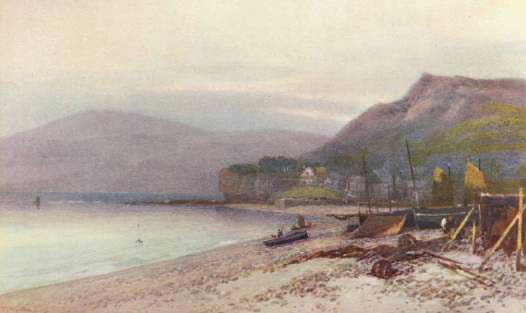 Sidmouth
It was a most ancient custom in the West—indeed, it is said to be a remnant of the pagan rite of dedicating the first-fruits to Ceres—to set aside either the first armful of corn that was cut or else some of the best ears, and bind them into a little sheaf, called a 'neck'. A fragment of the vivid description given by Miss O'Neill in 'Devonshire Idyls' must be quoted: 'The men carried their reaping-hooks; the sheaf was borne by the old man. Bareheaded he stood in the light of the moon. Strange shadows flecked the mossy sward on sundown as he held the first-fruits aloft and waved his arms.
'"We ha'un!" cried he, and the cry was long and wailing. The strange intimation fell on the ear like an echo from pagan days. One could fancy the fauns and weird beings of old had taught the cadence to the first reapers of earth. "We ha'un!" cried he, and all the men in the circle bowed to the very ground.... "We ha'un!" cried Jonas again, and again the reapers bowed and waved. Then the old men took up another strain, at once more jubilant and more resonant, and with an indescribable drawling utterance sang out "Thee Neck!"—sang it out three times, and twice the waving circle of bright steel flashed.'
On leaving Honiton, if the river is followed upstream for a short distance, the traveller will find himself close to ruined[Pg 52] Ottery Mohun, the home of two celebrated families in succession. Unfortunately, it has been entirely destroyed by fire. A farm now stands among the ruins, and two fine Perpendicular archways, and a deeply moulded and hooded arch over the frontdoor, alone bear witness to its former state. In the spandril above the outer archway is carved, 'amid elegant scroll-work and foliage, an arm, vested in an ermine maunch, the hand grasping a golden fleur-de-lys'—the old coat-armour of the Mohuns; and on the other spandril 'three lions passant in pale,' the bearing of the Carews.
The Mohuns were a Norman family of distinction, but in later days were notorious rather than famous. The old peerage having died out in the Middle Ages, a member of a cadet branch, by shameless and persevering begging, induced Charles I to grant him a barony. This title only survived a few generations, and the fifth and last bearer of it was known as 'the wicked' Lord Mohun. His life was short—he was barely over forty when he died—but eventful, for he was twice tried before his peers, each time on the charge of being accessory to a murder, and the story has often been told of the desperate duel in which Lord Mohun was killed by the Duke of Hamilton, whom he had mortally wounded. Spectators burst upon the scene to discover the two principals dying on the ground, and the two seconds fiercely fighting each other.
The history of the Carews is more interesting. Ottery Mohun came to them towards the end of the thirteenth century, through the heiress of the elder branch of Mohuns, whom John Carew married. Their names were eminent in camp, court, and council, in one reign after another; but it is only possible to speak here of two, Sir Gawen, and his nephew Sir Peter, on whose death the branch that had been settled at Ottery Mohun for three centuries became extinct in the direct line. There is not even space for the career of another of Sir Gawen's nephews, to whom Queen Elizabeth wrote, with her own hand, in regard to his efforts in subduing the Irish:
'My faithful George,
'If ever more services of worth were performed in shorter space than you have done, we are deceived among many witnesses.'
Sir Peter's youth was spent very strangely even for that age of hazards and chances. As a child he was sent to school in Exeter, where he was so exceedingly naughty that complaints were made to his father, and Sir William, who had remarkable ideas of discipline, came to Exeter, 'tied him on a line and delivered him to one of his servants to be carried about the town as one of his hounds, and they led him home to Mohun's Ottery like a dog.' Not long afterwards he was with his father in London, when, 'walking in Paul's,' they met a French gentleman, an old acquaintance of Sir William's, who took a sudden fancy to the boy, and offered to bring him up in France as if he were his own son. The offer seems to have been accepted offhand, but, unfortunately for the boy, the sudden fancy drooped almost as quickly as it sprang up, and, after enjoying life for a brief moment as an indulged page, he was turned out into the stables, 'there as a mulett to attend his master's mule.' Here he remained till a Mr Carew, a kinsman, happened to come to the French Court, and near the Court gate passed 'sundry lackeys and horseboys playing together, one of whom called to another, "Carew Anglois! Carew Anglois!"' This attracted Mr Carew's attention. He called the boy and questioned him, and finding 'Carew Anglois' to be his cousin, Mr Carew took him under his protection, rebuked the fickle guardian, and trained up Peter 'for a space ... in the court of France, like a gentleman.' Peter, still very young, but extremely independent, was present at the siege of Pavia, and as his patron had just died, and he perceived 'fortune to frown upon the French side,' he went over to the Emperor's camp, and entered into the service of the Prince of Orange. Five or six years later he came home, bringing with him letters of highest commendation to the King, Henry VIII, who received him with great favour.
Sir Gawen and Sir Peter together took a prominent part in 1549, in dealing with the insurrection of Devonshire and Cornishmen against the Reformed religion. Sir Peter, indeed, was afterwards blamed for being over-zealous, and thereby aggravating the trouble; but he was able to clear himself, and was 'well allowed and commended for what he had done.'[Pg 54]
In Queen Mary's reign fresh trouble arose, from which he escaped less easily. Many fervent Protestants were made uneasy by the symptoms of Romish rule that began to appear, and were still more disturbed by the news of the Queen's projected marriage with Philip of Spain, which they felt boded ill for their liberties, spiritual and temporal. The Carews were in the counsel of Sir Thomas Wyatt, the Duke of Suffolk, and others, who planned risings to depose the Queen. In a simultaneous movement, the Carews were to raise the West under the nominal leadership of Lord Courtenay, Sir Thomas Wyatt was to raise Kent, and the Duke the Midland counties. But before the preparations were complete, suspicion fell on the Carews, and a letter was despatched from the Council, directing the Sheriff of Devon to send Sir Peter and Sir Gawen to London.
Sir Gawen, who was in Exeter about this time, thought it best to return quietly to his own home, and because his movements now attracted an undesirable amount of attention, he one night 'went out over the walles of the said cytie yn his bowtes.' The account condescends to a touching detail that should appeal to all. Even the agitation of flying from arrest on a charge of treason could not keep Sir Gawen from feeling footsore, and 'for that his bowtes grieved hym he cutt them upon the waye.' Sir Gawen was arrested a few days later, and suffered a long imprisonment.
Meanwhile Sir Peter, in answer to the summons to surrender himself, sent the reply that he had already started for London. But meeting on the way the bearer of a message which assured him that two of his 'dearest friends' here failed him, he turned aside and escaped in a little boat from Weymouth.
Those who interest themselves in dreams and visions may care to hear of Lady Carew's experience at this moment. The night that Sir Peter sailed, Lady Carew dreamed very vividly 'that as he was going aboard his bark, he should fall into the seas and be drowned'; and so great was her trouble on awaking, that she sent a messenger to the seaside to make inquiries for Sir Peter. And when the messenger arrived at Weymouth, he heard the startling news that getting 'out of the boat to enter into the[Pg 55] bark, his [Sir Peter's] foot slided or slipped, and he therewith fell into the seas, and had been drowned if one standing by had not taken hold of him.'
Notwithstanding several misfortunes on the way, Sir Peter arrived safely in France, where he lived an exciting and adventurous life for several years, and was then treacherously seized and carried to England and the Tower. Here the much-abused Philip proved himself a real friend, for in an admirable letter to the Queen he intercedes for 'Pedro Caro' and his wife, and Sir Peter was eventually forgiven by Queen Mary, and honoured by Queen Elizabeth.
Between Honiton and Sidmouth is an inn called The Hunter's Lodge (more recently The Hare and Hounds), and opposite the house is a block of stone, over which hovers a gruesome mystery. It is said that in the dead of night the stone used to stir in its place, and roll heavily down into the valley, to drink at the source of the Sid, and, some say, to try to wash away its stain. Human blood has given it this power—the blood that gushed upon it when the witches slew their victims, for it was once a witches' stone of sacrifice.
Five miles to the south-west of Honiton is Ottery St Mary, a pretty little town built on very steep slopes, and full of interesting associations. It lies among 'fair meadows bathed in sunshine; with the Otter river winding through them ... yonder are the red Devon steers grazing up to their dewlaps in buttercups: beyond them dusky moors melt into purple haze.' By making a slight détour one passes the pleasant lawns and copses of Escot. Once the property of the Alfords, Escot was bought in 1680 by Sir Walter Yonge (father of George II's unpopular 'Secretary-at-War'), who built a new and large house and lavishly improved the grounds. But prodigality was the bane of the Yonges, and not much more than one hundred years later it passed away from Sir Walter's ruined grandson, and was bought by Sir John Kennaway.
The streets of Ottery are steep and sinuous, and both roadway and footwalk are paved with pebbles and cobble-stones. The[Pg 56] Manor of Ottery was given by Edward the Confessor to the Dean and Chapter of Rouen, and it continued in their possession during the reigns of nine Kings. Then the Dean, finding that the task of collecting his rents and dues was 'chargeable, troublesome, and sometimes dangerous ... desired to sell it, and met with a very fit chapman, John Grandisson, Lord Bishop of Exon.'
Ottery's greatest treasure is the beautiful church, a miniature of Exeter Cathedral, and it is to Bishop Grandisson that its great beauty is due. He did not build the church; indeed, the shadow of a terrible scandal had fallen upon it forty-five years before his rule began. For in the year 1282 'that discreet man, Mr Walter de Lechelade,' the Precentor of Ottery, was waylaid coming from Exeter Cathedral in his canonical robes, and murdered by 'certain sons of perdition full of fiendish ferocity.' 'Mr Walter de Lechelade' was probably extremely unpopular locally, because he had obtained the lease for life of the Manor and Church of Ottery from the authorities at Rouen, and was allowed to make all the profit he could out of the revenues. It is interesting to note the ecclesiastical manner of dealing with such a difficulty at that date. Out of the twenty-one persons convicted of being concerned in the murder, no fewer than eleven were clerics! The Vicar of Ottery St Mary was among the number, and it is sad to say that suspicion fell even on the Dean of Exeter.
Bishop Grandisson found an early English church. He lengthened the nave, altered the chancel, added a beautiful Lady Chapel, and raised towers on the already existing transepts. These transeptal towers are peculiar to this church and the other on which he spent his enthusiasm, Exeter Cathedral. On one tower is a steeple—there was one on the Cathedral—the lead scored by cross-slanted lines. The church is of grey stone. The nave and towers are battlemented, and at intervals in the outer walls are niches, now bereft of the figures they held. Very graceful stone tracery is in many windows, pinnacles and crosses rise from the roof, and the whole effect is of an impressive building of rich and elaborate detail. The number of consecration crosses is remarkable, for there are thirteen without and eight within the walls,[Pg 57] and each marks a spot touched by the Bishop with holy oil. Every one is a square stone panel, carved with an angel bearing a small cross. Some are much defaced, but a few are still perfect, and beneath several of them are the remains of iron supports, showing where a light was burned before the 'cross' on great festivals.
The arches of the nave are supported by clustered columns with most delicately carved capitals; and in the nave are two very elaborately decorated tombs—of the Bishop's brother, Sir Otho de Grandisson, and of Beatrice, Sir Otho's wife—each under a monumental arch, with hanging tracery and a crocketed ogee canopy.
The finely carved and pierced minstrels' gallery in the Lady Chapel is an exquisite piece of work; but amongst all that is to be most admired is the exceedingly beautiful fan-tracery in the roof of the 'Dorset' aisle—an aisle built by Cicely, heiress of Lord Bonville, and widow of the Marquis of Dorset, who died in 1501.
Two short pleached alleys of limes stand within the churchyard wall, looking down over a little square into which several streets open, and the old stocks still lie in the shadow of the trees.
Bishop Grandisson obtained a licence to establish here 'a monastery or collegiate church for a fixed number of secular canons ... governed mainly by a Warden, a Minister, and Sacrist, and a Chanter or Precentor,' and he drew up a most comprehensive set of statutes for their guidance. Occasionally he issued additional 'monitions,' as, for example, when the Warden had allowed stage-plays to be performed in church during the Christmas holidays. It is reasonable to suppose, however, that they were 'mystery plays' or 'moralities.'
Lord Coleridge says: 'The town was dominated by the College. The bridge by which you entered the town from the West was the bridge of the Holy Saviour. In one of its recesses the sacred light was ever kept burning, inviting those who passed to pray.' Henry VI and Henry VII both visited the College. The Dissolution swept it away, but a part of its endowment was devoted to founding the King's Grammar School.[Pg 58]
Many incidents befell Fairfax and his troops at Ottery. It was chosen for their winter-quarters in 1645, and they arrived worn-out and exhausted and in great need of refreshment. Ill-fortune, however, awaited them, as the Rev. Joshua Sprigg, General Fairfax's chaplain, tells us in Anglia Rediviva, his account of this army's movements. A mysterious disease broke out, very fatal, so that there were 'dying of soldiers and inhabitants in the town of Autree, seven, eight, and nine a day, for several weeks together.' A Colonel Pickering died of it, on whom the chaplain wrote an elegy. One has heard of blank-verse that is merely 'prose cut into lengths,' but his lines suggest that they must have been on the rack to bring them to the right measure. The author feared that it was the lack of action that had proved fatal.
But Sprigg's deep affection and respect cannot be disguised even by his words.
At Ottery, Sir Thomas Fairfax received and entertained two envoys from besieged Exeter, who came with a view to discussing the possible terms of a general peace; but their mission was, of course, unsuccessful. A pleasant event was the presentation to the General of a fair jewel, set with rich diamonds of great value, 'from both Houses of Parliament, as a testimonial to his great services at Naseby.' The jewel was tied with 'a blue ribbon and put about his neck.' Fairfax was staying in the old Chanter's House, now the property of Lord Coleridge, and the ceremony took place in a long panelled room, with deep-set window, then called the Great Parlour. Here also Fairfax held a deeply important conference with the 'Lord Generall Cromwell,' when he came to decide the plan of campaign in the West.
Ottery St Mary is able to pride itself on being the birthplace of the poet Coleridge, whose family had long been connected with the county. The poet's father was Vicar, and Master of the Grammar School. Great as was his genius, Coleridge was not[Pg 59] in every respect worthy of his birthplace, for in one of his letters he actually announces that he prefers Somerset to Devon!—evidence which clearly proves the correctness of the popular belief that poets have no judgment. But his real affection for the Otter is shown in his sonnet to the river on whose banks he lived in early years. Another poem, the 'Songs of the Pixies,' was inspired by the Pixies' Parlour, a tiny cave with roots of old trees for a ceiling, that stands halfway up a low cliff overhanging the river, just beyond the town. In this poem are the lines:
Ottery has other associations with literature, and it is interesting to remember that Thackeray lived near here in his youth, and that Ottery is the 'Clavering' of Pendennis, which was written while he was staying at Escot Vicarage close by.
A winter traveller in passing through the lanes near here recalls some beliefs of a past generation: 'The faint chimes of St Mary's in distant Ottery are playing their Christmas greeting over many a mile of moorland. We are passing the old "cob" walls and grey-headed barns of a substantial farmstead. The cocks will crow here all the night before Christmas Day, according to the beautiful legend of the county, to bid
The very oxen at midnight will fall down on their knees before the manger. The next turn brings us to the Otter rushing along some forty feet below with angry stream.' Almost at the mouth[Pg 60] of the river is the village of Otterton, and here was a Benedictine Priory, founded in the reign of King John. The Prior of this little monastery had certain privileges. Amongst others, ten marks had to be subscribed among the tenants for 'a palfrey to be presented to a new Prior on his coming to reside in the midst of his flock, and every plough had to plough one acre of land for him annually.' He had the 'right of pre-emption of fish in all his ports, and the choice of the best fish.' Conger-eels were specially mentioned in a marginal note. Besides this, he claimed every porpoise caught in the sea or other neighbouring waters, but paid for it with twelve pence and a loaf of white bread to each sailor, and two to the master of the boat from which it was caught. Lastly, the Prior claimed the half of every dolphin. But no Prior is likely to have had many chances of asserting this right.
The river runs into the sea by the charming little town of Budleigh Salterton; but it is more interesting to cross the water at Otterton, and passing through the village of East Budleigh, nearly opposite, to go towards Hayes Barton, the house where Sir Walter Raleigh was born.
Fardell, near Ivybridge, was the ancestral home of the Raleighs, but Sir Walter's father settled at Budleigh. In front of the garden a swirling stream crosses a strip of green; and in the garden, at the right time, one may see the bees busy among golden-powdered clusters of candytuft, and dark-red gillyflowers, and a few flame-rose-coloured tulips, proud and erect. The house is very picturesque; it has cob walls and a thatched roof, and is built in the shape of the letter E; a wing projects at either end, and in the middle the porch juts out slightly. The two wings are gabled; there is a small gable over the porch and two dormer ones over the windows at each side of it, the windows having lattice lights and narrow mullions. Dark carved beams above them show up well against the cream-coloured walls. The heavy door is closely studded with nails, and over it fall the delicate sprays and lilac 'butterfly' blossoms of a wistaria. The house has been little altered, and its outward appearance was probably almost the same in Sir Walter's boyhood as it is to-day.[Pg 61]
 Branscombe
In front of Hayes Barton is a hill covered with oak-woods, and to the west the ground begins to slope upwards to the high moorland of Woodbury Common. Sir Walter had a great affection for his boyhood's home, and later, in trying to buy it back, he wrote to the then owner: 'I will most willingly give you whatsoever in your conscience you shall deem it worth; ... for ye naturall disposition I have to that place, being borne in that house, I had rather seat myself there, than anywhere else.'
To realize Sir Walter at all adequately, he must be contemplated as soldier, sailor, statesman, courtier, explorer, poet, historian, Governor of colonies abroad and of very important offices at home—most of all as a seer, for his eyes discerned a light that did not dawn on his contemporaries. He and his half-brother, Sir Humphrey Gilbert, foresaw 'that colonization, trade, and the enlargement of empire, were all more important for the welfare of England than the discovery of gold.' Major Hume, who is by no means over-prejudiced in Raleigh's favour, has said in his 'Life of Sir Walter Raleigh': 'To him is due the undying glory of having made the great northern continent of America an English-speaking country. With him it was no accident. The plan sprang fully formed from his great brain. He was greedy of gain, but he spent his money like water in this great project. He knew full well that there was no gold to reward him; that the profit, if any, must be slow, and must accrue mainly to the nation, and not to an individual; and yet he laboured on for thirty years in the face of defeat, disaster, contumely, and disgrace, in full faith and confidence that the great continent was by God's providence reserved for England.'
Raleigh's biographers have wondered at his immense knowledge of naval matters, and particularly of naval warfare, for the Ark Raleigh, which he had built after his own plans, was admitted to be the best ship in the fleet at the time of the Armada. Perhaps his genius for absorbing information developed very early, and Sir John Millais's picture of the two little boys, fascinated by the words of the sailor speaking to them of the breathless adventures he had fought through, the gorgeous sights that he[Pg 62] had seen in the lands overseas, helps to explain it. Most West-Countrymen can tell a tale dramatically, as the sailor is telling it—the picture was painted at Budleigh Salterton—and it may be that, with Raleigh's amazing faculty for gathering knowledge, he learned enough of seamanship as he grew up to enable him to grasp and hoard in his memory every detail of the subject as it came before him in later life.
It is impossible to judge any character of a past century without trying to realize in many questions of conduct the gulf that lies between the former point of view and our own, and whatever Sir Walter's faults were, his genius was incomparably greater. His failings were those of his age, and were more than surpassed by the shortcomings of several of Queen Elizabeth's very eminent statesmen. Raleigh left Oxford when he was only seventeen, and joined Mr Henry Champernowne's band of gentlemen volunteers who were fighting for the Protestant Princes in France. After six years' fighting he left the army and betook himself to the Middle Temple, where possibly he spent more time over lyrics than over the law, for a biographer, describing this period of his life, passes over his legal acquirements, but says that 'his vein for ditty and amorous ode was esteemed most lofty, insolent, and passionate.' He and Spenser were very congenial companions, and later Spenser, speaking of their great friendship, said: 'He pip'd, I sang, and when he sang, I pip'd.'
Sir Walter left the Temple for the sea, then went to fight in Ireland, and at the time of the Armada he was Lord Warden of the Stannaries, and responsible for the companies of tinners, who had turned to soldiering. He planned one expedition after another to the New World, and sent them out mainly at his own expense, giving careful instructions to those in charge to observe carefully any plants or produce of any kind that might profit this country, whereas usually explorers searched eagerly for precious metals alone. It was due to these instructions that the potato was brought to England. Rumour for long maintained that Sir Walter actually brought back the plant himself, but, as a matter of fact, the credit of this is due to Heriot, a man of science[Pg 63] employed by Raleigh. He showed it with the other 'commodities' he had collected to Sir Walter, who took the potatoes with him to Ireland, and planted them in his new estate of Youghal.
And though it was most probably Sir John Hawkins who introduced tobacco into England, it certainly was Sir Walter who brought smoking into fashion. In parenthesis, a warning may be given that anyone who wanders from east to west along the south coast of Devon will be wearied beyond measure by the numbers of rooms, banks, porches, and gardens, shown as the identical spot 'where Sir Walter smoked his first pipe.' Dr Brushfield, in an exhaustive article on 'Raleghana,' counts only six places, but they reach from Penzance to Islington, and one is in Ireland.
After the last dreary voyage, rendered fruitless by the contemptible double-dealing of James I, and during his trial, Sir Walter's self-possession and courage showed at their best. 'From eight in the morning till nearly midnight he fronted his enemies with unshaken courage. The bluster of Attorney-General Coke roared around him without effect. "I want words," stormed the great prosecutor, "to express thy viperous treason."
'"True," said Raleigh, "for you have spoken the same thing half a dozen times over already."'
It was characteristic of his grand views of life that within the four walls of a prison he should undertake no less a work than the History of the World. The unfinished history shows a depth of learning and dignity of style, very wonderful in the writings of a man who spent his life in incessant and absorbing action. It must have been the vast number of the chances and changes of life he had seen around him, and himself experienced, that inspired him to write that splendid apostrophe: 'O eloquent, just, and mighty Death! whom none could advise, thou hast persuaded; what none have dared, thou hast done; and whom all the world have flattered, thou only hast cast out of the world and despised; thou hast drawn together all the far-stretched greatness, all the pride, cruelty, and ambition of man, and covered it all over with these two narrow words, Hic jacet.'[Pg 64]
Not only in his visions of colonies was Raleigh far in advance of his time. Major Hume quotes his ideas on trade and commerce, the statesmanship displayed in his Prerogative of Parliaments, and his writings on the construction of ships and naval tactics, to show that in each subject he had arrived at conclusions now generally accepted, but only discovered by the public long after his death. This biographer ends by describing him as 'perhaps the most universally capable Englishman that ever lived.'
Sir Walter's last lines were written a few hours before his death, in his Bible:
Following the coast, 'running eastward with many winding and waving creeks,' Sidmouth is soon reached. Westcote is philosophical over both Sidmouth and Seaton: 'In former times, very famous ports (and every place and man hath but his time).' Sidmouth was an important fishing town several hundred years ago; it is now a popular watering-place, set among high red cliffs, amidst very pretty scenery, and favoured with a great deal of sunshine. Leading inland are very high and steep hills, different in shape from most of the hills in the neighbourhood, for they are neither rounded, pointed, nor sloping, but have a curious square, rather flat-topped look, and scarped sides.
Farther eastward, one comes to Branscombe, a straggling village in a broad hollow where three valleys meet. A stream flows down each combe, and eventually all three join and run together into the sea at Branscombe Mouth. There is a great deal to admire in the steep sides and irregular curves, softened by the spreading woods in these valleys, and close to the shore a hill rises almost precipitously for six hundred feet.[Pg 65]
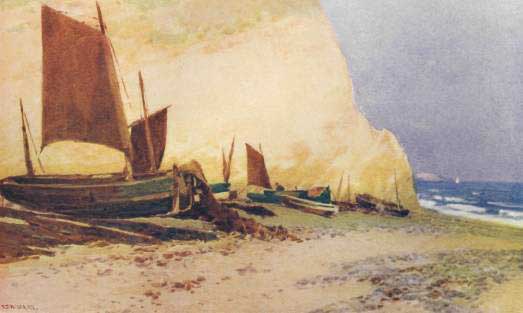 Beer Beach
A very short distance further on, the white cliffs of the tiny cove of Beer come into view. Beer is an exceptionally delightful village, because of its strong individuality. At the top of the inlet the houses are clustered irregularly in little offshoots, but the main street runs down a deep cleft narrowing towards the sea between white gleaming chalk cliffs such as are rare in this county. A rapid stream races down the side of the street, and, dashing over a rock at the edge of the beach, buries itself in the shingle. Beer Head and the cliff that separates the village from Seaton run out into the sea, so that it is completely shut in, and from the water's edge it is impossible to see past those massive walls standing against the sea and sky on either side. The cove is so small that one wonders it counts as a harbour at all, but the beach is covered with many small boats and several heavily-built trawlers. As I saw it, the water was a clear blue-grey, and some sea-gulls were placidly floating a few yards from land, rising and falling as the waves rolled in, and looking as if they must be buried by each one. From Beer Head there is a splendid view of the coast; to the east, beyond Seaton, the landslip, and Lyme Regis, the line stretches grey and dim in the distance towards Portland; westwards, beyond Sidmouth's red cliffs, one sees how the land bends southward to Budleigh Salterton, and still further south towards Exmouth.
The little inobtrusive haven of Beer was in every way convenient for smugglers, and was naturally much beloved by them. Not more than seventy or eighty years ago, all the people in the village were supposed to take a share in the perils and joys of the ventures whenever they got the chance. The greatest of their number was a certain Jack Rattenbury, who began his life at sea when he was nine years old. Five years later he had already decided, 'I wished to make a figure on the stage of life,' and joined a privateering expedition. The ship was captured by the French, and Rattenbury taken prisoner. He escaped from prison, but not from Bordeaux, where for more than a year he was forced to stay, and he then sailed on his own account to America, and back to Havre, Copenhagen, and Guernsey. By the time he reached[Pg 66] home again he was only sixteen! His life was an unceasing turmoil: smuggling, privateering, being impressed for the navy, and devising wiles for slipping away again, with the variation of being taken prisoner by French or Spaniards.
A steep road runs through lovely scenery from Ottery to Seaton. At intervals it passes through woods, or looks down into the misty, green, undulating country northwards; then, climbing a ridge, the sea, framed in woods, is seen over little hollows in the distant cliffs to the south. The road crosses a common with a few knots of wind-swept fir-trees, and runs steeply down to Seaton. On the west side of the bay the cliffs are a creamy white; eastwards, the shades are chiefly buff and pale brown. The variety of their strata make the cliffs interesting to geologists, for here are found layers of different kinds of chalk, limestone, greensand, marls, chert, and interspersed lines of flints.
Seaton is a pleasant little town without any remarkable feature. In the church is this curious epitaph with the date 1633 A.D.:
John Starre
. . . . . .
Starr on hie!
Where should a starr be
But on Hie?
On the east side of Seaton is the flat wide Valley of the Axe. The river is broad and rather important-looking, but it makes a most inglorious exit into the sea, for a huge pebble ridge rises as an impassable barrier, and the river has to twist away farther east and run out obliquely through a narrow channel. Axmouth, on the farther side, is a pretty old-fashioned little village, the thatched whitewashed cottages forming a street that curves round almost into a loop, while a chattering stream runs between the houses. In the church is the figure of a tonsured priest, with chasuble, stole, and alb, supposed to be one of the early Vicars of Axmouth. At his feet lies a dog, and the legend goes that this was not merely the customary image of a dog seen on tombs, but the effigy of his own favourite, whom he desired to be buried at his feet;[Pg 67] and as an indemnity for this order he left a piece of ground to be devoted to charitable purposes, called Dog Acre Orchard. Mr Rogers, in his 'Memorials of the West,' tells us that the name remains till to-day.
 Seaton Headland
A very short distance beyond is the great landslip which fell in 1839, when about fifty acres of the cliff slid more than a hundred feet to the shore beneath, but in such a way that part of an orchard descended with its growing trees, and they continued to flourish at their new level. More wonderful still, two cottages settled down on to the shore, without falling in pieces. The ground began to slide on the night of Christmas Eve, and by the evening of December 26 the great mass had fallen. To the west is a great chasm, and the cliff rises high on the seaward side. Farther east, no cliff rises beyond the chasm, but little hillocks and sand-dunes slope unevenly to the beach. The undercliff has not in the least the barren look of an ordinary bit of waste ground touching the shore, but is covered with grass and thick undergrowth, oaks and hawthorns, and masses of ivy, and beneath them the long spear-like leaves and scarlet-berried pods of the wild-iris.
If one returns to the Axe and begins to follow up its innumerable bends, one arrives opposite the little town of Colyton, which is not quite on the river. Mr Rogers says that the name comes from the British Collh y tun, and has the pretty meaning of 'the town where the hazels grow.'
Here is a fine church, chiefly Perpendicular, well known, among other reasons, for a richly carved tomb, on which is the effigy of a very small lady, a coronet on her head and a dog at her feet, with coats of arms hanging above. The figure was always known by the curious name of 'Little Choak-a-bone.' The old story said that the lady was the daughter of Lord Devon and his wife, Princess Katherine, daughter of Edward IV, and that she died because a fish-bone choked her. Now this has been corrected, and it is believed that the monument is of the wife of the fifth Earl of Devon, who lived nearly one hundred years earlier. But no disproof has been brought against the fish-bone!
Close to Colyton are the ruins of an old house of the Courtenays,[Pg 68] Colcombe, which has been partly converted into a farmhouse. Here Princess Katherine occasionally lived during her widowhood. Colcombe suffered much in the Civil War, for it was garrisoned by Prince Maurice, who led his troops into several skirmishes with the enemy, and during one of these affairs (it is supposed) the Castle was burned down.
The poor people living near Colcombe must have had a very bad time, with energetic Royalist and Parliamentary troops on either hand. Some sad little entries at this time are quoted from the diary of a serge-maker of Colyton, in which he counts up what he lost in cloth through the inroads of the 'Lyme Men' (Parliamentarians), and the 'wostard woole' and 'sarge' torn from him by 'Percy's men' (Royalists).
Unluckily, it is not possible to pause among the throng of interesting memories that are called up by almost every step of the way. One may not sketch the career of Dr Marwood, who journeyed to London from these parts and cured 'a certain noble Lord,' a favourite of Queen Elizabeth, but returned home because, 'finding himselfe much envyed by the Court physitians, he thought he was not safe there!'—a naïve reflection on the doctors that reminds one of their contemporary Catherine de' Medici's creature, René of Milan, who was popularly known as l'empoisonneur de la reine.
It is only possible to make a brief reference to a manor, nowadays a farm—Ashe, where the great Duke of Marlborough was born. Marlborough can hardly be called a son, but perhaps a grandson, of the county, for though Sir Winston Churchill was of Dorsetshire, the Churchills were an old Devonshire family, of whom one branch had migrated to the next county. Ashe was the home of the Duke's mother, Elizabeth, daughter of Sir John Drake, and here she returned when the Civil War was just ended, and the triumphant Parliamentarians were making themselves very objectionable, especially to such a fervent Royalist as her husband. Sir Winston was eventually forced to compound for so large a sum that it was convenient for them to live for some years with Lady Churchill's father.[Pg 69]
There is, unfortunately, no space to look at the very interesting history of the Bonvilles, the ruins of whose old house, Shute, in its beautiful park, among deer and woods and magnificent cedars, is close to Ashe. The title became extinct in the Wars of the Roses, for the family suffered beyond recovery, and the last Lord Bonville had the overwhelming grief of losing his only son and grandson in the Battle of Wakefield. The great estates passed to his little great-granddaughter, Cicely Bonville, who, more than forty years later, built the Dorset aisle in the church at Ottery St Mary.
The fine building, Newenham Abbey, stood close to the outskirts of the park, and Sir Nicholas Bonville was a great benefactor to the Abbey, but it was founded by two brothers, Sir William and Sir Reginald Mohun. The Abbey Church alone was three hundred feet in length and one hundred and fifty feet in breadth, and now of all the buildings, there remain but a few fragments of walls and the stonework of a chapel window.
Axminster, not a mile away, was in Leland's day 'a pratie quik Market Town.' It was the scene of one very interesting event, for here the Duke of Monmouth's followers first met the royal troops under the renowned General Monk, then Duke of Albemarle, and caused them to fly before their inferior undisciplined numbers. Albemarle dared not risk a battle, as he became alarmed by the temper of his troops, and feared lest they might go over to Monmouth if they did but catch sight of their beloved hero; for the General's troops belonged to the Devonshire militia, and Monmouth was adored by all the country-people in the West. The General ordered a hurried retreat, without attempting any engagement, and Monmouth marched triumphantly to Taunton. The callous brutality of Sedgmoor, and the atrocious barbarities of the Bloody Assizes following it, are too intolerable to think of. A ballad has been written called 'The Sorrowful Lamentation of the Widdows of the West', and one wonders whether its obsequious tone is due to the author being a partisan of James II, who expressed what he thought they ought to feel, or whether the verse-maker was one in their midst,[Pg 70] who saw that there was indeed no spirit left in them. I quote a few of the verses:
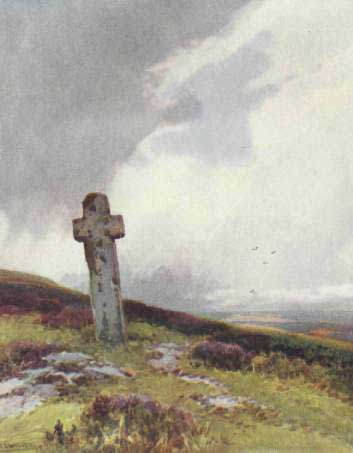 The Windypost, or Beckamoor Cross
The region of the Forest of Dartmoor and Commons of Devon is one which excites a vast difference of opinion. For some it has an extraordinary fascination, whilst to others it is only, like a beautiful view in the Highlands which I once heard depreciated by a native—'just hills.' And the hills on Dartmoor are not even very high. Yes Tor, till lately thought to be the highest point, is only a little over two thousand feet; and High Willhayes, its superior, cannot claim to be more than a few feet higher. So there are no towering heights or tremendous precipices to explain its peculiar spell. Sir Frederick Pollock, in paying true homage to the moor, gives the reason that accounts for Dartmoor's dominion—its individuality. 'The reader may think fit to observe, and with undisputable truth, that there are many other moors in the world. Yes, but they are not Dartmoor.' And there is no more to be said.
A very truthful and vivid description of the moor has been given by the late Mr R. J. King: 'The dusky sweep of hills stretches away with an endless variety of form and outline; in some parts[Pg 72] sharply peaked, and crested with masses of broken rock; at others, rounded and massive, and lifting a long line of sombre heath against the sky. The deep hollows which separate the hills are thickly covered with fern and heather, over which blocks of granite are scattered in all directions; and, as in all similar districts, each valley has its own clear mountain stream, which receives the innumerable waterfalls descending from the hill-sides. The whole country has a solitude, and an impressive grandeur, which insensibly carries back the mind to an earlier and ruder age.'
Let the time or season be what it may, the moor has some fresh charm to offer. In the early summer there is a special soft greenness, and the hot air quivers above and about the rocks; later the hill-sides are coloured by the lilac-pink of the ling and the richer tones of bell-heather; and when the autumn leaves are fading and falling 'inland,' there may come such a day of sunshine and glorious blue sky, with the larks singing on every side among the golden furze-blossoms, that one is able to forget the calendar. And then, amongst the great boulders covered with white lichen that lie along the sides of streams, the leaves of the whortleberries turn scarlet over the little round fruit, with its plum-like bloom. Sometimes in winter the snow lies in patches on the hills, among stretches of pale grass and rich, dark, red-brown masses of heather. On the edge of the moor, the springs by the roadsides flow through a sparkling white border into a shining ice hollow,[Pg 73] and, looking away, one sees snow-covered heights against a pale blue sky, in the unbroken stillness of distance. Perhaps the moor is specially irresistible when the full moon throws its magic over hill and valley, suggesting infinite possibilities. In the clear air the hills look very solemn and impressive, and the long, broken reflections of the moonbeams lie in every stream as it ripples over rocks or breaks against boulders; while the foam gleams and trembles as flakes are torn away by the current and swallowed up by the black shadows. In such a time and place one may learn the meaning of 'a silence that can be heard.'
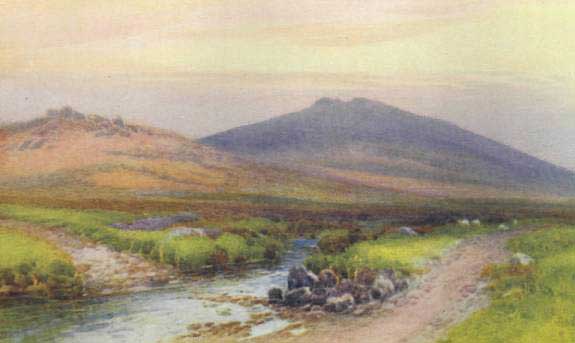 Yes Tor: Dartmoor
Dartmoor rises high above the surrounding country, and keeps his white winter livery lying upon it long time, if not washed away by rain. The air is delicious, but it must be admitted that the moor has a very ample share of wind, rain, and mists. Faultfinders have also complained of the bogs, and occasional accidents to travellers' horses have given the mires the significant name of 'Dartmoor Stables,' although the moor ponies are supposed always to be able to pick a safe path through dangerous places.
From a certain point of view, Dartmoor reminds one of the mirror of the Lady of Shalott, for here
Or, rather, the shadows of a past world are reflected in its wastes, witnessing to prehistoric man; to the tinners, who appear out of the mists of antiquity, and who peopled the moor through the Middle Ages; to the dawn of Christian teaching in the country; and to the Normans, with their forest rights and laws. Antiquities abound, although there are instances where it is most difficult to decide whether the remains are prehistoric, or merely traces of mediæval mining. 'It is possible that "old men's workings," as the traces of abandoned mines are called in this country, may account for more of them than is generally admitted.' But modern observations have severely excluded any fanciful theories. 'Certain stone inclosures which have passed for British fortifications are now more plausibly considered to have been made (at a sufficiently remote time, we may freely allow) for the protection of cattle.' However,[Pg 74] after deducting any objects of doubtful antiquity, there remain an enormous number as to which, there can be no question—stone rows, kistvaens, menhirs, large circles of upright stones, forts and barrows, and pounds enclosing hut-circles. It is interesting to read the views of antiquaries at different stages of the nineteenth century, and their flat contradictions of the opinions of their predecessors. A good instance is given in the new edition of that mine of information, Rowe's 'Perambulation of Dartmoor,' where certain verdicts as to the origin of Grimspound are quoted. 'Polwhele states that it was a seat of judicature for the Cantred of Darius; Samuel Rowe, that it was a Belgic or Saxon camp; Ormerod considered it a cattle-pound pure and simple; Spence Bate was convinced that it was nothing more than a habitation of tinners, and of no great age; while now the work of the Rev S. Baring-Gould and Mr Robert Burnard goes far to show that its construction reaches back into a remote past, and that its antiquity is greater than any former investigator dared to assign to it.'
The great numbers of prehistoric people who lived on the moor are very remarkable. 'Tens of thousands of their habitations have been destroyed,' says Mr Baring-Gould, 'yet tens of thousands remain. At Post Bridge, within a radius of half a mile, are fifteen pounds. If we give an average of twenty huts to a pound, and allow for habitations scattered about, not enclosed in a pound, and give six persons to a hut, we have at once a population, within a mile, of 2,000 persons.' Perhaps they climbed so high because on the lower slopes the forest was thick, and wild beasts were more to be feared, though, according to tradition, they were certainly not free from danger on the moor; for 'wolves and winged serpents were no strangers to the hills or valleys.' All their possessions that we are aware of belong to the early Bronze Age, when flint was used in great quantities, and bronze was known, but was rare and very valuable. The amber pommel of a dagger, inlaid with gold pins, and part of a bronze dagger blade, were found in a barrow on Hameldon, and a few other bronze weapons have been discovered; flint implements in abundance. Great numbers of flint scrapers for cleaning the skins of animals, and small[Pg 75] knives for cutting up meat, have been picked up; arrow-heads are scarce, and it would seem that they left very few celts or axes, and spear-heads.
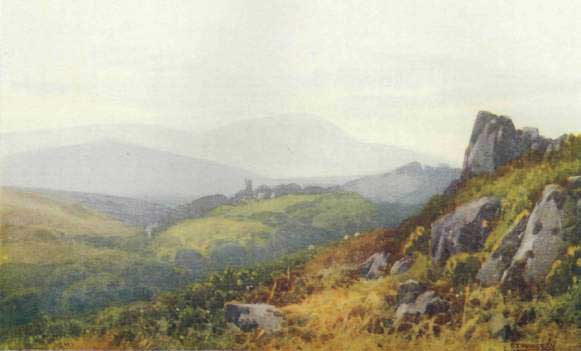 Lustleigh Cleave
Of the exceedingly interesting remains, perhaps the most interesting—at any rate, to the uninitiated—is Grimspound. The boundary wall, which is double, encloses four acres; it is from ten to twelve feet thick, but not above five and a half feet in height. Within the circle are twenty-four hut-circles, and in some of them charcoal and fragments of pottery have been found. A brook, dipping under the walls, and passing through the enclosure, supplied the camp with water.
Drizzlecombe, near Sheep's Tor, is rich in a variety of antiquities, for it has three stone rows, a large tumulus, a kistvaen, and a later relic—a miner's blowing-house. One of the avenues is two hundred and sixty feet long, and one is double for a part of the way, and each of the three starts from a menhir, or long stone. Near Merivale Bridge are two double stone rows, but the stones are small. Close by are a sacred circle, a kistvaen, a pound and hut-circles, and one cairn, besides the ruins of others that have been destroyed. It would be absurd to pretend to enter on such a wide subject here. Some idea of its extent may be gathered by considering one single branch of it: Mr Baring-Gould has stated that no fewer than fifty stone avenues have been observed in different parts of the moor. And hut-circles and ancient track-lines are unnumbered, although very many antiquities of all kinds have been destroyed when granite was wanted for rebuilding churches, or for making doorways or gate-posts, or even for mending roads.
The early antiquaries discovered the hand of the Druids in certain unusual rock-shapes, now known to be the work of Nature—such as rock-basins, which are developed in the granite by the action of wind and rain; tolmens, or holed stones; and logans, or rocking-stones. Granite on the moor generally weathers irregularly, and if the lower part of a piled-up mass partly crumbles away, a huge layer of harder granite remains balanced on one or two points, and becomes what is called a logan-stone.[Pg 76] In some cases, though the slab is almost impossible to remove, it will rock at a finger-touch. Perhaps the most striking example on Dartmoor is the Rugglestone, near Widdecombe, which it has been calculated weighs about one hundred and ten tons; but there are several in the neighbourhood, and a logan called the Nut-Crackers is perched among the thickly scattered boulders on Lustleigh Cleave. This lovely little valley lies on the eastern edge of the moor, and the River Bovey flows through it. Masses of granite crown the ridge; lower on the hill-side is a jungle of tall bracken, and the stream is overshadowed by a wood, crowded with matted undergrowth and with innumerable rocks tumbled together.
Granite more consistent than that found on most of the tors—that is, 'not broken into the usual layers of soft beds alternating with hard layers'—forms the great masses of rock on Hey Tor, and these have not weathered into strange, jagged outlines. William Howitt wrote a charming description of Hey Tor in his 'Rural Life of England,' from which I quote a few lines: 'Below, the deep dark river went sounding on its way with a melancholy music, and as I wound up the steep road all beneath the gnarled oaks, I ever and anon caught glimpses of the winding valley to the left, all beautiful with wild thickets and half-shrouded faces of rock, and still on high these glowing ruddy tors standing in the blue air in their sublime silence. My road wound up and up, the heather and bilberry on either hand.'
A 'wonder' which has been associated with the Druids is the grove of oaks called Wistman's Wood. It lies close to Two Bridges, on the slope above the West Dart, and at a little distance looks more like a furze-brake than a wood. All the oaks are dwarfs, stunted by the lack of soil and force of the winds. Mr Rowe quotes from a 'botanical writer,' who examined some of them: 'The bole of this tree was about three feet high, and its total height to the topmost branches fifteen feet. The circumference of the trunk was six feet, and its prime must have been about the date of the Norman Conquest.' Some of the boughs, like the trunks, are immensely thick for the height of the trees, and[Pg 77] they are covered with very deep cushions of bright green moss and hangings of polypody, and whortleberries grow upon them. Every step between the trees is perilous, among the uneven crowded masses of rocks and half-concealed clefts. Many of the boulders are moss-covered, a kind of sedge and long, flag-like grass spring among the crevices and add to the pitfalls, and the whole wood really has the air of having been bewitched. Mrs Bray's impressions of it are interesting. She found the slope 'strewn' all over with immense masses of granite.... In the midst of these gigantic blocks, growing among them, or starting, as it were, from their interstices, arises wildly, and here and there widely scattered, a grove of dwarf oak-trees.... They spread far and wide at their tops, and their branches twist and bend in the most tortuous manner; sometimes reminding one of those strange things called mandrakes, of which there is a superstition noticed by Shakespeare—
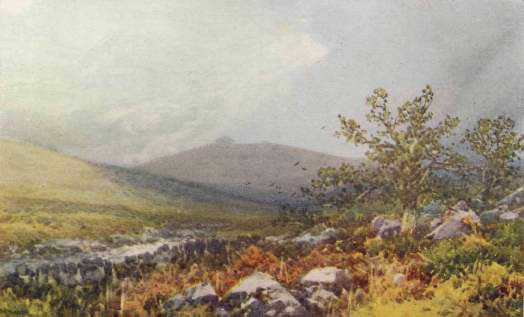 Wistman's Wood
Though some of the stone circles on the moor are due to miners rather than to prehistoric man, their antiquity may very well win respect; for, according to the views of the early nineteenth century, it was quite probable that the Phoenicians were trading with this island for tin in the year 1000 B.C.! It is unnecessary to say that the reasoning which supports this theory is very ingenious, and later opinions do not allow that the Phoenicians ever traded directly with Britain at all. The metal, it is held, was brought to the Mediterranean coast through the medium of 'the Veneti of what is now Vannes, and the tin trade was carried through Gaul to Marseilles.' To take a great leap from the date originally suggested, there is certain evidence that British tin was conveyed over this trade route in the year 40 B.C. The Romans taught the Britons better methods of mining, and how tin might be used for household needs. Another long interval without any mention of the subject brings us to the reign of the Normans, when it seems that the mines were almost entirely in the hands of the Jews. On their expulsion by Edward I, the mines were neglected for a few years, and next a[Pg 78] charter was granted to several Devonshire gentlemen, at their request, conferring the important privilege of holding plea of all actions relating to the mines, 'those of lyfe, lymme, and lande' excepted. Henceforward the Devonshire miners were separated from the Cornish, and held stannary parliaments on the top of Crockern Tor. The summit is piled with granite, and out of the rock was hewn 'a warden's or president's chair, seats for the jurors, and a high corner stone for the crier of the court, and a table,' says Polwhele; and here the 'hardy mountain council'—twenty-four burgesses from each of the stannary towns—assembled. 'This memorable place is only a great rock of moorstone, out of which a table and seats are hewn, open to all the weather, storms and tempests, having neither house nor refuge near it by divers miles,' wrote Prince. It is much to be regretted that nearly all traces of the court have now disappeared, and a report says that the table and seats were carried away to be used for some buildings not far off. It is said that the last parliament was held on this tor in 1749, but for some time before that date the court merely met on the tor, and, after the jurors had been sworn in, adjourned to one of the stannary towns.
From the charter of Edward I onwards, mining seems to have prospered, with one or two intervals of great depression, and as late as 1861 seventy-four mines were being worked in Devonshire. 'Streaming' for tin was very much practised in the Middle Ages, and the sides of valleys all over Dartmoor are scored with the works of the tin-streamers, who turned about the streams and examined the beds for 'grain-tin.' Many of the ruined 'blowing-houses' are still to be seen on the moor. Mrs. Bray mentions a curious testimony to the wildness and remoteness of the parts in which some of the miners must have worked: 'A very old woodcut ... exhibited a whole pack of hounds harnessed and laden with little bags of tin, travelling over the mountains of Dartmoor; these animals being able to cross the deep bogs of the forest in situations where there were no roads, and where no other beasts of burden could pass.'
It was owing to the mines that Dartmoor became a part of the[Pg 79] Duchy, for the 'metalliferous' moors of Dartmoor and Cornwall had, on that account, long been Crown lands; and therefore, when Edward III created his eldest son Prince of Wales and Duke of Cornwall, the Chase of Dartmoor, and the Castle and Manor of Lydford were granted to him with the estates in Cornwall. Dartmoor has existed as a forest practically from time immemorial, and the date when forest laws were first imposed on it is, in the opinion of the learned, 'lost in antiquity.' The first charter affecting the state of the moor was bestowed in 1204, when King John was compelled reluctantly to grant a Charter of Forests, disafforesting the lands that had been gradually appropriated by the Kings since Henry I. Surrounding the forest proper are lands known as the Commons of Devon, and, usually speaking, they are included in any general reference to Dartmoor. Every parish in Devonshire, excepting Barnstaple and Totnes, has a right to pasture cattle on them for the payment of a small sum. Two classes of men have special rights in the moor: owners and occupiers of tenements within the forest, and venville tenants, or owners of land in particular vills, or towns, adjoining the forest. Claims and counter-claims as to their exact rights and liabilities have been pressed in successive centuries, but various ancient documents set forth these tenants' rights, 'time out of mind, to take all things that might do them good, saving green oak and venison.' These privileges include pasturing all 'commonable beasts' on the moor, digging turf for fuel, stone and sand for mending houses and lands, and taking heath for thatching, 'paying their dues and doing their suits and services.' The 'suits and services' involved attendance at the Prince's Courts, and the tenants' help at the time of the bullock and pony drifts—that is, when the herds are driven off the moor by the moormen to a point chosen by the Duchy steward, and are there identified by their owners.
In the Duchy records appear various well-known names that one does not naturally associate with the Forest. The Conqueror granted it to his half-brother, Robert, Earl of Montaigne; King John gave the Earldom of Cornwall to his second son, Richard Plantagenet, afterwards King of the Romans. This Prince[Pg 80] 'much augmented the powers of the stannaries of Devon and Cornwall, and under his auspices they thrived exceedingly.' For a short time the earldom was bestowed on Piers Gaveston; Thomas Cromwell and some others had a lease of the lead-mines on the moor for twenty-one years; the first Earl of Bedford was 'Custos of the Forest or Chase of Dartmoor'; and Sir Walter Raleigh was appointed Ranger and Master Forester, besides being Lord Warden of the Stannaries. The first perambulation of the forest boundaries probably took place in 1224, and others have been made at intervals ever since; yet a long tale of grievances from that date almost up to the present time might be heard from commoners whose rights have been encroached upon.
The bounds of property owned by religious houses at certain points were marked by granite crosses, of which a great number are still to be found on the moor. Some of them, however, were standing long before the monasteries were built. To take one instance, the cross on Sourton Down has an inscription which, it has been declared, belongs to the sixth century, and which can still be deciphered when the sun is setting and the rays slant across it. The Abbot's Way, leading over the moor, is marked by crosses. It ran westwards from Buckfast Abbey, and divided at Broad Rock, near Plym Head, in the middle of the moor—one branch going to Tavistock, and the other to Buckland Abbey. The path cannot now be traced the whole way, but the crosses show the line. Beckamoor Cross (or the Windy Post, as it is sometimes called), between two and three miles south-east of Tavistock, is a typical Dartmoor cross, and a fine example, but it cannot be numbered among the very old ones, for it seems to date from the sixteenth century.
Perhaps the Dartmoor village best known by name is Widdecombe-in-the-Moor, and its fame is spread by the song 'Widdecombe Fair;' this is the most popular of Devonshire folk-songs, and the air served the Devon Regiment as a march in the Boer War. But Widdecombe has more solid claims to consideration, and one of them is the large and beautiful church, with its very fine tower and high crocketed pinnacles, each pointed by a cross. The roof is adorned by 'bosses, carved and painted with heads, flowers[Pg 81] and leaves, and also figures or marks which obscurely shadow forth the learning of the alchemist.' The presence of these symbols is explained by a tradition that the church was built by miners. 'On one of the bosses is the combination of three rabbits, each with a single ear, which join in the centre, forming a triangle—a favourite alchemical symbol, called the hunt of Venus.' Parts of the rood-screen remain, and on the panels are painted saints and doctors of the Church, and a king and queen. On October 21, 1638, a terrible storm raged here during service-time. First fell 'a strange darkenesse'; then a terrific thunder-clap; 'the ratling thereof' was much like 'the report of many great cannons.' 'Extraordinarie lightning' flashed, 'so flaming that the whole church was presently filled with fire and smoke,' and a smell of brimstone, and a great ball of fire came in at the window and passed through the church. The church itself was much torne and defaced, 'stones throwne from the Tower as thick as if an hundred men had been there throwing.' Several people were killed and many 'grievously scalded and wounded.' The history of the storm has been told in verse, and the lines were painted on tablets and placed in the church. Mrs Bray found 'the wildest tales' of the storm floating among the people in the neighbourhood, and, amongst them, 'One story is that the devil, dressed in black and mounted on a black horse, inquired his way to the church, of a woman who kept a little public-house on the moor. He offered her money to become his guide; but she distrusted him, in remarking that the liquor went hissing down his throat, and finally had her suspicions confirmed by discovering he had a cloven foot, which he could not conceal even by his boot.'
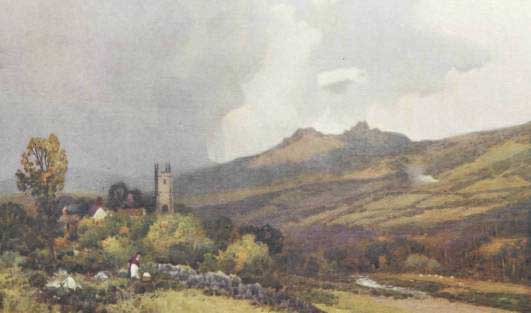 Widdecombe-in-the-Moor
Widdecombe is called cold and bleak, and it is not only with the terrific tempest that its name is associated, for when the snow fell thickly the South Devon folk used to look—as perhaps they still do—towards the moor, and say to the children: 'Widdecombe hills are picking their geese, faster, faster, faster.'
About twelve miles south-west of Widdecombe is Sheeps Tor, a sharply defined height that has given its name to the parish[Pg 82] and tiny village that it overshadows. Originally it was called Shettes Tor—that is, Steep Tor, the word being derived from the Celtic syth.
Hidden among the great piles of moorstone heaped upon the tor is a cave known as the Pixies' House. Mrs Bray describes an expedition that she made to Sheeps Tor, and how, on asking her way to the cave, she was told to 'be careful to leave a pin, or something of equal value, as an offering to these invisible beings; otherwise they would not fail to torment us in our sleep.' Grass grows on the lower slopes, but near the summit there spreads a 'bold and shelving sweep of about two hundred feet, the granite ... totally bare, save where it was here and there covered by a coating of mosses and lichens. It lies tossed about in enormous masses in every direction.' The cave itself is in the midst of 'most confused masses of rock, that looked as if they had been tossed about by the fiends in battle,' and the entrance itself is a 'cleft between two rocks.' A story of human interest is also connected with the cave, for here Walter Elford, Lord of the Manor, was forced to hide when the country was being searched for him. Squire Elford was a Parliamentarian, and one of the 'secluded' members of the Long Parliament; but he was so far thrown into opposition by the development of the Protector's policy that he reached the point of plotting against him, and in consequence a party of Desborough's troops were sent in pursuit of the squire to his own house. Fortunately, among the huge boulders the entrance to the cave was very difficult to find, and the Pixies' House proved a safe refuge until the search-parties were withdrawn.
About fifteen miles from Widdecombe, on the north-west side of the moor, lies Lydford, whose size is in no way proportionate to its antiquity. 'Doubtless,' says Risdon, 'in the Saxons' heptarchy, it was a town of some note, that felt the furious rage of the merciless Danes.' And it is true that in 997 Lydford was burned down by them. At this time Lydford had its own mint, and money was coined here; and in the Domesday Book it was described as being taxed equally with London. But the village is very conspicuously a victim of 'the whirligig of time,' and William Browne[Pg 83] gives a most unflattering picture of its appearance in the middle of the seventeenth century:
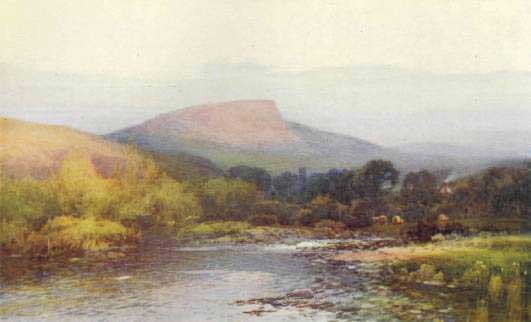 Sheepstor
The Castle is not very large, and is now utterly in ruins, though the walls of the square keep are still standing. In Browne's day it was used as the stannary prison, and was denounced in an Act of Parliament as 'one of the most heinous, contagious, and detestable places in the realm.' For many years after this Lydford was a lonely village, generally ignored, in spite of its fine air and beautiful scenery. Towards the moor it looks up to an irregular barrier (about a mile or so distant) of very picturesque tors, and in the opposite direction a fertile and pleasant country spreads[Pg 84] beneath it. The River Lyd winds through scenes that are always delightful and sometimes very striking, but the cascade has been so much praised that, if seen in summer, it is apt to be disappointing. Lydford Gorge, however, is properly placed among the 'wonders' of Devonshire—to use Fuller's expression. The gorge is deep and exceedingly narrow, and the sides are precipitous. The river, rushing between blocks of stone, flows so far below the road that from the bridge, where the chasm is only a few yards wide, it is almost invisible. Risdon says: 'It maketh such a hideous noise, that being only heard, and not seen, it causeth a kind of fear to the passengers, seeming to them that look down to it, a deep abyss.' A story (that may quite easily be true) is told of a man arriving late one night in Lydford from Tavistock, to the amazement of Lydford people, who knew that their bridge had been broken down. In the darkness the traveller had noticed 'nothing more than that his horse had made a sudden spring; but on being afterwards led to the chasm he was struck with a mingled sensation of horror, surprise, and thankfulness.'
 Lydford Bridge
From an historical point of view, it is ludicrous to think of Lydford and Princetown, its neighbour (as one counts neighbours on a moor)—Lydford, in all its glory nearly a hundred years before the Conquest, and Princetown, created by the Prince Regent. It is, I believe, the highest village in England, and in walking up to it there comes a feeling that this is rather like walking up a gigantic snail-shell, and that, when one reaches the top, it is the very top and end of all things. A tranquillity reigns over the tiny town which even the occasional sight of warders with their loaded rifles does not break; and the workaday world seems to have been left far below.
But the desolate moor as seen from this point, the bleak winds, and very frequent rain, brought cold comfort to the French prisoners of war, on whose account the prison was built. Their views are probably reflected in a gloomy description of Princetown, traducing the climate, which was given by a French writer, quoted by Mr R. J. King. 'For seven months in the year,' says a[Pg 85] M. Catel, 'it is a vraie Sibérie, covered with unmelting snow. When the snows go away, the mists appear.'
The lot of the French prisoners, however, was tempered by certain alleviations, and very many of them were allowed to live on parole in specified towns, most of which are near the moor. In 1813 a large number of American prisoners of war were added to the eight thousand French at Princetown, but for some reason were not at first allowed the same privileges. This may help to account for the aggrieved tone in which one of them refers to his French fellow-prisoners, as well as to the British. Andrews wrote a journal which was afterwards published. 'The Seigneurs,' he says, 'received remittances from their friends or had money of their own, and were able to support themselves in a genteel manner.' They were allowed to have plays with a stage and scenery once a month, and also 'had their schools for teaching the arts and sciences, dancing, fencing, and fiddling.' He criticises them severely: 'They drink, sing and dance,' and, with a fine allusion to emphasise his point, declares: 'But the Americans have not that careless volatility, like the cockle in the fable, to sing and dance when the house is on fire over them.' The French were released after the abdication of Napoleon; a year later, peace was signed between England and America, and then, till 1850, the buildings were unoccupied. In that year the decision was made that they should be used as a convict prison, and as a result, one must agree with Sir Frederick Pollock, it 'is the ugliest thing physically and morally on the moor.'
It is pleasanter to turn back to the moor itself—to topics less out of character with it. Foremost appear stories of magic, black and white, ancient beliefs and legends without end. Mr King, whose knowledge of the country was at once vast and minute, is quoted as having said 'that he believed almost every form of superstition or superstitious observances condemned in the Penitential of Bartholomew, Bishop of Exeter, 1161-1184, might be found sheltering itself under the Dartmoor Tors.' (This remark must have been made about the middle of the nineteenth century.) 'The same wild creed has been handed down from generation to[Pg 86] generation; the same spots on the lonely moor, and the same gloomy pools in the river, that were shunned by his forefathers, are avoided as "critical" (to use his own word) by the Devonshire peasant now ... and whoever may find himself in the heart of its lonely wastes when daylight is closing, and the air seems to fill with
will scarcely wonder that the spirits of the elder world should not yet have been effectually dislodged from their ancient solitudes.... The Pixies, thoroughly mischievous elves, who delight to lead all wanderers astray, dwell in the clefts of broken granite, and dance on the green sward by the side of the hill streams; ... sometimes, but very rarely, they are seen dancing by the streams dressed in green, the true livery of the small people. They ride horses at night, and tangle their manes into inextricable knots. They may be heard pounding their cider and threshing their wheat far within the recesses of their "house" on Sheepstor—a cavern formed by overhanging blocks of granite. Deep river pools and deceitful morasses, over which the cotton grass flutters its white tassels, are thought to be the "gates" of their country, where they possess diminutive flocks and herds of their own. Malicious, yet hardly demoniacal, they are precisely Dryden's "spirits of a middle sort"—
—a character which cannot, however, be assigned to their unearthly companions, the wish-hounds. These have no redeeming tinge of white, and belong to the gloomiest portion of the underworld.'
A true lover of the moor, and very sensitive to its element of mystery, Mr King has put what he has seen and imagined into verse that must be most appreciated by those who know the Forest best:[Pg 87]
'It is the wide extent of these solitary wastes which makes them so impressive, and gives them their influence over the imagination. Whether seen at mid-day, when the gleams of sunlight are chasing one another along the hill-side; or at sunset, when the long line of dusky moorland lifts itself against the fading light of the western sky, the same character of extent and freedom is impressed on the landscape, which carries the fancy from hill to hill, and from valley to valley, and leads it to imagine other scenes, of equal wildness, which the distant hills conceal
Perhaps the scenery of Dartmoor is never more impressive than under those evening effects which have last been suggested. The singular shapes assumed by the granite cappings of the tors are strongly projected against the red light of the sunset, which gleams between the many openings in the huge piles of rock, making them look like passages into some unknown country beyond them, and suggesting that idea of infinity which is afforded by no other object of sight in equal degree. Meanwhile, the heather of the foreground is growing darker and darker; and the only sound which falls upon the ear is that of the river far below, or perhaps the flapping of some heron's wings, as he rises from his rock in the stream and disappears westward—
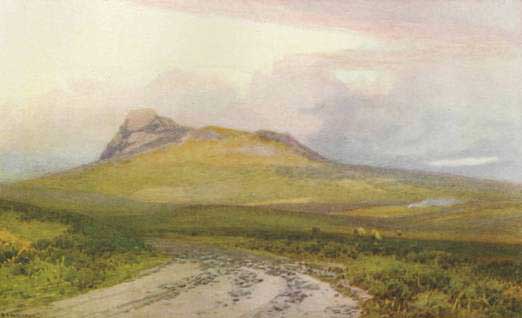 Hey Tor
The Teign rises, as do most of the rivers in Devon, on Dartmoor, and starts across the moorlands towards the north. After a few miles it is joined by the Wallabrook, and at that point turns eastwards.
The moorland country about it is very beautiful, but especially when the heather and furze are in flower together, and far and wide stretches a most royal display of rose-purple and gold. Ferns hang over the transparent brown water, with its glancing lights, and tiny ferns and polypodys peer out from the crannies and hollows of big grey boulders. Here and there bushy willows grow along the edge, or a mountain-ash shows its feathery, deep green foliage and clusters of scarlet berries. A clapper bridge—that is, a bridge formed out of a single slab of granite—over twelve feet long lies across the Wallabrook near the meeting of the streams. Beside it grows a mountain-ash, and the quivering and wavering leaves, and their shadows that quiver and waver in the ripples beneath, make a profound contrast to that massive, immovable stone, that from its look may certainly be included among those Dartmoor antiquities which Sir Frederick Pollock says 'may very well have been as great a mystery to the contemporaries of Julius Cæsar as they are to ourselves.' Modern opinion,[Pg 90] however, denies that these bridges on the moor are of a very great age. Close by on the north stands Scorhill Circle, one of those stone circles over the history of which antiquaries still differ.
A little farther down, on the north bank, is a tolmen, and there is a tradition that to creep through the hole brings luck. The rock has, of course, been associated with the Druids and their rites, but the hole is really a natural one.
About three miles farther down the river one arrives at Chagford, and perhaps the two things that a stranger will first notice about this little town are, that the air is very exhilarating and the people particularly courteous. For the rest, though not echoing Lord Clarendon's remark, that, but for the calamity of Sidney Godolphin's death, it is 'a place which could never otherwise have had a mention in this world,' one must admit that it is not very remarkable. The moment when Chagford came most violently into contact with public affairs was that mentioned by Lord Clarendon, and most heartily must the inhabitants have wished themselves back in their usual peaceful solitude. Sir John Berkeley, at that time, 'with a good party, volant, of horse and dragoons,' was descending in 'all places in the surrounding country where Parliamentarians were known to be assembled, "dissolving" them, and taking many prisoners.' Of one of these 'necessary and brisk expeditions' Chagford was the goal, and arriving very early in the morning, still in the dark, they fell upon it before day. The chilly January dawn broke over a much-discomforted town, ringing with shots, the trampling of horses, and the clash of steel, but the Royalist troops were sturdily resisted, and Godolphin was slain, it is said, in the porch of the Three Crowns Inn. Clarendon writes of him: 'There was never so great a mind and spirit contained in so little room;' and in his account of the skirmish he says: 'As his advice was of great authority with all the commanders ... so he exposed his person to all action, travel, and hazard; and by too forward engaging himself in this last received a mortal shot by a musket, a little above the knee, of which he died in the instant.' Sidney Godolphin, it will be remembered, was one of the celebrated 'four[Pg 91] wheels of Charles's Wain, all Devonshire and Cornish men, and all slain at or near the same place, the same time, and in the same cause....
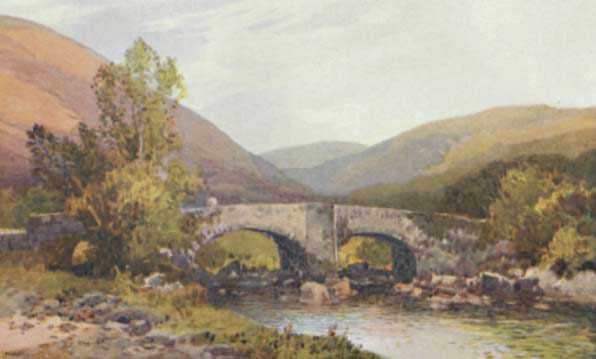 Fingle Bridge
In early days Chagford was one of the four Stannary towns, the others being Ashburton, Tavistock, and Plympton. Risdon mentions that 'This place is priviledged with many immunities which tinners enjoy; and here is holden one of the courts for Stannary causes.'
The river flows from Chagford in a north-easterly direction till Drewsteignton stands due north, when it turns to the east. Drewsteignton is a large village, and has a granite church, the tower of which is Decorated, and the nave Perpendicular. In this parish was the barton of Drascombe, and in the reign of Edward I, Walter de Bromehall held it 'by the sergeanty of finding our Lord the King, whensoever he should hunt in the forest of Dartmoor, one bow and three barbed arrows. And it was let at five shillings a year rent.' One would imagine that King Edward I can seldom have found time to amuse himself so far west, and the tenant would not find the conditions a heavy tax.
The scenery by the river is very fine all about here, and Fingle Gorge is generally considered to be the most beautiful of the many beautiful glens through which the Teign passes. It is a deep ravine with high and steep sides, that are thickly wooded and broken by great boulders. At Fingle Bridge four winding valleys meet; that is, the combe down which the river sweeps from above curves one way, and the narrow opening into which it disappears twists sharply round in another. A cleft, half hidden in trees, divides the line of hills that shut in the tiny valley-meadow on the west, and a road and a small stream scramble down a less severe descent between the high sides, from the north-east. But from no point near the bridge would it be more possible to see far up any cleeve, than it would be for a ladybird, perched at one end, to trace all the lines of a stag's horn. If in one direction there was a gentle slope and smiling prospect beyond, the peculiar effect would be[Pg 92] gone. There is a stillness, and almost a solemnity, in this little opening closed in narrowly on every side by the steep hills rising straight above it on every side, and looking as unchanging as if what they are to-day, that they have been since the beginning of time. Besides, there is a feeling of wildness and remoteness which cannot be exactly accounted for by the scenery. A living writer has said that there is that, in a beautiful landscape in a country inhabited from prehistoric time, that there is not in an equally lovely scene in a new country. Though no tangible marks of the presence of men may be left, there is an intangible something that makes itself felt though it cannot be defined, and the view is on that account the more interesting, and makes a deeper appeal to the spectator.
In Fingle Gorge, actual though not conspicuous traces of the Britons are easily found. Immediately above a precipitous ascent to the north are the remains of an old camp, which antiquaries have decided was British. On the opposite height is another camp, called Cranbrook Castle. 'This camp is of irregular form, circular towards the north-east and south-east, but almost square on other quarters. On its south side it has a high rampart and a deep ditch. On its northern side, the steepness of the hill formed the only defence.' It has been supposed that at this narrow pass the last struggle the Damnonians made against the Romans took place; but whether this were the case or not, the holders of the camp possessed a supreme coign of vantage, and could have chosen no better place for checking an enemy's advance.
As the crow flies, Moreton Hampstead is about three miles south of Fingle Gorge, but the roads are rambling. The name was originally Moor-Town, standing as it once did on the edge of the moor; and the manor, like the barton of Drascombe, was held on a curious tenure. 'Which manor was the Earls of Ulster in King Edward the first's age, who held it of the king for one sparrow-hawke yearly to be yielded.' Moreton is a small place, and in these days perhaps its most marked characteristic is the Dancing Tree, or Cross Tree, as it is sometimes called, for it has grown out of the steps that encircled the now broken village[Pg 93] cross. This tree, an elm, was pollarded, and the branches so trained that it was possible to lay a dancing floor between them when it was wanted; the floor was then railed round, and a ladder placed to lead up to it. Mr Baring-Gould, in his 'Book of the West,' quotes some most interesting references to the tree from a journal kept by an old gentleman living at Moreton Hampstead, in the beginning of the nineteenth century:
'June 4th, 1800.—His Majesty's birthday. Every mark of loyalty was shown. In the afternoon a concert of instrumental music was held on the Cross Tree....
'August 19th, 1807.—This night the French officers assembled in the Cross Tree with their band of music. They performed several airs with great taste.'
The 'French officers' were prisoners of war, staying on parole at Moreton Hampstead.
'Unfortunately, and to the great regret of the inhabitants of Moreton, the tree was wrecked by a gale on October 1, 1891.'
About a mile to the north of Fingle stands Great Fulford, an estate mentioned in the Domesday Book, which belongs to the Fulford family. They have owned it continuously since the reign of Richard I. Many members of the family have distinguished themselves, but the most picturesque figure is that of Sir Baldwin, who was 'of so undaunted resolution,' says Prince, 'that, for the honor and liberty of a royal lady in a castle besieged by infidels, he fought a combat with a Sarazen; for bulk and bigness an unequal match (as the representation of him cut in the wainscot at Fulford-hall doth plainly show); whom yet he vanquished and rescued the lady.' Sir Baldwin's name must have been woven in many a romance and ballad in later days.
During the Civil War, Great Fulford was garrisoned for the King, but was eventually forced to surrender to Fairfax.
Leaving the river and walking north-east, the wayfarer will come in time to the parish of Whitstone, rather more than three miles from Exeter. The church has several interesting features. From the south transept a hagioscope slants through the[Pg 94] wall to the chancel; and in one of the windows of the north aisle is a bit of very old, though not very beautiful, stained glass. A gallery at the west end bears a series of panels emblazoned with coats of arms. In the chancel is some Jacobean carving, and behind the altar there stand a double row of carved eagles, most of them drooping their heads to one side. Close to the church is a huge tithe barn, the date of which appears to be between 1450 and 1500. In a little entry-way joining the Rectory lie the old stocks, opposite carved panels, and the wood of which is so old that it has almost lost its grain.
In the early part of the nineteenth century, the rector of the parish, the Rev. Charles Brown, collected a large amount of varied information concerning the parish into a manuscript volume, and from this record the present rector has most kindly allowed me to make some extracts. Mr Brown begins by explaining the meaning of the name, derived from the Celtic Wad, a hill or ridge, which became in time Whit, and don, land—Whitstone, the hill land. Whitstone certainly deserves the name, as it is high, looking towards Dartmoor, but the Celtic form is more correctly kept by a hill in the parish, which is still called Wadaldon, or more commonly Waddlesdown.
Against the entries of burials in the parish register Mr Brown made biographical notes, pithy, and quite free from that too flattering note often sounded in epitaphs. Here are some examples:
'William Speare, D.D., buried 1812.... He formed a Paddock of 120 acres [of land left him in this parish]. His penuriousness was as remarkable as his taste. Often I have seen him in Exeter, whither he rode every day, with one spur only, and that tied to his boot with string.
'1814.—James Hammett, 39, was before he came to reside in Whitstone, a follower of Joanna Southcott, from whom he purchased for half a crown a piece of parchment, which was to entitle him to free admission into Heaven.
'1820.—James Sutton, 82, was for many years Sexton of the Parish, was buried according to his request near the Rectory[Pg 95] Granary. He said that the Rector had been very kind to him; he would lie as near as possible to his house.
'1829.—Ann Hexter, School-mistress at home and Mistress of the Sunday School many years. Was for twenty years occasionally insane, and at last never free from lunacy.
'1832.—William Earls—poor—humble—honest—was made happy by my present of what he called "Multiplying Glasses."
'Thomas Lake, 85, said he had never taken medicine and would not begin at 85.
'1833.—John Coven, my carpenter, 26 years, never defrauded his employers of a minute's work; but his obstinacy was equal to his honesty. He spent all his gains, openly declaring that the Parish should maintain him when he could no longer work. At his death he had received £60, but he gave up to the Overseers a legacy of £30.
'1834.—John How, 73. Having a pension of 4.0 a week, as Serj. of Marines, once refused a shill. from me, saying he did not want it.'
The notes include a compressed but lurid tale:
'1835.—Thomas Snowden, 54. He died the day his son was christened, of apoplexy.' The curate, W. Ley, had been present at a festive christening dinner, and had left Mr Snowden still entertaining a fellow guest. The seizure took place while they were alone. 'Mrs S. sent for Ley, and, taking him into the room, said: "That's the man who has just killed my husband." That man she afterwards married.'
Some interesting memoranda from the overseers and churchwardens give a glimpse of hard days in the past. In 1811 an entry shows the churchwardens making an effort to relieve the acute distress caused by the high price of food. Wages were particularly low, and a succession of bad harvests raised the price of wheat to famine price, whilst the war with Napoleon prevented any grain coming into the country, from France or America. So we find rice and barley sold to poor parishioners cheaper than they could have bought it for themselves.[Pg 96]
April and May, 105 Bushels at 13d. per Bush.; June,
135 at 11d.; August, 20 at 9s. 6d.
| Sold at 8d. per Bush. | loss £57 | 11 | 2½ |
| Four Hogs. 12 Rice cost | 8 | 15 | 9 |
| Sold for | 6 | 0 | 5½ |
| Loss | 2 | 15 | 3½' |
In 1796 there is a cryptic entry:
| 'Paid for a man for the Navy | £11 | 13 | 0.' |
Nothing more, though a few words in reference to the matter would be very welcome. Possibly the best explanation is, that at a time when men were being impressed for the navy on every hand, and the Government was making immense efforts to get men and money, the parish provided the bounty-money for a man, perhaps a parishioner, who had just joined with or without his good-will. But this is insecure ground, and the meaning can but be guessed at. In 1807 there is a very different, but also unusual, item:
| 'Mr Sowden's huntsman for killing a fox, | 3s. | 4d.' |
To return to Mr Brown's 'Record,' the memoranda are followed by a long and very interesting list of 'Parochial Superstitions,' some of which, but not all, are generally known. He also tells one or two stories with a caustic touch where he might have suggested a supernatural atmosphere.
'"The Parsonage is haunted." This has been asserted for 100 years, at least. It is still asserted, and proved too by the following story, invented by Jacob Wright, a lively servant of mine in 1814. "'Jacob,' said my master, 'come into my room. I am going to lay the ghost—don't be frightened.' Well, we went in, and frightened enough I was when I saw the ghost fly out of the window with Master's hat and wig."'
If only Mr Brown had had enough imagination to omit the word 'invented'! His eyes must have twinkled again while he was enjoying the following speech: 'It is reported that a calf with two heads has been seen in Hare Lane. Hannah Splatt says:[Pg 97] "Though I have walked about as a nurse at all hours, I never saw anything more frightful than myself."' The italics in both cases are his. Superstitions are followed by a long list of words that strike him (who must have come from 'up the country') as peculiar, though many of them are commonly used to-day. And he makes one delightful quotation. In mentioning the fact that Devonshire people say 'to' where others say 'at'—far instance, 'working to blacksmith's,' or 'living to Exeter'—he writes: 'Dr Atterbury used to say that if he had been Bishop of Exeter, the Devonshire folks would have called him Dr To Terbury.'
Rejoining the Teign, one descends a valley very beautiful, but less striking than Fingle Gorge, the sides wider apart and less high, but thickly wooded. It is especially lovely in late March or early April, when the woodbine wreaths give an earnest of what the spring's full touch will bring, and buds are bursting and tiny quilled leaves showing on the hazels scattered among the oaks that form the chief substance of the coppices. Near Dunsford lies a sea of blue-green daffodil spears, with the pale gold flowers showing among them. These flowers push up among the rustling brown leaves, under interlacing branches overhead, but at a turn of the river a large flat meadow spreads out before one, and here the daffodils indeed 'dance' in their myriads. Just beyond is the bridge below Dunsford, and here are several tiny islands, each about large enough to hold a sapling and a tangle of overflowing green that trails into the water; and rushing by on each side, after falling over a little weir, the river dashes itself into a line of foam and races on under the archway.
Some miles down the valley and east of the river is Doddiscombsleigh, whose chief feature is its church. The chancel is early Decorated, the nave and north aisle Perpendicular, and in the windows of this aisle, and more especially in the east window, is some good stained glass—a rarity in the churches in this neighbourhood. The subject, a rather uncommon one in England, is the Seven Sacraments, and, as the old glass was no longer intact, the window has been lately restored.
Farther south, and on the other side of the river, is Christow,[Pg 98] with its granite Perpendicular church. In the porch is a tribute to long service—a stone to
Tradition says that the stone marks the actual spot where he died, and the wording of the epitaph favours the idea. It may be that he went to church in a very feeble state, perhaps thinking that neither parson nor congregation could get on without him, and with a supreme effort crowned his many years of service.
The valley has a solitary look, as if it were very remote from hurry or turmoil, with the green, silent hills rising high towards Haldon's moorlands on one side, and to Dartmoor on the other. But when the tides of the Civil War surged backward and forward, the valley of the Teign had its full share of trouble. Those who lived there were too near Exeter for their peace and comfort, and must have been repeatedly harassed by the troops of one side or the other while they were clattering to or from the city, or quartered in the villages near, and the commotion must have been especially trying when Fairfax was beginning the siege of Exeter by hemming in the city with his outposts.
Canonteign House was garrisoned for the King, and was considered 'a strong fort'; but at the end of the year 1645, when the Royalist cause was lost, it was taken by a body of troops from the regiment of Colonel Okey, who after the Restoration was executed as one of the Regicides. A short account of the affair is given in 'Anglia Rediviva': 'Information being given that the house of one Mr Davis at Canonteen (being within four miles of Exeter) stood convenient for a garrison, and might bear a useful proportion towards the blocking up of Exeter, hindering of provision from the Southams, some more of Colonel Okey's dragoons were ordered thither to possess the same, who accordingly went and fulfilled their orders, December 21, and were no longer in the house; but Monday, December 22, in the morning, the enemy sent a force against it, who stormed the house, burnt the out-houses; yet Captain Woggan, who commanded the dragoons, behaved himself so gallantly that he beat[Pg 99] the enemy off, killed four, desperately wounded a lieutenant-colonel, and took divers prisoners.'
The manor of Canonteign was bought by the first Lord Exmouth, who built a new Canonteign House near the old one. In Christow Church is a memorial of the great Admiral—the flag flown by his ship during the battle of Algiers. A broadside ballad commemorating that splendid fight has a fine disregard for the more pedantic rules of making verse, and the metre is a good example of what is called 'rugged'; but those who are superior to such details will appreciate the directness and air of enjoyment that are very appropriate to the song of a gallant sailor:
Here follows a detailed account of the order of the ships going into battle and of the fight itself, finishing with:
Chudleigh stands a little above, and to the east of the river. From very early times it has been specially connected with the bishops of Exeter, for Bishop Osbert built a palace here about 1080. In the third year of Richard II's reign the palace was fortified under a licence to Bishop Brantyngham, but now only a very few fragments of it are still to be seen. The manor of Chudleigh was bound to provide twelve woodcock for the bishop's table on the day of his election, but should they be unobtainable, twelve pence was considered a just equivalent! In 1547 Bishop Vesey alienated 'the manor, town, palace, and limekiln,' and rather more than a hundred years later it came into the possession of Lord Clifford. The present Lord Clifford is lord of the manor.
At the beginning of the fourteenth century there was a lively trade in woollen goods, which were made here in considerable quantities, and this industry was carried on with varying prosperity through several centuries. In the reign of James I the trade was particularly flourishing, and, though gradually lessening, it was in existence till the end of the reign of George II.
The people of Chudleigh are said to have been careful to favour neither side in the Civil War—a small and defenceless town, swept through by each party in turn, could hardly take any other course. In January, 1646, while Exeter was still holding out against the Parliament, Fairfax and his army were quartered here. The surrounding country is very pretty, and Chudleigh Rock and Chudleigh Glen are particularly delightful. The Rock is of blue limestone, and a deep cavern runs far into it, once supposed to be haunted by the pixies. It is still called the 'Pixies' Parlour.' A stream runs through the Glen, and joins the Teign just below the town.
Near Chudleigh is Ugbrooke Park, which, with its hills and valleys, streams, lakes, trees, and deer, has all that is wanted to make a park beautiful. 'Fair Rosamond' is so well known by that title alone that it is sometimes forgotten that she was a De Clifford. In her lifetime, their principal estate was in Herefordshire, but later the heiress of Ugbrooke brought this property by marriage to Antony Clifford.[Pg 101]
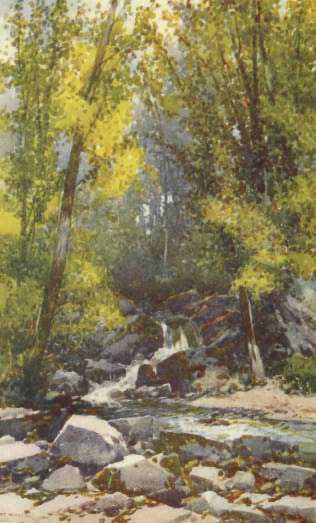 Chudleigh Glen
Perhaps the member of the family who played the most important part in history is Sir Thomas Clifford, afterwards the Lord Clifford whose initial is the first of the five that together spell 'Cabal.' In its early days, he was the leading spirit of that famous council. One branch of the Cliffords had settled in Holland, and it was probably in staying there with his relations that Sir Thomas had been brought to the notice of Charles II and first gained his influence over him. Lord Macaulay is not complimentary in his references to any member of the Cabal, but such commendations as he has to give are bestowed on Clifford. Sir Thomas, he says, 'had greatly distinguished himself in the House of Commons. Of the members of the Cabal, he was the most respectable. For, with a fiery, imperious temper, he had a strong though a lamentably perverted sense of duty and honour.' Farther on he adds that Clifford 'alone of the five had any claim to be regarded as an honest man.' Sir Thomas started a scheme which was practically the origin of the National Debt. Several statesmen who enjoyed the King's favour greatly desired the Lord Treasurer's office, and here Charles displayed his usual astuteness; for, being, as always, in want of money, he said to them that the man who should be Lord Treasurer was the man who could show him a way of putting money into the Treasury. The plan that Sir Thomas proposed to the King, and which was put into execution, Lord Clifford has most kindly sketched out as follows: 'The first Lord Clifford of Chudleigh was made Lord Treasurer by Charles II, and recommended the King to seize the money deposited in the Exchequer and secured by the allocation of various revenues. These loans had always up to this been faithfully met. By seizing this money, nominally only for a year, he acquired the sum of £1,300,000 at 6 per cent. At the succession of William and Mary the Public Debt was £664,263, and this was probably part of the money so seized; but it was not till 5 William and Mary, c. 20, that the authority of Parliament was given for a loan to be raised by the then created Bank of England, from which period usually dates the National Debt. Evelyn ascribes the inception of this idea to Ashley Shaftesbury, who,[Pg 102] foreseeing its illegality, and possibly its disastrous results (for many persons were ruined), left it to Clifford to propose it to the King. He gave 6 per cent. interest. When the Bank of England loan was raised (5 W. and M.) the interest was 8 per cent.'
There is a fine picture of the Lord High Treasurer, by Sir Peter Lely, at Ugbrooke, of which two replicas hang, one in the Treasury, and the other at Ham House, which belonged to the Duke of Lauderdale, who was the L of the Cabal. Lord Clifford is wearing a crimson robe, under a magnificent flowing mantle of ermine, and in his right hand is the white wand of office. His face shows shrewdness and determination, and a certain geniality, which suggests that, though on occasion he might not have scrupled to act as an oppressor, yet he would always have liked to do so as pleasantly as possible.
A remnant of former friendship was shown seven years after the Cabal was dissolved. In December, 1680, when the country was still seething against Popery, a Bill was brought before the House of Lords which provided, amongst other things, that all Papists of influence should be removed from their own estates to a far distant county. Lists of the gentlemen 'selected' in each county were made out (and have been reprinted among the manuscripts of the House of Lords), and after the last list is written: 'In addition to the above Lists, there was one for Devonshire, which appears to have been given to Earl Shaftesbury ... but which is not forthcoming.' A subsequent collection of the names of those 'selected' in this county follows this statement, but Lord Clifford's name does not appear among them; therefore Lord Shaftesbury's reason for 'mislaying' this one list is supposed to be that he had suppressed in it the name of his former friend's son; and no second formal list for Devonshire seems to have been made. The Bill never became law.
At Newton Abbot the river reaches its most southerly point and again turns east. Lysons says that its 'market and fair were spoken of in the reign of Edward I;' but there are not many old buildings, and those that there are seem completely swamped by numerous modern ones. The parish church, to the south of the[Pg 103] town, contains much that is most interesting; and Forde House, a fine Jacobean building, welcomed under its roof Charles I on two occasions, and, having changed owners meanwhile, greeted William of Orange, when, thirty-three years later, he was on his way from Torbay.
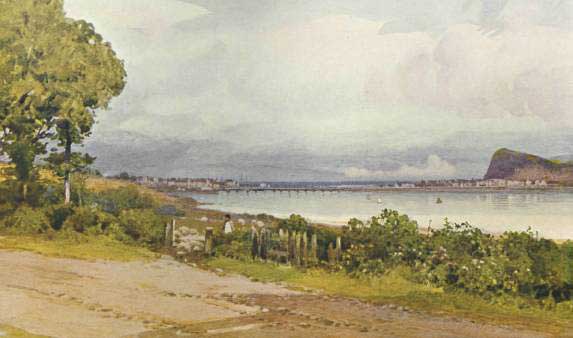 Teignmouth and Shaldon
Along the northern bank of the estuary lie the two villages of Kingsteignton and Bishopsteignton, the manor of the first being part of the ancient demesnes of the Crown, as that of the second was of the See of Exeter. At the Kingsteignton 'revel' a curious custom used to be observed, for a part of the proceedings was that 'a ram was hunted, killed, roasted, and eaten.' Mr Baring-Gould gives these details, and adds a village anecdote. 'The parson there once asked a lad in Sunday-school, "How many commandments are there?" "Three, sir," was the prompt reply—"Easter, Whitsuntide, and the Revel."'
Bishopsteignton has a church in which there are portions of Norman work, and in the parish lie the remains of a Bishop's palace, 'From ancient times,' says Lysons, 'one of the country seats of the bishops.' It was practically rebuilt by Bishop Grandisson.
I was once given an interesting piece of information relating to Bishopsteignton by an old man living near Newton St Cyres. He said that in a general way the women there used to be very small, and folks said that was because they had been changed by the pixies when they were babies.
It is unnecessary to dwell on the fact that Teignmouth, besides being a port, is a most flourishing watering-place. The colouring is very rich, and especially lovely when set off by a brilliant sky and glittering blue water. Blood-red cliffs lead north and south, and the green of grass and plants, broken by masses of wild-flowers of all tints, here scattered thinly, there in clumps, overlaps and creeps down the face of the rock wherever there is foothold. Between Teignmouth and Dawlish an 'island-rock' of the warmest red runs out into the sea, and through an arch in it the rippling water may be seen beyond. Looking down at Teignmouth from the hill on the opposite side, the town seems to run very flatly into the angle between sea and river. In the estuary, at[Pg 104] low tide, the ships and boats lie in pools among the sand-banks, with the gulls circling and screaming about them.
It has been said that 'the cliffs of Teignmouth owe their deep-red hue to the slaughter of the inhabitants by the Danes in 970, when "the very rocks streamed with blood"'; and the old people confidently assert that the dwarf-elder (called hereabouts 'Danes-elder') grows only upon the site of old battle-fields 'where the Danes' blood was spilt!' These legends are not altogether baseless, for there is no doubt as to the pitiless brutality which the Danes showed in their various incursions into Devon between the years 894 and 1013. Drayton's image is bold and gruesome:
'When all the country swam with blood of Saxons shed.'
Teignmouth was last troubled by an enemy in 1690, when Admiral de Tourville, having defeated the united English and Dutch fleets off Beachy Head, sailed down the Channel and anchored one night in Tor Bay. The Devonshire militia flew to arms. 'In twenty-four hours all Devonshire was up. Every road in the county from sea to sea was covered by multitudes of fighting men, all with their faces set towards Torbay.' De Tourville, upon this discouraging reception, gave up any ideas he may have had of disembarking, and merely sent some galleys to Teignmouth, who first turned their cannon on the town and afterwards landed and burned it.
The general excitement that this attack created found voice in a ballad called 'The Devonshire Boys' Courage, 1690.' It is utter doggerel, but expresses the contemporary views of the people, and was sung to a tune called 'Liggan Water,' a title that, according to Mr William Chappell, refers to an Irish stream. I give only a few verses:

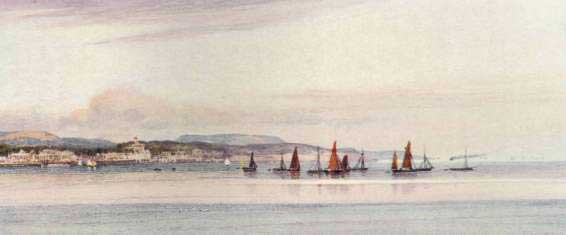 Torquay from the Bay
It is impossible for those who have had no better fortune than to see Torbay only in prints or photographs to gather more than a very imperfect idea of what its best can be. The cliffs near Paignton are red, nearer Torquay they are a warm russet, alternating with a rosy grey where limestone comes to the surface; and some of the rocks beneath, shining with salt water, are pink, interlined with white veins. In fair weather the warm tints of these cliffs, chequered by a green lattice-work of plants and bushes, and the rich, full colours of the sea, make a picture that is more easily remembered than described.
The great promontories of Hope's Nose and Berry Head stand between three and four miles apart at the northern and southern points of this rounded, shallow bay. Torquay itself is a new town, and only developed into being one in the early part of the last century. At the time that there was real fear of Napoleon making[Pg 107] a descent on this coast, fortifications were built on Berry Head, and houses were wanted for the officers in charge. One authority suggests that Torquay was brought into general notice by serving as a lodging for the families of officers in the Channel Fleet under Lord St Vincent, who used Torbay as an anchorage. But in any case its existence is really due to Napoleon. Certainly the growth was rapid, for Lysons, writing about 1820, speaks of Torquay as having been till lately a hamlet,—and even its name is modern.
The one important building was the Abbey, founded in 1196 by William, Lord Briwere, and endowed by him with the whole of the Manor of Wolborough and part of the Manor of Torre. The probable origin of this great gift is interesting. The Abbey was founded soon after the return from Austria of the hostages who had been kept there till the ransom of King Richard I was paid, and it has been generally supposed that, as the eldest sons of the greatest noblemen were sent, Lord Briwere's only son was among the number, and that the Abbey was a thank-offering, the fruit of a vow made by the father in regard to his son's happy return. Lord Briwere installed in the Abbey seven monks of the Premonstratensian Order. Alicia, daughter of Lord Briwere, married Reginald de Mohun, and as, on the death of her brother, she inherited the Torre property, it is easily seen how Tor-Mohun came to be the name of the parish. Successive bequests to the monastery made it the richest house of the Order in England, though at the time of its dissolution there were only fifteen monks besides the Abbot. The peace and prosperity of the Abbey were once broken, Dr Oliver tells us in his 'Monasticon Diœcesis Exoniensis,' by a painful incident: 'In 1390, notwithstanding the Abbot's irreproachable life and manners, some malicious person spread a rumour that he had beheaded one of the Canons of Tor called Simon Hastings.' The Abbot was 'greatly distressed,' and the Bishop pronounced the accusation to be a falsehood of the 'blackest dye,' and, besides, declared that he, the said Canon, was alive and well. But that it should be possible to bring such a charge against an 'irreproachable' Abbot in this casual way,[Pg 108] and that the accusation should for a moment be listened to, is a view of those days not often opened to one.
After changing hands several times, the Abbey became the property of the Carys (in 1662), and their descendants still live in it. Many alterations have been inevitable, but much of the character of the building still remains. Parts of the walls of the original church are still standing, and enough of the masonry is left to show the exact plan. It was longer than any other church that has since been built in Torquay, and wanted only seven feet to equal the length of Exeter Cathedral between the west end and the organ-screen. The refectory stretches towards the west; it has been converted into a chapel, and a stone cross rises from the roof. The embattled gateway and the whole of the building near it are of a soft rose colour; beyond stands a tower, duller in tint, and at right angles the old grange, known since Elizabethan days as the Spanish Barn. For the Capitana, the first ship of the Armada to be taken, fell to Sir Francis Drake off Torbay, and the four hundred men captured on her were brought to Tor Abbey and imprisoned in the grange.
Leaving Torquay, and going some miles to the north, and slightly inland, one arrives at Haccombe, the smallest parish in England. This year (1908) the population numbers nine. It is also conspicuous for having as its Rector the sole 'Arch-priest' in the kingdom, and for its independence, for though Haccombe Church is subject to the jurisdiction of the Bishop, it claims to be free from any ruling of the Archdeacon. A college or arch-presbytery was founded there in 1341, 'which college,' says Lysons, 'consisted of an arch-priest and five other priests, who lived together in community.' The Arch-priest, or Rector, as he is usually called, is the only remaining member of the college.
Haccombe passed by a succession of heiresses from the Haccombes, who held it in the time of William I, to the Carews, during the fourteenth century, to which family it still belongs. On the church door hang two horseshoes, commemorating a victory that George Carew, Earl of Totnes, wrested from his cousin, Sir Arthur[Pg 109] Champernowne. A wager was laid as to whose horse could swim farthest into the sea, and the horse of 'the bold Carew' won. The story is told in the following ballad:
How far this account is accurate it is difficult to say, but the Champernownes are still at Dartington.
Some miles south, and a little to the west, about midway between Haccombe and Torquay, lies Kingskerswell, a village not very much heard of nowadays, but once the property of a very distinguished soldier and statesman. 'The Lord Nicolas de Mules (or Meoles, or Molis), a counsellor of estate, had this manor in the time of Henry III, to whom the King granted other lands to hold by knightly service.... He was Sheriff of Hampshire and Governor of Winchester Castle, and held the islands of Guernsey, Jersey, Serke, and Aureney committed to his trust. In 23 Henry III he was Sheriff of Yorkshire, and afterwards sent Ambassador to denounce war against France, and, being an expert[Pg 111] soldier, was upon the King's return to England appointed Seneschal of Gascoigne, being held in such esteem by Henry III that he admitted James, his son and heir, to have education with Prince Edward at the King's charge. Continuing still in Gascoigne, he obtained a signal victory over the King of Navarre.' Risdon adds the information that Sir Nicolas took the King 'prisoner in the field.' On his return he took part in the 'War against the Welsh,' and must have acquitted himself brilliantly, since hereafter honours were showered upon him. He was made Governor of the Castles of Carmarthen and Cardigan, then 'Constable of Dover Castle and Warden of the Cinque-ports, and the same year Sheriff of Kent, also Governor of the Castles of Canterbury and Rochester; and of Sherborne and Corfe Castle,' in the county of Dorset. It is almost bewildering to follow his rapid plunges from one sphere of action to another, and it certainly emphasizes the fact that the strenuous life is no novelty. It contradicts, too, a view rather generally held, that the spirit of restless daring and love of adventure that have distinguished innumerable men of Devon belonged solely to Elizabethan days—a view that has, no doubt, sprung up because the great lights that shone in that glorious reign have eclipsed all lesser ones.
But the poppy of oblivion has fallen on the name of Sir Nicolas, and he is no conspicuous figure in the most local histories; even Prince does not count him among his 'Worthies.'
From Kingskerswell one passes through a fertile and pleasant country, which suggests to the passer-by that the time and labour needed in weeding and chopping down must be almost greater than that spent in sowing and growing plants. The number of orchards here has perhaps given rise to a proverb, said to be peculiar to South Devon, but calling to mind Tusser's treatise on Husbandry:
This explanation of the rhyme has been suggested: 'Rather, perhaps, be in the grave—i.e., You must plant your leaves in the fall of the leaf.'[Pg 112]
A road leading south, then to the east, reaches Paignton, which stands almost midway between north and south in the bay. The old town was at a little distance from the sea, but latterly new houses have been built in all directions, and have brought it close to the water's edge. Paignton has a fine church, chiefly Perpendicular, but parts are of earlier work, and there is a most beautiful carved screen.
The adventures of a native of Paignton—a certain Will Adams, born about 1612, 'of mean and obscure parentage'—are not to be forgotten. He was, says Mr Norway, 'one of those "Turkish captives" of whom so many were languishing in Algiers two centuries ago, and who, there is little doubt, were specially in the minds of the authors of the petition in our Litany, "For all poor prisoners and captives" ... and it may very well be that Adams' name was coupled with this prayer on many a Sunday in Paignton Church, for the agony of his captivity lasted full five years.' At the end of that time he and his companions, despairing of rescue, set to work on what would indeed have seemed to most people a hopeless venture. They began to make a boat with a keel twelve feet long, but 'because it was impossible to convey a piece that length out of the city, but it must be seen and suspected, they cut it in two and fitted it for joyning, just in the middle.' Then 'because boards would require much hammering and that noise would be like to betray them, they bought as much canvas as would cover their boat twice over.' With as much 'pitch, tar, and tallow, as would serve to make a kind of tarpauling cloth, two pipe staves saw'd across ... for oars, a little bread and two leather bottles full of fresh water, and as much canvas as would serve for a sail,' their preparations before 'launching out into the deep' were complete. But even their courage was not the most splendid in the affair. When the prisoners had actually started, they found that the boat was overloaded, so 'two were content to stay on shore.' They were 'content' to return to toil and slavery indefinitely, and to face the bitter wrath and vengeance of their captors, enraged by the loss of so many prisoners.
Those who escaped had much to endure. Their boat leaked, and[Pg 113] the salt water spoiled their bread. 'Pale famine stared them in the face' writes Prince, and they suffered even greater tortures from thirst and heat. 'On the fifth day, as they lay hulling up and down, God sent them some relief, viz., a tortois,' which they came upon asleep in the sea and caught. With strength almost gone, they reached Majorca, where, luckily, the Viceroy was kindly disposed towards them, and they started home in one of 'the King of Spain's gallies.'
 Berry Head
Adams died at a good old age in his native place.
The fine cliff called Berry Head runs far out into the sea at the southern edge of Tor Bay, and standing back, within the bay, is the small and pretty town of Brixham—celebrated for its trawlers, and for being the landing-place of William III. The red and brown sails of 'Brixham trawlers' scattered over the blue-grey waters of the bay seem very familiar, and it is a question for consideration how many exhibitions at the Royal Academy have not included a picture bearing that title. The fishery is an old one, and in the reign of Henry VIII the Vicar could claim personal tithes in fish equal in value to £340 of our money.
Fishermen and others gave a very cordial welcome to the Prince of Orange when he arrived on November 5, 1688. But by no one can he have been more vehemently applauded than by the author of the lines I have quoted at the head of the present chapter—the Rev Philip Avant, Vicar of Salcombe. The poem, originally written in Latin, and translated by the author, takes up almost the whole of his small and rather rare volume, Torbaia digna Camœnsis. It is in parts unintentionally amusing, and is interesting as showing how far the frenzied fervour of bigotry may carry a naturally amiable person, for in the narrow intervals between his torrents of denunciation it is clear that Mr Avant was, in ordinary matters, a kindly-disposed man.
A pamphlet graphically describing the 'Expedition from Torbay to Whitehall' was written by another clergyman, John Whittle by name, a 'Minister Chaplain in the Army,' and from this pamphlet long extracts are given in a paper on this subject by the late Mr Windeatt. Some of these quotations I am now venturing[Pg 114] to repeat: 'The morning was very obscure with the Fog and Mist, and withal it was so calm that the Vessels now as 'twere touch'd each other, every ship coming as near unto the ship wherein the Prince of Orange was, as the Schipper thereof would permit them.... His Highness the Prince of Orange gave orders that his Standard should be put up, and accordingly it was done, the White Flag being put uppermost, signifying his most gracious offer of Peace unto all such as would live peaceably. And under that, the Red or Bloody Flag was set up, signifying War unto all such as did oppose his designs. The Sun, recovering strength, soon dissipated the Fog, and dispers'd the Mist, insomuch that it prov'd a very pleasant Day. By this time the people of Devonshire thereabout had discovered the Fleet, the one telling the other thereof; they came flocking in droves to the side or brow of the Hills to view us. Some guess'd we were French because they saw divers White Flags; but the standard of the Prince, the Motto of which was, For the Protestant Religion and Liberty, soon undeceived them.... Bells were ringing as we were sailing towards the Bay, and as we landed, which many judged to be a good omen.' A little later, when they had landed, people 'came running out at their doors to see this happy sight. So the Prince with Marschal Schomberg, and divers Lords, Knights and Gentlemen, marched up the Hill, which all the Fleet could see over the Houses, the Colours flying and flourishing before his Highness, the Trumpets sounding, the Haut-boys played, the Drums beat, and the Lords, Knights and Gentlemen shouted; and sundry Huzzas did now echo in the Fleet, from off the Hill, insomuch that our very hearts below in the water were even ravish'd for going thereof.'
There is an absurd story, here quoted with mild ridicule, that on the Prince's landing he was received by the inhabitants of Brixham with this address:
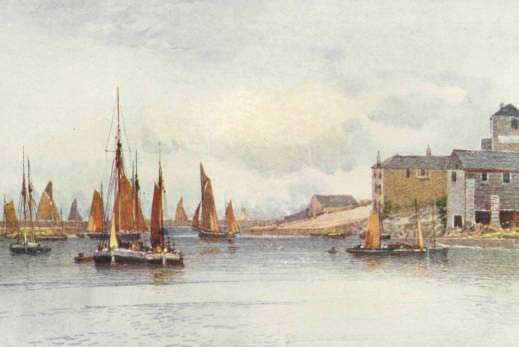 Brixham Trawlers
The 'And please' must be a corruption of 'An it please,' which does make sense, but the rhyme cannot have been invented until later, for it certainly was not within the power of a fisherman to offer 'bohea,' or any other kind of tea, in those days. 'Buck-horn' is rather puzzling, for it gives no clue as to what it might be. Anybody who has heard of edible buck-horn (or buck's-horn) at all, would probably think of an obscure and humble salad herb, now practically forgotten, and at no time a dainty to be pressed on 'King William's' notice in this manner. The English Dialect Dictionary comes to the rescue by explaining that in Cornwall, Devon, and Cumberland, 'buck-horn' is a name for 'salted and dried whiting.' 'Bok horñ' also appears in the Receiver's accounts at Exeter (about 1488), when the citizens, having a quarrel with the Bishop, tactfully sent successive presents of fish to the Lord Chancellor while the case lay before him. Buck-horn is still sold in Brixham.
The soldiers' first experiences in England were not agreeable, as 'they were marching into Camp all hours in the Night'; and some having been unlucky enough to get astray from their companies, 'it was no easy matter to find them in the dark amongst so many thousands. It was a cold, frosty night, and the stars twinkl'd exceedingly; besides the Ground was very wet after so much Rain and ill Weather; the Souldiers were to stand to their arms the whole Night, at least to be in readiness if anything should happen, or the enemy make an Assault, and therefore sundry Souldiers were to fetch some old Hedges and cut down green Wood to burn these with, to make some Fire.'
Mr Windeatt, writing in 1880, gives an astonishing instance of how few links a chain may sometimes need in order to stretch from century to century. He says a gentleman gave him the following account: 'There are few now left who can say, as I can, that they have heard their father and their wife's father talking together of the men who saw the landing of William III at Torbay. I have heard Captain Clements say he as a boy heard as many as seven or eight old men each giving the particulars of what he saw then. One saw a shipload of horses hauled up to the quay, and the[Pg 116] horses walked out all harnessed, and the quickness with which each man knew his horse and mounted it surprised them. Another old man said: "I helped to get on shore the horses that were thrown overboard, and swam on shore guided by only a single rope running from the ship to the shore"; and another would describe the rigging and build of the ships, but all appeared to welcome them as friends.
'My father remembered only one—"Gaffer Will Webber," of Staverton, who served his apprenticeship with one of his ancestors, and who lived to a great age—say that he went from Staverton as a boy with his father, who took a cartload of apples from Staverton to the highroad from Brixham to Exeter, that the soldiers might help themselves to them, and to wish them "Godspeed."'
The gentlemen of the county were more tardy in their welcome, and perhaps this is not very surprising, when one considers that they can scarcely have recovered from the terrible vengeance that seared all who had followed Monmouth only three years before.
Sir Edward Seymour, formerly Speaker of the House of Commons, was one of the first and, says Macaulay, the most important of the great landowners who joined the Prince at Exeter. He was 'in birth, in political influence, and in parliamentary abilities ... beyond comparison the foremost among the Tory gentlemen of England.'
Sir Edward evidently rode in great state, for the Duke of Somerset, his descendant, still has a very imposing red velvet saddle, elaborately embroidered with heraldic and other designs in silver, that 'Mr Speaker Seymour' used on this occasion.
The march was continued in the most miserable discomfort. Six hundred horses had died either at sea or from the effects of the storm, and the men, still suffering from a 'dissiness in the Heads after they had been so long toss'd at Sea,' had extra burdens to carry. The weather was wet and stormy, the roads were 'extreme rough and stony,' and when they encamped and lay down for the night, 'their Heads, Backs and Arms sank deep into the Clay.'[Pg 117] Further, their rations were so spare that when they came on an inclosure with turnips they felt they had found a feast. 'Some roasted them and others eat them raw, and made a brave Banquet.' However, matters improved the next day as they drew nearer to Newton Abbot. People came in crowds to see them. 'Now they began to give us applause and pray for our Success.' Hitherto they had but wavered as they said, 'the Irish would come and cut them in pieces if it should be known.' On approaching Newton, 'a certain Divine went before the Army, and finding 'twas their Market day, he went unto the Cross, or Town hall,' and read the Declaration of the Prince of Orange. 'To which the people with one Heart and Voice answered Amen: Amen, and forthwith shouted for Joy, and made the Town ring with their echoing Huzzas.'
Such was the auspicious reception of the 'Deliverer of the Nation from Popery, Slavery, Brass Money and Wooden Shoes.'
A very different note, jarring against this triumphal strain, is struck by a Jacobite ballad on the same event, too long to quote entirely here. It bears the conciliatory title of
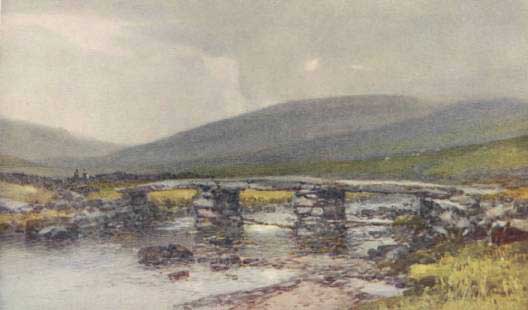 Postbridge
Of all the rivers of Devonshire, the Dart claims the first place, both for beauty and for interesting associations; and between the lonely wastes about its source on Dartmoor, and the calm, broad reaches above Dartmouth, the scenery is not only always beautiful, but adds the great charm of being beautiful in quite different ways.
Drayton recognises the claim, for in the Poly-olbion, speaking of the 'mother of rivers,' Dartmoor, he says:
And a few lines later he makes Dart declaim:
The East Dart rises about a mile south of Cranmere Pool, and at first makes its way through bare bogs, with great black holes gaping open here and there in the peat, tussocks of coarse grass and dry, rustling bents, isolated tufts of heather, and now and again wide spaces of waving cotton-grass. All around is 'an everlasting wash of air' and a sense of spaciousness, which it is to be hoped no cynically named 'improvements' may ever diminish. Westcote comments on the name. 'Of some it is supposed that the river takes name of the swiftness of the current; the like is thought of the river Arrow in Warwickshire, and of the Tygris in Mesopotamia, which among the Persians doth import a shaft.'
There is a saying that 'the river "cries" when there is to be a change of wind. "Us shall have bad weather, maister; I hear the Broadstones a-crying." The Broadstones are boulders of granite lying in the bed of the river. The cry, however, hardly comes from them, but from a piping of the wind, in the twists of the glen through which the turbulent river writhes.'
Many tales on the Moor speak of the amazing swiftness with which a freshet will suddenly swell and sweep down, an overwhelming flood. Only a few years ago a farmer was crossing a very safe ford when he saw the freshet coming, and tried to hurry his horse, but before he could reach the bank the torrent caught his cart and overturned it, and he and his horse were drowned.
The ominous couplet springs from no misty legend, but from melancholy experience.
The East Dart runs throughout its course in a south-easterly direction, and at Post Bridge just below the road from Moreton Hampstead to Tavistock it is crossed by an old bridge, one of the many rugged witnesses to unwritten history scattered all over[Pg 121] Dartmoor. It is a massive structure, built of rough granite blocks; the 'table-stones' that rest on the piers are each about fifteen feet long.
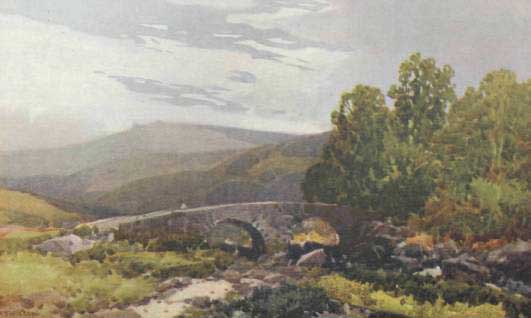 Dartmeet Bridge
The West Dart rises farther south than the East Dart, and runs almost due south as far as Two Bridges, and then, in many curves to the east—sometimes almost hidden in the depths of the hollow that has been worn between the high bare sides of the valley—till about five miles from Two Bridges it reaches Dartmeet. From the top of a tor close to the point where the two streams meet the effect is rather curious, for sunk deep between the wide barren stretches of moor and desolate tors, broad green ribbons of trees and undergrowth, broken by tufts and uneven edges, mark the course of the rivers till they wind away out of sight. Their darker green makes them stand out against the sides of the valleys, and they are the only trees in sight. In summer the river is often very low, and then masses of great boulders in the river-bed are seen, and some of the biggest are crowned with ferns, high tufts of grass, or little bushes, with the clearest water streams between them. The bridge is over the East Dart, above the meeting of the waters, and from just below it is possible to get a charming view of the arches thrown up against a sunlit mass of shimmering leaves.
From here the Dart runs south almost to Holne, the birthplace of that true lover of Devon, Charles Kingsley. At this point it makes a great loop to the north, flowing among lovely scenery along a steep and narrow valley, where great rocks break through the woods; then curving round in Holne Chase, it turns south again to Holne Bridge, which is crossed by the Ashburton road. The town is about three miles to the east.
Ashburton is one of the old stannary towns, and besides mining, it was known for its trade in woollen goods, especially serges. In fact, 'the seal of the Port-reeve bears a church between a teasel and a saltire, with the sun and moon above.' The teasel was used to raise the nap in making cloth, and was a symbol of that industry, as the sun and moon were symbols of mining. In 1697 the manufacturers felt foreign competition so keenly that the Port[Pg 122]-reeve, traders, and inhabitants of Ashburton signed a petition to Parliament, begging that an Act might be passed to discourage the importation of Irish and other foreign woollen goods.
This borough sent members to Parliament from the reign of Edward I, but in time its representation ceased. The privilege was given back to the borough after the Restoration, through the intervention of Sir John Northcote, and was held until Ashburton was disfranchised in 1868.
A few miles farther down the river is Buckfastleigh, a small but very flourishing town, and one of the very few that still produce the serges and woollen goods for which the county was once famous, in the sixteenth century especially, for then, as Green tells us, 'the broadcloths of the West claimed the palm among the woollen stuffs of England.' The church stands apart on a height overlooking the town, and the tapering spire adds to the effect given by its commanding position. By far the most interesting building here is Buckfast Abbey, founded in the reign of Henry II, on the site of a Benedictine abbey of Saxon days. The place must have been very remote and inaccessible when the Benedictines first settled there, and the Saxon name given in Bishop Ælfwold's charter in 1016 was 'Buckfæsten, i.e., Deer-fastness,' which would seem to argue that the Abbey was surrounded by thick woods, and was particularly lonely, even for those times. Sable, a crozier in pale, argent, the crook or, surmounted by a buck's head, caboshed of the second, horned gules, were the ancient arms of the Abbey, as they are still, though now impaled with the Clifford arms, by permission of Lord Clifford.
The second colony of monks here were Cistercians, and the monastery became very prosperous and the richest house of that order in the county. King John deposited some of his jewels, gold and silver in their keeping, and in 1297 Edward I visited the Abbey. The Cistercians were great wool-traders, and did much for both trade and agriculture in the districts near them. It has been supposed that the sunken track called the Abbot's Way was used in carrying the wool from the moorland farms belonging to the monastery towards Plymouth and Tavistock. In the thir[Pg 123]teenth century the monks showed their interest in trading by joining the 'Gild Merchant' of Totnes. A memorandum on the back of one of the 'membership rolls' in 1236 records an agreement between the burgesses of Totnes and the abbot and convent of Buckfast; that the monks might be able 'to make all their purchases in like manner with the burgesses, the abbot and monks agree to pay twenty-two pence on the Saturday before Christmas day.'[4]
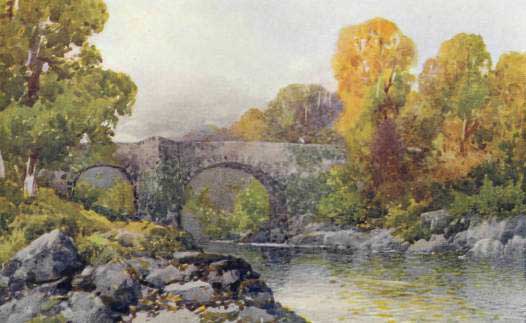 Holne Bridge
The buildings at the time of the Dissolution were very large, and there was a fine church, but of these only a Perpendicular tower adjoining the cloisters, and a large tithe-barn, are in a state of good preservation at the present day. A modern house was built on the western side of the vanished cloisters, but in 1882 the Abbey was bought for a colony of Benedictine monks from Pierrequivire in Burgundy, who have partly rebuilt the monastery on its ancient lines, and are restoring the Abbey church.
A few miles away to the south-west is Dean Prior, and the living that Herrick held when he poured out his grumbles and complaints about 'dull Devonshire.' Herrick was a true Cockney, and the earliest part of his life was spent in a house in Cheapside. When he grew up, he had the good luck to come into the brilliant and witty company that gathered round Ben Jonson, so it must be allowed that he had an excuse for sometimes thinking that life in an obscure hamlet, two hundred miles from London, was a dreary exile. But, as Mr R. J. King remarks, in spite of all his grievances, he had in him a sense that responded very readily to the pretty customs and observances of the village, that marked, here with a handful of flowers, there with a sheaf of wheat or a branch of holly, the different festivals of the year.
Herrick's poem 'Christmas Eve' refers to a local custom that appealed to him:
Mr King makes this interesting note on it: 'This custom, so far as I know, is unnoticed by anyone but Herrick.
'A solitary watcher,
guarded the pie through the night before Christmas.
'The pie represented the manger of Bethlehem, and its contents the wise men's offerings. The Devonshire "Christmas play" has had a curious fate. Except, perhaps, in some of the moorland parishes, it has disappeared at home. But the Newfoundland fisheries were long carried on for the most part by sailors from the neighbourhood of Dartmouth and Tor Bay, and Mr Jukes tells us that the streets of St John's at Christmas-time continue to exhibit St George, the Turkish Knight, and all their companions, in full vigour.'
The charm of Herrick's verses on country joys is deepened—to the folk-lorist in particular—by remembering that the rustic ceremonies he commemorates were probably the usual customs observed at Dean Prior in his time. On a hot August evening he may have watched the happy and excited children who are described in the poem 'The Hock-Cart, or Harvest-Home.'
And many lines point to his acquaintance with all kinds of village festivals, as, for instance, those which he addresses to 'Master Endymion Porter.'[Pg 125]
('Foxi'th'hole' is a hopping game, in which boys beat each other with gloves.)
Herrick was fortunate in having a kind and hospitable neighbour. Sir Edward Giles was famed for his uprightness and generous disposition, and was looked up to by all the neighbourhood. He succeeded to 'a large park and very handsome house,' whose existence was partly due to the problem of the unemployed that was perplexing the benevolent more than three hundred years ago; for John Giles, 'to the honour of his memory ... began building of the house, and setting up the walls about his park, in the time of a very great dearth; whereby hundreds of poor men ... were daily fed at his table, who else together with their families in probability would have perished for want.' Sir Edward succeeded immediately to his father, who was 'a good old gentleman,' with a taste for small jokes that must have been sometimes a little tedious. The son had too 'active and vigorous a spirit' to rest 'within the compass of an island, wherefore ... he travelled beyond the seas,' and in the Low Countries 'trayl'd a pike in her Majesty's service, Queen Elizabeth of glorious memory.' Having carved for himself a high reputation, he came to the court of King James, to find that his fame had preceded him, and he received the honour of knighthood at the time of the King's coronation. This gave the old knight a chance for a little jest, which his son must have found rather exasperating. When he came home, his father received him with all ceremony, though 'more jocularly than seriously ... saluted him with his title of Sir Edward Giles at every word, and by all means would place him[Pg 126] above him, as one dignified with the more honourable degree; until at length inquiring of him: "Sir Edward, pray tell me," said the old gentleman, "who must discharge the fees and charges of your knighthood and honour?" Being answered, "That he hoped he would be pleased to do that," "Nay, then," says the old gentleman, "come down, Sir Edward Giles, and sit beneath me again, if I am he that must pay for thy honour."' One can imagine his beaming satisfaction over it all!
Among Sir Edward's friends was the 'eminent and pious and learned Divine,' Dr Barnabas Potter, whom he presented with the living of Dean Prior. Herrick and his predecessor were indeed a contrast to one another, for Dr Potter was 'melancholy, lean, and a hard student.' He was afterwards transplanted from his peaceful solitude to Court, where he was appointed Chaplain in Ordinary to Prince Charles, and was known as the Penitential Preacher. Afterwards, when preferred to the bishopric of Carlisle, 'he was commonly called the Puritanical Bishop, and they said of him in the time of king James, that Organs would blow him out of the church, which I do not believe, the rather because he lov'd Vocal Music, and could bear his own part therein.' Altogether, he and the future Merry Monarch must have been very congenial companions.
Going farther south, and still keeping to the west of the river, the traveller comes to Rattery, close to which is Venton House, once owned by the Gibbses. In the reign of Edward III John Gibbs was chosen to undertake important work, for he was called to serve on several Commissions appointed to carry out the King's business in the county. The most interesting of these Commissions seems to have been the one appointed in 1462, for the purpose of collecting ships for the King's fleet from those ports—the Commissioners to be responsible for furnishing them completely, from 'Masters and Mariners' to 'bows and bowstrings, wheat, beans, and ale.'
The members of the family whose doings were the most amusing, though not the most to be admired, were William Gibbs and his son Thomas, who were proceeded against in the Star Chamber by the Chaplain and Curate of Rattre (Rattery) Church. Some[Pg 127] manuscript notes very kindly sent to me by Mr Herbert Gibbs give a good instance of the light-hearted manner in which it was possible to break and make the peace in a country district about the year 1517. The Church of Rattery claimed that William Gibbs owed £21 2s. 8d., and he claimed that the church owed him sixty-three shillings, and, putting into practice the adage that Possession is nine points of the law, he boldly took out of the church 'a yron boxe locked with two lockes,' and helped himself to the money. The complainants brought their case to be tried before the Bishop of Exeter and several justices, but Andrew Hillersdon, son-in-law to William Gibbs, was among them, with the result that the only penalty imposed was to find surety for his good 'aberying' (bearing) of 100 marks. Although this was a very mild verdict, it infuriated the culprit, whose next step was to shear the Church lambs, and carry off '11 youes with their lambs'; and on the Thursday night before the Feast of St. Matthew he, with his son Thomas and many others, did 'then and there ryottusly assemble theym togeders to kyll your said orators, leyin awayte,' and the said 'Thomas Gybbys with a swarde and a bokeler made a sawte' upon John Hals, ' ... so as the said John Hals was in danger of his lyf and toke the church and church yerde for his savegard and kept the same by the space of two hours.' His enforced vigil had the added bitterness that, according to the complainants, he had had no previous quarrel of any kind with his assailant. But this demonstration was not enough to satisfy the Gibbses, and the next Sunday they came again to Rattery 'in manner of a new insurrection with twenty-three persons and above,' and with such a fierce aspect that they caused 'great feer and dreed' to their neighbours, who in alarm of worse to come warned 'your said orators ... to kepe them absent from their said church and from their divine service, and so they dyd.' The complainants now evidently felt that the time for definite action on their part had come, and the case was eventually carried before the 'Lord Cardinall, Chancellor of England,' but the account of the proceedings does not give his verdict.
Returning to the river, Dartington Hall, the beautiful home of[Pg 128] the Champernownes, is soon reached. Dartington was originally the gift of the Conqueror to William de Falaise, and passed through the hands of the Lords Audley and of John Holland, Duke of Exeter, half-brother of Richard II, before Sir Arthur Champernowne exchanged for it the lordship of Polslo, and settled here in the reign of Elizabeth. And now, says Westcote, 'it glories in the knightly tribe of Champernowne.' Originally Dartington consisted of two large quadrangles, but one has long been in ruins. The most striking feature is the hall, which is seventy feet long and forty feet wide, and has pointed windows, a huge old fireplace, and a porch with a groined ceiling. This dates from the fourteenth century, and part of the quadrangle, together with the gateway at the south end, is early fourteenth-century work.
The Champernownes are a very ancient and distinguished family, though Prince complains that their 'actions and exploits for the greatest part is devoured by time.' Sir Arthur Champernowne was 'a good soldier and an eminent commander in the Irish wars' of the sixteenth century, and was conspicuous for his zeal and valour. Prince gives an odd little bit of gossip about an heiress of this family. He says she was 'a frolic lady,' and no unusual epithet could be more descriptive; for the lady 'married William Polglas, within three days after her father's death; and within two days after her husband Polglas's death, she was married again unto John Cergeaux!'
In the reign of Queen Elizabeth Mr Henry Champernowne headed one hundred gentleman volunteers, who, with the Queen's permission, went to help the cause of the 'Protestant Princes' in France; and it is interesting to learn that Sir Walter Raleigh, then seventeen years old, was one of this company.
The Champernownes of Dartington were, however, only a younger branch of the family. The elder branch lived 'in great splendour' at Modbury. A story is told about them of which, perhaps, the most accurate version may be found in Britton and Brayley's 'Beauties of England and Wales': 'Tradition speaks very highly ... of the magnificent manner in which the Champernownes lived, and particularly of their keeping a very fine band of[Pg 129] singers and musicians, which band, if report may be credited, was the occasion of the family's ruin, "for that Mr Champernowne taking it on the Thames in the time of Queen Elizabeth, her Majesty was so delighted with the music, that she requested the loan of it for a month; to which Mr Champernowne, aware of the improbability of its ever returning, would not consent, saying that he 'hoped her Majesty would allow him to keep his fancy.' The Queen was so highly exasperated at this refusal, that she found some pretence to sue him at law, and ruin him, by obliging him, in the course of the proceedings, to sell no fewer than nineteen manors." This anecdote, at least the circumstance of the sale of the nineteen manors about the above period, is in a great degree confirmed by the title-deeds of some lands in and about Modbury.'
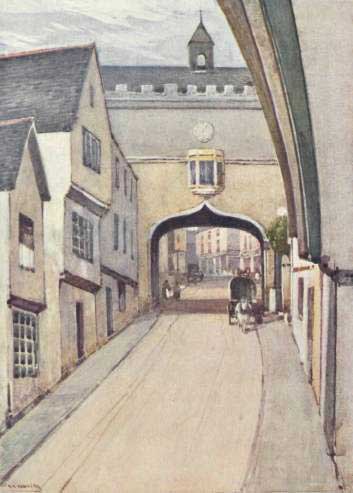 Fore Street, Totnes
A very short distance to the south lies the ancient and very picturesque town of Totnes, in which, from the round Norman keep at its crown, to the river winding round the foot of the hill, witnesses to the past are jostling against tokens of the present time.
When Leland journeyed through it, the town already gave the idea of having passed its meridian, and his words are clear and concise: 'The Castelle of Totnes standith on the hille North West of the Towne. The Castell waulis and the stronge Dungeon be maintained. The Loggingis of the Castelle be clene in Ruine.'
The early chroniclers go back gloriously into the dim mists of antiquity for the origin of Totnes, and when no carping critics insisted on analyzing popular history and distilling all the romance out of it, the story of the town was very fine indeed. The founder of Totnes, then, was Brutus of Troy, who after long wanderings arrived in this charming bit of country, and on this hill made the great announcement:
Moreover, the stone that he stepped ashore upon is still here, and the Mayor stands on it whenever it is his duty to proclaim a new Sovereign.
The claims of Totnes have been set forth with no undue modesty. 'It hath flourished, and felt also the storms of affliction, under[Pg 130] Britons, Romans, Saxons, and Normans. To speak somewhat of the antiquity thereof, I hope I shall take no great pains to prove it (and that without opposition) the prime town of Great Britain.' Its history is taken in grand strides. Having explained that the coming of Brutus was held by some to be contemporary with the rule of Eli as high-priest in Israel, the writer continues: 'The first conqueror Brutus gave this town and the two provinces, Devon and Cornwall, then but one, to his cousin and great assistant, Corinœus, as is well known; whereof the western part is (as they say) called Cornwall; who peopled it with his own regiment; and being an excellent wrestler, as you have heard, trained his following in the same exercises; whereof it comes that the western men in that sport win the mastery and game wheresoever they come.... The second conqueror, William of Normandy, bestowed this town, together with Dartmouth and Barnstaple, on a worthy man named Judæel.'
The space of time between the first and second 'conquerors' does not seem to strike the historian as a rather wide gap, and the doings of the one and the other are related with almost equal confidence and with the same air of authority.
Judhael de Totnes is supposed to have built the castle, and although only the walls of the round keep now remain, the trouble of the long climb up to it is well repaid by the lovely view that is gained from the ruin. Fertility and abundance seem to be the characteristics of the land, and the ridiculous suggestion that the town's name has been corrupted from Toute-à-l'aise is one shade less absurd, because that title would be so very appropriate. Here and there a silver gleam shows where the river runs between heavily wooded banks. To the east a green and smiling country of gentle hills and valleys leads to that shade of past splendour, the Castle of Berry Pomeroy; and far away to the north-west, it is possible to see the high, sharp tors on Dartmoor. Looking straight down, the uneven roofs seem tumbled over one another in a way that suggests that different ages have casually showered them into the little town.
Totnes received its first charter from King John, and there are[Pg 131] few older boroughs in the country. Originally a walled town, Fore Street is still crossed by the East Gate, which has been rebuilt in comparatively modern times. Within is a room decorated by an early Renaissance frieze and 'linen-pattern' panelling. The upper stories of some of the old houses project over the lower ones, and in the High Street they jut quite across the pavements, and rest upon columns, making piazzas or covered ways along the street. Such piazzas are very uncommon in England, but there is a short one, called the Butter Walk, at Dartmouth.
The church is a very fine Perpendicular building, of a warm rose colour, and it has a high battlemented tower from which three figures look out of their niches. Some very grotesque gargoyles peer down from the roof at intervals. The great treasure of the church is its screen, carved so finely that the pattern seems like lacework, and it is difficult to realize that it can be of stone. The main lines of the carving curve and spread upwards almost like the lines of palm-leaves, and the screen is coloured and gilded. There is another beautiful and delicate, though less elaborate, bit of carving which divides a little chapel from the south side of the chancel. Under the tower arch is a curious monument to Christopher Blackhall, who died in 1635, and his four wives, who are kneeling one behind the other. The dates of their deaths are very clearly marked by the different fashions of their dresses—a compact and upstanding ruff adds to the stiff precision of the first wife's appearance; while the sloping lines of a 'Vandyke' collar embellish the dress of the fourth.
On the north side of the church stands the old Guildhall, and in front of it another tiny piazza, bordered by granite pillars. Inside 'linen-pattern' panelling lines the walls; there are carved seats all round the upper end, and in the council-chamber beyond are some fragments of fine moulding.
Before leaving the town, a curious custom practised in the eighteenth century must be mentioned—that of taking dogs to help in catching salmon. Defoe came here in his travels in the West, and saw the fish being caught. The fish, he says, in the flowing tide swim into a 'cut, or channel,' which has a 'grating of[Pg 132] wood, the cross-bars of which ... stand pointing inward towards one another.... We were carried thither at low water, where we saw about fifty or sixty small salmon, about seventeen to twenty inches long, which the country people call salmon-peel,' caught by putting in a net at the end of a pole. 'The net being fixed at one end of the place, they put in a dog (who was taught his trade beforehand) at the other end of the place, and he drives all the fish into the net, so that, only holding the net still in its place, the man took up two or three and thirty salmon-peel at the first time.' He finishes the story by saying that they bought some for dinner at twopence apiece. 'And for such fish, not at all bigger, and not so fresh, I have seen six and sixpence each given at a London fish-market.'
The river leaves Totnes in broad, sweeping curves between the hills, and rolls on past the lovely woods of Sharpham, and on its course to Dartmouth passes the early homes of two men who each played a part in English history. At Sandridge, close to the river, lived Captain John Davies, or Davis, whose name is familiar as the discoverer of Davis's Straits. Prince, who himself lived not far away, takes the fascination of Dartmouth, and the longing for the sea that Dartmouth seemed to inspire, as quite natural, and says casually that, living so near this town, 'Mr Davis had ... a kind of invitation, to put himself early to sea.'
These were in the days when the Merchant Adventurers were at the height of their importance and prosperity, and it was in the hope of opening up a trade for the woollen goods of the West-country with India and China that Captain Davis set out to look for the North-West Passage.
To face all the hazards of this journey, so very far away from civilization, and the perils and shocks that might await him in the frozen North, he fitted out a little fleet which consisted of the 'Barke Sunneshine, of London, fifty tunnes, and the Moonshine, of Dartmouth, thirty-five tunnes, the ship Mermayd, of a hundred and twenty tunnes, and a pinesse of tenne tunnes named the North Starre.'[5] But in spite of this name of good augury the little[Pg 133] pinnace never came home again, and one can only admire with awe the daring that ventured to sail a boat of ten tons across the boisterous Atlantic into the unknown Arctic Seas. Traces of Davis's wanderings along the coasts of North America may still be found in the names he bestowed on different points. 'On sighting first the land, he named the bay which he entered after his friend, Gilbert Sound; we find also Exeter Sound, Totnes Roads, Mount Raleigh, and other familiar titles. A few years later John Davis found the right course to India and China, and introduced the trade from this country which exists to the present time.'
 Sharpham Woods: River Dart
A greater man than Davis lived farther down the river at Greenaway, opposite the pretty village of Dittisham, which, with its strip of beach and ferry, looks as if it had been 'made for a picture.' Sir Humphrey Gilbert, stepbrother to Sir Walter Raleigh, was a great man to whom Fortune was not overkind, but his 'virtues and pious intentions may be read ... shining too gloriously to be dusked by misfortune.' His aims were higher than the hopes that stirred most of his contemporaries, and of his 'noble enterprizes the great design ... was to discover the remote countries of America, and to bring off those savages from their diabolical superstitions, to the embracing the gospel.' He made two efforts to graft a colony with little success, but his third effort was rather happier; and having left Devonshire in June, 1583, he 'sailed to Newfoundland and the great river of St Laurence in Canada; which he took possession of, and seized the same to the crown of England, and invested the Queen in an estate for two hundred leagues in length by cutting a turf and rod after the antient custom of England.' From the developments of that great country that are now taking place, it cannot but be interesting to look back along the vista of years to this very simple ceremony.
Later this group of emigrants lost heart, and nearly all returned to England, and possibly Sir Humphrey may have wondered whether this venture also would have but a flickering existence, and would leave no lasting result of the work on which he[Pg 134] had spent his years and his strength and his riches. Or it may be that no doubts troubled him, for he had a 'noble and gallant spirit,' and his dauntless motto was 'Quid non?' The story of his death makes an appropriate ending to his life. He was with his colony in Newfoundland when 'necessaries began to fail,' and he was urged to return home. He started in the Squirrel, a ship of ten tons. When they were far out at sea a violent tempest blew up, and those in the Golden Hind (a larger ship accompanying them) saw with horror the imminent danger that their friends were in. But Sir Humphrey was quite composed, and those in the Golden Hind were near enough to hear him cry 'aloud to his company, in these words: "We are so near to heaven here at sea as at land."' In the height of the storm the little boat was swallowed up by the waves, and all on board perished.
A portrait of Sir Humphrey hung in his grand-nephew's house at Compton, where Prince saw it. 'The one hand holdeth a general's truncheon, and the other is laid on the globe of the world, Virginia is written over; on his breast hangs the golden anchor, with the pearl at the peak; and underneath are these verses, which, tho' none of the best, may here supply the place of an epitaph:
The 'golden anchor' was a jewel which the Queen had given him as a special mark of favour, for she looked on him very graciously, in spite of the fact that his efforts did not then seem as if they would be crowned with success. A song was made about the year 1581, in which he and Sir Francis Drake divide the honours.
[Probably added in 1584-85.]
Notes to this song explain: 'We understand as the three-fold holders of the name, "Sir Francis," three persons; Sir Francis Drake, Knighted by the Queen after his return from circumnavigating the world in 1580: Sir Francis Walsingham, and Sir Francis Vere. Sir William Cecil, Lord Burleigh, and his son, Sir Robert.... The Lord Chamberlain probably meant the despicable Sir James Crofts, who hated and calumniated Drake.'
The song probably reflects the temper of the time.
The lines are very characteristic of the spirit of the age that was bound to conquer. There was sorrow for those who were gone, but no complaint, no grudging those who had perished where the fame or power of the Queen could be furthered. Gloriana's subjects found no price too great, no sacrifice worth counting; a leader might fall, but the great scheme must go on, her rule spread farther and wider, and the hazards and failures overstepped.
Although upon all parts of the South Hams there hovers a spell that is inexplicable, perhaps it is felt more in Dartmouth than in any other place one can think of. Possibly it is the loveliness of sea[Pg 136] and land, flowers in the crevices of the cliffs hanging low towards the water's edge, the round tower rising out of the sea, the picturesqueness of the town, with its thronging associations, or just the intangible influences of bygone days. But there is something of enchantment about the tower, especially when it is contemplated from the water. And to fully appreciate the whole, one should slip out of the harbour past the Mew Stone, where the sea-gulls rise like a drift of snowflakes on a sudden gust, into the midst of sliding walls of transparent green water beyond, where—if there is wind enough—glassy hillocks all round, at moments, hide everything else from sight. Besides the fascination of watching waves towering above the boat, and following it as if they would fall over and bury it in their depths, and climbing them, with the sudden plunge into the hollow beyond, it may be, especially if shoals of mackerel are near, that one may have the pleasure of coming upon a flock of gulls, swimming, swooping, flapping about, and all busy fishing. Or perhaps there will be a group of brown divers, floating placidly on the waves, and then suddenly disappearing, one or two at a time or several in a moment. And possibly a great black creature may appear a little way off, tossing and seeming to turn somersaults in the water, and another and another, and one may find oneself among a school of porpoises, and hear the curious puffing sounds they make that are not quite like anything else. From a little distance out, looking back across the changing lights that glance over the water, one gets a quite fresh view of the harbour's mouth, shut in by its high cliffs, half veiled by soft masses of green.
Dartmouth had a great stake in the country's welfare in early days, and was a port of much stir and traffic. From here sailed many of the ships that Richard I gathered together to take the English who were going with him on the Third Crusade. William Rufus started once from this harbour when there was trouble in Normandy, and King John paid the town two visits. In Edward III's time Dartmouth had already become renowned for her shipping and sent six ships for the King's service in a fight in which engaged the combined French, Flemish, and Genoese fleets; and[Pg 137] she sent two more a few years later to help in his war against Scotland. Fifty years later this loan was entirely eclipsed by the magnificence of contributing no fewer than thirty-one ships to the siege of Calais.
Chaucer's words have often been quoted:
As if it were more likely that a typical seaman would come from Dartmouth than anywhere else! In no harbour could that great training-ship the Britannia have been more appropriately moored, nor could a more fitting place be chosen for the long range of buildings on the hill above, the Naval College that has superseded it. Risdon tells us that the town has been 'sundry times subject to the attacks of foreigners,' and particularly mentions one occasion in the reign of Henry III, when the French made such a furious onslaught, that the women turned out by the side of their menkind and hurled flints at the enemy. These found themselves 'courageously resisted by the towns-men and-women, Amazonian-like.'
In 1470 Dartmouth was a step in the retreat of Warwick, 'the King-maker,' when Edward IV pursued him as far as Exeter. Warwick embarked here for France, and his arrival in those unsettled times must have created much bustle and excitement amongst all the gossips of the place. The Earl was 'in danger of being surprized, whereupon leisurely (for his great spirit disdained anything that should look like a Flight) he retired to Exeter, where having dismissed the Remainder of the troops that attended him, he went to Dartmouth, and there, with many ladies in his company and a large Retinue, he took ship and sailed directly to Calais.'
Amongst the celebrities of Dartmouth is a certain John Hawley, a great merchant of immense wealth. A couplet ran of him:
—that is, to his house. Prince interprets this by saying that Hawley had so many ships all over the world that any wind that blew was of advantage to some of them.[Pg 138]
When Leland came here, he remarked on the great ruins of 'Hawley's Haul ... a rich merchant and a noble warrior against the French Men.' Hawley is buried in the beautiful church of St Saviour's, and a large brass represents him as lying between his two wives.
In this church is a most delicately carved screen, and leaves, sprays, and grapes are conspicuous amongst the details of its graceful design. The groined cornice is decorated by exquisite fan-tracery, and various saints and 'doctors of the church' are painted on the panels of the lower part. In the high carved stone pulpit are tabernacled recesses, once enclosing figures, but now containing 'royal badges and devices'; and both screen and pulpit were coloured and gilded, and are rather dimmed by time. The church has many very interesting features, and in the south porch is a most curious wrought-iron door, showing a tree with long, drooping branches and large diamond-shaped leaves, and two wonderful heraldic lions impaled on it.
The Castle was built in the time of Henry VII, on the site of an older one; for when Edward IV reigned, the men of Dartmouth built themselves a castle at the desire of the King, who promised that if they would by this means protect the town—and, further, would guard the harbour by putting a chain across the mouth—they should have £30 yearly from the customs of Dartmouth and Exeter. The chain stretched across to Kingswear, and a hollow in the rock by the ruins of an old guard-house shows where it once passed. The little square castle of Kingswear stands close by, and from certain points of view both Kingswear and the beautiful round tower of Dartmouth Castle seem to be rising straight out of the waves.
In 1685 an agreement very much like the earlier one was made. James II had some cause for uneasiness and for looking closely to his defences, and, as it happened, three years later there landed, only a few miles away, the man who, superseding him, was hailed by the majority as England's Deliverer. But when James came to the throne he had already seen Dartmouth conquered by an enemy's troops; for, although Prince Maurice had secured it in the[Pg 139] earlier stages of the war, Fairfax had taken it later. Among the Duke of Somerset's papers are some orders given by a Council of War, at which 'Colonel Edward Seymour, Governor of Dartmouth town and garrison,' was present, providing very minutely for the defence of the town and for the supplies of the garrison. Stories of the Parliamentary troops quartering themselves in churches are sometimes told, with the unfair implication that they alone were guilty of such desecration; for where need was urgent the Royalists took the same course. Here we find orders: 'Captain Haughton ... with forty men shall lie in Townstall church, for the fortifying thereof against the enemy, and that the said captain, his officers and company, shall have their victuals from Mount Boone.' Also that a 'month's provision of victuals be laid into St Petrox church for five hundred men, and the said Major Torner and his select officers shall be keepers thereof.' The Church of St Clement at Townstall was fortified with ten cannon.
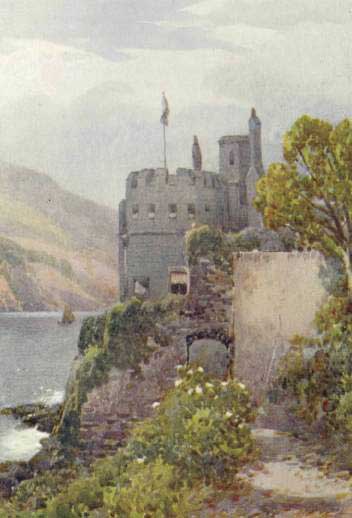 Dartmouth Castle
Fairfax attacked in the first days of January, 1646, in exceptionally cold weather. Honourable conditions of surrender had been first offered to the Governor, but were refused, and he prepared to fight to the end. 'In extreme bitter cold weather and snow' the Parliamentary forces moved forward, and, after examining the town as closely as they could, decided to take it by storm. Additional troops were ordered up to strengthen the besiegers, and Sir Thomas Fairfax sent for a squadron to prevent any help reaching the Royalists by sea. On Sunday evening 'the soldiers were all drawn out; about seven at night forlorn hopes were set, the evening very mild, as at midsummer, the frost being newly gone; the word was given: God with us.... About 11 o'clock at night the storm began.'
Three separate attacks were made simultaneously on different parts of the town, and though the besieged fought bravely, they fought in vain, and by the next morning all but the Castle and the little fort above were in the hands of the enemy. Sir Hugh Pollard, the Governor (Sir Edward Seymour was at this time taking part in the defence of Exeter), had been wounded the night before, and, realizing that his position was hopeless, 'after some[Pg 140] dispute, 'he surrendered on Fairfax's terms, and yielded himself and his officers prisoners, the common soldiers being set at liberty to repair to their dwellings.'
The fort above Kingswear, commanded by Sir Henry Cary, was protected by strong bulwarks, and the defence being very well carried out, the garrison obtained better terms. 'To save time,' writes Fairfax to the House of Peers, 'I willingly condescended to let Sir Henry Cary march away with the rest, leaving the arms, ordnance, ammunition, with all provisions.'
This was all accomplished on the Monday, and on the evening following the attack the Parliament was in full possession of the town.
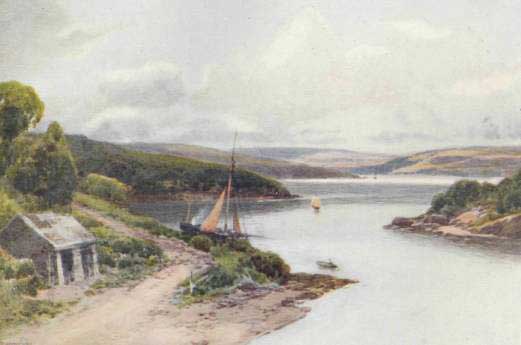 Salcombe
Kingsbridge lies in a fold of the hills that rise beyond the head of the creek running inland from Salcombe Harbour, and seen from the water it is very picturesque—the houses clustered together and clinging to the slope, and the spire of St Edmund's Church standing out against the still, green background. Mr Mason has written of 'the mists on the hills, and the gulls crying along the valley,' by Kingsbridge, and this exactly sums up its individuality. It has the peculiar atmosphere of a sea-town, but why, precisely, it is difficult to say.
The Fore Street is steep and winding, and on one side stands a church which, without any very striking feature, is quietly impressive. It is a cruciform building, and a steeple rises from the centre. A chapel, dedicated to St Edmund, King and Martyr, stood on this spot before the year 1250; but it was rebuilt and aisles were added by the Abbot and monks of Buckfast in the beginning of the fifteenth century. In the south transept of the present church are remains of early English work, and the font is Early English. Hagioscopes slant through the chancel walls from the aisle on either side. The very unusual name of a benefactress must be noticed—Tryphena Tobys.[Pg 142]
Dodbrooke is joined so closely to Kingsbridge that their streets run into each other, and they are separated only by small streams now partly covered in. It would be almost impossible for a stranger wandering about to say offhand which town he was in. Dodbrooke is really the older of the two. A grant to hold a market was made to Alan Fitz-Roald, in or possibly just before the year 1256. About this time a serious quarrel occurred, when 'Henry Fitz-Alan impleaded Matthew Fitz-John, with forty others, for throwing down a pillory in Dodbrooke. Forty seems a good many against the pillory! But the affair was not one of those cases in which a spark causes a fire, but was rather an outburst of flame in a long-smouldering feud between the Fitz-Alans and the Lords of Stokenham over the manor of Dodbrooke. In the end, the Fitz-Alans triumphed.
Three hundred years later we find the people of Dodbrooke complaining of the heavy contributions that they were called on to make towards furnishing 'ships of war'; for after the Armada had been defeated the means of defence on these coasts were for some years kept up to a very high standard. Mr Richard Champernowne,—who, it must be admitted, from the general tenor of his ways, seems to have been one of those well-meaning but egotistical and meddlesome people who are always being surprised and hurt because their good offices are not better received,—wrote to the local authorities as follows:
'Cousin Cary, and the rest of the Commissioners for the ship causes, I have received some grievous complaints of some poor men who are taxed in Dodbrook to this, more than all their goods are worth.... Surely, as the country must bitterly speak against those [who] are procurors and assistants in this country, so would it be as highly disliked both of her Majesty as of the Lords, if they knew rightly of whom, and on what sort, this tax is levied.'
But, alas! a severe snub was the result of this appeal, and the unhappy Mr Cary must have deeply regretted that he had obligingly forwarded the grievance to the Lords of the Council.
Their answer ran: 'The Court.... The Council to George[Pg 143] Carey, J.P....' They learn by his late letter that the county is unwilling to contribute the charges imposed upon it for 'setting out ships etc.' It is paid cheerfully by other counties, and he is desired to return the names of those persons who are obstinate in refusing payment.
There is no building of special interest excepting the church, which is dedicated to St Thomas à Becket. The arches dividing the aisles from the nave are high and rather pointed, giving an impression of loftiness. There is a beautiful carved screen, with painted figures on the panels; and the font is a very early one. Of the infants baptized in it, one at least obtained a rather unenviable celebrity—Dr John Wolcot, better known as 'Peter Pindar.' His bitter satires earned for him a harvest of hatred and abuse, but nobody denied his wit. 'There is a pretty story of the older Pindar that a swarm of bees lighted on his cradle in his infancy and left honey on his lips; but we fear in the case of our hero they were wasps that came, and that they left some of the caustic venom of their stings.' A surgeon's son, he studied medicine himself, but was unpopular with his patients for the reason that his ideas were too far ahead of his time. His opinion that 'a physician can do little more than watch Dame Nature, and give her a shove in the back when he sees her inclined to do right,' was considered a shocking heresy, and, no doubt, a confession of his own ignorance.
Before leaving Dodbrooke, mention must be made of the 'white ale' peculiar to the place—a compound of malt, hops, and flour, fermented with an ingredient called 'grout.' Some of the statements about this ale show the curious tendency of traditions to transfer themselves from points in the nebulous past to points that are just beyond the range of living memory. It is difficult to discover when 'white ale' was first made, but the general idea is that it was invented a very long time ago, though personally I have not been able to find any indisputable reference to it earlier than in the edition of Camden's 'Britannia' published in 1720, where there is a brief notice that the people of Dodbrooke pay tithes in white ale to the Rector. A will dated 1528, however,[Pg 144] gives directions in regard to a gift that was to include 'cakes, wine, and ale,' and it has been supposed that the particular kind made in this town would be the ale here referred to. Yet I was told by an inhabitant of the neighbourhood who was a good deal interested in local traditions, that it was introduced by the French doctor of the prisoners of war at Kingsbridge Barracks, for the benefit of those who found themselves ill at ease in this climate—an event that could not possibly have taken place till the very end of the eighteenth century.
There is a charm over all this country, not solely due to its beauty. It is true that it is rather drowsy, that the 'spell of the briar-rose' in part lies over it, but it may be that this adds to the charm. There is an absence of competition, an air of plenty and of kindness, a golden glamour that gives the impression that Nature has told the people theirs is a generous portion, and they may sit still and be content. And they are content.
There is such an overbrimming wealth of bushes and plants and flowers on every side, that the fact of the water in the estuary being salt scarcely seems to prevent their growing in it! Along the bank washed by the flowing tide, and almost touching the masses of tough golden-brown seaweed on the rocks, are multitudes of the daisy-flowers of sea-mayweed, flowering samphire, the stars of sow-thistle, and bright yellow bunches of charlock and straggling spires of wild-mignonette, against a darker background of blackthorn, hawthorn, ivy, and furze, lightly powdered with trails of bramble-blossom. Creeks, edged with low hills, wind away from the estuary. When the tide is low, great stretches of mud and sand lie on either side, and here may be seen black cormorants and crowds and crowds of gulls, here and there a heron, and quantities of smaller birds. The scene changes entirely at the mouth of the creek, for here the banks rise into high rugged cliffs, and the water frets restlessly over sunken rocks.
Salcombe is a tiny little town, with steep, narrow streets and high-walled gardens on each side of the close lane that ends the principal street; and between the gardens the air is fragrant with sweet clematis, that, as well as red valerian, tumbles in clusters[Pg 145] over the walls. Salcombe has a very good claim to remembrance, for on a peninsular rock at the mouth of the harbour stand the ruins of a fortress that held out for King Charles later than any other place in Devonshire. It was defended by Sir Edward Fortescue, and surrendered only on May 7, 1646.
On the opposite side of the estuary, high on the cliffs, lies the small village of Portlemouth. The cross-shaped church is dedicated to a Celtic saint, St Winwaloe, locally called St Onolaus. A proverb without much point (probably only the fragment of a more coherent saying) mentions St Winwaloe amongst several saints whose days fall on windy dates.
[St David's Day, March 1; St Chad's Day, March 2; St Winwaloe's Day, March 3.]
In his church here is a very finely carved screen, and of one of the figures on it Mr Baring-Gould tells an amusing story: 'The sixth is Sir John Schorne, a Buckinghamshire rector, who died in 1308, and was supposed to have conjured the devil into a boot. He was venerated greatly as a patron against ague and the gout. There is a jingle relative to him:
South of Portlemouth the land ends in the grand headland of Prawle Point, the most southerly point in Devon. Prawle Point is very striking, and is 'principally composed of gneiss rock, which on the western side is weathered like a surface of snow which has been exposed to the sun's rays. It is everywhere broken into crags.' Prawle Point—'Prol in Anglia'—was known to foreigners for many centuries; and Mr R. J. King, in an admirable article on Devonshire, says that it 'is mentioned by an ancient commentator on Adam of Bremen's "Historia Ecclesiastica,"[Pg 146] as one of the stations at which vessels touched on their voyage from Ripa in Denmark. The passage was made from the "Sincfala," near Bruges, and "the station beyond 'Prol'" is St Matthieu—one day's sail. Adam of Bremen dates about 1070, and his commentator a little later.'[6] St Matthieu is in Brittany.
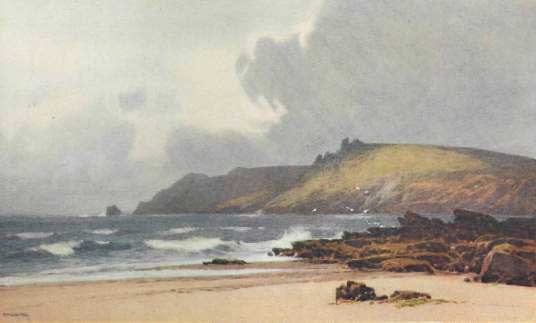 Bolt Head
To the south of Salcombe rise the great cliffs of Bolt Head, and a few miles farther to the west is Bolt Tail. Mr Norway points out that 'no other town in South Devon possesses, nor, indeed, more than one or two on any coast, a headland so high and dark and jagged as the entrance to the harbour. It is wild and rugged like a Cornish headland, and the walk across it to Bolt Tail is the finest between Portland and the Lizard.' A few miles to the west is Thurlestone, and all about here the coast is most dangerous. A ship flung in a storm towards the shore has no chance on the jagged rocks that spur-like, jut out from the cliffs, and the tide races inshore with terrific power, even when it is not driven by a wild south-westerly wind. This part of the coast was naturally a happy hunting-ground for smugglers, and was not altogether innocent of wreckers. A fearful wreck that happened in 1772 is still remembered. A large vessel—the Chantiloupe, from the West Indies—went ashore in Bigbury Bay. All the passengers but one were drowned, and over the death of a lady there hangs a terrible doubt. On realizing the desperate plight of the ship, she had hurriedly dressed herself in her most beautiful clothes and jewels, no doubt hoping that, as they were so close to land, there was a good chance of escape. She was, indeed, thrown up on the beach, but, it is to be hoped, already dead, for, with shocking callousness, the people watching there snatched away all her valuables and left her lying there. An account of the wreck, written in 1874, tells that at that date a lady living near the bay still had a corner of the victim's apron, a very beautifully embroidered bit of fine muslin. The unfortunate passenger's name was never really known, but rumour has always connected her with Edmund Burke; for it is certain that he feared some relatives or friends of his were on that ship, and on hearing of the wreck he came[Pg 147] down and investigated the matter of the lady's death himself. But he could get no information. The account of the wreck goes on to quote the views of a man who lived near the spot: 'The old man who seemed to know most about it said: "The lady was a-murdered, he believed; Jan Whiddon's father's dog found this here lady buried in the sand, he scratched up her hand."' The story is quoted at some length, and is characteristic of a Devonshire countryman's combined caution and sense of fate, for it finished: '"'Twas never found out who murdered her ... but all who were concerned in it, or supposed to be [the villagers obviously believed three men to be guilty] came to a bad end."'
In repeating these stories, I feel rather in fault, for I have listened to, and been impressed by, the views of a native of these parts, who was extremely severe on anyone that wrote about wreckers and reflected discredit on this coast, giving the idea that 'we robbed and murdered people.' A little to my surprise, he said he liked reading books about Devonshire, and admired some well-known novels dealing with the county, though he thought them quite inaccurate. 'But,' he added tolerantly, 'they say that, to get at the truth from a guide-book, you must divide what you read in three, and then take away half.' He admitted, all the same, that there had been a certain amount of wrecking in the days of the pirates (smugglers?), and putting lights in the wrong places. When he was a boy, what they liked best was a wreck with a 'general' cargo, so that the men could sell the mineral and the wives could wear the silk; but there were fewer wrecks of any kind nowadays. It is very quiet in the winter (east of Kingsbridge), unless anyone is going to be buried, and the only other chances of any stir are if there is a wedding or a christening, or a wreck in Start Bay.
Thurlestone takes its name from a 'thirled' or pierced rock, on the shore through which the waves have drilled an arch. The rector of Thurlestone has very kindly allowed me to make some extracts from a manuscript history of the parish in his possession, the earlier notes of which have been taken from entries made at the time of the events, in the Bishop of Exeter's registers, and have,[Pg 148] therefore, the value of contemporary evidence. They are very interesting, as giving glimpses at the course of events in a remote parish through several centuries.
During part of the fourteenth century the parishioners seem to have been rather turbulent and the history tells of storms. Some while before the first entry, in June, 1328, someone had not only been murdered, but actually done to death within the church. There is no record of the punishment of the culprit or culprits, or of any sign of penitence shown by the parish; but probably some steps had been taken, for at that date Bishop Grandisson commissioned the Archdeacon of Totnes to reconcile the parish church of Thurlestone, 'which had been polluted by the shedding of blood therein. For some reason not given the Archdeacon was excused from performing this duty, and Stephen Abbot of Buckfast was commissioned to officiate.... On the 8th of the Kalends of August, 1328, the Bishop issued his mandate to the Archdeacon of Totnes, informing him that the Abbot, having proceeded to Thurlestone, had reconciled the church, and that he was to require the Parishioners to pay the customary dues within eight days of the serving of this Monition to that effect.' The dues, however, were not forthcoming, and on October 6 the Bishop, who allowed no insubordination, threatened the defaulters with excommunication unless they paid the desired amount within six days. 'This had the desired effect, and on the 20th of October the Bishop sent to the Rector and the parishioners the formal acquittance. On the same day, he commissioned Sir Robert de Pynho, the Rector, to absolve the parishioners and relax the interdict imposed on their Parish Church.'
An unpleasant experience of Sir Henry Benet, priest and Canon of the Church of Crediton, and Rector of Thurlestone, witnesses to the lawlessness of the time in East Devon. He was 'peaceably entering the town of St Mary [Ottery St Mary] on Tuesday (tertia feria) of the then instant Pentecost Sunday,' when 'certain unknown persons, sons of perdition ... under colour of a precept which they falsely asserted they had received from the Sheriff of Devon, rushed on Sir Henry and ... rashly, violently and sacrilegiously laid hands[Pg 149] on him and inhumanly forced him into the public prison for thieves and criminals.' A 'Denuntiation of Excommunication' against these 'sons of perdition' in Bishop Grandisson's register is undated, but it follows an entry made in March, 1349-50.
A later rector must have been a pleasant acquaintance and a good friend. The Rev. John Snell 'was a person of firm and unshaken loyalty,' and when 'Fort-Charles' was about to be besieged, he joined the garrison in order to give all the help he could to Sir Edward Fortescue. On the surrender of the fort, amongst the very honourable conditions that Sir Edward obtained was the agreement that Mr Snell 'should be allowed the quiet possession of his Parsonage; but Articles, like oaths, in those days, were only matter of Form, and accordingly (about the year 1646) he was soon after plundered of his cattle and other goods without-doors, and several times forced to fly for his life.' Later, his lot was made still harder by the confiscation of his living, which he did not regain until after the Restoration. In the old parish register is a note, probably interpolated by John Snell when he had returned to his living, and with outraged feelings had been looking at the volume, and reading the entry referring to the appointment of a lay registrar in his parish. The registrars elected in 1653 were not only given charge of the parish registers, but took another office out of the hands of the clergy. No marriage might take place without the registrar's certificate that he had called the banns. The couple then took the certificate to the nearest magistrate, who, after hearing each of them repeat a brief formula, was authorized to declare them legally married.
Mr Snell's exclamation of distress appears under a notice which 'certyfyed John Calder (?) of the parish of Thurelston to bee Register of the sayde Parish,' and was signed by 'Will Bastard,' and dated 'September 20th, 1653.' Above and below the date is written:
'Monstrum horrendum informe.
[This is ye Houre and Ye]
Anno Dom. 1653.
[Power of darkness.]'
On Mr Snell's tombstone is a long Latin epitaph, from an English version of which the following lines are taken:
The Thurlestone chronicle records a certain number of beliefs and charms, and on one of them the present rector makes a note of peculiar interest: 'The Bishop of Malborough [Dr Earle, then Vicar of West Alvington and Malborough] tells me that his curate, the Rev. Robert Hole, South Huish, saw this charm used successfully to stop blood on a man called James Pierie.
'In the name of the Father, and of the Son, and of the Holy Ghost. Amen. 'Used by Betty Edgecombe, white witch of Malborough and West Alvington.'
Not far from Thurlestone was another parson who worked hard to embarrass the besiegers of the Royalists in Salcombe Castle, and who had his share of thrilling adventures. Mr Lane was the rector of Aveton Giffard, a parish at the head of the estuary of the Avon, which opens into Bigbury Bay. When the war broke out he took an active part, in conjunction with several gentlemen in the neighbourhood, in 'raising Succours for his Majesty.' And at the same time he began to make a 'Fort on a Hill' (part of the Glebe), which commanded the bridge over the Avon, crossed by Parliamentary troops marching to the siege of the Castle. Meanwhile, soldiers from Plymouth came up in boats, plundered the house, and took, says Mr Lane's youngest son, 'Two of my brethren, Richard and John, not giving them time to put on their stockings, and forced them to carry what of the Goods they could to Awmar (a creek), where they[Pg 151] carried off Stolen Sheep and Plundered Goods with my two eldest brothers. When the war was ended the triumphant Parliamentarians attempted to revenge themselves on their sturdy enemy, and searched the country for 'Bishop Lane, the Traytor,' who was driven to hide in his church tower. For three or four months his people secretly brought him food, and he was then able to make his escape, and in the end reached France in safety.
 Slapton Lea
If the traveller returns to Prawle Point, and then follows the coast towards Dartmouth, he will soon come to the ridge of Start Point, which 'stretches boldly to sea, sloped on each side like the roof of a house, and crowned along its entire length by fanciful crags, strangely weathered and shaggy with moss.' Round the Point at a certain state of every tide there is a formidable tide-race, and always a swell so strong as to make small boats very careful of the weather before they try to sail round the Start. Dartmouth lies almost due north, and the coast-line between is very lovely, though it has not the impressiveness of the cliffs farther west. Slapton Sands are over two miles long, and the hills stand back far enough from the shore to leave room for Slapton Lea, a fresh-water lake, almost smothered with tall, feathery reeds and rushes in the summer, separated from the sea by a barrier of pebbles. The line of these wooded hills is broken by three little valleys, and down each one flows a brook that feeds the Lea. At the southern edge is Tor Cross, a handful of cottages under the shadow of a cliff that shuts away the shore-line to the south. The long stretch of sands is delightful. They are dotted all over with the glaucous leaves and brilliant flowers of the yellow-horned poppy, and bristling blue viper's bugloss, and on the inland edge there is a scattered border of the rest-harrow's pink butterfly blossoms. The short turf beyond is sprinkled with the little white bladder campion and thrift and many other flowers.
At the northern end of the sands the road turns inland, and presently comes to Blackpool, very small, but one of the most perfect of miniature bays. The cliffs are 'of various colours and very lustrous,' and almost on the brink the road winds its way amongst woods of firs and pines that seem to breathe out a pecu[Pg 152]liarly spice-like sweetness. When I saw it the sea was like molten silver, for the sunlight poured on it from beyond clouds, and the sun itself was not to be seen. But though this bay looks as if it had fallen from a poet's dream, it has been the scene of many stern events and disasters; for ships have mistaken the inlet for Dartmouth Harbour, with lamentable results. Many a time, too, it has been used by those who knew the coast well, but had their own reasons for wishing to land without attracting notice, for it is quite cut off by the shoulder of the hill from Dartmouth, and is near no other town.
In Queen Mary's reign the secret landing of doubtful characters was a danger that had to be diligently guarded against, and the Lords of the Council received an agitated letter from Sir John St Leger on this subject just after the flight of Sir Peter Carew. Sir Peter had a castle and many friends at Dartmouth, and Sir John quotes him as often having said that if he were the King's enemy he could take 'Dartmouth Castle' and 'burne the Towne with fewer than a hundred persons and lett ynto the haven suche as pleased hym. I, also, am creadeably informed the way howe he should be able to do so. That within a myle, or les, of the said Towne, there is a very good open place called Black poole, for the queene's enemyes to lande, and invade, and from thense may come to the saide towne from the back side.'
But when Queen Elizabeth came to the throne, and Sir Peter was reinstated and held in great honour, the coast was still far from safe, and there is a letter written by the Queen in 1564 to her 'Right Trustie and wel-beloved' Sir Peter, commissioning him to get ready and arm two ships, that, as the 'cost of Devonshyre and Cornwall is by reput much harted with pyrattes and Rovers,' so he should repress and, as far as possible, capture them. Twenty-four years later a far more serious danger threatened, and the preparations against the Spanish Armada were very elaborate. Masses of the most stringent orders are still preserved amongst the House of Lords manuscripts, and to quote a few will give an idea of their nature and scope.
On July 11, 1588, it was ordered: 'That all persons of what[Pg 153] degree soever ... whose armour and furniture shall not be found serviceable, for the first offence shall be put into the stocks one whole day, publicly; and for the second offence to the gaol for ten days' etc. Careful instructions are sent as to the choice of watchmen for the beacons and their duties; and a brief note refers to a letter written by the Council to Sir Walter Raleigh, then Warden of the Stannaries, demanding the muster-rolls of the tinners, both horse and foot, 'who poured to war' as well from Dartmoor's as from 'Mendip's sunless caves.'
After the Armada had been defeated, there were fears of another Spanish invasion, and in January, 1595-96, news came to the Deputy-Lieutenants and Justices of the Peace of Devon that 'The Queen has found it convenient to have her navy and certain companies of Soldiers for land-service in readiness to be victualled' with all possible speed 'for her service ... 400 quarters of wheat, 200 oxen, and 200 flitches of bacon are required from Devonshire.'
There are notices, too, respecting such gentlemen as 'have been charged with light horses and petronels,' and of the particular divisions of coast apportioned to each. For instance, in a certificate dated June 25, 1596, it is stated that 'Mr Seymour's colonelship reacheth from Plymouth to Dartmouth. Mr Cary's from Dartmouth to Exmouth. Sir Thomas Dennis from Exmouth to Axmouth.' And, going into particulars: 'For Salcomb, Mr William Courtenay with the assistance of the constable and other officers there.... Long Sands [Slapton] and Black pool to be defended by Mr Ameredith and Mr Roope.' The notice continues to give an exact list of the places next one another along the coast, the names of the officers and numbers of men appointed to defend each.
In spite of all that was done, in the summer of 1598 the Lords of the Council were dissatisfied, and wrote to the Lord-Lieutenant to complain of 'the number of horse, which we think to be very few in that country in regard to the largeness and wealth of the same.' But the people in the county looked at the matter in a different light, and in the following April, at a meeting in Exeter, it was[Pg 154] resolved that a letter should be written to the Lords of the Council to convey 'the desire of the country' to be freed from a certain 'contribution' wherewith they find themselves much burdened and grieved in respect of the manifold impositions daily coming upon them.'
Demands and complaints seem to have been bandied backwards and forwards for some time afterwards, for in 1600 there came this brief but alarming note from the Lords of the Council:
'June 23, Greenwich.—The composition money for Devonshire, though the whole amounts but to £113 6s. 8d., remains partly unpaid; we have therefore sent down a messenger to bring before us all those who remain in arrear.'
Fortunately, the period of acute alarm had now passed away, and the train-bands were dismissed, so that the burden of levying contributions must for a while have been lightened.
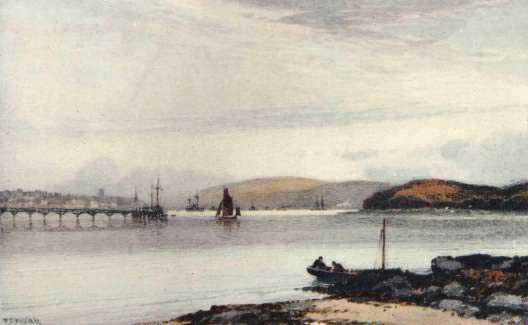 The Tamar, near Saltash
'Be patient, I beseech you, I am in a labyrinth, where I find many ways to proceed, but not one to come forth.' Such is Westcote's plea while attempting to describe Plymouth, and it may be echoed from the heart by anyone who is in the same perplexing position. The words so exactly sum up the difficulty. One is bewildered by the multitude of associations thronging on every side in a town in which, unlike other West Country ports, the pulse of life throbs as strongly as it did in the centuries long gone by. 'The sea-front of Plymouth,' says Mr Norway, 'is the most interesting spot within the British Empire, if not also the most beautiful. It is a large claim, but who can deny it?'
No one who has not studied the history of the Three Towns can realize how keenly Plymouth has been affected by every declaration of war or peace that this country has known—at latest, since the reign of Edward I—nor how vividly its victories and disasters have been brought home to the people. The number of fleets that have returned to this port in triumph, or sometimes in humiliation, and the succession of ever-famous expeditions that have sailed from the Sound, must continually have carried their thoughts across the seas, and prevented petty local affairs from bounding their horizon. The old chronicles seem to show that stirring events perpetually followed each other at short[Pg 156] intervals, and when no great expedition was occupying men's minds, there were usually plenty of adventurous spirits to provide excitement—privateers, such as those who took service with the Prince of Condé, and searched the Channel for Roman Catholic ships, and others, ready for 'semi-piratical ventures.' There were also moments when Plymouth was the victim, and in dread watched for the Turkish and Algerine pirates who were known to be hovering near, and were making raids in the neighbourhood.
Plymouth seems to keep a peculiarly strong hold on the affections of her sons, no matter how far or wide they wander, and it is said that the city 'has given its name to more towns than any other town or city in the world. There are seventeen Aberdeens outside Scotland. There are twenty-nine Londons, but forty Plymouths.'
From the Hoe, one point after another that catches the eye suggests a fresh train of ideas. To the east is Sutton Pool, with its coasting vessels and fishing-boats; south, across the Cattewater, lies Mount Batten, whose round tower recalls the long and resolute defence of the town in the Civil War. Still farther south are the high grounds of Plymstock and Bovisand, with their modern fortifications; to the north stretches the town and far in the distance the heights of Dartmoor; and to the south-west, over the Cornish border, lies beautiful Mount Edgcumbe, which 'so affected the Duke of Medina-Sidonia' Fuller tells us,'(though but beholding it at a distance from the Sea), that he resolved it for his own possession in the partage of this kingdom (blame him not if choosing best for himself), which they had preconquered in their hopes and expectation.' Mr Norway sketches the view in rapid touches: 'The Sound lies veiled in a thin blue mist, behind which a hot sun beats, scattering it gradually with the aid of a stiff breeze off the land. But it hangs around Mount Edgcumbe on the right, where the grey towers of the mansion stand in shadow among dark woods, while on the summit of the hill above the green fields catch the sunlight. A little lower, Drake's Island lies impalpable and dim amid the mist which sweeps so softly round the forts and the green grassy slopes as to touch it all with[Pg 157] mystery one moment, while the next it is bright again with sunlight, sparkling amid the dazzling sea. Within the breakwater the sea is alive with craft.'
The little island in the Sound has been transferred from patron to patron. Originally called after St Michael, to whom its chapel was dedicated, the name was changed to that of St Nicholas, the patron saint of mariners, and eventually the island was renamed in honour of Plymouth's greatest hero. The chapel had been destroyed before Drake's day at the bidding of the Privy Council, and fortifications were reluctantly built upon it by the Mayor and Corporation, the Council 'mervelinge of their unwillingnesse to proceede in the fortefynge of St Michaell's Chapele to be made a Bulwarke.'
Plymouth is not rich in old buildings. The Citadel was rebuilt in the reign of Charles II, and the new Guildhall is little over thirty years old. St Andrew's, a large Perpendicular building with a fine tower, is the only old church, but it stands on the site of a much older one—the church of the Augustinians of Plympton Priory.
Really, neither Stonehouse nor Devonport has any history. In the reign of Henry III, Stonehouse consisted of the dwelling of Joel de Stonehouse, who at that time owned the manor, and it is only comparatively lately, since it has been transformed into a huge naval storehouse, and the great Marine Barracks have been built, that it has become of importance.
Devonport, looking over the broad glittering waters of Hamoaze, was till the year 1824 known only as Dock, or Plymouth Dock. Charles II planned a dockyard here, but the work of making it was not begun until the reign of William and Mary.
The very early history of Plymouth is not specially interesting to anyone who cares over-much for sober fact; but looking at it in the generous spirit of the ancient chroniclers, and not stickling over probabilities, the story of the first great event in Plymouth is almost as fine as the traditions of Totnes itself. Giants, we all know, flourished in Cornwall, and soon after the arrival of the Trojans—about 1200 B.C.—they made a furious onslaught upon[Pg 158] the invaders, but were defeated after a desperate battle. The crowning struggle between Goemagot (the name afterwards turned into Gogmagog), chief of the giants, and Corinæus the Trojan, took place in Plymouth Hoe, as Drayton's vigorous lines declare:
A memorial of this terrific conflict, 'the portraiture of two men of the largest volume,' was cut in the turf on the Hoe at an early date, and was only destroyed when the Citadel was built about 1671.
In the Domesday Book Plymouth appears as the Manor of Sutton, and this was later on divided into three separate portions—Sutton Valletort or Vautier, Sutton Prior, and Sutton Raf. The village of Sutton Valletort was 'the germ of ancient Plymouth.' Sutton was given by Henry I to Reginald de Valletort, who bestowed lavish gifts on the monastery at Plympton; and as his example was followed by his successors, the title of the second portion of the manor is easily accounted for. The whole place was dominated by the Valletorts and the Priors, but the power of the monks increased steadily, till, at an inquisition held in 1281, 'it was presented that the Ville of Sutton belonged to the Prior of Plympton, with assize of bread and beer, and this right was allowed.' Sutton was now becoming a flourishing town, and some years later the King made inquiries about his property in it, for the burgesses had petitioned that some waste land might be granted them at a yearly rent. To this 'the Prior and the Valletorts declared that the town was wholly theirs, and none of the King's,' and the dispute was followed by a series of efforts, on the part of the townspeople, to free themselves from the rule of the Priors—efforts which succeeded each other, at no long intervals, through the next hundred and twenty years.[Pg 159]
As time went on, the Crown gradually granted rights to the burgesses, and increased their responsibilities, till in 1439 an Act of Parliament was passed incorporating the three Suttons as a free borough, with one Mayor, and the manorial rights of the Priory were ceded to the Mayor and Corporation, who paid to the Priory a fixed yearly sum in compensation. The name Plymouth, which had been used in speaking of the port, was now formally adopted for the whole town.
From the 'mene thing, as an inhabitation for Fischars,' that Leland says it was in the reign of Henry II, the town grew rapidly, and before the end of the thirteenth century it was represented in Parliament. In 1287, for the first time on record, the splendid harbour was officially recognized as a grand rendezvous, and three hundred and twenty-five vessels gathered here before sailing for Guienne under the command of the King's brother. Half a century later, orders were sent that men and ships should be collected at Plymouth to escort Princess Johanna, the King's daughter, to Gascony, and escorts for various Princes had to be provided on several occasions. The Black Prince was kept by contrary winds in the port for forty days, when he was on his way to France to fight the 'glorious battell at Poictiers.' In the early part of the fifteenth century Plymouth suffered severely from the attacks of the French and Bretons, and in 1403 the Bretons, under the Sieur du Chastel, burned six hundred houses in the part since called Briton Side. The name became gradually transformed into 'Burton,' but the memory of the raid survived so far, Mr Worth tells us, as to enable the boys who lived in the Old Town to taunt the 'Burton boys' during the wars with France, by reminding them of the harm that the French had done to their quarter.
On Freedom Day, a 'local Saturnalia kept as such from the earliest times,' one of the features was the fighting between the Old Town and Burton boys for a barrel of beer, provided by the Mayor. Long after this custom had been dropped, the recollection of it was revived by the sign of a public-house, the Burton Boys, though eventually the owner changed the sign to that[Pg 160] of the Black Lion, as he 'wished for some more peaceful name'!
Plymouth does not seem to have been much affected by the Wars of the Roses, but Henry VII, as Earl of Richmond, 'while he houered upon the coast,' came ashore at Cawsand, and here 'by stealth refreshed himselfe; but being advertised of streight watch, kept for his surprising at Plymouth, he richly rewarded his hoste, hyed speedily a ship boord, and escaped happily to a better fortune.'
The fisheries of the port are old and important. The earliest grant now to be traced, made by Reginald de Valletort to Plympton Priory, was that of all his fishing rights in Tamar and Lynher—a privilege which Mr Worth thinks was probably bestowed 'not long after the manor passed into the hands of the Valletort family.' In 1384 Parliament decreed that all fish caught in the waters of Sutton, Plymouth, and Tamar should be displayed for sale in Plymouth and Aish [Saltash] only, which sounds as if Plymouth were already jealous of other fish-markets, as was certainly the case later on. During parts of the sixteenth century the industry flagged, and in Henry VIII's reign a royal proclamation ordered abstinence from flesh on Saturdays as well as Fridays, with the frank explanation that this was 'not only for health and discipline, but for the benefit of the Commonwealth, and profit of the fishing trade.' In Queen Elizabeth's reign matters were still worse, for the eating of fish had now come to be a badge of religious opinions, and '"to detest fish" in all shapes and forms had become a note of Protestantism.'
And not only had the demand for fish lessened, but the fisheries had fallen into the hands of foreigners. The Yarmouth waters were 'occupied by Flemings and Frenchmen,' 'the narrow seas by the French,' 'the western fishing for hake and pilchard by a great navy of French within kenning of the English shores,' and Scots and Spaniards fished other parts of the coasts. Cecil, who was anxious for greater reasons, to find 'means to encourage mariners,' set to work to revive the English fishing-trade, and with great difficulty succeeded in carrying a Bill through the House of[Pg 161] Commons, making 'the eating of flesh on Fridays and Saturdays a misdemeanour, punishable by a fine of three pounds or three months' imprisonment, and as if this was not enough, adding Wednesday as a subsidiary half-fish day.'
About this time Plymouth tried to rid itself of at least one branch of foreign competition by appealing to the Privy Council to forbid 'the exportation of pilchards, save in ships of Devon and Cornwall, because "divers ships and mariners lye idle without employment within our harbour," while foreign ships were continually employed.' Pilchards were a very important item, and many regulations were made in reference to them. One order, dated 1565-66, gives a good example of Plymouth's views of free trade. It ran: 'That no alien should lade or buy fresh pilchards above the number of 1,000 in a day; no man ... being free to buy or sell above 5,000, unless the fish "were in danger of perishing."' The business of curing fish was a large one and very jealously guarded. At the British Museum, among the Lansdowne manuscripts, is a letter to Lord Burghley from Mr Richard Browne, showing that this subject was sometimes the source of friction between the citizens themselves. It begins:
'My honorable good Lord, as I have ben always most bound vnto yor ho., so I humbly besech you to stand my good Lord.' The letter goes on to explain that the writer had been granted a 'pattent for salting, drying, and packing of fishe in the counties of Devon and Cornwall,' but letters from the Privy Council had caused the 'staie thereof.' These letters were apparently inspired by the complaint to the Council of 'marchants,' who were injured because the terms of the 'pattent' laid down 'that the inhabitants should be servid before the marchents, paying nothing unto me for it,' as he adds in a slightly aggrieved manner. The writer begs that these terms may be altered, and the only conditions should be those affecting such fish 'as shuld be transported in consyderacon of the Quene's Majesty's right.' For, he pathetically remarks, he has paid 'a great some of money' for his privileges, and still 'am bound to pay the rent into the exchequer,' although not allowed to reap the benefit therefrom. Besides, great incon[Pg 162]venience is caused by the suspension of his business, and letters of complaint have been addressed to him from Devonshire and Cornwall desiring 'yt he pforme his offer yt they may have fishe for their owne provesion frely.'
It was the outburst of ventures of every description, with all their different aims—ventures of soldiers, explorers, privateers, and merchants—in the reign of Queen Elizabeth that brought Plymouth to its greatest glory. In the interval between William Hawkins' first voyage to the South Seas—about 1528—and 1601, when Captain William Parker sailed to Panama and took Porto Bello, Plymouth was the starting-point of forty voyages, every one of which is historical. Mr Worth gives the exact date of each, and the names of the commanders. 'Here,' says Carew, 'mostly have the troops of adventurers made their Rendezvous for attempting new discoueries or inhabitances.' And Westcote, in the reign of James I, writes: 'Whatever show it makes in description, it is far larger in fame, and known to the farthest and most remote parts of the world.' In Camden's opinion, this great reputation was won 'less by the convenience of the harbour, as for the valour and worth of the Inhabitants,' and the worthies of Plymouth are indeed beyond number. Among the comparatively few whose names have not been lost, there stands out conspicuously Sir William Wilford, who after a French invasion returned the charge by swooping down on Brittany, where he 'made them to pay, besides costs and charges, more than sixfold damages.' And Captain Cocke, a 'Cock of the Game indeed,' according to Fuller; 'A Volanteer in his own ship,' he went out against the Armada, and 'lost his life to save his Queen and Countrey.' Then there is Cockrem, who sailed with William Hawkins, and was left alone among the Brazilians as a hostage for one of the 'Savage Kings' Hawkins brought back with him—but, as Mr Norway says, 'Plymouth has too many heroes; in the crowd the faces of all but one or two are blurred.'
For three generations the Hawkinses were 'the master spirits' of Plymouth, and of them all Sir John Hawkins was the most famous. His character was a curious medley of incongruous[Pg 163] features, bluff straightforwardness and crooked diplomacy, faithful affection—such as his bold schemes to help his captured comrades proved—balanced by a hard indifference that ignored the misery of the wretched negroes he sold to West Indian planters. Pluck and daring were the only qualities he showed consistently from first to last. His zeal in slave-hunting, repulsive to us, is excused by Froude on the ground that 'negro slavery in theory was an invention of philanthropy.' Labourers were a necessity for the Spanish colonist, 'the proud and melancholy Indian pined like an eagle in captivity, refused to accept his servitude, and died; the more tractable negro would domesticate like the horse or the ass.' Though Hawkins met with much good as well as bad luck, he was one of those who have need to remember that fate does not shower favours on all men, but 'if a man look sharply and attentively, he shall see Fortune; for though she be blind, yet she is not invisible,' and his success was to a very great extent due to his stout heart and quick discernment. These qualities stood him in good stead at San Juan de Ulloa, when his few ships were overwhelmed by a much larger fleet. 'The name of Hawkins was so terrible that the Spaniards dared not give him warning that he was to be attacked;' but mounted their batteries in the dark, and from land and sea 'every gun which could be brought to bear' opened upon the unprepared English. After sinking two Spanish ships and setting a third on fire, Hawkins saw that flight was their only chance, and, gathering his men together in two small tenders, he 'crawled out under the fire of the mole and gained the open sea.' The position of affairs was dispiriting in the extreme. Many men and three good ships were lost, besides treasure worth more than a million pounds, that had been won, by running innumerable dangers, during the past year. His ships were overcrowded, the store of food and water was scanty, and no harbour west of the Atlantic was open to them. Under the weight of adversity, Hawkins offered 'a lesson for all time on the use of bravado, the crowning grace of every leader who does not seek it at the cost of better things.'
'When the Minion stood off,' says Hortop, who wrote the tale[Pg 164] on his return to England, 'our generall courageously cheered up his soldiers and gunners, and called to Samuel his page for a cup of beer, who brought it to him in a silver cup. And he, drinking to all the men, willed the gunners to stand to their ordnance lustily like men. He had no sooner set the cup out of his hand, but a demi-culverin shot struck away the cup and a cooper's plane that stood by the mainmast and ran out on the other side of the ship, which nothing dismayed our generall, for he ceased not to encourage us, saying, "Fear nothing: for God who hath preserved me from this shot will also deliver us from these traitors and villains."'
Hawkins is chiefly known by his voyages and enterprises, and all that he did for his country by monotonous hard work is not so often remembered. For twenty-one years he 'toiled terribly' as Treasurer of the Queen's Marine Causes and Comptroller of the Navy, and when the ships were sent out to meet the Armada they were 'in such condition, hull, rigging, spars, and running rope, that they had no match in the world either for speed, safety, or endurance.'
There is no space here to speak of Sir John's father, 'the pioneer of English adventure in the South Seas,' who made three famous voyages to Brazil, and laid a good foundation for future traffic in that he 'behaved wisely' to the natives; nor to do more than glance at the ventures of Sir John's son, Sir Richard Hawkins, the 'Complete Seaman,' whose 'high-spirited actions, had they been all duly recorded (as pity it is, they were not),' says Prince, 'would have made a large volume in themselves.' Sir Richard rediscovered the Falkland Isles, and passed the Straits of Magellan. His fleet was reduced to a single vessel, and he had taken five richly laden ships, when 'the King of Spain's vice-roy in those parts' sent 'eight ships to intercept him. Sir Richard Hawkins held the fight for three days, with but three score and fifteen men and boys, against thirteen hundred of the enemy, and those the choice of Peru.' In the end, being 'dangerously wounded in six several places,' and with many of his crew killed or wounded, he was forced to surrender upon 'honourable articles of life and liberty,' which, however, were not observed, and he was sent to[Pg 165] Spain, where for long years he remained a prisoner. Sir Richard left an account of his 'Voyage to the South Sea'—a 'record of misfortune, but of misfortune which did no dishonour to him who sank under it; and there is a melancholy dignity in the style in which Hawkins tells his story, which seems to say that ... he respects himself still for the heart with which he endured a shame which would have broken a smaller man.' A second William Hawkins, Sir John's brother, commanded a Huguenot vessel under the commission of the Prince of Condé; and yet another William of a younger generation went as ambassador of the East India Company to the Great Mogul, and succeeded in setting up a trading station at Surat.
Every Plymouth hero, however, is eclipsed by Sir Francis Drake, who is always counted their chief, though he was born near Tavistock. 'Could my pen as ably describe his worth as my heart prompteth to it, I would make this day-star appear at noon-day as doth the full moon at midnight,' is Risdon's ecstatic exclamation.
When all his grand qualities and successes have been contemplated, it is still rather surprising to find the extraordinary impression he created in that epoch of heroic enterprise. The stories of magic that have clustered round his name witness to his wonderful personality, for naturally they are much more significant than those that have been woven around the older heroes of a more superstitious, less civilized age. These legends must have been handed down to generation after generation, for, writing about 1835, Mrs Bray mentions that the peasantry near Tavistock still talked of the 'old warrior,' as they called him. To choose one or two at random, there is the story that once, after he had been away for a very long time, his wife supposed him to be dead, and thought that she was free to marry again. A spirit whispered the news to Sir Francis, who was at the Antipodes. At once he fired a great cannon-ball, 'so truly aimed that it shot up right through the globe, forced its way into the church, and fell with a loud explosion between the lady and her intended bridegroom. "It is the signal of Drake!" she exclaimed. "He is alive, and I am still a wife. There must be neither troth nor ring between thee and[Pg 166] me."' Another story tells that after he had finished the ever-famous game of bowls on Plymouth Hoe, which was interrupted by tidings of the Armada, Sir Francis cut up a block of wood, and flung the chips into the sea, when every ship became a fire-ship, and the enemy's fleet was really destroyed because of the 'irresistable strength of those vessels that he had called up to "flame amazement" on the foes of Elizabeth and of England.'
When the citizens of Plymouth wanted a more abundant supply of water, they appealed to Drake, and he was ready to help them. 'So he called for his horse, mounted, rode to Dartmoor, and hunted about till he found a very fine spring. Having fixed on one that would suit his purpose, he gave a smart lash to his horse's side, pronouncing as he did so some magical words, when off went the animal as fast as he could gallop, and the stream followed his heels all the way into the town.' It is not possible here to pick more legends from the group, excepting one which was certainly told among the people a few years ago. Drake promised, they said, that if ever the country were hard pressed by any foe, and his countrymen should call him by striking his drum, he would hear them, and come back and scatter the enemy.
Of Drake it has been said that 'his Puritanism went hand-in-hand with his love of adventure. 'To sell negroes to the planters, to kill Spaniards, to sack gold-ships, was in the young seaman's mind the work of "the elect of God"'—a belief that no doubt partly explains how the most desperate circumstances seemed unable to teach him the meaning of fear. It is easy to understand how a leader who combined such glorious courage with great unselfishness could take his men anywhere. On arriving off the coast, on his first independent voyage to America, he found this encouraging greeting—'a plate of lead, fastened to a very great tree,' engraved with a message which began:
'Captain Drake,
'If you fortune to come into this port, make haste away, for the Spaniards which you had with you here last year have betrayed this place.'
The message was signed by Captain Garret of Plymouth. Quite undismayed by the warning, Drake led his company to Nombre de Dios, which they successfully attacked. Here he received a dangerous wound; though he valiantly concealed it a long time, knowing if the general's heart stoops, the men's will fall, and that if so bright an opportunity once setteth, it seldom riseth again.' And he went forward till 'at the public treasury they had discovered ... bars of silver, piled up against the wall, seventy foot in length, ten in breadth, and twelve in height ... withal telling them, "That he had brought them to the mouth of the treasury of the world."' But before much could be done his strength failed and he fainted, when his followers became aware of the wound that he had not mentioned, but from which he was losing 'so much blood as filled his very footsteps in the sands.' They were at once anxious to take him back to his ship; Drake, on recovering consciousness, being the only man who wished them to persevere in their search for gold and jewels. But his men 'added force to their entreaties, and so carried him to his pinnace.'
As soon as he was able, Drake started on fresh enterprises with varying success, and after several months had passed on returning laden with treasure to the point on the coast at which he expected to meet his pinnaces, to his great dismay he found none, but saw seven Spanish ships lying in the distance. The company instantly fell into despair, convinced that their pinnaces had been taken and the crews tortured, and that they themselves were left alone in the midst of the enemy's country, from which they could not escape. Drake's self-possession alone was unshaken, and, after casting about for some way of reaching safety, he noticed trees floating slowly down the river. With 'the most confident and cheerful expression, he asked: "Who would accompany him to sea on the raft he was about to form with those timbers?"' A sail was 'made of a bisket-sack,' and with 'an oar shaped out of a young tree for a rudder,' they set out to sea, in danger of being swamped by every wave, and often waist-deep in water. After about six hours of extreme peril they sighted the pinnaces,[Pg 168] and in the end Drake succeeded in reaching them, and was able to carry away the rest of his company and the treasure.
An incident that happened when Drake was taking leave of some friendly negroes showed his generous disposition. 'Pedro, ... an eminent person among the Symerons, and one who had been greatly serviceable to Captain Drake, had a great mind to a rich cymeter the captain had, but was unwilling to ask it, lest he should prize it also: which known, the captain freely presented it to him. Who being willing to make a grateful return, desired him to accept of four wedges of gold, as a pledge of his thanks: whose importunity not being able to avoid, Captain Drake received them courteously, but threw them into the common stock, saying, "That it was just that those who bore part of the charge with him, in setting him to sea, should likewise enjoy their full proportion of the advantage at his return."'
All Drake's voyages and adventures, however, did not prevent him from keeping in touch with Plymouth and local interests. In 1581 he was Mayor; for four years he represented the borough in Parliament, and he certainly did bring the citizens water from Dartmoor, though at greater pains than in the fashion described in the legend. In memory of this great service there is still an annual ceremony called the Fishing Feast. The Mayor and Corporation inspect the leat by which the water is brought to Plymouth, attended by a huge crowd of spectators, and afterwards two toasts are drunk—one in water, to 'The pious memory of Sir Francis Drake,' and the other in wine—'May the descendants of him who brought us water never want wine.'
Plymouth townsfolk had every reason to be glad when the Pelican sailed into the harbour after her voyage round the world, for it was not only a national hero, but their own particular countryman and good friend, that they hurried out to welcome.
Amongst 'Commendations by Principal Persons friendly to the Author or the Work' which preface a book written by Sir Humphrey Gilbert, are some lines by Sir Francis which are very expressive of the views that seem to have guided his life. The book, whose aim must have been to encourage the idea of settling in the[Pg 169] new colony, is called 'A true Report of the late Discoveries and Possession taken in the Right of the Crowne of Englande, of the New found Landes.' I do not quote the whole poem:
Drake's audacity was never more amazing than in the expedition of 1587, when he sailed along the Spanish and Portuguese coast, plundering and burning the ships in their own harbours. His fearlessness filled the Spaniards with a very generous admiration. 'So praised was Drake for his valour of them, that were it not that he was a Lutheran, they said, there was not the like man in the world.' Once, when the King invited a lady of the Court to go in his barge on a lake near Madrid, 'the lady said she dared not trust herself in the water even with his Majesty, lest Sir Francis Drake should have her.' His name passed even into nursery songs, and one of them has been translated as follows:
It was about sixteen months later that Drake, amongst the band of famous captains gathered at Plymouth, watched the long-[Pg 170]awaited Armada sailing in a great crescent up the Channel. The English popular view of the invasion is, perhaps, reflected in a ballad which was written soon after the event. It is called 'Sir Francis Drake; or, Eighty-eight.'
 Drake's Island, Plymouth Sound
In 1595 Sir Francis and Sir John Hawkins started on that ill-starred expedition to the West Indies, from which neither returned. Sir Francis died, and was buried at sea.
The translation of what Prince calls an 'ingenuous epigram' written in Latin is beneath his portrait in the Guildhall:
In 1606 the Plymouth Trading Company was granted its charter. The Company was formed with the aim of planting colonies in America but it was not a great success, and the extortionate claims of the members to a monopoly of very important privileges brought them into violent collision with the more flourishing Massachusetts Company, as well as with owners of certain fishing-vessels, whom they called 'interlopers.' The company was eventually dissolved in 1635.
In 1620 there came into Plymouth Harbour that little band of Puritans known to posterity as the Pilgrim Fathers. For the sake of liberty of conscience they had been living for some years at Leyden, and they had now resolved to take up a new life in America. The start was not auspicious, for after leaving Southampton they were forced to put into Dartmouth for repairs, and were afterwards obliged to stop at Plymouth, where the Speedwell was declared to be unseaworthy. Serious alterations of their plans had to be made, but at last, 'all troubles being blown over,' the travellers were 'compacted together in the one ship,' and on September 6, 1620, 'thirteen years after the first colonization of Virginia, two months before the concession of the grand charter of Plymouth, without any warrant from the sovereign of England,[Pg 172] without any useful charter from a corporate body, the passengers in the Mayflower set sail for a New World.'
King Charles and Queen Henrietta Maria paid a visit to the town, to speed a fleet sent, with disastrous results, against Spain. The expedition was in a miserable plight to begin with. For some while before it was able to leave the country, a hungry penniless army had been thrown upon the citizens of Plymouth. An enormous debt had been created in equipping it, and the soldiers' allowances were hopelessly inadequate to provide them with a proper supply of food or clothes. 'A more ragged, ribald, and rebellious herde never gathered on the eve of an important expedition. Mutiny was common in the town, and the ringleaders were tried at Drum-head, and shot in the nearest open space.... Incensed at the disregard of their appeals, the publicans thrust the soldiers to doors; and the outcasts, turning highwaymen, stole cattle and sheep with impunity, slew the animals, and cooked the joints "in the open eye of the world," and sullenly vowed that they would have "meat rather than famish." The fleet returned some weeks later in shame and disgrace, and the state of the men was even more miserable than when they started, for now the plague was raging amongst them. 'There was neither "meat nor drink available"; such provisions as had been doled out were often unfit for food, and "men die after eating them."' Pennington, the Vice-Admiral at Plymouth, sent petition after petition to the authorities for necessary supplies. 'Send the money, or it will break my heart, for I am so followed about and called upon that I know not what to do.' The misery was long drawn out, for when the plague was at an end, and townspeople were able to return to their homes, there was but a short respite before they were again overwhelmed by a great number of undisciplined soldiers, and 'no means of housing, feeding, or clothing them.' Naturally, they helped themselves at the expense of the citizens. 'Haunted by the cries of my soldiers,' Sir Ferdinando Gorges, the Governor, was reduced to distributing among them a cargo of oil that had been captured, with the assertion that it was 'as healthy as butter.'[Pg 173]
'Most despair here,' wrote Lord Holland briefly, and 'the distress was so acute that the Mayor raised the standard of revolt. The losses of the town had been calamitous—first at the hands of pirates, next by collapse of trade, and finally by the billeting.'
No doubt Plymouth's consistent hostility to the King's party throughout the war is in part explained by the results of this wretched state of affairs, and by the persecution of their Vice-Admiral, the heroic member for St Germans, Sir John Eliot.
As soon as the war broke out, Plymouth's sympathies were plainly shown, and before long Sir Ralph Hopton made an attack on the town. On December 1, 1642, Royalists and Parliamentarians 'stood upon the Lary for the space of three hours' facing one another, but each too cautious to make the first move and leave a point of vantage. The siege was seriously undertaken three months later, when Hopton concentrated all his forces upon the town. As Plymouth could always be supplied by sea, there was no chance of its being starved into submission, and already it was gravely doubted whether the town would ever be taken. By the beginning of July nearly all the Royalist forces had been drawn off, and Plymouth set to work with great energy to strengthen the defences by building a new wall. Tradition says that even women and children took a share in the work. In August an attack was made by Colonel Digby, but the town was at this time threatened by a greater danger—the treachery of Sir Alexander Carew, commander of the Fort and of Drake's Island. 'He was proved an Apostate,' says a contemporary account, 'and went about to betray that island and the town of Plymouth into the hands of Cornish cavaliers, but was prevented by the fidelity of his honest soldiers.' Sir Alexander was arrested by order of the Mayor, and sent to London, where eventually he was beheaded.
Prince Maurice marched on the town after he had taken Dartmouth, and there followed three weeks of assaults and skirmishes, much hard fighting, and many desperate struggles. In the end the besiegers succeeded in capturing Mount Stamford, a fort on the south of the Cattewater, 'the first and only advantage gained by the Royalists during the protracted and often revived siege.' An[Pg 174] invitation to surrender on lenient conditions made the townspeople waver, but the Governor, Colonel Wardlaw, stood firm. All were ordered to take a solemn vow and covenant, which pledged each one to take part in the defence 'to the utmost of my power.' And the town, hitherto 'divided and heartless in its defence, now grew to be united.'
On Sunday, December 3, there fell the Sabbath-day Fight, and the most critical moments of the siege. Prince Maurice and 'all the gallantry of his army' threw their whole force against the garrison, who advanced to meet them. 'The Roundheads were outnumbered ten to one, and driven back in absolute rout for the space of three fields.' Joined by a small number of reinforcements, they rallied after an interval, and charged the enemy, who yielded. The garrison pressed their advantage. 'The retreat, followed up, became a rout,' and the acutest danger was past.
Not long afterwards the siege was raised for a time. The poor people had suffered much from the scarcity of food, though once they had been cheered by a wonderful supply. 'There came an infinite number of pilchards into the harbour within the Barbican, which the people took up with great ease in baskets, which did not only refresh them for the present, but a great deal more were taken, preserved and salted, whereby the poor got much money.' It was not only by endurance that the women had shown their courage, for in the midst of some of the engagements they had brought out provisions 'for the refreshing of our soldiers, though many women were shot through the clothes.'
Assaults, occasional sorties, and intervals of comparative peace followed one another till, in September 1644, the King appeared in person before the town, and tried first by force of arms and then by offering very indulgent terms to bring about its surrender. The answer to the King was not sent till the day after his summons had been received, but 'if not speedy, it was decided—"Never."' A second futile assault was made by the Royalists, and then the King and Prince Maurice with their troops, turned their backs on Plymouth. For four months longer the blockade was continued, and at the end of that time Sir Richard Grenville made a very[Pg 175] determined effort, attacking at four points simultaneously. A desperate struggle ensued in which he gained nothing and lost three hundred men killed, and many hundreds wounded. Another twelve months passed without any serious attempt to storm the town, and in January, 1646, on Fairfax's advance upon Dartmouth the siege was finally raised, the Royalists marching away in such haste that guns, arms, and ammunition were left behind.
Charles II paid several visits to the town, and on one occasion he attended the service at St Andrew's Church where a state canopy and throne had been prepared for him and where sufferers were brought to him to be 'touched for the king's evil.' A ridiculous incident marked another visit. The Mayor, rather agitated by the honour of entertaining the King, and anxious to find the best means of giving him pleasure, had the happy inspiration of inviting His Majesty to look at the outworks that had protected Plymouth 'in the time of the late war.' The King's reply was 'on a sudden' to walk to the landing-steps, get into his pinnace, and start for Mount Edgcumbe. The Mayor in great dismay, followed by the Aldermen, who had come in their robes in state to attend on the King, hurried down to the water's edge and taking possession of a wherry, they started off as fast as they could in pursuit. It is satisfactory to know that by the time they succeeded in catching up the King he had quite recovered his usual good-humour.
Plymouth was to some degree affected by the Revocation of the Edict of Nantes, for it had always been a refuge for the Huguenots—the Rochellers, as they are often called in sixteenth-century chronicles—and now many of them fled to this shelter. The first party of about fifty people crossed the Channel in an open boat, and their flight was followed by a great number of refugees. These settled in the town, and many of their descendants married English people, and the little colony became absorbed into the general population. A curious glimpse of the original refugees is given in a letter written in 1762 by Mr Pentecost Barker, of Plymouth, to the Rev. Samuel Merivale. He says: 'Those, of whom I remember many scores, who came from France in 1685-6,[Pg 176] etc., are mostly dead, and their offspring are more English than French, and will go to the English Church, though some few may come to us. What an alteration Time makes! There was ... a French Calvinist Church and a Church of England French Church here, besides a Church at Stonehouse. Many women in wooden shoes—very poor, but very industrious—living on limpets, snails, garlick, and mushrooms.'
In the latter half of the eighteenth century Plymouth vibrated with the excitement of fights and victories at sea, several engagements being fought at a short distance off the coast. Many prizes and some of our own disabled ships were brought into the harbour, 'dismasted and riddled French battleships,' sometimes even with 'their decks blackened with powder and coursed by the blood of the victims.' Unless the local annals are closely studied, it is almost impossible to realize the rapid succession of these events, and the effect they must have produced on the townspeople. A sarcastic picture has been drawn of a student attempting to work in the midst of the bursts of enthusiasm that perpetually thrilled the town. He is first interrupted by 'a shout in the street, and the servant rushed in to announce that the enemy had landed,' and the Volunteers were going out to meet them. The student, having disposed of this report, settles to work again, when 'the strains of a soul-stirring march, with abundant drum, were borne on the air, and the servant again bounded into the room to proclaim the return of the—th Regiment, "with only 200 returned out of 600, sir, colours shot through and through, poor fellows, all looking terribly tanned—here they are, sir, just passing the door." The pageant is witnessed by the student, and as the tumult subsides he resumes his scholarly pursuits. Soon a great gun shakes every window in the house. "What can this mean?" Enter Sam once more. "I beg your pardon, sir, but they say a man-of-war's in the Sound, bringing in two ships of the line, French prizes. All the people are running to the Hoe, sir; I hope you'll let me go." Down goes the book once more, and the student is as mad as his neighbours as the victorious ship and her prizes, with the Jack flying[Pg 177] triumphantly over the tricoloured flag, sails majestically into the harbour amid deafening cheers.... Such was the average Plymouth day.'
Several times the town was threatened by a French invasion and badly scared, but the greatest fear was felt in 1779, when for four days the united French and Spanish fleets lay off the Sound. Plymouth had every reason to be afraid; for, had the enemy but known it, there were at that moment but two small armed vessels to defend the harbour. Crowds of women and children left the town in haste and confusion, thousands of country-people tramped to the coast to have a look at the enemy. A few private persons made single-handed efforts to strengthen the defences, and a little later 'the bustle was again revived by the hourly arrival of troops, baggage, waggons, and powder.'
It is said that in Totnes the saying, 'Going to Paignton to meet the French,' is still a synonym for meeting trouble halfway. Amongst endless stories of fears and flights, there is one of delightful imperturbability:
'One old sailor ... had his wits about him, when his daughter shook him out of a deep sleep with the news that the French had landed. Rubbing his eyes, he told her to go and look at the weathercock. She came back, saying the wind was from the north. "I thought so," said he, "and so it was yesterday. The French can't land with this wind." And so the ancient mariner turned round and went to sleep again.'
Alarms, suspense, and occasional ecstasies of triumph followed one another till the final defeat of Napoleon. For several days the Bellerophon actually lay in Plymouth Harbour, to the intense excitement of the townspeople, who circled round the ship as closely as might be in the hope of catching a glimpse of the captive Emperor.
To the north-east of Plymouth lies Saltram, the great house and wide, beautiful grounds that belong to Lord Morley. Saltram is in the parish of Plympton St Mary, once celebrated for the large and important Priory which for some time governed the affairs of Plymouth. Plympton St Mary is neighbour to the[Pg 178] parish of Plympton St Maurice and the little town of Plympton Erle. On the north of the town are the ruins of the Norman castle built chiefly by Richard de Redvers, and razed to the ground in the reign of Stephen. It was rebuilt not long afterwards. A fragment of a small keep is all that remains of the stonework, but the Normans' castle was raised upon a fort that was standing when they arrived, and 'the earthworks of the conquered are more enduring than the stone defences of the conqueror.' The mound on which the keep stands, and the banks that enclose a base-court about seven hundred and ten feet long and three hundred and eighty feet wide, have been little harmed or altered and are still in a very perfect condition; but the moat that once surrounded them has been partly filled in.
The father of Sir Joshua Reynolds was master of the Grammar School of Plympton Erle, and here the great painter was born. In the crowded days of his middle life he gave a proof of his interest in his native town by being its Mayor, and on his election presented the town with his own portrait painted by himself. The picture was hung in the Guildhall, and Sir Joshua asked the Recorder of the borough to see that it was hung in a good position. In his reply the Recorder paid a compliment whose full meaning he did not grasp. He explained that 'he had seen to this, and the portrait hung between old pictures of Ourry and Edgecumbe which serve as foils, and set it off to great advantage. This letter greatly amused Sir Joshua, who knew that these old pictures were early works of his own.'
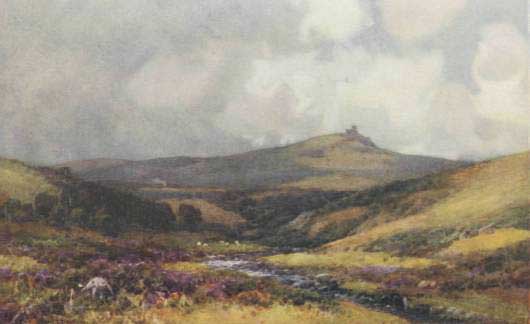 Brent Tor. From Lvdford Moors
Tavistock is a quiet little 'ancient borough,' which at the first glance from the hill to the north-west suggests the early-Victorian word 'embowered,' for it looks as if the rudiments of the town had arisen in the midst of a large wood. The town lies chiefly in a hollow, and the trees that cover the sides surround and encroach upon the streets in the pleasantest way, and their foliage, the hills on every side, and the rushing Tavy through the midst, give an un-[Pg 180]townlike air that is charming. But to imagine, from this rustic and very still look, that the place lacked history, would be to make a great mistake. On the contrary, its history starts in such very early days that only a few scattered relics remain to show the wave of human life that passed over the country.
Between A.D. 240 and the latter half of the sixth century, the Irish made many invasions, overran the South and West of England, and settled colonies in parts of Devon and Cornwall, more especially along their northern coasts. Mr Baring-Gould, in a most interesting paper, sketches out the various descents and settlements, and traces them by their stone monuments and by the names of the Irish saints that they left in churches and villages and holy wells. Some of the invaders established themselves near Tavistock, and tokens of them have been found in the neighbourhood in the shape of three stones bearing inscriptions—one in Ogham characters. The stones are now in the Vicarage garden. 'On one, which is over seven feet high, occurs a name, probably of a Sept or tribe in Kerry, where several stones inscribed with the same name are found. On the third are the words: "Dobunii Fabri fili Enabarri...." Dobun was a faber, or smith. In Celtic organizations every tuatha, or tribe, had its chief smith.... Dobunii ... is the Latin for the genitive Douvinias, also a Kerry name.... Here, then, we have written and engraven in stone for our learning the record of an Irish settlement from Kerry in the neighbourhood of Tavistock.'
Mr Baring-Gould further mentions briefly the different tribes and peoples that have invaded and possessed themselves of the land, to be in turn conquered by new-comers, and the eventual, amalgamation of races, and quotes Professor Sullivan to the discomfiture of those who rhapsodize over the 'pure Celt' in Great Britain or Ireland—for, after all, it was Irish colonists and conquerors who 'gave their name to Scotland, and at one time occupied the coast of Wales and 'West Domnonia.'
Professor Sullivan writes: 'The Irish tenants of to-day are composed of the descendants of Firbolgs and other British and[Pg 181] Belgic races; Milesians ... Gauls, Norwegians, Anglo-Saxons, Anglo-Normans, and English.... This is a fact which should be remembered by those who theorize over the qualities of the "pure Celt," whoever they may be.' There are many amateurs whose views would be less tedious if they could be convinced by Professor Sullivan.
The memory of one Irish saint clung for centuries to Tavistock, for the abbey was dedicated jointly to St Mary the Holy Virgin, and to St Rumon, an Irish missionary who came over to Cornwall. The abbey has unfortunately been totally destroyed, and various buildings now stand on its site. The old chapter-house was pulled down by a certain Saunders, 'of barbarous memory,' 'to make way for a modern house now called the Bedford Hotel.' The refectory is used as a Unitarian chapel, and still keeps its fine pinnacled porch. A ruined tower covered with ivy, called Betsy Grimbal's Tower (a young woman was supposed to have been murdered in it), stands in grounds close by, and the other chief fragments still to be seen are the monks' still-house, a little bit of the abbey church wall, and the remains of a battlemented wall following the line of the river. The north gateway is the most perfect remnant and that has been restored. Of the religious houses in the Diocese of Exeter this monastery was the most important, and it eclipsed them all by 'the extent, convenience, and magnificence of its buildings.' Orgar, Earl of Devon, founded it in 961, and Ordulph, his son, completed it on such a grand scale, that there was room for one thousand inhabitants.
The abbey had only stood for about thirty years, when a frightful blow fell: the Danes burst upon the country, harrying it with fire and sword. They landed in Cornwall, and here Egbert hastened with his army and defeated them at Hingston Down; but a great horde broke away, and crossing the border descended on Tavistock, where the inhabitants in a body rose to meet them and a terrible battle was fought. Its deadly nature is summed up with great directness in an old jingle:
The abbey was robbed and then burned to the ground. No time, however, can have been lost in rebuilding it, for about thirty years later Livingus, the Abbot, was made Bishop of Devonshire, and was specially chosen by King Canute to accompany him on his pilgrimage to Rome.
Tavistock was a Benedictine monastery, over which forty abbots ruled in succession. Some of the later ones were noted for their lack of discipline—even to the point of allowing the monks 'to affect the fashionable costume of the times, adopting the secular buttoned hoods and beaked boots'; but the earlier abbots were both pious and learned, and one of the earliest printing-presses set up in England was owned by the abbey. The first statutes of the stannaries that ever were printed were printed here: a 'Confirmation of the Charter perteynynge to all the tynners wythyn the coūty of Devonshyre wyth their Statutes also made at Crockeryntorre by the whole assēt and cōset of al the sayd tynners'—of the date 1510. In very early days the abbots were 'lessees of the Devonshire stannaries ... and controllers of the issues of royal mines in Devon and part of Cornwall,' says Dr. Oliver.
At the Dissolution the King presented the abbey and most of its estates to the Earl of Bedford. The first trace of this great family in Devonshire that I have been able to find is a lawsuit in regard to certain lands, between John Russell and Rohesia his wife and Henry de Pomeroy, which took place in the reign of King John. But there was a much closer connection with the county in later days. Unfortunately, space makes it impossible to touch on more than a few of the most striking events in the career of John Russell, first Earl of Bedford, to whom the Abbey was granted.
On January 11, 1506, the Archduke Philip of Austria was driven by a violent storm to take shelter at Weymouth, where Sir Thomas Trenchard, Governor of the Coast, hurried to receive him, and to offer such entertainment as he could provide. It so happened that there was staying with Sir Thomas a young cousin lately returned from his travels, who combined great 'skill in[Pg 183] foreign languages ... with his sprightly conversation and polite address.' The Archduke was enchanted to find someone better acquainted with his speech and customs than the stay-at-home squires who surrounded him, and when he set out for Windsor he would not leave Mr Russell behind. To the King the Archduke praised his protégé in glowing words, and he was given a small post at Court. Nature had favoured him at the start, for he is said to have been of 'a moving beauty that ... exacted a liking if not a love from all that saw him' and to this valuable gift was added that of a 'learned discourse and generous deportment.'
On the accession of Henry VIII, he won the good-will of the young King by the zeal with which he threw himself into 'the dance, the Masque, the pagent, the tourney,' in which Henry himself delighted; and he soon had a chance for distinguishing himself in serious matters. In 1513 he accompanied the King in his campaign in France, and on the march an unusually large cannon was 'overturned in a lagoon.... Impatient to signalise himself by some intrepid exploit, Mr Russell had the boldness to attempt its recovery, in the face of ten thousand French,' and 'with but two hundred and fifty adventurers under him as resolute as himself, he succeeded in the effort.'
In 1517 Mr Russell was appointed Deputy-Governor of Tournay; in 1532 he was knighted after taking part in a descent on the coast of Brittany, and in later years he rose to positions of great and greater importance. When Henry was supporting the Constable de Bourbon against his Sovereign, Francis I, Sir John was entrusted with the dangerous mission of conveying a huge sum of money through a country where many were well affected to the French King.
One of his first steps was to leave his company at a town on the frontier with orders to spread the news that he was ill, whilst he hastened without escort and with the money—Henry had promised the Duke de Bourbon 100,000 crowns a month—to Geneva. Here he heard the comforting news that the Swiss and Frenchmen were so certain of robbing him that they had already 'lotted[Pg 184] every of the captains his portion of the said money.' With great speed and secrecy he caused it to be 'packed in bales, trussed with baggage, as oats or old clothes, to make it bulky, and nicked with a merchant's mark.' As a further precaution he begged the help of the Duke of Savoy, who eventually allowed muleteers in his service to hire mules as if for his own use to take it across the mountains, and 'so bruit it to be carried as his stuff unto the Duchess his wife.' Arrived at Chambéry, the secret of the bales was allowed to leak a very little, and Sir John, knowing that there were 'divers ambushes and enterprises set for to attrap me,' set out again with his bales towards Geneva. Out of sight of the town he altered his course for Mont Cenis. And this expedient was in itself a blind, for two or three days before Sir John's departure the treasure had been sent very secretly on other mules to Turin, where it arrived safely. He finishes his account with conscious simplicity: 'Which ways was occasion, as I think the said enterprises to fail of their purpose.'
Sir John met with many very exciting adventures, of which perhaps the most interesting is one that happened to him at Bologna, for here he was very skilfully rescued from an unpleasant position by the great Thomas Cromwell, then a practically unknown soldier. Sir John was passing through the town, when he was very treacherously stopped and surrounded in his hotel by the municipal authorities. Cromwell managed to persuade them that he was a Neapolitan acquaintance of Sir John, and that if he might speak to him he would be able to induce the knight to surrender himself into their hands. But what he actually did was to suggest to Sir John that he should change clothes with a servant that Cromwell had brought with him, and in this disguise he helped him to escape from the town.
When Cromwell came to England, it was Sir John who first commended him to Wolsey's notice.
In the reign of Charles I, William, Lord Russell (afterwards Earl of Bedford), and Pym, the great commoner, were returned together as co-members for Tavistock; and when war was declared the Earl of Bedford sided with the Parliament and was appointed[Pg 185] to raise the Devonshire Militia for them. He was not personally hostile to the King but thought, like others, that if Charles saw the Parliament in arms against him, he would realize that the nation was resolute in defence of its liberty. The Earl of Bedford, at the head of his recruits, engaged the enemy near Sherborne Castle, and was victorious; and at the battle of Edge Hill he 'was reported by Lord Wharton to have done extraordinary service.' Later he was among those most anxious for a treaty of peace, but he suffered from holding too moderate views. In taking up arms against the King he had offended the Queen too bitterly to be well received when he, in company with some other peers, went to the Court at Oxford, and his sympathy with the King alienated him from the Parliament. Sincerely anxious for peace, he soon saw the hopelessness of all efforts in that direction, and long before the struggle was over he practically withdrew from public affairs.
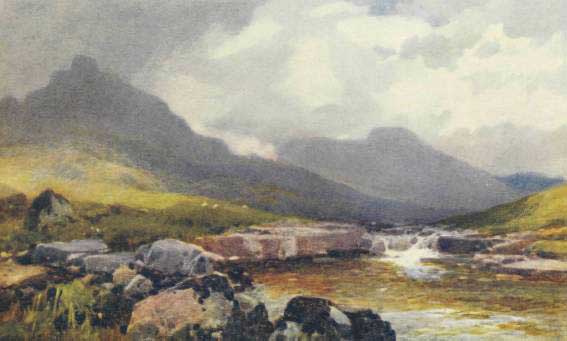 Tavy Cleave
Tavistock's greatest glory, Sir Francis Drake, has already been spoken of; but among the lesser lights is a Captain fully worthy to have sailed in the company of Queen Elizabeth's illustrious Captains, though he lived in the less triumphant days of Charles I. Captain Richard Peeke, or Peke, or Pike (he signs himself Peeke in his pamphlet, but in a private letter Dr. Meddus, a contemporary, refers to him as Pike), has left no account of his career, only that of his great adventure in Spain.
A local schoolmaster hails him with these flamboyant lines:
In 1625 Peeke joined the force that King Charles and Queen Henrietta helped to start from Plymouth. Sir Edward Cecil was in command, and, as a result of this expedition, earned for himself the nickname of Sit-Still. Peeke's account is excellent, although he begins by saying that he knows not 'the fine Phrases of Silken Courtiers'; but 'a good Shippe I[Pg 186] know and a poore Cabbin and the language of a Cannon ... as my Breeding has bin Rough (scorning Delicacy) so must my Writings be.'
The first attack was made on 'Cales' (Cadiz), and Peeke gives a vivid description of the hot and stubborn fight that took place before the fort of Puntal surrendered. The whole army was then landed, but Peeke did not go with them; 'for I was no Land Soldier, and therefore all that while kept aboard.' As the fate of the expedition has nothing to do with his story, it is enough to say that the men got very much out of hand, the Commander, in great alarm, hurriedly retreated, and, without attempting to follow up his victory on land, set sail in pursuit of a Spanish fleet that he never came up with, and three weeks later returned in disgrace to England.
To return to Richard Peeke. After the army had all landed he thought that 'the late storms had beaten all the Spaniards in' for a time, and that he would go on shore for a little diversion. Meeting some Englishmen coming back to the ships, laden with 'Oranges and Lymons' which they had taken from some gardens not far off, he set off to find some fruit for himself, the men assuring him that there was no danger. Less than a mile away, however, he came, '(for all their talking of no danger), on Three Englishmen starke dead, being slayne, lying in the way,' and another 'not fully dead.... I then resolved (and was about it) for Christian Charities sake, and for Countries sake, to have carried him on my back to our Shippes, farre off though they lay.... But my good intents were prevented; for, on a sodaine, came rushing in vpon me a Spanish Horseman, whose name as afterwards I was informed was Don Juan of Cales, a Knight.... Five or sixe Skirmishes wee had, and for a pretty while fought off and on.' As the fight went on Peeke got the better of Don Juan, who 'fell on his knees and crying out in French to me, Pardone moy, je vous pree. Je suie un buon Chrestien.... Having a Soldier's minde to Rifle him, I searched for jewels, but found only five Pieces of Eight about him.' Here Fortune turned, for 'fourteen Spanish Muskateers, spying me so busy about one of their Countreymen,'[Pg 187] came to his rescue, and Peeke was forced to yield himself prisoner. 'True Valour (I see) goes not aluaies in good Cloathes, for Don Juan (when my hands were in a manner bound behind me) ... wounded me through the Face, from Eare to Eare, and had there killed me, had not the fourteen Muskateers rescued me from his Rage.'
Peeke was again severely wounded while being led through the streets of Cadiz, but met with better treatment in prison, though his forebodings were gloomy. And when he was soon afterwards sent for by the Governor to Xeres, he went 'wondrous unwilling ... because I feared I should ther be put to Tortures.' On the day of trial he was brought before a great assembly of nobles, 'my sword lying before them on the table. It was reached to me; I tooke it and embraced it in mine arms, and with teares in my eyes kist the Pommel of it. He [the Duke of Medina] then demanded how many men I had kild with that Weapon? I told him, if I had kild one, I had not bene there now before that Princely Assembly, for when I had him at my foote, begging for mercy, I gave him Life, yet he then very poorely did me a mischiefe. Then they asked Don John (my Prisoner) what Woundes I gave him; He sayd, None: Upon this he was rebuked and told, that if upon our first Encounter, he had run me through, it had been a faire and Noble Triumph; but so to wound me, being in the hands of others, they held it Base.' Peake was now questioned as to the name of his ship, the Captain, and the number of cannon on board. 'I sayd, forty Peices. But the Lords, looking all this while on a Paper which they held in their hands, Duke Medyna sayd, In their note there was but thirty-eight.' He afterwards found that in that paper they had every detail about 'our Shippes, their Burden, Men ... as perfect as wee ourselves had them in England. Of what strength (quoth another Duke) is the Fort of Plymouth? I answered, very Strong. What Ordnance in it? Fifty, sayd I. That is not so, sayd he, there is but seuenteene. How many Soldiers are in the Fort? I answered, Two hundred: That is not so (quoth a Conde), there is but twenty.
'Marquesse Alquenezes asked me, of what strength the little[Pg 188] Island was before Plymouth. I told him, I know not; Then (quoth he), wee doe.
'Is Plymouth a Walled Towne? Yes, my Lords. And a good Wall? Yes, say I, a very good Wall: True, sayd a Duke, to leape ouer with a Staffe. And hath the Towne, sayd the Duke of Medyna, strong Gates? Yes. But, quoth he, there were neither Wood nor Iron to those Gates, but two dayes before your Fleete came away.' Among many other questions, they asked why 'in all this Brauery of the Fleete the English had not taken Cales as well as Puntal?' To which Peeke, who must have often asked this question of himself, replied boldly that 'the Lord Generall ... was loath to rob an Almeshouse, hauing a better Market to goe to. Cales, I told them, was held Poore, unmanned, unmunitioned. What better market? sayd Medyna. I told him Genoa or Lisbon.'
All around stood the 'Common People,' who made the ordeal still harder by 'many jeerings, mockings, scornes, and bitter jests' against the English, 'which I must not so much as bite my lippe against, but with an inforced patient care stood still.... Amongst many other raproches and spightfull Names, one of the Spaniards called English Men Gallinas (Hennes).' This amused the 'Great Lords,' and one of them asked the prisoner if the Spaniards, when they came to England (in war), would prove such hens as the English. To which Peeke answered, 'somewhat emboldned by his merry countenance,' that they would prove chickens. 'Darst thou then (quoth Duke of Medyna, with a browe half angry) fight with one of these Spanish Pullets? O my Lord! sayd I, I am a Prisoner, and my life at stake, and therefore dare not be so bold as to adventure upon any such Action, ... Yet ... with all told him, he was unworthy of the Name of an English Man, that should refuse to fight with one Man of any Nation whatsoever. Hereupon my Shackells were knockt off and my Iron Ring and Chayne taken from my Neck.'
The first challenger was quickly disposed of. 'I was then demanded, If I durst Fight against an other? I told them my[Pg 189] heart was good to adventure; but I humbly requested them to giue me pardon if I refused. For to my selfe I too well knew that the Spaniard is Haughty, Impatient of the least affront: And when he received but a touch of any Dishonour, Disgrace or Blemish (especially in his owne Countrey, and from an English man) his Revenge is implacable, mortall and bloudy.
'Yet being by the Noblemen pressed agen and agen to try my Fortune with an other, I (seeing my Life was in the Lyon's paw, to struggle with whome for safety there was no way but one, and being afrayd to displease them) sayd: That if their Graces and Greatnesses would giue me leave to play at mine owne Countrey Weapon called the Quarter Staffe, I was then ready there an Oposite, against any Commer.' When a 'hansome and well Spirited Spaniard steps foorth, with his Rapier and Poniard,' Peeke explained that he 'made little account of that One to play with, and should shew them no Sport.
'Then a second (Arm'd as before) presents himselfe; I demanded if there would come no more? The Dukes asked, how many I desired? I told them, any number under sixe. Which resolution of mine, they smiling at, in a kind of scorne, held it not Manly ... to worry one Man with a Multitude.
'Now Gentlemen, if here you condemne me for plucking (with mine owne hands) such an assured danger upon mine head: Accept of these Reasons for excuse.
'To dye, I thought it most certaine, but to dye basely, I would not: For Three to kill One had bin to mee no Dishonour; To them (Weapons considered) no Glory: An Honourable Subjection I esteemed better, than an Ignoble conquest.... Only Heaven I had in mine eye, the Honor of my Country in my heart, my Fame at the Stake, my Life on a narrow Bridge, and death before and behind me.'
With a supreme effort Peeke succeeded in killing one of his opponents and disabling the other two. Then for a moment he feared the threatening anger of the crowd, but the nobles showed great generosity in their admiration of his pluck, whether they felt mortified or not, and he was treated with extreme kindness,[Pg 190] both then and afterwards. He 'was kept in the Marquesse Alquenezes House, who one day ... desired I would sing. I willing to obey him (whose goodnesse I had tasted), did so, and sung this Psalme: When as we sate in Babylon, etc. The meaning of which being told he saide to me, English Man, comfort thyself, for thou art in no Captivity.'
Peeke was then sent to the King of Spain, who tried to keep him in his service, but with a becoming gratitude for the favours shown to him, Peeke begged to be allowed to return home, 'being a Subject onely to the King of England.' Whereupon the King very magnanimously gave 'one hundred Pistoletts to beare my charges.'
A play has been written called 'Dick of Devonshire,' in which the adventures of 'Dick Pike' are set in the midst of a Spanish tragi-comedy.
Nothing is known of Peeke's life after he came back to his own country, but there are strong reasons for believing that he returned to Tavistock. And if it was himself, and not a namesake, who flourished there, in 1638, our hero might be seen in an entirely new rôle, for that year Richard Peeke filled the peaceful office of people's churchwarden!
Tavistock's fine church is dedicated to St Eustachius, and it has a high battlemented tower crowned with slender pinnacles. The tower is 'pierced with arches in all four sides, so that it stands on piers. It is thus a true campanile, and was never joined to the church.' There are monuments to several families in the nave and chancel, and stories and memories crowd especially round two of them. One is the tomb of John Fitz of Fitz-ford and his wife, at the back of which their son Sir John kneels at a desk with a book before him.
Fitzford House is close to Tavistock, and with the property came to Sir John's daughter, Lady Howard, round whose name many tales have gathered. In Mrs Bray's time Lady Howard was regarded as 'a female Bluebeard,' but a later verdict is more charitable, and it is now thought that the unhappy lady has been much maligned. Being a great heiress, her hand was disposed of when she was only twelve years old, and she was married to Sir[Pg 191] Alan Percy, who died three years afterwards. There is a proverb—
but Lady Howard must have been wooed at all seasons. One month after her husband's death she escaped from her chaperon, and secretly married Lord Darcy's son, who only survived a few months. When she was hardly sixteen, she found a third husband in Sir Charles Howard, by whose name she is always known, although after his death she married Sir Richard Grenville. Her last 'venture,' as Prince calls it, was a very wretched one; Sir Richard treated her abominably, and she retaliated to the worst of her power. After her death, Mrs Bray says (in that delightful storehouse of local traditions, 'The Borders of the Tamar and the Tavy'), there arose a belief that she was 'doomed to run in the shape of a hound from the gateway of Fitzford to Okehampton Park, between the hours of midnight and cock-crowing, and to return with a single blade of grass in her mouth whence she started; and this she was to do till every blade was picked, when the world would be at an end.'
'Dr Jago, the clergyman of Milton Abbot, however, told me that occasionally she was said to ride in a coach of bones up the West Street towards the Moor.... My husband can remember that, when a boy, it was a common saying with the gentry at a party, "It is growing late; let us be gone, or we shall meet Lady Howard as she starts from Fitzford."'
A still more conspicuous monument in the church is connected with the other tragedy. The family of Glanvills had long been settled near Tavistock, and the figure is of Judge Glanvill in his robes. At his feet kneels a life-size figure of his wife. 'Her buckram waist, like armour, sleeves, ruff, and farthingale are all monstrous; and her double-linked gold chains are grand enough for the Lord Mayor. On the whole she looks so very formidable, that thus seen stationed before the Judge, she might be considered as representing Justice herself, but it would be in her severest mood.'[Pg 192]
The mournful story is that of another member of the family, Eulalia Glanvill, who was forced against her will to marry an old man named Page, when she was in love with a young man, George Strangwich. After much misery, she and Strangwich agreed to murder Page, and the story is told in several ballads, in one of which there is a ring of sincerity which makes the 'verses sound better to the brain than to the ear.' It is now thought that the ballad was written by Delaney, but in the early editions the ballad was attributed to Mrs Page herself, and a copy in the Roxburghe Ballads is headed: 'Written with her owne hand, a little before her death.' 'The Lamentation of Master Page's Wife' was sung to the tune of 'Fortune my Foe':
'The Lamentation of George Strangwidge' many times lapses into bathos, but as in a way it answers the other ballad, I will quote a few verses:
Kilworthy House, which in those days belonged to the Glanvills, is now the property of the Duke of Bedford.[Pg 194]
Tavistock seems to have maintained an open mind, or perhaps was forced into keeping open house, during the Civil War; but Fitzford House, then belonging to Sir Richard Grenville, held out resolutely for the King, until overpowered by Lord Essex. The people seem to have been rather indifferent to the cause of the war, and very sensible of its hardships, for it was here suggested that a treaty might be made, 'whereby the peace of those two counties of Cornwall and Devon might be settled and the war removed into other parts.' It was a really excellent method of shifting an unpleasant burden on to other shoulders, but in actual warfare, unfortunately, impracticable, although the treaty was drawn up and for a short time a truce was observed.
At the end of this year (1645) Prince Charles paid a visit to the town, and was so much 'annoyed by wet weather, that ever after, if anybody remarked it was a fine day, he was wont to declare that, however fine it might be elsewhere, he felt quite sure it must be raining at Tavistock.' One cannot help wondering if his courtiers kept to English tradition of perpetually speaking of the weather.
To walk away from Tavistock along the Tavy's bank is to follow the footsteps of that river's special poet, William Browne. His poems are not so well known as they might be, and his most celebrated lines are nearly always attributed to Ben Jonson—I mean the fine epitaph on 'Sidney's sister, Pembroke's mother'—though any doubt as to the author of the lines is cleared up by a manuscript in the library of Trinity College, Dublin. Not very many details of his life are known, but he had the happiness of being better appreciated by his contemporaries than by posterity, and Ben Jonson and Michael Drayton wrote complimentary verses, as a sort of introduction to volumes of his poems when they were published. Browne's work is very uneven, many of his poems are charming, some diffuse and rather poor; but he had a sincere feeling for Nature, and his nymphs and swains revelled in posies and garlands in the shade of groves full of singing birds.
In the third book of his long poem, 'Britannia's Pastorals,'[Pg 195] there is a quaint and pretty song, of which one verse runs:
A deliciously whimsical touch marks his description of a feast of Oberon:
Now and again in his verses there peeps out a joyful pride in his county, and his love of the Tavy is deep to his heart's core.
Some way below Tavistock is Buckland Abbey, founded by Amicia, Countess of Devon, in 1278, and for long years the home of Cistercians. At the Dissolution the Abbey was granted for a small sum to Sir Richard Grenville (grandfather of the hero of the Revenge), who altered it into a dwelling-house. Sir Richard, his grandson, sold it to John Hele and Christopher Harrys, who were probably acting for Sir Francis Drake, and he formally bought it of them ten months later. The house was built in the body of the church, and it is still easy to trace its ecclesiastical origin from some of the windows and architecture. In the hall[Pg 196] is a fine frieze, with raised figures in high relief and an elaborate background, the subject a knight turned hermit. The knight, wearing a hermit's robe, is sitting beneath spreading boughs, and a skull is lodged in a hollow of the tree-trunk. His charger and his discarded armour lie near him. In the same hall rests the famous drum that went round the world with Drake, the drum referred to in the traditional promise that Mr Newbolt has put into verse:
A short distance below the Abbey, the Tavy, now broadened into a wide but still shallow stream, ripples and hurries over the pebbles in a deep valley between wooded hills. Returning to Tavistock and going up the river, one arrives at the pretty and very remote village of Peter Tavy. The houses are scattered about in an irregular group, a stream runs through them to join the Tavy, and just above the wide bridge the brook divides, flowing each side of a diamond-shaped patch, green with long grass and cabbages. A steep slope leads up to the little church, which stands back, and a tiny avenue of limes leads up to it from the lichgate. The tower is battlemented, and the church must have been partly rebuilt, for parts of it are early English and the rest late Perpendicular. Within are slender clustered columns, supporting wide arches, and different designs are sculptured on the sides of the granite font.
Close by is a glen, which Mrs Bray says, 'I have ventured to name the Valley of Waterfalls, on account of the vast number of small but exquisitely beautiful falls seen there.' A narrow lane with high hedges leads round the shoulder of the hill to the steep little valley, where the Tavy jostles against obstructive boulders, and a high, narrow, unstable-looking bridge of tarred timber (sometimes called a 'clam' bridge) crosses the stream. Climbing up on the farther side, the road soon reaches the village of Mary Tavy. In reference to these villages a very old joke is told of a Judge unacquainted with these parts who, in trying a case, not un[Pg 197]naturally confused the names with those of witnesses, and ordered that Peter and Mary Tavy be brought into court. Mary Tavy has not the unusual attractiveness of Peter Tavy. It looks barer, and is overshadowed by that peculiarly comfortless air always given by chimneys or machinery of mines. The church stands above the road, and beside it a large old tree, whose lower branches are so abundantly covered with polypody that the fronds hang like long fringes from either side of each branch. The porch has a white groined ceiling, crossed with fragments of the old timber roof, on which are bosses carved in different designs.
From Mary Tavy a road runs nearly parallel to the river. Beyond Horndon the houses are fewer and more scattered, and somehow there is a suggestion that one is coming nearer and nearer to the verge of civilization. The few houses look nice in themselves, with the exception of a farm, so cheerless and neglected-looking, that it was a surprise to find it inhabited; and not far beyond this house the road reaches another and very different farm, looking full of comfort—and goes no farther. This farm has the significant name of Lane End, and one realizes from its solitary, exposed position that the high and substantial wall surrounding it was built for sound reasons. It stands on the moor, and the cultivation is of the roughest kind; the fields, such as they are, being plentifully sprinkled with huge boulders. In winter, when there is much fear of snow, these fields serve as an enclosure for the ponies that are driven-in off the moor—looking like wild animals in their long, hanging, furry coats. The river is heard dashing over the rocks below, and about a mile farther on is Tavy Cleave.
The last time I saw it a vague threat hung over everything, adding a cold fascination to the moor. The hills showed tints of faint green and palest brown, and patches of bracken gave a consoling shade of russet. Hare Tor rose beyond, silent and impressive, covered with snow. The Tavy had a new beauty, for it was almost frozen over, and the dark water, and along whirling scraps of foam, showed between the blocks of ice and snow, and the boulders were each bordered with shining white. The sky was[Pg 198] heavy with snow-clouds, and beneath them and in the rifts were stormy red sunset tints, while a cold blue-grey mist was creeping up the valley.
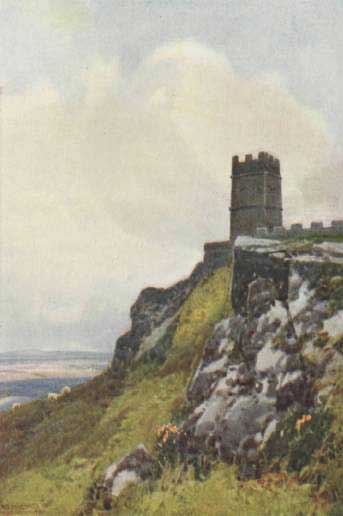 Brent Tor
There are some places—the Castle of Elsinore, for instance—that seem to have an amazing and incomprehensible gift of resisting civilization. They may be brought up to date, and trimmed, and filled with inappropriate people, and everything else done that should spoil them, but in spite of it all they do not for a moment look as if any modern extraneous objects had a meaning for them. They belong to their own day and its manner, and to no other.
The same sort of feeling hovers about Tavy Cleave, and a great sense of the mystery that here more, there less, broods over the moor. But there is no suggestion as to who it is that the moor has most truly and absolutely belonged to, nor even the region of time: only the feeling that the valley is, in a finer than the usual sense, haunted.
As a valley Tavy Cleave is very beautiful, with its steep sides and clear rushing stream and red granite rocks, half in and half out of the river, that have a charm they entirely lose when once away from the water. Mr Widgery shows how admirable they are in their proper place, with their reflections quivering beneath them. Sometimes a kind of black moss grows upon them, and tiny bits of white lichen, giving together a curious tortoiseshell look. Above, the hill-sides are covered with heather and broom and whortleberries among masses of loose rocks, and now and again there is the vivid green of a patch of bog. The great masses of rocks crowning the separate points on the hill-side, like ruined rock-castles, add to the air of mystery.
Looking to the west from above the Cleave, one sees—as from any distance round one sees—the most characteristic height of Brent Tor, with the tiny church on the top. It is not that the tor is so very high, but in some astonishing way it always seems to appear as a landmark, north, south, east, or west, when one imagines it to be absolutely out of range. The sides are steep and rocky, and the church stands 'full bleak and weather-beaten, all-[Pg 199]alone as it were, forsaken, whose churchyard doth hardly afford depth of earth to bury the dead; yet doubtless they rest there as securely as in sumptuous St Peter's until the day of Doom.'
The story told of the church is that a man once almost gave himself up for lost—some say in a storm, others in an impenetrable, unending fog—in the Channel, and vowed that, if he ever came safe to shore, he would build a church on the first bit of land he saw. As Brent Tor is far inland, the fog story sounds the more probable, for there is no saying how mist wreaths may drift. The church is dedicated to St Michael de la Rupe, and here another tradition comes in, for it is popularly supposed that, when the building of the church was begun, the devil pulled away all the day's work in the night. At last St Michael came to the rescue, and hurled such an enormous mass of rock upon the devil that he fled away and hindered no more. The building is very tiny, and a countryman told me that as a child he used to be puzzled by the cryptic warning: 'If you get into the second aisle of Brent Tor Church, you will never get out again.' Of course—there is no second aisle.
The beauty of many of the places on the banks of the Tamar is celebrated. Among the exquisite woods and lawns of Endsleigh—through which one Duke of Bedford cut no less than forty miles in rides—the river twists and winds for a long distance at one point, and curves round almost into a ring. A little farther south are Morwell Rocks, which Mr Norway had the good fortune to see in the spring. 'The trees stretch far away along the river, dense and close to the water's edge, a mountain of gold and sunny green, broken in the midst by a high grey crag, which stands up sheer and grey amid the mass of gorgeous colour. This is the first peak of a great range of limestone cliffs, which for the most part, as the hill sweeps round above the village of Morwellham, are hidden in the woods. But when that tiny cluster of cottages and wharves is left behind, the stream creeps closer to the hill, and it is as if the buried rock stirred and flung the coppice off its shoulders, for the limestone precipices rise vertically out of the water to a vast height. The[Pg 200] summits are weathered into most fantastic shapes, pinnacles and towers break the skyline, and wherever a crevice in the rock has allowed the lodging of a little earth, some oak-tree roots itself, or a wild tangle of greenery drops down the scarred surface of the cliff.'
A little farther down, the Tamar and the Tavy join, and with the Cornish Lynher form the Hamoaze—a view of land and water that is very admirable. It is not a scene whose dimly realized charm grows gradually stronger, but one whose triumphant beauty is beyond dispute. The innumerable creeks and inlets, the rich abundance of foliage and pasture, and the sweeping sense of spaciousness from the open sea that comes off Plymouth Sound, help to make the grand effect; and the feelings of few can be quite unstirred by the battleships, or perhaps black sinister destroyers, and the multitude of other shipping lying at anchor in that famous haven, and by the thought of all that they mean to us.
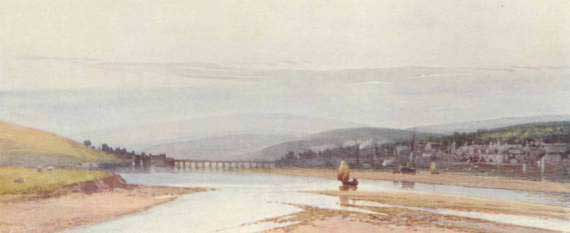 Bideford
'All who have travelled through the delicious scenery of North Devon must needs know the little white town of Bideford, which slopes upwards from its broad tide-river paved with yellow sands, and many-arched old bridge, where salmon wait for autumn floods, toward the pleasant upland in the west. Above the town the hills close in, cushioned with deep oak-woods, through which juts here and there a crag of fern-fringed slate; below they lower and open more and more on softly rounded knolls and fertile squares of red and green, till they sink into the wide expanse of hazy flats, rich salt-marshes, and rolling sand-hills, where Torridge joins her sister Taw, and both together flow quietly toward the broad surges of the bar and the everlasting thunder of the long Atlantic swell.'
It is difficult to imagine that there could be a more fitting description of Bideford than that drawn in the opening words of 'Westward Ho!' Bideford, it has been said, is spoilt by ugly modern houses, but the remark implies a matter-of-fact view,[Pg 202] for the ugliness and modernness are only skin-deep, and can easily be ignored. A matter of far greater importance is that there is an old-world essence, a dignity in the whole tone and spirit of the town, that keep it in touch with the glorious past.
Faithful followers of the heroes on the borderland of myth—King Arthur, Charlemagne, Holger Danske—believed that in their country's need these would arise from the shades to lead their people to victory; and at Bideford one feels that, should any 'knight of the sea' return, he would find a town not strange to him, and, if the stress were sharp enough to pierce the thin husk that later civilization has added, a people who would understand and not fail him.
The name comes from By-the-ford, but a ford between East-the-water and the town must have been rather perilous, and only possible at low-tide. In the early part of the fourteenth century some of the chief inhabitants resolved to build a bridge, but several efforts were made in vain, for they were always thwarted by failure to find a firm enough foundation. Then Sir Richard Gurney, priest of the place, was 'admonished by a vision ... to begin that excellent work ... where he should find a stone fixed in the ground.' This dream he thought nothing of, 'until, walking by the river, he espied such a stone or rock there rolled and fixed firmly, which he never remembered to have seen formerly,' and was hereby convinced 'that his dream was no other than an heavenly inspiration.' The whole neighbourhood combined to help, the rich sending money and lending the services of their workmen, and the poor giving such time and labour as they could afford. The bridge, which has since been widened, is a very fine one, of twenty-four arches. Westcote says: 'A bark of 60 tons (without masts) may pass and repass with the tide, which flows near five miles above it.'
Gifts and bequests were made to the bridge, and the funds belonging to it became so large, and the business connected with them so important, that in 1758 a hall was built for the use of the feoffees, and decorated with the royal arms and the arms of the bridge.[Pg 203]
St Mary's Church was built about the same date as the bridge, but about forty years ago all but the tower was pulled down and rebuilt. It had suffered considerably from the ravages of the Reformers, whose horror of ritualism reached the point of throwing the font out of doors, whereupon 'one schismatic,' more crazy than the rest, took it, says Watkins, in wrath, 'for the purpose of a trough for his swine to feed out of; and if he had had his deserts, he would have made one of their company.' The font was probably rescued by some pious person, for the one now in the church is a fine Norman one, with cable moulding.
In this church was baptized 'Raleigh,' the Indian brought back by Sir Richard Grenville from Carolina, and called after the great Sir Walter, who was doing much for that country. Sir Richard kept 'Raleigh' in his own house, and the dark stranger must have caused great chattering and excitement among the children and some of their elders in the town, but he did not survive transplantation, and a year later was buried in Bideford Churchyard. In the register he is described as a native of Wynganditoia.
On the south side of the church is the tomb of Thomas Grenville, who lies in armour, with a dog—not, as on most monuments, at his feet, but by his side. On the tomb are various coats of arms, and over it rises an arch ornamented with high stone tracery. A curious screen between the tower and the church has been made from the old carved bench-ends. Most of the subjects are grotesque, and on some of the panels are gnome-like heads, with long beards, big hats, and impudent, leering expressions.
In the churchyard is a tombstone with this epitaph:
Nowadays there is not much foreign trade, although a few vessels with outlandish names may be seen lying stranded at low-water alongside the quay. But Bideford had a full share of the prosperity that Devonshire ports enjoyed in the reign of Queen Elizabeth. The merchants were encouraged by Sir[Pg 204] Richard Grenville, who, fired by the 'gallant and ingenious' Sir Walter Raleigh, ventured first fortune and then himself in commanding an expedition planned by his friend and kinsman. The expedition did not meet with great success in its main object, which was to establish a colony for the settlers, who, finding insurmountable hardships and difficulties, were all brought home later by Sir Francis Drake; but a Spanish treasure-ship of immense wealth was captured on the way back. It was said that in different ventures 'Bideford, in consequence of its lord, had some share, but chiefly with respect to its mariners.' So, after Sir Richard had fought his splendid last fight, and when his immediate influence was gone, independent merchants and mariners went on to fresh enterprises, and commerce continued to increase. Trading with Spain for wool soon became an important branch, but of still greater consequence was the trade with Newfoundland. When William and Mary reigned, Bideford was sending more ships there than any other port in the kingdom but London and—strange to say—Topsham. In the next reign the merchants suffered immense losses from French privateers, who, making the island of Lundy their headquarters, spied almost every ship that passed up and down the Bristol Channel. To them, Bideford or Barnstaple Bay was 'emphatically the Golden Bay, from the great number of valuable prizes which they captured on it.' Traffic with America had, however, greatly declined, before it was killed by the War of Independence.
In the history of Bideford the name of Grenville shines on many occasions. Both Devon and Cornwall claim this eminent family, their 'chiefest habitation' of Stow being in Cornwall, while, according to some authorities, their first dwelling-place in this part of the world was at Bideford.
Richard de Grenville, near the end of the fourteenth century, for his valour and courage in the Welsh wars was awarded the town and county of Neath, in Glamorgan. Being pious as well as brave, he devoted all this wealth to the Church, building and endowing a monastery for Cistercian monks. A quaint 'prophecy' regarding this family was said to have been found many[Pg 205] years later in the Abbey of Neeth, where it was kept 'in a most curious box of jett, written in the year 1400.'
It begins:
Watkins refrains from any comment as to the genuineness of the 'prophecy' (of which I have only quoted a small portion), but perhaps the critical would gather from the whole tone, and especially from the closing lines, which have a flattering reference to the reign of a King Charles, that it was written about the date of its discovery.
The dignity and authority, the commanding presence of Sir Richard as a country gentleman, a neighbour, a Justice of the Peace, are admirably suggested in 'Westward Ho!' Apart from warfare on land or sea, he interested himself in a host of affairs at home, and was both member of parliament and High Sheriff for Cornwall. He was also called to serve on Commissions for making inquiries about pirates and strengthening the defences of the coast; and notes show that within six months he was occupied with places as far east and west as Dover and Tintagel.
In 1587 he was appointed by the Queen to review the 'trained bands' in Devon and Cornwall, that nothing of their equipment might be lacking when the expected enemy arrived; and when the shattered remnants of the Armada were straggling down the Irish Channel, Sir Richard had special orders to 'stay all shipping upon the north coast of Devon and Cornwall.' The catalogue alone of the tasks allotted to him shows how greatly the Queen confided in his powers and judgment; yet all the tale of his[Pg 206] life is completely overshadowed by the magnificence of his death:
When the day dawned, 'all the powder of the Revenge to the last barrell was now spent, all her pikes broken, fortie of her best men slaine, and the most part of the rest hurt.' Then Sir Richard 'commanded the maister Gunner, whom he knew to be a most resolute man, to split and sinke the ship; that thereby nothing might remaine of glorious victorie to the Spaniards; seeing in so manie houres fighte with so great a Navie they were not able to take her, having had fifteene houres time, fifteene thousand men, and fifty and three suite of menne of warre to perform it withall.'
The Captain and most of the crew felt that this supreme sacrifice was not required of them, and offered to treat with the Spaniards, who, filled with generous admiration for the amazing courage that had been shown by their adversaries, offered honourable terms of surrender. Sir Richard, who had[Pg 207] received several wounds, and who was at the point of death, was carried on board the Spanish Admiral's ship, where his life ebbed away within a few days. 'Here die I, Richard Grenville, with a joyful and quiet mind, for that I have ended my life as a true soldier ought to do that hath fought for his country, Queen, religion, and honour: My soul willingly departing from this body, being behind the lasting fame of having behaved as every valiant soldier is in his duty bound to do.'
Sir Richard's famous grandson, Sir Bevil Grenville, was a brave soldier, but less awe-inspiring; 'the most generally beloved man in Cornwall,' according to Clarendon; and he adds that 'a brighter courage and a gentler disposition were never married together.' When war was declared, volunteers flocked to his standard, and in his first engagement, near Liskeard, he inflicted defeat on the Parliamentary troops, and took twelve hundred soldiers and all the guns.
At Stratton his achievements were even more brilliant, for his troops began at a serious disadvantage. The enemy, with ample supplies and ammunition, were encamped on the top of a hill; 'the Royalist troops, less than half their number, short of ammunition, and so destitute of provisions that the best officers had but a biscuit a day, lay at Launceston.' Undaunted by these discouraging conditions, they determined to attack, and having marched twenty miles, the soldiers arrived at the foot of the hill, weary, footsore, and exhausted from want of food. From dawn till late afternoon the storming-parties were again and again repulsed, till their powder was almost gone; then they scaled the hill in the face of cannon and muskets, to take the position by the force of swords and pikes. Grenville's party was the first to struggle up to the top, and it was almost immediately joined by the other columns, when the enemy broke in confusion and fled.
Sir Bevil met his death at Lansdowne, when, with grim doggedness, the Royalists were again climbing the heights in the face of the enemy's fire. Very many fell, and he among them. 'Young John Grenville, a lad of sixteen, sprang, it is said, into his father's saddle, and led the charge, and the Cornishmen followed with their[Pg 208] swords drawn and with tears in their eyes, swearing they would kill a rebel for every hair of Sir Bevil's head.'
It is not possible to follow the careers of others of his family, but a saying in the West Country ran: 'That a Godolphin was never known to want wit, a Trelawney courage, or a Grenville loyalty.' Their love of adventure perhaps descended from an earlier Sir Richard Grenville, who puts forward his views in a poem called
[Also entitled 'In Praise of Seafaring Men in Hope of Good Fortune, and describing Evil Fortune.']
Directly, Bideford suffered very little from the Civil War. In the early days the town was for the Parliament, and two forts were built, one on each side of the river; but after a defeat near Torrington, in the autumn of 1643, the citizens surrendered to the royal army. 'Their spirit for rebellion was considerably reduced,' says their special historian; 'they remained perfectly neutral to the dreadful end of that unhappy war.'
Unfortunately, it is not possible here to dwell upon the delightful minor annals of Bideford, such as the history of that stalwart pamphleteer, Dr Shebbeare, who, for his repeated attacks on the Ministry, was condemned to stand in the pillory at Charing Cross. The sentence was carried out, but not exactly in the usual manner, for 'Mr Beardmore, the under-sheriff, being a friend of the Doctor's, permitted him to stand unconfined on the platform of the pillory, attended by a servant in livery holding an umbrella over him.' It is lamentable that the authorities were sufficiently vindictive and small-minded to visit this act of friendly tolerance on Mr Beardmore with a fine of £50 and two months' imprisonment. Dr. Shebbeare was also imprisoned; but later in life the tide turned, and the King was persuaded to pension him with £200. As Dr Johnson was pensioned about the same time, with the same sum, the joke ran that the King had shown benevolence to a He Bear and a She Bear.
It is also impossible to do more than touch on the tragic episode of 1682—the trial of three unhappy women, Susanna Edwards, Temperance Lloyd, and Mary Trembles, who were accused of having practised witchcraft. Here are a few fragments of the evidence given at the trial. A witness said that, while nursing a sick woman, a magpie fluttered once against the window, and that Temperance admitted that this 'was the black man in the shape of a bird.' Another time 'a grey or braget cat' of rather mysterious movements was an object of suspicion, and Temperance was reported to have confessed that 'she believed it to be the Devil.' The evidence of a dead woman was brought forward, she having 'deposed that the said Temperance had appeared to her in the shape of a red pig.' Susanna Edwards, under strict[Pg 210] examination, 'confesseth that the Devil hath appeared to her in the shape of a Lyon, as she supposed.'
Some of the questions put to the wretched 'witches' were simply grotesque, and reflect, as Watkins caustically observes, on the intelligence of the examiner. Temperance was asked:
'Temperance, how did you come in to hurt Mrs Grace Thomas? Did you pass through the key-hole of the door, or was the door open?...
'H. [the examiner]. Did you know any Marriners, that you or your Associates destroyed, by overturning of ships or boats?
'Temperance. No! I never hurt any ship, bark, or boat in my life.
'H. You say you never hurt ships nor boats; did you never ride over an arm of the sea on a Cow?'
To the north of Bideford is a little peninsula formed by the mouth of the Torridge on the east, the far wider estuary of the Taw on the north, and the open sea on the west. The whole course of the Torridge is very capricious. The source is within four miles of the sea, not far south of Hartland, and, at once turning inland, the stream takes a south-easterly direction till it reaches the first slopes that, rising out of the fertile country, mount gradually as they stretch towards the borders of Dartmoor. At this check the Torridge runs due east till, within a few miles of Okehampton, it turns in a great rounded loop, and flows north and slightly west to the north coast again.
The Taw's course is far more direct. It rises in Dartmoor, and, occasionally bending slightly to east or west, it makes a fairly straight way towards the north till Barnstaple is reached, and then, turning almost at a right angle, runs westward to the sea.
Following the strip of land along the west bank of the Torridge from Bideford, the road passes Northam, and on the north-eastern point, at the meeting of the rivers, stands Appledore. Before reaching Northam, by diverging a little to the west, one arrives at the remains of an ancient castle, Kenwith Castle, known for a long time as Hennaborough or Henny Hill, where about A.D. 877 the[Pg 211] Danes were valiantly driven back, after a furious battle, by King Alfred and his son. Hubba, the leader of the Danes, fell, and their magical banner, Reafan—the Raven—was taken. According to one tradition, it was 'wrought in needlework by the daughters of Lothbroc, the Dane, and, as they conceived, it made them invincible.' Another account rather contradicts this, as it declares that the wonderful standard bore a stuffed raven, who 'hung quiet when defeat was at hand, but clapped his wings before victory.' All the legends, however, point to the faith of the Danes in the magical powers of the banner, and their chagrin on losing it must have been very great.
 Appledore
The Danes buried Hubba 'on the shore near his ships, and, according to the manner of northern nations, piled on him a heap of copped stones as a trophy to his memorial, whereof the place took name Hubba-stone.' Risdon speaks of the 'sea's encroaching,' and of the stones having been swept away by it before his day, but the name still clings to the spot where it stood.
A little fort at Appledore was built, it is said—but the authority is not infallible—at the same time that the forts were thrown up at Bideford, and towards the end of July, 1644, it was called on to make a defence. Barnstaple had suddenly rebelled against the Royalists, and the citizens resolved to take possession of the guns that commanded the river's mouth. Sir John Berkeley, writing what must have been an unsatisfactory letter to Colonel Seymour, in answer to a request for more men, speaks of the troops sent to help the defenders: 'Your desire and expectance of supply is most just and reasonable. Having been exhausted of men by the Prince, and having sent to the relief of Appledore, by His Majesty's command, 500 under Colonel Apsley ... I am not able to give you the least assistance at present.' And Sir Hugh Pollard, writing at the same time, mentions that Colonel Apsley's force will meet 'a many of Doddington's horse at Chimleigh, to the relief of the fort at Appledore, which is straitly besieged by those of Barnstaple.'
The garrison consisted of forty Cornishmen, and before the siege was raised they were 'much straitened both for dread and[Pg 212] fresh water.' They were particularly badly off because 'a certain colonel, who is stigmatized covertly as "no Cornishman," had been entrusted with the victualling of the fort, but had neglected his duty.'
Close to the sea, on the west, lies Westward Ho!—a tiny (and modern) watering-place, named after Kingsley's famous book. Along the western shore as far as the Taw stretch Northam Burrows, covered for some distance by a fine elastic turf that is far-famed, and by patches of rushes. Beyond the golf-links the ground breaks into sand-hills, all hillocks and hollows of pure sand, soft and yielding, dented by every footstep, set with rushes and spangled with crane's-bill, yellow bedstraw, tiny purple scented thyme-flowers, and a kind of spurge.
Both sand-hills and common are protected from the sea by the well-known Pebble Ridge, which stretches for two miles in a straight line. It is a mass—fifty feet wide and twenty feet high—of large, smooth, rolled slate-stones, some being two feet across, though most of them are smaller.
Turning westwards along the coast, Lundy is often to be seen like a faint blue cloud on the horizon, especially when a softening haze hovers over the land—but on a clear day it is very distinct. And on a fine evening, when the dim blue twilight is creeping up on every side, it has the very air of an enchanted island against the radiant crimson that for a few moments spreads and glows in the west after sundown.
A little distance farther on is Portledge, 'the most antient seat of the name and family of Coffin,' says Prince; and he mentions a boundary deed between Richard Coffin and the Abbot of Tavistock, written 'in the Saxon tongue, which giveth good confirmation thereof.' Sir William Coffin was one of several Devonshire gentlemen who were 'assistants' to Henry VIII in the tournaments of the 'Field of the Cloth of Gold,' being of great courage, and 'expert at feats of arms.' A story which is often told of him gives a good illustration of his strong will. While living on a property that belonged to his wife in Derbyshire, Sir William chanced one day to pass a churchyard, and seeing a[Pg 213] group of people standing about, he asked what was happening. Being told that 'they had brought a corps to be buried, but the priest refused to do his office unless they first delivered him the poor man's cow, the only quick goods left,' for a burial fee, he commanded the priest to read the service. But the priest declined to do so until he had received his fee. On this answer, Sir William 'caused the priest to be put into the poor man's grave, and earth to be thrown upon him; and he still persisting in his refusal, there was still more earth thrown in, until the obstinate priest was either altogether or well nigh suffocated.'
Prince is entirely delightful over this story. He goes on: 'Now, thus to handle a priest in those days was a very bold adventure;' as if to bury a priest alive was usually considered a pleasant amusement. Sir William, however, not only lived through the storm that the high-handed action raised, but actually succeeded in moving Parliament to pass an Act regulating the burial fees that might be asked of the poor. So our biographer finishes with the triumphant axiom: 'Evil manners are often the parent of good laws!'
Eleven miles west of Bideford is Clovelly. Here one feels, rather despairingly, that anyone who has seen this wonderful village can listen to no description of it; while to those who have never seen it, no description is of any value.
A road leads towards it through the Hobby, a wood overhanging the sea, which Kingsley describes as 'a forest wall five hundred feet high, of almost semi-tropic luxuriance.' The road was 'banked on one side with crumbling rocks, festooned with heath, and golden hawkweed, and London pride, like velvet cushions covered with pink lace, and beds of white bramble-blossom alive with butterflies; while above my head, and on my right, the delicate cool canopy of oak and birch leaves shrouded me so close that I could have fancied myself miles inland, buried in some glen unknown to any wind of heaven, but that everywhere between green sprays and grey stems gleamed that same boundless ocean blue.'
The village itself lies in a ravine of the rock, and the 'street'[Pg 214] is so precipitous that the eaves of one house are on a level with the foundations of its next neighbour above. Kingsley and Dickens have written descriptions that, scarcely overlapping, seem to complete each other.
'I was crawling up the paved stairs, inaccessible to cart or carriage, which are flatteringly denominated Clovelly street; ... behind me a sheer descent, roof below roof, at an angle of 75°, to the pier and bay, two hundred feet below and in front of me; another hundred feet above, a green amphitheatre of oak and ash and larch, shutting out all but a narrow slip of sky, across which the low, soft, formless mist was crawling, opening every instant to show some gap of intense dark rainy blue, and send down a hot vaporous gleam of sunshine upon the white cottages, with their grey steaming roofs and bright green railings packed one above another upon the ledges of the cliff; and on the tall tree fuchsias and gaudy dahlias in the little scraps of courtyard; calling the rich faint odour out of the verbenas and jessamines, and, alas! out of the herring heads and tails also, as they lay in the rivulet, and lighting up the wings of the gorgeous butterflies, almost unknown in our colder eastern climate, which fluttered from woodland down to garden, and from garden up to woodland.'
The human element tinges the other sketch more strongly:
'The village was built sheer up the face of a steep and lofty cliff. There was no road in it, there was no wheeled vehicle in it, there was not a level yard in it. From the sea-beach to the cliff-top two irregular rows of white houses, placed opposite to one another and twisting here and there, and there and here, rose like the sides of a long succession of stages of crooked ladders, and you climbed up village or climbed down the village by the staves between, some six feet wide or so, and made up of sharp, irregular stones. The old pack-saddle, long laid aside in most parts of England, as one of the appendages of its infancy, flourished here intact. Strings of pack-horses and pack-donkeys toiled slowly up the staves of the ladders, bearing fish and coal, and such other cargo as was unshipping at the pier from the dancing fleet of village boats and from two or three little coasting traders. As[Pg 215] the beasts of burden ascended laden, or descended light, they got so lost at intervals in the floating clouds of village smoke, that they seemed to dive down some of the village chimneys and come to the surface again far off, high above others. No two houses in the village were alike in chimney, size, shape, door, window, gable, roof-tree, anything. The sides of the ladder were musical with water, running clear and bright. The staves were musical with the clattering feet of the pack-horses and pack-donkeys, and the voices of the fishermen urging them up mingled with the voices of the fishermen's wives and their many children.... The red-brown cliffs, richly wooded to their extremest verge, had their softened and beautiful forms reflected in the bluest water, under the clear North Devonshire sky of a November day without a cloud. The village itself was so steeped in autumnal foliage, from the houses joining on the pier to the topmost round of the topmost ladder, that one might have fancied it was out a-bird's-nesting, and was (as indeed it was) a wonderful climber.'
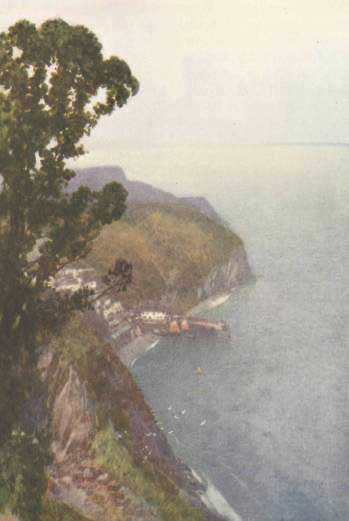 Clovelly
The harbour is very small, but on a cliff-bound, dangerous coast it is one of the very few between Bideford and Padstow. Clovelly's great herring fishery used to be famous, but it is not now so large as it used to be.
Above the village, the beautiful park of Clovelly Court lies along the cliffs, looking over the wide distances of Bideford Bay; and on a fine day the Welsh coast may be seen. Inland, great forest trees tower above a miniature forest of bracken, and at the opening of a glade one may catch glimpses of the deer appearing and vanishing again.
The Carys were in very ancient days settled at St Giles-in-the-Heath, but a branch of them came to Clovelly in the reign of Richard II. They were of the same race as the Carys of Torre Abbey, and the family of whom Lord Falkland is the head. John Cary, who acquired the property, was a distinguished character. As a Judge, 'he scattered the rays of justice about him, with great splendour.' He was called to show firmness and loyalty under the most trying circumstances, but, 'true as steel ... the greatest dangers could not affright him from his duty and[Pg 216] loyalty to his distressed master Richard II, unto whom he faithfully adhered when most others had forsaken him.' When the King had been deposed, 'this reverend Judge, unable and unwilling to bow like a willow with every blast of wind, did freely and confidently speak his mind.' So faithfully did he maintain King Richard's cause that, when Henry IV came to the throne, the Judge was banished the kingdom, and his goods and lands were confiscated. These, Sir Robert Cary, his son, recovered literally at the point of the sword, for a 'certain Knight-errand of Arragon,' of great skill in feats of arms, 'arrived here in England, where he challenged any man of his rank and quality.' Sir Robert accepted the challenge, and a 'long and doubtful combat was waged in Smithfield, London.' In the end the 'presumptious Arrogonoise' was vanquished, and Henry V, to whom Sir Robert's gallantry appealed, restored him 'a good part of his father's lands,' and granted him leave to bear 'in a field silver, on a bend sable, three white roses,' the arms of the conquered knight—the arms that the Carys still bear. The Clovelly branch of the family is now extinct.
A little to the south of Clovelly, and on high ground, are Clovelly Dykes, the remains of an old camp, sometimes called British and sometimes Roman. It is large and circular, and the position was strengthened by three great trenches, about eighteen feet deep and three hundred feet long, which lie around it. The camp commands the only old road in the surrounding country.
About seven or eight miles to the west is the grand headland of Hartland Point. It is a narrow ridge that rises precipitously three hundred and fifty feet above the water, projects far out into the sea, and abruptly ends the coast-line to the west. The coast is very fine, but also most dangerous, and the cliffs, cleft here and there by great chasms, fall sheer down to needle-points of hard black slate rock jutting out into the sea.
The name of Herty Point, as it used to be called, was originally, says Camden, 'Hercules's promontory,' and this title has given rise to 'a very formal story that Hercules came into Britain and killed I know not what giants.' Here Camden pauses in his[Pg 217] description of the place, to consider whether there ever was a Hercules at all, and, if so, whether there were not really forty-three Hercules; and if this was not so, whether Hercules was perhaps 'a mere fiction to denote the strength of human prudence,' or, again, possibly a myth personifying the sun, and his labours the signs of the zodiac, 'which the sun runs through yearly.' On the whole, he decides that, at any rate, Hercules never came to Britain, but the name might have been given to the point by the Greeks 'out of vanity,' because 'they dedicated everything they found magnificent in any place to the glory of Hercules.'
Four miles south-east of the headland lies Hartland town. It has been briefly described as 'a very quiet street of grey stone cottages and whitewashed houses on a high and windy tableland.' Close by is Hartland Abbey, founded, according to tradition, by Githa, the wife of Earl Godwin, and mother of Harold II, in honour of St Nectan; for she 'highly reverenced the man, and verily believed that through his merits her husband had escaped shipwreck in a dangerous tempest.' In the reign of Henry II, leave was given to Oliver de Dynant to change the community of secular canons into regular canons of St. Augustine's order, and to found a monastery for them. But between the successors of the founder and the canons matters did not always run smoothly; in fact, on one occasion, about a hundred years later, they actually came to blows in the church, as is made clear by an entry in the register of Bishop Bronescombe, for it records that the bishop had reconciled the church, 'which had been polluted by an effusion of blood in an affray between Oliver de Dinham and the canons.'
After the Dissolution the Abbey was bestowed by the King upon the Sergeant of his cellar, a man named Abbott. Parts of the Abbey remained unaltered and in good repair till the end of the eighteenth century, when, in building the present house, the unfortunate taste of the period destroyed the hall, which was over seventy feet long, and a portion of the cloisters, which were then still perfect. Parts of them, however, are still standing.[Pg 218] The cloisters had been rebuilt at a very early date, for Dr. Oliver quotes an inscription which was over one of the arches that shows them to be the work of the Abbot John of Exeter, who resigned in 1329. Bishop Stapledon had found many defects in the structure of the Abbey, when he made his visitation in 1319, and had ordered them to be at once remedied. During the alterations made about one hundred and twenty years ago, the monument of a Knight Hospitaller was found, and within the last few years small pieces of carved stone have been dug up—amongst others, a Madonna's head with traces of blue and gold still upon it; a monk kneeling, and a knight and lady hand in hand. The Abbey is now the property of Sir Lewis Stucley.
Nearer the shore, and on high ground, is the church of St Nectan, whose tall pinnacled tower is a landmark to sailors. The tower is Perpendicular, but most of the church is late Decorated, and the north side has a Norman doorway. The great feature is the very beautiful screen which stretches across the whole church; but the cradle roofs are good, and there is other carving. On the pulpit is the figure of a goat with tusks, and the puzzling inscription, 'God save King James. Fines.' The Norman font is curiously sculptured with grotesque faces that look down on to equally quaint faces on the pedestal—an allegory in stone which Mr Hawker of Morwenstow interpreted as the righteous looking down on the wicked.
Three or four miles farther on is the actual border-line, and here one must turn, although, looking south towards Widemouth Bay, it is irresistibly tempting to quote a few verses of rank doggerel, written on a shipwreck which happened there on November 23, 1824. The verses were probably inspired by terrible stress of emotion, and suggest the idea that they were written with a spar rather than with a pen; but no doubt they were for ever the joy and pride of their author.
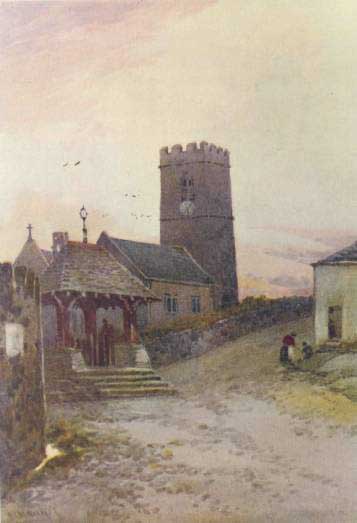 Morthoe
Kingsley remarks that 'an agricultural people is generally as cruel to wrecked seamen as a fishing one is merciful,' and speaks of the many stories he has heard of 'baysmen' on this coast 'risking themselves like very heroes to save strangers' lives, and at the same time beating off the labouring folk who swarmed down for plunder from the inland hills.'
Retracing the way to Northam Burrows, passing through them to their most northerly point, and crossing the Taw, one arrives at a strip of shore—Braunton Burrows—which corresponds to the strip on the southern bank of the river.
'A great chaos of wind-strewn sand-hills,' inhabited by armies of rabbits, and haunted by peewits and gulls, the Burrows are brightened by masses of wild-flowers, from the great mullein—once known as hedge-taper, because of its pale torch of blossoms—to the tiny delicate rose-pink bells of the bog-pimpernel. 'To the left were rich, alluvial marshes, covered with red cattle sleeping in the sun, and laced with creeks and flowing dykes.... Beyond again [looking back to the south] two broad tide-rivers, spotted with white and red-brown sails, gleamed like avenues of silver ... till they vanished among the wooded hills. On the eastern horizon the dark range of Exmoor sank gradually into lower and more broken ridges, which rolled away, woodland beyond woodland, till all outlines were lost in a purple haze; while far beyond the granite peaks of Dartmoor hung like a delicate blue cloud, and enticed the eye away into infinity.'
In the midst of the sand-dunes are the remains of a little, very old chapel, St Anne's Chapel, which is said to have been built by St Brannock. North of the Burrows the land rises into cliffs, on which grew (I hope, grows) the great sea-stock; and Baggy Point, at the southern end of Morte Bay, runs out into the sea. Beyond the Point, the broad yellow line of Woolacombe Sands stretches along the bay towards Morte Point.
Not far off was the manor of the Tracys, Woolacombe Tracy. A curse was brought on this family by William de Tracy, 'first and forwardest of the knights who murdered Thomas a Becket.' For, 'the Pope banning, cursing, and excommunicating,'[Pg 222] a 'Miraculous Penance' was imposed on the Tracys, 'that whether they go by Land or Water, the Wind is ever in their faces.' Fuller, who gives this information, concludes dryly: 'If this was so, it was a Favour in a hot Summer to the Females of that Family, and would spare them the use of a Fan.' On William de Tracy himself fell the special curse, that ever after his death he should be compelled to wander at night—some say over Woolacombe Sands, others among Braunton Burrows—till he could make a rope of sand. But, whenever the rope is nearly woven, there comes a black dog, with a ball of fire in his mouth, and breaks it; so the penance is never at an end. Shrieks and wails have been heard by people in cottages near the shore. Sometimes the uneasy spirit haunts the northern landing-place of the ferry from Braunton Burrows to Appledore, and a wild, long-drawn cry of 'Boat ahoy!' comes ringing in the darkness over the waters. No one answers that cry now after dusk, for once, many years ago, the ferryman, who is well remembered among the Appledore people, went over, and no man was there, but the black dog jumped into the boat. The ferryman, not much liking this, put back again as fast as he could, but when Appledore was nearly reached the dog swamped the boat, made his way to shore, and was lost in the shadows of Northam Burrows. 'And the boatman's nerve was so much shaken that soon afterwards he gave up the ferry.
A monument to William de Tracy was wrongly supposed to lie in the church of Morthoe, or Morte, as it is more commonly called, on the north of the bay. The memorial is of another William de Tracy, rector here till his death in 1322. It is an elaborately sculptured altar-tomb, and bears the incised effigy of a priest; on the sides are figures of St Catherine and St Mary Magdalene, to whom jointly the rector founded a chapel in his church. The church is mainly Perpendicular, but it has an Early English chancel.
The northern curve of the bay ends in Morte Point, and here is a cromlech in ruins, for the massive slab of rock which formed the cover-stone has fallen from the upright stones on which it used to lie.[Pg 223]
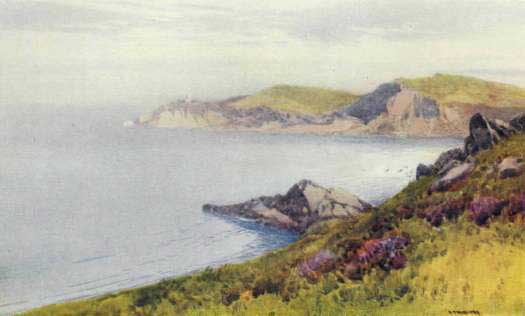 Bull Point: Morthoe
Beyond the point, at the end of the reef, is a huge rock called the Morte Stone, very dangerous on that exposed coast. The Normans are supposed to have given its sinister name, and many since their time have found it a true rock of death. No fewer than five vessels have been lost there in one winter. Rather more than a mile to the north, Bull Point, jutting out into the sea, abruptly ends the coast-line on the north; the cliffs fall back slightly, and stretch away eastward, above 'black fields of shark's-tooth tide-rocks, champing and churning the great green rollers into snow.'
Returning to the Taw, inland, upon the eastern side of the Burrows, one passes Braunton, two or three miles short of the estuary. The most interesting point about this village is its association with its name-saint, St Brannock—for the ancient name was Brannockstown. Old writers rather wildly assert that the saint was the son of a 'King of Calabria,' but Mr Baring-Gould, in a rapid sketch, says that he was the Irish confessor of a King of South Wales, who, not finding happiness in the life he was leading, migrated to North Devon. The legends that sprang up about his name are steeped in a golden haze. When St Brannock arrived, the whole place was 'overspread with brakes and woods. Out of which desert, now named the Borroughs (to tell you some of the marvels of this man), he took harts, which meekly obeyed the yoke,' and made them 'plow to draw timber thence to build a church, which may gain credit if it be true.' The caution of this commendation is delightful. More, alas! we do not learn, for the writer forbears 'to speak of his cow (which being killed, chopped in pieces, and boiling in the kettle, came out whole and sound at his call), his staff, his oak, and his man Abel, which would seem wonders. Yet all these you may see at large, lively represented to you in a fair glass window.' It is very disappointing that the window filled with the further wonders, the very names of which have a charm, should have perished.
St Brannock Church is large, and, like Morte Church, is partly Perpendicular and partly Early English. It has an unusually wide panelled roof, and on one of the panels is carved a sow and[Pg 224] some little pigs—an illustration of a legend connecting the saint with the church, for the tradition ran that he had been told in a dream to build his church 'wherever he should first meet a sow and her family.' A similar group is to be seen in the porch of the church at Newton St Cyres. Some of the bench-ends in St Brannock's Church are very beautifully carved.
The road to Barnstaple, bending to the south-east, follows the estuary of the Taw for nearly six miles.
The town is very prettily placed, but it is dominated by modern buildings, and has not the air of antiquity with which its history might have invested it. The river sweeps round a bend of a green and pleasant valley just above the town, and along the strand is a walk shaded with trees, looking over the river to a pastoral country beyond. Nearer the bridge is Queen Anne's Walk, 'an open portico near the river, called the Quay Walk, being an exchange of the merchants, etc.,' renamed when it was rebuilt in Queen Anne's reign. From the bridge westward the scene has an air of peaceful contentedness. Sea-gulls flutter among the sand-banks, from which 'the sea retires itself' at low-tide, leaving only a small, shining stream, which seems 'to creep between shelves and sands.' Beyond are green marshes, and gentle rounded hills behind them lead on one from another. The country is much the same all along the river to the sea.
Bideford is proud of its bridge, which is very high, and has sixteen arches. Several people have been given the credit of building it, and its date is supposed to be some time during the thirteenth century.
The church, dedicated to St Peter and St Paul, is cross-shaped, and the lead steeple looks well against the sky, especially when it is surrounded by a shoal of swallows swooping and darting about it in all directions. The church has been much restored, and altered from the original building; evidently there were once three altars in it; and a piscina still remains in the south aisle, close to the west wall of the transept. A curious monument was erected in 1634 by Martin Blake, the Vicar, to his son and four children who died very young. A heavy[Pg 225] and elaborate framework surrounds a severe likeness of a melancholy-looking man, who is resting his head on his hand. On the monument are short detached sentences, numbered:
'1. He was cut off in the flower of his life.
'10. His heart on fire for the love of God.
'11. Martin Blake, the Father, was taken from the Pulpit, and sent to Exeter jail for four years.
'12. The Pulpit empty, and the congregation waiting for him.
'13. He wishes to depart this life, and be at peace with his children.
'14. But it is necessary I should remain in the flesh for the good of my people.
'15. He that shall endure to the end shall have a crown of life.'
Mr Blake suffered much during the Civil War, but I can find no record of any imprisonment beyond his being in 1657 'a prisoner at large in Exeter for six weeks.' In 1646 he was petitioned against on account of his Royalist sympathies, 'by one Tooker,' to whom he had shown great kindness, and who intrigued against him in the most abominable manner. Though Sir Hardress Waller wrote to the Committee of sequestrations on his behalf, he was suspended, and as about a year later his suspension was cancelled, the infamous Tooker very hurriedly concocted a petition, ostensibly from Barnstaple, praying that the 'Discharge' might be repealed. Walker comments on the astonishing speed with which Tooker managed this business. 'The Reader ... will certainly think, as I do, that he who walked to and fro in the Earth, helped them to it; tho' not in the Quality of a Courier, but in his other Capacity, that of the Father of Lies.' Mr Blake, however, was allowed to return to his living, but 'not without the cumbrance of a Factious Lecturer,' and was not in full possession till after the Restoration.
Barnstaple asserts that it became a borough at a very early date—in fact, that it 'obtained divers liberties, freedoms, and immunities from King Athelstan'; but whether this were so or[Pg 226] not, the inhabitants certainly received a charter from Henry I, and further privileges were added by King John. The barony of Barnstaple, first granted to Judhael de Totnes, passed to the Tracys, then by marriage to the Lords Martin, and again by an heiress to the Lords Audley. The son of this heiress was the 'heroical' Lord Audley who so greatly distinguished himself at the Battle of Poitiers.
Barnstaple sent three ships to join the fleet that met the Armada. Risdon calls it 'the chief town of merchandise next the river's mouth,' and says that the people 'through traffic have much enriched themselves,' although their haven is so shallow 'that it hardly beareth small vessels.' Yet spring-tides sometimes flood the marshes all round, and on one occasion some of the people 'to save their lives were constrained from their upper rooms to take boat and be gone.' Westcote speaks of it as trading especially with 'Spain and the islands,' and till the latter half of the eighteenth century wool for the serge-makers from Ireland and America was brought to this port; but its trade has now almost dwindled away.
Barnstaple Fair is a great institution, and, though not quite the event that it used to be, still keeps up many traditional ceremonies. On the first morning a large stuffed glove is put out on the end of a pole from a window of the Guildhall, and is supposed to be the symbol of welcome to all comers. This sign was adopted long ago, and in the accounts in 1615 and 1622 are two entries: 'Paid for a glove put out at the fair, 4d.,' and 'Paid for a paire of gloves at the faire, 4d.'
In the Guildhall, toast and spiced ale are handed round in loving-cups to all comers, and after two or three speeches the Mayor and Corporation proceed to the High Cross and other places in the borough, and the Town Clerk reads the Proclamation of the Fair. A 'Fair Ball' is still given, but the custom of a stag-hunt on the second day has been dropped.
Barnstaple was a sort of shuttle-cock during the Civil War. Here, as elsewhere, the citizens were not all of one mind; though the merchants and the majority were for the Parliament,[Pg 227] and it was taken possession of first by one side and then by the other.
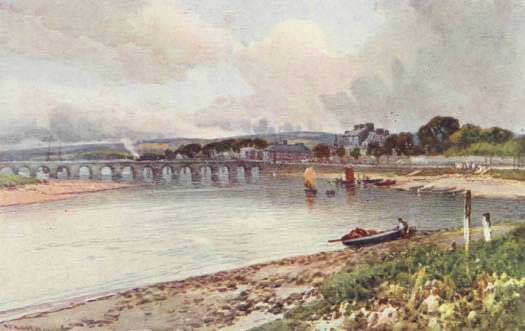 Barnstaple Bridge
In August, 1643, Barnstaple and Bideford sent a combined force against the royal troops under Colonel Digby at Torrington, but being completely routed, their courage was shaken, and a few days later Barnstaple was surrendered to Prince Maurice. The next year, however, most of the garrison having been drawn away, the inhabitants arose and took possession of the town for the Parliament. Prince Maurice hurriedly sent Colonel Digby to bring them to reason, but with great determination they resisted the Royal troops, who were driven back. During the next three months the fortunes of the Parliament in the West were at a very low ebb, and in September the town was summoned by Lord Goring. The store of ammunition was very low, and as soon as they were blockaded, the townspeople found themselves short of provisions. 'At that time but weakly garrisoned, the town surrendered on terms, and the garrison quitted it on the 17th, leaving 50 pieces of ordnance.'
In the following May the Prince of Wales arrived, for, says Clarendon, 'no place was thought so convenient for his residence as Barnstaple, a pleasant town in the north part of Devonshire, well fortified, with a good garrison in it, under the command of Sir Allen Apsley.' The King sent orders to the Prince, who at this time was little more than fifteen years old, 'by the advice of his council, to manage and improve the business of the West, and provide reinforcements for the army.' The Prince's council had no easy task, for they were harassed by several causes. Lord Goring's jealousy and selfishness were a great hindrance; in consequence of a petition regarding the violence of his horse, the Prince, says Clarendon, 'writ many earnest letters to the Lord Goring.' Another great difficulty to be grappled with here was a fierce quarrel between Sir Richard Grenville and the Commissioners of Devon and Cornwall, who complained of him in such bitter terms, that anyone who judged from their report must have concluded him to be 'the most justly odious to both counties that can be imagined.'[Pg 228]
Prince Rupert paid the Prince a visit in June, and not long afterwards Lord Goring's horse arrived in hot disorder, having been chased most of the way from Bridgwater by Fairfax's troops. In the following spring the town was besieged by the Parliament's troops, and the day after the treaty for the surrender of Exeter was completed, Fairfax himself marched to Barnstaple. The Governor, seeing that resistance was hopeless, gave 'the castle and the town ... as a security for surrender of the fort at eight days' end'; and on honourable terms Barnstaple yielded to the enemy. It was the last town in Devonshire to be delivered to the Parliament.
About two miles upstream the river 'Taw vails bonnet to Tawstock, in our ancestors' speech,' says Westcote, and he goes on to describe it as 'a pleasant and delicate seat indeed, in a rich soil, and inhabited by worthy personages.' The modest claim has been put forward that the view here includes 'the most valuable manor, the best mansion, the finest church, and the richest rectory, in the county.' Possibly other parishes may not agree with all the superlatives, but the beautiful features of the valley certainly offer a temptation to use them.
Tawstock Court was once the property of the Earls of Bath, and now belongs to their descendant, Sir Bourchier Wrey. An Elizabethan gateway is all that is left of the old house, which was burnt down, and rebuilt in 1787. The beautiful cruciform church is chiefly Decorated, but parts are of a later date; it is dignified by a fine central embattled tower, crowned by pinnacles. In the church are several altar-tombs to the Bourchiers, Barons Fitzwarine and later Earls of Bath, and to their wives, and there is a very early effigy carved in wood.
Leaving the Taw and crossing the country to the south, and a little to the west, one reaches the Torridge, and Torrington, a town 'built scatteringly, lying at length, as it were, upon the brow of a hill hanging over the river.' It is, perhaps, chiefly known as the scene of a skirmish and an engagement during the Civil War. The skirmish, already mentioned, took place when the Parliament's partisans set out from Barnstaple and Bideford to attack Colonel[Pg 229] Digby, who, with a small force, had established himself there. It was indeed a case of fortune favouring the bold, for the Royalists were taken unawares, and had it not been for the daring of 'the Colonel, whose courage and vivacity upon action was very eminent, and commonly very fortunate,' the day might well have been with the other side. Colonel Digby had divided a small number of horse into little parties in different fields, and was waiting for some of his troops to join him before attacking the enemy, when a band of about fifty Parliamentary musketeers came towards the ground where they stood. Realizing that, if these once gained possession of the high banks between the two forces, his party must be driven off, Colonel Digby, with instant decision, took four or five officers with him, and charged with such vigour that the raw country troops, smitten with panic, threw down their arms and ran, 'carrying so infectious a fear with them, that the whole body of troops was seized by it and fled.' Colonel Digby followed, with all the horse at his disposal, 'till,' says Clarendon complacently, 'their swords were blunted with slaughter.' Perhaps the Royalists were more anxious to impress a salutary warning against the sin of rebellion than to kill the fugitives, for Clarendon finishes the account by saying that the rebels 'were scattered and dispersed all over the country, and scarce a man without a cut over the face and head, or some other hurt, that wrought more upon their neighbours towards their conversion, than any sermon could be preached to them.' This affair practically brought about the submission of Barnstaple, Bideford, and Appledore.
The second engagement was of a far more important character, with fatal consequences to the King's cause in the West—already in a hopeless condition. In the early spring of 1646, Lord Hopton marched to Torrington, and was waiting there for the arrival of about half his ammunition and provisions, when he heard that Sir Thomas Fairfax, with a large army, was in the immediate neighbourhood. To the best of his power, he hurriedly made such defences as were possible. His position was excellent, for Torrington stands on a hill almost surrounded by deep valleys,[Pg 230] but his force was very inferior in numbers to that of the enemy. It is curious that the second engagement at Torrington began accidentally. Fairfax's army had had a series of encounters with an outlying troop of Royalist dragoons on approaching the town, and by the time they drew near the day was nearly spent. As the Royalists were well prepared for their arrival, the lanes and fields near the town being lined with musketeers, the Parliamentary Generals resolved to stay at a little distance and wait for the morning to attack. The Royalist word for the night was, 'We are with you,' and their sign, that each man had a handkerchief tied round his right arm. The word for the other army was, 'Emmanuel, God with us,' and their signal, a sprig of furze in every hat.
 Torrington
About nine o'clock a noise in the town suddenly awoke the suspicion that the Royalists were retreating, so, says Sprigg, 'that we might get certain knowledge whether they were going off or not, a small party of dragoons were set to fire on the enemy near the barricadoes and hedges; the enemy answered us with a round volley of shot.' Whereupon the engagement became general, and both sides fought 'in the dark for some two hours, till we beat them from the hedges and within their barricadoes, which were very strong, and where some of their men disputed the entrance of our forces with push of pike and butt-end of musket for a long time.' At length the Parliamentary troops prevailed, and their horse 'chased the enemy through the town.' Lord Hopton, bringing up the rear, had his horse shot dead under him in the middle of the town, but, in spite of the fact that he was slightly wounded, he made yet another effort to rally his troops, and they, 'facing about in the street, caused our foot to retreat.' Then a body of horse dashed up with a vehemence that the Royalists could not stand against, and they were obliged to fly; 'one of the officers publicly reporting,' says Clarendon bitterly, 'lest the soldiers should not make haste enough in running away, that he saw their general run through the body with a pike.'
Scarcely were the Parliamentarians in possession of the town,[Pg 231] when a frightful explosion occurred. The church, which unknown to them, Lord Hopton had used as a powder-magazine, was blown up and about two hundred prisoners whom the Roundheads had confined in the church were killed. In his account of the disaster, Sprigg, who was obviously, from passages in his writings, a man of warm feelings, and a clergyman by profession, refers very cheerfully to the fact that 'few were slain besides the enemy's (that were prisoners in the church where the magazine was blown up), and most of our men that guarded them, who were killed and buried in the ruins,' and not for one moment does the melancholy fate of the many victims seem to damp his joy.
The victory was a very important one, and a public thanksgiving was held in consequence—indeed, this was the last real resistance made by the Royalists in the West.
The church has been very unfortunate, for since it was rebuilt in 1651 the tower has been blown down, and it fell through the roof, doing a good deal of damage. An old print shows this tower to have been a wonderful erection of slates and tiles, projecting eaves, and irregular gables, surmounted by a little dome, with a weathercock on the top of all. It was replaced by a slender, tapering, but more conventional spire.
Margaret, Countess of Richmond, and mother of Henry VII, lived here for some time, and left a generous gift, for, 'pitying the long path the pastor had from home to church,' she 'gave to him and his successors the manor-house with lands thereto': and on this site of the manor-house stands the present vicarage. Besides making this gift, 'on every occasion a friend to learning, even in its infancy, she built a room for a library, and furnished it with the most useful books then to be had.'
Torridge Castle, a building of the fourteenth century, stood on the verge of a steep descent to the river. In Risdon's day it was almost gone, the ruins had 'for many years hovered, which, by extreme age, is almost brought to its period;' and in 1780 the chapel, the only part left, was partly pulled down and afterwards turned into a school.
About a mile or so to the east stands Stevenstone—a new house,[Pg 232] in the midst of a fine deer-park. For over three centuries Stevenstone was owned by the Rolles, and when Fairfax's troops advanced on Torrington, two hundred dragoons were being entertained by 'Master Rolls,' and the advance was disputed by these dragoons, who, after a long and straggling fight in the narrow and dirty lanes, eventually fell back on the town. Here Fairfax took up his quarters after the town had been taken.
A few miles upstream the Torridge passes Potheridge, the birthplace of General Monk, whose ancestors had owned property here since the reign of Henry III.
The character of George Monk is extraordinarily interesting, a curious point being that, though he was essentially cautious, level-headed, and, as Clarendon says, 'not enthusiastical,' and therefore unlikely to rouse very vivid sentiments in others, as a matter of fact he awoke violent feelings either of glowing enthusiasm or of extreme bitterness. It is easy to understand his unpopularity with keen partisans who looked on their opponents and all their ways with abhorrence, and therefore failed to understand how an honest man could fight for the King, then accept a command from Cromwell, and finally become the prime mover of the Restoration. But—'If a man does not keep pace with his companions, perhaps it is because he hears a different drummer'; and it may well be that the beat that ruled Monk's steps was the peaceable government and welfare of the people, and especially of the army, and to the personal claims and rights of the rulers he was indifferent. The general state of things needed reform badly enough. Monk's acts were never inconsistent, but he had a genius for silence. When war in England broke out, he returned from fighting for the King in Holland, to fight for him at home. When Cromwell offered him his release from the Tower, at the price of helping to subdue the Irish rebels, his accepting the command was to the advantage of this country.
To begin with, Monk was forced to turn soldier with unexpected suddenness. The Under-Sheriff of Exeter publicly affronted Sir Thomas Monk, on which his son, aged sixteen, went to Exeter and gave the offender 'the chastisement he deserved (without[Pg 233] any intention of murder).' This step created a good deal of disturbance, and to avoid more, 'our young gentleman' was packed off to 'the School of War in the Low Countries.'
He was taken prisoner early in the Civil War, and after over two years of close imprisonment, agreed to accompany the Lord Deputy Lisle to Munster. After leaving Ireland he gained brilliant successes at sea over the Dutch. Prince tells a tale that is characteristic of him and of Cromwell. The seamen who had served under Monk had been told that they should receive their full pay as soon as the prizes were sold off, but were unreasonably impatient; and while Monk was actually at Whitehall putting their claims before the Protector, news was brought him 'that three or four thousand seamen were come as far as Charing Cross with swords, pistols, and clubs, to demand their pay. General Monk, thinking himself wronged in this, ran down to meet them, drew his sword, and fell upon them; Cromwell following with one or two attendants, cut and hew the seamen, and drove them before him.' Prince finishes the story with applause of the boldness that 'should drive such great numbers of such furious creatures as English seamen.' Later, Monk's command in Scotland resulted in a state of order and quietness then very unusual in that country.
Accusations of dealing unfairly with the Parliament in 1659 may be levelled against him with some justice, but how was loyalty possible to a household so divided against itself as were the rulers of the Kingdom? The Army and the Parliament were in bitter antagonism to each other, and Lambert's soldiers had shut the Parliament out of Westminster. The members of the Rump Parliament, the earlier 'secluded' members, the Presbyterians, the Independents under Lambert, the Royalists, and smaller parties, were all working for their own ends. When Monk marched south, a deputation was sent to meet him from the Council of Officers, ostensibly to make terms between their army and his, but also with the secret object of establishing an understanding between him and Fleetwood that would enable the latter to get rid of his friend and colleague, General Lambert.[Pg 234] Meanwhile Lambert, jealous of Fleetwood, sent a private and friendly message to Monk by Major-General Morgan, who not only betrayed his party at Lambert's bidding, but betrayed that patriot as well, for at the same time that he gave the message, he also delivered a secret letter from Lord Fairfax, begging Monk to adopt a course which would have been fatal to Lambert. And the country as a whole was heartily sick of both factions.
Had Monk openly declared himself for the Stuarts, at the time that he first began to prepare for the Restoration, he would probably have imperilled the success of the whole scheme, and most certainly would have plunged the country again into the horrors of Civil War. When he did reveal his negotiations with the exiled Court at Breda, 'London would not have borne many days, or even many hours longer, the extreme tension it was then suffering—the City one way, Westminster the other way; Monk's army between them, and Fleetwood's wolves prowling all round, and ready to pour in.'
Apart from all else, tribute must be paid to Monk's marvellous skill in so ordering affairs that the Restoration was brought about almost without the cost of a drop of blood. During the winter of 1659, a far larger army than his own lay for many weeks a few miles to the south on the Border, sent there with the especial purpose of watching and if necessary attacking him. But Monk knew how to bide his time and to prolong negotiations to suit his convenience till in the end, without a blow being struck, he marched his army south to London. Masterly was the diplomacy and grasp of detail which, on the eve of announcing the Restoration, dispersed over the country all soldiers who would be inclined to stand by the Parliament, making any serious attempt at a revolt on their part impossible.
One failing his most fervent admirer cannot ignore—a strong leaning to avarice. But his popularity was unbounded, and 'it was his singular fortune to win in succession the affection of three very different populations, those of Dublin, Edinburgh, and London.' In Ireland his men were devoted to him. 'A soldier,[Pg 235] tho' sick and without shoes, would strive to go out with honest George Monk.' After the death of Cromwell he was offered the crown, but he refused, 'holding it a greater honour to be an honest subject than a great usurper.'
During the frightful visitation of the Plague, the Earl of Craven, and the Archbishop of Canterbury and Monk, were the only high officials who stayed at their posts, and exposed themselves perpetually to the 'seeds of death.' So great was the public confidence in him, that at the time of the Great Fire, he being then at sea, 'the people did believe and say: "If he had been there, the city had not been burned."' No idol of the mob could ask a more whole-hearted adoration.
The popular feeling is expressed in a rather limping acrostic on his name, of which I quote only the first quarter. It was called 'England's Heroick Champion, or The ever-renowned General George Monck.' The date is about 1659-60.
| 'G | ood may'st thou be, as thou are great. |
| E | ver regarded. |
| O | r like Alexander compleat, |
| R | ichly rewarded. |
| G | ainst thy virtue none dare stand, |
| E | xcluded Members now are |
| Back return'd by thy hand. | |
| 'M | any miles didst thou compass, |
| O | nly us to free; |
| N | othing by thee too hard was, |
| C | ompared to be. |
| K | eep us in thy protection! |
| We were all greatly distrest; | |
| Bring thou in all the best. | |
| 'G | reat bonfires then was made, |
| E | xpressing joy, |
| O | f us that sorrow did invade, |
| R | efresh our annoy. |
| G | uard us with thy aid, we desire; |
| E | xaltation we all will raise |
| Unto heaven in thy praise. | |
| 'M | uch good hast thou already done, |
| O | ver this land; |
| N | ow our hearts thou hast quite won: |
| C | ommand! Command! |
| K | indly we will entertain |
| Those that were excluded, | |
| For they have not intruded.' |
In later years, as Duke of Albemarle, he returned to the estate of his forefathers, and rebuilt Potheridge in a very magnificent manner. It has since been pulled down.
If the traveller follows the Torridge upstream, he will be led south till he is within two miles of Hatherleigh, and here the river curves away westwards, and then in a northerly direction. In the spring, this clear, rippling stream has a special charm—thousands and thousands of daffodils grow along the banks though only sparingly in the fields beyond, so that, if the river happens to be low and the water not to be seen at a little distance, the windings of the river through the wide green valley are marked by two broad lines of pale, clear yellow.
Hatherleigh Moor was given a bad name very long ago. The saying is double-edged:
But the people of the little town are able to graze their cattle and cut furze for fuel on it. Hatherleigh parish has two holy wells. St John's Well stands on the moor, and there used to be a pretty custom of fetching its water for a baptism. The water of St. Mary's Well was good for the eyes, and within the memory of persons still alive pagan traditions were observed around it on Midsummer Eve. Amidst 'wild scenes of revelry ... fires were lit, feasting and dancing were indulged in.'
For some years, in this part of the country, while he was curate to his father, who had the neighbouring living of Iddesleigh, the renowned 'Jack' Russell preached on Sundays and hunted on weekdays. He was immensely popular, and so many stories are told of him and his hounds that it has been already said,[Pg 237] 'Russell is fast becoming mythical.' He was not the ideal of a modern parish priest, but this is the opinion of one who remembers him. The writer begins by speaking of a friend of Russell's as a man who 'seems ... to have been as good a Christian as he was a gentleman; not ecstatic perhaps, but in the sense of leading a godly, righteous and sober life. And,' he goes on, 'the same may with certainty be predicated of Russell ... Russell, like a wise man, got right home to Nature. It was not for nothing that the gipsy chieftain left him his rat-catcher's belt, and begged for burial at his hands in Swymbridge churchyard.'
Perhaps the following story of him is not quite so well known as many others:
Mr Russell once advertised for a curate: 'Wanted, a curate for Swymbridge: must be a gentleman of moderate and orthodox views.'
Soon after this advertisement had appeared Mr Hooker, Vicar of Buckerell, was standing in a shop door in Barnstaple, 'when he was accosted by Will Chapple, the parish clerk of Swymbridge, who entered the grocer's shop. "Havee got a coorate yet for Swymbridge, Mr Chapple?" inquired the grocer, in Mr Hooker's hearing. "No, not yet, sir," replied the sexton. "Master's nation purticler, and the man must be orthodox." "What does that mean?" inquired the grocer. "Well, I reckon it means he must be a purty good rider."
Here we must leave the Torridge altogether, and go eleven miles south-east to the point where the Taw leaves the uplands of Dartmoor. Almost the first village that the river passes is South Zeal, close to South Tawton, and near South Zeal was the old home of the Oxenhams, the family about whom the well-known legend of the white bird is told. When an Oxenham is about to die, a white bird flaps at the window or flies about the sickroom, and stories of the bird having been seen at such times have been told at intervals, through two centuries. The evidence in some instances seems fairly good, but where an apparition is expected it is not unlikely imagination may play tricks, or a chance event may be interpreted as an omen.[Pg 238]
Lysons quotes from Mr Chapple's manuscript collections a case that happened in 1743, the story being given to Mr Chapple by the doctor. Mr William Oxenham was ill, and 'when the bird came into his chamber, he observed upon the tradition as connected with his family, but added he was not sick enough to die, and that he should cheat the bird, and this was a day or two before his death, which took place after a short illness.'
It is necessary to pass over thirteen or fourteen miles, but at Chumleigh one must turn aside to the east, for about six miles in that direction was the ancient home of the Stucleys. Affeton Castle has been for many years altogether in ruins, but in the middle of the last century Sir George Stucley roofed over the old gate-house and made it habitable as a shooting-box. This is the only part of the castle still standing, though the farmhouse close by is no doubt built upon some of the foundations. 'Lusty Stukeley' (the name was spelt in several ways) was far from among the worthiest of his family, but distinctly the most entertaining. His ideas were certainly 'spacious' enough for the great days in which he lived, though he was too crack-brained and full of self to fall into line with his betters, whose deeds still bear rich fruit. 'He was,' says Fuller severely, 'one of good parts, but valued the less by others, because over-prized by himself.'
If it be allowed that the personality of everyone inclines to being drab or flamboyant, his may be compared to fireworks. Thomas Stukely, who was born about 1530, was for a younger brother unusually well endowed, 'but his profluous prodigality soon wasted it; yet then, not anyway dejected in mind, he projected to people Florida, and there in those remote countries to play rex.' He 'blushed not' to tell Queen Elizabeth 'that he preferred rather to be sovereign of a mole-hill than the highest subject to the greatest king in Christendom.' His audacity reached the point of bandying words with the Queen, who seems, from the polite irony of her tone, to have been amused by his vanity.
'I hope,' said the Queen, 'I shall hear from you when you[Pg 239] are stated in your Principality?' 'I will write unto you,' quoth Stuckley. 'In what language?' said the Queen. He returned, 'In the stile of Princes, To our dear Sister.'
And on this Stukely departed, but not to Florida, for he met with reverses which dashed his plans, but not his spirits. Westcote quotes 'a ditty made by him, or of him,' apparently at this time:
Unfortunately, his career was a great failure. From sunning himself at the Court of Elizabeth, he turned to paths of disloyalty, and became the 'Pope's pensioner.' The Pope created him Marquis of Leinster, and added several minor titles, and then this 'Title-top heavy General' attempted in vain to carry treasonable help to the Irish rebels. Yet he had 'the fortune to die honourably.' Arrived in Lisbon at the moment when the King of Portugal was starting in a campaign to Barbary, Stukely was persuaded to join his army, and fell, fighting gallantly, at the Battle of Alcasar, 1578.
About five miles to the north, at King's Nympton, the Pollards were settled for some generations, and many of them 'lived to be as proper gentlemen as most in this or any other county.' Sir Hugh Pollard fought in the Civil War, and as Governor of Dartmouth Castle made a brave and resolute though unsuccessful defence. After the Restoration, Charles II appointed him Comptroller of the Household. It was said of Sir Hugh 'that he was very active and venturous for his Majesty in the worst of Times, and very hospitable and noble with him in the best.'[Pg 240]
Five miles north of Bishop's Nympton is the old town of South Molton, and the manor was part of the demesne of Edward the Confessor. In the reign of Edward I, Lord Martin held it 'by sergeantry to find a man with a bow and three arrows to attend the Earl of Gloucester when he goeth to Gower [in Wales] to hunt.'
In the spring of 1654, Charles II was proclaimed King in South Molton, for the Wiltshire gentlemen who had risen against the Government, headed by Sir Joseph Wagstaff and led by Colonel Penruddock and Mr Hugh Groves, made their way so far west before they were overpowered. Sir Joseph escaped, but the other two leaders were beheaded at Exeter.
A little to the north of the town, and about eight miles south of Barnstaple, are the wide grounds of Castle Hill—broad lawns and slopes, clear streams, and rich feathery masses of woodland that, shaded and softened by distance, spread far away.
The Fortescues, not long after the Conquest, were granted lands in Devonshire, and in one generation after another they have come forward to take a part in public affairs—often a Samson's share of toil. Sir John Fortescue fought at Agincourt, and was chosen Governor of Meaux by Henry V. Sir Edward Fortescue, when he had surrendered Salcombe Castle, had the consolation of knowing that this fort had been held for the King later than any other place in Devonshire. Sir Faithful and Sir Nicholas Fortescue were distinguished commanders in the same war. In the reign of Henry VI, Sir Henry Fortescue was Lord Chief Justice of Ireland, though his fame is very much eclipsed by the greater brilliancy of his brother.
Sir John Fortescue, Lord Chief Justice, is usually spoken of as Lord Chancellor, though it is doubted whether he ever received a valid appointment; for when the honour was bestowed upon him, Yorkists and Lancastrians were already at war. As the trouble deepened, Sir John laid aside his robe for his sword, and fought bravely for the 'falling cause' in the terrible battle of Palm Sunday. Later, he accompanied the King and Queen in their flight, and while abroad, with courageous optimism, began to[Pg 241] instruct the Prince in the 'lawes of his country and the duties of a King of England.' Of Sir John's two celebrated treatises—De Natura Legis Naturæ, and De Laudibus Legum Angliæ—the latter and most famous was specially compiled for the benefit of the Prince, and Sir Edward Coke has enthusiastically declared it 'worthy to be written in letters of gold for the weight and worthiness thereof.'
A Fortescue of a later generation who 'took to the law,' eventually became Master of the Rolls. He was a great friend of the poet Pope, and from the gentle mockery in some of the long letters of the poet still in existence, it would seem that Mr Fortescue had a proper share of prejudice in favour of his own county. In 1724 Pope writes: 'I am grieved to tell you that there is one Devonshire man not honest; for my man Robert proves a vile fellow, and I have discarded him.' And in another letter, nearly ten years later, in March, 1734-35: 'Twitnam is very cold these easterly winds; but I presume they do not blow in the happy regions of Devonshire.'
Sir John Fortescue, born in 1533, had the honour of being chosen 'Preceptor to the Princess Elizabeth.' Later he was appointed Keeper of the Great Wardrobe; whereupon it was remarked that Sir John Fortescue was one whom the Queen trusted with the ornaments of her soul and body. 'Two men,' Queen Elizabeth would say, 'outdid her expectations,—Fortescue for integrity, and Walsingham for subtlety and officious services.'
Towards the end of the eighteenth century a member of one of the branches of Fortescues who settled in Ireland was created Lord Clermont. He was very much liked by the Prince of Wales, and both Lord and Lady Clermont were a great deal at Court. In Wraxall's 'Posthumous Memoirs' there is an amusing account of an evening spent by Lady Clermont in launching into London society the Count Fersen who was noted for his devotion to Marie Antoinette. Already 'Swedish Envoy at the Court of France,' he had arrived in England, 'bringing letters of introduction from the Duchesse de Polignac to many persons of distinction here, in particular for Lady Clermont. Desirous to present[Pg 242] him in the best company, soon after his arrival she conducted him in her own carriage to Lady William Gordon's assembly in Piccadilly. She had scarcely entered the room and made Count Fersen known to the principal individuals of both sexes, when the Prince of Wales was announced. I shall recount the sequel in Lady Clermont's own words to me, only a short time subsequent to the fact. "His Royal Highness took no notice of me on his first arrival, but in a few minutes afterwards, coming up to me: 'Pray, Lady Clermont,' said he, 'is that man whom I see here Count Fersen, the queen's favourite?' 'The gentleman,' answered I, 'to whom your royal highness alludes is Count Fersen; but so far from being a favourite of the queen, he has not yet been presented at Court.' 'D——n!' exclaimed he, 'you don't imagine I mean my mother?' 'Sir,' I replied, 'whenever you are pleased to use the word "queen" without any addition, I shall always understand it to mean my queen. If you speak of any other queen, I must entreat that you will be good enough to say the Queen of France, or of Spain.' The Prince made no reply; but after having walked once or twice round Count Fersen, returning to me: 'He's certainly a very handsome fellow,' observed he. 'Shall I have the honour, sir,' said I, 'to present him to you?' He instantly turned on his heel, without giving me any answer; and I soon afterwards quitted Lady William Gordon's house, carrying Count Fersen with me. We drove to Mrs St John's, only a few doors distant, who had likewise a large party on that evening. When I had introduced him to various persons there, I said to him, 'Count Fersen, I am an old woman and infirm, who always go home to bed at eleven. You will, I hope, amuse yourself. Goodnight.' Having thus done the honours as well as I could to a stranger who had been so highly recommended to me, I withdrew into the ante-chamber and sate down alone in a corner, waiting for my carriage.
'"While there the Prince came in, and I naturally expected, after his recent behaviour, that he would rather avoid than accost me. On the contrary, advancing up to me: 'What are you doing here, Lady Clermont?' asked he. 'I am waiting for my coach,[Pg 243] sir,' said I, 'in order to go home.' 'Then,' replied he, 'I will put you into it and give you my arm down the stairs.' 'For heaven's sake, sir,' I exclaimed, 'don't attempt it! I am old, very lame, and my sight is imperfect; the consequence of your offering me your arm will be that, in my anxiety not to detain your royal highness, I shall hurry down and probably tumble from the top of the staircase to the foot.' 'Very likely,' answered he, 'but if you tumble, I shall tumble with you. Be assured, however, that I will have the pleasure of assisting you and placing you safely in your carriage.' I saw that he was determined to repair the rudeness with which he had treated me at Lady William Gordon's, and therefore acquiesced. He remained with me till the coach was announced, conversed most agreeably on various topics, and as he took care of me down the stairs, enjoined me at every step not to hurry myself. Nor did he quit me when seated in the carriage, remaining uncovered on the steps of the house till it drove off from the door."'[Pg 244]
 Lantern Rock: Ilfracombe
The charm of the coast-line of North Devon lies partly in its great irregularity. 'At one spot a headland, some five hundred feet high, rough with furze-clad projections at the top, and falling abruptly to a bay; then, perhaps, masses of a low, dark rock, girding a basin of turf, as at Watermouth; again, a recess and beach, with the mouth of a stream; a headland next in order, and so the dark coast runs whimsically eastward, passing from one shape to another like a Proteus, until it unites with the massive sea-front of Exmoor.' At the eastern ridge of the county, the hill on which Oldbarrow Camp stands rises more than eleven hundred feet straight out of the sea.
Ilfracombe's tiny bay is almost surrounded by rocks, but a pier was built by one of the Bourchiers, Earls of Bath, and his successors[Pg 245]—one Sir Bourchier Wrey after another—have improved and enlarged it. Westcote speaks of it as 'a pretty harbour for ships of small burden, but dangerous to come in in some winds, especially for strangers; for whose better security they keep a continual pharos to direct their course.' The lighthouse now stands on the Lantern Rock, at the mouth of the harbour, where once stood a little chapel dedicated to St Nicholas. The dedication explains its position, for St Nicholas was a sea-saint, whose protection used to be specially implored as a defence against shipwreck.
Nowadays Ilfracombe is of no consequence as a port, but six centuries ago it must have been of some importance, for when Edward III was besieging Paris it contributed six ships and eighty-two mariners to a fleet. Although the nucleus of the town is old, and indeed consisted only of one 'scattering street,' its development is very modern, and has happened since it became popular as a watering-place.
The architecture of the church is very varied. The tower is probably Norman, finished by Perpendicular battlements and pinnacles; it is built above the centre of the north aisle, and projects into the church. There are also remains of Transitional work, and in the chancel is a Decorated piscina.
Leading inland from Ilfracombe are 'lovely combes, with their green copses, and ridges of rock, and golden furze, fruit-laden orchards, and slopes of emerald pasture, pitched as steep as house-roofs, where the red long-horns are feeding, with their tails a yard above their heads.' About twenty-two miles to the west, the sea-line is broken by an island, about which there is an indefinable air of romance. Lundy is three and a half miles long, its greatest width is a few yards short of a mile, and it is surrounded by high and dangerous cliffs and rocks—too well known even in the present day by the ships wrecked on them. Perhaps those oftenest heard of are the reefs of the Hen and Chickens, 'fringed with great insular rocks, bristling up amid the sea,' which dashes on them in a never-ceasing cloud of foam on the north, and the fatal Shutter on the south-west. Lundy has been described as a 'lofty table-headed granite rock.... The cliffs[Pg 246] and adjacent sea are alive with seabirds, every ledge and jutting rock being alive with them, or they are whirling round in clouds, filling the air with their discordant screams.' Westcote remarked: 'In breeding time, in some places, you shall hardly know where to set your foot but on eggs,' and adds that it affords 'conies plentifully, doves, stares (which Alexander Nectan termeth Ganymede's birds).' Mr Chanter translates 'Ganymede's birds to be gannets, as there were very many of these birds there'; but an older commentator soars higher, and thinks of eagles and ostriches!
A description of Lundy as it was in the middle of the eighteenth century is dimly suggestive of Robinson Crusoe. 'Wild fowl were exceeding plenty, and a vast number of rabbits. The island was overgrown with ferns and heath, which made it almost impossible to go to the extreme of the island. Had it not been for the supply of rabbits and young sea-gulls our tables would have been but poorly furnished, rats being so plenty that they destroyed every night what was left of our repast by day. Lobsters were tolerably plenty, and some other fish we caught. The deer and goats were very wild and difficult to get at. The path to the house was so narrow and steep that it was scarcely possible for a horse to ascend it. The inhabitants by the assistance of a rope climbed up a rock in which were steps cut to place their feet, to a cave or magazine where Mr Benson lodged his goods.' There have been considerable differences of opinion about the name, and Mr Baring-Gould believes: 'Lundy takes its name from the puffins, in Scandinavian Lund, that at all times frequented it; but it had an earlier Celtic name, Caer Sidi, and is spoken of as a mysterious abode in the Welsh Mabinogion.'
Many centuries later it seems to have had the power of inspiring fabulous tales, for Miss Celia Fiennes, who looked at it in her journey from Cornwall, makes a statement almost as wonderful as some of Sir John Mandeville's tales of Barnacle Trees and other marvels. She says: 'I saw the isle of Lundy, which formerly belonged to my Grandfather, William Lord Viscount Say and Seale, which does abound with fish and rabbits and [Pg 247]all sorts of ffowles, one bird yt lives partly in the water and partly out and so may be called an amphibious creature; it's true that one foot is like a turkey, the other a goose's foote; it lays its eggs in a place the sun shines on and sets it so exactly upright on the small end, and there it remaines till taken up, and all the art and skill of persons cannot set it up soe againe to abide.'
Legends apart, Lundy has been the scene of many thrilling adventures, and has had an eventful history. The advantages of its position for watching and falling upon richly laden merchant ships on their way to and from Bristol and other towns, and the great difficulties that met any enemy trying to land, resulted in the island being appropriated by one band of pirates after another, of whom the De Moriscoes were the most celebrated. Henry II, getting tired of their turbulence and lawlessness, granted the island to the Knights Templars, but it does not appear they were ever able to establish themselves there. In 1158 the raids of the Moriscoes became so intolerable that a special tax was imposed in Devon and Cornwall for the defence of their ports, and for furnishing means for an attack on Lundy, but Sir William de Morisco seems to have triumphantly survived the storm. Later he was taken prisoner by the French in a sea-fight, but was eventually released.
Sir William, his son, was charged, upon the evidence of a semi-lunatic, with conspiring to assassinate Henry III, and on the strength of it was condemned to death—a sentence that, as he fled to Lundy, was not carried out for four years, when he was taken by stratagem. Lundy was then seized by the King, but forty years later the Moriscoes once more gained possession of it. Edward II granted the island to one of the Despencers, and in his own distress attempted to take refuge here:
But the winds were against him, and he was driven on to the Welsh coast, into the hands of his enemies.
During the reign of Henry VIII, French pirates seized the island, and plundered and robbed at large, but they were accounted for by the valour of Clovelly fishermen, who made a determined attack, and killed or made prisoners of the whole band. In 1608 a commission was held to consider the grievances of merchants who complained of piracy in the Bristol Channel; and in 1610 'another commission was issued to the Earl of Nottingham to authorize the town of Barnstaple to send out ships for the capture of pirates, and the deposition was taken of one William Young, who had been made prisoner by Captain Salkeld, who entitled himself "King of Lundy," and was a notorious pirate.' Two years later 'the John of Braunton and the Mayflower of Barnstaple caught as notorious Rogues as any in England.' After another thirteen years: 'The Mayor of Bristol reports to the Council that three Turkish pirate vessels had surprised and taken the island of Lundy with the inhabitants, and had threatened to burn Ilfracombe.' During an inquiry following this report, evidence was given that seems very curious when one considers the date, nearly halfway through the seventeenth century: 'From Nicholas Cullen, "That the Turks had taken out of a church in Cornwall about sixty men, and carried them away prisoners."'
French pirates made Lundy their headquarters three years later, and in June, 1630, Captain Plumleigh reported that 'Egypt was never more infested with caterpillars than the Channel with Biscayers. On the 23rd instant there came out of St Sebastian twenty sail of sloops; some attempted to land on Lundy, but were repulsed by the inhabitants.'
One of the most conspicuous of all Lundy's owners was a certain[Pg 249] Thomas Benson, merchant of Bideford, who, with great sang-froid and considerable humour, combined smuggling and piracy with being a member of Parliament. Unfortunately, his varied occupations after a while brought him to grief. Amongst other charges, it was proved that he had 'entered into a contract with the Government for the exportation of convicts to Virginia and Maryland, and gave the usual bond to the sheriff for so doing. But instead of doing this he shipped them to Lundy, where he employed them in building walls and other work in the island. Every night they were locked up in the old keep of the Mariscoes. He regarded himself as King of Lundy, and ruled with a high hand.' In answering this accusation he offered the ingenious excuse for his breach of contract: 'That he considered Lundy to be quite as much out of the world as these colonies.'
From Ilfracombe, towards Lynton, the road at first follows the edge of the cliff, high above the sea. One tiny bay curves inland till the road seems almost to overhang the water, blue-green with undertones of grey, and the foam splashing on the broken rocks. All around is a sense of wide spaces and freshness. Headland beyond headland rises to the east, the Little Hangman, Great Hangman, and Highveer Point, softened by a transparent grey haze. A little to the right of them are the first ridges of Exmoor, some long, some short, ending in full curves and slopes clearly outlined against the sides of their higher neighbours, and the highest against the sky. In the prettiest of hollows, Watermouth Castle looks down a slope of richest pasture to the sea sparkling below, and a great mass of rock shields it from storms blowing off the water. Clouds of foliage soften the lines of the hill rising behind the Castle.
A short distance inland is the village of Berrynarbour, chiefly to be remembered as the birthplace of John Jewel, Bishop of Salisbury, 'a perfect rich gem, and true jewel indeed,' over whose virtues Westcote falls into panegyrics. 'If anywhere the observation of Chrysostom be true, that there lies a great hidden treasure in names, surely it may rightly be said to be here; grace in John and eminent perfection in Jewel.'[Pg 250]
John Jewel was born in 1522, and when very young was sent to Oxford, where he showed a passion for learning, and before long became famous as a lecturer and preacher. 'His behaviour was so virtuous that his heaviest adversary ... could not notwithstanding forbear to yield this testimony to his commendation: "I should love thee, Jewel, wert thou not a Zuinglian. In thy faith thou art a heretic, but sure in thy life thou art an angel."'
Jewel's friendship with Peter Martyr, and other marks of his Protestant leanings, were the reason of his being expelled, in Queen Mary's days, from Corpus Christi College. But he had 'a little Zoar to fly unto'—Broadgates Hall, now Pembroke College.
As danger became more imminent, he escaped to Switzerland, and did not come back to England until Elizabeth's reign had dawned. Fuller's brief summary is that he 'wrote learnedly, preached painfully, lived piously, died peaceably, Anno Domini 1572.' And his 'memory' (to return to Westcote) was 'a fragrant, sweet-smelling odour, blown abroad not only in that diocese, but generally through the whole kingdom.'
Our author finishes his remarks on Berrynarbour by quoting an epitaph then to be found in the church, a building which has a fine Perpendicular tower with battlement and pinnacles. The memorial was to Nicholas Harper:
A short distance farther on, the road runs down into Combe Martin Bay, following the little creek that narrows and narrows inland between high rock walls till two small houses seem almost to block it, and the road twists round them and runs up the enclosed valley beyond. The village is an odd one, for it is over a mile long, but hardly any houses stand away from the main street, which is made up of cob-walled, thatched cottages, quite large shops, little slate-roofed houses, and villas in their own garden,[Pg 251] all jumbled together as if they had been thrown down accidentally. Masses of red valerian, and some of the graceful bright rose-bay willow-herb, give colour to the banks and overhang the walls.
Combe Martin has the rare distinction amongst English parishes of owning mines with veins of silver as well as lead. Camden tells us that the silver-mines 'were first discovered in Edward the First's days, when three hundred and fifty men were brought from the Peak in Derbyshire, to work here.' This statement Fuller amplifies by the note that 'It was forged for the Lady Eleanor Dutchesse of Barr, daughter to the said King, who married the year before.'
In the reign of Edward III the mines yielded the King 'great profits towards carrying on the French war,' and Henry V 'made good use of them,' but after that they were neglected for a long while. In Queen Elizabeth's reign, Adrian Gilbert, Sir Humphrey's brother, began to work them again, and Sir Beavis Bulmer followed with considerable success, 'by whose mineral skill great quantity of silver was landed and refined.'
The Queen presented the Earl of Bath with a rich and fair silver cup made here, bearing this inscription:
The mines have been worked at intervals since, and as late as 1845 a smelting-house was built in the valley.
The church is of rose-coloured stone, and has a high battlemented tower, in which are niches with figures in them. There is a good screen, with paintings of the Apostles on the panels. In the[Pg 252] south aisle is a monument to the wife of William Hancock, 'an effigy the size of life, exquisitely and elaborately sculptured in white marble. It bears the date 1634. Dame Hancock is represented in the dress of that time, covered with point lace and looped with knots of riband; she has a pearl necklace round her throat and her hair in curls, and bears some resemblance to the portraits of Henrietta Maria, queen of Charles I.'
From Combe Martin the road to Lynton turns inland and makes a deep curve to the south, and two or three miles from its most southerly point, and about ten miles from Ilfracombe, is Arlington Court, the home of one of the many branches of that great North Devon family, the Chichesters. The first of this name were settled at Chichester in Sussex, but by marriage with the daughter and heiress of John de Raleigh, about the middle of the fourteenth century, John Chichester came into the possession of several manors in North Devon. About a hundred and fifty years later, Youlston, with other manors, was granted to 'John Chichester and Margaret his wife and their heirs for ever, at the annual rent of a rose, at the feast of St John the Baptist.'
Sir John Chichester was among the most zealous Protestants in suppressing the rising that broke out in the West in 1549. After the insurrection was crushed, 'it was declared that the rebels used the church bells in every parish to excite the people. The bells were taken down, and all the clappers were made a present to Sir John Chichester, as a reward for having assisted against the rebels. Strype says: "No question he made good benefit thereof."'
Sir John had reason to be proud of his seven sons, for four 'were knights, one created a baron, and one a viscount.' Ireland was the special field of their triumphs, and it is a curious coincidence that four hundred years before one of their ancestors, 'Master Robert de Cicester, ... being a discreet person,' had been specially chosen to go on the King's business to that country.
Prince calls Sir Arthur Chichester, the second son, 'one of the chiefest ornaments of our country.' He received his baptism of fire in France, under the command of Henri IV, and 'for some[Pg 253] notable exploit done by him ... was by that puissant prince honoured with knighthood.' He fought in the Armada, and the next year sailed as one of Drake's captains, and then became lieutenant-colonel of a regiment in the West Indies. Fuller speaks of his career in Ireland in the sympathetic tone of his day towards that unhappy country. 'By his valour he was effectually assistant, first to plough and break up that barbarous Nation by Conquest, and then to sow it with seeds of civility when by King James made Lord Deputy of Ireland.' The 'good laws and Provisions' made by former Governors were 'like good lessons set for a Lute out of tune, useless untill the Instrument was fitted for them.' Sir Arthur established new and wider circuits for Justices of Assize, with the most excellent results, for, 'like good Planets in their several spheres, they carried the influence of Justice round about the Kingdom.' And, if Fuller is right, although he governed with a very firm and sometimes heavy hand, he contrived to avoid the unpopularity which it would be imagined must have fallen to his share amongst an oppressed and rebellious people. Indeed, not only did the Irish under his authority seem, for a time, resigned to English rule, but they even showed a passing desire to imitate their fashions; for, 'in conformity to the English Custome, many Irish began to cut their mantles into cloaks.'
In 1612 Sir Arthur was created Lord Chichester of Belfast, and, having resigned his office of Lord Deputy, was called back to it two years later—the same year, his biographer observes, that the Irish harp took its place in the arms of England. His 'administration,' says Leland, 'was active, vigilant, cautious, firm, and suited to a country scarcely emerging to civilization and order.'
A rather florid 'Elegie on the Death of my Lord Chichester' reflects contemporary opinion:
In Swymbridge Church there is a monument of a youthful Chichester, 'whose portrait is given, and whom the bird of Jove is represented as carrying off to serve Ganymede in heaven. Turning back towards the coast, the thought of Sir Robert Chichester, son of Lord Chichester's eldest brother, is suggested. For tradition says that he is forced to haunt the shore near Martinhoe, weaving traces out of sand (the occupation of aristocratic ghosts in North Devon!), and, having fixed them to his carriage, he must drive up the face of the crag and through a narrow cleft at the top, known as Sir Robert's Road. 'The natives believe that they hear his voice of rage as he labours at his nightly task; and at other times they fancy that they see him scouring over Challacombe Downs, followed by a pack of hounds, whose fiery tails gleam in the gathering darkness.'
The descent into Parracombe is almost alarming, as the village is at the bottom of a valley with precipitous sides. Driving down-hill, the ground falls away so sharply that just beyond the horses' heads one sees only space. The old and interesting church of St Helen is Early English; it is now used only on rare occasions, and a new church has been built close by. St Helen's keeps its old chancel screen, but it is in a mutilated condition, for the rood-beam was taken away to be cut up into bench-ends!
Over all this valley hovers the charm of an overflowing abundance, which particularly shows itself in the pleasant gardens of fruit and flowers, and the overgrown hedges with their rich decoration of berries, crimson leaves, and purple and golden flowers.
Directly north is the bit of coast that Kingsley so vividly described: 'What a sea-wall they are, those Exmoor hills! Sheer upward from the sea a thousand feet rise the mountains; and as we slide and stagger lazily along before the dying breeze, through the deep water which never leaves the cliff, the eye ranges, almost dizzy, up some five hundred feet of rock, dappled with every hue, from the intense dark of the tide-line; through the warm green and brown rock-shadows, out of which the horizontal cracks of the strata loom black, and the breeding gulls show like lingering[Pg 255] snowflakes; up to the middle cliff, where delicate grey fades into pink, pink into red, red into glowing purple; up to where the purple is streaked with glossy ivy wreaths, and black-green yews; up to where all the choir of colours vanishes abruptly on the mid-hill, to give place to one yellowish-grey sheet of upward down, sweeping aloft smooth and unbroken, except by a lonely stone, or knot of clambering sheep, and stopped by one great rounded waving line, sharp-cut against the brilliant blue. The sheep hang like white daisies upon the steep; and a solitary falcon rides, a speck in air, yet far below the crest of that tall hill. Now he sinks to the cliff edge, and hangs quivering, supported, like a kite, by the pressure of his breast and long curved wings, against the breeze.'
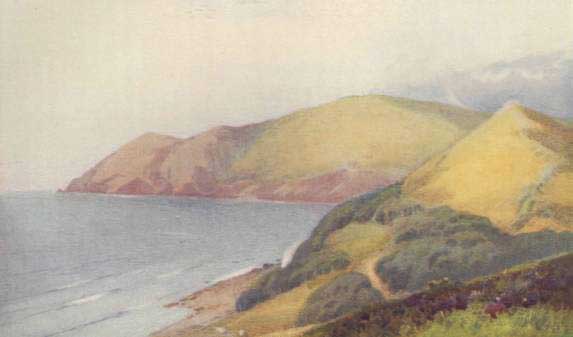 Countisbury Foreland
About six miles west of Lynmouth is the lovely valley of Heddon's Mouth—that is, 'the Giant's mouth; Etin, A.S., a giant.' It is a very narrow green cleft, shut in by two precipitous cliffs rising eight hundred feet straight out of the sea. Heddon's Mouth Water hurries along the glen, buries itself in a bank of shingle, and flows out again lower down the beach. Huge rocks tumbled together make great barriers that block each side of the cove. On the eastern side, close to the mouth of the valley, part of the towering wall seems to have fallen away, showing bare rocks and soil of a warm light brown tempered by shades of pink. The western side is very steep, but covered with short grass, sea-pinks and thyme, and crowned by a great mass of boulders. The face to the sea is slightly hollowed, suggesting that on this side also part of the cliff has fallen. East and west, one great headland after another is seen, misty but impressive, above a silvery grey sea. Inland the valley changes suddenly from barren cliffs to a profusion of copses and thickets, and several beautiful deeply cleft combes, overbrimming with thick trees, open into the valley. Among the wayside bushes are the pretty purple-crimson flower-heads and thick cool leaves of that not very common wild-flower, livelong.
A road passing through a wood and by a little rushing stream overhung by hazels, leads towards Lynton, and crosses the tiny railway, on whose bank masses of the slender stems of great[Pg 256] moon-like evening primroses shine in the grey twilight with an almost weird effect.
The more interesting way to Lynton is along the coast-road, which is soon reached from the valley. Beneath the road the cliffs fall precipitously hundreds of feet to the sea, and a few little horned sheep and some white goats, scrambling on the face of them, seemed to have the same hold as flies on a window-pane. Ravens are often seen even now amongst these almost inaccessible rocks. The road runs through a fir-wood, and as it rises and falls one may catch delicious glimpses of the sea through the ruddy stems and the great dark fans and tasselled ends of the branches; and the scent of pine-needles and of the sea stirring amongst them makes the charm still greater. The road looks down into Wooda Bay, which is also surrounded by woods, and passes to the tinier but very lovely Lee Bay. A little combe leads down to the shore, sheltered by leaves which, luminous from the sunshine above them, shade the glen from the fierce rays, and it is filled with a subdued, mysterious light. Stem beyond stem is partly hidden by the fresh, vigorous green shoots springing round them, or hanging in garlands from branch to branch, and suggests the wonderful fairyland that Richard Doyle saw, and enabled many people to see.
A little stream, breaking into miniature waterfalls and reflecting the foliage in its pools, finally disappears into the shingle, to emerge close to the sea. A few yards away is a tiny dropping-well on the face of the cliff, almost hidden by a green veil of plants that grow at the foot of the rocks or swing from the clefts.
Close to the bay stands Lee Abbey, a comparatively modern house, on the site of the old house of the De Wichehalses—a family who, considering the not very remote date of their history, have been surrounded with a surprising number of fables: Mr Blackmore contributed a share.
The Wichehalses had not a Dutch origin; the daughter of the house called Janifred never existed, and consequently the whole tragic tale of her lover's faithlessness and her sad fate is entirely imaginary. 'The Wichehalses,' says Mr Chanter, who has studied[Pg 257] their history with minute care, 'originally took their name from their dwelling-place, a hamlet called Wych, near Chudleigh. Nicholas, a younger son, but founder of the most eminent branch, settled in Barnstaple about 1530, and made a large fortune in the woollen trade, part of which he spent in buying property in North Devon—amongst others, the Manors of Lynton and Countisbury. Here his grandson Hugh Wichehalse removed in 1627, leaving Barnstaple with his wife and children for the double reason that political troubles were already brewing and rumours were afloat that the plague was drawing near.'
Hugh Wichehalse seems to have avoided all strife as far as possible, but his son John threw himself vehemently on to the side of the Parliament, and became notorious for persecuting the Royalist clergy in the country round, whose lot in any case was a sorry one. John sold some of his estates and left a portion to his younger son, so that his eldest son (another John) and his wife, both of whom were extravagant, soon found themselves in difficulties. John Wichehalse made himself justly unpopular by the part he played after Sedgemoor. A Major Wade, in the Duke of Monmouth's army, had escaped from the battle-field and, with two other men, was hidden by a farmer at Farley. A search was made for them, in which Wichehalse joined with one of his servants, whom he had armed. His conduct was particularly odious, because Wade was a great friend of some of his own relations, who had very generously, by gifts, loans, and good counsel, repeatedly helped him out of his difficulties. In course of time they arrived at the right farm, and while they were coming in by the front door, Wade and the others escaped by the back. Babb, Wichehalse's servant, and another of the party saw the men running, and fired, and Wade was shot through the body, so that he was disabled and taken prisoner. Wichehalse's servants also killed another of Monmouth's men, and his body was impaled on a gate near Ley.
'In the neighbourhood,' says Mr Chanter, 'the blame was put on his servant, John Babb, who was said to have incited his master to kill every rebel they could find; and local tradition has it that[Pg 258] the Babbs, who had been the favourite retainers at Ley, never prospered after. When their master left Lynton they moved to West Leymouth, as the modern Lynmouth was called then, and employed themselves in the herring-curing industry, which the cottagers said failed because Babb was engaged in it; and years after his granddaughter, Ursula Babb, was pointed out as the last of the race with the curse on it, and, as she was reported to possess the evil eye, became a great object of fear to all around.'
John Wichehalse and his wife went to London, and wasted their goods until he died, when the mortgages were foreclosed, and no property in Lynton was left to the family. The melancholy fate of their daughter Mary may have suggested the more romantic story of Janifred. Mary Wichehalse married, but later returned to Lynton, where, under the care of a faithful servant, she spent her time wandering over the cliffs looking at the lost inheritance. Some say that she fell off the rocks, and others that she was washed away by the tide, but both accounts agree that she was drowned.
The Valley of Rocks is wild, grand, and rather dreary, 'all crags and pinnacles.' Southey was deeply impressed by it: 'Imagine a narrow vale between two ridges of hills somewhat steep; the southern hill turfed; the vale, which runs from east to west, covered with huge stones and fragments of stone among the fern that fills it; the northern ridge completely bare, excoriated of all turf and all soil, the very bones and skeletons of the earth; rock reclining upon rock, stone piled upon stone, a huge terrific mass—a palace of the preAdamite kings, a city of the Anakim, must have appeared so shapeless, and yet so like the ruins of what had been shaped after the waters of the flood had subsided. I ascended with some toil the highest point; two large stones inclining on each other formed a rude portal on the summit. Here I sat down. A little level platform, about two yards long, lay before me, and then the eye immediately fell upon the sea, far, very far below. I never felt the sublimity of solitude before.' Names have been given to the great rock-masses. The Castle Rock looks far over the sea, the Devil's Cheesewring is on the[Pg 259] inner side of the valley, and there are many others. A narrow path cut in the deep descent of the cliffs leads from the valley, 'where screes and boulders, red and grey and orange, covered for the most part with lichen or tendrils of ground-ivy, lend splashes of vivid colouring to the hill-side;' and about a mile farther on is Lynton.
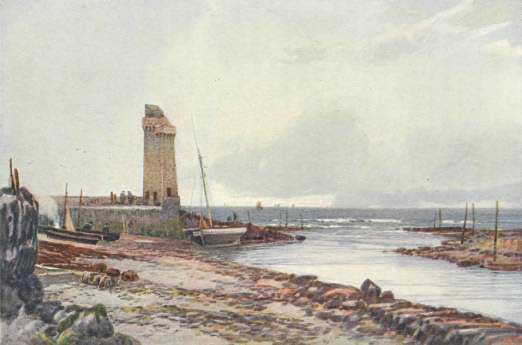 Lynmouth
Perched on the cliffs nine hundred feet immediately above Lynmouth, Lynton looks down to the inlet, into which two ravines open from the south. Down these ravines rush the East and West Lyns, hidden among the woods; and the two streams join just before they reach the sea-shore. Countisbury Foreland stands high to the east of the harbour and stretches far out into the sea, and between the foreland and the mainland is another long, steep, winding cleft.
I once saw the bay in an exquisite light very early in the morning. Earth and sky and sea were all veiled in the softest grey, and in the sky was one little flush of pale rose pink. But for a sea-gull crying under the cliff, the stillness was absolute.
Lynmouth consists of a tiny quay, a little group of houses, and the ravines beyond. It is impossible to imagine any place where buildings and tourists could more exasperate a true lover of earlier days. Still, they cannot have more than a superficial effect—except at the meeting of the streams, which is quite spoilt by the houses on either side.
The music of the Lyns has been noticed by many comers, and about sixty years ago the Rev. H. Havergal, whilst staying here and listening to the continuous tone of the Lyn at low-water, composed this chant:
 MUSIC OF THE LYNS.
As a place for visitors to admire, Lynton was discovered[Pg 260] in the beginning of the nineteenth century. The French Revolution and Napoleonic wars obliged those who were in the habit of going abroad for change and amusement to look for it in comparatively unknown parts at home. In 1807 the first hotel—not counting a small and inconvenient village hostelry—was opened; and even at this date there were no wheeled vehicles in either village, ponies and donkeys carrying everything. Until this time Lynton and Lynmouth had been the quietest of little fishing-villages, without even the doings of a resident squire or rector to furnish a subject for a little gossip.
The ecclesiastical history of the little neighbouring parish of Countisbury is very much mixed up with that of Lynton. Mr Chanter prints some of the Countisbury churchwardens' accounts, which, as he observes, are chiefly remarkable for the prominent part that beer played in every event, from killing a fox to the visitation of 'ye Dean Ruler.'
| s. | d. | |
| 'Pd when one fox was killed for beer | 2 | 0 |
| Pd more for beare when one fox was killed | 2 | 6 |
| Pd for bear when two foxes were killed | 7 | 6 |
| Pd for ale for the fox hunters | 2 | 0' |
Other entries are for killing 'wild cats, greys [badgers], and hedge hogs ... salaries of dog-whipper ... fox-hunter, etc., and repairs to the base viol.'
Lynmouth and Lyn were noted for the fishery, and especially for their herrings and oysters. The fishery was developed in quite early days by the abbots of Ford Abbey, who claimed the whole coast-line of Lynton and of Countisbury. Cellars and curing-houses, called 'red-herring houses,' were built close to the beach, and were apt to be swept away by any violent storm, for the little harbour has a double reason for dreading bad weather—not only do the breakers surge over their usual limits and wash away or damage all that is in their way, but at the same time the streams come down a roaring, foaming torrent, which rolls along great boulders and hurls itself against all obstacles. In 1607 a[Pg 261] whole row of red-herring houses was swept away, and since that date the records of disputes as to repairs to the harbour and petitions from the fishermen tell how greatly they have suffered from this cause. The fishing has dwindled until it is now a very trifling matter indeed.
The small parish of Countisbury is high on the cliffs, on the eastern side of the river, and the road to it from Lynmouth rises at once to a height of eleven hundred feet. A little Perpendicular church with an embattled tower crowned by pinnacles stands at the mercy of every wind that blows.
Farther to the east, and almost on the boundary-line of Somerset, is Oldbarrow Camp, which differing archæologists have claimed to be British, Roman, and Danish. From this hill the fall to the sea is precipitous, and the descent into Somerset is almost as steep; inland, the ground also sinks away, leaving a magnificent view and a grand sense of space. Even when the light is fading there is a great charm, for looking down into the hollow, one sees a faint blue tinge lying like bloom upon the misty twilight that nils the valley—a sharp contrast to the clear darkness of the evening sky. Countisbury Camp is not far from Oldbarrow, and in Lynton there are two more ancient 'castles,' each consisting of a single fosse and rampart, and other monuments. Several stone circles, 'over forty feet in diameter,' have been wickedly removed from the Valley of Rocks 'for the purpose of selling them as gate-posts!...' Spindle-wheels, or pixie grinding-stones, as the natives call them, have been found in the neighbourhood, as well as arrow-heads and 'a skinning knife with a ground edge of black flint.'
The winding valley of the West Lyn is very beautiful, but not so wild as that of the East Lyn; it lies deep down beneath fir-woods, whose serried spires mount higher and higher on the steep hill-side. A little way from Lynton, along this lovely road, is Barbrook Mill, and close by a cottage covered with purple clematis, among trees loaded with rosy apples.
Following up the East Lyn from Lynton, the fitness of Dean Alford's words is realized:[Pg 262]
These 'walls of rock' are now and again cleft by the narrow openings of steep and wild ravines. It is intensely solitary; there is scarcely any sound or movement, but perhaps a buzzard high in the air may hang over the valley for a few moments. About two miles from the harbour is Watersmeet, where the Farley Water rushes into the Lyn. When the leaves are on the trees the stream can hardly be seen from the road, for it lies below a high, steep bank. By the water's edge in the shaded light there is a suggestion of mystery, and the bed of the stream is so shut in that but for the stirring of the leaves, the shifting gleams of sunlight in the waters, and the freshness of the air, one could almost imagine oneself underground. The glossy leaves of festoons of ivy and wild-flowers cover the red rocks. The Farley Water falls over a succession of little waterfalls, swirling and foaming in the pools between, and then slips over little rocky ridges and slopes covered with duck-weed so wide that the 'stream covers it like no more than a thin film of glancing emerald.' Below, the valley opens enough to allow space for a tiny lawn, overhung with oak-trees; and here it is joined by the Lyn, which has raced along the farther side of a steep tongue of land.
The road passes a fir-wood, bright with golden-rod and ragwort and soft blue scabious, and by-and-by turns eastward, and reaches the scattered village of Brendon. Brendon 'church-town' is made up of church, school, parsonage, and a few farms, and can scarcely be called a village. The church stands high on the hill above the river; it is very small, and has been rebuilt comparatively lately; its dedication is the most interesting thing about it.[Pg 263] All who ever rejoiced in 'The Water Babies' should remember this Irish saint. 'Did you never hear of the blessed St Brandan, how he preached to the wild Irish, on the wild, wild Kerry coast; he, and five other hermits, till they were weary and longed to rest?... So St Brandan went out to the point of Old Dunmore, and looked over the tide-way roaring round the Blasquets, at the end of all the world, and away into the ocean, and sighed, "Ah that I had wings as a dove!" And far away, before the setting sun, he saw a blue fairy sea, and golden fairy islands, and he said, "Those are the islands of the blest!" Then he and his friends got into a hooker and sailed away and away to the westward, and were never heard of more.'
 Malmsmead
A little higher up the little river (here known as Brendon Water) is a very old bridge, now unused, and a wide modern bridge, which crosses the two branches of the divided stream just below a little green island. Bushes crowd and overlap each other on the banks, and it is very likely a grey water-wagtail will dart from among the leaves and flit jauntily upstream.
The road all this way follows the water—for some distance the boundary between the counties—and here it is sunk between the barriers of the County Wall separating Devonshire and Somersetshire. A great bare cliff, covered only with short grass, and scanty tufts of heather and furze growing thinly upon it, towers above the road; the other side of the valley is lower, gentler, and wooded. Malmsmead Bridge crosses over the Badgeworthy Water, as the stream—which seems to change its name nearly every half-mile in the most perplexing manner—is here called, a little higher than the point at which it is joined by its tributary, Oare Water. Above the bridge the road becomes a rough track that leads up into the very wild and beautiful valley of Badgeworthy Water, well known by name to all lovers of 'Lorna Doone.' Some of the natives are apt to mislead strangers by wrongly calling this glen the Doone Valley. Further upstream the valley becomes narrower, and the sides steeper, winding in long beautiful curves. The shallow stream is brown, but very bright and clear and pebbled; boggy patches lie here and there by the side, and in one patch the sweet-[Pg 264]ferns grow so large and thick that their characteristic 'sharp sweet' scent is strong enough to betray them before one catches sight of the finely-cut fronds. On the east side of Badgeworthy Water is Deer Park, where many deer lie and the fir-woods come down to the water's edge. On the opposite side is Badgeworthy Wood, chiefly of oaks, most of which are not very large, but many of them are gnarled. The number of oak-apples that I have seen in this wood was amazing; on one tree they seemed like cherries on a cherry-tree. Nearly all were scarlet, and they glowed in the sunshine.
'Lorna Doone' has brought so many visitors to the scene that it is no news to say that the account of the water-slide is fictitious. This word is deliberately chosen instead of 'exaggerated,' which is often applied to Mr Blackmore's picture of the fall; for he was not describing scenery—he was setting a scene in his novel, and there was no reason why he should be bound to inches, or even feet! And this argument applies to what he has said of the Doone Valley. At the same time, in his 'Exploration of Exmoor,' Mr Page observes that a true description of the valley of Badgeworthy Water would very nearly represent Mr Blackmore's Glen Doone; and it still seems absolutely apart from the ordinary race and fret of life.
Two long, smooth slopes of rock one below another form the chief part of the water-slide, and the thin stream slipping over them makes one wish to see how the fall would look when the water comes down, a roaring torrent, swollen by heavy rains and melting snow. On one side of the water-slide the ground rises very sharply, but up the other side a tiny path twists through the wood, and opens quite suddenly on a very still valley with steep sides and a broad, open space between. A mountain-ash bearing vividly scarlet bunches of berries hangs over the stream close to the opening; but beyond, only a few stunted thorns grow sparsely amongst an abundance of heather, furze, bracken, and whortleberries. Lorna's bower seems to have been seen to some extent through the author's imagination. In a shallow combe at a little distance are the ruins of what appear to have been the walls of enclosures,[Pg 265] but they are very indefinite. These are all that remain of the Doones' houses, but recent research denies that the Doones ever existed!
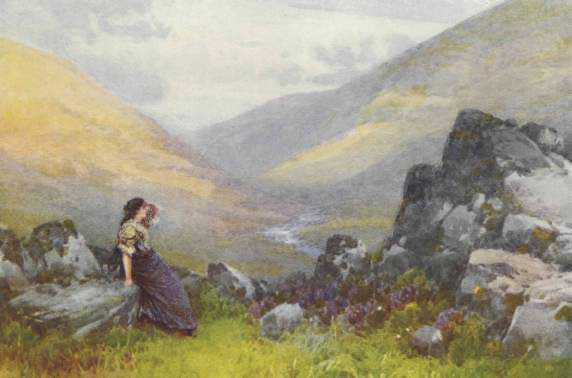 Lorna's Bower
From the top of the hill above the water-slide there is a very beautiful view of the winding glens opening out of each other, and at this point one is able to follow their curves for a long way before the hills shut them out of sight. With the sun shining through the haziest clouds, and the radiant glow of a diffused light calling out delicate tints on the distant slopes, the whole scene seems most fitly described by the old words of praise, 'a fair country.'
Retracing the path to Malmsmead, one is irresistibly tempted to go a few steps into Somerset to look at the tiny church of Oare, where, Mr Blackmore says, Lorna Doone and Jan Ridd were married. The church is very narrow, and it stands among trees on the slope above the stream. On the south side of the nave, close to where the old east wall stood (the chancel is new), is an early piscina of a curious shape; it is supported by a large carved human head, with a hand to each cheek, and there is a thick, solid cap on the top.
Challacombe is a small village on the western border of Exmoor, seven or eight miles south of Lynton, and the church looks far over the moors. Westcote derives the name from 'Choldicombe, or rather Coldecombe, from its cold situation, next neighbour to Exmoor;' and he speaks of 'divers hillocks of earth and stones ... termed burrows and distinguished by sundry names,' in the parish, and hints at their uncanny nature by telling how 'fiery dragons have been seen flying and lighting on them.' Such tales he dismisses scornfully, but he tells of 'a strange accident' that happened 'within these seven years, verified by oath of the party, who otherwise might have had credit for his honesty.' A labouring man, having saved enough money to buy a few acres of waste land, began to build himself a house on it, and from a burrow near by he fetched stones and earth. He had cut deep into the hillock, when 'he found therein a little place, as it had been a large oven, fairly, strongly, and closely walled up; which com[Pg 266]forted him much, hoping that some great good would befall him, and that there might be some treasure there hidden to maintain him more liberally and with less labour in his old years: wherewith encouraged he plies his work earnestly until he had broken a hole through this wall, in the cavity whereof he espied an earthen pot, which caused him to multiply his strokes until he might make the orifice thereof large enough to take out the pot, which his earnest desire made not long a-doing; but as he thrust in his arm and fastened his hand thereon he suddenly heard, or seemed to hear, the noise of the trampling or treading of horses coming, as he thought, towards him, which caused him to forbear and arise from the place, fearing the comers would take his purchase from him (for he assured himself it was treasure); but looking about every way to see what company this was, he saw neither horse nor man in view. To the pot again he goes, and had the like success a second time; and yet, looking all about, could ken nothing. At the third time he brings it away, and therein only a few ashes and bones, as if they had been of children, or the like. But the man, whether by the fear, which yet he denied, or other cause, which I cannot comprehend, in very short time after lost senses both of sight and hearing, and in less than three months consuming died.'
This tale is followed by another, of a 'mystical sciencer,' and Westcote finishes with the comment that the stories are 'not unfit tales for winter nights when you roast crabs by the fire, whereof this parish yields none, the climate is too cold, only the fine dainty fruits of wortles and blackberries.'
A little to the north of Challacombe is the great hill of Chapman Burrows, where stands a 'tall, lean slab of slate, the Longstone.' It is nine feet high, and in the broadest part about two feet eight inches wide. The history of the Longstone is unknown, but the suggestion has been made that it may be an ancient relic, a menhir, and this view is supported by the fact that about a dozen large tumuli lie on the slopes around. One of these is between ten and twelve feet high and three hundred feet round at the base. Burrows are found all over Exmoor. 'The eye of reflection sees stand uninterrupted a number of simple sepulchres of departed[Pg 267] souls.... A morsel of earth now damps in silence the éclat of noisy warriors, and the green turf serves as a sufficient shroud for kings.'
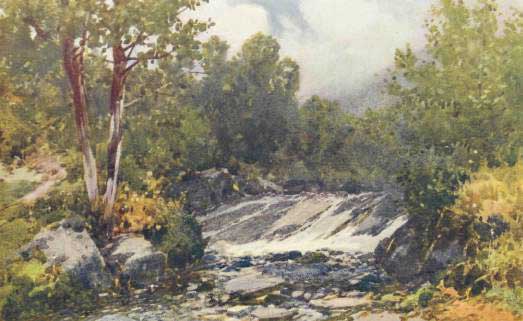 Waterslide: Doone Valley
By far the greatest part of Exmoor lies in Somerset, so that here one must not wander far amongst great round hills, wide distances, and deep combes. One has heard of strangers who have been disappointed by the first sight of Exmoor, for its heights are not very evident. There are no peaks, no sharply-cut isolated hills, nor any with a very striking outline, except Dunkery; but the whole moor is a tableland, across which the coach road runs at a level from twelve hundred to fourteen hundred feet above the sea: 'A bare rolling waste of moorland stretching away into the eastern distance, like the ocean "heaving in long swells,"' and large spaces of bracken, of bogs fringed with cotton-grass and rough grass and whortleberries, among which rise little glittering streams that splash their way down into the valleys beneath.
The sides of the glens leading from the borders of the moor are crowded with endless masses of mountain-ashes, and whether the leaves make a background to the flat creamy clusters of sweet, heavily scented flowers or to great bunches of scarlet fruit, the long ranks give a very rich effect.
Mr R. J. King has observed that Exmoor, 'still lonely and uncultivated,' was probably at one time during the English conquests a boundary or 'mark,' 'always regarded as sacred and placed under the protection of some deity or hero.' Amongst some very interesting remarks, he says that the intermingling in Devonshire of the Celtic and Teutonic races 'may be traced in folk-lore, not less distinctly than in dialect or in features.... Sigmund the Waelsing, who among our English ancestors represented Sigfried, the great hero of the Niebelungen-lied, has apparently left his name to the deep pool of Simonsbath ... again, side by side with traditions of King Arthur, to the parish of Simonsward in Cornwall.'
It is difficult to imagine any moorlands destitute of superstition, and plenty linger on Exmoor. Mr Page (writing in 1890) gave some instances that have occurred comparatively lately.[Pg 268] He speaks of 'overlooking' and of witchcraft, and says that 'not many years since the villagers of Withycombe, by no means an Ultima Thule among hamlets, firmly believed that certain ancient dames had the power of turning themselves into white rabbits.'
'An astonishing instance of belief in witchcraft' within his own experience was one where an old woman—'as harmless a creature as can be found in the country'—was believed by her neighbours to have not only the evil eye, but also 'the power of turning herself into a black dog, in which form she was met a short time since, during the twilight hour, in a neighbouring lane. For these all-sufficient reasons the poor old soul was, for a while, unable to obtain the services of a nurse during an illness from which she is only now recovering.'
Another story shows the remarkable powers of a wise woman. Mr Page explains that he cannot give the real name of the couple, but calls them Giles. Giles deserted his wife. 'For a while Mrs Giles bore his absence with a fortitude born, perhaps, of no very great love for her partner. Then she suddenly took it into her head to have him home. She did not telegraph, she did not even write; but one day the errant husband was seen by the astonished villagers hurrying towards his deserted home. And his footsteps were marked with blood! The witch-wife had compelled his return in such haste that not only the soles of his boots, but those of his feet, were worn out.'
Mr Page mentions that 'the old mediæval custom of touching a corpse still prevails. At an inquest lately held at or near South Molton, each of the coroner's jury, as he filed past the body, laid his fingers on the forehead. This act, it was believed, would free him from dreams of the deceased.
Omens and portents such as mysterious knockings, a particular sound of church-bells, or a bird flying into a room, are very grave warnings, and a story of this character comes from near Taunton. 'A farmer riding home from Taunton Market noticed a white rook among the sable flock settling over a field. When he reached home there were symptoms of uneasiness among his cattle, and[Pg 269] that night the dogs barked so vociferously that he had to get up and quiet them. In the morning he was dead.'
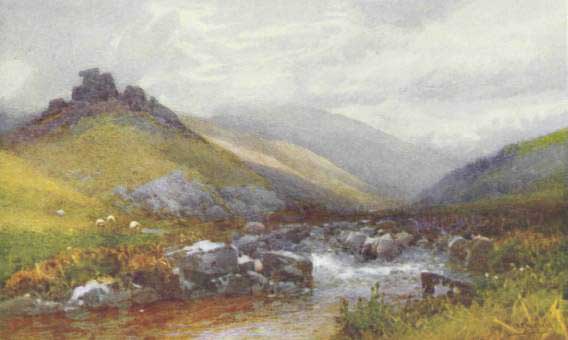 Doone Valley
Writing of other traditions, 'one of the most beautiful of Easter customs still survives. Young men have not yet ceased on the Resurrection morning to climb the nearest hill-top to see the sun flash over the dark ridge of Quantock, or the more distant line of Mendip.' To see the newly-arisen sun on Easter morning was an augury of good luck. 'Early in the century Dunkery, probably because it is the highest land in Somerset, was favoured above all surrounding hills, and its sides,' says Miss King, 'were covered with young men, who seemed to come from every quarter of the compass, and to be pressing up towards the Beacon.'
Exmoor stag-hunting is far-famed, for it is the only corner of England where wild red deer are still to be found. The fashion of coming here to hunt from a distant part of the country is comparatively modern, but Hugh Pollard, Ranger of the Forest, kept a pack of stag-hounds at Simonsbath more than three hundred years ago, and the Rangers who succeeded him continued to keep the hounds.
Even before the Conquest, the moor had been a royal hunting-ground. Deeds show that in the reign of Edward the Confessor there were at least three Royal Foresters; and William I, says Mr Rawle, 'probably reserved to himself the forest rights, for the Conqueror, according to the Saxon Chronicle, "loved the tall deer as though he had been their father," and would scarcely be likely to forgo any privileges concerning the vert and venison.' Various tenures show that later Kings kept Exmoor as a preserve. Walter Aungevin held land in Auri and Hole (near South Molton) under Edward III, 'by sergeantry that whensoever our lord the King should hunt in the forest of Exmoor, he should find for him two barbed arrows.' And Morinus de la Barr, farther to the west, near Braunton, held his land on the same tenure with the addition of finding 'one salmon.'
Nearly thirty years later in the same reign, a very curious tenure is registered. 'Walter Barun held certain lands and tenements in the town of Holicote, of the King in capite, by the service[Pg 270] of hanging upon a certain forked piece of wood the red deer that die of the murrain in the King's forest of Exmoor; and also of lodging and entertaining the poor strangers, weakened by infirmities, that came to him, at his own proper costs, for the souls of the ancestors of our Lord King Edward.'
The Forest of Exmoor was part of the jointure of several Queens of England. Henry VIII settled it on Catherine of Aragon, and it was afterwards held by Jane Seymour. James I gave it to his Queen, but Charles I had other views, and announced his intention of drawing 'the unnecessary Forests and Waste Lands' [Dartmoor and Exmoor] 'to improvement.' Needless to say, the scheme died in its early stages, and when Charles II came to the throne, he granted a lease of the forest to the Marquis of Ormonde.
Besides the wild-deer on Exmoor, there are, as everyone knows, creatures almost as wild—herds of Exmoor ponies. Very few now are pure 'Exmoors,' except those belonging to Sir Thomas Acland. Among these ponies the true breed has been carefully preserved, and there has been no crossing. It seems a little odd to think of Exmoor ponies being mentioned in Domesday, but Mr Chanter quotes an entry referring to the stock in the parishes of Lynton and Countisbury, '72 brood mares, probably the Exmoor ponies running half wild on the moor; in Brendon, 104 wild mares (equas indomitas) are mentioned.'
'The average height is 12½ hands, and bays and buffy bays with mealy noses prevail; in fact, are in the majority of three to one.' The older ponies live out all the year round, but stacks of hay and straw are built by the herdsmen against the time when the snow lies deep. 'Still, like honest, hard-working labourers, the ponies never assemble at the wicket till they have exhausted every means of self-support by scratching with their fore-feet in the snow for the remnants of the summer tufts, and drag wearily behind them an ever-lengthening chain of snowballs.'
The moor makes an excellent sheep-walk, but attempts to cultivate it have not prospered. As far as agriculturists are concerned, 'Exmoor is best left alone—the "peat and heather in hill and dale."'[Pg 271]
There is an old ballad called 'The Farmer's Son of Devonshire,' in which the views of one character, 'Brother Jack,' show a distinct resemblance to those of the great John Fry in 'Lorna Doone.' Here are a few verses. The sub-title is a long one, beginning: 'Being the Valiant Coronel's Return from Flanders.' To the tune of 'Mary, live long.'
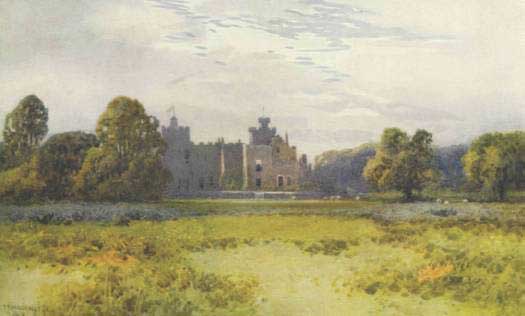 Powderham Castle
Powderham Castle is a fine building in a lovely setting. On the east the park leads down towards the marshy edge of the broad rippling estuary, on either side there spread trees and bracken, with the deer feeding among them, and hills sloping gradually upwards make a very pretty background.
The Castle is difficult to describe, for one century after another has added a wing or pulled down a corner, and the result is an irregular building of very varying architecture. Even the exact colour is not easy to tell, but different shades of grey prevail. The north tower, the earliest part, is built of small and uneven stones. There is a tradition that Powderham was begun by William of Eu soon after the Conquest, and another story is that it existed before that date, and was built by a Saxon to prevent the Danes sailing up the river to Exeter; but the oldest portion now standing is probably due to Sir Philip Courtenay, who was born about A.D. 1337.
The Castle was strongly fortified, and in the Civil War withstood an attack planned by General Fairfax himself. The General,[Pg 273] says Sprigg, ordered 'a design in hand against Pouldrum-house, by water and land, which, being on Friday, December 12, was immediately put in execution.... The design against Pouldrum-house was this, and thus carried: Lord's Day, December 14, nine of the clock at night, Captain Deane (the comptroller of the ordnance) was commanded over Ex with 200 foot and dragoons, to possess Pouldrum-castle, but the enemy had some few hours before got 150 into it, unto those that were there before, which our men not discovering before they had landed, would not return without attempting something. The church at Pouldrum being not far distant from the castle, they resolved to possess and make the best of it, and accordingly did so, and the next morning they got provisions from Nutwell-house unto them into the church, and began to fortify the same. The enemy at Excester, much startled hereat, fearing the castle would be lost, as well as the river blocked up by the fortifying of this church, sent therefore, on Monday, the 15th, a party of 500 foot, who joining with 200 from the castle assaulted our men about seven at night, threw in many hand granadoes amongst them, and so continued storming till ten, but were beaten off with much loss, leaving their dead on the place, and carrying with them many wounded, as appeared by the snow, that was much stained with blood as they retreated.' The Parliamentary soldiers remained in the church, and Sprigg, not unnaturally, vaunts their stoicism a little. 'They were resolved to continue in their duty; and notwithstanding the extremity of the cold, by reason of the great frost and snow, and want of all means to resist or qualify the same in the church, having no firing there, they would not quit the same till they received orders to do so; which hard service (hard in every respect) ... they were not immediately discharged of.' However, the next day, 'the general considering further the bitter coldness of the weather, and the hardness of the duty they would necessarily be put unto, if they should make good the church, sent orders to them to draw off, wh that they might do with the more safety, two regiments were appointed to draw down and alarm the enemy on that side Excester, while they made good their retreat over the river.'[Pg 274]
Powderham held out gallantly for more than another month, notwithstanding that 'Colonel Hammond was set down with some force' about it; and Fairfax, on his return from his victory at Dartmouth, 'marched to Chidley, endeavouring first to take a view of Pouldrum,' meditating a fresh attack. But the garrison had reached their limit of endurance, and the same night (January 24, 1646) the Castle was surrendered.
About the year 1700 great alterations were made, and now battlemented towers and French windows, iron balconies, and loopholes in massive walls many feet thick, in strange juxtaposition, show how it has been adapted to the taste and needs of its successive owners. On the west is a large courtyard, the Castle itself forming one side of the quadrangle; on the east, a broad terrace, set with little box-edged beds, high vases, and clipped cypresses, and little turrets at the angles. Smaller terraces run north and south of the Castle, and along the south terrace is a magnificent thick, high, and very dense yew-hedge. The centre of the east front is a low tower, and at each end are projecting wings. In the south wing is the present chapel, once a granary. Perhaps its most uncommon feature is the number of old bench-ends, most of whose panels are carved with heads, some of which were shaped piously, though others are grotesque. Through the chapel is the priest's room, a large and delightful one, lighted on three sides; with Pope Gregory in stained glass, and the Courtenay arms beneath, in one window.
The walls of the 'staircase hall' are a pale blue-green, and show a bold and very elaborate decoration, a belated example of the manner of Grinling Gibbons. Long white garlands, holding together flowers, fruit, spears, a quiver of arrows, birds, beasts, trumpets, and a mass of intricate designs, hang down the walls in high relief. The fine banqueting-hall has a carved and vaulted roof, and high at one end is a gallery. Deep panelling runs all round the hall, and at the head of the panels are little shields, the coats of arms of the English and French branches of the Courtenays, and of the ladies whom the successive heads of the family have married—with, in every case, the shields of her parents and[Pg 275] grandparents as well. The heraldic chimneypiece is high and very elaborate. In the long drawing-rooms hang two examples of the few life-size groups that Richard Cosway painted. Both pictures are of three daughters of the house; the dresses are white, and the whole colouring extremely delicate. In the most delightful of the two the ladies are standing, and their figures and attitudes are extremely graceful. In the second picture all three are sitting on the ground, and though very pretty, this group has not the particular charm of the first. The large 'music-room' has been arranged to suit its name, for on the walls are tiny frescoes representing the triumph of Music, musical instruments are sculptured in marble on the chimneypiece, and even pattern the Aubusson carpet. In the panelled entrance-hall is some fine carving, and here hang the rather melancholy portraits of the unhappy Marquis of Exeter and his unfortunate son, and a large picture of a Lord and Lady Devon, most of their fourteen daughters, and their only son.
Powderham was brought to the Courtenays as the dowry of Margaret Bohun, daughter of the Earl of Hereford, and she left it to her fifth son, Sir Philip Courtenay, the ancestor of the present owner.
It would be impossible here to attempt the most imperfect outline of the changing fortunes of this 'imperial family,' even from the date at which they settled in England, and without any reference to the days when Courtenays were Kings of Jerusalem and Emperors of Constantinople. Members of this family have played important parts in different crises of the nation's history, and very many have been eminent in peace and war. From the chronicle of their lives and losses, battles and honours, I am able to quote here only a few scattered instances.
Sir Hugh Courtenay, born 1327, was often 'employed by the King in his wars in France and Scotland,' and fought at the battle of Crecy. The next year, among other 'brave Martialists,' he diverted himself by mimic battles at Eltham, and it is recorded that at this tournament the King gave him 'an Hood of White Cloth, embroidered with men in the posture of Dancers, buttoned with large Pearls.' Authorities are divided as to whether he or his[Pg 276] father, the Earl of Devonshire, was one of the founders of the Order of the Garter. Sir Hugh's son of the same name married Matilda, daughter of the Earl of Kent, and his wife—usually known as the Fair Maid of Kent, Lady Matilda Courtenay—inherited her mother's beauty—'"the fairest lady in England," saith Froissard.' Hugh Courtenay died young, and his widow fell in love with 'Lord Valeran, Earl of St Paul, who, having been taken Prisoner in the Marches of Calais, was kept in the English Court, and by his winning Behaviour did much engage the Ladies Affections to him. The Princess her Mother [who as a widow had married the Black Prince] was at first much against the match, but at last she yielded, and the king her brother gave his consent, and for her dowry bestowed upon the Earl the Manor of Byfleet. Walsington says that this marriage was celebrated on the Octaves of Easter, at Windsor, with great Pomp, and the Earl got from France a great many Musicians and Dancers for that purpose.'
Sir Hugh was the eldest of seventeen children, and several of the sons were distinguished men. On the eve of the Battle of Navaretto, Sir Hugh, Sir Philip, and Sir Peter were knighted together by the Black Prince. Their eagerness to fight on land or sea led, on one occasion, to an unfortunate result. In 1378 the Duke of Lancaster was exasperating the fleet under his orders by his 'slow Proceedings and unnecessary delays,' and a part of it set out without him. 'Sir Philip and Sir Peter Courtenay, two brothers who had the Command of some ships, espying some vessels belonging to the enemy, inconsiderately assaulted them, being the whole Spanish Fleet, and though they bravely fought, and defended themselves, yet in the end were beaten, most of them who were good gentlemen of Devonshire and Somersetshire being slain. Sir Peter with some others were taken Prisoners, and Sir Philip was sore wounded but escaped the hands of his enemies.'
Later on Sir Philip was Lord Lieutenant of Ireland, and must have wrestled with enough turbulence and riot to satisfy anyone. His manner of governing seems, at any rate, to have pleased the King, who, whilst Sir Philip was still in office, showered[Pg 277] honours upon him—'the Park of Bovey Tracey ... Dartmoor Forest, and the Manour of Bradnich.' He was made 'Steward of all the King's Manours and Stannaries in the county of Cornwall,' and later on was appointed to other posts of importance. Unluckily, Sir Philip's chief principle of action seems to have been that might is right, and complaints being made to the King that he had expelled two of his neighbours from parts of their lands, and imprisoned the Abbot of Newenham, and two of his monks, 'with great force,' the intrepid knight was sent to the Tower. However, after a little while, 'at the request of the Lords and Commons, he was restored to his place and good name.'
William Courtenay, a brother to Sir Philip, was Bishop of London at the critical time when Wyclif's doctrines were first stirring men's minds, and after the murder of Archbishop Sudbury, Bishop Courtenay was translated to Canterbury, and began to take very severe measures against the heretics. A strange event marked a meeting of many dignitaries of Church and State, who had gathered to censure Wyclif's teaching and find means for its extermination. 'When they were just going to begin their business a wonderful and terrible earthquake happened throughout all England, whereupon differs of the suffragans being affrighted thought fit to leave off their business, but the Archbishop encouraged them to go on, and they proceeded to examine Articles of Wickliff, and to give their censure upon them.'
The Archbishop persuaded Parliament to pass an Act against certain preachers of heresy, that they might be arrested and kept 'in strong Prison until they shall justify themselves according to the Law of the Holy Church,' and brought the Chancellor of Oxford literally to his knees, begging the Archbishop's pardon for having shown favour to the Lollards against special commands.
His strong will was exercised in all matters, great and small, and offenders were punished in the most conspicuous fashion. The Archbishop took a high hand in dealing with affairs of the Diocese of Exeter, and the Bishop of Exeter greatly resented it, and appealed against him to Rome. The Archbishop then 'cited' Bishop Brantyngham 'to answer certain Articles to be[Pg 278] proposed to him in the Visitation,' but some of the 'Bishop's Officers' met the bearer at Topsham, and 'did beat him, and forced him to eat the Citation, Parchment, Wax, and all.' The contempt of his commands, and the maltreatment of his messenger, naturally roused the Archbishop to wrath, and he inflicted this very heavy penance: 'That in the Church of Canterbury, St Paul's in London, and the Cathedral Church of Exeter, they should upon three Holy Days named, being in their shirts only, in a Procession going before the Cross, carry Wax Tapers burning in their hands, and then that they should give to the Priest a Salary to say Mass every day at the Tomb of the Earl of Devonshire; and lastly, every one of them was enjoined to pay a sum of money, for repairing the Walls of the City of Exeter.' In addition to the public disgrace, the trouble and cost of this penance must have been immense.
The sixth of these brothers, Sir Peter Courtenay, was, says Fuller, 'a true son of Mars and actuated with such heroic fire, that he wholly addicted himself unto feats of arms.' It has been already mentioned that he fought in the Spanish wars, and in milder moments he distinguished himself at 'justs and tournaments now justled out of fashion by your carpet knights.' As a prisoner of war in France, his captivity was lightened by the attentions he received, even from the King of France himself, and he was on such good terms with his captors that after his release he gained leave of Richard II 'to send into France, by Northampton Herald, and by Anlet Pursuivant, as a return for the civilities he received in France ... eight cloths of Scarlet, Black and Russet, to give to certain Noblemen of that Realm; as also two Horses, six saddles, six little bows, one sheaf of large Arrows and another sheaf of Cross-bow Arrows; likewise a Greyhound, and other dogs for the King of France's Keeper.'
The Wars of the Roses were especially fatal to the House of Courtenay, no less than three Earls of Devon losing their lives for King Henry, and in consequence the elder branch of the family became extinct.
A pleasanter time to look back upon was the beginning of the[Pg 279] reign of Henry VIII. Henry VII had married Elizabeth, the elder, and the Earl of Devonshire Katherine, the younger, of Edward IV's daughters, and after Henry VIII's accession to the throne the Earl of Devonshire seems to have been much at Court. In the early months of 1509 preparations were made for 'solemn Justs in Honour of the Queen. The King was one, and with him three Aids: the King was called Cœur Loial, and the Earl of Devonshire, Bon Voloire, Sir Thomas Nevet, Bon Espoire, Sir Edward Nevil, Valiant Desire, and their Names were put in a fine Table, and the Table was hung on a Tree curiously wrought, and they were called Les Chevaliers de le Forest Salvigne, and they were to run at the Tilt with all comers.'
The irony of the King's choice of a nom de guerre seems to have escaped the historian.
'On the 1st day of May 1510, 2 Henry VIII, the King, accompanied with a great many valiant Nobles, rode upon managed Horses to the Wood to fetch May, where he and three others, viz., Sir Edward Howard, Charles Brandon, and Edward Nevil, which were Challengers, shifted themselves, and did put on coats of green Sattin, guarded with crimson Velvet; and on the other side were the Earls of Essex and Devonshire, the Marquis of Dorset, and the Lord Howard, and they were all in crimson Sattin, guarded with a pounced Guard of green Velvet. On the third Day the Queen made a great Banquet for the King and those who had justed, and after the Banquet she gave the Chief Prize to the King, the second to the Earl of Essex, the third to the Earl of Devonshire, and the Fourth to the Marquess of Dorset. Then the Heralds cried aloud, My Lords, For your noble Feats in Arms, God send you the Love of the Ladies whom you most admire.'
The next year the Earl of Devonshire died, and was succeeded by his son, Henry, who for a time was high in the favour of his royal cousin. He seems also to have taken part in many 'Justs and Tourneys.' One summer 'the Queen desired the King to bring to his Manour of Havering in Essex, to the Bower there, the Gentlemen of France that were Hostages, for whose Welcome she provided all things in a liberal manner.' The entertainment[Pg 280] seems to have taken the shape of a small masked ball, and 'the King gave many gifts where he liked.' At the Field of the Cloth of Gold, the Earl of Devonshire had the honour of tilting with the French King, 'and they ran so hard together that both their Spears broke, and so they maintained their Courses nobly.'
The next year 'the King kept his Christmas at Greenwich in great splendour'; and there was another tournament and many challenges. 'Noble and rich was their Apparel, but in Feats of Arms the King excelled the rest.'
In the year 1525 the Earl was created Marquis of Exeter, and seven years later, before starting for France, the King formally named his cousin Heir Apparent to the Crown. After this Fortune turned her back on him, and though, at the King's bidding, he dealt with the northern rebels, taking with him 'a jolly company of Western Men, well and completely appointed,' it was thought that his power, shown by 'so sudden raising divers thousands,' awoke the King's jealousy. The influence of the Marquis 'over the west was second only to the hold which the Duke of Norfolk had upon the eastern counties'; and therefore, when two years later it was reported he had said, 'Knaves rule about the King. I trust to give them a buffet one day,' Cromwell was glad to seize the opportunity of simultaneously striking at feudalism in the West, and of dealing a blow at the inflexible Cardinal Pole, the Courtenays' kinsman. The Marquis was at once arrested on the charge of being an accomplice of the Cardinal, and was beheaded on Tower Hill.
Edward, his son, who was only twelve years old at the time of his father's death, was committed to the Tower, 'lest he should raise Commotions by revenging his Father's Quarrel,' and here he remained for twenty-seven years. There is a pretty account of Queen Mary coming to the Tower, soon after her accession, where 'Thomas, Duke of Norfolk, Dr Gardiner, late Bishop of Winchester, Edward Courtenay, son and heir to Henry Marquis of Exeter, the Dutchess of Somerset, Prisoners in the Tower, kneeling on the Hill, within the same Tower, saluted her Grace, and[Pg 281] she came to them and kissed them, and said, "These be my prisoners," and caused them presently to be set at liberty.'
The very next day the Queen restored to her cousin the title of Earl of Devon (forfeited by his father's attainder), and soon after all his lands that remained in her possession, and also showed him other favours. In fact, 'it was reported that she carried some good affections towards the Earl, from the first time that she saw him.... Concerning which, there goes a story that the young Earl petitioning the Queen for leave to travel, she advised him to marry and stay at home, assuring him that no lady in the land, how high soever, would refuse to accept of him for a husband, by which words, she pointed out herself to him, as plainly as might either stand with the Modesty or Majesty of a Maiden Queen.' But, says Fuller with extreme candour, 'either because his long durance had some influence on his brain, or that naturally his face was better than his head, or out of some private fancy and affection (which is most probable) to the Lady Elizabeth,' who, another writer declares, 'of that moderate Share of Beauty that was between them, had much the better of her,' the Earl evaded the honour hinted to him, and begged leave to pay his addresses to the younger Princess. The Queen's feelings and vanity were deeply wounded, and, on a suspicion that the Princess as well as himself were concerned in Wyatt's rebellion, they were both sent to the Tower.
Cleaveland tells a charming story of the Princess and of a child who lived in the Tower. 'During the time that the Lady Elizabeth and the Lord Courtenay were in Prison, a little boy, the son of a Man that lived in the Tower, did use to resort unto their chambers and did often bring her Grace Flowers, as he did to the other Prisoners that were there, whereupon some suspicious heads, thinking to make something of it, on a Time called the Child unto them, promising him Figs and Apples, and asked him when he had been with the Earl of Devonshire, knowing that he did use to go to him: The Boy answered, That he would go by and by thither. Then they demanded of him, when he was with the Lady Elizabeth? He answered Every Day. Then they asked him, what[Pg 282] the Lord Devonshire sent by him to her Grace? The Child said, I will go and know what he will give to carry to her; such was the discretion of the child (says Mr Fox), being but four Years of Age. This same is a crafty Boy, said the Lord Chamberlain; How say you, my lord Shandois? I pray you, my Lord, says the Boy, give me the Figs you promised me; No, quoth the Lord, thou shalt be whipt, if thou come any more to the Lady Elizabeth or the Lord Courtenay. The Boy answered, I will bring my Lady and Mistress more flowers, whereupon the Child's Father was commanded to permit the Boy to come no more up into the chambers. The next Day, as her Grace was walking in the Garden, the Child peeping in at a Hole in the Door, cried unto her, Mistress, I can bring no more flowers: Whereat she smiled, but said nothing, understanding thereby what they had done. Soon after the Chamberlain rebuked highly his Father, commanding him to put him out of the House; Alas! poor Infant, said the Father: It is a crafty Knave, quoth the Lord Chamberlain, let me see him here no more.'
Soon after Queen Mary's marriage, her husband tried hard to persuade her to release her sister and the Earl, 'and nothing, says Heylin, did King Philip more Honour amongst the English.' It is to be remembered to his good, that he interceded very earnestly, and in the end successfully, for another Devonshire conspirator in Wyatt's rising, Sir Peter Carew.
The Earl, fearing that he might, 'upon the first disorder, be committed to the Tower, to which his Stars seemed to condemn him,' prudently resolved to go abroad; but he must have been born under a very unlucky planet, for the next year he was seized with illness, and died at Padua. With him the title became extinct for about two hundred and fifty years; then Lord Courtenay, a descendant of the Powderham branch of Courtenays, established his claim to the earldom. As the attainder of the Marquis of Exeter was never reversed, that title was never revived in this family.
Among the 'Roxburghe Ballads' is one relating to the Courtenays, called 'The Stout Cripple of Cornwall.' No notes throw[Pg 283] any light upon the possible origin of the story or offer any opinion as to the probability of the ballad being an account of a true incident, or 'founded on fact,' or wholly imaginary.
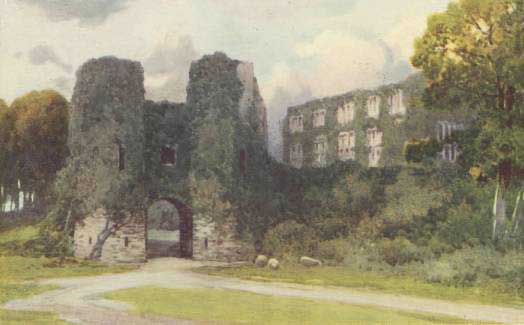 Berry Pomeroy Castle
On a hill about two miles east of Totnes stand the ruins of Berry Pomeroy, at a little distance almost hidden in the thick woods around them. Vistas of green leaves without end open from the road to the castle, long lines of beeches and oaks stretching out of sight and broken by glades chequered with flickering lights and shadows. On the north and east side of the walls the ground falls away precipitously to a great depth, and a stream runs along the valley beneath. The ruins are covered with ivy, saplings and bushes spread their fresh shoots and sprays among the crumbling stones, and all is open to the sky; but enough remains to show what a noble building Berry Pomeroy must have been. The outer walls of the Castle were built by the Pomeroys—it is thought probable by Henry de Pomeroy, in the reign of King John, though the Castle was granted them by William the[Pg 286] Conqueror. A hexagonal tower flanks the gateway on either side. Above it is the guard-room, in which two pillars support circular arches that are in a very perfect condition, and the grooves in the walls for the portcullis may easily be traced. It is usually reported that the Pomeroys' coat of arms is still visible on the gateway, but as the lodge-keeper, who for many years has trimmed the ivy at intervals, has never seen it, it may be that a little imagination has come to the help of mere eyesight.
A curtain wall connects the gateway with a tower called St Margaret's Tower, of which merely the shell remains, smothered in overhanging ivy, brambles, long grass, and a tapestry of plants, and beneath the tower is a small, dark dungeon. To the left, across the quadrangle and along the western wall, are a number of rooms more or less imperfect that belonged to the Pomeroys' castle. They lead one into another, and contain enormous fireplaces and chimneys. Opposite the gateway the ruins are much more broken down, in parts hardly more than fragments and tall trees peer over a low wall, the crowning point of a very steep ascent.
Just inside the gateway, on the right, is the skeleton of the splendid west front, due to Sir Edward Seymour. The inner buildings, which rose in Tudor days, are of a character entirely different from that of the older remains, and the Seymours' spacious ideas were reflected in the magnificence of their castle. The windows and traces of fireplaces in the walls show that it must have been four stories high and held a maze of rooms. One becomes confused wandering through enclosed spaces, cell-like, for the great height, unbroken by floor or ceiling, gives an impression that the rooms are small. Over all is an uncomfortable sense of desertion, and the high empty windows, with stone mullions and square labels, somehow give a skull-like appearance to the frame of the west front. There is not the feeling of repose that there is about some ruins, which seem to disown their debt to man, and to be bent on pretending that they are as entirely a work of Nature as any lichen-covered boulder lying near them. I do not know if Berry Pomeroy is said to be haunted, but it[Pg 287] awakens an uneasy sensation that it is itself a ghost—the ghost of an unsatisfied ambition, the creation of many minds who planned and toiled, soared and fell.
As a matter of fact, the Seymours' castle was never finished, and it is curious that, as it was destroyed in comparatively recent times, there should be no account of such an important event. The theory most usually accepted is that it was burned by lightning; but there is no absolute proof that this was the case.
Of the Pomeroys of Berry Pomeroy few records of much importance remain. Ralph de la Pomerai was so 'greatly assistant to William the Conqueror' in subduing this kingdom, that no less than fifty-eight lordships in Devonshire were awarded him. Henry de Pomeroy, in the reign of King John, was a powerful and rebellious noble, who must have been a terror to his weaker neighbours. Occasional glimpses of this family are given by old deeds and papers, as, for instance, in 1267, when a 'Pardon' was granted by 'Edward, eldest son of the king, to Sir Henry de la Pomeroy, who was against the king in the late disturbances in the kingdom.' About the same date is a grant by Sir Henry, 'for the health of his soul,' of the Manor of Canonteign, the advowsons of four churches, and 'other possessions to the Prior and Convent of the Blessed Mary of Martin ... by ordinance of Walter, Bishop of Exeter.'
Some years later Edward I, now King, sent a second pardon to Sir Henry 'and Joan, his wife, for detaining Isabella, daughter and one of the heirs of John de Moles, deceased, and marrying her against the king's will to William de Botreaux, the younger.' So that he appears to have followed his own pleasure with extreme independence.
A note on a more peaceful subject is extracted from the Testa de Nevil: 'Geoffrey de la Worthy holds one tenement, four acres of land and a half, and two gardens of Henry de la Pomeroye, in Bery, rendering at Easter and Midsummer four shillings and nine pence, and one pound of wax and three capons, the price of the wax sixpence, and the capons one penny.' One penny!
The terms of settling several other disputes are preserved—in one case at great length. In the reign of Henry VII, Sir Edward[Pg 288] Pomeroy fell out with 'the Mayor of Totnes and his brethren'; several gentlemen arbitrated between them, and eventually 'awarded that the said Sir Edward Pomeroy shall clearly exclude, forgive, and put from him all malice and debates ... and from hensforth to be loving unto theym,' and the same conciliatory spirit was to be shown by the other side. As a really satisfactory conclusion, Sir Edward was desired to send the Mayor and his brethren a buck to be eaten in state, 'Provided that the same Sir Edward be at the etyng of the same bucke, in goodly manner. Furthermore we award that the said maiour and his brethren shal paye for the wyne which shal be dronke at the etyng of the same bucke.'
Sir Thomas Pomeroy, the last of this family to own the Castle, fell into disgrace through joining in the Western rebellion against the Prayer-Book, and his estate passed to the Protector Somerset.
It would be absurd in this chapter to attempt to touch on more than a very few points in the history of the great family of the Seymours, or to touch on any that are not connected with Devonshire. Amongst the Duke of Somerset's papers are some extremely interesting letters and documents relating to Sir Edward Seymour's descendants in this county. The second wife of the Protector Somerset, Ann Stanhope, is described in no flattering terms, one biographer attributing some of the Duke's later troubles to 'the pride, the haughty hate, the unquiet vanity of a mannish, or rather of a divellish, woman.' Haywood says she was 'subtle and violent in accomplishing her ends, and for pride, monstrous.' It can easily be imagined, therefore, that she persuaded the Duke to set aside her stepson in favour of her own eldest son; but all the honours that should have passed to him were forfeited by the attainder of the Duke. The title of Earl of Hertford was, however, restored to Ann Stanhope's son in the reign of James I.
The true heir, Sir Edward Seymour, to whose descendants the dukedom has now reverted, was given Berry Pomeroy by his father. His grandson, Edward, showed great zeal in making ready the defences of the coast when the Armada was expected, and[Pg 289] from various letters, orders, and 'precepts,' it is obvious that these preparations brought him great responsibility and an immense amount of work. In 1586 a letter was forwarded to him from the Lord-Lieutenant in reference to the 'beacon watches.' Instructions were sent that 'one, two, or three horses for post' should be kept at a convenient place near each beacon, that one or more might be ready to start at a moment's notice if the signal were given. Further directions were: 'That the wisest and discreetest men of every parish be appointed to assist the constables; ... Commandment to every person within every parish that they do not [set any furze or] heath on fire after seven of the clock in the afternoon.' And there were a host of orders regarding 'the trained soldiers, and also all others mustered and charged with armour.'
Later Colonel Seymour was called into council with the Earl of Bath, the Lord-Lieutenant of the county, and others, to draw up orders as to stores of 'powder, match, and lead,' that 'one moiety more of each sort' be kept in towns than was previously ordered, and that 'armour, weapons, horses, and other necessary furnitures for the wars be held in perfect readiness ... for all sudden service without defect.'
His grandson, another Sir Edward, was a very loyal and devoted servant of Charles I. In 1643 he was given full power and authority in His Majesty's name 'to impress, raise, enroll, and retain one regiment of 1,500 foot soldiers;' and in the following August he was appointed to the important post of Governor of Dartmouth. Besides supervising the garrison and the defences of the town, this officer was required to raise loans, supply ordnance, ammunition, and other necessaries—sometimes even troops—to captains in the neighbourhood. He was also desired to do his best to provide money and 'sea-victuals' for ships going out in the King's service, and received particular instructions from the King to prevent any 'ships, vessels, prizes, or anything belonging to them,' that might be captured, from being plundered or disposed of before they had been 'legally adjudicated by the judge of our Admiralty there ... for the time being.'[Pg 290]
The tone of letters that passed between certain generals, Royalist and Puritan, about this date, furnishes an additional reason for mourning the tragedies of the time. The following letter is from the Earl of Warwick to Colonel Seymour:
'I return you my serious acknowledgment of your civility, and should most gladly embrace an opportunity to serve you, not only for your respects, but also for that ancient acquaintance I have had with your noble family and the honour I have borne it, the recalling whereof to memory adds to the trouble of our present distance, which I hope God will, in due time, reconcile, so as the mutual freedom of conversation which we sometimes enjoyed may be restored, which I shall the more value as it may give me advantage of testifying my esteem of you.... It is a pity the truth should be clouded by some mis-informations that have overspread these parts. God will in his time scatter them and undeceive those that wait upon him for counsel.'
A few days later, in Colonel Seymour's reply to this letter, he admits he has been culpably generous to his adversary. 'Truly, for my own part, I had rather err with mercy than justice, for had not my lenity made me a delinquent to duty, your Lordship had wanted some of Dartmouth now aboard you.'
At the beginning of the war a fine letter was written by Sir William Waller to his friend and present adversary, Lord Hopton:
'The experience I have had of your work, and the happiness I have enjoyed in your friendship, are wounding considerations to me when I look upon this present distance between us; certainly, my affections to you are so unchangeable that hostility itself cannot violate my friendship to your person, but I must be true to the cause wherein I serve. The old limitation—usque ad alias—holds still, and where my conscience is interested, all other obliga[Pg 291]tions are swallowed up. I should most gladly wait upon you, according to your desire, but that I look upon you as engaged in that party beyond the possibility of a retreat, and, consequently, incapable of being wrought upon by my persuasions, and I know the conference can never be so close between us but that it would take wind and receive construction to my dishonour. That great God who is the searcher of my heart, knows with what a sad sense I go on upon this service, and with what a perfect hatred I detest this war without an enemy, but I look upon it as opus Dei, which is enough to silence all passion in me. The God of Peace, in his good time, send us the blessing of peace, and, in the mean time, fit us to receive it. We are both upon the stage, and must act the parts that are assigned to us in this tragedy; let us do it in a way of honour and without personal animosities.'
Later, Colonel Seymour gave up the Governorship of Dartmouth, and was succeeded by Sir Lewis Pollard.
Among the Seymour papers are some interesting notes, dated '1645, May 22,' relating to horses and arms raised in the Hundred of Stanborough. 'Mr Bampfield, parson, will bring a horse and arms to-morrow at Berry.... John Key of Rattery affirms that he hath three horses in the King's service; that he hath one mare only, which he proffers; his estate not above 40 li. per annum, and hath no money. Dipford:—Mr William Fowell, late of Dipford Downs, assessed a horse and arms complete; his wife appears; says that Prince Maurice had one horse and Captain Newton had another for a country horse very lately; all the answer. Mr John Newton doth not appear. Buckfastleigh:—Mr Richard Cable hath brought one gelding with all arms, only a carbine instead of pistols, and no rider. Dortington:—Mr Champernowne brought a little pretty fat old horse, but nothing else.'
In 1647 Colonel Seymour's lands and goods were sequestrated, and he himself was kept either in prison or on parole all through Cromwell's days. Letters and papers of this period shed a light on the difficulties and hardships that in some cases befell the families of Cavaliers. Sir Thomas Fairfax intervened on behalf of Mistress[Pg 292] Seymour, who was then at the estate of Maiden Bradley in Wiltshire, saying that he had forbidden the soldiers to molest her in any way, and begging the Committee for the County to insure that no civilian 'should prejudice her in the enjoyment of her rights.' The lady had a humbler but very earnest advocate, a servant of Sir Henry Ludlow's, who had been in danger of being ruined 'had she not been means for my preservation.' She had begged his liberty of Colonel Molesworth when the King's soldiers were hunting for him, in order to exchange him for one of their side taken prisoner, 'a blackamoor.' Mistress Seymour, too, gave this poor man a good price for some wheat, 'which then none else would do, and had she not bought it, it is very likely that it would have been taken away by the soldiers, as the corn in the barn was.'
Mistress Seymour was evidently strong-minded as well as charitable, as is shown in a letter written by her husband from the Marshalsea, at Exeter,—an appeal to be given a hearing. He complains that being 'hurried away to prison and no bail taken, no crime or accusation produced, makes me sigh when I remember the liberty due to a freeborn subject in England'; and the thrust is followed by a threat: 'If this request be denied, I have found a way to be even with them; for, if not granted, I intend to send up my wife.... And I pray advise the Council of State from me, in relation to their own quiet, let them grant my request rather than be punished with her importunity.'
The Council were evidently impressed by Colonel Seymour's wisdom, for two months later they granted him a pass to return home. His liberty was, however, very much clipped, and rather more than two years later the following 'parole' was exacted of him: 'Undertaking to remain at the dwelling-house of Mr Holt in Exeter, and when required to deliver himself a prisoner to Captain Unton Crooke.' Signed.
Sir Edward Seymour died in 1659, and Colonel Seymour, now Sir Edward, became a member of Parliament a year or so later. His letters to Lady Seymour from London are amusing from their variety of news and gossip. Sir Edward's style was terse, not to say jerky. One letter he begins by bitter complaints of their[Pg 293] 'most undutiful son,' his 'obstinacy' and 'untowardness,' and then passes on to speak of his own imminent return. Then: 'I was this day sennight, which was the last Saturday, upon the scaffold, where I saw Sir Henry Vane's head severed from his shoulders.... The Queen perfectly recovered. Cherries are cried here in the streets for a penny a pound.'
Sir Edward received scanty reward for all his sacrifices, but he was reappointed Governor of Dartmouth, and in 1679 his son writes to tell him that he had been 'pricked Sheriff for the County of Devon ... by the King with all the kindness imaginable,' and an assurance that if Sir Edward felt the work too much for him, a subordinate should be found and the 'chargeable part' made easy. The Earl of Bath wrote by the same post: 'His Majesty declared in Council that he made choice of you, not only because you were the best man of your county, but also a person on whom he could by long experience place his greatest confidence.'
Sir Edward died in the winter of 1688, and his son became the fifth Sir Edward Seymour of Berry Pomeroy in succession.
The new Sir Edward was a very distinguished man, who in 1672 had been unanimously chosen Speaker of the House of Commons. He was the Seymour whose influence Lord Macaulay rated so highly, and whose support was extremely valuable to William of Orange when he arrived in England. Unfortunately, few of Sir Edward's papers, or papers referring to him, are now to be found. A long and carefully balanced epitaph in Maiden Bradley Church describes him as
About five miles north-east of Berry Pomeroy stands Compton Castle, and there is a tradition that they were once connected by a subterranean passage. Compton is a very interesting example of a fortified manor-house, built in the early part of the fifteenth century. It stands low on the slope of a narrow, winding green valley, and on the west the hill has been cut back to make room for the walls.
The castle faces east, a garden-plot lies in front, and the foundations of an ancient wall divide it from the lawn beyond. Close to the central door stands the base and broken shaft of a stone cross. The picturesque western front of the castle is gabled and embattled, and a very high archway is built in the centre of the wall. The colour is difficult to describe, for the castle is very much overgrown with ivy and a faint green lichen has crept over the stones in many parts, but the shades pass from a rich cream colour to a soft grey. A very marked feature is 'the great number of projections carried on machicoulis, through the openings of which stones and other missiles could be thrown on the heads of assailants.' Both the chief doorway and a postern gate to the south were defended by portcullises.
On the north side an Early Perpendicular window marks the chapel. The central doorway opened into the large and almost square guard-room, and on the north side of this room a pointed doorway leads into the chapel, which keeps some of its special characteristics. At the east end a square space is sunk in the wall above the spot where the altar stood, and in this space the faint traces of a fresco can still just be seen. In the wall that shuts off the guard-room is a cinquefoiled piscina and a four-light window, the stonework of which is like that in the east window, and this window allowed anyone in the guard-room to join in Divine service. In the west wall is a hagioscope, and from a room next the chapel a newel staircase led to the priest's room on the floor above. A little window with two cinquefoiled openings in his wall enabled the priest to look down into the chapel., and the height of the sill from the floor suggests that it may have served him as a prie-dieu. The moulded base of a stone cross still remains over the ancient belfry, which rises out of a mass of ivy.[Pg 295]
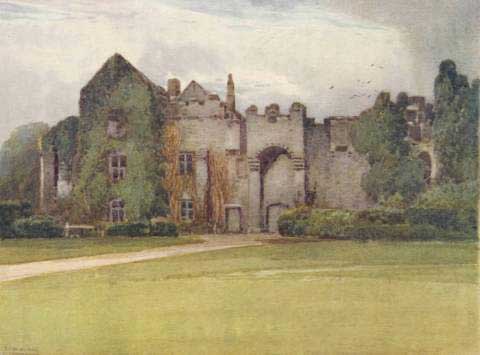 Compton Castle
There are a bewildering number of rooms, many now inaccessible, and the height of the walls shows that there were two or three, and in the north-east block four, stories. The banqueting-hall, forty-two feet in length and twenty-three in width, has utterly disappeared, and only the gable-marks of the roof against the buildings on the south side have enabled Mr Roscoe Gibbs to draw his very careful deductions. In the kitchen the huge fireplace, stretching the whole width of one wall, still keeps its great fire-bars; next the kitchen is the steward's room, above which two stories still stand, though the upper one is absolutely in ruins.
Outside these rooms is a large open space, now grass-grown, and the sprays and buds of a cluster-rose tap against the massive walls. Close by lies a heavy round of granite, slightly hollowed out towards the centre, which is shown as one of the stones used for grinding corn. In an upper room is a hiding-place for treasure—two long, shallow cavities in the floor, of which there cannot have been the slightest sign when the floor was covered with planking. A vaulted passage leads to the south court, and in one corner of this court rises a watch-tower over a horrible little dungeon or chamber of torture.
The walls throughout the whole building are from two and a half to four feet thick, and a thick and solid wall nearly twenty-four feet high protects an inner court, where even in January the turf is firm, springy, and close. At the farther end, on steps leading into the garden, a peacock looks wonderfully appropriate, and some white fantails strutting in front of the heavy walls add very much to the picture. There is scarcely any sign of the old 'pleasaunce,' except a low and fairly broad box-hedge, which runs each side of a path in the present garden, where a few violets and one or two strawberry-blossoms are tokens of the softness of the air.
The Castle has changed owners many times. 'Stephen' held it of Judhael of Totnes; then it passed to the De la Poles; Lady Alice de la Pole gave it to the Comptons, and seven generations later a Compton heiress brought it, in the reign of Edward II, to the family of Gilberts, of whom Sir Humphrey Gilbert was a[Pg 296] descendant. The Gilberts seem to have lived alternately at Compton and on their older property, Greenway, and with one interval the castle belonged to them till nearly the end of the eighteenth century. The only trace of them now to be seen is in the spandrels of a small cinquefoil-headed opening on the projecting gabled wing to the south of the central door. Each spandrel is sculptured with their crest, a squirrel holding a hazel branch.
Mr Eden Phillpotts has painted the ruins with a characteristic touch:
'At gloaming time, when the jackdaws make an end of day, when weary birds rustle in the ivy ere they sleep, hearts and eyes, gifted to feel and see a little above the level prose of working hours, shall yet conceive these heroes of old moving within their deserted courts. Some chambers are still whole, and bats sidle through the naked window at the call of dusk; some are thrown open to sun and rain and storm; the chapel stands intact; the scoop for holy water lies still within the thickness of its wall. But aloft, where rich arras once hid the stone, and silver sconces held the torch, Nature now sets her hand, brings spleenwort and harts-tongue, trails the ivy, the speedwell, and the toad-flax....
'Ivy-mantled, solemn, silent, it stands like a sentient thing, and broods with blind eyes upon ages forgotten; when these grey stones still echoed neigh of horse and bay of hound, rattle of steel, blare of trump, and bustle of great retinues.'
The castle of Okehampton stands about half a mile from the town, and looks on one side over fertile hills and valleys, woods, and rich meadows, and the gleaming waters of the West Okement, on the other towards the bold, changeless outlines of the outer barriers of Dartmoor. The Castle was once surrounded by its park. Risdon mentions that originally there were 'Castle, market, and park adjoining.... The park, which containeth a large circuit of land, King Henry the eighth, by the persuasion of Sir Richard Pollard, disparked and alienated the same.' The Okement, rippling over a rocky bed—the name uisg maenic means the 'stony water'—hurries past the foot of a knoll on which the castle rises out of a cloud of green leaves that shelter[Pg 297] and half hide the walls. Protected by the river and a steeply scarped bank on the south, a natural ravine on the north, and a deep notch cut on the western side, the mass of slate rock that it stands on was a point of vantage. On the crest of the hill the keep stands on a mound, with which two sets of buildings were connected by curtain walls. These buildings stretch down the slope to the east, the space between the two blocks narrowing towards the gateway.
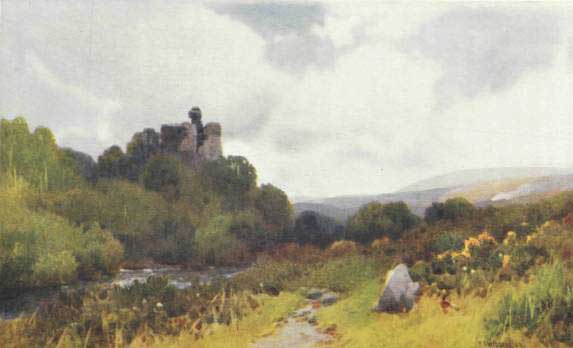 Okehampton Castle
Mr Worth observes that in Devonshire and Cornwall most of the smaller Norman keeps were round, as at Totnes, Launceston, and Plympton; but the stronger castles had square keeps. Okehampton, though not a large or very strong fortress, was distinguished by its square keep, and 'occupies what may be called a middle position.'
Tradition has always held that Baldwin de Brionis, to whom the Conqueror gave the manor, built the Castle, and Mr Worth, after a searching examination, thinks that, as regards the lower part of the keep walls, this may very well be the case; for they are not only Norman, but Norman of the period in which Baldwin lived. The other buildings are later, but vary in date, the most modern being the part of the block which contains the chapel, and which was probably reconstructed from older buildings towards the close of the thirteenth century.
There are gaps in the walls of the keep, but the ruins show that there were four rooms, two above and two below; some of the windows and a fireplace in one of the upper rooms are still to be seen. In the northern block of buildings was the great hall—forty-five feet long and twenty-five feet wide—lighted by two large windows to the south, and entered by a boldly moulded granite doorway. A second doorway in one corner led to a staircase-turret which led to the roof.
On the southern side the buildings are larger and less imperfect. Here is the chapel, 'evidently,' says Mr Worth, 'a portion of a larger structure, which has, perhaps, for the most part disappeared....'
East of the chapel are the guard-rooms, in a two-storied block of two rooms on each floor. A doorway in the north-eastern corner leads into the porter's lodge, a small room in the gate-tower with[Pg 298] 'a loop window in the eastern wall commanding the approach. Above this chamber there is one precisely similar in the upper story (the floor, of course, is gone), and it is noteworthy that this is the only part of the fabric that retains its roof, which is supported by three massive stone ribs.'
The barony of Okehampton was one of many grants made by the Conqueror to Baldwin de Brionis, and some generations later it passed by marriage to the Courtenays, in which family it remained until the Marquis of Exeter was attainted and beheaded in 1538. The Castle was among the possessions that Queen Mary restored to the Earl of Devon, and on his death in 1556 his lands were divided amongst his heirs. Okehampton Castle fell to the share of the Mohuns, and in 1628 John Mohun was granted a peerage and took the title of Lord Mohun of Okehampton. The last Lord Mohun died in 1712.
To the barony of Okehampton belonged Floyer's Hayes, in the parish of St Thomas the Apostle, near Exeter, and it was held on this curious tenure: 'That if the Courtenays, Earls of Devon, came at any time into Exe Isle, they [the Floyers] were to attend them, decently apparelled with a clean towel on their shoulders, a flagon of wine in one hand and a silver bowl in the other, and offer to serve them with drink.'
About thirteen miles south-west of Okehampton, Sydenham stands in a beautiful valley, overshadowed by woods, in which the shining green of the laurels, the darker masses of the rhododendrons' tapering leaves, patches of russet bracken, and feathery light green moss make a feast of colour, even when overhead there is only the bare tracery of twigs and branches. The coverts lie on a hill-side that is steep and fairly high, and at the foot is a rushing stream which is crossed by a bridge exactly opposite the front of the house.
The following notes have been most kindly sent me by Mrs. Tremayne:
'The Manor of Sidelham, or Sidraham, now called Sydenham, appears to have been originally held by four Saxon Thanes, whose names have not been preserved, and to have passed from them[Pg 299] into the hands of that powerful noble, Judhaell de Totnais. On his banishment by William Rufus, his property was confiscated, and Sydenham gave its name to a family who still possessed it in the reign of Henry III, and was succeeded by a family called Mauris, from whom it passed in marriage to Trevage, and from Trevage to Wise. Part of the house dates from the fourteenth century, and is said to have originally formed a quadrangle or H, but in the reign of Elizabeth it was built into the shape of an E, and is a very perfect example of Tudor domestic architecture.
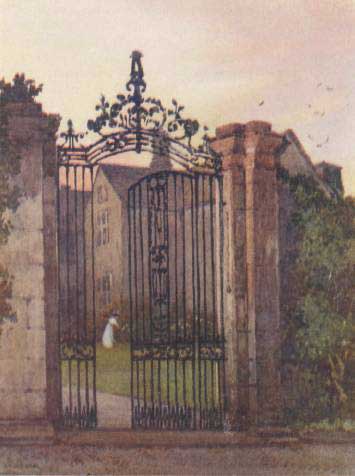 Sydenham House
'Sir Edward Wise, in the reign of James I, very much beautified the house, and legend says that he tried to add such height and such an amount of granite to it that Risdon writes, "The very foundations were ready to reel under the burthen." The house lies in a lovely wooded valley on the banks of the River Lyd, and it has four separate entrances, each opening on to a court or garden. Access to the front-entrance—commonly called the Green Court—is through a fine iron gateway, and above the central door are the Wise arms. Most of the windows have eight rounded granite mullions and small leaded panes of glass, and in some the original glass still remains. Two windows in the front are of Charles I.'s date, and have quaint fan-shaped lights. Over the large granite open fireplace in the front-hall is the date 1656, when the house underwent repair after damage, caused, it is said, in the Civil Wars. There is a story repeated in many histories of Devon, and told by Lysons amongst others, that Sydenham was taken in 1644 by Colonel Holborne; but I have every reason to believe that the Sydenham garrisoned and taken was Combe Sydenham, in the parish of Stogumber, near Taunton, but the fact that within the last forty years a sword and other weapons, also seventeenth-century horseshoes, have been found may be taken as a proof that fighting of some sort did take place.
'In making alterations in the kitchen chimney some twenty years ago, a little hiding-place, or priest's room, was found opening out of it, and in it was an oak table and the remains of a chair; and since then large and small unsuspected rooms have been discovered, and it has been said that in the largest a troop[Pg 300] could lie hidden—as indeed it could with ease. Quite recently a secret passage leading from the house towards the river has been found, bearing out the legend always handed down, "that the Lady Wise of the day escaped with a large party by a secret passage near the river, and got into the woods undetected by the soldiers who were round the house." It is very probable that the secret rooms mentioned and the passage communicated.
'There is fine oak panelling in most of the rooms, and in the dining-room the panelling is inlaid in a delicate design with an ivory-like substance. Secret passages exist to this day in the walls, which are of immense thickness, in some places being seven feet in depth. There are three oak staircases, the main one being finely carved with figures standing at the angles, and another having very fine newels.
'In what goes by the name of the King's Room there is an ancient bed, with fine old red silk curtains and the Prince of Wales's plumes over it, in which Charles I and Charles II are reported to have slept. It is quite likely that Charles II, when Prince of Wales, did come here, as he is known to have been many weeks in the neighbourhood.'
The garden is delightful, and no change in it has been made for very many years. A wide lawn slopes away from the house, and a very small straight rivulet runs through it just a foot or two from the path. At the foot of the slope is a tiny lake, which, though very narrow, divides the lawn from end to end, and beyond the water the ground rises gradually. Clipped bushes and a large flower-border mark the farther edge of the lawn.
The Tremaynes were originally a Cornish family, but they came to Devonshire early in the fourteenth century. For at this time Isabella Trenchard of Collocombe married Thomas Tremayne, and after his death Sir John Damarel, 'and so much gain'd the affection of her second husband that he gave her and her heirs by Tremain (having none of his own)' some of his estates.
Thomas Tremayne and Philippa his wife lived during the sixteenth century, and had sixteen children, several of whom distinguished themselves. Andrew and Nicholas were twins, and so[Pg 301] amazingly alike 'in all their lineaments, so equal in stature, so colour'd in hair, and of such resemblance in face and gesture,' that they were only recognized, 'even by their near relations,' 'by wearing some several coloured riband or the like ... yet somewhat more strange was that their minds and affections were as one: for what the one loved the other desired: ... yea, such a confederation of inbred power and of sympathy was in their natures, that if Nicholas were sick or grieved, Andrew felt the like pain, though far distant and remote in their persons.'
When Sir Peter Carew fled the country, suspected of plotting against Queen Mary, Andrew Tremayne embarked with him at Weymouth, and later Nicholas joined his twin in France, and they threw in their lot with a troop of adventurers who harassed the Channel. Froude has said: 'The sons of honourable houses ... dashed out upon the waters to revenge the Smithfield massacres. They found help where it could least have been looked for: Henry II of France hated heresy, but he hated Spain worse. Sooner than see England absorbed in the Spanish monarchy, he forgot his bigotry in his politics. He furnished these young mutineers with ships and money and letters of marque. The Huguenots were their natural friends; with Rochelle for an arsenal, they held the mouth of the Channel, and harassed the communications between Cadiz and Antwerp.'
Occasionally the twins met with ill-luck, and an entry in the Acts of the Privy Council records that: 'To be committed to several prisons, to be kept secret, without having conference with any ... Andrew Tremayne to the Marshalsey and Nicholas Tremayne to the Gate House, suspected of piracy.' Afterwards they went back to their life of risks and chances on the high seas.
But when Elizabeth came to the throne a different view was taken of these rovers. 'Privateering suited Elizabeth's convenience,' says Froude. 'Time was wanted to restore the Navy. The privateers were a resource in the interval ... they were really the armed force of the country.' So (in 1559) instructions were sent to the English Ambassador in Paris that certain gentlemen, among whom were the Tremaynes, 'as shall serve their country, the[Pg 302] Ambassador shall himself comfort them to return home. Circumspection must be used.' The postscript is characteristically cautious.
The Queen valued Nicholas as a trustworthy messenger, where a matter needed discreet handling, and the bearer of it was likely to be in danger. In 1559-60 the Bishop of Aquila wrote to the King of Spain: 'The Queen has just sent to France an Englishman called Tremaine, a great heretic, who is to disembark in Brittany. I understand that he goes backwards and forwards with messages to the heretics in that country.' On one journey he was arrested when carrying letters in cipher, and Throckmorton, the English Ambassador in Paris, wrote to the Due de Guise, asking for his release. Nicholas was a special favourite of the Queen, but as he loved a camp better than a court, she gave him leave 'to enter into the service of the King of Navarre, by which means he will be better able to serve her.' The King of Navarre, however, did not greatly appreciate Tremayne, and a short time afterwards Throckmorton writes: 'The bearer, Mr Tremayne, came out of England with intent to see the wars in Almain, or elsewhere, thereby to be better able to serve the Queen. He has been here a good while to hearken which way the flame will rise to his purpose; but now, finding all the Princes in Christendom inclined to sit still, returns home. Desires Cecil to do something for him to help him to live, as it will be right well bestowed. The Queen will have a good servant in him, and Cecil an honest gentleman at his command.'
Andrew had entered the army, and in Scotland reaped fame from the brilliant cavalry charge which drove the French back into Leith. Lord Grey wrote in 1560-61 that he had chosen Captain Tremayne to escort Lord James, 'because he is a gentleman of good behaviour, courtesy, and well trained, and also that he stands in the favour of the Lords of Scotland by reason of his valiant service at Leith.'
In the winter of 1562-63 the Queen began openly to help the Huguenots at Havre, and Nicholas Tremayne was sent there at the head of 'fifty horsemen pistolliers.' In the following May Captain Tremayne's band and some others, in a skirmish, 're[Pg 303]pulsed the Rheingrave's whole force, slain and taken near 400, with one ensign and seven drums. Not more than twenty of their own were killed and wounded, none to his knowledge taken.' Four days later Tremayne's troops, over-confident, risked too much, and their Captain was shot, to the great grief of his fellow-officers. Warwick wrote to Cecil: 'Whereas you write that you are more sorry for the death of Tremain than you could be glad of the death of a 100 Allmaynes, I assure you that there is never a man but is of the same opinion.' The Queen was much grieved by the loss. 'She had resented,' says Froude, 'the expulsion of the French inhabitants of Havre ... she was more deeply affected with the death of Tremayne; and Warwick was obliged to tell her that war was a rough game; she must not discourage her troops by finding fault with measures indispensable to success; for Tremayne, he said, "men came there to venture their lives for her Majesty and their country, and must stand to that which God had appointed either to live or die."'
Risdon concludes his account of the twins by saying that they died together; but this is not altogether accurate, for, about a week after the death of Nicholas, Andrew with three hundred soldiers set sail from Berwick for Havre. It is, however, quite true that they died in the same place, and the interval between their deaths was very short, for about seven weeks after his twin was killed Andrew Tremayne succumbed to the plague.
Edward Tremayne, another brother, followed the fortunes of the Marquis of Exeter, and was 'a great sufferer for his inviolable fidelity to his noble master.' So firm was his devotion that even torture failed to extort from him a confession that the Marquis and 'the Lady Elizabeth' had been involved in Wyatt's conspiracy. His 'invincible resolution' asserted their innocence, even on the rack, and Queen Elizabeth later recognized this splendid loyalty by making him 'one of the clerks of Her Majesty's most honourable privy-council.'
Cecil had a high opinion of Tremayne, and in 1569 showed his faith in Tremayne's judgment by sending him to Ireland, to sift the terrible but conflicting stories of its miseries and rebellions, and[Pg 304] 'to let him know quietly the real condition of the country.' Tremayne, to begin with, wrote hopefully of remedies for all that was wrong, but after a year's study and experience realized that the trouble lay deeper than he had at first understood. Nevertheless, some notes on the state of Ireland by Edward Tremayne are endorsed by Lord Burghley 'A good advice.' The Queen showed her confidence by entrusting to him (in 1580) a very delicate task. The treasure that Drake brought home in the Pelican had to be registered; the examination must be made before some public officer, but the Queen feared that it might be necessary to make restitution to Spain, and, not objecting to a little crooked dealing, was very anxious that the total amount of the booty should never be made known. In obedience to the instructions he received from her, Tremayne writes to Walsingham: 'I have at no time entered into the account, to know more of the very value of the treasure than he made me acquainted with. And to say the truth, I persuaded him to impart to me no more than need, for so I saw him commanded in her Majesty's behalf, that he should reveal the certainly to no man living.' Here follows a fine tribute to Drake's unselfishness: 'And withal, I must say, as I find by apparent demonstration, he is so inclined to advance the value to be delivered to her Majesty and seeking in general to recompense all men that have been in this case dealers with him, as I dare take an oath with him, he will rather diminish his own portion than leave any of them unsatisfied.'
Edmund Tremayne, of a later generation, faithfully served his King in the troubled times of the Civil Wars, 'and was several hundred pounds deep in their books, at Haberdashers' Hall, for his loyalty. He is also stated to have repaid a considerable portion of the money borrowed for the necessities of the Queen during her sojourn at Exeter, at the time of the birth of the Princess Henrietta. Later he was imprisoned and his goods were sequestrated.'
A very treasured possession in the family is the 'tongue token,' believed to have originally belonged to this Edmund Tremayne. These tokens, small enough to put under the tongue in case of need, were given to the bearers of messages from those of high rank[Pg 305] or importance, as a proof of the genuineness of the bearer, where there was too much danger to risk a written word. This token is a tiny oval of gold, with the head of King Charles on one side and his initials on the other. Edmund Tremayne is supposed to have received this token when he carried the news of the Princess's birth from Exeter to the King at Oxford.
Mr Tremayne's grandson, Edmund, married Arabella, the daughter and heiress of Sir Edward Wise, who brought Sydenham to the Tremaynes. Various traces of the Wises remain, among them a portrait of a golden-haired Lady Wise. She is painted wearing a white satin dress, an immense Vandyck collar, and many ornaments. Among her possessions was a magnificent set of 'horse furniture,' made, it is supposed, for some state occasion when she rode with her husband in the year (1633) that he was High Sheriff. It is of very fine and rich crimson velvet, arranged to fit over the pommels of the saddle and hang down on either side. The furniture includes an imposing red velvet stirrup, and both this and the saddle-cloth are elaborately and beautifully worked with silver embroidery, and hung with silver tassels to match; and a piece of velvet that lay over the crupper is thickly strewn with delicate little silver cockle-shells.
About fourteen miles north-east of Exeter, in the valley of the Culm, stands Bradfield; an avenue of cedars leads up to the house, which is an Elizabethan one in a very perfect condition. The banqueting-hall is panelled throughout, and its fine carved roof is supported by elaborately carved and pierced hammer-beams. High at one end is the minstrels' gallery, and at the other is a latticed window, which opened on to a corridor, and is said to have been used by the lady of the house, who could see from it anything that might be happening in the hall. A high arch on one side of the hall divides a small panelled room, where the guests gathered before dinner. The arch is of white stone, and little blocks, each bearing a shield or flower, are set at intervals on the mouldings.
The music-room is panelled, and above the panels are hangings[Pg 306] of Spanish leather covered with graceful designs. The fireplace and very interesting 'porch' projecting into the room look like late Italian Renaissance work, though, from the dresses of the carved figures on them, they are supposed to have been actually made in England. The porch is richly carved and painted, and slender strips of very light wood are inlaid amongst a mass of ornamental details. The figures seem more than a little incongruous to each other. On one panel are Adam and Eve with the Tree of Knowledge between them, and above appear ladies and gentlemen of the court of Queen Elizabeth—little coloured figures, standing well out from the backs of their niches.
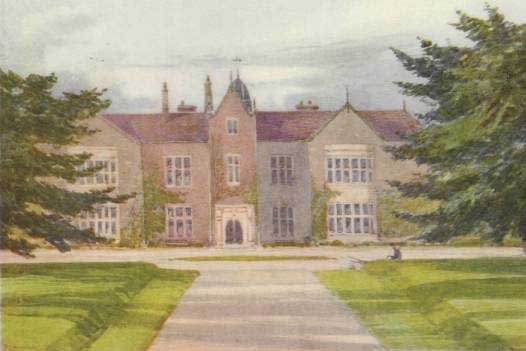 Bradfield
The fireplace is very elaborately carved and painted, and here, too, are figures in curious juxtaposition surrounded by very rich decorations. Amongst others may be seen a farmer and his wife, a cook, with a large goose that she is about to kill, and a dairymaid, with a miniature cow in her arms. High above these are the sons and daughters of Jesse in splendid robes and crowns.
Bradfield, in ancient days Bradefelle, was once held by a family of that name. The deed that carried it to the Walronds is not dated, but a marginal note says that 'Fulke Paynel' was dead in 1 Henry III. The deed runs as follows:
Fulke Paynel grants to Richard Walerond of Exeter all his land of Bradfield in his Manor of Offeculme. Richard Walerond is to make two suits yearly, one at 'La Hockeday,'[10] and one at Michaelmas amercement, to consist of one sextary of wine of the value of sixpence and not more. Grant of common pasture throughout the manor, except in fields and meadows. One pound of pepper to be paid at Michaelmas annually. In recognition of this grant Richard Walerond 'pays to Fulke Paynel five marks of silver, and gives to Hande his wife' one golden ring, and to William his heir one golden brooch.
Witnesses: Simon son of Roger, Hamelin de Boulay, William de Lomene, Walter de Tiddecomba, Simon de Baunton and Robert his brother, Peter Comyn, Radulphus de Doddescomba, Walter de Soffewill, 'and many others.'
Among the Walrond papers is an agreement dated Michaelmas, 1261, regarding a farm 'let for nineteen years, in consideration of four marks paid and one mark a year for six years and rent of six shillings a year ... and two capons at Michaelmas and one bushel of winter wheat at Christmas in each year, from one ferling of land in Cumb.'
I believe that the views held by Sir Henry Walrond of the arrival of William of Orange are not clearly recorded, but whatever they were, a note written by General Ginkel, during the march from Tor Bay to Whitehall, was, considering the position of things, decidedly peremptory:
'Sir van Ginkel, Lt.-General of the Cavalry of the United Netherlands, in the service of his Highness, the Prince of Orange, etc.
'We have taken up our quarters in the house of Sir Hendrie Waldron, which quarters we desire shall be kept open as long as the troops of His Highness shall remain in this town or neighbourhood; we have also left in the care of the aforesaid Sr Hendries Waldron two black horses, and likewise the gray mare, which he shall keep for us.
'Given at Columpton the 7∕17 November, 1688.
A charming echo from the past sounds in a very different epistle—a love-letter from Sir William Walrond to a Mistress Courtenay. The letter is written on a sheet of paper covered with gold-leaf and bordered with elaborate designs. The case belonging to it is embroidered in fine crewel-work in (more or less) natural colours, representing figures, scenery, and a house in the background, and it suggests the needles of Little Gidding.[Pg 308]
 Pynes, near Exeter
'Honoured Lady,
'The happiness I late enjoy'd by the fruition of your sweete society gives an incentive to mee to let you knowe how deep you are percullest[11] in my brest, though their injurious feare [youth's usual concomitant] obscured those larger narratives of my most intensive love and really devoted service ... 'twas my present fate then to be lesse expressive when I most admir'de these eminent perfections which both art & nature have adorn'd you with and as being doubtful of obtaining what I heartily desired remained your captive but in confidence of your candid disposition am now your humble petitioner to bee so far happified as to be deemed your honouring servant. Let then, I beseech you (worthy, lady) this poor and unpolished character of my due respects and firm affections achieve the happiness of kissing your fairest hands and you shall thereby engage at present and in future
'Your most honouring
'friende and servant,
'Anderdon this 27th of October, 1659.'
Pynes stands in the Exe Valley, just within three miles of Exeter Cathedral. It is of red brick with white dressings, and has many high narrow windows. A view has been put forward that the politics of country gentlemen in the early part of the eighteenth century may always be traced by their trees; those who were in favour of William III set lime-avenues, while Jacobites planted Scotch firs. There is a tradition in the family that, while the Northcotes were for the Prince of Orange, the Staffords were for King James, but it seems quite as likely that political significance was not always the chief point in planting trees. In any case, there are many Scotch firs, and a lime-avenue (peculiarly in keeping with the style of the house) is shown by prints to have led far over the hill to Upton Pyne, but is now, alas! represented only by one or two aged survivors.
The manor belonged to the family of Pyne in the reign of Henry I, and after many years was brought by an heiress to[Pg 309] the Larders. From this family, after another interval, it passed by marriage to the Coplestones, of whom it was bought by Hugh Stafford.
The Staffords, or, as the name originally was, Stowfords, migrated from Stowford in Dolton near Torrington, soon after the Restoration. Hugh Stafford, born in 1674, was very keenly interested in the subject of apple-growing and cider. He wrote a 'Dissertation' on the subject, and especially on a certain apple called the Royal Wilding, from which it had just been discovered (about 1710) a very superior kind of cider could be produced. Unfortunately, Lord Bute's cider-tax so greatly discouraged the manufacture that after it had been imposed farmers only made enough for their own use and their labourers', and were not very critical as to the quality. In consequence, the choicest kinds of fruit were neglected, and both the Royal Wilding and the White Sour of the South Hams, another much-prized apple, are no longer to be found.
The daughter and heiress of Mr Stafford married her neighbour, Sir Henry Northcote. The Northcotes have been settled in Devonshire since the reign of Henry I, when Galfridus de Northcote held the lands of Northcote at East Down, near Barnstaple, and in the middle of the sixteenth century Walter Northcote was living at Uton, in the parish of Crediton. In this neighbourhood his descendants remained until Sir Henry's marriage, when they came to Pynes.
John Northcote was one of the Devonshire justices who attended Quarter Sessions during the later part of the reign of Elizabeth, and he lived till within ten years of the outbreak of Civil War. From his epitaph, it appears that he was tried by the Star Chamber; the verse has been translated as follows:
Nothing is known of the trial, not even the charge, but it is pretty certain that, in common with several other justices at[Pg 310] that time, he had showed 'a want of "forwardness"' in collecting ship-money.
Another justice, Walter Yonge, notes in his diary that in 1627 letters were sent to the justices of Devon, 'to the Mayors of port-towns, Exeter, Dartmouth, Totnes, Plymouth, and Barnstaple, bidding the towns provide ships, and the country, men and victuals.' Later, letters were sent demanding that a large sum should be raised 'to set a fleet at sea ... we having but six or seven days to raise the money, and to return it to London; but our county refused to meddle therein.' John Northcote was Sheriff just at this time, and was most probably held responsible for the intractability of his countrymen.
Sir John Northcote, his son, was born in 1599, and became a Member of Parliament, he and Sir Edmund Fowel representing Ashburton in the Long Parliament. During his first few weeks in the House of Commons, Sir John took notes of the proceedings, and the small brown volume in which they are written still exists. The notes have been transcribed by Mr A. H. A. Hamilton, and are very interesting, for they record threatenings of the great storm so soon to burst over England. The pages open with 'Proceedings against the Earl of Strafford. Mr Pimm's [Pym] Report'—which report prefaces terrible accusations with a personal touch: 'Long known the person charged by acts of friendship.'
Many letters, reports, and commissions, refer to Jesuits and priests, and often the Queen's name appears intervening on their behalf; laws against them were more and more relaxed, 'signifying his Majesty's pleasure at instance of her Majesty,' till the Commons became uneasy, and a 'petition' was framed to the King, to remind him of his 'protestation' at the opening of his reign, that the Queen 'should not intermeddle with matters of religion.'
The long and stubborn opposition to the exaction of ship-money, 'Voted illegal and entered nullo contradicente,' is given. The Judges who had declared the tax to be legal were supposed to have been tampered with by Strafford, and Mr Hyde (afterwards[Pg 311] Lord Clarendon) suggested that they should be interviewed as to what had passed. The following is a bit of the debate as it was taken down; as Sir John did not write shorthand, he was naturally able to give only the gist of each speech:
'Mr Hide. That some of the house be sent to know what solicitations [had been made].
'Sir Franc. Seymour. That proof be first made.
'Mr Pelham. That it will amount to high treason and to prepare present charge.
'Sir Jo. Wray. The posy of his grandfather, Just and True. Sir Ed. Cook [said] whoever shall go about to overthrow Common Law, the Common Law will overthrow him. His motion, Currat Lex.
'Sergeant Evers. To have first the votes of the Lords.
'Sir P. Stapylton. That Mr Peard be sent to Judge Jones.
'Sir Jo. Strangwayes. That Justice Crook be sent to.
'Lord Fawkland. That they be sent to all at once.
'Sir Nevill Poole. That Lord Keeper be forth coming.
'Mr Controller. That respect be had to Judges. That none be urged to be accuser, but concluded that all be sent to.
'Sir Jo. Culpeper. Of twelve one was a Judas. To send to all the Judges that gave the Judgment, and to send immediately.'
Another debate shows the King and Parliament for the moment on unusually good terms. Sir Benjamin Rudyard said: 'God blest his Majesty with hopeful and fruitful progeny. To put in mind to provide for them. The first prince born amongst us this 100 years. Queen's good affection to Parliament. Concern her Majesty to uphold the glory and government of this kingdom.'
When the crisis came, most of the Devonshire members seem to have supported the Parliament, guided, no doubt, to some extent by the wonderful influence of 'King' Pym. Pym sat for Tavistock; 'his colleague was a son of the House of Russell. William Strode sat for Buralston, and his elder brother for Plympton.' Northcote was slightly connected with the Strodes, and when war broke out he followed the Earl of Bedford. In Septem[Pg 312]ber, 1642, Sir Hugh Pollard wrote to the Earl of Bath: 'The Earl of Bedford is now at Taunton, in want of men and money; he hath sent to his friends Chudleigh, Bampfield, and Northcote, for a supply of both, whose oratory cannot get one trained man to move, nor above eight volunteers.'
The letter receives a curious comment from the succeeding ones. At that very time the Earl of Bedford was issuing orders for the arrest of Sir Hugh Pollard, and four days afterwards Sir George Chudleigh and Sir John Northcote wrote to Major Carey, expressing their approval of Captain Dewett's conduct in capturing the Earl of Bath. Sir John was now at the head of a regiment of twelve hundred men, and seems to have held the command during the first two years of the Civil War. He took an active part in the defence of Plymouth, and in 1643 at Modbury a victory was won by the forces under Lieutenant-General Ruthen, Sir J. Bampfield, and Sir John Northcote, over Lord Hopton's troops. Many of the Parliamentarian gentlemen were anxious for peace, and just after this skirmish tried to arrange an 'association' or neutrality between Devon and Cornwall; but the idea was quashed by Commissioners from London. A few months later Clarendon mentions that Sir John was sent by the Earl of Bedford, the Parliamentary General of Horse, to negotiate a treaty with the Marquis of Hertford.
Sir John was elected to the Parliament of 1656, and showed himself a constant lover of liberty. He inveighed against the powers granted to Cromwell's House of Peers. 'It was minded you ... that no law was rightly made but by King, Lords, and Commons. I am sure this law was not made so.' He lays stress on the point that the old House of Lords ventured all that they had, and protests against their being superseded by new-comers. 'That they should be excluded and these advanced is not just nor reasonable.' A little later he spoke again on the same subject: 'We thought in the long Parliament we might restrain the inordinate power of the Chief Magistrate. That was the ground of our quarrel in the late war; but ... it seems we cannot bound these Lords' exorbitant powers.... I did fight against an exorbitant[Pg 313] power in the King's hands, and I will fight against it again to the last drop of blood, if his Highness command me, whenever such power shall be set up, if it be to-morrow, and in whatever hands it be.'
John Northcote was one of the two Knights of the Shire for Devon in the Convention Parliament, the other being the Lord General Monk. The Restoration was gladly welcomed by him, but he 'spoke repeatedly in[Pg 314] favour of pardon and amnesty, and when necessity arose, he seems to have confronted the triumphant Cavaliers in debate as boldly as he had met them, or their fathers, in the field.' This was the last Parliament that Sir John sat in. A little later he turned to the West, and spent most of the days that were left him in Devon.[Pg 315]
Baring-Gould (S.): A Book of Dartmoor.
Baring-Gould (S.): A Book of the West.
Baring-Gould (S.): Devonshire Characters and Strange Events.
Blount (T.): Tenures of Lands.
Blundell's Worthies, edited by M. L. Banks.
Bray (Mrs.): The Borders of the Tamar and the Tavy.
Britton (J.) and Brayley (E. W.): Beauties of England and Wales.
Britton (J.) and Brayley (E. W.): Devonshire Illustrated.
Camden (W.): Britannia.
Carew (Bampfylde Moore): Life and Adventures.
Carewe (Sir Peter), Dyscourse and Dyscoverye of the Lyffe of, ...
collected by John Vowell, als. Hoker, of the Citie of Excester, gent.
Carrington (N. T.): Dartmoor.
Chanter (J. F.): A History of the Parishes of Lynton and Countisbury.
Chanter (J. R.): Lundy Island.
Chichester (Sir A. P.): History of the Chichester Family.
Cleaveland (E.): Genealogical History of the Noble and Illustrious Family of Courtenay.
Clermont (Lord): History of the Fortescues.
Cotton (R. W.): Barnstaple and the Northern Part of Devonshire during the Great Civil War.
Cotton (W.): An Elizabethan Guild of the City of Exeter.
Cotton (W.) and Woollcombe (H.): Gleanings from Municipal and Cathedral Records of Exeter.
Dartmoor Preservation Association's Transactions.
Defoe (D.): A Tour through the Whole Island of Great Britain.
Devon Notes and Queries.
Devonshire Association's Transactions.
Edmonds (Chancellor): Exeter Cathedral.
Everitt (W.): Devonshire Scenery.
Fiennes (Celia): Through England on a Side-Saddle in the Time of William and Mary.
Fox (S. P.): Kingsbridge and its Surroundings.
Freeman (E. A.): Exeter.
Friend (H.): Bygone Devonshire.
Froude (J. A.): History of England.
[Pg 324]Fuller (T., D.D.): Worthies of England.
Gilpin (W.): Observations on the Western Parts of England.
Harding (W.): History of Tiverton.
Harris (J. H.): My Devonshire Book.
Izacke (R. and S.): Remarkable Antiquities of the City of Exeter.
Kelly's Directory of Devonshire.
King (R. J.): Sketches and Studies.
Kingsley (C.): Miscellanies.
Leland (J.): Itinerary.
Lysons (D. and S.): Magna Britannia.
Mozley (T.): Henry VII, Prince Arthur, and Cardinal Morton.
Murray's Handbook of Devon.
Norway (A. H.): Highways and Byways in Devon and Cornwall.
Oliver (G., D.D.): History of the City of Exeter.
Oliver (G., D.D.): Lives of the Bishops of Exeter.
Oliver (G., D.D.): Monasticon Diœcesis Exoniensis.
Page (J. L. W.): An Exploration of Exmoor.
Peeke (Richard, of Tavistock): His Three to One.
Pollock (Sir F.): Dartmoor and the Walkham. Eng. Illus. Mag., 1884.
Polwhele (R.): History of Devonshire.
Pridham (T. L.): Devonshire Celebrities.
Prince (J.): Worthies of Devon.
Raleigh (Sir Walter): Life, by Martin Hume.
Rawle (E. J.): Annals of the Ancient Royal Forest of Exmoor.
Rawle (E. J.): The Doones of Exmoor.
Risdon (T.): Chorographical Description or Survey of the County of Devon.
Rogers (W. H. H.): Memorials of the West.
Rowe (C. R.): South Devon.
Rowe (J. Brooking): History of the Borough of Plympton Erle.
Rowe (S.): A Perambulation of Dartmoor.
Snell (F. J.): Memorials of Old Devonshire.
Sprigg (J.): Anglia Rediviva; or, England's Recovery.
Vowell (J., alias Hoker): Antique Description of the City of Exeter.
Walker (J.): Sufferings of the Clergy.
Walpole's Universal British Traveller.
Watkins (J.): An Essay towards a History of Bideford.
Westcote (T.): View of Devonshire in MDCXXX.
Whitfeld (H. F.): Plymouth and Devonport in Times of War and Peace.
Widecombe Tracts, 1638.
Wiffen (J. H.): Historical Memoirs of the House of Russell.
Worth (R. N.): History of Plymouth.
Worth (R. N.): The West-Country Garland.
Acland, Lady Harriot, 29;
Sir John, 29;
Sir Thomas, 270
Adams, Will, 112
Adelaide, Queen, and Honiton lace, 49
Affeton Castle, 238
Ameredith, William, 153
American prisoners at Princetown, 85
Apsley, Colonel, 211;
Sir Allen, 227
Arms and motto granted to Exeter, 9
Arlington Court, 252
Arundell, Colonel, 46
Ashburton, 121
Ashe, 68
Athelstan, monastery founded at Exeter by, 3
Atterbury, Bishop, anecdote of, 97
Audley, Lord, 128
Avant, Philip, 113
Axminster, 69
Axmouth, 66
Babb, John, 257;
Ursula, 258
Ballads, poems, and songs, local, 69, 70, 83, 87, 99, 104, 106, 109, 117, 123, 124, 125, 134, 141, 149, 170, 179, 192, 193, 195, 201, 206, 208, 218, 239, 247, 251, 261, 271, 283
Bampfylde, Bampfield, Hugh, 24;
John, 32, 33, 291;
Sir John Coplestone, 32
Bampton, 13
Barker, Pentecost, 175
Barnstaple, 224
Barun, Walter, 269
Baunton, Robert de, 307;
Simon de, 307
Bedford, Earls of, 80, 182
Beer, 65
Bellerophon in Plymouth Harbour, 177
Benet, Sir Henry, 148
Benson, Thomas, 249
Berkeley, Sir John, 12, 32, 90, 211
Berry Head, 113
Berrynarbour, 249
Berry Pomeroy, 285
Bickleigh, 24
Bideford, 201
Bigbury Bay, unknown lady drowned in, 146
Blackaller, John, 8
Blackhall, Christopher, 131
Blackmore, R. D., 20
Blackpool, 151
Blake, Martin, 224, 225
Blowing-house on Dartmoor, 75
Blundell, Peter, 19
Blundell's School, Tiverton, 19
Bohun, Margaret, 275
Bolt Head and Bolt Tail, 146
Boniface, 35
Bonville, Cicely, 57;
Nicholas, 69
Botreaux, William de, 287
Boulay, Hamelin de, 307
Bradfield, 305
Bradninch, 29
Branscombe, 64
Braunton Burrows, 221
Bray, Mrs., on Wistman's Wood, 77
Brendon, 262
Brent Tor, 71, 198
Brioniis, Baldwin de, 297, 298
Briwere, Alicia de, 107;
William, Lord, 107
Bromehall, Walter de, 91
Brown, Rev. Charles, 94
Browne, Richard, 161;
William, 82, 194
Brudenell, Mr, 31
Buckfast Abbey, 122
Buckfastleigh, 122
Buck-horn, 115
Buckland Abbey, 195
Budleigh, East, 60
Budleigh Salterton, 60
Buller, Charles, 40;
John Francis, 40
Bulmer, Sir Beavis, 251
Burgoyne, General, 30
Burke, Edmund, 146
Burleigh, Lord, 161
Bussell, Nicholas, 98
Cabal Government, the, 101
Cable, Richard, 291
Calder, John, 149
Canonteign, 98, 99
Carew, Sir Alexander, 173;
Bampfylde Moore, 24;
Dorothea, 17;
Sir Gawen, 38, 52, 53, 54;
George, 52, 108;
John, 52;
Sir Peter, 38, 52, 53, 54, 152, 282, 301;
Sir William, 53
Carew arms, 52
Carey, Cary, Colonel, 153;
George, 142;
Sir Henry, 140;
John, 215;
Sir Robert, 216
Castle Hill, 240
Cecil, Sir Edward, 185;
Sir Robert, 135;
Sir William, 135
Cergeaux, John, 128
Chagford, 90
Challacombe, 285
Champernowne, Sir Arthur, 108, 128;
Henry, 62, 128;
Richard, 142;
William, 291
Chapman Burrows, 266
Chapple, Will, 237
Charles II at Plymouth, 175
Charm for staunching of blood, 150
Chesney, Sir Charles, 20;
George, 20
Chichester, Sir Arthur, 252;
John, Sir John, 252;
Robert de, Sir Robert, 252, 254
Choak-a-bone, tomb of, 67
Christmas custom at Dean Prior, 124
Christow, 97
Chudleigh, 100
Chudleigh, Sir George, 312
Churchill, Sir Winston, 68
Cider, Lord Bute's tax on, 50
Civil War, the, 11, 12, 22, 32, 50, 58, 90, 98, 139, 173, 194, 207, 226, 229, 273, 289, 312
Clements, Captain, 115
Clermont, Lady, anecdote of, 241
Clifford, Anthony, 100;
Sir Thomas, 100
Clovelly, 213
Clyst River, 45
Cocke, Captain, 162
Coffin, Richard, 212;
Sir William, 212
Colcombe, 68
Coleridge, Lord, on Ottery, 57
Coleridge, Samuel Taylor, 58
Colyton, 67
Combe Martin, 250
Common rights on Dartmoor, 79
Compton Castle, 294
Comyn, Peter, 307
Convicts at Lundy, 249
Cornish, the, their ignorance of English, 8
Cosway, Richard, 16
Countess Weir, 7
Countisbury, 260, 261
Courtenay, Lord, 54;
Edward, 280;
Lady Elizabeth, 281;
Henry, 279;
Hugh, Sir Hugh, 275, 276;
Lady Matilda, 276;
Sir Peter, 276, 278;
Sir Philip, 272, 275, 276;
Robert, 15;
William, 153, 277
Coven, John, 95
Cranbrook Castle, 92
Crediton, 34
Creedy River, 34
Crockern Tor, 78
Crofts, Sir James, 135
Cromwell, Thomas, 80
Crosses on Dartmoor, 80
Cullen, Nicholas, 248
Cullompton, 27
Culm River, 27
Damarel family, 45
Damarel, Sir John, 300
Dancing Tree at Moreton, 92
Danes, the, in Devon, 104;
at Exeter, 3;
at Northam, 210
Daniel, Tom, 17
Dart, the, 19
Dartington Hall, 127
Dartmoor Forest, 71
Dartmouth, 136
Davis, Captain John, 11, 132;
Mr, 98
De Albemarle family, 45
Dean Prior, 123
Deane, Captain, 273
Defoe, Daniel, on Honiton cider, 50;
on trade of Exeter, 10
Dennis, Sir Thomas, 153
Devon, earldom of, restored, 281
Devonport, 157
'Devonshire Boys' Courage,' 104
Dickens's, Charles, description of Clovelly, 214
Digby, Colonel, 173, 227, 229
Dittisham, 133
Dodbrooke, 142
Doddescomba, Radulphus de, 307
Doddiscombsleigh, 97
Dog Acre Orchard, Axmouth, 67
Dog buried with parson of Axmouth, 66
Dogs as fish catchers, 132
Doone Valley, the, 264
Downes, 39
Drake, Sir Francis, 11, 108, 134, 165, 185, 195, 204;
Sir John, 68
Drewsteignton, 91
Drizzlecombe, 75
Druidical remains, supposed, 76
Duel between Lord Mohun and Duke of Hamilton, 52
Dunsford, 97
Dynant, Oliver de, 217
Earls, William, 95
Easter customs on Exmoor, 268
Edgecombe, Betty, 150
Edward the Confessor in Exeter, 3
Edwards Susanna, 209
Elford Walter, 82
Eliot, Sir John, 173
Endsleigh, 199
Epigram on Sir Francis Drake, 171
Epitaphs, 16, 36, 49, 66, 203, 250, 293, 309
Escot, in Ottery, 55
Exe, the, 13
Exeter, 1;
arms and motto, 9
Exeter Canal, 8
Exeter Cathedral, 5
Exeter Guildhall, 9
Exmoor, 267
Exmoor ponies, 270
Exmouth, 45
Exmouth, Lord, 99
Fairfax, Sir Thomas, 12, 23, 58, 98, 139, 229, 272, 274, 291
Falaise, William de, 128
Fersen, Count, and Lady Clermont, 241
Fiennes, Miss Celia, 41, 246
Fingle Bridge, 91
Fingle Gorge, 92
Fires at Tiverton, 20, 21
Fitz, John, 190
Fitz-Alan, Henry, 142
Fitzford House, 190, 194
Fitz-John, Matthew, 142
Fitz-Roald, Alan, 142
Floyer's Hayes, 298
Folk-lore, 254
Forde House, 103
'Forests of the Dartmoors,' 87
Fortescue, Sir Edward, 149, 240;
Sir Faithful, 240;
Sir Henry, 240;
John, Sir John, 6, 240, 241;
Sir Nicholas, 240
Fortibus, Isabel, 7
Fossway, the, at Honiton, 48
Fowell, Sir Edmund, 310;
William, 291
Freeman, Professor, description of Exeter, 1, 12;
on Exeter's privileges, 7,
on Roman conquest of Exeter, 2
French prisoners at Crediton, 39;
at Princetown, 85
Fulford, Sir Baldwin, 93
Fuller, Thomas, on Honiton lace, 49
Garret, Captain, 167
Gates, General, 31
Gaveston, Piers, 80
Gibbs, Hon Herbert, 127;
John, 126;
Thomas, 126, 127;
William, 126, 127
Gilbert, Adrian, 251;
Sir Humphrey, 11, 61, 133, 168, 251, 295
Giles, Sir Edward, 125;
John, 125
Ginkel, General de, 307
Glanvill, Eulalia, 192;
Judge, 191
Godolphin, Sidney, 90
Gorges, Sir Ferdinando, 172
Goring, Lord, 227
Grandisson, Beatrice de, 57;
Bishop John de, 5, 56;
Sir Otho, 57
Great Fulford, 93
Greenaway, 133
Greenway, Joan, 19;
John, 16, 19
Grenville, Sir Bevil, 207;
John, 207;
Richard de, Sir Richard, 174, 191, 194, 195, 203, 204, 205, 207, 208, 227;
Thomas, 203
Grimspound, 74, 75
Grove, ——, 12
Groves, Hugh, 240
Guildhall, Exeter, 9
Guilds in Exeter, 9, 10
Gurney, Sir Richard, 202
Haccombe, 108
Hals, John, 127
Hameldon Barrow, 74
Hamilton, Duke of, 52;
Sir Robert, 51
Hammett, John, 94
Hammond, Colonel, 274
Hancock, William, 252
Harnage, Major, 30
Harper, Nicholas, 250
Harrys, Christopher, 195
Hartland, 217
Hartland Abbey, 217
Hartland Point, 216
Harvest custom in Devon, 51
Hastings, Lord, 29;
Simon, 107
Hatherleigh, 236
Haughton, Captain, 139
Hawkins, Sir John, 63, 162, 171;
Sir Richard, 164;
William, 162, 165
Hawley, John, 137
Hayes Barton, 60
Heddon's Mouth, 255
Hele, John, 195
Hembury Fort, 48
Henrietta, Princess, born at Exeter, 11
Henrietta Maria, Queen, at Exeter, 11
Herrick, William, 123
Hexter, Ann, 95
Hillersdon, John de, 27
Holborne, Colonel, 299
Hole, Robert, 150
Holland, John, 128;
Lord, 173
Holne, 121
Holt, Mr, 292
Holy wells at Hatherleigh, 236
Honiton, 47
Honiton lace, 49
Hooker, Mr, 237
Hopton, Ralph, Lord, 173, 229, 230, 231
Hounds as tin-carriers, 78
How, John, 95
Howard, Sir Charles, 191;
Lady, 190
Huguenots at Plymouth, 175
Hungerford, Lord, 29
Hunters' Lodge Inn, 55
Hut-dwellings on Dartmoor, 74
Ilfracombe, 244
Izacke's description of Exeter, 2
Jago, Dr, 191
Jewel, Bishop John, 249
Judhael de Totnes, 130, 226, 228, 295
Kennaway, Sir John, 55
Kenwith Castle, 210
Key, John, 291
Killerton, 29
Kilworthy House, 193
King, R. J., on Dartmoor, 71
Kingsbridge, 141
Kingsley, Charles, 121;
description of Clovelly, 214
Kingskerswell, 110
King's Nympton, 239
Kingsteignton, 103
Kings wear, 140
Lake, Thomas, 95
Landslip at Lyme, 67
Lane, John, 28, 150;
Richard, 150;
Thomasine, 28;
Mr, 150
Lechlade, Walter de, 56
Leofric, first Bishop of Exeter, 3
Ley, W., 95
Library, ancient, in Exeter Cathedral, 4;
in Crediton Church, 37
Lloyd, Temperance, 209
Lomene, William de, 307
Longstone, the, 266
Ludlow, Sir Henry, 292
Lundy Island, 245
Lyde, Robert, 42
Lydford, 82
Lydford Gorge, 84
Lynmouth, 259, 260
Lynton, 259
Marwood, Dr, 68
Mary Tavy, 196
Massie, General, 22, 23
Merivale, Samuel, 175
Mohun, Lord, 52;
John, 298;
Sir Reginald, 69;
Richard de, 107;
Sir William, 69
Mohun arms, 52
Moles, Mules, Isabella de, 287;
Nicholas de, 110
Molesworth, Colonel, 292
Monk, George, Duke of Albemarle, 33, 69, 232;
Sir Thomas, 232
Moore, Major, 24
Moretonhampstead, 92
Morisco, Sir William de, 247
Morton, Cardinal, 29
Morwellham, 199
Morwell Rocks, 199
Mules, see Moles
Mozley, Rev. ——, 28
National Debt, origin of the, 101
Newcomb, John, 8
Newenham Abbey, 69
Newton, John, 291
Newton Abbot, 102
Newton St Cyres, 41
Norden, John, 8
North, Lord, and cider tax, 51
Northcote, Galfridus de, 309;
Sir Henry, 309;
John, Sir John, 122, 309, 310, 312, 313;
Walter, 309
Oare, 265
Ogham inscription at Tavistock, 180
Okehampton Castle, 296
Okey, Colonel, 98
Oldbarrow Camp, 261
Orange, William, Prince of, 113
Osey, Thomas, 37
Otter River, 47
Otterton, 60
Ottery Mohun, 52
Ottery St Mary, 55
Ottery St Mary Church, 56
Oxenham, William, 238
Paignton, 110
Parker, William, 162
Parracombe, 254
Paynel, Fulke, 306
Peeke, Captain Richard, 185
Penruddocke, ——, 12;
Colonel, 240
Peryam, William, 36
Peter Tavy, 196
Peverell, Hugh, 27
Pickering, Colonel, 58
Pilchard fishery, 161
Pilgrim Fathers, the, 171
Pim, John, 184
Pinhoe, Danish fight at, 3
Pixies, the, 86
Pixies' House, 82
Pixies' Parlour, 100
Plumleigh, Captain, 248
Plymouth, 155
Plympton, 177
Plymtree, 28
Pole, Alice de la, 295
Polglas, William, 128
Pollard, Hugh, Sir Hugh, 139, 211, 239, 269, 312;
Sir Lewis, 291;
Sir Richard, 296
Pollock, Sir F., on Dartmoor, 71
Poltimore, 31
Poltimore, Lord, 32
Pomeroy, Pomerai, Sir Edward, 288;
Henry de, 182, 285, 287;
Ralph de la, 287;
Sir Thomas, 288
Porter, Endymion, 124
Portledge, 212
Potheridge, 232
Potter, Barnabas, 126
Powderham Castle, 272
Prawle Point, 145
Prayer-Book riot, 38
Priests' hole, a, 299
Princetown, 84
Pynes, 308
Pynho, Sir Robert de, 148
Quivil, Bishop Peter, 5
Raleigh, John de, 252;
Sir Walter, 60, 80, 128, 133, 153, 203, 204
Rame, Thomas, 7
Rattenbury, Jack, 65
Rattery, 126
Reay, Samuel, 17
Redvers, Baldwin de, 4, 15;
Mary de, 15;
Richard de, 14;
William de, 14
Reidesel, Baroness of, 30
Revel, the, at Kingsteignton, 103
Reynell, Lieut, 30
Richmond, Henry, Earl of, 7;
Margaret, Countess of, 231
Robin, Mr, 11
Rodge, James, 49
Roope, Mr, 153
Rougemont Castle, Exeter, 4
Rugglestone, the, 76
Russell, Lord, 9,
Rev. John, 20, 236;
John, 182;
William Lord, 184
St. Leger, Sir John, 7, 152
Salcombe, 144
Salkeld, Captain, 248
Saltram, 177
Sampford ghost, the, 26
Sampford Peveril, 26
Sandridge, 132
Schorne, Sir John, 145
Screen at Plymtree, 28
Seaton, 66
Sexton, Mary, 203
Seymour, Colonel, 153, 211, 289, 290;
Edward, Sir Edward, 116, 139, 286, 288, 289, 292, 293
Shapcote, Colonel, 46
Shebbeare, Dr, 209
Sheeps Tor, 81
Shute, 69
Sidmouth, 64
Silver mines at Combe Martin, 251
Simon, son of Roger, 307
Slapton Sands and Lea, 151
Slee, George, 16
Smuggling, 65
Snell, John, 149
Snowdon, Thomas, 95
Soffewill, Walter de, 307
South Molton, 239
South Tawton, 237
Speare, William, 94
Splatt, Hannah, 96
Sprigg, Joshua, 58
Stafford, Hugh, 309
Stanhope, Anne, 288
Stannary Parliament, 78
Stapleton, Bishop Walter de, 5
Starcross, 42
Starre, John, 66
Start Point, 151
Stevenstone, 231
Stonerows, etc., on Dartmoor, 74
Stonehouse, 157
Stonehouse, Joel de, 157
Storm at Widecombe, 80
'Stout Cripple of Cornwall, the,' 283
Strangwich, George, 192
Strode, William, 311
Stucley, Stukeley, Sir George, 238;
Sir Lewis, 218;
Thomas, 238
Suffolk, Duke of, 54
Sully, Sir John, 36
Superstitions on Dartmoor, 85;
at Whitstone, 96
Sutton, James, 94
Sydenham, 298
Talbot, Sir Gilbert, 22
Tavistock, 179
Tavy Cleave, 197
Tawstock, 228
Teign, the, 89
Teignmouth, 103
Tenure, curious, 269
Thackeray, W. M., at Ottery, 59
Thomas, Grace, 210
Thurlestone, 147
Tiddecomba, Walter de, 307
Tin trade on Dartmoor, 77
Tiverton, 14
Toby, Tryphena, 141
Tongue token, a, 305
Topsham, 41
Tor Abbey, 107
Torbay, 106
Tor Cross, 151
Torner, Major, 139
Torquay, 106
Torridge Castle, 231
Torrington, 228
Totnes, 129
Tourville, Admiral de, 104
Tracy, William de, 221
Trelawny, Rebecca, 40
Tremayne, Andrew, 301, 302, 303;
Edmund, 302, 305;
Nicholas, 301, 302, 303;
Thomas, 300
Trembles, Mary, 209
Trenchard, Isabella, 300;
Sir Thomas, 182
Tuckers' Hall, Exeter, 10
Tuckfield, John, 36
Ugbrooke, 100
Valletort, Reginald de, 160
Valley of Rocks, 258
Vane, Sir Henry, 293
Venton House, 126
Vere, Sir Francis, 135
Wade, Major, 257
Wagstaff, Sir Joseph, 240
Waldron, John, 16, 19;
Richard, 19.
See also Walrond
Wallabrook, the, 89
Waller, Sir Hardress, 225;
Sir William, 290
Walrond, Walerond, Sir Henry, 307;
Richard, 306;
Sir William, 307.
See also Waldron
Walsingham, Sir Francis, 135
Warbeck, Perkin, at Exeter, 7
Wardlaw, Colonel, 174
Warelwast, Bishop William, 5
Weare, Colonel, 22
Webber, Will, 116
Wesley, Samuel, 19
Westward Ho, 212
Whiddon, John, 147
White ale, 143
White bird of the Oxenhams, 237
Whitstone, 93
Whittle, John, 113
Wichehalse, Hugh, 257;
John, 257, 258;
Mary, 258;
Nicholas, 257
Widdecombe-in-the-Moor, 80
Wilford, Sir William, 162
William the Conqueror besieges Exeter, 4
Wise, Arabella, 305;
Sir Edward, 299, 305
Wistman's Wood, 76
Witchcraft, 209, 268
Witches' Stone near Honiton, 55
Woggan, Captain, 98
Wolcot, Dr John, 143
Woodbury Castle, 45
Woolacomb Tracey, 221
Worthy, Geoffrey de la, 287
Wrey, Sir Bourchier, 228, 245
Wright, Jacob, 96
Wyatt, Sir Thomas, 54
Wynfrith, St, 35
Yonge, Walter, Sir Walter, 55, 310
Young, William, 248
[2] In another version 'underground'—i.e., miners.
[3] W. H. Hamilton Rogers, 'Dartmoor.'
[4] Transactions of the Devonshire Association, 1873.
[5] 'An Elizabethan Guild of the City of Exeter,' by William Cotton.
[6] 'Sketches and Studies.'
[7] Cease.
[8] St. Ginnes.
[9] The cottager by the seaside.
[10] 'La Hockeday' is commonly, but incorrectly, supposed to commemorate the freedom of the English by the massacre of the Danes on the Feast of St. Brice, 1002. 'Hoke-tide' began on the Monday after the second Sunday after Easter.
[11] Portcullised.
***END OF THE PROJECT GUTENBERG EBOOK DEVON, ITS MOORLANDS, STREAMS AND COASTS***
******* This file should be named 22485-h.txt or 22485-h.zip *******
This and all associated files of various formats will be found in:
http://www.gutenberg.org/2/2/4/8/22485
Updated editions will replace the previous one--the old editions will be renamed.
Creating the works from public domain print editions means that no one owns a United States copyright in these works, so the Foundation (and you!) can copy and distribute it in the United States without permission and without paying copyright royalties. Special rules, set forth in the General Terms of Use part of this license, apply to copying and distributing Project Gutenberg-tm electronic works to protect the PROJECT GUTENBERG-tm concept and trademark. Project Gutenberg is a registered trademark, and may not be used if you charge for the eBooks, unless you receive specific permission. If you do not charge anything for copies of this eBook, complying with the rules is very easy. You may use this eBook for nearly any purpose such as creation of derivative works, reports, performances and research. They may be modified and printed and given away--you may do practically ANYTHING with public domain eBooks. Redistribution is subject to the trademark license, especially commercial redistribution.
*** START: FULL LICENSE ***

THE FULL PROJECT GUTENBERG LICENSE
PLEASE READ THIS BEFORE YOU DISTRIBUTE OR USE THIS WORK

To protect the Project Gutenberg-tm mission of promoting the free
distribution of electronic works, by using or distributing this work
(or any other work associated in any way with the phrase "Project
Gutenberg"), you agree to comply with all the terms of the Full Project
Gutenberg-tm License (available with this file or online at
http://www.gutenberg.org/license).


Section 1.  General Terms of Use and Redistributing Project Gutenberg-tm
electronic works

1.A.  By reading or using any part of this Project Gutenberg-tm
electronic work, you indicate that you have read, understand, agree to
and accept all the terms of this license and intellectual property
(trademark/copyright) agreement.  If you do not agree to abide by all
the terms of this agreement, you must cease using and return or destroy
all copies of Project Gutenberg-tm electronic works in your possession.
If you paid a fee for obtaining a copy of or access to a Project
Gutenberg-tm electronic work and you do not agree to be bound by the
terms of this agreement, you may obtain a refund from the person or
entity to whom you paid the fee as set forth in paragraph 1.E.8.

1.B.  "Project Gutenberg" is a registered trademark.  It may only be
used on or associated in any way with an electronic work by people who
agree to be bound by the terms of this agreement.  There are a few
things that you can do with most Project Gutenberg-tm electronic works
even without complying with the full terms of this agreement.  See
paragraph 1.C below.  There are a lot of things you can do with Project
Gutenberg-tm electronic works if you follow the terms of this agreement
and help preserve free future access to Project Gutenberg-tm electronic
works.  See paragraph 1.E below.

1.C.  The Project Gutenberg Literary Archive Foundation ("the Foundation"
or PGLAF), owns a compilation copyright in the collection of Project
Gutenberg-tm electronic works.  Nearly all the individual works in the
collection are in the public domain in the United States.  If an
individual work is in the public domain in the United States and you are
located in the United States, we do not claim a right to prevent you from
copying, distributing, performing, displaying or creating derivative
works based on the work as long as all references to Project Gutenberg
are removed.  Of course, we hope that you will support the Project
Gutenberg-tm mission of promoting free access to electronic works by
freely sharing Project Gutenberg-tm works in compliance with the terms of
this agreement for keeping the Project Gutenberg-tm name associated with
the work.  You can easily comply with the terms of this agreement by
keeping this work in the same format with its attached full Project
Gutenberg-tm License when you share it without charge with others.

1.D.  The copyright laws of the place where you are located also govern
what you can do with this work.  Copyright laws in most countries are in
a constant state of change.  If you are outside the United States, check
the laws of your country in addition to the terms of this agreement
before downloading, copying, displaying, performing, distributing or
creating derivative works based on this work or any other Project
Gutenberg-tm work.  The Foundation makes no representations concerning
the copyright status of any work in any country outside the United
States.

1.E.  Unless you have removed all references to Project Gutenberg:

1.E.1.  The following sentence, with active links to, or other immediate
access to, the full Project Gutenberg-tm License must appear prominently
whenever any copy of a Project Gutenberg-tm work (any work on which the
phrase "Project Gutenberg" appears, or with which the phrase "Project
Gutenberg" is associated) is accessed, displayed, performed, viewed,
copied or distributed:

This eBook is for the use of anyone anywhere at no cost and with
almost no restrictions whatsoever.  You may copy it, give it away or
re-use it under the terms of the Project Gutenberg License included
with this eBook or online at www.gutenberg.org

1.E.2.  If an individual Project Gutenberg-tm electronic work is derived
from the public domain (does not contain a notice indicating that it is
posted with permission of the copyright holder), the work can be copied
and distributed to anyone in the United States without paying any fees
or charges.  If you are redistributing or providing access to a work
with the phrase "Project Gutenberg" associated with or appearing on the
work, you must comply either with the requirements of paragraphs 1.E.1
through 1.E.7 or obtain permission for the use of the work and the
Project Gutenberg-tm trademark as set forth in paragraphs 1.E.8 or
1.E.9.

1.E.3.  If an individual Project Gutenberg-tm electronic work is posted
with the permission of the copyright holder, your use and distribution
must comply with both paragraphs 1.E.1 through 1.E.7 and any additional
terms imposed by the copyright holder.  Additional terms will be linked
to the Project Gutenberg-tm License for all works posted with the
permission of the copyright holder found at the beginning of this work.

1.E.4.  Do not unlink or detach or remove the full Project Gutenberg-tm
License terms from this work, or any files containing a part of this
work or any other work associated with Project Gutenberg-tm.

1.E.5.  Do not copy, display, perform, distribute or redistribute this
electronic work, or any part of this electronic work, without
prominently displaying the sentence set forth in paragraph 1.E.1 with
active links or immediate access to the full terms of the Project
Gutenberg-tm License.

1.E.6.  You may convert to and distribute this work in any binary,
compressed, marked up, nonproprietary or proprietary form, including any
word processing or hypertext form.  However, if you provide access to or
distribute copies of a Project Gutenberg-tm work in a format other than
"Plain Vanilla ASCII" or other format used in the official version
posted on the official Project Gutenberg-tm web site (www.gutenberg.org),
you must, at no additional cost, fee or expense to the user, provide a
copy, a means of exporting a copy, or a means of obtaining a copy upon
request, of the work in its original "Plain Vanilla ASCII" or other
form.  Any alternate format must include the full Project Gutenberg-tm
License as specified in paragraph 1.E.1.

1.E.7.  Do not charge a fee for access to, viewing, displaying,
performing, copying or distributing any Project Gutenberg-tm works
unless you comply with paragraph 1.E.8 or 1.E.9.

1.E.8.  You may charge a reasonable fee for copies of or providing
access to or distributing Project Gutenberg-tm electronic works provided
that

- You pay a royalty fee of 20% of the gross profits you derive from
     the use of Project Gutenberg-tm works calculated using the method
     you already use to calculate your applicable taxes.  The fee is
     owed to the owner of the Project Gutenberg-tm trademark, but he
     has agreed to donate royalties under this paragraph to the
     Project Gutenberg Literary Archive Foundation.  Royalty payments
     must be paid within 60 days following each date on which you
     prepare (or are legally required to prepare) your periodic tax
     returns.  Royalty payments should be clearly marked as such and
     sent to the Project Gutenberg Literary Archive Foundation at the
     address specified in Section 4, "Information about donations to
     the Project Gutenberg Literary Archive Foundation."

- You provide a full refund of any money paid by a user who notifies
     you in writing (or by e-mail) within 30 days of receipt that s/he
     does not agree to the terms of the full Project Gutenberg-tm
     License.  You must require such a user to return or
     destroy all copies of the works possessed in a physical medium
     and discontinue all use of and all access to other copies of
     Project Gutenberg-tm works.

- You provide, in accordance with paragraph 1.F.3, a full refund of any
     money paid for a work or a replacement copy, if a defect in the
     electronic work is discovered and reported to you within 90 days
     of receipt of the work.

- You comply with all other terms of this agreement for free
     distribution of Project Gutenberg-tm works.

1.E.9.  If you wish to charge a fee or distribute a Project Gutenberg-tm
electronic work or group of works on different terms than are set
forth in this agreement, you must obtain permission in writing from
both the Project Gutenberg Literary Archive Foundation and Michael
Hart, the owner of the Project Gutenberg-tm trademark.  Contact the
Foundation as set forth in Section 3 below.

1.F.

1.F.1.  Project Gutenberg volunteers and employees expend considerable
effort to identify, do copyright research on, transcribe and proofread
public domain works in creating the Project Gutenberg-tm
collection.  Despite these efforts, Project Gutenberg-tm electronic
works, and the medium on which they may be stored, may contain
"Defects," such as, but not limited to, incomplete, inaccurate or
corrupt data, transcription errors, a copyright or other intellectual
property infringement, a defective or damaged disk or other medium, a
computer virus, or computer codes that damage or cannot be read by
your equipment.

1.F.2.  LIMITED WARRANTY, DISCLAIMER OF DAMAGES - Except for the "Right
of Replacement or Refund" described in paragraph 1.F.3, the Project
Gutenberg Literary Archive Foundation, the owner of the Project
Gutenberg-tm trademark, and any other party distributing a Project
Gutenberg-tm electronic work under this agreement, disclaim all
liability to you for damages, costs and expenses, including legal
fees.  YOU AGREE THAT YOU HAVE NO REMEDIES FOR NEGLIGENCE, STRICT
LIABILITY, BREACH OF WARRANTY OR BREACH OF CONTRACT EXCEPT THOSE
PROVIDED IN PARAGRAPH F3.  YOU AGREE THAT THE FOUNDATION, THE
TRADEMARK OWNER, AND ANY DISTRIBUTOR UNDER THIS AGREEMENT WILL NOT BE
LIABLE TO YOU FOR ACTUAL, DIRECT, INDIRECT, CONSEQUENTIAL, PUNITIVE OR
INCIDENTAL DAMAGES EVEN IF YOU GIVE NOTICE OF THE POSSIBILITY OF SUCH
DAMAGE.

1.F.3.  LIMITED RIGHT OF REPLACEMENT OR REFUND - If you discover a
defect in this electronic work within 90 days of receiving it, you can
receive a refund of the money (if any) you paid for it by sending a
written explanation to the person you received the work from.  If you
received the work on a physical medium, you must return the medium with
your written explanation.  The person or entity that provided you with
the defective work may elect to provide a replacement copy in lieu of a
refund.  If you received the work electronically, the person or entity
providing it to you may choose to give you a second opportunity to
receive the work electronically in lieu of a refund.  If the second copy
is also defective, you may demand a refund in writing without further
opportunities to fix the problem.

1.F.4.  Except for the limited right of replacement or refund set forth
in paragraph 1.F.3, this work is provided to you 'AS-IS,' WITH NO OTHER
WARRANTIES OF ANY KIND, EXPRESS OR IMPLIED, INCLUDING BUT NOT LIMITED TO
WARRANTIES OF MERCHANTIBILITY OR FITNESS FOR ANY PURPOSE.

1.F.5.  Some states do not allow disclaimers of certain implied
warranties or the exclusion or limitation of certain types of damages.
If any disclaimer or limitation set forth in this agreement violates the
law of the state applicable to this agreement, the agreement shall be
interpreted to make the maximum disclaimer or limitation permitted by
the applicable state law.  The invalidity or unenforceability of any
provision of this agreement shall not void the remaining provisions.

1.F.6.  INDEMNITY - You agree to indemnify and hold the Foundation, the
trademark owner, any agent or employee of the Foundation, anyone
providing copies of Project Gutenberg-tm electronic works in accordance
with this agreement, and any volunteers associated with the production,
promotion and distribution of Project Gutenberg-tm electronic works,
harmless from all liability, costs and expenses, including legal fees,
that arise directly or indirectly from any of the following which you do
or cause to occur: (a) distribution of this or any Project Gutenberg-tm
work, (b) alteration, modification, or additions or deletions to any
Project Gutenberg-tm work, and (c) any Defect you cause.


Section  2.  Information about the Mission of Project Gutenberg-tm

Project Gutenberg-tm is synonymous with the free distribution of
electronic works in formats readable by the widest variety of computers
including obsolete, old, middle-aged and new computers.  It exists
because of the efforts of hundreds of volunteers and donations from
people in all walks of life.

Volunteers and financial support to provide volunteers with the
assistance they need, is critical to reaching Project Gutenberg-tm's
goals and ensuring that the Project Gutenberg-tm collection will
remain freely available for generations to come.  In 2001, the Project
Gutenberg Literary Archive Foundation was created to provide a secure
and permanent future for Project Gutenberg-tm and future generations.
To learn more about the Project Gutenberg Literary Archive Foundation
and how your efforts and donations can help, see Sections 3 and 4
and the Foundation web page at http://www.gutenberg.org/fundraising/pglaf.


Section 3.  Information about the Project Gutenberg Literary Archive
Foundation

The Project Gutenberg Literary Archive Foundation is a non profit
501(c)(3) educational corporation organized under the laws of the
state of Mississippi and granted tax exempt status by the Internal
Revenue Service.  The Foundation's EIN or federal tax identification
number is 64-6221541.  Contributions to the Project Gutenberg
Literary Archive Foundation are tax deductible to the full extent
permitted by U.S. federal laws and your state's laws.

The Foundation's principal office is located at 4557 Melan Dr. S.
Fairbanks, AK, 99712., but its volunteers and employees are scattered
throughout numerous locations.  Its business office is located at
809 North 1500 West, Salt Lake City, UT 84116, (801) 596-1887, email
business@pglaf.org.  Email contact links and up to date contact
information can be found at the Foundation's web site and official
page at http://www.gutenberg.org/about/contact

For additional contact information:
     Dr. Gregory B. Newby
     Chief Executive and Director
     gbnewby@pglaf.org

Section 4.  Information about Donations to the Project Gutenberg
Literary Archive Foundation

Project Gutenberg-tm depends upon and cannot survive without wide
spread public support and donations to carry out its mission of
increasing the number of public domain and licensed works that can be
freely distributed in machine readable form accessible by the widest
array of equipment including outdated equipment.  Many small donations
($1 to $5,000) are particularly important to maintaining tax exempt
status with the IRS.

The Foundation is committed to complying with the laws regulating
charities and charitable donations in all 50 states of the United
States.  Compliance requirements are not uniform and it takes a
considerable effort, much paperwork and many fees to meet and keep up
with these requirements.  We do not solicit donations in locations
where we have not received written confirmation of compliance.  To
SEND DONATIONS or determine the status of compliance for any
particular state visit http://www.gutenberg.org/fundraising/pglaf

While we cannot and do not solicit contributions from states where we
have not met the solicitation requirements, we know of no prohibition
against accepting unsolicited donations from donors in such states who
approach us with offers to donate.

International donations are gratefully accepted, but we cannot make
any statements concerning tax treatment of donations received from
outside the United States.  U.S. laws alone swamp our small staff.

Please check the Project Gutenberg Web pages for current donation
methods and addresses.  Donations are accepted in a number of other
ways including checks, online payments and credit card donations.
To donate, please visit: http://www.gutenberg.org/fundraising/donate


Section 5.  General Information About Project Gutenberg-tm electronic
works.

Professor Michael S. Hart is the originator of the Project Gutenberg-tm
concept of a library of electronic works that could be freely shared
with anyone.  For thirty years, he produced and distributed Project
Gutenberg-tm eBooks with only a loose network of volunteer support.

Project Gutenberg-tm eBooks are often created from several printed
editions, all of which are confirmed as Public Domain in the U.S.
unless a copyright notice is included.  Thus, we do not necessarily
keep eBooks in compliance with any particular paper edition.

Each eBook is in a subdirectory of the same number as the eBook's
eBook number, often in several formats including plain vanilla ASCII,
compressed (zipped), HTML and others.

Corrected EDITIONS of our eBooks replace the old file and take over
the old filename and etext number.  The replaced older file is renamed.
VERSIONS based on separate sources are treated as new eBooks receiving
new filenames and etext numbers.

Most people start at our Web site which has the main PG search facility:

http://www.gutenberg.org

This Web site includes information about Project Gutenberg-tm,
including how to make donations to the Project Gutenberg Literary
Archive Foundation, how to help produce our new eBooks, and how to
subscribe to our email newsletter to hear about new eBooks.

EBooks posted prior to November 2003, with eBook numbers BELOW #10000,
are filed in directories based on their release date.  If you want to
download any of these eBooks directly, rather than using the regular
search system you may utilize the following addresses and just
download by the etext year.

http://www.gutenberg.org/dirs/etext06/

    (Or /etext 05, 04, 03, 02, 01, 00, 99,
     98, 97, 96, 95, 94, 93, 92, 92, 91 or 90)

EBooks posted since November 2003, with etext numbers OVER #10000, are
filed in a different way.  The year of a release date is no longer part
of the directory path.  The path is based on the etext number (which is
identical to the filename).  The path to the file is made up of single
digits corresponding to all but the last digit in the filename.  For
example an eBook of filename 10234 would be found at:

http://www.gutenberg.org/dirs/1/0/2/3/10234

or filename 24689 would be found at:
http://www.gutenberg.org/dirs/2/4/6/8/24689

An alternative method of locating eBooks:
http://www.gutenberg.org/dirs/GUTINDEX.ALL

*** END: FULL LICENSE ***