Project Gutenberg's The Works of John Knox,  Vol. 1 (of 6), by John Knox

This eBook is for the use of anyone anywhere at no cost and with
almost no restrictions whatsoever.  You may copy it, give it away or
re-use it under the terms of the Project Gutenberg License included
with this eBook or online at www.gutenberg.org


Title: The Works of John Knox,  Vol. 1 (of 6)

Author: John Knox

Editor: David Laing

Release Date: June 26, 2007 [EBook #21938]

Language: English

Character set encoding: ISO-8859-1

*** START OF THIS PROJECT GUTENBERG EBOOK THE WORKS OF JOHN KNOX,  ***


Produced by Jordan, Thomas Strong and the Online Distributed
Proofreading Team at http://www.pgdp.net
Transcriber's Note:
1. Footnotes are numerous and many are lengthy. They are placed at the end of the book for easier reading of the text.
2. There are numerous asterisks in the text, three of which (pp. 115, 127 and 128) refer to sidenotes on those pages. Other asterisks will be seen in footnote references to outside sources.
3. There are multiple instances of different spellings for the same word. Those have been retained. Obvious typos have been corrected.
4. Quote (") marks have been retained as in the original.
5. Footnote numbers cited as internal references have been changed from the original to conform to the footnote numbers in this document; and, where necessary, comments have been altered to reflect the format of this document.
Ad Scotos transeuntibus Primo-occurrit Magnus ille JOANNES CNOXUS: quem si Scotorum in vero Dei cultu instaurando, velut Apostolum quendam dixero. dixisse me quod res est existimabo.
THEOD. BEZA.
| PAGE | |
| Advertisement, | vii |
| Chronological Notes of the chief Events in the life of John Knox, | xi |
| Manuscript Copies of the History. | xxix |
| Printed Editions of the History. | xxxix |
| Introductory Notice, | xxv |
| BOOK FIRST, 1494—1558, | 1 |
| BOOK SECOND., 1558—1559, | 295 |
| No. II.—On the Lollards in Scotland, during the Fifteenth Century, | 496 |
| No. III.—Patrick Hamilton, Abbot of Ferne, | 500 |
| No. IV.—On the Royal Pilgrimages to the Shrine of St. Duthack, at Tain, in Ross-shire, | 515 |
| No. V.—Foxe's Account of Henry Forrest, and ather Martyrs an Scotland, during the reign of King James the Fifth, |
516 |
| No. VI.—Notices of the Protestant Exiles from Scotland, during the reign of King James the Fifth, |
526 |
| No. VII.—Alexander Seyton, | 531 |
| No. VIII.—Sir John Borthwick, | 533 |
| No. IX.—George Wishart, | 534 |
| No. X.—John Rough, | 537 |
| No. XI.—Norman Lesley, | 541 |
| No. XII.—Adam Wallace, | 543 |
| No. XIII.—Walter Myln, | 550 |
| No. XIV.—On the title of Sir applied to Priests, | 555 |
| No. XV.—On the Tumult in Edinburgh, at the procession on St. Giles's Day, 1558, | 558 |
| No. XVI.—Provincial Councils in Scotland, 1549-1559, | 561 |
| No. XVII.—Letter of Mary Queen of Scots to Lord James, Prior of the Monastery of St. Andrews. July 1559, | 562 |
| No. XVIII.—David Forrest, General of the Mint. | 563 |
| PAGE | |
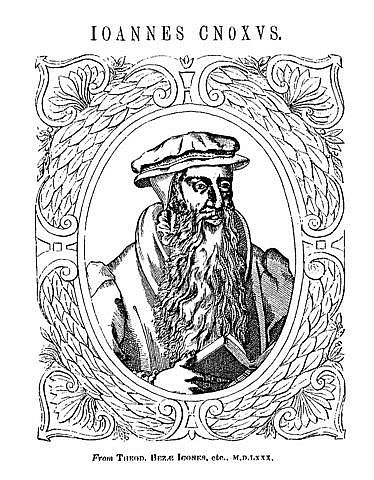
| No. I.—Ioannes Cnoxvs. From Theod. Bezæ Icones, etc., m.d.lxxx. |
xii |
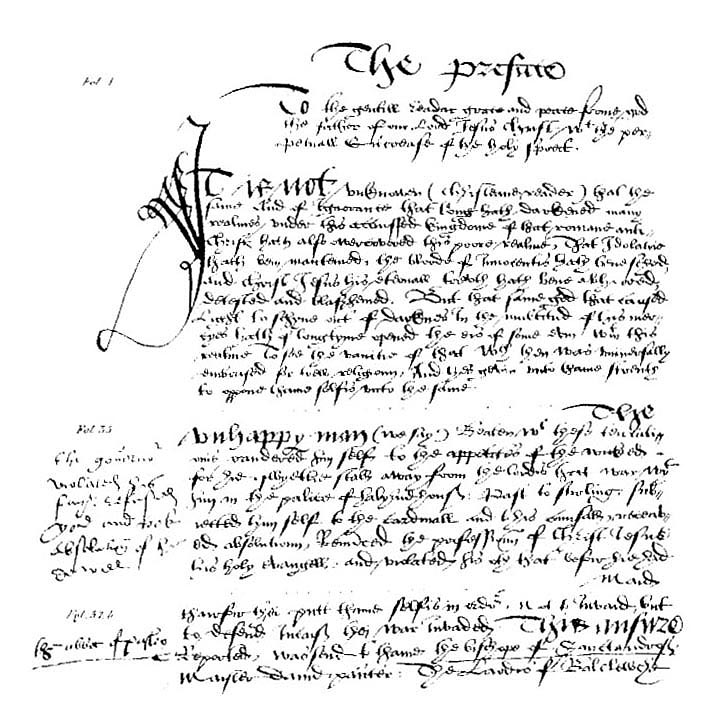
| No. II.—Handwritten Prefacefacing page | xxxi |
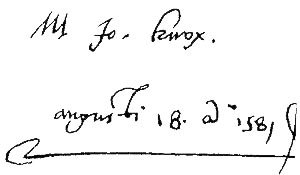
| No. III.—Signature of M Jo. Knox. augusti 18 ao 1581 |
xxxiv |
This publication of the Works of John Knox, it is supposed, will extend to Five Volumes. It was thought advisable to commence the series with his History of the Reformation in Scotland, as the work of greatest importance. The next volume will thus contain the Third and Fourth Books, which continue the History to the year 1564; at which period his historical labours may be considered to terminate. But the Fifth Book, forming a sequel to the History, and published under his name in 1644, will also be included. His Letters and Miscellaneous Writings will be arranged in the subsequent volumes, as nearly as possible in chronological order; each portion being introduced by a separate notice, respecting the manuscript or printed copies from which they have been taken.
It may perhaps be expected that a Life of the Author should have been prefixed to this volume. The Life of Knox, by Dr. MʻCrie, is however a work so universally known, and of so much historical value, as to supersede any attempt that might be made for a detailed bio[Pg viii]graphy; and none of the earlier sketches of his life is sufficiently minute or accurate to answer the purpose intended. In order to obviate the necessity of the reader having recourse to other authorities, I have added some chronological notices of the leading events in his life; reserving to the conclusion of the work any remarks, in connexion with this publication, that may seem to be requisite.
I was very desirous of obtaining a Portrait of the Reformer, to accompany this volume. Hitherto all my inquiries have failed to discover any undoubted original painting, among several which have either been so described, or engraved as such.[1] In the meantime, a tolerably accurate fac-simile is given of the wood-cut portrait of Knox,[2] included by Theodore Beza, in his volume entitled "Icones, id est, Veræ Imagines Virorum Doctrina simul et Pietate illustrium," &c., published at Geneva, in the year 1580, 4to. It is the earliest of[Pg ix] the engraved portraits, and, so far as we can judge, it ought to serve as a kind of test by which other portraits must be tried. A similar head engraved on copper, is to be found in Verheiden's "Præstantium aliquot Theologorum, &c., Effigies," published at the Hague, in 1602, folio; but this, I apprehend, is merely an improved copy from Beza, and not taken from an original painting. It does not retain the expressive character of the ruder engraving, although the late Sir David Wilkie, whose opinion in such matters was second to none, was inclined to prefer this of Verheiden to any at least of the later portraits of the Reformer.[3]
It may not here be superfluous to mention, that this publication was projected by the Editor many years ago, and that some arrangements had been entered into for having it printed in England. When the Wodrow Society, therefore, expressed a willingness to undertake the work, I proposed as a necessary condition, that I[Pg x] should have the privilege of causing a limited impression to be thrown off, for sale, chiefly in England; and the Council, in the most liberal manner, at once acquiesced in this proposal. Instead however of availing myself to the full extent of their liberality, which some circumstances rendered less desirable, but in order to avoid throwing, either upon the Society or the Editor, the extra expenses which have been incurred in various matters connected with the publication, it was finally arranged that a much more limited impression than was first proposed, should be thrown off on paper to be furnished by the Bannatyne Club, for the use of the Members of that Institution.
November, 1846.[Pg xi]
Knox was born this year, at the village of Gifford, near the town of Haddington, in East-Lothian. His father is said to have been descended from the Knoxes of Ranferly, in the county of Renfrew; and the name of his mother was Sinclair. Knox himself, in describing an interview with the Earl of Bothwell, in 1562, mentions that his father, grandfather, and great-grandfather, had all served his Lordship's predecessors, and that some of them had died under their standards; which implies that they must have been settled for a considerable period in East-Lothian, where the Hepburns, Earls of Bothwell, had their chief residence.
1522.After being educated at Haddington, Knox was sent to the University of Glasgow; where John Major was Principal Regent or Professor of Philosophy and Divinity. The name "Johānes Knox," occurs in the Registers of the University, among those of the students who were incorporated in the year 1522. There is no evidence to shew that he afterwards proceeded to St. Andrews, as is usually stated, either to complete his academical education, or publicly to teach philosophy, for which he had not qualified himself by taking his degree of Master of Arts. If he ever taught philosophy, it must have been in the way of private tuition.[Pg xiv]
1530.About this time Knox took priest's orders; and he was probably connected, for upwards of ten years, with one of the religious establishments in the neighbourhood of Haddington. It is generally supposed, that between the years 1535 and 1540, in the course of his private studies, the perusal of the writings of Augustine and other ancient Fathers, led him to renounce scholastic theology, and that he was thus prepared, at a mature period of life, to profess his adherence to the Protestant faith.
1541.March 8. The name of "Schir John Knox" occurs among the witnesses to a deed concerning Rannelton Law, in a Protocol-book belonging to the borough of Haddington; and there is no reason to doubt that this was the Reformer.
1544.Knox entered the family of Hugh Douglas of Longniddry, as tutor of his sons Francis and George Douglas; and also of Alexander Cockburn, son of John Cockburn of Ormiston.
1545.In this year he attached himself as an avowed adherent of George Wishart, from the time of his first visit to East-Lothian.
1546.George Wishart suffered martyrdom at St. Andrews, on the 1st of March 1545-6; and on the 29th of May that year, Cardinal Beaton was murdered.
1547.April 10. Knox, with his young pupils, entered the Castle of St. Andrews, as a place of safety from the persecution of the Popish clergy.
May. At the end of this month, or early in June, he received a public call to the ministry, which he obeyed with great reluctance; but having undertaken the office, he continued, along with John Rough, to preach both in the parish Church, and in the Castle until its surrender.[Pg xv]
June. The French fleet appeared in St. Andrews Bay, to lay siege to the Castle, which surrendered on the 30th of July; but in defiance of the terms of capitulation, the chief persons in the place were sent as prisoners on board the French galleys.
During this winter, the vessel on board of which Knox was confined, remained in the river Loire.
1548.The vessel returned to Scotland, about the time of the siege of Haddington in June; and when within sight of St. Andrews, Knox uttered his memorable prediction, that he would yet survive to preach in that place where God had opened his mouth for the ministry.
During this winter, he was kept prisoner at Rouen, where he wrote a Preface to Balnaves's Treatise of Justification, which was sent to Scotland, and until some years after his death, was supposed to be lost.
1549.February. Knox obtained his liberty, after an imprisonment of nineteen months. He came to England, and soon afterwards was appointed by the English Council to be a preacher in the town of Berwick.
1550.April 4. Knox was summoned to appear at Newcastle before Dr. Tonstall, Bishop of Durham, to give an account of his doctrine.
At the close of this year he was removed from Berwick to Newcastle, where he continued his ministerial labours.
1551.December. Knox was appointed by the Privy Council of England one of six Chaplains to Edward the Sixth. This led to his occasional residence in London during 1552 and 1553.
1552.October. He received an offer of the Bishopric of Rochester; but this preferment he declined.[Pg xvi]
1553.In or about February, Knox was summoned before the Privy Council of England, upon complaints made by the Duke of Northumberland; but was acquitted.
April 14. He also declined accepting the vacant living of All-Hallows, in London, and, on account of his refusal, was again summoned before the Privy Council.
Edward the Sixth died on the 6th of July, and the persecution of the Protestants being revived during the reign of Queen Mary, most of the Reformed ministers and many of the laity made their escape, and sought refuge in foreign countries, in the course of that year.
1554.January 28. Knox was at Dieppe, where he remained till the end of February. He then proceeded to Geneva, but was again at Dieppe in July, "to learn the estate of England."
April 10. The Queen Dowager, Mary of Guise, was installed Regent of Scotland.
On the 4th of September, he received a call from the English Congregation at Frankfort on the Maine, to become their minister. He accepted the invitation, and repaired to that city in November.
1555.In consequence of the disputes which arose in the English Congregation at Frankfort, in regard to the use of the Book of Common Prayer, and the introduction of various ceremonies. Knox was constrained to relinquish his charge; and having preached a farewell discourse on the 26th of March, he left that city, and returned to Geneva. Here he must have resumed his ministerial labours; as, on the 1st of November that year, in the "Livre des Anglois, à Geneve," it is expressly said, that Christopher Goodman and Anthony Gilby were "appointed to preche the word of God and mynyster the Sacraments, in th' absence of John Knox." This refers to his having resolved to visit his native country.[Pg xvii]
Knox proceeded to Dieppe in August, and in the following month landed on the east coast of Scotland, not far from Berwick. Most of this winter he spent in Edinburgh, preaching and exhorting in private.
1556.In the beginning of this year Knox went to Ayrshire, accompanied with several of the leading Protestants of that county, and preached openly in the town of Ayr, and in other parts of the country. He was summoned to appear before a Convention of the Popish Clergy, on the 15th of May, at Edinburgh. About the same time, he addressed his Letter to the Queen Regent.
Having received a solicitation for his return to Geneva, to become one of their pastors, Knox left Scotland in July that year. Before this time he married Marjory Bowes. Her father was Richard, the youngest son of Sir Ralph Bowes of Streatlam; her mother was Elizabeth, a daughter and co-heiress of Sir Roger Aske of Aske.
On the 13th September, Knox, along with his wife and his mother-in-law, were formally admitted members of the English Congregation. At the annual election of Ministers, on the 16th of December, Knox and Goodman were re-elected.
1557.Having received a pressing invitation from Scotland, which he considered to be his duty to accept, Knox took leave of the Congregation at Geneva, and came to Dieppe; but finding letters of an opposite tenor, dissuading him from coming till a more favourable opportunity, after a time he returned again to Geneva.
In May, his son Nathaniel was born at Geneva, and was baptized on the 23d, William Whittingham, afterwards Dean of Durham, being god-father.
On the 16th of December, Knox and Goodman still continued to be ministers of the English Congregation at Geneva.[Pg xviii]
1558.April. Mary Queen of Scots was married, at Paris, to Francis, Dauphin of France.
In this year Knox republished, with additions, his Letter to the Queen Regent; and also his Appellation from the cruel sentence of the Bishops and Clergy of Scotland; and his First Blast of the Trumpet against the Regiment of Women.
In November, his son Eleazar was born at Geneva, and was baptized on the 29th, Myles Coverdale, formerly Bishop of Exeter, being witness or god-father.
November 17. Upon the death of Mary Queen of England, Elizabeth ascended the throne.
On the 16th December, Knox and Goodman were again re-elected ministers of the English Congregation.
1559.January 7. Knox took his final departure from Geneva, in consequence of an invitation to return to Scotland; and was on that occasion honoured with the freedom of the city.
In March, he arrived at Dieppe, and finding that the English Government refused to grant him a safeconduct, on the 22d April he embarked for Leith, and reached Edinburgh on the 2d May. During that month, the Queen Regent published a Declaration against the Protestants, and the Lords of the Congregation sent a deputation to remonstrate; but their remonstrance being despised, they took arms in self-defence.
June 11. Knox preached in St. Andrews; and at Perth on the 25th, when the populace defaced several of the Churches or Monasteries in that city.
July 7. He was elected Minister of Edinburgh. Owing to the troubles, within a brief space he was obliged to relinquish his charge; but he continued his labours elsewhere for a time, chiefly at St. Andrews.
July 10. On the death of Henry II. of France, his son Francis, who had espoused Mary Queen of Scots, and had[Pg xix] obtained the Matrimonial Crown of Scotland in November 1558, at the age of sixteen, ascended the throne of France.
August 1. The Protestants assembled at Stirling, and having resolved to solicit aid from England, on the 3d of that month Knox proceeded to Berwick to hold a conference with Sir James Crofts. In this month, he sent Calvin a favourable report of his labours since his arrival in Scotland: Calvin's answer to this communication is dated in November.
September 20. Knox's Wife and children, accompanied by Christopher Goodman, arrived in Edinburgh.
October 18. The Protestants entered Edinburgh, while the Queen Regent retired to Leith, with the French troops which had come to her aid.
1560.February 27. A treaty concluded between England and the Lords of the Congregation. The English fleet blockaded the port of Leith, and furnished reinforcements, their troops at the same time having entered Scotland.
April. At the end of this month, Knox had returned to Edinburgh. His work on Predestination was published this year at Geneva.
June 10. The Queen Regent died in the Castle of Edinburgh. Articles of Peace were concluded in July.
August 1. The Scotish Parliament assembled; and, on the 17th, the Confession of Faith was ratified, and the Protestant religion formally established.
December 5. Francis II. of France, the husband of Mary Queen of Scots, died.
December 20. The first meeting of the General Assembly was held at Edinburgh.
At the end of this year, Knox's Wife died, leaving him the two sons above mentioned.
1561.An invitation having been sent by the Protestant Nobility[Pg xx] to their young Queen, to revisit Scotland, she arrived from France, and assumed the Government, on the 19th of August.
1562.May. Knox engaged in a dispute at Maybole, with Quintin Kennedy, Abbot of Crossragwell; of which dispute he published an account in the following year.
December. He was summoned to appear before the Privy Council, on account of a circular letter which he had addressed to the chief Protestants, in virtue of a commission granted to him by the General Assembly.
1563.The town of Edinburgh formed only one parish. Knox, when elected Minister, had the assistance of John Cairns as Reader. John Craig, minister of the Canongate or Holyrood, had been solicited to become his colleague, in April 1562; but his appointment did not take place till June 1563.
1564.March. Knox married to his second wife, Margaret Stewart, daughter of Andrew Lord Ochiltree.
June 30. He was appointed by the General Assembly to visit the churches in Aberdeen and the North of Scotland. The following Assembly, 26th of December, gave him a similar appointment for Fife and Perthshire.
1565.Knox was summoned before the Privy Council, on account of a sermon which, on the 19th of August, he had preached in St. Giles's Church.
1566.In this year he appears to have written the most considerable portion of his History of the Reformation; having commenced the work in 1559 or 1560.
In consequence of the unsettled state of public affairs, after the murder of David Riccio, 9th of March, Knox left Edinburgh, and retired for a time to Kyle.[Pg xxi]
June 19. James the Sixth was born in the Castle of Edinburgh.
December. Knox obtained permission from the General Assembly to proceed to England, having received from the English Government a safeconduct, to visit his two sons, who were residing with some of their mother's relations.
1567.February 10. Henry Lord Darnley was murdered.
April 24. Bothwell carried off Queen Mary to the Castle of Dunbar; and their marriage was celebrated on the 15th of May.
June 15. Bothwell fled from Carberry-hill to Dunbar; and the Queen was brought to Edinburgh, and afterwards confined in Lochleven Castle. About the same time, Knox returned from England.
July 29. At the King's Coronation at Stirling, Knox preached an inaugural sermon on these words, "I was crowned young."
August 22. James Earl of Murray was appointed Regent of Scotland.
December 15. Knox preached at the opening of Parliament; and on the 20th, the Confession of Faith, which had been framed and approved by Parliament in 1560, with various Acts in favour of the Reformed religion, was solemnly ratified.
1568.May 2. Queen Mary escaped from Lochleven; but her adherents, who had assembled at Langside, being defeated, she fled into England, and was imprisoned by Queen Elizabeth for the rest of her life; having been beheaded at Fotheringay on the 8th of February 1586-7.
1569.January 23. The Earl of Murray was assassinated at Linlithgow; and on occasion of his funeral, Knox preached a sermon on these words, "Blessed are the dead who die in the Lord." (Rev. xiv. 13.)[Pg xxii]
1570.July 12. Matthew Earl of Lennox was elected Regent of Scotland; but was assassinated on the 4th of September. On the following day, John Earl of Mar was chosen Regent.
October. Knox had a stroke of apoplexy, but was enabled occasionally to resume his ministerial labours.
1571.May 5. The troubles which then agitated the country induced Knox to quit the metropolis, and to retire to St. Andrews.
September. The news arrived of the massacre of the Protestants on St. Bartholomew's Eve, 24th of August, at Paris, and in other parts of France.
1572.July. On the cessation of hostilities, at the end of this month, a deputation from the citizens of Edinburgh was sent to St. Andrews, with a letter to Knox, expressive of their earnest desire "that once again his voice might be heard among them." He returned in August, having this year published, at St. Andrews, his Answer to Tyrie the Jesuit.
The Earl of Mar died on the 29th of October; and James Earl of Morton, on the 24th of November, was elected Regent of Scotland.
On the same day, the 24th of November, having attained the age of sixty-seven, Knox closed "his most laborious and most honourable career." He was buried in the church-yard of St. Giles; but, as in the case of Calvin, at Geneva, no monument was erected to mark the place where he was interred.
Knox left a widow, and two sons by his first marriage, and three daughters by the second. In the concluding volume will be given a genealogical tree, or notices of his descendants.[Pg xxiii]
THE HISTORY
OF THE
REFORMATION IN SCOTLAND.[Pg xxiv]
INTRODUCTORY NOTICE TO THE HISTORY.
ToCIn the long series of events recorded in the Annals of Scotland, there is unquestionably none of greater importance than those which exhibit the progress and establishment of the Reformed Religion in the year 1560. This subject has accordingly called forth in succession a variety of writers of different sentiments and persuasions. Although in the contemporary historians, Lesley, Buchanan, and their successors, we have more or less copious illustrations of that period, yet a little examination will show that we possess only one work which bears an exclusive reference to this great event, and which has any claims to be regarded as the production of an original historian. Fortunately the writer of the work alluded to was of all persons the best qualified to undertake such a task, not only from his access to the various sources of information, and his singular power and skill in narrating events and delineating characters, but also from the circumstance that he himself had a personal and no unimportant share in most of the transactions of those times, which have left the character of his own mind so indelibly impressed on his country and its institutions. It is scarcely necessary to subjoin the name of John Knox.
The doubts which were long entertained respecting Knox's share in the "History of the Reformation," have been satisfactorily explained. Such passages as were adduced to prove that he could not have been the author, consist of palpable[Pg xxvi] errors and interpolations. Without adverting to these suspicions, we may therefore attend to the time when the work was actually written.
The necessity of leaving upon record a correct account of their proceedings suggested itself to the Reformers at an early period of their career, and led to this History being commenced. Knox arrived in Scotland in May 1559; and by his presence and counsels, he served to animate and direct their measures, which were attended with so much success. In a letter dated from Edinburgh 23d October that year, while alluding to the events which had taken place during their contentions with the Queen Regent and her French auxiliaries, he uses these words, "Our most just requeastes, which ye shall, God willing, schortlie hereafter onderstand, together with our whole proceeding from the beginning of this matter, which we ar to sett furth in maner of Historie." That he had commenced the work, further appears from a letter, dated Edinburgh, 23d September 1560, and addressed to Secretary Cecil by the English Ambassador, Randolph, in which he says, "I have tawlked at large with Mr. Knox concerning his Hystorie. As mykle as ys written thereof shall be sent to your Honour, at the comynge of the Lords Embassadours, by Mr. John Woode. He hath wrytten only one Booke. If yow lyke that, he shall continue the same, or adde onie more. He sayethe, that he must have farther helpe then is to be had in thys countrie, for more assured knowledge of thyngs passed than he hath hymself, or can come bye here: yt is a work not to be neglected, and greatly wyshed that yt sholde be well handled."
Whether this portion of the work was actually communicated to Cecil at that time, is uncertain; as no such manuscript has been discovered among his papers, either in the British Museum or the State Paper Office. It could only have con[Pg xxvii]sisted of part of the Second Book; and this portion remains very much in its original state, as may be inferred from these two passages.—In July 1559, while exposing "the craftyness of the Queen Regent," in desiring a private conference with the Earl of Argyle and Lord James Stewart, with the hope that she might be able to withdraw them from their confederates, we read, "And one of hir cheaf Counsale in those dayis, (and we fear but over inward with hir yit,) said," &c. See page 368 of this volume. This must necessarily have been written during the Queen Regent's life, or previously to June 1560. During the following month, after noticing the Earl of Arran's escape from France, and the imprisonment of his younger brother, Lord David Hamilton, it is stated, "For the same tyme, the said Frensche King, seing he could not have the Erle him self, gart put his youngar brother ... in strait prisoun, quhair he yitt remaneis, to witt, in the moneth of October, the yeir of God 1559." See page 383. In like manner, in a letter of intelligence, dated at Hamilton, 12th October 1559, and addressed to Cecil, Randolph says, "Since Nesbot went from hence, the Duke never harde out of Fraunce, nor newes of his son the Lord David."—(Sadler's State Papers, vol. i. p. 500.) We might have supposed that his restraint was not of long duration, as he is named among the hostages left in England, at the treaty of Berwick, 27th February 1559-60; a circumstance of which Knox could not have been ignorant, as he gives a copy of the confirmation of the treaty by the Duke of Chastelherault and the Lords of the Congregation; but it appears from one of the articles in the treaty of peace in July, that Lord David Hamilton, who was still a prisoner at Bois de St. Vincent, in France, then obtained liberty to return to Scotland; and he arrived at Edinburgh in October 1560. We are therefore warranted to infer that this portion of the Second Book of his History, must have been written towards the end of the year 1559.[Pg xxviii]
Knox himself in his general Preface, says, the intention was to have limited the period of the History from the year 1558, until the arrival of Queen Mary from France to assume the government in this country, in August 1561; thus extending the period originally prescribed beyond the actual attainment of the great object at which the Reformers aimed, in the overthrow of Popish superstition, and the establishment by civil authority of the Protestant faith, which was actually secured by the proceedings of the Parliament that met at Edinburgh on the 1st of August 1560. But he further informs us, that he was persuaded not only to add the First Book as an Introduction, but to continue the Narrative to a later period. This plan of extending the work he carried into effect in the year 1566, when the First and Fourth Books were chiefly written, and when there is reason to believe that he revised and enlarged the intermediate portion, at least by dividing it into two parts, as Books Second and Third. The Fourth Book extends to the year 1564; and he seems to intimate that he himself had no intention to continue the History to a later period; for alluding to the death of David Riccio, in March 1565-6, he says, "of whom we delay now farther to speik, becaus that his end will requyre the descriptioun of the whole, and referris it unto suche as God sall rayse up to do the same;" and a marginal note on this passage, written probably by Richard Bannatyne in 1571, says "This ves never done be this Authour."
Dr. MʻCrie states, that "the First and Fourth Books were composed during the years 1566, 1567, and 1568," and that "some additions were made to the Fourth Book so late as 1571." The only evidence to support this supposition, is founded upon the circumstance of some marginal notes having been added in those years, and introduced by subsequent transcribers, as belonging to the text. Whether the Fifth Book, published by David Buchanan in 1644, was actually written by the Reformer, will be considered in the preliminary notice[Pg xxix] to that Book. Meanwhile it may be remarked, that the Author himself whilst occasionally engaged in collecting materials for a continuation of his History, felt the necessity of delaying the publication; and in a letter addressed to Mr. John Wood, 14th February 1567-8, he expresses the resolution he had formed of withholding the work from the public during his own life.
The Manuscript of the History of the Reformation which has been followed in this edition, fully confirms the preceding statements regarding the period of its composition. It also serves to shew that no suppressions or alterations had been made by his friends, after his death, in these Four Books. Such an intention is alluded to, in a letter, dated from Stirling, 6th August 1572, and addressed to Randolph, by George Buchanan:—"As to Maister Knox, his Historie is in hys freindes handes, and thai ar in consultation to mitigat sum part the acerbite of certain wordis, and sum taunts wherein he has followit too muche sum of your Inglis writaris, as M. Hal. et suppilatorem ejus Graftone, &c." The Manuscript contains Four Books, transcribed by several hands, and at different intervals. Notwithstanding this diversity of hand-writing, there is every reason to believe that the most considerable part of the volume was written in the year 1566, although it is not improbable that in the Second and Third Books a portion of the original MS. of 1559 may have been retained. The marginal notes, which specify particular dates, chiefly refer to the years 1566, or 1567, and they leave no doubt in regard to the actual period when the bulk of the MS. was written, as those bearing the date 1567 are clearly posterior to the transcription of the pages where they occur. Some of these notes, as well as a number of minute corrections, are evidently in Knox's own[Pg xxx] hand; but the latter part of Book Fourth could not have been transcribed until the close of the year 1571. This is proved by the circumstance that the words, "Bot wnto this day, the 17. of December 1571," form an integral part of the text, near the foot of fol. 359, in "The Ressonyng betuix the Maister of Maxwell and John Knox." The whole of this section indeed is written somewhat hastily, like a scroll-copy, probably by Richard Bannatyne, his Secretary, from dictation; but whether it was merely rewritten in 1571, or first added in that year to complete Book Fourth, must be left to conjecture.
I.—Manuscript of 1566.—In the Editor's possession.
The accompanying leaf exhibits an accurate fac-simile of part of the first page of the MS; and it is worthy of notice, that in the Wodrow Miscellany, vol. i. p. 287, a fac-simile of a paper entitled "The Kirkis Testimonial, &c.," dated 26th December 1565, is evidently by the same hand.[4] It has the signatures of three of the Superintendents, Erskine of Dun, John Spottiswood, and John Wynram, as well as that of John Knox. As this was a public document, and was no doubt written by the Clerk of the General Assembly, we may infer that Knox's amanuensis, in 1566, was either John Gray, who was Scribe or Clerk to the Assembly from 1560 till his death in 1574, or one of the other Scribes whom Knox mentions, in[Pg xxxi] his interview with Queen Mary, in 1563, as having implicit confidence in their fidelity. But this is no very important point to determine, since the Manuscript itself bears such unequivocal proofs of having passed through the Author's hands. Two short extracts, (corresponding with pages 109 and 115 of this volume,) are also selected on account of the marginal notes, both of which I think are in Knox's own hand. Further specimens of such notes or corrections will be given in the next volume. At fol. 249, four leaves are left blank to allow the form of "The Election of the Superintendant" to be inserted; but this can be supplied from either the Glasgow MS. or the early printed copies. A more important omission would have been the First Book of Discipline, but this the MS. fortunately contains, in a more genuine state than is elsewhere preserved; and it will form no unimportant addition to the next volume of the History.
The volume consists of 388 folios, chiefly written, as already stated, in the year 1566. No trace of its earlier possessors can be discovered; but the name of "Mr. Matthew Reid, Minister of North-Berwick" (from 1692 to 1729,) written on the first page, identifies it with a notice, which is given by the Editor of the 1732 edition: "There is also a complete MS. copy of the first four Books of this History belonging now to Mr. Gavin Hamilton, Bookseller in Edinburgh, which formerly belonged to the late Reverend Mr. Matthew Reid, Minister of the Gospel at North-Berwick; it is written in a very old hand, the old spelling is kept, and I am informed that it exactly agrees with the Glasgow MS., with which it was collated, during the time this edition was a printing." (page liii.)
This MS., came into the possession of the Rev. John Jamieson, D.D., probably long before the publication of his Etymological Dictionary in 1808, where he mentions his having two MSS. of Knox's History, (this, and the one marked No. VIII.) in his list of authorities; but neither of them was known, and conse[Pg xxxii]quently had never been examined by Dr. MʻCrie. At the sale of Dr. Jamieson's library in 1839, both MSS. were purchased by the Editor.
In the firm persuasion that this MS. must have been written not only during the Reformer's life, but under his immediate inspection, and that all the existing copies were derived from it, more or less directly, I should have held it a most unprofitable labour to have collated the other MSS., for no other purpose than to notice the endless variations, omissions, and mistakes of later transcribers. The reader may think I have paid too much regard in this respect to the various readings or errors in Vautrollier's suppressed edition, and in the Glasgow Manuscript; but these copies being the only ones referable to the sixteenth century, are deserving of greater attention than those of a more recent age, while the variations pointed out frequently serve to account for the mistakes in the later transcripts.
But before explaining the manner in which this edition has been printed, it may be proper to enumerate the other Manuscripts which are known to be preserved; and I may take this opportunity of expressing to the several Proprietors my grateful acknowledgments for the free use of the copies specified.
II.—Vautr. Edit.—Printed at London in 1586 or 1587.
This edition, described at page xxxix, is here introduced as representing an intermediate MS., from which some of the existing copies were apparently derived. Thomas Vautrollier the printer, a native of France, came to England in the beginning of Queen Elizabeth's reign. He retired to Scotland in the year 1584, and printed several works at Edinburgh in that and the following year. In 1586, he returned to London, carrying with him a manuscript copy of Knox's History, which he put to press; but all the copies were seized before the[Pg xxxiii] work was completed. The manuscript copy which he had obtained is not known to be preserved; but there is no reason to doubt that it was taken directly from the MS. of 1566. This appears from the marginal notes and a variety of minute coincidences, perceptible on collating the printed portion. We may likewise conclude, that from it several of the later transcripts were taken of the introductory portion, and the Fourth Book, to complete the text of the unfinished printed volume.
III. MS. G.—In the University Library, Glasgow.
In folio, containing 242 leaves, written before the end of the sixteenth century. This MS. was long considered to be the earliest and most authentic copy of the History, and consequently no small degree of importance was attached to it.
Many years ago, (before I was aware of the existence of the MS. of 1566,) I obtained, through the Rev. Dr. MʻTurk, late Professor of Ecclesiastical History, the use of this Manuscript for the purpose of collation; but I found that the text was so faithfully given in the Edinburgh edition 1732, folio, with the single exception of omitting such marginal notes as the MS. contains, that an entire collation of the text might only have exhibited slight occasional changes in orthography. At that time the MS. formed two volumes, in the old parchment covers, with uncut leaves; it has since been half-bound in one volume, and the edges unmercifully cropped.
At the beginning of the volume there is inserted a separate leaf, being the title of a distinct work, having the signature of "M. Jo. Knox," in 1581, probably the nephew of the Reformer, who became Minister of Melrose. It has no connexion with the volume in which it is preserved; but it led to some vague conjectures that the writer of the History itself may have been "the younger Mr. Knox, seeing the former died in the year 1572, and the other was alive nine years[Pg xxxiv] after;" or else, "that the latter Mr. Knox had perfected the work, pursuant to the order of the General Assembly in the year 1573 or 1574, so far as it was to be found in this MS."[5] Respecting the time of transcription, one minute circumstance is worthy of notice: Knox in one place introduces the words, "as may be, &c., in this year 1566," the copier has made it, "in this year 1586," an error not likely to have been committed previously to that year. But the hand-writing is clearly of a date about 1590, although the Fourth Book may have been a few years earlier. The absence of all those peculiar blunders which occur in Vautrollier's edition, evinces that the Glasgow MS. was derived from some other source; while the marginal notes in that edition are a sufficient proof that the MS. in question was not the one employed by the English printer. It is in fact a tolerably accurate copy of the MS. of 1566, with the exception of the marginal notes, and the entire omission of the First Book of Discipline. Nearly all the marginal notes in the First and Third Books are omitted; and others having been incorporated with the text, led to the supposition that Knox himself had revised the History at a later period of life.
This manuscript was presented to the University of Glasgow by the Rev. Robert Fleming, Minister of a Scotish Congregation in London, and son of the author of "The Fulfilling of the Scriptures." Wodrow communicated to Bishop Nicolson, a collation of the MS. with Buchanan's folio edition of 1644, pointing out many of his interpolations. This letter[Pg xxxv] was inserted by Nicolson in the Appendix to his Scotish Historical Library.[6]
IV. MS. A. (1.)—In the Advocates Library.
In 4to, pp. 403. This MS. was acquired by the Faculty of Advocates, in 1792, with the mass of Wodrow's MSS.—It is very neatly written by Charles Lumisden, whose name (but partially erased) with the date 1643, occurs on the fly-leaf. Wodrow was correct in imagining that the greater portion of the volume was transcribed from Vautrollier's edition, some of the more glaring typographical errors being corrected; but in fact this copy was made from a previous transcript by Lumisden, to be mentioned as No. X. MS. W. It contains however the Fourth Book of the History; and Wodrow has collated the whole very carefully with the Glasgow MS., and has marked the chief corrections and variations in the margin.[Pg xxxvi]
V. MS. A. (2.)—In the Advocates Library.
In folio. This volume also belonged to the Wodrow collection. It is written in a very careless, slovenly manner, after the year 1639, by one Thomas Wood; and is scarcely entitled to be reckoned in the number of the MSS., as it omits large portions. Thus, on the title of Book Fourth, it is called "A Collection from the Fourth Book," &c.
VI. MS. E.—In the University Library, Edinburgh.
In folio, 143 leaves, written in an ordinary hand, apparently about the year 1635. It contains the Four Books, and includes both the First and Second Books of Discipline; but it omits all the marginal notes, and displays very little accuracy on the part of the transcriber. It is in fact a transcript from the identical copy of Vautrollier's edition, described as No. XIII., from its adopting the various marginal corrections and emendations on the printed portions of that copy.
VII. MS. I.—In the possession of David Irving, LL.D.
In folio, 266 leaves, written in a neat hand, and dated 1641. It contains the Four Books; but, like the three preceding MSS., it may without doubt be regarded as a transcript from Vautrollier's edition, with the addition of Book Fourth of the History. It also contains both the First and Second Books of Discipline, copied from Calderwood's printed edition of 1621, with such minute fidelity, as even to add the list of typographical "Errata" at the end, with the references to the page and line of that edition.
VIII. MS. L. (2.)—In the Editor's Possession.
In folio, 180 leaves, written probably between 1620 and 1630. It wants several leaves at the beginning, and breaks[Pg xxxvii] off with the Third Book, adding the Acts of Parliament against the Mass, &c., passed in 1560. It formerly belonged to the Rev. Dr. Jamieson, and was purchased at his sale in 1839. The press-marks on the fly leaf may probably identify the collection to which it formerly belonged, "2 H. 16.—Hist. 51," and "a. 66." Notwithstanding a MS. note by Dr. Jamieson, it is a transcript of no value, corresponding in most points with Vautrollier's edition.
IX. MS. N.—In the Library at Newtondon.
In folio, pp. 387. This is a MS. of still less importance, but it serves to show the rarity of Vautrollier's printed edition, previously to the appearance of Buchanan's editions in 1644. On the first leaf, the celebrated covenanting Earl of Glencairne has written,—
"This is the copie of Johne Knox his Chronicle, coppiede in the yeere of God 1643.—Glencairne."
It is in fact a literal transcript from a defective copy of the old suppressed edition; as the blanks in the MS. at pages 156, 157, and pages 166, 167, which break off, or commence at the middle of a sentence, would be completely supplied by pages 225, 226, and pages 239, 240, of Vautrollier's text. At page 347, only the heads of the Confession of Faith are inserted, "but (it is added) yee shall find them fullie set downe in the first Parliament of King James the Sext, holden at Edinburgh the 15 of December 1567, by James Earle of Murray, Regent to this Realme."
This MS. ends with page 546 of the printed copy; and after the words "would not suffer this corrupt generation to approve," instead of commencing with the Book of Discipline, from page 547, there is added, "And because the whole Booke of Discipline, both First and Secund, is sensyne printed by the selfe in one Booke, I cease to insert it heere, and referres the reader to the said booke. Finis."[Pg xxxviii]
X. MS. W.—In the possession of Richard Whytock, Esq., Edinburgh.
In 4to, pp. 452, not perfect. It is in the hand-writing of Charles Lumisden, who succeeded his father as Minister of Duddingstone, and who, during the reign of Charles the First, was much employed in transcribing. It is unquestionably copied from Vautrollier's printed edition, but many of the palpable mistakes have been corrected, and the orthography improved. In general the marginal notes are retained, while some others, apparently derived from David Buchanan's printed text, are added in a different hand. Like Vautrollier's edition, at page 560, this MS. breaks off with the first portion of the Book of Discipline, at the end of Book Third of the History.
Such are the Manuscript copies of Knox's History which are known to be preserved. There are however still existing detached portions of the History, made with the view of completing the defective parts of Vautrollier's edition; and these may also be briefly indicated.
XI. MS. C.—In the Library of the Church of Scotland. This MS., in folio, was purchased by the General Assembly in 1737, from the executors of the Rev. Matthew Crawfurd. The volume is in the old parchment cover, and has the autograph of "Alex. Colvill" on the first page. But it contains only the preliminary leaves of the text, and the concluding portion of the First Book of Discipline, (the previous portion being oddly copied at the end of it;) and Book Fourth of the History, all in the hand of a Dutch amanuensis, about 1640, for the purpose of supplying the imperfections of the suppressed edition.
XII. MS. M.—In a copy of Vautrollier's edition, which belonged to the Rev. Dr. MʻCrie, and is now in the possession of his son, the Rev. Thomas MʻCrie, the same portions are[Pg xxxix] supplied in an early hand, containing eight leaves at the beginning, and ninety-nine at the end, along with a rude ornamented title, and a portrait of Knox, copied by some unpractised hand from one of the old engravings. It contains the concluding portion of the First Book of Discipline, but several of the paragraphs in Book Fourth of the History are abridged or omitted.
XIII. MS. L. (3.)—A copy of the same volume, with these portions similarly supplied, and including both the First and Second Books of Discipline, appeared at the sale of George Paton's Library, in 1809. It is now in the Editor's possession. A number of the errors in printing have been carefully corrected on the margin, in an old hand; and the MS. portions are written in the same hand with No. VI. MS. E. of the entire work, which is literally transcribed from this identical copy.
XIV. and XV. MSS. L. (4 and 5.)—I have also a separate transcript of Book Fourth, in folio, 44 leaves, written about the year 1640; and another portion, in small 8vo, written in a still older hand, for the purpose of being bound with the suppressed edition.
Vautrollier's unfinished and suppressed edition, in 1586 or 1587, has already been noticed at page xxxii. The fate of this edition is thus recorded by Calderwood, in his larger MS. History:—"February 1586. Vauttrollier the printer took with him a copy of Mr. Knox's History to England, and printed twelve hundred of them; the Stationers, at the Archbishop's command, seized them the 18 of February [1586-7]; it was thought that he would get leave to proceed again, because the Council perceived that it would bring the Queen of Scots in[Pg xl] detestation." The execution of the unfortunate Queen, which followed so soon after, or the death of the Printer himself, in 1588, may have prevented its completion. But copies had speedily come into circulation in its unfinished state. Thus Dr. (afterwards Archbishop) Bancroft, who frequently quotes this suppressed edition, says,—"If euer you meete with the Historie of the Church of Scotland, penned by Maister Knox, and printed by Vautrouillier: reade the pages quoted here in the margent."—(A Survay of the pretended Holy Discipline, &c. Imprinted at London, by Iohn Wolfe, 1593, 4to, p. 48.)
It is most inaccurately printed.[7] This may have been partly owing to the state of the MS. which he had procured in Scotland, as well as to haste in printing, and ignorance of the names of persons and places which occur in the work.
The following is a fac-simile reprint of the first page, which[Pg xli] corresponds with pages 10-11 of the present volume:—
CHVRCH OF SCOTLAND. 17
[Pg xlii]BY THESE ARTICLES which God of his mercifull prouidence causeth the enemies of his truth to keepe in their registers maye appeare how mercifully God hath looked vppon this realme, retayning within it some sparke of his light, euen in the time of greatest darknes. Neither ought any mā to wonder albeit that some things be obscurely and some thinges doubtfully spoken. But rather ought al faithfull to magnifie Gods mercy who without publike doctrine gaue so great light. And further we ought to consider that seeing that the enemies of Iesus Christe gathered the foresaide articles there vppon to accuse the persones aforesaide, that they woulde depraue the meaninge of Gods seruauntes so farre as they coulde, as we doubt not but they haue done, in the heads of excommunication, swearing and of matrimony: In the which it is no doubt but the seruaunts of God did damne the abuse onelye, and not the right ordinance of God: for who knowes not that excommunication in these dayes was altogeather abused? That swearing aboundeth without punishment or remorse of conscience: And that diuorcementes was made, for such causes as worldly men had inuented: but to our history. Albeit that the accusation of the Bishop and of his complices was very grieuous, yet God so assisted his seruauntes partly by inclining the kinges heart to gentlenes (for diuerse of them were his great familiars) and partly by giuing bold and godly aunswers to their accusators, that the enemies in the ende were frustrate of their purpose. For while the Bishop in mockage saide to Adam reade of blaspheming, read beleeue ye that God is in heauen? he answered Not as I do the sacramentes seuen: whereat the bishop thinking to haue triumphed said: Sir loe
Vautrollier's edition is a small 8vo, commencing with signature B, page 17, and breaking off with signature Mm, page 560, or near the beginning of the 5th chapter of the Book of Discipline, which Knox has introduced at the conclusion of Book Third of his History. Copies of this volume in fine condition are of rare occurrence.
The edition of the History published at London by David Buchanan in 1644, and reprinted at Edinburgh in the same year, in all probability under his own inspection, will be more particularly noticed in the following volume. It might perhaps have been well had this publication been actually prohibited, as Milton[8] seems to indicate was not unlikely to have taken place. So much use at least had been made of the unwarrantable liberties taken by the Editor, in altering and adding passages, as for a length of time to throw discredit on the whole work.
At length there appeared the very accurate edition, published at Edinburgh 1732, with a Life of the author, by the Rev. Matthew Crawfurd. Besides this and the two editions published in a more popular form by William MʻGavin, at Glasgow, there are numerous modernized and spurious republications, all of them taken from Buchanan's interpolated[Pg xliii] editions, and published at Edinburgh, Glasgow, and Dundee, between the years 1731 and 1832. Even at an early period, both Calderwood, who had made such copious extracts from the work, and Spottiswood, who expressed his doubts respecting its authorship, appear to have employed Vautrollier's inaccurate edition. The necessity of publishing the work with greater care and in its most genuine form, will therefore by readily admitted. The acquisition of the Manuscript of 1566, has enabled the Editor to accomplish this, to a certain extent, by presenting the text of the History in the precise form "wherein he hath continued and perfectly ended at the year of God 1564," according to the declaration made to the first General Assembly which met after his death. Having such a MS. to follow, I have adhered to it with much more scrupulous accuracy, in regard to the othography,[9] than otherwise might have been deemed advisable. At first sight, indeed, the language may appear somewhat uncouth, and it may require a Glossary to be subjoined; but it was of essential importance that the work should be published in its original form, with the Author's own marginal notes and relections, as the genuine production of the great Scotish Reformer.
The labour bestowed by the Author in collecting information, with the desire of giving a true and faithful History of these transactions, rendered it also desirable that more than ordinary care should be bestowed in illustrating his narrative. For this purpose, I have taken considerable pains to identify the persons and places mentioned in the course of this History. Knox himself, on more than one occasion, states, that while[Pg xliv] he was careful in relating facts, he was no observer of times and seasons, in other words, that he made no pretensions to minute accuracy in dates. It became the more necessary to devote particular attention, either to confirm or correct his dates, by reference to contemporary documents; and no source that was accessible has been overlooked, although I am fully sensible that I may have failed in making suitable use of the information thus obtained. I have at least endeavoured to avoid cumbering the page with notes, unless where they seemed necessary to illustrate the text; and I consider no apology to be required for the Articles inserted in the Appendix.[Pg 1]
THE FIRST BOOKE OF THE HISTORY OF THE REFORMATIOUN OF RELIGIOUN WITHIN THE REALME OF SCOTLAND: CONTEANYNG THE MANER AND BY WHAT PERSONS THE LIGHT OF CHRISTIS EVANGELL HATH BENE MANIFESTED UNTO THIS REALME, AFTER THAT HORRIBLE AND UNIVERSALL DEFECTIOUN FROM THE TREWTH, WHICH HES CUME BY THE MEANES OF THAT ROMANE ANTICHRIST.ToC [Pg 2]
TO THE GENTILL READAR, GRACE AND PEACE FROME GOD THE FATHER OF OUR LORD JESUS CHRIST, WITH THE PERPETUALL ENCREASE OF THE HOLY SPREIT.[10]
It is not unknowen, Christeane Reader, that the same clud[11] of ignorance, that long hath darkened many realmes under this accurssed kingdome of that Romane Antichrist, hath also owercovered this poore Realme; that idolatrie[12] hath bein manteined, the bloode of innocentis hath bene sched, and Christ Jesus his eternall treuth hath bene abhorred, detested, and blasphemed. But that same God that caused light to schyne out of darknes, in the multitud of his mercyes, hath of long tyme opened the eis[13] of some evin within this Realme, to see the vanitie of that which then was universally embrased for trew religioun; and hes gevin unto them strenth to oppone thame selfis unto the same: and now, into these our last and moist corrupt dayis, hath maid his treuth so to triumphe amonges us, that, in despyte of Sathan, hipochrisye is disclosed, and the trew wyrschipping of God is manifested to all the inhabitantis of this realme whose eis[14] Sathan blyndis not, eyther by thair fylthy lustes, or ellis by ambitioun, and insatiable covetousnes, which maek them repung to the power of God working by his worde.
And becaus we ar not ignorant what diverse bruittis war dispersed of us, the professoures of Jesus Christ within this[Pg 4] realme, in the begynnyng of our interprise, ordour was lackin, that all our proceidingis should be committed to register; as that thei war, by such as then paynfullie travailled[15] boith by toung and pen; and so was collected a just volume, (as after will appeir,) conteanyng thingis done frome the fyftie-awght[16] year of God, till the arrivall of the Quenis Majestie furth of France,[17] with the which the Collectour and Writtar for that tyme was content, and never mynded further to have travailled in that kynd of writting.[18] But, after invocatioun of the name of God, and after consultatioun with some faythfull,[19] what was thought by thame expedient to advance Goddis glorie, and to edifie this present generatioun, and the posteritie to come, it was concluded, that faythfull rehersall should be maid of such personages as God had maid instrumentis of his glorie, by opponyng of thame selfis to manifest abuses, superstitioun, and idolatrie; and, albeit thare be no great nomber, yet ar thei mo then the Collectour wold have looked for at the begynnyng, and thairfoir is the volume some what enlarged abuif his expectatioun: And yit, in the begynnyng, mon we crave of all the gentill Readaris, not to look of us such ane History as shall expresse all thingis that have occurred within this Realme, during the tyme of this terrible conflict that hes bene betuix the sanctes of God and these bloody wolves who clame to thame selves the titill of clargie, and to have authoritie ower the saules of men; for, with the Pollicey,[20] mynd we to meddill no further then it hath Religioun mixed with it. And thairfoir albeit that many thingis which wer don be omitted, yit, yf we invent no leys, we[Pg 5] think our selves blamless in that behalf. Of one other [thing] we mon foirwarne the discreat Readaris, which is, that thei be not offended that the sempill treuth be spokin without partialitie; for seing that of men we neyther hunt for reward, nor yitt for vane[21] glorie, we litill pass by the approbatioun of such as seldome judge weill of God and of his workis. Lett not thairfoir the Readar wonder, albeit that our style vary and speik diverslie of men, according as thei have declared thame selves sometymes ennemyes and sometymes freindis, sometymes fervent, sometymes cold, sometymes constant, and sometymes changeable in the cause of God and of his holy religioun: for, in this our simplicitie, we suppoise that the Godlie shall espy our purpose, which is, that God may be praised for his mercy schawin, this present age may be admonished to be thankfull for Goddis benefittis offerred, and the posteritie to cum may be instructed how wonderouslie hath the light of Christ Jesus prevailled against darkness in this last and most corrupted age.
HISTORIÆ INITIUM.[22]
In the Scrollis of Glasgw is found mentioun of one whais name is not expressed,[23] that, in the year of God 1422, was burnt for heresye;[24] bot what war his opinionis, or by what ordour he[Pg 6] was condempned, it appearis not evidentlie. But our Cronikilles mack mentioun, that in the dayis of King James the First, about the year of God 1431, was deprehended in the Universitie of Sanctandrose, one named Paull Craw,[25] a Bohame,[26] who was accused of heresye befoir such as then war called Doctouris of Theologie. His accusatioun consisted principallye, that he followed Johnne Husse and Wyckleif, in the opinioun of the sacrament, who denyed that the substance of braid and wyn war changed be vertew of any wourdis; or that confessioun should be maid to preastis; or yitt prayeris to sanctes departed. Whill that God geve unto him grace to resist thame, and not to consent to thair impietie, he was committed to the secular judge, (for our bischoppis follow Pilat, who boith did condempne, and also wesche[27] his handis,) who condempned him to the fyre; in the quhilk he was consumed in the said citie of Sanctandrose, about the time afoir writtin. And to declair thame selvis to be the generatioun of Sathan, who, from the begynnyng, hath bein ennemy to the treuth, and he that desyrith the same to be hyd frome the knowledge of men, thei putt a ball of brass in his mouth, to the end that he should nott geve confessioun of his fayth to the people, neyther yit that thei should understand the defence which he had against thair injust accusatioun and condemnatioun.
Bot that thair fatheris practise did nott greatlie advance thair kingdome of darknes, nether yit was it able utterlie to extingueise the trewth: For albeit, that in the dayis of Kingis[Pg 7] James the Secund and Thrid, we fynd small questioun of religioun moved within this Realme, yit in the tyme of King James the Fourt, in the saxt year of his reigne, and in the twenty-twa yeir of his age, which was in the year of God 1494, war summoned befoir the King and his Great Counsell, by Robert Blackedar called Archebischope of Glasgw,[28] the nomber of thretty personis, remanyng some in Kyle-Stewart, some in Kingis-Kyile, and some in Cunyghame;[29] amonges whome,[30] George Campbell of Sesnok, Adame Reid of Barskymming, Johne Campbell of New Mylnes, Andro Shaw of Polkemmate, Helen Chalmour Lady Pokillie,[31] [Marion][32] Chalmours Lady[Pg 8] Stairs: These war called the Lolardis of Kyle. Thei war accused of the Articles following, as we have receaved thame furth of the Register[33] Glasgw.
i. First, That Images ar not to be had, nor yitt to be wirschepped.
ii. That the Reliques of Sanctes are not to be wirschepped.
iii. That Lawis and Ordinances of men vary frome tyme to tyme, and that by the Pape.
iv. That it is not lauchfull to feght, or to defend the fayth. (We translait according to the barbarousnes of thair Latine and dictament.[34])
v. That Christ gave power to Petir onlie, and not to his successouris, to bynd and lowse within the Kyrk.
vi. That Christ ordeyned no Preastis to consecrat.
vii. That after the consecratioun in the Messe, thare remanes braid;[35] and that thair is nott the naturall body of Christ.
viii. That teythes aught not to be given to Ecclesiasticall men, (as thei war then called.)
ix. That Christ at his cuming has tackin away power from Kingis to judge.[36] (This article we dowbt not to be the vennemouse accusatioun of the ennemyes, whose practise has ever bene to mack the doctrin of Jesus Christ suspect to Kingis[Pg 9] and rewllaris, as that God thairby wold depose thame of thair royall seattis, whare by the contrair, nothing confermes the power of magistrates more then dois Goddis wourd.—But to the Articles.)
x. That everie faythfull man or woman is a preast.
xi. That the unctioun of Kingis ceassed at the cuming of Christ.
xii. That the Pape is not the successour of Petir, but whare he said, "Go behynd me, Sathan."
xiii. That the Pape deceavis the people by his Bulles and his Indulgenses.
xiv. That the Messe profiteth not the soules that ar in purgatorye.
xv. That the Pape and the bischoppis deceave the people by thare pardonis.
xvi. That Indulgenses aught not to be granted to feght against the Saracenes.
xvii. That the Pape exaltis him self against God, and abuf God.
xviii. That the Pape can nott remitt the panes of purgatorye.
xix. That the blessingis of the Bischoppis (of dum doggis thei should have bein stilled) ar of non valew.
xx. That the excommunicatioun of the Kirk is not to be feared.
xxi. That in to no case is it lauchfull to swear.
xxii. That Preastis mycht have wieffis, according to the constitutioun of the law.
xxiii. That trew Christianes receave the body of Jesus Christ everie day.
xxiv. That after matrimonye be contracted, the Kyrk may mack no divorcement.
xxv. That excommunicatioun byndis nott.
xxvi. That the Pape forgevis not synnes, bot only God.[Pg 10]
xxvii. That fayth should not be gevin to miracules.
xxviii. That we should not pray to the glorious Virgyn Marie, butt to God only.
xxix. That we ar na mair bound to pray in the Kirk then in other plaices.
xxx. That we ar nott bound to beleve all that the Doctouris of the Kyrk have writtin.
xxxi. That such as wirschep the Sacrament of the Kyrk (We suppoise thei ment the Sacrament of the altar) committis idolatrie.
xxxii. That the Pape is the head of the Kyrk of Antichrist.
xxxiii. That the Pape and his ministeris ar murtheraris.
xxxiv. That thei which ar called principallis in the Church, ar thevis and robbaris.
By these Articles,[37] which God of his mercyfull providence caused the ennemies of his trewth to keip in thare Registeris, may appeir how mercyfullie God hath looked upoun this Realme, reteanyng within it some sponk of his light, evin in the tyme of grettast darkness. Nether yit awght any man to wonder, albeit that some thingis be obscurly, and some thingis scabruslie spokin;[38] but rather awght all faythfull to magnifye Goddis mercy, who without publict doctrin gave so great light. And farther, we awght to considder, that seing that the ennemies of Jesus Christ gathered the foirsaid Articles, thairupoun to accuse the personis foirsaid, that thei wold deprave the meanyng of Goddis servandis so far as thei could; as we dowbt not bot thei have done, in the headis of Excommunicatioun, Swearing, and of Matrimonye. In the which it is no dowbt[Pg 11] but the servandis of God did dampne the abuse only, and not the rycht ordinance of God; for who knowes not, that Excommunicatioun in these dayis was altogether abused! That Swearing abounded without punishment, or remorse of conscience! And that Divorsementis war maid for such causes as worldly men had invented!—But to our History.
Albeit that the accusatioun of the Bischop and his complices was verray grevouse, yitt God so assisted his servandis, partly be inclineing the Kingis hart to gentilness, (for diverse of thame war his great familiaris,) and partly by geving bold and godly answeris to thair accusatouris, that the ennemies in the end war frustrat of thair purpoise. For whill the Bischop, in mocking, said to Adam Reid of Barskemyng,[39] "Reid, Beleve ye that God is in heavin?" He answered, "Not as I do the Sacramentis sevin." Whairat the Bischop thinking to have triumphed, said, "Sir, Lo, he denyes that God is in heavin." Whairat the King wondering, said, "Adam Reid, what say ye?" The other answered, "Please your Grace to heir the end betuix the churle and me." And thairwith he turned to the Bischope, and said, "I nether think nor beleve, as thou thinkis, that God is in heavin; but I am most assured, that he is not only in the heavin, bot also in the earth. Bott thou[Pg 12] and thy factioun declayre by your workis, that eyther ye think thair is no God at all, or ellis that he is so shett up[40] in the heavin, that he regardis not what is done into the earth; for yf thou fermelie beleved that God war in the heavin, thou should not mack thy self chek-meat to the King, and altogether forgett the charge that Jesus Christ the Sone of God gave to his apostles, which was, to preach his Evangell, and not to play the proud prelatts, as all the rabill of yow do this day. And now, Sir, (said he to the King,) judge ye whither the Bischop or I beleve best that God is in heavin." Whill the Bischope and his band could not weill revenge thame selfis, and whill many tantis war gevin thame in thair teith, the King, willing to putt ane end to farther reassonyng, said to the said Adam Reid, "Will thou burne thy bill?" He answered, "Sir, the Bischope and ye will." With those and the lyik scoffis the Bischop and his band war so dashed out of countenance, that the greattest part of the accusatioun was turned to lawchter.
After that dyet, we fynd almoist no questioun for materis of religioun, the space ney of thretty yearis. For not long after, to witt in the year of God 1508,[41] the said Bischop Blackcater departed this lief, going in his superstitious devotioun to[Pg 13] Hierusalem; unto whome succeided Mr. James Beatoun, sone to the Lard of Balfour, in Fyfe, who was moir cairfull for the world then he was to preach Christ, or yitt to advance any religioun, but for the fassioun only; and as he soght the warld, it fled him nott,[42] it was weill knowin that at onis he was Archbischop of Sanctandrosse, Abbot of Dumfermeling, Abirbroth, Kylwynnyng, and Chancellare of Scotland: for after the unhappy feild of Flowdoun,[43] the which perrished King James the Fourt, with the grettast parte of the nobilitie of the realme, the said Beatoun, with the rest of the Prelattis, had the haill regiment of the realme; and by reassone thairof, held and travailled to hold the treuth of God in thraldome and bondage, till that it pleased God of his great mercy, in the year of God 1527, to raise up his servand, Maister Patrik Hammyltoun, at whome our Hystorie doith begyn. Of whose[Pg 14] progenye, lyif, and eruditioun, becaus men of fame and renune have in diverse workis writtin, we omitt all curiouse repetitioun, sending such as wald knaw farther of him then we write to Franciss Lambert,[44] Johne Firth, and to that notable wark,[45] laitlie sette furth be Johne Fox, Englisman, of the Lyvis and Deathis of Martyrs within this yle, in this our aige.
This servand of God, the said Maister Patrik, being in his youth providit to reassonable honouris and leving, (he was intitulat Abbot of Fern,[46]) as one haiting the world and the[Pg 15] vanitie thairof, left Scotland, and passed to the schoollis in Germany; for then the fame of the Universitie of Whittinberge was greatlie divulgat in all countreis, whare, by Goddis providence, he became familiare with these lyghtis and notable servandis of Christ Jesus of that tyme, Martyne Luther, Philipp Melanthon, and the said Franciss Lambert,[47] and did so grow and advance in godly knowledge, joyned with fervencie and integretie of lyiff, that he was in admiratioun with many. The zeall of Goddis glorie did so eat him up, that he could of no long continuance remane thair, bot returned to his countrie, whair the brycht beames of the trew light which by Goddis grace was planted in his harte, began most aboundantlie to burst furth, also weall in publict as in secreat: For he was, besydis his godlie knowledge, weill learned in philosophie: he abhorred sophistrye, and wold that the text of Aristotelis should have bene better understand and more used in the schoolles then than it was; for sophistrie had corrupted all asweil in divinitie as in humanitie. In schort proces of tyme, the fame of his reasonis and doctrin trubled the Clargye, and came to the earis of Bischope James Beatoun, of whome befoir we have maid mentioun, who being ane conjured ennemye to Christ Jesus, and one that long had had the whole regiment of this realme, bare impatientlie that any truble should be maid to that kingdome of darknes, whairof within this realme he was the head. And, thairfoir, he so travailled[48] with the said Maister Patrik, that he gat him to Sanctandrosse, whair, eftir the conference of diverse dayis, he had his freedome and libertie. The said Bischop and his blooddy bucheouris, called Doctouris, seamed to approve his doctryne, and to grant that many thingis craved reformatioun in the Ecclesiastical regiment. And amanges the rest, thair was ane that secreatlie[Pg 16] consented with him almest in all thingis, named Frear Alexander Campbell, a man of good wytt and learnyng, butt yitt corrupt by the warld, as aftir we will hear. When the bischoppis and the clergye had fully understand the mynd and judgement of the said Maistir Patrik, and fearing that by him thair kingdome should be endomaged, thei travailled with the King, who then was young, and altogitther addict to thair commandiment, that he should pass in pilgramaige to Sanct Dothess in Rosse,[49] to the end that no intercessioun should be maid for the life[50] of the innocent servant of God, who suspecting no such crueltie as in thair hartes was concluded, remaned still, (a lambe amonges the wolfis,) till that upoun a nycht hie was intercepted in his chalmer, and by the bischoppes band was caryed to the Castell, whare that nycht he was keapt; and upoun the morne, produccid in judgement, he was condampned to dye by fyre for the testimonye of Goddis trewth. The Articles for the which he suffered war bot of Pilgramage, Purgatorye, Prayer to Sanctes, and for the Dead, and such trifilles; albeit that materis of grettar importance had bein in questioun, as his Treatise,[51] which in the end we have added, may witness. Now that the condempnatioun of the said Mr. Patrik should have greattar authoritie, thei caused the same to be subscrived by all those of any estimatioun that with tham war present, and to mack thair nomber great, thei tuck the subscriptionis of childrin, yf thei war of the nobilitie; for the Erle of Cassilles, which last decessed in France,[52] then being bot twelf or thret[Pg 17]tein yearis of age, was compelled to subscrive his death, as him self did confesse. Immediatlie after dennar, the fyre was prepaired befoir the Ald Colledge,[53] and he led to the place of executioun. And yitt men suppoised that all was done but to geve unto him ane terrour, and to have caused him to have recanted, and have become recreant to those bloody beastis. But God, for his awin glorie, for the comforte of his servand, and for manifestatioun of thare beastly tyranny, had otherwiese decreed; for he so strenthened his faythfull witnes, that nether the luif of lyif, nor yitt the fear of that cruell death, could move him a joit to swarve from the trewth ones professed. At the plaice of executioun he gave to his servand, who had bene chalmer-child to him of a long tyme, his gown, his coit, bonet, and such lych garments, saying, "These will nott proffeit in the fyre; thei will proffeit thee: Aftir this, of me thow cane receave no commoditie, except the example of my death, which, I pray thee, bear in mynd; for albeit it be bitter to the flesche, and feirfull befoir men, yet is it the entress unto eternall lyif, quhilk non shall possesse that denyis Christ Jesus befoir this wicked generatioun."
The innocent servand of God being bound to the staik in the myddest of some coallis, some tymmer, and other mater appointed for the fyre, a trane of powder was maid and sett a fyre, quhilk gave to the blessed martyre of God a glaise, skrimpled[54] his left hand, and that syd of his face, but nether[Pg 18] kendilled the wood, nor yett the coallis.[55] And so remaned the appointed to death in torment, till that men rane to the Castell agane for moir poulder, and for wood more able to tack fyre; which at last being kendilled, with lowd voce he cryed, "Lord Jesus, receave my spreit! How long shall darknes owerquhelme this realme? And how long will thow suffer this tyranny of men?"—The fyre was slow, and thairfoir was his torment the more. Bott moist of all was he greved by certane wicked men, amongis whome Campbell the Blak Freir (of whome we spak befoir[56]) was principall, who continuallie cryed, "Convert, heretick: call upoun our Lady: say Salve Regina," etc. To whome he answered, "Departe, and truble me not, ye messingeris of Sathan." Bott whill that the foirsaid Freir still roared one thing in great vehemency, he said unto him, "Wicked man, thou knawis the contrair, and the contrair to me thou hast confessed: I appeall thee befoir the tribunall seatt of Jesus Christ!" After which and other wordis, which weall could nott be understand nor marked, bayth for the tumult, and vehemencye of the fyre, the witness of Jesus Christ gat victorie, after long sufferance, the last of Februar, in the zeir of God Jm. Ve. twenty and sevin zearis.[57] The said Freir departed this lyif within few dayis after, in what estait[Pg 19] we referr to the manifestatioun of the generall day. But it was plainlie knawin that he dyed, in Glaskow, in a phrenesye, and as one dispared.[58]
Now that all men may understand what was the singular eruditioun and godly knowledge of the said Mr. Patrik, we have inserted this his litill pithie werk, conteanyng his Assertionis and Determinationis concernyng the Law, the Office of the same, concernyng Fayth, and the fruittis[59] thairof; first, be the foirsaid Maister Patrik collected in Latine, and after translated in Inglisch.
[A Brief Treatise of Mr. Patrike Hamelton, called Patrike's Places, translated into English by John Frith; with whe Epistle of the sayd Frith prefixed before the same, as followeth.[60]
John Frith unto the Christian Reader.
Blessed be God the Father of our Lord Jesus Christ, which in these last dayes and perillous tymes, hath styrred up in all countreys, witnesses unto his Sonne, to testifye the truth unto the unfaythfull, to save at the least some from the snares of[Pg 20] Antichrist, which leade to perdition, as ye may here perceave by that excellent and well learned young man Patrike Hamelton, borne in Scotland of a noble progeny; who to testifie the truth, sought all meanes, and tooke upon him Priesthode, (even as Paule circumcised Timothy, to wynne the weake Jewes,) that he might be admitted to preache the pure word of God. Notwithstandyng, as soone as the Chamberleyne [Chancellor[61]] and other Byshops of Scotland had perceaved that the light began to shyne, which disclosed their falsehode that they conveyed in darkenes, they layde handes on hym, and because he wold not deny his Saviour Christ at their instance, they burnt him to ashes. Nevertheles, God of his bounteous mercy (to publishe to the whole world what a man these monsters have murthered) hath reserved a little Treatise, made by this Patrike,[62] which, if ye lyst, ye may call Patrik's Places: For it treateth exactly of certaine Common Places, which knowen, ye have the pith of all Divinitie. This Treatise have I turned into the English toung, to the profite of my natioun; to whom I besech God to geve lyght, that they may espye the deceitfull pathes of perdition, and returne to the right way which leadeth to lyfe everlastyng.[63] Amen.]
[The Doctrine] of the Law.
[Pg 21]The Law is a doctrine that biddeth good, and forbiddeth evill, as the Commandimentis heir contenit do specifie:
The Ten Commandimentis.
1. Thow shalt worschepp but one God. 2. Thow shalt maik thee nane image to worschipp it. 3. Thow shalt not sweare be his name in vane. 4. Hold the Sabbath day holy. 5. Honour thie father and mother. 6. Thow shalt not kill. 7. Thow shalt not committ adulterie. 8. Thow shalt nott steall. 9. Thow shalt bear no fals witness. 10. Thow shalt not desyre owght that belongeth unto thie nychtboure.
[All these Commandments are briefly comprised in these two here under ensuing]:—"Love the Lord thy God with all thyne harte, wyth all thy saule, and with all thy mynd." (Deut. 6.)—"This is the first and great commandiment. The secund is lyik unto this, Love thy nychtbour as thy selve. On these two commandimentis hang all the Law and the Propheittis." (Matth. 12.)
[CERTAINE GENERALL PROPOSITIONS PROVED BY THE SCRIPTURE.][64]
I. He that loveth God, loveth his nychtbour.[65]—"If anie man say, I love God, and yit hattith his nychtbour, he is a lyer: He that lovith not his brother whome he hath sene, how can he love God whome he hath nott sein." (1 Joan. 4.)
II. He that lovith his nychtbour as him self, keapeth the whole commandimentis of God.—"Quhatsoever ye wald that men should do unto yow, evin so do unto thame: for this is[Pg 22] the law and the propheittis." (Matth. 7.)—He that loveth his nychtbour fulfilleth the law. "Thow shalt not committ adulterie: Thow shalt not kyll: Thow shalt not steall: Thow shalt not bear fals witnesse against thy nychtbour: Thow shalt not desyre; and so furth: And yf thair be any uther commandiment, all ar comprehendit under this saying, Love thy nychtbour as thy self." (Rom. 13; Gallat. 5.)
"He that loveth his nychtbour, kepith all the commandimentis of God." "He that loveth God, loveth his nychtboure." (Roma. 13; 1 Joan. 4.)—Ergo, he that loveth God, kepith all his commandimentis.
III. He that hath the faith, loveth God.—"My father loveth yow, becaus ye luif me, and beleve that I came of God." (Joan. 19.)—He that hath the faith, keapith all the commandimentis of God. He that hath the faith, loveth God; and he that loveth God, keapith all the commandimentis of God.—Ergo, he that hath faith, keapith all the commandimentis of God.
IV. He that keapeth one commandiment, keapeth thame all.—"For without fayth it is impossible to keap any of the commandimentis of God."—And he that hath the fayth, keapeth all the commandimentis of God.—Ergo, he that keapith one commandiment of God, keapith thame all.
V. He that keapith nott all the commandimentis of God, he keapith nane of thame.—He that keapith one of the commandimentis, he keapith all.—Ergo, he that keapith not all the commandimentis, he keapith nane of thame.
VI. It is not in our power, without grace, to keap anie of Goddis commandimentis.—Without grace it is impossible to keap ane of Goddis commandimentis; and grace is not in our power.—Ergo, it is not in our power to keap any of the commandimentis of God.
Evin so may ye reassone concerning the Holy Ghost, and fayth.[Pg 23]
VII. The law was gevin to schaw us our synne.—"Be the law cumith the knowledge of the synne. I knew not what synne meant, bot throw the law. I knew not what lust had ment, except the law had said, Thow shalt not lust. Without the law, synne was dead:" that is, It moved me nott, nether wist I that it was synne, which notwithstanding was synne, and forbidden be the law.
VIII. The law biddith us do that which is impossible for us.—For it biddith us keape all the commandimentis of God: yitt it is not in oure power to keape any of thame.—Ergo, it biddeth us doo that which is impossible for us.
Thow wilt say, "Whairfoir doith God command us that which is impossible for us." I ansuere, "To mack thee know that thow arte bot evill, and that thair is no remeady to save thee in thine awin hand, and that thow mayest seak reamedy at some uther; for the law doith nothing butt command thee."
[The Doctrine] of the Gospell.
The Gospell, is as moche to say, in oure tong, as Good
Tydingis: lyk as everie one of these sentences be—
Christ is the Saviour of the world.
Christ is our Saviour.
Christ deid for us.
Christ deid for our synnes.
Christ offerred him selve for us.
Christ bare our synnes upoun his back.
Christ bought us with his blood.
Christ woushe us with his blood.
Christ came in the warld to save synnaris.
Christ came in the warld to tak away our synnes.
Christ was the price that was gevin for us and for our synnes.
Christ was maid dettour for our synnes.
Christ hath payed our debt, for he deid for us.
[Pg 24]Christ hath maid satisfactioun for us and for our synne.
Christ is our rychteousness.
Christ is oure wisdome.
Christ is our sanctifcatioun.
Christ is our redemptioun.
Christ is our satisfactioun.
Christ is our goodness.
Christ hath pacifeid the Father of Heavin.
Christ is ouris, and all his.
Christ hath delivered us frome the law, frome the devill, and hell.
The Father of Heavin hath forgevin us for Christis saik.
Or anie such other, as declair unto us the mercyes of God.
the nature [and office] of the law, and of the gospell.
The Law schawith us,
Our synne.
Our condemnatioun,
Is the word of ire.
Is the word of dispair.
Is the word of displeasure.
The Gospell schawith us,
A reamedy for it.
Oure redemptioun,
Is the word of grace.
Is the word of conforte.
Is the word of peace.
a disputatioun betuix the law and the gospell.
The Law sayith,
Paye thy debt,
Thow art a synnar desparat.
And thow shalt die.
[Pg 25]
The Gospell sayith,
Christ hath payed it.
Thy synnes ar forgevin thee.
Be of good conforte, thow shalt be saved.
The Law sayith,
Mack a mendis for thy synne.
The Father of Heaven is wraith wyth thee.
Quhair is thy rychteousnes, goodnes, and satisfactioun?
Thou art bound and obligat unto me, [to] the devill, and [to] hell.
The Gospell sayith,
Christ hath maid it for thee.
Christ hath pacefeid him with his blood.
Christ is thy rychteousnes, thy goodnes, and satisfactioun
Christ hath delivered thee from thame all.
[The Doctrine] off Faith.
Faith is to beleve God; "lyck as Abraham beleved God, and it was compted unto him for rychteousnes." (Gen. 15.)—"He that beleved God, beleved his word." (Joan. 5.)—To beleve in him, is to beleve his word, and accompt it trew that he speikith. He that belevith not Goddis word, beleveth not him self. He that belevith nott Goddis word, he compteth him fals, and ane lyar, and beleveth not that he may and will fulfill his word; and so he denyeth both the myght of God and him self.
IX. Faith is the gift of God.—"Everie good thing is the gift of God." (Jacob. 1.)—Fayth is good.—Ergo, faith is the gift of God.
X. [Faith is not in our power.]—The gift of God is not in oure power.—"Faith is the gift of God."—Ergo, fayth is not in oure power.
XI. [He that lacketh faith cannot please God.]—"Without[Pg 26] faith it is impossible to please God." (Hebr. 11.)—All that cummith nott of fayth, is synne; for without faith can no man please God.—Besydis, that he that lacketh faith, he trusteth nott God. He that trusteth not God, trusteth nott in his wourd. He that trusteth not in his wourd, hauldeth him self fals, and a liear. He that haldeth him self false and a lyer, he belevith not that he may doo that he promeseth, and so denyeth he that he is God. And how can a man, being of this fassioun, please him? No maner of way. Yea, suppoise he did all the werkis of man and angell.
XII. All that is done in fayth, pleaseth God.—"Richt is the wourde of God, and all his werkis in faith." "Lord, thine eis look to faith." That is asmuch to saye as, Lord, thow delitest in fayth. God loveth him that belevith in him. How cane thei then displease him?
XIII. He that hath the faith, is just and good.—And a good trie bringeth furth good fruite.—Ergo, all that is in faith done pleaseth God.
XIV. [He that hath faith, and believeth God, cannot displease him.]—Moreovir, he that hath the faith belevith God.—He that belevith God, belevith his worde. He that belevith his word, woteth weall that he is trew and faithfull, and may nott lie: But knowith weall that he may and will boith fulfill his word. How can he then displease him? For thow canst not do ane greattar honor unto God, then to count him trew. Thow wilt then say, that thift, murther, adulterie, and all vices, please God? Nane, verrelie; for thei can not be done in faith: "for a good tree beareth good frute." He that hath the faith, woteth weall that he pleaseth God; for all that is done in fayth pleaseth God. (Hebr. 11.)
XV. Faith is a suirness.—"Faith is a suir confidence of thingis quhilk ar hoped for, and a certantie of thinges which ar not sene." (Hebr. 11.)—"The same spreit certifieth our spreit that we are the children of God." (Rom. 8.)—Moirovir,[Pg 27] he that hath the faith, woteth weill that God will fulfill his word.—Ergo, fayth is a suirness.
a man is justifeid be faith.
"Abraham beleveth God, and it was impueted unto him for ryghteousnes." "We suppose thirfoir that a man is justified (saith the Apostill) without the workis of law." (Rom. 4.)—"He that workith not, but belevith in him that justifieth the ungodlie, his faith is compted unto him for ryghteousnes." "The just man levith by faith." (Abac. 2; Rom. 1.)—"We wote, that a man that is justifeid, is not justifeid be the workis of the law, but be the faith of Jesus Christ, and not by the deadis of the law."
of the faith of christ
The faith of Christ is, to beleve in him; that is, to beleve his wourd, and to beleve that he will helpe thee in all thy neid, and deliver thee frome evill. Thow wilt ask me, What word? I answer, The Gospell. "He that beleveth on Christ shalbe saved." "He that belevith the Sone hath eternall lyif." "Verrelie, verrelie, I say unto yow, he that belevith on me hath everlasting lyif." (Joan. 6.)—"This I wret unto yow, that beleving in the name of the Sone of God, ye may know that ye have eternall lyif." (1 Joan. 5.)—"Thomas, becaus thow hast sein me thow belevest; but happie ar thei that have nott sein, and yit beleve in me." "All the Propheittis to him bare witness, that whosoevir belevith in him shall have remissioun of thair synnes." (Act. 10.)—"What must I do that I may be saved?" The Apostill answerid, "Beleve in the Lord Jesus Christ, and thow shalt be saved." "Yf thow acknowledge wyth the mouth, that Jesus is the Lord, and beleve in thyn harte that God raissed him up from the death, thow shalt be save." (Rom. 10.)—"He that beleveth not in Christ shalbe condemned." "He that beleveth nott the Sone[Pg 28] shall never see lyif; but the ire of God abydith upoun him." (Joan. 3.)—"The Holy Ghost shall reprove the world of synne, becaus thei beleve not in me." "Thei that beleve in Jesus Christ ar the sones of God." Ye ar all the sones of God, because ye beleve in Jesus Christ.
He that belevith in Christ the Sone of God is save. (Galat. 3.)—"Petir said, Thow art Christ, the Sone of the leving God. Jesus ansuered and said unto him, Happie arte thow, Symon, the sone of Jonas; for flesch and blood hath nott oppened unto thee that, bot my Father which is in heavin." (Matth. 16.)—"We have beloved and knowin that thow arte Christ the Sone of the leving God." "I beleve that thow arte Christ the Sone of the leving God, which should come into the warld." "These thingis ar written that ye mycht beleve that Jesus Christ is the Sone of God, and that in beleving ye mycht have lyef. I beleve that Jesus is the Sone of the leving God." (Joan. 9.)
XVI. He that belevith God, belevith the Gospell.—He that belevith God, belevith his Word:—And the Gospell is his Word. Thairfoir he that belevith God, belevith his Gospell. As Christ is the Saviour of the world, Christ is our Saviour. Christ bought us with his bloode. Christ woushe us with his blood. Christ offerred him self for us. Christ baire oure synnes upoun his back.
XVII. He that belevith nott the Gospell, belevith not God.—He that belevith not Goddis Word belevith nott him self:—And the Gospell is Goddis Word.—Ergo, he that belevith nott the Gospell belevith nott God him self; and consequentlie thei that beleve nott as is above written, and such other, beleve not God.
XVIII. He that belevith the Gospell, shalbe saved.—"Go ye into all the world and preach the Gospell unto everie creature: he that belevith and is baptised shalbe saved; bot he that belevith not shalbe condemned."[Pg 29]
a comparison betuix faith and indredulitie.
Faith is the root of all good:—
Makith God and man freindis.
Bringith God and man to gither.
Incredulitie is the root of all evill:—
Makith thame deidlie foes.
Bringith thame syndrie.
All that proceidis frome Faith pleaseth God.
All that proceidith from Incredulitie displeaseth God.
Faith only maketh a man good and rychteouse.
Incredulitie maketh him injust and evill.
Faith only maketh a man,
The member of Christ;
The inheritour of heavin;
The servand of God.
Faith schewith God to be a sweit Father.
Fayth hauldith styff be the Word of God: Countith God to be trew.
Faith knowith God: Lovith God and his nychtboure.
Faith only savith: Extolleth God and his werkis.
Incredulitie maketh him,
The member of the devill;
The inheritour of hell;
The servand of the devill.
Incredulitie maketh God a terrible Judge: It causeth man wandir heir and
thair: Maketh him fals and a liear.
Incredulitie knoweth him nott.
Incredulitie lovith nether God nor nychtbour: Onlie condemneth:
Extolleth flesche and hir awin deidis.[Pg 30]
off hope.
Hope is a trustie looking for of thingis that ar promesed to come unto us: as we hope the everlasting joy which Christ hath promesed unto all that beleve on him. We should putt our hoipe and trust in God onlie, and no other thing. "It is good to trust in God, and nott in man." "He that trustith in his awin harte, he is a fuill." "It is good to trust in God, and not in princes." (Psal. 117.)—"Thei shal be lyik unto images that mack thame, and all that trust in thame." He that trusteth in his awin thoughts doeth ungodlie. "Curssed be he that trustith in man." "Bidd the rich men of this warld, that thei trust nott in thair unstable riches, but that thei trust in the leving God." "It is hard for them that trust in money to enter in the kingdome of God." Moirovir, we should trust in him onelie, that may help us [God onlie can help us.]—Ergo, we should trust in him onelie. Weill is thame that trust in God: and wo to thame that trust him nott. "Weill is the man that trustis in God; for God shalbe his trust." He that trusteth in him shall understand the trewth. "Thei shall all rejoyse that trust in thee: thei shall all evir be glaid; and thow wilt defend thame."
off charitie.
Charitie is the love of thy nychtboure. The rewll of charitie is to doo as thow woldest wer done unto thee: for charitie esteameth all alyke;[66] the riche and the poore; the friend and the foe; the thankfull and the unthankfull; the kynnesman and stranger.
a comparison betuix faith, hope, and charitie.
[Pg 31]
Faith commeth of the wourd of God: Hope commeth of
faith; and Charitie springis of thame boith.
Faith belevis the word: Hope trustith eftir that which is
promessed be the wourd: and Charitie doith good unto hir
nychtbour, throw the love that sche hath to God, and glaidnes
that is within hir selve.
Faith looketh to God and his worde: Hope lookith unto
his gift and reward: Charitie lookith unto hir nychtbouris
proffeit.
Faith receavith God: Hoipe receaveth his reward: Charitie
lookith to hir nychtbour wyth a glaid hart, and that without
any respect of reward.
Faith perteaneth to God onelie: Hope to his reward, and
Charitie to hir nychtbour.
[The Doctrine] of Good Workis.
No maner of werkis mack us rychteouse.—"We beleve that a man shalbe justifeid without werkis." (Galat. 3.)—"No man is justifeid be the deidis of the law; but be the faith of Jesus Christ. And we beleve in Jesus Christ, that we may be justifeid be the faith of Christ, and nott be the deidis of the law. Yf rychteousnes came be the law, then Christ deid in vane." That no man is justifeid be the law, it is manifest: for a rychteouse man levith by his faith; but the law is nott of faith. Moirovir, since Christ, the makar of heavin and earth, and all that thair in is, behoved to die for us; we ar compelled to grant, that we wer so far drowned in synne, that nether our deidis, nor all the treasouris that ever God maid, or might maik, might have help us out of thame: Ergo, no deidis nor werkis maie mack us rychteouse.
No werkis mak us unrychteouse.—For yf any werke maid us unrychteouse, then the contrarie werkis wold maik us[Pg 32] rychteouse. Butt it is provin, that no werkis can maik us righteouse: Ergo, no werkis maik us unrychteouse.
werkis maik us nether good nor evill.
It is proven, that werkis nether maik us rychteouse nor unrychteouse: Ergo, no werkis nether maik us good nor evill. For rychteouse and good ar one thing, and unrighteouse and evill, one. Good werkis maik not ane good man, nor evill werkis ane evill man: But a good man makith good werkis, and ane evill man evill werkis. Good fruct makith not the tree good, nor evill fruict the tree evill: But a good tree bearith good fruict, and ane evill tree evill fruict. A good man can not do evill werkis, nor ane evill man good werkis; for ane evill tree can not beare good fruct, nor ane good tree evill fruct. A man is good befoir he do good werkis, and ane evill man is evill before he do evill werkis; for the tree is good befoir it bear good fruict, and evill befoir it beir evill fruct. Everie man is either good or evill. Either maik the tree good, and the fruct good also, or ellis maik the tree evill, and the fruct lyikwyise evill. Everie manes werkis ar eyther good or evill: for all fructis ar either good or evill. "Either maik the tree good and the fruct also, or ellis maik the tree evill and the fruct of it lyikwyise evill." (Matth. 13.)—A good man is knowin be his werkis; for a good man doith good werkis, and ane evill, evill werkis. "Ye shall knaw thame be thair fruct; for ane good tree bringeth furth good fruct, and ane evill tree evill fruict." (Matth. 7.)—A man is likened to the tree, and his werkis to the fruct of the trie. "Bewar of the fals propheittis, which come unto yow in scheippis clothing; but inwardlie thei ar raveening wolves. Ye shall knaw thame be thair fructis."
none of oure werkis nether save us, nor condempne us.
It is provin, that no werkis maik us either righteouse or[Pg 33] unryghteouse, good nor evill: but first we are good befoir that we do good werkis, and evill befoir we do evill warkis: Ergo, no werk neither save us nor condempne us. Thow wilt say then, Makith it no mater what we do? I answer thee, Yes; for yf thow dost evill, it is a suir argument that thow art evill, and wantest faith. Yf thow do good, it is ane argument that thow art good and hast faith; for a good tree bearith good fruct, and an evill tree evill fruct. Yit good fruct maketh nott the tree good, nor evill fruct the tree evill. So that man is good befoir he do good werkis, and evill befoir he do evill werkis.
The man is the tree: the werkis ar the fruct. Faith maekith the good tree: Incredulitie the evill tree. Such a tree, such a fruct: such man, such warkis. For all that is done in faith pleasith God, and ar gud werkis; and all that is done without faith displeaseth God, and ar evill workis. Quhosoevir thinketh to be saved by his werkis, denyeth Christ is oure Saviour, that Christ deid for him, and, fynallie, all thing that belongeth to Christ. For how is he thy Saviour, yf thow mychtest save thy self by thy werkis? Or to what end should he have deid for thee, yf any werkis of thine might have saved thee? What is this to say, Christ deid for thee? It is nott that thow shouldest have deid perpetuallie, and that Christ, to deliver thee frome death, deid for thee, and changed thy perpetuall death in his awin death. For thow madest the falt, and he suffered the pane, and that for the luif he had to thee, befoir ever thow wast borne, when thow haddest done neither good nor evill. Now, since he hath payed thy debt, thow deist nott: no, thow canst nott, bot shouldest have bene damned, yf his death war not.[67] Bot since he was punished for thee, thow shalt not be punished. Fynallie, he hath delivered[Pg 34] thee from thye condemnatioun, and desyrith nought of thee, but that thow shouldest acknowledge what he hath done for thee, and bear it in mynd; and that thow woldest helpe other for his saik, boith in worde and deid, evin as he hath helped thee for nought, and without reward. O how ready would we be to help otheris, yf we knew his goodnes and gentilnes towardis us! He is a good and a gentill Lord, and he doith all thingis for nought. Let us, I beseich yow, follow his footsteps, whome all the world ought to prayse and wirschep. Amen.
he that thinkith to be savid be his werkis, calleth him selve christ:—
For he callith him self a Saviour, which aparteaneth to Christ onlie. What is a Saviour, butt he that savith? And thow sayist, I save my self; which is asmuch to say as, I am Christ; for Christ is onlie the Saviour of the world.
We should do no good werkis, for that intent to get the inheritance of heavin, or remissioun of synnes throw thame. For whosoevir belevith to gett the inheritance of heavin or remissioun of synnes, throw werkis, he belevith nott to gett that for Christis saik. And thei that beleve not, that thair synnes ar forgeivin thame, and that thei sal be saved for Christis saik, thei beleve not the Gospell; for the Gospell sayith, Yow sal be saved for Christis saik: synnes ar forgevin yow, for Christis saik.
He that belevith not the Gospell, belevith not God. And consequentlie, thei which beleve to be saved be thair werkis, or to gett remissioun of synnes be thair awin deidis, beleve not God, bot raccompt him a liear, and so utterlie denye him to be God. Thow wilt say, Shall we then do no good werkis? I say not so, but I say, We should do no good werkis for that intent to gett the kingdome of heavin, or remissioun of synnes. For yf we beleve to gett the inheritance[Pg 35] of heavin throw good werkis, then we beleve nott to gett it throw the promesse of God. Or, yf we think to gett remissioun of our synnes, as said is, we beleve nott that thei ar forgevin us by Christ, and so we compt God a liear. For God sayith, Thow shalt have the inheritance of heavin for my Sonnes saik. Yow say, It is nott so; but I will wynne it throw my awin werkis. So, I condempne not good werkis; but I condempne the fals trust in any werkis; for all the werkis that a man putteth confidence in, are thairwyth intoxicat or empoisoned, and become evill. Quhairfoir, do good werkis; but be war thow do thame to gett any good throw thame; for yf thow do, thow receavest the good, not as the gift of God, bott as debte unto thee, and maikest thy self fellow with God, becaus thow wilt tack no thing from him for nought. What nedith he any thing of thyne, who gevith all thing, and is not the poorare? Thairfoir do nothing to him, but tack of him; for he is ane gentill Lord, and with, a glaidar harte will geve us all thingis that we neid, than we taik it of him. So that yf we want any thing, lett us witt our selfis. Prease not then to the inheritance of heavin, throwght presumptioun of thy good werkis; for yf thow do, thow comptest thy selve holy and equall unto him, becaus thow wilt tack nothing of him for nowght; and so salt thow fall as Lucifer fell from heavin for his pride.
Thus endis the said Maistir Patrikis Articles.[68] And so we returne to oure Hystory.
THE FORME AND CAUSSIS OF THE PREASTIS OLD CURSSING. [Pg 36]When those cruell wolves had, as thei supposed, cleane devored the pray, thei fynd thame selfis in warse caise then thei war befoir; for then within Sanctandrose, yea, almost within the hole realme, (who heard of that fact,) thair was none found who begane not to inquyre, Whairfoir was Maistir Patrik Hammyltoun brunt? And when his Articles war rehersed, questioun was holden, yf such Articles war necessarie to be beleved under the pane of damnatioun. And so within schort space many begane to call in dowbt that which befoir thei held for a certane veritie, in so much that the Universitie of Sanctandrose, and Sanct Leonardis Colledge principallie, by the labouris of Maistir Gawin Logy,[69] and the novises[70] of the Abbay, by the Suppriour,[71] begane to smell somwhat of the veritie, and to espy the vanitie of the receaved superstitioun. Yea, within few yearis eftir, begane baith Black and Gray Frearis publictlie to preache against the pride and idile lief of Bischoppis, and against the abuses of the whole ecclesiasticall estaite. Amongis whome was one called Frear Williame Arth,[72] who, in a sermone preached in Dundye, spak somwhat moir liberallie against the licentious lyifes of the Bischoppis nor thei could weall beair. He spaik farther against the abuse of[Pg 37] curssing and of miracles. The Bischop of Brechin,[73] having his placeboes and jackmen in the toun, buffatted the Freir, and called him Heretick. The Freir, impatient of the injury receaved, past to Sanctandrose, and did communicat the headis of his sermone with Maister Johnne Mair,[74] whose wourd then was holden as ane oracle, in materis of religioun; and being assured of him, that such doctrin mycht weall be defendid, and that he wald defend it, for it conteaned no heresye; thair was ane day appointed to the said Frear, to maik repetitioun of the sam sermon; and advertisment was gevin to all such as war offended att the formar to be present. And so, in the parishe kirk of Sanctandrose, upoun the day appointed, appeared the said Frear, and had amonges his auditouris Maistir Johnne Mair, Maistir George Lockart,[75] the Abbot of Cambuskynneth,[76] Maistir Patrik Hepburne the[Pg 38] Priour of Sanctandrose,[77] with all the Doctouris and Maistires of the Universities. The theame of his sermone was, "Veritie is the strongest of all thingis." His discourse of Curssing was, "That yf it war rychtlie used, it was the moist fearfull thing upoun the face of the earth; for it was the verray separatioun of man frome God: but that it should nott be used rashlie, and for everie light cause, but onlie against open and incorrigible synnaris. But now, (said he,) the avarice of preastis, and the ignorance of thair office, has caused it altogitther to be vilipended;[78] for the preast, (said he,) whose dewitie and office is to pray for the people, standis up on Sounday, and cryes, 'Ane hes tynt a spurtill. Thair is ane flaill stollin from thame beyound the burne. The goodwyiff of the other syd of the gait hes tynt a horne spune. Goddis maleson and myne I geve to thame that knowis of this geyre, and restoris it not.'"—How the people mocked thair curssing, he ferther told a meary tale; how, after a sermoun that he had maid at Dumfermling, he came to a house whair gossoppis was drynking[Pg 39] thair Soundayis penny, and he, being dry, asked drynk. "Yis, Father, (said ane of the gossoppes,) ye shall haif drynk; bot ye mon first resolve ane doubt which is rissen amongis us, to witt, What servand will serve a man beast on least expenssis." "The good Angell, (said I,) who is manis keapar, who maikis great service without expenssis." "Tush, (said the gossope,) we meane no so heigh materis: we meane, What honest man will do greatest service for least expensses?" And whill I was musing, (said the Frear,) what that should meane, he said, "I see, Father, that the greatest clerkis ar nott the wysest men. Know ye not how the Bischoppis and thair officiallis servis us husband men? Will thei not give to us a lettir of Curssing for a plack, to laste for a year, to curse all that looke ower our dick [dyke]? and that keapis our corne better nor the sleaping boy, that will have three schillingis of fye, a sark, and payre of schone in the year. And thairfoir, yf thair curssing dow any thing, we held the Bischoppis beast chaip servandis, in that behalf, that ar within the realme." As concernyng miracles, he declaired, what diligence the ancientis took to try trew miracles frome false. "But now, (said he,) the greadynes of preastis not onlie receave false miracles, bot also thei cherise and feis knaiffis for that purpoise, that thair chapellis may be the better renouned, and thair offerand may be augmented. And thairupoun ar many chapelles founded, as that our Lady war mychttiar, and that sche took more pleasour in one plaice then in ane uther; as of laite dayis our Lady of Karsgreng hes hopped fra ane grene hillock to ane uther. But honest men of Sanctandrose, (said he,) yf ye luif your wyffis and your doughtaris, hald thame at hame, or ellis send thame in honest companye; for yf ye knew what miracles war kithed thaire, ye wold neyther thank God nor our Lady." And thus he mearelie tanted thare trystis of hurdome and adulterye used at such devotioun.
Ane uther article was judged more hard; for he alledged[Pg 40] the commoun law,[79] That the Civyle Magistrate mycht correct the Churchmen,[80] and deprive thame of thaire benefices, for oppin vices.
Ane uther day, the same Frear maid ane uther sermoun of the Abbote [of] Unreassone,[81] unto whome and whose lawis he compared the prelattis of that age; for thei war subdewid to no lawis, no moir then was the Abbote [of] Unreassoun. And amonges uther thingis he told such a meary bourd. "Thare was (said he) a Prelatt, or at least a Prelattis peir, a trew servand to the King of luif, who, upoun a nycht after suppar, asked at his gentillmen, be the fayth that thei awght to the king of luif, that thei should trewlie declare how many syndrie wemen everie ane of thame had haid, and how many of thame war menis wyffis. Ane answered, He had lyne with fyve, and two of thame war maryed. The other answered, I have haid sevin, and three of thame ar maryed. It came at last to my[Pg 41] Lord him self, who macking it veray nyce for a lytill space, gave in the end ane plain confessioun, and said, 'I am the yongest man, and yitt have I haid the round desone; and sevin of thame ar menis wyffis.' Now, (said the Frear,) this god and king of luif, to whome our Prelaittis maikis homage, is the maistir devill of hell, from whome such werkis and fruitis doo procead." This Prelatt was knowin by his proper tockenes to have bene Priour Patrik Hepburne,[82] now Bischop of Murray, who to this day hes continewed in the professioun that he anes maid to his god and king of luif.[83]
It was supposed, notwithstanding this kynd of preaching, that this Frear remaned papist in his heart; for the rest of the Frearis, fearing to losse the benedictioun of the Bischoppes, to witt, thair malt and thair maill, and thair other appoineted pensioun, cawsed the said Frear to flye to England, whair, for defence of the Paipe and Paipistrie, his was cast in preasone[84] at King Hary his commandiment. But so it pleasith God to open up the mouth of Baalames awin asse, to cry out againest the vitious lyves of the clergie of that aige. Schorte after this, new consultatioun was tackin, that some should be brunt;[Pg 42] for men began verray liberallie to speak. A meary gentillman, named Johnne Lyndesay, famylliar to Bisehope James Betoun, standing by when consultatioun was had, said, "My Lord, yf ye burne any mo, except ye follow my counsall, ye will utterlye destroy your selves. Yf ye will burne thame, lett thame be brunt in how sellarris; for the reik of Maister Patrik Hammyltoun hes infected as many as it blew upoun."[85] Thus it pleased God, that thei should be tanted in thair awin face. But hear followis the moist meary of all. Sandie Furrour, who had bene empreasoned sevin yearis in the Toure of Londone, Sir Johnne Dignwaill,[86] according to the cheritie of Churche men,[87] enterteneid his wyiff, and waisted the poore manes substance. For the which caus, at his returnyng, he spaik more liberallie of preastis then thei could bear, and so was he declaired[88] to[Pg 43] be accused of heresye, and called to his ansuer to Sanctandrose. He lapp up mearely upoun the scaffold, and, casting a gawmound, said, "Whair ar the rest of the playaris?" Maistir Audro Olephant,[89] offended thairwyth, said, "It shalbe no play to yow, Sir, befoir that ye depart." And so began to read his accusatioun. The first article whareof was, That he dispyssed the Messe. His ansuer was, "I hear mo Messis in awght dayis, then thre Bischoppis thair sitting sayis in a year." Accused secoundarly, Of contemptioun of the sacramentis. "The preastis, (said he,) war the maist commoun contempnaris of sacramentis, and especiallie of matrimonye," and that he witnessed by any of the preastis thare present, and named the menis wyffis with whome thei had medled, and especiallie Sir Johnne Dignwaill, who had sevin yearis togitther abused his awin wyff and consumed his substance; and said, "Becaus I complayne of such injuries, I am hear summoned, and accused, as one that is worthy to be brunt. For Goddis saik, (said he,) wil ye taick wyeffis of your awin, that I and utheris, whose wyiffis ye have abused, may be revenged upoun yow." Then Bisehope Gawin Dumbar,[90] named the Old Bischop of Abirdein, thinking to justifye him self befoir the people, said, "Carll, thow shalt not know my wyff." The said Alexander ansuered, "My Lord, ye ar too old; bot, with the grace of God, I shall drynk with your dochtter or I[Pg 44] departe." And thareat was smylling of the best, and lowd laughtter of some; for the Bisehop had a dowghter maryed with Andro Balfour[91] in that same toune. Then the Bischoppis bad, "Away with the earll." But he ansured, "Nay; I will not departe this houre; for I have more to speak against the vices of preastis, then I cane expresse this haill[92] day." And so, after diverse purposes, thei commanded him to burne his bill. And he demanding the caus, thei said, "Becaus ye have spoken these articles whairof ye ar accused." His ansuer was, "The mekill devill bear thame away, that first and last said thame." And so he tack the bill, and chowing it, hee after spatt it in Mr. Andro Oliphantis face, saying, "Now burne it or drune it, whitther ye will: ye heir na mair of me. Butt I man have somewhat of everie ane of yow to begyn my pack agane, which a preast and my wyif, a preastis hoore, hes spentt." And so everie prelate and riche preast, glaid to be qwyte of his evill, gave him somwhat; and so departed hie, for he understood nothing of religioun.
But so fearfull it was then to speak any thing against preastis, that the least word spokin against thame, yea, albeit it was spokin in a manes sleip, was judged heresye; and that was practised upoun Richart Carmichaell, yet leving in Fyfe,[93] who being young, and ane singar in the Chapell Royal of Striveling, happened in his sleepe to say, "The devill tak[Pg 45] away the preastis, for thei ar a gready pack." Hie, thairfor, accused be Sir George Clappertoun, Deane[94] of the said Chapell, was compelled tharefore to burne his bill.
But God schort after raised up against thame strongar campionis. For Alexander Setoun,[95] a Blak Frear, of good learning and estimatioun, began to tax the corrupt doctrin of the Papistrye. For the space of a hole Lentran,[96] he tawght the commandimentis of God onlye, ever beatting in the earis of his auditouris, That the law of God had of many yearis not bein trewlie tawght; for menis traditionis had obscured the puritie of it. These war his accustomed propositionis: First, Christ Jesus is the end and perfectioun of the law. 2. Thair is no syne quhair Goddis law is not violated. 3. To satisfie for syne lyes not in manis power, but the remissioun thairof cumis by unfeaned reapentance, and by faith apprehending[Pg 46] God the Father mercifull in Christ Jesus, his sone. Whill often tymes he puttis his auditouris in mynd of thir and the lyik headis, and maikis no mentioun of purgatorye, pardones, pilgramage, prayer to sanctes, nor such trifillis, the dum Doctouris, and the rest of that forsworne rable, begane to suspect him; and yitt said thei nothing publictlie, till Lentrain[97] was ended, and he passed to Dundie. And then, in his absence, ane hired for that purpose openlie damned the hole doctrin[98] that befoir he had tawght. Which cuming to the earis of the said Frear Alexander, then being in Dundye, without delay he returned to Sanctandrose, caused immediatlie to jow the bell, and to give significatioun that he wald preach; as that he did in deid. In the which sermon he affirmed, (and that more plainlie then at any uther tyme,) whatsoever in all his hole sermones hie had tawght befoir the haill Lentrantyde preceding;[99] adding, that within Scotland thair was no trew Bischoppe, yf that Bischoppes should be knawin by such notes and vertewis, as Sanct Paule requyres in Bischoppis. This delatioun flew with wyngis to the Bischoppis earis, who, butt farther delay, send for the said Frear Alexander, who began greveouslie to complayne, and sharplye to accuse, that he had so sclanderouslie spokin of the dignitie of the Bischoppes, as to say, "That it behoved a Bischope to be a preachear, or ellis he was but a dume dogg, and fed not the flock, but fed his awin bellye." The man being witty, and mynded of that which was his most assured defence, said, "My Lord, the reaportaris of such thingis ar manifest lyearis." Whareat the Bischope[100] rejosed, and said, "Your ansour pleasses me weall: I never could think of yow,[Pg 47] that ye wold be so foolische as to affirme such thingis. Whare ar thei knaiffis that have brought me this tale?" Who compearing, and affirmyng the same that thei did befoir, hie still replyed, That thei ware leyaris. But whill the witnesses war multiplyed, and men war browght to attentioun, he turned him to the Bischope, and said, "My Lord, ye may see[101] and considder what caris these asses have, who cane nott discerne betuix Paull, Isai, Zacharie, and Malachie and Frear Alexander Setoun. In verray deid, My Lord, I said that Paule sayis, 'It behoveth a Bischop to be ane teichear.' Isai sayith, 'That thei that feid nott the flock ar dum doggis.' And Zacharie sayeth, 'Thei ar idoll pastouris.' I of my awin head affirmed nothing, butt declared what the Spreitt of God had befoir pronunced; at whome, my Lord, yf ye be nott offended, justly ye cane nott be offended at me. And so yit agane, my Lord, I say, that thei ar manifest leyaris that reported unto yow, that I said, That ye and utheris that preach nott ar no Bischoppis, but belly Goddis."
Albeit after that, the Bischope was heightly offended, asweill at the skwff[102] and bitter mock, as at the bold libertie of that learned man; yitt durst he nott hasard for that present to execute his malice conceaved; for nott onlye feared he the learnyng and bold spreit of the man, bot also the favour that he had, alsweall of the people, as of the Prince, King James the Fyft, of whome he had good credite; for he was at that tyme his Confessour, and had exhorted him to the feare of God, to the meditatioun of Goddis law, and unto puritie of lyiff. Butt the said Bischope, with his complices, foirseing what danger mycht cume to thair Estaite, yf such familiaritie should continew betuix the Prince and a man so learned, and so repugnyng to thair affectionis, laubored by all meanes to mack the said Frear Alexander odiouse unto the Kingis Grace, and[Pg 48] easely fand the meanes by the Gray Frearis, (who by thare hypochrisye deceaved many,) to traduce the innocent as ane heretyk. This accusatioun was easely receaved and more easelye beleved[103] of the carnall Prince, who altogitther was gevin to the filthy loostis of the fleshe, abhorred all counsall that repugned thairto. And becaus he did remember what a terrour the admonitionis of the said Alexander was unto his corrupted conscience, without resistance he subscrived to thair accusatioun, affirmyng that he knew mair then thei did in that mater; for he understood weall ynewcht, that he smelled of the new doctrin, by such thingis as he had schawin to him under confessioun. And tharefoir he promessed, that he should follow the counsall of the Bischoppes in punishing of him and of all utheris of that sect. These thingis understand by the said Alexander, alsweall by informatioun of his freindis and familliaris, as by the strange contenance of the King unto him, provydit the nixt way to avoid the fury of a blynded Prince: and so, in his habite,[104] hie departed the realme,[105] and cuming to Berwik, wraitt back agane to the Kingis grace his complaint and admonitioun, the verray tennour and copy whareof followis, and is this:—
Maist Gratious and Sovering Lord under the Lord and King of all, of whome only thy Hienes and Majestie has power and authoritie to exercise justice within this thy Realme, under God, who is King and Lorde of all realmes, and thy Grace and all mortale Kingis ar bott onlye servandis unto that onlie immortall Prince Christ Jesus, etc. It is nott (I[Pg 49] wate) unknawin to thy gratious[106] Hieness, how that thy Grace's umquhill servand and Oratour, (and ever shalbe to my lyves end,) is departed out of thy Realme unto the nixt adjacent of Ingland. Nochtheless I beleve the causse of my departing is unknawin to thy gratious[107] Majestie: quhilk only is, becaus the Bischoppis and Kirkmen of thy Realme hes had heirtofoir sick authoritie upoun thy subjectis, that appearandly thei war rather King, and thow the subject, (quhilk injust regiment is of the selfe false, and contrair to holy Scripture and law of God,) than thow thair King and maistir, and thei thy subjectis, (quhilk is verray trew, and testifiet expreasslie be the Word of God.) And also, becaus thei will give no man of onye degree or staite (whome thei oft falslie call Heretykis) audience, tyme, nor place to speak and have defence; quhilk is aganist all law, boith the Ald law, called the Law of Moses, and the New law of the Evangell. So that, gif I mycht have had audience and place to speak, and have schawin my just defence, conforme to the law of God, I should never have fled to any uther realme, suppose it should haif cost me my lyiff. Bot becaus I beleved that I should haif haid no audience nor place to answer, (thei ar so great with thy Grace,) I departed, not dowttand, bott moved of God, unto ane bettire tyme that God illuminate thy Grace's eyn, to give everie man audience (as thow should and may, and is bound of the law of God,) who ar accused to the death. And to certifie thy Hienes that thir ar no vane wordis, bot of dead and effect, heir I offer me to thy Grace to come in thy realme agane, so that thy Grace will give me audience, and hear what I have for me of the law of God: and caus ony Bischope or Abbot, Frear or Secular, quhilk is maist cuning, (some of thame cane not read thair matynes who ar maid judgeis in heresye!) to impugne me be the law of God; and give my parte be found wrang, thy[Pg 50] Grace being present and judge, I refuse no pane worthie or condigne for my falt. And give that I convict thame by the lawe of God, and that thei have nothing to lay to my charge, bot the law of man, and thair awin inventionis to uphald thair vane glorie and prydfull lyif, and dalye scorgeing of thy poore liegis; I reporte me to thy Grace, as judge, Whither he hes the victorye that haldis him at the law of God, quhilk cane not faill nor be false, or thei that haldis thame at the law of man, quhilk is rycht oft plane contrarie and aganis the law of God, and thairfoir of necessitie fals, and full of lesingis? for all thing that is contrarie to the veritie, (quhilk is Christ and his law,) is of necessitie ane lesing.
And to witnes that this cumis of all my harte, I shall remane in Berwik whill I gett thy Grace's answer, and shall without faill returne, haveing thy hand wreitt that I may haif audience, and place to speak. No more I desyre of thee; whaireof gif I had bene suire, I should never have departed. And that thow may know the treuth thairof, gif feare of the justness of my cause, or dredour of persequutioun for the same, had moved me to departe, I wold not so pleasandlie reverte: only distrust thairfoir was the caus of my departing. Pardone me to say that quhilk lyes to thy Grace's charge. Thow arte bound by the law of God, (suppoise thei falslie lye, saying it perteanes nott to thy Grace till intromett wyth sic materis,) to caus everie man, in any case, accused of his lyef, to have his just defence, and his accusaris produceit conforme to thair awin law. Thei blynd thy Grace's eyn, that knawis nothing of thair law: bot gif I prove nocht this out of thair awin law, I offer me to the death. Thy Grace, thairfoir, by experience may daly learne, (seing thei nether fear the King of Heavin, as thair lyves testiffis, neyther thee thair naturall Prince, as thare usurped power in thy actionis schawis,) why thy Hienes should lye no langar blindit. Thow may considder, that thei pretend[Pg 51] nothing ellis bot only the mantenance and uphald of thair bardit mullis,[108] augmenting of thare insatiable avarice, and continewall doune thringing and swallowing up thy poore lieges; nether preaching nor teaching out of the law of God, (as thei should,) to the rude, ignorant people, bot ay contending wha may be maist hie, maist riche, and nerrest thy Grace, to putt the temporall Lordis and liegis out of thy counsall[109] and favour, who should be, and ar, maist tendir servandis to thy Grace in all tyme of neid, to the defence of thee and thy croune.
And whare thei desyre thy Grace to putt at thy temporale Lordis and liegis, because thei dispise thair vitiouse lyif, what ellis intend thei bot only thy death and destructioun? as thow may easilie perceave, suppoise thei cullour thair false intent and mynd, with the persute of heresye. For when thy baronis ar putt doun, what arte thow bot the King of Bane?[110] and then of necessitie man be guydit be thame: and thare, (no doubt,) whare ane blynd man is guyd, mon be ane fall in the myre. Thairfoir lett thy Grace tack hardiment and authoritie, quhilk thow hes of God, and suffer nott thair crewell persecutioun to procead, without audience geving[Pg 52] to him that is accused, and just place of defence. And then, (no dowbt,) thow shall haif thy liegis hartis, and all that thei cane or may doo in tyme of neid; tranquillitie, justice, and policie in thy realme, and finallie, the kingdom of the heavins. Please to gar have this, or the copy, to the clergy and kirkmen, and keap the principale, and thy Grace shall have experience gif I go aganis ane worde that I haif hecht. I shall daylie maik my hartlie devotioun for thy Grace, and for the prosperitie and wealfair of thy body and saule. I doubt nott bott thy gratiouse Hienes will gif answere to thir presentis unto the presentar of this to thy Hienes. Of Berwik, by thy Hienes servand and Oratour.
(Sic subscribitur,) Alexander Setoun
This letter was delivered to the Kingis awin handis, and of many redd.[111] But what could greatlie[112] admonitionis availl, whare the pryde and corruptioun of prelattis commanded what thei pleased, and the flatterie of courteouris fostered the insolent Prince in all impietie.
Frome the death of that constant witness of Jesus Christ, Maistir Patrik Hammyltoun, God disclosing the wickednes of the wicked, as befoir we have hearde, thare was one Forress of Lynlythqw[113] tacken, who, after long empreasonment in the[Pg 53] Sea toure[114] of Sanctandross, was adjudgeit to the fyre by the said Bischop James Betoun, and his doctouris, for non uther cryme but becaus he had ane New Testament in Engliss. Farther of that history we have nott, except that he deid constantlie, and with great patience, at Sanctandross. After whose death, the flame of persecutioun ceassed, till the death of Maistir Normound Gowrlaw, the space of ten yearis[115] or neyrby; not that thei bloody beastis ceassed by all meanes to suppresse the light of God, and to truble such as in any sorte war suspected to abhore thair corruptioun; but becaus the realme was trubled with intestine and civile warres, in the which much blood was sched; first, at Melrose, betuix the Dowglasse and Baleleweh, in the yeir of God Jm. Vc. twenty sax, the xviiij day of Julij; nixt, at Lynlythqw, betuix the Hammyltonis and the Erle of Levenax, whair the said Erle, with many utheris, lost his lyif, the thretten day of September, the year foirsaid; and last, betuix the King him self and the said Dowglasses,[116] whome he banished the realme, and[Pg 54] held thame in exyle during his hole dayis. Be reassone of these, we say, and of other trubles, the Bischoppis and thair bloody bandis cold not fynd the tyme so favorable unto thame as thei requyred, to execut thair tyranny.
In this mydd tyme, so did the wisdome of God provide, that Hary the Eyght, King of England, did abolishe frome his realme the name and authoritie of the Pape of Rome; suppress the Abbayis, and uther places of Idolatrie; which geve esperance to diverse realmes, that some godlye reformatioun should thairof have ensewed. And thairfoir, frome this our countrey, did diverse learned men, and utheris that leved in fear of persecutioun, repayre to that realme; whair albeit thei fand not such puritie as thei wished, (and thairfoir diverse of thame socht other countreis,) yit thei eschaped the tyranny of merciless men, and war reserved to better tymes, that thei mycht fructifie within His Church, in diverse places and partis, and in diverse vocationis. Alexander Setoun remaned in England, and publictlie, (with great praise and conforte of many,) tawght the Evangell in all sinceritie certane yearis. And albeit the craftynes of Wyncester,[117] and of otheris, circumvened the said Alexander, that thei caused him at Paules Croce to affirme certane thingis that repugned to his formar trew doctrin;[118] yit it is no dowbt, but that as God potentlie[Pg 55] had rung with him in all his lyiff, but that also in his death, (which schortlie after followed,) he fand the mercy of his God, whareupoun he ever exhorted all men to depend. Alexander Alæsius, Maistir Johnne Fyfe, and that famouse man Doctor Machabeus, departed unto Duch land,[119] whare by Goddis providence thei war distributed to severall places.[120] Makdwell, for his singular prudence,[121] besydis his learnyng and godlynes, was elected borrow maistir in one of the Steadis.[122] Alesius was appointed to the Universitie of Lipsia;[123] and so was Maistir Johnne Fyff,[124] whare, for thare honest behaveour and great cruditioun, thei war halden in admiratioun with all the godly. And in what honour, credite, and estimatioun, Doctor Machabeus[125] was with Christianus King of Denmark, Cawp[Pg 56]manhoven,[126] and famowse men of diverse nationis, cane testifie. Thus did God provid for his servandis, and did frustrat the expectatioun of these bloody beastis, who by the death of one, in whome the lyght of God did clearly schyne, intended to have suppressed Christis trewth for ever within this realme. But the contrary had God decryed; for his death was the cause, (as said is,) that many did awaik frome the deadly sleape of ignorance, and so did Jesus Christ, the onlye trew Light, schyne unto many, for the way-tackin of one. And albeit that these notable men did never after, (Maistir Johnne Fyfe onlie excepted,) conforte this countree with thair bodelye presence; yit maid thame fructifie in His Churche, and raissed thame up lightis out of darkness, to the prase of his awin mercy, and to the just condempnatioun of thame that then rewled, to wit, of the King, counsall, and nobilitie, yea of the hole people, who sufferred such notable personages, without crymes committed, to be injustlie persecuted, and so exyled. Otheris war after evin so entraited: but of thame we shall speak in thair awin places.
No soonare gatt the Bischoppis oportunitie, (which alwyise thei sought,) but so sone renewed thei the battell against Jesus Christ; for the foirsaid leprouse Bischop, in the year of God Jm. Vc. thretty four, caused to be summoned Sir Williame[Pg 57] Kirk, Adam Dayis, Hendrie Karnes, Johnne Stewart, indwellaris of Leyth,[127] with diverse otheris, such as, Maistir Williame Johnestoun,[128] Maister Henry Hendyrson, schoolmaister of Edinburgh,[129] of whome some compeired in the Abbay Kirk of[Pg 58] Halyrudhouse, and so abjured and publictlie brynt thare byllis:[130] otheris compeared nott, and tharefoir war exyled. Butt in judgement war produced two, to wit, David Stratoun,[131] a gentilman, and Maister Normound Gowrlay,[132] a man of reassonable eruditioun, of whom we mon schortlye speak. In Maister Normound appeared knawledge, albeit joyned with weakness. But in David Stratoun, could onlye be espyed, for the first, a haterent against the pride and avaritiousnes of the preastis; for the causse of his delatioun was, he had maid to him self ane fische boit to go to the sea. The Bischop of Murray, (then being Priour of Sanctandross,[133]) and his factouris, urgeid him for the teind thairof. His ansuer was, Yf thei wald haif teynd of that which his servandis wane in the sea, it war but reassoun, that thei should come and receave it whare his gatt the stock; and so, as was constantlye affirmed, he caused his servandis cast the tenth fische in the sea agane.[Pg 59] Processe of curssing was led against him, for non payment of such teindis:[134] which when he contempned, he was delaited to answer for heresye. It trubled him vehementlie; and thairfoir he begane to frequent the company of such as war godlie; for befoir he had bene ane man verry stubburne, and one that dispysed all reading, (cheaflie of those thingis that war godly;) but miraculouslie, as it war, his appeared to be changeid; for he delyted in nothing but in reading, (albeit him self could not reid,) and was ane vehement exhortar of all men to concord, to qwyetness, and to the contempt of the warld. He frequented much the company of the Lard of Dun, whome God, in those dayis, had marvelouslie illuminated. Upoun a day, as the Lard of Lowristoun,[135] that yit lyveth, then being ane young man, was reading unto him upoun the New Testament, in ane certane qwyet place in the feildis, as God had appointed, he chaunced to read these sentenceis of our Maistir, Jesus Christ: "He that denyis me befoir men, or is eschamed of me in the myddest of this wicked generatioun, I will deny him in the presence of my Father, and befoir his angellis." At which wordis, he suddandlie being as one ravissed, platt him self[136] upoun his knees, and extending baith handis and[Pg 60] visage constantlie to the heavin a reassonable tyme, at lenth he burst furth in these wourdis, "O Lorde, I have bene wicked, and justlie may thow extract thy grace from me. But, Lord, for thy mercyis saik, lett me never deny thee, nor thy trewth, for fear of death or corporall pane." The ischew declaired that his prayer was not vane: for when he, with the foirsaid Maistir Normound, was produceid in judgement in the Abbey of Halyrudhouse, the King him self, (all cled in redd,) being present, great laubouris war maid, that the said David Stratoun should have recanteid, and brunt his bill. But he ever standing at his defence, alledgeing that he had not offended, in the end was adjudgeid unto the fyre; and then, when that he perceaved the danger, asked grace of the King, (which he wold willinglye have granted unto him:) The Bischoppes proudly answered, That the Kingis handis war bound in that case, and that he had no grace to give to such as by thare law war condempned. And so was he, with the said Maistir Normond, after dennar, upoun the twentye sevin day of August, the zeir of God Jm. Vc. thretty four foirsaid, lead to a place besydis the Roode of Greynsyd;[137] and thair thei two war boyth hanged, and brunt, according to the mercy of the Papisticall Kirk.[138] To that same dyett war summoned, as befoir we have said, otheris of whome some eschaiped in England,[139] and so for that present eschaiped the death.
This thaire tyranny notwithstanding, the knowledge of God did[Pg 61] wonderouslie increase within this realme, partlie by reading, partlie by brotherlye conferance, which in those dangerouse dayis was used to the comforte of many; butt cheaflie by merchantis and marinaris, who, frequenting other cuntreis, heard the trew doctrin affirmed, and the vanitie of the Papisticall religioun openlye rebucked: Amongis whome war Dundy and Leyth principalles, against whome was maid ane verry strayte inquisitioun, by David Betoun, cruell Cardinall;[140] and diverse war compelled to abjure and burne thair byllis, some in Sanctandross, and some at Edinburgh. About the same tyme, Capitane Johnne Borthwik was brunt in figure, but by Goddis providence eschaiped thair fury.[141] And this was done, for a spectackle and triumphe to Marie of Loreane,[142] laitlie arrived fra France, as wyff to James the Fyft, King of Scottis. What plagues sche brought with hir, and how thei yitt continew, such as ar nott blynd may manifestlie see.
The raige of those bloody beastis proceadith so that the Kingis Courte it self eschaipit nott that danger; for in it[Pg 62] diverse war suspected, and some accused. And yitt ever still did some lycht burst out in the myddis of darknes; for the trewth of Christ Jesus entered evin in the cloastearis, alsweall of Frearis, as of Monkis and Channounes. Johnne Lyn, ane Gray freare, left his hipocryticall habite, and the den of those murtheraris the Gray Frearis. Ane Black freir, called Frear Kyllour,[143] sett furth the Historye of Christis Passioun in forme of a play, quhilk he boith preached and practised opinlie in Striveling, the King him salf being present, upoun a Good Friday in the mornyng: In the which, all thingis war so levelye expressed, that the verray sempill people understood and confessed, that as the Preastis and obstinat Pharisyes persuaded the people to refuise Christ Jesus, and caused Pilat to condampne him; so did the Bischoppes, and men called Religious, blynd the people, and perswaid Princes and Judgeis to persecute sick as professis Jesus Christ his blessed Evangell.
This plane speaking so enflammed the hartes of all that bare the beastis mark, that thei ceassed nott, till that the said Frear Kyllour, and with him Frear Beverage, Sir Duncane Symesoun,[144] Robert Froster,[145] ane gentilman, and Dene Thomas[Pg 63] Forret,[146] Channoun Regulare and Vicar of Dolour, ane man of upright lief, who all togetther war cruelly murthered in one fyre,[147] the last day of Februar, in the zeir of [God] 1538.[148] This cruelty was used be the said Cardinall, the Chancellar, Bischope of Glasgw, and the incesteous Bischope of Dumblane.[149]
After that this cruelty was used in Edinburght, upon the Castell Hill, to the effect that the rest of the Bischoppes mycht schaw thame selfis no less fervent to suppress the light of God, than hie of Sanctandrose was, war apprehended two in the Diosey of Glasgw. The one was named Jeronimus Russall,[150] a Cordyleyr frear, a young man of a meak nature,[Pg 64] qwyk spreat, and good letteris; and one Kennedy,[151] who passed not xviij yearis of aige, one of excellent injyne in Scotish poesye. To assist the Bischope of Glasgw in that cruell judgement, or att least to caus him dippe his handis in the blood of the Sanctes of God, war send Maister John Lawder,[152] Maister Andro Oliphant,[153] and Frear Maltman, sergeantis of Sathan,[154] apt for that purpose. The day appointed to thare crueltie approched, the two poore sanctis of God war presented befoir those bloody bowcheouris: grevouse war the crymes that war layed to thare charge. Kennedy at the first was faynt, and glaidly wald have recanted. But whill[Pg 65] that place of reapentance was denyed unto him, the Spreit of God, which is the Spreit of all conforte, begane to wyrk into him, yea the inward conforte begane to burst furth, alsweall in visage, as in tung and wourd; for his countenance begane to be chearfull, and with a joyfull voce upoun his kneis, hie said, "O eternal God! how wonderouse is that luf and mercy that thow bearest unto mankynd, and unto me the moist cative and miserable wrache above all utheris; for, evin now, when I wold have denyed thee, and thy Sone, our Lord Jesus Christ, my onlye Saveour, and so have casten my self in everlesting damnatioun; thow, by thy awin hand, has pulled me frome the verray bottome of hell, and mackis me to feall that heavinlie conforte which tackis fra me that ungodly fear, whairwyth befoir I was oppressed. Now I defy death; do what ye please: I praise my God I am readdy." The godly and learned Jeronimus, rayled upoun by those godless tyrantes, ansured, "This is your houre and the power of darknes: now sytt ye as judgeis; and we stand wrongfullie accused, and more wrongfullie to be condempned; but the day shall come, when our innocency shall appeare, and that ye shall see your awin blyndness, to your everlesting confusioun. Go fordward, and fulfill the measur of your iniquitie." Whill that these servandis of God thus behaved thame selfis, aryseth a variance betuix the Bischope and the beastis that came from the Cardinall; for the Bischope said, "I think it better to spayr these men, nor to putt thame to death."[155] Wharat the idiot Doctouris offended, said, "What will yo do, my Lord? Will ye condempne all that my Lord Cardinall and the other Bischoppes and we have done? Yf so ye do, ye schaw your self ennemye to the Kirk and us,[Pg 66] and so we will reputt yow, be ye assured." At which wordis, the faythless man effrayed, adjudgeed the innocentis to dye, according to the desyre of the wicked. The meak and gentill Jerome Russall conforted the other with many confortable sentences, oft saying unto him, "Brother, fear nott: more potent is He that is in us, then is hie that is in the world: The pane that we shall suffer is schorte, and shalbe lycht; but our joy and consolatioun shall never have end: And thairfoir lett us contend to enter in unto our Maister and Saveour, by the same strait way, which he has traidd[156] befoir us. Death cane not destroy us; for it is destroyed allreaddy by him for whose saik we suffer." Wyth these and the like confortable sentences, thei passed to the place of executioun; and constantlie triumphed owir death and Sathan, evin in the myddest of the flammyng fyre.
And thus did those cruell beastis intend nothing but murther in all the quarteris of this Realme.[157] For so far had that blynded and most vitious man, the Prince, (most vitious, we shall call him, for hie nether spaired manis wieff nor madyn, no more after his mariage then he did befoir,)—so far, we say, had he gevin him self to obey the tyranny of those bloody beastis, that he had maid a solempned vow, That none should be spaired that was suspect of Heresye, yea,[Pg 67] althought it war his awin sone. To press and push him fordward in that his fury, he lacked not flatteraris ynew; for many of his miazeonis war pensionaris to preastis; amangis whome, Oliver Synclar, yitt remaning ennemy to God, was the principale. And yit did not God cease to give to that blynded Prince documentis, that some suddane plague was to fall upoun him, in case hie did not reapent his wicked lief; and that his awin mouth did confesse. For after that Sir James Hammyltoun was beheaded,[158] (justlie or injustlie we disput nott,) this visioun came unto him, as to his familiaris him self did declare: The said Sir James appeared unto him, having in his handis a drawin sworde, by the which fra the King hie stroke boith the armes, saying to him these wourdis, "Tak that, whill thow receave a finall payment for all thy impietie." This visioun,[159] with sorowfull conteanance, hie[Pg 68] schew on the morow; and schortlie thaireftir deid his two sonnes, boith within the space of 24 houris; yea, some say, within the space of sex houris.[160] In his awin presence, Georde Steill, his greattest flatterar, and greattest ennemy to God that was in his Courte, dropped of his horse, and deid without worde,[161] that same day that, in oppin audience of many, the said George had refuisscd his portioun of Christis kingdome, yf the prayeris of the Virgin Marie should not bring him thairto. How terrible a visioun the said Prince saw,[Pg 69] lying in Lynlythqw, that nycht that Thomas Scott,[162] Justice Clerk, dyed in Edinburgh, men of good credite cane yitt reporte. For effrayed at mydnycht, or after, hie cryed for torches, and reissed all that lay besyd him in the Palice, and told that Thome Scott was dead; for hie had bene at him with a company of devillis, and had said unto him these wordes, "O wo to the day, that ever I knew thee, or thy service; for, for serving of thee against God, against his servandis, and against justice, I am adjudgeid to endless torment." How terrible voces the said Thomas Scott pronunced befoir his death, men of all estaitis heard; and some that yitt lyve cane witness;[163] his voce was ever, "[Pg 70]Justo Dei judicio condemnatus sum:" that is, I am condempned by Goddis just judgement. He was most oppressed for the delatioun and fals accusatioun of such as professed Christis Evangell, as Maister Thomas Marjoribankis,[164] and Maister Hew Rig,[165] then advocattis, did confesse to Maister Henrie Balnavis; who, from the said Thome Scott, cam to him, as he and Maister Thomas Ballenden[166] war sytting in Sanet Geillis Kirk, and asked him forgevance in the name of the said Thomas.[Pg 71] None of these terrible forwarnynges could eyther change or mollifie the heart of the indurat, licherous, and avaritious tyranne; but still he dois procead frome impietie to impietie. For, in the myddest of these admonitionis, he caused putt handis in that notable man, Maister George Balquhannan,[167] to whome, for his singulare eruditioun and honest behaveour, was committed the charge to instruct some of his bastard children.[168] Butt, by the mercifull providence of God, he eschaped (albeit with great difficultie,) the rage of these that sought his blood, and remancs alyve to this day, in the yeare of God Jm. Vc. threseor sax yearis, to the glorie of God, to the great honour of his natioun, and unto the conforte of those that delyte in letteris and vertew. That singulare werke of David his Psalmes in Latine meter and poesie,[169] besydis many utheris, cane witness the rare graces of God gevin to that man, which that tyrant, by instigatioun of the Gray Frearis, and of his other flatteraris, wold altogither have[Pg 72] devored, yf God had nott providit remeady to his servand by eschaping.[170]
This cruelty and persecutioun[171] notwithstanding, thei monstouris and hypocreattis the Gray Frearis, day by day, came farther in contempt; for not only did the learned espy[172] thare abhominable hypocrisye, but also men, in whom no such graces nor giftis ware thought to have bene, begane plainlie to paynt the same furth to the people; as this Ryme, which here we have inserted for the same purpose, maid by Alexander Erle of Glencarne,[173] yitt alyve, can witnesse, intitulat,
Ane Epistle direct fra the Holye Armite of Allarit,[174] to his Bretheren the Gray Freires.
I, Thomas, Armite in Larite, Sainet Frances brether[175] hartlie greit,[Pg 73]
When God had gevin unto that indurat Prince sufficient documentis, that[Pg 76] his rebellioun against his blessed Evangell should not prosperouslie succeid, hie rases up against him warr, as that he did against obstinat Saull, in the which he miserablie perrished, as we shall after hear.
The occasioun of the Warr was this. Hary the Eight, King of England, had a great desyre to have spokin with oure King; and in that poynt travailled so long, till that he gat a full promesse[187] maid to his Ambassadour, Lord Williame Hawart. The place of meatting was appointed [at] York; which the King of England keap[t] with such solempnitie and preparationis, as never for such ane purpoise was sein in England befoir. Great brute of that jorney, and some preparatioun for the same was maid in Scotland; but in the end, by persuasioun of the Cardinall David Betoun, and by otheris of his factioun, that jorney was stayed, and the Kinges[Pg 77] promesse falsefeid. Whareupoun war scharpe letteris of reproch send unto the King,[188] and also unto his Counsall. King Hary frustrat, returned to London, and after his indignatioun declaired, began to fortifie with men his frontearis foranent Scotland. Thare war send to the Bordouris Sir Robert Bowis, the Erle of Anguss, and his brother, Sir George Duglass. Upoun what uther trifeling questionis, (as for the debatable land and such like,) the war brak up, we omitt to wryte. The principall occasioun was the falsefeing of the promeisse befoir maid. Oure King perceaving that the warr wald ryse, asked the Prelattis and Kirkmen, what supporte thei wald maik to the susteanyng of the same; for rather wald he yitt satisfie the desyre of his Uncle, then he wald hasard warr, whare hie saw nott his force able to resist. Thei promissed montanes of gold, (as Sathan thaire father did to Christ Jesus yf he wold wirschipe him;) for rather wold thei have gone to hell, or he should have mett wyth King Hary: for then, thought thei, Fayr weill our kingdome; and fayr weill, thought the Cardinall, his credite and glorie in France. In the end, thei promissed fyftie thousand crownes by year,[189] to be weall payed, so long as the warres[Pg 78] lested; and farther, that thaire servandis, and otheris that appartened unto thame, and war exemed from common service, should not the less serve in tyme of necessitie. These vane promisses lifted up in pryde the harte of the unhappye King: and so begynnis the warr. The realme was quartered, and men war laid in Jedburgh and Kelso. All man, (foollis we meane,) bragged of victorie; and in verray deid the begynnyng gave us a fayr schaw. For at the first wardane raid, which was maid at the Sanct Bartholomess day,[190] in the zeir of God Jm. Vc. fourty twa, was the Wardane Sir Robert Bowis, his brother Richard Bowis, Capitane of Norhame, Sir Williame Mallerie[191] knycht, a bastarde sone of the Erle of Anguss, and James Dowglas of Parkhead, then rebelles, with a great number of borderaris, soldeouris, and gentilmen, tackin.
HALDANE RIG.The Reade was termed Haldane Rig.[192] The Erle of Anguss, and Sir George his brother, did narrowlie eschaipe. Our Papistis and Preastis, proude of this victorye, encouraged the King, so that thare was nothing heard but, "All is owres. Thei ar butt heretyckis. Yf we be a thousand and thei ten thousand, thei dar not feght. France shall enter the ane parte, and we the other, and so shall England be conqueast within a year." Yf any man was sein to smyle att sick vanitie, his was no more bot a tratour and ane heretyck. And yitt by these meanes, men had greattar libertie then thei had befoir, as concernyng thair conscience; for then ceassed the persecutioun. The warr continued till mydd September; and then was send doune the old Duck of North[Pg 79]folk,[193] with such ane army as a hundreth yearis befoir had not come in Scotland. Thei wer in amassing thaire forses, and setting fordwarte of thare preparationis and munitionis, which ware exceading great, till mydd October, and after; and then thei merched from Berwik, and tended to the west, ever holding Tweid upoun thair one syd, and never camped from that ryver the space of a myle, during the hole tyme thei continewed in Scotland, which was ten or twelf dayis. Forresse war runne upon the day to Smallame,[194] Stichell, and such place nere about, but many snapparis thei gate. Some cornes thei brunt, besydis that which the great host consumed, but small butting thei caryed away. FALA RAID. The King assembled his forse att Falow,[195] (for hie was advertised that thei had promessed to come to Edinburght,) and tackin the mustaris all att ane howre, two dayis befoir Alhallow evein,[196] thair war found with him auchttein thousand able men. Upoun the bordouris, that awaited upoun the Engliss army, war ten thousand men, with the Erle of Huntlie, Lordis Erskyn, Seytoun, and Home. These ware judgeid men ynew to hasard battell, albeit the other war esteamed fourtie thousand. Whill the King lyis at Fawla, abyding upoun the gunnes, and upoun advertisment frome the armye, the Lordis begyne to remember how the King had bene long abused by his flatteraris, and principallie by the pensionaris of the preastis. It was[Pg 80] anes concluded, that thei wald mack some new remembrance of Lauder-brig[197] to see yf that wald, for a seassoun, somewhat help the estait of thare cuntrie. But, becaus the Lordis could nott aggrie amonges thame selfis, upoun the persones that deserved punishment, (for everie man favored his friend,) the hole eschaiped; and the purpoise was opened unto the King, and by him to the Curteouris, who after that, till that thei came to Edinburgh, stood in no litill feare: But that was suddandly foryett, as we shall after hear. Whill tyme is thus protracted, the Engliss army, for skarstye of victualles, (as was bruted,) retearis thame owir Twead upoun the nycht, and so begynnes to skaill. Whareof the King advertissed, desyris the Lordis and barronis to assist him, to follow thame in England. Whose answer was, with one consent, "That to defend his persone and realme, thei wold hasard lyef and whatsoever thei had; butt to invaid England, nether had thei so just titill as thei desyred; nether yit could thei be then able to do any thing to the hurte of England, considering that thei had long befoir bene absent fra thair houssis, thare provisioun was spent, thare horse wereyed, and that which was greatest of all, the tyme of year did utterlie reclame." This thare answer seamed to satisfie the King; for hie in woordis praised thare prudent foresight and wyse counsall. But the mynt maid to his Curteouris, and that bald repulse of his desyres gevin to him in his awin face, so wounded his proud harte, (for long had hie roung[198] as him self list,) that he decreed a notable revenge, which, no doubt, he had not failled to have executed, yf God by his awin hand had not cutted the coardis of his impietie. He returnes to Edinburgh; the nobilitie, barones, gentilmen, and[Pg 81] commones to thair awin habitationis: And this was the secund and thrid dayis of November.
Without longar delay, at the Palice of Halyrudhouse, was a new Counsall convened, a Counsall, we meane, of his abusaris; wharein war accusationis laide against the most parte of the nobilitie. Some war heretickis, some favoraris of England, some freindis to the Dowglassis, and so could thare be none faythfull to the King, in thaire opinioun. The Cardinall and the Preastis cast fagottis in the fyre with all thare force; and fynding the King hollie addict to thare devotioun, delivered unto him ane Scroll,[199] conteanyng the names of such as thei, in thare inquisitioun, had convict for Heretickis. For this was the ordour of justice, which these holy fatheris keapt in dampnying of innocent men. Whosoevir wald delaite any of heresye, he was heard: no respect nor consideratioun had what mynd the delatour bayre to the persone delated; whosoever war produced for witnesses war admitted, how suspitious and infame that ever thei ware; yf two or thre had provin any poynt, that by thare law was holden heresye, that was ane heretick: rested no moir but a day to be affixed to his condempnatioun, and to the executioun of thare corrupted sentence. What man could be innocent, whare such judgeis was party, the world may this day considder. Trew it is, by fals judgement and false witnesses, have innocentis bene oppressed from the begynnyng. Butt this fredome to sched innocent blood gatt never the Devill but in the kingdome of Antichrist, "that the innocent should dye, and neyther knaw accusatour nor yitt the witnesses that testifeid against him." Butt how shall the Antichrist be knowin, yf he shall not be contrarious to God the Father, and his Sone Christ Jesus, in law, lief, and doctrin. Butt this we omitt.
A ANSURE WORTHIE OF ANE PRINCE.[Pg 82]The same Scroll had the Cardinall and Prelattis ones[200] presented unto the King befoir, what tyme he returned frome the Navigatioun about the Ylis.[201] Butt then it was refuissed by the prudent and stowt counsall of the Lard of Grange,[202] who opened clearly to the King the practise of the Prelattis, and the danger that thairof mycht ensew. Which considered by the King, (for being out of his passioun, he was tractable,) gave this answer, in the Palice of Halyrudhouse, to the Cardinall and Prelattis, after that thei had uttered thair malice, and schew what profit[203] mycht arise to the Croune, yf hie wold follow thair counsall. "Pack you, Jefwellis:[204] gett yow to your chargeis, and reforme your awin lyves, and be nott instrumentis of discord[Pg 83] betuix my nobilitie and me; or ellis, I avow to God, I shall reforme yow, not as the King of Denmark by impreasonment does, neythor yitt as the King of England does, by hanging and heading; but I shall reforme yow by scharpe whingaris,[205] yf ever I heir such motioun of yow againe." The Prelattis dascht and astonyed with this ansure, ceassed for a seassoun to tempt any farther, by rigour against the nobilitie. But now, being informed of all proceadingis by thaire pensionaris, Oliver Synclar, Ross lard of Cragye,[206] and utheris, who war to thame faythfull in all thingis, thei conclude to hasarde ones[207] agane thare formar suyt; which was no sonar proponed but as sone it was accepted, with no small regrate maid by the Kingis awin mouth, that he had so long dyspised thare counsall; "For, (said hie,) now I plainlie see your woordis to be trew. The nobilitie neyther desyres my honour nor continuance; for thei wold nott rydd a myle for my pleasur to follow my ennemyes. SOLAN MOSS, HOW IT BEGAN. Will ye tharefor fynd me the meanes, how that I may have a Raid maid in England, without thare knawledge and consent, that may be knawin to be my awin[Pg 84] Raide? and I shall bynd me to your counsall for ever." Thare concurred togitther Achab and his false prophettis; thare war gratulationis and clappin of handis; thare war promisses of diligence, closenes, and felicitie. Finally, conclusioun was tackin, that the West bordour of England, which was moist empty of men and garresonis, should be invaided; the Kingis awin banner should be thare; Oliver,[208] the great moynzeoun,[209] should be generall levetenant; but no man should be pryvey, (except the Counsall that was thare then present,) of the interprise, till the verray day and executioun thaireof. The Bischoppes glaidly took the charge of that Raid. Letteris war sent to such as thei wold charge to meat the King, day and place appointed. The Cardinall, with the Earle of Errane, war directed to go to Haddingtoun, to mack a shaw against the East bordour, when the utheris ware in readdynes to invaid the Weast. And thus neather lacked counsall, practise, closenes, nor diligence, to sett fordwarte that interprise: And so, amanges these consultaris, thare was no doubt of ane good successe; and so was the Scroll thankfullie receaved by the King him self, and putt into his awin pocket, whare it remaned to the day of his death, and then was found. In it war conteaned mo then ane hundreth landed men, besydis otheris of meaner degree, amonges whome was the Lord Hammyltoun him self,[210] then secound persone of the realme, delaited.
It was bruted, that this Read was devised by the Lord Maxwell;[211] butt[Pg 85] the certaintie thairof we have not. The nyght befoir the day appointed to the interprise, the King was found at Lowmabane.[212] To him cumis cumpanyes frome all quarteris, as thei war appointed, no man knowing of ane uther, (for no generall proclamatioun past, but prevey letteris,) nether yitt did the multitude know any thing of the purpose till after mydnycht, when that the trompet blew, and commanded all man to march fordwart, and to follow the King, (who was constantlye supposed to have bene in the host.) Guydes war appointed to conduct thame towardis England, as boith faythfullye and closlye thei did. Upon the point of day, thei approched to the ennemys ground; and so passes the wattir without any great resistance maid unto thame. The forrow[213] goes furth, fyre ryses, herschip mycht have bein sein on everie syd. The unprovedeid people war all together amased; for brycht day appearing, thei saw ane army of ten thowsand men; thare cornes and howssis[214] upoun every syd send flambes of fyre unto the heavin. To thame it was more then a wonder, that such a multitud could have bene assembled and convoyed, no knowledge thairof cuming to any of thare Wardanes. For supporte thei looked nott; and so at the first thei ware utterlie dispared. And yitt begane thei to assemble togitther, ten in one company, twenty in ane uther; and so, as the fray proceaded, thare troopes encreassed, but to no number; (for Carleyle, fearing[Pg 86] to have bein assaulted, suffered no man to ishe out of thare yettis;) and so the greatast nomber, that ever appeared or approched befoir the discomfitour, past nott thre or foure hundreth men; and yitt thei maid hott skarmisching, as in thair awin ground, in such fates,[215] thei ar most experte. About ten houris, when fyris war kendilled and almost slokned[216] on every syd, thought Olyver tyme to schaw his glorie; and so incontinent was displayed the Kingis baner; Oliver upoun spearis lyft up upoun menis schoulderis, and thair with sound of trompett was he proclamed generall lievtenneant, and all man commanded to obey him, as the Kingis awin persone under all hieast panes. Thare was present the Lord Maxwaill, Wardane, to whome the regiment,[217] in absence of the King, propirlie apperteaned: he heard and saw all, butt thought more then he spak. Thare war also present the Erles Glencarne and Cassiles, with the Lord Flemyng, and many uther Lordis, Baronis, and gentilmen of Lotheane, Fyf, Anguss, and Mearnes. In this mean tyme did the skirmishing grow hottar[218] then it was befoir: schouttis war heard on everie syd. Some Scottismen war stryckin doune; some not knowing the ground lared, and lost thair horse.[219] Some Engliss horse of purpose war lett lowse, to provok gready and imprudent men to preak[220] at thame; as many did, but fand no advantage. Whill such disordour ryses more and more in the army, men cryed in everie care, "My Lord Lievetennant, what will ye do." Charge was gevin, that all man should lyght and go to array; for thei wald fight it. Otheris cryed, "Against whome will ye feght? Yone men will feght non utherwyise then ye see thame do, yf ye will stand hear whill the morne." New purpose was tackin, that[Pg 87] the foott men, (thei had with thame certane bandis of soldeouris,[221]) should softlye retear towardis Scotland, and the horsemen should tack thare horse agane, and so follow in ordour. Great was the noyse and confusioun that was heard, whill that everie man calles his awin sloghorne.[222] The day was neyre spent, and that was the cause of the greatast fear. The Lord Maxwell perceiving what wold be the end of such begynnynges, stood upoun his foote with his freandis, who being admonissed to tack his horse, and provide for him self; ansured, "Nay, I will rather abyd hear the chance that it shall please God to send me, then to go home and thare be hanged." And so hie remaned upoun his foote, and was tackin, whill the multitud fledd, and took the greattar schame. The ennemeis perceaving the disordour, increassed in courage. Befoir thei shouted; but then thei strok. Thei schote spearis and dagged arrowis, whare the cumpanyes war thikest. Some reacuntaris war maid, but nothing availled. The soldeouris caist from thame thaire pickis, culveringis, and utheris weaponis fensable; the horsmen left thair spearis; and so, without judgement, all man fled. The sea was filling, and so the watter maid great stope; but the fear was such as happy was hie that mycht gett a tackar. Such as passed the watter and eschaped that danger, nott weill acquented with the ground, fell into the Sollen Moss.[223] The entrie thairof was pleasing yneuch, but as thei proceaded, all that took that way, eyther lost thare horse, or ellis thame selfis and horse boith. To be schort, a greattar feir and disconfiture, without cause, hes seldome bein sein. For it is said, That[Pg 88] whare the men war nott sufficient to tack the handis of presonaris, some rane to houssis, and randred thame selfis to wemen. Stout Oliver[224] was without strack tackin, fleing full manfully; and so was his glorie (stincking and foolishe proudnes we should call it,) suddandly turned to confusioun and schame. In that disconfiture war tackin the two Erles foirsaid, the Lordis Flemyng, Somervaill, and many otheris baronis and gentilmen, besydis the great multitud of servandis. Worldly men may think, that all this came but by mysordour and fortoun, (as thei terme it;) but whosoever has the least sponk of the knowledge of God, may as evidentlie see the werk of his hand in this disconfiture, as ever was sein in any of the battelles left to us in registre by the Holy Ghost. 1. REG. 20. For what more evident declaratioun have we, that God faught against Benhadab, King of Aram, when he was disconfited at Samaria, then that we have that God faught with his awin arme against Scotland? In this formare disconfiture, thare did two hundreth and thretty personis in the skyrmyshe, with sevin thousand following them[Pg 89] in the great battell, putt to flyght the said Benhadad with thretty Kingis in his cumpany. But hear thare is, in this schamefull disconfiture of Scotland, verray few mo then three hundreth men, without knowledge of any back or battell to follow, putt to flight ten thowsand men without resistance maide. Thare did everie man reaconter his marrow, till that the 230 slew such as matched thame. But heir without slawchter the multitud fled. Thare had those of Samaria the prophete of God to conforte, to instruct, and to promesse victorie unto thame. But England, in that persute, had nothing, but as God secreatlie wrought by his providence in these men that knew nothing of his wirking, nether yitt of the causes thareof, more then the wall that fell upoun the rest of Benhadadis army knew what it did. And tharefor, yit agane we say, that such as in that suddane dejectioun beholdis not the hand of God, feghting against pride for fredome of his awin litill flock, injustly persecutted, dois willingly and malitiouslie obscure the glorie of God. But the end thairof is yitt more notable.
The certane knowledge of the disconfiture cuming to the Kingis earis, (who wated upoun newes at Lowmaban,[225]) hie was stryckin with ane suddane feare and astonisment, so that skarslye could hie speak, or had[226] purpoise with any man. The nycht constrayned him to remane whare he was, and so yead[227] to bed; but raise without rest or qwyet sleape. His continuall complaint was, "Oh, fled Oliver! Is Oliver tane? Oh, fled Oliver!" And these woordis in his melancholie, and[Pg 90] as it war caryed away in ane transe, repeated hie from tyme to tyme, to the verray hour of his death. Upone the morne, which was Sanct Katherins day,[228] returned he to Edinburgh, and so did the Cardinall from Hadingtoun. But the one being eschamed of the other, the brute of thare communicatioun came nott to publict audience. The King maid inventorie of his poise, of all his juwellis and other substance;[229] and tharefter, as eschamed to look any man in the face, secreatlie departed to Fyfe, and cuming to the Hall-yardis,[230] was humanlie receaved of the Ladye[231] Grange, ane ancient and godly matron, (the Lard at his cuming was absent.) In his cumpany war only with him Williame Kirkaldy, now Lard of Grange, and some otheris that wated upoun his chalmer. The Lady at suppar, persaving him pensive, begane to conforte him, and willed him to tack the werk of God in good parte. "My portioun, (said he,) of this world is schorte, for I will nott be with you fyvetene dayis." His servandis reparing unto him, asked, Whare hie wold have provisioun maid for his Yule?[232] quhilk then approched. He ansuered, with a disdanefull smyrk, "I can nott tell: chuse ye the place. Butt this I cane tell you, or Yule day,[233] ye wilbe maisterless, and the realme without ane King." Becaus of his displeasur, no man durst mack contradictioun unto him. So after that hie had visited the Castell of Carny,[234] perteanyng to the Erle of Crawfurd, whare the said Erles dowghter, ane of his hoores,[235] was, hie returned to Falkland and took bedd. And albeit[Pg 91] thare appeared unto him no signes of death, yet hie constantly affirmed, befoir such ane day, "I shalbe dead."
REGINÆ NATIVITASIn this meantyme, was the Quene upoun the point of hir delivery in Linlithqw, who was delivered the awcht day of December,[236] in the yeare of God Jm. Vc. fourty twa yearis, of Marie, that then was borne, and now dois ring for a plague to this realme, as the progress of hir hole lief hath to this day declaired. The certantie that a dowghter was borne unto him cuming to his earis, he turned from such as spak with him, and said, "The devill go with it! It will end as it begane: it came from a woman; and it will end in a woman." After that, hie spak nott many woordis that war sensible. But ever hie harped upoun his old song, "Fy, fled Oliver! Is Oliver tane? All is loist." REGIS EXITUS In this meantyme, in his great extremitie, cumes the Cardinall, (ane apt confortare for a desperat man.) He cryes in his ear, "Tak ordour, Schir, with your realme: who shall rewill during the minoritie of your Dowghter? Ye have knawin my service: what will ye have done? Shall thare nott be four Regentes chosyn? and shall nott I be principall of thame?" Whatsoever the King answered, documentis war tackin that so should be, as my Lord Cardinall thought expedient.[237] As[Pg 92] many affirme, a dead manes hand was maid to subscrive ane blank, that thei mycht wryte above it what pleased thame best. This finissed, the Cardinall posted to the Quene, laitly befoir delivered, as said is. At the first sight of the Cardinall, sche said, "Welcome, my Lord: Is nott the King dead?" What moved hir so to conjecture, diverse men ar of diverse judgementis. Many whisper, that of old his parte was in the pott, and that the suspition thairof caused him to be inhibite the Quenis cumpany. Howsoever it was befoir, it is plane that after the Kingis death, and during the Cardinallis lyif, whosoever guyded the Court, he gat his secreat besynes sped of that gratiouse Lady, eyther by day or by nycht. Howsoever the tydingis lyked hir, she mended with als great expeditioun of that dowghter as ever she did befoir of any sone she bayre. The tyme of hir purificatioun was sonar then the Leviticall law appointes. But she was no Jewess, and thairefore in that she offended nott.[238]
The noyse of the death of King James divulgat, who departed this lyef, the threttene day of December, the year of God 1542 foirsaid,[239] the hartes of men begane to be disclossed. All man lamented that the realme was left without a male to succeid; yit some rejosed that such ane ennemy to Goddis treuth was tackin away. Hie was[Pg 93] called of some, a good poore manis King: of otheris hie was termed a murtherare of the nobilitie, and one that had decreed thair hole destructioun. Some prased him for the repressing of thyft and oppressioun; otheris disprased him for the defoulling of menis wyffis and virgines. And thus men spak evin as affectionis led thame. And yitt none spack all together besydis the treuth; for a parte of all these foresaidis war so manifest, that as the verteuis could nott be denyed, so could nott the vices by any craft be clocked. The questioun of governement was throught this realme universallie moved. The Cardinall proclamed the Kingis Last Will,[240] and thairin war expressed foure Protectouris, or Regentis, of whome him self was the first and principall, and with him war joyned the Erles Huntley, Ergyle, and Murray.[241] This was done the Mononday at the Mercat Croce of Edinburgh. But the Mononday following, took the hole Regentis remissioun for there usurpatioun; for by the stout and wyese counsall of the Larde of Grange, did the Erle of Errane, then secound persone to the Croune,[242] causse assemble the nobilitie of the realme, and required the equitie of thare judgementis in that his just suyt to the governement of this realm, during the minoritie of hir to whome hie was to succeid, failling of hir and of hir lauchfull successioun.[243] His freindis convened, the nobilitie assembled, the day of decisioun is appointed. THE CARDINALIS REASSONIS AGAINST THE GOVERNEMENT OF HAMMYLTONIS The Cardinall and his factioun oppones[244] thame to the governement of one man, and especiallie to the regiment of any called Hammyltoun: "For[Pg 94] who knowis nott, (say the Cardinall,) that the Hammyltonis ar cruell murtheraris, oppressouris of innocentis, proud, avaritiouse, duble, and false; and finallie, the pestilence in this commoun wealth." Whairto the said Erle ansured, "Defraude me not of my right, and call me what ye please. Whatsoever my freindis have bene, yitt, unto this day, hes no man caus to complaine upoun me, nether yitt am I mynded to flatter any of my freindis in thare evill doing; but by Goddis grace shalbe as fordwarte to correct thare enormities, as any within the realme cane reassonablie requyre of me. And tharefor, yit agane, my Lordis, in Goddis name I crave that ye do me no wrong, nor defraud me not of my just titill befoir that ye have experience of my governement." At these woordis, war all that feared God or loved honestie so moved, that with one voce thei cryed, "That petitioun is most just, and onless we will do against God, justice, and equitie, it can nott be denyed." And, in dispyte of the Cardinall and his suborned factioun, was he declaired Governour, and with publict proclamatioun so denunceid to the people. The Kingis Palace, treasure, jewellis, garmentis, horse, and plate,[245] war delivered unto him by the officiaris that had the formar charge; and he honored, feared, and obeyed more hartlie, then ever any King was befoir, so long as his abood at God. The caus of the great favor that was borne unto him was, that it was bruted that hie favored Goddis woord; and becaus it was weall knowin, that hie was one appointed to have bene persecuted, as the Scroll found in the Kingis pockat, after his death, did witnesse. These two thingis to gitther, with ane opinioun that men had of his simplicitie, bowed the hartes of many unto him in the begynnyng, who after, with dolour of hartes, war compelled to[Pg 95] change thare opinionis: But heirof will after be spoken. The varietie of materis that occurred we omitt, such as the ordour tackin for keaping of the young Quene;[246] of the provisioun for the Mother; the home calling of the Dowglassis; and other such, as apperteane to ane universall Historye of the tyme: For, as befoir we have said, we mynd only to follow the progresse of the Religioun, and of the matteris that cane not be dissevered from the same.
The Governour[247] establissed in governement, godly men repaired unto him, exhorted him to call to mynd for what end God had exalted him; out of what danger he had delivered him; and what expectatioun all men of honestie had of him. At thare instant suyting, more then of his awin motioun, was Thomas Guylliame,[248] a Blak Freare, called to be precher.[Pg 96] The man was of solid judgement, reassonable letteris, (as for that age,) and of a prompt and good utterance: his doctrine was holsome, without great vehemency against superstitioun. Preached also sometymes Johnne Rowght, (who after, for the veritie of Christ Jesus, sufferred in England, in the dayis of Marie of curssed memorie,[249]) albeit not so learned, yett more sempill, and more vehement against all impietie. The doctrine of these two provoked against thame, and against the Governour also, the hatterent of all such as more favored darknes then light, and thare awin bellyes more then God. The Gray Frearis, (and amonges the rest Frear Scott,[250] who befoir had geavin him self furth for the greatest professour of Christ Jesus within Scotland, and under that cullour had disclosed, and so endangered many,) these slaves of Sathan, we say, rowped as thei had bein ravinis, yea, rather thei yelled and rored as devillis in hell, "Heresy! heresy! Guyl[Pg 97]liame and Rought will cary the Govornour to the Dewill." The Toune of Edinburgh, for the most parte, was drouned in superstitioun: Edwarte Hope,[251] young Williame Adamsone, Sibilla Lyndesay, Patrik Lyndesay,[252] Francess Aikman; and in the Cannogait, Johnne Mackaw, and Ryngzeane Broune, with few otheris, had the bruyte of knowledge in those dayis. Ane Wilsone, servand to the Bisehope of Dunkell, who nether knew the New Testament nor the Old, made a dispytfull rayling ballat against the Preachcouris, and against the Govenour, for the which he narrowly eschaped hanging. The Cardinall moved boith heavin and hell to trouble the Governour, and to stay the preaching; but yitt was the battell stowtlye foughtin for a seassone; for he was tackin, and was put first in Dalkeith, after in Seatoun. But at lenth by buddis gevin[253] to the said Lord Seatoun, and to the old Larde of Lethingtoun,[254] he was restored to Sanctandross,[255] frome whense he wrought all myscheif, as we shall after heare.
The Parliament approched, which was befoir the Pashe;[256] thare begane[Pg 98] questioun of the abolishing of certane tyrannicall Actes, made befoir,[257] at devotioun of the Prelattis, for manteanyng of thair kingdom of darkness, to witt, "That under pane of heresye, no man should reade any parte of the Scriptures in the Engliss toung, nether yitt any tractat or expositioun of any place of Scripture." Such articles begane to come in questioun we say, and men begane to inquyre, yf it was nott als lauchfull to men that understoode no Latyne, to use the woorde of thare salvatioun in the toung thei understood, as it was for Latine men to have it in Latyne, Græcianes or Hebrewis to have it in thare tounges. It was ansured, That the Kirk first had forbiddin all tounges but thei three. But men demanded, when that inhibitioun[Pg 99] was gevin; and what counsall had ordeaned that, considering, that in the dayis of Chrisostome he compleanes, that the people used not the Psalmes, and other holy bookis, in thare awin toungis? And yf ye will say thei war Greakis, and understoode the Greak toung; we ansure, that Christ Jesus commanded his woorde to be preached to all nationis. Now, yf it aught to be preached to all nationis,[258] it must be preached in the tung thei understand: Now, yf it be lauchfull to preach it, and to hear it preached[259] in all tounges, why shall it not be lauchfull to read it, and to hear it red in all tounges? to the end that the people may trye the spreittis, according to the commandiment of the Apostill. Beaten with these and other reassonis, thei denyed not but it may be red in the Vulgar toung, providit that the translatioun war trew. It was demanded, what could be reprehended in it? And when much searching was maid, nothing could be found, but that Luif, say thei, was putt in the place of Cheritie. When the questioun was asked, What difference was betuix the one and the other, and yf thei understud the nature of the Greak terme Αγαπε?[260] thei war dume. Ressoned for the party of the Secularis, the Lord Ruthven, (father to him that prudentlie gave counsall to tack just punishment upoun that knaif Dawie,[261] for that he abused the unhappy King Hary[262] in mo cases then one,) a stout and discreat man in the cause of God, and Maister Henrie Balnevis, ane old professour: For the parte of the Clargie, Hay, Dene of Restalrige,[263] and certane old Boses with him.
[G]ET THE NAME.The conclusioun was, the Commissionaris of browghtis, and a parte of the[Pg 100] Nobilitie requyred of the Parliament, that it mycht be ennacted, "That it should be lauchfull[264] to everie man to use the benefite of the translatioun which then thei had of the Bibill and New Testament, togitther with the benefite of other tractises conteanyng holsome doctrine, unto such tyme as the Prelattis and Kirk men should geve and sett furth unto thame ane translatioun more correct." The Clargy hearto long repugned; butt in the end, convicted by reassonis and by multitud of votes in thare contrare, thei also condiscended; and so by Act of Parliament, it was maid free to all man and woman to reid the Scriptures in thair awin toung, or in the Engliss toung:[265] and so war all Actes maid in the contrair abolished.
This was no small victorie of Christ Jesus, feghting against the conjured ennemyes of his veritie; not small conforte to such as befoir war holdin in such bondage, that thei durst not have red the Lordis Prayer, the Ten Commandimentis, nor Articules of thare fayth, in the Engliss toung, but thei should have bene accused of heresye. Then mycht have bene sein the Byble lying almaist upoun everie gentilmanis table. The New Testament was borne about in many manis handes. We grant, that some (alace!) prophaned that blessed wourd; for some that, perchance, had never red ten sentenses in it, had it maist common in thare hand; thei wold chope thare[Pg 101] familiares on the cheak with it, and say, "This hes lyne hyd under my bed-feitt these ten yearis." Otheris wold glorie, "O! how oft have I bein in danger for this booke: How secreatlie have I stollen fra my wyff at mydnyeht to reid upoun it." And this was done of many to maik courte thairby; for all man esteamed the Governour to have bein the most fervent Protestand that was in Europa. Albeit we say that many abused that libertie granted of God miraculouslye, yitt thairby did the knowledge of God wonderouslie increase, and God geve his Holy Spreit to sempill men in great aboundance. Then ware sett furth werkis in our awin toung, besydis those that came from England, that did disclose the pryde, the craft, the tyranny, and abuses of that Romane Antichrist.
The fame of our Governour was spred in diverse cuntreis, and many praised God for him. King Hary send unto him his Ambassadour, Mr. Saidlar,[266] who lay in Edinburgh a great parte of the sommer. His commissioun and negotiatioun was, to contract a perpetuall amitie betuix England and Scotland: the occasion wharof God had so offerred, that to many men it appeared that from heavin He had declared his good pleasur in that behalf. For to King Hary, of Jane Somer,[267] (after the death of Quene Katherin, and of all utheris that mycht haif maid his mariage suspect,) was gevin a sone, Edwarte the Saxt of blessed memory, eldar some yearis then our Maistress, and unto us was left a Quene, as befoir we have heard. This wonderfull providence[Pg 102] of God caused men of greatast judgement to enter in disputatioun with thame self, whither that, with good conscience, any man mycht repugne to the desyres of the King of England, considdering that thairby all occasioun of warr mycht be cutt of, and great commoditie mycht ensew to his realme. The offerris of King Hary war so large, and his demandis so reassonable, that all that lovith quyetness war content tharewith. Thare war sent from the Parliament to King Hary, in commissioun, Schir Williame Hammyltoun,[268] Schir James Lermont, and Maister Henry Balnevis;[269] who long remaynyng in England, so travailled that all thingis concernyng the mariage betuix Edwart the Saxt and Marie Quene of Scottis was aggreed upoun, except the tyme of hyr deliverance to the custody of Englismen. Upoun the finall conclusioun of the which head, war added to the formare Commissionaris Williame Erle of Glencarne and Schir George Dowglasse, to whome was gevin ample commissioun and good instructionis. In Scotland remaned Maister Saidlare. NOTE WEALL Advertismentis past so frequentlie betuix, yea, the handis of our Lordis so liberallie war anoynted,[270] besydis other commodities promissed, and of some receaved; for diverse presonaris tackin at Solane Mosse[271] war send home[Pg 103] ransome free, upoun promesse of thair fidelitie, which, as it was keapt, the ishew will witnesse. Butt in the end, so weall war all ones content, (the Cardinall, the Quene, and the factioun of France, ever excepted,) that solempnedlye, in the Abbay of Halyrudhouse, was the contract of mariage betuix the personis foirsaid, togetther with all the clausis and conditionis requisite, for the faythfull observatioun tharof, red in publict audience, subscryved, sealled, approved and allowed of the Governour for his parte, Nobilitie and Lordis for thare partes; and that nothing should lack that mycht fortifie the mater, was Christis body sacrat, (as Papistes terme it,) brokin betuix the said Governour and Maister Saydlar, Ambassadour, and receaved of thame boyth as a signe and tockin of the unitie of thare myndis, inviolablye[272] to keap that contract,[273] in all poyntis, as thei looked of Christ Jesus to be saved, and after to be reputed men wourthy of credite befoir the world.
THE QUENIS MARIAGE THE SECOUND TYM RATIFIED.The Papistes raged against the Governour, and against the Lordis that consented, and abaide suyre at the contract foirsaide; and they made a brag to depose the Governour,[274] and to confund all: And without delay rased[Pg 104] their forces, and came to Linlitliqw, where the yong Quene was kept.[275] But, upoun the returneyng of the saidis Ambassadouris from England, pacyficatioun was maid for that tyme; for, by the judgements of eyght personis for ather party, chosyn to judge, Whitther that any thing was done by the said Ambassadouris, in the contracting of that mariage, which to do thei had not sufficient power fra the Counsall and Parliament, it was found, That all thingis war done according to thare commissioun, and that so thei should stand: and so war the Seallis of England and Scotland interchanged. Maister James Fowles,[276] then Clerk of Registre, receaved the Great Seall of England; and Maister Sadlare receaved the Great Seall of Scotland. The headis of the contract we pass by. Those thingis newly ratifeid, the merchantis maid frack[277] to saill, and to thare trafique, which, by the truble of warris, had some yearis bein hindered. Frome Edinburgh war frauchted xii schippis richlie ladin, according to the wares of Scotland. From other tounes and portes departed other, who all arryved upoun the coast of[Pg 105] England, towardis the south, to witt, in Yarmouht; and without any great necessitie, entered not only within readis, bot also within portes and places of commandiment, and whare that schippis mycht be arreisted. And becaus of the lait contracted amitie, and gentill intertenement that thei found at the first, thei maid no great expeditioun. Bot being, as thei supposed, in securitie, in merynes thei spend the tyme, abyding upoun the wynd.
In this meantyme, arryves from France to Scotland the Abbot of Paislay,[278] called bastard brother to the Governour, (whome yitt many esteamed sone to the old Bischope of Dunkelden, called Crychtoun,[279]) and with him Maister David Panteyr, (who after was maid Bischope of Ross.) The brut of the learnyng of these two, and thare honest lyiff, and of thare fervencye and uprychtnes in religioun, was such, that great esperance thare was, that thare presence should haif bene confortable to the Kirk of God. For it was constandlye affirmed of some, that without delay, the one and the other wald occupy the pulpete, and trewly preach Jesus Christ. But few dayis disclosed thair hypochrisye; for what terrouris, what promisses, or what enchanting boxis thei brought fra France, the commoun people knew not. But schort after, it was sein, that Frear Guylliame was inhibite to preach, and so departed to England; Johnne Rowght to Kyle,[280] (a receptakle of Goddis servandis of old.) The men of counsall, judgement, and godlynes, that had travailled to promote the Governour, and that gave him faythfull counsall in all dowt[Pg 106]full materis, war eyther craftely conveyed from him, or ellis, by threatnyng to be hanged, war compelled to leave him. Of the one nomber, war the Lard of Grange foirsaid, Maister Henry Balnavis, Maister Thomas Ballentyne,[281] and Schir David Lyndesay of the Mont;[282] men by whose laubouris he was promoted to honour, and by whose counsall he so used him self at the begynnyng, that the obedience gevin to him was nothing inferiour to that obedience that any King of Scotland of many yearis had befoir him. Yea, in this it did surmont the commoun obedience, that it proceaded from luif of those vertewis that was supposed to have bene in him. Off the number of those that war threatned, war Maister Michaell Durham,[283] Maister David Borthwik,[284] David Foresse, and David Bothwell; who counsalled him to have in his cumpany men fearing God, and not to foster wicked men in thare iniquitie, albeit thei war called his freindis, and war of his surname. This counsall understand by the foirsaid Abbote, and by the Hammyltonis, (who then repaired[Pg 107] to the Courte as ravenes to the carioun,) in plane wourdis it was said, "My Lord Governour nor his freandis will never be at qwyetness, till that a dosone of thire knaiffis that abuse his Grace be hanged." These wourdis was spokin in his awin presence, and in the presence of some of thame that had better deserved then so to have bene entracted: the speakar was allowed for his bold and plane speakin. And so the wicked counsall deprehended, honest and godly men left the Court and him in the handis of such, as by thare wicked counsall led him so far from God, that he falsefeid his promeise, dipt his handis in the bloode of the Sanctes of God, and brought this commoun welth to the verray poynt of utter ruyne.[285] And these war the first fructis of the Abbot of Paisley his godlynes and learnyng: butt heirefter we will hear more.
THE GOVERNOUR VIOLATED HIS FAYTH, REFUSED GOD, AND TOOK ABSOLUTIOUN OF THE DEWILL.All honest and godly men banished from the Courte, the Abbot and his counsall begynnis to lay befoir the inconstant Governour, the dangeris that mycht ensew the alteratioun and change of religioun; the power of the King of France; the commoditie that mycht come to him and his house, by reatenyng the ancient league with France; and the great danger that he brought upoun him self, yf, in any joyt, he sufferred the authoritie of the Pape to be violated or called in dowbt within this realme: considering that thairupoun only stood the securitie of his rycht to the successioun of the Croune of this realme; for by Goddis word wold not the devorcement of his father frome Elizabeth Home, his first wyf,[286] be found lauchfull, and so wald his secound[Pg 108] mariage be judgeit null, and he declaired bastard. Caiaphas spak profesy, and yitt wist not what he spak; for, at that tyme, thare was no man that trewlie feared God, that mynded any such thing, but with thare hole force wold have fortifeid the titill that God had gevin unto him, and wold never have called in questioun thingis doun in tyme of darknes. But this head we pas by till God declair his will thairintill. Ane other practise was used; for the Cardinall being sett at libertie, (as befoir we have heard,) ceassed not to trafique with such of the nobilitie as he mycht draw to his factioun, or corrupt by any meanes, to raise a party against the said Governour, and against such as stoode fast at the contract of mariage and peace with England; and so assemblit at Linlythqw, the said Cardinall, the Earlis Ergyle, Huntely, Bothwell, the Bischoppis and thare bandis; and thairefter thei passed to Striveling, and tooke with thame bayth the Quenis, the Mother and the Dowghter,[287] and threatned the depositioun of the said Governour, as inobedient to thare Haly Mother the Kirk, (so terme thei that harlott of Babilon,[Pg 109] Rome.) The inconstant man, not throwghtlie grounded upoun God, left in his awin default destitut of all good counsall, and having the wicked ever blawing in his earis, "What will ye do! Ye will destroy your self and your house for ever:"—The unhappy man, (we say,) beaten with these tentationis, randered him self to the appetites of the wicked; for he qwyetlie stall away from the Lordis that war wyth him in[288] the Palice of Halyrudhouse, past to Stirling, subjected him self to the Cardinall and to his counsall, receaved absolutioun, renunced the professioun of Christ Jesus his holy Evangell, and violated his oath that befoir he had maid, for observatioun of the contract and league with England.[289]
At that tyme was our Quene crouned,[290] and new promess maid to France. The certaintie heirof cuming to King Hary, our Schotish schippis war stayed, the sayles tackin from thare rayes, and the merchantis and marynaris war commanded to suyre custody. New commissioun was send to Maister Saidlar, (who then still remaned in Scotland,[291]) to demand the caussis of that suddane alteratioun, and to travaill by all meanes possible, that the Governour mycht be called back to his formar godly purpoise, and that he wold not do so foolishlie and inhonestlye, yea, so cruelly and unmercyfullie to the realme of Scotland; that he wold not only lose the commodities offerred, and that war presentlie to be receaved, but that also he wold expone it to the hasard[Pg 110] of fyre and suord, and other inconvenientis that mycht insew the warr that was to follow upoun the violatioun of his fayth: but nothing could availl. The Devill keapt fast the grippe that he gatt, yea, evin all the dayis of his governement. For the Cardinall gatt his eldast sone in pledge, whom he keapt in the Castell of Sanctandross, whill the day that Goddis hand punished his pryde.
King Hary perceaving that all hope of the Governouris reapentance was lost, called back his Ambassadour, and that with fearfull threatnyngis, as Edinburgh after felt; denunced warr, maid our schippis pryses, and merchantis and marynaris lauchfull preasonaris, which, to the browghtis of Scotland, was no small hearschipp. Butt thairat did the Cardinall and Preastis lawch, and jestinglye he said, "When we shall conqueise England, the merchantis shalbe recompenssed." The somar and the harvist pass ower without any notable thing; for the Cardinall and Abbot of Paislie parted the pray amonges thame: the abused Governour bayre the name only.
In the begynnyng of the wynter, came the Erle of Levenox to Scotland,[292] sent fra France in haterent of the Governour, whome the King, (by the Cardinallis advise,) promessed to pronunce bastard, and so to maik the said Erle Governour. The Cardinall forther putt the said Erle in vane hoipe that the Quene Dowager should marye him. He browght with him some money, and more he after receaved fra the handis of La Broche. Butt at lenth, perceaving him self frustrate of all expectatioun that he had, eyther by France, or yitt by the promeise of the Cardinall, he concluded to leave France, and to seak the favouris of England, and so begane to drawe a factioun aganis the Governour; and in haterent of the otheris inconstancie, many favored him in the begynning;[Pg 111] for thare assembled at the Yule, in the toune of Ayre, the Erles of Anguss, Glencarne, Cassilles, the Lordis Maxwaill, [and Somerville,][293] the Lard of Drumlangrig, the Schireff of Ayre,[294] with all the force that thei, and the Lordis that remaned constant at the opinioun of England, mycht mack; and after the Yule, thei came to Leyth. The Governoure and Cardinall, with thare forces, keape Edinburgh, (for thei war slaklie persewed.) Men excuse the Erle of Levenox in that behalf, and layd the blame upoun some that had no will of Stewartis regiment. Howsoever it was, such ane appointment was maid, that the said Erle of Levenox was disapoynted of his purpose, and narrowly eschaiped; and first gat him to Glasgw, and after to Dumbertane. Schir George Dowglass was delivered to be keapt as pledge. The Erle his brother,[295] was, in the Lentrane after, tackin at the sege of Glasgw. It was bruyted, that boyth the brethren, and otheris with thame, had lossed thare headis, yf by the providence of God the Engliss army had nott arryved the sonare.
After that the Cardinall had gottin the Governour hole addict to his devotioun, and had obtened his intent above a parte of his ennemyes, he begane to practise, how that such as he feared, and thairfoir deadly haited, should be sett by the earis one against ane other, (for in that, thowght the carnall man, stood his greatast securitie.) The Lord Ruthven he haited, be reassone of his knowledge of Goddis woord: the Lord Gray he feared, becaus at that tyme he used the cumpany of such as professed godliness, and bare small favour to the Cardinall. Now, thus reassoned the worldly wise man, "Yf I can putt ennimitie betuix those two, I shalbe rydd of a great nomber of unfreindis; for the most[Pg 112] parte of the cuntrey will either assist the one or the other; and so will thei be otherwise occupied, then to watch for my displeasur." He fyndes the meanes, without longe process; for he laubouris with Johnne Charterowse, (a man of stout corage and many freindis,)[296] to accept the provostrie of Sanct Johnestoun, which he purchasses to him by donatioun of the Governour, with a charge to the said Toune to obey him as thare lauchfull Provest. Whareat, not only the said Lord Ruthven, but also the toune, being offended, gave ane negative ansuer, alledging, That such intrusioun of men in office was hurtfull to thare priviledge and fredom; which granted unto thame free electioun of thare Provest from year to year, at a certane tyme appointed, quhilk thei could not nor wold nott prevent. Heirat the said Johnne offended said, "That he wold occupie that office by force, yf thei wold not give it unto him of benevolence;" and so departed and communicat the mater with the Lord Gray, with Normond Leslie, and with other his freindis; whome he easily persuaded to assist him in that persuyt, becaus he appeared to have the Governouris ryght, and had nott only a charge to the toune, as said is, but also he purchassed letteris to beseige it, and to tack it by strong hand, yf any resistance war maid unto him. Such letteris, we say, made many to favour his actioun. The other maid for defence, and so tuk[Pg 113] the Maister of Ruthven (the Lord that after departed in England,)[297] the mantenance of the toune, having in his cumpany the Lard of Moncreif,[298] and other freindis adjacent. The said Johnne maid frack for the persuyt; and upoun the Magdelane day,[299] in the mornyng, anno 1543, approched with his forses; the Lord Gray tacking upoun him the principall charge. It was appointed, that Normond Leslye, with his freandis, should have come by schip, with munitioun and ordnance, as thei war in reddynes. But becaus the tyde served nott so soone as thei wold, the other thinking him self of sufficient forse, for all that war in the toune, entered in by the brig, whare thei fand no resistance, till that the formar parte was entered a pretty space within the Fische Gate;[300] and then the said Maister of Ruthven, with his cumpany, stowtlie recountred thame, and so rudlye repulsed the formest, that such as war behynd gave back. The place of the retear was so straite, that men that durst not feght, could not flye at thare pleasur, (for the moist part of the Lord Gray his freindis war upoun the brig;) and so the slaughter was great; for thare fell in the edge of the suord threescoir men. The Cardinall had rather that the unhappe had fallen on the other parte; but howsoever it was, he thowght that such truble was his conforte and advantage. The knowledge whareof came unto the earis of the partie that had receaved the disconfiture, and was unto thame no[Pg 114] small greaff; for as many of thame entered in that actioun for his pleasour, so thowght thei to have had his fortificatioun and assistance, whairof fynding thame selfis frustrat, thei begane to looke more narrowly to thame selfis, and did not so much attend upon the Cardinallis devotioun, as thei had wont to do befoir: and so was a new jelosey engendered amanges thame; for whosoever wold nott play to him the good vallett, was reputed amangis his ennemyes. The Cardinall drew the Governour to Dundye;[301] for he understood that the Erle of Rothess and Maister Henrie Balnaves war with the Lord Gray in the Castell of Huntlie.[302] The Governour send and commanded the saidis Erle and Lord, with the foirsaid Maister Henrie, to come unto him to Dundy, and appointeid the nixt day, at ten houris befoir none; which hour thei decreid to keap; and for that purpose assemblet thare folkis at Bawgawy,[303] or thareby. The Cardinall advertissed of thare nomber, (thei war mo then thre hundreth men,) thowght it nott good that thei should joyn with the toune, for he feared his awin estaite; and so he persuaded the Governour to pas furth of Dundy befoir nyne houris, and to tak the strayth way to Sanct Johnnestoun.[304] Which perceaved by the foirsaid Lordis, thei begane to feare that thei war come to persew thame, and so putt thame selves in ordour and array, and merched fordward of purpose to have biddin the uttermost. But the craftie fox foirseing, that in feghtting stood nott his securitie, rane to his last refuge,[Pg 115] that is, to manifest treasone; and so consultatioun was tackin how that the force of the otheris mycht be brokin. And at the first, war send the Lard of Grange and the Provest of Sanctandross,[305] (knowing nothing of treason,) to ask "Why thei molested my Lord Governour in his jorney?" Whairto thei ansuered, "That thei ment nothing less; for thei came at his Grace's commandiment, to have keap the hour in Dundy appointed by him, which becaus thei saw prevented, and knawing the Cardinall to be thare unfreand,[306] thei could nott butt suspect thare unprovided cuming furth of the toune; and thairfoir, thei putt thame selfis in ordour not to invaid, but to defend in caise thei war invaded." This ansure reported, was send to thame the Bischope of Sanctandross,* THE ABBOT OF PASLEY[307]* Maister David Panter, the Lardis of Balclewhe and Coldinknowis, to desyre certane of the other cumpany to talk with thame; which thei easelie obteined, (for thei suspected no treasone.) After long communicatioun, it was demanded, Yf that the Erle and Lord and Maister Henrie foirsaid, wold nott be content to talk with the Governour, providit that the Cardinall and his cumpany war of the ground? Thei ansuerit, "That the Governour mycht command thame in all thinges lauchfull, but thei had no will to be in the Cardinalles mercye." Fayre promisses ynew war maid for thare securitie. Than was the Cardinall and his band commanded to depart; as that he did according to the pur[Pg 116]poise tackin. The Governour remaned and ane certane with him; to whom came without cumpany the saidis Erle, Lord, and Maister Henrye. After many fair woordis gevin unto thame all, to witt, "That he wold have thame aggreed with the Cardinall; and that he wold have Maister Henrye Balnaves the wyrkar and instrument thairof," he drew thame fordwartes with him towardis Sanet Johnnestoun, whether to the Cardinall was ridden. Thei begane to suspect, (albeit it was to lett,) and tharefor thei desyred to have returned to thare folkis, for putting ordour unto thame. But it was ansuerid, "Thei should send back fra the toune, but thei most neidis go fordwart with my Lord Governour." And so, partlye by flatterye and partlye by force, thei war compelled to obey. And how sone that ever thei war within the toune, thei war apprehended, and upoun the morne send all three to the Black Nesse, whare thei remaned so long as that it pleased the Cardinallis graceless Grace, and that was till that the band of manrent and of service, sett some of thame at libertie. And thus the Cardinall with his craft prevalled on everie syd; so that the Scotesh proverbe was trew in him, "So long rynnis the fox, as he fute hes."[308]
Whether it was at this his jorney, or at ane other, that that bloody bowchar executed his crueltye upoun the innocent personis in Sanct Johnestoun, we can not affirme; neyther yett thairin study we to be curious; but rather we travall to expresse the veritie, whersoever it was done, then scrupluslye and exactly to appoint the tymes,[309] which yitt we[Pg 117] omitt nott when the certaintye occurres. The veritie of that cruell fact is this. At Sanct Paules day,[310] befoir the first burnyng of Edinburgh, came to Sanct Johnestoun the Governour and Cardinall, and there, upoun invyous delatioun, war a great nomber of honest men and wemen called befoir the Cardinall, accused of heresye; and albeit that thei could be convict of nothing but only of suspitioun that thei had eittin a guse upoun Fryday, four men war adjudged to be hanged, and a woman to be drouned; which cruell and[Pg 118] most injust sentence was without mercy putt in executioun. The husband was hanged, and the wyfe, having ane suckin babe upoun hir breast, was drowned.—"O Lorde, the land is nott yitt purged from such beastlye crueltye; neyther has thy just vengence yitt strickin all that war criminall of thare blood: But the day approchcs when that the punishment of that cruelty and of otheris will evidentlye appear." The names of the men that war hanged, war James Huntar, Williame Lambe,[311] Williame Andersoun, James Rannelt, burgesses of Sanct Johnestoun. At that same tyme war banissed Schir Henrie Eldar,[312] Johnne Eldar, Walter Pyper, Laurence Pullare, with diverse utheris, whose names came nott to our knowledge. That sworne ennemye to Christ Jesus, and unto all in whome any sponk of trew knowledge appeared, had[Pg 119] about that same tyme in preason diverse; amonges whome was Johne Roger, a Blak Freir, godly, learned, and ane that had fruetfully preached Christ Jesus, to the conforte of many in Anguss and Mearnes, whome that bloody man caused murther in the ground of the Sea-toure of Sanctandross, and then caused to cast him ower the craig, sparsing a false bruyt, "That the said Johnne, seaking to flie, had broken[313] his awin craig."
Thus ceassed nott Sathan, by all meanes, to manteane his kingdome of darkness, and to suppresse the light of Christis Evangell. But potent is he against whome thei faught; for when thay wicked war in greatast securitie, then begane God to schaw his anger. For the thride day of Maij, in the year of God Jm. Vc. xliiij yearis, without knowledge of any man in Scotland, (we meane of such as should haif had the care of the realme,) was seene a great navye of schippis arryving towardis the Firth. The postis came to the Governour and Cardinall, (who boith war in Edinburgh,) what multitud of schippis ware sene, and what course thei took. This was upoun the Setterday befoir nune. Questioun was had, what should thei meane? Borne said, It is no doubt but thei ar Englismen, and we fear that thei shall land. The Cardinall scripped and said, "It is but the Island flote: thei ar come to mak a schaw, and to putt us in feare. I shall lodge all the men-of-ware into my cae,[314] that shall land in Scotland." Still sittis the Cardinall at his dennare, eavin as that thare had bene no danger appearing. Men convenis to gase upoun the schippis, some to the Castell Hill, some to the Craiggis, and other places eminent. But thare was no questioun, "With what forces shall we resist, yf we be invadit?" Sone after sax houris at nycht, war arryved and had casten anker in the Read of[Pg 120] Leyth, mo then two hundreth sailles. Schortlie thare after the Admirall schot a flote boite, which, frome Grantoun craigis[315] till be east Leyth, sounded the deipe, and so returned to hir schippe. Heirof war diverse opinionis. Men of judgement foresaw what it ment. But no credite was geavin to any that wold say, "Thei mynd to land." And so past all man to his rest, as yf thei schippis had bene a gard for thare defence.
Upone the poynt of day, upon Sounday, the fourt of Maij, addressed thei for landing, and ordered thei thare schippis so that a galay or two lade thare snowttis to the craiggis.[316] The small schippis called pinaces, and light horsmen approched als neir as thei could. The great schippis discharged thare souldiouris in the smallare veschellis, and thei by bottis, sett upon dry land befoir ten houris ten thousand men, as was judged, and mo. The Governour and Cardinall seing then the thing that thei could nott, or att least thei wold nott beleve befoir, after that thei had maid a brag to feght, fled as fast as horse wold cary them; so that after, thei approched nott within twenty myllis of the danger. The Erle of Anguss, and George[317] Dowglas war that nycht freed of ward, (thei war in Blakness.)[318] The said Schir George in merynes said, "I thank King Hary and my gentill Maisteris of England."
THE BIRNING OF EDINBURGH.The Engliss army betuix twelf and one hour[319] entered in Leyth, fand the tables covered, the dennaris prepared, such aboundance of wyne and victuallis, besydis the other substance, that the lyik riches within the lyik boundis[Pg 121] was nott to be found, neyther in Scotland nor England. Upone the Mononday the fyft of Maij, came to thame from Berwik and the Bordour, two thowsand horsmen, who being somewhat reposed, the army, upoun the Wedinsday marched towardis the Toune of Edinburgh, spoyled and brynt the same, and so did thei the Palice of Halyrudhouse.[320] The horsmen took the House of Cragmyllare, and gatt great spoyle tharein; for it being judged[321] the strongast house near the Toune, other then the Castell of Edinburgh, all man sowght to saif thare movables thairin. But the stoutness of the Larde gave it over without schote of hack-que-boote, and for his reward was caused to merch upoun his foote to Londoun. He is now Capitane of Dumbar and Provest of Edinburgh.[322]
The Englismen seing no resistance, hurlled by force of men cannounes up the calsay to the Butter-throne,[323] or above, and hasarded a schoote at the for-entree of the Castell. Butt that was to thare awin paines; for thei lying without trinche or gabioun, war exponed to the force of the hole ordinance of the said Castell, which schote, and that nott[Pg 122] all in vane; for the quheill and extrye of one of the Engliss cannownes war brokin, and some of thare men slayne; and so thei left with small honour that interprise, tackin rather of rashnes, then of any advised counsall. When the most parte of the day thei had spoyled and brynt, towardis the nyeht thei returned to Leyth, and upoun the morow returned to Edinburgh, and executed the rest of Goddis judgementis for that tyme. And so when thei had consumed boyth the Tounes, thai laded the schippis with spoyle thareof,[324] and thei by land returned to Berwik, using the cuntry for the most parte at thare awin pleasur.
This was a parte of the punishment, which God took upoun the realme for infidelitie of the Governour, and for the violatioun of his solempned oath. Butt this was nott the end; for the realme was devided in two factionis; the one favored France; the other the league laitly contracted with England: The one did in no thingis throwghlie credite the uther; so that the countrey was in extreame calamitie; for to the Englismen war delivered diverse strenthis, such as Carelaverok, Lowmaben and Longhame. The maist parte of the Bordouris war confederat with England. And albeit that first, at Ankrome Mure, in Februare, in the year of God Jm. Vc. fourty four, was Schir Raif Evers,[325] with many[Pg 123] other Englismen slayne, and the yeare after war some of the saidis strenthis recovered; yitt was it nott without great loss and detriment to the commoun wealth. For in the moneth of Junij, in the year of God Jm. Vc. fourty fyve, Monsoure de Lorge,[326] with bandis of men of warr, came frome France for a further destructioun to Scotland; for upoun thare brag was ane army rased. Fordwarte go thei towardis Wark,[327] evin in the myddist of harvist. The Cardinallis baner was that day displayed, and all his fecallis war charged to be under it. Many had befoir promissed, but at the poynt it was left so bayre, that with schame it was schut up in the pock againe, and thei after a schaw returned with more schame to the realme, then skaith to thare ennemyes. The black booke of Hammyltoun maikis mentioun of great vassalege[328] done at that tyme by the Governour, and the Frenche.[329] But such as with thare eyis saw the hole progresse, knew that to be a lye, and dois repute it amonges the veniale synnes of that race, which is to speake the best of thameselves thei can.
That wynter following, so nurtored the French men, that thei learned to eatt, (yea, to beg,) caikes which at thare entrie thei skorned. Without jesting, thei war so miserable entreated, that few returned to France agane with thare lyves. The Cardinall had then almost fortifeid the Castell of Sanctandross, which he maid so strong, in his opinioun, that he regarded neyther England nor France. The Erle of Levenox, as said is, disapoynted of all thingis in Scotland, past to England, whare he was receaved of King Hary in protectioun, who gave him to wyffe Lady Margaret Dow[Pg 124]glas,[330] of whome was borne Hary, umquhile husband to our Jezabell Maistres.
Whill the inconstant Governour was sometymes dejected and sometymes resed up againe be the Abbot of Paslay,[331] who befoir was called "chaster then any madyn," begane[332] to schaw him self; for after he had tackin by craft the Castellis of Edinburgh and Dumbar, he tooke also possessioun of his Eme's wyiff,[333] the Lady Stennoss:[334] the woman is and hes bein famouse, and is called Lady Gylton. Hir Ladiship was holdin alwayis in propertie;[335] but how many[Pg 125] wyiffis and virgenes he hes had sen that tyme in commoun, the world knowis, albeit nott all, and his bastard byrdis[336] bear some witness. Such is the example of holynes that the flock may receave of the Papisticall Bischoppis.
THE WOORDIS OF MAISTER GEORGE WISHARTE IN DONDYE.In the myddest of all the calamities that came upoun the realme after the defectioun of the Governour from Christ Jesus, came in Scotland that blissed Martyre of God Maister George Wisharte,[337] in cumpany of the Commissionaris befoir mentionat, in the year of God 1544; a man of such graces as befoir him war never hard within this realme, yea, and ar rare to be found yit in any man, nocht withstanding this great lyght of God that sence his dayis hes schyned unto us. He was not onlye singularlye learned, aisweall in godlye knowledge, as in all honest humane science; bot also he was so clearlye illummated with the spreat of prophesye, that he saw nott only thingis perteanyng to him self, but also such thingis as some Tounes and the hole Realme afterward felt, which he foir-spak, nott in secreat, but in the audience of many, as in thare awin places shalbe declaired. The begynnyng of his doctrin was in Montrose. Tharefra hie departed to Dundy, whare, with great admiratioun of all that heard him, he tawght the Epistill to the Romanes, till that, by procurement of the Cardinall, Robert Myll, then one of the principall men in Dundye, and a man that of old had professed knowledge,[Pg 126] and for the same had sufferred trublc, gave, in the Quenis and Governouris name, inhibitioun to the said Maister George, that he should truble thare toune no more; for thei wold not suffer it. And this was said unto him, being in the publict place; which heard, he mused a pretty space,[338] with his eis bent unto the heavin, and thareafter looking sorowfullie to the speakar, and unto the people, he said, "God is witness, that I never mynded your truble, but your conforte. Yea, your truble is more dolorous unto me, then it is unto your selves. But I am assured that to refuse Goddis Word, and to chase from yow his messinger, shall not preserve yow frome truble; but it shall bring yow into it. For God shall send unto yow messingeris, who will not be efinayed of bornyng, nor yitt for banishment. I have offerred unto yow the woorde of salvatioun, and with the hasarde of my lyef I have remaned amanges yow. Now ye your selves refuise me, and tharefoir man I leave my innocencye to be declared by my God. Yf it be long prosperus with yow, I am nott ledd with the Spreitt of treuth. Butt and yf truble unlooked for apprehend yow, acknowledge the caus, and turne to God, for he is mercifull. But yf ye turne not at the first, he shall viseitt yow with fyre and sword." These woordis pronunsed, he came doune frome the preaching place. In the kirk present was the Lord Merschell,[339] and diverse noblemen, who wold have had the said Maister George to have remaned, or ellis to have gone with him in the countrey. Butt for no requeast wold he eyther tary in the toune or on that syd of Tay any longar. Butt with possible expeditioun past to the west-land, whare he begane to offerr Goddis woord, which was of many[Pg 127] gladlye received, till that the Bischop of Glasgw, Dumbar, by instigatioun of the Cardinall came with his gatheringis to the toune of Ayr, to mack resistance to the said Maister George, and did first occupy the kirk. The Erle of Glencarne being thairof advertissed, repaired with his freindis to the toune with diligence, and so did diverse gentilmen of Kyle, (amonges whome was the Lard of Lefnoryss,[340] a man far different frome him that now lyvith*, ANNO 1566.* in maneris and religioun,) of whome to this day yitt many lyve, and have declared thame selfis alwayes zelous and bold in the caus of God, as after wilbe heard. When all war assembled, conclusioun was tackin that thei wold have the kirk; wharto the said Maister George utterlye repugned, saying, "Lett him allone; his sermon will nott much hurte: Lett us go to the Merkate Croce;" and so thei did, whare he made so notable a sermon, that the verray ennemies thame selves war confounded. THE BISCHOPE OF GLASGOW HIS PREACHING IN AYRE The Bischope preached to his jackmen, and to some old bosses of the toune. The summe of all his sermon was: "Thei say that we shuld preach: why nott? Bettir late thrive then never thrive: had us still for your Bischop, and we shall provid better for the next tyme." This was the begynnyng and the end of the Bischoppis sermon, who with haist departed the toune, butt returned nott agane to fulfill his promisse.
The said Maister George remaned with the gentilmen in Kyle, till that he gate suyre knowledge of the estate of Dondye. Hie preached commonlie at the kirk of Gaston,[341] and used much in the Barr.[342] He was requyred to come to the kirk of Mauchlyne, as that he did. But the Schiref[Pg 128] of Ayr[343] caused man the kirk, for preservatioun of a tabernakle that was thare, bewtyfull to the eie. The personis that held the kirk was George Campbell of Mongaswood, that yitt lyveth,* ANNO 1566.* Mongo Campbell of Brounesyd, George Read in Dawdeling, the Lard of Tempilland.[344] Some zelous of the parishyne, amangis whome Hew Campbell of Kingzeanclewch,[345] offended that thei shuld be debarred thare parish kirk, concludit by force to enter. But the said Maister George withdrew the said Hew, and said unto him, "Brother, Christ Jesus is as potent upoun the feildis as in the kirk; and I fynd that he him self often preached in the deserte, at the sea syd, and other places judged prophane, then that he did in the Tempill of Hierusalem. It is the woord of peace that God sendis by me: the blood of no man shalbe sched this day for the preaching of it." And so with drawing the hole people, he came to a dyck in a mure edge, upoun the sowth-west syd of Mauchlyne, upoun the which he ascended. The hole multitude stood and sat about him, (God gave the day pleasing and hote.) He continewed in preach[ing] more then three houris. In that sermoun, God wrowght so wonderfullye with him, that ane of the most wicked men that was in that countrey, named Laurence Ranckin lard of Scheill,[346] was converted.[Pg 129] The tearis rane from his eis in such habundance, that all men wondered. His conversioun was without hipochrysye, for his lyif and conversatioun witnessed it in all tymes to come.
Whill this faithfull servand of God was thus occupyed in Kyle, woord rais that the plague of pestilence was rissen in Dondye,[347] which begane within foure dayis, after that the said Maister George was inhibite preaching, and was so vehement, that it almost passed credibilitie, to hear what nomber departed everie foure and twenty houris. The certantie understand, the said Maister George tooke his leave of Kyle, and that with the regrate of many. Bot no requeist could mack him to remane: his reassone was, "Thei ar now in truble, and thei nead conforte: Perchance this hand of God will make thame now to magnifie and reverence that woord, which befoir (for the fear of men,) thei sett at light price."[348] Cuming unto Dondye, the joy of the faythfull was exceading great. He delayed no tyme, bot evin upoun the morow gave significatioun that he wold preache. And becaus the most parte war eyther seak, or ellis war in cumpany with those that war seak, he chosed the head of the East Porte of the Toune for his preaching place; and so the whole sat or stood within, the seik and suspected without the Porte.[349] The text upoun the which[Pg 130] his first sermoun was made, he took fra the hundreth and sevin Psalme; the sentence thareof, "He send his woorde and heallod thame;" and tharewith joyned these woordis, "It is neather herbe nor plaster, O Lord, butt thy woord healleth all." In the which sermoun, he maist confortablie did intreat the dignitie and utilitie of Goddis woord; the punishment that cumis for the contempt of the same; the promptitude of Goddis mercy to such as trewlye turne to him; yea, the great happynes of thame whome God tackis from this miserie, evin in his awin gentill visitatioun, which the malice of man cane neyther eak nor paire. By the which sermoun he so rased up the hartis of all that heard him, that thei regarded nott death, but judged thame more happy that should departe, then such as should remane behynd; considering that thei knew nott yf thei shuld have such a confortar with thame at all tymes. He spared not to viseit thame that lay in the verray extreamitie; he conforted thame as that he mycht in such a multitude; he caused minister all thingis necessarye to those that mycht use meat or drynk; and in that poynt was the Toune wonderouse beneficiall; for the poore was no more neglected then was the rich.
Whill he was spending his lyve to conforte the afflicted, the Devill ceassed nott to stirr up his awin sone the Cardinall agane, who corrupted by money a disperat preast, named Schir Johne Wightone, to slay the said Maister George, who looked not to him self in all thingis so circumspectlie as worldlie men wold have wissed. And upoun a day, the sermoun ended, and the people departing, no man suspecting danger, and tharefore nott heading the said Maister George, the Preast that was corrupted stood wating at the foot of the steppis, his goune lowse, and his whinger drawin into his hand under his gown, the said Maister George, as that he was most scharpe of eie and judge[Pg 131]ment, marked him, and as he came neyr, he said, "My friend, what wald ye do?" And tharewith he clapped his hand upoun the Preastis hand, wharein the whingar was, which he tooke from him. The Preast abassed, fell down at his feitt, and openly confessed the veritie as it was. The noyse rysing, and cuming to the earis of the seik, thei cryed, "Deliver the tratour to us, or ellis we will tack him by forse;" and so thei birst[350] in at the yett. But Maister George took him in his armes, and said, "Whosoevir trubles him shall truble me; for he has hurte me in nothing, bot he hes done great conforte boyth to yow and me, to witt, he hes lattin us understand what we may feare in tymes to come. We will watch better." And so he appeased boith the one parte and the other, and saved the lyif of him that soght his.
When the plague was so ceassed, that almost thare war none seak, he tooke his leave of thame, and said, "That God had almost putt end to that battell: he fand him self called to ane other." The gentilmen of the West had written unto him, That he should meitt thame at Edinburgh; for thei wald requyre disputatioun of the Bischoppis, and that he should be publictlie heard. Whaireto he willinglye aggreed; but first, he passed to Montrose, to salute the Kirk thare; whare he remaned occupyed sometymes in preaching, but most parte in secreat meditatioun, in the which he was so earnest, that nycht and day he wold continew in it. Whill he was so occupyed with his God, the Cardinall drew a secreat drawght for his slawchter. He caused to writt unto him a letter, as it had bein frome his most familiare friend, the Larde of Kynneyre,[351] "Desyring[Pg 132] him with all possible diligence to come unto him, for he was strickin with a suddane seakness." In this meantyme, had the tratour provided thre score men, with jackis and spearis, to lye in wate within a myll and a half of the toune of Montrose, for his dispatche. The letter cuming to his hand, he maid haste at the first, (for the boy had brought a horse,) and so with some honest men, he passes forth of the toune. But suddandlye he stayed, and musing a space, returned back; whareat thei wondering, he said, "I will nott go: I am forbiddin of God: I am assured thare is treasone. Lett some of yow, (sayis he,) go to yonder place, and tell me what ye fynd." Diligence made, thei fand the treassone, as it was; which being schawin with expeditioun to Maister George, he ansured, "I know that I shall finysh this[352] my lief in that blood-thrusty manis handis; butt it will not be of this maner."
The tyme approching that he had appointed to meit the gentilmen at Edinburght, he took his leave of Montrose, and, sore against the judgement of the Lard of Dune,[353] he entered in his jorney, and so returned to Dondy; but remaned not, but passed to the hous of a faythfull brother, named James Watsone, who dwelt in Inner Gowrye, distant frome the said toune two myles, and that nycht, (as informatioun was gevin to us by Williame Spadin and Johnne Watsoun, both men of good credyte,) befoir day a litill he passed furth into a yard. The said Williame and Johne followed previlie, and took head what he did. When he had gone up and doune into ane alay a ressonable space, with many sobbes and deape grones, he platt upoun[354] his knees,[Pg 133] and setting thareon, his grones increassed; and frome his knees he fell upoun his face; and then the personis fornamed heard weaping and, as it war ane indigest sound, as it war of prayeris, in the which he continewed neyre ane hour, and after begane to be qwiet; and so arrose and came in to his bed. They that awated prevented him, as thei had bein ignorant, till that he came in; and than begane thei to demand whare he had bein? Butt that nycht he wold ansuer nothing. Upoun the morow, thei urged him agane; and whill that he dissimuled, thei said, "Maister George, be plaine with us; for we heard your grones; yea, we heard your bitter murning, and saw yow boyth upoun your kneis and upoun your face." With dejected visage, he said, "I had rather ye had bein in your beddis, and it had bein more profitable to yow, for I was skarse weall occupyed." When thei instantlie urged him to lett thame know some conforte; he said, "I will tell yow, that I am assured that my travail is neir ane end; and tharefor call to God with me, that now I schrink not when the battell waxis moist hoote." And whill that thei weaped, and said, "That was small conforte unto thame;" PROPHECIE SPOKIN BY MAISTER GEORGE WISHARTE he ansured, "God shall send yow conforte after me. This realme shalbe illuminated with the light of Christis Evangell, as clearlie as ever was any realme sence the dayis of the Apostles. The house of God shalbe builded in to it. Yea, it sall not lack, (whatsoever the ennemye imagyne in the contrare,) the verray cope stone:"[355] Meanyng that it shuld anes be browght to the full perfectioun. "Neyther, (said he,) shall this be long to: Thare shall nott many suffer after me, till that the glorie of God shall evidently appear, and shall anes triumphe in dispyte of Sathan. Butt, allace! yf the people shall after be unthankfull, then fearfull and terrible shall the plagues be[Pg 134] that after shall follow." And with these woordis he marched fordwardis in his jorney towardis Sanct Johnestoun; and so to Fyff, and then to Leyth. Whare arryved, and hearing no wourd of those that appointed to meitt him, (to witt, the Erle of Cassilles, and the gentill men of Kyle and Cunynghame,[356]) keap him self secreat a day or two. But begynnyng to wax sorowfull in spreit, and being demanded of the caus, of such as war nott into his cumpany of befoir, he said, "What differ I from a dead man, except that I eat and drynk? To this tyme God hes used my laubouris to the instructioun of otheris, and unto the disclosing of darknes; and now I lurk as a man that war eschamed, and durst not schaw him self befoir men." By these and lyik woordis, thei that heard him understoode that his desyre was to preach; and tharefoir said, "Maist confortable it war unto us to hear yow: but becaus we know the danger wharein ye stand, we dar not desyre yow." "But dar ye and otheris hear, (said he,) and then lett my God provide for me, as best pleasith him." Finally, it was concluded, that the nixt Sounday he should preach in Leyth; as that he did, and took the text, "The Parable of the Sowar that went furth to saw sead," Mathæi, 13. And this was upoun a fyvetene dayis[357] befoir Yule. The sermon ended, the gentill men of Lotheane, who then war earnest professouris of Christ Jesus, thought not expedient that he shuld remane in Leyth, becaus that the Governour and Cardinall war schortlie to come to Edinburgh; and tharefore thei tooke him with thame, and keapt him sometymes in Brounestoun, sometymes in Langnudry, and sometymes in Ormestoun; for those thrie[358] diligentlie awated upoun him. The Sounday following,[Pg 135] he preached in the kirk of Enresk,[359] besydis Mussilburght, both befoir and at after none, whare thare was a great confluence of people, amonges whome was Schir George Douglass,[360] who after the sermon said publictlie, THE WOORDIS OF SIR GEORGE DOWGLASS "I know that my Lord Governour and my Lord Cardinall shall hear that I have bein at this preaching, (for thei war then in Edinburght.) Say unto thame that I will avow it, and will nott onlye manteane the doctrin that I have hard, bot also the persone of the teachare to the uttermost of my power." Which woordis greatly rejosed the people and the gentilmen then present.
MAISTER GEORGE WISHARTE HIS THREATNYNG TO TWO GRAY FREIRIS.One thing notable in that sermon we can not pass by. Amonges otheris thare came two Gray Frearis, and standing in the entrie of the kirk doore, thei made some whispering to such as came in. Which perceaved, the preachar said to the people that stoode ney thame, "I hartlye pray yow to mack roome to those two men: It may be that thei be come to learne." And unto thame he said, "Come neyr, (for thei stoode in the verray entrye of the doore,) for I assure yow ye shall heare the woord of veritie,[Pg 136] which shall eyther seall in to yow this same day your salvatioun, or condempnatioun." And so proceaded he in doctrin, supposing that thei wold have bein qwyette. But when he perceaved them still to truble the people that stood ney thame, (for vehement was he against the false wirschipping of God,) he turned unto thame the secound tyme, and with ane awfull countenance said, "O sergeantis of Sathan, and deceavaris of the soules of men, will ye nether hear Goddis trewth, nor suffer otheris to hear it? Departe and tack this for your portioun,—God shall schortlie confound and disclose your hipochrisie: Within this realme ye shall be abhominable unto men, and your places and habitationis shalbe desolate." This sentence he pronunced with great vehemeneye, in the myddist of the sermoun; and turneying to the people, he said, "Yone wicked men have provocked the Spreat of God to angar." And so he returned to his mater, and proceaded to the end. That dayis travaill ended, he came to Langnudrye; and the two nixt Soundayis preached in Tranent, with the lyik grace and lyik confluence of people. In all his sermonis, after his departure from Anguss, he forespake the schortnes of the tyme that he had to traval, and of his death, the day whairof he said approched neyar then any wold beleve.
In the hynder end of those dayis that ar called the Holy dayis of Yule, past he, by consent of the gentilmen, to Hadingtoun, whare it was supposed the greatast confluence of people should be, boyth be reassoun of the toune and of the countrey adjacent. The first day befoir nune the auditouris[361] was reassonable, and yitt nothing in comparisone of that which used to be in that kyrk. Butt the after nune, and the nixt day following befoir nune, the auditure[362] was so selender, that many wondered. The cause was judged to[Pg 137] have bein, that the Erle Bothwell, who in those boundis used to have great credite and obedience, by procurement of the Cardinall, had gevin inhibitioun, asweell unto the toune, as unto the countrey, that thei should nott hear him under the pane of his displeasur. The first nycht he lay within the toune with David Forress, now called the Generall,[363] ane man that long hes professed the trueth, and upoun whom many in that tyme depended. The secound nycht, he lay in Lethingtoun, the Lard[364] whareof was ever civile, albeit not persuaded in religioun. The day following, befoir the said Maister George past to the sermoun, thare came to him a boy with ane letter from the West land, which receaved and red, he called for Johne Knox,[365] who had awaited upoun him carefullie frome the tyme he came to Lotheane; with whome he began to enter in purpose, "that he weryed of the world:" for he perceaved that men begane to weary of God.[366] The caus of his complaint was, the gentilmen of the West had writtin unto him, that thei could nott keape dyet at Edinburgh. The said Johne Knox wondering that he desyred to keape any purpoise befoir sermoun, (for that was never his accustomed use befoir,) said, "Schir, the tyme of sermoun approches: I will leave yow for the present to your meditatioun;" and so took the bill conteanyng the purpose foirsaid, and left him. The said Maister George spaced up and doune behynd the hie altar more then half ane houre: his verray contenance and visage declared the greaf and alteratioun of his mynd. At last, he passed to the pulpett, but the auditure was small. He should have[Pg 138] begune to have entreated the secound table of the Law; But thareof in that sermoun he spak verray litill, but begane on this maner; "O Lord, how long shall it be, that thy holy woord shalbe despysed, and men shall not regard thare awin salvatioun. I have heard of thee, Hadingtoun, that in thee wold have bein at ane vane Clerk play[367] two or three thowsand people; and now to hear the messinger of the Eternall God, of all thy toune nor parishe can not be nombred a hundreth personis. Sore and feirfull shall the plagues be that shall ensew this thy contempt: with fyre and sword thow shalt be plagued; yea, thow Haddingtoun, in speciall, strangearis shall possesse thee, and yow, the present inhabitantes shall eyther in bondage serve your ennemyes, or ellis ye shalbe chassed fra your awin habitationis; and that becaus ye have not knawin, nor will nott know the tyme of Goddis mercifull visitatioun." In such vehemency and threatnyng continewed that servand of God neyr ane hour and ane half, in the which he declared all the plagues that ensewed, as plainlie as after our eyes saw thame performed. In the end he said, "I have forgotten my self and the mater that I should have entraited; but lett these my last woordis as concernyng publict preaching, remane in your myndis, till that God send yow new conforte." Thairefter he maid a schorte paraphrasis upoun the Secound Table, with ane exhortatioun to patience, to the fear of God, and unto the werkis of mercy; and so putt end, as it war macking his last testament, as the ischew declaired, that the spreat of trewth and of trew judgement war both in his harte and mouth. For that same nycht was he apprehended, befoir mydnycht, in the house of Ormestoun, by the Erle Bothwell, made for money bucheour to the Cardinall.
The maner of his tackin was thus: departing frome the toune of[Pg 139] Hadingtoun, he tuk his good nyght, as it war for ever, of all his acquentance, especiallie from Hew Dowglas of Langnudrye. Johne Knox preassing to have gone with the said Maister George, he said, "Nay, returne to your barnes, and God blisse yow. One is sufficient for one sacrifice." And so he caused a twa handed sweard, (which commonly was caiyed with the said Maister George,) be tackin fra the said Johnne Knox, who, albeit unwillinglie, obeyit, and returned with Hew Dowglass of Langnudrye.[368] Maister George having to accompany him the Lard of Ormestoun, Johnne Sandelandis of Caldar youngar, the Lard of Brounestoun, and otheris, with thare servandis, passed upoun foote, (for it was a vehement frost,) to Ormestoun. After suppar he held confortable purpose of the death of Goddis chosen childrin, and mearely[369] said, "Methink that I desyre earnestlye to sleap;" and thairwith he said, "Will we sing a Psalme?" And so he appointed the 51st Psalme, which was put in Scotishe meter, and begane thus,—
Which being ended, he past to chalmer, and sonar then his commoun dyet was past to bed, with these wourdis, "God grant qwyet rest." Befoir mydnycht, the place was besett about that none could eschape to mack advertisment. The Erle Bothwell[371] came and called for the Lard, and declaired the purpose, and said, "that it was but vane to maik him to hold his house; for the Governour and the Cardinall with all thare power war cuming," (and indead the Cardinall was at Elphinstoun,[372] not a myle distant frome Ormestoun;) THE LORD BOTHWELLIS PROMESSE "butt and yf he wald deliver the man to him, he wold promeise upoun his honour, that he should be saif, and that it should pass the power of the Cardinall to do him any harme or[Pg 141] skaith." Allured with these wordis, and tackin counsall with the said Maister George, (who at the first word said, "Open the yettis: the blissed will of my God be doun,") thei receaved in the Erle Bothwell him self, with some gentilmen with him, to whome Maister George said, MAISTER GEORGE HIS WOORDIS TO THE ERLE BOTHWELL "I praise my God that sa honorable a man as ye, my Lord, receavis me this nycht, in the presence of these noble men; for now, I am assured, that for your honouris saik, ye will suffer nothing to be done unto me besydis the ordour of law. I am nott ignorant, that thaire law is nothing but corruptioun, and a clock to sched the bloode of the sanctes; but yitt I lesse fear to dye openlye, then secreatlye to be murthered." The said Erle Bothwell ansured, "I shall not onlye preserve your body frome all violence, that shalbe purposed against yow without ordour of law, but also I promeisse, hear in the presence of these gentilmen, that neyther shall the Governour nor Cardinall have thare will of yow;[373] but I shall reteane yow in my awin handis, and in my awin place, till that eyther I shall mack yow free, or ellis restoir yow in the same place whare I receave yow." The Lardis foirsaid said, "My Lord, yf ye will do as ye have spokin, and as we think your Lordship will do, then do we hear promesse unto your Lordschip, that not only we our selfis shall serve yow all the dayis of our lyiff, but also we shall procure the haill professouris within Lotheane to do the same. And upoun eyther the preservatioun[374] of this our brother, or upoun his delyverie agane to our handis, we being reassonable advertissed to receave him, that we, in the name and behalf of our freindis, shall deliver to your Lordschip, or to any sufficient man, that shall deliver to us agane this servand of God, our band of manrent in manor foirsaid." As thus promesse maid in the presence of God, and handis stracked[Pg 142] upon boith the parties, for observatioun of the premisses,[375] the said Maister George was delivered to the handis of the said Erle Bothwell, who immediatlye departing with him, came to Elphinstoun, whare the Cardinall was; who knowing that Caldar yongar and Brunestoun war with the Larde of Ormestoun, send back with expeditioun to apprehend thame also. The noyse of horsmen being hard, the servandis gave advertisment, that mo then departed, or that war thare befoir, war returned; and whill that thei disput, what should be the motive, the Cardinallis garison had ceased both the utter and the inner close. Thei called for the Larde, and for the Larde of Calder, who presenting thame selves, demanded what thare commissioun was. "To bring yow two," say thei, "and the Larde of Brunestoun to my Lord Governour." Thei war nothing content, (as thei had no cause,) and yitt thei maid fayr contenance, and entreated the gentilmen to tack a drynk, and to bate thare horse, till that thei mycht putt thame selves in redynes to ryd with thame. In this meantyme, Brunestoun convoyed him self, fyrst secreatlye, and then by spead of foote, to Ormestoun wood, and frome thense to Drundallon,[376] and so eschaped that danger. The other two war putt in the Castell of Edinburght, whare the one, to witt Caldar youngar, remaned whill his band of manrent to the Cardinall was the meanes of his deliverance, and the other, to witt Ormestoun, fread him self by leapping of the wall of the Castell, betuix ten houris and allevin befoir none; and so breakin ward,[377] he eschaped preassone, which he injustlye sufferred.
The servand of God, Maister George Wisharte, was caryed first to[Pg 143] Edinburgh; thareafter browght back, for the fassionis saik, to the hous of Hales[378] agane, which was the principall place that then the Erle Bothwell had in Lotheane. But as gold and wemen have corrupted all wordlye and fleschlye men from the begynning, so did thei him. For the Cardinall gave gold, and that largelye, and the Quene, with whome the said Erle was then in the glondouris, promissed favouris in all his lauchfull suyttis to wemen, yf he wold deliver the said Maister George to be keap[379] in the Castell of Edinburgh. He made some resistance at the first, be reassone of his promesse:[380] IRONICE. butt ane effeminat man cane nott long withstand the assaultes of a gratious Quein. And so was the servand[Pg 144] of God transported to Edinburgh Castell, whare he remaned nott many dayis. For that bloody wolfe the Cardinall, ever thrusting the blood of the servand of God, so travailled with the abused Governour, that he was content that Goddis servand should be delivered to the power of that tyranne. And so, small inversioun being maid, Pilate obeyed the petitioun of Cayiaphas and of his fellowis, and adjugeid Christ to be crucifeid. The servand of God delivered to the hande of that proude and mercyless tyranne, triumphe was maid by the preastis. The godly lamented, and accused the foolishnes of the Governour; for, by the reteanyng of the said Maister George, he mycht have caused Protestantis and Papistis, (rather proude Romanistis,) to have served, the ane to the end, That the lyef of thare preachear mycht have bene saved, the other, For fear that he should have sett him at libertie agane, to the confusioun of the Bischoppis. But where God is left, (as he had plainlie renunced him before,) what can counsall or judgement availl?
How the servand of God was entreated, and what he did frome the day that he entered within the Sea-tour of Sanctandrose, quhilk was in the end of Januare, in the year of God Jm. Vc. xlvj, unto the first of Merch[381] the same year, when he sufferred, we can not certanelye[382] tell, except we understand that he wrett somewhat being in preason; but that was suppressed by the ennemyes. The Cardinall delayed no tyme, but caused all Bischoppis, yea, all the cleargy that had any preheminance, to be convocat to Sanctandrose against the penult of Februare, that consultatioun mycht be had in[Pg 145] that questioun, which in his mynd was no less resolved then Christis death was in the mynd of Caiaphas; butt that the rest should bear the lyek burdein with him, he wold that thei should befoir the world subscrive whatsoever he did.[383] In that day was wrought no less a wonder than was at the accusatioun and death of Jesus Christ, when that Pilate and Herode, who befoir war ennemyes, war maid freindis, by consenting of thame boith to Christis condempnatioun, differris nothing, except that Pilate and Herode war brethrene under thare father the Devill, in the Estaite called Temporall, and these two, of whome we ar to speak, war brethren (sonnes of the same father the Devill) in the Estaite Ecclesiasticall. Yf we enterlase merynes with earnest materis, pardon us, goode Readar; for the fact is so notable that it deservith long memorye.
THE PROUDE CARDINALL AND THE GLORIOUS FOOLE DUMBAR.The Cardinall was knowin proude; and Dumbare, Archibischope of Glasgw, was knowin a glorious foole; and yitt, becaus sometymes he was called the Kingis Maister,[384] he was[Pg 146] Chancelour of Scotland. The Cardinall cumis evin thus same year, in the end of harvest befoir, to Glasgw; upoun what purpose we omitt.[385]A QUESTION WORTHY OF SUCH TWO PRELATTIS. But whill they remane togither, the one in the toune, the other in the Castell,[386] questioun ryses for bearing of thare croces. The Cardinall alledgeid, by reassoun of his Cardinallschip, and that he was Legatus Natus, and Primat within Scotland, in the kingdom of Antichrist, that he should have the pre-eminence, and that his croce should not onlye go befoir, but that also it should onlye be borne, wharesoever he was. Good Gukstoun Glaikstour, the foirsaid Archibischop, lacked no reassonis, as he thowght, for mantenance of his glorie: He was ane Archibischope in his awin dioscy, and in his awin Cathedrall seat and Church, and tharefor awght to give place to no man: The power of the Cardinall was but begged from Rome, and apperteined but to his awin persone, and nott to his bischoprik; for it mycht be, that his successour should nott be Cardinall: Bot his dignitie was annexed with his office, and did apperteane to all that ever should be Bischoppis of Glasgw. Howsoever these dowbtis war resolved by the doctouris of divinitie of boith the Prelattis; yitt the decisioun was as ye shall hear. Cuming furth, (or going in, all is one,) att the qweir doore of Glasgw Kirk, begynnes stryving for state betuix the two croce beraris, so that from glowmyng thei come to schouldering; frome schouldering, thei go to buffettis, and from dry blawes, by neffis and neffelling; and then for cheriteis saik, thei crye, Dispersit, dedit pauperibus, and assayis quhilk of the croces war fynast mettall, which staf was strongast, and which berar could best defend his maisteris pre-eminence; and that thare should be no superioritie in that be[Pg 147]half, to the ground gois boyth the croces. And then begane no litill fray, but yitt a meary game; for rockettis war rent, typpetis war torne, crounis war knapped,[387] and syd gounis mycht have bene sein wantonly wag from the one wall to the other: Many of thame lacked beardis, and that was the more pitie; and tharefore could not bukkill other by the byrse, as[388] bold men wold haif doune. Butt fy on the jackmen that did nott thare dewitie; for had the one parte of thame reacontered the other, then had all gone rycht. But the sanctuarye, we suppose, saved the lyves of many. How mearelye[389] that ever this be writtin, it was bitter bowrding[390] to the Cardinall and his courte. It was more then irregularitie; yea, it mycht weall have bene judged lease majestie to the sone of perdition, the Papes awin persone; and yitt the other in his foly, as proud as a packoke, wold lett the Cardinall know that he was a Bischop when the other was butt Betoun, befoir he gat Abirbrothok.[391] This inemitie was judged mortall, and without all hope of reconsiliatioun.
Butt the blood of the innocent servand of God buryed in oblivioun all[Pg 148] that braggine and boast. For the Archibischope of Glasgw was the first unto whome the Cardinall wraitt, signifeing unto him what was done, and earnestly craving of him, that he wold assist with his presence and counsall, how that such are ennemye unto thare estaite mycht be suppressed. And thareto was nott the other slow, but keapt tyme appointed, satt nixt to the Cardinall, voted and subscrivit first in the ranck, and lay ower the East blok-house[392] with the said Cardinall, till the Martyre of God was consumed by fyre. For this we man note, that as all thei beastis consented in harte to the slawchter of that innocent, so did thei approve it with thare presence, having the hole ordinance of the Castell of Sanctandrose bent towardis the place of executioun, which was ney to the said Castell, reddy to have schote yf any wold have maid defence, or reskew to Goddis servand.
The maner of his Accusatioun, Process, and Ansueris followis, as we have receaved the same frome the Book of the Martyres,[393] which, woord by woord, we have hear inserted, and that becaus the said book, for the great price thairof, is rare to be had.
[The Condemnation of M. George Wischeart, Gentleman, who suffered[Pg 149] Martyrdome for the Fayth of Christ Jesus, at Saint Andrewes in Scotland, anno 1546, Marche 1; with the Articles objected against him, and his Answeres to the same.[394]
With moste tender affection and unfayned hart consider, (gentle Reader,) the uncharitable maner of the Accusation of Maister George Wischart, made by the bloudye enemies of Christes fayth. Note also the Articles whereof he was accused, by order digested, and his meeke answeares, so farre as he had leave and leysure to speake. Finally, ponder with no dissemblyng spirite the furious rage, and tragicall cruelnes of the malignant Churche, in persecuting of this blessed man of God; and, of the contrarye, his humble, pacient, and most godly answeares, made to them sodaynely without al feare, not having respect to their glorious manasinges and boysterous threates, but charitably and without stop answearing: not movyng his countenance, nor changing his visage, as in his Accusation hereafter folowyng manifestly shal appeare.]
Upone the last of Februare, was send to the preason, quhare the servand of God lay, the Deane of the toune, by the commandiment of the Cardinall and his wicked counsall, and thai summoned the said Maister George, that he should upoun the morne following appeir befoir the Judge, then and thare to give accompt of his seditious and hereticall doctrine. To whome the said Maister George ansuered, "What needith, (said he,) my Lord Cardinall to summound me to ansuere for my doctrine oppinlie befoir him, under whose power and dominioun I am thus straitlie bound in irnes. May not my Lord compell me to ansuer to his extorte power? Or be[Pg 150]levith he that I am unprovided to rander accompt of my doctrine? To manifest your selves what men ye ar, it is weall done that ye keapt your old ceremonyes and constitutions maid by men."
Upoun the nixt morne, my Lord Cardinall caused his servandis to address thame selves in thare most warlyk array, with jack, knapscall, splent, speir, and axe, more semyng for the war, then for the preaching of the trew word of God. And when these armed campionis, marching in warlyk ordour, had conveyed the Bischoppis unto the Abbay Church, incontinentlye thei sent for Maistor George, who was conveyed unto the said churche by the Capitane of the Castell, and the nomber of ane hundreth men, addressed in maner foirsaid, lyik a lambe led thei him to sacrifice. As he entered in at the Abbay Church doore, there was a poore man lying vexed with great infirmities, asking of his almouse, to whome he flang his purse. And when he came befoir the Cardinall, by and by the Suppriour of the Abbay, called Dene Johne Wynreme,[395] stoode up in the pulpete, and maid a sermon to all the congregatioun there then assembled, taking his mater out of the xiij chaptour of Matthew; whose sermon was devided into four principall partes. The First was, a schorte and breaf declaratioun of the Evangelist. The Secound, of the interpretatioun of the good seid; and becaus he called the Word of God the Good seid, and Heresye the Evill seid, he declaired what Heresye wes, and how it should be knowin. BONA HÆRESEOS DEFINITIO He defyned it on this maner: "Heresye is a fals opinioun, defended with pertinacie, cleirlye repugning to the word of[Pg 151] God." The Third parte of his sermoun was, the caus of Heresye within that realme, and all other realmes. "The caus of Heresie, (quod he,) is the ignorance of thame which have the cure of menis saules, to whome it necessarelie belongeth to have the trew understanding of the word of God, that thei may be able to wyn agane the fals doctouris of heresyes, with the sword of the Spreat, which is the word of God; and not only to wyne agane, bot also to owircum:—as saith[396] Paule, 'A bischope most be faltles, as becumith the minister of God, not stubburne, not angrie, no drunkard, no feghtar, not gevin to filthy lucre; but harberous, one that loveth goodnes, sober mynded, rychteous, holy, temperat, and such as cleaveth unto the trew word of the doctrine, that he may be able to exhorte with holsome learning, and to improve that which thei say against him.'" The Fourte parte of his sermon was, how Heresyes should be knowin. "Heresyes (quod he) be knawin on this maner: As the goldsmyth knowith the fyne gold frome the unperfite, by the towch stone, so lyikwyise may we know heresye by the undowbted towch stone, that is, the trew, syncere, and undefyled worde of God." At the last, he added, "That heretikis should he putt down in this present lyef: To the which propositioun the Gospell appeired to repunge whilk he entreated of, 'Lett thame boith grow unto the harvist:' The harvest is the end of the world; nevertheles, he affirmed, that thei should be putt down by the Civile Magistrat and law."
And when he ended his Sermone, incontinent thei caused Maister George to ascend into the pulpet, there to heir his Accusatioun and Articles; for rycht against him stood up one of the fedd flok, a monstere,[397] Johnne Lawder, ladin full[Pg 152] of cursingis, writtin in paper, of the which he took out a roll boyth long and also full of cursingis,[398] threatnynges, maledictionis, and wordis of devillesh spyte and malice, saying to the innocent Maister George so many cruell and abhominable wordis, and hit him so spytfullie with the Popis thunder, that the ignorant people dreded least the earth then wold have swallowed him up qwick. Nochtwythstanding, he stood still with great patience hearing thare sayingis, not ones moving or changeing his countenance. When that this fedd sow had red throwghout all his lying minasingis, his face runnyng doune with sweat, and frothing at the mouth lyik ane bayre, he[399] spate at Maister George his face, saying, "What ansuerist thow to these sayingis, thow runnigat, tratour, theef, which we have dewlye proved by sufficient witnes against thee." Maister George hearing this, satt doune upoun his kneis in the pulpete, making his prayer to God. When he had ended his prayer, sweitlye and Christianelie he answered to thame all in this maner.
Maister George his Oratioun.
[Pg 153]"Many and horrible sayingis unto me, a Christiane man, many wordis abhominable for to hear, ye haif spokin heir this day, which not only to teach, but also to think, I thowght it ever great abhominatioun. Wharefore, I pray your discretionis quietlie to hear me, that ye may know what war my sayingis, and the maner of my doctrin. This my petitioun, my Lordis, I desyre to be heard for three causes: The First is, Becaus throw preaching of the word of God, his glorie is maid manifest: it is ressonabill tharefoir, for the avanceing of the glorie of God, that ye heare me teaching treulye the pure and syncere worde of God, without any dissimulatioun. The Second reassone is, Becaus that your helth springeth of the worde of God, for he workith all thing by his word: it war tharefoir ane unrychteous thing, yf ye should stope your earis from me teiching trewlye the word of God. The Thrid reason is, Becaus your doctrine speaketh furth many pestilentious,[400] blasphemous, and abhominable wordis, not cuming by the inspiratioun of God, bot of the devill, on[401] no less pearrell then my lyif: It is just tharefoir, and ressonable, your discreationis to know what my wordis and doctrine are, and what I have ever tawght in my tyme in this realme, that I perish not injustlye, to the great perrell of your soulles. Wharfoir, boyth for the glorie and honour of God, your awin health, and savegard of my lyef, I beseik your discretionis to hear me, and in the meantyme I sall recyte my doctrin without any cullour.
First, and cheiflie, since the tyme I came into this realme, I tawght nothing but the Ten Commandimentis of God, the Twelf Articles of the Fayth, and the Prayer of the Lord, in the mother toung. Moirovir, in Dundy, I tawcht the Epistill[Pg 154] of Sanct Paule to the Romanes; and I shall schaw your discretionis faythfullie what fassion and maner I used when I tawcht, without any humane dread, so that your discretionis give me your earis benevolent and attent."
Suddanlie then, with ane heycht voce,[402] cryed the Accusare, the fed sow, "Thow heretike, runnigate, tratour, and theif, it was not lauchfull for thee to preach. Thow hes tackin the power at thyne awin hand, without any autoritie of the Church. We forthink that thow hes bene a preachar so long." Then said all the hole congregatioun of the Prelattis, with thare complices, these woordis, "Yf we give him licience to preach, he is so craftie, and in Holy Scriptures so exercised, that he will perswaid the people to his opinioun, and rase them against us."
Maister George, seing thare maliciouse and wicked intent, appealed [from the Lord Cardinall to the Lord Governour, as[403]] to ane indifferent and equall judge.[404] To whome the Accusare, Johne Lauder foirsaid, with hoggish voce answered, "Is not my Lord Cardinall the secund persone within this realme, Chancellar of Scotland, Archibischope of Sanctandross, Bischope of Meropose, Commendatour of Abirbrothok, Legatus Natus, Legatus a Latere?" And so reciting as many titilles of his unworthy honouris[405] as wold have lodin a schip, much sonare ane asse; "Is not he, (quod Johnne Lauder,) ane equall judge apparantlye to thee? Whome other desyrest thow to be thy judge?"
To whome this humble man answered, saying, "I refuise not my Lord Cardinall, but I desyre the word of God to be my judge, and the Temporall Estate, with some of your Lordschippis myne auditoures; becaus I am hear my Lord Gover[Pg 155]nouris presonar." Whareupone the pridefull and scornefull people that stood by, mocked him, saying, "Suche man, such judge," speaking seditious and reprochfull wordis aganis the Governour, and other the Nobles, meanyng thame also to be Heretykis. And incontinent, without all delay, thei wold have gevin sentence upoun Maister George, and that without farther process, had not certane men thare counselled my Lord Cardinall to reid agane the Articles, and to heir his ansueris thareupoun, that the people mycht nott complaine of his wrongfull condemnatioun.
And schortlie for to declair, these war the Articles following, with his Ansueris, as far as thei wold give him leave to speak; for when he intended to mitigate thare lesingis, and schaw the maner of his doctrine, by and by thei stoped his mouth with ane other Article.
The First Article.
Thow fals Heretyk, runiagate, tratour, and theif, deceavar of the people, dispysest the holy Churches, and in lyik case contemnest my Lord Governouris authoritie. And this we know for suyrtie, that when thow preached in Dundye, and was charged be my Lord Governouris authoritie to desist, nevertheles thow woldest not obey, but persevered in the same. And tharefoir the Bischope of Brechin curssed thee,[406] and delivered thee into the Devillis handis, and gave thee in commandiment that thow souldest preach no more: Yitt nochtwythstanding, thow didest continew obstinatlye.
The Ansuer.
My Lordis, I have red in the Actes of the Apostles, that[Pg 156] it is not lauchfull, for the threattis and minacinges of men, to desist from the preaching of the Evangell.[407] Tharefoir it is writtin, "We shall rather obey God then men." I have also red [in] the Propheit Malachie, "I shall curse your blissinges, and bliss your cursingis, sayeis the Lord:" beleving firmelie, that he wold turne your cursingis into blissinges.
The Secund Article.
Thow fals Heretike did say, that a preast standing at the altare saying Masse, was lyik a fox wagging his taill in Julie.
The Ansuer.
My Lordis, I said not so. These war my sayinges: The moving of the body outward, without the inward moving of the harte, is nocht ellis bott the playing of ane ape, and nott the trew serving of God; for God is a secreit searchare of menis hartes: Tharefoir, who will trewlye adorne and honour God, he must in spreit and veritie honour him.
Then the Accusatour stopped his mouth with ane other Article.
The Thrid Article.
Thow fals Heretik preachest aganis the Sacramentis, saying, That thare ar not Sevin Sacramentis.
The Answer.
My Lordis, if it[408] be your pleasuris, I tawght never of the nomber of the Sacramentis, whither thei war sevin, or ane ellevin. So many as ar instituted by Christ, and ar schawin to us by the Evangell, I professe opinlie. Except it be the word of God, I dar affirme nothing.
The Fourte Article.
[Pg 157]Thow fals Heretike hes oppinlie tawght, that Auriculare Confessioun is not a blessed Sacrament; and thow sayest, that we should only confess us to God, and to no preast.
The Answer.
My Lordis, I say, that Auriculare Confessioun, seing that it hath no promeis of the Evangell,[409] tharefoir it can not be a Sacrament. Of the Confessioun to be maid to God, thare ar many testimonyes in Scripture; as when David sayeth, "I thowght that I wold knowledge my iniquitie against my self unto the Lord; and he forgave the trespasses[410] of my synnes." Heir, Confessioun signifieth the secreat knowledge of our synnes befoir God: when I exhorted the people on this maner, I reproved no maner of Confessioun. And farther, Sanct James sayith, "Knowledge your synnes[411] one to ane uther, and so lett yow to have peace amonge your selfes." Heir the Apostle meaneth nothing of Auriculare Confessioun, but that we should acknawledge and confesse our selfis to be synneris befoir our brethrene, and befoir the world, and not to esteame our selfis as the Gray Freiris dois, thinking thame selfis allreddy purgeid.[412]
When that he had said these wordis, the horned Bischopis and thare complices cryed, and girned[413] with thare teith, saying, "See ye not what colouris he hath in his speich, that he may begile us, and seduce us to his opinioun."
The Fyft Article.
[Pg 158]Thow Heretike didest say openlye, that it was necessarie to everie man to know and understand his Baptisme, and that it was contrarie to Generall Counsallis, and the Estaites of Holy Churche.
The Answer.
My Lordis, I beleve thare be none so unwyse hear, that will mak merchandise with ane Frenche man, or any other unknawin stranger, except he know and understand first the conditioun or promeise maid by the French man or stranger. So lyikwyse I wold that we understood what thing we promeis in the name of the infante unto God in Baptisme: For this caus, I beleve, ye have Confirmatioun.
Then said Maister Bleiter,[414] chaplen, that he had the Devill within him, and the spreit of errour. Then answered him a cheild,[415] saying, "The Devill cane not speik such wordis as yonder man doith speik."
The Saxt Article.
Thow fals Heretike, tratour, and theif, thow saidest that the Sacrament of the Altare was but a pece of bread, backin upon the asches, and no other thing elles; and all that is thare done, is but a superstitious ryte aganis the commandiment of God.
The Answer.
Oh Lord God! so manifest lyes and blasphemyes the Scrip[Pg 159]ture doith not so teach yow. As concernyng the Sacrament of the Altare, (my Lordis,) I never tawght any thing against the Scripture, the which I shall, (by Goddis grace,) mak manifest this day, I being ready tharefore to suffer death.
The lauchfull use of the Sacrament is most acceptable unto God: but the great abuse of it is verray detestable unto him. But what occasioun thei have to say such wordis of me, I sall schortlie schaw your Lordschippes. I once chanced to meitt with a Jew, when I was sailling upoun the watter of Rhene.[416] I did inqueir of him, what was the caus of his pertinacie, that he did not beleve that the trew Messias was come, considering that thei had sene all the prophecyes, which war speking of him, to be fulfilled: moreover, the prophecyes tackin away, and the Scepter of Juda. By many other testimonyes of the Scriptour, I vanquest him, and approved that Messias was come, the which thei called Jesus of Nazareth. This Jew answered agane unto me, "When Messias cumith, he shall restore all thingis, and he sall not abrogate the Law, which was gevin to our fatheris, as ye do. For why? we see the poore almost perish throw hunger amang yow, yitt yow ar nott moved with pitie towardis thame; butt among us Jewes, thowght we be puir, thare ar no beggares found. Secundarly, It is forbiddin by the Law, to faine any kynd of imagrie of thingis in heavin above, or in the erth beneth, or in the scy under the erth; but one God only to honour; but your sanctuaries and churches ar full of idolles. Thridly, A peice of braid backin upone the aschis, ye adore and wirschip, and say, that it is your God." I have rehersed hear but the sayingis of the Jew,[417] which I never affirmed to be trew.
Then the Bischoppis schooke thare headis, and spitted into the earth:[Pg 160] And what he ment in this mater farther, thei wold nott heare.[418]
The Sevint Article.
Thow fals Heretike did say, that Extreme Unctioun was not a Sacrament.
The Answer.
My Lord, forsuyth, I never tawght any thing of Extreme Unctioun in my doctrine, whetther it war a Sacrament or no.
The Eyght Article.
Thow fals Heretike saidest that the Holy Watter is no sa good as wasche, and suche lyik. Thow contempnest Conjuring, and sayest, that Holy Churches cursing availled nott.
The Answere.
My Lordis, as for Holy Watter, what strenth it is of, I tawght never in my doctrine. Conjuringes and Exorzismes, yf thei war conformable to the word of God, I wold commend thame. But in so far as thei ar not conformeable to the commandiment and worde of God, I reprove thame.
The Nynt Article.
Thow fals Heretike and runnagate hast said, that everie Layman is a Preast; and such lyik thow sayest, that the Pope hath no more power then any other man.
The Answere.
My Lordis, I tawght nothing but the worde of God. I[Pg 161] remember that I have red in some places in Sanct Johnne and Sanct Petir, of the which one sayeth, "He hath made us kingis and preastis;" the other sayeth, "He hath made us the kinglye preasthode:" Wharefoir, I have affirmed, any man being cuning and perfite in the word of God, and the trew faith of Jesus Christ, to have his power gevin him frome God, and not by the power or violence of men, but by the vertew of the word of God, the which word is called the power of God, as witnesseth Sanct Paule evidentlie ynewgh. And agane, I say, any unlearned man, and not exercised in the woord of God, nor yit constant in his faith, whatsoever estaite or order he be of; I say, he hath no power to bynd or loose, seing he wanteth the instrument by the which he bindeth or looseth, that is to say, the word of God.
After that he had said these wordis, all the Bischoppes lawghed, and mocked him. When that he beheld thare lawghing, "Lawgh ye, (sayeth he,) my Lordis? Thowght that these my sayingis appeir scornefull and worthy of derisioun to your Lordschippis, nevertheless thei ar verray weightye to me, and of a great valow; becaus that thei stand not only upon my lyif, bot also the honour and glorie of God." In the meantyme many godly men, beholding the wodness and great crueltie of the Bischoppis, and the invincible patience of the said Maister George, did greatlie mourne and lament.
The Tent Article.
Thow fals Heretike saidst, that a man hath no Free Will; but is lyik to the Stoickis, which say, That it is nott in man's will to do any thing, but that all concupiscence and desyre cumith of God, of whatsoever kynd it be of.
The Answer.
My Lordis, I said nott so, trewlie: I say, that as many as[Pg 162] beleve in Christ firmelie, unto thame is gevin libertie, conformable to the saying of Sanct Johnne, "If the Sone mak yow free, then shall ye verelie be free." Of the contrarie, as many as beleve not in Christ Jesus, thei ar bound servandis of synne: "He that synneth is bound to synne."
The Ellevint Article.
Thow fals Heretike sayest, It is as lawfull to eitt flesche upoun Fryday, as on Sonday.
The Answere.
Pleasith it your Lordschippis, I have redd in the Epistles of Sanct Paule, "That who is cleane, unto thame all thingis is cleane." Of the contrarie, "To the filthie men, all thingis ar uncleane." A faithfull man, cleane and holy, sanctifieth by the worde the creature of God; but the creature maketh no man acceptable unto God: so that a creature may not sanctifie any impure and unfaithfull man. But to the faythfull man, all thingis ar sanctifeid, by the prayer of the worde of God.
After these sayingis of Maister George, then said all the Bischoppes, with thare complices, "Quhat nedeth us any witnesse against him: hath he nott oppinlie hear spokin blasphemie?"
The Twelth Article.
Thow fals Heretike doest say, That we should nott pray to Sanctes, butt to God onlye: Say whetther thow hast said this or no: say schortlye.
The Answer.
For the weaknes and the infirmitie of the heararis, (he said,) without doubt plainelie, that Sanctis should not be honored nor incalled upone. My Lordis, (said he,) thare ar two[Pg 163] thingis worthy of note: the one is certane, and the other uncertane. It is found plainlie and certane in Scriptures, that we should wirschipe and honour one God, according to the saying of the first Commandiment, "Thow sall onlie wirschip and honour thy Lord God with all thy harte." But as for praying to and honoring of Sanctes, thare is great dowbt amang many, whether thei hear or no invocatioun maid unto thame. Tharefoir, I exhorted all men equallye in my doctrine, that thei should laif the unsure way, and follow the way which was taught us by our Maister Christ:
He is onlye our Mediatour, and maketh intercessioun for us to God his Father:
He is the doore, by which we must enter in:
He that entereth not in by this doore, but clymeth ane other way, is a theif and a murtherare:
He is the Veritie and Lyef:
He that goeth out of this way, thare is no dowbt but he shall fall into the myre; yea, verrelye, he is fallin in to it all readdy. This is the fassioun of my doctrine, the which I have ever followed. Verrelie that which I have heard and redd in the woorde of God, I taught opinelye and in no cornerris, and now ye shall witness the same, yf your Lordschippis will hear me: Except it stand by the worde of God, I dar nott be so bold to affirme any thing. These sayingis he rehersed diverse tymes.
The xiii Article.
Thow fals Heretike has preached plainelie, saying, That thare is no Purgatorie, and that it is a fayned thing, any man, after this lyfe, to be punished in Purgatorie.
The Answere.
My Lordis, as I haif oftentymes said heirtofoir, without expresse witnes and testimonye of Scripture, I dar affirme[Pg 164] nothing. I have oft and divers tymes redd ower the Bible, and yitt such a terme fand I never, nor yet any place of Scripture applicable thairunto. Tharefore, I was eschamed ever to teach of that thing, which I could nott fynd in Scripture.
Then said he to Maister Johnne Lauder, his accusare, "Yf yow have any testimonye of the Scripture, by the which ye may prove any such place, schew it now befoir this auditoure."[419] But that dolt had not a worde to say for him self, but was as doume as a bitle[420] in that mater.
The xiiii Article.
Thow fals Heretyke hast taught plainelie against the vowis of Monkis, Freiris, Nonnes, and Preastis, saying, That whosoever was bound to such lyik vowis, thei vowed thame selves to the estate of damnatioun: Moreover, that it was lauchfull for Preastis to marye wyffis, and not to leve sole.
The Answer.
Of suth, my Lordis, I have redd in the Evangell, that thare ar three kynd of chast men: some ar gelded frome thare motheris wombe; some ar gelded by men; and some have gelded thame selfis for the kingdome of heavinis saik: verrelye, I say, these men ar blessed by the Scripture of God. But as many as have nott the gyft of Chastitie, nor yitt for the Evangell have nott owercome the concupiscence of the flesche, and have vowed chastitie, ye have experience, althowght I suld hold my toung,[421] to what inconvenience thei have vowed thame selfis.
When he had said these wordis, thei were all doume,[422] thinking better to have ten concubynes, then one maryed wyfe.
The xv Article.
[Pg 165]Thow fals Heretike and runnagate, sayest, That thow will not obey our Generall nor Principale[423] Councellis.
The Answer.
My Lordis, what your Generall Counsallis ar, I know not: I was never exercised in thame; butt to the pure woord of God I gave my laubouris. Read hear your Generall Counsallis, or ellis give me a book, whairin thei ar conteaned, that I may reid thame: Yf that thei aggree with the word of God, I will not disagree.
THIS WAS FREIR SCOT.Then the ravineyng wolves turned into madnes,[424] and said, "Whareunto lett we him speak any further? Reid furth the rest of the Articles, and stay not upoun thame." Amonges these cruell tygres, thare was one fals hypocryte, a seducer of the people, called Johnne Scot,[425] standing behynd Johnne Lauderis back, hasting him to reid the rest of the Articles, and nott to tary upone his wittie and godlye ansueris; "For we may not abyde thame, (quod he,) no more then the Devill may abyde the sign of the croce, when it is named."
The xvi Article.
Thow Heretike sayest, That it is vane to buyld to the honour of God costlie Churches, seing that God remaneth not in Churches made by menis handis, nor yit can God be in so litill space, as betuix the Preastis handis.
The Answer.
My Lordis, Salomon sayith, "Yf that the heavin of heavinis can not comprehend thee, how much less this house that I[Pg 166] have buylded." And Job consenteth to the same sentence, saying, "Seing that he is heychtar then the heavins, tharefor what can thow buyld unto him? He is deapar then the hell, then how sall thow know him? He is longar then the earth, and breadar then the sea." So that God can nott be comprehended into one space, becaus that he is infinite. These sayingis, nochtwithstanding, I said never that churches should be destroyed; bot of the contrarie, I affirmed ever, that churches should be susteaned and upholdin, that the people should be congregat in thame to hear the worde of God preached. Moreover, wharesoever is the trew preaching of the word of God, and the lauchfull use of the Sacramentes, undoubtedlye thare is God him self. So that both these sayingis ar trew together: God can nott be comprehended into any one place: And, "Wharesoever thare ar two or three gathered in his name, thare is he present in the myddest of thame." Then said he to his Accusar, "Yf thow thinkest any otherwyise then I say, schaw furth thy reasonis befoir this auditorie." Then he, without all reassone, was dome,[426] and could not answer a worde.
The xvii Article.
Thow fals Heretike contemnest Fasting, and sayest, thow shouldest not fast.
The Answer.
My Lordis, I find that Fasting is commended in the Scripture; tharefor I war a sclanderar of the Gospell, yf I contemned fasting. And not so onlye, but I have learned by experience, that fasting is good for the health and conservatioun of the body. But God knowith onlye who fastith the trew fast.[Pg 167]
The xviii Article.
Thow fals Heretike hes preached opinlie, saying, That the Soulles of men shall sleip to the latter day of judgement, and shall not obtene lyfe immortale untill that day.
The Answer.
God, full of mercy and goodnes, forgeve thame that sayeth such thingis of me. I wote and know suirelie by the word of God, that he which hath begone to have the faith of Jesus Christ, and belevith fermelie in him, I know suirelie, that the sawll of that man shall never sleape, bot ever shall leve ane immortall lyef; the which lyef, frome day to day, is renewed in grace and augmented; nor yitt shall ever perish, or have ane end, but shall ever leve immortall with Christ thare heid: To the which lyfe all that beleve in him shall come, and rest in eternall glorie. Amen.
When that the Bischoppis, with thare complices, had accused this innocent man, in maner and forme afoirsaid, incontinentlie thei condemned him to be brynt as are Heretike, not having respect to his godly answeris and trew reassones which he alledged, nor yitt to thare awin consciences, thinking verelye, that thei should do to God good sacrifice, conformable to the sayingis of Jesus Christ in the Gospell of Sanct Johnne, chapter 16: "Thei shall excommunicat yow; yea, and the tyme shall come, that he which killeth yow shall think that he hath done to God good service."
The Prayer of Maister George.
"O Immortall God! how long sall thow suffer the woodnes and great crudelitie of the ungodlie to exercise thare furie upoun thy servandes, which do further thy word in this world, seing thei desyre to do the contrarie, that is, to chok[Pg 168] and destroy thy trew doctrin and veritie, by the which thow hast schewed thee unto the world, which was all drouned in blyndness and mysknowledge of thy name. O Lord, we know suirlie, that thy trew servandes most neidis suffer, for thy names saik, persecutioun, afflictioun, and troubles in this present lyef, which is but a schaddow, as thow hast schewed to us, by thy Propheittis and Apostles. But yitt we desyre thee, (Mercyfull Father,) that thow conserve, defend, and help thy Congregatioun, which thow hast chosen befoir the begynning of the world, and give thame thy grace to hear thy word, and to be thy trew servandis in this present lyef."
Then, by and by, thei caused the commoun people to remove,[427] whose desyre was alwyise to hear that innocent speak. And the sonis of darknes pronunced thare sentence definitive, not having respect to the judgement of God. When all this was done and said, my Lord Cardinall caused his tormentares[428] to pas agane with the meke lambe unto the Castell, untill such tyme the fyre was maid reddy. When he was come into the Castell, then thare came two Gray feindis, Freir Scott and his mate, saying, "Schir, ye must maik your confessioun unto us." He answered, and said, "I will mak no confessioun unto yow. Go fetch me yonder man that preached this day, and I will maik my confessioun unto him." Then thei sent for the Suppriour of the Abbay,[429] who came to him with all dilegence; but what he said in this confessioun, I can not schaw.[430]
When the fyre was maid reddy, and the gallowse, at the West parte of the Castell, neir to the Priorie, my Lord Cardinall, dreading that Maister George should have bene takin[Pg 169] away by his freindis, tharefoir he commanded to bend all the ordinance of the Castell richit against the place of executioun, and commanded all his gunnaris to be readdy, and stand besyde thare gunnes, unto such tyme as he war burned. All this being done, thei bound Maister George's handis behind his back, and led him furth with thare soldeouris, from the Castell, to the place of thare cruell and wicked executioun. As he came furth of the Castell gate, thare mett him certane beggeris, asking of his almes, for Goddis saik. To whome he answered, "I want my handis, wharewith I wont to geve yow almes. But the mercyfull Lord, of his benignitie and aboundand grace, that fedith all men, votschafe to geve yow necessaries, boith unto your bodyes and soules." Then afterward mett him two fals feindis, (I should say, Freiris,) saying, "Maister George, pray to our Lady, that sche may be a mediatrix for yow to hir Sone." To whome he answered meiklie, "Cease: tempt me not, my brethrene." After this, he was led to the fyre, with a rope about his neck, and a chaine of irne about his myddill.
When that he came to the fyre, he sat doun upoun his knees, and rose agane; and thrise he said these wordis, "O thow Saviour of the warld, have mercy upon me: Father of heavin, I commend my spreit into thy holy handis." When he had maid this prayer, he turned him to the people, and said these wordis: "I beseik yow, Christiane brethrene and sisteris, that ye be nott offended att the word of God, for the afflictioun and tormentis which ye see already prepared for me. But I exhorte yow, that ye love the word of God, your salvatioun, and suffer patientlie, and with a confortable harte, for the wordis saik, which is your undoubted salvatioun and everlesting conforte. Moirover, I pray yow, shew my brethrene and sisteris, which have heard me oft befoir, that thei cease nott nor leve of to learne the word of God, which I taught unto thame, after the grace gevin unto me, for no[Pg 170] persequutionis nor trubles in this world, which lestith nott. And schaw unto thame, that my doctrine was no wyffes fables, after the constitutions maid by men; and yf I had taught menis doctrin, I had gottin grettar thankis by men. Bot for the wordis saik, and trew Evangell, which was gevin to me by the grace of God, I suffer this day by men, not sorowfullie, but with a glaid harte and mynd. For this caus I was sent, that I should suffer this fyre for Christis saik. Considder and behold my visage, ye sall not see me change my cullour. This gryme fyre I fear nott; and so I pray yow for to do, yf that any persecutioun come unto yow for the wordis saik; and nott to fear thame that slay the body, and afterwarte have no power to slay the saule. Some have said of me, that I taught, that the saule of man should sleap untill the last day; but I know suirlie, and my faith is such, that my saule sail sowp[431] with my Saviour this nycht, or it be sex houris, for whome I suffer this." Then he prayed for thame which accused him, saying, "I beseik the Father of Heavin to forgive thame that have of any ignorance, or ellis of any evill mynd, forged lyes upone me; I forgeve thame with all myne hearte: I beseik Christ to forgeve thame that have condemned me to death this day ignorantlye." And last of all, he said to the people on this maner, "I beseik yow, brethrene and sisteris, to exhorte your Prelattis to the learnyng of the word of God, that thei at the least may be eschamed to do evill, and learne to do good; and yf thei will not converte thame selves frome thare wicked errour, thare shall hastelie come upone thame the wrath of God,[432] which thei sail not eschew."
Many faythfull wordis said he in the meane tyme, takin no head or cair[Pg 171] of the cruell tormentis which war then prepared for him. Then, last of all, the hangman, that was his tormentour, sat doune upoun his kneis, and said, "Schir, I pray yow, forgive me, for I am nott guiltie of your death." To whome he answered, "Come hither to me." When he was come to him, he kissed his cheik, and said, "Lo! hear is a tokin that I forgeve thee: My harte, do thyn office." And then by and by, he was putt upoun the gibbet, and hanged, and there brynt to poulder.[433] When that the people beheld the great tormenting of that innocent, thei mycht not withhold frome piteous morning and complaining of the innocent lambes slawchter.[434]
After the death of this blissed martyre of God, begane the people, in plaine speaking, to dampne and detest the crueltie[Pg 172] that was used. Yea, men of great byrth, estimatioun, and honour, at open tables avowed, That the blood of the said Maister George should be revenged, or ellis thei should cost lyef for lyef. Amonges whome Johnne Leslye,[435] brother to the Erle of Rothess, was the cheaf; for he, in all cumpanyes, spared not to say, "That same whingar, (schawin furth his dager,) and that same hand, should be preastis to the Cardinall." These bruytis came to the Cardinalles earis; but he thought him self stout yneuch for all Scotland; for in Babylon, that is, in his new blok-house, he was suyre, as he thought; and upoun the feildis, he was able to matche all his ennemies. And to wryte the trewth, the most parte of the Nobilitie of Scotland had ether gevin unto him thare bandis of manrent, or ellis war in confideracye, and promessed amitie with him. He onlye feared thame in whose handis God did deliver him, and for thame had he laid his neattis so secreatlie, (as that he maid a full compt,) that thare feit could not eschap, as we shall after heare; and something of his formare practises we man reacompt.
After the Pasche he came to Edinburgh, to hold the seinze,[436][Pg 173] (as the Papistes terme thare unhappy assemblie of Baallis schaven sorte.) It was bruyted that something was purposed against him, at that tyme, by the Erle of Anguss and his freindis, whome he mortally hated, and whose destructioun he sought. But it failled, and so returned he to his strenth; yea, to his God and only conforte, asweill in heavin as in earth. And thare he remaned without all fear of death, promissing unto him self no less pleasur, nor did the riche man, of whome mentioun is maid by our Maister in the Evangell; for he did nott onlie rejois and say, "Eitt and be glade, my saule, for thow hast great riches laid up in store for many dayis;" THE BRAGGYN OF THE CARDINALL A LITLE BEFOIR HIS DEATH bot also he said, "Tush, a feg for the fead, and a buttoun for the braggyne of all the heretikis and thare assistance in Scotland. Is nott my Lord Governour myne? Witness his eldast sone[437] thare pledge at my table? Have I not the Quene at my awin devotioun? (He ment of the mother to Mary that now myschevouslie regnes.) Is not France my freind, and I freind to France? What danger should I fear?" And thus, in vanitie, the carnall Cardinall delyted him self a lytill befoir his death. But yit he had devised to have cutt of such as he thought mycht cummer him; for he had appointed the haill gentilmen of Fyff to have mett him at Falkland, the Mononday after that he was slane upoun the Setterday. THE TREASOUN OF THE CARDINALL His treasonable purpoise was nott understand but by his secreat counsall; and it was this: That Normond Leslie, Schireff of Fyff,[438] and appearing air to his father, the Erle of Rothess; the said Johnne Leslye, father-brother to Normound; the Lardis of Grange, eldar and[Pg 174] youngar; Schir James Lermound of Darsye,[439] and Provest of Sanctandrose; and the faythfull Lard of Raith;[440] should eyther have bene slane, or ellis tane, and after to have bene used at his pleasur. This interprise was disclosed after his slawchtter, partlye by letteris and memorialles found in his chalmer, butt playnlie affirmed by suche as war of the consall. Many purposes war devised, how that wicked man mycht have bene tackin away. But all failled, till Fryday, the xxviij of Maij, Anno 1546, when the foirsaid Normound came at nycht to Sanctandross; Williame Kirkcaldye of Grange youngar was in the toune befoir, awaitting upoun the purpoise; last came Johnne Leslye foirsaid, who was most suspected. What conclusion thei took that nycht, it was nott knawin, butt by the ischew which followed.
HOW THE CARDINALL WAS OCCUPYED THE NYCHT BEFOIR THAT THE MORNYNG HE WAS SLAINE.But airlie upoun the Setterday, in the mornyng, the 29. of Maij, war thei in syndree cumpanyes in the Abbay kirk-yard, not far distant frome the Castell. First, the yettis being oppin, and the draw-brig lettin doun, for receaving of lyme and stanes, and other thingis necessar for buylding, (for Babylon was almost finished,)—first, we say, assayed Williame Kirkcaldy of Grange youngar, and with him sex personis, and gottin enteress, held purpose with the portare, "Yf My Lord was walking?" who ansuered, "No." (And so it was in dead; for he had bene busy at his comptis with Maistres Marioun Ogilbye[441] that nycht, who was espyed to departe[Pg 175] frome him by the previe posterne that morning; and tharefor qwyetness, after the reuillis of phisick, and a morne sleap[442] was requisite for My Lord.) Whill the said Williame and the Portar talked, and his servandis maid thame to look the work and the workemen, approched Normound Leslye with his company; and becaus thei war in no great nomber, thei easilie gat entress. Thei address thame to the myddest of the close, and immediatlie came Johnne Leslye, somewhat rudlye, and four personis with him. The portar, fearing, wold have drawin the brig; but the said Johnne, being entered thairon, stayed, and lap in. And whill the portar maid him for defence, his head was brokin, the keyis tackin frome him, and he castin in the fowsea;[443] and so the place was seased. The schowt arises:[444] the workemen, to the nomber of mo then a hundreth, ran of the wallis, and war without hurte put furth at the wicked yett.[445] The first thing that ever was done, Williame Kirkcaldye took the garde of the prevey posterne, fearing that the fox should have eschaped. Then go the rest to the gentilmenis chalmeris, and without violence done to any man, thei put mo then fyftie personis to the yett: The nomber that interprised and did this, was but sextein personis. The Cardinall, awalkned with the schouttis, asked from his windo, What ment that noyse? It was answered, That Normound Leslye had tackin his Castell. Which understand, he ran to the posterne; but perceaving the passage to be keapt without, he returned qwicklye to his chalmer, took his twa[Pg 176]handed sword, and garte his chalmer child cast kystes, and other impedimentis to the doore. THE CARDINALLIS DEMAND In this meane tyme came Johnne Leslye unto it, and biddis open. The Cardinall askyne, "Who calles?" he answeris, "My name is Leslye." He re-demandis, "Is that Normond?" The other sayis, "Nay; my name is Johnne." "I will have Normound," sayis the Cardinall; "for he is my friend."[446] "Content your self with such as ar hear; for other shall ye gett nane." Thare war with the said Johnne, James Melven,[447] a man familiarlie acquented with Maister George Wisharte, and Petir Caremichaell,[448] a stout gentilman. In this meanetyme, whill thei force at the doore, the Cardinall hydis a box of gold under coallis that war laide in a secreat cornar. At lenth he asked, "Will ye save my lyef?" The said Johnne answered, "It may be that we will." "Nay," sayis the Cardinall, "Swear unto me by Goddis woundis, and I will open unto yow." Then answered the said Johnne, "It that was said, is un[Pg 177]said;" and so cryed, "Fyre, fyre;" (for the doore was verray stark;) and so was brought ane chymlay full of burnyng coallis. Which perceaved, the Cardinall or his chalmer child, (it is uncertane,) opened the doore, and the Cardinall satt doune in a chyre, and cryed, THE CARDINALLIS CONFESSIOUN "I am a preast; I am a preast: ye will nott slay me." The said Johnne Leslye, (according to his formar vowes,) strook him first anes or twyse, and so did the said Petir. But James Melven, (a man of nature most gentill and most modest,[449]) perceaving thame boyth in cholere, withdrew thame, and said, "This worke and judgement of God, (althought it be secreit,) aught to be done with greattar gravitie;" and presenting unto him the point of the sweard, said, THE GODLY FACT AND WOORDIS OF JAMES MELVEN.[450] "Repent thee of thy formar wicked lyef, but especiallie of the schedding of the blood of that notable instrument of God, Maister George Wisharte, which albeit the flame of fyre consumed befoir men; yitt cryes it, a vengeance upoun thee, and we from God ar sent to revenge it: For heir, befoir my God, I protest, that nether the hetterent of thy persone, the luif of thy riches, nor the fear of any truble thow could have done to me in particulare, moved, nor movis me to stryk thee; but only becaus thow hast bein, and remanes ane obstinat ennemye against Christ Jesus and his holy Evangell." And so he stroke him twyse or thrise trowght with a stog sweard; and so he fell, never word heard out of his mouth, but THE CARDINALLIS LAST WOORDIS "I am a preast, I am a preast: fy, fy: all is gone."[451]
Whill they war thus occupyed with the Cardinall, the fray rises in the[Pg 178] toune. The Provest[452] assembles the communitie, and cumis to the fowseis syd, crying, "What have ye done with my Lord Cardinall? Whare is my Lord Cardinall? Have ye slayne my Lord Cardinall? Lett us see my Lord Cardinall?" Thei that war within answered gentilye, "Best it war unto yow to returne to your awin houssis; for the man ye call the Cardinall has receaved his reward, and in his awin persone will truble the warld no more." But then more enraigedlye, thei cry, "We shall never departe till that we see him." And so was he brought to the East blok-house head, and schawen dead ower the wall to the faythless multitude, which wold not beleve bofoir it saw: How miserably lay David Betoun, cairfull Cardinall.[453] And so thei departed, without Requiem æternam, and Requiescant in pace, song for his saule. Now, becaus the wether was hote, (for it was in Maij, as yo have heard,) and his funerallis could not sud[Pg 179]dandly be prepared, it was thowght best, to keap him frome styncking, to geve him great salt ynewcht, a cope of lead, and a nuk[454] in the boddome of the Sea-toore, (a place whare many of Goddis childrene had bein empreasoncd befoir,) to await what exequeis his brethrene the Bischoppes wold prepare for him.[455]
[Pg 180] ADVERTISMENT TO THE READAR.These thingis we wreat mearelie.[456] But we wold, that the Reader should observe Goddis just judgementis, and how that he can deprehend the worldly wyse in thare awin wisdome, mak thare table to be a snare to trape thare awin feit, and thare awin presupposed strenth to be thare awin destructioun. These ar the workis of our God, wharby he wold admonish the tyrantis of this earth, that in the end he will be revenged of thare crueltye, what strenth so ever thei mack in the contrare. But such is the blyndnes of man, (as David speakis,) "That the posteritie does ever follow the footsteppes of thare wicked fatheris, and principallie in thare impietie;" for how litill differres the cruelty of that bastarde, that yitt is called Bischope of Sanctandrois,[457] frome the crueltie of the formar, we will after heare.
THE BISCHOPE OF SANCTANDROIS WAS GLAID, AND YITT MAID HIMSELF TO BE ANGREE AT THE SLAUCHTER OF THE CARDINALL.The death of this foirsaid tyrant was dolorous to the preastis, dolorous to the Governour, most dolorous to the Quene Dowager;[458] for in him perished faythfulnes to France, and the conforte to all gentilwemen, and especiallie to wantoun wedowis: His death most be revenged. To the Courte agane repares the Erle of Anguss, and his brother Schir George. Laubour is maid for the Abbacy of Abirbrothok, and a grant was ones maid of the samyn, (in memorie whareof George Dowglas,[459] bastard sone to the said Erle, is yet called[Pg 181] Postulat.) Butt it was more proper, (think the Hammyltonis,) for the Governouris keching, nor for reward to the Dowglasses. And yitt in esperance thairof, the saidis Erle and George his brother war the first that voted, that the Castell of Sanctandrois should he beseiged. The Bischope, to declair the zeall that he had to revenge the death of him that was his predecessour, (and yit for his wishe he wold nott haif had him leaving agane,) still blew the coallis. And first, he caused summound, then denunce accurssed, and then last, rebelles,[460] not only the first interprisaris, but all such also as[Pg 182] after did accumpany thame.[461] And last of all, the seige was concluded, which begane in the end of August; (for the 23 day thairof departed the soldeouris from Edinburgh,) and continewed near to the end of Januare. At what tyme, becaus thei had no other hope of wynnyng of it butt by hounger; and thairof also thei war dispared; for thei within had brockin throwght the east wall, and maid a plaine passage, by ane yron yett to the sea, which greatly releaved the besegeid, and abased the beseagearis; for then thei saw that thei could nott stope thame of victualles, onless that thei should be maisteris of the sea, and that thei clearlie understood thei could not be; for the Engliss schippis had ones bein thare, and had browght Williame Kirkcaldy frome London, and with much difficultie, (becaus the said yett was nott then prepared,) and some loss of men, had randered him to the Castell agane, and had tackin with thame to the Courte of England, Johnne Lesly and Maister Henry Balnavis, for perfyting of all contractes betuix thame and King [Pg 183]Harye, UPON WHAT CONDITIONIS KING HARY TOOK THE CASTELL OF SANCTANDROIS IN HIS PROTECTIOUN who promissed to tak thame in his protectioun, upoun conditioun onlye, that thei should keape the Governouris sone, my Lord of Errane,[462] and stand freindis to the contract of mariage, whareof befoir we have made mentioun. These thingis clearly understand, (we say,) by the Governour and his Counsall, the preastis and the schavin sorte, thei conclude to make ane Appointment, to the end, that under treuth thei mycht eyther gett the Castell betrayed, or elles some principall men of the cumpany tackin at unwarres. In the which head was the Abbot of Dumfermling[463] principall; and for that purpose had the Lard of Monquhany,[464] (who was most familiar with those of the Castell,) laubored at foote and hand, and proceaded so in his trafique, that from entress upoun daylyght at his pleasur, he gat licience to come upoun the nycht whensoever it pleased him. But God had nott appointed so many to be betrayed, albeit that he wold that thei should be punished, and that justlye, as heirafter we will hear.
The Headis of the Coloured Appointment war:—
[Pg 184]1. That thei should keap the Castell of Sanctandrois, ay and whill that the Governour, and the authoritie of Scotland, should gett unto thame ane sufficient absolutioun from the Pape, (Antichrist of Rome,) for the slawchtter of the Cardinall foirsaid.
2. That thei should deliver pledges for deliverie of that House, how sone the foirsaid absolutioun was delivered unto thame.
3. That thei, thare freindis, familiaris, servandes, and otheris to thame pertenyng, should never be persewed in the law, nor by the law,[465] be the authoritie, for the slauchter foirsaid. But that thei should bruik[466] commodities spirituall or temporall, whatsoever thei possessed befoir the said slauchter, evin as yf it had never bein committed.
4. That thei of the Castell should keape the Erle of Errane,[467] so long as thare pledges war keape.—And such lyik Articles, liberall yneuch; for thei never mynded to keape word of thame, as the ischew did declaire.
The Appointment maid, all the godly war glaid; for some esperance[468] thei had, that thairby Goddis woord should somewhat bud, as in deid so it did. For Johnne Rowgh,[469] (who sone after the Cardinalles slawghter entered within the Castell, and had continewed with thame the hole seige,) begane to preach in Sanctandrois; and albeit he was nott the most learned, yit was his doctrin without corruptioun, and tharefoir weall lyiked of the people.
At the Pasche[470] after, ANNO 1547.came to the Castell of[Pg 185] Sanctandrois Johnne Knox, who, weareid of removing from place to place, be reassone of the persecutioun that came upoun him by this Bischope of Sanctandros, was determinat to have left Scotland, and to have vesitid the schooles of Germany, (of England then he had no pleasur, be reassone that the Paipes name being suppressed, his lawes and corruptionis remaned in full vigour.) But becaus he had the cair of some gentilmenes childrene, whome certane yearis he had nurished in godlynes, thare fatheris solisted him to go to Sanctandrois, that himself mycht have the benefite of the Castell, and thare childrene the benefite of his doctrine; and so, (we say,) came he the tyme foirsaid to the said place, and, having in his cumpanye Franciss Dowglass of Langnudrye, George his brother,[471] and Alexander Cockburne, eldast sone then to the Lard of Ormestoun,[472] begane to exercise thame after his accustomed[Pg 186] maner. Besydis thare grammare, and other humane authoris, he redd unto thame a catechisme, a compt whairof he caused thame geve publictlie in the parishe Kirk of Sanctandrois. He redd moreover unto thame the Evangell of Johnne, proceading whare he left at his departing from Langnudrye, whare befoir his residence was; and that lecture he redd in the chapell, within the Castell, at a certane hour. Thei of the place, but especiallie Maister Henry Balnaves and Johne Rowght, preachear, perceaving the manor of his doctrin, begane earnestlie to travaill with him, that he wold tack the preaching place upoun him. But he utterlie refuissed, alledgeing "That he wold nott ryne whare God had nott called him;" meanyng, that he wold do nothing without a lauchfull vocatioun.
THE FIRST VOCATIOUN BY NAME OF JOHNE KNOX TO PREACHE.Whareupone thei prively amonges thame selfis advising, having with thame in counsall[473] Schir David Lyndesay of the Mont, thei concluded, that thei wold geve a charge to the said Johnne, and that publictlie by the mouth of thare preachear. And so upoun a certane day, a sermone had of the electioun of ministeris, What power the congregatioun (how small that ever it was, passing the nomber of two or three) had above any man, in whome thei supposed and espyed the giftes of God to be, and how dangerous it was to refuise, and not to hear the voce of such as desyre to be instructed. These and[Pg 187] other headis, (we say,) declaired, the said Johnne Rowght,[474] prcachear, directed his wordis to the said Johne Knox, saying, "Brother, ye shall nott be offended, albeit that I speak unto yow that which I have in charge, evin from all those that ar hear present, which is this: In the name of God, and of his Sone Jesus Christ, and in the name of these that presentlie calles yow by my mouth, I charge yow, that ye refuise not this holy vocatioun, but that as ye tender the glorie of God, the encrease of Christ his kingdome, the edificatioun of your brethrene, and the conforte of me, whome ye understand weill yneuch to be oppressed by the multitude of laubouris, that ye tack upoun yow the publict office and charge of preaching, evin as ye looke to avoid Goddis heavye dis[Pg 188]pleasur, and desyre that he shall multiplye his graces with yow." And in the end, he said to those that war present, "Was not this your charge to me? And do ye not approve this vocatioun?" Thei answered, "It was; and we approve it." Whairat the said Johnne[475] abashed, byrst furth in moist abundand tearis, and withdrew him self to his chalmer. His conteanance and behaveour, fra that day till the day that he was compelled to present him self to the publict place of preaching, did sufficiently declair the greaf and truble of his hearte; for no man saw any sign of myrth of him, neyther yitt had he pleasur to accumpany any man, many dayis togetther.
DEAN JOHNE ANNAN.The necessitie that caused him to enter in the publict place, besydis the vocatioun foirsaid, was: Dean[476] Johne Annane,[477] (a rottin Papist,) had long trubled Johnne Rowght in his preaching: The said Johnne Knox had fortifeid the doctrine of the Preachear by his pen, and had beattin the said Dean Johne from all defences, that he was compelled to fly to his last refuge, that is, to the authoritie of the Church, "Which authoritie, (said he,) damned all Lutherianes and heretikes; and tharefoir he nedith no farther disputatioun." Johne Knox answered, "Befoir we hold our selfis, or that ye can prove us sufficientlie convict, we must defyne the Church, by the; rycht notes gevin to us in Goddis Scriptures of the trew Church. We must decerne the immaculat spous of Jesus Christ, frome the Mother of confusioun, spirituall Babylon, least that imprudentlie we embrase a harlote instead of the cheast spous; yea, to speak it in plaine wordes, least that[Pg 189] we submitt our selves to Sathan, thinking that we submitt our selfis to Jesus Christ. For, as for your Romane Kirk, as it is now corrupted, and the authoritie thairof, whairin standis the hope of your victorie, I no more dowbt but that it is the synagog of Sathan, and the head thairof, called the Pape, to be that man of syne, of whome the Apostle speakis, then that I doubt that Jesus Christ suffurred by the procurement of the visible Kirk of Hierusalem. THE OFFER OF JOHNE KNOX FIRST AND LAST UNTO THE PAPISTIS Yea, I offer my selve, by woord or wryte, to prove the Romane Church this day farther degenerat from the puritie which was in the dayis of the Apostles, then was the Church of the Jewes from the ordinance gevin by Moses, when thei consented to the innocent death of Jesus Christ." These woordis war spokin in open audience, in the parishe Kirk of Sanctandrois, after that the said Dean Johne Annane had spokin what it pleasith him, and had refuissed to dispute. The people hearing the offer, cryed with one consent, "We can not all read your writtingis, butt we may all hear your preaching: Tharefore we requyre yow, in the name of God, that ye will lett us hear the probatioun of that which ye have affirmed; for yf it be trew, we have bene miserable deceaved."
THE FIRST PUBLICT SERMON[478] OF JOHNE KNOX MAID IN THE PARISH KIRK OF SANCTANDROIS.And so the nixt Sounday was appointed to the said Johne, to expresse his mynd in the publict preaching place. Which day approching, the said Johne took the text writtin in Daniel, the sevint chapter, begynnyng thus: "And ane other king shall rise after thame, and he shall be unlyik unto the first, and he shall subdew three kinges, and shall speak wordis against the Most Heigh, and shall consome the sanctes of the Most Heigh, and think that he may change tymes and lawes, and thei shalbe gevin into his handis, untill a tyme, and tymes, and deviding of tymes."
1. In the begynnyng of his sermon, he schew the great luif of God towardis his Church, whome it pleaseth to foir[Pg 190]warne of dangeris to come so many yearis befoir thei come to pas. 2. He breavelie[479] entraited the estait of the Israelitis, who thane war in bondage in Babylon, for the most parte; and maid a schorte discourse of the foure Impyres, the Babyloniane, the Persiane, that of the Greakis, and the fourte of the Romanes; in the destructioun whairof, rase up that last Beast, which he affirmed to be the Romane Church; for to none other power that ever has yitt bein, do all the notes that God hes schawin to the Propheit appertane, except to it allone; and unto it thei do so propirlie apperteane, that such as ar not more then blynd, may clearlie see thame. 3. But befoir he begane to opin the corruptionis of the Papistrie, he defyned the trew Kirk, schew the trew notes of it, whairupoun it was buylded, why it was the pillare of veritie, and why it could nott err, to witt, "Becaus it heard the voce of the awin pastor, Jesus Christ, wold not hear a strangere, nether yitt wold be caryed about with everie kynd of doctrin."
Every ane of these headis sufficientlie declared, he entered to the contrar; and upoun the notes gevin in his text, he schew that the Spreit of God in the New Testament gave to this king other names,[480] to witt, "the Man of Syn," "the Antichrist," "the Hoore of Babylon." He schew, that this man of syn, or Antichrist, was not to be restreaned to the person of any one man onlie, no more then by the fourte beast was to be understand the persone of any one Emperour. But by sic meanes[481] the Spreat of God wold forewarne his chosyn of a body and a multitud, having a wicked head, which should not only be synefull him self, butt that also should be occasioun of syne to all that should be subject unto him, (as Christ Jesus is caus of justice to all the membres of his body;) and is called the Antichrist, that is to say, one contrare to[Pg 191] Christ, becaus that he is contrare to him in lyeff, doctrin, lawes, and subjectes. And thane begane he to dissipher the lyves of diverse Papes, and the lyves of all the scheavelynges for the most parte; thare doctrine and lawes he plainelie proved to repugne directlye to the doctrin and lawes of God the Father, and of Christ Jesus his Sone. CONTRA DEI SPIRITUM AD GALATOS CA. 2. VERSU 16, ET 3, 11. This he proved by conferring the doctrin of justificatioun, expressed in the Scriptures, which teach that man is "justifyed by faith only;" "that the blood of Jesus Christ purges us from all our synnes;" and the doctrin of the Papistes, which attributeth justificatioun to the workis of the law, yea, to the workis of manis inventioun, as pilgremage, pardonis, and otheris sic baggage. That the Papisticall lawes repugned to the lawes of the Evangell, he proved by the lawis maid of observatioun of dayis, absteanyng from meattis, and frome mariage, which Christ Jesus maid free; and the forbidding whereof, Sanct Paule called "the doctrin of devillis." In handilling the notes of that Beast gevin in the text, he willed men to considder yf these notes, THE GREAT WOORDIS WHICH THE ANTICHRIST SPEAKITH "Thare shall ane arise unlyk to the other, heaving a mouth speaking great thinges and blasphemous," could be applyed to any other, but to the Pape and his kingdome; for "yf these, (said he,) be not great woordis and blasphemous, 'the Successor of Petir,' 'the Vicare of Christ,' 'the Head of the Kirk,' 'most holy,' 'most blessed,' 'that can not err;' that 'may maik rycht of wrong, and wrong of rycht;' that 'of nothing, may mak somewhat;' and that 'hath all veritie in the schryne of his breast;' yea, 'that hes power of all, and none power of him:' Nay, 'not to say that he dois wrong, althought he draw ten thowsand millioun of saules with him self to hell.' Yf these, (said he,) and many other, able to be schawin in his awin Cannone Law, be not great and blasphemous woordis, and such as never mortall man spak befoir, lett the world judge. And yitt, (said he,) is thare one most evident of all, to[Pg 192] wit, Johnne, in his Revelatioun, sayis, 'That the merchandeise of that Babyloniane harlot, amonges otheris thingis, shalbe the bodyes and saules of men.' Now, lett the verray Papistes thame selfis judge, yf ever any befoir thame took upoun thame power to relax the paines of thame that war in Purgatorie, as thei affirme to the people that daily thei do, by the merites of thare Messe, and of thare other trifilles." In the end he said, "Yf any here, (and thare war present Maister Johne Mayre,[482] the Universitie, the Suppriour,[483] and many Channonis, with some Freiris of boyth the ordouris,) that will say, That I have alledgeid Scripture, doctour, or historye, otherwyise then it is writtin, lett thame come unto me with sufficient witness, and by conference I shall lett thame see, not onlye the originall whare my testimonyes ar writtin, but I shall prove, that the wrettaris ment as I have spokin."
Of this sermon, which was the first that ever Johne Knox maid in publict, was thare diverse bruyttis. Some said, "Otheris sned[484] the branches of the Papistrie, but he stryekis at the roote, to destroy the hole." Otheris said, "Yf the doctouris, and Magistri nostri, defend nott now the Pape and his authoritie, which in thare awin presence is so manifestlie impugned, the Devill have my parte of him, and of his lawes boyth." Otheris said, "Maister George Wishart spak never so plainelye, and yitt he was brunt: evin so will he be." In the end, otheris said, "The tyranny of the Cardinall maid nott his cause the bettir, nether yitt the sufferring of Goddis servand maid his cause the worse. And tharefoir we wold counsall yow and thame, to provide bettir defenses then fyre and[Pg 193] sweard; for it may be that ellis ye wilbe disapointed: men now have other eyes then thei had than." This answer gave the Lard of Nydie,[485] a man fervent and uprycht in religioun.
The bastard Bischope, who yit was not execrated, (consecrated[486] thei call it,) wrait to the Suppriour of Sanctandrois, who (Sede vacante) was Vicare Generall, "That he wondered that he sufferred sic hereticall and schismaticall doctrin to be tawght, and nott to oppone him self to the same." Upoun this rebuck, was a conventioun of Gray Freiris and Blak feindis appointed, with the said Suppriour Dean Johnne Wynrame, in Sanct Leonardis yardis, whareunto was first called Johne Rowght, and certane Articles redd unto him; and thairafter was Johnne Knox called for. The caus of thare conventioun, and why that thei war called, was exponed; and the Articles war read, which war these:—
i. No mortall man can be the head of the Church.[Pg 194]
ii. The Pape is ane Antichrist, and so is no member of Christis misticall body.
iii. Man may nether maik nor devise a religioun that is acceptable to God: butt man is bound to observe and keap the religioun that fra God is receaved, without chopping or changeing thairof.
iv. The Sacramentis of the New Testament aucht to be ministred as thei war institut by Christ Jesus, and practised by his Apostles: nothing awght to be added unto thame; nothing awght to be diminished from thame.
v. The Messe is abominable idolatrie, blasphemous to the death of Christ, and a prophanatioun of the Lordis Suppar.
vi. Thare is no Purgatorie, in the which the saules of men can eyther be pyned or purged after this lyef: butt heavin restis to the faythfull, and hell to the reprobat and unthankfull.[487]
vii. Praying for the dead is vane, and to the dead is idolatrie.
viii. Thare is no Bischoppes, except thei preach evin by thame selfis, without any substitut.
ix. The teindis by Goddis law do not apperteane of necessitie to the Kirkmen.
"The strangeness, (said the Suppriour,) of these Articles, which ar gaddered furth of your doctrin, have moved us to call for you, to hear your awin answeres." John Knox said, "I, for my parte, praise my God that I see so honorable, and appearandlye so modest and qwyet are auditure. But becaus it is long since that I have heard, that ye ar one that is not ignorant of the treuth, I man crave of yow, in the name of God, yea, and I appell your conscience befoir that Suppreme Judge, that yf ye think any Article thare expressed contrarious unto the treuth of God, that ye oppone your self[Pg 195] plainelie unto it, and suffer nott the people to be tharewith deceaved. But, and yf in your conscience ye knaw the doctrin to be trew, then will I crave your patrocinye thareto; that, by your authoritie, the people may be moved the rather to beleve the trewth, whareof many dowbtes be reassone of our yowght."[488]
The Suppriour answered, "I came nott hear as a judge, but only familiarlie to talk; and tharefore, I will nether allow nor condempne; butt yf ye list, I will reassone. Why may nott the Kirk, (said he,) for good causes, devise Ceremonies to decore the Sacramentis, and other Goddis service?"
Johne Knox.
"Becaus the Kirk awght to do nothing, butt in fayth, and awght not to go befoir; but is bound to follow the voce of the trew Pastor."
The Suppriour.
"It is in fayth that the ceremonyes ar commanded, and thei have proper significationis to help our fayth; as the hardis in Baptisme signifie the rowchnes of the law, and the oyle the softnes of Goddis mercy; and lyikwyese, everie ane of the ceremonyes has a godly significatioun, and tharefoir thei boyth procead frome fayth, and ar done into faith."
Johne Knox.
"It is not yneucht that man invent a ceremonye, and then geve it a significatioun, according to his pleasur. For so mycht the ceremonyes of the Gentiles, and this day the ceremonyes of Mahomeit, be manteaned. But yf that any thing procead frome fayth, it man have the word of God for the assurance; for ye ar nott ignorant, 'That fayth cumis by hearing, and hearing by the word of God.' Now, yf ye will prove that your ceremonyes procead from fayth, and do pleas God, ye man prove that God in expressed wordis hes com[Pg 196]manded thame: Or ellis shall ye never prove, That thei proceid from fayth, nor yitt that thei please God; but that thei ar synne, and do displease him, according to the wordis of the Apostill, 'Whatsoever is nott of fayth is synne.'"
The Suppriour.
"Will ye bynd us so strait, that we may do nothing without the expresse word of God? What! and I ask a drynk? think ye that I synne? and yitt I have nott Goddis word for me."
This answer gave he, as mycht appear, to schift ower the argument upon the Freare, as that he did.
Johne Knox.
"I wald we should not jest in so grave a mater; nether wold I that ye should begyn to illud the trewth with sophistrie; and yf ye do, I will defend me the best that I can. And first, to your drinking, I say, that yf ye eyther eat or drynk without assurance of Goddis worde, that in so doing ye displease God, and ye synne into your verray eatting and drynking. For sayis nott the Apostle, speaking evin of meatt and drynk, 'That the creatures ar sanctifeid unto man, evin by the word and by prayer.' The word is this: 'All thingis ar clean to the clean,' &c. Now, let me hear thus much of your ceremonyes, and I sall geve you the argument; bot I wonder that ye compare thingis prophane and holy thingis so indiscreatlie togetther. The questioun wes not, nor is nott of meat or drynk, whairinto the kingdome of God consistis nott; butt the questioun is of Goddis trew wirschiping, without the quhilk we can have no societie with God. And, hear it is dowbted, yf we may tack the same fredome in the using of Christis Sacramentis, that we may do in eatting and drynking. One meat I may eatt, another I may refuise, and that without scrupill of conscience. I may change ane with ane other, evin as oft as I please. Whither may we do the same in materis of religioun? May we cast away what we[Pg 197] please, and reteane what we please? Yf I be weill remembred, Moses, in the name of God, sayis to the people of Israell, 'All that the Lord thy God commandis thee to do, that do thow to the Lord thy God: add nothing to it; diminyshe nothing from it.' Be this rewill, think I, that the Kirk of Christ will measur Goddis religioun, and not by that which seames good in thare awin eis."
The Suppriour.
"Forgeve me: I spak it but in mowes, and I was dry. And now, Father, (said he to the Freir,) follow the argument. Ye have heard what I have said, and what is answered unto me agane."
Arbuckill Gray-Freir.[489]
"I shall prove plainlye that Ceremonyes ar ordeyned by God."
Johne Knox.
"Such as God hes ordeyned we allow, and with reverence we use thame. But the questioun is of those that God hes nott ordeyned, such as, in Baptisme, ar spattill, salt, candill, cuide, (except it be to keap the barne from cald,) hardis, oyle, and the rest of the Papisticall inventionis."
Arbuckill.
"I will evin prove these that ye dampne to be ordeyned of God."
Johne Knox.
"The pruif thareof I wald glaidly hear."
Arbuckill.
"Sayis not Sanct Paule, 'That another fundatioun then[Pg 198] Jesus Christ may no man lay.' But upone this fundatioun some buyld, gold, silver, and precious stones; some hay, stuble, and wood. The gold, sylver, and precious stones, ar the Ceremonyes of the Church, which do abyd the fyre, and consumes nott away.' This place of Scripture is most plaine," (sayis the foolish Feind.)
Johne Knox.
"I prayse my God, throwght Jesus Christ, for I fynd his promeis suyre, trew, and stable. Christ Jesus biddis us 'Nott fear, when we shalbe called befoir men, to geve confessioun of his trewth;' for he promisses, 'that it salbe gevin unto us in that hour, what we shall speak.' Yf I had sowght the hole Scripturis, I could not have produced a place more propir for my purpose, nor more potent to confound yow. Now to your argument: The Ceremonyes of the Kirk, (say ye,) ar gold, silver, and pretious stonis, becaus thei ar able to abyd the fyre; but, I wold learne of yow, what fyre is it which your Ceremonies does abyd? And in the meantyme, till that ye be advised to answer, I will schaw my mynd, and make ane argument against youris, upoun the same text. And first, I say, that I have heard this text adduced, for a pruf of Purgatorie; but for defence of Ceremonies, I never heard, nor yitt red it. But omitting whetther ye understand the mynd of the Apostill or nott, I maik my argument, and say, That which may abyd the fyre, may abyd the word of God: But your Ceremonies may not abyd the word of God: Ergo, Thei may not abyd the fyre; and yf they may not abyd the fyre, then ar they not gold, silver, nor precious stones. Now, yf ye find any ambiguitie in this terme, Fyre, which I interpret to be the woord, fynd ye me ane other fyre, by the which thingis buylded upoun Christ Jesus should be tryed then God and his woord, which both in the Scriptures ar called fyre, and I shall correct my argument."[Pg 199]
Arbuckill.
"I stand nott thairupoun; but I deny your Minor, to wit, that our Ceremonies may not abyd the tryall of Goddis woord."
Johne Knox.
OPTIMA COLLATIO."I prove, that abydis not the tryall of Goddis word, which Goddis word condempnes But Goddis word condempnes your Ceremonies: Therefor thei do not abyd the tryall thairof. But as the theaf abydis the tryall of the inqueist, and tharby is condempned to be hanged, evin so may your ceremonies abyd the tryall of Goddis word; but not ellis. And now, in few wordis to maik plane that wharein ye may seme to dowbt, to wit, That Goddis woord damnes your Ceremonies, it is evident; for the plaine and strate commandiment of God is, 'Not that thing which appearis good in thy eis, shalt thow do to the Lord thy God, but what the Lord thy God hes commanded thee, that do thow: add nothing to it; diminish nothing from it'. DEUTE. 4 Now onless that ye be able to prove that God hes commanded your Ceremonies, this his formar commandiment will dampne boyth yow and thame."
The Freir, somewhat abased[490] what first to answer, whill he wanderis about in the myst, he falles in a fowll myre; for alledgeing that we may nott be so bound to the woord, he affirmed, "That the Apostles had not receaved the Holy Ghost, when thei did wryte thare Epistles; but after, thei receaved him, and then thei did ordeyn the Ceremonies." (Few wold have thought, that so learned a man wold have gevin so foolishe ane answer; and yitt it is evin as trew as he bayre a gray cowll.) Johne Knox, hearing the answer, starte, and said, "Yf that be trew, I have long bein in ane errour, and I think I shall dye thairintill." The Suppriour[Pg 200] said to him, "Father, what say ye? God forbide that ye affirme that; for then fayre weall the ground of our fayth." The Freir astonyed, made the best schift that he could to correct his fall;[491] but it wold not be. Johne Knox brought him oft agane to the ground of the argument: but he wold never answer directlie, but ever fled to the authoritie of the Kyrk. Whairto the said Johnne answered ofter then ones, "That the spous of Christ had nether power nor authoritie against the word of God." Then said the Freir, "Yf so be, ye will leave us na Kirk." "Indead, (said the other,) in David I read that thare is a church of the malignantis, for he sayis, Odi ecclesiam malignantium. That church ye may have, without the word, and doing many thingis directly feghtting against the word of God. Of that church yf ye wilbe, I can not impead[492] yow. Bott as for me, I wilbe of none other church, except of that which hath Christ Jesus to be pastor, which hearis his voce, and will nott hear a strangeir."
FREIR ARBUCKILLIS PRUF FOR PURGATORYE.In this Disputatioun many other thingis war merealy skooft ower;[493] for the Freir, after his fall, could speak nothing to a purpose. For Purgatorie he had no better pruf, but the authoritie of Vergile in his sext Æneidos; and the panes thareof to him was ane evill wyff. How Johne Knox answered that, and many other thingis, him self did witness in a treatise that he wrate in the gallayis, conteanyng the some of his doctrin, and Confessioun of his fayth,[494] and send it to his familiaris in Scotland; with his exhortatioun, that thei[Pg 201] should continew in the trewth, which thei had professed, nochtwithstanding any worldly adversitie that mycht ensew thareof. THE CAUS OF THE INSERTING OF THIS DISPUTATIOUN. Thus much of that Disputatioun have we inserted hear, to the intent that men may see, how that Sathan ever travellis to obscure the lyght; and yitt how God by his power, in his weak veschellis, confoundis his craft, and discloses his darkness.
THE PRACTISE OF PAPISTIS THAT THARE WICKIDNES SHOULD NOT BE DISCLOSED.After this, the Papistes nor Frearis had not great heart of farther disputatioun or reassonyng; butt invented ane other schift, which appeared to proceid frome godlynes; and it was this. Everie learned man in the Abbay, and in the Universitie, should preach in the parishe kirk his Sonday about. The Suppriour began, followed the Officiall called Spittall,[495] (sermones penned to offend no man,) followed all the rest in thare ranckes. And so Johne Knox smelled out the craft, and in his sermonis, which he maid upone the Weak dayis, he prayed to God, that thei should be als busye in preaching when thare should be more myster of it, then thare was then. THE PROTESTATIOUN OF JOHNE KNOX "Allwyise, (said he,) I praise God, that Christ Jesus is preached, and nothing is said publictlie against the doctrin ye have heard. Yf in my absence thei shall speak any thing, which in my presence thei do nott, I protest that ye suspend your judgement till that it please God ye hear me agane."
MAISTER JAMES BALFOUR ANES JOYNED WITH THE CHURCH, AND DID PROFESSE ALL DOCTRINE TAWGHT BE JOHNE KNOX.God so assisted his weak soldeour, and so blessed his laubouris, that not onlye all those of the Castell, but also a great nomber of the toune, openlie professed, by participatioun of the Lordis Table, in the same puritie that now it is[Pg 202] ministrat in the churches of Scotland, wyth that same doctrin, that he had taught unto thame. Amongis whome was he that now eyther rewillis, or ellis misrewillis Scotland, to wit, Schir James Balfour, (sometymes called Maister James,[496]) the cheaf and principall Protestant that then was to be found in this realme. This we wryte, becaus we have heard that the said Maister James alledgeis, that he was never of this our religioun; but that he was brought up in Martine's[497] opinioun of the Sacrament, and tharefoir he can nott communicat with us. But his awin conscience, and two hundreth witness besydes, know that he lyes; and that he was ane of the cheaff, (yf he had not bein after Coppis,) that wold have gevin his lyef, yf men mycht credite his wordis, for defence of the doctrin that the said Johnne Knox tawght. But albeit, that those that never war of us, (as none of Monquhanye's sones have schawin thame selfis to be,) departe from us, it is no great wonder; for it is propir and naturall that the children follow the father; and lett the godly levar of that rase and progeny be schawen;[498] for yf in thame be eather fear of God, or luf of vertew, farther then the present commoditie persuades thame, men of judgement ar deceaved. Butt to returne to our Historye.
THE RAGE OF THE MARKED BEASTIS AT THE PREACHING OF THE TREUTH.The Preastis and Bischoppis, enraged at these proceadingis, that war in Sanctandrois, ran now upoun the Governour, now[Pg 203] upoun the Quene, now upoun the hole Counsall, and thare mycht have been hard complainetes and cryes, "What ar we doing? Shall ye suffer this hole realme to be infected with pernicious doctrin? Fy upoun yow, and fy upoun us." The Quein and Monsieur Dosell,[499] (who then was a secretis mulierum in the Courte,) conforted thame, and willed thame to be quyet, for thei should see remeady or it was long. THE FIRST CUMING OF THE GALAYES ANNO 1547 And so was provin in dead; for upoun the penult day of Junij, appeared in the sight of the Castell of Sanctandrois twenty ane Frenche galayis, with a skeife of an army,[500] the lyik whairof was never sein in that Fyrth befoir. THE TREASONABLE FACT OF THE GOVERNOUR AND THE QUEIN DOWAGER This treassonable meane had the Governour, the Bischope, the Quein, and Monsieur Dosell, under the Appointment drawin. Bot to excuse thare treasone, viij dayis befoir, thei had presented ane absolutioun unto thame, as sent from Rome, conteanyng, after the aggravatioun of the cryme, this clause, Remittimus Irremissibile, that is, We remitt the cryme that can nott be remitted. Which considdered by the worst of the company[501] that was in the Castell, answer was gevin, THE ANSWER GEVIN TO THE GOVERNOUR WHEN THE CASTELL OF SANCTANDROIS WAS REQUIRED TO BE DELIVERED "That the Governour and Counsall of the Realme had promissed unto thame a sufficient and assured absolutioun, which that appeared nott to be; and tharefor could thei nott deliver the house, nether thought thei that any reassonable man wald requyre thame so to do, considering that promeis was nott keapt unto thame." The nixt day, after that the galayis arryved, thei summoned the hous, which being denyed, (becaus thei knew thame no magistrattis in Scotland,) thei prepared for seage. And, first thei begane to assalt by sey, and schote two dayis. Bott[Pg 204] thairof thei nether gat advantage nor honour; for thei dang the sclattis of houssis, but neyther slew man, nor did harme to any wall. THE GUNNARRIS GODDESS But the Castell handilled thame so, that Sancta Barbara, (the gunnaris goddess,) helped thame nothing; for thei lost many of thare rowaris, men chained in the galayis, and some soldeouris, bayth by sea and land. And farther, a galay that approched neyar then the rest, was so doung with the cannoun and other ordinance, that she was stopped under watter, and so almost drowned, and so had bein, war nott that the rest gave hir succourse in tyme, and drew hir first to the west sandis, without the schot of the Castell, and thaireftir to Dondye, whare thei remaned, till that the Governour, who then was at the seige of Langhope,[502] came unto thame, with the rest of the French factioun. The seige by land was confirmed about the Castell of Sanctandrois, the xviiij day of Julij. The trenchess war cast; ordinance was planted upoun the Abbay Kirk, and upoun Sanct Salvatouris Colledge, and yitt was the steaple thairof brunt; which so noyed the Castell, that neyther could thei keape thare blok-houssis, the Sea-tour head, nor the west wall; for in all these places war men slaine by great ordinance. Yea, thei monted the ordinance so height upoun the Abbay Kirk, that thei mycht discover the ground of the close[503] in diverse places. Moreover, within the Castell was the pest,[504] (and diverse thairin dyed,) which more effrayed some that was thairin, then did the externall force without. THE SENTENCE OF JOHNE KNOX TO THE CASTELL OF SANCTANDROIS BEFOIR IT WAS WON But Johne Knox was of ane other judgement, for he ever said, "That thare corrupt lyef could nott eschape punishment of God;" and that was his continuall advertisment, fra the tyme that he was called to preache. When thei triumphed of thare victorie, (the first twenty dayis thei had many prosperous chances,) he lamented, and ever said, "Thei[Pg 205] saw not what he saw." When thei bragged of the force and thicknes of thare walles, he said, "Thei should be butt eggeschellis."[505] When thei vanted, "England will reskew us," he said, "Ye shall not see thame; but ye shalbe delivered in your ennemyis handis, and shalbe caryed to ane strange countrey."
PRIOR OF CAPPUAUpone the penult of Julij,[506] at nycht, was the ordinance planted for the battery; xiiij cannons, whareof four was cannons royall, called double cannons, besydis other peices. The battery begane att iiij houris in the mornyng, and befoir ten houris of the day, the haill sowth qwarter, betuix the foir tour and the East blok-house, was maid saltable. The lawer transe was condempned, diverse slane into it, and the East blok-house was schote of fra the rest of the place, betuix ten houris and ellevin. Thare fell a schour of rane, that continewed neir ane hour, the lyek wharof had seldom bein sein: It was so vehement, that no man myeht abyd without a house: The cannounes war left allone. Some within the Castell war of judgement, that men should have ished, and putt all in the handis of God. But becaus that Williame Kirkcaldy was commonyng[507] with the Priour of Cappua,[508] who had the commissioun of that jorney from the King of France, nothing was interprysed. And so was appointment maid, and the Castell randered upone Setterday, the last of Julij.
THE CASTELL OF SANCTANDROIS REFUISED IN THARE GREATEST EXTREMITIE TO APPOINT WITH THE GOVERNOUR.The headis of the Appointment war; "That the lyefis of all within the Castell should be saved, alsweall Engliss as Scottish; That thei should be saiflie transported to France; and in case that, upoun conditionis that by the King of France should be offerred unto thame, thei could nott be content to remane in service and fredome thare, thei should, upoun the[Pg 206] King of France expenssis, be saiflie conveyed to what contrey thei wold requyre, other then Scotland." Wyth the Governour thei wold have nothing ado, neyther yitt with any Scottishe man; for thei had all tratorouslye betrayed them, "Which," said the Lard of Grange eldar, (a man sempill, and of most stout corage,) "I am assured God shall revenge it, or it be long."
MAISTER JAMES BALFOUR WAS FLEYED YNEUCH.The galayes, weall furnessed with the spoyle of the Castell foirsaid, after certane dayis, returned to France; and eschaping a great danger, (for upon the back of the sandis thei all schopped,) thei arryved first at Fekcam,[509] and thareafter past up the watter of Sequane,[510] and lay befoir Rowane; whare the principall gentilmen, who looked for fredome, war dispersed and putt in syndrie preasonis. The rest war left in the galayis, and thare miserable entreated, amonges whome the foirsaid Maister James Balfour was, with his two brethrein, David and Gilbert, men without God. Which we wryt, becaus that we hear, that the said Maister James, principall mysgydar now of Scotland, denyes that he had any thing to do with the Castell of Sanctandrois, or yet that ever he was in the galayis. Then was the joy of the Papistis boyth of Scotland and France evin in full perfectioun; for this was thare song of triumphe:—
The Pope wrote his letters to the King of France, and so did he to the Governour of Scotland, thanking thame hartlie for the tacking panes to revenge the death of his kynd creature, the Cardinall of Scotland; desyring thame to continew in[Pg 207] thare begune severitie, that such thingis after should not be attemptat. And so war all these that war deprehended in the Castell dampned to perpetuall preasone; and so judged the ungodly, that after that in Scotland should Christ Jesus never have triumphed. One thing we can not pass by: From Scotland was send a famous clerk, (lawghe not, readar,) Maister Johnne Hammyltoun of Mylburne,[511] with credite to the King of France, and unto the Cardinall of Lorane, (and yitt he nether had French nor Latine, and some say his Scottishe toung was nott verray good.) The sume of all his negotiatioun was, That those of the Castell should be scharplie handilled. In which suyt, he was heard with favouris, and was dispatched fra the Courte of France with letteris, and great credyte, which that famouse clark foryett by the way; for passing up to the craig[512] of Dumbertane, befoir his letteris war delyvered, he brack his nek; and so God took away a proude ignorant ennemye. Butt now to our Historie.
NULLA FIDES REGNI SOCIIS, ETC.[Pg 208]These thingis against promeissis, (but Princes have no fidelitie farther then for thare awin advantage,) done at Rowane,[513] the galayes departed to Nantes, in Bartainzie, whare upone the watter of Lore[514] thei lay the hole wyntar.
In Scotland, that somer, was nothing but myrth; for all yead[515] with the preastis eavin at thare awin pleasur. The Castell of Sanctandrois was rased to the ground,[516] the block houssis thairof cast doune, and the walles round about demolissed. Whitther this was to fulfill thare law, which commandis places whare Cartlinalles ar slane so to be used; or ellis for fear that England should have takin it, as after thei did Broughty Crage, we remitt to the judgement of such as was of counsall.
PYNCKEY CLEUCHT.This same year, in the begynnyng of September, entered in Scotland ane army of ten thowsand men from England, by land, some schippes with ordinance came by sea.[Pg 209] The Governour and the Bischope, heirof advertissed, gathered togetther the forces of Scotland, and assembled at Edinburgh. The Protectour of England,[517] with the Erle of Warwik, and thare army, remaned at Preastoun, and about Preastoun Pannes:[518] for thei had certane offerres to have bein proponed unto the Nobilitie of Scotland, concernyng the promeissis befoir maid by thame, unto the which King Hary befoir his death gentillye required thame to stand fast; and yf thei so wald do, of him nor of his Realme thei should have no truble, but the helpe and the conforte that he could maike thame in all thingis lauchfull. And heirupoun was thare a letter direct to the Governour and Counsall;[519] which cuming to the handis of the Bischope of Sanctandros, he thought it could nott be for his advantage that it should be divulgat, and thairfoir by his craft it was suppressed.
THE SECURITIE OF THE SCOTISMEN AT PYNKEY CLEUCHT.Upone the Fryday, the [ixth[520]] of September, the Engliss army marched towardis Leyth, and the Scottishe army marched from Edinburgh to Enresk.[521] The hole Scottishe army was nott assembled, and yitt the skirmissing begane; for nothing was concluded but victorie without strok. The Protectour, the Erle of Warwik, the Lord Gray, and all the Engliss Capitanes, war played[522] at the dyce. No men war stowttar then the[Pg 210] Preastis and Channounes, with thare schaven crownes and blak jackis. FRYDAYIS CHASE The Erle of Warwik and the Lord Gray, who had the cheaf charge of the horsmen, perecaving the host to be molested with the Scotishe preakaris,[523] and knowing that the multitud war nether under ordour nor obedience, (for thei war devided fra the great army,) sent furth certane troupes horsmen, and some of thare Borderaris, eyther to feght thame, or ellis to putt thame out of thare syght, so that thei mycht not annoy the host. The skarmuch grewe hote, and at lenth the Scottishmen gave back, and fled without gane turne. The chase continewed far, bayth towardis the East and towardis the Weast; in the which many war slayne, and he that now is Lord Home was tane, which was the occasioun, that the Castell of Home[524] was after randered to the Engliss men. BRAGGIS The lose of these men neyther moved the Governour, nor yitt the Bischope, his bastard brother: Thei should revenge the mater weall yneuch upoun the morne; for thei war handis ynew, (no word of God;) the Engliss heretyckis had no faces; thei wald not abyd.
THE REPULSE OF THE HORSMEN OF ENGLAND.Upone the Setterday, the armyis of boyth sydis past to array. The Engliss army tackis the mydd parte of Fawsyd hill,[525] having thare ordinance planted befoir thame, and having thare schippes and two galayis brought as neir the land as watter wald serve. The Scottishe army stood first in ane ressonable strenth and good ordour, having betuix thame and the Engliss army the Watter of Esk, (otherwyese called Mus[Pg 211]silburgh Watter;) butt at length a charge was gevin in the Governouris behalf, with sound of trumpett, that all men should merche fordwarte, and go ower the watter.[526] Some say, that this was procured by the Abbote of Dumfermeling,[527] and Maister Hew Rig,[528] for preservatioun of Carbarry. Men of judgement lyeked not the jorney; for thei thought it no wisdome to leave thare strenth. But commandiment upoun commandiment, and charge upoun charge, was gevin, which urged thame so, that unwillinglie thei obeyed. The Erle of Anguss,[529] being in the vantgard, had in his cumpany the gentilmen of Fyfe, of Anguss, Mernes, and the Westland, with many otheris that of luif resorted to him, and especiallie those that war professouris of the Evangell; for thei supposed, that England wold not have maid gret persuyt of him. He passed first throwght the watter, and arrayed his host direct befoir the ennemies. Followed the Erle of Huntlie, with his Northland men. Last came the Duke, having in his cumpany the Erle of Ergyle,[530] with his awin freindis, and the body of the realme. The Englesmen perceaving the danger, and how that the Scottishe men intended to have tane the tope of the hill, maid hast to prevent the perrell. The Lord Gray was commanded to geve the charge with his[Pg 212] men of armes, which he did, albeit the hasard[531] was verray unliklye; for the Erle of Anguss host[532] stood evin as a wall, and receaved the first assaultairis upon the pointis of thare spearis, (which war longar then those of the Englismen,) so ruidlye, that fyftie horse and men of the first rank lay dead at ones, without any hurte done to the Scottishe army, except that the spearis of the formar two rankis war brokin. Which discomfitur receaved, the rest of the hors men fled; yea, some passed beyound Fawsyd hill. The Lord Gray him self was hurte in the mouth, and plainelie denyed to charge agane; for he said, "it was alyik as to ryne against a wall." The galayis and the schippes, and so did the ordinance planted upoun the mydd hill, schote terriblye. But the ordinance of the galayis schooting longis the Scotish army effrayed thame wonderuslye.[533] And whill that everie man laubouris to draw from the north, whense the danger appeired, thei begyne to reyll, and with that war the Engliss foot men marching fordwarte, albeit that some of thare horsmen war upoun the flight. The Erle of Anguss army stood still, looking that eyther Huntlie[534] or the Duke should have recountered the nixt battell; but thei had decreid that the favoraris of England, and the Heretickis, (as the Preastis called thame,) and the Englismen should parte it betuix thame for the day.
The fear ryses, and at ane instant thei, which befoir war victouris, and war nott yitt assaulted with any force, (except with ordinance, as said is,) cast frome thame thare spearis and fled. So that Goddis power was so evidentlie sein, that in one moment, yea, at one instant tyme, boyth the armyes war fleing. The schout came from the hill frome those that hoped no victorie upone the Engliss parte; the schout ryses,[Pg 213] (we say,) "Thei flye, thei flie;" but at the first it could nott be beleved, till at the last it was clearlie sein, that all had gevin backis, and then begane a cruell slawchtter, (which was the greattar be reassone of the lait displeasur of the men of armes.) The chase and slaughter lasted till ney Edinburght, upoun the one parte, and be-west Dalkeith, upon the other.[535] The number of the slane upoun the Scotishe syd war judged ney ten thowsand men. The Erle of Huntley was tackin, and caryed to London; but he releved him self, being suyrtie for many ransonis, honestlie or unhonestlie[536] we know nott; but, as the bruyt past, he used pollicye with England. In that same battell was slane the Maister of Erskin,[537] deirlie beloved of the Quein, for whome she maid great lamentatioun, and bayre his death many dayis in mind. When the certaintie of the disconfiture came, sche was in Edinburgh abyding upon tydinges; but with expeditioun she posted that same nycht to Stryveling, with Monsieur Dosell, who was[Pg 214] als fleyed as "a fox when his hole is smoked." And thus did God tak the secound revenge upoun the perjured Governour, with such as assisted him to defend ane injust qwerrell; albeit that many innocentis fell amonges the myddest of the wicked. The Engliss army came to Leyth, and thare tackin ordour with thare preasonaris and spoile, thei returned with this victorie, (which thei looked nott for,) to England.
That wynter following was great heirschippes maid upoun all the Bordouris of Scotland. Browghty crag[538] was tane by the Englismen, beseiged by the Governour, but still keapt; and at it was slane Gawen, the best of the Hammyltonis,[539] and[Pg 215] the ordinance left. Whareupon, the Englismen encouraged, begane to fortifie upoun the hill above Broughty hous, which was called the Forte of Broughty, and was verray noysome to Dondy, which it brunt and laid waist; and so did it the moist parte of Anguss, which was not assured, and under freindschipe with thame.
That Lentran[540] following, 1548 was Haddingtoun fortified by the Engliss men. The maist parte of Lothiane, from Edinburgh east, was eyther assured or laid wast. Thus did God plague in everie qwarter; butt men war blynd, and wald nott, nor could nott, considder the cause. The Lardes Ormestoun[541] and Brunestoun[542] war banissed, and after forfalted,[543] and so war[Pg 216] all those of the Castell of Sanctandrois. The suyre knowledge of the trubles of Scotland cuming to France, thare was prepared a navy and army. The navy was such as never was sein to come fra France, for the supporte of Scotland; for besydis the galayis, being twenty twa then in nomber, thei had threscoir great schippis, besydis vittallaris. Howsone soever thei took the playne seas, the read lyoun of Scotland was displayed, and thei holdin as rebelles unto France, (such pollicye is no falsett in Princes,) for good peax stoode betuix France and England, and the King of France approved nothing that thei did. The cheaf men, to whome the conducting of that army was committed, war Monsieur Dandelot, Monsieur de Termes, and Peir de Strois. In thare jorney thei maid some hereschepe upoun the coast of England; but it was nott great. 1549 They arryved in Scotland in Maij, anno 1549.[544] The galayis did visitt the forte of Browghty, but did no more at that tyme. Preparationis war maid for the seig of Hadyngtoun; but it was ane other thing that thei ment, as the ischew declared. THE PARLIAMENT ATT HADINGTOUN The hole body of the realme assembled, the forme of a Parliament was sett to be holdin thare, to witt, in the Abbay of Haddingtoun.[545] The principall head[Pg 217] was the mariage of the Princess (by thame befoir contracted to King Edwarte,) to the King of France, and of hir present deliverie, be reassone of the danger that she stood into, by the invasioun of our old ennemies of England. Some war corrupted with buddis, some deceaved by flattering promessis, and some for fear war compelled to consent; for the French soldartis war the officiaris of armes in that Parliament. The Lard of Balclewcht,[546] a bloody man, with many Goddis woundis, sware, "Thei that wold nott consent should do war." The Governour gat the Duchry of Chattellerawlt,[547] with the Ordour of the Cokill, and a full discharge of all intromissionis with King James the Fyft his treasure and substance whatsoever, with possessioun of the Castell of Dumbertane, till that ischew should be sein of the Quenis body. THE DUKIS FACT, AND WHAT APPEARIS TO FOLLOW THAREOF With these, and other conditionis, stood he content to sell his Soverane furth of his awin handis, which in the end wilbe his destructioun; God thairby punishing his formar wickedness, (yf speady reapentance prevent not Goddis judgementis, which we hartly wishe.) Huntley, Ergyle, and Anguss, was lykwiese maid Knyghtis of the Cockill;[548] and for that and other[Pg 218] good deid receaved, thei sold also thare parte. EXPERIENCE HES TAWGHT, AND FARTHER WILL DECLAIR Schortlie, none was found to resist that injust demand; and so was she sold to go to France, to the end that in hir youth she should drynk of that lycour, that should remane with hir all hir lyfetyme, for a plague to this realme, and for hir finall destructioun. And tharefoir, albeit that now a fyre cumes out frome hir, that consumes many, lett no man wonder, she is Goddis hand, in his displeasur punishing our formare ingratitude. PERFICE QUOD CEPISTI ME DEUS PROPTER TUI NOMINIS GLORIAM. 15 JUNIJ 1567.[549] Lett men patientlie abyd, and turne unto thare God, and then shall he eyther destroy that hoore in hir hurdome, or ellis he shall putt it in the harttis of a multitude, to tak the same vengeance upoun hir, that hes bein tane of Jesabell and Athalia, yea, and of otheris, of whome prophane historyis mak mentioun; for greattar abominatioun was never in the nature of any woman, then is in hir, whareof we have but sein only the buddis; butt we will after taist of the rype frutt of hir impietie, yf God cutt not hir dayis schorte. WRITTIN THE—— OF APRILE, ANNO 1566 But to returne to our Historie.
THE SEIGE OF HADINGTOUN.This conclusioun tackin, that our Quein, (butt farther delay,) should be delivered to France, the seig continewis, great schooting, but no assaulting; and yitt thei had fair occasioun[Pg 219] offered unto thame. For the Englismen approching to the toune, for the conforting of the beseiged, with powder, vittalles, and men, lost ane army of sax thowsand men. TUESDAYIS CHASE Schir Robert Bowes[550] so was tane, and the most parte of the Borderaris war eyther tackin or slane. And so mycht the Toune justlye have dispared of any farther succourse to have bein loked for; butt yit it held good; for the stout corage and prudent governement of Schir James Wolfurd,[551] generall, who did so encorage the hole capitanes and soldartis, that thei determined to dye upon thare wallis. But from the tyme that the Frenche men had gottin the bone for the which the dog barked, the persuyt of the toune was slow. The seig was rased, and she was convoyed by the Weast seas to France,[552] with four galayis, and some schippis; and so the Cardinall[Pg 220] of Lorane gatt hir in his keping, a morsall, assuyre yow,[553] meit for his awin mouth.
We omitt many thingis that, occurred in this tyme; as the sitting doun of the schip called the Cardinall, (the farest schip in France,) betuix Sanct Colmes Inch and Crawmond,[554] without any occasioun, except negligence, for the day was fair, and the wetther calme; but God wold schaw, that the countrie of Scotland can bear no Cardinallis. In this tyme also, was thare a combate betuix the galayis and the Engliss schippis; thei schote fracklie a whill. Ane Engliss schip took fyre, or ellis the galayis had come schorte hame, and, as it was, thei fled without mercy, till that thei war abuf Sanct Colmes Inch.[555] The Capitanes left the galayes, and took a forte maid upoun the Inch for thare defence. But the Engliss schippis maid no persuyt, (except that thei brunt the Cardinall whare that she lay,) and so the galayis and the galay-men did boyth eschape.
Ordoure was lackin, that nixt September, that some galayes should remane in Scotland, and that the rest should returne to France; as that thei did all, except one that was tackin by ane Engliss schip, (by one Engliss schip onlye, we say,) as that thei war passing betuix Dover and Calice.
That wynter remaned Monsieur De Arfe[556] in Scotland,[Pg 221] with the bandis of French men. Thei fortified Enresk, to stay that the Engliss should not invaid Edinburgh and Leyth. Some skarmessis[557] thare war betuix the one and the other, butt no notable thing done, except that the French had almost tackin Hadingtoun; the occasioun whareof was this.
The French men thinking thame selfis moir then maisteris in all partes of Scotland, and in Edinburgh principallie, thought that thei could do no wrong to no Scottishe man; for a certane French man delivred a coulvering to George Tod, Scottisman, to be stocked, who bringing it throwght the streat, ane other French man clamed it, and wold have reft it from the said George; but he resisted, alledgeing that the Frenche man did wronge. And so begane parties to assemble, asweall to the Scottishman, as to the French; so that two of the French men war stryckin doune, and the rest chassed from the Croce to Nudrye's Wynd head.[558] The Provost being upoun the streat, apprehended two of the French, and was carying thame to the Tolbuyth; but from Monsieur de Essie's loodgeing and close isched furth French men, to the nomber of threscoir persones, with drawin sweardis, and resisted the said Provest. But yitt the toune assembling repulsed thame, till that thei[Pg 222] came to the Nether Bow;[559] and thare Monsieur La Chapell, with the hole bandis of French men enarmed, rencontered the said Provest, and[560] repulsed him, (for the toune war without weapones, for the maist parte,) and so maid invasioun upoun all that thei mett. THE SLAUGHTER OF THE CAPITANE OF THE CASTELL OF EDINBURGH And first, in the throt of the Bow, war slane David Kirk and David Barbour, (being at the Provostes back,) and thareafter war slane the said Provest himself, being Lard of Stannoss, and Capitane of the Castell,[561] James Hammyltoun his sone,[562] Williame Chapman, a godly man, Maister Williame Stewarte,[563] Williame Purvess, and a woman, named Elizabeth Stewarte; and thareafter taryed within the toune, by force, from fyve houris, till after sevin at nycht, and then reteared to the Cannogat, as to thare receptackle and refuge.
HADINGTOUN ALMOST SURPRISED BY THE FRENCH.The hole Toun, yea, the Governour and Nobilitie commoved at the unwoorthynes of this bold attemptat, craved justice upoun the malefactouris, or ellis thei wold tack justice of the hole. The Quein, crafty yneweht, Monsieur de Essye, and Monsieur Dosel, laubored for pacificatioun, and did promeise, "That onless the French men, by thame selfis allone, should do such ane act, as mycht recompense the wrong that thei had done, that then thei should not refuise, but that justice should be executed to the rigour." These fayre woordis pleased our[Pg 223] foollis, and so war the Frenche bandis the nixt nycht direct to Hadingtoun,[564] to the which thei approched a lytill after mydnycht, so secreatlye, that thei war never espyed, till that the formar war within the basse courte, and the haill cumpany in the church yard, nott two payre of boot lenthis distant frome the toune. The soldartis, Englishmen, war all a sleape, exceapt the watch, the which was sklender, and yitt the schowt arises, "Bowes and billes: Bowes and billes;" which is significatioun of extreame defence, to avoid the present danger, in all tounes of warr. The effrayed aryses: weapones that first come to hand serve for the nead. One[565] amongis many cumes to the East porte, whare lay two great pieces of ordinance, and whare the ennemies war knowin to be, and cryed to his fellowes that war at the yett macking defence, "Ware befoir;" and so fyres a great peace, and thareafter another, which God so conducted, that after thame was no farther persuyt maid; for the bullates redounded fra the wall of the Freir Kirk, to the wall of Sanct Katherine's Chapell, which stood direct foiranent it, and fra the wall of the said Chapell to the said Kirk wall agane, so oft, that thare fell mo then ane hundreth of the French, att those two schottis only. Thei schott oft, but the French reteired with diligence, and returned to Edinburgh, without harme done, except the destructioun of some drynkin bear, which lay in the saidis Chappell and Kirk. And this was satisfactioun more then[Pg 224] yneuht,[566] for the slawchter of the said Capitane and Provest, and for the slawghter of such as war slane with him. This was the begynnyng of the French fruittis.
THE RECOVERY OF THE CASTELL OF HOME.This wynter, in the tyme of Christen Masse, was the Castell of Home recovered from the Engliss, by the negligence of the Capitane named Dudley.[567]
THE DEATH OF THE LARD OF RAYTH.This wynter also did the Lard of Rayth most innocentlie suffer, and after was forfalted, becaus that he wrait a bill to his sone, Johne Melvin,[568] who then was in England, which was alleged to have bein found in the house of Ormestoun; but many suspected the pauckis[569] and craft of Ringzen Cockburne, (now called Capitane Ringzeane,[570]) to whome the said letter was delivered. Butt howsoever it was, thei cruell beastis, the Bischope of Sanctandrois and Abbot of Dum[Pg 225]fermling, ceassed nott, till that the head of the said noble man was strickin from him; especiallie becaus that he was knawin to be ane that unfeanedlie favored the treuth of Goddis word, and was a great freind to those that war in the Castell of Sanctandrois; of whose deliverance, and of Goddis wonderouse wyrking with thame during the tyme of thare bondage, we man now speak, least that in suppressing of so notable a wark of God, we mycht justlie be accused of ingratitude.
THE ENTREATMENT OF THESE OF THE CASTELL OF SANCTANDROIS DURING THARE CAPTIVITY.And, first, the principalles being putt in severall houssis, as befoir we have said, great laubouris was maid to mack thame have a good opinioun of the Messe. But cheaflie travail was takin upoun Normond Leslye,[571] the Lard of Grange, and the Lard of Petmyllie,[572] who war in the Castell of Scherisburgh,[573] that thei wold come to the Messe with the Capitane: Who answered, "That the Capitane had commandiment to keape thare bodyes, but he had no power to command thare conscience." The Capitane replyed, "That he had power to command and to compell thame to go whare he yead." Thei answered, "That to go to any lauchfull place with him, thei wold nott refuise; but to do any thing that was against thare conscience thei wold not, nether for him, nor yitt for the[Pg 226] King." The Capitane said, "Will ye nott go to the Messe?" Thai answered, "No; and yf ye wald compell us, yitt will we displease yow farther; for we will so use our selfis thare, that all those that ar present shall knaw that we dispite it." These same answeris, (and somewhat scharpar,) Williame Kirkcaldye, Petir Carmichaell, and such as war with thame in Mont Sanct Michaell, gave to thare Capitane; for thei said, "Thei wold nott only hear Messe everie day, but that thei wold help to say it, provided that thei mycht stick the preastis, or ellis thei wold nott." Maister Henry Balnaves,[574] who was in the Castell of Rowane, was most sharplie assaulted of all; for becaus he was judged learned, (as he was, and is, in deid,) tharefoir learned men war appointed to trawall with him, with whome he had many conflictes; but God so ever assisted him, that thei departed confounded, and he, by the power of Goddis Spreit, remaned constant in the trewth and profession of the same, without any wavering or declynyng to idolatrie. In the preasone he wrait a most profitable Treatise of Justificatioun,[575] and of the workis and conversatioun of a[Pg 227] justifeid man: but how it is suppressed, we know nott. These that war in the galayis war threatned with tormentis, yf thei wold not geve reverence to the Messe, (for at certane tymes the Messe was said in the galay, or ellis heard upoun the schoar, in[576] presence of the forsaris;) butt thei could never mack the poorest of that cumpanye to geve reverence to that idole. Yea, when upoun the Setterday at nycht, thei song thare Salve Regina, the hole Scottishmen putt on thare cappes, thare hoodis, or such thing as thei had to cover thare headis; and when that otheris war compelled to kyss a paynted brod, (which thei called "Nostre Dame,") thei war not preassed after ones; for this was the chance. MEARY FACT Sone after the arrivall at Nances,[577] thare great Salve was song, and a glorious painted Lady was brought in to be kissed, and, amongis otheris, was presented to one of the Scotishmen then cheyned. He gentillye said, "Truble me nott; such ane idole[578] is accurssed; and tharefoir I will not tuich it." The Patron and the Arguesyn, with two officeris, having the cheaf charge of all such materis, said, "Thow salt handill it;" and so thei violentlie thrust it to his face, and putt it betuix his handis; who seing the extremitie, tooke the idole, and advisitlie looking about, he caist it in the rivare, and said, "Lett our Lady now saif hir self: sche is lycht aneuch; lett hir learne to swyme." After that was no Scotish man urged with that idolatrie.
These ar thingis that appear to be of no great importance; and yit yf we do rychtlie considder, thei expresse the same[Pg 228] obedience that God requyred of his people Israell, when that thei should be caryed to Babylon; for he gave charge unto thame, that when thei should see the Babylonians wirschipe thare goddis of gold, silver, mettall, and woid, that thei should say, JERE. 10 "The goddis that have nott maid the heavin and the earth shall perish frome the heavin, and out of the earth." That confessioun gave that hole nomber, during the tyme of thare bondage: in the which, wald God thei had continewed in thare fredome; for then had nott Maister James Balfour bein Officiall,[579] neyther yitt borne a cope[580] for pleasur of the Bischope. But to proceid. The said Maister James and Johne Knox being intill one galay, and being wounderous familiare with him, wold often tymes ask his judgement, "Yf he thought that ever thei should be delivered?" Whose answer was ever, fra the day that thei entered in the galayis, "That God wald deliver thame from that bondage, to his glorie, evin in this lyef." QUÆVIS MULTA SINT JUSTORUM MALA. And lyeing betuix Dundye and Sanctandrois, the secound tyme[581] that the galayis returned to Scotland, the said Johne being so extreamlye seak, that few hoped his lyeff, the said Maister James willed him to look to the land, and asked yf he knew it? Who answered, "Yes: I knaw it weall; for I see the stepill of that place, whare God first in publict opened my mouth to his glorie, and I am fullie persuaded, how weak that ever I now appear, that I shall nott departe this lyif, till that my toung shall glorifie his godlie name in the same place." This reported the said Maister James in presence of many famous witness, many zearis befoir that ever the said Johne sett his futt in Scotland, this last tyme, to preache.
JOHNE KNOX HIS ANSUER AND COUNSALL TO THE CAPTIVES.Williame Kirkcaldy, then of Grange, youngar, Petir Carmichaell, Robert and Williame Leslyes, who war altogetther[Pg 229] in Mont Sanct Michaell,[582] wrait to the said Johnne, asking his counsall, "Yf thei mycht with saif conscience break thare preasone?" Whose answer was, "That yf without the blood of any sched of spilt by thame for thare deliverance, thei mycht sett thame selfis at fredome, that thei mycht saiflye tak it: but to sched any manes bloode for thare fredome, thairto wold he never consent." Adding farther, "That he was assured that God wold deliver thame, and the rest of that cumpany, evin in the eis[583] of the world; but not by such meanes as we had looked for, that was by the force of freindis, or by thare other labouris." By such meanes he affirmed thei should nott be delivered, but that God wold so wirk in the deliverance of thame, that the praise thairof should redound to his glorie onlye. He willed, tharefoir, everie one to tack the occasioun that God offerred unto thame, providing that thei committed nothing against Goddis expresse commandiment, for deliverance of thame selves. He was the more earnest in geving his counsall, becaus that the old Larde of Grange,[584] and otheris, repugned to thare purpoise, fearing least that the eschaping of the otheris should be ane occasioun of thare warse entreatment. Whareunto the said Johnne answered, "That such fear proceided nott from Goddis Spreat, but only from ane blynd luif of the self; and tharefor, that no good purpoise was to be stayed for thingis that war in the handis and power of God." And added, "That in one instant God delivered all that cumpany in the handis of unfaythfull men, but so wald he nott releave thame. But some wald he[Pg 230] deliver by one meanes, and at one tyme, and otheris must abyd for a season upon his good pleasur." This counsall in the end embrased, upoun the Kinges Evin,[585] when French men commonlie use to drynk liberallie, the foirsaid four personis, having the helpe and conducting of a boy of the house, band all those that war in the Castell, putt thame in syndrie houssis, locked the doores upon thame, took the keyis from the Capitane, and departed, without harme done to the persone of any, or without tueching of any thing that apparteaned to the King, the Capitane, or the house.
THE ESCHAPING OF WILLIAME KIRKCALDYE AND HIS FELLOWIS FURTH OF MONT SANCT MICHAELL.Great search was maid throweh the hole countrey for thame.[586] But it was Goddis gud pleasur so to conduct thame, that thei eschaped the handis of the faithless, albeit it was with long travaill, and grait pane and povertie susteaned; for the French boy left thame, and took with him the small poise that thei had; and so nether having money, nor knawledge of the countrey, and farther fearing that the boy should discrive thame, (as that in verray dead he did,) thei took purpose[587] to devid thame selfis, to change thare garmentis, and to go in sindrie partes. The two brethrein, Williame and Robert Leslyes,[588] (who now ar become, the said Robert espe[Pg 231]ciall, ennemies to Christ Jesus and to all vertew,) came to Rowane. Williame Kirkcaldy and Petir Carmichael, in beggaris garment, came to Conqwet,[589] and by the space of twelf or threttein weakis, thei travalled as poore marinaris, frome porte to porte, till at lenth thei gat a French schipe, and landed in the Weast, and from thense came to England, whare thei mett befoir thame the said Johne Knox, who that same wynter was delivered, and Alexander Clerk[590] in his cumpany.
The said Johne[591] was first appointed preachar to Berwik, then to Newcastell; last he was called to London, and to the sowth partes of England, whare he remaned to the death of King Edwart the Sext.[592] When he left England, then he passed to Geneva, and thare remaned at his privat study, till that he was called by the Engliss[593] congregatioun, that then[Pg 232] was assembled at Franctfoorde, to be preachear to thame: Which vocatioun he obeyed, (albeit unwillinglye,) at the commandiment of that notable servand of God, Johne Calvyne. At Franctfoord he remaned, till that some of the learned, (whose names we suppress,) moir gevin to unprofitable ceremonies,[594] then to synceritie of religioun, began to qwerrall with the said Johnne; and becaus thei dispared to prevaill befoir the Magistrat thare, for the establissing of thare corruptionis, thei accused him of treasone committed against the Emperour, and against thare Soverane Quein Marie, that in his Admonitioun to England,[595] he called the one lytill inferiour to Nero, and the other more cruell then Jezabell. The Magistrat perceaving thare malice, and fearing that the said Johnne should fall in the handis of his accusatouris, by one meane or by other, gave advertisment secreatlie to him to departe thare citie; for thei could not saif him yf he ware required by the Emperour, or by the Quein of England in the Emperouris name; and so the said Johne returned to Geneva, from thense to Deape, and thairafter to Scotland, as we shall after hear.
The tyme and that wynter that the galayes remaned in Scotland, war[Pg 233] delivered Maister James Balfour, his twa brethrein, David and Gilbert, Johne Auchinlek, Johnne Sibbald, Johne Gray, William Gutthery, and Stevin Bell.[596] The gentilmen that remaned in preasonis war, by the procurement of the Quein Dowager, to the Cardinall of Lorane and to the King of France, sett at libertie in the moneth of Julij, Anno 1550; who schorte tharefter war called to Scotland,[597] thare peax proclamed, and thei thame selfis restored to thare landis, in dyspite of thare ennemies. And that was done in hatterent of the Duck, becaus that then France begane to thrist to have the regiment of Scotland in thare awin handis. How soever it was, God maid the heartis of thare ennemyes to sett thame at libertie and fredome. Thare rested a nomber of commoun servandis yitt in the galayes, who war all delivered upoun the contract of peace that was maid betuix France and England, after the tackin of Bullon; and so was the haill cumpany sett at libertie, none perishing,[598] (no nott befoir the world,)[Pg 234] except James Melvin, who departed from the miserie of this lyif in the Castell of Byrst in Bartainzea.[599]
THE SLAUGHTER OF THAT VILLANE DAVY.This we wryte to lett the posteriteis to come understand, how potentlye God wrought in preserving and delivering of these that had butt a small knowledge of his trewth, and for the luif of the same hasarded all; that yf that eyther we now in our dayis, having grettar lycht, or our posteriteis that shall follow us, shall see ane fearfull dispersioun of such as oppone thame selfis to impietie, or tack upoun thame to punishe the same, otherwiese then lawis of men will permite: yf, (we say,) we or thei[600] shall see such left of men, yea, as it war, dispyssed and punished of God; yit lett us nott dampne the personis that punish vice, (and that for just caussis;) nor yitt dispare, butt that the same God that dejectes, (for causes unknawin to us,) will raise up agane the personis dejected,[Pg 235] to his glorye and thare conforte. And to lett the world understand in plane termes what we meane, that great abusar of this commoun wealth, that pultron and vyle knave Davie, was justlie punished, the nynt of Merch, in the year of God[601] Jm. Vc. threscore fyve, for abusing of the commoun wealth, and for his other villany,[602] which we list nott to express, by the counsall and handis of James Dowglas, Erle of Morton, Patrik Lord Lyndesay, and the Lord Ruthven, with otheris assistaris in thare cumpany, who all, for thare just act, and most worthy of all praise, ar now unworthely left of thare brethrein, and suffer the bitterness of banishement and exyle. But this is our hope in the mercyes of our God, that this same blynd generatioun, whither it will or nott, shalbe compelled to see that he will have respect to thame that ar injustlye persewed; that he will apardoun thare formar offenses; that he will restore thame to the libertie of thare countrey and common wealth agane; and that he will punish, (in dispyte of man,) the head and the taill, that now trubles the just, and manteanes impietie. THE REULARIS OF MARY, ANNO 1566, AND THAIRE PREDICTIOUN The head is knawin: the taill hes two branches; the temporall Lordis that manteane hir abhominationis, and hir flattering counsallouris, blasphemous Balfour, now called Clerk of Register,[603] Sinclar Deane of Restalrige and Bischope of Brechin, blynd of ane eie in the body, but of boithe in his saule,[604] upoun whome God schortlie[Pg 236] after took vengeance; [John[605]] Leslye, preastis gett,[606] Abbot of Londorse and Bischope of Ross, Symon Preastoun of Craigmyllare,[607] a right epicureane, whose end wilbe, or it be long, according to thare warkis. Butt now to returne to our Historye.
Haddingtoun being keapt,[608] and much hearschipe done about in the countrey, (for what the Engliss men destroyed nott, that was consumed by the French,) God begynnis to feght for Schotland; for in the toun he send a peast so contagious, that with great difficultie could thei have thare dead buryed. Thei war oft refresched with new men, but all was in vane. Hunger and pest within, and the persuyt of the ennemy with a campe volant lay about thame, and intercepted all victuallis, (except when thei war brought by ane convoy from Berwik,) so constrayned thame that the Counsall of England was compelled in spring tyme to call thare forses from that place; and so spuilzeing and burnyng some parte of the toune, thei left it to be occupyed to such as first should tack possessioun,—and those war the Frenchmen, with a meane nomber of the ancient inhabitantis. And so did God performe the woordis and threatnyng of his servand, Maister George Wisharte, who said, "That for thare contempt of Goddis messinger, thei should be visited with sweard and fyre, with pestilence, strangearis, and famyne;" which all thei fand in such perfectioun, that to this day yitt, that toune hes neyther re[Pg 237]covered the formar beautie, nor yit men of such wisdome and habilitie, as then did inhabite it.
Hearafter was Peace contracted betuix France and England and Scotland;[609] yea, a severall Peace was contracted betuix Scotland and Flanderis, togetther with all the Easterlingis; so that Scotland had peace with the world.[610] Butt yitt wold thare Bischopcs maik warr against God; for how sone that ever thei gat any qwyetness, thei apprehended Adame Wallace,[611] alias Fean, a sempill man, without great learnyng, but ane that was zelous in godlynes and of ane uprycht lyeff. He, with his wyif Beatrice Levingstoun, frequented the cumpany of the Lady Ormestoun,[612] for instructioun of hir childrein, during the truble of hir husband, who then was banissed. This bastard, called Bischope of Sanctandrois, took the said Adame furth of the place of Wyntoun,[613] (men supposed that[Pg 238] thei thowght to have apprehended the Lard,) and caryed him to Edinburgh; whare, after certane dayis, he was presented to judgement in the Kirk of the Blak thevis alias Freiris,[614] befoir the Duik, the Erle of Huntley, and diverse otheris besydis, the Bischoppes and thare rable. Thei begyn to accuse him, (Maister Johnne Lauder[615] was Accusatour,) THE ACCUSATIOUN OF ADAME WALLACE AND HIS ANSWERIS "That he took upoun him to preach." He answered, "That he never judged himself worthy of sa excellent a vocatioun, and tharefoir he never took upoun him to preach; but he wold not deny, butt sometymes at the table, and sometymes in other prevey places, he wald reid, and had red the Scriptures, and had gevin such exhortatioun as God pleaseth to geve to him, to such as pleased to hear him." THE PAPISTICALL MANER OF ACCUSATIOUN "Knave, (quod ane,) what have ye to do to medle with the Scriptures?" "I think, (said he,) it is the dewitie of everie Christiane to seak the will of his God, and the assurance of[Pg 239] his salvatioun, whare it is to be found, and that is within his Old and New Testament." "What then, (said ane other,) shall we leave to the Bischoppis and Kirkmen to do, yf everie man shalbe a babler upoun the Byble?" "It becumith[616] yow, (said he,) to speak more reverentlie of God, and of his blessed worde: Yf the judge war uncorrupt, he wald punish yow for your blasphemye. But to your questioun, I answer, That albeit ye and I, and other fyve thowsand within this realme, should read the Byble, and speak of it what God should geve us to speak, yitt left we more to the Bischoppes to do, nor eyther thei will or yit can weill do; for we leave to thame publictly to preach the Evangell of Jesus Christ, and to fead the flock, which he hath redeamed by his awin bloode, and hes commanded the same to the cayre of all trew pastouris. And when we leave this unto thame, me think we leave to thame a heavy burdein; and that we do unto thame na wrong, althowght we search our awin salvatioun whare it is to be found, considdering that thei ar but dum doggis, and unsavery salt, that hes altogither lost the seasson." The Bischoppes heirat offended, said, "What pratting is this? Lett his accusatioun be redd."
And than was begun, "False tratour, heretik, thow baptised thy awin barne: Thow said, thare is no Purgatorie: Thow said, that to pray to Sanctes and for the dead is idolatrie and a vane superstitioun, &c. What sayis thow of these thinges?" He answered, "Yf I should be bound to answer, I wold requyre an uprycht and indifferent judge." The Erle of Hunteley[617] disdanefullie said, "Foolishe man,[Pg 240] wilt thow desyre ane uther judge nor my Lorde Dukis Grace, great Governour of Scotland, and my Lordis the Bischoppes, and the Clargy hear present?" Whairto he answered, "The Bischoppes can be no judges to me; for thei ar oppen ennemyes to me and to the doctrin that I professe. And as for my Lord Duck, I can not tell yf he hes the knowledge that should be in him that should judge and decerne betuix lyes and the trewth, the inventionis of men and the trew wirschipping of God. I desyre Goddis word (and with that he produced the Byble) to be judge betuix the Bischoppes and me, and I am content that ye all hear, and yf by this book, I salbe convict to have tawght, spokin, or done, in materis of religioun, any thing that repugnes to Goddis will, I refuise not to dye; but yf I can nott be convict, (as I am assured by Goddis woord I sall nott,) then I in Goddis name desyre your assistance, that malicious men execut not upoun me injust tyranny." The Erle of Hunteley said, "What a babling foole is this? Thow shalt gett none other judges then those that sitt heir." Wharunto the said Adam ansured, "The good will of God be done. But be ye assured, my Lord, with sic measur as ye mett to otheris, with the same measur it shalbe mett to yow agane. I know that I shall dye, but be ye assured, that my blood shalbe requyred of your handis."
PROTESTATIOUN OF THE ERLE OF GLENCARNE.Alexander Erle of Glencarne,[618] yitt alyve, said to the Bischope of Orknay,[619] and otheris that satt ney him, "Tack yow yon, my Lordis of the Clargye;[620] for hear I protest, for my parte, that I consent nott to his death." And so, without fear, prepared the said Adam to answer. And first, to the baptising of his awin child, he said, "It was and is als lauchfull to me, for lack of a trew minister, to baptise[Pg 241] my awin child, as that it was to Abraham to circumcise his sone Ismael and his familie. And as for Purgatorie, praying to Sanctes, and for the dead, I have oft redd, (said he,) boith the New and Old Testamentis, but I nether could find mentioun nor assurance of thame; and tharefoir, I beleve, that thei ar but mear inventionis of men, devised for covetousnes saik." "Weall, (quod the Bischope,) ye hear this, my Lordis." "What sayis thow of the Messe?" spearis the Erle of Huntley. He ansuered, "I say, my Lord, as my master Jesus Christ sayis, 'That which is in greatast estimatioun befoir men, is abomination befoir God.'" LUCÆ. [16.] Then all cryed out, "Heresye! heresye!" And so was the sempill servand of God adjudged to the fyre; which he patientlie susteaned that same day, at after nune, upoun the Castell-hill.[621]
And so began thei agane to pollute the land, which God had laitlie plagued; for yitt thare iniquitie was nott come to so full rypnes, as that God wold that thei should be manifested to this hole realme, (as this day thei ar,) to be faggottis prepared for the everlesting fyre, and to be men whome nether plagues may correct, nor the light of Goddis woorde converte from thare darknes and impietie.
The Peace, as said is, contracted, the Quein Dowager past by sea to France, with galayes,[622] that for that purpose war prepared, and took with hir diverse of the nobilitie of Scotland, to witt, the Erles Huntley, Glencarne, Marschell, Cassilles, the Lordis Maxwell, Fleyming, Schir George Dowglass,[Pg 242] togither with all the Kinges Sonnes, and diverse baronis and gentillmen of ecclesiasticall estait, the Bischope of Galloway, and many otheris, with promisses that thei should be richely rewarded for thare good service. What thei receaved we can nott tell; but few maid ruse at thare returnyng. The Dowager had to practise somewhat with hir brethrein, the Duck of Gueise, and the Cardinall of Lorane, the weght wharof the Governour after felt: for schortly after hir returnyng, was the Governour deposed of the governement, (justly by God, but most injustly by men,) and she maid Regent in the year of God Jm. Vc. fyfty four;[623] and a croune putt upone hir head, als seimlye a sight, (yf men had eis,) as to putt a sadill upoun the back of ane unrewly kow. And so began she to practise practise upoun practise, how France mycht be advanced, hir freindis maid riche, and sche brought to immortall glorie: for that was hir commoun talk, "So that I may procure the wealth and honour of my freindis, and a good fame unto my self, I regard nott what God do after with me." And in verray deid, in deap dissimulatioun, to bring hir awin purpose to effect, sche passed the commoun sorte of wemen, as we will after heare. Butt yit God, to whose Evangell she declared hir self ennemye, in the end frustrat hir of all hir devises.
THE DEATH AND VERTEUS OF EDWARD THE SEXT.Thus did light and darknes stryve within the realme of Scotland; the darknes ever befoir the world suppressing the light, from the death of that notable servand of God, Maister Patrik Hammyltoun, unto the death of Edwarde the Saxt, that most godly and most verteous King that hath bein knowin to have rounge in England, or elles whare, these many[Pg 243] yearis bypast, who departed the miserie of this lyef the vj of Julij, Anno, &c., 1553. The death of this Prince was lamented of all the godly within Europe; for the graces gevin unto him of God, as weall of nature as of eruditioun and godlines, passed the measur that accustomablye useth to be gevin to other Princes in thare grettast perfectioun, and yitt exceaded he nott sextein yearis of aige. What gravitie abuf age, what wisdome passing all expectatioun of man,[624] and what dexteritie in answering in all thingis proponed, war into that excellent Prince, the Ambassadouris of all countreeis, (yea, some that war mortall ennemyes to him and to his realme, amonges whome the Quein Dowager of Scotland was not the least,) could and did testifie; for the said Quein Dowager, returnyng from France throwght England, commoned with him at lenth,[625] and gave record when sche came to this Realme, "That sche fand more wisdome and solidd judgement in young King Edward, then she wold have looked for in any three Princes that war then in Europe." His liberalitie towardis the godly and learned, that war in other realmes persecuted, was such as Germanes, Frenchmen, Italianes, Scottis, Spainzardis, Polonianes, Grecianis, and Hebrewis borne, can yitt geve sufficient document; for how honorablie war Martyn Buceir,[626] Petir [Pg 244]Martyre, Joannes Alasco, ...[627] Emanuel Gualterus,[628] and many otheris, upoun his publict stipendis interteaned, thare patentis can witnesse, and thei thame selfis during thare lyffis wold never have denyed.
After the death of this most verteous Prince, of whome the godless people of England, (for the most parte,) was nott worthy, Sathan intended nothing less then the light of Jesus Christ utterly to have bein extinguissed, within the hole Ile of Britannye; for after him was rased up, in Goddis hote displeasur, that idolatress Jesabel, mischevous Marie, of the Spaynyardis bloode;[629] a cruell persecutrix of Goddis people, as the actes of hir unhappy regne can sufficiently witnesse.[630] And in to Scotland, that same tyme, (as we have hard,[631]) rang that crafty practisar, Marie of Lorane, then named Regent of Scotland; who, bound to the devotioun of hir two brethrein, the Duck of Gueise, and Cardinall of Lorane, did onlye abyd the oportunitie to cutt the throttis of all those in whome she suspected any knowledge of God to be, within the realme of Scotland. And so thought Sathan, that his kingdome of darkness was in qwietness and rest, asweall in the one realme, as in the other: but that provident eie of the Eternall our God, who continually watches for preservatioun of his Church, did so dispone all thingis, that Sathane schorte after fand him self far disapointed of his conclusioun tackin. For in that cruell persecutioun, used by that monstour, Marie of England,[Pg 245] war godlie men dispersed in diverse nationis, of whom it pleaseth the goodnes of our God to send some unto us, for our conforte and instructioun.
WHO FIRST AFTER THE DEATH OF KING EDWARDE BEGANE TO PREACH IN SCOTLAND.And first cam a sempill man, Williame Harlaw,[632] whose eruditioun, althowght it excell nott, yit for his zeill, and diligent plainess in doctrin, is he to this day worthy of praise, and remanes a fruitfull member within the Church of Scotland. After him cam that notable man, Johne Willok,[633] as one that had some commissioun to the Quein Regent, from the Duchess of Emden. Butt his principall purpose was to assay what God wald wirk by him in his native countrey. These two did sometymes, in severall cumpanyes, assemble the brethrein, who by thare exhortationis begane greatlie to be encoraged, and did schaw that thei had ane earnest thrist of godlines.
ELIZABETH ADAMESOUN AND HIR DEATH.And last came Johne Knox,[634] in the end of the harvest, in[Pg 246] the year of God Jm. Vc. fyfty fyve; who first being loodged in the house of that notable man of God, James Syme, begane to exhorte secreatly in that same house; whareunto repared the Lard of Dun, David Forress, and some certane personages of the toune, amonges whome was Elizabeth Adamsoun, then spous to James Barroun,[635] burges of Edinburgh, who be reasson that she had a trubled conscience, delyted much in the cumpany of the said Johne, becaus that he, according to the grace gevin unto him, opened more fullie the fontane of Goddis mercyes, then did the commoun sorte of teachearis that sche had hard befoir, (for sche had heard none except Freiris,) and did with such gredynes drynk thairof, that at hir death she did expresse the frute of hir hearing, to the great conforte of all those that repared to hir; for albeit that she sufferred most grevous torment in hir body, yitt out of hir mouth was heard nothing but praising of God, except that somtymes she wold lament the trubles of those that war trubled by hir. Being somtymes demanded by hir Sisteris, "What she thought of that pane, which she than sufferred in body, in respect of that wharewith sometymes she was trubled in spreit?" She ansuered, "A thowsand year of this torment, and ten tymes more joyned unto it, is not to be compared to the qwarter of ane hour that I sufferred in my spreit. I thank my God, throught Jesus Christ, that hes delivered me from that most fearfull pane; and welcome be this, evin so long as it pleassed his godlie Majestie to exercise me thairwith." A litill befoir hir departuyre, she desyred hir Sisteris, and some otheris that war besyd hir, to sing a psalme, and amonges others, she appointed the 103. Psalme, begynnyng, "My saule praise thow the Lord alwyes;"[636][Pg 247] which ended, sche said, "At the teaching of this Psalme, begane my trubled soule first effectually to taist of the mercy of my God, which now to me is more sweat and precious, then[637] all the kingdomes of the earth war gevin to me to possesse thame a thowsand yearis." The Preastis urged hir with thare ceremonies and superstitionis; to whome she answered, "Depart from me, ye sergeantis[638] of Sathan; for I have refused, and in your awin presence do refuise, all your abominationis. That which ye call your Sacrament and Christes body, (as ye have deceaved us to beleve in tymes past,) is nothing but ane idole, and hes nothing to do with the rycht institutioun of Jesus Christ; and thairfor, in Goddis name, I command yow nott to truble me." Thei departed, allegeing, That she raved, and wist not what sche said. And she short thereafter sleapt in the Lord Jesus, to no small conforte of those that saw hir blessed departing. This we could nott omitt of this wourthy woman, who gave sa notable a confessioun, befoir that the great lycht of Goddis word did universallie schyne throwght this realme.
At the first cuming of the said Johne Knox, he perceaving diverse who had a zeall to godlynes maik small scrupill to go to the Messe, or to communicat with the abused Sacramentis in the Papisticall maner, begane alsweall in privy conferance as in doctrin, to schaw the impietie of the Messe, and how dangerous a thing it was to communicat in any sort with idolatrie. Wharewith the conscience of some being effrayed, the mater began to be agitat fra man to man, and so was the said Johne called to suppar by the Lard of Dun, for that same purpose, whare war conveaned David Forress, Maister Robert Lockart, Johne Willock, and Williame Maitland of Lethingtoun youngar, a man of good learnyng, and of scharpe witt and reassonyng. The questioun was proponed, and it was answered by the said Johne, "That no-wyise it was lauch[Pg 248]full to a Christiane to present him self to that idoll." Nothing was omitted that mycht maik for the temperisar,[639] and yitt was everie head so fullie ansuered, and especially one whairinto thei thought thare great defence stood, to wit, "That Paule at the commandiment of James, and of the eldaris of Jerusalem, passed to the tempill and fanzeid him self to pay his vow with otheris." This, we say, and otheris, war so fullye ansuered, that Williame Maitland concluded, saying, "I see perfytlye, that our schiftis will serve nothing befoir God, seing that thei stand us in so small stead befoir man." The answer of Johne Knox to the fact of Paule, and to the commandiment of James, was, "That Paule's fact had nothing to do with thare going to the Messe; for to pay vowes was sometymes Goddis commandiment, and was never idolatrie: but thare Messe, from the originall, was and remaned odiouse idolatrie; tharefor the factes war moist unlyik. Secundarly, (said he,) I greatly dowbt whitther eyther James's commandiment or Paule's obedience proceaded frome the Holy Ghost. We knaw thare counsall tended to this, That Paule should schaw him self one that observed the verray small pointes of the law, to the end that he mycht purchase to him the favouris of the Jewes, who war offended at him be reassone of the bruittis that war sparsed, that he tawght defectioun from Moses. Now, whill he obeyed thare counsall, he fell into the most disperat danger that ever he susteaned befor, whareof it was evident, that God approved nott that meane of reconciliatioun; but rather that he plainelie declaired, 'That evill should not be done that good mycht come of it.' Evill it was to Paule to confirme those obstinat Jewes in thare superstitioun by his exampill; worse it was to him to expone him self, and the doctrin which befoir he had tawght, to sklander and mockage; and tharefoir, (concluded the said Johne,) that the fact of Paule, and the seqwell that tharof followed, ap[Pg 249]peired rather to feght against thame that wold go to the Messe, than to geve unto thame any assurance to follow his example, onless that thei wold, that the lyik truble should instantlye apprehend thame that apprehended him, for obeying worldly wyise counsall." After these and lyik reassonynges, the Messe began to be abhorred of such as befoir used it for the fassioun, and avoiding of sclander, (as then thei termed it.)
Johne Knox, at the request of the Lard of Dun,[640] followed him to his place of Dun, whare he remaned a moneth, dalye exercised in doctrin, whairunto resorted the principall men of that countrey. After his returnyng, his residence was most in Calder,[641] whare repared unto him the Lord Erskin that now is,[642] the Erle of Argyle, then Lord of Lorne,[643] and Lord James, then Priour of Sanctandrois,[644] and now Erle of Murray; whare[Pg 250] thei hard and so approved his doctrin, that thei wissed it to have bein publict. That same wynter[645] he tawght commonly in Edinburgh; and after the Youle, by the conduct of the Lard of Barr, and Robert Campbell of Kingyeancleucht, he came to Kyle,[646] and tawght in the Barr, in the house of the Carnell, in the Kingyeancleuch, in the toune of Air, and in the houssis of Uchiltrie, and Gathgyrth, and in some of thame ministrat the Lordis Table. Befoir the Pasche,[647] the Erle of Glencarne send for him to his place of Fynlastoun;[648] whare, after doctrin, he lyikwiese ministrat the Lordis Table, whairof besydis him self war parttakaris, his Lady, two of his sonnis, and certane of his freindis; and so returned he to Calder, whare diverse frome Edinburgh, and frome the countrey about, convened, asweall for the doctrin, as for the rycht use of the Lordis Table, which befoir thei had never practised. From thense he departed the secound tyme to the Lard of Dun; and teiching then in grettar libertie, the gentilmen required that he should ministrat lyikwiese unto thame the Table of the Lord Jesus, whairof war partakaris the moist parte of the gentilmen of the Mernse; who, God be praised, to this day constantlie do remane in the same doctrin which then thei professed, to witt, that thei refuissed all societie with idolatrie,[Pg 251] and band thame selfis,[649] to the uttermost of thare poweris, to manteane the trew preaching of the Evangell of Jesus Christ, as God should offer unto thame preachearis and oportunitie.
The bruyt heirof sparsed, (for the Freiris from all qwarteris flokked to the Bischoppes,) the said Johne Knox was summond to compeir in the Kirk of the Black Freiris in Edinburgh, the xv day of Maij [1556,] which day the said Johne decread to keape; and for that purpose Johne Erskin of Dun, with diverse otheris gentilmen, convened to the toune of Edinburgh. Butt that dyet held nott; for whitther that the Bischoppis perceaved informalitie in thare awin proceidyngis, or yf thei feared danger to ensew upoun thare extremitie, it was unknown unto us. But the Setterday befoir the day appointed, thei caist thare awin summondis; and the said Johne, the same day of the summondis, tawght in Edinburgh in a greattar audience then ever befoir he had done in that toune: The place was the Bischope of Dunkellis his great loodgeing, whare he continewed in doctrin ten dayis, boyth befoir and after nune. The Erle of Glencarne allured the Erle Merschall,[650] who with Harye Drummound,[651] (his coun[Pg 252]sallour for that tyme,) heard ane exhortation, (but it was upone the nycht,) who war so weall contented with it, that thei boyth willed the said Johne to wrait unto the Quein Regent somwhat that mycht move hir to heir the word of God. He obeyed thare desyre, and wrait that which after was imprinted, and is called "The Letter to the Quein Dowager;"[652] which was delivered into hir awin handis by the said Alexander Erle of Glencarne. Which letter, when sche had redd, within a day or two, she delivered it to that proud Prelate, Betoun,[653] Bischope of Glasgw, and said in mockage, "Please yow, my Lord, to reid a pasqwill." Which woordis cuming to the earis of the said Johne, war the occasioun that to his Letter he maid his additionis,[654] as yitt may be sein. NOTA. As concernyng the threatnyngis pronunccd against hir awin persone, and the most principale of hir freindis, lett thare verray flatteraris see what hath failled of all that he hes writtin. And tharefor it war expedient that hir Dochtter, now mischevouslye rynging, should look to that which hath passed befoir, least that in following the counsallis of the wicked, she end more miserablie then hir crafty Mother did.
Whill Johne Knox was thus occupyed in Scotland, letteris[Pg 253] came unto him from the Engliss Kirk that was assembled in Geneva, (which was separated from that superstitious and contentious cumpany that war at Franckfoord,) commanding him in Goddis name, as he that was thare chosin pastor, to repayre unto thame, for thare conforte. Upone the which, the said Johne took his leave from us, almost in everie congregatioun whare befor he had preached, and exhorted us to prayaris, to reading of the Scriptures, and mutuall conference, unto such tyme as God should geve unto us grettar libertie. And hearupon he send befoir him to Deape, his mother in law Elizabeth Bowes,[655] and his wyef Marjory, with no small dolour to thare hartes, and unto many of us. He him self, by procurement and laubouris of Robert Campbell of Kingzeanclewch,[656] remaned behynd in Scotland, and passed to the old Erle of Ergyle,[657] who then was in the Castell of Campbell,[658] whare he tawght certane dayis. The Lard of Glenurquhare,[659] (which yit liveth,) being one of his auditouris, willed the said Erle of Ergyle to reateane him still; but he, purposed upoun his jorney, wold not att that tyme stay for no requeast, adding, "That yf God so blessed thei small begynnynes, that thei continewed in godlyness, whensoever thei pleased to command him, thei should fynd him obedient;" but said, "That ones he[Pg 254] must neadis visit that lytill flock which the wickedness of men had compelled him to leave." And so in the moneth of Julij he left this realme, and past to France, and so to Geneva. Immediatly after, the Bischoppis summoned him, and for none compeirance, brunt him in effigie at the Croce of Edinburgh, in the year of God 1555.[660] Fra the which injust sentence the said Johnne maid his Appellatioun, and caused to print the same, and direct it to the Nobilitie and Commounes of Scotland,[661] as yitt may be redd.
WARR AGAINST ENGLAND BY THE MEANES OF QUEIN REGENT.In[662] the wynter that the said Johne aboad in Scotland, appeired a comet, the course whairof was from the south and south-west, to the north and north-east. It was sein the monethis of November, December, and Januare. It was called "The fyrie boosome."[663] Sune after dyed Christierne, King of Denmark: And warr raise betuix Scotland and England; for the Commissionaris of boyth realmes, who almost the space[Pg 255] of sex monethis entraitted upoun the conditionis of peace, and war upoun a neyr point of conclusioun [war disappointed.] The Quein Regent with hir Counsall of the French factioun decreatted war at Newbattil,[664] without geving any advertisment to the Commissionaris for the parte of Scotland. Such is the fidelitie of Princes, guyded by Preastis, when soever thei seik thare awin affectionis to be served.
A CALF WITH TWO HEADIS.In the end of that nixt harvest, was sein upoun the Bordouris of England and Scotland a strange fyre, which discended from the heavin, and brunt diverse cornes in boyth the realmes, but most in England. Thare was presented to the Quein Regent, by Robert Ormestoun, a calf having two headdis, whareat sche scripped, and said, "It was but a commoun thing." The warr begane in the end of the harvest, as said is, and conclusioun was tackin that Wark[665] should be asseged. The army and ordinance past fordwarte to Maxwell Heucht.[666] The Quein Regent remaned in the Castell of Home,[667] and thinking that all thingis war in assurance, Monsieur Dosell, then Lieutenant for France, gave charge that the cannonis should be transported ower the watter of Twead, which was done with expeditioun, (for the French in such factes ar experte;) THE FACT OF THE NOBILITIE OF SCOTLAND AT MAXWELL HEWCHT but the nobilitie of Scotland nothing content of such proceadingis, after consultatioun amongis thame selfis, past to the palzeon[668] of Monsieur Dosell, and in his awin face declared, "That in no wiese wald thei invade England," and tharefoir command the ordinance to be reteired; and that it was, without farther delay.[669]
This putt ane effray in Monsieur Dosell his breathe,[670] and[Pg 256] kendilled such a fyre in the Quein Regentis stomak, as was nott weall slockened till hir braith failled. And thus was that enterprise frustrate. Butt yitt warre continewed, during the which the Evangell of Jesus Christ begane wonderouslye to floriss; for in Edinburgh begane publictlie to exhorte, Williame Harlaw; Johnne Dowglass,[671] who had (being with the Erle of Ergyle) preached in Leyth, and sometymes exhorted in Edinburgh; Paule Meaffen begane publictly to preach in Dondye; and so did diverse otheris in Anguss and the Mernse.
THE SECUND RETURNE OF JOHNE WILLOK TO SCOTLAND.And last, at Goddis good pleasur, arryved Johnne Wyllok the secound tyme from Emden;[672] whose returne was so joyfull to the brethrein, that thare zeall and godly courage daly encreassed. And albeit he contracted a dangerous seaknes, yitt he ceassed nott from laubouris, but tawght and exhorted from his bed: some of the nobilitie, LORD SETOUN ANE APOSTAT (of whome some ar fallen back, amongis whome the Lord Setoun[673] is cheaf,) with many baronis and gentilmen, war his auditouris, and by him war godly instructed, and wonderouslie conforted. Thei keapt thare conventionis, and held counsallis with such gravitie and closnes, that the ennemyes trembled. THE ABOLISHING OF IMAGES AND TRUDLE THAREFOIR The images war stollen away in all partes of the countrie; and in Edinburgh was that great idole called Sanct Geyle,[674] first drouned in the North Loch,[675] after brunt, which rased no small truble in the toun. For the Freiris rowping lyik reavins upoun the Bischoppes, the Bischoppes ran upoun the Quein, who to[Pg 257] thame was favorable yneweh, but that she thowght it could not stand with hir advantage to offend such a multitud as then took upon thame the defence of the Evangell, and the name of Protestantes. THE PREACHARIS SUMMONED And yitt consented sche to summond the Preachearis; whareat the Protestantis neyther offended, neyther yitt thairof effrayed, determined to keape the day of summondis,[676] as that thei did. THE PRACTISE OF PRELATTIS, WHAT THAIROF ENSEWED Which perceaved by the Prelattis and Preastis, thei procured a proclamatioun to be publictlie maid, "That all men that war come to the toune without commandiment of the authoritie, should with all diligence repayre to the Bordouris, and thare remane xv dayis:" for the Bischope of Galloway,[677] in this maner of ryme, said to the Quein, "Madame,
Now so had God provided, that the qwarter of the West-land, (in to the which war many faythfull men,) was that same day returned from the Bordour; who understanding the mater to procead from the malice of the Preastis, assembled thame selfis together, and maid passage to thame selfis, till thei came to the verray prevey chalmer, whare the Quein Regent and the Bischoppes war. The Gentilmen begane to complane upoun thare strange intertenement, considdering that hir Grace had found into thame so faithfull obedience in all thingis lauchfull. Whill that the Quein begane to craft, a zelous and a bold man, James Chalmeris of Gaitgyrth,[678] said,[Pg 258] "Madame, we know that this is the malice and devise of thei Jefwellis, and of that Bastard, (meanyng the Bischope of Sanctandrois,) that standis by yow: We avow to God we shall maik ane day of it. Thei oppresse us and our tennantis for feading of thare idill bellyes: thei truble our preacheris, and wold murther thame and us: Shall we suffer this any longare? Na, Madame: It shall nott be." And tharewith everie man putt on his steill bonet. Thare was hard nothing of the Quenis parte but "My joyes, my hartes, what ailes yow? Me[679] meanes no evill to yow nor to your preachearis. The Bischoppes shall do yow no wrong. Ye ar all my loving subjectes. Me knew nathing of this proclamatioun. The day of your preachearis shalbe discharged, and me will hear the controversie that is betuix the Bischoppes and yow. Thei shall do yow no wrong. My Lordis," said she to the Bischoppes, "I forbid yow eyther to truble thame or thare preachearis." O CRAFTY FLATTERAR! And unto the gentilmen who war wonderouslye commoved, she turned agane, and said, "O my heartis, should ye nott love the Lord your God with all your harte, with all your mynd? and should ye nott luif your nychtbouris as your selfis?" With these and the lyik fair wordis, she keapt the Bischoppes from buffattis at that tyme.
THE COMMAND OF THE BISCHOPPIS.And so the day of summondis being discharged, begane the brethrein universallie to be farther encoraged. But yit could the Bischoppes in no sorte be qwyet; for Sanct Geillis day approcheing, thei gave charge to the Provest, Baillies, and Counsall of Edinburgh, eyther to gett agane the ald Sanct Geile, or ellis upoun thaire expenssis to maik ane new image. THE ANSWER OF EDINBURGH The Counsall answered, "That to thame the charge appeired verray injust; for thei understood that God in some plaices had commanded idolles and images to be[Pg 259] distroyed; but whare he had commanded ymages to be sett up, thei had nott redd; and desyred the Bischope to fynd a warrant for his commandiment." EDINBURGH APPELLED FROM THE SENTENCE OF THE BISCHOPE OF SANCTANDROSE Whareat the Bischope offended, admonissed under pane of curssing; which thei prevented by a formall Appellatioun;[680] appelling from him, as from a parciall and corrupt judge, unto the Pape's holynes; and so grettar thingis schortly following, that passed in oblivioun. Yit wold nott the Preastis and Freiris cease to have that great solempnitie and manifest abhominatioun which thei accustomablie had upoun Sanct Geillis day,[681] to witt, thei wold have that idole borne; and tharefor was all preparatioun necessar deuly maid. A marmouset idole was borrowed fra the Gray Freiris, (a silver peise of James Carmichaell[682] was laid in pledge:) It was fast fixed with irne nailles upon a barrow, called thare fertour. TRIUMPH FOR BEARING OF STOCK GEILL Thare assembled Preastis, Frearis, Channonis, and rottin Papistes, with tabornes and trumpettis, banerris and bage-pypes, and who was thare to led the ring, but the Quein Regent hir self, with all hir schaivelingis, for honour of that feast. West about goes it, and cumis doun the Hie Streat, and doun to the Canno Croce.[683] The Quein Regent dyned that day in Sandie Carpetyne's housse, betuix the[Pg 260] Bowes,[684] and so when the idole returned back agane, sche left it, and past in to hir dennar. The heartes of the brethrein war wonderouslie inflammed, and seing such abominatioun so manifestlie manteaned, war decreed to be revenged. Thei war devided in severall cumpanyes, wharof not one knew of ane other. Thare war some temperisaris that day, (amonges whome David Forress, called the Generall,[685] was one,) who, fearing the chance to be dune as it fell, laubored to stay the brethrein. Butt that could not be; for immediatlie after that the Quein was entered in the loodgeing, some of those that war of the interprise drew ney to the idole, as willing to helpe to bear him, and getting the fertour upon thare schulderis, begane to schudder, thinking that thairby the idole should have fallin. THE DOUNCASTING OF STOCK GEILL, AND DISCONFITUR OF BAALIS PREASTIS But that was provided and prevented by the irne nailles, as we have said; and so, begane one to cry "Doun with the idole; doun with it;" and so without delay it was pulled doun. Some brag maid the Preastis patrons at the first; but when thei saw the febilness of thare god, (for one took him by the heillis, and dadding his head to the calsay, left Dagon without head or handis, and said, "Fye upon thee, thow young Sanct Geile, thy father wold haif taryed four such:") this considdered, (we say,) the Preastis and Freiris fled faster then thei did at Pynckey Clewcht.[686] Thare mycht have bein sein so suddane a fray as seildome hes bein sein amonges that sorte of men within this realme; for doun goes the croses, of goes the surpleise, round cappes cornar with the crounes. The Gray Freiris gapped, the Blak Frearis blew, the Preastis panted, and fled, and happy was he that first gate the house; for such ane suddan fray came never amonges the generatioun of Antichrist within this realme befoir. A MEARY ENGLISMAN By chance thare lay upoun a stare a meary[Pg 261] Englissman, and seing the discomfiture to be without blood, thought he wold add some mearynes to the mater, and so cryed he ower a stayr, and said, "Fy upoun yow, hoorsones, why have ye brockin ordour! Doun the streat ye passed in array and with great myrth. Why flie ye, vilanes, now, without ordour? Turne and stryk everie one a strok for the honour of his god. Fy, cowardis, fy, ye shall never be judged worthy of your wages agane!" But exhortationis war then unprofitable; for after that Bell had brokin his neck, thare was no conforte to his confused army.
The Quein Regent lade up this amonges hir other mementoes, till that sche mycht have sein the tyme proper to have revenged it. Search was maid for the doaris, but none could be deprehended; for the brethrein assembled thame selfis in such sorte, in companyes, synging psalmes, and prasing God, that the proudast of the ennemies war astonied.
THE DEATH OF THE BISCHOPE OF GALLOWAY, AND HIS LAST CONFESSIOUN.This tragedy of Sanct Geill was so terrible to some Papistes, that Dury, sometymes called for his filthines Abbot Stottikin, and then intitulat Bischope of Galloway,[687] left his rymyng[Pg 262] wharewith he was accustumed, and departed this lyef, evin as that he leved: For the articles of his beleve war; "I Referr: Decarte yow: Ha, ha, the four Kinges and all maid: The Devill go with it: It is but a varlett:
With such faith and such prayeris, departed out of this lyeff that ennemy of God, who had vowed and plainelie said, "That in dispyte of God, so long as thei that then war Prelattis lyved, should that word (called the Evangell) never be preached within this realme." THE DEATH OF DAVID PANTER After him followed that belly-god, Maister David Panter,[689] called Bischope of Ross, evin[Pg 263] with the lyik documentis, exceapt that he departed eatting and drynking, which, togitther with the rest that tharupoun dependis, was the pastyme of his lyef.
THE DEATH OF THE BISCHOPE OF ORKNAY, REID.The most parte of the Lordis that war in France at the Quenis mariage, althought that thei gat thare congie fra the Courte, yit thei forget to returne to Scotland.[690] For whitther it was by ane Italiane posset, or by French fegges, or by the potage of thare potingar, (he was a French man,) thare departed fra this lyef the Erle of Cassilles,[691] the Erle of Rothose,[692][Pg 264] Lord Flemyng,[693] and the Bischope of Orknay, whose end was evin according to his lyfe:[694] For after that he was dryvin back by a contrarious wynd, and forced to land agane at Deape, perceaving his seiknes to encrease, he caused maik his bed betuix his two cofferis, (some said upoun thame:) such was his god, the gold that tharein was inclosed, that he could not departe tharefra, so long as memorie wold serve him. The Lord James, then Priour of Sanctandrois, had (by all appearance) lyked of the same bust[695] that dispatched the rest, for[Pg 265] thareof to this day his stomack doeth testifie: but God preserved him for a bettir purpose. This same Lord James, now Erle of Murray, and the said Bischope, war commonlye at debate for materis of religioun; and tharefoir the said Lord, hearing of the Bischoppis disease, came to visitt him, and fynding him not sa weall at a point as he thowght he should have bein, and as the honour of the country requyred, said unto him, "Fy, my Lord, how ly ye so? Will ye not go to your chalmer, and not ly hear into this commoun house?" ORKNAYIS ANSWER, AND HIS FREINDIS WHOME His answer was, "I am weall whare I am, my Lord, so long as I can tary; for I am neir unto my freindis, (meanyng his cofferis and the gold tharein.) But, my Lord, (said he,) long have ye and I bein in pley for Purgatory: I think that I shall know or it be long whetther thare be such a place or not." Whill the other did exhorte him to call to mynd the promisses of God, and the vertew of Christis death; he answered, "Nay, my Lord, lett me allon; for ye and I never aggreid in our lyiff, and I think we shall nott aggree now at my death; and tharefor lett me allone." The said Lord James departed to his loodgeing, and the other schort after departed this lyef; whitther, the great day of the Lord will declare.
THE QUEIN REGENTIS SENTENCE OF THE DEATH OF HIR PAPISTIS.[696]When the word of the departing of so many patrons of the Papistrye, and of the maner of thare departing, cam unto the Quein Regent, after astonisment and musing, she said, "What shall I say of such men? Thei lieved as beastis, and as beastis thei dye: God is not with thame, nether with that which thei interprise."
DEAN OF RESTALRIG, HYPOCRITE, BEGAN TO PREACHE.Whill these thingis war in doing in Scotland and France, that perfyt hipocryte Maister Johne Sinclare, then Dene of Restalrige,[697] and now Lord President and Bischope of Brechin,[Pg 266] begane to preache in his Kirk of Restalrig; and at the begynnyng held himself so indifferent, that many had opinion of him, that he was nott far from the kingdom of God. But his hypochrisie could nott long be clocked; for when he understood that such as feared God began to have a good opinioun of him, and that the Freiris and otheris of that sect begane to whisper, "That yf he took not head in tyme to him self, and unto his doctrin, he wold be the destructioun of the hole estait of the Kirk." This by him understand, he appointed a sermon, in the which he promissed to geve his judgement upoun all such headis as then war in controversie in the materis of religioun. The bruyte heirof maid his audience great at the first; but that day he so handilled him self, that after that, no godly man did creditt him; for not only ganesaid he the doctrin of Justificatioun and of Prayer which befoir he had tawght, but also he sett up and manteaned the Papistrie to the uttermost prick; yea, Holy Watter, Pilgramage, Purgatory, and Pardonis war of such vertew in his conceit, that without thame he looked not, to be saved.
MAISTER DAVID PANTER HIS CONSALL TO HIS FORSWORNE BRETHREIN THE BISCHOPPIS.In this meantyme, the Clargye maid a brag that thei wald disput. But Maister David Panter,[698] which then lived and lay at Restalrig, dissuaded thame tharefra, affirmyng, "That yf ever thei disputed, but whare thame selfis war bayth judge and party, and whare that fyre and swerd should obey thare[Pg 267] decrie, that then thare caus was wracked for ever; for thare victorie stood neyther in God, nor in his word, but in thare awin willis, and in the thingis concluded by thare awin Counsallis, (togitther with sword and fyre,) whareto, (said he,) these new starte-up fellowis will give no place. But thei will call yow to your compt booke, and that is to the Bible; and by it ye will no more be found the men that ye ar called, then the Devill wilbe approvin to be God. And therefor, yf ye love your selfis, enter never in disputatioun; nether yitt call ye the mater in questioun; but defend your possessioun, or ellis all is lost." Cayaphas could not geve ane bettir counsall to his companizeons; but yitt God disapointed boith thame and him, as after we shall hear.
At this same tyme, some of the Nobilitie direct thare letteris to call Johne Knox from Geneva, for thare conforte, and for the conforte of thare brethrein the preachearis, and otheris that then couragiouslye faught against the ennemyes of Goddis trewth. The tenour of thare lettre is this:
Grace, Mercy, and Peace, for Salutatioun, &c.
Deirlie Beloved in the Lord, the Faithfull that ar of your acquentance in thir partes, (thankis be unto God,) ar stedfast in the beleveTHE SECOUND VOCATION OF JOHNE KNOX BY LETTERIS OF THE LORDIS. whareinto ye left thame, and hes ane godly thrist and desyre, day by day, of your presence agane; quhilk, gif the Spreat of God will sua move and permitt tyme unto yow, we will hartly desyre yow, in the name of the Lord, that ye will returne agane in thir partes, whare ye shall fynd all faithfull that ye left behynd yow, not only glaid to hear your doctrin, but wilbe reddy to jeopard lyffis and goodis in the forward setting of the glorie of God, as he will permitt tyme. And albeit the Magistraittis in this countrey be as yitt but in the staite ye left thame, yitt at the maiking heirof, we have na experience of any mair crueltie to be used nor was befoir;[Pg 268] but rather we have beleve, that God will augment his flock, becaus we see daly the Freiris, ennemyes to Christis Evangell, in less estimatioun, baith with the Quenis Grace, and the rest of the Nobilitie of our realme. This in few wordis is the mynd of the faithfull, being present, and otheris absent. The rest of our myndis this faythfull berare will schaw you at lenth. This, fair ye weill in the Lord.
Off Striveling, the tent of Marche, Anno 1556.[699] (This is the trew copy of the bill, being subscrived by the names underwrittin,)
Sic subscribitur,
Glencarne.
Lorne, (now Ergyle.)
Erskyn.
James Stewart.
These letteris war delivered to the said Johne in Geneva, by the handis of James Sym, who now resteth with Christ, and of James Barroun, that yit liveth,[700] in the moneth of Maij immediatlie tharefter. Which receaved, and advised upoun, he took consultatioun alsweall with his awin church as with that notable servand of God, Johne Calvin, and with other godlie ministers, who all with one consent, said, "That he could nott refuise that Vocatioun, onless he wald declair him self rebellious unto his God, and unmercyfull to his contrie." And so he returned answer, with promessis to visite[Pg 269] thame with ressonable expeditioun, and so sone as he mycht putt ordour to that dear flock that was committed to his charge. And so, in the end of the nixt September after, he departed from Geneva, and came to Deape, whare thare mett him contrare letteris; as by this his answer thareto we may understand.
The Spreit of wisdom, constancie, and strenth be multiplied with yow, by the favour of God our Father, and by the grace of our Lord Jesus Christ.
According to my promeis, Rycht Honorable, I came to Deape, the xxiiij of October, of full mynd, by the good will of God, with the first schippes to have visited yow. Bot becaus two letteris, not verray pleassing to the flesche, wer there presented unto me, I was compelled to stay for a tyme. The one was directed to myself from a faithfull brother, which maid mentioun, that new consultatioun was appointed for finall conclusioun of the mater befoir purposed, and willed me tharefoir to abyd in these partes, till the determinatioun of the same. The other letter was direct from a gentilman to a friend, with charge to advertise me, that he had communed with all those that seamed most frack and fervent in the mater, and that into none did he fynd such boldness and constancie, as was requisite for such ane interprise; bot that some did (as he writteth) reapent that ever any such thing was moved; some war partlie eschamed; and otheris war able to deny, that ever thei did consent to any such purpose, yf any triall or questioun should be tackin thareof, &c. Which letteris, when I had considdered, I partlie was confounded, and partlye was persed with anguise and sorrow. Confounded I was, that I had so far travelled in the mater, moving the same to the most godly and the most learned that this day we know to lyve in Europe, to the effect that I mycht have thare judgements and grave counsalles, for[Pg 270] assurance alsweall of your consciences as of myne, in all interprises: And then that nothing should succead so long consultatioun, can not but redound eyther to your schame or myne; for eyther it shall appear; that I was mervelouse vane, being so solist whare no necessitie requyred, or ellis, that such as war my moveris thareto lacked the rypnes of judgement in thare first vocatioun. To some it may appear ane small and lycht mater, that I have cast of, and as it war abandoned, alsweall my particulare care, as my publict office and charge, leaving my house and poore familie destitut of all head, save God only, and committing that small (but to Christ deirlie belovit) flock, ower the which I was appointed one of the ministeris, to the charge of ane other. This, I say, to worldly men may appear a small mater, but to me it was, and yit is such, that more worldly sustance then I will expresse, could not have caused me willinglie behold the eies of so many grave men weape at ones for my caus, as that I did, in tackin of my last good nycht frome thame. To whome, yf it please God that I returne, and questioun be demanded, What was the impediment of my purposed jorney? judge yow what I shall answer. The caus of my dolour and sorrow (God is witnes) is for nothing pertenyng eyther to my corporall contentment or worldly displeasur; butt it is for the grevouse plagues and punishmentis of God, which assuredly shall apprehend nott only yow, but everie inhabitant of that miserable Realme and Ile, except that the power of God, by the libertie of his Evangell, deliver yow from bondage. THE MATRIMONIALL CROUN WAS GRANTED, AND FRENCHE BANDIS WAR ARRYVED I meane not only that perpetuall fyre and torment, prepared for the Devill, and for such as denying Christ Jesus and his knawin veritie, do follow the sones of wickednes to perditioun, (which most is to be feared;) butt also that thraldome and miserie shall apprehend your awin bodyes, your childrein, subjectis, and posteritie, whome ye have betrayed, (in conscience, I can except none that bear the name of Nobilitie,) and presentlie do[Pg 271] feght to betray thame and your Realme to the slavrie of strangeris. The warr begune, (althocht I acknawledge it to be the wark of God,) shalbe your destructioun, unless that, be tyme, remedy be provided. God opin your eis, that ye may espy and considder your awin miserable estaite. My wordis shall appeir to some scharpe and undiscreitlie spokin; but as charitie awght to interpreit all thingis to the best, so awght wyse men to understand, that a trew friend can nott be a flatterar, especiallie when the questions of salvatioun, boith of body and saule, ar moved; and that nott of one nor of two, but as it war of a hole realme and natioun. What ar the sobbes, and what is the affectioun[701] of my trubled heart, God shall one day declare. But this will I add to my formar rigour and severitie, to wit, yf any perswad yow, for feir of dangeris that may follow, to faint in your formar purpose, be he never esteamed so wyse and freindly, lett him be judged of yow boith foolish and your mortall ennemy: foolishe, for becaus he understandeth nothing of Goddis approved wisedome; and ennemye unto yow, becaus he lauboureth to separat yow from Goddis favour; provoking his vengeance and grevouse plagues against yow, becaus he wald that ye should prefer your worldly rest to Goddis prase and glorie, and the freindschipe of the wicked to the salvatioun of your brethrein. LETT THE PAPISTIS THAME SELVIS JUDGE OF WHAT SPREIT THOSE SENTENSES COULD PROCEAD "I am nott ignorant, that feirfull trubles shall ensew your enterprise, (as in my formar letters I did signifie unto yow;) but O joyfull and confortable ar those trubles and adversities, which man susteaneth for accomplishment of Goddis will, reveilled by his woord! For how terrible that ever thei appear to the judgement of the naturall man, yit ar thei never able to devore nor utterlie to consume the sufferraris: For the invisible and invincible power of God susteaneth and preserveth, according to his promeis, all such as with simplicitie[Pg 272] do obey him." The subtell craft of Pharao, many years joyned wyth his bloody cruelty, was not able to destroy the male childrein of Israell, nether war the watteris of the Redd Sea, much less the rage of Pharao, able to confound Moses and the cumpany which he conducted; and that because the one had Goddis promisse that thei shouldTHE DEUTIE OF THE NOBILITIE multiplie, and the other had his commandiment to enter into such dangeris. I wold your Wisedomes should considder, that our God remaneth one, and is immutable; and that the Church of Christ Jesus hath the same promeis of protectioun and defence that Israell had of multiplicatioun; and farther, that no less caus have ye to enter in your formar interprise, then Moses had to go to the presence of Pharao; for your subjectis, yea, your brethrein ar oppressed, thare bodyis and saules haldin in bondage: and God speaketh to your consciences, (onles ye be dead with the blynd warld,) THAT LETTER LOST BY NEGLIGENCE AND TRUBLES that yow awght to hasard your awin lyves, (be it against Kingis or Empriouris,) for thare deliverance; for only for that caus ar ye called Princes of the people, and ye receave of your brethrein honour, tribute, and homage at Goddis commandiment; not be reasson of your birth andGOD GRANT THAT OUR NOBILITIE WOULD YITT UNDERSTAND progenye, (as the most parte of men falslie do suppose,) but by ressoun of your office and dewtie, which is to vindicat and deliver your subjectes and brethrein from all violence and oppressioun, to the uttermost of your power. Advise diligentlie, I beseik yow, with the pointis of that Letter, which I directed to the hole Nobilitie, and lett everie man apply the mater and case to him self; for your conscience shall one day be compelled to acknowledge, that the Reformatioun of religioun, and of publict enormities, doith appertene to mo then to the Clargie, or cheaf reularis called Kingis. The mychtie Spreit of the Lord Jesus rewle and guyde your counsellis, to his glorie, your eternall conforte, and to the consolatioun of your brethrene. Amen.
From Deape, the 27 of October 1557.
These letteris receaved and redd, togetther with otheris direct to the[Pg 273] hole Nobilitie, and some particular gentilmen, as to the Lardis of Dun and Pettarrow, new consultatioun was had what was best to be done: and in the end it was concluded, that thei wold follow fordwart thare purpose anes intended, and wold committ thame selfis, and whatsoever God had gevin unto thame, in his handis, rather then thei wold suffer idolatrie so manifestlie to regne, and the subjectes of that Realme so to be defrauded, as long thei had bein, of the only food of thare saules, the trew preaching of Christes Evangell. And that everie ane should be the more assured of other, a commoun Band was maid, and by some subscrived, the tennour whareof followis:—
"We, perceaving how Sathan in his memberis, the Antichristis of our tyme, cruelly doeth rage, seaking to dounethring and to destroy the Evangell of Christ, and his Congregatioun, aught, according to our bonden deuitie, to stryve in our Maisteris caus, evin unto the death, being certane of the victorie in him. The quhilk our dewitie being weall considdered, We do promesse befoir the Majestie of God, and his congregatioun, that we (be his grace,) shall with all diligence continually apply our hole power, substance, and our verray lyves, to manteane, sett fordward, and establish the most blessed word of God and his Congregatioun; and shall laubour at our possibilitie to have faythfull Ministeris purely and trewlie to minister Christis Evangell and Sacramentes to his people. We shall manteane thame, nuriss thame, and defend thame, the haill congregatioun of Christ, and everie membour thairof, at our haill poweris and waring of our lyves, against Sathan, and all wicked power that does intend tyranny or truble against the foirsaid congregatioun. Onto the quhilk holy woord and congregatioun we do joyne us, and also dois forsaike and renunce the congregatioun of Sathan, with all the superstitious abominatioun and idolatrie thareof: And more[Pg 274]over, shall declare our selfis manifestlie ennemies thairto, be this oure faithfull promesse befoir God, testifeid to his Congregatioun, be our subscriptionis at thir presentis:—
"At Edinburgh, the thrid day of December, the year of God Jm. Vc. fyfty sevin yearis: God called to witnesse.[702]
(Sic subscribitur,)
A. Erle of Ergile.
Glencarne.
Morton.
Archibald Lord of Lorne.
Johnne Erskyne of Doun.[703]
Et cetera.
Befoir a litill that this Band was subscryved, by the foirwrittin and many otheris, letteris war direct agane to Johne Knox fra the said Lordis, togitther with thare letteris to Maister Calvin, craving of him, that by his authoritie he wold command the said Johne anes agane to visit thame. These letteris war delivered by the handis of Maister Johne Gray,[704] in the moneth of November, the yeir of God Jm. Vc. fyfty awght, who at that same tyme past to Rome for expeditioun of the bowes[705] of Ross to Maister Henry Sinclare.[706]
Immediatlie after the subscriptioun of this foirsaid Band, the Lordis[Pg 275] and Barons professing Christ Jesus, conveined frequentlie in counsall; in the which these Headis war concluded:—
First, It is thought expedient, devised, and ordeaned, that in all parochines of this Realme the Commoun Prayeris[707] be redd owklie on Sounday, and other festuall dayis, publictlie in the Paroche Kirkis, with the Lessonis of the New and Old Testament, conforme to the ordour of the Book of Common Prayeris: And yf the curattis of the parochynes be qualified, to cause thame to reid the samyn; and yf thei be nott, or yf thei refuise, that the maist qualifeid in the parish use and read the same.
Secoundly, It is thought necessare, that doctrin, preacheing, and interpretatioun of Scriptures be had and used privatlie[Pg 276] in qwyet houssis, without great conventionis of the people tharto, whill afterward that God move the Prince to grant publict preacheing be faithfull and trew ministeris.
These two Headis concernyng the religioun, and some otheris concernyng the Polecy, being concluded, the old Erle of Ergile took the mantenance of Johne Dowglass, caused him preache publictlie in his hous, and reformed many thingis according to his consall. The same boldness took diverse otheris, alsweall within townes as to landwarte; which did not a litle truble the Bischoppis and Quein Regent, as by this lettre and credite, committed to Sir David Hammyltoun [708] fra the Bischope of Sanctandrois to the said Erle of Ergile, may be clearlic understand.
The Bischoppis Letter to the old Erle of Ergyle.
My Lord, After maist hartlie commendatioun. This is to advertise your Lordship, we have direct this berar, our Cousing, towart your Lordschipis, in sick besynes and effaris as concernes your Lordschipis honour, proffeitt, and great weall; lyk as the said berar will declare your Lordsehipe at mare lenth. Praying your Lordschipe effectuously to adverte thairto, and geve attendance to us, your Lordschipis freindis, that ay hes willed the honour, proffeit, and uter wealth of your Lordschipis house, as of our awin; and credite to the berar. And Jesu haif your Lordschipe in everlesting keaping.
Of Edinburgh, the xxv day of Merche, Anno 1558.
(Sic subscribitur,) Your Lordschippes att all power,
J. Sanctandrois.
Followis the Credite.—Memorandum to Schir David Hammyltoun, to my Lord Erle of Ergile, in my behalf, and lett him see and heare everie Articule.
In primis, To repeit the ancient blood of his House, how long it hes stand, how notable it hes bein, and so many noble men hes bein Erles, Lordis, and Knychtis thairof; how long thei have rong in thei partes, ever trew and obedient bayth to God and the Prince, without any smote to thir dayis in any maner of sorte: and to remember how many notable men ar cuming of his house.
Secoundly, To schaw him the great affectioun I bear towardis him, his blood, house, and freindis, and of the ardent desyre I have of the perpetuall standing of it in honour and fame, with all thame that ar come of it: quhilk is my parte for many and diverse caussis, as ye shall schaw.
Thridly, To schaw my Lord, how havy and displeasing[709] it is to me now to hear, that he, wha is and hes bein sa noble a man, should be seduced and abused by the flattery of sick ane infamet person of the law[710] and mensworne apostate, that under the pretense that he geves him self furth as a preachcar of the Evangell and veritie, under that cullour settis furth schismes and divisionis in the Haly Kirk of God, with hereticall propositions, thinkand that under his mantenance and defence, to infect this countrey with heresy, perswading my said Lord and otheris his barnes and freindis, that all that he speakis is Scripture, and conforme thairto, albeit that many of his propositionis ar many yearis past condempned be Generall Counsallis and the haill estaite of Christiane people.
4. To schaw to my Lord, how perrelous this is to his Lordschip and his house, and decay thareof, in caise the Authoritie wold be scharpe, and wold use conforme bayth to civile and cannon, and als your awin municipall law of this Realme.
5. To schaw his Lordschipe, how wa[711] I wold be eyther to hear, see, or knaw any displeasur that mycht come to him, his Sone, or any of his house, or freindis, and especiallie in his awin tyme and dayis; and als how great displeasur I have ellis to hear great and evill bruyte of him, that should now in his aige, in a maner vary in[712] his fayth; and to be alterat tharein, when the tyme is that he should be maist suir and firme thairin.
6. To schaw his Lordschipe, that thare is dilatioun of that man, called Dowglass or Grant, of syndrie Articules of heresye, quhilk lyes to my charge and conscience to put remeady to, or ellis all the pestilentious doctrin he sawes, and siclyik all that ar corrupt be his doctrin, and all that he drawes fra our fayth and Christiane religioun, will ly to my charge afoir God, and I to be accused befoir God for ower seing of him, yf I putt nott remedy tharto, and correct him for sick thingis he is delaited of. And tharefor that my Lord considder, and weay it weall, how heychtlie it lyes bayth to my honour and conscience: for yf I thole him, I wilbe accused for all thame that he infectis and corruptis in heresye.
Heirfor, I pray My Lord, in my maist hartly manor, to tack this mater in the best parte, for his awin conscience, honour, and weall of him self, hous, freindis, and servandis; and sick lyik for my parte, and for my conscience and honour, that considdering that thare ar diverse Articules of heresey to be laid to him that he is delated of, and that he is presentlie in my Lordis cumpany, that my Lord wold, be some honest way, departe with this man, and putt him fra him and fra his Sonnes cumpanye; for I wold be richt sory that any being[Pg 279] in any of thare cumpanyes should be called for sick causses, or that any of thame should be bruited to hold any sick men. And this I wold advertise my Lord, and have his Lordschippis answer and resolutioun, ere any summondis passed upoun him, togitther with my Lordis answer.
Item, Yf my Lord wald have a man to instruct him trewlie in the fayth, and preache to him, I wold provide a cunning man to him, wharefoir I shall answer for his trew doctrin, and shall putt my saule tharefoir, that he shall teach nathing but trewly according to our Catholik faith.
Off Edinburgh, this last of Merch, 1558.
(Sic subscribitur,)
J. Sanctandrois.[713]
Item, Attour, your Lordschipe shall draw to good remembrance, and wey the great and havye murmur against me, bayth be the Quenis Grace, theFLESCHE AND BLOOD IS PREFERRED TO GOD WITH THE BISCHOPE. Kirk men, Spirituall and Temporall Estaitis, and weall gevin people, meanyng, crying, and murmuring me greattumlie, that I do nott my office to thole sick infamouse persons with sick perversett doctrin, within my Diosey and this Realme, be ressoun of my Legasey and Primacey;[714] quhilkis I have rather susteaned and long sufferred, for the great luif that I had to your Lordschip and posteritie, and your freindis, and your house; als beleving suyrly your Lordschippis wisedom should not have manteaned and mulled with sick thingis that mycht do me dishonour or displeasur, considdering I being reddy to have putt good ordour thairto alwayes; but hes allanerlie absteaned, for the luif of your Lordschip and house foirsaid, that I bear trewly, knawing and seing the great skaith and dishonour and lack appeirandlye that mycht come tharthrowght, incaise your Lordschip remeid not the samyn haistelly, whareby we mycht[Pg 280] bayth be qwyet of all danger, quhilkis dowbtless will come upoun us bayth, yf I use nott my office, or that he be called, the tyme that he is now with your Lordschip, and under your Lordschippis protectioun.
(Subserivit agane,) J. Sanctandrois.
By these formar Instructions, thow may perceave, Gentill Readar, what was the cayre that this pastor, with his complices, took to fead the flock committed to thare charge, (as thei alledge,) and to ganestand fals teachearis. Hear is oft mentioun of conscience, of heresy, and suche other termes, that may fray the ignorant, and deceave the sempill. But we hear no cryme in particulare laid to the charge of the accused;[715] and yit is he dampned as ane mensworne apostate. This was my Lordis conscience, which he learned of his fatheris, the Pharesies, old ennemyes to Christ Jesus, who damned him befoir thei hard him. But who rewlled my Lordis conscience, when he took his Eme's wyff, Lady Giltoun?[716] Considder thow the rest of his persuasioun, and[Pg 281] thow shall clearlie see, that honour, estimatioun, luif to housse and freindis, is the best ground that my Lord Bischope hes, why he should persecut Jesus Christ in his members. We thowght good to insert the Answeris of the said Erle, which follow:—
The most remarkable notice of this lady occurs in the Records of the Town Council of Edinburgh, 26th November 1561, on which day the Provost and other members of Council ordained "actis to be set furth, charging Grizzell Simpill Lady Stanehous adulterar, to remuif her self furth of the town betuix and Mununday nixt, under the panys contenit in the proclamation set furth aganis adulteraris." As the Archbishop of St. Andrews had a residence in Edinburgh, it was no doubt her living openly with him, that occasioned this peremptory enactment. Without enlarging further, it may be added, that she acquired the lands of Blair, in the lordship of Culross, and was sometimes called "Lady Blair." She died in October 1575, and in the Confirmation of her Testament Dative, she is styled "ane honorabill Lady Gryssell Sympill, Lady Stanehous."
Memorandum.—This present wryte is to mak Answer particularly to everilk Article, directed be my Lord of Sanctandrois to me, with Schir David Hammyltoun; quhilkis Articles ar in nomber IX, and hear repeted and answered as I traist to his Lordschippis contentment.
1. The First Article puttis me in remembrance of the ancianitie of the blood of my Hous, how many Erles, Lordis, and Knychtes, hes bein thairof; how many Noble men dis[Pg 282]cended of the same hous, how long it continewed trew to God and the Prince, without smot in thare dayis, in any maner of sorte.
[Answer.]—Trew it is, my Lord, that thare is weall long continewance of my Hous, be Goddis providence and benevolence of our Princes, whome we have served, and shall serve trewly nixt to God: And the lyik obedience towardis God and our Princes remanes with us yitt, or rather bettir, (praised be the Lordis name,) nother know we any spot towardis our Princess and hir dew obedience. And yf thare be offence towardis God, he is mercifull to remitt our offences; for "He will not the death of a synnar." Lyik as, it standis in his Omnipotent power to maik up housses, to continew the samyn, to alter thame, to maik thame small or great, or to extinguish thame, according to his awin inscrutable wisedome; for in exalting, depressing, and changeing of houssis, the laude and praise most be gevin to that ane eternall God, in whais hand the same standis.
2. The Secound Article bearis the great affectioun and love your Lordschip bearis towardis me and my House; and of the ardent desyre ye have of the perpetuall standing thairof in honour and fame, with all thame that is cuming of it.
[Answer.]—Forsuyth, it is your dewitie to wische good unto my Hous, and unto thame that ar cuming of the same, not allanerlie for the faythfulnes, amitie, and societie, that hes bein betuix our foirbearis, but also for the lait conjunction of blood[717] that is betuix oure saidis Houssis, gif it be Goddis pleasur that it have success; quhilk should give sufficient occasioun to your Lordschip to wische good to my Housse,[Pg 283] and perpetuitie with Goddis gloir, without quhilk nothing is perpetuall, unto whome be praise and wirschipe for ever and ever. Amen.
3. Thridly, your Lordschip declares how displeasand it is to yow, that I should be seduced be ane infamed persone of the law,[718] and be the flatterie of ane mensworne apostate, that, under pretence of his furth geving, maikis us to understand, that he is ane preachear of the Evangell, and tharewith rases schismes and divisionis in the haill Kirk of God; and be our mantenance and defence, wald infect this countrey with heresye; alledgeand that to be Scripture, whilk thir many yearis bygane, hes bein condemned as heresye be the Generall Counsallis and haill estate of Christiane people.
Ansure.—The God that creatted heavin and earth, and all that thairin is, preserve me fra seduceing; and I dread otheris many under the cullour of godlynes ar seduceid, and thinkis that thei do God a pleasur, when thei persecute ane of thame that professes his name. What that man is of the law we know nott: we hear nane of his flatterie: his mensworne aith of apostasie is ignorant to us. But yf he had maid ane unlefull aith, contrair Goddis command, it war bettir to violate it then to observe it. He preaches nathing to us but the Evangell. Giff he wald otherwiese do, we wold nott beleve him, nor yitt ane angell of heavin. We hear him sawe na schismes nor divisiones, but sic as may stand with Goddis word, whilk we shall caus him confesse in presence of your Lordschip and the Clargie, when ye requyre us thairto. And as to it that hes bein condempned be the Generall Counsallis, we traist ye knaw weall that all the Generall Counsalles hes bein at diversitie amanges thame selfis, and never twa of thame universallie aggreing in all pointis, in samekle as thei ar of men. But the Spreit of[Pg 284] veritie that bearis testimony of our Lord Jesus hes nott, nether can not, err; "for heavin and earth shall perishe or ane jote of it perishe." By this, my Lord, nether teaches he, nether will we accept of him, but that whilk aggreis with Goddis synceir word, sett furth be Patriarkis, Prophetis, Apostles, and Evangelistis, left to our salvatioun in his expresse word. And swa, my Lord, to condempne the doctrin not examinat is not requyred; for when your Lordschip pleassis to hear the confessioun of that manis faith, the maner of his doctrin, which aggreis with the Evangell of Jesus Christ, I will caus him to assist to judgement, and shalbe present thairat with Goddis pleasur, that he may rander recknyng of his beleve and our doctrin, to the superiour-poweris, according to the prescriptioun of that blood of the eternall Testament, seilled be the immaculate Lambe, to whome, with the Father, and the Holy Spreit, be all honour and glorie, for ever and ever. Amen.
4. The Ferd Article puttis me in remembrance, how dangerous it is, gif the authoritie wald putt at me and my House, according to civile and cannon lawes, and our awin municipale lawis of this Realme, and how it appeareth to the decay of our house.
Ansure.—All lawis ar (or at the least should be) subject to Goddis law, whilk law should be first placed and planted in everie manes hearte; it should have na impediment: men should not abrogat it for the defence and upsetting of thare awin advantage. Gif it wald please Authorities to put at our housse, for confessing of Goddis word, or for mantenance of his law, God is mychtie yneuch in his awin caus: He should be rather obeyed nor man. I will serve my Princess with bodye, harte, goodis, strenth, and all that is in my power, except that whilk is Goddis dewitie, quhilk I will reserve to him self alone: That is, to wirschipe him in trewth and[Pg 285] veritie, and als near as I can, conforme to his prescrived worde, to his awin honour and obedience of my Princess.
5. The Fyft Article puttis me in remembrance how wa your Lordschip wald be to hear, see, or know any displeasur that mycht come to me, my sone, or any of my house, and speciallie in my tyme and dayis, and als to hear the great and evill bruyte of me that should now in my aige in a maner begyn to warie fra[719] my faith, and to be altered thairin, when the tyme is, that I should be maist suir and firme thairin.
Ansure.—Youre Lordschippis gud will is ever maid manifest to me in all your Articles, that wald not hear, see, or knaw my displeasur, for the quhilkis I am bound to rander your Lordschip thankis, and shall do the samyn assuredly. But as for wavering in my faith, God forbyd that I should sa do; for I beleve in God the Father, Almyghtie maikar of heavin and earth, and in Jesus Christ his onlie Sone our Salveour. My Lord, I vary not in my faith; bot I praise God that of his goodnes now in my latter dayis hes of his infinit mercy oppynned his bosome of grace to me, to acknawledge him the Eternall Wisedome, his Sone Jesus Christ, my omnisufficient satisfactioun to refuise all maner of idolatrie, superstitioun, and ignorance, whairwyth I haif bein blynded in tymes bygane, and now belevis that God wilbe mercyfull to me, for now he hes declared his blessed will clearlie to me, befoir my departing of this transitorie lyiff.
6. The Sext Article declaired that thare ar delationis of syndrie pointis of heresye upoun that man, called Dowglas or Grant, whilk lyes to your charge and conscience to putt remeady to, or ellis that all the pestilentiouse doctrin he sawis, and all whome he corruptes with his seid, wilbe requyred at your handis, and all whome he drawes fra your Christiane[Pg 286] faith; and yf ye should thole him, that ye wilbe accused for all thame whome he infectes with heresey; and tharefoir to regard your Lordschippis honour and conscience heirintill.
Ansure.—What is his surname I knaw nott, but he calles him self Dowglas;[720] for I know nother his father nor his mother. I have heard him teache na Articles of heresye; bot that quhilk aggreis with Goddis word; for I wold manteane na man in heresey or errour. Your Lordschip regardis your conscience in the punishement thairof. I pray God that ye sua do, and examyn weall your conscience. He preaches aganis idolatrie: I remit to your Lordschippis conscience yf it be heresye or not. He preaches aganis adulterie and fornicatioun: I referr that to your Lordschippis conscience. He preaches aganis hypocrisye: I referr that to your Lordschippis conscience. He preaches aganis all maner of abuses and corruptioun of Christes synceir religioun: I refer that to your Lordschippis conscience. My Lord, I exhorte yow, in Christis name, to wey all thir effaris in your conscience,[721] and considder[Pg 287] yf it be your dewitie also, not only to thole this, but in lyk maner to do the same. This is all, my Lord, that I varye in my aige, and na uther thing, but that I knew nott befoir these offenses to be abhominable to God, and now knowing his will be manifestatioun of his word, abhorres thame.
7. The Sevint Article desyres me to way thir materis in maist hartlie maner, and to tack thame in best parte, for the weall of bayth our consciences, my Hous, freindis, and servandis, and to put sic ane man out of my cumpany, for feir of the cummer and bruyt that should follow thairupoun, be reasson he is dilated of sindry hereseyis: and that your Lordschip wald be sory to hear ony of our servandis delated or bruited for sic caussis, or for halding of any sic men; and that your Lordschip wald understand my ansuer hearintill, or ony summondis passed thairupoun.
ANSURE.—I thank your Lordschip greatlie that ye ar so solist for the weall of me and my House, and is sa humane as to maik me the advertisment befoir ye have summoned, of your awin good will and benevolence; and hes weyed thir materis, als heychtlie as my judgement can serve me, bayth for your Lordschippis honour and myn. And when I have reassoned all that I can do with my self in it, I think it ay best to serve God, and obey his manifest word, and nott be obstinat in his contrarie: syne to give thare dew obedience to our Princes, rewllaris, and magistratis, and to hear the voce of Goddis propheittis, declairing his good promisses to thame that reapentis, and threatnyng to obstinat wicked doaris, everlesting destructioun. Your Lordschip knawis weall the man: he hes spoking with your Lordschip: I thought yow content with him. I heard na occasioun of offence in him. I can nott weall want him, or some preachar. I can nott put away sic ane man, without I knew him ane offendar, as I know nott; for I hear nothing of him, but sic as your Lordschippis[Pg 288] self heard of him, and sick as he yitt will professe in your presence, whenever your Lordschip requires. Sic ane man that is readdy to assist him self to judgement, should not be expelled without cognitioun of the cause; for lyik as I answered befoir in ane other Article, when your Lordschip pleassis that all the spirituall and temporall men of estaite in Scotland beis convened, I shall caus him render ane accompt of his beleve and doctrin in your presences: Then gif he deserves punishment and correctioun, lett him so suffer; give he be found faythfull, lett him leve in his faith.
8. The Aucht Article proponis to me, that your Lordschip wald tack the laubour to gett me a man to instruct me in your Catholick faith, and to be my preachear, for whais doctrine ye wald lay your saule, that he wald teach nathing but trewly conforme to your faith.
ANSURE.—God Almychtie send us many of that sorte, that will preache trewlie, and nathing but ane Catholik universall Christiane faith; and we Heland rud people hes mister of thame. And yf your Lordschip wald gett and provid me sic a man, I should provid him a corporall leving, as to my self, with great thankis to your Lordschip; for trewly, I and many ma hes great myster of sick men. And becaus I am able to susteane ma nor ane of thame, I will requeist your Lordschip earnestlie to provid me sic a man as yo wrait; "for the harvist is great, and thare ar few lauboraris."
9. The last and Nynt Article puttis me in remembrance, to considder what murmour your Lordschip thollis, and great bruyt, at many manis handis, bayth Spirituall and Temporall, and at the Quenis Grace hand, and utheris weall gevin people, for nott putting of ordour to thir effaris; and that your Lordschip hes absteaned fra executioun heirof, for luif of my house and posteritie, to the effect that my self should remaid it, for[Pg 289] feir of the dishonour mycht come upoun us bayth for the same; whilk beand remeaded, mycht bring us out of all danger.
ANSURE.—My Lord, I knaw weall what murmur and indignatioun your Lordschip thoillis at ennemies handis of all estaitis, for non-persewing of pure sempill Christianes; and I know, that gif your Lordschip wald use thare counsall, that wald be blud-schedding and burnyng of pure men, to maik your Lordschip serve thare wicked appetites. Yit your Lordschip knawis your awin dewitie, and should not feare the danger of men, as of him whom ye professe. And verrely, my Lord, thare is nathing that may be to your Lordschippis releaf in this behalf, bot I will use your Lordschippis counsall thairintill, and further the samyn, Goddis honour being first provided, and the treuth of his eternall word having libertie. And to absteane for my luif fra persuyt, as your Lordschip hes signified, I am addetted to your Lordschip, as I have writtin diverse tymes befoir. But thare is ane above, for whais fear ye man absteane fra blude-schedding, or ellis, my Lord, knok on your conscience. Last of all, your Lordschip please to considder, how desyrous some ar to have sedition amongis freindis; how mychtie the Devill is to saw discord; how that mony wald desyre na better game but to hunt us at uther. I pray your Lordschip begyle thame: we will aggree upoun all purpose, with Goddis pleasur, standing to his honour. Thare ar diverse Houssis in Scotland by us, that professe the same God secreatly. Thei desyre but that ye begyn the bargane at us; and when it begynnis at us, God knawis the end thairof, and wha sall byd the nixt putt. My Lord, considder this: mak na preparative of us. Lett nott the vane exhortatioun of thame that regardis litill of the weall and strenth of bayth our Houssis, sture up your Lordschip, as thei wald to do aganis God, your awin conscience, and the weall of your posteritie for ever. And thairfoir now in the end, I pray your[Pg 290] Lordschip, wey thir thingis wysely; and gif ye do utherwyise, God is God, wes, and shalbe God, when all is wrocht that man can wirk.
This ansuer receaved, the Bischope and his complices fand thame selfis somewhat disapointed; for the Bischoppes looked for nothing less then for such ansueris frome the Erle of Ergile; and thairfoir thei maid thame for thare extreame defence; that is, to corrupt and by buddis to styre up the Quein Regent in our contrare; as in the Secound Booke we shall more plainly heare.
Schorte after this, God called to his mercy the said Erle of Ergyle from the miseries of this lyef;[722] whareof the Bischoppis war glaid; for thei thowght that thare great ennemye was takin out of the way: but God disapointed thame. For as the said Erle departed most constant in the trew faith of Jesus Christ, with a plane renunciatioun of all impietie, superstitioun, and idolatrie; so left he it to his Sone in his Testament, "That he should study to set fordwarte the publict and trew preaching of the Evangell of Jesus Christ, and to suppress all superstitioun and idolatrie, to the uttermost of his power." In which poynt small falt can be found with him[723] to this day. God be mercifull to his other offensses. Amen. 10 MAIJ, ANNO 1566.[724]
————————————————— [725]The Bischoppis continewed in thare Provinciall Counsall[726] evin unto that day that Johne Knox arryved in Scotland.[727] And that thei mycht geve some schaw to the People that thei mynded Reformatioun, thei sparsed abrod a rumor thairof, and sett furth somewhat in print, which of the People was called "The Twa-penny Fayth."[728]
1. Amonges thare Actes, thare was much ado for cappes, schavin crounes, tippettis, long gounes, and such other trifilles.
2. Item, That nane should enjoy office or benefice ecclesiasticall, except a Preast.
BROTHERLIE CHARITIE.3. Item, That na Kirk-man should nuriss his awin barnes in his awin cumpanye: but that everie one should hold the childrein of otheris.
4. That none should putt his awin sone in his awin benefice.[Pg 292]
5. That yf any war found in open adultery, for the first falt, he should lose the thrid of his benefice; for the secound cryme, the half; and for the thrid, the hole benefice.
But hearfra appelled the Bischope of Murray,[729] and otheris Prelattis, saying, "That thei wold abyd at the Cannoun law." And so mycht thei weall yneuch do, so long as thei remaned interpretouris, dispensatouris, maikaris, and disannullaris of that law. But lett the same law have the trew interpretatioun and just executioun, and the Devill shall als schone be provin a trew and obedient servand unto God, as any of that sorte shalbe provin a Bischope, or yit to have any just authoritie within the Church of Christ Jesus. But we returne to oure Historye.
THE QUEIN REGENT HIR PRACTISES.The persecutioun was decreid, asweall by the Quein Regent as by the Prelattis; but thare rested a point, which the Quein Regent and France had nott at that tyme obteaned; to witt, That the Croune Matrimoniall should be granted to Frances, husband to our Soverane, and so should France and Scotland be but one kingdome, the subjectes of boyth realmes to have equall libertie, Scotismen in France, and French men in Scotland. The glister of the proffeit that was judged heirof to have ensewed to Scotishmen at the first sight, blynded many menis eyis. But a small wynd caused that myst suddantlye to vaniss away; for the greatast offices and benefices within the Realme war appointed for French men. Monsieur Ruby[730][Pg 293] keapt the Great Seall. Vielmort was Comptrollar.[731] Melrose and Kelso[732] should have bein a Commend to the poore Cardinall of Lorane. The fredomes of Scotish merchantis war restreaned in Rowan, and thei compelled to pay toll and taxationis otheris then thare ancient liberties did bear. To bring this head to pass, to witt, to gett the Matrimoniall Croune, the Quein Regent left no point of the compas unsailled. With the Bischoppis and Preastis, sche practised on this maner: "Ye may clearlie see, that I can not do what I wald within this Realme; for these heretickis and confidderatis of England ar so band togitther, that thei stop all good ordour. Butt will ye be favorable unto me in this suyt of the Matrimoniall Croune to be granted to my Dowghtaris housband, then shall ye see how I shall handill these heretickis and tratouris or it be long." And in verray dead, in these hir promessis, sche ment no deceat in that behalf. Unto the Protestantis she said, "I am nott unmyndfull how oft ye have suyted me for Reformatioun in religioun, and glaidly wald I consent thairunto; but[Pg 294] ye see the power and craft of the Bischop of Sanctandrois, togetther with the power of the Duck, and of the Kirkmen, ever to be bent against me in all my proceadingis: So that I may do nothing, onless the full authoritie of this Realme be devolved to the King of France, which can nott be butt by donatioun of the Croune Matrimoniall; which thing yf ye will bring to passe, then devise ye what ye please in materis of religioun, and thei shalbe granted."
Wyth this commission and credytt was Lord James, then Priour of Sanctandrois, direct to the Erle of Ergyle, with mo other promessis then we list to reherse. By such dissimulatioun to those that war sempill and trew of harte, inflambed sche thame to be more fervent in hir petitioun, then hir self appeared to be. And so at the Parliament, haldin at Edinburght in the moneth of October,[733] the yeir of God 1558, it was clearlie voted, no man reclamyng, (except the Duck[734] for his entress;[735]) and yitt for it thare was no better law produced, except that thare was ane solempned Messe appointed for that purpose in the Pontificall.
This head obteaned, whaireat France and sche principallie schote, what faith sche keapt unto the Protestantis, in this our Secound Book shalbe declared: In the begynnyng whairof, we man more amplie reherse some thingis, that in this our First ar summarly tweiched.
THE END OF THE FIRST BOOK.
Τελος
THE SECOUND BOOK OF THE HISTORYE OF THINGIS DONE IN SCOTLAND, IN THE REFORMATIOUN OF RELIGIOUN, BEGYNNYNG IN THE YEAR OF GOD JM. VC. FYFTY AUCHT.[Pg 296]
ToCtill the Reformatioun of Religioun, which of Goddis mercy we anes possessed;[736] and yitt, in doctrin and in the rycht use of administratioun of Sacramentis, do possesse. But becaus diverse of the godlie, (as befoir is said,) earnestlye requyred, that such Personis as God raised up in the myddis of darknes, to oppone thame selfis to the same, should nott be omitted; we obeyed thare requeast, and have maid a schorte rehersall of all such materis as concerne Religion, frome the death of that notable servand of God, Maister Patrik Hammyltoun, unto the foirsaid year, when that it pleased God to look upoun us more mercyfullie then we deserved, and to geve unto us greattar boldness and better (albeit not without hasard and truble) successe in all our interprises then we looked for, as the trew Narratioun of this Secound Book shall witness: The Preface whareof followis.
Least that Sathan by our long silence shall tak occasioun to blaspheym, and to sklander us The Protestantis of the Realme of Scotland, as that our fact tendit rather to sedi[Pg 298]tioun and rebellioun, then to reformatioun of maners and abuses in Religioun; we have thocht expedient, so trewlie and brievlie as we can, to committ to writting the causes moving us, (us, we say, are great parte of the Nobilitie and Baronis of the Realme,) to tak the sweard of just defence against those that most injustly seak our destructioun. And in this our Confessioun we shall faithfullie declair, what moved us to putt our handis to the Reformatioun of Religioun; how we have proceaded in the same; what we have asked, and what presentlie we requyre of the sacrat authoritie; to the end, that our caus being knawen, alsweall our ennemeis as our brethren in all Realmes may understand how falslie we ar accused of tumult and rebellioun, and how unjustlie we ar persecuted by France and by thare factioun: as also, that our brethren, naturall Scottismen, of what religioun so evir thei be, may have occasioun to examinat thame selfis, yf thei may with salf conscience oppone themselfes to us, who seak nothing bot Christ Jesus his glorious Evangell to be preached, his holy Sacramentis to be trewlie ministrat, superstitioun, tyrannye, and idolatrie to be suppressed in this Realme; and, finallie, the libertie of this our native countrie to remane free from the bondage and tyranny of strangeris.
Whill that the Quein Regent practised with the Prelattis, how that Christ Jesus his blessed Evangell mycht utterlie be suppressed within Scotland, God so blessed the laubouris of his weak servandis, that na small parte of the Baronis of this Realme begane to abhorre the tyranny of the Bischoppes: God did so oppin thare eyis by the light of his woord, that thei could clearelie decerne betuix idolatrie and the trew honoring of God. THE FIRST DOUBTE Yea, men almost universallie begane to dowbt whetther that thei myght, (God nott offended,) give thare[Pg 299] bodelye presence to the Messe, or yitt offer thare childrein to the Papisticall Baptisme. To the which dowbtes, when the most godlie and the most learned in Europe had answered, both by word and writt, affirmyng, THE SECOUND "That neather of both we mycht do, without the extreame perrell of our saulles," we began to be more trubled; for then also began men of estimatioun, and that bare rewill amanges us, to examinat thame selfis concernyng thare dewities, alsweall towardis Reformatioun of Religioun, as towardis the just defence of thare brethren most cruelly persecuted. And so begane diverse Questionis to be moved, to witt, "Yf that with salf conscience such as war Judgeis, Lordis, and rewlaris of the people, mycht serve the uppare powers in maynteanyng idolatrie, in persecuting thare brethrein, and in suppressing Christes trewth?" Or, "Whitther thei, to whome God in some caisses had committed the sweard of justice, mycht suffer the bloode of thare brethrein to be sched in thare presence, without any declaratioun that such tyrannye displeased thame?" SCRIPTURIS ANSWERING THE DOUBTIS By the plane Scriptures it was found, "That a lyvelie faith requyred a plane confessioun, when Christes trewth is oppugned; that not only ar thei gyltie that do evill, bot also thei that assent to evill." And plane it is, that thei assent to evill, who seing iniquitie openly committed, by thare silence seame to justifie and allow whatsoever is done.
These thingis being resolved, and sufficientlie provin by evident Scriptures of God, we began everie man to look more diligentlie to his salvatioun: for the idolatrie and tyranny of the clargie, (called the Churchmen,) was and is so manifest, that whosoever doth deny it, declair him self ignorant of God, and ennemy to Christ Jesus. We thairfore, with humbill confessioun of our formar offenses, with fasting and supplicatioun unto God, begane to seak some remeady in sa present a danger. And first, it was concluded, "That the Brethren in everie toune at certane tymes should assemble togidder, to[Pg 300] Commoun Prayeris, to Exercise and Reading of the Scripturis, till it should please God to give the sermone of Exhortatioun to some, for conforte and instructioun of the rest."
And this our weak begynnyng God did so bless, that within few monethis the hartes of many war so strenthned, that we sought to have the face of a Church amanges us, and open crymes to be punished without respect of persone. And for that purpose, by commoun electioun, war eldaris appointed, to whome the hole brethren promissed obedience: for at that tyme we had na publict ministeris of the worde; onlie did certane zelous men, (amonges whome war the Lard of Dun, David Forress, Maister Robert Lokharte, Maister Robert Hammylton, Williame Harlay,[737] and otheris,[738]) exhorte thare brethrein, according to the giftes and graces granted unto thame. THIS WAS CALLED THE PREVYE KIRK Bot schort after did God stirre up his servand, Paule Methven,[739] (his latter fall[740] aught not to deface the work of God in him,) who in boldnes of spreit begane opinlie to preache Christ Jesus, in Dundie, in diverse partes of Anguss, and in Fyffe; and so did God work with him, that many began opinly to abrenunce thare ald idolatrie, and to submitt thame selfis to Christ Jesus, and unto his blessed ordinances; insomuch that the toune of Dundee began to erect the face of a publict churche Reformed, in the which the Worde was openlie preached, and Christis Sacramentcs trewlie ministrat.
In this meantyme did God send to us our deare brother,[Pg 301] Johne Willock,[741] ane man godly, learned, and grave, who, after his schorte abode at Dundie, repared to Edinburgh, and thare (notwithstanding his long and dangerous seiknes) did so encorage the brethren by godly exhortationis, that we began to deliberat upoun some publict Reformatioun; for the corruptioun in religioun was such, that with salf conscience we could na langar susteane it. Yitt becaus we wold attempt nothing without the knowledge of the sacrate authoritie,[742] with one consent, after the deliberatioun of many dayes, it was concluded, that by our publict and commoun Supplicatioun, we should attempt the favouris, supporte, and assistance of the Quein then Regent, to a godly Reformatioun. THE LARD OF CALDAR ELDAR And for that purpoise, after we had drawin our oraisoun and petitionis, as followeth, we appointed from amanges us a man whose age and yearis deserved reverence, whose honestie and wirschip mycht have craved audience of ony magistrate on earth, and whose faithfull service to the authoritie at all tymes had bein suche, that in him culd fall no suspitioun of unlawfull disobedience. This Oratour was that auncient and honorable father, Schir James Sandelandes of Calder, knycht,[743] to whome we[Pg 302] geve commissioun and power in all our names then present, befoir the Quein Regent thus to speak:—
The First Oratioun, and Petitioun, of the Protestantes of Scotland to the Quein Regent.
Albeit we have of long tyme conteyned our selfis in that modestie, (Maist Noble Princess,) that neyther the exile of body, tynsall of goodis, nor perishing of this mortall lyif, wes able to convein us to ask at your Grace reformatioun and redress of those wrangis, and of that sore greaff, patientlie borne of us in bodyes and myndes of so long tyme; yitt ar we now, of verray conscience and by the fear of our God, compelled to crave at your Grace's feit, remeady against the most injust tyranny used against your Grace's most obedient subjectes, by those that be called the Estate Ecclesiasticall. CONTROVERSYE IN RELIGIOUN Your Grace can not be ignorant what controversie hath bein, and yit is, concernyng the trew religioun, and rycht wirschipping of God, and how the Cleargye (as thei wilbe termed) usurpe to thame selfes suche empyre above the consciences of men, that whatsoever thei command must be obeyed, and whatsoever thei forbid must be avoided, without farder respect had to Godis plesour, commandiment, or will, reveilled till us in his most holy worde; THE TYRANNYE OF THE CLEARGIE or ellis thare abydeth nothing for us but faggot, fyre, and sweard, by the which many of our brethrene, most cruellie and most injustlie, have bein strickin of laitt yearis within this realme: which now we fynd to truble and wound our consciences; for we acknowledge it to have bein our bound dewities befoir God, eyther to haif defended our brethren from those cruell murtheraris, (seing we ar a parte of that power which God hath establessed in this realme,) or ellis to haif gevin open testificatioun of our faith with thame, which now we offer our selfis to do, least that by our continewall silence we shall seame to justifie thare cruell tyranny; which doeth not onlie displease us, but[Pg 303] your Grace's wisdome most prudentlie doeth foirsee, that for the quieting of this intestine dissentioun, a publict Reformatioun, alsweall in the religioun as in the temporall governement, war most necessarie; and to the performance thairof, most gravelie and most godlie, (as we ar informed,) ye have exhorted alsweall the Cleargy as the Nobilitie, to employ thare study, diligence, and care. We tharefoir of conscience dar na langar dissemble in so weighty a mater, which concerneth the glorie of God and our salvatioun: Neather now dar we withdraw our presence, nor conceill our petitionis, least that the adversaries hearefter shall object to us, that place was granted to Reformatioun, and yit no man suited for the same; and so shall our silence be prejudiciall unto us in tyme to come. And tharefoir we, knowing no other order placed in this realme, but your Grace, in your grave Counsall, sett to amend, alsweall the disordour Ecclesiasticall, as the defaultes in the Temporall regiment, most humblie prostrat our selfes befoir your featt, asking your justice, and your gratious help, against thame that falslie traduce and accuse us, as that we war heretickis and schismatikis, under that culour seiking our destructioun; THE PETITIOUN for that we seak the amendment of thare corrupted lyeffis, and Christes religioun to be restored to the originall puritie. Farther, we crave of your Grace, with opin and patent earis, to heare these our subsequent Requestis; and to the joy and satisfactioun of our trubled consciences, mercifullie to grant the same, onless by Goddis plane worde any be able to prove that justlie thei awght to be denyed.
The First Petitioun.
First, Humblie we ask, that as we haif, of the Lawes of this realme, after long debaite, obteaned to reade the Holy bookes of the Old and New Testamentes in our commoun toung,[744] as[Pg 304] spirituall foode to our soullis, so from hensfurth it may be lauchfull that we may convene, publictlie or privatlie, to our Commoun Prayeris, in our vulgar toung; to the end that we may encrease and grow in knowledge, and be induceid, in fervent and oft prayer,[745] to commend to God the holye Church universall, the Quoin our Soverane, hir honorable and gratiouse Husband, the habilitie[746] of thare succcssioun, your Grace Regent, the Nobilitie, and hole Estait of this Realme.
Secundly, Yf it shall happin in oure saidis conventionis any hard place of Scripture to be redd, of the which no proffeit arysith to the convenaris, that it shalbe lauchfull to any qualifiit personis in knowledge, being present, to interpreit and open up the saidis hard places, to Goddis glorie and to the proffeit of the auditour. And yf any think that this libertie should be occasioun of confusioun, debait, or heresie; we ar content that it be providit, that the said interpretatioun shall underly the judgement of the most godly and most learned within the realme at this tyme.
Thridly, That the holy Sacrament of Baptisme may be used in the vulgare toung; that the godfatheris and witnesses may nott onlie understand the poyntes of the league and contract maid betuix God and the infant, bot also that the Churche then assembled, more gravelie may be informed and instructed of thare dewiteis, whiche at all tymes thei owe to God, according to that promeise maid unto him, when thei war receaved in his houshold by the lavachre[747] of spirituall regeneratioun.
Ferdlie, We desyre, that the holy Sacrament of the Lordis Suppare, or of his most blessed body and bloode, may lykwyise be ministred unto us in the vulgare toung; and in[Pg 305] boyth kyndis,[748] according to the plane institutioun of our Saviour Christ Jesus.
And last, We most humblie requyre, that the wicked, sklanderous, and detestable lyiff of Prelates, and of the State Ecclesiasticall, may be so reformed, that the people by thame have nott occasioun (as of many dayis thei have had) to contempne thare ministerie, and the preaching wharof thei shuld be messingeris.[749] And yf thei suspect, that we, rather invying thare honouris, or coveting thare riches and possessionis, then zelouslie desyring thare amendment and salvatioun, do travell and labour for this Reformatioun; THE OFFER we ar content not onlie that the rewllis and preceptis of the New Testament, bot also the writtinges of the ancient Fatheris, and the godly approved lawis of Justiniane the Emperour, decyd the contraversie betuix us and thame: And if it salbe found, that eyther malevolentlie or ignorantlie we ask more then these three foirnamed have requyred, and continewlie do requyre of able and trew ministeris in Christes Church, we refuise not correctioun, as your Grace, with right judgement, shall think meit. Bot and yf all the foirnamed shall dampne that whiche we dampne, and approve that whiche we requyre, then we most earnestlie beseik your Grace, that notwithstanding the long consuetude which thei have had to live as thei list, that thei be compelled eyther to desist from ecclesiastical administratioun, or to dis[Pg 306]charge thare dewities as becumeth trew ministeris; So that the grave and godlie face of the primitive Churche reduced, ignorance may be expelled, trew doctrine and good maneris may ones agane appeare in the Churche of this Realme. These thingis we, as most obedient subjectis, requyre of your Grace, in the name of the Eternall God, and of his Sone, Christ Jesus; in presence of whose throne judiciall, ye and all other that hear in earth bear authoritie, shall geve accomptes of your temporall regiment. The Spreit of the Lord Jesus move your Grace's harte to justice and equitie. Amen.
These oure Petitionis being proponed, the Estate Ecclesiasticall began to storme, and to devise all maner of leys to deface the equitie of our caus. Thei bragged as that thei wald have publict disputatioun, which also we most earnestlie requyred, two thingis being provided; the formare, that the plane and writtin Scriptures of God shuld decyde all contraversie; DISPUTATIOUN WITH CONDITIONIS Secoundlie, that our brethrene, of whom some war then exiled, and by them injustlie dampned, myght have free accesse to the said disputatioun, and salf conduct to returne to thair duelling places, nochtwithstanding any processe whiche befoir had bene led aganis thame in materis concernyng religioun. THE OFFER OF THE PAPISTIS But these being by thame utterlie denyed, (for no judge wold thei admitt bot thame selfis, thare Counsallis, and Cannon law,) thei and thare factioun began to draw certane Articles of reconciliation, promissing unto us, yf we wold admitt the Messe, to stand in hir formare reverence and estimatioun, grant Purgatorie after this lyiff, confesse Prayer to Sanctes and for the dead, and suffer thame to enjoye thare accustomed renttis, possession, and honour, that then thei wold grant unto us to pray and baptize in the vulgare toung, so that it war done secreatlie, and nott in the open assemblie. But the grosness of these Articles wes suche, that with ane voce we refused thame; and constantlie craved justice of the Quein[Pg 307] Regent, and a reasonable answer of our formare Petitionis. THE GRANT OF THE QUEIN REGENT The Quein, then Regent, ane woman crafty, dissimulate, and fals, thinking to mak hir proffeit of both parteis, gave to us permissioun to use our selfis godlye according to our desyres, providit that we should not maik publict assembleis in Edinburgh nor Leyth; and did promeise hir assistance to our Preacheouris, untill some uniforme ordour myght be established by a Parliament. To thame, (we meane to the Cleargy,) she quietlie gave significatioun of hir mynd, promissing that how sone any oportunitie should serve, she should so putt ordour in thare materis, that after thei should not be trubled; for some say thei gave hir a large purse,[750] 40,000 lib., sayis the Chronicle,[751] gathered by the Lard of Erleshall.[752] We, nothing suspecting hir dowblenes nor falshode, departed, fullelie contented with hir answer; and did use our selfis so qwietlie, that for hir pleasour we putt silence to Johne Dowglass, who publictlie wold have preached in the toune of Leyth; for in all thingis we soght the contentment of hir mynd, so far furth as God should not be offended against us for obeying hir in thingis unlawfull.
THE APPREHENSION OF WALTER MYLLE.Schortlie after these thingis, that cruell tyrant and unmercyfull hypocrite, falselie called Bischope of Sanctandrois,[Pg 308] apprehended that blessed martyre of Christ Jesus Walter Myln;[753] a man of decrepite age, whome most cruellie and most unjustlie be put to death by fyre in Sanctandrois, the twenty awcht day of Aprile, the year of God Jm. Vc. fyfty aught yearis: Whiche thing did so heighlie offend the hartis of all godlye, that immediatlie after his death began a new fervencie amongis the hole people; yea, evin in the toune of Sanctandrois, begane the people plainelie to dampne suche injust crueltie; and in testificatioun that thei wold his death should abide in recent memorie, thare was castin together a great heape of stones in the place whare he was brynt. The Bischope and Preastis thairat offended, caused ones or twyse to remove the same, with denunciatioun of Cursing, yf any man should thare lay ony stone. Bott in vane was that wynd blowen; for still was the heape maid, till that Preastis and Papistis did steall away by nycht the stones to big thare walles, and to uther thare privat uses.[754]
THE HYPOCHRISIE OF THE QUEIN REGENT.We suspecting nothing that the Quein Regent wes consenting to the foirnamed murther, most humilie did complayne of suche injust crueltie, requiring that justice in suche cases should be ministrate with greattare indifference. Sche, as a woman borne to dissemble and deceave, began with us to lament the crueltie of the Bischope, excusing hir self as[Pg 309] innocent in that caus; for that the sentence was gevin without hir knowledge, becaus the man sometymes had bene ane Preast; tharefoir the Bischop's Officiare[755] did proceid upon him without any commissioun of the civile authoritie Ex officio, as thei terme it.
We yit nothing suspectand hir falsheid, requyred some ordour to be tackin against such enormities, whiche sche promissed as oft befoir. Bot becaus schorte after thare wes a Parliament to be haldin, for certane effares pertenyng rather to the Quenis proffeit particulare, nor to the commoditie of the commoun wealth, we thocht good to expone our mater unto the hole Parliament, and by thame to seak some redress. We tharefoire, with one consent, did offer to the Quein and Parliament[756] a Lettir in this tennour:—
The Forme of the Lettir gevin in Parliament.
"Unto youre Grace, and unto yow, Rycht Honorable Lordis of this present Parliament, humlie meanes and schawes your Grace's faithfull and obedient Subjectis: That quhare we ar dalie molested, sklandered, and injured be wicked and ignorant personis, place-haldaris of the ministers of the Churche, who most untrewlie cease nott to infame us as Heretickis, and under that name thei most cruellie haif persecuted diverse of our brethrein; and farder intend to execute thare malice against us, onles be some godlie ordour thare fury and raige be brydilled and stayed; and yitt in us thei ar able to prove no cryme worthy of punishment, onless that to read the Holie Scriptures in our assembleis, to invocat the name of God in publict prayeris, with all sobrietie to interprete and open the places of Scripture that be redd, to the farther edificatioun of the brethrein assembled, and trewlie according to Christ Jesus his holy institutioun to minister the Sacramentes, be crymes[Pg 310] worthy of punishment. Other crymes, (we say,) in us thei ar not abill to convict. And to the premisses ar we compelled; for that the saidis place-haldaris discharge no parte of thare deuiteis rychtlie till us, nether yitt to the people subject to us; and thairfoir, onless we should declair our selfis altogether unmyndfull of our awin salvatioun, we ar compelled, of verray conscience, to seak how that we and our brethrein may be delivered from the thraldome of Sathan. PROTESTATIOUN For now it hath pleased God to open our eyes, that manifestlie we see, that without extreame danger of our sowlles, we may in no wyise communicat with the damnable idolatrie, and intolerable abuses of the Papisticall Churche; and thairfoir most humblie requyre we of your Grace, and of yow Rycht Honorable Lordis, Baronis, and Burgesses assembled in this present Parliament, prudentlie to wey, and as it becum[757] just judges, to grant these our maist just and reasonable Petitionis.—
"First, Seing that the contraversie in religioun, which long hath continewed betuix the Protestants of Almany, Helvetia, and other provinces, and the Papisticall Churche, is not yitt decyded by a lauchfull and Generall Counsall; and seing that our consciences ar lyikwyes towcheit with the fear of God, as was thares in the begynnyng of thare contraversie, we most humlie desyre, that all suche Actes of Parliament, as in the tyme of darknes gave power to the Churche men to execute thare tyranny aganis us, be reasoun that we to thame wor delated as Heretiques, may be suspended and abrogated, till a Generall Counsall lawfullie assembled have decyded all contraverseis in religioun.
"And least that this mutatioun shuld seame to sett all men at libertie to lyve as thame list, We Secundarelie requyre, That it be enacted by this present Parliament, that the Prelattis and thare Officiaris[758] be removed from place of judge[Pg 311]ment; onlie granting unto thame, nocht the less, the place of accusatouris in the presence of a temporall judge, befoir whom the Churche men accusatouris salbe bundin to call any by thame accused of heresye, to whome also thei salbe bundin to deliver ane authentik copy of all depositionis, accusationis, and process led against the persone accused; the judge lykewyis delivering the same to the partie accused, assignyng unto him a competent terme to answer to the same, after he hath takin sufficient cautioun de judicio sisti.
"Thridly, We requyre, that all lawfull defences be granted to the personis accused; as yf he be able to prove, that the witnesses be personis unable by law to testifie aganis thame, that then thare accusationis and depositionis be null according to justice.
"Item, That place be granted to the partie accused, to explane and interprite his awin mynd and meanyng; which confessioun we requyre be inserted in publict Actes, and be preferred to the depositionis of any witnesses, seing that nane owght to suffer for religioun, that is not found obstinat in his damnable opinioun.
"Last, We requyre, that our brethrene be not dampned for Hereticques, onles, by the manifest word of God, thei be convicted to have erred from that faith whiche the Holy Spreit witnesseth to be necessarie to salvatioun; and yf so thei be, we refuise nott bot that thei be punished according to justice, onles by holsome admonitioun thei can be reduced to a better mynd.
"These thingis requyre we to be considered of yow, who occupy the place of the Eternall God, (who is God of ordour and trewth,) evin in suche sorte as ye will answer in the presence of his throne judiciall: Requyring farder, that favorablie ye will have respect to the tendernes of our consciences, and to the truble which appeareth to follow in this commoun wealth, yf the tyranny of the Prelattis, and of thare adhe[Pg 312]rentis, be nott brydilled by God and just lawis. God move your hartes deeplie to considder your awin dewiteis and our present trubles."
These our Petitionis did we first present to the Quein Regent, becaus that we war determined to interprise nothing without hir knowledge, most humlie requyring hir favorable assistance in our just actioun. Sche spared nott amyable lookis, and good wordes in aboundance; bot alwayis sche keaped our Bill close in hir pocket. When we requyred secreatlie of hir Grace, that our Petitionis should be proponed to the hole Assemblie, sche ansured, "That sche thought nott that expedient; for then wold the hole Ecclesiasticall Estate be contrarie to hir proceadingis, which at that tyme war great;" for the Matrimoniall Croune was asked, and in that Parliament granted.[759] "Bot, (said sche,) how sone ordour can be tacken with these thingis, which now may be hyndered by the Kirk men, ye shall know my goode mynd; and, in the meantyme, whatsoevir I may grant unto yow, shall glaidlie be granted."
We yitt nothing suspecting hir falshode, was content to geve place for a tyme to hir pleasour, and pretended reasoun; and yitt thocht we expedient somewhat to protest befoir the dissolutioun of the Parliament; for our Petitionis war manifestlie knowen to the hole Assemblie, as also how, for the Quenis pleasour, we ceassed to persew the uttermost. Our Protestatioun was formed in manor following:—
Forme of the Protestatioun maid in Parliament.
"It is not unknawin to this honorable Parliament, what contraversie is now laitlie rissin betuix those that wilbe called the Prelattis and rewlarris of the Church, and a great number of us, the Nobilitie and commonaltie of this Realme, for[Pg 313] the trew wirschipping of God, for the dewitie of Ministeris, for the rycht administratioun of Christ Jesus holie Sacramentis: how that we have complained by our publict supplicationis to the Quene Regent, that our consciences ar burdened with unprofitable ceremonies, and are compelled to adhear to idolatrie; that such as tack upoun thame the office Ecclesiasticall, discharge no parte thareof, as becumith trew ministeris to do; and finallie, that we and our brethrein ar most unjustlie oppressed by thare usurped authoritie. And also we suppose it is a thing sufficientlie knowin, that we wer of mynd at this present Parliament to seik redress of suche enormiteis; bot, considering that the trubles of the tyme do nott suffer suche Reformatioun as we, by Goddis plane word, do requyre, we ar enforced to delay that which most earnestlie we desyre; and yitt, least that our silence should geve occasioun to our adversaries to think, that we repent our formare interprise, we can not cease to protest for remedy against that most unjust tyranny, which we heirtofoir most patientlie have susteaned.
"And, First, We protest, that seing we can not obtene ane just Reformatioun, according to Goddis worde, that it be lauchfull to us to use oure selfis in materis of religioun and conscience, as we must ansuer unto God, unto suche tyme as our adversaries be able to prove thame selfis the trew ministers of Christes Churche, and to purge thame selfis of suche crymes as we have already layed to thare charge, offering our selfis to prove the same whensoever the Sacrat Authoritie please to geve us audience.
"Secundlie, We protest, that nether we, nor yit any other that godlie list to joyne with us in the trew faith, whiche is grounded upoun the invincible worde of God, shall incure any danger in lyiff or landis, or other politicall paines, for nott observing suche Actes as heirtofoir have passed in favouris of our adversaries, neyther yit for violating of suche rytes as man without God's commandiment or worde hath commanded.[Pg 314]
"We, Thridly, protest, that yf any tumult or uproare shall aryise amanges the membres of this realme for the diversitie of religioun, and yf it shall chance that abuses be violentlie reformed, that the cryme thairof be not impute to us, who most humlie do now seak all thinges to be reformed by ane ordour: LETT THE PAPISTIS OBSERVE Bot rather whatsoever inconvenient shall happin to follow for lack of ordour tacken, that may be imputed to those that do refuise the same.
"And last, We protest, that these our requeastis, proceading from conscience, do tend to none other end, bot to the Reformatioun of abuses in Religioun onlie: Most humilie beseiking the Sacred Authoritie to tak us, faithfull and obedient subjectis, in protectioun against our adversaries; and to schaw unto us suche indifferencie in our most just Petitionis, as it becumeth God's Lievetenentis to do to those that in his name do call for defence against cruell oppressouris and bloode thrustie tyrantes."[760]
These our Protestationis publictlie redd, we desyred thame to have bene inserted in the commoun Register; bot that by laubouris of ennemies was denyed unto us. Nochttheles, the Quein Regent said, "Me will remember what is protested; and me shall putt good ordour after this to all thingis that now be in contraversie." And thus, after that sche be craft had obteaned hir purpoise, we departed in good esperance of hir favouris, praysing God in our hartes that sche was so weall enclyned towardes godlynes. The goode opinioun that we had of hir synceritie, caused us not onlie to spend our goodis and hasarde our bodyes at hir pleasour, bot also, by our publict[Pg 315] letters writtin to that excellent servand of God Johne Calvine, we did prayse and commend hir for excellent knowledge in Goddis worde and good will towarttis the advancement of his glorie; requyring of him, that by his grave counsall and godlie exhortatioun he wald animat hir Grace constantlie to follow that which godlie sche had begune. We did farther charplie rebuike, boith by word and writting, all suche as appeired to suspect in hir any vennoum of hypochrisie, or that war contrare to that opinioun which we had conceaved of hir godlie mynd. Bott how far we war deceaved in our opinioun, and abused by hir craft, did suddandlie appeare: for how sone that all thingis perteanyng to the commoditie of France war granted by us, and that peace was contracted betuix King Philip and France, and England and us,[761] sche began to spew furth, and disclose the latent vennome of hir dowble harte. Then began sche to frowne, and to look frowardlie to all suche as sche knew did favour the Evangell of Jesus Christ. Sche commanded her houshold to use all abhominationis at Pasche; and sche hir self, to geve exampill to utheris, did communicat with that idole in open audience: Sche comptrolled hir houshold, and wold know whare that everie ane receaved thare Sacrament. And it is supposed, that after that day the Devill took more violent and strong possessioun in hir[762] then he had befoir; for, from that day fordwarte, sche appeared altogether altered, insomuche that hir countenances and factes did declair the vennome of hir harte. For incontinent sche caused our preachearis to be summoned;[763] for whome, when we maid[Pg 316] intercessioun, beseiching hir Grace not to molest thame in thare ministerie, onles any man war able to convict thame of fals doctrin, sche could not bryddill hir toung from open blasphemy, but proudlie sche said, SCHE HAD GOTTIN HIR LESSOUN FROM THE CARDINALL "In dispite of yow and of your ministeris boith, thei shalbe banisshed owt of Scotland, albeit thei preached als trewlie as evir did Sanct Paule." Which proud and blasphemous ansuer did greatlie astoniss us; and yit ceassed we not moist humilie to seak hir favouris, and by great diligence at last obteaned, that the summoundis at that tyme war delayed. For to hir wer send Alexander Erle of Glencarne, and Sir Hew Campbell of Loudoun knycht, Schiref of Air, to reassoun with hir, and to crave some performance of hir manifold promisses. QUENE REGENTIS ANSURE To whome sche ansured, "It became not subjectis to burden thare Princess with promisses, farther then it pleaseth thame to keape the same." Boith thei Noble men faythfullie and boldly discharged thare dewitie, and plainlie foirwarned hir of the inconvenientis that war to follow; wharewyth sche somewhat astonied said, "Sche wald advise."[764]
SANCT JOHNESTOUN EMBRASED THE EVANGELL.In this meantyme did the toune of Perth, called Sanct Johnestoun, embrase the trewth, which did provok hir to a new fury; in which sche willed the Lord Ruthven, Provest of that toune,[765] to suppress all suche religioun thare. LORD RUTHVEN HIS ANSURE To the which, when he ansured, "That he could maik thare bodyes to come to hir Grace, and to prostrate thame selfis befoir her, till that sche war fullie satiate of thare bloode, bot to caus thame do against thare conscience, he could not promeise:" Sche in fury did ansure, "That he was too malaperte to geve hir suche ansure," affirmyng, "that boyth he and thei should[Pg 317] repent it." Sche solisted Maister James Halyburtoun, Provest of Dundie,[766] to apprehend Paule Methven,[767] who, fearing God, gave secreat advertisement to the man to avoid the toune for a tyme. Sche send furth suche as sche thought most able to perswade at Pasche, to caus Montrose, Dundie, Sanct Johnestoun, and otheris suche places as had receaved the Evangell, to communicat with the idole of the Messe; bot thei could profeit nothing: the heartis of many war bent to follow the trewth reveilled, and did abhore superstitioun and idolatrie. Whareat sche more heighlie commoved, did summound agane all the preachearis to compear at Striveling, the tent day of Maij, the year of God 1559. Which understand by us, we, wyth all humble obedience, sowght the meanes how sche myght be appeased, and our preachearis not molested: bot when we could nothing prevaill, it was concluded by the hole brethrein, that the Gentilmen of everie cuntrie should accumpany thare Preachouris to the day and place appointed. THE FIRST ASSEMBLIE AT SANCT JOHNESTOUN Whareto all men war most willing; and for that purpose the toune of Dundy, the gentilmen of Anguss and Mernis, passed fordwarte with thare preachearis to Sanct Johnestoun, without armour, as peciable men, mynding onlie to geve confessioun with thare preachearis. And least that suche a multitude should have gevin fear to the Quein Regent, the Lard of Dun, a zelous, prudent, and godly man, passed befoir to the Quein, then being in Striveling, to declare to hir, that the caus of thare convocatioun was onlie to geve confessioun with thare preachearis, and to assist thame in thare just defence. Sche understanding the fervencie of the people, began to craft with him, solisting him to stay the multitude, and the preachearis[Pg 318] also, with promeise that sche wald tak some bettir ordour. THE LARD OF DUN STAYED THE CONGREGATIOUN AND THE PREACHEARIS He, a man most gentill of nature, and most addict to please hir in all thingis not repugnant to God, wret to those that then war assembled at Sanct Johnestoun, to stay, and nott to come fordwarte; schawand what promess and esperance he had of the Quenis Grace favouris. At the reading of his letteris, some did smell the craft and deceat, and persuaded to pas fordwarte, unto the tyme a discharge of the formare summondis should be had, alledgeing, that otherwyis thare process of horning or rebellioun, should be executed against the preachearis; and so should not onlie thei, bot also all suche as did accumpanye thame, be involved in a lyik cryme. Otheris did reassone, that the Quenes promeisses was not to be suspected, neyther yitt the Lard of Dun his requeast to be contempned; and so did the hole multitude with thare preacheris stay.
In this meanetyme that the Preacheouris ware summoned, to wit, the secound of Maij 1559, arryved Johne Knox from France,[768] who ludgeing two nychtis onlie in Edinburgh, hearing the day appointed to his brethren, repared to Dundee, whare he earnestlie requyred thame, "That he myght be permitted to assist his brethrein, and to geve confessioun of his faith with thame:" which granted unto him, [he] departed unto Sanct Johnestoun with thame; whare he began to exhorte, according to the grace of God granted unto him. The Quein, perceaving that the preachearis did nott compeir, began to utter her malice; and notwythstanding any requeist maid in the con[Pg 319]trarie, gave commandiment to putt thame to the horne, inhibiting all men under pane of thare rebellioun to assist, conforte, receave, or maynteane thame in any sorte. Whiche extremitie perceaved by the said Lard of Dune, he prudentlie withdrew himself, (for otherwyes by all appearance he had not eschaped empresonement;) for the Maister of Maxwell,[769] ane man zelous and stout in God's caus, (as then appeired,) under the cloak of ane uther small cryme, was that same day committed to warde, becaus he did boldlie affirme, "That to the uttermost of his power, he wold assist the preachearis and the congregatioun; notwythstanding any sentence whiche injustlie was, or should be, pronunced against thame. The Lard of Dun, cuming to Sanct Johnestoun, expounded the caise evin as it was, and did conceill nothing of the Quenis craft and falshode. Whiche understand, the multitud was so enflammed, that neyther could the exhortatioun of the preacheare, nor the commandiment of the magistrat, stay thame from distroying of the places of idolatrie.
THE DOUN CASTING OF THE FREIRIS IN SANCT JOHNESTOUN.[Pg 320]The maner whairof was this:[770] The preacheouris befoir had declaired, how odiouse was idolatrie in God's presence; what commandiment he had gevin for the destructioun of the monumentis thairof; what idolatrie and what abhominatioun was in the Messe. It chanced, that the next day, whiche was the[Pg 321] ellevint of Maij, after that the Preachearis wer exyled, that after the sermoun whiche was vehement against idolatrie, that a preast in contempt wold go to the Messe; and to declair his malapert presumptioun, he wold opin up ane glorious tabernacle which stoode upoun the Hie Altare. Thare stoode be[Pg 322]syde, certane godly men, and amonges otheris a young boy, who cryed with a lowd voce, "This is intollerable, that when God by his Worde hath planelie damned idolatrie, we shall stand and see it used in dispyte." The preast heirat offended, gave the chyld a great blow; who in anger took up a stone, and casting at the prcast, did hytt the tabernacle and brack doune ane ymage; and immediatlie the hole multitude that war about cast stones, and putt handis to the said tabernacle, and to all utheris monumentis of idolatrie; whiche thei dispatched, befoir the tent man in the toune war advertist, (for the moist parte war gone to dennar:) Whiche noysed abroad, the hole multitude convened, not of the gentilmen, neyther of thame that war earnest professouris, bot of the raschall multitude, who fynding nothing to do in that Churche, did run without deliberatioun to the Gray and Blak Freris; and nochtwythstanding that thei had within thame verray strong gardis keapt for thare defence, yitt war thare gates incontinent brust upe. The first invasioun was upoun the idolatrie; and thareafter the commoun people began to seak some spoile; and in verray deid the Gray Freiris[771] was a place so weall provided, that oneles honest men had sein the same, we wold have feared to have reported what provisioun thei had. Thare scheittis, blancattis, beddis, and covertouris wer suche, as no Erle in Scotland hath the bettir: thair naiprie was fyne. THAIR PROVISIOUN Thei wer bot awght personis in convent, and yitt had viij punscheonis of salt beaff, (considder the tyme of the yeare, the ellevint day of Maij,) wyne, beare, and aill, besydis stoare[Pg 323] of victuallis effeiring thareto. The lyik haboundance was nott in the Blak Frearis;[772] and yitt thare was more then becam men professing povertie. The spoile was permitted to the poore: for so had the preacheouris befoir threatned all men, that for covetousnes saik none shuld putt thare hand to suche a Reformatioun, that no honest man was enriched thairby the valew of a groate. Thare conscience so moved thame, that thei suffered those hypocreattis tak away what thei could, of that whiche was in thare places. The Priour of Charter-howse was permitted to tack away with him evin so muche gold and silver as he was weall able to cary.[773] So was menis consciences befoir beattin with the worde, that thei had no respect to thare awin particulare proffeit, bot onlie to abolishe idolatrie, the places and monumentis thareof: in which thei wer so busye, and so laborious, that within two dayis, these three great places, monumentis of idolatrie, to witt, the Gray and Blak theves,[774] and Charter-housse monkis, (a buylding of a wonderouse coast and greatness,[775]) was so destroyed, that the walles onlie did remane of all these great edificationis.
A GODLY VOW.[Pg 324]Whiche, reported to the Quein, sche was so enraged that sche did avow, "Utterlie to destroy Sanct Johnestoun, man, woman, and child, and to consume the same by fyre, and thairafter to salt it, in signe of a perpetuall desolatioun." We suspecting nothing suche creweltie, bot thinking that suche wordis myght eschape hir in choler, without purpose determinate, becaus sche was a woman sett a fyre by the complaintes of those hypocrytes who flocked unto hir, as ravennis to a carioun; We, (we say,) suspecting nothing suche beastlie crueltie, returned to our awin housses; leaving in Sanct Johnestoun Johne Knox to instruct, becaus thei war young and rude in Christ. Bott sche, sett a fyre, partlie be hir awin malice, partelie by commandiment of hir freindis in France, and not a litill by brybes, whiche sche and Monsieur Dosell receaved from the Bischoppes and the Preastis heir at home, did continew in hir rage. THE COMPLAINT OF THE QUEIN REGENT And first, sche send for all the Nobilitie, to whome sche complaned, "That we meaned nothing bot a rebellioun." Sche did grevouslie aggreage the destructioun of the Charter-howse,[776] becaus it was a Kingis[Pg 325] fundatioun; and thare was the tumbe of King James the First; and by suche other perswasionis sche maid the most parte of thame grant to persew us. And then incontinent send sche for hir Frenchemen; for that was and hath ever bein hir joy to see Scottishmen dip one with anotheris bloode. No man was at that tyme more frack against us then was the Duke,[777] lead by the crewell beast, the Bischope of Sanctandrois, and by these that yitt abuse him, the Abbot of Kilwynnyng,[778] and Matthew Hammyltoun of Mylburne,[779] two cheaf ennemeis to Christ Jesus; yea, and ennemeis[780] to the Duke and to his hole house, bot in sa far as thairby thei may procure thair awin particulare proffeitt. These and suche other pestilent Papistes ceassed nott to cast faggotis on the fyre, continewalie cryeing, "Fordwarte upoun these Heretiques; we shall ones rydd this realme of thame."
The certantie heirof cuming to our knowledge, some of us repaired to the Toune agane, about the 22 day of Maij, and thare did abyde for the conforte of our brethrein. Whare, after invocatioun of the name of God, we began to putt the Toune and ourselfis in suche strenth, as we thought myght best for our just defence. And, becaus we war nott utterlie[Pg 326] dispared of the Quenis favouris, we cawsed to forme a lettir to hir Grace, as followeth:—
"To the Quenis Grace Regent, all humill obedience and dewitie premissed.
"As heirtofoir, with jeopard of our lyves, and yitt with willing hartes, we haif served the Authoritie of Scotland, and your Grace, now Regent in this Realme, in service to our bodyes dangerous and painefull; so now, with most dolorous myndis we ar constraned, by injust tyrannye purposed against us, to declair unto your Grace, That except this crueltie be stayed by your wisdome, we wilbe compelled to tak the sweard of just defence aganis all that shall persew us for the mater of religioun, and for our conscience saik; whiche awght not, nor may nott be subject to mortale creatures, farder than be God's worde man be able to prove that he hath power to command us. We signifie moreover unto your Grace, That yf by rigour we be compelled to scale the extreme defence, that we will nott onlie notife our innocencie and petitionis to the King of France, to our Maistres and to her Housband, bot also to the Princes and Counsall of everie Christiane Realme, declairing unto thame, that this cruell, injust, and most tyrannicall murther, intended aganis townes and multitudis, wes, and is the onlie caus of our revolt from our accustomed obedience, whiche, in God's presence, we faythfullie promeise to our Soverane Maistres, to hir Husband, and unto your Grace Regent; provided, that our consciences may lyve in that peace and libertie whiche Christ Jesus hath purchassed till us by his bloode; and that we may have his worde trewlie preached, and holie Sacramentis ryghtlie ministrat unto us, without whiche we fermelie purpose never to be subject to mortall man: O WHAIR IS THIS FERVENCIE NOW! For better, we think, to expone our bodyes to a thowsand deathis, then to hasarde our soules to perpetuall condemnatioun, by denying Christ Jesus and his manifest veritie, whiche[Pg 327] thing not onlie do thei that committ open idolatrie, bot also all suche as seing thare brethrene injustlie persewed for the caus of religioun, and having sufficient meanes to conforte and assist thame, do nott the less withdraw frome thame thair detfull supporte. O WALD GOD THAT THE NOBILITIE SHULD YITT CONSIDERE We wald nott your Grace should be deceaved by the fals persuasionis of those cruell beastis, the Churche men, who affirme, That your Grace nedith nott greatlie to regarde the losse of us that professe Christ Jesus in this realme. Yf (as God forbid) ye gif care to thare pestilent counsall, and so use against us this extremitie pretended; it is to be feared, that neyther ye, neyther yitt your posteritie, shall at any tyme after this fynd that obedience and faithfull service within this realme, whiche at all tymes yow have found in us. We declair our judgementis frelie, as trew and faithfull subjectis. God move your Graces harte favorablie to interpreite our faythfull meanyng. Further advertissing your Grace, that the self same thing, together with all thingis that we have done, or yitt intend to do, we will notifie by our letteris to the King of France; asking of yow, in the name of the eternall God, and as your Grace tenderis the peace and qwyetness of this realme, that ye invaid us nott with violence, till we receave ansur from our Maistres, hir Husband, and from thare advised counsall thare. And this we committ your Grace to the protectioun of the Omnipotent.
"Frome Sanet Johnestoun the 22 of Maij 1559.
(Sic subscribitur,) Your Grace's obedient subjectis in all
thingis not repugnant to God,
The faithfull Congregatioun of Christ Jesus
in Scotland."
In the same tennour we wrate to Monsieur Dosell in Frenche, requiring of him, that by his wisdome he wold mitigate the Quenis raige, and the raige of the Preastis; otherwyis that flambe, whiche then begane to burne, wold so kendle that quhen some men wold, it culd not be slokenned; adding[Pg 328] farder, that he declairit him self[781] no faithfull servand to his maister the King of France, yf for the plesour of the Preistis he wald persecut us, and so compell us to taik the sweard of just defence. In lyke maner we wrait to Capitane Serra la Burse, and to all uther Capitanis and Frenche soldiouris in generall, admonischeing thame that thair vocatioun was nocht to fyght aganis us naturall Scottishmen; nather yit that thai had any suche commandiment of thair maister. We besowght thame thairfoir nocht to provok us to inemitie aganest thame, considdering, that thay had found us favorable in thair most extreme necessiteis. We declairit farther unto thame, that yf thay enterit in hostilitie and bloody warre aganest us, that the same sould remane langar than thair and oure lyves, to witt, evin in all posteriteis to come, so lang as naturall Scottishmen suld have power to revenge suche crewelty, and maist horribill ingratitude.
Thease letteris war causit be spred abroade in great habundance, to the end that sum myght cume to the knawlege of men. The Quene Regent hir letter was layed upoun hir cussing in the Chapell Royall at Striveling, quhair sche accustomit to sitt at Messe. Sche looked upoun it, and[Pg 329] put it in the pocket of hir goune. Monsieur Dosell and the Capitanis receavit thairis deliverit evin be thair awin soldiouris, (for sum amongis thame war favoraris of the treuth,) quho efter the reading of thame, began to ryve thair awin beardis; for that was the modest behaveour of Monsieur Dosell, quhen treuth was told unto him, so that it repugne to his fantasie. These our letteris war suppressed to the uttermost of thair power, and yit thay come to the knowlege of mony. Bot the raige of the Quene and Preistis culd nocht be stayed; bot fordwart thay move against us, quho than war bot are verrie few and meane number of gentilmen in Sanct Johnestoun. We perceaving the extremitie to approche, did wrytt to all bretherin, to repair towardis us for our releve; to the quhiche we fand all men so readie bent, that the work of God was evidentlie to be espyed. And becaus that we wold omitt na diligence to declair our innocencie to all men, we formit ane letter to those of the Nobilitie who than persecuted us, as efter followeth:—
"To the Nobilitie Of Scotland, the Congregationis of Chryst Jesus within the same, desyr the spreit of ryghteous judgement."
"Becaus we ar nocht ignorant, that the Nobilitie of this realme who now persecute us, employing thair hole study and force to manteyne the kingdome of Sathan, of superstitioun and idolatrie, ar yit nochttheles devidit in opinioun; We, the Congregatioun of Christ Jesus by yow injustlie persecuted, have thocht good, in one letter, to write unto yow severallie. Ye ar devidit, we say, in opinioun; for sum of yow think that we who have tackin upoun us this interpryise to remove idolatrie, and the monumentis of the same, to erect the trew preaching of Chryst Jesus in the boundis committit to our chargis, ar Heretickis, seditious men, and trubilleris of this commone wealth; and thairfoir that no punischment is suffi[Pg 330]cient for us: and so, blyndit with this rage, and under pretens to serve the Authoritie, ye proclame warre, and threattin distructioun without all ordour of law aganis us. To yow, we say, that nather your blynd zeale, nather yit the colour of authoritie, sall excuse yow in Godis presence, who commandeth "None to suffer death, till that he be opinlie convictit in jugement, to have offendit against God, and against his law writtin," whiche no mortall creature is able to prove against us: for quhatsoevir we have done, the same we have done at Godis commandiment, who planelie commandis idolatrie, and all monumentis of the same to be destroyed and abolisshed, Oure ernist and long requeist hath bein, and is, that in opin assemblie it may be disputit in presence of indifferent auditouris, THE PERPETUALL REQUEIST OF THE PROTESTANTIS OF SCOTLAND "Whether that theis abhominationis, namit by the pestilent Papistis, religioun, whiche thay by fyre and sweard defend, be the trew religioun of Christ Jesus or not?" Now, this our humbill requeast denyed unto us, our lyves ar sought in most crewell maner. And ye, the Nobilitie, (whose dewetie is to defend innocentis, and to brydle the fury and raige of wicked men, wer it of Princes or Emperouris,) do nochtwithstanding follow thare appetytis, and arme your selfis against us, your bretherin, and naturall cuntriemen; yea, against us that be innocent and just, as concerning all suche crymes as be layid to our chargis. Yf ye think that we be criminall becaus that we dissent from your opinioun, considder, we beseiche yow, that the Prophetis under the law, the Apostles of Christ Jesus efter his Assentioun, his primitive Churche, and holy Martyris, did disassent from the hole world in thare dayis; and will ye deny bot that thair actioun was just, and that all those that persecuted thame war murtheraris befoir God? May nocht the lyek be trew this day? What assurance have ye this day of your religioun, whiche the warld that day had nocht of thairis? Ye have a multitude that aggre with yow, and so had thay. Ye have antiquitie of tyme, and that[Pg 331] thay lacked nocht. Ye have counsales, lawis, and men of reputatioun that have establisshed all thingis, as ye suppose: Bot none of all these can maik any religioun acceptable unto God, whiche onelie dependeth upon his awin will, revealled to man in his most sacred word. Is it nocht than a wonder that ye sleip in so deadlie a securitie, in the mater of your awin salvatioun, considdering that God gevith unto yow so manifest tockens, that ye and your leaderis ar boith declynit from God? PROBATIOUN AGAINST THE PAPISTIS For yf "the tree salbe judgit by the fruit," (as Christ Jesus affirmeth, that it must be,) than of necessitie it is that your Prelattis, and the hole rable of thair clergie, be evill treeis. For yf adultrie, pryde, ambitioun, dronknes, covetousnes, incest, unthankfulnes, oppressioun, murther, idolatrie, and blasphemye, be evill fructis, thare can none of that generatioun, whiche clame to thame selfis the title of Churche men,[782] be judged gud treeis; for all these pestilent and wicked fruittis do they bring furth in greittest habundance: And gif thai be evill treis, (as ye your selfis must be compelled to confes thay ar,) advise prudentlie with what consciences ye can manteyne thame, to occupy the roume and place in the Lordis vyne yarde. Do ye nocht considder, that in so doing ye labour to manteyne the servandis of syne in thair filthie corruptioun; and so consequentlie ye labour, that the Devill may regne, and still abuse this realme, by all iniquitie and tyrannye, and that Chryst Jesus and his blessed Evangell be suppressed and extinguesshed?
"The name and the cloke of the Authoritie,AGAINST SUCHE AS UNDER COLOUR OF AUTHORITIE PERSEQUTE THAIR BRETHERIN. whiche ye pretend, will nothing excuse yow in Godis presence; but rather sall ye beir duble condempnatioun; for that ye burdeane God, as that his good ordinance wer the caus of your iniquitie. All authoritie quhilk God hath establisshed, is good and perfyte, and is to be obeyed of all men, yea under the pane of damnatioun. DIFFERENCE BETUIX THE PERSONE AND THE AUTHORITIE But do ye nocht understand, that thair is a great[Pg 332] difference betuix the authoritie quhiche is Goddis ordinance, and the personis of those whiche ar placit in authoritie? The authoritie and Goddis ordinance can never do wrang; for it commandeth, That vice and wickit men be punischit, and vertew, with verteous men and just, be maynteaned. But the corrupt Persone placed in this authoritie may offend, and most commonelie doeth the contrare heirof; and is than the corruptioun of the persone to be followed, be ressone that he is cled with the name of the authoritie? Or, sall those that obey the wicked commandiment of those that ar placed in authoritie be excusable befoir God? Nocht so; nocht so. Bott the plagues and vengeances of God tackin upoun Kingis, thair servandis, and subjectis, do witnes to us the plane contrarie. Pharao was a King, and had his authoritie of God, who commandit his subjectis to murther and torment the Israelites, and at last most crewellie to persecut thair lyves. But was thare obedience, (blynd raige it should be called,) excusable befoir God? The universall plague doeth planelie declair, that the wicked commander, and those that obeyed, war alyke giltie befoir God. THE FACT OF KING SAULE And yf the example of Pharao shalbe rejected, becaus he was ane Ethnik, than lat us considder the factis of Saule: He was a King anoynted of God, appoynted to regne ower his people, he commanded to persecut David, becaus (as he alledged) David was a traytour and usurper of the Crowne; and lyekwyis commanded Abimelech the Hie Preast and his fellowis to be slane: But did God approve any parte of this obedience? Evident it is that he did nott. And think ye, that God will approve in yow that whiche he did dampne in otheris? Be nocht deceaved: with God thair is no suche partialitie.[783] Yf ye obey the injust commandimentis of wicked rewlaris, ye sall suffer Goddis vengeance and just punishment with thame. And thairfoir as ye tender your awin salvatioun, we most earnistlie requyre[Pg 333] of yow moderatioun, and that ye stay your selfis, and the furye of utheris, from persecuting of us, till our cause be tryed in lauchfull and opin judgement.
"And now, to yow that ar perswaded of the justice of our cause, that sumtyme have professed Chryst Jesus with us, and that also have exhorted us to this interpryse, and yit have left us in our extreme necessitie, or at the least look throw your fingaris, in this our truble, as that the matter apperteaned nocht unto yow; we say, that onles (all fear and warldlie respectis sett asyde) ye joyne your selffis with us, that as of God ye ar reputed traytouris, so shall ye be excomunicated from our societie, and from all participatioun with us in the administratioun of Sacramentis. The glorie of this victorie, quhilk God shall geve to his Churche, yea evin in the eyis of men, shall nocht apperteane to yow; bot the fearfull judgement, whiche apprehended Ananias and his wyfe Sapphyra, sall apprehend yow and your posteritie. LETT BOTH THE ONE PART AND THE UTHER JUDGE YF GOD HAVE NOCHT JUSTIFIED THE CAUS OF THE INNOCENTIS Ye may perchance contempne, and dispyise the excomunicatioun of the Churche now by Godis myghtie power erected amongis us, as a thing of no force; bot yit doubt we nothing, but that our Churche, and the trew ministeris of the same, have the same power whiche our Maister, Christ Jesus, granted to his Apostles in these wordis, "Whose synnis ye sall forgeve, shalbe forgevin; and whose synnis ye shall reteane, shall be reteaned;" and that, becaus thay preiche, and we beleve the same doctryne whiche is conteyned in his most blessed wourd. And thairfoir except that ye will contempne Chryst Jesus, ye nether can despyise our threatnyng, nether yit refuise us calling for your just defence. FROM QUHENS THIS CORAGE DID PROCEID THE ISHEW DECLAIRED By your faynting, and by extracting of your support, the enimeis ar incoraged, thinking, that thay shall find no resistance: In whiche point, God willing, thay salbe deceaved. For gif thay war ten thowsand, and we bot are thowsand, thai sall nocht murther the least of our bretherin, but we (God assisting us) shall first committ our lyves[Pg 334] in the handis of God for thair defence. But this shall aggravat your damnatioun; for ye declair your selfis boith traytouris to the treuth ones professed, and murtheraris of us, and of your bretherin, from whome ye draw your detfull and promisshed support, whome your onelie presence (to manis judgement) myght preserve from this danger. For our enimeis looke nocht to the power of God, bot to the force and strenth of man. When the nomber is mean to resist thame, than rage thay as bloody wolvis; bot a party equall or able to resist thame in apperance, doeth brydill thair fury. Examinat your awin consciencis, and wey that sentence of our Maister, Chryst Jesus, saying, "Whosoevir denyeth me, or is aschamed of me befoir men, I shall deny him befoir my Father." Now is the day of his battell in this realme: Yf ye deny us, your bretherin, suffering for his name's saik, ye do also deny him, as him self doeth witnes in these wordis, "Whatsoevir ye did to any of these litill ones, that ye did to me; and what ye did nocht to one of those litill ones, that ye did nocht to me." Gif these sentencis be trew, as concerning meat, drink, cloithing, and suche thingis as apperteane to the body, shall thai not be lykewyis trew in these thingis that apperteane to the preservatioun of the lyves of thowsandis, whose bloode is now sought, for professioun of Christ Jesus? And thus schortlie leave we yow, who sumtymes have professed Christ Jesus with us, to the examinatioun of your awin consciencis. And yit ones agane, of yow, who, blynded by superstitioun persecute us, we requyre moderatioun, till our cause may be tryed, whiche gif ye will nocht grant unto us for Godis cause, yit we desyre yow to have respect to the preservatioun of our commone cuntree, whiche we can not sonnar betray in the handis of strangeris, than that one of us distroy and murther ane uther. Considder our petitionis, and call for the spreit of richteous judgement."
These our Letteris being divulgat, some man began to[Pg 335] reasoun whether of conscience thai myght invaid us or not, considdering that we offered dew obedience to the Authoritie; requiring nothing bot the libertie of conscience, and our religioun and fact to be tryed by the word of God. Oure Letteris came with convenient expeditioun to the handis of the bretherin in Cuninghame and Kyle, who convened at the Kirk of Craggie,[784] whare, efter some contrarious reassonis, Alexander Erle of Glencarne, in zeall, burst furth in these wordis, "Lat everie man serve his conscience. I will, by Goddis grace, see my bretherin in Sanct Johnestoun: yea, albeit never man should accumpany me, I will go, and gif it war bot with a pick upoun my shulder; for I had rather dye with that cumpany, nor leve efter thame." These wordis so encoraged the rest, that all decreed[785] to go fordward, as that thai did so stoutlie, that when Lyoun Herault, in his coat armour, commanded all man under the pane of treassone to returne to thair housses by publict sound of trumpett in Glasgw, never man obeyed that charge, but all went fordward, as we will efter hear. When it was clearlie understand that the Prelattis and thair adherantis, suppressing our petitionis so far as in thame lay, did kindill the furye of all men against us, it was thoght expedient to writt unto thame sum declaratioun of our myndis, whiche we did in this forme following:—
"TO THE GENERATIOUN OF ANTICHRIST, THE PESTILENT PRELATTIS AND THARE SCHAVILLINGIS WITHIN SCOTLAND, THE CONGREGATIOUN OF CHRIST JESUS WITHIN THE SAME, SAYETH,
"To the end that ye shall not be abused, thinking to eschaipe just punishment, efter that ye in your blind fury have caused the bloode of many to be sched, this we notifie and declair unto yow, that yf ye proceid in this your malicious creweltie, ye shalbe entreated, wharesoevir ye shalbe apprehended, as[Pg 336] murtheraris and oppin enimeis to God and unto mankind; and thairfoir, betymes cease from this blind raige. Remove first from your selfis your bandis of bloody men of warre, and reforme your selffis to a more quiet lyve; and thairefter mitigat ye the authoritie whiche, without cryme committed upoun our parte, ye have inflammit aganis us; or ellis be ye assured, that with the same measure that ye have measured against us, and yit intend to measure to utheris, it salbe measured unto yow: That is, as ye by tyranny intend nocht onelie to destroy our bodyis, bot also by the same to hold our sowllis in bondage of the Devill, subject to idolatrie, so shall we with all force and power, whiche God shall grant unto us, execut just vengeance and punishment upoun yow. Yea, we shall begyn that same warre whiche God commanded Israell to execut aganis the Cananites; that is, contract of peace shall never be maid, till ye desist from your oppin idolatrie and crewell persecutioun of Godis childrein. And this we signifie unto yow in the name of the eternall God, and of his Sone Christ Jesus, whose veritie we profess, and Evangell we will have preached, and holy Sacramentis ryghtlie minstrat, so long as God will assist us to ganestand your idolatrie. Tak this for Advertisment, and be nocht deceaved."
These our requeistis and advertismentis nochtwithstanding, Monsieur Dosell and his Frenchemen, with the Preastis and thair bandis, marched fordward against Sanct Johnestoun, and approched within ten myles to the town. Than repaired the bretherin from all quartaris for our releaff. The gentilmen of Fyffe, Anguss, and Mernis, with the town of Dundie, war thay that first hasarded to resist the enimie; and for that purpoise was chosin a platt of ground,[786] a myle and more distant from the town. In this meantyme the Lord Ruthven, Provest of the town of Sanct Johnestoun, and a man whome many judged[Pg 337] godlie and stout in that actioun, (as in verray dead he was evin unto his last breath,[787]) left the town, and depairtit first to his awin place, and efter to the Quene: whose defectioun and revolt was a great discoragement to the hartis of many; and yit did God so confort,[788] that within the space of tuelf houris efter, the hartis of all men war erected agane; for those that war than assembillit did nocht so muche houp victorie by thair awin strenth, as by the power of Him whose veritie they professed; and began one to confort another, till the hole multitude was erected in a reasonable esperance. The day efter that the Lord Ruthven depairted, whiche was the 24 of Maij, cam the Erle of Argyle, Lord James, Priour of Sanctandrois, and the Lord Sempill, directed from the Quene Regent to inquire the caus of that convocatioun of liegis thare. To quhome, quhen it was ansuered, that it was onelie to resist that crewell tyranny devised against that poore town, and the inhabitants of the same, thay asked, "Gif we myndit nocht to hold that town against the authoritie, and against the Quene Regent?" To the whiche questioun ansuered the Lairdis of Dun and Pittarro, with the Congregatioun of Anguss and Mernis, the Maister of Lyndesay, the Lairdis of Lundy, Balvaird,[789] and otheris Barronis of Fyffe, "That gif the Quenis Grace wald suffer the religioun thare begun to proceid, and nocht truble thair bretherin and sisteris that had professed Christ Jesus with thame, that the town, thay thame selffis, and quhatsoevir to thame perteaned, should be at the Quenis commandiment." THE FALS SUGGESTIOUN OF THE QUENE REGENT Whiche ansuer understand,[790] the Erle of Ergyle and the Priour (quho boith war[Pg 338] than Protestantis) began to muse, and said planelie, that thay war far utherwayis informed by the Quene, to witt, "That we mentt no religioun, but a plane rebellioun." To the whiche when we had answered simplie, and as the treuth was, to wit, "That we conveaned for none other purpose, bot onelie to assist our brethrein, who than war most injustlie persecuted; and thairfoir we desyred thame faithfullie to report our answer, and to be intercessouris to the Quene Regent, that suche creweltie suld nocht be usit against us, considering that we had offered in our former letteris, alsweill to the Quenis Grace, as to the Nobilitie, our mater to be tryed in lauchfull judgement." Thay promesed fidelitie in that behalff, whiche also thay keipt.
The day efter, whiche was the 25 day of Maij, befoir that the saidis Lordis depairted, in the morning Johne Knox desyred to speak with the same Lordis; whiche grantit unto him, he was conveyed to thair ludgeing by the Laird of Balvaird,[791] and thus he began:—
"The present trublis, Honorable Lordis, owght to move the hartis, nocht onlie of the trew servandis of God, bot also of all suche as beare any favour to thare cuntree, and naturall cuntreymen, to discend withinTHE ORATIOUN OF JOHNE KNOX TO THE LORDIS. thame selfis and deiplie to considder quhat shalbe the end of this pretended tyranny. The raige of Sathan seaketh the destructioun of all those that within this realme professe Christ Jesus; and thay that inflambe the Quenis Grace, and yow the Nobles aganis us, regard nocht who prevaill, provided that thay may abuse the warld, and leve at thair pleasour, as heirtofoir thay have done. Yea, I fear that some seak nothing more than the effusioun of Scottis bloode, to the end that thair possessionis may be more patent to utheris. Bot, becaus that this is nocht the principall whiche I have to speak, omitting the same to be considderit[Pg 339] by the wisdome of those to quhome the cair of the commone wealth apperteaneth.
"1st. I most humbillie require of yow, my Lordis, in my name, to say to the Quenis Grace Regent, that we, who sche in hir blynd raige doeth persecute, ar Goddis servandis, faithfull and obedient subjectis to the authoritie of this realme; that that religioun, whiche sche pretendeth to maynteyne by fyre and sweard, is nott the trew religioun of Christ Jesus, bot is expres contrarie to the same; a superstitioun devised be the brane of man; whiche I offer my selff to prove aganis all that within Scotland will maynteane the contrarie, libertie of towng being granted unto me, and Godis writtin word being admitted for judge.
LETT THE PAPISTES, RATHER AMBITIOUS ROMANISTIS, JUDGE.
"2d. I farder require your Honouris, in my name, to say unto hir Grace, that as of befoir I have writtin, sa now I say, that this hir interpryise shall nocht prosperouslie succeid in the end; and albeit for a tyme sche truble the sanctis of God, for sche feghteth nocht aganis man onelie, bot against the eternall God and his invincible veritie; and thairfoir, the end shalbe hir confusioun, oneles betymes sche repent and desist.
"These thingis I require of yow, in the name of the eternall God, as from my mouth, to say unto hir Grace; adding, that I have bein, and am a more assured friend to hir Grace, than thay that either flattering hir ar servandis to hir corrupt appetytes,[792] or ellis inflambe hir against us, who seik nothing bot Goddis glorie to be advanceit, vice to be suppressed, and veritie to be maynteaned in this poore realme."
Thei all three did promese to report his wordis sa fer as thai culd, whiche efterwardis we understoode thai did. Yea, the Lord Semple[793] him self, a man sold under syne, enymye to God and to all godlynes, did yit maik suche report, that the[Pg 340] Quene was sumquhat offended, that any man suld use suche libertie in hir presence. Sche still proceaded in hir malice; for immediatelie thairefter sche send hir Lyoun Herauld,[794] with letteris, straitlie chargeing all man to avoid the toun, under the pane of treasone. Whiche letteris, efter he had declaired thame to the cheife men of the Congregatioun, he publictlie proclamed the same, upoun Sounday, the 27 [28th] of Maij.[795] In this mean tyme, come sure knawlege to the Quene, to the Duke, and to Monsieur Dosell, that the Erle of Glencarne, the Lordis Uchiltrie and Boyd, the young Schiref of Air, the Lairdis of Cragy Wallace, Sesnock, Carnell, Barr, Gaitgirth,[796] and the hole Congregatioun of Kyle and Cuninghame, approched for our releve; and in verray dead thay came in suche diligence, and suche a nomber, that as the enymie had just caus to fear, so have all that professe Christ Jesus just matter to praise God for thair fidelitie and stout corage in that nead; for by thair presence was the tyranny of the enymie brydilled. Thare diligence was suche, that albeit the passage by Striveling, and sex myles above, was stoppit, (for thair lay the Quene with hir bandis, and gart cutt the brigis upoun the watter of Forth, Gwdy and Teath,[797] above Striveling,) yit maid thay suche expeditioun throw desert and montane, that thay prevented the enymie, and approched within sex myles to our campe, whiche than lay without the town, awaiting upoun the enymie,[Pg 341] befoir that any assured knawlege come to us of thair cunning. Their number was judged to[798] to tuentie fyve hundreth men, whairof thair was 12 hundreth horsmen. The Quene understanding how the said Erle and Lordis, with thair cumpany approched, causit to besett all wayis, that na advertisment should come to us, to the end that we, dispared of support, myght condiscend to suche appointment as sche required; and send first to require, that some discreat men of our number wald cum and speik the Duke and Monsieur Dosell, (who than with thair armye did lye at Auchterardour,[799] ten myles fra Sanct Johnestoun,) to the end that some reasonable appointment myght be had. Sche had perswaded the Erle of Ergyle, and all utheris, that we ment nothing bot rebellioun; and thairfoir had he promisshed unto hir, that in case we should nocht stand content with ane reasonable appointment, he should declair him self plane enymie unto us, nochtwithstanding that he professed the same religioun with us. From us war send the Laird of Dun,[800] the Lard of Inverquharitie,[801] and Thomas Scot of Abbotishall,[802] to heir quhat appointment the Quene wald offer. The Duke and Monsieur Dosell required, "That the town should be maid patent, and that all thingis should be referred to the Quenis plesour." THE PETITIOUN OF THE PROTESTANTIS FOR RANDERING OF SANCT JOHNESTOUN To the whiche thai answered, "That nather had thay commissioun so to promese, nather durst thay of conscience so perswaid thair bretherin. Bot yf that the Quenis Grace wald promeise, that no inhabitant of the town should be trublit for any suche crymes as myght be alledged aganis thame for the lait mutatioun of religioun, and abolishment of idolatrie, and for douncasting the places of the same; yf sche wald suffer the[Pg 342] religioun begun to go fordward, and leif the town at hir depairting free from the garysonis of Frenche soldiouris, that thay wald labour at the handis of thair bretherin that the Quene should be obeyed in all thingis." Monsieur Dosell perceaving the danger to be great, yf that are suddane appointment should nocht[803] be maid; and that thay war nocht able to execut thair tyranny against us, after that the Congregatioun of Kyle (of quhose cuming we had no advertisment) should be joyned with us; with gud wordis dismissed[804] the saidis Lairdis to perswaid the bretherin to quiet concord. To the whiche all men war so weill mynded, that with one voce thay cryed, "Curssed be thay that seak effusioun of bloode, war, or dissentioun. Lett us possess Christ Jesus, and the benefite of his Evangell, and none within Scotland shalbe more obedient subjectis than we shalbe." With all expeditioun war send from Striviling agane, (efter that the cuming of the Erle of Glencarne was knawin, for the enymie for fear quaiked,) the Erle of Ergyle and Lord James foirsaid, and in thair cumpany a crafty man, Maister Gavine Hammiltoun, Abbot of Kilwynning,[805] who war send by the Quene to finishe the appointment foirsaid. Bot befoir that thay came, was the Erle of Glencarne and his honorable cumpany arryved in the town; and then began all men to praise God, for that he had so mercifullie hard thame in thare maist extreme necessitie, and had send unto thame suche releafe as was able, without effusioun of bloode, to stay the raige of the ennemy. The Erle of Ergyle and Lord James did earnistlie perswaid the agreement,[806] to the whiche all men was willing. But sum did smell the craft of the adversarie, to wit, that thay war mynded to keip no point of the promeise longar than thay had obteanit thair intent.
THE ANSUER OF THE ERLE OF ERGYLE, AND PRIOUR OF SANCTANDROIS.With the Erle of Glencarne come our loving brother Johne[Pg 343] Willok; Johne Knox was in the town befoir. These two went to the Erle of Ergyle and Priour, accusing thame of infidelitie, in sa fer as thay had defrauded thair brethering of thair debtfull support and confort in thair greatest necessitie. Thay ansuered boith, "That thair hart was constant with thair bretherin, and that thay wald defend that caus to the uttermost of thair power. Bot becaus thay had promesed to laubour for concord, and to assist the Quene, in case we refuised ressonable offerris, of conscience and honour, thay culd do na less than be faithfull in thair promeise maid: And thairfoir thay required that the bretherin myght be perswaided to consent to that reassonable appointment; promesing, in Goddis presence, that yf the Quene did break in ony joit thairof, that thay, with thair hole poweris, wald assist and concur with thair bretherin in all tymes to cum." THE PROMEISE OF THE FOIRSAIDIS This promeise maid, the Preacheouris appeased the multitude, and obteaned in the end that all men did consent to the appointment foirsaid, whiche thay obteaned nocht without great labouris. And no wonder, for many foirsaw the danger to follow; yea, the Preacheouris thame selfis, in oppin sermone, did affirme planelie, "That thay war assuredlie perswaided that the Quene mentt no treuth: Bot to stop the mouth of the adversarie, who injustlie did burthein us with rebellioun, thay moist earnistlie requyred all men to approve the appointment, and so to suffer hypocresie to discloise the selff."
This appointment was concluded the 28th of Maij, and the day following, at tua efter none, depairted the Congregatioun from Sanct Johnestoun, after that Johne Knox had, in his sermone, exhorted all men to constancie, and unfeanedlie to thank God, for that it had pleased his mercie to stay the raige of the ennemy, without effusioun of bloode; also, that no brother should weary nor faint to support suche as should efter be lykewyis persecuted, "For, (said he,) I am assured, that no pairt of this promeise maid shalbe longar keipit than the[Pg 344] Quene and hir Frenchemen have the upper hand." Many of the ennemeis war at the same sermone; for after that the appointment was maid, they had free entres in the town to provide ludgeingis.
Befoir the Lordis depairted, was this Band made, quhose tenour followis, as it was writtin and subscryved.—
"At Perth, the last day of Maij, the yeir of God Jm. Vc. fiftie nyne yeiris, the Congregationis of the West cuntrey, with the Congregationis of Fyfe, Perth, Dundie, Anguss, Mearnis, and Munross, being conveaned in the town of Perth, in the name of Jesus Christ, for furthsetting of his glorie; understanding na thing mair necessar for the samin than to keap ane constant amitie, unitie, and fellowschipe togidder, according as thay ar commanded be God, ar confederat, and become bundin and obleast in the presence of God, to concur and assist together in doing all thingis required of God in his Scripture, that may be to his glorie; and at thair haill poweris[807] to distroy, and away put, all thingis that dois dishonour to his name, so that God may be trewlie and puirelie wirschipped: And in case that any truble beis intended aganis the saidis Congregationis, or ony part, or member[808] thairof, the haill Congregatioun shall concur, assist, and conveane togidder, to the defence of the samin Congregatioun, or persone trubled; and shall nocht spair laubouris, goodis, substancis, bodyis, and lyves, in manteaning the libertie of the haill Congregatioun, and everie member thairof, aganis whatsomevir power that shall intend the said trubill, for caus of religioun, or ony uther caus dependand thairupoun, or lay to thair charge under pretence thairof, althocht it happin to be coloured with ony uther outward caus. In witnessing and testimony of the quhilkis, the haill Congregationis foirsaidis hes ordeyned and appointit the[Pg 345] Noblemen and personis underwrittin to subscrive thir presentis.
(Sic subscribitur,)
Arch. Ergyle. Glencarne.The tuenty nine day of Maij entered the Quene, the Duke, Monsieur Dosell, and the Frenchemen, who, in dischargeing thair voley of hacquebuttis, did weill mark the hous of Patrik Murray,[810] a man fervent in religioun, and that baldlie had susteaned all dangeris in that trubill; against whose stair thay directed vj or vij schott, evin aganis the faces of those that war thare lyand. All man eschaped, except the sone of the said Patrik, a boy of ten or tuelf yearis of aige, who being slane, was had to the Quenis presence. Bot sche understanding whose sone he was, said in mokage, "It is a pitie it chanced on the sone, and nocht on the father; bot seing that so is chanced, me can nocht be against fortune." This was hir happie entress to Sanct Johnestoun, and the great zeall sche tendeth to justice. IDOLATRIE ERECTED AGAINST THE APPOINTMENT The swarme of Papistis that entered with hir began streyght to mak provisioun for thair Messe; and becaus the altaris war nocht so easy to be repaired agane, thay provided tables, whairof sum befoir used to serve for drunkards, dysaris, and carteris;[811] bot thay war holy aneuch for the Preast and his padgean. The Quene began to raige against all godlie and honest men; thair housses was oppressed by the Frenchemen; the lauchfull Magistratis, alsweall Provest as Bailies, war injustlie, and without all[Pg 346] ordour, deposed from thair authoritie. A wicked man, void of Godis fear, and destitut of all vertew, the Lard of Kinfawnse, was intrused by hir Provest above the town,[812] wharat all honest men was offended. Thay left thair awin housses, and with thair wyeffis and childrein sought amongis thare bretherin some resting place for a tyme. AGAINST THE APPOINTMENT THE SECUND TYME Sche tuk ordour that four ensenzeis of the soldiouris should abyde in the town to maynteane idolatrie, and to resist the Congregatioun. Honest and indifferent men asked, Why sche did so manifestlie violat hir promeise? SECUND ANSUER OF QUENE REGENT Sche answered, "That sche was bundin to keap na promeise to Hereticques: and moreover, that sche promeist onelie to leave the town free of Frenche soldiouris, whiche, (said sche,) sche did, becaus that those that thairin war left war Scottishmen." Bot when it was reasoned in hir contrair, That all those that took waiges of France, war counted Frenche soldiouris: THE THRID ANSUER sche answered, "Princes must nocht so straitlie be bundin to keap thair promesses. Myself, (said sche,) wold mak litill conscience to tak from all that sorte thair lyves and inheritance, yf I myght do it with als honest ane excuise." And than sche left the town in extreme bondage, efter that hir ungodlie Frenche men had most crewelly entreated the maist parte of those that remaned in the same. THE DEPARTURE OF THE ERLE OF ERGYLE AND LORD JAMES FRA THE QUENE REGENT, WITH SUCHE AS ASSISTED THAME AND THAIR FIRST BAND The Erle of Argyle, and Lord James foirsaidis, perceaving in the Quene nothing but meare tyrranny and falshode, myndfull of thair former promesses maid to thair bretherin, did secreidlie convey thame selfis and thair cumpanyeis of the town; and with thame departed the Lord Ruthven, (of whome befoir mentioun is maid,) the Erle of Menteith, and the Laird of Tullibardin;[813] who, in Godis pre[Pg 347]sence, did confiderat, and bynd thame selfis togidder, faithfullie promessing one to assist and defend another against all personis that wald persew thame for religionis saik; and also that thay, with thair hole force and power, wald defend the bretherin persecuted for the same caus. The Quene, heyghlie offended at the suddane departure of the personis foirsaidis, send charge to thame to returne, under the heighest pane of hir displeasour. Bot thay ansuered, "That with saif conscience thay culd nocht be partakaris of so manifest tyrranny as by hir was committed, and of so great iniquitie as thay perceaved devised, by hir and hir ungodlie Counsale the Prelattis."
This ansuer was gevin to hir the first day of Junij, and immediatlie the Erle of Ergyle and Lord James repaired toward Sanctandrois, and in thairTHE ANSUER OF THE ERLL OF ERGYLE jorney gaif advertisment, by wrytting, to the Laird of Dun, to the Laird of Pittarrow, to the Provest of Dundie,[814] and otheris, professouris in Anguss,[815] to visite thame in Sanctandrois the feird[816] of Junij, for Reformatioun to be maid thair. Whiche day thay keap, and broght in thair cumpany Johne Knox, who, the first day, after his cuming to Fyfe, did preache in Carraill, the nixt day in Anstruther, mynding the thrid day, whiche was the Sounday,[817] to preache in Sanctandrois. The Bischope, hearing of Reformatioun to be maid in his Cathedrall Churche, thoght tyme to sturr, or ellis never; and thairfoir assembled his collegis[818] and confederat fellowis, besydis his uther freindis, and came to the town upoun the Setterday at night, accumpanyed with a hundreth spearis, of mynd to have stopped Johne Knox to have preached. The two Lordis and gentilmen foirsaid war onlie accumpanyed with thair quyet housholdis, and thairfoir[Pg 348] was the suddane cuming of the Bischope the more fearfull; for than was the Quene and hir Frenchmen departed from Sanct Johnestoun, and war lying in Falkland, within tuelf myles of Sanctandrois; and the town at that tyme had not gevin professioun of Christ, and thairfoir could nocht the Lordis be assured of thair freindschip. Consultatioun being had, many war of mynd that the preaching should be delayed for that day, and especiallie that Johne Knox should nocht preache; for that did the Bischope affirme that he wald nocht suffer, considdering that by his commandiment the picture of the said Johne was befoir brunt. THE BISCHOPE HIS GOOD MYNDE TOWARD JOHNE KNOX He willed, thairfoir, ane honest gentillman, Robert Colvile of Cleishe,[819] to say to the Lordis, "That in case Johne Knox presented him selff to the preaching place, in his town and principall Churche, he should gar him be saluted with a dosane of culveringis, quherof the most parte should lyght upoun his nose." After long deliberatioun had, the said Johne was called, that his awin judgement might be had. When many perswationis war maid that he should delay for that tyme, and great terrouris gevin in caise he should interpryse suche a thing, as it war in contempt of the Bischope. He ansuered, "God is witnes that I never preached Christ Jesus in contempt of any man, nather mynd I at any tyme to present my selff to that place, having ather respect to my awin privat commoditie, eyther yit to the warldlie hurt of any creature; but to delay to preache the morrow, (onless the bodie be violentlie withholdin,) I can nocht of conscience: for in this Town and Churche began God first to call me to the dignitie of a preacheour, from the whiche I was reft by the tyrranny of France, by procurement[Pg 349] of the Bischopis, as ye all weall aneuch know: How long I continewed prisoneir, what torment I susteaned in the galaies, and what war the sobbes of my harte, is now no tyme to receat: This onelie I can nocht conceall, whiche mo than one have hard me say, when the body was far absent from Scotland, that my assured houp was, in oppin audience, to preache in Sanctandrois befoir I depairtod this lyeff. And thairfoir (said he,) My Lordis, seing that God, above the expectatioun of many, hath brocht the body to the same place whair first I was called to the office of a preacher, and from the whiche most injustlie I was removed, I beseak your Honouris nocht to stop me to present my selff unto my bretherin. And as for the fear of danger that may come to me, lett no man be solist; for my lyef is in the custody of Him whose glorie I seak; and thairfoir I can nocht so fear thair boast nor tyrranny, that I will cease from doing my dewetie, when of his mercie[820] He offereth the occasioun. I desyre the hand nor weapone of no man to defend me; onelie do I crave audience; whiche, yf it be denyed heir unto me at this tyme, I must seak farther whare I may haif it."
THE REFORMATIOUN OF SANCTANDROIS.At these his wordis,[821] the Lordis war fullie content that he should occupie the place; which he did upoun Sounday, the 10 [11th] of Junij, and did entreat of the ejectioun of the byaris and the sellaris furth of the Tempill of Jerusalem, as it is writtin in the Evangelistis Mathow and Johne; and so applyed the corruptioun that was thair[822] to the corruptioun that is in the Papistrie; and Christis fact, to the dewetie of those to whome God geveth power and zeall thairto; that alsweill the magistratis, the Provest and Bailies, as the communaltie for the most parte, within the town,[823] did aggree to[Pg 350] remove all monumentis of idolatrie, whiche also thay did with expeditioun.
COWPER MURE.The Bischope advertisshed heirof, departed that same day to the Quene, who lay with hir Frenchmen, as said is, in Falkland. The hote furie of the Bischope did so kendill hir choler, (and yit the luif was verrie cold betuix thame,) that without farder delay, conclusioun was taikin to invaid Sanctandrois, and the two young Lordis foirsaidis,[824] who than war thare verrie sklendarlie accumpanyed. Postis war send from the Quene with all diligence to Cowper, distant onelie sex myles from Sanctandrois, to prepair ludgeingis and victuallis for the Quene and hir Frenchemen. Ludgeingis war sygned, and furiouris[825] war send befoir. Whiche thing understand, counsale was gevin to the Lordis to marche fordward, and to prevent thame befoir thay came to Cowper; whiche thay did, geving advertisment to all bretherin with possible expeditioun to repair towardis thame; whiche thay also did, with suche diligence, that in thair assemblie the wonderous wark of God myght have bene espyed: for when at nyght the Lordis came to Cowper, thay war nocht a hundreth horse, and a certane footmen, whom Lord James brocht fra the coast syde; and yit befoir the nixt day at 12 houris, (whiche was Tyisday, the 13 of Junij,) thair number passed three thowsand men, whiche by Godis providence came unto the Lordis; from Lowthiane, the Lairdis of Ormestoun, Calder, Haltoun, Restalrig, and Coilstoun,[826] who, albeit thay understood at thair depairting from thair awin houssis no suche truble, yit war thay by thair good counsale verrie confortable that day. The Lord Ruthven came from Sanct Johnestoun, with some horsmen with him. The Erle of Rothess, Schireff of Fyffe, came with a[Pg 351] honest cumpany. The townis of Dundie and Sanctandrois declaired thame selffis boith stout and faithfull. Cowper, becaus it stoode in greatest danger, assisted with the hole force. Finallie, God did so multiplie our number, that it appeared as men had rayned from the cloodis. The ennemy understanding nothing of our force, assured thame selffis of victorie. Who had bene in Falkland the nicht befoir, mycht have sene embrasing and kyssing betuix the Quene, the Duke, and the Bischope. MAISTER GAVINE HAMMILTOUNIS VOW Bot Maister Gavine Hammiltoun, gapare for the Bischoprik of Sanctandrois, above all other was lovinglie embrased of the Quene; for he maid his solempne vow, "That he wald feght, and that he should never returne till he had brought those traytouris to hir Grace, eyther quick or dead." And thus, befoir midnyght, did thay send fordward thair ordinance; thame selffis did follow befoir three houris in the morning.
The Lordis heirof advertised, assembilled thair cumpany airelie in the morning upoun Cowper Mure;[827] whare by the advise of Maister James Halyburtoun, Provest of Dundie, was chosen a place of ground convenient for our defence; for it was so chosen, that upoun all sydis our ordinance mycht have bett the ennemie, and yit we have stand in saiftie,[828] gif we had bene persewed, till we had cumed to hand straikis. The Lord Ruthven tuik the charge of the horsmen, and ordered thame so, that the ennemy was never permitted to espy our nomber: the day was dark, whiche helpit thairto. The enemy, (as befoir is said,) thinking to have fundin no resistance, after that thay had twyis or thryis practised with us, as that thay wald retyre, marched fordward with great expeditioun, and approched within a myle befoir that evir thair horsmen stayed; and yit thay keipit betuix us and them a wattir for thair strenth. It appeared to us that ather thay marched for[Pg 352] Cowper or Sanctandrois; and thairfoir our horsmen in thare trowpe, and a parte of the footemen, with the ordinance,[829] marched somewhat alwayis befoir thame for safetie of the town: The Lordis, with the gentilmen of Fyffe, and sa many of Anguss and Mearnes as war present, keape thame selffis close in a knott, neye to the nomber of a thowsand speiris.
The townis of Dundie and Sanctandrois war arrayed in ane uther battell, who come nocht to the sight of the ennemy, till that efter xij houris the mist began to evanish, and than passed some of thair horsmen to a montane, from the height whairof thay mycht discerne our nomber. Whiche perceaved by thame, thare horsmen and footemen stayed incontinent. Postis ran to the Duke and Monsieur Dosell, to declair our nomber, and what ordour we keaped; and than was mediatouris send to maik appointment. But thay war nocht suffered to approche neye to the Lordis, neyther yit to the view of our camp; whiche put thame in greatter fear. FIRST ANSWER AT COWPER MURE Answer was gevin unto thame, "That as we had offended no man, so wald we seak appointment of no man; bot yf any wald seak our lyves, (as we war informed thay did,) thay should find us, yf thay pleased to mak diligence." This answer receaved, war send agane the Lord Lyndesay and Laird of Wauchtoun,[830] who earnestlie requeasted us to concord, and that we wold nocht be the occasioun that innocent bloode should be sched. THE SECUND ANSUER We ansuered, "That nather had we querrall against any man nather yit sought we any manis bloode; onelie we war conveaned for defence of our awin lyves injustlie sought by uther." We added forther, "That yf thay culd find the meane that we and our bretherin myght be free from the tyrranny devised against us, that thay should reasonabillie desyre nothing whiche should be denyed for our parte."
This ansuer receaved, the Duke and Monsieur Dosell, have[Pg 353]ing commissioun of the Quene Regent, required that Assurance mycht be taikin for eight dayis, to the end that indifferent men in the meantyme micht commone upoun sum finall aggrement of those thingis whiche than war in controversie. Heirto did we fullie consent, albeit that in nomber and force we war far superiour; and for testificatioun heirof, we send unto thame our hand-writtis, and we lykewyis receaved thairis, with promess that within two or three dayis some discreat men should be send unto us, to Sanctandrois, with farther knawlege of the Quenis mynd. The tennour of the Assurance was this:—
THE ASSURANCE.
"We, James Duke of Chattellerault, Erle of Arrane, Lord Hammiltoun, &c., and MY LORD DOSELL, Lievtenant for the King in thir partis, for our selffis, our assistaris and partakeris, being presentlie with us in cumpany, be the tennour heirof promittis faithfullie of honour to My Lordis Archibald Erle of Ergyle, and James Commendatar of the Priorie of Sanctandrois, to thair assistaris and partakeris, being presentlie with thame in cumpany; That we, and our cumpany foirsaidis, shall reteir incontinent to Falkland, and shall, with diligence, transport the Frenchemen and our uther folkis now presentlie with us; and that na Frencheman, or other souldiouris of ouris, shall remane within the boundis of Fyffe, bot sa mony as befoir the raising of the last armye lay in Disart, Kirkcaldy, and Kinghorne, and the same to ly in the same places onelie, yf we shall think goode: And this to have effect for the space of eight dayis following the dait heirof exclusive, that in the meantyme certane Noble men, be the advise of the Quenis Grace, and rest of the Counsale, may conveane to talk of sick thingis as may maik goode ordour and quyetnes amongis the Quenis liegis. And further, we, nor nane of our assistaris, being present with us, shall invade,[Pg 354] truble, or inquyet the saidis Lordis, nor thair assistaris, dureing the said space: And this we bind and obleise us, upoun our lautie, fidelitie, and honour, to observe and keape in everie point above writtin, but fraude or gyle. In witnes whairof we have subscrivit thir presentis with our handis.
"At Garlabank,[831] the xiij daij of Junii 1559.
The uther subscriptioun we culd nocht read, bot the simile is this,—[832]
And, this receaved, we departed first, becaus we war thairto requeasted[Pg 355] be the Duke, and so we returned to Cowper, lawding and praising God for his mercie schewed; and thairefter everie man departed to his duelling place. The Lordis, and a great part of the gentilmen, passed to Sanctandrois, who thair abode certane dayis, still looking for those that war promessed to come frome the Quene, for appointment to be maid. Bot we perceaving hir craft and disceat, (for under that assurance sche ment nothing ellis, but to convey hir selff, hir ordinance, and Frenche men, over the wattir of Forth,) took consultatioun what should be done[833] for delivering of Sanct Johnestoun from these ungodlie soldiouris, and how our bretherin, exiled from thair awin housses, mycht be restored agane.
THE DELIVERANCE OF SANCT JOHNESTOUN.It was concluded, that the bretherin of Fyffe, Anguss, Mearnis, and Stratherin, should convene at Sanct Johnestoun, the 24 day of Junij for that purpoise; and in the meantyme, war these letteris writtin be the Erle of Ergyle and Lord James, to the Quene than Regent.[Pg 356]
"Madame,—Efter our hartlie commendationis of service, this shalbe to schaw your Grace, that upoun the 13 day of Junij, we war informed by thame that war communeris betuix my Lord Duke, Monsieur Dosell, and us,LETTERIS TO THE QUENE REGENT. that we should have spoken irreverentlie of your Grace, whiche we beseik your Grace, for the trew service that we have maid, and ar reddy to maik at all tymes to your Grace; that of your goodnes ye will lat us knaw the sayeris thairof, and we shall do the dewetie of trew subjectis to defend our awin innocencie; as we tak God to witnes of the gud zeale and love we beir towardis yow, to serve yow with trew hartis and all that we have, alsweill landis as goodis, desyring na uther thing for our service bot the libertie of our conscience, to serve our Lord God as we will ansuer to him, whiche your Grace aucht and should geve to us frelie unrequired. Mairover, please your Grace, that my Lord Duik, and the Noble men being in Striveling for the tyme, be your Gracis avise, solisted us to pass to the Congregatioun convened at the town of Perth, to commoun of concord, whair we did our exact diligence, and brocht it to pas, as your Grace knawis. And thair is a point that we plane is nocht observed to us, whiche is, that na soldiour should remane in the town, after your Grace departing. And suppois it may be inferred, that it was spokin of Frenche soldiouris allanerlie, yit we tuik it utherwais, lyik as we do yit, that Scottishmen, or any uther natioun, takand the King of Francis waiges, ar repute and haldin Frenche soldiouris. Thairfoir, sen we of good will and mynde brocht that matter to your Gracis contentment, it will please your Grace, of your goodnes, to remove the soldiouris and thair Capitanes, with utheris that hes gottin charge of the town, that the same may be guyded and reulled frelie, as it was befoir, be the Baillies and Counsale, conforme to thair infeftmentis gevin to thame be the ancient and maist excellent Kingis of this realme, to elect and cheise thair officiaris at[Pg 357] Michelmess, and thai to indure for the space of one yeir, conforme to the auld ryte and consuetude of this realme; whiche being done be your Grace, we traist the better success shall follow thairupoun to your Grace contentatioun,[834] as the bearar will declair at mair lenth to your Grace; whome God preserve."
To Sanct Johnestoun, with the Gentilmen befoir expressed, did conveane the Erle of Menteath,[835] the Lard of Glenurquhar,[836] and diverse utheris who befoir had nocht presented thame selffis for defence of thair bretherin. When the hole multitude was conveaned, a trumpet was send by the Lordis, commanding the Capitanes and thair bandis to avoid the town, and to leave it to the ancient libertie and just inhabitantis of the same; alsua commanding the Laird of Killfaunes,[837] insett Provest be the Quene, with the Capitanes foirsaidis, to cast up the portis of the town, and maik the same patent to all our Soveraneis liegis, to the effect, that alsweill trew religioun now aneis begun thairin may be maynteaned, and idolatrie utterlie suppressed; as alsua the said town mycht joise and brooke thair ancient lawis and liberteis unoppressed by men of wear, according to thair old privilegis granted to thame be the ancient Princes of this realme, and conforme to the provisioun conteaned in the Contract of Mariage maid be the Nobilitie and Parliament of this realme with the King of France, beirand, that nane of our aid lawis nor liberteis should be alterat: adding thairto, gif they folishlie resisted, and thairin happined to commit murther, that thay should[Pg 358] be entreated as murtheraris. To the whiche thay ansuered prowdlie, "That thay wald keap and defend that town, according to thair promess maid to the Quene Regent."
COMMUNING AT SANCT JOHNESTOUN.This answer receaved, preparatioun was maid for the seage and assault; for amangis all it was concluded, that the town should be sett at libertie, to what dangeris soever thair bodyis should be exponed. Whill preparatioun was in making, came the Erle of Huntlie, the Lord Erskin, and Maister Johne Bannatyne, Justice Clerk,[838] requireing that the persute of the town should be delayed. To speak thame war appointed the Erle of Ergyle, Lord James, and Lord Ruthven, who, perceaving in thame nothing but a drift of tyme, without any assurance that the former wrangis should be redressed, gave unto thame schort and plane ansuer, "That thay wald nocht delay thair purpoise ane hour; and thairfoir willed thame to certifie the Capitanes in the town, that gif by pryde and foolishnes thay wald keape the town, and in so doing slay any of thair bretherin, that thay should everie one dye as murtheraris." The Erle of Huntlie displeased at this ansuer, departed, as hielie offended that he culd nocht dress suche appointment as should have contented the Queue and the Preastis. After thair departing, the town was agane summondit; bot the Capitanes, supposing that na suddane persute should be maid, and looking for releif to have bein send from the Quene, abode in thair former opinioun. And so upoun Setterday, the 25 [24th] of Junij, at ten houris at nycht, commanded the Lord Ruthven, who beseaged the west quarter, to schoote the first voley; whiche being done, the town of Dundie did the lyke, whose ordinance lay upoun the eist syde of the brig. The Capitanes and soldiouris within the town, perceaving that[Pg 359] thai war unable long to resist, required assurance till xij houris upoun the morne, promessing, "That gif or that hour thair came unto thame na releaf frome the Quene Regent, that thay wald rander the town, providing that thay should be suffered to departe the town with ensenzie displayed." We, thrusting the bloode of no man, and seaking onlie the libertie of our bretherin, condiscended to thair desyris, albeit that we mycht have executed against thame jugement without mercie, for that thay had refused our former favouris, and had slane one of our bretherin, and hurt two in thair resistance;[839] and yit we suffered thame freelie to depart without any forther molestatioun.
THE BISCHOPE OF MURRAY.The Town being delivered from thare thraldome, upoun Sounday the 26 [25th] of Junij, thankis war gevin unto God for his great benefite receaved, and consultatioun was taikin what was forder to be done. In this meantyme, four[840] zealous men, considdering how obstinat, prowde, and dispitefull the Bischope of Murray[841] had bein befoir; how he had threatned the town be his soldiouris and freindis, who lay in Skune,[842] thought good that some ordour should be taikin with him and with that place, whiche lay neir to the town end. The Lordis wrait unto him, (for he lay[843] within two myles to Sanet Johnestoun,)[Pg 360] "That oneles he wald cum and assist thame, thay nather culd spair nor save his place." He ansuered be his writing, "That he wold cum, and wold do as thay thoght expedient; that he wold assist thame with his force, and wald vote with thame against the rest of the Clargie in Parliament." Bot becaus this ansuer was slaw in cuming, the town of Dundie, partelie offended for the slauchter of thair man, and especiallie bearing no goode favour to the said Bischope, for that he was and is cheif ennemy to Christ Jesus, and that by his counsale alone was Walter Mylne our brother put to death, thay marched fordward. To stay thame was first send the Provest of Dundie, and his brother Alexander Halyburtoun, Capitane, who litill prevaling, was send unto thame Johne Knox; bot befoir his cuming, thay war entered to the pulling down of the ydollis and dortour. And albeit the said Maister James Halyburtoun, Alexander his brother, and the said Johne, did what in thame lay to have stayed the furie of the multitude, yit war thay nocht able to put ordour universalie; and tharfoir thay send for the Lordis, Erle of Ergyle, and Lord James, who, cuming with all diligence, laboured to have saved the Palace and the Kirk. THE DISTRUCTIOUN OF SCONE Bot becaus the multitude had fundin, bureid in the Kirk, a great number of idollis, hid of purpose to have preserved thame to a bettir day, (as the Papistis speak,) the townis of Dundie and Sanct Johnestoun culd nocht be satisfeit, till that the hole reparatioun and ornamentis of the Churche, (as thay terme it,) war distroyed. And yit did the Lordis so travell, that thay saved the Bischopis Palace, with the Churche and place, for that nicht: for the two Lordis did nocht depart till thay brocht with thame the hole nomber of those that most sought the Bischopis displesour. The Bischope, greatlie offended that any thing should have bein interprised in Reformatioun of his place, asked of the Lordis his band and hand-writting, whiche nocht two houris befoir he had send to thame. Whiche delivered to[Pg 361] his messinger, Sir Adame Brown,[844] advertisment was gevin, that yf any farder displesour chanced unto him, that he should nocht blame thame. The Bischopis servandis, that same nycht, began to fortifie the place agane, and began to do violence to some that war careing away suche baggage as thay culd cum by. The Bischopis girnell was keapt the first nycht by the laubouris of Johne Knox, who, by exhortatioun, removed suche as violentlie wald have maid irruptioun. That same nycht departed from Sanct Johnestoun the Erle of Ergyle, and Lord James, as efter shalbe declaired.
THE CAUS OF THE BURNING OF SCONE.The morrow following, some of the poore, in houp of spoyle, and sum of Dundie, to considder what was done, passed up to the said Abbay of Scone; whairat the Bischopis servandis offended, began to threattene and speak proudlie: and, as it was constantlie affermed, one of the Bischopis sonis stogged throuch with a rapper one of Dundie, for becaus he was looking in at the girnell door. This brute[845] noysed abrode, the town of Dundie was more enraged than befoir, who, putting thame selffis in armour, send word to the inhabitants of Sanct Johnestoun, "That onles thay should supporte thame to avenge that injurie, that thai should never after that day concur with thame in any actioun." The multitud easelie inflambed, gave the alarme,[846] and so was that Abbay and Palace appointit to saccag; in doing whairof thay took no lang deliberatioun, bot committed the hole to the merciment of fyre; wharat no small nomber of us war offended, that patientlie we culd nocht speak till any that war of Dundie or Sanct Johnestoun. SPEAKING OF ANE ANCIENT MATRONE WHEN SCONE WAS BURNING A poore aged matrone, seing the flambe of fyre pas up samichtelie, and perceaving that many war thairat offended, in plane and sober maner of speaking, said, "Now I see and understand that Goddis judgementis ar just, and that no man[Pg 362] is able to save whare he will punische. Since my remembrance, this place hath bein nothing ellis bot a den of hooremongaris. It is incredible to beleve how many wyffes hath bein adulterat, and virginis deflored, by the filthie beastis whiche hath bein fostered in this den; bot especiallie by that wicked man who is called the Bischope. Yf all men knew alsmuche as I, thay wald praise God; and no man wald be offended." This woman duelt into the toun, neye unto the Abbay; at whose wordis war many pacifeid; affirming with hir, that it was Goddis just judgement. And assuredlie, yf the laubouris or travell of any man culd have saved that place, it had nocht bein at that tyme destroyed;[847] for men of greattest estimatioun lawboured with all diligence for the savetie of it.
THE TAKING OF STRIVILING.Whill these thingis war done at Sanct Johnestoun, the Quene, fearing what should follow, determinat to send certane bandis of Frenche soldiouris to Striveling, for purpose to stop the passage to us that than war upoun the north syde of Forth. Whiche understand, the Erle of Ergyle and Lord James departed secreatlie upoun the nycht, and with great expeditioun, preventing the Frenchemen, thay took the town, (befoir whose cuming the rascheall multitude put handis in the thevis, I should say, frearis places and utterlie distroyed thame;) wharat the Quene and hir factioun nocht a litill affrayed, with all diligence departed from Edinburgh to Dumbar. And so we with reasonable diligence merched fordwart to Edinburgh, for Reformatioun to be maid thair, whare we arrived the 29 of Junij. LORD SEYTOUN The Provest for that tyme, the Lord Seytoun, a man without God, without honestie, and often[Pg 363]tymes without reasone, had befoir greatlie trubled and molested the bretherin; for he had taikin upoun him the protectioun and defence of the Blak and Gray Frearis; and for that purpose did nocht onelie lyeTHE CUMING OF THE CONGREGATIOUN TO EDINBURGH him self in the one everie nicht, bot also constraned the most honest of the town to wache those monstouris, to thair great greaf and truble. Bot hearing of our suddane cuming, he abandoned his charge, and had left the spoile to the poore, who had maid havock of all suche thingis as was movable in those placis befoir our cuming, and had left nothing bot bair wallis, yea, nocht sa muche as door or windok; wharthrow we war the less trubilled in putting ordour to suche places.
After that certane dayis we had deliberat what was to be done, and that ordour was tackin for suppressing of all monumentis of idolatrie within that town, and the places nixt adjacent, determinatioun was taikin, to send some message[848] to the Quene, than Regent; for sche had bruted, (as hir accustomed maner was, and yit hir Dochteris is, ever to forge lyes,) that we sought nothing bot hir lyef, and a plane revoltment from the lawfull obedience dew to our Soverane, hir authoritie, as by the tennour of these Letteris may be sene:—
"Frances and Marie, be the Grace of God, King and Quene of Scottis, Daulphine and Daulphines of Viennois, to our lovittis, Lyoun King of Armes, &c., our Schireffis in that parte, conjunctlie and severallie, specialie constitute, greting: For sa mekle as our darrest moder Marie, Quene Dowager, Regent of our Realme, and Lordis of our Secreat Counsale, perceaving the seditious tumult rased be ane parte of our liegis, nameing thame selffis The Congregatioun, who, under pretense of religioun, have putt thame selffis in armes;[849] and that hir Grace, for satisfeing of everie manis conscience, and pacifeing of the[Pg 364] saidis trubles, had offerred unto thame to affix ane Parliament to be haldin in Januare nixt to cum, (this was a manyfest leye, for this was nether offerred, nor by hir ancis thought upoun, till we required it,) or sonnar, gyf thay had pleased, for establissing of ane universall ordour in matteris of religioun, be our advise and Estatis of our Realme;[850] and, in the meantyme, to suffer everie man to leaf at libertie of conscience, without truble, unto the tyme the said ordour war tackin be advise of our foirsaid [Estates.[851]] And at last, becaus it appeared mekle to stand upoun our burght of Edinburght, offerred in lyke maner to latt the inhabitants thairof chease what maner of religioun thai wald sett up and use for that tyme; swa that na man mycht alledge that he was forsed to do against his conscience: Quhilk offer the Quenis Grace, our said darrest Moder, was at all tymes, and yit is, ready to fulfill. Nochttheles, the said Congregatioun being of mynd to receave no reasonable offerris, hes sensyne, by oppin dead, declaired, that it is na religioun, nor any thing thairto perteaning, that thai seak, bot onelie the subversioun of our authoritie, and usurpatioun of our Crown; in manifest witnessing whairof, thay daylie receave Inglismen with messagis unto thame, and sendis siclyk in Ingland; and last of all, have violentlie intrometted with, taikin, and yit withhaldis the irnis of our Cunzee hous,[852] quhilk is ane of the cheife pointis that concernis our Crown; and siclyke lies intrometted with our Palice of Halirudhouse. Oure will is heirfoir, &c., that ye pas to the Mercat Croce of our said burght of Edinburght, or any uther publict place within the same, and thair, be oppin proclamatioun in our name and authoritie, command and charge all and sindrie personis of the said Congregatioun,[Pg 365] or yit being presentlie within our said burght other than the inhabitantis thairof, that thay, within sex houris nixt efter our said charge, depart furth of the same under the pane of treasone; and als, that ye command and charge all and sindrie personis to leave thair cumpany, and adhear to our authoritie; with certificatioun to suche as do the contrare, shalbe repute and haldin as manifest traytouris to our Crowne, &c."
These letteris did nocht a litill greave us, who most injustlie war accused; for thare is never a sentence of the narrative trew, except that we stayed the irnes, and that for most just causses, to witt, because that daylie thair was suche nomber of Hard-headis printed,[853] that the basenes thairof maid all thingis exceiding dear; and thairfoir we war counsaled by the wysest to stay the irnes,[854] whill farther ordour mycht be tackin. Sche, with all possible diligence, posted for hir factioun. Maister James Balfour was nocht ydill in the meantyme. The Lordis, to purge thame of these odious crymes, wrait unto hir a letter, in forme as efter followeth:—
"Pleas your Grace, be advertist, it is cum to our knowlcge, that yourTHE THRID LETTER TO THE QUENE REGENT. Grace hath sett furth, be your letteris openelie proclamed that we, called by name The Congregatioun, under pretence and colour of religioun, convene togidder to na uther purpose bot to usurpe our Soveraneis authoritie, and to invaid your persone representand thairis at this present: Quhilkis thingis appeiris to have proceidit of sinister informatioun, maid to your Grace be our ennemeis, considdering that we never mynded sic thing, bot onelie our mynd and purpose was and is to promote and sett furth the glorie of God, maynteane[Pg 366] and defend the trew preacharis of his word; and according to the same, abolish and put away idolatrie and false abuses, whiche may nocht stand with the said word of God: Beseaking your Grace to bear patientlie thairwith, and interpone your authoritie to the furtherance of the same, as is the dewetie of everie Christiane Prince and good magistrat. For as to the obedience of our Soveraneis authoritie in all civile and politick matteris, we ar and shalbe als obedient as ony uther your Gracis subjectis within the realme; and that our Conventioun is for na uther purpose bot to save our preacheouris and thair auditouris fra the injurie and violence of our enymeis, quhilk should be mair amplie declaired be some of us in your Gracis presence, yf yow war nocht accumpanyed with such as hes persewit our lyves and sought our bloode. Thus, we pray Almyghtie God to have your Hienes in his eternall tuitioun.
"At Edinburght, the secund of Julij 1559."
And for farther purgatioun heirof, it was thocht necessar that we should sempillie expone, alsweill to hir Grace as to the hole people, what war our requeastis and just petitionis. And for that purpoise, after that salf conduct was purchessed and granted, we directed unto hir two grave men of our counsale, to witt, the Lardis of Pittarrow and Cuninghamheid,[855] to whame we gaif commissioun and power, First, To expone our hole purpose and intent, whiche was none other than befoir at all tymes we had required, to witt, That we mycht injoy the libertie of conscience. Secundlie, [That] Christ Jesus mycht be trewlie preached, and his holie Sacramentis rychtlie ministrat unto us. [Thirdly,] That unable ministeris micht be[Pg 367] removed from ecclesiasticall administratioun; and that our preacheouris mycht be relaxit from the horne, and permitted to execut thair chargis without molestatioun, unto such tyme as ather by a Generall Counsale, lauchfullie convened, or by a Parliament within the realme, the contraverseis in religioun wer decided. And, for declaratioun that hir Grace was heirto willing, that the bandis[856] of Frenche men, who than war a burthein untollerable to the cuntrey, and to us so fearfull, that we durst nocht in peaciable and quiet maner hant the places whare thay did lye, should be send to France, thair native cuntrey: Whiche thing is granted, hir Grace should have experience of our accustomed obedience.
THE CRAFTYNES OF THE QUENE REGENT MAY YIT BE ESPYED.To these headis sche did answer at the first so plesandlie, that sche put boith our Commissioneris in full esperance that all should be granted; and for that purpose, sche desyred to speak with sum of greatter authoritie, promesing, that yf thay wald assure hir of thair detfull[857] obedience, that sche wald deny nothing of that whiche was required. For satisfactioun of hir mynd, we send agane the Erle of Glencarne, the Lord Ruthven, the Lord Uchiltrie, and the said Lard of Pittarrow, with the same commissioun as of befoir. Bot than sche began to handill the matter more craftelie, compleaning that sche was nocht sought in a gentill maner; and that thay in whome sche had put maist singular confidence, had left hir in hir greattest neid; and suche uther thingis, perteaning nothing to thair commissioun, proponed sche, to spend and dryve the tyme. Thai answered, "That, by injust tyranny devised aganis thame and thair bretherin, (as hir Grace did weill know,) thay war compelled to seak the extreme remedie; and thairfoir, that hir Grace aucht nocht to wonder thocht godlie men left the cumpany whare thai nether fand fidelitie nor treuth." In the end of this communing, whiche was the xij day of Julij 1559,[Pg 368] sche desyred to have talked privelie with the Erle of Ergyle, and Lord James, Priour of Sanctandrois, "For ellis, (as sche alledged,) sche culd nocht bot suspect that thai pretendit to some uther hiear purpose nor religioun." ACCUSATIONIS Sche and hir craftie Counsale had abuesd the Duke, perswaiding unto him, and unto his freindis, that the saidis Erle and Priour had conspyred, first to deprive our Soverane hir dochter of hir authoritie, and thairefter the Duke and his successioun of thair titill to the Crown of Scotland. By these invented lyes, sche inflambed the hartis of many against us, in so muche that some of our awin number began to murmur; whiche perceaved, alsweall the preacheouris, in thair publict sermonis, as we our selffis, by our publict proclamationis, gave purgatioun and satisfactioun to the people, planelie and simplie declairing what was our purpose, tacking God to witnes, that no suche crymes ever entered in our hartis as most injustlie was layed to our charge. The Counsale, efter consultatioun, thocht nocht expedient that the saidis Erle and Priour should talk with the Quene in ony sort; for hir former practises put all men in suspitioun, that some deceat lurked under suche colorat commoning. Sche had befoir said, That yf sche culd by any meane sunder those two from the rest, sche was assured schortlie to cum by hir hole purpose; and one of hir cheaf Counsale in those dayis, (and we fear bot over inward with hir yit,) said, "That or Michelmess day, thay two should leaf thair headis;" and thairfoir all men feared to committ two suche young plantis to hir mercie and fidelitie. It was, thairfoir, finallie denyed that thai should talk [with] the Quene, or ony to hir apperteaning, bot in places void of all suspitioun, whare thay should be equall in nomber with those that should talk [with] thame.
THE COMMUNING AT PRESTON.The Quene perceaving that hir craft culd nocht prevaill, was content that the Duke's Grace and the Erle of Huntlie, with utheris by hir appointed, should convene at Prestoun, to[Pg 369] commone [with] the saidis Erle and Priour, and suche utheris as the Lordis of the Congregatioun wald appoint, to the nomber of ane hundreth on the syde, of the whiche nomber aucht personis onelie should meit for conference. The principallis for thair partie war, the Duke, the Erle Huntlie, the Lordis Erskin and Somervell, Maister Gavine Hammiltoun, and the Justice Clerk.[858] From us war directed the Erlis of Ergyle and Glencarne, the Lordis Ruthven, Lord James, Boyd, and Uchiltrie, the Lairdis Dun and Pittarrow, who, conveaning at Prestoun, spak the hole day without any certane conclusioun: For this was the practise of the Quene, and of hir factioun, by dryft of tyme to weary our cumpany, who, for the most parte, had bein upoun the feildis from the tent day of Maij, that we being dispersed, sche mycht cum to hir purpose. In whiche sche was nocht altogidder deceaved; for our commonis war compelled to skaill for lack of expenssis, and our gentilmen, partelie constraned be lack of furnessing, and partlie houping sum small appointment, after so many communingis, returned for the most parte to thair duelling places, for reposing of thame selffis.
THE DEMAND OF QUENE REGENT, AND ANSWER OF THE PROTESTANTIS.The Quene, in all these conventionis, seamed that sche wald geve libertie to religioun, provided, "That wharesoever sche was, our Preacheouris sould cease, and the Masse sould be maynteaned." We perceaving hir malitious craft, ansuered, "That as we wald compell hir Grace to no religioun, so could we nocht of conscience, for the pleasur of any earthlie creature, put silence to Godis trew messingeris; nather culd we suffer that the rycht administratioun of Christis trew sacramentis should gif place to manifest idolatrie; for in so doing, we should declair ourselffis ennemeis to God, to Christ Jesus his Sone, to his eternall veritie, and to the libertie and establishment of his Churche within this realme;[Pg 370] for your requeist being granted, there can no Kirk within the same be so estableshit but at your pleasour, and by your residence and remaning thare ye myeht overthrow the samin." THE LAST OFFERIS OF THE PROTESTANTIS TO THE QUENE REGENT This our last answer we send unto hir with the Lord Ruthven and Laird of Pittarrow; requiring of hir Grace, in plane wordis, to signifie unto us what houpe we myeht have of hir favouris toward the outsetting of religioun. We also required that sche wald remove hir Frenchemen, who war a fear to us, and a burthein most grevouse to our cuntrey: And that sche wald promess to us, in the word of a Prince, that sche wald procure no mo to be send in; and than should we nocht onelie support, to the uttermost of our poweris, to furnish schippis and victuallis for thair transporting, bot also, upoun our honouris, should we tak hir body in our protectioun; and should promess, in the presence of God and the hole realme, to serve our Soverane hir Dochter, and hir Grace Regent, als faithfullie and als obedientlie as ever we did Kingis within Scotland: That, moreover, we should caus our Preacheouris geve reasone of thair doctrin in hir audience, till any that pleased till impugne any thing that thay did or taught: Finallie, that we should submit our selflis to a lauchtfull Parliament, provided that the Bischoppis, as the party accused, and our plane ennemeis, should be removed from judgement.
THE SCOFFING OF THE QUENE REGENT.To no point wald sche answer directlie; bot in all thingis sche was so generall and so ambigua, that hir craft appeared to all men. Sche had gottin assured knowlege that our cumpany was skailled, (for hir Frenchemen war daylie amongis us, without molestatioun or hurt done unto thame,) and thairfoir sche began to discloise hir mynde, and said, "The Congregatioun hes roung these two monethis bypast: me my selff wald ring now other two." The malice of hir hart being planelie perceaved, deliberatioun was had what was to be done. It was concluded, that the Lordis, Barronis, and gentil[Pg 371]men, with thare substantious housholdis, should remane in Edinburgh that hole winter, for establissing of the Church[859] thair. THE CAUS QUHY THE IRNES STAYED And becaus it was found, that by the corrupting of our money, the Quene maid to hir selff immoderat gaines for maynteaning of hir soldiouris, to the distructioun of our haill commone weill, it was thocht necessar[860] that the printing irnes, and all thingis to thame perteaning, should be stayed, for fear that sche should privelie caus transport thame to Dumbar.
THE DEATH OF HARY, KING OF FRANCE.In this meantyme came the assured word, first, that the King of France was hurt, and after, that he was dead[861] whiche, albeit it aucht to have put hir in mynd of hir awin estait and wicked interprise: for he that same tyme, in the fulnes of his glorie, (as sche hir self useth to speak,) had determined most crewell persecutioun aganis the sanctis of God in France, evin as sche hir selff was heir persecutand in Scotland: and yit he so perished in his pryde, that all men mycht see that Godis just vengeance did stryke him, evin quhen his iniquitie was cumed to full rypenes. Albeit, (we say,) that this wonderouse wark of God in his suddane death, aucht to have dantoned hir furie, and gevin unto hir admonitioun, that the same God culd nocht suffer her obstinat malice against his treuth long to be unpunished; yit culd hir indurat hart nothing be moved to repentance: for hearing the staying[Pg 372] of the printing irnes, sche raiged more outragiouslie than of befoir, and sending for all suche as wer of hir factioun, exponed hir grevous complaint, aggredging the same with many lyes, to wit, "That we had declaired that whiche befoir sche suspected; for what culd we meane ellis, bot usurpatioun of the Crown, when we durst put handis to the Cunze-hous, whiche was a portioun of the patrimony of the Crown." Sche farther alleged, "That we had spoyled the Cunze-house of great sowmes of money." To the whiche we ansuered, boith by our letteris send to hir, and hir Counsale, and by publict proclamatioun to the people, that we, without usurpatioun of any thing justlie perteaning to the Crown of Scotland, did stay the printing irnes, in consideratioun that the commone wealth was greatlie hurt by corrupting of our money; and becaus that we war borne counsalouris of this realme, sworne to procure the proffite of the same, we culd do no less of dewetie and of conscience than to stay that for a tyme, whiche we saw so abused, that oneles remedy war fundin, should turne to the detriment of the hole body of this realme. And as to hir fals accusatioun of spuilzie, we did remit us to the conscience of Maister Robert Richesone[862], Maister of the Cunze-hous, who[Pg 373] from our handis receaved silver, gold, and mettall, alsweill cunzeit as uncunzeit; so that with us thair did nocht remane the valour of a bawbie.[863]
Richardson's name occurs as one of the Auditors of the Treasurer's Accounts, 1551, 1552; and as connected with the Mint, in 1554-5. As Clerk of the Treasury, he rendered the Accounts of the late Gilbert Earl of Cassillis on the 24th March 1558-9, that Nobleman having died in France, on the 14th November 1558, (Register of Conf. Testaments, Feb. 24, 1575,) and not on the 28th of that month, as stated at page 263. Richardson continued to officiate in the room of the High Treasurer, until his own appointment to the office 5th March 1560-1. He also held more than one lucrative ecclesiastical situation. On the 10th February 1555-6, a charter under the Great Seal, of the lands of Nether Gogar, in the county of Edinburgh, was granted to Mr. Robert Richardson, Vicar of Exfurde. On the last of March 1558-9, he obtained a gift of the Priory of St. Mary's Isle of Trail, near Kirkcudbright (Reg. Secr. Sig.): this dignity entitled him to sit as a Lord and member of Parliament. At a later date, (in 1567,) we find him styled Archdeacon of Teviotdale. He died in 1571: and William Lord Ruthven, on the 24th June 1571, was appointed High Treasurer, the office being vacant by the death of the Commendator of St. Mary's Isle. Sir John Scott says, that Richardson had "conquest a great estate." This is very evident, from the various charters he had of lands in the counties of Edinburgh and East Lothian; and his estates were apportioned to his two sons, Sir James Richardson of Smeaton, and Sir Robert Richardson of Pencaitland, Baronet: see Crawfurd, ut supra, and Scott's Staggering State, p. 27.
This our declaratioun and purgatioun nochtwithstanding, sche, partelie by hir craft and policie, and partelie by the lawbouris of the Bischopis of Sanctandrois and Glasgw; procured the hole nomber that war with hir to consent to persew us with all creweltie and expeditioun, befoir that we culd haif our cumpany (whiche than was dispersed for new furnessing) assembled agane. The certantie heirof cuming to our knawlege, the Setterday at nycht, the 25. [22d] of Julij, we did in what us lay to gif advertisment to our bretherin; bot impossible it was that those of the West, Anguss, Mearnis, Stratherin, or Fyeff, in any nomber culd come to us; for the ennemie marched from Dumbar upoun the Sounday, and approched within two myles of us befoir the sone-rysing upoun Monunday; for thay verrelie supposed to have found no resistance, being assured that the Lordis onelie with certane gentillmen remaned, with thair privat housses. Calling upoun God for counsale in that straytt, we soght what was the nixt defence.[Pg 374] We mycht have left the town, and mycht have reteired our selffis without any danger; bot than we should have abandoned our bretherin of Edinburgh, and suffered the ministrie thairof to have decayed, whiche to our hartis was so dolorous, that we thocht better to hasard the extreamitie than so to do. For than the most parte of the town appeared rather to favour us than the Quenis factioun; and did offer unto us the uttermost of thair support, whiche for the most parte thay did faithfullie keap. LEYTH LEFT THE CONGREGATIOUN The same did the town of Leyth, bot thay keapit nocht the lyek fidelitie; for when we war upoun the feild, marching fordward for thair support, (for the Frenche marched neye to thame,) thai randered thame selffis, without ferther resistance. And this thay did, as was supposed, by the treasone of some within thame selffis, and by the perswasioun of the Lard of Restalrig,[864] who of befoir declaired himselff to have bein one of us, and nochtwithstanding,[865] that day randered him selff undesyred to Monsieur Dosell. Thair unprovided and suddane defectioun astonished many; and yit we retyred quyetlie to the syde of Cragingatt,[866] which place we tooke for resisting the ennemie.
In the meantyme, diverse mediatouris passed betuix, amongis whome the Lord Ruthven, for our parte, wes principall. Alexander Erskin[867] did muche travell to stay us and[Pg 375] our soldiouris, that we should nocht joyne with thame of Leyth, till that thay, as said is, had randered thame selffis to the Frenche. The said Alexander did oft promese, That the Frenche wald stay, provided that we wold nocht joyne with these of Leyth. Bot efter that thai war randerit, we hard nothing of him bot threatning and disconfortable wordis. Befoir it was eight houris in the morning, God had gevin unto us boith curage, and a reasonable nomber to withstand thair furie. The town of Edinburght, sa mony as had subject thame selffis to discipline, and diverse utheris besydis thame, behavit thame selffis boith faithfullie and stoutlie. The gentilmen of Lowthiane, especiall Caldar, Haltoun, and Ormestoun, war verrey confortable, alsweill for thair counsale as for thair hole assistance. Some gentilmen of Fiffe prevented the Frenche men; otheris war stopped, be reasone that the Frenche had possessed[868] Leyth. Alwais the ennemie tooke suche a fear, that thai determined nocht to invaid us whare we stoode, bot tooke purpose to have passed to Edinburgh, by the other syde of the Watter of Leyth, and that becaus thay had the Castell to thair freind, whiche was to us unknawin; for we supponed the Lord Erskin, Capitane of the same, ather to have bein our freind, or at the least to have bein indifferent. THE LORD ERSKIN AND HIS FACT Bot when we had determined to feght, he send word to the Erle of Ergyle, to Lord James, his sister sone,[869] and to the uther Noble men,[870] that he wald declair him selff boith ennemie to[Pg 376] thame and to the town, and wald schoote at boith, gif thay maid any resistance to the Frenche men to enter in the town. This his treasonable defyence, send unto us by the Lard of Ricartoun,[871] did abait the corage of many; for we culd nocht feght nor stop the ennemie, bot under the mercie of the Castell and hole ordinance thairof.
Heirupoun was consultatioun tackin; and in conclusioun, it was found less domage to tak ane Appointment, albeit the conditionis war nocht suche as we desyred, than to hasard battall betuix two suche ennemeis. After lang talkin, certane Headis war drawin by us, whiche we desyred to be granted:—
"First, That no member of the Congregatioun should be trubled in lief, landis, goodis, or possessionis by the Quene, hir Authoritie, nor any uther Justice within the realme, for any thing done in the lait innovatioun, till a Parliament (whiche should begin the tent of Januar nixt) had decyded thingis in contraversie.
"2. That idolatrie should nocht be erected, whare it was at that day suppressed.[Pg 377]
"3. That the preacheouris and ministeris should nocht be trubled in thair ministrie, whare thai war alreadie establessed, nather yit stopped to preache, wharesoever thai should chance to come.
"4. That no bandis of men of warr should be layed in garneshing within the town of Edinburght.
"5. That the Frenche men should be send away at a reasonable day, and that none uther should be broght in the cuntrey without consent of the haill Nobilitie and Parliament."
But these our Articles[872] war altered, and ane uther forme disposeth, as efter followeth:[873]—
"At The Lynkis of Leith, the 24. of Julij 1559, it is Appointed in maner following:—
"In the first, the Congregatioun and thair cumpany, utheris than the inhabitants of the said Town, shall remove thame selffis furth of the said town, the morne at ten houris befoir none, the 25. of Julij, and leaf the same void and red of thame and thair said cumpany, conforme to the Quenis Grace pleasour and desyre.
"Item, The said Congregatioun shall caus the irnes of the Cunze-hous,[874] tacken away be thame, be randered and delivered to Maister Robert Richardsone; and in lykewyis the Quenis Grace Palace[875] of Halirudhous to be left and randered agane to Maister Johne Balfour, or ony uther haveand hir Grace suf[Pg 378]ficient power, in the same maner as it was receaved, and that betuix the making of thir Articles and the morne at ten houris.—(For observing and keaping of thir tua Articles abovewrittin, the Lord Ruthven and the Lard of Pittarrow hes entered thame selffis pledges.)
"Item, The saidis Lordis of Congregatioun, and all the memberis thairof, shall remane obedient subjectis to our Soverane Lord and Ladyis authoritie, and to the Quenis Grace Regent in thair place; and shall obey all lawis and lovable consuetudis of this realme, as thai war used of befoir the moving of this tumult and contraversie, exceptand the caus of religioun, whiche shalbe heirafter specifeid.
IN CONTEMPLATIOUN OF THESE ARTICLES AROSE THIS PROVERB:—"GUD DAY, SIR JOHNE, WHILL JANUAR. "WELCUM, SIR JOHNE, QUHILL JANUAR", &c."Item, The said Congregatioun, nor nane of thame, shall nocht truble nor molest a Kirk-man be way of dead, nor yit shall maik thame any impediment in the peaciable bruiking, joising, and uptaking of thair rentis, proffittis, and deweties of thair benefices, bot that thai may frelie use and dispone upoun the same, according to the lawis and consuetude of this realme, to the tent day of Januar nixt to cum.
"Item, The said Congregatioun, nor nane of thame, shall in no wayis from thynefurth use ony force or violence, in casting down of kirkis, religious placis, or reparrelling thairof, bot the same sall stand skaithles of thame, unto the said tent day of Januar.
"Item, The town of Edinburght shall, without compulsioun, use and cheise what religioun and maner thairof thay please to the said day; sua that everie man may have fredome to use his awin conscience to the day foirsaid.
"Item, The Quenis Grace sall nocht interpone hir authoritie, to molest or truble the preacheouris of the Congregatioun, nor thair ministrie, (to thame that pleasis to use the same,) nor na uther of the said Congregatioun, in thair bodyis, landis, goodis, or possessionis, pensionis, or whatsumever uther kynd of goodis thai possess; nor yit thoill the Clargie, or any uther[Pg 379] haveand spirituall or temporall jurisdictioun, to truble thame, in ony maner of sort, privatlie or openelie, for the caus of religioun, or uther actioun depending thairupoun, to the said tent day of Januar within writtin; and that everie man in particular leife in the meantyme according to his awin conscience.
"Item, That na man of warr, Frenche nor Scottis, be layed in daylie garnesoun within the town of Edinburght, bot to repair thairto to do thair lefull besynes, and thairefter to reteir thame to thare garnesounis."[876]
This alteratioun in wordis and ordour was maid without knowledge and consent of those whose counsale we had used in all cases befoir. For sum of thame perceaving we began to faynt, and that we wald appoint with inequall conditionis, said, "God hath wonderfullie assisted us in our greatest dangeris: He hath strikin fear in the hartis of our ennemeis, when thai supposed thame selffis most assured of victorie: our case is nocht yit sa disperat that we nead to grant to thingis unreasonable and ungodlie; whiche, yf we do, it is to be feared that thingis sall nocht so prosperouslie succeid as thai have done heirtofoir."
THE PROMESE OF THE DUKE AND ERLE OF HUNTLIE.When all thingis war commoned and aggreed upoun by myd personis, the Duke and Erle of Huntlie, who that day war against us, desyred to speak the Erlis of Ergyle and Glencarne, the Lord James, and utheris of our partie: who obeying thare requeastis, mett thame at the Querrell Hollis,[877] betuix Leyth and Edinburght, who in conclusioun promest to our Lordis, "That yf the Quene breake to us any one joyt of the Appointment than maid, that thai should declair thame selffis plane ennemeis unto hir, and freindis to us." Alsmuche[Pg 380] promeshed the Duke that he wold do, in case that sche wald nocht remove hir Frenche men at are reasonable day; for the oppressioun whiche thai did was manifest to all men.
This Appointment maid and subscrived by the Duke, Monsieur Dosell, and the Erle of Huntlie, the 25. of Julij, we returned to the town of Edinburght, whare we remanit till the nixt day at none; when, efter sermone, dennar, and a proclamatioun maid at the Mercat Croce in forme as followeth, we departed.
Forme of the Proclamatioun.
"Forasmuche as it hath pleased God, that Appointment is maid betuix the Quene Regent and us the Lordis, hole[878] Protestantis of this Realme, we have thocht good to signifie unto yow the cheafe Headis of the same, whiche be these:—
"1. First, That no member of the Congregatioun shalbe trubled in lief, landis, goodis, or possessionis, by the Quene, by hir Authoritie, nor by any uther Justice within this realme, for any thing done in this lait innovatioun, till that a Parliament hath decyded thingis that be in contraversie.
"2. That idolatrie shall nocht be erected, whare it is now at this day suppressed.
"3. That the preachearis and ministeris shall nocht be trubled in the ministratioun, whare thai ar already established, nather yit stopped to preache whairsoevir thai shall happin to travaill within this realme.
"4. That no bandis of men of warr shalbe layed in garnesoun within the town of Edinburght.
"These cheafe headis of Appointment concerning the libertie of religioun and conservatioun of our bretherin, we thoght goode to notifie unto yow, by this our Proclamatioun, that in case wrong or injurie be done, by any of the contrarie factioun, to any member of our body, complaint may be maid to us, to[Pg 381] whome we promese, as we will ansuer to God, our faitlifull support to the uttermost of our poweris."
At this proclamatioun, maid with sound of trumpett, war offended all the Papistis: for, first, Thai alledged it was done in contempt of the Authoritie: secundarlie, That we had proclamed more than was conteaned in the Appointment: and last, That we, in our proclamatioun, had maid no mentioun of any thing promished unto thame. To suche mummeris[879] we answered, "That no just Authoritie culd think the selff contempned, becaus that the treuth was by us maid manifest unto all, who utherwayis mycht have pretendit ignorance. Secundlie, That we proclamed nathing, whiche [was] nocht finallie aggreit upoun in word and promeiss betuix us and thame with quhame the Appointment was maid, whatsoevir thair scribeis had efter writtin, quha in verray deid had alterit, bayth in wordis and sentenceis, oure Articles, as thay war first consavit; and yitt, gif thair awin writtingis war diligentlie examinit, the self same thing sall be found in substance. And last, To proclame any thing in thair favouris, we thocht it nocht necessarie, knawing that in that behalf thay thame selfis sould be diligent aneweh." And in this we war not desavit; for within fyftene dayis efter, thair was not ane schaveling in Scotland, to wham teyndis, or any uthor rentis pertenit, bot he had that Article of the Appointment by hart, "That the Kirk men sould be ansuerit of teyndis, rentis, and all uthir dewties, and that no man sould trubill nor molest thame."
We depairting from Edinburgh, the 26. of Julij, came first to Lynlythqw, and efter to Striviling; whair, efter consultatioun, the band of defence, and mentenance of religioun, and for mutuall defence, evere ane of uther, was subscrivit of all that war thair present. The tennour of the Band was this:[Pg 382]—
"We foirseing the craft and slycht of our adversaries, tending all maner of wayis to circumvene us, and be prevy meanis intendis to assailzie everie ane of us particularie be fair hechtis and promisses, thairthrow to separat ane of us frome ane uthir, to oure utter rewyne and destructioun: for remedy heirof, we faythfullie and trewlie byndis us, in the presence of God, and as we tender the mentenance of trew Religioun, that nane of us sall in tymeis cuming pas to the Queneis Grace Dowriare, to talk or commun with hir for any letter [or] message send be hir unto us, or yitt to be send, without consent of the rest, and commone consultatioun thairupoun. And quhowsone that ather message or writt sall cum fra hir unto us, with utter diligence we sall notifie the same ane to ane uther; swa that nathing sall proceid heirin without commune consent of us all.
"At Striveling, the first day of August 1559."
This Band subscrivit, and we foirseing that the Quene and Bischopis menit nathing bot desait, thocht guid to seik ayde and support of all Christiane Princeis against hir and hir tyrrannie, in caise we sould be mair schairplie persewit. And becaus that Ingland was of the same religioun, and lay nixt unto us, it was jugeit expedient first to prove thame; quhilk we did be ane or twa messingeris, as heirefter,[880] in the awin place, mair ampill sall be declairit.
Efter we had abiddin certane dayis in Striviling, the Erle of Argyle depairtit to Glasgw; and becaus he was to depairt to his awin cuntrey, (with wham also past Lord James,) to pacifie sum trubill quhilk, be the craft of the Quene, was rasit in his absens, he requyreit the Erle of Glencairne, Lord Boyde, Lord Uchiltre, and utheris of Kyle, to meit thair, for sum ordoure[Pg 383] to be taikin, that the brethren sould not be oppressit; quhilk with ane consent thay did, and appoyntit the tent of September for the nixt Conventioun at Striveling.
THE FIRST KNAWLEGE OF THE ESCHAIPING OF THE ERLE OF ARRANE OUT OF FRANCE.Quhill thir thingis war in doing at Glasgw, letteris and ane servand came fra the Erle of Arraine[881] to the Duik his father, signifeing unto him, that be the providence of God, he had eschaipit the Frensche Kyngis handis, quha maist treason abillie and maist crewellie had socht his lyfe, or at leist to have committit him to perpetuall presoun: LET THIS BE NOTIT for the same tyme, the said Frensche King, seing he could [not] have the Erle him self, gart put his youngar brother,[882] ane bairne of sick aige as could not offend, in strait presoun, quhair he yitt remaneis, to witt, in the moneth of October, the yeir of God Jm. Vc. lix yeiris: quhilk thingis war done be the craft and policie of the Quene Dowager, quhat tyme the Duik and his freyndis war maist frack to sett fordwart hir caus. Thir letteris resavit, and the estait of his twa soneis knawin, of whame the ane was escaipit, and the uthir in vyle preassoun cassin,[883] the Duke desyreit communing of the Erle of Argyle,[Pg 384] quha, pairtlie against the will of sum that lovit him, raid unto the Duik fra Grlasgw to Hammiltoun; quhair, abyding ane nycht, he declairit his jugement to the Duik and to his freindis, especiallie to Maister Gawyne Hamyltoun. The Duik requyreit him and the Lord James to write thair freindlie and confortabill letteris to his sone, quhilk thay baith maist willinglie did, and thairefter addressit thame to thair jornay. Bot the verray day of thair depairting, came one Bowtencourt,[884] from the Quene Regent, with letteris, as was allegeit, from the Kyng and Quene of France to Lord James, whilk he delyverit with ane braggin countenance and many threatning wordis. The tennour of his letteris was this:—
"Le Roy.
"My Cousing, I have bein greittumlie mervellitt, having understand the trubillis that ar happinnit in thir pairtis; and yit mair mervell that ye, of wham I had ane haill confidence, and alsua hes this honour to be sua neir the Quenis Grace, my wiffe, and hes resavit of umquhile the Kyngis Grace my[Pg 385] father, hir Grace, and me, sick graceis and favouris, that ye sould be sa forgetfull as to mak youre self the heid, and ane of the principall begynnaris and nureischaris of the tumultis and seditiounis thar ar sene thair. The quhilk, becaus it is sa strange as it is, and syne against the professioun that ye at all tymeis have maid, I can not gudlie beleif it; and gif it be sa, I can not think bot ye have bene entyseit and led thairto be sum personis that haif seduceit and caussit yow commit sic ane falt, as I am assureit ye repent of alreddy, quhilk will be ane greit emplesour[885] to me, to the effect I mycht lose ane pairt of the occasioun I have to be miscontent with yow, as I will yow to understand I am, seing sua far ye have dissavit the esperance I had of yow, and your effectioun towart God, and the weill of our service, unto the quhilk ye knaw ye ar als mekill and mair obleist nor ony uther of the Lordis thair. For this cause, desyrand that the materis mycht be dutelie[886] amendit, and knawand quhat ye may heirintill, I thocht gude on this maner to write unto yow, and pray yow to tak heid to returne to the guid way, from quhilk ye ar declyneit, and caus me knaw the samin be the effectis that ye have ane uther attentioun nor this quhilk thir folies bipast makis me now to beleif; doing all that ever ye can to reduce all thyngis to thair first estait, and put the samin to the rycht and gud obedience that ye knaw to be dew unto God and unto me: BRAGGIS NOW.[887] Utherwayis, ye may be weill assureit, that I will put to my hand, and that in gud eirnest, that ye and all thay have done, and dois as ye, sall[888] feill, (throw thair awin falt,) that quhilk thay have deservit and meritit; evin as I have gevin charge to this Gentilman, present beirar, to mak yow knaw mair largelie of my pairt; for[Pg 386] quhilk caus, I pray yow creddeit him, evin as ye wald do my selff. Prayand God, my Cousing, to haif yow in his holy and worthy protectioun.
"Writtin at Pareis, the xvij day of July 1559."
The samyn messinger brocht alssua letteris frome the Quene our Soverane, mair scharp and threatning than the former; for hir conclusioun was, "Vous senteras la poincture a jamais."[889]
This creddeit was, "That the Kyng wald spend the Croun of France, or that he war not revengeit upoun sick seditious personis. That he wald never have suspectit sick inobedience and sick defectioun frome his awin sister in him." To the quhilk the said Lord James ansuerit, first by word, and than by writting, as followis:—
"Schir,
"My dewtie rememberit. Your Majestieis letter I resavit frome Pareis, the xvij of Julij last, proporting in effect, that your Majestie sould mervell that I, being forgetfull of the graceis and favouris schawing me be the King, of blissitt memorie, your Majestieis Father, and the Quenis Grace, my Soverane, sould declair my selff heid, and ane of the principall begynnaris of the allegeit tumultis and seditioun in thir pairtis, desaving thairby your Majestieis expectatioun at all tymis hard of me; with assurance, that gif I did not declair by contrarie effectis my repentance, I, with the rest that had put, or yitt putis handis to that wark, sould resave the rewaird quhilk we had deservit and meritit.
"Schir, it grevis me heavelie that the cryme of ingratitude sould be laid to my charge be your Hienes, and the rather[Pg 387] that I persave the same to haif proceidit of sinister informatioun, of thame quhais pairt it was not sua to have reportit, gif trew service bigane had bene regairdit. And as tuiching the repentance, and declaratioun of the same be contrar effectis,[890] that your Majestic desyris I schaw, my conscience perswaidis me in thir proceidingis to have done na thing aganeis God, nor the debtfull[891] obedience towartis your Hienes and the Queneis Grace my Soverane, utherwayis it sould have bene to repent, and als amendit allreddy, according to your Majestieis expectatioun of me. Bot your Hienes being treulie informeit, and perswaidit that the thyng quhilk we have done makis for the advancement of Godis glorie, (as it dois in deid,) without ony maner derogatioun to your Majesteis dew obedience, we dowt not bot your Majestie sall be weill contentit with our proceidingis, quhilk being groundit upoun the commandiment of the eternall God, we dar [nocht] leif the samyn unaccompleischeit; onelie wisching and desyreing your Majestie did knaw the same, and treuth thairof, as it is perswaidit to our conscience, and all thame that ar treulie instructit in the eternall word of our God, upoun quham we cast our cair for all daingearis that may follow the accompleisment of his eternall will; and to quham we commend your Hienes, beseiking him to illuminat your hart with the evangell of his eternall trewth, to knaw your Majestieis dewtie towartis[892] your pure subjectis, Godis chosin pepill, and quhat ye aucht to craif justlie of thame agane; for than we sould haif na occatioun to feir your Majestieis wraith and indignatioun, nor your Hienes suspitioun in our inobedience. The samyn God mot[893] have youre Majestie in his eternall saifgard.
[Pg 388]"At Dumbartane, the 12 of August 1559."
This answer, directit to the Quene our Soverane, and to Francis hir husband, the Quene Dowager resavit, and was bold upoun it, as sche mycht weill yneuch; for it was suppoisit that the former letteris war forgeit heir at hame in Scotland. The answer red by hir, sche said, "That sua proud ane answer was never gevin to King, Prince, or Princess." And yitt indifferent men thocht that he mycht have answerit mair schairplie, and not have transgressit modestie nor treuth. For quhair thay burding him with the greit benefitis quhilk of thame he had resavit, gif in plane wordis he had purgeit him self, effirming, that the greitest benefit that ever he receavit of thame was to spend in thair service, that quhilk God be utheris had providit for him, na honest man wald have accusit him, and na man wald have bene abill to have convickit him of ane lye. Bot Princeis must be pardonit to speik quhat thay pleise.
THE RESIDENCE OF JOHNNE WILLOCK IN EDINBURGH.For confort of the brethren, and contynewance of the Kyrk in Edinburgh, was left thair our deir brother Johnne Willock, quha, for his faithfull laubouris and bald curage in that battell, deserves immortall prayse. For quhan it was fund dangerous that Johnne Knox, quha befoir was electit Minister[894] to that Kyrk, sould contynew thair, the brethren requeistit the said Johnne Willock to abyde with thame, least that, for laik of ministeris, idolatrie sould be erectit up agane. To the quhilk he sua glaidlie consentit, that it mycht evidentlie appeir, that he preferrit the confort of his brethren, and the contynewance of the Kirk thair, to his awin lyiff. One pairt[Pg 389] of the Frensche men war appointtit to ly in garnesoun at Leith, (that was the first benefit thai gat for thair confideracie with thame,) the uthir pairt war appointit to ly in the Cannogait; the Quene and hir tryne abydeing in the Abbay. Oure brother Johnne Willock, the day efter our departure, prechit in Sanct Geillis Kirk, and ferventlie exhortit the brethren to stand constant in the trewth quhilk thay had professit. At this and sum uther sermondis was the Duke, and diverse utheris of the Queneis factioun. This libertie and preching, with resort of all pepill thairto, did hielie offend the Quene and the uther Papistis. And first thay began to gif terrouris to the Duke; affirmyng, that he wald he repute as ane of the Congregatioun, gif he gaif his presence to the sermondis. Thairefter thay begould[895] to requyre that Messe sould be sett up agane in Sanct Geillis kirk, and that the pepill sould be sett at libertie to chuse what religioun thay wald; for that, say thay, was contenit in the Appointmentt, that the town of Edinburgh sould cheis quhat religioun thay list. For obtening heirof, was send to the Tolbuith,[896] the Duke, the Erle of Huntlie, and the Lord Seytoun, to solist all men to condiscend to the Quenis mynd; quhairin the twa last did[Pg 390] laubour that thay could, the Duik not sa, bot as ane behalder, of quham the brethren had guid esperance. And efter many perswationis and threatningis maid be the saidis Erle and Lord, the brethren, stoutlie and valiantlie in the Lord Jesus, ganesaid thair maist injust petitionis, reasonyng, "That as of conscience thay mycht nocht suffr idolatrie to be credit quhair Christ Jesus was treulie precheit, sua could nocht the Quene nor thay requyre any sick thyng, unless sche and thay wald plainlie violat thair faith and cheif article of the Appointment; for it is planelie appointit, That na member of the Congregatioun sall be molestit in any thing that, the day of the Appointment, be peaceabillie possessit. Bot sua it was that we, the Brethren and Protestantis of the toun of Edinburgh, with oure ministeris, the day of the Appointment, did peaceabillie possess Sanct Geilis Kirk,[897] appointit for us for preching of Christis trew Evangell, and rycht ministratioun of his holy Sacramentis. Thairfoir, without manifest violatioun of the Appointment, ye can not remove us thairfra, quhill ane Parliament have decydit the contraversie."
THE QUENE REGENTIS MALICE AGAINST PURE MEN.This answer gevin, the haill brethren depairtit, and left the foirsaid Erle, and Lord Seytoun the Provest of Edinburgh, still in the Tolbuyth; quha persaving that thay could not prevaill in that maner, bot began to entreat that thay wald be quyett, and that thay wald sa far condiscend to the Quenis plesour, as that thay wald chuse thame ane uthir Kirk[898] within the toun, or at the least be contentit that Messe sould be said ather efter or befoir thair sermonis. To the quhilk, ansuer was gevin, "That to gif place to the Devill, (quha was the cheif inventar of the Messe,) for the plesour of ony creature, thay could not. Thay war in possessioun of that[Pg 391] Kirk, quhilk thay could not abandone; nether could thay suffer idolatrie be erectit in the samyn, unless be violence thay sould be constrancit sa to do; and than thay war determinit to seik the nixt remedy." Quhilk ansuer resavit, the Erle of Huntlie did lovinglie intreat thame to quyetnes; faithfullie promissing that in na sort thay sould be molestit, sa that thay wald be quyett, and mak na farther uproir. To the quhilk thay war maist willing; for thay socht onlie to serve God as he had commandit, and to keip thair possessioun, according to the Appointment; quhilk be Goddis grace thay did till the moneth of November, nochtwithstanding the greit bosting of the ennemy. For thay did not onlie convene to the preching, dailie supplicatiounis, and administratioun of Baptisme, bot alssua the Lordis Tabill was ministratt, evin in the eyis of the verray ennemy, to the greit confort of mony afflictit conscience. And as God did potentlie wirk with his trew Minister, and with his trubillit Kirk, so did nocht the Devill cease to enflamb the malice of the Quene, and of the Papistis with hir. For schort efter hir cuming to the Abbay of Halyrudhouse, sche caussit Messe to be said, first in hir awin Chapell, and efter in the Abbay, quhair the altaris befoir war cassin doun. Sche dischargit the Commoun Prayeris, and foirbad to gif ony portioun to sick as war the principall young men quha redd thame. Hir malice extendit in lik maner to Cambuskynneth;[899] for thair sche dischargeit the portionis of als many of the Channonis as had forsaikin Papistrie. Sche gaif command and inhibitioun, that the[Pg 392] Abbot of Lundoris[900] sould be[901] ansuerit of any pairt of his leving in the North, becaus he had submitit him self to the Congregatioun, and had put sum reformatioun to his place. Be hir consent and retrahibitioun[902] was the preching stuleis brokin in the Kirk of Leith, and idolatrie was erectit in the samyn, quhair it was befoir suppressit. Hir Frensche Capitaneis, with thair suldiouris in greit companeis, in tyme of preching and prayeris, resortit to Sanct Geillis Kirk in Edinburgh, and maid thair commune deambulatour thairin, with sick lowd talking, as na perfyte audience could be had; and althocht the Minister was ofttymes thairthrow compellit to cry out on thame, praying to God to red thame of sick locustis; thay nevirtheless continewit still in thair wickit purpoise, devisit and ordaneit be the Quene, to have drawin our brethren of Edinburgh and thame in cummer; swa that sche mycht have had ony cullorat occatioun to have brokin the liegue with thame. Yitt, be Goddis grace, thay behaveit thame selfis swa, that sche could fynd na falt with thame; albeit in all thir thingis befoir nameit, and in every ane of thame, sche is worthelie comptit to have contravenit the sayd Appointment. We pass over the oppressing done of oure brethren in particular, quhilk had bene sufficient to have provin the Appointment to have bene playne violatit; for the Lord Seytoun, without ony occasioun offerrit unto him, brak a[Pg 393] chaise upoun Alexander Quhitelaw,[903] as he came frome Prestoun, accumpaneit with Williame Knox,[904] towartis Edinburgh, and ceassit not to persew him till he came to the toun of Ormestoun: And this he did, supposing that the said Alexander Quhitelaw had bene Johnne Knox. In all this menetyme, and quhill that ma Frensche men arryvit, thay ar not abill to pruif that we brak the Appointment in any jote, except that ane hoirnit capp was taikin of ane proud preistis heid, and cut in four quarteris,[905] becaus he said he wald weir[906] it in dispyte of the Congregatioun.
In this menetyme, the Quene, then Regent, knawin assuredlie quhat force was schortlie to cum unto hir, ceassit not, by all meneis possibill, to cloik the incuming of the Frensche, and[Pg 394] to enflamb the hartis of oure cuntrey men aganis us. And for that purpoise, sche first wrait to my Lord Duike, in forme as followis:—
"My Lord and Cousing,
"Efter hartlie commendatioun; We ar informit that the Lordis of theTHE QUENE REGENTIS FALSE FLATTERING LETTER TO THE DUKE.[907] Westland Congregatioun intendis to mak ane conventioun and assembillie of thair kyn and freyndis upoun Govane Mure, besyde Glasgw, on Monnunday cum viij dayis, the [21st] day[908] of August instant, for sum hie purpoise aganeis us, quhilk we can nott skantlie beleve,[909] considdering thay have na occasioun upoun our pairt sa to do. And albeit ye knaw the Appointment was maid be our avise,[910] yitt we acceptit the samin at your desyre, and hes sensyne maid na cause quhairby thay mycht be movit to cum in the contrair thairof. Lyke as we ar yitt myndit to keip firme and stabill all thingis promesit be yow in our behalf. We think, on the uther pairt, it is your dewatie to requyre tham, that thay contravene not thair pairt thairof in na wyise;[911] and in caice thay meane ony evill towartis us, and sua will breck thaire promeise, we beleif ye will, at the uttermost of your power, convene with us, and compell tham to do that thing quhilk thay aucht, gif thay will nocht. Praying yow to have your selff, your kin and freyndis, in reddynes to cum to us, as ye sall be adverteist be proclamatioun, in caise the Congregatioun assembill tham selffis for any purpoise aganeis us, or the tennour of the said Appointment: assureand yow, without thay gadder, and mak first occasioun, we sall nott put yow to any paneis in that behalf; and that ye adverteis us in[Pg 395] writt, quhat we may lippin to heirin with this beirar, quha will schaw yow the fervent mynd we beir to have concord with the said Congregatioun, quhat offeris we haif maid to thame, and how desyrous we ar to draw thame to the obedience of our Soveranis authoritie, to quham ye sall gif creddeit; and God keip yow.
"At Edinburgh, the tent day of August 1559."
The lyke letter sche wrait to everie Lord, Barroun, and Gentilman, of this tennour:—
"TREST FREYND,
"Efter hartlie commendatioun; We dowt nott bot ye have hard of theTHE REGENTIS LETTER TO THE BARRONIS. Appointment maid besyde Leith, betuix my Lord Duik, the Erle of Huntlie, and Monsieur Dosell, on the ane pairt, and the Lordis of the Congregatioun, on the uther syde; quhilk Appointment we have approvit in all poyntis, albeit it was taikin by our avise; and is myndit to observe and keip all the contentis thairof for our pairt. Nochtheless, we ar informeit, the saidis Lordis of the Congregatioun intendis schortlie to convene all sick personeis as will assist to thame, for interprysing of sum heycht purpoise aganis us, our authoratie, and tennour of the said Appointment, quhilk we can not beleif, seing thay nather haif, nor sall have, ony occasioun gevin thairto on our pairt, and yit thinkis not reassonabill, in caise thay meane ony sick thing: and thairfoir have thocht it guid to gif wairning to oure speciall freyndis of the adverteisment we have gottin, and amangis the rest, to yow, quham we esteme of that nomber. Praying yow to have your self, youre kin, and folkis in reddynes to cum to us."—And sua furth, as in the uthir letter above sent to the Duike, word efter word.
Efter that by thir letteris, and by the dissaitfull furnissing of hyr solistaris, sche had sumquhat steirit up the hairtis of[Pg 396] the pepill against us, than sche began oppinlie to complayne, "That we war of mynd to invaid hir persone; that we wald keip na pairt of the Appointment; and thairfoir sche was compellit to crave the assistance of all men against our injust persute." And this practise sche usit, as befoir is said, to abuse the simplicitie of the pepill, that thay sould not suddanlie espy for quhat purpois sche brocht in hir new bandis of men of weir, quha did arryve about the middis of August to the nomber of ane thousand men. The rest war appointit to cum efter, with Monsieur de la Broche,[912] and with the Bischop of Amiance,[913] quha arryvit the nynetene day of September following, as gif thay had bene Ambassadouris: THE ARRYVELL OF THE FRENSCHE.[914] bot quhat was thair negotiatioun, the effect did declair, and thay thame selffis could not long conceill; for baith be tung and pen thay utterit, "That thay war send for the utter exterminatioun of all thame that wald not professe the Papisticall religioun in all pointis." The Quenis practise nor craft could not blynd the eyeis of all men; nether yitt could hir subtiltie hyde hir awin schame, bot that many did espy hir desait: and sum spairit not to speik thair jugement liberallie; quha[Pg 397] foirseing the dainger gaif adverteisment, requyring that provisioun mycht be fund, befoir that the evill sould exceid our wisdome and strenth to put remedy to the same; for prudent men foirsaw, that sche prctendit ane plane conqueist. Bot to the end, that the pepill sould not suddanlie stur, sche wald nocht bring in hir full force at aneis, (as befoir is said,) bot by continewall traffique purposit to augment hir army, so that in the end we sould not be abill to resist. Bot the greitest pairt of the Nobilitie, and many of the pepill, war so enchantit by hir treassonabill solistaris, that thay could not heir, nor creddeit the treuth planelie spokin. The Frensche than, efter the arryvell of thair new men, began to brag: THE DEVISIOUN OF THE LORDIS LANDIS BY THE FRENSCHE than began thay to devyde the landis and lordschippis according to thair awin fantaseis; for ane was styleit Monsieur de Ergyle; ane uther, Monsieur le Priour; the thrid, Monsieur de Ruthven; yea, thay war assureit, in thair awin opinioun, to possesse quhatsoever thay list, that sum askit the rentallis and revenewis of dyverse mennis landis, to the end that [thay] mycht chuse the best. And yitt in this menetyme, sche eschame nott to sett out ane Proclamatioun, in this forme:—
"Forsamekle as we understand that certane seditious personis hesANE PROCLAMATIOUN SETT OUT BE THE QUENE REGENT, TO BLIND THE VULGAR PEPILL.[915]] inventit and blawin abrod dyvers rumouris and evill brutis, tending thairby to steir up the hartis of the pepill, and swa to stope all reconciliatiounis betuix us and our subjectis, being of the nomber of the Congregatioun, and consequentlie to kyndill and nureise continewall stryfe and devisioun in this realme, to the manifest subvertioun of the haill Estaitis thairof; and amangis uther purpoisses, hes maliciouslie devisit for that effect, and hes perswaidit too many, that we haif violatit the Appointment laitlie tane, in sa far as ony ma Frensche men sensyne ar cumit in: and that we ar[Pg 398] myndit to draw in greit forceis of men of weir furth of France, to suppres the libertie of this realme, oppres the inhabitantis thairof, and mak up straingaris with thair landis and goodis: Quhilk reportis ar all (God knawis) maist vayne, fenzeit, and untrew. For it is of treuth, that nathing hes bene done on oure pairt sen the said Appointment, quhairby it may be allegeit, that ony point thairof hes bene contravenit: nor yitt was at that tyme any thing communit or concludit to stope the sending in of Frensche men; as may cleirlie appeir be inspectioun of the said Appointment, quhilk the beirar heirof hes presentlie to schaw. LETT THE BISCHOP OF AMIANCE AND MONSIEUR DE LA BROCHE LETTERIS WRITTIN TO FRANCE, WITNESS THAT.[916] Quhat[evir] nomber of men of weir be arryveit, we [have] sick regaird to our honour, and quyetnes of this realme, that in caise in the rowme of everie ane Frensche man that is in Scotland thair war ane hundreth at our command, yitt sould not for that any joyt that is promesit be brokin, or any alteratioun be maid be oure provocatioun; bot the said Appointment[917] treulie and surelie observit in everie point, gif the said Congregatioun will in lyk maner faithfullie keip thair pairt thairof. Nor yitt meane we to truble any man in the peaceabill possessioun of thair guidis and rowmes, nor yitt to enreache[918] the Crowne, and far less any strangear, with your substance; for our derrest sone and dochter, the King and Quene, ar by Godis provisioun placeit in the rowme, quhair all men of jugement may weill considder thay have na neid of any manis guidis. And for our self, we seik na thing bot debtfull obedience unto thame, sick as guid subjectis aucht to gif to thair Soveraneis, without deminutioun of your liberteis and priveleigeis, or alteratioun of your lawis.[919] Thairfoir, we thocht guid to notifie unto yow our guid mynd foirsaid,[Pg 399] and desyreis yow not to gif eir nor creddeitt to sic vayne imaginationis, quhairof, befoir God, no pairte ever enterit in our consait; nor suffer your selfis be thairby led frome youre dew obedience; assureing yow, ye sall ever fynd with us trewth in promeisses, and ane moderlie luif towartis all; yow behaifand your selffis our[920] obedient subjectis. FEW DAYIS EFTER DECLAIRIT THE TREUTH OF THIS Bot of one thing we gif yow wairning, that quhairas sum Prechearis of the Congregatioun, in thair publict sermonis, speikis irreverentlie and sklanderouslie, alsweill of Princeis in generall, as of our self in particulare, and of the obedience to the hiear poweris; induceing the pepill, be that pairt of thair doctrine, to defectioun frome thair dewatie, quhilk pertenis na thing to religioun, bot rather to seditioun and tumult, thingis direct contrar to religioun: thairfoir we desyre yow to tak ordour in youre toun and boundis, that quhan the Prechearis repairis thair, thay useJESABELL WALD BE HONOURIT, BOT HELIAS WALD NOTT thame selfis mair modestlie in thay behalfis, and in thair precheing not to mell sa mekle with civill policie and publict governance, nor yit name us, or uther Princeis, bot with honour and reverence, utherwayis it will nocht be sufferrit. Attour,[921] sen ye haif presentlie the declaratioun of our intentioun, we desire to knaw lykwayis quhat sall be your pairt to us, that we may understand quhat to lippin for at your handis; quhairof we desire ane playne declaratioun in writt, with this beirar, without excuise or delay.
"At Edinburgh, the twentie aucht of August 1559."
This proclamatioun sche send be hir messingeris throwch all the cuntrey, and had hir solistaris in all pairtis, quha paynefullie travellit to bring men to hir opinioun; amangis quham thir war the principallis, Sir Johnne Bellenden, Justice Clerk; Maister James Balfour, Officiall of Lowthiane, Maister Thomas and Maister Williame Scottis, sonnis to the Laird of[Pg 400] Balwerie,[922] Sir Robert Carnegy, and Maister Gawane Hammiltoun; quha for faynting of the bretheris hairtis, and drawing many to the Queneis factioun against thair natyve cuntrey, have declairit thame selfis ennemeis to God, and traytouris to thair commune wealth. Bot abuiff all utheris Maister James Balfour, Officiall for the tyme, aucht to be abhoirrit; for he, of ane auld professoure, is becum ane new denyare of Christ Jesus, and manifest blasphemar of his eternall veritie, aganis his knawlege and conscience; seiking to betray his brethren and natyve cuntrey in the handis of ane crewell and unfaithfull natioun.
The answer to this former proclamatioun was maid in forme as followis:—
"To the Nobilitie, Burghis, and Communitie of this Realme of Scotland, the Lordis, Baronis, and utheris, Bretherin of the Christiane Congregatioun, wischis encrease of wisdome, with the advancement of the glorie of God, and of the Communwealth, &c. &c.
"The love of oure natyve cuntrey craifis, the defence of oure honouris requyreis, and the synceritie of oure conscienceis compellis us, (derrest Brethren,) to answer sum pairt to the last writtingis and proclamatiounis sett furth be the Queneis[Pg 401] Grace Regent, no less to mak us and oure caus odiouse, than to abuse your simplicitie to youre finall destructioun, conspyreit of auld, and now alreaddy put to wark. And first, quhair sche allegeis certane seditious personeis have of malice inventit and blawin abrod diverse rumouris, [tending] thairby (as sche allegeis) to steir up the hartis of the pepill to seditioun, be reassone that the Frensche men ar croppin in of lait in our cuntrey; trew it is, (deir Brethren,) that all sick as beir naturall lufe to thair cuntrey, to yow, thair brethren, inhabitantis thairof, to our housses, wyffis, bairneis, the esperance of your posteratie, and schortlie to your commun-wealth, and the ancient lawis and libertieis thairof, can not bot in hart lament, with mowth and teiris complayne, the maist craftie assaultis devisit and practisit, to the utter rewyne of all thir thyngis foirnameit; and that sua manifestlie is gane to wark, that evin in our eyeis oure derrest brethren, trew memberis of oure commun-welth, ar maist crewellie oppressit by strangearis; in sa far that sum ar baneissit thair awin housses, sum robbit and spuilzeit of thair substance, conqueist by thair just laubouris in the sweit of thair browis; sum crewellie murtherit at the pleasour of thir inhumane souldiouris; and altogidder have thair lyvis in sick feir and dreddour, as gif the ennemy war in the myddis of thame; so that nathing can seme plesand unto thame, quhilk thay possess in the bowellis of thair natyve cuntrey; sa neir jugeis everie man, (and not but just caus,) the practise usit upoun thair brethren to approche nixt unto thame thair selffis, wyffeis, bairneis, housses, and substanceis, quhilk altogidder ar cassin at the feit of straingearis, men of weir, to be by thame thus abusit att thair unbrydillit lustis desyre. Now, if it be seditioun, (deir Brethren,) to complane, lament, and pour furth befoir God the sorrowis [and] sobbis of oure dolorouse hartis, crying to him for redress of thir enormyteis, (quhilk ellis quhair is not to be found;) and thir altogidder dois [proceid] of the[Pg 402] unlauchfull halding of strange suldiouris over the heidis of oure brethren; gif this to complayne be sedition, then indeid, (deir Brethren,) can nane of us be purgeit of that cryme; for as in verray hart we dampne sick inhumayne creweltie, with the wickit and craftie pretence thairof, sua can we, nor dar we nott, neather be mouthis speiking, nor yitt by keiping of silence, justifie the same. Neather do we heir aggrege the breking of the Appointmentt maid at Leith, (quhilk alwayis hes manifestlie bene done;) bot quhan we remember quhat aith we have maid to our commun-welth, and how the dewatie we aucht to the same compellis us to cry outt, that hir Grace, be wickit and ungodlie counsall, gais maist craftelie about utterlie to oppress the same, and ancient lawis and libertieis thairof, alsweill aganeis the King of Francis promeise, hir awin dewatie, in respect of the heich promotionis that sche resavit thairby, quhilk justlie sould have caussit hir to have bene indeid that quhilk sche wald be callit, (and is nathing less in veritie,) to wit, ane cairfull mother ovir this commun-wealth; bot quhat motherlie cair sche hes usit towardis yow, ye can not be ignorant. LETT THE NOBILITIE JUGE HEIROF Haif ye nocht bene, evin frome the first entres of hir regne, ever smytit and oppressit with unaccustomit and exhorbitant taxatiounis, [more] than ever war usit within this realme? Yea, and how far was it socht heir to have bene brocht in upoun yow and your posteritie, under cullour to have bene laid up in stoir for the weiris? The inquisitioun tane of all your guidis, movable and immovabill, be way of testament; the seiking of the haill coill and saltt of this realme, to have bene laid up in stoir and gernall, and sche allane to have bene merchant thairof, dois teache yow be experience sum of her motherlie cair.
"Agane, Quhat cair ower your commun-wealth dois hir Grace instantlie beir, quhan evin now presentlie, and of ane lang tyme bygane, be the ministerie of sum, (quha better deserve the gallowis, than ever did Cochrane,[923]) sche dois sua[Pg 403] corrupt the layit[924] money, and lies brocht it in sick basenes, and sic quantatie of scruiff, that all men that hes thair eyis oppin may persaif ane extreme beggarie to be brocht thairthrow upoun the haill realme, swa that the haill exchange and traffique to be had with forane natiounis, (ane thing maist necessarie in all commun-wealthis,) sall thairby be utterlie extinguissitt; and all the ganeis resavit thairby is, that sche thairwith intertenis strangearis upoun oure heidis. For, Brethren, ye knaw that hir money hes servit for na uther purpoise in our commun-wealth this lang tyme bigane; and the impunitie of thir wickit ministeris, (quhame laitlie we spak of,) hes brocht the mater to sick ane licentious enormitie, and plane contempt of the commun-wealth, that now thay spair not planelie to brek doun and convert the guid and stark money, cunzeit in our Soveraneis less age, into this thair corruptit skruiff and baggage of Hard-heidis and Non Suntis,[925] maist lyik that sche and thay had conspyreit to destroy all the haill gud cunzey of LETT SIR ROBERT RICHARTSOUN, AND UTHERIS,[926] ANSWER TO THIS this realme, and consequentlie that pairt of the commun-wealth. Besydeis all this, thair clyppit[Pg 404] and rowngeit soussis,[927] quhilk had no passage thir three yeiris past in the realme of France, ar commandit to have course in this realme, to gratifie thairby hir new cumit suldiouris. And all thir thingis togidder, ar done without the avise or consent of the Nobilitie and Counsall of this realme, and manifestlie thairthrow, against our ancient lawis and liberteis.
"Thridlie, Hir last and maist wechty proceiding, mair fullie declairis hir motherlie cair hir Grace beiris to our commun-wealth and us, quhan in tyme of peace, but any occatioun of forane weiris, thowsandis of strangearis ar layd heir and thair upoun the neckis of our pure memberis of this commun-wealth; thair idill bellyis fed upoun the pure substance of the communitie, conqueist by thair just laubouris in the panefull sueit of thair browis. Quhilk to be trew, Dumbar, North-Berwick, Tranent, Prestounpanis, Mussilburgh, Leith, Cannogait, Kingorne, Kirkcaldy, Dysert, with the depauperat saullis that this day dwell thairin, can testifie; quhais oppressioun, as doutless it is enterit in befoir the justice sait of God, sa aucht it justlie to move oure hartis to have reuth and compassioun upoun thir oure pure brethren, and at oure poweris to provide remedy for the same. And albeit hir strangearis had bene garneissit with money, (as ye knaw weill thay war nott,) yitt can thair heir lying be na wayis bot maist hurtfull to our commun-wealth, seing that the fertilitie of this realme hes never bene sa plenteouse, that it was abill of any continewance to sustene the self, and inhabitantis thairof, without support of forane cuntreis; far less abill, besydeis the same, to susteane thowsandis of strangeris quhairwith it is burdenit, to the derthing of all viweris,[928] as the murmour and complaint[Pg 405] of Edinburgh this day dois testifie. Bot to quhat effect the commun-wealth is this way burdenit, the end dois declair; for schortlie war thair brocht to the feyldis against our Soveraneis trew liegeis, even us youre Brethren, quha, (God knawis,) socht not ellis bot peace of conscience, under protectioun of oure Soverane, and reformatioune of thir enormiteis, for na uther caus bot that we wald nott renunce the Evangell of Jesus Chryst, and subdew oure neckis under the tyranie of that man of syn, the Romane Antichrist, and his foirsworne schavillingis, quha at all tymeis moist tyrannicalie oppressit oure saullis with hunger of Goddis trew word, and reft oure guidis and substanceis, to waist the same upoun thair foull lustis and stynking harlottis.
"Bot, (O deir Brethren,) this was nocht the cheif pretence and finall scope of hir proceidingis, (as thir dayis do weill declair;) for had not God gevin in oure hartis to withstand that oppressioun with weaponis of maist just defence, thow, O Sanct Johnestoun and Dundie, had bene in na better estait nor youre sister of Leyth is this day. For thocht we in verray deid (God is witnes) menit then na thing bot, in the simplicitie of oure hartis, the mentenance of trew religioun, and saiftie of oure brethren professouris of the same, yit lay thair ane uther serpent lurking in the breist of our adversareis, as this day, (prayse to God,) is planelie oppinnit to all that list behald, to witt, to bring yow and us baith under the perpetuall servitude of strangearis; for we being appointit, as ye knaw, tuiching religioun to be reassonit in the Counsall at the day affixt, and na occatioun maid to brek the same on our syde, (as is weill knawin,) yitt come thair furth writtingis and complayntis, that this day and that day we war prepairit to invaid hir Graceis persone, (quhan in verray treuth thair was never sic thing thocht, as the verray deid hes declairit;) bot becaus sche was befoir deliberatt to bryng in Frensche men to bayth oure destructionis, that ye sould nott stur thair[Pg 406]with, sche maid yow to understand, that thay bandis came onlie for the saiftie of hir awin persone. O craft, Brethren! O subtiltie! Bot behald the end. THE CAUS OF THE FRENCHE MENIS CUMING WITH WYFFIS AND BAIRNEIS Thay ar cum, (yitt not sa mony, na, not the saxt pairt that sche desyreit and lukit for,) and how?[929] Not onlie with weaponis to defend hir Graceis persone, bot with wyffis and bairneis, to plant in youre natyve rowmeis,[930] as thay have alreddy begun in the toun of Leith, the principall port and stapill of all this realme, the gernall and furnitour of the Counsall and Sait of Justice: and heir will thay duell, quhill thay may rainforce thame with greitar nomber of thair fallow suldiouris, to subdew than the rest, gif God withstand not. And yitt hir Grace feirit nor eschamit not to write, 'Gif thay war ane hundreth Frensche men for everie ane of thame that is in Scotland, yitt thay sould harme na man.' Tell thow now, Leith! gif that be trew: gif this be not ane crafty entrie to ane manifest conqueist, foirthocht of auld, juge yow, deir Brethren! Thus to forte our tounis, and evin the principall port of our realme, and to lay sa strang garnisouns[931] of straingearis thairin, without any consent of the Nobilitie and Counsall of this realme, bot expres aganeis thair mynd, (as our writtingis send to hir Grace beiris record,) gif this be not to oppres the ancient lawis and libertieis of oure realme, lett all wise men say to it.[932] And farther, to tak the barne-yairdis new gatherrit, the gernallis replenischeit, the houssis garnissit, and to sitt doun thairin, and be force to putt the just possessouris and ancient inhabitantis thairfra, with thair wyffis, bairneis, and servandis, to schyft [for] thame selfis in begging, gif thair be na uthir meaneis, thay being trew Scottis men, memberis of our commun-wealth, and our deir brethren and sisteris, borne, fosterit, and brocht up in the bowellis of oure commune and natyve[Pg 407] cuntrey: gif this be not the manifest declaratioun of thair auld pretence and mynd to the haill Scottis natioun, lett your awin conscience, (Brethren,) be juge heirin. Was all Leith of the Congregatioun? Na, I think nott; yitt war all alyk servit.
"Let this motherlie cair than be tryit be the fruttis thairof: First, Be the greit and exhorbitant taxatiounis usit upoun yow, and yitt ten tymeis greittar preissit at, as ye knaw. Secundlie, The utter depravatioun of our counzie, to conqueiss tharby money to interteyne strangearis, Frensche suldiouris, upoun yow, to mak thame strong haldis, leist ye sould sumtyme expell thame out of your natyve rowmeis.[933] Thridlie, Be the daylie rainforceing of the said Frensche souldiouris, in strenth and nomber, with wyffis and bairneis, planting in your brethrenis houssis and possessiouns. Indeid, hir Grace is, and lies bene at all tymes cairfull to procure be hir craft of fair wordis, fair promeissis, and sumtyme buddis, to allure your simplicitie to that poynt, to joyne your self to hir suldiouris, to dantoun and oppres us, that ye the remanent, (we being cut of,) may be ane easie pray to hir slychtis, quhilk God, of infinite gudnes, lies now discoveritt to the eyeis of all that list to behald. Bot credeit the warkis, (deir Brethren,) gif ye will not creddeit us; and lay the exampill of forane natiouns, yea, of your awin brethren, befoir your eyis and procure not your awin rewyne willinglie. Yff ye tender trew religioun, ye see how hir Grace beiris hir[self] plane ennemy thairto, and mentenis the tyrannie of thair idill bellies, the Bischopis, aganeis Godis Kirk. Giff religioun be nott perswaidit unto yow, yit cast ye not away the cair ye aucht to have ower your commun-welth, quhilk ye see manifestlie and violentlie rewyneit befoir your eyis. Gif this will nott move yow, remember your deir wyffis, children, and posteratie, your ancient heretageis and houssis;[Pg 408] and think weill thir strangearis will regaird na mair your rycht thairunto, than thay have done your brethrenis of Leyth, quhan ever occatioun sall serve. Bot gif ye purpoise, as we dout not bot that all thay that ather haif wit or manheid will declair and prove indeid, to bruik your ancient rowmeis and heretageis, conquerit maist valiantlie, and defendit be your maist nobill progenitouris against all strangearis, invaidaris or the same, as the Frenscheis pretendis planelie this day; gif ye will not he slavis unto thame, and to have your liffis, your wiffis, your bairnes, your substance, and quhatsoever is deir unto yow, cassin at thair feitt, to be usit and abusit at the plesour of strange suldiouris, as ye see your brethrenis at this day befoir your eyeis; gif ye will not have experience sum day heirof in your awin personeis, (as we suppone the least of yow wald not glaidlie have, bot rather wald chuse with honour to die in defence of his awin natyve rowme, than leif and serve sa schamefull ane servitud;) than, Brethren, let us joyne our forceis, and baith with witt and manheid resist thir begynningis, or ellis our libertieis heirefter sall be deirar bocht. ANE PROVERB Lett us surelie[934] be perswaidit, 'Quhan our nychtbouris house be on fyre, that we duell nott without daingear.'[935] Lett na man withdraw himself heirfra: and gif any will be sa unhappy and myschevous, (as we suppone nane to be,) let us altogidder reput, hald, and use him, (as he is indeid,) for ane ennemy to us, and to him self, and to his commun-weill. The eternall and omnipotent God, the trew and onlie revengear of the oppressit, be oure confort and oure protectour against the fury and raige of the tyrantis of this warld; and especiallie frome the insaciabill covetousnes of the Guisianeis[936] generatioun. Amen."
Besydis this, our publict letter, sum men answerit certane heidis of hir proclamatioun on this maner:—
[Pg 409]"Gyff it be seditious to speik the treuth in all sobrietie, and to complayne quhan thay ar woundit, or to call for help against unjust tyrannie befoir that thair throttis be cutt, than can we not deny, bot we ar criminall and giltie of tumult and seditioun. For we have said that our commun-wealth is oppressit, that we and our brethren ar hurt be the tyrrannie of strangearis, and that we feir bondage and slaverie, seing that multitudeis of cruell murtheraris ar daylie brocht in our cuntrey, without our counsall, or knawlege and consent. We dispuit not sa mekill quhidder the bringing in of ma Frensche men be violating of the Appointment, (quhilk the Quene nor hir factioun can not deny to be manifestlie brokin be thame, in ma caisses than ane,) as that we wald knaw, gif the heipping of strangearis upoun strangearis above us, without our counsall or consent, be ane thing that may stand with the libertie of our realme, and with the proffitt of our commun wealth. It is not unknawin to all men of jugement, that the fruitis of our cuntrey, in the maist commun yeiris, be na mair than sufficient reassonabill to nureis the borne inhabitantis of the same. Bot now, seing that we have bene vexit with weiris, taikin upoun us at the plesour of France, by the quhilk the maist fruttfull portioun of our cuntrey in corneis hes bene waistit; quhatt man is sa blynd bot that he may see, that sic bandis of ungodlie and idill suldiouris can be na thing ellis bot ane occatioun to fameis our pure brethren? and in this poynt we refuise nott, (quhilk is the cheif,) the jugement of all naturall Scottis men."
The Quene Regent allegeit, "That althocht thair war ane hundreith Frensche men for ane in Scotland, yitt sche is not myndit to trubill any in his just possessioun." Quhairto we answer, "That we disput not quhat sche intendis, (quhilk nochttheless, be probabill conjectouris, is to be suspectit;) bot[Pg 410] alwayis we affirme, that sick ane multitude of Frensche men is ane burding, not onlie unproffitabill, bot alssua intollerabill to this pure realme, especiallie being intreatit as thay ar be hir and Monsieur Dosell; for gif thair waigeis be payit out of France, than ar thay baith (the Quene, we say, and Monsieur Dosell,) traytouris to the Kyng and Counsall; for the pure communis of this realme have sustenit thame with the sweit of thair browis, sence the contracting of the peace, and sumquhat befoir.
"Quhat motherlie effectioun sche hes declairit to this realme, and to the inhabitantis of the same, hir warkis have evidentlie declairit, evin sence the first houre that sche hes borne authoritie; and albeit men will not this day see quhat daingear hyngis over thair heidis, yitt feir we, that or it be long, experience sall teich sum that we feir not without cause. The crewell murthar and oppressioun usit be thame quham now sche fosteris, is till us ane sufficient argument, quhatt is to be luikit for, quhan hir nomber is sa multipleit, that oure force sall not be abill to gainestand thair tyranie.
"Quhair sche complenis of our Prechearis, affirmyng that irreverentlie thay speik of Princeis in generall, and of hir in particular, induceingTHE DOCTRINE OF OUR PRECHARIS CONCERNING OBEDIENCE TO BE GEVIN TO MAGISTRATTIS.[937] the pepill thairby to defectioun frome thair dewatie, &c., and thairfor that sick thing can nott be sufferit: Becaus this occatioun is had aganis[938] Godis trew Ministeris, we can not bot witnes quhat tred and ordour of doctrine thay have keipitt and yitt keip in that poynt. In publict prayeris thay commend to God all Princeis in generall, and the Magistrattis of this our natyve realme in particular. In oppin audience thay declair the auctoratie of Princeis and Magistratis to be of God; and thairfoir thay affirme, that thay aucht to be honourit, feirit, obeyit, evin for conscience saik; providit that thay command nor requyre nathing expreslie[Pg 411] repugning to Godis commandiment and plane will, reveillit in his holy worde. Mairover, thay affirme, that gif wickit personeis, abusing the auctoratie estableischet be God, command thingis manifestlie wickit, that sick as may and do brydill thair inordinatt appetyteis of Princeis, can not be accusit as resistaris of the aucthoratie, quhilk is Godis gud ordinance. To brydill the fury and raige of Princeis in free kingdomes and realmeis, thay affirme it appertenis to the Nobilitie, sworne and borne Counsallouris of the same, and allsua to the Barronis and Pepill, quhais voteis and consent ar to be requyreit in all greit and wechty materis of the commun-welth. Quhilk gif thay do not, thay declair thame selffis criminall with thair Princeis, and sa subject to the same vengeance of God, quhilk thay deserve, for that thay pollute the sait of justice, and do, as it war, mak God author of iniquytie. Thay proclame and thay cry, that the same God quha plaigit Pharoo, repulsit Senacherib, struik Herod with wormes, and maid the bellies of dogis the grave and sepulchrie of despytefull Jesabell, will nott spair the crewell Princeis, murtheraris of Chrystis memberis in this our tyme. On this maner thay speik of Princeis in generall, and of youre Grace in particular. LETT SICK AS THIS DAY LEIF WITNES QUHAT GOD HES WROCHT SINCE THE WRYTTING AND PUBLICATIOUN HEIROF.[939] This onlie we have hard ane of oure Prechearis say, rebuiking the vane excuise of sick as flatter thame selffis, be reassone of the auctoratie; 'Many now a dayis, (said he,) will have na uther religioun nor faith than the Quene and the authoratie hes.'[940] Bot is it [not] posseble, that the Quene be sa far blyndit[Pg 412] that sche will haif na religioun, nor na uther fayth, than may content to the Cardinall of Lorane? and may it nott lykwyise be abill, that the Cardinall be sua corrupt, that he will admitt na religioun quhilk dois nott establische the Paip in his kingdome: Bot plane it is, that the Paip is lievetenent to Sathan, and ennemy to Chryst Jesus, and to his perfyte religioun. Lett men thairfoir considder quhat daingear thay stand in, gif thair salvatioun sall depend upoun the Queneis faith and religioun. Farder we have never hard any of oure Prechearis speik of the Quene Regent, nether publictlie nor privatlie. Quhair hir Grace declairis, 'It will nocht be sufferit that oure prechearis mell with policie, nor speik of hir nor of uther Princeis bot with reverence,' we answer, 'That as we will justifie and defend nathing in oure prechearis, quhilk we fynd not God to have justifeit and allowit in his messingeris befoir thame; sua dar we not forbid thame oppinlie to reprehend that quhilk the Spreit of God, speiking in the Propheitis and THE PROPHETTIS HAIF MIDDILLIT WITH POLICEY, AND HIS REPROVIT THE CORRUPTIOUN THAIROF Apostillis, hes reprehendit befoir thame. Helias did personallie reprove Achab and Jesabell of idolatrie, of avarice, of murther; and sicklik Esaias the Propheit callitt the magistrattis of Jerusalem in his tymeis companzeounis to thevis, princeis of Sodome, brybe-takeris, and murtheraris: He complenit that thair silver was turnit in to dross, that thair wyne was myngleit with watter, and that justice was bocht and sauld. Jeremias said, 'That the baneis of King Jehoiakim sould widder with the sone.' Christ Jesus callit Herod a fox; and Paul callit the Hie Preist ane payntit wall, and prayit unto God that he sould strike him, because that against justice he commandit him to be smyttin. Now gif the lyk or greittar corruptiounis be in the warld this day, quha dar interprise to put silence to the Spreit of God, quhilk [will] not be subject[941] to the appetyteis of wickit Princeis?"
We have befoir said, that the tent day of September was appointit for ane Conventioun to be haldin at Striveling, to the quhilk repairit the maist pairt of the Lordis of the Congregatioun. At that same tyme arryvitt the Erle of Arrane, quha, efter that he had salutit his Father, came with the Erie of Ergyle and Lord James to Striviling to the said Conventioun. In quhilk diverse godlie men complenit upoun the tyrranie usit against thair brethren, and especiallie that ma Frensche men wer brocht in to oppress thair cuntrey. Efter the consultatioun of certane dayis, the principall Lordis, with my Lord of Arrane and Erie of Ergyle, past to Hammyltoun, for consultatioun to be taikin with my Lord Duikis Grace. And in this menetyme came assureit word that the Frensche men war begun to fortifie Leith; quhilk thing, as it did mair evidentlie discover[943] the Queneis craft, sua did deiplie greiff the hartis of the haill Nobilitie thair, quha, with ane consentt, aggreit to write unto the Quene, in forme as followis:—
LETTERIS TO THE QUENE REGENT."At Hammyltoun, the xix[944] day of September 1559.
"Pleise Your Grace,
"We ar credibillie informeit, that your army of Frensche men sould instantlie begin to plant in Leith, to fortifie the same, of mynd to expell the ancient inhabitants thairof, our brethren of the Congregatioun; quhairof we marvell not a littill, that your Grace sould sua manifestlie brek the Appointment maid at Leith, but ony provocatioun maid be us and our brethren. And seing the samyn is done without ony maner consent of the Nobilitie and Counsale of this realme, we esteme the same nocht onlie oppressioun of our pure brethren, indwellaris of the said town, bot allsua verray prejudiciall to the commun-wealth, and playne contrair to oure[Pg 414] ancient lawis and libertieis: Heirfoir desyreis your Grace to caus the samyn warke interprysit, be stayit; and nott to attempt sua raschlie and manifestlie against your Graceis promeis, against the commun-wealth, the ancient lawis and libertieis thairof, (quhilk thingis, besyde the glorie of God, ar maist deir and tender unto us, and onlie our pretence;) utherwayis, assuring your Grace, we will complayne to the haill Nobilitie and Communitie of this realme, and maist eirnistlie seik for redress thairof. And thus, recommending oure humyll service unto youre Hienes, your Graceis answer maist eirnistlie we desire, quham we committ to the eternall protectioun of God.
"At Hammyltoun, day and yeir forsaid. Be youre Graceis humyll and obedient Servitouris."
(This letter was subscrivit with the handis of my Lord Duik, the Erie of Arrane, Argyle, Glencairne, and Menteith; be the Lordis Ruthwen, Uchiltre, Boyd, and by utheris diverse, Barronis and Gentilmen.)—To this requeist sche wald nott answer be writt, bot with ane letter of creddeit sche send Sir Robert Carnegy[945] and Maister David Boirthick,[946] tua, quham amangis many utheris, sche abusit, and by quham sche corruptit the hartis of the sempill. They travellit with the Duik, to bring[Pg 415] him agane to the Queneis factioun. La Broche and the Bischop of Amiance were schort befoir arryvit; and, as it was brutit, war directit as ambassadouris; bot thay keipitt cloise thair haill commissioun: Thay onlie maid large promeisses to thame that wald be thairis, and leif the Congregatioun. The Quene did grevouslie complayne, that we haid intelligence with Ingland. THE PETITIOUN OF LABROCHE The conclusioun of thair commissioun was to solist my Lord Duike to put all in the Queneis will, and than wald sche be gratious aneuch. THE ANSWER It was answerit, "That na honest men durst committ thame selfis to the mercie of sick thrott-cuttaris[947] as sche had about hir; quham, gif sche wald remove, and joyne to hir ane Counsall of naturall Scottismen, permitting the religioun to have fre passage, than sould nane in Scotland be mair willing to serve hir Grace than sould the Lordis and Brethren of the Congregatioun be."
At the same tyme, the Duik his Grace and the Lordis wrait to my Lord Erskin, Capitane of Castell of Edinburgh, in forme as followis:
"My Lord and Cousing,
"Efter oure hartlie commendatioun, this present is to adverteise yow,LETTER TO THE LORD ERSKIN. that we ar credibillie informeit, the army of Frensche men instantlie in this realme, but ony avise of the Counsale of Nobilitie, ar fortifieand, of ellis schortlie intendis to fortifie the town of Leith, and expell the ancient inhabitantis thairof; quhairby thay proclame to all that will oppin thair eiris to heir, or ene to se, quhat is thair pretence. And seing the faithfulnes of youre antecessouris, and especiallie of your Father, of honorabill memorie, was sa recommendit and experimentit to the Estaitis and Counsallouris of this realme, throwch affectioun thay persawit in him towartis the commun-wealth thairof, that thay doubtit not to gif in his keiping the key, as it war, of the Counsall, the Justice, and Policey of this[Pg 416] realme, the Castellis of Edinburgh and Striveling;[948] we can not bot beleif ye will rather augment the honorabill favoure of your housse, be steidfast favour and lawtie to your commun-wealth, than throuch the subtell persuatioun of sum, (quhilk cair not quhat efter sail cum of yow and your house,) at the present wald abuse yow, to the performance of thair wickit interprysis and pretensis against oure commun-wealth, utterlie to destroy the same. And heirfoir, seing that we haif writtin to the Queneis Grace, to desist fra that interpryse, utherwise that we will complane to the Nobilitie and Communitie of the realme, and seik redress thairof. We lykwise beseik yow, as our tender freynd, brother, and member of the same commun-wealth with us, that ye on na wayis mell or assent to that ungodlie interpryise aganeis the commun-wealth; and lykwyise, that ye wald saif your body, and the jewell of this countrey commitit to yow and your predicessouris lawtie and fidelitie toward youre natyve countrey and commun-wealth, gif ye think to be repute heirefter ane of the samyn, and wald rather be brother to us, nor to strangers; for we do gather by the effectis, the secreitis of menis hartis, utherwayis inserceabill unto us. This we write, nott that we ar in dout of yow, bot rather to wairne yow of the daingear, in caise ye thoill your self to be enchantit with fair promeissis and craftie coun[Pg 417]salouris. For lett na man flatter him selff: We desyre all man [to] knaw, that thocht he war our father, (sen God hes oppinnit oure eyes to se his will,) be he ennemy to the commun-wealth, quhilk now is assailzeit, and we with it, and all trew memberis thairof, he sall be knawin (and as he is in deid) ennemy to us, to oure lyvis, housses, babis, heretageis, and quhat sumevir is contenit within the same. For as the schip perischeing, quhat can be saif that is within?[949] Sua the commun-wealth being betrayit, quhat particular member can leif in quyetnes? And thairfoir in sa far as the saidis Castellis ar commitit to your credeitt, we desyre yow to schaw youre faithfulnes and stoutnes, as ye tender us, and quhatsumevir appertenis to us. And seing we ar assureit ye will be assailzeit bayth with craft and force, as now be wairnyng we help yow against the first, sua against the last ye sall not myss in all possibill haist to have oure assistance. Onlie schaw your selff the man. Saiff your persone by wisdome, strenth your selff against force, and the Almychtie God assist yow in baith the ane and the uther, and oppin youre eyis[950] understanding, to see and persaif the craft of Sathan and his suppoistis.
"At Hammyltoun, the xix day[951] of September 1559. Be your Brethren, &c."
The Duike and Lordis understanding that the fortificatioun of Leith proceidit, appointit thair haill forceis to convene at Striviling the xv day of October, that frome thence thai mycht marche fordwart to Edinburgh, for the redress of the greit enormyteis quhilk the Frensche did to the haill cuntrey, quhilk be thame was sua oppressitt that the lyfe of all honest man[952] was bitter unto him.
In this meintyme, the Lordis directit thair letteris to[Pg 418] diverse pairtis of the cuntrey, makand mentioun quhat dangear did hing ower all men, giff the Frensche sould be sufferit to plant in this cuntrey at thair plesoure. Thay maid mentioun farder, how humblie thay had socht the Queue Regent, that sche wald send away to France hir Frensche men, quha war ane burding unproffitable and grevous to thair commun-wealth; and how that sche nochtwithstanding did daylie augment hir nomber, brynging wyffis and bairneis; a declaratioun of ane plane conqueist, &c.
The Quene, than Regent, perseving that hir crafte began to be espiit, be all meaneis possebill travellit to blynd the pepill. And first, sche send furth hir pestilent postis foirnameit in all pairtis of the cuntrey, to perswaid all man that sche offerit all thingis reassonabill to the Congregatioun; and that thay refusing all reassoun, pretendit na religioun, bot ane plane revolt frome the Authoratie. Sche temptit every man in particular, alse weill thay that war of the Congregatioun, as thame that war neutrallis. Sche assaultit everie man, as sche thocht maist easelie he mycht have bene ovircum. To the Lord Ruthven sche send the Justice Clerk and his wiff, quhn, is dochter to the wife[953] of the said Lord. Quhat was thair commissioun and creddeit, is na farther knawin than the said Lord hes confessit, quhilk is, that large promeisses of[Pg 419] proffitt was offerrit, gif he wald leiff the Congregatioun and be the Queneis. To Lord James, Priour of Sanctandrois, was send Maister Johnne Spense of Condy, with ane letter and creddeit, as followis:—
"The Memoriall of Maister Johnne Spense of Condy,[954] the thretty day of September.
"1. Ye sall say, that hir[955] greit favour towartis yow movis hir to this.
"2. That sche now knawis, that the occatioun of your depairting frome hir was the favoure of the word and of religioun; with the quhilk albeit sche was offendit, yitt knawing your hart and the hartis of the uther Lordis firmelie fixit thairupoun, sche will beir with yow in that behalf, and at youre awin sychtis sche will sett fordwart that caus at hir power, as may stand with Goddis word, the commun policey of this realme, and the Princeis honour. (Note, Gud reiddar, quhat vennoum lurkis heir; for plane it is, that the policey quhilk sche pretendit, and the Princeis honour, will never suffer Christ Jesus to ring in this realme.)
"3. To say, that the occasioun of the assembling of thir men of weir, and fortifeing of Leith, is, that it was gevin hir to understand be sum about hir, that it is not the advancement of the word and religioun quhilk is socht at this tyme, bot rather ane pretense to owerthraw, or alter the authoratie of your Sister, of the quhilk sche belevis still that ye ar nott[Pg 420] participant; and considdering the tendernes betuix yow and your Sister, sche trestis mair in yow in that behalf than in any leving. LETT THIS BE NOTIT, O CRAFTIE FLATTERIE![956] (Bot befoir the Erle of Arrane arryvit, and that the Duke depairtit frome hir factioun, sche ceassit not contynewallie to cry, that the Priour socht to mak him self King; and sua not onlie to depryve his sister to mak him selff King, bot alssua to defraude the Lordis Duikeis Grace and his housse: bot foirseing ane storme, sche began to seik ane new wynd.)
"Sche farther willit, to offer the way-sending of the men of weir, gif the former suspitioun could be removit. Sche lamentit the trubill that appeirit to follow gif the mater sould lang stand in debait. Sche promeist hir faithfull laubouris for reconciliatioun, and requyreit the samyn of him; requiring farther, faith, favour, and kyndnes, towartis his Sister; and to adverteise for his pairt quhat he desyreit, with promeise that he mycht obtene quhat he plesit to desyre, &c."
To this letter and creddeit, the said Lord James answerit as followis:—
"Pleise youre Grace,
"I resavit your Hienes writting, and have hard the creddeit of the beirar; and fynding the busynes of sick importance, that daingerouse it war to gif haistie answer, and alssua your petitionis ar sua, that with my honour I can nott answer thame privatlie be my selff: I have thocht guid to delay the same till that I may have the jugement of the haill Counsall. For this poynt I will not conceill frome youre Grace, that amangis us thair is ane solempnit aith, that nane of us sall trafique with youre Grace secreitlie; nether yitt that any of us sall mak ane [ad]dress for him selff particularlie; quhilk aith, for[Pg 421] my pairt, I purpoise to keip inviolatit to the end. Bot quhan the rest of the Nobillmen sall convene, I sall leif nathing that lyis in my power undone that may mak for the quyetnes of this pure realme, providing that the glorie of Christ Jesus be nott hinderit by oure concord. And gif youre Grace sall be found sua tractabill as now ye offer, I doutt nott to obteyne of the rest of my brethren sick favouris towartis youre service, as youre Grace sall have just occatioun to stand content. For God I tak to record, that in this actioun I have nether socht, nether yitt seikis, any uther thing than Godis glorie to encrease, and the libertie of this pure[957] realm to be mentenit. Farther, I have schawin to youre messinger quhat thingis have myslykeit me in youre proceidingis, evin frome sick ane hart as I wald wysche to God ye and all men did knaw. And this with hartlie commendatioun of service to youre Grace, I hartlie commit your Hienes to the eternall protectioun of the Omnipotent.
"At Sanctandrois, the first of October.
(Sic subscribitur,)
"Your Graceis humyll and obedient servitour,
J. St."[958]
This answer resaivet, sche raigeit as hypocrasie usis, quhan it is prickit; and persaving that sche could nott wirk quhat sche wald at the handis of men particularie, sche sett furth ane Proclamatioun, universallie to be proclameit, in the tennour as followis:—
"Forsamekle as it is understand to the Queneis Grace, that the Duke of Chastellerault hes laitlie directit his missyveis in all pairtis of this realme, makand mentioun that the Frensche men lait arryvit, with thair wyffis and bairneis, ar[Pg 422] [begunne][959] to plant in Leith, to the rewyne of the commun-welth, quhilk he and his pairttakeris will not pas ower with patient behalding, desyring to knaw quhat will be everie manis pairt; and that the fortificatioun of Leith is[960] ane purpoise devysit in France, and that thairfoir Monsieur de La Broche and the Bischop of Amiance ar cumit in this cuntrey; ane thing sa vaine and untrew, that the contrarie thairof is notour to all men of free jugement: Thairfoir hir Grace, willing that the occatiouns quhairby hir Grace was movit sa to do be maid patent, and quhat hes bene hir proceidingis sen the Appointment last maid on the Linkis besyde Leith, to the effect that the treuth of all thingis being maid manifest, everie man may understand how injustlie that will to suppres the libertie of this realme is laid to hir charge, hes thocht expedient to mak this discours following:—
"Fyrst, Althocht efter the said Appointment, dyverse of the said Congregatioun, and that not of the meaneast sort, had contravenit violentlie the pointis thairof, and maid sundrie occatiouns of new cummer, the samyn was in ane pairt wynkit att and ower-luikit, in hoip that thay with tyme wald remember thair dewatie, and abstene fra sick evill behaviouris, quhilk conversioun hir Grace ever sochtt, rather than any puneisment, with sick cair and solicitud be all meaneis, quhill, in the menetyme, na thing was providit for hir awin securitie. Bot at last, be thair frequent messageis to and fra Ingland, thair intelligence than was persavit: yit hir Grace trestis the Quene of Ingland (lett thame seik as thay pleise) will do the office of ane Christiane Princes in tyme of ane sworne peax; throw quhilk force was to hir Grace (seand sua greit defectioun of greit personageis,) to have recourse to the law of nature; and lyk as ane small bird, being persewit, will provide sum nest, sua hir Grace could do na less, in caise of persute, nor[Pg 423] provide sum sure retrait for hir selff and hir cumpany; and to that effect, chusit the toun of Leith, as place convenient thairfoir; becaus, first, it was hir derrest dochteris propertie, and na uther persone could acclame tytle or enteress thairto, and als becaus in tyme afoir it had bene fortifeit. About the same tyme that the seiking support of Ingland was maid manifest, arryvit the Erle of Arrane, and adjoinit him selff to the Congregatioun, upoun farder promisses nor the[961] pretendit quarrell of religioun that was to be sett up be thame in authoratie, and sua to pervert the haill obedience. FALSE LEYING TOUNG, GOD HAS CONFOUNDIT THEE! And as sum of the said Congregatioun at the samyn tyme had putt to thair handis, and takin the Castell of Brochty, put furth the keiparis thairof: immediatlie came fra the said Duike to hir Grace unluikit for, ane writing, beside many uther,[962] compleneand of the fortificatioun of the said toun of Leith, in hurt of the ancient inhabitantis thairof, brether of the said Congregatioun, quhairof he than professit him self ane member; and albeit that the beirar of the said writting was ane unmeitt messinger in ane mater of sick consequence, yitt hir Grace direc[ted] to him twa personeis of guid creddeit and reputatioun with answer, offerrand, gif he wald caus ane mendis be maid for that quhilk was commitit aganeis the lawis of the realme, to do further nor could be cravit of reassone, and to that effect to draw sum conference, quhilk for inlaik of him and his collegis, tuik no end. GOD HES PURGEIT HIS PEPILL OF THAT FALSE ACCUSATIOUN Nochttheles thay continewallie sensyne contynewis in thair doingis, usurping the Authoratie, commanding and chargeing free Borrowis to cheise Provestis and officiaris of thair nameing, and to assyst to thame in the purpoise thay wald be att; and thatt thay will nocht suffer provisioun to be brocht for sustentatioun of hir Graceis housseis; and greit pairt hes sa planelie sett asyde all reverence and humanitie, quhairby everie man may knaw that it is[Pg 424] na mater of religioun, bot ane plane usurpatioun of authoratie, and na dout bot sempill men, of gude zeall in tymeis bigane, thairwith falslie hes bene desavit. Bot as to the Queneis Grace pairt, God, quha knawis the secreitis of all hartis, weill kennis, and the warld sall see be experience, that the fortificatioun of Leith was devisit for na uther purpoise bot for recourse to hir Hienes and hir cumpany, in caise thay war persewit. Quhairfoir, all gud subjectis that hes the feir of God in thair hartis, will not suffer thame selffis be sick vaine perswatiouns to be led away from thair dew obedience, bot will assist in defence of thair Soveraneis quarrel aganeis all sick as will persew the same wrangouslie. Thairfoir, hir Grace ordaneis the officiaris of armeis to pas to the Mercat-Croceis of all heid Borrowis of this realme, and thair be oppin proclamatioun command and charge all and sundrie the liegeis thairof, that nane of thame tak upoun hand to put thame selfis in armeis, nor tak pairt with the said Duke or his assistaris, under the pane of treassone."
Thir letteris being devulgatt, the hartis of many war steirit; for thay jugeit the narratioun of the Queue Regent to have bene trew: uthiris understanding the samin to be utterlie false. Bot becaus the Lordis desyreit all man [to] juge in thair cause, thay sett out this Declaratioun subsequent:—
"We ar compellit unwillinglie to answer the grevouse accusatiouns maist injustlie laid to our chargeis be the Quene Regent and hir perverstTHE DECLARATIOUN OF THE LORDIS AGAINST THE FORMER PROCLAMATIOUN. Counsall, quha cease not, by all craft and malice, to mak us odiouse to our darrest brethren, naturall Scotismen; as that we pretendit na uther thing bot the subversioun and owerthraw of all just authoritie, quhan, God knawis, that we thocht na thing bot that sick authoratie as God approvis by his word, be establischeit, honourit, and obeyit amangis us. Trew it is that we have complenit, (and[Pg 425] continewallie must complene,) till God send redress, that our commun cuntrey is oppressit with strangearis; that this inbringing of suldiouris, with thair wiffis and children, and planting of men of weir in oure free tounis, appeiris to us ane reddy way to conqueist: And we maist eirnistlie requyre all indifferent personeis to juge betwix us and [the] Quene Regent in this cause,[963] to wit, quhidder that our complaynt be just or nott; for, for quhat uther purpoise sould sche this multiplie strangearis upoun us, bot onlie in respect of conqueist; quhilk is ane thing not of lait devisit be hir and hir avaritiouse House. THE AVARICE OF THAME OF LORANE AND GWEISE We ar not ignorant, that sax yeris past, the questioun was demandit, of ane man of honest reputatioun, quhat nomber of men was abill to dantoun Scotland, and to bring it to the full obedience of France. She allegeis, that to say the fortificatioun of Leith was ane purpoise devisit in France, and that for that purpoise war Monsieur de La Broche, and the Bischop Amiance send to this cuntrey, is ane thing sa vaine and untrew, that the contrarie thairof is notour to all men of fre jugement. Bot evident it is, quhatsoever sche allegeis, that sence thair arryvall, Leith was begun to be fortifeit. Sche allegeis, that sche, seing the defectioun of greit personageis, was compellitt to have recourse to the law of nature, and lyk ane small bird persewit,[964] to provide for sum sure retreitt to hir selff and hir cumpany. Bot quhy dois sche not answer, for quhatt purpoise did sche bring in hir new bandis of men of weir? Was thair any defectioun espyit befoir thair arryvall? Was not the Congregatioun under appointment with hir? quhilk, quhatsoever sche allegeis, sche is not abill to prove that we haid contravenit in any chief poynt, befoir that her new throt-cuttaris arryvit, yea, befoir that thay began to fortifie Leith; ane place, says sche, maist convenient[Pg 426] for hir purpoise, as in verray deid it is for the resaving of strangearis at hir plesour: for gif sche haid fearit the persute of hir body, sche haid the Insche, Dumbar, Blaknes, fortis and strenthis alreddy maid. Yea, bot they could not sa weill serve hir turne as Leith, becaus it was hir Dochteris propertie, and na uther could haif tytill to it, and becaus it had bene fortifeit of befoir. That all men may knaw the just tytle hir Dochter and sche hes to the toun of Leith, we sall in few wordis declair the trewth.
"It is not unknawin to the maist pairt of this realme, that thair hes bene ane auld haitrent and contentioun betuix Edinburght and Leith;[965] Edinburgh seiking continewallie to possess that libertie, quhilk be donatioun of kyngis thay have lang injoyit; and Leith, be the contrary, aspyring to ane libertie and fredome in prejudice of Edinburgh. THE TITLE THAT THE QUENE [HAD] OR HES[966] TO LEITH The Quene Regent, ane woman that could mak hir proffitt of all handis, was nott ignorant how to compass hir awin mater; and thairfoir secreitlie sche gaif adverteisment to sum of Leith, that sche wald mak thair Toun fre, gif that sche mycht do it with any cullour of justice. THE LAIRD OF RESTALRIG SUPERIOUR TO LEITH Be quhilk promeise, the principall men[Pg 427] of them did travell with the Laird of Restalrig,[967] ane man nether prudent nor fortunat, to quhome the superioratie of Leyth appertenit, that he sould sell his haill tytle and rycht to our Soverane, for certane sowmeis of money, quhilk the inhabitantis of Leith payit, with ane large taxatioun mair, to the Quene Regent, in hoip to have bene maid free in dispite and defraud of Edinburgh. Quhilk rycht and superioratie, quhan sche haid gottin, and quhan the money was payit, the first fruittis of thair libertie thay now eitt with bitternes, to wit, that strangearis sall possess thair town. This is hir just tytle quhilk hir Dochter and sche may clame to that Towne. And quhair sche allegeis that it was fortifeit befoir, we ask, gif that [was] done without consent of the Nobilatie and Estaitis of the realme, as sche now, and hir craftie Counsallouris do in dispyte and contempt of us the lauchfull heidis[968] and borne counsallouris of this realme.
"How far we have socht support of Ingland, or of ony uther Princes, and how just cause we haid, and haif sa to do, we sall schortlie mak manifest unto the warld, to the prayse of Godis haly name, and to the confusioun of all thame that sclander us for sa doing. For this we feir nott to confess, that as in this oure interpryse against the Devill, idolatrie, and the mentenance of the same, we cheiflie and onlie seik Godis glorie to be notifeit unto man, synne to be puncisit, and vertew to be mentenit; sua quhair power faillis of oure self, we will seik quhair soever God sall offer the same; and yitt in sa doing, we ar assureit, nether till offend God, nether yitt to do any thing repugnant to our dewiteis. We hartlie prayse God, quha movit the hart of the Erle of Arrane to joyne him selff with us,[Pg 428] his persecuteit brethren; bot how maliciouse ane ley it is, that we have promesit to sett him up in authoratie, the ischew sall declair. God we tak to record, that na sick thing hes to this day enterit in oure hartis. Nether yitt hes he, the said Erie, nather any to him appertenyng, movit unto us ony sick mater; quhilk, gif thay sould do, yitt ar we not sa sklender in jugement, that inconsidderatlie we wald promeis that quhilk efter we mycht repent. We speik and write to Goddis glorie:[969] The leist of us knawis better quhat obedience is dew to ane lauchfull authoritie, than sche or hir Counsall dois practise the office of sick as worthelie may sitt upoun the sait of justice; for we offer, and we performe, all obedience quhilk God hes commandit; for we nether deny toll, tribute, honour, nor feir till hir, nor till hir officiaris: We onlie brydill hir blynd raige, in the quhilk sche wald erect and mentene idolatrie, and wald murther oure brethren quha refusses the same. Bott sche dois utterlie abuse the authoratie establischeitt by God: sche prophaneis the throne of his Majestie in erth, making the Saitt of justice, quhilk aucht to be the sanctuary and refuge of all godlie and vertuouse personeis, injustlie afflictit, to be ane den and receaptakle to thevis, murtheraris, idolateris, huremongaris, adulteraris, and blasphemaris of God and all godlynes. THE WICKITNESS OF THE BISCHOPIS.[970] It is mair than evident, quhat men thay ar, and lang have bene, quham sche by hir power mentenis and defendis; and alssua quhat hes bene our conversatioun sence it hes plesit God to call us to his knawlege, quham now in hir fury sche crewellie persecuteis. We deny nocht the taking of the House of Brouchty;[971] and the cause being considderit, we think that na naturall Scottisman will be offendit at oure fact. Quhan the assureit knawlege came unto us that the fortificatioun of Leith was begun, everie man began to inquyre quhat daingear mycht ensew to the rest of the realme, giff the[Pg 429] Frensche sould plant in dyverse placeis, and quhat war the placeis that mycht maist [annoy] us.[972] THE CAUS THAT BROWCHTY CRAIG WAS TAKIN.[973] In conclusioun it was found, that the taking of the said housse be Frensche men sould be destructioun to Dundie, and hurtfull to Sanct Johnnstoun, and to the haill cuntrey; and thairfoir it was thocht expedient to prevent the daingear, as that we did for preservatioun of oure brethren and commun cuntrey. It is nocht unknawin quhat ennemyis thir twa Tounis have, and quhow glaidlie wald sum haif all guid ordour and pollecey owerthrawin in thame. The conjectureis that the Frensche war of mynd schortlie to have takin the same, war not obscure. Bot quhatsoever thay pretendit, we can nott repent that we (as said is) have preventit the daingear; and wald God that our power haid bene in the same maner to have foircloissit thair entres to Leith; for quhat trubill the pure realme sall endure befoir thatt thay murtheraris and injust possessouris be removit from the same, the ischew will declair. LETT ALL MAN JUGE Giff hir accusatioun against my Lord Duikis Grace, and that we refusit conference, be trewlie and sempillie spokin, we will nott refuise the jugement of thay verray men, quham sche allegeis to be of sa honest a reputatioun. THE DUIKEIS ANSWER Thay knaw that the Dukeis Grace did answer, that gif the realme mycht be sett at libertie frome the bondage of thay men of weir quhilk presentlie did oppress it, and was sa feirfull to him and his brethren, that thay war compellit to absent thame selfis from the placeis quhair sche and thay maid residence; thatt he and the haill Congregatioun sould cum and gif all debtfull[974] obedience to oure Soverane hir dochter, and unto hir Grace, as Regent for the tyme. Bot to enter in conference, sa lang as sche keipis above him and his brethren that feirfull scourge of crewell strangearis, he thocht[Pg 430] na wyise man wald counsall him. And this his answer we approve, adding farther, That sche can mak us no promeis quhilk sche can keip nor we can creddeit, sa lang as sche is forceit with the strenth, and reuillit be the counsall of Frensche.[975] We ar not ignorant that princeis think it guid policey to betray thair subjectis be breking of promeissis, be thay never so solempnitlie maid. We have nott forgett quhat counsall sche and Monsieur Dosell gaif to the Duike against thame that slew the Cardinall, and keip the Castell of Sanctandrois: And it was this, "That quhat promeis thay list to requyre sould be maid unto thame: bot how sone that the Castell was randerit, and thyngis brocht to sick pass as was expedient, that he sould chope the heidis frome everie ane of thame." To the quhilk quhan the Duike answerit, "That he wald never consent to sa treassonabill ane act, bot gif he promesit fidelitie, he wald faithfullie keip it." Monsieur Dosell said, in mockage to the Quene, in Frensche, "That is ane guid sempill nature, bot I knaw na uther prince that wald swa do." Gif this was his jugement in sa small ane mater, quhat have we to suspect in this oure caus: NOTA. For now the question is not of the slauchter of ane Cardinall, bot of the just abolisching of all that tyrannie quhilk that Romane Antechryst hes usurpit above us, of the suppressing of idolatrie, and of the reformatioun of the haill religioun, by that verming of schavelingis utterlie corruptit. THE QUARRELL BETUIX FRANCE AND THE CONGREGATIOUN OF SCOTLAND Now, gif the slauchter of ane Cardinall be ane syn irremissebill,[976] as thay thair selffis affirme, and gif faith aucht not to be keipit to heretykes, as thair awin law speikis, quhat promeise can sche that is reullit be the coun[Pg 431]sall and commandyment of ane Cardinall, mak to us, that can be sure?
"Quhair sche accusis us, that we usurp authoritie, to command and charge free Browchis to cheise Provestis and officiaris of our nameing, &c., we will that the haill Browchis of Scotland testifie in that caise, quhydder that we have usit ony kynd of violence, bot lovinglie exhortit sick as askit support, to cheise sick in office as had the feir of God befoir thair eyis, luffitt equitie and justice, and war nott notit with avarice and brybing. Bot wonder it is, with quhatt face sche can accuse us of thatt quhairof we ar innocent, and sche sua oppinlie criminall, that the haill realme knawis hir iniquities. In that caise, hes sche nott compellit the toun of Edinburgh to reteane ane man to be thair Provest,[977] THE LORD SEYTOUN UNWORTHY OF REGIMENT.[978] maist unworthy of ony regiment in ane weill rewlit commun-wealth? Hes sche nott enforceitt thame to tak Baillies of hir appoyntment, and sum of thame sua meitt for thair office, in this trubilsum tyme, as ane sowtar is to saill[979] ane schip in ane stormy day? OPTIMA COLLATIO. Sche compleneis thatt we will nott suffer provisioun to be maid for hir House. In verray deid we unfeinzeitlie repent, that befoir this we tuik nott better ordour that thir murtheraris and oppressouris, quham sche pretendis to nureise, for oure destructioun, had not bene disapointit of that greit provisioun of victuallis quhilk sche and thay have gadderit, to the greit hurt of the haill cuntrey. Bot as God sall assist us in tymeis cuming, we sall do diligence sum-quhatt to frustrat thair devillysche purpoise. LETT THE PAPISTIS JUGE GIF GOD HES NOT GEVIN JUGEMENT TO THE DISPLESOUR OF THAIR HARTIS Quhatt baith sche and we[980] pretend, we dout[Pg 432] not bot God, quha can not suffer the abuse of his awin name lang to be unpunischeit, sall one day declair; and unto him we feir nott to committ oure cause. Nether yitt feir we in this presentt to say, that against us sche makis ane maist maliciouse ley. THE LEY TO THE QUENE REGENT Quhair that sche sayis, that it is na religioun that we ga about, bot ane plane usurpatioun of the Authoritie, God forbid that sick impietie sould enter into oure hartis, that we sould mak his holie religioun ane cloik and covertour of oure iniquitie. Frome the begynning of this contraversie, it is evidentlie knawin quhat have bene oure requeistis, quhilk gif the rest of the Nobilitie and communitie of Scotland will caus be peformeit unto us, giff than ony sygne of rebellioun appeir in us, lett us be reputit and punisit as traytouris. Bot quhill strangearis ar brocht in to suppres us, our commun-welth, and posteritie, quhill idolatrie is mentenit, and Christ Jesus his trew religioun dispysit, quhill idill bellies and bludy tyrantis, the Bischopis, ar mentenit, and Christis trew messingeris persecutit; quhill, fynallie, vertew is contemnit, and vice extollit, quhill that we, ane greit pairt of the Nobilitie and communaltie of this realme, ar maist injustlie persecuteit, quhat godlie man can be offendit that we sall seik reformatioun of thir enormiteis, (yea, evin be force of armes, seing that uthirwayis it is denyit unto us;) we ar assureit that nether God, neather nature, neather ony just law, forbiddis us. THE CAUS THAT MOVIT THE NOBILITIE OF THIS REALME TO OPPONE THAME TO THE QUENE REGENT God hes maid us counsallouris be birth of this realme; nature byndis us to luiff our awin cuntrey; and just lawis commandis us to support oure brethren injustlie persecutit. Yea, the aith that we have maid, to be trew to this commune-wealth, compellis us to hasard quhatsoever God hes gevin us, befoir that we see the miserabill rewyne of the same. Gif ony think this is not religioun quhilk now we seik, we answer, That it is nathing ellis, bot the zeall of the trew religioun quhilk movis us to this interpryse: THE SAME MYND REMANIS TO THIS DAY For as the ennemy dois craftelie foirsee that idolatrie can not be universalie mentenit, onless[Pg 433] that we be utterlie suppressit, sua do we considder that the trew religioun (the puritie quhairof we onlie requyre) can not be universalie erectit, unless strangearis be removit, and this pure realme purgeit of thir pestilencis quhilk befoir have infectit it. And thairfoir, in the name of the eternall God, and of his Sone Chryst Jesus, quhais caus we sustene, we requyre all oure brethren, naturall Scottis men, prudentlie to considder oure requeistis, and with judgmentTHIS PROMEISS WAS FORYETT,[982] AND THAIRFOIR HES GOD PLAGUED. WHAT SPREIT COULD HAUE HOPED FOR VICTORIE IN SO DISPERATE DANGEARIS. to decerne betuix us and the Quene Regent and hir factioun, and not to suffer thame selfis to be abused by her craft and deceat, that eather thei shall lift thair weaponis against us thair brethren, who seik nothing butt Godis glorie, eyther yitt that thei extract frome us thare just and detfull[981] supporte, seing that we hasard our lyves for preservatioun of thame and us, and of our posteritie to come: Assuring suche as shall declair thame selves favoraris of her factioun, and ennemeis unto us, that we shall repute thame, whensoever God shall putt the sword of justice in our handis, worthie of such punishment, as is dew for such as studie to betray thair countree in the handis of strangearis."
This our Answer was formed, and divulgat in some places, but not universallie, be reassone of our day appointit to meitt at Striveling, as befoir is declaired. In this meantyme, the Quene her postes ran with all possible expeditioun to draw men to her devotioun; and in verray deid, sche fand mo favoraris of her iniquitie then we suspected. For a man that of long tyme had bene of our nomber in professioun, offered (as himself did confesse) his service to the Quene Regent, to travaill betuix hir Grace and the Congregatioun for concord. Sche refused nott his offer; bott knowing his simplicitie, sche was glad to employ him for her advantage. The[Pg 434] man is Maister Robert Lockart,[983] a man of whome many have had and still have good opinioun, as tweiching his religioun; bott to enter in the dresse of suche affaris, nott so convenient, as godlie and wyise men wold requyre. He travailled nocht the less earnestlie in the Quene Regentis affares, and could nott be perswaded bot that sche ment sincerlie, and that sche wold promote the religioun to the uttermost of her power. He promissed in hir name, that sche wald putt away hir Frensche men, and wald be reulled by the counsall of naturall Scottismen. When it was reassoned in his contrary, "That yf sche war so mynded to do, sche could have found mediatouris a great deall more convenient for that purpose." He feared nott to affirme, "That he knew more of her mynd then all the Frenche or Scottis that war in Scotland, yea more then her awin brethren that war in France." He travailled with the Erle of Glencarne, the Lordis Uchiltrie and Boid, with the Larde of Dun, and with the Preacheouris, to whome he had certane secreat letteris, which he wald not deliver, onless that thei wald maik a faithfull promeise, that thei should never reveill the thing conteaned in the same. To the whiche it was answered, "That in no wyise thei could maik suche a promeise, be reassone that thei war sworne one to another, and altogetther in one body, that thei should have no secreat intelligence nor dress with the Quene Regent, bot that thei should communicat with the Great Counsall whatsoever sche proponed unto thame, or thei did answer unto her." As by this Answer, written by Johne Knox to the Quene Regent, may be understand,[984] the tennour whairof followis:—
"[Madame,][985]
"My dewitie moist humilie premissed: Your Grace's servand, Maister Robert Lockard, maist instantlie hes requyred me and otheris, to whome your Graceis letteris, as he alledged, war directed, to receave the same in secreat maner, and to geve to him answer accordinglie. Bot becaus some of the nomber that he required war and ar upoun the Great Counsall of this realme, and thairfoir ar solempnedlie sworne to have nothing to do in secreate maner, neather with your Grace, neather yitt with any that cumis fra yow, or fra your Counsall; and swa thei could not receave your Grace letteris with sick conditionis as the said Maister Robert required; and thairfoir thocht he good to bring to your Grace agane the said letteris close. And yitt becaus, as he reportis, he hes maid to your Grace some promeise in my name; att his requeist, I am content to testifie by my letter and subscriptioun, the sume of that quhilk I did communicat with him. In Dondie, after many wourdis betuix him and me, I said, that albeit diverse sinister reportis had bene maid of me, yitt did I never declair any evident tockin of haiterent nor inmitie against your Grace. For yf it be the office of a verray freind to geve trew and faythfull counsall to thame whome he seis ryn to destructioun for lack of the same, I could nott be provin ennemye to your Grace, bot rather a freind unfeaned.[986] For what counsall I had gevin to your Grace, my writtingis, alsweall my Letteris and Additioun to the same, now prented,[987] as diverse otheris quhilkis I wrait fra Sanct Johnestoun, may testifie. I farther added, that sick ane ennemye was I unto yow, that my tung did bayth perswaid and obteane, that your authoritie and regiment should be obeyed of us in all thingis lawchfull, till ye declaired your self open ennemye to this[Pg 436] commoun-wealth, as now, allace! ye have done. This I willed him moreover to say to your Grace, that yf ye, following the counsall of flatterand men, having no God bot this world and thair bellies, did proceid in your malice against Christ Jesus his religioun, and trew ministeris, that ye should do nothing ellis but accclerat and haste Godis plague and vengeance upoun your self and upoun your posteritie: and that ye, (yf ye did not change your purpose hastelie,) should bring your self in sick extreame danger, that when ye wold seak remeady, it should nott be sa easy to be found, as it had bene befoir. This is the effect and sume of all that I said at that tyme, and willed him, yf he pleased, to communicat the same to your Grace. And the same yitt agane I notifie unto your Grace, by this my letter, writtin and subscryved at Edinburgh, the 26 of October 1559.
(Sic subscribitur,)
"Your Grace's to command in all godlynes.
"John Knox.
"Postscriptum.—God move your harte[988] yitt in tyme to considder, that ye feght nott against man, bot against the eternall God, and against his Sone Jesus Christ, the onlie Prince of the kingis of the earth."
At whiche answer, the said Maister Robert was so offended, that he wald nott deliver his letteris, saying, "That we wer ungodlie and injuriouse to the Quene Regent yf we suspected any craft in hir." To the whiche it was answered, by one of the preacheouris, "That tyme should declair, whitther he or thei war deceaved. Yff sche should nott declair hir self ennemye to the trew religioun whiche thei professed, yf ever sche had the upper hand, then thei wald be content to confesse that thei had suspected her sinceritie without just cause. Bot and yf sche should declair her malice no less in tymes[Pg 437] cuming than sche had done befoir, thei required that he should be more moderat then to dampne thame whose conscience he knew nott." And this was the end of the travaill for that tyme, after that he had trubled the conscience of many godlie and qwiet personis. For he and other who war her hyred postes, ceassed nott to blaw in the earis of all man, that the Quene wes hevelie done to; that sche required nothing bot obedience to her Doghtter; that sche was content that the trew religioun should go fordwarde, and that all abuses should be abolished; and be this meane thei broght a gruge and divisioun amang our selfis. For many (and our brethrene of Lowthiane especiallie) began to murmur, that we soght another thing than religioun, and so ceassed to assist us certane dayis, after that we wer cumed to Edinburgh, whiche we did according to the former diet, the 16 day of October. This grudge and truble amangis our selfis was not reased by the foirsaid Maister Robert[989] onlye, bot by those pestilentis whome befoir we have expressed, and Maister James Balfour especiallie, whose vennemouse tounges against God and his trew religioun, as thei deserve punishement of men, so shall thei not escheap Godis vengeance, onless that spedelie thei reapent.
After our cuming to Edinburgh the day foirnamed, we assembled in counsall, and determined to geve new advertisement to the Quenis Grace Regent, of our Conventioun, and in suche sorte; and so with commoun consent we send unto her our requeast, as followis:—
"[Madame,][990]
"It will pleise your Grace reduce to your remembrance, how at our lastTHE SECOUND ADMONITIOUN TO THE QUENE REGENT. Conventioun at Hammyltoun, we required your Hienes, in our maist humbill maner, to desist from the fortifeing of this town of Leyth, then interprysed and begone, quhilk appeared to us (and yitt does) ane entree to ane con[Pg 438]queist, and overthrow to our liberties, and altogidder against the lawis and custumes of this realme,[991] seing it was begune, and yit continewis, without any advise and consent of the Nobilitie and Counsall of this realme. Quhaifoir now, as of befoir, according to our dewitie to our commoun-wealth, we most humelie requyre your Grace to caus your strangearis and soldiouris whatsumever to departe of the said town of Leyth, and maik the same patent, not onlye to the inhabitantis, bot also to all Scottishmen, our Soverane Ladyes liegis. Assureand your Hienes, that yf, refusand the samyn, ye declair thairby your evill mynd toward the commoun-weill and libertie of this realme, we will (as of befoir) mene and declair the caus unto the haill Nobilitie and communaltie of this realme; and according to the oath quhilk we have sworne for the mantenance of the commoun-weall, in all maner of thingis to us possible, we will provid reamedy: thairfoir requyring most humblie your Grace answer in haist with the berar, becaus in our eyis the act continewallie proceadis, declaring ane determinatioun of conquest, quhilk is presumed of all men, and not without caus. And thus, after our humill commendatioun of service, we pray Almychttie God to have your Grace in his eternall tuitioun."
These our letteris receaved, our messinger was threatned, and withholdin a whole day. Thairefter he was dismissed, without ony other answer bot that sche wald send ane answer when sche thocht expedient.
In this meantyme, becaus the rumour ceassed nott, that the Duke his Grace usurped the Authoritie, he was compelled, with the sound of trumpete, at the Mercat Croce of Edinburgh, to maik his purgatioun, in forme as followis, the xix day of October:[Pg 439]
The Purgatioun of the Duik.
"Forsamekle as my Lord Duik of Chastellerault, understanding the falsTHE DUIK LONG BEFOIR FALSLIE ACCUSED OF USURPATIOUN.[992] reporte maid be the Quene Regent against him, that he and his sone, my Lord of Arrane, should pretend usurpatioun of the Croune and Authoritie of this realme, when in verray deid he nor his said sone never anis mynded sic thingis, bott allanerlie in simplicitie of heart, movit partlie be the violent persute of the religioun and trew professouris thairof, partlie by compassioun of the commoun-wealth and poore communitie of this realme, oppressed with strangearis, he joyned him self with the rest of the Nobilitie, with all hasard, to supporte the commoun caus of that ane and of that uther; hes thoght expedient to purge him self and his said Sone, in presence of yow all, as he had done in presence of the Counsall, of that same cryme, of auld, evin be summondis, laid to his charge the secound year of the regne of our Soverane Lady. Quhilk malice hes continewed ever against him, maist innocent of that cryme, as your experience bearis witness; and planelie protestis, that neather he nor his said Sone suittis and seikis any pre-eminence,[993] eather to the Croune or Authoritie, bot als far as his puissance may extend, is readdy, and ever shalbe, to concur with the rest of the Nobilitie his brethren, and all otheris whais hartis ar tweichet to manteane the commoun caus of religioun and liberty of thair native cuntrey, planelie invaded be the said Regent and hir said soldiouris, wha onlye does forge sick vane reportis to withdraw the heartis of trew Scottisemen from the succour thai aught of bound dewitie to thair commoun-weall opprest. Quharefoir [he] exhortis all men that will manteane the trew religioun of God, or withstand this oppressioun or plane conquest, inter[Pg 440]prysed be strangearis upoun our native Scottisemen, nott to credyte sick fals and untrew reportis, bot rather concurr with us and the rest of the Nobilitie, to sett your countree at libertie, expelling strangearis thairfra; whiche doing, ye shall schaw your self obedient to the ordinance of God, whiche was establisshed for mantenance of the commoun-weall, and trew members of the same."
The xxi day of October, cam fra the Quene then Regent Maister Robert Forman,[994] Lyoun King of Armes, who broght unto us ane writting in this tennour and credit:—
"Eftir commendatioun: We have receavit your letter of Edinburgh the xix of this instant, whiche appeared to us rather to have cumit fra ane Prince to his subjectis, nor fra subjectis to thame that bearis authoritie: For answer whairof, we have presentlie directed unto yow this berar, Lyon Herald King of Armes, sufficientlie instructed with our mynd, to whome ye shall geve credence.
"At Leyth, the 21 of October 1559.
(Sic subscribitur,)
"Marie R."
His Credit is this:—
"That LETT THIS BE NOTED, AND LETT ALL MEN JUDGE OF THE PURPOSE OF THE FRENCHE.sche woundered how any durst presume to command her in that realme, whiche neaded not to be conquest by any force, considering that it was allready conqueissed by marriage; that Frenche men could nott be justlie called strangearis, seing that thei war naturalized; and thairfoir that sche wald[Pg 441] neather maik that Toun patent, neather yitt send any man away, bot as sche thocht expedient. Sche accused the Duik of violating his promeise: Sche maid long protestatioun of her love towardis the commoun-wealth of Scotland; and in the end commanded, that under pane of treassone, all assistaris to the Duke and unto us, should departe from the toune of Edinburgh."[995]
This answer receaved, credite heard, preconceaved malice sufficientlie espyed, consultatioun was tacken what was expedient to be done. And for the first it was concluded, that the Herauld should be stayed till farder determinatioun should be tacken.
THE ORDOUR OF THE SUSPENSIOUN OF THE QUEIN REGENT, FROM AUTHORITIE WITHIN SCOTLAND.The haill Nobilitie, Baronis, and Broughes, then present, wer commanded to convene in the Tolbuyth of Edinburgh, the same xxj day of October, for deliberatioun of these materis. Whare the hole caus being exponed by the Lord Ruthven, the questioun was proponed, "Whetther sche that so contempteouslie refuissed the most humill requeist of the borne Counsallouris of the realm, being also bott a Regent, whose pretenses threatned the boundage of the hole commoun-wealth, awght to be sufferred so tyrannouslie to impyre above tham?" And because that this questioun had nott[Pg 442] bene befoir disputed in open assemblie, it was thoght expedient that the judgement of the Preachearis should be required; who being called and instructed in the caise, Johne Willok, who befoir had susteaned the burthen of the Churche in Edinburgh, commanded[996] to speik, maid discourse, as followeth, affirmyng:—
THE DISCOURSE OF JOHNE WILLOCK."First, That albeit Magistratis be Goddes ordinance, having of him power and authoritie, yitt is not thair power so largelie extended, but that is bounded and limited by God in his word.
"And Secundarlie, That as subjectis ar commanded to obey thair magistratis, so ar magistratis commanded to geve some dewitie to the subjectis; so that God by his word, hes prescribed the office of the one and of the other.
"Thridlie, That albeit God hath appointed magistratis his lievtennentis on earth, and hes honored thame with his awin title, calling thame goddis, that yitt he did never so establess any, but that for just causses thei mycht have bene depryved.
"Fourtlie, That in deposing of Princes, and those that had bene in authoritie, God did nott alwyise use his immediate poware; but sometymes he used other meanis whiche his wisedome thocht good and justice approved, as by Asa he removed Maacha his awin mother from honour and authoritie, whiche befoir sche had brooked; by Jehu he destroyed Joram, and the haill posteritie of Achab; and by diverse otheris he had deposed from authoritie those whome befoir he had establesshed by his awin worde." THE CAUSES And heirupoun concluded he, "That since the Quene Regent denyed her cheaf dewitie to the subjectis of this realme, whiche was to minister justice unto thame indifferentlie, to preserve thair liberties from invasioun of strangearis, and to suffer thame have Godis word[Pg 443] freelie and openlie preached amanges thame; seing, moreover, that the Quene Regent wes ane open and obstinat idolatress, a vehement manteanare of all superstitioun and idolatrie; and, finallie, that sche utterlie dispysed the counsall and requeistis of the Nobilitie, he could see no reassone why they, the borne Counsallouris, Nobilitie, and Baronis of the realme, mycht nott justlie deprive her from all regiment and authoritie amanges thame."
Heirefter was the judgement of Johne Knox required, who, approving the sentence of his Brother, added,—
"First, That the iniquitie of the Quene Regent, THE JUDGEMENT OF JOHNE KNOX, IN THE DISPOSITIOUN OF THE QUEIN REGENT.and mysordour owght in nowyis to withdraw neather our heartis, neather yitt the heartis of other subjectis, from the obedience dew unto our Soveranis.
"Secundarly, That and yf we deposed the said Quene Regent rather of malice and privat invy, than for the preservatioun of the commoun-wealth, and for that her synnes appeared incurable, that we should nott escheap Godis just punishment, howsoever that sche had deserved rejectioun from honouris.
"And Thridlie, He required that no suche sentence should be pronunced against her, bott that upoun her knawin and oppen reapentance, and upoun her conversioun to the commoun-wealth, and submissioun to the Nobilitie, place should be granted unto her of regresse to the same honouris from the whiche, for just causses, sche justlie might be deprived."
The votes of everie man particularlie by him self required, and everie man commanded to speik, as he wald ansure to God, what his conscience judged in that mater, thair was none found, amonges the hole number, who did nott, by his awin toung consent to her deprivatioun. Thairefter was her process[997] committed to writt, and registrat, as followeth:—
"At Edinburgh, the twenty one day of October 1559. The Nobilitie, Baronis, and Broughes convenit to advise upoun the affairis of theTHE ENORMITIES COMMITTED BY THE QUEIN REGENT.[Pg 444] commoun-weall, and to ayde, supporte, and succour the samyn, perceaving and lamenting the interprysed destructioun of thair said commoun-weall, and overthrow of the libertie of thair native cuntree, be the meanes of the Quene Regent, and certane strangearis her Prevey Counsallouris, plane contrarie oure Soveranes Lord and Ladyis mynd, and direct against the counsall of the Nobilitie, to proceid by litill and litill evin unto the uttermost, sa that the urgent necessitie of the commoun-weall may suffer na langare delay, and earnestlie craves our supporte: Seing heirfoir that the said Quene Regent, (abusing and owir passing our Soveranes Lord and Ladyis commissioun, gevin and granted to her,) hes in all her proceidingis, persewit the Baronis and Broughes within this realme, with weapones and armour of strangearis, butt ony process or ordour of law, thei being oure Soverane Lord and Ladyis trew liegis, and never called nor convict in any cryme be ony judgement lauchfull; as first at Sanct Johnestoun, in the moneyth of Maij, sche assembled her army against the towne and inhabitantis thairof, never called nor convict in any cryme, for that thei professed trew wirschip of God, conforme to his moist sacrat worde; and lyikwyis in the moneyth of Junij last, without any lauchfull ordour or calling going befoir, invaded the persones of syndre Noble men and Baronis with force of armes convenit at Sanctandrois, onlie for caus of religioun, as is notoriouslie knawin, thei never being callit nor convict in ony cryme: Attour layed garnisonis the same moneth upoun the inhabitantis of the said toun of Sanct Johnestoun, oppressing the liberties of the Quenis trew lieges; for feir of whiche her garnisones, ane great parte of the inhabitantis thairof, fled of the towne, and durst nott resorte agane unto thair housses and heretages, whill thei war restored be armes, thei notwithstanding never being[Pg 445] called nor convict in any cryme. And farder, that samyn tyme did thrust in upoun the headis of the inhabitantis of the said towne Provest and Baillies, against all ordour of electioun; as laitlie, in this last moneth of September, sche had done in the townes of Edinburgh and Jedburgh, and diverse utheris plaices, in manifest[998] oppressioun of our liberties. Last of all, declairing her evill mynd toward the Nobilitie, commountie,[999] and haill natioun, hes brocht in strangearis, and dalie pretendis to bring in grettar force of the samyn; pretending ane manifest conqueast of our native rowmes and countree, as the deid it self declaires: in sa far as sche heaving brocht in the saidis strangearis, but ony advise of the said Counsall and Nobilitie, and contrair thair expresse mynd send to her Grace in writt, hes plaicet and planted her saidis strangearis in ane of the principall townis and portis of the realme, sending continewallie for grettar forces, willing thairby to suppress the commoun-weall, and libertie of our native countree, to mak us and our posteritie slaves to strangearis for ever: Whiche, as it is intollerable in commoun-wealthis and free cuntreis, sa is it verray prejudiciall to our Soverane Ladye, and her airis quhatsumever, in caise our Soverane Lord deceise butt airis of hir Grace's persone; and to perfurneise hir wicked interpises,[1000] consavit (as appeiris) of inveterat malice against our cuntree and natioun, causes (but any consent or advise of the Counsall and Nobilitie) cunzie layit-money, sa base, and of sick quantitie, that the hole realme shalbe depauperat, and all traffique with forane nationis evertit thairby; And attour, her Grace places and manteanes, contrair the pleasour of the Counsall of this realme, are strangear in ane of the greattest offices of credite within this realme, that is,[Pg 446] in keaping of the Great Seall[1001] thairof, quhairintill great parrellis may be ingenerat to the commoun-weall and libertie thairof: HIR DOUGHTER FOLLOWED THE SAME; FOR TO DAVY WAS DELIVERED THE GREATT SEALL.[1002] And farder, laitlie send the said Great Seall furth of this realme be the said strangeare, contrair the advise of the said Counsall, to what effect God knawis; and hes ellis be his meanes alterat the auld law and consuetude of our realme, ever observit in the graces and pardonis granted be our Soveranes to all thair liegis being repentand of thair offenses committed against thair Hienes or the liegis of the realme; and hes introducit a new captiouse styill and forme of the saidis pardonis and remissionis, attending to the practise of France, tending thairby to draw the saidis liegis of this realme, be process of tyme, in a deceavable snair; and farder, sall creipe in the haill subversioun and alteratioun of the remanent lawis of this realme, in contrair the contentis of the Appointment of Marriage; and als peace being accordit amanges the Princes, reteanes the great armye of strangearis after command send be the King of France to reteyre the same, maiking excuise that thei war reteaned for suppressing of the attemptatis of the liegis of this realme, albeit the haill[Pg 447] subjectis thairof, of all estaitis, is and ever hes bene reddy to give all debtfull obedience to thair Soveranis, and thair lawchfull ministeris, proceiding, be Godis ordinance: And the said armye of strangearis not being payed of waiges, was layed be her Grace upoun the neckis of the poore communitie of our native countree, who was compelled be force to defraude tham selfis, thair wyffis, and barnes, of that poore substance quhilk thei mycht conqueiss with the sweit of thair browis, to satisfie thair hungar and necessiteis, and quyte the samyn to susteane the idill bellies of thir strangearis. Throw the whiche in all partis raise sick havye lamentatioun, and complaint of the communitie, accusing the Nobilitie and Counsall of thair slewth, that as the same oppressioun we dowbt nott hes entered in befoir the justice-seat of God, sa hes it movit our heartis to rewth and compassioun. And for redressing of the samyn, with other great offenses committed against the publict weall of this realme, we have convened hear, as said is; and as oft tymes of befoir, hes maist humblie, and with all reverence, desyred and required the said Quene Regent, to redress the saidis enormities, and especiallie to remove her strangearis from the neckis of the poore communitie, and to desist fra interprysing or fortificatioun of strenthis within this realme, against the express will of the Nobilitie and Counsall of the same: Yitt we being convened the mair stark for feir of her strangearis, whome we saw presume na other thing bot with armes to persew our lyves and possessiounis, besoght hir Grace to remove the feare of the samyn, and mak the Towne patent to all our Soverane Lord and Ladyis liegis; the same on nawyise wald her Grace grant unto; but when some of our cumpany in peciable maner went to view the said towne, thair wes boyth great and small munitioun schot furth at thame. And seing thairfoir that neather access was granted to be used, nor yitt her Grace wald joyne her self to us, to consult upoun the effairis of our commoun-weall, as we[Pg 448] that be borne Counsallouris to the same, be the ancient lawis of the realme; but fearing the judgement of the Counsall wald reforme, as necessitie requyred, the foirsaid enormities, sche refuisses all maner of assistance with us, and be force and violence intendis to suppresse the liberties of our commoun-weall, and of us the favoraris of the samyn: We, thairfoir, sa mony of the Nobilitie, Barones, and Provest of Burrowes, as ar tweichet with the cair of the commoun-weall, (unto the whiche we acknowledge our self nott onlie borne, bot alswa sworne protectouris and defendaris, against all and whatsomever invaidaris of the same,) and moved be the foirsaidis proceidingis notorious, and with the lamentable complaynt of oppressioun of our communitie, our fallow memberis of the samyn: perceaving farder, that the present necessitie of our commoun-weill may suffer na delay, being convenit (as said is) presentlie in Edinburgh, for supporte of our commoun-weall, and ryplie consulted and advisit, taking the fear of God befoir our eyis, for the causses foirsaidis, whiche ar notorious, with one consent and commoun vote, ilk man in ordour his judgement being required, In name and authoritie of our Soverane Lord and Lady, Suspendis the said Commissioun granted be our saidis Soveranis to the said Quene Dowager; dischargeing her of all administratioun or authoritie sche hes or may have thairby, unto the nixt Parliament to be sett be our advise and consent; and that becaus the said Quene, be the foirsaidis faltis notorious, declairis hir self ennemye to our commoun-weall, abusing the power of the said authoritie, to the destructioun of the samyn. And lyikwyise, we discharge all members of her said authoritie fra thinfurth; and that na cunze be cunzeit fra thinfurth without expresse consent of the said Counsall and Nobilitie, conforme to the lawis of this realme, whiche we manteane: And ordanis this to be notifeid and proclamed be Officiaris of Armes, in all head Burghis within the realme of Scotland. In witnes of the[Pg 449] whiche, our commoun consent and free vote, we have subscrivit this present Act of Suspensioun with our handis, day, yeare, and place foirsaidis."
[(Sic subscribitur,)
By us, the Nobility and Commouns of the Protestants
of the Churche of Scotland.][1003]
Keith previously mentions, that the Councillors who signed the Letter to the Queen, on the 23d October, were twenty-nine in number, viz., The Duke of Chatelherault; Earls, Arran, Eglinton, Argyll, Rothes, Morton, Glencairn, Marischal, Sutherland; Lords, Erskine, Ruthven, Home, Athens (Alexander Gordon, afterwards Bishop of Galloway,) the Prior of St. Andrews (Lord James Stewart,) Livingston, Master of Maxwell, Boyd, Ochiltree; Barons, Tullibardine, Glenorchy, Lindsay, Dun, Lauriston, Cunningham, Calder, Pittarrow; Provosts of Edinburgh, St. Andrews, Dundee. But see the note to the Letter itself, in the following page 451.
After that this our Act of Suspensioun was by sound of trumpett divulgat at the Mercat Croce of Edinburgh, we dismissed the Herauld with this answer:—
"Pleis your Grace,
"We resavit your answer, and heard the Credit of Lyoun King of Armes, whairby we gathered sufficientlie your perseverance in evill mynd toward us, the glorie of God, our commoun-weall, and libertie of our native countrey. For savetie of the whiche, according to our dewitie, We have in our Soverane Lord and Ladyeis name suspended your Commissioun, and all administratioun of the policey your Grace may pretend thairby, being maist assuiredlie persuaded, your[Pg 450] proceidingis[1004] ar direct contrair our Soveranes Lord and Ladyis will, whiche we ever esteame to be for the weall, and nott for the hurte of this our commoun-wealth. And as your Grace will nott acknawledge us, our Soverane Lord and Ladyis liegis, trew barones and liegis, for your subjectis and Counsall, na mair will we acknawledge yow for any Regent[1005] or lauchfull Magistrat unto us; seing, gif any auctoritie ye have be reassone of our Soveranis commissioun granted unto your Grace, the same, for maist wechtie reassones, is worthelie suspended be us, in the name and authoritie of our Soveranis, whais counsall we ar of in the effares of this our commoun-weall. And for als mekle as we ar determinat, with hasard of our lyves, to sett that towne[1006] at libertie, whairin ye have most wrangouslie planted[1007] your soldiouris and strangearis, for the reverence we aucht to your persone, as Mother to our Soverane Lady, we require your Grace to transporte your persone thairfra, seing we ar constrayned,[1008] for the necessitie of the commoun-weall, to sute the samyn be armes, being denyed of the libertie thairof, be sindree requisitionis maid of befoir. Attour, your Grace wald caus departe with yow out of the said towne, ony persone havand commissioun in ambassadore, yf any sick be, or in lieutennentschip of our Soveranis, together with all Frenchemen, soldiouris, being within the same, (whais bloode we thrust nott, becaus of the auld amitie and freindschip betuix the realme of France, and us, whiche amitie, be occasioun of the mariage of our Soverane Lady to the King of that realme, should rather increase nor decrease;) and this we pray your Grace and thame bayth to do within the space of twenty four houris, for the reverence we awcht unto your persones. And thus recommending our humill service to your[Pg 451] Grace, we committ your Hienes to the eternall protectioun of God.
"At Edinburgh, the xxiij day[1009] of October 1559. "Your Graces humile Servitouris."[1010]
The day following, we summoned the towne of Leyth by the sound of trumpet, in forme as followeth:—
"I require and charge, in name of oure Soverane Lord and Lady, and of the Counsall presentlie in Edinburgh, that all Scottis and Frenche men, of whatsumever estait and degree thai be, that thei departe of this towne of Leyth within the space of twelf houris, and maik the samyn patent to all and sindrie our Soverane Ladyis liegis; for seing we have na sick haitrent at eyther that ane or that other,[1011] that we thrust the bloode of any of the twa, for that ane is our naturall brother, borne, nurished, and broght up within the bowellis of ane commoun countree; and with that other, our natioun hes continewed lang amitie and allya, and hopis that sa shall do sa lang as swa thei list to use us, and nott suite to maik slavis of freindis, whiche this strenthnyng of oure townis pretendis. And thairfoir maist hartlie desyres that ane and that uther,[Pg 452] to desist frome fortifeing and manteanyng of this towne, in our Soveranis and thair said Counsallis name, desyres thame to maik the same free within the space of xij houris."
Defiance gevin, thair was skarmissing, without great slawchtter. Preparatioun of scailles[1012] and ledderis was maid for the assault, whiche was concluded by commoun consent of the Nobilitie and Barones. The scailles war appointed to be maid in Sanct Gelis Churche, so that preaching was neglected, whiche did nott a little greve the Preachearis, and many godlie with thame. The Preacharis spared not openlie to say, "That thei feared the successe of that interpryse should nott be prosperous, becaus the begynnyng appeired to bring with it some contempt of God and of his word. Other places, (said thei,) had bene more apt for suche preparationis, then whare the people convenit to commoun prayeris and unto preacheing." In verray deid the audience was wounderfullie trubled all that[1013] tyme, whiche (and other mysordour espyed amanges us) gave occasioun to the Preachearis to efferme, "That God could nott suffer suche contempt of his worde, and abuses of his grace, long to be unpunished." The Quene had amangis us her assured espiallis, who did not onlie signifie unto her what wes our estait, bot also what was our counsall, purposes, and devises. Borne of our awin company war vehementlie suspected to be the verray betrayouris of all our secreattis; for a boy of the Officiallis of Lowthiane, Maister James Balfour,[1014] was tackin carying a writting, whiche did open the maist secreat thing was devised in the Counsall; yea, these verray thingis whiche war thocht[1015] to have bene knawin but to a verray few.
THE DUCK AND HIS FREINDIS FEIRFULL.[Pg 453]By suche domesticall ennemyis war nott onlie our purposes frustrat, bot also our determinationis wer oftyme owerthrowin and changed. The Dukis freindis geve unto him suche terrouris, that he was greatlie trubled; and by his fear war trubled many otheris. THE UNGODLIE SOLDIOURIS The men of warr (for the maist parte wer men without God or honestie) made a mutiney, becaus thai lacked a parte of thair waiges: Thei had done the same in Lynlythqw befoir, quhair thei maid a proclamatioun, "That thei wald serve any man to suppress the Congregatioun, and sett up the Messe agane." Thai maid a fray upoun the Erle of Ergylis Hieland men, and slew one of the principall children of his chalmer; who notwithstanding behaved him self so moderatlie, and so studiouse to pacifie that tumult, that many woundered alsweill of his prudent counsall and stowtness, as of the great obedience of his cumpany. The ungodlie soldiouris notwithstanding maligned, and continewing in thair mysordour, thei boasted the Lard of Tullybarne[1016] and uther Noble men, who cohorted thame to quyetness. THE QUEIN REGENTIS PRACTISES All these trubles war practised by the Quene, and putt in executioun by the tratouris amangis our selff; who, albeit they then lurked, and yitt ar not manifestlie noted, yitt we dowbt not but God shall utter thame to thair confusioun, and to the example of utheris. To pacifie the men of warr, a collectioun was devised. But becaus some wer poore, and some wer nigardis and avaritiouse, thair could no sufficient sowme be obteined. THE FACT OF THE COUNSALL It was thocht expedient that a cunze should be erected, that everie Noble man should cunzie his silver work to supplie the present necessitie; and thairthrow David Forress, Johne Harte,[1017] and[Pg 454] utheris who befoir had charge of the Cunzie-house,[1018] did promeise thair faythfull lawbouris. THE TREASOUN OF JOHNE HEART Bot when the mater come to the verray point, the said Johne Heart, and utheris of his factioun, stall away, and tuk with thame the instrumentis apt for thair purpose. Whetther this was done by the falsheid and feablenes of the said Johnne, or the practising of otheris, is yitt uncertane. Rested then no hoip amangis our selfis that any money could be furnessed; and thairfoir it was concluded, by a few of those whom we judged most secreat, that Schir Raiff Saidlair, and Schir James Croftis,[1019] then having charge at Berwik, should be tempted, yf thei wald supporte us with any reassonable soume in that urgent necessitie. And for that purpose, was the Lard of Ormestoun directed unto thame in so secreat maner as we could devise. Bot yit our counsall was disclosed to the Quene, who appointed the Lord Bothwell, (as him selff confessed,) to wait[Pg 455] upoun the returnyng of the said Lard, as that he did with all diligence; and so being assuredlie informed by what way he came, the said Erle Bothwell foirsett[1020] his way, and cuming upoun him at unwares, did tack him, after that he was evill wounded in the heid;[1021] for nether could he gett his led horse, nor yitt his steall bonet. With him was tacken the sowme of four thowsand crownis of the sone, whiche the forenammed Schir Raiff and Schir James moist lovinglie had send for our supporte. The bruit heirof cuming to our earis, oure dolour was dowbled; not so muche for the loss of the money, as for the tynsall of the gentilman, whome we suspected to have bene slane, or at the least that he should be delivered to the Quenis handis. And so upoun the suddane, the Erle of Errane, the Lord James, the Maister of Maxwell, with the most parte of the horsemen, took purpose to persew the said Erle Bothwell, yf thei mycht apprehend him in Creychttoun or Morhame, whittherto (as thei war informed) he had re[Pg 456]teared him self after his treassonable fact: We call his fact treassonable, becaus that thrie dayis befoir he had send his especiall servand, Maister Michaell Balfour, to us to Edinburgh, to purchese of the Lordis of the Counsall licence to come and speak us; whiche we granted, efter that he had promesed, that in the meantyme he should neather hurte us, neather yitt any till us appertenyng, till that he should writt his answer agane, whitther that he wald joyne with us or not. THE ERLE BOTHWELL FALS IN PROMEISE, AND HIS TREASONABLE FACT He gave us farder to understand, that he wald discharge him self of the Quene, and thairefter wald assist us. And yitt in this meantyme, he crewelly and tratorouslie hurte and spuilzeid the noble man foirsaid. Albeit that the departure and counsall of the Erle of Arrane and Lord James, with thair cumpany foirsaid, wes verray suddane and secreat; yitt was the Erle Bothwell,[1022] then being in Crychttoun, advertissed, and so eschaiped with the money, whiche he took with him self, as the Capitane of his house, John Somervaill, (whiche was tackin without lang persuyte,) confessed and affermed. Becaus the Noble men that soght redress, soght rather his saiftie and reconsiliatioun; then destructioun and haitrent thei committed his house to the custody of a capitane, to witt, Capitane Forbess, to whome, and to all soldiouris thair left, was gevin a schairpe commandiment, that all thingis found within the said hous of Crychttoun,[1023] (which war putt in inventorie in presence of the Lordis,) should be keipt till that[Pg 457] the Erle Bothwell should geve answer, whitther he wald maik restitutioun or nott. Tyme of advertisment was granted unto him the hole day subsequent, till going doune of the sone.
In absence of the saidis Lordis and horsemen, (we meane the same day that thei departed, whiche wes the last of October,) the Provest and towne of Dundye, togetther with some soldiouris, passed furth of the toune of Edinburgh, and caryed with thame some great ordinance to schuitt at Leyth. The Duck his Grace, the Erle of Glencarne, and the rest of the Noble men, wer gone to the preacheing, whair thei continewed to nye twelf houris. The Frenche being advertissed by ane named[1024] Clerk, (who after was apprehended,) that our horsemen wer absent, and that the hole companye wer at dennar, issched, and with great expeditioun came to the place whair our ordinance wes laid. THE FIRST DEFAIR[1025] OF THE CONGREGATIOUN The towne of Dundye, with a few otheris, resisted a whill, alsweall with thair ordinance as haquebuttis; but being left of our ungodlye and feable soldiouris, who fled without strok offered or gevin, thei war compelled to give back, and so to leave the ordinance to the ennemyis, who did farder persew the fugitives, to witt, to the myddis of the Cannogaite, and to the fute of Leyth Wynd. THE CRUELTIE OF THE FRENCHE Thair crewelty then began to discover the self; for the decrepit, the aiged, the women and childrein, fand no greater favouris in thair furye, then did the strang man, who maid resistance.
It was verray appeiring, that amanges our selfis thair wes some treassoun. For when, upoun the first alarm, all man maid haist for releve of thair brethren, whome in verray deid we mycht have saved, and at least we mycht have saved the ordinance, and have keapt the Cannogait from danger; for we wer anis merched fordwarte with bold curage, but then, (we say,) wes a schowt reased amonges our selfis, (God will dis[Pg 458]cloise the traytouris one day,) affermyng "That the hole Frenche cumpanye war entered in at Leyth Wynd upoun our backis." What clamor and misordour did then suddanelie arryise, we list nott to expresse with multiplicatioun of wordis. The horsemen, and some of those that aught to have putt ordour to otheris, over-rod thair poore brethren at the enteress of the Netthir Bow. The crye of discomforte arose in the toun; the wicked and malignant blasphemed; the feable, (amanges whome the Justice Clerk, Schir Johne Bannatyne[1026] was,) fledd without mercye: With great difficultie could thei be keapt in at the Weast Porte. Maister Gavin Hammyltoun[1027] cryed with a lowd voce, "Drynk now as ye have browen." The Frenche perceaving, be the clamour of our fray, followed, as said is, to the myddis of the Cannogait, to no great nomber, bott a twenty or thretty of thair infantes perdues.[1028] For in that meantyme the rest reteired thame selves with our ordinance. THE ERLE OF ERGYLE The Erle of Ergyle and his men wer the first that stopped the fleying of our men, and compelled the Porte to be opened efter that it was schoot. LORD ROBERT STEWART Bott in verray deid, Lord Robert Stewarte,[1029] Abbot of Halyrudehouse, was the first that isched out. After him followed many upoun the backis of the Frenche. At last cam my Lord Duck, and then was no man mair frack nor was Maister Gavin Hammyltoun foirsaid. The Frenche brunt a baikhouse, and tooke some spuilzie from the[Pg 459] poores of the Cannogait. Thei slew a Papist and dronken preast, named Schir Thomas Sklatter, ane aiged man, a woman gevin sowk and her child, and of oure soldiouris to the nomber of ten. Certane wer tane, amongis whome Capitane Mowat was one, [and] Maister Charles Geddes, servitour to the Maister of Maxwell.
THE CASTELL SCHOT ONE SHOTT.The Castell[1030] that day schot ane schott at the Frenche, declairing thame thairby freindis to us, and ennemy to thame; bott he suddanelie repented of weall-doing. THE QUEIN REGENTIS REJOSING, AND UNWOMANLIE BEHAVIOUR The Queyn glad of victorye, sat upoun the ramparte to salute and welcome hir victorious suddartis.[1031] One brought a kirtill, one uther ane pettycote, the thrid, a pote or pane; and of invy more then womanlie lawchtter, sche asked, "Whair bocht ye your ware? Je pense[1032] que vous l'aves achete sans argent."[1033] This was the great and motherlie cayre whiche schee tooke for the truble of the poore subjectis of this realme.
THE COUNSALL OF THE MAISTER OF MAXWELL.The Erle Bothwell, lifted up in his awin conceat, be reassoun of this our repulse and disconfitour, utterlie refused any restitutioun; and so within two dayis after was his house spulzeid, in whiche war no thingis of ony great importance, his evidentis and certane clothing excepted. Frome that day back, the curage of many was dejected. With great difficultie could men be reteaned in the towne; yea, some of the greatast estimatioun determined with thame selfis to leave the interpryise. Many fled away secreatlie, and those that did abyd, (a verray few excepted,) appeared destitut of counsall and manheid. The Maister of Maxwell,[1034] a man stowt and wittie, foirseing the danger, desyrit moist gravelie eyther to tak suche ordour that thei mycht remane to the terrour of[Pg 460] the ennemy, or ellis that thei should reteyre thame selfis with thair ordinance and baneris displeyed in ordour. But the wittis of men being dasched, no counsall could prevaill. Thus we continewed from the Wednisday, the last of October, till Mononday the fyft of November,[1035] never two or thrie abyding ferme in one opinioun the space of twenty-four houris. The pestilent wittis of the Quenis practisaris did then exercise thame selfis, (God sall recompanse thair maliciouse craft in thair awin bosome, we dowbt not;) for thei caused two godlie and fordward young men, the Lardis of Pharnyherst and Cesfurd,[1036] who ones had glaidlie joyned thame selfis with us, to withdraw thame selfis and thair freindis: The same thei did to the Erle Mortoun, who promissed to be oures, but did never planelie joyne. Thei intysed the Capitane of the Castell to deny us supporte, in caise we war persewed; and, finallie, the counsall of some was no less pestiferous against us, then was the counsall of Achitophell against David and his discomforted soldiouris. "Rander, O Lord, to the wicked according to thair malice."
THE LAST DISCOMFITURE UPOUN MONUNDAY.Upoun Mononday, the fyft[1037] of November, did the Frenche ische out of Leyth betymes, for kepping[1038] of the victuallis whiche should have cumed to us. We being trubled amanges our selfis, and, as said is, devided in opinionis, wer neather circumspect when thei did ische, neather yitt did we follow with suche expeditioun as had bene meitt for men that wald have sought our advantage. Our soldiouris could skarslie be dong furth of the towne. The Erle of Arrane, Lord James, and a certane with thame, maid haist. Many honest man then followed, and maid suche diligence, that thei caused the Frenche ones to retear somewhat effrayedlie. The rest[Pg 461] that ware in Leyth, perceaving the danger of thair fallowis, isshed out for thair succurse. The Erle of Arrane and Lord James foirsaid, being more fordward nor prudent and circumspect, did compell the Capitanes, as is allegeit, to bring thare men so ney, that eyther thei must neidis have hasarded battell with the hole Frenche men, (and that under the mercy of thair cannonis also,) or ellis thei must neidis reteyre in a verray narrow cure.[1039] For our men warr approched ney[1040] to Restalrig. The one parte of the Frenche wer upoun the north towardis the sea, the other parte marched frome Leyth to Edinburgh; and yitt thei marched so, that we could have foughten neather cumpany, befoir that thei should have joyned. We took purpoise thairfoir to reteire towardis the towne, and that with expeditioun, least that the formare cumpany of the Frenche should eyther have invaided the towne, befoir that we could have cumed to the reskew thairof, or ellis have cutted us of from the entress, at the Abbay of Halyrudhouse, as appeirandlie thei had done, yf that the Lard of Grange and Alexander Quhytlaw, with a few horsemen, had nott stayed boith thair horsemen and thair footmen. The cumpany whiche was nixt us, perceaving that we reteired with speid, send furth thair skyrmissaris, to the nomber of thre or foure hundreth, who took us att ane disadvantage; befoir us having the myre of Restalrig[1041] betuix us and thame, so that in[Pg 462] no wise we could charge thame; and we war inclosed by the park dyke,[1042] so that in nowyse we could avoid thair schott. Thair horsmen followed upoun our taillis, and slew diverse; our awin[1043] horsemen over-rode our futemen; and so be reassoun of the narrowness of the place, thair was no resistance maid. The Erle of Arrane, and Lord James, in great danger, lyghted amanges the footmen, exhorting thame to have some respect to ordour, and to the saiftie of thair brethren, whome, by thair fleying, thei exponed to murther, and so war cryminall of thair deth. Capitane Alexander Halyburtoun, a man that feared God, taryed with certane of his soldiouris behynd, and maid resistance, till that he was first schote and tackin. Bot being knawin, those cruell murtheraris wounded him in diverse partis to the death.[1044] And yit, as it war by the power of God, he was brocht in to the toun, whair in few, but yit most plane wordis, he gave confessioun of his fayth, testifeing,[Pg 463] "That he dowbted nothing of Godis mercy, purchassed to him by the bloode of Christ Jesus; neather yit that he repented, that it pleased God to maik him worthie to sched his bloode, and spend his lyif in the defence of so just a cause." THE DEATH OF ALEXANDER HALYBURTOUN, CAPITANE And thus, with the dolour of many, he ended his dolour, and did enter, (we dowt nott,) in that blessed immortalitie within two houris efter that we war defait.[1045] Thare war slane to the nomber of twenty-four or thretty men, the maist parte poore. Thair war tackin the Lard of Pitmyllie, the Lard of Pharny youngar, the Maister of Bowchane, George Luvell of Dundie,[1046] and some otheris of lowar estait; Johnne Dunbar, Lieutennent to Capitane Mowet.[1047] Capitane David Murray had his horse slane, and him self hurte[1048] in the leg.
HOW AND WHY WILLIAM MAITLAND LEFT LEYTH.Few dayis befoir oure first defait, whiche was upon Alhallow Evin,[1049] Williame Maitland of Lethingtoun younger,[1050] Secreattar to the Quene, perceaving him self not onlye to be suspected[Pg 464] as one that favored our parte, bot also to stand in danger of his lyiff, yf he should remane amangis sa ungodlie a cumpany; for quhensoevir materis came in questioun, he spaired not to speik his conscience; whiche libertie of toung, and gravitie of judgement, the Frenche did heyghlie disdane. Whiche perceaved by him, he convoyed him self away in a mornyng, and randered him self to Maister Kirkcaldye, Lard of Grange, who cuming to us, did exhorte us to constancie, assuring us, that in the Quene thair was nothing but craft and deceat. He travailled exceidinglie to have reteaned the Lordis togidder, and maist prudentlie laid befoir thair eyis the dangearis that myeht ensew thair departing of the town. Bot fear and dolour had so seazed[1051] the hartis of all, that thei could admitt no consolatioun. The Erle of Arrane, and Lord James, offered to abyd, yff any reassonable cumpany wald abyd with thame. Bott men did so steall away, that the witt of man could not stay thame. Yea, some of the greatast determined planelie that thei wald not abyd. THE LORD ERSKYN DECLAIRED HIM SELF ENNEMYE TO THE CONGREGATIOUN The Capitane of the Castell, than Lord Ersken, wald promeise unto us no favouris. But said, "He most neidis declair himself freind to those that war able to supporte and defend him." Whiche answer gevin to the Lord James,[1052] discoraged those that befoir had determined to have biddin the uttermost, rather then to have abandoned the towne, so that the Castell wald have stand[1053] thair friend. But the contrarie declaired, everie man took purpose for him self. The complaintis of the brethren within the towne of Edinburgh was lamentable and sore. The wicked then began to spew furth the vennoum whiche befoir lurked in thare cankered hearte. The godly, alsweall those that war departed, as the inhabitants of the towne, wer so trubled, that some of thame wald have preferred death to lyve, at Godis pleasur.[Pg 465] For avoiding of danger, it was concludit that thei should departe at mydnycht. The Duik maid provisioun for his ordinance, and caused it to be send befoir; but the rest was left to the cayr of the Capitane of the Castell, who receaved it, alsweall that whiche appertenith to Lord James, as that of Dundy. THE DISPYTE OF THE PAPISTIS OF EDINBURGH The dispytfull toungis of the wicked raylled upoun us, calling us traytouris and heretiques: everie ane provoked other to cast stanes at us. One cryed, "Allace, yf I mycht see;" ane other, "Fye, give advertisment to the Frenche men that thei may come, and we shall help thame now to cutt the throttis of these heretiques." And thus, as the sword of dolour passed throught our heartis, so war the cogitationis and formar determinationis of many heartis then reveilled. THE WORST IS NOT YIT COME TO OUR ENNEMYES For we wald never have belevit that our naturall countrey men and wemen could have wisshed our destructioun so unmercifullie, and have so rejosed in our adversitie: God move thair heartis to repentance! for ellis we fear that He whose caus we susteane sall lett thame feill the weght of the yock of crewell strangearis, in whose handis thei wisshed us to have bene betrayed. We stayed nott till that we came to Striveling, whiche we did the day efter that we departed from Edinburgh; for it was concluded, that thair consultatioun should be tacken, what was the nixt remeady in so desperat a mater.
THE SERMOUN OF JOHNE KNOX, IN STRYVELING, IN THE GREATEST OF OUR TRUBLES.The nixt Wedinsday, whiche was the 7. of November,[1054] Johnne Knox preached, (Johne Willock was departed to England, as befoir he had appointed,) and entreated the 4, 5, 6, 7, and 8 versicules of the Fourscoir Psalme, whair David, in the persoune of the afflicted people of God, speaketh thus:[1055] The fourt verse: "O thow the Eternall, the God of hostis, how long shall thow be angree against the prayer of thy people. 5. Thow hest fed us with the bread of tearis, and hath gevin to us tearis to drynk in great measure. 6. Thow[Pg 466] hest maid us a stryf unto our nychtbouris, and our ennemyis laugh us to scorne amangis thame selfis. 7. O God of hostis, turne us agane: maik thy face to schyne, and we shalbe saved." [8. Thow hes brocht a vine out of Egypte: thow hes cast out the heathen, and planted it.][1056] &c.
THE ARGUMENT OF THE 80. PSALME.This Psalme had the said Johne begun in Edinburgh, as it war foirseing our calamitie, of whiche in verray deid he did not obscurelie speik, butt planelie did admonishe us, that he was assured of trubles suddanelie to come; and thairfoir exhorted all men to prayeris. He entreated the three first versicles in Edinburgh, to the conforte of many. He declaired the argument of the Psalme, affermeing for his judgment, that it was maid by David him self, who, in the spreitt of prophesye, foirsaw the miserable estait of Godis people, especiallie after that the Ten Tribes wer devided, and departed frome the obedience of Juda; for it was nott, (said he,) without caus that Josephe, Ephraim, Benjamin, and Manasse, war especiallie named, and nott Juda; to witt, becaus that thei came first to calamitie, and war translaited from thair awin inheritance, whill that Juda yitt possessed the kingdome. He confessed that justlie thei war punished for idolatrie committed. But he affirmed, that amanges thame continewalie thair remaned some trew wirschipparis of God, for whose conforte war the Propheittis send, alsweill to call thame to reapentance, as to assure thame of deliverance, and of the promisse of God to be performed unto thame.
THE DIVISIOUN.He divided the Psalme in three partis, to wit, in a prayer: 2. In the ground whairupoun thair prayer was founded: 3. And in the lamentable complaintis, and the vow whiche thei maik to God. Thare prayer was, "That God should convert and turne thame; that he should maik his face to schyn upoun thame; and that he should restoir thame to thair formar dignitie." The groundis and fundationis of[Pg 467] thair prayeris ware, 1. That God him self had becum pastour and governour unto thame: 2. That he had tacken the protectioun of thame in his awin hand: 3. That he had chosin his habitatioun amangis thame: 4. That he had delivered thame frome bondage and thraldome: 5. That he had multiplyed and blessed thame with many notable benedictionis. Upoun those Two partis he gave these notis:—
First, That the felicitie of Godis people may not be measured by any externall appeirance; for oftyn it is, that the same people, to whome God becumis not onlye creator, bot also pastour and protectour, is more seveirlie intreated, then those nationis whair verray ignorance and contempt of God reigneth.
Secondlie, That God never maid his acquentance and leigue with any people by his worde, bott that thare he had some of his elect; who, albeit thei suffered for a tyme in the myddis of the wicked, yitt in the end thei fand conforte, and felt in verray experience, that Godis promisses ar nott in vane.
Thridlie, That these prayeris wer dyted unto the people by the Holy Ghost, befoir thei came to the uttermost of truble, till assure thame that God, by whose Spreit the prayare was dited, wald nott contempt the same in the myddis of thair calamities.
The Thrid parte, conteynyng the lamentable complaynt, he entreated in Stryveling, in presence of my Lord Duik, and of the hole Counsall. In the expositioun whairof, he declaired, Whairfoir God somtymes suffered his chosin flock to be exponed to mockage, to dangearis, and to appeiring destructioun; to witt, that thei may feill the vehemencye of Godis indignatioun; that thei may knaw how litill strenth is in thair selfis; that thei may leave a testimony to the generationis following, alsweill of the malice of the Devill against Goddis people, as of the mervaillouse werk of God, in preserving his litill flock by far other meanes then man can[Pg 468] espye. In explanyng these wordis, "How long shall thow be angree, O Lord, against the prayer of thy people?" he declaired, How dolorouse and fearfull it was to feght against that tentatioun, that God turned away his face from our prayaris; for that was nothing ellis then to comprehend and conceave God to be armed to our destructioun: whiche temptatioun no flesche can abyd nor owercome, onless the mychtie Spreit of God interpone the self suddanelie.
The example he gave, the impatience of Saule, when God wald nott hear his prayaris. The difference betuix the elect and reprobate in that temptatioun, he planelie declaired to be, that the elect, susteaned by the secreat power of Goddis Spreit, did still call upoun God, albeit that he appeared to contempt thair prayaris; whiche, (said he,) is the sacrifice most acceptable to God, and is in a maner evin to feght with God, and to ovircum him, as Jacob did in warsling with his Angell. Butt the reprobat, (said he,) being denyed of thair requeastis at Godis hand, do eather cease to pray, and altogitther contempt God, who straitlie commandeth us to call upoun him in the day of adversitie; or ellis thei seik at the Devill that whiche thei see thei can nott obteane by God.
In the Secound parte he declared, how hard it was to this corrupt nature of ouris not to rejose and putt confidence in the self, when God geveth victorye; and thairfoir how necessare it was that man by afflictioun should be brocht to the knawledge of his awin infirmitie, least that, puffed up with vane confidence, he maik ane idoll of his awin strenth, as did King Nabuchadnezzar. He did gravelie disput upoun the nature of the blynd warld, whiche, in all ages, hath insolentlie rejosed when God did chasten his awin children, whose glory and honour, becaus the reprobat can never see, thairfoir thei dispyise thame, and the wonderouse werk of God in thame. And yit, (said he,) the joy and rejosing of the warld is but meare sorrow, becaus the end of it tendith to suddane destructioun, as the ryatouse[Pg 469] banquetting of Balthasar declaireth. Applying these headis to the tyme and personis, (he said,) yf none of Goddis children had suffered befoir us the same injureis that presentlie we susteane, these our trubles wald appear intollerable; suche is our tender delicacie, and self luif of our awin flesche, that those thingis whiche we lychtlie pass over in otheris, we can greatlie complane of, yf thei tweiche our selfis. I dowbt not bot that some of us have ofter then ones redd this Psalme, as also that we have redd and heard the travaill and trubles of our ancient fatheris.[1057] But whiche of us, eather in reading or hearing thair dolouris and temptationis, did so discend in to oure selfis that we felt the bitterness of thair passionis? I think none. And thairfoir hes God brocht us to some experience in our awin personis.
SPECIALIS APPLICATIOBut, yit, because the mater may appeir obscure, onless it be more propirlie applyed, I can nott bot of conscience use suche plainnes as God shall grant unto me. Oure faces ar this day confounded, oure ennemyes triumphe, oure heartis have quaiked for fear, and yitt thei remane oppressed with sorrow and schame. But what shall we think to be the verray cause that God hath thus dejected us? Yf I shall say, our synnes and formar unthankfulness to God, I speik the treuth. Butt yitt I spack more generalie then necessitie required: for when the synnes of men ar rebucked in generall, seldome it is that man discendeth within him self, accusing and dampnyng in him self that whiche most displeaseth God. Butt rather he dowttis that to be a cause, whiche befoir God is no cause in deid. For example, the Israelitis, feghting against the tribe of Benjamin, wer twise discomfeitted, with the loss of fourtie thowsand men. Thei lamented and bewailled boyth first and last; but we fynd nott that thei cam to the knawledge of thair offence and synne, whiche wes the cause that thei fell in the edge of the sworde; but rather thei dowted that to have[Pg 470] bene a cause of thair mysfortoun, whiche God had commanded: for thei ask, "Shall we go and feght any more against our brethren, the sonnes of Benjamin?" By whiche questioun, it is evident, that thei supposed that the caus of thair overthrow and discomfeit was, becaus thei had lifted the sword against thair brethren and naturall countreymen. And yitt, the expresse commandiment of God that wes gevin unto thame, did deliver thame from all cryme in that caise. And yitt, no dowte but that thare wes some caus in the Israelitis that God gave thame so over in the handis of those wicked men, against whom he send thame, by his awin expressed commandiment, till execut his judgementis. LETT SCOTLAND YITT TACK HEAD Suche as do weall mark the historye and the estait of that people, may easilie see the caus why God wes offended. All the haill people had declyned from God; idolatrie was manteaned by the commoun consent of the multitude; and as the text sayeth, "Everie man did that whiche appeareth good in his awin eyis." In this meantyme, the Levite compleaned of the vilanye that was done unto him self, and unto his wyf, whiche oppressed by the Benjamites of Gibeah, died under thare fylthy lustis. Whiche horrible fact inflammed the heartis of the hole people to taik vengeance upoun that abhominatioun: and thairin thei offended not; but in this thei failled, that thei go to execut judgement against the wicked, without any reapentance or remorse of conscience of thair formare offenses, and defectioun from God. And, farther, becaus thei war a great multitude, and the other war far inferiour unto thame, thei trusted in thair awin strenth, and thought thame selfis able aneuch to do thair purpose, without any invocatioun of the name of God. Bot after that thei had twise provin the vanitie of thair awin strenth, thei fasted and prayed, and being humbled befoir God, thai receaved a more favorable answer, ane assured promeise of the victorye. The lyik may be amangis us, albeit suddanelie we do nott espye it. And[Pg 471] to the end that everie man may the bettir examyne him self, I will devide our hole cumpany in two sortes of men: The one ar those that from the begynnyng of this truble have susteaned the commoun danger with thair brethren: The other be those whiche laitlie be joyned to our fallowschip. In the one and in the other, I fear, that just caus shalbe found that God should thus have humiled us. And albeit, that this appear strange at the first hearing, yitt yf everie man shall examyn him self, and speik as that his conscience dites unto him, I dowbt not bot he shall subscrive my sentence. Lett us begyn at our selves, who longast hes continewed in this battell. When we war a few nomber, in comparisoun of our ennemyes, when we had neather Erle nor Lord (a few excepted) to conforte us, we called upoun God; we tooke him for our protectour, defence, and onlie refuge. Amanges us was heard no braggin of multitude, of our strenth, nor pollecey: we did onlye sob to God, to have respect to the equitie of our cause, and to the crewell persute of the tyranefull ennemye. Butt since that our nomber hath bene thus multiplyed, and cheaflie sen my Lord Duik[1058] his Grace with his freindis have bene joyned with us, thair was nothing heard, bot "This Lord will bring these many hundreth spearis: this man hath the credite to perswaid this cuntrey; yf this Erle be ouris, no man in suche a boundis will truble us." And thus the best of us all, that befoir felt Godis potent hand to be our defence, hath of lait dayis putt flesche to be our arme. Butt whairin yit hathe my Lord Duik his Grace and his freindis offended? It may be that, as we haif trusted in thame, so have thei putt too muche confidence in thair awin strenth. But granting so be not,[1059] I see a cause most just, why the Duik and his freindis should thus be confounded amangis the rest of thair brethren. I have nott yit[Pg 472] forgottin what was the dolour and anguishe of my awin hearte, when at Sanet Johnestoun, Cowper Mure, and Edinburgh Crages, those crewell murtheraris, that now hath putt us to this dishonour, threatned our present destructioun: my Lord Duik his Grace and his freindis at all the three jornayes, wes to thame a great conforte, and unto us a great discorage; for his name and authoritie did more effray and astonise us, then did the force of the other; yea, without his assistance, thei could not have compelled us to appoint with the Quene upoun so unequall conditionis. I am uncertane yf my Lordis Grace hath unfeanedlie repented of that his assistance to those murtheraris unjustlie persewing us. Yea, I am uncertane yff he hath reapented of that innocent bloode of Chrystes blessed Martyres, whiche was sched in his defalt. But lett it be that so he hath done, (as I hear that he hath confessed his offence befoir the Lordis and Brethren of the Congregatioun,) yit I am assured, that neather he, nether yit his freindis, did feall befoir this tyme the anguishe and greaf of heartis whiche we felt, when in thair blynd furye thei persewed us: And thairfoir hath God justlie permitted both thame and us to fall in this confusioun at ones: us, for that we putt our trust and confidence in man; and thame, becaus that thei should feill in thair awin hearttis how bytter was the coupe which thei maid otheris to drynk befoir thame. CONCLUSIO. Restis that boith thei and we turne to the Eternall oure God, (who beattis doun to death, to the intent that he may raise up agane, to leav the remembrance of his wonderouse deliverance, to the praise of his awin name,) whiche yf we do unfeanedlie, I no more dowbt but that this our dolour, confusioun, and feare, shalbe turned into joy, honour, and boldness, then that I dowt that God gave victorye to the Israelitis over the Benjamites, after that twise with ignominye thei war repulsed and doung back. LETT THE PAPISTIS AND GREATEST ENNEMYIS WITNESS Yea, whatsoever shall become of us and of our mortall carcasses, I dowt not but that this[Pg 473] caus, (in dyspite of Sathan,) shall prevaill in the realme of Scotland. For, as it is the eternall trewth of the eternall God, so shall it ones prevaill, howsoever for a time it be impugned. It may be that God shall plague some, for that thei delyte nott in the trewth, albeit for warldlye respectis thei seame to favour it. Yea, God may tak some of his dearest children away befoir that thair eyis see greattar trubles. Bott neather shall the one nor the other so hynder this actioun, but in the end it shall triumphe.
This Sermoun ended, in the whiche he did vehementlie exhorte all man to amendment of lyffe, to prayaris, and to the warkis of charitie, the myndis of men began wounderouslye to be erected. And immediatlie after dennare, the Lordis passed to Counsall,[1060] unto the whiche the said Johnne Knox was called to mack invocatioun of the name of God, (for other preachearis war nane with us at that tyme.) In the end it was concluded, that Williame Maitland[1061] foirsaid should pas to Londoun to expone our estait and conditioun to the Quein and Counsall, and that the Noble men should departe to thair quyett, to the sextene day of December, whiche tyme was appointed to the nixt Conventioun in Striveling, as in this our Thrid Booke following shalbe more amplie declaired.
Endis the Secound Booke of the Historye of the progresse of Religioun within Scotland.[1062]
Look upoun us, O Lorde, in the multitude of thy mercyes; for we ar brought evin to the deape of the dongeoun.
No. I.
Interpolations and Various Readings in the Editions of Knox's History of the Reformation, by David Buchanan, printed at London, 1644, folio, and reprinted at Edinburgh, 1644, 4to.
(the pages and lines at the left-hand side refer to the present edition.)
Page 1, line 5. (This title and Preface are not contained in Buchanan's editions.)
5, l. 20. Instead of the words, "In the Scrollis of Glasgw," &c., it begins, In the Records of Glasgow is found mention of one whose name was James Resby, an Englishman by birth, scholler to Wickliff: He was accused as an Heretike, by one Lawrence Lindors in Scotland, and burnt for having said, That the Pope was not the Vicar of Christ, and that a man of wicked life was not to be acknowledged for Pope. This fell out Anno 1422. Farther our Chronicles make mention, That in the dayis,[1063] &c.
6, l. 23. injust accusatioun and condemnatioun. Both these godly men, Resby and Craw, suffered Martyrdom for Christ his truth, by Henry Wardlaw, Bishop of St. Andrewes, whom the Prelates place amongst their Worthies. But that their wicked practise did not greatly advance, &c.—l. 25.[Pg 478]
7, l. 11. Helene Chalmer, Lady Pokellie, Isabelle Chambers, Lady Stairs.
8, l. 4. ar not to be had in the Kyrk, nor to be worshipped.—9. That it is not lawfull to fight for the faith, nor to defend the faith by the sword, if we be not driven to it by necessity, which is above all law.—12. gave power to Peter, as also to the other Apostles, and not to the Pope his pretended successour, to binde, &c.—14. to consecrate as they do in the Romish Church these many yeers.—19. were then called, to wit, wholly, but a part to the poor, widow, or orphans, and other pious uses.
9, l. 5. is a preast, in that sence that they are called by the Apostle Saint John, Apoc. i. 6, v. 10, xx. 6.—7. coming of Christ; and truely it was but late since Kings were anointed, namely in Scotland, for Edgar was the first anointed King in Scotland, about the year 1100.—12. the souls, who in those dayes were said to be in Purgatory.—25. not to be feared, if there be no true cause for it.—26. to swear, to wit, idly, rashly, and in vain.—27. Priests may have wives, according to the constitution of the law, and of the primitive Christian Church.—30. every day by Faith.—31. be contracted and consummate, the Kyrk may make, &c.—32. bindes not if unjust.
10, l. 1. to miracles, to such namely as the Romish were then, and are to this day.—3. to God onely, since he onely hears us, and can help us.—12. are murtherars of souls.—13. That they which are called Princes and Prelates in the Church, are theives and robbers.
16, l. 14. upon the morrow after brought forth to judgment.
19, l. 10. into vulgar language.—11. (This title and Fryth's Preface are not contained in Buchanan's editions.)
36, l. 18. was ane called Will. Arithe.
37, l. 2. his parasites and jackmen.
38, l. 12. and cryes, Anne has lost hir spindle.—13. flaill stollin behinde the barne.
39, l. 9. he said—she said.—13. that look over our ditch.—17. we hold the Bishops the cheapest servant.
41, l. 12. for the other Friers fearing.
42, l. 6. in hollow cellars, for the smoke of.
43, l. 2, He leapt up merrily upon the scaffold, and, casting a gambade, said.
49, l. 1. thy Majesties sometime servant.—(In this Letter of Seaton's, your Grace is uniformly changed to Majestie.)[Pg 479]
51, l. 11. to put out thy.
52, l. 15. could greatly availl.—17. fostered the unadvised Prince in all dissolutenesse, by which means they made him obsequious unto them.
53, l. 7, 8. ten yearis or thereabout.—11. realme in these times.—intestine and cruell.—15. Levenax—Lenox, who was sisters son to the Earle of Arran.
54, l. 7. of Rome; commanded the Bible to be read in English; suppressed.—8. of Idolatrie, with their idols, which gave great hope.—(In the margin,) 1534. 1538. The civil troubles give some rest to God's flock for a time.—20. craftynes of Gardner, Bishop of.—23. but that God potently had assisted him in all his life, but.
56, l. 12. maid he them.
57, l. 1. Johnne Stewart of Leyth.—3. Johnestoun, Advocate.
59, l. 11. Laird of Dun, Areskin.—20. as one revived, cast himself.
61, l. 8. whome war those of Dundie.—12. Borthwik, Provost of Lithcow.—(In the margin,) Lesly writes this done 1540. John Borthwick fled into England, from whence Henry sent him into Germanie to the Protestant Princes.
62, l. 4. Frearis and Monks, as of Channons.
64, l. 1. Alexander Kennedy.—2. excellent wit in vulgar poesy.
66, l. 17-22. so far had they blinded and corrupted the inconsiderate Prince, that he gave himself to obey the tyrannie of those bloodie beasts, and he made a solemne vow.
67, l. 6. suddane punishment.—7. upon him, if he did not repent, and amend his life.
68, l. 5. and deid, not saying one worde, that same day that, in audience.
70, l. 8. forgevance of the said Thomas.
71, l. 1-4. change or alter the heart of the infortunate and misled Prince, but still he did proceed in his accustomed wayes. For in the midst of these evills.
72, l. 2. eschaping, (the keepers being asleep, he went out at the window.)—5. espy and detest.—10. Earle of Glevearne.
76, l. 1-5. After God had given unto that mis-informed Prince sufficient documents, that his warring against his blessed Gospel should not prosperously succeed, he raised up against him warres, as he did of old against divers Princes that would not hear his voice, in the which he lost himself, as we shall hereafter heare.
77, l. 18. our kingdome of Abbots, Monks, &c., and.
79, l. 9. Forresse war runne upon—Forces were sent up and down to.[Pg 480]
80, l. 12. to skaill and sunder.—26. wounded his high stomacke.—29. had not cut the dayes of his life.
81, l. 9. Preastis—Prelats.
82, l. 2. what tyme—at that time when.—3. Yles, in the yeere 1534.—13. Jefwellis—Juglers.
83, l. 4. I shall reproove you by sharpe punishments.—16. honour nor continuance—honour nor countenance.
84, l. 2. Thare concurred ... prophettis, (omitted.)—4. closenes and fidelity among them.—7. should be theirs.—11. that Raid—that device.—23-25. amonges whome was the Erle of Arran, notwithstanding his siding with the current of the Court, and his neernesse in blood to the King. It was bruited.
85, l. 15. The foreward goeth forth, feare rises.—18. thousand men; their beacons on every side.
86, l. 5, 6. experte. About ten houris—expert, about ten hours.—8, 9. baner; and he upholden by two spears, lift up.—18. and Mearns. In this mountain did.—27. array in order.
87, l. 2. softlye—safely.
88, l. 1. to tack the bandis.—7. Somervaill and Oliphant, and many.—9. Worldly men say that.
89, l. 21. who waited upon news at Lochmaban.—(In the margin,) Others say, at Carlaverock, neere by the place where the defeat was given, called Solway Mosse.
90, l. 25. ane of his mistresses.
91, l. 6. for a scourge.—11. it will end with a woman. From Mary, daughter to Robert Bruse, married to Walter Stuart, he feared that his daughter should be married to ane of another name and family; but yow see by God's providence, the Crown remains in one and the same family and name to this day, notwithstanding the many plots of the pretenders to the Crowne both at home and abroad.—15. ane fit comforter.—21. that so it should be.
92, l. 3. best. The Cardinal having hired one Henry Balfour, a priest, to make a false Testament; which was done accordingly, but in vain.—6. (In the margin,) Marke the Queenes mourning for the King. (And a few lines lower down,) Others stick not to say, That the King was hastned away by a potion. Levit. 12.—Divers characters of the King arise: post funera virtus.
93, l. 4, 5. disprased him for being much given to women. The Prelats and Clergie feared a change in the King's mind, as he had expressed himself some few years before.—10. cloked. Yet to speak truth of him, his vices may justly be attributed to the[Pg 481] times, and his breedeing, and not any wickednesse in his nature; for he gave many expressions of a good nature, namely, in his sobriety and justice, &c. The question.—23. he pretended to succeid.—26. oppones thame, and are against the governement.
94, l. 16. against God's justice.—17. And so, in despite.
95, l. 1. heirof we will after speak.—8. severed.—9. The Erle of Arran thus being established in the governement.—11. exalted him to be Governour, out of what danger he had delivered him, he being in the bloody scroll, as wee saw before; and what expectation all men of honesty had of him, because they saw him a soft man, they conceited goodnesse of him.
97, l. 2. drouned—devoured.
98, l. 6. Scriptures in the vulgar tongue.—9. als, (omitted.)—13. the Kirk—the Church, he means the Prelats, first.—14. thei three—but the three, viz., Hebrew, Greek, and Latine.
99, l. 3. people used not—people used the Psalmes.—27. old Boses—old Bishops.
100, l. 5. had of the Old and New.—12, 13. thair awin vulgar toung, and so war.—19. in the vulgar toung.—22. (In the margin,) Note the hypocrisie of worldlings.
101, l. 5. to maik courte, and curry favour thairby.—25. (In the margin,) Nothing could be said against the lawfulnes of Edward's birth. Katharine of Spain and Anne Bullen being dead before his mother was married to his father.
102, l. 5. ensew to this realme.—18. Maister Radulph Saidlair.
103, l. 5. contract of marriage made betuix.—19. abaide suyre at—abode fast to.
105, l. 10. Abbot of Paislay, called now of late John Hamilton, bastard brother, &c.—(In the margin there is added,) He was before sometimes called Cunningham, sometimes Colwan, so uncertaine was it who was his father.—18. one or the other would go to the pulpit.
107, l. 6. then to have been so used—8. deprehended—followed.—14. his counterfeit godlynes.—15. heirefter—heirof.—22. any joyt—one jote.—25. his rycht—his pretended right.—26. For by Goddis word could not be good the divorcement of his father from Elizabeth Hume, sister to the Lord Hume, his lawfull wife, and consequently his marriage with Beton, neece to James Beton, Bishop of St. Andrews, (Elizabeth Hume being alive,) must be null, and he declared bastard. Caiaphas spake, [Pg 482]&c.
109, (To this marginal note is added,) Renouncing his religion in the Gray Friers.
110, l. 23. Governour; First, because he himselfe was borne by Beton, his father's lawfull wife, Elizabeth Humes being yit alive; Next, because his grandfather was borne by Mary Stuart to James Hammilton, when her lawfull husband Thomas Boyd was yet alive. So the Earle of Lennox did not only pretend to be lawfully next to the Crowne, as the late King James the Fifth did often declare, That if he died without heire male, he would settle the Crowne upon him, but also lawfull heire of the Earledome of Arran, as being descended from Margaret Hamilton, borne to Mary Stuart and James Hammilton after the death of Thomas Boyd, her former husband, (now by this time the inconstant Earle of Arran had given himselfe wholly to the Cardinall.) The Cardinall, &c.—(In the margin,) All this was then said by the Cardinal. Penes authorem fides esto.
111, l. 4. Ayre—Ayre, Campbell.—6. to Leyth—to light.—18. the sonare—in time.
112, l. 15. that he wold take.—16. wold not grant.—17. communicat—communed.
113, l. 4, 5. the Magdelane day—Saint Magdalen's day.—6. Gray tacking—Gray took.
114, l. 2. had his fortificatioun—had fortification.—5. so much attend—so attend.—7, 8. play the good servant unto him, was reputed his enemy.—17. thei war no more then 300.—(In the margin,) As they went to Dundee, they said they were going to burn the readers of the New Testament, and that they would stick to the Old, for Luther, said they, had made the New.
115, l. 7. to have kept.—(8. prevented, i.e. anticipated.)—9. thare friend.—13. was sent to the Bischop of Saint Andrews, the Abbot of Paisley.—20. war on the place.
116, l. 1. ane certane number.—7. whether to—whereto.—19. his craft perswaded.
119, l. 6. ower the craig—over the wall.—8. broke his craig—broken his owne neck.
120, l. 7. thei—the ships.
121, l. 9. other then—after the Castle.
123, l. 9. feallis war—Files war charged to be.
124, l. 1, 2. Hary, sometime husband to our Queen and Mistresse.—8. Eme's wyiff—enemies wife.—10. in propertie—in povertie.[Pg 483]
125, l. 1. he hes had since, and that in common.
126, l. 14. hornyng—burning.—27. with him—with them.
127, l. 8, and 128, l. 4. In anno 1566, (inserted in the text thus,) that now liveth in the year of our Lord 1566.
129, l. 24. Porte or gate.
130, l. 6. intreat of.—11. neyther eak—neither maid.—18. thame as he could; being such.—28. wold have used.
131, l. 3. whingar—dagger.—12, 13. may feare, in time to come, we will.—19. another—another place.
133, l. 3, 4. sound of prayers.—6. prevented—came before.—11, 12. grones; yea, we heard your bitter—(omitted.)
136, l. 7. awfull—irefull.—11. hypocrisie within this realme; ye shall.
137, l. 26. verray countenance—weary countenance.
138, l. 27. declared fully. The Spirit of Truth.
139, l. 7, 8, and 9. And so the said John Knox, albeit, &c., (the intermediate words being omitted.)
142, l. 1. premisses—promise.—5. the Larde—Johan Cockburne, Laird.
144, l. 1. transported to Edinburgh, where the Cardinall then had a Convention of Prelats, wherein somewhat was said of redressing the abuses of the Church, and reforming the lives of the Clergie; but it took no effect. M. Wischarde remained but few dayes in Edinburgh: For that bloody wolfe the Cardinall, ever thirsting after the blood of the servand of God.—8. to be crucified. The Cardinall, seeing it was forbidden by the Canon Law to Priests to sit as judges upon life and death, although the crime were heresie, sent to the Governour, desiring him to name some lay-judge to pronounce sentence against M. Wischarde. The Governour had freely condescended to the Cardinall's request, without delay, if David Hamilton of Preston, a godly and wise man, had not remonstrated unto him, That he could expect no better end then Saul, since he persecuted the saints of God, for that truth which he professed once with such a shew of earnestnesse; the profession thereof being the only cause of his advancement to that high degree wherein he was: The Governour, moved at this speech of David Hamilton's, answered the Cardinall, That he would not meddle with the blood of that good man; and told him, That his blood should be on him, for he himselfe would be free of it. At this the Cardinall was angry, and said he would proceed, and that he had sent to the Governour of meere civility, without any need. And so.—28. penult,—the seven and twentieth day.[Pg 484]
148, l. 19, have receaved from certaine records, which we relate truely, as neere as possibly we can. Upon the last.
151, l. 9. as saith Paule to Timothy.—14. be able with wholsome learning, and to impugne.—23. the Gospell he treated of appeareth not to repugne.—30. Lawder, a priest.
152, l. 2. full of outrages, threatnings.
156, l. 24. My Lords, it is not so by your pleasures.
159, l. 15. I vanquest him—I witnessed to him.
160, l. 1. and spitted on the ground.—22. Layman—man.
165, l. 3. our Generall or Provinciall Counsells.
168, l. 13. innocent man speak.—19. two feinds, two Gray Friers.—25-28. came to him with all diligence. And conferred with him a pretty while, at last, burst forth in tears, but so soon as he was able to speak, he asked him, If he would receive the Communion? Master Wischarde answered, He would most willingly, if he could have it according to Christ's institution, under both kinds. The Sub-Prior went to the Cardinall and his Prelats, he told them, That Master Wischarde was an innocent man; which he said, not to intercede for his life, but to make known the innocency of the man unto all men, as it was known to God. At these words the Cardinall was angry, and said to the Sub-Prior, Long agoe we knew what you were. Then the Sub-Prior demanded, Whether they would suffer M. Wischarde to receive the Communion or not? They answered, No. A while after M. Wischarde had ended with the Sub-Prior, the Captaine of the Castle, with some other friends, came to him, and asked him, If he would break fast with them? He answered, Most willingly, for I know you to be most honest and godly men; so all being ready, he desired them to sit downe, and heare him a while with patience. Then he discoursed to them about halfe an houre concerning the Lord's Supper, his sufferings and death for us. He exhorteth them to love one another, laying aside all rancor, envie, and vengeance, as perfect members of Christ, who intercedes continually for us to God the Father. After this, he gave thanks, and blessing the bread and wine, he took the bread and brake it, and gave to every one of it, bidding each of them, Remember that Christ had died for them, and feed on it spiritually; so taking the cup, he bade them, Remember that Christ's blood was shed for them, &c.; and after, he gave thanks and prayed for them. When he had done, he told them, That he would neither eat nor drink more in this life; and so retired to[Pg 485] his chamber. Immediately after came to him (sent from the Cardinall) two executioners; one brought him a coat of linnen died black, and put it upon him; the other brought some bags full of powder, which they tied to severall parts of his body. Then having dressed him, they brought him to an outer roome, neere to the gate of the Castle. Then the fire was made ready, and the stake at the west port of the Castle, neere to the Priory. Over against the place of execution, the Castle windows were hung with rich hangings, and velvet cushions, laid for the Cardinall and Prelats, who from thence did feed their eyes with the torments of this innocent man. The Cardinal dreading.
169, l. 6. and led—and with sound of trumpet led.—17. tempt me not, I intreat you. After this.—25. words: I beseik you—words, having obtained leave to speak a little, I beseech you.
171, l. 3. Then the executioner, that was his tormentor.—8. And then by and by the trumpet sounding, he was tyed to the stake, and the fire kindled. The Captaine of the Castle, for the love he bore to M. Wischarde, drew so neer to the fire, that the flame thereof did him harme; he wished M. Wischarde to be of good courage, and to beg from God the forgivenesse of his sins; to whom M. Wischarde answered thus: This fire torments my body, bot no wayes abates my spirit. Then M. Wischarde, looking towards the Cardinall, said, He who in such state, from that high place, feedeth his eyes with my torments, within few dayes shall be hanged out at the same window, to be seen with as much ignominy, as he now leaneth there in pride. Then with this, the executioner drawing the cord, stopt his breath; presently after, the fire being great, he was consumed to powder. The Prelats would not suffer any prayers to be made for him, according to their custome. After the death of Master Wischarde, the Cardinall was cryed up by his flatterers, and all the rabble of the corrupt Clergie, as the onely defender of the Catholike Church, and punisher of Hereticks, neglecting the authority of the sluggish Governour: And it was said by them, That if the great Prelates of latter dayes, both at home and abroad, had been so stout and zealous of the credit of the Catholike Church, they had not onely suppressed all Hereticks, but also kept under the lay-men, who were so forward and stubborne. On the other side, when that the people beheld the great tormenting of that innocent, they could not withhold from piteous mourning and complaining of the innocent lamb's slaughter. After the death, [Pg 486]&c.
172, l. 3. or else it should cost life for life; and that in a short time they should be like hogs kept for slaughter, by this vitious Priest, and wicked monster, which neither minded God, nor cared for men. Amongst those that spake against the Cardinall's cruelty, John Leslie, brother to the Earle of Rothes, was chief, with his cozen Norman Lesley, who had been a great follower of the Cardinall, and very active for him but a little before, fell so foule with him, that they came to high reproaches one with another. The occasion of their falling out was a private businesse, wherein Norman Lesley said he was wronged by the Cardinall. On the other side, the Cardinall said he was not with respect used by Norman Lesley his inferiour. The said John Lesley, in all companies, spared not to say, That that same dagger, (shewing forth his dagger,) and that same hand, should be put in the Cardinall's brest. These brutes came, &c.—14. and promessed amitie with him, and so he gave his bastard eldest daughter in marriage to the Earle of Crawford his eldest son and heir, and caused the wedding to be celebrate with such state, as if she had been a Princes lawfull daughter. He only feared, &c.
173, l. 10. not only say.—12. fead—fooles.—17. Mary that now mischevouslie regnes—Mary that now, 1566, raignes.—25. but by his secreat counsall, (omitted.)
175, l. 6. in no great number—in great number.
177, (In the margin,) The fact and words of James Melvin.
178, l. 3. fowseis syde—house side—13, 14. How miserably lay David Betoun, cairfull Cardinall, (these words are omitted.)
180, l. 15. The death of this aforesaid tyrant, as it was pleasing to some, to wit, to those who had received the Reformation of religion, for they were mightily afraid of him, and also to sundry Romanists whom he kept under as slaves; so on the other side, it was dolorous to the priests.
181, l. 5. besieged. Divers gentlemen of Fife went into the Castle, and abode there with the Leslies during the first siege; and John Rough was preacher to them.—7. and for his riches he would not.
184, l. 24. the hole seige, having left the Castle, because he could do little good upon those that were with him; so addicted were they to their evil wayes, begane to preach in the city of S. Andrews.
186, l. 22. any man, namely, in the time of need, as that was.
190, l. 17. kynd of doctrine—wind of doctrine.
196, l. 32. Whither may we do the same in matters of religion? (omitted.)
197, l. 18. that God hes ordained.[Pg 487]
203, l. 8. for upoun the nine and twentieth day.—10. with a great army.—11. in that haven before.
204, l. 14. The seige by sea and land was laid about the Castle of S. Andrews, the three and twentieth day of July.—18. brunt; and some upon the street that leads to the Castle.—23. ground of the court of the Castle.—27. corrupt lyef, having fallen into all kinde of licentiousnesse, puft up with pride of their successe, and relying upon England for help in case of need, could not escape.
205, l. 7. Upone the nine and twentieth of July.—8. xiiij—thirteen cannons.—14. place. Betwixt ten of the clock and eleven, there fell.
206, l. 17. men without God, (omitted.)—20. gallayis, among others John Knox was in the galleys all the winter.
212, l. 14. schooting longis—shooting amongst.—17. began to reyll—begin to faile.
215, l. 12. forfaulted—sore assaulted.
217, l. 11. Ordour of the Cokill, and a pension of 12,000 lib. Turn. with a full discharge.
218, l. 5. hir finall destruction—her own ruine.—9. Lett men patientlie abyd God's appointed tyme, and turn unto him with hearty repentance, then God will surely stop the fire that now comes from her, by sudden changing her heart to deal favourably with his people; or else by taking her away, or by stopping her to go on in her course by such meanes as he shall think meet in his wisdom, for he having all in his hand disposeth of all, and doth with all according to his own will, unto which we must not onley yeald, but also be heardily pleased with it, since it is absolutely good, and both by sacred and prophane history we ar taught to do so; for in them we finde that Princes have been raised up by his hands to punish his people; but when they turned unto him with hearty repentance, he either turned the heart of the Prince to deal kindly with his people; or else did take him away; or at least did stop his violent course against his people. Of this the examples are so frequent, that we spare to name them heere. But to returne to our Historie.
222, l. 9. a godly man, (omitted.)
223, l. 24. in the saidis Chappell, &c.—in the Sands, Chappell, &c.
227, l. 1. of a justifeid man: but how it is suppressed, we know nott—of a man justified, which is extant to this day.—(In the margin,) with a smudge?] Note: This booke was printed 1584, at Edinburgh, by Tho. Utrover: (in the 4to edit.) Tho. Voutroler.[Pg 488]
229, l. 10. meanes as they looked for.
230, l. 18. discrive—discover.
233, l. 11. the Duck Hamilton: (also, at page 238, l. 4.)
235, l. 20. the temporal Lordis that maintain such abominations as we see, and flattering Counsellors of State, blasphemous.
238, l. 5. others besydis. The Bishops and their rable, they begin.
239, l. 11. thei will do, or can do.
240, l. 26. Tack you yon—Take heed all you.
242, l. 5. but few were made rich.
244, l. 2. thare patentis—their parents.—9. displeasur, that idolatrous and mischievous Marie.—24. cruell persecution, used by Queen Marie of England.
247, l. 24. as in doctrin—as in preaching.
251, l. 1. and bent themselves.
252, l. 6. was published, which we have caused to be printed at the end of this book, and is called.—17 to 20. And tharefor, &c., (the whole of this sentence is omitted.)
254, l. 16. both realmes were disappointed who.
259, l. 15. Instead of, Thare assembled Preastis—Their asses, bloody Priests, Friers, &c.
265, l. 1. thareof to this day—thareof to his death.—2. now Erle—after Earle.—25. Thei lieved as beastis—They left me as beasts.
272, l. 32. to his glorie—to your eternall glorie.
274, l. 13. many others—many other letters.
276, l. 21. and geve attendance to us, your—and to have care to use.
279, l. 5. together ... answer, (omitted.)—27. hes allanerlie—has modestlie absteaned.
280, l. 8. this pastor, or rather impostour.—18. his Eme's wyff—his cousin's wife.
283, l. 18. What that man of the law is.
284, l. 2. nether can err.—5. synceir, (omitted.)—20. cannon—common law.
287, l. 10. cummer—rumour.
289, l. 26. by (i.e. beside) us—neer us.
292, l. 17. (In the margin,) Note. Here is a solecisme in State expression, newly invented by the Court Parasites.
294, l. 20. (In the margin,) Note. To call the Crown-Matrimoniall, is an absurd solecisme, newly then invented at Court.[Pg 489]
297, l. 4. (In the margin,) Note. And now in these latter days it hath pleased God in his goodnesse to grant the pure and primitive Discipline also unto the Church of Scotland.—20. long, (omitted.)
298, l. 21. the libertie of, (omitted.)
299, l. 5. the extreme, (omitted.)
300, l. 2. to give the gift of exhortation by sermon.
302, l. 8. to convein us—to make us.
303, l. 10. our presence, or counsell, or petitions.—26. mercifullie—bountifullie.—28. The first petition—Here beginneth the particular demands.
304, l. 11. of the which, without explanation, hardly can arise any profit to the hearers.
305, l. 23. to live at their lust.
307, l. 12. a large purse, 40,000 l. Turn. or Scots, gathered, (livres Tournois?)—20. in things as we thought unlawfull.
309, l. 16. Lords, Barons, and Burgesses of this.
312, l. 27. in Parliament holden at Edinburgh, Anno 1558.
313, l. 28. any other of the godly that list.
315, l. 22. And it appeared, that after that day that malice took more violent and strong possession in hir then it did before.
318, l. 6. Quenis favour.
319, l. 2. thare rebellioun—high rebellion.
321, l. 2. vehement—very vehement.
324, l. 11. to instruct the people.
325, l. 7. Duke Hamilton.—9, 10. now cheaf, &c., (same reading as in Vautrollier's edit., quoted in note 4.)—21. best for—best serve for.
327, l. 15. your Grace's—your Princely.
328, l. 11. extreme necessiteis—most great extremities.—13. thair and oure lyves—their owne lives.
329, l. 15. espyed. The tenour whereof followeth. And.—22. that ye the Nobilitie.
331, l. 5. Is it nocht, &c.—It is not.—16. judged to be gud treeis.
332, l. 7. doth contrary to this authority.—8, 9. he is cled—it is clothed.
336, l. 28. war thay that first—war there, they that first.—30. platt of ground—place of ground.
337, l. 6. war erected—were set up.—7, 8. hope of victorie.
339, l. 4. that we in whom she.—24. ar servandis—as servants.
340, l. 20. gart cutt the brigis—caused the bridges to be cut.
345, l. 5. Teringland—Tarmganart.[Pg 490]
351, l. 2, 3. Cowper, ... assisted—Cowper, ... was assisted.—28. practised with us—made shew unto us.
354, l. 1. truble, or disquiet.—7. Subscrived, &c.—
Subscribed, James Hamilton, Meneits Dosell.
356, l. 21. plane—plainly see.
357, l. 16. cast up the portis—open the gates.—25, beirand—bearing, namely.
358, l. 20. departed, as hielie—departed, and was highly.
359, l. 14. the 26—the six and twentieth.—16. four, (omitted.)
360, l. 4. wald vote—would consent.—21. Palace and the Kirk—place, and the place and the Church.—22. idollis, hid—hid goods.
361, l. 2. unto him, he would that.—8. irruption—interruption.—15. stogged—thrust.
363, l. 4. in the one—in one of the Colledges.—13. was to be done, and that ordour—was best to be done, and what order.—18. and yit hir Dochteris is—by advice of hir Counsell.—30. hir Grace—our Mother.
364, l. 1. to affix—to appoint.—6. our Realme—our religion.
365, l. 6. to suche—that such.—15. Sche—The Queen Regent.—17. thameselves.—19. advertist, That.
367, l. 25. nothing to the commission, she proposed.
368, l. 5. abused Duke Hamilton, perswading him.—8. his successors of their pretended title.—16. crymes were ever entred into.—25. should leaf—should lose.—33. the Duke's Grace—Duke Hamilton.
369, l. 18. small appointment—finall appointment.—26. earthlie treasure.
370, l. 7. outsetting—upsetting.—11. no mo—no man.
371, l. 1. substantious housholdis—chief domesticks.
373, l. 3. bawbie, or fartheing.—13. those of, (omitted.)
374, l. 15. Restalrig—Lestarrig.
376, l. 17. Januar had decreed.
377, l. 2. thai war—they are.—15. In the first Congregation.
378, l. 1. maner—matter.—23. skaithles—harmless.—34. thoill—suffer.
379, l. 1. other haveand spirituall—other, either spiritual.—3. religioun, or any other.—13. in all such causes.—24. to speak with.
380, l. 12. the Lordis Protestants.—13. unto the chief heads of the Appointment, whiche be these.—30. this our Proclamatioun.[Pg 491]
382, l. 1. adversaries, who trie all maner.—19. and hir, (omitted.)
383, l. 15. quhat tyme—at the time that.
384, l. 7. baith, (omitted.)—Le Roy, (omitted.) (Title inserted,) The King his letter to the Lord James.—15. bein, (omitted.)
385, l. 1. father, from the Queen my wife, and from me.—5. strange to me, and so farre against.—6. gudlie well.—19, 20. ye ar declyneit—ye have declined.—21. attention—intention.—28. thair—your.—thay—ye.
386, l. 7. Vous senteras—Vous en sentires.—15. Schir, (omitted.)—The Lord James his letter to the King.—16. My most humble dewtie.—17. last, importing.—18. Majestie doth.—24. hard—had.—28. grevis me very heavilie.
387, l. 8. sould not have.—18, 19. as we were perswaded in our.—21. cair from.
388, l. 14. na man could.
389, l. 2. benefit which.—9. libertie of.—19. Tolbuith—Town.
391, l. 1. nether yet.—19. For schort—For that after.
392, l. 9. deambulatour—deambulation.—18. falt in.—20. worthelie—justlie.—21. done, (omitted.)
394, l. 7. thair kyn—your kin.—18. contravene—violate.—27. mak first—give first.
395, l. 1. lippin—trust.—2. to have good.—16. taikin without.—18. saidis, (omitted.)—23. our pairt. But in case against all reason they should mean any such thing, We have thocht.—31. furnissing—surmising.
397, l. 3. put fit remedy.—10. could—would.—17. list, so that some asked for.—19. sche was not ashamed to sett.—22. personis have of malice.—24. stope all manner of reconciliations.—28. Estaitis—State.—31. ar cumit—came.—ar myndit—do mind.
398, l. 7. ony part thereof contravenit.—8. communit—commovit.—13. ane, (omitted.)
399, l. 2. ever, (omitted.)—10. obedience of higher.—13. direct quite.—19. with reverence.
401, l. 2. simplicitie, and to work your finall.—11. of our posteritie, and to be short, to our commun-wealth.—15. foirnameit. This is so manifestly.—34. is not to be—is to be.
403, l. 1. brocht it to such basenesse, and such a deale of strife that all men.—14. guid and weighty money.
405, l. 9. that wicked man.—10. quha at that tyme.—27. reassonit with all in the.
406, l. 19. thairin, not only without.—25. the houssis garnissit, (omitted.)[Pg 492]
407, l. 24. yea, even of our brethren.
408, l. 29. covetousnes of the Cardinall of Guyse and the Hamiltons. Amen.
409, l. 32. trubill any unjust possession.
410, l. 14. over our heads.—25. tred—course.
411, l. 3. personis ... be God, move Princes to command.—7. of misled Princes.—13. thair misled Princes.—20. crewell misled Princes, who authorize the murtherar.
412, l. 20. murther, and such like: Esaias.—32. appelyteis of misled Princeis.
413, l. 12. my Lord Dukis Grace—the Duke.
414, l. 10-12. Hienes, quham ... God, expecting earnestly your answer.
415, l. 29. experimentit—dear.
416, l. 3. lawlie to our.—18. of the same: And that ye would rather.
417, l. 16. Onlie to shew.
418, l. 6. to this commun-wealth.—8. a plain declaratioun.
420, l. 20. Pleis your Grace—Madame.—29, 30. sall treat or deal for himself.
421, l. 14. ye knew fully, and all men else.—20, 21. The Queen's Proclamation.
425, l. 10. thing not of lait—thing of lait.
426, l. 1. as in deed it is.—3. haid Inche, Colme, Dumbar.—4. maid; yet all these could.—9. the trewth, (omitted.)—12. seiking constantly to possesse the libertie of Leith, which be donation of ancient Kingis thay have long enjoyed.
427, l. 9. to wit—is.—22. mentenance—mantainers.
428, l. 3, 4. to this day, (omitted.)—8. write to the praise of Goddis.—13. honour, (omitted.)
429, l. 13. our, (omitted.)—20. be of such reputatioun.
430, l. 14. quhan, (omitted.)
431, l. 7. support—our support.
432, l. 4. presentt day, that.—maist, (omitted.)
433, l. 2. onlie—openlie.—10. deceat, that to lift thair weaponis against thair brethren.—12. glorie, or yet.
434, l. 26. thame, so they did answer unto her, as by.
435, l. 2. moist, (omitted.)
436, l. 7. self and those that followeth you. And that.
437, l. 28. It will ... remembrance—Your Majestie may call to minde, how at.
438, l. 12. we will (as befoir) move and declair.—20. humbill, (omitted.)[Pg 493]
439, l. 3. maid by these about the Quene.—6. never anis hath made any shew of any such thing, bott only in.—10. poore commonalty.—17. Lady: Which accusation hath continued ever against him, as guilty of that crime; he therefore now openly and plainlie protesteth.
---- (Opposite to line 8, the first marginal note begins,) Now the Duke seeing the Queen's partie decline, and the Protestant party grow strong, he once more changeth the profession of his religion, and joyneth with the Protestants, as strongest.—(And at line 24,) How true this is, the constant course of the family can tell.
440, l. 3. your—our.—(Marginal note,) Let this bee noted, and let all men judge of the purpose of the Frenche, and how good and wise patriots they were, who sold our Soveraign to France for their private profit, and they by name were the Hamiltons.
441, l. 21. so tyranically to domineer over them.
442, l. 3. called and, (omitted.)—9. that it is.—17. never so firmly establish any, but at his pleasure, he seeing just cause, might deprive them.—22. used—useth second means.
443, l. 3. idolatrie, as also she openly declares the countrie to be conquest, and no more free. And finallie.—9. (Marginal note,) in the disposition—in the deposition.—11, 12. and disorder.—14. our Soveraigne.—31. awin, (omitted.)
444, l. 10. uttermost ruine, so that.—22. for that—only because.—24. lauchfull, (omitted.)—30. of Sanct Johnestoun, (omitted.)
445, l. 4. in this last moneth.—5. in other townes.—21. Soverane Lord deceased without heirs of her persone.—24. our whole cuntree.—causes—caused ... to coine lead-money.
445, l. 28. And attour, her Grace places—Again, she so placeth.
446, l. 5. be his—by this.—11. remissionis, conform to the practise.
448, l. 2. fearing lest the.
449, l. 9. Pleise your Grace—Madame.
450, l. 2. Lord and Lady their true.—7. for worthy reasons.—16. sute—follow.—17, 18. maid oft before. Again we desire you cause.
451, l. 1. xxiii of October—24 of October.—10. that thei, (omitted.)—18. sa lang as they use us as friends, and not strive to make.
453, l. 2. name, requiring thame.—15. The ungodlie soldiouris, in hatred of goodnesse and good men, continuing in their disorder, mocke the Laird.—22. shall make them know me.
458, l. 9. without delay.
459, l. 6. The Captain of the Castle.—27. desyred, (omitted.)—21. back, the carriage of money was dejected.[Pg 494]
460, l. 21. betimes in the morning for keeping.
461, l. 24, 462, l. 1. so that in no wise we could charge thame, (omitted.)
463, l. 7. after our departure.
464, l. 28. before lurked—there lurked.
465, l. 9. Alas if I might see another defie given: Give advertisement.
466, l. 22. continewalie, (omitted.)
468, l. 18. altogitther, (omitted.)
469, l. 23. I speak more generallie then the present necessity requireth: for.
470, l. 25. thair own formar offences.
471, l. 9. himself, I speik.
472, l. 10 and 12. uncertane—certaine.—19. when their blinde fury pursued us.—l. 16. (In the margin,) Let the House of Hamilton remember this.
473, l. 20. thair home and quiet.—23. With this we end the Second Book of the History, &c.
THE LOLLARDS IN SCOTLAND DURING THE FIFTEENTH CENTURY.
In tracing the History of the Reformation, we must always revert to a much earlier period than that of Luther. The chief witnesses against the corrupt ceremonies and discipline of the Church of Rome belonged to two distinct sects, but entertaining nearly the same sentiments—the Albigenses, who were chiefly settled about Toulouse and Albigeois, in Languedoc; and the Valdenses, who inhabited the mountainous tract of country, (known as the Cottian Alps,) in the provinces of Dauphine and Provence, in the south of France, and in Piedmont, in the north of Italy. Both sects may be considered as descendants of the primitive Christians, and the long series of persecutions which they endured, may have conduced to spread their opinions in other lands, and to keep alive a spirit of religious inquiry and freedom.
The great English Reformer John Wykliffe, died in the year 1380. The persecutions which arose after his death, drove many of his[Pg 495] adherents into exile, and brought some of them to the western parts of Scotland, who, having settled in Ayrshire, obtained the name of the Lollards of Kyle. Any notices respecting them that have been preserved are unfortunately very scanty, but should not be overlooked in a work like the present.
Andrew of Wyntoun, Prior of Lochlevin, the author of a Metrical Chronicle, written about the year 1420, when recording the appointment of Robert Duke of Albany as Governor of Scotland, in the year 1405, commends him for his opposition to Lollards and Heretics:—
It was during his administration, that the first Martyr of the Reformed religion was committed to the flames at Perth, for alleged heresy, in the year 1406 or 1407. This was eight or nine years previously to the death of John Huss, that "generous and intrepid Martyr and confessor of Christ," as Luther justly calls him.
Walter Bower, the continuator of Fordun, is probably the only original historian who has preserved an account of Resby, of which the following is an extract:—
"Lib. xv. Cap. xx. De Combustione Jacobi Resby hæretici apud Perth.
"Eodem anno [mccccvi] die combustus est Jacobus Resby, Presbyter Anglicus de schola Johannis Wykliff, hæreticus condemnatus in concilio cleri sub magistro Laurentio de Lundoris, inquisitore hæreticæ pravitatis, solidissimo clerico et famoso theologo, vitæ sanctitate quamplurimum collaudato. Qui quidem Jacobus, quamvis interdum celeberrimus reputabatur simplicibus prædicatione, periculosissimas tamen conclusiones intersperserat in sua dogmatizatione. Quarum prima fuit, quod Papa de facto non est Christi vicarius. Secunda, Nullus est Papa, nec Christi vicarius, nisi sit sanctus. De consimilibus, vel pejoribus, tenuit quadraginta conclusiones. Cujus tam Scripta quam auctorem Inquisitor confutavit, et ad ignem applicavit et incineravit. Hujusmodi errores excerpti sunt de hæresibus dicti Johannis Wykliff hæresiarchæ, damnati Londoniis in Anglia, anno Domini mccclxxx, per primatem Angliæ, et tredecim episcopos, ae magistros in sacra theologia triginta, ex dialogo, trialogo, et aliis suis libris. Conclusiones et libelli istius hæretici adhuc a nonnullis Lolardis habentur in Scotia, et curiose servantur, ex instinctu Diaboli, per tales quibus aquæ furtivæ dulciores sunt, et panis absconditus suavior."—(Vol. i. p. 441.)[Pg 496]
The several abbreviates of the Scotichronicon notice Resby's fate. Law's MS. places it in 1406; but the larger "Extracta ex Cronicis Scocie," gives the year 1407, nor omits the circumstance "De talibus et pejoribus xl. Conclusiuncs; cujus liber adhuc restant curiose servantur per Lolardos in Scocie." Among later writers who mention Resby, Spotiswood says, "John Wickliffe in England, John Hus and Jerome of Prague in Bohemia, did openly preach against the tyranny of the Pope, and the abuses introduced in the Church; and in this countrey, one called Joannes [James] Resby an Englishman, and de schola Wickliffi, as the story speaketh, was brought in question for some points of doctrine which he taught, and condemned to the fire. He was charged by Master Laurence Lendores with 40 heretical opinions; whereof we have two only mentioned; one, That the Pope was not Christ's Vicar; the other, That he was not to be esteemed Pope, if he was a man of wicked life. For maintaining these two points, he suffered in the year 1407."—(History of the Church, p. 56.) This date is also given in the Breve Cronicon, (apud Registrum Glasguense, p. 316.) "Combustio Jacobi Henrici [Resby] apud Perth, a.d. 1407."
The prevalence of such opinions is still more evident from the oath which Masters of Arts were required to take, in the newly founded University of St. Andrews; it being enacted at a Congregation, held on the 10th of June 1416, that all who commenced Masters of Arts should swear, among other things, that they would resist all adherents of the sect of Lollards. "Item, Jurabitis quod ecclesiam defendetis contra insultum Lollardorum, et quibuscunque eorum secte adherentibus pro posse vestro resistetis."—(MS. Records of the University, quoted by Dr. MʻCrie, Life of Melville, vol. i. p. 419.)
Knox commences his History with referring to some person whose name did not appear in the Scrollis or Registers of Glasgow, who suffered in that city in the year 1422. David Buchanan and Petrie have rather hastily concluded that Resby was the person referred to, overlooking both the difference of time and the place of his execution.
Another proof of the increase of the Lollards in Scotland, is furnished by an Act in the Parliament of King James the First, held at Perth, on the 12th March 1424-5, soon after his return from his long captivity in England:—
"Of Heretickis and Lollardis.
"Item, Anentis Heretikis and Lollardis, that ilk Bischop sall ger inquyr be the Inquisicione of Heresy, quhar ony sik beis fundyne, ande at thai be punyst as Lawe of Haly Kirk requiris: Ande, gif it[Pg 497] misteris, that Secular power be callyt tharto in suppowale and helping of Haly Kirk."—(Acta Parl. Scotiæ, vol. ii. p. 7.)
The prevalence of reformed opinions is also clear from the appointment of a dignified Churchman as Heretical Inquisitor. Such an office would obviously never have been contemplated, unless for the wide spread of what was deemed to be heresy. Laurence of Lindores, Abbot of Scone, in 1411, was the first Professor of Law in the newly erected University of St. Andrews, and he is described as "solidissimus clericus et famosus theologus, vitæ sanctitate quamplurimum collaudatus." But the title of Haereticæ Pravitatis Inquisitor, formed his highest distinction; and he is said to have given no peace or rest to heretics or Lollards. Whether Laurence of Lindores resigned his situation as Abbot on obtaining other preferment, is uncertain. In July 1432, when elected Dean of the Faculty of Arts, at St. Andrews, he is styled Rector of Creich, Master of Arts, Licentiate in Theology, Inquisitor for the Kingdom of Scotland, &c. This office of Dean he held till his death, when (post mortem felicis memoriæ Magistri Laurencii de Lundoris,) Mr. George Newton, Provost of the Collegiate Church of Bothwell, was elected his successor, 16th September 1437.—(Registers of the University.) Lindores is said to have written "Examen Hæreticorum Lolardorum, quos toto regno exegit."
The next Martyr was Paul Craw or Crawar, a native of Bohemia, by old Scotish writers called Beum. As Knox seems to have had before him the brief notice contained in the first edition of Foxe's "Actes and Monuments," the passage from that edition may here be quoted:—
"¶ Paule Craws a Bohemian.
"The same yere [1431] also was Paul Craws a Bohemian taken at s. Andrews by the Bishop Henry, and delivered over to the seculer power to be burnt, for holdyng contrary opinions vnto the church of Rome, touching the sacrament of the Lords supper, the worshipping of sainctes, auriculer confessyon, with other of Wycleffes opinions."—(Foxe, p. 360, first edit., 1564, folio.)
The earlier notices given of this Martyr by Bower the Continuator of Fordun, and Hector Boece, may also be quoted, the latter in the words of his translator John Bellenden, Archdean of Murray, in the reign of James the Fifth. It will be observed that Bower mentions Laurence of Lindores as Inquisitor, whereas Boece says it was John Fogo, his successor in that office, who acted on this occasion, which some authorities place in 1431, others in 1432, or in the following year.[Pg 498]
"De combustione Pauli Crawar arch-hæretici, et de Lolardis.
"Anno sequenti [mccccxxxiii] accusatus est Paulus Crawar Teutonicus, xxiij. die mensis Julij, apud Sanctum Andream, et hæreticus obstinatus repertus, convictus est et condemnatus, et ad ignem applicatus et incineratus. Hic, ut dicitur, missus fuit ab hæreticis Pragensibus de Bohemia, qui tune in maleficiis nimium prævalebant, ad inficiendum regnum Scotorum, recommissus per ipsorum literas, tanquam præcellens arte medicine. Hic in sacris literis et in allegatione Bibliæ promptus et exercitatus inveniebatur; sed ad insipientiam sibi, omnes quasi illos articulos erroneos Pragenses et Wiklivienses pertinaciter tenebat: sed per venerabilem virum magistrum Laurentium de Londoris, inquisitorem hæreticæ pravitatis, qui nusquam infra regnum requiem dedit hæreticis, vel Lolardis, confutatus est."—(Scotichronicon, vol. ii. p. 495.)
Bower, after this extract, in the remainder of the chapter, and the two following ones, has given some account of the rise and opinions of these Heretics, and the mode of confuting them; which are too long for quotation. Bellenden's briefer notice is as follows:—
"Nocht lang efter was tane in Sanct Androis ane man of Beum namit Paule Craw, precheand new and vane superstitionis to the pepyl, specially aganis the sacrament of the alter, veneration of sanctis, and confession to be maid to Priestis. At last he was brocht afore the Theologis, and al his opinionis condampnit. And because he perseuerit obstinatly to the end of his pley, he was condampnit and brint. He confessit afore his death that he was send out of Beum to preiche to Scottis the heresyis of Hus and Wiccleif. The King commendit mekyl this punition, and gaif the Abbacy of Melros to Johne Fogo, for he was principall convikar of this Paule."—(Bellenden's Cronyklis of Scotland, fol. ccxlvij of orig. edition.)
It is a mistake, however, to say that Fogo was thus rewarded for the zeal he displayed in convicting Paul Crawar of heresy in 1432. Dr. John Fogo was Abbot of Melrose in the year 1425, when he was sent to Rome on an embassy from King James the First. He was the King's Confessor, and was present at the Council of Basil in 1433.—(Morton's Monastic Annals, pp. 236, 237.) Sir James Balfour treats him with very little ceremony:—"This zeire 1433, (he says,) the King, at the earnist sollicitatione of the clergey, bot especially of Henrey Wardlaw, Bishope of St. Andrewes, bestowed the Abbey of Melrosse upone a luberdly mounke of the Cisteauxe[Pg 499] order, quho had wretten a blasphemous pamphlet against Paull Crau's heresy, named Johne Fogo."—(Annals, vol. i. p. 161.)
But it was not obscure men or strangers who were occasionally subjected to the charge of heresy. In the reign of James the Third, the case of the Primate of Scotland is worthy of special notice. In 1466, Patrick Graham, son of Lord Graham, and nephew of James the First, was translated from the See of Brechin to St. Andrews. Graham proceeded to Rome to obtain his confirmation, but the enmity of the Boyds during their power at Court occasioned him to delay for some years his return to Scotland. During this period, the Archbishop of York having renewed an old contested claim as Metropolitan of the Scotish Church, Graham succeeded in obtaining from Pope Sixtus the Fourth a sentence, whereby it was declared "a thing unfitting that an English Prelate should be the Primate of Scotland, by reason of the warres that might break forth betwixt the two kingdoms."—The King, in 1470, calls him "Consanguineo nostro carissimo;" and in the same year is styled as "Conservator Privilegiorum Ecclesiæ Scoticanæ." He is said to have returned in the year 1472; and both Buchanan and Spottiswood have given a minute and interesting account of the troubles in which he was involved.
In 1471, Pope. Sixtus the Fourth erected the See of St. Andrews into an Archbishoprick, and thus Graham became Primate, Pope's Nuncio, and Legatus a latere. But his zeal and innovations in reforming abuses, excited the envy and opposition both of the clergy and persons in civil authority; and darkened the latter days of his life to such a degree, that he was brought to trial, and by the Pope's Legate, named Huseman, who came to Scotland for that purpose, he was degraded from his dignities, and condemned to perpetual imprisonment, as a Heretic, schismatic, &c.; and was put under the custody of William Schevez, Archdean of St. Andrews, who was appointed his coadjutor and successor. Bishop Lesley (p. 318,) places Graham's trial in 1477, and says, he was first imprisoned in Inchcolm, then removed to Dunfermling, and soon after to the Castle of Lochleven, where he died in 1478. See also Sir James Balfour's Annals, vol. i. p. 200. "This end (says Spottiswood) had that worthy man, in virtue and learning inferior to none of his time, oppressed by the malice and calumny of his enemies, chiefly for that they feared reformation of their wicked abuses by his means."
Of the Lollards mentioned by Knox as summoned for trial before James the Fourth in 1491, no additional information has been ob[Pg 500]tained. Alexander Alesius, in 1534, takes notice of John Campbell of Cesnock having also been summoned and acquitted: see Rev. Chr. Anderson's Annals, vol. ii. p. 400; John Davidson's Memoriall of Two Worthie Christians, &c., p. 10, Edinb. 1595, 8vo; and Calderwood's History, vol. i. p. 54. In "The Praise of Aige," a poem, written about that time by Walter Kennedy, a younger son of Gilbert Lord Kennedy, the progenitor of the Earls of Cassilis, we find these lines:—
The same author, in his Flyting or poetical contest with William Dunbar, among other terms of reproach, styles his antagonist "Lamp Lollardorum;" and also, "Judas Jow, Juglour, Lollard Lawreat."—(Dunbar's Poems, vol. ii. pp. 85, 90, 440.)
PATRICK HAMILTON, ABBOT OF FERNE.
In collecting some notices of this memorable person, it may be remarked, that Knox has passed over his history much more briefly than likely he would have done, had he himself been at St. Andrews at the time of his execution. It has been customary to give a rather exaggerated account of Hamilton's birth and family connexions. Bishop Burnet says, "The first who suffered in this age (in Scotland) was Patrick Hamilton, a person of very noble blood: his father was brother to the Earl of Arran, and his mother sister to the Duke of Albany: so nearly was he on both sides related to the King. He was provided of the Abbey of Fern in his youth; and being designed for greater preferments, he was sent to travel," &c.—(Hist. of the Reform., vol. i. p. 291.) Similar terms are employed by later writers.
This notion to Hamilton's high descent and parentage requires to be somewhat modified. His father, Sir Patrick Hamilton of Kincavel,[Pg 501] was an illegitimate son of James first Lord Hamilton, by a daughter of Witherspoon of Brighouse, and died in 1479. Sir Patrick afterwards obtained a letter of legitimation under the Great Seal, 20th January 1512-13; and in a charter of the settlement of the Hamilton estates about the same time, by the Earl of Arran, he was called next in succession, (failing the Earl's lawful issue,) after Sir James Hamilton of Fynnart, who was the natural son of James second Lord Hamilton, created Earl of Arran in 1503, and who was legitimated on the same day with Sir Patrick. The latter was slain in a conflict on the streets of Edinburgh, 30th April 1520. His wife was Catharine Stewart, daughter of Alexander Duke of Albany, the second son of King James the Second. She is also described as a natural daughter; the marriage of her parents having been dissolved on alleged propinquity of blood, by a sentence of divorce, pronounced 2d March 1477-8. It is proper however to observe, that illegitimation caused by the dissolution of such marriages, in conformity with the complicated rules of the Canon Law, was not considered to entail disgrace on the children, nor did it always interrupt the succession either in regard to titles or property. Their children were,—
1. James Hamilton of Kincavel, Sheriff of Linlithgowshire, and Captain of Blackness in 1525. He was summoned on a charge of heresy in 1534, but escaped to England. (See note [139].) He obtained permission to return in 1540, and was the means of accomplishing the downfall of his cousin, Sir James Hamilton of Fynnart, (ib. p. 66.) The sentence given against him by the Popish Clergy at Holyrood House, 26th August 1534, was reversed and annulled by the General Assembly in June 1563.
2. Patrick Hamilton the Martyr.
3. Katharine Hamilton, who is mentioned in a letter, 29th March 1539, (ib. p. 66, note,) as wife of the late Captain of Dunbar Castle. The reference in that letter may have been not to her brother Patrick, who was brent in 1528, but to James, who was condemned for heresy in 1534. The word brent therefore might be read banished.
Patrick Hamilton was born about the year 1503. Being intended for the Church, he no doubt received a liberal education, and the influence of his family connexions was sure to obtain for him high preferment. The time when he was promoted to the Abbacy of Ferne, in the county of Ross, is nowhere stated, except in the vague, general terms, "in his youth." It is however quite certain that Ferne was held, along with the Abbacy of Kelso in commendam, by Andrew Stewart, Bishop of Caithness, who died in 1517. Sir Robert[Pg 502] Gordon, in his Genealogy of the Earls of Sutherland, (p. 93,) says, that on "The 17th day of June 1518 yeirs, Andrew Stuart, Bishop of Catheneys, commendator of the Abbayes of Kelso and Ferne, died at his Castle of Skibo," &c. (p. 93.) A manuscript Calendar of Ferne, which may be held as the best authority, places the Bishop's death in 1517. But although this benefice was conferred on Patrick Hamilton, there is no evidence to show that he was ever in Priest's orders, as he necessarily, at the time of this condemnation, would have been degraded, or deprived of such orders. He appears however to have prosecuted his studies at St. Andrews, and to have taken his Master's degree, according to the following entry in the Registers of that University:—
"Congreg. tenta, 3 Oct. 1524. Magr. Patricius Hamilton Abbas de Ferne Rossen. Dioc. in facultatem est receptus."
It was probably in the following year that Hamilton went abroad, in the farther prosecution of his studies, visiting Wittenberg and Marburg, and becoming acquainted with Luther, Melancthon, and Francis Lambert. From the sentence pronounced by the Archbishop and his assistants, it is evident that before Hamilton's visit to the Continent he had been suspected of cherishing heretical opinions. At the University of Marburg, he publicly set forth certain Conclusions or Theses for disputation, on the subject of Faith and Good Works. His Theses may have been printed at the time: they have been preserved, in the English translation, by John Fryth, of which there are several editions, sometimes under the title of 'Patrick's Places,' and are also inserted in Knox's History, and in Foxe's Book of Martyrs.
Hamilton returned to Scotland in 1527, impelled by a zeal to impart to his countrymen the knowledge of the truth which he had acquired: the result of which is well known; having been apprehended and taken prisoner to the Castle of St. Andrews, tried by Archbishop Beaton, and condemned for heresy, and suffering at the stake on the last of February 1527-8.
Some extracts from contemporary writers, relating to Patrick Hamilton, may here be quoted. The first extract is taken from the dedication of Lambert's work, which has been oftener mentioned than examined in recent times. It was first published in the year 1528; but the following extract is from an edition bearing the following title, "Exegeseos Francisci Lamberti Avenionensis, in sanctam divi Ioannis Apocalypsim, Libri VII. Basileae per Ni[Pg 503]colaum Brylingerum. Anno M.D.XXXIX." 8vo. It occurs in the dedication to "the illustrious Prince Philip, Landgrave of Hesse." Unfortunately it does not give the date.—
"Habuisti anno supeiriore in tua nova Academia Marpurgensi ex Scotia unum, qui vere suam in Dei Ecclesiam attulit gloriam, Patricius Hammilton, ex illustrissima Hammiltonum familia, quæ ex summis Regni Scotiæ; ae Regi, sanguine proximius junctis, est. ls cum esset annorum circiter trium et viginti, eruditionisque non vulgaris, et in Dei sermonibus, iudicij, et certissimi et solidissimi, ab illo mundi angulo, nempe Scotia, venit ad tuam Academiam, ut abundantius in Dei veritate confirmaretur, de quo veruntamen testor, me vix alium repperisse, qui de eloquiis Dei, spiritualius, ac syncerius loqueretur. Sæpe enim mecum de cisdem contulit. Præterea et is primus fuit, qui post erectam a tua sublimitate Academiam, in eadem Christianissima aliquot axiomata palam et doctissime, me hoc illi consulente, asseruit. Ubi autem robustior in pietatis doctrina factus est, assumpto uno ex tribus quos secum huc veniens duxerat, rediit in Scotiam, et palam Christum docuit, factus Scotorum primus et idem inclytus, +apostolos+. Mox principes Sacerdotum cum Satrapis suis, apud Sancti Andreæ urbem convenerunt in unum, adversus dominum, et Christum, illiusque Apostolum Patritium, et ilium quantumvis sanguine clarum, et (ut puto) Rege adhue puero, ab eis seducto (neque enim metu cognatorum eius quidquam alioqui ausi fuissent in cum) vocarunt in concilium suum, in Calen. Martias, huins anni. At ille in Christi confessione ardens totus tempus ipsum prævenit, et pridie calē. Martij mane, illis pinguibus Samariæ vaccis adfuit, et ab illis velut a Judæis Christus, damnatus mox, et morti adjudicatus est, atque a prandio ipsiusmet dici combustus, et factus Deo in hostiam sanctam, et vivam. Is vere allulit in Dei Ecclesiam non solum gloriam suam, sed et vitam. Hune veluti suavissimum florem, maturumque fructum, ab ipso initio protulit, noua et foelix illa Academia tua. Non es fraudatus desiderio tuo. Idcirco enim maxime illam erexisti, quod cuperes ut intrepidi Christi confessores, et constantes veritatis assertores ex ea prodirent. Ecce jam unum habes, et eundem quidem inclytum multis nominibus, alij, cum domino visum fuerit, sequentur."
In a work still less known, and indeed of which only one solitary copy is known to be preserved, we find an interesting allusion to Hamilton. The author, John Gau or Gaw, will afterwards be noticed among the Protestant Exiles, Appendix, No. VI. The volume has this title within an ornamented border:[Pg 504]—
"The richt bay to the kingdome of hevine is techit heir in the x commandis of God / And in the Creid / and Pater noster / In the quhilk al chrissine man sal find al thing yat is neidful and requirit to onderstand to the saluation of the saul."
(Colophon,) "Prentit in Malmw / Be me Jhone Rochstraten the xvi day of October / Anno m.d.xxxiii."
The allusion to Hamilton's fate occurs in "Ane Epistil to the nobil Lordis and Baronis of Scotland," in which the Author complains of "the blynd giders and pastors quhilk sekis bot the mylk and wow of the scheip, quhilk alsua thinkkis na scheyme to cal thayme selff vicars of Christ and successours of the Apostlis," and says, "The thrid and principal causs (viz. of the want of religious instruction) is the sekkis N. and N. quhilk ar rissine laitlie in the Kirk and prechis dremis and fablis and the tradicions of men, and notht the Vangel, and giff ony amangis thayme wald prech it and notht thair tradicions thay ar haldine for heritikis, as ye knaw be experience of Patrik Hammiltone quhom thay pat crewellie to the deid bot now he liffis with Christ quhom he confessit befor the Princis of this vardil, bot the voce of his blwid cryis yeit with the bluid of Abel to the hewine."
The next extracts are from Foxe's Martyrology; and it may be proper to be more particular in describing the early editions of that well known work, as Knox's reference to it, at one period, was held to be a proof that the History of the Reformation was not composed by him. During Foxe's exile, he published at Strasburgh a small Latin work, entitled "Commentarii Rerum in Ecclesia Gestarum, maxi-marumque, per totam Europam persecutionum, a Vuicleui temporibus ad hanc vsque ætatē descriptio. Liber primus. Autore Ioanne Foxo Anglo. Argentorati, exc. Vuendelinus Rihelius, Anno m.d.liiii." Small 8vo. Dedicated to Christopher Duke of Wurtemberg.
Five years later, at Basil, he published a large folio, also under the title of "Rerum in Ecclesia Gestarum, &c., Commentarii," dedicated to Thomas Duke of Norfolk, from Basil, 1st Sept. 1559. In this work, at pages 121-123, is a short account of Patrick Hamilton, with a reference to Francis Lambert's work on the Apocalypse. But it is to Foxe's great English work, in 1564, that Knox refers, and as the First Book of his History was not written until 1566, no anachronism can be discovered in such a reference. The succes[Pg 505]sion of Queen Elizabeth to the English Throne, evidently suggested the propriety of putting upon record a detailed history of the fearful sufferings and persecutions which had been endured. The first edition bears the following title:—
"ACTES AND MONUMENTS
of these latter and perillous dayes, touching matters of the Church, wherein ar comprehended and described the great persecutions & horrible troubles, that have bene wrought and practised by the Romishe Prelates, speciallye in this Realme of England and Scotlande, from the yeare of our Lorde a thousande, unto the tyme nowe present. Gathered and collected according to the true copies & wrytinges certificatorie, as wel of the parties themselves that suffered, as also out of the Bishops Registers, which wer the doers thereof, by Iohn Foxe.
¶ Imprinted at London by Iohn Day, dwellyng ouer Aldersgate. Cum priuilegio Regiæ Maiestatis."
This edition has no date; but the "Kalender" and "Almanacke for 31 yeares," commencing in 1563, shows that it was printed in that year, although not actually published till 1564.
The following is a literal copy of the account of Hamilton's trial and execution contained in this rare edition:—
"Like as there was no place, neyther of Germanye, Italye, or Fraunce, wherin there was not some impes or braunches sprōge out of that mooste frutefull rote and foundation of Luther. So likewise was not this Ile of Brittaine without his frute and braunches: amongst whom Patricke Hamelton a skottishman borne, being a yong man of an excellent nature and towardnes, but muche more commendable and praise worthye, for that he was of the kynges bloud and family, being the most ancient and noble stocke and name in all Scotlande. The tender florishing age of this noble yonge man made his deathe so muche the more horrible, which of it selfe was but to muche cruell and detestable, for that skarse xxiii. yeres old, whē he was burned by Dauid Beton Cardinall of Saint Andrewes, and his fellow Byshoppes. Which yong manne if he had chosen to leade his life, after the manner of other Courtiers in all kinde of licentious riotousnes, he should peradventure haue found praise without pearill or punishment in that his florishinge age: but for so much as he joyned godlinesse[Pg 506] wyth his stock, and vertue with his age, he coulde by no meanes escape the hands of the wicked. So that in all thinges and in al ages, the saying of S. Paule is verified. Whosoeuer dooth desire and studye to liue godlye in Christe, he shall suffer persecution as a companion of his godlinesse.
"For there is nothinge safe or sure in thys world, but wickednesse and synne. Who euer sawe the Cardinals or bishoppes rage wyth their cruell inquisitions, againste aduoutrye, riot, ambition, unlawfull gaming, dronkennesse, rapines, and wilfulnesse to doo all kinde of mischeues. Anye man that list for all them, maye exercise vsurye, make tumultes, haunt whores, sweare and forsweare, and deceiue at his owne will and pleasure.
"But if any man were truely addict to the desire and study of godlines, confessing Christ to be his only patrone and aduocate, excludynge the merites of saintes, acknowledginge fre iustification by faith in Christ, denying purgatory (for these articles Hamelton was burned) in these poyntes they nether spare age or kinred, nether is there any so great power in ye world that may withstand their maiesty or autority. How great an ornament might so noble, learned and excellent a yong man haue bene vnto that realme, being endued with so great godlines, and such a singular wit and disposition, if the Skots had not enuied their owne commodity? What and how great commendation there was of that yong man, what hope of his disposition, his singuler learning and doctrine, and what a maturitye and ripenese of iudgemente was in him, did appeare amongste the Germains whereas he might declare him self. For in the vniuersity of Marpurge, which was then newlye erect by Phillip prince of Hessia, he openlye proceding: handled him selfe so, intreating and iudging matters of the Church, with such praise and commendation, passynge al expectation for his age, that he made not only the common people, but also the learned to haue him in great admiration. Amōgst whych nōber, when as many delighted in his princely wit, amongest all other, it appeared firste in Fraunces Lambert, who in the preface dedicatory, of his work vpon the Apocalips, maketh euident mention of this Patricke.
"At the last whē as by the vse and familiarity of learned men, he daily profited more and more, his minde being enflamed with godlinesse, he began to consider with him selfe, touching his returne into his countrye, thinkinge (as hys mind greatly desired) that it wold come to pas that like a godly marchaunt he would delyuer some frute and light of that learning, whyche he had received and gotten abrode.[Pg 507] In this his thought and purpose, taking vnto him a companion, he returned home without any lōger delay, vpon a godly and holy purpose and entent, but not with like successe. For this ingenious yong manne beinge lightened bothe in spirite and doctrine, not susteining or suffring the filthinesse and blindnes of his coūtry, was first accused of heresy, and afterward constantly and stoutly disputing with the cardinal and his band, at the last he was oppressed by the cōspiracy of his enemies, and efter sentence of condēnation geuen against him, the same daye after dinner he was caried to the fire & burned, the King being yet but a child; wheras by ye most grave testimony of his bloud, he left the verity & truth of God, fixed and confirmed in ye harts and mindes of manye." (Page 460.)
Foxe survived till April 1587, and published four successive editions of his "Actes and Monuments." The second edition appeared in the year 1570, and the third in 1576. In the passages relating to the Scotish Martyrs, he has furnished ample details, which are not to be found in the first edition; and for these he gives as his authority "Ex Scripto testimonio Scotorum." His enlarged account of Hamilton, from the 1576 edition, may therefore be quoted; although it contains a few repetitions.
| Persecutors. | Martyrs. | The Causes. | |||
| Iames Beton, Archb. of S. Andrew. M. Hew Spens, deane of diuinitie in the vniuersitie of S. Andrew. M. Iohn Weddell, Rector of the Vniuersitie. Iames Symson, Officiall. Tho. Ramsay, Chanō, and Deane of the Abbey of S. Andrewes. Allane Meldrum, Chanon. Iolm Greson, Principall of the Blacke Friers. Iohn Dillidaffe, Warden of the Gray Friers. Martin Balbur, Lawyer. Iohn Spens, Lawyer. Alexander Young, baccheler of Diuinitie, Chanon. Frier Alex. Chambell, Priour of the Blacke Friers, &c. |
Patricke Hamelton. At St. Andrewes in Scotland. An. 1527. |
Patrike Hamelton a Scottish man borne, of an high and noble stock, and
of the kynges bloud, yong and of flourishing age, and excellent
towardnes, of 23. yeares called Abbot of Ferme first commyng out of his
country with thre companions, to seeke godly learning, went to the
uniuersitie of Marpurge in Germanye, which university was then newly
erected by Phillip Lantgraue of Hesse: where he vsing conference and
familiaritie with learned men, namely M. Franciscus Lambertus, so
profited in knowledge, and mature iudgement in matters of religion,
that he through the incitation of the sayd Lambert, was the first in al the
Vniuersitie of Marpurge, which publickely dyd set vp conclusions there
to be disputed of, concernyng fayth and workes:arguyng also no lesse[Pg 508]
learnedly then feruently vppon the same, what these propositions and
conclusions were, partly in his treatise hereafter followyng, called
Patrike Places, may appeare. Thus the ingenious wyt of this learned Patrike increasing haply more and more in knowledge, and inflamed with godlynes, at length began to reuolue with himselffe, touchyng his returne into his countrey, beyng desirous to importe vnto hys countrye men, some fruite of the understandyng, which he had receaued abroad. Wherupon persisting in his godly purpose, he toke one of the iij. whom he brought out of Scotland, and so returned home without any longer delay.[1064] Where he, not susteinyng the miserable ignoraunce and blyndnes of that people, after he had valiauntly taught and preached the truth, and refelled their abuses, was first accused of heresie, and afterward, constantly and stoutly susteinyng the quarell of Gods Gospell, against the high priest, and Archbyshop of S. Andrew, named James Beton, was cited to appeare before him and his Colledge of |
of Priests, the first day of March 1527. But he beyng not onely forward in knowledge, but also ardent in spirite, not tarying for the houre appoynted, prenented the time, and came very early in the mornyng, before he was looked for, and there mightely disputyng against them, when he could not by the Scriptures be conuicted, by force he was oppressed: and so, the sentence of condemnation beyng giuen agaynst him, the same day after dyner, in all the hoate hast, he was had away to the fire, and there burned, the kyng beyng yet but a child, which made the Byshops more bold. And thus was this noble Hamelton, the blessed seruaunt of God, without all iust cause, made away by cruell aduersaries, yet not without great fruite to the Church of Christ, for the graue testimony of his bloud, left the verity and truth of God, more fixed and[Pg 509] confirmed in the hartes of many, then euer could after be pluckt away: in so much that diuers afterward standing in his quarel, susteined also the lyke Martyrdome, as hereafter (Christ willyng) shall appeare, as place and tyme shall require.
In the meane season we thinke good to expresse here his Articles, and order of his processe as we receaued them from Scotland, out of the registers.
¶ The Articles and opinions obiected agaynst M. Patrike Hamelton,
by Iames Beton, Archbyshop of S. Andrewes.[1065]
That man hath no free will.
That there is no Purgatory.
That the holy Patriarkes were in heauen, before Christes passion.
That the Pope hath no power to loose and bynde: neither any Pope had that power, after S. Peter.
That the Pope is Antichrist, and that euery Priest hath the power that the Pope hath.
That M. Patrike Hamelton was a Byshop.
That it is not necessary to obteine any Bulles from any Byshop.
That the vow of the Popes religion, is a vow of wickednes.
That the Popes lawes be of no strength.
That all Christians worthy to be called Christians, do know that they be in the state of grace.
That none be saued, but they are before predestinate.
Whosoeuer is in deadly sinne, is vnfaythfull.
That God is the cause of sinne, in this sence, that is, that he withdraweth hys grace from men, whereby they sinne.
That it is deuilishe doctrine, to enioyne to any sinner, actuall penaunce for sinne.
That the sayd M. Patrike himself doubteth whether all children departing incontinent after their Baptisme, are saued or condemned.
That auricular confession is not necessary to saluation.
These Articles aboue written, were geuen in, and layd agaynst M. Hamelton, and inserted in their registers, for the which also he was condemned, by them which hated him, to death. But other learned men, which commoned and reasoned with hym, do testifie, that these Articles folowyng were the very Articles for the which he suffered.[1066]
1. Man hath no free will.
[Pg 510]2. A man is onely iustified by fayth in Christ.
3. A man, so long as he liueth, is not without sinne.
4. He is not worthy to be called a Christian, which beleueth not that he is in grace.
5. A good man doth good workes: good workes do not make a good man.
6. An euill man bringeth forth euil workes: euil workes, being faithfully repented, do not make an euill man.
7. Fayth, hope, and charitie be so lynked together, that one of them can not be without an other, in one man, in this life.
¶ And as touching the other Articles, whereupon the Doctours gaue their iugementes, as diuers do report, he was not accused of them before the Byshop. Albeit in priuate disputation, he affirmed and defended the most of them.
Here foloweth the sentence pronounced agaynst hym.
Christi nomine Inuocato: We Iames, by the mercy of God, Archbishop of Saint Andrew, Primate of Scotland, wyth the counsaile, decree, and authoritie of the most reuerend fathers in God, and Lordes, Abbottes, Doctoures of Theologie, professors of the holy Scripture, and maisters of the Uniuersitie, assisting us for the tyme, sitting in iudgement within our Metropolitane Church of S. Andrew, in the cause of hereticall prauitie, agaynst M. Patrike Hamelton, Abbot or pensionarie of Ferne, being summoned to appeare before vs, to aunswere to certeine Articles affirmed, taught, and preached by hym, and so appearyng before vs, and accused, the merites of the cause beyng ripely weyde, discussed, and understanded by faythful inquisition made in Lent last passed: we haue fonnde the same M. Patrike, many wayes infamed wyth heresie, disputing, holding, and maintaynyng diuers heresies of Martin Luther, and hys folowers, repugnant to our fayth, and which is already[1067] condemned by generall Councels, and most famous Vniuersities. And he being vnder the same infamie, we decernyng before, hym to be summoned and accused vpon the premisses, he of euill mynde (as may be presumed) passed to other partes, forth of the Realme, suspected and noted of heresie. And beyng lately returned, not beyng admitted, but of his owne head, without licence or priuiledge, hath presumed to preach wicked heresie.
We have found also, that, he hath affirmed, published, and taught diuers[Pg 511] opinions of Luther, and wicked heresies, after that he was summoned to appeare before vs and our councell:[1068] That man hath no free wyll: That man is in sinne so long as he lyueth: That children incontinent after their baptisme, are sinners: All Christians that be worthy to be called Christians, do know that they are in grace: No man is iustified by workes, but by fayth onley: Good workes make not a good man, but a good man doth make good workes: That fayth, hope, and charitie, are so knit, that he that hath the one, hath the rest, and he that wanteth the one of them, wanteth the rest, &c., wyth diuers other heresies and detestable opinions: and hath persisted so obstinate in the same, that by no counsaile nor perswasion, he may be drawen therefrom, to the way of our right fayth.
All these premisses being considered, we hauing God and the integritie of our fayth before our eyes, and followyng the counsaile and aduise of the professours of the holy Scripture, men of law, and others assistyng vs, for the tyme:[1069] do pronounce, determine, and declare, the sayd M. Patrike Hamelton, for his affirmyng, confessing, and maintayning of the foresayd heresies, and his pertinacitie (they beyng condemned already by the Church, general Councels, and most famous Vniuersities) to be an hereticke, and to haue an euil opinion of the fayth, and therefore to be condemned and punished, like as we condemne, and define hym to be punished, by this our sentence definitiue, depriuyng and sentencyng him, to be depriued of all dignities, honours, orders, offices, and benefices of the Church: and therfore do iudge and pronounce him to be deliuered ouer to the secular power,[1070] to be punished, and his goodes to be confiscate.
This our sentence definitiue, was geuen and read at our Metropolitan Churche of S. Andrewes, the last day of the moneth of February, an. 1527, beyng present, the most reuerend fathers in Christ, and Lordes, Gawand Bishop of Glasgow, George Byshop of Dunkelden. Iohn, Byshop of Brecham. William, Byshop of Dunblane. Patrike, Prior of Saint Andrew. Dauid, Abbot of Abirbrothok. George, Abbot of Dunfermelyng. Alexander, Abbot of Caunbuskyneth. Henry, Abbot of Lendors. Iohn, Prior of Pittynweme. The Deane, and Subdeane of Glasgow. M. Hew Spens. Thomas Ramsay. Allane Meldrum, &c. In the presence of the Clergy and the people.[Pg 512]
After the condemnation and Martyrdome of this true Saint of God was dispatched, by the Bishops and Doctours of Scotland, the rulers and Doctours of the Uniuersitie of Louane hearyng therof, receaued such ioyc and consolation, at the shedyng of that innocent bloud, that for the aboundance of hart, they could not stay their penne, to vtter condigne thankes, applaudyng and triumphyng in their letters, sent to the forcsayd Byshop of S. Andrewes, and Doetours of Scotland, at the worthy and famous descruynges of their atchieued enterprise, in that behalfe: as by the tenour of their sayd letter may appeare, which here foloweth.
¶ The copy of a letter congratulatorie, sent from the Doctours of Louane, to the Archbyshop of S. Andrewes and Doctours of Scotland, commendyng them for the death of M. Patrike Hamelton.
Your excellent vertue (most honourable Bishop) hath so deserued, that albeit we be farre distant, both by sea and land, without coniunction of familiaritie, yet we desire with all our hartes, to thanke you for your worthy deede, by whose workes, that true faith which, not long ago, was tainted with heresie, not onely remaineth vnhurt, but also is more confirmed. For as our deare frend M. Alexander Galoway, Chanon of Aberdon, hath shewed vs, the presumption of the wicked hereticke Patrike Hamelton, which is expressed in this your example, in that you haue cut him of, when there was no hope of amendement, &c.
The which thyng, as it is thought commendable to vs, so the manor of the procedyng was no lesse pleasant, that the matter was performed by so great consent of so many estates, as of the Clergy, nobility, and vulgare people, not rashely, but most prudently, the order of law beyng in all poynts obserued. We haue sene the sentence which ye pronounced, and alway do approue the same, not doubtyng but that the Articles which be inserted, are erroneous: so that whosoeuer wil defend for a truth, any one of the same, with pertinacitie, should be esteemed an enemy to the fayth, and an aduersary to the holy[1071] Scripture. And albeit one or two of them appeare to be without errour, to them that will consider onely the bare wordes: as (for example) good workes make not a good man, but a good man worketh good workes, yet there is no doubt, but they conteine a Lutheran sense, which, in a maner, they signifie: to witte, that workes done after[Pg 513] fayth, and justification, make not a man the better, nor are worthy of any reward before God. Beleue not, that this example shall haue place onely among you, for there shalbe among externe nations, which shall imitate the same, &c.
Certainly, ye haue geuen vs great courage, so that now we acknowledge your Vniuersitie,[1072] which was founded accordyng to the example of our Vniuersitie of Louane, to be equall to ours, or els aboue: and would God occasion were offered of testifying our myndes toward you. In the meane tyme, let vs labour with one consent, that the rauenyng Wolues may be expelled from the shepefold of Christ, while we haue tyme. Let vs study to preach to the people more learnedly hereafter, and more wisely. Let vs have Inquisitours, and espyers of bookes, containyng that doctrine, especially that is brought in from farre countreys, whether by apostatiue Monkes, or by Marchauntes, the most suspected kynde of men in these dayes. It is sayd, that since Scotland first embraced the Christian fayth, it was neuer defiled with any heresie. Perseuer therfore, beyng moued thereunto by the example of England, your next neighbour, which in this most troublous tyme, is not chaunged, partly by the workyng of the Byshops, among the which[1073] Roffensis hath shewed hymselfe an Euangelicall Phoenix, and partly of the Kyng, declaryng hymselfe to be an other Mathias of the new law: pretermittyng nothyng that may defend the law of his realme. The which, if your most renowned Kyng of Scotland will follow, he shall purchase to himselfe eternal glory. Further, as touchyng the condigne commendation, due for your part (most Reuerend Byshop) in this behalfe, it shal not be the least part of your prayse, that these heresies haue bene extinct sometymes in Scotland, you beyng Primate of Scotland and principal authour therof: Albeit that they also which haue assisted you, are not to be defrauded of their deserued prayse, as the Reuerend Byshop of Glasgow, of whose erudition, we haue here geuen vs partly to understand, and also the Reuerend Byshop of Aberden, a stoute defender of the fayth, together with the rest of the Prelates, Abbots, Priours, and professours of holy Scripture. Let your reuerend fatherhode take this litle testificate of our duety toward you, in good part, whom we[Pg 514] wish long and happely well to fare in Christ. From Louane, an. 1528, Aprill 21.
By the Maisters and Professours of Theologie in the
Vniuersitie of Louane, yours to commaunde.
¶ In this Epistle of the Louaniane Doctours, I shall not neede (gentle Reader) to note vnto thee, what a pernitious thyng in a common wealth, is blynd ignoraunce, when it falleth into cruell hartes. Which may well be compared to a sword put in the handes of one, that is both blynd and mad. For as the blynd man, hauyng no sense to see and iudge knoweth not whom he striketh: so the madde man, beyng cruell and furious, hath no compassion in sparyng any. Wherupon it happeneth many tymes with these men, as it dyd with the blynd furious Phariseis, that as they hauyng the sword of authoritie in their handes, in stede of malefactours and false Prophetes, slue the true Prophetes of God, and at last crucified the kyng of glory: so these Catholicke Louanians and folowers of their Messias of Rome, take in their handes the sworde of iurisdiction, who neither seyng what to spare, nor caryng whom they smite, vnder the stile and pretense of heretiques, murther and blaspheme without mercy, the true preachers of the Gospell, and the holy annoynted of the Lord.
"But to returne to the matter agayne of M. Hamelton, here is moreouer to be observed, as a note worthy of memory, that in the yeare of the Lord 1564, in the which yeare this present history was collected in Scotland, there were certaine faythfull men of credite then alyue, who beyng present the same tyme, when M. Patrike Hamelton was in the fire, heard him to cite and appeale the blacke Frier called Campbel, that accused him, to appeare before the hygh God, as generall iudge of all men, to aunswere to the innocency of his death, and whether his accusation was iust or not, betwene that and a certaine day of the next moneth, which he there named. Moreouer by the same witnes it is testified, that the sayd Frier dyed immediatly before the sayd day came, without remorse of conscience, that he had persecuted the Innocent. By the example wherof diuers of the people the same tyme, much mused, and firmely beleued the doctrine of the foresayd M. Hamelton, to be good and iust.
"Hereunto I thought good to adioyne a certaine godly and profitable Treatise of the sayd M. Patrike Hamelton, written first by him in Latine, and afterward translated by John Frith into English, which he names Patrikes Places; not vnprofitable in my mynde, to be sene[Pg 515] and read of all men, for the pure and comfortable doctrine conteined in the same, as not onely by the treatise it selfe may appeare, but also by the preface of the sayd John Frith, prefixed before; which also I thought not inconuenient to insert with the same, as here foloweth."
The "brief Treatise," translated by John Fryth, which immediately follows the above extracts from Foxe, has already been included in the present volume: see pages 19 to 35.
It appears from some payments in the Treasurer's Accounts, in 1543, that Patrick Hamilton had left an illegitimate daughter named Isobell. Some readers perchance may think that such a fact should have remained unnoticed, as casting a blemish on his hitherto pure and immaculate character; but a regard to what may be called historical justice, will not allow such a circumstance to be concealed, while the habitual licentious conduct of the highest dignitaries of the Church at that time are, in the course of the present work, so frequently alluded to.
"Item, the x day of Aprile deliuerit to be ane gowne to Issobell Hammiltoun, dochter to umquhill Patrik Abbot of Fern, four elnis Frenche blak, price of the eln xxxiiij s.... Summa, vj lib. xvj s.
"Item, deliuerit to be hir are kirtill, thre elnis Frenehe brown, price of the eln xxx s.... Summa, iiij lib. x s.
"Item, deliuerit to hir to walt the samin, and to be hir pertlettis, ane eln blak veluet, price thairof, ... lvj s."
In the following month of May 1543, another gown was furnished to Isobell Hamilton.
ON THE ROYAL PILGRIMAGES TO THE SHRINE OF ST. DUTHACK,
AT TAIN, IN ROSS-SHIRE.
In a note to page 16, I expressed some doubt as to the accuracy of the statement that King James the Fifth was sent in pilgrimage to the Shrine of St. Duthack, immediately previous to the trial and condemnation of Patrick Hamilton. Had the Treasurer's Accounts for 1528, or the Household Book between July 1526 and August 1528, been preserved, they might have enabled us to trace the King's[Pg 516] movements. But the statement is highly improbable in itself. Mr. Tytler has shown that James only escaped from the thraldom of the Douglasses at the end of May 1528, or nearly three months after Hamilton's sentence; and it was most unlikely from the vigilant restraint under which the King was kept that he would have been allowed to traverse a great part of the country upon such an errand. It may also be kept in view, that if an application had been made to James, before he assumed the reins of government, it is scarcely probable his interference would have had any effect in preventing the sentence of the Ecclesiastical Courts from being carried into execution.
Want of space prevents me from inserting here, as I intended, a series of extracts from the Treasurer's Accounts during the reign of James the Fourth, in connexion with his visits to that celebrated shrine. I shall therefore merely notice, that the public registers furnish some evidence to shew that he made an annual pilgrimage to St. Duthack's chapel, in Ross-shire. On more than one occasion the King rode unattended from Stirling across the mountain pass of the Grampians, leading from Fettercairn to the north side of the Dee, and from thence to Elgin, Inverness, and Tain. These repeated visits to a distant shrine may have been performed as an act of penance, the chapel having been founded by his father, James the Third. Such a journey, with a few attendants, he appears to have made in August 1513, or only one month previously to his setting out on his calamitous expedition, when he was slain at Floddon.
FOXE'S ACCOUNT OF HENRY FORREST, AND OTHER MARTYRS IN
SCOTLAND, DURING THE REIGN OF KING JAMES THE FIFTH.
The fate of Henry Forress or Forrest seems to have excited much less attention than might have been expected. In the note to page 52, I suggested that the probable time of his martyrdom may be placed in 1532; and he may thus be regarded as the second victim in the cause of the Reformed faith in Scotland. The strict inquisition which took place, and caused a number of persons to forsake their native country, whilst others met with a similar fate as his own[Pg 517] in the course of a few years, may have contributed to this comparative silence. Even Foxe, to whom we are chiefly indebted for preserving an account of his fate, seems to have been ignorant of it in 1564; as in the following short paragraph, from the first edition of his work, he refers to those who suffered in Edinburgh in 1534, as the next in succession to the Abbot of Ferne:—
"¶ Five burnt in Skotland.
"Seuen yeres after Patrik Hamelton, whose history is before passed, there were v. burnte in Skotland, in the city of Edenborow, being the Metropolitike citye of al Skotlande, of the which fiue two were dominicane Friers, one Priest, one Gentleman, and the fifthe was a channon: whose iudges and inquisitors were these: Jhon Maior, Archbishop of S. Androwes, Petrus Chappellanus, and the Franciscane friers, whose labor and diligence is never wanting in such matters." (Page 525.)
At the same time I suggested that Henry Forrest was the son of Thomas Forrest of Linlithgow, who was in the employment of King James the Fourth. Since that sheet was printed, I find the name of "Heniricus Forrus" in the list of students who were incorporated, that is, became Bachelors of Arts, at the University of Glasgow, in the year 1518. If this was the martyr, we may presume that at the time of his martyrdom he must have been upwards of thirty years of age. This however may have been another person of the same name, as we find "Henricus Forrest," as a Determinant in St. Leonard's College, St. Andrews, in 1526, which leaves no doubt of his having, two years later, witnessed the fate of Patrick Hamilton.
The following is Foxe's account from his enlarged edition of his "Actes and Monuments," in 1576:—
| Persecutors. | Martyrs. | The Causes. | |||
| Iames Beton, Archbishop of Andrewes. Frier Walter Laitig, bewrayer of the confession of this Henry Forest. |
Henry Forest. At S. Andrewes in Scotland. |
Within few years after martydome of M. Patrike Hamelton, one Henry Forrest, a yong man borne in Lithquow, who a little before, hand receyued the orders of Benet and Colet (as they terme them) affirmed and sayd, that M. Patrike Hamelton died a martyr, and that his articles were true: for the which he was apprehended, |
and put in prison by James Beton, Archbishop of Saint Andrewes. Who shortly after, caused a certaine Frier named Walter Laing, to heare his confession. To whom when Henry Forest in secret confession had declared his conscience how he thought M. Patrike to bee a good man and wrongfully to be put to death, and that his articles were true and not hereticall: the Frier came and vttered to the Bishop the confession that he had hearde, which before was not thoroughly known. Whereupon it followed that his confession beyng brought as sufficient probation agaynst him, he was therfore conuented before the councell of the clergy and doctors, and there concluded to bee an hereticke, equall in iniquity with M. Patricke Hamelton, and there decreed to be geuen to the secular indges to suffer death.
"When the day came of hys death, and that he should first be degraded, and was brought before the cleargy in a grene place, beyng betwene the castle of S. Andrews, and another place called Monymaill, as sone as he entred in at the dore, and saw the face of the Clergy, perceiuing wherunto they tended, he cryed with a loude voyce, saying: Fie, on falshoode: Fye on false friers, reuealers of confession: after this day, let no man euer trust any false Friers, contemners of God's word and deceiuers of men. And so they proceding to degrade him of hys small orders of Benet and Collet, he sayd with a loud voyce, take from me not onely your owne orders, but also your owne baptisme, meaning thereby, whatsoeuer is besides that which Christ hymselfe instituted, whereof there is a great rablement in Baptisme. Then after hys degradation, they condemned hym as an heretike equal with M. Patrike aforesaide: and so he suffred death for his faythfull testimony of the truth of Christ, and of hys Gospell, at the Northchurch stile of the Abbey church of S. Andrew, to the entent that all the people of Anguishe [Angus] might see the fire, and so might be the more feared from falling into the like doctrine, whiche they terme by the name of heresie. Ex Scripto testimonio Scotorum."
Foxe next proceeds to narrate the persecution of James Hamilton, brother of Patrick, of Katherine Hamilton, their sister, and of a woman at Leith. This must have occurred in 1534, as Hamilton was in England early in 1535. See note [157]; and the Rev. Christopher Anderson's Annals of the English Bible, vol. ii. p. 471. Foxe joins with this an account of the martyrdom of David Straton and Norman Gourlay, as follows:—
| Persecutors. | Martyrs. | The Causes. | |||
| Iames Hay, bishop of Rose and commissioner of Iames Beton, Archbishop
of S. Andrewes. M. Iohn Spens, Lawyer. |
Iames Hamelton, brother to M. Patrike. Katherine Hamelton. A wyfe of Lieth. Dauid Straton. M. Norman Gurlay. |
Within a yere after the martirdom of Henry Forest, or there about, was called James Hamelton of Kyntlitgow, hys sister Katherine Hamelton the spouse of the captain of Dunbar, also an other honest woman of Leith, Dauid Straton of the house of Lawristonne, and M. Norman Gurlay. These were called the Abbey Church of Halyrowdhouse in Edenburgh by James Hay, B. of Rose, commissioner to James Beton Archbishop, |
in presence of K. James the V. of that name: who upon the day of theyr accusation was altogether clad in red apparel. James Hamelton accused as one that mainteaned the opinions of M. Patricke, hys brother.
To whome the Kyng gaue counsaile to departe, and not to appeare: for in case he appeared he could not help him, because the Byshops had persuaded him, that the cause of heresie did in no wise appertayne vnto him, and so James fled and was condemned as an heretike, and all his goods and landes confiscat, and disposed vnto others.
Catherine Hamilton hys Sister, appeared vpon the schaffold, and beyng accused of an horrible heresie, to witte, that her owne workes could not saue her, she graunted the same, and after longe reasoning betwene her and M. John Spens the Lawyer, she concluded in this maner: Work here, worke there: what kinde of workyng is al this? I know perfectly that no kynde of workes can saue mee, but onely the workes of Christ my Lord and Sauiour. The kyng hearing these wordes, turned hym about and laught, and called her vnto hym and caused her to recant, because she was hys aunt, and she escaped.
The woman of Leith was detected hereof, that when the mydwife in tyme of her labour, bad her say our Ladye helpe mee: She cryed, Christe helpe me, Christ helpe me, in whose helpe I trust. Shee also was caused to recant, and so escaped, without confiscation of her goodes, because she was maryed.
Maister Norman Gurlay, for that he sayd, there was no such thyng as Purgatory, and that the Pope was not a Byshop, but Antichrist, and had no Jurisdiction in Scotland.[Pg 520]
Also Dauid Straton, for that he sayd, there was no Purgatorie, but the Passion of Christe, and the tribulations of this world, and because that, when M. Robert Lowson Vicare of Eglesgrig asked his tieth fishe of hym, he dyd cast them to him out of the boate, so that some of them fell into the Sea: therefore he accused him, as one that shoulde haue sayd, that no tithes should be payed. These two, because after great solicitation made by the kyng, they refused to abiure and recant, were therefore condemned by thee Byshop of Rose as heretickes, and were burned vpon the grene side, betwene Leith and Edenburgh, to the entent that the inhabitaunts of Fiffe, seyng the fyre, might be stricken with terrour and feare, not to fall into the lyke. Ex eodem Scripto.
¶ And thus much touchyng those Martyrs of Scotland, whiche suffered vnder James Beton, Archbishop of S. Andrewes. After whom succeded Dauid Beton in the same Archbyshopprike, vnder whom diuers other were also martyred, as hereafter (God willyng) in their order shall appeare."
"¶ The Historie touching the Persecution in Scotlande, with the names and causes of suche blessed Martyrs, whiche in the same countrey suffered for the truth, after the tyme of Patricke Hamelton.
"Thus hauyng finished the tyme and rase of kyng Henry the Eight, it remayneth nowe according to my promise made before, here to place and adjoine so much as hath come to our handes, touchyng the persecution of Scotland, and of the blessed Martyrs of Christ, whiche in that countrey likewise suffred for the true religion of Christ, and testimony of their fayth.
To proccede therefore in the history of these Scotlandc matters, next after the mention of Dauid Straton and M. Nicholas Gurlay, with whom we ended before, pag. 956, the order of tyme woulde require nexte to inferre the memorye of Sir John Borthwike Knight, commonly called Captayne Borthwyke. Who beyng accused of heresie (as the Papistes call it) and cited therfore, an. 1540, and not appearyng, and escaping out into other countreys, was condemned for the same, being absent, by the sentence of Dauid Beaton Archbishop of Saint Andrewes, and other prelates of Scotland, and all his goodes confiscate, and his picture at last burned in the open market place, &c. But for so muche as the storye of hym, with his articles obiected against hym, and his confutation of the same, is already expressed sufficiently in the Firste edition of Actes and Monuments, and because[Pg 521] he being hapily deliuered out of their handes, had no more but onely his picture burned, referring the reader to the booke aboue mentioned, we wyll now (the Lord willing) prosecute suche other as followed, begynnyng firste in order with Thom. Forret and his felowes. Their story is this.
| Persecutors. | Martyrs. | The Causes. | |||
| Dauid Beton, Bishop and Cardinal of St. Andrewes. George Creichton, Bishop of Dunkelden |
Tho. Forret, priest. William Anderson. Fryer Iohn Kelowe. Fryer Benarage. Duncan Sympson, priest. Robert Foster, a gentleman, with three or foure other men of striuelyng, Martyrs. |
Not long after the burnyng of Dauid Strutton, and M. Gurlay aboue mentioned, in the dayes of Dauid Beaton Bishop and Cardinall of S. Andrewes, and George Creichton Bishop of Dunkelden, a Canon of S. Colmes Inche, and vicar of Dolone, called Deane Thomas Forret, preached euery Sonday to his parishners, the Epistle or Gospel, as it fell for the tyme: whiche then was a great noueltie in Scotlande, to see anye man preach, except a Blacke fryer, or a gray frier: and therefore the Fryers enuyed hym, and accused hym to the Bishop of Dunkelden (in whose Dioces he remayned) as an heretike and one that shewed the mysteries of the scriptures to the vulgare people in Englishe, to make the Clergie detestable in the sight of the people. |
The Bishop of Dunkelden moued by the Fryers instigation, called the sayde Deane Thomas, and saide to hym: My joye Deane Thomas, I loue you well, and therefore I must geue you my counsayle, how you shal rule and guide your selfe. To whom Thomas sayd, I thanke your Lordship hartily. Then the Bishop begun his counsaile on this manner.
My joy Deane Thomas, 1 am enfourmed that you preache the Epistle or Gospell euery Sonday to your Parishners, and that you take not the kowe, nor the vpmoste cloth from your Parishners, whiche thyng is very preiudiciall to the Churche men: and therefore my joye Deane Thomas, I would you tooke your kowe and your vpmost cloth, as other church men do, or els it is too much to preach euery Sonday, for in so doyng you may make the people think that we shoulde preache likewise. But it is enough for you, when you finde any good Epistle, or any good Gospel, that setteth foorth the libertie of the holy church, to preache that, and let the rest be.
Thomas answeared: My Lorde, I thinke that none of my parishners wyl complaine that I take not the kow nor the vpermost cloth, but[Pg 522] wyll gladly geue me the same together with any other thing that they haue, and I wyll geue and communicate with them any thyng that I haue, and so my Lord we agree right wel, and there is no discord among vs.
And where your Lordship sayth, it is too muche to preache euery Sonday: in deede I thinke it is too litle, and also woulde wishe that your Lordshyp dyd the like. Nay, nay, Deane Thomas (sayth my Lord) let that bee, for we are not ordeyned to preache. Then said Thomas, when your Lordship byddeth me preach, when I finde any good Epistle, or a good Gospell, truely my Lorde, I haue readde the Newe Testament and the Olde, and all the Epistles and the Gospels, and among them all I coulde neuer finde any euyl Epistle, or any euyl Gospel: but if your Lordship wil shewe me the good Epistle and the good Gospell, and the euyll Epistle and the euyll Gospel, then I shall preache the good, and omyt the euyl.
Then spake my Lord stoutly, and said, I thanke God that I neuer knewe what the Olde and Newe Testament was, (and of these wordes rose a Prouerbe which is common in Scotland: Ye are like the Bishop of Dunkelden, that knewe neither newe nor olde lawe:) therefore Deane Thomas, I wyll know nothyng but my Portous and my Pontifical. Go your way, and let be al these fantasies: for if you perseuer in these erroneous opinions, ye wyl repent it when you may not mende it.
Thomas said, I trust my cause be iust in the presence of God, and therefore I passe not muche what doo folowo thereupon, and so my Lorde and he departed at that tyme. And soone after a Summons was directed from the Cardinall of Saint Andrewes and the said Bishop of Dunkelden vpon the said Deane Thomas Forret, vpon two blacke Fryers called fryer John Kelow, and an other called Benarage, and vpon one priest of Striueling called Duncane Sympson, and one Gentleman called Robert Foster in Striuelyng, with other three or foure, with them of the towne of Striuelyng: who at the day of their appearaunce after their summonyng, were condemned to the death without any place of recantation, because (as was alleged) they were heresiarkes or chiefe heretikes and teachers of heresies, and especially because many of them were at the bridal and marriage of a Priest, who was vicar of Twybodye beside Striuelyng, and dyd eate fleshe in Lent at the said brydal, and so they were altogether burnt vpon the castle hyll of Edenbrough, where they that were first bounde to the stake, godly and marueylously dyd comfort them that came behynde.[Pg 523]
| Persecutors. | Martyrs. | The Causes. | |||
| Dauid Beton, Bishop and Cardinall of St. Andrewes. | Robert Lambe. William Anderson. Iames Hunter. Iames Raueleson. Iames Founleson. Hellen Stirke, his wyfe. |
First there was a certayne Acte of Parlamente made in the gouernment of the Lorde Hamleton Earle of Arran, and Gouernour of Scotlande, geuyng priuilege to all men of the Realme of Scotlande, to reade the scriptures in their mother tongue, and language, secluding neuerthelesse all resonyng, conference, conuocation of people to heare the scriptures readde or expounded. Which liberty of priuate reading being graunted by publike |
proclamation, lacked not his own fruit, so that in sundry partes of Scotlande thereby were opened the eyes of the elect of God to see the truth, and abhorre the papistical abominations. Amongst the which were certane persons in Saint Johnston, as after is declared.
At this tyme there was a Sermon made by Fryer Spense, in Saint Johnston, alias called Perth, affirmyng prayer made to saintes to be so necessarye, that without it there coulde be no hope of saluation to man. Whiche blasphemous doctrine a Burges of the saide towne called Robert Lambe, could not abide, but accused hym in open audience, of erroneous doctrine, and adiured hym in Gods name to vtter the truth. The which the Fryer beyng striken with feare, promised to do, but the trouble, tumult, and sturre of the people encreased so, that the fryer could haue no audience, and yet the saide Robert with great daunger of his life escaped the handes of the multitude, namely of the women, who contrary to nature, addressed them to extreme cruelty agaynst hym.
At this tyme in the yeare of our Lord, 1543, the enemies of the truth procured John Chartuous, who fauoured the truth, and was Prouost of the saide citie and towne of Perth, to be deposed from his office by the sayd Gouernours authoritie, and a Papist called Master Alexander Marbecke to be chosen in his roum, that they might bring the more easily their wicked enterprise to an ende.
After the deposing of the former Prouost, and election of the other, in the moneth of January the yeare aforesaid, on Saint Paules day, came to Saint Johnston, the Gouernour, the Cardinall, the Earle of Argile Justice, Sir John Campbel of Lunde knight, and Justice[Pg 524] Depute, the Lord Borthwyke, the bishop of Dunblane, and Orkney, with certeyne others of the Nobilitie. And although there were many accused for the crime of heresie (as they terme it) yet these persons were only apprehended vpon the said Saint Paules day, Rob. Lambe, Wil. Anderson, James Hunter, James Raueleson, James Founleson, and Hellen Stirke his wife, and cast that night in the Spay tower of the said citie, the morowe to abide judgement.
Upon the morow, when they appeared and wer brought forth to judgement in the towne, was laid in general to all their charge, the violatyng of the act of parlament before expressed, and their conference and assemblies in hearing and expoundyng of scripture against the tenour of the saide acte. Robert Lambe was accused in speciall for interruptyng of the fryer in the pulpit: which he not only confessed, but also affirmed constantly, that it was the dutie of no man, which vnderstood and knew the truth, to heare the same impugned without contradiction, and therfore sundry which there wer present in judgement, who hyd the knowledge of the truth, should beare their burden in Gods presence for consenting to the same.
The said Robert also with William Anderson, and James Raueleson, were accused for hanging vp the image of Saint Fraunces in a corde, nailyng of Rammes hornes to his head, and a Cowes rumpe to his taile, and for eating of a Goose on Alhalow euen.
James Hunter being a simple man, and without learnyng, and a Fletcher by occupation, so that he coulde be charged with no greate knowledge in Doctrine, yet because he often vsed the suspect companye of the rest, he was accused.
The woman Hellen Stirke was accused, for that in her chyldbed shee was not accustomed to cal vpon the name of the virgine Mary, beyng exhorted thereto by her neighbours, but onely vpon God, for Jesus Christes sake, and because shee saide in like maner, that if shee her selfe had ben in the tyme of the virgin Mary, God might haue loked to her humilitie and base estate, as he dyd to the virgins, in making her the mother of Christe, thereby meaning, that ther was no merites in the virgin, which procured her that honor, to be made the mother of Christ, and to be preferred before other women, but Gods only free mercy exalted her to that estate. Which wordes were counted most execrable in the face of the Clergie and whole multitude.
James Raueleson aforesaid building a house, set vpon the round of his fourth stayre, the three crowned Diademe of Peter carued of tree, which the Cardinal tooke as done in mockage of his Cardinals hat, and this procured no fauor to the said James at their handes.[Pg 525]
These forenamed persons vpon the morow after Saint Paules' day were condemned and iudged to death, and that by an assise, for violatyng (as was alleged) the act of parlament, in reasoning and conferring vpon scriptures, for eatyng flesh vpon dayes forbidden, for interruptyng the holy fryer in the pulpit, for dishonoring of Images, and blasphemyng of the virgin Mary, as they alleged.
After sentence geuen, their hands were bound, and the men cruelly entreated. Which thyng the woman beholding desired likwise to be bound by the sergeantes with her husband for Christes sake.
There was great intercession made by the towne in the meane season for the lyfe of these persons aforenamed, to the Gouernour, who of him self was wyllyng so to haue done, that they might haue bene deliuered. But the Gouernour was so subiect to the appetite of the cruel priestes, that he could not do that which he would. Yea, they manaced to assist his enemyes, and to depose hym, except he assisted their cruelty.
There were certaine priestes in the citie, who dyd eate and drinke before in these honest mens houses, to whom the priestes were much bounden. These priestes were earnestly desired to entreate for their hostesse, at the Cardinalles handes: but they altogether refused, desiryng rather their death then preseruation. So cruell are these beastes from the lowest to the highest.
Then after, they were caryed by a great band of armed men (for they feared rebellion in the towne, except they had their men of warre) to the place of execution, whiche was common to al theeues, and that to make their cause appeare more odious to the people.
Robert Lambe at the gallowes foote made his exhortation to the people, desiryng them to feare God, and leaue the leauen of papistical abominations, and manifestly there prophesied of the ruine and plague whiche came vppon the Cardinall thereafter. So euery one comfortyng an other, and assuring them selues to sup together in the kingdome of heauen, that nyght commended them selues to God, and dyed constantly in the Lord.
The woman desired earnestly to dye with her husband, but shee was not suffered: yet folowyng hym to the place of execution, shee gaue hym comfort, exhortyng hym to perseuerance and pacience for Christes sake, and partyng from hym with a kysse, sayd on this maner: Husband, reioyce, for we haue lyued together many ioyful dayes: but this day, in which we must dye, ought to be most ioyful to vs both, because we must haue ioy for euer. Therfore I wyll not[Pg 526] byd you good night, for we shall sodaynely meete with ioy in the kyngdome of heauen.
The woman after was taken to a place to be drowned, and albeit shee had a chyld sucking on her breast, yet this moued nothyng the vnmerciful hartes of the enemies. So after she had commended her children to the neighbors of the towne for Gods sake, and the suckyng barne was geuen to the nurse, shee sealed vp the truth by her death. Ex Registris et instrumentis a Scotia missis."
NOTICES OF THE PROTESTANT EXILES FROM SCOTLAND DURING
THE REIGN OF KING JAMES THE FIFTH.
Dr. MʻCrie, in his Life of Knox, Appendix, vol. i., and the Rev. Christopher Anderson, in his Annals of the English Bible, vol. ii., have collected nearly all the information that can be gleaned respecting the chief persons who became Exiles on account of their religious sentiments at this early period. I shall, therefore, content myself with giving little more than a simple enumeration of their names.
Alexander Alesse, (in Latin, ALESIUS,) as mentioned in a note to page 55, was a native of Edinburgh, born in the year 1500, and educated at St. Andrews. The Rev. Christopher Anderson in his Annals of the English Bible, has introduced a variety of interesting notices of Alexander Alesse, with extracts from some of his earlier publications. According to a statement in one of his works, he fled from Scotland in the year 1529, and his conversion was owing to his interviews with Patrick Hamilton when under confinement. A collection of his writings, if carefully translated, and accompanied with a detailed Memoir of his life, would form a very suitable and valuable addition to the series of the Wodrow publications. He became Professor of Divinity in the University of Leipzig, where he died on the 17th of March 1565.
John Elder, according to his own information, was a native of Caithness, and had spent twelve years as a student at the Univer[Pg 527]sities of Aberdeen, St. Andrews, and Glasgow. He fled to England probably in 1541 or 1542; and about two years later, he addressed a letter to Henry the Eighth, with a Plan or Description of Scotland, containing a project for the Union of the two Kingdoms. The letter written in 1543 or 1544, contains a bitter invective against Beaton and "the proud papisticall bishops" in Scotland. It was printed in the Bannatyne Miscellany, vol. i., from the original MS. preserved in the British Museum. Elder was patronized by the Earl of Lennox, and became tutor to Henry Lord Darnley. In 1555, he published a "Letter sent into Scotland, &c.," on occasion of the marriage of Philip and Mary. This very curious tract, which is now of great rarity, he dedicated to Robert Stuard, Bishop of Caithness. In 1561, he was in France, as we learn from a letter respecting him, inserted in Stevenson's Illustrations of Scotish History, (printed for the Maitland Club,) p. 101; and which mentions that he had shewn to Queen Mary the hand-writing of Darnley, when eight years of age. It ends with remarking of Elder, what was probably true enough: "he hath wit to play the aspye (spy) where he listeth."
John Fyfe: see page 55, where it is noticed that he prosecuted his studies under Gawin Logye, at St. Andrews. He may no doubt be identified with the person styled JOANNES FIDELIS, a native of Scotland, who obtained considerable academical distinction abroad. Bishop Burnet, and other writers, state that Fyfe accompanied Alesse to Leipzig, where he was professor; but, in reference to this statement, a passage in the Acta Eruditorum, p. 386, Lipsiæ 1684, asserts, that the Registers of that University having been carefully examined, no mention of his name could be discovered. If we substitute Francfort instead of Leipzig, the notice would be substantially correct, as Alesius had for a short time been Professor there before his removal to Leipzig; and while there he published amongst other tracts an Academical Oration, "De Restituendis Scholis Oratio, habita in celebri Academiæ Francofordiana ad Oderam, An. 1540, Mense Iunio." The name of John Fidelis Scotus, as Professor of Philosophy and Divinity, was inscribed in the Registers of the University of Francfort, in 1547. He was created Doctor, and chosen Rector in 1551; and he died on the 28th of March 1562, in the 72d year of his age. (Notitia Universitatis Francofurtanæ, pp. 49, 56, folio.) This notice does not confirm the report mentioned by Calderwood, that Fyfe had returned to Scotland, and died at St. Leonard's, soon after the Reformation, in 1560.[Pg 528]
John Gaw has already been mentioned at page 504, as author of a rare work entitled "The Richt Way to Hevin," which bears to have been printed at Malmoe, (in Sweden,) in the year 1533. Many years ago, in passing through that town, the seat of a University, I had the curiosity to inquire in their Library if any copy of that volume was preserved—but it was altogether unknown. The author appears to have attended the University of St. Andrews; as we find the name of Johannes Gall, (Scotice Gaw,) among the Determinants, in the year 1510; but of his subsequent history no information has been obtained.
James Harryson, a native of the south of Scotland. The work mentioned under a Latin title by Dr. MʻCrie, (Life of Knox, vol. i. p. 374,) as described by Bale, was written in English, and printed at the time under this title—"An Exhortation to the Scottes to conform themselves to the honorable, expedient, and godly Union betweene the two Realmes of Englande and Scotlande. Lond. in aedibus Ric. Grafton, 1547," small 8vo. The preface, dedicated to Edward Duke of Somerset, is signed "James Harryson Scottyshman."
Henry Henryson: see note [129].
William Johnstone, Advocate: see note [128]. Dr. Patrick Anderson, in his MS. History mentions Neill Johnstone, a brother of William Johnstone, among the persons who were accused of heresy, 1536. Whether the Advocate continued in his adherence to the Catholic faith may be held doubtful; as after his death, we find, in the proceedings of the General Assembly, 29th December 1563, that Mr. Andrew Johnstone, brother-german to umquhill Mr. William Johnstone, required process for reduction of the sentence pronounced by umquhill James [Beaton] Archbishop of St. Andrews, against him and his brother for alleged heresies. This request was referred to the Superintendent of Lothian and the Session of Edinburgh to follow the same process as had been led in previous cases. On the 27th December 1564, this matter was again brought before the Assembly, when it was declared that the articles referred to were not heretical, and the judges formerly appointed were ordained to proceed to a final decision of the said action. (Booke of the Kirk, vol i. pp. 41, 56.)
Gawin Logye, Principal of St. Leonard's College, St. Andrews, from 1523 to 1534, has been noticed at page 36; of his subsequent history no particulars have been discovered.[Pg 529]
Dr. John Macalpyne, who is best known by his Latin name MACHABAEUS, was born before the close of the 15th century. It is unnecessary to repeat the notices given by Dr. MʻCrie, (Life of Knox, vol. i. p. 372.) He took his Master's degree at one of the Universities, but I have not observed his name either in the Registers of St. Andrews, or Glasgow. John Macalpyne was Prior of the Dominican Convent at Perth, from 1532 to 1534. (Rev. James Scott's MS. Extracts, and Mr. Parker Lawson's Book of Perth, p. 33.) His flight therefore to England may be placed in 1535 rather than in 1532. Spottiswood, (Hist. p. 661,) and Burnet, (Hist, of Reform, vol. i. p. 294,) say he was liberally entertained by Nicholas Shaxton, Bishop of Salisbury; and Myles Coverdale, some time Bishop of Exeter, was his brother-in-law. After visiting Wittenberg, he received an invitation to settle in Denmark, in the year 1542, and became Professor in the University of Copenhagen, and one of the chaplains of Christian the Second, King of Denmark. He assisted in translating the Bible into that language, which was published in the year 1550. Some of his writings are indicated in Nyerup's Dansk-Norsk Litteratur Lexicon, vol. ii. p. 367. The Earl of Rothes having been sent as ambassador to Denmark, in the spring of 1550; in the Treasurer's Accounts, among other payments connected with this embassy, we find 7s. was paid on the 9th of March that year, to "ane boy sent to Sanctandrois to my Lord of Rothes thair, with writingis of my Lord Gouernouris, to be given at his arriving in Denmark to Maister Johne Makcalpyne and Alexander Lyell there." Dr. Machabaeus, or Macalpyne, died at Copenhagen, 5th December 1557.
John Mackbrair is mentioned by Spottiswood as "a gentleman of Galloway, who forsaking the country for religion, became a preacher in the English Church; in the time of Queen Marie's persecution he fled to Francford, and served the English Congregation as Minister. Afterwards called by some occasion to the charge of a church in the Lower Germany, he continued there the rest of his days."—(History, p. 97.) It is very certain, however, that Mackbriar was in Priest's orders before retiring to the Continent. He was incorporated in St. Salvator's College, St. Andrews, in 1530, and became a Determinant in 1531. On the 16th July 1550, John Lokart of Bar, and two others were denounced rebels, &c., for assistance rendered, in May last, to Mr., alias Sir John MʻBrair, formerly Canon of Glenluce, in breaking ward of the Lord Governor's Castle of Hammiltoune, where he was imprisoned, being charged for sundry great and odious[Pg 530] crimes, Heresies, &c., and conducting him to the House of Bar.—(Pitcairn's Criminal Trials, vol. i. p. 352*.) This addition to his name signifies an uncertainty whether he had taken his degree as Master or only that of Bachelor of Arts. Archbishop Hamilton, in a letter, without date, but probably in 1551, refers to his having expelled from the house of Ochiltree the apostate Macbraire, and inflicted heavy fines on his followers. The name of John Makebray is included in the list of the principal persons who escaped from England to the Continent, in 1553, after the accession of Queen Mary. In 1554, he appears from the "Discourse of the Troubles begun at Frankfort," to have taken an active share in the proceedings of the English Congregation there. He afterwards became Pastor of a Congregation in Lower Germany, and according to Bale, he wrote an account of the formation and progress of that Church. On the accession of Queen Elizabeth, Mackbrair returned to England and officiated as a preacher; and on the 13th of November 1568, he was inducted to the vicarage of St. Nicholas, in Newcastle. He survived for many years, and was buried on the 16th of November 1584.—(See MʻCrie's Life of Knox, vol. i. p. 374, and the authorities there quoted.)
James Mackdowell: see note [122].
Robert Richardson studied in St. Leonard's College, St. Andrews, where he became, in 1520, a Canon Regular and Sacrist of the Holy Cross; and in 1530, a Canon of the Abbey of Cambuskenneth. In that year he published at Paris a Latin work, an Exegesis on the Rule of St. Augustine. There is no reason to doubt that he was the same person as the Sir Robert Richardson, a priest, mentioned in 1543 by Sadler, (Letters, vol. i. p. 217.) Sadler, in a letter to Henry VIII, dated 16 November 1543, again commends Richardson who had been forced to flee from Scotland for fear of persecution, having "done very honestly and diligently in his calling," "in the setting furth and true preaching of the word of God."—(State Papers, vol. i. p. 344.) But this Priest must be distinguished from his namesake, the Prior of St. Mary's Isle, who has been noticed at page 372; and who took his degree as Master of Arts at St. Andrews, in 1533.
James Wedderburn, the eldest son of James Wedderburn, a merchant in Dundee, was one of a family distinguished by their poetical genius. He was educated at St. Andrews, being incorporated in that[Pg 531] University in 1514. In Calderwood's History, vol. i. p. 141, will be found an interesting account of his life, and notices of his writings, of which unfortunately there are none preserved.
John Wedderburn, a younger brother, was also educated at St. Andrews, being a Determinant, in 1526, and a Licentiate in 1528. He was appointed Vicar of Dundee. At a later period, having been licensed of heresy, the escheat of the goods belonging to Mr. John Wedderburn, "convict. de certis criminibus heresieos," was granted to his brother Henry Wedderburn, for a composition of 40s. in 1538 or 1539, (MʻCrie's Life of Knox, vol. i. p. 358.) In March 1538-9, a pursuivant was directed to pass to Dundee and search James Rollokkis gudes, and Maister John Wedderburn, (ib. p. 359.) John Wedderburn is said to have gone to Germany, where he became acquainted with Luther and Melanethon. While residing abroad he translated some of their works or "dytements" into Scotish verse; and the metrical version of various Psalms, included in the volume of "Gude and Godly Ballates:" see page 139. It is also stated, that after the death of James the Fifth, he returned to Scotland, but was again compelled to expatriate himself; and that he died in England, in 1556.—(Calderwood's Hist. vol. i. p. 14.)
ALEXANDER SEYTON.
In mentioning Alexander Seyton, Calderwood says, "He was of a quicke ingyne, and tall stature;" and adds, "I find in Mr. John Davidson's scrolles, that he was brother to Ninian Seton Laird of Tough."—(Hist. vol. i. p. 93.) In this case he must have been the youngest son of Sir Alexander Seyton of Touch and Tillybody in Stirlingshire; and the pedigree of that family may in part be thus exhibited:—
I. Sir Alexander Seyton of Touch and Tillybody in Stirlingshire. Married Lady Elizabeth Erskine, daughter of Thomas second Earl of Mar.[Pg 532]
II. Sir Alexander, his son and successor, had a charter of the barony of Tulchfrasere on the forfeiture of Murdoch Earl of Fyfe, in 1510. He was killed at Floddon in 1513. He married Elizabeth, daughter of Alexander Lord Home.
III. Sir Ninian Seyton, his son and successor, on the 26th of August 1516, obtained a divorce from his wife Matilda Grahame. (Liber Ofliciulis S. Andreæ, p. 8.) He was alive in 1534: David Seyton was probably another son, as well as Alexander. They prosecuted their studies at the same time at St. Andrews.
IV. Walter Seyton, son and heir of Sir Ninian Seyton of Tullibody, had a charter of the barony of Touchfraser and Tullibody, 14th January 1535-6; and another, 4th May 1546.
Among Wodrow's Biographical Collections at Glasgow, are "Collections upon the Life of Alexander Seaton, Dominican Frier, Confessor to King James the Fifth, and afterwards Chaplain to the Duke of Suffolk in England;" which are printed in the Appendix to "The History of the House of Seytoun," pp. 113-118, Glasgow 1829, 4to. But Wodrow's account consists of little else than mere extracts from Knox, Foxe, and Calderwood.
Alexander Seyton, as already stated, was educated at St. Andrews. A person of the same name became a Licentiate in 1501; but the Confessor may more probably be identified with Alexander Seyton, who, with David Seyton, appear among the Determinants in 1516, and the Intrants in 1518, as potentes, who paid the highest fees.
At page 48 I have suggested that the year of Seyton's flight to England, when he addressed his Letter to King James the Fifth, may have been 1535 or 1536. According to Knox, Seyton remained in England, and taught the Gospel in all sincerity; which drew upon him the power of Gardyner Bishop of Winchester, and led to his making a recantation or final declaration at Paul's Cross, in opposition to his former true doctrine. This was published at the time in a small tract, of which a copy is preserved in the Archiepiscopal Library at Lambeth. It is entitled, "The Declaracion made at Paules Crosse in the Cytye of London, the fourth Sonday of Advent, by Alexander Seyton, and Mayster Willyam Tolwyn, persone of S. Anthonyes in the sayd Cytye of London, the year of our Lord God M.D.XLI., newly corrected and amended." (The colophon,) "Imprinted at London in Saynt Sepulchre's parysshe,[Pg 533] in the Olde Bayly, by Rychard Lant. Ad imprimendum solum." 12mo. eight leaves.
An account is given by Foxe of Seyton's examination, or "Certaine places or articles gathered out of Seyton's sermons by his adversaries;" which, he says, he "exhibits to the reader, to the intent that men may see, not only what true doctrine Seyton then preached consonant to the Scriptures, but also what wrangling cauillers can do, in depraining that is right, or in wrastyng that is well ment, &c."—1177, edit. 1576.
Bale informs us that Seyton died in the year 1542, in the house of Charles Brandon, Duke of Suffolk, to whose household he officiated as Chaplain.—(Script. Bryt. Cent. xiv. p. 224.)
SIR JOHN BORTHWICK.
Sir John Borthwick was a younger son of William third Lord Borthwick, who was slain at Floddon in 1513. Sir Ralph Sadler mentions "Captain Borthwick, Lieutenant of the French King's guard," as one of the persons who were appointed by James the Fifth, to accompany the English Ambassador when presented at Court in February 1539-40.—(State Papers, vol. i. p. 19.)
On the 28th of May 1539-40, or immediately after the baptism of Prince James, and after James the Fifth had purposed setting out on his voyage round the Western Isles, Borthwick had been cited to appear before Cardinal Beaton and other prelates at St. Andrews, on a charge of heresy. In the Cardinal's absence, who accompained the King in this expedition, Gawin Archbishop of Glasgow, and Lord Chancellor of Scotland, presided; but Borthwick having escaped to England, he was condemned, and excommunicated, and his effigy burnt at the market-cross of St. Andrews.
Soon after this Borthwick wrote a defence of himself, in the form of answers to the several articles of his accusation. It has been preserved by Foxe, in his Latin Commentaries printed at Basil, in 1559, folio, pp. 166-179, with the title of "Actio, Processus, seu Articuli contra D. Joan. Borthuicum, Equitem Auratum in Scotia, &c.," [1540,] to which is prefixed an address "D. Borthuichus ad[Pg 534] Lectorem." In the first edition of Foxe's English "Actes and Monuments," 1564, pp. 574-586, and in 8vo. edit. 1838, vol. v. pp. 607-621, it occurs under this title, "The Act or Processe, or certain Articles agaynst Syr Jhon Borthuike knight, in Scotland; with the answer and confution of the said Borthuicke; whose Preface to the Reader here followeth, &c." But Foxe, when republishing his work, says, "For as muche as the storye of hym, with his Articles objected against hym, and his confutation of the same is already expressed sufficiently in the Firste edition of Actes and Monuments, and because he being happily deliuered out of their handes had no more but onely his picture burned, referring the reader to the booke above mentioned, we wyll now, (the Lord willing,) prosecute such other as followed, &c."—(3d edition, 1576, p. 1230.)
After the Reformation, Borthwick brought an action of Declarator before John Wynram, Superintendent of Fife, (who, as Sub-prior of St. Andrews, had sat, in 1540, as one of his judges,) 20th of August 1561, and on the 5th of September following, the Articles and Sentence were reversed. The Process of Declarator, embodying the original Sentence and Articles extracted from the Register of Cardinal Beaton, is printed in the Bannatyne Miscellany, vol. i. pp. 251-263. See also Calderwood's Hist. vol. i. pp. 114-123; Keith's Hist. vol. i. p. 20; Lyon's St. Andrews, vol. i. pp. 288-290.—"This worthie knight, (says Calderwood,) ended his aige with fulnesse of daies at St. Andrewes." This took place before 1570, when William Borthwick is mentioned as son and heir of the late Sir John Borthwick of Cinery.
GEORGE WISHART THE MARTYR.
Calderwood states, that "Mr. George Wishart was a gentleman of the house of Pittarrow."—(Hist. vol. i. p. 185.) And in the Wodrow Miscellany, in an introductory notice, I have said, "He was born in the early part of the 16th century, and is believed to have been a younger son of James Wishart of Pittaro, who was admitted Justice Clerk, in December 1513, and continued till between 1520 and 1521."—(vol. i. p. 5.) Further inquiries have failed in ascertaining[Pg 535] this point; and it must have been through some collateral branch if any such relationship existed. A note of various early charters relating to the Wisharts of Pittaro, was most obligingly communicated by Patrick Chalmers of Auldbar, Esq.; and several others are contained in the Register of the Great Seal; but the want of space, and their not serving to throw any light upon the Martyr's parentage, causes me to omit such notices. There is a fine old portrait, not unworthy of Holbein, said to be of George Wishart, in the possession of Archibald Wishart, Esq., W.S., Edinburgh, which bears the date, m.d.xliii. Ætat. 30. If this portrait can be identified, the date would fix his birth to the year 1513. But his early history and education are quite unknown. The facts discovered relating to his history may briefly be stated.
1538. Wishart had been employed as master of a school in Montrose; but being summoned by John Hepburn, Bishop of Brechin, on a charge of heresy, for teaching his scholars the Greek New Testament, he fled to England. See Petrie's History of the Catholick Church, part 2, p. 182. Hague 1662, folio.
1539. He was at Bristol, preaching against the worship and mediation of the Virgin Mary; but he was led to make a public recantation, and burnt his faggot in the Church of St. Nicholas in that city, in token of his abjuration. It was probably immediately after this humiliating act that he went abroad.
1542. He appears to have remained in Germany and Switzerland till after the death of James the Fifth. He mentions in his Examination, (see supra, page 159,) a conversation he had with a Jew, while sailing on the Rhine. About the same time he translated "The Confession of Faith of the Churches of Switzerland," which was printed a year or two after his death, and which has been reprinted in the Wodrow Miscellany, vol. i. pp. 1-23.
1543. This year he was residing us a member of Corpus Christi College, Cambridge, according to the interesting account of his habits and acquirements by his pupil Emery Tylney, which is preserved in Foxe's Martyrology.
1544, or in the following year, he returned to Scotland; and he continued to preach in different parts of the country; at Montrose, Dundee, and in Ayrshire, and subsequently at Leith, and in East-Lothian.
1546. On the 16th of January he was apprehended at Ormiston, carried prisoner first to Edinburgh, and then to St. Andrews. His[Pg 536] trial was on the 28th of February, and his execution on the 1st of March: (see supra, page 144.) Three months later Cardinal Beaton was assassinated.
In a work like the present, it is desirable to avoid all controversial remarks; but I hope to be excused in offering a few words in regard to what has been considered a serious charge against George Wishart.
The precise date of Wishart's return to Scotland is very doubtful. Knox, (supra, page 125,) places it in 1544, but joins this with an explanation which might carry it back to July 1543, and with the defeat of the Governor, which belongs to a later period. Mr. Tytler, (Hist. vol. v. p. 343,) says, "From the time of his arrival in the summer of 1543, for more than two years Wishart appears to have remained in Scotland, protected by the barons who were then in the interest of Henry, and who favoured the doctrines of the Reformation." Yet nevertheless, according to Mr. Tytler, and later authorities, he was employed as a messenger in May 1544, conveying letters from Crichton of Brunstone to the Earl of Hertford at Newcastle, and from thence, with other letters, to Henry the Eighth, in relation to a projected scheme devised by the Laird of Brunstone for the assassination of Cardinal Beaton; and after having had an interview with the King at Greenwich, returning first to Newcastle, and then to Scotland. This employment—which has been held up as a notable discovery—proceeds upon the fact of "a Scotishman, called Wyshart," being mentioned as the bearer of the letters referred to; and the Laird of Brunstone having been Wishart's "great friend and protector," in 1546, hence it is concluded that the person employed was George Wishart the Martyr. Among the Wisharts of that time the name of George was not peculiar to him. George Wischart was one of the bailies of Dundee, 3d May 1560, and for several years previously; and in the Protocol book of Thomas Ireland, notary public in Dundee, belonging to that borough, I observed the copy of a deed, in which "Georgius Wischart, frater-germanus Joannis Wischart de Pettarrow," was one of the procurators in a matter concerning "Georgius Wischart, armiger Crucis regis Galliæ," 14th June 1565.
Now, in reply to the above argument, I beg to remark, that there is no certain evidence of George Wishart having returned to Scotland earlier than 1544 or 1545; that if the name of George Wishart had been specified in the letters, there were other persons of that name who might equally have been employed in such services; and that if it had been ascertained beyond all doubt that he possessed a full know[Pg 537]ledge of the plots against Beaton devised by Crichton of Brunstone, even then, according to the terms of the Earl of Hertford's letter, and confirmed by the letter in reply from the English Council, the attempt was to be confined to the arrestment of the Cardinal, while passing through Fife—the proposal of sleeing him, having been suggested only as an alternative, in case of necessity.
But to say nothing of the uncongenial nature of the employment, to a man such as described by his devoted pupil Emery Tylney, who had been under his tuition at Cambridge, for twelve months, in 1543, it may further be urged,—
1. That Wishart had no occasion to entertain a personal animosity to the Cardinal; and that being denounced, or put to the horn, and liable to summary arrestment and execution, he could not have undertaken the task at such a time, of carrying letters and messages between the conspirators.
2. That the plots against Beaton being well known, even to the Cardinal himself, if Wishart had in any way been concerned in them, it would unquestionably have formed a leading accusation against him in his trial,—but no allusion to such a charge was ever whispered.
And lastly,—That the actual enterprise, by which the Castle of St. Andrews was taken, and the Cardinal murdered, on the 29th of May, was in a great measure a scheme hastily arranged and executed, mainly in revenge of the Martyr's own fate, and altogether unconnected and uninfluenced by any former plots devised by Crichton of Brunstone, but which have been employed to implicate the irreproachable character of George Wishart.
JOHN ROUGH.
A brief notice of this very zealous preacher is given at page 187. I regret that only a portion can be added in this place of the interesting account of his examination and death in December 1558, as preserved in Foxe's "Actes and Monuments." Calderwood's account of Rough's martyrdom, (Hist. vol. i. p. 251,) is abridged from the same authority.[Pg 538]
"The Death and Martyrdome of John Rowgh, Minister, and Margaret Mearyng, burned at London the xxii. of December.
In this furious time of persecution, were also burned these twoo constaunt and faithfull Martyrs of Christe, John Rough a Minister, and Margarette Mearyng.
This Rough was borne in Scotland, who (as him selfe confesseth in his aunsweres to Boners Articles) because some of his kinsfolke woulde haue kept him from his right of inheritaunce which he had to certaine landes, did at the age of xvij. yeares, in despite (and the rather to displease his frendes) professe hym selfe into the order of the blacke Friers at Sterlyng in Scotland: where he remained the space of xvi. yeares, vntill suche tyme as the Lorde Hamulton, Earle of Arren, and Gouernour of the Realme of Scotlande aforesaid (castyng a fauour vnto hym) did sue vnto the Archbishop of S. Andrewes, to haue him out of his professed order, that as a secular Priest he might serue hym for his Chaplaine. At whiche request the Archbishop caused the Prouinciall of that house, hauyng thereto authoritie, to dispence with hym for his habite and order.
This sute beeyng thus by the Earle obtained, the said Rough remained in his seruice one whole yeare: during which time it pleased God to open his eyes, and to geue hym some knowledge of his truthe, and thereupon was by the said Gouernour sent to preache in the freedome of Ayre, where he continued four yeares, and then after the death of the Cardinall of Scotland, hee was appointed to abide at S. Andrewes, & there had assigned vnto hym a yearely pension of xx. pound from kyng Henry the eight, kyng of England. Howbeit, at last waiyng with him selfe his owne daunger, and also abhorryng the Idolatrie and superstition of his countrey, and hearyng of the freedome of the Gospell within this Realme of England, hee determined with hym selfe not to tary any longer there: And therefore soone after the battaile of Musclebourough, he came first vnto Carliell, and from thence vnto the Duke of Somerset, then Lord Protectour of England, and by his assignement had appointed vnto him out of the kinges treasury xx. poundes of yearely stipend, and was sent (as a preacher) to serue at Carliell, Barwicke, and Newcastell. From whence (after he had there, according to the lawes of God, and also of this Realme, taken a countrey woman of his to wife) he was called by the Archbishop of Yorke that then was, vnto a benefice nigh in the towne of Hull: where hee continued vntill the death of that blessed and good king, Edward VI.[Pg 539]
But in the beginnyng of the reigne of Queene Mary (perceauyng the alteration of Religion, and the persecution that would thereupon arise, and feelyng hys owne weakenes) he fled with his wife into Friseland, and dwelt there at a place culled Morden, labouryng truely for his liuyng, in knittyng of Cappes, hose, and suche like thinges, till about the ende of the moneth of October last before his death. At whiche tyme, lackyng yearne and other such necessary prouision for the mainteinaunce of his occupation, he came ouer againe into England, here to prouide for the same, and the x. day of Nouember arriued at London. Where hearyng of the secrete societie, and holy congregation of Gods children there assembled, he ioyned himselfe vnto them, and afterwardes beyng elected their Minister and Preacher, did continue moste vertuously exercised in that Godly fellowship, teaching and confirmyng them in the truth and Gospell of Christe. But in the ende such was the prouidence of God, who disposeth all thinges to the best, the xij. daye of December, he with Cutbert Simson and others, through the crafty and traiterous suggestion of a false hipocrite and dissembling brother called Roger Sargeaunt, a taylor, were apprehended by the Vicechamberlaine of the Queenes house, at the Saracens heade in Islington: where the Congregation had then purposed to assemble themselues to their godly and accustomable exercises of prayer, and hearyng the word of God: which pretence, for the safegard of all the rest, they yet at their examinations, couered and excused by hearing of a play that was then appointed to be at that place. The Vice Chamberlaine after he had apprehended them, caried Rough and Simson vnto the Counsell, who charged them to haue assembled together to celebrate the communion or supper of the Lord, and therefore after sundry examinations and aunsweres, they sent the saide Rough vnto Newgate: but his examinations they sent vnto the Bishop of London, with a Letter signed with their handes, the copy whereof followeth.
¶ A letter sent from the Queenes Councell vnto Boner Bishop of London,
touching the examination of Iohn Rough Minister.
After our hartye commendations to your good Lordship, we sende you here inclosed the examination of a Scotish man, named Iohn Rough, who by the Queenes Maiesties commaundement is presently sent to Newgate, beeyng of the chief of them that vpon Sondaie laste, vnder the colour of commyng to see a Play at the Saracen's head in Islington, had prepared a Communion to be celebrated and received[Pg 540] there among certaine other seditious and hereticall persons. And forasmuche as by the sayd Roughes examination, contayning the storie and progresse of his former life, it well appeareth of what sort he is: the Queenes highnes hath willed vs to remit him vnto your Lordship, to the end that beyng called before you out of prison, as oft as your Lordship shall thinke good, ye maie proceede, both to his further examination, and otherwise orderyng of him, accordyng to the lawes, as the case shall require.
And thus we bid your Lordship hartely wel to fare. From S. James the xv. of December, 1557.
Your Lordships louyng frendes.
Nicholas Ebor.
F. Shrewsbery.
Edward Hastinges.
Antony Mountague.
Iohn Bourne.
Henry Iernegam.
Boner now minding to make quicke dispatch, did within three dayes after the receite of the letter (the xviij. day of December) send for thys Rough out of Newgate, and in his palace at London ministered vnto him xij. Articles: Many whereof because they containe onely questions of the profession and religion of that age, wherein both he and his parentes were christened (which in sundry places are already mentioned) I do here for breuitie omit: minding to touch such onely, as pertayne to matters of faith now in controuersie, and then chiefely obiected agaynst the Martyrs and Saintes of God, which in effect are these."
For these Articles against John Rough, and his Answers, and also a Letter written by him in prison, with a further notice of his appearance before Bishop Bonner, the reader must be referred to Foxe's own work. His fellow-sufferer Margaret Mearyng, was one of his flock: after being condemned and degraded, both of them were "led vnto Smithfield the xxij. daye of December 1558, and there most joyfully gave up their lives for the profession of Christes Gospell."[Pg 541]
NORMAN LESLEY.
Norman Lesley, the eldest son of George Earl of Rothes, (see page 176,) is first named in the Parliamentary proceedings against the murderers of Cardinal Beaton; and a dagger, the sheath of silver richly chased, and the handle of ivory, preserved at Leslie House, according to tradition, was made use of by him on that occasion. Although he may be considered as the leader in that enterprise, there is no evidence to shew that he was actually one of the perpetrators. The cause of his hostility is said to have thus originated. The lands of Easter Wemyss in Fife, became annexed to the Crown by the forfeiture of Sir James Colville, (then deceased,) 18th March 1541; and were given by James the Fifth to the Rothes family. After the King's death, the forfeiture was reduced in Parliament on the 12th December 1543, under the direction of Cardinal Beaton; which so offended the Master of Rothes, that it is said to have been the proximate cause of the Cardinal's murder.—(Senators of the College of Justice, p. 25.)
After Lesley's forfeiture and imprisonment in France, he visited various countries, and also returned to Scotland. On the 10th of May 1553, the Lairds of Phillorth, Fyvie, Meldrum, and others, were summoned "to underly the law for the resset of Normond Leslie."—(Treasurer's Accounts.) His subsequent history is thus related by Spottiswood:—
"After his release from captivity he returned into Scotland, but fearing the Governour he went into Denmark, where not finding that kind reception he expected, he betook himself to England, and had an honourable pension allowed him; which was thankfully answered during the reign of Edward the Sixt. Queen Mary succeeding, he found not the like favour, and thereupon went to France, where he had a company of men of Armes given him, with which he served the French King in his warres against the Emperour Charles the Fifth, and in pursuing the enemy whom he had in chase, was wounded with the shot of a pistoll, whereof he died the day after, at Montreul. He was a man of noble qualities, and full of courage, but falling unfortunately in the slaughter of the Cardinal, which he is said at his dying to have sore repented, he lost himself and the expectation which was generally held of his worth."—(History, p. 90.)[Pg 542]
It appears that Norman Lesley at the time he entered the service of the King of France, had obtained absolution from the Court of Rome for his share in the Cardinal's murder. A particular account of his death is preserved by Sir James Melville, and may here be quoted:—
"Bot the King drew langis the frontiers toward a gret strenth callit Renty, wher he planted his camp and beseigit the said strenth, quhilk I hard the Constable promyse to delyuer vnto the K. before the end of aucht dayes. Quhilk promyse was not keped, for themperour cam in persone with his armye for the releif therof.... At quhilk tym Normond Lesly maister of Rothes wan gret reputation. For with a thretty Scotis men he raid up the bray vpon a faire grey gelding; he had aboue his corsellet of blak veluet, his cot of armour with tua braid whyt croises, the ane before and thother behind, with sleues of mailze, and a red knappisk bonet vpon his head, wherby he was kend and sean a far aff be the Constable, Duc of Augien and Prince of Conde. Wher with his thretty he chargit vpon threscore of ther horsmen with culuerins, not folowed with seuen of his nomber; wha in our sicht straik v of them fra ther horse with his speir, before it brak; then he drew his swerd and ran in amang them, not caring ther continuell schutting, to the admiration of the behalders. He slew dyuers of them; at lenth when he saw a company of speirmen comming doun against him, he gaif his horse the spurris, wha carried him to the Constable and fell doun dead, for he had many schotis: and worthy Normond was also schot in dyuers partis, wherof he died xv dayes efter. He was first caried to the Kingis awin tent, wher the Duc of Augyen and Prince of Conde told his Maiestie that Hector of Troy was not mair vailzeand them the said Normond: whom the K. wald so dressit with his awen serurgiens, and maid gret mean for him; sa did the Constable and all the rest of the Princes. Bot na man maid mair dule nor the Lard of Grange, wha cam to the camp the nyxt day efter, fra a quyet raid wher he had been directed."—(Memoirs, p. 25, Bannatyne Club edition, Edinb. 1827, 4to.)
Norman Lesley, Master of Rothes, married Issobel Lindesay, daughter of John fifth Lord Lindesay of the Byres, but left no issue; and, as stated in note [588], the title, on his father's death, in 1558, devolved on Andrew, the son of a second marriage.[Pg 543]
ADAM WALLACE.
John Hamilton, Abbot of Paisley and Bishop-Elect of Dunkeld, was nominated by his brother the Governor to the See of St. Andrews, as Beaton's successor, in 1546; and after a considerable period, his appointment was confirmed at the Court of Rome. On the 19th March 1546-7, in the name of the Bishops and Kirkmen, he presented a Supplication to the Governor and Council, for "help and remeid against the Sacramentaris and those infected with the pestilential hersie of Luther;" while others, it is added, "abjurit and relapsit, baneist of auld, now comes pertlie [openly] without any dreidour, nocht allenarly in the far parts of the Realme, but als to the Court and presens of your Lordships, and sometimes preaches opinlie, and instructs utheris in the said dampnable heresies."—(Keith's History, vol. i. p. 147.) During his negociations with the Court of Rome, Hamilton transmitted an Information, urging his claims as Primate and Legatus Natus. He refers in it to the increasing number of heretics in the diocese of Glasgow, both in the time of the late Archbishop, (Gawin Dunbar, who died in 1547,) and during the vacancy in that See, and assumes credit to himself for having visited that diocese and purged it of many obnoxious heretics; and in particular, for having expelled that apostate Macbraire, from the house of Ochiltree, and inflicted heavy fines on his adherents, and for having caused (Vallasius) Wallace, a native of that diocese, after he had been convicted and condemned for heresy, before a convention of the nobility and clergy, to be delivered over to the secular power, to the flames. (Mackeson's MS. as quoted in MʻCrie's Life of Knox, vol. ii. p. 292.)
In addition to note [611], it may be mentioned, that Wallace had been employed in the family of Cockburn of Ormiston, in teaching his children after they had been deprived of Knox's instructions, and while Cockburn himself was forfeited and in exile.
The following account of Wallace's trial and condemnation is copied from Foxe's Actes and Monuments, and may be compared with that given by Knox, at pages 237-241. In reference to the formidable array of prelates and the nobility assembled in the Church of the Blackfriars' Monastery, to the trial of this "simple man," whom Knox celebrates as "zealous in godliness, and of an upright life," I find in[Pg 544] the Treasurer's Accounts, that between July and September 1550, the sum of £2, 17s. 4d. was paid to James Dalyell, (who was "one of the Masters of Work,") "quhilk he debursit in preparing of ane scaffald the tyme of the accusatioun of Wallace."
"The Story and Martyrdome of Adam Wallace in Scotland.
"There was set vpon a scaffold made hard to the Chauncellary wall of the blacke Friers Church in Edinbrough on seates made thereupon, the Lord Gouernour. Aboue him at his backe sat M. Gawin Hamelton Deane of Glasgue, representing the Metropolitane Pastor thereof. Upon a seat on his right hand sat the Archbishop of S. Andrewes. At his backe, and aside somewhat stoode the Officiall [of] Lowthaine. Next to the Byshop of S. Andrewes, the bishop of Dumblane, the byshop of Murray, the Abbot of Dunfermling, the Abbot of Glenluce, wyth other Churchmen of lower estimation, as the Official of S. Andrewes and other Doctours of that nest and Citie. And at the other end of the seat sat Maister [of] Uchiltrie. On his left hand sat the Earle of Argyle Justice, with his deputye Syr John Campbell of Lundy vnder his feete. Next hym the Earle of Huntly. Then the Earle of Anguish, the Byshop of Gallaway, the Prior of S. Andrewes, the Bishop of Orknay, the Lord Forbes, Dane John Wynrime Suppriour of S. Andrewes, and behinde the seates stoode the whole senate, the Clarke of the Register, &c.
At the further end of the Chauncelary wall in the pulpit was placed M. John Lauder Parson of Marbottle, Accuser, clad in a surplice, and a red hood, and a great Congregation of the whole people in the body of the Church, standing on the ground. After that, Syr John Ker Prebendary of S. Gyles Church was accused, conuicted, and condemned, for the false making and geuing forth of a sentence of diuorce, and thereby falsly diuorced and parted a man and hys lawfull wyfe, in the name of the Deane of Roscalrige [Restalrig], and certayne other Judges appointed by the holy Father the Pope. He graunted the falshood, and that neuer any such thing was done in deede, nor yet ment nor moued by the foresayd Judges; and was agreed to be banished the realmes of Scotland and England for hys lyfe tyme, and to lose his right hand if he were found or apprehended therin hereafter, and in the meane time to leaue his benefices for euer, and they to be vacant.
After that was brought in Adam Wallace, a simple poore man in appearance, conueyed by John of Cunnoke seruant to the Bishop of S. Andrewes, and set in the middest of the scaffold, who was com[Pg 545]maunded to looke to the accuser: who asked him what was hys name. He aunswered, Adam Wallace. The accuser said he had an other name, which he graunted, and sayd he was commonly called Feane. Then asked he where he was borne; Within two myle of Fayle (sayd he) in Kyle. Then sayd the accuser, I repent that euer such a poore man as you should put these noble Lordes to so great encumbrance thys day by your vayne speakyng. And I must speake (sayd he) as God geueth me grace, and I beleue I haue sayd no euill to hurt any body. Would God (sayd the Accuser) ye had neuer spoken, but you are brought forth for so horrible crimes of heresie, as neuer was imagined in thys countrey of before, and shall be sufficiently proued, that ye cannot deny it: and I forethinke that it should be heard, for hurting of weak consciences. Now I wyll ye thee no more, and thou shalt heare the pointes that thou art accused of.
Adam Wallace, alias Feane, thou art openly delated and accused for preaching, saying, and teaching of the blasphemies and abominable heresies vnderwritten. In the first, thou hast sayd and taught, that the bread and wyne on the altar, after the wordes of consecration, are not the body and bloud of Jesu Christ. He turned to the Lord Gouernour, and Lords aforesayd, saying: I sayd neuer nor taught nothyng, but that I found in this booke and writte (hauyng there a Bible at his belte, in French, Dutch, and English) which is the worde of God, and if you will be content that the Lord God and his worde be Judge to me and this his holy writ, here it is, and where I haue sayd wrong, I shall take what punishment you will put to me: for I neuer said nothyng concerning this that I am accused of, but that which I found in this writte.
What diddest thou say, sayd the Accuser? I sayd (quoth he) that after our Lord Jesus Christ had eaten the Pascall Lambe in hys latter Supper wyth his Apostles, and fulfilled the ceremonies of the olde law, he instituted a new Sacrament in remembrance of his death then to come. He tooke bread, he blessed, and brake it, and gaue it to hys Disciples, and sayde: "Take ye, eate ye, thys is my bodye, which shall be broken and geuen for you: And lykewise the cuppe, blessed, and badde them drinke all therof, for that was the cup of the new testament, which shoulde be shedde for the forgeuing of many. How oft ye do thys, do it in my remembraunce." (Matth. 26.)
Then sayd the Bishop of S. Andrewes, and the Officiall of Lowthaine, with the Deane of Glasgue, and many other Prelates: We know this well enough. The earle of Huntly sayd: Thou aunswerest not to that which is laide to thee: say either yea or nay therto. He[Pg 546] aunswered, If ye wyll admitte God and his word spoken by the mouth of hys blessed sonne Jesus Christ our Lord and Sauiour, ye wyll admit that I haue sayd: for I haue sayd or taught nothing, but that the word, which is the triall and touchstone, sayth, whiche ought to be Judge to me, and to all the world.
Why (quoth the Earle of Huntly) hast thou not a Judge good enough; and trowest thou that we know not God and his worde; Aunswere to that is spoken to thee: and then they made the accuser speake the same thyng ouer agayne. Thou saydest (quoth the accuser) and hast taught, that the bread and wyne in the Sacrament of the aultar, after the wordes of the consecration, are not ye body and bloud of our Sauiour Jesus Christ.
He aunswered: I sayd neuer more then the write sayth, nor yet more then I haue sayd before. For I know well by S. Paule when he sayth: Whosoeuer eateth this bread, and drinketh of this cup vnworthely, receaueth to himselfe damnation. (1 Cor. xi.) And therfore when I taught (which was but seldome, and to them onely which required and desired me) I sayd, that if the Sacrament of the aultar were truly ministred, and vsed as the sonne of the liuyng God did institute it, where that was done, there was God himselfe by his divine power, by the which he is ouer all.
The Byshop of Orkney asked him: Beleuest thou not (sayd he) that the bread and wyne in the Sacrament of the aultar, after the wordes of the consecration, is the very body of God, flesh, bloud, and bone?
He aunswered: I wot not what that word consecration meaneth. I haue not much Latin, but I beleue that the sonne of God was conceaued of the holy Ghost, and borne of the virgine Mary, and hath a naturall body with handes, feete, and other members, and in the same body hee walked vp and downe in the world, preached, and taught, he suffered death vnder Pontius Pilate, was crucified, dead, and buried, and that by his godly power hee raysed that same body agayne the thyrd day: and the same body ascended into heauen, and sitteth on the right hand of the Father, whiche shall come agayne to iudge both the quicke and the dead. And that this body is a naturall body with handes and feete, and can not be in two places at once, hee sheweth well him selfe: For the whiche euerlastyng thankes be to hym that maketh this matter cleare. When the woman brake the oyntment on hym, aunsweryng to some of his Disciples whiche grudged thereat, hee sayd: The poore shall you haue alwayes with you, but me shall you not haue alwayes, (Math. 26.) meanyng of his naturall body.[Pg 547] And likewise at his Ascension sayd he to the same Disciples that were fleshly, and would euer haue had him remainyng with them corporally: It is needefull for you that I passe away, for if I passe not away, the comforter the holy Ghost shall not come to you (John 16.) (meanyng that his naturall body behoued to be taken away from them): But be stoute and of good cheare, for I am with you vnto the worldes end. (Math. 28. John 16.) And that the eatyng of his very flesh profiteth not, may well be knowen by his wordes whiche he spake in the vj. of John, where after that he had sayd: Except ye eate my flesh and drinke my bloud, ye shal not haue life in you: they murmuryng thereat, he reproued them for their grosse & fleshly takyng of his wordes, and sayd: What will ye thinke when ye see the sonne of man ascend to the place that it came fro? It is the spirite that quickneth, the flesh profiteth nothyng, (John. 6,) to be eaten as they tooke it, and euen so take ye it.
It is an horrible heresie, sayd the Byshop of Orknay. When he began to speake agayne, and the Lord Gouernour iudge if hee had right by the write, the Accuser cryed: Ad Secundam. Nunc ad Secundam, aunswered the Archbyshop of S. Andrewes.
Then was he bidden to heare the Accuser, who propounded the second Article, and sayd: Thou saydedst lykewise, and openly byddest teach, that the Masse is very Idolatry, and abhominable in the sight of God.
He aunswered and sayd: I haue read the Bible and word of God in three tounges, and haue vnderstand them so farre as God gaue me grace, and yet read I neuer that word Masse in it all: but I found (sayd he) that the thyng that was hyghest and most in estimation amongest men, and not in the word of God, was Idolatry, and abhominable in the sight of God. And I say the Masse is holden greatly in estimation, and hygh amongest men, and is not founded in the word, therefore I sayd it was Idolatry and abhominable in the sight of God. But if any man will finde it in the Scripture, and proue it by Gods word, I will graunt myne errour, and that I haue fayled: otherwise not, and in that case I will submit me to all lawfull correction and punishment. Ad Tertiam, sayd the Archbyshop.
Then sayd the Accuser: Thou hast sayd and openly taught that the GOD which we worshyp, is but bread, sowen of corne, growyng of the earth, baked of mens handes, and nothyng els.
He aunswered, I worshyp the Father, the Sonne, and the Holy Ghost, three persons in one Godhead, whiche made and fashioned the heauen and earth, and all that is therein of naught, but I know not[Pg 548] which God you worship: and if you will shewe me whom you worship, I shall shewe you, what he is, as I can by my iudgemene.
Beleuest thou not (sayd the Accuser) that the sacrament of the alter, after the wordes of the consecration betwixt the Priestes handes, is the very body and bloud of the sonne of God, & God hymself? What the body of God is, sayd he, & what kynde of body he hath, I haue shewed you, so farre as I haue found in scripture.
Then sayd the Accuser: Thou hast preached, sayd, and openly taught diuers and sundry other great errours and abhominable heresies agaynst all the vij. sacraments, which for shortnes of tyme I pretermit and ouer pass. Whether doest thou graunt thy foresayd Articles that thou art accused of, or no, and thou shalt heare them shortly? and then repeted the accuser the iij. Articles aforesayde shortly ouer, and asked him whether he graunted or denied them.
He aunswered that before he had said of his aunsweres, and that he sayd nothyng, but agreeing to the holy word as he vnderstoode, so God iudge him, and his owne conscience accuse hym, and thereby woulde he abide vnto the tyme he were better instructed by scripture, and the contrary proued, euen to the death: and said to the Lord Gouernour and other Lordes: if you condemne me for holding by Gods word, my innocent bloud shalbe required at your handes, when ye shalbe brought before the iudgement seat of Christ, who is mightie to defend my innocent cause, before whome ye shall not denye it, nor yet be able to resiste hys wrath: to whom I referre the vengeaunce, as it is written: "Vengeaunce is myne, and I will rewarde." (Heb. 10.)
Then gaue they forth sentence, and condemned him by the lawes, and so left him to the secular power, in the handes of Syr John Campbell Justice deputie, who deliuered hym to the Prouost of Edenbrough to be burnt on the Castlehill; who incontinent made hym to be put in the vppermost house in the towne wyth irons about his legges and necke, and gaue charge to Syr Hew Terrye to keepe the key of the sayde house, an ignoraunt minister and impe of Sathan, and of the Byshops; who by direction, sent to the poore man two Gray Friers to instructe hym, wyth whom he woulde enter into no commoning. Soone after that was sent in two blacke Friers, an Englishe Frier & an other subtile sophister called Arbircromy, with the which Englishe Frier he would haue reasoned and declared hys fayth by the scriptures. Who aunswered, he had no commission to enter in disputation with hym, and so departed and left him.
Then was sent to hym a worldly wise man, and not vngodly in the[Pg 549] vnderstanding of the truth, the Deane of Roscalrige,[1074] who gaue hym Christian consolation, amongest the which he exhorted him to beleue the realtie of the sacrament after the consecration. But he would consent to nothing that had not euidence in the holy scripture, and so passed ouer that night in singing, and lauding God to the eares of diuers hearers, hauing learned the Psalter of Dauid without booke, to his consolation: For before they had spoyled hym of hys Bible, which alwaies til after he was condemned, was with him where euer he went. After that, Syr Hew knew that he had certaine bookes to read and comfort his spirit, who came in a rage & tooke the same from him, leauing him desolate (to his power) of all consolation, and gaue diuers vngodly & injurious prouocations by his deuilishe venome, to haue peruerted him a poore innocent, from the patience & hope he had in Christ hys Sauiour: but God suffered him not to be moued therewith, as plainely appeared to the hearers and seers for the tyme.
So all the next morning abode this poore man in yrons, and prouision was commaunded to be made for his burnyng agaynst the next day. Which day the Lord Gouernour, and all the principall both spirituall and temporall Lords departed from Edenbrough to their other busines.
After they were departed, came the Deane of Roscalrige to him againe & reasoned with him after his wit. Who aunswered as before, he would say nothing concerning his faith, but as the scripture testifieth, yea though an Aungell came from heauen to perswade him to the same: sauing that he confessed himselfe to haue receaued good consolation of the said Deane in other behalfes, as becommeth a Christian.
Then after came in the said Terry again & examined him after his old maner, and said he would garre deuils to come forth of him ere euen. To whom he aunswered: you should be a godly man to geue me rather consolation in my case. When I knewe you were come, I prayed God I myght resiste your temptations, which I thanke him, he hath made me able to doe: therefore I pray you let me alone in peace. Then he asked of one of the Officers that stoode by, Is your fire makyng ready? Who tolde hym it was. He aunswered, as it pleaseth God: I am ready soone or late, as it shall please him: and then he spake to one faythfull in that company, & bad him commend him to all the faythfull, beyng sure to meete together with them in heauen. From that tyme to his forth commyng to the fire, spake no man with him.[Pg 550]
At his forth commyng, the Prouost with great manasing wordes forbad him to speake to any man or any to him, as belyke he had commaundement of his superiours. Commyng from the towne to the Castle hill, the common people sayd, God haue mercy vpon him. And on you to (sayd he). Beyng beside the fire he lifted vp his eyn to heauen twise or thrise, and sayd to the people: Let it not offend you, that I suffer the death this day, for the truthes sake, for the Disciple is not aboue his Master. Then was the Prouost angry that he spake. Then looked he to heauen agayne, and sayd: They will not let me speake. The corde beyng about hys necke, the fire was lighted, and so departed he to God constauntly, and with good countenaunce to our sightes. Ex testimonijs & literis e Scotia petitis, an. 1550."
WALTER MYLN.
The trial and condemnation of this venerable priest has been noticed by all our ecclesiastical historians—including George Buchanan, and Lindesay of Pitscottie. See Knox, supra, p. 308; Calderwood, vol. i. p. 337; Spottiswood, p. 95; Howie's Scots Worthies, &c. The account preserved by Foxe, is however the most minute and interesting.
In his earlier years Myln had travelled in Germany, and afterwards became priest of the church of Lunan, in Angus. Information having been laid against him for refusing to say Mass in the time of Cardinal Beaton, he abandoned his cure; but after many years had elapsed, he was taken in the town of Dysart, in Fife, and carried to St. Andrews, where after the trial, as recorded in the following extracts, he was condemned to the flames, on the 28th April 1558. Buchanan, who calls him "a priest of no great learning," erroneously places his death in April 1559. All the authorities concur in describing him as a decrepit old man of eighty-two years of age; but no notice is taken of the circumstance that during the later period of his life, probably while in retirement, he had married; and that his widow survived him many years. This appears from a payment in the Accounts of the Collector General of Thirds of Benefices, 1573, when there was paid "To the relict of umquhile Walter Myln, according to the allowance of the old comptis, £6, 13s. 4d."[Pg 551]
"The Martyrdome of the blessed seruaunt of God, Walter Mille.
"Among the rest of the Martyrs of Scotland, the marueilous constancie of Walter Mille is not to be passed ouer with silence. Out of whose ashes sprang thousandes of his opinion and religion in Scotland, who altogether chose rather to dye, then to be any longer ouertroden by the tyranny of the foresayd, cruell, ignoraunt, and beastly Byshops, Abbots, Monkes, and Friers, and so began the congregation of Scotland to debate the True Religion of Christ agaynst the Frenchmen and Papistes, who sought alwayes to depresse and keepe downe the same: for it began soon after the Martyrdome of Walter Mille, of the which the forme hereafter followeth.
In the yeare of our Lord, 1558, in the tyme of Mary Duches of Longawayll Queene Regent of Scotland, and the sayd John Hamelton beyng Byshop of S. Andrewes, and Primate of Scotland, this Walter Mille (who in his youth had bene a papist) after that he had bene in Almaine, & had heard the doctrine of the Gospell, he returned agayne into Scotland, and setting aside all Papistry and compelled chastitie, maryed a wife, whiche thyng made him vnto the Byshops of Scotland to be suspected of heresie: and after long watchyng of hym hee was taken by two Popishe Priestes, one called sir George Straqwhen, and the other sir Hew Turry,[1075] seruauntes to the sayd Byshop for the tyme, within the town of Dysart in Fiffe, and brought to S. Andrewes and imprisoned in the Castle thereof. He beyng in prison, the Papistes earnestly trauailed and laboured to haue seduced him, and threatned him with death and corporall tormentes, to the entent they would cause him to recant and forsake the truth. But seyng they could profit nothyng thereby, and that he remained still firme and constaunt, they laboured to perswade him by fayre promises, and offere vnto hym a Monkes portion for all the dayes of his lyfe, in the Abbaye of Dunfermelyng, so that hee would denye the thynges he had taught, and graunt that they were heresie: but he continuyng in the truth euen vnto the end, despised their threatnynges and fayre promises.
Then assembled together the byshops of S. Andrewes, Murray, Brechin, Caitnes, and Atheins, the Abbots of Dunfermelyng, Landors, Balindrinot, and Cowper, with Doctours of Theologie of S. Andrewes, as John Greson Blacke Frier, and Dane John Uynrame Suppriour of[Pg 552] S. Andrewes, William Cranston Provost of the old Colledge, with diuers others, as sondry Friers black & gray. These being assembled and hauyng consulted together, he was taken out of prison and brought to the Metropolitane church where he was put in a Pulpit before the Bishops to be accused, the 20. day of Aprill. Beyng brought vnto the church and climyng vp to the Pulpit, they seyng him so weake and feeble of person, partly by age and trauaile, & partly by euill intreatment, that without helpe he could not clime vp, they were in dispayre not to haue heard him for weakenesse of voyce. But when he began to speake, he made the Churche to ryng and sounde agayne, with so great courage & stoutnes, that the Christians which were present, were no lesse rejoyced, then the aduersaries were confounded and ashamed. He beyng in the Pulpit, and on his knees at Prayer, sir Andrew Oliphant one of the Byshops Priestes, commanded hym to arise and to aunswere to his Articles, saying on this manner: sir Walter Mille, arise and aunswere to the Articles, for you hold my Lord here ouer long. To whom Walter after he had finished his prayer, aunswered saying: we ought to obey God more then men, I serue one more mighty, euen the omnipotent Lord: and where you call me Sir Walter, they call me Walter, and not Sir Walter, I haue bene ouer long one of the Pope's Knightes. Now say what thou hast to say.
These were the Articles whereof he was accused, with his aunswers vnto the same.
Oliphant. What thincke you of Priestes mariage.
Mille. I hold it a blessed band, for Christ himselfe maintained it, and approued the same, and also made it free to all men: but ye thinke it not free to you: ye abhorre it, and in the meane tyme take other mens wiues and daughters, & will not keepe the bande that God hath made. Ye vow chastitie, & breake the same. S. Paule had rather marry than burne: the whiche I haue done, for God forbad neuer mariage to any man, of what state or degree so euer he were.
Oliph. Thou sayest there is not vij. sacramentes.
Mille. Geue me the Lordes supper and Baptisme, and take you the rest, & part them among you: For if there be vij. why haue you omitted one of them, to wit, mariage, & geue your selues to sclaunderous and ungodly whoredome.
Oliph. Thou art agaynst the blessed sacrament of the aultar, and sayest, that the Masse is wrong, and is Idolatry.
Mille. A Lord or a Kyng sendeth & calleth many to a dyner, and when the dyner is in readynesse, he causeth to ryng a bell, and the[Pg 553] men come to the hall, and sit downe to be partakers of the dyner, but the Lord turnyng his backe vnto them eateth all himselfe, and mocked them: so do ye.
Oliph. Thou denyest the sacrament of the aultar to be the very body of Christ really in flesh and bloud.
Mille. The very scripture of God is not to be taken carnally but spiritually, and standeth in fayth onely: & as for the Masse, it is wrong, for Christ was once offered on the Crosse for mans trespasse, and will neuer be offered agayne, for then he ended all sacrifice.
Oliph. Thou denyest the office of a Byshop.
Mille. I affirme that they whom ye call Byshops, do no Byshops workes, nor vse the offices of bishops, (as Paul byddeth writyng to Timothy,) but lyue after their owne sensuall pleasure and take no care of the flocke, nor yet regarde they the word of God, but desire to be honored and called, my Lordes.
Oliph. Thou speakest agaynst pilgrimage, and callest it a pilgrimage to whoredome.
Mille. I affirm that, and say that it is not commanded in the scripture, and that there is no greater whoredome in no places, then at your pilgrimages, except it be in common brothells.
Oliph. Thou preachest quietly and priuatly in houses and openly in the fieldes.
Mille. Yea man, and on the sea also sailyng in shyp.
Oliph. Wilt thou not recant thyne erroneous opinions, and if thou wilt not, I will pronounce sentence agaynst thee.
Mille. I am accused of my lyfe: I know I must dye once, & therfore as Christ said to Judas: Quod facis, fac citíus. Ye shall know that I wil not recant the truth, for I am corne, I am no chaffe, I wil not be blowen away with the winde nor burst with the flaile, but I will abyde both.
These thynges rehearsed they of purpose, with other light trifles, to augment their finall accusation, and then Sir Andrew Oliphant pronounced sentence agaynst him that he should be deliuered to the temporall judge, and punished as an hereticke, which was to be burnt. Notwithstandyng his boldnes and constauncie moued so the hartes of many, that the Byshop's Stuard of his regalitie, Prouest of the towne called Patrike Learmond, refused to be his temporall judge: to whom it appertained if the cause had been just. Also the Byshop's Chamberlaine beyng therewith charged, would in no wise take vppon hym so vngodly an office. Yea the whole Towne was so offended with his[Pg 554] unjust condemnation, that the Byshop's seruauntes could not get for their money so much as one cord to tye him to the stake, or a tarre barrell to burne him, but were constrained to cut the cordes of their maistors owne pauillon to serue their turne.
Neuerthelesse one seruaunt of the Byshop's more ignoraunt and cruell then the rest, called Alexander Symmerwyll, enterprising the office of a temporall judge in that part, conueyed him to the fire, where agaynst all naturall reason of man, his boldnes and hardynes did more & more increase: so that the spirite of GOD workyng miraculously in hym, made it manifest to the people that his cause and Articles were just and he innocently put downe.
Now when all thynges were ready for his death and he conueyed with armed men to the fire, Oliphant bad hym passe to the stake: and he sayd, nay, but wilt thou put me vp with thy hand and take part of my death, thou shalt see me passe vp gladly, for by the law of God I am forbydden to put handes vpon my selfe. Then Oliphant put him vp with his hand, and he ascended gladly, saying; Introibo ad altare Dei, and desired that he might haue place to speake to the people, the which Oliphant and other of the burners denyed, saying that he had spoken ouer much, for the Bishops were altogether offended that the matter was so long continued. Then some of the young men committed both the burners, & the Byshops their maisters to the deuill, saying that they beleued that they should lament that day, and desired the sayd Walter to speake what he pleased.
And so after he had made his humble supplication to God on his knees, he arose, and standyng vpon the coales sayd on this wise. Deare frendes, the cause why I suffer this day is not for any crime layed to my charge (albeit I be a miserable sinner before God) but onely for the defence of the fayth of Jesus Christ, set forth in the new and old Testament vnto vs, for which the as the faythful Martyrs haue offered them selues gladly before, beyng assured after the death of their bodyes of eternall felicitie, so this day I prayse God that he hath called me of his mercy among the rest of his seruaunts, to seale vp his truth with my life: which as I haue receaued it of hym, so willingly I offer it to his glory. Therfore as you will escape the eternall death, be no more seduced with the lyes of Priestes, Monkes, Friers, Priours, Abbots, Byshops, and the rest of the sect of Antichrist, but depend onely vpon Jesus Christ and his mercy, that ye may be deliuered from condemnation. All that while there was great mournyng and lamentation of the multitude, for they perceiuyng his patience, stoutnes, and boldnes, constancie, and hardynes, were not[Pg 555] onely moued and styrred vp, but their hartes also were so inflamed, that hee was the last Martyr that dyed in Scotland for the Religion.
After his prayer, he was hoysed vp on the stake, and beyng in the fire, he sayd: Lord haue mercy on me: Pray people while there is tyme, and so constauntly departed.
EPITAPHIUM.
After this, by the just judgement of God, in the same place where Walter Mille was burnt, the Images of the great Church of the Abbey, which passed both in number and costlynes, were burnt in tyme of reformation. Ex fideli testimonio è Scotia misso.
And thus much concerning such matters as happened, and such Martyrs as suffered in the Realme of Scotland for the faith of Christ Jesus, and testimony of his truth."
The Epitaph, quoted in the above extracts from Foxe, was written by Patrick Adamson, who became Archbishop of St. Andrews.
ON THE TITLE OF SIR, APPLIED TO PRIESTS.
At this period, in England as well as in Scotland, the title of Sir was usually applied to Priests, obviously derived from the Latin Dominus. But the origin of this application, or rather the peculiar class of the Priesthood to whom it was applicable, has not been well defined. It was to distinguish them from persons of civil or military knighthood that they were popularly called Pope's Knights, and not as some writers have supposed, because the title was conferred on the secular clergy by the Bishop of Rome. In the account of the trial of Walter Myln, who was burnt for heresy in 1558, (see this Appendix, No. XIII.) it is related, that when his accusers addressed him as "Sir[Pg 556] Walter Myln," he answered, "And where you call me Sir Walter, they call me Walter, and not Sir Walter: I have been ouer long one of the Pope's Knightes." Sir David Lyndesay says,—
Dr. Jamieson, in his Dictionary, (v. Pope's Knights,) has collected much curious information on this head, but says, he could assign no reason why this designation, "is more frequently given to one called a Chapellan than to any other; sometimes to the exclusion of a parson or parish priest, who is mentioned at the same time as Maister."
The reason for this, perhaps, may be accounted for without much difficulty, if the suggestion should be correct, (as I apprehend it is,) that it denoted the academical rank or degree which had been taken; and was not intended to designate an inferior order of the priesthood. This title of Sir was never applied to laymen, and appears to have been given both to the regular and secular clergy, or persons in Priests orders who had taken their Bachelor's degree; but it was not an academical title in itself. Those priests who received the appointment of chaplains, were chiefly persons who, either from want of means or influence, had not been able to prosecute their studies the full time at a University, to obtain the higher rank as Master of Arts; and therefore the title of Sir was given them, but simply to mark the absence of that academical rank, which was long held in great respect, and led to the practice, both among the clergy and laity, until the close of the 17th century, of signing Master before their names.
Thus, in the present volume, we have Sir George Clapperton, who was Sub-Dean of the Chapel Royal, (p. 45,) Sir Duncan Symsoun, (p. 62,) and Sir William Layng, as Chaplains, (p. 75,) and many others, besides Sir John Knox, (p. xiv.); and I believe it cannot be shown that any of the persons alluded to had taken the degree of Master of Arts. On the other hand, ecclesiastics of all ranks, from Archbishops and Abbots, to Friars and Vicars, who are known to have done so, are never styled Sir, but have always Master prefixed to their baptismal names, in addition to the titles of their respective offices. For instance, we have Maister James Beton, who became Primate, (p. 13,) Maister Patrick Hepburn, Prior of St. Andrews, (p. 38,) Maister James Beton, Archbishop of Glasgow, (p. 252,)[Pg 557] Maister David Panter, Secretary and Bishop of Ross, (p. 262,) and a hundred others, who held different ecclesiastical appointments. In one instance, (see page 549,) we find "Sir alias Mr. John Macbrair," from an uncertainty as to his proper designation. On the institution of the College of Justice, one half of the Judges belonged to the spiritual side; and at the first Sederunt, 27th May 1532, when their names and titles are specified, the churchmen have, with one exception, Magister prefixed to their names,—the exception being Dominus Joannes Dingwell, Provost of Trinity College, near Edinburgh. It cannot be said he was so styled from holding any situation in the Church inferior to the Rectors of Eskirk, and Finevin, or the Provost of Dunglass, three of his brethren who then took their seats on the bench as Judges. (See note [86].)
The Sederunt of the Provincial Council held at Edinburgh, 27th November 1549, as published by Wilkins, vol. iv. p. 46, exhibits the usual designations and the order of precedency among the dignitaries of the church. They are, after giving Archbishop Hamilton his titles, ranked under the following heads:—"Episcopi.—Vicarii Generales sedium vacantium.—Abbates, Priores, et Commendatarii.—Doctores in Theologia, Licentiati et Bacalaurei.—Ordines Praedicatorum.—Ordines Conventualium: Ordines S. Augustini: Ordines Sanctissimae Trinitatis de redemptione captivorum: Ordines Carmeletarum." In this list the higher clergy are styled simply William Bishop of, &c., Quintin Abbot of, &c., Alexander Prior of, &c., William Commendator of, &c. Among those who had taken degrees in Theology, as Doctors, Licentiates, or Bachelors, there are seven with the title of Master, and three with F. or Frater prefixed to their names. Of the Preaching Friars, there were four, all designed F. or Frater. The Conventual and other Orders, included Provosts of Collegiate churches, Deans, Archdeacons, Subdeacons, Rectors, Canons, and Subpriors; of whom there are fifteen with the title of M. or Magister, and only six with D. or Dominus, so usual was it to find that a regular academical course of study was requisite for obtaining promotion in the Church, even when the weight of family interest might have been supposed sufficient otherwise to have secured it.
This opportunity may be taken to add a few explanatory words on the Academical designations which so frequently occur in the footnotes to this volume. There is likewise considerable difficulty in defining such titles; and the following explanations may require to be modified. The three Universities in Scotland founded during the[Pg 558] course of the 15th century, were formed on the model of those of Paris and Bologna. The general name applied to students of all ranks was Supposita, or Supposts; implying that they wore subject to the Provost and Masters in the University. The Incorporati were persons who upon entering the College had taken the oaths, and were matriculated in the registers; but this was not confined to students who first entered upon their studies at College, as it might include persons of advanced life, who had been educated and obtained their degrees at some other University. The usual course extended over four years, and was devoted to the study of philosophy, including rhetoric, dialectics, ethics, and physics. In the middle of the third year, students were allowed to propose themselves as candidates for the degree of Bachelor of Arts; and for this purpose, those who had completed or determined their course of study, during the trivium or period of three years, obtained the name of Determinantes; and such as acquitted themselves were confirmed Bachelors by the Dean of Faculty. The Intrantes or Licentiates were a class farther advanced, and denoted that they were prepared to enter or take their Master's degree. For obtaining this a more extended examination took place before they were laureated, or received the title of Master of Arts, which qualified them to lecture or teach the seven liberal arts.—See article Universities, in the last edit, of the Encyclopædia Britannica, vol. xxi.; Statuta Universitatis Oxoniensis; MʻCrie's Life of Melville, 2d edit. vol. ii. p. 336, et seq.; and Principal Lee's Introduction to the Edinburgh Academic Annual for 1840.
ON THE TUMULT IN EDINBURGH, AT THE PROCESSION ON ST. GILES'S DAY, 1558.
It has not been ascertained in what way St. Ægidius or St. Giles became the tutelar Saint of our Metropolis. Regarding the Saint himself, as there prevails less diversity of opinion than usual, we may assume that St. Giles flourished about the end of the Seventh Century. According to Butler, and other authorities,—"This Saint, whose name has been held in great veneration for several ages in France and England, is said to have been an Athenian by birth, and of noble extraction. His extraordinary piety and learning, (it is[Pg 559] added,) drew the admiration of the world upon him in such a manner, that it was impossible for him to enjoy, in his own country, that obscurity and retirement which was the chief object of his desires on earth." Having sailed for France, he spent many years in the wild deserts near the mouth of the Rhone, and afterwards in a forest in the diocese of Nismes. The Bollandists have shewn that this district belonged to the French, towards the beginning of the Eighth Century when St. Giles died; and that his body remained there till the 13th Century: "when, (as we are informed by the anonymous author of 'Lives of Saints,' printed at London 1739, 4 vols. 4to.,) "the Albigenses being very troublesome in that country, it was thought proper to remove it to Toulouse, where it is still kept in St. Saturnin's Church.... His name occurs on the first of September in the Calendars of the English Church before the Reformation; that, and two antient churches in London, are a sufficient proof of his being known and honoured by our devout ancestors."—(Lives, &c. vol. iv. p. 314.)
Maitland, the historian of Edinburgh, has collected much curious matter connected with the Metropolitan Church of St. Giles; and observes, it is beyond dispute that St. Giles's was the first Parish Church in the city, although he was unable to determine at what time or by whom it was founded. Notices of a Parish Church, distinct from the more ancient Church of St. Cuthbert's, may be traced back to the 11th or 12th Century; and there exists a Charter of David II., under the Great Seal, 15th December 1359, granting the Lands of Upper Merchiston to the Chaplain officiating at the Altar of St. Katherine's chapel in the Parish Church of St. Giles, Edinburgh. It is so designed in subsequent deeds, in the years 1380 and 1387; the latter being an Indenture for building some additional chapels and vaults in the Church. In the following Century a great many separate altarages were endowed; and in the year 1466, it was erected by James the Third, into a Collegiate Church, consisting of a provost, a curate, sixteen prebendaries, a sacristan, a minister of the choir, and four choristers. (Maitland's Hist. p. 272.)
We may easily suppose that the possession of an undoubted relic of the Patron Saint, would, in those days, be regarded as an inestimable treasure. An obligation granted by the Provost and Council of Edinburgh, to William Preston of Gortoun, on the 11th June 1454, is still preserved, and records the fact, that "the Arme bane of Saint Gele, the quhilk bane he left to our Mother Kirk of Saint Gele of Edinburgh," had been obtained, after long entreaty and considerable expense, through the assistance of the King of France.[Pg 560]
Another historian of our city in referring to this donation, says—"The Magistrates of the City, in gratitude for the donation made to their Church, granted a charter in favour of the heirs of Preston of Gortoun, (whose descendants, he adds, are to this hour proprietors of that estate in the county of Edinburgh,) entitling the nearest heir of the donor, being of the name of Preston, to carry this sacred relique in all processions. The Magistrates at the same time, obliged themselves to found in this church an altar, and to appoint a chaplain for celebrating an annual mass of requiem for the soul of the donor; and that a tablet, displaying his arms, and describing his pious donation, should be put up in the chapel. The relique, embossed in silver, was kept among the treasure of the Church till the Reformation."—(Arnot's Hist. of Edinb. p. 268.)
It was customary on the 1st of September, the festival day of the Patron Saint, to have a solemn procession through the streets of Edinburgh. A figure of St. Giles, carved in wood, the size of life, had hitherto formed a conspicuous object in this procession. In the year 1558, notwithstanding the progress which the Reformed opinions had made, it was resolved to celebrate this festival with more than ordinary solemnity; and several persons accused of heresy, instead of being sent to the flames on the Castlehill, were reserved to form part of the procession, and to abjure their opinions, while the Queen Regent was to countenance it with her presence. On such occasions it had been customary to deck the image of the Saint. Thus in September 1554, the Dean of Guild paid 10s. "for paynting of Sanct Geill;" in 1555, the charge paid to Walter Bynning for doing this was 6s. In the accounts of 1556, 6s. was paid by the Dean of Guild "for paynting of Sanct Geill;" and 6d. for "beiring of him to the painter, and fra;" and, at the same time, "for mending and polishing Sanct Gelis arme, 12d.;" and also a sum "to Alexander Robesoun tailzeour, for mending of Sanct Gelis capis."
But previously to the day of procession in 1558, Knox states, that "the images were stollen away in all parts of the countrey; and in Edinburgh was that great idoll called Sanct Geyle, first drowned in the North Loch, after burnt, which raised no small trouble in the Town." Sir James Balfour in his Annals, says, this image "was a grate log of wood or idoll, which the priests called Sant Geilles." The trouble referred to was no doubt the injunction of the Archbishop of St. Andrews, to have this image replaced; and various payments by the City Treasurer, in 1557-8, refer to the appellation by the Town of Edinburgh against the sentence of Archbishop Hamilton,[Pg 561] obliging the Town to have the image of St. Giles replaced. From this we may infer that the image had been stolen in the year 1557.
Knox's account of the tumult that ensued is by far the most minute and amusing: see pages 258-261. Bishop Lesley is much more concise. After mentioning the circumstance that several persons had been accused of heresy at a Convocation or Provincial Council of the whole Prelates and Clergy assembled at Edinburgh, at the end of July, he adds—"bot nane was executed or punished in thair bodeis, bot ordanit to abjure thair errouris at the Mercatt Croce of Edinburgh, apoun Sainct Gelis day, the first of September; bot thair was so gret a tumult rased that day on the Hie Street of Edinburgh, that thay quha was appointed to do open pennance war suddantlie careid away, and the haill processioun of the Clergie disperced; the image of Sanct Geill being borne in processione, was taikin perforce fra the beraris thairof, brokin and distroyed; quhairwith the Quene Regent was heichlie offendit; and for stanchinge of the lyk trouble in tyme cuming, she appointed the Lorde Setoun to be provest of the Toun of Edinburgh, quha keped the same in resonable guid ordour quhill the nixt symmer thaireftir."—(History, p. 266.)
Saint Geill, however, never recovered from his degradation on that day: and in June 1562, the Magistrates directed the portraiture of the Saint, which had served as their emblem, to be cut out of the city standard, as an idol, and a Thistle to be inserted, "emblematical (as a recent writer remarks) of rude reform, but leaving the Hind which accompanied St. Giles, as one of the heraldic supporters of the city arms."—(Caledonia, vol. ii. p. 773.)
The jewels, silver-work, vestments, and other articles belonging to the Church of St. Giles, were sold by authority of the Magistrates, in 1562, as will be taken notice of in a subsequent volume.
PROVINCIAL COUNCILS IN SCOTLAND, IN 1549-1559.
Respecting the Meetings of the Provincial Councils in Scotland before the Reformation, it may be sufficient in this place to refer to the well known tract by Sir David Dalrymple, Lord Hailes, entitled[Pg 562] "Historical Memorials concerning the Provincial Councils of the Scottish Clergy, from the earliest accounts to the area of the Reformation." Edinb. 1769, 4to. It is reprinted in the 3d edition of his Annals of Scotland, vol. iii. pp. 221-271, Edinb. 1819, 3 vols. 8vo. The reader may also consult with advantage, Dr. MʻCrie's Life of Knox, vol. i. pp. 163, 166, 416, &c.; and Bishop Keith's History, vol. i. p. 149, &c.
LETTER OF MARY QUEEN OF SCOTS TO LORD JAMES PRIOR OF THE
MONASTERY OF ST. ANDREWS. JULY 1559.
Calderwood, when noticing the arrival of the Sieur de Bethancourt in Scotland, speaks of his bringing "forged letters" to Lord James Stewart; but the whole of his account (vol. i. p. 498,) was evidently derived from Knox, but whose words are, "with letteris, as was allegit:" see supra, page 384. Spottiswood, on the other hand, throws no doubt on their genuineness, but says the bearer was Monsieur Crock; and he inserts (Hist. p. 130,) a different version of that of Francis the Second, from the one which Knox has given, and also the following letter, of which Knox, at page 386, only makes mention to quote the concluding phrase. "The letter (says Spottiswood) sent by the Queen, was of the tenor following:—
"Mary, Queen of Scotland and France, to James Prior of the
Monasterie of S. Andrewes.
"I cannot, my Cousin, wonder enough, how you that are nighest us in bloud, and greatly benefitted by our liberality, as yourself knoweth, should be so presumptuous and wickedly disposed, as by one and the same fact to violate the Majesty of God and the authority belonging to me and my husband; for to me it is a wonder that you, who being with me did complain of the Duke of Chattellerault, and divers others for dismissing my authority, should now be the leader of a faction in matters of greatest weight, wherein not only the honour of God is touched, but my authority all utterly taken away: which I would have more easily believed of any other of my subjects than of you, for I had a speciall hope of your fidelity, and am not a little[Pg 563] grieved that you should have deceived me; Though yet I can scarse be perswaded, that you are gone so far from truth and reason, as to be carried away with such blinde errours which I wish were not, as any in the world else, beseeching God to illuminate you with his light, that returning into the right way you may shew your self (by doing things contrary to that you have already performed) a good man, and obedient to our lawes; whereof by these letters I thought good to admonish you, and withall earnestly to intreat you to amend your by-gone faults, with better deeds in time coming; that the anger which I and my husband have conceived against you, may by that means be mitigated. Otherwise I would have you understand, that we will take such punishment of you, that you shall ever remember us, which shall be to me a most grievous thing. God I beseech to keep you from all danger.
Paris the 24. of July, 1559."
DAVID FORREST, GENERAL OF THE MINT.
David Forrest, General of the Mint, was probably a native of East-Lothian. His name first occurs in 1546, as entertaining George Wishart, in his house in the town of Haddington. Knox speaks of him, when mentioning this circumstance, as "ane man that long hes professed the truth," (p. 137.) He had retired to England soon afterwards, as Sir Ralph Sadler, when noticing that Forrest had come to England, along with William Maitland of Lethington, and Mr. Henry Balnaves, in November 1559, he adds,—"who departed out of England in the beginning of the reign of Queen Mary for cause of religion, and now retuurneth agayn because of these troubles in Scotland, as he sayeth."—(Letters, vol. i. p. 585.)
After the Reformation, when the want of qualified persons for the ministry was deeply felt, Forrest was one of several laymen, who, from having previously given proofs of their sincere zeal and piety, were nominated at the first General Assembly, in December 1560, as "thought apt and able to minister." On the 3d July 1562, David Forrest was specially requested by the Assembly "to tak on the ministerie." On the next day, his answer to that request "was re[Pg 564]ferred to the Superintendent of Lothian and Kirk of Edinburgh." Again, on the 29th December 1562, "David Forrest, notwithstanding he objected his owne inabilitie, was charged by the whole Assemblie, as he would avoide disobedience to their voices, without farther delay, to addresse himself to enter in the ministerie, where he salbe appointed, seeing it was knowen sufficientlie that he was able for that function."—(Booke of the Universall Kirk, vol. i. pp. 4, 18, 28.)
Although Forrest did not comply with this injunction, he continued to be a member of Assembly for several years, and was named on committees "for the decision of questions," and for other matters. His promotion as General of the Mint may possibly have had its influence in his refusing to take upon himself the office of the ministry. He appears to have long been connected with the Mint. In the Treasurer's Accounts, 15 June 1554-5, David Forres is styled "Magister Cone;" but he must have been superseded, as the office of "Maister Cunzeour," was filled by John Achesoun, from at least 1559 to 1563. But Forrest again appears in 1564-5; and for several years, (between 1565 and 1572,) we find monthly payments in the Treasurer's Accounts to the principal Officers of the Mint, viz., to David Forrest, General of the Cunzie-house, £12, 10s. Andrew Henderson, Wardane, £4, 3s. 4d. Maister John Balfour, Comptar Wardane, £3, 6s. 8d., (who, in October 1570, was succeeded by David Adamesoun, with the same monthly fee or salary of £3, 6s. 8d.) James Mosman, Assayer, (succeeded in April 1572, by Thomas Achesoun,) £3, 6s. 8d. And James Gray, Sinckar of the Irnis, £5, with an additional sum, "for brisseling, grynding, neilling, and tempering the Irnis," of £3, 6s. 8d. In the Treasurer's Accounts 1572, we also find that different sums were allowed us "feis extraordinar" to most of these officials, for services rendered "in the tyme of troubill."
[1] That Lord Torphichen's picture at Calder House is a portrait of Knox, cannot be doubted, and it may have been copied from an older painting; but at best it is a harsh and disagreeable likeness, painted at least a century after Knox's death. It was engraved for Dr. MʻCrie's work; and, on a large scale, there is a most careful engraving of it, by a very ingenious and modest artist, Mr. William Penny of Mid-Calder.
[2] The ornamented border in the original is very rudely cut: here it is given only in outline. A French translation of Beza's volume appeared in 1581, with several additional portraits; but it is somewhat remarkable that a totally different portrait should have been substituted in place of that of Knox. This, I think, may be explained, from the circumstance of the original cut having been either injured or lost; and not from the other exhibiting a more correct likeness of the Scotish Reformer. From its marked resemblance, I am convinced, that the portrait substituted was intended for William Tyndale.—When the engraved pseudo-portraits of Knox are brought together, it is quite ludicrous to compare the diversity of character which they exhibit. Besides the ordinary likeness, with the long flowing beard, copied from bad engravings to worse, we have the Holyrood one, not unworthy of Holbein, of a mathematician, with a pair of compasses; the head at Hamilton Palace, which might serve for the Hermit of Copmanhurst; and others that would be no unsuitable illustrations to any account of the fools and jesters entertained at the Scotish Court.
[3] I state this from having lent him Verheiden's work, for the purpose of his copying Knox's portrait. Perhaps the fine arts sustained by the death of this eminent Painter, no greater loss than in his leaving unfinished the most exquisite design of "Knox dispensing the Sacrament," which, in its half-finished state, has fortunately been secured by the Royal Scotish Academy. His previous painting of "Knox preaching to the Lords of the Congregation," is sadly disfigured by the extravagant action and expression of the Reformer.
[4] This MS. when rebound, at some early time, was unfortunately too much cut in the edges. Its present ragged state suggested a minute examination, which shows that the volume consists of seventeen sets or quires, each of them, with two exceptions, having twenty-two or twenty-four leaves. Six of those quires, judging from the hand-writing and the colour of the ink, were apparently written somewhat later than the rest:—viz., the 7th set, fol. 137-158; the 9th and 10th, fol. 181-228; the 12th, fol. 253-272; the 14th, fol. 295-309; and the last set, fol. 359 to the end. What renders this the more evident is, that while the first page of each set runs on continuously from the previous page, as if there was no interruption, the catchword on the last page of these rewritten sets or quires, often stops in the middle of the page, or the beginning of a line, leaving the rest blank, owing to the style of writing, or the matter contained in these sets having varied from those which they had replaced.
[5] The following is the title of a work on the Harmony of the Gospels, with a fac-simile of the signature referred to: "In nomine dnj. Nostrj Jesu Chrj Anno Salutis humanæ 1581. Contextus historiæ Euangelicæ Secundum tres Euangelistas Mat. Mar. et Lucam.—Septembris 4."
[6] App. No. VI. pp. 358-363. Lond. 1702, 8vo. Nicolson, in giving some account of the History, considers the question of the Authorship, which was then reckoned doubtful, and referring particularly to the Glasgow Manuscript, he says, it "was lately presented to the College by Mr. Robert Fleming, a late preacher at Rotterdam, now at London, Mr. Knox's great-grandchild; who having several of his said ancestor's papers in his hand, pretends to assure them, that this very Book is penn'd by the person whose name it commonly bears. For the better proof of this matter he sends them the preface of another book, written in the same hand, wherein are these words:—'In nomine Domini Nostri Jesu Christi, &c., Septembris 4o, M. Jo. Knox, August 18, Ao 1581.' There might indeed have been some strength in this evidence, were we not assur'd that the famed Knox dy'd in 1572; so that nothing could be written by him in 1581. There was one Mr. John Knox, who was Moderator of the Synod of Merse in 1586; who perhaps is Mr. Fleming's true ancestor, as well as the transcriber of this book, and might be one of the assistants in the revising of it."—(Ib. p. 192.) These remarks gave considerable offence to Fleming, who answers them, at some length, but without throwing any new light on the subject, in the preface to his "Practical Discourse on the Death of King William III. &c.," p. xii; Lond. 1702, 8vo. Fleming was not a descendant of Knox. It is indeed true that his grandfather married Knox's daughter; but his father was the issue of a subsequent marriage. These facts are plainly stated in a letter from R. Fleming to Wodrow, dated at London, on the 6th of June 1702.
[7] In the foot-notes, the errors and mistakes in Vautrollier's edition are occasionally pointed out. A sample of them may here be brought together:—
[8] See "Areopagitica; a Speech of Mr. John Milton for the Liberty of Unlicens'd Printing," addressed to the Parliament of England, London, 1644, 4to. In arguing against the abuses committed by licensers of the Press, he says, "Nay, which is more lamentable, if the work of any deceased Author, though never so famous in his lifetime, and even to this day, come to their hands for license to be printed or reprinted, if there be found in his book one sentence of a venturous edge, uttered in the height of zeal, (and who knows whether it might not be the dictate of a divine Spirit,) yet, not suiting with every low decrepit humour of their own, though it were Knox himself, the Reformer of a Kingdom, that spake it, they will not pardon him their dash: the sense of that great man shall to all posterity be lost for the fearfulness, or the presumptuous rashnesse of a prefunctory licenser. And to what an Author this violence hath bin lately done, and in what book of greatest consequence to be faithfully publisht, I could now instance, but shall forbear till a more convenient season."—(page 22.)
[9] In following the MS. of 1566, I have discarded all contractions, and generally avoided the old form of using u and w for v, or v for u; i for j. In order to avoid distracting the attention of an ordinary reader, such words in the MS. as hie for he, on for one, cane for can, don for done, are printed in the usual form; but indeed the orthography of the MS. is very irregular, and might have justified much greater innovations.
[10] This Preface is not contained in either of the editions by David Buchanan of the History printed in 1644.
[11] In MS. G, "cloude."
[12] In MS. I, "whairby idolatrie."
[13] In MS. G, "eyis."
[14] Ib.
[15] In the MS. "trawalled."
[16] That is, the year 1558.
[17] Mary Queen of Scots arrived from France on the 19th of August 1561.
[18] The author's original intention, as here stated, was, that the History should merely embrace the limited period from 1558 to 1561. That portion was probably revised and enlarged, to form Books Second and Third, when this introductory Book was added in 1566.
[19] This phrase was not uncommon: see page 10. But MS. I. makes it, "some faythfull brethrene, concerning that which was thought."
[20] That is, the Civil Policy.
[21] In the MS. "wane."
[22] This title occurs as a marginal note in the MS.
[23] In the MS. it was originally written "mentioun of one N.," the words, "whais name is not expressed," being afterwards added on the margin. The letter N., it may be observed, was an abbreviation of Non nemo, i.e. aliquis, or Somebody, a mode adopted from the Canon Law, when the name of a person was not ascertained.
[24] From the collation of David Buchanan's text, it will be seen that he has here inserted the words "One whose name was James Resby, an Englishman by birth, schollar to Wickliff: he was accused as a hereticke, by one Laurence Lindores," &c. Buchanan overlooks the circumstance that Resby suffered martyrdom at Perth, fifteen years before the person referred to by Knox. See Appendix, No. I., "Interpolations in Knox's History by David Buchanan."—In the Appendix, No. II., some notices will be given of Resby and other Lollards in Scotland, during the 15th century.
[25] Bower, the continuator of Fordun, calls him Paul Crawar, and fixes the date of his execution on the 23d of July 1433. (See Appendix No. II.)
[26] In MSS. G, A, &c., "a Bohemian."
[27] In the MS. "wach."
[28] Robert Blackader, on the 5th of June 1480, was styled Prebendary of Cardross, in the Cathedral Church of Glasgow, (Registrum Episcopatus Glasguenis, p. 443.) On the 23d of that month, he sat among the Lords of Council, as Bishop elect of Aberdeen, which seems to discredit the statement of Keith and other writers, of his having been consecrated at Rome by Pope Sixtus IV., upon the death of Bishop Spens. (Registrum Episcopatus Aberdonensis, Mr. Innes's Preface, page xlii. note.) Blackader, however, was much employed in public negotiations with England and other countries. He was translated to the See of Glasgow, previously to February 1484; and during his Episcopate, that See was erected into an Archbishopric. As stated in a following page, Blackader died on the 28th of July 1508. See page 12.
[29] The shire of Ayr in former times was locally divided into the three districts of Carrick, Kyle, and Cunningham; and those districts are still retained, but without any political or judicial distinction. Kyle was the central district, between the rivers Doon and Irvine; and was subdivided into two sections, by the river Ayr, King's-Kyle lying on the south, and Kyle-Stewart on the north of the river.—(Chalmers's Caledonia, vol. iii. p. 446.)
[30] In the MS., a blank space had been left for these names, which were apparently added at a somewhat later period.—The escape of John Campbell of Cesnock at this time is taken notice of by Alexander Alesius in his Letter to James Fifth, see Appendix No. II.
[31] Mure of Polkellie, the title of Lady being given by courtesy.—From a detailed genealogical account of the family of Chalmers of Gadgirth in Ayrshire, inserted in the Appendix to Nisbet's Heraldry, vol. i., we find that John Chalmers, in a charter dated 1491, was styled son and heir of Sir John Chalmers of Galdgirth; and that one of his daughters, Margaret, was married to George Campbell of Cesnock; and another, Helen, to Robert Mure of Polkellie. A third daughter is mentioned in the following note.
[32] The baptismal name of Lady Stair is left blank in the MS., and Calderwood, who copied from Knox, inserted the letter N., to indicate this; while David Buchanan supplied the name of Isabella. On the supposition that Knox himself had so written it, Professor Forbes, in noticing the Lord President Stair's descent from one of the Lollards of Kyle, says, "The Historian hath mistaken the Lady's name; for, by writings in the Earl of Stair's hand, it appears she was called Marion Chalmers, daughter to Mr. John Chalmers of Gadgirth, whose good family was very steady in the matters of religion."—(Journal of Decisions, &c., p. 29, Edinb. 1714, folio.)—On the other hand, in the pedigree of the Gadgirth family, in Nisbet, William Dalrymple of Stair is said to have married Isabella Chalmers.
[33] This "Register," and "the Scrollis" referred to in the former page, were probably the Court-books of the Official of Glasgow, an office usually held by one of the Canons of the diocese. But no registers of the kind are known to be preserved.
[34] The additions to Articles 4, 8, 9, 19, and 31, included within a parenthesis, are evidently comments by Knox.
[35] In MSS. G, A, &c., "bread."
[36] That is, to judge in matters of divine worship.
[37] Vautroullier's suppressed edition of the History commences, on sign. B., page 17, with those three words. The previous sheet, or 16 pages, containing the title and preface, had no doubt been set up, but the sheet may have been either delayed at press till the volume was completed, or all the copies carried off and destroyed when the book was prohibited.
[38] In Vautr. edit., and MSS. G, A, &c., "doubtfully spoken."
[39] In this place, the MS. has "Basqueming," and Vautroullier's edition makes it "Adam reade of blaspheming."—Adam Reid of Stair-White, or Barskyming, the representative of an ancient family in Ayrshire, probably accompanied James the Fourth, in his first voyage to the Western Isles, in July 1494. He obtained two charters, under the Great Seal, of the King's fortress of Ardcardane, and some lands near Tarbert, in North Kintyre, dated 15th September 1498, and 27th August 1499, in which he is designated "Adam Rede de Sterquhite." The service annexed to the first grant included the maintenance of six archers sufficiently provided with bows and arrows, upon occasion of the King's curbing the inhabitants of the Isles, who had long set the royal authority at defiance: "Neenon sustentando sex homines defensivos architenentes, cum arcubus et sagittis bene suffultos, ad serviendum Regi, et successoribus suis, in guerris si quas Reges in Insulis contra inhabitantes carundem habere contigerit, cum dictus Adam vel hæredes sui ad hoc requisitus fuerit."
[40] For "shut up;" in Vautr. edit., and MSS. G, A, &c., "set up."
[41] The erroneous date of 1500 occurs in the MS. and in all the subsequent copies; it is also repeated by Spotiswood. The actual time of his decease is thus recorded,—"Obitus Roberti Blacader primi Archiepiscopi Glasguensis, vigesimo octavo die Julij a.d. 1508."—(Regist. Episcop. Glasg., vol. ii. p. 616.) The place where Blackader died is not ascertained; but Bishop Lesley confirms Knox's statement, that he had set out on a pilgrimage to the Holy Land. "Scotia discedit, paucis post diebus, Episcopus Glasgoensis, Robertus Blacaderus pio studio illa loca (quæ Christi vestigiis trita, aliisque humilitatis, virtutisque monumentis illustrata erant) invisendi flagrans Hierosolymitana profectione suscepta; sed mortis impetu præclusa, ad coelites in itinere migravit."—(De Rebus Gestis, &c., p. 349, Romæ, 1578, 4to.) In his English History, Lesley mentions this more briefly, "About this time, [5th of July 1508,] the Bishop of Glasgow, quha wes passit to Jerusalem, or he com to the end of his journay, deceissit the xxix [28th] day of July. He was ane noble, wyse, and godlie man."—(Hist. p. 78, Edinb. 1830, 4to.)
[42] The truth of this remark is very evident, as Beaton, along with his high civil and ecclesiastical appointments, held several great Church benefices. He was the youngest son of John Beaton of Balfour, and was educated at St. Andrew's. In 1487, the name "Ja. Betone" occurs among the Intrantes; in 1491, among the Determinantes; and in 1493, as a Licentiate, he took the degree of Master of Arts. In October 1497, Maister James Betoun was presented to the Chantry of Cathness, vacant by the decease of Mr. James Auchinleck.—(Bannatyne Miscellany, vol. ii. p. 162.) In 1503, he was Provost of the collegiate church of Bothwell, and Prior of Whithorn. In 1504, he was Abbot of Dunfermline, and a Lord of the Session. In the following year he succeeded his brother as Lord Treasurer. In 1508, he was raised to the See of Galloway; and within twelve months having been translated to Glasgow, as successor to Blackader, he resigned the office of Treasurer. In the Rolls of Parliament, 26th November 1513, the Archbishop of Glasgow appears as Chancellor of the kingdom; and he secured to himself the rich Abbacies of Arbroath and Kilwinning. On succeeding to the Primacy of S. Andrew's, in 1522, he resigned the commendatory of Arbroath in favour of his nephew David Beaton, with the reservation to himself of half its revenues during his life. In a letter to Cardinal Wolsey, Dr. Magnus the English Ambassador, on the 9th of January 1524-5, after referring to the Archbishop of St. Andrews, as "the gretteste man booth of landes and experience withyne this realme," speaks of Beaton as "nooted to be veraye subtill and dissymuling."—(State Papers, vol. iv. p. 286.) But with all his dignities and wealth, he experienced occasional reverses of fortune; and in 1526, upon a change in public affairs, he was deprived of the office of Lord Chancellor. He died in 1539.
[43] On the 9th of September 1513.
[44] In the preface to Lambert's "Exegeseos in sanctam diui Ioannis Apocalypsim, Libri vii." The passage will be given in the Appendix, No. III.
[45] This reference to the well known "Actes and Monumentes" of John Foxe, the English Martyrologist, has more than once been pointed out as an anachronism. Thus, Spottiswood asserts, that Foxe's work "came not to light [till] some ten or twelve years after Mr. Knox his death," (p. 267,) and concludes, that "the History given forth in his name was not of his inditing." But Knox's phrase, "laitlie sett furth," is quite applicable to the first publication of Foxe's Martyrology; as there is no reason to doubt that Knox wrote this portion of his History in 1566, and it is certain that Foxe's "Actes and Monumentes," &c., printed at London by John Daye, was completed in the beginning of 1564, in large folio. In this edition there is an account of Patrick Hamilton, which (with some other notices) will be given verbatim in the Appendix, No. III. Foxe's Martyrology was again printed by Daye, "newly recognized by the author," in 1570, 2 vols. folio; a third time in 1576; and a fourth (being probably the earliest edition of which Spottiswood had any knowledge) in 1583.
[46] Hamilton was merely titular Abbot of Ferne, and was not in holy orders. His predecessor, Andrew Stewart, was Bishop of Caithness, and Commendator of the two Abbeys of Kelso and Ferne. He died 17th June 1517; and the latter benefice was probably then conferred on Hamilton. Ferne is a parish in the eastern part of the shire of Ross. The Abbey was founded by Farquhard first Earl of Ross, in the reign of Alexander the Third. The Church, built or completed by William Earl of Ross, who died in 1371, was a handsome structure of about 120 feet in length, with chapels on the north and on the south sides. It continued to be used as the parish Church till Sunday the 10th of October 1742, when, during public service, the flagstone roof, and part of the side walls fell in, and killed 40 persons, besides others who died in consequence of the injuries they sustained.—(Scots Magazine, 1742, p. 485.) At a later period (1772), the centre part of the Church of Ferne, but reduced in its length, was repaired, with a new roof, and still serves as the parish Church. Unless for some ruined portions of the side chapels attached to the eastern end of the Church, which were suffered to remain, all marks of its venerable antiquity have now disappeared.
[47] It was at Marburg, the capital of Upper Hesse, and not at Wittemberg, where Lambert was professor.
[48] In the MS. "trawailled." The letters w and v are used indiscriminately by Knox's amanuensis.
[49] This statement, we presume, is incorrect, as there is no evidence to show that James the Fifth visited the Shrine of St. Duthac at this time. Lesley speaks of the King dealing with Hamilton, which implies at least a knowledge of his accusation, "adhortante Rege ipso."—(De Rebus Gestis, &c., p. 427.) The chapel of St. Duthac, Bishop of Ross, now in ruins, is situated about half a mile to the north-east of the town of Tain. In the Appendix No. IV. will be given various extracts from the Treasurer's Accounts relating to the frequent pilgrimages which James the Fourth made to this Shrine, as illustrative of a superstitious custom of that period.
[50] In the MS. "lief."
[52] Gilbert Kennedy third Earl of Cassilis. He was probably only at St. Andrews for one session; as his name does not occur in the Registers of the University. In 1532, he was at Paris, pursuing his studies under George Buchanan, who dedicated to him his first edition of Linacre's Latin Grammar. Lord Cassilis was one of the prisoners taken at Solway Moss in 1542. As Knox afterwards mentions, he died at Dieppe in 1558.
[53] The University of St. Andrews, founded by Bishop Wardlaw in the year 1410, was confirmed by Papal authority in 1413. Its endowments, however, continued to be very limited, until St. Salvator's College was erected and endowed in 1456 by James Kennedy, his successor in the See. At this time it received the name of the Old College, to distinguish it from that of St. Leonard's College, created in 1512, and St. Mary's, in 1537.
[54] In Vautr. edit., and MSS. G, A, &c., "scorched."
[55] Lindesay of Pitscottie, (circa 1575,) in his detailed account of Hamilton's condemnation, after narrating the Martyr's last speeches, and his solemn appeal to Campbell, proceeds,—"Then they laid to the fire to him; but it would no ways burn nor kindle a long while. Then a baxtar, called Myrtoun, ran and brought his arms full of straw, and cast it in to kindle the fire: but there came such a blast of wind from the East forth of the sea, and raised the fire so vehemently, that it blew upon the Frier that accused him, that it dang him to the earth, and brunt all the fore part of his coul; and put him in such a fray, that he never came to his right spirits again, but wandered about the space of forty days, and then departed."—(Edit. 1728, p. 134; edit. 1776, p. 209.) Pitscottie gives the false date of September 1525. This writer indeed is often very inaccurate in names and dates; but his details were evidently derived from some contemporary authority.
[56] Foxe, and other authorities, state that Campbell was Prior of the Dominican or Blackfriars Monastery, St. Andrews.
[57] According to modern computation, the year 1528.
[58] Foxe, in republishing his "Actes and Monumentes," among other additions, has the following paragraph:—"But to return to the matter of Master Hamelton; here is, moreover, to be observed, as a note worthy of memory, that in the year of our Lord 1564, in which year this present History was collected in Scotland, there were certain faithful men of credit then alive, who being present the same time when Master Patrick Hamelton was in the fire, heard him to cite and appeal the Black Friar called Campbell, that accused him, to appear before the high God, as general Judge of all men, to answer to the innocency of his death, and whether his accusation was just or not, between that and a certain day of the next month, which he then named. Moreover, by the same witness it is testified, that the said Friar had immediately before the said day come, without remorse of conscience, that he had persecuted the innocent; by the example whereof divers of the people, the same time much mused, and firmly believed the doctrine of the aforesaid Master Hamelton to be good and just."—(Third edit. p. 650, Lond. 1576, folio.)
[59] In Vautr. edit. "true fruites;" in MSS. G, &c., "trow fruittis."
[60] The above title, and Fryth's preface are not contained in Knox's MS., but are inserted from Foxe's Martyrology, p. 949, 3d edit., Lond. 1576.
[61] This evidently refers to Archbishop Beaton; but he had previously been deprived of the Chancellorship: See note [42].
[62] Hamilton's treatise was probably printed as an academical dissertation, whilst he was at Marburg, in 1526. It in uncertain whether Fryth's translation was published during his own life. There are at least three early editions, with this title, "Dyvers frutefull gatherynges of Scripture: And declaryng of fayth and workes." One was printed at London by Thomas Godfray, and two others by William Copland, each of them without a date, but probably before 1540.—(Dibdin's Typogr. Antiq., vol. iii. pp. 71, 161, 162.) In 1562-3, Michael Lobley, a printer in St. Paul's Churchyard, had license to print "The Sermonde in the Wall, thereunto annexed, The Common Place of Patryk Hamylton."—(ib., p. 540.) Foxe's copy of this Treatise differs from the present in a number of minute particulars, which would occupy too much space to point out.
[63] John Fryth, as the reward of his zeal in the cause of religion, was confined to the Tower, in 1532, and was brought to the stake, at Smithfield, on the 4th of July 1533.—(See the Rev. Chr. Anderson's Annals of the English Bible, vol. i. pp. 339-377.)
[64] This title, with the numbers of the Propositions, and the words included within brackets, are supplied from Foxe. Also a few trifling corrections in the orthography.
[65] These Propositions are put in a syllogistic form; but the terms Major, Minor, and Conclusion, marked on the margin of Foxe's copy, except in one or two instances at the beginning, are not contained in Knox's MS. Such as are marked, being incorrectly given by his transcriber, as well as in Vautr. edit., are here omitted.
[66] In Vautr. edit. and MSS. E, A, and I, is this marginal note—"This is to be understood of circumstance of worldlie men, and not of them of God; for the neirer that men draw to God, we ar bound the more to love them." Also a similar note to page 24, Prop. IV., "Christ is the ende and fulfillinge of the lawe to everie one that beleveth."
[67] Foxe has given this sentence more correctly:—"Now, seying he hath payed thy dette, thou needest, neither canst thou pay it, but shouldest bee damned, if hys bloud were not."
[68] In republishing his "Actes and Monumentes," Foxe, along with Fryth's translation of "Patrick Hamilton's Places," has subjoined "Certaine brief Notes or Declarations upon the foresayd Places of M. Patrike." He says, "This little treatise of M. Patrike's Places, albeit in quantitie it be but short, yet in effect it comprehendeth matter able to fill large volumes, declaryng to us the true doctrine of the Law, of the Gospell, of Fayth, and of Workes, with the nature and properties, and also the difference of the same." But Foxe's Notes are too long to be here inserted, and they have several times been reprinted.
[69] Gawin Logye, under whom so many of the early Reformers had prosecuted their studies, was educated at St. Andrews, and took his degree of Master of Arts in 1512. In 1518, "Gavinus Logye" was "Regens Coll. Sancti Leonardi de novo fundati." In the "Acta Fac. Art.," his name occurs as Principal of that College in 1523. Calderwood says, that in the year 1533, Logye "was forced to flee out of the countrie," (vol. i. p. 104.) This date is certainly erroneous. At the election of Martin Balfour, as Dean of Faculty, "Magr. Gavinus Logye," Principal of St. Leonard's College, was appointed one of his assessors, on the 3d of November 1534. He probably fled before the close of the year 1535; but of his subsequent history no particulars have been discovered. Logye's immediate successor was "Dominus Thomas Cunnynghame," whose name first occurs as Principal Regent, on the 3d of November 1537.
[70] In MS. G, "novittis;" in other MSS., and in Vautr. edit., "novices."
[71] Probably John Wynrame, see note [395].
[72] In Vautr. edit., "William Archbishop," and also in MSS. A, I, and W. In MS. E, "William Arth." In MS. G, "William Arithe."
[73] John Hepburn, Bishop of Brechin, was descended of the Hepburns of Bothwell. He held this See from 1517, for upwards of forty years, till his death in August 1558.—(Keith's Catal.)
[74] Best known by his Latin name Major. He was a native of Haddington, and spent many years on the Continent, where he acquired great reputation by his numerous works, and became a Doctor of the Sorbonne. After his return to Scotland, he was for a short time (1518-1522) Principal Regent in the College of Glasgow, where Knox himself was his pupil. He was at this time Vicar of Dunlop; and Treasurer of the Chapel Royal at Stirling. In 1533, he was incorporated in the University of St. Andrews; and became Provost of St. Salvator's College; an office which he held till his death in 1550. See MʻCrie's Life of Knox, vol. i. pp. 7, 339; and Irving's Life of Buchanan, pp. 8, 373.
[75] George Lockhart, Provost of the Collegiate Church of Crichton, in Mid-Lothian, was Rector of the University of St. Andrews, from 1521 to 1525. He was the author of more than one work, printed at Paris, on Dialectic Philosophy. He afterwards was Dean of Glasgow, where he died on the 22d of June 1547.—(Obituary in the Registrum Episcopatus Glasguensis, vol. ii. p. 614.)
[76] The Abbot of Cambuskenneth, Alexander Myln, was appointed first President of the College of Justice in 1532. In 1494, Alexander Myl, was a Determinant at St. Andrews. In 1515, he was Official of Dunkeld, and in that year he wrote a Latin work, Lives of the Bishops of Dunkeld, first printed in 1823, for the Bannatyne Club. In Brunton and Haig's Historical Account of the Senators, a very accurate notice is given of his several preferments in the Church. Myln, who died about the close of the year 1548, is acknowledged to have been a man of great accomplishments, and to have displayed a most commendable zeal for religion and learning.
[77] In the year 1522, on the death of his Uncle, John Hepburn, Prior of the Metropolitan Church of St. Andrews, Patrick Hepburn succeeded; and held the Priorate till 1535, when advanced to the See of Moray. See note [82].
[78] The Scotish Parliament passed an Act on the subject, on the 12th of June 1535, in which the cause of this disregard of the censures of the Church is mainly attributed to "the dampnable persuasions of heretikis, and thair perversit doctrine," which, it is added, "gevis occasioun to lichtly (or despise) the process of cursing, and uther censures of Haly Kirk."—(Acta Parl. vol. ii. p. 342; Keith's Hist., vol. i. p. 28.) There is a singular production by one of the early Scotish Poets, a priest named Sir John Rowll, called his Cursing, which exemplifies the abuses to which this process was perverted. It was written between 1492 and 1502, and is directed chiefly against the stealers, among other articles,
Of fyve fat geiss of Sir Johne Rowllis, With caponis, hennis, and uther fowlis;
but it also contains a general invective against persons who defraud the clergy of their tythes or dues. The following entries in the Treasurer's Books, shew that ecclesiastical persons were not exempted from such censures:—
"Item, the thrid day of November [1533], to Sir Johne Smyth, notare, to pass to execut the Process upon the Abbot of Melross, and Prioress of Eccles, for non payment of thair taxt,. xl. s.
"Item, the first day of Junij [1534], to ane cheplane to pass to Curss the Prioress of North Berwick and Eccles, for non payment of thair taxtis,. xx. s."
[79] In MS. A, &c., "canon law."
[80] In MS. G, "Kirkmen."—The Church of Rome, however, always performed the ceremony of depriving a Priest of his holy orders, before being handed over to the secular authorities for punishment; "because (in the words of a modern writer) she was too watchful over the immunities of the privileged order of Priests, to deliver them up to temporal jurisdiction, till stripped of the sacerdotal character, and degraded to the situation of laymen." (Dowling's History of Romanism, p. 551, New York, 1845, 8vo.)
[81] The Abbot of Unreason in Scotland, was a similar character to the Lord of Misrule in England. "This pageant potentate," as Stowe calls him, "was annually elected, and his rule extended through the greater part of the holydays conected with the festival days of Christmas." But these "fine and subtle disguisings, masks, and mummeries," too often degenerated into abuse, as indeed was to be expected, when such pastimes had for their object to turn all lawful authority into ridicule, and more particularly to burlesque the services of the Church. On such occasions, "the rude vulgar occupied the Churches, profaned the holy places by a mock imitation of the sacred rites, and sung indecent parodies of the hymns of the Church;" and the lively representation of a scene of this kind is familiar to most readers, in a well known work of fiction, "The Abbot." Part of Sir Walter Scott's comment on his own description may be here quoted:—"The indifference of the clergy, even when their power was greatest, to the indecent exhibitions, which they always tolerated, and sometimes encouraged, forms a strong contrast to the sensitiveness with which they regarded any serious attempt, by preaching or writing, to impeach any of the doctrines of the Church."—(Waverley Novels.)
[82] Patrick Hepburn, son to Patrick first Earl of Bothwell, was educated at St. Andrews, under his uncle, John Hepburn, Prior of St. Andrews, whom he succeeded in 1522. He was Secretary from 1524 to 1527. In 1535, he was advanced to the See of Moray, and was likewise Commendator of Scone. He retained his bishopric after the Reformation; and died at his Palace and Castle of Spynic on the 20th of June 1573.
[83] Knox has been blamed for recording this "merry bourd" or jest; but Bishop Hepburn had rendered himself notorious by his profligacy. This indeed appears on the face of the public records. Under the Great Seal there passed the following letters of Legitimation;—(1.) "Johanni et Patricio Hepburn, bastardis filiis naturalibus Patricii Prioris Sancti Andreæ." 18 Dec. 1533.—Also, (2.) "Legitimatio Adami, Patricii, Georgii, Johannis, et Patricii Hepburn, bastardorum filiorum naturalium Patricii Episcopi Moraviensis." 4 Oct. 1545. And, (3.) "Legitimatio Jonetæ et Agnetis Hepburn, bastardarum filiorum naturalium Patricii Moraviensis Episcopi." 14 Maij 1550. Here are no less than nine illegitimate children, evidently by different mothers. (4.) Agnes Hepburn, another daughter of the late Patrick Bishop of Murray, was also legitimated on 8th Feb. 1587.
[84] In MS. G, "he was imprisonit."
[85] According to Spotiswood, (Hist. p. 65,) these words were spoken at the time when Henry Forrest was to be burnt for heresy. See note [113].
[86] In Vautr. edit., "Dungwaill." In MS. G, "Dungwell."—Sir John Dingwall was a priest, and evidently a person of some note. On the 18th of August 1516, his name occurs in the Treasurer's Accounts, when 3s. 8d. was paid to "ane child to bring the auld (Service?) bookis out of Edinburgh fra Sir Johne Dingwall to Dundie." John Dingwall, Archdeacon of Caithness, was one of the Auditors who signs the Treasurer's Accounts, in October 1516. In two charters under the Great Seal, 15th September, and 19th November 1524, he is designed Archdeacon of Caithness, and Rector of Strabrok, in Linlithgowshire. In another charter, 7th April 1529, he is styled "Dominus Johannes Dingwall Præpositus Ecclesim Collegiatæ Sanctre Trinitatis prope Burgum de Edinburgh." Having been nominated one of the Spiritual Lords at the Institution of the College of Justice, on the 27th of May 1532, at the first meeting of the Court, he took his seat under the title of Provost of Trinity College. But he did not long enjoy his judicial office, as he died before the 9th of July 1533.—(Brunton and Haig's Senators of the College of Justice, p. 11.) Buchanan wrote an epigram on Dingwall, founded upon some verses of Sir Adam Otterburn of Redhall, King's Advocate, ("argumento sumpto ex Adami Otterburni Equitis clarissimi hexametris,") from which it may be inferred that Dingwall's father had been a priest, and left him no patrimony; that he himself had acquired great wealth, accompanied with pride and luxury, whilst employed at the Court of Rome; and that a monument had been erected to his memory, containing his titles in high sounding terms.
[87] In MS. G, "Kirkmen." See some notes on the use of the title "Sir," as applied to priests, in Appendix, No. IV.
[88] In MS. G, "delaittit."
[89] Some notice of Oliphant will be given in a subsequent page.
[90] Gawin Dunbar was the son of Sir Alexander Dunbar of Westfield, and Dame Elizabeth Sutherland; (see note to Poems of William Dunbar, vol. ii. p. 433, Edinb. 1832, 2 vols. 8vo.) and not son of Sir James Dunbar of Cumnock, as Keith states. He had been a student at St. Audrews, where he took his Master's degree in 1475. On the 7th of October 1488, his name occurs as Dean of his native diocese of Moray. He also held the office of Clerk-Register from 1500 to 1513. In 1503, Dunbar received a presentation to the Archdeaconry of St. Andrews. (Regist. Secr. Sigil.) On the death of Bishop Gordon, 30th June 1518, being promoted to the See of Aberdeen, he resigned his Archdeaconry. He died at a very advanced age on the 9th or 10th of March 1531-2.—(Preface by the Editor, Mr. Cosmo Innes, to the Registrum Episcopatus Aberdonensis, p. lv.)
[91] In Vautr. edit. and MS. A, &c., "Andro Balsone." He was probably related to Martin Balfour, "Official Principal" of St. Andrews, Rector of Dunyno, and a Canon of St. Salvator's Church, St. Andrews. The name of Andrew Balfour occurs among the licentiates of St. Leonard's College in 1524; but we cannot say whether or not he was the person who is here mentioned.
[92] In MS. "hell."
[93] Richard Carmichael, yet living in Fife; that is, in the year 1566; but these words are literally copied by Dr. Patrick Anderson in his MS. History of Scotland, (vol. i. p. 187.) This seems sufficiently absurd in a work which was written as late as 1636, or nearly 100 years subsequent to Carmichael's accusation. "Ane letter maid to Richard Carmichaell, remittand to him his eschete gudis pertenying to our Soverane, throw being of the said Richard abjurit of heresy," &c., was passed under the Privy Seal, on the 25th of March 1539.
[94] Clapperton was only Sub-Dean of the Chapel Royal of Stirling. The Deanery, which was first conjoined with the Provostry of Kirkheugh, St. Andrews, was afterwards annexed to the Bishopric of Galloway. Henry Weemys, Bishop of Galloway, was accordingly Dean of the Chapel Royal, during his incumbency, from 1526 to 1541.—In MS. G, Clapperton is erroneonsly called Sir John.—From the Treasurer's Accounts we learn, that Schir George Clappertoun was "Maister Elimosinar to the Kingis Grace," during the latter years of James the Fifth (1538 to 1542.) "Dominus Georgius Clappertoun," on the 28th of July 1540, obtained a presentation to the Provostship of Trinity College near Edinburgh.—(Reg. Mag. Sig., vol. xiv.) He sat in the Provincial Council at Edinburgh in 1549 under this title.—(Wilkins, Concilia, vol. iv. p. 46, where his name is erroneously given as George Cryghton.) He probably resigned this office on being appointed Sub-Dean of the Chapel Royal. After the Reformation, he still retained the designation of Sub-Dean, and received his two-thirds of the benefice, although John Duncanson was Minister. Sir George Clapperton, Sub-Dean of the Chapel Royal of Stirling, and Vicar of Kirkinner, granted a life-rent of the teinds of Kirkinner, 14th September 1562. (Analecta Scotica, vol. i. p. 2.) "Sir George Clappertoun, Sub Dene of the Kingis Majesties Chapell Royall of Striveling, deceissit in the moneth of Apryle 1574." In his testament, written at Striviling in his "awin dwelling house," on the 5th of that month, as he nominates Mr. Robert Pont, Provost of Trinity College, to act as oversman, and one of his assignees, we may infer, that Clapperton had embraced the reformed doctrines.—(Reg. of Confirmed Testaments, 21st Sept. 1574.)
[95] In MS. G, "Seytoun."
[96] In Vautr. edit. and MSS. G, A, &c., "a whole Lent."
[97] In MS. G, "Lent."
[98] In Vautr. edit. and MS. G, "condemned the holie doctrine."
[99] In Vautr. edit. and MS. A, &c., "the whole Lent past." In MS. G, "whatsoever he had taught in all his sermons before, the hole Lent-tyde preceiding."
[100] James Beaton, Archbishop of St. Andrews.
[101] In Vautr. edit. and MSS. G, A, &c., "ye may heir."
[102] In Vautr. edit. "skoffe."
[103] In MS. G, the words "and more easely beleved," are omitted. In Vautr. edit. and MS. A, &c., the passage reads, "This accusation was easely beleeved of," &c.
[104] In the habit of the Dominican Order to which he belonged.
[105] The exact time of Seaton's flight from Scotland, and the date of his Letter to the King, have not been ascertained. The probable date is 1535 or 1536. Some particulars of his history will be given in the Appendix, No. VII.
[106] In MS. G, "thy Grace's."
[107] In MS. G, "thy Grace's."
[108] In MS. G, "bairdit mulls;" in Vautr. edit, and MS. L 2, "barbed mules;" MS. I, has "barbed mooles;" MSS. A, W, and E, "bardit" or "barded mules"—the meaning of the phrase is, mules with trappings, or richly caparisoned.
[109] In MS. G, "conceat."
[110] The custom of choosing the King of the Bean on the Vigil of the Epiphany (5th of January), was not peculiar to this country. The payments in the Treasurer's Accounts show, that a "Queen of the Bene" was frequently chosen. For the custom itself, see Strutt's Sports and Pastimes; Brand's Popular Antiquities, by Sir Henry Ellis; and Jamieson's Dictionary, v. Bane. Sir Thomas Urquhart of Cromarty, amongst other remarks, says, the Presbyterians made use of Kings "as we do of card-kings, in playing at the hundred," &c., "or, as the French on the Epiphany-day use their Roy de la febre, or King of the Bean; whom, after they have, honoured with drinking of his health, and shouting aloud Le Roy boit, le Roy boit, they make pay for all the reckoning; not leaving him sometimes one peny, rather then that the exorbitancie of their debosh should not be satisfied to the full."—(Most Exquisite Jewell, Lond. 1652, p. 238.)
[111] In MS. L 2, after the words, "of many read," there is added, "for every gentleman at Court was curious to gett the coppie of the same, as was thocht weill of by the most part; but what," &c. On the other hand, the transcriber of that MS., in the next paragraph, omits two or three passages, concerning "the bloodie beasts," and "bands," in referring to the persecutions at this time, by "Beaton and his Doctors."
[112] In MS. G, "greitlie."
[113] The time of Forresse, or Forrest's imprisonment and martyrdom has not been well ascertained; and Knox's subsequent remark, "after whose death, the flame of persecution ceased, till the death of Norman Gourlay, the space of ten years or neirby," is not intelligible, according to the dates usually assigned. Foxe gives no precise date, but says, that within few years after Hamilton's martyrdom, "ane Henry Forrest, a young man born in Linlithgow, who a little before had received the orders of Benet and Collet, &c., suffered death at the North Church stile of the Abbey Church of St. Andrews," (edit. 1576, p. 955.)—Caldorwood has copied from Foxe, and supposes it might have been in 1529, or the year following. (Hist, vol. i. p. 97.) Keith conjectures it was about 1533. (Hist, vol. i. p. 15;) and MʻCrie, in 1530. (Life of Knox, vol. i. p. 354.)—As Knox speaks of Forresse's "long imprisonment," we may conjecture it was in 1532. From the Treasurer's Accounts, 17th of May 1532, we find that some persons were then under accusation of heresy, letters having been sent on that day "to the Bishop of St. Andrews, to advertize him of the changing of the dirt of the accusation of the Lutherans."—Forrest was a Benedictine Monk; and from mention of the town where he was born, we may conjecture he was the son of "Thomas Forrest of Linlithgow," to whom various sums were paid by the Treasurer "to the bigging of the dyke about the Paliss of Linlithgow," between April and July 1505.
[114] Vautr. edit, and all the later MSS. have erroneously "the said tower." The Castle of St. Andrews, originally built in the year 1200, by Bishop Roger, as an Episcopal residence, stands close to the sea-shore, and one of the towers projecting into the sea, no doubt obtained for it this name. "A nuik in the bottom of the Sea tower, a place where many of God's children had been imprisoned before," is again mentioned by Knox in 1547.
[115] See note [113] above: all the MSS. read "ten years."
[116] The events here mentioned were all connected with the sway of the Douglasses in the minority of James the Fifth. The first was the attempt by Sir Walter Scott of Buccleuch, at the head of 1000 horse, at Melrose, to rescue the King from the Earl of Angus, on the 25th of January 1526. The second was an equally unsuccessful attempt, for the same end, by the Earl of Lennox, at Kirkliston, on the 4th of September that year, where Lennox was cruelly slain by Sir James Hamilton of Finnart. But the King at length made his escape from Falkland in July 1528, (or, as Mr. Tytler conjectures, on the 22d or 23d of May.) On the 5th of September that year, an act of forfeiture was passed against Archibald Earl of Angus, his uncle, and his brother Sir George Douglas. They had retired to England, and continued in exile till the death of James in 1542.
[117] Wyncester, that is Stephen Gardyner, Bishop of Winchester. He became Lord Chancellor of England in the reign of Mary, and died in November 1555. See Lord Campbell's Lives of the Chancellors, vol. ii. pp. 40-71.
[118] Both Foxe and Calderwood have preserved a detailed account of Seaton's accusation in 1541, in which year his "Declaration made at Poules Crosse," was printed at London. A notice of this rare tract, and some further particulars of his history will be added in the Appendix, No. VII.
[119] "Duch land," Deutschland—means Germany, not Holland.
[120] See Appendix, No. VI.—Protestant Exiles from Scotland.
[121] In MS. G, "providence."
[122] Steidis, Stadts—probably one of the States in North Holland. Calderwood has strangely confounded Macdowall and Macchabeus, as one person. Macdowall's Christian name is not given by any of our writers; but there is, I think, little doubt that he was James Mackdowell, one of the Determinants in St. Leonard's College, St. Andrews, in the year 1515.
[123] Alexander Alesius, or Alesse, was a native of Edinburgh, born in 1500, and educated at St. Andrews. Calderwood, Bayle, the Biographia Britannica, Dr. MʻCrie, and, in particular, the Rev. Christopher Anderson, (Annals of the English Bible, vol. ii. pp. 427-468,) have given detailed accounts of his subsequent life and writings. He was imprisoned, and narrowly escaped the persecuting violence of his Superior, Patrick Hepburn, Prior of St. Andrews, in the year 1529. Alesse has the merit of being among the first who contended for the translation of the Scriptures into the vernacular tongue. He died at Leipzig on the 17th of March 1565.
[124] John Fyfe prosecuted his studies in St. Leonard's College, St. Andrews, under Gawin Logye. His name occurs as a Determinant, in 1522, and a Licentiate in 1524. Dr. MʻCrie says, that Fyfe having fled from St. Andrews, accompanied Alesse to Germany, and shared in his honours at Leipzig.—(Life of Knox, vol. i. p. 371.) He is said to have returned to Scotland, and died in St. Leonard's, about the beginning of the Reformation, or soon after.—(Calderwood's Hist. vol. i. p. 96.) He seems however to have been a Professor at Frankfort. See Appendix, No. VI.
[125] Dr. MʻCrie has brought together a number of particulars respecting Dr. John Macchabeus.—(Life of Knox, vol. i. p. 372.) Some additional notices will be given in the Appendix, No. VI. But it may here be noticed, in connexion with the following footnote, that Macchabeus was brought from Wittemburg to Copenhagen, in the year 1542; that he was one of the translators of the Bible into Danish, first printed at Kiobenhaffn, in 1550, folio; and that he died on the 5th of December 1557.
[126] In Vautr. edit., and MSS. G, W, &c., "Cawpmanhowen;" in MS. G, "Capmanhoven." This name joined with the words "and famous men," might suggest that an individual was meant. It is however Copenhagen, (in Danish, Kiobenhaven, i.e. the Merchant's haven,) the city in which Macchabeus attained great distinction. Sir David Lyndesay of the Mount, in his official character as Lyon-King at Arms, visited Denmark in 1550; and his acquaintance with Macchabeus might have led to the first publication of his Dialog, or Four Books of the Monarchie, under a fictitious designation, although actually printed by John Scot, either at St. Andrews or Edinburgh in 1554: it bears on the title, "Imprintit at the command and expensis of Doctor Machabevs in Capmanhovin." There is a later edition, apparently in 1558 and 1559, with a similar imprint, but the name is rendered "Nachabeus."
[127] The 26th of August 1534, is the date assigned for the trial, "befoir the Bishop of Ross, be ane commission of the Bischope of Sanctandrois," of Kirk and others. (Diurnal of Occurrents, p. 18.) Of these persons, Calderwood informs us, that Sir William Kirk, as his name denotes, was a priest; but "whether he compeared and abjured, or fled, we can find no certaintie;" that Adam Dayes, or Dease, was "a ship-wright that dwelt on the north side of the bridge of Leith;" that Henry Cairnes, "skipper in Leith, fled out of the countrie to the Easter seas;" and that "John Stewart, indweller in Leith, died in exile." (Hist. vol. i. p. 108.)—"Henricus Cairnys, incola de Leith," was denounced as a fugitive, and condemned for heresy, in 1538-9; and on the 8th of April 1539, the names of seven sons and five daughters of Henry Carnis in Leith, are specified in a letter under the Privy Seal, granting them the escheat of the various goods and property which belonged to their father.—(MʻCrie's Life of Knox, vol. i. pp. 358-366.)
[128] In Vautr. edit., MS. A. &c., is added, "our advocate."—Johnstone studied at St. Andrews, and his name appears among the Determinants, in St. Leonard's College, in 1525. Mr. William Johnstone was the last of nine Advocates who were admitted at the insitution of the Court of Session, 27th May 1532. The time when he fled appears to have been two years later. But after the death of James V, he returned to Scotland, probably with the Governor, and apostatized from the Reformed faith. This we learn from a letter, written to the Pope, in the Queen's name, which states, "that the bearer, Mr. William Johnstone, a layman, had ten years previously imbibed the new doctrines; that after much distress of mind, he earnestly longed to be reunited to the mystical body of Christ, but no opportunity had hitherto presented itself. Wherefore James Earl of Arran, Governor of our kingdom, supplicates that his Holiness the Pope might receive the said William into the bosom of the Church." This letter is dated the 18th of April 1544.—(Epistolæ Regum Scotorum, vol. ii. p. 200.)
[129] Henryson, or Henderson, appears in the list of Licentiates in St. Salvator's College, St. Andrews, in 1524. He had previously been employed as an assistant to Mr. David Vocat, principal Master and Tutour of the Grammar School of the burgh of Edinburgh, who having chosen "his kind freend and discipill, Master Henry Henrison, to be con-master;" this nomination was approved of by George Bishop of Dunkeld and Abbot of Holyroodhouse; and (apparently on the death of Vocat,) it was further confirmed by a royal charter, dated 21st of March 1529, enjoyning that "the said Master Henry Henrysoun be at hie solempne festivale tymes with ws, the said Abbot and our successouris, at Hie Mass and Ewin sang, with his surples upoun him, to do ws service the time that we sall doe devyne service within our said Abbey, as efferis." (Reg. Mag. Sigilli, lib. xxiii. No. 157.—See MʻCrie's Life of Melville, vol. ii. p. 479,) Calderwood, in mentioning that Henryson had fled, and been condemned as a heretic, adds, that he died in England.—(Hist. vol. i. p. 108.) The escheat of his goods was granted to James Bannatyne, according to an entry in the Treasurer's Accounts, 1539, 1540, "Compositio bonorum eschætorum Magistri Henrici Henderson convict. de crimine heresieos, ab antiquo concess. Jacobo Bannatyne," &c. (MʻCrie's Life of Knox, vol. i. p. 359.)
[130] To burn one's bill, was a sign of recantation. "The form of burning one's bill, (says Keith,) or recanting, was this—The person accused was to bring a faggot of dry sticks and burn it publicly, by which ceremony he signified that he destroyed that which should have been the instrument of his death." (Hist. vol. i. p. 15.)
[131] David Stratoun is described by Calderwood and other writers, as a brother of the Laird of Lauriston. (See note [135].) On the 10th of March 1538-9, for the sum of £20, the composition of a tenement in Dundee, falling to the King, "per decessum Davidis Straitoun in Quhitstoun, justificati ad mortem pro certis criminibus heresieos," was granted to David Gardyne and Mariote Erskyn. Pitscottie erroneously places the execution of Stratoun and Gourlay under the year 1530. Their trial took place in Holyroodhouse, in the King's presence; James Hay, Bishop of Ross, (from 1525 to 1538,) acting as Commissioner for Archbishop Beaton.—(See Foxe's Martyrs; Cald. Hist. vol. i. p. 106; Keith's Hist. vol. i., p. 16.)
[132] Norman Gourlay was in priest's orders, and had been a student at St. Andrews. His name occurs in the list of Determinants, in 1513, and of Licentiates, in 1515.
[133] These words are added in the margin of the MS., probably in Knox's own hand.
[134] See note [77].—The Rev. C. Anderson shows, from Foxe, that it was the Vicar of Ecclesgreig, and not Prior Hepburn, with whom Stratoun had a dispute about tythes. (Annals, vol. ii. p. 470.)
[135] From the Register of the Great Seal, it is evident that the Stratouns of Stratoun and the Stratouns of Lauriston in Kincardineshire, were one and the same family. Thus we find that charters were granted to
(1.) Alexander Stratoun de eodem, and Agnes Ogilvy his spouse, in 1507; and to Alexander Stratoun de Lauranstoun, (of the barony of Stratoun,) in 1509.
(2.) Andrew Stratoun de eodem, and Isobel Lindsay his spouse, in 1541.
(3.) George Stratoun, son and heir of Andrew Stratoun de eodem, in 1539; and George Stratoun de Lauriston, in 1547. (The last will of George Stratoun of that ilk, is recorded 5th April 1576, in the Register of Confirmed Testaments.)
(4.) Alexander Stratoun, son and heir of George Stratoun de eodem, in 1553. This Alexander Stratoun de eodem was served heir of George Stratoun de eodem, his father, 3d June 1580.
David Stratoun, who suffered martyrdom, was probably a younger son of the first Alexander Stratoun above mentioned.
[136] In MS. G, "cast himself."
[137] The Rood or cross of Greenside. The actual site of the gibbet, where criminals were executed, is somewhat doubtful; (Maitland's Edinburgh, p. 215;) but it was near the road leading from the Calton towards Leith. James the Second, in 1456, had granted a piece, on the eastern side of this road, in the place which still retains the name of the Greenside, for holding public sports and tournaments.
[138] In MS. G, "Church."
[139] Among the persons who fled at this time to England, was James Hamilton, Sheriff of Linlithgow, and brother of Patrick Hamilton; also his sister Katherine. In August 1535, Cranmer introduces him to Crumwell as a gentleman who had left his country for no cause, but "that he favoured the truth of God's word;" and on the 24th of April 1536, he sent to Crumwell a copy of the sentence given against him by the Bishops at Holyrood, praying that Henry would write to his nephew on his behalf. See the Rev. Chr. Anderson's Annals of the English Bible, vol. ii. pp. 471, 472. Hamilton obtained permission to return in 1540.
[140] The exact dates of the several persons accused of heresy, or who suffered martyrdom in Scotland during the reign of James the Fifth, in many instances cannot be ascertained; but it is evident that while many persons were accused between 1534 and 1537, the flames of persecution were rekindled with greater fury, at the time that David Beaton became Coadjutor of St. Andrews, and was raised to the dignity of a Cardinal, at the close of the year 1538.
[141] Knox has here mistaken the time when Sir John Borthwick, being accused, but having made his escape to England, was burned in effigy. The date was the 28th of May 1540, or two days after the baptism of Prince James. See Appendix, No. VIII.
[142] Mary of Lorraine, daughter of the Duke of Guyse, and widow of the Duke of Longueville, became James the Fifth's second Queen. On her arrival from France, she landed at Balcomie, near Crail, in Fife, on the 14th of June 1538. She was conveyed to St. Andrews with great pomp; and Pitscottie has furnished an interesting account of the pageants, &c., represented on that festive occasion. See also Lyon's Hist, of St. Andrews, vol. i. p. 273.
[143] In Vautr. edit., "Killor." Unfortunately his play, which probably was represented in 1535 or 1536, has not been preserved. Neither has any information respecting Friar Kyllour himself been discovered.
[144] The property of persons convicted of heresy and other penal crimes, became escheated to the Crown; and the escheat was usually bestowed by a special grant from the King under the Privy Seal, upon payment of a composition to the High Treasurer. On the 1st of March 1538-9, such a grant was made to James Menteith, "of all gudis quhilkis pertenit to uniquhile Sir Duncane Symsoun, Chaplane, and pertenyis to our Soverane Lord be reason of eschete, through justifying of the said Sir Duncane to the deid for certane crymes of heresy imput to him."—(MʻCrie's Knox, vol. i. p. 363.)
[145] In Vautr. edit. and the later MSS. "Forrester." Robert Forrester was "brother to Thomas Forrestare of Arngibbonne." Along with "William Forrestare, son to John Forrestare, burgess of Stirling," and three other persons, he found surety to underly the law, on the ground of "haifing and using of sic bukis as ar suspect of heresy," &c. 10th January 1538-9.—(Pitcairn's Criminal Trials, vol. i. p. 216.) It appears from Knox and other authorities, that he was condemned, and suffered on the 1st of March that year; and after their death, the goods of Robert Forrester, and of William Forrester, were confiscated 23d March 1538-9.
[146] Of Thomas Forret, Canon-regular in the Monastery of St. Colm's Inch, and Vicar of Dollar, who finished his education at Cologne, an interesting account is preserved in Foxe's Martyrs, and has been copied into "The Scots Worthies." His father is said to have been Master of the King's Stables, in the reign of James the Fourth. In the Treasurer's Accounts, in February 1501, we find the name of Thomas Forret, as one of the persons at Court to whom dresses were furnished at the King's expense. In like manner,—
"1507, July 9. Item, to Thome Foret, in bredil-silver of ane hors send furth of Sanct Johnstoun to the King, ix s.
"1512, July 10. Item, to Thome Foret, to pas to Fast Castle, to see the Inglis schippis, xiiij s."
[147] In MS. G, is added, "Upoun the Castell Hill."
[148] That is 1538-9, the year then being reckoned to commence on the 25th of March. But the actual date of their martyrdom, instead of the last day of February, seems to have been the 1st of March, according to an incidental notice in the Household Books of James the Fifth; as, in order to render the example more striking, the King himself was present:—
"1 Mar. 1539. Accusatio Hæreticorum et eorum Combustio, apud Edinburgh, Rege Presente."—(Archæologia, vol. xxii. p. 7.) The next day the King returned to Linlithgow. A corresponding notice is furnished by the Treasurer's Accounts, 1st of March 1539.
"Item, deliverit to Archibald Heriot messinger, to pas and search their goods who were abjured and declared heretics in Edinburgh and Stirling, xij s."
[149] That is, the Cardinal Beaton; Gawin Dunbar, Archbishop of Glasgow and Lord Chancellor; and George Crichton, Bishop of Dunkeld.
[150] In a letter from Sir Thomas Wharton, at Carlisle, 7th November 1538, to Lord Crumwell, it is said, "There was at Dumfreis laitlie one Frere Jerom, callid a well lernid man, taken by the Lorde Maxvell upon commandment from the Bishopis, and lyith in sore yerons, like to suffre for the Inglish menes opynyons, as thai saie, anenpst the lawis of Gode. Hit passeth abrode daylie, thankes be to God, there, all that same notwithstandinge."—(State Papers, vol. v. p. 141.)
[151] Petrie the Church Historian, says, "The summer following (1539,) Jerome Russell, a Gray friar, and Thomas Kennedy, a young man of Aire, not above 18 years of age, were at Glascow, accused of heresy."—(Hist. p. 179.) Whether he had any authority for calling him Thomas, can only be conjectured. Calderwood names him N. Kennedy; hence he has been called Ninian; but see note [23].
[152] Of Mr. John Lauder mention will afterwards be made, in connexion with Knox's account of George Wishart's trial.
[153] Oliphant was educated at St. Andrews, his name occurring among the Determinants, in 1525. Having taken his Master's degree, he obtained preferment in the Church, as Vicar of Foulis and Innertig; and was employed by Cardinal Beaton as his confidential agent at Rome. In Sadler's State Papers is an intercepted letter from Beaton to him, dated 11th November 1539, (vol. i. p. 13.) In May 1540, in the proceedings against Sir John Borthwick, he is styled Notary Public, and Secretary to Cardinal Beaton. Oliphant, (misnamed Eliphant,) in the Provincial Council, held at Edinburgh in 1549, is styled "Secretarius et Notarius in Concilio."—(Wilkins, Conc. vol. i. p. 46.) In 1553 and 1554, he was again employed at Rome, in the affairs of the Governor and of Archbishop Hamilton; and in 1558, he appeared as the accuser of Walter Myll, when tried for heresy. See next note. The name of Mr. Andro Oliphant, Notary Public, also occurs in November 1559, in the Acts of Parliament, (vol. ii. p. 508.)
[154] In MS. G, "servantis." In Vautr. edit. "servantes;" and Vautr. edit., MSS. A, E, &c., read "Meitman." Of this Friar, who with Lauder and Oliphant, are emphatically styled "servants of Satan," not much is known. According to Pitscottie, whilst Schir Andrew Oliphant stood forth as the public accuser of Walter Myln, in April 1558, Friar Maltman preached a sermon on the same occasion, previously to his trial in the Abbey Kirk of St. Andrews.
[155] Petrie, in his notice of their trial, says, "because Bishop Gawin Dunbar was thought cold in the business, Messrs. John Lauder, and Andro Oliphant, and Frier Maltman, were sent from Edinburgh to assist him."—(Hist. Part ii, p. 179.) We may indeed conclude, that unless for the zeal of these Inquisitors, Russell and Kennedy might have escaped martyrdom.
[156] In MS. G, "trod:" in Vautr. edit. "taken."
[157] Thomas Duke of Norfolk, in a letter to Lord Crumwell from Berwick, 29th of March 1639, says, "Dayly commeth unto me, some gentlemen and some clerkes, wich do flee owte of Scotland, as they saie, for redyng of Scripture in Inglishe; saying that, if they were taken, they sholde be put to execution. I geve them gentle wordes; and to some, money." In the same letter, he adds, "Here is nowe in this toune, and hath be[ne] a good season, she that was wife to the late capitaigne of Donbar, and dare not retorne, for holding our waies, as she saithe. She was in Englande, and sawe Quene Jane. She was Sir Patricke Hamelton's doughter, and her brother was brent in Scotlande 3 or 4 yeres past."—(State Papers, vol. v. p. 155.) This last reference as to date is an obvious mistake. See extract from Foxe's Martyrs, in Appendix, No. V., respecting Katherine Hamilton, and her brother, James Hamilton of Kincavel, who returned in 1540, and is mentioned in the following note.
[158] Sir James Hamilton of Finnart was a bastard son of James first Earl of Arran; but he obtained letters of legitimation, 20 Jan. 1512-13. His slaughter of the Earl of Lennox in 1526, (see note [116],) was rewarded by the Captaincy of Linlithgow Palace. In Buchanan's Admonition, written in 1570, after the Regent Earl of Murray's death, to expose "the practises of the Hamiltons," there is a detailed account of the several conspiracies against James the Fifth, in which Sir James was concerned. But Hamilton latterly became a favourite of the King, and acquired large possessions. In 1533, he was appointed an Extraordinary Lord of Session; and, as Master of Works, he superintended the building or additions made to the Palace of Linlithgow, Blackness Castle, and other royal edifices.—(Treasurer's Accounts, Sept. 1538, and April 1539.) On the 9th of October 1539, is this entry,—
"Item, gevin to Schir James Hammiltoun, Master of Wark, to compleit the Kingis wark in Striveling, as the appointment and contract maid betuix the Compt and him thairupon beris, iiijm. lib." (£4000.)
"Item, (in April 1540,) gevin to Schir James Hammyltoun, in parte payment of the rest of his comptis for the warkis of Lynlythqw and Blakness, at the Kingis command, be ane precept, iijc. lib." (£300.)
But his fate was not less sudden than it must have been unexpected. In the same record, we find that on the 16th of August 1540, a messenger was employed "for summonyng of ane assiss to Schir James Hammiltoun, and for wyne brocht into the Lordis, being upoun his inqueist, xv s. x d."—His accuser was James Hamilton of Kincavel, Sheriff of Linlithgow, and being convicted of treason, which had been long concealed, his sentenco was carried into immediate execution.
[159] Pitscottie has given a more detailed narrative of Sir James Hamilton's condemnation and of the King's vision.
[160] The birth of a Prince, named James after his father, on 22d of May 1540, is mentioned at note [201]. The younger son, named Arthur, Duke of Rothesay, &c., was born at Stirling, in April 1541, where he died, according to Lesley, eight days after his baptism.—(Hist. p. 188.) In the Treasurer's Accounts, about the end of April 1541, there was paid "to Andre Zare in Striviling, for ane cap of leid that my Lord Duke was buried in." Prince James died within six hours of Arthur. Mr. Tytler falls into a strange mistake in placing their death subsequently to that of Queen Margaret, widow of James the Fourth. In a letter to her brother Henry the Eighth, written from Stirling, on the 12th of May 1541, she mentions the great distress "for the death of the Prynce and hys brothar, both with the Kyng my derrest son, and the Quene hys wyffe."—(State Papers, vol. v. p. 188.) The Queen Dowager died, however, within a few months; the "Diurnal of Occurrents" says on the 24th of November. This date is evidently incorrect, as on the 1st of that month, messengers were despatched with letters "to divers Lordis and gentilmen to cum to the Quenis tyrement." (Treasurer's Accounts.) A letter, describing her last illness, is preserved among the State Papers, vol. v. p. 193, written in December, by Ray the pursuevant, who had been sent by the Privy Council to Scotland specially to report on the subject.
[161] His death may be referred to the end of the year 1541, or early in 1542; as the Treasurer paid "to David Hardy, be ane tykket of George Steilis, for hinging of the tapescherie in Halyrudhouse, and doun taking of the samin, vij s." on the 16 Oct. 1541.—The name of George Steill is occasionally met with in the Treasurer's Accounts, during the reign of James the Fifth. We may conjecture that he was the son of John Steill, one of the servitors to James the Fourth, (apparently King's tailor,) from 1495 to 1502. George, who was a burgess of Edinburgh, had acquired the lands of Houston, and other property. He had a charter under the Great Seal, of the office of Coquet Clerk of the borough: "Officii Clericatus Coketæ Burgi de Edinburgo," 3 Sept. 1523. The charters of the lands of Houston, in Linlithgowshire, were granted to himself and Christian Wilson his spouse, 31 July 1530, and 22 Sept. 1532. He had also a charter of "the Common-myre near Duddingston Loch," in the County of Edinburgh, 24 July 1540. In the year 1672, the Common-myre is described as extending to 52 acres, in the barony of Preistfield, now Prestonfield, (Retours, Edin. No. 1196.)
[162] Thomas Scott of Pitgorno, in Fife, was the second son of Sir William Scott of Balweary, (Douglas's Baronage, p. 304.) A person of the same name was a Licentiate at St. Andrews in 1501. He seems to have held some situation at Court, as, among other persons of the Royal Household, he received £40, at Christmas 1530, for their "fealis and pensionis." In 1533, the Treasurer also paid "Thomas Scot for his fee, be the Kingis precept," the sum of £133, 2s. 8d. On the 19th of October 1532, Scott was admitted an Ordinary Lord of Session, in the room of his father, who was then deceased—(Senators of the College of Justice, p. 40.) As a further mark of Royal favour, he was appointed Justice Clerk in 1535. A letter, signed by him, "Thomas Scott of Pitgorno," on the 1st of December 1537, addressed to Crumwell, complains of the resetting of traitors who had escaped to England, (some of them, we may suppose, were persons accused of heresy;) and he concludes with suggesting that Henry the Eighth would make an acceptable "propyne" to his nephew, by sending James a young lion, brought from Flanders.—(State Papers, vol. v. p. 125.)
[163] Scott's death must have taken place about the close of 1539, the office of Justice-Clerk having been conferred on Thomas Bellenden of Auchinoul, 26th December that year. In a letter written by Mr. Alexander Colvile, Justice-Depute, 20th December 1622, the above confession of Scott is thus mentioned in connection with the appointment of suitable persons to the office of Justice-Clerk, "If he, I say, be not a sound, conscientious man, and free of baise bribrie, he may prove a pernitious instrument, and to the cawse that iniquitie may be committed; as we have yit in memorie of one Thomas Scot of Abotishall, quho was Justice Clerk to James the Fift, of happie memorie, quho being strukin with a terror of conscience, at the hour of his death, for his evill cariage in that place, dyed in desperation, crying, 'I am damned! I am damned!'"—(Pitcairn's Criminal Trials, vol. iii. p. 596.) A proof of Scott's iniquitous proceedings is embodied in the Act of Parliament rescinding the forfeiture of John Lord Glammys, on the 15th of March 1542-3, upon a pretended Confession, being "fraudfullie indusit be umquhile Thomas Scot, Justice-Clerk, and utheris familiaris to our said umquhile Soverane Lord, to mak the said pretendit Confessioune, sayand to him, that his life, landis, gudis, movabill and ummovabill, suld be saif to him; and that na process nor sentence of forfaultor sould be led aganis him."—(Acta Parl. Scot. vol. ii. p. 422.)
[164] Mr. Thomas Marjoribanks of Ratho, was one of the ten Advocates admitted at the institution of the College of Justice, 7th of May 1532. He acquired the lands of Ratho in 1540; and in that year, he was Provost of Edinburgh, and sat in the Parliaments 1540 and 1546. He was admitted a Lord of Session, and Clerk-Register, on the 8th of February 1548-9, as successor to Sir James Foulis. "Maister Thomas Marjoribankis, now Clerk of oure Soverane Ladyes Register, for his feyes in the yeris of God 1549 and 1550," received "for ilk year 20 merkis, Summa £26, 13s. 4d." He was deprived of the office of Clerk-Register in 1554, and died before 1560.—(Senators of the College of Justice, p. 98.)
[165] Mr. Hugh Rigg was admitted an Advocate, on the 16th of November 1537. He obtained a Charter of Confirmation to himself and Janet Hopper his spouse, of the lands of Carberry, in the shire of Edinbuigh, 21st July 1543. The old baronial mansion-house of Carberry stands in the eastern part of the parish of Inveresk.—(New Statistical Account.) Hugh Rigg is again mentioned by Knox, and also by Pitscottie, as one of the four persons to whom the Governor of Scotland communicated the overtures of the Duke of Somerset, immediately previous to the battle of Pinkie. He was succeeded by his son James Rig of Carberry, whose name occurs, in 1577 and 1580, in lists of Assize (Pitcairn's Crim. Trials); and "Magr. Quintigernus Rig," was served heir to his father, James Rig of Carbarry, 29 Jan. 1600.—(Retours, Edinb. No. 30.)
[166] Mr. Thomas Bellenden, or Bannatyne, of Auchinoul, was the son of Patrick Bellenden. He was admitted an Ordinary Judge on the 22d of June 1535. He was appointed Director of Chancery, 10th of September 1538; and on the 26th of December 1539, he succeeded Scott of Pitgorno, as Justice-Clerk. He was one of the Commissioners who met for redress, on the Border; and Sir William Eure informs Crumwell, on the 26th of January 1540, that he had "hade diverse commynyages with Mr. Thomas Bellendyn, one of the said Counsellours for Scotlande, a man by estymatioun apperaunte to be of th'age of fiftye zeres or above, and of gentle and sage conversatioun, specially touching the staye of the spiritualitie of Scotland."—(State Papers, vol. v. p. 169.) He died in 1546, and was succeeded in his offices of Justice-Clerk and Director of Chancery, by his eldest son, Sir John Bellenden.
[167] Buchanan was born in the year 1506. Having taken his Bachelor's degree at St. Andrews, 3d Oct. 1525, he completed his academical course at Paris. It is usually stated that he returned to Scotland, along with Gilbert Earle of Cassilis, in 1537. The following notices from the Treasurer's Accounts, prove that date to be incorrect.
"Item, the xvj day of Februar [1535-6,] be the Kingis gracis precept and speciale command to Maister George Balquhannan and Andro Myln, servandis to Lord James, to be thame twa gounis," &c., and various other "leverays," viz., "hoiss, bonettis, hugtonis, and doublettis."
"Item, [the xxj day of August 1537,] to Master George Balquhannan, at the Kingis command, xx lib."
In July 1538, upon occasion of "the Quenis (Magdalene's) saull mess and dirige, quham God assolze," Maister George Balquhanan received a goun of Paryse blak, lyned with blak satyne, &c. Also £20, at the King's command.
[168] Lord James Stewart, to whom Buchanan acted as tutor, was the King's natural son, by Elizabeth Shaw, of the family of Sauchie.—(Dr. Irving's Life of Buchanan, p. 17.) He had the Abbacies of Kelso and Melrose conferred on him; but he died at an early age, in the year 1548.
[169] On the title of the first edition of Buchanan's Paraphrase of the Psalms, he is characterized as Poetarum nostri sæculi facile princeps. It was printed at Paris, by Henry Stephanus, in 8vo, without date; but apparently in 1564. A second edition has the date 1566. But the same printer had published a selection of 18 Psalms by Buchanan, with corresponding versions by other Poets, at Paris in 1556, 4to.
[170] The date of Buchanan's escape from Scotland is fixed by his own statement to the beginning of the year 1539, when he says five persons (Symson, Forrester, &c., see note [145]) were condemned to the flames, whilst nine others made a formal recantation of their Lutheran errors, and many more were driven into exile; among whom was George Buchanan, who escaped by the window of his bed-chamber, while his keepers were asleep: "In his fuit Georgius Buchananus qui, sopitis custodibus, per cubiculi fenestram evaserat."—(Hist. lib. xiv.)
[171] These words seem to belong to the last paragraph; but all the copies place them as here printed.
[172] In MS. G, "espy and detest."
[173] Alexander Lord Kilmauris, third son of the fourth Earl of Glencairn. In 1543, he was in England as a hostage for his father's sincerity; and Sir Ralph Sadler says, in a letter to Henry the Eighth, "Furthermore, he hath written to your Majesty to have his son home, entring other pledges for him. He is called the Lord of Kilmaurs, and the Master of Glencairn; and in my poor opinion, they be few such Scots in Scotland, both for his wisdom and learning, and well dedicate to the truth of Christ's word and doctrine."—(Sadler's Papers, vol. i. p. 83.) "The acute Sadler," as Sir Walter Scott remarks, "discerned the germ of those qualities which afterwards made this nobleman the great promoter of the Reformation, and in consequence a steady adherent of the English interest." (ib.) Both the Earl of Glencairn, and his son Lord Kilmaurs, received pensions from Henry the Eighth. Owing to the death of his brothers, he succeeded to the Earldom in 1547, and survived till 1574.
[174] Thomas Douchtie, Hermit of Alareit, or Loretto, near Musselburgh—see note [186].
[175] In MS. G, "Francis Ordour dos."
[176] In MS. G, "gud."
[177] In MS. L 2, "stayed."
[178] In Vautr. edit. "Such lasie scamleris."
[179] In MS. G, "Christis glorie."
[180] In MS. G, "to."
[181] In MS. G, "fra treuth."
[182] To turse, or carry. In MS. G, and all the other copies, it is "to curse," which has no sense.
[183] In MS. G, "on craftie."
[184] Friar Walter is apparently a mistake for Friar William Laing. (See the following note.) Foxe has stated it was through this Friar William Laing, "bewrayer of the confession to Archbishop James Beaton," that Henry Forrest, whose fate is mentioned at page 52, was condemned and given over to the secular judges to suffer death. See the extract from Foxe's Martyrs, in Appendix, No. V.
[185] Calderwood says, "Frier Laing had been confessor to the King," (Hist. vol. i. p. 142;) and the Treasurer's Accounts in 1540, show that "Schir William Layng, Chaplane," was then attached to the Court. On the 6th of February 1539-40, he received various articles of dress, viz., a gown of French black, a hugtoun of Parise black, a doublet of black sattin, and a black bonnet. On the 22d Dec. 1540, "abbis, towellis," &c., were furnished "to his chapell." In 1511, "Schir William Layng," is described as "Maister Elymosinar in the Princes house;" £13, 6s. 8d. having been previously paid "for his liveray clathis, be ane precept, above the ordinar, admittit to him in my Lord Prince house;" and in July that year, £20 was "gevin to Schir William Layng, Chaplane, enterit this zere (in the Household)."—"Willelmus Laynge, studens," was incorporated in the University of Glasgow, in 1493; and another "Willelmus Layng, clericus Parochialis Glasguensis," in 1501.
[186] According to a contemporary chronicler, the Chapel of our Lady of Loretto was founded so late as 1533, by Thomas Douchtie, here styled the Hermit of Alareit. "In this mene tyme (1533,) thair come ane heremeit callit Thomas Douchtie, in Scotland, quha had bein lang Capitane [captive?] befoir the Turk, as was allegit, and brocht ane ymage of our Lady with him, and foundit the Cheppil of Laureit besyid Musselburgh."—(Diurnal of Occurrents, p. 17, Edinb. 1833, 4to.) In like manner Buchanan says, this impostor Douchtye, having returned from Italy, built a church to the Virgin Mary, and made great gain by his fictitious miracles.—(Hist. lib. xiv. p. 41.) The Chapel dedicated to our Lady of Loretto, (sometimes called Alareit,) stood beyond the eastern gate of Musselburgh, near the Links; and the name for the locality is still retained. It was connected with the Nunnery of the Sciennes, and became one of the most noted shrines in Scotland, during the reign of James the Fifth. Lesley says, that the King, previously to his marriage, having sailed for France, (24th July 1536,) the vessel in which he had embarked, after sailing by the north of Scotland, and the west, was driven by a storm, and that he landed at St. Ninians, in Galloway, "and sua returnit to Strivilinge, and thairfra passit on his feet in pilgrimage to the Chapell of Lorrett, besid Mussilburgh."—(Hist. p. 150.) Queen Margaret, in a letter to Henry the Eighth, printed in the State Papers, vol. v. p. 181, (where it is placed under the year 1540, instead of 1536,) thus mentions her son's voyage, saying that his nephew had been "in grete dangere of seyis, be contrare wyndis, quhilk agane his mynd, be extreme stormis, compellit to mak course furth of this Est sey northward, compassing the maist parte of this realme throuch the occeane seyis, and be the grace of God arryvit in the port of St. Ninianis callit Quhithorne." James, after his pilgrimage on foot from Stirling, sailed from Leith, with a squadron of seven vessels, and had a more fortunate voyage. On the 7th of September 1536, the Treasurer paid £13, 6s. 8d. to Sir Henry Balfour, in part of £40, "to be gevin to puir houshuldarris to pray for his Hienes prosperous returnyng."
[187] Proposals for such a meeting had been made in 1534, and again in 1536. The above meeting was to have taken place on the 15th of January 1541-2, according to Articles agreed upon the previous month.—(State Papers, vol. v. p. 199; Tytler's Hist. vol. v. p. 242.)
[188] Henry the Eighth, says Sir Walter Scott, "insulted James by the threat, that he had still the name rod in in keeping which had chastized his father. By that rod, the Duke of Norfolk was intimated, who, while yet Earl of Surrey, commanded at Flodden, where James IV. fell."—(Hist. of Scotland, vol. ii. p. 31.) See note [193].
[189] Pitscottie says, that the Bishops, in apprehension that James might follow his uncle's example, in casting down the Abbeys, "budded (bribed) the King to bide at home, and gave him three thousand pounds by year to sustain his house, off their benefices." At a later date, the Clergy, we are told, offered to contribute and assign to him of yearly rent of their benefices, the sum of thirty thousand pounds; or to enlarge the sum to £100,000, provided the King gave them a secular judge to their mind, to execute justice on the wicked heretics whom they had delated to the King, in the list or scroll elsewhere referred to.—(Hist. pp. 230, 255, 256, edit. 1778.) It was but proper that the Clergy, to whom the King had sacrificed so much, should thus manifest their liberality; but indeed such contributions were not unusual, on the part of the beneficed clergy and dignitaries of the Church. In August 1513, previously to the calamitous expedition which had such a fatal catastrophe at Floddon, the Clergy contributed the sum of £10,275, 10s. 9d. (Treasurer's Accounts.)
[190] The 24th of August 1542.
[191] In MS. G, "Malberie." The name should be Mowbray.
[192] Halden Rig, or Hawden Rig, in Roxburghshire, a few miles to the east of Kelso. In the MS. it was originally written "Maxwell heucht," but this is corrected to Haldane Rig. In the later MSS. "Reade," is written more intelligibly "raid."
[193] Thomas Howard, second Duke of Norfolk, when Earl of Surrey, convoyed the Princess Margaret from England, to her marriage with James the Fourth, at Holyrood, in 1503; and he commanded the English army at Floddon, in 1513, when the rashness of that gallant but unfortunate Monarch proved fatal to himself, and so disastrous to his country. He died in 1524; and was succeeded by his eldest son, Thomas third Duke of Norfolk, who was Lieutenant-General in the North, and had also been at Floddon. He commanded the English troops which invaded the southern parts of Scotland, in August 1542 and died in 1554, upwards of eighty years of age.
[194] Now Smailholm.
[195] Fala Muir, a plain near the western termination of the Lammermuir hills.
[196] In Vautr. edit. "Hallow-evin." The Eve of Hallowmass; in Scotland, Halloween, the 31st of October; Hallowmass, or All Saints, of course, being the 1st of November.
[197] This alludes to the summary execution by the Scotish nobles of Cochrane and other favourites of James the Third, in hanging them over the bridge of Lauder, in the year 1479, as related by all our Historians.
[198] In Vautr. edit. "had he runne."
[199] See note [210], respecting this Scroll.
[200] In the later copies, "once."
[201] The date of the King's voyage round the Isles has been mistaken by most of the older writers, such as Buchanan, Lesley, and others. This may have partly arisen from confounding it with his previous voyage in 1536. (See note [186].) James purposed to have sailed on the 14th of May 1540, but he deferred setting out till after the birth of his son, who was born at St. Andrews on the 22d of May. This happy event James communicated in a letter to his uncle, the King of England, on the same day: "It hes liket God of his great gudnes to have send unto us, this 22 day of May instant, ane sone and Prince, fair and lillik to succeid to ws and this our Realme. We think it accordis ws weill to mak you participant with ws of sic joyus gud novellis," &c.—(State Papers, vol. v. p. 177.) The baptism of the Prince took place on the 28th of May, and the King is said to have sailed on the day following. The Treasurer's Accounts for 1540 and 1541, which furnish a number of interesting notices connected with the expense of this voyage, show that the arrangements for sailing were not compleated before the 11th or 12th of June, which may be held as the actual date of the expedition. In the collection of State Papers referred to, are two letters, conveying reports of the preparations for the voyage, furnished by some of "the espiallis," or English spies; and also another letter from James himself to Henry the Eighth, on his return, dated at Edinburgh the 29th of July 1540, in which he says, that "all thingis standyng at gude poynt and ordour, we addressit us, as we thought expedient, to visie our Ilis, North and Southt, for ordouring of thame in justice and good policy," &c. (ib. p. 182.)
[202] James Kirkcaldy of Grange held the office of High Treasurer from the 20th March 1537, till the death of James in 1542; but his Accounts during the latter months of the King's reign are not preserved. Having accompanied James to France, the Laird of Grange had also acted as Treasurer Extraordinary from 11th September 1536, until the King's return in May 1537.
[203] In the MS. "propheit."
[204] In MS. G, "josrellis;" MS. A, "jesuits;" MS. L2, "jeffells."
[205] In Vautr. edit., MS. L 2, &c., "I shall reprove you by sharpe punishmentes."—From an interesting letter of Sir William Eure to Crumwell, dated from Berwick, 26th January 1539-40, it seems, that this answer or reprimand was uttered at Linlithgow, rather than Holyrood; and was occasioned by his witnessing the representation of Sir David Lyndesay's play, called, "Ane Satire on the Three Estates," which evidently produced a strong, but unfortunately no lasting impression on the King's mind. After describing "the Enterlude," Eure proceeds, "My Lorde, the same Maister Bellenden shewed me, that after the said Enterluyd fynished, the King of Scottes did call upon the Bischope of Glasgow [Gawin Dunbar], being Chauncelour, and diverse other Buschopes, exorting thaym to reforme thair facions and maners of lyving, saying, that oneles thay soe did, He wolde send sex of the proudeste of thayme unto his Uncle of England, and, as those were ordoured, soe He wold ordour all the reste that wolde not amende: And therunto the Chauncelour should [did] aunsuer, and say unto the King, that one worde of his Graces mouthe should suffice thayme to be at commaundement: And the King haistely and angrely answered, that he wold gladely bestowe any wordes of his mouthe that could amend thaym."—(State Papers, vol. v. p. 170.)
[206] John Ross of Craigie, near Perth, was one of the prisoners taken at Solway Moss, in 1542.—(State Papers, vol. v. p. 233.)
[207] In the later copies, "once."
[208] Oliver Sinclair, see note [224].
[209] In Vautr. edit. "minion."
[210] Knox has previously alluded to this scroll or list of names. See pages 81 and 82. Sir Ralph Sadler, in a letter to Henry the Eighth, dated 27th of March 1543, details a conversation he had with the Governor, who told him, "That a number of noblemen and gentlemen the late King had gotten written in a Roll, which were all accused of Heresy; of the which, (he said,) he was the first, and the Earl of Cassilis, the Earl of Glencairn and his son, the Earl Marishal, and a great many gentlemen, to the number of eighteen score, because they were all well minded to God's Word, which then they durst not avow; but now, (quoth he,) I shall do mine endeavour to set forth the glory of God with the assistance of the King's Majesty."—(Sadler's Papers, vol. i. p. 94.)
[211] Herbert Lord Maxwell, Warden of the West Marches, was taken prisoner at the battle of Solway. Sir Ralph Sadler, in a letter dated 4th April 1543, reports a detailed conversation he had with him on the state of Scotland.—(State Papers, vol. i. p. 117.) He died in 1546.
[212] Lochmaben—see note [225].
[213] That is, the foray. In Vautr. edit. this sentence, reads, "The forward goeth forth, feare ryses, daunger might have bin scene on every side." The later MSS. are equally unintelligible.
[214] The words, "cornes and houses," connecting the foot of p. 71, and the top of p. 72, in Vautr. edit, have been omitted; and this omission occurs also in MSS. I, and L 2.
[215] In Vautr. edit. "fentes."
[216] In Vautr. edit. "slaked."
[217] In Vautr. edit., and MS. G, &c., "the regiment of things."
[218] In MS. G, "gritter."
[219] In Vautr. edit. "were mired, and lost their horses."
[220] In MS. G, "proik;" MS. A, "pricke."
[221] In MS. G, "of futemen soldeors."
[222] In Vautr. edit. "his own sluggard;" in MSS. G, I, and L 2, "slughorne."
[223] In MS. A, "Solloway Mosse;" in Vautr. edit. "the slimy mosse." Solway Moss derives its name from the Solway Frith, a well known arm of the sea, which forms the boundary between England and Scotland for upwards of fifty miles. The Moss lies on the Cumberland side of the small river Sark, in the tract of land formerly known as the Debateable Ground.
[224] Oliver Sinclair of Pitcairns was the third son of Sir Oliver Sinclair of Roslin. He was a favourite of James the Fifth; and Pitscottie says the King placed him as Governor of Temptallon or Tautallon Castle, when the powerful family of the Douglasses were driven into exile.—(Hist. p. 224.) It is more probable it was some years later that he received the command of this stronghold, which is on a cliff overhanging the sea, about two miles to the east of North Berwick. In the Treasurer's Accounts, June 1537, we find £120 "was delivered to Olivere Sinclare, in Cowper, to pay the Kingis gentillmen with." In the following month, £20 was paid "to Olivere inclare, in compleat payment of his lyveray clathis." And on the 6th Oct. 1540, there was "gevin to Olipher Sinclar at the Kingis command, to the warkis of Tamtalloun," £66, 13s. 4d. In November 1541, when the Queen Dowager died at Methven, he and John Tennant, two of the gentlemen of the King's Privy Chamber, were sent to take and lock up all her goods.—(State Papers, vol. v. p. 194.) He was taken prisoner after his shameful defeat at Solway; but obtained his liberty in 1543. Sadler mentions, that when he was about to repair to Tantallon Castle, at the end of that year, as a place of security, under the protection of Sir George Douglas, Sinclair was lying in wait, in a small village near hand, in the hope of seizing him and his retinue.—(Sadler's Papers, vol. i. pp. 220, 329, 333.)
[225] Lochmaben, in the parish of that name in Annandale. Lesley, however, says, "During the tyme of this Raid, the King of Scotland remanit in Carlaverock upoun the Bordour, not far from Soloway Moss."—(Hist. p. 165.) The distance of either place from the scene of this disgraceful defeat was not considerable. Lochmaben was a Royal Castle; and Pitscottie, like Knox, says, that the King "was in the Castle of Lochmaben."—(Hist. p. 174.) But Pinkerton and Tytler follow Lesley.
[226] Hand, or hold: in MS. G, "hald."
[227] In Vautr. edit., MS. G, &c., "and so went."
[228] 25th of November.—James was still at Edinburgh on the 30th of November, when he wrote a letter to Henry the Eighth.—(State Papers, vol. v. p. 228.)
[230] Hallyards, in the parish of Auchtertool.
[231] In Vautr. edit., MS. G, &c., "the Lady of Grange." This was Janet Melville, daughter of Sir John Melville of Raith, and Helen Napier. She married James Kirkcaldy of Grange, High Treasurer, from 1537 to 1542. See note [202].
[232] Yule, or Christmas; as in Vautr. edit., MSS. E, I, and L 2.
[233] In Vautr. edit. "Christmas daye."
[234] Castle of Carny, in the parish of Moonzie, in the shire of Fife.
[235] These words are omitted in MS. G.
[236] Lesley and later writers say that Mary was born on the 7th of December. Prince Labanoff, however, proves that it was the 8th, "C'est la véritable date.—J'ai trouvé dans le State Paper Office de Londres, une lettre autographe de Marie Stuart de 1584, dans laquello elle dit: le viij Décembre, xlije de ma naissance."—(Lettres de Marie Stuart, vol. i. p. 1.)
[237] This story of Cardinal Beaton having forged, or caused the King, in his last moments, to subscribe his name to a paper, which he afterwards filled up as a Will, constituting Beaton Regent during the minority of Mary, has been discredited; (see note in Keith's Hist. vol. i. p. 63;) but it undoubtedly obtained credence at the time, as Sadler reports a conversation he had with the Governor on the 12th April 1543, who said, "We have other matters to charge the Cardinal with; for he did counterfeit, (quoth he,) the late King's Testament; and when the King was even almost dead, (quoth he,) he took his hand in his, and so caused him to subscribe a blank paper."—(Sadler's Papers, vol. i. p. 138.) Lesley also says the Cardinal made some impediment to Arran's appointment as Governor, "alleging that the King be his Testament nominat four Regentis: bot the same on no wise could be verefeit nor provin."—(Hist. p. 169.) Buchanan further confirms this by asserting, that Beaton "having bribed Henry Balfour, a mercenary priest, he, with his assistance, forged a false Will for the King," &c.—(Hist. lib. xv. 1.) This Henry Balfour is the Priest or Chaplain who is mentioned at the end of note [186].
[238] In MS. G, this sentence occurs on the margin, having been omitted in the text by the transcriber.
[239] James the Fifth died at Falkland, and was buried in the Chapel of the Palace of Holyroodhouse. The day of his death is variously stated. Some writers, as Knox, calling it the 13th, others the 14th of December; but in the Treasurer's Accounts, there are various payments connected with his obsequies, under this head,—
"The Expensis debursit be the Compter fra the tyme of the Kingis Grace decess quhoine God assolze, quhilk ves the xxj day of December, anno etc. xlije" &c.
[241] Buchanan states, that the three persons who were joined with Beaton, when the King's pretended Will was proclaimed, were the Earls of Huntly, Argyle, and Arran. Knox and Spottiswood, instead of Arran, name the Earl of Murray, who was bastard brother of James the Fifth.—(Keith's Hist. vol. i. p. 64.)
[242] James Hamilton, Earl of Arran, failing Mary Queen of Scots, then an infant, was next heir to the Crown.
[243] In MS. G, "successors."
[244] In Vautr. edit. "appoints;" the same blunder is copied in MSS. I, and L 2.
[245] On the last of February 1542-3, the Treasurer's Accounts exhibits this "Item, gevin to Henry Wardlaw, for the writing of the Inventour Buke of all the Kingis clething, jowellis, and uther gere, for his laubouris, xl s."
[246] The infant Queen remained in the Palace of Linlithgow, under the nominal charge of the Queen Dowager. Parliament, in March 1543, nominated the Earls Marishal and Montrose, Lords Erskine, Ruthven, Livingstone, Lindesay of Byres, and Seton, and Sir James Sandilands of Calder, "as keepers of the Quenis Grace," or any two of them quarterly.—(Acta Parl. Scot. vol. ii. p. 414.)
[247] On the 22d of December 1542, after the death of James the Fifth, James Hamilton, 2d Earl of Arran, was chosen Regent or Governor of Scotland during the minority of the infant Princess. At the first meeting of the Estates of Parliament, on the 12th of March 1543, his appointment was confirmed, with a declaration of his being second person of the realm, and nearest to succeed to the Crown, "failing our Sovereign Lady, and the children lawfully to be gotten of hir body."—(Acta Parl. Scot, vol. ii. p. 411.)
[248] Friar Thomas Guilliam, (or Williams,) is described as a native of Athelstaneford in East Lothian; and is said to have attained considerable distinction in his Order of Dominican or Black Friars in Scotland. The Governor entertained him as his Chaplain, until the return of his brother the Abbot of Paisley from France, had the effect of withdrawing him from the English interest, and disowning the new doctrines. The Friar's name occurs in the Treasurer's Accounts:—
1542-3, On the 23d of February, there was furnished "to be ryding gownis, with hudis, to Freir Thomas Gilzame, and Freir Alexander Lindsay, of Scottis black," &c. Also, "cottis, ryding sokkis," &c.
1543, 21st April, "Gevin to Freir Thomas Gilzem, at his Grace command, at his passing to Hamilton, v lib. x s."
On the following day, the 22d of April, Sir Ralph Sadler communicates to Henry the Eighth the information, "that the Governor was clearly altered from your Majesty, and will surely revolt to the Cardinal, the Earls of Lennox, Huntley, Argyle, and Murray, and the clergy, to his own utter confusion.... In so much as the said Governor hath not only put away his Friers preachers, which he hath all this while defended, and kept about him to preach the Word of God, but also hath secretly sent to the said Cardinal and Earls," &c. (vol. i. p. 158.)
[249] In Vautr. edit., MSS. G, &c., the words "in the dayis of Marie of curssed memorie," are omitted.
[250] Calderwood, under the year 1531, says, "A landed man, named Johne Scot, after he had travelled through Italie, France, and the Holie Land, returneth home. He brought with him from Jerusalem some date-tree leaves, and a pocke full of stones, which he fained were taken out of the pillar to which Christ was bound, when he was scourged." He then records some instances of Scot's extraordinary fasting, first in Scotland, and afterwards at Rome, Venice, and London; and also of his deceptions.—(Hist. vol. i. p. 102.) In April 1532, John Scot "was wardit in the Castle of Edinburgh, for not obeying a decreit against him be James Lawson of Hieriggs; the quhilk Johne Scot fastit without meat or drink of veritie xxxij dayes, exceptand ane drink of water." And on the 6th of October, "he was brocht nakit to the Croce of Edinburgh, quhair he preichit publictlie, the samyne quhilk fasting was be helpe of the Virgin Marye."—(Diurnal of Occurrents, pp. 14,16.) In 1541, on the 11th of July, there was paid "to Johne Scot, callit the Santt, at the Kingis command, xxij s."—(Treasurer's Accounts.) In George Makeson's MS., among his "Recollectionis of my Lordis G[racis] missives," &c., is this note, "To let Freir Johne Scott vant [want] na thing for his bukis and pensioun: at command quhairof I gaif him xxiij lib. 3 Septembris 1553."
[251] Edward Hope, in 1560, was one of the Bailies of Edinburgh.
[252] This Patrick Lyndesay was probably the same person whose name appears in the Treasurer's Accounts, as follows:—
1543, April 21. "Item, gevin to Patrick Lindsay, goldsmyth, for making of the Quenis Grace selis, and graving thairof, and for service and laubouris done he him to our Soverane Lord, quham God assolze, as the precept direct thairupoun beris, xxxj lib."
[253] In Vautr. edit., &c., "at length by notice given."
[254] Sir Richard Maitland of Lethington, near Haddington, whose name is honourably associated with the early poetical literature of Scotland, was born in 1496, and studied at St. Andrews. He then went to France to study the laws. He was admitted as a Judge in 1551, and was often employed in public commissions. He died at the advanced age of 90, on the 20th of March 1586.—(Brunton and Haig's Senators of the College of Justice, p. 97.)
[255] Cardinal Beaton was arrested in the end of January 1542-43, and imprisoned by the Governor first in the Castle of Dalkeith, from whence he was transferred to Blackness. He at last obtained permission to go to his own Castle of St. Andrews, under the guard of George fifth Lord Seaton, (who died in 1545.) Sir Ralph Sadler confirms the above statement by Knox, of Seaton having been bribed by the Cardinal. In a letter to Henry the Eighth, 12th April 1543, he says the Governor told him of the proposal to have the Castle of St. Andrews delivered to the Lord Seaton, and all the Cardinal's retainers put out, "Nevertheless, (quoth he,) the Lord Seton being corrupt by the Cardinal with great sums of money and other gifts, brought the Cardinal into his own strength, in the said Castle of St. Andrews. And whereas the Lord Seton, (quoth he,) hath not twelve or sixteen men within the Castle, the Cardinal hath three hundred; so that he is plainly at his own liberty," &c. Sadler adds, "I told him he had been very evil served, and that the Lord Seton had a great matter to answer unto. Whereunto he said, That he should answer to it," &c.—(Sadler's Papers, vol. i. pp. 70, 107, 131, 136, and 137.)
[256] Pasche, or Easter: the Parliament met on the 12th of March 1542-43.
[257] Knox apparently refers to various Acts passed in the Parliament held at Edinburgh, 14th of March 1540-41, at which the King was present. These Acts prohibited all discussion on matters of religion; and persons from arguing against the Pope's authority, under the pain of death and confiscation of their goods; suspected heretics were declared to be incapable of exercising any office; and such as had fled to avoid the censures of the Church, were held to be condemned.—(Acta Parl. Scot. vol. ii. p. 370.) There were still earlier Acts against Heresy, and the importation of Heretical books. The Act 17th July 1525, contains some additions in the original record, on the 5th September 1527, (see fac-simile plate, vol. ii. p. 295;) and the Act so enlarged was renewed, 12th June 1535, (ib. p. 341.) There is also preserved a letter written by James the Fifth, addressed to the Lords of Council and Session, dated at Aberdeen, 3d May 1534, in reference to "diverse tractatis and bukes translatit out of Latin in our Scottis toung be Heretikis, favouraris and of the secte of Luther," which were sent to various parts of the realm; and the Lords, on the 8th of May, passed some stringent rules, for destroying all such books, and for punishing trespassers and suspected persons.—(Acts of Sederunt, p. 21, Edinb. 1811, folio.) But the Acts alluded to were in part nullified by the additions made to them on the 15th March 1542-43, (Acta Parl. Scot. vol. ii. p. 415.) On the same day, Parliament sanctioned the "haifing the Haly Write, in the vulgar toung," as mentioned in note [265].
[258] These words, "Now, yf" &c., are omitted in MSS. A and W.
[259] The words, "and to hear it preached," are omitted in MS. G.
[260] In MS. G. "[Greek: agapê.]"
[261] David Rizzio.
[262] Henry, Lord Darnley.
[263] It may be remarked, that either Hay's name, or Dean of Restalrig, appear to be a mistake; and the marginal note may have had reference to this.—In 1540, Thomas Gibson, Dean of Restalrig, was conjoined with Cardinal Beaton as his suffragan; and it was proposed, that whilst acting in that capacity, Gibson should retain the benefices which he then held. At the Provincial Council in 1549, Mr. John Sinclair, afterwards Bishop of Brechin, and Lord President, sat as Dean of Restalrig.—(Wilkins, Concilia, vol. iv. p. 46.)
[264] In MS. G, "lesoun," (lesum.) In Vautr. edit. "lawfull."
[265] The Act of Parliament, 15th March 1542-3, allowing the translation of the Scriptures "in the vulgar tongue, in the English or Scotish, of a good translation," was proclaimed on the 19th of that month. It has been doubted whether, during the short interval which this Act was allowed to remain in force, any edition was printed in Scotland; most probably there was. But we know that Parliamentary enactments of a previous date were insufficient to prevent the importation of copies of Tyndale's translation of the New Testament, so early as 1526, as well as in subsequent years: See the Rev. C. Anderson's Annals of the English Bible, vol. ii.
[266] Sir Ralph Sadler was born in the year 1507. Having gained a situation in the family of Thomas Lord Crumwell, he was brought under the notice of Henry the Eighth, and after various other engagements, he commenced his diplomatic career in 1537, by an embassy to Scotland. He was again in this country as ambassador on seveval subsequent occasions. His "State Papers and Letters," edited by Arthur Clifford, with a Memoir by Sir Walter Scott, Edinb. 1809, 2 vols. 4to, is a work of great importance for illustrating the history of the period to which they relate.
[267] Lady Jane Seymour.
[268] In Vautr. edit., and in MS. G, Hamilton's name is omitted.
[269] The Commissioners sent to England in March 1542-43, were Sir James Learmonth of Balcomie, Treasurer; Sir William Hamilton of Sanquhar; and Henry Balnaves of Halhill, Secretary. Their names frequently occur in the political transactions of the period. They returned to Edinburgh sometime between the 10th and 31st of July 1543. In the course of their negotiation, (in May,) the Earl of Glencairn and Sir George Douglas wore joined with them. See Sadler's State Papers, vol. i. pp. 59-63, 83, 90.
[270] Alluding to the pensions granted by the English Monarch, as an effectual mode of securing such persons to his interest.
[271] In Vautr. edit. "Solon mosse." The rout of the Scotch forces at Solway took place on the 26th of November 1542. Among the State Papers (vol. v. p. 232) recently published, is a document intitled, "The yerely value of the lands, and also the value and substance in goodis, of the Scottish prisoners lately taken at Salone Mosse." The principal persons were the Earls of Cassilis and Glencairne, Lords Somerville, Maxwell, Gray, Oliphant, and Flemyng, Oliver Sinclair, George Hume of Eyton, Robert Erskine son of Lord Erskine, Walter Seton of Tough, Patrick Hepburn of Waughton, and John Ross of Craigie.
[272] In Vautr. edit. "immediately."
[273] The treaty of pacification between the two kingdoms, and the projected alliance of Edward the Sixth with Queen Mary, when she had attained the age of ten years, sanctioned by the Parliament of Scotland, 8th of June, was concluded at Greenwich on the 1st of July 1543. But this proceeding, as stated in the text, was opposed by Cardinal Beaton and the French faction. (See note [274].) The Commissioners, however, as mentioned in the preceding note, having returned, this treaty, on the 25th of August, was solemnly ratified by the Governor, "at the High Mass, solemnly sung with shalms and sack-buts, in the Abbey Church of the Holyroodhouse," and the Great Seal of Scotland appended to the treaty.—(Rymer's Foedera, vol. xiv. pp. 786-791; Acta Parl. Scot. vol. ii. pp. 425, 426; Sadler's State Papers, vol. i. p. 270.)
[274] In Vautr. edit. the words, "and they made a brag to depose the Governour," are omitted.—Sadler, on the 16th of July 1543, writes to the English Monarch, that the Governor had informed him of the intention of the Cardinal and his party "to come to Linlithgow to surprize the young Queen, and afterwards, (if they can,) to depose and put him downe."—(Sadler's Papers, vol. i. p. 233.) And in another letter from Edinburgh, dated the 23d of July, he says, "I thinke they woll not fight, for all their bragges. The Cardynall and his complices do lye at Lythcoo, with the nomber of 5 or 6000; and the Governour and his frendes and adherentes, with 7 or 8000, do lye here in this toune, not 12 myle a sonder; and ambassadours go bytwen them to treate the matiers, so that, by treatie, it is thought they shall agree, and no hurte done."—(State Papers, vol. v. p. 326.)
[275] This sentence, on to the words "confouud all," is written on the margin of the MS. with this addition, "as after follows;" which, I presume, has reference to the concluding part of the sentence, although it is partially deleted. The statement is not only correct in itself, but is required for the context. In MS. G, Vautr. edit., and all the other copies, while the marginal addition, "The Papists raged," &c., and also the words, "as after follows," are incorporated with the text, the clause, "And without delay," &c., is wholly omitted.
[276] Sir James Foulis of Colinton was appointed Clerk-Register in 1531, and was also admitted a Lord of Session, at the first meeting of the Court, on the 27th of May 1532. He held the office of Clerk-Register till 1548, the year before his death. The Treasurer paid "to Maister Henry Foullis, for his umquhill fatheris feyes, in the yeris of God 1547 and 1548, £26, 13s. 4d."
[277] In Vautr. edit. "preparation."
[278] John Hamilton, Abbot of Paisley. He arrived in Scotland between the 2d and 18th of April 1543.
[279] George Crichton, a son of Crichton of Naughton, (Keith's Bishops, p. 94,) must have been far advanced in life at this time. He was a fellow-student with Dunbar the poet at St. Andrews, having taken his Master's degree in the year 1479. He was Abbot of Holyroodhouse, which he probably resigned on obtaining possession of the See of Dunkeld, previously to November 1520. In 1533, he was nominated an Extraordinary Lord of Session, (Senators of the College of Justice, p. 45;) and died on the 24th of January 1545.
[281] Or, Bellenden, Justice-Clerk. See note [166].
[282] It is surprising that Sir David Lyndesay, among the various persons who were accused of heresy, should have escaped all persecution. For a time, the personal attachment of James the Fifth may explain this exemption, having been in his service since the King's infancy; but the effects of Lyndesay's satirical writings must have rendered him peculiarly obnoxious to the clergy. Yet we find him officially employed in foreign missions, as Lyon-King at Arms, till within a short time of his death, which took place about the year 1555.
[283] Michael Durham appears among the Determinants in St. Leonard's College, St. Andrews, in 1527, and the Licentiates in 1529. It is probable he then went abroad, and took a degree in medicine at some foreign University. From the Treasurer's Accounts, we learn that for a short period before the death of James the Fifth, he was King's physician:—
1542, July or August, "Item, to Maister Michaell Durehame, doctour in medecyne, (enterit before the last feist of Whitsunday,) for his half yearis fee, £50."
1543, Jan., "Item, gevin to Maister Michael Durehame, doctour in medecyne, be one precept in recompensatioun of service done be him to our Sovernne Lord, quhome God assolze, and for the rest of his feis, as his said precept beris, £200."
[284] The name of David Borthwick occurs among the Determinants in the Pedagogy of St. Andrews, in 1515. He became King's Advocate, and will be afterwards noticed.
[285] In MS. G, "to the uter point of ruyne."
[286] James second Earl of Arran was the grandson of Sir James Hamilton of Cadzow, created Lord Hamilton in 1445, and the Princess Mary, daughter of James the Second, and relict of Thomas Boyd, Earl of Arran. His father was thrice married. His first wife was Beatrix Drummond, by whom he had one daughter, married to Andrew Stewart Lord Evandale and Ochiltree. His second wife was Lady Elizabeth Home, sister of Alexander Earl of Home, from whom he obtained a divorce in 1511. Janet, daughter of Sir David Beaton of Creich, Comptroller of Scotland, was his third wife, by whom he had his son James, second Earl of Arran; but who being born during the life of his father's divorced wife, his legitimacy depended on the validity of his divorce. Had he, in such a case, been set aside, Matthew Earl of Lennox would have been next in succession.
[287] The infant Queen, who had hitherto been kept in the Palace of Linlithgow, (note [246]) was brought to Stirling on the 23d of July 1543, (note [274].) After the Governor's very inconsistent proceedings in the month of August, and his reconciliation with the Cardinal, Queen Mary was crowned with great ceremony, on the 9th of September 1543. The following entries are from the Treasurer's Accounts:—
1543. "Item, the fourth day of August, be my Lord Governoris precept and speciall command, deliverrit to Mathew Hammiltoun, capitane and kepar of the Palice of Linlithqw, for furnesyng of the said Palice, the sowme of £55.
"Item, to the Lord Levingstoun, for keping of the Princes[s] in Linlithqw, quhilk was awin him the sum of £93, 6s. 8d.
October. "Item, to the Lord Levingstoun, for keping of the Princes[s] in Striveling, fra the xxiij day of Julij in anno Domini etc. xliijo to the last day of this moneth of October inclusive, £180."
[288] In MS. G, "with him than in."
[289] All this took place about the 3d of September, or within nine days of the Governor's ratification of the English alliance, mentioned in note [273], and six days of his having issued a proclamation against the Cardinal.—(Sadler's Papers, vol. i. pp. 277, 278, 282.)
[290] On the 9th of September 1543: see note [287].
[291] Sadler, in this embassy, arrived in Edinburgh in March 1543. Notwithstanding the treaty referred to in a previous note, he did not succeed in the great object of his mission at this time, that of gaining the Governor to a steady adherence to his original policy of favouring the Reformed doctrines, and adhering to the English in opposition to the French interest. Sadler was recalled in December 1543; and the country was speedily invaded and devastated by the English troops.
[292] Matthew Earl of Lennox returned to Scotland, by the advice of Cardinal Beaton, and landed at Dumbarton on the last day of March 1543.
[293] A blank in the MS. and in all the copies. The name of Somerville is supplied on the authority of letters from Sir Ralph Sadler to Henry the Eighth, and from the Privy Council of England to Sadler.—(Sadler, vol. i. p. 161; State Papers, vol. v. p. 280.)
[294] Sir Hugh Campbell of Loudon.
[295] In MS. G, "was efter tane in the Lenterne, at the siege of Glasgw."
[296] John Charteris of Couthilgourdy had been elected Provost of Perth, 1st October 1543, but was discharged, by appointment of the Governor, 26th January 1543-44, when Mr. Alexander MʻBreck was chosen. Patrick Lord Ruthven, who was chosen Provost on the 7th October 1544, was attempted to be discharged on the 26th January 1544-45, and to be replaced by John Charteris; but the Ruthven party prevailing, Charteris was not admitted.
The skirmish of which Knox here gives a minute and accurate description, took place on the 22d of July 1544, when Lord Gray's partizans were repulsed with a loss of upwards of sixty men.—(Adamson's Muses Threnodie, by Cant, pp. 70, 71, 112.) Lord Gray, in October that year, received from the Cardinal a grant of part of the lands of Rescobie in Forfarshire, for his "ready and faithful help and assistance in these dangerous times of the Church."
[297] Patrick Master of Ruthven was the oldest son of Patrick third Lord Ruthven, the principal actor in Rizzio's murder, on the 9th March 1566, and who fled into England, where he died on the 13th June that year. Having predeceased his father, and leaving no issue, Patrick was succeeded by his next brother, William, who is styled Master of Ruthven, in a charter, 9th April 1565. This son, who was afterwards created Earl of Gowrye, was also concerned with his father in the murder of Rizzio.
[298] Moncrieffe of Moncrieffe, in the parish of Dunbarny, Perthshire.
[299] Mary Magdalene's day, the 22d of July. But the year was 1544, and not 1543: see note [296]; and the Diurnal of Occurrents, p. 84, where forty persons are said to have been slain.
[300] In MS. G, "a pretty spaice fra the Fische-Yet."
[301] Sadler, on the 13th of November 1543, states that "the Governor and Cardinal are now gone over the water of Forth, into Fife and Angus," to gain the Earl of Rothes, the Lords Gray, Ogilvy, and Glammis, to their party, "either by force or policy."—(Sadler's Papers, vol. i. p. 340.)
[302] Castle Huntley, in the parish of Longforgan, built by the second Lord Gray of Foulis. He had extensive possessions in the Carse of Gowrye, and according to tradition, he named the Castle after his Lady, a daughter of the Earl of Huntley.
[303] In MS. G, "Balgawy." The place referred to is Balgavie, near Innergowrye, two or three miles from Dundee, on the road to Perth.
[304] The old name of the city of Perth.
[305] The Provost of St. Andrews in 1544, was Sir James Learmonth of Balcomie, or Dairsye.
[306] In Vautr. edit. "their friend."
[307] The marginal explanation having been taken into the text, the later copies read as if the Bishop of St. Andrews and the Abbot of Paisley were different persons. John Hamilton, Abbot of Paisley, became Cardinal Beaton's successor in the Metropolitan See. In MS. G, the passage reads, "This answer reported, was send to thame the Bishop of Sanct Andrewes, the Abbot of Pasley, Mr. David Panter," &c., "to desyre," &c. In Vautr. edit. it is still further from the correct reading, by the omission of thame, "This answer reported, was sent to the Bishop of Sainct Andrewes, the Abbot of Pasley," &c.
[308] This proverbial phrase, "Ay rynnis the fox, quhill he fute hes," occurs at the end of a poem "againis Treason," by Dunbar.—(Poems, vol. i. p. 136.)
[309] The Parliament met at Edinburgh, in December 1543, and the following Act against Hereticks was passed on the 15th; which may be quoted in connexion with the proceedings at Perth in the following month,—
"The quhilk day, My Lord Governour causit to be schewin and proponit in plane Parliament to all Estatis being thair gaderit, how thair is gret murmure that Heretikis mair and mair risis and spredis within this Realme, sawand dampnable opinionis incontrar the fayth and lawis of Haly Kirk, actis and constitutionis of this Realme: Exhortand thairfor all Prelatis and Ordinaris, ilkane within thair awin diocy and jurisdictioun, to inquir apoun all sic manor of personis, and proceid aganis thame according to the lawis of Haly Kirk; and My said Lord Governour salbe rady at all tymes to do thairin that accordis him of his office."—(Acta Parl. Scot. vol. ii. p. 443.)
[310] St. Paul's day was the 25th of January, and the year 1543-4, is fixed by the reference to "the first burning of Edinburgh," by the English troops under the Earl of Hertford, in May 1544. (See note [320].) Keith, and his editor Mr. Parker Lawson, are at a loss to reconcile the dates of the Governor and Cardinal's visit to Perth, and the execution of the persons mentioned by Knox. Knox's account of these martyrs at Perth is corroborated not only by the more detailed account given in Foxe's Martyrs, (p. 1230,) but by the following extracts from the Treasurer's Accounts. The Governor spent his Yule or Christmas, 1543, not at St. Andrews, but at Stirling. The following were payments made by the Treasurer:—
1543, December. "Item, in the tyme of Zule, deliverit to my Lord Governour, to play at the cartis with the Quenis Grace in Striviling, in ane hundreth crownis of the Sonn, £110."
1543-4, "Item, the xij day of Januar, efter the aggreance maid betuix my Lord Governour and the saidis Lordis, (Earl of Levinox, &c.,) at convenit in Leith againis his Grace, hyrit liiij cart hors, quhilk past agane to Striveling with the said artalze, and fra Striveling to Sanct Jhonstoun [and] Dunde, for punising certane Heretikis within the saidis townis, and payit to the saidis hors viij dayis wagis, to every hors on the day iij s.... Summa, lxiiij lib. xvj s.
"Item, xx Jannarij, after the Counsale and Convention haldin at Striviling, at my Lord Governoris departing towart Sanct Johnstoun for punischment as said is, hyrit to turs certane small artalze with his Grace thair, xxvj cart hors, to ilk hors the day iij s.... Summa, xxxj lib. iiij s.
"Item, to xij pyoneris, quhilkis past and convoyit the said small artalze, viij dayis wagis, to every man in the day ij s. Summa, ix lib. xij s."
In Mercer's Chronicle of Perth, is this brief notice, "The execution of James Hunter, Robert Lambe, James Ronaldstone, and his spouse, at Perth, in Januar, in Sanct Pawlis day. 1543[-4] yeiris."
[311] His name was Robert, not William Lamb, burgess of Perth. Calderwood has given a detailed account, as related by "Mr. John Davidson, a diligent searcher in the last acts of our Martyrs," of the manner in which Lamb interrupted Friar Spence, when preaching on All-hallow-day. See Wodrow Society edit, of his History, vol. i. p. 174. He also states that Knox's account of these Perth Martyrs "is confirmed by the Registers of the Justice-Court, where it is registered, that Robert Lamb, merchant in Perth, James Ranoldsone, skinner, William Andersone, maltman, James Hunter, fleshour, were convicted of art and part in breaking the Act of Parliament, by holding an assemblie and convention in Sanct Anne's Chappell, in the Spey-yards, upon Sanct Andrewes day [30th Nov.] last by past, conferring and disputing there upon the Holie Scriptures.... Item, Helen Stirk, spous to James Ranoldsone, convicted Becaus of art and part in breaking the Acts of Parliament, in dishonouring the Virgin Marie." See also Foxe's Martyrs, p. 1230. The executions at this time are thus very summarily noticed in the Diurnal of Occurrents, (p. 30,)—
"Upoun the xxviij day of Januare [1543-4,] the Governour with his Lordis past to Sanct Johnstoun and Dundie, and brunt mony limmaris in the said tolbuis [townis]."
[312] Sir Henry Elder, as his name denotes, was in Priest's orders; and John Elder, we may suppose, was his brother. In a list of the Magistrates of Perth, elected 7th Oct. 1541, we find "John Elder, Treasurer;" and, as a burgess of the town, he is to be distinguished from John Elder "the Redshank," who fled at this time into England. (See Appendix, No. VI.) In the Treasurer's Accounts, 1543-46, there was £200 paid as the composition for the remission granted to John Elder, burgess of Perth, and also £40 for the similar exemption given to Laurence Pillour, "pro disputatione in Sacris Scripturis contra tenorem Acti Parliamenti."—(MʻCrie's Life of Knox, vol. i. p. 359.)
[313] In the MS. "broking."
[314] In MS. G, &c., "eye."
[315] In Vautr. edit. "Granton hilles."
[316] In Vautr. edit. "the hilles."
[317] In MS. G, "Sir George." Sir George Douglas of Pittendreich was brother of the Earl of Angus.
[318] Blackness Castle, in the parish of Carriden, Linlithgowshire, close to the river Forth, about five or six miles above South Queensferry. This is one of the four fortresses which were stipulated in the Act of Union, in 1707, to be kept in repair.
[319] In Vautr. edit. "between one and two of the clock."
[320] During this Expedition under the Earl of Hertford, the town of Edinburgh, with the exception of the Castle, was "utterly ruinate and destroyed with fire," during the space of four successive days; "Also, we brent th'abbey called Holy Rode-house, and the Pallice adjonynge to the same." This took place in the beginning of May 1544.—(Dalyell's Fragments of Scotish History, p. 7.)
[321] In MS. G, the word "judged" is omitted.—Craigmillar Castle, now a picturesque ruin, in the parish of Libberton, is about three miles south from Edinburgh. The English forces, on the 8th of May 1544, "past to Craiginillar, quhilk was haistilie gevin to thame: promesed to keip the samyne without skaith; quhilk promes thai break, and brunt and destroyit the said Hous."—(Diurnal of Occurrents, p. 32.)
[322] Sir Simon Preston of Craigmillar. He was Provost of Edinburgh in 1565, and three following years. His father, Simon Preston, had been Provost in 1536.
[323] The Tron, or beam, used for weighing merchandize, stood in the High Street, nearly opposite what is now called the Tron Church. But the Butter-Tron was probably at the building afterwards called the Weigh-House, which stood nearly in the middle of the street, at the head of the West Bow, leading to the Castle.
[324] Among the spoils, it is stated, that the furniture and library in the Palace of Holyrood were carried off; including a fine brazen font from the Abbey. (See Archæologia Scotica, vol. iv. p. 13.) But some of the books and furniture had previously been removed by the Governor to Hamilton Palace, where probably they are still preserved. On the 8th of May the Treasurer paid, "be his Gracis speciall command, to certane pure men quhilkis tursit (carried) his Gracis cofferis out of the Palice of Halyrudhous to the Castell of Edinburgh, and fra thare to the Castell of Hammiltoun, the soume of xj lib."
"Item, (on the 16th of May,) to ane pure man of Edinburgh, quhilkis savit fifty-pece of weschell of my Lord Governouris, the tyme of the Inglische menis being thair, and deliverit the samyn to Sir David Hammiltoun, x s."
[325] Ancrum Moor, about a mile and a half to the north of the village of that name, in the county of Roxburgh. The battle took place on the 17th of February 1544-45, when Sir Ralph Evers was slain, and the English forces routed.
[326] Captain de Lorge Montgomery, with about 3500 men, arrived from France in May or June 1545.—(Acta Parl. Scot. vol. ii. pp. 594-596.)
[327] The Castle of Wark, a border fortress, on the bank of the river Tyne in Northumberland, near Coldstream.
[328] In Vautr. edit. "great slaverie."
[329] In MS. G, "the Frenche Captane."
[330] Matthew Stewart fourth Earl of Lennox, had retired to England in 1545. He married Lady Margaret Douglas, daughter of the Earl of Angus and Margaret, widow of King James the Fourth. She was thus niece of the English Monarch, at whose Court she resided until her marriage. Their son was Henry Lord Darnley, who married Mary Queen of Scots. The Earl of Lennox became Regent of Scotland in 1570, upon the death of the Earl of Murray.
[331] John Hamilton, Archbishop of St. Andrews, was a natural son of James first Earl of Arran. He pursued his studies first at Glasgow, and afterwards at Paris. In 1525, he obtained the rich Abbacy of Paisley; and as Abbot he sat in the Parliaments of 1535 and 1540. His relationship to the Governor, over whom he obtained great influence, led to his rapid promotion. He was successively Lord Privy Seal, High Treasurer, Bishop of Dunkeld, and a Judge in the Court of Session. On the death of Cardinal Beaton, he became his successor as Primate. The "Catechisme," which usually passes under his name, from having been printed at his expense, at St. Andrews, in 1552, exhibits a solitary instance on the part of the Roman Catholic clergy to convey spiritual instruction, and is most creditable to his memory.
[332] That is, the Abbot of Paisley now began, &c.
[333] In the MS. this word Eme's, at first inaccurately written, was corrected, but not distinctly, and led to the substitution of Enemies wyfe, in all the other copies. Eme usually means Uncle; here it merely signifies kinsman.
[334] Lady Grizell Sempill was the eldest daughter of Robert third Lord Sempill, and was the second wife of James Hamilton of Stenhouse, Captain of the Castle of Edinburgh. A charter under the Great Seal was granted of the lands of Kittiemuir, on the 10th of March 1539, "Jacobi Hamilton de Stanehouse et Grizeldi Sempill ejus conjugi." Her husband, who was Provost of Edinburgh, was slain in endeavouring to quell a tumult between some of the auxiliary troops quartered in the Canongate, and the inhabitants, on the 1st of October 1548.
[335] In MS. G, "Gilston;" and in Vautr. edit., &c., "haldin in povertie." It probably means, that her connexion with the Archbishop always continued. Some further notice of this Lady will be given in a subsequent note.
[336] George Martine, in his "Reliquiæ Divi Andreæ," written in 1683, has given an account of Hamilton, in which, in reference to the Archbishop and this Lady, he says, "I have seen copies of charters granted by this Archbishop to William, John, and James Hamiltons, his three naturall sones born of this Grizzell Sempill; and they are designed her naturall sones, but they came all to be forfeited." (P. 244.) Letters of Legitimation of John and William Hammylton, bastard sons of Grissel Sempill, daughter of Robert Master of Sempill, were dated 9th Oct. 1551.—(Reg. Mag. Sigill.)
[337] Knox places Wishart's return to Scotland in 1544, although the Commissionars to whom he alludes came back in July 1543. The exact time has not been well ascertained: see Appendix, No. IX.
[338] In MS. G, "a litill space."
[339] William fourth Earl Marishall, according to Sadler's report to Henry, 27th March 1543, was "a goodly young gentleman, well given to your Majesty, as I take him." He was friendly to the Reformation, and survived till about the year 1581.—(Sadler's Papers, vol. i. p. 99.)
[340] In MS. G, "Locnoreis." The person referred to was George Crawfurd of Leifnorris, or Loch Norris, now called Dumfries House, the seat of the Marquess of Bute, in the parish of Old Cumnock, Ayrshire.
[341] Gaston, or Galston, a parish in the district of Kyle.
[342] This phrase, "used much in the Bar," signifies that he frequented the house of Barr, the seat of John Lockhart of Barr, in the parish of Galston.
[343] Sir Hugh Campbell of Loudoun, was hereditary Sheriff of the county of Ayr.
[344] The persons here named were all proprietors of lands in Ayrshire. Mongarswood, or Monkgarswood, is in the parish of Mauchline; Bronnsyde, in Sorne; Dawdeling, (in Vautr. edit. "Dawdilling,") or Daldilling, also in the parish of Sorne; and Tempilland, in that of Auchinleck. The Crawfurds were proprietors of Templeland; and the Reids of Daldilling, appear in the Retours 1651 and 1673, in the succession of their property.—(Ayr, Nos. 449 and 679.)
[345] Kinyeancleuch is in the parish of Mauchline. Hugh Campbell was a cadet of the Campbells of Loudoun; and his son Robert Campbell of Kinyeancleuch, who is afterwards mentioned, was a special friend of Knox, and much distinguished himself by his singular zeal and devotedness in promoting the Reformation.
[346] In Vautr. edit. "Shaw." Laurence Rankin, laird of Sheill, in the parish of Ochiltree, Ayrshire.
[347] The year 1544 is the date usually assigned for the ravages of the plague in Dundee. It would seem to have prevailed in different parts of the country for two or three successive years. The probable time of Wishart's visit on that occasion may have been in August 1545, as we are told, "In this tyme the pest was wonder greit in all burrowis townis of this realme, quhair mony peipill deit with great skant and want of victuallis."—(Diurnal of Occurrents, p. 39.)
[348] In MS. G, "at lycht parte."
[349] During the sixteenth century, the town of Dundee was surrounded by a double wall, with ports or gates, which were all removed about sixty years ago, with the exception of the East Gate, called the Cowgate Port, which was then "allowed to stand, from respect to Wishart's memory, and his services to the inhabitants of Dundee, during the plague of 1544; and it is still kept in good preservation."—(New Stat. Account, Forfarshire, p. 17.)
[350] In MS. G, "thay thrist in."
[351] John Kynneir of Kynneir, in the parish of Kilmany, in Fife. He was served heir to his father David Kynneir de eodem, in the lands and barony of Kynneir, 30th July 1543.—(Retours, Fife, No. 2.)
[352] In Vautr. edit., MSS. G, A, &c., "I shall ende my lyfe."
[353] John Erskine of Dun, near Montrose, a zealous and consistent friend of the Reformation. After the establishment of the Reformation, in July 1560, although a layman, he was admitted to the office of Superintendent of Angus and Mearns.
[354] In MS. G, "with money siches and deip grones, he plat doun." In Vautr. edit. "he fell upon."
[355] In MS. G, "keape-stone:" Vautr. edit. has "keepe stone."
[356] The words following "to meitt him," are a subsequent marginal addition by the author.
[357] In MS. G, "and this the fyftein day befoir Yuill." Vautr. reads, "the xv day before Christmas."
[358] That is, Alexander Crichton of Brunstone, Hugh Douglas of Long-Niddry, and John Cockburn of Ormiston.—As there are two places of the name of Brunstone in Mid-Lothian, it may be proper to notice, that it must have been the old Castle now in ruins, in the parish of Pennycuik, where Wishart occasionally resided, and not the house of that name, at the eastern extremity of Libberton parish, which was built, or afterwards belonged to the Lauderdale family. See a subsequent note respecting the Crichtons of Brunstone.
[359] Or Inveresk, six miles from Edinburgh.
[360] Sir George Douglas of Pittendreich, was a younger son of George, Master of Angus, who was killed at Floddon in 1513, and brother of Archibald, seventh Earl of Angus. "He was, (says Sir Walter Scott,) a man of spirit and talents; shared with his brother in the power which he possessed during the minority of James V.; was banished with him, and almost all the name of Douglas, into England, where they remained till the death of the King; and were then sent by Henry back to their native country, along with the Solway prisoners, in order to strengthen the English party in Scotland."—(Sadler's Papers, vol. i. p. 66, note.) His name appears on the 1st of April 1549, as an Extraordinary Lord of Session, which disproves the account in Douglas's Peerage of his having been killed at Pinkie, in September 1547. Having predeceased his brother, his eldest son, in 1556, became eighth Earl of Angus.
[361] In MS. G, "audience."
[362] In MS. G, "auditors."
[363] David Forres, or Forrest, is several times mentioned by Knox: he afterwards held the office of General of the Conzie House or Mint.
[364] Sir Richard Maitland of Lethington: see note [254].—The house of Lethington, being a massive old tower, with some modern additions, and now called Lennox Love, is rather more than a mile to the south of Haddington.
[365] This is the first occasion on which Knox introduces himself.
[366] In MS. G, the words after "world," are omitted.
[367] Clerk Plays was another name for those dramatic entertainments, which in France and England were known under the title of Mysteries, and which were usually founded on some passage of Scripture.
[368] Long-Niddry is situated in the parish of Gladsmuir, East-Lothian, about four miles from Tranent, near the shore of the Firth.
[369] In MS. G, "mirrelie."
[370] These lines occur in a metrical version of some of the Psalms, visually, and no doubt correctly, attributed to John Wedderburn, Vicar of Dundee. Whether there was any printed edition so early as 1546, cannot be ascertained; but there was a large impression (1034 copies) of what was culled "the Dundee Psalms," printed in Scotland before 1603, in the stock of Robert Smyth, bookseller in Edinburgh.—(Bannatyne Miscellany, vol. ii. pp. 189, 234.) The collection of Psalms and Sacred Poems, known by the title of "The Gude and Godly Ballates," may have been the Psalms alluded to; and of this collection there still exist one copy at least of editions printed at Edinburgh, by John Ross, in 1578; by Robert Smyth, in 1600; and again by Andre Hart, in 1621.
In this collection is found the version of the 51st Psalm, mentioned by Knox as having been sung by Wishart. It extends to 40 verses: the first four may serve as a specimen. The reader may consult Calderwood's History, vol. i. pp. 141-143, for an interesting account of the family of James Wedderburn, merchant in Dundee, his eldest son James, and another son, as well as John the translator of the Psalms, having distinguished themselves by their "good gifts of poesie."
[371] Patrick third Earl of Bothwell succeeded his father in 1513, when an infant. In 1543, he was Lord of Liddesdale, and Keeper of the Royal Castle of Hermitage. Sir Ralph Sadler, on the 5th of May that year, says of him, "As to the Earl of Bothwell, who, as ye know, hath the rule of Liddersdale, I think him the most vain and insolent man in the world, full of pride and folly, and here, I assure you, nothing at all esteemed."—(Sadler's Papers, vol. i. p. 184.) At the time of Wishart's apprehension, he was High Sheriff of the county of Haddington. In Douglas and Wood's Peerage of Scotland, (vol. i. pp. 227-229,) will be found a detailed account of his subsequent fortunes. He died, probably in exile, in September 1550.
[372] Elphingstone Tower is situated in the parish of Tranent, about two miles from the village of that name.
[373] In MS. G, "over you."
[374] In MS. G, "persuasion."
[375] In MS. G, "promeis."
[376] This name Drundallon, or Dwndallon, is not very distinct in the MS., and no such place is now known.
[377] John Cockburn of Ormiston.—In the Diurnal of Occurrents, p. 41, it is stated, that "Upoun the xvj day of Januar, the Governour and the Cardinall, to the nomber of 500 men, past to Ormestoun, [some words here omitted?] and the yong laird of Calder; they war all brocht and put in the Castell of Edinburgh; and the laird of Ormestoun, and the yong laird of Calder followand, was tane be the Capitane, callit James Hamiltoun of Stanehous." Wishart's name may have been omitted in this paragraph, but it fixes the date of his apprehension at Ormiston. The following entries occur in the Treasurer's Accounts, on the 10th of March 1545-6,—
"Item, to Jhonne Patersoun, pursevant letters direct furth of Edinburgh to Ormistoun and Haddingtoun, to summond the Laird of Ormistoun to underly the law in Edinburgh the xiij day of Apprile nyxt to cum, for resetting of Maister George Wischeart, he being at the horne, etc. And for breking of the waird within the Castell of Edinburgh, etc. Togydder with ane other letter to arreist the saiddis Lairdis gudis, etc., x s."
"Item, (7th of April,) with ane memoriall of the principall Lordis and Baronis namys of Est Louthiane, to summond thame to be in Edinburgh xiijth Aprilis instant, to pass upon the assiss of the Laird of Ormistoiin, quho was to thoill law that day for brekking of our Souerane Ladyis waird within the Castell of Edinburgh."
[378] Hailes Castle is situated in a secluded spot on the banks of the Tyne, in the parish of Prestonkirk, East Lothian. It belonged at this time to the Earl of Bothwell. The ruins still shew that it must have been of considerable extent and strength, like most buildings of the kind intended for a place of defence.
[379] In MS. G, "keipit."
[380] The following is an Act of Council, obliging Bothwell to deliver to the Governor the person of George Wishart, on the 19th of January 1545-6,—
"The quhilk day, in presens of my Lord Governour and Lords of Counsel, comperit Patrick Erle Bothuell, and hes bundin and oblist him to deliver Maister George Wischart to my Lord Governour, or ony utheris in his behalf, quham he will depute to ressave him betuix this and the penult day of Januar instant inclusive, and sal kepe him surelie, and answer for him in the meyn tyme, under all the hiest pane and charge that he may incur, giff he falzies herintill."—(Regist. Concil. fol. 25; Epist. Regum Scotorum, vol. ii. p. 342.)
[381] There seems no reason to question the accuracy of these dates; although Spotiswood marks Wishart's execution as having taken place on the 2d of March 1546; and Mr. Tytler says the 28th, adopting an evident blunder in the "Diurnal of Occurrents," where the 28th of March, instead of the 28th of February, is given as the day when the Council was held for Wishart's trial and condemnation. His execution took place on the following day. I observe that at page 6 of the Miscellany of the Wodrow Society, I have fallen into the same mistake.
[382] This word is omitted in MS. G.
[383] Pitscottie mentions, that the Cardinal having sent to the Governor for a "commissioun and ane Judge criminall to give doom on Maister George, if the Clergie fand him guiltie;" the Governor, upon the remonstrance of Sir David Hamilton, was persuaded to write to the Cardinal "to continue (or postpone) the accusatioun of Maister George Wisehart quhyll he and he spoke togidder; and if he wold not, his awin blood be upon his awin head, for he would not consent that any man sould suffer persecutioun at that tyme."—(Dalyell's edit., p. 454.)
[384] Gawin Dunbar was a younger son of Sir John Dunbar of Mochrun. He pursued his studies at Glasgow. In 1514 he was appointed Dean of Moray. In the following year obtained the Priory of Whithorn in Galloway; and was intrusted with the education of James the Fifth. In the Treasurer's Accounts, 1517, are the following entries:—
"Item, xvjto Februarij [1516-17,] gevin to Maister Gawin Dunbar, the Kingis Maister, to by necessar thingis for the Kingis chamer, ix lib.
"Item, (the 28th day of August,) to Maister Gawan Dunbar, the Kingis Maister, for expensis maid be him in reparaling of the chamer in the quhilk the King leris now, in the Castell, iij lib."
On the translation of James Beaton to the Primacy, Dunbar was promoted to the See of Glasgow; and he continued to enjoy the favour of his royal pupil during the whole of his reign. He held the office of Lord Chancellor from 1528 to 1543; and died on the 30th of April 1547. A detailed account of this Prelate is given in Brunton and Haig's Senators of the College of Justice, pp. 1-5.
[386] The Castle and Episcopal Palace of Glasgow stood a little to the westward of the Cathedral Church. The building, with its site and garden, having been vested in the Crown, when Episcopacy was abolished, were granted in the year 1791, for the purpose of erecting an Infirmary; and the ancient but ruinous building was then removed.—(Caledonia, vol. iii. p. 638.)
[387] In MS. G, "knypsed."
[388] In MS. G, "as sum bold men."
[389] In Vautr. edit. "merilie."
[390] In Vautr. edit. "bitter mirth."
[391] This ludicrous but unbecoming contest seems to have taken place on the 4th of June 1545, when Mons. Lorge de Montgomery arrived from France with auxiliary troops: "Upon the same day, the Bischope of Glasgow pleit with the Cardinall about the bering of his croce in his dyocie, and boith thair croccis war brokin, in the Kirk of Glasgow, through thair stryving for the samin."—(Diurnal of Occurrents, p. 39.) Bishop Lesley mentions it as having occurred at an earlier period, when the Patriarch of Venice, who was sent by the Pope, first came to Glasgow, when "the Cardinall and the principall Bischoppes come thair and ressaved him with gret honour. Bot in the meintyme, (he adds,) thair happinned ane suddane discord within the Kirk of Glasgw, betuix the Cardinall and Bischoppe of Glasgw, for thair pre-heminence of the bering of the Cardinallis crosse within that Kirk, quhair boith the Archebischoppes crosses was brokin, and diverse of thair gentill men and servandis wes hurt."—(Hist. p. 178.) Cornelius Le Brun, a Dutch traveller, describes a similar contest which took place, whilst he was at Rome during the Jubilee of 1675, between two processions meeting first in a narrow street, near Monte Cavallo, and afterwards in the Church of St. John, in Laterano, in which several persons were killed, to the great scandal of religion. But the Italians, he says, "qui sont plaisans de leur naturel et encline à la raillerie se mocquoient furieusement de cette avanture."—(Voyage en Levant, p. 6. Delft, 1700, folio.)
[392] This, according to tradition, was the Eastern tower or corner, and the place of Wishart's execution was nearly opposite, at the foot of what is called Castle Wynd. Spotiswood says, "A scaffold in the meantime erecting on the east part of the Castle towards the Abbey, with a great tree in the middest, in manner of a gibbet, into which the prisoner was to be tied.... The fore tower was hanged with tapestry, and rich cushions laid for case of the Cardinal and Prelates, who were to behold that spectacle."—(History, p. 81.)
[393] As stated in note [45], "The Actes and Monumentes of Martyrs," by John Foxe, was originally printed at London, by John Daye, in 1564, in a large volume in folio. It was "newly recognized and enlarged by the Author," in 1570, when he incorporated a number of passages relating to Martyrs in Scotland, which he gives on this authority, "Ex Scripto Testimonio Scotorum." In many places of these additions, the details are more minute than the corresponding passages in Knox's History; yet there is such a coincidence in the information, that Foxe may possibly have been indebted for some of them to the Scotish Reformer. The account of Wishart, however, is copied from a printed book: see notes [397], [434].
[394] The title of the Accusation and the introductory paragraph, are not contained in Knox's MS., but are supplied from Foxe, edit. 1576.
[395] Dean John Wynrame was born in 1492, and educated at St. Andrews. In 1515, his name occurs among the Determinants in St. Salvator's College. The date of his appointment as Sub-Prior of the Monastery of St. Andrews has not been ascertained. But on the 10th of Nov. 1537, he is styled in the "Regist. Fac. Art.," Dominus Joh. Wynrame, Supr. Sancti Andree Coenobii. His name often occurs in Knox, in connexion with transactions of a later date. See MʻCrie's Life of Knox, vol. i. p. 424; Bannatyne Miscellany, vol. i. p. 241.
[396] In MS. G, "as sayis the Apostle Paull."
[397] It will be observed that all these opprobrious terms applied to Lauder are copied from Foxe, or rather from the black-letter tract, printed by John Daye, of which Dr. MʻCrie has given a description in his Life of Knox, vol. i. p. 382.
[398] In MS. G, the words "writtin," &c., to "cursingis," are omitted.
[399] Mr. John Lauder, who acted as public accuser or prosecutor on other occasions, as well as this of Wishart, was educated at St. Andrews. His name occurs among the Licentiates "in Pedagogio," in the year 1508. In a Decree Arbitral, dated at St. Andrews, 16th October 1518, he thus designates himself: "Ego Johannes Lauder, artium magister, clericus Sancti Andreæ diocesis, publicus sacris Apostolica et Imperiali auctoritatibus notarius, ac in officio Scriptoris archivii Romane Curie matriculatus ac descriptus."—(Rental Book of St. Andrews, 1550.) From the Treasurer's Accounts we find that he was frequently employed in Ecclesiastical negotiations. Thus in 1533,—
"Item, to Maister Johne Lauder, to pass to Rome in the Kingis erandis, maid in fynance vc [500] frankis, price of ilk frank x s. vi d., Scottis money, £262, 10s.
"Item, gevin to him at his departing, to by him horse and other necessaris, £40.
"Item, to Robene Bertoun, for the fraucht of ane litill schip, in the quhilk the said Maister Johne past in Flanderes, £25.
"Item, dresses to his twa servandis," &c. Again, in 1534,—
"Item, to Maister Johne Lauder, to performeis certaine the Kingis Grace's erandis in Rome, Jm [1000] frankis, Summa, £525."
In July 1541,—
"Item, to Maister Johnne Lauder, for his [laubours] in writing of directionis to the Courte of [Rome?] for promotioun of the Abbayis of Coldinghame, [Kelso, and] Melros, to the Kingis; Grace sonis."
[400] In Foxe, "your doctrine uttereth many blasphemous," &c.
[401] In Foxe, "with."
[402] In Foxe, "high voyce."
[403] The words inclosed in brackets, are omitted in Knox's MS., and in all the subsequent copies, such as MS. G, Vautr. edit., &c. They are however necessary for the context, and are supplied from Foxe.
[405] See a subsequent note respecting Cardinal Beaton.
[406] The Bishop of Brechin (John Hepburn, see page 37) hearing that George Wishart taught the Greek New Testament in the School of Montrose, summoned him to appear on a charge of heresy, upon which Wishart fled the kingdom. This was in the year 1538. See Appendix, No. IX.
[407] In Foxe, and Vautr. edit., "Gospell."
[408] In Knox's MS., and Vautr. edit., "it is."
[409] In Foxe, and Vautr. edit., "Gospell."
[410] In Foxe, "punishment;" in Vautr. edit. "trespasse."
[411] Foxe gives the passage as follows: "Knowledge your faultes one to an other, and praye one for an other, that you may be healed."
[412] The whole of this sentence, after the quotation from the Epistle of James, is omitted in Foxe, edit. 1576.—It may have been an explanatory remark by Knox.
[413] In Foxe, "grynned;" and the word "horned" before "Bischopis," is omitted. In Vautr. edit. "gyrned."
[414] In Vautr. edit. "Bleitter Chaplin;" and in MS. G, "Blecter." Pitscottie has "Blaitter:" it may be only a term of reproach, and not the name of a person.
[415] In Vautr. edit. "child." Pitscottie, who introduces Wishart's Accusation, but somewhat condensed, in this place makes it, "Than answered ane yong scoller boy, 'It is a devillish taill to say so: for the Devill can not move a man to speik as yon man dois.'"
[416] Sailing on the Rhine. It may have been during this visit to Germany, and probably Switzerland, that Wishart employed himself in translating the first CONFESSION OF FAITH of the Helvetian Churches. This Confession was printed after Wishart's death, about the year 1548, and has been reprinted, for the first time, in the "Miscellany of the Wodrow Society," Vol. I. pp. 1-23.
[417] In the MS. "Jew," and "Jewes," are written "Jow," and "Jowes."
[418] The concluding words of this sentence from "earth: And" &c., are omitted in the printing, by Vautroullier, at the foot of page 129, or the top of page 130. A similar omission occurs in MSS. I, A, and W: The two latter keeping out the words "and spitted into the."
[419] In Foxe, "auditorie."
[420] In Foxe, "dumbe as a beetle."
[421][421] In Foxe, "hold my peace"
[422] In Foxe, "dumbe."
[423] As in Foxe, and in MS. G, &c., this evidently should be "Provinciall."
[424] In Foxe, "woodnes."
[425] See some notices of Scot, at page 96.—In Foxe, "called Joh. Gray-finde Scot."
[426] In Foxe, "dumbe."
[427] In Foxe, "to voyde away."
[428] In Foxe, "warders."
[429] Dean John Wynrame: see note [395].
[430] David Buchanan has an interpolation in this place, (See Appendix, No. I.,) respecting Wishart's dispensing the Sacrament, on the morning of his execution, to the Captain of the Castle. It is nearly the same as in George Buchanan's History, and Pitscottie's Chronicle, but somewhat condensed.
[431] In Foxe, "sup."
[432] In Foxe, there is this marginal note: "M. George Wyscheart prophesieth of the death of the Cardinall, what followed after."—David Buchanan has here another interpolation, containing the alleged prediction by George Wishart of Cardinal Beaton's death. It was probably copied from George Buchanan: See the passage in Appendix, No. I.—Pitscottie also relates such a prediction, in the following words: "Captain, God forgive yon man that lies so glorious on yon wall-head; but within few days, he shall lye as shamefull as he lyis glorious now."—(Dalyell's edit. p. 481.)
[433] In Foxe's work is introduced a wood-cut representation of "The Martyrdome of M. George Wiseheart;" he is suspended on a gibbet, in the midst of flames. It is evidently an imaginary portrait.
[434] The account of Wishart, contained in Foxe's Martyrs, ends with the above words. It is followed by a paragraph, described in the margin as "The just judgment of God upon David Beaton, a bloudy murtherer of God's Saintes,"—which the reader will find copied into note [451]. Foxe acknowledges that he followed a printed work, (Ex histor. impressa;) having in fact introduced a literal copy of the latter portion of a very rare tract, of which Dr. MʻCrie has given a description in his Life of Knox, vol. i. p. 382. The general title is, "The tragicall death of Dauid Beatō, Bishoppe of Sainct Andrewes in Scotland; Whereunto is joyned the Martyrdom of Maister George Wyseharte, gentleman, for whose sake the aforesayd Bishoppe was not long after slayne," &c. The preface of "Robert Burrant to the reader," extends to twelve leaves. Next follows Sir David Lyndesay's poem on the Cardinall's death; and then "The Accusation" of Wishart, which Foxe incorporates in his Martyrology, from whence Knox's copy is taken, as well as the abridged copy inserted in Pitscottie's Chronicle. The volume extends to signature F vi. in eights, black letter, without date, "Imprinted at London, by John Day and William Seres." Lyndesay's poem, under the title of "The Tragedy," &c., is included in all the subsequent editions of his poems. See it quoted in a subsequent page.
[435] John Lesley was the second son of William Lesley, who was killed at Floddon, along with his brother George second Earl of Rothes; William's eldest son, George, succeeding to the title in 1513, as third Earl. John Lesley is styled late of Parkhill in the summons of treason for the Cardinal's slaughter; and we find that John Lesley, Rector of Kynnore, and brother-german of George Earl of Rothes, had a charter of the King's lands of Parkhill in Fife, 24th March 1537. He also held some office at Court, as the Treasurer, in December 1533, paid "John Leslie, bruther to the Erle Rothwes, be the Kingis command, for his liveray," £30. Again on the 22d Oct. 1541, there was "gevin to Johnne Leslye, broder to my Lord of Rothes, to by him clathis to his mariage," £50. He was taken prisoner at Solway in 1542, and released 1st July 1543, upon payment of 200 merks sterling. Along with his nephew Norman Lesley, Master of Rothes, and the other conspirators, he was forfeited, 14th August 1546; and died without issue.—(Douglas and Wood's Peerage, vol. ii. p. 427.)
[436] In Vautr. edit. "diet;" Seinzie, is Synod or Assembly.—A Provincial Council or Synod was appointed to be held in the Black Friars at Edinburgh, on the 13th January 1545-6. Knox says that the Cardinal came to attend it, "after the Pasche," or Easter, (25th April 1546;) the meeting, therefore, had probably been adjourned. The Archbishop of St. Andrews, as Lord Hailes remarks, "was, at that period, understood to be perpetual President in Provincial Councils.... This may be imputed to the title of Legate, which the Archbishops of St. Andrews had obtained from the Papal See."—(Histor. Memorials, p. 27.)
[438] Norman Lesley, as heir apparent to his father, is here called Sheriff of Fife. His father, George Earl of Rothes, was constituted Hereditary Sheriff of the County, by James the Fifth, in the year 1531.
[439] Sir James Leirmonth of Balcomy and Dairsye, in Fife, was the son of David Leirmonth of Clatta, who acquired the estate of Dairsye, in 1520. He was for many years Provost of St. Andrews, between 1532 and 1547. Patrick Leirmonth of Dairsye, was served heir of his father, Sir James Leirmonth of Balcomy, 13th March 1547-8.—(Retours, Fife, No. 7.)
[440] Sir John Melville of Raith, Knight: see a subsequent note.
[441] Marion Ogilvy was the daughter of Sir James Ogilvy, who was created Lord Ogilvy of Airly, in the year 1491, and who died about 1504. Her son, by Cardinal Beaton, was the ancestor of the Beatons, or Bethunes, of Nether Tarvet, (Nisbet's Heraldry, vol. i. p. 210;) and it was her daughter, Margaret Beaton, whose marriage with David Lindesay Master of Crawfurd, (and afterwards ninth Earl,) the Cardinal celebrated at Finhaven in Angus, almost immediately after Wishart's death.—On the 26th November 1549, letters were sent by a pursuevant, "chargeing Marioun Ogilby to find soverte to underly the lawis for interlyning of the Quenis Grace letteris." Marion Ogilvy, designed as Lady Melgund, died in June 1575. In her testament, mention is made of her son, David Betoun of Melgund, and Mr. Alexander Betoun, Archdene of Lothian. This Alexander, it is said, became a Protestant minister.
[442] In Vautr. edit. "a morning sleepe."
[443] In Vautr. edit. "into the foule sea;" in MS. G, "fowsie;" that is, the fosse, or ditch, which extended round the Castle, except towards the sea.
[444] In MS. G, these three words are omitted.
[445] In Vautr. edit. "the wicked gate;" in MS. G, "wickit yet."
[446] Norman Lesley, Master of Rothes, usually considered as having been the principal actor in the Cardinal's slaughter, was the eldest son of George third Earl of Rothes. In June 1537, there was furnished a gown of black satin, lined with black velvet, a doublet of black velvet, hose of Paris black, a black bonnet, &c., "to Normond Leslie."—(Treasurer's Accounts.) And in August that year, at the King's command, the Treasurer paid him £40. In December 1539, dresses being also furnished to him, shews that he held some situation at Court. After his forfeiture, he entered the service of the King of France, and died of his wounds, in the year 1554, as will be related in a subsequent note.
[447] In Vautr edit. "James Melvin;" in MS. G, "Melvell."
[448] In the summons of treason, he is styled Peter Carmichael of Balmadie. How long this "stout gentleman" survived, is uncertain; but he appears to have been succeeded by his brother. A charter of confirmation under the Great Seal was passed, "quondam Petro Carmichaell de Balmadie, Euphemiæ Wymes ejus conjugi, et quondam Jacobo Carmichaell de Balmadie suo fratri," of the lands of Kirkdrone, Easter Drone, Balmadie, and Quhelphill, in the shires of Perth and Lanark, 13th December 1593. The next in succession seems to have been David, who died before 1646: David Carmichael of Balmadie, on the 14th November 1646, having been served heir of his father, David Carmichael of Balmadie. Two years later, in another service, he is styled "Dom. David Carmichael de Balmadie miles."—(Retours, Fife, No. 575, 747; Perth, 557, 575.) The lands of Balmadie are in the lordship and regality of Abernethy.
[449] In the summons of treason, he is called James Melville elder. See footnote, where Knox makes mention of his death, in France, under the year 1549.
[450] Knox must certainly be held responsible for this marginal note, which has given rise to so much abuse. But after all, this phrase, "the godly fact and words," applies to the manner of putting Beaton to death, as a just punishment inflicted on a persecutor of God's saints, rather than an express commendation of the act itself.
[451] David Beaton was a younger son of John Beaton of Balfour, in Fife. He was born in 1494, and his name occurs in the Registers of the University of St. Andrews in 1509, and of Glasgow, in 1511. He afterwards went to France, where he studied the Civil and Canon Law. His first preferment was the Rectorship of Campsie, in 1519, when he was designed "Clericus S. Andreæ Diocesis;" and in that year he was made Resident for Scotland in the Court of France. In 1523, his uncle, James Beaton, being made Primate of St. Andrews, resigned in his favour the Commendatory of Arbroath, or Aberbrothock, reserving to himself, during life, the half of its revenues. David Beaton sat, as Abbot of Arbroath, in the Parliament 1525. He was afterwards employed in public services abroad. In December 1537, he was consecrated Bishop of Mirepoix in Languedoc. The King of France contributed to Beaton's advancement to the Cardinalate, to which he was promoted by the title of "Sti. Stephani in Monte Coelio." In the same month he was made Coadjutor of St. Andrews, and declared future successor to his uncle, James Beaton.—(Keith's Catalogue of Bishops, p. 37; Senators of the College of Justice, p. 71.) In a letter, dated 29th March 1539, "the Abbot of Arbroath, now Bushope of Sanct Andrewes," is mentioned, his uncle having died in the beginning of 1539. On the 13th December 1543, the Cardinal Archbishop was created Lord High Chancellor. He was assassinated upon Saturday the 29th of May 1546.
[452] Sir James Leirmonth of Dairsye: see note [439]. He had filled the office of Master of the Household in the reign of James the Fifth, (Holinshed's Chronicle, p. 448, edit. 1577,) and not Treasurer, as previously stated at page 102, and in Tytler's Scotland, vol. v. p. 270, when mentioned as one of the Commissioners sent to England in March 1543, to treat of the marriage of the infant Princess with Edward the Sixth.
[453] These words, "How miserably," &c., are scored, as if deleted, and are omitted in all the other copies.
[454] In Vautr. edit. "a corner;" in MS. G, "a neuk."
[455] The following paragraph is given by Foxe, in connexion with his account of Wishart's martyrdom, as mentioned in note [434]:—
"A note of the just punishment of God upon the cruell Cardinall Archbyshop of Saint Andrewes, named Beaton.
"It was not long after the Martyrdome of the blessed man of God, M. George Wischeart aforesayd, who was put to death by David Beaton, the bloudy Archbyshop and Cardinall of Scotland, as is above specified, an. 1546, the first day of March, but the sayd Dauid Beaton, Archbyshop of S. Andrewes, by the just revenge of God's mighty judgement, was slayen within his own Castle of S. Andrewes, by the handes of one Lech [Leslie] and other gentlemen; who, by the Lord styrred vp, brake in sodeinly into his Castle upon him, and in his bed murthered him the same yeare, the last day of May, crying out, 'Alas, alas, slay me not, I am a Priest.' And so lyke a butcher he lyved, and like a butcher he dyed, and lay 7 monethes and more unburyed, and at last, like a carion, buryed in a dunghill. An. 1546, Maij ult. Ex historia impressa."—(Foxe, edit. 1576, p. 1235.) Sir David Lyndesay thus alludes to the Cardinal's fate, in his poem entitled "The Tragedie of the umquhyle maist reverend Father David, be the mercy of God, Cardinal, and Archebischop of Sanct Androis," &c.,—
Foxe's statement respecting the Cardinal's burial, is evidently incorrect. Sir James Balfour, in his MS. Account of the Bishops of St. Andrews, says of Cardinal Beaton, that "His corpse, after he had lyne salted in the bottom of the Sea-tower, within the Castell, was nine months thereafter taken from thence, and obscurely interred in the Convent of the Black Friars of St. Andrews, in anno 1547." Holinshed, in some measure, reconciles these apparent contradictions: After referring to what Knox has called "the coloured Appointment," (see page 183,) entered into by the Governor, in the view of having his son released, it is added, "They delivered also the dead bodye of the Cardinall, after it had layne buried in a dunghill, within the Castell, ever sithence the daye which they slew him."—(Chron. of Scotland, p. 466, edit. 1577.) This must have been either in December 1546, or in January 1546-7, immediately after the Governor had raised the siege of the Castle.
[456] In Vautr. edit. "merily."
[457] John Hamilton: See note [331]. Immediately after the quotation in the previous note, Foxe continues: "After this David Beaton, succeeded John Hamelton, Archbyshop of S. Andrewes, an. 1549; who to the extent that he would in no wayes appeare inferiour to his predecessour in augmentyng the number of the holy Martyrs of God, in the next yeare following called a certaine poore man to judgement, whose name was Adam Wallace. The order and maner of whose story here foloweth." (See note [611].)
[458] In Vautr. edit. and the later MSS., "dolorous to the Queen's daughter."
[459] George Douglas was a natural son of Archibald Earl of Angus. To qualify him for preferment in the Church, a letter of legitimation was passed under the Great Seal, 14th March 1542-3. On the death of Cardinal Beaton, in the contest for his several preferments, the Abbacy of Arberbrothick, (now Arbroath,) had been conferred on Douglas by the Governor. Hume of Godscroft, alluding to his title of Postulate of Aberbrothock, says, he "not only did postulate it, but apprehended it also, and used it as his own."—(Hist. of the House of Douglas and Angus, vol. ii. p. 63, edit. 1743.) Yet James Beaton obtained possession of the Abbacy, and retained it till 1551, when he was raised to the See of Glasgow. In the Treasurer's Accounts for November 1549, we find that "Maister James Betoun, Postulat of Aberbrothock," was ordered to find surety "to underly the lawis, for tressonable intercommunyng with Schir Jhonn Dudlie Inglisman, sumtyme Capitane of the Fort of Brochty;" and persons were sent "to Aberbrothok to requyre the place thairof to be gevin oure to my Lord Governouris Grace, becaus Maister James Betoun wes at the horne."—Douglas took an active share in devising the murder of Rizzio, in 1566. Upon the death of Patrick Hepburn, Bishop of Moray, Douglas became his successor, and was consecrated 5th February 1573-4. Keith says he was Bishop of Moray for sixteen years; and that he was buried in the church of Holyroodhouse.
[460] The summons of treason against the conspirators in the Castle of St. Andrews, is contained in the Acts of Parliament. It was passed under the Great Seal on the 10th of June 1546, and it cited them to compear before the Parliament on the 30th of July, within the City of Edinburgh. On the 29th of July the Parliament met, and continued the summons until the 4th of August. On the same day, were "Letters direct to Fyf, chargeing all maner of man that nane of thame tak upone hande to molest, trouble, or mak onye impediment to Normound Leslie or his complicies, that thai may frelie cum to Edinburgh to the Parliament and allege thair defensis, and frelie to pas and repas," &c.—(Treasurer's Accounts.) Some overtures to Parliament for their remission having proved abortive, the persons referred to were declared guilty of high treason, and their lands and goods forfeited. The chief persons mentioned in the summons were—Norman Lesley, Fear of Rothes; Peter Carmichael of Balmadie; James Kirkaldy of the Grange; William Kirkaldy, his eldest son; David Kirkaldy, his brother; John, Patrick, and George Kirkaldy, brothers to the said James Kirkaldy of the Grange; John Leslie of Parkhill; Alexander Inglis; James Melville elder; John Melville, bastard son to the Laird of Raith; Alexander Melville; David Balfour, son to the Laird of Mountquhanny; William Guthrie; Sir John Auchinleck, Chaplain; and Sir John Young, Chaplain.—(Acta Parl. Scot. vol. ii. pp. 467, 468.)
[461] Pitscottie, after stating that the conspirators at the end of six days were put to the horn, thus proceeds in his narrative:—"So they keipit still the Castle of Sanct Andros, and furnished it with all neccssar; and all sie as suspected thamselffis guiltie of the said slauchter, past into the said Castle for thair defence, to witt, the Laird of Grange, Maister Hendrie Prymros, [err. for Balnaves,] the Laird of Pitmillie, the old persone George Leslie, Sir Johne Auchinleck, with many utheris, who wer nocht at the slauchter, but suspected thamselffis to be borne at evill will; thairfoir they lap in to the Castle, and remained thair the space of halfe ane yeir, and would not obey the authoritie, nor yitt hear of no appoyntment nor offerris which was offerred unto thame be the authoritie. But still malignant aganis the Queine and Governour, thinked thamselffis strong enough againes thame both; and send thair messingeris to Ingland to seik support; but quhat they gott, I cannot tell."—(Dalyell's edit. p. 435.) Spotiswood is much more concise. He says, "Diverse persons, upon the news of the Cardinal's death, came and joyned with those that had killed him, especially Maister Henry Balnaves, the Melvilles of the house of Raith, and some gentlemen of Fife, to the number of seven score persons, who all entered into the Castle the day after the slaughter, and abode there during the term of the first siege. John Rough, he that had attended the Governour as Chaplain in the beginning of his regiment, came also thither, and became their preacher."—(History, p. 84.)
[462] James Lord Hamilton, afterwards third Earl of Arran, and eldest son of the Governor, was kept as a hostage in the Castle of St. Andrews at the time of the Cardinal's slaughter. He was retained by the conspirators as a pledge for their own advantage. In the event of his being delivered to the English, the Parliament, on the 14th of August 1546, passed an Act, excluding Lord Hamilton from all right of succession to the family estates and the Crown, (being then regarded as presumptive heir to the Crown,) during the time of his captivity.
[463] This was George Durie. George, Abbot of Dunfermline, was present at the sentence against Patrick Hamilton in February 1527-8, yet it appears that his kinsman, James Beaton, Archbishop of St. Andrews, was actually Commemdator. Durie, however, who was Archdeacon of St. Andrews, styles himself Abbot in 1530, and continued to act as subordinate to Beaton during the Primate's Life. Beaton died in 1539; and Durie's appointment to the Abbacy of Dunfermline was confirmed by James the Fifth. He was nominated an Extraordinary Lord of Session, 2d July 1541. Durie continued to act as Commendator, or Abbot, till 1560, when he went to France, and died on the 27th January 1560-61: his successor on the bench took his seat on the 12th November that year. According to Dempster, two years after his death he was canonized by the Church of Rome.—(Senators of the College of Justice, p. 67; Keith's Hist. vol. i. p. 331; Registrum de Dunfermlyn, p. xvi.)
[464] Montquhanie is in the parish of Kilmany, and was the seat of Sir Michael Balfour.
[465] "Nor by the law," omitted in Vautr. edit.
[466] In Vautr. edit. "enjoy."
[467] In MS. G, and other copies, "Arran:" see note [462].
[468] In Vautr. edit. "esperance", here and elsewhere, is rendered "hope."
[470] Pasche, or Easter. In 1547, this festival fell on the 10th of April. Thus it was upwards of ten months after the Cardinal's death before Knox took shelter in the Castle of St. Andrews. As this notice fixes the duration of Knox's abode within the Castle to less than four months, we may suppose that his vocation to the ministry, by John Rough, was in the end of May, or early in June 1547. The Castle had been besieged by the Governor, without any success, from the end of August till December 1546. But the French fleet, to assist the Governor in its reduction, arrived in June 1547, and the Castle being again invested both by sea and land, and receiving no expected aid from England, the besieged were forced to capitulate on the last of July that year.
[471] Hugh Douglas of Long-Niddry, in the parish of Gladsmuir, East-Lothian, about four miles from Tranent. (See Patten's Expedition, sig. D ii. for a notice of his wife, when the English came "to Lang Nuddrey.") The mansion-house of Long-Niddry "is now known only by a circular mound, rising a few feet above the ground, containing the subterraneous vaults which were connected with the building."—(Stat. Acc. Haddington, p. 184.) Near it is the ruinous Chapel which still bears the name of John Knox's Kirk. Hugh Douglas, the father of Knox's pupils, Francis and George, was a cadet of the Douglasses of Dalkeith. He must have died before the year 1567; as his son, Francis Douglas of Langnudry, is named as third in the line of succession to James Earl of Morton, failing his lawful male issue, in the deed of ratification, dated 19th April 1567.—(Acta Parl. Scot. vol. ii. p. 564.)
[472] Alexander Cockburn, Knox's pupil, according to the inscription on a brazen tablet, erected to his memory in the aisle of the old Church of Ormiston, was born in the year 1535-6.—(Collection of Epitaphs, &c., p. 342, Glasgow, 1834, 12mo; Stat. Acc. Haddington, p. 179.) The following is the inscription alluded to, as still extant at Ormiston:—
"Hic conditur Mag. Alexander Cockburn, Primogenitus Joannis Domini Ormiston et Alisonæ Sandilands, ex preclara familia Calder, qui natus 13 Januarij 1535: Post insignem Linguarum Professionem, Obiit anno ætatis suæ 28, cal. Sept."
As Cockburn was born in 1535-6, he must have died in 1564. The tablet referred to also contains Buchanan's lines. Omnia quæ longa, &c., celebrating his learning, and lamenting his premature fate. Dempster likewise quotes these lines and another elegy on his death, by Buchanan. (Opera, vol. ii. pp. 106, 120,) and says, that Alexander Cockburn, who had spent several years abroad, published various works, of which he had only seen three, the titles of which he specifies; but he mistakes the date of his death, in placing it in 1572, and his age, as 25.—(Hist. Eccles. p. 182.)
[473] In MS. G, "in cumpany."
[474] John Rough is said to have been born in 1510. It must have been previous to that date, as his name, "Johannes Rouch," occurs in the second class or division of persons who were Incorporated in St. Leonard's College, in the year 1521. He entered a monastery at Stirling, when only seventeen years of age. The reputation he had acquired as a preacher, induced the Governor to procure a dispensation for him to leave the monastery, and become one of his chaplains. In the Treasurer's Accounts, February 1512-3, he is called "Maister Johnne Ra, Chaplane to my Lord Governour," upon occasion of receaving "ane goun, doublet, hoiss, and bonet." Foxe mentions that Rough visited Rome twice, and was very much shocked with what he witnessed in that city, which he had been taught to regard as the fountain of sanctity. He entered the Castle of St. Andrews, as Knox states, soon after the Cardinal's slaughter; but he retired to England before the capitulation in 1547. (See Calderwood's account of him, vol. i. p. 251.) He continued to preach till the death of Edward the Sixth; when he crossed to Narden in Friesland. But having come over to London, he was informed against to Bishop Bonner, by whose orders he was committed to the flames at Smithfield, on the 22d of December 1557. "An account of his examination, and two of his letters, (says Dr. MʻCrie,) breathing the true spirit of a Christian Martyr, may be seen in Foxe, p. 1840-41."—(Life of Knox, vol. i. pp. 51, 52, 67.) Rough's fate is thus commemorated, in a rare poetical tract by Thomas Bryce, entitled "A Compendeous Register in Metre, conteigning the names and pacient suffryngs of the Membres of Jesus Christ; and the tormented and cruelly burned within England, since the death of our famous Kyng of immortal memory, Edwarde the Sixte," &c. London, 1559, 8vo.
December[1557.]
[475] In Vautr. edit. "M. Iohne."
[476] In Vautr. edit. the name Annand having been omitted, he is spoken of as "Dean John."
[477] Dean John Annand was an ecclesiastic of some note. In a decreet arbitral, dated 16th Oct. 1518, as well as in the sentence pronounced against Sir John Borthwick, in 1540, he is styled a Canon of the Metropolitan Church of St. Andrews. He became Principal of St. Leonard's College in 1544, and he held that office till 1550, when he was succeeded by John Law.
[478] In Vautr. edit. "preaching."
[479] In Vautr. edit. "briefly."
[480] In Vautr. edit. "other new names."
[481] In MS. G, "names."
[482] Or Major: (see note [74].) He was born in 1469, and consequently at this time was far advanced in years. At the Provincial Council held in 1549, "M. Johannes Mayr, decanus facultatis theologicæ Universitatis Sancti Andrete, et Martinus Balfour, Doctores in theologia, annosi, grandævi, et debiles, comparuerunt per procuratores."—(Wilkins, Concil., vol. iv. p. 46.) He died in 1550.
[483] John Wynrame: See note 395.
[484] In Vautr. edit. "others hewed;" in MS. G, "utheris hued."
[485] In MS. G, "Nydre."—The person referred to was James Forsyth of Nydie, who had a charter of the salmon fishings pertaining to the King, in the water of Edyn, in Fyfe, 25th September 1541. The name of James Forsyth of Nydie in the regality of St. Andrews, between 1533 and 1552, occurs in an old Rental book belonging to the City of St. Andrews. One of his descendants was Alexander Forsyth, who was served heir of his father James Forsyth, in the lands of Nydie Easter, in the regality of St. Andrews, 16th April 1634.—(Retours, Fife, No. 142.)
[486] John Hamilton, Abbot of Paisley, as already stated, was appointed High Treasurer in 1543, when Kirkaldy of Grange was superseded. The Abbot's Accounts, under his designation of Bishop of Dunkeld, were rendered on the 1st October 1546, having commenced 13th August 1543. In the title of his Accounts, commencing 1st October 1546, and rendered on the 16th of September 1550, he is styled Archbishop of St. Andrews. He may therefore have been promoted to the Primacy in October 1546; but he was not inducted until the year 1549. This date is fixed by the Archbishop himself, in a deed, 31st March 1558, as "the 12th year of our Consecration, and the 9th of our Translation to the Primacy."—(Lyons Hist. of St. Andrews, vol. ii. p. 262.) Keith has shown that Hamilton, who had been presented to the See of Dunkeld on the death of George Crichton, in January 1543-4, was not consecrated until 1545, or more probably the beginning of 1546. In like manner he continued to be styled John Bishop of Dunkeld, until the 14th June 1549; immediately after which date his translation to St. Andrews no doubt took place.—(Catal. of Bishops, pp. 38, 96.)
[487] In MS. G, "unfaythfull."
[488] That is, as in MS. G, &c., "our youth;" Vautr. edit. has "your thoughtes."
[489] This Friar may probably be identified with Alexander Arbuckylle, whose name appears in the list of Determinants, in the fourth class (4tus actus) "in Pedagogio," at St. Andrews, in 1525. There was a Franciscan Monastery of Observantines at St. Andrews, to which he doubtless belonged.
[490] In MS. G, and in Vautr. edit., "abashed."
[491] In MS. G, "his fault."
[492] In Vautr. edit. "hinder."
[493] In Vautr. edit. "were merily skoft ower."
[494] The Treatise which Knox wrote on board the French galley, containing a Confession of his Faith, and which he sent to his friends in Scotland, is not known to be preserved. The substance of it was probably embodied in some of his subsequent writings. Knox might, however, have had some reference to the Epistle which he addressed to his brethren in Scotland, in 1548, in connexion with Balnaves's Confession, or treatise on Justification, (see note [575].)
[495] Mr. John Spittal, Official Principal of St. Andrews, held the office of Rector of the University, from 1547 to 1550. In the "Liber Officialis S. Andree Principalis," from which extracts were printed for the Abbotsford Club, Edinb. 1845, 4to, his name occasionally occurs: thus, "Joannes Spittal a Niuibus rector, in utroque Jure Licentiatus, Officialis Sancti Andree Principalis," &c., 24 Aprilis 1547; and on the 20th February 1548-9, he has the additional title of Provost of the Collegiate Church of St. Mary in the Fields, near Edinburgh—"Prepositus Ecclesie Collegiate diui Virginis Marie de Campis prope Edinburgh," (pp. 97, 101, 112; Wilkins, Concilia, vol. iv. p. 46.)
[496] Sir James Balfour of Pittendreich, eldest son of Balfour of Montquhanie, (see before, p. 183,) is styled by Principal Robertson, and not unjustly, us "the most corrupt man of his age." Having joined the conspirators at St. Andrews, he was, when the Castle was surrendered to the French, sent on board the same galley with Knox. According to Spotiswood, he obtained his freedom before the other prisoners were released, by abjuring his profession; and upon his return to Scotland, he was appointed Official of Lothian, by the Archbishop of St. Andrews.—(Hist. p. 90.) At a subsequent time, when raised to the bench, he took his seat under the title of Parson of Flisk.
[497] That is, Martin Luther's.
[498] In MS. G, "lat the godlie bewar of that race and progeny." So in Vautr. edit., with this addition, "progenie by eschewing." The obvious meaning of the words is, "let the person of that race who lives godly be shown."
[499] Sir James Balfour of Pittendreich, eldest son of Balfour of Montquhanie, (see before, p. 183,) is styled by Principal Robertson, and not unjustly, us "the most corrupt man of his age." Having joined the conspirators at St. Andrews, he was, when the Castle was surrendered to the French, sent on board the same galley with Knox. According to Spotiswood, he obtained his freedom before the other prisoners were released, by abjuring his profession; and upon his return to Scotland, he was appointed Official of Lothian, by the Archbishop of St. Andrews.—(Hist. p. 90.) At a subsequent time, when raised to the bench, he took his seat under the title of Parson of Flisk.
[500] That is, Martin Luther's.
[501] In MS. G, "lat the godlie bewar of that race and progeny." So in Vautr. edit., with this addition, "progenie by eschewing." The obvious meaning of the words is, "let the person of that race who lives godly be shown."
[502] Langhope, a castle on the Borders, belonging to Lord Maxwell, which the English had obtained possession of.
[503] In Vautr. edit. "court."
[504] In Vautr. edit. "plague."
[505] In the MS. "age."
[506] In Vautr. edit. "The xxix of July."
[507] In Vautr. edit. "comming with the Priour," &c.
[508] Leon Strozzi, a Knight of Malta, Prior of Capua, and Captain-General of the galleys of France. His brother, Peter Strozzi, was Captain of the French galleys which came to Scotland in 1549.
[509] In MS. G, Vautr. edit., &c., "Felcam."—That is, the vessels arrived at Fecamp, a sea-port of Normandy, about half-way between Dieppe and Havre.
[510] The water of Sequane, or the river Seine, is one of the four great rivers of France. It rises in Burgundy, and passing the cities of Paris and Rouen, (called by Knox, Rowane,) flows into the English Channel at Havre.
[511] This John Hamilton of Milburn is not mentioned by the Historian of the Hamiltons. The earliest of the family mentioned is Matthew, in 1549. His name, however, is correctly given by Knox, as we find in the Treasurer's Accounts, these three payments:—
1545, January. "Item, be my Lord Governouris precept deliverit to my Lord Cardinale, quhilk he lent to Maister Jhonn Hammyltoun of Mylburne, to set furth the artailze at Birgen raid, £600."
1547, November. "Item, to Maister Jhonn Hammyltoun of Mylburn, Maister of Wark for the tyme to the Quenys Grace's bigingis, quhilk he debursit upoun hir Grace's warkis befoir his departing towart France, as his tiket of compt, heir present to schaw, beris, £1238, 17s. 6d."
"Item, to Maister Jhonn Hammyltoun of Mylburne, direct to the Kingis Grace of France, in the effaris of this Realme, £400."
That Knox is also correct in regard to the time of his death, may be inferred from the date of these payments, and from the circumstance that (his son, no doubt) Matthew Hamilton of Mylburn, had a charter under the Great Seal of the lands of Houston in Linlithgowshire, dated in 1549. This Matthew had another charter of the same lands to himself, and to Agnes Livingstone his spouse, and to Henry Hamilton his son and heir apparent, 20th November 1553. His son predeceased him, and the property came to Robert, fratri quondam Mathæi Hamilton de Melburne. See Anderson's House of Hamilton, p. 323*.
[512] In Vautr. edit. "mountain." Craig, a rock, is in other passages also erroneously made mountain.
[513] The city of Rouen, in Normandy.
[514] Nantes in Bartanze, or Britanny, the large commercial city in the west of France. It is situated in the department of the Loire Inferieure, about twenty-seven miles from the mouth of the river Loire.
[515] In MS. G, and Vautr. edit., "went."
[516] The Castle and Episcopal Palace of St. Andrews is now in ruins. It stands on a detached point of land to the north of the town, and is bounded on two sides by the sea. It entered from the south side by a drawbridge, across a deep fosse or ditch, which being now removed and filled up with rubbish, very much injures the picturesque appearance of the Castle. After its surrender, on the last of July 1547, the Castle was ordered by an Act of Council to be rased to the ground. The fortress and "block-houses" were no doubt partially demolished, but the building itself was speedily repaired and inhabited by Archbishop Hamilton, whose arms cut in stone still remain over one of the windows at the south-east corner. The north-west corner or keep was surmounted by a tower, and is the place mentioned by Knox at pages 53, 179, as "the Sea-tower." On entering it, after descending a few steps, the dungeon is shewn to visitors by letting down a light, till it nearly reaches the bottom, at about 20 feet. The diameter at the top may be 7 feet, and after a descent of 7 or 8 feet, it gradually widens to 18 or 20 feet diameter, cut out of the solid rock. There is no appearance of any similar excavation at the north-east corner. The Castle, when surrendered, was abundantly supplied with provisions, and it contained the Cardinal's money and furniture, to the value, it is said, of £100,000; and also the property of other persons, which had been brought hither as to a place of security.
[517] The Earl of Hertford, created Duke of Somerset, was Lord Protector of England. Of his Expedition into Scotland, there was published at the time a minute and interesting account. See note [535].
[518] Preston is near the village of Prestonpans, in the parish of that name, being about eight miles east from Edinburgh.
[519] In this place in the MS., half a page on the reverse of fol. 70, and nearly as much at the top of the next leaf, are left blank, us if for the purpose of afterwards inserting the letter here mentioned.—There is still preserved among the "State Papers, in the reign of Henry the Eighth," a letter addressed by that Monarch to the Governor and Council of Scotland, on the 20th December 1546, (vol. v. p. 576.) It expresses his desire for peace and tranquillity; but stipulates that the siege of St. Andrews shall be relinquished, as he formerly had made promise to the gentlemen in the Castle "to helpe them in their necessities." The English Monarch died on the 28th of January 1546-7; and it is scarcely necessary to add, that the expected aid was not sent.
[520] In all the copies, "Friday the 7th."
[521] Or Inveresk.
[522] In MS. G, "playand;" in Vautr. edit., "playing."
[523] In Vautr. edit. "preachers."
[524] Hume Castle, in Roxburghshire, in the united parishes of Stitchell and Hume, was a celebrated border fortress, often besieged by the English.—Alexander fifth Lord Home, succeeded his father in 1547, a few days after the battle of Pinkie. It was in order to save his life, he being then a prisoner, that his mother, Lady Home, was influenced to surrender the Castle to the English, 20th September 1547; from whom it was recovered by stratagem, in 1548, as minutely detailed by Beaugué, in his History of the Campaigns, &c., pp. 77-82. Lord Home was appointed Warden of the East Marches; and was a supporter of the Reformation. He died in 1575.
[525] Falside hill or bray, is in the parish of Inveresk, near Carberry hill.
[526] The battle of Pinkie took place in a field to the east of Musselburgh, and adjacent to Pinkie house.
[527] George Durie, Abbot of Dunfermline: see note [463].
[528] Hugh Rigg of Carberry: see note [165]. Buchanan mentions him as one of the persons by whose advice the Governor suppressed the Duke of Somerset's letters; and calls him "a lawyer, more remarkable for his large body and personal strength, than for any knowledge of military affairs."
[529] Archibald Douglas seventh Earl of Angus, succeeded his grandfather, the sixth Earl, who was slain at Floddon, along with his son George Master of Angus. He married Margaret, the Queen Dowager, mother of James the Fifth, and during the King's minority he obtained and exercised great power; but was banished when James had assumed the Royal authority. His daughter, Lady Margaret Douglas, by the Queen Dowager, became Countess of Lennox, and mother of Darnley. The Earl of Angus died at Tantallon Castle in the year 1556.
[530] Archibald Campbell, fifth Earl of Argyle: see a subsequent note near the end of Book First.
[531] MS. G, has "the armie."
[532] The word "host," omitted in the MS., is supplied from MS. G.
[533] In MS. G, "frayed thame grettumlie." Vautr. edit. has, "affraied them wonderouslie."
[534] In MS. G, "the Erle of Huntlie."
[535] Dr. Patrick Anderson, in his MS. History of Scotland, in describing the disastrous flight at Pinkie, says, "it was owing more to lack of good and prudent government, than by any manhood of the enemie. For it was plainly reported, that some were traitors amongst us, and that they received gold from England; whereupon the following distich was said,
The date of this calamitous defeat at Pinkie, near Musselburgh, was the 10th of September 1547. The English forces were accompanied by William Patten, who, from his notes or diary, published his curious and interesting work, intituled, "The Expedicion into Scotlande of the most woorthely fortunate prince Edward, Duke of Soomerset, vncle vnto our most noble souereign lord the kinges Maiestie Edvvard the VI. Goouernour of hys hyghnes persone, and Protectour of hys graces Realmes, dominions, & subiectes: made in the first yere of his Maiesties most prosperous reign, and set out by way of diarie, by W. Patten, Londoner. Vivat Victor."—Colophon, "Imprinted in London, by Richard Grafton, &c., m.d.xlviii." Small 8vo, bl. 1.
[536] In MS. G, "many ransomes;" in Vautr. edit., "many reasons, Honestie or unhonestie."
[537] Robert Master of Erskine, eldest son of John fourth Lord Erskine, (and fifth Earl of Mar, who died in 1552.) As stated in the text, he was slain at Pinkie, 10th September 1547; and leaving no issue, his next brother Thomas, Master of Erskine, having also predeceased his father, John Erskine, originally intended for the Church, became sixth Earl of Mar, in 1552.
[538] In Vautr. edit. craig is rendered "mountains."—Broughty Craig, now known as Broughty Ferry, at the mouth of the river Tay, four miles below Dundee. The old Castle, now in ruins, forms a conspicuous object from the opposite side of the river.—Among other disbursements for "resisting of our old enemies," are the following:—
"Item, (Jan. 1547-8,) at my Lord of Argilys passing to Dunde, Lieutenant for the tyme, for the recovering of the said toun and fort of Brochty furth of the Inglismennis bandis, rasit ane band of Jo [100 men] of weyr, send with him, and put under the governance of Duncan Dundass; and to the said men of weyr, ... iijm lib."
"Item, (Feb. 1548-9,) to summound Alexander Quhitlaw of New Grange, to underly the law for his tressonable art, part, and counsale geving to the putting of the House of Brouchtye in the Englische mennis handis, continewall remanying with thame, conveying of thame to the byrnyng of Dunde and Forfair, rydand and gangand with thame in all thair dedis and heir-schippis upoun our Souerane Ladyis landis and subjectis, etc."
[539] Probably in January or February 1547-8. Bishop Lesley mentioning Gawin Hamilton's death, calls him "Gubernatoris cognato," (De Rebus, &c., p. 489,) and "awin tender kynisman" of the Governor.—(Hist. p. 203.) We may therefore suppose he was the same person with Gawin Hamilton of Orbiston, who was named in the settlement of the Hamilton estates in 1540.—(Anderson's House of Hamilton, p. 271.) In October 1547, the Treasurer repaid "to Maister Gawyne Hammyltoun, quhilk he debursit in the Castle of Edinburgh, the tyme of the field (of Pynkeclouch) xxvi lib." He had previously been engaged in conducting the siege of St. Andrews, as in December 1547, "The Compttar, (or Treasurer,) discharges him in this moneth, quhairwith he sowld have been dischargeit in the moneth of December, in Anno 1546, quhilk was deliverit to Jc lxxx culvering men, under the governaunce of Capitane Gawyne Hammylton and Robert Lindesay, parson of Covingtoun; quhilk band was rasit for recovering of the Castell of Sanctandrois, and indurit v monethis, to ilkane of thir culvering men in the moneth, iiij lib. Summa to the said space, ... iijm vjc lib." (£3600.)
"Item, the samyne tyme, under the governaunce of the saidis Capitanis Jc xx pikmen, quhilkis alsua remanit the tyme of the said assege, to every ane of thame in the moneth, iij lib. x s. Summa be the said space, ... ijm lib." (£2000.)
"Item, to the saidis twa Capitanis, for thair awin feis, thair hand-seinze lieutenant, provest, clerk, and officiaris of band, ilkane of the said Capitanis in the moneth, Jc lib. Summa in the saidis v monethis, Jm lib." (£1000.)
[540] In Vautr. edit. "That Lent."
[541] John Cockburn, (who has been already noticed, and will be again met with under the year 1559,) was forfeited 14th December 1548.
[542] Alexander Crichton of Brunstone was a leading agent in the English schemes for assassinating Cardinal Beaton, although eventually accomplished without his aid. From his connexion with George Wishart, some fruitless attempts have been made to implicate Wishart in such schemes. See Appendix, No. IX.—The situation of Brunstone, in the barony of Pennycuik, is already noticed at page 135. A charter under the Great Seal of the lands of Gilberton, was granted to Alexander Creichtoun of Burnstoun, and John Creichtoun his son and heir, 19th November 1542. On the 8th November 1545, there was paid, "be my Lord Governouris speciall command, to the Laird of Brounstoun, in support of his expensis maid in tyme of his being in Ingland, lauborand for redres of certane Scottis schippis tane be the Inglische men, &c., 44 lib." He was forfeited, and escaped from Scotland in the year 1548. His death must have taken place before the 5th December 1558, as on that day the process of forfeiture against him was reduced by the Scotish Parliament, at the instance of John Creichton, eldest lawful son and heir of umquhile Alexander Creichton of Burnstane.—(Acta Parl. Scot. vol. ii. p. 520.) On the 26th February 1564-5, John Creichton of Brunstone, had a charter of confirmation of the lands of Gilbertoun; and another, on the 12th February 1565-6, of the lands of Stanyhill, in the shire of Edinburgh. In the Retours we find the names of James Creichton junior, as heir of his brother John, of lands in the barony of Pennycuik, 30th May 1604; and James Creichton, as heir of John Creichton of Brunstone, his father, of the lands of Brunstone, &c., in the barony of Pennycuik, 17th May 1608.
[543] In Vautr. edit. "after sore assalted."
[544] Knox has evidently mistaken the year. Mons. de Dessé, Mons. Dandelot, and Pierre Strozzi, Captain of the galleys, arrived in Scotland, about June 1548; and Mons. de Térmes, in the year following: see note [555]. Bishop Lesley has given a detailed account of their proceedings.—(History, p. 206, &c.) See also "L'Histoire de la Guerre d'Escosse, traitant comme le Royaume fut assailly, & en grand' partie occupé par les Anglois, & depuis rendu paisible à sa Reyne, & reduit en son ancien estat & dignité, Par Ian de Beaugué, gentilhomme François. A Paris, 1556," 8vo. A translation of this work, ascribed to Dr. P. Abercromby, was published at Edinburgh in 1707, 8vo, with an historical preface. A MS. note by the celebrated Dr. Archibald Pitcairne, in a copy in my possession, asserts that the preface was written by Crawford the Historiographer, although claimed by the translator as his own; "but poor Crawford," he adds, was then dead.
[545] This meeting of Parliament referred to, was "holdin at the Abbay of Hadingtoun," on the 7th July 1548; of which the only proceedings recorded are the "Propositioun by the maist Christian King of France; and the determinatioun of the Three Estatis, concerning the mariage of our Soverane Lady with the Dolphin of France."—(Acta Parl. Scot., vol. ii. p. 481.)
[546] Sir Walter Scott of Branxholm, was served heir of his father, Sir Walter, in October 1517. He was slain in Edinburgh by Sir Walter Ker of Cessfurd, and Andrew Kerr of Fernyhurst, in October 1552.—(Acta Parl. Scot. vol. ii. p. 461.) In the Diurnal of Occurrents, the writer noticing his slaughter, calls him "ane valzeand guid Knycht," (p. 51.) Knox simply styles him "a bloody man."—(See Douglas and Wood's Peerage, vol. i. p. 240; and Scott's Lay of the Last Minstrel.)
[547] The proposed alliance between Queen Mary and the Dauphin of France having been agreed to at Stirling, on the 8th February 1547-8, the same day, the Governor, James Earl of Arran, was created Duke of Chatellerault, by the King of France and the letters patent of his nomination were registered by the Parliament of France, on the 22d of April.
[548] The Order of St. Michael was instituted by Louis XI., King of France, in 1469. The number of Knights was limited to thirty-six. It received the name of the Cockle, from the escalop-shells of gold with which the collar of the Order was ornamented.—In September 1548, is this payment by the Treasurer, "Item, for paintting of my Lord Governoures armes setting furth of the Collar that day that my Lord of Angus and Argyle had ressavit the Ordour, xlv s." From the date, we might have concluded that this referred to the Order of the Cockle, had it not been that three years previously mention is made, in a letter from one of the English "espialles," in Scotland, (communicated to Lord Wharton, on the 12th June 1545,) that "the Order of the Cocle," with a collar of gold, had then been sent from France to the Earl of Angus.—(State Papers, vol. v. p. 460.)
[549] In the MS. this marginal note is scored through, as if to be deleted; but this seems to have been done by a later hand. A few of the letters are cut away by the binder, but the note itself occurs in Vautrollier's edition, p. 176; which does not contain the marginal words that follow, marking the precise time when this portion of the History was written. It is worthy of notice, that on the 15th June 1567, Bothwell having escaped to Dunbar, Queen Mary surrendered herself to the Nobles at Carberry Hill, and two days later, she was imprisoned in Lochleven Castle. The marginal words, therefore, to this purport, "Finish what thou hast begun, O my God, for the glory of thy name: 15th June 1567," may be regarded as if the author had viewed that event as being a partial accomplishment of his prediction which he states to have been written in April 1566. But the language here used by Knox, it is impossible to vindicate.
[550] On the 26th November 1549, a pursuevant was sent to Stirling "with letters to the Maister of Arskine, charging him to keip Sir Robert Bowes, Inglisman, untransportit hame in his awin cuntré, quhill my Lord Governour and Counsale be farder avisit."—(Treasurer's Accounts.)
[551] Sir James Wilford was taken prisoner by the French at Dunbar, in the year 1549: See Holinshed's Chronicles, England, vol. ii. p. 996; Scotland, p. 349, edit. 1586.
[552] Prince Alexander Labanoff, in his collection of the Letters of Mary Queen of Scots, states, that at the end of July 1548, M. de Brézé, who arrived for that end, and Villegaignon, commander of the French squadron, received the young Queen and her suite, at Dumbarton. On the 13th August, he adds, Mary Stuart disembarked at the port of Brest, and was immediately conducted to St. Germain-en-Laye, where she was educated as one of the Royal family.—(Lettres de Marie Stuart, &c., vol. i.)
The following entries from the Treasurer's Accounts, as relating to the young Queen, are not devoid of interest, in connexion with the similar payments quoted in note [287],—
"Item, (March 1548,) the Comptar dischargis him, gevyn to my Lord Erskyn and Lord Levingstoun, to ane compte of thair feyes restand awyn thame for keping of the Quenis Grace persoun, the sowme of Jc lxxvi lib. vi s. viij d.
"Item, mair to thame, in compleit pament of all feyes restand awyn thame for the causis forsaid, (fra the last day of November in the zeir of God 1545 zeris,) unto the last day of Februar, in the zeir of God Jm Vc and fortye sevyn zeris, [1547-8,] quhilk was the day of thair departing with the Quenis Grace to Dumbartane, and sa dischargit the sowme of ijm (2000) lib.
"Item, (July 1548,) to Johnne Patersoun, to pas for marinaris to be pylattis, and to pas about in the galayes to the Vest seyes, that past to France with the Quenis Grace, xxij s."
[553] In MS. G, and Vautr. edit., "I assure yow."
[554] Cramond, a village on the south side of the Frith of Forth, five or six miles higher up than Leith.
[555] In October 1547, a messenger was directed "to charge the maister capitane, quarter maisterris, and skippares of the schip callit the Schallop, chargeing thame to prepair and mak hir reddye for the recovering of Sanct Colmys Inche."—(Treasurer's Accounts.) St. Colme's Inch is a small island in the Frith of Forth, within two miles of the shore from Aberdour. There are still some remains of fortifications of a recent date. The island of Inch-Colme is chiefly remarkable for the ruins of an Abbey founded by King Alexander the First, about the year 1123, and dedicated to St. Columba. The inmates were Canon-Regulars of St. Augustine.
[556] Although the name is apparently "De Arfe" in the MS., it might be read "De Aese." But the name "De Arfe" is found in Vautr. edit., and in MSS. A, E, I, and W. MS. L 2, has "De Anfe." In the MS. as originally written it stood, "That wynter remaned Monsieur de Termes in Scotland," &c. This name was afterwards deleted, and that of "De Arfe" interlined; and it so appears in the copies above specified. But in MS. G, the original words are retained, thus indicating that the intermediate MS. from which MS. G was transcribed, may have been made previously to the correction of the name.—On the 12th June 1548, £4. 10s. was paid by the Treasurer "to Alexander Ross, pursevante, to attend upoun Monsieur Darse and the Frenche bande." The name, however, should be Mons. de Dessé, who continued in command of the French troops in Scotland, during 1548. Mons. de Termes arrived at Dumbarton with reinforcements, early in 1549, when Dessé returned to France.—(Beaugué, Histoire, fol. 107, 119.)
[557] In Vautr. edit. "scarcenesse."
[558] Niddry's Wynd, is now called Niddry Street, its former character of a wynd or close having been changed, when the houses at the top of it were removed in 1785, and the street called South Bridge was built, which connects the Old Town of Edinburgh with the Southern districts.
[559] The Nether bow Port or gate was a large building, with houses on each side, dividing or forming a barrier between the High Street of Edinburgh, and the street in continuation still known as the Canongate, where the French troops were quartered during the Winter 1548-9. The building alluded to was removed as an obstruction to the street, in the year 1764.
[560] In MS. G, and Vautr. edit., "violentlie repulsit him."
[561] James Hamilton, Laird of Stenhouse, already alluded to at page 124, was Provost of the City as well as Captain of the Castle. Bishop Lesley says the occurrence which led to his death, took place early in October 1548. It must have been on or before the first of that month, as Sir William Hamilton of Sanquhar was on that day appointed Captain of the Castle of Edinburgh, with the salary of £533, 6s. 8d.—(Treasurer's Accounts.)
[562] James Hamilton was his father's deputy as Captain of the Castle; and was also Director of the Chancery.
[563] In MS. G, "Mr. Walter Stewart."
[564] The town of Haddington was strongly garrisoned by Lord Grey of Wilton and the English forces, in April 1548; and was soon after besieged by the French auxiliaries, and likewise in the following year, but on both occasions without success. The Friar Kirk belonged to the Franciscan or Gray Friars; the choir of which, from its beautiful structure, was called Lucerna Laudoniæ, (the Lamp of Lothian.) Notwithstanding all the changes this church has undergone in the course of five or six centuries, it still exhibits the outlines of an imposing building, about 210 feet long, surmounted by a handsome square tower. No traces are now preserved of St. Catherine's Chapel.
[565] According to Beaugué, this was a French soldier "corrupted by the enemy," who had served them as a spy.
[566] In other copies, "aneughe,"—"enough."
[567] See note [524].—Bishop Lesley says, the Castle, which had been left in charge of Sir Edward Dudley, was recovered on St. Stephen's night, (26th December,) 1548.—(Hist. pp. 201, 222.)
[568] The Laird of Raith was Sir John Melville, Knight. Charters of the lands of Murdocairney, in Fife, were granted to him and his wife Helen Napier, in 1536 and 1542. James the Fifth, who conferred on him the honour of knighthood, appointed him Captain of the Castle of Dunbar. He was accused of heresy by Cardinal Beaton; but was not convicted. It may have been in reference to this charge that he obtained from the King a remission "for all crimes, excepting treason," which he may have committed prior to the 15th August 1538.—(Pitcairn's Crim. Trials, vol. i. p. 250*.) Subsequently being in favour of the English alliance, when all correspondence with England had been interdicted, an intercepted letter, addressed by Sir John Melville to his son, was laid hold of, and formed the ground of accusation for treason. On the 3d December 1548, writings were sent from Edinburgh "to all the lairdis and gentilmen of Fyfe to be heir Dec. 5to. upoun the Laird of Rathis assise;" and on that day, the Treasurer paid 34s. "to Adame MʻCullo, pursewant, send agane to Fyfe to summond ane assiss to the Laird of Raith; and to execute summoundis of tressoun upoun the Laird of Petmille, and Maister Henry Balnavis, to the xxj day of Februar [1548-9.]" He was accordingly tried and executed in 1548-9, and his forfeited estates were bestowed on David Hamilton, youngest son of the Governor.—(Buchan. Hist. lib. xv. c. 65.) The forfeited estates, however, were restored by Queen Mary to his eldest son John Melville, by a special gift dated 12th Feb. 1562-3.—(Criminal Trials, vol. i. p. 341*.) He survived till the 13th July 1583.
[569] In Vautr. edit. "prankes."
[570] Ninian Cockburn, called Captain Ringan. In Vautr. edit. "Reingzein," and "Rengzeane," being a common or vulgar pronunciation of the name Ninian.
[571] In order not to crowd the pages unnecessarily, some further particulars respecting Norman Lesley are reserved for the Appendix, No. XI.
[572] Monypenny of Pitmilly, in the parish of Kingsbarns, in Fife, is a family of old standing. The mother of Cardinal Beaton was Isabell Monypenny of Pitmilly. David Monypenny, heir apparent of Petmillie, had a charter under the Great Seal, dated 30th March 1549. It is noticed at note [568], that summons of treason upon the Laird of Petmille, to the 21st February 1548-9, had been served on the 5th December 1548. But one of his daughters, as well as the "Laird," was implicated in countenancing the conspirators. On the last of November 1546, "a messinger was sent with ane letter direct to summound Jonet Monypenie, douchtor to the Laird of Petmylle, for hir remanyng in the Castell of Sanctandrois, and intercommonyng and assistance gevin be hir to Normound Leslie and his complices, slaares of my Lord Cardinall."—(Treasurer's Accounts.)
[573] Sherisburg, is evidently Cherburg or Cherbourg, a well known sea-port in France, in Lower Normandy, (near Cape La Hogue.)
[574] Henry Balnaves of Halhill raised himself to distinction by his talents and application. After pursuing his studies abroad for several years, he returned to Scotland, and was admitted an Advocate in November 1537. In July 1538, he was appointed a Lord of Session; and survived till the year 1570. A more minute account of his history will be given in Vol. III., in connexion with extracts from the Treatise mentioned in the following note, to which Knox prefixed an Epistle, in the year 1548.
[575] This treatise on Justification, of which Knox, we are informed, had expressed an earnest desire, as almost nothing more, that it should be diligently sought after, and preserved from perishing, was discovered in MS. at Ormiston, subsequently to the death both of Knox and the Author. Yet David Buchanan, instead of these words, makes Knox to say, "which is extant to this day." It was first published under the following title:—
"The Confession of Faith, conteining how the troubled man should seeke refuge at his God, thereto led by Faith: with the Declaration of the article of Justification at length, &c. Compiled by M. Henry Balnaves of Halhill, and one of the Lords of Session and Counsell of Scotland, being a prisoner within the old Pallaice of Roane: In the year of our Lord 1548. Imprinted at Edinburgh, by Thomas Vautrollier. 1584." Small 8vo.
[576] In Vautr. edit. the words, "the Messe was said in the gallay, or ellis heard upoun the schoar, in," are omitted by the printer, at the foot of page 181. The words are likewise omitted in MSS. L2 and 1.
[577] The City of Nantes: see note [514].
[578] MS. G reads correctly, "such an idolle;" but Vautr. edit. has, "such a jewell is accursed;" and this blunder is retained in MSS. A, E, I, ("javel,") L2, and W.—Although no name is given in regard to the incident alluded to, this "merry fact" evidently happened to Knox himself.
[579] Official of Lothian: see notes [496] and [603].
[580] In MS. G, "a kape."
[581] Probably in June 1548.
[582] Mont St. Michel is a Benedictine Abbey, with a village strongly fortified, on a rocky island, surrounded with quicksands, and only accessible at low water. It is sixteen miles S.W. of Avranches, in Normandy. Its situation is highly picturesque; and many chivalrous associations are connected with the place; which, during the fifteenth century, had often been besieged, but unsuccessfully, by the English. From its strong and isolated position, it had probably been chosen for that purpose, and it still continues to be used for a State prison.
[583] In MS. G, "eyes."
[585] The King's Even, is evidently meant for the Eve of Epiphany, and the King of the Bean: see footnote to page 51. David Buchanan, aware of this allusion, from his long residence in France, has this marginal illustration: "Le jour de Roys au soir, quand ils crient 'Le Roy boit.'" The mention of this fête may show, that Kirkaldy and his companions had made their escape on the 5th of January, and in the year 1549-50.
[586] Sir John Masone, Ambassador for England at the French Court, on the 14th June 1550, says, "Touching the Scots at St. Andrews, he (the Constable of France) told me that the Lord Grange and his brother are flown he wist not whither, and two others were already set at liberty; and that the rest, at the King (Edward VI.) my master's contentation, should out of hand be put at large."—(Tytler's Edward VI., &c., vol. i. p. 295.)
[587] In Vautr. edit. "they purposed."
[588] The names of these brethren are very much overlooked by the different Peerage writers of Scotland, in their pedigrees of the Rothes family. The first marriage of George Earl of Rothes with Margaret Crichton, daughter of William Lord Crichton, was declared before 1524 to be uncanonical. But by this lady, "his affidate spouse," he had four sons: the eldest was George, who died unmarried; the others were Norman, William, and Robert. The reader may be referred to the Appendix of Nisbet's Heraldry, vol. ii. p. 141, to explain the grounds upon which the two latter, as heirs-male, were passed over in the succession, at their father's death, in 1558, when Andrew Lesley, the eldest son by subsequent marriage, and who had married a niece of the Governor the Earl of Arran, became Earl of Rothes. Of these two brethren, William is styled in Macfarlane's Genealogical Collections, "Laird of Cairnie, and, (it is added,) as some say, he died without succession." Bishop Lesley, in noticing the death of Norman Lesley in France, in 1554, says, "The King of France, for recompence of his service, received his eldest brodir William in favour, and maid him gentill man of his chalmer."—(History, p. 249.) Knox's words in the text imply that he was alive in 1566. The other brother Robert, is perhaps the same who was admitted an Advocate in the Court of Session, in May 1537. He settled in Morayshire, in the parish of Spynie, and became founder of the Fendrassie family. He married Janet Elphingstone, a daughter of Robert Lord Elphingstone, and left three sons and two daughters. An inscription, in Latin verse, in the Cathedral Church of Elgin, while it commemorates their virtues and attachment, records that he and his wife were interred in the same grave.—(Monteith's Theatre of Mortality, p. 222, Edinb., 1713, 8vo.)
[589] Le Conquet, a small town of Britanny, with a good harbour, opposite the island of Ushant, sixteen miles west of Brest.
[590] He was probably the same person with Alexander Clark of Balbirnie, who became Lord Provost of Edinburgh from 1579 to 1583 inclusive.
[591] In this paragraph Knox sums up briefly his own history between February 1548-9, when he was delivered from the French galley, and his first return to Scotland, in the end of harvest 1555.
[592] Edward died on the 6th July 1553.
[593] The word "English" is omitted in Vautr. edit.
[594] Knox has abstained from entering upon any statement of the disputes which took place in the English congregation at Francfort, in 1554, in consequence of the introduction, by Dr. Coxe and others, of the Book of Common Prayer, and the use of various ceremonies. A short paper by Knox himself, connected with the charge brought against him before the Magistrates of Francfort, has been preserved by Calderwood, (Hist., vol. i. p. 120,) and will naturally fall to be included in Vol. III. of the present work. But a detailed account of the transactions at that time was drawn up and published anonymously, three years after Knox's death, by one of the Nonconformists. It is entitled, "A Brieff Discours off the Troubles begunne at Franckford in Germany, Anno Domini 1554. Abowte the booke off Common Prayer and Ceremonies, and continued by the Englishe men theyre, to thame off Q. Maries Reigne," and was originally published (at Geneva) in 1575, 4to. There is an accurate reprint of it at London, by John Petheram, 1846, 8vo, in which it is suggested, by the Rev. Thomas MʻCrie, with great probability, the author may have been Dr. William Whittingham.
[595] There were two editions of Knox's Admonition printed in 1554, within a few months of each other, under a fictitious imprint, and both of them abroad, as will be fully described in Vol. III.
[596] In printing these names, Vautr. edit. is very incorrect; instead of John Sibbald, John Gray, William Guthrie, &c., it has "John Sibbard, John Gray, within gathered, and Stevin Bell." Yet this unintelligible nonsense is literally copied in MSS. L 2 and 1. MSS. A, W, and E, have "Sibbard," but give Guthry's name correctly. In the summons of treason against the conspirators, John Sibbald is called "brother of the Laird of Cukiston;" and Auchinleck is styled Sir John Auchinleck, chaplain. For mention of Guthrey, in connexion with an indignity offered to the Cardinal's body, the reader may be referred to Pitscottie. In the Treasurer's Accounts, we find 10s. was paid to a messenger, sent on the 3d of December 1547, with "Letters to serche and seik the gudes of Maister Jhonne Gray, persoun of Sanct Nycholace Kirk, beside Cowper, quhilkis pertenis to our Souerane Lady be resoun of eschete, throu the said Maister Jhonnis being fugitive fra the lawes for art and part of the slauchter of the Cardinall."—Gray's name, however, is not included in the list of persons forfeited by the Parliament on the 14th August 1546.
[597] From the above paragraph in Knox, it appears that the prisoners were liberated at different periods between the Winter of 1548-9, and July 1550.
[598] This statement of Knox, written in 1566, or twenty years after the event, is certainly very much opposed to assertions which are easier made than proved, that all the persons concerned in Cardinal Beaton's assassination came to a violent death. There is no doubt that Bishop Lesley says, "Cædis ujus auctores violenta morte Deo vindice mulctantur;" (De Rebus Gestis, &c., p. 482;) but he passes this over in silence, in his English History. Dempster also asserts "Nam nullus nefariorum percussorum non violenta morte extinctus est."—(Hist. Eccles. p. 89.) "So, 'tis observed by the Protestants, that there was not one of his (Beaton's) murderers but afterwards died a violent, and, for the most part, an ignominious death."—(Preface to Beaugué's History, p. 50.) It is not necessary to quote similar assertions reiterated by writers of the present day. James Melville died, it is true, during his imprisonment, in 1548 or 1549, but certainly not a violent death. Norman Lesley died of his wounds, but in no inglorious manner, in 1554; and nineteen years later, in August 1573, Sir William Kirkaldy of Grange, after his gallant defence of the Castle of Edinburgh, suffered an ignominious death. Any other instance of a violent death remains to be proven.
[599] James Melvin or Melville. See note [449]. Spotiswood says he was "one of the house of Carnbee." In this way, we may conjecture he was brother of John Mailvile of Carnbee, who had charters of the lands of Granton, 21st February 1508-9, and to his wife Margaret Leirmonth, 26th May 1513. Their son, John Mailvile of Carnbee junior, and his wife Janet Inglis, had a charter of half of these lands, 26th June 1509. The person who acted such a prominent part in Cardinal Beaton's murder, was called Senior, probably to distinguish him from James, "naturali et legitimo filio" of John Mailvile of Carnbee, who had a charter of half the lands of Carnbee, 15th November 1528.—Brist in Bartanzea, is the same as Brest, the well known sea-port of France, one of the best harbours in Europe, on the west coast of Britanny.
[600] MS. G, "Gif we, I say, or they."
[601] In Vautr. edit. "yeare of our Lord."
[602] In Vautr. edit. the word villain was mistaken for the name of a person, and thus we have "his other William;" and in the marginal note, "The slaughter of that Williame Davie."—The date of this event, so memorable in Scotish history, from its relation to Queen Mary, was the 9th of March 1565-6.
[603] Balfour, as stated at page 202, was Official of Lothian, and he still retained his ecclesiastical denomination, Parson of Flisk, when raised to the bench, 12th November 1561. Immediately after Rizzio's murder, in March 1566, he was knighted, and appointed Lord Clerk-Register, in place of Mr. James Macgill, one of the conspirators. And on the 6th December 1567, Balfour became Lord President, by the title of Pettendreich.
[604] John Sinclair, Bishop of Brechin, died in April 1560: see subsequent note.
[605] The person here referred to, and whose baptismal name is left blank in the MS., and in all the later copies, was John Lesley, Bishop of Ross. This eminent and learned Prelate, whom Knox calls "a priest's gett," or illegitimate child, was the natural son of Gawin Lesley, parson of Kingussie, as Keith, in his Catalogue of Bishops, has shown from original documents. Lesley's several preferments will afterwards be noticed. He survived till the year 1596.
[606] In Vautr. edit. "gate;" MS. G, "geitt."
[607] Sir Symon Preston of Craigmillar: see note [322].
[608] In the MS. "keape."
[609] A treaty of peace between England and France, comprising Scotland, was concluded at Boulogne, on the 24th March, and proclaimed at Edinburgh in April 1550.
[610] There was concluded a commercial treaty between France and the Low Countries, 26th April 1550; and a treaty of peace between the Emperor Charles the Fifth and Mary Queen of Scots, 15th December 1550.
[611] From Foxe's account, of Wallace's trial, we learn that he was a native of Fail, in Ayrshire; and there was a family of Wallace of Feale. Fail, or Failford, in the parish of Torbolton, was the site of a Monastery founded in 1252, which belonged to the Red Friars. (See the notices in New Stat. Account, Ayrshire, p. 748, &c.) The manner in which Knox speaks of Wallace as "a simple man without learning," may mean, without much pretension to learning, or not having enjoyed a learned education. Yet we find two persons of the same name, Adam Wallace, incorporated at Glasgow in 1536 and 1539.—His trial and execution took place in 1550; yet in the Latin verses by John Johnston of St. Andrews, on the Scotish Martyrs, the date given is 17th July 1549. ("Constantissime demum pro testimonio Christi mortuus, Edinburgi xvii Julij 1549.")
[612] The wife of John Cockburn of Ormiston, called in those days Lady Ormiston, was Alison Sandilands, daughter of Sir James Sandilands of Calder. Her son Alexander, was Knox's pupil: see note [472]. She was still alive in 1584, when Vautrollier dedicated "To the Honourable and vertuous Ladie Alison Sandilands, Lady of Hormiston," the treatise called "The Confession of Faith," by Henry Balnaves, (see note [575],) the MS. of which had been fortunately discovered at Ormiston, by Richard Bannatyne, Knox's Secretary.
[613] Winton Castle, in the parish of Pencaitland, East Lothian, about five miles west from Haddington, appears to have been a place of great splendour, according to the glowing description of it by Sir Richard Maitland, in his "Historie and Cronicle of the House of Seyton," p. 35. Winton House or Castle, "biggit, with the yard and garding thereof," by George second Lord Seaton, we are informed, was burned, and the policy destroyed, "by the English of old;" but the house was re-edified by George tenth Lord Seaton, and third Earl of Winton, in 1620.
[614] The monastery of the Dominican or Black Friars was one of the largest establishments in Edinburgh, with extensive gardens, occupying the site of the building which formerly was the High School, on the rising ground to the south of the Cowgate. The close, or "le Venelle," still known as the Blackfriars Wynd, formed a connexion between the Monastery and the High Street, and had been granted to the Friars by Alexander the Second. The Convent was burned to the ground by a sudden fire, on the 25th April 1528, and had only been partially rebuilt at the time of the Reformation.
[615] To the notices at page 152, respecting John Lauder, it may be added, that being one of the Auditors of the Chamberlain's Accounts for the Archbishoprick of St. Andrews, from 1540 to 1549, he is styled Archdeacon of Teviotdale.—(MS. Rental Book, Advocates Library.) In Foxe's account of the trial of Adam Wallace, 1550, Lauder is called Parson of Morebattle. In February 1551, he is styled Archidene of Teviotdale, and Notary Public of St. Andrews.—(Acta Parl. Scot., vol. ii. p. 489.) In the same year, Lauder signs a deed as "Secretarius" of Archbishop Hamilton, (MS. Rental Book, at St. Andrews;) as the deed referred to was cancelled, and reconfirmed in 1556, without any notice of Lauder's name, it may be conjectured that he had died during that interval.
[616] In MS. G, "bindeth."
[617] George Gordon, fourth Earl of Huntley, succeeded his grandfather in the year 1524. In 1546, after Cardinal Beaton's death, he became Lord High Chancellor. His subsequent history is well known; and he was killed fighting against the Earl of Murray, at Corrichie, about twelve miles from Aberdeen, 28th October 1562.—(Douglas and Wood's Peerage, vol. i. p. 648; Senators of the College of Justice, p. 83-87.)
[619] Robert Reid: see subsequent note.
[620] In Vautr. edit. "Take yon all, my Lordis, of the clergie."
[621] Foxe, in his Book of Martyrs, as already noticed in note [457], has given a minute account of the trial and execution of Adam Wallace. It will be inserted as No. XII. in the Appendix to this volume, every contemporary narrative of such proceedings, at this early period, being possessed of more than ordinary interest.
[622] The Queen Dowager of Scotland embarked at Leith on the 7th, reached Dieppe on the 19th, and Rouen on the 25th September 1550. In this visit to her daughter in France, she was absent for upwards of twelve months. On her return, she landed at Portsmouth, about the middle of October 1551, and proceeded to London, where she was welcomed by Edward the Sixth and the English Court. See note [627].
[623] In December 1553, Henry the Second, King of France, wrote to the Duke of Chatelherault, to induce him to resign the Regency of Scotland in favour of the Queen Dowager; and on the 22d March 1553-4, the young Queen addressed an order to the Duke to that effect. This led to his resignation, and on the 12th April 1554, Mary of Guise, Queen Dowager, was proclaimed Regent of Scotland, with great solemnity and public rejoicings.
[624] In MS. G, and Vautr. edit., "all understanding or expectatioun of men."
[625] According to the Journal by the English Monarch, which contains a description of the Queen Dowager's sumptuous entertainment during the period she remained at the Court of Edward, from the 22d of October to the 6th of November 1551.—(Tytler's Edward VI., &c., vol. ii. pp. 5, 6.) Bishop Lesley also takes notice of the "gret banqueting and honorabill pastyme maid for intertenement of the Quene Douarier;" and "of the honorabill convoye" she had in returning through England, until she reached Berwick, (Hist. p. 239;) when some of the Scotish Nobility escorted her to Holyrood, where she arrived at the end of November that year.
[626] In MS. G, "Martin Luther."
[627] In the MS. a blank space is left, as if for the purpose of filling in some other names; such as Paulus Fagius, Francis Dryander, and Justus Jonas, who, like the three above mentioned, were eminent Foreign divines, and came to England during the reign of Edward the Sixth.
[628] In adding the name Emanuel Gualterus, Knox has evidently confounded two persons: Emanuel Tremelius, a learned Italian, who succeeded Fagius as King's Reader of Hebrew, (Strype's Eccl. Memorials, vol. ii. p. 206,) and Rudolphus Gualterus of Zurich, who had visited England in 1537.—(Strype's Life of Cranmer, p. 449.)—Martin Bucer died in 1551; Peter Martyr, in 1562; and John a Lasco, in 1560.
[629] It is scarcely necessary to add that Queen Mary of England was the daughter of Henry the Eighth, by Catharine of Arragon. Her accession to the throne is reckoned from the death of Edward the Sixth, 6th July 1553. She married Philip, King of Spain, 25th July 1554; and died 17th November 1558.
[630] During the short reign of Queen Mary, it has been reckoned that not less than upwards of 300 persons were committed to the flames, on account of their religious sentiments.
[632] William Harlaw was born soon after the year 1500; and, as we are informed by Calderwood, "first was a taylour in Edinburgh; thereafter went to England, and preached some times as a Deacoun, according to the corrupt custome of that Kirk, under the reigne of King Edward. Howbeit he was not verie learned, yet his doctrine was plaine and sound, and worthie of commendatioun."—(History, vol. i. p. 303.) On the death of Edward, he returned to Scotland in 1551, and in 1556, began "publicly to exhort in Edinburgh," and also in other parts of the country. He was one of the preachers, at Perth, who were denounced as rebels for usurping the authority of the Church, 10th May 1559.—(See page 257.) Harlaw, in 1560, became minister of the parish of St. Cuthberts, in the vicinity of Edinburgh, and he continued there till his death. Robert Pont, who had for four years been his colleague, was presented to "the vicaraige of St. Cuthbert's Kirk, vaicand be the deceise of William Harlaw," in December 1578.
[633] John Willock was a native of Ayrshire. Spotiswood says, he became a Franciscan, and Lesley, a Dominican Friar. Having at an early period relinquished his monastic habit, he went to England, and was employed as a preacher in St. Catherine's, London, and also as chaplain to the Duke of Suffolk. On the accession of Queen Mary to the throne of England, he escaped to the Continent, and practised as a physician at Embden, in Friesland. In 1555, and in 1556, he twice visited Scotland, on a mission to the Queen Regent, respecting trade; and having returned in October 1558, he undertook the public office of the ministry. See the notices in the Wodrow Miscellany, vol. i. pp. 261-264, and the authorities there quoted.
[634] Knox's arrival in Scotland may be placed about the end of September 1555. He set out from Geneva in the previous month, and came to Dieppe, from whence he sailed, and landed on the east coast of Scotland, not far from Berwick.
[636] This was apparently a metrical version of Psalm 103, but the line does not correspond with any of the known versions of the Psalms in metre. The Wedderburns, however, may have versified a greater number of Psalms than those contained in the volume best known as "The Gude and Godly Ballates:" see note [370].
[637] In MS. A, "then if all."
[638] In MS. G, "servantis."
[639] In Vautr. edit. "that might serve for the purpose."
[640] John Erskine of Dun.—The house of Dun is in the parish of that name, in Forfarshire, about half-way between Montrose and Brechin.
[641] Calder house, near Mid-Calder, in West-Lothian, was the seat of Sir James Sandilands.—His second son James, in 1543, succeeded "Schir Walter Lyndesay, Knycht of the Roddis, and Lord of Sanct Johns," (he is so styled in Sir David Lyndesay's Register of Armes, 1542, fol. 57,) as Preceptor of Torphichen, and thus became head of the Knights Hospitallers of St. John of Jerusalem in Scotland. In 1563, Lord St. John having resigned the possessions of the Order to the Crown, he obtained a new charter of the lands belonging to the Knights Templars and Hospitallers in Scotland, erected into a barony, with the title of Lord Torphichen.—(Spottiswoode Miscellany, vol. ii. pp. 6, 17-32.)
[642] John fifth Lord Erskine, and afterwards sixth Earl of Mar, at this time was Governor of Edinburgh Castle.
[643] Archibald Campbell, Lord Lorne, succeeded his father, the fourth Earl of Argyle, in 1558.
[644] Lord James Stewart was the natural son of James the Fifth, by Margaret Erskine, daughter of John fifth Earl of Mar, and fourth Lord Erskine. This lady afterwards married Sir Robert Douglas of Lochleven; and she appears to have enjoyed a pension from the King; as the Treasurer, in September 1539, in his "Exoneratio," has, "Item, gevin to the Lady Lochlevin, in contentatioun of her pensioun, awing to her zerelie, be ane precept,
vjclxvj lib. xiij s. iiij d." (£666, 13s. 4d.)
Her son Lord James Stewart was born in 1533, and when five years of age, in 1538, the King conferred on him the Priory of St. Andrews. In the Treasurer's Accounts, March 1539, are various entries for dresses to the Kingis Grace sonis, Lord James of Kelso, and Lord James of Sanctandrois; and in May, to "the Abbot of Kelso, and the Priour of Sanctandrois." He was also Prior of Maçon, in France. As Prior of St. Andrews, he sat in the Provincial Council held at Edinburgh, in October 1549.—(Wilkins, Concilia, vol. iv. p. 46.) He was sent to France in March 1561, to invite Queen Mary to return to Scotland; by whom, on the 30th January 1561-2, he was raised to the Peerage by the title of Earl of Murray.
[645] That is, the winter of 1555.
[646] Most of these places in Kyle, in which Knox taught or officiated, have already been noticed; being the seats of John Lockhart of Barr, Hugh Wallace of Carnell, Robert Campbell of Kingyeancleuch, Andrew Stewart Lord Ochiltree, and James Chalmers of Gadgirth.
[647] Easter fell on the 5th of April, in 1556.
[648] Finlayston in the parish of Kilmalcolm, near the Clyde, to the east of Port-Glasgow. The silver cups which were used by Knox on this occasion, are still carefully preserved; and the use of them was given at the time of dispensing the Sacrament in the Parish Church of Kilmalcolm, so long as the Glencairn family resided at Finlayston.—The title of Earl of Glencairn has been dormant since the death of James 15th Earl in 1796.
[649] Dr. MʻCrie, on the authority of this passage, says, that most of the gentlemen of the Mearns "entered into a solemn and mutual bond, in which they renounced the Popish communion, and engaged to maintain and promote the pure preaching of the Gospel, as Providence should favour them with opportunities. This seems to have been the first of those religious Bonds or Covenants, by which the confederation of the Protestants in Scotland was so frequently ratified."—(Life of Knox, vol. i. p. 179.)—I do not think, however, that Knox's words are quite conclusive on this point: that the mutual agreement or resolution of the gentlemen of the Mearns, had assumed the form of a Band or Covenant, such as "the Common Band," signed on the 3d December 1557, (see page 273,) or those of a later date, which Knox has inserted in the Second Book of his History.
[650] William Keith, fourth Earl Marischall, succeeded his grandfather, in 1530. He accompanied James the Fifth in his visit to France, in 1536; and was nominated an Extraordinary Lord of Session in 1541. See note 339, for Sir Ralph Sadler's opinion of him. It was at his request that Knox, in the year 1556, addressed his Letter to the Queen Dowager. He died 7th October 1581.
[651] We find that at the siege of Leith, in 1560, "young Henry Drummond" was slain.—(Lesley's Hist. p. 286; Holinshed's Chron. p. 492.)
[652] This Letter to the Queen Dowager was originally printed in a very small volume, without date, or name of the place or printer, but apparently on the Continent: It is entitled "The Copie of a Letter sent to the Ladye Mary Dowagire Regent of Scotland, by John Knox, in the yeare 1556."
[653] James Beaton was nephew of the Cardinal, and was preferred to the See of Glasgow in 1551. He has been incidentally mentioned in note [459]; and in reference to this, Lesley says that the Governor, after Cardinal Beaton's death, "disponed the Archbishoprike of Sanct Androis to his owne broder, the Abbot of Paisley, and gaif ane gift of the Abbay [abbacy] of Arbroith to George Douglas, bastard sone to the Erle of Angus, notwithstanding that Maister James Beatoun, tender cousing to the Cardinall, was lawfullie provydit thairto of befoir; quhilk maid gret trubill in the countrey eftirwart."—(Hist. p. 193.) It may be added, that when Beaton was translated to Glasgow in 1551, the abbacy of Arbroath was conferred on Lord John Hamilton, second son of the Governor.—(Ib. p. 241.)
[654] The Letter addressed by Knox to the Queen Dowager in 1556, (as above, note [652],) was reprinted at Geneva, "nowe augmented and explained by the Author, in the yeare of our Lord 1558." It will be included in Volume Third.
[655] Elizabeth Bowes, mother-in-law of the Reformer, sent before him to Dieppe. She was the daughter and co-heiress of Sir Roger Aske of Aske in Yorkshire, and by her husband, Richard Bowes, youngest son of Sir Ralph Bowes of Streathan, had two sons and ten daughters. See Pedigree of the family, in MʻCrie's Life of Knox, vol. ii. p. 407. Knox's first letter addressed "to his mother in law, Mistres Bowis," is dated from London, 23d June 1553.
[656] This very zealous and disinterested friend of the Reformer, as stated in note [345], was a cadet of the ancient family of Campbell of Loudon.
[657] Archibald Campbell, "the old" Earl of Argyle, was fourth Earl, and died in the year 1558.
[658] Castle Campbell, now in ruins, is situated in the Ochil hills, immediately above the village of Dollar. It was burned and destroyed by Montrose, during the Civil Wars, in 1645.
[659] Sir Colin Campbell of Glenurchy, the ancestor of the Breadalbane family. He was a younger son, but by the death of two elder brothers, he succeeded to the family estates in 1551. He became a stedfast friend to the Reformed religion; and survived till the year 1584.
[660] This date should evidently be 1556. Knox having remained in Scotland till after Spring, he arrived at Dieppe, in the month of July 1556.
[661] Knox's Appellation against the sentence of the Bishops, in 1556, was first printed in the year 1558.
[662] There seems to be a confusion in the dates of the events recorded in this paragraph. Knox, as stated above, had left Scotland in July 1556, and returned in May 1559; yet the Comet he mentions was evidently that which made its appearance in September 1558.—(Hevelii Cometographia, p. 853. See also next note.) Christian the Third, King of Denmark, died at the Castle of Coldinghuus, 1st January 1559, aged 56. The Commissioners for a treaty with England met at Dunse, in July 1556; and afterwards at Carlisle, for settling matters in the Borders. This treaty was concluded in July 1557. Yet the Queen Regent, before November 1557, at the instigation of France, was prevailed upon to declare war with England. But the Nobility and Barons would not consent to the proposed invasion.
[663] Bishop Lesley, at the close of 1558, among other "portenta," describes this "flammivomus et barbatus Cometa."—(De Rebus, &c. p. 540.) Sir James Balfour also says, "A fearfull Comett appeired this zeire [1558,] which not only, as the sequell proved, protendit change in Government, but in Religione lykwayes."—(Annals, vol. i. p. 312.) In those days Comets were regarded as the harbingers of disastrous events. Thus Shakespeare, in the First Part of his Henry VI.,—
and again,—
and Milton, in Paradise Lost,—
[664] Newbattle, in the parish of that name in Mid-Lothian, was the site of an Abbey founded by David the First, in the year 1140.
[665] Wark Castle: see note [327].
[666] Maxwell-heugh, is a village on a height to the south of the Tweed, nearly opposite the eastern part of the town of Kelso.
[667] Hume Castle: See note [524].
[668] In MS. G, "pavilion."
[669] This was in November 1557.
[670] MS. G, instead of "breath," substitutes very oddly, "This put an affray in Monsieur D'Oysell's breaches."
[671] Of these preachers, Harlaw has been noticed at page 245: Douglas and Methven will afterwards be mentioned.
[672] John Willock returned to Scotland from Embden in Friesland, (see note [633],) in October 1558. He continued to preach in different parts of the country, and to officiate publicly in Edinburgh, in the year 1559, when it was unsafe for Knox to remain.—(Wodrow Miscellany, vol. i. p. 213.)
[673] George, sixth Lord Seatoun.
[674] Sanct Geill, or St. Giles, was the tutelar Saint of the Metropolis, whose name is still retained in connexion with the collegiate Church in the Old Town of Edinburgh.
[675] The North Loch formed a kind of boundary of the City towards the north, in the hollow ground, between Princes Street and the Old Town, and extended nearly from St. Cuthbert's Church to the Trinity College Church, in former times.
[676] In Pitcairn's Criminal Trials will be found some interesting details, respecting four of the preachers mentioned by Knox, who were denounced "as rebels for usurping the authority of the Church," 10th May 1559, viz., John Christison and William Harlaw, at Perth; John Willock, at Ayr; and Paul Methven, at Dundee; along with the names of the persons who became cautioners for their appearance, (vol. i. p. 406*, &c.)
[677] Andrew Durie: see note [687].
[678] James, son of Robert Chalmer of Gadgirth, by Margaret, daughter of Sir Hugh Campbell of Loudoun. He had several charters under the Great Seal in 1548, of parts of his estate in the shires of Ayr and Wigtoun. He married Annabella, daughter of John Cunninghame of Caprintoun, in Ayrshire. (Nisbet's Heraldry, App. *20, vol. i. p. 4.)
[679] This use of "Me," instead of "I," or "We," occurs in all the copies.
[680] This Appellation, according to some payments made by authority of the Town Council, was not later than February 1557-8.
[681] St. Giles's day was the 1st of September. In the Appendix, No. XIII., some contemporary notices will be given of the disturbances which were occasioned in September 1558, by this idolatrous procession.
[682] James Carmichael was for many years one of the Magistrates of Edinburgh. He filled the office of Dean of Guild from October 1552 to 1553, again, from 1555 to 1556, and from 1557 to 1559. In his official capacity, he had the charge of the "Kirk werk," that is of looking after the preservation of St. Giles's Church, and taking charge of the jewels, the gold and silver candlesticks, eucharists, chalices, and other precious things belonging to that Church; but these were all ruthlessly disposed of, by order of the Council, (including the arm-bane of Sanct Geill, or rather the ring with "ane dyamant stane, quhilk wes on the fingar of the forsaid arme of Sanct Geill,") in October 1560. See Appendix, No. XIII.
[683] In MS. G, "the comone Crose."—Probably the Girth Cross, at the foot of the Canongate, near Holyrood. But Arnot also makes mention of St. John's Cross, and of a third, near the Tolbooth in that street.—(Hist. of Edinburgh, p. 304.)
[684] Between the Bowes, must mean the West-Bow and the Nether-Bow; or the two principal gates of the Old Town.
[685] David Forress: see note [363].
[687] Andrew Durie, Bishop of Galloway, was brother of George Durie, Abbot of Dunfermline, (note [463],) and was born before the year 1500. His name, "Andreas Durie," occurs in the Registers of both Colleges, as having been Incorporated at St. Andrews, in the year 1511; and at Glasgow, in 1513. He probably completed his studies abroad. Upon a vacancy in the Abbacy of Melrose, he had sufficient interest to procure the King's letters of commendation to the Pope, in the year 1526, and notwithstanding powerful rival claims, he succeeded in the following year in obtaining the benefice. Andrew, Abbot of Melrose, was present at the trial of Sir John Borthwick, in 1540; and he appears as an Extraordinary Lord of Session on the 2d of July 1541. On the following day, he was recommended to be successor to Henry Wemyss as Bishop of Galloway, conjoined with the Deanery of the Chapel Royal, and the Abbacy of Tungland upon his resigning that of Melrose, but retaining a pension of 1000 marks, and some other emoluments. In the Provincial Council at Edinburgh, 1549, his name is enrolled as "Andreas Episcopus Candidæ Casæ et Capellæ Regiæ Strivilingensis."—He was the bearer of a letter from Queen Mary, in France, to her Mother, in June 1554.—(Lettres de Marie Stuart, vol. i. p. 24.) Bishop Durie died at Edinburgh, in September 1558. His name occurs in the list of Scottish Poets; but none of his writings are known to be preserved, although his sayings recorded by Knox, indicate a rhyming propensity. John Rolland of Dalkeith, in the prologue of his "Seven Sages," a kind of poetical romance, alludes to the poets who flourished at the Scotish Court, and after naming Lyndsay, Bellenden, and William Stewart, who he says,
he immediately adds,
[688] This has an evident allusion to the name of Mons. de Ruby, one of the Frenchmen patronized at this time by the Queen Dowager. Bishop Lesley, in noticing the several appointments made by the Queen Regent, in 1554, says, there was "Ane callit Monsieur Rubie, Frenchman, a procutour of Paris, appointit to keip the Greit Seill, and to be as Vice-Chancelar and assistar to the Erle of Huntlie, then Chancelar."—(History, p. 250.) He was Controller of her Household, in 1557: see note [730].
[689] David Panter, or Panyter, who held several Church livings, was much employed in public negotiations abroad. His uncle Patrick Panter, Abbot of Cambuskenneth, and David Panter, were successively Secretaries of State in the reigns of James the Fourth and Fifth, and "being admirably versed in the Latin tongue," their names are honourably distinguished by the series of Letters of our Kings, addressed to Foreign Princes, which Ruddiman published under the title of "Epistolæ Regum Scotorum," &c., in the years 1722 and 1724, in 2 vols. 8vo. In the Treasurer's Accounts, 1544, we find this entry,—
"Item, the thrid day of Aprile, gevin for vjc. (600) crownis of the Sonn, of fynance deliverit in France to Maister David Panyter, Secretar Ambassatour thair, the sowme of viijc. x lib." (£810.)
On the same day, a similar payment of 400 crowns (or £540) was delivered to Sir John Campbell of Lundy, Ambassador in France. Panter was promoted to the See of Ross in the latter part of 1545. Sir James Balfour, in his Annals, calls him "a notable adulterer."—(Annals, vol. i. p. 312.) He died, says Holinshed, of a lingering illness, at Stirling, on the 1st of October 1558.—(Keith's Catal. of Bishops, p. 192.)
[690] Bishop Lesley, in noticing the return of the Commissioners from the Queen's marriage, says, "they came to Deip about the ende of (August,) quhair suddantlie all the principall Nobillmen and Prelatis became seik. But shortlie thairefter, the most of thame, being of the wysest and most valyeant of the realme of Scotland, deceissit their, to the gret hurt of the commoun weill of the realme."—(Hist. p. 266.) The dates of their death are, however, not accurately given, either by Lesley or more recent historians. The Commissioners who were appointed on the 25th and 26th of June 1558, were James Beaton, Archbishop of Glasgow; Lord James Stewart, Prior of St. Andrews; George Lord Seaton, Provost of Edinburgh; and John Erskine of Dun, Provost of Montrose; along with Robert Reid, Bishop of Orkney; George Earl of Rothes; Gilbert Earl of Cassillis, Lord Treasurer; and James Lord Flemyng, Great Chamberlain. The first four being present in the Parliament held at Edinburgh 29th November 1558, to report their proceedings, it was then mentioned, that the Bishop of Orkney was "deceissit, and the Earls of Rothes, Cassillis, and the Lord Flemyng yit remannand in the partis of France."—(Acta Parl. Scot. vol. ii. p. 505.) This shows that no tidings of their death had then reached this country: see the three following notes.
[691] Gilbert Kennedy, third Earl of Cassilis, as already noticed at page 16, completed his studies under George Buchanan at Paris. In 1554, he was appointed High Treasurer; and was one of the eight Commissioners sent from Scotland as representatives of the Scottish nation, at the marriage of Mary and the Dauphin of France. He died on his return, at Dieppe, on the 28th November 1558.
[692] George Lesley, third Earl of Rothes, the father of Norman Lesley, was tried before the Governor for his accession to the murder of Cardinal Beaton, but wan unanimously acquitted. He was the son of William Lesley and Margaret daughter of Sir Michael Balfour of Mountquhannie; and this relationship may have induced James Balfour and his brothers to join their cousin, Norman Lesley, in the Castlo of St. Andrews. The Earl of Rothes had been appointed one of the Lords of Council and Session 11th November 1532; and he attended James the Fifth, in his journey to France in 1536. He was employed in various public commissions; and was sent as Ambassador to Denmark in 1550. He died at Dieppe on the 28th November 1558. His son Andrew succeeded to the title as fourth Earl of Rothes, and was served heir of his father, 20th February 1558-9.—(Burgh Court-Book of Dundee, marked Vol. iv.)
[693] James Lord Flemyng, hereditary Great Chamberlain of Scotland, was the third of his family in succession who held that office, having succeeded his father, Malcolm, Lord Flemyng, who was slain at Pinkie, in 1547. James, as mentioned above, was one of the Commissioners who were seized with illness at Dieppe. On the 8th November, he made his testament; and having returned to Paris for the benefit of medical aid, he lingered there till he died on the 15th December 1558, aged 24.—(Crawfurd's Officers of State, p. 329.)
[694] Robert Reid, although accused by Knox of avarice, applied at least his wealth to laudable purposes; and in the words of Keith, was "a man of great learning, and a most accomplished politician." He entered St. Salvator's College, St. Andrews, in 1511, and took his Master's degree in 1515; and then proceeded to Paris. On his return to Scotland, he became successively Sub-Dean and Official of Moray; Abbot of Kinloss, in 1526; Commendator of Beaulieu, in 1530; one of the Lords of Council and Session, in 1532; Bishop of Orkney, in 1540; and Lord President of the Court of Session, about the end of 1548. During all this time, he was frequently employed in foreign embassies, and other diplomatic affairs. A variety of liberal benefactions on his part have been recorded, such as the foundation of bursaries, the adornment of the buildings at Kinloss, which he enriched with what was considered an ample library, and the endowment of a school at Kirkwall. He also erected an addition to the Bishop's Palace in Kirkwall; and the Cathedral Church of St. Magnus, in that town, still exhibits the fine porch and some additional pillars erected at his expense; and had he survived for a few years, he no doubt would have put a finishing hand to this venerable edifice; the choir or chancel of which serves for the parish Church, (fitted up as usual in defiance of all good taste.) Bishop Reid's munificence was not limited to his own diocese, as a bequest of 8000 merks towards founding a College for the education of youth in Edinburgh, enabled the Magistrates, in 1581, to purchase from the Provost of the Kirk of Field, (St. Mary's in the Fields,) the ground on which were erected the buildings of our University. Lesley styles Bishop Reid a man "of singular wit, judgment, guid learning, and lyve, with lang experience," (Hist. p. 267;) and says he died at Dieppe on the 6th, but according to other authorities, it was the 15th September 1558.—(Keith's Catal. pp. 223-226; Senators of the College of Justice, pp. 14-19.)
[695] In MS. G, "lickit of the same buist."
[696] To this marginal note there was added, "Insignia Quidem Elogium;" but those words are deleted.
[697] John Sinclair was the fourth son of Sir Oliver Sinclair of Roslin, and a younger brother of Henry Sinclair, Bishop of Ross. He was admitted one of the Lords of Council and Session, under the title of Rector of Snaw, 27th April 1510. In 1549, he sat in the Provincial Council at Edinburgh, as Dean of Restalrig. In 1565, he was promoted to the See of Brechin. His brother Henry, Bishop of Ross and President of the Court of Session, having died in 1564-5, the Bishop of Brechin was, on the 13th November, advanced to the Presidentship of the Session. But he did not long enjoy his judicial and prelatic dignities, as he was seized with fever, and died in the month of April 1566. This we learn from Ferrerius, the Continuator of Hector Boethius, who, mentioning that Henry Sinclair, Bishop of Ross, had collected materials for writing a History of Scotland, which were in the hands of John Sinclair, Bishop of Brechin, says, "Sed idem (Præsul) quoque pauculos post menses in febrem peracutam decidit, ex qua derepente o virorum in terris numero exemptus est."—(H. Boethii Hist. App. p. 384, Paris, 1574, folio.)
[699] That is, 10th of March 1556-7.
[700] Sym and Barron were citizen burgesses of Edinburgh, and zealous friends of the Reformer. As here intimated, James Sym, in whose house Knox resided, on his return to Scotland, had died before 1566. At page 245, Knox has given an account of the death of Elizabeth Adamson, Barron's wife, in 1566. James Barron was one of the Magistrates of Edinburgh, and filled the office of Dean of Guild from Michaelmas 1555, to the same term in 1556; and again in 1560 and 1561. At the first General Assembly, held at Edinburgh 20th December 1560, James Barron and Edward Hope were the commissioners appointed for the town, along with John Knox, as minister. His name also occurs in the proceedings of the Assemblies in the years 1562, 1565, and 1569—(Booke of the Universall Kirk, pp. 3, 13, 60, 145.)
[701] In MS. G, "afflictioun;" Vautr. edit. has "affection."
[702] The "Band" subscribed by the Earls of Argyle, Glencairn, Morton, and others, dated 3d December 1557, has been considered as the First Covenant or engagement of the Scottish Reformers, for their mutual defence, in which they engage "to maintain, set forward, and establish the Word of God, and his Congregation." See, however, note [649].
[703] Keith supposes it was Erskine of Dun who signed the letter at page 268, "for the Lord Erskine (he says) had not yet joined himself to that party."—(Hist. vol. i. p. 153.)
[704] There was a John Gray who took his Master's degree at St. Andrews, in the year 1523. It is uncertain whether the person mentioned in the text can be identified with Mr. John Gray, who held the office of Clerk to the General Assembly, from 1560 till his death, which took place in April 1574.—(Register of Conf. Testaments; Booke of the Univ. Kirk, vol. i. pp. 299, 311.)
[705] That is, to procure the Papal Bulls, confirming Sinclair's appointment to the See of Ross, upon the death of David Panter, in October 1558: (See note [688].) But it appears that Sinclair was not consecrated until 1560.
[706] Henry Sinclair, a younger son of Sir Oliver Sinclair of Roslin, was born in the year 1508. He studied at St. Andrews, and was incorporated in St. Leonard's College in 1521. He obtained the favour of James the Fifth, who appointed him a Lord of Session; and he was admitted on the 13th November 1537, as Rector of Glasgow. In 1541, he was Commendator of the Abbey of Kilwinning; which benefice he exchanged with Gawin Hamilton for the Deanery of Glasgow. He was employed in various public matters abroad; and during the absence of Bishop Reid, he acted as Vice-President of the Court of Session. On Reid's death, he was admitted, on the 2d December 1558, as Lord President; and in 1560, he succeeded David Panter in the See of Ross. He died at Paris, after undergoing a painful surgical operation, on the 2d January 1565. Lesley calls him "ane wyse and lernit prelate," (Hist. p. 252,) and Ferrerius refers to his MS. collections for writing a History of Scotland. His name written upon various books and manuscripts preserved in the Advocates Library, and in other collections, evince his great love of literature, in common with several other members of his family.
[707] It has generally been supposed that the Book of Common Prayer of the Church of England, known as the Liturgy of Edward the Sixth, was the one here recommended; and the mention of "the Lessonis of the New and Old Testament, conforme to the ordour," &c., renders this most probable. Dr. MʻCrie has considered this point very fully in his life of Knox, (Note DD, vol. i. p. 437-441,) and comes to a similar conclusion. If, however, the English Prayer Book was then used, it was soon afterwards replaced by "The Forme of Prayers and Ministrations of the Sacraments, &c., vsed in the Englishe Congregation at Geneva: and approved, by the famous and godly learned man, Iohn Caluyn." This volume was originally "Imprinted at Geneva, by Iohn Crespin, m.d.lvi." Small 8vo. There were later impressions at Geneva, in 1558 and 1561. It was very frequently reprinted in this country between 1562 and 1643, and was usually prefixed to the metrical version of the Psalms.
[708] Sir David Hamilton of Preston, as heir of his father Robert Hamilton, had charters of the lands of Priestgill and Langkype, in 1541 and 1545. He was one of the attendants of James the Fifth in his voyage to France in 1536.—He survived till November 1584: see the detailed account given in Anderson's House of Hamilton, p. 346.
[709] In MS. G, "how heavy and displeasing a thing."
[710] Not one who belonged to the law, but a person whom the law had rendered infamous.—The reference here is to John Douglas: see page 286.
[711] Vautr. edit. makes this "how well," which changes the sense.
[712] In MS. G, "waver from:" Vautr. edit. has "vary of his faith."
[713] In the other copies, the signature is simply "Sanct Androis."
[714] The Archbishop here alludes to his being Legatus Natus, or Pope's Legate, as well as Primate of the Scottish Church.
[715] That is, John Douglas.
[716] In a former page, mention is made of this Lady, who obtained in her days sufficient notoriety. (See notes [333] and [334[.) Grizzel Sempill was the daughter of Robert Master of Sempill, who succeeded his father, William, as third Lord Sempill, in 1548. The death of her husband, James Hamilton of Stanehouse, is also mentioned by Knox at page 222. He had been appointed Captain of the Castle of Edinburgh, about September 1543; (Lesley's Hist. p. 174;) and five years later, when he lost his life, he also filled the office of Provost of the City. His eldest son and heir, James, who was slain at the same time, was his father's Deputy, and Director of the Chancery. Notwithstanding the ambiguity of Knox's statement at page 124, we may charitably conclude, it was only subsequent to her husband's death that she became the avowed mistress of John Hamilton, Archbishop of St. Andrews, by whom she had several children: (see note [336].) Two of her sons are thus styled in the Register of the Great Seal: "Legitimatio Johannis Hammyltoun junioris bastardi filii naturalis Grissillidis Sempill filiæ Roberti Magistri de Sempill, et Willielmi Hammyltoun ejus fratris etiam bastardi." 9 Oct. 1551. See also note by George Crawfurd, in his Officers of State, p. 381.—It was probably in virtue of some property she may have acquired that she obtained the title of Lady Gilton; as there is no evidence of her having contracted any second marriage. On the 11th July 1550, (not 1553, as usually stated,) William third Lord Creichton of Sanquhar, was slain in the Governor's chamber by Robert Master of Sempill; who was acquitted by the Governor, on the 10th September 1550.—(Pitcairn's Crim. Trials, vol. i. p. 354*.) "He escaped punishment, (says Pitscottie,) by means of John Hamilton, Bishop of St. Andrews, brother to the Governor, who entertained the Lady Stenhouse, commonly called Lady Gilton, daughter to this Robert Lord Semple, as his concubine." From the date of the remission, it must have been her brother who had committed this murder. Buchanan and other authorities likewise attribute his acquittal to the same influence; and one compiler says of the Archbishop, in very plain terms, "Amangis many utheris his harlottis, he interteayned this harlot Semple, nather bewtifull, of good fame, or utherwayis in any sort notable, except his awin kynsman, and followed him as scho had bene his lauchfull wyffe."—(Johnston's Hist, of Scotland, MS., Advocates Library.)
[717] Archibald fourth Earl of Argyle, in 1529, married to his first wife, Lady Helen Hamilton, second daughter of James first Earl of Arran, and sister of the Duke of Chattelherault. Their son Archibald succeeded as fifth Earl of Argyle about the end of 1558. See page 290.
[719] In MS. G, "waver from."
[720] Spotiswood says that Douglas was a Carmelite or White Friar.—(Hist. p. 94.) It is not improbable he may have been the same person whose name appears as a Determinant in St. Salvator's College in 1554. In that year another John Douglas had the same rank in St. Mary's College, where he became a Licentiate in 1555. It is, I think, quite certain that John Douglas, who was Chaplain to the Earl of Argyle in 1558, and who may have assumed the name of Grant to escape apprehension, should not be confounded with the Provost of St. Mary's College, as Keith and other writers have done. The latter was born about the year 1494, and was descended from the Douglasses of Pettendreich. He studied at St. Andrews at the same time with John Wynrame, and was a Determinant in St. Leonard's College in 1515, and a Licentiate in 1517. Whether he was the person who entered the Carmelite Order, may be left to conjecture; but on 1st October 1547, he was elected Provost of St. Mary's College. In 1551, "Magister Joannes Douglas Prepositus Novi Collegii Mariani," was elected Rector of the University; and being annually elected to this office for the unprecedented period of twenty-three successive years, (1572-3, being called "Vigesimus tertius Rectoratus Johannis Douglas,) and being a constant resident in St. Andrews, it is obvious he could not have been the obscure person who was protected by the Earl of Argyle.
[721] "How the Bishop's conscience (says Dr. MʻCrie) stood affected as to these points, we know not; but it is certain that his practice was very far from being immaculate."—(Wilkins, Concilia, vol. iv. p. 209; Life of Knox, vol. i. p. 320.)
[722] Archibald fourth Earl of Argyle, in 1525, was designed son and heir-apparent of Colin Earl of Argyle. He succeeded to the title before 1533. In 1543, he was opposed to the proposed alliance of Edward the Sixth and Mary Queen of Scots; and distinguished himself at the battle of Pinkie, in 1547, and at the siege of Haddington, in the following year. The precise time of his death is not ascertained; and his Testament is not known to be preserved. But he died towards the close of 1558, as on the 21st August that year he granted a charter to his son Archibald, then Lord Lorne; on the 2d December following, in the confirmation of the same charter, it is expressed that he was then deceased.
[723] Knox in thus alluding to the conduct of Archibald fifth Earl of Argyle, evidently points at his continued adherence to Queen Mary, at the time when the above passage was written.
[724] In MS. G, and Vautr. edit., this date is introduced into the text, as 10th of May 1568. If this was not a clerical mistake, it might be held to indicate that the intermediate MS., from which Vautrollier's edition, as well as the Glasgow MS. was taken, had been transcribed in that year.
[725] On the margin of the MS. is written, apparently in Knox's own hand, and then deleted, "Here tak in the Beggars Summonds warning the Freres." In Vautr. edit., in MS. G, and in all the other copies, it is introduced in this place, where it stands wholly unconnected. The paper referred to occurs at the end of the original MS., (fol. 388,) as a single leaf, entitled "The Blind, Crooked, &c., to the Flockis of all Friars within this realme," &c. It will be seen that the Author had finally resolved upon inserting it near the beginning of Book Second.
[726]See note [768], and Appendix, No. XIV. for some notices of this Provincial Council, in 1558-9.
[727] Knox himself fixes the date of his arrival in Scotland to the 2d of May 1559: see page 318.
[728] In the MS. it was originally "The Threepenny Faith." Spottiswood and other writers, (see Keith, vol. i. pp. 5, 149,) have erroneously imagined that this refers to the Atechisme, "set furth, in his Provincial Counsale," by Archbishop Hamilton; which has this colophon, "Prentit at Sanct Androus, be the command and expensis of the maist reuerend father in God, Iohne Archbischop of Sanct Androus, and Primat of ye hail Kirk of Scotland, the xxix. day of August, the zeir of our Lord m.d. lii." 4to, 220 leaves. But besides the difference of six years in the date, and the absurdity of supposing that a volume of that size could have been sold for such a price, the Catechism was never intended for the laity, but was specially enjoyned to be used by "all and sindry Personis, Vicars and Curattis," both for their own edification, and for reading a portion of it to "thair awin parochianaris,"—"quhen thair cummis na precheour to thame to schaw thame the word of God."—Of the Twopenny Faith, published in 1559, no copy is known to be preserved.
[729] It is said that Hepburn, Bishop of Moray, imagining that the last of the enactments which Knox has specified had a special reference to his licentious conduct, justified himself, not by an appeal to the Canon Law, but to example set by Archbishop Hamilton, who presided in the Council.
[730] At page 262, notice is taken of the appointment of Monsieur de Ruby, in 1554, as Keeper of the Great Seal; and he is there said to have been Comptroller in 1557. For this we have the authority of Lindsay of Pitscottie, who says, "Soone thairefter, she (the Queen Regent) changed her Officeris of State, and maid ane Maister Ruby Comptroller, quho used sick rigour in his office, that incontinent he was deposed."—(Chronicles, sub anno 1557.) But it must be added, that Pitscottie is very inaccurate in many of his statements; as Vielmort, according both to Knox and Lesley, held the office of Comptroller; and the latter expressly says, that Ruby "kepit the Great Seill during the hoill time of the Queen Regent's government," (Hist. p. 252;) that is, from 1554 till 1560. And in 1558, in an Act of Parliament, he is styled "Mc Ynes de Rubbay Garde des Seaulx dicelle Dame," apparently meaning Queen Mary.—(Acta Parl. Scot. vol. ii. p. 513.) According to another authority, he held the Great Seal until 1564, when he was succeeded by David Rizzio.—(Scott's Staggering State, App. p. 175. See Tytler's Hist. vol. vi. p. 60.)
[731] Bartholomew Villemore, it is said, had been named Comptroller by Queen Mary, in March 1560-1, but he was never admitted.—(Scott's Staggering State, App. p. 144.) But Bishop Lesley mentions his appointment as Comptroller by the Queen Regent in the year 1554.—(History, p. 250.)
[732] Lord James Stewart, the eldest of the natural sons of James the Fifth, is noticed at page 71, as having been educated under George Buchanan, and as Commendator of the Monasteries of Kelso and Melrose: see also note [644]. But the date of his death is there erroneously stated. Instead of 1548, it happened in August or September 1558. The Queen Dowager nominated her uncle, Charles Cardinal of Lorraine, and brother of Francis Duke of Guyse, to be his successor, "be vertue of the Acte of Naturalization," (Lesley's History, p. 267;) but the Cardinal never obtained possession of these lucrative benefices. The Commendatorship of Melrose was afterwards conferred on James Douglas, a cadet of the Morton family.
[733] Parliament did not meet till the 29th of November 1558.
[734] The Duke of Chattelherault gave in, at the Parliament held at Edinburgh on the 14th December 1557, a protestation "tuiching the marriage of our Souerane Lady;" and another protest, on the 29th November 1558, "tuiching the Crowne Matrimoniale."—(Acta Parl. Scot. vol. ii. p. 605, 507.)
[735] In MS. G, "except the Duke for his interest."
[736] In MS. G, "professed;" and in the second next line, "profess;" but the words are corrected to "possessed," and "possess," in edit. 1732.
[737] In Vautr. edit. and MS. G, "Harlawe."
[738] These early and zealous friends of the Reformation, who undertook the office of Exhorters, were all laymen, with perhaps the exception of Robert Hamilton, who afterwards became minister of St. Andrews. Robert Lockhart is mentioned by Knox in October 1559, as endeavouring to make an agreement between the Queen Regent, and the Congregation, without success.
[739] In MS. G, "Meffen."
[740] Paul Methven, after the Reformation, was appointed minister of Jedburgh; but to the scandal of his brethren in the ministry, and according to the account of "this horrible fact," related by Knox in his Fourth Book, he was found guilty of adultery, and deposed and excommunicated, June 1563.
[741] Respecting Willock, see notes [633], [672].
[742] "Sacrate authoritie," here, and in other places, may mean the constituted rather than "sacred authority," as in MS. G, and Vautr. edit.
[743] Sir James Sandilands of Calder, the ancestor of the Torphichen family. His pedigree is fully detailed in Douglas and Wood's Peerage of Scotland, vol. ii. pp. 590-595. He was born about the year 1480; and had a charter of lands to himself and Margaret Forrester, only daughter of Archibald Forrester of Corstorphine, 23d August 1510. In the Peerage, Sir James is said to have "died after 1553." This date may have misled Mr. Tytler, in stating that it was the Preceptor of the Knights of St. John, commonly called Lord St. John, who made this appearance in Parliament.—(History, vol. vi. pp. 79, 90.) But Dr. MʻCrie has in like manner confounded the father with his second son.—(Life of Knox, vol. i. p. 176.) Sir James probably survived till the beginning of 1560. On the 12th July 1559, his eldest son and successor was styled "John Sandilands of Calder, younger," which proves that his father was still alive. James Sandilands, his second son, became Lord St. John, and, as stated in note [641], he obtained the temporal lordship of Lord Torphichen, in 1563; but leaving no issue, the title, on his death, devolved on his grand-nephew, James Sandilands of Calder, 29th November 1596.
[744] This permission to read the Scriptures "in our common tongue," refers to the Act of Parliament 15th March 1542-3: see page 100.
[745] In Vautr. edit. "in severitie of prayer;" MS. G has "in fervent and oft prayers."
[746] MS. G has "stabilitie;" Vautr. edit. "abilitie."
[747] In MS. G, "lavacrie."
[748] The Council of Constance, in 1415, whilst acknowledging that "Christ instituted the venerable Sacrament of the Eucharist, after the Supper, and administered it to his Disciples under the forms of bread and wine;" nevertheless decreed that the laity should not be allowed to partake of the cup. This prohibition by the Romish Church, was the occasion of great discontent in some of the foreign Churches, more especially in Bohemia and Switzerland, from the time of John Huss to that of Luther.—As both George Wishart and Knox had previously dispensed the Sacrament, according to the original institution, this may have led to this demand for such a privilege to the Protestants in Scotland, in 1558.
[749] It is not unlikely that this last demand, and the increasing strength of the Reformers, may have led the Catholic Prelates and Clergy to enact some of the Canons in their last Provincial Council, for reforming the lives of their own body.
[750] In MS. G, "a longe purs."
[751] Vautr. edit. omits the important words, "sayis the Chronicle," and reads, "40,000 powndes gathered by the Laird of Earles haule."—In the anonymous "Historie of the Estate of Scotland," the sum to be paid, it is said, "was within 15,000 lib."—(Wodrow Miscellany, vol. i. p. 56.)
[752] This Chronicle is not known to be extant; but Robert Lindsay of Pitscottie, in his Chronicles of Scotland compiled about 1575, enumerates, as one of his authors, "Sir William Bruce of Earleshall, Knight, who hath written very justly all the deeds since Floudoun Field."—In Douglas's Baronage, pp. 510-513, there is a genealogy of this family, from which we learn that Sir William was the heir of his father, Sir Alexander Bruce of Earlshall, who had the honour of knighthood conferred on him by James the Fourth. Sir William succeeded his father in 1504, and is said to have been knighted by the same Monarch. This is apparently a mistake; but his name appears as Miles, in a charter dated 1539. In May 1563, Sir William Bruce became surety for Maxwell of Teling, (Criminal Trials, vol. i. p. *427;) but how long after this he may have survived, is uncertain.
[753] Pitscottie, Calderwood, Spottiswood, and other writers, have given an account of the fate of this aged priest, who suffered martyrdom at St. Andrews, in the eighty-second year of his age. But Foxe's account of his trial and sentence is the earliest and most minute, and will be inserted as No. XIV. of the Appendix to the present volume. Myln himself expressed a hope, which was realized, that he would be the last person in this country thus to suffer for the cause of truth.
[754] Although this cairn was not allowed to remain, there has lately been erected, within sight of the Castle of St. Andrews, a granite obelisk, to commemorate the names of the more eminent Scotish Martyrs. It bears the following inscription:—
"In Memory of the Martyrs Patrick Hamilton, Henry Forrest, George Wishart, Walter Mill, who, in support of the Protestant Faith, suffered by fire at St. Andrews, between the years mdxxviii and mdlviii.
The righteous shall be held in everlasting remembrance.
[755] In Vautr. edit. "Officiall."
[757] In Vautr. edit. "becommeth."
[758] In Vautr. edit. "officers."
[760] No notice of this Protest occurs in the Acts and Proceedings of the Parliament held at Edinburgh on the 29th November 1558, when, from the reference to the Crown Matrimonial, at page 312, it must have been presented. Knox indeed says it was refused; but the proceedings of that Parliament, which also sat on the 5th December, seem not to have been fully recorded, or at least preserved.
[761] The treaty of peace referred to was concluded at Cateau-Cambrésis, between France, England, and Spain, on the 2d April 1559. The evident design of the Courts of France and Spain at this time was to endeavour the extirpation of heresy, or the Protestant Faith in England, as well as in other countries.
[762] In MS. G, "in hir hairt."
[763] It has already been noticed that the preachers summoned were Paul Methven, John Christison, William Harlaw, and John Willock. As they did not appear on the day finally fixed, they and their cautioners were denounced as rebels, on the 10th of May 1559. See the sentence, in MʻCrie's Life of Knox, vol. i. p. 447.
[764] In the outer margin, (fol. III,) Knox had written some words which have been scored through, and are partly cut away by the binder. As well as I can decipher the words, the sentence may be thus read:—"Luik quhether it be best to tak in heir the Beggars Warning, or in the place befoir appoynted." See note [725]; [770].
[765] Patrick Lord Ruthven held the Provostship of Perth for many successive years: see note [787].
[766] Mr. James Halyburton is usually styled Tuter of Pitcur. At the siege of Brochty, in 1547-8, he was left in command of certain companies of horse.—(Lesley's Hist. p. 203.) He filled the office of Provost of Dundee for a considerable period, as will afterwards be noticed. His name, as Provost, occurs in Parliamentary proceedings, 1554 and 1563.—(Acta Parl. Scot. vol. ii. pp. 536, 603.)
[767] In MS. G, "Meffen."
[768] At page 291, Knox says that the meeting of Provincial Council in 1558-9, continued till the day of his arrival; whilst according to Bishop Lesley, this Provincial Council, held at Edinburgh in 1559, "endit apoun the x daye of Apryle. Efter the quhilk, the Quene Regent immediatelie caused summounde John Knox, John Willox, John Douglas, and Paule Meffane, to compeir before the Justice in Striveling the x day of Maij, onder the pane of rebellioun."—(Hist, p. 271.) To reconcile this with the date of Knox's arrival in Scotland, Dr. MʻCrie has remarked, that "though the Acts were concluded on the 10th April, it was not agreed to close the Council on that day."
[769] Sir John Maxwell, second son of Robert fourth Lord Maxwell, being presumptive heir of his brother, was called Master of Maxwell, in charters granted to him and his wife Agnes, eldest daughter and co-heiress of William fourth Lord Herreis of Terregles, 1st February 1549-50. His elder brother Robert was served heir of his father, 1st August 1550, and married Lady Beatrix Douglas, second daughter of James Earl of Morton; but he died 14th September 1552; and his posthumous son John became sixth Lord Maxwell. But Sir John Maxwell of Terregles still retained his designation as Master, and was actively employed in public affairs. In December 1552, and again in 1557, he was one of the Commissioners for a treaty of peace with England; and was Warden of the West Marches.—(Lesley's Hist. p. 258.) From the above statement by Knox, it appears he had been committed to ward by order of the Queen Regent. Bishop Lesley thus makes mention of his having escaped from the Castle of Edinburgh. Although the date 1558, appears in the printed copy as supplied by the Editor, the events recorded from page 273 to page 277, belong to 1559:—"About this tyme, the Master of Maxwell, quho was keped presoner in the Castell of Edinburgh, departed furth of the same be ane corde our the wall thairof, quhair thair was certane horsis in redines with frendis of his owne, quho receaved and convoyide him in his owne countrey; and sone thaireftir he joyned him selfe with the Lordis of the Congregatione."—(Hist. p. 276.)
[770] [In note [725], it is stated that Knox had changed his intention of inserting "The Beggars Summonds," at the end of Book First; and purposed introducing it into this place, with a sentence which was written on the top margin of the MS. The Glasgow Manuscript, fol. 83, b, in reference to this alteration, has this marginal note: "Thair is in this place, in the uther copie, inserted the Summoundis against the Freris, quhilk is in the end of the First Buke." Unfortunately the binder has cut away two lines at the top of the page, and the deficiency cannot be supplied from any other copy. In order, however, not to interrupt the narrative in the text, the Summonds is here inserted in a different type.]
....................... "Zealous Brether.................
upon the gaittis and ports of all the Freiris places within this realme, in the moneth of Januar 1558, preceding that Whitsunday that they delodged, which is this, etc. And so tak in heir the Beggars Warning.
"The Blynd, Cruked, Bedrelles, Wedowis, Orphelingis, and all uther Pure, sa viseit be the hand of God, as may not worke,
To the Flockes of all Freires within this Realme, we wishe Restitutioun of Wranges bypast, and Reformatioun in tyme cuming, for Saluatioun.
"Ye yourselfes ar not ignorant, and thocht ye wald be, it is now, thankes to God, knawen to the haill warlde, be his infallible worde, that the benignitie or almes of all Christian pepill perteynis to us allanerly; quhilk ye, being hale of bodye, stark, sturdye, and abill to wyrk, quhat under pretence of povertie, (and nevirtheles possessing maist easelie all abundance,) quhat throw cloiket and huided simplicitie, thoght your proudnes is knawen, and quhat be feynzeit holines, quhilk now is declared superstitioun and idolatrie, hes thir many yeirs, exprese against Godis word, and the practeis of his holie Apostles, to our great torment, (allace!) maist falslie stowen fra us. And als ye have, be your fals doctryne and wresting of Godis worde, (lerned of your father Sathan,) induced the hale people, hie and law, in sure hoip and beleif, that to cloith, feid, and nurreis yow, is the onlie maist acceptable almouss allowit before God; and to gif ane penny, or ane peice of bread anis in the oulk, is aneuch for us. Evin swa ye have perswaded thame to bigge to yow great Hospitalis, and manteyne yow thairin be thair purs, quhilk onlie perteinis now to us be all law, as biggit and dottat to the pure, of whois number ye are not, nor can be repute, nether be the law of God, nor yit be na uther law proceiding of nature, reasoun, or civile policie. Quhairfore seing our number is sa greate, sa indigent, and sa heavilie oppressit be your false meanis, that nane takes care of oure miserie; and that it is better for us to provyde thir our impotent members, quhilk God hes gevin us, to oppone to yow in plaine contraversie, than to see yow heirefter (as ye have done afoir) steill fra us our lodgeings, and our selfis, in the meintyme, to perreis and die for want of the same. We have thocht gude thairfoir, or we enter with yow in conflict, to warne yow, in the name of the grit God, be this publick wryting, aflixt on your yettis quhair ye now dwell, that ye remove furthe of our said Hospitalis, betuix this and the Feist of Whitsunday next, sua that we the onelie lawfull proprietaris thairof may enter thairto, and efterward injoye thai commodities of the Kyrk, quhilke ye have heirunto wranguslie halden fra us. Certifying yow, gif ye failye, we will at the said terme, in haile number, (with the helpe of God, and assistance of his sanctis in eirthe, of quhais reddie supporte we dout not,) enter and tak possessioun of our said patrimony, and eject yow utterlie furthe of the same.
"Lat him thairfor that befoir hes stollen, steill na mair; but rather lat him wyrk wyth his handes, that he may be helpefull to the pure.
"Fra he haill Cities, Townis, and Villages of Scotland, the Fyrst Day of Januare 1558."
[771] The Monastery of the Observantine order of Franciscan or Grey Friars of Perth, is said to have been founded in the year 1460, by the Lord Oliphant.—(App. to Keith's Bishops, p. 452.) This was Sir Lawrence Oliphant of Aberdalgy, created Lord Oliphant, before 1458. According to Dempster, the founder was Hieronymus Lyndesay, Doctor of Laws, and brother to the Earl of Crawfurd.—(See. also Hay's Scotia Sacra, MS. p. 553.) It was situated near the walls, on the south side of the City of Perth; and after the destruction of the building, the ground was converted into a public burial place.
[772] The Monastery of the Dominican or Black Friars of Perth, was situated near the walls, on the north side of the town, and was founded by Alexander the Second, in the year 1231. In this building the Scotish Monarchs usually resided when at Perth; and meetings of Parliament were sometimes held within the Church, as well as several of the Provincial Councils. It was here where James the First met with his tragical fate, 20th February 1437-8.
[773] Adam Forman, last Prior of the Charter-House, along with the rest of his brethren, retired to Errol, of which Church they were patrons, carrying with them, no doubt, as much of the treasures they possessed as they were able to appropriate. He afterwards granted a feu to his relation, John Forman, of some lands belonging to the Monastery. In 1572, George Hay of Nethirlyff was created Commendator, and the lands erected into a lordship; but eventually, in 1598, he resigned his title, and the name of Lord and Prior of the Charter-House of Perth became extinct.
[774] In MS. G, "the Blak and Gray Freiris;" Vautr. edit. has "theeves."
[775] Bishop Lesley, in describing the ruthless manner in which "the multitude of the people and craftismen" proceeded in demolishing the altars, images, &c., in the parish Kirk of Perth, says, they then "passed strait way to the Abbay of the Charter House, and pullit the hoill place downe, alsweill the Kirk thairof as uther housses, places, and all the coastlie bigginnis quhilkis was maid be King James the First, fundatour thairof, quhilk was the farest Abbay and best biggit of any within the realme of Scotlande; and cuttit downe the hoill growing trees and all uther policies."—(History, p. 272.) The destruction seems to have been very complete. But the Prior and his brethren were allowed to retire in safety: see note [773].
[776] The Charter-House, or, as it was called, "Monasterium Vallis Virtutis," at Perth, was a splendid edifice, founded and richly endowed by King James the First, in the year 1429. It was the only religious establishment of any extent in Scotland of the Order of Carthusians, or White Friars. Holinshed says it "was not as yet throughly finished" at the time of that Monarch's barbarous murder, in 1437-8; but he was buried there with great solemnity. James the Second, in the General Council held at Perth, 12th May 1450, granted a charter of several lands in Perthshire to the Prior and Convent of the Carthusian Monastery of the Valley of Virtue, near Perth.—(Reg. Magni Sigilli: Acta Parl. Scot. vol. ii. p. 65.) A century later, in November 1541, Margaret, the mother of James the Fifth, having died at Methven, in the vicinity of Perth, was also "buried in the Charterhouse Church of Saint Johns Towne, by [beside] the tombe of King James the First. The King himself and many Nobles of the Realme were present at the funeralles, which were kept in most solemne and pompous maner."—(Holinshed's Chronicles, Scotland, p. 445; Chronicle of Perth, p. 2. Edinb. 1830.)
[777] James Duke of Chattelherault.
[778] Gawin Hamilton, the fourth son of James Hamilton of Raploch, was born about the year 1515, and educated at St. Andrews. His name occurs as a Determinant of St. Leonard's College in 1534, and a Licentiate in 1536. His connexions early secured for him promotion in the Church; and in 1549, he sat as Dean of the Metropolitan Church of Glasgow, and as Vicar-General during the vacancy in that See. As already mentioned, (page 274,) Hamilton, in the year 1550, exchanged the Deanery of Glasgow for the Abbacy of Kilwinning. In 1552-3, he was sent in embassy to the King of France.—(Treas. Accounts.) In Anderson's House of Hamilton, p. 364; Keith's Catal. of Bishops, p. 408; and in Brunton and Haig's Senators, p. 101, his subsequent history is somewhat fully detailed.
[779] Matthew Hamilton of Mylburne has already been noticed, at page 207, as the son of John Hamilton of Mylburne, who had been sent to France in 1547. He was succeeded by his brother Robert, who had a charter under the Great Seal, "Roberto Hamilton, fratri quondam Mathei Hamilton de Milburne, terrarum de Livingstone, in vic. de Linlithgow," dated 6th June 1569.
[780] Vautr. edit. omits six words, and reads, "two chiefe enemies to the Duke."
[781] Monsieur D'Oysel, who had been resident Ambassador in Scotland from the King of France, in 1547, till his return in 1551, (see page 203,) was again sent in that capacity in 1554.—(Lesley's Hist. pp. 203, 250.) He continued from that time, as formerly, to be one of the Queen Dowager's principal counsellors in all her affairs. In 1555, he is called "Lord Dosell, Lieutenant of the King of France," (Crim. Trials, vol. i. p. *375;) and under this title he will be noticed in a subsequent page. But here I may add, that Doysel must have returned to France when the French troops left Scotland, in 1560, as, in the following year, he was a third time about to proceed to this country, "to haif remanit in the Castle of Dunbar and fort of Inchekeith, to the cuming of the Quenes Hienes, (Queen Mary, from France,) and than to haif randerit these strenthis at hir command. Notwithstanding, (Bishop Lesley continues,) whosone he come to London, the Queen of Ingland wald not suffer him to pas farder, but causit him returne agane in France, for that she affermit that he and Monsieur Rubie was the principall aucthoris of all the trubles quhilkis was in Scotland, betuix the Quene Regent and the Nobilitie thairof, and that it was to be fearit he wald do the lyke in tyme cuming, gif he war permittit to pas in thair cuntrey."—(History, p. 298.)
[782] In MS. G, "Kirkmen."
[783] In MS. G, "particularitie."
[784] Craigie, a parish of that name in Ayrshire.
[785] In the MS. "decryed."
[786] In MS. G, "a piece of ground."
[787] Patrick Lord Ruthven held the Provostship of Perth during the year 1554, (his father, William Lord Ruthven, having been Provost in 1552 and 1553,) and he was annually re-elected, without intermission, until the year of his death, 1566.
[788] Vautr. edit. has "comfort them;" and MS. G, "comfort his."
[789] Patrick Master of Lindesay, afterwards sixth Lord Lindesay of Byres; Walter Lundy of Lundy; and Sir Andrew Murray of Balvaird.
[790] For, "understood."
[791] In MS. G, "Balwaird;" in Vautr. edit. "Balwarde."—Sir Andrew Murray of Balvaird succeeded his father, Sir David Murray, who died in December 1550.
[792] In MS. G, "flattering hir Grace, ar servandis of," &c., "or else inflame."
[793] Robert third Lord Semple, who succeeded his father in 1548.
[794] Robert Forman, at this time, was Lyon-King at Arms.
[795] Sunday the 27th May. Keith (p. 199) takes notice, that if the proclamation was "done on a Sunday, it must have been on the 28th." In his other reference to the days of the week, during May and June 1559, Knox has fallen into a similar discrepancy.
[796] These Ayrshire gentlemen were Matthew Campbell, Sheriff of Ayr; John Wallace of Craigie; George Campbell of Cesnock; Hugh Wallace of Carnell; John Lockhart of Barr; and James Chalmer of Gadgirth.
[797] The water of Goodie flows from the lake of Monteath in Strathern, and falls into the Forth, about nine miles above Stirling. The Teith is a beautiful stream connected with some of the Perthshire lakes, (Lochs Katrine, Achray, &c.,) and loses its name, at its junction with the Forth, thirteen miles from Callander.
[798] In MS. G, "was of good compt, fyve and twentie hundreth men," &c.
[799] Auchterarder, a village, in the parish of that name, in Perthshire, about fourteen miles from Perth, on the road to Stirling.
[800] John Erskine of Dun.
[801] John Ogilvy of Inverquharity, in the parish of Kirriemuir, Forfarshire.
[802] He is afterwards mentioned as one of the sons of Sir William Scott of Balwearie.
[803] In Vautr. edit. "nocht" is omitted.
[804] In the MS. "dimisshed."
[806] In the MS. "swaid the argument."
[807] In Vautr. edit. "and that, that hole powers."
[808] In the MS. "number."
[809] Or Terinzean: in Vautr. edit. "Teringland."—At page 340, he is called young Sheriff of Ayr. He succeeded his father, Sir Hugh Campbell of Loudoun, in 1561.
[810] This was no doubt Patrick Murray of Tibbermuir, in Perthshire, who became cautioner for William Harlaw, and was amerciated for his non-appearance to underly the law, &c., on the 10th May 1559.
[811] In Vautr. edit. "dizardes;" in MS. G, "dycearis," that is, players at cards and dice.
[812] The Queen Regent, upon the tumults in Perth, and the destruction of the religious houses there, in May 1559, may have intended to supersede Patrick Lord Ruthven, as Provost of Perth; but it does not appear that either Thomas Charteris, or his son John Charteris of Kinfauns, ever held the office during the reign of Queen Mary.
[813] Sir William Murray of Tullibardin, ancestor of the Atholl family. He died in 1562.
[814] James Halyburton, as formerly noticed, was Provost of Dundee.
[815] Vautr. edit. reads, "in Anguish."
[816] In MS. G, "the fourt."
[817] In MS. G, "mynding the Sonday, quhilk was the thrid, to preiche in Sanct Androis." Sunday was the 4th of June.
[818] Vautr. edit. makes this "colledges."
[819] Robert Colville of Cleish was a natural son of Sir James Colville of Easter Wemyss. He had a charter of the barony of Cleish, 15th July 1537. He was forfeited by Parliament, 10th December 1540; but his forfeiture was rescinded, 12th December 1543. He was killed at the siege of Leith, 7th May 1560, and was succeeded by his son Robert Colville, the ancestor of the Lord Colvilles of Ochiltree.
[820] In MS. G, "quhen God of his mercie offereth."
[821] In MS. G, "At these wordis, quhilk he spak;" in Vautr. edit. "At these wordes, the Lordes."
[822] In MS. G, and Vautr. edit. "that was then."
[823] MS. G, has "the comonalty of the town;" but the edit. 1732 omits the words, "of the town."
[824] The Earl of Argyle, and Lord James Stewart.
[825] In MS. G, "curriors were send before, and lugeingis war assignit." In Vautr. edit. "Lodgings were assigned, and furriers were," &c.
[826] The persons here named, were John Cockburn of Ormiston, John Sandilands of Calder, William Lauder of Halton, Robert Logan of Restalrig, and George Brown of Colstoun.
[827] To the west of the town of Cupar; but now all under tillage or planting.
[828] In MS. G, "yit we to have standin in saiftie."
[829] MS. G omits "with the ordinance."
[830] Patrick Hepburn of Wauchton.
[831] The MSS. and printed copies give the name of this place variously, as Gartabank, Gartabanks, Garlebank, Garlie Bank, &c.—This place, of which no other mention occurs in Scotish History, may be called a hill-farm, situated about a mile to the south of Cupar of Fife, and the highest ground in the parish. "The hostile camps, (says the author of the Stat. Account of that parish, in 1796,) were only separated by the river Eden.... The principal men in both armies repaired to the highest eminence of the Garlie Bank, a spot known by the name of the Howlet, or Owl Hill, and which commanded a full view of the whole plain, wherein the troops were now drawn up in order of battle, and there adjusted and signed that truce," &c. (vol. xvii. p. 161.)
[832] This memorandum, "The uther subscriptioun," &c., evidently shows that Knox's amanuensis must have had the original paper before him; although it is possible he has failed in giving a minutely accurate fac-simile. In Vautr. edit. the above words are retained; but instead of any fac-simile, the name is printed "Meneits." MSS. A, E, and W, follow Vautrollier's edit. in copying this unmeaning name, "Meneits;" MS. I, makes it "Menetis." In MS. L2, only the first half of the paper is transcribed. In MS. G, a different reading appears, the names being given, without any explanation,
"James Ducke. L.l. Ennen J."
The above Assurance, which is only known to have been preserved by Knox, has been often reprinted. Calderwood, for instance, (Hist. vol. i. p. 463,) includes it, and evidently upon conjecture he gives the signatures as
"James Duke. L. Lieutenant etc.."
I have tried the sagacity of many skilful persons of the present day, to decipher the fac-simile; and I think the only plausible interpretation is, that since it must necessarily have been D'Oysel's signature, it may be the initials of his name, joined with his title as Locum tenens, or Lieutenant of Henry the Second, King of France, For this explanation I am indebted to John Riddell, Esq., Advocate; accompanied with notices of a contract, dated Edinburgh, March 1556, between George Lord Seyton and some of his connexions, which begins, "We Marie be the Grace of God Quene Dowerar, and Regent of Scotland, being riplie and at lenth advisit wyth our deir cousingis and counsalaris Lord Henry Clewtyne, Lord Vile Pareise, Doysel and Sanct Augnen, Lieutenant General to the Kingis Majestie of France, in thir partis of Scotland; Monsieur Ruber, Keipar of the Grete Seill of Scotlande," &c. Further, in Anselme's "Histoire Genealogique," &c., vol. iv. p. 334, among the Peers of France, in the account of Gaspard de Schomberg, we find that his wife was "Jeanne Chasteigneir," whom he married 15th July 1573. She survived till the 83d year of her age, in 1622, and is described as D'Oysel's widow: "Veuve d' Henry Clutin, Seigneur De Villeparisis, D'oysel et de S. Aignan au Maine, Vice Roy en Escoce; depuis Ambassadeur pour le Roy Charles IX. a Rome, et fille de Jean Chasteignier III. du nom, Seigneur de le Rocheposay," &c.
[833] In MS. G, the words "what shuld be done," are omitted.
[834] In MS. G, "contentment."
[835] William (Graham) 5th Earl of Menteith, succeeded his father, John, 4th Earl, who was killed in a scuffle with the tutor of Appin, in October 1547. He married, while under age, the daughter of Sir James Douglas of Drumlanrig, relict of Edward Lord Crichton of Sanquhar. He survived till 1587.
[836] Sir Colin Campbell of Glenurchy: see note [659].
[837] John Charteris of Kinfauns, near Perth: see notes [787], [812].
[838] Sir John Bannatyne, or Bellenden, eldest son of Thomas Bellenden of Auchinoul, whom he succeeded as Lord Justice Clerk, 25th June 1547. At this time he was employed by the Queen Regent to negotiate between her and the Lords of the Congregation; whom he afterwards joined.
[839] In MS. G., "assistance."
[840] In Vautr. edit. "four" omitted.
[841] Patrick Hepburn, whom Knox introduces in an earlier part of his History, as Prior of St. Andrews (see page 41,) was advanced to the See of Moray in 1535; and at the same time he held the Abbacy of Scone in perpetual Commendam. In all his assedations or leases of lands, as Keith makes mention, the Bishop of Moray, until his death, 20th June 1573, employed his additional title of "Monasterii de Scone Commendatarius perpetuus." Various charters, showing his alienation of the Church lands, will be seen in the "Registrum Episcopatus Moraviensis," printed for the Bannatyne Club, bu the Duke of Sutherland. Edinb. 1837, 4to.
[842] MS. G, has, "in the Abbay of Scone." This Monastery of Canon-Regulars of St. Augustine, situated about a mile above Perth, was founded by King Alexander the First, in the year 1114. It was long used as a Royal residence; and the famous Stone, or Chair of Coronation, having been brought to Scone at a remote period, it continued for several centuries to be the place where our Kings were accustomed to be crowned.
[843] In MS. G, "lay in the said Abbay, quhilk was within."
[844] MS. G, omits "Sir" before the name of Adam Brown. This title indicates his having been in priest's orders.
[845] In MS. G, "The brute heirof."
[846] In the MS. "alarmezand."
[847] Knox in this place not only disclaims any share in the destruction of the Abbey; but he expressly states he exerted himself for its preservation. According to "The Chronicle of Perth," the burning of Scone, took place "on Tuysday efter Midsomer day, the 27th of Junij 1660 zeiris;" and the same authority says, "the Reformation of the Charter House and Freiris beside Perth," was on the 10th of May 1660, (pp. 2, 3. Edinb. 1831, 4to.)
[848] In MS. G, "messingers." Vautr. edit. has "message."
[849] In MS. G, "in armour." Vautr. edit. has "in armes."
[850] In Vautr. edit. "of our religion."
[851] "Estates" omitted in the orig. MS., and supplied from Vautr. edit. It is "Statis" in MS. G.
[852] Vautr. edit. reads, "have violently intermitted withtaken, and yet withholdes the irones of our counsell house:" see subsequent note.
[853] In MS. G, "numbers of Lions (alias called Hardheids) prented;" that is, a particular kind of coin struck. Some explanation will be given in a subsequent note of the coins here mentioned, which were in ordinary circulation.
[854] Irons, or instruments made use of in coining money.
[855] John Wishart of Pittaro, and William Cunningham of Cunninghamhead, in the parish of Dreghorn, Ayrshire. Respecting the latter, it may be mentioned, that he sat in the Parliament, August 1560; and that his name occurs in the proceedings of the General Assembly, June 1565, and August 1570.—(Booke of the Universall Kirk, vol. i. pp. 38, 60, 200.)
[856] In the MS. "bonds."
[857] In MS. G, "dutifull;" in Vautr. edit. "dutiefull."
[858] Sir John Bellenden of Anchinoul, Justice-Clerk: See note [838].
[859] In MS. G, "the Kirk." Vautr. edit. has "the Church there."
[860] In MS. G, "it was thought expedient and necessarie." Vautr. edit. is the same as the text, but omits "to thame," before the word "pertaining."
[861] A reference to the History of France will explain Knox's allusion to the treacherous conduct of Henry the Second, in the arrestment and execution of two of his councillors who had avowed their attachment to the Protestant faith. The death of the French King, which followed almost immediately after, was occasioned in a tournament held in honour of the marriage of his daughter with the King of Spain. In jousting with the Count de Montgomery, a splinter of his lance inflicted a deep wound over the King's left eye, and after lingering for twelve days, he expired on the 10th July 1559. His son the Dauphin, and husband of Mary Queen of Scots, was only sixteen years of age when he succeeded to the throne, under the name of Francis the Second.
[862] Mr. Robert Richardson, according to one of the most accurate of our Antiquarian Genealogists, "was descended of a stock of ancient and opulent burgesses of Edinburgh, where they had long remained in reputation and respect;" and he being "a person of great wealth and credit, was upon the fame of his integrity preferred to the Treasurer's place by the Queen Regent, on the death of the Earl of Cussilis, anno 1558, and made also General of the Mint. When Mr.Richardson came first to the office, he designs himself Burgense de Edinburgh; but soon after that, having got the Commendatory of St. Mary Isle, which was a cell of Holyroodhouse Abbay, from that he henceforth took his title."—(Crawfurd's Officers of State, p. 383.)
[863] A bawbee, the vulgar name for a halfpenny. In the reign of Queen Mary, it was equivalent to three pennies Scotish money, but was afterwards raised to six pennies. The particular coins so designated, were billon or copper, and are described in Lindsay's "Coinage of Scotland," p. 183. Cork, 1844, 4to.
[864] Robert Logan of Restalrig, in the vicinity of Edinburgh, and parish of South Leith. This ancient family possessed considerable influence, from their connexion with Leith, of which they held the superiority; as will be more fully detailed in a subsequent note.
[865] In MS. G, "and yit, notwithstanding."
[866] This name is probably a corruption of Craig-end gate. The Calton Hill was then known as the North Craigs, and the street called the Low Calton, the road leading from Edinburgh to Leith, was also known by that name; although the Easter Road would better suit the localities, as elsewhere described.—(Wodrow Miscellany, vol. i. pp. 65-67.)
[867] Better known as Sir Alexander Erskine of Gogar, fourth son of John fourth Lord Erskine. He was born about the year 1521; and was Captain of the Castle of Edinburgh, under his brother Lord Erskine, Earl of Mar, who became Regent of Scotland. After the Regent's death, in 1572, he had the charge of Stirling Castle, and the custody of James the Sixth. In 1578, he was Constable of Edinburgh Castle; and died sometime between 1588 and 1594. His eldest surviving son was created Earl of Kelly, in 1619.
[868] In Vautr. edit. "passed."
[869] Lord James Stewart, as already noticed, was son of James the Fifth, by Lady Margaret Erskine, daughter of John fourth Lord Erskine: see note [644]. He was thus sister's son of the Governor of the Castle of Edinburgh, who maintained at this time a strict neutrality between the Queen Regent's party and the Reformers. "There is something very gallant, (says Sir Walter Scott,) in the conduct of this Nobleman, who, during such a period, was determined to refuse admittance either to French or English, the two powerful allies of the contending factions."—(Sadler's Papers, vol. i. p. 712.)
[870] MS. G reads, "the uther Nobillmen that war with us."
[871] He was no doubt the same person who appears at page 251, as the Earl Marischal's "counsaillour," in 1556; but it may be doubted whether it was not his son who was killed at the seige of Leith, in May 1560. General Drummond, afterwards Lord Strathallan, in his "Genealogie of the House of Drummond," refers to the former passage in Knox, as an incident in the life of Henry Drummond of Riccarton, the second son of Sir John Drummond of Innerpeffrey. Having married Janet Creichton, who was heiress of the property of Riccarton, (in the parish of Linlithgow,) he became the founder of the family of Drummond of Riccarton. Lord Strathallan says, "He was a valiant gentleman, and of good breeding, and served the French King Henrie the Second, as Capitane of his Archer-Guard," (p. 152. Edinb. 1831, 4to.) In the Appendix to that volume, the Editor says, "This 'Counsaillour' was certainly no great clerk, as among the Balcarras Letters and Papers in the Advocates Library, is an original receipt, in French, for 500 crowns, (Cinq cens cscuz,) which is thus signed, 'Hary Drōmond, wyt my hand at the pen, led be my Lord Marschallis servand, Maister Jhone Elder.' It has no date, but was probably about the year 1560." (Ib. p. 291.)—On the 18th July 1555, the Treasurer paid 8s. to a boy "passand to Dumblane to Hairie Drummond with ane clois writting of the Quenis Grace, with deligence."
[872] Bishop Lesley has given the articles of this pacification in a different form from Knox: see Keith's History, (vol. i. p. 220,) whose remarks, however, apply to the Latin History, De Rebus Gestis, &c., p. 552. Romæ, 1578, 4to. In the corresponding passage of his English History, Lesley has given the erroneous date 23d July; and says the Appointment took place "be mediatione and labouris of the Erle of Huntlie, quha travelled ernistlie for stanching of bluidshed that day."—(Hist. p. 276.)
[873] In MS. G, "and in ane uther forme disposed, as efter followis."
[874] The office of the Mint, of which Richardson was then General. See subsequent note.
[875] In MS. G, "hir Palace."
[876] In Vautr. edit. "garrisons."
[877] The Quarrel or Quarry Holes, afterwards called the "Upper Quarries," towards the east declivity of the Calton Hill, at the head of the Easter Road to Leith, opposite Maryfield.
[878] In MS. G, "and haill Protestantis."
[879] In MS. G, "murmuirs." Vautr. edit. also has "murmures."
[880] Queen Elizabeth ascended the throne of England 17th November 1558. At the beginning of Book Third, Knox has entered more into detail respecting the application which was made by the Protestants of Scotland for aid at this time.
[881] James third Earl of Arran was the eldest son of the Duke of Chatetherault. About the year 1554, he went to France, and obtained the command of the Scotish Guard, at the Court of Henry the Second. In 1559, he fell into so much disgrace, on account of his expressing himself to the Duke of Guise in favour of the Reformed doctrines, that, as stated in the next note, his life was in danger. Having made his escape from Paris, he came to Geneva, and returning by the north of Germany to England, he was received with much distinction by Queen Elizabeth. He arrived in Scotland, on the 7th September 1559, (Sadler's State Papers, vol. i. p. 435,) and openly joined the Reformers.
[882] Lord David Hamilton was the third son of the Duke of Chatelherault. He had a charter of lands in Fife, granted to him 31st August 1547. He was in France, along with his eldest brother the Earl of Arran, in 1559, as mentioned in the previous note. Secretary Cecil, in a letter dated 28th July 1559, as quoted by Mr. Tytler, says, "What may the Duke's Grace there (in France) look for, when his eldest son was so persecuted, as, to save his life, he was forced to flee France and go to Geneva, not without great difficulty; his second brother, the Lord David, now cruelly imprisoned by Monsieur Chevigny, one chosen out to show cruelty to your nation; divers Scots of the Earl's (Arran's) family put to torture; and, finally, all the Duchy of Chastelherault seised to the Crown."—(Hist. vol. vi. p. 124.)
[883] In Vautr. edit. "the other cast in vile prison."
[884] The Sieur de Béthencourt arrived from France about the end of July 1559. A letter of recommendation from Mary Queen of Scots, addressed to the Duke of Chatelherault, dated at Paris (16th) July, is contained in Prince A. Labanoff's collection of "Lettres de Marie Stuart," vol. i. p. 67. He was sent to this country, in the view to ascertain and use all means that were necessary, for restoring matters to the good estate in which they had previously been. After thanking the Duke for his good offices rendered to the Queen Regent her mother, in circumstances of great difficulty, her words are,—"S'estant pour ceste cause delibéré y mectre la main et chercher tous moïens pour réduire les choses au bon estat ou elles estoient, il a advisé dépescher par dela le Sieur de Béthencourt, présent porteur, par lequel j'ay bien voullu vous faire entendre le contentement quo j'ay du service quo vous vous este essayé m'y faire, et prier, mon Cousin, emploïer tous moïens pour faire rabiller les faultes doulcement et oster l'occasion de faire par autre voye sentir aux mauvais combien ils ont offencé le Roy, mondit Seigneur, et moy: estant asseurée que jamais vous ne sçaurez faire chose qui me soit plus agréable."—(Lettres, &c., vol. i. p. 68.)—Among various payments by the Treasurer, after the Queen Regent's death, (in June 1560,) to her attendants and other persons, we find, "Item, to Monsieur Buttonecourt and his wife, lxxx lib."
[885] In MS. G, "plesour;" in Vautr. edit. "displeasure."
[886] In MS. G, "duetifullie," Vautr. edit. has "dewly amendid."
[887] In this marginal note, Vautr. edit. has "Brages inough."
[888] In MS. G, "that yow and all they that hes done, and dois as ye do, sall."
[889] These words may be rendered, "You will feel the point of it for ever." The letter referred to is not contained in Prince A. Labanoff's collection of Queen Mary's Letters; but an English copy of it is preserved in Spotiswood's History, p. 130, and will be inserted in the Appendix to the present volume.
[890] In MS. G, "be certaine effectis."
[891] In MS. G, "dewtiefull;" Vautr. edit. "duteifull obedience."
[892] In MS. G, "towards us your."
[893] "Mot" is omitted both in MS. G. and Vautr. edit.
[894] The inhabitants or Congregation of Edinburgh, met in the Tolbooth or Council House, on the 7th July 1559, and publickly elected Knox as their Minister.—(Historie of the Estate of Scotland, in Wodrow Miscellany, p. 63.) "With this choice, (Dr. MʻCrie remarks,) which was approved by his brethren, Knox judged it his duty to comply, and immediately began his labours in the City." He was soon afterwards obliged to leave Edinburgh, but John Willock, who became his colleague, supplied his place, and in the month of August dispensed the Sacrament in St. Giles's Church.—(ib. p. 67.)
[895] In MS. G. and Vautr. edit. "began."
[896] The Tolbooth or Council House must not be confounded with the Old Tollbooth or Jail, which was described in 1561 as ruinous, and ordered to be demolished. It was, however, repaired, and has been immortalized as "The Heart of Mid-Lothian." In Chambers's "Reekiana," a number of curious and interesting notices are collected regarding this building, which was situated at the west-end of St. Giles's Church, and encroached so much on that part of the High Street, called the Luckenbooths, as to leave only a kind of lane to the north, of 14 feet wide. Further to the south, and connected with the south-west corner of St. Giles's Church, with a covered passage to the Parliament Square, there was a large mass of buildings, which included what was known as the New Tolbooth or Council House, the Goldsmith's Hall, &c. All these were pulled down when the Signet Library was built, and the ornamented exterior of the Parliament House, (begun in 1632, and completed in 1640,) was so unfortunately sacrificed. The Old Tolbooth or Jail was demolished in 1817; and the changes which took place in and around the Parliament Square at that time, completely altered the singularly picturesque character of the Old Town of Edinburgh.
[897] Here, and in other places, Vautr. edit. has "Church."
[898] In Vautr. edit. the word "Kirk" or "Church" is omitted.
[899] The Abbey of Cambuskenneth was founded by King David the First, in the year 1147. This House, of the order of Canon-Regulars of St. Augustine, although connected with Stirling, is in the parish of Logie, and shire of Clackmannan. It was situated on the north side of the river Forth, about one mile N.E. from the town of Stirling. During the wars with England, it was often plundered, but in 1569, it was nearly all demolished; and there now remains little besides a square tower of fine proportions, to indicate its site.—See Sir J.G. Dalyell's "Brief Analysis of the Chartularies of the Abbey of Cambuskenneth, Chapel Royal of Stirling," &c. Edinb. 1828. 8vo.
[900] In Vautr. edit. "Lyndors."—The Abbey of Lindores, in the parish of Newburgh, Fife, was, like most of our monastic buildings, finely situated, overlooking the fertile shores of the Tay. It was founded by David Earl of Huntingdon, brother to King William the Lion, upon his return from the Holy Land, about the year 1178. It was erected into a temporal lordship by King James the Sixth, 20th December 1600, in favour of Sir Patrick Lesley of Pitcairly, son of Andrew fifth Earl of Rothes, who had held the Abbacy in Commendam, since 1581.—John Abbot of Lindores who is here mentioned, must have been a person of some importance; yet his name has not been discovered, although he sat in Parliament in 1542 and subsequent years, and he appears in the Sederunt of the Lords of Session, in November 1544. Some further particulars respecting him will be given in a subsequent note.
[901] MS. G, "sould not be."
[902] In MS. G, and Vautr. edit., "procurement was the preiching stooll."
[903] Alexander Whitelaw of New Grange, had been a pensioner in England so early as the time of Edward the Sixth, for which the Earl of Huntly caused him to be forfeited, 5th July 1549. See before, Note 538. At a later period, he became an active and confidential agent of Knox and the Reformed party; and his name frequently occurs in their correspondence in Sir Ralph Sadler's State Papers. Knox speaks of Whitelaw as a man who had often hazarded himself, and all he had, for the cause of God. Throgmorton calls him "a very honest, sober, and godly man, and the most truly affectionate to England of any Scotsman." Accordingly, he gave him a letter of recommendation to Elizabeth's Council, and, as he was very religious, he counsels them to let him see as little sin in England as possible.—(Note by Sir Walter Scott, in Sadler's Papers, vol. i. pp. 468, 537.) In the Account of the Collector of the Thirds of Benefices, 1561, two bolls of wheat are deducted—or "defalkit for the teindis of the Newgrange of Aberbrothock, be reasone the same was nocht lauborit the zeir compted, be occasion of the pley dependand thairupon, betuix Alexander Quhytlaw and William Stewart." Three bolls of bear, and eight bolls of meal, were deducted for the same cause.
[904] William Knox, a younger brother of the Reformer, was then a merchant. In September 1552, the English Council, out of respect to his brother, granted a patent "to William Knox, a merchant, giving him liberty, for a limited time, to trade to any port of England, in a vessel of one hundred tons burden."—(Strype's Memorials, vol. ii. p. 299.) And Knox himself, in a letter written in 1553, says, "My brother, William Knox, is presentlie with me. What ye wold haif frome Scotland, let me know this Monunday at nycht; for hie must depart on Tyisday."—(MʻCrie's Life of Knox, vol. i. pp. 90, 91.) He afterwards became a preacher, and was for many years minister of Cockpen in Mid-Lothian.—(MS. Books of Assignation of Stipends; Wodrow Miscellany, vol. i. pp. 369, 408.)
[905] In MS. G, "in four pieces."
[906] In the MS. "wald nott weir."
[907] In MS. G, this marginal note, and that on the next page, are taken into the text.
[908] In the MS. the date is left blank, "the &c. day." Vautr. edit. and MS. G, read, "the 28th day of August."
[909] In MS. G, "we can skairslie beleve."
[910] In MS. G, "was maid against, or without our advyse." In Vautr. edit. "was made by."
[911] In MS. G, "in na cais."
[912] Monsieur de la Brosse, and the Bishop of Amiens, arrived in Scotland on the 24th September 1559. Sir Ralph Sadler, on the 27th, says, "the Bishop arrived in Leith three days previously, with three vessels, and 800 men." On the 29th he writes, "La Brosse, and the Bishop of Amyens, are arrived at Leyth, with so gret company, besyds ther housholde men, as far as we can lerne. And the Bishop, as they say, cometh to curse, and also to dispute with the Protestants, and to reconcile them, if it wolbe," &c.—(Sadler's Letters, vol. i. p. 470.) "Jacques de la Brosse, knycht," had been one of the French ambassadors, who were present at the Parliament, 11th December 1543, for treating of a renewal of the amity between the two kingdoms.—(Acta Parl. Scot. vol. ii. p. 432.) When again sent to this country, in September 1559, on the accession of Francis the Second to the throne of France, Bishop Lesley calls him "Monsieur de La Broche."—(History, p. 278.) The Bishop of Amiens was Nicholas de Pellevé, who was afterwards Archbishop of Sens, and elected Cardinal. He came in the character of Legate a latere from the Pope, and was accompanied by three Doctors of the Sorbonne, whom Spotiswood calls Dr. Furmer, Dr. Brochet, and Dr. Ferretier.—(Hist. p. 133.)
[913] In Vautr. edit. "Ammiance."
[914] In MS. G, "The arryval of 1000 Franchemen and ma." Vautr. edit. corresponds with the text.
[915] This marginal note is taken into the text in MS. G.
[916] In MS. G, this marginal note ends, "witness how this was kept;" but Vautr. edit. is the same with the text. The Letters here referred to as having been sent to France, are not contained in any printed collection.
[917] In the orig. MS. and in Vautr. edit. "proclamation."
[918] In MS. G, "inriche."
[919] In MS. G, "our liberties," and "our laws."
[920] In MS. G, "as obedient."
[921] In MS. G, "And seing ye have presently." Vautr. edit. has, "And seeing you have presently."
[922] A genealogical account of the ancient family of the Scots of Balweary, in Fife, is inserted in Douglas's Baronage, pp. 302-306. From this we learn, that there were five persons of the same name, in regular succession, at the end of the 15th, and during the 16th century. Sir William Scott, who was taken prisoner at Floddon, was nominated the first of the Lords of Session on the Temporal side, at the institution of the College of Justice in May 1532; but he died very soon after; as Thomas Scott of Petgormo, his second son, was appointed his successor, 19th November that year. This Thomas Scott was Justice-Clerk, whose death, in 1539, Knox has recorded: see page 69. Another Thomas Scott of Petgormo, probably a younger son of his brother Sir William, had a charter of the lands of Petgormo, confirmed 22d March 1551. I have some old deeds, between the years of 1570 and 1574, in some of which he is styled of Abbotshall, in others, of Petgormo.
[924] In the MS. "laid;" Vautr. edit. has "laied money;" MS. G, "layit mony." In September 1554, the Treasurer delivered to an English miner, "aucht unce of siluer, to mak ane assay of siluer and layit mony." In 1587, it is called "allayed" (alloyed) money.
[925] During the minority of Queen Mary, great quantities of base money had been struck, or brought from France and Flanders, and obtaining circulation, had the effect of raising the prices of provisions and other necessaries in this country. Many enactments were made in regard to the currency at this time, apparently without much effect; at length, in the year 1574, all such money was called in by public proclamation, to prevent the further circulation of false, counterfeit, and clipped money. The particular kinds here named, were Hard-heads, or Lions, a small coin with the royal cypher crowned, on one side, and a Lion rampant on the other. The Non Sunts, so called in Acts of Parliament, had the arms of Francis and Mary, mostly bearing the date 1559. This name was given them from the legend, on the obverse, iam. non. svnt. dvo. sed. vna. caro. The comparative value of these coins is determined by an Act of Parliament, December 1567, by which "all Non Sunts were proclamit to 6d., Bawbies to 3d., Plakis to 2d., and Hard-heidis to half-penyis; and the penneis to stand as thai ar."—(Acta Parl. Scot. vol. ii. p. 43; Lindsay's Coinage of Scotland, p. 239.)
[927] In MS. G, "thair clippit and rongit sollis." Vautr. edit. has "clippit and rounged souses." That is, clipped or ronged sols or sous, (a kind of small French money well known,) worn away, or reduced in size by a file: the sou being equivalent to 10 centimes, and 10 sous to a franc.
[928] In MS. G, "derthning of all victuillis;" Vautr. edit. has "vivaris."
[929] In MS. G, "and how are they cum?"
[930] In MS. G, "townes;" in Vautr. edit. "roomes."
[931] In the other copies "garrisouns."
[932] In MS. G, "see to it;" in Vautr. edit. as above.
[933] In MS. G, "realme;" in Vautr. edit. "roomes."
[934] In MS. G, "further."
[935] "Quhen thy neighbours house is on fire, take tent to thy awn."—("Scottish Proverbs: Gathered together by David Fergusson, sometime Minister at Dunfermline," &c. Edinburgh, 1641, 4to.)
[936] In MS. G, "Guysianis;" in Vautr. edit. "Guisians."
[937] In MS. G, "gevin to Princes."
[938] In MS. G, "Becaus this accusatioun is layd against;" Vautr. edit. has, "Because this occasion is layd against."
[939] This marginal note occurs both in MS. G, and in Vautr. edit.; but MS. G, makes it, "Let sick as this day live, witness if God hes wrocht since the writting of this."—The precise time when this note was written is doubtful, as several leaves of the original MS., (folios 137 to 158,) corresponding with pages 381 to 432 of the present edition, seem to have been rewritten, after 1566, but before Knox's death, in 1572, and in all probability in the hand of his Secretary, Richard Bannatyne. In this portion of the MS. the colour of the ink, &c., resembles the latter part of Book Fourth; but it exhibits a peculiar orthography, and is transcribed with much less accuracy than usual.
[940] In MS. G, "haldis;" in Vautr. edit. "had."
[941] In the MS. "subjit."
[942] In MS. G, this marginal note reads, "The hame cuming of the Erie of Arran out of France."
[943] In the MS. "discryve;" Vautr. edit. and MS. G, have "discover."
[944] In Vautr. edit. "the xxix day."
[945] Robert Carnegy of Kynnaird, in Fife, was the son of John Carnegy, who was killed at Floddon. On the 4th July 1547, he was nominated a Lord of Session.—(Senators of the College of Justice, p. 90.) He was sent to England in 1548, to treat for the ransom of the Earl of Huntley, Lord Chancellor, who had been taken prisoner at the Battle of Pinkie. In 1549 and 1550, Carnegy filled the office of "Clerk of our Soueraine Ladyis Thesaurar," for which he had a yearly pension of £26, 13s. 4d.—(Treasurer's Accounts.) In February 1551-2, the Treasurer paid "to Robert Carnegy, for his expensis passand to France and England, in our Soueraine Ladyis and my Lord Governouris service, quhen he remanit the space of xv weekis, in iiijc crounis of the sone, vc lib." (£500.)—He was frequently employed in public negotiations; and had the honour of knighthood conferred on him for his services.
[946] Mr. David Borthwick of Lochill, Advocate, will be afterwards noticed. In 1578, he became Lord Advocate, and one of the Judges in the Court of Session.
[947] In MS. G, "cut-throattis."
[948] The charge of the royal family became a kind of hereditary employment for the Erskines of Mar. John, fourth Lord Erskine, had the keeping of James the Fifth in his youth; and was appointed Governor of Stirling Castle. In May 1525, he had a charter constituting him and his heirs Captain and Constable of the Castle of Stirling. He was likewise one of two noblemen to whom the charge of Queen Mary, in her infancy, was entrusted. He was afterwards made Keeper of Edinburgh Castle, and died in 1552. He was succeeded by his third son, John fifth Lord Erskine, (as already noticed at page 213,) both in his title and heritable offices. When the Duke of Chatelherault resigned the Regency to the Queen Dowager, the Castle of Edinburgh was put in the hands of Lord Erskine. In 1559, as Governor of this important fortress, he maintained a strict neutrality between the two contending parties, as Knox mentions at the beginning of Book Third of his History. And James the Sixth, while yet an infant, was entrusted to his care.
[949] In MS. G, "within it."
[950] In Vautr. edit. "your eyis of."
[951] In Vautr. edit. "the 29 day."
[952] In the other MSS. "men."
[953] Sir John Bellenden of Auchinoul, who, for thirty years, from 1547, was Justice-Clerk, appears to have been twice married. The above reference is to his first wife; and from a charter dated 12th May 1559, we learn that her name was Barbara Kennedy. She was thus the daughter of Sir Hugh Kennedy of Girvan-mains, by Lady Janet Stewart, eldest daughter of John second Earl of Atholl, who was killed at Floddon in 1513. This lady was four times married: first, to Alexander Master of Sutherland, who died in 1529; then, in 1532, to Sir Hugh Kennedy; next, in 1545, to Henry Lord Methven, who was killed at Pinkie in 1547. Her fourth husband was Patrick Lord Ruthven; and in a charter, granted in the prospect of this marriage in 1557, she is styled Lady Methven. She was Lord Ruthven's second wife, and probably survived him. Sir John Bellenden's second wife, according to a charter, 20th July 1574, was Janet Seyton. She survived him, as we learn from his Confirmed Testament: he having died on the 6th October 1576.—(Register of Conf. Test., &c., vol. vi. 19th August 1578.)
[954] He was the son of John Spens of Condie, in the county of Perth, and was born about the year 1520. He was educated at St. Andrews, and became a Determinant, in St. Salvator's College, in 1543. In 1549, he was one of nine Advocates selected by the Court of Session, to procure before them in all actions. He was joined with Henry Lauder as Advocate to our Soueraine Lady, in 1558, and had the salary of £40; and on Lauder's death in 1560, he became his successor, and at the same time was raised to the Bench. He joined the Reformers, and is frequently noticed in the proceedings of the General Assembly.
[955] In MS. G, "that the Quenis Grace favour."
[956] In Vautr edit. "craftie flatterer:" in MS. G, this marginal note is omitted.
[957] In MS. G, and Vautr. edit. "poore."
[958] In MS. G, the name is written in full, "James Stewart;" in Vautr. edit. it is contracted as above, "J. St."
[959] This word, omitted in the MS., is supplied from Vautr. edit.
[960] In the orig. MS. "as."
[961] In Vautr. edit. and MS. G, "than the pretended."
[962] In MS. G, "mony uther thingis."
[963] In MS. G, "and the Quein Regent in this cais." Vautr. edit. has, "in this cause."
[964] Vautr. edit. has here in the margin, "Nota."
[965] This feeling of jealousy between the Towns of Edinburgh and Leith, originating in narrow-minded policy, was of an old standing. The harbour and mills of Lieth, then known as Inverleith, were granted by Robert the First, in the year 1329, to the community of Edinburgh; and in 1398, they acquired other rights and privileges by purchase from Logan of Restalrig, who possessed the banks of the river. During the 15th and following century, the Magistrates of Edinburgh passed some Acts of a very oppressive and illiberal kind, against the inhabitants of Leith. In 1547, during the English invasion, the town and harbour were completely destroyed; but the Queen Regent, in favour of the inhabitants, purchased anew the superiority in 1555, from Robert Logan of Restalrig, for £3000 Scotish money; it was strongly fortified in 1559; and was taken possession of by the French auxiliary troops, on behalf of the Queen Regent, who proposed to have erected the Town into a Royal Burgh. Her death, in June 1560, defeated this project; and the citizens of Edinburgh afterwards obtained the superiority from Mary Queen of Scots, for the sum of 10,000 marks.
[966] In the MS. "had" is omitted; in MS. G, it is "hes or had;" in Vautr. edit. "hath or had."
[967] The Logans of Restalrig were an ancient family of great influence, from their possessions at Leith and Restalrig. The factious person to whom Knox alludes was Robert Logan, who was arrested by order of the Magistrates of Edinburgh, and committed to prison, 9th September 1560.
[968] In MS. G, "lawfull heirs and borne counsallers." Vautr. edit. omits "heirs," or "heidis," and reads, "the lawfull and borne counsellers."
[969] In Vautr. edit. on the margin, "Nota."
[970] Not inserted in MS. G.
[972] In the orig. MS. it is, apparently, "neir us:" MS. G. has "micht most noy us;" Vautr. edit. reads, "might most annoy us."
[973] In MS. G, "The caus of the taking of Brochtie Craig."
[974] In MS. G. and Vautr. edit. "dutifull."
[975] In MS. G, "forced with the Frenchmen, and reullit with be the counsaill of France;" Vautr. edit. has, "forced with the strength, and ruled by the counsell of France."
[976] This alludes to the emphatic phrase in the absolution sent from Rome, to Cardinal Beaton's murderers, remittimus irremissibile; but which was rejected by the parties who were concerned as not being the "sufficient assured absolution," which had been promised should be obtained for them: see page 203.
[977] George fifth Lord Seaton, was elected Provost of Edinburgh at Michaelmas 1558, by command of the Queen Regent; and he conducted the affairs of the City in such an arbitrary manner, that in April 1559 he committed one of the Bailies and the Town-Clerk to prison. On another occasion he threatened all the Bailies with a similar imprisonment, if, during his absence, they failed in securing certain persons whom he named.—(Maitland's Hist. of Edinburgh, p. 15.)
[978] In MS. G, "The Lord Seytounis unworthie regiment:" and it omits the three following marginal notes.
[979] In MS. G, "to steir;" Vautr. edit., as above, has, "to saile a schippe."
[980] In the orig. MS. "baith we and sche."
[981] In MS. G, "debtfull;" in Vautr. edit. "dutifull."
[982] In Vautr. edit. "forged."
[983] Mr. Robert Lockhart has already been mentioned by Knox, (page 300,) among the laymen who undertook the office of exhorters. He appears to have been gained over to her views by the Queen Regent; and the Treasurer's Accounts exhibit the following payments made to him by her special command. On the 16th January 1559-60, "be the Quenis Grace precept to Master Robert Lockhart, xxx lib." "Item, the xxiij day of Februar, be the Quenis Grace precept to Maister Robert Lockhart, xl lib."
[984] In MS. G, "unto Hir Grace the Quein Regent, may be understude."
[985] Supplied from MS. G.
[986] In MS. G, these words are thus transposed,—"I culd not be proven enemie, bot rather an unfayned freind to your Grace." Vautr. edit. follows the text, except "proved" for "proven."
[987] In the year 1558, at Geneva: see note[654].
[988] In MS. G, "your Graces hairt." Vautr. edit. has, "your hearte."
[989] Robert Lockhart, see page 434.
[990] Supplied from MS. G.
[991] In MS. G, "of this cuntrey." Vautr. edit. has, "realme."
[992] Vautr. edit. omits this marginal note; but it occurs in MS. G.
[993] In MS. G, "seikes or sutes ony pre-eminence, eyther to." Vautr. edit. makes it, "sues nor seekes anie pre-heminence."
[994] "Maister Robert Foirman," in 1551, was Ross Herald; and in that capacity, on the 7th May 1552, he was "direct fra the Counsale, with certain Articulis to be schawand to the King of France; and frathin to the Empriour," the Treasurer on that day having paid "to hym, to be his expenses in his jornay, £400."—On the death of the celebrated poet, Sir David Lyndesay of the Mount, Forman, in 1558, became his successor as Lyon King-at-Arms.
[995] Keith has copied from Knox the "Credeit" or Commission from the Queen Regent; but in the Appendix to his History he says, "I make little doubt he (Knox) has curtailed the same, and formed it so as to serve his own purpose: And had this Credit been contained in as few words as this author relates it, the Regent might have easily inserted the whole of it in her letter, without any unbecoming prolixity. I do, therefore, recommend to my readers not to satisfy themselves with this account of the Credit, but to look into that which Archbishop Spottiswood narrates; which, as it is much more distinct in answering to each part of complaint from the Congregationers, so it has all the air of ingenuity, and seems fully to answer the character of that wise and worthy Princess." He then proceeds to quote from Spottiswood's MS. some remarks, differing from the corresponding passage in the printed History; but these are too long to be here quoted: see Keith, Hist. vol. i. pp. 232, 400-492.
[996] In MS. G, "of the Kirk of Edinburgh, being commanded." Vautr. edit. is the same as the text.
[997] In MS. G, "was thair protest." Vautr. edit. has, "process."
[998] In MS. G, "in sygne of manifest oppresioun." Vautr. edit., as in the text, omits the words "sygne of."
[999] In MS. G, "commonaltie."
[1000] In MS. G, "and to performance of thir hir wicked nterprises." Vautr. edit. reads, "to performe these her wicked interprises."
[1001] The stranger referred to, was Monsieur de Ruby, who has already been noticed: see pages 262, 292. Secretary Cecil, in a letter to Sir Ralph Sadler, from London, 25th November 1559, says, "At this present Monsieur Ruby is here, and hath spoken with the Quenes Majestye this daye. His errand, I thynke, be to goe into Fraunce, and, by the waye here, to expostulate upon certain greeffs in that Quenes name. He telleth many tales, and wold very fayne have the Queenes Majestye beleve that he sayth truth." Some of these "tales" are specified—such as, that the Scotts report they have had £6000 in ayde from England, &c. It is afterwards added, "Ruby departeth to-morrow."—(Sadler's State Papers, vol. i. p. 630.)
[1002] This marginal note, in MS. G, reads, "Hir dauchter followis the same, for to Davie was the Greitt Seill gevin."—In the List of Officers of State, appended to Scott's Staggering State, (see note, [731],) Riccio is said to have succeeded Mons. de Ruby; but the public records furnish no evidence to show that David Riccio ever was intrusted with the Great Seal. His highest promotion was Private Secretary to the Queen and Darnley; as will more particularly be noticed in the next volume, towards the conclusion of the History.
[1003] The words enclosed within brackets, occur both in MS. G. and Vautr. edit.; but neither copy has any signatures. Keith, in his remarks on this Act of Deposition of the Queen Regent, says, "And for this reason, (the few persons present at framing it,) perhaps, they thought fit not to sign the Act man by man, but to wrap it up after this general manner, viz., By us the Nobility," &c.—(Hist. vol. i. p. 237.) This evidently is a mistake, as the Act itself concludes with the express statement, "subscrivit with our handis," &c.—In the MS. of 1566, a blank space of half a page at the end of the above Act, has been left for the purpose of inserting the signatures, we may suppose, in a kind of fac-simile.
[1004] In MS. G, "your doingis." Vautr. edit. has, "proceedings."
[1005] In MS. G, "for our Regent." Vautr. edit. has, "anie."
[1006] The town of Leith.
[1007] In MS. G, "placed." Vautr. edit. has, "planted."
[1008] In MS. G, "accustomed."
[1009] In Vautr. edit. "the 24 day;" and this date is followed in all the copies, excepting MS. G.
[1010] In the British Museum (MSS. Cotton. Calig., B. x., f. 42.) there is a contemporary transcript of this Letter, which contains the signatures, or rather the names of the persons who signed it, as follows:
"Your Grace's humble Serviteurs,
The Council, having the authority unto the next Parliament, erected by common election of the Earls, Lords, and Barons, convened at Edinburgh, of the Protestant faction.
(Earls.)
My Lord Duke's Grace and Earl of Arran.
The E. of Argile.
The E. of Glencairn.
(Lords.)
James of St. Andrews.
The Lord Ruthven.
The Master of Maxwell.
(Barons.)
Tullibardine.
The Laird of Dun.
The Laird of Pittarrow.
The Provost of Aberdeen, for the Burrows."
[1011] In MS. G, "the ane and the other." Vautr. edit. has, "either the one or the other." Some other trivial differences in this Summonds occur in MS. G.
[1012] In the MS. of 1566, "scalles."
[1013] In MS. G, "at that."
[1014] In May 1555, we find him styled, "Maister James Balfoure, Officiall of Sanctandrois, within the Archedenerie of Lowthiane."—(Criminal Trials, vol. i. p. 378.)
[1015] In MS. G, "quhilk we thocht."
[1016] Sir William Murray of Tullibardine.
[1017] John Hart was connected with the Mint in some subordinate capacity. His name does not occur among the Officers of the Mint, in the Treasurer's Accounts, at this time; but it occurs in a proclamation, dated 5th March 1574, respecting the false and adulterated coins (placks and hard-heads) which were ordered to be brought to the Mint.—(Lindsay's Coinage of Scotland, pp. 184, 239.)
[1018] The Cunyie House, or Scotish Mint, was near the foot of Gray's Close, entering from the Cowgate, and formed a kind of small court or square. But these buildings bear the date of having been erected in 1574. The Mint had previously been moved from one place to another, such as Edinburgh Castle, Holyrood House, Dalkeith, &c. Thus we find in the Treasurer's Accounts, February 1562-3, is the following payment:—"Item, allowit to the Comptar, be payment maid be Johne Achesoun, Maister Cwnzeour, to Maister William MʻDowgale, Maister of Werk, for expensis maid be him vpon the bigging of the Cwnze-house, within the Castell of Edinburgh, and beting of the Cwnze-house within the Palace of Halierudhouse, fra the xi day of Februar 1559 zeris, to the 21 of April 1560, &c., £460, 4s. 1d."
[1019] In the view of affording aid to the Lords of the Congregation, a commission was granted to the Earl of Northumberland, Sir Ralph Sadler, and Sir James Crofts. The ostensible object was the settlement of some Border disputes, which were arranged on the 22d September; but by remaining at Berwick, they were able, with greater facility and secrecy, to hold communication with the Protestant party in Scotland, without apparently infringing the Treaty of Peace which had previously been concluded. Sadler's private instructions to this effect are dated 8th August 1559, and he was empowered to treat with any persons he thought advisable, and to distribute, with all due discretion and secrecy, money to the extent of £3000.—(Sadler's State Papers, vol. i. pp. xxix. 391.) The arrival of the French troops in aid of the Queen Regent, led to a more direct and ostensible assistance on the part of England, in sending auxiliary forces to support the Scotish Reformers.
[1020] In MS. G, "beset;" in Vautr. edit. "foreset."
[1021] John Cockburn of Ormistoun has already been noticed, in the notes to pages 142, 215, 237, &c. In October 1559, he received at Berwick, from Sir Ralph Sadler and Sir James Crofts, £1000 sterling, in French crowns, for the present relief of the Lords of the Congregation; and also 200 crowns (or £63, 6s. 8d.) which was given to him for his own use. But the Earl of Bothwell, and some of the French troops, being informed of this booty, waylaid him near Dunpendar-law, in East Lothian, on the last of October, and robbed him of this treasure, wounding him severely.—(Wodrow Miscellany, vol. i. p. 70.) On the 5th November, Sadler and Crofts wrote to Secretary Cecil, with the information of the "mishap" which "hath chaunced to the saide Ormestoun, to our no little grief and displeasure."—(State Papers, vol. i. pp. 528, 538, 542, 600.) Cockburn is introduced among the "Scotish Worthies," in a work written in verse, by Alexander Garden of Aberdeen, before the year 1620, but which seems never to have been printed, and the MS. unfortunately cannot now be traced. Garden calls him "ane honourable and religious gentleman, very dilligent and zealous in the work of Reformation:"
And, in reference to Bothwell's attack, he says,—
(MS. Hist. of the Family of Cockburn of Ormistoun, circa 1722.)
[1022] James Hepburn, Earl of Bothwell, succeeded his father, Patrick third Earl, in September 1556: see page 140. At this time he was in secret correspondence with the Reformers, and had professed attachment to their cause; but being gained over by the Queen Dowager, this spoliation of Cockburn of Ormistoun displayed the insincerity of his character. The Earl of Arran and Lord James Stewart proceeded with 2000 men "to revenge the said injury, thinking to find the Earl Bothwell in Creichtoun; but a little before their coming to the said place, he was depairted," &c.—(Wodrow Miscellany, vol. i. p. 70.)
[1023] Crichton Castle, now in ruins, was formerly a place of considerable strength, with an interior quadrangle. At this time it belonged to the Earl of Bothwell. It is situated in the parish of that name, in the east part of Mid-Lothian, about eleven miles from Edinburgh.
[1024] The name is left blank in all the MSS.
[1025] In Vautr. edit. "The first departing of."
[1026] In Vautr. edit. "Bannantine;" in MS. G, "Bellenden." Sir John Bellenden has frequently been mentioned: see pages 358, 400.
[1027] Mr. Gawyn Hamilton: in MS. G. is added, "Abbote of Kilwynning:" See note [778].
[1028] Vautr. edit. makes this, "of their infants losse." It is the French phrase, "Les enfans perdus d'une armée," the forlorn hope of an army.
[1029] Lord Robert Stewart was the natural son of James the Fifth, by Euphemia Elphinstone. He had a grant of the Abbacy of Holyrood in 1539, while yet an infant; Alexander Myln, Commendator of Cambuskenneth, being administrator. He joined the Reformers, and approved of the Confession of Faith in 1560. In 1569, he exchanged his Abbacy with Adam Bothwell, Bishop of Orkney, for the temporalities of that Bishoprick. His lands in Orkney and Zetland were erected into an Earldom in his favour, 28th October 1581.
[1030] In MS. G, "The Capitain of the Castell." Vautr. edit. is the same as the text, in omitting these words.
[1031] In MS. G. and Vautr. edit. "victorious souldiours," or "soldiers."
[1032] In the MS. of 1566, "pause."
[1033] Or, "I think you have bought it without money."
[1034] Sir John Maxwell, who afterwards, in his wife's right, as co-heiress, assumed the title of Lord Herries. See note [769].
[1035] Knox has here mistaken the particular days: Wednesday was the first, and Monday the sixth of November.
[1036] The persons here named were Ker of Cessfurd, and Ker of Pharnihurst.
[1037] Monday was the sixth of November: see above, note 1035.
[1038] In MS. G, "for keiping;" in Vautr. edit. "keeping."
[1039] In MS. G. and Vautr. edit. "corner."
[1040] In MS. G, "neir."
[1041] The village of Restalrig is situated about half a mile to the north-east of Holyrood House. It was formerly a place of some importance, and contained a collegiate Church, founded by King James the Second, with a Dean, nine prebendaries, and two singing-boys. A portion of this Church has been restored, and fitted up as a place of worship in connexion with the Parish Church of South Leith. The myre was no doubt that low marshy ground, formerly covered with water, which extended to the precincts, or "the park-dyke," of the Palace and Abbey of Holyrood. In a lease of the Park of Holyroodhouse, to "John Huntar, burgess of the Cannogait," a special charge is included "for uphalding and repairing of our said Park dyke, and casteing and redding of the fowseis about the medowis," &c.; and also for "the keping of the said Park, the Abbotis medow, and groundless myre within the same." 20th March 1564-5.—(Register of Signatures, vol. i.)
Sadler and Crofts, in a letter written about the 7th of November 1559, (vol. i. p. 554,) have given an account of this skirmish, fought at Restalrig on the previous day, on which occasion the Protestant party, commanded by the Earl of Arran and Lord James Stewart, were surrounded in the marshy ground, and their retreat to Edinburgh only accomplished with a loss of thirty men slain, and forty taken prisoners.
[1042] In Vautr. edit. "parke dich."
[1043] MS. G. omits "awin;" in Vautr. edit. it is, "owne."
[1044] Captain Alexander Halyburton, at page 360, is mentioned by Knox as the brother of James Halyburton, Provost of Dundee, with whom he is by some modern writers confounded. He had previously been in the Queen's service, as in August 1555, he received £75, for his pension of the Whitsunday term.—(Treasurer's Accounts.) Bishop Lesley, in his account of this skirmish, which he places about the end of September, says, that the French troops were "not content to be sieged within the toun" of Leith; "at last, thay come fordwarte with their hoill forces, purposing to invayde the toune of Edinburgh; bot the Scottis men come furth of the toun, albeit out of ordour, and encontered the Frenche men apoun the croftis besyde the Abbay of Holieruidhous, betuix Leithe and Edinburgh; quhair the Scottis men war put to flyte, and Capitane Alexander Halieburton with mony utheris was slayne, and the Frenche men persewit the chase evin to the poirtis of Edinburgh, and had maid gret slauchter, war not thair was twa gret cannonis schot furth of the Castell at the Frenche army, quhilk stayed thame frome forder persuit; so they retered agane to Leithe."—(History, p. 279.)
[1045] This sentence in MS. G. reads, "And thus with dolour of many, he ended his dolour within two hours efter the defate, and enter, we doubt not, in that blissit immortality, quhilk abydes all that beleve in Christ Jesus trewly." All the later MSS. correspond verbatim with Vautrollier's edit., which is the same with the text above, except the latter words, "within two hours after our departure."
[1046] The persons here mentioned as having been taken prisoners, were probably David Monypenny of Pitmilly, or his son David; Andrew Fernie of Fernie, in the parish of Monimail, the property having afterwards come by marriage into the family of Arnot; James Stewart, Master of Buchan, second son of John third Earl of Buchan, (his elder brother John having been killed at Pinkie in 1547); and George Lovell, a burgess of Dundee. On the 4th November 1555, George Lovell, burgess of Dundee, and Margaret Rollok, his wife, had a charter under the Great Seal, of certain acres of land in the lordship of Dudhope, Forfarshire. On the previous month, he obtained a letter of legitimation for his bastard son Alexander. In May 1559, Lovell was fined £40, by the Justice Depute, as security for Paul Methven, in consequence of his non-appearance at trial.
[1047] In the MS. of 1566, a blank space is left here, and at the end of the next sentence, as if for the purpose of adding some farther details, which may explain the apparent want of connexion.
[1048] In MS. G, "schote." Vautr. edit. has "hurte."
[1049] All-hallow even, the last day of October, being the eve of Hallowmas, of All-Saints.
[1050] William Maitland, the eldest son of Sir Richard Maitland of Lethington, became Secretary to Queen Mary, in 1561.
[1051] In the orig. MS. "ceased."
[1052] MS. G. adds, "his Sister-son." Vautr. edit. omits these additional words.
[1053] In MS. G, "have stude;" in Vautr. edit. "wold have stood."
[1054] Wednesday was the 8th of November.
[1055] In the MS. of 1566, "this."
[1056] Verse 8, supplied from MS. G, is omitted in the MS. of 1566, and in Vautr. edit.
[1057] In MS. G, "forefathers;" in Vautr. edit. "auncient fathers."
[1058] In the MS. of 1566, "Duik" is often written "Duck."
[1059] In MS. G, "it be not so."
[1060] Vautr. edit. makes it, "passed to Comishall."
[1061] See Sadler's Letters and State Papers, vol. i. pp. 601-604, for the instructions and other matters connected with the mission of William Maitland of Lethington to London at this time.
[1062] In MS. G, "The End of the Secund Buik:" Vautr. edit. has "Endeth," &c.
[1063] The words in italics are usually those in the text, quoted for greater facility in shewing the connexion.—In Buchanan's editions there are numerous marginal notes. Many of these are literally copied from Vautrollier's suppressed edition; and of those which the Editor has added, only such as might be mistaken as Knox's, are here taken notice of.
[1064] "The godly zeal of M. Hamelton towardes his countrey."
[1065] "Articles out of the Registers."—(Marginal note.)
[1066] "His Articles otherwise more truely collected."—(Marginal note.)
[1067] "Condemned by councelles and Uniuersities, but here is no mention of the Scripture."—(Marginal note.)
[1068] "Note here that these Articles agree not wyth the Articles in the Register before mentioned."
[1069] "Wolues in Lambes skinnes."
[1070] "M. Patricke geuen to the secular power."
[1071] "If ye coulde shew to what place of the scripture, we would gladly heare you."
[1072] "The Vniuersitie of S. Andrewes was founded about the yeare of our Lord 1416, in the reigne of kyng James the first, who brought into Scotland, out of other countreyes, 8. Doctors of Diuinitie, and 8. Doctours of Decrees, wyth diuers other. Hect. Boet. lib. 16. cap. 17." (Marginal note.)
[1073] "He meaneth Fysher B. of Rochester, who wrote agaynst Oecolampadius and Luther, and at length was beheaded for treason." (Marginal note.)
[1074] Mr. John Sinclair, Dean of Restalrig, who became Bishop of Brechin. See supra, p. 265.
[1075] Evidently the same person named Terrye, in the previous account of Wallace. See page 548. Pitscottie calls him Sir Hugh Curry.
End of the Project Gutenberg EBook of The Works of John Knox,  Vol. 1 (of 6), by
John Knox

*** END OF THIS PROJECT GUTENBERG EBOOK THE WORKS OF JOHN KNOX,  ***

***** This file should be named 21938-h.htm or 21938-h.zip *****
This and all associated files of various formats will be found in:
        http://www.gutenberg.org/2/1/9/3/21938/

Produced by Jordan, Thomas Strong and the Online Distributed
Proofreading Team at http://www.pgdp.net


Updated editions will replace the previous one--the old editions
will be renamed.

Creating the works from public domain print editions means that no
one owns a United States copyright in these works, so the Foundation
(and you!) can copy and distribute it in the United States without
permission and without paying copyright royalties.  Special rules,
set forth in the General Terms of Use part of this license, apply to
copying and distributing Project Gutenberg-tm electronic works to
protect the PROJECT GUTENBERG-tm concept and trademark.  Project
Gutenberg is a registered trademark, and may not be used if you
charge for the eBooks, unless you receive specific permission.  If you
do not charge anything for copies of this eBook, complying with the
rules is very easy.  You may use this eBook for nearly any purpose
such as creation of derivative works, reports, performances and
research.  They may be modified and printed and given away--you may do
practically ANYTHING with public domain eBooks.  Redistribution is
subject to the trademark license, especially commercial
redistribution.


*** START: FULL LICENSE ***

THE FULL PROJECT GUTENBERG LICENSE
PLEASE READ THIS BEFORE YOU DISTRIBUTE OR USE THIS WORK

To protect the Project Gutenberg-tm mission of promoting the free
distribution of electronic works, by using or distributing this work
(or any other work associated in any way with the phrase "Project
Gutenberg"), you agree to comply with all the terms of the Full Project
Gutenberg-tm License (available with this file or online at
http://gutenberg.org/license).


Section 1.  General Terms of Use and Redistributing Project Gutenberg-tm
electronic works

1.A.  By reading or using any part of this Project Gutenberg-tm
electronic work, you indicate that you have read, understand, agree to
and accept all the terms of this license and intellectual property
(trademark/copyright) agreement.  If you do not agree to abide by all
the terms of this agreement, you must cease using and return or destroy
all copies of Project Gutenberg-tm electronic works in your possession.
If you paid a fee for obtaining a copy of or access to a Project
Gutenberg-tm electronic work and you do not agree to be bound by the
terms of this agreement, you may obtain a refund from the person or
entity to whom you paid the fee as set forth in paragraph 1.E.8.

1.B.  "Project Gutenberg" is a registered trademark.  It may only be
used on or associated in any way with an electronic work by people who
agree to be bound by the terms of this agreement.  There are a few
things that you can do with most Project Gutenberg-tm electronic works
even without complying with the full terms of this agreement.  See
paragraph 1.C below.  There are a lot of things you can do with Project
Gutenberg-tm electronic works if you follow the terms of this agreement
and help preserve free future access to Project Gutenberg-tm electronic
works.  See paragraph 1.E below.

1.C.  The Project Gutenberg Literary Archive Foundation ("the Foundation"
or PGLAF), owns a compilation copyright in the collection of Project
Gutenberg-tm electronic works.  Nearly all the individual works in the
collection are in the public domain in the United States.  If an
individual work is in the public domain in the United States and you are
located in the United States, we do not claim a right to prevent you from
copying, distributing, performing, displaying or creating derivative
works based on the work as long as all references to Project Gutenberg
are removed.  Of course, we hope that you will support the Project
Gutenberg-tm mission of promoting free access to electronic works by
freely sharing Project Gutenberg-tm works in compliance with the terms of
this agreement for keeping the Project Gutenberg-tm name associated with
the work.  You can easily comply with the terms of this agreement by
keeping this work in the same format with its attached full Project
Gutenberg-tm License when you share it without charge with others.

1.D.  The copyright laws of the place where you are located also govern
what you can do with this work.  Copyright laws in most countries are in
a constant state of change.  If you are outside the United States, check
the laws of your country in addition to the terms of this agreement
before downloading, copying, displaying, performing, distributing or
creating derivative works based on this work or any other Project
Gutenberg-tm work.  The Foundation makes no representations concerning
the copyright status of any work in any country outside the United
States.

1.E.  Unless you have removed all references to Project Gutenberg:

1.E.1.  The following sentence, with active links to, or other immediate
access to, the full Project Gutenberg-tm License must appear prominently
whenever any copy of a Project Gutenberg-tm work (any work on which the
phrase "Project Gutenberg" appears, or with which the phrase "Project
Gutenberg" is associated) is accessed, displayed, performed, viewed,
copied or distributed:

This eBook is for the use of anyone anywhere at no cost and with
almost no restrictions whatsoever.  You may copy it, give it away or
re-use it under the terms of the Project Gutenberg License included
with this eBook or online at www.gutenberg.org

1.E.2.  If an individual Project Gutenberg-tm electronic work is derived
from the public domain (does not contain a notice indicating that it is
posted with permission of the copyright holder), the work can be copied
and distributed to anyone in the United States without paying any fees
or charges.  If you are redistributing or providing access to a work
with the phrase "Project Gutenberg" associated with or appearing on the
work, you must comply either with the requirements of paragraphs 1.E.1
through 1.E.7 or obtain permission for the use of the work and the
Project Gutenberg-tm trademark as set forth in paragraphs 1.E.8 or
1.E.9.

1.E.3.  If an individual Project Gutenberg-tm electronic work is posted
with the permission of the copyright holder, your use and distribution
must comply with both paragraphs 1.E.1 through 1.E.7 and any additional
terms imposed by the copyright holder.  Additional terms will be linked
to the Project Gutenberg-tm License for all works posted with the
permission of the copyright holder found at the beginning of this work.

1.E.4.  Do not unlink or detach or remove the full Project Gutenberg-tm
License terms from this work, or any files containing a part of this
work or any other work associated with Project Gutenberg-tm.

1.E.5.  Do not copy, display, perform, distribute or redistribute this
electronic work, or any part of this electronic work, without
prominently displaying the sentence set forth in paragraph 1.E.1 with
active links or immediate access to the full terms of the Project
Gutenberg-tm License.

1.E.6.  You may convert to and distribute this work in any binary,
compressed, marked up, nonproprietary or proprietary form, including any
word processing or hypertext form.  However, if you provide access to or
distribute copies of a Project Gutenberg-tm work in a format other than
"Plain Vanilla ASCII" or other format used in the official version
posted on the official Project Gutenberg-tm web site (www.gutenberg.org),
you must, at no additional cost, fee or expense to the user, provide a
copy, a means of exporting a copy, or a means of obtaining a copy upon
request, of the work in its original "Plain Vanilla ASCII" or other
form.  Any alternate format must include the full Project Gutenberg-tm
License as specified in paragraph 1.E.1.

1.E.7.  Do not charge a fee for access to, viewing, displaying,
performing, copying or distributing any Project Gutenberg-tm works
unless you comply with paragraph 1.E.8 or 1.E.9.

1.E.8.  You may charge a reasonable fee for copies of or providing
access to or distributing Project Gutenberg-tm electronic works provided
that

- You pay a royalty fee of 20% of the gross profits you derive from
     the use of Project Gutenberg-tm works calculated using the method
     you already use to calculate your applicable taxes.  The fee is
     owed to the owner of the Project Gutenberg-tm trademark, but he
     has agreed to donate royalties under this paragraph to the
     Project Gutenberg Literary Archive Foundation.  Royalty payments
     must be paid within 60 days following each date on which you
     prepare (or are legally required to prepare) your periodic tax
     returns.  Royalty payments should be clearly marked as such and
     sent to the Project Gutenberg Literary Archive Foundation at the
     address specified in Section 4, "Information about donations to
     the Project Gutenberg Literary Archive Foundation."

- You provide a full refund of any money paid by a user who notifies
     you in writing (or by e-mail) within 30 days of receipt that s/he
     does not agree to the terms of the full Project Gutenberg-tm
     License.  You must require such a user to return or
     destroy all copies of the works possessed in a physical medium
     and discontinue all use of and all access to other copies of
     Project Gutenberg-tm works.

- You provide, in accordance with paragraph 1.F.3, a full refund of any
     money paid for a work or a replacement copy, if a defect in the
     electronic work is discovered and reported to you within 90 days
     of receipt of the work.

- You comply with all other terms of this agreement for free
     distribution of Project Gutenberg-tm works.

1.E.9.  If you wish to charge a fee or distribute a Project Gutenberg-tm
electronic work or group of works on different terms than are set
forth in this agreement, you must obtain permission in writing from
both the Project Gutenberg Literary Archive Foundation and Michael
Hart, the owner of the Project Gutenberg-tm trademark.  Contact the
Foundation as set forth in Section 3 below.

1.F.

1.F.1.  Project Gutenberg volunteers and employees expend considerable
effort to identify, do copyright research on, transcribe and proofread
public domain works in creating the Project Gutenberg-tm
collection.  Despite these efforts, Project Gutenberg-tm electronic
works, and the medium on which they may be stored, may contain
"Defects," such as, but not limited to, incomplete, inaccurate or
corrupt data, transcription errors, a copyright or other intellectual
property infringement, a defective or damaged disk or other medium, a
computer virus, or computer codes that damage or cannot be read by
your equipment.

1.F.2.  LIMITED WARRANTY, DISCLAIMER OF DAMAGES - Except for the "Right
of Replacement or Refund" described in paragraph 1.F.3, the Project
Gutenberg Literary Archive Foundation, the owner of the Project
Gutenberg-tm trademark, and any other party distributing a Project
Gutenberg-tm electronic work under this agreement, disclaim all
liability to you for damages, costs and expenses, including legal
fees.  YOU AGREE THAT YOU HAVE NO REMEDIES FOR NEGLIGENCE, STRICT
LIABILITY, BREACH OF WARRANTY OR BREACH OF CONTRACT EXCEPT THOSE
PROVIDED IN PARAGRAPH F3.  YOU AGREE THAT THE FOUNDATION, THE
TRADEMARK OWNER, AND ANY DISTRIBUTOR UNDER THIS AGREEMENT WILL NOT BE
LIABLE TO YOU FOR ACTUAL, DIRECT, INDIRECT, CONSEQUENTIAL, PUNITIVE OR
INCIDENTAL DAMAGES EVEN IF YOU GIVE NOTICE OF THE POSSIBILITY OF SUCH
DAMAGE.

1.F.3.  LIMITED RIGHT OF REPLACEMENT OR REFUND - If you discover a
defect in this electronic work within 90 days of receiving it, you can
receive a refund of the money (if any) you paid for it by sending a
written explanation to the person you received the work from.  If you
received the work on a physical medium, you must return the medium with
your written explanation.  The person or entity that provided you with
the defective work may elect to provide a replacement copy in lieu of a
refund.  If you received the work electronically, the person or entity
providing it to you may choose to give you a second opportunity to
receive the work electronically in lieu of a refund.  If the second copy
is also defective, you may demand a refund in writing without further
opportunities to fix the problem.

1.F.4.  Except for the limited right of replacement or refund set forth
in paragraph 1.F.3, this work is provided to you 'AS-IS' WITH NO OTHER
WARRANTIES OF ANY KIND, EXPRESS OR IMPLIED, INCLUDING BUT NOT LIMITED TO
WARRANTIES OF MERCHANTIBILITY OR FITNESS FOR ANY PURPOSE.

1.F.5.  Some states do not allow disclaimers of certain implied
warranties or the exclusion or limitation of certain types of damages.
If any disclaimer or limitation set forth in this agreement violates the
law of the state applicable to this agreement, the agreement shall be
interpreted to make the maximum disclaimer or limitation permitted by
the applicable state law.  The invalidity or unenforceability of any
provision of this agreement shall not void the remaining provisions.

1.F.6.  INDEMNITY - You agree to indemnify and hold the Foundation, the
trademark owner, any agent or employee of the Foundation, anyone
providing copies of Project Gutenberg-tm electronic works in accordance
with this agreement, and any volunteers associated with the production,
promotion and distribution of Project Gutenberg-tm electronic works,
harmless from all liability, costs and expenses, including legal fees,
that arise directly or indirectly from any of the following which you do
or cause to occur: (a) distribution of this or any Project Gutenberg-tm
work, (b) alteration, modification, or additions or deletions to any
Project Gutenberg-tm work, and (c) any Defect you cause.


Section  2.  Information about the Mission of Project Gutenberg-tm

Project Gutenberg-tm is synonymous with the free distribution of
electronic works in formats readable by the widest variety of computers
including obsolete, old, middle-aged and new computers.  It exists
because of the efforts of hundreds of volunteers and donations from
people in all walks of life.

Volunteers and financial support to provide volunteers with the
assistance they need, is critical to reaching Project Gutenberg-tm's
goals and ensuring that the Project Gutenberg-tm collection will
remain freely available for generations to come.  In 2001, the Project
Gutenberg Literary Archive Foundation was created to provide a secure
and permanent future for Project Gutenberg-tm and future generations.
To learn more about the Project Gutenberg Literary Archive Foundation
and how your efforts and donations can help, see Sections 3 and 4
and the Foundation web page at http://www.pglaf.org.


Section 3.  Information about the Project Gutenberg Literary Archive
Foundation

The Project Gutenberg Literary Archive Foundation is a non profit
501(c)(3) educational corporation organized under the laws of the
state of Mississippi and granted tax exempt status by the Internal
Revenue Service.  The Foundation's EIN or federal tax identification
number is 64-6221541.  Its 501(c)(3) letter is posted at
http://pglaf.org/fundraising.  Contributions to the Project Gutenberg
Literary Archive Foundation are tax deductible to the full extent
permitted by U.S. federal laws and your state's laws.

The Foundation's principal office is located at 4557 Melan Dr. S.
Fairbanks, AK, 99712., but its volunteers and employees are scattered
throughout numerous locations.  Its business office is located at
809 North 1500 West, Salt Lake City, UT 84116, (801) 596-1887, email
business@pglaf.org.  Email contact links and up to date contact
information can be found at the Foundation's web site and official
page at http://pglaf.org

For additional contact information:
     Dr. Gregory B. Newby
     Chief Executive and Director
     gbnewby@pglaf.org


Section 4.  Information about Donations to the Project Gutenberg
Literary Archive Foundation

Project Gutenberg-tm depends upon and cannot survive without wide
spread public support and donations to carry out its mission of
increasing the number of public domain and licensed works that can be
freely distributed in machine readable form accessible by the widest
array of equipment including outdated equipment.  Many small donations
($1 to $5,000) are particularly important to maintaining tax exempt
status with the IRS.

The Foundation is committed to complying with the laws regulating
charities and charitable donations in all 50 states of the United
States.  Compliance requirements are not uniform and it takes a
considerable effort, much paperwork and many fees to meet and keep up
with these requirements.  We do not solicit donations in locations
where we have not received written confirmation of compliance.  To
SEND DONATIONS or determine the status of compliance for any
particular state visit http://pglaf.org

While we cannot and do not solicit contributions from states where we
have not met the solicitation requirements, we know of no prohibition
against accepting unsolicited donations from donors in such states who
approach us with offers to donate.

International donations are gratefully accepted, but we cannot make
any statements concerning tax treatment of donations received from
outside the United States.  U.S. laws alone swamp our small staff.

Please check the Project Gutenberg Web pages for current donation
methods and addresses.  Donations are accepted in a number of other
ways including checks, online payments and credit card donations.
To donate, please visit: http://pglaf.org/donate


Section 5.  General Information About Project Gutenberg-tm electronic
works.

Professor Michael S. Hart is the originator of the Project Gutenberg-tm
concept of a library of electronic works that could be freely shared
with anyone.  For thirty years, he produced and distributed Project
Gutenberg-tm eBooks with only a loose network of volunteer support.


Project Gutenberg-tm eBooks are often created from several printed
editions, all of which are confirmed as Public Domain in the U.S.
unless a copyright notice is included.  Thus, we do not necessarily
keep eBooks in compliance with any particular paper edition.


Most people start at our Web site which has the main PG search facility:

     http://www.gutenberg.org

This Web site includes information about Project Gutenberg-tm,
including how to make donations to the Project Gutenberg Literary
Archive Foundation, how to help produce our new eBooks, and how to
subscribe to our email newsletter to hear about new eBooks.