The Project Gutenberg EBook of Great African Travellers, by W.H.G. Kingston

This eBook is for the use of anyone anywhere at no cost and with
almost no restrictions whatsoever.  You may copy it, give it away or
re-use it under the terms of the Project Gutenberg License included
with this eBook or online at www.gutenberg.org


Title: Great African Travellers
       From Mungo Park to Livingstone and Stanley

Author: W.H.G. Kingston

Release Date: May 8, 2007 [EBook #21391]

Language: English

Character set encoding: ISO-8859-1

*** START OF THIS PROJECT GUTENBERG EBOOK GREAT AFRICAN TRAVELLERS ***


Produced by Nick Hodson of London, England
W.H.G. Kingston
"Great African Travellers"
From Mungo Park To Livingstone And Stanley.
Chapter One.
Introductory.
Introduction—The African Association—Ledyard—Lucas—First information respecting the Niger, or Quorra, and the Gambia—Timbuctoo heard of—Thompson and Jobson’s voyage up the Gambia—Major Haughton’s expedition and death.
When the fathers of the present generation were young men, and George the Third ruled the land, they imagined that the whole interior of Africa was one howling wilderness of burning sand, roamed over by brown tribes in the north and south, and by black tribes—if human beings there were—on either side of the equator, and along the west coast.
The maps then existing afforded them no information. Of the Mountains of the Moon they knew about as much as of the mountains in the moon. The Nile was not explored—its sources unknown—the course of the Niger was a mystery. They were aware that the elephant, rhinoceros, cameleopard, zebra, lion and many other strange beasts ranged over its sandy deserts; but very little more about them than the fact of their existence was known. They knew that on the north coast dwelt the descendants of the Greek and Roman colonists, and of their Arab conquerors—that there were such places as Tangiers, Tripoli, Tunis, Algiers with its piratical cruisers who carried off white men into slavery; Morocco, with an emperor addicted to cutting off heads; Salee, which sent forth its rovers far over the ocean to plunder merchantmen; and a few other towns and forts, for the possession of which Europeans had occasionally knocked their heads together.
From the west coast they had heard that ivory and gold-dust was to be procured, as well as an abundant supply of negroes, whose happy lot it was to be carried off to cultivate the plantations of the West Indies and America; but, except that they worshipped fetishes, of their manners and customs, or at what distance from the coast they came, their ignorance was profound. They possibly were acquainted with the fact that the Portuguese had settlements at Loango, Angola, and Benguela; and that Hottentots and Kaffirs were to be found at the Cape, where a colony had been taken from the Dutch, but with that colony, except in the immediate neighbourhood of Cape Town, where ships to and from India touched, they were but slightly acquainted.
Eastward, if they troubled their heads about the matter, they had a notion that there was a terribly wild coast, inhabited by fierce savages, and northward, inside the big island of Madagascar, that the Portuguese had some settlements for slaving purposes; that further north again was Zanzibar, and that the mainland was without a town or spot where civilised man was to be found, till the Strait of Bab el Mandeb, at the mouth of the Red Sea, was reached. That there,  towards the interior, was the wonderful country of Abyssinia, in which the Queen of Sheba once ruled, and Nubia, the birthplace from time immemorial of black slaves, and that, flowing northward, the mysterious Nile made its way down numerous cataracts, fertilising the land of Egypt on its annual overflows, till, passing the great city of Cairo, it entered the Mediterranean by its numberless mouths.
About Egypt, to be sure, more was known than of all the rest of the continent together—that there were pyramids and ruined cities, colossal statues, temples and tombs, crocodiles and hippopotami in the waters of the sacred river, and Christian Copts and dark-skinned Mahommedans dwelling on its banks. But few had explored the mighty remains of its past glory, or made their way either to the summits or into the interiors of its mountain-like edifices.
Those who had read Herodotus believed in a good many wonders which that not incredulous historian narrates. The late discoveries of Livingstone, however, prove that Herodotus had obtained a more correct account of the sources of the Nile than has hitherto been supposed. Indeed, free range was allowed to the wildest imagination, and the most extravagant stories found ready believers, there being no one with authority to contradict them.
When, however, Bruce and other travellers made their way further than any civilised man had before penetrated into the interior of the continent, their accounts were discredited, and people were disappointed when they were told that many of their cherished notions had no foundation in truth; in fact, up to the commencement of the present century the greater part of Africa was a terra incognita, and only by slow and painful degrees, and during a comparatively late period, has a knowledge of some of its more important geographical features been obtained.
We will now set forth and accompany in succession the most noted of the various travellers who, pushing their way into that long unknown interior, bravely encountering its savage and treacherous tribes, its fever-giving climate, famine, hardships, dangers and difficulties of every description, have contributed to fill up some of the numerous blank places on the map. Although, by their showing, sand enough and to spare and vast rocky deserts are to be found, there are wide districts of the greatest fertility, possessed of many natural beauties—elevated and cool regions, where even the European can retain his health and strength and enjoy existence; lofty mountains, magnificent rivers and broad lakes, and many curious and interesting objects, not more wonderful, however, than those of other parts of the globe, while the inhabitants in every direction, though often savage and debased, differ in no material degree from the other descendants of Ham.
Although our fathers knew very little about Africa, their interest had been excited by the wonders it was supposed to contain, and they were anxious to obtain all possible information respecting it. This was, however, no easy matter, as most of the travellers who endeavoured to make their way into the interior had died in the attempt.
A society called the African Association, to which the Marquis of Hastings and Sir John Banks belonged, was at length formed to open up the mighty continent to British commerce and civilisation.
The first explorer they despatched was Ledyard, who as a sergeant of marines had sailed round the world with Captain Cook, and after living among the American Indians had pushed his way to the remotest parts of Asiatic Russia. If any man could succeed, it was thought he would.
He proceeded to Egypt, intending to make his way to Sennaar, and thence to traverse the entire breadth of the African continent; but, seized with an illness at Cairo, he died just as he was about to start with a caravan.
The next traveller engaged by the society was Mr Lucas, who, having been captured by a Salee rover, had been several years a slave in Morocco. He started from Tripoli, but was compelled by the disturbed state of the country to the south of that place to put back.
It should have been said that it had been long known that two mighty rivers flowed through the interior of Africa, one called the Gambia and the other the Niger, or Quorra; but whereabouts they rose, or the direction they took, or the nature of the country they traversed in their course, no exact information was possessed.
From Arab traders, also, accounts had been received of a vast city, situated near the banks of the Niger, far away across the desert, called Timbuctoo, said to possess palaces, temples and numberless public buildings, to be surrounded by lofty walls and glittering everywhere with gold and precious stones, to rival the ancient cities of Mexico and Peru in splendour and those of Asia in the amount of its population.
A century and a half before, two sea captains, Thompson and Jobson, sent out by a company for the purpose, had made their way some distance up the Gambia in boats, and early in the eighteenth century Captain Stibbs had gallantly sailed up the same river to a considerable distance, but, his native crew refusing to proceed, he was compelled to return without having gained much information.
As a wide sandy desert intervened between the shores of the Mediterranean and the centre of Africa, it was naturally supposed that the unknown region could be more easily reached from the west coast than over that barren district, and, soon after the return of Lucas, Major Haughton, a high-spirited, gallant officer who had lived some time in Morocco,  volunteered to make his way along the bank of the Gambia eastward, under the belief that a journey by land was more likely to succeed than one by water. Some way up that river is the the town of Pisania, where an English factory had been established, and a few Europeans were settled, with a medical man, Dr Laidley. Leaving this place, he proceeded to Tisheet, a place in the Great Desert, hoping from thence to reach Timbuctoo; but, robbed by a Moorish chief, of everything he possessed, he wandered alone through the desert, till, exhausted by hunger and thirst, he sat down under a tree and died. The news of his fate was brought to Dr Laidley soon afterwards by some negroes.
These expeditions threw no light on the interior of the continent. A fresh volunteer, however, Mungo Park, then unknown to fame, was soon to commence those journeys which have immortalised his name, and which contributed so greatly to solve one of the chief African problems—the course of the Niger.
Chapter Two.
Travels of Mungo Park.
Parentage—Returns from India—Sent out by the African Association—Sails for Africa—Arrives at Pisania—Starts with a come eastward—Mumbo Jumbo—Arrives at Koojar—Reaches capital of Bondou—Welcomed at the capital of Kaarta by King Daisy—Seized at the town of Dalli by Moorish soldiers, and carried captive to Benowm—Barbarously treated by Ali—Taken to visit Ali’s wife Fatima—She compassionates him—Almost starved—Difficulty of obtaining water—His servants taken from him—Ali attacked by Daisy—Park again falls into Ali’s hands—Resolves to escape.
Mungo Park, who long ranked as the chief of African travellers, was born on the 10th of September, 1771, at Fowlshiels, a farm occupied by his father on the banks of the Yarrow, not far from the town of Selkirk, in Scotland.
The elder Mr Park, also called Mungo, was a substantial yeoman of Ettrick Forest, and was distinguished for his unremitting attention to the education of his children, the greater number of whom he saw respectably settled in life. The young Mungo, after receiving with his brothers a course of education at home under a private tutor, was sent to the Grammar School at Selkirk, and at the age of fifteen was apprenticed to Mr Thomas Anderson, a surgeon of that town. Hence he removed to the University of Edinburgh, and during his vacations made a tour with his brother-in-law, Mr Dickson, a distinguished botanist. On going to London he was introduced by his relative to Sir Joseph Banks, whose interest procured for him the appointment of assistant surgeon to the “Worcester,” East Indiaman. Returning from India, he offered his services to the African Association, who, notwithstanding the failure of the first expeditions they had sent out, still determined to persevere in their efforts.
Possessed of unbounded courage and perseverance, he was admirably fitted for the task he undertook, and his offer was gladly accepted.
Having received his final instructions from the African Association, he sailed from Portsmouth on the 22nd of May, 1795, on board the “Endeavour,” an African trader bound for the Gambia, where he arrived on the 21st of the following month.
His directions were to make his way to the Niger, by Bambook or any other route, to ascertain the course of that river, and to visit the principal towns in its neighbourhood, particularly Timbuctoo and Houssa, and afterwards to return by way of the Gambia or any other route he might deem advisable.
Houssa is not a city, as was then supposed, but a kingdom or province.
The vessel anchored on the 21st of June at Jillifree, where he landed and from thence proceeded up the Gambia to Pisania. The only white residents were Dr Laidley and two merchants of the name of Ainsley, with their numerous black domestics. It is in the dominions of the King of Yany, who afforded them protection.
Assisted by Dr Laidley, Park here set to work to learn the Mandingo tongue, and to collect information from certain black traders called Seedees. During his residence at Pisania he was confined for two months by a severe fever, from which he recovered under the constant care of his host.
A coffle, or caravan, being about to start for the interior of Africa, Park, having purchased a hardy and spirited horse and two asses, arranged to accompany it. He obtained also the services of Johnson, a negro who spoke both English and Mandingo. Dr Laidley also provided him with a negro boy named Demba, a sprightly youth who spoke, besides Mandingo, the language of a large tribe in the interior. His baggage consisted only of a small stock of provisions, beads, amber and tobacco, for the purchase of food on the road; a few changes of linen, an umbrella, pocket compass, magnetic compass and thermometer, with a fowling-piece, two pair of pistols and other small articles. Four Mahommedan blacks also offered their services as his attendants. They were going to travel on foot, driving their horses before them. These six attendants regarded him with great respect, and were taught to consider that their safe return to the countries of the Gambia would depend on his preservation.
Dr Laidley and the Mr Ainsleys accompanied him for the two first days, secretly believing that they should never see him again.
Taxes are demanded from travellers at every town, by the chiefs.
Madina was the first town of any size he reached. He was here received by King Jatta, a venerable old man, who had treated Major Haughton with great kindness. He was seated on a mat before his hut, a number of men and women ranged on either side, who were singing and clapping their hands. Park, saluting him respectfully, informed him of the purport of his visit. The king replied that he not only gave him leave to pass, but would offer up his prayers for his safety. He warned him, however, of the dangers he would encounter, observing that the people in the east differed greatly from those of his country, who were acquainted with white men and respected them.
The king having provided a guide, Park took his departure, reaching Konjowar the next night. Here, having purchased a sheep, he found Johnson and one of his negroes quarrelling about the horns. It appeals that these horns are highly valued as being easily converted into sheaths for keeping secure certain charms, called saphies. These saphies are sentences from the Koran, which the Mahommedan priests write on scraps of paper and sell to the natives, who believe that they possess extraordinary virtues. They indeed consider the art of writing as bordering on magic; and it is not in the doctrines of the Prophet, but in the arts of the magician that their confidence is placed.
On the 8th, entering Koloa, a considerable town, he observed hanging on a tree a masquerading habit, made of bark, which he was told belonged to Mumbo Jumbo, a sort of wood demon, held greatly in awe, especially by the female part of the community. This strange bugbear is common to all the Mandingo towns, and much employed by the pagan negroes in keeping their women in subjection. As the Kaffirs, or pagan Africans, are not restricted in the number of their wives, every one marries as many as he can conveniently maintain; and it frequently happens that the ladies disagree among themselves, their quarrels sometimes reaching to such a height that the authority of the husband can no longer preserve peace in his household,—in such cases the interposition of Mumbo Jumbo is called in and is always decisive. This strange minister of justice, who is supposed to be either the husband or some person instructed by him, disguised in the dress which has just been mentioned, and armed with the rod of public authority, announces his coming by loud and dismal screams in the woods near the town.
He begins the pantomime at the approach of night, and as soon as it is dark he enters the town and proceeds to the bentang, or public meeting-house, at which all the inhabitants immediately assemble. The women do not especially relish this exhibition; for, as the person in disguise is entirely unknown to them, every married female suspects that the visit may possibly be intended for her; but they dare not refuse to appear when summoned.
The ceremony commences with songs and dances, which continue till midnight, about which time Mumbo fixes on the offender. The unfortunate victim being thereupon immediately seized, is stripped naked, tied to a post, and receives a severe switching with Mumbo’s rod, amidst the derisive shouts of the whole assembly, the rest of the women being the loudest in their exclamations against their unhappy sister. Daylight puts an end to the unmanly revel.
The desert was now to be passed, in which no water was to be procured. The caravan therefore travelled rapidly till they arrived at Koojar, the frontier town of Woolli, on the road to Bondou, from which it is separated by another intervening wilderness of two days’ journey.
While crossing the desert, they came to a tree, adorned with scraps of cloth, probably at first hung up to inform other travellers that water was to be found near it; but the custom has been so sanctioned by time that nobody presumes to pass without hanging up something. Park followed the example and suspended a handsome piece of cloth on one of the boughs. Finding, however, a fire, which the negroes thought had been made by banditti, they pushed on to another watering-place, where, surrounded by their cattle, they lay down on the bare ground, out of gun-shot from the nearest bush, the negroes agreeing to keep watch by turns, to prevent surprise.
They soon after reached Koorkarany, a Mahommedan town, which contained a mosque, and was surrounded by a high wall. The maraboo, or priest, a black, showed Park a number of Arabic manuscripts, passages from which he read and explained in Mandingo.
Moving on at noon of the 21st of December, the traveller...
This page and the next page are missing.
This page and the previous page are missing.
His fellow-travellers considered it necessary to journey by night till they could reach a more hospitable part of the country. They accordingly started as soon as the people in the village had gone to sleep. The stillness of the air, the howling of the wild beasts and the deep solitude of the forest made the scene solemn and impressive. Not a word, except in a whisper, was uttered; and his companions pointed out to him the wolves and hyaenas, as they glided like shadows from one thicket to another.
The inhabitants of Bondou are called Foulahs. They are naturally of a mild and gentle disposition; but the uncharitable maxims of the Koran have made them less hospitable to strangers and more reserved in their behaviour than the Mandingoes.
Leaving Bondou, the caravan entered the kingdom of Kajaaga. The inhabitants, whose complexion is jet-black, are called Serrawoollies. The dooty, or chief man of Joag, the frontier town, though a rigid Mahommedan, treated Park very civilly; but while he was staying there a party of horseman, sent by the king, arrived to conduct him to Maana, his residence. When there, the king demanded enormous duties, and Park had to pay him the five drachms of gold which he had received from the King of Bondou, besides which his baggage was opened and everything of value taken. His companions now begged him to turn back, and Johnson declared it would be impossible to proceed without money. He had fortunately concealed some of his property; but they were afraid of purchasing provisions, lest the king should rob him of his few remaining effects. They therefore resolved to combat hunger during the day and wait for another opportunity of obtaining food.
While seated on the ground, with his servant-boy by his side, a poor woman came up with a basket on her head, and asked Park if he had had his dinner. The boy replied that the king’s people had robbed him of all his money. On hearing this the good old woman, with a look of unaffected benevolence, took the basket from her head, and presented him with a few handfuls of ground nuts, walking away before he had time to thank her.
Leaving Joag in company with thirty persons and six loaded asses, he rode on cheerfully for some hours till the caravan reached a species of tree for which Johnson had frequently inquired. On seeing it he produced a white chicken which he had purchased at Joag, tied it by a leg to one of the branches, and then told his companions that they might safely proceed, as the journey would be prosperous.
This incident shows the power of superstition over the minds of negroes; for though this man had resided seven years in England, it was evident that he still retained the superstitions imbibed in his youth.
Koomakary was the birthplace of one of Park’s companions from Pisania, a blacksmith, who had been attentive to him on the road. On approaching the place shouts were raised and muskets were fired. The meeting between the long-absent blacksmith and his relations was very tender. The younger ones having embraced him, his aged mother was led forth, leaning upon a staff. Every one made way for her as she stretched out her hands to bid her son welcome. Being totally blind, she stroked his arms, hands and face with great care, and seemed highly delighted that her ears once more could hear the music of his voice. “It was evident,” observes Park, “that, whatever may be the difference between the negro and European, there is none in the genuine sympathies and characteristic feelings of our common nature.”
The king, Dembo Sego, gave the traveller an audience, and appeared well-disposed towards him. An escort was also sent to conduct him to the frontiers of Kaarta.
The capital of that province was reached on the 12th of 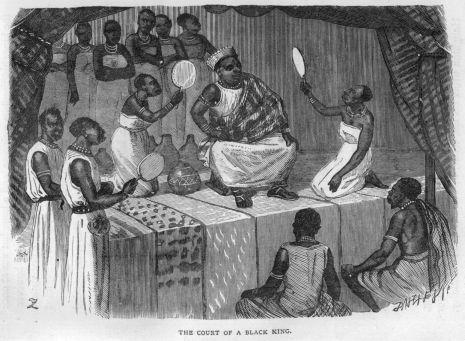 February, and as soon as he arrived a messenger came from the king, bidding him welcome, and a large hut was at once provided for his accommodation. The people, however crowded in till it was completely full; when the first visitors went, another took their place—in this way the hut being filled and emptied thirteen different times.
Park found the king, whose name was Daisy, surrounded by a number of attendants, the fighting men on his right-hand and the women and children on his left. A bank of earth, on which was spread a leopard-skin, formed the throne. Daisy seemed perfectly satisfied with the account the traveller gave of himself, but warned him of the dangers in his way on account of the war which was then raging, and advised him to return to Kason, there to remain till it was over. Wise as this advice was, the approaching hot months made it important for him to proceed, dreading as he did having to spend the rainy season in the interior of Africa.
Daisy presented him with food, and sent a party of horse men to conduct him to Jarra, while three of his sons, with about two hundred horsemen, undertook to accompany him part of the way.
He had evidence of the disturbed state of the country while staying at the next town he entered. A body of Moors approached the gates and carried off the cattle, and one of the horsemen was shot by a Moor. The wounded man was brought in, when, as he was borne along, his mother went before, clapping her hands and enumerating the good qualities of her son. The ball had passed through both his legs, and as he and his friends would not consent to have one of them amputated, he died the same night.
Going forward, on the 18th they passed through Simbug, the frontier village of Ludamar. It was from hence Major Haughton wrote his last letter, with a pencil, to Dr Laidley. After leaving the place, when endeavouring to make his way across the desert, he was murdered by some savage Mahommedans, who robbed him of everything he possessed.
At this time, while Daisy was employed in fortifying a strong position among the hills, his territory was overrun by his enemy, Mansong.
On the evening of the 5th of March Park reached the town of Dalli. Here the people crowded in so disagreeable a manner to see the white stranger, that his host proposed, in order to avoid them, going in the cool of the evening to a negro village called Samee, at a short distance off.
As he was now within two days’ journey of the heathen kingdom of Goumba, he had no apprehensions from the Moors, and readily accepted the invitation. His landlord was proud of the honour of entertaining a white man, and Park spent the forenoon very pleasantly with these poor negroes, their gentleness of manner presenting a striking contrast to the rudeness and barbarity of the Moors.
While thus enjoying himself, greatly to his dismay a party of Moorish soldiers suddenly appeared in the place. They were sent, they said, by their chief, Ali, to convey the white stranger to his camp at Benowm. If he would come willingly it would be better for him, but come he must, as they had orders to convey him by force; because Fatima, Ali’s wife, having heard much about Christians, was anxious to see one. Park, unable to resist, was compelled to accompany them. The journey occupied many days, during which both Park and his attendants suffered much from thirst.
On the evening of the 12th they came in sight of Benowm, which presented to the eye a number of dirty-looking tents scattered without order over a large space of ground. Among the tents appeared large herds of camels, cattle and goats. As soon as he was seen the people who were drawing water threw down their buckets and, rushing towards him, began to treat him with the greatest discourtesy; one pulled at his clothes, another took off his hat, while a third stopped him to examine his waistcoat buttons.
At length the king’s tent was reached, where a number of men and women were assembled. Ali was seated on a black leather cushion, clipping a few hairs from his upper lip, a female attendant holding up a looking-glass before him.
He enquired whether the stranger could speak Arabic, and being answered in the negative he remained silent. The ladies, however, asked a thousand questions, inspected his apparel, searched his pockets, and obliged him to unbutton his waistcoat to display the whiteness of his skin.
In the evening the priests announced prayer. Before they departed his Moorish guide told him that Ali was about to present him with something to eat. On looking round he saw some boys bringing a wild hog, which they tied to one of the tent ropes, when Ali made signs to him to kill and dress it for supper. Though very hungry, he did not think it prudent to eat any part of an animal so much detested by the Moors, and therefore replied that he never touched such food. The hog was then untied, in the hopes that it would run at the stranger, the Moors believing that a great enmity subsists between hogs and Christians. In this, however, they were disappointed, for the animal no sooner regained his liberty than he began to attack indiscriminately every person who came in his way, and at last took shelter under the couch upon which the king was sitting.
Park was after this conducted to a hut, where he found another wild hog—tied there to a stick for the purpose of annoying him. It attracted a number of boys, who amused themselves by beating it with sticks, till they so irritated the animal that it ran and bit at every person within reach.
A number of people came in and made him take off his stockings to exhibit his feet, and then his jacket and waistcoat to show them how his clothes were put off and on.
Day after day he was treated in the same manner. He was also compelled to undertake various offices. First, he was told to shave the head of one of the young princes, but, unaccustomed to use a razor, he soon cut the boy’s skin, on seeing which the king ordered him to desist.
On the 18th his black servant, Johnson, was brought in as as a prisoner before Ali by some Moors, who had also seized a bundle of his clothes left at Jarra. Of these Ali took possession, and Park was unable to obtain even a clean shirt or anything he required. The Moors next stripped him of his gold, his watch, the amber he had remaining and one of his pocket compasses. Fortunately he had hidden the other in the sand near his hut. This, with the clothes on his back, was the only thing Ali now left him.
Ali, on examining the compass, wished to know why the small needle always pointed to the Great Desert. Park, unwilling to inform him of the exact truth, replied that his mother lived far beyond the sands of the Sahara, and that while she was alive the piece of iron would always point that way and serve as a guide to conduct him to her. Ali, suspecting that there was something magical in it, was afraid of keeping so dangerous an instrument in his possession.
The Moors now held a council to determine what should be done with the stranger. Some proposed that he should be put to death, others that he should only lose his right-hand, and one of Ali’s sons came to him in the evening and with much concern informed him that his uncle had persuaded his father to put out his eyes. Ali, however, replied that he would not do so until Fatima, the queen, who was at present in the north, had seen him.
In vain Park begged that he might be permitted to return to Jarra. Ali replied that he must wait till Fatima had seen him, and that then he should be at liberty to go, and that his horse should be restored to him.
So wearied out was he at last with all the insults he received that he felt ready to commit any act of desperation.
One day Ali sent to say that he must be in readiness to ride out with him, as he intended to show him to some of his women. They together visited the tents of four different ladies, at every one of which he was presented with a bowl of milk and water. They were all remarkably corpulent, which in that country is the highest mark of beauty. They were also very inquisitive, examining minutely his hair and skin, though affecting to consider him as a sort of inferior being to themselves, and pretending to shudder when they looked at the whiteness of his skin. Notwithstanding the attention shown him by these fat dames, his condition was not improved, and he was often left without even food or water, while suffering fearfully from the heat.
Ali at length moved his camp, and Park was sent forward under the escort of one of the king’s sons. The new encampment was larger than that of Benowm, and situated in the midst of a thick wood, about two miles distant from a neighbouring town, called Bubaka. Here Park was introduced to queen Fatima by Ali. She seemed much pleased at his coming, shaking hands with him, even though Ali had told her that he was a Christian. She was a remarkably corpulent woman, with an Arab cast of countenance and long hair.
After asking a number of questions, with the answers to which she appeared interested, she became perfectly at her ease and presented her visitor with a bowl of milk. She was, indeed, the only person who treated Park kindly during his stay.
Both men and cattle suffered much from thirst, and though Ali had given him a skin for containing water, and Fatima once or twice presented him with a small supply, yet such was the barbarous disposition of the Moors, that when his boy attempted to fill his skin at the wells, he generally  received a sound drubbing for his presumption. One night, having in vain attempted to obtain water, he resolved to try his fortune himself at the wells, which were about half a mile distant. About midnight he set out, and, guided by the lowing of the cattle, he reached the place. Here a number of Moors were drawing water, but he was driven by them from each well in succession. At last he reached one where there was only an old man and two boys. He earnestly besought the first to give him some water. The old man complied, and drew up a bucket; but no sooner did Park take hold of it than, recollecting that the stranger was a Christian, and fearing that his bucket might be polluted, he dashed the water into the trough, and told him to drink from thence. Though the trough was none of the largest, and three cows were already drinking in it, Park knelt down, and, thrusting his head between two of the cows, drank with intense pleasure till the water was nearly exhausted.
The rainy season was now approaching, when the Moors evacuate the country of the negroes and return to the skirts of the Great Desert.
Ali looked upon Park as a lawful prisoner, and though Fatima allowed him food and otherwise treated him kindly, she had as yet said nothing about his release.
Fortunately for him, Ali had resolved to send an expedition to Jarra, of two hundred Moorish horsemen, to attack Daisy. Park obtained permission to accompany them, and, through the influence of Fatima, he also received back his bundle of clothes and his horse.
On the 26th of May, accompanied by Johnson and his boy Demba, he set out with a number of Moors on horseback, Ali having gone on before. On his way Ali’s chief slave came up and told Demba that Ali was to be his master in future; then, turning to Park, said, “The boy goes back to Bubaka, but you may take the old fool,” meaning Johnson, “with you to Jarra.” Park in vain pleaded for Demba, but the slave only answered that if he did not mount his horse he would send him back likewise. Poor Demba was not less affected than his master. Having shaken hands with the unfortunate boy, and assured him that he would do everything in his power to redeem him, Park saw him led off by three of Ali’s slaves.
At Jarra he took up his lodgings in the house of an old acquaintance, Dayman, whom he requested to use his influence with Ali to redeem the boy, and promised him a bill on Dr Laidley for the value of two slaves the moment he brought him to Jarra.
Ali, however, considering the boy to be Park’s principal interpreter, would not liberate him, fearing that he would be instrumental in conducting him to Bambarra.
Still Park was eager, if possible, to continue his journey, but Johnson refused to proceed further. At the same time he foresaw that he must soon fall a victim to the Moors if he remained where he was, and that if he went forward singly he must encounter great difficulties, both from the want of an interpreter and the means of purchasing food. On the other hand he was very unwilling to return to England without accomplishing his mission. He therefore determined to escape on the first opportunity at all risks. This arrived sooner than he expected.
On the 26th of June news was brought that Daisy had taken Simbug, and would be at Jarra the next day. Hearing this, the people began packing up their property and beating corn for their journey, and early in the morning nearly half had set off—the women and children crying, the men looking sullen and dejected.
Though Park was sure of being well treated could he make himself known to Daisy, yet as he might be mistaken for a Moor in the confusion, he thought it wisest to mount his  horse with a large bag of corn before him, and to ride away with the rest of the townspeople.
He again fell in with his friend Dayman and Johnson. They pushed on two days’ journey to the town of Queira.
While Park was out tending his horse in the fields on the 1st of July, Ali’s chief slave and four Moors arrived at Queira, and Johnson, who suspected the object of their visit, sent two boys to overhear their conversation. From them he learned that the Moors had come to convey Park back to Bubaka. This was a terrible stroke to him, and, now convinced that Ali intended to detain him for ever in captivity, or perhaps to take his life, he determined at all risks to attempt making his escape. He communicated his design to Johnson, who, though he approved of it, showed no inclination to accompany him. Park therefore resolved to proceed by himself, and to trust to his own resources.
Chapter Three.
Mungo Park’s travels continued.
Park escapes at night—Pursued by Moors and robbed—Fearful suffering; from thirst—Finds water—Kindly treated by an old woman—Wanderings in the forest—Reaches Bambarra—Ill-treated—Reaches the Niger—Arrives at Sego, the capital—The king refuses to see him—Sent to a distant village—Almost starving—A compassionate woman takes him into her house and feeds him—King Mansong orders him to quit the country—Enters Sansanding on the Niger—The Moors threaten him for being a Christian—Writes charms for his host—Proceeds—Followed by a lion—His horse falls sick, and, leaving the animal, he proceeds on foot—Proceeds down the Niger to Moorzan—Determines to return—Finds his horse alive—Rainy season commences—Again reaches Sansanding—Inhospitably treated—Repulsed from numerous places—Swims several rivers—Better treated as he gets westward—A negro merchant at Rammako receives him hospitably—Sets off with a singing man as his guide—Conducted by two shepherds—Despoiled of his clothes and horse by robbers—In danger of perishing—Reaches Sibidooloo—Mansa, the chief man, recovers his horse and clothes—Suffers from fever—People starving—Continues his journey—Kindly treated at Kamatia by a Bushreen—Kafa Taura—Starts with a slave caravan—Attacked by bees—Death of a slave—Sufferings of slaves—Reaches Pisania—Sails by way of America for England—Reaches home.
The time had arrived when, as Park felt, he must either again submit to the tyrannical treatment of Ali, or perish possibly in attempting to escape. At night he got ready a bundle of clothes, consisting of two shirts and two pair of trousers, with a cloak and a few other articles; but he had not a single bead to purchase food for himself or his horse. About daybreak Johnson came and told him that the Moors were asleep. The awful crisis had now arrived; a cold perspiration stood on his brow as he thought of the dreadful alternative and reflected that one way or the other his fate must be decided in the course of the day. To deliberate was to lose the only chance of escape; so, taking up his bundle, he stepped gently over the negroes sleeping in the air, mounted his horse, bade Johnson farewell, desiring him to take particular care of the papers with which he had intrusted him, and to say that he had left him in good health, on his way to Bambarra.
He rode on, expecting every moment to be overtaken by the Moorish horsemen. Some shepherds he encountered followed, hooting and throwing stones at him. Scarcely was he out of their reach, and was again indulging in the hopes of escaping, when he heard somebody call behind him, and on looking back, he saw three Moors on horseback galloping at full speed and brandishing their weapons. To escape was vain. He stopped, and one of them, presenting his musket, told him that he must go back to Ali. The effect of this announcement was to benumb his faculties. He rode back with apparent unconcern, but he had not gone far when the Moors, stopping, ordered him to untie his bundle. Having examined the articles, they found nothing worth taking except his cloak, and one of them, pulling it off, wrapped it about himself. It had served to protect him from the rain in the day and the dews at night, and was of the greatest value to him. He earnestly begged the robbers to return it, but his petition was unheeded. As he attempted to follow them to regain his cloak, one of the robbers struck his horse over the head, and presenting his musket, ordered him to proceed no further. Finding that the sole object of the Moors had been to plunder him, he turned his horse’s head towards the east, thankful to have escaped with his life.
As soon as he was out of sight of the robbers, he struck into the woods and pushed on with all possible speed. He had at length obtained his liberty—his limbs felt light, even the desert looked pleasant. He soon recollected, however, that he had no means of procuring food, nor a prospect of finding water.
He directed his course by compass in the hopes of at length reaching some town or village in the kingdom of Bambarra.
His thirst, in consequence of the burning heat of the sun, reflected with double violence on the sand, became intense. He climbed a tree in the hopes of seeing some human habitation. Nothing appeared around but thick underwood and hillocks of white sand.
At sunset he again climbed a tree, but the same sight met his eyes. Descending, after taking the saddle off his horse’s back, he was suddenly seized with giddiness, and fell to the ground believing that the hour of death was fast approaching. He recovered, however, just as the sun was sinking behind the trees, and now, summoning up all his resolution, he determined to make another effort to prolong his existence.
He had gone on some distance further when he perceived some lightening in the north-east, a delightful sight, for it promised rain, and soon he heard the wind roaring among the bushes. He was expecting the refreshing drops, when in an instant he was covered with a cloud of sand. It continued to fly for nearly an hour; then more lightening followed and then down came a few heavy drops of rain, enabling him to quench his thirst by wringing and sucking his clothes.
He travelled on during the night, which was intensely dark, till he perceived a light ahead. Cautiously approaching it he heard the lowing of cattle and the clamorous tongues of the herdsmen, which made him suspect that it was a watering-place belonging to the Moors. Rather than run the risk of falling into their hands he retreated, but being dreadfully thirsty, and fearing the approach of the burning day, he thought it prudent to search for the wells which he expected to find at no great distance.
While thus engaged he was perceived by a woman, who screaming out, two people ran to her assistance from the neighbouring tents and passed close to him.
Happily he escaped from them and, plunging again into the woods, after proceeding a mile he heard a loud and confused noise. Great was his delight to find that it arose from the croaking of frogs, which was music to his ears.
At daybreak he reached some shallow pools full of large frogs, which so frightened his horse that he was obliged to keep them quiet by beating the water till he had drank. Having quenched his own thirst, he ascended a tree to ascertain the best course to take, when he observed a pillar of smoke about twelve miles off. Directing his course to it he reached a Foulah village belonging to Ali. Hunger compelled him to enter it, but he was denied admittance to the dooty’s house, and could not obtain even a handful of corn. Reaching, however, a humble hut at which an old motherly-looking woman sat spinning cotton, he made signs that he was hungry. She immediately laid down her distaff, and desired him in Arabic to come in, setting before him a dish of kous-kous. In return he gave her one of his pocket-handkerchiefs, and asked for a little corn for his horse, which she readily brought him.
While his horse was feeding the people collected round him, and from their conversation he discovered that they proposed seizing him and conveying him back to Ali. He therefore tied up his corn and, lest it might be supposed that he was running from the Moors, driving his horse before him he took a northerly direction, followed by the boys and girls of the town. Having got rid of his troublesome attendants he struck into the woods, where he was compelled to pass the night with his saddle for a pillow. He was awakened by three Foulahs, who, taking him for a Moor, told him that it was time to pray. Without answering them he saddled his horse and made his escape.
The next day he took shelter in the tent of a Foulah shepherd, who charitably gave him boiled corn and dates, although he was recognised as a Christian. He here purchased some corn in exchange for some brass buttons, and again took the road to Bambarra, which he resolved to follow for the night. Hearing some people approaching, he thought it prudent to hide himself, which he did in the thick brushwood. He there sat holding his horse by the nose to prevent him neighing, equally afraid of the natives without and the wild beasts within the forest. The former took their departure, and he went on till past midnight, when the croaking of frogs induced him to turn off from the road, that he and his steed might quench their thirst. Having discovered an open place with a single tree in the midst of it, he lay down for the night. He was disturbed towards morning by the sound of wolves, which made him once more mount.
On the morning of the 5th of July he reached a negro town in the confines of Bambarra. It was a small place surrounded by high walls, inhabited by a mixture of Mandingoes and Foulahs, chiefly employed in the cultivation of corn. The people were suspicious of his character, some supposing him to be an Arab, others a Moorish sultan, but the dooty, or chief magistrate, who had been at Gambia, took his part, and assured them that he was a white man. On its being reported that he was going to Sego, the capital, several women came and begged that he would enquire of Mansong what had become of their children, who had been carried off to fight.
He was allowed to take his departure without molestation, and on the 6th reached the town of Dingyee.
When he was about to depart the next morning, the landlord begged him to give him a lock of his hair, understanding that white men’s hair made a saphie, or charm, which would bestow on the possessor all their knowledge. This he willingly promised to do, but the landlord’s thirst for learning was such that he cropped nearly the whole of one side of his head, and would have done the same with the other had not Park told him that he wished to reserve some of this precious merchandise for a future occasion.
Having reached the town of Wassiboo, shortly afterwards eight fugitive Kaartan negroes, who had escaped from the tyrannical government of the Moors, arrived, on their road to offer their allegiance to the king of Bambarra. Park gladly accepted their invitation to accompany them on their road.
His horse at the end of three days, becoming completely knocked up, he dismounted and desired his companions to ride on, telling them he would follow; but they declined leaving him, declaring that lions were numerous, and that, though they would not attack a body of people, they would soon find out a single individual and destroy him. One of the party, therefore, insisted on remaining with him, and he and his friend, after he had rested, overtook their companions, passing through several of the numerous towns in this part of the country. His horse, now becoming weaker and weaker, he was obliged to drive the animal on before him the greater part of the day, so that he did not reach Geosorro till late in the evening. The dooty of the place refused to give him or his companions food, so he lay down supperless to sleep. Their host, however, relented, and about midnight he was awakened with the joyful information that victuals were prepared.
Next day his fellow-travellers, having better horses, went on ahead, and he was walking barefoot, driving his own poor animal before him, when he met a coffle, or caravan, of about seventy slaves coming from Sego. They were tied together by their necks with thongs of bullock’s hide twisted like a rope, seven slaves upon a thong, and a man with a musket between every seven. They were bound for Morocco.
On arriving at the next place he found that his companions had gone on without him, but he fell in, the following day, with two negroes going to Sego, who afforded him their company.
In the village through which he passed he was constantly taken for a Moor. The people jeered at him, laughing at his tattered and forlorn appearance. He, however, again overtook the Kaartans, who promised to introduce him to the king.
As they were riding along over some marshy ground, and he was anxiously looking around for the river which he now supposed to be near, one of his companions called out, “Geo affilli!” (“See water!”) and, looking forward, he saw with infinite pleasure the great object of his mission—the long-sought-for majestic Niger, glittering in the morning sun, as broad as the Thames at Westminster, and flowing slowly to the east. He hastened to the brink, and having drunk of the water, offered up his fervent thanks in prayer to the Great Ruler of all things for having thus far crowned his endeavours with success.
Sego, the capital of Bambarra—at which he had now arrived—consists, properly speaking, of four distinct towns: two on the north and two on the south bank of the Niger. They are surrounded by high mud walls. The houses are built of clay, of a square form with flat roofs—some of them of two stories, and many of them are whitewashed. Moorish mosques are seen in every quarter; and the streets, though narrow, are broad enough for every useful purpose in a country where wheel-carriages are unknown. It contains about thirty thousand inhabitants.
While waiting to cross the river, a messenger arrived, informing him that the king could not possibly see him until he knew what had brought him into the country, and that he must not venture to cross the river without his majesty’s permission. He was directed to pass the night in a distant village; but when he reached it, no one would admit him. He was regarded with astonishment and fear, and was obliged to sit all day without food in the shade of a tree. He fully expected to have to pass the night in the same place; but about sunset, after he had turned his horse loose, a woman, perceiving that he was weary and dejected, enquired into his situation. Casting looks of pity upon him, she took up his saddle and bridle, and told him to follow her. Having conducted him into her hut, she lighted her lamp, spread a mat on the floor and signified that he might remain there for the night. Finding that he was very hungry, she brought him a fine fish for supper. Having thus attended to the stranger, telling him that he might sleep in safety she called her women around her and desired them to resume their task of spinning cotton, in which they continued to employ themselves the greater part of the night, lightening their labours by songs, some of which had reference to their white visitor.
Several days passed, when a messenger arrived from Mansong with a bag in his hands. He told Park that it was his Majesty’s pleasure he should forthwith depart from the neighbourhood of Sego, but that the king, wishing to relieve a white man in distress, had sent him five thousand cowries. From the conversation Park had with the guide, he ascertained that Mansong would willingly have seen him, but that he was apprehensive of being unable to protect him against the blind and inveterate malice of the Moorish inhabitants. His conduct, therefore, was at once prudent and liberal.
He was the same evening conducted to a village about seven miles to the eastward, where he was well received. His guide told him that if Jenne was really the place of his destination, the journey was one of greater danger than he might suppose; for, although that town was nominally a part of the King of Bambarra’s dominions, it was in fact a city of the Moors—the chief part of the inhabitants being Bushreens, a fanatical Mahommedan sect. He heard, too, that Timbuctoo, the great object of his search, was entirely in possession of that savage and merciless people, who allow no Christian to live there. He had, however, advanced too far to think of returning with uncertain information, and he determined to proceed.
Being provided with a guide, he left the village on the morning of the 24th, travelling through a highly cultivated country, the scenery bearing a greater resemblance to that of England than he had expected to find in the middle of Africa.
The people were everywhere employed in collecting the fruit of the shea trees, from which they prepared vegetable butter. In the evening he reached the large town of Sansanding, the resort of numerous Moorish caravans from the shores of the Mediterranean. In the harbour he observed twenty large canoes, and others arrived while he was there. He was received into the house of the dooty, Counti Mamadi. Scarcely had he arrived when hundreds of people surrounded him, all speaking different dialects, several of them declaring that they had seen him in various parts of the continent. It was evident that they mistook him for somebody else. One of them, a shereef, from Suat, declared that if he refused to go to the mosque he would carry him there. He had little doubt that the Moor would have put his threat into execution had not his host interposed in his behalf. The latter said that, if he would let his guest alone for the night, in the morning he should be sent about his business. This somewhat appeased them, but even after he had retired to his hut the people climbed over the pailings to look at him.
At midnight, when the Moors had retired, Mamadi paid him a visit and earnestly desired him to write a saphie, or charm, observing, “If a Moor’s saphie is good, a white man’s must needs be better.” Park readily furnished him with one, which was in reality the Lord’s Prayer, a reed serving for a pen, charcoal and gum-water for ink and a thin board for paper.
Allowed to proceed, as he and his guide were crossing an open plain with a few scattered bushes, the guide wheeled his horse round, called loudly to him and, warning him that a lion was at hand, made signs that he should ride away. His horse was too much fatigued to do this, so they rode slowly past the bush, and he, not seeing anything himself, thought the guide had been mistaken. Suddenly the Foulah put his hand to his mouth exclaiming, “God preserve us!” To his great surprise he then perceived a large red lion a short distance from the bush, his head couched between his fore paws. Park expected that the creature would instantly spring upon him, and instinctively pulled his foot from the stirrups to throw himself on the ground, that his horse might become the victim rather than himself; but probably the lion was not hungry, for he quietly allowed the traveller to pass though fairly within his reach.
The next day his horse completely broke down, and the united strength of himself and his guide could not place the animal again upon his legs. He sat down for some time beside the worn-out associate of his adventures; but, finding him still unable to rise, he took off the saddle and bridle and placed a quantity of grass before him. While he surveyed his poor steed as he lay panting on the ground, he could not suppress the sad apprehension that he should himself in a short time lie down and perish in the same manner from fatigue and hunger. With this foreboding he left his horse, and with great reluctance followed his guide on foot along the banks of the river until he reached the small village of Kea.
Here he parted from his Foulah guide, whom he requested to look after his horse on his return, which he promised to do.
From Kea he went down the river in a canoe, and thence to Moorzan, a fishing town on the northern bank, and was then conveyed across the stream to Silla, a large town. Here, after much entreaty, the dooty allowed him to enter his house to avoid the rain, but the place was damp and he had a smart attack of fever. Worn down by sickness, exhausted with hunger, and fatigued, half-naked, without any article of value by which he could procure provisions, clothes, or lodgings, he began to reflect seriously on his situation, and was convinced by painful experience that the obstacles to his further progress were insurmountable. The dooty approved of the resolution he had arrived at of returning, and procured a fisherman to carry him across to Moorzan, whence he got back to Kea. The brother of the dooty was starting for Modiboo. He took his saddle, which he had left at Kea, intending to present it to the king of Bambarra.
Travelling along the banks of the river, the footprints of a lion quite fresh in the mud were seen. His companion, therefore, proceeded with great circumspection, insisting that Park should walk before him. This he declined doing, when his guide threw down the saddle and left him alone. He therefore continued his course along the bank, and believing that the lion was at no great distance, he became much alarmed, and took a long circuit through the bushes.
He at last arrived at Modiboo. While conversing with the dooty of the place he heard a horse neigh in one of the huts. The dooty inquired with a smile if he knew who was speaking to him. He explained himself by telling Park that his horse was still alive and somewhat recovered from his fatigue, and that he must take the animal with him.
Though tolerably well treated at the villages where he stopped, he in vain endeavoured to obtain a guide. The rains were now falling, and the country, it was supposed, would soon be completely flooded. He heard that a report had been abroad that he had come to Bambarra as a spy and that, as Mansong had not admitted him into his presence, the dooties of the different towns might treat him as they pleased.
A little before sunset of the 11th of August he reached Sansanding. Here even Mamadi, who had formerly been so kind to him, scarcely gave him a welcome, and everyone seemed to shun him. Mamadi, however, came privately to him in the evening, and told him that Mansong had despatched a canoe to bring him back, and advised him to set off from Sansanding before daybreak, cautioning him not to stop at any town near Sego. He therefore resumed his journey on the 12th, and in the afternoon reached the neighbourhood of Kabba.
As he approached, one of several people who were standing at the gate ran towards him and, taking his horse by the bridle, led him round the walls of the town and, pointing to the west, told him to go along or it would be the worse for him. He in vain represented the danger of being benighted in the woods, exposed to the inclemency of the weather and the fury of wild beasts. “Go along,” was the only answer he received. He found that these negroes had acted thus from kindness, as the king’s messengers who had come to seize him were inside the town.
Being repulsed from another village, he went on till he reached a small one somewhat out of the road, and sat down under a tree by a well. Two or three women came to draw water and, perceiving the stranger, enquired where he was going. On Park telling them to Sego, one of them went in to acquaint the dooty. In a little time the dooty sent for him, and permitted him to sleep in a large hut.
Next day he again set forward, meeting with the same inhospitable treatment as before, and having for three days to subsist on uncooked corn. He was repulsed in like manner from the gates of Taffara; and at the village of Sooha, which he reached next day, he in vain endeavoured to procure some corn from the dooty, who was sitting by the gate. While Park was speaking to the old man, he called to a slave to bring his paddle along with him, and when he brought it, told him to dig a hole in the ground, pointing to a spot at no great distance. While the slave was thus engaged, the dooty kept muttering the words—“Good-for-nothing! A real plague!” These expressions, coupled with the appearance of the pit the lad had dug, which looked much like a grave, made Park think it prudent to decamp. He had just mounted his horse, when the slave who had gone into the village returned, dragging the corpse of a boy by a leg and arm, which he threw into the pit with savage indifference, and at once began to cover it up with earth.
At sunset Park reached Koohkorro, a considerable town, and the great market for salt. Here he was received into the house of a Bambarran who, once a slave to a Moor, had obtained his freedom and was now a merchant. Finding that his guest was a Christian, he immediately desired him to write a saphie, saying that he would dress him a supper of rice if he would produce one to protect him from wicked men. Park therefore covered the board on both sides, when his landlord, wishing to have the full force of the charm, washed the writing from the board into a calabash with a little water and, having said a few prayers over it, drank the whole draught; after which, lest a single word should escape, he licked the board until it was quite dry. The dooty of the place next sent to have a saphie written—a charm to procure wealth. So highly satisfied was he with his bargain that he presented the traveller with some meal and milk, and promised him in the morning some more milk for his breakfast.
When Park had finished his supper of rice and salt, he lay down upon a bullock’s hide and slept quietly until morning, this being the first good meal and refreshing sleep he had enjoyed for a long time.
After leaving this place, having been misdirected as to his road, he reached a deep creek. Rather than turn back, he went behind his horse and pushed him headlong into the water; then, taking the bridle in his teeth, he swam to the other side. This was the third creek he had crossed in this manner since he had left Sego. His clothes were, indeed, constantly wet from the rain and dew; and the roads being very deep and full of mud, such a washing was sometimes pleasant.
At Bammakoo, which he reached on the evening of the next day, he was received into the house of a negro merchant, of whom there are many wealthy ones in the place, trading chiefly in salt. He was feasted also by a number of Moors, who spoke good Mandingo, and were more civil to him than their countrymen had before been. One of them had travelled to Rio Grande, and spoke highly of the Christians. From this man he received a present of boiled rice and milk. He also met a slave merchant who had resided some years on the Gambia, who informed him about the places which lay in his intended course to the westward. He was told that the road was impassable at this season of the year, and that there was a rapid river to cross. Having, however, no money to maintain himself, Park determined at all risks to push on, and, having obtained a singing man who said he knew the road over the hills, set off the next day. His musical conductor, however, lost the right path and, when among the hills, leaping to the top of a rock as if to look out for the road, suddenly disappeared. Park managed, however, just before sunset, to reach the romantic village of Koomah, the sole property of a Mandingo merchant and surrounded by a high wall. Though seldom visited by strangers, whenever the weary traveller did come to his residence the merchant made him welcome.
Park was soon surrounded by the harmless villagers, who had numberless questions to ask and in return for the information he gave them brought corn and milk for himself and grass for his horse, and kindled a fire in the hut where he was to sleep.
Accompanied by two shepherds as guides, he set out the next day from Koomah. The shepherds, however, walked on ahead, troubling themselves but little about him.
The country was very rough, and the declivity so great that a false step would have caused him and his horse to be dashed to pieces.
As he was riding on, the shepherds being about a quarter of a mile before him, he heard a loud screaming as from a person in great distress. Supposing that a lion had taken off one of the shepherds, he hurried on to ascertain what had happened. The noise had ceased, and in a short time he perceived one of the shepherds lying among the long grass near the road, and concluded that the man was dead; but when he came close to him the shepherd whispered to him to stop, telling him that a party of armed men had seized upon his companion and shot two arrows at him. While considering what to do, he saw at a little distance a man sitting upon the stem of a tree, and also the heads of six or seven more who were crouching down among the grass, with muskets in their hands. It being impossible to escape, he rode forward towards them, hoping that they were elephant hunters. By way of opening the conversation he inquired if they had shot anything; but in answer one of them ordered him to dismount, and then, as if recollecting himself, waved with his hand as a sign that Park might proceed. He had ridden some way when they shouted to him again to stop, and told him that the King of the Foulahs had sent them to carry him to Fooladoo. Without hesitating, Park turned and followed them.
They had reached a dark part of the wood when one of them observed in the Mandingo language, “This place will do,” and immediately snatched his hat from his head. Feeling that resistance was useless, he allowed them to proceed till they had stripped him quite naked. While they were examining their plunder, Park begged them to return his pocket compass; but, on his pointing to it as it lay on the ground, one of the banditti cocked his musket, swearing that he would shoot him if he presumed to take it. After this some of them went away with his horse, and the remainder stood considering whether they should leave him quite naked or allow him something to shelter him from the sun. Humanity at last prevailed, and they returned the worst of his two shirts and a pair of trousers; one of them also threw back his hat, in the crown of which he kept his memorandums—probably the reason why they did not wish to keep it.
Here he was in the midst of a vast wilderness in the depth of the rainy season, naked and alone, and surrounded by savage animals and men still more savage, five hundred miles from the nearest European settlement. His spirits began to fail, but he reflected that no human prudence could possibly have averted his present sufferings, and that, though a stranger in a strange land, he was still under the protecting eye of that Providence who has condescended to call Himself the stranger’s friend. At this moment the extreme beauty of a small moss in fructification caught his eye. Though the whole plant was not much larger than the top of one of his fingers, he could not contemplate the delicate conformation of its roots, leaves, and capsules without admiration. “Can that Being,” he thought, “who brought this plant to perfection look with unconcern upon the situation and sufferings of creatures formed after his own image? Surely not.” He started up and, disregarding both hunger and fatigue, travelled forward, assured that relief was at hand.
In a short time he overtook the two shepherds who had come with him from Koomah. They were greatly surprised to see him, observing that they never doubted that the Foulahs had murdered him. In their company he arrived at Sibidooloo, the frontier town of the kingdom of Manding. The chief man in the place, called Mansa, received him most kindly, and when Park related how he had been robbed of his horse and apparel, he observed, with an indignant air, “Sit down. You shall have everything restored to you—I have sworn it.” He at once gave directions to his people to search for the robbers. Park was conducted into a hut, where he was provided with food, and a crowd of people assembled, all of whom commiserated his misfortunes and vented imprecations against the Foulahs.
As there was a great scarcity of provisions in the place, Park, after spending two days there, begged Mansa to allow him to depart. He gave him permission to do so, provided he would remain at a town called Wanda for a few days, until he received some account of his horse and goods.
He took his departure accordingly on the morning of the 28th, and reached Wanda about noon of the 30th.
The head man of the place, who was a Mahommedan, acted not only as chief magistrate, but as schoolmaster. He kept his school in an open shed, where the traveller was desired to take up his lodgings. Park was very anxious for his clothes, as those he had on were completely worn-out, his shirt being like a piece of muslin and dirty in the extreme.
He here spent nine days suffering much from fever. On the 6th two people arrived from Sibidooloo, bringing his horse and clothes, but his pocket compass, greatly to his vexation, was broken to pieces.
Every day he observed several women come to the house to receive a certain quantity of corn. Knowing how valuable this article was at the present juncture, he enquired of his host whether he maintained these poor women from pure bounty or expected a return when the harvest should be gathered in.
“Observe that boy,” said he, pointing to a fine child about five years of age. “His mother has sold him to me for forty days’ provisions for herself and the rest of her family. I have bought another boy in the same manner.”
Sick as he was, Park thought it necessary to take his leave of his hospitable landlord, to whom he presented his horse as the only recompense he could make, desiring him to convey his saddle and bridle as a present to Mansa of Sibidooloo. As he was about to set out, his host begged him to accept his spear as a token of remembrance and a leather bag to contain his clothes. Having converted his half-boots into sandals, he travelled with more ease.
Although the people were suffering great distress from the failure of the crops, he was in general most hospitably treated. His landlord at Kinyeto, observing that he had hurt his ankle, insisted on his remaining several days till he could walk with the help of a staff.
Notwithstanding suffering from fever and exposed to constant rain, he continued his journey, narrowly escaping being detained at the town of Mansia by the inhospitable chief, who insisted on being paid for the small amount of food he had provided.
On September 16th he reached the town of Kamalia. He was here conducted to the house of a Bushreen, Kafa Taura. He was collecting a caravan of slaves to convey to the European settlements on the Gambia, as soon as the rains should be over. He found Kafa seated in his house surrounded by several slatees who proposed joining the caravan. He was reading to them from an Arabic book, and enquired if his guest understood it. On being answered in the negative, he desired one of the slatees to fetch a curious little book which had been brought from the west country. It proved to be a book of Common Prayer, and Kafa expressed great joy on hearing that Park could read it, for some of the slatees, observing the colour of his skin, now become yellow from sickness, suspected that he was an Arab in disguise. Kafa, however, had now no doubt concerning him, and kindly promised him every assistance in his power.
Park was here laid up completely by fever, but Kafa, who had provided a quiet hut for his accomodation, advised him to remain within it, assuring him that if he did not walk out in the wet he would soon be well.
He passed five weeks in a gloomy and solitary manner, seldom visited by any person except his benevolent landlord, who came daily to enquire about his health.
When the rains became less frequent the country began to grow dry and the fever left him, but in so debilitated condition that it was with difficulty he could crawl with his mat to the shade of a tamarind tree at a short distance, there to enjoy the refreshing smell of the corn-fields. The benevolent and simple manners of the negroes, and the perusal of Kafa’s little volume greatly contributed to his restoration.
In the beginning of December, Kafa began to make arrangements for his journey, and to complete the purchase of his slaves.
As he had to be absent about his affairs for a month, Park was left during the time to the care of a good old Bushreen, who acted as schoolmaster to the younger people of Kamalia.
The long-wished-for day of the departure of the caravan, the 19th of April, at length arrived, and the irons being removed from the slaves, the slatees assembled at the door of Kafa’s house, where the bundles were all tied up, and everyone had his load assigned him.
Kafa had twenty-seven slaves for sale, but eight others afterwards joined them, making in all thirty-five. The schoolmaster who was on his return to Woradoo, the place of his nativity, took with him eight of his scholars. Altogether, the come numbered seventy-three persons.
The caravan was followed for about half a mile by most of the inhabitants of Kamalia; and when they had arrived at the top of a hill, from whence they had a view of the town, they were all ordered to sit down—those belonging to the coffle with their faces towards the west, and the townspeople with theirs towards Kamalia. The schoolmaster, with two of the principal slatees, having taken their places between the two parties, pronounced a solemn prayer, after which they walked three times round the coffle, making impressions in the ground with the ends of their spears, and muttering something by way of a charm. When this ceremony was ended, all the people belonging to the coffle sprang up and, without taking a formal farewell of their friends, set forward.
Another ceremony was performed when the party stopped to dine on the road. Before commencing the meal, when each person was seated with their quotas arranged before him in small gourd shells, the schoolmaster offered up a short prayer that God and the holy prophet might preserve them from robbers and all bad people, that their provisions might never fail nor their limbs become fatigued.
After stopping at the town of Kenytakooro till the 22nd of April, the coffle commenced the journey through the Jallonka wilderness. The country was very beautiful and abounded with birds and deer; but so anxious were they to push on, that they made fully thirty miles that day. Fatigued as they were, they were frequently disturbed in the night by the howling of wild beasts and the bites of ants.
On setting out in the morning Nealee, one of Kafa’s female slaves refused to drink the gruel offered her. The country was extremely wild and rocky, and Park began to fear that he should be unable to keep up with the party. Others, however, suffered more than he did. The poor female slave began to lag behind; and, complaining dreadfully of pains in her legs, her load was taken from her and given to another, and she was ordered to keep in front of the coffle.
As the party were resting near a rivulet a hive of bees was discovered in a hollow tree, and some of the people were proceeding to obtain the honey, when an enormous swarm flew out, and, attacking every one, made them fly in every direction. Park being the first to take alarm, was the only person who escaped with impunity. The slaves had, however, left their bundles behind them, and to obtain them it was necessary to set the grass on fire to the east of the hive, when the wind driving the flames along, the men pushed through the smoke and recovered their bundles. They also brought with them poor Nealee, whom they found lying by the rivulet stung in the most dreadful manner. On her refusing to proceed further, she was cruelly beaten with a whip, when, suddenly starting up, she walked for four or five hours; she then made an attempt to run away, but, from weakness, fell to the ground. Though unable to rise, the whip was a second time applied, when Kafa ordered that she should be placed on an ass. Unable to sit on it, she was carried afterwards on a litter by two slaves.
The unfortunate slaves, who had travelled all day in the hot sun with loads on their heads, were dreadfully fatigued; and some of them began to snap their fingers—a sure sign, among negroes, of desperation. They were, therefore, put in irons, and kept apart from each other. Next day poor Nealee was again placed on the ass; but unable to hold herself on, frequently fell to the ground. At length the cry arose of—“Kang-tegi!” (“Cut her throat!”) As Park did not wish to see this horrible operation performed, he went on ahead; but soon afterwards he was overtaken by one of Kafa’s domestic slaves with poor Nealee’s garment on the end of a bow. On making inquiries of the man, he replied that Kafa and the schoolmaster would not consent to her being killed, but had left her on the road, where probably she was soon devoured by wild animals.
Such is one example of the cruel treatment received by the unhappy slaves. The old schoolmaster, however, was so affected, that he fasted the whole of the ensuing day.
The party now travelled on rapidly, everyone being apprehensive that he might otherwise meet with the fate of poor Nealee.
The coffle had still many dangers to encounter. Receiving information that two hundred Jallonkas were lying in wait to plunder them, they altered their course and travelled with great secrecy until midnight, when they entered the town of Koba. Here they remained some days to escape the Jallonkas.
The next town they reached, Malacotta, was the birthplace of the schoolmaster, whose brother came out to meet him. The interview was very natural and affecting. They fell on each other’s neck, and it was some time before either of them could speak. The schoolmaster then turning, pointed to Kafa, saying, “This is the man who has been my father in Manding. I would have pointed him out sooner to you, but my heart was too full.”
They were now in the country of friends, and were well received at each of the towns they entered.
Park, however, witnessed numerous instances of the sad effects of the slave trade. A singing man, the master of one of the slaves who had travelled for some time with great difficulty, and was found unable to proceed further, proposed to exchange him for a young slave girl belonging to one of the townspeople. The poor girl was ignorant of her fate until the bundles were all laid up in the morning, and the coffle ready to depart, when, coming with some of the other young women to see the coffle set out, her master took her by the hand and delivered her to the singing man. Never was a face of serenity more suddenly changed into one of the deepest distress; the terror she manifested on having the load put on her head and the rope round her neck, and the sorrow with which she bid adieu to her companions, were truly affecting. Notwithstanding the treatment which the slaves received, they had hearts which could feel for the white stranger amidst their infinitely greater sufferings, and they frequently of their own accord brought water to quench his thirst, and at night collected branches and leaves for his bed, during that weary journey of more than five hundred British miles.
Knowing that the greater number were doomed to a life of slavery in a foreign land, he could not part from them without feeling much emotion.
At last Pisania was reached, and Park was warmly welcomed as one risen from the dead by the Mr Ainsleys and Dr Laidley. They had heard that the Moors had murdered him as they had murdered Major Haughton. He learned with great sorrow that neither of his two attendants, Johnson and Demba, had returned, and that nothing was known of them. Park gave double the amount he had promised to Kafa, and sent a present also to the good old schoolmaster at Malacotta. Kafa, who had never before heard English spoken, listened with great attention to Park, when conversing with his friends. His astonishment at the various articles of furniture in the houses was very great; but it was still greater when he saw Mr Ainsley’s schooner lying in the river. He could not comprehend the use of the masts and sails, or conceive how so large a body could be moved by the wind. He was frequently heard to exclaim, with a sigh: “Ah! black men are nothing.”
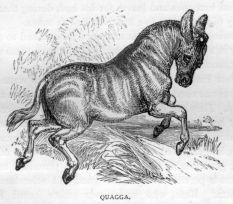
After waiting at Pisania some time, finding no vessel likely to sail direct for England, he took his passage on board a slave vessel bound for South Carolina. She, however, meeting with bad weather, put into Antigua, and from thence he sailed in an English packet, and arrived at Falmouth on the 22nd of December, having been from England about two years and seven months.
Chapter Four.
Park’s second journey.
Marries—Prepares for another journey—Accompanied by Messrs Anderson and Scott, Lieutenant Martyn and thirty-five soldiers, proceeds to Pisania by way of Goree—Engages Isaaco as guide—Numerous asses—Journey commenced—Three soldiers die—Attacked by bees—Sickness among the men increases—Annoyed by lions—Messrs Anderson and Scott ill of fever—Several men left behind—Isaaco seized by a crocodile—Natives attempt to rob them—A bridge built—Reach Bangassi—Scott left behind, sick—The corporal and more men die—Mr Anderson’s illness increases—Followed by lions—Heavy rains—Meets Kafa Taura—The Niger reached—Descends the Niger in a canoe—Isaaco takes his leave—Alarming reports—Receives envoys from Mansong—Continues voyage in canoes—Receives news of Scott’s death—Mr Anderson dies—A vessel built—Commences voyage in her with Lieutenant Martyn, two white men and some slaves—Attacked by natives—Continues voyage—Again attacked—Park and Marlyn drowned, others killed—One slave escapes, who gives an account of the tragedy.
Soon after his return to England Park married the daughter of Mr Anderson, with whom he had served his apprenticeship, and resided a couple of years with his mother and one of his brothers on the farm that his father had occupied at Fowlshiels, in Scotland. After this he practised his profession for some time at Peebles. But this sort of life not satisfying his ardent temperament, on hearing from Sir Joseph Banks that another expedition into Africa to explore the Niger was proposed, he at once offered his services.
Nothing, however, was settled till the year 1803, when, being directed to hold himself in readiness to proceed to Africa, he engaged a native of Mogadore, named Sidi Omback Boubi, then residing in London, to accompany him to Scotland for the purpose of instructing him in Arabic.
Nearly another year passed before all arrangements were concluded. It was finally determined that the expedition should consist of Park himself, his brother-in-law (Mr Anderson), and Mr George Scott, who was to act as draughtsman, together with a few boat-builders and artificers. They were to be joined at Goree by a party of soldiers of the African corps stationed in that garrison.
Three months after this elapsed ere they set sail on board the “Crescent” transport on the 30th of January, 1805; and, after touching at Saint Jago to obtain asses for the journey, they reached Goree on the 28th of March.
There was no lack of volunteers, the whole garrison offering their services. Thirty-five soldiers under the command of Lieutenant Martyn of the Royal Artillery Corps were selected, as well as two sailors from the “Squirrel” frigate.
They left Goree on the 6th of April, the men jumping into the boats in the highest spirits, and bidding adieu to their friends with repeated huzzas.
Landing at Kayee on the northern bank of the Gambia, they commenced their overland journey to Pisania on the 27th of April. The weather was intensely hot, and the asses, unaccustomed to carry loads, made their march very fatiguing and troublesome, three of the animals sticking fast in a muddy rice field soon after they started.
So many delays had occurred that the rainy season was already approaching, and it would have been more prudent had the expedition remained at Goree or Pisania till the country had become again suitable for travelling. It was just possible, however, that they might reach the Niger before the middle of June, when the rainy season usually commences, and that river could then have been navigated without much exposure or toil. So eager, however, was Mr Park to proceed, that he disregarded the warnings of his friends, and determined to set forth on his journey.
Several days were lost at Pisania in arranging the burdens of the asses and in purchasing more animals, as those they possessed were not sufficient for carrying all the loads.
He here engaged a Mandingo priest named Isaaco, who was also a travelling merchant, to serve as a guide, and, on the 4th of May, all being ready, the caravan set forth from Pisania, whence nearly ten years before Park had commenced his adventurous journey into the interior.
The arrangements for the march were well devised. The animals as well as their loads were marked and numbered with red paint, and a certain number allotted to the care of each of the six messes into which the soldiers were divided. Mr Scott and Isaaco generally led, Lieutenant Martyn marched in the centre, and Anderson and Park brought up the rear.
All their forethought, however, could not guard them against the deadly attacks of the climate. The asses from the first gave them a great deal of trouble—many, from being overloaded, lying down in the road, while others kicked off their bundles—so that the caravan made but slow progress.
They had not gone far when two of the soldiers died, and, a few days afterwards, another lost his life.
At most of the places through which they passed they were well received; but at the town of Bady the chief man demanded enormously high duties, and sent a large band of armed followers to collect them. When Isaaco was sent over to Bady to enquire the reason of this conduct, he was seized, his weapons taken from him, and he was tied to a tree and flogged. It was proposed to attack the place; but early the next day the guide was sent back, and the matter was settled by payment of a portion of the duties demanded.
While halting at a creek, the asses being unloaded, some of the men went in search of honey. Unfortunately they disturbed a large swarm of bees, which, rushing out, attacked both men and beasts. The asses, being loose, galloped off, but the horses and people were fearfully stung.
A fire, which had been kindled for cooking, being deserted, spread in all directions, setting the bamboos in flames and very nearly destroying their luggage. Two of the asses died here, and others were missing.
Several of the soldiers now fell sick, and were mounted on the horses and spare asses.
At Toombin, which the caravan reached on the 16th of June, in the neighbourhood of Malacotta, the good old schoolmaster, Park’s former friend, arrived just as the baggage had started, having travelled all night to visit him. Park invited him to go forward to the next place where they should halt, that he might reward him for his former kindness.
After leaving the village he found Hinton, one of the party, to whom Mr Anderson had lent his horse, lying under a tree, and the horse grazing at a little distance. Park put the sick man on the horse and drove it before him, but was at length compelled to leave him. A mile further on he came to two others lying in the shade of a tree, whom he placed on his own and Mr Anderson’s horses, and carried on to the next village. Hence he sent back for poor Hinton, and left the three in charge of the dooty, giving him beads to purchase provisions for them should they live, and to bury them if they died.
On the 22nd one of the carpenters was also left behind at his own request. A soldier, Bloore, lost his way in the woods while looking for an ass which had strayed, and in the search another sick man, Walter, was found. He had laid himself down among the bushes. He died soon after being taken up, and Park with his sword, and two of the soldiers with their bayonets, dug his grave in the desert, covering it over with a few branches.
Thus, one by one, in rapid succession, Park’s companions, attacked by fever, either sank on the road or were left behind, too probably to perish.
On the 30th of June both Mr Anderson and Mr Scott were attacked by the fever.
While encamped during a violent tornado, when it was necessary to put out the watch-fires, a peculiar roaring and growling was heard. Supposing the sound to be that of wild boars, Park and Lieutenant Martyn went in search of them and fired several shots into the bush. The natives on their return told them that they were not boars, but young lions, and that unless a very good look out was kept they would probably kill some of the cattle during the night. About midnight the lions attempted to seize one of the asses, which so alarmed the rest that they broke the ropes and came full gallop in amongst the tents. Two of the lions followed so close that the sentry cut one with his sword, but dared not fire for fear of killing the asses.
Both Anderson and Scott were worse, but Park urged them to proceed. Alston, a seaman, had become so weak that he was unable to sit his horse, and entreated to be left in the woods till the morning. Park gave him a loaded pistol and some cartridges to protect himself.
The next day, the 4th of July, the river Wanda, which they reached, was found to be greatly swollen. There was but one canoe. In this the baggage was carried over, and Isaaco endeavoured to make the asses cross by swimming and pushing them before him. While thus employed, just as he reached the middle of the stream, a crocodile suddenly rose and, seizing him by the left thigh, pulled him under water. With wonderful presence of mind he thrust his finger into the creature’s eye; on which it quitted its hold, and Isaaco attempted to reach the further shore, calling out for a knife. The crocodile returned and seized him by the other thigh, and again pulled him under water. He had recourse to the same expedient, and thrust his finger into its eyes with such violence that it again quitted him and, when it rose, after flouncing about, swam down the stream. Isaaco reached the other side, and as soon as the canoe returned Park went over, and, having dressed his wounds with adhesive plaster, he was carried to the nearest village, fortunately not far off. Park here found himself very ill and unable to stand erect without feeling a tendency to faint, while all the people were so sickly that they could with difficulty carry the loads into the tents, though rain threatened. Greatly to their astonishment, Ashton the sailor arrived, with his fever much abated, but quite naked, having been stripped of his clothes by some natives during the night.
Important as it was to push on, they found it impossible to do so without Isaaco, whose recovery seemed doubtful, though the delay would expose them to the full violence of the rain shortly to be expected. Isaaco, under Park’s care, notwithstanding his fears, rapidly recovered; and on the 10th of July they were able once more to travel forward, taking a west and north-west direction.
They were now exposed to the thieving propensities of the natives, who took every opportunity of carrying off whatever they could lay their hands on. Among the chief robbers were the sons of a potentate called Mansa Mumma, whose town they reached on the 12th. As Park was looking out for an easy ascent over some rocky ground, two of these young princes, approaching, snatched his musket from his hand and ran off with it. He instantly sprang from his saddle and followed the robber with his sword, calling to Mr Anderson to tell some of the people to look after his horse. Anderson got within musket-shot of the man, but, seeing that he was Mumma’s son, had some doubt about shooting him. The thief made his escape, and on Park’s return he found that the other prince had stolen his great coat. An elder brother, who had been engaged as a guide, told him that after what had happened he would be justified in shooting the first who attempted to steal from the loads. The soldiers were accordingly ordered to load their muskets and be ready. Notwithstanding this, a short time afterwards a man made a dash at one of the asses which had strayed a little from the rest, took off the load, and began to cut it open with his knife. The soldiers fired, but did not hit him, and he made his escape, leaving the load behind him. Another seized a soldier’s knapsack and attempted to make off with it. The soldier covered him with his piece, but it flashed in the pan, and the robber escaped. Another robber, however, who had attempted to carry off a great coat from an ass driven by one of the sick men, was wounded, and Mansa’s son insisted that he should be killed, as otherwise they would not fulfil the orders of the king, who had directed that every person be shot who stole from the caravan.
In this way, day after day, they were attacked, and they had little doubt that one of the sick men who had fallen behind had been robbed and murdered by these people.
A deep stream being reached, it was proposed to form a raft; but the Mandingoes insisted that it would be necessary to build a bridge to enable them to cross. It was most ingeniously and rapidly constructed. The people, however, were too sickly to carry the baggage over, and negroes were therefore hired for the purpose, as well as to swim the asses across.
Another of the soldiers here lay down and expired, and, as the sun was very hot, it was impossible to stop and bury him.
As he was riding on, Park found Mr Scott lying by the side of the path, too sick to walk, and, shortly afterwards, Lieutenant Martyn lay down in the same state.
Pushing on to the town of Mareena, Park sent back a party to bring in his sick companions.
Hence they proceeded to Bangassi, six miles distant, the capital of the Chief Serenummo. While encamped outside, one of the sick men, who had been left under the shade of a tree, was nearly being torn to pieces by wolves, which he found, on awakening, smelling at his feet. Ill as he was, he started up and rushed to the camp.
Here the corporal died, and several soldiers, as well as one of the carpenters, insisted on being left behind. Park handed to the dooty’s son a quantity of amber and other articles of trade, that the poor men might be taken care of.
Poor Park’s troubles increased. Mr Scott, who rode his horse, continued very ill, and the soldiers were so weak that, when the loads fell off the asses, they were unable to lift them on again. In the course of one day’s march Park himself had to assist in re-loading thirteen of the animals. The caravan was also followed by wolves, who prowled round them during the night, showing too plainly what would be the fate of any of the sick men who dropped behind. Provisions also became scarce, and thieves likewise dodged their footsteps, taking every opportunity of robbing them.
On the 10th of August, as Park, who was bringing up the rear, reached a stream, he found many of the soldiers sitting on the ground, and Mr Anderson was lying under a bush, apparently dying. He took his brother-in-law on his back, and carried him across the stream, though it took him up to his middle. He had then to carry other loads, and get the animals over, having thus to cross sixteen times. He then put Mr Anderson on his horse and conveyed him to the next village, where, however, a solitary fowl was the only food he could obtain.
During the last two marches four more men had been lost, and, though Mr Scott was somewhat recovered, Mr Anderson was in a very dangerous state. He struggled on, however, for another day, when, after he had passed a number of sick men, Mr Anderson declared that he could ride no further. Park, having turned the horses and ass to feed, sat down in the shade to watch the pulsations of his dying friend. In the evening, there being a fine breeze, Mr Anderson agreed to make another attempt to move on, in the hopes of reaching a town before dark. They had not proceeded above a mile, when they heard a noise very much like the bark of a large mastiff, but ending in a hiss like that of a cat. Mr Anderson was observing: “What a bouncing fellow that must be,” when another bark nearer to them was heard, and presently a third, accompanied by a growl a short distance further. Coming to an opening in the bushes, three enormous lions of a dusky colour were seen bounding over the long grass, abreast of each other, towards them. Fearing that, should they come near, and his piece miss fire, the lions would seize them, Park advanced and shot at the centre one. The animals stopped, looked at each other, and then bounded away, and, though one again stopped while he was loading his piece, they all disappeared. The lions, however, followed him; but Mr Anderson having a boatswain’s call, Park took it and whistled, and made as much noise as possible, so that they did not again molest him. Notwithstanding Mr Anderson’s reduced condition he persevered in travelling, and, being placed in a hammock constructed out of a cloak, was carried along by two men. Mr Scott, however, complaining of sickness, shortly afterwards dropped behind.
On entering Doomblia during heavy rain, greatly to his satisfaction Park met Kafa Taura, the worthy negro merchant who had been so kind to him on his former journey. He had now come a considerable distance to see him.
From hence he sent back to enquire for Mr Scott, but no information could be obtained about him.
On the 19th of August the sad remnant of the expedition ascended the mountainous ridge which separates the Niger from the remote branches of the Senegal. Mr Park hastened on ahead, and, coming to the brow of the hill, once more saw the mighty river making its way in a broad stream through the plain.
Descending from thence towards Bambakoo, the travellers pitched their tents under a tree near that town.
Of the thirty-four soldiers and four carpenters who left the Gambia, only six soldiers and one carpenter reached the Niger, three having died during the previous day’s march.
As the only canoe Park could obtain would carry but two persons besides their goods, he and Mr Anderson embarked in it, leaving Mr Martyn and the men to come down by land with the asses. He himself was suffering greatly from dysentery. In the evening they landed on some flat rocks near the shore, and were cooking their supper, when the rain came down, and continued with great violence all night.
The next day Mr Martyn and the rest of the people overtook them.
On the following day Isaaco, having performed the task he had undertaken, of guiding them to the Niger, received the payment agreed on; and Park likewise gave him several articles, and told him that when the palaver was adjusted at Sego, he should have all the horses and asses for his trouble.
He here also prepared the present he purposed to offer to Mansong, the king of Bambarra, and which he sent forward to Sego by Isaaco.
Every day brought them some unfavourable news or other. At one time it was reported that Mansong had killed Isaaco with his own hand, and threatened to do the same with all the whites who should come into Bambarra. These reports proved to be false, for Isaaco himself arrived in a canoe from Sego, bringing back all the articles sent to Mansong, who had directed that they should be taken up to Samee, and that he would send a person to receive them from Park’s own hands. Mansong had promised that the expedition should pass, but whenever Isaaco mentioned it particularly, or related any incident that had happened on the journey, Mansong began to make squares and triangles in the sand before him with his finger, and continued to do so as long as Isaaco spoke about them. This the superstitious monarch probably did to defend himself against the supposed incantations of the white man.
On the 22nd of September the chief counsellor of Mansong, Modibinne, and four grandees, arrived by a canoe, bringing a fat milk-white bullock as a present. Next morning Modibinne and the grandees came to the camp and desired Park to acquaint them with the motives which had induced him to come into their country. Park explained them, telling them that it was his wish to sail down the Joliba, or Niger, to the place where it mixes with the salt water, and that if the navigation was found open, the white men would send up vessels to trade at Sego, should Mansong wish it. Modibinne replied that the object of the journey was a good one, and prayed that God would prosper it, adding, “Mansong will protect you.”
The presents intended for the king were then spread out, and appeared to give great satisfaction. Two more soldiers died that evening. On the 26th the expedition, in open canoes, left Samee. Park felt himself very unwell, and the heat was intense, sufficient to have roasted a sirloin. Isaaco, however, having formed an awning over the canoe with four sticks and a couple of cloaks, Park found himself better.
On the 2nd two other privates died, the body of one of whom the wolves carried off, the door of the hut having been left open.
Wishing to obtain cowries, Park opened a market at Marroboo to dispose of his goods, and so great was the demand for them that he had to employ three tellers at once to count his cash. In one day he turned 25,756 pieces of money-cowries.
The sad news now reached him of the Mr Scott’s death, and on the 28th of October his brother-in-law, Mr Anderson, breathed his last. “No event,” Park remarks, “which took place during the journey ever threw the smallest gloom over his mind till he laid Mr Anderson in the grave. He then felt himself left a second time lonely and friendless amidst the wilds of Africa.”
Some days before this, Isaaco had returned with a large canoe, but much decayed and patched. Park, therefore, with the assistance of Bolton, one of the surviving soldiers, took out all the rotten pieces, and, by adding on the portion of another canoe, with eighteen days’ hard labour they changed the Bambarra canoe into his Majesty’s schooner “Joliba.” Her length was forty feet, breadth six feet; and, being flat-bottomed, she drew only one foot of water when loaded. In this craft he and his surviving companions embarked on the 16th of November, on which day his journal closes. He intended next morning to commence his adventurous voyage down the Joliba. Besides Park and Lieutenant Martyn, two Europeans only survived. They had purchased three slaves to assist in the navigation of the vessel, and Isaaco had engaged Amadi Fatouma to succeed him as interpreter. This increased their number to nine.
Descending the stream, they passed the Silla and Jenne without molestation; but lower down, in the neighbourhood of Timbuctoo, they were followed by armed canoes, which they beat off, killing several of the natives. They had, indeed, to fight their way down past a number of places, once striking on the rocks, and being nearly overset by a hippopotamus which rose near them.
Having a large stock of provisions, they were able to proceed without going on shore. Amadi was the only person who landed in order to get fresh provisions.
At Yaour Park sent a present to the king by one of the chiefs, but, the chief inquiring whether he intended to return, Park replied that he had no purpose of doing so. This induced the chief to withhold the presents from the king, and who, accordingly, indignant at being thus treated, put Amadi into irons, took all his goods from him, and sent a force to occupy a rock overhanging the river where it narrows greatly. On arriving at this place, Park endeavoured to pass through, when the people began to throw lances and stones at him. He and his companions defended themselves for a long time, till two of his slaves in the stern of the boat were killed.
Finding no hopes of escape, Park took hold of one of the white men and jumped into the water, and Martyn did the same, hoping to reach the shore, but were drowned in the attempt. The only slave remaining in the boat, seeing the natives persist in throwing their weapons, entreated them to stop. On this they took possession of the canoe and the man, and carried them to the king. Amadi, after being kept in irons three months, was liberated, and on finding the slave who had been taken in the canoe, learned from him the manner in which Mr Park and his companions had perished. The only article left in the canoe had been a sword-belt, which Isaaco, who was afterwards despatched to learn particulars of the tragedy, obtained—the sole relic of the expedition.
Park could not have been aware of the numerous rapids and other difficulties he would have had to encounter on descending the upper portion of the Niger. In all probability his frail and ill-constructed vessel would have been wrecked before he had proceeded many miles below the spot where he lost his life. Had he, however, succeeded in passing that 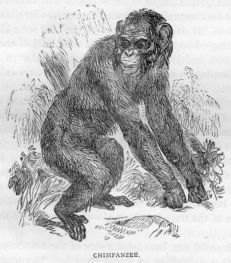 dangerous portion, he might have navigated the mighty stream to its mouth.
Although at first the account of Park’s death was not believed in England, subsequent enquiries left no doubt that all the statements were substantially correct.
Thus perished, in the prime of life, that heroic traveller, at the very time when he had good reason to believe that he was about to solve the problem of the Niger’s course.
Chapter Five.
Travels of Denham and Clapperton.
Preceded by Horneman—Roentgen—Tuckey and others—Major Laing’s journey—Lieutenant Clapperton and Dr Oudney, joined by Major Denham, leave Tripoli—Difficulties with the Pacha—Denham sails for England—The Pacha sends after him—Boo-Khaloum appointed conductor—Journey across the Desert—Illness of Clapperton and Oudney—Numberless skeletons of slaves—Arabs’ ill-treatment of the natives—Lake Chad—Empire of Bornou—Reception at Kouka by the Sheikh—Body-guard of the Sheikh—Barca Gana, his General—Visit to the Sultan of Birnie—Elephant and Buffalo hunting—Denham joins an expedition under Baca Gana—Meet the Sultan of Mandara—Attack on the Felatahs—Denham nearly loses his life—Boo-Khaloum killed—Barca Gana’s troops take to flight—The Major kindly treated by a deposed Prince—Returns to Kouka.
Between Park’s two expeditions, several travellers endeavoured to solve some of the many problems connected with the geography of Africa.
The first person sent out by the Association was a young German, Frederick Horneman, in the character of an Arab merchant. He travelled from Alexandria to Cairo, where he was imprisoned by the natives on the news arriving of Bonaparte’s landing in the country. He was, however, liberated by the French, and set out on the 5th of September, 1798, with a caravan destined for Fezzan.
On one occasion, when passing through Siwah, the bigoted Mahommedan inhabitants surrounded the caravan, having heard that two Christians belonged to it, and promising to let it proceed provided these were delivered up to them. Having, however, by his knowledge of the Koran, satisfied them that he was a true Mahommedan, being protected by the other members of the caravan, he was allowed to proceed.
He reached Mourzouk in safety, and there endeavoured to gain information about the states to the south of Timbuctoo. He, however, heard but little, though he found that Houssa was not, as supposed, a city, but a region embracing many kingdoms, the inhabitants of which were said to be superior in civilisation to those of the surrounding people.
He remained here for a considerable time, and then visited Tripoli, after which he returned to Mourzouk, and started thence in April, 1800.
From that time no information was received directly from him; but Major Denham many years afterwards learned that he had penetrated as far as Nyffe on the Niger, where he fell a victim to disease.
Another German, Roentgen, also sent out by the Association in 1809, started from Mogadore and, it is supposed, was murdered by his guides.
Two Americans, one a seaman, named Adams, and the other a supercargo, James, having been wrecked on the west coast at different periods, travelled for a considerable distance through the north-west portion of the continent. Adams was carried to Timbuctoo, where he remained six months in 1810. He found the city chiefly inhabited by negroes; and he describes the few religious ceremonies which took place as pagan. The city had lately been conquered by the king of Bambarra, who had established there a negro government. Even the largest houses were little more than huts, built of timber frames filled in with earth. He was ultimately liberated by the British consul at Mogadore.
Riley, who was wrecked in 1815, was carried as a slave through the country. From a caravan merchant, Sidi Hamet, who purchased him from his first captors, he obtained much 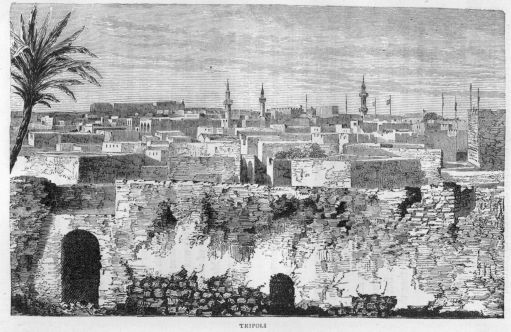 information about the country. From the account he received, it appears at that time that Timbuctoo was larger and better built than Adams described it. Sidi Hamet also travelled a considerable distance down the banks of the Niger, which, though at first running due east, afterwards turned to the south-east. Travelling sixty days, he reached Wassanah, a place twice as large as Timbuctoo, the inhabitants being hospitable and kind-hearted. From thence he heard that boats with cargoes of slaves sailed two months, first south and then west, down the river, till they came to the sea, where they met white people in vessels armed with guns. This was the most correct account hitherto received of the course of the Niger. Riley was also rescued by the English consul at Mogadore.
In 1816 the English Government sent out an expedition to proceed up the Congo, under Captain Tuckey, but he and his followers fell victims to the climate.
At the same time another expedition had started under Major Peddie, and Captain Campbell, but they both, with Lieutenant Stokoe, of the navy, died the following year.
In 1821 Major Laing, starting from Sierra Leone, made a journey in search of the source of the Niger, but was compelled to return.
In 1819 Mr Ritchie, with Lieutenant Lyon, of the navy, started from Tripoli, intending to proceed southward to Bornou, in order to trace the downward course of the Niger, but Mr Ritchie died, and Lieutenant Lyon was unable to get further than the southern frontier of Fezzan.
Owing to the judicious conduct of Mr Warrington, the British Consul at Tripoli, the English were held in high estimation at that court, and the pacha, who was looked upon by the wild tribes of the south as the most potent of all monarchs, assured him that any of his countrymen could travel with perfect safety from his territories to Bornou.
The Government, therefore, considering circumstances so favourable, organised a fresh expedition, headed by Lieutenant Clapperton and Dr Oudney, of the Navy. Major Denham having volunteered his services, they were accepted, and he joined his intended companions at Tripoli. He was accompanied by Mr Hillman, a shipwright, who undertook to direct the building of a vessel on the Niger.
After visiting the pacha, and having accompanied him on a hawking party in the desert, Major Denham set out on the 5th of March, 1822, to join his two companions, who had gone forward to the beautiful valley of Memoom.
When near Sockna, they met a kafila, or caravan of slaves, in which were about seventy negroes, who told them that they came from the different regions of Soudan, Begharmi, and Kanem. Those from Soudan had regular features and a pleasing expression of countenance.
On reaching Mourzouk they were disappointed in their expectation of receiving assistance from the sultan, who declared that it was impossible to obtain either camels or horses before the next spring, to enable them to proceed. Finding this, Major Denham determined to return to Tripoli, to represent to the pacha that something besides mere promises must be given.
Attended by his negro servant, Barca, he reached that town on the 12th of June, and the pacha himself showing little inclination to render assistance, he at once started for England, to represent the state of affairs to the Government. He was, however, overtaken at Marseilles by a messenger from the pacha entreating him to return, and assuring him that he had appointed a well-known caravan leader, Boo-Khaloum, with an escort to convey him to Bornou.
On his return to Africa he found Boo-Khaloum and part of the escort already waiting for him at the entrance of the desert. His new friend delighted in pomp and show, and he and his attendants entered Sockna attired in magnificent costumes, their chief himself riding a beautiful Tunisian horse, the saddle and housing richly adorned with scarlet cloth and gold. This African caravan merchant united the character of a warlike chief and trader, his followers being trained not only to fight in defence of his property, but to attack towns and carry off the hapless inhabitants as slaves. Yet Book-Haloum was superior to most of his age; he possessed an enlarged and liberal mind, and was considered an honourable and humane man, while so great was his generosity that he was adored by his people.
On the 30th of October the caravan entered Mourzouk with all the parade and pomp they could muster. Boo-Khaloum’s liberality had made him so popular that a large portion of the inhabitants of the town came out to welcome him.
Major Denham was greatly disappointed at not seeing his friends among the crowd. He found that Dr Oudney was suffering from a complaint in his chest, and that Clapperton was confined to his bed; indeed the climate of Mourzouk is evidently very unhealthy.
The arrangements for starting were not completed until the 29th of November. In the meantime the other members of the expedition had somewhat recovered. Major Denham had engaged a native of the Island of Saint Vincent, of the name of Simpkins, but who, having traversed half the world over, had acquired that of Columbus. He spoke Arabic perfectly, and three European languages. Three negroes were also hired, and a Gibraltar Jew, Jacob, who acted as store-keeper. These, with four men to look after their camels, Mr Hillman and themselves, made up their household to thirteen persons. Several merchants also joined their party. Besides these, the caravan comprised one hundred and ten Arabs, marshalled in tens and twenties under their different chiefs.
The Arabs in the service of the pacha, who were to escort them to Bornou, behaved admirably, and enlivened them  greatly on their dreary desert road by their wit and sagacity, as well as by their poetry, extemporary and traditional.
The camels and tents having been sent on before, the party started on horseback on the evening of the day mentioned. Dr Oudney was suffering from his cough, and neither Clapperton nor Hillman had got over their ague, a bad condition in which to commence their arduous journey.
The heat when crossing the desert was great; not a bird nor an insect was to be seen moving through the air; but the nights were beautiful and perfectly still, gentle breezes cooling the air. By digging a few inches into the hot, loose soil, a cool and soft bed was obtained. Through wide districts the surface was covered with salt, and from the sides of hollows where it was broken, hung beautiful crystals like the finest frost-work.
Before proceeding far, objects sufficient to create the deepest horror in their minds were met with. In all directions the ground was covered with the skeletons of those who had perished in attempting to cross the wilderness. At first only one or two were seen, but afterwards as many as fifty or sixty were passed in a day. At one place a hundred were found together, and near the wells of El Hammar they were lying too thickly to be counted. One morning as Denham, dozing on his horse, was riding, he was startled by a peculiar sound of something crashing under the animal’s feet, and, on looking down, he found that he was trampling over two human skeletons, one of the horse’s feet having driven a skull before him like a ball. To some of the bones portions of the flesh and hair still adhered, and the features of others were distinguishable. Two skeletons of females lay close together, who had evidently died in each other’s arms.
The Arabs, accustomed to such scenes, laughed at the sympathy exhibited by the English, observing, with a curse on their fathers, that they were only blacks. There can be no doubt that the larger group consisted of a number of slaves captured by the Sultan of Fezzan, during a late expedition he had made into Soudan. His troops, having left Bornou with an insufficient supply of provisions, allowed their unhappy captives to perish, while they made their escape with the food intended to support them.
One evening the major exhibited a book of drawings made by Captain Lyon, to Boo-Khaloum. The portraits he understood, but he could not comprehend the landscapes, and would look at one upside down. On seeing a beautiful print of sand-wind in the desert, though it was twice reversed, he exclaimed: “Why, it is all the same!” Probably a European, even, who had never before cast his eye on the representation of a landscape, would be long before he could appreciate the beauties of the picture. One beautiful moonlight evening Denham exhibited his telescope. An old hadji, after he had been helped to fix the glass on the moon, uttering an exclamation of wonder, walked off as fast as he could, repeating words from the Koran.
Few adventures were met with; but one whole day the travellers were annoyed by a strong east wind, and the next day the wind and drifting sand were so violent that they were compelled to keep their tents. They had to sit in their shirts, as the sand could thus be shaken off as soon as it made a lodgment, which with any other articles of dress could not be done. Denham found the greatest relief by rubbing the neck and shoulders with oil, and being shampooed by his servant, Barca’s wife, who, when a slave in the palace of the pacha, had learned the art.
The Tibboos, a tribe who had for some time accompanied them, went off to obtain some sheep, an ox, honey, milk and fat. On their return the milk turned out sour camels’ milk, full of sand, and the fat very rancid, while a single lean sheep was purchased for two dollars.
Some of their horses were very handsome and extremely fat, which arose from being fed entirely on camels’ milk, corn being too scarce for the Tibboos to spare them.
The girls of this tribe were pretty, but the men extremely ugly.
Their Arabs, who were sent as an escort to oppose banditti, after a time became dissatisfied at having nothing to do, and were evidently contemplating inroads on the inhabitants.
Denham, with Boo-Khaloum and a dozen horsemen, each having a footman behind him, started off towards a spot where some Tibboo tents had been seen. On their arrival they found that the shepherds had moved off, knowing well how they should be treated by the white people, as they called the Arabs. Their caution was made the excuse for plundering them. “What! not stay to sell their sheep? the rogues!” exclaimed the Arabs.
After a time they came in sight of two hundred head of cattle and about twenty persons—men, women and children—with camels, moving off. The Arabs, slipping from behind their leaders, with a shout, rushed down the hill, part running towards the cattle to prevent their escape. The unfortunate people were rapidly plundered, the camels were brought to the ground and the whole of their loads rifled. The poor women and girls lifted up their hands, stripped as they were to the skin, but Denham felt that he could do nothing for them beyond saving their lives.
When Boo-Khaloum came up, however, he seemed ashamed of the paltry booty his followers had obtained, and Denham seized the favourable moment to advise that the Arabs should give everything back, and have a few sheep and an ox for a feast. He gave the order, and the property was restored, with the exception of ten sheep and a fat bullock.
An old maraboot assured Denham that to plunder those who left their tents, instead of supplying travellers, was quite  lawful. Too often the natives are not only plundered, but murdered, by the armed attendants of caravans as they make their way across the desert.
The natives, as may be supposed, retaliate. Should any animal straggle from the main body, it is certain to be carried off. Major Denham lost a favourite dog, which was captured and eaten.
On reaching Lara, a small town of conical-topped rush huts, to the delight of the travellers they saw before them, from a rising ground, the boundless expanse of Lake Chad, glowing with the golden rays of the sun. They hastened down to the shores of this large inland sea, which was darkened with numberless birds of varied plumage—ducks, geese, pelicans and cranes four or five feet high, immense spoonbills of snowy whiteness, yellow-legged plovers—all quietly feeding at half pistol-shot. A large basket to supply their larder was soon filled.
Moving along the shores of the lake, the caravan arrived at Woodie, a negro town of considerable size. It was here arranged that the caravan should wait till an embassy could be sent to the Sheikh of Bornou, to obtain permission for presenting themselves before him.
The empire of Bornou had, some twenty years before, been overrun and subjected by the Felatahs, a powerful people to the west. The present sheikh, a native of Kanem, though of humble birth, had by his superior talents and energy rallied round him a band of warriors, and, pretending that he had received a command from the prophet, hoisted the green flag, and had in a few months driven the invaders out of the country, which they had never since been able to occupy, though frequently attacking his borders.
While waiting for the sheikh’s reply, Major Denham rode out early one morning in search of a herd of a hundred and fifty elephants, which had been seen the day before. He found them about six miles from the town, on ground annually overflowed by the waters of the lake. They seemed to cover the whole face of the country, and exceeded the number he expected to see. Often, when forced by hunger, they approach the towns and spread devastation throughout their march, whole plantations being destroyed in a single night. Some antelopes were also seen, but they never allowed the party to get near enough to hazard a shot.
The country for the last eighteen days of their journey had been covered with a grass which produces a calyx full of prickles. These adhere to the dress and penetrate to the skin, to which they fasten themselves like grappling-irons. They got between the toes of the poor dog Niger, and into every part of his long silken hair, so as to make him unable to walk.
At the next camping-place hyaenas came close to their tents and killed a camel, on the carcase of which a lion, when he had driven them away, banqueted, when they returned and devoured what he had left.
Several days’ journey took the caravan into the neighbourhood of Kouka. They had been told that the sheikh’s soldiers were a few ragged negroes, armed with spears, who lived upon the plunder of the black Kaffir countries. Greatly to their astonishment, as they approached the town they beheld a body of several thousand cavalry, drawn up in line and extending right and left as far as they could see.
As the Arabs approached, a yell was given by the sheikhs people, which rent the air; and a blast being blown from their rude instruments, they moved on to meet Boo-Khaloum and his Arabs. Small bodies kept charging rapidly towards them, to within a few feet of their horses’ heads, without checking the speed of their own until the moment of their halting; then they wheeled at their utmost speed with great precision, shaking their spears over their heads, exclaiming, “Baka baka!” (“Blessing! blessing!”) They quickly, however, surrounded the caravan so as to prevent it moving on, which greatly enraged Boo-Khaloum, but to no purpose, as he was only answered by shrieks of welcome, and spears unpleasantly rattled over the traveller’s heads. In a short time, Barca Gana, the sheikh’s first general—a negro of noble aspect, clothed in a figured silk tobe, mounted on a beautiful Mandara horse—made his appearance, and cleared away those who had pressed upon them, when the party moved on slowly towards the city.
Arrived at the gates, Boo-Khaloum, with the English and about a dozen of his followers, alone were allowed to enter. They proceeded along a wide street completely lined with spearmen on foot, with cavalry in front of them, to the door of the sheikh’s residence. Here the horsemen were formed up three deep, and the party halted while some of the chief’s attendants came out and, after a great many “Baka’s! baka’s!” retired, when others performed the same ceremony. On this, Boo-Khaloum again lost patience, and swore by the pacha’s head that he would return to his tents, if he was not immediately admitted. Denham advised him to submit, and Barca Gana, appearing, invited him to dismount. The English were about to do the same, when an officer intimated that the Arab alone was to be admitted.
Another half-hour, and the gates were again opened, and the four Englishmen were called for. The strictest etiquette appeared to be kept up at the sheikh’s court; but the major and his companions declined doing more in the way of reverence than bending their heads and laying their right-hands on their hearts. They found the sheikh sitting on a carpet, in a small, dark room. He was plainly dressed in a blue tobe of Soudan and a small turban, with armed negroes on either side of him, and weapons hung up on the walls. His  personal appearance was prepossessing, and he had an expressive countenance and a benevolent smile.
After he had received the letter from the pacha, he enquired what was their object in coming. They answered, to see the country and to give an account of its inhabitants, produce and appearance, as their sultan was desirous of knowing every part of the globe. His reply was that they were welcome, and whatever he could show them would give him pleasure.
Huts had been built for them and an abundance of provisions was provided, though the number of their visitors gave them not a moment’s peace, while the heat was insufferable.
Next day they had another audience, to deliver their presents. With the firearms, especially, the sheikh was highly delighted, and he showed evident satisfaction on their assuring him that the king of England had heard of Bornou and himself. Immediately turning to his councillors, he observed: “This is in consequence of our defeating the Begharmis.” Upon this the chief who had most distinguished himself in this memorable battle, Bagah Furby, demanded: “Did he ever hear of me?” The reply of “Certainly!” did wonders for their cause. “Ah, then your king must be a great man!” was re-echoed from every side.
Every morning, besides presents of bullocks, camel-loads of wheat and rice, leather skins of butter, jars of honey, and wooden bowls containing rice with meat, and paste made of barley flour—savoury, but very greasy—were sent to them.
In a short time—by the exhibition of rockets, a musical box, and other wonders—Denham appeared to have entirely won the sheikh’s confidence. Reports, however, had been going about that the English had come to spy out the land, and intended to build ships on Lake Chad, in which they would sail about and conquer the surrounding country. Reports were now received that the Begharmis were approaching Bornou, and it was said that the sheikh would immediately send a force into their country, in order to punish their sultan for even thinking of revenge.
The sheikh, in the meantime, had given them leave to visit all the towns in his dominions, but on no account to go beyond them. He asked many questions about the English manner of attacking a walled town; and, on hearing that they had guns which carried ball of thirty-two pounds’ weight, with which the walls were breached, and that then the place was taken by assault, his large dark eyes sparkled again, as he exclaimed: “Wonderful! wonderful!”
Although the sheikh was the real ruler of the country, he allowed the existence of the hereditary sultan, a mere puppet, who resided at Birnie. Boo-Khaloum advised that they should pay their respects to this sovereign; and they accordingly set out for the place, which contained about ten thousand inhabitants. They were first conducted to the gate of the sultan’s mud edifice, where a few of the court were assembled to receive them. One, a sort of chamberlain, habited in eight or ten tobes, or shirts, of different colours, carried an immense staff, and on his head was a turban of prodigious size, though but a trifling one compared to those they were destined to see at the audience on the following morning. A large marquee was pitched for their reception, which they found luxuriously cool. In the evening a plentiful repast was brought them, consisting of seventy dishes, each of which would have dined half-a-dozen persons with moderate appetites; and for fear the English should not eat like the Bornouy, a slave or two arrived loaded with live fowls for their dinner.
Soon after daylight the next morning they were summoned to attend the sultan. He received them in an open space in front of the royal residence. They were compelled to stop at a considerable distance from him, while his own people approached to within about a hundred yards, passing first on horseback, and, after dismounting and prostrating themselves before him, they took their places on the ground in front, but with their backs to the royal person. He was seated in a sort of cage made of cane, on a throne which appeared to be covered with silk or satin. Nothing could be more absurd and grotesque than the figures who formed his court. The sheikh, to make himself popular with all parties, allowed the sultan to be amused by indulging in all the folly and bigotry of the ancient negro sovereigns. Large bellies and large heads are considered the proper attributes of the courtiers, and those who do not possess the former by nature, make up the deficiency of protuberance by a wadding, which, as they sit on horseback, gives them a most extraordinary appearance, while the head is enveloped in folds of muslin or linen of various colours, of such size as to make the head appear completely on one side. The turbans are, besides, hung all-over with charms enclosed in little red leather bags. The horse is also adorned in the same manner.
When the courtiers had taken their seats, the visitors were desired to sit down. On this, the ugliest black that can be imagined, the only person who approached the sultan’s seat, asked for the presents. Boo-Khaloum produced them, enclosed in a large shawl, and they were carried unopened into the presence of the sultan. The English, by some omission, had brought no presents.
A little to their left was an extemporary declaimer, shouting forth the praises of his master, with his pedigree, and near him stood a man with a long, wooden trumpet, on which he ever and anon blew a blast.
Nothing could be more ridiculous than the appearance of these people, squatting down in their places, tottering under the weight and magnitude of their turbans and their bellies, while the thin legs that appeared underneath but ill accorded with the bulk of the other part.
Immediately after the ceremony the travellers took their departure for Angornou, a town containing at least thirty thousand inhabitants. The market-place was crowded with people, and there were a number of beggars. Linen was so cheap that all the men wore shirts and trousers; but the beggars were seen holding up the arms of an old pair of the latter, touching the shirt at the same time, and exclaiming: “But breeches there are none; but breeches there are none.” This novel mode of drawing the attention of the passers-by so amused Denham that he could not help laughing outright.
He was, however, anxious to visit a large river to the southward of Kouka, called the Shary; but was delayed by Dr Oudney’s serious illness, and the unsettled state of Book-Haloum’s affairs with the Arabs; indeed, so mutinous had some of these become, that he was at last compelled to send thirty of them back again to Fezzan.
Hillman had greatly pleased the sheikh by manufacturing a couple of chests, and he was now requested to make a sort of litter, such as the sheikh had heard were used by the sultans of Fezzan.
Among other presents, the sheikh sent them a young lion about three months old. It was a tame, good-natured creature, but as Denham was under the necessity of refusing the animal a corner of his hut, it was immediately in consequence killed.
During the illness of his companions Major Denham made an excursion to the shores of Lake Chad, accompanied by Maraymy, an intelligent black, to whose charge he had been committed by the sheikh, where numerous elephants and some beautiful antelopes were seen. The sheikh’s people, as they came near the elephants, began screeching violently. The animals, though moving a little away, erected their ears, and gave a roar that shook the ground under them. One was an immense fellow. The party wheeled swiftly round him, and Maraymy casting a spear at him, which struck him just under the tail, the huge brute threw up his proboscis in the air with a loud roar, and from it cast such a volume of sand as nearly to blind the major, who was approaching at the time.
The elephant rarely if ever attacks, but, when irritated, he will sometimes rush upon a man on horseback, and, after choking him with dust, destroy him in a moment.
Pursued by the horsemen, the animal made off at a clumsy, rolling walk, but sufficient to keep the steeds at a full gallop. The major fired twice at fifty yards’ distance. The first shot which struck the animal failed to make the least impression, and the second, though wounding him in the ear, seemed to give him a moment’s uneasiness only. After another spear had been darted at him, which flew off his rough hide without exciting the least sensation, the elephant made his escape.
The Shooas, the original inhabitants of the country, are great hunters. Mounted on horseback, a Shooa hunter seeks the buffalo in the swampy regions near the lake, and, driving the animal he has selected to the firm ground, rides on till he gets close alongside, when, springing up, he stands with one foot on his horse and the other on the back of the buffalo, through which he plunges his spear, driving it with tremendous force into its heart.
Denham heard of people called Kerdies, who inhabited islands far away in the eastern part of the lake. They frequently make plundering excursions even close up to Angornou, and carry off cattle and people in their canoes, no means being taken to oppose them.
The sheikh was very unwilling that his white visitor should cross the Shary, for fear of the danger he would run.
At length an opportunity occurred of seeing the country, 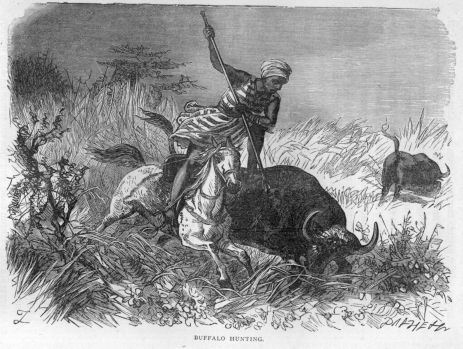 which Denham determined not to let slip. Boo-Khaloum, though sorely against his will, had been induced by his Arabs to plan an expedition against the pagan inhabitants of some villages in the mountains of Mandara, in order to carry them off as slaves to Fezzan. He, wishing rather to visit the commercial regions of Soudan, long held out against these nefarious proposals. The sheikh, who wished to punish the people who were constantly in arms against him, instigated the Arabs to induce Boo-Khaloum to undertake the expedition, and at length, believing that by no other means could he hope to make a profitable journey, he was induced to comply. The sheikh, however, was unwilling that Major Denham should be exposed to the dangers he would meet with, but, as he had determined to go, at last gave his consent, appointing Maraymy to attend him, and to be answerable for his safety.
Boo-Khaloum and his Arabs, with the sheikh’s forces under his general, Barca Gana, had already got some distance ahead. Accompanied by Maraymy, Denham overtook them when several miles from the city, and was received with great civility by Barca Gana in his tent. He had been kept some minutes outside while the general consulted his charm writer, and his remark as he entered was: “If it was the will of God, the stranger should come to no harm, and that he would do all in his power for his convenience.”
Barca Gana had about two thousand of the sheikh’s soldiers under his command. He was himself, however, only a slave, but from his bravery had been raised by his master to the rank of Governor of Angala and all the towns on the Shary, as well as that of commander-in-chief of his troops. He was accompanied by several guards of horse and foot, and a band of five men, three of whom carried a sort of drum, who sang extemporary songs while they beat time; another carried a pipe made of a reed, and a fifth blew on a buffalo’s horn loud and deep-toned blasts. As he advanced through the forest he was preceded by twelve pioneers, who carried long forked poles, with which they kept back the branches as the party moved forward; at the same time they pointed out any dangers in the road.
The heat was intense. Into a lake at which they arrived the horses rushed by hundreds, making the water as thick as pea-soup. As the major’s camel had not come up, he could not pitch his tent, and he was compelled to lie down in the best shade he could find, and cover himself completely with a cloth and a thick woollen bournous, to keep up a little moisture, by excluding all external air.
After several days’ march they arrived near the capital of Mandara, whose sultan sent out several of his chiefs to meet them. Near the town of Delow the sultan himself appeared, surrounded by about five hundred horsemen. Different parties of these troops charged up to the front of Barca Gana’s forces, and, wheeling suddenly round, galloped back again. They were handsomely dressed in Soudan tobes of different colours—dark blue and striped with yellow and red; bournouses of coarse scarlet cloth, with large turbans of white or dark-coloured cotton. Their horses were really beautiful—larger and more powerful than any seen in Bornou. They managed them with great skill.
A parley was now carried on. This sultan was an ally of the sheikh, but the people who were to be attacked were his own subjects, though, as they were pagans, that mattered nothing.
Boo-Khaloum was, as usual, very sanguine of success. He said he should make the sultan handsome presents, and that he was quite sure a Kerdie or pagan town full of people would be given him to plunder.
The Arabs eyed the Kerdie huts, now visible on the sides of the mountains, with longing eyes, and, contrasting their own ragged condition with the appearance of the Sultan of Mandara’s people in their rich tobes, observed to Book-Haloum that what they saw pleased them; they would go no further; this would do. They trusted for victory to their guns—though many were wretched weapons, and their powder was bad—declaring that arrows were nothing, and ten thousand spears of no importance. “We have guns! we have guns!” they shouted. They were soon to find that they made a fearful mistake.
The Sultan of Mandara had assisted the Sheikh Kanemy in driving out the Felatahs, and, since then, supported by his powerful ally, had risen greatly in power. The Felatahs, indeed, were his principal enemies in the neighbourhood, and he was only waiting for such an expedition as now joined him to attack them.
The unfortunate Kerdies, who believed that they themselves were the objects of the raid, beheld with dread the army of Barca Gana bivouacking in the valley. The fires, which were visible in the different nests of the hapless mountaineers, threw a glare on the bold peaks and bluff promontories of granite rock by which they were surrounded, and produced a picturesque and somewhat awful appearance. Denham could distinguish many of them through his telescope, making off into the mountains, while others came down bearing leopard-skins, honey, and slaves as peace offerings, as also asses and goats, with which the mountains abound. They, however, on this occasion, were not destined to suffer. The people of Musgu, whose country it had been reported that the Arabs were to plunder, sent two hundred slaves and other presents to the sultan. As they entered and left the palace they threw themselves on the ground, pouring sand on their heads, and uttering the most piteous cries.
The sultan all this time had not informed Boo-Khaloum what district he would allow him to attack, but observed that the Kerdie nations, being extremely tractable, were becoming Mussulmans without force.
Major Denham had several interviews with this intelligent but bigoted sultan, when he was greatly annoyed by the chief doctor of the court, or fighi, Malem Chadily, who, because he was a Christian, endeavoured to prejudice the mind of the sultan against him; indeed, the bigotry of this court far surpassed that usually found among black tribes who have become Mahommedans. The major had been drawing with a lead pencil, when he was carried into the presence of the sultan. Malem Chadily on this occasion pretended to treat him with great complaisance.
The courtiers were much astonished at seeing the effect produced by the pencils, and the ease with which their traces were effaced by india-rubber. Several words were written by the doctor and others, which were quickly rubbed out by the major. At last, the doctor wrote: “Bismillah arachmani arachemi” (“In the name of the great and most merciful God”) in large Koran characters. He made so deep an impression on the paper, that after using the india-rubber the words still appeared legible, the fighi remarking: “They are the words of God, delivered to our prophet: I defy you to erase them.” The sultan and all around him gazed at the paper with intense satisfaction, exclaiming that a miracle had been wrought, and Denham was well pleased to take his departure. Even Barca Gana afterwards, when Denham visited him in his tent, exclaimed, “Wonderful! wonderful!” And the fighi, or doctor, added, “I will show you hundreds of miracles performed alone by the words of the wonderful book.” He then urged the major to turn Mahommedan. “Paradise will then be opened to you,” he remarked. “Without this, what can save you from eternal fire. I shall then see you, while sitting in the third heaven, in the midst of the flames, crying out to your friend Barca Gana and myself, ‘Give me a drop of water!’ but the gulf will be between us and then it will be too late.” Malem’s tears flowed in abundance during this harangue, and everybody appeared affected by his eloquence.
Poor Boo-Khaloum all this time was ill, from vexation more than sickness. At last he had another interview with the sultan, but returned much irritated, and told the major, as he passed, that they should move in the evening, and to the question if everything went well, he answered: “Please God.” The Arabs, from whom he kept his destination a secret, received him with cheers. Whom they were going against they cared little, so long as there was a prospect of plunder, and the whole camp became a busy scene of preparation. Two hours after noon the march was commenced towards the mountains, which rose up in rugged magnificence on either side.
As the morning of the 28th of April broke, an interesting scene presented itself. The Sultan of Mandara, mounted on a beautiful, cream-coloured horse, and followed by a number of persons handsomely dressed, was on one side. Barca Gana’s people, who were on the other, wore their red scarves or bournouses over their steel jackets. The major took up a position at the general’s right-hand, when the troops, entering a thick wood in two columns, were told that at the end of it they should find the enemy. Maraymy kept closer to the major’s side, as danger was approaching.
As they were riding along, several leopards ran swiftly from them, twisting their long tails in the air. A large one was seen, which Maraymy remarked was so satiated with the blood of a negro it had just before killed, that it would be easily destroyed. The Shooa soon planted a spear, which passed through the animal’s neck. It rolled over, breaking the spear, and bounded off with the lower half in its body. Another Shooa attacking it, the animal, with a howl, was in the act of springing on the pursuer, when an Arab shot it through the head.
On emerging from the wood, the large Felatah town of Durkulla was perceived, and the Arabs were formed in front, headed by Boo-Khaloum. They were flanked on each side by a large body of cavalry, who, as they moved on, shouted the Arab war-cry. Denham thought he could perceive a smile pass between Barca Gana and his chief, at poor Boo-Khaloum’s expense.
Durkulla was quickly burned, and another small town near it. The few inhabitants found in them, being infants or aged persons, unable to escape, were put to death or thrown into the flames. A third town, called Musfeia, built on a rising ground, and capable of being defended against assailants ten times as numerous as the besiegers, was next reached. A strong fence of palisades, well pointed, and fastened together with thongs of raw hide, six feet in height, had been carried from one hill to the other. Felatah bowmen were placed behind the palisades and on the rising ground, with a wady before them, while their horses were all under cover of the hills. This was a strong position. The Arabs, however, moved on with great gallantry, without any support from the Bornou or Mandara troops, and, notwithstanding the showers of arrows, some poisoned, which were poured on them from behind the palisades, Boo-Khaloum carried them in about half an hour, and dashed on, driving the Felatahs up the sides of the hills. The women were everywhere seen supplying their protectors with fresh arrows, till they retreated, still shooting on their pursuers. The women also rolled down huge masses of rock, killing several Arabs. Barca Gana, with his spearmen, at length advanced to the support of Boo-Khaloum, and pierced through and through some fifty unfortunates, who were left wounded near the stakes. The major rode by his side into the town, where a desperate skirmish took place, but Barca Gana with his muscular arm threw eight spears, some at a distance of thirty yards or more, which all told. Had either the Mandara or the sheikh’s troops now moved up boldly, they must have carried the town and the heights above it. Instead of this, they kept on the other side of the wady, out of reach of the arrows. The Felatahs, seeing their backwardness, made so desperate an attack that the Arabs gave way. The Felatah horse came on. Had not Barca Gana and Boo-Khaloum, with his few mounted Arabs, given them a very spirited check, not one of their band would have lived to see the following day. As it was, Barca Gana had three horses hit under him, two of which died almost immediately, while poor Boo-Khaloum and his horse were both wounded. The major’s horse was also wounded in the neck, shoulder, and hind leg, and an arrow struck him in the face, merely drawing blood as it passed. He had two sticking in his bournous. The Arabs suffered terribly: most of them had two or three wounds; one dropped with five arrows sticking in his head, and two of Boo-Khaloum’s slaves were killed near him.
No sooner did the Mandara and Bornou troops see the defeat of the Arabs than they, one and all, took to flight in the most dastardly manner and the greatest confusion. The sultan led the way, having been prepared to take advantage of whatever plunder the success of the Arabs might throw into his hands; but no less determined to leave the field the moment the fortune of the day appeared to be against them.
Major Denham had reason to regret his folly in exposing himself, badly prepared as he was for accident. By flight only could he save himself. The whole army, which had now become a flying mass, plunged in the greatest disorder into the wood which had lately been left.
He had got to the westward of Barca Gana in the confusion, when he saw upwards of a hundred of the Bornou troops speared by the Felatahs, and was following the steps of one of the Mandara officers, when the cries behind, of the Felatah horse pursuing, made both quicken their pace. His wounded horse at this juncture stumbled and fell. Almost before he was on his legs the Felatahs were upon him. He had, however, kept hold of the bridle, and, seizing a pistol from the holster, presented it at two of the savages who were pressing him with their spears. They instantly went off; but another, who came on more boldly just as he was endeavouring to mount, received the contents in his shoulder, and he was enabled to place his foot in the stirrup. Remounting, he again retreated, but had not proceeded many hundred yards when his horse once more came down, with such violence as to throw him against a tree at a considerable distance. At this juncture, alarmed by the horses behind him, the animal got up and escaped, leaving the major on foot and unarmed.
The Mandara officer and his followers were butchered and stripped within a few yards of him. Their cries were dreadful. His hopes of life were too faint to deserve the name. He was almost instantly surrounded, and speedily stripped, his pursuers making several thrusts at him with their spears, wounding his hands severely, and his body slightly. In the first instance they had been prevented from murdering him by the fear of injuring the value of his clothes, which appeared to them a rich booty. His shirt was now torn off his back. When his plunderers began to quarrel for the spoil, the idea of escape came across his mind. Creeping under the belly of the horse nearest him, he started as fast as his legs would carry him, to the thickest part of the wood. Two of the Felatahs followed. He ran in the direction the stragglers of his own party had taken. His pursuers gained on him, for the prickly underwood tore his flesh and impeded his progress. Just then he saw a mountain stream gliding along at the bottom of a deep ravine. His strength had almost failed him, when, seizing the long branches of a tree overhanging the water, he let himself down into it. What was his horror to observe a large liffa, the most venomous of serpents, rise from its coil as if in the very act of striking! His senses left him, the branch slipped from his hand, and he tumbled headlong into the water. The shock, however, revived him, and with three strokes of his arms he reached the opposite bank, which with great difficulty he crawled up. He, at length, felt that he was safe from his pursuers. Still, the forlorn situation in which he was placed, without even a rag to cover his body, almost overwhelmed him. Yet, fully alive to the danger to which he was exposed, he had began to plan how he could best rest on the top of a tamarind tree, in order to escape from panthers, when the idea of liffas, almost as numerous, excited a shudder of despair. While trying to make his way through the woods, he observed two horsemen between the trees, and, still further to the east, with feelings of gratitude, he recognised Barca Gana and Boo-Khaloum, with about six Arabs. Although they were pressed closely by a party of Felatahs, the guns and pistols of the Arabs kept the latter in check. His shouts were drowned by the cries of those who were falling under the Felatahs’ spears and the cheers of the Arabs rallying; but, happily, Maraymy distinguished him at a distance. Riding up, the faithful black assisted the major to mount behind him, and, while the arrows whistled over their heads, they galloped off to the rear as fast as the black’s wounded horse could carry them. After they had gone a mile or two, Boo-Khaloum rode up and desired one of the Arabs to cover the major with a houmous. This was the last act of Denham’s unfortunate friend. Directly afterwards Maraymy exclaimed: “Look, Boo-Khaloum is dead!” The major turned his head, and saw the caravan leader drop from his horse into the arms of a favourite Arab. A poisoned arrow in his wounded foot had proved fatal. The Arabs believed he had only swooned; but there was no water to revive him, and before it could be obtained he was past the reach of stimulants. At the same time, Barca Gana offered the major a horse; but Maraymy exclaimed: “Do not mount him; he will die!” He therefore remained with the black. Two Arabs, however, mounted the animal, and in less than an hour he fell to rise no more; and, before they could recover themselves, both the Arabs were butchered by the Felatahs.
At last a stream was reached. The horses, with the blood gushing from their noses, rushed into the water, and the major, letting himself down, knelt amongst them, and seemed to imbibe new life from the copious draughts of the muddy beverage he swallowed. He then lost all consciousness; but Maraymy told him that he had staggered across the stream and fallen down at the foot of a tree. Here a quarter of an hour’s halt was made, to place Boo-Khaloum’s body on a horse and to collect stragglers, during which Maraymy had asked Barca Gana for another horse, in order to carry the major on, when the chief, irritated by his defeat, as well as by having had his horse refused, by which means he said it had come by its death, replied: “Then leave him behind. By the head of the Prophet! believers enough have breathed their last to-day! What is there extraordinary in a Christian’s death?” His old antagonist, Malem Chadily, replied: “No; God has preserved him, let us not forsake him.” Maraymy returned to the tree, awoke the major, and, again mounting, they moved on as before, though with less speed.
The effect produced on the horses wounded by arrows was extraordinary; immediately after drinking they dropped and instantly died, the blood gushing from their mouths, noses, and ears. More than thirty horses were lost at this spot from the effects of the poison.
After riding forty-five miles, it was past midnight before they halted in the territories of the Sultan of Mandara, the major thoroughly worn-out. The bournous thrown over him by the Arab teemed with vermin, and it was evening the next day before he could get a shirt, when a man gave him one, on the promise of getting a new one at Kouka. Maraymy all the time tended him with the greatest care while he slept for a whole night and day under a tree.
Denham here met with an unexpected act of kindness from Mai Meegamy, a dethroned sultan, now subject to the sheikh. Taking him by the hand, the sultan led him into his own leathern tent, and, disrobing himself of his trousers, insisted that the major should put them on. No act of charity could exceed this. Denham was exceedingly touched by it, but declined the offer. The ex-sultan, however, supposing that he did so under the belief that he had offered the only pair he possessed, seemed much hurt, and immediately called in a slave, whom he stripped of those necessary appendages of a man’s dress, which he put on himself, insisting that Denham should take those he had first offered him. Meegamy was his great friend from that moment, though he had scarcely spoken to him before he had quitted the sheikh’s dominions.
In this unfortunate expedition, besides their chief, forty-five of the Arabs were killed, nearly all were wounded, and they lost everything they possessed, Major Denham having also lost his mule and all his property.
The wounds of many of the people were very severe, and several died soon afterwards, their bodies, as well as poor Boo-Khaloum’s, becoming instantly swollen and black. Sometimes, immediately after death, blood issued from the nose and mouth, which the Bornou people asserted was in consequence of the arrows having been poisoned.
The surviving Arabs, who had now lost all their arrogance, entreated Barca Gana to supply them with corn to save them  from starving, for the Sultan of Mandara refused to supply them with food, and even kept Boo-Khaloum’s horse-trappings and clothes.
In six days the expedition arrived at Kouka. The sheikh was excessively annoyed at the defeat; but laid the blame, not without justice, on the Mandara troops, who had evidently behaved treacherously to their allies.
Chapter Six.
Travels of Denham and Clapperton, continued.
Major Denham and Dr Oudney visit old Birnie—Accompany the Sheikh on an expedition against the Munga—Review of troops—Submission of rebels—Barca Gana disgraced—Return—Arrival of Lieutenant Toole—Expedition to the Shary—Pest of flies—Well received by the Sultan of Begharrni—Death of Lieutenant Toole—Returns to Kouka—Arrival of Mr Tyrhwit—Expedition against rebels on shores of Lake Chad—Barca Gana again defeated and wounded—The Sheikh’s severe laws against immorality.
Soon after the return of the unfortunate expedition to Mandara, the sheikh set out on another against a people to the west, called the Munga, who had never hitherto acknowledged his supremacy, and refused to pay tribute. Another complaint against them was, as he explained it, “that they were kaffiring—not saying their prayers—the dogs.” This fault is generally laid to the charge of any nation against whom true Mahommedans wage war, as it gives them the power of making slaves of the heathens. By the laws of Mahomet, one believer must not bind another.
Major Denham and Dr Oudney were anxious to visit Birnie, the old capital of Bornou, and the sheikh left one of his chief slaves, Omar Gana, to act as their guide. Thence they were to proceed to Kabshary, there to await his arrival.
They set out with five camels and four servants, making two marches each day, from ten to fourteen miles, morning and evening.
The country round Kouka is uninteresting and flat, thickly covered with acacias.
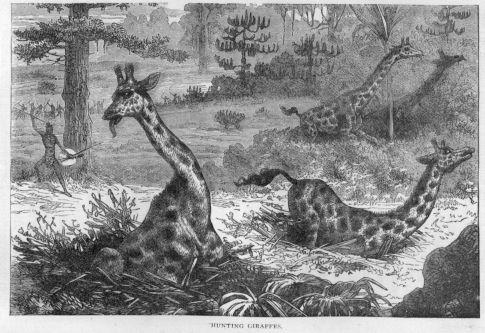
The ruins of old Birnie, which they visited, convinced them of the power of its former sultan. The city, though now in ruins, covered a space of five or six square miles. The walls, in many places standing, consisted of large masses of red brickwork, three or four feet in thickness, and six to eight in height. Besides destroying the capital, the Felatahs had razed to the ground upwards of thirty large towns during their inroads.
The whole country which they passed after proceeding some way had become a complete desert, having been abandoned since the Felatahs commenced their inroads, and wild animals of all descriptions abounded in great numbers.
They heard that Kabshary had been attacked by the Munga people and burned; and news came that the Munga horse were reconnoitring all round them, and had murdered some men proceeding to join the sheikh.
One of the means the people had taken to defend themselves against the invaders, had been to dig deep holes, at the bottom of which sharp-pointed stakes were fixed, the pits being then carefully covered over with branches and grass, so as completely to conceal them. Similar pitfalls are used in many parts of Africa for entrapping the giraffe and other wild animals.
The major’s servant, Columbus, and his mule not making their appearance, he was searching for him, when he found that the animal had fallen into one of these pits, the black having by a violent exertion of strength saved himself. The poor mule was found sticking on four stakes, with her knees dreadfully torn by struggling. She was, however, got out alive.
Escaping from various dangers, they joined the sheikh on the banks of a large piece of water called Dummasak. Hearing that a caravan had arrived at Kouka from Fezzan, they were anxious to return to the capital. They sent word to the sheikh, but their communication was not delivered, and, before they could see him, he and his troops had moved off. They were, however, on their way to Kouka, when Omar Gana overtook them, entreating them to return to the sheikh, who, angry at their having gone, had struck him from his horse, and directed him to bring them to the army without delay. They had nothing to do but to obey.
Many of the spots they passed presented much picturesque beauty. In several places were groups of naked warriors resting under the trees on the borders of the lake, with their shields on their arms, while hundreds of others were in the water, spearing fish, which were cooked by their companions on shore. The margin was crowded with horses, drinking or feeding, and men bathing, while, in the centre, hippopotami were constantly throwing up their black muzzles, spouting water.
The march of the Bornou army now commenced; but little order was preserved before coming near the enemy, everyone appearing to know that at a certain point an assembly was to take place. The sheikh took the lead, and close after him came the Sultan of Bornou; who always attended him on these occasions, though he never fought. The sheikh was preceded by five flags with extracts of the Koran on them, and attended by about a hundred of his chiefs and favourite slaves. A negro boy carried his shield, a jacket of mail, and his steel skull-cap, and his arms; another, mounted on a swift mahary, and fantastically dressed with a straw hat and ostrich feathers, carried his timbrel, or drum, which it is the greatest misfortune to lose in action. In the rear followed the harem; but on such occasions the sheikh takes but three wives, who are mounted astride on trained horses, each led by a slave boy, their heads and figures completely enveloped in brown silk bournouses, with an attendant on either side. The sultan has five times as many attendants as his general, and his harem is three times as numerous.
On reaching Kabshary, the sheikh reviewed his favourite forces, the Kanemboo spearmen, nine thousand strong. With the exception of a goat or sheep’s skin, with the hair outwards, round their middles, and a few strips of cloth on their heads, they were nearly naked. Their arms were spear and shield, with a dagger on the left arm, reversed. The shield is made of a peculiarly light wood, weighing only a few pounds. Their leaders were mounted and distinguished merely by a tobe of dark blue, and a turban of the same colour.
The sheikh’s attendants were magnificently dressed, but his own costume was neat and simple, consisting only of two white figured muslin tobes, with a bournous, and a Cashmere shawl for a turban: over all hung the English sword which had been sent him. On the signal being made for his troops to advance, they uttered a fearful shriek, or yell, and advanced by troops of eight hundred to a thousand each. After striking their spears against their shields for some seconds, which had an extremely grand effect, they filed off on either side, again forming and awaiting their companions, who succeeded them in the same way.
There appeared to be a great deal of affection between these troops and the sheikh. He spurred his horse onwards into the midst of some of the troops as they came up, and 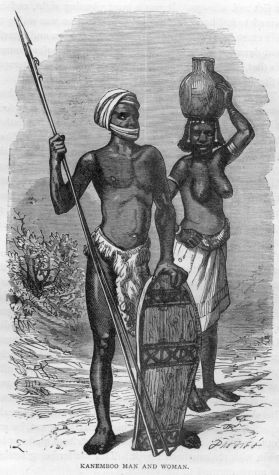 spoke to them, while the men crowded round him, kissing his feet and stirrups. It was a most pleasing sight, and he seemed to feel how much his present elevation was owing to their exertions; while they displayed a devotion and attachment denoting the greatest confidence. The major assured him that, with these troops, he need fear but little the attempts of the Fezzaners on his territories.
The next day a number of captives—women and children—were brought in: one poor woman accompanied by four children—two in her arms and two on the horse of the father who had been stabbed for defending those he loved. They were uttering the most piteous cries. The sheikh, after looking at them, desired that they might all be released, saying: “God forbid that I should make slaves of the wives and children of any Mussalman! Go back: tell the wicked and powerful chiefs who urged your husbands to rebel and to kafir, that I shall be quickly with them, and will punish them instead of the innocent!”
This message had its effect; for, during the following day, many hundreds of the Munga people came in, bowing to the ground, and throwing sand upon their heads in token of submission. Several towns also sent their chiefs and submitted in this manner, bringing peace offerings, when the sheikh swore solemnly not to molest them further. Their principal leader, Malem Fanaamy, fearing to lose his head, would not come; but offered to pay two thousand slaves, a thousand bullocks, and three hundred horses as the price of peace. The offer was refused; and, compelled by his people, Malem Fanaamy made his appearance, poorly dressed, with an uncovered head. The sheikh received his submission; and, when he really expected to hear the order for his throat to be cut, he was clothed with eight handsome tobes, and his head made as big as six, with turbans from Egypt. This matter being settled, the army returned to the capital.
Major Denham soon after this visited a caravan which had come from Soudan, on its way to Fezzan. The merchants had nearly a hundred slaves, the greater part female, mostly very young—those from Nyffe of a deep copper colour, and beautifully formed; the males were also young, and linked together in couples by iron rings round their legs, yet they laughed and seemed in good condition. It is a common practice with the merchants to induce one slave to persuade his companions that on arriving at Tripoli they will be free and clothed in red—a colour of which negroes are passionately fond. By these promises they are induced to submit quietly until they are too far from their homes to render escape possible.
An extraordinary event occurred here, showing the despotic power of the sheikh. Barca Gana, his general, a governor of six large districts, had offended the sheikh, who sent for him, had him stripped in his presence, and a leathern girdle put round his loins, and, after reproaching him with his ingratitude, ordered that he should be forthwith sold to the Tibboo merchants, for he was still a slave. The other chiefs, however, falling on their knees, petitioned that their favourite general might be forgiven. The culprit at that moment appeared to take his leave. The sheikh, on this, threw himself back on his carpet, wept like a child, and suffered Barca Gana to embrace his knees, and, calling them all his sons, pardoned his penitent slave.
Poor Dr Oudney had never risen since his return from Munga, and Clapperton and Hillman were also dangerously ill.
News now arrived that a caravan was on its way from the north. This was gratifying intelligence, as the expedition hoped to obtain letters and remittances by it.
Hillman had manufactured some carriages for two brass guns, which had been sent to the sheikh from Tripoli. The sheikh was delighted when the major, the only person capable of attending to them, fired them off. He now thought himself able to attack all who might become hostile to him.
On the 14th of December Mr Clapperton and Dr Oudney, having somewhat recovered, set out with a large kafila, bound to Kano in Soudan. Dr Oudney, however, was in a very unfit state to travel, being almost in the last stage of consumption. A few days after they had gone, a kafila arrived from the north, and with it came a young ensign of the 80th Regiment, Mr Toole, who had taken the place of Mr Tyrwhit, detained on account of sickness. Major Denham was much pleased with his appearance and manners—his countenance, indeed, being an irresistible letter of introduction. He had made the long journey from Tripoli to Bornou in three months and fourteen days, arriving with only the loss of five camels. Denham’s spirits revived with the society of so pleasant a friend, and he determined to take the first opportunity of visiting the Shary and Loggun. The sheikh willingly gave them permission, appointing a handsome negro, Belial, to act as their guide and manager. He was altogether a superior person, and was attended by six slaves. These, with themselves and personal attendants, formed their party.
Their journey was commenced on the 23rd of January, 1824. After leaving Angornou, they proceeded east, along the borders of the lake, to Angala, where resided Miram, the divorced wife of the sheikh, El Kanemy, in a fine house—her establishment exceeding sixty persons. She was a very handsome, beautifully-formed negress about thirty-five, and had much of the softness of manner so extremely prepossessing in the sheikh. She received her visitors seated on an earthen throne covered with a Turkey carpet, and surrounded by twenty of her favourite slaves, all dressed alike in fine white shirts which reached to their feet; their necks, ears, and noses thickly ornamented with coral. A negro dwarf, measuring scarcely three feet, the keeper of her keys, sat before her, richly-dressed in Soudan tobes.
The Shary was reached on the 23rd. The travellers were surprised at the magnitude of the stream, which appeared to be fully half a mile in width, running at the rate of two or three miles an hour towards the Chad.
Remaining some days at the town of Showy on the banks of the river, they embarked, accompanied by the kaide, or governor, and eight canoes carrying ten slaves each. After a voyage of nearly eight hours, they reached a spot thirty-five miles from Showy. The scenery was highly interesting: one noble reach succeeded another, alternately varying their courses; the banks thickly scattered with trees, rich in foliage, hung over with creepers bearing variously-coloured and aromatic blossoms. Several crocodiles were seen, which rolled into the stream and disappeared as they approached.
After proceeding further down the river, they returned to Showy, and then made another excursion up the stream.
With much grief Denham perceived symptoms of illness in his companion, who, however, complained but little. While he was suffering they reached a place which is so infested by flies and bees that the inhabitants cannot move out of their houses during the day.
Their houses are literally formed one cell within another, five or six in number, in order to prevent the ingress of the insects. One of their party, who went out, returned with his eyes and head in such a state that he was ill for three days.
Hence they moved on to Zarmawha, an independent sultan, who had twice been in rebellion against the sheikh. Belial was received with scant courtesy; but the sultan was very civil to the white men, to whom he sent a variety of dishes of food, and was highly pleased with the presents he received, observing that the English were a race of sultans.
Mr Toole’s sufferings increased, though they managed to reach Loggun, on the banks of the Shary. As they approached, a person, apparently of consequence, advanced towards them, bending nearly double and joining his hands, followed by his slaves, stooping still lower than himself. He explained that he was deputed by the sultan to welcome the white men, and, preceding their party, conducted them to a habitation which had been prepared for them, consisting of four separate huts, well-built within an outer wall, with a large entrance-hall for their servants.
Next morning Denham was sent for to appear before the sultan, when he was preceded through the streets by ten immense negroes of high birth, with grey beards, bare heads, and carrying large clubs. After passing through several dark rooms, he was conducted to a large square court, where some hundred persons were assembled, seated on the ground. In the middle was a vacant space to which he was led, and desired to sit down. Two slaves in striped cotton tabes, who were fanning the air through a lattice work of cane, pointed out the retirement of the sultan. This shade was removed, and something alive was discovered on a carpet, wrapped up in silk tobes, with the head enveloped in shawls, and nothing but the eyes visible. The whole court prostrated themselves and poured sand on their heads, while eight frum-frums and as many horns blew a loud and very harsh-sounding salute.
This great man, however, was not above doing a stroke of business, for, after enquiring whether the major wished to buy female slaves, he observed: “If you do, go no further; I have some hundreds, and will sell them to you as cheap as anyone.”
Though a much handsomer race than the Bornouese, the Loggun people are thieves, and, judging from their chiefs, great rascals. It appeared that there were two sultans, father and son, both of whom applied to the major for poison that  would not lie, to be used against each other, the younger one offering him three female slaves as a bribe.
The province of which Loggun is the capital, is called Begharmi. The people are in many respects similar to the Bornouese, with whom they are constantly at war. They possess a strong force of cavalry, clothed in suits of thick quilted armour, with helmets of the same material, easily penetrated however by bullets, though impervious to arrows. Their horses are also covered in the manner of their riders. So unwieldy are these warriors, that they require to be assisted when mounting their steeds. Their weapons are long, double-headed spears, something like pitchforks with flattened prongs.
Shortly after this a large body of them, five thousand strong, with two hundred chiefs were defeated by the Bornouese, when all the chiefs and a considerable number of the men were slain.
The Loggunese, however, have made considerable progress in the arts of peace. The clothes woven by them are superior to those of Bornou, being beautifully glazed, and finely dyed with indigo; and they make use even of a current coin of iron, somewhat in the form of a horse-shoe, which none of the neighbouring nations possess. Their country abounds in grain and cattle, and is diversified with forests of acacias and other beautiful trees.
As they proceeded on their journey, poor Mr Toole grew worse.
Escaping several dangers, they returned to Angala, where at first the major hoped his poor friend might recover, but on the 26th of February a cold shiver seized him, and just before noon he expired, completely worn-out and exhausted. He had scarcely completed his 22nd year, and was in every sense an amiable and promising young officer.
On Denham’s return to Kouka, he found the sheikh with a large army collected to attack the Begharmis, who were scouring the country. As, however, he was suffering from fever, he went on to Kouka, where he heard of the death of Dr Oudney at a place called Murmur. The sheikh’s expedition was successful, and the people were highly delighted with the plunder which had been obtained.
Sickness, however, was at work in the city. Omar, an Arab, who had arrived with Mr Toole, died, and Columbus caught the fever, and had to take to his bed. The major, however, was cheered by the arrival of Mr Tyrhwit, who had been sent out by the British Government to strengthen the party. He brought a present of two swords, two brace of pistols, a dagger, and two gold watches, which were received by El Kanemy with great delight. On hearing that some rockets had also been forwarded, he exclaimed: “What besides all these riches! There are no friends like these; they are all true; and I see by the book that, if the prophet had lived only a short time longer, they would have become Moslem.”
On the termination of the Rhamadan, June 1st, the sheikh again took the field, proceeding eastward along the shores of the Chad, against a powerful Biddomah chief, called Amanook, who held a strong position on some islands near the shores of the lake. The object of the expedition had been kept a great secret till the neighbourhood of the country to be attacked was reached. The army marched through the country of the Shooas, a people who live entirely in tents of leather and huts of rushes, changing but from necessity, on the approach of an enemy or want of pasturage for their numerous flocks. They seldom fight, except in their own defence. Their principal food is the milk of camels, in which they are rich, and also that of cows and sheep; often they take no other nourishment for months together. They have the greatest contempt for and hatred of the negro nations, and yet are always tributary either to one black sultan or another. There is no example of their ever having peopled a town or established themselves in a permanent home.
The sheikh having halted the main body of his army, Barca Gana advanced with a thousand men, being joined also by four hundred Dugganahs. They found the chief, Amanook, posted, with all his cattle and people, on a narrow pass between two lakes, having in front of him a lake which was neither deep nor wide, but full of holes, with a deceitful, muddy bottom.
The sheikh’s troops had long been without food, and the sight of the bleating flocks and lowing herds was too much for them. Barca Gana, however, seeing the strength of the enemy’s position, wished to halt, and to send over spearmen on foot, with shields, who would lead the attack. The younger chiefs however exclaimed: “What! be so near them as this, and not eat them? No, let us on: this night their flocks and women will be ours!” In this cry the Shooas also joined. The general yielded, and the attack commenced. The Arabs led the way with the Dugganahs. On arriving in the middle of the lake the horses sunk up to their saddle-bows; most of them were out of their depth, and others floundering in the mud; the ammunition of the riders became wet, their guns useless. As they neared the shore, Amanook’s men hurled at them with unerring aim a volley of their light spears, charging with their strongest and best horses, trained and accustomed to the water, while at the same time another body, having crossed the lake higher up, came by the narrow pass and cut off the retreat of all those who had advanced into the lake. The sheikh’s people now fell thickly. Barca Gana, although attacking against his own judgment, was among the foremost, and received a severe spear-wound in his back, which pierced through four tobes and his iron chain armour, while attacked by five chiefs, who seemed determined on finishing him. One of these he thrust through with his long spear, and his own people coming to his rescue with a fresh horse, he was saved, though thirty of his followers were either killed or captured by Amanook’s people.
It was expected that Amanook would attack the camp, but, instead of so doing, he sent word that he would treat with the sheikh, and that he wished for peace. If peace was not to be obtained, however, he swore by the Prophet that he would turn fish, and fly to the centre of the water; and, should even the sheikh himself come, he would bring the wady against him.
The major and his companions visited the general, whom they found suffering much from his wound, but Denham acting as surgeon, it in a short time healed. Barca Gana then strongly advised him to return to Kouka, showing that his hopes of getting to the east would certainly be disappointed.
A little sheikh, who had arrived from Fezzan, endeavoured to poison the mind of El Kanemy against the English, telling him that they had conquered India and probably fully intended to attack Bornou.
On the major’s return to Kouka he found that Captain Clapperton had just returned from Soudan. On going to the hut where he was lodged, Denham did not know his friend as he lay extended on the floor, so great was the alteration in him; and he was about to leave the place, when Clapperton called out his name. Notwithstanding this, so great were Clapperton’s spirits, that he spoke of returning to Soudan after the rains. He had performed a very interesting journey, the particulars of which will shortly be narrated.
The sheikh had just before made himself very unpopular with the female portion of his subjects, having, in consequence of his determination to improve the morality of his people, issued an order such as the most savage of despots have never ventured to enact. One morning the gates of the city were kept closed at daylight, and sixty women who had  a bad reputation were brought before him. Five were sentenced to be hanged in the public market, and four flogged. Two of the latter expired under the lash, while the former were dragged, with their heads shaved, through the market, with ropes round their necks, and were then strangled and thrown by twos into a hole previously prepared.
The effect on the people was such that a hundred families quitted Kouka to take up their abode in other towns, where this rigour did not exist.
Chapter Seven.
Clapperton’s journey to Soudan.
Expedition of Clapperton and Oudney to Soudan—Beauty of the women—Cruelty of the Arabs—Dr Oudney prescribes for the sick—Reach Katagum—Slaves offered as presents—Death of Dr Oudney—Clapperton arrives at Kano—City described—Haussa boxers—Sackatoo reached—Reception by Sultan Bello—Great intelligence of the Sultan—Wonder at English customs—Desires that a consul and doctor may be sent to him—Clapperton leaves Sackatoo—Sufferings from thirst—Dangerous journey—Returns to Kouka—Visit to Lake Chad—Journey across the Desert to Tripoli.
It will be remembered that Captain Clapperton, accompanied by Dr Oudney, set out from Kouka on the 14th of December, 1823, for the purpose of exploring Soudan. Their party consisted of Jacob, a Jew, two servants, and three men of Fezzan. They had three saddle-horses and four sumpter mules. They travelled in company with a kafila in which were twenty-seven Arab merchants and about fifty natives of Bornou. Most of the Arabs rode on horseback, some having, besides, a led horse, but all the rest of the party were on foot.
Doctor Oudney was of great service to the hadji, who had injured his hand by the bursting of a gun. He invariably pitched his tent close to that of the doctor, who regularly dressed it for him.
Passing old Birnie, they had after two days to pass through an undulating country, frequently wading across hollows filled with water. Having to cross a river, the hadji had provided himself with a large raft, on which his own and his friends’ 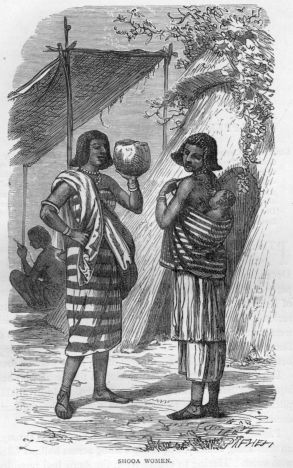 baggage was carried across; but the Arabs, who passed lower down the river, were dreadfully frightened. The greatest difficulty was with the camels and female slaves, the women screaming and squalling loudly. The camels were towed across, one man swimming before with a halter in his teeth, while another kept beating the animal behind with a stick, while it every now and then attempted to turn back, or bobbed its head under water.
The next day they were exposed to another danger. The grass having been set on fire, the flames advanced rapidly, and must have put them all to flight, had they not sought shelter within the ruined walls of old Birnie.
They passed through numerous towns and villages, the people belonging to a tribe of Shooa Arabs. The women were really beautiful. They wore their hair in a form which at a distance might be mistaken for a helmet, a large braid at the crown having some resemblance to a crest.
They had now to pass through a country inhabited by Bedites, who had not embraced Islamism. Protected by the natural fastnesses of their country, they were held in dread and abhorrence by all the faithful. The road lay over very elevated ground, and so low was the temperature in the morning, that the water in their shallow vessels was crusted with thin flakes of ice, and the water-skins themselves were frozen as hard as a board. The horses and camels stood shivering with cold. Dr Oudney also became extremely ill, probably from the low temperature.
They had just entered the country of the Bedites when two men were met, who were immediately seized by the Arabs; one was a Shooa and the other a negro. One of the Bornouese had inflicted a dreadful cut under the left ear of the negro, and, notwithstanding his wound, they led the poor fellow by a rope fastened round his neck. Clapperton could not refrain from beating the merciless Bornouese and at the same time threatening to lodge the contents of his gun in his head if he repeated his cruelties. He took occasion to impress on the minds of the Arabs how unworthy it was of brave men to behave so cruelly to their prisoners, and he thoroughly shamed them into good behaviour.
Having crossed the river You, they reached the city of Katagum, when a servant of the governor met them with a present, and, accompanied by a band of horsemen with drummers drumming and two bards singing the praises of their master, they entered the city. Here they remained, while the caravan pursued its course.
This was the most eastern of the Felatah towns. They were here visited by a Tripolitan merchant who was very rich, possessing no less than five hundred slaves and a vast number of horses.
Through all the towns and villages which they had passed, the sick were brought to be cured, while numbers came for remedies against all sorts of fancied diseases.
The governor received them in the most simple way. They found him seated under a rude canopy, on a low bank of earth, with three old men attending on him. They shook hands and then sat down on the floor. He was highly pleased with the presents he received, and offered anything they might wish for, especially slaves. Clapperton told them that a slave was unknown in England, and that the moment one set foot on British ground he was instantly free. When he heard that their only object was to see the world, he told them that they must go to the Sultan Bello, who was a learned man and would, be glad to meet people who had seen so much.
A lucky omen, as the natives supposed it, occurred. Among the presents offered by the king was ajar of honey; this one of the servants upset without breaking the pot. Had it been broken, the omen would have been unfortunate; as it was, the governor was highly pleased, and ordered the poor to be called in to lick up the honey. They rushed in, squabbling among themselves. One old man, having a long beard, came off with a double allowance, for he let it sweep up the honey and then sucked it clean.
Dr Oudney soon after this became too weak to sit his horse, but still he begged to be carried on. They therefore travelled forward to the town of Murmur. Here they were compelled to stop, though the doctor the next morning, after drinking a cup of coffee, with the assistance of his companions dressed. It was soon evident that he would be unable to proceed. He was carried back into his tent, where in a short time Captain Clapperton, with unspeakable grief, witnessed his death without a struggle or a groan. He was but thirty-two years of age. His friend had a deep grave dug, and enclosed it with a wall of clay to keep off the beasts of prey. He had also two sheep killed and distributed among the poor.
Ill as Captain Clapperton himself was, and now left alone among strange people, the loss to him was severe and afflicting. Still, his ardent spirit triumphing over sorrow and trouble, he pursued his journey, and on the 20th of January he entered Kano, the great emporium of the kingdom of Haussa. He dressed himself in his naval uniform to make an impression on the inhabitants of the city, which, from the description of the Arabs, he expected to see of surprising grandeur. His disappointment was therefore great, when he traversed the place. He found the houses nearly a quarter of a mile from the walls, and in many parts scattered into detached groups between large stagnant pools of water. Not an individual turned his head round to gaze at him, all being intent on their own business. The market-place was bordered to the east and west by an extensive swamp, covered with weeds and water and frequented by wild ducks, cranes, and vultures. The house which had been provided for him was close to a morass, the pestilential exhalations of which were increased by the sewers of the houses all opening into the street.
Fatigued and sick, he lay down on a mat which the owner had spread for him. His mansion had six chambers above, extremely dark, and five rooms below, with a dismal-looking entrance, a back court, draw-well, and other conveniences. Little holes, or windows, admitted a glimmering light into the apartments. Nevertheless, this was thought a handsome mansion.
All the Arab merchants, not prevented by sickness, who had travelled with him from Kouka, came to see him, looking more like ghosts than men, as almost all strangers at the time were suffering from intermittent fever.
The governor gave him a private audience, and seemed highly pleased with the presents he received, promising to forward them on to his master, the Sultan Bello, at Sackatoo, after his own return from an expedition which would occupy him fifteen days.
During the interval Captain Clapperton suffered greatly from fever.
The newspapers which he here received from Major Denham apprised him of Belzoni’s attempt to penetrate to Timbuctoo by the way of Fez.
On returning from a ride he met two large bodies of troops, who were to accompany the governor, each consisting of five hundred horse and foot. The latter were armed with bows and arrows, the cavalry with shields, swords, and spears, and sumptuously accoutred. The swords were broad, straight, and long, and were indeed the very blades formerly wielded by the knights of Malta, having been sent from that island to Tripoli, where they were exchanged for bullocks and carried across the desert to Bornou, thence to Haussa, and, at last, re-mounted at Kano for the use of the inhabitants of almost all central Africa. The shields were covered with hides of animals, and were generally round; but there were some of an oval shape, in the centre of which was scored a perfect Maltese cross. He observed crosses of other forms cut in the doors of the houses.
Several camels, loaded with quilted cotton armour, both for men and horses, were in attendance. This armour was arrow proof; but it is seldom worn, except in actual combat. The saddles had high peaks before and behind, and the stirrup-irons were in the shape of a fire-shovel.
A nephew of the Sultan Bello paid him a visit the next morning and told him, after taking a cup of tea, which he liked very much, that he had hitherto looked upon a Christian as little better than a monster, though he now confessed that he liked the traveller. Another nephew came also, a most intelligent young man, who read and spoke Arabic with fluency, and was very anxious to see everything, and to hear all about England.
He found the market well supplied with every necessary and luxury in request among the people of the interior. The sheikh, who superintended it, however, fixed the prices of all wares, for which he was entitled to a commission; and, after every bargain, the seller returned to the buyer a stated part of the price by way of a blessing, or a “luck-penny” as it would be called in England. Cowries were here used as coins, though somewhat cumbersome, as twenty were worth only a halfpenny; thus, in paying a pound sterling, nine thousand six hundred shells had to be counted out. As he remarks: “The great advantage of the use of the cowrie is that forgery is excluded, as it cannot possibly be imitated.” The natives show also great dexterity in counting out even the largest sums.
The butchers were numerous, and understood showing off animals to the best advantage. Sometimes they even stuck a little sheep’s wool on a leg of goat’s flesh, to make it pass for mutton. When a fat bull was brought to the market to be killed, its horns were dyed red with henna, the drummers attended, a mob soon collected, the news of the animal’s size and fatness spread, and all ran to buy. Near at hand were small wood fires stuck round with wooden skewers, on which small bits of fat and lean meat, the size of a penny-piece, were roasting, superintended by a woman with a mat dish placed on her knees, from which she served her guests, who were squatted round her. Indeed, the market was as busy a one as can be seen in any country. Jugglers also, like those of India, were practising their tricks with snakes, having extracted the venomous fangs.
Haussa is celebrated for its boxers, the most expert of whom are found among the butchers. Clapperton having intimated his willingness to pay for a performance, a number of combatants arrived, attended by two drummers and the whole body of butchers. A ring was soon formed, by the master of the ceremonies throwing dust on the spectators to make them stand back. The drummers entered the ring, followed by one of the boxers, who was quite naked with the exception of a skin round his middle. Placing himself in an attitude as if to oppose an antagonist, he wrought his muscles into action, and then went round the ring showing his arms to the bystanders and exclaiming: “I am a hyaena! I am a Hon! I am able to kill all that oppose me!” To which the spectators replied, “The blessing of God be upon thee!—Thou art a hyaena: thou art a lion.”
A number of fighters then came forward, when they were next ranged in pairs. If they happened to be friends, they laid their left breast together twice, and exclaimed: “We are lions! we are friends!” Then one left the ring, and another was brought forward. If the two did not recognise one another as friends, the combat immediately commenced. They parried with the left hand open, and struck as opportunity offered with the right, generally aiming at the pit of the stomach and under the ribs. Occasionally they closed with one another, when one seized the other’s head under his arm and beat it with his fist, at the same time striking with the knee between his antagonist’s thighs. Indeed, much the same brutality was exhibited as in English prize-fights. Clapperton, hearing that they sometimes gouged out each other’s eyes, and that such combats seldom terminated without one or more being killed, having satisfied his curiosity, ordered the battle to cease, and gave the promised reward.
The custom in this place is to bury the people in their own houses, which are occupied as usual by the poorer classes; but when a great man is buried, the house is for ever after abandoned. A corpse being prepared for interment, the first chapter of the Koran is read over it. The funeral takes place the same day. The bodies of slaves are dragged out of the town and left a prey to vultures and wild beasts in most places; but in Kano they are thrown into the morass or nearest pool of water.
On the 22nd of February, Clapperton commenced his journey towards Sackatoo, in company with an Arab merchant, Mahomet Jolly, having left his Jew servant, Jacob, to return in case of his death, with his effects to Bornou.
At the towns where he stopped he was generally taken for a fighi, or teacher, and was pestered to write out charms. One day his washerwoman insisted on being paid with a charm in writing, that would induce people to buy earthenware of her.
After travelling for some days he was met by an escort of one hundred and fifty horsemen with drums and trumpets, sent by Sultan Bello to conduct him to his capital, which he reached on the 16th of March. He, as usual, dressed himself in his naval uniform; and, as he approached the gates, he was met by a messenger from the sultan, to bid him welcome and to acquaint him that his master, who was out on an expedition, would return to Sackatoo in the evening.
Large crowds were out to look at him, and he entered the city amid the hearty welcomes of young and old. He was conducted to the house of the gadado, or vizier, where apartments were provided for him and his servants. The gadado himself arrived in the evening, and was excessively polite, but would not drink tea with him, as he said that he was a stranger in their land, and had not yet eaten of his bread.
Next morning the sultan sent for him. Clapperton found him seated on a small carpet, between two pillars supporting the roof a thatched house. The walls and pillars were painted blue and white in the Moorish taste. Giving him a hearty welcome, the sultan at once entered into conversation. He asked numerous questions about Europe, and seemed perfectly well acquainted with the names of the more ancient sects, inquiring whether his visitor was a Nestorian or a Socinian. Clapperton replied that he was a Protestant, but had to acknowledge that he was not sufficiently versed in religious subtleties to solve all the knotty points on which Bello wished for information. He then ordered some books belonging to Major Denham to be brought, among which was his journal, and they were all in a handsome manner returned. He spoke with great bitterness of Boo-Khaloum for making predatory inroads into his territories, next putting the puzzling question: “What was your friend doing there?” Clapperton replied that Major Denham had no other object than to make a short excursion into the country.
The sultan was a noble-looking man, somewhat portly, with short, curling, black beard, a small mouth, a fine forehead, Grecian nose, and large, black eyes. He was habited in a light-blue cotton tobe, with white muslin turban, the small end of which he wore over the nose and mouth in the Turaick fashion.
This was the first of many visits Clapperton paid him.
He was highly pleased with the various presents which the King of England had sent him. He asked what he could give in return. Clapperton replied that the most acceptable service he could render would be to assist the King of England in putting a stop to the slave trade.
“What!” he asked; “have you no slaves in England? What do you do for servants?”
He was much astonished at hearing that regular wages were paid, and that even soldiers were fed, clothed, and received pay from government.
“You are a beautiful people,” he observed.
The usual question was also put: “What are you come for?” Clapperton replied, “To see the country—its rivers, mountains, and inhabitants, etcetera. My people had hitherto supposed yours devoid of all religion, and not far removed from the condition of wild beasts, whereas I now find them to be civilised, learned, humane, and pious.”
On another occasion Clapperton exhibited a planisphere of the heavenly bodies. The sultan knew all the signs of the zodiac, some of the constellations, and many of the stars by their Arabic names. He was greatly interested with the sextant, or, as he called it, “the looking-glass of the sun.” Clapperton showed him how to obtain an observation with it.
The sultan made minute inquiries as to the conquests of the English in India, and also the reason of their attack on Algiers, evidently suspecting that they contemplated similar proceedings against his country. Clapperton explained that the King of England had a vast number of Moslems who were his willing subjects, and that their object in India was to protect the natives and to give them good laws, not to tyrannise over them; while, with regard to Algiers, the Algerines had been punished because they persisted in making slaves of Europeans.
The sultan, however, as after events proved, was far from satisfied, his fears being increased by the Arabs, who were aware that the chief object of the English was to open up a trade from the west coast with the country, and, should they succeed, they themselves would thus be deprived of their trade across the desert from the north.
At Clapperton’s request the sultan ordered a chart of the Quorra to be drawn by one of his learned men, who asserted that that river entered the sea at Fundah, near a town called Jagra, governed by one of Bello’s subjects.
This made the traveller still more anxious to proceed down that river to the coast, but the sultan, though he at first promised an escort, ultimately declined sending it, declaring that he could not sanction so rash an enterprise, and that his guest could only return home by the way he had come.
From an Arab chief residing here Clapperton obtained much information about Mungo Park and the way in which he had lost his life, which confirmed what had previously been heard.
The sultan made an especial request that an English consul and physician should be sent to reside at Sackatoo, and Clapperton promised that he would represent the matter to his own government, and he had no doubt that his request would be complied with. He also begged that guns and rockets might be sent out by way of Tripoli and Bornou, under the escort of an Arab leader, El Wordee, who had conducted the last caravan. This Clapperton had no doubt was a device of El Wordee’s, to have the opportunity of conducting another English mission and fleecing them as he had done the last. When the Arab found that his plans were opposed by the traveller, he set to work to revenge himself, and by his machinations succeeded in compelling Clapperton to abandon his intended journey to the sea-coast by way of Youri.
Frequent attempts were made to induce the traveller to turn Mahommedan, especially by a famous old maraboo; but after his failure the Moslem appeared to have given up the attempt as hopeless.
At length, on the 4th of May, he was allowed to take his departure from Sackatoo, escorted by one the sultan’s officers, with a party of merchants and their slaves. As the country was in a disturbed state, they pushed on night and day through a dense underwood, which tore their clothes and scratched the legs of the riders. Several of the poor natives on foot, who had taken advantage of the escort to pass through this part of the country, overcome with fatigue and thirst, sank down never to rise. One of Clapperton’s servants also dropped, apparently dead; but his master had him lashed on the camel, when, throwing up a quantity of bile, he soon appeared as fresh as ever. The next day many of the horses died, and all the people were overcome with fatigue and thirst. On the third day no less than nine men and six horses were found to have perished on the road.
Clapperton was taken to the town of Kashna, where an old Arab chief, who had resided there for some years, took compassion on him and sent an elderly black slave woman to nurse him, with two younger attendants. This was the first offer of the kind he had ever received from a Mussulman, and under their care and attendance he soon recovered his health and strength.
After meeting with numerous adventures and exposed to many dangers, on the 8th of July he reached Kouka, when he found that Major Denham was absent on a journey to the east side of the Chad. Hillman, the carpenter, was busily employed in finishing a covered cart, to be used as a carriage for the sheikh’s wives. The workmanship reflected the greatest credit on his ingenuity, though it was neither light nor handsome.
On the 16th of August, soon after Major Denham returned from the eastward, he and Captain Clapperton, accompanied by William Hillman the carpenter, took their departure from Kouka, with the intention of first visiting the shores of Lake Chad and then joining the kafila which was on its way from Soudan to Tripoli. On the morning of their departure they went to take leave of the sheikh, whom they found in his garden. He gave them a letter to the King of England, and a list of requests, and expressed himself very kindly. At parting he offered his hand, which excited an involuntary exclamation from his attendants.
Meeting with no event of any especial interest on their visit to the lake, they joined the caravan on the 14th of September.
Throughout the journey they found that they got on as well, if not better than their companions, who looked to them both for safety and protection, as well as for the direction of the route. They had upwards of fifty miles to cross, over a frightful waste of movable sand-hills, to Zow; many of the poor children, panting with thirst, scarcely able to creep along.
At Bilma they laid in a stock of dates for the next fourteen days, during which man and beast nearly subsisted upon them, the slaves for twenty days together mostly getting no other food.
Then came the stony desert, which the camels, already worn-out by the heavy sand-hills, had to cross for nine days. El Wahr is of surpassing dreariness, the rocks a dark sandstone of the most gloomy and barren appearance; the wind whistles through the narrow fissures, where not a blade of grass finds nourishment, and, as the traveller creeps under the lowering crags to take shelter for the night, he stumbles over the skeleton of some starved human being.
On the day they made El Wahr, and the two following, camels in great numbers dropped down and died, or were quickly killed and the meat brought in by the hungry slaves.
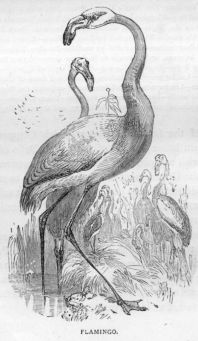
Such are some of the ordinary events of a journey across the desert.
On the 21st of January, 1825, they reached Tripoli, and soon after embarked for Leghorn. Before leaving, however, Major Denham obtained the freedom of a Mandara boy, whose liberation from slavery he had paid for some months before. He now got the pacha to put his seal on the necessary document, the only way in which a Christian can give freedom to a slave in a Mahommedan country.
The travellers were long detained by quarantine at Leghorn, so that the three survivors of the expedition did not teach England till the 1st of June.
Chapter Eight.
Captain Clapperton’s second journey.
Captain Clapperton’s second journey, accompanied by Richard Lander—Joined by Captain Pearce—Messrs Morrison and Dickson—Reaches Benin—Journey of Dickson and Columbus—Their disappearance—Clapperton starts from Badagarry—Joined by Mr Houtson—Expedition reaches Jannah—Attacked by fever—Well received—Fondness of people for dogs—Death of Captain Pearce and Dr Morrison—The King of Eyeo and his wives—Beautiful country—Felatah villages—Enter Youriba—The King’s Court—Entertained with a play—Mr Houtson returns and dies—Clapperton, with Lander and Pasco, proceeds alone—Reaches Wawa, near the Niger—The widow Zuma—Inquiries about Park—Visits the scene of his death—Well treated by King of Wawa—Enters kingdom of Nyffe—Lax Mahommedans—Desolated by warfare—Reaches Kano—Leaves Lander with the baggage, and proceeds to Sackatoo alone—Trying journey—Well received by Bello—Siege of Zeg-zeg—Absurd style of fighting—Bello seizes his property—Lander arrives at Sackatoo—Illness and death of Clapperton—Buried by Lander—Lander sets out with intention of exploring the Niger—Warned not to proceed south—Leaves Kano for the west—Taken to Zaria—Allowed to proceed—Continues journey alone to Badagarry, and arrives in England.
From the favourable report which Clapperton on his return home brought of the Sultan Bello of Sackatoo, and his wish to open up a commercial intercourse with the English, the Government determined at once to send out another expedition, in the hopes that that object might be carried out, and that means might be found for putting a check on the slave trade in that part of Africa.
Clapperton, now raised to the rank of commander, was placed at the head of the expedition. Captain Pearce and a Mr Morrison, a naval surgeon, were appointed to serve under him. He also engaged the services of Mr Dickson, another surgeon, and of a very intelligent young man, Richard Lander, who was to act as his servant.
As Sultan Bello stated that two large towns under his government existed near the coast, called Funda and Raka, and that he would send down messengers, whom his friends would meet on their arrival, it was settled that the expedition should proceed to the Bight of Benin, and thence make their way to Sackatoo. Losing no time, the very year after his return Clapperton sailed from Portsmouth on board HM sloop “Brazen,” and, touching at Sierra Leone, arrived at Benin on the 26th of November.
Mr Dickson, wishing to make his way alone to Sackatoo, was landed at Whidah, taking with him Columbus, Denham’s former servant, and from thence, in company with a Portuguese of the name of De Sousa, he set off for Dahomey. Here he was well received and was sent forward to a place called Shar, seventeen days’ journey from Dahomey. From thence he was known to have set forward with another escort, but from that time nothing whatever was heard of him or his attendant, Columbus.
At Benin Clapperton met an English merchant of the name of Houtson, who advised him not to ascend the river, but to take a route from Badagarry across the country to Katunga, the capital of Youriba.
Under the sanction of the King of Badagarry, the mission set out on its long and perilous journey on the 7th of December, accompanied by Mr Houtson.
At Badagarry Clapperton had engaged an old negro, who had been a sailor, named Pasco, and who, speaking English, was likely to prove useful as an interpreter.
Travelling on sixty miles, the mission entered the town of Jannah. By this time all its members were suffering greatly from the climate; Captain Pearce and Dr Morrison especially were very ill, and Richard Lander was also suffering. Those who were able had ridden on horseback, but the sick were carried in hammocks.
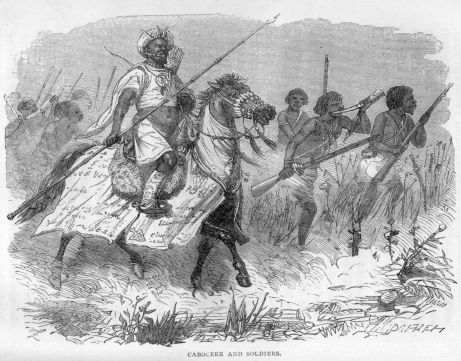
They halted in the palaver-house, an open shed, which was soon surrounded by thousands of people making a great noise. Here they waited till the caboceer, or chief man, made his appearance. He came gorgeously attired in a large yellow silk shirt and red velvet cap, with a silver-mounted whip ornamented with beads in one hand, and a stick covered with bells in the other, which he rattled whenever he spoke. He took his seat on a large leathern cushion, placed on a scarlet cloth. When Captain Clapperton was going to sit down on the cloth, the attendant ladies pulled it from under him; so he took his seat on a mat. The females then sang in chorus very beautifully. The members of the commission then shook hands with the caboceer, who said he was glad to see them, and that whatever they had to say to the King of Eyeo must first be delivered to him. Their reply was that they had nothing to say, except to request that the king would grant them a passage through his country. His answer was that he was glad, that they should see the King of Eyeo’s face, and that he would give them a good path and forward them on without trouble; but that they must ride on horseback, as his people were unaccustomed to carry hammocks. They were then shown to a house, where they remained during their stay.
As Captain Clapperton and Mr Houtson walked through the town, they were followed by an immense crowd, who rushed over the baskets in the market-place, the boys darting under the stalls, the women bawling after those who had scattered their goods; yet not a word of disrespect was uttered to the strangers. They remarked the kind way in which the dogs in this place were treated, their necks ornamented with collars of different colours, and cowries. No great man was without one, which always has a boy to take care of it.
The people, hearing that a Brazilian brig had arrived at Badagarry, were preparing to set out on a slaving expedition to a place to the eastward.
Slave-dealers as the people were, they deserve to be commended for their honesty; for during the whole journey hitherto, although the mission had had ten relays of carriers, not a single article had been stolen.
A few days after, Dr Morrison, who continued to get worse, requested to return, hoping that the sea air would restore him. Mr Houtson accompanied him back to Jannah. The next day Dawson, a seaman, who, while suffering from ague caught at Jannah, had fallen off into the water in the morning, died in the evening. Three days afterwards Captain Pearce, who, supported by his wonderful spirits, insisted upon coming on, grew much morse, and at nine in the evening he breathed his last.
The death of his friend was a serious loss to Clapperton, for he was eminently qualified by his talents and perseverance to render essential service to the mission.
Another three days passed, when Mr Houtson returned with the sad news that Dr Morrison had died at Jannah on the same day as Captain Pearce.
Mr Houtson, though unwell, still insisted on accompanying Clapperton.
Powerful as the king of Eyeo pretended to be, he employed his wives in every place to trade for him, and, like women of the common class, they were seen carrying large loads on their heads from town to town.
On the 6th of January, 1826, the travellers entered the town of Chocho, beyond which their road lay through beautiful rocky valleys, cultivated in many places, and planted with cotton, corn, yarns, and bananas, and many watered by little streams. Numbers of little huts were seen perched on the tops and in the hollows of the hills. Beautiful as the country was, it was the scene of the miserable devastating wars carried on in all parts of Africa for the purpose of obtaining slaves to be sold on the coast.
On the 8th they entered Duffo, a town containing fifteen thousand people. The crowd which came to see them in the house where they were lodged was immense. When the people were told to go away, they said: “No; if white man would not come out, they would come in to see him.”
They passed numerous other large towns, and were received in a friendly manner by the caboceers, and were well supplied with fowls, sheep, and goats. Yet the people, though kind, were exceedingly curious, and allowed them but little rest.
Further eastward they passed a number of Felatah villages, whose inhabitants live there as they do in most other parts of Africa, attending to the pasturage of their cattle, without interfering in the customs of the country, or receiving any annoyance from the natives. Some of them, as they passed, brought them milk to drink.
Further on, however, they came to a number of villages, some of which had been destroyed by the Felatahs, their walls being already covered with weeds.
As they approached Katunga, the capital of Youriba, the caboceer, with an enormous escort, came out to meet them. His musicians kept drumming, playing, dancing, and singing all night.
The country round was well-cultivated. The city, as they saw it lying below them, appeared surrounded and studded with green, shady trees, forming a belt round the base of a granite mountain.
The king was found seated under the verandah of his house, with two red and blue umbrellas, raised on large poles, held over him by slaves.
The crowd, as they advanced, had to be kept back with sticks and whips; but they were used in a good-natured manner.
Clapperton was told that he must prostrate himself before the king; but this he declined doing, saying that he would turn back unless he was allowed to act as he would do before his own sovereign; that he would only take off his hat, and bow, and shake hands with his majesty, if he pleased. The king agreed to this, and the English were introduced in due form.
Behind the king were an immense number of ladies, so closely packed that it was impossible to count them. They stood up as the strangers approached, and cheered them, shouting “Oh, oh, oh!” equivalent to “Hurra!” while the men outside joined them.
The king had on a large white shirt, with a blue one under it, and a pasteboard crown, covered with blue cotton, made apparently by some European on the coast, and sent up to him as a present.
Comfortable apartments were provided for them, and in the evening the king himself made his appearance, plainly dressed, with a long staff in his hand, saying that he could not sleep till he had personally ascertained how they were.
They spent two very pleasant days here, resting after the fatigues of their journey. The king pressed them to remain to see the national amusements, which would begin in about two months. On this, Mr Houtson enquired whether they were such as took place at Dahomey, on which the king declared that no human beings were ever sacrificed in Youriba, and that if he ordered the King of Dahomey to desist from such a practice he must obey him.
The king had sent forward a messenger to open the way to Nyffe, and till he returned they were compelled to remain at the capital.
They were entertained here with a pantomime, the stage being the open ground before his majesty’s residences, the characters appearing in masks. One of them presented an 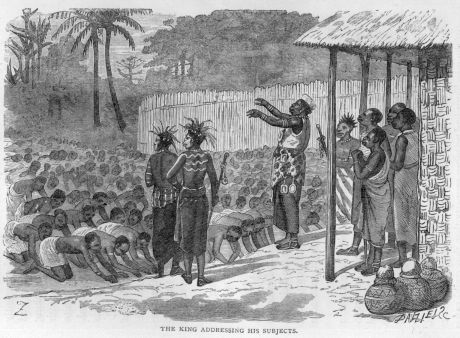 enormous snake, which crept out of a huge bag and followed the manager round the park while he defended himself with a sword. Out of another sack came a man covered apparently with white wax, to look like a European, miserably thin and starved with cold. He went through the ceremony of taking snuff and rubbing his nose. When he walked it was with an awkward gait, treading as the most tender-footed white man would do in walking with bare soles over rough ground.
Clapperton pretended to be as much pleased with this caricature of a white man as the natives were.
Between each act the king’s women sang a number of choral songs, joined by the crowd outside.
They thankfully heard, on the 6th of March, that the messengers had returned, and that they might set out the next day, when the king presented Clapperton with a horse and bade him farewell.
Mr Houtson, who had been for some time suffering from illness, was compelled to return, and he, too, died on reaching the coast.
Clapperton, with his faithful attendant, Richard Lander, and the black, Pasco, proceeded alone. They had evidence as they advanced of the destruction caused by the Felatahs, in the number of villages which had been burnt down, while the inhabitants of others, who had taken to flight, were seen returning to their homes.
A few days after starting they overtook a large caravan belonging to Haussa, on its way from Gonga and Ashantee. It consisted of upwards of a thousand men and women, and as many beasts of burden. The head man offered to carry Clapperton’s baggage to Kano for a certain sum. He said that he had been detained in Gonga twelve months on account of the wars. Their goods were carried on bullocks, mules, asses, and also by a number of female slaves. Some of the merchants had no more property than they could carry on their own heads. The chief of the town, however, advised Clapperton not to trust the caravan leader, for, as he had no means of conveying his luggage, he would undoubtedly leave him in the lurch. He therefore proceeded as he intended, alone.
On the 20th of March Clapperton entered the village of Barakina, the inhabitants of which were noted as the best hunters in the country. As he entered, a hunter came in from the chase. He wore a leopard-skin over his shoulder, carrying a light spear in his hand, and his bow and arrows slung over his shoulder. He was followed by three cream-coloured dogs, their necks adorned with collars of different-coloured leather. He was followed by a slave carrying a dead antelope.
On leaving this village he passed through a narrow gorge, shaded by tall majestic trees. “Here,” he thought to himself, “are the gates leading to the Niger.”
Next day he arrived before the walls of Wawa, in the neighbourhood of the far-famed river.
Here he met with a most unexpected difficulty. Not only did the daughter of the governor make love to him, but a rich widow called Zuma, the daughter of an Arab, who, though brown, considered herself a white woman, insisted on marrying either him or his servant Richard. Being above twenty, she was considered past her prime; but had it not been for her stoutness, which made her look like a walking water-butt, she would really have been handsome. Finding that neither of the white strangers would accept her offers, she endeavoured to entrap them by giving a wife to Pasco, by which, according to the customs of the country, she obtained some sort of claim over his master. The governor soon became alarmed, declaring that, as the lady had a thousand slaves and enormous wealth, she would very likely drive him from the country, and, should the traveller accept her hand, raise him to the throne of Waiva. In the hopes of ending the matter, Clapperton set off for the Niger, leaving his baggage to follow him to the ferry of Comie, while he went round by Boussa. Greatly to his annoyance his baggage was, however, detained by the governor, who feared the widow Zuma’s machinations, and refused to liberate it till her return. Clapperton had great difficulty in making him believe that he had no sort of communication whatever with the lady. Next day, however, the widow Zuma made her entrance into the city, sitting astride on a fine horse, with housings of scarlet cloth trimmed with lace. She herself was habited in a red silk mantle, red trousers, and morocco boots, numerous spells enclosed in coloured leather cases being hung round her. A large train of armed attendants followed her, while she was preceded by a drummer decked in ostrich feathers.
Clapperton’s resolution, however, was not to be overcome. To settle the matter he made Pasco give back his wife again, assuring the governor that he had no intention whatever of entering into any of her designs. She, therefore, indignantly shook the dust from her feet, and allowed the hard-hearted stranger to proceed unmolested on his way.
He made inquiries of all who could give him any information about the fate of Park. They all asked him whether he intended to take up the vessel, which they said still remained at the bottom. The governor’s head man told him that the boat stuck fast between two rocks; that the people in it laid down four anchors ahead, when, the water rushing down fiercely from the rocks as the white men attempted to get on shore, they were drowned; that crowds of people went to see them, but that the white men did not shoot at them, nor did the natives at the people in the boat, as they were too much frightened either to shoot at or assist them. They said, further, that a great many things were in the boat—books and riches—which the Sultan of Boussa had possession of; that there was an abundance of beef, cut in slices and salted, and that the people of Boussa who had eaten of it had died because it was human flesh, which it was well-known white men eat. Another man, however, asserted that the natives did shoot arrows because the people in the boat had fired at them.
They all treated the affair with much seriousness, looking on the place where the boat was wrecked with awe, and telling some most marvellous stories about her and her ill-fated crew.
Boussa, Clapperton says in his journal, is a large town with extensive walls, situated on an island in the Quorra, and that to reach it he had to cross in a canoe, while his horse swam over.
After Clapperton had offered the sultan the presents he had brought for him, he inquired about the white men who had been lost in the river. He seemed very uneasy at the question, and replied that he was a little boy at the time, and had nothing belonging to them; indeed, Clapperton found that any books and papers which had been saved were in the possession of the Sultan of Youri.
Shortly afterwards a messenger arrived from that chief, inviting him to his town, and offering to send canoes to convey him up the river; but Clapperton, anxious to proceed on his journey, unfortunately declined the offer.
He was here treated in the kindest way possible, and everyone was ready to give him information on all points, with the exception of that connected with Park’s death.
The place, however, where the boat struck and the unfortunate crew perished was pointed out to him. It was in the eastern of three channels into which the river is here divided. A low flat island of about a quarter of a mile in breadth lies between the town of Boussa and the fatal spot. The banks are not more than ten feet above the level of the water, which here breaks over a grey slaty rock, extending across to the eastern shore.
The sultan made him a present of a fine young horse, and his brother, with many of the principal people, accompanied him as he set out on his journey.
As he rode towards the ford at Comie, he ascended a high rock overlooking the river. From hence he saw the stream rushing round low rocky and wood-covered islands and among several islets and rocks, when, taking a sudden bend to the westward, the water dashed on with great violence against the foot of the rock on which he sat. Below the islands the river fell three or four feet, while the rest of the channel was studded with rocks, some of which were above water. It seemed to him, that even had Park and Martyn passed Boussa, their vessel would almost to a certainty have been destroyed on these rocks, where they would probably have perished unheard of and unseen.
The traveller next entered the kingdom of Nyffe, till lately one of the best cultivated and most flourishing in Africa, but, in consequence of having been the prey of a desolating civil war, now almost ruined. A dispute had arisen between two rival princes, one of whom called in the aid of the Felatahs, who, in their usual way, had ravaged the whole country and placed the traitorous prince on the throne. Two large walled towns had, however, resisted the inroads of the invaders: one of these was Coolfu, where Clapperton and the caravan he had now joined halted for some days. Although the inhabitants were professedly Mussulmans they were exceedingly lax in their religious duties, and none of the bigotry so prevalent in other places was discernible. The women, indeed, took an active part in public matters, many of them being engaged in mercantile pursuits. They have an odd idea about imbibing the precepts of the Koran; and, to do so, they get some learned man to write texts from it with black chalk on pieces of board. These are then washed, when the water is drunk. They evidently consider it a fetish or charm of some sort.
Clapperton now entered the Felatah country of Zeg-zeg. The region, in the neighbourhood of its capital, Zaria, was the most beautiful he had seen in Africa, being variegated with hill and dale, resembling in many respects the finest parts of England. It was covered with rich pastures and fields, now blessed with plentiful crops, while the rice grown there was the finest in Africa. Zaria was said to contain fifty thousand inhabitants, a population exceeding that of Kano.
Arrived at Kano, he took up his quarters in his former residence. The city was, however, in a great state of agitation, in consequence of war raging on every side. Hostilities had broken out between the King of Bornou and the Felatahs, while other provinces were in open rebellion, so that a caravan had great difficulty in proceeding in any direction.
As Kano is midway between Sackatoo and Bornou, Clapperton, who purposed visiting the latter province, determined to leave his baggage at Kano, under charge of Richard Lander, while he himself went forward, carrying only the presents intended for Bello.
His journey towards Sackatoo was very fatiguing; his camels were worn-out, while he often suffered greatly from thirst.
At the town of Jaza he met his old friend the gadado, the sultan’s general, with a numerous train on horseback and foot. The horsemen were armed with spears, swords, and shields, the foot with bows and arrows. The women came behind him, some riding on horseback astraddle, some on camels, others on foot carrying the kitchen utensils. The gadado was preceded by a band, with four long trumpets, two drums, and a pipe. On meeting Clapperton he dismounted, and taking him by the hand, walked hand in hand with him into the house which had been prepared for his reception. He said that Bello had received no letters from Bornou appointing where his messengers were to meet the mission on the coast.
Clapperton, besides suffering from hunger and thirst, lost his horse and all his camels, which died, while his journal, ink-horn, pens, and spectacles were stolen; nor did he ever recover them—one of the greatest misfortunes that could happen to a traveller.
On the 15th of October, about noon, he arrived at Bello’s camp, and was immediately admitted to an audience.
The sultan’s residence consisted of a number of huts, screened off by cloth fixed on poles, making quite a village of itself.
He received the traveller in a kind and gratifying way. He asked after the health of the King of England, and was greatly surprised to hear that Clapperton had remained only four months at home, and had hastened back to Africa without seeing his friends.
Bello’s army was on its march to attack Coonia, the capital of the rebels of Goobur. Nothing could be more disorderly than the march, horse and foot intermingled in the greatest confusion, all rushing to get forward; sometimes the followers of one chief tumbled amongst those of another, when swords were half-drawn, but they ended in making faces at each other, or putting on a threatening aspect. This disorderly army consisted of upwards of fifty thousand fighting men, horse and foot.
As soon as they arrived before the town, they formed a dense circle of men and horses around it; the horse kept out of bowshot, while the foot, as they felt courage or inclination to do so, rushed forward and kept up a straggling fire with about thirty muskets in addition to their bows. The Zeg-zeg troops had one French fusil, and the Kano force forty-one muskets. The Kano men, as soon as they fired their pieces, ran out of bowshot to reload. The enemy seldom threw away their arrows, not shooting till they were sure of doing so with effect. Occasionally a single horseman would gallop up and brandish his spear, while he covered himself with his large leathern shield, returning as fast as he went and shouting: “Shields to the wall, you soldiers of the gadado! Why do you not hasten to the wall?” Many of the soldiers answered: “You have a large shield to cover you,” and disregarded the call. At length the troops habited in quilted armour were marched forward, having at a distance a somewhat fine appearance, as their helmets were ornamented with black and white ostrich feathers, while at the sides pieces of tin glittered in the sun, their long, quilted cloaks of gaudy colours reaching down to the horses’ tails and hanging over their flanks. The riders were armed with large spears, and they had to be assisted to mount their horses. Their quilted cloaks were so heavy that it required two men to mount a cavalier. Six of these warriors belonged to the sultan and six to each governor.
The besieged possessed one musket, and with this they did wonderful execution, for it brought down the van of the quilted cavaliers, who fell from his horse like a sack of corn, when the footmen dashed forward and dragged him and his steed out of harm’s way. He had been shot by two balls, which went through his body, one coming out and the other lodging in his quilted armour. There were three Arabs, armed at all points, one of whom was struck by the Coonia musket, but the others kept carefully behind the sultan.
The most useful and bravest person was an old female slave of the sultan, who, mounted astraddle on a long-backed horse, rode about with half a dozen gourds filled with water, and a brass basin, from which she supplied the wounded and thirsty.
In the evening this valiant army retired to their camp, when the Coonia force managed to cut off the water from the stream which supplied it, and then an alarm was raised that they were about to make an attack. On this the whole army, horse and foot, tumbled over each other pell-mell, trying who should get the soonest out of danger.
Clapperton had wisely not undressed, but, making his servant saddle his horse and load his camels, he set off in the morning with the army, which soon afterwards retreated and returned to Sackatoo.
Though his old Arab acquaintance called upon him and pretended to be very friendly, they were plotting his destruction. Bello had also received a letter from the Sultan of Bornou, warning him against the machinations of the English. He likewise took steps to thwart the traveller’s objects, though he did not treat him with any personal violence. When the chief people in the place found that their sultan was no longer on friendly terms with the stranger, they also gave up visiting him, and he was left very much alone. Bello likewise insisted on seeing the letter which Clapperton was carrying to the King of Bornou, and when his request was refused he seized it. He also by false pretences induced Lander to come on to Sackatoo with the presents, including several firearms which were intended for the King of Bornou, that he might get them into his own possession.
This news preyed greatly on Clapperton’s mind, besides which he caught a dangerous chill from lying down while hunting, when overcome with heat and fatigue, on a damp spot in the open air. He was soon afterwards seized with dysentery, which rapidly reduced his strength. During his illness he was watched over with the tenderest care by Richard Lander, who was also himself suffering much from sickness.
Old Pasco, who had been dismissed at Kano for stealing, was at Lander’s suggestion forgiven, and greatly assisted their dying master.
The heat was intense, and Lander used to carry him to a couch outside the hut, where he might enjoy the air, and return with him in the evening. He also daily read to him some portions of the New Testament, and the ninety-fifth Psalm, which he was never weary of listening to.
Twenty days he continued in this state, growing weaker and weaker. At length he called his faithful servant to his bedside. “Richard, I shall soon be no more: I feel myself dying.”
Almost choked with grief, Lander replied: “God forbid, my dear master! you will live many years yet.”
“Don’t be so much affected, my dear boy,” said Clapperton. “It is the will of the Almighty: it cannot be helped.”
He then directed Lander how to dispose of his papers and all his property, adding, as he took his faithful attendant’s hand: “My dear Richard, if you had not been with me I should have died long ago. I can only thank you with my latest breath for your kindness and attachment to me; but God will reward you.”
During their conversation Clapperton fainted from weakness, but after this appeared to rally, and for several days Lander’s hopes revived; but one morning he was alarmed by hearing a peculiar rattling sound proceeding from his master’s throat. At the same instant Clapperton called out, “Richard!” in a low and hurried tone, when going to him, Lander found him sitting upright in his bed, and staring wildly round. Placing his master’s head gently on his left shoulder, Lander gazed for a moment at his pale and altered features. Some indistinct expressions quivered on his lips, and, in the attempt to give them utterance, he expired without a struggle or a sigh.
Having done all that under the circumstances was required, he sent to the Sultan Bello for permission to bury his master; and, in return, an officer arrived with four slaves, and Lander was desired to follow them. Placing Clapperton’s body on the back of his camel, and throwing the Union Jack over it, he bade them proceed, and they conducted him to a village, situated on rising ground, about five miles to the south-east of Sackatoo—the village of Jungavie. Here a grave was dug; and the faithful attendant, opening a prayer-book, read, amid showers of tears, the funeral service over the remains of his beloved master.
Bello appeared to have regretted his treatment of the brave explorer. He furnished Lander with the means of returning home, and gave him permission either to proceed across the desert or to take any other route. Lander, not wishing to trust the Arabs, determined to take the route by which he had come, among the better-disposed negroes. He was accompanied by old Pasco, who acted as his interpreter, and Mudey, a black, who had always been faithful.
On reaching Kano he determined to proceed southward to Funda, where, from the information he received, he hoped to be able to settle the problem of the course of the Niger, to ascertain whether it from thence flowed onward to the sea, or turned eastward into the interior of the country, as by many it was supposed to do.
After travelling some distance he was warned that he would meet with a mountainous region inhabited by cannibals, who would certainly put him to death, and who were reported to have killed and eaten a whole caravan a short time before.
On his way he passed through a large place called Cuttup, which consisted of five hundred small villages clustered together. Here he was well received by the king, whose numerous wives were highly delighted when he made them a present of two or three gilt buttons from his jacket, which they, imagining to be pure gold, fastened to their ears.
He had reached the village of Dunrera near the large city of Tacoba, in the neighbourhood of which the Shary was said to flow in a continuous course between Funda and Lake Chad. This raised his spirits, and he was expecting in ten or twelve days to solve the great problem, when, to his dismay, four horsemen galloped into the town, their leader informing him that the King of Zeg-zeg had sent to conduct him to Zaria.
Finding himself compelled to obey, he repaired to the capital, where the king boasted that he had done him an essential service; for, as the people of Funda were at war with Sultan Bello, they would certainly have murdered him.
The king’s chief object, however, was, it appears, to gratify his curiosity, for, as he had been absent when Clapperton and Lander passed through his capital, he had not before seen a white man. Lander was well treated by the king’s eldest son, a remarkably handsome young man of two and twenty. As an especial mark of favour the prince introduced him to his fifty wives, who were found industriously employed in preparing cotton, making thread, and weaving it into cloth. They no sooner saw him than, dropping their work, they flew off and hid themselves. He here obtained a pack-bullock and a pony in lieu of his asses, which were worn-out; and after some delay the king gave him permission to proceed on his journey.
Leaving Zaria, he proceeded westward, along the route by which he had come into the country.
Wherever he went inquiries were made about his father, as he was supposed to be Clapperton’s son, and every one expressed great grief at hearing of his death.
The intelligence, courage, and resolution he exhibited, proved Lander to be no ordinary person. He not only made his way among the various tribes he had to pass through, but carried with him in safety a large trunk, containing Clapperton’s clothes and other property, three watches, which he  had secured about his person to preserve them from the rapacity of Bello, and all his master’s papers and journals, with which, after a journey of nine months, accompanied by three blacks, he arrived in safety at Badagarry.
From thence he was conveyed in the English brig “Maria” to Cape Coast, whence he obtained a passage home in the “Esk,” and arrived in England on the 30th of April.
Chapter Nine.
Journey of the Landers, and their voyage down the Niger, 1830.
The brothers reach Badagarry—Proceed inland to Katunga—Well received by the King—Reach Boussa—The widow Zurna—Kind-hearted King—Visit Youri—Reception by the King—Obtain relics of Park—The dancing monarch—Obtain canoes—Begin voyage down the Niger—Great width of the river at Leechee—Sleet the King of the Dark Water—A roguish Arab—Detained by Mallam Dendow—Compelled to give him Park’s robe—Reach Egga—No presents remaining—Pass mouth of Binue—Threatened by Natives—Detained at Damuggoo—Attacked by piratical canoes—John Lander nearly drowned—Property seized—Rescued by an honest chief—Inhabitants side with them—Journals lost—Continue voyage—Reach Eboe—Interview with Obie, the King—Hear of English and Spanish ships in the river—Conveyed down the river by King Boy—Reach English brig—Brutal conduct of the captain—Brig escapes from the river—The Landers sail for Rio de Janeiro and reach England.
The courage, perseverance, and judgment exhibited by Richard Lander in making his way from Sackatoo to Badagarry after the death of Clapperton, and the attempt he had made of his own accord to follow the course of the Niger to the sea, pointed him out to the British Government as a fit person to lead another expedition with that object in view. He at once accepted the offer made to him, and was allowed to take his younger brother John, a well-educated and intelligent young man, as his companion. They were directed to proceed from Badagarry to Boussa on the Niger, where Mungo Park was wrecked and lost his life, and down to which he had traced the stream from the neighbourhood of Timbuctoo. Thence, after visiting Youri, the chief of which place was supposed to be in possession of Park’s papers, he 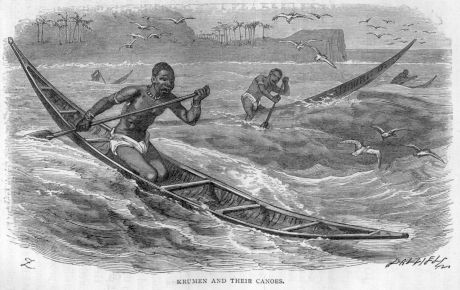 was to make his way, either down the stream in canoes or along the banks by land, as he might find practicable, either to the sea, if the stream was found to flow in that direction, or eastward into Lake Chad, which at that time, it was supposed, it might possibly do. In the latter case, if found advisable, he was to return home by way of Fezzan and Tripoli; but, in either case, he was to follow its course, if possible, to its termination, wherever that might be.
Sailing from Portsmouth on the 9th of January, 1830, the Landers reached Cape Coast Castle on the 22nd. Here they were fortunate enough to engage old Pasco and his wife, with Richard’s former attendant, Jowdie, together with Ibrahim and Nimo, two Bornou men, who could speak English, as also the Haussa language. Hence they went to Badagarry, the chief of which place, Adooley, entertained them hospitably.
On the 31st of March, they commenced their journey into the interior, proceeding up the river as far as it was navigable. Reaching Bidjii they were supplied with horses, on which they continued their journey. It was here Captain Pearce and Dr Morrison fell sick when accompanying Clapperton in his last journey. Both the brothers suffered from sickness; but, undaunted, they pursued their course till they reached Katunga, the capital of Youriba.
Houses in this province were formed of badly-built clay walls, thatched roofs, and floors of mud, polished with cow-dung. The only difference between the residence of a chief and those of his subjects consisted in the number, though not in the superiority, of his court-yards. For the most part they were tenanted by women and slaves, together with flocks of sheep and goats, and abundance of pigs and poultry mixed indiscriminately. The palace of the king, however, was somewhat superior.
The monarch had put on his robes of state to receive them, and amused them while dinner was preparing with a concert from a number of long drums, kettledrums, and horns. He wore on his head an ornament like a bishop’s mitre, covered with strings of coral. His tobe was of green silk, crimson silk, damask, and green silk velvet, sewn together like a piece of patchwork. He wore English cotton stockings, and sandals of neat workmanship. His subjects as they approached prostrated themselves, rubbing their heads with earth, and kissing the ground repeatedly, till their faces were covered with the red soil.
The king was so amused with the very different style with which the Englishmen saluted him that he burst out in a fit of laughter, in which his wives and subjects joined him.
They parted with the worthy monarch, who forwarded them on their journey.
Avoiding Avawa, at which place the widow Zuma had laid siege to the hearts of Clapperton and his attendant, they proceeded on to Boussa, which, greatly to their surprise, they found standing on the mainland, and not on an island as Clapperton’s journal had stated.
The king asserted, when they had presented themselves, that he and his court had been weeping all the morning for the death of Clapperton; but, as no outward signs of tears were visible, the travellers rather mistrusted the monarch’s assertion.
A hut having been selected for them, they repaired to it, and were well supplied with dishes of meat, rice, and corn for supper.
What was their astonishment the next day to receive a visit from the widow Zuma! who appeared, however, woefully changed, being clad in very humble apparel of country cloth. Having quarrelled with the ruler of Wawa, she had made her escape over the city wall in the night, travelling on foot to Boussa, where she had since taken up her abode.
The king was highly pleased with the presents which the  Landers had brought him, and he and his wife, his chief counsellor and only confidant, honoured them with a visit at their hut. The queen was dressed in a check shirt, with several pieces of blue cotton—one tied round her waist, another hanging over her shoulder, and one covering her head—brass rings ornamenting her great toes, and bracelets her wrists; besides which she wore a necklace of coral and beads of gold, and small pieces of coral stuck in the lobe of each ear. Coral appeared to be in great demand wherever they went, and the queen was disappointed on finding that they had brought none.
Lander, concealing the object of his journey, informed the king that his purpose was to go to Bornou by way of Youri, and requested a safe conveyance through his territories.
This permission was granted, and, sending their horses by land, they proceeded up the river in a canoe which was furnished them, towards Youri.
The scenery on the main branch of the river was interesting and picturesque: the bank literally covered with hamlets and villages, and fine trees bending under the weight of their dark foliage, and contrasting with the lively verdure of the hills and plains.
After proceeding a short distance the stream gradually widened to two miles, in some places the water being very shallow, but in others of considerable depth.
Steering directly northward they voyaged on for four days, having passed, they were told, all the dangerous rocks and sandbanks which are to be found above Youri or below Boussa.
Landing at a little village on the bank, where their horses met them, they rode a distance of eight miles to the walls of Youri. That city they entered through an amazingly long passage, at the end of which was an immense door, covered with plates of iron rudely fastened to the woodwork.
A habitation had been provided for them, to which they were conducted, excusing themselves from paying their respects to the sultan on account of the fatigues of their journey. The following evening they visited the sultan, whose palace consisted of a group of buildings enclosed by a high wall. Dismounting, they were conducted along a low, dark avenue, with pillars on either side, and, passing through which, they entered a large square yard, where a number of servants were hurrying about and others seated on the ground. They were kept waiting for some time, till, receiving a summons to advance, they were introduced into another square, which resembled a clean farm-yard. Here they found the sultan seated alone on a plain piece of carpet, with a pillow on each side of him and a neat brass pan in front. He was big-headed, corpulent, and, though of advanced age, a jolly-looking man. He expressed his annoyance that Clapperton did not visit him, and that Lander had not done so on his return, and they were not sorry to take their leave.
He here was shown a rich damask tobe, covered with gold embroidery, which had belonged to Mr Park, and was probably part of the spoil taken from the canoe, intended as a present to some native prince. They were, at first, in hopes of obtaining Park’s journals; but only an old nautical almanack was seen, and they afterwards discovered that the journals themselves, though kept for some years, had, after Clapperton’s death, been destroyed by the person into whose hands they had fallen. They, however, obtained a gun which had undoubtedly belonged to Park, and which was given up to them in exchange for one of their own fowling-pieces.
The king, though he expressed his readiness to assist them, declared that he could not forward them on their way to the eastward, as from the disturbed state of the country he would be unable to guarantee their safety, and that the best thing he could do was to send them back to Boussa. On this they immediately sent a message to the King of Boussa, saying that as they were unable to continue their journey in the direction they had proposed, they would feel deeply obliged if he would lend them a canoe, by which they might proceed down the river to the salt water, and that they would remunerate him to the best of their ability.
The disturbances of which they had heard had been created by the widow Zuma, who had instigated the people of Nouffie to make a raid into the territory of the King of Wawa. They had succeeded in carrying off some bullocks near the walls of his town. She had fled from Boussa to another town, the governor of which had, however, sent her back, and she would now probably be severely punished by the King of Boussa, or be returned to her own sovereign, who would probably cut off her head.
On the 2nd of August they set off on their road to Boussa, but here they were kept some weeks, during which either one or the other of the brothers paid visits to the King of Wawa, from whom they found they had the best chance of obtaining a canoe. The King and Queen of Boussa were the most amiable couple they met with on their travels, and treated them with uniform kindness during their stay. The king, though not equalling the King of Wawa, is proud of his skill as a dancer, and he exhibited his accomplishments at a grand festival which took place during their visit. Although advanced in life, he was as active as a boy, and indulged largely in his favourite amusement every Friday.
On the last day of the festival, while his subjects were gathered in large numbers on the racecourse, he appeared among them, followed by boys carrying calabashes full of cowries, with which he rewarded the dancers, singers, and musicians, scattering the remainder among the crowd, to be scrambled for. Then, to show his affection for his subjects, unwilling to send them to their homes without giving them another treat, he danced sideways half way up the racecourse and back again to his residence, with much stateliness, his amiable wife smiling with delight that she had such a spouse, while the people were louder than ever in their shouts of approbation.
They heard here that El Kanemy, Major Denham’s friend, had fallen into disgrace with the Sultan of Bornou, who suspected him of treasonable practices, and of the intention of usurping the sovereignty. He had been imprisoned, and would have lost his head had not the Mahommedan priests interfered and obtained his liberation.
During their last visit to the King of Wawa, he exhibited a collection of charms written on sheets of paper, glued or pasted together. Among them was a small edition of Watts’s Hymns, on one of the blank leaves of which was written, “Alexander Anderson, Royal Military Hospital, Gosport, 1804,” which of course had belonged to Mr Park’s brother-in-law, who died in that neighbourhood. They had seen also two other notes addressed to Park, one from a Mr Watson, and the other from Lady Dalkeith.
It was not before the 30th of September that at length, having obtained the long-wished-for canoes, they were able to embark from the Island of Patashie, in the neighbourhood of Boussa. Cheered by the natives, they sprang on board, and the current rapidly bore them down the stream.
Their voyage had now begun prosperously; but they were detained at several places by the chiefs, who wished to get as much as they could out of them.
At Lever a priest, attended by a number of followers, told them that they were in his power, and should not quit the town till he thought proper. They had hitherto always behaved in the mildest manner possible, but now Lander replied that if the priest or any one else attempted to hinder them from taking their departure, he should feel no hesitation in shooting him. In an instant the priest’s manner changed, and he became civil and humble. They and their people were, however, allowed to make the attempt of launching their canoe, in which, as she was long and heavy, they were unable to succeed. The priest and his followers at length, ashamed of seeing the strangers labouring so hard, came to the spot and in a few minutes carried their boats into the water. They passed numerous islands, many of them several miles in length and thickly inhabited.
At Leechee the Niger was found to be three miles in width. The inhabitants of the place had numerous canoes. The boatmen they engaged here, though they had only paddled on for about forty minutes, refused to go further, and they were compelled to wait till they could obtain a fresh crew. Indeed, at the different places at which they stopped, they were vexatiously delayed on various pretexts by the natives.
At Belee Island a messenger arrived to inform them that they would be visited in the morning by the King of the Dark Water.
They embarked at an early hour, and at about ten o’clock the sound of voices singing, which reached their ears over the surface of the stream, warned them of the approach of the monarch. A small canoe came first, and then another propelled by upwards of twenty fine young men. In this, under a decorated awning, with a piece of scarlet cloth ornamented with beads and gold lace in front, sat the King of the Dark Water. In the stern were a number of musicians—drummers and a trumpeter—and in the bow four little boys, neatly clad. The king, of coal-black hue, was a fine-looking man, well stricken in years. He was dressed in a bournous of blue cloth, under which was a variegated tobe, made of figured satin, Haussa trousers, sandals of coloured leather, and a red cloth cap on his head. He was accompanied by six fine, handsome, jet-black girls, his wives, also picturesquely dressed, their wrists ornamented with silver bracelets and their necks with coloured necklaces.
The travellers saluted him with a discharge from their muskets, and while he went on shore, Richard arrayed himself in an old naval uniform coat, and his brother in the handsomest dress he possessed; their attendants put on new, white, Mahommedan tobes, while the British flag flew from the bow of their boat, so that they might show him all the respect in their power. These arrangements being concluded, the English led the way down the river, followed by the King of the Dark Water, and a squadron of canoes, to the island of Zagozhi, on which a town of considerable size was situated. Opposite to it was the town of Rabba, said to be very large and populous.
The Niger flows at this spot in a direction south of east.
While staying at this place, Lander was surprised by receiving an over-warm and affectionate salutation from a little, ugly, old Arab, whom he recognised as having been employed by Clapperton, having afterwards acted as his own guide from Kano. He had cheated Clapperton, and had also stolen Captain Pearce’s sword and a sum of money when sent back to Kano, from which he had decamped. When reminded of his rogueries he only laughed, and then in the most impertinent manner begged for everything he saw. Lander consequently turned him out of the hut.
They found here Mallam Dendow, a cousin of Bello, very old and feeble. He was pleased with the presents he received, and through his means the King of the Dark Water promised to supply them with canoes and a guide to conduct them to the sea.
Funda, the town near which the Niger was supposed to flow, was, as far as they could learn, at a considerable distance from this neighbourhood. Mallam Dendow had lately planned an expedition against it, but it terminated by his warriors taking fright and returning to their homes without accomplishing anything.
These Arabs, throughout Africa, were the greatest curse of the country, and were the chief cause of the devastating wars which were constantly taking place, while they in no way contributed to the real civilisation of the people.
Just as the travellers were hoping to recommence their voyage, old Pasco returned from Mallam Dendow with the unpleasant information that the chief was dissatisfied with the gifts he had received, and that unless they would present him with others of more value he would take their guns and powder from them before he would permit them to leave Zagozhi. Having no articles left among their stores, they were most unwillingly compelled to present him with Mr Park’s tobe, which had been given by the King of Boussa. With this he was highly delighted, and now, declaring that he would be their friend for ever after, he not only obtained for them the restitution of their canoe, which had been seized by the King of the Dark Water, but made them a present of a number of handsome mats and a supply of cowries and provisions.
On the 16th they again launched into the river, firing two muskets and uttering three cheers as a salute to the King of the Dark Water and the hundreds of spectators gazing at them, whom they soon left out of sight.
They were now, with the exception of a few bracelets and other trifling articles, possessed of nothing with which to make presents or pay tribute to the chiefs. It was, therefore, important that they should hasten down the stream, touching at as few places as possible.
They passed a village on an island completely submerged, and were nearly upset by striking against the roof of one of the cottages, towards which a whirlpool had driven them. A number of canoes were engaged in carrying off the inhabitants.
At the island of Fofo they heard that the frontiers of Funda were three days’ journey down the Niger, and that the city itself was upwards of three days’ journey inland from the water-side, and that thus it would be impossible for them to visit it.
After they had left Zagozhi, in between three and four days they reached Egga, a large town situated behind a morass, several creeks leading out of it. A vast number of large canoes lay off the place, laden with all kinds of merchandise. The chief, a venerable man with a long, white beard, examined them from head to foot and, remarking that they were strange-looking people well worth seeing, awarded them a commodious hut.
It was a town of prodigious extent and had an immense population. The river varied in width from two to five and six miles.
They here observed Benin and Portuguese clothes worn by the inhabitants, who, being very enterprising, were engaged in trading up and down the river.
On the 22nd they once more embarked, their crew greatly alarmed with the prospect of meeting enemies ahead, who would, they said, very likely put them to death.
Had they, however, remained at Egga, they would probably have been made slaves. They heard, indeed, dreadful reports of the character of the people occupying both sides of the Niger between Kakunda and Bocqua. They, however, loaded their arms and prepared to defend themselves.
One of their men, Antonio, son of a chief on the Bonny river, who had joined them from HM brig “Clinker,” was especially alarmed—not on his own account, as he said that his life was of no consequence, but that he feared that his two white friends, whom he loved so dearly, might be killed. They, accordingly, pulled on during the night, passing a large town, from which issued a loud noise, as of a multitude quarrelling. Once they fancied they saw a light following them, but it turned out to be a will-o’-the-wisp.
On the 25th of October suddenly the river changed to the south-west, running between immensely high hills, and in the evening they passed the mouth of a considerable rivet entering the Niger from the eastward. After pulling up some little way, they found the current so strong against them that they were compelled to return. This they concluded to be the Tsadda, known, however, as the Binue.
While their men were on shore collecting firewood they came suddenly on a village, and, the people being aroused, the travellers, seated under a palm-tree, were quickly surrounded; but the chief, appearing, was persuaded that they only desired peace. Old Pasco was the only one who had stood by them during the interval, the rest having taken to their heels on the appearance of danger.
On landing at another place, a number of women hastened out of an adjacent village with muskets; but, seeing the travellers sitting down quietly without making any hostile display, they soon became friendly.
They were detained three days at Damuggoo, a very dirty town, where, however, the people were generally dressed in Manchester cottons; that is to say, they wore pieces of them round their waists, extending to the knee.
Continuing their voyage down the river, they observed the large market town of Kirree. Near it were a number of canoes of considerable size, with flags flying on long bamboos. Shortly afterwards a fleet of fifty canoes appeared ahead, with flags of all nations, among which the Union Jack was most conspicuous. All the people were dressed in European clothes, with the exception of trousers, which the chiefs alone are allowed to wear.
Lander, overjoyed by the sight, supposing that they must be friends, approached without fear, when a huge man of most forbidding countenance beckoned him to come on board his canoe. The next instant the sound of drums was heard, and several men levelled their muskets at the traveller. In addition to the muskets, each canoe had a long four or six-pounder in its bow, besides which the crews were armed with swords and boarding-pikes. In an instant their luggage was transferred to the canoes of their opponents, while some of them seized Pasco’s wife, and were dragging her out of the canoe. On this Lander, calling to his men to assist him, determined to sell his life as dearly as he could; and, having dragged back Pasco’s wife, they fought so determinedly that they were able to effect their escape. None of the other canoes had interfered, and, seeing that which had plundered them making its way to the market, Lander pulled after her as fast as he could go, in the hopes of recovering their property. On their way they encountered another canoe, in which a person, apparently of consequence, hailed them with the words: “Hilloa, white man! You French; you English?”
“English,” answered Lander. “Come here in my canoe,” was the reply. Lander accordingly got into his canoe, while the chief put three men into Lander’s that they might assist in pulling to the market. He at once treated Lander with great kindness and promised him every assistance in his power.
Soon after this, what was Richard Lander’s dismay to see the canoe of which his brother John had command followed by the villains who had attacked him, capsized, and sunk, while their luggage went to the bottom—his brother and crew being left struggling in the water. Richard was on the point of leaping in to help him, when he saw him dragged into another canoe, the other men swimming on shore. It was some time before he was able to reach him, when, with their new friend, they repaired to the market. Here they found a number of Damuggoo people and others who sided with them, and a Mahommedan from Funda urged them to keep up their spirits, and that all would be made right. Search was then commenced for their property. One of their journals and a box of books, with the medicine chest and a few articles of clothing were found, and after a palaver were restored; but the whole of Richard Lander’s journal with the exception of one note-book, Mr Park’s gun and thirty-six of their cutlasses and pistols, some elephant tusks, ostrich feathers, leopard-skins, and a variety of seeds had all been lost, as well as their remaining cowries, buttons, and needles, which were so important to enable them to purchase food.
The people who had attacked them were from Eboe, and had come this distance on a plundering expedition, intending to trade when unable to carry off property without fighting. The leading man who had attacked them was put into irons and doomed to die by the people of Kirree; and it was decided that if the king of Eboe, whose subject he was, should refuse to put him to death, no more of his canoes should be allowed to come to the country to trade.
Escorted by six war-canoes from Damuggoo, the travellers left Kirree and continued their voyage down the river, passing through a large lake-like expanse of the Niger, till on the evening of the 8th they reached the town of Eboe.
The houses were neatly built of yellow clay, plastered over and thatched with palm leaves. Yards were attached to each, in which plantations of bananas and cocoa-nut trees grew.
Here they were addressed in English by several brawny fellows with stentorian voices, who shook hands, asking them “how they did”—one calling himself Gun, though Blunderbuss or Thunder would have been as appropriate a name, then stating that his brother was King Boy and that his father was King Forday, who with King Jacket governed all the Brass country. He also informed them that a Spanish schooner and an English brig, the “Thomas,” of Liverpool, were lying in the first Brass river.
After resting for some time they were conducted to the palace of the dreaded Obie, king of the Eboe country. Instead of the savage monster they expected to see, a door opened, when a sprightly young man, with a mild countenance and an eye which indicated quickness and intelligence, appeared before them and cordially shook hands. His dress was so covered with a profusion of coral ornaments that he might appropriately have been styled the “Coral King.” On his head he wore a sugar-loaf hat, thickly adorned with strings of coloured beads and pieces of broken looking-glass, while several strings of beads were tightly fastened round his neck. He had on a short Spanish surtout of red cloth, ornamented with gold epaulettes, and a pair of trousers of the same material, while both his legs and wrists were covered with strings of beads, and to each leg, above the naked ankles and feet, was suspended a string of little brass bells, which jingled as he walked.
An account of what had happened at Kirree was narrated to him, and he declared his intention of settling the matter. Notwithstanding his protestations, however, the fair-spoken king detained the travellers, and would have kept them and their followers in slavery had not King Boy, the eldest son of the King of Brass Town, volunteered to pay their ransom on receiving a written promise that it should be repaid to him by the master of the “Thomas,” then lying in the Brass River, or by any other merchantman captain who might be found there. King Boy wished to send the document down to the brig at once; but fortunately Lander told him that he was sure the captain would not pay it till he had been received on board. On this the King of Eboe allowed them to embark in King Boy’s canoe. It was a large craft, paddled by forty men and boys, in addition to whom there were, besides the king and his wife and their own party, several slaves, so that the number on board amounted to fully sixty people. There were also cannon lashed to the bows, and a number of cutlasses and chests of spirits, silk, and cotton goods.
Thus laden, the Brass canoe took her way down the river, her unfortunate English passengers dreadfully cramped for room—John Lander one night, while suffering from fever, having the feet of the royal couple in his face.
On the 15th of November they landed at the excessively dirty town of King Forday, situated in the middle of a marsh. Here they took up their quarters at Boy’s house.
Soon after their arrival they were cheered by recognising the features of a European in the midst of a crowd of savages. He proved to be the master of a Spanish schooner lying in the Brass River for slaves. He was affable and courteous, and told them that six of his crew were ill of fever and that the rest were suffering.
Their residence, which its owner called an English house, was built close to the water, of yellow clay, but with several windows, all furnished with shutters.
Having paid his respects to King Forday, Richard Lander, leaving his brother and his men at the town, set off, in King Boy’s canoe, to go sixty miles down the river to the brig.
His feelings of delight may be imagined when he had ocular evidence that he had at length succeeded in tracing the mysterious Niger down to the ocean, by seeing before him two vessels, one the Spanish slaver, the other the English brig on board which he fully expected to receive the assistance he so greatly required.
To his utter surprise and consternation, on going on board, Captain Lake, though almost himself at death’s door from fever, flatly refused to give him a single thing. By his language and behaviour he showed himself to be a greater savage than the ignorant blacks among whom Lander had been travelling. Lander in vain expostulated with the captain; fearful oaths and flat refusals were the only answers he made. At last, when Lander suggested that he had five men, who might be useful in working his vessel out of the river, he softened a little, and gave him a change of linen and some provisions for his brother.
King Boy was ultimately induced to go back to bring John Lander and the rest of the men, on Richard’s reiterated promise that he would at some time or other obtain the goods they had promised him. He presented him also with some silver bracelets, which they had before overlooked, and a native sword. These articles Boy accepted, but when John Lander offered him his watch it was refused with disdain, the savage not knowing its value.
The captain of the brig had in the meantime loaded his guns and got his arms ready, and when Boy came up to him once more, to demand the bars which had been promised, he replied, in a voice of thunder: “I no will!”
As the pilot, to whom the captain had also refused to pay his demand, could not be trusted to take the brig out, she narrowly escaped shipwreck on the bar, but happily at length getting clear of the river, she steered a course for Fernando Po, where the travellers landed. Hence they sailed for Rio de Janeiro, which they reached on the 16th of March, and from that port obtained a passage on board the “William Harris” to England, which they reached safely on the 10th of June.
Thus, with very humble means, by the energy and courage of two unpretending men, was the long-disputed problem of the course of the Niger at length completely solved.
Besides the payment which the Government had promised to Richard Lander, he received a premium of fifty guineas,  placed at the disposal of the Royal Geographical Society by the king, and his brother John obtained employment under Government suitable to his abilities.
Chapter Ten.
Travels and adventures of Dr Barth in North and Central Africa, 1849.
Leaves Tripoli with Mr Richardson and Dr Overweg—Suppression of slave trade the chief object of the expedition—Numerous ruins seen—Cross the Hammada desert—Rest at an oasis—Reach Mourzouk—Dr Barth’s adventure—Nearly perishes in the desert—Difficulties of journey—Followed by Tawarek freebooters—Preparations for an attack—Strange dancers—Tribute demanded—Camp at night—Expecting an attack—Constant firing kept up—Camels stolen—Pursued—Dangerous situation—Travellers expect death—Saved by friendly Chief—Dr Barth visits Agades—A salt-caravan—The caravan reaches Tagelel.
The British Government had, in 1849, appointed Mr Richardson, an experienced traveller in Africa, to the command of an expedition which was to start from Tripoli, on the north coast, and thence endeavour to penetrate to the central part of the continent. By the recommendation of the Chevalier Bunsen Dr Barth, who had spent three years travelling through Barbary and the desert tracts to the westward bordering the shores of the Mediterranean, was allowed, accompanied by another German, Dr Overweg, to join the expedition.
A light boat, which was divided into two portions and could be carried on the backs of camels, was provided, and a sailor to navigate her either on Lake Chad or down the Niger.
Dr Barth and his countryman at once pushed on for Tripoli, in the neighbourhood of which they made long excursions while waiting for the arrival of Mr Richardson, who had remained in Paris for despatches.
One of the principal objects of the expedition was the abolition of the slave trade, which it was known was carried on to a fearful extent in those regions. The principal employment of the Moorish tribes on the borders of the territories inhabited by blacks is still, as it was in the days of Mungo Park and Clapperton, slave-hunting. Villages are attacked for the purpose, when the prisoners captured are carried northward across the desert and sold in Morocco and the other Barbary states.
Another object was the opening up a lawful commercial intercourse with the people who might be visited, and the exploration of the country for scientific purposes, as well as to discover the course of the great river which the Landers had seen flowing into the Niger in their adventurous voyage down that stream.
On the arrival of Mr Richardson the travellers at length set out from Tripoli, on the 24th of March, 1850. They rode on camels, a considerable number of which were also required to carry their baggage. The boat had unfortunately been divided only into two pieces instead of four, thus causing much trouble.
We may picture them setting forth with their long line of camels and numerous attendants, servants, camel-drivers, and guides, and accompanied by Mr Crowe, the consul, Mr Reade, the vice-consul, and other friends who came forth to see them start; or with their tents pitched on a moonlight night, amidst a few date and olive trees, in a green meadow—a little oasis surrounded by sand.
The two doctors alone required eight camels for their luggage, besides those they rode. Dr Barth had procured an excellent one of the renowned Bû-Saef breed. The travellers were well-armed, as they had to pass through disturbed 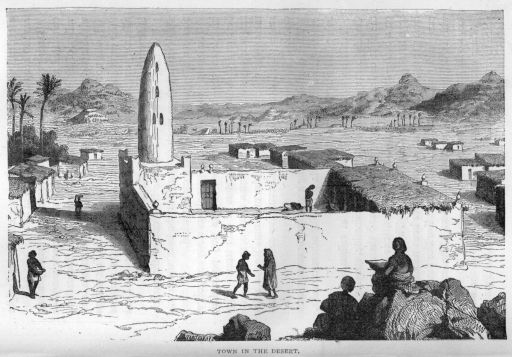 districts, and were likely to encounter open enemies, and might have to keep treacherous attendants in awe.
During the first part of their journey their way lay along cultivated and flourishing corn-fields in the narrow wady, or valley, of Majenin. At the further end of it Mr Richardson with his party overtook them and pitched his enormous tent. It was not till the 2nd of April that they fairly set out on their expedition. Keeping to the west of a rugged range of hills, they entered the rocky wady of Haera, where they filled their water-skins from the pools formed by the rain.
The long oars and poles of the boat caused the camels which carried them much fatigue; but the boat, which was now cut into quarters, was more easily packed.
The country over which they passed was stony and rocky, intercepted by dry water-courses, and, as they proceeded, here and there adorned with clusters of date-trees. They frequently passed the ruins of Roman temples, tombs, monuments, and other buildings, and also numerous Roman milestones: the Romans, indeed, had extensive colonies in this district.
Their chief object, when seeking a spot for encamping, was water. Sometimes it was found in pools: at others in wells, being drawn to the surface by oxen.
Travellers in Africa cannot proceed at railroad speed. Camels journey much after their own inclination, straying to the right or left—nipping here a straw, and there browsing on a bush—and, being obstinate creatures, it is difficult to urge them forward faster than they like. The doctor would have preferred a horse, but it would have been necessary to carry barley and water for it, as it cannot live like the camel without drinking when crossing the desert. The expense, too, would have been very great.
Their course was nearly due south, directed in the first place towards the town of Mourzouk, the capital of Fezzan.
Their general rate of marching was at from two to two and a half miles an hour. The heat was very great. The doctor’s Arab servant, who had gone off to see his family in the neighbourhood, on his return arrived at the encampment after they had started. He, accordingly, set off to overtake the caravan. Though he had a skin of goat’s milk, yet it became so hot that he could not drink it; and, as he was obliged to march the whole of the day without water, he suffered greatly and arrived in a very exhausted state.
Among the monuments passed was one adorned with rich carving, proving that these regions, now so poor, must have once supported a population sufficiently advanced in taste and feeling to admire works of a refined character. They also found ruins of Christian churches of a later period.
They were now travelling through a district known as the Hammada—a high, level, stony region, destitute of wells or pools. Here and there, however, small green patches of herbage were found, affording a welcome meal to the camels.
They were accompanied by a little green bird, called the “asfir,” which lives entirely upon the caravans as they pass along, by picking off the vermin from the feet of the camels.
At a green oasis, El Wueshkeh, where grew a few stunted palm-trees, their camel-drivers killed a number of a venomous lizard, called “bu-keshash.” At night a cold wind, accompanied by rain, began to blow; their tent was overturned, and they had much trouble in pitching it again. The next day a number of truffles were found, which afforded them some delicious truffle soup.
They met, soon after starting, two caravans—the largest consisting of fifteen camels laden with ivory. With the latter was a woman sitting comfortably in a little cage on the camel’s back.
Passing through a narrow ravine between gloomy cliffs, they reached a sandy waste, passing across which they at length arrived at some crumbling ruins surrounding a well, where they and their camels could quench their thirst. Though the great watering-place on this desert road, it has not a cheerful aspect; but, as the water is always bubbling up and keeps the same level, the largest caravan might be fully supplied. A day was spent here, as both camels and men required rest.
Day after day they travelled on, passing through rocky wadies and narrow defiles, out of the sides of which projected jet-black masses of sandstone, giving a wild air to the desolate region.
One day two gazelles were caught, an addition to their bill of fare.
At length in the distance appeared a town on the top of a broad, terraced rock. They took long to reach it.
It is rarely such a place is seen in that part of the world. The rock rose in the midst of a valley, occupying a position which in days of yore must have made it a place of great importance. It is called Ederi. Amidst the sand-hills which surround it are green fields of wheat and barley, and here and there groves of date-trees.
Before them now lay a series of sand-hills, intermingled with small clusters of palm-trees. Sometimes the ascent of the sand-hills was most trying for the camels. They extend for five days’ march or more, but are nothing in comparison with those in the direction of the Natron Lakes: so one of their guides told them.
Often, while crossing this sandy waste, thirsty travellers are deceived by the effects of the curious mirage, when lakes glittering in the sun, with towers, domes, and minarets reflected on their surface, appear before their eyes, to vanish suddenly as they approach.
Their camel-drivers had led them them to the left, in order to visit their own village of Ugrefe. It consisted of about thirty light and low dwellings made of clay and palm 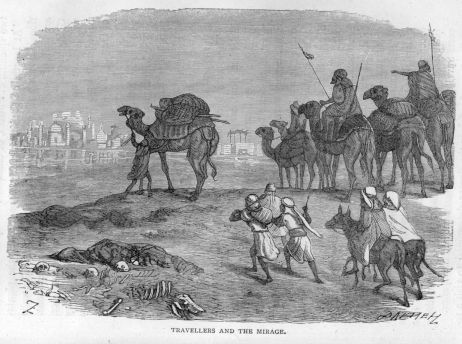 branches. In an open space near it they encamped beneath two splendid ethel-trees, or tamarisks.
At length, on the 6th of May, they reached the plantations surrounding Mourzouk, the capital of Fezzan. The walls are built of a sort of clay glittering with saline incrustations. Going round the whole of the western and northern sides, which have no gateway wide enough for a caravan, they halted on the eastern side of the town, not far from the camp of the pilgrims who were returning from Egypt to Morocco. They were here welcomed by Mr Gagliuffi, a Greek merchant, who received them into his house.
The buildings are mostly of one story, with flat roofs and parapets, with interior courts, and broad porticoes supported by pillars in front. The town contains a bazaar and barracks for two thousand Turkish troops. It is a thoroughfare rather than the seat of a commerce.
They were here joined by a man of influence named Mahomet Boro, an elderly, respectable-looking personage, wearing a green bournous over white under-clothes. He was to act as mediator between them and the inhabitants of the countries they were to visit. He was now on his homeward journey from a pilgrimage to Mecca.
On the 13th of June they left Mourzouk by the eastern gate. Some chiefs from Ghat had arrived, to whose charge Mr Gagliuffi had committed the travellers. At this Mahomet Boro became very indignant, and threatened that he would take care that they should be attacked on the road by his countrymen, nor were these empty threats.
It is remarkable that while the Mahommedan religion in general is sinking to corruption along the coast, there are ascetic sects rising up in the interior which unite its last zealous followers by a religious bond. From some of these sects travellers receive much ill-treatment and annoyance. On the 15th of July the doctor determined to visit a remarkable mountain which appeared in the distance. Being unable to obtain any guide, he set off, taking with him as provisions only dried biscuits and dates—the worst possible food in the desert when water is scarce. Making his way over the pebbly ground, he saw a pair of beautiful antelopes, which stopped, gazing at him and wagging their tails.
The distance proved far greater than he had imagined; indeed, there was a deep valley between him and the side of the mountain. Still, eager to reach its summit, he pushed on. The sun began to put forth its power; there was not the slightest shade around. At length he reached the height at which he was aiming, but, on looking round, he in vain sought for any traces of the caravan. Having but a small supply of water in his water-skin, he could only venture to sip a few drops, while he could with difficulty eat his dry biscuit and dates.
Fearing that the caravan might push on believing him to be in advance, he immediately descended the mountain, in order to follow its course. At noon he swallowed the remainder of his water, but, taken on an empty stomach, it did not restore his strength. Believing that his party were to encamp at no great distance from the mountain, he strained his sight in hopes of seeing his friends; but no living being was visible. Having walked some distance, he ascended a mound crowned with an ethel-bush, where he fired his pistols; but a strong east wind blowing against him, he in vain waited for an answer. Crossing some sand-hills, he again fired, and, at last convinced that there could be nobody in that direction, he supposed that his party were still behind him, and unluckily kept more to the east. At last some small huts appeared in the distance. He hastened towards them, but they were empty, nor was a drop of water to be obtained. His strength being exhausted, he sat down on the bare plain, hoping that the caravan would come up. For a moment he  thought he saw a string of camels passing in the distance, but it was a delusion.
He mustered strength sufficient to scramble to an ethel-tree on an elevated spot, intending to light a fire, but, unable to move about, he could gather no wood. Having rested after dark for an hour or two, he once more rose, and discovered in the south-west a large fire. Again he fired his pistols, but no answer was returned. Still the flames rose towards the sky, telling him where deliverance was to be found, but he was unable to drag his weary limbs so far. Having waited long, he fired a second time, yet no answer came. At last he resigned himself to the care of the Merciful One and tried to sleep, but in vain—he was in a high fever. The long night wore away and dawn was drawing nigh. All was repose and silence: he was sure that he could not choose a better time for trying to inform his friends by signal of his whereabouts. Collecting his remaining strength, he loaded his pistol with a heavy charge and fired once and then again. His companions seemed not to have heard his signals. The sun he had half longed for, half looked-forward to with terror, at last rose. His condition, as the heat increased, became more dreadful. He crawled round the tree, trying to enjoy the little shade afforded by the leafless branches. About noon there was only sufficient shade left to shelter his head. He suffered greatly from the pangs of thirst, till at last, becoming senseless, he fell into a sort of delirium, from which he only recovered when the sun went down behind the mountain. Crawling from beneath the shade of the tree and throwing a glance over the plain, suddenly the cry of a camel reached him. It was the most delightful music he had ever heard in his life. Raising himself a little, he saw a mounted Tarki passing at some distance and looking eagerly around. The Tarki had discovered his footprints in the sandy ground. Crying as loud as his faint strength would allow, “áman! áman!” (“Water! water!”) he was rejoiced to see the Tarki, Musa by name, approaching, and in a few moments he was at his side, washing and sprinkling his head. His throat was, however, too dry to enjoy the draught which Musa poured into it. His deliverer then placed him on his camel, mounted himself in front, and carried him to the tents.
The strength of a European is soon broken in those climes, if for a single day he is prevented from taking his usual food. Next day, however, the doctor was able to continue his journey.
Ghat, well situated in the centre of an oasis, was next reached. It is surrounded by mud walls, with flat-roofed houses, while outside are plantations of date-trees.
On the 26th of July the caravan again set out. On the 29th they commenced their ascent to the greatest elevation of the desert, four thousand feet above the sea. The path winding along through loose blocks of stone, the precipitous ascent proved very difficult. Several loads were thrown off the camels, and the boat frequently came in contact with the rocks. It is indeed the wildest and most rugged region of the whole desert. At one place the road meandered in a remarkable way, sometimes reduced to a narrow crevice between curiously-terraced buttresses of rocks. Two hours were occupied in descending.
At the bottom was a wady between steep, precipitous cliffs looking almost like walls erected by the hand of man. They were more than a thousand feet high, with a pond of rainwater at the bottom. The valley is called Aegeri.
They had now to pass a region of sand-hills. During their passage the mirage set before their eyes beautiful sheets of water, which quickly disappeared as they approached.
Desolate as the country appears, large herds of wild oxen rove over it. Though the men tried to catch some of them, they were unsuccessful, as the animal, sluggish as it seems, rapidly climbs the rocks and is soon lost to sight.
The travellers, having now entered the tropics, expected to reach pleasanter regions than they had hitherto passed through. Their guides, however, were leading them further to the west than they wished, their great desire being to reach Negroland as soon as possible.
On the 18th of August they were quietly pursuing their road, when one of their party was seen running up behind them, swinging his musket over his head and crying: “Lads, our enemy has come!” Alarm was spread through the caravan: everyone seized his arms, and those who were riding jumped from their camels. The man reported that a number of Tawarek, mounted on camels, had been seen rapidly approaching, with the evident intention of attacking the caravan. A warlike spirit prevailed, and all, the doctor thought, would fight valiantly. Freebooting parties, however, do not attack openly. They first introduce themselves in a peaceable way, when, having disturbed the little unity which exists in most caravans, they gradually throw off the mask.
After some time they came to the conclusion that it was not likely that they would be attacked by daylight. They, therefore, sent off a body of archers to gain information from a small caravan which was coming from Soudan, consisting of a few Tebus, ten camels, and about forty slaves. The unfortunate Tebus were soon afterwards attacked by a fierce tribe, the Haddanara, who, disappointed at getting nothing from the English expedition, murdered the whole of them and carried off their camels and slaves.
Soon after the party had encamped at night three strangers made their appearance; but, although they were known to be robbers, and that a number of their companions were not far off, they were allowed to lie down for the night. The experienced old Sheikh of the Kafeila warned Barth to be on his guard, and exhorted his attendants to be staunch. Everybody was crying for powder. Their clever servant, Mahomet, placed his four pieces of boat on the outside of the tents, that they might afford shelter in case of an attack. They kept watch the whole night, and the strangers, seeing them well on their guard, did not venture to assail them. In the morning they went slowly away to join their companions, who had kept behind a rocky ridge in the distance. There was indeed much cause for anxiety. Suddenly an alarm was raised that the camels had been stolen. The old chief, taking advantage of this state of things, urged Barth and Overweg to confide their property to him and another chief. This was not entirely disinterested advice; for, if anything had happened to the travellers, the chief would, of course, have been their heir.
At an early hour they started with an uneasy feeling. With the first dawn the true believers had been called together for prayer; and the bond which united the Mahommedan members of the caravan with the Christian travellers, it was seen, had been loosened in a very conspicuous manner.
Instead of, as usual, each little party starting off as soon as they were ready, they all waited till the whole caravan had loaded their camels, when they began their march in close order, to be ready in case of being attacked.
After advancing some distance they saw four men seated ahead of them, on an eminence. The doctor, being in the first line of the caravan, dismounted and led forward his camel. A party of archers had been despatched to reconnoitre. What was his surprise to see them and the unknown individuals executing a wild sort of armed dance. Suddenly two of the dancers rushed upon him and grasped the rope of the camel, asking for tribute. Barth seized his pistols, when, just in time, he was told they were friends.
The eminence is an important locality in the modern history of the country. It was here, when the Kel-owi, a pure Berber tribe, took possession of the territory of old Gober, that a covenant was entered into between the red conquerors and the black natives, that the latter should not be destroyed, and that the principal chief of the Kel-owi should only be allowed to marry a black woman. As a memorial of this transaction, when caravans pass the spot where the covenant was entered into, the slaves make merry and are authorised to levy upon their masters a small tribute.
The black man who had stopped the doctor was the chief of the slaves. As the caravan proceeded, the merry creatures executed another dance, and the incident would have been of great interest if the members of the caravan had not been depressed with the forebodings of mishap.
They now reached a small village of leathern tents, inhabited by a people of the tribe of Fade-ang, in a valley on the frontier region of Aire. The chief was respected as a person of great authority, and, it was said, was able to protect them against the freebooting parties which their guests of the other day, who had gone on before, were sure to collect against them. He had been invited to the camp; but he sent his brother instead, who, it was soon evident, could render them no assistance. The travellers were soon surrounded by the inhabitants, to whom a number of small presents were given. These men were very inferior in appearance even to the common Taki freebooter, and extremely degraded in their habits.
While resting in their tents they were alarmed by a report that a body of sixty Mehara were about to attack them, and again everybody was excited, all calling out for powder and shot. It was evident that there was an entire want of union among the members of the caravan.
The scene which followed in the bright moonlight evening, and lasting through the night, was animating and interesting in the extreme. The caravan was drawn up in line of battle, the left wing being formed by the travellers and the detachment of the Kel-owi who had posted themselves in front of their tents, while the Timylkum and the Sfaksi formed the centre, the rest of the Kel-owi with Boro the right wing, leaning upon the cliffs, the exposed left being defended by the four pieces of boat. About ten o’clock a small troop of Mehara, so-called from riding on mehara, or swift camels, made their appearance. Immediately a heavy fusillade was commenced over their heads, and was kept up with shouting during the night.
The enemy hovered around them during the whole of the next day, and prevented them from making excursions.
Leaving their camping ground on the 24th of August, they travelled on without molestation; but, soon after their tents had been pitched the next evening in a valley full of talha trees and oat-grass, the marauders again made their appearance, mounted on camels, and, dismounting within pistol-shot of the tents, discussed, with wild, ferocious laughter, their projects with their Azkar confederates in the caravan. Some of these soon afterwards came and told them that they might sleep with perfect security; others, however, warned them that they must on no account rest during the night. Preparations for an attack were therefore made, and their camels were brought close to the tents; but the Kel-owi left theirs outside.
In the morning it was found that all the camels had been carried off. On this, Boro led on the more warlike members of the caravan in pursuit. The enemy were overtaken, and, alarmed by the appearance of the bayonets, which they saw would place the Europeans on an equality even after the guns had been fired, offered to come to terms. They declared that they had only come against the white men because they were Christians, and immediately all sympathy for the travellers ceased in the caravan. The rebels were allowed to retain their booty and were treated besides with an enormous quantity of mohamsa.
They now hoped to proceed without further molestation; and the Merabet chief, who had accompanied and sanctioned the expedition against them, was allowed to join their party, as it was thought to be the best means of preventing any further molestation. Boro, who passed the evening with Mr Richardson’s interpreter, in reading the Koran, treated him hospitably.
They were expecting to reach Selufiet, where they hoped to be in safety. When about eight miles from it, the chiefs insisted on encamping, and a number of Merabetin, a fanatical tribe, insisted that they should turn Mohammedans. Their friends and servants urged them to do so, as the only means of saving their lives. They were kept seated in their tent while the fanatics discussed the subject. The travellers sat in silence. At last Mr Richardson exclaimed: “Let us talk a little. We must die. What is the use of sitting so mute?” For some minutes death seemed really to hover over their heads. Mr Richardson proposed trying to escape for their lives, when the kind-hearted Sliman rushed into the tent, exclaiming in a tone of sincere sympathy: “You are not to die.” The Merabetin were content instead to receive a heavy tribute. Unfortunately, the merchandise they carried, instead of consisting of a few valuable things, was composed of worthless, bulky objects; and, as they had also ten iron cases filled with dry biscuits, the ignorant people supposed that they carried enormous wealth. In consequence, when all the claims had been settled, the rebels threatened to fall upon the rest of the baggage. Their friendly chief on this declared that some of it was his own, and also dashed to pieces one of the iron cases, when, to the astonishment of the simple people, instead of beholding heaps of dollars, they saw a dry and tasteless sort of bread!
Meanwhile, the persecuted Christians made off under the escort of the Kel-owi, and the whole caravan was once more collected together.
On the 4th of September they encamped on the summit of a sand-hill, in a broad valley, near the village of Tintellust, the residence of the chief Amur, under whose protection they were now to proceed. The chief received them in a friendly way, and assured them that, even though Christians, the dangers and difficulties they had gone through would suffice to wash off their sins, and that they had nothing to fear but the climate and the thieves. He told them that they were welcome to proceed to Soudan at their own risk; but that if they wished for his protection, they must pay him handsomely.
While the camp remained here, Dr Barth paid a visit to the town of Agades, a place once of great importance, and still containing about seven thousand inhabitants, a large number engaged as tradesmen or in commerce. It is situated on the borders of the desert, surrounded by lawless tribes. He performed his journey on the back of a bullock, with his luggage behind him. He was received in a very friendly way by the sultan, who told him that he had never before heard of the English—not suspecting from whom the gunpowder he used was obtained. The doctor, after placing the treaty before the sultan, said that the English wished to enter into friendly relations with all the chiefs and great men of the earth, in order to establish commercial intercourse with them. He then told him that they had been deprived of nearly all the presents they were bringing for himself and the other princes of Soudan. At this he expressed the greatest indignation.
After spending two months at Agades, the doctor returned to Tintellust. Here the expedition was detained six months waiting for an escort, without which they could not proceed with any degree of safety to Soudan. At length, on the 5th of December, the first body of the salt-caravan, for which they had been waiting, arrived from Bilma, and on the 12th of December, 1850, they began to move. The caravan looked like a whole nation in motion: the men on camels or on foot; the women on bullocks or asses, with all the necessaries of the little household, as well as the houses themselves; a herd of cattle, another of milk-goats, and a number of young camels running playfully alongside, and sometimes getting between the regular lines of the laden animals. The old 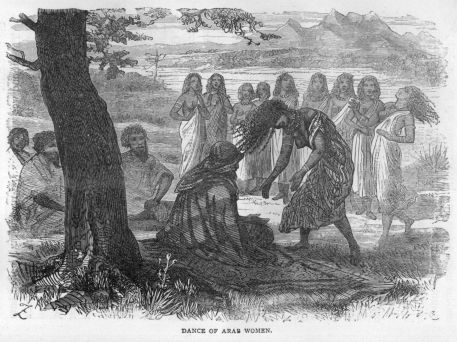 chief walked ahead like a young man, leading his mahary by the nose-cord.
The ground was very rocky and rugged, and looked bare and desolate in the extreme. Several high peaks, which characterise this volcanic region, rose on either side.
The whole caravan consisted of about two thousand camels, of whom two hundred were laden with salt. At night their camp presented many lively and merry scenes, ranging as it did over a wide district illuminated by large fires. Dancing was going forward and the drummers were vying with each other, one especially rivalling their drummer Assam, and performing his work with great skill, caused general enthusiasm among the dancing people.
On their journey on the 29th of December, they found the ground covered with had, a plant regarded by the Arabs as the most nutritious of all the herbs of the desert for the camel. Numerous footprints of the giraffe were seen, besides those of gazelles and ostriches, and also of the large and beautiful antelope (Leucoryx). Here, too, was seen the magaria, a tree which bears a fruit of the size of a cherry, of a light brown colour. When dry it is pounded and formed into little cakes, and is thus eaten.
On the 1st of January, 1851, they fell in with a tribe of the Tagana, whose morality is of the lowest order. Hunting, together with cattle-breeding, is their chief occupation, and on their little swift horses they catch the large antelope as well as the giraffe.
A steep descent of a hundred feet conducted the caravan off the high region of the Hammada to a level plain.
On the 7th they came in sight of a village, where they saw for the first time that style of architecture which extends over the whole of central Africa. The huts are composed entirely of the stalk of the Indian corn, with only a slight support from the branches of trees. They are somewhat low, curved  over at the top. Amid them were seen small stacks of corn, raised on scaffolds of wood about two feet high, to protect them from the white ant and mouse, as also from the jerboa, which is so pretty an object to look at as it jumps about the fields, but is an especial foe to the natives. The people came forth from the villages to offer cheese and Indian corn. They were black pagans and slaves, meanly and scantily dressed, but far more civilised in reality than the fanatical people among whom Barth and his companions had hitherto been travelling.
On the 9th of January the travellers reached Tagelel. From this place there was little danger in their proceeding singly, and it was agreed, in consequence of the low state of their finances, that they should separate, in order to try what each might be able to accomplish single-handed and without ostentation, till new supplies should arrive from home.
Chapter Eleven.
Travels of Dr Barth, continued.
Dr Barth quits Mr Richardson—Reaches Tassawa—Arrives at Kano—Flourishing country—Kano described—Kindly treated—Manufactures and imports—Sets out with his servant Gatroni for Bornou—Hears of Mr Richardson’s death—Enters Kouka—The Vizier meets him—Reception of the Sheikh, a black—Excursion with the Sheikh to Ngornu—Visits Lake Chad—Fishermen on the lake—Journey to Adamawa—Reaches the Binue river—Compelled to return—Sets out for Kanem—Travelling with robber party—Attacked by natives—Robbers beaten—Returns to Kouka—Expedition of Vizier against Mandara—Beautiful, well-cultivated country devoted to destruction—The natives barbarously slaughtered—Slaves taken—Demmo destroyed—Musgu warriors—Natives defend themselves on an island—Returns to Kouka—Journey to Begharmi—Well treated at Loggun—Reaches the magnificent Shary—White ants—Made prisoner and put into chains—Released, and enters Mas-ena—A learned black Faki—Visit to the Sultan—His superstitious fears—Barth returns to Kouka—Death of Dr Overweg.
Parting from Mr Richardson, the two Germans continued on to Chirak, where Overweg quitted Dr Barth, who intended to proceed to Tassawa. The doctor, disposing of a favourite camel, obtained horses for the remainder of the journey and now went on alone; but, accustomed to wander by himself among strange people, he felt in no degree oppressed. His companion was a black, Gajere, a Mahommedan, and, though communicative, rather rude and unable to refrain from occasionally mocking the stranger who wanted to know everything but would not acknowledge the prophet. Mounted on an active steed, he and his attendants soon reached Tassawa, the first large place of Negroland proper which he had seen. Everywhere were unmistakable marks of the comfortable, pleasant sort of life led by the natives. The court-yards, fenced with tall reeds, closed to a certain degree the gaze of the passer-by, without securing to the interior absolute secrecy. Near the entrance was a cool shady hut for the transaction of ordinary business and the reception of strangers. The lower portions of most of the houses consisted of clay, and the upper part of wicker-work, while the roof was composed of reeds only. The dwellings were shaded with spreading trees, and enlivened with groups of children, goats, fowls, pigeons, and, where a little wealth had been accumulated, by a horse, or pack-ox. The men wore white shirts, and trowsers of dark colour, while their heads were generally covered with light caps of cotton cloth. Only the wealthier wore the shawl thrown over the shoulders like the plaid of a Highlander. The dress of the women consisted almost entirely of a large cotton cloth of dark colour, fastened round the neck with a few strings of glass beads.
On the 1st of February Dr Barth approached the important city of Kano. Almost all the people he met saluted him kindly and cheerfully, only a few haughty Fellani passing without a salute.
The villages were here scattered about in the most agreeable way, such as is only practicable in a country in a state of considerable security. Some of them were surrounded by a bush like the broom, growing to a height of ten or twelve feet. The doctor and his native companions passed through a village in which was a large market-place consisting of several rows of well-built sheds. The market women who attached themselves to their cavalcade assured them that they would be able to reach the city that day, but that they ought to arrive at the outer gate before sunset, as at that time it is shut. The party accordingly pushed on; but, after entering the gate, it took them forty minutes to reach the house of Bawu, and, as it was quite dark, they had some trouble in taking possession of the quarters assigned to them by their host.
Kano had been sounding in the traveller’s ears for more than a year; it had been one of the great objects of his journey. It is the chief central point of commerce, a great storehouse of information, and was, Barth considered, the point from whence a journey to more distant regions might be most successfully attempted. At length, after nearly a year’s exertions, he had reached it. He was, however, greatly inconvenienced by not being provided with ready cash, instead of which merchandise had been provided for the expedition, which they had been assured would not only be safer than money, but would also prove more advantageous.
Barth had now to pay away a large sum, and all the smaller articles, which had been carried for barter, having been expended by the heavy extortions to which they had been subjected on the road to Aire—he was placed in much difficulty for want of means. He soon found also that Bawu, Mr Gagliuffi’s agent, could not be implicitly relied on.
The currency of the country consists of cowrie shells, or kurdie, which are not, as in regions near the coast, fastened together in strings of one hundred each, but are separate, and must be counted one by one. The governors of towns make them up in sacks containing twenty thousand each. Private individuals will not receive them without counting them out; those even who made but a few small purchases had to count out five hundred thousand shells.
The doctor had now to borrow two thousand kurdie, which did not amount to the value of a dollar.
He was forbidden to leave his quarters until he had seen the governor, and he was thus kept within them for several days, till he was attacked by fever. At length, on the 18th of February, he received a summons to attend the great man.
Although the distances in Kano are less than those of London, they are very great, and the ceremonies to be gone through are almost as tedious as those of any European court.
Arousing himself, and putting on his warm Tunisian dress, wearing over it a white tobe and a white bournous, he mounted his poor black nag and followed his advocates, Bawu Elaiji and Sidi-Ali, the two latter of whom showed him the most disinterested friendship. It was a fine morning: before him lay the whole scenery of the town, in its great variety of clay houses, huts, sheds, green open places affording pasture for oxen, horses, camels, donkeys, and goats, in motley confusion, with many beautiful specimens of the vegetable kingdom—the slender date-palm, the spreading alleluba, and the majestic silk-cotton tree—the people in all varieties of costume, from the almost naked slave up to the most gaudily-dressed Arab, all formed a most animating and exciting scene.
Passing through the market-place, they entered the quarters of the ruling race—the Fulbe or Fellani, where conical huts of thatched work and the gonda-tree are prevalent.
They first proceeded to the house of the gadado, the lord of the treasury. It was an interesting specimen of the domestic arrangements of the Fulbe, who do not disown their original character of nomadic cattle-breeders. Its court-yard, though in the middle of the town, looked like a farm-yard, and could not be commended for its cleanliness.
The treasurer having approved of the presents and appropriated to himself a large gilt cup, the doctor and his companions were conducted to the audience-hall. It was very handsome, and even stately for this country. The rafters of the elevated ceiling were concealed by two lofty arches of clay, very neatly polished and ornamented. At the bottom of the apartment were two spacious and highly-decorated niches, in one of which the governor was reposing on the gado spread with a carpet. His dress consisted of all the mixed finery of Haussa and Barbary. He allowed his face to be seen, the white shawl hanging down far below his mouth, over his breast.
The governor was highly pleased with the handsome presents he received, and the doctor, notwithstanding the fatigue he had gone through, quickly recovered from his fever.
The next day he rode round the town. Here were a row of shops filled with articles of native and foreign produce, with buyers and sellers in every variety of figure, complexion, and dress, yet all intent upon their little gain. There a large shed full of naked half-starved slaves torn from their homes—from their wives or husbands, from their children or parents—ranged in rows like cattle, and staring desperately upon the buyers, anxiously watching into whose hands it should be their destiny to fall. In another part were to be seen all the necessaries of life; here a rich governor dressed in silk and gaudy clothes, mounted upon a spirited and richly-caparisoned steed, and followed by a host of idle, insolent slaves; there a poor blind man, groping his way through the multitude, and fearing at every step to be trodden down. There were pleasant scenes too, a snug-looking cottage with the clay walls nicely polished, beneath the shade of a wide-spreading alleluba-tree; or a papaya unfolded its large leather-like leaves above a slender, smooth and undivided stem; or the tall date-tree, waving over the whole scene; a matron, in clean black cotton gown, busy preparing the meal for her absent husband or spinning cotton, and at the same time urging the female slaves to pound the corn, and children, naked and merry, playing about in the sun, or chasing a straggling, stubborn goat; earthenware pots and wooden bowls, all cleanly washed, standing in order. In one place dyers were at work, mixing with the indigo some coloured wood in order to give it the desired tint, others drawing a shirt from the dye-pot or hanging it up on ropes fastened to the trees. Further on, a blacksmith, busy with his rude tools making a dagger, a formidable barbed spear, or some more useful instrument of husbandry. Here a caravan appears from Gonga bringing the desired kola-nut, chewed by all who have ten kurdie to spare; or another caravan laden with natron; or a troop of A’sbenawa going off with their salt to the neighbouring towns; or some Arabs leading their camels, heavily laden with the luxuries of the north and east. Everywhere human life was to be seen in its varied forms, the most cheerful and the most gloomy closely mixed together—the olive-coloured Arab, the dark Kanuri with his wide nostrils, the small-featured, light, and slender Ba-fellanchi, the broad-faced Mandingo, the stout, large-boned, and masculine Nupe female, the well-proportioned and comely Ba-háushe woman.
The doctor met with many friends, and was very kindly treated at Kano. He was again attacked with illness, but, recovering, prepared to set out for Kukawa, where he had arranged with Mr Richardson to arrive in the beginning of April. The capital of the large province of Sackatoo contains sixty thousand inhabitants during the busy time of the year, about four thousand of whom belong to the nation by whom the people were conquered. The principal commerce consists in native produce, viz., cotton cloth, woven and dyed here and in the neighbouring towns in the forms either of tobes, the oblong piece of dress of dark colour worn by the women, or plaids of various colours, and the black litham. A large portion of it is sent to Timbuctoo, amounting to three hundred camel-loads annually, thus bringing considerable wealth to the population, for both cotton and indigo are produced and prepared in the country. Leathern sandals are also made with great neatness and exported in large quantities. Tanned hides and red sheep-skins are sent even as far as Tripoli. The chief article of African produce sold in the Kano market is the kola-nut, which has become to the natives as necessary as coffee or tea to Europeans. The slave trade is an important branch of commerce, though the number annually exported from Kano does not exceed five thousand; but very many are sold into domestic slavery, either to the inhabitants of the province itself or to those of the adjoining districts.
The greatest proportion of European goods is still imported by the northern road; but the natural road by way of the great eastern branch of the so-called Niger will in the course of events be soon opened. The doctor deeply regretted that after the English had opened that noble river to the knowledge of Europe, they allowed it to fall into the hands of the American slave-dealers, who began to inundate Central Africa with American produce, receiving slaves in return. Happily an end has come to this traffic. The English did not appear to be aware of what was going on. Space will not allow us to speak further of the various articles of commerce. The principal English goods brought to the market of Kano are bleached and unbleached calicoes and cotton prints from Manchester, French silks, and red cloth from Saxony, beads from Venice and Trieste, a coarse kind of silk from Trieste, paper, looking-glasses, needles and small ware from Nuremberg, sword blades from Solingen, razors from Styria. It is remarkable that so little English merchandise is seen in this great emporium of Negroland.
On the 9th of March the doctor, with immense satisfaction, mounted on his ugly little black nag, rode out of Kano. He had but one servant, his faithful Gatroni, to load his three camels. He was, however, attended by a horseman to see him to the frontier of the Kano territory. The latter, being showily dressed and well mounted, gave himself all possible airs as they rode through the narrow streets into the open fields. Hence he took an easterly course towards Bornou proper.
After passing a number of interesting places, on the 22nd of March the doctor entered the region of Bornou proper. It is here that the dum-palm exclusively grows in Negroland.
He enjoyed an interesting and cheerful scene of African life in the open, straggling village of Calemri, amid which, divided into two distinct groups by a wide, open space, were numerous herds of cattle just being watered. How melancholy came afterwards the recollection of that busy scene, when on his return, three and a half years later, he found it an insecure wilderness, infested by robbers, the whole of the inhabitants having been swept away!
On the 24th, as he was approaching a more woody district than he had hitherto passed, a richly-dressed person rode up to him and gave him the sad intelligence of the death of Mr Richardson at Kukawa. He still could scarcely believe the news; but it was confirmed afterwards by another party of horsemen whom he met. At first he felt as if the death of Mr Richardson involved the return of the mission; but after some consideration he resolved to persevere by himself. On the 2nd of April, pushing on ahead of his camels, on horseback, he approached Kukawa, or Kouka, the capital of Bornou. Proceeding towards the white clay wall which encircles the town, he entered the gate, gazed at by a number of people, who were greatly surprised when he enquired for the residence of the sheikh. Passing the daily market, crowded with people, he rode to the palace, which bordered a large promenade on the east. It was flanked by a mosque, a building of clay with a tower on one side, while houses of grandees enclosed the place on the north and south sides.
On approaching the house of the vizier, to whom he had been directed, he found assembled before it about two hundred gorgeously-dressed horsemen. The vizier, who was just about to mount his horse in order to pay his daily visit to the sheikh, saluted him cheerfully and told him that he had already known him from the letter which had been despatched. While he rode to the sheikh he ordered one of the people to show the doctor his quarters.
Some days passed before he was introduced to the sheikh. In the meantime he had a good deal of trouble regarding the means of paying Mr Richardson’s servants. By great firmness he obtained possession of all Mr Richardson’s property, which would otherwise have been appropriated by the chiefs. He found the sheikh reclining upon a divan in a fine, airy hall. He was of a glossy black colour, with regular features, but a little too round to be expressive; dressed in a light tobe, with a bournous wrapped round his shoulder, and a dark red shawl round his head with great care.
The doctor spent a considerable time in Kukawa, devoting himself to the study of the language, and making enquiries about the surrounding country. Kukawa was not so bustling a place as Kano, but thickly inhabited, and on market-day crowded with people.
He became acquainted with many visitors to the place, among them a hadji, Ibrahim. On one occasion Ibrahim, being unwell, asked the doctor for medicine, and received in return five doses, which he was to take on successive days; but Ibrahim, being in a great hurry to get well, took the whole at once, and was very nearly dying in consequence—an event which would have placed the doctor in a very dangerous position.
His stay at Kukawa was agreeably interrupted by an excursion to Ngornu in which he accompanied the sheikh, and from thence paid a visit to the shores of Lake Chad. Attended by two horsemen and his servants, he set out for the lake. After an hour’s ride they reached swampy ground, and had to make their way through the water, often up to their knees on horseback. After the dry and dreary journey over sands, he found it very pleasant thus wading through deep water. Two boats were seen with men in them, watching evidently to carry off into slavery any of the blacks who might come to cut reeds on the banks of the lagoon. Further on they reached another creek inhabited by hippopotami, which 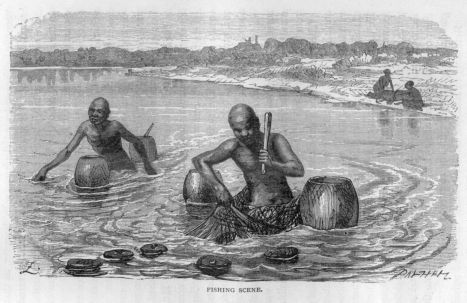 were snorting about in every direction, and by two species of crocodile. There were no elephants seen, however, as that animal always likes to secure a dry couch on the sand, elevated above swampy ground, where it may be free from mosquitoes. On the northern part of the lake, where there are ranges of low sand-hills, immense herds are to be met with.
At the village of Maduwari, he made the acquaintance of a chief, Fugo Ali, who treated him with great kindness and continued his friend ever afterwards. It was at his house, a year and a half later, poor Dr Overweg was destined to expire. Accompanying Fugo Ali, he made a long excursion in the neighbourhood of the lake, which is difficult to be reached, as it is surrounded by forests of reeds and broad creeks. He, however, got to one of these, a fine, open sheet of water, now agitated by a light east wind, which sent the waves rippling on the shore. The surface was covered with water-plants, and numberless flocks of fowl of every description played about. To reach it he had to pass through very deep water which covered his saddle, though he was mounted on a tall horse; and one of his companions on a little pony was swamped altogether, his head and his gun alone being visible from time to time.
The inhabitants on the shores of the lake subsist chiefly on fish, which they catch in an ingenious way. The fisherman takes two large gourds, which he connects by a bamboo of sufficient length to allow him to sit astraddle between them. He then launches forth on the water, taking his nets. These are weighted by little leathern bags, filled with sand and supported by bits of bamboo. Having shot his net, he paddles about with his hands, driving the fish into it, and then, taking them out, kills them with a club, and throws them into the gourds. When they are full, he returns to the shore.
Returning to Kukawa, Dr Barth found encamped outside the town a large slave caravan. There were seven hundred and fifty slaves in the possession of the merchants who went with it. Slaves were at that time the principal export from Bornou.
Soon after this Dr Overweg arrived, looking greatly fatigued and much worse than when the doctor parted from him four months before.
On the 29th of May, 1851, Dr Barth and Dr Overweg set out on a journey to Adamawa, in the south. As they advanced their camels were objects of great curiosity and wonder to the natives, that animal seldom getting thus far south, as it will not bear the climate for any length of time.
The country was generally level, with high conical mountains, separated from each other, rising out of it. Though at first swampy, it became woody and well-watered, in many parts densely inhabited, with numerous villages, where even the Mahommedans have penetrated.
At last Mount Alantika appeared in sight, eight thousand feet above the plain. Near it flows the Binue, that long looked-for stream, supposed to make its way westward to the Niger, and which it had been Barth’s great object to reach. There were no signs of human industry near the river, as, during its floods, it inundates the country on both sides. His feelings may be imagined when he stood at length on the banks of the stream, which here flowed from east to west in a broad and majestic course through an entirely open country, from which only here and there detached mountains rose up in solitary grandeur. Not far-off another river, the Faro, rushed forth, not much inferior to the principal river, descending from the steep sides of the Alantika.
On reaching Yola, the capital of the province of Adamawa, he was, greatly to his disappointment, compelled by the governor to turn back.
Slavery exists on an immense scale in this province, many private individuals having more than a thousand slaves. The governor, Mohamet Lowel, is said to receive five thousand every year in tribute, besides horses and cattle.
This is one of the finest districts in Central Africa, irrigated as it is by numerous rivers besides the Binue and Faro, and being diversified with hill and dale. Elephants were exceedingly plentiful, both black and grey and yellow, and the rhinoceros is also met with in the river. Barth was told that there lives in the river an animal resembling the seal, which comes out at night and feeds on the fresh grass.
His adventurous journey obtained the doctor so much fame at Kukawa that, on his return, a party of horsemen galloped out to salute him, and led him in procession to his house. Mr Overweg, who had in the meantime been exploring Lake Chad in a boat, now rejoined him. His next excursion was to Kanem, on the east of Lake Chad, for which he set out on the 11th of September by the way of its northern shores. He had received a valuable horse from the vizier, which was his companion for the next three years. He was attended by two Arabs and a couple of Fezzan lads he had taken into his service. He soon felt revived by the fresh air of the country. The region through which he passed was usually rich, partly forest and partly cultivated.
On the 18th he was joined by Mr Overweg, who arrived accompanied by a band of horsemen. The horsemen treated the natives with the utmost cruelty, stealing their property wherever they went. One day, meeting some cattle-breeders, they plundered them of their milk and of the very vessels which contained it. On applying to Dr Barth for redress, he was enabled not only to restore to them their vessels, but to make them a few small presents.
Descending from the high ground, they continued their course between the sand-hills and a blue inlet of the lake to the south. Some way to the right they caught sight of a whole herd of elephants, ranged in regular array like an army of rational beings, slowly proceeding to the water.
It had been supposed that Lake Chad is salt. This is not the case. The natron or soda, which is procured in the neighbourhood, is found alone in the ground. When an inundation reaches a basin filled with soda, the water of course becomes impregnated. The soda, indeed, has very little effect so long as the basin is deep, and does not begin to make itself felt till the water becomes shallow.
Shortly afterwards, passing a grove of mimosa, two of the horsemen who had been in front came galloping back with loud cries. On approaching the spot they saw a large snake hanging in a threatening attitude from the branches of a tree. On seeing the strangers it tried to hide itself, but after several balls had struck it, it fell down, and its head was cut off. It measured eighteen feet seven inches in length, and five inches in diameter.
They now joined themselves to a party of Arabs, by whom they hoped to be protected on their journey. The expedition was not without danger. One night they were aroused by a terrible screaming and crying from the women, and shouts of “Mount! mount!” Another band of freebooters had attacked the camels, and, having put to flight two or three men and killed a horseman, had driven off part of the herd. The robbers were pursued and overtaken, when they gave up their booty. The lamentations of the females for a man who had been slain sounded woefully through the remainder of the night.
Two days afterwards the Arabs were in great commotion, in consequence of the most handsome among the female slaves, who composed part of the spoil that was to be taken to the vizier, having made her escape during the night. They were eagerly searching for her from dawn of day, but could not find her. At length they discovered her necklace and clothes, and the remains of her bones—evident proofs that she had fallen a prey to the wild beasts.
As they advanced eastward the situation of the Arab robbers became daily more dangerous; nothing was thought of but to retrace their steps westward.
The doctor was lying in his tent suffering from fever, when the alarm was given that the enemy had arrived within a short distance of the camp. He heard firing, when Overweg, mounting his horse, galloped off, calling on his friend to follow him. The doctor, while his servant was saddling his horse, flung his bournous over himself, and, grasping his pistols and gun, mounted and started off towards the west, ordering Mahomet to cling fast to his horse’s tail. Not a moment was to be lost, as the enemy had begun to attack the east side of the camp. Soon afterwards, however, he saw the Arab horsemen rallying to attack the enemy, who had dispersed in order to collect the spoil, and, overtaking Mr Overweg, informed him that the danger was over.
On returning to the camp they found that their luggage and even their tent had gone. The Arabs, however, pursuing the enemy, got back most of their things.
The natives again attacked the camp in the evening, but were beaten off. Hearing, however, that a large body of Wadey horsemen were to join their enemies, the Arabs retreated, and the doctor and his friends, finding a caravan on its way to Kukawa, returned with it on the 25th of November.
After a rest of ten days the persevering travellers again set forth with the sheikh and his vizier on an expedition against Mandara, the principal object of which was to replenish their coffers and slave-rooms, a secondary one to punish the prince of that small country, who, protected by its mountains, had behaved in a very refractory manner. The vizier treated the travellers with great courtesy, and desired them to ride by his side. The army, which was of considerable size, advanced in regular order. At first they amused themselves with hunting. One day a giraffe was caught. The vizier was attended by eight female slaves and horsemen, and the same number of led horses. The unfortunate natives had to provide grain for the army wherever it marched. They spent a day at a village where the troops had to lay in a supply of corn, as they were about to pass the border region, between the cities of the Mahommedans and those of the Pagan tribes, which, as is generally the case in this part of the world, have been reduced to desolation. The vizier made Mr Overweg a present of a small lion. On a previous occasion he had given him a ferocious little tiger cat, which though young was extremely fierce, and quite mastered the young lion. They, however, soon died, in consequence of the continual swinging motion they had to endure on the backs of the camels in the heat of the day.
Passing through a dense forest region, frequented by numerous elephants, they arrived at Gabari, the northernmost of the Musgu villages, surrounded by fields of native grain. The inhabitants had fled; for, though nominally under the protection of the rulers of Bornou, they had thought it prudent to take care of their own safety. Their village was completely plundered, the soldiers thrashing out their grain and loading their horses with it, while their goats, fowls, and articles of furniture fell a prey to the greedy host. The village had presented an appearance of comfort, and exhibited the industry of the inhabitants. Its dwellings were built of clay; and each court-yard contained a group of from three to six huts, according to the number of wives of the owner.
Continuing their march, on the 28th of December they reached the country devoted to destruction. The country was pleasant in the extreme; stubble-fields surrounded numerous groups of huts and wide-spreading trees, on whose branches was stored up the nutritious grass of those swampy grounds for a supply in the dry season. Broad, well-trodden paths, lined by thick fences, wound along through the fields in every direction. Near the village were regular sepulchres, covered in with large well-rounded vaults, surrounded by an earthen urn. While the doctor was contemplating this scene he found that the vizier and his party had galloped on in advance. On looking round he saw only a few Shooa horsemen. Following them, he soon found that he was entirely cut off from the main body of the army. A scene of wild disorder presented itself; single horsemen were roving about to and fro between the fences of the villages; here a poor native, pursued by sanguinary foes, running for his life in wild despair; there another dragged from his place of refuge; while a third was seen stealing by, under cover of a fence, and soon became a mark for numerous arrows and balls. A small troop of Shooa horsemen were collected under the shade of a tree, trying to keep together a drove of cattle which they had taken. Accompanying another band, the doctor at length rejoined the vizier. News had just been received that the pagans had broken through the line of march near the weakest point, and that the rear had been dispersed. Had these poor pagans been led on by experienced chieftains, they would have been able in their dense forests, where cavalry is of little use, to do an immense deal of damage to their cowardly invaders, and might easily have dispersed them altogether.
A large number of slaves had been caught, and in the evening a great many more were brought in, altogether between five hundred to a thousand. To the horror of the travellers, not less than one hundred and seventy full-grown men were mercilessly slaughtered in cold blood, the greater part of them being allowed to bleed to death, a leg having been severed from the body. The unwarlike spirit and dilatory proceedings of the army, large as it was, enabled the inhabitants of other villages to make their escape.

The village of Demmo was next to be attacked. On reaching it, however, a large watercourse, two miles in width, appeared before them, across which the natives made their escape. The scene on its banks was highly interesting, and characteristic of the equatorial regions of Africa. Instead of the supposed lofty range of the Moon, only a few isolated mountains had been seen, and in place of a dry desolate plateau they had found wide and extremely fertile plains, less than one thousand feet above the level of the sea, and intersected by innumerable broad water-courses.
The village, which only a few moments before had been the abode of comfort and happiness, was destroyed by fire and made desolate. Slaughtered men, with their limbs severed from their bodies, were lying about in all directions.
Led by a treacherous Musgu chief, the army attacked other places, till the river Loggun put a stop to their further advance. These unfortunate Musgus are ugly-looking fellows. Only the chiefs wear clothing, consisting merely of the skins of wild animals, thrown over their shoulders. They adorn their heads with strange-looking feather caps, and their bodies with red paint, staining their teeth of the same colour. Their weapons are long spears, and formidable knives for throwing at their foes, while they ride strong, active horses, without saddles, guiding them by halters fastened round their muzzles.
Having accomplished these mighty deeds, the army halted for two days, for the purpose of distributing the slaves taken during the expedition. The proceeding was accompanied by the most heart-rending scenes, caused by the number of young children and even infants who were distributed, many of the poor creatures being mercilessly torn from their mothers, never to see them again. There were scarcely any full-grown men.
Another expedition was undertaken by a part of the army, when, as they reached the river, a dozen courageous natives were seen occupying a small elevated island with steep banks, separated from the shore by a narrow but deep channel. Here they set at defiance the countless host of enemies, many of whom had firearms. Not one of the small band of heroes was wounded, either the balls missed their aim, or else, striking upon the wicker-work shields of the pagans, were unable to penetrate. The doctor was urged to fire, and on his refusing to do so was abused by the soldiers.
The doctor and his companion returned to Kukaka on the 1st of February, 1852.
On the 4th of March, Dr Barth again set out on a journey to Begharmi, a considerable distance to the south-east of Lake Chad. His only conveyance was his own horse and a she-camel for his luggage. The next day Ovenveg, who had resolved to explore Lake Chad in a boat, parted from him, and he proceeded on his hazardous expedition alone, his course being to the south-east, along the shores of the lake. He passed several towns in a state of decay. In that of Ngla the palace of the governor was of immense size for Negroland. It had large and towering clay walls, having the appearance of an enormous citadel.
He was hospitably treated at the large town of Loggun. Here the river of the same name, which falls into Lake Chad, is from three hundred and fifty to four hundred yards across. About forty or fifty boats of considerable size floated on the stream. He made an excursion on the river, when he excited great admiration by firing at a crocodile, though he did not kill the creature. The sultan formed so high an estimation of the traveller, that he wished him to remain to assist him in fighting his enemies, but the doctor, being anxious to proceed eastward, induced him at length to let him take his departure.
On the 16th of March he left Loggun to endeavour to penetrate into regions never before trodden by European foot. He crossed the river in a boat, while his horse and camel swam over. Passing through a dense forest, he observed the footprints of the rhinoceros, an animal unheard of in the western parts of Negroland. It is greatly feared by the inhabitants. Little further in advance he suddenly beheld through the branches of the trees the splendid sheet of a river far larger than that of Loggun. All was silence, the pellucid surface undisturbed by the slightest breeze; no vestige of human or animal life, with the exception of two hippopotami which had been basking in the sun on shore, and now plunged into the water. This was the real Shary, the great river of the Kotoko, which with the river Loggun forms a large basin, giving to this part of Negroland its characteristic feature.
After some time a ferry-boat appeared, but the ferrymen declined carrying the party over before they had informed their master. While waiting for them, a large troop of pilgrims on their way to Mecca, mostly from the western parts of Negroland, came up, and the doctor made them a present of needles. The boatmen, returning, declared that the chief of the village would not allow him to pass. He was, however, not to be defeated, and, proceeding along the banks of the river, at length found some ferrymen who did not hesitate to take him across. He was, however, soon again stopped, and, after repeated attempts to push on, was compelled to take up his residence at a place called Bakada.
Here the white ants waged relentless war against his property. Though he had placed his bed on the top of some poles, he found that they not only had reached the summit, but had eaten through both the coarse mats, finished a piece of his carpet, and destroyed other articles.
The doctor had sent a messenger to the capital, but as he did not return, he determined to set out.
He had reached Mela, on the bank of the river, when, as he was seated in his tent, the head man of the village arrived, followed by a number of others, and he found himself suddenly seized and his feet placed in irons, his property being carried off. He was conveyed to an open shed, where he was guarded by two servants of the lieutenant-governor. His servants were also seized, but ultimately set at liberty that they might attend on him. He was liberated, however, the next day by the arrival of Hacik, whose friendship he had formed at Bakada, and who promised that he should without further difficulty visit the capital.
On the 27th of April Mas-ena, the capital, appeared beyond a fine extent of verdure. He had a good house provided for him, and numbers of people came to visit him; among them was Faki Sambo, who was totally blind. He had travelled much and was well versed in Arabic literature, having read even portions of Aristotle and Plato, translated into Arabic. The doctor had many interesting conversations with this wonderfully well-informed man.
The lieutenant-governor, however, grew suspicious of the traveller, as did many of the people. He had a narrow escape by being called in to visit a sick man, when, convinced that his illness was serious, he refused to give any medicine. The man died a few days afterwards, and his death would, had he done as he was asked, have been attributed by the savage people to him.
On the 6th of July the caravan from Fezzan arrived, bringing despatches from Kukawa, sent out from England, authorising him to carry on the objects of the expedition on a more extensive scale, while means were placed at his disposal for doing so. It was hoped in England that he and his companion would be able to cross the unknown region of equatorial Africa and reach the south-east coast; but, as the state of his health made this impossible, he was glad to  find that Lord Palmerston suggested he should endeavour to reach Timbuctoo. To this plan, therefore, he turned his attention. He, however, found it very difficult to leave the city. The sultan, after some time, gave him an audience; that is to say, the doctor saw him, but the great man did not allow himself to be seen. Earth presented his gifts, and received in return, at his request, a supply of the manufactures of the country, instead of a female slave and a white camel, which the sultan offered him. He heard that the sultan entertained the fear that he might poison or kill him by a charm, and that he had repeatedly consulted his learned men, or councillors, how he should protect himself against his witchcraft.
After repeated delays, on the 10th of August he was allowed to take his departure. The sultan had set his eyes on his horse, and, just as he was starting, sent to ask him to sell it; but this he positively declined doing, and no attempt was made to seize the animal.
He reached Kukawa after an interesting journey, without a mishap, on the 21st of August. He found Mr Overweg very sickly. Unhappily, he thought himself strong enough to go out shooting, and was so imprudent as to go into deep water after water-fowl, and remain all the day afterwards in his wet clothes. He was seized with a severe illness in consequence, but believed that he should get better if removed to the country home of their friend Fugo Ali. He here became much worse, and in two days died. A grave was dug for him near the borders of the lake in the exploration of which he had taken so much interest.
Dejected at his lonely situation, and unwilling any longer to stay in a place which had become intolerable to him, Barth determined to set out as soon as possible on his journey towards the Niger.
Chapter Twelve.
Travels of Dr Barth concluded.
Barth sets out for Timbuctoo—Detained at Katseena—Reaches Say, on the Niger—Crosses River—Meets an Arab, who offers to escort him—Disguised as an Arab—Enters Bambarra—Swampy country—Embarks on the Niger—Voyage up the river to Kabara—Rice to Timbuctoo—Enters the city—The Sheikh El Bakay—Compelled to remain in his house—Timbuctoo described—The fanatics threaten his life—Accompanies the Sheikh into the desert—Returns to the city—Hears about Mungo Park—The river rises—For fear of disturbances from the fanatics, goes into the desert again—Sets out with the Sheikh towards Kouka—Lions and hippopotami—Reaches Sackatoo—Hears of expedition under Dr Vogel—Dangers of journey—Reaches Bundi—Meets Dr Vogel—Repast, but no wine—Well received by Sheikh Omar at Kouka—Detained four months—Returns with a caravan to Tripoli—Discovery of Binue river most important result of journey.
On the 25th of November, 1852, all arrangements being made, Dr Barth set out on his venturesome expedition to Timbuctoo, intending to proceed first to the town of Say, on the banks of the Niger. He had parted on friendly terms with the sheikh, who sent him two fine camels as a present. He had as head servant his faithful Gatroni, who had gone to Fezzan and had lately returned, five other freemen, and two slaves, besides another personage, who acted as his broker, well accustomed to travel in Negroland; but, being an Arab, the doctor only put confidence in him as long as circumstances were propitious.
He encamped, as was his custom on commencing a journey, only two miles from the city. It was the coldest night he had experienced in Negroland, the thermometer being only nine degrees above the freezing-point.
On the 25th of December he arrived at Zinder, the frontier town of Bornou, built round and about masses of rock, which rose out of the ground, the picturesqueness of the place being increased by groups of date-palms. Water, which collects at short depths below the surface, fertilises a number of tobacco-fields, and gives to the vegetation around a very rich character.
On the 5th of February, 1853, the party entered the town of Katseena, where he laid in a supply of articles. Here they were detained for a considerable time, as an expedition was setting out against the Fulbe, and it would have been dangerous to proceed until it was known what direction the hostile army would take. By the 25th of March, however, he was ready to continue his journey, the governor himself having arranged to accompany him for some days, as the whole country was exposed to imminent danger, and, further on, a numerous escort was to attend them.
Interesting as his journey was, it is impossible to describe the various places he visited or the adventures he met with. Day after day he travelled on, sometimes detained for weeks and months together, at one town or another, though he was never idle, always employing himself in gaining information, or in studying the language of the district through which he was to pass.
On the 19th of June he was close to the Niger, and hoped that the next day he might behold with his own eyes that great river of Western Africa which has caused such immense curiosity in Europe, and the upper part of the large eastern branch of which he had himself discovered. Elated with such feelings, he set out early the next morning, and, after a march of two hours through a rocky wilderness covered with dense bushes, he obtained the first sight of the river, and in another hour reached the place of embarkation, opposite the town of Say. Here he beheld, in a noble, unbroken stream, the mighty Niger gliding along in a north-north-east and south-south-west direction, though at this spot, owing to being hemmed in by rocky banks, only about seven hundred yards broad. It had been seen by Mungo Park flowing eastward, and it was therefore, till the Landers descended it, supposed that it might possibly make its way into some vast lake in Central Africa. On the flatter shore opposite, a large town lay spread out, the low ramparts and huts of which were picturesquely overtopped by numbers of slender dum-palms.
After waiting some time the boats he had sent for, which were about forty feet in length and four to five in width, arrived. They were formed by hollowing out two trunks of trees, which were sewn together in the centre. His camels, horses, people, and luggage having crossed in safety, he followed in the afternoon, intending to survey the course of the river between the point where it has become well-known by the labours of Mungo Park, Caillie, and the Landers.
The language spoken here, the Songhay, differs materially from that with which he was acquainted, and he therefore was less able to converse with the people than he had been before.
Quitting Say, he left the Niger behind him, or rather on his right-hand side, proceeding north-west towards Timbuctoo. The country on this side of the Niger is thickly inhabited, and he passed numerous towns and villages on his way.
At the village of Namantugu he met an Arab from the west, called Wallati, who undertook to escort him safely to the town of Timbuctoo. He was a handsome fellow. His dress consisted of a long black gown, with a black shawl wound round his head, and he moved along at a solemn pace; he reminded the doctor of the servants of the Inquisition.
The inhabitants of this place were clothed in the purest white, even the little children wearing round their heads turbans composed of strips of white cotton.
They had now entered a region full of water, the soil presenting very little inclination to afford it the means of flowing off.
He was detained some time in the populous town of Dore, and on the 21st of July set out on the most dangerous stage of his journey to Timbuctoo. Many large sheets of water had to be crossed, and occasionally swamps, which greatly impeded their progress. It was the rainy season, and he was thus at times unable to proceed.
As he had now to traverse the province of Dellah, which is ruled by a governor subject to the fanatical chief of Mas-ena, who would never allow a Christian to visit his territory, the doctor was obliged to assume the character of an Arab.
At the town of Bambarra, situated among the creeks and back-waters of the Niger, he met an Arab native of Tisit, who had made the pilgrimage to Mecca. The stranger cross-questioned him very narrowly about the place from which he came, and the doctor had reason to fear he should be discovered. However, the man’s whole appearance inspired him with such confidence that he felt sure that he might be trusted.
On the 27th of August the doctor set out on his last journey by land, in order to reach Sarawano, the place where he was to embark on the river.
It is only during the rainy season that there is communication by water to Timbuctoo, which lies directly north from this place.
He here engaged a boat with two cabins of matting, one in the prow and the other in the stern. She was built of planks sewn together in a very bungling manner.
A labyrinth of creeks, back-waters, and channels spreads over the whole of this country, affording water-communication in all directions.
On the 1st of September the voyage commenced, and the doctor naturally felt in high spirits when he found himself floating on the river which was to carry him all, the way to the harbour of Timbuctoo. The water was greatly obstructed by long grass, which made rowing impossible, and the boat was therefore impelled by poles, generally moving at the rate of between two and three miles an hour. At night, a storm threatening, the boat was moored in a wide grassy creek; but the numerous swarms of mosquitoes molested them greatly during the night. The barking sounds of some animals were heard, which the doctor found proceeded from young crocodiles.
On the 2nd of September the boatmen made use of their oars, sometimes passing broad open spaces, and again getting into narrow channels.
Barth and his attendants were tolerably well supplied with fish, which they either purchased or which were caught by the boatmen with a harpoon.
They at last entered a large confluent of the Niger, and glided pleasantly along, a short distance from the northern bank, which was thickly clothed with trees, till at length, darkness approaching, they crossed, fully a thousand yards, to the opposite bank, where the vessel was moored near a village. Most of the party slept on shore, but others made themselves comfortable in the boat and on the top of the matting which formed the cabins.
The next day, they entered the mighty stream, along which they proceeded, here running from the west to the east. It was at this spot about a mile across, and its magnitude and solemn magnificence, as the new-moon rose before them, with with the summer lightning at times breaking through the evening sky, inspired his servants with awe and alarm, while he stood on the roof, looking out for the city, the great object of his journey.
Leaving the Niger and passing along a series of channels, the doctor landed at the village of Kabara on the 5th of September. Here he took up his quarters in a comfortable house while he despatched messengers to the city. On their return, accompanied by the brother of the Sheikh El Bakay, Sidi Alawate (who turned out a great rogue and cheated him in every way), with several followers, on the 7th of September his cavalcade set out for Timbuctoo.
The short distance was soon traversed, the doctor riding on ahead to avoid the questions of those who met the party, as, had they felt the slightest suspicion with regard to his character, they might have prevented his entering the town, and thus endangered his life. Unfortunately he encountered a man who addressed him in Turkish, a language he had almost forgotten, and he had some difficulty in making a reply.
Traversing the rubbish accumulated round the clay walls of the city, and leaving on one side a row of dirty reed huts which encompassed the place, he entered some narrow streets and lanes which scarcely allowed two horses to proceed abreast. He was not a little surprised at the populous and wealthy character which this quarter of the town exhibited, many of the houses rising to the height of two stories, their façades evincing even an attempt at architecture and adornment.
On passing the house of the Sheikh El Bakay, he was desired to fire a pistol to do him honour, but, as his arms were loaded with ball, he declined doing this, and soon reached the house destined for his residence, thankful to find himself safely in his new quarters.
Timbuctoo has never been the real capital of a negro empire, but, on account of its becoming the seat of Mahommedan learning and worship, it enjoyed greater respect than Gogo, which was the real capital; and, on account of its greater proximity to Morocco, the little commerce which remained in that distracted region was here concentrated. It has, however, undergone many changes during the fearful convulsions which constantly occur in that region.
During the absence of the sheikh the doctor found it prudent to remain within the walls of his house, though he received visits from numerous people. From the flat roof of his house he was, however, able to enjoy air and exercise, and at the same time obtained a view of what was going on in the city. For some time he suffered severely from fever, while rain and thunder-storms occurred nearly every day.
He here heard much about Major Laing, who, after being almost killed by the Tawarek, was kindly received in the camp of the sheikh’s father. He tried to obtain the major’s papers, but found that they had all been destroyed. He was much pleased with the Sheikh El Bakay, who treated him with real kindness, and regretted that he could not keep his troublesome brother Alawate in order. On one occasion he made the doctor fire off his six-barrelled pistol, in front of his house, before a numerous assemblage of people. This excited great astonishment, and exercised much influence upon his future safety, as it made the people believe that he had arms all over his person, and could fire as many times as he liked.
The city of Timbuctoo is about three miles in circumference. The town is laid out partly in rectangular, partly in winding streets, covered with hard sand and gravel. Besides two market-places there are few open areas. There are about nine hundred and eighty clay houses, and a couple of hundred conical huts, of matting mostly, on the outskirts. Three large mosques and three smaller ones are the only places of worship, there being no other public buildings of any size. It is divided into quarters, one of which is especially inhabited by Mahommedans, though the larger number of the people profess to have faith in the Prophet. There are about thirteen thousand settled inhabitants, and, during the time of the greatest traffic, from five to ten thousand people visit the city.
A fanatical party, hearing that a Christian had come to the place, made various attempts to destroy him. By the advice of his kind protector, the sheikh, he determined to leave the city with him, and take up his residence in the desert. As he rode forth on his white mare, the natives thronged the streets in order to get a glance at the Christian stranger. He was thankful to find himself once more in the fresh air of the desert. Here he passed several days in the most quiet and retired manner, much recovering his health.
He then paid another visit to Timbuctoo, and was able to explore the city and the great mosque, Jingere-Ber, which made a great impression on his mind by its stately appearance. He had again, however, to return to the camp of El Bakay, where the perils of his position kept increasing, and he in vain urged his dilatory protector to enable him to make his escape. His enemies were legion—fresh parties arriving constantly to seize him, dead or alive. A band of them actually made a descent on the camp, but were driven back by the bold front his friends exhibited.
He had an interesting visit from an Arab chief, who was acquainted with Mungo Park, and gave him a full account of the way in which he had been attacked by the Tawarek as he descended the great river in his boat.
On the 12th of December Barth heard that Ali, a fanatical chief of the Berabish, had arrived with a large body of followers, to take his life. Suddenly, however, Ali fell ill and died, and the people believed that it was a judgment on him, as his father had killed Major Laing, whose son it was supposed the doctor was. Many of the Berabish, indeed, came to El Bakay to beg his pardon and to obtain his blessing, saying that they would no longer impede the stranger’s departure.
The river had gradually been rising, and on the 25th of December the water entered the wells situated to the south of the town.
On the 4th of January, 1854, the first boat from Kabara reached Timbuctoo, and other boats arriving laden with corn, the supply shortly became plentiful and cheap.
The inundation attained its greatest height towards the end of January, an event possessing almost the same importance as that of the rising of the Nile.
The city depends entirely upon commerce, the only manufactures being confined to the art of the blacksmith and a little leather-work.
Another year, 1854, of the persevering traveller’s stay in Negroland, began with the fervent prayer that he might return home before the end of it. His hopes were raised that he might soon be able to set off. Numberless disappointments, however, occurred.
On the 17th of March, by the advice of his friends, he returned to the camp, such a step being deemed essential for the security of the town and their own personal interests. He was here kept till the 19th of April, and even then his friend the Sheikh El Bakay, could not overcome his habitual custom of taking matters easy, and the sun was already high in the sky and very hot before the camels were loaded and the caravan began to move.
In consequence of the progress the French were making in Algiers at this time, much suspicion was attached to the doctor, as the people could not but think that his journey to the country had some connection with them. Even after this he was detained till the 17th of May, at an encampment amidst swamps, when at last the news arrived that the sheikh, who had left them, had gone on ahead, and all was joy and excitement.
On overtaking the sheikh, who, as he awoke from his slumbers, received the doctor with a gentle smile, despatches were delivered to him from England. One from Lord John Russell expressed the warmest interest in his proceedings, and others informed him that Dr Vogel, with two sergeants, had set out to join him, and that he would probably meet them in Bornou. He was much surprised that he received no news from his friend the vizier, as the parcel had evidently come by way of Bornou—little aware, at the time, of the murder of that friendly officer.
The following day they passed through a dense forest, said to be frequented by lions. Keeping along the course of the river, which was here very shallow, crocodiles were seen in abundance, and anxiety was felt for the horses, which were pasturing on the fine rank grass at its borders.
Owing to the dilatory character of his friend the sheikh, the progress was very slow, but he was thus enabled to enter into conversation with the natives, and obtained much information.
On his way he visited Gogo, situated at the southern limits of the Great Desert, one portion on the banks of the river, and another on an island, that to the east having been inhabited by the Mahommedans, the other by idolators. He found the place, however, in a most ruinous condition, even the mosque itself being in a dilapidated state. Indeed, the once great city of Negroland now consists only of from three to four hundred huts, grouped in separate clusters and surrounded by heaps of rubbish, which indicated its former site. Here it is believed that Mungo Park was buried.
While encamped at a place called Borno, close to the banks of the river, a number of hippopotami made their appearance, snorting fiercely at being disturbed, and put their horses to flight. At times they interrupted the intercourse between the banks, and in the evening became still more noisy, when they wanted to come out for their usual feed.
He was fortunate in having so able a protector as the Sheikh El Bakay, who, in consequence of his supposed sacred character, was treated with honour whenever he went.
After visiting a number of places, both on the banks and eastward of it, he reached, on the 24th of August, Sackotoo. Here he received intelligence of the arrival of five Christians, with a train of forty camels, at Kukawa, and had little doubt that it was the expedition under Dr Vogel.
On the 14th of October he arrived in Kano, where he found everything prepared for his reception. He here received the intelligence that Sheikh Omar, of Kukawa, had been dethroned, his vizier slain, and that in a fierce battle a number of his other friends had fallen. He had made up his mind, therefore, to proceed to Aire, instead of returning to Bornou; but, subsequently hearing that Omar had been again installed, he kept to his former determination.
At length, escaping from greedy rulers, hostile populations, wild beasts, swamps, rains and fevers, he at length reached Bundi, near Kouka, on the 30th of November.
He had again left that place, when, riding through the forest with his head servant, he saw advancing towards him on horseback a young man, of fair complexion, dressed in a tobe, with a white turban, and accompanied by two or three blacks, also on horseback. The stranger was Dr Vogel, who dashed forward, when the two travellers gave each other a hearty reception on horseback. Dismounting in the forest, they unpacked their provisions and sat down to enjoy a social repast, Barth, however, being greatly disappointed that not a bottle of wine, for which he had an extraordinary longing, had been brought.
Vogel, with Corporal Church and Private Macguire, had come out to strengthen the expedition and to follow up Barth’s discoveries. Vogel succumbed to the climate about a year afterwards, on a journey to Adamawa. After his death Macguire was killed on his way home, and Church returned with Dr Barth.
While Vogel pursued his journey to Zinda, Barth proceeded on to Kukawa. He found the village of Kaleemri, which, on his outward journey, was so cheerful and industrious, now a scene of desolation—a few scattered huts being all at present to be seen. Such is, unhappily, the fate of numerous towns and villages in this distracted country.
His old friend, the Sheikh Omar, who had been reinstated, sent out a body of horsemen to give him an honourable reception on his return to Kukawa. Here he had to remain four months, greatly troubled by financial difficulties, and finding that a considerable portion of his property had been stolen by the rascality of one of his servants. His health, too, was greatly shattered.
It was not till the 4th of May that, in company with a Fezzan merchant, Kolo, he commenced his return journey, with a small caravan, towards Tripoli. At Barruwa they laid in a supply of dry, ill-smelling fish, which constitutes the most useful article of exchange in the Tebu country. The region to his right, over which he had previously passed, was now entirely covered with water from the overflowing of the Chad, which had submerged several villages.
He met with no unusual adventures during his long, tedious journey northward across the desert.
At Mourzouk he had the pleasure of meeting Mr Frederick Warrington. He here remained six days, discharging some of his servants, and among them his faithful Gatroni.
Some tribes of Arabs had here rebelled against the Turks, and he was in some danger while in their hands. Escaping, however, from them, he reached Tripoli in the middle of  August, and, embarking at the end of four days, arrived safely, on the 6th of September, in London.
Although much of the country he had passed over was already known, no previous African traveller more successfully encountered and overcame the difficulties and dangers of a journey through that region.
The most important result of his adventurous journey was the discovery of a large river, hitherto unknown, falling into the Chad from the south, and of the still larger affluent of the Quorra, the mighty Binue, which, rising in the far-off centre of the continent, flows through the province of Adamawa.
The courage and perseverance of Dr Barth, while for five years travelling many thousand miles, amidst hostile and savage tribes, in an enervating climate, frequently with unwholesome or insufficient food, having ever to keep his  energies on the stretch to guard himself from the attacks of open foes or the treachery of pretended friends, have gained for him the admiration of all who read his travels, and place him among the first of African travellers.
Chapter Thirteen.
Captain Speke’s discoveries of the Source of the Nile.
Speke’s previous career—Joins an expedition to the Somali country—The Somali—Arrive at Berbera—Attacked by robbers—His escape and return to Aden, and finally to England—Joins Captain Burton in an expedition to the Mountains of the Moon—Sets out for Bombay, and afterwards to Zanzibar—Engage Sheikh Said and their escort—Cross to Kaole—Arrive at Caze, and received by the Arab merchants—Porters desert—Illness of Captain Burton, and carried to Zimbili—Sets out with fresh porters—A sight of the Tanganyika Lake—The Mountains of the Moon—Nearly blind—Up the lake to Ujiji—Arrive at Kawele—Their journey on the lake continued—An alarm—Camp at night—Shells—A storm—Arrive at Sultan Casanga’s territory—The people—Arrive at the fish market of Kabizia—A singa—Cross to Kasenge—Reception—The Chief described—The results of slavery—Hears of a large river—Cannot obtain a boat—Returns to Ujiji—Sets out to explore a river that falls into the lake—Tricks of the paddlers—Returns to Ujiji—Help arrives—Returns to Cazé—Sets out to explore the country in the neighbourhood of the Nyanza Lake—Tricks of his escort—Villages described—Detained by a Sultana—The reception she gives Speke—Illness in the caravan—Inon—Leaving Isamiro, the Nyanza appears in sight—The scene—He called the lake Victoria Nyanza—Descends to Muanza—The source of the Nile!—Return journey, and arrives at Caze—Arrives with Captain Burton in England.
Captain, then Lieutenant, John Hanning Speke, the son of a gentleman of property in England, was an officer in the Indian army, and had taken part under Lord Gough in the great battles of Ramnugger, Chillianwalla, and others. He had, at intervals during leave, travelled in the Himalaya Mountains, as well as through other parts of India and in Thibet, for the purpose of collecting specimens of the fauna of those regions to form a museum in his father’s house. While thus occupied, he formed the design of traversing Africa as soon as he could obtain furlough, visiting the Mountains of the Moon and descending the Nile with the same object in view.
At the end of ten years’ service, on obtaining furlough, hearing that an expedition was to be sent by the Indian Government, under the command of Lieutenant Burton, to explore the Somali country, a large tract lying due south of Aden, and separated from the Arabian coast by the Gulf of Aden, he offered his services, and was accepted. Two other Indian officers, Lieutenants Stroyan and Heme, also joined the expedition.
The Somali are Mahommedans, descendants of Arabs who have intermarried with negroes. They are a savage, treacherous race, noted for their cheating and lying propensities; in figure tall, slender, light, and agile, scarcely darker than Arabs, with thin lips and noses, but woolly heads like negroes. Their ancestors, having taken possession of the country, drove out its former Christian inhabitants, who retreated northward.
Caravans, however, pass through their country to their only port and chief market, Berbera, which at the time of the fair is crowded with people, though entirely deserted for the rest of the year.
It was proposed that the expedition should follow the route of these caravans, or accompany one of them, and thus penetrate through the country, into the interior.
Considerable time was spent in making excursions for short distances, during which Lieutenant Speke shot a large number of wild animals; but unfortunately the abban, or petty chief, who undertook to be his protector and guide, proved to be a great rascal, and cheated and deceived him in every possible way.
The Somali are keen and cunning sportsmen, and have various methods of killing elephants, ostriches, and gazelles. 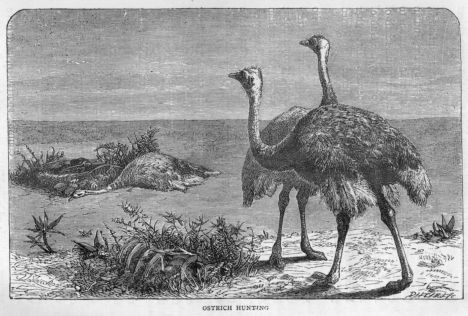 They fearlessly attack an elephant, on foot, one man only being mounted on a horse, who gallops in front, and while the animal pursues him, the others rush in and hamstring him with their knives. Ostriches are caught by throwing down poison at the spots where they feed. The Somali also hunt them, on the backs of their hardy little ponies. The ostrich is a shy bird, and is so blind at night that it cannot feed. A Somali, knowing this, providing himself with provisions for two or three days, sets off in search of them; showing himself to the ostriches, he is discovered, but takes care to keep at a distance. They stalk off, and he follows at the same rate, but never approaches sufficiently near to scare them. At night the birds, unable to see, stop, but cannot feed. He, meantime, rests and feeds with his pony, resuming the chase the next day. He follows the birds in the same way as at first, they from constant fasting becoming weaker, till after the second or third day he is able to ride in among them and knock them down in succession.
The party had at length secured, after considerable trouble, the camels and horses they required, and were encamped at Berbera, which was completely deserted by its inhabitants, when they were surprised at night by a large band of robbers. Lieutenant Stroyan was killed and Lieutenant Speke was made prisoner and desperately wounded, but, springing to his feet just as a robber was about to run him through with his spear, he knocked over his assailant with his hands, though bound together, and made his escape to the sea-shore, to which the rest of the party had already fled. They were here taken on board a vessel, which had providentially put in the day before, and in her returned to Aden.
Although his first expedition had terminated so disastrously, on his arrival in England Lieutenant Speke again volunteered to accompany Lieutenant Burton on an expedition to survey that part of the centre of Africa, in the neighbourhood of the Mountains of the Moon, where an enormous lake was supposed to exist, equal in size to the Caspian Sea.
Returning to Bombay, Lieutenant Speke and Lieutenant Burton obtained their outfit, and set sail on the 3rd of December, 1856, for Zanzibar, on board the HEIC sloop of war, “Elphinstone.”
At Zanzibar they were warmly welcomed by the consul, Colonel Hamerton, and well received by the Sultan Majid, who, from his intelligence and good disposition, appeared likely to be a favourite with his people.
As they had arrived during the dry season, they were unable to commence their journey, and some time was spent in visiting different parts of the coast.
Their intention was to proceed to Ujiji, on the shores of Lake Tanganyika, which was then supposed to be the southern end of the great central lake. They engaged as their kafila bashi, or head of their caravan, a well-disposed man, Sheikh Said. A body of the sultan’s Belooch soldiers, under a jemadar, or officer, and a party of slaves armed with muskets, formed their escort. Besides them, they had their private servants, Valentine and Gaetano, Goa men, who spoke Hindostanee, and a clever little liberated black slave, Bombay by name, who had been captured from his native place, Uhiyou, to the east of Lake Nyanza, and sold to an Arab merchant, by whom he was taken to India. Having served this master for several years, on his death he obtained his liberation, and made his way to Zanzibar. Here he took service in the army of the sultan, and was among those engaged by Lieutenant Speke. He was a remarkably quick, clever, honest little fellow, and in most instances could thoroughly be trusted.
Crossing to Kaole, on the mainland, on the 16th of June, 1857, they were detained there collecting baggage animals. The first five hundred miles of their journey to Caze, a 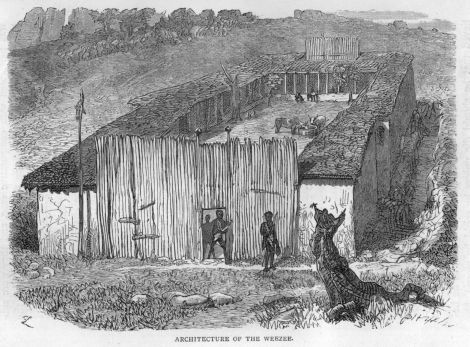 place in the centre of Unyamuezi, the Land of the Moon, was performed with comparative ease, and they were subjected only to annoyances from the savage people and the grasping chiefs on the way.
Caze is occupied by Arab merchants as a central trading depot, and is rapidly increasing. It was supposed that Ujiji would be found much of the same character. Here they arrived on the 7th of November, 1857. They were kindly received by the Arab merchants, especially by Sheikh Snay, and had a house appropriated to them.
The houses of the Weezee, the people among whom they were living, are built of mud, generally with flat tops: this description is called a tembe. Others, however, are in the form of haystacks, and are constructed with great care; the door is very small, so that only one person can enter at a time. The villages are surrounded with a strong fence, having taller stakes on each side of the entrance, which are decorated either with blocks of wood or the skulls of those who have been put to death.
The flat-roofed houses are built round a large court, the outer walls serving as the walls of the villages, all the doors opening into the interior.
Some time was usefully spent in gaining information from the Arabs and others, who told them that the Nyanza was a separate lake to that of Ujiji, and that from the latter a river ran out to the northward—though, at first, they had stated that it ran into it. Besides this they heard that vessels frequented some waters to the north of the equator—a fact of which Speke had heard when travelling in the Somali country.
Their porters, who had come from this part of the country, all left them, and they found the greatest difficulty in procuring others.
Captain Burton here fell dangerously ill, and, as he believed that he should die unless he could be moved, his companion had him carried to Zimbili, where, by degrees, he recovered. At length a sufficient number of porters being obtained, they broke ground on the 10th of January, 1858.
Proceeding due west about one hundred and fifty miles, when moving over the brow of a hill, they came in sight of the lovely Tanganyika lake, which could be seen in all its glory by everybody but Lieutenant Speke, who was suffering from inflammation of the eyes, caught by sleeping on the ground while his system was reduced by fevers and the influence of the vertical sun. It had brought on almost total blindness, and every object before him appeared clouded by a misty veil.
They were now standing on the eastern horn of a large, crescent-shaped mass of mountains, overhanging the northern half of the lake. These mountains Speke supposed to be the true Mountains of the Moon.
Reaching the margin of the lake, a canoe was hired to carry them to Ujiji, the chief place on its shores, frequented by Arabs. The lake at which they now arrived was supposed to be three hundred and eighty miles long, and thirty to forty broad. Its waters are sweet and abound with fine fish. The sides of the lake are thickly inhabited by numerous negro tribes, among whom are the Wabembe cannibals, into whose territory the Arabs dare not venture.
The explorers took up their abode in the deserted house of an Arab merchant, at a small village called Kawéle; but, unfortunately, the chief of the place, Kannina, was a tyrannical extortioner, and caused them much trouble. They wished to engage an Arab dhow for navigating the lake, sufficiently large to carry provisions and to resist hostile attacks, but could only obtain a canoe. It was long and narrow, hollowed-out of the trunk of a single tree. She carried Bombay, Gaetano, two Belooch soldiers, and a captain, with  twenty stark-naked savage sailors. In this Speke set out on the 3rd of March, 1858, while Burton, too sick to move, remained at Ujiji. Speke and his attendants had moved but a short distance along the shore, when a storm came on, and they had to camp till the afternoon of the 5th, when all got on board.
To pack so many men together was no easy matter. Speke had his bedding amidships, spread on reeds; the cook and bailsman sat facing him, and Bombay and one Belooch behind him. Beyond them, in couples, were the crew, the captain taking post in the bows. The seventeen paddles dashed off with vigour. Steering southwards, they passed the mouth of the Ruche river. They paddled on all night, and after dawn landed in a secluded nook for breakfast. All were busily occupied. Gaetano dipped his cooking-pot in the sea for water, greatly to the annoyance of the natives, who declared that the dregs from it would excite the appetites of the crocodiles, who would be sure to follow the boat. They have as great an aversion to the crocodile as English seamen have to a shark.
Suddenly there was a cry that foes were coming. All, jumping up, rushed to the boat, some seizing one thing, some another, the greater number being left on the ground. A breathless silence followed; then one jumped on shore to secure a pot, and then another, and, gaining courage, they searched around, crawling cautiously in the bush, others stealthily moving along, till at last a single man was pounced upon, with an arrow poised in hand. He was one of eight or ten men of a tribe whom they declared to be a rough, lawless set of marauders. They therefore broke his bow and arrows, and, though some of the crew proposed taking his life, he was allowed to go. The sailors, on their return, each vaunted the part he had taken in the exploit, boasting as though a mighty battle had been won.
They passed along a border of aquatic reeds, tenanted by crocodiles and hippopotami, the latter staring, grunting, and snorting, as if vexed at the intrusion on their privacy. Many parts of the shore were desolate, the result of slave-hunting and cattle-lifting parties.
“At night Speke’s tent is pitched; the men build huts for themselves with boughs, covering the top with grass, two men at the most occupying a hut. When it rains they are covered by their mats, but, as they are all stark-naked, the rain can do them no harm.
“Interesting shells, unknown to the conchological world, are picked up, numbers of which are lying on the pebbly beach.
“They are delayed again by another storm. The superstitious captain will answer no questions, for fear of offending the ugaga, or church, whilst at sea; he dreads especially to talk of places of departure and arrival, for fear ill luck should overtake them.
“Fourteen hours are occupied in crossing the lake, when they reach a group of islands belonging to Sultan Casanga. The sailors and his people fraternise, and enjoy a day of rest and idleness. At night they are attacked by a host of small black-beetles, one of which gets into Speke’s ear and causes him fearful pain, biting its way in, and by no means can he extract it. It, however, acts as a counter-irritant, and draws away the inflammation from his eyes.
“The population of the neighbouring shore is considerable, the inhabitants living in mushroom huts, and cultivating manioc, sweet potato, and maize, and various vegetables. The people dress in monkey-skins, the animals’ heads hanging in front and the tails depending below. They are very inquisitive, and, by their jabberings and pointings, incessantly, want Speke to show everything he possesses.
“He gets away the next day, and reaches a fish market, in the little island of Kabizia, in time to breakfast on a large, black-backed, scaleless monster, the singa. The sailors considering it delicious, are disinclined to move on.
“Again detained by a high wind, they cross, at noon on the 11th, to Kasenge, where Sheikh Hamer, an Arab merchant, receives Speke with warm and generous hospitality. His house is built with good, substantial walls of mud, and roofed with rafters and brushwood, the rooms being conveniently partitioned off to separate his wife and other belongings, with an ante-room for general business. His object in coming to the remote district is to purchase ivory, slaves, and other commodities. He is the owner of the dhow which Speke is anxious to obtain; but though he professes his readiness to lend it, he makes numberless excuses, and finally Speke has to continue his voyage in his small canoe.
“Slavery is the curse of this beautiful region. Here for a loin-cloth or two a mother offers eagerly to sell one of her offspring and deliver it into perpetual bondage to his Belooch soldiers. Whole villages are destroyed, in the most remorseless manner, by the slave-hunters to obtain their victims. The chiefs of the interior are as fond of gain as those on the coast, and this sets one against the other, for the sake of obtaining slaves to sell.
“From Hamed Speke learns that a large river runs from the Mountains of the Moon into the northern end of the lake.
“On the 13th the dhow comes in, laden with cows, goats, oil, and ghee; but, though Speke offers five hundred dollars for her hire, the Arab merchant still refuses to lend her.
“On the 27th Speke commences his return voyage, and arrives on the 31st at Ujiji.
“Captain Burton is somewhat recovered, and, though unfit to travel, insists on starting in the canoe to explore the head of the lake—the chief, Kannina, offering to accompany them. Their object is to examine the river which is said to fall into it. They start in two canoes, the chief and Captain Burton being in the largest. In eight days they arrive at Uvira. The chief, however, will go no further, knowing that the savages of the Warundi are his enemies. He confirms the statement that the Rusizi River runs into the lake.
“The black naked crews are never tired of testing their respective strengths. They paddle away, dashing up the water whenever they succeed in coming near each other, and delighting in drenching the travellers with the spray. Their great pleasure appears in torturing others, with impunity to themselves. They, however, wear mantles of goat-skins in dry weather, but, as soon as rain comes on, they wrap them up, and place them in their loads, standing meantime trembling like dogs which have just emerged from the water.
“In no part of Africa have they seen such splendid vegetation as covers this basin from the mountain-tops to the shores.”
On returning to Ujiji, Speke wished to make a further survey of the lake, but was overruled by Captain Burton, who considered that their means were running short; indeed, had not an Arab merchant arrived, bringing supplies, they would have been placed in an awkward position. This timely supply was one of the many pieces of good fortune which befell them on their journey. Help had always reached them when they most required it.
Captain Burton, being too ill to walk, was carried in a hammock, and, setting out, they returned safely to Caze.
They were here again received by their friend, Sheikh Snay, who gave Speke an account of his journey to the Nyanza Lake. His statements were corroborated by a Hindoo merchant called Musa, who gave him also a description of the country northward of the line, and of the rivers which flowed out of the lake.
Eager to explore the country, Speke arranged to set off, leaving Captain Burton at Caze. Sheikh Snay, however, refused to accompany him, and he had in consequence some difficulty in arranging with the Belooch guard.
On the 9th of July, 1858, he was able to start his caravan, consisting of twenty porters, ten Beloochs, and his servants. The Beloochs were, from the first, sulky and difficult to manage, while the pagazis, or porters, played all sorts of tricks, sometimes leaving their loads and running off to amuse themselves, and in the evening they would dance and sing songs composed for the occasion, introducing everybody’s name, and especially Mzimza, the wise or white man, ending with the prevailing word, among these curly-headed bipeds, of “Grub! grub! grub!”
The Weezee villages are built in the form of a large hollow square, the outer wall of which serves for the backs of the huts; another wall forms the front, and the intermediate space is partitioned off by interior earthen walls. The roofs are flat, and on them are kept firewood, grain, pumpkins, and vegetables. Each apartment contains a family, with their poultry and cooking utensils; some, however, are devoted exclusively to goats and cows.
They passed through forests of considerate size; caravans from the north were also met with. At one place the country was found to be governed by a sultana, the only one they met with in their travels. She did her utmost to detain Speke, not allowing him an interview till the next day. On paying the lady a visit, he was received by an ugly, dirtily-garbed old woman, though with a smiling countenance, who, at his request, furnished him eggs and milk. At length the sultana appeared—an old dame with a short, squat figure, a nose flabby at the end, and eyes destitute of brows or lashes, but blessed with a smiling face. Her dress consisted of an old barsati, dirtier even than her maid’s. Her fingers were covered with rings of copper wire, and her legs staggered under an immense accumulation of anklets, made of brass-wire wound round an elephant’s tail or that of a zebra. On her arms were solid brass rings, and from other wire bracelets depended a variety of brazen, horn, and ivory ornaments.
Squatting by his side, the sultana, after shaking hands, felt Speke all over, wondering at his dress. She insisted on his accepting a bullock; but, anxious to be off, he declined waiting for it. She at last consented to send it after him by some of his porters, who were to remain for the purpose.
He was constantly detained by the laziness of his ftagazis, who, when getting into a rich country, preferred eating the meat, eggs, and vegetables they could obtain.
He unfortunately had only white beads with him, which which were not the fashion: with coloured beads he could have purchased provisions at a much cheaper rate. Had the people also been addicted to wearing cloth, instead of decorating themselves with beads, he would with his cloth have been able to make his purchases much more advantageously. As the country is overstocked with common beads, it is far more economical to obtain high-priced than low-priced beads when preparing to start from Zanzibar.
As warfare was going on, it was necessary to make a tortuous track to avoid the combatants.
The jemadar and two Beloochs complained of sickness and declared they could not march, and poor Gaetano fell ill and hid himself in the jungle, being thus left behind. Men were sent off to search for him, and the next day the Beloochs brought him in, looking exactly like a naughty dog going to be punished.
The sultans, however, of the different villages were generally friendly.
When a desert tract had to be passed, the men went on well enough, hoping to obtain food at the next cultivated district.
On the 30th of July Speke discerned, four miles off, a sheet of water which proved to be a creek at the most southern portion of the Nyanza, called by the Arabs the Ukerewe Sea.
Passing amidst villages and cultivated grounds, they descended to a watercourse which he called the Jordan. It is frequented by hippopotami, and rhinoceros pay frequent visits to the fields.
Iron is found in abundance in this district, and nearly all the iron tools and cutlery used in this part of Eastern Africa is manufactured here: it is, in truth, the Birmingham of the land. The porters therefore wished to remain to make purchases of hoes.
A rich country was passed through, and on the 4th of August the caravan, after leaving the village of Isamiro, ascended a hill, when the vast expanse of the pale blue waters of the Nyanza burst suddenly on the travellers’ gaze. It was early morning. The distant sea-line of the north horizon was defined in the calm atmosphere between the north and west points of the compass. An archipelago of islands intercepted the line of vision to the left. The sheet of water extended far away to the eastward, forming the south and east angle of the lake, while two large islands, distant about twenty or thirty miles, formed the visible north shore of this firth. Ukerewe is the name by which the whole lake is called by the Arabs. Below, at no great distance, was the debouchure of the creek along which he had travelled for the last three days.
This scene would anywhere have arrested the traveller by its peaceful beauty. He writes enthusiastically—
“The islands, each swelling in a gentle slope to a rounded summit clothed with wood, between the rugged, angular, closely-cropping rocks of granite, seen mirrored in the calm surface of the lake, on which is here and there detected the a small black speck—the tiny canoe of some Muanza fisherman. On the gentle-shelving plain below me blue smoke curled above the trees, which here and there partially concealed villages and hamlets, their brown thatched roofs contrasting with the emerald green of the beautiful milk-bush, the coral bunches of which clustered in such profusion round the cottages, and formed alleys and hedgerows about the villages, as ornamental as any garden shrub in England.
“But the pleasure of the mere view vanished in the presence of those more intense and exciting emotions which were called up by the consideration of the commercial and geographical importance of the prospect before me. I no longer felt any doubt that the lake at my feet gave birth to that interesting river the source of which has been the subject of so much speculation and the object of so many explorers. The Arab’s tale was proved to the letter. This is a far more extensive lake than the Tanganyika: so broad, you could not see across it, and so long that nobody knew its length.”
To this magnificent lake Speke gave the name of Victoria Nyanza.
Note. It has since been proved to be only one and the least considerable of the sources of the White Nile, by the later discoveries of Baker and Livingstone.
He now descended to Muanza, on the shores of the lake, having altogether performed a journey of two hundred and twenty-six miles from Cazé.
He was here kindly treated by Sultan Mahaya, with whom an Arab merchant, named Mansur, was residing, who gave him much valuable information.
Taking a walk of three miles along the shores of the lake, accompanied by Mansur and a native, the greatest traveller of the place, he ascended a hill whence he could obtain a good view across the expanse of water spread out before him. Several islands were seen, but some so far-off as scarcely to be distinguishable. Facing to the west-north-west was an unbroken sea horizon, and he calculated that the breadth of the lake was over a hundred miles. The native, when asked the length of the lake, faced to the north, and, nodding his head, indicated by signs that it was something immeasurable, adding that he thought it probably extended to the end of the world.
Poor Mansur had been robbed of his merchandise, by a sultan whose territory was on the shore of the lake, and he had very little chance of obtaining redress.
Sultan Mahaya was considered the best and most just ruler in those quarters; and when Speke proposed crossing the lake to the island of the Ukerewe, he urged him on no account to make the attempt. Mansur also did his best to dissuade him, and, boats not being obtainable, he was compelled to give up his design.
Speke, arguing from the fact that the source of the Nile at the highest spot which had been reached, two thousand feet above the level of the sea, is considerably lower than the surface of the lake, which is four thousand feet, is of opinion that the waters of the lake must flow into it. The lake has, however, numerous feeders which flow from the Mountains of the Moon. Indeed, from that and several other reasons, he felt convinced that the lake is the real and long-looked-for source of the Nile.
As no boats of any size were to be obtained, and having gained all the information he could, regretting that he was unable to extend his explorations, he bade the Sultan and his Arab friend adieu, and on the 6th of August commenced his return journey.
The country through which he passed abounds in game. Elephants are finer here than in any other part of the world, and some have tusks exceeding five hundred pounds the pair in weight. The people are mostly agricultural; and when a stranger comes among them, they welcome him, considering his advent as a good omen, and allow him to do what he likes.
His black attendants were in much better humour on the return journey, as they were now going home, and, as the country was well stocked with cattle, they could obtain as much meat as was required. One village through which he passed, being full of sweet springs, had a dense population possessing numerous herds of cattle.
“If they were ruled by a few score of Europeans, what a revolution a few years would bring forth! An extensive market would be opened to the world, and industry and commerce would clear the way for civilisation and enlightenment,” Speke remarks.

The country is also, he says, high, dry, and healthy, while the air is neither too hot nor too cold.
On the evening of the 25th of August he marched into Cazé, under the influence of a cool night and bright moon, his attendants firing off muskets and singing, while men, women, and children came flocking out, piercing the air with loud, shrill noises. The Arabs all came forth to meet him and escort him to their depot, where Captain Burton, who had been very anxious as to his safety, greeted him, numerous reports having been set afloat about him.
Captain Burton being now restored to health, they set off together for Zanzibar, whence they shortly afterwards returned to England.
Chapter Fourteen.
Captains Speke and Grant’s travels from the Island of Zanzibar, on the East Coast of Africa, to Lake Victoria Nyanza, and down the Nile.
Sets out with an expedition to prove that the source of the Nile is the Nyanza River—Arrives at Zanzibar—Crosses to Bagomoyo with his followers—The caravan—Squabbles among the porters—The march begun for Caze—The traveller’s routine of work—Tribute demanded by Chiefs—The Hottentot escort and the Waguana escort—The country of the Wazaramo—Their manners and customs—Kidunda—Along the Kinganni River to the country of the Usagara—Grant is ill—Ugogo—The place and people—Encamp on a clearing called Kanyenye, where some of the porters abscond—Shooting rhinoceros—New Year’s Day at Round Rock—Unyamuezi, the Country of the Moon—Caze—Received by his friend Musa—The Unyamuezi people—Set out and reach Mininga—Liberates a slave—Illness, and returns to Caze—The custom of the Weezee—Reaches Mininga again—Difficulties—Arrives at the district of the Chief, Myonga—The Pig—Difficulties again—Speke’s illness—Is attended by Lumeresi, who afterwards makes extortionate demands and causes trouble—Alarming news of Grant.
Captain Speke, who had already made two expeditions into Africa, which have been described—on the second of which he discovered the great lake, Victoria Nyanza—started, on the 20th of July, 1858, on a third expedition, in the hopes of proving that the Nile has its source in that lake. He was accompanied by an old Indian brother officer, Captain Grant.
Having reached the island of Zanzibar, where some time was spent in collecting a sufficient band of followers, they left Zanzibar on the 25th of September, in a corvette placed at  their disposal by the sultan, and crossed over to Bagomoyo, on the mainland.
They had, as their attendants, ten men of the Cape Mounted Rifles, who were Hottentots; a native commandant, Sheikh Said; five old black sailors, who spoke Hindostanee; in addition to Bombay, Speke’s former attendant, factotum, and interpreter; a party of sixty-four Waguana blacks, emancipated from slavery; and fifteen porters of the interior. The two chief men, besides Said, were Bombay and Baraka, who commanded the Zanzibar men. Fifty carbines were distributed among the elder men of the party, and the sheikh was armed with a double-barrelled rifle, given to him by Captain Speke. The sultan also sent, as a guard of honour, twenty-five Beloochs, with an officer, to escort them as far as Uzaramo, the country of the Wazaramo. They had also eleven mules to carry ammunition, and five donkeys for the sick.
Their whole journey was to be performed on foot. As there were no roads, their luggage was carried on the backs of men.
Some time was spent among the porters in squabbling, and arranging their packs. Their captain, distinguishable by a high head-dress of ostrich plumes stuck through a strip of scarlet flannel, led the march, flag in hand, followed by his gang of woolly-haired negroes, armed with spears or bows and arrows, carrying their loads, either secured to three-pronged sticks or, when they consisted of brass or copper wire, hung at each end of sticks carried on the shoulder. The Waguana followed in helter-skelter fashion, carrying all sorts of articles, next came the Hottentots, dragging the mules with the ammunition, whilst lastly marched the sheikh and the Belooch escort, the goats and women, the sick and stragglers bringing up the rear.
One of the Hottentot privates soon died, and five others were sent back sick. About thirty Seedees deserted, as did nearly all the porters, while the sheikh also soon fell sick.
On the 2nd of October, having bid farewell to Colonel Rigby, the British consul at Zanzibar, who took deep interest in the expedition, and afforded it every assistance in his power, the march began.
They had first before them a journey of five hundred miles to Caze, the capital of the country of the Moon, in latitude 5 degrees south, longitude 33 degrees east, being due south of Lake Victoria Nyanza. This was a small portion, however, only of the distance to be performed.
Captains Speke and Grant divided the duties of the expedition between them, the first mapping the country, which is done by timing the rate of march, taking compass-bearings, noting the water-shed, etcetera. Then, on arriving in camp, it was necessary to boil the thermometer to ascertain the altitude of the station above the sea-level, and the latitude by the meridional altitude of a star; then, at intervals of sixty miles, lunar observations had to be taken to determine the longitude; and, lastly, there was the duty of keeping a diary, sketching, and making geological and zoological collections. Captain Grant made the botanical collections and had charge of the thermometer. He kept the rain-guage and sketched with water colours, for it was found that photography was too severe work for the climate.
The march was pursued before the sun was high, then came breakfast and a pipe before exploring the neighbourhood, and dinner at sunset, then tea and pipe before turning in at night.
Scarcely had they commenced the journey than the petty chiefs demanded tribute, which it was necessary to pay. The porters also struck for higher wages; but, the leaders going on, they thought better of the matter, and followed.
The poor Hottentots suffered much from the climate, and were constantly on the sick-list. The Waguana treated them with great contempt, and one day, while a little Tot was trying to lift his pack on his mule a large black grasped him, pack and all, in his muscular arms, lifting them above his head, paraded him round the camp amid much laughter, and then, putting him down, loaded his mule and patted him on the back.
“A day’s march being concluded, the sheikh and Bombay arrange the camp, issuing cloths to the porters for the purchase of rations, the tents are pitched, the Hottentots cook, some look after the mules and donkeys, others cut boughs for huts and fencing, while the Beloochs are supposed to guard the camp, but prefer gossiping and brightening their arms, while Captain Grant kills two buck antelopes to supply the larder.”
The country through which they were passing belongs to to the tribe of Wazaramo. It is covered with villages, the houses of which are mostly of a conical shape, composed of hurdle-work and plastered with clay, and thatched with grass or reeds. They profess to be the subjects of the Sultan of Zanzibar. They are arrant rogues, and rob travellers, when they can, by open violence. They always demand more tribute than they expect to get, and generally use threats as a means of extortion. One of their chiefs, the Lion-Claw, was very troublesome, sending back the presents which had been made him, and threatening dire vengeance if his demands were not complied with. Further on, Monkey’s-Tail, another chief, demanded more tribute; but Speke sent word that he should smell his powder if he came for it; and, exhibiting the marksmanship of his men, Monkey’s-Tail thought better of it, and got nothing.
The people, though somewhat short, are not bad-looking. Though their dress is limited, they adorn themselves with shells, pieces of tin, and beads, and rub their bodies with red clay and oil, till their skins appear like new copper. Their hair is woolly, and they twist it into a number of tufts, each of which is elongated by the fibres of bark. They have one good quality, not general in Africa: the men treat the women with much attention, dressing their hair for them, and  escorting them to the water, lest any harm should befall them.
Kidunda was reached on the 14th of October. Hence the Belooch escort was sent back the next day, with the specimens of natural history which had been collected.
Proceeding along the Kinganni River they reached the country of the Usagara, a miserable race, who, to avoid the slave-hunters, build their villages on the tops of hills, and cultivate only just as much land among them as will supply their wants. Directly a caravan appears, they take to flight and hide themselves, never attempting resistance if overtaken. Their only dress consist of a strip of cloth round the waist.
Captain Grant was here seized with fever, and the sickness of the Hottentots much increased.
A long day’s march from the hilly Usagara country led the party into the comparatively level land of Ugogo. Food was scarce, the inhabitants living on the seed of the calabash to save their stores of grain.
The country has a wild aspect, well in keeping with the natives who occupy it. The men never appeared without their spears, shields, and assegais. They are fond of ornaments, the ordinary one being a tube of gourd thrust through the lower lobe of the ear. Their colour is somewhat like that of a rich plum. Impulsive and avaricious, they forced their way into the camp to obtain gifts, and thronged the road as the travellers passed by, jeering, quizzing, and pointing at them.
On the 27th, they encamped on the eastern border of the largest clearing in Ugogo, called Kanyenye, stacking their loads beneath a large gouty-limbed tree. Here eight of the Wanyamuezi porters absconded, carrying off their loads, accompanied by two Wagogo boys.
Speke set off to shoot a rhinoceros at night. Having killed one, two more approached in a stealthy, fidgetty way. Stepping out from his shelter, with the two boys carrying his second rifle, he planted a ball in the largest, which brought him round with a roar in the best position for receiving a second shot; but, on turning round to take his spare rifle, Speke found that the black boys had scrambled off like monkeys up a tree, while the rhinoceros, fortunately for him, shuffled away without charging. He hurried back to let his people know that there was food for them, that they might take possession of it before the hungry Wagogo could find it. Before, however, they had got the skin off the beast, the natives assembled like vultures, and began fighting the men. The scene, though grotesque, was savage and disgusting in the extreme; they fell to work with swords and hatchets, cutting and slashing, thumping and bawling, up to their knees in the middle of the carcass. When a tempting morsel was obtained by one, a stronger would seize it and bear off the prize—right was now might. Fortunately no fight took place between the travellers and the villagers. The latter, covered with blood, were seen scampering home, each with a part of the spoil.
The Sheikh Magomba did his utmost to detain them, sending his chief, Wazir, in an apparently friendly manner, to beg that they would live in his palace. The bait, however, did not take—Speke knew the rogue too well. Next day the sheikh was too drunk to listen to anyone, and thus day after day passed by. The time was employed in shooting, and a number of animals were killed. Magomba, however, induced nearly the whole of the porters to decamp, and there was great difficulty in obtaining others to take their places. An old acquaintance, whom they met in a caravan, urged them not to attempt to move, as he thought that it would be impossible for them to pass through the wilderness depending only on Speke’s and Grant’s guns for their support.

Still Speke resolved to push on, and most of the men who had deserted came back.
To keep up discipline, one of the porters, who had stolen seventy-three yards of cloth, which was found in his kit, received three dozen lashes, and, being found to be a murderer and a bad character, he was turned out of the camp.
They spent New Year’s Day at Round Rock, a village occupied by a few Wakimbu, who, by their quiet and domestic manners, made them feel that they were out of the forest. Provisions were now obtained by sending men to distant villages; but they were able to supply the camp with their guns, killing rhinoceros, wild boar, antelope and zebra.
On the 23rd of January they entered Unyamuezi, or the country of the moon, little inferior in size to England, but cut up into numerous pretty states. The name is abbreviated to Weezee.
On the 24th they reached Cazé, where Speke had remained so long on his former visit. His old friend, Musa, came out to meet them, and escorted them to his tembe, or house, where he invited them to reside till he could find porters to carry their property to Karague, promising to go there with them himself. They found here also Sheikh Snay, who, with other Arab merchants, came at once to call on them. Snay told him that he had an army of four hundred slaves prepared to march against the chief, Manua Sera, who was constantly attacking and robbing their caravans. Speke advised him not to make the attempt, as he was likely to get the worst of it. The other Arab merchant agreed that a treaty of peace would be better than fighting.
Musa gave him much information about the journey northward, and promised to supply him with sixty porters from his slave establishment, by which arrangement Speke would have a hundred armed men to form his escort.
Musa loudly praised Rumanika, the King of Karague, through whose dominions the expedition was to pass.

Some time, however, was of necessity spent at Caze in 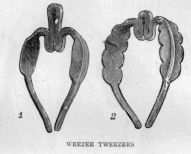 making preparations for the journey, the two travellers employing themselves during it in gaining information about the country.
The Wanyamuezi, among whom they were residing, are a polite race, having a complete code of etiquette for receiving friends or strangers; drums are beat both on the arrival and departure of great people. When one chief receives another, he assembles the inhabitants of the village, with their drums and musical instruments, which they sound with all their might, and then dance for his amusement. The drum is used, like the bugle, on all occasions; and, when the travellers wished to move, the drums were beaten as a sign to their porters to take up their burdens. The women courtesy to their chief, and men clap their hands and bow themselves. If a woman of inferior rank meets a superior, she drops on one knee and bows her head; the superior then places her hand on the shoulder of the kneeling woman, and they remain in this attitude some moments, whispering a few words, after which they rise and talk freely.
The Wanyamuezi, or, as they are familiarly called, the 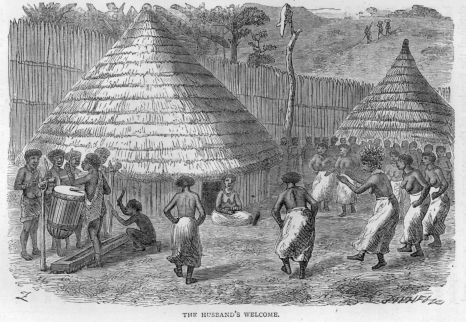 Weezee, are great traders, and travel to a considerable distance in pursuit of their business.
When a husband returns from a journey, his favourite wife prepares to receive him in a peculiar manner. Having put on all her ornaments, to which she adds a cap of feathers, she proceeds, with her friends, to the principal wife of the chief, when, the lady coming forth, they all dance before her, taking care to be thus occupied when the husband makes his appearance, a band of music playing away and making as much noise as possible with their instruments.
On the 7th of February news was brought that Sheikh Snay had carried out his intention of attacking Manua Sera, whom he found ensconced in a house at Tura. Manua, however, made his escape, when Snay plundered the whole district, and shot and murdered every one he fell in with, carrying off a number of slaves. The chief, in consequence, threatened to attack Cazé as soon as the merchants had gone off on their expeditions in search of ivory.
Soon after this it was reported that Snay and other Arabs had been killed, as well as a number of slaves. This proved to be true.
Finding that nothing more could be done at Caze, the travellers, assembling their caravan, commenced their march northward on the 17th of March.
On the 24th they reached Mininga, where they were received by an ivory merchant named Sirboko. Here one of Sirboko’s slaves, who had been chained up, addressed Speke, piteously exclaiming: “Oh, my lord, take pity on me! When I was a free man, I saw you on the Tanganyika lake; my people were there attacked by the Watuta, and, being badly wounded, I was left for dead, when, recovering, I was sold to the Arabs. If you will liberate me, I will never run away, but serve you faithfully.” Touched by this appeal, Speke obtained the freedom of the poor man from his master, and he was christened Farham, or Joy, and enrolled among his other freemen.
The abominable conduct of the Arabs, who persisted in attacking the natives and devastating the country, placed the travellers in an awkward position. The Hottentots, too, suffered so much from sickness that, as the only hope of saving their lives, it was necessary to send them back to Zanzibar. Speke therefore found it necessary to return to Caze, which he reached on the 2nd of May, leaving Grant, who was ill, behind at Mininga.
He here heard of a tribe of cannibals, who, when they cannot get human flesh, give a goat to their neighbours for a dying child, considering such as the best flesh. They are, however, the only cannibals known in that district.
They were still in the country of the Weezee, of whose curious customs they had an opportunity of seeing more. Both sexes are inveterate smokers. They quickly manufacture their pipes of a lump of clay and a green twig, from which they extract the pith. They all grow tobacco, the leaves of which they twist up into a thick rope like a hay-band, and then coil it into a flattened spiral, shaped like a target. They are very fond of dancing. A long strip of bark or cow-skin is laid on the ground, and the Weezee arrange themselves along it, the tallest man posting himself in the centre. When they have taken their places the musicians begin playing on their instruments, while the dancers commence a strange chant, more like a howl than a song. They bow their heads, putting their hands on their hips and stamping vigorously. The men not dancing look on, encouraging their friends by joining in the chorus, while the women stand behind without speaking. Meantime, the elders sit on the ground drinking pomba. On one of these occasions the chief, who was present, drank more pomba than any of the people.
While the party were thus engaged, two lads, with zebra  manes tied over their heads, and two bark tubes, formed like huge bassoons, in their hands, leaped into the centre of the dancers, twisting and turning and blowing their horns in the most extraordinary manner. The men, women, and children, inspired by the sound of the music, on this began to sing and clap their hands in time.
Pomba is a sort of spirituous liquor, produced from a kind of grain grown in the country, which is cultivated by women, who nearly entirely superintend the preparation of the drink.
They received a visit from Sultan Ukulima, of Unyamuezi, a fine hale old man, who was especially fond of this beverage, drinking it all day long. He was pleasant enough in manner, and rather amusing when he happened not to be tipsy. Being fond of a practical joke, he used to beg for quinine, which he would mix slyly with pomba, and then offer it to his courtiers, enjoying the wry faces they made when partaking of the bitter draught. He used to go round to the houses of his subjects, managing to arrive just as the pomba-brewing was finished, when he would take a draught, and then go on to the next. He sometimes sucked it through a reed, just as a sherry cobbler is taken, while one of his slaves held the jar before him.
The women and men do not drink it together. It is the custom of the ladies to assemble in the house of the sultana, and indulge in it in her company.
The women, as has been said, are employed in the cultivation of the grain from which it is made. When it is green, they cut off the ears with a knife. These are then conveyed to the village in baskets, and spread out in the sun to dry. The men next thrash out the grain with long, thin flails. It is afterwards stacked in the form of corn-ricks, raised from the ground on posts, or sometimes it is secured round a tall post, which is stuck upright in the ground, swelling out in the centre somewhat in the shape of a fisherman’s float. When 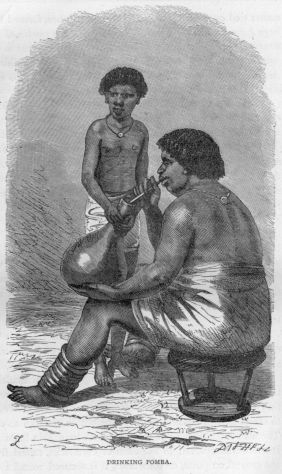 required for use, it is pounded in wooden mortars, and afterwards ground between two stones.

Speke reached Mininga again on the 15th, where he found Grant greatly recovered. During his absence three villagers had been attacked by a couple of lions. The men took to flight, and two gained the shelter of their hut, but the third, just as he was about to enter, was seized by the monsters and devoured.
Difficulties of all sorts beset them: the chief was obtaining porters; Musa, too, who pretended to be so friendly, did not keep faith with them; but, rather than be delayed, Speke paid the beads demanded, and once more set off.
At length he obtained a kirangozi, or leader, by name Ungurue, which may be translated the Pig. He had frequently conducted caravans to Karagué, and knew the languages of the country. He proved to be what his name betokened—a remarkably obstinate and stupid fellow.
Speke was still detained by the difficulty of procuring porters, some being engaged in harvest, while others declared that they feared the Watuta and other enemies in the districts through which they would have to pass.
An Arab caravan which had followed them was in the same condition.
At length, having obtained a part of the number he required, a camp was formed at Phunzé, where Grant, with Bombay to attend on him, remained in charge of part of the baggage, while Speke, with the Pig as his guide and Baraka as his attendant, pushed on ahead.
The chiefs of every district through which they passed demanded hongo, or tribute, without which the travellers could not move forward. This caused numberless provoking delays, as the chiefs were often not content with what was offered to them.
On the 9th of June he arrived in a district governed by a chief called Myonga, famed for his extortions and infamous conduct, in consequence of which no Arabs would pass that way. On approaching his palace, war drums were heard in every surrounding village. The Pig went forward to obtain terms for the caravan to pass by. Myonga replied that he wished to see a white man, as he had never yet set eyes on one, and would have a residence prepared for him. Speke declined the favour, but sent Baraka to arrange the hongo. Baraka amused himself, as usual, for some hours, with firing off volleys of ammunition, and it was not till evening that the palace drums announced that the hongo had been settled, consisting of six yards of cloth, some beads, and other articles. On this Speke immediately gave orders to commence the march, but two cows had been stolen from the caravan, and the men declared that they would not proceed without getting them back. Speke knew that if he remained more cloths would be demanded, and as soon as the cows arrived he shot them and gave them to the villagers. This raised a mutiny among his men, and the Pig would not show the way, nor would a single porter lift his load. Speke would not enter the village, and his party remained, therefore, in the open all night. The next morning, as he expected, Myonga sent his prime minister, who declared that the ladies of his court had nothing to cover their nakedness, and that something more must be paid. This caused fresh difficulties, the drums beat, and at length, much against his inclination, Speke paid some more yards of cloth for the sake of Grant, who might otherwise have been annoyed by the scoundrel.
This is a specimen of some of the lighter difficulties which the travellers had to encounter on their journey.
Having passed a number of villages, they entered a tract of jungle in which a stream formed the boundary between the great country of the Moon and the kingdom of Uzinga.
The district Speke next entered was ruled by two chieftains descended from Abyssinians. They were as great extortioners, however, as any of the pure negro race.
The Pig continued his tricks, and the travellers were heavily taxed and robbed at every step. The porters, too, refused to advance, declaring that they should be murdered, as the Watuta, their great enemies, were out on a foray: finally, they ran away and hid themselves. These Watuta, they said, were desperate fellows, who had invaded their country and killed their wives and children, and had despoiled them of everything they held dear. Baraka also showed the white feather. Speke, however, put on a bold front, and declared that he would return to Caze and collect men who would not be afraid to accompany him to Usui. He carried his plan into execution, rejoined Grant, and obtained two fresh guides, Bui and Nasib, a steady old traveller. Still he was unable to obtain fresh porters to carry on his baggage, and he was once more obliged to part from Grant.
Having gone some way, Speke was taken seriously ill, while, again, his guides refused to proceed. This occurred while he was in the district of a chief, named Lumérési, who insisted on his coming to his village, feeling jealous that he had remained in that of another inferior chief. Lumérési was not in when Speke arrived, but on his return, at night, he beat all his drums to celebrate the event, and fired a musket; in reply to which Speke fired three shots. The chief, however, though he pretended to be very kind, soon began to beg for everything he saw. Speke, who felt that his best chance of recovering from his illness was change of air, ordered his men to prepare a hammock in which he might be conveyed. Although he had already given the chief a handsome hongo, or tribute, consisting of a red blanket, and a number of pretty common cloths for his children, no sooner did he begin to move than Lumeresi placed himself in his way and declared that he could not bear the idea of his white visitor going to die in the jungle. His true object, however, was to obtain a robe, or deole, which Speke had determined  not to give him. However, at length, rather than be detained, he presented the only one which he had preserved for the great chief, Rumanika, into whose territories he was about to proceed. Scarcely had the chief received it, than he insisted on a further hongo, exactly double what had previously been given him. Again Speke yielded, and presented a number of brass-wire bracelets, sixteen cloths, and a hundred necklaces of coral beads, which were to pay for Grant as well as himself.
When about to march, however, Bui and Nasib were not to be found. On this, Speke determined to send back Bombay to Caze for fresh guides and interpreters, who were to join Grant on their return.
In the meantime, while lying in a fearfully weak condition, reduced almost to a skeleton, he was startled, at midnight, out of his sleep by hearing the hurried tramp of several men. They proved to be Grant’s porters, who, in short excited sentences, told him that they had left Grant standing under a tree with nothing but a gun in his hand; that his Wanguann porters had been either killed or driven away, having been attacked by Myonga’s men, who had fallen upon the caravan, and shot, speared, and plundered the whole of it.
Chapter Fifteen.
Speke and Grant’s travels continued.
Captain Grant—His description of a Weezee village and the customs of the people—Slavery—Sets out, and is attacked by Myonga—Grant and Speke unite—Journey to Karague—The country described—Rumanika receives them—The people and their customs—Wild animals—Speke sets out for Uganda.
We must now return to Captain Grant, who had been left in the Unyamuezi country, about which, during his stay, he made numerous observations.
“In a Weezee village,” he tells us, “there are few sounds to disturb the traveller’s night rest. The horn of the new-comers, and the reply to it from a neighbouring village, an accidental alarm, the chirping of crickets, and the cry from a sick child occasionally, however, broke the stillness. At dawn the first sounds were the crowing of cocks, the lowing of cows, the bleating of calves, and the chirruping of sparrows (which might have reminded him of Europe). Soon after would be heard the pestle and mortar shelling corn, or the cooing of wild pigeons in the neighbouring palm-grove.” The huts were shaped like corn-stacks, dark within as the hold of a ship. A few earthen jars, tattered skins, old bows and arrows, with some cups of grass, gourds, and perhaps a stool constitute the furniture.
Different tribes vary greatly in appearance. Grant describes some as very handsome. He mentions two Nyambo girls, who, in the bloom of youth, sat together with their arms affectionately twined round each other’s neck, and, when asked to separate that they might be sketched, their arms were dropped at once, exposing their necks and busts, models for Greek slaves. Their woolly hair was combed out, and raised up from the forehead and over their ears by a broad band from the skin of a milk-white, cow, which contrasted strangely with their transparent, light-copper skins. The Waha women are like them, having tall, erect, graceful figures and intelligent features.
An Arab trader, whom they had met, had sixty wives, who lived together in a double-poled tent, with which he always travelled. One of them was a Watusi, a beautiful, tall girl, with large, dark eyes, and the smallest mouth and nose, with thin lips and small hands. Her noble race will never become slaves, preferring death to slavery.
The Wanyamuezi treat the Watusi with great respect. When two people of these tribes meet, the former presses his hands together, the Watusi uttering a few words in a low voice. If a Watusi man meets a woman of his own tribe, she lets her arms fall by her side, while he gently presses them below the shoulders, looking affectionately in her face.
The class of Arabs met with were a most degraded set: instead of improving the country, they brought ruin upon it by their imperiousness and cruelty. All traded in slaves and generally treated them most harshly. Several gangs were met with in chains. Each slave was dressed in a single goat’s skin, and at night they kept themselves warm by lying near a fire. Never, by day or night, is the chain unfastened; should one of them require to move, the whole must accompany him. All ate together boiled sweet potato, or the leaves of the pumpkin plant, and were kept in poor condition to prevent their becoming troublesome.
Any meat or bones left from the travellers’ dinners were therefore given them, and accepted thankfully. One gang was watched over by a small lad, whose ears had been cut 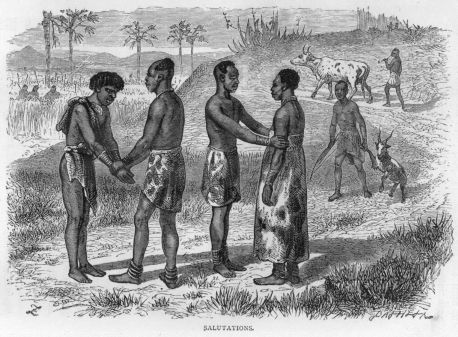 off, and who treated them with unfeeling coarseness. A sick slave having recovered, it was the boy’s duty to chain him to his gang again, and it was grievous to see the rough way he used the poor, emaciated creature.
They had not much work to do, the sole object of the owner being to keep them alive and prevent their running away till sold at the coast. They generally looked sullen and full of despair; but occasionally, at night, they danced and became even riotous, till a word from the earless imp restored them to order.
Among them was a poor fellow who had been five years in chains. The travellers took compassion on him, and released him from bondage. His chains were struck off with a hammer, and, once on his feet, a freedman, he seemed scarcely to believe the fact; when, however, attired in a clean calico shirt, he strutted about and soon came to make his new master his best bow. On his body were numerous spear-wounds. He had been captured by the Watuta, who had cut off several of his toes. This man never deserted them during the journey, accompanying them to Cairo, having gained the character of a faithful servant.
The Arab in Africa takes presents for everything he does, and it was believed that the white men would do the same. If a bullet was extracted, a gun repaired, an old sultan physicked, or the split lobe of an ear mended, a cow or cows were at hand to be paid when the task was finished.
When slaves were brought for sale and declined by the Englishmen, the natives could not understand their indifference to such traffic, but would turn from them with a significant shrug, as much as to say: “Why are you here then?” The most horrible punishments are inflicted on those who offend against the laws of the country. A woman and lad, who had been accused of bewitching the sultan’s brother, were found with their arms tied behind them, writhing in torture on their faces. No sympathy was shown them from the jeering crowd. The lad at last cried out: “Take me to the forest; I know a herb remedy.” He was allowed to go, while the woman was kept in the stocks near the sick patient. The lad was put to death, and Captain Grant suspected, tortured before a fire. Another man, for a crime in the sultan’s harem, was stripped, tied to railings, and his person smeared with grease and covered with greased rags, which were then set fire to, when he was dragged forth to a huge fire outside the village. On his way, assegais were darted at him by the son and daughter-in-law of the sultan, and when he fell he was dragged out by one leg.
Grant had the same difficulties in moving that Speke had experienced.
At length, on the 12th of September, he got away, but on the 16th, as he was passing through the territory of Sultan Myonga, his men moving in Indian file, a band of two hundred natives, armed with assegais and bows and arrows, burst upon him, springing over the ground like cats. The uplifted assegais and the shouts of the robbers frightened the porters, who gave up their loads and attempted to escape from the ruffians, who were pulling their clothes and loads from them. Grant endeavoured without bloodshed to prevent this, but, as he had only one of his gun-men and two natives by him, he could do nothing. Little Rohan the sailor, one of his Zambesi men, was found with his rifle in hand at full cock, defending two loads against five men. He had been urged to fly for his life. The property, he answered, was his life. Grant made his way, however, to Myonga, seeing as he went the natives dressed out in the stolen clothes of his men. Though honour was dear, the safety of the expedition was so likewise, and one false step would have endangered it.
Myonga pretended to be very indignant, and said that he had cut off the hand of one of his men, and promised that the property should be restored. Some of the loads were given back, but others had been broken open and rifled, and the chief demanded an enormous hongo for permitting Grant to proceed. This was the origin of the alarming intelligence Captain Speke had received.
At length the two travellers united their forces, and together they continued their journey towards Karague. To reach it they had first to pass through the province of Usui, the chief of which, Suwarora, pillaged them as usual. Here the little grass-hut villages were not fenced by a boma, but were hidden in large fields of plantains. Cattle were numerous, kept by the Wahuma, who would not sell their milk, because the Englishmen eat fowls. Their camp, night after night, was attacked by thieves. One night, as Speke was taking an observation, a party of these rascals enquired of two of the women of the camp what he was about. While the latter were explaining, the thieves whipped off their clothes and ran away with them, leaving the poor creatures in a state of absolute nudity. Speke had not taken much notice of the goats and other things which had been stolen, but, in consequence of this, he ordered his men to shoot any thieves who came near. A short time afterwards, another band approaching, one of the men was shot, who turned out to be a magician, and was till then thought invulnerable. He was tracked by his blood, and afterwards died of his wound. The next day some of Speke’s men were lured into the huts of the natives by an invitation to dinner, but, when they got them there, they stripped them stark-naked and let them go again. At night the same rascals stoned the camp. After this another thief was shot dead and two others were wounded. Bombay and Baraka gave their masters also a good deal of trouble. The former, who was looked upon as an excellent fellow, more than once got very drunk, and stole their property in order to purchase a wife for himself, besides which the two men quarrelled desperately with each other.
At length, however, the travellers got free of Usui and the native guard who had been sent to see them over the borders, and entered Karague, to their great relief and happiness.
They had now, for some distance, wild animals alone to contend with, and these they well knew how to manage. Soon after pitching their tent they were greeted by Kachuchu, an officer sent by the king, Rumanika, to escort them through his country. He informed them that the village officers were instructed to supply them with food at the king’s expense, as there were no taxes gathered from strangers in the kingdom of Karagué.
The country was hilly, wild, and picturesque, the higher slopes dotted with thick bushes of acacias, the haunts of the white and black rhinoceros, while in the valley were large herds of harte-beestes. The further they proceeded into the country, the better they liked it, as the people were all kept in good order. A beautiful lake was seen, which at first they supposed to be a portion of the Nyanza, but it proved to be a separate lake, to which the name of Windermere was given.
They now attained the delightful altitude of five thousand odd feet, the atmosphere at night feeling very cool. Away to the west some bold sky-scraping cones were observed, and, on making enquiries, Speke was convinced that those distant hills were the great turn-point of the Central African water-shed. Numerous travellers, whom he collected round him, gave him assistance in forming his map. He was surprised at the amount of information about distant places which he was able to obtain from these intelligent men.
As they approached the palace, the king, Rumanika, sent them a supply of excellent tobacco and beer manufactured by his people. On drawing near his abode, the bearers were ordered to put down their loads and fire a salute, and the two travellers at once received an invitation to visit the king. He was found sitting cross-legged with his brother Nnanaji, both men of noble appearance and size. The king was plainly dressed in an Arab black choba; he wore on his legs numerous rings of rich coloured beads, and neatly-worked wristlets of copper. Nnanaji, being a doctor of high credit, was covered with charms; he wore a checked cloth wrapped round him. Large clay pipes were at their sides, ready for use. In their rear sat the king’s sons, as quiet as mice.
The king greeted them warmly and affectionately, and in an instant both travellers felt that they were in the company of men who were totally unlike the common order of the natives of the surrounding districts. They had fine oval faces, large eyes, and high noses, denoting the best blood of Abyssinia. They shook hands in the English style, the ever-smiling king wishing to know what they thought of his country. He observed that he considered his mountains the finest in the world: “And the lake, too; did not they admire it?” He seemed a very intelligent man, and enquired how they found their way over the world, which led to a long story, describing the proportions of land and water, the way ships navigate the ocean, and convey even elephants and the rhinoceros to fill the menageries of Europe. He gave them their choice of having quarters in his palace or pitching their tents outside. They selected a spot overlooking the lake, on account of the beautiful view. The young princes were ordered to attend on them, one of whom, seeing Speke seated in an iron chair, rushed back to his father with the intelligence. Speke was accordingly requested to return, that he might exhibit the white man sitting on his throne. Rumanika burst into a fresh fit of merriment at seeing him, and afterwards made many enlightened remarks. On another visit Speke told the king that if he would send two of his children, he would have them instructed in England, for he admired his race, and believed them to have sprung from the friends of the English, the Abyssinians, who were Christians, and had not the Wahuma lost their knowledge of God, they would be so likewise. A long theological and historical discussion ensued, which so pleased the king that he said he would be delighted if Speke would take two of his sons to England. He then enquired what could induce them to leave their country and travel, when Speke replied that they had had their fill of the luxuries of life, and that their great delight was to observe and admire the beauties of creation, but especially their wish was to pay visits to the kings of Africa, and in particular his Majesty. He then promised that they should have boats to convey them over the lake, with musicians to play before them.
In the afternoon Speke, having heard that it was the custom to fatten up the wives of the king and princes to such an extent that they could not stand upright, paid a visit to the king’s eldest brother. On entering the hut, he found the old chief and his wife sitting side by side on a bench of earth strewed over with grass, while in front of them were placed numerous wooden pots of milk. Speke was received by the prince with great courtesy, and was especially struck by the extraordinary dimensions, yet pleasing beauty of the immoderately fat fair one, his wife. She could not rise. So large were her arms that between the joints the flesh hung like large loose bags. Then came in their children, all models of the Abyssinian type of beauty, and as polite in their manners as thorough-bred gentlemen. They were delighted in looking over his picture-books and making enquiries about them. The prince, pointing to his wife, observed: “This is all the product of those pots, as, from early youth upwards, we keep those pots to their mouths, being the custom of the court to have very fat wives.”
The king, having supposed that the travellers had been robbed of all their goods, was delighted with the liberal presents he received, above all that of a coat of handsome scarlet broadcloth. He told them that they might visit every part of his country, and when the time arrived for proceeding to Uganda, he would escort them to the boundary.
Altogether, Rumanika was the most intelligent and best-looking ruler the travellers met with in Africa. He had nothing of the African in his appearance, except that his hair was short and woolly. He was fully six feet two inches in height, and the expression of his countenance was mild and open. He was fully clothed in a robe made of small antelope-skins and another of dark cloth, always carrying, when walking, a long staff in his hand. His four sons were favourable specimens of their race, especially the eldest, named Chunderah. He was somewhat of a dandy, being more neat about his lion-skin covers and ornaments than his brothers. From the tuft of wool left unshaven on the crown of his head to his waist he was bare, except when his arms and neck were decorated with charmed horns, strips of otter-skin, shells, and bands of wool. He was fond of introducing Friz, Speke’s head man, into the palace, that he might amuse his sisters with his guitar, and in return the sisters, brothers, and followers would sing Karague music. The youngest son was the greatest favourite, and on one occasion, the travellers having presented him with a pair of white kid gloves, were much amused with the dignified way in which he walked off, having coaxed them on to his fingers.
Rumanika, contrary to the usual African custom, was singularly abstemious, living almost entirely on milk, merely sucking the juice of boiled beef. He scarcely ever touched plantain wine or beer, and had never been known to be intoxicated. The people were generally excessively fond of this wine, the peasants especially drinking large quantities of it.

Rumanika was not only king, but priest and prophet; indeed, his elevation to the throne was due, as his friends asserted, to supernatural agency. After the death of his father, his two brothers and he claimed the throne. Their pretentions were to be settled by an ordeal. They possessed a small magic drum, and, it being placed on the ground, he who could lift it was to take the crown. His brothers were unable to stir it, though exerting all their strength, but Rumanika raised it with his little finger. This test, however, not satisfying the chiefs, they insisted on Rumanika going through another trial. He was seated on the ground, and it was believed that if he was the appointed king, the portion of soil on which he sat would rise up in the air, but if not, it would collapse, and he would be dashed to pieces. According to the belief of his subjects, no sooner had Rumanika taken his seat, than he was raised into the sky, and was therefore acknowledged king.
One of the most curious customs which Rumanika holds in his character of high priest, is his new-moon levée, which takes place every month, for the purpose of ascertaining the loyalty of his subjects. On the evening of the new-moon the king adorns himself with a plume of feathers on his head, a huge white beard descending to his breast. He takes post behind a screen. Before him are arranged forty long drums on the ground, on the head of each of which is painted a white cross. The drummers stand each with a pair of sticks, and in front is their leader, who has a couple of small drums slung round his neck. The leader raises first his right arm and then his left, the performers imitating him, when he brings down both sticks on the drums with a rapid roll, they doing the same, until the noise is scarcely to be endured. This having continued for some hours, with the addition of smaller drums and other musical instruments, the chiefs advance in succession, leaping and gesticulating, and shouting expressions of devotion to their sovereign. Having finished their performance, they kneel before him, holding out their knobbed sticks that he may touch them, then, retiring, make room for others.
Civilised as the country is in some respects, marriage is a matter of barter between the father and the intended husband, the former receiving cows, slaves, sheep, etcetera, for his daughter. Should, however, a bride not approve of her husband, by returning the marriage gifts she is again at liberty. The chief ceremony at marriages consists in tying up the bride in a skin, blackened all over, and carrying her with a noisy procession to her husband.
The ladies of this country lead an easy life in many respects, their chief object, apparently, being to get as fat as possible. Many of them succeed wonderfully well, in consequence of their peculiar constitution, or from the food they eat being especially nutritious. Five of Rumanika’s wives were so enormous that they were unable to enter the door of any ordinary hut, or to move about without being supported by a person on either side. One of his sisters-in-law was of even still greater proportions. Speke measured her; round her arm was one foot eleven inches; chest, four feet four inches; thigh, two feet seven inches; calf, one foot eight inches; height, five feet eight inches. He could have obtained her height more accurately could he have had her laid on the floor; but, knowing the difficulties he would have had to contend with in such a piece of engineering, he tried to get her height by raising her up. This, after infinite exertion, was accomplished, when she sank down again, fainting, for the blood had rushed into her head. Meanwhile the daughter, a lass of sixteen, sat before them, sucking at a milk-pot, on which the father kept her at work by holding a rod in his hand; for, as fattening is one of the first duties of fashionable female life, it must be duly enforced with the rod if necessary. The features of the damsel were lovely, but her body was as round as a ball.
The women turn their obesity to good account. In exchanging food for beads it is usual to purchase a certain quantity of food, which shall be paid for by a belt of beads that will go round the waist. The women of Karague being on an average twice as large round the waist as those of other districts, food practically rises a hundred per cent, in price. Notwithstanding their fatness their features retain much beauty, the face being oval and the eyes fine and intelligent. The higher class of women are modest, not only wearing cow-skin petticoats, but a wrapper of black cloth, with which they, envelope their whole bodies, merely allowing one hand to be seen.
The travellers were allowed to move about the country as they liked, and the king sent his sons to attend on them, that they might enjoy such sport as was to be found. They heard of no elephants in that district, but harte-beestes, rhinoceros, and hippopotami were common.
One day Captain Grant saw two harte-beestes engaged in a desperate combat, halting calmly between each round to breathe. He could hear, even at a considerable distance, the force of every butt as their heads met, and, as they fell on their knees, the impetus of the attack, sending their bushy tails over their backs, till one, becoming the victor, chased the other out of the herd.
Several varieties of antelope and the mountain gazelle were seen bounding over the hills. Pigs abounded in the low grounds, and hippopotami in the lake.
Captain Speke went out in search of rhinoceros, accompanied by the prince, with a party of beaters. In a short time he discovered a fine male, when, stealing between the bushes, he gave him a shot which made him trot off, till, exhausted by loss of blood, he lay down to die. The young  princes were delighted with the effect of the Englishman’s gun, and, seizing both his hands, congratulated him on his successes.
A second rhinoceros was killed after receiving two shots. While pursuing the latter, three appeared, who no sooner sighted Speke, than they all charged at him in line. His gun-bearers, however, were with him, and, taking his weapons, he shot the three animals in turn. One dropped down a little way on, but the others only pulled up when they arrived at the bottom of the hill. The fore legs of another were broken, when the natives set on him; but he kept charging with so much fury that they could not venture to approach till Speke had given him a second ball, which brought him to the ground. Every man then rushed at the creature, sending his spear, assegai, or arrow into his sides until he sank like a porcupine covered with quills. The heads were sent to the king, to show what the white man could do. Rumanika exhibited the greatest astonishment, declaring that something more potent than powder had been used; for, though the Arabs talk of their shooting powers, they could not have accomplished such a feat. “It is no wonder,” he added, “that the English are the greatest men in the world.”
Rumanika, like great men in other countries, had his private band. The instruments were of a somewhat primitive character, while the musicians differed in appearance considerably from those of Europe. The most common instruments are the drums, which vary greatly in size: one hung to the shoulder is about four feet in length, and one in width. It is played with the fingers, like the Indian tom-tom. The drums used at the new-moon levée are of the same shape, but very much larger. The war drum is beaten by women. At its sound the men rush to arms, and repair to their several quarters. There are also several stringed instruments. One of these, which Captain Grant describes, was played by an old woman; it had seven notes, six of which were a perfect scale. Another, which had three strings, was played by a man: they were a full, harmonious chord. A third instrument called “the laced nanga” formed of dark wood, in the shape of a tray, had three crosses in the bottom, and was laced with one string, seven or eight times, over bridges at either end.
The prince sent the best player to be found to entertain his guest. The man entered, dressed in the usual Wanyambo costume, looking a wild, excited creature. After resting his spear against the roof of his hut, he took a nanga from under his arm and began playing, his wild yet gentle music and words attracting a number of admirers. It was about a favourite dog, and for days afterwards the people sang that dog song.
There is another stringed instrument, called the zeze, somewhat similar to the nanga. They have two wind instruments, one resembling a flageolet, and another a bugle. The latter is composed of several pieces of gourd, fitted one  into another, in telescope fashion, and is covered with cow-skin.
Rumanika’s band was composed of sixteen men, fourteen of whom had bugles, and the other two hand-drums. On the march they form in three ranks, the drummers being in the rear, swaying their bodies in time to the music, while the leader advances with a curiously active step, touching the ground alternately with each knee. They also, when the king rested on a march, or when out hunting, played before him, while he sat on the ground and smoked his pipe.
The Wahuma, like most Africans, have great faith in the power of charms, and believe that by their means persons can be rendered invulnerable. They also believe in the constant presence of departed souls, supposing that they exercise a good or evil influence over those whom they have known in life. When a field is blighted or a crop does not promise well, a gourd is placed in the pathway; passengers set up a wailing cry, which they intend as a prayer to the spirits to give a good crop to their mourning relatives. Rumanika, in order to propitiate the spirit of his father, was in the habit of sacrificing annually a cow on his tomb, and also of placing offerings on it of corn and wine. These and many other instances show that, though their minds are dark and misguided, the people possess religious sentiments which might afford encouragement to missionaries of the gospel.
The commencement of 1862 found the travellers still guests of the enlightened king. Hearing that it was the English custom on Christmas Day to have an especially good dinner, he sent an ox. Captain Speke in return paid him a visit. He offered him the compliments of the season, and reminded him that he was of the old stock of Abyssinians, who were among the oldest Christians on record, and that he hoped the time would come when white teachers would visit  his country, to instruct him in the truths which he and his people had forgotten.
News now arrived which induced them to believe that Mr Petherick was indeed on his road up the Nile, endeavouring to reach them. Rumanika was highly delighted to hear this, as he was especially anxious to have white men visit his country from the north.
Active preparations were now made for the departure of the travellers, but unhappily Captain Grant was suffering from so severe a complaint in one of his legs, that he was compelled to remain behind, under the protection of the hospitable sovereign, while Speke set off for Uganda.
Chapter Sixteen.
Speke and Grant’s travels continued.
An escort from Mtesa, King of Uganda, arrives—The Kitangule River—The Phépo—Slaughter of the natives—Uganda described—Speke’s reception—Mtesa’s cruelty—Arrest of the Queen—A review of troops—Grant arrives—Arrangements for proceeding to Unyoro—The water-spirit’s high priest.
On the 10th of January a large escort of smartly-dressed men, women, and boys, leading their dogs and playing their reeds, under the command of Maula, arrived from Mtesa, King of Uganda, to conduct the travellers to his capital. Maula informed them that the king had ordered his officers to supply them with everything they wanted while passing through his country, and that there would be nothing to pay.
Speke set forth, in the hopes that before long he should settle the great Nile problem for ever. It was, however, not believed that he would be able to proceed north from Uganda, Rumanika especially declaring that he would be compelled to return to the southward.
Passing through a remarkably rich country, famous for its ivory and coffee productions, they descended from the Mountains of the Moon to an alluvial plain, where Rumanika keeps thousands of cows. Once elephants abounded here, but, since the increase of the ivory trade, these animals had been driven off to the distant hills.
On the 16th they reached the Kitangule River, which falls into the Victoria Nyanza. It was about eighty yards broad and so deep that it could not be poled by the canoe-men, while it runs at a velocity of from three to four knots an hour. It is fed from the high-seated springs in the Mountains of the Moon. Speke believed that the Mountains of the Moon give birth to the Congo as well as the Nile, and also the Shire branch of the Zambesi.
The country through which they passed was a perfect garden of plantations, surprisingly rich, while along the banks of the river numberless harte-beestes and antelopes were seen.
At a village, where they were compelled to stop two days, drumming, singing, screaming, yelling, and dancing went on the whole time, during the night as well as day, to drive the phépo, or devil, away. In front of a hut sat an old man and woman, smeared with white mud, and holding pots of pomba in their laps, while people came, bringing baskets full of plantain squash and more pots of pomba. Hundreds of them were collected in the court-yard, all perfectly drunk, making the most terrific uproar.
The king sent messengers expressing his desire to see the white man, and they were informed that he had caused fifty big men and four hundred small ones to be executed because he believed that his subjects were anxious to prevent them.
Speke now sent back to Grant, earnestly urging him to come on if he possibly could, as he had little doubt that they would be able to proceed across the country to the northward.
On approaching the capital, a messenger came to say that the king was so eager to meet the white man that he would not taste food until he had seen him.
The neighbourhood was reached on the 19th of February. Speke says it was a magnificent sight; the whole hill was covered with gigantic huts, such as he had never before seen in Africa. He proposed going at once to the palace; but the officers considered that such a proceeding would be indecent, and advised him to draw up his men and fire his gun off to let the king know that he had arrived. He was excessively indignant at being shown the dirty huts for his accommodation, in which the Arabs put up when they came to the place. Speke declared that, unless better quarters were found him, he would return; but the officer entreated that he would not be so hasty. Rain, coming on, prevented a levée being held that day. The presents being got ready, Speke marshalled his procession: the king’s officers and pages, with himself, marched on the flanks; the Union Jack, carried by his guide, led the way, followed by twelve of his men, as a guard of honour, dressed in red flannel cloaks, carrying their arms sloped, with fixed bayonets, while in the their rear came the rest of his attendants, each bearing some article as a present.
He was surprised at the extraordinary dimensions of the palace, and the neatness with which it was kept. The whole brow and sides of the hill were covered with gigantic grass-huts, neatly thatched and fenced all round with the tall, yellow reeds of the tiger-grass, while, within the enclosures, the lines of huts were joined together or partitioned off into courts, with the walls of the same grass.
These huts formed the residence of Mtesa’s three or four hundred wives, the rest living chiefly with his mother, the queen dowager. The ladies were seen at the doors, making their remarks and enjoying their jokes. At each gate they passed, officers opened and shut them, jingling the big bells hung upon them to prevent stealthy entrance.
As they advanced, courtiers of high dignity stepped forward to greet the white man, dressed in the most scrupulously neat fashions. Men, women, bulls, dogs, and goats were led about by strings, cocks and hens were carried in men’s arms, and little page-boys with rope turbans rushed about conveying messages, as if their lives depended on their swiftness, every 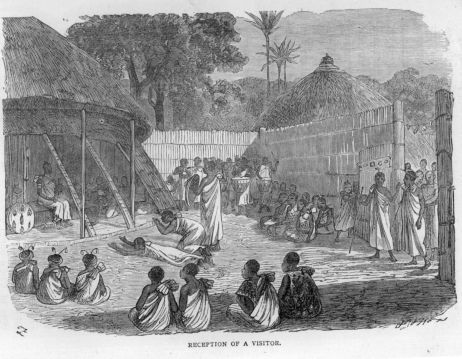 one holding his skin cloak tightly round him, lest his naked legs should by accident be shown, a crime which in that kingdom, if happening in the presence of the king, meets with instant death.
These huts are well-built of reed, which grows to a great height. They have double roofs formed of thick grass thatch, in order to exclude the heat of the sun. The outer roof comes nearly to the ground on all sides. The structure is supported by stout poles, on which are hung sacks of corn, meat, and other provisions. The interior is divided into two portions by a high screen, the inner serving as a sleeping-room, in which a bedstead formed of cane is placed. There are no windows nor chimneys, and only one door in front.
When Speke, however, was desired to sit down outside to wait the appearance of the monarch, he, considering this an act of discourtesy, refused to comply. After waiting five minutes, as the king did not appear, he thought it right to walk home again, giving Bombay directions to leave his present on the ground. He was followed soon afterwards by Bombay, who told him that he might bring his own chair, as the king was anxious to show him every respect, although no one but the monarch was allowed in Uganda to sit on an artificial seat.
On his return, he found the king, a good-looking, well-figured, tall young man of twenty-five, sitting on a red blanket, which formed his throne, in the state hut. His hair was cut short, with the exception of a ridge on the top which ran stem to stern, like a cockscomb. He wore on his neck a large ring with beautifully-worked small beads. On one arm was another bead ornament, and on the other a wooden charm, and on every finger and toe he had alternately brass and copper rings, while above the ankles, half way up to the calf, he had stockings of very pretty beads.
In front of him were his nobles, squatting on the ground, all habited in skins, mostly cow-skins, some few—the sign of royal blood—having leopard-skins girded round their waists. Speke was desired to halt and sit in the glaring sun, while he was advancing hat in hand. He donned his hat, mounted his umbrella, and quietly sat down, to observe what was going on. A white dog, spear, shield, and woman, the Uganda cognisance, were by the side of the king, as also a knot of staff-officers, with whom he kept up a brisk conversation, while he took copious draughts from neat little gourd cups, offered by his ladies-in-waiting.
The traveller could not speak his language, and his interpreter dared not address the king, it being contrary to etiquette. Conversation was therefore impossible, and he was very glad, therefore, when at length his Majesty got up and retired, with a gait which was intended to be very majestic. It was to represent the step of a lion, but the outward sweep of the legs looked only like a ludicrous waddle. The king had in reality gone to eat his breakfast, as he had not broken his fast since hearing of the traveller’s arrival. He quickly returned, and Speke was again invited in, with his men. He found the king standing on a red blanket, talking and laughing to a hundred or more of his admiring wives, who were all squatting on the ground outside, forming two groups. His men dared not advance upright, but, stooping, with lowered head and averted eyes, came cringing after him, it being a high crime to look upon the ladies of the court. It was difficult, however, to carry on conversation with him, as every answer had to be passed through the interpreter, and then delivered to the king’s chief officer, and frequently another question was asked before the first was answered. The most important questions had reference to opening up a passage across the country. Before Speke could explain his views, the king put another question.
Mtesa was a perfect despot and tyrant, the lives of all his subjects, from the highest to the lowest, being in his power. When the whim seized him, he did not hesitate to kill as many as he chose.
The king’s subjects approach in the most cringing attitudes, and, on receiving any favour, throw themselves on the ground, floundering about, shrieking out: “Nynzig! nynzig!” He is attended by a number of young pages, with rope turbans on their heads, who are seen rushing about in every direction to obey his behests, and directly a wife or courtier offends the despot, rush upon the unhappy individuals and drag them off to immediate execution.
Speke, however, won his favour by blistering and doctoring him. He managed to keep up his own dignity by refusing to submit when improperly treated. He also gained great credit with the monarch by exhibiting his skill as a sportsman; and Mtesa was delighted to find that after a little practice he himself could kill birds and animals. He did not, however, confine himself to shooting at the brute creation, but occasionally killed a man or woman who might have been found guilty of some crime.
After a considerable lapse of time Speke obtained a residence at what was looked upon as the “west end” of the city. It was in a garden, in view of the palace, so that he could hear the constant music and see the throngs of people going to and fro. Having selected the best hut for himself, and giving the other to his three officers, he ordered his men to build barracks for themselves in the form of a street from his hut to the main road. He could now visit the palace with more ease, and obtained better opportunities of seeing the king and endeavouring to gain the important ends he had in view.
The sights he witnessed were very often painful. Scarcely a day passed that he did not see one, and sometimes more, of the unhappy female inmates of the palace dragged off to  execution by one of the body-guard, the poor creature shrieking out, as she went to premature death: “Oh, my lord, my king, my mother!” and yet no one dared to lift a hand to preserve her.
He made several sporting excursions with the king, who was always delighted when he shot a bird or an animal, jumping and leaping, and shouting: “Woh! woh! woh!” to express his delight. One of these was to the Lake Nyanza, after Speke had somewhat ingratiated himself with the sovereign. It was somewhat of a picnic party, and the king was accompanied as usual by a choice selection of his wives. Having crossed over to a woody island some distance from the shore, the party sat down to a repast, when large bowls of pomba were served out. They then took a walk among the trees, the ladies apparently enjoying themselves and picking fruit, till, unhappily, one of the most attractive of them plucked a fruit and offered it to the king, thinking, probably, to please him. He took it, however, as a dire offence, and, declaring that it was the first time a woman had had the audacity to offer him food, ordered the pages to lead her off to execution. No sooner had the words been uttered than the abominable little black imps rushed at her like a pack of beagles, slipping off their cord turbans and throwing the ropes round her limbs. She, indignant at being touched, remonstrated and attempted to beat them off, but was soon overcome and dragged away, crying out the names of “Kamraviona! Mzungu!” the title applied to Speke, for help and protection, while the other women clasped the king round the legs, imploring him to pardon their unhappy sister. His only reply was to belabour the miserable victim with a thick stick. Speke had carefully abstained heretofore from interfering with any of the king’s acts of arbitrary cruelty. On hearing, however, his own name imploringly pronounced, his English blood was up, and, rushing at the tyrant, he stayed his uplifted arm, and demanded the poor creature’s life. He, of course, ran a great risk of losing his own; but the novelty of the event seemed to tickle the capricious chief, and he at once ordered the woman to be released.
This was, however, one of the only occasions on which he was successful.
Day after day both men and women were led off to execution. On one occasion a poor girl had run away from the ill-treatment of her master, and had taken refuge in the house of a decrepit old man. The two were brought up for judgment, when the king sentenced them to death, and decreed that their lives should not be taken at once, but that they should be fed and dismembered, bit by bit, as rations for his vultures every day until life was extinct. The dismayed criminals, Speke says, struggling to be heard, were dragged away to the drowning music of horns and drums.
After he had been some time in the palace, he was introduced to the queen dowager. Her majesty was fat, fair, and forty-five. He found her seated in the front part of her hut, on a carpet, her elbow resting on a pillow. An iron rod, like a spit, with a cup on the top, charged with magic powder, and other magic wands were placed before the entrance, and within the room four Mabandwa sorceresses, or devil-drivers, fantastically dressed, with a mass of other women, formed the company. They being dismissed, a band of musicians came in, when pomba was drunk by the queen, and handed to her visitor and high officers and attendants. She smoked her pipe, and bid Speke to smoke his. She required doctoring, and Speke had many opportunities of seeing her, so completely winning her regard that she insisted on presenting him with various presents, among others a couple of wives, greatly to his annoyance. She appeared to be a jovial and intelligent personage. On another occasion Speke, when introduced, found her surrounded by her ministers, when a large wooden trough was brought in and filled with pomba. The queen put her head in and drank like a pig from it, her ministers following her example. If any was spilled by her, they dabbled their noses in the ground, or grabbed it up with their hands, that not a particle might be lost, as everything that comes from royalty must be adored. Musicians and dancers were then introduced, exhibiting their long, shaggy, goat-skin jackets, sometimes dancing upright, at others bending or striking the ground with their heels like hornpipe dancers.
The plaguy little imps of pages were constantly playing tricks, and seemed to delight in mischief.
One of the great officers of the court having offended the king, they came with a message to Speke’s attendants while he himself was away, ordering them all to attend the king with their arms. Instead of being led to the palace, they were guided to the house of the refractory officer, when they were ordered to rush in and spare nothing, men, women, children, mbugus, or cowries, all alike. Speke’s men, firing their guns, did as they were ordered. One of the inmates was speared, but the rest were taken, and brought in triumph to his camp. He, of course, ordered all the seizures to be at once given up to the king’s chief officer, and shut himself up in his house, declaring that he was ashamed to show his face. In vain the king sent to him to come and shoot. The reply was: “Bana” (the name by which the king called Speke) “is praying to-day that Mtesa may be forgiven the injury he has committed by sending his soldiers on such a duty; he is very angry about it, and wishes to know if it was done by the kings orders.” The boys replied that nothing could be done without the king’s orders. Speke also insisted on sending the red cloth cloaks worn by his men, because they had defiled their uniform when plundering women and children. He took this opportunity of teaching the barbarian a lesson.
On his next visit the king told him that he had wished to see him on the previous day, and begged that whenever he came he would fire a gun at the waiting hut, that he might hear of his arrival. The king was much pleased with a portrait Speke made of him, as also with his coloured sketches of several birds he had killed, but was still more delighted with some European clothes, with which he was presented. When Speke went to visit him, he found his Majesty dressed in his new garments. The legs of the trousers, as well as the sleeves of the waistcoat, were much too short, so that his black feet and hands stuck out at the extremities as an organ-player’s monkey’s do, while the cockscomb on his head prevented a fez cap, which he wore, from sitting properly. On this visit twenty new wives, daughters of chiefs, all smeared and shining with grease, were presented, marching in a line before the king, utterly destitute of clothes, whilst the happy fathers floundered, nynzigging, on the ground, delighted to find their darling daughters appreciated by the monarch. Speke burst into a fit of laughter, which was imitated not only by the king but by the pages, his own men chuckling in sudden gusto, though afraid of looking up.
The king at last returned Speke’s visit. Having taken off his turban, as Speke was accustomed to take off his hat, he seated himself on his stool. Everything that struck his eye was admired and begged for, though nothing seemed to please him so much as the traveller’s wide-awake and mosquito curtains. The women, who were allowed to peep into Sana’s den, received a couple of sacks of beads, to commemorate the visit.
A few days afterwards he was accompanying the king when an adjutant-bird was seen in a tree. The king had a gun Speke had given him, but he had little more than one charge of powder remaining. Speke had left his gun at home. The king at the second shot killed the bird, greatly to his delight, shouting his usual “Woh! woh!” He was so delighted that he insisted upon carrying the bird to show to his mother.
Before entering the palace, however, he changed his European clothes for a white goat-skin wrapper. Directly afterwards a battalion of his army arrived before the palace, under the command of his chief officer, whom Speke called Colonel Congou. The king came out with spear and shield in hand, preceded by the bird, and took post in front of the enclosure. His troops were divided into three companies, each containing about two hundred men. After passing in single file, they went through various evolutions. Nothing, Speke says, could be more wild or fantastic than the sight which ensued. The men, nearly naked, with goat or cat-skins depending from their girdles, and smeared with war-colours according to the taste of each individual, one half of the body red or black, the other blue, in irregular order; as, for instance, one leg would be red, the other black, whilst the upper part would be the opposite colours, and so with the chest and arms. Each man carried two spears and one shield, held as if approaching an enemy. They thus moved in three lines of single rank and file at fifteen or twenty paces asunder, with the same high action and elongated step, the ground leg only being bent to give their strides the greater force. The captains of each company followed, even more fantastically dressed. The great Colonel Congou, with his long, whitehaired goat-skins, a fiddle-shaped leather shield, tufted with white hair at all six extremities, bands of long hair tied below the knees, and the helmet covered with rich beads of several colours, surmounted with a plume of crimson feathers, from the centre of which rose a stem, tufted with goat-hair. Finally the senior officers came charging at their king, making violent protestations of faith and honesty, for which they were applauded.
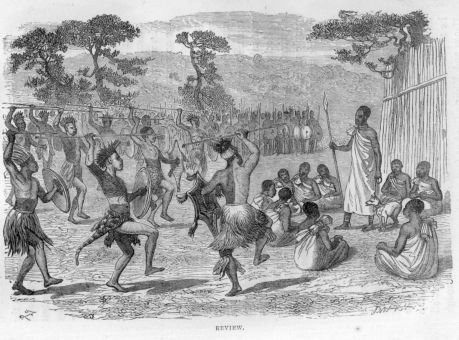
Speke was now, towards the end of May, looking forward to the arrival of Grant.
To propitiate the despot he sent a compass, greatly to the delight of Mtesa, who no sooner saw it than he jumped and “wohed” with intense excitement, and said it was the greatest present Bana had ever given him, for it was the thing by which he found out all the roads and countries.
It had been arranged that Grant should come by water; but the natives, fearing to trust themselves on the lake, brought him all the distance on a litter.
At length, on the 27th, the sound of guns announced the arrival of Grant, and Speke hurried off to meet his friend, who was now able to limp about a little, and to laugh over the accounts he gave of his travels.
The travellers forthwith began to make arrangements for proceeding on to Unyoro, governed by a chief named Kamrasi, of despicable character and considered merciless and cruel, even among African potentates, scattering death and torture around at the mere whim of the moment; while he was inhospitable, covetous, and grasping, yet too cowardly to declare war against the King of the Waganda, who had deprived him of portions of his dominions. The Waganda people were, therefore, very unwilling to escort the travellers into his territory; and Colonel Congou declared that if compelled to go, he was a dead man, as he had once led an army into Unyoro.
The travellers’ great object was to reach the spot where the Nile was supposed to flow out of the Victoria Nyanza, and proceed down the stream in boats.
Speke had written to Petherick, and on the 28th of June news arrived that white men were at Gani enquiring for the travellers. Speke consequently informed the king that all he required was a large escort to accompany them through Usoga and Kidi to Gani, as further delay in communicating with Petherick might frustrate the chance of opening the Nile trade with Uganda. The king replied that he would assemble his officers, and consult them on the subject. He exhibited his folly, however, by allowing his people to make an inroad into Unyoro and carry off eighty cows belonging to Kamrasi. To their horror, Kyengo, the chief magician, informed them that the king, being anxious to pry into the future, had resolved to adopt a strong measure with that end in view. This was the sacrifice of a child. The ceremony, which it fell to the lot of Kyengo to perform, is almost too cruel to describe. The magician, having placed a large earthen pot full of water on the fire, arranges a platform on the top, and on this he binds a young child and a fowl, covering them with another pot, which he inverts over them. After the fire has burned for a given time the upper pot is removed. If both victims are dead, it is considered that war must be deferred for the present; but, if either should be alive, it may be commenced immediately. When the army is about to proceed to war, the magician flays the young child, and lays the bleeding body in the path, that the warriors may step over it, thereby believing that they will gain immunity for themselves in the approaching combat.
During the expedition, which Speke made with the king to the Nyanza, they landed on an island inhabited by a magician and his wife, who were supposed to be priests of of the water-spirit of the lake. His head was decorated with numerous mystic symbols, among them a paddle, the badge of his high office. He was dressed in a little, white, goat-skin apron, adorned by various charms, and, instead of a walking-stick to support his steps, he used a paddle. Though not an old man, he pretended to be so, walking slowly and deliberately, coughing and mumbling like one. Seating himself, he continued coughing for half an hour,  when his wife came in, much in the some manner, without saying a word, and assuming the same affected style.
The king, who was seated near the door, with his wives behind him, asked Speke what he thought of it. No voice was heard but that of the old wife, who croaked like a frog for some water, and when some was brought, croaked again because it was not the purest of the lake’s produce, and had the first cup changed, wetted her lips with the second, and hobbled away in the same manner as she had come.
The water-spirit’s chief priest now summoned several of the king’s officers to draw round him, and then, in a low voice, gave them all the orders of the deep, and walked away. His revelations appeared to have been unpropitious, for the party immediately repaired to their boats and returned to their quarters.
During this excursion, the king went off on the lake, leaving Speke by himself on shore. He took the opportunity of visiting an hospitable old lady, who treated him and his attendants to the last drop of pomba in her house, smoking her pipe with him, and did not hesitate to speak of the horrors of the Uganda punishments. When his servant told her that he had saved the life of one of the women, she seemed astonished at the daring of the stranger and at the leniency of the monarch. The king’s servants had robbed her of nearly everything in her house.
The most barbarous orders of the despot are obeyed with the utmost alacrity by his officers, who would to a certainty, if they hesitated, be themselves put to death. His horrible little pages are his chief emissaries. At his command a dozen start off together, each striving to outrun the others, their dresses, streaming in the wind, giving them the resemblance at a distance of a flight of birds. On one occasion, Speke having given Mtesa a rifle, the king, after examining the weapon, loaded it and told a page to go out and shoot some 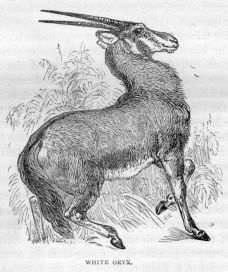 one, to ascertain if it would kill well. In a moment a report was heard, and the urchin came back grinning with delight at his achievement, just like a schoolboy who has shot his first sparrow. Nothing was heard about the unfortunate wretch who had served as a target, the murder of a man being by far too common an incident to attract notice.
Many of the people expressed the greatest horror of the king’s cruelty; but all his subjects were abject slaves, and no union existed among them which would have afforded them any hope in rebellion or in bringing about a better state of things.
Chapter Seventeen.
Speke and Grant’s travels concluded.
Set out for Kamrasi—Attacked by the Waganda—Reach the Nile—The Isamba Rapids—The Rippon Falls—The source of the Nile—Returns to Urondogani—Threatened destruction—March for Unyoro—Kamrasi’s reception—The magician at work—Kamrasi receives a Bible—Leave Kamrasi, and proceed down the Kuffo to the Falls of Karuma—The Gani people—The Madi—Arrive at Petherick’s outposts—Speke again sets out—The Bari country—Gondokoro and Nile boats seen—Sir Samuel Baker—Voyage down the Nile to Khartoum—A banquet—Berber—Arrive at length in England.
By the 7th of July the arrangements for their journey were made. The king presented them with a herd of cows for their provisions, as well as some robes of honour and spears, and he himself came out with his wives to see them off. Speke ordered his men to turn out under arms and nynzig for the favours received. Mtesa complimented them on their goodly appearance and exhorted them to follow their leader through fire and water, saying that, with such a force, they would have no difficulty in reaching Gani.
It was arranged that Grant should go on to Kamrasi direct, with the property, cattle, etcetera, while Speke should go by the river to examine its exit from the lake, and come down again, navigating as far as practicable.
They now commenced their march down the northern slopes of Africa, escorted by a band of Waganda troops, under the command of Kasora, a young chief. They had proceeded onwards some days, when Kari, one of Speke’s men, had been induced to accompany some of the Waganda escort to a certain village of potters, to obtain pots for making plantain wine. On nearing the place, the inhabitants rushed out. The Waganda men escaped, but Kari, whose gun was unloaded, stood still, pointing his weapon, when the people, believing it to be a magic horn, speared him to death, and then fled.
On the 21st, after passing through a country covered with jungle, Speke reached the banks of the Nile. The shores on either side had the appearance of a highly-kept park. Before him was a magnificent stream, six or seven hundred yards wide, dotted with islets and rocks—the former occupied by fishermen’s huts, the latter by sterns and crocodiles, basking in the sun—flowing between fine, high, grassy banks, covered with trees and plantations. In the background herds of nsunnú and harte-beestes could be seen grazing, while the hippopotami were snorting in the water, Florican and Guinea fowl rising at their feet. Here Speke had some fine sport, killing nsunnú and other deer.
The chief of the district received them courteously, and accompanied Speke to the Isamba Rapids.
“The water ran deep between its banks, which were covered with fine grass, soft cloudy acacias, and festoons of lilac convolvuli; while here and there, where the land had slipped above the rapids, bare places of red earth could be seen like that of Devonshire. There, too, the waters, impeded by a natural dam, looked like a huge mill-pond, sullen and dark, in which two crocodiles, floating about, were looking out for prey.” From the high banks Speke looked down upon a line of sloping wooded islets lying across the stream, which, by dividing its waters, became at once both dam and rapids. “The whole scene was fairy-like, wild, and romantic in the extreme,” says Captain Speke.
Proceeding southward they reached the Rippon Falls on the 28th, by far the most interesting sight he had seen in Africa.
“Though beautiful, the scene was not exactly what I expected, for the broad surface of the lake was shut out from view by a spur of hill, and the falls, about twelve feet deep and four to five hundred feet broad, were broken by rocks; still it was a sight that attracted one to it for hours. The roar of the waters, the thousands of passenger fish leaping at the falls with all their might, the fishermen coming out in boats, and taking post on all the rocks with rod and hook, hippopotami and crocodiles lying sleepily on the water, the ferry at work above the falls, and cattle driven down to drink at the margin of the lake, made in all, with the pretty nature of the country—small grassy-topped hills, with trees in the intervening valleys and on the lower slopes—as interesting a picture as one could wish to see.”
Here, then, he had arrived at what he considered the source of the Nile—that is, the point from where it makes its exit from the Victoria Nyanza; and he calculated that the whole length of the river is, thus measuring from the south end of the lake, two thousand three hundred miles.
He and his party now returned northward, and reached Urondogani again on the 5th of August. The difficulty was next to obtain boats. The fishermen, finding that the strangers were to be supplied with fish by the king’s order, ran away, though the cows they had brought furnished the travellers with food. At length five boats, composed of five planks lashed together and caulked with rags, were forthcoming. Speke, with his attendants, Kasora, and his followers embarked, carrying goats, dogs, and kit, besides grain and dried meat. No one, however, knew how many days it would take to perform the voyage.
Tall rushes grew on either side of the broad river, which had in places a lake-like appearance. The idle crew paddled slowly, amusing themselves by sometimes dashing forward, and then resting, while Kasora had the folly to attack the boats of Wanyoro he met coming up the river.
The frontier line was crossed on the 14th, but they had not proceeded far when they saw an enormous canoe of Kamrasi’s, full of well-armed men, approaching them. The canoe turned, as if the people were afraid, and the Waganda followed. At length, however, the chased canoe turned, and the shore was soon lined with armed men, threatening them with destruction. Another canoe now appeared. It was getting dark. The only hope of escape seemed by retreating. Speke ordered his fleet to keep together, promising ammunition to his men if they would fight. The people in one boat, however, were so frightened that they allowed her to spin round and round in the current. The Wanyoro were stealing on them, as they could hear, though nothing could be seen. One of the boats kept in-shore, close to the reeds, when suddenly she was caught by grappling-hooks. The men cried out: “Help, Bana! they are killing us.” Speke roared in reply: “Go in, and the victory will be ours.” When, however, three shots were fired from the hooked boat, the Wanyoro fled, leaving one of their number killed and one wounded, and Speke and his party were allowed to retreat unmolested.
Speke, after proceeding up the river some distance, determined to continue the journey by land, following the track Grant had taken.
Grant’s camp was reached on the 20th, and the next day a messenger arrived from Kamrasi, saying that the king would be glad to see them, and the march was ordered to Unyoro.
The frontier was again passed, when the country changed much for the worse. Scanty villages, low huts, dirty-looking people clad in skins, the plantain, sweet potato, sesamum, and millet forming the chief edibles, besides goats and fowls. No hills, except a few scattered cones, broke the level surface of the land, and no pretty views cheered the eye. They were now getting to a distance from the rain-attractive influences of the Mountains of the Moon, and vegetation decreased proportionately. Their first halt was on the estate of the chief Kidjwiga. Scarcely had they been established than a messenger page from Mtesa, with a party of fifty Waganda, arrived to enquire how Bana was, and to remind him of the gun and other articles he had promised to send up from Gani.
The natives ran off as they passed through the country, believing them to be cannibals. They supposed that the iron boxes which the porters carried on their shoulders each contained a couple of white dwarfs, which were allowed to fly off to eat people. They, however, gained confidence, and soon flocked round the Englishmen’s huts.
On arriving at the end of their day’s march on the 2nd of September, they were told that elephants had been seen close by. Grant and Speke, therefore, sallied forth with their guns, and found a herd of about a hundred, feeding on a plain of long grass. Speke, by stealing along under cover of the high grass, got close to a herd, and fired at the largest. The animals began sniffing the air with uplifted trunks, when, ascertaining by the smell of powder that their enemy was in front of them, they rolled up their trunks, and came close to the spot where he was lying under a mound. Suddenly they stopped, catching scent of the white man, and lifting their heads high, looked down upon him. Speke was now in a dangerous position, for, unable to get a proper front shot at any of them, he expected to be picked up or trodden to death. As he let fly at their temples, they turned round and went rushing away at a much faster pace than they came. They, however, soon stopped, and began to graze again. Though several were wounded, none were killed.
Bombay was now despatched to King Kamrasi, with a request from the travellers for an early interview. Goats,  flour, and plantains were brought to them, and Kidjwiga became very indignant that the flour was not all given to him, as he, having been appointed their guide and protector, considered that it ought to have been.
At last they received an invitation from Kamrasi. As on a previous occasion, only some dirty huts were offered to Speke. He insisted on being lodged in the palace. Bombay, who had been kept there, now arrived, and they were informed that better accommodation was preparing for them. The king had been very communicative to Bombay.
The monarch, however, got tipsy, and was consequently unable to receive his guests. Next day he sent some pomba, fowls, and plantains as a present.
They were, however, after this still kept waiting several days. At last Speke sent to say that if the king did not wish to see the white men, they would proceed on their journey to Gani. This had the desired effect; and, in their usual style, with the Union Jack floating above their heads, they approached the palace.
They found the monarch seated on a wooden stool, with cow-skins below and leopards’ above, on an elevated platform of grass, looking like a pope in state, calm and motionless. His arms were adorned with brass-wire rings, and his hair was worked up into peppercorn-like knobs; his eyes were of a long shape, his face narrow, and nose prominent; yet, though a well-made man, being above six feet high, he was inferior in size to Rumanika.
Speke endeavoured to impress on the stupid-headed king that his only object was to open up a communication along the Nile, by which boats could bring up the produce and manufactures of other countries, to exchange with his ivory.
The king evidently wished to detain them, in order that they might assist him in putting down an insurrection which his two brothers had raised against him. At last they determined to send Bombay on to ascertain whether boats were really waiting for them.
Kamrasi was as eager to obtain gifts as any of the other chiefs, and, having heard of their chronometer, which they had been observed using, he was especially desirous to possess it, believing it to be some magic instrument, and the means by which the travellers guided themselves about the country. Speke told him that it was not his guide, but a time-keeper, made for the purpose of knowing at what time to eat his dinner. He told him it was the only one he possessed, but that, if he would wait with patience, he would send him up one on his arrival at Gani. He was too eager to possess the wonderful instrument to consent to delay, and at last Speke, to satisfy him, placed it on the ground and said it was his. He said he should like to buy another, and was surprised to  hear that it would cost five hundred cows. This increased the surprise of the whole party, who could not believe that any person in his senses would give five hundred cows for the mere gratification of seeing at what time his dinner should be eaten.
Kamrasi was a thorough tyrant, and, at the same time, an arrant coward. He kept up a perfect system of espionage, by which he knew everything going forward in the country. His guards, in order that they might be attached to his person, were allowed to plunder at will the rest of his unfortunate subjects, who, if they offended him, were put to death without mercy. If an officer failed to give him information, he was executed or placed in the shoe, an instrument of torture not unlike the stocks. It consists of a heavy log of wood, with an oblong slit through it; the feet are placed in this slit, and a peg is then driven through the log between the ankles, so as to hold them tightly. Frequently the executioner drives the peg against the ankles, when the pain is so excessive that the victim generally dies from exhaustion.
After the travellers had moved into better quarters, they were told that Kamrasi intended to pay them a visit. The room was accordingly prepared for his reception—hung around with mats, horns, and skins of animals, and a large box, covered with a red blanket, was placed as a throne for him to sit on. Speke then called out his men to form a guard of honour, and ordered them to fire as soon as he appeared. No sooner did he arrive than he wanted everything he saw: first their gauze mosquito curtains, then an iron camp bed, next the sextant and thermometer. When any books were shown him of birds and animals he wanted them, and was much surprised when Speke positively refused. The important question was put to him whether he would wish English traders to come up to his country, and, in reply, he answered that it was what he desired above all things; but, if the English would advance with guns, he would march out with his army, and that, between them, his brothers, who were now acting in rebellion, would be destroyed. He was evidently, however, very angry at receiving no presents, and, getting up, walked straight out of the hut. No pomba was sent by him next day. They, however, presented him with a gun. At first he was much afraid of firing it off, and called one of Speke’s men to do it for him.
One morning they found that their rain-guage had been removed, so they sent Kidjwiga to say that they wished a magician to come at once and institute a search for it. He soon returned with the adept: “An old man, nearly blind, dressed in strips of old leather fastened to the waist, and carrying in one hand a cow’s horn primed with magic powder, carefully covered on the mouth with leather, from which dangled an iron bell. The old creature jingled the bell, entered their hut, squatted on his hams, looked first at one and then at the other, enquired what the missing things were like, grunted, moved his skinny arm round his head as if desirous to catch the air from all four sides of the hut, then dashed the accumulated air on the head of his horn, smelt it to see if all was going right, jingled the bell again close to his ear, and grunted his satisfaction. The missing article must be found. To carry out the incantation more effectually, all the men were sent for to sit in the open air before the hut, when the old doctor rose, shaking the horn and tinkling the bell close to his ear. He then, confronting one of the men, dashed the horn forward as if intending to strike him on the face, then smelt the head and dashed it at another, and so on, till he became satisfied that Speke’s men were not the thieves. He then walked into Grant’s hut, inspected that, and, finally, went to the place where the bottle had been kept. There he walked about the grass with his arm up, and jingling the bell to his ear, first on one side and then on the other, till the track of a hyaena gave him a clue, and in two or three more steps he found it. A hyaena had carried it into the grass and dropped it. Bravo for the infallible horn, and well done the king for his honesty in sending it. Speke gave the king the bottle and gauge, which delighted him amazingly, and the old doctor, who begged for pomba, got a goat for his trouble.”
News reached them soon after this of the death of Budja, one of the officers who had attended them, and who it was said had died from being bewitched by a charm put into a pot of pomba by one of Kamrasi’s frontier officers, the poor fellow having evidently been poisoned.
The travellers were now in some anxiety about Bombay, who had not returned from Gani. They received intelligence that the coronation formalities of Mtesa were taking place, 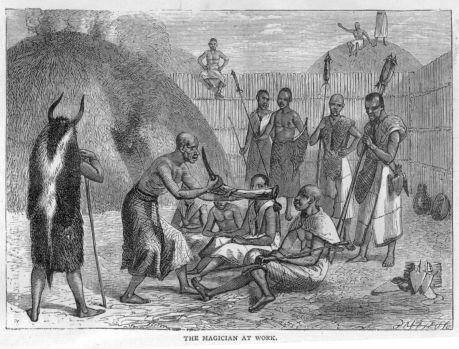 when upwards of thirty of his brothers were to be burned to death.
Kamrasi had been presented with a Bible. As soon as he got hold of it, he began to count the leaves, supposing that each page or leaf represented one year of time since the beginning of creation. After getting through a quarter of the book, he shut it up, on being told that if he desired to ascertain the number more closely he had better count the words.
Six weeks had been uselessly spent, when at length Bombay returned, his attendants dressed in cotton jumpers and drawers, presents given them by Petherick’s outposts, though Petherick himself was not there. The journey to and fro had been performed in fourteen days’ actual travelling, the rest of the time being frittered away by the guides.
Two hundred Turks were stationed at Gani, who were all armed with elephant-guns, and had killed sixteen elephants.
On this, Speke sent a present to Kamrasi, and prepared for his departure. The king, however, complained that he had not received enough, and insisted on having the chronometer. He had himself sent a present of spears; but Speke refused to accept them unless permission for his departure was given. The only way indeed to treat these black potentates is to act with the greatest firmness and determination.
At last the king promised to give them a parting interview, and to send a large escort to accompany them to Petherick’s boats. Several days, however, passed before the interview took place, when the king again asked for more presents, and even begged for the rings which he saw on Grant’s fingers, but without success. Speke had wished to take two of the king’s sons to be educated in England, but instead, he sent two orphan boys, who, being both of the common negro breed, were so unattractive in appearance that Speke declined receiving them. They had been kept the whole time almost as prisoners, without being allowed by the suspicious king to move about the neighbourhood, while no one had been permitted to visit them. They were therefore thankful when at last they persuaded the savage monarch to allow them to take their departure. Canoes had been provided, and on the 9th of November they embarked in one of them on the river Kuffo. Crowds were collected on the banks to see them depart, shouting and waving adieus as they shot down the stream. Among them was the only lady of rank they had seen, dressed in yellow bark cloth, striped with black; she was flat-featured and plain. Their canoes were formed of logs bound together.
Proceeding down the Kuffo, they entered, a few miles below Kamrasi’s residence, the White Nile, down which they floated four days to the Falls of Karuma. The river had the appearance of a large lake, and without a pilot they would have found it impossible to guess what direction to take. It then assumed the appearance of a river a thousand yards wide, covered with numberless moving and stationary islands, amidst which hippopotami reared their heads. These islands were perfect thickets of thorns, creepers, and small trees. Some went rolling round and round, moved by the stream, which ran at the rate of a mile an hour. Amidst them were seen the lofty papyrus, bending to the breeze, which as they drove on, continually changing their relative positions, looked like a fleet of felucca-rigged vessels.
On the third day, a strong breeze coming on, these floating islands melted away or were driven on shore. They landed every evening to sleep, having to push their way between a wide belt of reeds, rushes, and convolvuli.
They passed some attractive scenery. In one place a hill rose eight hundred feet above the water, and on the Kidi side the ground was undulating and wild, covered with handsome trees, with flowering creepers clinging to their boughs, now in rich bloom and presenting every variety of colour.
The king having given his officers directions to supply the travellers with food, they had some exciting chases after canoes, which took to flight as soon as their object was discovered. No sooner was one overtaken than their Wanyoro escort robbed her of bark, cloth, liquor, beads, spears, and everything on board, the poor owners being utterly helpless. Their Seedees, however, seeing the injustice of this, recovered the stolen property, and restored it to the proper owners.
Their cattle and the main body of their escort had gone by land.
On the 19th of November they reached the Karuma Falls, so-called, the blacks say, because the familiar of a certain great spirit placed stones across the river to break its waters as they flow down, and, as a reward for his services, the spot was called after him.
They were here kept some days, preparing to cross the Kidi wilderness.
They were still in the territories of Kamrasi. The governor of the district, a very great man, who sits on a throne only a little inferior to the king’s, called upon them, and was provided accordingly with a box on which to rest. His idea was that his own people had been once half black and half white. He could only account for it by supposing that the country formerly belonged to white men, who had been driven out by the blacks, and that the former were now coming back to retake it. The travellers relieved his apprehensions by telling him that his ancestors were all at one time white, till they crossed the sea and took possession of the country.
Before they started, Kidjwiga sacrificed two kids, one on each side of the river, flaying them, with one long cut, each down their breasts and bellies; the animals were then spread eagle-fashion on the grass, that the travellers might step over them and obtain a prosperous journey.
A messenger arrived from the king urging them to stop, as he was afraid that his rebel brother, Rehonga, might attack them; but they, believing that he had interested motives, commenced their march. The day was rainy, and the road lay across swamps, through thick jungle and long grasses. This continued for a couple of days, when, at length, they found themselves on the borders of a high plateau. Elephants and buffaloes were seen, and the guide, to make the journey propitious, plucked a twig, stripped off the leaves and branches, and, waving it up the line of march, broke it in two, and threw portions on either side of the path.
They had, however, again quickly to plunge into the tall grass, above their heads, and to cross numerous swamps.
On the 29th they reached the habitations of men at Koki, in Gani—a collection of conical huts on the ridge of a small chain of hills. Knots of naked men were seen perched like monkeys on the granite blocks, anxiously watching their arrival. A messenger was sent to the governor, Chongi, who despatched the principal people in the place to welcome them. These people, covered with war paint—something like clowns in a fair—rushed down the hill with their spears full tilt, and, performing various evolutions, conducted them to the governor, who advanced, attended by his familiar—he holding a white hen, the latter a gourd of pomba and a little twig.
The chief, having greeted them cordially, and swinging the fowl by one leg and sprinkling the contents of the gourd over them, led them to his magic-house, which being sprinkled in the same way, he finally spread a cow-skin under a tree, bidding them sit on it, and then presented them with a bowl of pomba.
These people were entirely naked, but were covered with beads and brass ornaments, even the women having only a few fibres hanging like tails before and behind. Their hair was dressed in the most fantastic fashion. They also carried diminutive stools, on which they sat wherever they went.
The travellers had great difficulty, in getting porters, who would never agree until the king’s soldiers had seized their women and cattle, and they frequently had to zig-zag from village to village to obtain them.
These curious people might be seen sitting on the rocks or in the shade of the trees, dressing each other’s hair or forming their pigtails, which are turned up and covered with fine wire. Indeed, they seemed to have little else to do, and were generally observed standing in conceited or ridiculous attitudes. The children are carried on the backs of the women, supported by straps, and the head of the infant is shaded by a reversed gourd from the heat of the sun.
The country had assumed a more attractive appearance, with forests, undulating ground covered with grass, and clusters of habitations, frequently intercepted by running streams.
The party had now entered the country of the Madi, who are savage in their appearance, and are similar to the Gani. Their houses are cylinders of bamboo wicker-work, with steep roofs of bamboo and grass, and are plastered inside, making them very warm.
On the 3rd of December, having pushed on in spite of the attempts of the friendly chiefs to detain them, they came in sight of what they supposed to be Petherick’s outposts, in north latitude 3 degrees 10 minutes 33 seconds. The Seedees immediately began firing away their carbines. Directly afterwards bang, crack, bang! was heard from the distant camp, when, in an instant, every height was seen covered with men. The travellers and their attendants hastened on, when before them appeared three large red flags, heading a military procession which marched out of the camp, with drums and fifes playing.  Speke’s party halted, when a black officer, Mahamed, in Egyptian regimentals, hastened from the head of his ragamuffin regiment, a mixture of Nubians, Egyptians, and slaves of all sorts, which he had ordered to halt, and, throwing himself into Speke’s arms, began to hug and kiss him.
Petherick was enquired for. “He is coming,” was the answer. “What colours are those?”
“Oh, they are Debono’s.”
“Who is Debono?” was asked. “The same as Petric,” answered Mahamed.
Mahamed soon had dinner for them, and they enjoyed a better repast than they had done for many a day. Then the greatest treat was to come—water with which to wash their hands, and the luxury of soap. The remains of their repast was then placed before their faithful Seedees.
On retiring to their hut at night they offered up a prayer of thankfulness to the Almighty for having preserved them through so many difficulties, and at length, by His all-protecting arm, brought them in safety to the boundary of civilisation after twenty-six months of unceasing toil and anxiety. They had still, however, a considerable distance to march before they were to meet with civilised men.
Their host, Mahamed, was little better than a land pirate, who plundered and shot down the natives without compunction. Among his troops there was not a true Turk, wool predominating on their heads. They were adventurers, born from negro stock in the most southern Egyptian dominions. Numbers of such characters are found at Khartoum, ready for any employment. The merchants engage them there, and send them into the interior under the command of a chief to collect ivory and slaves. They were all married to women of the country, whom they had dressed in cloths and beads.
Mahamed, like the black chiefs, wished to detain the travellers, that they and their party might guard his camp, while  he went off on an expedition on his own account. He succeeded by depriving them of their porters, and then marched out with his army—drums and fifes playing, colours flying, guns firing, officers riding, some on donkeys, others on cows. On the 31st the army returned, after having burned down and plundered three villages, laden with ivory and driving in four slave girls and thirty head of cattle.
A few days afterwards another example of Turkish barbarity came under their notice. The head man of a village arrived with a large tusk of ivory with which to ransom his daughter. Fortunately for him it had been considered by the Turks wise to keep on terms with so influential a man; and therefore, on receiving the tusk, Mahamed gave back the damsel, adding a cow to seal their friendship.
At length, weary of Mahamed’s procrastination, on the 11th of January Speke ordered the march, telling Mahamed he might follow if he wished.
At first the villagers, supposing that the travellers were Turks, made their escape in every direction, carrying what stores and cattle they could; while others pulled down their huts, and marched off with the materials to a distant site, to escape from their persecutors.
The people do this because the Turks, when they arrive at a village, often pull down the huts and carry off the roofs to form a camp for themselves outside the enclosure.
They also without ceremony rob the corn-stores, and should the owner remonstrate, he is knocked down with the butt of a musket, and told he is fortunate to escape being shot.
Finding that Speke was determined to move, Mahamed broke up his camp, the whole party, including porters to carry the ivory tusks, amounting to nearly a thousand men.
The Turks, as they marched along, helped themselves from the half-filled bins of the unfortunate natives, who were starving, while the chiefs at the different villages were quarrelling among themselves.
One night a party of warriors from another place appeared in front of the village near which they were encamped, and the next morning the villagers turned out and killed two of them. The enemy, as they retired, cried out that as soon as the guns were gone the villagers must look out for themselves.
Speke and Grant, however, kept their own pots boiling by shooting antelopes and other game. The Turks ate anything they could get hold of. Greatly to the disgust of the Seedees, they devoured a crocodile which was killed; they also feasted off crocodiles’ eggs.
They were now passing through the Bari country. Villages were numerous, but the inhabitants fled as soon as they appeared. Whenever the Turks halted, they sacked the villages of provisions.
At Doro, which they reached on the 13th of February, the Turks having plundered the nearest villages, the natives turned out with their arms, and war drums were beaten as a sign that they intended to attack the camp. As soon as darkness set in, they attempted to steal into the camp, but, being frightened off by the patrols, hundreds collected in front and set fire to the grass, brandishing torches in their hands, howling like demons, and swearing that they would annihilate their enemies in the morning.
On the 15th of February the travellers approached Gondokoro, and to their delight saw in the distance a white speck, which marked the position of the Austrian mission-house. Soon afterwards the masts of the Nile boats could be seen.
The Toorkees halting to fire a feu de joie, the party marched in together.
While making enquiries for Petherick, they caught sight of a sturdy English figure approaching them. Uttering a hearty cheer and waving their hats, they rushed forward and, greatly to their delight, found themselves shaking hands with Mr, now Sir Samuel, Baker, the elephant hunter of Ceylon, who had bravely come out in search of them.
They had had no news from England later than April, 1860, and it was now February, 1863. It was believed in England that they never would have been able to get through the savage tribes. They had reason to be grateful for the kind sympathy of their friends and countrymen.
The long-looked-for Petherick was away on a trading expedition, and had, as yet, made no attempt to succour them.
They waited at Gondokoro till the 26th, that Speke might ascertain, by lunar observation, the longitude, which was 31 degrees 46 minutes 9 seconds east, the latitude being 4 degrees 54 minutes 5 seconds north. The thermometer ranged between 94 degrees and 100 degrees in the shade. The climate was considered better than that of Khartoum.
While Mr Baker, accompanied by his devoted wife, continued his journey southward, they proceeded down the Nile in his boats to Khartoum.
At Gondokoro an Austrian mission has been established for thirty years; but, owing to utter want of success, it was now about to be abandoned.
They here found three Dutch ladies—the Baroness Capellen, Madame Tinne, and her daughter—who had, in the most spirited way, come up the Nile in a steamer for the purpose of assisting them, intending to proceed overland to Fernando Po.
They had, while at Gondokoro, been shocked by seeing a number of slaves, attacked by small-pox, thrown overboard by the native traders. These noble and philanthropic ladies had rescued some of the unfortunate natives from slavery. Unhappily, overcome by the climate, Madame Tinne and most of her companions some time afterwards died, and their proposed expedition was arrested.
The voyage down the Nile to Khartoum took from the 26th of February to the 30th of March, and was performed in a diabeah, the usual Nile boat, the after part being covered with a deck, on which was built a comfortable poop cabin. Their Seedees followed them in two large boats. They were hospitably welcomed by Ali Bey, and by a number of European and Turkish inhabitants.
They now felt themselves in a civilised country. Fifty years ago Khartoum was a mere military post on the Egyptian frontier; it now contains quarters for fifteen thousand troops.
At a banquet, given in their honour by an Italian hunter, Monsieur Debono, upwards of twenty gentlemen and four ladies were present. They here met also Mr Aipperly, a minister of the Pilgrim Mission from the Swiss Protestant Church. He was stationed at Gallabat, and, having learned blacksmith’s work and other trades, he was able to make friends with the natives by assisting them to put up their irrigation wheels and other carpenter’s work.
Among other interesting places they visited was a Coptic church. In the centre was a desk, at which a man was reading aloud to a number of other persons wearing large turbans, their shoes placed on one side, and several children, all sitting on a carpet, listening devoutly. On the walls were draperies and pictures of the Saviour, and within a doorway was a high altar, covered with a cloth marked with the figure of the cross. The service was in Arabic. A handsome old man entered, bearing a staff surmounted by a golden cross. After kneeling at the altar, he invited the strangers to his house to have coffee. Grant says that he never saw a finer face than that of this venerable Copt, Gabriel by name, who is at the head of the Coptic Church at Khartoum.
They left Khartoum on the 15th of April, and continued their journey down to Berber by water. Here they landed, and had a fatiguing camel ride across the desert to a place called Korosko, whence they continued it by water to Cairo. Here they were to part from their faithful Seedees, of whom Bombay was appointed captain. The Seedees received three years’ pay, and an order for a freeman’s garden to be purchased for them at Zanzibar, when each man was to receive ten dollars more as soon as he could find a wife. They ultimately, after many adventures, reached their destination.
The two travellers, whose adventures we have thus far followed, embarked for England, on the 4th of June, on board the “Pera,” where they safely arrived, after an absence of eleven hundred and forty-six days.
His friends had shortly afterwards to mourn Captain Speke’s untimely death, from his gun accidentally going off while at shooting. His gallant companion, now Colonel Grant, survives.
Although not, as he supposed, the discoverer of the remotest source of the Nile, Speke was undoubtedly the first European who saw the Victoria Nyanza, while the adventurous and hazardous journey he and Grant performed together deservedly places them in the first rank of African travellers. They also opened up an extensive and rich district hitherto totally unknown, into which the blessings of Christianity and commerce may, in a few years, be introduced. It is to be hoped that King Rumanika, the most intelligent ruler with whom they came in contact, still survives, as he would afford a cordial welcome both to missionaries and legitimate traders, and his beautiful and healthy country might become the centre of civilisation in that part of Eastern Africa. Were a mission sent to him by way of Zanzibar, backed by a body of disciplined, well-armed men, he would probably greatly assist in clearing the district intervening between the north of his dominions and that lately brought under subjection by  Sir Samuel Baker, and a speedy end might be put to the horrible cruelties of the barbarous Mtesa, King of Uganda. It is sad to reflect, however, that while Mahommedan Turks and Arabs are allowed to range at will over the wide regions of Africa and proselytise the heathen, so few Christian merchants or missionaries have made their way into the interior with the advantages their superior civilisation and pure faith would bestow on the hapless inhabitants.
We may yet hope with Captain Burton that, “as the remote is gradually drawn nigh, and the difficult becomes accessible, the intercourse of man—strongest instrument of civilisation in the hands of Providence—will raise Africa to that place in the great republic of nations, from which she has hitherto been unhappily excluded.”
Chapter Eighteen.
Travels of Dr Livingstone—first expedition.
His parentage and early life—Sets out for Africa as a missionary from the London Missionary Society—Arrives at Cape Town—Lepelole—Mabotsa—Sechele—Dr Livingstone finds him at Kolobeng—A missionary’s necessary accomplishments—The Kalahara Desert described—Starting—The banks of the Zouga—Lake Ngami—Return to Kolobeng—Return to Lake Ngami—Fever—Set out again and reach the Chobe—Sebituane—Banks of the Zambesi—Returns to Kolobeng—Arrives at Cape Town, where his wife and children embark for England—Reaches Kuruman—The Dutch Boers—Linyanti—Received by the Makololo—Fever.
David Livingstone comes of a race whose chief pride was that they were honest men. His great grandfather fell at the battle of Culloden. His grandfather was a small farmer in Ulva, one of the western islands of Scotland. Here his father was born, but his grandfather after that event migrated to a large cotton factory at the Blantyre Works, situated on the Clyde, above Glasgow. His uncles all entered His Majesty’s service either as soldiers or sailors, but his father remained at home, and his mother, being a thrifty housewife, in order to make the two ends meet, sent her son David, at the age of ten, to the factory as a piecer.
He was fond of study, and with part of his first week’s wages he purchased “Ruddiman’s Rudiments of Latin,” and for many years afterwards studied that language at an evening school after his work was done. He also, when promoted at the age of nineteen to cotton-spinning, took his books to the factory, and read by placing one of them on a portion of the spinning-jenny, so that he could catch sentence after sentence as he passed at his work. He was well paid, however, and having determined to prepare himself for becoming a medical missionary in China, was enabled, by working with his hands in summer, to support himself while attending medical and Greek classes in Glasgow in winter, as also the divinity lectures of Dr Wardlow. He was thus able to pass the required examinations, and was at length admitted a licentiate of the Faculty of Physicians and Surgeons.
The war in China preventing him from proceeding thither, he offered himself as a missionary to the London Missionary Society, and embarked for Africa in 1840.
After reaching Cape Town, he went round to Algoa Bay, whence he proceeded about eight hundred miles into the interior to Kuruman, the missionary station of the Reverend R. Moffat, whose daughter he afterwards married.
Thence he went to Lepelole, where, to gain a knowledge of the language and habits of the inhabitants, the Bakwains, he cut himself off from European society for six months. The Bakwains, however, being driven by another tribe from their country, he was unable, as he had intended, to form a station at that place.
He was more successful at Mabotsa, also inhabited by the Bakwains, to which place he removed in 1843. It was here, while in chase of a lion, that he nearly lost his life. He had fired both the barrels of his gun, and was re-loading, when the lion, though desperately wounded, sprang upon him, catching his shoulder, both man and beast coming to the ground together. Growling horribly, the fierce brute shook the doctor as a terrier dog does a rat. The shock produced a stupor similar to that which seems to be felt by a mouse after the first shake of a cat. The gun of his companion, a native 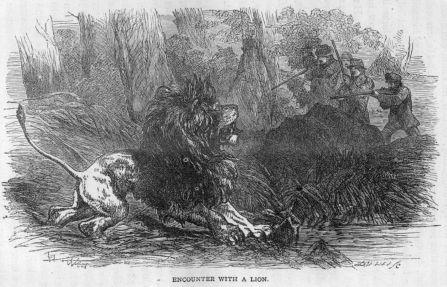 schoolmaster, who came to his assistance, missed fire, when the lion, leaving Dr Livingstone, attacked him. Another native came up with a spear, when the lion flew at him also, but the bullets at that moment taking effect, the fierce brute fell down dead.
The chief of the Bakwains, Sechele, became a Christian, and exerted himself for the conversion of his people, restoring his wives to their fathers, and living in every respect a thoroughly consistent life.
The Dutch Boers, who had pushed forward to the confines of the country, proved, however, most adverse to the success of the mission, by carrying off the natives and compelling them to labour as slaves.
By the advice of Dr Laidley, Sechele and his people moved to Kolobeng, a stream about two hundred miles to the north of Kuruman, where Dr Livingstone formed a station.
He here built a house with his own hands, having learned carpentering and gardening from Mr Moffat, as also blacksmith work. He had now become handy at almost any trade, in addition to doctoring and preaching, and, as his wife could make candles, soap, and clothes, they possessed what may be considered the indispensable accomplishments of a missionary family in Central Africa.
Among the gentlemen who had visited the station was Mr Oswell, in the East India Company’s service. He deserves to take rank as an African traveller. Hearing that Dr Livingstone purposed crossing the Kalahara Desert in search of the great Lake Ngami, long known to exist, he came from India on purpose to join him, accompanied by Mr Murray, volunteering to pay the entire expenses of the guides.
The Kalahara, though called a desert from being composed of soft sand and being destitute of water, supports prodigious herds of antelopes, while numbers of elephants, rhinoceros, lions, hyenas, and other animals roam over it. They find support from the astonishing quantity of grass which grows in the region, as also from a species of water-melon, and from several tuberous roots, the most curious of which is the leroshua, as large as the head of a young child, and filled with a fluid like that of a turnip. Another, the mokuri, an herbaceous creeper, the tubers of which, as large as a man’s head, it deposits in a circle of a yard or more horizontally from the stem. On the water-melons especially, the elephants and other wild animals revel luxuriously.
Such was the desert Dr Livingstone and his party proposed to cross when they set out with their wagon on the 1st of June, 1849, from Kolobeng. Instead, however, of taking a direct course across it, they determined to take a more circuitous route, which, though longer, they hoped would prove safer.
Continuing on, they traversed three hundred miles of desert, when, at the end of a month, they reached the banks of the Zouga, a large river, richly fringed with fruit-bearing and other trees, many of them of gigantic growth, running north-east towards Lake Ngami. They received a cordial welcome from the peace-loving inhabitants of its banks, the Bayeiye.
Leaving the wagons in charge of the natives, with the exception of a small one which proceeded along the bank, Dr Livingstone embarked in one of their canoes. Frail as are the canoes of the natives, they make long trips in them, and manage them with great skill, often standing up and paddling with long light poles. They thus daringly attack the hippopotami in their haunts, or pursue the swift antelope which ventures to swim across the river. After voyaging on the stream for twelve days, they reached the broad expanse of Lake Ngami. Though wide, it is excessively shallow, and brackish during the rainy season. They here heard of the Tamunacle and other large rivers flowing into the lake.
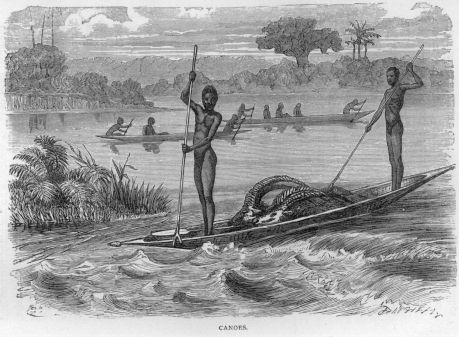
Livingstone’s main object in coming was to visit Sebituane, the great chief of the Makololo, who live about two hundred miles to the northward. The chief of the district, Sechulatebe, refused, however, either to give them goods or to allow them to cross the river. Having in vain attempted to form a raft to ferry over the wagon, they were reluctantly compelled to abandon their design. The doctor had been working at the raft in the river, not aware of the number of alligators which swarmed around him, and had reason to be thankful that he escaped their jaws.
The season being far advanced, they determined to return to Kolobeng, Mr Oswell generously volunteering to go down to the Cape and bring up a boat for the next season.
Half the royal premium for the encouragement of geographical science and discoveries was awarded by the council of the Royal Geographical Society to Dr Livingstone for the discoveries he made on this journey.
Sechele, the Christian chief of the Bakwains, who was eager to assist him in reaching Sebituane, offered his services, and with him as a guide, accompanied by Mrs Livingstone and their three children, he set out, in April, 1850, taking a more easterly course than before.
They again reached the lake, but the greater number of the party being attacked by fever, he was compelled to abandon his design of visiting Sebituane.
He here heard of the death of a young artist, Mr Rider, who had shortly before visited the lake for the purpose of making sketches.
The natives inhabiting the banks of the rivers falling into Lake Ngami are famed for their skill in hunting the hippopotamus. In perfect silence they approach in their light canoes, and plunge their sharp spears, with thongs attached, into the back of one of the huge creatures, which dashes down the stream, towing the canoe at a rapid rate. Thus 
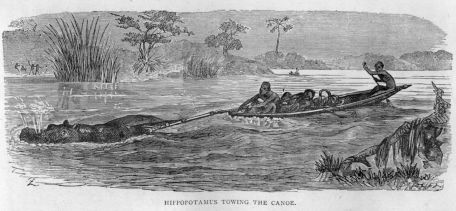 the animal continues its course, the hunters holding on to the rope, till its strength is exhausted, when, other canoes coming up, it is speared to death. Frequently, however, the hippopotamus turns on its assailants, bites the canoe in two, and seizes one of them in its powerful jaws. When they can manage to do so, they tow it into shallow water, and, carrying the line on shore, secure it to a tree, while they attack the infuriated animal with their spears, till, sinking exhausted with its efforts, it becomes their prey.
Mr Oswell, who had arrived too late for the journey, spent the remainder of the season in hunting  elephants, liberally presenting Dr Livingstone with the proceeds of his sport, for the outfit of his children.
The third journey was commenced in the spring of 1851, when, rejoined by Mr Oswell, he set out once more, accompanied by Mrs Livingstone and their children.
First travelling north, and then to the north-east, through a region covered with baobab-trees, abounding with springs, and inhabited by Bushmen, they entered an arid and difficult country. Here, the supply of water being exhausted, great anxiety was felt for the children, who suffered greatly from thirst. At length a small stream, the Mababe, was reached, running into a marsh, across which they had to make their way. During the night they traversed a region infested by the tsetse, a fly not much larger than the common house-fly, the bite of which destroys cattle and horses. It is remarkable that neither man, wild animals, nor even calves as long as they continue to suck, suffer from the bite of this fearful pest. While some districts are infested by it, others in the immediate neighbourhood are free, and, as it does not bite at night, the only way the cattle of travellers can escape is by passing quickly through the infested district before the sun is up. Sometimes the natives lose the whole of their cattle by its attacks, and travellers frequently have been deprived of all means of moving with their wagons, in consequence of the death of their animals; some, indeed, have perished from being unable to proceed.
Having reached the Chobe, a large river, which falls into the Zambesi, leaving their attendants encamped with their cattle on an island, Dr Livingstone and his family, with Mr Oswell, embarked in a canoe on the former river, and proceeded down it about twenty miles to an island, where Sebituane was waiting to receive them.
The chief, pleased with the confidence the doctor had shown in bringing his wife and children, promised to take them to see his country, that they might chose a spot where they might form a missionary station. He had been engaged in warfare nearly all his life, under varying fortunes, with the neighbouring savage tribes, and had at length established himself in a secure position behind the Chobe and Leeambye, whose broad streams guarded him from the inroads of his enemies. He had now a larger number of subjects and was richer in cattle than any chief in that part of Africa.
The rivers and swamps, however, of the region produced fever, which had proved fatal to many of his people. He had long been anxious for intercourse with Europeans, and showed every wish to encourage those who now visited him to remain in his territory.
Unhappily, a few days after the arrival of his guests the chief was attacked with inflammation of the lungs, originating in an old wound, and, having listened to the gospel message delivered by the doctor, he in a short time breathed his last.
Dr Livingstone says that he was decidedly the best specimen of a native chief he had ever met. His followers expressed the hope that the English would be as friendly to his children as they intended to have been to himself.
The chieftainship devolved at his death on a daughter, who gave the visitors leave to travel through any part of the country they chose. They accordingly set out, and traversing a level district covered with wild date-trees, and here and there large patches of swamp, for a distance of a hundred and thirty miles to the north-east, they reached the banks of the Zambesi, in the centre of the continent.
From the prevalence of the tsetse, and the periodical rise of its numerous streams causing malaria, Dr Livingstone was compelled to abandon the intention he had formed of removing his own people thither that they might be out of the reach of their savage neighbours, the Dutch boers. It was, however, he at once saw, the key of Southern and Central Africa.
The magnificent stream, on the bank of which he now stood, flows hundreds of miles east to the Indian Ocean—a mighty artery supplying life to the teeming population of that part of Africa. He therefore determined to send his wife and children to England, and to return himself and spend two or three years in the new region he had discovered, in the hopes of evangelising the people and putting a stop to the trade in slaves, which had already been commenced even thus far from the coast.
He accordingly returned to Kolobeng, and then set out with his family a journey of a thousand miles, to Cape Town. Having seen them on board a homeward-bound ship, he again turned his face northward, June, 1852.
Having reached Kuruman, he was there detained by the breaking of a wagon-wheel. During that time the Dutch Boers attacked his friends, the Fakwains, carrying off a number of them into slavery, the only excuse the white men had being that Sechele was getting too saucy—in reality, because he would not prevent the English traders from passing through his territory to the northward. The Dutch plundered Dr Livingstone’s house, and carried off the wagons of the chief and that of a trader who was stopping in the place. Dr Livingstone therefore found great difficulty in obtaining guides and servants to proceed northward. Poor Sechele set out for Cape Town, intending, as he said, to lay his complaint before the Queen of England, but was compelled by want of funds to return to his own country, where he devoted himself to the evangelisation of his people.
Parting with the chief, Dr Livingstone, giving the Boers a wide berth, proceeded across the desert to Linyanti, the capital of the Makololo, where he had visited the Chief Sebituane in 1851. The whole population, amounting to nearly seven thousand souls, turned out to welcome him. He found that the princess had abdicated in favour of her brother Sekeletu, who received him with the greatest cordiality. The young king, then only nineteen, exclaimed: “I have now got another father instead of Sebituane.” The people shared this feeling, believing that by the residence of a missionary among them they would obtain some important benefits, though of the real character of the blessing they might receive they were totally ignorant.
A rival of the young king existed in the person of a cousin, Mpepe, who had been appointed by the late king chief over a portion of his subjects, but whose ambition made him aim at the command of the whole.
Half-caste Portuguese slave-traders had made their way to Linyanti, and one, who pretended to be an important person, was carried about in a hammock slung between two poles, which looking like a bag, the natives called him “the father of the bag.” Mpepe favoured these scoundrels, as he hoped by their means to succeed in his rebellion. The arrival of Dr Livingstone, however, somewhat damped their hopes.
As the chief object of the doctor was to select a spot for a settlement, he ascended, accompanied by Sekeletu, the great river Zambesi, which had been discovered in the year 1851.
The doctor had taught the Makololo to ride on their oxen, which they had never before done, though, having neither saddles nor bridles, they constantly fell off.
He and Sekeletu were riding along side by side, when they encountered Mpepe, who, as soon as he saw them, ran towards the chief with his axe uplifted; but Sekeletu, galloping on, escaped him. On their arrival at their camp, while the chief and the doctor were sitting together, Mpepe  appeared, his men keeping hold of their arms. At that moment the rebel entered; but the doctor, unconsciously covering Sjkeletu’s body, saved him from the assassin’s blow. His cousin’s intention having been revealed to Sekeletu, that night Mpepe was dragged off from his fire and speared. So quietly was the deed done that Dr Livingstone heard nothing of it till the next morning.
Dr Livingstone was soon after this attacked by fever, when his hosts exhibited the interest they felt for him by paying him every attention in their power. His own remedies of a wet sheet and quinine were more successful than the smoke and vapour baths employed by the natives.
It is important that the position of Linyanti should be noted, as from it Dr Livingstone set out on his journey westward to Loanda, on the West Coast, and, returning to it, commenced from thence that adventurous expedition to the East Coast, which resulted in so many interesting discoveries. Its latitude is 18 degrees 17 minutes 20 seconds south; longitude 23 degrees 50 minutes 9 seconds east.
Chapter Nineteen.
Travels of Dr Livingstone, continued.
Set out—Sesheke—Makololo architecture—Village of Katonga—Paddle up the Leeambye—Mpepe—Naliele—Visit Ma-Sekeletu—A grand dance—Return to Linyanti—Expedition to the West—On the Chobe—Gonye Falls—Up the Leeanibye—Up the Leeba—The Balonda country—Manenko—Visits Shinti—Reception of Livingstone—Proceeds northerly—Visit Katema—Reach the territory of the Chiboque—Want of food—A mutiny—The banks of the Quango—Reach Kasenge—Sleeping-places on the road—Ambaca—Trombeta—Arrive at Loanda—Livingstone, with his Makololo, goes on board the “Pluto” and “Philomel”—The city of Loanda—Departure—Ascend the river Bengo to Icollo-i-Bengo—Golcongo Alto—Excursion to Kasenge—Proceed to, and arrive on, the banks of the Quango—Bashinji country—Attacked—Reach Calongo—Kanawa’s village—Past Lake Dilolo—Shuiti’s capital—On the Leeba—The Lecambye—The town of Lebouta—Proceeding, arrives at Sesheke and afterwards at Linyanti.
Having recovered from his fever, Dr Livingstone, accompanied by Sekeletu and about one hundred and sixty attendants, mostly young men, associates of the chief, set out for Sesheke. The intermediate country was perfectly flat, except patches elevated a few feet only above the surrounding level. There were also numerous mounds, the work of termites, which are literally gigantic structures, and often wild date-trees were seen growing on them.
The party looked exceedingly picturesque as, the ostrich feathers of the men waving in the air, they wound in a long line in and out among the mounds. Some wore red tunics or variously-coloured prints, and their heads were adorned with the white ends of ox tails or caps made of lions’ manes. The nobles walked with a small club of rhinoceros horn in their hands, their servants carrying their shields; while the ordinary men bore burdens, and the battle-axe men, who had their own shields on their arms, were employed as messengers, often having to run an immense distance.
The Makololo possess numerous cattle, and the chief, having to feed his followers, either selected oxen from his own stock or received them from the head men of the villages through which they passed, as tribute.
Dr Livingstone and the chief had each a little gipsy tent in which they slept, though the Makololo huts, which are kept tolerably clean, afforded them accommodation. The best sort of huts consist of three circular walls, having small holes to serve as doors, through which it is necessary to creep on all fours. The roof resembles in shape a Chinaman’s hat, and is bound together with circular bands. The framework is first formed, and it is then lifted to the top of the circle of poles prepared for supporting it. The roof is next covered with fine grass and sewed with the same material as the lashings. Women are the chief builders of huts among the Makololo.
Reaching the village of Katonga on the banks of the Leeambye, some time was spent there in collecting canoes. During this delay Dr Livingstone visited the country to the north of the village, where he saw enormous numbers of buffaloes, zebras, elans, and a beautiful small antelope called the tinyane. He was enabled, by this hunting expedition, to supply his companions with an abundance of food.
At length, a sufficient number of canoes being collected, they commenced the ascent of the river. His own canoe had six paddlers, while that of the chief had ten. They paddled standing upright, and kept stroke with great exactness. Being flat-bottomed, they can float in very shallow water. The fleet consisted altogether of thirty-three canoes and one hundred and sixty men.
The Makololo are unable to swim, and, a canoe being 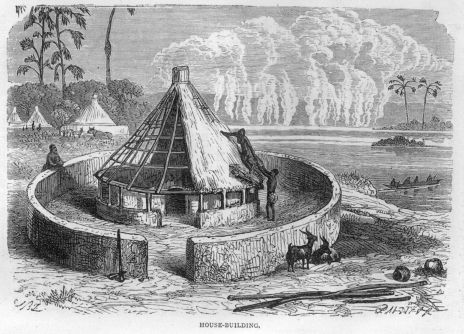 upset, one of the party, an old doctor, was lost, while the Barotse canoe-men easily saved themselves by swimming.
Numerous villages were seen on both banks of the river, the inhabitants of which are expert hunters of the hippopotamus, and are excellent handicraft-men. They manufacture wooden bowls with neat lids, and show much taste in carving stools. Some make neat baskets, and others excel in pottery and iron.
On their arrival at the town of the father of Mpepe, who had instigated his son to rebellion, two of his chief councillors were led forth and tossed into the river.
Mpepe had encouraged the slave-dealers to come into the country, and a large party of his supporters, the Mambari, had taken shelter in a stockade. It was proposed to attack them; but Dr Livingstone urged his friends to refrain from so doing, especially as the enemy possessed firearms. It was then agreed that they would starve them out.
“Hunger is strong enough for that,” observed a chief, “he is a very great fellow;” but here again, as the unfortunate slaves who were chained in gangs would have suffered, the doctor interceded, and they were allowed to depart.
Naliele, the capital of the Barotse, the tribe inhabiting the district in which they now were, is built on an artificially-constructed mound, as are many other villages of that region, to raise them above the overflowing of the river. From finding no trace of European names among them, Dr Livingstone was convinced that the country had not before been visited by white men; whereas, after he had come among them, great numbers of children were named after his own boy, while others were called Horse, Gun, Wagon, etcetera.
Here again numbers of large game were seen. Eighty-one buffaloes defiled in slow procession before the fire of the travellers one evening within gun-shot, and herds of splendid elans stood at two hundred yards’ distance, without showing signs of fear. Lions, too, approached and roared at them. One night, as they were sleeping on the summit of a large sandbank, a lion appeared on the opposite shore, who amused himself for hours by roaring as loudly as he could. The river was too broad for a ball to reach him, and he walked off without suffering for his impertinence. Dr Livingstone saw two as tall as common donkeys, their manes making their bodies appear of still greater size.
The doctor was visited at his camp by two Arabs, who had made their way thus far west. They professed the greatest hatred of the Portuguese because they eat pigs, and they disliked the English because they thrash them for selling slaves.
On their journey they visited the town of Ma-Sekeletu, or the mother of Sekelutu, where, as it was the first visit the king had paid to this part of his dominions, he was received with every appearance of joy. A grand dance was got up, the men standing nearly naked in a circle, with clubs or small battle-axes in their hands, roaring at the loudest pitch of their voices, while they simultaneously lifted one leg, stamped twice with it, then lifted the other and gave one stamp with that. The arms and head were thrown about in every direction, the roaring being kept up with the utmost vigour, while the dust ascended in clouds around them.
Returning down the stream at a rapid rate, they quickly reached Linyanti.
During this nine-weeks’ tour Dr Livingstone had been in closer contact with heathenism than ever before, and though, including the chief, everyone had been as attentive as possible, yet the dancing, roaring, singing, jesting, quarrelling, added to the murdering propensities of these children of nature was painful in the extreme. He took a more intense disgust of heathenism than he had ever before felt, 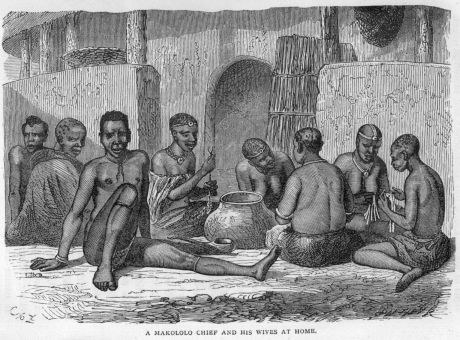 and formed a higher opinion of the latent effects of missions in the south among tribes which were once as savage as the Makololo.
The chief and his followers, agreeing that the object of Dr Livingstone’s proposed expedition to the west was most desirable, took great pains to assist him in the undertaking. A band of twenty-seven men was appointed to accompany him by the chief’s command, whose eager desire was to obtain a free and profitable trade with the white men, and this, Dr Livingstone was convinced, was likely to lead to their ultimate elevation and improvement. Three men whom he had brought from Kuruman having suffered greatly from fever, he sent them back with Fleming, a trader, who had followed his footsteps. His new attendants he named Zambesians, for there were only two Makololo men—the rest consisting of Barotse, Batoka, and other tribes. His wagon and remaining goods he committed to the charge of the Makololo, who took all the articles into their huts. He carried only a rifle and double-barrelled smooth-bore gun for himself, and gave three muskets to his people, by means of which he hoped game might be obtained for their support. Wishing also to save his followers from having to carry loads, he took for his own support but a few biscuits and a pound of tea and sugar, about twenty of coffee, a small tin canister with some spare shirting, trousers, and shoes, another for medicines, and a third for books, while a fourth contained a magic lantern. His ammunition was distributed in portions among the whole luggage, that, should an accident occur to one, the rest might be preserved. His camp equipage consisted of a gipsy tent, a sheep-skin mantle, and a horse-rug as a bed, as he had always found that the chief art of successful travelling consisted in taking as few impediments as possible. His sextant, artificial horizon, thermometer, and compasses were carried apart.
On the 11th of November, 1853, accompanied by the chief and his principal men to see him off, he left Linyanti, and embarked on the Chobe. The chief danger in navigating this river is from the bachelor hippopotami who have been expelled their herd, and, whose tempers being soured, the canoes are frequently upset by them. One of these misanthropes chased some of his men, and ran after them on shore with considerable speed.
The banks of the river were clothed with trees, among them the ficus indica, acacias, and the evergreen motsouri, from the pink-coloured specimens of which a pleasant acid drink is obtained.
Leaving the Chobe, they entered the Leeambye, up which they proceeded at somewhat a slow rate, as they had to wait at different villages for supplies of food. Several varieties of wild fruit were presented to them.
The crews of the canoes worked admirably, being always in good humour, and, on any danger threatening, immediately leaped overboard to prevent them coming broadside to the stream, or being caught by eddies, or dashed against the rocks.
Birds, fish, iguanas, and hippopotami abounded; indeed the whole river teemed with life.
On November 30th the Gonye Falls were reached. No rain having fallen, it was excessively hot. They usually got up at dawn—about five in the morning—coffee was taken and the canoes loaded, the first two hours being the most pleasant part of the day’s sail.
The Barotse, being a tribe of boatmen, managed their canoes admirably.
At about eleven they landed to lunch. After an hour’s rest they embarked, the doctor with an umbrella overhead. Sometimes they reached a sleeping-place two hours before sunset. Coffee was again served out, with coarse bread made of maize 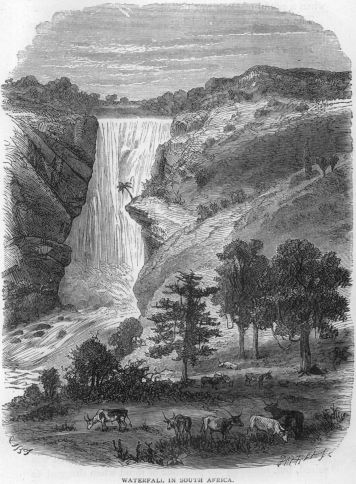 meal, or Indian corn, unless some animal had been killed, when a potful of flesh was boiled.
The canoes were carried beyond the falls, slung on poles placed on men’s shoulders.
Here as elsewhere the doctor exhibited his magic lantern, greatly to the delight of the people.
Nothing could be more lovely than the scenery of the falls. The water rushes through a fissure and, being confined below by a space not more than a hundred yards wide, goes rolling over and over in great masses, amid which the most expert swimmer can in vain make way.
The doctor was able to put a stop to an intended fight between the inhabitants of two villages. Several volunteers offered to join him, but his followers determined to adhere to the orders of Sekeletu, and refused all other companions.
They were treated most liberally by the inhabitants of all the villages, who presented them with more oxen, milk, and meal than they could stow away. Entering the Leeambye, Dr Livingstone proceeded up that stream in his canoe, while his oxen and a portion of his men continued their journey along its banks.
The rain had fallen, and nature put on her gayest apparel: flowers of great beauty and curious forms grew everywhere, many of the forest trees having palmated leaves, the trunks being covered with lichens, while magnificent ferns were seen in all the moister situations. In the cool morning the welkin rang with the singing of birds, and the ground swarmed with insect life.
Livingstone did not fail to preach the Gospel to his attendants, as well as to the inhabitants of the villages, ever having in mind the value of human souls.
Alligators were in prodigious numbers, children and calves being constantly carried off by them. One of his men was seized, but, retaining his presence of mind when dragged to the bottom, he struck the monster with his javelin and escaped, bearing the marks of the reptile’s teeth on his thigh.
The doctor’s men had never before used firearms, and, proving bad shots, came to him for “gun medicine” to enable them to shoot better. As he was afraid of their exhausting his supply of powder, he was compelled to act as sportsman for the party.
Leaving Leeambye, he proceeded up the Leeba. Beautiful flowers and abundance of wild honey was found on its shores, and large numbers of young alligators were seen sunning themselves on the sandbanks with their parents.
They had now reached the Balonda country, and received a visit from a chieftainess, Manenko, a tall strapping woman covered with ornaments and smeared over with fat and red ochre as a protection against the weather. She invited them to visit her uncle Shinti, the chief of the country.
They set out in the midst of a heavy drizzling mist; on, however, the lady went, in the lightest marching order. The doctor enquired why she did not clothe herself during the rain; but it appeared that she did not consider it proper for a chief to appear effeminate. The men, in admiration of her pedestrian powers, every now and then remarked: “Manenko is a soldier.” Some of the people in her train carried shields composed of reeds, of a square form, five feet long and three broad. With these, and armed with broadswords and quivers full of iron-headed arrows, they looked somewhat ferocious, but are in reality not noted for their courage.
The doctor was glad when at length the chieftainess halted on the banks of a stream and preparations were made for their night’s lodging.
After detaining them several days she accompanied them on foot to Shinti’s town. The chief’s place of audience was ornamented by two graceful banyan-trees, beneath one of which he sat on a sort of throne covered with a leopard-skin. 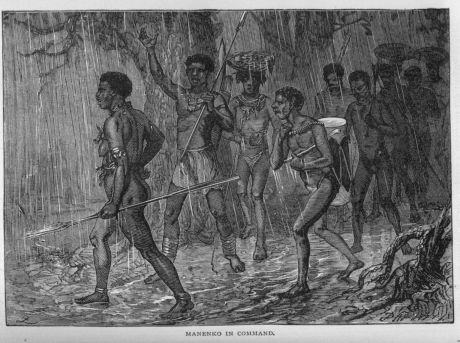 He wore a checked shirt and a kilt of scarlet baize, edged with green, numerous ornaments covering his arms and legs, while on his head was a helmet of beads, crowned with large goose feathers. At his side sat three lads with quivers full of arrows over their shoulders.
Dr Livingstone took his seat under the shade of another tree opposite to the chief, while the spokesman of the party, who had accompanied them, in a loud voice, walking backwards and forwards, gave an account of the doctor and his connection with the Makololo.
Behind the chief sat a hundred women clothed in red baize, while his wife was seated in front of him. Between the speeches the ladies burst forth into a sort of plaintive ditty. The party was entertained by a band of musicians, consisting of three drummers and four performers on the marimba, a species of piano. It consists of two bars of wood placed side by side; across these are fixed fifteen wooden keys, each two or three inches broad and about eighteen long, their thickness being regulated by the deepness of the note required. Each of the keys has a calabash below it, the upper portion of which, being cut off to hold the bars, they form hollow sounding-boards to the keys. These are also of different sizes according to the notes required. The keys are struck by small drumsticks to produce the sound. The Portuguese have imitated the marimba, and use it in their dances in Angola.
The women in this country are treated with more respect by the men than in other parts of Africa.
A party of Mambari, with two native Portuguese traders, had come up to obtain slaves, and, while Dr Livingstone was residing with Shinti, some young children were kidnapped, evidently to be sold to them.
The day before he was to recommence his journey, the doctor received a visit in his tent from Shinti, who, as a mark  of his friendship, presented him with a shell on which he set the greatest value, observing: “There, now you have a proof of my affection.”
These shells, as marks of distinction, are so highly valued that for two of them a slave may be bought, and five will purchase an elephant’s tusk worth ten pounds.
The old chief had provided a guide, Intemese, to conduct them to the territory of the next chief, Katema. He also gave an abundant supply of food, and wished them a prosperous journey.
Dr Livingstone again started on the 26th of January, Shinti sending eight men to assist in carrying his luggage. He had now to quit the canoes and to proceed on ox-back, taking a northerly direction.
He and his party received the same kind treatment in the country as before, the villagers, by command of their chiefs, presenting them with an abundance of food. They found English cotton cloth more eagerly enquired after than beads and ornaments.
On arriving at a village the inhabitants lifted off the roofs of some of their huts, and brought them to the camp, to save the men the trouble of booth-making. On starting again the villagers were left to replace them at their leisure, no payment being expected.
Heavy rains now came on, and the doctor and his party were continually wet to the skin.
Polite as the people were, they were still fearful savages. Messengers arrived from the neighbouring town to announce the death of their chief, Matiamvo. That individual had been addicted to running a-muck through his capital and beheading any one he met, till he had a large heap of human heads in front of his hut. Men were also slaughtered occasionally, whenever the chief wanted part of a body to perform certain charms.
The Balonda appear to have some belief in the existence of the soul, and a greater feeling of reverence in their composition than the tribes to the eastward. Among their customs they have a remarkable one. Those who take it into their heads to become friends, cement their friendship. Taking their seats opposite one to the other, with a vessel of beer by the side of each, they clasp hands. They then make cuts on their clasped hands, the pits of their stomachs, their foreheads, and right cheeks. The point of a blade of grass is then pressed against the cuts, and afterwards each man washes it in his own pot of beer; exchanging pots, the contents are drunk, so that each man drinks the blood of the other. Thus they consider that they become blood relations and are bound in every possible way to assist each other.
These people were greatly surprised at the liberty enjoyed by the Makololo.
The travellers paid a visit to Katema, the chief of the district, who received them dressed in a snuff-brown coat, with a helmet of beads and feathers on his head, and in his hand a number of tails of gnus bound together. He also sent some of his men to accompany them on their journey.
The rains continued, and the doctor suffered much from having to sleep on the wet ground.
Having reached the latitude of Loanda, Dr Livingstone now directed his course to the westward.
On the 4th of March he reached the outskirts of the territory of the Chiboque.
As he approached the more civilised settlements, he found the habits of the people changed much for the worse: tricks of all sorts were played to detain him and obtain tribute; the guides also tried in every way to impose on him. Even his Makololo expressed their sorrow at seeing so beautiful a country ill cultivated and destitute of cattle.
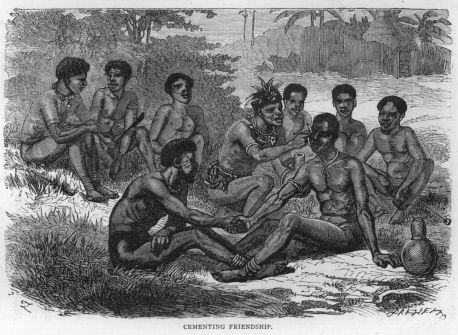
He was compelled to slaughter one of his riding oxen for food, as none could be obtained.
The Chiboque coming round in great numbers, their chief demanded tribute, and one of their number made a charge at Dr Livingstone, but quickly retreated on having the muzzle of the traveller’s gun pointed at his head. The chief and his councillors, however, consenting to sit down on the ground, the Makololo, well drilled, surrounded them and thus got them completely in their power. A mutiny, too, broke out among his own people, who complained of want of food; but it was suppressed by the appearance of the doctor with a double-barrelled pistol in his hand. They never afterwards gave him any trouble.
Similar demands for payment to allow him to pass through the country were made by other chiefs, his faithful Makololo giving up their ornaments, as he had done nearly all the beads and shirts in his possession. The most extortionate of these chiefs was Ioaga Panza, whose sons, after receiving payment for acting as guides, deserted him.
All this time Dr Livingstone was suffering daily from the attacks of fever, which rendered him excessively weak, so that he could scarcely sit his ox.
The country appeared fertile and full of small villages, and the soil is so rich that little labour is required for its cultivation. It is, however, the chief district whence slaves are obtained, and a feeling of insecurity was evident amongst the inhabitants.
A demand was now made by each chief for a man, an ox, or a tusk as tribute. The first was of course refused, but nearly all the remainder of the traveller’s property had to be thus paid away.
On the 4th of April they reached the banks of the Quango, here a hundred and fifty yards wide. The chief of the district—a young man, who wore his hair curiously formed into  the shape of a cone, bound round with white thread—on their refusing to pay him an extortionate demand, ordered his people not to ferry them across, and opened fire on them. At this juncture a half-caste Portuguese, a sergeant of militia, Cypriano Di Abreu arrived, and, obtaining ferrymen, they crossed over into the territory of the Bangala, who are subject to the Portuguese. They had some time before rebelled, and troops were now stationed among them, Cypriano being in command of a party of men. Next morning he provided a delicious breakfast for his guest, and fed the Makololo with pumpkins and maize, while he supplied them with farina for their journey to Kasenge, without even hinting at payment.
The natives, though they long have had intercourse with the Portuguese, are ignorant and superstitious in the extreme. Many parts of the country are low and marshy, and they suffer greatly from fever. Of the use of medicine they have no notion, their only remedies being charms and cupping. The latter operation is performed with a small horn, which has a little hole in the upper end. The broad end is placed on the flesh, when the operator sucks through the hole; as the flesh rises, he gashes it with a knife, then replaces the horn and sucks again, till finally he introduces a piece of wax into his mouth, to stop up the hole, when the horn is left to allow the blood to gush into it.
It took the travellers four days to reach Kasenge, a town inhabited by about forty Portuguese traders and their servants. Though told by the doctor that he was a Protestant minister, they treated him with the greatest kindness and hospitality.
Here the Makololo sold Sekeletu’s tusks, obtaining much better prices than they would have done from the Cape traders, forgetting, however, that their value was greatly increased by the distance they had been brought.
The Makololo here expressed their fears, from what they had heard, that they were about to be led down to the sea-coast to be sold, but when Livingstone asked them if he had ever deceived them, and that he would assure them of their safety, they agreed to accompany him.
The merchants of Kasenge treated the doctor with the most disinterested kindness, and furnished him with letters to their friends at Loanda.
He was escorted by a black corporal of militia, who was carried in a hammock by his slaves. He could both read and write, and was cleanly in all his ways; he was considerate also to his young slaves, and walked most of the way, only getting into his hammock on approaching a village, for the sake of keeping up his dignity. He, however, had the usual vices in a land of slaves, and did not fail to cheat those he was sent to protect.
Sleeping-places were erected on the road about ten miles apart, as there is a constant stream of people going to and coming from the coast.
Goods are either carried on the head or on one shoulder, in a sort of basket, supported by two poles five or six feet long. When the carrier feels tired and halts, he plants them on the ground, allowing his burden to rest against a tree, so that he has not to lift it up from the ground to the level of his head.
On arriving at a sleeping-place, the sheds were immediately taken possession of by the first comers, those arriving last having to make huts with long grass for themselves. Women might then be seen coming from their villages with baskets of manioc meal, yams, garlic, and other roots for sale.
As Dr Livingstone had supplied himself with calico at Kasenge, he was able to purchase what was necessary.
The district of Ambaca, through which he now passed, was excessively fertile. Large numbers of cattle exist on its pastures, which are well-watered by flowing streams, while lofty mountains rise in the distance. It is said to contain forty thousand souls.
The doctor was delighted with Golcongo Alto, a magnificent district—the hills bedecked with trees of various hues, the graceful oil-yielding palm towering above them.
Here the commandant, Lieutenant Castro, received him in a way which won the doctor’s affectionate regard.
He calculated that this district has a population of a hundred and four thousand.
The lieutenant regretted, as does every person of intelligence, the neglect with which this magnificent country has been treated.
As they proceeded, they passed streams with cascades, on which mills might easily be formed; but here numbers of carpenters were converting the lofty trees which grew around into planks, by splitting them with wedges.
At Trombeta the commandant had his garden ornamented with rows of trees, with pineapples and flowers growing between them. A few years ago he had purchased an estate for 16 pounds, on which he had now a coffee plantation and all sorts of fruit-trees and grape-vines, besides grain and vegetables growing, as also a cotton plantation.
As they approached the sea the Makololo gazed at it, spreading out before them, with feelings of awe, having before believed that the whole world was one extended plain. They again showed their fears that they might be kidnapped, but Dr Livingstone reassured them, telling them that as they had stood by each other hitherto, so they would do to the last.
On the 31st of May they descended a declivity leading to the city of Loanda, where Dr Livingstone was warmly welcomed by Mr Gabriel, the British commissioner for the suppression of the slave trade. Seeing him so ill, he benevolently offered the doctor his bed. “Never shall I forget,” says Dr Livingstone, “the luxurious pleasure I enjoyed in feeling myself again on a good English couch, after for six months sleeping on the ground.”
It took many days, however, before the doctor recovered from the exposure and fatigue he had endured. All that time he was watched over with the most generous sympathy by his kind host. The Portuguese Bishop of Angola, and numerous other gentlemen, called on him and tendered their services.
Her Majesty’s ship “Polyphemus” coming in, the surgeon, Mr Cockin, afforded him the medical assistance he so much required, and on the 14th of June he was sufficiently recovered to call on the bishop, attended by his Makololo followers. They had all been dressed in new robes of striped cotton cloth, and red caps, presented by Mr Gabriel.
The bishop, acting as head of the provisional government, received them in form, and gave them permission to come to Loanda and trade as often as they wished, with which they were greatly pleased.
The Makololo gazed with astonishment at all they witnessed, the large stone houses and churches especially, never before having seen a building larger than a hut. The commanders of the “Pluto” and “Philomel,” which came into the harbour, invited them on board. Knowing their fears, Dr Livingstone told them that no one need go should they entertain the least suspicion of foul play. Nearly the whole party, however, went.
Pointing to the sailors, the doctor said: “Now, these are all my countrymen, sent by our queen for the purpose of putting down the trade of those that buy and sell black men.”
They replied: “Truly they are just like you,” and all their fears vanished.
Going forward amongst the men, they were received much the same as the Makololo would have received them, the jolly tars handing them a share of the bread and beef they had for dinner. They were allowed to fire off a cannon, at which they were greatly pleased, especially when the doctor observed: “That is what they put down the slave trade with.”
This visit had a most beneficial effect, as it raised Dr Livingstone still more highly than ever in the opinion of the natives.
They were not so much struck at the high mass which they witnessed at the cathedral, observing that they had seen the white men charming their demons.
During August the doctor was again attacked by a severe fit of fever.
His men, while he was unable to attend to them, employed themselves in going into the country and cutting firewood, which they sold to the inhabitants of the town. Mr Gabriel also found them employment in unloading a collier, at sixpence a day. They continued at this work for upwards of a month, astonished at the vast amount of “stones that burn” which were taken out of her. With the money thus obtained they purchased clothing, beads, and other articles to carry home with them. In selecting calicoes they were well able to judge of the best, and chose such pieces as appeared the strongest, without reference to colour.
Saint Paul de Loanda, once a considerable city, has now fallen greatly into decay. There are, however, many large stone houses, and the palace of the governor, and the government offices, are substantial structures. Trees are planted throughout the town for the sake of shade. Though the dwellings of the native inhabitants are composed merely of wattle and daub, from the sea they present an imposing appearance.
Though at first the government lost its chief revenue from the suppression of the slave trade, it has again gradually increased by the lawful commerce now carried on by its merchants. The officers are, however, so badly paid that they are compelled to engage in mercantile pursuits, and some attempt by bribes to assist the slave-dealers.
From the kind and generous treatment Dr Livingstone received from the Portuguese, they rose deservedly high in his estimation.
He now prepared for his departure. The merchants sent a present to Sekeletu, consisting of specimens of all their articles of trade and two donkeys, that the breed might be introduced into his country, as the tsetse cannot kill those beasts of burden. The doctor was also furnished with letters of recommendation to the Portuguese authorities in Eastern Africa. The bishop likewise furnished him with twenty carriers, and sent forward orders to the commandants of the districts to the east to render him every assistance. He supplied himself with ammunition, and beads, and a stock of cloth, and he gave each of his men a musket. He had also purchased a horse for Sekeletu. His friends of the “Philomel” fitted him out also with a new tent, and, on the 20th of September, 1854, he and his party left Loanda, escorted by Mr Gabriel, who, from his unwearied attentions and liberality to his men, had become endeared to all their hearts.
Passing round by the sea, he ascended the River Bengo to Icollo-i-Bengo, once the residence of a native king. While Mr Gabriel returned to Loanda, Dr Livingstone and his party proceeded to Golcongo Alto, where he left some of his men to rest, while he took an excursion to Kasenge, celebrated for its coffee plantations. On his return he found several of them suffering from fever, while one of them had gone out of his mind, but in a short time recovered.
The doctor had the satisfaction of returning the kindness he received from Mr Canto, the commandant, by attending him during a severe attack of illness.
He had thus an opportunity of watching the workings of slavery. The moment their master was ill, the slaves ate up everything on which they could lay their hands, till the doctor himself could scarcely obtain even bread and butter. Here Sekeletu’s horse was seized with inflammation, and the poor animal afterwards died on its journey.
On the 28th of February they reached the banks of the Quango, where they were again received by Cypriano.
The coloured population of Angola are sunk in the grossest superstition. They fancy themselves completely in the power of spirits, and are constantly deprecating their wrath. A chief, named Gando, had lately been accused of witchcraft, and, being killed by the ordeal, his body was thrown into the river.
Heavy payment was demanded by the ferrymen for crossing in their wretched canoes; but the cattle and donkeys had to swim across.
Avoiding their friend with the comical head-dress, they made their way to the camp of some Ambakistas, or half-caste Portuguese, who had gone across to trade in wax. They are famed for their love of learning, and are keen traders, and, writing a peculiarly fine hand, are generally employed as clerks, sometimes being called the Jews of Angola.
The travellers were now in the country of the Bashinji, possessing the lowest negro physiognomy. At a village where they halted, they were attacked by the head man, who had been struck by one of the Makololo on their previous visit, although atonement had been made. A large body of the natives now rushed upon them as they were passing through a forest, and began firing, the bullets passing amid the trees. Dr Livingstone fortunately encountered the chief, and, presenting a six-barrelled revolver, produced an instant revolution in his martial feelings. The doctor then, ordering, him and his people to sit down, rode off.
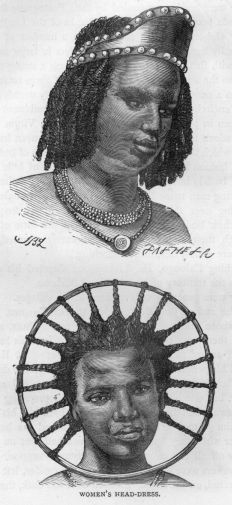
They were now accompanied by their Portuguese friends, the Londa people, who inhabit the banks of the Loajima.
They elaborately dress their hair in a number of ways. It naturally hangs down on their shoulders in large masses, which, with their general features, give them a strong resemblance to the ancient Egyptians. Some of them twist their hair into a number of small cords, which they stretch out to a hoop encircling the head, giving it the resemblance of the glory seen in pictures round the head of the Virgin Mary. Others adorn their heads with ornaments of woven hair and hide, to which they occasionally suspend the tails of buffaloes. A third fashion is to weave the hair on pieces of hide in the form of buffalo horns, projecting on either side of the head. The young men twine their hair in the form of a single horn, projecting over their forehead in front. They frequently tattoo their bodies, producing figures in the form of stars. Although their heads are thus elaborately adorned, their bodies are almost destitute of clothing.
Reaching Calongo, Dr Livingstone directed his course towards the territory of his old friend, Katema.
They were generally well received at the villages.
On the 2nd of June they reached that of Kanawa. This chief, whose village consisted of forty or fifty huts, at first treated them very politely, but he took it into his head to demand an ox as tribute. On their refusing it, Kanawa ordered his people to arm. On this, Dr Livingstone directed his Makololo to commence the march. Some did so with alacrity, but one of them refused, and was preparing to fire at Kanawa, when the doctor, giving him a blow with his pistol, made him go too. They had already reached the banks of the river when they found that Kanawa had sent on ahead to carry off all the canoes. The ferrymen, supposing that the travellers were unable to navigate the canoes, left them, unprotected, on the bank. As soon as it was dark, therefore,  the Makololo quickly obtained one of them, and the whole party crossed, greatly to the disgust of Kanawa when he discovered in the morning what had occurred.
They now took their way across the level plain, which had been flooded on their former journey. Numberless vultures were flying in the air, showing the quantity of carrion which had been left by the waters.
They passed Lake Dilolo, a sheet of water six or eight miles long and two broad.
The sight of the blue waters had a soothing effect on the doctor, who was suffering from fever, after his journey through the gloomy forest and across the wide flat.
Pitsane and Mohorisi, Livingstone’s chief men, had proposed establishing a Makololo village on the banks of the Leeba, near its confluence with the Leeambye, that it might become a market to communicate westward with Loanda, and eastward with the regions along the banks of the Zambesi.
Old Shinti, whose capital they now reached, received them as before in a friendly way, and supplied them abundantly with provisions.
The doctor left with him a number of plants, among which were orange, cashew, custard, apple, and fig-trees, with coffee, acacias, and papaws, which he had brought from Loanda. They were planted out in the enclosure of one of his principal men, with a promise that Shinti should have a share of them when grown.
They now again embarked in six small canoes on the waters of the Leeba. Paddling down it, they next entered the Leeambye. Here they found a party of hunters, who had been engaged in stalking buffaloes, hippopotami, and other animals. They use for this purpose the skin of a deer, with the horns attached, or else the head and upper part of the body of a crane, with which they creep through the grass till they can get near enough to shoot their prey.
The doctor, wishing to obtain some meat for his men, took a small canoe and paddled up a creek towards a herd of zebras seen on the shore. Firing, he broke the hind leg of one of them. His men pursued it, and, as he walked slowly after them, he observed a solitary buffalo, which had been disturbed by others of his party, galloping towards him. The only tree was a hundred yards off. The doctor cocked his rifle in the hope of striking the brute on the forehead. The thought occurred to him, but what should his gun miss fire? The animal came on at a tremendous speed, but a small bush a short distance off made it swerve and expose its shoulder. The doctor fired, and as he heard the ball crack, he fell flat on his face. The buffalo bounded past him towards the water, near which it was found dead. His Makololo blamed themselves for not having been by his side, while he returned thanks to God for his preservation.
On reaching the town of Lebouta, they were welcomed with the warmest demonstrations of joy, the women coming out, dancing and singing. Thence they were conducted to the kotlar, or house of assembly, where Pitsane delivered a long speech, describing the journey and the kind way in which they had been received at Loanda, especially by the English chief.
Next day Dr Livingstone held a service, when his Makololo braves, arrayed in their red caps and white suits of European clothing, attended, sitting with their guns over their shoulders.
As they proceeded down the Barotse Valley, they were received in the same cordial manner.
The doctor was astonished at the prodigious quantities of wild animals of all descriptions which he saw on this journey, and also when traversing the country further to the east—elephants, buffaloes, giraffes, zebras, antelopes, and pigs. Frequently the beautiful springbok appeared, covering the plain, sometimes in sprinklings and at other times in dense crowds, as far as the eye could reach.
The troops of elephants also far exceeded in numbers anything which he had ever before heard of or conceived. He and his men had often to shout to them to get out of their way, and on more than one occasion a herd rushed in upon the travellers, who not without difficulty made their escape. A number of young elephants were shot for food, their flesh being highly esteemed. To the natives the huge beasts are a great plague, as they break into their gardens and eat up their pumpkins and other produce; when disturbed they are apt to charge those interrupting their feast, and, following them, to demolish the huts in which they may have taken refuge, not unfrequently killing them in their rage.
Resting at Sesheke, they proceeded to Linyanti, where the wagon and everything that had been left in it in November, 1853, was found perfectly safe.
A grand meeting was called, when the doctor made a report of his journey and distributed the articles which had been sent by the governor and merchants of Loanda. Pitsane and others then gave an account of what they had seen, and, as may be supposed, nothing was lost in the description. The presents afforded immense satisfaction, and on Sunday Sekeletu made his appearance in church dressed in the uniform which had been brought down for him, and which attracted every man’s attention.
The Arab, Ben Habed, and Sekeletu arranged with him to conduct another party with a load of ivory down to Loanda; they also consulted him as to the proper presents to send to the governor and merchants. The Makololo generally expressed great satisfaction at the route which had been opened up, and proposed moving to the Barotse Valley, that they might be nearer the great market. The unhealthiness  of the climate, however, was justly considered a great drawback to the scheme.
The doctor afterwards heard that the trading party which set out reached Loanda in safety, and it must have been a great satisfaction to him to feel that he had thus opened out a way to the enterprise of these industrious and intelligent people.
The donkeys which had been brought excited much admiration, and, as they were not affected by the bite of the tsetse, it was hoped that they might prove of great use. Their music, however, startled the inhabitants more than the roar of lions.
Chapter Twenty.
Travels of Dr Livingstone, continued.
Prepares for a journey to the East Coast—Leaves Linyanti—A storm—The Victoria and Mozioatunya Falls—From Kalai sets off for Lekone—Cross the Kafue—The Zambesi—Down its banks—Reach the confluence of the Loangwa—Mburuma’s Plot—Zumbo, a ruined Portuguese settlement—A curious reception—Arrival at Tete—A good breakfast—Tete described—Down the Quillimane—Embarks with Sekwebu on board the “Frolic”—Arrives at Mauritius—Sekwebu drowns himself—Livingstone arrives in England.
Dr Livingstone now began to make arrangements for performing another adventurous journey to the East Coast. In the mean time he was fully occupied in attending to the sick, as also in preaching the Gospel to the people generally.
He was advised to wait till the rains had fallen and cooled the ground; and as it was near the end of September, and clouds were collecting, it was expected that they would soon commence. The heat was very great: the thermometer, even in the shade of his wagon, was at 100 degrees, and, if unprotected, rose to 110 degrees; during the night it sank to 70 degrees.
His notes made during the time abound with descriptions of the habits and customs of the people. The children strongly resemble in many respects those of other nations. “They have merry times, especially in the cool of the evening. One of their games consists of a little girl being carried on the shoulders of two others. She sits with outstretched arms as they walk about with her, and all the rest clap their hands and, stopping before each hut, sing pretty airs, some  beating time on their little skirts of cow-skin, and others making a curious humming sound between the songs. Excepting this and the skipping-rope, the play of the girls consists in imitating the serious work of their mothers—building little huts, making small pots and cooking, pounding corn in miniature mortars, or hoeing tiny gardens. The boys play with small spears and shields, or bows and arrows, or make little cattle-pens and cattle in clay, often showing much ingenuity in their imitations of the animals, especially of their horns.” However, we must accompany Dr Livingstone on his journey. Among other routes which were proposed, he selected that by the north bank of the Zambesi. He would, however, thus have to pass through territories in the possession of the Matabele, who, under the powerful Chief Mozelekatse, had driven away the Makololo, its original possessors.
Notwithstanding this he had no fears for himself, as that chief looked upon Mr Moffat, his father-in-law, as his especial friend. A considerable district, also, of the country was still inhabited by the Makololo, and by them he was sure to be kindly treated. The Makololo, it must be understood, are a mixed race, composed of tribes of Bechuanas who formerly inhabited the country bordering the Kalahara Desert. Their language, the Bechuana, is spoken by the upper classes of the Makololo, and into this tongue, by the persevering labours of Mr Moffat, nearly the whole of the scriptures have been translated. Thus means already existed of making known the Gospel among them. The bulk of the people are negroes, and are an especially fine, athletic, and skilful race.
As soon as Dr Livingstone announced his intention of proceeding to the east, numerous volunteers came forward to accompany him. From among them he selected a hundred and fourteen trustworthy men, and Sekeletu appointed two, Sekwebu and Kanyata, as leaders of the company. Sekwebu had been captured, when a child, from the Matabele, and his tribe now inhabited the country near Tete; he had frequently travelled along the banks of the Zambesi, and spoke the various dialects of the people residing on them, and was, moreover, a man of sound judgment and prudence, and rendered great service to the expedition.
On the 3rd of November Dr Livingstone, bidding farewell to his friends at Linyanti, set out, accompanied by Sekeletu and two hundred followers. On reaching a patch of country infested by the tsetse it became necessary to travel at night. A fearful storm broke forth, sometimes the lightning, spreading over the sky, forming eight or ten branches like those of a gigantic tree. At times the light was so great that the whole country could be distinctly seen, and in the intervals between the flashes it was as densely dark. The horses trembled, turning round to search for each other, while the thunder crashed with tremendous roars, louder than is heard in other regions, the rain pelting down, making the party feel miserably cold after the heat of the day. At length a fire, left by some previous travellers, appeared in the distance. The doctor’s baggage having gone on before, he had to lie down on the cold ground, when Sekeletu kindly covered him with his own blanket, remaining without shelter himself. Before parting at Sesheke, the generous chief supplied the doctor with twelve oxen, three accustomed to be ridden on, hoes and beads to purchase a canoe, an abundance of fresh butter and honey; and, indeed, he did everything in his power to assist him in his journey.
Bidding farewell to Sekeletu, the doctor and his attendants sailed down the river to its confluence with the Chobe. Having reached this spot, he prepared to strike across the country to the north-east, in order to reach the northern bank of the Zambesi. Before doing so, however, he determined to visit the Victoria or Mozioatunya Falls, of which he had often heard. The meaning of the word is: “Smoke does sound there,” in reference to the vapour and noise produced by the falls. After twenty minutes’ sail from Kalai they came in sight of five columns of vapour, appropriately called “smoke,” rising at a distance of five or six miles off, and bending as they ascended before the wind, the tops appearing to mingle with the clouds. The scene was extremely beautiful. The banks and the islands which appeared here and there amid the stream, were richly adorned with trees and shrubs of various colours, many being in full blossom. High above all rose an enormous baobab-tree surrounded by groups of graceful palms.
As the water was now low, they proceeded in the canoe to an island in the centre of the river, the further end of which extended to the edge of the falls. At the spot where they landed it was impossible to discover where the vast body of water disappeared. It seemed, indeed, suddenly to sink into the earth, for the opposite lip of the fissure into which it descends was only eighty feet distant. On peering over the precipice the doctor saw the stream, a thousand yards broad, leaping down a hundred feet and then becoming suddenly compressed into a space of fifteen or twenty yards, when, instead of flowing as before, it turned directly to the right, and went boiling and rushing amid the hills.
The vapour which rushes up from this cauldron to the height of two or three hundred feet, being condensed, changes its hue to that of dark smoke, and then comes down in a constant shower. The chief portion falls on the opposite side of the fissure, where grow a number of evergreen trees, their leaves always wet. The walls of this gigantic crack are perpendicular. Altogether, Dr Livingstone considered these falls the most wonderful sight he had beheld in Africa.
Returning to Kalai the doctor and his party met Sekeletu, 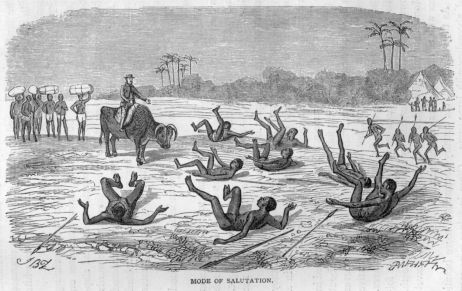 and, bidding him a final farewell, set off northwards to Lekone, through a beautiful country, on the 20th of November. The further they advanced the more the country swarmed with inhabitants, and great numbers came to see the white man, invariably bringing presents of maize.
The natives of this region have a curious way of saluting a stranger. Instead of bowing they throw themselves on their backs on the ground, rolling from side to side and slapping the outsides of their thighs, while they utter the words “Kina bomba! kina bomba!” In vain the doctor implored them to stop. They, imagining him pleased, only tumbled about more fiercely and slapped their thighs with greater vehemence.
These villagers supplied the party abundantly with ground nuts, maize, and corn.
When the doctor addressed them and told them of Jesus as their Saviour—how He had come on earth to bring peace and goodwill to men—they replied: “We are tired of flight. Give us rest and sleep,”—though, of course, they could not understand the full import of the message.
These people appeared humbled by the scourgings they had received from their enemies, and seemed to be in a favourable state for the reception of the Gospel.
Their chief, Monze, came one Sunday morning, wrapped in a large cloth, when, like his followers, he rolled himself about in the dust, screaming out “Kina bomba!” He had never before seen a white man, but had met with black native traders, who came, he said, for ivory, but not for slaves. His wife would have been good-looking, had she not followed the custom of her country by knocking out her teeth. Monze soon made himself at home, and presented the travellers with as much food as they required.
As they advanced, the country became still more beautiful, abounding with large game. Often buffaloes were seen standing on eminences. One day, a buffalo was found lying down, and the doctor went to secure it for food. Though the animal received three balls they did not prove fatal, and it turned round as if to charge. The doctor and his companions ran for shelter to some rocks, but, before they gained them, they found that three elephants had cut off their retreat. The enormous brutes, however, turned off, and allowed them to gain the rocks. As the buffalo was moving rapidly away the doctor tried a long shot, and, to the satisfaction of his followers, broke the animal’s fore leg. The young men soon brought it to a stand, and another shot in its brain settled it. They had thus an abundance of food, which was shared by the villagers of the neighbourhood. Soon afterwards an elephant was killed by his men.
Leaving the Elephant Valley, they reached the residence of a chief named Semalembue, who, soon after their arrival, paid them a visit, and presented five or six baskets of meal and maize, and one of ground nuts, saying that he feared his guest would sleep the first night at his village hungry. The chief professed great joy at hearing the words of the Gospel of Peace, replying: “Now I shall cultivate largely, in the hopes of eating and sleeping in quiet.”
It is remarkable that all to whom the doctor spoke, eagerly caught up the idea of living in peace as the probable effect of the Gospel.
This region Sekwebu considered one of the best adapted for the residence of a large tribe. It was here that Sebituane formerly dwelt.
They now crossed the Kafue by a ford. Every available spot between the river and hills was under cultivation. The inhabitants select these positions to secure themselves and their gardens from their human enemies. They are also obliged to make pit-holes to protect their grounds from the hippopotami. These animals, not having been disturbed,  were unusually tame, and took no notice of the travellers. A number of young ones were seen, not much larger than terrier dogs, sitting on the necks of their dams, the little saucy-looking heads cocked up between the old one’s ears; when older, they sit more on the mother’s back.
Meat being required, a full-grown cow was shot, the flesh of which resembled pork.
The party now directed their course to the Zambesi near its confluence with the Kafue. They enjoyed a magnificent view from the top of the outer range of hills. A short distance below them was the Kafue, winding its way over a forest-clad plain, while on the other side of the Zambesi lay a long range of dark hills. The plain below abounded in large game. Hundreds of buffalo and zebras grazed on the open spaces, and there stood feeding two majestic elephants, each slowly moving its proboscis. On passing amidst them the animals showed their tameness by standing beneath the trees, fanning themselves with their large ears. A number also of red-coloured pigs were seen. The people in the neighbourhood having no guns, they are never disturbed.
A night was spent in a huge baobab-tree, which would hold twenty men inside.
As they moved on, a herd of buffaloes came strutting up to look at their oxen, and only by shooting one could they be made to retreat. Shortly afterwards a female elephant, with three young ones, charged through, the centre of their extended line, when the men, throwing down their burdens, retreated in a great hurry, she receiving a spear for her temerity.
They were made aware of their approach to the great river by the vast number of waterfalls which appeared. It was found to be much broader than above the falls: a person might indeed attempt in vain to make his voice heard across it. An immense amount of animal life was seen both around and in it.
Pursuing their course down the left bank, they came opposite the island of Menyemakaba, which is about two miles long and a quarter broad. Besides its human population it supports a herd of upwards of sixty buffalo. The comparatively small space to which the animals have confined themselves shows the luxuriance of the vegetation. The only time that the natives can attack them is when the river is full and part is flooded: they then assail them from their canoes.
The inhabitants of the north side of the Zambesi are the Batonga; those on the south bank the Banyai.
Both buffalo and elephants are numerous. To kill them the natives form stages on high trees overhanging the paths by which they come to the water. From thence they dart down their spears, the blades of which are twenty inches long by two broad, when the motion of the handle, aided by knocking against the trees, makes fearful gashes which soon cause death. They form also a species of trap. A spear inserted in a beam of wood is suspended from the branch of a tree, to which a cord is attached with a latch. The cord being led along the path when struck by the animal’s foot, the beam falls, and, the spear being poisoned, death shortly ensues.
At each village they passed, two men were supplied to conduct them to the next, and lead them through the parts least covered with jungle.
The villagers were busily employed in their gardens. Most of the men have muscular figures. Their colour varies from a dark to a light olive. The women have the extraordinary custom of piercing the upper lip, and gradually enlarging the orifice till a shell can be inserted. The lip appears drawn out beyond the nose, and gives them a very ugly appearance. As Sekwebu remarked: “These women want to make their mouths like those of ducks.” The commonest of these rings are made of bamboo, but others are of ivory or metal. When the wearer tries to smile, the contraction of the muscles turns the ring upwards, so that its upper edge comes in front of the eyes, the nose appearing through the middle, while the whole front teeth are exposed by the motion, exhibiting the way in which they have been clipped to resemble the fangs of a cat or a crocodile.
On their next halt Seole, the chief of the village, instead of receiving them in a friendly way, summoned his followers 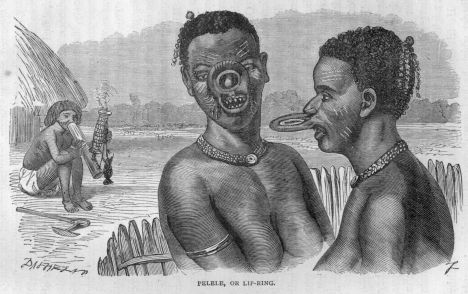 and prepared for an attack. The reason was soon discovered. It appeared that an Italian, who had married the chief’s daughter, having armed a party of fifty slaves with guns, had ascended the river in a canoe from Tete, and attacked several inhabited islands beyond Makaba, taking large numbers of prisoners and much ivory. As he descended again with his booty, his party was dispersed and he himself was killed while attempting to escape on foot. Seole imagined that the doctor was another Italian.
This was the first symptom of the abominable slave trade they met with on the east side of the continent. Had not the chief with whom they had previously stayed arrived to explain matters, Seole might have given them much trouble.
Mburuma, another chief of the same tribe, had laid a plan to plunder the party by separating them, but the doctor, suspecting treachery, kept his people together. They had on a previous occasion plundered a party of traders bringing English goods from Mozambique.
On the 14th of January they reached the confluence of the Loangwa and the Zambesi.
Here the doctor discovered the ruins of a town, with the remains of a church in its midst. The situation was well chosen, with lofty hills in the rear and a view of the two rivers in front. On one side of the church lay a broken bell, with the letters IHS and a cross. This he found was a Portuguese settlement called Zumbo. The conduct of Mburuma and his people gave Dr Livingstone much anxiety, as he could not help dreading that they might attack him the next morning. His chief regret was that his efforts for the welfare of the teeming population in that great region would thus be frustrated by savages, of whom it might be said: “They know not what they do.”
He felt especially anxious that the elevated and healthy district which he had now discovered, stretching towards  Tete, should become known. It was such a region as he had been long in quest of as a centre from which missionary enterprise might be carried into the surrounding country.
While the party were proceeding along the banks of the river, passing through a dense bush, three buffaloes broke through their line. The doctor’s ox galloped off, and, as he turned back, he saw one of his men tossed several feet in the air. On returning, to his satisfaction he found that the poor fellow had alighted on his face, and, although he had been carried twenty yards on the animal’s horns, he had in no way suffered. On the creature’s approaching him he had thrown down his load and stabbed it in the side, when it caught him and carried him off before he could escape.
Soon after this they had evidence that they were approaching the Portuguese settlements, by meeting a person with a jacket and hat on. From this person, who was quite black, they learned that the Portuguese settlement of Tete was on the other bank of the river, and that the inhabitants had been engaged in war with the natives for some time past.
This was disagreeable news, as Livingstone wished to be at peace with both parties.
As they approached the village of Mpende, that chief sent out his people to enquire who the travellers were. The natives, on drawing near, uttered strange cries and waved some bright red substance towards them. Having lighted a fire, they threw some charms into it and hastened away, uttering frightful screams, believing that they should thus frighten the strangers and render them powerless. The Makololo, however, laughed at their threats, but the doctor, fully believing that a skirmish would take place, ordered an ox to be killed to feast his men, following the plan Sebituane employed for giving his followers courage.
At last two old men made their appearance and enquired if the doctor was a Bazunga, or Portuguese. On showing his  hair and white skin, they replied: “Ah, you must be one of the tribe that loves black men.”
Finally the chief himself appeared, and expressed his regret that he had not known sooner who they were, ultimately enabling them to cross the river.
After this they were detained for some time by the rains on the south bank.
In conversation with the people they exhibited the greatest hatred of the slave-traders.
Meeting with native traders, the doctor purchased some American calico in order to clothe his men. It was marked “Lawrence Mills, Lowell,” with two small tusks, an interesting fact.
Game laws existed even in this region. His party having killed an elephant, he had to send back a considerable distance to give information to the person in charge of the district, the owner himself living near the Zambesi. Their messenger returned with a basket of corn, a fowl, and a few strings of beads, a thank-offering to them for having killed it. The tusk of the side on which the elephant fell belonged to the owner, while the upper was the prize of the sportsman. Had they begun to cut up the animal before receiving permission they would have lost the whole. The men feasted on their half of the carcass, and for two nights an immense number of hyaenas collected round, uttering their loud laughter.
The people inhabiting the country on this side of the Zambesi are known as the Banyai. Their favourite weapon is a huge axe, which is carried over the shoulder. It is used chiefly for ham-stringing the elephant, in the same way as the Hamran Arab uses his sword. The Banyai, however, steals on the animal unawares, while the Hamran hunter attacks it when it is rushing in chase of one of his comrades, who gallops on ahead on a well-trained steed.
Those curious birds, the “honey guides,” were very 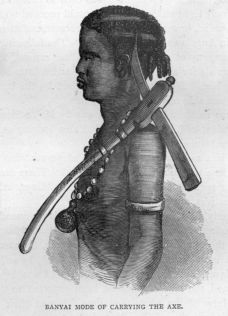 attentive to them, and, by their means, the Makololo obtained an abundance of honey. Of the wax, however, in those districts no use appears to be made.
Though approaching the Portuguese settlement, abundance of game was still found. The Makololo killed six buffalo calves from among a herd which was met with.
They were warned by the natives that they ran a great risk of being attacked by lions when wandering on either side of the line of march in search of honey. One of the doctor’s head men, indeed, Monahin, having been suddenly seized with a fit of insanity during the night, left the camp, and, as he never returned, it was too probable that he had been carried off by a lion.
It was not till the 2nd of March that the neighbourhood of Tete was reached. Livingstone was then so prostrated that, though only eight miles from it, he could proceed no further. He forwarded, however, the letters of recommendation he received in Angola to the commandant. The following morning a company of soldiers with an officer arrived, bringing the materials for a civilised breakfast, and a litter in which to carry him. He felt so greatly revived by the breakfast, that he was able to walk the whole way.
He was received in the kindest way by Major Sicard, the commandant of Tete, who provided also lodging and provision for his men.
Tete is a mere village, built on a slope reaching to the water, close to which the fort is situated. There are about thirty European houses; the rest of the buildings, inhabited by the natives, are of wattle and daub.
Formerly, besides gold-dust and ivory, large quantities of grain, coffee, sugar, oil, and indigo were exported from Tete, but, on the establishment of the slave trade, the merchants found a more speedy way of becoming rich, by selling off their slaves, and the plantations and gold washings were abandoned, the labourers having been exported to the Brazils. Many of the white men then followed their slaves. After this, a native of Goa, Nyaude by name, built a stockade at the confluence of the Luenya and Zambesi, took the commandant of Tete, who attacked him, prisoner, and sent his son Bonga with a force against that town and burned it. Others followed his example, till commerce, before rendered stagnant by the slave trade, was totally obstructed.
On the north shore of the Zambesi several fine seams of coal exist, which Dr Livingstone examined. The natives 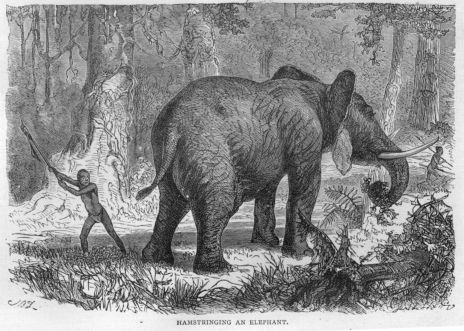 only collect gold from the neighbourhood whenever they wish to purchase calico. On finding a piece or flake of gold, however, they bury it again, believing that it is the seed of the gold, and, though knowing its value, prefer losing it rather than, as they suppose, the whole future crop.
Dr Livingstone found it necessary to leave most of his men here, and Major Sicard liberally gave them a portion of land that they might cultivate it, supplying them in the mean time with corn. He also allowed the young men to go out and hunt elephants with his servants, that they might purchase goods with the ivory and dry meat, in order that they might take them back with them on returning to their own homes. He also supplied them with cloth. Sixty or seventy at once accepted his offer, delighted with the thoughts of engaging in so profitable an enterprise. He also supplied the doctor with an outfit, refusing to take the payment which was offered.
The forests in the neighbourhood abound with elephants, and the natives attack them in the boldest manner. Only two hunters sally forth together—one carrying spears, the other an axe of a peculiar shape, with a long handle. As soon as an elephant is discovered, the man with the spears creeps among the bushes in front of it, so as to attract its attention, during which time the axe-man cautiously approaches from behind, and, with a sweep of his formidable weapon, severs the tendon of the animal’s hock. The huge creature, now unable to move in spite of its strength and sagacity, falls an easy prey to the two hunters.
Among other valuable productions of the country is found a tree allied to the cinchona. The Portuguese believe that it has the same virtues as quinine.
As soon as the doctor had recovered his strength he prepared to proceed down the river to Kilimane, or Quillimane, with sixteen of his faithful Makololo as a crew. Many of the rest were out elephant hunting, while others had established a brisk trade in firewood.
Major Sicard lent him a boat, and sent Lieutenant Miranda to escort him to the coast.
On their way they touched at the stockade of the rebel, Bonga, whose son-in-law, Manoel, received them in a friendly way.
They next touched at Senna, which was found in a wretchedly ruinous condition. Here some of the Makololo accepted employment from Lieutenant Miranda to return to Tete with a load of goods. Eight accompanied the doctor, at their earnest request, to Quillimane.
He reached that village on the 20th of May, 1856, when it wanted but a few days of being four years since he started from Cape Town. He was hospitably received by Colonel Nunes. A severe famine had existed among the neighbouring population, and food was very scarce. He therefore advised his men to go back to Tete as soon as possible, and await his return from England. They still earnestly wished to accompany him, as Sekeletu had advised them not to part with him till they had reached Ma-Robert, as they called Mrs Livingstone, and brought her back with them.
With the smaller tusks he had in his possession he purchased calico and brass-wire, which he sent back to Tete for his followers, depositing the remaining twenty tusks with Colonel Nunes, in order that, should he be prevented from revisiting the country, it might not be supposed that he had made away with Sekeletu’s ivory. He requested Colonel Nunes, in case of his death, to sell the tusks and deliver the proceeds to his men, intending to purchase the goods ordered by Sekeletu in England with his own money, and, on his return, repay himself out of the price of the ivory.
He consented, somewhat unwillingly, to take Sekwebu with him to England.
After waiting about six weeks at Quillimane, HM brig “Frolic” arrived, on board which he embarked. A fearful sea broke over the bar, and the brig was rolling so much that there was great difficulty in reaching her deck. Poor Sekwebu looked at his friend, asking: “Is this the way you go?” The doctor tried to encourage him; but, though well acquainted with canoes, he had never seen anything like it.
Having been three and a half years, with the exception of a short interval in Angola, without speaking English, and for thirteen but partially using it, the doctor found the greatest difficulty in expressing himself on board the “Frolic.”
The brig sailed on the 12th of July for the Mauritius, which was reached on the 12th of August. Poor Sekwebu had become a favourite both with men and officers, and was gaining some knowledge of English, though all he saw had apparently affected his mind. The sight of a steamer, which came out to tow the brig into the harbour, so affected him that during the night he became insane and threatened to throw himself into the water. By gentle treatment he became calmer, and Dr Livingstone tried to get him on shore, but he refused to go. In the evening his malady returned; and, after attempting to spear one of the crew, he leaped overboard and, pulling himself down by the chain cable, disappeared. The body of poor Sekwebu was never found.
After remaining some time at the Mauritius, till he had recovered from the effects of the African fever, our enterprising traveller sailed by way of the Red Sea for old England, which he reached on the 12th of December, 1856.
Dr Livingstone, in the series of journeys which have been described, had already accomplished more than any previous traveller in Africa, besides having gained information of the 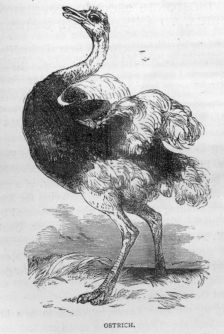 greatest value as regards both missionary and mercantile enterprise. He had as yet, however, performed only a small portion of the great work his untiring zeal and energy have prompted him to undertake.
Chapter Twenty One.
Dr Livingstone’s second expedition to Africa, to explore the Zambesi.
Leaves England—Arrives at the East Coast—Up the Luawe—The little “Ma-Robert”—War—Commence the voyage for Tete—Senna—Arrives at Tete—The Kebrabasa Falls—Returns to Tete—Up the Shire, and return—The second trip up the Shire—Sets out for Lake Shirwa—Returns to Tete—Set out for Lake Nyassa—Treachery—Arrive at the Lake—Returns to the Kongone—Journey westward—A pondoro—Superstition—Passing Kebrabasa, arrive in Mpende’s territory—Reaches Moachemba—Sets out for Victoria Falls—Tuba, the smasher of canoes—Leave Sesheke—More Superstition—Reach Zunibo—Down the Kebrabasa Rapids—Canoes upset—Arrive at Tete—The chameleon.
After spending rather more than a year in England, Dr Livingstone again set out, on the 10th of March, 1858, on board HMS “Pearl,” at the head of a government expedition for the purpose of exploring the Zambesi and the neighbouring regions. He was accompanied by Dr Kirk, his brother Charles Livingstone, and Mr Thornton; and Mr T. Baines was appointed artist to the expedition.
A small steamer, which was called the “Ma-Robert,” in compliment to Mrs Livingstone, was provided by the government for the navigation of the river.
The East Coast was reached in May.
Running up the river Luawe, supposed to be a branch of the Zambesi, the “Pearl” came to an anchor, and the “Ma-Robert,” which had been brought out in sections, was screwed together. The two vessels then went together in search of the real mouth of the river, from which Quillimane is some sixty miles distant, the Portuguese having concealed the real entrance, if they were acquainted with it, in order to deceive the English cruisers in search of slavers.
The goods for the expedition brought out by the “Pearl” having been landed on a grassy island about forty miles from the bar, that vessel sailed for Ceylon, while the little “Ma-Robert” was left to pursue her course alone. Her crew consisted of about a dozen Krumen and a few Europeans.
At Mazaro, the mouth of a creek communicating with the Quillimane or Kilimane River, the expedition heard that the Portuguese were at war with a half-caste named Mariano, a brother of Bonga, who had built a stockade near the mouth of the Shire, and held possession of all the intermediate country. He had been in the habit of sending out his armed bands on slave-hunting expeditions among the helpless tribes to the north-west, selling his victims at Quillimane, where they were shipped as free emigrants to the French island of Bourbon. As long as his robberies and murders were restricted to the natives at a distance, the Portuguese did not interfere, but when he began to carry off and murder the people near them, they thought it time to put a stop to his proceedings. They spoke of him as a rare monster of inhumanity. He frequently killed people with his own hand in order to make his name dreaded. Having gone down to Quillimane to arrange with the governor, or, in other words, to bribe him, Colonel Da Silva put him in prison and sent him for trial to Mozambique. The war, however, was continued under his brother Bonga, and had stopped all trade on the river.
The expedition witnessed a battle at Mazaro, between Bonga and the Portuguese, when Dr Livingstone, landing, found himself in the sickening smell and among the mutilated bodies of the slain. He brought off the governor, who was in a fever, the balls whistling about his head in all directions. The Portuguese then escaped to an island opposite Shupanga, where, having exhausted their ammunition, they were compelled to remain.
There is a one-storied house at Shupanga, from which there is a magnificent view down the river. Near it is a large baobab-tree, beneath which, a few years later, the remains of the beloved wife of Dr Livingstone were to repose.
On the 17th of August the “Ma-Robert” commenced her voyage up the stream for Tete. It was soon found that her furnaces being badly constructed, and that from other causes she was ill adapted for the work before her. She quickly, in consequence, obtained the name of the “Asthmatical.”
Senna, which was visited on the way, being situated on low ground, is a fever-giving place. The steamer, of course, caused great astonishment to the people, who assembled in crowds to witness her movements, whirling round their arms to show the way the paddles revolved.
Tete was reached on the 8th of September. No sooner did Dr Livingstone go on shore, than his Makololo rushed down to the water’s edge, and manifested the greatest joy at seeing him. Six of the young men had foolishly gone off to make money by dancing before some of the neighbouring chiefs, when they fell into the hands of Bonga, who, declaring that they had brought witchcraft medicine to kill him, put them all to death.
The Portuguese at this place keep numerous slaves, whom they treat with tolerable humanity. When they can they purchase the whole of a family, thus taking away the chief inducement for running off.
The expedition having heard of the Kebrabasa Falls, steamed up the river, and on the 24th of November reached Panda Mokua, where the navigation ends, about two miles below them. Hence the party started overland, by a frightfully rough path among rocky hills, where no shade was to be found. At last their guides declared that they could go no further; indeed, the surface of the ground was so hot that the soles of the Makololos’ feet became blistered. The travellers, however, pushed on. Passing round a steep promontory, they beheld the river at their feet, the channel jammed in between two mountains with perpendicular sides, and less than fifty yards wide. There is a sloping fall of about twenty feet in height, and another at a distance of thirty yards above it. When, however, the river rises upwards of eighty feet perpendicularly, as it does in the rainy season, the cataract might be passed in boats.
After returning to Tete, the steamer went up the Shire, January, 1859. The natives, as they passed them, collected at their villages in large numbers, armed with bows and poisoned arrows, threatening to attack them. Dr Livingstone, however, went on shore, and explained to the chief, Tingane, that they had come neither to take slaves nor to fight, but wished to open up a path by which his countrymen could ascend to purchase their cotton. On this Tingane at once became friendly.
Their progress was arrested, after steaming up a hundred miles in a straight line, although, counting the windings of the river, double that distance, by magnificent cataracts known to the natives as those of the Mamvira, but called by the expedition the Murchison Falls.
Rain prevented them making observations, and they returned at a rapid rate down the river.
A second trip up it was made in March of the same year. They here gained the friendship of Chibisa, a shrewd and intelligent chief, whose village was about ten miles below the cataracts. He told the doctor that a few years before his little daughter had been kidnapped, and was now a slave to the padre at Tete, asking him, if possible, to ransom the child.

From hence Dr Livingstone and Dr Kirk proceeded on foot in a northerly direction to Lake Shirwa. The natives turned out from their villages, sounding notes of defiance on their drums; but the efforts to persuade them that their visitors came as friends were successful, and the lake was discovered on the 18th of April.
From having no outlet, the water is brackish, with hilly islands rising out of it. The country around appeared very beautiful and clothed with rich vegetation, with lofty mountains eight thousand feet high near the eastern shore.
On their return they found Quartermaster Walker, who had charge of the steamer, dangerously ill, though he ultimately recovered.
They returned to Tete on the 23rd of June, and thence, after the steamer had been repaired, proceeded to the Kongone, where they received provisions from HMS “Persian,” which also took on board their Krumen, as they were found useless for land journeys. In their stead a crew was picked out from the Makololo, who soon learned to work the ship, and who, besides being good travellers, could cut wood and required only native food.
Frequent showers fell on their return voyage up the Zambesi, and, the vessel being leaky, the cabin was constantly flooded, both from above and below.
They were visited on their way up by Paul, a relative of the rebel Mariano, who had just returned from Mozambique. He told them that the Portuguese knew nothing of the Kongone before they had discovered it, always supposing that the Zambesi entered the sea at Quillimane.
A second trip up the Shire was performed in the middle of August, when the two doctors set out in search of Lake Nyassa, about which they had heard.
The river, though narrow, is deeper than the Zambesi, and more easily navigated.
Marks of large game were seen, and one of the Makololo, who had gone on shore to cut wood, was suddenly charged at by a solitary buffalo. He took to flight, pursued by the maddened animal, and was scarcely six feet before the creature when he reached the bank and sprang into the river. On both banks a number of hippopotamus-traps were seen.
The animal feeds on grass alone, its enormous lip acting like a mowing machine, forming a path before it as it feeds. Over these paths the natives construct a trap, consisting of a heavy beam, five or six feet long, with a spear-head at one end, covered with poison. This weapon is hung to a forked pole by a rope which leads across the path, and is held by a catch, set free as the animal treads upon it. A hippopotamus was seen which, being frightened by the steamer, rushed on shore and ran immediately under one of these traps, when down came the heavy beam on its head.
The leaks in the steamer increased till the cabin became scarcely habitable.
The neighbourhood of Chibisa’s village was reached on the 25th of August.
The doctor had now to send word to the chief that his attempts to recover his child had failed, for, though he had offered twice the value of a slave, the little girl could not be found, the padre having sold her to a distant tribe of Bazizulu. Though this padre was better than the average, he appeared very indifferent about the matter.
On the 28th of August, an expedition consisting of four whites, thirty-six Makololo, and two guides left the ship in the hopes of discovering Lake Nyassa. The natives on the road were very eager to trade. As soon as they found that the strangers would pay for their provisions in cotton cloth, women and girls were set to grind and pound meal, and the men and boys were seen chasing screaming fowl over the village. A head man brought some meal and other  food for sale; a fathom of blue cloth was got out, when the Makololo head man, thinking a portion was enough, was proceeding to tear it. On this the native remarked that it was a pity to cut such a nice dress for his wife, and he would rather bring more meal. “All right,” said the Makololo, “but look, the cloth is very wide, so see that the basket which carries the meal be wide too, and add a cock to make the meal taste nicely.”
The highland women of these regions all wear the pelele, or lip-ring, before described. An old chief, when asked why such things were worn, replied: “for beauty; men have beards and whiskers, women have none. What kind of creature would a woman be without whiskers and without the pelele?”
When, as they calculated, they were about a day’s march from Lake Nyassa, the chief of the village assured them positively that no lake had ever been heard of there, and that the river Shire stretched on, as they saw it, to a distance of two months, and then came out between two rocks which towered to the skies. The Makololo looked blank, and proposed returning to the ship.
“Never mind,” said the doctor, “we will go on and see these wonderful rocks.”
Their head man, Massakasa declared that there must be a lake, because it was in the white men’s books, and scolded the natives for speaking a falsehood. They then admitted that there was a lake. The chief brought them a present in the evening. Scarcely had he gone when a fearful cry arose from the river; a crocodile had carried off his principal wife. The Makololo, seizing their arms, rushed to her rescue; but it was too late.
The expedition moving forward, on the 16th of September, 1859, the long-looked-for Lake Nyassa was discovered, with hills rising on both sides of it.
Two months after this the lake was visited by Dr Roscher, who was unaware of Dr Livingstone’s and Dr Kirk’s discovery; unhappily he was murdered on his road back towards the Rovuma.
The travellers were now visited by the chief of a village near the confluence of the lake and the river, who invited them to form their camp under a magnificent banyan-tree among the roots of which, twisted into the shape of a gigantic arm-chair, four of the party slept. The chief told them that a slave party, led by Arabs, was encamped near at hand; and in the evening a villainous set of fellows, with long muskets, brought several young children for sale; but, finding that the travellers were English, they decamped, showing signs of fear. The people of the Manjanga tribe, amidst whom they were now travelling, showed much suspicion of their object, saying that parties had come before with the same sort of plausible story, and had suddenly carried off a number of their people. To allay these suspicions, Dr Livingstone thought it best at once to return to the ship.
Soon afterwards Dr Kirk and Mr Rae, the engineer, set off with guides to go across the country to Tete, the distance being about one hundred miles. From want of water they suffered greatly, while the tsetse infested the district.
Dr Livingstone had resolved to visit his old friend Sekeletu; but, finding that before the new crop came in, food could not be obtained beyond the Kebrabasa, he returned in the “Ma-Robert” once more to the Kongone.
They found Major Sicard at Mazaro, he having come there with tools and slaves to build a custom-house and fort.
After this trip, the poor “Asthmatic” broke down completely; she was therefore laid alongside the island of Kanyimbe, opposite Tete, and placed under charge of two English sailors. They were furnished with a supply of seeds to form a garden, both to afford them occupation and food.
Active preparations were now made for the intended journey westward; cloth, beads, and brass-wire were formed into packages, with the bearer’s name printed on each.
The Makololo who had been employed by the expedition received their wages. Some of those who had remained at Tete had married, and resolved to continue where they were. Others did not leave with the same good will they had before exhibited, and it was doubtful, if attacked, whether they would not run to return to their lately-formed friends.
All arrangements had been concluded by the 15th of May, 1860, and the journey was commenced.
As the Banyai, who live on the right bank, were said to levy heavy fines, the party crossed over to the left.
Dr Livingstone was stopping near the Kebrabasa village, when a man appeared, who pretended that he was a pondoro; that is, that he could change himself into a lion whenever he chose—a statement his countrymen fully believed. Sometimes the pondoro hunts for the benefit of the villagers, when his wife takes him some medicine which enables him to change himself back into a man. She then announces what game has been killed, and the villagers go into the forest to bring it home. The people believe also that the souls of the departed chiefs enter into lions. One night, a buffalo having been killed, a lion came close to the camp, when the Makololo declared that he was a pondoro, and told him that he ought to be ashamed of himself for trying to steal the meat of strangers. The lion, however, disregarding their addresses, only roared louder than ever, though he wisely kept outside the bright circle of the camp-fires. A little strychnine was placed on a piece of meat and thrown to him, after which he took his departure, and was never again seen.
Again passing Kebrabasa, the travellers enjoyed the magnificent mountain scenery in this neighbourhood, and came to the conclusion that not only it, but the Morumbwa could, when the river rises, be passed, so as to allow of a steamer being carried up to run on the upper Zambesi.
On the 20th of June they reached the territory of the chief Mpende, who had, on Dr Livingstone’s journey to the East Coast, threatened to attack him. Having in the mean time heard that he belonged to a race who love black men and did not make slaves, his conduct was now completely changed, and he showed every desire to be friendly.
Game was abundant, and lions were especially numerous.
After visiting Zumbo, Dr Kirk was taken dangerously ill. He got better on the high ground, but immediately he descended into the valley he always felt chilly. In six days, however, he was himself again, and able to march as well as the rest.
Again abundance of honey was obtained through the means of the “honey guide.” The bird never deceived them, always guiding them to a hive of bees, though sometimes there was but little honey in it.
On the 4th of August the expedition reached Moachemba, the first of the Batoka villages, which owe allegiance to Sekeletu. From thence, beyond a beautiful valley, the columns of vapour rising from the Victoria Falls, upwards of twenty miles away, could clearly be distinguished.
The Makololo here received intelligence of their families, and news of the sad termination of the attempt to plant a mission at Linyanti, under the Reverend H. Helmore. He and several white men had died, and the remainder had only a few weeks before returned, to Kuruman.
At the village opposite Kalai the Malokolo head man, Mashotlane, paid the travellers a visit. He entered the hut where they were seated, a little boy carrying a three-legged stool. In a dignified way the chief took his seat, presenting some boiled hippopotamus meat. Having then taken a piece himself, he handed the rest to his followers. He had lately been attacking the Batoka, and when the doctor represented to him the wrongfulness of the act, he defended himself by declaring that they had killed some of his companions. Here also they found Pitsane, who had been sent by Sekeletu to purchase horses from a band of Griquas.
As the new-comers were naturally anxious to see the magnificent falls, they embarked in some canoes belonging to Tuba Mokoro (“a smasher of canoes”), who alone, they were assured, possessed the medicine which would prevent shipwreck in the rapids. Tuba conducted them at a rapid rate down the river. It required considerable confidence in his skill not to feel somewhat uneasy as they navigated these roaring waters. They were advised not to speak, lest their talking might diminish the virtue of the medicine; few indeed would have thought of disobeying the orders of the canoe-smasher. One man stood at the head of the canoe, looking out for rocks and telling the steersman the course to take. Often it seemed as if they would be dashed to pieces against the dark rocks jutting out from the water, then in a moment the ready pole turned the canoe aside, and they quickly glided past the danger. As they went swiftly driving down, a black rock, with the foam flowing over it, rose before them; the pole slipped, the canoe struck and in a moment was half full of water. Tuba, however, speedily recovering himself, shoved off, and they reached a shallow place, where the water was bailed out. He asserted that it was not the medicine was at fault, but that he had started without his breakfast.
The travellers landed at the head of Garden Island, and, as the doctor had done before, peered over the giddy heights at the further end across the chasm. The measurement of the chasm was now taken; it was found to be eighty yards opposite Garden Island, while the waterfall itself was twice the depth of that of Niagara, and the river where it went over the rock fully a mile wide. Charles Livingstone, who had seen Niagara, pronounced it inferior in magnificence to the Victoria Falls.
The Batokas consider Garden Island and another further west as sacred spots, and here, in days gone by, they assembled to worship the Deity.
Dr Livingstone, on his former visit, had planted a number of orange-trees and seeds at Garden Island, but though a hedge had been placed round them, they had all been destroyed by the hippopotami. Others were now put in. They also, as was afterwards found, shared the same fate.
They now proceeded up the river, and, on the 13th, met a party from Sekeletu, who was now at Sesheke, and had sent to welcome them. On the 18th they entered his town. They were requested to take up their quarters at the old kotlar, or public meeting-place tree. During the day visitors continually called on them, all complaining of the misfortunes they had suffered. The condition of Sekeletu, however, was the most lamentable. He had been attacked by leprosy, and it was said that his fingers had become like eagles’ claws, and his face so fearfully distorted that no one could recognise him. One of their head men had been put to death, it being supposed that he had bewitched the chief. The native doctors could do nothing for him, but he was under the charge of an old doctress of the Manyeti tribe, who allowed no one to see him except his mother and uncle. He, however, sent for Dr Livingstone, who gladly went to him. He and Dr Kirk at once told him that the disease was most difficult to cure, and that he might rest assured he had not been bewitched. They applied lunar caustic externally and hydrate of potash internally, with satisfactory results; so that in the course of a short time the poor chief’s appearance greatly improved.
Although the tribe had been suffering from famine, the chief treated his visitors with all the hospitality in his power.
Some Benguela traders had come up to Sesheke, intending probably to return from the Batoka country to the east with slaves; but the Makololo, however, had secured all the ivory in that region. As the traders found that the trade in slaves without ivory did not pay, they knew it would not be profitable to obtain them, for Sekeletu would allow no slaves to be carried through his territory, and thus by his means an extensive slave-mart was closed.
Sekeletu was greatly pleased with the articles the doctor brought him from England, and enquired whether a ship could not bring up the remainder of the goods which had been left at Tete. On being told that possibly a steamer might ascend as far as Sinainanes, he enquired whether a cannon could not blow away the Victoria Falls, so as to enable her to reach Sesheke.
The Makololo, who had been sent down to Benguela, came to pay the travellers a visit, dressed in well-washed shirts, coats, and trousers, patent leather boots, and brown wideawakes on their heads. They had a long conversation with their men about the wonderful things they had all seen.
Sekeletu, who took a great fancy to Dr Kirk, offered him permission to select any part of the country he might chose for the establishment of an English colony. Indeed, there is sufficient uncultivated ground on the cool unpeopled highlands for a very large population.
The Makololo are apt to get into trouble by their propensity to lift cattle; for if their marauding is sanctioned by the chief, they do not look upon it as dishonourable. This custom must be put a stop to if any good is to be done to them, as must the gigantic evil of the slave trade among the tribes nearer the coast.
The expedition left Sesheke on the 17th of September, 1860, convoyed by Pitsane and Leshore. Pitsane was directed to form a hedge round the garden at the falls on his way.
When navigating the river the canoe-men kept close to the bank during the day for fear of being upset by the hippopotami, but at night, when those animals are found near the shore, they sailed down the middle of the stream.
The canoes were wretched, and a strong wind blew against them, but their Batoka boatmen managed them with great dexterity. Some of these men accompanied the expedition the whole way to the sea.
On their passage down the river, in approaching Kariba Rapids, they came upon a herd of upwards of thirty hippopotami. The canoe-men were afraid of venturing among them, asserting that there was sure to be an ill-tempered one who would take a malignant pleasure in upsetting the canoes. Several boys on the rocks were amusing themselves by throwing stones at the frightened animals. One was shot, its body floating down the current. A man hailed them from the bank, advising them to let him pray to the Kariba gods that they might have a safe passage down the rapids, for, without his assistance, they would certainly be drowned. Notwithstanding, having examined the falls, seeing that canoes might be carried down in safety, they continued their voyage. The natives were much astonished to see them pass in safety without the aid of the priest’s intercession.
Here they found the hippopotamus which had been shot, and, taking it in tow, told the villagers that if they would follow to their landing-place, they should have most of the meat. The crocodiles, however, tugged so hard at it, that they were compelled to cast it adrift and let the current float it down. They recovered the hippopotamus, which was cut up at the place where they landed to spend the night. As soon as it was dark, the crocodiles attacked the portion that was left in the water, tearing away at it and lashing about fiercely with their tails.
A day or two afterwards they encamped near some pitfalls, in which several buffaloes had shortly before been caught and one of the animals had been left. During the night the wind blew directly from the dead buffalo to their sleeping-place, and a hungry lion which came to feed on the carcass so stirred up the putrid mass and growled so loudly over his feast, that their slumbers were greatly disturbed.
They reached Zumbo by the 1st of November. Here their men had a scurvy trick played them by the Banyai. The Makololo had shot a hippopotamus, when a number of the natives came across, pretending to assist them in rolling it ashore, and advised them to cast off the rope, saying that it was an encumbrance. All were shouting and talking, when suddenly the carcass disappeared in a deep hole. The Makololo jumped in after it, one catching the tail, another a foot, but down it went, and they got but a lean fowl instead. It floated during the night, and was found about a mile below, on the bank. The Banyai, however, there disputed their right to it, and, rather than quarrel, the Makololo, after taking a small portion, wisely allowed them to remain with the rest.
Believing that there was sufficient depth of water, they ventured down the Kebrabasa Rapids. For several miles they continued onward till, the river narrowing, navigation became both difficult and dangerous. Two canoes passed safely down the narrow channel with an ugly whirlpool, caused by the water being divided by a rock in the centre. Dr Livingstone’s canoe came next, and while it appeared to be drifting broadside into the vortex, a crash was heard, and Dr Kirk’s canoe was seen dashed against the perpendicular rock by a sudden boiling-up of the river, which occurs at regular intervals. Dr Kirk grasped the rock and saved himself, while his steersman, holding on to the same ledge, preserved the canoe, but all its contents were lost, including the doctor’s notes of the journey, and botanical drawings of the fruit-trees of the interior. After this the party, having had enough of navigation, performed the remainder of the journey on shore.
On their march they met two large slave-trading parties on their way to Zumbo. Among them were a number of women with ropes round their necks, and all made fast to one long rope. They were to be sold for ivory.
Tete was reached on the 23rd of November, the expedition having been absent rather more than six months. They were glad to find that the two English sailors were in good health, and had behaved very well; but their farm had been a failure. A few sheep and fowls had been left with them: they had purchased more of the latter, and expected to have a good supply of eggs, but they unfortunately also bought two monkeys, who ate up all their eggs. One night a hippopotamus destroyed their vegetable garden, the sheep ate up their cotton-plants, while the crocodiles carried off the sheep, and the natives had stolen their fowls.
Having discovered that the natives have a mortal dread of the chameleon, one of which animals they had on board, they made good use of their knowledge. They had learned the market price of provisions, and determined to pay that and no more. When the traders, therefore, demanded a higher price and refused to leave the ship till it was paid, the chameleon was instantly brought out of the cabin, when the natives sprang overboard and made no further attempt to impose upon them.
The sailors had also performed a gallant act. They were aroused one night by a fearful shriek, when they immediately pushed off in their boat, supposing, as was found to be the case, that a crocodile had caught a woman and was dragging 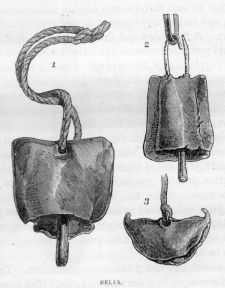 her across a shallow bank. Before they reached her, the reptile snapped off her leg. They carried her on board, bandaged up her limb, bestowed Jack’s usual remedy for all complaints, a glass of grog, on her, and carried her to a hut in the village. Next morning they found the bandages torn off and the poor creature left to die, their opinion being that it had been done by her master, to whom, as she had lost a leg, she would be of no further use, and he did not wish the expense of keeping her.
Chapter Twenty Two.
Dr Livingstone’s expedition to explore the Zambesi, continued.
Sets out again—Christmas at Chimba Island—Senna—Down the river to Congo—The “Pioneer”—Arrival of Bishop Mackenzie—Reaches the Rovuma—Back again and up the Zambesi to the Shire—Liberation of a party of slaves—News of the Ajawa Starts for Nyassa—Enters the Lake—Described—A storm on the Nyassa—Slavery—Returns to the Rovuma—Sets out with Bishop Mackenzie for Ruo—Reaches the Zambesi, and afterwards proceeds to the Great Luabo—Arrival of Mrs Livingstone and the “Lady Nyassa”—Bishop Mackenzie’s death—Explores the Rovuma—An adventure with the natives—Visits Johanna in the “Pioneer”—Steams up the Shire—Effects of the slave trade—Meets Mr Thornton—Attacked by fever—More of the slave trade—Start for the upper cataracts—Despatches from England—Visit Chia Lakelet—An Arab slave-dhow—Leaves the Zambesi, and arrives at Bombay.
Once more, on the 3rd of December, the leaky “Asthmatic” was got under way, but every day fresh misfortunes happened to her, till Rae declared: “She cannot be worse than she is, sir.”
He and his mate, Hutchings, had done their best to patch her up, but her condition was past their skill. On the morning of the 21st she grounded on a sandbank and filled. The river rising, all that was visible the next day was about six feet of her two masts. The property on board was, however, saved, and the expedition spent their Christmas of 1860 encamped on the island of Chimba.
Canoes having been procured, they reached Senna on the 27th. They here saw a large party of slaves belonging to the commandant, who had been up to trade with Mozelekatse, carrying a thousand muskets and a large quantity of gunpowder, and bringing back ivory, ostrich feathers, a thousand sheep and goats, and thirty head of fine cattle, and in addition a splendid white bull, to show that he and the traders parted friends. The adventure, however, was a losing one to the poor commandant: a fire had broken out in the camp, and the ostrich feathers had been burned; the cattle had died from the bite of the tsetse, as had the white bull, and six hundred of the sheep had been eaten by the slaves, they thinking more of their own comfort than their master’s gain.
This is one of the many proofs of the clearness of slave labour.
Proceeding down the river in boats, the expedition reached Congo on the 4th of January, 1861. Here a flagstaff and a custom-house (a floorless hut of mangrove stakes roofed with stakes) had been erected.
The garrison of the place being almost starved, the provisions of the expedition also ran short, though they obtained game in abundance.
On the 31st the “Pioneer,” the steamer which had been sent to replace the “Asthmatic,” appeared off the bar, but the bad weather prevented her entering. At the same time two men-of-war arrived, bringing Bishop Mackenzie at the head of the Oxford and Cambridge mission to the tribes of the Shire and Lake Nyassa. It consisted of six Englishmen and five coloured men from the Cape. The bishop wished at once to proceed up to Chibisa; but the “Pioneer” was under orders to explore the Rovuma, and it was ultimately arranged that the members of the mission should be carried over to Johanna in the “Lyra” man-of-war, while the bishop himself accompanied the expedition in the “Pioneer.”
They reached the mouth of the Rovuma on the 25th of February. The rainy season was already half over, and the river had fallen considerably.
The scenery was superior to that on the Zambesi.
Eight miles from the mouth the mangrove disappeared, and a beautiful range of well-wooded hills rose on either side.
Unhappily fever broke out, and the navigation of the “Pioneer” fell to the charge of Dr Livingstone and his companions.
The water falling rapidly, it was considered dangerous to run the risk of detention in the river for a year, and the ship returned down to the sea.
On their voyage back they touched at Mohilla, one of the Comoro Islands, and from thence went on to Johanna, where they received the Bishop’s followers, and proceeded back to the Kongone. Thence they at once directed their course up the Zambesi to the Shire. The “Pioneer,” it was found, drew too much water for the navigation of the river, and she in consequence frequently grounded.
Among his many duties, Charles Livingstone was engaged in collecting specimens of cotton, and upwards of three hundred pounds were thus obtained, at a price of less than a penny a pound, which showed that cotton of a superior quality could be raised by native labour alone, and that but for the slave trade a large amount might be raised in the country.
Wherever they went they gained the confidence of the people, and hitherto the expedition had been eminently successful. No sooner, however, did they come in contact with the Portuguese slave trade than sad reverses commenced. Marauding parties of the Ajawa were desolating the land, and a gang had crossed the river with slaves. Manjanga had gone away just before they got the ship up to Chibisa; but his deputy was civil, and supplied them with carriers to convey the bishop’s goods up the country.
They halted at the village of their old friend, Mpende, who supplied them with carriers, and informed them that a slave party on its way to Tete would soon pass through his village. They consulted together. Should they liberate the slaves? By a bold stroke they might possibly put a stop to the slave trade, which had followed in their footsteps. A few minutes afterwards a slave party, consisting of a long line of manacled men, women, and children, escorted by black drivers armed with muskets, adorned with articles of finery, and blowing horns, marched by them with a triumphant air. Directly, however, the rascals caught sight of the English, they darted off into the forest, with the exception of the leader, who was seized by the Makololo. He proved to be a slave of the late commandant of Tete, and was well-known to them. He declared that he had bought the slaves; but directly his hands were released he darted off. The captives now, kneeling down, expressed their thanks by clapping their hands. Knives were soon busily at work setting free the women and children. It was more difficult to liberate the men, who had each his neck in the fork of a stout stick, six or seven feet long, and kept in by an iron rod riveted at both ends across the throat. A saw, produced from the bishop’s baggage, performed the work. The men could scarcely believe what was said, when they were told to take the meal they were carrying and cook breakfast for themselves and children. Many of the latter were about five years of age and under. One of them observed to the men: “Those others tied and starved us; you cut the ropes, and tell us to eat! What sort of people are you?”
Two women had been shot the previous day for attempting to untie the thongs, and another had her infant’s brains knocked out because she could not at the same time carry her load and it. The rest were told that this was done to prevent them from attempting to escape. The bishop was not present, having gone to bathe just before; but when he returned, he approved of what had been done.

Eighty-four persons, chiefly women and children, were thus liberated; and being told that they might go where they liked, they decided on remaining with the English. The men willingly carried the bishop’s goods.
Eight others were freed in a hamlet on the road; but another party, with nearly a hundred slaves, though followed by Dr Kirk and four Makololo, escaped. Six more captives were soon afterwards liberated, and two slave-dealers were detained for the night, but being carelessly watched by two of the bishop’s black men, who had volunteered to stand guard over them, they escaped. The next day fifty more slaves were freed at another village and comfortably clothed.
At Chigunda a Manjanga chief had invited the bishop to settle in his country near Magomero, adding that there was room enough for both. This spontaneous invitation seemed to decide the bishop on the subject.
Marching forward, on the 22nd news was received that the Ajawa were near, burning villages; and at once the doctor and his companions advanced to seek an interview with these scourges of the country. On their way they met crowds of Manjangas flying, having left all their property and food behind them. Numerous fields of Indian corn were passed, but there was no one to reap them. All the villages were deserted. One, where on the previous visit a number of men had been seen peacefully weaving cloth, was burned, and the stores of grain scattered over the plain and along the paths. The smoke of burning villages was seen in front, and triumphant shouts, mingled with the wail of the Manjanga women lamenting over the slain, reached their ears. The bishop knelt and engaged in prayer, and on rising, a long line of Ajawa warriors with their captives was seen. In a short time the travellers were surrounded, the savages shooting their poisoned arrows and dancing hideously. Some had muskets, but, on shots being fired at them, they ran off. The main body in the mean time decamped with the captives, two only of whom escaped and joined their new friends. Most of the party proposed going at once to the rescue of the captive Manjanga; but this Dr Livingstone opposed, believing that it would be better for the bishop to wait the effect of the check given to the slave-hunters. It was evident that the Ajawa were instigated by the Portuguese agents from Tete. It was possible that they might by persuasion be induced to follow the better course, but, from their long habit of slaving for the Quillimane market, this appeared doubtful. The bishop consulted Dr Livingstone as to whether, should the Manjangas ask his assistance against the Ajawa, it would be his duty to give it? The reply was: “Do not interfere in native quarrels.” Leaving the members of the mission encamped on a beautiful spot, surrounded by stately trees, near the clear little stream of Magomero, the expedition returned to the ship to prepare for their journey to Lake Nyassa.
On the 6th of August, 1861, the two doctors and Charles Livingstone started in a four-oared gig, with one white sailor and twenty Makololo, for Nyassa. Carriers were easily engaged to convey the boat past the forty miles of the Murchison Cataracts. Numberless volunteers came forward, and the men of one village transported it to the next. They passed the little Lake of Pamalombe, about ten miles long and five broad, surrounded thickly by papyrus. Myriads of mosquitos showed the presence of malaria, and they hastened by it.
Again launching their boat, they proceeded up the river, and entered the lake on the 2nd of September, greatly refreshed by the cool air which came off its wide expanse of water. The centre appeared to be of a deep blue, while the shallow water along the edge was indicated by its light green colour. A little from the shore the water was from nine to fifteen fathoms in depth, but round a grand mountain promontory no bottom could be obtained with their lead-line of thirty-five fathoms. The lake was estimated to be about two hundred miles long and from twenty to sixty broad.
The lake appeared to be surrounded by mountains, but on the west they were merely the edges of high table-land.
It is visited by sudden and tremendous storms. One morning the sea suddenly rose around them, preventing them from advancing or receding, as the tremendous surf on the beach would have knocked their light boat to pieces, while the waves came rolling on in threes, their crests broken into spray. Had one of them struck the boat, nothing could have saved her from being swamped. For six hours they remained at anchor a little from the shore, thus exposed to the fury of the gale. The crew became sea-sick and unable to keep the boat’s head to the sea, while some of their party who had remained on shore watched them, the natives every moment exclaiming: “They are lost! they are all dead!”
After this, every night they hauled the boat up on the beach; and, had it not been supposed that these storms were peculiar to one season, they would have given the Nyassa the name of the “Lake of Storms.”
A dense population exists on the shores of the lake, some being a tribe of Zulus who came from the south some years ago. They own large herds of cattle, and are on the increase by uniting other people to themselves. The marshy spots are tenanted by flocks of ducks, geese, cranes, herons, and numerous other birds. The people cultivate the soil, growing large quantities of rice, sweet potatoes, maize, and millet. Those at the north end reap a curious harvest. Clouds of what appeared to be smoke rising from miles of burning grass were seen in the distance. The appearance was caused by countless millions of midges. As the voyagers’ boat passed through them, eyes and mouth had to be kept closed. The people collect these insects by night, and boil them into thick cakes, to be eaten as a relish. One of the cakes, which tasted like salted locusts, was presented to the doctor.
Abundance of fish were caught, some with nets and others with hook and line. Women were seen fishing, with babies on their backs.
Enormous crocodiles were seen, but, as they can obtain abundance of fish, they seldom attack men. When, however, its proper food is scarce, the crocodile, as is always the case, becomes very dangerous.
The lake tribes appear to be open-handed, and, whenever a net was drawn, fish was invariably offered. On one occasion the inhabitants, on their arrival, took out their seine, dragged it, and made their visitors a present of the entire haul. The chiefs treated them also with considerable kindness. One at the north of Marenga, who was living in a stockade in a forest surrounded by a wide extent of country, which he owned, made them beautiful presents. The doctor admiring an iron bracelet studded with copper which the chief wore, he took it off and presented to him, while his wife did the same with hers.
Wherever the slave trade is carried on, the people are dishonest and uncivil, and when they found that the English did not come to buy slaves, they immediately put on a supercilious air, and sometimes refused to sell them food. At one of these places a party of thieves stole into the camp and carried off most of their goods, no one awaking, though their rifles and revolvers were all ready. The cloth, having been used for pillows, escaped, but nearly all their clothing was lost, and even their note-books and specimens.
On the high lands at the northern end, a tribe of Zulus, known as the Mazitu, make sudden swoops on the villages of the plains, and carry off the inhabitants and burn villages; and putrid bodies slain by Mazitu spears were seen in all directions. In consequence of this the land party, composed of blacks, were afraid of proceeding, and Dr Livingstone accordingly landed to accompany them. While he struck inland to go round a mountain, the boat pursued her course; but a fresh gale compelled her to run in-shore. On continuing her voyage, a number of armed Mazitu were seen on a small island, with several large canoes belonging to them. It was evident that it was a nest of lake pirates. Further on they met a still larger band, and the voyagers were ordered to come on shore. On refusing, a number of canoes chased them, one with nine paddlers persevering a considerable time, till a good breeze enabled the gig to get away from them. This circumstance caused great anxiety about Dr Livingstone.
The boat party having sailed on for fifteen miles northward, he was still nowhere to be seen, and they therefore resolved to return. Another gale, however, compelled them to put into a harbour, where a number of wretched fugitives from the slave trade, who had crossed from the opposite shore, were found; but the ordinary inhabitants had been swept off by the Mazitu. In their deserted gardens cotton of a fine quality, with staple an inch and a half long, was seen growing, some of the plants deserving to be ranked with trees.
On returning, their former pursuers tried to induce them to come on shore.
Four days passed before Dr Livingstone with two of his party discovered them. He had in the mean time fallen in with the Mazitu, who were armed with spears and shields, and their heads fantastically dressed with feathers. By his usual courage and determination he prevented them from attacking him. When they demanded presents, he told them his goods were in the boat; and when they insisted on having a coat, the Makololo enquired how many of the party they had killed, that they thus began to divide the spoil; and at last, suspecting that he had support at hand, they took to their heels.
Numerous elephants, surprisingly tame, were seen on the borders of the lake even close to the villages, and hippopotami swarmed in all the creeks and lagoons. Several were shot for food during the journey. Sometimes food was thus abundant; at others, a few sardines served for dinner.
The slave trade on the lake was being pursued with fearful activity. A dhow had been built by two Arabs, who were running her regularly, crowded with slaves, across its waters. Part of the captives are carried to the Portuguese slave-exporting town of Iboe, while others go to Kilwa.
The chiefs showed but little inclination to trade, their traffic being chiefly in human chattels.
Colonel Rigby states that nineteen thousand slaves from the Nyassa country alone pass annually through the custom-house at Zanzibar.
They, however, represent but a small portion of the sufferers. Besides those actually captured, thousands are killed and die of their wounds and famine; thousands more perish in internecine war waged for slaves with their own clansmen and neighbours. The numerous skeletons seen among rocks and woods, by the pools, and on the paths of the wilderness, attest the awful sacrifice of human life.
The doctor saw that a small armed steamer on Lake Nyassa could, by furnishing goods in exchange for ivory and other products, exercise a powerful influence in stopping the traffic in that quarter.
The expedition had spent from the 2nd of September to the 27th of October in exploring the lake, and their goods being now expended, it was necessary to return to the ship.
On their way back they fell in with a number of Manjanga families, driven from their homes by Ajawa raids, taking shelter among the papyrus growing on Lake Pamalombe, supporting themselves on the fine fish which abound in it.
The party reached the ship on the 8th of November, but in a weak condition, having latterly suffered greatly from hunger.
On the 14th they received a visit from the bishop, who appeared in excellent spirits, and believed that all promised well for future success. Many of the Manjanga had settled round Magomero to be under his protection, and it was hoped that the slave trade would soon cease in the neighbourhood. He here arranged to explore the country, from Magomero to the mouth of the river, and it was agreed that the “Pioneer,” her draught being too great for the upper part of the Shire, should on her next trip not go higher than Ruo. The bishop’s hope was to meet his sisters and Mrs Burrup, whose husband was one of his assistants.
With three hearty cheers, the “Pioneer” steamed down the river. The rain ceasing, she unfortunately ran on a shoal, and was detained in an unhealthy spot for five weeks. Here the carpenter’s mate, a fine healthy young man, was seized with fever and died. A permanent rise in the river enabled them at last to get on.
On reaching Ruo, they heard that Mariano had returned from Mozambique, and was desolating the right bank of the river. He had lived in luxury during his nominal imprisonment, and was now able to set the Portuguese at defiance. An officer sent against him, instead of capturing the rebel, was captured himself, but soon returned to Tete with a present of ivory he had received.
The Zambesi was reached on the 11th of January, 1862, when the “Pioneer” proceeded to the Great Luabo mouth of the river.
On the 30th HMS “Gorgon” arrived, towing the brig which brought out Mrs Livingstone and some ladies about to join the University mission, as well as the sections of a new iron steamer intended for the navigation of Lake Nyassa. The name of the “Lady Nyassa” was given to the new vessel.
The “Pioneer,” with as large a portion of the vessel as she could carry, accompanied by two of the “Gorgon’s” paddle-box boats, steamed off for Ruo on the 10th of February. Captain Wilson, with several of his officers and men, went on board her to render assistance. The ladies also took their passage in her. Her progress was very slow, and six months were expended before Shupanga was reached. Here the sections of the “Lady Nyassa” were landed, and preparations were made to screw her together.
Captain Wilson had kindly gone on in his boat to Ruo, taking Miss Mackenzie and Mrs Burrup and others. On reaching Ruo, greatly to their dismay the chief declared that no white man had come to his village. They thence went on to Chibisa, where the sad news was received of the death of the bishop and Mr Burrup. Leaving the ladies under care of Dr Ramsay, the “Gorgon’s” surgeon, Captain Wilson and Dr Kirk hastened up the hills to render assistance to the survivors, they themselves suffering greatly, and Captain Wilson almost losing his life.
The sad tale of the bishop’s death has often been told. He had set off in the hopes of rescuing some of his flock who had been kidnapped, and, undergoing fatigue and exposure to rain far greater than his constitution could stand, having been upset in a canoe and sleeping afterwards in his wet clothes, had succumbed to fever when returning with his companion, Mr Burrup, to Ruo.
The Free Church of Scotland had sent out the Reverend J. Stewart to form a mission. Before doing so he wisely determined to survey the country thoroughly. After doing this he returned to England. He found mere remnants of a once dense population on the banks of the Shire, now scattered and destroyed by famine and slave-hunting.
Captain Wilson returning to the “Pioneer,” she, with the ladies on board, steamed down to Kongone, when the whole of the mission party except one left the country in the “Gorgon.”
The fever now attacked the crew of the “Pioneer,” and only one man remained fit for duty. She, however, continued carrying up the portions of the “Lady Nyassa” to Shupanga.
About the middle of April Mrs Livingstone was attacked by the disease. Notwithstanding the most skilful medical aid rendered to her, her eyes were closed in a Christian’s death as the sun set on a sabbath day, the 27th of April, 1862. Her grave was placed beneath the great baobab-tree in the spot before described, and the Reverend J. Stewart read the burial service. There rested the daughter of the Missionary Moffat, that Christian lady who had exercised such beneficial influence over the rude tribes of the interior, and might, it was hoped, have renewed her labours in the country to which she had come.
The “Lady Nyassa” was now screwed together and her stores got on board; but, as she could not be taken to the cataract before the rains in December, the “Pioneer” sailed for Johanna to obtain mules and oxen to convey her by land, after she had been taken to pieces, above the falls.
To fill up the time the doctor resolved, on the return of the “Pioneer,” to explore the Rovuma in boats. She arrived at its mouth, towed by HMS “Orestes.” Captain Gardner and several of his officers accompanied them two days in the the gig and cutter. The water was now low; but when filled by the rains, in many respects the Rovuma appears superior to the Zambesi. It would probably be valuable as a highway for commerce during three-fourths of each year.
Above Kichokomane was a fertile plain, studded with a number of deserted villages. Its inhabitants were living on low sandbanks, though they had left their property behind, fearing only being stolen themselves. They showed, however, an unfriendly spirit to the white men, not understanding their objects. The blacks assembled on the shore, and evidently intended to attack the party as they passed the high bank, but a stiff breeze swept the boats by. Attempts were made to persuade the natives that the travellers had only peaceable intentions, that they wished to be their friends, and that their countrymen bought cotton and ivory. Notwithstanding this, these savages were not satisfied, and their leader was seen urging them to fire. Many of them had muskets, while others, who were armed with bows, held them with arrows ready set to shoot. Still the doctor and his companions were exceedingly unwilling to come to blows, and half an hour was spent, during which, at any moment, they might have been struck by bullets or poisoned arrows. The English assured them that they had plenty of ammunition, that they did not wish to shed the blood of the children of the same Great Father, and that if there was a fight, the guilt would be theirs. At last their leader ordered them to lay down their arms, and he came, saying that the river was theirs, and that the English must pay toll for leave to pass. As it was better to do so than fight, the payment demanded was given, and they promised to be friends ever afterwards.
The sail was then hoisted, and the boats proceeded up, when they were followed by a large party, as it was supposed merely to watch them, but without a moment’s warning the savages fired a volley of musket-balls and poisoned arrows. Providentially they were so near that six arrows passed over their heads, and four musket-balls alone went through the sail. Their assailants immediately bolted, and did not again appear till the boats had got to a considerable distance. A few shots were fired over their heads, to give them an idea of the range of the Englishmen’s rifles. They had probably expected to kill some of the party, and then in the confusion to rob the boats.
They were more hospitably treated by a Makoa chief higher up, who had been to Iboe, and once to Mozambique with slaves.
His people refused to receive gaily-coloured prints, having probably been deceived by sham ones before, preferring the plain blue stuff of which they had experience.
Another old chief, on seeing them go by, laid down his gun, and when they landed approached them.
They proceeded up to the cataracts of the Rovuma, but finding that the distance overland was far greater to Lake Nyassa than that by Murchison’s Cataracts on the Shire, they considered it best to take their steamer up by that route.
After having been away a month, they reached the “Pioneer” on the 9th of October. The ship’s company had used distilled water, and not a single case of sickness had occurred on board, while those who had been in the boats had some slight attacks.
After this they put to sea and visited Johanna, returning to the fever-haunted village of Quillimane. Here they were kindly entertained by one of the few honourable Portuguese officials they met with in that region, Colonel Nunes. He came out as a cabin-boy, and, by persevering energy, has become the richest man on the East Coast.
On the 10th of January, 1863, the “Pioneer,” with the “Lady Nyassa” in tow, steamed up the Shire.
They soon met signs of the bandit slave-hunter Mariano’s expedition. Dead bodies floated by them in great numbers, and for scores of miles the entire population had been swept away. The river banks, once so populous, were all now silent. The remains of burnt villages were everywhere seen, and oppressive silence reigned where once crowds of eager  sellers had before come off with the produce of their industry. Their friend Tingane had been defeated, and his people killed, kidnapped, or forced to fly. In every direction they encountered the sight and smell of dead bodies. The skeletons of those who had fallen in their flight lay everywhere on the roads, while the ghastly forms of boys and girls in the last stage of starvation were seen crouching beside the huts.
The grave of the good bishop was visited. How would his heart have bled had he lived to witness the scenes they did!
A hippopotamus was shot, and, at the end of three days after, it floated. As the boat was towing it, immense numbers of crocodiles followed, and it was necessary to fire at them to keep them off. It is said that the crocodile never eats fresh meat; indeed, the more putrid it becomes, the better he enjoys his repast, as he can thus tear the carcass more easily. The corpse of a boy was seen floating by. Several crocodiles dashed at it, fighting for their prey, and in a few seconds it disappeared. Sixty-seven of the repulsive reptiles were seen on one bank. The natives eat the animal, but few who had witnessed the horrible food on which they banquet would willingly feed on their flesh.
Their former companion, Mr Thornton, here rejoined them. Hearing that the remaining members of the bishop’s party were in want at Chibisa, he volunteered to carry over a supply of goats and sheep to them. Overcome by the fatigues of the journey, he was attacked by fever, which terminated fatally on the 21st of April, 1863.
The whole of the once pleasant Shire valley was now a scene of wide-spread desolation. Fearful famine had followed the slave raids, and the sights which met their eye in every direction were heart-rending. The ground was literally covered with human bones. “Many had ended their career under the shade of trees, others under projecting crags of the hills, while others lay in their huts with closed doors, which, when opened, disclosed the mouldering corpse with a few rags round the loins, the skull fallen off the pillow; the little skeleton of a child that had perished first, rolled up in a mat between two large skeletons.”
Hoping that the “Lady Nyassa” might be the means of putting a check on the slavers across the lake, they hurried on with their work. She was unscrewed at a spot about five hundred yards below the first cataract, and they began to make a road over the portage of forty miles, by which she was to be carried piecemeal.
Trees had to be cut down and stones removed. The first half-mile of road was formed up a gradual slope till two hundred feet above the river was reached, where a sensible difference in the climate was felt. Before much progress was made, Dr Kirk and Charles Livingstone were seized with fever, and it was deemed absolutely necessary that they should be sent home. Soon afterwards Dr Livingstone was himself attacked.
The “Pioneer” meantime was roofed over and left in charge of the trustworthy gunner, Mr Young.
One day, an empty canoe was seen floating down with a woman swimming near it. The boat put off and brought her on board, when she was found to have an arrow-head in the middle of her back. A native cut it out, and, notwithstanding the fearful character of the wound, being fed liberally by Mr Young, she recovered.
On the 16th of June the remaining members of the expedition started for the upper cataracts.
Cotton of superior quality was seen dropping off the bushes, with no one to gather it.
The huts in several villages were found entire, with mortars and stones for pounding and grinding corn, empty corn safes and kitchen utensils, water and beer-pots untouched, but the doors were shut, as if the inhabitants had gone to search for roots or fruits and had never returned; while in others, skeletons were seen of persons who died apparently while endeavouring to reach something to allay the gnawings of hunger.
Several journeys had been made over the portage, when, on returning to the ship on the 2nd of July, they received a despatch from Earl Russell, directing the return home of the expedition.
Considering the utter devastation caused by the slave-hunting, and the secret support given by the Portuguese officials to the slave-traders, notwithstanding the protestations of their government that they wished to put an end to the trade, it was impossible not to agree in the wisdom of this determination.
Arrangements therefore were made to screw the “Lady Nyassa” together again, as the “Pioneer” could not move till the floods in December. In the mean time it was determined to make another trip to the lake in a boat to be carried overland past the cataracts.
The same scenes were witnessed as before. Wild animals had taken possession of the ruins of a large village in which on their previous visit the inhabitants had been living in peace and plenty.
They had no idea, having before kept closer to the river, of the number of villages, always apparently selected with a view to shade, existing in that region, all of which were now deserted.
They at length reached a region which had hitherto escaped, where the people welcomed them with the greatest cordiality, and were willing to spare the small amount of food they had remaining for themselves. But even here news of war soon reached them, and they found that a tribe of Zulus, the Mazitu, were ravaging the country, and that the inhabitants were only safe within their stockades. They soon encountered men and women carrying grain towards these fortifications, and soon they came upon dead bodies, first one and then another, lying in postures assumed in mortal agony such as no painter can produce.
On their arrival at Chinsamba’s stockade, they were told that the Mazitu had been repulsed thence the day before, and the sad sight of the numerous bodies of the slain showed the truth of the report. The marauders had, however, carried off large numbers of women laden with corn, and, on being repulsed, cut off the ears of a male prisoner and sent him back, saying that they meant to return for the corn they had left, in a month or two.
Chinsamba urged them not to proceed to the north-west, where the Mazitu had occupied the whole region, and they accordingly remained with him till the 5th of September.
After this they visited Chia Lakelet. On their way they met men and women eagerly reaping the corn in haste, to convey it to the stockades, while so much was found scattered along the paths by the Mazitu and the fugitives that some women were winnowing it from the sand. Dead bodies and burned villages showed that they were close upon the heels of the invaders. Among the reeds on the banks of the lake was seen a continuous village of temporary huts in which the people had taken refuge from their invaders.
On visiting the village of an Arab chief, Juma, at Kota Bay, on the 10th of September, they found him engaged with his people in building a large dhow, or Arab vessel, fifty feet long and twelve broad. They offered to purchase the craft, but he refused to sell it for any amount. It was very evident that she was to be engaged for carrying slaves across the lake.
They now regretted the attempt to carry an iron vessel overland, as a wooden one might have been built at much less cost on the banks of the lake, and in a shorter time than the transit of the “Lady Nyassa” would have occupied.
Another extensive and interesting journey was taken in the neighbourhood of the lake, and, on their return along the shores, they found the reeds still, occupied by the unhappy fugitives, who were already suffering fearfully from famine. Numbers of newly-made graves showed that many had already perished, and others had more the appearance of human skeletons than living beings.
Altogether in this expedition they travelled seven hundred and sixty miles in a straight line, averaging about fifteen miles a day, and they reached the ship on the 1st of November, where all were found in good health and spirits. They were visited on board by an Ajawa chief named Kapeni, who asserted that he and his people would gladly receive the associates of Bishop Mackenzie as their teachers. It showed that he and his people had not been offended at the check which the bishop had given to their slaving, their consciences telling them that the course he had pursued was right.
About the middle of December news reached them of the arrival of the successor of Bishop Mackenzie, but that gentleman, after spending a few months on the top of a mountain as high as Ben Nevis, at the mouth of the Shire, where there were few or no people to be taught, returned home, while six of the boys who had been reared by Bishop Mackenzie had been deserted and exposed to the risk of falling back into heathenism. The poor boys, however, managed to reach the ship, expressing their sorrow that they no longer had one to look after them, remarking that Bishop Mackenzie had a loving heart, and had been more than a father to them.
On the 19th of January, 1864, the Shire suddenly rising, the “Pioneer” was once more got underway; but, her rudder being injured, she was delayed, and did not reach Morambala till the 2nd of February. Here they received on board  about thirty orphan boys and girls, and a few helpless widows who had been attached to Bishop Mackenzie’s mission, and who could not be abandoned without bringing odium on the English name. The difference between shipping slaves and receiving these on board struck them greatly. The moment permission to embark was given, they all rushed into the boat, nearly swamping her in their eagerness to be safe on the “Pioneer’s” deck.
At the mouth of the Zambesi they found HM ships “Orestes” and “Ariel,” when the former took the “Pioneer” in tow, and the latter the “Lady Nyassa,” bound for Mozambique.
After encountering a heavy storm, when the little vessels behaved admirably, while the “Pioneer” was sent to the Cape, the “Lady Nyassa,” under charge of Dr Livingstone, proceeded by way of Zanzibar to Bombay, which they safely reached, though at times they thought their epitaph would be: “Left Zanzibar on the 30th of April, 1864, and never more heard of.”
Chapter Twenty Three.
Travels of Sir Samuel and Lady Baker.
Arrival in Egypt—Cross the Nubian Desert—Residence at Berber—Resolves to learn Arabic—Journey towards Abyssinia commenced—First meal on hippo-flesh.—A whirlwind—The river suddenly fills—Cause of the overflow of the Nile—Rainy season begins—Visit to camp of Abou Sinn—Residence at Son—Engage Germans—Hippopotamus hunting—Hamran elephant hunters—Mode of hunting—Abou Do a hippopotamus hunter—Exciting attack on a hippopotamus—Baker witnesses attack on an elephant by Aggageers—Rodur’s courage—The travellers reach Khartoum.
Sir Samuel, then Mr Baker, was already an experienced traveller and a practised sportsman, when in March, 1861, having resolved to devote his energies to the discovery of one of the sources of the Nile, he set forth from England to proceed up the mysterious river from its mouth, inwardly determined to accomplish the difficult task or to die in the attempt. He had, however, shortly before married a young wife. She, with a devoted love and heroism seldom surpassed, notwithstanding the dangers and difficulties she knew she must encounter, entreated to accompany her husband, in a way not to be denied.
Leaving Cairo on the 15th of April, they sailed up the Nile to Korosko, whence they crossed the Nubian Desert on camels, with the simoon in full force and the heat intense to Berber. Here Mr Baker, finding his want of Arabic a great drawback, resolved to devote a year to the study of that language, and to spend the time in the comparatively known regions to the north of Abyssinia, while he explored the various confluences of the Blue Nile.
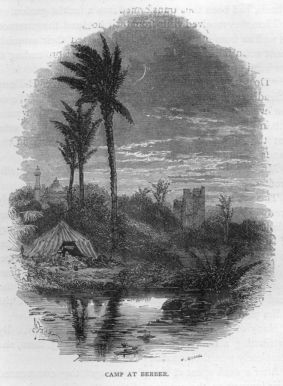
They were kindly received at Berber by Halleem Effendi, the ex-governor, who gave them permission to pitch their tents in his gardens close to the Nile. It was a lovely spot, thickly planted with lofty date-groves and shady citron and lemon-trees, in which countless birds were singing and chirruping, and innumerable ring-doves cooing in the shady palms. The once sandy spot, irrigated by numerous water-wheels, had been thus transformed into a fruitful garden.
Here they received visits from their host and the governor, as well as from other officers, who expressed their astonishment when they announced their intention of proceeding to the head of the Nile.
“Do not go on such an absurd errand,” exclaimed Halleem Effendi. “Nobody knows anything about the Nile. We do not even know the source of the Atbara. While you remain within the territory of the Pacha of Egypt you will be safe; but the moment you cross the frontier you will be in the hands of savages.”
Mr Baker, though receiving the advice cum grano salis, profited by it.
Their host sent them daily presents of fruit by a charmingly pretty slave girl, whose numerous mistresses requested permission to pay the travellers a visit. In the evening a bevy of ladies approached through the dark groves of citron-trees, so gaily dressed in silks of the brightest dyes of yellow, blue, and scarlet, that no bouquet of flowers could have been more gaudy. They were attended by numerous slaves, the head of whom requested Mr Baker to withdraw while the ladies paid his wife a visit.
Many of them she described as young and pretty. By distributing a number of small presents among them, she completely won their confidence.
After a week spent at this pleasant spot, they commenced their journey on the evening of the 10th of June, attended by a guard of Turkish soldiers, who were to act in the double capacity of escort and servants.
Their dragoman was called Mahomet, and the principal guide Achmet. The former, though almost black, declared that his colour was of a light brown. He spoke very bad English, was excessively conceited, and irascible to a degree. Accustomed to the easy-going expeditions on the Nile, he had no taste for the rough sort of work his new master had undertaken.
The journey across the desert tract was performed on donkeys, the luggage being carried on camels or dromedaries.
In two days they reached the junction of the Atbara river with the Nile. Here, crossing a broad surface of white sand, which at that season formed the dry bed of the river, they encamped near a plantation of water-melons, with which they refreshed themselves and their tired donkeys. The river was here never less than four hundred yards in width, with banks nearly thirty feet deep. Not only was it partially dry, but so clear was the sand-bed that the reflection of the sun was almost unbearable.
They travelled along the banks of the river for some days, stopping by the side of the pools which still remained. Many of these pools were full of crocodiles and hippopotami. One of these river-horses had lately killed the proprietor of a melon-garden, who had attempted to drive the creature from his plantation. Mr Baker had the satisfaction of killing one of the monsters in shallow water. It was quickly surrounded by Arabs, who hauled it on shore, and, on receiving his permission to take the meat, in an instant a hundred knives were at work, the men fighting to obtain the most delicate morsels. He and his wife breakfasted that morning on hippopotamus flesh, which was destined to be their general food during their journey among the Abyssinian tributaries of the Nile.
Game abounded, and he shot gazelles and hippopotami sufficient to keep the whole camp well supplied with meat.
On the 23rd of June they were nearly suffocated by a whirlwind that buried everything in the tents several inches in dust.
The heat was intense; the night, however, was cool and pleasant. About half-past eight, as Mr Baker lay asleep, he fancied that he heard a rumbling like distant thunder. The low uninterrupted roll increasing in volume, presently a confusion of voices arose from the Arabs’ camp, his men shouting as they rushed through the darkness: “The river! the river!”
Mahomet exclaimed that the river was coming down, and that the supposed distant roar was the approach of water. Many of the people, who had been sleeping on the clean sand of the river’s bed, were quickly awakened by the Arabs, who rushed down the steep bank to save the skulls of two hippopotami which were exposed to dry.
The sound of the torrent, as it rushed by amid the darkness, and the men, dripping with wet, dragging their heavy burdens up the bank, told that the great event had occurred. The river had arrived like a thief in the night.
The next morning, instead of the barren sheet of clear white sand with a fringe of withered bush and trees upon its borders, cutting the yellow expanse of desert, a magnificent stream, the noble Atbara river flowed by, some five hundred yards in width, and from fifteen to twenty feet in depth. Not a drop of rain, however, had fallen; but the current gave the traveller a clue to one portion of the Nile mystery. The rains were pouring down in Abyssinia—these were the sources of the Nile.
The rainy season, however, at length began, during which it was impossible to travel.
The Arabs during that period migrate to the drier regions in the north.
On their way they arrived in the neighbourhood of the camp of the great Sheikh Achmet Abou Sinn, to whom Mr Baker had a letter of introduction. Having sent it forward by Mahomet, in a short time the sheikh appeared, attended by several of his principal people. He was mounted on a beautiful snow-white hygeen, his appearance being remarkably dignified and venerable. Although upwards of eighty years old, he was as erect as a lance, and of herculean stature; a remarkably arched nose, eyes like an eagle’s, beneath large, shaggy, but perfectly white eyebrows, while a snow-white beard of great thickness descended below the middle of his breast. He wore a large white turban, and a white cashmere robe reaching from the throat to the ankles. He was indeed the perfect picture of a desert patriarch. He insisted on the travellers accompanying him to his camp, and would hear of no excuses. Ordering Mahomet to have their baggage repacked, he requested them to mount two superb hygeens with saddle-cloths of blue and purple sheep-skins, and they set out with their venerable host, followed by his wild and splendidly-mounted attendants.
As they approached the camp they were suddenly met by a crowd of mounted men, armed with swords and shields, some on horses, others on hygeens. These were Abou Sinn’s people, who had assembled to do honour to their chief’s guests. Having formed in lines parallel with the approach of their guests, they galloped singly at full speed across the line of march, flourishing their swords over their heads, and reining in their horses so as to bring them on their haunches by the sudden halt. This performance being concluded, they fell into line behind the party.
Declining the sheikh’s invitation to spend two or three months at his camp, Mr and Mrs Baker travelled on to the village of Sofi, where they proposed remaining during the rainy season.
It was situated near the banks of the Atbara, on a plateau of about twenty acres, bordered on either side by two deep ravines, while below the steep cliff in front of the village flowed the river Atbara.
Their tents were pitched on a level piece of ground just outside the village, where the grass, closely nibbled by the goats, formed a natural lawn.
Here huts were built and some weeks were pleasantly spent. Mr Baker found an abundance of sport, sometimes catching enormous fish, at others shooting birds to supply his larder, but more frequently hunting elephants, rhinoceros, giraffes, and other large game.
He here found a German named Florian, a stone-mason by trade, who had come out attached to the Austrian mission at Khartoum, but preferring a freer life than that city afforded, had become a great hunter. Mr Baker, thinking that he would prove useful, engaged him as a hunter, and he afterwards took into his service Florian’s black servant Richarn, who became his faithful attendant. A former companion of Florian’s, Johann Schmidt, soon afterwards arrived, and was also engaged by Mr Baker to act as his lieutenant in his proposed White Nile expedition. Poor Florian, however, was killed by a lion, and Schmidt and Richarn alone accompanied him.
Mr Baker’s skill as a sportsman was frequently called into play by the natives, to drive off the elephants and hippopotami which infested their plantations. One afternoon he was requested to shoot a savage old bull hippopotamus which had given chase to several people. Accompanied by Mrs Baker he rode to the spot, about two miles off, where the hippopotamus lived in a deep and broad portion of the river. The old hippopotamus was at home.
“The river, about two hundred and fifty yards wide, had formed by an acute bend a deep hole. In the centre of this was a sandbank just below the surface. Upon this shallow bed the hippopotamus was reposing. On perceiving the party he began to snort and behave himself in a most absurd manner, by shaking his head and leaping half way out of the water. Mr Baker had given Bacheet, one of his attendants, a pistol, and had ordered him to follow on the opposite bank. He now directed him to fire several shots at the hippopotamus, in order if possible to drive the animal towards him. The hippo, a wicked, solitary, old bull, returned the insult by charging towards Bacheet with a tremendous snorting, which sent him scrambling up the steep bank in a panic. This gave the brute confidence; and the sportsman, who had hitherto remained concealed, called out according to Arabic custom: ‘Hasinth! hasinth!’ the Arabic for hippopotamus. The brute, thinking no doubt that he might as well drive the intruder away, gave a loud snort, sank, and quickly reappeared about a hundred yards from him. On this Mr Baker ordered Bacheet to shoot to attract the animal’s attention. As the hippopotamus turned his head, Mr Baker took a steady shot, aiming behind the ear, and immediately the saucy old hippo turned upon his back and rolled about, lashing the still pool into waves, until at length he disappeared.”
His intention of engaging a party of the Hamran Arabs, celebrated as hunters, to accompany him in his explorations of the Abyssinian rivers having become known, several of these men made their appearance at Son. They are distinguished from the other tribes of Arabs by an extra length of hair, worn parted down the centre and arranged in long curls. They are armed with swords and shields, the former having long, straight, two-edged blades, with a small cross for the handle, similar to the long, straight, cross-handled blades of the crusaders. Their shields, formed of rhinoceros, giraffe, or elephant-hide, are either round or oval. Their swords, which they prize highly, are kept as sharp as razors. The length of the blade is about three feet, and the handle six inches long. It is secured to the wrist by a leathern strap, so that the hunter cannot by any accident be disarmed.
These men go in chase of all wild animals of the desert; some are noted as expert hippopotamus slayers, but the most celebrated are the Aggageers, or elephant hunters. The latter attack the huge animal either on horseback, or on foot when they cannot afford to purchase steeds. In the latter case, two men alone hunt together. They follow the tracks of an elephant which they contrive to overtake about noon, when the animal is either asleep or extremely listless and easy to approach. Should the elephant be asleep, one of the hunters will creep towards its head, and with a single blow sever the trunk stretched on the ground, the result being its death within an hour from bleeding. Should the animal be awake, they will creep up from behind, and give a tremendous cut at the back sinew of the hind leg, immediately disabling the monster. It is followed up by a second cut on the remaining leg, when the creature becomes their easy prey.
When hunting on horseback, generally four men form a party, and they often follow the tracks of a herd from their drinking-place for upwards of twenty miles.
Mr Baker accompanied them on numerous hunting expeditions, and witnessed the wonderful courage and dexterity they displayed.
After spending three months at Son, he set out for the Settite River, he and his wife crossing the Atbara River on a raft formed of his large circular sponging bath supported by eight inflated skins secured to his bedstead.
A party of the Aggageers now joined him. Among them was Abou Do, a celebrated old hippopotamus hunter, who, with his spear of trident shape in hand, might have served as a representative of Neptune. The old Arab was equally great at elephant hunting, and had on the previous day exhibited his skill, having assisted to kill several elephants. He now divested himself of all his clothing, and set out, taking his harpoon in hand, in search of hippopotami.
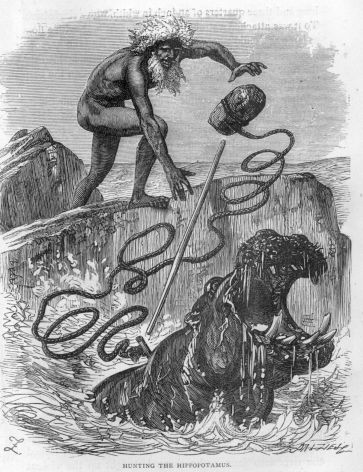
This weapon consisted of a steel blade about eleven inches long and three-quarters of an inch in width, with a single barb. To it was attached a strong rope twenty feet long, with a float as large as a child’s head at the extremity. Into the harpoon was fixed a piece of bamboo ten feet long, around which the the rope was twisted, while the buoy was carried on the hunter’s left hand.
After proceeding a couple of miles, a herd of hippopotami were seen in a pool below a rapid surrounded by rocks. He, however, remarking that they were too wide-awake to be attacked, continued his course down the stream till a smaller pool was reached. Here the immense head of a hippopotamus was seen, close to a perpendicular rock that formed a wall to the river. The old hunter, motioning the travellers to remain quiet, immediately plunged into the stream and crossed to the opposite bank, whence, keeping himself under shelter, he made his way directly towards the spot beneath which the hippopotamus was lying. “Stealthily he approached, his long thin arm raised, with the harpoon ready to strike. The hippopotamus, however, had vanished, but far from exhibiting surprise, the veteran hunter remaining standing on the sharp ledge, unchanged in attitude. No figure of bronze could be more rigid than that of the old river king, as he thus stood, his left foot advanced, his right-hand grasping the harpoon above his head, and his left the loose coil of rope attached to the buoy.”
“Three minutes thus passed, when suddenly the right arm of the statue descended like lightening, and the harpoon shot perpendicularly into the pool with the speed of an arrow. In an instant an enormous pair of open jaws appeared, followed by the ungainly head and form of a furious hippopotamus, who, springing half out of the water, lashed the river into foam as he charged straight up the violent rapids. With extraordinary power he breasted the descending stream, gaining a footing in the rapids where they were about five feet deep, thus making his way, till, landing from the river, he started at full gallop along the shingly bed, and disappeared in the thorny jungle. No one would have supposed that so unwieldy an animal could have exhibited such speed, and it was fortunate for old Neptune that he was secure on the high ledge of rock, for had he been on the path of the infuriated beast, there would have been an end of Abou Do.”
The old man rejoined his companions, when Mr Baker proposed going in search of the animal. The hunter, however, explained that the hippopotamus would certainly return after a short time to the water. In a few minutes the animal emerged from the jungle and descended at full trot into the pool where the other hippopotami had been seen, about half a mile off. Upon reaching it, the party were immediately greeted by the hippopotamus, who snorted and roared and quickly dived, and the float was seen running along the surface, showing his course as the cork of a trimmer does that of a pike when hooked. Several times the hippo appeared, but invariably faced them, and, as Mr Baker could not obtain a favourable shot, he sent the old hunter across the stream to attract the animal’s attention. The hippo, turning towards the hunter, afforded Mr Baker a good chance, and he fired a steady shot behind the ear. The crack of the ball, in the absence of any splash from the bullet, showed him that the hippopotamus was hit, while the float remained stationary upon the surface, marking the spot where the grand old bull lay dead beneath. The hunter obtaining assistance from the camp, the hippopotamus, as well as another which had been shot, were hauled on shore. The old bull measured fourteen feet two inches, and the head was three feet one inch from the front of the ear to the edge of the lip, in a straight line.
Though hippopotami are generally harmless, solitary old bulls are sometimes extremely vicious, and frequently attack canoes without provocation.
Many of the elephant hunts in which Mr Baker engaged were exciting in the highest degree, and fraught with no small amount of danger.
Among the Aggageers was a hunter, Rodur Sherrif, who, though his arm had been withered in consequence of an accident, was as daring as any of his companions.
The banks of the Royan had been reached, where, a camp having been formed, Mr Baker and his companions set out in search of elephants. A large bull elephant was discovered drinking. The country around was partly woody, and the ground strewed with fragments of rocks, ill adapted for riding. The elephant had made a desperate charge, scattering the hunters in all directions, and very nearly overtaking Mr Baker. He then retreated into a stronghold composed of rocks and uneven ground, with a few small leafless trees growing in it. The scene must be described in the traveller’s own words. “Here the elephant stood facing the party like a statue, not moving a muscle beyond the quick and restless action of the eyes, which were watching on all sides. Two of the Aggageers getting into its rear by a wide circuit, two others, one of whom was the renowned Rodur Sherrif, mounted on a thoroughly-trained bay mare, rode slowly towards the animal. Coolly the mare advanced towards her wary antagonist until within about nine yards of its head. The elephant never moved. Not a word was spoken. The perfect stillness was at length broken by a snort from the mare, who gazed intently at the elephant, as though watching for the moment of attack. Rodur coolly sat with his eyes fixed upon those of the elephant.
“With a shrill scream the enormous creature then suddenly dashed on him like an avalanche. Round went the mare as though upon a pivot, away over rocks and stones, flying like  a gazelle, with the monkey-like form of Rodur Sherrif leaning forward and looking over his left shoulder as the elephant rushed after him. For a moment it appeared as if the mare must be caught. Had she stumbled, all would have been lost, but she gained in the race after a few quick bounding strides, and Rodur, still looking behind him, kept his distance, so close, however, to the creature, that its outstretched trunk was within a few feet of the mare’s tail.
“The two Aggageers who had kept in the rear now dashed forward close to the hind quarters of the furious elephant, who, maddened with the excitement, heeded nothing but Rodur and his mare. When close to the tail of the elephant, the sword of one of the Aggageers flashed from its sheath as, grasping his trusty blade, he leaped nimbly to the ground, while his companion caught the reins of his horse. Two or three bounds on foot, with the sword clutched in both hands, and he was close behind the elephant. A bright glance shone like lightning as the sun struck on the descending steel. This was followed by a dull crack, the sword cutting through skin and sinew, and sinking deep into the bone about twelve inches above the foot. At the next stride the elephant halted dead short in the midst of his tremendous charge. The Aggageer who had struck the blow vaulted into the saddle with his naked sword in hand. At the same moment Rodur turned sharp round and, again facing the elephant, stooped quickly from the saddle to pick up from the ground a handful of dirt, which he threw into the face of the vicious animal, that once more attempted to rush upon him. It was impossible: the foot was dislocated and turned up in front like an old shoe. In an instant the other Aggageer leaped to the ground, and again the sharp sword slashed the remaining leg.”
Nothing could be more perfect than the way in which these daring hunters attack their prey. “It is difficult to decide which to admire most—whether the coolness and courage of  him who led the elephant, or the extraordinary skill and activity of the Aggageer who dealt the fatal blow.”
Thus, hunting and exploring, Mr Baker, accompanied by his heroic wife, visited the numerous river-beds which carry the rains of the mountainous regions of Abyssinia into the Blue Nile, and are the cause of the periodical overflowing of the mighty stream, while its ordinary current is fed from other far-distant sources, towards one of which the traveller now prepared to direct his steps.
Speke and Grant were at this time making their way from Zanzibar, across untrodden ground, towards Gondokoro.
An expedition under Petherick, the ivory-trader, sent to assist them, had met with misfortune and been greatly delayed, and Mr Baker therefore hoped to reach the equator, and perhaps to meet the Zanzibar explorers somewhere about the sources of the Nile.
Proceeding along the banks of the Blue Nile, Mr and Mrs Baker reached Khartoum on the 11th of June, 1862. A beautiful view met their sight as they gazed across the waters of the Nile. “The morning sun was shining on this capital of the Soudan provinces; the dark green foliage of the groves of date-trees contrasted exquisitely with the numerous buildings of many colours which lined the margin of the river, while long lines of vessels with tapering spars gave light to the scene. But alas! this beauty soon vanished, both the sight and smell being outraged grievously as they entered the filthy and miserable town.”
Chapter Twenty Four.
Travels of Sir Samuel and Lady Baker, continued.
Preparations for journey to the south—Difficulties—The Shillooks—The Nuehr—Information about the slave trade—The Kytch—The sacred bullock—Arrive at Gondokoro—Attempts to shoot Baker—His escort mutiny—He meets Speke and Grant—Treachery among his servants—Encounter with slave-traders—Wins over Ibrahim, and arrives at Tarrangolle—The Latooka victory—Misbehaviour of the Turks, and threatened attack by the natives—A funeral dance—Returns to Obbo—Fever—Sets out for Karuma—Reaches Karuma Falls—Kamrasi—Proceeds to the Lake—A strange reception—Illness of Mrs Baker—Reach the village of Parkani—Arrive at the lake which Baker called Albert Nyanza—Surveys it—Reaches Magimgo—Proceeds to the Murchison Falls—Return to Magimgo—Deserted by his guide and carriers—Starvation—The guide reappears, and they arrive at Kamrasi’s camp—An invasion by Fowookas—Mr Baker prevents an attack—He at last sets off with Turkish traders, and arrives at Shooa—A march through the Bari—Reach Gondokoro—Voyage down the Nile—Welcomed at Khartoum—A dust-storm—Continuing their voyage, reach Berber, and at length arrive in England—Returns to Egypt—Organises an expedition to convey steamers up the Nile for Lake Nyanza, to oppose the slave trade.
At Khartoum Mr and Mrs Baker spent some months to recruit, occupying the house of the British Consul, who was then absent.
On the 17th of December their preparations for a fresh start were completed. Three vessels had been engaged, and were laden with large quantities of stores, with four hundred bushels of corn, and twenty-nine transport animals, including camels, horses, and donkeys. Their party consisted of ninety-six souls, including Johann Schmidt and the faithful black Richarn, and forty-nine well-armed men.
Khartoum was a nest of slave-traders, who looked with jealous eyes upon every stranger venturing within the precincts of their holy land, and, as Mr Baker observes: “sacred to slavery and to every abomination and villainy that man can commit.”
The Turkish officers pretended to discountenance slavery; at the same time every house was full of slaves, and Egyptian officers received a portion of their pay in slaves. The authorities, therefore, looked upon the proposed exploration of the White Nile by a European traveller as likely to interfere with their perquisites, and threw every obstacle in his way.
As the government of Soudan refused to supply him with properly-trained soldiers, the only men he could get for an escort were the miserable cut-throats of Khartoum, who had been accustomed all their lives to murder and pillage in the White Nile trade; yet, such as they were, he was compelled to put up with them, though he would undoubtedly have done better had he gone without such an escort.
The voyage alone to Gondokoro, the navigable limit of the Nile, was likely to occupy about fifty days, so that a large supply of provisions was necessary.
Difficulties were met with from the very beginning. The vessel’s yards were continually being carried away.
Poor Johann, who, though he had long been suffering, insisted on accompanying his employer, died a short time after the commencement of the voyage.
On the 2nd of January they were sailing past the country inhabited by the Shillooks, the largest and most powerful black tribe on the banks of the White Nile. They are very wealthy, and possess immense herds of cattle; are also agriculturists, fishermen, and warriors. Their huts are regularly built, looking at a distance like rows of button mushrooms. They embark boldly on the river in their raft-like canoes, formed of the excessively light ambatch-wood. The tree is of no great thickness, and tapers gradually to a point. It is  thus easily cut down, and, several trunks being lashed together, a canoe is quickly formed. A war party on several occasions, embarking in a fleet of these rafts, have descended the river, and made raids on other tribes, carrying off women and children as captives, and large herds of cattle.
Nothing can be more melancholy and uninteresting than the general appearance of the banks of the river. At times vast marshes alone could be seen, at others an immense expanse of sandy desert, with huge ant-hills ten feet high rising above them. The inhabitants were naked savages. While stopping at a village on the right bank, they received a visit from the chief of the Nuehr tribe and a number of his followers. They were most unearthly-looking fellows; even the young women were destitute of clothing, though the married had a fringe made of grass round their loins. The men wore heavy coils of beads about their necks, two heavy bracelets of ivory on the upper portions of their arms, copper rings upon the wrist, and a horrible kind of bracelet of massive iron, armed with spikes about an inch in length, like leopards’ claws. The women had their upper lips perforated and wore ornaments on their heads, about four inches long, of beads, upon iron wires projecting like the horn of a rhinoceros.
The chief exhibited his wife’s arms and back, covered with jagged scars, to show the use of the spiked iron bracelet.
These were among the first blacks met with. They are almost too low in the scale of humanity to be fit for slaves. Mr Baker gained much information about the slave trade of this part of the world. Most of those engaged in this nefarious traffic are Syrians, Copts, Turks, Circassians, and some few Europeans. When a speculator has determined to enter into the trade, he engages a hundred and fifty to two hundred ruffians, and purchases guns and ammunition, and a few pounds of glass beads. With these he sails up to Gondokoro and, disembarking, marches into the interior till he arrives at the village of some negro chief, with whom he establishes an intimacy. The chief has probably an enemy to attack, and his new allies gladly assist him. Led by him, they approach some unsuspecting village about half an hour before daybreak. Surrounding it while the occupants are still sleeping, they fire the grass-huts in all directions, and pour volleys of musketry through the flaming thatch. Panic-struck, the unfortunate victims rush from their burning dwellings. The men are shot down, the women and children kidnapped and secured, while the herds of cattle are driven off. The women and children are then fastened together, the former secured by an instrument, called a sheba, made of a forked pole. The neck of the prisoner fits into the fork, secured by a cross-piece also behind, while the wrists, brought together in advance of the body, are tied to the pole. The children are then fastened by their necks with the rope attached to the women, and thus form a living chain, in which order they are marched to the head-quarters with the captured herds. Of course, all the ivory found in the place is carried off. The cattle are then exchanged with the negro chief for any tusks he may possess.
In many instances a quarrel is soon afterwards picked with him, and his village is treated in the same way as that of his foes. Should any slave attempt to escape, she is punished either by brutal flogging, or hanged as a warning to others. The slaves are then carried down the river, and landed a few days’ journey south of Khartoum, whence they are marched across the country, some to ports on the Red Sea, there to be shipped for Arabia and Persia, while others are sent to Cairo. In fact, they are disseminated throughout the slave dealing East.
Sailing on day after day, with marshes and dead flats alone  in sight, mosquitos preventing rest even in the day, they at length arrived at the station of a White Nile trader, where large herds of cattle were seen on the banks.
They were here visited by the chief of the Kytch tribe and his daughter, a girl of about sixteen, better looking than most of her race. The father wore a leopard-skin across his shoulder, and a skull-cap of white beads, with a crest of white ostrich feathers. But this mantle was the only garment he had on. His daughter’s clothing consisted only of a piece of dressed hide hanging over one shoulder, more for ornament than use, as the rest of her body was entirely destitute of covering. The men, though tall, were wretchedly thin, and the children mere skeletons.
While the travellers remained here, they were beset by starving crowds, bringing small gourd shells to receive the expected corn. The natives, indeed, seem to trust entirely to the productions of nature for their subsistence, and are the most pitiable set of savages that can be imagined, their long thin legs and arms giving them a peculiar gnat-like appearance. They devour both the skin and bones of dead animals. The bones are pounded between stones, and, when reduced to powder, boiled to form a kind of porridge.
It is remarkable that in every herd they have a sacred bull, who is supposed to have an influence over the prosperity of the rest. His horns are ornamented with tufts of feathers, and frequently with small bells, and he invariably leads the great herd to pasture.
A short visit was paid to the Austrian mission stationed at Saint Croix, which has proved a perfect failure—indeed, that very morning it was sold to an Egyptian for 30 pounds.
It was here the unfortunate Baron Harnier, a Prussian nobleman, was killed by a buffalo which he had attacked in the hopes of saving the life of a native whom the buffalo had struck down.
The voyage terminated at Gondokoro on the 2nd of February.
The country is a great improvement to the interminable marshes at the lower part of the river, being raised about twenty feet above the water, while distant mountains relieve the eye, and evergreen trees, scattered in all directions, shading the native villages, form an inviting landscape. A few miserable grass-huts alone, however, form the town, if it deserves that name.
A large number of men belonging to the various traders were assembled here, who looked upon the travellers with anything but friendly eyes.
As Mr Baker heard that a party were expected at Gondokoro from the interior with ivory in a few days, he determined to await their arrival, in hopes that their porters would be ready to carry his baggage.
In the mean time he rode about the neighbourhood, studying the place and people.
“The native dwellings are the perfection of cleanliness. The domicile of each family is surrounded by a hedge of euphorbia, and the interior of the enclosure generally consists of a yard neatly plastered with a cement of ashes, cow-dung, and sand. Upon this cleanly-swept surface are one or more huts, surrounded by granaries of neat wicker-work, thatched, and resting upon raised platforms. The huts have projecting roofs, in order to afford a shade, and the entrance is usually about two feet high.
“The natives are of the Bari tribe. The men are well grown, and their features are good, the woolly hair alone denoting their negro blood.
“They use poisoned arrows, but, as their bows are inferior and they are bad marksmen, they do not commit much mischief with them.”
Gondokoro was a perfect hell—a mere colony of  cut-throats. The Egyptians might easily have sent a few officers and two or three hundred men from Khartoum to form a military government, and thus impede the slave trade; but a bribe from the traders to the authorities was sufficient to ensure an uninterrupted asylum for any amount of villainy. The camps were full of slaves, and the Bari natives assured Mr Baker that there was a large depot of slaves in the interior, belonging to the traders, that would be marched to Gondokoro for shipment a few hours after his departure. He was looked upon as a stumbling-block to the trade. Several attempts were made to shoot him, and a boy was killed by a shot from the shore, on board his vessel. His men were immediately tampered with by the traders, and signs of discontent soon appeared among them. They declared that they had not sufficient meat, and that they must be allowed to make a razzia upon the cattle of the natives to procure oxen. This demand being refused, they became more insolent, and accordingly Mr Baker ordered the ringleader, an Arab, to be seized and to receive twenty-five lashes. Upon his vakeel approaching to capture the fellow, most of the men laid down their guns and, seizing sticks, rushed to his rescue. Mr Baker, on this, sprang forward, sent their leader by a blow of his fist into their midst, and then, seizing him by the throat, called to Saati for a rope to bind him. The men, still intent on their object, surrounded Mr Baker, when Mrs Baker, landing from the vessel, made her way to the spot. Her sudden appearance caused the mutineers to hesitate, when Mr Baker shouted to the drummer boy to beat the drum, and then ordered the men to fall in. Two-thirds obeyed him, and formed in line, while the remainder retreated with their ringleader. At this critical moment Mrs Baker implored her husband to forgive the mutineer, if he would kiss his hand and beg his pardon. This compromise completely won the men, who now called upon their ringleader to apologise, and all would be right. This he did, and Mr Baker made them rather a bitter speech and dismissed them.
This, unhappily, was only the first exhibition of their mutinous disposition, which nearly ruined the expedition, and might have led to the destruction of the travellers.
A few days afterwards guns were heard in the distance, and news arrived that two white men had arrived from “the sea”! They proved to be Grant and Speke, who had just come from the Victoria Nyanza. Both looked travel-worn. Speke, who had walked the whole distance from Zanzibar, was excessively lean, but in reality in good tough condition. Grant’s garments were well-nigh worn-out, but both of them had that fire in the eye which showed the spirit that had led them through many dangers.
They had heard of another lake to the westward of the the Nyanza, known as the Luta Nzige, which Speke felt convinced was a second source of the Nile.
Accordingly, he and Grant having generously furnished him with as perfect a map as they could produce, Baker determined to explore the lake, while his friends, embarking in his boats, sailed down the Nile on their voyage homeward. His men, notwithstanding the lesson they had received, still exhibited a determined mutinous disposition, and in every way neglected their duties. Happily for him, he had among his attendants a little black boy, Saati, who, having been brought as a slave from the interior, had been for a time in the Austrian mission, from which, with many other slaves, he was turned out. Wandering about the streets of Khartoum, he heard of Mr and Mrs Baker, and, making his way to their house, threw himself at the lady’s feet, and implored to be allowed to follow them. Hearing at the mission that he was superior to his juvenile companions, they accepted his services, and, being thoroughly washed, and attired in trousers, blouse, and belt, he appeared a different creature. From that time he considered himself as belonging entirely to Mrs Baker, and to serve her was his greatest pride. She in return endeavoured to instruct him, and gave him anecdotes from the Bible, combined with the first principles of Christianity.
Through the means of young Saati, Mr Baker heard of a plot among the Khartoum escort, to desert him with their arms and ammunition, and to fire at him should he attempt to disarm them. The locks of their guns had, by his orders, been covered with pieces of mackintosh. Directing Mrs Baker to stand behind him, he placed outside his tent, on his travelling bedstead, five double-barrelled guns loaded with buck-shot, a revolver, and a naked sabre. A sixth rifle he kept in his own hands, while Richarn and Saati stood behind him with double-barrelled guns. He then ordered the drum to beat, and all the men to form in line of marching order, while he requested Mrs Baker to point out any man who should attempt to uncover his lock when he gave the order to lay down their arms. In the event of the attempt being made, he intended to shoot the man immediately. At the sound of the drum only fifteen assembled. He then ordered them to lay down their arms. This, with insolent looks of defiance, they refused to do.
“Down with your guns this moment!” he shouted.
At the sharp click of the locks, as he quickly capped the rifle in his hand, the cowardly mutineers widened their line and wavered; some retreated a few paces, others sat down and laid their guns on the ground, while the remainder slowly dispersed, and sat in twos or singly under the various trees about eighty paces distant. On the vakeel and Richarn advancing, they capitulated, agreeing to give up their arms and ammunition on receiving a written discharge. They were immediately disarmed. The discharge was made out, when upon each paper Mr Baker wrote the word “mutineer” above his signature. Finally, nearly the whole of the escort deserted, taking service with the traders.
Not to be defeated, Baker obtained a Bari boy as interpreter, determined at all hazards to start from Gondokoro.
A party of traders under Koorshid, who had lately arrived from Latooka and were about to return, not only refused to allow the travellers to accompany them, but declared their intention of forcibly driving them back, should they attempt to advance by their route.
This served as an excuse to the remainder of his escort for not proceeding.
Saati discovered another plot, his men having been won over by Mahomet Her, the vakeel of Chenooda, another trader.
Notwithstanding the danger he was running, Mr Baker compelled his men to march, and by a clever manoeuvre got ahead of the party led by Ibrahim, Koorshid’s vakeel.
Finally, by wonderful tact, assisted by Mrs Baker, he won over Ibrahim, and induced him to render him all the assistance in his power.
Aided by his new friend, he arrived at Tarrangolle, one of the principal places in the Latooka country, a hundred miles from Gondokoro, which, though out of his direct route, would, he hoped, enable him with greater ease finally to reach Unyoro, the territory of Kamrasi.
In the mean time, however, several of his men had deserted and joined Mahomet Her. He had warned them that they would repent of their folly. His warnings were curiously fulfilled.
News soon arrived that Mahomet Her, with a party of a hundred and ten armed men, in addition to three hundred natives, had made a razzia upon a certain village among the mountains for slaves and cattle. Having succeeded in  the village and capturing a number of slaves, as they were re-ascending the mountain to obtain a herd of cattle they had heard of, they were attacked by a large body of Latookas, lying in ambush among the rocks on the mountain side.
In vain the Turks fought; every bullet aimed at a Latooka struck a rock, while rocks, stones, and lances were hurled at them from all sides and from above. Compelled to retreat, they were seized with a panic, and took to flight.
Hemmed in by their foes, who showered lances and stones on their heads, they fled down the rocky and perpendicular ravines. Mistaking their road, they came to a precipice from which there was no retreat.
The screaming and yelling savages closed round them. All was useless; not an enemy could they shoot, while the savages thrust them forward with wild yells to the very verge of a precipice five hundred feet high. Over it they were driven, hurled to destruction by the mass of Latookas pressing onward. A few fought to the last; but all were at length forced over the edge of the cliff, and met the just reward of their atrocities. No quarter had been given, and upwards of two hundred of the natives who had joined the slave-hunters in the attack, had fallen with them.
Mahomet Her had not accompanied his party, and escaped, though utterly ruined.
The result of this catastrophe was highly beneficial to Mr Baker.
“Where are the men who deserted me?” he asked of those who still remained with him.
Without speaking, they brought two of his guns covered with clotted blood mixed with sand. Their owners’ names were known to him by the marks on the stocks. He mentioned them.
“Are they all dead?” he asked.
“All dead,” the men replied.
“Food for the vultures,” he observed. “Better for them had they remained with me and done their duty.”
He had before told his men that the vultures would pick the bones of the deserters.
From that moment an extraordinary change took place in the manner both of his own people and those of Ibrahim towards him. Unhappily, however, the Latookas exhibited a change for the worse. The Turks, as usual, insulted their women, and treated the natives with the greatest brutality; and had he not exercised much caution and vigilance, both his own party and Ibrahim’s would in all probability have been cut off. Ibrahim had been compelled to go back to Gondokoro for ammunition, and Mr Baker waited at Tarrangolle for his return.
On one occasion, in consequence of the misbehaviour of the Turks, the whole of the natives deserted the town, and vast numbers collected outside, threatening to attack it and destroy their guests. Mr Baker, gaining information of their intention, took command of the Turks, and with his own men showed so bold a front that the natives saw clearly that they would be the sufferers should they attempt to carry their purpose into execution.
Their chief, Comonoro, came into the town, and seeing the preparations made for its defence, agreed to persuade his people to act in a peaceable manner. The next morning they dispersed, and the inhabitants returned to the town.
The Turks, after their alarm, behaved better, though they threatened, when Ibrahim arrived with reinforcements and ammunition, that they would have their revenge.
Mr Baker after this moved his camp to a secure position some distance from the town, near a stream of water. Here he formed a garden, and lived in a far more independent way than before.
The debased state of morality prevailing among the natives was exhibited in a variety of ways. One of their chiefs, Adda by name, came to him one day and requested him to assist in attacking a village, for the purpose of procuring some iron hoes which he wanted. Mr Baker asked whether it was in an enemy’s country. “Oh, no!” was the reply; “it is close here, but the people are rather rebellious, and it will do them good to kill a few. If you are afraid, I will ask the Turks to do it.”
A funeral dance a short time after this took place in honour of those who had been killed in the late fight. The dancers were grotesquely got up, and are amusingly described by Mr Baker. “Each man had about a dozen huge ostrich feathers in his helmet, a leopard or monkey-skin hung from his shoulders, while a large iron bell was strapped to his loins like a woman’s bustle. This he rang during the dance, by jerking the hinder part of his body in the most absurd manner. All the time a hubbub was kept up by the shouting of the crowd, the blowing of horns, and the beating of seven nogaras, or drums, all of different notes, while each dancer also blew an antelope’s horn suspended round his neck, the sound partaking of the braying of a donkey and the screeching of an owl. Meantime crowds of men rushed round and round, brandishing their lances and iron-headed maces, following a leader, who headed them, dancing backwards. The women outside danced at a slower pace, screaming a wild and inharmonious chant, while beyond them a string of young girls and small children beat time with their feet, and jingled numerous iron rings which adorned their ankles. One woman attended upon the men, running through the crowd with a gourd full of wood-ashes, handfuls of which she showered over their heads, powdering them like millers. The leader among the women was immensely fat; notwithstanding this she kept up the pace to the last, quite unconscious of her general appearance.”
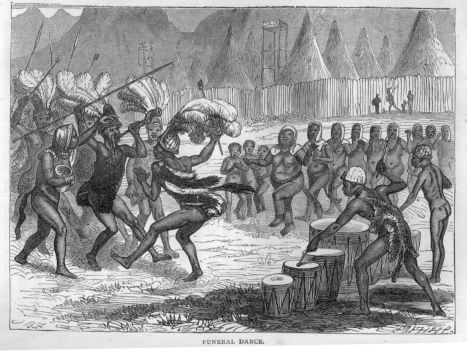
Notwithstanding the dangers of his position, Mr Baker frequently went out shooting, and, among other animals, he killed an enormous elephant, but the natives carried off the tusks and flesh. He was able, however, with his gun, to supply his camp with food, which was fortunate, as the natives would not sell him any of their cattle.
Soon after Ibrahim’s return, the Turks, at the request of Comonoro, attacked the town of Kayala, but were driven back by the natives, whose cattle, however, they carried off.
It became dangerous to remain longer in the country, in consequence of the abominable conduct of the Turks, which so irritated the natives that an attack from them was daily expected.
They were therefore compelled to return to Obbo, the chief of which, old Katchiba, had before received them in a friendly manner.
Here, in consequence of their exposure to wet, Mr and Mrs Baker were attacked with fever. By this time all their baggage animals as well as their horses had died. Mr Baker purchased from the Turks some good riding oxen for himself and his wife, and, having placed his goods under the charge of old Katchiba and two of his own men, he set out on the 8th of January, 1864, with a small number of attendants, to proceed to Karuma, the northern end of Kamrasi’s territory, which Speke and Grant had visited.
The Shooa country, through which he passed, is very beautiful, consisting of mountains covered with fine forest trees, and picturesquely dotted over with villages. Several portions presented the appearance of a park watered by numerous rivulets and ornamented with fine timber, while it was interspersed with high rocks of granite, which at a distance looked like ruined castles.
Here they found an abundance of food: fowls, butter, and goats were brought for sale.
They had obtained the services of a slave woman called Bacheeta, belonging to Unyoro, and who, having learned Arabic, was likely to prove useful as an interpreter and guide. She, however, had no desire to return to her own country, and endeavoured to mislead them, by taking them to the country of Rionga, an enemy of Kamrasi. Fortunately Mr Baker detected her treachery, and he and his Turkish allies reached the Karuma Falls, close to the village of Atada. A number of Kamrasi’s people soon crossed the river to within parleying distance, when Bacheeta, as directed, explained that Speke’s brother had arrived to pay Kamrasi a visit, and had brought him valuable presents. Kamrasi’s people, however, showed considerable suspicion on seeing so many people, till Baker appeared dressed in a suit similar to that worn by Speke, when they at once exhibited their welcome, by dancing and gesticulating with their lances and shields in the most extravagant manner. The party, however, were not allowed to cross till permission was obtained from Kamrasi. That very cautious and cowardly monarch sent his brother, who pretended to be Kamrasi himself, and for some time Baker was deceived, fully believing that he was negotiating with the king. Notwithstanding his regal pretensions, he very nearly got knocked down, on proposing that he and his guest should exchange wives, and even Bacheeta, understanding the insult which had been offered, fiercely abused the supposed king.
His Obbo porters had before this deserted him, and he was now dependent on Kamrasi for others to supply their places.
The king, however, ultimately became more friendly, and gave orders to his people to assist the stranger, granting him also permission to proceed westward to the lake he was so anxious to visit.
A few women having been supplied to carry his luggage, he and his wife, with their small party of attendants, at length set out.
On approaching a considerable village, about six hundred strangely-dressed men rushed out with lances and shields, screaming and yelling as if about to attack them. His men cried out: “Fire. There is a fight! there is a fight!”
He felt assured that it was a mere parade. The warriors were dressed either in leopard or white monkey-skins, with cows’ tails strapped on behind, and two antelope horns fixed on their heads, while their chins were ornamented with false beards made of the bushy ends of cows’ tails.
These demon-like savages came round them, gesticulating and yelling, pretending to attack them with spears and shields, and then engaged in sham fights with each other.
Mr Baker, however, soon got rid of his satanic escort. Poor Mrs Baker was naturally alarmed, fearing that it was the intention of the king to waylay them and perhaps carry her off.
Soon after this, while crossing the Kafue river, the heat being excessive, what was Mr Baker’s horror to see his wife sink from her ox as though shot dead. He, with his attendants, carried her through the yielding vegetation, up to their waists in water, above which they could just keep her head, till they reached the banks. He then laid her under a tree, and now discovered that she had received a coup de soleil. As there was nothing to eat on the spot, it was absolutely necessary to move on. A litter was procured, on which Mrs Baker was carried, her husband mechanically following by its side. For seven days continuously he thus proceeded on his journey. Her eyes at length opened, but, to his infinite grief, he found that she was attacked by a brain fever.
One evening they reached a village. She was in violent convulsions. He believed all was over, and, while he sank down insensible by her side, his men went out to seek for a spot to dig her grave. On awakening, all hope having abandoned him, as he gazed at her countenance her chest gently heaved; she was asleep. When at a sudden noise she opened her eyes, they were calm and clear: she was saved.
Having rested for a couple of days, they continued their course, Mrs Baker being carried on her litter. At length they reached the village of Parkani. To his joy, as he gazed at some lofty mountains, he was told that they formed the western side of the Luta Nzige, and that the lake was actually within a march of the village. Their guide announced that if they started early in the morning, they might wash in the lake by noon. That night Baker hardly slept.
The following morning, the 14th of March, starting before sunrise, on ox-back, he and his wife, with their attendants, following his guide, in a few hours reached a hill from the summit of which “he beheld beneath him a grand expanse of water, a boundless sea horizon on the south and south-west, glittering in the noonday sun, while on the west, at fifty or sixty miles distant, blue mountains rose from the bosom of the lake to a height of about seven thousand feet above its level.”
Hence they descended on foot, supported by stout bamboos, for two hours, to the white pebbly beach on which the waves of the lake were rolling.
Baker, in the enthusiasm of the moment, rushed into the lake, and, thirsty with heat and fatigue, with a heart full of gratitude, drank deeply from what he supposed to be one of the sources of the Nile, not dreaming of the wonderful discoveries Livingstone was making at that very time many degrees to the southward. He now bestowed upon this lake the name of the Albert Nyanza.
The dwellers on the borders of the lake are expert fishermen, and in one of their villages, named Vakovia, the travellers now established themselves.
His followers, two of whom had seen the sea at Alexandria, and who believed that they should never reach the lake, were astonished at its appearance, unhesitatingly declaring that though it was not salt, it must be the sea.
Salt, however, is the chief product of the country, numerous salt-pits existing in the neighbourhood, and in its manufacture the inhabitants are chiefly employed.
Vakovia is a miserable place, and, in consequence of its damp and hot position, the whole party suffered from fever.
Here they were detained eight days waiting for canoes, which Kamrasi had ordered his people to supply. At length several were brought, but they were merely hollowed-out trunks of trees, the largest being thirty-two feet long. Baker selected another, twenty-six feet long, but wider and deeper, for himself and his wife and their personal attendants, while the luggage and the remainder of the people embarked in the former. He raised the sides of the canoe, and fitted up a cabin for his wife, which was both rain and sun-proof.
Having purchased some provisions, he started on a voyage to survey the lake.
Vakovia is about a third of the way from the northern end of the lake. His time would not allow him to proceed further south. He directed his course northward, towards the part out of which the Nile was supposed to flow.
The difficulties of the journey were not yet over. The first day’s voyage was delightful, the lake calm, the scenery lovely. At times the mountains on the west coast were not discernible, and the lake appeared of indefinite width. Sometimes they passed directly under precipitous cliffs of fifteen hundred feet in height, rising abruptly out of the water, while from the deep clefts in the rocks evergreens of every tint appeared, and wherever a rivulet burst forth it was shaded by the graceful and feathery wild date. Numbers of hippopotami were sporting in the water, and crocodiles were numerous on every sandy beach.
Next night, however, the boatmen deserted, but, not to be defeated, Baker induced his own people to take to the paddles. He fitted a paddle to his own boat, to act as a rudder, but the men in the larger boat neglected to do as he had directed them.
A tremendous storm of rain came down while he was at work. His own canoe, however, being ready, he started. He was about to cross from one headland to another, when he saw the larger canoe spinning round and round, the crew having no notion of guiding her. Fortunately it was calm, and, on reaching the shore, he induced several natives to serve as his crew, while others went off in their own boats to assist the large canoe.
He now commenced crossing a deep bay, fully four miles wide. He had gained the centre when a tremendous storm came on, and enormous waves rolled in over the lake. The canoe laboured heavily and occasionally shipped water, which was quickly bailed out. Had this not been done, the canoe would inevitably have been swamped. Down came the rain in torrents, while the wind swept over the surface with terrific force, nothing being discernible except the high cliffs looming in the distance. The boatmen paddled energetically, and at last a beach was seen ahead. A wave struck the canoe, washing over her. Just then the men jumped out, and, though they were rolled over, they succeeded in hauling the boat up the beach.
The shore of the lake, as they paddled along it, was thinly inhabited, and the people very inhospitable, till they reached the town of Eppigoya. Even here the inhabitants refused to sell any of their goats, though they willingly parted with fowls at a small price.
At each village the voyagers changed their boatmen, none being willing to go beyond the village next them. This was provoking, as delays constantly occurred.
At length they reached Magimgo, situated inside an immense bed of reeds, at the top of a hill, above the mouth of a large river. Passing up a channel amidst a perfect wilderness of vegetation, they reached the shore below the town. Here they were met by their guide, who had brought their riding oxen from Vakovia, and reported them all well.
The chief of Magimgo and a large number of natives were also on the shore waiting for them, and brought them down a plentiful supply of goats, fowls, eggs, and fresh butter.
Proceeding on foot to the height on which Magimgo stands, they thence enjoyed a magnificent view, not only over the lake, but to the north, towards the point where its waters flow into the Nile.
Baker’s great desire was to descend the Nile in canoes, from its exit from the lake to the cataracts in the Madi country, and thence to march direct, with only guns and ammunition, to Gondokoro. This plan he found impossible to carry out.
Before their return to the canoes, Mr Baker himself was laid prostrate with fever, and most of his men were also suffering.
They had heard, however, of a magnificent waterfall up the river. They accordingly proceeded up it, and, as they got about eighteen miles above Magimgo, a slight current was perceived. The river gradually narrowed to about a hundred and eighty yards, and now, when the paddles ceased working, the roar of water could be distinctly heard. Continuing on, the noise became louder. An enormous number of crocodiles were seen, and Mr Baker counted, on one sandbank alone, twenty-seven of large size.
Reaching a deserted fishing village, the crew at first refused to proceed further, but, on Mr Baker explaining that he merely wished to see the falls, they paddled up the stream, now strong against them.
On rounding a point, a magnificent sight burst upon them. On either side of the river were beautifully-wooded cliffs, rising abruptly to a height of about three hundred feet, rocks jutting out from the intensely green foliage, while, rushing through a gap which cleft the rock exactly before them, was the river. It is here contracted from a grand stream to the width of scarcely a hundred and fifty feet. Roaring fiercely through the rock-bound pass, it plunged, in one leap of about a hundred and twenty feet, perpendicularly into the dark abyss below, the snow-white sheet of water contrasting superbly with the dark cliff that walled the river, while the graceful palms of the tropics, and wild plantains, perfected the beauty of the scene.
This was the great waterfall of the Nile, and was named the Murchison Falls, in compliment to the president of the Royal Geographical Society. To the river itself he gave the name of the Victoria Nile.
Having taken a view of the falls, and remained for some time admiring them, narrowly escaping being upset by a huge bull hippopotamus, they returned down the river to Magimgo.
Starting the next morning, both Mr and Mrs Baker suffering from fever, while all their quinine was exhausted, they found that their oxen had been bitten by the tsetse-fly, and were in a wretched condition, unlikely to live. Their guide also deserted them, and the whole of their carriers went off, leaving them on the Island of Patooam, in the Victoria River, to which they had been ferried across.
It was now the 8th of April, and within a few days the boats in which they had hoped to return down the Nile would leave Gondokoro. It was, therefore, of the greatest importance that they should set out at once, and take a direct route through the Shooa country.
The natives, not to be tempted even by bribes, positively refused to carry them. Their own men were also ill, and there was a great scarcity of provisions. War, indeed, was going on in the country to the east, Patooam being in the hands of Kamrasi’s enemies. It was on this account that no Unyoro porters could be found.
They might have starved had not an underground granary of seed been discovered, by the means of Bacheeta, in one of the villages burned down by the enemy. This, with several varieties of wild plants, enabled them to support existence.
The last of their oxen, after lingering for some time, lay down to die, affording the men a supply of beef, and Saati and Bacheeta occasionally obtained a fowl from one of the neighbouring islands, which they visited in a canoe.
At length both Mr and Mrs Baker fully believed that their last hour was come, and he wrote various instructions in his journal, directing his head man to deliver his maps and observations to the British Consul at Khartoum.
The object, it appeared, of Kamrasi in thus leaving them, was to obtain their assistance against his enemies, and at length their guide, Rehonga, made his appearance, having been ordered to carry them to Kamrasi’s camp.
The journey was performed, in spite of their weak state; and on their arrival they found ten of the Turks left as hostages with Kamrasi by Ibrahim, who had returned to Gondokoro. The Turks received them with respect and manifestations of delight and wonder at their having performed so difficult a journey.
A hut was built for their reception, and an ox, killed by the Turks, was prepared as a feast for their people.
The next day the king notified his readiness to receive the traveller, who, attiring himself in a Highland costume, was carried on the shoulders of a number of men into the presence of the monarch. The king informed him that he had made arrangements for his remaining at Kisoona.

As now all hope of reaching Gondokoro in time for the boats had gone, Mr Baker, yielding to necessity, prepared to make himself at home. He had a comfortable hut built, surrounded by a court-yard with an open shed in which he and his wife could spend the hot hours of the day. Kamrasi sent him a cow which gave an abundance of milk, also amply supplying him with food.
Here the travellers were compelled to spend many months. Their stay was cut short, in consequence of the invasion of the country by Fowooka’s people, accompanied by a large band of Turks under the trader Debono. Kamrasi proposed at once taking to flight; but Baker promised to hoist the flag of England, and to place the country under British protection. He then sent a message to Mahomet, Debono’s vakeel, warning him that should a shot be fired by any of his people, he would be hung, and ordering them at once to quit the country; informing them, besides, that he had already promised all the ivory to Ibrahim, so that, contrary to the rules of the traders, they were trespassing in the territory.
This letter had its due effect. Mahomet deserted his allies, who were immediately attacked by Kamrasi’s troops, and cut to pieces, while the women and children were brought away as captives. Among them, Bacheeta, who had once been a slave in the country, recognised her former mistress, who had been captured with the wives and daughters of their chief, Rionga.
After this Ibrahim returned, bringing a variety of presents for Kamrasi, which, in addition to the defeat of his enemies, put him in excellent humour.
Mr Baker was able to save the life of an old chief, Kalloe, who had been captured; but some days afterwards the treacherous Kamrasi shot him with his own hand.
At length the Turkish traders, having collected a large supply of ivory, were ready to return to Shooa; and Mr Baker, thankful to leave the territory of the brutal Kamrasi, took his leave, and commenced the journey with his allies, who, including porters, women, and children, amounted to a thousand people.
At Shooa he spent some months more encamped among the friendly Madi.
As they were marching thence through the country inhabited by the Bari tribe, they were attacked in a gorge by the natives. The latter were, however, driven back; but the following night the camp was surrounded, and poisoned arrows shot into it. One of the natives, who had ventured nearer than the rest, was shot, when the rest, who could not be seen on account of the darkness, retired. In the morning a number of arrows were picked up.
On reaching Gondokoro, only three boats had arrived, while the trading parties were in consternation at hearing that the Egyptian authorities were about to suppress the slave trade and with four steamers had arrived at Khartoum, two of which had ascended the White Nile and had captured many slavers. Thus the three thousand slaves who were then assembled at Gondokoro would be utterly worthless.
The plague also was raging at Khartoum, and many among the crews of the boats had died on the passage. Mr Baker, however, engaged one of them, a diabiah, belonging to Koorshid Pacha.
Bidding farewell to his former opponent, Ibrahim, who had since, however, behaved faithfully, Mr Baker and his devoted wife commenced their voyage down the Nile.
Unhappily the plague, as might have been expected, broke out on board, and several of their people died among them. They chiefly regretted the loss of the faithful little boy, Saati.
At Khartoum, which they reached on the 5th of May, 1865, they were welcomed by the whole European population, and hospitably entertained.
Here they remained two months. During the time the heat was intense, and the place was visited by a dust-storm, which in a few minutes produced an actual pitchy darkness. At first there was no wind, and when it came it did not arrive with the violence that might have been expected. So intense was the darkness, that Mr Baker and his companions tried in vain to distinguish their hands placed close before their eyes: not even an outline could be seen. This lasted for upwards of twenty minutes, and then rapidly passed away. They had, however, felt such darkness as the Egyptians experienced in the time of Moses.
The plague had been introduced by the slaves landed from two vessels which had been captured, and in which the pestilence had broken out. They contained upwards of eight hundred and fifty human beings. Nothing could be more dreadful than the condition in which the unhappy beings were put on shore. The women had afterwards been distributed among the soldiers, and, in consequence, the pestilence had been disseminated throughout the place.
Mr Baker had the satisfaction of bringing Mahomet Her, who had instigated his men to mutiny at Latooka, to justice. He was seized and carried before the governor, when he received one hundred and fifty lashes. How often had the wretch flogged women to excess! What murders had he not committed! And now how he howled for mercy! Mr Baker, however, begged that the punishment might be stopped, and that it might be explained to him that he was thus punished for attempting to thwart the expedition of an English traveller by instigating his escort to mutiny.
The Nile having now risen, the voyage was recommenced; but their vessel was very nearly wrecked on descending the cataracts.

On reaching Berber, they crossed the desert east to Sonakim on the Red Sea. Hence, finding a steamer, they proceeded by way of Suez to Cairo, where they left the faithful Richarn and his wife in a comfortable situation as servants at Shepherd’s Hotel, and Mr Baker had the satisfaction of hearing that the Royal Geographical Society had awarded him the Victoria Gold Medal, a proof that his exertions had been duly appreciated. He also, on his arrival in England, received the honour of knighthood.
Sir Samuel and Lady Baker, after a short stay at home, returned to Egypt; Sir Samuel there having received the rank of pacha from the Khedive, organised an expedition to convey steamers up the Nile, to be placed on the waters of Lake Albert Nyanza, and with a strong hand to put a stop to the slave trade, the horrors of which he had witnessed. For many weary months he laboured in his herculean task, opposed in every possible way by the slave-traders, and the treachery and open hostility of the natives, overcoming obstacles which would have daunted any but the most courageous and determined of men.
Reports of his defeat and destruction reached England; but happily they proved to be false, and it is to be hoped that he and his heroic wife will, ere long, return in safety to give an account of their adventures.
Chapter Twenty Five.
Dr Livingstone’s third great expedition.
Dr Livingstone, with thirty followers, lands near mouth of Rovuma—Proceeds up bank of river—Misconduct of Sepoys—Loss of animals—Reaches Lake Nyassa—The Babisa Chief—Roguish Arab—Proceeds westward—Visits the Chambezi—Arrives at Kazembe’s city—Londa—Receptions by the King and his wife—Lake Mopo—Lake Moero—The Lualaba River—Proceeds down it—Other large lakes heard of—Compelled to return east—Treachery of a Moor—Three years occupied in exploring—Severe illness—Mild character of natives—Cruelties of the Arabs—Returns to Ujiji.
Notwithstanding the dangers and hardships he had endured during the many years spent in penetrating into the interior of Africa and exploring the Zambesi, Dr Livingstone, unwearied and undaunted, felt an ardent desire to make further discoveries, to open up a road for commerce, and, more than all, to prepare the way for the the spread of the Gospel among the benighted inhabitants of the mighty continent.
A year after he performed his adventurous voyage in the “Lady Nyassa” to Bombay, he returned to Zanzibar to make arrangements for another expedition.
For the particulars of the expedition we have to depend on the brief letters he sent home at distant periods, and more especially on the deeply-interesting account of Mr Stanley, who, when many had begun to despair of the traveller’s return, made his adventurous journey to find him.
See “How I Found Livingstone,” by Henry M Stanley. Sampson, Low and Company, 1872.
The Governor of Bombay had given Dr Livingstone permission to take twelve Sepoys, who, being provided with Enfield rifles, were to act as guards to the expedition. He had brought nine men from Johanna, and these, with seven liberated slaves and two Zambesi men, making thirty in all, formed his attendants, and were considered sufficient to enable him to pass through the country without having to fear any marauding attacks from the natives.
Leaving Zanzibar in March, 1866, he landed in a bay to the north of the mouth of the Rovuma River, early in the following month.
On the 7th of April he began his journey into the interior, moving along the left bank of the river. His baggage consisted of bales of cloth and bags of beads, with which to enable him to purchase food and pay tribute to the chiefs through whose territories he might pass. He had, besides, his chronometer, sextant, artificial horizon, and thermometers carried in cases, as also medicines, and the necessary clothing and other articles for himself. To carry the luggage he had also brought six camels, three horses, two mules, and three donkeys.
The route he had chosen was beset with difficulties. For miles on the bank of the river he found the country covered with dense jungle, through which the axe was required to hew a way. There was, indeed, a path which twisted and turned about in every direction, formed by the natives, sufficient for the passage of persons unencumbered by luggage, but which it was found the camels could not possibly pass along, unless the branches overhead were first cut down.
Greatly to his disappointment the Sepoys and Johanna men, unaccustomed to such sort of labour, showed from the first a great dislike to be employed in it, and, soon after they started, they began to use every means in their power to ruin the expedition, in order to compel their leader to return to the coast. So cruelly did they neglect and ill treat the unfortunate camels and other animals, that in a short time they all died. The doctor, however, obtained natives to carry on the loads. They then tried to prejudice him in the minds of the natives by bringing all sorts of false accusations against him. They likewise behaved ill in a variety of other ways. To lighten their own shoulders, they laid hands on any woman or boy they could find, and compelled them to carry their arms and ammunition. Frequently also, after marching a short distance, they would throw themselves down on the ground, declaring that they were too much fatigued to move, and refused to advance, often not making their appearance till the camp was formed in the evening.
The doctor, feeling that even should he be attacked, they would probably desert him, at length dismissed the whole of the Sepoys, and, providing them with provisions, sent them back to the coast.
For several days together he and his remaining men travelled through an uninhabited wilderness, and, being unable to obtain food, they suffered much from hunger, while several of the men deserted. Reaching, however, the village of a Wahiyou chief, situated on high ground above Lake Nyassa, their wants were supplied.
Early next month he arrived at the village of another chief, named Mpende, near the shore of Lake Nyassa. Here one of his attendants, in whom he thought he could place confidence, and whom he had liberated from slavery, insisted on leaving him, making various excuses for doing so. He also tried to induce another youth, named Chumah, to desert; but the latter coming to the doctor, who suspected that he would only be made a slave of, persuaded him to remain.
The next halt was made at the residence of a Babisa chief, who was suffering from sickness; and here the doctor remained till he had seen him restored to health.
While at this place an Arab arrived, and declared that he had escaped from a marauding band of Mazitu, who had plundered him of his property. He so worked on Musa, the captain of the Johanna men, who pretended to believe his account, that Musa entreated the doctor to return; but when the Babisa chief denounced the Arab as an impostor, Musa confessed that his great object was to get back to his family at Johanna.
On finding that the doctor persevered in his intention to proceed westward, Musa and his followers deserted him.
Thus was Livingstone left with only three or four attendants to prosecute his journey, while those who had gone off had robbed him of much of his property and even the greater part of his own clothes.
Leaving the Nyassa, he proceeded westward, passing through the territories of numerous chiefs, who generally treated him hospitably, though he had numerous difficulties to encounter, and constantly met with misfortunes.
Continuing his course west and north-west, he came to a large river flowing west, called the Chambezi, and, in consequence of the similarity of its name to that of the stream he had so long navigated, he concluded, trusting to the accounts given by Dr Lacerda, that it was but the head water of the Zambesi. He pushed on therefore, without paying it the attention he otherwise would have done. He subsequently discovered that it fell into a large lake called Bangueolo, to the south of which are a range of mountains which cut it off completely from the Zambesi.
Directing his course to the north-west, through the large province of Londa, he reached the town of a chief named Kazembe, of whom he had heard through Dr Lacerda.
This prince was a very intelligent man, with a fine commanding figure. He received Dr Livingstone, dressed in a kilt of crimson stuff, surrounded by his nobles and guards.
The doctor had previously received a visit from a chief, who called to enquire the objects he had in view, and who now announced in due form the reply he had received. He stated that the white man had arrived for the purpose of ascertaining what rivers and lakes existed in the country, though, as he observed, it was difficult to comprehend why he wished to gain such information. The king then, having put various questions to the doctor, the answers to which seemed to satisfy him, gave him leave to travel wherever he liked throughout his dominions, and assured him that he could do so without the risk of interference from any of his subjects. He had never before seen an Englishman, and he was pleased to see one for whom he already felt a regard. Soon after the doctor received the announcement that the queen would honour him by a visit, and a dignified fine-looking young woman, holding a spear in her hand, and followed by a number of damsels also with spears, made her appearance, evidently intending to produce an effect upon the white stranger. Her costume, however, and the enormous weapon she carried in her hand, seems so to have tickled the doctor’s fancy, that he burst into a fit of laughter. The lady herself and her attendant maidens, unable to resist the influence of the doctor’s laugh, joined in the fun, and, wheeling about, rapidly beat a retreat. The doctor quickly made himself at home with his new friends, and under their protection commenced a series of researches which occupied him for many months.
Londa, Kazembe’s capital, is situated on the small Lake Mopo. To the north of it is a very much larger lake called Moero, surrounded by lofty mountains, clothed to their summits with the rich vegetation of the tropics. The whole scenery is indeed beautiful and magnificent in the extreme.
This is, however, only one of a series of lakes which the doctor discovered in the wide-extending province of Londa. The most southern is the large lake of Bangueolo, four thousand feet above the level of the sea, its area almost equal to that of Lake Tanganyika. It is into this lake that the Chambezi and a vast number of other smaller streams empty themselves.
As the Chambezi rises in the lofty plateau of Lobisa, six thousand six hundred feet above the level of the sea, the doctor is inclined, from the discoveries he afterwards made, to consider that it is the true source of the Nile, which, if such is the case, would give that river a length in direct latitude of upwards of two thousand miles, making it only second to the Mississippi, the longest river on the face of the globe.
This will be seen as we proceed with the account of his interesting discoveries.
The next important fact to be observed is that a larger river than any of them, called the Luapula, runs out of the lake into Lake Moero. Out of the northern end of the Lake Moero again another large river, the Lualaba, runs thundering forth through a vast chasm, and then, expanding into a calm stream of great width, winds its way north and west till it enters a third large lake, the Kamolondo. The doctor gave it the additional name of Webb’s River. In some places he found it to be three miles broad. He perseveringly followed it down its course, and found it again making its exit from Lake Kamolondo, till it was joined by other large rivers, some coming from the south and others from the east, till he reached the village of Nyangwe, in latitude 4 degrees south. Here, having exhausted the means of purchasing fresh provisions, and his followers refusing to proceed further, he was compelled to bring his journey northward to a termination. This was not till the year 1871.
He, however, heard of another enormous lake to the northward, into which the Lualaba empties itself, bounded by a range to the westward called the Balegga mountains. From the information he received, he believed that this last-mentioned lake is connected by a series of small lakes, or by a somewhat sluggish stream, with the Albert Nyanza, the waters of which undoubtedly flow into the Nile.
Of course it is possible that the waters which flow out of this large unknown lake, instead of running to the north-east into the Albert Nyanza, may have a westerly or north-westerly course, in which case, instead of making their way into the Nile, they may be feeders of the Congo river.
To the south-west of Lake Kamolondo the doctor discovered another large lake, to which he gave the name of Lake Lincoln, after the President of the United States, the liberator of their negro population.
Another large river, the Lomame, flowing from the southward, enters this lake, and, passing out again at its northern end, joins the Luaba, which after this takes an almost, northerly course.
These discoveries occupied Dr Livingstone three years. After his discovery of Lake Moero, while residing with Kazembe, he unfortunately became acquainted with a half-caste Moor, named Mahommed Ben Sali, who had been detained as a prisoner by the king. The doctor obtained his release, and allowed the Arab to accompany him. The villainous old fellow, in return, did his utmost to ruin Dr Livingstone, by inducing his attendants to desert him, and even Susi and Chumah for a time were won over, though they ultimately returned to the doctor.
During his journeys, now to the west, now to the east, he met, in the latter quarter, a large sheet of water, which he discovered to be the southern end of Lake Tanganyika, and, after remaining some time with Kazembe, he set off, 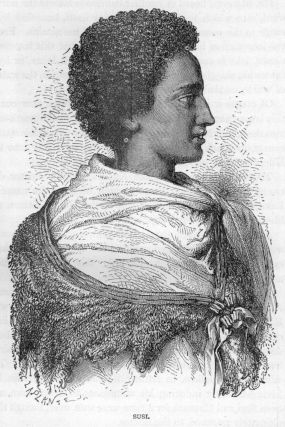 and crossed over to Ujiji, which he reached about the middle of March, 1869. After resting here till June, he again crossed the lake, and proceeded westward with a party of traders till he reached the large village of Bambarra, in Manyema.
It is the chief ivory depot in that province, where large quantities are obtained.
He was here detained six months, suffering severely from ulcers in his feet, which prevented him putting them to the ground, and from thence it was, when again able to set out, that he discovered the course of the Lualaba, which occupied him till the year 1871.
From Nyangwe, as before mentioned, he was compelled to return eastward to Ujiji, a distance of seven hundred miles. Manyema, in the province of Ruo, lying directly to the south of it, is inhabited by heathens, each village governed by its own chief, holding little or no communication with their neighbours. The people appear to be mild and inoffensive, though perfect pagans. They posses a considerable amount of ingenuity, and manufacture a most beautiful fabric from fine grass, equal to the finest grass cloth of India.
So numerous are the elephants which range through the wilds of this region, that until the Arabs unhappily made their way into it, the people were accustomed to form their door-posts and partially to build their houses with ivory tusks. The inhabitants, who were then unacquainted with firearms, were so terrified at hearing the reports of the Arabs’ muskets and feeling their effects, that they did not attempt to defend themselves, and already great numbers had been carried off into slavery by the abominable kidnappers.
Dr Livingstone witnessed a horrible massacre committed by one of these wretches, a half-caste Arab, Tagamoyo by name, with his armed slaves, on a number of the helpless inhabitants collected in a market-place on the bank of the Lualaba. While the people, unsuspicious of danger, were assembled, to the number of two thousand, eagerly carrying on their trade, the wretch Tangamoyo suddenly appeared, and opened fire upon them. Numbers were shot down, others rushed to their canoes, and, in their terror, made off without their companions, while many, throwing themselves headlong into the water, were seized by the voracious crocodiles. Upwards of four hundred women and children were killed, while a greater number were carried off into slavery.
The doctor describes the people as of light colour, with well-formed features. Being of gentle manners, they are eagerly sought for by the Arabs, whose wives they sometimes become.
Further to the north he met with a race not darker than the Portuguese, and a remarkably handsome people, who seemed to have a peculiar aptitude for commerce.
In Ruo he discovered some rich copper mines.
On reaching Ujiji, on the 16th of October, 1871, greatly to his dismay he found that Sherrif, into whose charge he had committed his goods, had, believing him to be dead, sold the whole of them for ivory, which he had appropriated.
Thus, the doctor, already suffering fearfully from illness, found himself deprived of the means of purchasing food or paying his way back to the coast. The letters, stores, and provisions sent to him from Zanzibar had been detained on the road.
What might have been his fate had he not been succoured by Mr Stanley, who, as we are about to relate, at the head of the “New York Herald” expedition, so nobly and gallantly made his way across to find him, it is impossible to say.
Chapter Twenty Six.
Stanley’s expedition in search of Dr Livingstone.
Stanley sent out by Mr Bennett, of the “New York Herald”—Reaches Zanzibar—Dr Kirk—His white and native attendants—Bombay engaged—Boats prepared—Crosses to Bagomoyo—Jesuit mission—Finds caravan for relief of Livingstone detained—Difficulties to be surmounted—Porters abscond—Misconduct of white men—A strongly fortified town—Attacked by fever—Sends Farquhar sick to Mpwapwa, where he dies—Shaw fires at Stanley—Stanley’s cool conduct—Expedition enters Ugogo with Arab caravan—Heavy tribute demanded by Sultan of Mvumi—Donkeys die—Journey through jungle—Country laid waste by Arab slave-traders—Well received by Mkaswa—Livingstone caravan arrives—Prepares to start for Ujiji—Some of his men join Arabs in an attack on a town, and are defeated—Stanley and Shaw narrowly escape—Returns to Kivihara—The place threatened—Preparations for defence—Hears news of Livingstone—Receives present of a slave boy, Kiulu—Followers prove refractory—Sets out—Sends Shaw back—Narrow escape from a crocodile—Donkey seized by crocodile—Meet Caravan from Ujiji—More news of Livingstone—Threatened by Wahha—Pass village at night—Nearly discovered—Lake Tanganyika seen—Dr Livingstone found at last—Livingstone recovers—Character of Livingstone—Voyage on Lake Tanganyika—The Rusizi River—Livingstone and Stanley set off from Ujiji together—Journey to Mkaswa, and stay there—Livingstone remains, and Stanley proceeds to Zanzibar to fit out an expedition to assist him—Finds Kisalungo destroyed by a flood—Dreadful floods—Adventures on journey—Meets with the Livingstone relief expedition—It is disbanded—Disbands his own, and fits out a fresh one—Starts it off, and sails for England via the Seychelles—Noble liberality of Mr Bennett.
The spirited proprietor of the “New York Herald,” James Gordon Bennett, having become deeply interested in the fate of Dr Livingstone, determined to send out one of his special correspondents, Mr Henry M. Stanley, then at Madrid, to Africa, in search of the traveller.
Arriving in Paris, Stanley received his instructions, which were, first to ascertain in Egypt what Sir Samuel Baker—then about to start up the Nile—intended to do, and, after visiting a good many other places, to make his way via Bombay, Mauritius, and the Seychelles, to Zanzibar.
He carried out his instructions, and arrived in January, 1871, at Zanzibar, which he found to be a much more beautiful and fertile island than he had supposed.
He soon introduced himself to Dr Kirk, and, without delay, set about making the necessary preparations for his journey.
The great difficulty was to obtain information as to the amount of food, or rather the articles for purchasing it, which would be required for the hundred men he proposed enlisting in his service.
He had engaged at Jerusalem a Christian Arab boy named Selim, who was to act as his interpreter, and he had also on the voyage attached to the expedition two mates of merchantmen, Farquhar and Shaw, who were very useful in constructing tents and arranging two boats and the pack-saddles and packages for the journey, but who proved in other respects very poor travellers. He also secured the services of that now well-known hero, Bombay, captain of Speke’s faithfuls, and five of his other followers, Uledi, Grant’s valet, and the bull-headed Mabruki, who had in the mean time lost one of his hands, but, notwithstanding, was likely to prove useful. They were the only remains of the band to be found, the rest having died or gone elsewhere. These six still retained their medals for assisting in the discovery of the source of the Nile.
The boats, one of which was capable of carrying twenty people and the other six, were stripped of their planks, the timbers and thwarts only being carried. Instead of the planking it was proposed to cover them with double canvas skin, well tarred. They and the rest of the baggage were carried in loads, none exceeding sixty-eight pounds in weight. Two horses and twenty-seven donkeys were purchased, and a small cart, while the traveller had brought with him a watch-dog, which he hoped would guard his tent from prowling thieves. An ample supply of beads, cloth, and wire were also laid in, with tea, sugar, rice, and medicine. To Bombay and his faithfuls were added eighteen more free men, who were all well-armed, and when mustered appeared an exceedingly fine-looking body of soldiers. These were to act as escort to the pagazis, or carriers.
On the 4th of February, 1871, the expedition was ready, and on the 5th embarked in four dhows, which conveyed it across to Bagomoyo on the mainland.
Here it was detained five weeks while its persevering leader was combatting the rogueries of Ali Ben Salim and another Arab, Hadji Palloo, who had undertaken to secure one hundred and forty pagazis. The packages were rearranged, the tents improved, and other necessary arrangements made.
He found here a caravan which had been despatched by the British Consul a hundred days before to the relief of Dr Livingstone; but which, its leader making as an excuse that he was unable to obtain a fresh number of pagazis, had hitherto remained inactive.
The climate of Bagomoyo is far superior to that of Zanzibar.
In its neighbourhood a French Jesuit mission has been for some time established, with ten priests and as many sisters, who have been very successful in educating two hundred boys and girls. The priests sumptuously entertained Mr Stanley with excellent champagne and claret, while some of their pupils, among whom they had formed an excellent brass band, amused them with instrumental music and French songs.
He divided his expedition into five caravans, the first of which he started off on the 18th of February, although it was not till March 21st that he with the largest was able to commence his journey westward. Altogether the expedition numbered on the day of departure, besides the commander and his two white attendants, twenty-three soldiers, four chiefs, one hundred and fifty-three pagazis, and four supernumeraries. Every possible care had been bestowed on the outfit, and in nothing that it needed was it stinted.
Bombay proved to be as honest and trustworthy as formerly, while Ferajji and Mabruki turned out true men and staunch, the latter, on one occasion, finding a difficulty in dragging the cart, having brought it along on his head rather than abandon it.
The Kinganni river was reached by a bridge rapidly formed with American axes, the donkeys refusing to pass through the water.
The country due west of Bagomoyo was found to be covered with towns and villages which were previously unknown.
Soon after starting, Omar, the watch-dog was missing, when Mabruki, hastening back, found him at the previous halting-place.
One of the caravans at the same place was detained by the sickness of three of the pagazis, whose places it was necessary to supply.
Stanley soon had to experience the invariable troubles of African travellers. His two horses died within a few hours of each other, both, however, from disease of long standing, and not from the climate.
Few men were better able to deal with the rogueries of the petty chiefs he met with than Mr Stanley. He had always a ready answer, and invariably managed to catch them in their own traps, while the “great master,” as he was 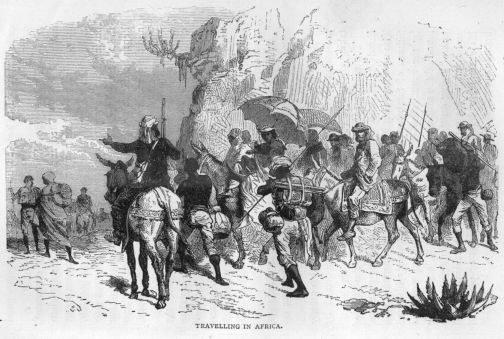 called, managed to keep all his subordinates in pretty good order.
One of his pagazis, Khamisi, under Shaw’s command, having absconded, Uledi and Ferajji found him, having fallen into the hands of some plundering Washensi, who were about to kill him. A court of eight soldiers and eight pagazis, having been convened, condemned him to be flogged with the “great master’s” donkey-whip. As Shaw ought to have kept a better look out, he was ordered to give him one blow and the pagazis and soldiers the remainder. This being done, the man was pardoned.
Moving on, the expedition passed Simbamwenni, the capital of Useguhha, the fortifications of which are equal to any met with in Persia. The area of the town is about half a square mile, while four towers of stone guard each corner. There are four gates, one in each wall, which are closed with solid square doors of African teak, and carved with complicated devices.
It is ruled by the daughter of the infamous Kisalungo, notorious as a robber and kidnapper, another Theodore on a small scale.
Before long Stanley was attacked with fever, which greatly prostrated his strength, though he quickly recovered by taking strong dozes of quinine.
The most painful event which occurred was the flight of Bunda Selim, who had been punished for pilfering rations. The men sent after him were seized and imprisoned by the Sultana of Simbamwenni, and, though ultimately liberated by the interference of an Arab sheikh, nothing could be found of the missing cook. Shaw also fell ill, and left the task of urging on the floundering caravan through marshes and rivers to his superior. Several of the others followed his example, and even Bombay complained of pains and became unserviceable.
The report from Farquhar’s caravan was most unsatisfactory, he, as far as Stanley could make out, having lost all his donkeys. The unhappy man, indeed, he found on overtaking him, was suffering from dropsy. He had also given to the pagazis and soldiers no small amount of the contents of the bales committed to his charge, as payment for the services he had demanded of them, and in purchasing expensive luxuries. As he could not walk and was worse than useless, Stanley was obliged to send the sick man, under the charge of Mabruki, thirty miles away to the village of Mpwapwa, to the chief of which place he promised an ample reward if he would take care of him.
Worse than all the wretched Shaw, after a dispute, during the night fired into his tent, too evidently with the intention of killing him. He found the intended murderer pretending to be asleep, with a gun by his side yet warm. Unable to deny that he had fired, he declared that in his dreams he had seen a thief pass his door; and then asked what was the matter? “Oh, nothing,” answered Stanley; “but I would advise you in future, in order to avoid all suspicion, not to fire into my tent, or at least, so near me. I might get hurt, in which case ugly reports would get about, and this, perhaps, would be disagreeable, as you are probably aware. Good night!”
On reaching Mpwapwa the Chief Lencolo positively refused to take charge of the white man unless an interpreter was left with him, and Jako, who was the only one of the party besides Bombay and Selim who could speak English, was ordered to remain in that capacity.
The expedition was now about to enter Ugogo. During the passage of the intervening desert, five out of the nine donkeys died, the cart having some time before been left behind.
The expedition was now joined by several Arab caravans, so that the number of the party amounted to about four hundred souls, strong in guns, flags, horns sounding, drums, and noise. This host was to be led by Stanley and Sheikh Hamed through the dreaded Ugogo.
On the 26th of May they were at Mvumi, paying heavy tribute to the sultan. Nothing seemed to satisfy him. Stanley suggested that as he had twenty Wazunga armed with Winchester repeating rifles, he might make the sultan pay tribute to him. The sheikh entreated that he would act peaceably, urging that angry words might induce the sultan to demand double the tribute.
While here five more donkeys died, and their bones were picked clean before the morning by the hyaenas.
The tribute was paid to preserve peace, and on the 27th, shaking the dust of Mvumi off their feet, the party proceeded westward. The country was one vast field of grain, and thickly populated.
Between that place and the next sultan’s district twenty-five villages were counted. Whenever they halted large groups of people assembled and greeted with peals of laughter the dress and manner of the mzungu, or white man, and more than once had to be kept at a distance by Stanley’s rifle or pistols, sometimes his thick whip coming into play.
After this a dense jungle was entered, the path serpentining in and out of it; again open tracts of grass bleached white were passed: now it led through thickets of gums and thorns, producing an odour as rank as a stable; now through clumps of wide-spreading mimosa and colonies of baobab-trees across a country teeming with noble game, which, though frequently seen, were yet as safe from their rifles as if they had been on the Indian Ocean. But the road they were on admitted of no delay; water had been left behind at noon; until noon the next day not a drop was to be obtained, and unless they marched fast and long, raging thirst would demoralise everybody.
After this wearisome journey Stanley was again attacked by fever, which it required a whole day’s halt and fifty grains of quinine to cure.
As may be supposed they were thankful when Ugogo was passed, and they entered Unyanyembe.
As the caravan resumed its march after halting at noon, the Wanyamuezi cheered, shouted, and sang, the soldiers and pagazis shouting in return, and the kirangoza blew his horn much more merrily than he had been wont to do in Ugogo.
A large district, however, presented the sad spectacle of numerous villages burnt down, cattle carried off, and the grain-fields overrun with jungle and rank weeds—too common a sight in that part of the country.
The expedition at length entered Kivihara, the capital of the province ruled over by the aged Sultan Mkaswa, who received Stanley in a friendly way. The Sheikh Said Ben Salim invited him to take up his quarters in his tembe, or house, a comfortable-looking place for the centre of Africa. Here his goods were stored, and his carriers paid off.
His three other caravans had arrived safely. One had had a slight skirmish, a second having shot a thief, and the third having lost a bale when attacked by robbers.
This is the place, to the southward of Victoria Nyanza, where Captains Burton, Speke, and Grant remained for a considerable time at different periods during their expeditions.
Soon after, the Livingstone caravan arrived, and the goods were stored with those of Stanley, the men being quartered with his. The chief of the caravan brought Stanley a package of letters directed to Dr Livingstone at Ujiji, when, to his surprise, he found that it was marked outside: “November 1st, 1871.” What a cruel delay was this!
After his long journey, Stanley was now laid completely prostrate, and for two weeks was perfectly senseless. The unhappy Shaw was also again taken ill. The fever rapidly destroyed both his memory and his reason. Selim, who had hitherto faithfully watched over his master and treated him according to the written directions he had received, was also prostrated, and in a state of delirium for four days.
On the 28th of July, however, all had again recovered, and on the 29th fifty pagazis were ready to start with bales, beads, and wire for Ujiji.
Three days after this, Shaw again broke down, asserting he was dying, and he had to be carried on the backs of his men till brought into his leader’s hut.
The road, however, ahead was closed by the chief Mirambo, who declared that no Arab caravan should pass that way. The Arabs, therefore, had resolved to attack him, and mustered an army of upwards of two thousand men. Stanley, with his followers, determined to join them, to assist in bringing the war to a speedy conclusion.
The palace was soon surrounded, and, though the party were received with a volley, the fire of the defenders was soon silenced. They took to flight, and the village was entered.
Notwithstanding the heavy fire which had been kept on it, twenty dead bodies only were found.
Other villages were attacked and burned.
A more serious affair occurred soon afterwards. When Stanley was again attacked with fever, a number of his men, notwithstanding his orders to the contrary, joined the Arabs in an attack on a more important place, Wilyankuru, commanded by Mirambo himself. The result was that, though the place was taken, the Arabs fell into an ambush, laid by Mirambo, and were completely defeated, many of them, including some of Stanley’s soldiers, being killed. Mirambo, following up his successes, pursued the Arabs, and Stanley had to mount his donkey, Shaw being lifted on his, and to fly at midnight for their lives. His soldiers ran as fast as their legs could carry them, the only one of his followers who remained by his master’s side being young Selim. At length they reached Mfuto, from which they had issued forth so valiantly a short time before.
Stanley had felt it his duty to assist the Arabs, though he had now cause to regret having done so.
From the last-mentioned place he returned to Kivihara. Here he was detained a considerable time, during which he received authentic news of Livingstone from an Arab, who had met with him travelling into Manyema, and who affirmed that, having gone to a market at Liemba in three canoes, one of them, in which all his cloth had been placed, was upset and lost. The news of Farquhar’s death here reached him.
As he had expected, Mirambo advanced; and one of the leading Arabs and his adopted son, who had gone out with their slaves to meet him, the slaves having deserted, were killed.
The neighbouring village of Tabora was burned, and Kivihara itself was threatened. Stanley made preparations for defence, and, having collected a hundred and fifty armed men, bored loopholes for the muskets in the clay walls of the tembe, formed rifle-pits round it, torn down the huts, and removed everything which might afford shelter to the enemy, felt little fear for the consequences. Mirambo, however, seemed to have thought better of it, and marched away with his troops, satisfied with the plunder he had obtained.
Month after month passed away, and he had great difficulty in obtaining soldiers to supply the places of those who had been killed or died, which was the fate of several.
He one day received a present of a little slave boy from an Arab merchant, to whom, at Bombay’s suggestion, the name of Klulu, meaning a young antelope, was given.
On the 9th of September Mirambo received a severe defeat, and had to take to flight, several of his chief men being slain.
Shaw gave Stanley a great deal of trouble. Again he himself was attacked with fever, but his white companion in no degree sympathised with him, even little Klulu showing more feeling. Weak as he was, he, however, recommenced his march to the westward, with about forty men added to his old followers.
Bombay, not for the first time, proving refractory and impudent, received a thrashing before starting, and when Stanley arrived at his camp at night, he found that upwards of twenty of the men had remained behind. He, therefore, sent a strong body back, under Selim, who returned with the men and some heavy slave-chains, and Stanley declared that if any behaved in the same way again he would fasten them together and make them march like slaves. Shaw also showed an unwillingness to go forward, and kept tumbling from his donkey, either purposely or from weakness, till at last Stanley consented to allow him to return to Unyanyembe.
On the 1st of October, while he and his party lay encamped under a gigantic sycamore-tree, he began to feel a contentment and comfort to which he had long been a stranger, and he was enabled to regard his surroundings with satisfaction.
Though the sun’s rays were hot, the next day’s march was easily performed. On the roadside lay a dead man; indeed, skeletons or skulls were seen every day, one, and sometimes two, of men who had fallen down and died, deserted by their companions.
While encamped near the Gambe, its calm waters, on which lotus-leaves rested placidly, all around looking picturesque and peaceful, invited Stanley to take a bath. He discovered a shady spot under a wide-spreading mimosa, where the ground sloped down to the still water, and having undressed, was about to take a glorious dive, when his attention was attracted by an enormously long body which shot into view, occupying the spot beneath the surface which he was about to explore by a header. It was a crocodile! He sprang back instinctively. This proved his salvation, for the monster turned away with a disappointed look, and he registered a vow never to be tempted again by the treacherous calm of an African river.
As war was going on in the country, it was necessary to proceed with caution. Some of his followers also showed a strong inclination to mutiny, which he had to quell by summary proceedings, and Bombay especially sank greatly in his good opinion.
As they approached Lake Tanganyika all got into better humour, and confidence returned between them. They laughed joyously as they glided in Indian file through the forest jungle beyond the clearing of Mrera, and boasted of their prowess.
An ambassador from Simba, the Lion of Kasera, received two gorgeous cloths, and other articles, as tribute—Stanley thus making that chief a friend for ever.
After having encamped one evening, Stanley went out with his rifle, accompanied by Klulu, to shoot some animal or other for supper. After in vain searching, he was returning, when he encountered a wild boar, which, although it received several bullets after it had fallen, at the last moment started up, and escaped into the wood. On his return to the camp, from which he was then three miles off, he was followed by some large animal, which it was too dark to see plainly, but it must have been either a lion or the ghost of the dead boar. At all events, during the night, the party were startled by the roar of a lion, which was soon joined by another and another. He turned out to shoot them, but not a bullet took effect. At length he went to sleep with the roar of the monster as a lullaby.
On the evening of the 2nd of November the left bank of the Malagarazi river was reached. The greater part of the day had been occupied in negotiating with the ambassador of the great Mzogera, chief of the greedy Wavinza tribe, who demanded an enormous hongo. This being settled, the ferrymen demanded equally preposterous payment for carrying across the caravan. These demands, however, having at length been settled, the next business was to swim the donkeys across. One fine animal, Simba, was being towed with a rope round its neck, when, just as it reached the middle of the stream, it was seen to struggle fearfully. An enormous crocodile had seized the poor animal by the throat; in vain it attempted to liberate itself. The black in charge tugged at the rope, but the donkey sank and was no more seen. Only one donkey now remained, and this was carried across by Bombay the next morning, before the voracious monsters were looking out for their breakfasts.
The next day was an eventful one. Just before starting, a caravan was seen approaching, consisting of a large party of the Waguhha tribe, occupying a tract of country to the south-west of Lake Tanganyika.
The news was asked. A white man had been seen by them who had lately arrived at Ujiji from Manyema. He had white hair and a white beard, and was sick. Only eight days ago they had seen him. He had been at Ujiji before, and had gone away and returned. There could be no doubt that this was Livingstone. How Stanley longed for a horse! for on a good steed he could reach Ujiji in twelve hours.
In high spirits he started, pushing on as fast as his men could move. There were dangers, however, still in the way. A war party of Wavinza was out, who would not scruple even to rob their own villages when returning victorious from battle.
Next day they travelled on in silence, but on the 5th fell in with a party of the Wahha, who soon brought a band of warriors down upon them, at the head of which appeared a fine-looking chief, Mionvu by name, dressed in a crimson robe, with a turban on his head, he and his people being armed with spears, and bows and arrows. He asked whether it should be peace or war? The reply was, of course, peace. At the same time Stanley hinted that his rifles would quickly give him the victory should war be declared. Notwithstanding this Mionvu demanded a hundred cloths as hongo. Ten were offered. Rather than pay the hundred, Stanley asked his followers if they would fight, but Bombay urged pacific measures, remarking that the country was open—no places to hide in, and that every village would rise in arms.
“Pay, Bana, pay: it is better to get along quietly in this country,” he observed.
Mabruki and Asmani agreed with him. The hongo was paid. Stanley wisely resolved, if possible, not to come back that way.
A night march was determined on, and sufficient grain was purchased to last the caravan six days through the jungle. They hoped thus to escape the extortions of other chiefs to the westward. The men bravely toiled on, without murmuring, though their feet and legs bled from the cutting grass.
The jungle was alive with wild animals, but no one dared fire.
As they were halting in the morning near the Rusugi river, a party of natives were seen, who detected them in their hiding-place, but who fled immediately to alarm some villages four miles away. At once the caravan was ordered to move on, but one of the women took to screaming, and even her husband could not keep her quiet till a cloth was folded over her mouth.
At night they bivouacked in silence, neither tent nor hut being erected, each soldier lying down with his gun loaded by his side, their gallant leader, with his Winchester rifle and its magazine full, ready for any emergency.
Before dawn broke, the caravan was again on its march. The guide having made a mistake, while it was still dark, they arrived in front of the village of Uhha. Silence was ordered; goats and chickens which might have made a noise had their throats cut, and they pushed boldly through the village. Just as the last hut was passed, Stanley bringing up the rear, a man appeared from his hut, and uttered a cry of alarm.
They continued their course, plunging into the jungle. Once he believed that they were followed, and he took post behind a tree to check the advance of their foes; but it proved a false alarm.
Turning westward, broad daylight showed them a beautiful and picturesque country, with wild fruit-trees, rare flowers, and brooks tumbling over polished pebbles.
Crossing a streamlet, to their great satisfaction they left Uhha and its extortionate inhabitants behind, and entered Ukaranga.
Their appearance created great alarm as they approached the village, the king and his people supposing them to be Rugruga, the followers of Mirambo, but, discovering their mistake, they welcomed them cordially.
On the 10th of November, just two hundred and thirty-six days after leaving Bagomoyo, and fifty-one since they set out from Unyanyembe, surmounting a hill, Tanganyika is seen before them. Six hours’ march will bring them to its shores.
On they push, the air fresh and cool—a glorious morning. The “stars and stripes” float out in the breeze; repeated volleys are fired. The village is reached. The faithful Chumah and Susi, Dr Livingstone’s old followers, rush out to see who the stranger is, and in a short time Stanley is rewarded for all the dangers and hardships he has gone through by meeting the long-looked-for traveller face to face.
His own book must give the description of the meeting; it is not the least graphic portion of his deeply interesting work.
At the time, when reduced almost to death’s door by sickness and disappointment, the assistance thus brought to Dr Livingstone was of inestimable worth. What might have been his fate had he not been relieved, it is impossible to say. The society of his new friend, the letters from home, the well-cooked meal which the doctor was able to enjoy, and the champagne quaffed out of silver goblets, and brought carefully those hundreds of miles for that especial object, had a wonderfully exhilarating influence.
Some days were spent at Ujiji, during which the doctor continued to regain health and strength. Future plans were discussed, and his previous adventures described. The longer the intercourse Stanley enjoyed with Livingstone, the more he rose in his estimation.
He formed, indeed, a high estimate of his character, though, he fully believed, a just one.
“Dr Livingstone,” he says, “is about sixty years old. His hair has a brownish colour, but here and there streaked with grey lines over the temples. His beard and moustache are very grey. His eyes, which are hazel, are remarkably bright: he has a sight keen as a hawk’s. His frame is a little over the ordinary height; when walking, he has a firm but heavy tread, like that of an over-worked or fatigued man. I never observed any spleen or misanthropy about him. He has a fund of quiet humour, which he exhibits at all times when he is among friends. During the four months I was with him I noticed him every evening making most careful notes. His maps evince great care and industry. He is sensitive on the point of being doubted or criticised. His gentleness never forsakes him, his hopefulness never deserts him; no harassing anxiety or distraction of mind, though separated from home and kindred, can make him complain. He thinks all will come out right at last, he has such faith in the goodness of Providence. Another thing which especially attracted my attention was his wonderfully retentive memory. His religion is not of the theoretical kind, but it is constant, earnest, sincere, practical; it is neither demonstrative nor loud, but manifests itself in a quiet, practical way, and is always at work. In him religion exhibits its loveliest features; it governs his conduct not only towards his servants, but towards the natives. I observed that universal respect was paid to him; even the Mahommedans never passed his house without calling to pay their compliments, and to say: ‘The blessing of God rest on you!’ Every Sunday morning he gathers his little flock around him, and reads prayers and a chapter from the Bible in a natural, unaffected, and sincere tone, and afterwards delivers a short address in the Kisawahili language, about the subject read to them, which is listened to with evident interest and attention.
“His consistent energy is native to him and his race. He is a very fine example of the perseverance, doggedness, and tenacity which characterises the Anglo-Saxon spirit. His ability to withstand the climate is due not only to the happy constitution with which he was born, but to the strictly temperate life he has ever led.
“It is a principle with him to do well what he undertakes to do, and, in the consciousness that he is doing it, despite the yearning for his home, which is sometimes overpowering, he finds to a certain extent contentment, if not happiness.
“He can be charmed with the primitive simplicity of Ethiopia’s dusky children, with whom he has spent so many years of his life. He has a sturdy faith in their capability—sees virtue in them, where others see nothing but savagery; and wherever he has gone among them, he has sought to ameliorate the condition of a people who are apparently forgotten of God and Christian men.”
In another place Stanley says: “Livingstone followed the dictates of duty. Never was such a willing slave to that abstract virtue. His inclinations impel him home, the fascinations of which it requires the sternest resolution to resist. With every foot of new ground he travelled over he forged a chain of sympathy which should hereafter bind the Christian nations in bonds of love and charity to the heathen of the African tropics. If he were able to complete this chain of love by actual discovery, and, by a description of them, to embody such people and nations as still live in darkness, so as to attract the good and charitable of his own land to bestir themselves for their redemption and salvation, this Livingstone would consider an ample reward.
“Surely, as the sun shines on both Christian and infidel, civilised and pagan, the day of enlightenment will come; and though the apostle of Africa may not behold it himself, nor we younger men, nor yet our children, the hereafter will see it, and posterity will recognise the daring pioneer of its civilisation.”
Yes, and Stanley might have added: with his enlarged and far-seeing mind, this it is what encourages Livingstone to persevere in his task to do what he knows no other man can do as well. It might be far pleasanter to tell crowded congregations at home about the wrongs of the sons and daughters of Africa, but, with the spirit of a true apostle, he remains among those whose wrongs it is the ardent desire of his soul to right, that he may win their love and confidence, and open up the way by which others may with greater ease continue the task he has commenced.
After they had been some weeks together at Ujiji, Stanley and Livingstone agreed to make a voyage on Lake Tanganyika, one of the chief objects of which was to settle the long mooted point as to whether the Rusizi river is an effluent or an influent. They embarked in a somewhat cranky canoe, hollowed-out of a mvule-tree, which carried sixteen rowers, Selim, Ferajji, the cook, and two guides, besides themselves.
The lake was calm, its waters of a dark green colour, reflecting the serene blue sky above. The hippopotami came up to breathe in close proximity to the canoe, and then plunged down again, as if playing at hide and seek with them.
At one place where they sounded, the depth was found to be thirty-five fathoms near the shore, and further out a hundred and fifteen fathoms of line was let down without finding bottom, and the doctor stated that he had sounded opposite the lofty Kabogo, and attained the depth of three hundred fathoms.
A range of hills, beautifully wooded and clothed with green grass, sloping abruptly—almost precipitately—into the depth of the fresh-water, towered above them, and as they rounded the several capes or points, high expectations of some new wonder or some exquisite picture being revealed to them were aroused: nor were they disappointed.
However, we must not venture to attempt a description of the magnificent scenery of this enormous lake. Each night they landed and encamped, continuing their voyage the next day.
Generally they were well received by the natives, though they had to avoid one or two spots where the people were said to be treacherous and quarrelsome.
On reaching the mouth of the Rusizi, they pushed up it a short distance, but were stopped by its shallowness, it not being navigable for anything but the smallest canoes. It, however, abounds in crocodiles, though not one hippopotamus was seen.
The most important point, however, which they discovered was that the current was flowing, at the rate of six to eight miles an hour, into the lake. Still the doctor asserted that there must be an outlet somewhere to the Tanganyika, from the fact which he adduced that all fresh-water lakes have outlets.
Coasting round the north shore, they paddled down the west coast till nearly opposite the island of Muzimu, when they crossed back to the shore from whence they had come, and steered southward beyond Ujiji till they reached nearly the sixth degree of latitude, at a place called Urimba.
Their voyage, altogether, took twenty-eight days, during which time they traversed over three hundred miles of water.
On their return to Ujiji, they resolved to carry out one of the several plans which Stanley had suggested to Livingstone. One of them was to return to Unyanyembe to enlist men to sail down the Victoria Nyanza in Stanley’s boats, for the purpose of meeting Sir Samuel Baker; but this, with several others, was dismissed. Livingstone’s heart was set on endeavouring to settle numerous important points in Manyema connected with the supposed source of the Nile. He, therefore, finally agreed to allow Stanley to escort him to Unyanyembe, where he could receive his own goods and those which Stanley proposed to deliver up to him, and where he could rest in a comfortable house, while his friend would hurry down to the coast, and organise a new expedition, composed of fifty or sixty men, well-armed, by whom an additional supply of needful luxuries might be sent.
Christmas Day was kept with such a feast as Ujiji could furnish them, the fever from which Stanley had lately been suffering having left him the night before.
On the 27th of December they embarked in two canoes, the one bearing the flag of England, the other that of America; and their luggage being on board, and having bidden farewell to Arabs and natives, together they commenced their voyage on the lake, steering for the south. At the same time the main body of their men, under Asmani and Bombay, commenced their journey, which was to be performed on foot, along the shores of the lake. It had been arranged that the canoes should meet them at the mouth of every river, to transport them across from bank to bank. Their intention was to land at Cape Tongwe, when they would be opposite the village of Itaga, whence, by traversing the uninhabited districts to the east, they would avoid the exactions of the roguish Wavinza and the plundering Wahha, and then strike the road by which Stanley had come. This plan was completely carried out. Stanley had procured a strong donkey at Ujiji, that the doctor might perform the journey on its back.
Pouring rain, however, came down during the whole journey, and it was to their intense satisfaction that at length the two friends walked into Stanley’s old quarters, who said: “Doctor, we are at home.”
Here they were again busily employed in examining stores, and the doctor in writing despatches and letters to his friends.
Mirambo still held out, and probably the Arabs would not conquer him for many months to come.
Here the doctor resolved to remain, while Stanley went down to the coast to enlist men and collect such further stores as were required, and to send them back. On their arrival, Livingstone purposed returning with them to Ujiji, and from thence crossing over into Manyema, to make further researches in that province and Ruo; among other things, to examine the underground habitations which he had heard of on a previous journey.
On the 14th of March, Stanley and Livingstone breakfasted together, and then the order was given to raise the flag and march. Livingstone accompanied him some way, but they had to part at last.
The return journey was not performed without many adventures and a considerable amount of suffering by the enterprising traveller.
Passing the stronghold of Kisalungo, a large portion had disappeared. The river had swept away the entire front wall and about fifty houses, several villages having suffered disastrously, while at least a hundred people had perished. The whole valley, once a paradise in appearance, had been converted into a howling waste.
Further on, a still more terrible destruction of human life and property had occurred. It was reported that a hundred villages had been swept away by a volume of water which had rushed over the banks of the Ungerengeri.
Passing a dense jungle, and wading for several miles through a swamp, on the 6th of May the caravan was again en route, at a pace its leader had never seen equalled. At sunset the town of Bagomoyo was entered.
His first greeting was with Lieutenant Henn, who had come out as second in command of the proposed Livingstone search and relief expedition. He next met Mr Oswald Livingstone, the doctor’s second son. The two proposed shortly starting on their journey, having come over with no less than a hundred and ninety loads of stores, which they would have had no small difficulty in conveying. Two other members of the expedition, Lieutenant Dawson, RN, and the Reverend C New, had resigned, for reasons which Mr Stanley fully explains. He himself was not over well pleased with some of the remarks made in the papers about himself, some having regarded his expedition into Africa as a myth.
“Alas!” he observes, justly, “it has been a terrible, earnest fact with me: nothing but haul, conscientious work, privations, sickness, and almost death.”
However, welcomed cordially by numerous friends at Zanzibar, which he reached the following day, he soon recovered his spirits, and, having disbanded his own expedition, he set to work to arrange the one he had promised to form for the assistance of Dr Livingstone, Mr Henn having in the mean time resigned, and Mr Oswald Livingstone being compelled from ill health to abandon the attempt to join his father.
Fifty guns, with ammunition, stores, and cloth, were furnished by Mr Oswald Livingstone out of the English expedition. Fifty-seven men, including twenty of those who had followed Stanley, were also engaged, the services of Johari, chief dragoman to the American consulate, being also obtained to conduct them across the inundated plains of the Kinganni.
Stanley did not perform his duty by halves. Having engaged a dhow, he saw them all on board, and again urged them to follow the “great master,” as they called Livingstone, wherever he might lead them, and to obey him in all things.
“We will! we will!” they cried out.
He then shook hands with them, and, ordering them to take up their loads, marched them down to the beach, seeing them on board, and watched the dhow as she sped westward on her way to Bagomoyo.
Those who had accompanied him had been handsomely rewarded, and he states to their credit, though Bombay and many others had at first annoyed him greatly, that from Ujiji to the coast, they had all behaved admirably.
After being detained at the Seychelles for a month, Mr Stanley reached Marseilles, via Aden, when Mr Bennett, in order to fulfil Mr Stanley’s promise that he would post Dr Livingstone’s letters to his family and friends in England twenty-four hours after he had seen his public ones published in the London journals, telegraphed two of them by cable, at an expense of nearly two thousand pounds—“one of the most generous acts,” as he observes, “that could be conceived, after all he had done in originating and sustaining the enterprise.”
Chapter Twenty Seven.
Conclusion.
Travels of Burton—Du Chaillu—Baines—Andersson—Galton—Expeditions up the Niger—Dr Baikie’s voyage in the “Pleiad”—Journeys of missionaries, sportsmen, and others—Concluding remarks.
We must now bid farewell to that land of savagism, so large a portion of which we have seen opened out to the view of the civilised world by the gallant and enterprising men whose footsteps we have traced. We would gladly have accompanied many others who have contributed their quota to our knowledge of the continent. Among the first stands Burton, who ranks as a great traveller in all parts of the world, and who, besides his trip on Lake Tanganyika, has visited Dahomy, the Cameroon Mountains, Abeokuta, and many other places.
We regret to have to omit the travels and wonderful adventures of Du Chaillu through the gorilla country and other portions of tropical Africa.
Interesting journeys have been made by the enterprising travellers, Andersson, the artist Baines, and Mr Galton, who, starting from Walvisch Bay on the West Coast to the north of Cape Colony, visited the Damaras, the Namaquas, the Bechuanas, and other tribes to the west of Lake Ngami.
Several expeditions also have been made to explore the Niger, and open up commerce with the teeming population on its banks. One of the first, sent out a few years after the  return of the Landers, proved most disastrous, the greater number of officers and men having perished from fever.
Another, however, which was organised in 1854 by the Government, was far more successful. A small steamer, the “Pleiad,” was fitted out with a black crew and a few white officers, and in consequence of the death of Mr Beecroft, who had been appointed to lead the expedition, it was placed under the command of Dr Baikie, R.N. He proceeded up the Quorra, the proper name of the Niger, and entering the mouth of the Binue, known as the Tsadda, discovered by Dr Barth, steamed up that magnificent stream till the falling waters compelled him to return.
Numerous other expeditions have been made on the West Coast by missionaries, for the purpose of extending the blessings of the Gospel. Still more numerous have been the journeys, with the same object in view, made from the southern part of Africa.
In this direction also no small number of sportsmen, with Gordon dimming at their head, have penetrated far into the interior, many of them having given accounts of their exploits to the world.
The travels of Mansfield Parkyns, and his description of life in Abyssinia, as well as Plowden’s, Stern’s, and many others, are of the deepest interest.
We would gladly also have given an account of the travels of the enterprising ivory-trader, Mr Petherick, who has visited many of the districts we have gone over, as well as those on both sides of the Nile.
They have all added to our knowledge of Africa; yet a considerable amount of the interior remains unexplored.
Livingstone, undoubtedly, will have solved the problem of the sources of the Nile; but the source of the Congo is still to be discovered, unless the expedition which started from the West Coast to the relief of Livingstone has ere this settled the question: while Sir Samuel Baker, when once he gets his steamers launched on the waters of the Albert Nyanza, is not likely to stop till he has made further discoveries to the west and south of his vast lake.
If he is correct in his belief that the Albert Nyanza and Tanganyika are portions of one vast lake, or united by a broad channel, a direct highway by water exists, nine hundred miles in length, through the interior of the continent, which cannot fail greatly to assist in the civilisation of the teeming population in its neighbourhood. We, however, must await the return of Sir Samuel Baker and Dr Livingstone, to be enlightened on this and many other deeply interesting points.
We shall rest satisfied if the work we have now brought to a conclusion excites the interest of our readers in the numberless black races spread over the continent, and induces them to exert all the influence they may possess in forwarding measures for suppressing the nefarious slave trade throughout the length and breadth of the land, and in aiding those who go forth to carry the blessings of the Gospel to its long benighted people.
The End.
End of Project Gutenberg's Great African Travellers, by W.H.G. Kingston

*** END OF THIS PROJECT GUTENBERG EBOOK GREAT AFRICAN TRAVELLERS ***

***** This file should be named 21391-h.htm or 21391-h.zip *****
This and all associated files of various formats will be found in:
        http://www.gutenberg.org/2/1/3/9/21391/

Produced by Nick Hodson of London, England

Updated editions will replace the previous one--the old editions
will be renamed.

Creating the works from public domain print editions means that no
one owns a United States copyright in these works, so the Foundation
(and you!) can copy and distribute it in the United States without
permission and without paying copyright royalties.  Special rules,
set forth in the General Terms of Use part of this license, apply to
copying and distributing Project Gutenberg-tm electronic works to
protect the PROJECT GUTENBERG-tm concept and trademark.  Project
Gutenberg is a registered trademark, and may not be used if you
charge for the eBooks, unless you receive specific permission.  If you
do not charge anything for copies of this eBook, complying with the
rules is very easy.  You may use this eBook for nearly any purpose
such as creation of derivative works, reports, performances and
research.  They may be modified and printed and given away--you may do
practically ANYTHING with public domain eBooks.  Redistribution is
subject to the trademark license, especially commercial
redistribution.


*** START: FULL LICENSE ***

THE FULL PROJECT GUTENBERG LICENSE
PLEASE READ THIS BEFORE YOU DISTRIBUTE OR USE THIS WORK

To protect the Project Gutenberg-tm mission of promoting the free
distribution of electronic works, by using or distributing this work
(or any other work associated in any way with the phrase "Project
Gutenberg"), you agree to comply with all the terms of the Full Project
Gutenberg-tm License (available with this file or online at
http://gutenberg.org/license).


Section 1.  General Terms of Use and Redistributing Project Gutenberg-tm
electronic works

1.A.  By reading or using any part of this Project Gutenberg-tm
electronic work, you indicate that you have read, understand, agree to
and accept all the terms of this license and intellectual property
(trademark/copyright) agreement.  If you do not agree to abide by all
the terms of this agreement, you must cease using and return or destroy
all copies of Project Gutenberg-tm electronic works in your possession.
If you paid a fee for obtaining a copy of or access to a Project
Gutenberg-tm electronic work and you do not agree to be bound by the
terms of this agreement, you may obtain a refund from the person or
entity to whom you paid the fee as set forth in paragraph 1.E.8.

1.B.  "Project Gutenberg" is a registered trademark.  It may only be
used on or associated in any way with an electronic work by people who
agree to be bound by the terms of this agreement.  There are a few
things that you can do with most Project Gutenberg-tm electronic works
even without complying with the full terms of this agreement.  See
paragraph 1.C below.  There are a lot of things you can do with Project
Gutenberg-tm electronic works if you follow the terms of this agreement
and help preserve free future access to Project Gutenberg-tm electronic
works.  See paragraph 1.E below.

1.C.  The Project Gutenberg Literary Archive Foundation ("the Foundation"
or PGLAF), owns a compilation copyright in the collection of Project
Gutenberg-tm electronic works.  Nearly all the individual works in the
collection are in the public domain in the United States.  If an
individual work is in the public domain in the United States and you are
located in the United States, we do not claim a right to prevent you from
copying, distributing, performing, displaying or creating derivative
works based on the work as long as all references to Project Gutenberg
are removed.  Of course, we hope that you will support the Project
Gutenberg-tm mission of promoting free access to electronic works by
freely sharing Project Gutenberg-tm works in compliance with the terms of
this agreement for keeping the Project Gutenberg-tm name associated with
the work.  You can easily comply with the terms of this agreement by
keeping this work in the same format with its attached full Project
Gutenberg-tm License when you share it without charge with others.

1.D.  The copyright laws of the place where you are located also govern
what you can do with this work.  Copyright laws in most countries are in
a constant state of change.  If you are outside the United States, check
the laws of your country in addition to the terms of this agreement
before downloading, copying, displaying, performing, distributing or
creating derivative works based on this work or any other Project
Gutenberg-tm work.  The Foundation makes no representations concerning
the copyright status of any work in any country outside the United
States.

1.E.  Unless you have removed all references to Project Gutenberg:

1.E.1.  The following sentence, with active links to, or other immediate
access to, the full Project Gutenberg-tm License must appear prominently
whenever any copy of a Project Gutenberg-tm work (any work on which the
phrase "Project Gutenberg" appears, or with which the phrase "Project
Gutenberg" is associated) is accessed, displayed, performed, viewed,
copied or distributed:

This eBook is for the use of anyone anywhere at no cost and with
almost no restrictions whatsoever.  You may copy it, give it away or
re-use it under the terms of the Project Gutenberg License included
with this eBook or online at www.gutenberg.org

1.E.2.  If an individual Project Gutenberg-tm electronic work is derived
from the public domain (does not contain a notice indicating that it is
posted with permission of the copyright holder), the work can be copied
and distributed to anyone in the United States without paying any fees
or charges.  If you are redistributing or providing access to a work
with the phrase "Project Gutenberg" associated with or appearing on the
work, you must comply either with the requirements of paragraphs 1.E.1
through 1.E.7 or obtain permission for the use of the work and the
Project Gutenberg-tm trademark as set forth in paragraphs 1.E.8 or
1.E.9.

1.E.3.  If an individual Project Gutenberg-tm electronic work is posted
with the permission of the copyright holder, your use and distribution
must comply with both paragraphs 1.E.1 through 1.E.7 and any additional
terms imposed by the copyright holder.  Additional terms will be linked
to the Project Gutenberg-tm License for all works posted with the
permission of the copyright holder found at the beginning of this work.

1.E.4.  Do not unlink or detach or remove the full Project Gutenberg-tm
License terms from this work, or any files containing a part of this
work or any other work associated with Project Gutenberg-tm.

1.E.5.  Do not copy, display, perform, distribute or redistribute this
electronic work, or any part of this electronic work, without
prominently displaying the sentence set forth in paragraph 1.E.1 with
active links or immediate access to the full terms of the Project
Gutenberg-tm License.

1.E.6.  You may convert to and distribute this work in any binary,
compressed, marked up, nonproprietary or proprietary form, including any
word processing or hypertext form.  However, if you provide access to or
distribute copies of a Project Gutenberg-tm work in a format other than
"Plain Vanilla ASCII" or other format used in the official version
posted on the official Project Gutenberg-tm web site (www.gutenberg.org),
you must, at no additional cost, fee or expense to the user, provide a
copy, a means of exporting a copy, or a means of obtaining a copy upon
request, of the work in its original "Plain Vanilla ASCII" or other
form.  Any alternate format must include the full Project Gutenberg-tm
License as specified in paragraph 1.E.1.

1.E.7.  Do not charge a fee for access to, viewing, displaying,
performing, copying or distributing any Project Gutenberg-tm works
unless you comply with paragraph 1.E.8 or 1.E.9.

1.E.8.  You may charge a reasonable fee for copies of or providing
access to or distributing Project Gutenberg-tm electronic works provided
that

- You pay a royalty fee of 20% of the gross profits you derive from
     the use of Project Gutenberg-tm works calculated using the method
     you already use to calculate your applicable taxes.  The fee is
     owed to the owner of the Project Gutenberg-tm trademark, but he
     has agreed to donate royalties under this paragraph to the
     Project Gutenberg Literary Archive Foundation.  Royalty payments
     must be paid within 60 days following each date on which you
     prepare (or are legally required to prepare) your periodic tax
     returns.  Royalty payments should be clearly marked as such and
     sent to the Project Gutenberg Literary Archive Foundation at the
     address specified in Section 4, "Information about donations to
     the Project Gutenberg Literary Archive Foundation."

- You provide a full refund of any money paid by a user who notifies
     you in writing (or by e-mail) within 30 days of receipt that s/he
     does not agree to the terms of the full Project Gutenberg-tm
     License.  You must require such a user to return or
     destroy all copies of the works possessed in a physical medium
     and discontinue all use of and all access to other copies of
     Project Gutenberg-tm works.

- You provide, in accordance with paragraph 1.F.3, a full refund of any
     money paid for a work or a replacement copy, if a defect in the
     electronic work is discovered and reported to you within 90 days
     of receipt of the work.

- You comply with all other terms of this agreement for free
     distribution of Project Gutenberg-tm works.

1.E.9.  If you wish to charge a fee or distribute a Project Gutenberg-tm
electronic work or group of works on different terms than are set
forth in this agreement, you must obtain permission in writing from
both the Project Gutenberg Literary Archive Foundation and Michael
Hart, the owner of the Project Gutenberg-tm trademark.  Contact the
Foundation as set forth in Section 3 below.

1.F.

1.F.1.  Project Gutenberg volunteers and employees expend considerable
effort to identify, do copyright research on, transcribe and proofread
public domain works in creating the Project Gutenberg-tm
collection.  Despite these efforts, Project Gutenberg-tm electronic
works, and the medium on which they may be stored, may contain
"Defects," such as, but not limited to, incomplete, inaccurate or
corrupt data, transcription errors, a copyright or other intellectual
property infringement, a defective or damaged disk or other medium, a
computer virus, or computer codes that damage or cannot be read by
your equipment.

1.F.2.  LIMITED WARRANTY, DISCLAIMER OF DAMAGES - Except for the "Right
of Replacement or Refund" described in paragraph 1.F.3, the Project
Gutenberg Literary Archive Foundation, the owner of the Project
Gutenberg-tm trademark, and any other party distributing a Project
Gutenberg-tm electronic work under this agreement, disclaim all
liability to you for damages, costs and expenses, including legal
fees.  YOU AGREE THAT YOU HAVE NO REMEDIES FOR NEGLIGENCE, STRICT
LIABILITY, BREACH OF WARRANTY OR BREACH OF CONTRACT EXCEPT THOSE
PROVIDED IN PARAGRAPH F3.  YOU AGREE THAT THE FOUNDATION, THE
TRADEMARK OWNER, AND ANY DISTRIBUTOR UNDER THIS AGREEMENT WILL NOT BE
LIABLE TO YOU FOR ACTUAL, DIRECT, INDIRECT, CONSEQUENTIAL, PUNITIVE OR
INCIDENTAL DAMAGES EVEN IF YOU GIVE NOTICE OF THE POSSIBILITY OF SUCH
DAMAGE.

1.F.3.  LIMITED RIGHT OF REPLACEMENT OR REFUND - If you discover a
defect in this electronic work within 90 days of receiving it, you can
receive a refund of the money (if any) you paid for it by sending a
written explanation to the person you received the work from.  If you
received the work on a physical medium, you must return the medium with
your written explanation.  The person or entity that provided you with
the defective work may elect to provide a replacement copy in lieu of a
refund.  If you received the work electronically, the person or entity
providing it to you may choose to give you a second opportunity to
receive the work electronically in lieu of a refund.  If the second copy
is also defective, you may demand a refund in writing without further
opportunities to fix the problem.

1.F.4.  Except for the limited right of replacement or refund set forth
in paragraph 1.F.3, this work is provided to you 'AS-IS' WITH NO OTHER
WARRANTIES OF ANY KIND, EXPRESS OR IMPLIED, INCLUDING BUT NOT LIMITED TO
WARRANTIES OF MERCHANTIBILITY OR FITNESS FOR ANY PURPOSE.

1.F.5.  Some states do not allow disclaimers of certain implied
warranties or the exclusion or limitation of certain types of damages.
If any disclaimer or limitation set forth in this agreement violates the
law of the state applicable to this agreement, the agreement shall be
interpreted to make the maximum disclaimer or limitation permitted by
the applicable state law.  The invalidity or unenforceability of any
provision of this agreement shall not void the remaining provisions.

1.F.6.  INDEMNITY - You agree to indemnify and hold the Foundation, the
trademark owner, any agent or employee of the Foundation, anyone
providing copies of Project Gutenberg-tm electronic works in accordance
with this agreement, and any volunteers associated with the production,
promotion and distribution of Project Gutenberg-tm electronic works,
harmless from all liability, costs and expenses, including legal fees,
that arise directly or indirectly from any of the following which you do
or cause to occur: (a) distribution of this or any Project Gutenberg-tm
work, (b) alteration, modification, or additions or deletions to any
Project Gutenberg-tm work, and (c) any Defect you cause.


Section  2.  Information about the Mission of Project Gutenberg-tm

Project Gutenberg-tm is synonymous with the free distribution of
electronic works in formats readable by the widest variety of computers
including obsolete, old, middle-aged and new computers.  It exists
because of the efforts of hundreds of volunteers and donations from
people in all walks of life.

Volunteers and financial support to provide volunteers with the
assistance they need, is critical to reaching Project Gutenberg-tm's
goals and ensuring that the Project Gutenberg-tm collection will
remain freely available for generations to come.  In 2001, the Project
Gutenberg Literary Archive Foundation was created to provide a secure
and permanent future for Project Gutenberg-tm and future generations.
To learn more about the Project Gutenberg Literary Archive Foundation
and how your efforts and donations can help, see Sections 3 and 4
and the Foundation web page at http://www.pglaf.org.


Section 3.  Information about the Project Gutenberg Literary Archive
Foundation

The Project Gutenberg Literary Archive Foundation is a non profit
501(c)(3) educational corporation organized under the laws of the
state of Mississippi and granted tax exempt status by the Internal
Revenue Service.  The Foundation's EIN or federal tax identification
number is 64-6221541.  Its 501(c)(3) letter is posted at
http://pglaf.org/fundraising.  Contributions to the Project Gutenberg
Literary Archive Foundation are tax deductible to the full extent
permitted by U.S. federal laws and your state's laws.

The Foundation's principal office is located at 4557 Melan Dr. S.
Fairbanks, AK, 99712., but its volunteers and employees are scattered
throughout numerous locations.  Its business office is located at
809 North 1500 West, Salt Lake City, UT 84116, (801) 596-1887, email
business@pglaf.org.  Email contact links and up to date contact
information can be found at the Foundation's web site and official
page at http://pglaf.org

For additional contact information:
     Dr. Gregory B. Newby
     Chief Executive and Director
     gbnewby@pglaf.org


Section 4.  Information about Donations to the Project Gutenberg
Literary Archive Foundation

Project Gutenberg-tm depends upon and cannot survive without wide
spread public support and donations to carry out its mission of
increasing the number of public domain and licensed works that can be
freely distributed in machine readable form accessible by the widest
array of equipment including outdated equipment.  Many small donations
($1 to $5,000) are particularly important to maintaining tax exempt
status with the IRS.

The Foundation is committed to complying with the laws regulating
charities and charitable donations in all 50 states of the United
States.  Compliance requirements are not uniform and it takes a
considerable effort, much paperwork and many fees to meet and keep up
with these requirements.  We do not solicit donations in locations
where we have not received written confirmation of compliance.  To
SEND DONATIONS or determine the status of compliance for any
particular state visit http://pglaf.org

While we cannot and do not solicit contributions from states where we
have not met the solicitation requirements, we know of no prohibition
against accepting unsolicited donations from donors in such states who
approach us with offers to donate.

International donations are gratefully accepted, but we cannot make
any statements concerning tax treatment of donations received from
outside the United States.  U.S. laws alone swamp our small staff.

Please check the Project Gutenberg Web pages for current donation
methods and addresses.  Donations are accepted in a number of other
ways including checks, online payments and credit card donations.
To donate, please visit: http://pglaf.org/donate


Section 5.  General Information About Project Gutenberg-tm electronic
works.

Professor Michael S. Hart is the originator of the Project Gutenberg-tm
concept of a library of electronic works that could be freely shared
with anyone.  For thirty years, he produced and distributed Project
Gutenberg-tm eBooks with only a loose network of volunteer support.


Project Gutenberg-tm eBooks are often created from several printed
editions, all of which are confirmed as Public Domain in the U.S.
unless a copyright notice is included.  Thus, we do not necessarily
keep eBooks in compliance with any particular paper edition.


Most people start at our Web site which has the main PG search facility:

     http://www.gutenberg.org

This Web site includes information about Project Gutenberg-tm,
including how to make donations to the Project Gutenberg Literary
Archive Foundation, how to help produce our new eBooks, and how to
subscribe to our email newsletter to hear about new eBooks.